/














































































































Автор: Клементьева Т.Б.
Теги: общие вопросы лингвистики, литературы и филологии языки мира английский язык
ISBN: 5-8666-071-4
Год: 1998


Текст
,
-
.....-.-..- --
,
...
,
,
(
t
'1&
.:.
\
It
-.
...
"
,
I dedicate this book
to my loving husband
Dmitry Sergeevich Klementiev
and to all those language students
throughout Russia
who are studying English.
Tatiana Klementieva
T. 6. KneMeHTbeBa
KHMrA ; J.- '-ITEHMSI
K Y"le6HoMY M3AaHMIO
C C111Jl
ZJI,
6bt
C
-
AJls:l YLlaw.L.1xcs:I 7-9 KJ1aCCOB
o6w.eo6pa30BaTeJ1bHO
WKOJ1bl
"
ccTMTyn» · 06HMHCK. 1998
66K 81.2 AHrJ1.-922
K48
YAK 802.0(075.3)
The author and the publshers are deeply grateful to
Dennis Pitts,
the National Gallery of London, studio "Autograph" (Obninsk)
for their support in the research and organization
of the materials used in this book.
The author would like to single out for special acknowledgment.
for invaluable assistance:
Veronika Arsalan, Olga Arsalan, Virginia Brickman, Cheryl Connely,
Luisa Dneprova, Boris Demchenko, Gina Dobson, Joan Hensel,
Boris Klementiev, Dmitriy Kozlov, Svetlana Sabarshova,
Galina Serebryakova, Corinne Sharpe, Irina Sutokskaya, Paul Tibbenham,
Collen Viggiks, David Granville Young, Galina Zimina.
Publishers are also gateful to:
Pavellgnatov, Eugene Isakov, the Kaufman family, Mikhail Mezheritsky,
the Miretsky family.
KneMeHTbeBa T. 6.
K48 KHMra AnSI 'ITeHMSI K y
e6HOMY i-13AaHi-11O «C
aCTJli-1Bbl
aHrJ1i-1
CK
.
KH. 2» AJ1
y
aLL\i-1xc
7-9 KJl. o6LL\eo6pa30B. WK.- 06Hi-1HCK: T
TYJ1,
1998.-336 c.: 10111.
ISBN 5-86866-071-4
n peAllaraeMa
KH
ra All
"ITeH
(<<Reader») K Y"Ie6HoMY L-13AaHVlIO «Happy En-
glish-2» L-13BeCTHoro aBTopa T. 6. l<I1eMeHTbeBo
SlBll
eTC
cocTaBHo
"IaCTblO
YMK.
KH
ra COCTOVIT L-13 AeBSlTL-1 "IaCTe
. OHa, HeCOMHeHHO, Bbl30BeT L-1HTepeC y Vl3Y-
"IalOllI.L-1X aHrJ1L-1
CKL-1
3b1K L-1. B nepBYIO O"lepeAb, y Y"l
TeJ1e
aHrllL-1
CKOrO Sl3b1Ka VI
L-1X Y4eHL-1KOB, TaK KaK B He
COAep>KaTCSI OpL-1rL-1HallbHble TeKCTbl 06 aHrJ10Sl3b14HbtX
CTpaHax, L-1X npL-1pOAe, KYllbTYpe, AOCTonpVlMe4aTeJ1bHOCTSlX, 0 CVlCTeMe 06pa30Ba-
HL-1S1, 0 3HaMeHL-1TblX XYAO)l(H
KaX, KOMn03L-1TOpaX,
eHblX.
L-1TaTeJ1b Ha
AeT paCCKa-
3b1 L-13BeCTHbiX aHrll
i1cKL-1X L-1 aMep
KaHCKL-1X aBTopOB O. YaJ1b,Qa, C. M03Ma, O. reH-
p
, A. KapHerL-1. OAHL-1M
3 MHOrOY
CJ1eHHblX AOCTOL-1HCTB KH
rL-1
BJ1
eTC
TO, YTO
paCCKa3b1Ba
B 3aH
MaTeJ1bHO
AOCTYnHO
cpopMe 06 aHrJ10St3b1YHblX CTpaHax,
aBTOp npL-1BOAL-1T L-1HTepeCHbie CBeAeH
0 POCCL-1
, 0 TOM "ITO
Bll
eTC
Hawe
Ha-
OHaJ1bHO
rOPAOCTblO,- 0 3HaMeHL-1TblX nL-1CaTeJ1
X, yyeHblX, KOMn03
Topax, xy-
AO)l(H
KaX, 0 HaWL-1X YHL-1KaJ1bHblX no CBoe
KpaCOTe CTapL-1HHblX ropOAax. XYAO)KeC-
TBeHHblX MY3e
x, rallepe
x. MHoro BH
MaHL-1St YAeJ1eHO np06J1eMe 3alll.L-1TbI OKp\0Ka-
IOllI.e
cpeAbi. KHL-1ra cHa6)1(eHa TeKCTaML-1 All
YCTHbiX BblCKa3b1BaHL-1
Ha caMbie
pa3Ho06pa3Hble TeMbi.
ABTOp L-1 B 3TO
KHL-1re OCTaeTC
BepeH CBoe
KOHuenUL-1
- npeBpaTL-1Tb npouecc
L-13Y"leHL-1
3b1Ka B 3aHL-1MaTeJ1bHbI
«C"IaCTJ1L-1BbI
». n03TOMY 60J1bWL-1HCTBO aHrJ1L-1
C-
KL-1X TeKCTOB cHa6)1(eHbI PYCCKL-1ML-1 nepeBOAaM
L-1J1L-1 nOCTpaHL-1"1HblMl-1 KOMMeHTa-
p
ML-1.
YAK 802.0(075.3)
-
@ l<I1eMeHTbeBa T. 6., 1996.
@ V13AaTeJ1bCTBO «T
TYll»,
3AaHL-1e, O
OpMJ1eHVle, 1996.
ISBN 5-86866-071-4
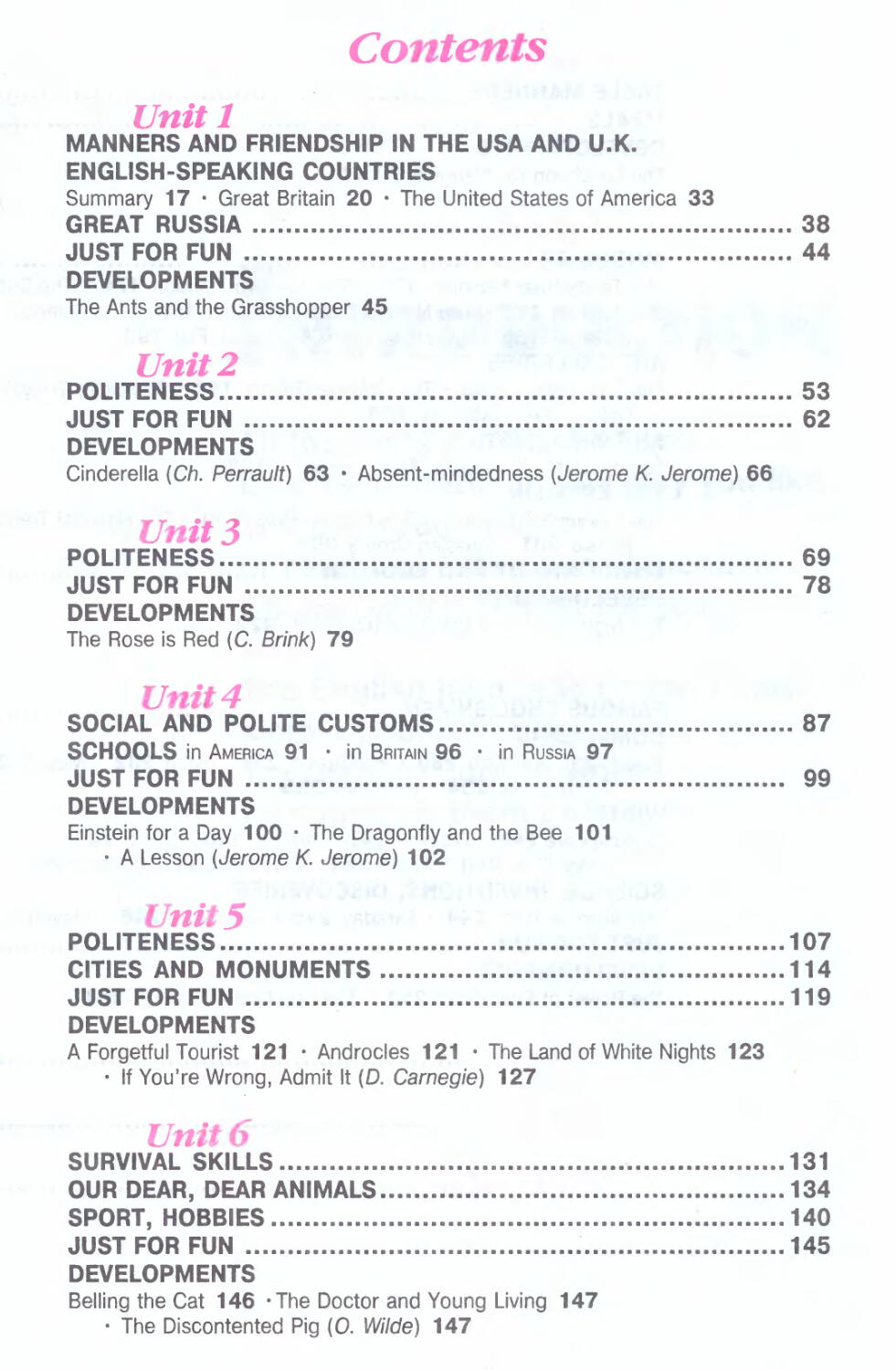
Co te s
Unit 1
MANNERS AND FRIENDSHIP IN THE USA AND U.K.
ENGLISH-SPEAKING COUNTRIES
Summary 17 · Great Britain 20 · The United States of America 33
G REA T RUSSIA ................................................................ 38
JUST FOR FUN ................................................................. 44
DEVELOPMENTS
The Ants and the Grasshopper 45
Unit 2
POLITEN ESS .................................................................... 53
JUST FOR FUN ................................................................. 62
DEVELOPMENTS
Cinderella (Ch. Perrault) 63 · Absent-mindedness (Jerome K. Jerome) 66
J it3
POLITEN ESS .................................................................... 69
JUST FOR FUN ................................................................. 78
DEVELOPMENTS
The Rose is Red (C. Brink) 79
] - 4
SOCIAL AND POLITE CUSTOMS .......................................... 87
SCHOOLS in AMERICA 91 · in BRITAIN 96 · in RUSSIA 97
JUST FOR FUN ................................................................ 99
DEVELOPMENTS
Einstein for a Day 100 · The Dragonfly and the Bee 101
· A Lesson (Jerome K. Jerome) 102
ni 5
POLITEN ESS ................................................................... 107
CITIES AND MONUMENTS ................................................ 114
JUST FOR FUN ................................................................ 119
DEVELOPMENTS
A Forgetful Tourist 121 · Androcles 121 · The Land of White Nights 123
· If You're Wrong, Admit It (D. Carnegie) 127
Un-
SURVIVAL SKI LLS ............................................................ 131
OUR DEAR, DEAR ANIMALS................................................ 134
SPORT, HOBBI ES ............................................................. 140
JUST FOR FUN ................................................................145
DEVELOPMENTS
Belling the Cat 146 · The Doctor and Young Living 147
· The Discontented Pig (G. Wilde) 147
u -[
TABLE MAN N ERS ............................................................. 153
MEALS ........................................................................... 158
DEVELOPMENTS
The Luncheon (S. Maugham) 164
U -t8
MUSEUMS .................... .... ............................ ................. 173
The Teddy Bear Museum 173 · The Tower of London 174 · The British
Museum 175 · The Natural History Museum 180 · The Science
Museum 186 · Alexander Push kin Museum Flat 198
ART GALLERIES
The Tate Gallery 188 · The National Gallery 191 · The State Tretyakov
Gallery 194 · Manezh 196
BRITISH ARTISTS
Turner 191 · Constable 192 · Hogarth 193
THE KREMLIN
The Diamond Treasury 197 · Kremlin Bells 200 · The National Treasure of
Russia 201 · Russian Orders 204
ENVIRONMENT AND ECOLOGy........................................... 208
DEVELOPMENTS
The Nightingale and the Rose (0. Wilde) 222
U it9
FAMOUS ENGLISHMEN ... ... ............ ...... .... ....... .............. .... 229
COMPOSERS
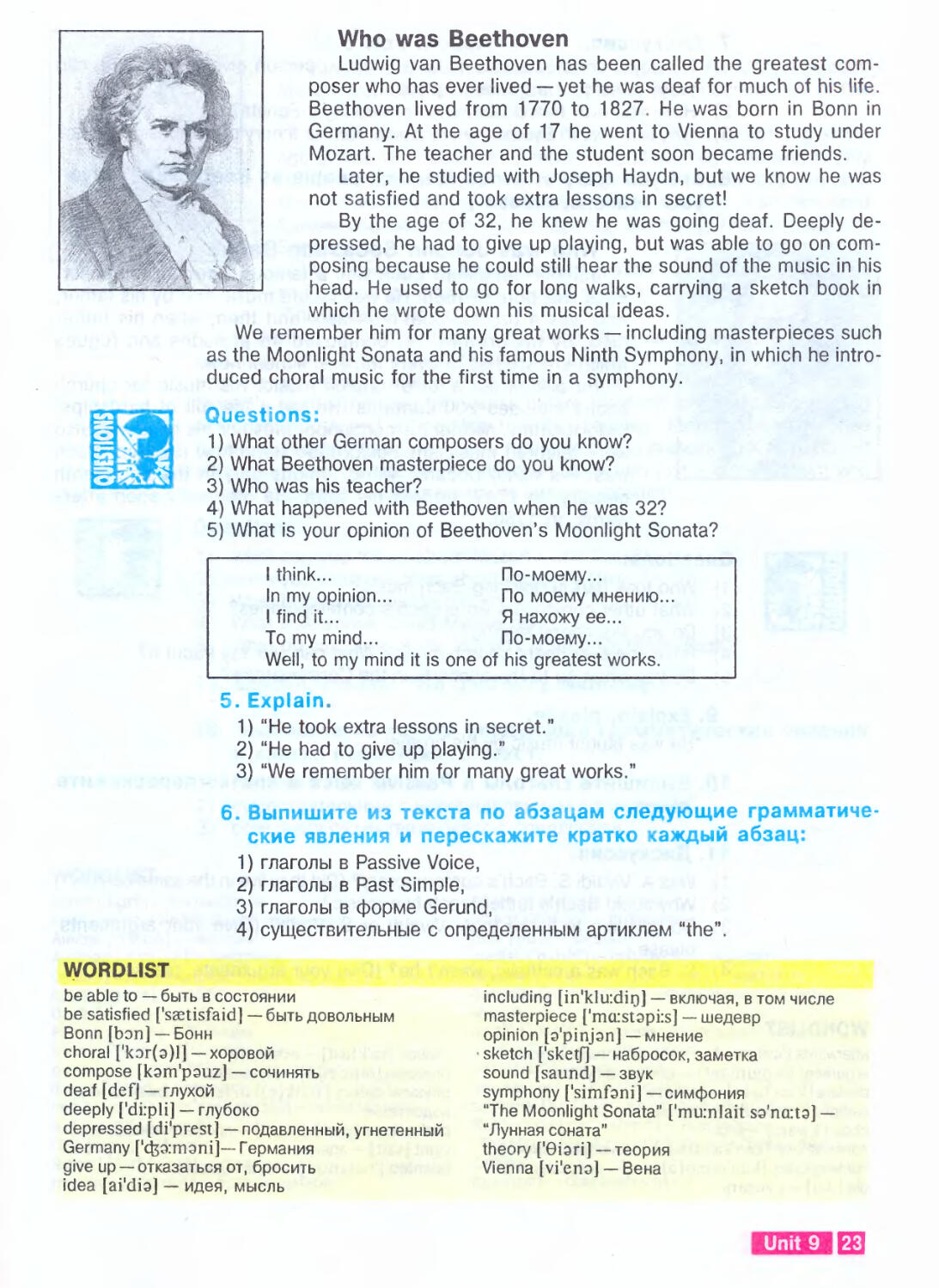
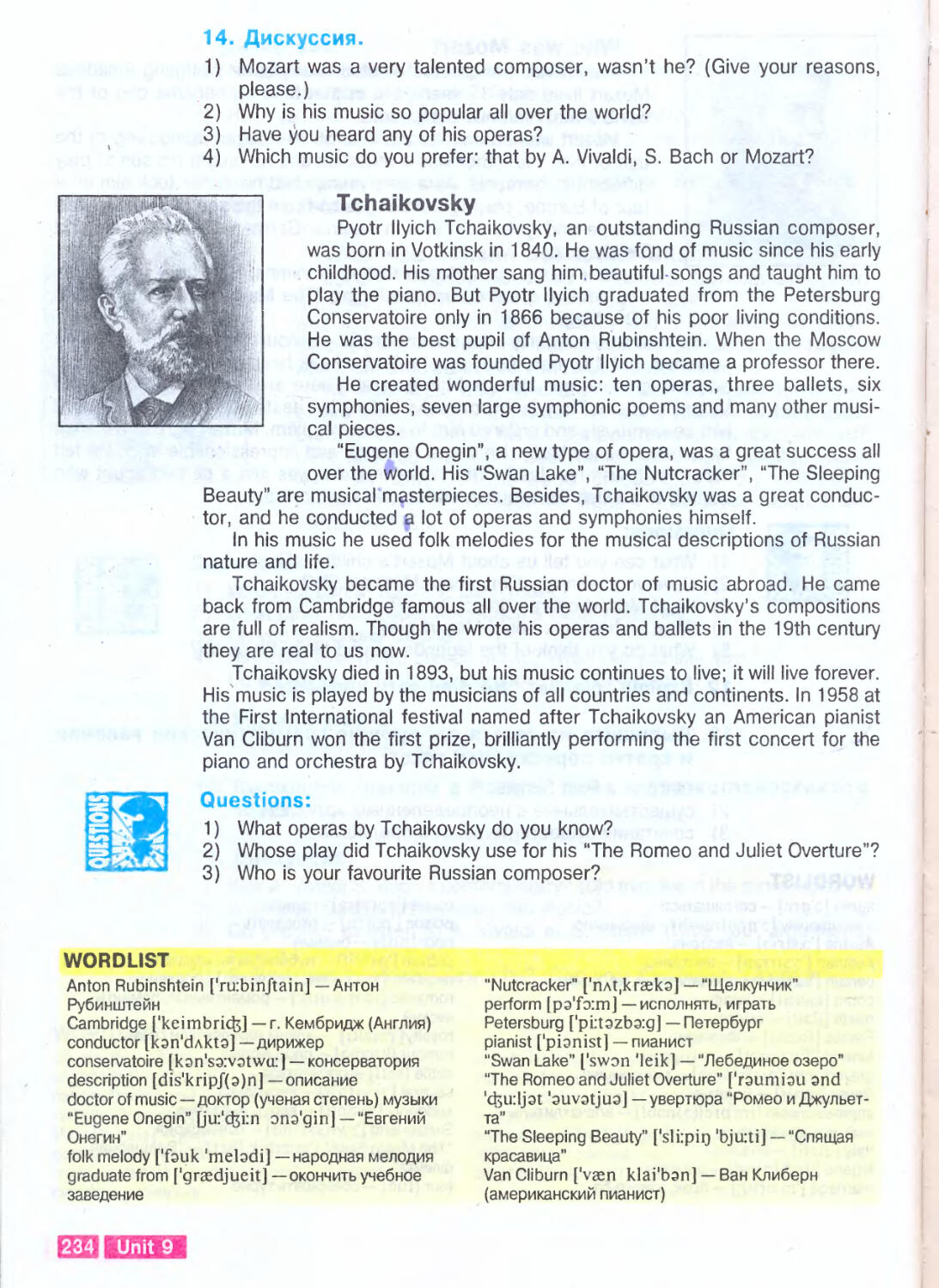
Vivaldi 230 · Haydn 230 · Beethoven 231 · Bach 232 · Mozart 233
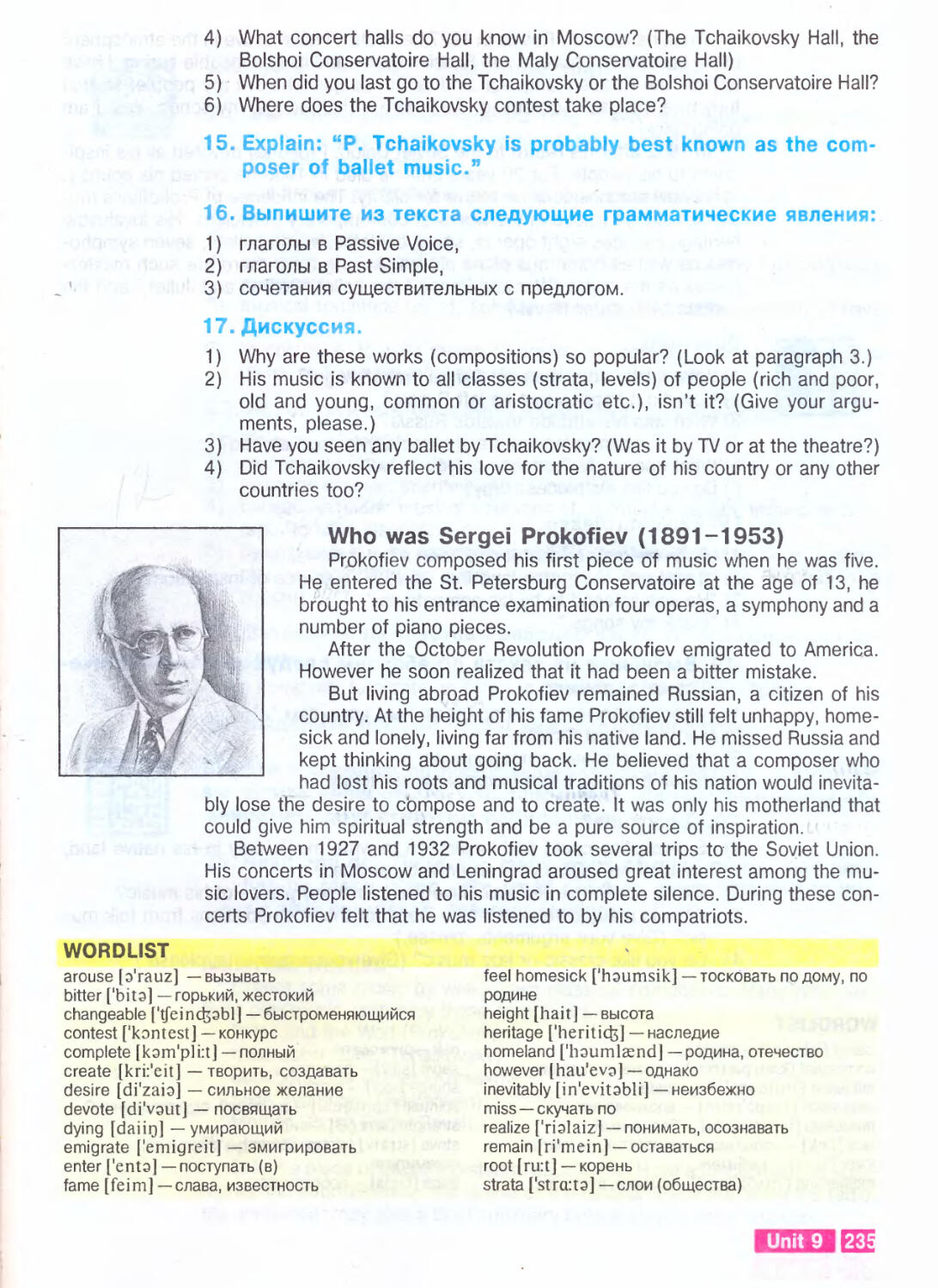
· Tchaikovsky 234 · Prokofiev 235
WRITERS
Shakespeare 240 · Dickens 240 · Kipling 240 · Irving 240
· Longfellow 240 · Twain 241 · O'Henry 241 · Christie 243
SCIENCE, INVENTIONS, DISCOVERIES
Leonardo da Vinci 244 · Faraday 245 · Columbus 246 · Heyerdahl 249
JUST FOR FUN ................................................................252
DEVELOPMENTS
The Power of Friendship 253 · The Last Leaf (O'Henry) 254
s ............................................................... 258
-
CS ... . . . . . . . . . . . . . . . . . . . . . . . . . . . . . . . . . . . . . . . . . . . . . . . . . . . . . . . . . . .. 272
r
...................................................... 314
.
I
All the texts are on the tape.
Use the material in any way you like.
You can read or listen
or read and listen simultaneously.
Choose which is best for you.
But
The English language doesn't have
simple phonetic rules.
Try reading English words
by sounding them out.
Aoporll1e APY3b
!
Mbl XOTlI1M, LfT06bl Bbl Y3HaJlll1 0 TOM, KaK
npll1H
TO ce6
BeCTlI1 B BeJlll1K06p
TaH
AMepLt1Ke.
npaB
Jla .xopowero TOHa OLfeHb Ba)f(Hbl
B )l(Lt13HLt1
06
3aTeJlbHO BaM np
rOA
TC
.
npOLfLt1Ta
Te Lt1X Lt1 3anOMHlI1Te Ha BCtO
)l(lI13Hb. ECJllI1 Bbl BCTpeTlI1TeCb C KeM-H
-
6YAb lI13 aHrJlOrOBop
w.e
CTpaHbl, Y Bac
He B03HlI1KHeT TPYAHOCTe
B o6w.eHlI1l11.
)l(eJ1aeM ycnexa!
1. Listen, read and act out.
Manners and friendship in the USA and U.K.
When meeting someone new, Americans
and Englishmen usually have certain man-
ners. They:
- Look them in the eye.
- Smile.
- Say "Hello. My name is/ I'm ... It's nice to
meet you, ..." (Say their names.)
- Stand up when a grown-up enters the room.
- Say "How do you do?" if it is a stranger.
Men and boys do not offer their hand to
shake unless the girl or lady offer theirs.
When they talk to grown-ups, use their titles:
"Yes, Mrs. Brown." "No, Doctor White."
Do you know that the only formally cor-
rect way to address people in Great Britain is
"Madam" and "Sir"? Schoolboys and school-
girls call their teacher "Sir", if it is a man. And if the teacher is a woman, they
say "Miss".
Say: "Sorry" or "Excuse me", or "I beg your pardon", if you don't under-
stand.
Some topics of conversation or things they might talk to a new friend abo-
ut may include:
- What do you do?
- Where do you go to school?
- What are your hobbies, favourite things to do?
- Do you play any sports?
- What are your favourite movies, books, songs, musical groups, etc.?
LI E
,\
\.
\\ ,,.. .
f I
: I ! /1 .
I /
i f
II I
., , '
\ .) "
. 't1\
..
-
.
, II
,
J
-)
J
'I .
I · ; , t \
Ijl,___
" l '\
.
,.
Guard!
- Don't interrupt your new friends, while they are talking. Wait for a pau-
se in the conversation.
- Don't talk too loud or get too close to your new friend. Generally stay
about one arm's length away.
WORDLIST
certain [Is
:tn] - OnpeAeJ1eHHbli1
close [kl
us] - 6J1
3K
i1
conversation Lk
nv
'seif
n] - pa3roBop. 6eceAa
enter ['ent
] - BXOAVlTb
formally ['f
:n1(
)1] - o<1>
u.
aJ1bHO
friendship ['frendJip] - APY'K6a
generally ['<Ben
r
li] - 06b1l1HO
grown-up ['gr
unAp] - B3POCJ1b1i1
guard [ga:d] -OCTeperaTbCR
I beg your pardon -
3B
H
Te
include [in'klu:d] - BKJ1lOlIaTb
interrupt Lint
'rApt] - npepblBaTb
loud [laud] - rpoMKVI
manner ['mren
] - MaHepa, 06pa3 Ae
cTBVI
movie ['mu:vi] - K
HO
offer ['
f
] - npeAllaraTb
pause [p
:z] - naY3a
shake hands - nO)KaTb APyr APYry PYK
stay about one arm's length ['leI)8] -CTO
Tb Ha nOll-
TVlTeJ1bHOM paccTo
H
VI (CTO
Tb Ha paccTo
HVlVI BblTfI-
HYTO
PYK
)
stranger ['strein<t);)] - He3HaKOMeL,t
title [taitl] - T
TyJ1, 3A. o<1>
u.1-1a.nbHa
<1>opMa 06pa-
eH
fI
topic ['t
pik] - TeMa
unless [An'les] -AO Tex nop nOKa
Unit 1 9
II
- Don't say anything critical to a new friend. Instead focus on what you
have in common or pay your new friend a compliment.
- Never ask grown-ups the question "How old are you?"
Write down as many facts from the text as you can. Exchange
papers with a partner. Now look back to the text to see how much
you have remembered.
--
.!> )
,,-
- Hi, Tom,! . .....
a\
- Hi, Jill!
l
\
,
'.... ,
-,",",.
i
,
Greetings
American Informality
Americans are often very informal. They
greet each other informally. Usually they say
"Hi" whether they are greeting a close friend,
an older person, a child, or their employee.
Americans often call one another by their
first names, even when they do not know one
another well.
Are people in your country more or less
formal with each other than people in the
United States?
( ,
_. '"'
Formal Introductions
Usually American greetings are informal. People say "Hi" or "Hello". But
sometimes people use formal introductions.
1/ /
f .
\
...
(, .., i).
,{
. . I
,\ .
, .' ,
"\
\ .
!
'0 · \
\1 \
,\ ',I
,,\ ,
.
,
-
\
, " ,
,:Q
. - ,
. .. .
,.
"
"
1'-
.. ,
. ,
..
4
· ..' r
.
\
'-
,
'. \
'.£ \\.
. .', \\\, ,
" . \t'
.,.' /
i. \ .
\, \ '. , ;1
.. , \ .'
t-_! ,-
., .
G .I
(/.4
,
" "A.
\
..;: ""
. . '.
-.......
.
.
?, .
00 . 0, \ .:
, .. \.
. .'
.. .
'--
. -."
. .
.A
.
:>
,
!
'"
: j r ,\
. ". . \ , I
, ; ;-; I....
"';::so .
, , _\ !,.-
",., It!!'
1 --.. . \
, .-.
- .... "
"' .
. ".. .'"
i \ · ""'.' .",'
" \ ....
- Mrs. Bell, I'd like you to meet my brother Boris.
- How do you do, Boris.
- Pleased to meet you, Mrs. Bell.
WORDLIST
call [k :l] - Ha3blBaTb
close [kl us] - 6J1V13KVI
compliment ['k mplim nt] - KOMnJ1J.1MeHT
critical ['kritikl] - KpVlTVlYeCKVI
employee Lempl i'i:] - COTPYAHVlK
.focus on ['fguk s] - cocpeAOTOYlt1TbCfI
greet ['gri:t] - npVlseTcTBosaTb
have (smth) in common ['k m n] - VlMeTb (YTO-TO)
06w-ee
informal [in'f :ml] - He0cDVll\VlaJ1bHblC1
instead [in 'sted] - BMeCTO B3aMeH
partner ['pa:tnJ] - napTHep
whether [Iweo ] - J1
1 0 Un it 1
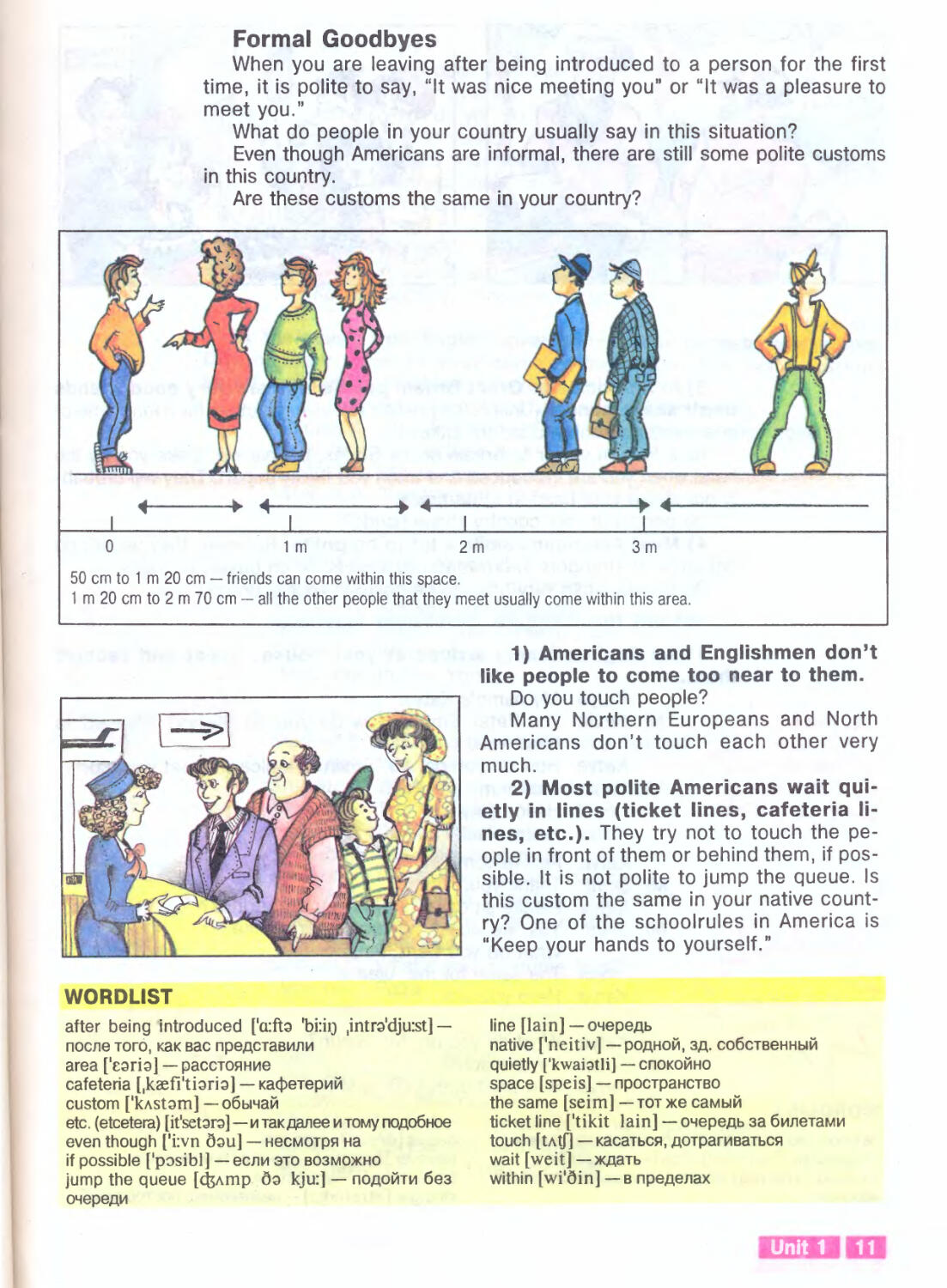
Formal Goodbyes
When you are leaving after being introduced to a person for the first
time, it is polite to say, "It was nice meeting you" or Ult was a pleasure to
meet you."
What do people in your country usually say in this situation?
Even though Americans are informal, there are still some polite customs
in this country.
Are these customs the same in your country?
"'J,
'"' . "'J \ r
. -. .
. .. .. )1 . .'
,
) e. ) . ,. .I
"- ". , . J ,.
.......
1 . . "' " CJ .,
, \ :"
!
.
-
\ I '. 1
.,al. ... ..:a
.. ..
I I I I
0 1 m 2m 3m
50 em to 1 m 20 em - friends can come within this space.
1 m 20 em to 2 m 70 em - all the other people that they meet usually come within this area.
\
.- -......
j
, ,.
,
.
.... J
\ :f.\.\( "", J
1'\} r
o
,,' '. 0
fJ \. . ·
, . .
: i . if
.f . \...)
. ' .. , . /
'Jr-
.. t,.
. .'J
r. .'- ·
. i!;....
4,
1., .
. I J
'II'!
' "',1 .
{ " \
. "11,1 .t
;. '..(;
:
, -.
"'t
""
.....
WORDLIST
after being introduced [Ia:ft 'bi:il) ,intr 'dju:st]-
nOCJ1e Toro, KaK Bac npeACTaBIi111
area ['c ri ] - paccTos:JHLt1e
cafeteria Lkrefi'ti ri ] - Ka$eTepVl
custom ['kAst m] - 06blyai1
etc. (etcetera) [it'set r ] - TaKAMee TOMY nOA06Hoo
even though ['i:vn o u] - HeCMOTpSl Ha
if possible ['p sibl] - eCJ1V1 310 B03MO>KHO
jump the queue [<tAmp O kju:] - nOAoi1TVI 6ea
OyepeAIi1
o
1) Americans and Englishmen don't
like people to come too near to them.
Do you touch people?
Many Northern Europeans and North
Americans don't touch each other very
much.
2) Most polite Americans wait qui-
etly in lines (ticket lines, cafeteria li-
nes, etc.). They try not to touch the pe-
ople in front of them or behind them, if pos-
sible. It is not polite to jump the queue. Is
this custom the same in your native count-
ry? One of the school rules in America is
"Keep your hands to yourself."
line [lain] - OyepeAb
native ('neitiv] - pOAHOi1. 3A. c06cTBeHHbl
quietly ['kwaiatli] - cnoKoVlHo
space [speis] - npocTpaHcTBo
the same [seim] -TOT >Ke caMbI
ticket line ['tikit lain] - OyepeAb 3a 6 J1eTaMVI
touch [tA tf] - KacaTbCSI, AOTpar BaTbcS1
wait [weit] ->KAaTb
within [wi'(}in] - B npeAeJ1aX
Unit 1 11
\
...., ,
4 _ .
· 1"
............. _ L
"
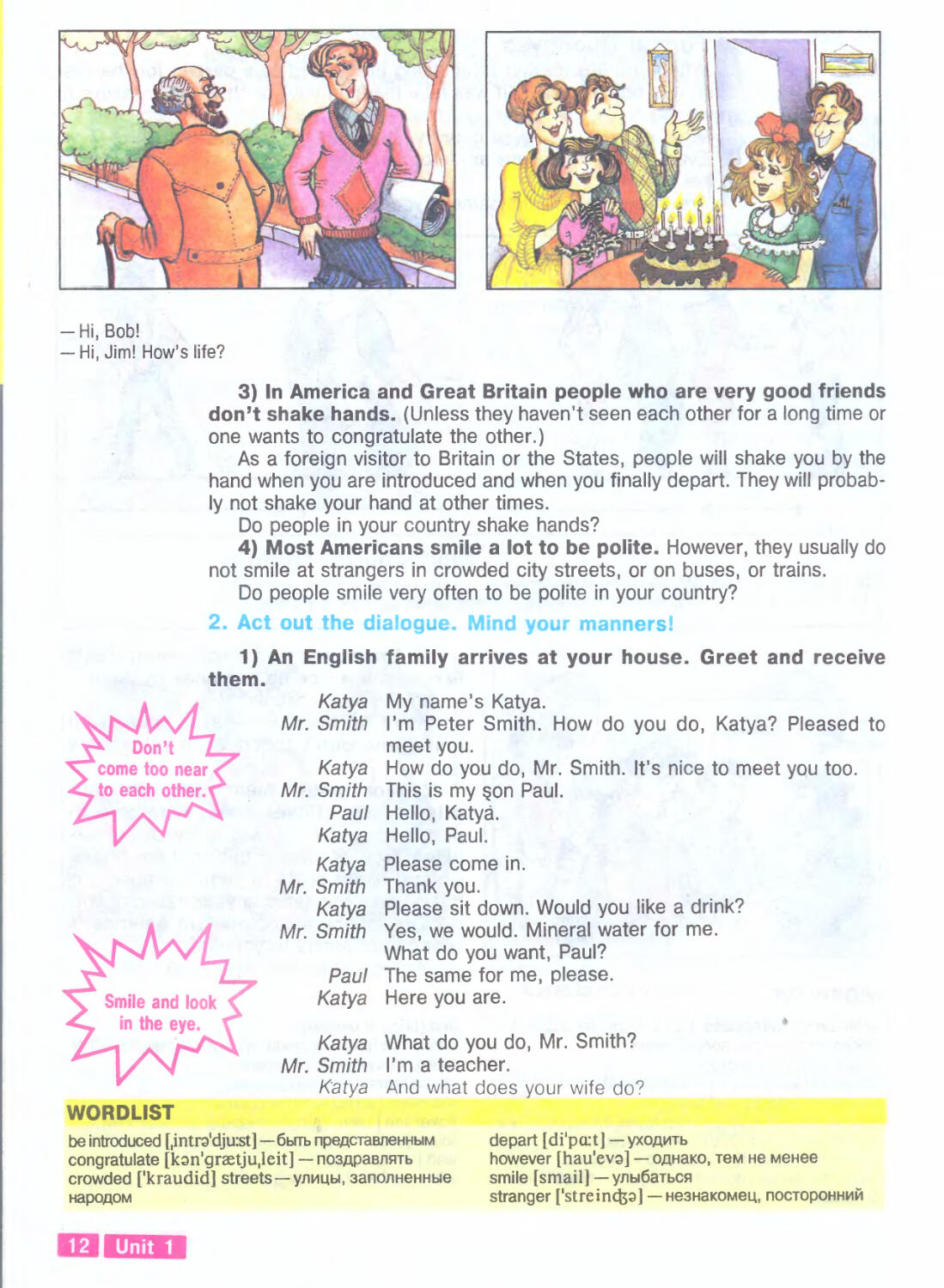
- Hi, Bob!
- Hi, Jim! How's life?
- p m
'9'\ ..;, __ \
\ I
.) J . , \
I "
\, -
=, , '. \:' ' ,I \
..I':;' J '" . n
. .. 0." )
. _ E3' ' -.it !
-f \11 -.,- J'
I I
\
,..
.t:-
,
" ..
( : ,
-
I
If" t . ....
t
.. .I
'\
..-
..
.j
'I \)
.wr
\.,I
.:: I .
"...... .a:...& .
3) In America and Great Britain people who are very good friends
don't shake hands. (Unless they haven't seen each other for a long time or
one wants to congratulate the other.)
As a foreign visitor to Britain or the States, people will shake you by the
hand when you are introduced and when you finally depart. They will probab-
ly not shake your hand at other times.
Do people in your country shake hands?
4) Most Americans smile a lot to be polite. However, they usually do
not smile at strangers in crowded city streets, or on buses, or trains.
Do people smile very often to be polite in your country?
2. Act out the dialogue. Mind your manners!
1) An English family arrives at your house. Greet and receive
them.
Katya My name's Katya.
Mr. Smith I'm Peter Smith. How do you do, Katya? Pleased to
meet you.
Katya How do you do, Mr. Smith. It's nice to meet you too.
Mr. Smith This is my on Paul.
Paul Hello, Katya.
Katya Hello, Paul.
Katya Please come in.
Mr. Smith Thank you.
Katya Please sit down. Would you like a drink?
Mr. Smith Yes, we would. Mineral water for me.
What do you want, Paul?
Paul The same for me, please.
Katya Here you are.
Katya What do you do, Mr. Smith?
Mr. Smith I'm a teacher.
Katya And what does your wife do?
WORDLIST
be introduced Lintr 'dju:st] - 6blTb npeACTaB1leHHbIM
congratulate [k n'grretju,leit] - n03ApaBJ1SHb
crowded ['kraudid] streets - YJ1 llbl, 3an0J1HeHHble
HapOAOM
12 I!mIII
depart [di'pa:t] -YXOA Tb
however [hau'ev ] - OAHaKO. TeM He MeHee
smile [smail] - Yl1bl6aTbC5I
stranger ['stre i net:;)] - He3HaKoMeu. nOCTopoHHVli1
Keep your
hands to yourself.
Don't touch
each other.
Mr. Smith Sorry?
Katya What does your wife do?
Mr. Smith She is an artist.
Katya What do you do, Paul?
Paul I go to school.
Katya What's your hobby, Paul?
Paul I collect books on art.
Katya Do you play any sports?
Paul Yes, I do. I play tennis and I like swimming very much.
Mr. Smith It's nine o'clock. We must go. Thank you very much.
It was pleasure to meet you, Katya. Goodbye.
Katya Goodbye. See you tomorrow.
2) The guests from English-speaking countries came to your school.
One of them came to your class to meet you. Ask her questions
about her family, hobbies, interests.
Mrs. Hay How do you do? My name's Barbara Hay.
Student A How do you do? Sorry - what's your name again?
Mrs. Hay I'm Barbara Hay.
Student B Please have a seat.
Mrs. Hay Thank you.
Don't interrupt
each other.
l/'
* * *
Student B What do you do?
Mrs. Hay I'm a teacher of English.
Student C Are you from England?
Mrs.. Hay No, I'm not. I'm American.
Student A Where do you live?
Mrs. Hay In New York.
* * *
Student B Have you been to Moscow before?
Mrs. Hay Yes, I have.
Student C When were you here last time?
Mrs. Hay Two years ago.
Student A Do you like Russia?
Mrs. Hay Yes, I do, very much.
Student B You speak Russian, don't you?
Mrs. Hay No, I don't. I speak a little French.
Student C Do you like Russian food?
Mrs. Hay Yes, I do.
Student C What's your favourite food?
Mrs. Hay Pizza.
* * *
Student A Do you like music?
Mrs. Hay Yes, I do.
Student B You like rock music, don't you?
Mrs. Hay No, I don't. I prefer jazz and classical music.
Student C Do you play an instrument?
Mrs. Hay Yes, I do. I play the violin.
Unit 1 DI
14 Unit 1
* * *
Student A Do you like reading?
Mrs. Hay Yes, I do.
Student B What sort of books do you like?
Mrs. Hay Novels and science fiction.
Student A Do you like detective stories?
Mrs. Hay No, I don't.
Student C Who is your favourite American writer?
Mrs. Hay Ernest Hemingway.
* * *
Student A Have you got any children?
Mrs. Hay Yes, I've got two. I've got an eleven year old girl,
called Ann and a boy.
Student B What is his name?
Mrs. Hay John.
Student C How old is your son?
Mrs. Hay He is twenty.
Student A What does he do?
Mrs. Hay He is an architect.
Student B What does Ann do?
Mrs. Hay She goes to school.
Student C What does your husband do?
Mrs. Hay He works in a bank.
* * *
Student A There's something you want to say, isn't there?
Mrs. Hay Yes, there is. John is trying to get a new job and is
very busy. He is sending applications all over the
country.
I've got a grandson. He is about 15 months.
He's just learning to walk.
* * *
Student B I want to ask you some questions. You live in New York,
don't you?
Mrs. Hay Yes, that's right.
Student C Do you live in a house or in an apartment?
Mrs. Hay I live in a house.
Student C Is it an old house?
Mrs. Hay Yes, it is.
Student C Is it a large house?
Mrs. Hay No, it's not very large.
Student A How many bedrooms are there?
Mrs. Hay
There are three.
Student B How large is your kitchen?
Mrs. Hay I think it's about thirty-six square feet.
Student A What is the weather like in New York now?
Mrs. Hay It's sunny and hot.
L.
PLAY
II
L ..
PLAY
* * *
Student How long have you been working?
Mrs. Hay Since 1985, for more than ten years.
Student How do you get to school?
Mrs. Hay I usually go by bus, but sometimes I walk.
Student How far is it from your house to school?
Mrs. Hay About two miles.
Student Where did you work before?
Mrs. Hay I was a manager in a Mall.
* * *
Student Have you ever been to Britain on holiday?
Mrs. Hay Oh, yes. I've been there many times.
Student Where have you been?
Mrs. Hay Well, last year we went to Scotland.
* * *
Student How long are you going to stay in Russia?
Mrs. Hay For a week.
Student Now one more question, Mrs. Hay. What are you
doing tomorrow?
Mrs. Hay I'm going to visit the Kremlin.
* * *
Student Thank you for the interview, Mrs. Hay.
Mrs. Hay You're welcome.
Student Goodbye Mrs. Hay. Please visit our school again.
Mrs. Hay Goodbye.
Student A- You are an American guest.
Student B -- You are a student.
Choose different partners for different topics in the dialog ue.
Close your books and try to remember the dialogue and act it out.
Now look back to the dialogue to see how much you have remem-
bered.
1. A friend from England arrives at your house. Introduce all the members
of the family to him. Invite him/ her into the living-room. Offer him/ her so-
mething to eat and drink. Ask your friend about his/ her family, hobbies. Talk
about your family, your hobbies and your plans for the next summer holidays.
Finish the conversation.
Write down the conversation. Act out the situation. Try to make your con-
versation as natural as possible. Good luck!
2. Interview your English teacher. Ask him or her questions about his/ her
interests, his/ her family, hobbies etc. Try to make your conversation as na-
tural as possible. Good luck!
Unit 1 m
-
".
----
I ,
l
-..
...... .
, :
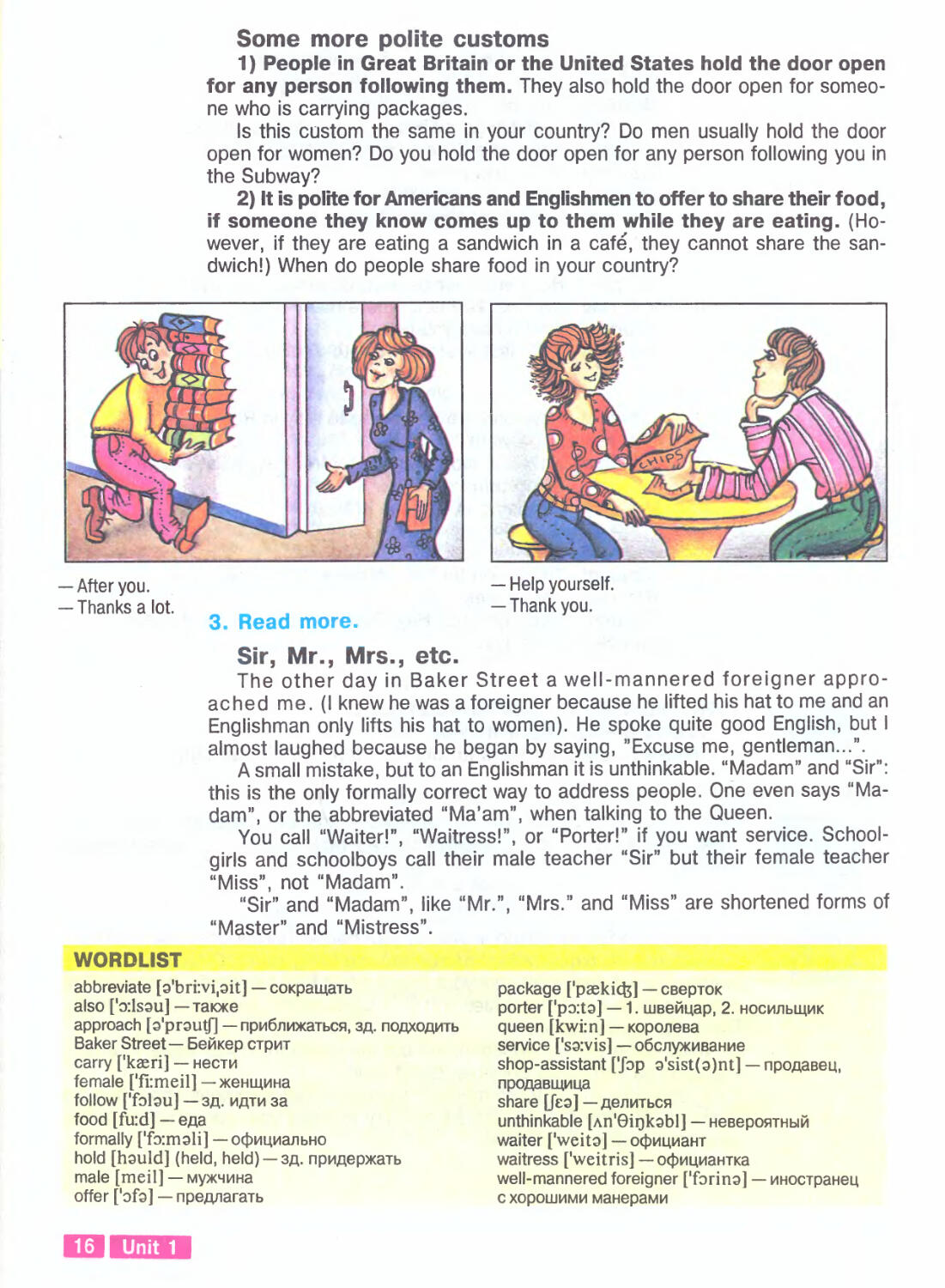
- After you.
- Thanks a lot.
Some more polite customs
1) People in Great Britain or the United States hold the door open
for any person following them. They also hold the door open for someo-
ne who is carrying packages.
Is this custom the same in your country? Do men usually hold the door
open for women? Do you hold the door open for any person following you in
the Subway?
2) It is polite for Americans and Englishmen to offer to share their food,
if someone they know comes up to them while they are eating. (Ho-
wever, if they are eating a sandwich in a cafe, they cannot share the san-
dwich!) When do people share food in your country?
.
3
8 )
as
.....
. ""
.9 YI
'$
- IS(' -' :
.: -",," rJ' ....,.
.... ,.... <i ow
-=-: ) -
,.
/'-
J ,!) 'I _
. )
.'!:
.. \
,
- -:;;\ \
J IL' P.:.\ '
'" \ s
("
....
--- ..t.
- Help yourself.
- Thank you.
3. Read more.
Sir, Mr., Mrs., etc.
The other day in Baker Street a well-mannered foreigner appro-
ac hed me. (I knew he was a foreigner because he lifted his hat to me and an
Englishman only lifts his hat to women). He spoke quite good English, but I
almost laughed because he began by saying, "Excuse me, gentleman...".
A small mistake, but to an Englishman it is unthinkable. "Madam" and "Sir":
this is the only formally correct way to address people. One even says "Ma-
dam", or the abbreviated "Ma'am", when talking to the Queen.
You call "Waiter!", "Waitress!", or "Porter!" if you want service. School-
girls and schoolboys call their male teacher "Sir" but their female teacher
"Miss", not "Madam".
"Sir" and "Madam", like "Mr.", "Mrs." and "Miss" are shortened forms of
"Master" and "Mistress".
WORDLIST
abbreviate [ 'bri:vi, it] - COKpal.l.laTb
also r :ls u] - TalOKe
approach [ 'pr uif] - npVl6J1(11)KaTbcSJ, 3A. nOAXOAII1Tb
Baker Street - 6et1Kep CTpLt1T
carry ['kreri] - HeCTII1
female ['fi:meil] - >KeHI.l.lVlHa
follow ['f l u] - 3A. VlAT aa
food [fu:d] - eAa
formally ['f :m li] - o Vlu.Lt1aJ1bHO
hold [h uld] (held, held) - 3A. npVlAep)KaTb
male [meil] - M}')K VlHa
offer [' f ] - npeAllaraTb
III I!ImII
package ['prekicB] - CBepTOK
porter ['p::>:t ] -1. wBet1u.ap, 2. HOCLt1J1b IIIK
queen [kwi:n] - KOpOJ1eBa
service ['s :vis] - 06CJ1Y>KVlBaHlI1e
shop-assistant ['f::>p 'sist( )nt] - npOAaBeu,
npOAClBI.l.lI-1u.a
share [J£ ] - AeJ1V1TbCSJ
unthinkable [An'eil)k bl] - HeBepoSJTHbli1
waiter ['weit ] - o Vlu.lI1aHT
waitress ['weitris] - o Vlu.l-1aHTKa
well-mannered foreigner ['f::>rin ] - VlHOCTpaHeu
C XOPOWVlMII1 MaHepaMVI
LIS -
E
I
U T -IE
Summary
Some short information about five English-speaking countries.
1) The United Kingdom of Great Britain and Northern Ireland.
2) The United States of America.
3) Canada.
4) The Commonwealth of Australia.
5) New Zealand.
4. Listen, read the text about English-speaking countries. These
countries have different histories, cultures, traditions, gover-
nments and geography.
1) The United Kingdom of Great Britain and Northern Ireland is si-
tuated on the islands in the northwest of Europe. "O QJ
The Atlantic ocean is on the north of it and the North Sea to the east.
The English Channel (21 miles) separates it from the continent. Great Bri-
tain is the large i,sI af1..,d . The three main parts of it are Scotland, England
and Wales. Northern Ireland is situated on the island called Ireland.
The population of the United Kingdom is about 60 million and its capi-
tal is London.
The United Kingdom is a highly developed country. Its main cities are
London, Birmingham, Manchester and Glasgow. J.'QJ" (..:<: '" .;
2) The United States of America (USA) is located in North Ameri-
ca. It is one of the largest countries in the world. The population of the
USA is about 250 million people. The USA has 50 states. Its capital is
Washington D.C. (the District of Columbia). Its main cities are New York,
Chicago, San Francisco, Los Angeles and Boston. .'vv..enM te;' li
It is a highly developed country. People of very many nationalities live in
the USA. 'f.. "'"'\ 'i..). i ( } (t\ -t
J
.,
1"
-
,:;-1
__ __. .. u .
; ... .&-1
...-:::--_"1
.:"--i
\
!--.
...
.....
\
,.;-.
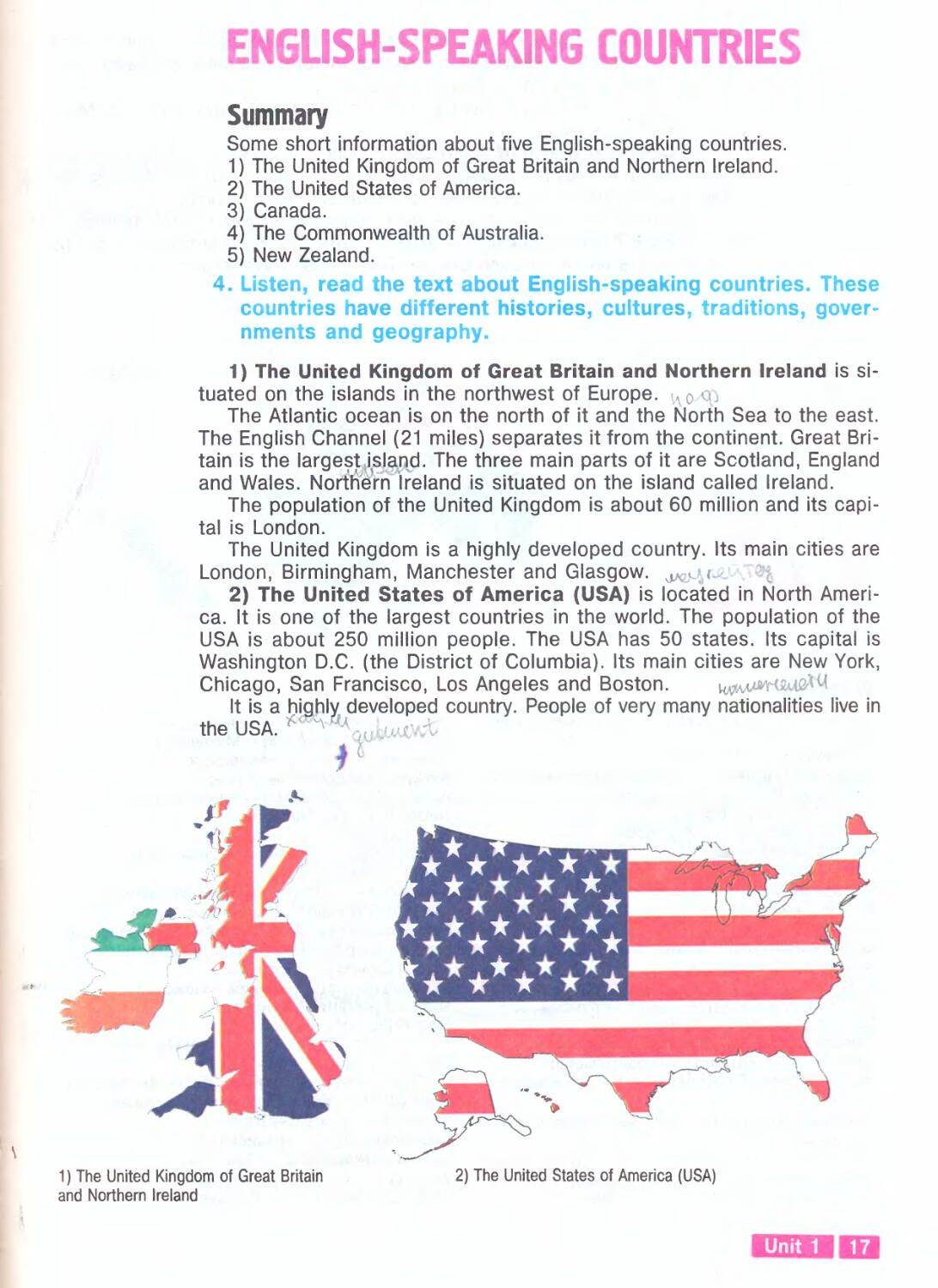
1) The United Kingdom of Great Britain
and Northern Ireland
\
**"1f*"*.
** ***
* *** **
t* *** *
-J
)
I'
"""
,
.r
,
,
r---\
t ,.
..",-,
, .
2) The United States of America (USA)
.
Unit 1 17
3) Canada is situated in North America. Three oceans surround it: the
Atlantic, the Arctic and the Pacific. The capital of the country is Ottawa. Abo-
ut 30 million people live in Canada.
It is a great industrial country. Its main cities are Ottawa, Toronto, Mon-
treal and Vancouver.
4) Commonwealth of Australia occupies the continent of Australia and
a number of istands (the main one of which is Tasmania). It includes 6 states
and 2 territories with a population of about 20 million people.
Its capital is Canberra and the main cities are Sidney and Melbourne.
5) New Zealand consists of several large and many smaller islands. Its
population is about 4 million people. The capital is Wellington.
The chief cities are Auckland, Dunedin and Nelson.
It is a highly developed agricultural country.
3) Canada
4) Commonwealth of Australia
r -"
i -'
'%\
... ':'1 ,i; ..!
' '-. f;\{ ; .
.....c.'" " .. \'.I) ..-:, '(-t--
r r: '?( .;r .. .....
\_, Ui t5t . ..d'.-. 1_._.-
....."-\1'\ _ I .(, . "' ( n \
I...;;;;:J "', <.." .\) Q \Q
r:r..: / . .) J ).
<_oj;<. '\\ . -. I ,_">..
-''7'- '""\ '";-". ..
<. iJ "' ",-"'._-""'i.j'......"
<l'J\ ......
I.r!
T
\.._ j
.
\
.-,: G
--_______.______:..... ...... .-/.-.....-:.,... , I
1-1
,-
&..r
WORDLIST
agricultural Lregri'kAltf r I] - cenbCKOX03 CTBeH-
Hbl
Auckland [' :kl nd] - OKJIeHA
be situated ['sitjueitid] - 6blTb pacn0J10>KeHHbIM
Birmingham ['b :m i lJ m] - 61-1pMVlHreM
Boston ['b st n] - 60CTOH
Canberra ['krenb r ] - KaH6eppa
channel ['tfrenl] - KaHan
chart [tfa:t] -Ta6J1I11u.a
Chicago [Ji'ka:g u] - VlKaro
chief [tfi:f] - rJ1aBHbli1
commonwealth ['k:JmgnweI8] -coAPy>KecTBo
consist of [k n'sist] - COCTOSlTb Lt13
culture ['kAltfg] - KYJ1bTYpa
D. C. (District of Columbia)
('distrikt :JV k 'lAmbi ] - oKpyr K0J1YM6111S1
Dunedin [dA'ni:din] - AaHII1AVlH
Glasgow ['gIa:sg u] - rJ1a3rO
government ['gAvnmgnt] - npaBVlTeJ1bCTBO
highly developed ('haili di'veI pt] - BbICOKOpa3BII1-
Tbl
industrial [in'dAstrigI] - npOMbIWJ1eHHbl , II1HAYC-
Tplt1anbHbli1
include [in'klu:d] - BKnlOyaTb
located [l u'keitid] - pacn0J10)KeHHbli1
Los Angeles [I:Js'renct3iIi:s] - nOC-AHA>f(eJ1eC
18 Unit 1
5) New Zealand
..
'\
'"
,
(j
*"
main part ['mein 'pa:t) - OCHOBHa yaCTb
Manchester ['mrentfistg] - MaHyeCTep
Melbourne ['melb n] - MeJ1b6YPH
Montreal Lm:Jntri' :I] - MOHpeaJIb
nationality [nref 'nrel ti] - Hau.VlOHaJ1bHOCTb
Nelson ['nelsn) - HeJ1bCOH
New York [.nju: 'j:J:k] - HblO- OPK
occupy [' kjupai] -3aHVlMaTb, OXBaTbiBaTb
Ottawa [':Jt Wd] - OTTaBa
preference epref( )r( )ns) - npeAnOYTeHlt1e
principal ['pri ns pl] - rJ1aBHbJVI. OCHOBHOVI
San Francisco [.sren fr n 'sisk u] - CaH-ct>paHUlt1CKO
separate ['sepgreit] - OTAeJ1S1Tb, pa3AeJ1S1Tb
several esevr I] - HeCKOJ1bKO
summary ['sAmdri] - KpaTKoe lt13nO>KeHVle
surround [s 'raund] - OKPY>KaTb
Sydney ('sidni]- CLt1AHei1
Tasmania [trez'meini ] - TacMaHVlst (OCTpOB)
territory ['teritri] - TeppVlTopVlSl
the English Channel ['inglif.t[ renI] - AHrJ1Lt1i1cKIt1i1
KaHan (Me>KAY O. BeJ1V1K06pVlTaHVlSI VI ct>paHUlI1ei1)
Toronto [t 'r:Jntg(u)] - TopoHTo
tradition [trg'difn] - rpCiAVlu.Vlst
Vancouver [vren'ku:v ] - BaHKYBep
Washington ['w:JJil)t n) - BawlI1HrToH
Wellington ['welil)tgn] - BeJ1nVlHrTOH
5. Complete the chart.
Countries Georaphical Population
characteristics
Capital
Principal
towns
1 )
2)
3)
4)
5)
6. Fill in the table with geographical names. Mind the articles.
ApT Knb "the" cneAyeT ynoTpe6n Tb c Ha3BaHL1S1M peK, OKeaHOB;
HeT apT Kl1S1 c Ha3BaH M ropOAOB, c Ha3BaH S1ML1 CTpaH;
apT Knb "the" co CnO)l(HbIM Ha3BaH M CTpaH:
Country Town River Ocean
0 the 0 the 0 the 0 the
7. Talk about the countries using the geographical names.
8. Which of the countries would you prefer to visit? Put them in
order of preference. Why?
9. Make a back translation. Good luck!
KpaTKoe onMcaHMe
KpaTKafl V1HcpopMau.V1f1 a nflTV1 aHrJlOfl3bl'1HblX cTpaHax:
1) COeALtlHeHHOe KOpOJleBCTBO BeJlV1K06pV1TaHV1V1 V1 CeBepHoi1 V1pllaHAV1L-1.
2) CoeAV1HeHHble WTaTbl AMeplt1KL-1.
3) KaHaAa.
4) ABcTpallV1 cKV1 COt03.
5) HOBafl 3ellaHAV1f1.
Y 3TlI1X cTpaH pa3Ha lt1CTOplt1f1, KYllbTypa, TpaALtlL.J.t,1lt1, npaBlt1TellbCTBa lt1 reo-
rpacplt1 .
1) CoeAMHeHHoe KoponeBcTBo BenMKo6pMTaHMM M CeBepHoM MpnaH-
AMM HaXOAlt1TCS1 Ha oCTpoBax Ha cesepo-3anaAe EBponbl. ATJlaHTlt1'1eCKV1i1 OKeaH
HaXOAlt1TCS1 Ha cesepe rocYAapcTBa, a CeBepHoe Mope Ha BOCTOKe. na-MaHw (21
Mlt1llfl) OTAellfleT ero OT MaTeplt1Ka. BeJ1lt1K06plt1TaHlt1 - caMbl 60llbWO OCTpOB.
TpeMS1 OCHOBHbIMV1 lIaCTS1MV1 BellV1K06plt1TaHlt1lt1 S1BllS1tOTCS1 WOTllaHAlt1S1, AHrJ1L-1 lt1
Y3JlbC. CeBepHaS1 V1pllaHAV1S1 HaXOAV1TCS1 Ha OCTpOBe, Ha3blBaeMOM V1pllaHAlt151.
HaCelleHlt1e COeAlt1HeHHOro KOpOJ1eBCTBa COCTaBJlS1eT OK0J10 60 Mlt1llllLtlOHOB
'1ellOBeK, a era CTOJlLtlu.e 51Bll5leTCS1 nOHAOH.
COeAlt1HeHHOe KopolleBcTBo - BblcoKOpa3Blt1Ta cTpaHa. Ero rllaSHble ropo-
Aa - nOHAOH, 6lt1pMlt1HreM, MaH'1eCTep 111 rllaaro.
2) CoeAMHeHHble WTaTbl AMepMKM (CWA) paCnOllO)KeHbl B CeBepHoi1
AMeplt1Ke. 3TO OAHa 1113 KPynHe Wlt1X CTpaH M1I1pa. HaCelleHlt1e CWA COCTaBllfleT
OKOllO 250 MV1J1lllt10HOB '1ellOBeK. B CWA 50 WTaTOB. BaW1I1HrTOH (oKpyr KOllYM-
6Lt151) - CTOllLtlu.a CWA. HbtO-C1oPK, Lllt1KarO, CaH-cDpaHu.lI1CKO, nOC-AHA)KelleC,
60CTOH -: rllaSHble ropoAa. 3TO BbicoKOpa3BLtlTOe rocYAapcTBo. ntOAlt1 O'1eHb
MHorlt1X Hau.LtlOHallbHocTe )KV1SYT B CWA.
3) KaHaAa paCnOllO)KeHa B CeBepHo AMepLtlKe. Tplt1 OKeaHa OMblBatOT ee:
ATllaHTlt1'1eCKlt1 , CeBepHbl neAOBLtlTblL1 111 Tlt1xLtl . CTOlllt1u.a CTpaHbl - OTTaBa.
OKOllO 30 Mlt1ll11lt10HOB '1eflOBeK )Klt1BeT B KaHaAe. 3TO -- KpynHaS1 CTpaHa C pa3BL-1-
TO npoMblwl1eHHoCTbtO. OTTaBa, TOPOHTO, MOHpeallb, BaHKYBep - ee rllaBHble
ropOAa.
,
Unit 1 19
II
+Gro
+
,.. ,'1,.
.. 0
"-
B "'
-----
4) ABcTpanMMcKMM COlO3 3aHII1MaeT MaTepll1K ABcTpallll1111 111 P5lA OCTPOBOB
(rllaBHbl 1113 KOTOPblX - TaCMaHII151). COt03 BKntO aeT B ce651 WeCTb WTaTOB 111 ,nBe
Teppll1TOpll1111 C HaCeJleHlI1eM OKOllO 20 MII111llIl10HOB ellOBeK. Ero CTOllll1u.a - KaH-
6eppa, a rllaBHble ropo,na - CII1,nHe 111 Mellb6YPH.
5) HOBaH 3enaHAMH COCTOIl1T 1113 HeCKOllbKII1X 60llbWII1X 111 MHOrll1X MallblX OC-
TpOBOB. Ee HaCelleHlI1e COCTaBll5leT OKOllO 4 MII1llllll10HOB ellOBeK. CTOllll1u.a -
Bellllll1HrroH. rllaBHble ropo,na - OKlleH,n, AYH,nIl1H 111 HellbcoH. 3TO BbICOKopa3B -
Ta51 cellbcKox0351 cTBeHHa51 crpaHa.
.
Turn this paper over. Write down as many facts from the text as
you can. Exchange papers with a partner.
Great Britain
10. Listen and read this text about Great Britain.
The official name for the country whose language we study is the United
Kingdom of Great Britain and Northern Ireland. In everyday use, however, the
word "Britain" is quite possible.
The United Kingdom of Great Britain and Northern Ireland has several dif-
ferent names.
Some people say "Great Britain", or "Britain", or "the United Kingdom", or
just "the U.K." and "G.B."
Great Britain is an island that lies off the north west of Europe. It is the
largest island in Europe. It is 500 km wide and nearly 1,000 km long.
There is the Atlantic Ocean on the north of it and the North Sea on the east.
The English Channel, which is about 21 miles, separates the U.K. from the
continent. Its closest continental neighbours
are France and Belgium. Recently the chan-
nel Tunnel, which links France and England,
has been built.
There are four countries in the United Kin-
gdom: England, Scotland, Wales and Nor-
thern Ireland.
England, Scotland and Wales are three
main parts of Great Britain. Scotland is in the
north. Edinburgh is Scotland's capital, it is
one of the most beautiful cities in Britain.
Wales is in the west. The capital city of Wales
is Cardiff.
Ireland, which is also an island, lies off the
west coast of Great Britain. Northern Ireland
and the Irish Republic (Eire) are on this is-
land. Belfast is the largest city in Northern
Ireland and it is its capital.
,
. ft
. t
.. ....
I D
.... If -
..;..! . I
I
WORDLIST
Belgium ['belq, m] - 6eJ1brVl
Belfast ['belfa:st] - 6eJ1cJ>acT
Cardiff ['ka:dif]- KapA cJ>
constitute ['k nstitju:t] - COCTaBJl Tb
Edinburgh ['edinb r ] - aA H6ypr
get to know [get tu: In u] - Y3HaBaTb, n03HaBaTb
however [hau'ev ] - KaK 6b1 H . CKOJ1bKO 6b1 HVI
Irish Republic (Eire) ['ai rif ri'pAblik] ['eiri]-
lt1pJ1aHACKa pecny6J1V1Ka (a pe)
1m m!III
lie off [lai :):f] - HaxOAVlTbC Ha HeKOTopOM paCCTO -
H VI
main [mein] - rJ1aBHbI , OCHOBHOi1, BIDKHei1WLt1i1
neighbour ['neib ] - coceA
separate ['sep reit] - OTAeJ1 Tb
several ['sevr I] - HeCKOJlbKO
tunnel ['tAnI] - TYHHeJ1b
Great Britain together with Northern Ireland constitutes the United King-
dom (U.K.).
The capital city of Great Britain is London which is situated in the south-
east of England. London is more than a thousand years old.
11. Complete. There are 5 names of this country. Write them.
1) ................2) ................3) ................4) ................5) ................
12. Complete the chart. There are 4 different countries in the
nited Kingdom. Write them.
Countries Georaphical Population Capital Principal
characteristics towns
1 ..............
2 ..............
3 ..............
4 ..............
-43. Put the geographical names from the text on the map. Mind
the articles.
1
3
" 6
7
8
I KEY
1 - The Atlantic Ocean
2 - Scotland
3 - The North Sea
4 - Northern Ireland
5 - Edinburgh
6 - Belfast
7 - Irish Republic ( Eire)
13
8 - Dublin
9 - England
10 - Wales
11 - Cardiff
12 - London
13 - The English Channel
Unit 1 21
I -j
14. Please, try to give a back translation of this text.
CoeA HeHHoe KoponeBCTBO 8en K06p TaH CeBepHO pnaHA
s:lBIls:leTCs:I oQ:> u. anbHbIM Ha3BaH eM CTpaHbl, s:l3b1K KOTOPO Mbl 3Y4aeM. 8
nOBceAHeBHo£:1 )f( 3H , OAHaKO, cnOBO "6p TaH s:I" BnOIlHe np eMneMo.
CoeA HeHHoe KopoIleBcTBo 8en K06p TaH CeBepHo£:1 pIlaHA
L1MeeT HeCKOIlbKO Ha3BaH ii1. HeKoTopble rOBOps:lT BenVlK06p TaH s:I, n 6p -
TaH s:I, n CoeA HeHHoe KoponeBcTBo, Il npOCTO "U.K." "G.B. ".
8en K06p TaHit1s:1 - STO OCTpOB, KOTOpbl£:1 paCnOIlO)f(eH K ceBepo-3anaAY
OT EBponbl. 3TO CaMbJt1 60nbwot1 OCTpOB B EBpone. Ero w p Ha 500 KM, a
An Ha n04T 1000 KM. C ceBepa ero OMblBaeT ATIlaHT ecK £:1 OKeaH, a C
BOCrOKa - CeBepHoe Mope.
na-MaHW, npOTs:I)f(eHHOCTb KOToporo OKano 21 M nl1, OTAens:ler CoeA -
HeHHoe KoponeBcTBo OT MaTepl1Ka. 6nil1)f(a£:1w e KOHT HeHTanbHble coceA
KoponeBCTBa - cDpaHu. s:I 6enbr Sl. HeAaBHo 6bln nOCTpoeH TYHHenb nOA
na-MaHweM, KOTOpbl£:1 coeA HSleT cDpaHu. tO 111 AHrn tO. B COCTaB COeAII1HeH-
Horo KoponeBcTBa BXOAs:lT eTblpe CTpaHbl: AHrIlll1s:1, WOTIlaHA s:lJ YSJlbC
CeBepHas:l pIlaHAlI1s:1.
AHrIlIl1Sl, WOTJlaHA s:I 111 Ysnbc - STO Tpll1 OC"HOBHble 4aCT 8eJl Ko6p Ta-
H . WOTnaHA Sl HaXOALt1TCs:I Ha ceBepe. CTOI1 u.a WOTI1aHA - 3A H6ypr.
3TO OA H 3 KpaCLt1Bet1w x ropoAoB 8eI1 K06p TaH . YSI1bC HaXOA TCs:I Ha
3anaAe. CTon u.a Y3I1bCa - KapA Q:>.
pI1aHA s:I, KOTOpas:l TO)f(e s:lBIlSleTCs:I OCTpOBOM, J1e)f( T K 3anaAY OT no6e-
pe)f(bs:l 8eI1I11K06pLt1TaH . CeBepHas:l pIlaHA s:I pI1aHA.cKas:l pecny6Il Ka
(3£:1pe) HaXOAs:lTCs:I Ha 3TOM OCTpOBe. 6eIlcPacT - KPynHe£:1w £:1 ropOA B Ce-
BepHo£:1 pIlaHA II1, 111 OH s:lBIls:leTCs:I ee cToIl u.e .
BeI1 K06p TaH s:I BMeCTe C CeBepHOVt Lt1pI1aHA e£:1 COCTaBIls:rtOT CoeA HeH-
Hoe KOpOI1eBCTBO.
CTOI1 u.e£:1 BeI1 K06pLt1TaH s:lBIls:reTCs:I J10HAOH, KOTOPbl£:1 pacnOnO)f(eH Ha
JOrO-BOCTOKe AHrJH1H. llOHAOHY Y>Ke 60Jlee TblCft4H JleT.
to -:
"
7'
....
: ___T
"- .
.i
\ .
. --"
. ,
_o!. ...
",;If. .
" '
15 Listen and read this text about Wales.
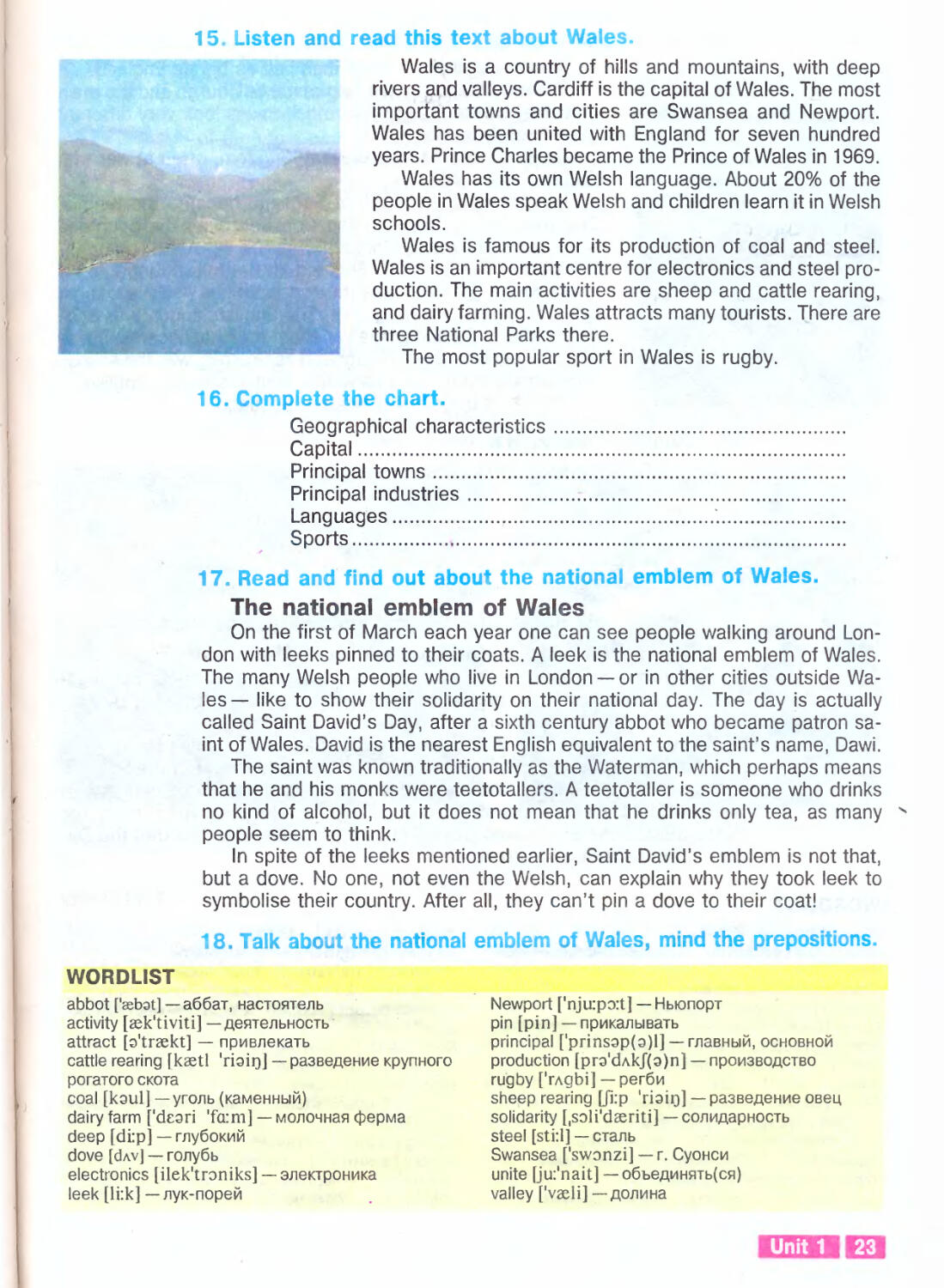
Wales is a country of hills and mountains, with deep
rivers and valleys. Cardiff is the capital of Wales. The most
important towns and cities are Swansea and Newport.
Wales has been united with England for seven hundred
years. Prince Charles became the Prince of Wales in 1969.
Wales has its own Welsh language. About 20% of the
people in Wales speak Welsh and children learn it in Welsh
schools.
Wales is famous for its production of coal and steel.
Wales is an important centre for electronics and steel pro-
duction. The main activities are sheep and cattle rearing,
and dairy farming. Wales attracts many tourists. There are
three National Parks there.
The most popular sport in Wales is rugby.
16. Complete the chart.
Geographical characteristics ...................................................
Capital.................................................................................... .
Pri nci pal towns ........................................................................
Pri ncipal industries ..................................................................
La n g u age s ........................................................:......................
S po rts ........ . . . . . . . . . . . . . . . . . . . . . . . . . . . . . . . . . . . . . . . . . . . . . . . . . . . . . . . . . . . . . . . . . . . . . . . . . . . . . .
17. Read and find out about the national emblem of Wales.
The national emblem of Wales
On the first of March each year one can see people walking around Lon-
don with leeks pinned to their coats. A leek is the national emblem of Wales.
The many Welsh people who live in London - or in other cities outside Wa-
les - like to show their solidarity on their national day. The day is actually
called Saint David's Day, after a sixth century abbot who became patron sa-
int of Wales. David is the nearest English equivalent to the saint's name, Oawi.
The saint was known traditionally as the Waterman, which perhaps means
that he and his monks were teetotallers. A teetotaller is someone who drinks
no kind of alcohol, but it does not mean that he drinks only tea, as many ....
people seem to think.
In spite of the leeks mentioned earlier, Saint David's emblem is not that,
but a dove. No one, not even the Welsh, can explain why they took leek to
symbolise their country. After all, they can't pin a dove to their coat!
18. Talk about the national emblem of Wales, mind the prepositions.
.l
I
I'
I
I
WORDLIST
abbot ['rebgt] - a66aT I HaCTO TeJ1b
activity [rek'tiviti] --AeSneJ1bHOCTb
attract [ 'trrekt] - np1'1BneKaTb
cattle rearing fkretl 'rigil)] -- pa3BeAeHVle KpynHoro
poraToro CKOTa
coal [kgul] -- yronb (KaMeHHbl )
dairy farm ['degri 'fa:nl] -- M0J10 Ha51 cpepMa
deep [di:p] -- rJ1y60Kt-1
dove [dAv]--roJ1y6b
electronics [ilek'tr n iks] -- SJ1eKTpOHVlKa
leek [li:k] -- J1YK-nope
Newport [Inju:p :t] -- HblOnopT
pin [pin] - npVlKaJ1blBaTb
principal ['prinsgp{g}l] - rJ1aBHbl , OCHOBHOi:1
production [prg'dAkf{ g) n] - npoVl3BoACTBO
rugby ['TAgbi] - per6V1
sheep rearing [Ji:p 'rigil)] -- pa3BeAeHVle oBeu.
solidarity Ls li'dreriti] -- COJ1V1AapHOCTb
steel [sti:l] -- CTaJ1b
Swansea ['sw nzi] -- r. CYOHCVI
unite [ju:'nait] -- 06beAVlH Tb(C )
valley ['vreli] -- AOJ11'1Ha
Unit 1 23
19. Listen and read this text about Scotland.
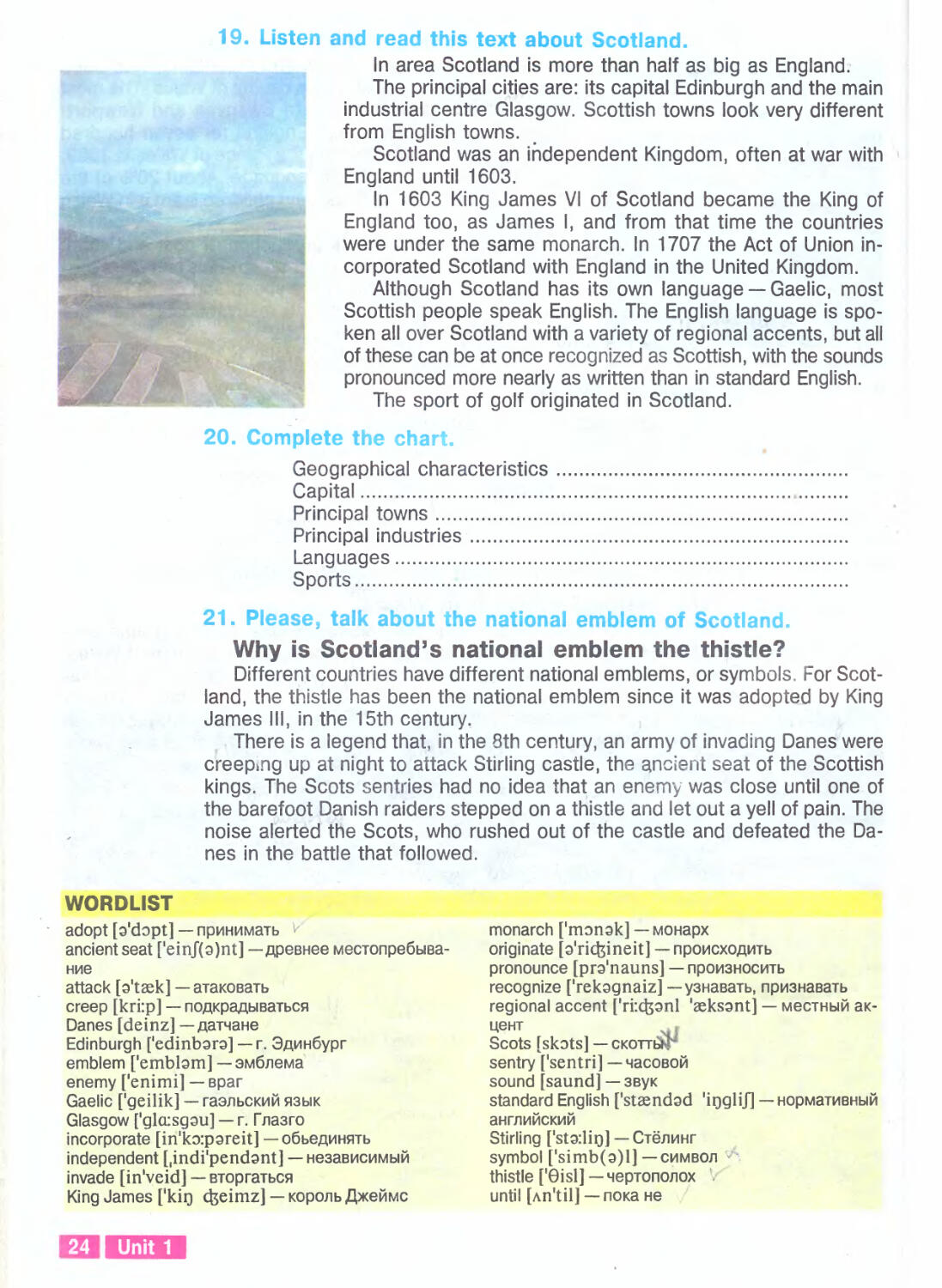
In area Scotland is more than half as big as England.
The principal cities are: its capital Edinburgh and the main
industrial centre Glasgow. Scottish towns look very different
from English towns.
Scotland was an independent Kingdom, often at war with
England until 1603.
In 1603 King James VI of Scotland became the King of
England too, as James I, and from that time the countries
were under the same monarch. In 1707 the Act of Union in-
corporated Scotland with England in the United Kingdom.
Although Scotland has its own language - Gaelic, most
Scottish people speak English. The English language is spo-
ken all over Scotland with a variety of regional accents, but all
of these can be at once recognized as Scottish, with the sounds
pronounced more nearly as written than in standard English.
The sport of golf originated in Scotland.
20. Complete the chart.
Geog rap hical characte ristics ...................................................
Capital........................................................................... .........
Principal towns ........................................................................
Principal industries ..................................................................
La n 9 u age s ...............................................................................
Spa rts .. . . . . . . . . . . . . . . . . . . . . . . . . . . . . . . . . . . . . . . . . . . . . . . . . . . . . . . . . . . . . . . . . . . . . . . . . . . . . . . . . . . . .
....
21. Please, talk about the national emblem of Scotland.
Why is Scotland's national emblem the thistle?
Different countries have different national emblems. or symbols. For Scot-
land, the thistle has been the national emblem since it was adopted by King
James III, in the 15th century.
There is a legend that, in the 8th century, an army of invading Danes were
creep.ng up at night to attack Stirling castle, the ancient seat of the Scottish
kings. The Scots sentries had no idea that an enemy was close until one of
the barefoot Danish raiders stepped on a thistle and let out a yell of pain. The
noise alerted the Scots, who rushed out of the castle and defeated the Da-
nes in the battle that followed.
WORDLIST
. adopt [ 'd pt] - nplt1HIt1MaTb y
ancient seat ['einf( )nt] - ApeBHee MecTonpe6blBa-
HVie
attack [ 'trek] - aTaKOBaTb
creep [kri:p] - nOAKpa.D.blBaTbCst
Danes [deinz] -AaTlfaHe
Edinburgh ['edinb r ] - r. 3AVlH6ypr
emblem ['embl m] -sM61leMa
enemy ['enimi] - Bpar
Gaelic ['geilik] - raSllbCKVli1 st3blK
Glasgow ['gla:sg u] - r. rlla3rO
incorporate [in'k :p reit] - 06beAIt1HstTb
independent Lindi'pend nt] - He3aBIt1CIt1Mbli1
invade [in'veid] - BTopraTbCst
King James ['kilJ ct)eimz] - KOpOllb e Mc
24 EmIl
monarch ['m n k] - MOHapx
originate [ 'ri<tineit] - npolt1CXOAIt1Tb
pronounce [pr lnauns] - np0lt13HOCIt1Tb
recognize ['rek gnaiz] -Y3HaBaTb. nplt13HaBaTb
regional accent ['ri:cB nl 'reks nt] - MecTHbli1 aK-
u.eHT
Scots [sk ts] - CKOTTb
sentry ['sentri] -lfacoBoi1
sound [saund] - 3BYK
standard English ['strend d 'ilJglin - HopMaTVlBHbli1
aHrJ1Lt1i1cKIt1i1
Stirling [lst :1iIJ] - CTellVlHr
symbol ['simb( )l] -CIt1MBOJ1 v-'
thistle ['Sisl] - '"IepTOn01l0X ,
until [An'til] - nOKa He
22. Read about two English towns and say what they are famous
for.
Cambridge
Cambridge is situated at a distance of 70 miles from London. It is one
of the most beautiful towns in England. The dominating factor in Cambrid-
ge is its well-known University, a centre of education and learning. New-
ton, Byron, Darwin and many other scientists and writers were educated
at Cambridge. It has 27 colleges. A college is a place where you live no
matter what profession you are trained for: so students studying literature
and those trained for physics may belong to one and the same college.
Every college is headed by a dean.
Oxford
Oxford is one of the great English universities too. Cambridge and
Oxford are almost identical. They trace their long history back to the same
period. By the end of the thirteenth century both universities already had
colleges.
Oxford and Cambridge are associated with the higher ranks of society.
They have always been universities for gentlemen.
-
-= -
,. .1
-.
............ --..... - c.:.. -.. ..
---- ::.-__ _ r- ... -.-
_.- ,- - ..
- s. ... . .4'
. 'f .:';: . .
.1 f......... .
t .-... -
. r'JJ.. I',.,,'
_' - - J, r I
I
,. - .
.. .
· ... I
.tr. .
_ ...... ..f
r r .
r
'-rw-
.
t
,. .
.
'..
...
. . , I
... .
:==
L
",-, ".1
'rl" --
t'" ,rtf,
. . I.
-
_ =. ... .! I -i.
!
.
...
-..
-
:t :. _ I.
. .f" " "-
. 0;1 ·
.
..,_ .. r- .
. -
-
\ iii1 \ "
i... .-
."
,t.....!i
· · , f
· r' f
f'
" !,.
.
;; .-
Cambridge. The Perpendicular towers of one of the city's most
famous buildings, King's College Chapel (centre), rise high above
else
WORDLIST
alert [ l :t] - nOAHS1Tb TpeBory
at a distance ['dist( )ns] - Ha paccToS1H U1
barefoot ['be fut] - 60coi1
battle [bretl] - 6V1TBa
be associated [ 's uJieitid] - accou.VlVlpOBaTbCS1
be situated ['sitjueitid] - 6blTb pacn0J10)f(eHHbIM
be trained [treind] - 06y aTbcS1
belong to [bi'I I)] - np HClAl1e)f(aTb K
Byron ['bai ren] - 6at1poH
Cambridge [Ikeimbrict] - r. KeM6p A>J(
college ['k lict] - KOJ1lleA>J(
Danish ['deinin - AaTcKillt1
Darwin ['da:win] - AapBiIIH
dean [di:n] - AeKaH
defeat [di 'fi:t] - HaHOC Tb noprot<eHille
t :;
I '-.:.
. ",
1.
, , f
\
\,\ '.:..
.,'
"- It
, ." . ., ... ",.
.,. 4i....
""'."'1'" :;;::-',., :,'= : II
. . .'
. t
IJ
:. \
' '--_ I
- ..J.\
"
t ·
.
1 ,II. · :'
III . Iii' I' .' I
· · - i III I
p. -
\ .'
. t. .. ;'::..;
1M
...'.
f f
.
.....
.
to
.
\J '. II
,.
.
\ "
.
,
t,
.
..
J'_
,.-
"
'. ,/. .
.
Oxford. The High Street. The street is known simply as
lithe High" to Oxford residents
dominating ['d mineitil)] - npe0611aAaIOLllVli1
education Ledju:'keiJ( )n] - 06pa30BaHille
head [hed] - B03rJ1aBJ1S1Tb
higher ranks of society ['hai rreI)ks v s 'sai ti]
- BblCWVle CllOVI o6LllecTBa
identical [ai'dentik( )1] - TO)f(AeCTBeHHblti
let out [let aut] - 3A. i113AaBaTb
Newton ['nju:tn] - HblOTOH
pain [pein] - 60J1b
physics ['fiziks] - ct> 3i11Ka
raider [reida] -y acTHiIIK HaJ1eTa
rush out [rAf aut] - cTpeM TeJ1bHO 6pocaTbcSJ Lt13
step [step] - crynaTb, AeJ1aTb warill
trace [treis] - 06Hap BaTb, npOCJ1e)f(II1BaTb
yell [jell - KpLt1K, BOnJ1b
Unit 1 m
23. Let's have a closer look at Cambridge and its university.
My name is Ann Berlina. I am a student at Moscow State Linguistic Uni-
versity.
Last winter I spent ten days in the university city of Cambridge. It is built
on a river called the Cam. Cambridge University. founded in 1209. is still one
of the two best places to study in England; Oxford is the other. Students work
very hard to obtain a place at "Oxbridge" - either at Oxford or at Cambrid-
ge. There is great rivalry between these two ancient universities: each wants
to be better than the other. but in reality both are equally good.
Today. Cambridge is famous not only for its university but also because it
is a very picturesque and ancient city. Many of its buildings are very old: some
were built about 700 years ago. Some of the older buildings are covered with
beautiful plants such as ivy. Many are surrounded by green lawns and rnulti-
coloured flower-beds. Although all the colleges belong to the same universi-
ty. each has its own character and style. In 1440 King Henry VI founded King's
CoH ge, hoping that this would make people remember him. It is still the most
famous college in Cambridge because its chapel is one of the finest churc-
"es in Western Europe. There are also many beautiful bridges across the Cam
including the Mathematical Bridge and the Bridge of Sighs.
In my view. Cambridge is a very pleasant city to live and study in. Since
there are so many colleges. a large number of the city's inhabitants are young
students. In the day-time the students work in the many libraries or attend
lectures. while in evenings they go back to their college rooms or university
lodgings.
Sport plays a large part in university life. As Cambridge is on the river Carn.
rowing seems to be the most popular sport. There are "boathouses" all along
the river bank and early in the mornings you'li see many students rowing.
whatever the weather. The best of them are preparing for the famous annual
boat race against their rivals from Oxford. This race attracts much attention:
thousands of people line the banks of the Thames in London to cheer both
teams on. and the race is broadcast on television in many different parts of
the world. I
When visiting Cambridge. one should certainly take the time to have a look
around the shops. There are many bookshops for students and tailors' shops
where long traditional gowns are sold. At weekends shops are often crow-
ded with tourists looking for souvenirs such as mugs. T-shirts and scarves,
all with college crests on them. Students wear scarves of various colours in
the winter when the weather is cold - at least by English standards! They often
complain of the wind and rain, as most of them travel around by bicycle.
WORDLIST
ancient ('einfgnt] - ApeBHVli1
annual ['renju l] - e)f(erOAHbl
attract [a'trrekt] - npVlBJ1eKaTb
bank [breIJk] - 6eper peKVI
be crowded - 3A. 6blTb 3an0J1HeHHbIM
boat house ['b ut haus] - 3A. J10AO Ha CTO HKa
broadcast ['br :dka:st] - nepeAaBaTb no PaALt10 J1
TeJ1e BLt1AeHVI 10
chapel ['tfrep( )1] - aCOBH
cheer r'tfi ] - nOA6aAPVlBaTb
found rfaund] - OCHOBblBaTb
g:wr1[gaun] - MaHTVI
inhabitant [in'hrebit nt] - )f( TeJ1b
III Unit 1
ivy ['aivi] - nJ1fOLl.l
lawn [l :n] - J1Y)f(a Ka
line [lain] - CTO Tb BAOJ1b, BbICTpaViBaTbC
obtain ( b'tein] - nOJ1yyaTb
picturesque Lpiktf 'resk] - )f(VlBOnViCHbl
race [reis] - copeBHoBaH e
rivalry ('raiv(a)lri] -conepH ecTBo
row (ra u] - rpecTVI
scarf [sku: f] (scarves) - wapq,
sigh [sail - B3AOX
surround [sa'raund] - OKp\')i(aTb
tailor ['teila] - nopTHoi1
whatever [w t'eva] - KaKa 6bl HVI 6bl1la
Foreign students from different countries enjoy their stay in Cambridge
not only because of its beautiful sights, but because they have a chance to
meet many English people of their own age.
24. Could you please explain why Ann writes the following: "In my
view Cambridge is a very pleasant city to live and study in"?
25. Listen and read more about Great Britain.
The climate of the British Isles is influenced by the Atlantic Ocean. Winters
are not so cold as they can be on the continent, but summers are not so warm
as they usually are on the other side of the Channel. In other words Great
Britain has a mild climate. England is famous for its beautiful lawns with flo-
wers. They stay green all the year round. Many people say that England looks
like a large well-kept park.
The animals of the British Isles look like those of north-western Europe:
faxes, squirrels, hares, etc. There are about 430 kinds of birds, many of them
are song-birds. The most popular hobby of Englishmen is bird-watching.
People mainly live in cities and towns. The country's industry is highly
developed and output of goods is larger than is needed for home use. There-
fore, a great part of the industrial output is exported. The large industrial
centres are Birmingham, Glasgow, Manchester, Nottingham, Liverpool.
Britain has only 1 % of the world's popu-
lation but is the fifth largest trading nation. It
exports electrical and electronic equipment
and chemicals and oil.
London is the capital. It is situated on the
Thames.
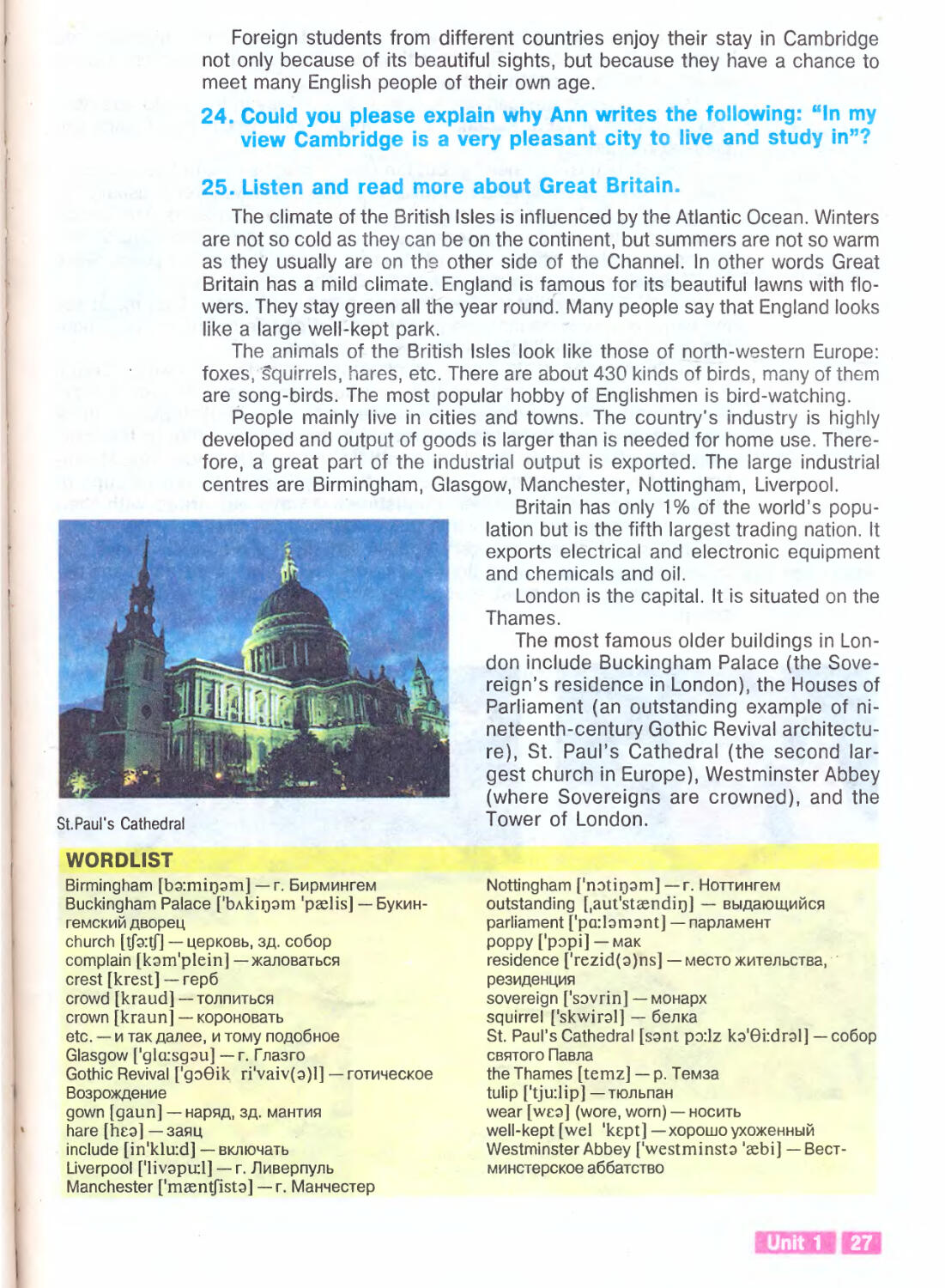
The most famous older buildings in Lon-
don include Buckingham Palace (the Sove-
reign's residence in London), the Houses of
Parliament (an outstanding example of ni-
neteenth-century Gothic Revival architectu-
re), S1. Paul's Cathedral (the second lar-
gest church in Europe), Westminster Abbey
(where Sovereigns are crowned), and the
Tower of London.
I
).
..
I .'
.
p.
If' 11
" - ! f r r . . . \t l I
t-tL.- · · '
\
....
'-.... .
.,.' "
.. .-
..
.,..
r
--
51. Paul's Cathed ral
WORDLIST
Birmingham [b :mil) m] - r. 6V1pMII1HreM
Buckingham Palace ['bAkil) m 'prelis] - 6YKVlH-
reMCKVI ,QBopeu.
church [tf :Ul- epKoBb, 3A. c060p
complain [k m'plein] - >KanOBaTbCSt
crest [krest] - rep6
crowd [kraud] - TOllnVlTbCSt
crown [kraun] - KopOHOBaTb
etc. - VI TaK Aallee, 111 TOMY nOAo6Hoe
Glasgow ['gla:sg u] - r. rna3ro
Gothic Revival ['g eik ri'vaiv( )1] - rOTlt1l.1eCKOe
B03pO)KAeHVle
gown [gaun] - HapStA, 3A. MaHTVlSt
hare [he ] - 3aStu.
include [in'klu:d] - BKJ11Ol.IaTb
Liverpool ['livgpu:l] - r. nViBepnYllb
Manchester ['mrentfist ] - r. MaHl.IeCTep
.
Nottingham ['n3til)am] - r. HOTTVlHreM
outstanding Laut'strendil)] - BbIAalOLl.lVl CSt
parliament ['pa:lglllgnt] - napJ1aMeHT
poppy ['p3pi] - MaK
residence ['rezid( )ns] - MeCTO >KII1TenbCTBa, .'
pe3V1AeHu.VlSt
sovereign ['s3vrin] - MOHapx
squirrel ['skwir l] - 6ellKa
81. Paul's Cathedral [s nt p3:1z kg'ei:dr l] - c060p
CBStTOro naBlla
the Thames [temz] - p. TeM3a
tulip ['tju:lip] - TlOllbnaH
wear [we ] (wore, worn) - HOCVlTb
well-kept [wel 'kept] - XOPOWO YXO>KeHHbli1
Westminster Abbey ['westminstg 'rebi] - BecT-
MVlHcTepcKoe a66aTcTBo
nit 1 27
.... "
f\
\
",
m Unit 1
,.
London is a leading art centre with many theatres, galleries, museums and
concert halls. The Globe Theatre with which Shakespeare was closely asso-
ciated, is being reconstructed in London.
The first passenger-carrying Underground railway in the world was ope-
ned in London in 1863. Recently the Channel Tunnel which links France and
England has been built.
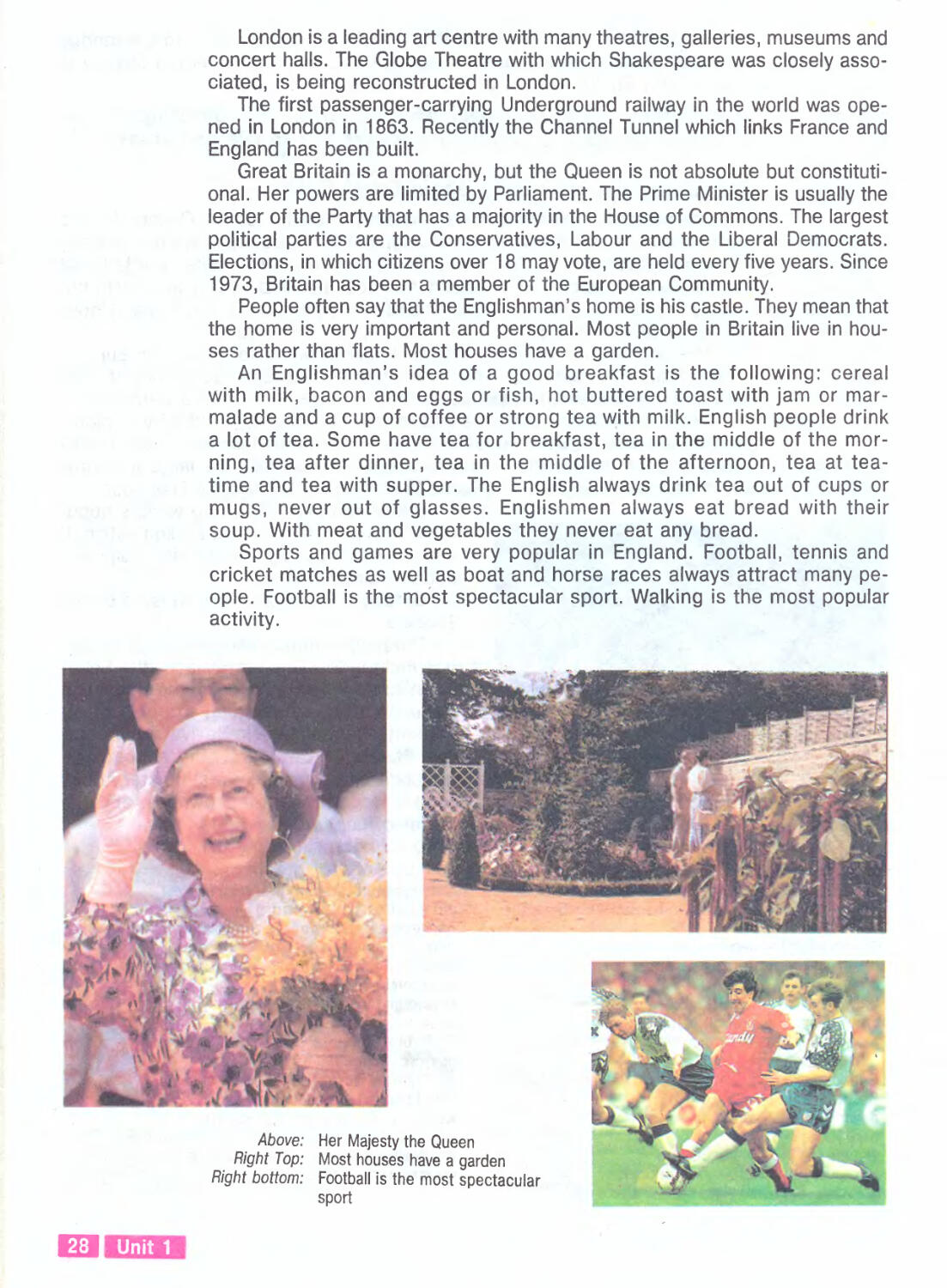
Great Britain is a monarchy, but the Queen is not absolute but constituti-
onal. Her powers are limited by Parliament. The Prime Minister is usually the
leader of the Party that has a majority in the House of Commons. The largest
political parties are the Conservatives, Labour and the Liberal Democrats.
Elections, in which citizens over 18 may vote, are held every five years. Since
1973, Britain has been a member of the European Community.
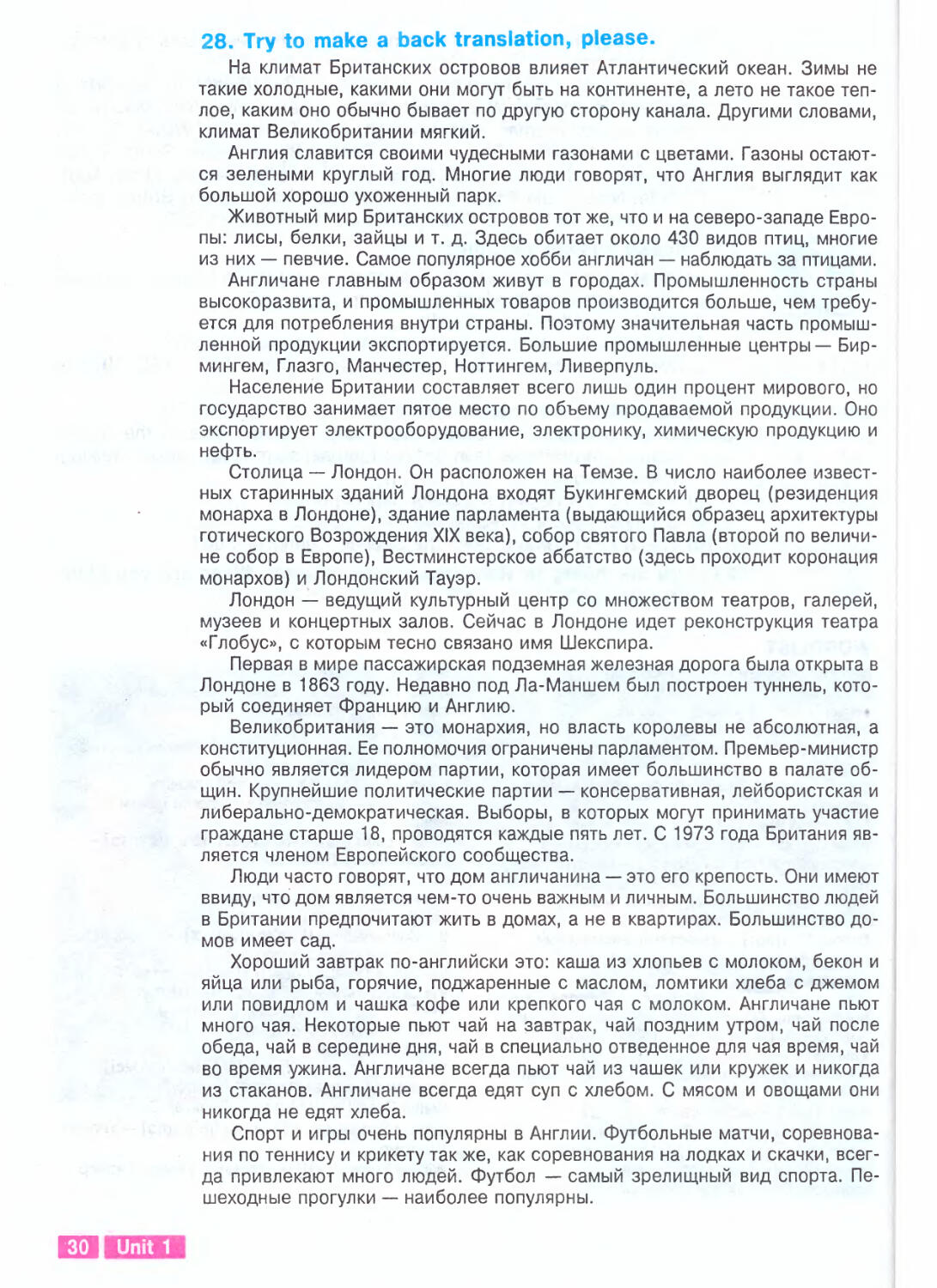
People often say that the Englishman's home is his castle. They mean that
the home is very important and personal. Most people in Britain live in hou-
ses rather than flats. Most houses have a garden.
An Englishman's idea of a good breakfast is the following: cereal
with milk, bacon and eggs or fish, hot buttered toast with jam or mar-
malade and a cup of coffee or strong tea with milk. English people drink
a lot of tea. Some have tea for breakfast, tea in the middle of the mor-
ning, tea after dinner, tea in the middle of the afternoon, tea at tea-
time and tea with supper. The English always drink tea out of cups or
mugs, never out of glasses. Englishmen always eat bread with their
soup. With meat and vegetables they never eat any bread.
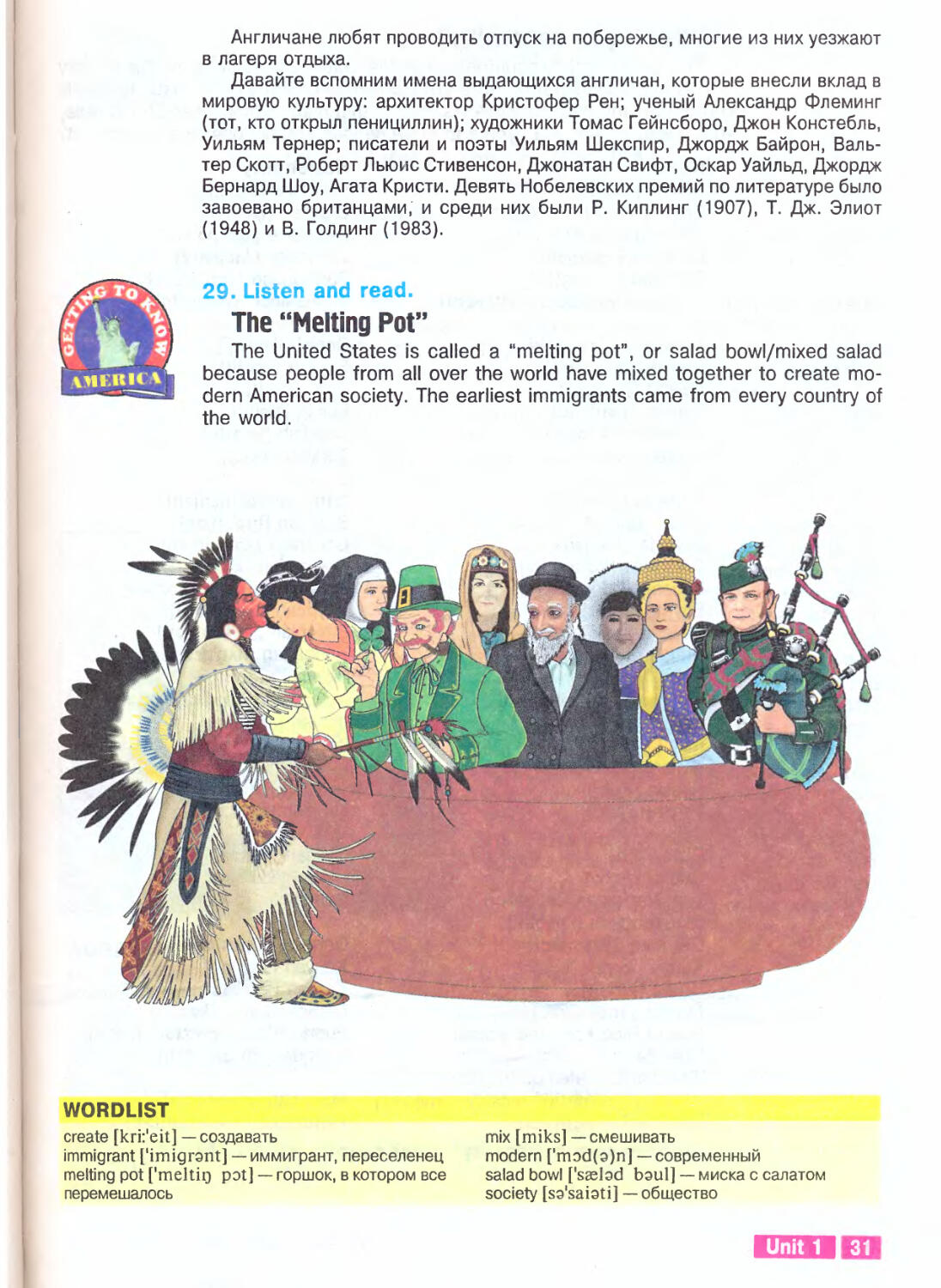
Sports and games are very popular in England. Football, tennis and
cricket matches as well as boat and horse races always attract many pe-
ople. Football is the most spectacular sport. Walking is the most popular
activity.
'"",.....
\.. -..
.. .
. .... \.. . "
..
.
..
"
.--:. . ...
..... ........ .... (.
"". -.: ....
.....
... 'W,"
.
I
I
.
I .-
,
't \
..c ..
Ie .
\
.
-.....
-
-
\ "
,
"
Above: Her Majesty the Queen
Right Top: Most houses have a garden
Right bottom: Football is the most spectacular
sport
.....
..
- .
English people like to spend their holidays on the coast Lots of them go
to holiday camps.
Let us remember the famous Englishmen who contributed to the world of
art: architect Christopher Wren; scientist Alexander Fleming (who discovered
penicillin); artists Thomas Gainsborough, John Constable, William Turner;
writers and poets William Shakespeare, George Byron, Walter Scott, Robert
Louis Stevenson, Jonathan Swift, Oscar Wilde, George Bernard Shaw, Agat-
ha Christie. Nine Noble Prizes for literature have been won by Britons inclu-
ding R. Kipling (1907), T. S. Eliot (1948) and W. Golding (1983).
26. Please answer the questions.
1) What's the official name for the main country of the English language?
2) What parts does the United Kingdom consist of?
3) What is London famous for?
4) What are the most important industrial centres in Britain?
5) When did Britain join the European Community: 1943, 1955, 1973 or
1995?
6) At what age may citizens vote in Britain: 16, 17, 18 or 21?
7) Which one of the following sports and pastimes attracts the largest
number of participants in Britain: football, swimming, cricket, walking,
hockey, rugby?
8) Which is the largest spectator sport in Britain?
9) Do most people in Britain own their homes?
10) Which two countries does the Channel Tunnel link up?
27. You are going to visit England for a week. What are you plan-
ning to see?
WORDLIST
absolute ['rebs lu:t] - a6C0J1IOTHbI
architect ('a:kitekt] - apXVlTeKTOp
attract [ 'trrekt] - npt'lBlleKaTb
bacon ['beik( )n] - 6eKoH
buttered ['bAt d] - HaMa3aHHbli1 MaCJ10M
castle ['ka:sl] - KpenocTb
cereal ['si ri l] - Kawa, 611IOAO 3 KYKYPY3HbiX
xnonbeB
Christopher Wren ['krist f Iren] - Kp cTo<t>ep PeH
coast [k ust] -MopcKot16eper. n06epe>Kbe
constitutional Lk nsti'tju:f nl] - KOHcT TYU. OH-
Hblt1
contribute [k n'tribju:t] - BHOC Tb BKJ1aA
cricket ['krikit] - Kp KeT
famous ['feim s] - 3BecTHbI , 3HaMeH Tbl
George Bernard Shaw [,ct>=>:ct> 'b :n d 'f=>:] -
6epHapA Woy
George Byron [ct> :cB 'bai r n] -A>KoPA>K 6ai1poH
holiday camp ['h=>l di kremp] - J1arepb OTAbixa
John Constable [ct>=>n 'kAnst bl] - A>KOH
KOHCTe6J1
Jonathan Swift [,ct> n e n swift] -A>KoHaTaH
CB <t>T
limit ['limit] - orpaH BaTb
majority [m 'ct> riti] - 60J1bWLt1HCTBO
marmalade ['ma:m leid] - A>KeM, nOB A/lO
match [mretf] - MaT , COCTS13aH e
monarchy ['m n ki] - MOHapxVlS1
mug [mAg] - KPY>KKa
Oscar Wilde [' sk 'waild] - OCKap Yai1J1bA
own [ un] - BllaAeTb .
party ['pa:ti] - napTVlS1
passenger-carrying ['presincB ] - nacca)l( pcKVli1
personal ['p :snl] -l1 Hblt1
powers ['pau z] - BJ1aCTb. nOllHOMO S1
race [reis] - COCTS13aH e B CKOpOCT (roHKVI,
cKa K )
Robert Louis Stevenson ['r=>b t 'lu:i: 'sti:vnsn]-
P06epT llblO c CT BeHcoH
soup [su:p] - cyn
strong-tea [lstr lJ] - KpenK i1 ai1
tea-time ['ti: Itaim] - BpeMS1 A/lfl aS1
the Conservatives [k n's :v( )tivz] - KOHcepBaTO-
pbl (napTVlfI KOHcepBaTopoB)
the Globe Theatre ['gl ub 'ei t ] - TeaTp "rJ106yc"
the Labour Party - J1ei160p cTcKaS1 napT S1
the Prime Minister - npeMbep-M H CTp
Thomas Gainsborough [It m s 'geinsb r ] -
TOMac re Hc6opo
underground railway ['And 'graund 'reilwei]-
nOA3eMHafi >KeJ1e3Hafi Aopora (MeTpo)
Walter Scott ['w lt 'sk t] - BaJ1bTep CKOTT
William Shakespeare ['wilj m 'feik,spi ] - Y l1bS1M
WeKcn p
William Turner ['wilj m It :n ] - Y J1bS1M TepHep
Im!III m
III Unit 1
28. Try to make a back translation, please.
Ha KnVlMaT 6pVlTaHCKVlX OCTpOBOB BnVlS1eT ATnaHTVl4ecKVli1 OKeaH. 3V1Mbl He
TaKVle xonOAHble, KaKVlMVI OHVI MOryT 6blTb Ha KOHTVlHeHTe, a neTO He TaKoe Ten-
noe, KaKVlM OHO 06bl4HO 6blBaeT no APyrytO CTOPOHY KaHana. ApyrVlMVI cnOBaM ,
KnVlMaT BenVlK06pVlTaHVIVI MS1rKVli1.
AHrn S1 cnaBVlTCS1 CBOVlMVI 4YAeCHblMVI ra30HaMVI C lI.BeTaMVI. raaOHbl OCTatOT-
CS1 aeneHblMVI Kpyrnbli1 rOA. MHorVie ntOAVI rOBopS1T, 4TO AHrnVlS1 BblrnS1AVlT KaK
60nbwoi1 xopowo YXO>KeHHbl napK.
)f(VlBOTHbli1 MVip 6pVlTaHcKVlx OCTpOBOB TOT >Ke, 4TO VI Ha ceBepO-3anaAe EBPO-
nbl: nVlCbl, 6enKV1, 3ai1l1.bl VI T. A. 3AeCb 06V1TaeT OKono 430 BViAOB nTVllI., MHorVie
Via HViX - neB4V1e. CaMoe nonynS1pHoe x066V1 aHrnVl4aH - Ha6ntOAaTb 3a nTlt1l1.aMVI.
AHrnVl4aHe rna8HbiM o6paaoM )t(V1BYT B ropOAax. npOMblwneHHocTb CTpaHbl
BblcoKopa3BVlTa, VI npoMblwneHHblx TOBapOB npOVl3BOAVlTCS1 60nbwe, 4eM Tpe6y-
eTCS1 AnS1 nOTpe6neHVlS1 BHYTPVl CTpaHbl. nOSTOMY 3Ha4V1TenbHaS1 4aCTb npOMblW-
neHHoi1 npoAYKlI.VIVI sKcnopTVlpyeTcS1. 60nbwVle npOMblwneHHble lI.eHTpbl- 6V1p-
MVlHreM, rna3ro, MaH4ecTep, HOTTVlHreM, nViBepnynb.
HaceneHVle 6pV1TaHVlVI COCTaBnS1eT 8cero nVlWb OAVlH npOll.eHT MVipOBoro, HO
rocYAapcTBo 3aHVlMaeT nS1Toe MeCTO no 06beMY npoAaBaeMo npoAYKlI.V1V1. OHO
sKcnopTVlPyeT sneKTpoo60PYAoBaHVle, sneKTpoHVlKY, xVlMV14ecKYtO npOAYKlI.VlfO
HecpTb.
CTOnVlll.a - nOHAOH. OH pacnOnO>KeH Ha TeMae. B 4V1cno HaVl60nee t.13BeCT-
HblX CTapVlHHblX aAaHVli1 nOHAoHa BXOAS1T 6YKVlHreMCKit1 ABOpell. (peaVlAeHlI.it1S1
MOHapxa B nOHAoHe), aAaHit1e napnaMeHTa (BbIAatOw.VI cS1 06pa3ell. apxVlTeKTYPbl
rOTVl4eCKoro B03pO>KAeHVlst XIX BeKa), co60p CB Toro naBna (BTOPOi1 no BenVl4V1-
He c060p B EBpone), BecTMVlHcTepcKoe a66aTcTBo (aAecb npOXOAVIT KOpOHall.lt1S1
MOHapxoB) VI nOHAoHcKVlt1 Taysp.
nOHAOH - BeAyw.Vli1 KynbTYPHbli1 lI.eHTp co MHO>KeCTBOM TeaTpOB, ranepe ,
MY3eeB VI KOHlI.epTHblX aanOB. Cei14ac B nOHAoHe VlAeT peKOHCTpYKlI.VlS1 TeaTpa
«rno6yc», C KOTOpblM TeCHO CBst3aHO VlMst WeKcnVlpa.
nepBaS1 B MVipe naCCa>KVlpCKaS1 nOA3eMHaS1 )f(ene3HaS1 Aopora 6blna OTKpblTa B
nOHAoHe B 1863 rOAY. HeAaBHo nOA na-MaHweM 6bln nOCTpoeH TYHHenb, KOTO-
pbl coeAVlHS1eT C3)paHlI.VltO VI AHrnVlIO.
BenVlK06pVlTaHVlS1 - aTO MOHapxVlS1, HO BnaCTb KoponeBbl He a6COntOTHaS1, a
KOHCTVlTyu.VlOHHaS1. Ee nonHOM04V1S1 orpaHVl4eHbi napnaMeHTOM. npeMbep-MVlHVlCTP
06bl4HO S1BnS1eTCS1 nViAepOM napTit1V1, KOTopaS1 VlMeeT 60nbWVlHCTBO B nanaTe 06-
W.VlH. KpynHet1wVle nonVlTVl4eCKVle napTVlVI - KOHcepBaTVlBHaS1, ne 6opVlcTcKaS1 VI
nV16epanbHo-AeMoKpaTVl4ecKaS1. Bb160Pbl, B KOTOpblX MorYT npVlHVlMaTb Y4aCTlt1e
rpa>KAaHe cTapwe 18, npoBoAS1TCS1 Ka)I(Able rlS1Tb neT. C 1973 rOAa 6pVlTaHlt1S1 stB-
nS1eTCst 4neHOM EBpone cKoro coo6w.ecTBa.
ntOAVI 4aCTO rOBopS1T, 4TO AOM aHrnVl4aHVlHa - STO ero KpenOCTb. OHlt1 VlMefOT
BBV1AY, 4TO AOM stBnsteTCst 4eM-TO 04eHb Ba)f(HbIM VI nVl4HbIM. 60nbWVlHCTBO nfOAe
B 6pVlTaHVl1I1 npeAn04V1TatOT >KVlTb B AOMax, a He B KBapTVlpax. 60nbw 1HCTBO AO-
MOB VlMeeT caA.
XopowVli1 3aBTpaK nO-aHrn1l1i1cKVI STO: Kawa Vl3 xnonbeB C MonOKoM, 6eKoH 1-1
S1 u.a VlnVl pbl6a, rOpst4V1e, nOA>KapeHHble C MacnoM, nOMTit1KVI xne6a C A)f(eMOM
VlnVl nOB1I1AJlOM VI 4aWKa Kocpe VlnVl KpenKoro LJaS1 C MonOKOM. AHrnVl4aHe nbfOT
MHoro 4aS1. HeKOTopble nbtOT 4ai1 Ha aa8TpaK, 4a n03AHVlM YTPOM, 4a nocne
06eAa, 4ai1 8 cepeAVlHe AHS1, ljai1 8 cneu.VlanbHO OTBeAeHHoe AJlS1 4aS1 8peMS1, 4aC1
80 BpeMS1 Y>K1I1Ha. AHrnVlljaHe 8cerAa nbtOT 4ai1 Vl3 LJaWeK VlnVl KPY>KeK VI HViKorAa
Vl3 CTaKaHOB. AHrnVl4aHe BcerAa eAstT cyn C xne60M. C MstCOM VI oBow.aMVI OHVI
HlI1KOrAa He eAS1T xJle6a.
CnopT VI 1I1rpbl OljeHb nonynstpHbl B AHrJlVlVl. C3)YT60nbHble MaT4V1, copeBHOBa-
HVlS1 no TeHHVlCY 111 KpVlKeTY TaK >Ke, KaK copeBHOBaHVlS1 Ha nOAKax VI CKa4KVI, Bcer-
Aa npVlBneKatOT MHoro JltOAei1. C3)YT60n - caMbli1 3penVlw.Hbl BViA cnopTa. ne-
weXOAHbie nporynKVI - HaVl60Jlee nonynS1pHbl.
AHfl1L1l1aHe 11K>6 T npOBOAL1Tb OTnYCK Ha n06epe)f(be. MHOfL1e Lt13 HL1X ye3)f(atOT
B llarep OTAbIXa.
)J.aBa Te BCnOMHL1M L1MeHa BbIAaK>w.L1XC aHfl1L14aH. KOTOpble BHeCl1L1 BKl1aA B
ML1pOBYK> KYllbTYPY: apXL1TeKTOp KpL1CTOcpep PeH; Y4eHbl A11eKCaHAP Q)lleML1Hf
(TOT, KTO OTKpbll1 neHL1LJ.L11111L1H); XYAO)l(HL1KL1 TOMaC re Hc6opo, )J.)f(OH KOHCTe61lb.
YL111b M TepHep; nL1CaTellL1 nOSTbl YL111b M WeKCnL1p, OProK 6a pOH, Ballb-
Tep CKOTT, P06epT nbK> 'iC CT BeHCOH, )J.)f(OHaTaH CBL1cpT, OCKap Ya l1bA, A)f(OProK
6epHapA Woy, AfaTa KP CTL1. AeB Tb Ho6el1eBCKL1X npeML1 no Il TepaType 6bl1l0
3aBoeBaHO 6p TaHLJ.aM ; t'1 CpeAL1 H X 6b111 P. Kt'1nl1L1Hf (1907), T. A)f(. 3J1 OT
(1948) t'1 B. rOJ1A Hf (1983).
lIF I I
29. Listen and read.
The "Melting Pot"
The United States is called a "melting pot", or salad bowl/mixed salad
because people from all over the world have mixed together to create mo-
dern American society. The earliest immigrants came from every country of
the world.
"""
I,
-'
('
( - . . .
_ /.! 4\ ?. 1,1
. ,,- I 'f' ,',; I . '
I , '" . i\oO " \ <II<>!j
1,., i ( f « "JF r 'i
"i 1 : -;\ {' t \
t' · "= i,!'--
.:::t - . \) ...
,: i ) . ,. )
,, .:
!, ,
-' ,' -
, ' ,
\- .
;' ,1J. f;
IJU .-...
, "I
0: 1 ". "\..
..
.-.
,
\ £
.--
I -
"
,....
r q ,.
'\
,
, ,...
-,
... .....
, ,..- "
-.
'"
4,
WORDLIST
create [kri:'eit] - C03AaBaTb
immigrant ('imigrgnt] - VlMMVlrpaHT, nepeCelleHeu.
melting pot ['meIth) p t] - ropwoK. B KOTOpOM Bce
nepeMeWaJlOCb
mix [miks] - CMeWVlBaTb
modern ['m::>d( g )n] - cOBpeMeHHbli1
salad bowl ['sreIgd bgul] - MViCKa C CaJlaTOM
society [sg'saigti] - 06L1leCTBO
ImDI 31
m I!ImII
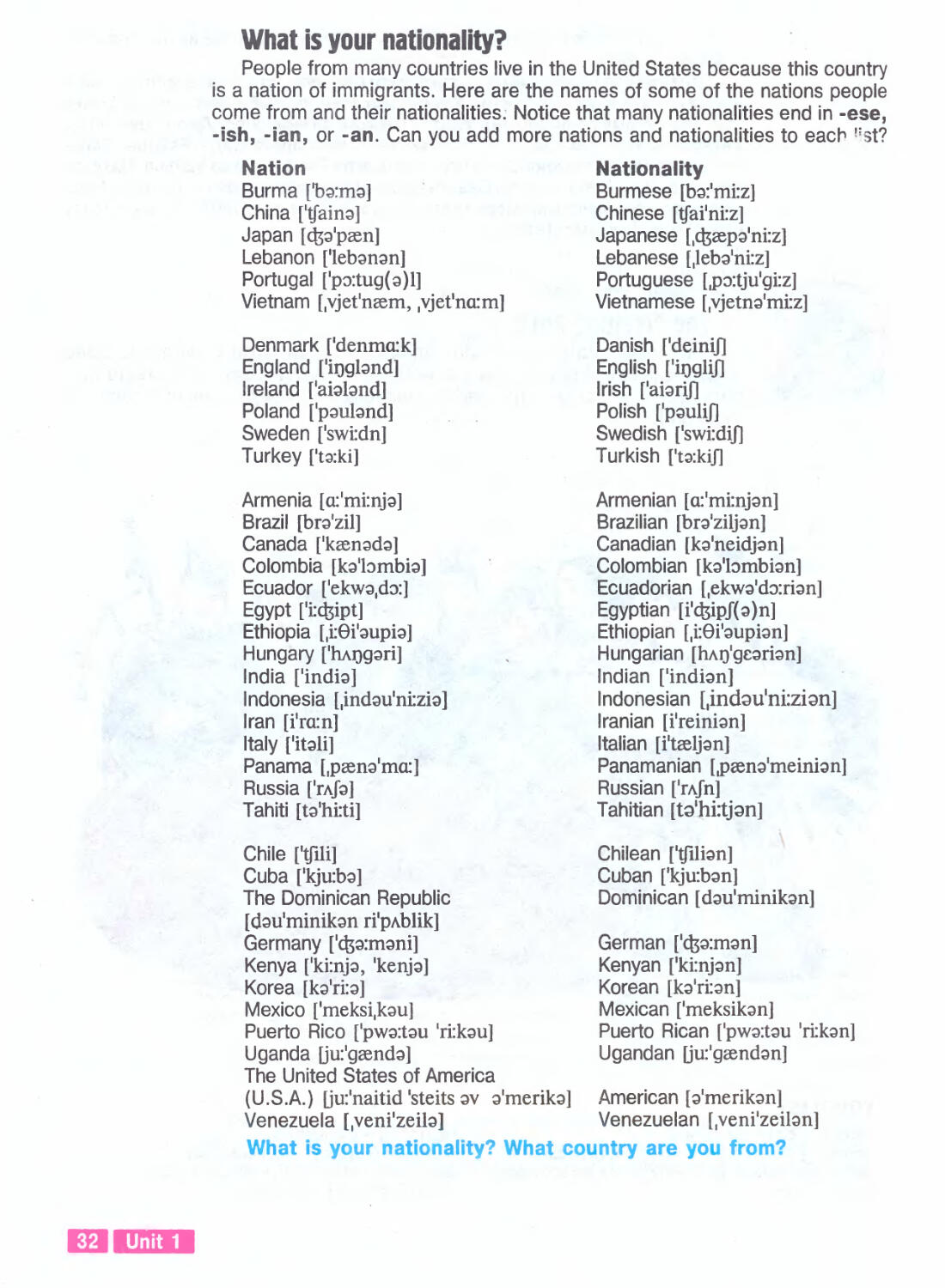
What is your nationality?
People from many countries live in the United States because this country
is a nation of immigrants. Here are the names of some of the nations people
come from and their nationalities Notice that many nationalities end in -ese,
-ish, -ian, or -an. Can you add more nations and nationalities to eacr !:st?
Nation Nationality
Burma ['b :m ] Burmese [b :'mi:z]
China [,tfain ] Chinese [tfai'ni:z]
Japan [cU lpren] Japanese Lctrep 'ni:z]
Lebanon ['leb n n] Lebanese [.leb 'ni:z]
Portugal [Ip :tug( )1] Portuguese [.p :tju'gi:z]
Vietnam Lvjet'nrem"vjet'na:m] Vietnamese Lvjetn 'mi:z]
Denmark ['denma:k]
England ['iogl nd]
Ireland ['ai l nd]
Poland ['p ul nd]
Sweden ['swi:dn]
Turkey ['t :ki]
Danish ['deinif]
English ['iOglif]
Irish ['ai rif]
Polish ['p uliJJ
Swedish ['swi:diJ]
Turkish ['t :kiJ]
Armenia [a:'mi:nj ]
Brazil [br 'zil]
Canada ['kren d ]
Colombia [k 'l mbi ]
Ecuador ['ekw ,d :]
Egypt ['i:cUipt]
Ethiopia Li:ei' upi ]
Hungary ['hAog ri]
India ['indi ]
I ndonesia Lind u'ni:zi ]
Iran [i'ra:n]
Italy ['it li]
Panama [.pren lma:]
Russia ['rAf ]
Tahiti [t 'hi:ti]
Armenian [a:'mi:nj n]
Brazilian [br 'zilj n]
Canadian [k 'neidj n]
Colombian [k 'l mbi n]
Ecuadorian [,ekw 'd :ri n]
Egyptian [i'ctipf( )n]
Ethiopian Li:ei' upi n]
Hungarian [hAo'g£ ri n]
Indian ['indi n]
Indonesian [Iindau'ni:zian]
Iranian [i'reini n]
Italian [rtrelj n]
Panamanian ['pren 'meini n]
Russian ['rAfn]
Tahitian [ta1hi:tjan]
Chilean ['1Jili n]
Cuban ['kju:b n]
Dominican [d ulminik n]
Chile ['1jili]
Cuba ['kju:b ]
The Dominican Republic
[dau'minikan rrpAblik]
Germany ['cUa:m ni]
Kenya ['ki:nj , 'kenj ]
Korea [k 'ri: ]
Mexico ['meksi,k u]
Puerto Rico [lpW :t u 'ri:k u]
Uganda [ju:'grend ]
The United States of America
(U.S.A.) [ju:'naitid 'steits av a'merik ] American [ 'merik n]
Venezuela Lveni'zeila] Venezuelan Lveni'zeilan]
What is your nationality? What country are you from?
German ecB :m n]
Kenyan ['ki:nj n]
Korean [k 'ri: n]
Mexican ['meksik n]
Puerto Rican ['pw :t u 'ri:k n]
Ugandan [ju:'grend n]
II
Turn this paper over. Write down as many nationalities as you can
remember. Exchange papers with a partner. Now look back to the
text to see how much you have remembered.
30. Listen and read.
The United States of America (the USA)
In every life people call this country America. Do we know much of its past?
Part I. America in the past
Many hundred years ago on the territory of the present day America lived
the red-skin Indians. They hunted animals and fished. grew corn and tobac-
co.
In the middle of the 15th century some European countries began to send
their ships to discover new sea routes to far off lands. One of these explorers
was Christopher Columbus from Spain. who sailed with his crew on 33 small
ships for 3 months. When they saw at last an unknown land they thought that
it was India. That is why they called the local people living there red-skin In-
dians. But Columbus was mistaken. It was an island near North America. This
discovery took place on the 12th of October 1492. That is why in 1992 Ame-
rica celebrated its SOOth anniversary. But this new land got its name "Ameri-
ca" a little later when an Italian explorer Amerigo Vespucci described it in his
writings in 1499.
rYJ.
")
<-_t ' -.,
- '-----
v.-
,
{(r,li ',;1
I ,
. ,
\ \ '
'-= ..
.,....... c:..... .
'...
- .!". ( . -.
-z. - --::-.:....., _
.... .............. ...... ,..0& ..
_At
Since that time different European coun-
tries sent their people to North America to
trade with the natives and to look for gold,
silver. fur and ot.her things there. In 1620
more than one hundred Englishmen left their
country forever and went to America on bo-
ard the ship "Mayflower" to live and work the-
re. Their voyage lasted for many weeks and
was very hard. At last they reached the coast
of America and began to build a village cal-
led New Plymouth.
Later on. more and more people from
many countries came to live in America. En-
gland considered these new territories as its
colonies and soon the newcomers began to
fight for their independence. The biggest war
lasted from 1775 up to 1783. Commander-
in-chief of the North American army was
WORDLIST
anniversary Lren i IV :S( )ri] - rOAOBLl.\VlHa European [ju r 'pi: n] - eBponei1cKVli1
board [b :d] - 60pT (cYAHa) explorer [iks'pl :rg] - VlCCJleAOBaTeJlb
celebrate ('selibreit] - npa3AHOBaTb independence Lindi'pend ns] - He3aSVlCVlMOCTb
entury ['sentfuri]- CTOJleTVle, BeK last [la:st] - AJlVlTbC
coast [k ust].- n 6epe)f(,be .. native ['neitiv] - MecTHbli1 )f(VlTellb
Commander- n-chlef [k ma:nd lntfl:f] - rJ1aSHO- newcomer ('nju:,kAm ] - BHOBb npVl6b1BwVli1
KOMa ylOLl.\ ''. . reach [ri:tf] - AOCTVlraTb
consider [k n sld ] - paccMaTp BaTb red-skin [redskin] - KpacHoKo)J( e
corn [k :n] - 3epHo route [ru:t] - Mapwpyr
crew [kru:] - SKLt1na)J( Kopa6J1 territory ['teritri] - Tepp TOpLt1
discover [dis'kA v ] - OTKpblBaTb troop (tru:p] - BOi1cKO, OTP A
discovery (dis'kA v( )ri] - OTKpblTVle voyage ['v iicE] - nyrewecTBVle
2 KHI-1ra A/l 4TeHI-1 "K Y4e6HI-1KY «C4aCT/l. aHr/l.-2»
ImIIII m
George Washington. His troops won this War for Independence and on July
4, 1776 the famous Declaration of Independence was signed by 13 United
States of America. George Washington was elected to be the first American
President.
Yellowstone Park
,1
\
." \
\
..
*'
.".
Skyscrapes in New York
WORDLIST
capital rkrepitl] - cToIl u.a
chamber rtfeimb ] - naIlaTa
custom ['kAst m] - 06bllfati
desert ['dez t] - nYCTblHSI
elect [i1lekt} - Bbl6Lt1paTb
equal [Ii:kw l] - paBH5JTbC5J
Eureka [ju lri:k ] - SBp Ka
federal ['fed r l] - cpeAepaJ1bHbli1
golden poppy ['g uld n 'p pi] - 30J10T0t1 MaK
motto [Im t u] -AeB 3
nature ['neitf ] - np poAa
original [ 'rict5anl] - nepBOHalfaJ1bHblt1
parliament ['pa:lamant] - napJ1aMeHT
m Unit 1
Part II. America today
At present the USA is a highly develo-
ped industrial and agricultural country. It
is rich in coal, oil, iron and natural gas. It
exports a lot of raw materials, industrial
and agricultural products.
People enjoy the wonders of nature
practically in every state. The Appalachi-
ans and the Rocky Mountains, forests, pla-
ins, prairies and even deserts, wonderful
lakes, waterfalls and rivers cover the Ame-
rican territory that equals about 9.4 milli-
on square kilometers. Among the most fa-
mous sites of interest are the Great Lakes.
Niagara falls, the Golden Gate bridge in
San Francisco and others. There are manv
beautiful National parks and protected
areas of wilderness in America.
The population of the USA is about 250
million people of many nationalities. Some
of the biggest cities are New York, Chica-
go, Philadelphia, San Francisco and ot.
hers. There are many very tall buildings ir
them that really scrape the sky, that's wh)
they are called skyscrapers.
The capital of the country is Washingtor
D. C. (the District of Columbia). The USA i
a federal republic. The American parliamen
(called Congress) has two chambers: thE
House of Representatives and the Senate
The flag of the USA has 13 red anc
white stripes representing the original 1
states and 50 stars - for each of the 5(
states of the country. Each state has it
plain [plein] - paBHVlHa
population Lp pjulleif( a)n] - HaCeJ1eHLt1e
prairie ['prcari] - npepVlSl
represent Lrepri1zent] - npeACTaBJ1S1Tb
representative [.repri1zentativ] - npeACTaBVITeIlb
scrape [skreip] - CKpeCT
Senate esenit] - ceHaT
square [skwca] - KBaApaTHblt1
star [sta:] - 3Be3Aa
stri pe [st ra i p ] - nOJ1oca
tradition [tra'd iJan] - TPClAVlU. SI
valley quail rvreli kweil] - nepeneIl
wonder rWAnda] -lfYAO
....
"",
. \
\
-
-
-
.,..
, \ . -
... . .... . '""'
. -
. ,j..... .
.
.....
.
... ......... :
"&.I:
.
., - ..
. , .
-
.... .. 1
. ,
.}.: ..
,.. .... N
"
. .
r-
-.. , .
.
: .
,. .
.... _ ''!' . 1.. .... .".:
- ., . - 1 ..- .
.... ... -..... . .. :.....
":'...
. ;.,
" ..
.... · i'f '
.-. .
--.....
.
Firework on Independance Day
f-c
.: .4-
'. .
....
......,
...
, -
......
.\,.
.
... I -
J
...J_
Independence Day celebration
WORDLIST
amount [ Imaunt] - KOJ1 lfeCTBO
await [d'weit] - O)K AaTb
birth [b :8] - pO)KAeH e
essay [e'sei] - olfepK
go on [g u :)n] - npOAOJ1)KaTb
harvest ['ha:vist] - YPo)Ka
line [lain] - crpolfKa
.
.'
'.
.
national motto, bird and flower as its sym-
bol. For instance, California's motto is
II I've found it! (Eureka):' Its state bird is
Valley Quail and flower - Golden Poppy.
America as any other country has its own
customs. traditions, and holidays. For instan-
ce. on the 4th of July they celebrate Indepen-
dence Day that gave birth to the American
nation. At the end of November America has
Thanksgiving Day which was celebrated for
the first time in 1621 when the first colonists
from England got their first good harvest.
Young people enjoy two other holidays -
Halloween (on October 31) and St. Valenti-
ne's Day (on February 14). No doubt, a gre-
at amount of information about the USA is
awaiting the future learners of this country.
They will learn of the activity and life of Ame-
rican Presidents. the USA's great writers,
poets, artists, scientists, musicians. film stars
and other outstanding people.
Let it be only the first line of a long essay
on the USA. But as an English proverb says
"A good beginning is half the battle. II
Go on studying America!
Goodbye. for the present.
31 . Please write down and then say
what historical events are associ-
ated with the following dates:
12 October 1492 1861
1499 1865
1620 1863
1775-1783 1992
4th of July 1776
32. On the inside back cover of the
"Happy English-2" textbook there
is a map of the American states
with their mottos. Choose three
which you like.
33. Create a motto for the place whe-
- re you live.
nation ('neif( )n] - Hau. st
no doubt ['daut] - HeCOMHeHHO
outstanding (.aut'strendiJ)] - BblAaIOLll i1Cst
proverb ['pr v b] - nOCJ10BVI a
scientist ['sai ntist] - YlfeHbl
ThanksgMng Day ['8reJ)ks,9ivil)] -.QeHb 6JJafQD.apeHVISI
I!lmII III
Ii\,",
.."" ... .
' t .
.. '
. .
)(
," .----.
-::-,! ;;. t .
< "'i'. -. _
.... .
\
,..,......
-.'
-
\.1:a. t...: \.,
. f..r
:t '\
. " ", -r . u
---. t ..... 1-
......... - -
":..f . . _!" :.-.....
- .... ..- ......-
..........- ....
......".... .
....
:"4..:...
)...
't
, '
)
r r:; ...--:::.:--.
. : I j;?
..... ...-
3 . Listen and read more about the USA.
If you want to go from San Francisco to New York in a car.
you must ride more than three thousand miles. It takes over
three days and nights.
In California, where you begin your trip, the climate is usu-
ally mild all year. "California" is a Spanish word meaning "heat
of the ovens". Slightly south of the route that your car follows
is the famous fruitful area. Californian oranges, grapefruit and
lemons, as well as many other fruits and vegetables are ship-
ped all over the United States and to other parts of the world.
Soon, however, you leave these fertile plains and go up
into the Sierra Nevada mountains, with their snow-capped
peaks and clear mountain lakes.
As your car goes further east, you cross the Salt Lake
desert. For miles and miles you will see nothing but salt and
salt. Your car crosses the flat plains of Wyoming, which
stretch out for miles and miles, covered with short grass and
sagebrush. This is mainly sheep and cattle country, the land
of the cowboys. As you cross it, you may wonder where the
people of America are. From time to time you may see a few
cattle scattered over the plain, or the wagon of a sheep her-
der, but most of the country is empty.
As your car crosses Nebraska, you gradually leave this
empty country and enter the rich farming region of Ameri-
ca. The land becomes fertile and well watered, and more
trees appear. Nebraska has many golden wheat fields. In
Iowa and Illinois, wheat and corn are important products,
and much livestock is raised.
After two days, your streamlined, air-conditioned car arri-
ves in Chicago. Chicago, with a population of more than three
and a half million, is the second largest city in the United Sta-
tes. It is a centre of industry for the middle part of the coun-
try.
In Pennsylvania and New Jersey you can find factories of
nearly every type - textile and pottery. steel and chemical.
WORDLIST
air-conditioned ['e k n,dif nd] - C KOHAVlLJ.VlOHe-
pOM
appear [ 'pi ] - n051BnS1TbC51
arrive [ 'raiv] - npil16blBaTb, npVle3>KaTb
California Lkreli'f :nj ] - KaJ1 1cpopHIt151
cattle [kretl] - KpynHbli1 poraTbl CKOT
corn [k :n] - KYKYPY3a
empty ('empti] - nycToi1
famous [feim s] -1t13BeCTHbl , 3HaMeHIt1Tbli1
fertile ['f :tail] - nJ10AOpoAHbli1
gradually ['grre<t3u li] - nOCTeneHHO
herder ['h :d ] - nacTYX
important [im'p :tnt] - Ba>KHbli1, 3HaYVlTellbHbl
industry ['ind stri] - npoMblwneHHocTb
1 kilometre = 0.62 miles
mild [maild] - M51rKIt1i1
mile [mail] - MIt1J151
III I!JmII
oven ['Avn] -AYXOBO wKacp, AyxoBKa
peak [pi:k] - BepWIt1Ha (OCTpOKOHeYHa51)
ride [raid] (rode, ridden) - exaTb
sagebrush ['seictbrAn - nonblHb
Salt Lake ['s :lt leik] - COJ1T-Jlei1K
San Francisco [.sren fr n'sisk u}- CaH-<bpaHLJ.VlCKO
scatter ('skret ] - pa36pacblBaTb
Sierra Nevada [si'er ni'vred ] - Cbeppa-HeBaAa
streamlined car ['stri:mlaind ka:] - MaWIt1Ha 06Te-
KaeMoi1 cpOpMbl
stretch out ('stretf aut] - npOCTlt1paTbC51
wagon ['wreg n] - cpyproH
water ['w :t ] - nOJ1i11BaTb
wheat [wi:t] - nweHVlu.a
wonder ['wAnd ] - nOIt1HTepeCOBaTbC5I
Wyoming [wai' umil)] - Ba oMIt1Hr
This is the richest industrial region of the country, with more city dwellers and
a larger foreign-born population than anywhere else in the United States. Fi-
nally you arrive in the city of New York, which is one of the largest in the world.
35. Please trace on the map the route from San Francisco to New
York in a car.
Seattle
/ .
/ .
("-.. ..' /'-;''It:' ,
.--. ....:'.
_r"l
rt',
it1" ,
t .,,'" f' ,,.
\f'
t .
-
..\IRCRAFT I:;\jDtSTRY
. I
'"
./
C't.R l Ol"SrR\'
. J -........
,\ \
;,A..
San Lake City
LU
" Ii V WI:':S"
---
Minneapolis
. 1fI?7"i",. t
. ....
i\\ \tAi ;
In
San Francisco 1 .
,'. o: {) S Denver :.t.. " l ,:,\
BOLl ,'WOOD · )"'" ;l. · .. \' ,
Los Angeles G:' 1 \ . . \
'-- ,..s2\\ BO 1-:').
\-= >\.R'\,\\"RS
&. \ "\HI-\ '\8
,fJ
\'"
!;( - .
, ' New York
Chlca Detroit -
1--' STATLEOf IIBERf\
HII.-rl]" . ---
..._. , '" : 'i
..,'I'''.l' -t .. """+1 t l-'r "":a _
. . c "':.;_:A. ..",,:,, Washington
C:\p\TOI 1
----
8R/\II.\ '.1 L,'COL\
..
.
L
&
.. ;? f t\ \:
. : P
J
Springfield
Nashville
CI\'II. W/'\R
..........
BE(,.\ IIERE
---
Las Vegas
.
AUanta .t
Charlston f
-=. ,
.. i
\.A''''EO I f
....-- - "-'
SPACECR..\FT CE:'\TER
--......
New Urlean
'ill
--
Houston
f:"\'\f':l)y Cape Canaveral
SP.\CEC'E '1
Miami
. .
36. Take a journey from New York to San Francisco.
Choose a kind of transport, a route. Tell about
your impressions from the journey.
""'
37. Imagine you are the owner of a travel agency.
What route could you suggest for travelers who
visit your region? Make a route from your city to
Vladivostok.
38. What would you say about your agency if you had
an opportunity to speak about it on T.V. or over
the radio? Advertize your agency in a newspaper.
I!DI m
Our country is very large in size.
Imagine yourself in a plane flying over its territory. You will see wonderful
sights: blue lines of the rivers, blue mirrors of the lakes and seas, green pat-
ches of the meadows, plains and forests and mountains. You will enjoy every
minute of your flight.
What kind of scenery is typical for the place where you live? Which of the-
se words might be used to describe the pla-
ce where you live?
beautiful forests or woodland
peaceful ancient buildings
quiet large port
crowded small harbour
noisy seaside/ lakes
busy green valley
ancient grassy hills
historical mountain region
wild
Our land is remarkable for its wealth. The-
re is gold, platinum, diamonds, coal, nonfer-
rous metals, peat, oil, gas and wood.
Four beautiful seasons: winter, spring,
summer and autumn are distinctly expressed
in our country.
The nature and peoples inhabiting our
country are given the most important thing -
faith. It is great faith that brings us together.
It's faith that creates a harmony with the
"world of the spirit". It's faith that makes us
patient and understanding, the qualities
which help us live and survive in the most
hard times.
The national property which makes us pro-
ud is its greatness: talented scientists, experts,
famous philosophers, outstanding inventors,
musicians, writers, artists.
RE T ·
-
I" HI .
Itl'S J
-
I:
'-
"
..
.-
-
...: "
-
- .":--.
.n&..
. . 1""
, t. .
. ..I' . I
.. ..-.----......-..---
,...,--.
.....
. '.
.a
,
....
.. . " ..
,1'
It
-
,
... .,
4! I
... I
--
WORDLIST
bring together [brilJ t lgeo ] - 3A. 06beA H Tb
distinctly [dis'tilJktli] - OT eTJ1V1BO
expert ['eksp :t] - cneu.VlaJlVlCT
express [ik'spres] - BblpIDKaTb
faith f'fei8] - Bepa
flight [flait] - nOJleT
greatness ['greitnis] - BeJlll1 lI1e
imagine [i'mrecBin] - npeACTaBL"Tb
inhabit [in'hrebit] - HaCeJ1 Tb
mirror ['mir ] - 3epKaJlO
mountain ('mauntin] - ropa
national property ['nreJ nl 'prJp ti] - Hau.Lt10HaJ1b-
Hoe AOCTo HlI1e
38 'Unit 1
551
Glory to all of them dead or living!
nonferrous ['nJn'fer s] - u.BeTHble MeTaJ1J1bl
oil ['Jil] - HeQ>Tb
patient ['peif{ )nt] - TepneJ1V1Bbl
peat [pi:t] - TOpQ>
peoples ['pi:plz] - HapOAbl
plain [plein] - paBHVlHa
proud [praud] - rOPAbli1
quality ['kw3liti] - Ka eCTBO
sights [saits] - BVlAbl
spirit ('spirit] - AYX
survive [s 'vaiv] - Bbl)f(lI1BaTb
wealth [lwetS] - 60raTcTBo
A thing of beauty is a joy forever.
Part I. Nature in Russia
Listen and enjoy yourself. It is dawn.
"The first appearance of daylight in the
morning." Everything is coming out to meet
the Sun's light. The meadows, forests, ri-
vers, and lakes are feeling happy at this
moment showing their fresh and vital bea-
uty.
Flowers, birds, animals and people - all of
them are filling themselves with the great po-
wer of the sun expressing it in their own langu-
age. The flowers are showing their colours:
yellow. red. orange, violet. rose, white, pink.
The birds are singing their wonderful
songs; the animals are silently observing the surroundings. The butterflies
and bees are dancing in the air.
Every creature on earth is thankful to the Sun. Indeed, there is a lot to
be thankful for.
This is beauty. This is joy forever!
39. HanMwMTe CO MHeHMe: "PaccseT". 8aM nOMO)l(eT 3TO CAe-
naTb 3aMe aTenbHaSi MY3blKa M. MycoprcKoro - BCTYnneHMe
K onepe "XOBaHI1\MHa" "PaccseT Ha MocKBe-peKe".
,
40. He XOTMTe nM nepeaeCTM 3TM CTMxoTBopeHMSI?
BMAeHMe Ha xonMe
836ery Ha XOllM
1I1 ynaAY
B Tpasy.
***
***
Bce xo eT neTb VI CllaB Tb 6ora:
3ap51. VI llaHAblW, VI KOBblllb,
lt1 llec, nOlle, VI Aopora,
V1 BeTpOM 3bI611eMa51 nbillb.
ctJeJ1.op Conory6
...nI0611tO TBOIO, POCCVl51. CTapVlHY...
***
...nI06nlO TBOVI Vl36YWKVI VI BeTbl,
V1 He6eca, rop w.Vle OT 3H051,
lt1 wenOT VlB Y OMYTHO SOAbl.
n1061110 HaseK, AO Be Horo nOKo51...
POCCVl51, PYCb! XpaHVI ce651, xpaHVI!..
HUKonau Py6 OB
WORDLIST
a joy for ever - BeYHa paAOCTb
be thankful ['8rel)kful] - 6blTb 61larOAapHbiM
beauty ['bju:ti] - KpaCOTa
bee [bi:] - nyeJ1a
butterfly ['bAt flai] - 6a60YKa
creature ['kri:tf ] - cy ecTBo
enjoy oneself [in'ct i wAn'self] - HaCJ1a)f(AaTbC5I
fresh [fref] - CBe)f(l1
I light [lait] - CBeT
observe [ b'Z :V] - Ha6J1IO.QaTb
power [Ipau ] - CVlJ1a, SHeprVl51
silently ['sail ntli] - MOnyanlt1BO
surroundings [s 'raundiI)z] - oKp}')KalO a Aei1-
CTBL.1TenbHOCTb
vital ['vaitl] - >K 3HeHHbli1
wonderful [IW And ful] - YYAecHbli1
Unit 1 39
, , '
I
,,"\. f;.
; .
...-\0;
"
.
. f
f '
. .,.. I,
.." ' "}.. \
. j , . ,
c "" t .'
;: f" 101 ''if! Ie",
, 1 . ...to. ", r ,Y .' i "
',: " ., J .1... -: ., t,
. '... t, "' 'lL. .: t" ,.\; J If ,
" -, ...:... I'.. ,''..
· ., l t r It' J rr
'.''' t . ., , . " " . ,'"
,. 1'. ,- . I, ( .
." I
,. ,T . ,
It ," I r :'"")'...,' '-4 1t.,
. \,: 4' ,4'. A . .:.'
', " . ., I J JI · i
" \ I . -.. ,. . ;'.
". ). . t I.. .... '" ..: ...
1 " "t' . . -
. ,.,.. t., ',' .. .?- -
. .. 'I " , If.
.. "('I ',' ,,' .,', ,
. \ ' , ,
. 'I, \', "j:_
11 ,
I
,j
\-
.'1'
. 'f,
,Y
Grabar. February Azure
"r
-
.. 'I
-- ....
J
., 'V'
- \
t , t
.
" '\ b
, .
.. , -
'\
.
\
i.
Sa vrasov. Rooks have -flown
Part II. Seasons in Russia
Winter
Look through the window, It is snowing. It always snows in
winter. Winds are blowing. They blow every winter. The sun is
not shining, Sometimes it shines all day long.
Leafless trees and ever-green pines and fir-trees with
heavy ucaps" of snow decorate the landscape.
And you? Do you like skating, skiing, making Snowmen, or
some other winter sports after a difficult school day?
Imagine yourself warmly clothed sitting in a sledge and a
fast horse is carrying you along a forest road. The gold sun is
shining brightly. You are looking at the sky, at white and silver
trees. Are you not very happy?
Think of those who composed the music, who painted lan-
dscapes, Dream about yourself, your place in the life of our
country, She needs each of you, your talent, your knowledge
and your help.
41. HanMwMTe CO'fMHeHMe "3MMa". 8aM nOMO)t(eT 3TO
CAenaTb LlapYIOl1.\aR MY3blKa r. CBMpMAoBa "Me-
Tenb" .
Spring
It is one of the beloved seasons for many people. The air
is fresh, the trees are light green, the days are long. Every-
body likes to leave the house and breathe different smells of
the first flowers, trees and the ground. The snow is melting.
Its white colour is losing its brightness and we enjoy_ oursel-
ves with quickly running streams around us.
Birds are making their nests; animals are clearing and
building their shelte s; insects are waking up and looking for
food in the green gardens.
It is time for the fruit trees to show themselves in their blos-
soming beauty.
The loather is fine. It may rain and even sno v.
People work in their gardens. Planting and sowing keep
them long in the gardens. \
Spring is a promising time for the old and the young.
WORDLIST
blossoming ['bl sgmilJ] - u.BeTY VI
blow [blgu] (blew, blown) -AYTb
boundless ['baundlis] - 6e3rpaHVll.IHbl
breathe [bri:o] - BAOXHYTb
brightness ['braitnis] - pKOCTb
carry ['kreri] - HeCTIt1
decorate ['dekgreit] -YKpawaTb
fast (fa:st] - 6blCTpbl
fir-tree [fg:tri:] - enb
ground ['graund] - 3eMn
knowledge ['n licts] - 3HaHVI , 3HaHVle
landscape ['lrenskeip] - nei13a>K
leafless ['li:flis] - 6ea /l}'1cTbeB
40 Unit 1
lose [lu:z] (lost, lost) -Tep Tb
melt [melt] - Ta Tb
nest [nest] - rHe3AO
pine ['pain] - COCHa
plant [pIa: nt] - Ca>KaTb
promising ['pr misiI)] - MHoro06ew.alO VI
shelter [,feltg] - YKpblT e
sledge [sle<t] - caHVI
smell [smel] - 3anax
sow [Sgu] - ce Tb
stream [stri:m] - PYl.Ie , nOTOK
wake ['weik] - npocblnaTbc
warmly clothed ['wJ:mli klguod] -Tenno oAeTbl
42. Read Russian poetry and enjoy it.
***
1
a nepBbl£1 naHAblW! lt13-noA CHera
Tbl npOClI1Wb conHe4HbiX 11y e£1;
KaKaSl AeBCTBeHHafi Hera
B AYWLt1CTO 4111CTOTe TBoe£1!
A. C/JeT
43. Write an essay about spring and if you want, paint a picture.
Summer
It's great fun. We enjoy every minute of
the weather. We swim and get sunburnt, go
to the forest and pick berries. We play sports,
go hiking. _
Imagin , it is a rainy day and you are in a
forest. You can find yourself under a branchy
tree in the company of .your dog and the in-
sects. All are saving you from the water. We
are all together, we feel the rain whispering
to each of us something wonderful and com-
forting. We must be together. It's God's will.
.'
..
I
.\
I
Shishkin. Rye
I
44. Read Russian poetry and enjoy it.
***
I / f
KonOKOnb4111KlI1 MOll1,
UBeTlI1KlI1 CTenHble,
LITO rnSlAlI1Te Ha MeHSl,
TeMHo-rony6ble?
V1 0 4eM 3BeHlI1Te Bbl,
B AeHb Becenbl£1 MaSl,
CpeAb HeKOweHO TpaBbl,
r 0110B0£1 Ka4aSl?
A. TonCTOM
45. CnywaSi MY3blKY n. . 'iaMKoBcKoro "BpeMeHa rOAa", HanM-
WMTe He60nbwoe CO'lMHeHMe "neTO" Ha aHrnMMCKoM Sl3b1Ke. t
46. Try to translate into English these lines from N. Rubtsov's poetry:
npHBeT, POCCHSI...
***
...3a Bce XOpOMbl Sl He oTAalO
CBo£1 H1I13KlI1£1 AOM C Kpanll1BO£1 nOA oKoHu.eM...
KaK MlI1pOTBOpHO 8 ropHlI1u,y MOIO
no Be4epaM 3aKaTbisanoCb COJ1Hu.e!..
H.Py6UOB
WORDLIST
branchy ['bra:niji] - pa3BeCLt1CTbli1
comfort ['kAmfgt] -ycnoKaViBaTb
get sunburnt [get 'sAnbg:nt] - .3aropeTb
pick up [pik Ap] - c06V1paTb (51roAbl)
play sports - 3aHit1MaTbC51 cnopTOM
whisper ['wispg] - wenTaTb
will [wil] - B0J151
Unit 1
,.
I.. _____-
Autumn
It is the time for joy and quitness. We can
still admire colourful trees: green, yellow,
red. In September it is still warm, the sun
shines, it doesn't often rain and people don't
want to think of the coming winter. Autumn is
the time to harvest a rich crop of fruit, vege-
tables and berries. We see birds flying away.
They are no longer singing. They are "pac-
king" .
September, 1 is called the Day of Know-
ledge in Russia. It is a great holiday for teac-
hers, schoolchildren and their parents. Pupils
come back to school full of new impressions about their summer holidays.
How wonderful that we have all these seasons.
..
.
V'
......
.-
,
. . .
......t.
..
..;-.
t.
I
,
.
....
...
"
...
I
.. ..
Levitan. Golden Autumn
47. Listen and read.
Part III. Our greats
Russian nature, spirit and genius come together in the greatest people of
our land. Let's pay tribute to a few of them. -M. Lomonosov was one of them.
He was a great thinker, leader of Russian science, a well-known enlighte-
ner; an inventor of many technologies, a poet, a translator, a historian.
The first Russian University in Moscow was founded according to the pro-
ject of M. Lomonosov. In 1940 the University was named in honour of him.
"Lomonosov was the first university for us." (A. Pushkin)
V. Vernadsky developed the greatest theory of the XX century - biosphe-
re, the environment which created us and which we represent.
K. Timiryazev was an outstanding botanist. He wrote about evolution in
nature. He devoted all his life to photosynthesis of plants.
D. Mendeleev was the creator of his famous "Table of chemical elements".
A. Popov was the creator of radio. In 1895 he gave a working demonstra-
tion of the first radio receiver in the world and several months later he tran-
smitted the radio message over a distance of 250 metres.
They all founded their inventions on the great ideas of M. Lomonosov.
The Cosmos has become a sphere for experiments of the XX century: bi-
ological, ecolog ical, ag ricultural, industrial and others.
Everybody remembers outstanding scientists of our country: K. Tsialkov-
sky, S. Korolev and other cosmos scientists who studied the Cosmos and gave
the world the first flight round our dear and beautiful earth. We all know the
courageous hero - Yury Gagarin.
Glory to all of them dead and living!
WORDLIST
biosphere ['bai sfi ] - 6lt1occpepa
courageous [k 'reict5 s] - cMeIlbli1
creator [kri:'eit ] - C03AaTeIlb
develop [di'vel p] -C03AaTb
devote [di 'v ut] - nOCBstTlt1Tb
enlightener [in'laitn ] - npocBeTVlTeIlb
few [fju:] - HeKOTopble
found ['faund] - OCHOBblBaTb
glorious ['gl :rids] - 3HaMeHVlTbli1
in his honour [' n ] - B ero eCTb
message ['mesict5] - nOCIlaHVle
metrology [me'tr ldct3i] - MeTpOIlOrVist
pay a tribute of respect ['tribju:t] - OTAaTb AaHb YBIDKe-
HViSI
photosynthesis [.f utdu'sinedSis] - OTOClt1HTe3
radio receiver ['reidi u ri'si:vd] - paAlt10nplt1eMH 1K
represent [.repri'zent] - npeACTaBJ1stTb
spirit ['spirit] - AYX
transmit [trrenz'mit] - nepeAaBaTb
42 Unit 1
, ' ..
..!...
--- . -':':'.. .
..... "
-
J
,"'j
St. Basil's Cathed ral
48. By whom and when were they built? Match the figures and the
letters.
When
1555-1562
1927-1929
Builder /architect
Konstantin Melnikov
Barma and Postnik
The building
1) St. Basil's Cathedral
2} The house at 15
Krivoarbatsky pereulok
3) Radio Mast 1922 Vladimir Shukhov
49. Read and find out. Give a back translation, please.
1) St. Basil's Cathedral is the pride of the Russian people; it has graced
Red Square for more than four centuries. It was designed by the great archi-
tects Barma and Postnik.
2) Vladimir Shukhov was born on the 16th of August, 1863, not far from
Kursk. In 1876 he graduated from one of the most outstanding technical scho-
ols in Russia. He was sent on business to the World's fair celebrating the 100th
anniversary of the United States of America. There he became acquainted with
the engineer Bari.
In 1878 Bari organised in Russia an engineering firm. Since 1880 Shukhov
was the main engineer of the firm. .. ,
In November of 1989 at John Hopkins University in Washington D.C. at
the conference "Reconstruction of Russia" (1880-1940) Shukhov was called
"the Edison of Russia: a great engineer."
3) Konstantin Stepanovich Melnikov. an outstanding Russian architect.
was born in Moscow in 1890.
He was one of the authors of the project of Moscow reconstruction. In
1920-1930 he designed new types of public building: clubs, palaces. He
designed the monument to Christopher Columbus in Santo-Domingo. Melni-
kov's house, the house he owned, can still be seen in Krivoarbatsky pereulok
in Moscow. All his buildings are famous for unusual architectural decisions.
It was a great and gifted master.
i.. · J.
" ..
t
tV' ,
..,....-
. ,
..
,
i' .
1
I
"
,
..
" .. -
.,.
--
-
I
..
....
......
#
....:;:a ,- 'I
- I
i' I
t t.
I
:d
.." '1
.
.:.:----
, 1\'...'
t
t,
6__
...,
, - "\I
C !'.' ., '1
. "",,' I ' :f
.,"' i'l. :
.1 , . \\ _ \' )
.,
" -
J-
'r.1: .
: : .11 .
.. ..
". .. I
I I I, .'
, I'
.
. I
. \... . J. .H
,- . ".' . -.'- .. ... -" "'"':.. . '-
,- .' II -fit \ -' . r' ;f ';' .. '_ _
.",.-
,.; -".
Melnikov's house in Krivoarbatsky pereulok
Unit 1 43
Part IV. What kind of person are you?
50. Fill in the blanks:
My name is
My birthday is
My wish
My favourite book is
What I do well
..... I.... .. I...................................... I.........
A pe rso n I ad mire . . . . . . . . . . . . . . . . . . . . . . . . . . . . . . . . . . . . . . . . . . . . . . . . . . . . . . . . . . . . . .
My favourite animal is ..............................................................
My favo u rite food is..............................................................
We hope that you are kind, helpful, generous to your family and friends,
hard-working, honest, reliable and always keep your word.
USTF
.
N
51 . Read and act out.
Representatives of the United Kingdom
"Our household represents the United Kingdom of Great Britain and Nor-
thern Ireland."
"How is that?"
"I'm English, my wife's Scottish, the nurse is Irish; so I represent England,
my wife Scotland, the nurse Northern Ireland, and the baby wails."
WORDLIST
representative Lrepri'zentgtiv] - npeACTaBtltTeJ1b Wales [weilz] - yaCTb BeJlLt1K06ptltTaHLt1V1
wail [weil] - BOnLt1Tb, KpVlyaTb
44 Unit 1
Aesop
Aesop was a Greek folk hero. He lived in the 6th century B.C. He was a
teller of animal fables and stories in which animals behaved like human
beings. Although Aesop himself probably did not write down his fables him-
self, other people recorded collections of his stories as early as the 4th
century B.C. Short, easy to understand, and entertaining, teachers have
been using Aesop's fables since ancient times as texts in schools.
The Ants and the Grasshopper
All summer long, the ants were busy. They were working and plan-
ning for the snowy months. They raced back and forth. They were gat-
hering food for the long, cold winter days. The large ants carried sticks.
They gathered grass and grain and stored it in their caves.
One sunny day a grasshopper was watching the busy little ants. They
were racing back and forth. "Why not come and chat with me," said the
Grasshopper, "instead of working in that way?" "Why are they so indus-
trious on such a beautiful, warm, and sunny day? I guess they just don't
know how to have a good time."
The industrious little ants continued to work. They didn't stop a mo-
ment to talk to the grasshopper. One of the ants looked up at the gras-
shopper and said to himself, "Why is he staring and laughing at us? I bet
he'll pay the price of hunger when winter
comes. "
Wintertime came. Snow covered the
green fields, and the grain disappeared.
One winter day some of the ants .crawled
out of their ant-hills onto the snow to look
around. There was the long-legged gras-
shopper, who looked very pale and thin.
He told the ants that he was dying of hun-
ger and that he needed something to eat.
He said that he had no food and that he
could not find any food in the ice and
snow.
--
J\ ---.y
.Q. ,.
\\ L r : _- 'I- (
( t -! -..ii.' ./. R 1:.._-= --> £- ...
. .,. I I I... t r ;'" --:--..
:, t.;;}> - \\
,: .
.:-:..... ;, .. -4' //j.. : :\\ '.;.::a
//.. ," ......... - : ,.' ,;,.e:' .
..... ..' .' :1/1:: ·
'U> -.+ ,',.
;. : :' .,: ,;;. . r.tr'.. t) .) · .. ,;-;,'" Ii.
: P' O' ii' ...;!' ::.. : _'_ " ,
WORDLIST
Aesop ['i:sop] - 330n
although [ :l'o u] - XOTS1
ancient ['einJ nt] - ApeBHLt1t1
ant [rent] - MypaBei1
ant-hill ['renthil] - MypaBe H K
B.C. = Before Christ [bi'f : kraist] - AO Hawei1 apbl
behaved like human beings [bi'heiv laik 'hju:m n]
- BeJ1 ce6S1, KaK J1IOAVI
cave [keiv] - HopKa
century ['sentfuri] - BeK
chat [tfret] - 60J1TaTb
crawl out [kr :l aut] - BbIn0/13TVI
entertaining Lent 'teinilJ] - 3aHMMaTeJ1bHbli1
fable [feibl] - 6acHS1
folk ['f uk] - HapoAHbl
forth [f3:8] - BnepeA
gather [Igreo ] - c06 paTb
grain [grein] -aepHo
grasshopper ['grQ:s,h p ] - KY3He VlK
Greek [gri:k] - rpe ecK i1
industrious [in'dAstri s] -TPYA0J1106V1Bbli1
instead of working in that way [in'sted 'w :kilJ oret
lwei] - BMeCTO Toro. T06bl raK pa60TaTb
long-legged [ll lJlegd] - AJlVlHHOHOrVl
race [reis] - MyaTbCS1
raced back and forth [Ireisid brek rend f :e] -
CHOBaJlVl T'fAa 06paTHo
record [ri'k :d] - 3anLt1CblBaTb
stare [st£ ] - CMOTpeTb npVlCTaJ1bHO
stick [stik] - na/1Ka
store [st3:] - 3anacaTb. OTKJl(lAbIBaTb
Unit l' 45
a
"You acted so smart in the summertime, Mr. Grasshopper. You told
us that we were crazy working so hard. Now you are the one who is
hungry, and we are the ones who are laughing. Who is crazy now?" one
of the ants asked with a grin on his face.
The little ants looked up at the big, starving grasshopper and waited
for a reply.
Then the long-legged grasshopper said, "I was too busy. I was ma-
king music and enjoying the summertime sun."
All of the ants looked at the grasshopper and laughed at him.
The smallest ant moved forward and said, "Just a moment, Mr. Gras-
shopper. Even though we don't feel sorry for you, we don't want you to
go hungry. You may have some of our grass and grain this time. But we
hope that you have learned that hunger is the price you pay for not plan-
ning ahead. There's a time for work and a time for play."
Moral: It is best to prepare for the days of necessity.
52. Answer the questions.
1) What was the Grasshopper doing on a hot summer day?
2) What were the ants doing on a hot summer day?
3) What happened to the ants when winter came?
4) What happened in winter to the Grasshopper?
5) Which character would you like to be and why?
6) Did you like this fable? Why or \vhy not?
7) What valuable lesson can be learned from this fable?
53. In a few sentences retell the plot and moral.
54. Fill in the table with the verbs from the text and translate
them. Could you please retell the text using the table?
Past Present Future
Simple raced are
Progressive were working
Perfect
Perfect Progressive
\
WORDLIST
crazy ['kreizi] - 6e3YMHbli:1
enjoy [in'cB i] - HaCJ1a)I(AaTbCS1
grin [grin] - YXMblllKa
III Unit 1
reply [ri'plai] - orBeT
smart [sma:t] - YMHbl£1
starve [sta:v] - YMit1paTb C r0J10AY
IPit
55. Dramatize, using a narrator and actors.
The Ant and the Grasshopper
Narrator One summer day a grasshopper was jumping and singing.
An ant was passing by. He was carrying some corn
to the nest.
Grasshopper Hello. How are you?
Ant Fine, thank you! And how are you?
Grasshopper I'm fine. \/'tJhy not come and chat with me instead
of working in that way?
Ant I'm storing up food for the winter. I advise you to do
the same. We have been storing food for several weeks
al ready.
Grasshopper Why bother about winter? We have plenty of food
at present.
Narrator When the winter came the grasshopper had no food.
He found himself dying of hunger. The ant was not
hungry. Every day he ate corn and grain.
Ant Hello, Mr. Grasshopper. You look very pale and thin.
Grasshopper I'm dying of hunger. I need something to eat. I have
no food. I can't find any food in the ice and snow.
Ant You acted so smart in the summer time, Mr. Grasshop-
per. You told us that we were crazy working so hard. Now
you are the one who is hungry, and we are the ones who
are laughing. Who is crazy now?
Grasshopper I was making music in summer. I was enjoying
the summer time sun.
The smallest Ant Just a moment, Mr. Grasshopper. Even though we
don't feel sorry for you, we don't want you to go
hungry.
You may have some grass and grain this time. We
hope that you have learned that hunger is the price
you pay for not planning ahead. There is a time for
work and a time for play.
Moral: It is best to prepare for the days of necessity.
56. Write about:
How can you tell an insect from other creatures?
How many legs does an insect have?
What are the parts of an insect body?
Why aren't spiders insects?
What are some relatives of the grasshoppers?
Are the grasshoppers the most musical of insects?
57. As the grasshopper write a letter to the ant and ask him for
help. Tell him how wrong you were not to work in summer.
1Jear knt,
Unit 1 47
, '1
-- _.,
f ..-',
,..,
. '\ !
'(. ;::.-.,
e6
,
.
1
!
.
.
,
.
spend all morr:-re
watching televisior
,
n. he
ssh pper
/
. NEEDED:
two or more players
dice
markers
(
t ,
J
. GAME RULES:
1) Roll dice to see who goes first (highest
roller begins play).
2) Roll dice and move your marker as many
spaces as you rolled.
3) Decide whether or not the activity on the
space is wise to do. If you answer correc-
tly. roll the dice again and move forward
the number of spaces that you rolled. If
you answer incorrectly. roll the dice and
go backward that many spaces. or else
return to START if you cannot go that far
back.
4) The first player to reach the FINISH is the
winner. He is like the ant, and his wisdom
will help him live a good life. To the loser:
Be careful and learn. lest you become like
the grasshopper and suffer as a result of
your poor decisions.
. -....,...-
9-
,1' . - \
,<
v
'" ,
)
! #
'." . 15 14 13
"c r
,\\..
- :.\
. {I. ..\, . :(
t1 kick your dog or pull clean your bedroom spend all of YC. E
its tail money as soon Jr
.---
\\ :
r i you get it, not s,
Congra I . IS
. -- vlng any
. .......,
48 Unit 1
2
3 4
19 read a book
I
eat only "junk-food" do your homework
'
_ .: . -I"'.'"
\
-
1111 is best
to prepeare
for the days
of necessity"
Aesop
..
5
read the newspaper
6
take advantage of
smaller children
7
play sports to get
exercise
8
paint a picture
I
,
12 11 10 9
If see a play, opera, or play a musical In- get in a fight read the newspaper
s concert strument
-
(
"'
\ '.
>.......
. .
I \
.
...
..
",. ')
.,
I
4T(
\1\ ..
, fl
KEY
as!MUn ( as!M (v
as!MUn (8 as!M (G
as!M ( as!MUn (0 as!M (6
as!M (8 as!M (L as!MUn (9 as!M (
as!M (v as!MUn (8 as!M (G as!MUn (
I!mIII m
1m) ImnII
58. As the Ant answer the grasshopper's letter and explain why
you cannot help him.
'Dear Mr. G-rassh0t'rer,
59. Design the house for the grasshopper.
60. Design the house for the ant.
61. Draw a map to the ant's house and write how you can get there.
62. Select any character and try to put yourself in his place. How
would you react to the situation? Write your ideas using the
first person.
63. Write your own fable. Present it to the school library for ot-
hers to enjoy.
64. Update the fable. Instead of the grasshopper who sang all
summer, it could be about the boy who wasted away time
until it came for the test. What were the consequences?
65. Work together in groups to publish a newspaper called "The
Animal Gazette."
Report the plot of the fable as a new event. Be sure to include
who, when, where and what happened.
Write the headline as it would appear in a newspaper. Re-
member that there should be an editorial in the newspaper.
66. Make a review on insects. Read this information. You can use
it in the newspaper.
The Adult Insect
How can you tell an insect from other creatures?
Is a spider an insect? How about a scorpion? Are crabs and lobsters really
big insects that live in the water?
To find the answer, let's look at a good example of an insect - the butter-
fly. Think of the ways in which the butterfly is different from a spider. First,
there are big wings. Of all the crawling creatures, only insects have wings.
Although spiders may sometimes sail through the air at the end of a long,
thin, silk thread, like a parachute, no spider can really fly.
How many legs does an insect have?
Count the number of legs on a butterfly. You'll find that there are six legs.
A spider has eight. Crabs and lobsters have ten. Other creatures may have
even more. But an insect has just six legs as an adult.
What are the parts of an insect's body?
Another way to identify an insect is to count the number of main body parts. -
Looking at the butterfly, you can see that it has three main body sections:
1} a head
2} a chest with legs
3} a tail.
Why aren't spiders insects?
The spider seems to have only two parts. Crabs seem to have only one.
Scorpions have many. And they all have many legs and no wings. So they are
not insects.
How many kinds of insects are there?
Nobody knows exactly how many kinds of insects there are, but we are
sure that there must be more than a million different kinds. Some scientists
think there may be seven or eight million kinds - perhaps even more. But we
do know that there are more kinds of insects crawling and swimming and fly-
ing around than all the other kinds of animals put together.
How much does an insect eat?
Who eats more food - you or your parents? Many growing insects eat
much more than their mother and father eat together. They may eat more
than their own weight in food each day. They are growing so fast that they
never seem to get enough food.
Do you know that Grasshoppers are the most musical of insects? They
make most of the insect sounds we hear. Do you know that cockroaches are
the relatives of grasshoppers, and eat nearly everything? They eat even glue
from the back of postage stamps.
WORDLIST
adult ['redAI t] - B3POCl1bl
cockroach ['k:>kr utf] - TapaKaH
count [kaunt] - C"l TaTb
crawling creature ['kr:>:lil) 'kri:tf ] - n0J13atO e
CYLl.\eCTBa
identify [ai'dentifai] - 3A. on03HaTb
lobster ['1:>bst ] - OMap
main body parts [mein 'bx1i pa:ts] - r.naBHble "IaCTI1 Tern
postage stamp ['P usticB stremp] - nOYTOBa5J Map-
Ka
sail [seil] - 3A. 3aB caTb, nJ1b1Tb
section ['sekJ( ) n] - 3A. yaCTb
silk thread [8red] - wellKOBa5J HVlTb
spider ['spaid ] - naYK
wing [wil)] - KpblJ10
Unit 1 HI
AoporLt1e APY3b !
EcnVl Bbl 6YAeTe CneAOBaTb npaBVInaM
6e30naCHOCTVI B AOMe VI Ha ynVlLJ.e VI npVl-
06peTere XOpOwLt1e npVlBbl'1KVI, Bbl coxpa-
HViTe CBoe 3AopOBbe VI nOKO B Bawe
ceMbe VI 6YAere npVl rHbl OKpY)l(alOw.VlM.
3anOMHVlTe Ha BCIO )l(Vl3Hb npaBVIna
6e30naCHocrVl 8 AOMe Lt1 Ha ynVlLJ.e.
AeJla Te C4aCTJlVlBblMVI rex, C KeM Bbl
o6w.aereCb.
)l<enaeM ycnexa!
LI E ESS
1. Listen, read and make wall charts.
1) Safety at Home
Do not play with fire.
Do not play with bottles of medicine.
Do not touch electrical wires or electrical sockets.
Do not play near a hot iron. You might burn yourself.
Do not go too near to a pot that is boiling on the cooker.
Do not run on a wet floor. You might slip and hurt yourself.
Do not let strangers into the house.
2) Safety in the street
Do not talk to strangers.
Do not accept gifts or sweets from a stranger.
Do not play by the road side.
Do not push anyone when you are playing in the playground.
Swim only when there are adults around to watch over you.
It is dangerous to seek shelter beneath a tree during a thunderstorm.
Cross the road only when the traffic light shows a green light.
3) Good habits
Brush you teeth before you sleep; brush them again when you wake up in
the morning.
Remember to bathe every day. It will keep you clean and fresh.
Trim your nails often.
Wash your hands before you eat.
Wash your hands, after going to the toilet. It stops germs spreading.
Leave the wash basin clean for the next person.
So, be clean and tidy. It makes you feel good and look good.
Remember: cough and sneezes spread diseases. Catch germs in your
handkerchiefs.
Some American families have their own "Family Goals" and "Family Rules":
Do not sit too close while watching T.V.
Help Mummy and Daddy with the housework.
Save water and electricity.
Remember to put your things away after using them.
Do not throw your litter on the ground, place it in the rubbish bins.
Be willing to help people in need.
WORDLIST
accept [gk'sept] - np H MaTb
adult ['redAlt] - B3pocnbl
bathe [beio] - KynaTbcS1
be willing ['wil i I)] - 3A. npO Bn Tb rOTOBHOCTb
beneath [bi'ni:e] - nOA, BH 3Y
burn [bd:n] - 06>KVlraTb
chart [tfa:t] - Ta6nVlua
close [klgus] - 6nVl3Ko
cooker ['kukg] - nnVlTa, ne b
dangerous ['deincBgrgs] - onacHbl
gift ['gift] - nOAapoK
hurt [hg:t] - YW 6 Tb, YAap Tb
iron ['aign] - YTlOr
litter ['1 i t g J - MYCOP
nail [neil] - HorOTb
playground ['plei,graund] - nnOl.l.J.aAKa An rp
push [puf] - TOJ1KaTb
rubbish bin ['rAbif] - Kop3V1Ha AJl Mycopa
safety ['seifti] - 6e30nacHocTb
seek [si:k] - VlCKaTb
shelter ('feltd] - 3A. YKpblTVle
slip [slip] - nocKonb3HYTbC
socket ['s kit] - 3JleKTpOp03eTKa
stranger ('streincBg] - He3HaKOMeu
thunderstorm ['eAndgst:J:m] - rp03a
trim [trim] - nOApaBHVlBaTb, nOApe3aTb
wire [wai ] - npOBOA
I!1mD HI
4) Pride and self-respect
We do lots of things in private which are very rude in public: picking our
nose, picking our teeth, cleaning our ears.
Really polite people don't behave rudely, even when they are alone.
Personal hygiene and pride in our appearance show that we respect our-
selves and others, too.
B AMepMKe npMHS1TO npMKpennHTb Ha MaWMHbl M XOnOAMnbHMKM
pa3nM'fHble 3anMC'1 M OTKpbITKM. BOT 'I TO YBMAen Cawa Ha xono-
AMnbHMKe Y r3p3TOB:
.
I
· 1 ·
We want to be a loving family.
· 2.
We want to be alert at school
and work.
· 3.
We want to be morally clean.
· 4.
We want to develop
our individual talents.
· 5.
We want to be kind.
WORDLIST
appearance [ 'pi r{ )ns] - BHeWHVI£1 B A
attend [ 'tend] - noce aTb
be alert [ 'l :t] - 6blTb 6A TeIlbHbIM, OCTOPO>K-
HblM
be involved [in'v lvd] - np HVlMaTb y acTVle
catch ['kretf] (caught, caught) - IlOBVlTb
cough [k f] - KaWIlS1Tb
date [dei t] - XOAVlTb Ha CBVlAaH S1
develop [di'vel p] - pa3B BaTb
disease [di'zi:z] - 60J1e3Hb
event [i'vent] - c06blTVle, MeponpVlS1T e
germ [cE :m] - MVlKp06, 6aKTepVlS1
handkerchief ['hrel)k tJif] - HOCOBOi1 nJ1aTOK
healthy ['heI8i] - 3AOPOBbl£1
hygiene ['haict3i:n] - rVlrlt1eHa
immorality Lim 'rreliti] - 6e3HpaBcTBeHHocTb
54 Unit 2
.
We wit! at! try to attend any e.vent
in which one. of our famiLy me.m"ers
is involved to show our support.
.
Wt. wilL always i?t. homt.
"r ten 0 clock.
.
We wIt! not date. untiL
we. are. sixtun.
.
We wit! not do anythin.9 that wilL
ltad to immorality.
.
That. wiLL i?t. no 'tuarrdin.9
in our hOU5
in private ['praivit] - HaeAVlHe
in public ['pAblik] - OTKPbITO. ny6IlVl Ho
kind [kaind] - A06pbl£1
lead [li:d] (led, led) - BeCTVI. npVlBoA Tb
pick [pik] - KOBbtpS1Tb. VlCT Tb (HOC, 3y6bl)
pride [praid] - rOPAOCTb
quarreling ['kw r liJ)] - ccopa
rude [ru:d] - rpy6bl , HeBocnVlTaHHbli1
self-respect (.selfris'pekt] - caMoYBa>KeHVle
sneeze [sni:z] - VlxaTb
spreading [spredil)] - pacnpocTpaHeH e
support [s 'p :t] - nO)J.Aep>KKa
wash basin ['w::>J ,beisn] - paKOBVlHa, YMblBaIlbHL-1K
wealthy ['weI8i] - 60raTbl£1
wise [waiz] - 6Ilaropa3YMHbl£1. MYAPbl
YOUR F MIL Y TREE
.
Genealogy is the study of families. Through genealogy, you can discover a
lot about your roots. You can learn who your ancestors are, when and where
they were born, who they married, how many children they had) and when they
died.
One of the best ways to show how you are related to other people in your
family is by drawing a diagram called a family tree. It is called a family tree
because the farther back in time you trace your ancestors, the more "bran-
ches" your family tree will contain.
A family tree can be simple or complex. A complex family tree shows the
dates and places where family members were born, married, and died. The
following figure is one of the simplest family trees. It shows only dates of birth
and death for a few people.
reat-grandmother' ..
maiden name:
Emma Vardman
Born in: 1908
reat-grandfather'
name:
Frazier Elliott
Born in: 1902
Grandfather's
name:
Chester Elliott
Born in: 1926
rea -grandmother'
maiden name:
Sell Thomas
Born in: 1904
Great-grandfather's
name:
Allen Justice
Born in: 1902
Grandmother's
maiden name:
Barbara Justice
Born in: 1928
Mother's maiden name:
Joan Elliott
Born in: 1946
Great-grandmother's
maiden name:
Martha Shaffer
Born in: 1890
Great-grandfather'
name:
Louis Bowman
Born in: 1889
Grandmother's
maiden name:
Marian Bowman
Born in: 1916
Fat er's name:
Kirk Garrett
Born in: 1946
Alison Garrett
Country where I was born:
America.
Great-grandmother' .
maiden name:
Francis Kirk Patrick
Born in: 1878
Great-grandfather' ..
name:
Anthony Garrett
Born in: 1878
Grandfather's
name:
C. Kirk Garrett
Born in: 1911
2. After looking at the family tree, see if you can answer these
questions:
1) What was the name of Alison's grandmother before she married?
2) How old was Alison's great-grandmother when Alison was born?
3) Joan Elliott is Alison's ...
4) Marian Bowman is Alison's ...
5) Anthony Garret is Alison's...
6) Martha Shaffer is ... years older than Francis Kirk Patrick.
......
..........
..
.
Unit 2 iii
3. You may want to draw your own family tree. Ask your parents
for information about your ancestors. Use a form like the one
below to collect information on each of your relatives.
Name of person:
Born when and where:
Parent's names:
Married who, when, and where:
Children, born when and where:
Died when and where:
4. If you parents don't know the information, ask your grandpa-
rents, aunts, or uncles. Get as much information as possible
about each of your relatives. Then draw your family tree,
using the information you have gathered. If you make a neat
drawing, it will make a nice present for your family.
5. Listen and read the text about some members of the Royal
Family.
The Queen and her family
The Queen was born in 1926. She married Prince Philip, Duke of Edin-
burgh, in 1947. Her coronation was on 2nd June 1953. Her title is Queen Eliza-
beth II. Prince Philip was born in 1921. The Queen and Prince Philip have four
children. They are Prince Charles, Princess Anne, Prince Andrew and Prince
Edward.
Prince Charles was born in 1948. He will become the next king as he is the
Queen's eldest son. He married Lady Diana Spencer in 1981. She was born in
1961. Prince Charles became the Prince of Wales in 1969. They now have two
children, William and Henry. William was born in 1982. Henry was born in 1984.
Princess Anne was born in 1950. She married Captain Mark Philips in 1973.
Mark Philips was born in 1948. They have two children, Peter (1977) and Zara
(1981 ). Prince Andrew was born in 1960 and Prince Edward in 1964...
6. Please complete the Royal Family tree.
vfI:Ij:..-:;:
"...... .
'-:'\- .." ' ::-- ---.\ :../.
. ..:-.....-=.... -::.. .
----,-.-- -':,._-. :"-'--:-:::. -
- -:,tfI' ,.'. - _-_, __-...
-....... .- ....-. ..
.- . - . ." .-
.. . ..
- -
RO i 1- I
F I
Elizabeth II = Philip, Duke of Edinburgh
b. 1926 I
WORDLIST
ancestor ['rensist ] - npeAOK
branch [bra:nUJ - BeTBb
be related [ri'leitid] - MeTb OTHOWeHit1e. COCTO Tb
B pOACTBeHHblX OTHOWeHLt1s:1X
birth [ba:e] - pO>KAeHVle
complex ['k3mpleks] -CJ10>KHbli1
contain [kan'tein] - cOAep>KaTb
draw a diagram ['daiagrrem] - pit1COBaTb Ait1arpaM-
MY
56 Unit 2
death [d e] - CMepTb
die [da i] - YMVlpaTb
discover [dis'kA va] - 06Hap}I)KVlTb
genealogy LcBi:ni'rel cBi] - reHeaJ10n"s:I, POAOCJlOB-
Ha
roots [ru:ts] - KOpHLt1
the farther ['fa: oa] - yeM .o.aJ1bWe
trace [tre is] - YCTaHOB1-1Tb. npOCJ1e>KVlBaTb
g...
..
- .
WORDLIST
ES
Most Americans have three names: a first name, a middle name, and a last
name. The first name and the middle names are given names (the names on the
birth certificate). Some people do not have a middle name. The last name, or
surname, is the family name and comes from the father's or husband's last
name.
Listed below are the names of famous people:
Roosevelt, Theodore (1858-1919). 26th U.S. President (1901-1909).
Roosevelt, Franklin Delano (1882-1945). 32th U.S. President (1933-1945).
Kennedy, John Fitzgerald (1917-1963). 35th U.S. President (1961-1963).
Keller, Helen Adams (1880-1968). American author and lecturer.
Morse, Finley Breese (1791-1872). American painter and inventor (tele-
graphy code and instruments).
Dickinson, Emily Elizabeth (1830-1886). American poet.
Sir Charles Spenser Chaplin (1889-1977). British-born actor, director, and
producer.
Questions for conversation:
1) Please write your whole name in your native language.
2) In your country, how many names do people usually have? Which is your
given name? Which is your family name? What are the customs for giving
names in your country?
3) In the United States sometimes boys are named after their fathers and
grandfathers. If a son is named after his father, he writes Jr. (junior) after
his name. If a grandson is then named after both his father and grandfat-
her, he writes III (the third) after his name. Is that a custom in your native
country?
7. Your name is very special because it tells who you are. Find out
more about your name by answering these questions. (You may
have to ask your parents for some of the information.)
1 } What is your name?
2) What does your name mean?
3} Are you named after a relative or a special person? Who is that person?
4} Do you know any other people with your name? Who are they?
5} Do you like your name?
6} Do you think your name describes you?
7} Would you prefer another name? Which name? Why?
8) Do you have a nickname? What is it?
9} How did you get your nickname?
be named after - 6blTb Ha3BaHHbiM B yeCTb KorO-TO
birth certificate [bg:8 sg'tifikit]- CBLt1AeTellbCTBO
o pO>KAeHVlLt1 (MeTpVlKa)
both [bgu8] - 06a, 06e
custom ['kAstgm] - 06blyai1
describe [dis1kraib] - 3A. xapaKTep 30BaTb, onVl-
CblsaTb
grandson ['grrendsAn] - BHYK
husband ['hAZbgnd] - MY>K
Jr. (junior) ['cBu:n i ] - MllaAwVli1
last name = surname = family name - <paMVlJ1V1
mean [mi:n] (meant, meant) - 3HaYVlTb, 03HayaTb
middle name [midI neim] - BTopoe VlM
native language ['neitiv 'lrelJgwi<\)] - pOAHO
5t3b1K
nickname ['nikneim] - np03BVI e
prefer [pri'fg:] - npe,nnOYVlTaTb
relative ['relgtiv] - pOACTBeHHVlK
special ['spef{ g )1] - oc06eHHbl
whole name - nOJ1HOe VlM
Unit 2 57
.111 Unit 2
Pen Pals across the world
8. Fill in the blanks. Write about yourself. Send this sheet or a
letter to a pen pal.
1. Hi! My name is
2. I am in the grade and I am
3. My favourite subject in school is
4. I have brothers and
5. Do you have any pets? I have
6. One time my family went to
7.
8. My hobbies are
9. Would you like to be my pen pal? My address is:
years old.
sisters.
. I like the
is my favourite TV show.
1 O. When you write to me, I would like to know these things about you: _
Writing letters in English
KorAa Tbl co6 paeWbCft Han caTb n CbMO, AononH TenbHble CBeAeH ft 0
TOM, KaK npaB flbHO ero O<POPM Tb, 6YAYT AJlft Te6ft none3Hbi HTepeCHbl. no
rl CbMY MO)f(HO CYA Tb 0 KYflb TYpe YenOBeKa.
1) nonb3YMTecb 'IMCTOM, Hepa3nMHoBaHHoM 6YMaroM.
This is no good.
This is no good too!
2) Ka>KAoe nMCbMO AOn>KHO MMeTb o6paTHbiM 8Apec.
Flat 25 HOMep Bawe KBapT pbl
5, Lomonosov St. HOMep sawero AOMa Ha3BaH e Bawe YflLt1LJ.bl
Moscow ropOA
Russia CTpaHa
He 3a6YAbTe nponycTMTb CTpOliKY nepeA AaToM.
3/5/92 AaTa
06paTMTe BHMMaHMe, KaK B nMCbMe cOKPaU¥lIOTcR CneAYIOUJ.Me cnOBa:
Street St. Terrace Terr.
Road Rd. Plan PI.
Square Sq. Gardens Gdns.
Avenue Ave. \
3) Aa-ry MO>KHO HanMcaTb pa3HblMM cnoco6aMM:
15th September, 1995
15th Sept., 1995
15 September, 1995
September 15th, 1995
September 15, 1995
Sept. 15, 1995
4) AHrnM'IaHe nMwyr TaK: 15/9/95 (AeHb, MeCftU, rOA) , a aMepMKaHL\bl
nMwYT MecRu. nepBblM, 3aTeM AeHb, a nOTOM rOA: 9/15/95.
"
111
g.W
.W
- .
9. Read and find out.
In the United States dating starts early. In some families thirteen- and four-
teen-year-old boys and girls go out on dates. When young teenagers go on
dates they often go with a group, and usually the group has a chaperon. But
older teenagers usually do not have a chaperon on their dates.
When a third person arranges a date between two strangers, it is a blind
date. Some people send information about themselves to a computer dating
bureau, which matches them with blind dates.
In the past it was customary for a boy to pay for a date. Sometimes today
a girl pays for herself. This is called going dutch. Frequently a boy asks a girl
for a date, but more and more often girls are asking boys for dates.
Answer the questions:
1 ) Do young people go on dates in your native country? How young are they
when they begin dating?
2) Have you ever had a blind date? What do you think of this custom?
""""'-
--
10. Please choose someone you'd like to date.
1) The qualities I would like 2) I feel most comfortable with
in a date are: people who are:
. I 0 beauty 0 athletic
o intelligence 0 intellectual
o honesty 0 romantic
o humour 0 protective
o seriousness 0 artistic
o success 0 peaceful
o generosity 0 ambitious
o kindness 0 successful
o energy
WORDLIST
ambitious [rem'bif s] - 4ecToIlI06 1Bbl go dutch [g u dAtf]- nJ1aTVlTb Ka>KAbli13a ce651
arrange [ 'reincB) - YCTpaIt1BaTb. opraHVl30Bbl- go on a date - VlATVI Ha CBVlAaHVle
BaTb hon esty [I:) n is t i] - 4eCTHOCTb
artistic [a:'tistik] - xYAO>KeCTBeHHbli1. apTVlcTVI- intellectual Lint 'lekfu l] - VlHTeJ1J1eKTyaJ1bHbli1
yeCKVli1 intelligence [in'telicB ns] -YM, VlHTeIlIleKT
athletic [re8'letik] - cnopTVlBHbl kindness ['kaindnis) - A06poTa
beauty ('bju:ti) - KpacoTa match [mretf) - nOA6V1paTb B COOTBeTCTBVIVI
blind date [blaind de it) - CBVlAaHVI . C -He3HaKO- pay for - n/laTVlTb, OnJ1a4V1BaTb
MblM Ye/lOBeKOM (BCJ1enylO) peaceful ['pi:sfu1] - MVlPHbl
bureau ['bju ra.u] - 61Opo protective [pr 'tektiv] - cnoc06Hbli1 3aLLlVlTVlTb
chaperon [,frep .r un] - conpOBO>KAaIOLLlVl romantic [r u'mrentik] - pOMaHTVl4ecKVli1. po-
customary ['kAst mari] - 06bI4Hbli1. npVlBbl4Hbli1 MaHTVl4Hbli1
date [deit) - BCTpe4a, CB AaHLt1e; TOT, KOMY Ha- seriousness [si ri snis] - cepbe3HocTb
3Ha4alOT CBVlAaH e succe s [s k'ses] - ycnex
date [deit] - Ha3Ha4aTb CBIt1AaHlt1e successful [s k'sesful] - YAa4J1It1Bbli1, VlMelOw.lt1
energy r'en cBi] - 3Heprlt151, C J1a ycnex
feel [fi:1] (felt, felt) - 4YBcTBoBaTb ce651 teenager ['ti:n.ei<t ] - nOAPocTOK B B03pacTe OT
frequently ['fri:kwantIi]- 4aCTO 13 AO 19 /leT
generosity LcBen 'r:)s ti] - w.eAPOCTb. Be/lVlKO-
AYWVle
\,..
Unit 2 59
3) I like people whose
favorite activities are:
o movies
o T.V.
o sports
o dancing
o music
Dreading
o politics
o talking
o cooking
o pai nti ng
4) I like people
who are:
5) I prefer to date
someone who is:
o shy
o strong
o reliable
o brave
o intellectual
o talented
o opti mistic
o witty
o honest
D sincere
o organized
o helpful
11 . Look at the words. Describe with your partner which of them
you can use to describe people in your class, and yourselves
too, if you like. Try to find three words for each person in the
class.
\
o my age
o slightly older
o slightly younger
o much older
o much younger
1 2. Write a letter to your pen-friend, describing your own qualities and
the qualities of the people you feel most comfortable ith.
SUMMER OBS
The summer jOb is a tradition among students of American schools and univer-
sities. Long before the end of the school year, students begin their search for jobs
during vacation (June, July, August). Students send letters to businesses, and talk
to employers about job opportunities during the summer.
Reasons for wanting a summer job vary from student to student. Some work to
help pay their school expenses; others work to gain experience in their chosen
professions; still others work just for the fun of it.
Paperboy, typist, construction worker, salesclerk, baby-sitter, factory-worker,
waiter or waitress - these are some of the more common jobs that students seek
during the summer months.
WORDLIST
activity [rek'tivi ti] - 3aH5ITVle, Ae5lTellbHOCTb
baby-sitter - H5IH5I
be interested in smth - VlHTepeCOBaTbC5I yeM-J11t160
brave [breiv] - xpa6pbl , cMellbl
common ['k m n] - pacnpocTpaHeHHbli1
construction worker [k n'strAkI( )n 'w :k ]-
pa60Yt.1 Ha cTpo Ke
expense [iks'pens] - pacxoA
gain experience [gein iks'pi ri ns] - Ha6paTb-
C5I onblTa
movies (Am. E.) = films (Br. E.) - Kt.1HO
much [mAtf] - ropa3Ao
opportunity L p 'tju:niti]- B03MO>KHOCTb
optimistic L pti'mistik] - onTVlMVlCTl-1'-1Hbl
paperboy ['peip b i] - pa3HOC'-It1K ra3eT
politics ['p Ii tiks] -=- nOJ1t.1Tt.1Ka, nOllt.1TLt1yeCKa51
Ae5lTellbHOCTb
m E1mD
prefer [pri'f :] - npeAnO'-lViTaTb
reason ['ri:zn] - npVl'-lVlHa
reliable [ri'lai bl] - HaAe>KHbli1
. salesclerk ['seilzkla:k] - npoAaBeu.
search [s :tf] - nOViCK
seek [si:k] - t.1CKaTb
shy Uai] - P06KVI , 3aCTeH'-It.1Bbli1
sincere [sin'si ] - VlcKpeHHVli1
slightly ['slaitli] - He3HaYVlT611bHO
talented ['trel ntid] -TallaHTllViBbli1
typist ['taipist] - MaWVlHt.1CTKa
vary ['v£ ri] - MeH5ITbC5I
waiter ['weit ] - 0<pVlu.VlaHT
waitress ['weitris] - o<pVI VlaHTKa
witty ['witi] - OCTPOYMHbli1
li
... :!It
g
Answer the questions:
1) How do American schoolchildren and students look for summer jobs?
2) Why do they want summer jobs?
3) What are some common jobs students take?
4) Do you think that it is a good idea for students to work during summer vaca-
tion? Explain your answer.
5) Which of the vacation jobs described here would you like to have? Why?
6) What kind of work can students do in your country to make some money?
T e Job Interview
1 . Ho to make a goo impression:
./
1 ) Be on time for the interview.
t. \) p 2) Speak plainly and clearly.
l . 0 3) Always be polite.
"- / I .{ 4) Look at the interviewer.
,. J
'f 5) Sit comfortably; don't slouch.
, 6) Answer the questions.
i 7) Be sincere and honest.
..,;..a
, -. 8) Dress neatly.
_. -- '- .' I 9) Do not chew gum.
10) Thank the interviewer for his time and
consideration.
R
.'
1 . Discus&.
Which student do you think will get the job? Why? What will you wear
when you go to an interview?
With another student, role pia jo intervie for the class Th
interviewer asks these questions:
1 } What kind of work would you like to do?
2} What salary do you want to earn?
3) Why do you want to work here?
4) How did you get a.long with your last employer?
5) How did you get along with your fellow workers?
6) Would you be able to work on Saturdays? on Sundays? Overtime?
7) Where do you go to school?
8) What is the last grade you completed?
9) What are your hobbies?
WORDLIST
clearly ['kligli] - StCHO
complete [kgm'pli:t] - 3aKaHYVlBaTb
consideration [kgn,sidg'reif( g )n] - BHVlMaHl-1e
fellow worker ['felg{ u) 'wg:kg] - KOJlJlera
get along - J1(lAl-1Tb
neatly [' n i:t Ii] - aKKypaTHo
overtime ['guvgtai m] - cBepxYPOYHO
plainly ['pleinIi] - npocTo
salary ['seel gri] - 3apnJlaTa
slouch [slautf]- CyryllVlTbCSt
ImnD m
J 51 F · F
15. Listen and read.
Not necessary
"Freddy, does your little brother talk yet?" asked a friend of the family.
"No," answered Freddy. "He doesn't need to talk. All he needs to do is to
cry, and he gets everything he wants."
Not listening
Mother What are you{eading, Maggie?
Maggie I don't know.
Mother You don't know? But you were reading aloud,
so you ought to know.
Maggie Well, I was reading aloud, but I was not listening.
The pull
"You naughty boy! I'll send you to bed without any supper."
"Well, what about my medicine that I have to take after meals?"
A considerate son
"Daddy, buy me a drum please."
uGh, no. You'll play it and disturb me in my work."
"But I'll play it when you're asleep."
She was thinking
"Mary, have you eaten all the sweets without thinking of your little brother?"
UNo! I was thinking of him the whole time. I was afraid he would come be-
fore I had finished them."
16. Fill in the table with the tense forms you met in the texts above.
Simple Progressive Perfect Perfect Progressive
Present
Past
Future
17. Act out the dialogue using the table.
WORDLIST
be afraid [ 'freid] - 60SlTbCSl
be asleep [ 'sli:p] - cnaTb
considerate [k n'sid( )rit] - BH MaTeJ1bHbl
disturb [dis't :b] - MewaTb
drum [drAm] -6apa6aH
medicine ['medsin] -J1eKapCTBO
naughty ['n :ti] - HenOCJ1ywHbli1. KanpLt13Hbli1
whole ['h u1] - BeCb, Bce
yet [jet] -y>Ke
m I!JmD
DEVELOPMENTS
18. Listen and read. Rearrange the passages below to make a
well-known fairy-tale.
Cinderella
By Charles Perrault
Story summary
1) Suddenly, Cinderella's fairy godmother appeared and told her that she
would see to it that she pould go. The fairy godmother turned a pumpkin into a
beautiful coach; six mic into six horses; a rat into a coachman; and six lizards \
into footmen. Then she turned Cinderella's rags into a beautiful gown and )
gave her a lovely pair of little glass slippers. As the coach pulled away, the fairy
godmother warned Cinderella to leave before the stroke of midnight. She told
her that at midnight all would be as it had been before the magic spell.
2) The prince found the slipper and pronounced that he would marry the
maiden whose foot fit the slipper. His servant carried the slipper from home to
home and tried it on all the young maidens. At last he came to the home of
Cinderella and her stepsisters. Each stepsister tried to squeeze her foot into
the slipper, but could not. When Cinderella asked to try it on, her stepsisters
laughed. But the gentleman said that he had been ordered to try it on all the
young ladies of the kingdom.
3) Forced by her cruel stepmother and stepsisters to do all the work, Cin-
derella often sat by the chimney when her work had been done. In fact, this is
how she got her name; they called her Cinderella because she was always
covered with cinders.
4) Cinderella arrived at the ball, and the prince fell in love with her at first
sight. The two danced all night. Then, at 11 :45, Cinderella ran off as quickly as
she could. She arrived home just before her stepsisters. When her stepsisters
returned, they told Cinderella about the beautiful princess who had appeared
at the ball.
WORDLIST
again [ Igen] - on51Tb
at first sight ['f :st 'sait] - C nepBoro B3rJ151p,a
ball [b : 1] - 6an
carry ['kreri] - HeCTVI
chimney [,tfim n i] - AblMOXOA
cinders ['sind z] - 30na
coach [k utf] - KapeTa
coachman ['k utfm n] - Kyyep
cover ['kA v ] - nOKpblBaTb
cruel ['kru l] - >KeCToKVlt:1
drop [dr p] - YPOHVlTb
fairy ['f£ ri] - <pe
fall in love with [f=:>:1 in 'IA v wi 0] - BJ1106V1TbCSJ
fit perfectly [fit 'p :fiktli] - 3A. npt.1i1Tt.1Cb Bnopy
fix [fiks] - 3A. ynO>KVlTb BonOCbl
flee [fli:] (fled. fled) - 6e>KaTb, cnacaTbC51 6ercTBoM
footman ['futm n] - J1aKei1
force [f :s] - 3A. npVlHy>KAaTb
forgive [f 'giv] (forgave, forgiven) - npOCTVlTb
glass slippers ['gla:s 'slip s] - 3A. XPYCTal1bHble TY-
cpenbKVI
godmother ['g d,mAo ] - KpeCTHa MaTb
gown [gaun]-3A. Hap51A
however [hau'ev ] - OAHaKO
kingdom ['kil)d m] - KoponeBcTBo
lizard ['liz d] - SJLl\ep u.a
lords of the court [k3:t] - npVlABopHble
magic spell ['mre<uik 'spel] - B0J1we6cTBo
maiden ['meidn] - 3A. AeBywKa
mate [meit] - 3A. BTopa51 Ty<peJ1bKa
mice [mais] - MblWVI
midnight ['midnait] - nOI1HOYb
order (' :d ] - npVlKa3aTb
pair [p£ ] - napa
pronounce [pr lnauns] - npOVl3HOCVlTb
pumpkin ['pAmpkin] - TblKBa
rags [rregz] - I10XMOTb
rat [rret] - Kpblca
squeeze [skwi:z] - 3A. 3acYHYTb
stepmother ('steplmAo ] - MayeXa
stepsister ['step,sist ] - CBOAHaSJ ceCTpa
strike [straik] (struck, struck) - 3A. np06V1Tb
(0 yacax)
try on ('trai =:>n] - npVlMep Tb
warn [Iw :n] - npeAynpeAVlTb
I!m[Dm
5) The next night the ball was to continue. Again, as soon as thf
left, Cinderella's fairy godmother appeared, and Cinderella, too,
ball. This time, however, Cinderella almost forgot to leave. When st
first stroke of midnight, she fled. But as she did, she dropped one
slippers.
6) One day the king's son gave a ball to which Cinderella's step ers wer
invited. Cinderella helped them dress and fix their hair, and when they left for
the ball, she began to cry, for she, too, wanted to go.
7) Of course, the slipper fit perfectly. What's more, Cinderella had the mate
in her pocket. Cinderella and her prince were married. Being kind as well as
beautiful, Cinderella forgave her stepsisters. She gave tt' m ,home in the
palace and married them to two lords of the court.
epsisters
nt to the
ieard the
her glass
(
I KEY Forced by her cruel stepmother and stepsisters to do all the work, Cinde-
rella often sat by the chimney when her work was done. In fact, this is how
she got her name; they called her Cinderella because she had been always
covered with cinders.
One day the king's son gave a ball to which Cinderella's stepsisters were
invited. Cinderella helped them dress and fix their hair, and when they left for
the ball, she began to cry, for she, too, wanted to go.
Suddenly, Cinderella's fairy godmother appeared and told her that she
would see to it that she could go. The fairy godmother turned a pumpkin into
a beautiful coach; six mice into six horses; a rat into a coachman; and six li-
zards into footmen. Then she turned Cinderella's rags into a beautiful gown
and gave her a lovely pair of little glass slippers. As the coach pulled away,
the fairy godmother warned Cinderella to leave before the stroke of midnight.
She told her that at midnight all would be as it had been before the magic
spell.
Cinderella arrived at the ball, and the prince fell in love with her at first
sight. The two danced all night. Then, at 11 :45, Cinderella ran off as quickly
as she could. She arrived home just before her stepsisters. When her step-
sisters returned, they told Cinderella about the beautiful princess who had
appeared at the ball.
The next night the ball was to continue. Again, as soon as the stepsisters
left, Cinderella's fairy godmother appeared. and Cinderella, too, went to the
ball. This time, however, Cinderella almost forgot to leave. When she heard
the first stroke of midnight, she fled. But as she did, she dropped one of her
glass slippers.
The prince found the slipper and pronounced that he would marry the
maiden whose foot fit the slipper. ,His servant carried the slipper from home
to home and tried it on all the young maidens. At last he came to the home
of Cinderella and her stepsisters. Each stepsister tried to squeeze her foot
into the slipper, but could not. When Cinderella asked to try it on. her step-
sisters laughed. But the gentleman said that he had been ordered to try it on
all the young ladies of the kingdom.
Of course, the slipper fit perfectly. What's more, Cinderella had the mate
in her pocket. Cinderella and her prince were married. Being kind as well as
beautiful, Cinderella forgave her stepsisters. She gave them a home in the
palace and married them to two lords of the court.
m I!1mD
..,
:::1 . '"
g
p.... ,at.
L
r
I
6
19. Answer the questions.
Knowledge (3HaHMe):
1) How many people were in Cinderella's family?
2) Who made it possible for Cinderella to go to the ball?
3) What did Cinderella lose on the palace steps?
Comprehension (noHMMaHMe)(
1) Why couldn't Cinderella complain to her father?
2) How did Cinderella help her stepsisters prepare for the ball?
3) How did Cinderella's fairy godmother help her?
Application (Mcnonb30BaHMe):
Jj 1) If you were Cinderella's friend, how might you have helped her?
2} -retend that you are Cinderella. How did you feel when you saw yourself
in the mh rOI tlf+ r your fairy godmother finished with you? 1
3) If you were Cinderella, how would you treat your stepsisters now that "-
you are a princess?
Analysis (aHanM3):
1) List some of the stepmother's good and bad qualities.
2) Choose one character from the story and write a character sketch.
3) If you were Cinderella, how might you try to change your stepmother's
feelings toward you?
Synthesis (cMHTe3):
1) If Cinderella's stepmother had shown love for her, how might the story
have been different?
2) Create a new name for Cinderella now that she is a princess. Explain
why you chose that name.
Evaluation (OL\eHKa):
1) Why, do you think, did the stepmother treat Cinderella as she did?
2) Which would you choose: to live with your family in your home or to live
in a palace as a prince or princess?
3) Did you like this story? Why or why not?
20. Russian composer Sergei Pr.okofiev wrote wonderful music to
the ballet "Cinderella". If you have a chance to see the ballet
or just listen to the music, you will enjoy every minute of it!
21. As Cinderella, write a thank you note to your fairy godmother
for all she has done.
.
'Dear fairy Cfodmothu,
22. Write about Cinderella's lifp after she married the prince.
3 KHHra AI1 \.lTeHH K Y4e6HHKY «C4aCTI1. aHrl1.-2».
IJlmD m
23. Listen and read.
Jerome K. Jerome - famous English humorist. He is translated into all
European languages. His most popular book is IIThree men in a boat."
Absent-mindedness
By Jerome K. Jerome
Mrs. Pratt went to see her mother. Her husband said that he would
come later with the baby and a complete change of clothing.
At eleven o'clock sharp Pratt started on his way with the baby carriage.
"I know I forgot something," muttered Pratt. He stopped for the fourth time to
scratch his head. "Blanket, hat, diapers, socks," he thought. "No, I have those
things. There is something missing. I will start at the baby's head and work dow-
nwards. I have a hat, sweater, pants, and socks. What did I forget?"
Pratt started with the socks and worked up to the hat. Then he went thro-
ugh a day in baby's life from morning until night. Pratt still did not remember.
He was walking slowly when he met his friend, Stillkins. "Stillkins," said
Pratt, "think about your family. Tell me what your babies wear from morning
until night."
"Seems to me," said the amazed Stillkins, "you are thinking too hard. II
"You see," added Pratt, "I'm taking the baby to his mother, but I forgot
one of his things. Can you remind me what it is."
Stillkins suggested, "Sweater?"
"No, I've thought about that a dozen times. II
Stillkins added, "Diapers? Socks? Pants?"
Pratt listened to the hints, but said that he had all of those things. Stil-
Ikins started to make some wild guesses.
"A teddy-bear? A doll?"
Pratt shook his head to say no. Stillkins became interested in the prob-
lem. He forgot his own business and walked on with Pratt.
In a little while they met their friend, Mowitt.
Pratt said, "Mowitt, I forgot something for the baby. Perhaps you can
tell me what it is?"
"Diapers," said Mowitt. Pratt yelled at him, and Stillkins
added a few words.
Mowitt gave a few more suggestions. Mowitt decided to
join Stillkins and Pratt. He argued fiercely with Stillkins abo-
ut how to dress a baby.
Pratt's steps became slower and slower as he approac-
.a hed his destination. By the time they reached the gate of the
» ' baby's grandmother, the group had increased in number.
Each man was loudly telling his opinion about what a three-
.<;.
,. week old baby would and would not wear.
..... et. ,'_ ( i riagTeh t o :; .ad while Pratt pulled the baby car-
q; Two cries of feminine delight greeted Pratt. Pratt's wife
and her mother ran down the path to meet him.
"Our little darling!" said Mrs. Pratt as she put her hands
under the hood.
Then she stared angrily at Pratt, and Pratt's knees shook.
"I know I forgot something, Lizzie," he said. I have been
trying to remember. Stillkins and Mowitt tried to help me
remember ."
"Where is the baby?" yelled Mrs. Pratt.
.
.
- {!).-.'.
'\. .
{
I \
l t
\.
. ..
.
.
..-
.- .
o
-- .. ...-
L
-(0\ . . -
- ,
I
- .......
.. .
D
HI Unit 2
'A
-.
24. Write out all the verbs from the text. Divide them into regular
and irregular. Give 3 forms for the irregular verbs.
Regular
to start
Irregular
to go-went-gone
.... ....... ..........
.... ..... ...... ............
.....................
... ......... ... ............
...... ......... ............
... ... ... ... ... ...... ......
25. Explain what the following phrase means: "Where is the
baby?" yelled Mrs. Pratt. While explaining use as many erbs
from the above table as you can.
...
26. Describe Mr. Pratt's house as you imagine it.
27. Imagine and describe the house where Mrs. Pratt's mother
lives. You can draw it if you like.
28. Answer the questions, please.
1) Where and when does the story take place?
2) Who are the main characters?
3) What is one of the main characters like?
4) Who is your favourite character? Why?
5) Which part of the story do you like best?
6) What do you remember most about the story?
7) Do you know other stories and books by this author?
8) Would you like to read another book by this author? Why?
WORDLIST
a dozen times [dAzn] -AeC5ITK pa3
absent-mindedness ['rebs nt'maindidnis]-
paCCe5lHHOCTb
amazed [ 'meizd] -YA BJ1eHHblt1
approach [ 'pr utf]- nOAXOAVlTb, np 6J1V1)1(aTbCS1
argue ['a:gju:] - cnopVlTb
baby ['beibi] - pe6eHoK
baby carriage ['beibi 'kreri<t5] - AeTCKa51 K01l5lCKa
blanket ['blreIJkit] - OAeSl1l0
change ['ijeincB] -3A. CMeHa
clothing ['kl uoiIJ] - OAe>KAa
complete [k m'pli:t] - nOJ1Hbl
delight [di'lait] - BOCTopr
destination Ldesti'neifn] - MeCTO Ha3HayeHLt151
diaper ['dai p ] - nOAry3HIt1K
feminine ['fem nin] - >KeHcK i1
fiercely ['figsli] - Helt1CTOBO
greet [gri:t] - npVlBeTCTBOBaTb
guess [ges] -AOraAKa
hint [hint] - HaMeK
hood [hud] - Bepx (K0J151CKVI)
husband ['hAzbdnd] - M}')K
in a little while ['litl wail] - HeMHoro norOA5I
increase [in'J<ri:s] - YBellVlYIt1BaTbC5I
join [cB in] - npVlCOeAIt1H5ITbC5I
knee [n i:] - KOJ1eHO
loudly ['laudli] - rpoMKo
miss [mis] - HeAOCTaBaTb, He XBaTaTb
mutter [mAtd] -60pMoTaTb
opinion [d'pinj n] - MHeHlt1e, B3fJ1S1A
path [pa: e] - AOpO)l(Ka
reach [ri:tf] - AocT rHyrb
remind [ri'maind] - HanOMH Tb
scratch [skrretf] - yeCaTb
seem [s i: m] - Ka3aTbC5I
shakeUeik] (shook,shaken)-Tp5lcT ,KaYaTb
sharp Ua:p] -TOYHO, pOBHO
stare [st£d] - YCTaBVlTbC5I
step [step] - war
suggest [sd'cBest] - npeAnOJ1araTb
try [trai] - nblTaTbC5I
wild [waild] - A KVlt1, HeBep05lTHbli1
yell [jel] - Kp YaTb
Unit 2 m
.n.opor e APY3b5l!
Tenepb Mbl XOT M HaYll Tb BaC npa-
B llbHO CAellaTb n CbMeHHOe np rJlaWe-
H e no CllY4alO AHst pO)f(tJ.eHLi151 IlLII APyro-
ro npa3AH Ka OTBeT Tb Ha Hero.
S BellLi1K06p TaH VI AMepVlKe cyw.e-
cTByeT cneu. allbHbl STVIKeT nLIICbMeHHoro
o6w.eHLi151. ECllLi1 Bbl YCBoeTe ero, TO o6w.e-
HLlle C BaM AOCTaB T APyr M lllOA5IM MHO-
ro paAOCTlI1.
)l(ellaeM ycnexa!
1'. Listen, read and try to give a back translation..
Etiquette is based on three very important principles:
Treat others as you want to be trea-
ted. Every one of us has to be treated with
kindness and respect. If we hope to receive
kindness and respect from other people, we
must treat them with the same.
Beauty is as beauty does. This means
that our personal beauty depends on our be- ,
haviour rather than on our physical appea-
ranee. I n other words, it is how we act rather
than how we appear that makes us ugly or
beautiful. No matter what we look like, crude
behaviour can make us ugly, while gracious
behaviour can make us beautiful in a very
special way.
A thing of beauty is a joy forever!
Think about it. When you are around somet-
hing that is ugly, you feel sad and depressed.
On the other hand, when you are around so-
mething that is beautiful you feel inspired and
happy.
Being around a person who is ugly becau-
se of crude behaviour is often sad and dep-
ressing. However, being around a person
who is beautiful because of gracious beha-
viour is often inspiring. Generally speaking,
people do not want to be around a person
who makes them feel depressed. Instead,
they want to be around someone who makes
them feel good.
LITENESS
"Behaviour is
a mirror in which
everyone displays
his image."
Goethe
WORDLIST
appear [ 'pi ) - nOSJBJ1SJTbCSJ, Ka3aTbCSJ
be based - 6blTb OCHOBaHHblM
be treated ['tri:tid) - OTHOC TbCSJ K, 06paLllaTbcSJ C
beauty ['bju:ti) - KpaCOTa
behaviour [bi'heivi ] - nOBeAeH e
crude [kru:d) - rpy6b1i1
depend on [di'pend] -3aBVIceTb OT
depressing [di'presil]] - rHeryLllVli1, TS1rocTHbli1
etiquette [eti'ket] -3T KeT
feel depressed [fi:ldi'prest) (felt, felt) - YYBCTBO-
BaTb nOAaBJ1eHHblM
feel inspired [in'spai d) -YYBcTBoBaTb BAOXHOBneH-
HblM, BooAyweBJ1eHHblM
forever [f 'rev ) - HaBcerAa
generally [,<ten r li) -06bIYHO, Bo06Llle
gracious ['greif s] - pacnOJ1araIOLllVlt1, Be)J(JlLt1Bbli1
however [hau'ev ] - OAHaKO, TeM He MeHee
important [im'p :t nt) - BIDKHbli1
instead of [in'sted] - BMeCTO, B3aMeH
joy [<B i) - PaJJ.OCTb, BeCeJ1be
kindness ['kaindnis) -A06poTa
look like - BblrllSJAeTb KaK, nOXOALt1Tb Ha
mean [mi:n) (meant, meant)-3HaYVITb. 03HayaTb
need [ni:d) - Ha.Qo6HOCTb, H}')KAa
no matter [mret ) - HeBa>KHO, He MeeT 3HaYeH SJ
personal ['p :s nl) - n YHbli1
physical appearance ['fizikl 'pi r ns) - BHewH i1
BVIA
probably ['pr b bli] - BepoS1THo
rather than - cKopee yeM, B 60J1bWe CTeneHVI
respect [ri'spekt] -YBIDKeH e
sad [sred] - neYMbHbli1
special ['speJ1] - oc06b1i1, cneu.VlMbHbli1
ugly ['Agli] - cTpawHbli1, YPOA/lVIBbli1
I1lmD m
I KEY
-i'
.t
..
3TMKeT OCHOBaH Ha TpeX O'leHb Ba>KHbIX npMHLJ.MnaX:
OTHOC TeCb K APyr M TaK, KaK Bbl XOT Te, '-IT06bl OTHOC Jl Cb K BaM. K KIDt(AO-
MY '-IeJlOBeKY HaAO OTHOC TbC51 nO-A06pOMY C YBa>KeH eM. ECJl Mbl HaAeeMC Ha
A06poe YBa>K TenbHOe OTHOWeH e CO CTOpOHbl APyr1-1X JltOAe , Mbl AOn>KHbl OT-
HOC TbC51 K H M TaK >Ke.
KpaCOTa npO BJl51eTC51 B KpaC BbIX nocTynKaX. 3TO 03Ha'-laeT, '-ITO HaWa n 4Ha51
KpaCOTa 3aBit1Cit1T B 60nbWeC1 CTeneH OT HaWero nOBeAeHit151, '-IeM OT cp 3it1L1eCK X
AaHHbIX. HbIM CJlOBaM , TO. KaK Mbl BeAeM Ce651, CKOpee, 4eM TO, KaK Mbl Bblrm-
Ait1M. AenaeT HaC YPOAJl BbIM Jlit1 npeKpaCHbIM . He3aBit1C MO OT Toro, KaK Mbl
Bblrn A M, rpy60e nOBeAeH e MO>KeT CAenaTb Hac YPOAJl BbIM , TorAa KaK npVl51T-
Hoe nOBeAeH e YKpawaeT Hac nO-CBoeMY.
KpaCOTOC1 BOCTopratOTC51 BcerAa. nOAYMaC1Te 06 STOM. HaXOA51Cb P51AOM C 4eM-
TO OTTanK BatO 1-1M, Bbl rPYCTHbl 1-1 nOAaBneHbl. C APyroC1 CTOpOHbl, KorAa P51AOM
eCTb 4TO-TO npeKpaCHoe, Bbl ow.yw.aeTe BooAyweBlleH1-1e 1-1 C'-IaCTbe.
HaXOA51Cb C Llell0BeKOM, Ybe rpy60e nOBeAeHit1e OTTan Kit1 BaeT, Bbl rPYCTHbl it1
nOAaBlleHbl. TorAa KaK '-IenOBeK, npeKpaCHblC1 CBOit1M 06xOAit1TellbHb1M nOBeAeH1-1-
eM. '-IaCTO BooAyweBl151eT. TaK, lltOA1-1 He XOT51T HaXOA TbC51 P51AOM C YenOBeKOM,
KOTOpblC1 npO 3BOAit1T Ha H X yrHeTatOw.ee Bne4aTlleH1-1e. BMeCTO SToro, OH XOT51T
6blTb P51AOM C TeM , C KeM OH YYBCTBYIOT ce651 XopOWO.
"
'fIE
Writing invitation cards
2. Read the following and try to remember.
People send invitations on different occasions.
Your invitation will be a gracious one if it includes all of this necessary infor-
mation:
Who ... is being invited.
What ... the event is.
Why... the event is taking place.
When... the event is taking place (the ex-
act date, and the time it is to begin and end).
Where ... the event is taking place (the
address and telephone number).
Whenever you receive an invitation, it is
important that you R.S.V.P.
What does R.S.V.P. mean?
R.S.V.P. stands for repondez, s'il vous
plait. These are French words which mean
"please reply."
To R.S.V.P. means to tell the person who
sent you the invitation whether you will attend
the event.
fr'
(\
..
...--
-,
( tJ'"
.
...
.t>
t...
),
-+
,.
"'11._ .'
""
t ,\
.....
@
.
""
- I think 1111 have a party.
-If you want anyone to come, you'll need to send out invita-
tions.
WORDLIST
attend [ 'tend] - noce aTb
event [i Ive n t] - C06blTVle
exact date [ig'zrekt'deit] -TO Ha AaTa
important [im'p=:>:tgnt] - Ba)f(HbIVi
include [in'klu:d] - BKJlIO aTb
invitation Linvi'teiJn] - npVlrJ1aWeHVle
m I!1mD
necessary ['nesgsgri] - He06xoAVlMbl
R.S.V.P. -OTBeTbTe, nO>KaJlyi1cTa
reply [ri'plai] - OTBeTVlTb
take place [teik'pleis] - npOVlCXOA1-1Tb
whenever [wen'evg] - KorAa 6bl HVI
Thank-you notes "
It is very common in Britain and America to write a letter to thank someone
for a meal or a birthday party. You often write this kind of note on a pretty card.
Every thank-you letter should include:
the date,
a greeting,
a sentence which says thank you for the
specific visit/ gift/ special deed,
one or two sentences explaining why you
are thankful, or in what way you appreciated
the visit/ gift/ special deed,
an ending J including your name.
To make sure the letter gets to the right
person, you will need to address the envelope
correctly.
If you are sending a letter to:
a boy of 13 years or less, put the word
Master before his name,
a girl of 13 years or less, put the word
Miss before her name,
a male of 14 years or more, put the title
Mr. before his name,
a female of 14 years or more, put the title
Ms. before her name.
To Mike
come to 5 Green St.
on Sunday 15th May
at 4 p.m.
There will be a teddy bear party.
R.S. V.P.
John
May 15, 1 6
1}ear Ann,
1hank you for Invitin,9 m to your
l?irthday rarty. I had a 3reat time.! I
sre.claU:J e.njoyed th _qam s and
the. delicious food. I wiLL re.me.m"e.r
the. rarty for a lon.9 time.
1hanks a,9aln!
Mike:
WORDLIST
acceptance [gk'septgns] - corJJac e npVlH Tb
npVlrJJallJeHt.1e
apology [d'p lgcBi] - Vl3BVlHeHVle
appreciate [g'pri:fieit] - BblCOKO LleH Tb,
6JJarOAapl'1Tb
correctly [kg'rektli] - npaSVlJJbHO, sepHO
date [deit] -AaTa
deed [di:d] -nOCTynOK, Ae CTBit1e
delicious r di'lifas] - BKYCHbl
ending ['endiI)] - OKOHYaH e, KOHeu
envelope ['env lJup] - KOHBepT
especially [is'pefgli] -- oc06eHHo
explain [ik'splein] - 06bSlCH Tb KOMy-n 60
You can R.S.V.P. in person.
You can R.S.V.P. by telephone.
You can R.S.V.P. in writing. A written
R.S.V.P. should include:
a thank you for being invited.
and
an acceptance (which means yes, I will
come) ,
or
a refusal (which means no, I cannot
come). A refusal should include an apology
and a reason for the refusal.
female ['fi:meil] - 3A. AesywKa
food [fu:d] - eAa
greeting ['gri:tiI)] - npll1SeTCTBVle
less lies] - MeHbwe
male [meil] -3A. MonoAo£:1lfenoseK
person lpd:sn] - yenOBeK, I1V1U.0
reason ['ri:zn] - npVlYVlHa
refusal [ri'fju:zgl] - OTKa3
sentence [Isentgns] - npeAflO>KeHVle
special ['spe.n] - OC06bl£1, oco6eHHbl£:1
specific [spglsifik] - OC06bl , cneUll1anbHbl&.1
thankful r8rel)kful] - 6I1arOAapHblilt
to make sure rmeik 'fu ] - YT06b1 y6eAuTbc
Im!EI 71
Miss elL
o fine Jane.
Kosw
Cik!J0016
c-',:
t I' L
.....--,)
May 15, 1 6
'Dear G-randma,
1hank you for th scarf. I received it
y the maiL yesterday. It was kind of you
to ranan"er my irthday with a .9ift. I
arrreciatt the. effort you made. fa d
ana send mt. the scarf.
1hank you a ain!
IA>ve,
Mikt.
'Dear Mr. Smith,
1hank you vuy much for the. dw-
clous meaL. We.aLL oyed ourselves very
much and learnt a Lot of ne.w .9Lish
words!
Yours,
(s n your name.).
WORDLIST
appreciate [ 'pri:Jieit] - BblCOKO u.eH, VlTb 6J1aro-
AapVlTb
be gracious ['greif s] - 6btTb J1106e3HbIM, 6J1aro-
AClPHblM
daisy ['deizi] - MaprapVlTKa
delicious meal [di'Iif smi:l] - OyeHb BKYcHa eAa
effort ['ef t] - yc VlJ1 Vie
enjoy [in'cB i] - nOJlyyaTb YAOBOJ1bCTBVle
get [get] - nOJ1yyaTb
gift [gift] - nOAapoK
I wish you could see them. - )f(aJ1b, YTO Bbl VlX He
BIt1AVlTe.
kind [kaind] - A06pbt
lovely [alA vIi] - npeJleCTHbti1
mail [m eil] - nOYTa, nOYTOBa KoppecnoHAeHu.It1
m II!mID
Address your envelope this way:
If you want to be gracious, you will write a
kind and sincere letter whenever someone:
has writte n to you,
has given you a gift.
You should respond as soon as possible,
preferably within one week of the occasion.
'Dear Mrs. Arden,
1hank you very much for the ook It
IS a LoveLY.9'ft and it wiLL always remind
me. of rand when I read it.
k,gain, many thanks,
Yours sincerely,
Mary
March 2:1, 1 fj6
'Dear ';ar\?ara,
1hanks very much for t eautiful
flowers. Whitt. daisie.s are. my favoritts.
I wish you could su them.1he.y make. my
room so "r ht and cheerful
l' m n "dta already.
L-Ove,
Mary
occasion [ 'kei3n] - C06b1Ti-1e
possible ['p sibl] - B03MO)f(Hbl
preferably ['prefrebIi] - npeAnOYTVlTeJlbHO
receive [ri'si:v] - nOJlyyaTb, npVlHi-1MaTb
remind [ri'maind] - HanOMVlHaTb
respond [ri'sp nd] - OTBeyaTb, OT3bIBaTbC ,
peari-1pOBaTb
send [send] - nOCblJlaTb
sincere [sin'si ] - VlCKpeHHi-1i1
someone ['SAm WAn] - KTO-TO, KTo-Jl1t160
stamp [stremp] - MapKa
whenever [wenlev ] - BC Ki-1i1 pa3, KorAa; KorAa 6bt
Hi-1
within [wi'oin] - B TeyeHi-1e
Yours sincerely [j :s sin'si li] - VlCKpeHHe Baw
3. Write an invitation to your friends for a birthday party.
4. Send a thank-you letter after being on a visit at someone's pla-
ce.
The Greeting
/
" .-
" "
1';1;;:;- ",- \,
\;\', r '
.\, ,
-
..' .
oe'" .
, - "!
#J. ' , , .})
'I' 'U1£7'
" ;I fl'/.' " ,I;.
t'l .' l' ' ..",- I
:
",
Tenepb Mbl XOTL1M BaM HanOMH1-1Tb, KaK HaYLt1HaTb
n cbMO 1-1 KaK ero 3aBepwaTb.
04eHb Sa)f(HO Ha Lt1HaTb n1-1CbMO c npaSLt1JlbHOrO o6pa-
eH 51 1-1 npaS1-1JlbHO 3aKOH41-1Tb ero. B 3TOM OTpa)f(aeTC
KYJlbrypa 4eJlOBeKa. Mbl XOTLt1M nOM04b saM, nOTOMY YTO
KYJlb TYPHbl 4eJlOSeK 4YSCTByeT ce6 S )f(Lt13HLt1 ysepeH-
Hee.
J
Writing to a stranger
You do not know his or her name. Begin like this:
Dear Sir, (if it is a man) or Dear Sirs,
Dear Madam, (if it is a woman).
Don't forget the comma.
Writing to someone you know:
Dear Mr. X,
Dear Mrs. X, (a married woman)
Dear Miss X, (an unmarried girl)
Dear Ms. X, (a woman, either married or single. It's like
Mr. for men)
Dear Professor X,
Dear Dr. X, (this may be a medical doctor or an acade-
mic doctor)
Writing to someone you know quite well.
Begin like this:
Dear Ann,
Dear Peter,
This is how English people write to their relatives:
Dear Granny,
Dear Dad,
Dear Uncle,
Writing to someone who is very close to you.
Begin like this:
Dearest Mary,
Darling John,
WORD LIST
academic Lrekd'demik] -aKaAeM ecKVli1, y eHbli1
begin like this - HaYHVI TaK
close [k1Jus] - 6JlVl3KVlC1
comma ['k md] -3an na
darling ['da:liIJ] - .QoporoC1, MVlJlblC1
either... or... [aioJ] [ :] -VlJ1V1... VlnVl...
greeting ['gri:tiIJ] - npVlseTCTBVle
know quite well- 3HaTb AOBOJlbHO xopowo
married (woman) ['mrerid 'wumdn] -3aM H
)f(eHll.\VlHa
medical ['medik( d )1] - MeAVI VlHcKVli1
relative ['reldtiv] - pO.QCTBeHHVlK
single [siIJgI] -XOJloCToC1, He3aM H
someone ['sAmwAn] - KTO-HVl6YAb
unmarried [An'mrerid] - He3aM H
I!DI m
Here is how to write the opening of your letter and how to make it look
good.
Write on the left-hand side of the paper. Don't begin at the edge. Leave a
little space. Use a capital letter for each word.
'Dear knn,
flat 1
5, L,omonosov St.
fskov
1 /5/CJ6
.1
5. Imagine you're staying in England. Which opening would you
use if you wrote a letter to these people?
I KEY
Dear Sir or Madam,
Dear Rita,
Dearest Bruce, or Dearest Ann,
1) The London Science Museum,
2) Your pen friend, Rita,
3) Your boyfriend, Bruce or your
girlfriend, Ann,
4) Your class friend.
Dear Annie.
The Ending nd the Signature
The end of your letter must match the greeting.
Writing to a stranger, end like this:
I wok forward to hearln!] from you.
Yours faithfulLy,
(Miss) . Mason
WORDLIST
as ever [rez 'ev ] -- KaK BcerAa
capital (letter) ['krepitl Clet )] -3arJlaBHaSl (6YKBa)
edge ['ec\)] - Kpai1, KpoMKa
ending ['cndilJ] - OKOHYaH e
I look forward to hearing from you. - C HeTepneHVl8M
y secTeH OT Te6S1.
imagine [i'mrectin] - npeACTaBJlQTb ce6e
leave [l i:v] (left, left) -. OCTaBJlS1Tb
left-hand side-J1eBa cTopoHa
match [mretf] -COOTBeTCTBOBaTb
opening [' up nilJ] - Ha' aJlO, BcrynJ1et-ut1e
mmID
paper ['peip ] -- 6YMara
pen friend - APyr no nepenVicKe
person ['p :sn] - yellOBeK
send [se n d] (sent, sent) - nOCblJ1dTb, OTnpaBJ1 Tb
(nVlcbMo)
signature ['signitf ] - nOAnvtCb
space ['speis] - npOCTpaHCTBO, MeCTO
strar;ger ['strein<t ] - He3HaKOMe[.l, nocTOpOHHt1i1
\.Iell0BeK
use [ju:z 1- Cn0J1b30BaTb, np MeH Tb
Writing to someone you know, end like this:
Yours sincerely,
Yours,
Yours ever,
As ever,
End like this:
Write soon!
Please write soon.
I hope I'll hear from you soon.
I hope you will write soon.
I must end now.
Always send best wishes or love to friends or to the family of the friend you
are writing to:
Give my love to your family.
Regards to your family. .,
Best wishes to you and all your family.
See you soon.
Looking forward to seeing you next week.
I'll give you a ring next week.
Writing to someone you know quite well,
or someone you want to be friendly with, end:
Regards, Best wishes, Love,
Tom Steven Jim
Men do not usually use "Love" when writing to each other. They can use
"Regards", "Yours", or just sign their name.
Both men and women should be careful about writing "Love" to each other,
as the meaning might be misunderstood.
Use another way to end if you are not sure.
Writing to someone who is very close to you,
End like this:
Love, Lots of love,
Sue Bruce
Then you could put some kisses: XXXX
Use a capital letter for the first word of the ending.
Don't forget the comma.
WORDLIST
be careful ['kcgful] -6blTb OCTOpO)f(HbIM
Best wishes to you and all your family. - HaVlflyywLt1e
nO)f(enaHVI BaM VI Bawe£1 ceMbe.
both [bgu8] - KaK... TaK Lt1
friendly ['frendli] -AP ecKVI£1, AP ecTBeHHbli1
Give my love to your family. - nepeAa£1Te npVlBeT Ba-
we£1 ceMbe.
I'll give you a ring next week. - S1 n03BOHIO BaM Ha
cfleAYIOw.e£1 HeAene.
I hope I'll hear from you soon. - s:1 HaAelOCb BCKope
nonYYVlTb nl11CbMO OT Sac.
I hope you will write soon. - s:1 HaAelOCb, Bbl MHe BCKO-
pe HanVlWVlTe.
I must end now. - s:1 AOJ1>KeH ce£1yac 3aKaHYVlBaTb.
kiss [kis] - nou.eJ1yi1
look forward - O)f(VlAaTb C HeTepneHVleM
Looking forward to seeing you. - C HeTepneHVleM >KJJ.Y
BCTpeyVI C BaMVI.
meaning ['mi:nilJ] -3HayeHVle, CMblCJ1
misunderstand LmisAndg'strend] (misunderstood,
misunderstood) - HenpaBVlnbHO nOH5Hb
Please write soon. - nO)f(aJ1y£1cTa, OTseTbTe nOCKO-
pee.
regards [ri'ga:d] - npVlBeT
See you soon. - CKOPO YBVlAV1MC .
sign [sain] - nOAnVlCblsaTb
to kiss [kis] - u.enosaTb
\vish [win - )f(enaHVle, nO)f(enaHVle
Yours ever. - BcerAa Baw.
Yours sincerely. - cKpeHHe Baw.
I!lmD m
This is the best place to write the ending, in the middle of the page:
'e.st wishe.s,
knn
P.s.
P.S. means Postscript. This is a sentence or sentences you can add to the
letter after the signature. If you have forgotten to write something in your let-
ter, or you wish to add something else, then write it as a P.S. Keep any P.S. as
short as possible.
Example:
Sa you on Monday.
As tJlU,
Kita
f5. 'Von't for.9d to "rin.9 a "ook!
Sign clearly who you are - man or woman.
Never wr.ite "Bye-bye" or "Goodbye". These are spoken expressions only.
Don't write the ending at the edge of the paper.
6. Read these Birthday and Mother's Day cards.
!J.' Birthday Wish
FOR SOMEONE
SPECIAL
WORDLIST
add [red] - A06aBll Tb
fi II [fil] - HanOJ1 H Tb
gift [gift] -Aap
in the middle of the page - B cepeAiIIHe CTpaHiliUbi
fe. is a wonde.rful3ift
ach year is an
kdded treasure..
We. wish you
Many more. years
fllUd with haffine.ss...
Without measure.!
Warm Wishe.s
On Your irthday!
measure ['me3 ] - Mepa
possible ['p sibl] - B03MO)f(HbI
spoken expression - pa3roBopHoe BblpIDKeHille
III IBmD
DAUGHTER,
YOU'RE VERY SPECIAL TO ME
May 8, 1994
My dearest Joan,
Every year at Mother's Day I think, "I should be telling Joan how
proud I am to be her mother instead of the other way around".
Words cannot convey the joy and pride I have always felt in
being your mother. So many parents are ashamed of their child-
ren and their actions but with us you have always been a source
of pride.
We have rejoiced to observe what a good mother you are. You 1.. ·
have made sure you didn't make the mistakes I made. In years
to come your girls won't remember how clean the floors were or
how good their meals were but they'll always remember the time
you spent doing things for and with them.
Kirk has always been a wonderful father. He takes up so much time
with them and shows an interest in all their activities.
Throughout your life you have always shown the greatest love
and concern. I hear so many mothers say how their daughters
always criticize and make demands on them but you have always
showed the greatest respect.
No one could have a better son than Kirk has been to us. He has
always been so caring, considerate, and understanding. He always se-
ems to be concerned about our life and takes time to listen to all our
health problems and activities. We love him very much.
Natalie and Alison show the results of excellent parenting.
They are so dependable, independent, thoughtful.
They are also concerned about doing well in school, and enjoy
sports.
And so, on this Mothers Day, I want you to know you and your
family are our greatest joy. We love you with all our hearts.
Mother & Daddy
.
.WORDLIST
be ashamed of [ 'feimd] - CTbIA TbCSl ero-11 60
be concerned about [k n's :nd] -6ecnoKo TbCSI 0
caring ['ke (r )il)] - 3a6oTl1 BbI
concern [k n's :n] -3a6oTa
considerate [k n'sid rit] - BH MaTel1bHbli1
(KAPyn1M)
convey [k n'vei] - BblpIDKaTb
criticize ['kritisaiz] - KpVlT KOBaTb
dependable [di'pend bl] - HaAe>KHbl£1
in years to come - npoWJ.YT rOAbi
independent [,indi'pend nt] - He3aBi-1C Mbli1J
caMocTosrrenbHbI
Joan [45 un] -A>KoaH
make demands on - npeAbSlBl1S1Tb Tpe6oBaHLt1S1
observe [ b'Z :V] - Ha6J1tOAaTb
parenting ['pe rantil)] - pOA TeJ1bCKaSl3a60Ta
pride [praid] - rOPAOCTb
proud [praud] -roPAbI
rejoice [ri'cB3is] - Pa.D.OBaTbCSI
respect [ri'spekt] -YBIDKeH e
source [S3:S] - i-1CTO Hi-1K
take up time- npOBOA1'1Tb BpeMSI
thoughtful ['S3:tful] - AYMatO
throughout [Sru:'aut) - epe3
I!DI 77
JUST F R FUN
Mark Twain
Mark Twain constantly received letters and photographs from men who looked
like him. One was from Florida and the likeness, as shown by the man's pictu-
re, was really remarkable - so remarkable, indeed, that Mr. Clemens sent the
following acknowledgement:
"My dear Sir: I thank you very much for your letter and the photograph. In
my opinion you are certainly more like me than any other of my doubles. In
fact, I am sure that if you stood before me in a mirrorless frame I could shave
by you."
The King and the Painter
There was a king who thought that he co-
uld paint very well. His pictures were bad, but
the people to whom he showed them were
afraid of the king. They all said that they liked
his pictures very much.
One day the king showed his pictures to a
great painter who lived in his country and aS8
ked, "I want to know what you think of my pic-
tures. Do you like them? Am I a good painter,
or not?"
The painter looked at the king' s pictures
and said, "My King, I think that your pictures
are bad, and that you will never be a good
painter. "
The king was very angry and sent the pa-
inter to prison.
After two years the king wanted to see the
painter again.
"I was angry with you," he said, "because you did not like my pictures. Now
forget all about it. You are a free man again, and I am your friend."
For many hours the king talked with the painter, and even asked him for
dinner. After dinner the king showed his pictures to the painter and asked,
"Well, how do you like them now?"
The painter did not answer anything. He turned to the soldier, who was
standing near him and said,
"Take me back to prison."
'"
\.
.
'" I.
...
\ \
l \,1
00
l
__ , r
..
· l
<v ,-s e-
WORDLIST
acknowledgement [dk'n lictm nt] - npVl3HaHt-1e
be angry ['rel)gri] - cepAVlTbc51
constantly ['kJnstJntli] - nOCT051HHO
double [dAbl] -ABO HVlK
Florida ['flJrida] - tPnopVlAa
in fact - cpaKTIlJyeCKVI
in my opinion [d'pinjdn] - no MoeMY MHeHVlIO
indeed [in'di:d] - B caMOM Aene
m Unit 3
I(
likeness ['laiknis] - CXOACTBO
mirrorless frame ['n1irdl£s 'freim] - paMa 6e3 3ep-
Kana
prison ['prizn] - TlOpbMa
really ['ridl i] - Aei1cTBVlTenbHo
receive [ri'si:v] - nonyyaTb
remarkable [ri'ma:kdbl] - YAVlBVlTenbHbJi1
shave Ueiv] (shaved, shaven) - 6pVlTb(C51)
DEVEL
ENTS
7. Listen and read.
About the author
Carol Ryrie Brink was born in Moscow, Idaho, on December 28, 1895.
Carol loved living in Moscow, Idaho. She enjoyed the blue mountains, co-
lourful wild flowers, and the great variety of birds. Since Moscow was a small
town, everyone knew everyone else, and neighbours seerned more like family.
Carol's father was so popular that he became the town's first mayor.
She had quite a few pets, including a pony. She loved to tell herself stories
as she rode her pony in the hills of Moscow.
Carol went to college in Idaho and California. After she graduated, she
married Raymond Brink. a
Carol Ryrie Brink has written several books besides Caddie Woodlawn.
However, Caddie Woodlawn is her favorite. In 1935, Carol won the John New-
bery Medal for this book.
The Rose is Red
Caddie went back to school in February. She
was glad to be back at school in time for Valenti-
ne's Day, because that was always fun. On that
day most of the children exchanged comics, and
the girls got pretty Valentine's greeting cards.
Tom had been thoughtful for several days be-
fore Valentine's Day.
"Caddie," he said, "I wish I had a silver dollar
like you have! Why don't you spend it for Valenti-
nes?"
"A whole silver dollar for Valentines!" cried
Caddie. She felt a little superior to Tom because
she knew that he could never save his money.
"Well, maybe not all of it," said Tom. "But you
just ought to see the beauties they've got down
at Dunnville store."
Caddie considered the matter. It did not occur to her that Tom was hinting
at a loan. But she kept her dollar for so long that she had grown a little rniserly.
She had saved six pennies besides her silver dollar, and these she put in her
pocket on February thirteenth. After school that day she started for the Dun-
nville store. Hetty and Warren went home across the fields. But where was
Tom? He had been the first one out of the schoolhouse, and now he was now-
here to be seen. Caddie started running. As she came in sight of the Dunnvile
store, she saw a familiar figure disappearing into the back door. Tom! But why
the back door? And why was Tom so mysterious these days?
Caddie went in and chose six penny comics. One for Tom, one for Warren,
one for Hetty, and the rest for Maggie,_ Jane, and Lida. She was amazed at the
r :"::"4'i 'Ji '
:-.t: ' ... _ _ ..
', ? tf: ' . , .- ;" : :"
< The rose is red,}
: The violet's blue, 'I\ '
Sugar is sweet, :\ :.
\ And so are you. , '-
· ,r. 1
:) ' ' P;\ - ,,,," J'£
. . ',:':= 7-'=-' '.' -". j.... . "
:.. '.. .. l-' .. ..': " .... o. ..' ::... .... ...:
WORDLIST
amaze [dime iz] - Y,Q BJl Tb
come in sight ['sait] - 3A. nO Bll TbC
disappear [.disdlpid] - VlCye3aTb
hint [hint] - HaMeKaTb
include [in'klu:d] - BKJltOyaTb
loan [Jdun] -3aeM
miserly ['maizdli] - cKyno
mysterious [mi'stidri s] - TaVlHcTBeHHbl , 3araAOYHbl
occur to somebody [d'kd:] - npVlXO,QVlTb B rOJlOBY
ride ['raid] (rode, ridden) a pony- KaTaTbC Ha nOH
Unit 3 79
sight of the most beautiful card that she had ever seen. It was all paper lace
and roses and violets, and in the center of a pink heart was printed:
The rose is red,
The violet's blue,
Sugar is sweet,
And so are you.
Caddie was sorry that she had left her dollar at home. This was so beauti-
ful! But she wouldn't know to whom to give it. She wasn't "sweet on" anybody.
"How much is it?" she asked the storekeeper just to satisfy her curiosity.
"Fifty cents," Mr. Adams replied, "but I guess it's sold, Caddie. There's a
young man in the back room here peeling potatoes to pay for it."
"Oh!" Said Caddie. Now she knew. It was Tom! But was it for her, this lovely
Valentine? It seemed impossible. Tom always gave her comics, and she thought
them fun. Yet who was a better friend to Tom than she? No one, surely. She
went home slowly, thinking. She knew that Tom wouldn't want anyone to know
that he was peeling potatoes to earn a Valentine, so she locked his secret in her
heart. It was the first secret she had ever known him to have from her.
The next day the schoolhouse was full of whispering. Miss Parker tried to
keep what order she could. Valentine's Day only came once a year.
Mysterious envelopes kept appearing on desks; children were excited.
Caddie hastily scanned her Valentines. She hadn't expected the "rose is
red" one, but she couldn't stop looking to make sure. But it wasn't there. The
comic ones were very funny, though, and there was a little bag of candy hearts
from Sam Flusher. Altogether it was a good day.
Still the "rose i$ red" Valentine did not appear, and Caddie began to think
that Tom had got tired of peeling potatoes before he had paid for it. Then,
when they came in from afternoon recess, she saw it lying on Katie Hyman's
desk. Katie saw it, too, and blushed. It was the first Valentine that she had had
that day, because she was so shy that no one gave her penny comics. Her little
slim fingers trembled as she opened it. Everybody who had gathered around
said: UOh!" because they recognized it as the best Valentine in the Dunnville
Store. Katie turned it around and looked all over it, but there was no name on
it anywhere. She was smiling more than they had ever seen her smile. Her eyes
sparkled, almost as if they had tears in them. Caddie looked at Tom, but he
was standing by the stove finishing an apple and talking with some of the boys,
as if he had never heard of Valentines in his life.
After school Hetty was all excited.
"Caddie, did you see that great, big Valentine Katie Hyman got? Who do
you suppose sent it? There wasn't any name, but I'm sur that Tom sent it.
Don't you think so? I'm going to tell everybody so."
WORDLIST
at the sight - npVl B Ae
be sweet on smb - 6b1Tb BJ110611eHHblM B Koro- J111160
blush [blAn - KpaCHeTb
creature rkri:tf ] - CYLLteCTBO
curiosity Lkju ri' siti] - J11060nblTcTBo
excitedly [ik'saitidli] - B036y)f(AeHHO
expect [iks'pekt] -O>K Tb
fight [fait] (fought, fought)-cpa>KaTbcSJ, 60pOTbCSJ
hastily ['heistili] - nocneWHO
label ['leibl] - HaK/leViBaTb 3TLt1KeTKIll
lace [leis] - KPY>KeBO
peel [pi:l] - CTLt1Tb
III I!1mD
recess [ri Ises] - nepepblB
recognize ['rek gnaiz] - Y3HaBaTb
satisfy ('sretisfai] - YAOBJ1eTBopSJTb
scan [skren] - paccMaTplllBaTb
shy Uai] - 3acTeH IIIBblt1
slim [slim] - TOHKLt1
sparkle [ISpa: kl] - 6J1eCTeTb
tremble ['trembl] - APO>KaTb, TpeneTaTb
unusual amount of giggling - pe3MepHoe XIllXIIIKaHbe
violet ['vai lit] - <t>1-1allKa
whisper ['wisp ] - wemaTb
r_ -,
!2D-:
SiR
g
Caddie's heart jumped. If Hetty told, they would make Tom's life miserable.
"Why, Hetty," she said gaily. "Who put that in your head? You know Tom
can't save a cent. Then how do you suppose he could buy the finest Valentine
in the store without any money?"
"That's so," said Hetty. "I know! Maybe she got it for herself, just to make
us think she had a beau."
Busy with this happy thought, Hetty broke into a run. Caddie walked along
more slowly. She was thinking: "I do everything with Tom. I'm much more fun
than Katie. Why, she's afraid of horses and snakes and she wouldn't cross the
river. I don't believe she's spoken three words to Tom in her life. But she's
what you call a little lady, and I'm just a tomboy. Maybe there's something in
this lady business after all."
But just then Warren caught up with her and said: "Hey, let's go coasting!
All this silly Valentine, sugar-plum stuff!" And she raced away with him, laug-
hing, and eager to be the first one on the hill with her sled.
8. Answer the questions, please.
Knowledge:
1) Who are the main characters in this story?
2) Where did Tom go after school?
3) What did he do in the store?
Comprehension:
1) Why did Tom peel potatoes in the back room of the store?
2) How did Tom behave after he gave the best Valentine to Katie?
3) Why did he behave like this?
Analysis:
1) Compare Katie and Caddie. How are they different?
2) Why do you think Caddie didn't tell Hetty the truth about Tom? Explain
the reasoning behind your answer.
Evaluation:
1) Which character would you like to be and why?
2) What valuable lesson can be learned from this story?
9. Create a beautiful Valentine's or friendship card to give to
someone who is special to you. Use this rhyme:
"The rose is red,
The violet's blue,
Sugar is sweet,
And so are you." f
10. Tell what maintaining a friendship means. (Keeping a friends-
hip going once it has started.)
Maintaining a friendship
Friendship is a loving relationship between two people. Friends respect
each other, care about each other, remain true to each other, and overlook
and forgive each other's faults.
Do you agree?
. .
WORDLIST
beau[b u]--KaBanep
catch up [kretf.) (caught, caught) - AorOHS1Tb
coast ['k ust] - KaTaTbCS1 crop
eager ['i:g ] - C J1bHO )f(eJ1atOLltLt1
miserable ['miz r bI] - HeclfacTHbl
sled [sled] -- caHK
snake [sneik] -3MeS1
sugar-plum stuff [fug 'pIAmstAf] - CJ1(lAeHbKaS1
lfenyxa
suppose [S lp UZ] - npeAnOJ1araTb
tomboy ['t3mb3i] - AeBlfOHKa-COpBaHeL\
mmoID
11. Make the following poster for St. Valentine's Day. Fill in the
names of your classmates.
o r
class
1'1
es
/
I
12. Do you agree with ten good tips for keeping a friendship going?
1) Communicate with your friend.
2) Be honest.
3) Be loyal.
4) Keep secrets unless your friend is in danger.
5) Be supportive.
6) Try to be fun and optimistic.
7) Remember that neither one of you is perfect.
a) Expect that your friend will sometimes disagree with you.
9) Do nice things for your friend.
10) Say good things about others.
Is there anything you can add?
13. Was Caddie very good at keeping secrets?
14. Name some characteristics of a friendship that isn't worth
maintaining.
15. Listen and read. What was wrong in he story?
Friendship starts at home
Two boys were delivering newspapers on their bicycles. One of the bicycles
hit a rock, and the boy flew off the bike in one direction and the newspapers in
another. The second boy rode up laughing and teasing. A neighbour came to
the first boy's to help. The second boy rode on down the street. Seeing the
boy's pride was hurt more than his body, the neighbour said, "It's kind of a low
"
'J
WORDLIST
care (about) [k£ ] -3a6oTLt1TbCS1
fault [f :lt] - OWlt16Ka, BIt1Ha
forgive [fd'giv] (forgave, forgiven) - npow.aTb
loving ['IAvilJ] - npeAaHHbli1
overlook L uvd'luk] - He 06paw.aTb BH MaHIt1S1
relationship [ri'leiJ nJip] -oTHOWeHlI1e, 83aVlMOOTHO-
weH e
remain (true) [ri'mein] - OCTa8aTbCS1 npaBAIt18blM
no OTHoweHVltO APyr K APYry
respect [ri'spekt] -YBa)f(aTb
IS Unit 3
blow to have your friend laugh when you've had a bad spill, isn't it?" As the boy
packed the newspapers back in place, he replied, "He isn't my friend - he's
my brother."
16. Make a poster "Maintaining a friendship", "Be a good fri-
end. "
Describing appearance
17. Imagine Tom's, Caddie's and Katie's appearance Describe
them.
18.. In pairs, describe each other's appearance.
tall.
Jam He's thin.
What does Caddie look like? s h 0 rt.
Katie She's fat.
slim.
long
short
strai g ht
He's got curly
What colour is her hair? dark hair
She's got fair
blonde
red
grey
[;J eyes? They're ... (colour).
What colour are her
How old is
He's
She's (about) ... (age).
.
...
,
What's
fh;I
wearing?
He's
She's wearing ... (clothes). I
WORDLIST
blow [bldu] - YAap
danger ['deincBd] - onaCHOCTb
deliver [di'livd] -AOCTaSJlS1Tb
disagree Ldisd'gri:] - He cornawaTbCS1
have spill [spill -ynacTb
. hit [hit] (hit, hit) - YAapa.1TbCS1, 3A. HalleTeTb
honest [' nist] - yeCTHbJi1
hurt [hg:t] -3A. 3a)J,eTb
low [ldU] - HVl3KVli1
loyal ['l idl] - BepHbl
maintain [mein'tein] - nOMep)Ka.1BaTb
perfect ['p g:fikt] - AeanbHbli1, cOBepweHHbl
pride [praid] - rOPAOCTb
rock [r k] - KaMeHb
supportive [sd'p :tiv] -OKa3bIBaIO Vli1 nOMO b
tease [ti:z] - Apa3HVlTb
I!lmD m
T
Aoporll1e APY3b !
Mbl XOTlI1M, '-IT06bl, HaXOA Cb S WKOlle,
Sbl CJ1eAOSallll1 30J10Tb1M npaSll1J1aM:
OTHOClI1TbC K APyrll1M TaK, KaK 6bl SaM
XOTeJ10Cb, '-ITo6bl OTHOClI1J1l11Cb K saM.
OTHOClI1TbC K CSepCTHlI1KaM 1I1 83pOC-
llblM, KOTopble OKpY)I(alOT sac s WKOlle, C
ysa)l(eHlI1e.M.
6brrb OJ1arOAapHbiM TeM, KTO Y'-IlI1T sac
xopoweMY.
BHlI1 aTb TOMY, KTO nOMO)l(eT saM CTaTb
J1111'-1 HOCTblO.
)l(eJ1aeM ycnexa!
."
1500
1. Read the following quotations. Discuss them with a partner.
"A hundred years from now
it will not matter what my
bank account was, the sort
of house I lived in, or the
kind of car I drove. But the
world may be different
because I was important in
the life of a child."
"Teachers pass
the torch of learning
h "
on to ot ers.
Plato
Author Unknown
"Education brings
a child the W"orld." ,
"I teach to love,
I love to teach...
yjoyisnaeasured
by the children
I reach."
Anonymous
fan Kennedy
WORDLIST
anonymous [ 'n nim s] - HeIt13BeCTHbl
bank account [ 'kaunt] - 6aHKoBcKIt1 c eT
be measured by ['me3 d] - 6blTb 1t13MepeHHbiM
bring [brilJ] (brought, brought) - np HOCIt1Tb
child ['tfaild] - pe6eHoK
drive [draiv] (drove, driven) - e3AIt1Tb B MaW He
education Ledju:'keif( )n] - 06pa30BaH e
joy ['cB il- paAOCTb
learning ['l :nilJ] - y eH e, 06pa30BaH e
matter ['mret ] -It1MeTb 3Ha eH e
pass on [pa:s] - nepeAaBaTb
reach [ri:tf] - AOCT raTb, 3A. OKa3blBaTb BJ1V15tHVle
torch [t :tf] - ct>aKeJ1. CBeTO
world ['w :ld] - Mlt1p, CBeT
I!DI m
I --1 r - - --------- - -- .
I ' 1 I
" "The job of a teacher ! I "I t is the supreme art
is to excite in the of the teacher
young a boundless 1 I to awaken joy in
I i of
sense of curiosity I I ". . .
I creatIve expreSSIon
about life." I I and knowledge."
I I
f J
I ' I
I
John Garrett I Albert Einstein
I . -... 1'..... . : ' t I. . . , . . "
"tI6 . - ",,' J " , .
.. - -- - 1 II
i
! '
"I vieW" education as 11
[ I
the most important !
i
1 I
subject which we
i
i
i .
f
as people are I
t
engaged in." I
j !
II
Abraham Lincoln II
I !
I
I
1'"..... .. J I
-- ---- ___J
I
!
t
"Teaching is love
made visible."
Anonymous
.r f . '"
1.
Show respect to teachers. They deserve it.
WORDLIST
art [a:t] - VlCKYCCTBO
awaken [ 'weik( )n] - np06Y>KAaTb (YYBCTBO)
be engaged in [in'gei<td] -3aHVlMaTbCS1 yeM-J1Lt160
boundless ['baundlis] - 6e3rpaHVlYHbl , 6ecnpe-
AeJ1bHblt1
creative [kri:'eitiv] - TBOpYeCK t1, C03Lt1ACiTeJ1bHbl
curiosity [.kju ri':)siti] - JlI060nbITcTBO. J110603Ha-
TeJ1bHOCTb
deserve [di'z :v] - 3aCJ1}')K BaTb
education [.edju:1keiJ{ )n] - BocnVlTaH e,
06pa30BaH e
III I!lmD
excite [iklsait] - B036Y'KAaTb, BOJ1HOBaTb
expression [iks'preJ( )n] - Bblpa>KeHVle
job [<t:>b] - pa60Ta, 3aHS1TLt1e
joy [,<t i] - PaAOCTb. BeCeJ1be
life ['laifj - )f(Lt13Hb
respect [ris'pekt] - YBa)f(eHLt1e
sense [sens] - YYBCTBO
subject ['sAb<tikt] - npeAMeT
supreme [sju:'pri:m] - BbICWLt1i1
view [vju:] - paCCMaTpLt1BaTb
visible ['viz bl] - BLt1A Mbli1
Social and polite customs
. lead and emember or all our life. Do you think you are
strong enough to ollow this advice?
Don't smoke. It looks smart in old movi-
es, and it seems that everybody does it. But
that is just a clever form of advertising.
Smoking is unhealthy.
It is unpleasant and harmful to non-smo-
kers, too, and a serious fire risk. It is offensive
in public places like cafes and schools. Any
form of addiction or excess is unhealthy,
whether it is tobacco, alcohol, drugs, sugary
things, or money. It may be a sign of not gro-
wing up and not being able to cope.
Do you know that 16th of November is
the day when people all over the world quit
smoking?
Do you know that every year 3 million pe-
ople die of smoking?
Do you know that your life is 25% shorter
if you smoke?
Do you know that only 13% of the popu-
lation smoke in the USA, but in Russia - more
than 76%. 400,000 people die in Russia
every year as a result of smoking. Imagine
that a whole town like Ufa disappears every
year.
In Britain smoking is now forbidden in many
public places, e. g. on the underground, on sta-
tions, in shops, in theatres and in cinemas.
My mother died at the age of 62. She smoked. But her sister and
brother are still alive, they are in the late eighties. They never smoke.
My grandfather Sergei Dmitrievich Krukov lived as long as 94. He never
smoked. He always taught me: "Those who smoke are weak because if
they see somebody smoking they join them. Only strong people don't
follow the crowd. If you want to be a strong personality, quit smoking
today if you smoke" (!atyana Klenlentyeva).
,
(0
"
, --==1rI '
,
,
'\
If I try to be like him, who will be like me? (Proverb)
Do ou agree with this proverb?
WORDLIST
addiction [ 'dikf n] - CKllOHHOCTb K eMY-J1&.160,
nary6Ha51 np BblYKa
advertising ['redv ,taizi1J] - peKllaMa
alcohol ['relk ,h l] - anKorOllb, Cn1-1pT
cope [k up] - cnpaBll TbC5I
crowd [kraud] - TOJ1na
excess [ik'ses] - Vl36bITOK, Vl3J1 WeK
harmful rha:mful] - BpeAHbli1
join [<u in] - npVlcoeA H TbC
movie ['ITIu:vi] - K&.1HO, KI1HOQ:>&.1J1bM
non-smoker [In n 'sm uk ] - lieKYP5l1Lt&.1i1
offensive [J'fensiv] - Henpil1J1i11YHO
personality Lp :sJ'nreliti] - J1 YHOCTb
quit [kwit] - npeKpalLtaTb
tobacco [t 'brek u] - Ta6aK
unhealthy [An'heI8i] - BpeAHbli1 (AJl 3AOPOBb )
unpleasant [An'pleznt) - Henp THbli1
I!mJD m
3. Try to make a back translation, please.
He KYP Te. aTO BblrJl A T np BJleKaTeJlbHO B CTapblX <p JlbMaX, Ka)l(eTC ,
YTO Bce TaK AeJlatOT. Ho 3TO npocTo YMHa <popMa peKJlaMbl. KypeH e BpeAHO
AJ1 3AOPOBb .
KypeH e TalOKe Henp THO BpeAHO AJ1 HeKYP w. X BJl eTC cepbe3-
HO yrp030 nO)l(apa. Henp 11 YHO KYP Tb B 06w.ecTBeHHblx MeCTax: Kacpe
WK011e. Jl106a Ype3MepHa cpopMa np CTpaCT K YeMY-Jl 60 Jl 3Jl We-
CTBO BpeAHO A11 3AOPOBb , 6YAb TO Ta6aK, a11KOrOJlb, HapKOT K , C11aAOCT
Jl AeHbr . aTO MO)l(eT BJl TbC CB AeTe11bCTBOM Hecnoc06HOCT B3pOC11eTb
cnpaB11 TbC C TPYAHOCT M .
3HaeTe Jl Bbl, YTO 16 Ho 6p - 3TO AeHb, KorAa JltOA BO BceM M pe 6po-
CatOT KYP Tb?
3HaeTe 11 Bbl, LITO Ka>KAbl rOA 3 M JlJl OHa lIeJlOBeK YM paIOT OT KypeH ?
3HaeTe 11 Bbl, LITO Bawa )I( 3Hb YKopall BaeTC Ha 25%, eCJl Bbl KYP Te?
3HaeTe Jl Bbl, LITO 11 Wb 13% Hace11eH CWA KYP T, a B Pocc - 6011ee
76%? Ka>KAbl rOA B Pocc YM paeT 400 TblC lI lIeJlOBeK B pe3YJlbTaTe Kype-
H . npeACTaBbTe, LITO u.e11bl ropOA, TaKO , KaK Y<t>a, ClIe3aeT Ka>KAbl rOA.
B 6p TaH KypeH e 3anpew.eHO ce lIac BO MHor x 06w.ecTBeHHblx Mec-
Tax, Hanp Mep B MeTpo, Ha BOK3aJlaX, B Mara3 Hax, B TeaTpax K HOTeaTpax.
MOfl MaMa YMepna, Korp,a eM 6blno 62 rop,a. OHa Kypuna. A ee ceCTpa u
6paT Bce el1.le >KUBbl, 11M p,aneKO 3a 80. OHU HI1KOrp,a He KypUnl1. MOM OTeL(
CepreM I1.MI1Tpl1eBl1lf KPIOKOB npO>Kl1n 11.0 94 neT. OH HI1KOrp,a He Kypl1n. OH
Bcerp,a YLll1n MeHfl: liTe, KTO KYPflT, - cna6ble nlOp,I1, nOTOMY LITO, BI1p,fl KaK P,PY-
rl1e KYPflT, OHI1 npl1COep,I1HflIOTCfl K HI1M. TonbKo cunbHble nlO,lJ,11 He cneAYIOT 38
TonnOM. Ecnl1 Tbl XOlfeWb 6blTb Cl1nbHOM fll1lfHOCTblO 11 eCfll1 Tbl KYPI1Wb - 6POCb
KYPI1Tb cerop,Hfl >Kef" (TaTbflHa KneMeHTbeBa).
EcnM II 6YAY nblTaTbCIi 6b1Tb TaKMM, KaK OH, KTO 6YAeT TaKMM, KaK II?
(nOCJlOB u.a)
. Listen, read and act out.
ON
WORDLIST
be speechless ['spi:1j1is]- 3A. MOJ1yaTb
caught sight ['sait] - YBLt1AeJ1
cigar [si'ga:] - cVlrapa
for ever [f : 'ev ] - HaBcerAa
m I!mIII
A bad example
"The next, please, n said the nurse.
The next patient, a middle-aged man, en-
tered the consulting room. The doctor
was. sitting behind his writing-desk and
smoking. As soon as the patient caught sight
of the cigar in the medical man's mouth, he
turned round, and left the room without a
word. The doctor was speechless for a mo-
ment, then he had the man called back. "Why
did you run away?" he asked in surprise.
"Well, you see," said the man pointing to the
cigar in the physician's hand, "how can I trust
my health to a person, who doesn't take care
of his own?" And with these words he left for
ever.
in surprise [s 'pfaiz] - c YAVlBIleHVleM
nurse ['n :s] - MeAVlu. HCKaSl ceCTpa
trust [tfASt]- BepVlTb, AOBepSlTb
5. Read the rules of behavio hich merican students usually
folio . Do u approve of these rules.. Make a poster with
school rules.
PLAYING THE GA E
CLASS ULES
Winning is the aim. But it is only a game.
1. Be fair.
2. Congratulate the winner.
3. Console the loser: "Well done! Next time..."
4. Don't play games in the wrong place like ra-
cing in a corridor.
1. Treat others as you want to be treated.
2. Keep your hands and feet to yourself.
3. When another is talking listen with eyes and
ears.
4. Walk inside.
5. Use your indoors voice.
6. We want our room to be safe and beautiful.
6 Make a poster like this. Write down your names there please.
LOVE ONE ANOTUEK
respect. one another
Our Class
Names
\ --
\ 4
I
"\
..... -
\'-.
I
--'" '\
-.....
,
Good manners
Write the ollow.ng words and phrases on a poster. Be sure ou
use them while communicating with other people.
Han W Te 3T CllOBa Bblpa)l(eH 51 Ha nllaKaTe nOllb3Y Tecb M KaK
MO)l(HO a e, 06Llta51Cb APyr C APyrOM.
- Please.
- May I?
- Thank you.
- You are welcome.
- Take my seat.
- Let me share.
- Excuse me.
- You go first.
- Let me help.
WORDLIST
congratulate [kgn'grretju,leit] - n03ApaBJ151Tb
console [kgn'sgul] - YTewaTb
fair [feg] - nOpStAOYHblt1, yeCTHbli1
loser ('lu:z ] - npo rpaBwVli1
racing ('reisirJ]- 6er, rOHK
share [Tcg] -AeJ1 Tb(cS1)
treat ['tri:t] - OTHOC TbCS1 (K)
use indoors voice ['in'd :z] - 3A. rOBopVlTb
BnOJ1rOJ1oca
winning ['winilJ] - no6eAa, BblVlrpblW
I!mB m
f: S f) l...,
" - - ---'-
" .. '" -:'\
. ". . )
, 1__._
IlL
KIN
FO
G
DIN
55
· TES"
Write the name and surname of each student in your class on a se-
parate sheet of paper. Let everybody in the class rite something
good about this person. Choose pape with our name and read
about yoursel . Are there many good things our friends noted?
The folio ing expressions will help you:
Hel She is honest - ecTHblt1 always cheerful - Ao6pbl , Bece11bli1
polite - Be)l(J1Lt1Bbli1, ll106e3Hbli1 frank - Lt1CKpeHHLt1i1
clever - YMHbl not fussy - HecyeT11Lt1Bbl , cnoKo Hbl
well-read - HaYLt1TaHHbl always punctual - BcerAa nYHKTYaJ1bHbl
hardworking - TPYA011f06l11Bbl always does what he promises - BcerAa Ael1aeT
capable - cnoc06Hbl . OAapetiHbl TO, YTO o6ew.aeT
has sense of humour - YYBCTBO IOMopa never lies - HLt1KOrAa He 11)1<eT
sociable - 06w.lI1TeJlbHbl helpful - rOToBbli1 nOMOYb
very kind and understanding - A06pbli1 Lt1 tries to be fun and optimistic - nblTaeTC 6blTb
OT3bIBYLt1Bbli1, YYTKLt1t1 Bece11blM Lt1 OnTLt1MLt1CTLt1YHbIM
attentive - BHlI1MaTel1bHbl . 3a60TJlll1Bbl loyal - BepHblt1, npeAaHHblt1
always careful - 3a60TJlLt1Bbl . BHLt1MaTeJlbHbl supportive - oKa3bIBalOUJ.lI1i1 no.n.o,ep)l<KY
A+
8. Assess yourself. Be honest!
1) Are you always obedient to parents, teachers? Are you careful not to
gossip or talk about other people? Do you try to say something good about a
person who is being talked about negatively in your presence?
2) Are you considerate to your neighbours? For example, are you careful
not to be noisy late in the evening or early in the morning? Do you keep your
pets from being an annoyance? Do you respect rules neighbours have for their
children?
3) Is there anything you could do to make your home and yard tidy and thus
make the neighbourhood more beautiful?
4) Are you always courteous? for example, do you wait for your turn in
line? Do you always remember to say please and thank you?
5) Are you careful about obeying the law? For example, do you obey traffic
signals even though no one else is around? Do you refrain from scattering in
public places?
6) Do you always keep your word? For example, when you say you will do
something. do you do it at the time you said? Do you let the proper person
know if you cannot keep an appointment or fulfil an assignment?
WORDLIST
annoyance [ 'n i ns]- pa3APIDKeH e
appointment [ 'p intm:;)nt] - 3A. YC1l0BlleHHa
BCTpeya
assignment [ 'sainm nt] -3aAaH e
be considerate [k n'sid rit] - 6bfTb BH Ma-
TellbHblM
by mistake [mis'teik] - no oWVl6Ke
change r'tfeincB] - CAaya
courteous rk :tj s] - Be)l(lll1Bbl
extra ['ekstra] - 3A. ll WHVI
fair [f£ ] - cnpaBeAllVlBblti
fulfil [furfil] - BblnOJ1H Tb
gossip ['g:)sip] - CnJ1eTH1-1yaTb
negatively ['neg tivIi] - OTpvll.).aTellbHO
m I!1iDB
\.
neighbour ['neib ] - coceA
noisy ['nJizi] - WYMHbli1
obedient [ 'bi:dj nt] - nOCllywHbl
obey the low [I :] - 3A. He HapywaTb 3aKOH
obey traffic signals ['trrefik] - 3A. c0611tOAaTb
npaB /la YJ1 HOrO AB )I(eH
presence ['prezns] - np CyTCTBVle
refrain [riJfrein] - B03Aep 1-1BaTbC
respect [ris'pekt] - YBa:>KaTb
rule ['ru:l] - npaB J10
scatter ['skret ] - pa36pacblBaTb
speak up ['spi:k]( spoke, spoken) - BbICKa3bIBaTbC
tidy ['taidi] - CTblt1, onp THbli1
1m
.#
)
1\" 81
- -
Write down as man facts from the text as you can. Don"t look into
the text. Exchange papers with a par ner.
Schools in America
9. Here are some letters from merican teachers. Listen and read
them, please.
April 18, 1996
Dear friends,
I believe it is important for me to show the children the same respect that
I want them to show me and each other. All of my classroom rules are based
on respect for each other. Our classroom motto is "treat others as you want
them to treat you." It is the Golden Rule.
I believe it is also very important to understand the child. Children learn by
being involved, by doing. They need to talk and interact with me and with
each other. We have times of quiet listening and movement and interaction.
Children need to know that the classroom is a safe place to discover and to
make mistakes. They will only learn if they are willing to take a risk. They
need to feel that the classroom is theirs; that they are an important element
and have opportunities to make some choices.
Every month we have a special motto.
Here is a list of some mottos:
OBEDIENCE - Doing what I am told, when I am told, with a good attitude.
LOVE - Meeting another's needs unselfishly.
PROMPTNESS - Being on time. Remember, only time can't be replenis-
hed.
FAIRNESS - Being honest and just with others.
KINDNESS - Tender and gentle words and ways.
GENEROSITY - Sharing what I have with a happy spirit.
COURAGE - Boldness to try difficult things that are good; strength not to
follow the crowd.
-.
Barbara Bell
10. CAenaMTe nnaKaTbl C AeBM3aMM, KOTopble BaM no Aywe, M no-
BeCbTe MX B Kl1acce.
WORDLIST
attitude ['c.etitju:d] - OTHoweH e
believe [b ill i:v] - nonaraTb, AYMaTb
boldness ['bduldn s] - xpa6pocTb, CMeJ10CTb
courage ['kAri<tJ - MY}I(eCTBO, OTBara
crowd [kraud] - TOJ1na
fairness ['fE nis] - yeCTHOCTb, CnpaBeAJl BOCTb
follow ['f31du] - CJ1eAOBaTb, CJ1eAVlTb, c06JlIO-
AaTb
gentle ['<tentl] - JlaCKOBbl
honest ['3nist] - YeCTHbl
interact Lintdr'rekt] - B3aVlMoAei1cTBoBaTb
interaction Lintdr'rekfn] - B3a MoAe cTB e
involve [in'v3Iv] - 6blTb BOBJ1eyeHHbIM
just [cBAst] - CnpaBeA1l Bbli1
kindness ['kaindnis] - A06poTa
movement [Irnu:vrndnt] -ABVI}I(eHLt1e, nepeMe-
eHVle
need [ni:d] - HaAo6HocTb
obedience [d'bi:didns] - nOCJ1ywaHLt1e, nOB HO-
BeHt.1e
promptness ['pr3rn(p )tnis] - rOTOBHOCTb
replenish [ri'pleniJ] - BOCnOJ1HVlTb
respect [ri'spekt] - YBa}l(eHVle
safe place [seif] - 6e30nacHoe MeCTO
share ['fEd] - AeJ1V1TbCst, pa3AeJ1stTb
spirit ['spirit] - HacTpoeH e
strength [strel)8] - Ct.1J1a
tender ['tendd] - He}l(Hbli1
treat [tri:t] - 06pa aTbCst (c), OTHOC TbC5I (K)
unselfishly [An'selfij1i] - 6ecKopblCTHO
I!mID m
m Unit 4
11. 03HaKoMbTecb, nO)l(anYMcTa, c nnaHOM WKonbl, B KOTOPOM
pa60TaeT 6ap6apa 5enn, M C ee KnaccHoM KOMHaToM. CpaB-
HMTe MX C BaweM wKonoM.
1 st Grade 2/3 Combo
W E
1 st Grade Young 2s
LIBRARY
Junior High
SCHOOL
OFFICES
KITCHEN
5 Year aids
REST
ROOMS
2nd Grade
s
REST
ROOMS
3rd Grade 5th Grade 4th Grade
FOYER
CLASSROOM
SET-UP SHEET
ROOM NUMBER 116
I I
t bb" blackboard
u mg
cabine(0
kidney
table
carpeting
o
'0
c
.
TEACHER ar\?ara dL
..:.:. ..:.:.
rJ) rJ)
en en
'0 '0
..:.:. ..:.:.
rJ) rJ)
Q) Q)
'0 '0
Q5
'E
:::::I
o
(,)
rJ)
CD
c
:c
C1:3
(,)
.!:
..:.:. ..:.:.
rJ) rJ)
Q) Q)
'0 '0
NUMBER OF TABLES / DESKS U
NUMBER OF CHAIRS &tit
..:.:. ..:.:.
rJ) rJ)
Q) Q)
'0 '0
..:.:. ..:.:.
rJ) rJ)
Q) Q)
'0 '0
..:.:. ..:.:.
rJ) rJ)
Q) Q)
'0 '0
.-
'5
.c
..:.:. ..:.:.
rJ) rJ)
Q) Q)
'0 '0
REMARKS
f\.tase st'ac.e. thrulinolLum
squares dWW1 desks.
o
'0
C
.
linoleum floor
closet door
I
..:.:. ..:.:.
rJ) rJ)
Q) Q)
'0 '0
..:.:. ..:.:.
rJ) rJ)
Q) Q)
'0 '0
..:.:. ..:.:.
rJ) rJ)
Q) Q)
'0 '0
..:.:. ..:.:.
rJ) rJ)
Q) Q)
'0 '0
4 Year aids
Older 3s
7th Grade
6th Grade
I blocks I
calender en
r-
o
.c
-
rJ)
..:.:.
o
:is
'--
I games I
C'I
c
e-
C1:3 '0
(,)
co
o
.c
.!:
"5
.c
--
Q5 CD
'E'5
Q)
(,) E
o door
(,)
I
I
I
12. 3TOT nnaKaT BMCMT Y BXOAa 8 wKony. 03HaKOMbTeCb C HMM. Bbl
COrnaCHbl?
ur ellness olic
In order to keep all
of our children
as healthy as possible,
we request that yc;>u do not bring
them to us
in the Learning Center
displaying any symptoms
of illness,
such as
Fever (03H06)
Runny nose (HacMopK)
or
Cough (KaWeJ1b)
Thank you
for your understanding.
r;;.ca
\ f
-
;
c:D \
t
o
..
.. ..
,
,
(\
"
---
13. Listen and read.
Hello children! ,
t
My name is Virginia Brickman and I live in Atlanta, Georgia, USA. I work at the
Jim Cherry Teacher Center. I am very interested in teaching children with disabi-
lities, that is, children who may not be able to walk, talk, hear, see, or learn as well
as you can. In my job, I show teachers and parents how to help children with disa-
bilities learn. Sometimes children with disabilities can learn using special compu-
ters or other learning tools. In the United States, most children with disabilities go
to school along with all other children in the neighbourhood. We think that all
children learn best this way.
If you know a child with a disability, I hope you will try to be a friend to
this student.
Here is a little quiz to let you see how much you know about disabilities.
Circle the correct answer:
1. All disabilities are caused by disease or sickness. True False
2. When you meet someone who is blind, you should
always introduce yourself to that person. True False
3. People who can't talk are retarded or slow. True False
WORDLIST
circle ['s :kl] - 06BOA Tb
disability [,dis 'biliti] - HBaJ1V1AHOCTb
false [f::>:ls] - J10>KHbli1, OW 60 Hbli1
learning tools el :nilJ 'tu:lz] - CpeACTBa 06Y"teH SI
neighbourhood ['neib hud] - coceACTBO
quiz [kwiz] - cep SI BonpOCOB, B KTop Ha
sickness ['siknis] - 60J1e3Hb
slow [sl u] - Heco06pa3 TeJ1bHbli1
true [tru:] - sepHbli1. npaBVlllbHbli1
IJDI m
'I KEY
1. False. Some disabilities can be caused by disease. Others are the result
of accidents, genetic factors, and a number of other causes.
2. True. Introductions are always necessary when meeting new people. With
young people who are blind, it is very important to explain who you are - because
they cannot see you and will only know you by your voice and description.
3. False. Not always. Inability to speak may also result from damage to the
throat, deafness.
"How far you go in life depends on your being tender with the young,
compassionate with the striving, and tolerant of both the weak and the
strong because someday in life you will have been one or all of these. 11
George Washington Carver (1864-1943), an American educator, botanist
and chemist, developed useful products from peanuts, sweet potatoes, and
soyabeans.
14. Listen and read.
My name is Joan Hensel, and I am a school secretary. I would like to
tell you a little about schools in the United States.
There are three types of schools: public schools, private schools, and
home schools. Most students attend public schools. These schools are
run by the government of a city. The citizens of the city pay taxes to pay
for the school buildings, teachers' salaries and equipment and supplies
for the schools. All citizens of the community must pay taxes to support
the schools. Public schools are usually large. The families who want their
children to attend private schools must pay tuition. Tuition payments pay
for the teachers' salaries and for buildings and equipment. Private scho-
ols are usually smaller than public schools. Some families choose not to
send their children to school at all. They educate their children at home.
I n a home school, the mother and father and children work together to
WORDLIST
accident ['reksid nt] - HeCyaCTHbli1 cn ai1
be caused ['kJ:zd] - 6blTb Bbl3BaHHblM
blind [blaind] - cneno
botanist ['bJt nist] - 60TaHYlK
cause [kJ:z] - npL-1YLt1Ha
chemist ['kemist] - XL-1ML-1K
choose [tfu:z] (chose, chosen) - BbI6V1paTb,
npeAnOY TaTb
citizen rsitizn] - )l(Lt1TeJ1b, rpa>K)J.aHL-1H
community [k 'mju:niti] - 3A. 06 ecTBo
compassionate [k m'prefanat] - 3A. COCTpa.o.aIOIl.\VI
damage ['dremicB] - nOspe>KAeHVle
deafness ['defnis] - rllyxoTa
depend [di'pend] - 3aBLt1CeTb
description [di'skripfn] - on Lt1CaHlt1e, Lt1306pa-
>KeHVle
develop [di'vel p] - pa3BIt1BaTb, cOBepweH-
CTBosaTb
disease [di'zi:z] - 60J1e3Hb
educate ['edju:,keit] - AaBaTb 06pa30BaHVle,
BOCnYlTblBaTb
educator (.edju:'keitg] - neAaror, BOCnIt1TaTeJ1b
equipment [i'k\vipm nt] - 060PYAoBaHL-1e
explain [ik'splein] - 06b5lCH Tb
factor [frekt ] - 4>aKTop
genetic [cBi'netik] - reHeT YeCKVli1
home school- AOMaWH5I WKOJ1a
94 Unit 4
inability Lin 'biliti] - Hecnoc06HoCTb, HeB03-
MO)l(HOCTb
introduction Lintr 'dAkfn] - npeACTaBlleH e,
3HaKOMCTBO
necessary ['nesis( )ri] - 06513aTeJ1bHbI , Heo6xo-
AViMbli1
pay taxes [pei 'treksiz] - nJ1aTVlTb Ha1l0rVl
payment ['peim nt] - OnJ1aTa, nJ1aTe)K
peanut ['pi:nAt] - 3eMl151Hoi1 opex, apaxlt1c
private school ['praivit] - yaCTHa51 WKOlla
public school ['pAblik] - 06 ecTBeHHa5l,
rocYAapcTBeHHa5J WKOJ1a
run [rAn] (ran, run) - 3A. ynpaBlls:lTb
salary ['sreI ri] - >KaJ10BaHVle
someday ['sAm,dei] - KorAa-HVl6YAb
soyabean ['sJibi:n] - coeBbI 606
striving ['straivil)] - YCIt1J1lt1e
supply [sa'plai] - 060PYAoBaHlI1e, cHa6)1(eHVle
support [S lpJ:t] - nOAAep)KIt1BaTb, COAep>KaTb .
tax money - AeHbrL-1, nOJ1 eHHble OT c60pa
HaJlOrOB
tender ['tendg] - He>KHbli1, M5irKVli1
throat [er ut] - rop1l0
tolerant ['t:)l r nt] - TepnVlMbl
tuition [tju:'if( )n] - 06y eHVle
type ['taip] - TlI1n, 06pa3
voice [vJis] - rOJ1OC
complete academic courses and to learn many life skills. Home schoolers
believe that children learn best at home and that parents are the teachers
for their own children.
Students who attend public and private schools usually begin their
formal education when they are six years old and continue for at least
twelve years. Grades 1-5 make up the elementary school. Middle school
consists of grades 6-8. High school is grades 9-12. When students have
completed the 12th grad.e, they receive a high school diploma. At this
point, students may end their formal education, or they may go to colle-
ge. In college the student will eventually specialize in one area of study,
such as mathematics, science, history, literature, theology, or foreign
language. At the end of four years, he or she will earn a Bachelor degree.
The student who wants to continue his or her education after college may
enter graduate school and work to earn a Master's degree or a doctoral
,
degree. A student may also elect to enter a professional school to prepa-
re to be a doctor, dentist, or lawyer.
I am secretary of High School, which is a private school. My job is to
work in the office and to assist the Principal, teachers and students. Our
school is quite small, but we have wonderful teachers and students. Our
students must study hard to learn English literature, history, mathematics,
science, Spanish.
Could you answer my questions, please?
1) In American schools there is much emphasis on writing. Most tests are
written. How are most tests taken in your country?
2) In American education, much emphasis is placed on problem solving and
discussion. There is very little emphasis on memorizing information. In
your country do students memorize very much? Is there much emphasis
on practical problem-solving? Is there much class discussion?
3) In the United States children are required to attend school until they are
sixteen years old. Is education compulsory in your country? How many
years of school are required?
4) What are some differences between schools in the United States and
schools in your country?
.,.
:z:
o "
;::: .
.,. ..
-
g
WORDLIST
area ['£ ri ] - 06J1aCTb, c<pepa
assist [ 'sist] - nOMoraTb, cOJ].et1cTBoBaTb
at least [li:st] - no Kpat1HeVi Mepe
attend [ 'tend] - nocew.aTb
complete [k m'pli:t] - 3aKaH'H1BaTb, 3aBepwaTb
compulsory [k m'pAls( )ri] - o6 3aTeJ1bHblt1
consist of [k n'sist] - COCTO Tb 3
course [k :s] - KYPC
dentist ['dentist] - 3y6H0i1 Bpa
diploma [di'pl um ] - AVlnJ10M
discussion [dis'kAJ n] - 06c eHtlle
doctoral degree ['d kt r l] - J].OKTOpCKa CTeneHb
earn [ :n] - 3apa6aTblBaTb, 3aCJ1}')Kl1BaTb
elect [i'lekt] - Bbl61t1paTb
elementary school Leli'ment ri] - Ha anbHaSl
WKOJ1a
eventually [i'ventju li] - OKOH aTeJ1bHO
grade [greid] - KJ1acc
hard [ha:d] -ycepAHo
high school [hail - cpeAHSJs:I WKOJ1a (B AMep Ke)
job [Q) b] - pa60Ta
lawyer ['l:>:j ] - aABOKaT, IOpVlCT
Master's degree [ma:st z] - CTeneHb MarVlCTpa
memorize ['mem .raiz] - aanOMVlHaTb, 3aYYL1BaTb
Halt13ycTb
memorizing ['mem .raizilJ] - 3aY\.fIt1SaHlt1e HaVl3ycTb
middle [midI] - cpeJ].HL-1i1
much emphasis is placed on - OC06bli1 aKu.eHT
AeJ1aeTCSJ Ha
place on - nOCTaB Tb
Principal ['prins pl] - J].VlpeKTOp (KOnJ1eA)Ka l1nlt1
wKonbl)
receive [ri'si:v] - nOJ1y aTb
require [ri'kwag] -Tpe60BaTb
skill [skill - MaCTepCTBO, VlCK)'CCTBO
solving ['sJlvilJ] - peWeHL-1e
specialize ['speJ ,laiz] - cneu.lt1an 3V1pOBaTbCS1
theology [ei' l cBi] - 60rOCJ10Blt1e
Unit 4 liD
A,
r.
J..', 1-
;i ,
t'. '
-\'i '
8' _ }
r '
et'"
...
g
Schools in Britain
Children in Britain start school when they are five and stay at school until
they are sixteen or older.
Many children in Britain attend nursery school from the age of about ·
three, but these schools are not compulsory. Compulsory education begins
at the age of five, when children go to primary school. Primary education
lasts for six years. They attend the infan't school from five to seven and then
junior school until they are eleven. Then pupils go to secondary school.
Children study 10 subjects: English, mathematics, science, geography,
history, art, music, physical education and a foreign language. Most secon-
dary schools teach French and some schools offer Spanish, German, Italian
and Russian. The first three are called IIcore" subjects. Pupils take examina-
tions in the core subjects at the age of 7, 11 and 14.
After five years of secondary education, pupils take the General Certifi-
cate of Secondary Education (GCSE) examination. Most pupils take exami-
nations in all subjects.
Compulsory education ends at sixteen. Some people choose to stay at
secondary school for a further two years. Other people leave secondary
school at sixteen and go to colleges of further education.
Higher education begins at eighteen and usually lasts for three or four
years. Students go to universities, polytechnics or colleges of higher educa-
tion. There are now about 80 universities.
Some parents choose to send their children to private schools where they
pay for their education.
State education is free. More than 90% of Britain's children attend state
schools.
15. Complete the chart.
AGE TYPE OF SCHOOL
3-5 years .............................
5 years . . . . . . . . . . . . . . . . . . . . . . .. . . . . .
5- 7 years .............................
7 -11 years . . . . . . . . . . . . . . . . . . . . . . . . . . . . .
11-16 years . . . . . . .. .. .. .. . . . . . . . . . . . . ...
16-18 years .............................
16. Answer the questions:
1) When does compulsory education start in England?
2) How long does primary education last?
3) How long does secondary education last?
4) Which subjects do British children study at school?
5) Which foreign languages are taught in British schools?
6) Is education in Britain free?
17. Write a short description of the education system in our country
WORDLIST
compulsory [k m'pAls( )ri] - 06f13aTeJ1bHblii
core [k :] - OCHOBHO , rJ1aSHbiti
education [.edju:'keif( )n] - 06pa30BaH e
free [fri:] - 6eCnJ1aTHbiti
further ['f :() ] - Aa11bHetiw e
infant ['inf nt] - 3A. nOAroTOB TeJ1bHblti
junior ['cBu:nj ] - MJ1aAW ti
III Unit.4
nursery ['n :sri] - AeTcK t1 can
physical education ['fizik( }l .edju:'keif{ )n]-
<p 3 eCKafi nOArOTOBKa
primary ['praim ri] - Ha aJ1bHbli1
secondary ['sek{ )nd{ )ri] - cpeAH i1
stay [stei] - OCTaBaTbCfI
)
.T.
" 1 .-.,.
f)
., .
,_ II{ .
L U':SSI'
'.' ....
'..
\, "
18. Compare the education system in Russia and in England.
Schools in Russia
19. listen, read the text and say when and where the Lyceum
appeared. In wha Lyceum did A. Pushkin study?
Pushkin in the Lyceum
Among the gardens and parks of the town Push kin we can see a light co-
loured building of the lyceum. Before 1918 Pushkin was called Tsarskoe Selo. At
the beginning of the 19th century the great Russian poet and writer
A. Pushkin studied there. G. R. Derzhavin blessed his first steps in poetry. At
Tsarskoe Selo Alexander Pushkin got acquainted with historian Karamsin, poets
Zhukovsky, Batushkov, Vyazemsky and philosopher Chaadaev.
The name of an educational institution - "lyceum" appeared in ancient
times. One of the suburbs of the Greek town Athens was called Lykeion.
The temple of Apollo was there. According to the belief of ancient people,
Apollo was God of the Sun, the protector of poetry, music and art. Famous
"gymnasium" was situated in the marvellous garden of the temple. The
greatest philosopher of ancient times, Aristotel, taught there. The lyceum
in Tsarskoe Selo was a symbol of the great traditions of the ancient school.
20. Make a back translation, please, using the wordlist.
nYWKMH B nMqee
CpeA caAOB napKOB ropOAa nYWK Ha MO>KHO YB AeTb CBeTlloe 3AaH e
1l u.e . Ao 1918 rOAa r. nYWK H Ha3b1BaJlC UapcK M Ce1l0M. B Hayalle XIX BeKa
Be1l K PYCCKIt1 nOST It1 nlt1CaTe1lb AJ1eKCaHAP CepreeB y nYWK H YY 1lCs:I
3AeCb. r. P. Aep>KaBIt1H 61larOC1l0B ll ero
nepBble war B nOS3 . B UapCKOM Celle
nYWK H n03HaKOM 1lC C CTOp KOM KapaM-
3 HbIM, nOSTaMIt1 )KYKOBCK M, 6aTIOWKOBbIM.
B 3eMCK M cplt1110COCPOM LfaaAaeBblM.
Ha3BaHIt1e yye6HOrO 3aBeAeHIt1 - lllt1u.e£1 -
B03HIt1K1l0 B rlly6oKo ApeBHOCTIt1. OAHa 3 OK-
pa H rpeyeCKOrO ropOAa Acp Hbl HeKorAa Ha-
3blBallaCb llIt1Ke . 3AeCb CTOs:lll xpaM AnOllllOHa.
no BepOB8HIt151M ApeBHlt1x, AnOIl1l0H s:lBlls:leTCs:I
60rOM C01lHl\a, nOKpOB TelleM nOS31t11t1, MY3bIK
It1 It1CKYCCTBa. B npeKpaCHOM C8AY xpaMa Haxo-
A 1lC 3HaMeHIt1Tbl rIt1MHac . 3AeCb npeno-
AaBa1l caM OCHOBaTeJ1b r MHac Be1lIt1Ya w
CPIt1110COCP ApeBHOCTIt1 ApIt1CTOTe1lb. LJ,apcKo-
cellbCK ll u.e 6blJ1 C MBOllOM Be1l KII1X Tpa-
AIt1U.It1 ApeBHe£1 WK01lbl.
...
-;
WORDLIST
ancient ['einJ( )nt] - ApeBH i1
appear [ 'pi ] - nOSlBllSlTbCSl
belief [bi'li:f] - Bepa, BepoBaHVle
bless ['bles] - 6J1arOCJ10BllSlTb
building ['bildilJ] - 3AaH e
educational institution [.edju:'keif nI
.insti'tju:f( )n] - y e6Hoe 3aBeAeHLt1e
get acquainted with [get a'kweintid wiO]-
n03HaKOM TbCSl C
4 KHl-ira AmI 4TeHi-iSl K Y4e6Hl-iKY «C4aCTI1. aHrl1.-2».
historian [his't:):ri n] - CTOp K
light [lait] - CBeTJ1bl
lyceum [lai'si: m] - J1 u.e
marvellous ['mo:vlas] - BOcX T TellbHbl . npeKpac-
Hbl
protector [pr 'tekt ] - 3aL1U1TH K. nOKpOBLt1TeJ1b
suburb ['SAb :b] - OKpa Ha. npi'1rOpOA
temple ['tempI] - xpaM
Unit 4 97
98 I!mI
21 . Compare your timetable with the timetable of the Lyceum
THE TI ETABLE
- getting up, prayer (MOI1L1TBa) in the hall
- lectures
- tea with \.AJhite bread
- the first walk
- lectures
- the second walk
- the dinner (three courses) ( a Tpex 6I1IOA)
- drawing or calligraphy ( cTon caH e)
- lectures
-tea
- the third walk
- individual studies
- supper (two courses)
- the rest and amusements (paaBI1e eH SI) ("ball and race")
- the evening prayer, going to bed
6hrs
7-9hrs
9hrs
till 10hrs
10-12
12-13
13
14-15
15-17
17
till 18
18-20
20:30
till 22
22
Per week
8hrs - for the French language
8hrs - for the German language
6hrs - for the Latin language
6hrs - for the Russian language
3hrs - each - history, geography, mathematics
1 hr - each - for Logic, civil law, Theology (aaKoH 60)f( t1)
22. Translate the following text, please.
Here is a certificate of A. S. Pushkin:
The student of the Lyceum of Tsarskoe Selo Pushkin Alexander stu-
died here for six years and had good results in the following subjects:
Theology and Logic and Ethical Philosophy, Private, Public and
Russian criminal and civil law - Good;
Latin and Political economy and Finances - Fairly Good;
Russian and French Literature and Fencing - Excellent.
Besides he studied History, Geography, Statistics, Mathematics
and the German language which was confirmed by this certificate.
Tsarskoe Selo,
9 June of 1817.
23. Write a letter to a pen friend in an English-speaking country.
Describe your school and the subjects you study. Write about
foreign languages you lea'rn. Good luck!
JUST FOR FUN
The lighter side of school life
2 . Listen, read and act out, please.
Popular Words
Teacher Which words do the pupils use most often at school?
Pupil I do not know... ;;
Teacher Quite right.
Never too late to learn
Mother What are you doing, Dick?
Dick I'm reading a very interesting book.
Mother But what about your lessons? It's already late.
Dick But don't you know that it is never too late to learn?
***
"Johnny, why are you late for school every morning?"
"Every time I come to the corner a sign says, "School - Go slow. It
Joint Efforts
"Did the teacher notice that I helped you with your composition?"
"I think so, Dad. He said it was quite impossible for me to make so many
mistakes myself."
Misplaced Zeal
Roy's school report was rather bad. His mother said: "I promised to buy
you a bicycle if you learned better. What were you doing last term?"
"I was learning to ride a bicycle."
Not Her Fault
Aunt Was Becky successful in her history examination?
Mother Not very, but I don't think it was her fault. They asked her
things that happened before she was born.
Heat and Cold
Teacher What are the effects of heat and cold?
Pupil Heat expands and cold contracts.
Teacher Quite right; can you give an example?
Pupil Yes, sir. In summer, when it is hot, the days are longer,
but in winter, when it is cold, the days are shorter.
WORDLIST
composition Lk mp 'zifn] - CO\fVlHeH e
contract [k nt'rrekt] - C>K1t1MaTb
effect [i'fekt] - BJ1 S1H1t1e. CJ1eACTB e
expand [ik'sprend] - paCWLt1pS1Tb
fault [f :lt] - B Ha
heat [hi:t] - >Kapa, 3H0i1
impossible [im'p s bl] - HeB03MO>KHbI
joint efforts [ct3 int 'ef ts] - COBMeCTHbie YCWl1t1S1
misplaced zeal ['mis'pleist zi:l] - HeYMecTHoe
ycepA1t1e
notice ['n utis] - 3aMeyaTb
promise ['pr mis] - 06ew,aTb
sign [sain] - 3HaK
successful [s k'sesful] - YAa\fHbl
term [t :m] - ceMecTp, YeTBepTb
use [ju:z] - ynoTpe6J1S1Tb
Unit 4 99
L E 15
25. Listen and read.
Einstein for a Day
Albert Einstein is one of the world's most brilliant and respected scientists.
He is known for formulating the theory of relativity, which played a criticaJ role in
the development of atomic energy. Einstein had a fine sense of,.humbur.
There's an amusing story about how Einstein was traveling to universities
in a chauffeured car, giving lectures on relativity. One day the chauffeur said.
"Dr. Einstein, I've heard this lecture about 30 times. I know it by heart, and I
bet I could give it myself. tJ
"Well, I'll give you the chance," said Einstein. "They won't recognize me
at the school. When we get there I'll put on your cap, and you introduce
yourself as me and give the lecture. 'J
The chauffeur gave Einstein's lecture without a single mistake. When he
finished, he started to leave, but one of the professors stopped him to ask a
complex question. The chauffeur thought fast. "That problem is so simple,"
he said, "It's a surprise that you're asking. In fact, to show you how simple it
is, I'm going to ask my chauffeur to come up here and answer your question."
li.J, .
.
, -
( \
t\ .
, "
- .'
,
$1
J:'
I
26. ct out d dialogue between Einstein and his chauffeur
7. Explain the following phrase: 'M chauffeur will answer your
question. "
28. Learn by heart any 3 lines from the te t, write them down
then check yourself
WORDLIST
amusing [ 'mju:ziI)] - 3a6aBHbI
bet [bet] - Aep)t(aTb nap
brilliant ['brilj nt] - 6J1eCT
chance [tfa:ns) - waHC
chauffeur ['f uf ] - wocpep
chauffeured car - MaW Ha. KOTOPYIO BeJ1 w04>ep
complex ['k:>mpleks] - CJ10)t(Hbli1
development [di'vel pm nt] - pa3B TVle
energy ['en cBi] - 3Hepr
II!E I!lmD
recognize ['rek gnaiz] - Y3HaBaTb
respect [ris'pekt] - YBIDKaTb
scientist ['sai ntist] - yyeHblt1
sense of humour [sens:>v 'hju:m ) -YyBCTBO IOMopa
single [siI)gl] - eA HcTBeHHbI
theory of relativity ['ei ri :)v .rel 'tiviti] - TeopVl
OTHOCVlTeJ1bHOCT
- .-
gPl
29. Listen and read.
The Dragonfly and the Bee
The Bee and Dragonfly went to school in the forest. Although they sat at
the same desk, they were not friends. Even in break they played separately.
One day the Bee caught a cold and didn't come to school.
"It's nothing much," they said in class. lilt doesn't matter if she misses a
day or two. The Bee always gets good marks and she will catch up."
So children insects said they were sorry their friend was ill, and that was
that. Only Dragonfly couldn't stop worrying. She sat there looking very mise-
rable, rubbing her eyes, and then began to cry.
uOh, oh," she wept. "If only little Bee could get well again quickly. How
shall I get on without her?"
"Just look!" the Mosquito exclaimed. "Who would have thought that gig-
gling Dragonfly could be such good friends with anybody?"
And nobody knew what a good reason the Dragonfly had for crying. She
used to copy her homework from the Bee.
30.Making questions. Chan e the following sentence into questi-
ons:
The Bee went to school in the forest.
1) What? 4) or
2) Who? 5) ..., didn't she?
3) Yesl no
31. Answer the following questions:
1) What school did the Bee and the Dragonfly go to?
2) Who went to school in the forest?
3) Did they go to school in the forest or in the field?
4) They went to school in the forest, didn't they?
5) Did they sit at the same desk?
6) Were the Bee and the Dragonfly good friends?
7) Did they play in breaks together or separately?
8) Who caught a cold one day?
9) What did the children insects say?
10) Why did they not worry about her?
11) Who could not stop worrying?
12) What did the Dragonfly say weeping?
13) Why was the Mosquito so very much surprised?
14) Did the Dragonfly have a good reason for crying?
15) What reason for crying did the Dragonfly have?
WORDLIST
a good reason [gud 'ri:zn] - BeCKaSl np '4 Ha
although [ :ro u] - XOTSI
be good friends with [gud 'frend] -APY>K Tb C
break [breik] - nepeMeHa
catch cold ['kretf 'k uld] - npoctyAL-1TbCSI
catch up (with) - AorOHS1Tb
copy ['k pi] - cn CblBaTb
dragonfly ['drreg nflai] - cTpeKo3a
exclaim [iks'kleim] - BOCK11 KHyrb
get on without [get wi'oaut] - 06XOA TbCSl 6e3
giggle ['gigl] - X X KaTb
go to school- Y'U1TbCS1 B WKOJ1e
It's noting much / It doesn't matter.- 3To HeBa)KHO.
HeCTpaWHO.
miserable ['miz( )r( }bl] - >KaJ1 KL-1 £1 , HeC'4aCT-
Hblt1
miss [mis] - nponycKaTb (YPOK )
mosquito [m s'ki:t u] - KOMap
rub [rAb] -TepeTb
separately ['sepritli] - OTAel1bHO
she couldn't stop worrying ['wAriJ)] - H KaK He
MOrJ1a ycnoKo TbCSI
weep [wi:p] (wept, wept) - nJ1aKaTb
who would have thought - KTO 6b1 Mor nOAYMaTb
Unit 4 1m)
1m Unit 4
32. Fill in the blanks with preposi ions or adverbs:
The Dragonfly and the Bee
The Bee and Dragonfly went ... school ... the forest. Although they sat ...
the same desk, they were not friends. Even ... break they played ...
One day the Bee caught a cold and didn't come ... school.
"It's nothing much," they said ... class. "It doesn't matter if she misses a
day or two. The Bee always gets good marks and she will catch up."
So the children insects said they were sorry their friend was ill, and that was
that. Only Dragonfly couldn't stop worrying. She sat there looking very mise-
rable, rubbing her eyes, and then began to cry.
"Oh, oh," she wept. "If only little Bee could get well again... How shaUl get
... without her?"
"Just look!" the Mosquito exclaimed. "Who would have thought that gig-
gling Dragonfly could be such good friends ... anybody?"
And nobody knew what a good reason the Dragonfly had for crying. She
used to copy her homework ... the Bee.
3. Retell the story using the following words and phrases:
to go to school; to catch a cold; it's nothing much; to miss a day or two; to
get good marks; to catch up with; that was that; couldn't stop worrying; to look
miserable; to rub one's eyes; to get well; to get on without; who would have
thought; to be good friends with; to have a good reason for; to copy from.
34. Topics for discussion:
1 ) Who is your favourite character in this story? Why?
2) Did you like the Dragonfly? What do you think of her?
3) Do you know anybody whom the Dragonfly reminds you of?
If so, describe the person.
4) Speak on friendship.
5) Suppose the Dragonfly liked the Bee!
35. Write a letter to the children insects on behalf of the Bee (OT n 14a
n'lenbl). Explain why you missed cl sses. Answer the I tte .
'Dear "oys and irLsf
36. Write a new ending for this story.
.J7. Listen and read.
A Lesson
By Jerome K. Jerome
1) I remember a hot afternoon at school. The class was for English literatu-
re, and the lesson began with the reading of a poem. The reading finished, we
closed our books, and the Professor, a white-haired old gentleman, kindly,
suggested our telling in our own words what we had just read.
"Tell me," said the Professor, encouragingly, "what it is all about?"
2) "Please, sir," said the first boy - "it is about a maiden."
"Yes," agreed the Professor; "but I want you to tell me in your own words.
We do not speak of a maiden, you know; we say a girl. Yes, it is about a girl.
Go on."
"A girl," repeated the boy, embarrassed, uwho lived in a wood."
"What sort of a wood?" asked the Professor.
The boy examined his inkpot carefully, and then looked at the ceiling.
"Come," the Professor, grew impatient, "you have been reading about
this wood for the last ten minutes. Surely you can tell me something about
.t "
I .
3) "Please, sir, it was the usual sort of a wood," said the boy.
UTell him what sort of wood," said the Professor, pointing to the second
lad.
The second boy said it was a Ugreen wood". This annoyed the Professor
still n1ore; he called the second boy a blockhead, though really I cannot see
why, and passed on to the third who, for the last minute, had been sitting
apparently on hot plates with his right arm waving up and down like a se-
maphore signal.
4) "A dark and gloomy wood," shouted the third boy, with much relief to
his feelings.
"A dark and gloomy wood," repeated the Professor with approval. "And
why was it dark and gloomy?"
The third boy was still equal to the occasion.
"Because the sun could not get inside it."
The Professor felt he had discovered the poet of the class.
"Because the sun could not get into it, or, better, because the sunbeams
could not penetrate. And why couldn't the sunbeams penetrate there?"
uPlease, sir, because the leaves were too thick."
5) "Very well," said the Professor, "the girl lived in a dark and gloomy
wood. Now what grew in this wood?" he pointed to the fourth boy.
"Please, sir, trees, sir."
"And what else?"
"Toadstools, sir." This after a pause.
The Professor was not quite sure about the toadstools, but on referring to
the text, he found that the boy was right: toadstools had been mentioned.
6) "Quite right," said the Professor, "toadstools grew there. And what
else? What do you find under the trees in a wood?"
"Please, sir, earth, sir."
WORDLIST
annoy [ 'n i] - pa3Apa)l(aTb
apparently [ 'prer ntli] - nO-B A MOMY
approval [ 'pru:vl] - oA06peH e
besides [bi'saidz] - KpoMe
be sure uu ] - 6blTb YBepeHHblM
blockhead ['b13khed] - 60J1BaH
bush [bun - KYCTapHVlK
discover [di'skA V ] - Y3HaBaTb, OTKpblTb
embarrassed [im'brer st] - cMyw.eHHbli1
encouragingly [in'kAricBiDli] - nOA6a.o.p Ba51
equal ei:kw l] - paBHbli1
equal to the occasion - Ha BbiCOTe n0J10)l(eH 51
exanline [ig'zremin] - paCCMaTpLt1BaTb
feeling efi:liIJ] -l.tYBCTBO, ow.yw.eH e
gloomy ['glu:lni] - Mpal.tHbli1, yrplOMbli1
impatient [im'peiJnt] - HeTepneJ1 Bbli1
in own words - CBOLt1M CJ10BaM
inkpot ['iDkp t] -l.tepHLt1J1bH u.a
lad [Ired] - napeHb, IOHowa
maiden [meidn] - AeBywKa
mention ['menJn] -ynOMif1HaTb
occasion [ 'kei3n] - OCHOBaH e, 06b5lCHeHi-1e
on hot plates - 3A. KaK Ha yrJ1S1X
penetrate epeni,treit] - npOH KaTb, npOXOALt1Tb
CKB03b
point ['p int] - YKa3b1BaTb
refer (to) [rrf :] - 06paLltaTbCSI (K)
relief [ri'li:f] - 06J1er eH e
sunbeam ['sAnbi:m] - COJ1He Hbli1 J1Yl.t
surely [Tu li] - HeCOMHeHHO, HeBepHSlKa
toadstool ['t udstu:I] - noraHKa
wave [weiv] - pa3MaX BaTb
white-haired ['wait ,h£ d] - CeAOBJ1aCbli1
I!mID lEE]
"No, no; what grows in a wood besides trees?"
"Oh, please, sir, bushes, sir." -
"Bushes; very good. Now, we are getting on. In this wood there were tre-
es and bushes. And what else?"
"Please, sir, there was a torrent there."
"Quite right; and what did the torrent do?"
"Please, sir, it gurgled."
"No, no. Streams gurgle, torrents..."
"Roar, sir. II
"It roared. And what made it roar?"
7) This was a poser. One boy - he was not our prize intellect, I admit-
suggested the girl.
To help us the Professor put his question in another form:
"When did it roar?"
One of the boys explained that it roared when it fell down among the
rocks, and the Professor agreed with it.
"And what lived in this wood besides the girl?" was the next question.
"Please . sir, birds, sir."
"Yes, birds lived in this wood. What else?"
8) Birds seemed to have exhausted our ideas.
"Come," said the Professor, "what are animals with tails, that run up trees?"
We thought for a while, then one of us suggested cats.
This was an error; the poet had said nothing about cats; squirrels was
what the Professor was trying to get.
That is all I remember of this lesson on literature.
38. Translate into Russian the first paragraph in the written fo m.
39 Learn by heart an 4 lines from the text. You'd b tter do it in the
evening. Write these lines down in the morning, not looking into
the text. Then check yourself.
1Ift
s-
g
40. Answer the questions, please.
Knowledge:
1 ) Who are the main characters in this story?
2) Where is the scene of the story set?
3) What did the professor look like?
4) How does the story end? What are the final words of the author?
Analysis:
1 ) Compare the lesson in this story with the lessons of literature at your
school. How are they alike? How are they different?
2) Why, do you think, are the children in the story poor in answering the
Professor's questions?
WORDLIST
error ['er ] - ow 6Ka
exhaust [ig'Z :st] - CYepnblBaTb
explain [ik'splein] - 06bSlCHs:lTb
for a while [wail] - HeKoTopoe BpeMs:I
gurgle ['g :gl] - 6YJ1bKaTb
poser ['p uz ] - TPYAHblt1 Bonpoc
prize intellect ['praiz 'intilekt] - OAapeHHblVi YMOM
roar [r :] - peBeTb, wYMeTb. rpoxoTaTb
rock [r k] - KaMeHb. CKaJ1a
squirrel ['skwir l] - 6eJ1Ka
stream [stri:m] - Py e£1
tail ['te it] - XBOCT
torrent ['t r nt] - cTpeM TeJ1bHbl nOTOK
EImDII
IPLlt
41. Act out the story. Good luck!
42. Talk about your own school in groups. Discuss:
1 ) Are you happy with your school?
2) What things are good about it?
3) What things are bad? Does your school offer good facHities for sport.
clubs, excursions, etc.?
4) Talk about your ideal school.
43. Sasha imagined the ideal school and described a typical day
there. This is what he wrote. Read it and write an essay descri-
bing a typical day in your ideal school
A typical day at my ideal school
A typical day at my ideal school. I get up at nine o'clock. I have a cup of
orange or carrot juice. We have three lessons a day on one subject. The first
lesson is English Grammar. We play different Grammar Games. While we are
playing the games, the teacher comes to see us from time to time and helps
us with our work. We are listening to music while we are having our lesson.
Then we go to the computer room and do some research and tests. We work
there till twelve which is lunchtime. I have lunch in our schools' cafe.
The afternoon lesson begins at two o'clock and lasts till three o'clock.
Then we go to the library. We prepare small plays and act them out.
Sometimes we go on an excursion or have class discussions.
There are excellent facilities at our school. There is an indoor swirnming
pool, a sports centre, tennis courts and a theatre workshop.
When I come home I have about an hour's homework to do. Usually 'l-le
write essays. We have no marks in school. Our teacher assesses us with the
following words:
"excellent", "very good", "improving", "neat work", "do over", "incomple-
te", "see me", "not satisfactory", "spelling errors", "watch punctuation". .'
44. In groups. Discuss your ideal school. Think about these things:
1 ) The number of lessons.
2) The number of subjects to study.
3) The number of students in a class.
4) The time that lessons begin and end.
5} The number of days at school per week.
6) The structure of the lessons (\vith a teacher or self-study).
7) The facilities for students (cafe, dining room, sports facilities).
8) The amount of homework.
I KEY nOMHIO OA H >KapK AeHb B WKOJle. 6blJl YPOK aHrJlL-1 CKO Jl TepaTYPbl,
OH Ha aJ1C5I c '-ITeHiI151 CTVlxoTBOpeHVl5I. KorAa Mbl 3aKOH L-11l lj TaTb VI 3aKpblll
KH rL-1, npo$eccop, CeAOBJlaCbl A>KeHTJlbMeH n04TeHHoro BoapacTa, 11106e3-
HO npeAJ10)f( 111 HaM pacCKa3aTb CBO Mt-1 CJlOBaML-1, 0 ljeM Mbl TOJlbKO '-ITO npo-
'-I TaJl .
"CKa,)((L-1Te MHe,- np0L-13HeC npocpeccop 60APblM rOl1oco A,- 0 eM 3Aec
rOBOpVlTCs:l?"
WORDLIST
amount [ Imaunt] - KOJ1Lt1yeCTBO
ideal [ai'di l] - Aeal1bHbli:1
I!ImD 1m
Aoporlt1e APY3b5l!
Mbl XOTlt1M, lfT06bl Bbl HaYlflt111lt1Cb Oplt1eH-
Tlt1pOBaTbCS1 B CBoeM ropOAe lt1 He3HaKO-
MOM, B CBoe CTpaHe L.1 lJY)I(O .
npeAllaraeM SaM npaSlt111at KOTopble
CAella T Bawe npe6 BaHlt1e Ha Yll ue
6e30naCH M. 3HaH e lt1X AaCT S03MO -
HOCTb saM caM M lt136e)l(aTb 3aTpYAH -
TellbHblX Clt1Tyau.lt1 lt1 nOM04b TeM, KTO 8
Hlt1X nonall.
)t(ellaeM ycnex.a!
OLITENESS
"When in Rome, do as the Romans do. 11
English saying
Good manners
.. .Well, you can be polite. Good manners include saying uplease" whenever
you ask for anything and "thank you" when anybody does anything for you.
Good manners include:
NOT spitting in public.
NOT walking round in crowds forcing people off the pavement.
NOT dropping your empty crisp and sweet packets in the street.
Not making a lot of noise in public, especially at night when other people
are sleeping.
Most English of customs is QUEUING.
Queuing, means standing in a single line and waiting your turn. It is done at
bus stops, in shops, at the cinema and at taxi ranks.
Queuing is a great English tradition.
It also helps if you show the driver your pass without waiting to be asked (or
offer him your fare, preferably in coins not notes), sit rather than stand, but
offer your seat if the bus is full to any old people or pregnant women left stan-
ding - not that every young local person does!
If you are going to use buses often, it is worth buying a bus pass which will
allow you to travel as often as you like !ithout further payment.
You are less likely to upset a crowd of Eng lish people by tearing all your
clothes off and jumping up and down on their national flag (they would pretend
not to notice), than by pushing in front in a queue.
c-
i\ 1-
. " . )
.: ( I
1 1'.- '- i -
''-.'
. ,
. ). : ,.
., ". .,:: . I
! .. .. /
I ... l' \
. .. . .. .. .
..\,1
,-'J
:1
(
\ 1 I. ------ ,
\ ') ,
:r' Th
'. .
'. '- '-.
o --?l
o O . _.' ",'.
o J\: D " ---'
V ..,.X\ .
(
k
o
- ,
. "I. -' ' -j
...4
. - 1-;
......
.."
J
I.
. 'I
,
....... "
.
, ".
"'"_ _ . _ .1 _
.. ". -r
....-. - , . - .
: -. ";1'.:
: . '. I
. ,. . .. .-
. . .
-
WORDLIST
empty ['empti] - nycTo
force [f :s] - 3A. CTaJlK BaTb
noise ['n iz] - WYM
queuing ['kju:ilJ] - CT05lTb B OlfepeALt1
spit [spit] (spat, spat) - nJleBaTb
tear [t£ ] (tore, torn) - 3A. cpblsaTb
upset [Ap'set] -oroplfaTb
I!1mD 1m
Signs
1. How many signs do you know?
On the street
B&B
1. Bed&breakfast
KEEP
, ,
CLEAR.
2.
7. 8. No cars
In the bus
NOTICE
HELP KEEP
THIS PLACE
CLEAN
5.
CAUTION
Beware
of dogs
6.
--.........,
'\
\ 1\ \
\
'-, /'
'------'
12. Shared pedal
cycle and
pedestrian
route
QUEUE PAY NO EXACT REQUEST
THIS SIDE HERE STANDING FARE ONLY
BUS STOP . .
13. 14. 15. 16. 17. Bus stop 18. Request bus
stop
At the metro station
,.;;;;:;. ANGE
PLEASE CAUTION CAUTION
UNDERGROUND SHOW PULL MIND MIND MIND
TICKETS YOUR HEAD YOUR STEP THE GAP
19. 20. 21. 22. 23. 24.
In the train
TIMET ABLE
25.
Toilet and
washroom
30.
m11!Jm11
...
Pena ty £50
26. No smoking
Vacant
31.
CAUTION
LOOK
BOTH WAY
CAUTION
WET
PAINT
3.
4.
DON'T
WALK
9.
NO PARKING
10. 11.
Do not lean out of the
window when the train
is moving
27.
Engaged
Press lever
to flush
32.
33.
This door
opens
outwards
28.
Litter
and paper
towels
34.
Do not open
whilst train
is moving
29.
Please close
the door on
leaving
35.
In the airport
r
1 r
1
6
36. Flight
departures
37. Flight arrivals 38. No trolleys
I
711
I
m m m
--
42. Passport
control
43. Customs
44. Airbus
Time
TRAIN
FROM
SPECIAL
ANNOUNCE-
MENT
ARRIVAL
48.
49.
50.
I KFY
1 - CACleTC KOMHaTa (HOLJJ1er Lt1aaBTpaK)
2 - He 3arOpIDKVlBai1Te
3 - CMOTp Te B 06e CTOpOHbl
4- OCTOpO>KHO, oKpaweHo
5 - He COpVlTb
6 - OCTOpO>KHO, c06aK1I1
7 - OCTOpO>KHO, AeTL
8 - npoe3A MaWLt1HaM 3anpelll.eH
9 - cToi1Te
10 - napK08Ka aanpetlJ.eHa
11 - YCTYnLtITe AOpory
12 - A/l BellOCVlneAt-1CTOB 111 neweXOAOB
13 - BCTaBaTb B OLJepeAb B sTY CTOPOHY
14- nllaT Tb 3AeCb
15 - CTOOTb 3anpeu.taeTC
16 - 6e3 CAClYH
17 - 06f13aTellbHasl aBT06ycHa51 OCTaHOBKa
18 - OCTaHOBKa no Tpe60BaH fO
19- MeTpo
20 - nO>KaJ1yfi1cTa, nOKIDKVlTe 6V1J1eT
21- Kce6e
22 - OCTOpO)KHO, 6eper Te r0J10BY
23 - OCTOpO>KHO, CTYneHbKVI
24- OCTOpo>KHO, Me>KAY nIlaT<PoPMOi1 Lt1 nQe3AOM - w,eJ1b
25 - paCn CaHLt1e
26 - He KYPHTb - wTpa4> 50 4>YHTOB
27 - He BbiCOBblBai1Tecb Lt13 OKHa, nOKa noe3A HaxOAffi-
CfI B ,lJ.BL-1)I(eH
28 - STa ,lJ.Bepb oTKpblBaeTc CHapY>K
29 - He OTKpblBaTb BO BpeM5I AB >KeH fI nOe3Aa
30 - TYaneT 111 YMbIBanbH K
39. Meeting point 40. Entrance 41. Exit
T £ XI SHORT
TERM
r '\ CAR
. . PARK
. .
45. 46. 47.
TIME
DUE
PLAT
LATE
51.
52.
53.
31 - cBo60AHO
32 - aaHSITO
33 - Ha>KMVlTe pblyar A/lfl CMblBa
34 - AJl Mycopa CnOJlb30BaHHblX 6YMa>KHblX no-
J10TeHeu.
35 - nO)KaJly cTa, yxo , 3aKpo Te ABepb
36 - OTJleT
37 - npVlJ1eT
38 - TeJ1e>KK1I1 aanpew,eHbI
39 - MeCTO BCTpeyVI
40 - BXO,lJ.
41 - BbIXO,lJ.
42 - nacnopTHbli1 KOHTpOJ1b
43 - TaMO)J(Hfi
44 - aBT06yc A/lfl aB anaCCIDKVlpOB
45 - TaKC
46 - noe3,Qa Ha nOHAOH
47 - KpaTKoBpeMeHHas1 CTO HKa MaWVlH
48 - np 6b1T e
49 - oc06ble coo6w,eH 51
50 - noe3,lJ. a
51 - nnaT4>opMa
52 - no pacn caHVlIO
53 - On03.QaH1I1e
Give yourself a score:
53-48 - Excellent!
47-42 -Good job!
Less than 37 - Try again. Good luck!
I!liUD IDE
Social customs
Things you need to know
Things to have away from home
In England and America when you leave home you should always have
identification, which includes your name, address, telephone number, blood
type, and inforrl1ation about any special medical problems you have.
2. 3anonHMTe KapTO'lKY:
Identification Card
Person's name Age
Birthday
Address T stephona Number
Blood Type
Other
Present medical problems and chronic conditions:
Allergies (to drugs, insect bites, etc.):
When you are away from home, you should always have enough money
with you to make a telephone call home or to someone else who can help
you.
Here are some of the numbers your list should include:
dad (at work),
mum (at work),
friend or neighbour to contact if mum or dad can't be reached,
doctor,
police,
fire.
When you call someone to ask for help, it is important that you give them a
message they can understand and remember.
Here are some examples of short information:
I am calling about an emergency:
- a girl who fell off her bike and might have broken an arm.
- a fire in the house.
You should give the message according to the plan:
This is (your name)
I am calling about an emergency (describe the emergency)
at (house address, name of street)
The nearest cross road is ...
The telephone number here is (phone number)
WORDLIST
according to [ 'k :diIJ] - B COOTBeTCTBVll-1, cor naCHO
allergy ['rel <t5i] - anJ1epr
be away from home - YXOALt1Tb Lt13 AOMa
blood type ['bIAd 'taip] - rpynna KpOBi1
chronic conditions ['kr nik k n'dif nz] - XPOHl-1-
L.leCKl-1e 3a60J1eBaHI-1
cross road [kr s] - nepeKpeCTOK
describe [dis'kraib] - OnLt1CblBaTb
drug [ drAg] - neKapcTBo
emergency [i'rn :<B nsi] -3KCTpeHHbI cJ1yYai1
fall off [f :l] (fell, fallen) - nClAaTb C L.lero-J1i160
identification [ai,dentifi'keifn] - YAOCTOBepeHVle
J1Lt1YHOCTVI
insect bites ['insekt 'baits] - YKYCbl HaceKOMbiX
special medical problems ['spefJI'rnedik l
'prJblJrnz] - MeAVlu.I-1HCKl-1e OTKJ10HeHI-1S1
om IJmID
Fire
Ambulance
Police
C006Ll.\a Te 06 3KCTpeHHbiX cl1y aS1x no TellecpoHaM:
Russia U.K. USA
01 999 911
03 999 911
02 999 911
3.npO MTaMTe, no.anYMcTa, M cAenaMTe nnaKaT , ecnM B
cornaCHbl c npeAOCTepe)KeHMRMM.
,
Safety in the city
- Never take lifts from strangers.
- Do not stay out very late, and do not walk home on your
own. If so, walk along the centre of the path on well-lit streets
if possible.
- Avoid empty underground platforms. Stay close to the
exit if you find yourself on a deserted platform.
- Never carry your address and keys in the same bag;
your house could be the next target of a thief.
- If you are threatened, give up your handbag rather than
risk injury.
- If you see someone who has been or is being attacked,
don't offer help, you may be attacked yourself, telephone the
police.
REMEMBER: Traffic drives on the "wrong" side here. So
look LEFT before you cross the road.
And a RED FLAG on the beach means don't swim in the
water - it's dangerous.
\
'It .' \\\\
.\
"\
\
,
Manners
A good manners Quiz
4. 'iTO Bbl Bbl6epeTe?
You are on a bus. After you take the last seat, an elderly woman gets on the
bus. You should:
a) get up and offer her your seat,
b) hide your face in a magazine or newspaper,
c) let her stand because she'll soon find a seat,
d) rationalize by thinking, "First come, first served."
I KEY
a)
WORDLIST
attack [ 'trek] - HanaAaTb
close [kl us] - pSJAOM
deserted [di'zg:tid] - 3A. 6e3J1IOAHbli1
elderly ('eld li] - nO)f(VlJ1oi1
empty ('empti] - nycToi1
First come, first served. - 3A. KTO snepeA, Toro lfepeA.
give up [giv] -3A. OTAaTb
if so - eCJ1Lt1 TaKoe CJlY Lt1J10Cb
injury ('inc3gri] - YBelfbe
offer [' f ] - npeAJlaraTb
on your own [ un] - 3A. OALt1H
path [pa: e] - Aopora
possible ['p s bl] - B03MO)f(Hbli1
rationalize ('rrefn laiz] - paccY'f(AaTb
safety ['seifti] - Mepbl 6e30nacHocT
stay out [ste i] - 3A. 3a.nep)f(l1BaTbcSJ
stranger ['strein<t ] - He3HaKOMeu
take a lift [teik lift] - npOCl1Tb nOABe3Tl1
target ['ta:git] - MLt1WeHb
thief [ei:f] - BOp
threaten ['8retn] - yrpO)f(aTb
well-lit [wel'lit] - xopowo OCBeLlteHHbli1
I!mID lID
5. npO'fMTaMTe, nO>KanYMcTa, nMCbMO KOpMH Wapn, aApecoBaH- ,
Hoe 8aM.
Hello - my nama is Corinne Sharpe and I work with the British tourist
authority - in London where I live. I have visited Russia many times and hope
that one day you will visit Great Britain, for a holiday or to study English. We
have many interesting places to see -lovely scenery, mountains, lakes and
small villages. There are also many different customs in Scotland, Wales and
England. Please come and visit us one day, you will be very welcome.
When you visit London, the best way to get around is the Londoners' way-
by public transport. Central London and the suburbs are well served by both
the bus and Underground networks.
Londoners call their Underground train network the tube. It's a fast, conve-
nient and very easy way to travel.
London underground
1. The city of London, England, grew rapidiy in the 1800s. The streets of
the city could not hold all the traffic. A '!oung South African named Henry Gre-
athead had a very simple idea. Why not uild tunnels below the streets? Then
trains could carry people through them.
2. Henry Greathead talked about subvays for 20 years. But people who
owned land in London said that they owned the streets as well as all the land
under the streets. The landowners wanted to be paid for the use of this land.
Then the Subway Act of 1884 was passed. This law declared that the streets
and the land under them vere public property. They belonged to everyone. At
last, Henry Greathead could build his subway tunnels.
3. Henry made working underground safer by using new ways to construct
his tunnels. He also invented special tools for the job. Henry built two tubes,
one on top of the other. Inside the tubes,
electric engines pulled five-car trains. They
could carry 160 passengers at 25 miles an
hour. By 1890 the trains ran every three mi-
nutes. The subway was a great success.
Soon, other large cities of the world built
subways. Henry's ideas were used in Paris,
Boston and New York, but he never saw
them. Henry Greathead died in 1895.
The Buses
Londoners are proud of their "big red bu-
ses. "
These days some may not be red, but you
'Nill always be able to recognize them.
+ 0
, ,,., +.,.
,.A . !" _"
... t: . ..
o... t- .." -
F"? -; . \ .
-----
I ' l
.
-----., --
-
.,.. -.
&.
.....4
....;;;..;
):
\ -;
.",.-
,. .
f; f
......
. , ..
....
....
......
4'''';;' : 1xI
. I
. ' .,..
'1
.
.
1(.
1:
.
.
\0.
,)
Double-decker sightseeing bus
WORDLIST
as well as - TaK)Ke ... KaK
be a great success - MeTb 60J1bW0i1 ycnex
be proud of [praud] - rOPA TbC51
convenient [k n'vi:nj nt] -YA06Hbli1
cover [lkA v ] - OXBaTblBaTb
landowner ['lrend,Jun ] - 3eMJ1eBJ1aJ].eJ1eu
one-journey ticket [,ct3 :ni 'tikit] - 6 J1eT Ha OAHY
noe3AKY
own [ un] - BJ1(iAeTb
lIB I!mID
..
1
pass [pa: s] - npOXOA Tb
rapidly ('rrepidli] - CTpeM TeJ1bHO
recognize ['rek gnaiz] - Y3HaaaTb
subway ['sAb,wei] - l)'HHeJ1b
Subway Act of 1884 - AOKYMeHT 0 MeTpo 1884 r.
tool [tu:l] - VlHcTPYMeHT
traffic ['trrefik] - AB VI)I(eH Vie , TpaHcnopT
tube [tju:b] - MeTpo
underground ['And graund] - "nOA3eMKa"
Buying your Ticket
There are four kinds of tickets: one-journey bus tickets (sold on the bus);
weekly bus passes covering all of the zones; single or return tube tickets (sold
at the tube station where you start your journey); and Travelcards. Prices vary
according to distance and the number of zones you pass through.
Make sure you keep your ticket until your journey is completed - inspec-
. tors often check them.
Travelcards
You will find Travelcards very convenient for your trips around London.
They give the freedom of London Transport buses and tubes. Travelcards are
excellent value, saving you time and money. Travelcards can be bought for 1
day or 7 days.
Ticket gates
To enter the Utube" system in central London you simply put your ticket
magnetic strip down in the slot on the right side of the gate you want to use.
The gate will open when you remove your ticket. Leave the station in the same
way - your ticket will be automatically returned to you if it is valid for another
journey.
Phones
Telephone calls in the UK are expensive. There are no free local calls.
f you want to use the phone in your host family's home, ask them first and
offer t(} pay for the cost of the call.
You r n make calls from public telephone boxes, which are either red (tra-
ditional) Jr silver (modern). Some take green Phonecards, which you can buy
from the Tourist Information Centre, Post Offices and many other shops dis-
playing a 8T sign in their window. Most phone boxes take coins.
There are public phone boxes outside most train and bus stations, outside
most Post Offices, and throughout the town centre.
It costs the most to make calls 9am-1 pm Monday to Friday. It is cheapest
to call before 8am and after 4 pm.
Useful numbers (You don't need money to dial these from a public call box,
but they are NOT free from a private phone!):
100: The Operator: will help you make a call 24 hours a day.
155: For help in making an International call.
192: For help in finding a UK number, 24 hours a day.
153: For help finding an international number, 24 hours a day.
Corinne Sharpe
6. HanMwMTe, nO)l(any£1cTa, OTseTHoe nMCbMO Kop H Wapn C 6naro-
AapHocTblO 3a MH<I>opMaL4MIO, ecnM OHa BaM nOHpaBMnaCb.
WORDLIST
complete [k;} m 'p Ii:t] - 3aBepwaTb
host family - ceMbSJ, B KOTOpOi1 Bbl rOCT Te
local ['l;}ukl] - MecTHblt1
magnetic strip [mreg'netik strip] - HaMarHII1 eH-
HaSJ nO/lOCKa
pass through ['pa:s 8ru:] - npoe3)t(aTb
Phonecard ['f;}unka:d] - Telle4>oHHaSJ KapTa
price [prais] - u.eHa
private phone - J1&.1'-1Hbli1 TeJ1ect.>oH
remove [ri'm u:v] - npOABHraTb
return ticket [ri't;}:n] - 61t1J1eT Ha noe3AKY TyAa It1
06paTHO
single ticket ['siIJgl] - 6Lt1J1eT Ha nOe3AKY B OAHY
CTOPOHY
slot [sk>t] - npope3b
ticket ['tikit] - 6&.1J1eT
ticket gate ['tikit geit) - TypHIt1KeT
Travelcard ['trrevlka:d] - npoe3AHoi161t1J1eT Ha
aBT06yc H MeTpo
valid ['vrelid] - rOAHbl
value ['vrelju:] - u.eHHOCTb
vary ['vE ri] - pa3J1lt1yaTbcSJ
weekly bus pass ['wi:kli 'bAS 'pa:s] - npoe3AHoi1
aST06YCHbl£1 6it1J1eT Ha OAHY HeAeJ110
I!tmD lIB
7. Listen and read.
Lighting up time
A hundred years ago, the lamplighters in London were very busy men. It was
their job, every evening, to light the thousands of gas lamps in the city. The gentle
light from those lamps was all that lit the -foggy streets of Victorian London.
Nowadays we have electric lamps in most of London. They switch them-
selves on and off automatically and do the job of the lamplighter for him. But
some parts of London still have their traditional gas lamps. And on some
evenings you can still see the lamplighter.
Most of the gas lamps are in the parks and outside the royal palaces. The
Queen likes to keep the tradition alive and has gas lamps outside Bucking-
ham Palace and St. James's Palace. Westminster, the home of the Houses
of Parliament, has 400, more than any other part of the capital. Naturally,
traditions are important in that part of London. But perhaps the Law is more
traditionalist than anyone. For at the Temple, where the biggest law courts in
London are, a lamplighter still goes round every evening to light the gas
lamps by hand.
The story of a statue
If you ever come to London you will surely go to Trafalgar Square. The main
feature of the Square is Nelson's Column with the figure of the great seaman
on the top.
Just behind it is the National Gallery where there is one of the finest col-
lections of pictures in the world. In the middle of the road there is an interes-
ting statue which is one of the finest in Great Britain. It is in bronze and rep-
resents Charles I on horseback.
The Statue of Charles I has a very amusing history. After the English Civil
War (1642-1646) it was taken down and sold to a cutler. He immediately
made great numbers of knives and forks with bronze handles. He told every-
body that they were the best knives and that he had made them from the metal
of the statue. They were rapidly bought, both by the friends and the enemies of
the late monarch. The cutler soon made a lot of money and retired from busi-
ness. Some time after the Restoration the government wanted to put up a new
statue to the memory of Charles I. When the cutler heard of this he told the
government that he had hidden the old statue and that he would sell it to them
at a moderate price. They agreed and the monument was put up again in the
place where it stands now.
WORDLIST
Buckingham Palace ebAkiIJ m Iprelis] - 6YK H-
reMCIG1 ABopeu.
Charles [tf a: lz] -LJapllb3
civil war r-sivl w :] - rpIDK)J.aHCKcUI BotiHa
court [k :t] - CYA
cutler r-kAtl ] - ToproBeu. HO)KaMVI
enemy r-enimi] - Bpar
foggy ['f gi] - ryMaHHblt1
gas lamp - ra30BaSJ llaMna
gentle [lc3entl] - 3A. Clla6bl , MSJrK t1
government ['gAvnm nt] - npaBVlTeJ1bCTBO
handle ['hrend] - pYYKa
keep the tradition alive [ki:p tr ldif( )n Ilaiv]-
coxpaHSJTbTp VlU.
lamplighter elremPllait ] - oHapWa K
law [1::>:] - 3aKOH
om I!mDI
memory emem ri] -- naMSJTb
monarch em::>n k] - MOHapx
naturally [Inretf r( )li] - eCTeCTBeHHO
Nelson's Column fne]snz 'k l m] - KOllOHHa
HellbCOHa
rapidly ['rrepidli] - 6b1CTPO
restoration Lrest lreiJ( )n] - pecTaBpau.II1SJ
retire [riltai ] -YAaJ1SJTbCSJ OT Aell
statue estretju:] - cTarySJ
the National Gallery rnref nl 'grelari] - Ha[.tLt1o-
HaJlbHasI raJlepeSJ
the Temple etempl] - TeMnJ1 (J10HAOHCKoe 06 ecT-
BO (3ABOKaTOB 3AaHVle, B KOTOpOM OHO nOMe aeTcSJ)
T rafalgar Square - T pa aJ1brapcKaSJ n.no an.b
Westminster ['westminst ] - BecTM HcTepcK
ABopeu.
t
8. Listen and read.
Ottawa - Canada's capital city
Otta\jva is the capital city of Canada. It is located on the southern bank of
the Ottawa River. Many interesting historical and cultural buildings are found in
Ottawa, such as the Museum of Natural History, Museum of Man, National
Gallery and the National Arts Centre. However, the most important buildings in
Ottawa are the Parliament Buildings. Here the Canadian federal government
discusses and makes laws for Canada.
Ottawa has been called the Tulip City, because every spring the city comes
alive with thousands of tulips from the Netherlands. Queen Juliana started
sending 15,000 tulips a year to Ottawa in 1946 as a way of thanking the Cana-
dian people for the time she spent in Canada with her daughters during World
War II.
Juliana stayed in Ottawa with her family from 1940 to 1945 after the Ne-
therlands was invaded by Germany.
Red and white with single maple leaf flag was adopted.
r
\
,\
'1
.
. '.:110'
...
..
.
,.
'T ,h
.. ,"
..- I ".
j
I '" 'I I \
i \ .,. ( A
\ t
,
- . ,
,..,t:;. , '\ ,
.!'
- -" ,
r ,..
Ottawa has been called the Tulip City, ..
...
because every spring the city \ti l: ,.
comes alive with thousands of tulips -
from the Netherlands.
« ... . -
. ,
-. . l
9. BblnMwMTe, nO)l(anyi1cTa, rnaronbl B cl>opMe naCC BHoro 3a-
nora M nepeCKa)l(MTe TeKCT, Mcnonb3YH MX.
WORDLIST
adopt [ 'd pt] - np HLt1MaTb
bank [breI) k] - 6eper
be located [1 u'keitid] - 6blTb paCnOllO)KeHHbiM
capital ['krepitl] - CTOJ1Lt1u.a
come alive [kAm 'laiv] - O)KVlBaTb
discuss [dis'kAS] - 06c AaTb
federal ['fed r l] - <peAepallbHbli1
find [faind] (found, found) - HaXOAIt1Tb
however [hau'ev ] - OAHaKO
invade [in'veid] - oKKYnlt1pOBaTb
maple [meipl] - KIleH, KIleHoBbli1
National Arts Centre rnref nl o:t 'sent ]-
Hau.1.10HaIlbHbli1 eHTp VlCKYCCTB
Natural History ['nretfr l 'hist ri] - MY3ei1 eCTe-
CTB03HaHVl5I
Ottawa [' t w ] -f. OTTaBa
Parlament ['pa:l m nt] - napJ1aMeHT
such as [SAU dZ] - TaKoi1, KaK
tulip ['tju:lip] - TlOllbnaH
I!lmD 1m
. \ ' ,,
, " It\ \.. I '. .' '"' ' , :"
,', . \t61 '.... . ',-
. \C I'
. , . I .........
. , I"
. I
. . '''t - ' ',.
i..c.- .,
.. -
-.
.1.
" ,
O.
" t"I' ,
--"'
-
I I
, } .. ,
I . }
10. Listen and read.
Sydney
Sydney is Australia's oldest city. Captain Cook stopped near here at Bota-
ny Bay in 1770. The first Europeans who came to Australia put up their tents at
Sydney Cove. Soon the first houses were built, and in only 200 years the city
grew from nothing into a home for of millions of people.
Despite the history, Sydney is the most modern place in Australia. Its
buildings are the highest, its fashions are the newest and its colours are the
brightest. A lot of Australia's exciting cultural life is found in Sydney. Artists,
writers, opera singers and film makers all live here. So some people call the
city "the Paris of the Pacific." But that doesn't seem Quite right. Paris hasn't
got all that sea, sand, sun and surf. Sydneysiders, as well as many visitors to
Australia, come to Bondi Beach to relax and take a rest. Some of them really
relax. Others are too busy - they're jogging, swimming, or riding the great wa-
ves on their surfboards.
\ - ..' \.
- ..
}lilt.., -='''-
. - 1
-, 'f.
...
, ""'11:
. 't.
. I.,
, ,
to... .J l .'
. .
'1
- -
_--L..:' ....
'.. .. t .
.. . -........... . ,<It .
'.- '- 1. .
..... .... ". ",.
., ... '". . ... t." , /1 ,
."", . . : .
· '.':H i;..,. . .
.. .. Co,," , .
. I
.. .
;., .
\ I: -
. . '!
..
.... j '''-
\
..
i\.
_. I.
.. "
. ,
..,
...
.." . 4
t a.
I ' . "
-
,-..- I... -...
'!r _
, .
,.
J
. , .\
. t
.k
,.
"
..
-
...
t ..
..
-
Top: Sydney. "The Strand" shaping
arcade
Right top: Sydney Opera House
Right: Sydney. Skyline
! r
I; "-,
t · :::-:::
-:::
::
--==---- :
::- :
-::::.=::::
, ) ...--;,- -:.:
.::..... ---... -==-::
, -=::
3::.
I ".n
toU\
P'l
I ' WII! ;".;
I, p
-
,
: .:.:::
'II . : H ; i !
.: ,:,..
..." ..
....... .. ..
'lor I . . ,
-.
;;: , . .
,.... - .
;--
,-
-
.-
---:- - .
.... __.
-.. .
- or' ...
. , _'" .t1I...., ,
'W'-" - .
( ....
...
," .
WORDLIST
artist ['a:tist] - XYAO)KHLt1K
cove [k uv] - 6yxra
despite [dis1pait] - HecMoTpfl ria
exciting [iklsaitilJ] -3A. 611 cTaTellbHafi
jog [cB 9] - 6eraTb TpYCUOi1
relax [ri'lreks] - pacclla6i11TbcSJ
ride [raid] (rode, ridden) - KaTaTbCS1
om I!1mD
sand [ rend] - neCOK
surf [s :f] - np 60
surfboard ['s : b :d] - AOCKa AJlS1 cepCPIt1Hra
tent [tent] - nanaTKa
Pacific Ocean ['p sitik ' uf( )n] - TVlXLt1i1 OKeaH
wave [weiv] - BOllHa
.I'
11. Listen . nd read.
The White House
The White House is an important part of Washington, D.C. It is where the
president lives and works. George Washington is the only president who did
not live there.
John Adams was the first president to live in the White House. He and his
family moved into the house in 1800.
The White House has 132 rooms. Visitors may tour some of the first-floor
room, second floor is "home" for the president and his family. The White Ho-
use has many special rooms. It even has a private bowling alley and a movie
theater.
, I It'
----
. 11_
-
..
to
...
.
....
1 . Is it true or false?
1) George Washington did not live in the White House.
2) John Adams was the first president to live in the White House.
3) The president and his family live on the first floor.
4) There are 132 rooms in the White House.
5) Visitors can tour all of the rooms in the White House.
6) Our current president lives and works in the White House.
7} The White House is located in the state of Washington.
A monument to a pest
It has been discovered that the town of Enterprise, in the south of the USA,
has a monument to the weevil, number one pest of cotton-growers.
Why? Because after losing their fight with this pest, the farmers of that area
had to turn to other crops and one of them, peanuts, has since brought thern
more money than they ever made from cotton.
Of course, this must be the only place in the whole world where a pest has
been given such an honour.
WORDLIST
George Washington [cB xct 'w filJt n] - oprot<
BaWi'1HrTOH
John Adams [j n 'red mz] -A>KOH AAaMc
move in [muv] - nepeexaTb
movie theater ['8i t ] - K HoTeaTp
pest [pest] - HaceKoMoe-BpeAi'1Tellb
private ('praivit] - JU1 Hbl
tour rtu ] - cOBepwaTb 3KCKYPCLt11Q
weevil ['wi:vil] - AOllrOHOCi'1K
I!JmD 116
13. HaMAMTe Bce cny'taM Mcnonb30saHMSI rnarona "have" M KpaT-
KO nepeCKa)l(MTe cOAep)l(aHMe TeKCTa.
14. 06bSlcHMTe npeAnO>KeHMe: "A pest has been given such an
honour. "
· 15. Pa3b1rpaMTe AManor:
. ..
Tom We don't even suspect how little creatures, insects or animals,
affect our life?
Bob What do you mean?
Tom Maybe I seem to be very philosophical, but this little story
nlakes me think that there are no accidental things in the
world.
Bob Oh, I see. You mean the above story and how the farmers
have gained frorn the battle.
16. Be a guide. With your partner decide where you would like to
go, and what you would like to do, if you had the opportunity to
travel around the world for three days. List some of the things
you ould do each day. This time you can pretend that money is
no object!
Day One
Day Two
Day Three
7. With a partner plan how you would spend day and night if you
had the opportunity to visit any capital of an English-speaking
coun ry.
Day One
8. Finally if ou onl ha a fe- h u -n t .e U.S. wh t is the one
thing yo-I «;t .- t
118
.
. .,
19. npO'lMTaMTe WYTKM M npoMrpaMTe MX.
The world's best Scottish joker
A little Scottish boy burst into the house and said to his father: "Daddy,
Daddy, I ran home behind the bus and saved ten pence."
His father replied, "You could have done better son. You could have run
home behind a taxi and saved fifty."
A useful piece of advice
"Now, when we cross the street, my dear," said the old lady to her friend,
"don't look round, because if a motor-car hits us in the back, it's their fault not
ours. "
Caution
A man in a bus paid a penny at the end of each stage. This went on for six
stages. At last, when the man was about to leave the bus the conductor asked
him, "Why didn't you pay a sixpence all at once?" - "But what if there was an
accident on the way?" replied the passenger.
The most striking things
"What struck you most on your travels?"
"Other people's umbrellas."
A ready reply
"Say, Jack, can you tell me where the Empire State Building is?"
'lAnd how do you know my name is Jack?"
"I guessed it."
"Are you good at guessing, sir?"
"Fine. "
"Then guess where the Empire State Building is."
In a barber's shop
McNab went into a barber's shop and asked the barber hovi much a haircut
was.
"A pound," said the barber.
"How much is a shave?" asked McNab.
"Fifty pence," said the barber.
"Shave my head," said McNab.
WORDLIST .
accident ['reksid nt] - cJ1yYa
advice [ d'vais] - coseT
back [brek] - CnLt1Ha
barber's shop rbo: b s f:>p] - My>KCKaSJ nap1t1KMaxep-
CKa51
burst in [b :st] - BopBaTbCSJ
caution ['k :f( )n] - OCTOpO)t(HOCTb
fault ['f:>:lt] - BLt1Ha
haircut ['hE kAt] - CTpLt1)t(Ka
hit (hit, hit) - YAapSJTb
reply [ri'plai] - OTBeyaTb
save [seiv] -SKOHOMLt1Tb
shave Ueiv] - 6Pi-iTb
stage [steict] - OCTaHOBKa
strike [straik] (struck, struck) - 3A nOpa3lt1Tb
I!mID 1m
The first price
A London magazine once organized a competition to discover the most lo-
ved painting in the Tate Gallery. Contestants were asked to answer the follo-
wing question: If the Tate Gallery were on fire and you were allowed to save
one painting which one would it be?
First prize went to a Scotsman, who answered, "The one nearest the
door. "
20. Bbl6epHTe HY>KHYIO MAMOMY.
1) A boy stops you to ask directions to the Post office. You give him very
good directions, but can't remember the name of the street the Post office is
on. You say...
a) It's on the tip of my tongue.
b) Zip your lip.
2) You and a friend are shopping. She asks to borrow money for a Coke.
Next, she wants money for lunch. She then asks if you can pay for a movie.
You say, "No!.."
a) I feellihe I'm walking on air.
b) This is where I draw the lins.
c) I have a frog in my throat.
3) You're feeling very nbrvOLJS before your final examination. You tell your
friend.. .
a) I have a green thumb.
b) I have butterflies in my stomach.
4) My mother grows wonderful flowers in the country. Everybody says
she. ..
a) She's shorthanded.
b) She has a green thumb.
5) You are in the school library with some friends. Instead of studying, you
are all talking quietly and sornetimes laughing out loud. The librarian comes
to your table and says to you...
a) Zip your lip.
b) You'd better stay on your toes.
r KEY 1) a; 2) b; 3) b; 4) b; 5) a.
WORDLIST
allow [ 'lau] -pa3pewaTb
competition [.k:)mpj'tiJ( )n] - KOHKYPC
contestant [k n'test nt] - KOHKYPcaHT
discover [dis'kA V ] - o6Hap v1Tb
Tate Gallery [teit 'g l ri] -- raJIepe Tei1T
Ifm I!mID
DEVELOPMENTS
A Forgetful Tourist
Once a tourist arrived in Paris. It was his first visit there. When he arrived at
the railway station, he at once asked the porter to show him the way to t;,e
nearest post office. There he sent a telegram to his wife in which he informed
her that he had arrived safely. In this telegram he told her the address of the
hotel where he intended to stay.
Then he went direct to the hotel, left his luggage there and went for a walk.
As it was his first visit to the French capital, he
was very much interested to see the streets,
museums and shops of this beautiful city, and
spent the greater part of the day there.
, . ,.(}---. Then he realized he had forgotten the ad-
,
I dress of the hotel.
;;J'
Who could help the poor man? Suddenly he
remembered the telegram which he had sent
to his wife on his arrival. She knew his address
and could help him.
So at night his wife received this extraordi-
nary telegram: "Please send me my address at
once. "
CJ-
C;:r
......
'a
f
,I!;
,t .
"\\
-
c:a
'-
..
- \
r
21. nepeBeAMTe, nO)l(anYMcTa, TeKCT Ha PYCCKHM Sl3bIK.
Androcles
A slave named Androcles once escaped from his master and fled to the
forest. As he was wandering about the forest he came upon a Lion lying down
moaning and groaning.
At first he turned to run, but finding that the Lion did not pursue him, he
turned back and went up to him.
As he came near, the Lion put out his paw, which was all swollen and ble-
eding, and Androcles found that a huge thorn had got into it, and was causing
all the pain. He pulled out the thorn and bound up the paw of the Lion, who was
soon able to rise and lick the hand of Androcles.
Then the Lion took Androcles to his cave.
But shortly afterwards both Androcles and the Lion were captured and the
slave was sentenced to be thrown to the Lion, after the latter had been kept
without food for several days. The Emperor and all his Court came to see the
spectacle, and Androcles was led out into the middle of the arena. Soon the
WORDLIST
address [ 'dres] - aApec
at once [ t IW Ans] - HeMeAlleHHO
bleed [bli:d] (bled, bled) - KpOBOTOYLt1Tb, Lt1CTeKaTb
KPOBblO
Court [k :t] -ABOP (KOPOJ1S1)
Emperor ['emp( )r ] -Lt1MnepaTOp
extraordinary [ik'str :dnri] - He06blyai1Hbli1
forgetful [f 'getful] - 3a6b1BY Bblt1
lick [lik] - J1i113aTb
luggage ['IAgi<t] - 6arIDK
moan [m un] -CTOHaTb
paw [p :] -J1ana
post office ['p ust ,:>fis] - nOYTa, nOYTOBOe
OTAelleHiI1e
pursue [p lsjU:] - npeClleAOBaTb, rHaTbCSI
safely ['seifli] - B coxpaHHOCTiI1
sentence [Isent ns] - oCY>J(AaTb, npil1rOSapLt1BaTb
slave [sleiv] - pa6
stay [steil - OCTaHaBlll-1BaTbCSI
swollen ['sw ul n] - pacnyxw i1
thorn [e :n] - w n, KOJ1IOYKa
wander ['w nd ] - CK TaTbCSI, 6J1y)t(AaTb. 6pOA Tb
II!mID 1m
I KEY
Lion was let loose from his den, and rushed roaring at his victim. But as soon
as he came near to Androcles he recognized his friend, and licked his hand like
a friendly dog. The Emperor, surprised at this, invited Androcles to him, and he
told the Emperor the whole story. Then the slave was pardoned and freed, and
the Lion let loose to his native forest.
"GRATITUDE IS THE SIGN OF NOBLE SOULS. II
AHAPOKn
OAHa>KAbl pa6 no lt1MeHlt1 AHAPOKJ1 C6e)f(a11 OT CBoero X03 lt1Ha lt1 YCTpeMltt11CS1 8
11ec. 6pOA no 11ecy, OH HaTKHY11c Ha 11e)f(aw.ero, )f(a1106HO cToHyw.ero nbBa.
CHaya11a OH 6POClt111C 6e)f(aTb npOYb, HO 06HapY)f(lt1B, YTO neB He rOHlt1TCS1 3a
Hlt1M, OH nOBepHYll Ha3CiA lt1 nOAowell K HeMY.
KorAa AHAPOKll nOAowe11 611 lt1)f(e , neB BbIT HYll llany, KOTopa pacnYXlla lt1
KpOBOTOLflt1J1a, lt1 AHAPOKll 06Hap\f)Klt111, YTO B He 3acell orpOMHbl wlt1n, KOTOpbl
6blll nplt1Ylt1HO 60J1lt1. OH BbITaw.lt111 Wlt1n lt1 nepeB 3all llany nbBa, KOTOpbl BCKope
CMor BCTaTb lt1 lllt13Hyrb PYKY AHAPOKlla.
3aTeM neB nOBell AHAPOKna B CBOIO new.epy.
Ho BCKope nOClle 3Toro lt1 AHAPOKlla lt1 nbBa nO MaIllt1, lt1 pa6a nplt1rOBOplt111lt1 6POC Tb
Ha CbeAeHlt1e nbSY nOC11e Toro, KaK nbBa npOAep)f(aIllt1 HeCKOJ1bKO AHe 6e3 nlttLlJ.ltt. M.
neparop lt1 Beeb ero ASOP nplt1W11lt1 nocMoTpeTb npeACTaBJ1eHlt1e, lt1 AHAPOKlla BbIBeJ1 Ha
CepeAlt1HY apeHbl. BCKope nbBa BblnycTLtlJ1lt1lt13 KneTKlt1, lt1 OH C peBoM 6poclt1J1c Ha )f(epTBY.
Ho KaK TOJ1bKO neB nplt1611lt131t111C K AHAPOKllY, OH Y3HaIl CBoero APyra lt1 111t13HYJ1 eMY PYKY,
KaK BepHbl nec. V13YMJleHHbl 3TO cu.eHO lttMnepaTOp nplt1r11aCltt11 AHAPOKlla K ce6e,
TOT paCCKa3an eMY BCIO lt1CTOplt1lO. nOClle 3Toro pa6a npoCTlt111lt1 lt1 OCB060Alt1J1lt1, a nbSa
OTnycTlttJ1lt1 Ha B01110 B ero POAHO J1ee.
"6J1arOAapHocTb - nplt13HaK 6J1arOpOACTBa AYWlt1".
2. npO'lMTaMTe nMCbMO CawM M HanMW e 3 COH nMCbMO, onMCbI-
oalOwee TO CTO, KYAa 6bl Bbi ",oTen npMrnaCMTb nlO6oro M3
eMbM 3p3TOB.
Sasha came back to Russia and sent a letter to Alison.
Dear Alison,
I want you to come to Russia and visit the land of white nights. We shall go
to St. Petersburg, Petrodvorets, Kizhy and Valaam!
The best time for a trip is from June to July.
Come and have a good time!
The best starting point for a trip is St. Petersburg which we can get to by
plane from Moscow (one hour and a half flying time) or by train (one night). We
shall get to Kizhi and Valaam by a passenger ship from St. Petersburg.
Even if you make your trip in midsummer, take along a sweater and a warm
jacket. Karelian weather is changeable and the evenings are cool and windy.
Yours,
Sasha
WORDLIST
changeable ('tfeincB bl] - Vl3MeHY Bbl
cool (ku:J] - npOXJ1a)J.Hbli1
den (de n] - 3A. KJleTKa
flying time ['flail) 'taim] - BpeM nOJ1era Ha CaMOlleTe
gratitude ('grretitju:d] - 61larOAapHocTb
jacket ['cBrekit] - KYPTKa
Kizhy [ki3i] - KLt1>KVI
native ['neitiv] - pOAHOi1
noble [n ubl] - 6J1arOpOAHbl
pardon [pa:dn] - npo aTb
1m Unit 5
passenger ('presi n<t) ] - naCCIDKVlp
Petrodvorets - neTpOABOpel.\
point [p int] - nYHKT. TOlfKa
roar [r :] - peB, WYM
soul ('Sd ul] - Aywa
81. Petersburg [,s nt 'pi:t zb :g] - CaHKT -nerep6ypr
start [sta:t] -OTnpaBJ1 TbC , HaYVlHaTb
trip [trip] - noe3AKa, nYTeWeCTBLt1e
Valaam - BaJlaaM
victim ['viktim] - )l(epTBa
23. Listen, read. Can you make a back translation?
Aopora 3JU1COH!
X04Y, T06bl Tbl, KorAa noeAeWb B POCC IO, n06blsana B KpatO 6eJ1blX
Ho e . Mbl noeAeM B CaHKT-neTep6ypr, neTpoABope , K )t( BanaaM.
nY4wee BpeM Af1 noe3AK - c IOH no lOnb.
np e3)1(a XOPOWO npOSeAlt1 BpeMs:I!
nY4we Bcero Ha aTb nYTeweCTB e c CaHKT-neTep6ypra. AO KOToporo Mbl
MO)l(eM Ao6paTbc 3 MOCKBbl caMoneTOM (1,5 LJaca Ha CaMOJ1eTe) J1 noe3-
AOM (oAHa H04b). 3 CaHKT-neTep6ypra Mbl A06epeMc AO K )I(e BaJ1aaMa
Ha naCCa)l( pCKOM TennOXOAe.
AIDKe ecn Tbl 6YAewb nyrewecTBoBaTb B cepeA He neTa, B03bM cB Tep
TenJlYtO KYPTKY. noroAa B KapeJll-1 3MeH Ba51, no Be epaM npOXllMHO
BeTpeHHO.
Sasha enclosed information about the land of white nights.
24. CAenaMTe, nO)l(anYMcTa, o6paTHbiM nepeBOA M nonpo6YHTe
6blTb rMAOM no 3TOMY KpalO. nOMHMTe 0 naCC tBHOM 3anore.
The Land of White Nights
The town of Petersburg was founded on 16 May, 1703. Several generati-
ons of talented Russian and foreign architects were engaged in the planning
and construction of Petersburg's downtown. Petersburg is one of the world's
most beautiful cities.
The Summer Garden, the Winter Palace, the Hermitage, the monument to
Peter I, the Russian Museum are the city's remarkable architectural sights.
Soon after Petersburg appeared, it turned into the main center of Russian
science and culture. Outstanding scholars like M. V. Lomonosov, D. I. Mende-
leyev, I. P. Pavlov and many others engaged
themselves in activities of the Academy of
Sciences and the University. A. S. Pushkin,
M. Y. Lermontov, N. A. Nekrasov glorified the
city in many of their works.
There are many memorial places in the city
that relate to life and creative work of the great
Russian writers N. V. Gogol, T. M. Dostoevsky.
the composers M. I. Glinka, P. I. Chaikovskiy,
M. P. Musorgskiy, N. A. Rimskiy-Korsakov, the
painters K. P. Bryullov, I. Y. Repin, I. N. Krams-
koy, V. I. Surikov, etc.
St. Petersburg today is a centre of scien-
ce and culture, well-developed industries
including shipbuilding, a large international
port on the Baltic Sea.
,
1
\
. .
t
. \." .
.. .,...., \.
..
...
..
... - Jo .. " .
.
,
.i "1"".
.: " "1.
. -".;..-
. t
.Oft'" .
. ;\
....
.., : - ',
.... ........
"
.'" -, .
l . .
. ..
. '
,r. ; :. . ....j..;..-" ,
- t,,-' J
- . - _ ,,' "-4.> t
:"i,. r ;('."
...... ,- I< .'"' \'
.,,-1 ...... ..
.t,
,1.
1.
.A.
".,
,..
St. Petersburg. The Summer Garden
WORDLIST
appear [ 'pi ] - B03HVlKaTb, nOS1BJ1S1TbCS1
architectural [.a:ki'tektf( )r l] - apXVlTeKTYPHbli1
composer [k m'p uz ] - KOMn03V1Top
construction [k n'strAkf( )n] - 3acTpoi1Ka
downtown ['daun 'taun] - AeJlOBaS1 yaCTb ropOAa
( eHTp )
engage [in'gei<t3] - npVlBJleKaTb
generation [.cBen 'reif( )n] - nOKOJleH1-1e
glorify ['gl :rifai] - npOCnaBJlS1Tb, BOCCJ1aBJ1S1Tb
..,.-'
international [.intd:'nref nl] - Me>KAYHapoAHbl
outstanding [.aut'strendilJ] - BbIAatOL1I.Vli1CS1
palace ['prelis] - ABopeu.
prominent ['pr min nt] - Lt13BeCTHbli1
scholar ['sk ] ] - yyeHbli1
shipbuilding ['fip,bildilJ] - Kopa6J1eCTpOeH e
sights [sai ts] - AOCl Onp"'1-1MeyaTeJ1bHOCTVI, naMS1TH1-1KVI
turn into ['t :n lint ] - CTaTb, CTaHOB1"TbCS1
Unit 5 mJ
10. ' II t . J
" r .- .1. I
.
t d ,
" II t , -
, 11
I '" ]
I . In t . \
I
.t . " . . J :.'
' I , \) I !
\ t. . ....
. ,
. ",. j I
! J
'" I
) III ;l .
"
.. , ...
. \ I.;" IL
. ... t . ", 4: fJ-: " -.
I , 'I I \
.....
- : l . .. .
. .- \' -
.., -- .......
-- . .
.. .
l_i -
-
" \"
..,. 1-
" -
Petrodvorets (Peterhof) Pushkin (Tsarskoe Selo)
Speaking of 5t. Petersburg one may not omit mentioning its famous su-
burbs. Petrodvorets (Peterhof), Pushkin (Tsarskoe Selo), Pavlovsk, Lomono-
sov are museums of history and art. Russian and foreign tourists visit St. Pe-
tersburg suburbs to see outstanding pieces of Russian art.
Magnificent architectural ensembles, sculptures, a unique water-duck,
system for numerous fountains, fine examples of park-landscape art make one
solemnly proud of the generations of Russian people who have managed to
create, in rotten swamp, such great masterpieces of human genius.
Anyone who visits Karelia will always be tempted to come back. Karelia is a
country of one thousand lakes, and more than 23 thousand rivers. Almost all
of them are less than 10 km long.
About half of Karelia's territory is covered with woods, mostly pine and fir.
Let's start on a voyage by the Neva River and Ladoga and Onega Lakes to
the famous islands of Valaam and Kizhy, to see the charming nature of the
northern land.
Kizhy is a small island (7 km long and about one and a half km wide) in lake
Onega, Europe's second largest. The Kizhy is called "Russian Wonder."
The most precious thing in Kizhy is 22-cupola Cathedral of the Transfigura-
tion built in 1714. Its walls, ceilings and roof were made of pine trees without
any nails, using only an axe. The twenty-two cupolas are of different size which
gives the cathedral a fairy-tale look.
We don't know anything about the man of genius who built the it. There is a
legend on Kizhy that this church was created (built) by Master Nestor. Having
WORDLIST
charming etfa:milJ) -QlIapOBaTef1bHbli1, npeKpacHbli1
famous ['feimds] - 3HaMeH Tbli1
fir (f :] - eJ1b
island ['aildnd] - OCTpOB
magnificent (mreg'nifisnt] - Bef1L1KOJ1enHbl
manage ['mrenict] -CYMeTb
masterpiece ['ma:st ,pi:s] - weAesp, TBopeH e
one may not omit mentioning ('menfdniIJ) - HeJ1b3s:1
He ynoMSlHyrb
pine [pain] - COCHa
precious thing ['pref s 8ilJ] - u.eHHOCTb
rotten ['r3tn) - rHLt1J10
suburb ['sAbd:b) - np ropOA
swamp ['sw3mp] - Tonb
voyage (v3ii<t)] - nyTeweCTB e
will be tempted [temptid] - He YAep>KLt1TCs:I OT
CKYWeH s:I
1m I!lmD
, .
. 1
.....
Kizhi. Cathedral of the Transfiguration and Church of the In-
tercession of the Virgin
, ,
"
"
..
.
'.\
.......
, '
i
-
Karelia. Wooden church in the village of Man'ga
built it, he threw his axe into Lake Onega with the words, "There has never
been, there isn't and there will never be anything like it."
There is another legend that says that the construction of the Church is
connected with Peter the Great, who drew up the design himself. However,
there is no documentary proof to these two legends.
The island Valaam is the biggest on the Ladoga. There is a monastery on
the island. It was founded by Novgorod townsfolk and stood to defend Russian
land borders, and many times repelled Swedish attacks. The monastery was
ruined in the early XVII century, but restored in the XVIII century. Along with
trees that are common to these latitudes, you can see oak, cedar groves,
alleys of silver fir and fruit gardens.
The magnificent nature of these parts has inspired many Russian painters:
I. I. Shishkin, F. A. Vasilyev, A. I. Kuindzhi. One will never forget the vast, deep
rivers and lakes as great as the sea.
The walls of northern structures were always made of pine. The carpenters
always tried to make the building stand as long as possible. 22 domes are re-
liable protection against the wet. When it rains, water falls from the upper to
the lower domes, which throw water far away from the walls. That is why the
wooden church has managed to survive so long.
There are also other interesting wooden constructions, small chapels, living
houses, etc.
Kizhi! People from every corner of the world keep coming here. They speak
different languages but all agree on one point: Kizhi is incomparable!
WORDLIST
alley ['reli] - aJ1J1eS1
border ['b :da ] - rpaH ,-,a, py6e)K
cedar ['si:d ] - KeAPOBaS1
defend [di'fend] -3aw. w.aTb
early [' :1i] - BHa aJ1e
grove [grauv] -pow.a
incomparable [intk mp( a )r bl] - 6ecnoA06Hblt1,
HecpaBHeHHbli1
inspire [in'spaia] - BAOXHOBJ1S1Tb
latitude ['lretitju:d] - w pOTa
Novgorod townsfolk [n vg r d 'tawnz'f uk]-
HOBrOpOALI.bl
repel [ri'pel] - oTpIDKaTb
restore (ris't :] - BOCCTaHaBJ1V1BaTb
ruin [ruin] - pa3pywaTb
vast [va:st] - orpoMHblt1
ImnD 1m
I KEY
1m I!mI:D
neTep6ypr 6b!Jl OCHOBaH 16 Mafl 1703 rOAa. K nnaHVlpOBKe 3acTpo£1Ke u.eHTpa neTep6ypra
npVlBJ1eKanOCb He OAHO nOKOneHL-1e TanaHTJ1It1BbIX PYCCKLt1X L-1HOCTpaHHbIX apX TeKTOpOB. neTep-
6ypr - OAVlH L-13 KpaC1t1Bei1WLt1X ropOAOB ML-1pa.
neTHVlL.1 CelAl 31t1MHLt1i1 ABopeu., 3PMLt1TIDK, naMflTH K neTPY I, PyCCKVli1 MY3ei1, Bce 3TO - 3a-
MeyaTeJ1bHble apX1t1TeKTYPHble naMflTHL-1KL-1.
BCKope nOCJ1e CBoero B03HLt1KHOBeHLt1f1 neTep6ypr CTan rJ1aBHbiM u.eHTpOM PYCCKOi1 HaYK
KYnb TYPbl. C Ae nenbHOCTblO AKelAeMVlLt1 HaYK Lt1 YH BepC1t1TeTa CBfl3aHbi ittMeHa BbIAalOw.it1XCfI yye-
HblX M. B. nOMOHOCOBa, A. . tv1eHAeJ1eeBa, . n. naBnOBa VI MHorViX APyrVlX. A. C. nYWKVlH, M.
fO. nepMOHTOB, H. A. HeKpacoB BOCCnaBJ1f1JU1 ropOA BO MHorViX CBOVIX pa60Tax.
B ropOAe MHoro naMfiTHblX MeCT, CBfl3aHHbiX C )f(Lt13HblO VI TBOpyeCTBOM BenVlKVlX PYCCK X
nViCaTeJ1ei1 H. B. rorOJ1f1, CPo M. AOCToeBCKoro, KOMn03Lt1TOpOB M. . rJ1 HKVI. n. . '1a KoBcKO-
ro, M. n. MycoprcKoro, H. A. PL-1MCKOro-KopcaKOBa, XYAO)f(HVIKOB K. n. 5plOnnOBa. . E. Pen .
Ha, . H. KpaMCKoro, B. . CYPL-1KOBa Lt1 T. A.
CaHKT-neTep6ypr cerOAHfI- u.eHTp HaYKH 111 KYnbTYPbl, pa3BVlToi1 npOMbIWJ1eHHOCT , BKJ1IO-
yafl Kopa6J1eCTpOeHVle, BIDKHbl Me>K)J.YHapOAHbl£1 MOpCKOVt nopT Ha 5anTVlKe.
rOBOpfi 0 CaHKT-neTep6ypre, Henb3f1 He ynoMflHyrb 0 ero 3HaMeHVlTbiX npVlropoAax. neT-
pOABopeu. (neTepro4», nYWKVlH (LJ.apcKoe CeJ1o), naBnOBCK, nOMOHOCOB-3TO VlCTOpVlKO-XYAO-
)f(eCTBeHHble MY3e1l1. PyCCKVle VI VlHOCTpaHHble TYPVlCTbl npL-1e3)f(aIOT B npL-1rOpOAbl CaHKT-neTep.
6ypra, YTo6bl YBLt1AeTb BbIAalOw.Lt1eCfI naMflTHLt1K1I1 PYCCKoro VlCKYCCTBa.
BenViKonenHble apXVlTeKTypHble aHcaM6n , CKYJ1bnTypbl, YHL-1KanbHafi BOAHafi CVlCTeMa
Aflfl MHOrOYVlCneHHblX 4>oHTaHoB, 06pa3u.blllapKOBo-naHAwacpTHoro VlCKYCCTBa Bbl3blBalOT
YYBCTBO He06bIKHoBeHHoi1 TOp)f(eCTBeHHOCTVI rOPAOCTH 3a nOKOJ1eHVlfI PYCCKVlX nlOAe£11 cy-
MeBWLt1X Ha rHLt1J1bIX TonfiX C03AaTb CTOJ1b BeJ1V1KLt1e TBopeH fI yenOBeyeCKOrO
reHVlfI.
Te, KTO np1l1e3)1(alOT B KapeJ1V1IO, 3axOTfiT BepHyrbcfI CIOAa BHOBb. KapeJ1V1f1- CTpaHa TblC
03ep VI 60J1ee yeM 23 000 peK. nOYTL-1 Bce peKL-1 VlMelOT AflVlHY MeHee 10 KM.
nOYTVI nonOBVlHa TeppVlTopVlVl KapenVlH nOKpblTa J1eCaMLt1, B OCHOBHOM XBOi1HbIMVI.
AaBai1Te oTnpaBVlMcfI B nyreweCTBLt1e no p. HeBe, nelAO)f(CKOMY VI OHe)f(CKOMY 03epaM K 3Ha.
MeHVlTblM OCTpOBaM BanaaM VI Kitt)t(VI, n03HaKOM MCfI C npeKpaCHo£1 npVlpoAoi1 ceBepHoro Kpast
K1t1)f(VI- 3TO ManeHbKVli1 OCTpOB (7 KM B AflVlHY VI 1,5 KM B WVlPVlHY) B 03epe OHera. BTOpOM
no BenLt1YVlHe B EBpone. K )f(VI ia3blBalOT upYCCKVlM YYAOM".
rJ1aBHafi u.eHHOCTb K&-1)f(ei1- 22-rJ1aBbli1 npe06pa)f(eHcKVli1 c060p, nocTpoeHHbli1 B 1714
rOAY. Ero CTeHbl, nOTOJ1KIt1 VI KpOBnfl 6blJ1V1 nocTpoeHbl Vl3 COCHbi 6e3 rBo3Aei1, L-1Cn0J1b30BaJ1
TOJ1bKO Tonop. 22 rnaBbl Lt1MeIOT pa3J1V1YHYIO BeJ1V1YVlHY, YTO npVlAaeT c060PY CKa30YHbli1 BVI)J..
Mbi HVlyerO He 3HaeM 0 reHVlanbHOM yeJ10BeKe, KOTOpbli1 nOCTpOVlJ1 3TY u.epKOBb. B KVI>Kax
cyw.eCTByeT J1ereHAa, YTO 3Ta u.epKOBb 6b1na C03AaHa MaCTepOM HeCTopOM. nOCTpOVIB ee, OH
BbI6pOCVlJ1 CBOi1 Tonop B OHe)t(CKoe 03epo co CJ10BaMVI: uHe 6b1J10, HeT H He 6YAeT TaKoi1!"
no APyroi1 nereHAe cTpoViTenbcTBo u.epKB CBfl3aHO C VlMeHeM neTpa I, KOTOpbl£1 HaYepT J1
ee npoeKT caM. Ho HeT, o.o.HaKo, HVlKaKVlX AOKYMeHTMbHblX AOKa3aTenbcTB 3TVlM ABYM nereHAaM.
OCTPOB BanaaM - caMbli1 KpynHbli1 OCTpOB Ha nCiAore. Ha oCTpoBe eCTb MOHacTblpb. OH 6b1J1
OCHOBaH HOBrOpOALJ.aMVI VI 3aw.Vlw.an py6e)f(VI PYCCKVlX 3eMenb VI He pa3 OTpa)f(aJ1 HanaAeH SI
wBeAOB. MOHaCTblpb 6bln pa3pyweH B HaYaJle XVII BeKa, a BOCCTaHOBJ1eH B XVIII BeKe. P OM c
06blYHblMVI AJlfl 3TVlX WVlpOT .o.epeBbflMVI MO)f(HO YBVl.o.eTb Ay60Bbie VI KeAPOBble pow.Lt1, nViXTOBble
anne1t1 Lt1 nnOJ].OBble CaAbl.
BeJ1 KonenHafi np pOAa 3TVlX MeCT B.o.OXHOBJ1f1J1a MHOrLt1X PYCCKVlX Xy.o.O)f(HL-1KOS:
. . WVlWKLt1Ha, CPo A. BacVlJlbeBa, A. . KYVlHA>f<H. H1I1Kor.o.a He 3a6YAyrcfI npocTopbl nOJ1HOBoA.
HblX peK orpoMHblX, KaK Mope, 03ep.
CreHbl ceBepHblX nocTpoeK BCerAa .o.eJ1anL-1Cb itt3 COCHbl. nnoTHVlKVI BcerAa CTpeMVlJ1V1Cb noc-
TpOHTb coopY)f(eH1t1e TaKittM 06pa30M, LlT06bl OHO npocTofino KaK MO)f(HO AOJ1bwe.
22 KYnona flBnfltOTCfI HaAe)f(HOVt3aw.VlToi1 npOTVlB BnarVi. KorAa VlAeT AO>K)J.b. BOAa CTeKaeT C Bep-
XHero KYnoJ1a Ha HLt1)f(HVli1, KOTOPbli1 oT6paCblBaeT BOAY AaneKO OT CTeH. BOT nOyeMY AepeBflHHO
u.epKBLt1 YAMOCb coxpaHVlTbCfI .0.0 HawVlX AHei1.
HTepeCHbi Lt1 APyrLt1e AepeBflHHble coopY>KeHLt1f1: yaCOBeHKVI, )f(Vlnble AOMa.
KVI)K ! Co Bcex KOHU.OB CBeTa eAyr CIOAa J1IOAVI. Pa3H0S13blLleH Lt1X rOBOp, HO MHeHVle eALt1HO-
TaKoro He YBVlAVlWb HVirAe!
.,
=1 ..
... !II. :!'I
g a
The town of Petersburg was foun-
ded on 16 May 1703.
I know the Summer Garden, the Win-
ter Palace, the Hermitage, the monument
to Peter I, the Russian Museum.
3) What is the most precious The most precious thing in Kizhy is 22-
thing in Kizhy? cupola Cathedral of the Transfiguration.
25. npoBeAMTe 3KCKYPCMIO no cBoeMY POAHOMY ropOAY, no KM-
)l(aM, no neTep6ypry.
Be a guide
1) Ladies and gentlemen! I'd like to draw your attention to this monument
(church, palace, bridge, cathedral, building, sculpture, fountain).
2) Our city (town) is famous for its straight and wide streets (beautiful
parks, architectural ensembles, historical places, churches, numerous monu-
ments).
3) This magnificent church (bridge, castle, tower, wall, canal, road, port; in
the 17th century, under Peter the Great, by order of N., after the design of K.)
was built in 1714 (...).
4) The (castle, tower, cathedral, road, bridge, canal) foundation to dates
back to (Ivan the Terrible, the time of Suvorov, the pre-war time, the time of
the Roman Empire, the time of Peter the Great).
26. npO'lMTaMTe, nO)l(anYMcT3, TeKCT. Bbl6epHTe a 3aL\ MnM ABa, KO-
Topble 8aM nOHpaBMnMCb, M BblY'lMTe MX HaM3YCTb. 3aTeM 3anM-
WHTe MX no naMSITM. CAename, nO)l(anyi1cTa, 06paTHbiM nepeBOA.
Questions and answers:
1) When was the town of Pe-
tersburg founded?
2) Which of the city's architec-
tural sights do you know?
If You're Wrong, Admit It
By Dale Carnegie
(Abridged)
I live almost in the geographical centre of greater New York; yet within a
minute's walk of my house there is a wild forest. This unspoiled woodland is
called "Forest Park". I frequently go walking in this park with Rex, my little
Boston bulldog. He is a friendly, harmless little dog, and since we rarely meet
anyone in the park, I take Rex along without a leash or a muzzle.
One day we met a policeman in the park.
"What do you mean by letting that dog run loose in the park without a muzzle and
leash?" he reprimanded me. "Don't you know it is against the law?"
"Yes, I know it is," I replied softly, "but I didn't think he would do any harm
out here. IJ
"You didn't think! You didn't think! That dog might kill a squirrel or bite a
child. Now, I'm going to let you off this time; but if I catch this dog out here
again without a muzzle and a leash, you'll have to tell it to the judge."
I promised to obey.
WORDLIST
harmless [tho: mlis] - 6e306 AHblt1
judge ['cBAcB] - CYAbS1
leash [li:f] - nOBOAOK, npLt1BS13b
let somebody off - oTnycT Tb Koro- TO
loose ['lu:s] -cB060AHO
muzzle ['mAzI] - HaMOPAHLt1K
rarely ['re 1 i] - peAKO
reprimand ['repri,mo:nd] - AeJ1aTb BblrOBOp
unspoiled LAn'sp ild] - HeTpOHyTbli1
wild [waild] - AVlK i1
yet within [jet wi'oin] -TeM He MeHee
EmDIm
And I did obey - for a few times. But Rex didn't like the muzzle, and neither
did I; so we decided to take a chance. Everything was lovely for a while. Rex and
I raced over the hill one afternoon and there, suddenly - to my surprise -I saw
"the Majesty of the Law." Rex was out in front, running in the direction of the of-
ficer.
I was in for it. I knew it. So I didn't wait until the policeman started talking. I t
said: "Officer, you've caught me red-handed. I'm guilty. I have no alibis, no excu-
ses. You warned me last week that if I brought this dog out here again without a
muzzle you would fine me."
"Well, now," the policeman answered in a soft tone. "I know it's a temptation to
let a little dog like that have a run out here when nobody is around."
"Sure it's a temptation," I replied, "but it is against the law."
"Well, a little dog like that isn't going to harm anybody,JJ said the policeman.
"No, but he may kill squirrels," I said.
"Well, now, I think you are taking this a bit too seriously," he told me. "I'll tell
you what you do. You just let him run over the hill there where I can't see him-
and we'll forget all about it."
That policeman, being human, wanted a feeling of importance; so when I be-
gan to condemn myself, the only way he could nourish his self-esteem, was to
show mercy.
But suppose I had tried to defend myself - well, did you ever argue with a po-
liceman?
But instead of breaking lances with him, I admitted that he was absolutely right
and I was absolutely wrong; I admitted it quickly, openly, and with enthusiasm.
Isn't it rTiuch easier to listen to self-criticism than to bear condemnation from
alien lips?
Remember the old proverb: "By fighting you never get enough, but by yielding
you get more than you expected."
So if you want to win people to your way of thinking, it would be advisable to
remember the Rule:
If you are wrong, admit it quickly and emphatically.
WORDLIST
alien ['eilj n] - '-IY'f(oi1
bear [be ] - BblHOCVlTb
bite [bait] (bit, bitten) - KYcaTb
break lances ['breik 'la: nSJS ) - J10MaTb KonbS1
catch 5mb red-handed - 6blTb 3axBa eHHb1M Ha
MeCTe npecTynneHVlS1
condemn [k n'demJ - OCY'KAClTb
condemnation r.k ndcm'neif( )n] - nplt1rOBOp
emphatically [im'f tikJli] - Bblpa3 TeJ1bHO
encounter [in 'ka un t ] - BCTpeTVlTb (HeO)l(Lt1AaHHO).
HaTOJlKHyrbc
fine [fain] - HanaraTb wTpacp
guilty ['gilti] - BLt1HOBHbl
1m I!ImDI
harm ['ha:m] - npVl H Tb BpeA
mercy ['m :si] - MLt1nOCepA e, CHlt1CXO)K.D.eHlt1e
nourish rsnAriJ] - YKpenJ1 Tb, 3A. nOJ1bCTl-1Tb
obey [ 'bei] - CJ1ywaTbcS1J nOBt-1HOBaTbCS1
race [reis] - M aTbCS1, COCTS13aTbC B 6ere
self-esteem ['selfis'ti:m] - caMoYBIDKeHt-1e
take a chance [tfa:ns] - pLt1CKOBaTb
take seriously esi ri sli] - cepbe3HO OTHOCt-1TbCS1
temptation [temp'teif( )n] - cKYweH e, C06J1a3H
the majesty of the law rmrecB sti] - ero BeJ1V1 eCTBO
aaKOH
warn [w :n] - npeAocTeperaTb. npeAynpe)K,lJ.aTb
yield [ji:ld] -ycrynaTb, CAaBaTbCS1
om
EcnM Bbl He npaBbl, npM3HaMTe 3TO
AeMn KapHerM
(B cOKpaU{eHMM)
s:J >Klt1BY nOYTtI1 B reorpacplt1YeCKOM u.eHTpe 60Ilbworo HbtO- OpKa; TeM He Me-
Hee Ha paCCTO Hlt1lt1 Bcero Illt1Wb Mlt1HYTbl XOAb6bl OT Moero AOMa HaXOAlt1TC AtI1Kl11
Ilec. 3TOT HeTpOHYTbl Y4aCTOK Ileca HOClt1T Ha3BaHlt1e "IleconapK". s:J 4aCTO ryIl tO
3AeCb C PeKCOM, MOlt1M MaIleHbKlt1M 60CTOHCKlt1M 6YIlbAorOM. 3TO APY>KeIlt06Ha ,
6e306lt1AHa c06a4Ka, 1t1, nOCKOIlbKY Mbl peAKO BCTpe4aeM KOrO-HtI16YAb B napKe,
BO>KY PeKca 6e3 nOBOAKa It1 HaMOPAHIt1Ka.
OAHa>KAbl Mbl HaTKHYIlIt1Cb B napKe Ha nOIlIt1u.e CKoro.
"Bbl n04eMY pa3pewaeTe 3TOMY ncy 6eraTb no napt<y 6e3 HaMOPAHtI1Ka tI1 6e3
nOBOAKa? - CTaIl OH MHe BblrOBaplt1BaTb.- Pa3Be Bbl He 3HaeTe, YTO 3TO 3anpe e-
HO 3aKOHOM?"
"3HatO,- M rKO OTBeTIt1Il ,- HO He AYMaIl, 4TO OH MO>KeT nplt14lt1HIt1Tb 3AeCb
KaKO -Hlt16YAb BpeA".
"Sbl He AYMa11tl1! Bbl He AYMaIllt1! nec MO>KeT 3arpbl3Tb 6eIlKY lt1Jllt1 nOt<ycaTb pe-
6eHKa. Ha 3TOT pa3 Bac oTnyw.y, HO, eCIllt1 3Ta c06aKa nonClAeTc MHe ew.e pa3
6e3 HaMOPAHlt1Ka tI1 nOBOAKa, BaM nplt1AeTC 06b5lCH5lTbC C cYAbe ".
s:J 06e aIl He HapywaTb npaBlt1Il.
SlIt1 He Hapywall lt1X HeKOTopoe BpeM . PeKCY He HpaBlt1110Cb 6blTb B HaMOPAHtI1-
Ke. tI1 MHe 3TO He HpaBlt1IlOCb TO>Ke, lt1 Mbl peWlt111lt1 nO Tlt1 Ha plt1CK. KaKoe-To BpeM5l
Bce WIlO 4YAecHo. Mbl C PeKcoM 6e>Ka11lt1 no X011MY KaK-TO AHeM, lt1 BAPyr , K CBO-
eMY y>t<acy, YBlt1Ae11 "ero BeIllt14eCTBO 3aKOH". PeKC 6blIl BnepeAlt1, M4a11C np MO Ha
nOIltl1u.e CKoro. .
Sl nOna11C5l. MHe 3TO 6blIlO CHO. n03TOMY 5l He CTaIl )f(.D.aTb, nOKa nOIltl1u.e -
CK 3arOBopV1T. Sl CKa3aIl: "Ocplt1u.ep, Bbl nO Ma11lt1 MeH Ha MeCTe npecTynIleHtI15l.
Sl BV1HOBaT. Y MeH5l HeT HV1KaKIt1X onpaBAaHIt1 It1 HIt1KaKIt1X lt13BIt1HeHIt1 . Ha npOWIlO
HeAeIle Bbl npeAynpeAtI1Illt1 MeH , 4TO, eC111t1 CHOBa nplt1BeAY CfOAa c06aKY 6e3
HaMOPAHIt1Ka, Bbl MeH OWTpacpyeTe".
"Hy, IlClAHO,- OTBeTlt1Il nOJlIt1u.e CKV1 Y>Ke M5lr4e.- Sl 3HatO, KaKoe B03HtI1KaeT
lt1CKyweHlt1e AaTb TaKO Ma11eHbKO c06a4Ke n06eraTb 3AeCb, KorAa KpyroM HIt1KOrO
HeT" .
II It1Ct<yweH lt1e , KOHe4HO, 60Ilbwoe,- OTBeTlt1Il 5l,- HO BeAb 3TO 3anpew.eHO 3aKO-
HOM" .
"Hy, TaKa5l c06a4Ka, KaK 3Ta, He onaCHa Hlt1KOMY" ,- B03pa3lt1Il nOIllt1u.e CKlt1C1.
"KoHe4Ho, HO OHa MO>KeT 3arpbl3Tb 6e11t<y" ,- CKa3aIl .
"Hy, MHe Ka>KeTC5l, Bbl CMOTplt1Te Ha 3TO 4epeC4YP 'f>K cepbe3HO,- 3a BtI1Il OH.-
Bbl BOT 4TO CAe11aC1Te. npOCTO Aa Te e n06eraTb TaM, 3a X011MOM, rAe MHe ee He
BtI1AHO, lt1 Mbl 3a6YAeM 06 3TOM".
3TOT nOIllt1u.e CKlt1 , KaK lt1 Bce JltOAlt1, XOTe11 YTBepAlt1TbC B C03HaHlt1lt1 cBoeC1
3Ha4lt1TeIl bHOCTlt1 , lt1 n03TOMY, KorAa CTaIl 06BV1H Tb ce6 , eAlt1HCTBeHHbIM cnoco-
60M, KOTOpblM OH Mor nOIl"bCTlt1Tb CBoeMY caMo t06lt1tO, 6bl110 npO Blt1Tb CHV1CXO>K-
AeHlt1e.
A 4TO 6bl110 6bl, eC11lt1 6bl nonp060Ba11 3aw.lt1w.aTbc ? AOraAblBaeTeCb? SaM
KOrAa-Illt160 CJ1Y4aIlOCb CnOplt1Tb C nOIlV1u.e CKlt1M?
>Ke BMeCTO Toro, 4T06bl CKpeCTlt1Tb C Hlt1M wnarlt1, nplt13HaIl, 4TO OH a6C011fOTHO
npaB, a a6COIltOTHO He npaB; nplt13HaIl 3TO cpa3Y, OTKpblTO lt1 C 3HTY3V1a3MoM.
He 6YAeT 11lt1 BaM ropa3AO Iler4e nOABeprHYTb ce65l CaMOKplt1TV1Ke, 4eM c11ywaTb
06BtI1HeHlt1 lt13 4Y>Kl11X YCT?
nOMHV1Te cTapytO nOC110Blt1U.Y: "ApaKoC1 Hlt1KOrAa MHororo He A06beWbC , HO C
nOMOUJ.btO YCTynoK MO>KHO n011Y4lt1Tb 60Ilbwe, 4eM O>Klt1AaeWb".
It1TaK, eCIllt1 Bbl XOTlt1Te, 4T06bl 11tOAlt1 C BaMlt1 COr11aClt111It1Cb, 3anOMHlt1Te npaBV1IlO:
EcnM Bbl' He npaBbl, npPt13HaMTe 3TO 6blCTpO Pt1 peWMTenbHO.
5 KHHra Al1q 4TeHHJI K Y4e6HHKY «C4aCTI1. aHrl1.-2».
I!li!ID 1m
Aopor e APY3b !
Mbl XOT M, '-IT06bl Bbl 6b1Jl 3AOPOBbiM
nOKOJleH eM,3aH MaJl CbCnOpTOM,XOA n
B nOXOAbl, 6b1Jl 6Jl )I(e K np poAe. C He
HaAO o6paw.aTbC YMeJlO, TOrAa Bbl CMO>Ke-
Te CnpaB TbC C HeO)f( AaHHbIM C TYau. s:I-
M .
Mbl n03HaKOM M Bac TalOKe C nOBeAeH -
eM HaceKOMblX paCTeH , OTHOCs:lW. MCs:I K
Lt13MeHeHLt1 M norOAbl. 3HaHLt1S1 3T X npL'1MeT
AaCT BaM B03MO)f(HOCTb BcerAa LlYBCTBOBaTb
ce6S1 ysepeHHee Ha npL'1pOAe L'1 B )f(L'13H .
)l(eJlaeM ycnexa!
su
I
L
ILL
Today, we have forgotten many survival skills, since we can buy nearly eve-
rything we need.
However, survival situations can still arise.
Preparing to be a survivor
You can greatly improve your survival chances if you try to keep physically
fit. Even half an hour of exercise a day can improve your fitness.
A note about food
If you are inexperienced, it can be very dangerous to eat wild plants. You
can easily become poisoned. Food gives you energy and can keep you healt-
hy, so eat well before you go on an expedition, and take some food with you:
r-
\ tUl
""
,. II. .........'
n . - "
-'
.,
. - " ,nJ""
. .. ... .. .. ......
"'
.,
.
..
v, ( . ."
- - - - .
(]) 000 0000 .'. J
-'''''
.....
'\.
-
, ,
,\
-----
\
.... ..:::;,.. '\. \:\..
c
-
,
"
"""
,oO.. ..
... ,.. '". -.
.. """
.. . .. - -. .. ..
..' -, #' \.
--
\) ")
a . .,,.--=----
-,
-...... \..-
.. '-..... ....
-- ""-
. .: . '. .:'
-....:.. .' '. .....
.. ." ..
--. .... .
..
-
I'
f ,'J'
'I .
t.. " .
,; .,
,
- .. "...
WORD LIST
arise [ 'raiz] (arose, arisen) - B03HVlKaTb, nO B-
ll TbC
be inexperienced Linik'spi ri nst] - 6blTb He-
onblTHblM
dangerous ['deinct) r s] - onacHbli1
fit - 3A. 3AOPOBblC1
fitness ['fitnis]- 3A. 3AopoBbe
forget [f 'get] (forgot, forgotten) - 3a6blBaTb
fresh [fref] - cBe)KLt1C1
. t .
, " :t
J.r.'. :
'.'\ I ". _-....... C\
,-. ........... :...'-.:/--...
I I I ,
, .. f'
I '.
,f 1",
, ,
... ,., .....
.
.. . .. ..
- . ."
\,
).
.- -...'--
.
.'".
improve [im'pru:v] - ynYlfwaTb, cOBepweHcTBo-
BaTb
poison ['p:>izn] - A, OTpaBa
powered milk ['pau d d] - nopOWKOBoe M0J10KO
skill - MacTepcTBo
soup [su:p] - cyn
survival [s 'vaiv l] - Bbl)K BaHVle
wild plant [waild pla:nt] - ALt1KOe paCTeHt1e
Unit 6 IDI
Finding and collecting water
I The water in your body helps to regulate
your temperature. and keep it working pro-
perly.
Although you carry water with you may
need to add to your supply by collecting wa-
ter from the environment. There are tips on
how to do this below.
,,
'''''' t' ,v
... ,
.- .
.. . :: ": ..,Q;
-.: . ... " I .
-:;;. ",. .
" , . "
....:.. 00 "1
...c "'. .. .... I I,.
400f
.-" -...
-, \
.., \\ , ,
r t\ \!' .., .'
....IrJ
.' "', .-
1\
<::> ."". "
\, , \ \
." ":. . l(1
_ v
...
'-....>- tV
v
}
......'11
.' (
. 'J L
t.
t .
--. 'J,
- ..
1\
. «-'
r-
..
...
- - . ,;
4. .
r <)
.. \ 00
.... ...",
. 0
"-
,- .
?
- I
"
,
-
.....
. I
'I. ta:)
\
\' ,
c.;, \1'
.
0:
. ,,\.
.
\1' Q 0" ....
..
-II
....
Finding water
You can use birds and insects to lead you
to water.
Most grain - eating birds (such as finc-
hes and pigeons). animals, and flies are signs
that water is near.
A group of climbing a tree may be hea-
ding towards a small pool of water. Make
sure they don't bite you.
Collecting water
Rainwater
To catch the maximum amount of rainwa-
ter, lean a waterproof container under a tree.
Extra water will run down the trunk and into
the container.
Ice or snow
Thinly spread ice or snow on a sheet of
plastic (preferably black, as this absorbs the
heat). Arrange the plastic to catch the water
as it melts.
Keeping warm
Clothes
When dressing for cold conditions remember:
- Clean are warmer than dirty ones.
- Layers of clothes are the best protection against cold. They trap air next
to your body and between clothes: this air is kept still and warm, acting as an
insulator. The more layers you wear, the warmer you will be.
WORDLIST
climb [klaim] - 3A. non3TVI
collect lkg'lekt] - co6V1paTb
condition [kgn'dif( g )n] - YCllOBVIe
dress - OAeBaTbC
environment [in'vaiJr( g )nmdnt] - 0KPY>J<atOL.L¥ls:I cpeACl
finch [fintf] - 3 6J1V1K
fly [flail - Myxa
grain [grein] - 3epHo
heat [hi:t] - Tenno
insect ['insekt] - HaCPKOMoe
insulator [.insju'leitg] - Vl301l TOp
1m ImIID
layer [lIe id] - cnoLlt
lead [li:d] (led, led) - seCTVI, npVlseCTVI
melt - TaSHb
pigeon ['pict5in] - r01ly6b
remember [ri'membJ] - nOMHVlTb
sheet Ui:t] - J1 CT
tip - COBeT
trap [trrep] - 3a.nep)f(VlBaTb
trunk ['trAI)k] - )f(eJ106
waterproof container l'w=:>:tdpru:f kdn'teinJ] -
BOAoHenpOHiI1u.aeMbli1 KOHTei1Hep
Positioning your camp
Generally, the lower the camp, the warmer and more sheltered it will be.
Check that there is no danger from above, tor example bees' nests,
falling rocks or dead wood.
If possible, camp near water and a supply of wood.
Keep away from solitary trees, as these attract lightning.
Don't camp too close to water - you are likely to be bitten by insects.
Your camp should be easily visible to potential rescue parties.
j!
\.
I' \ \ Y
I ... "
.' ,.
-c:::.-
-:.. ----.. .
.-. .. .....
--
"" .
(.
. '\:
;:/ l , '-
- k
I!
.
,,":)
-
"'( "/
Weather wisdom
A long time ago when people lived mostly out-at-doors, they were close to
nature. They noticed that when plants, insects, and birds sensed the coming
storm they looked for shelter. When ancient people saw animals seeking shel-
ter, they did it too.
Of course, plants and animals do not actually forecast weather, but they
are good weather indicators.
Some people watch ants for weather clues. Anytime you see ants building
huge mounds around their holes, they prepare for rain. About two hours befo-
re rain, all kinds ot ants begin building dams around the ant hill. These mo-
unds, which are sometimes several inches in height, prevent rainwater from
running into the ant hills.
Bees give weather clues, too. They are usually active several hours betore rain, but
as the humidity increases, they return to their hives. Some American Indians say that
WORDLIST
actually ['rektjgli] - 4>aKT 4ecKVI Ha caMOM Aene
ancient ['einf(g)nt] - ApeBHVli1
ant [rent] - Mypasei1
bee [bi:] - n4ena
close to [klgus] - OKono, 6nVl3Ko
clue [klu:] - Kll104 (K pa3raAKe)
forecast ['f :ka:st] (forecast, forecasted) - npeA-
CKa3blBaTb
hive [haiv] - ynei1
huge [hju:ctsJ - orpoMHbli1
humidity [hju:'miditi] - Bna)f(HOCTb
inch [inUl - AtOi1M
increase [in'kri:s] - B03paCTaTb, YBellVl4V1SdTbC51
indicator (.indi'keitg] - it1HAVIKaTop
insect ['insekt] - HaceKOMoe
look for [luk] - VlCKaTb
mostly ['m;}ustli] - rllaBHblM 06pa30M
mound [maund] - XOllM, HaCblnb
nature ['neitfg] - npVlpOAa
plant [pla:nt] - paCTeHVle
prepare [pri'pEg J - rOTOBVlTbC51
prevent [pri'vent] - npeAoxpaH51Tb
rainwater ['rein'w :tg] - AO)f(AeBa51 BOAa
sense ['sensJ - 4yscTsosaTb
shelter ['feltg] - KpOB, YKpblTit1e
Unit 6 om
the longer the increased activity lasts, the longer
the rain will be.
Other insects are also good humidity indi-
cators. Butterflies usually fly from flower to
flower all day long. When they suddenly di-
sappear and can be found hiding on tree
trunks or on the underside of leaves, they are
seeking shelter to protect their fragile wings
from a hard rainfall.
Plants are also handy humidity indicators.
They are affected in different ways. Just be-
fore rain many flowers - like daisy, dandelion
and tulip - close their blossoms.
Normally, spiders know that insects will be easier to catch when the humi-
dity is high. The moisture in the air soaks the insects' wings, making it difficult
for them to fly.
An old saying warns:
When spiders take in their net,
The ground will soon be wet.
Some people are very sensitive to humidity. People who have arthritis are,
in a sense, "living hydrometers". That is why many older people say, "It's going
to rain. I can feel it by my bones." They actually can.
By learning to read weather signs, you can get a few hours advance war-
ning of a storm. It may keep you from getting your new shoes ruined in the
rain, from having a family picnic spoiled, or your garden beaten down by a
storm. If you are backpacking, camping, boating or doing similar outdoor ac-
tivities it might even save your life.
: .. c .....
. ..
.- ..-
; .".-.
..... ... \
. ,
. . )i
. . ..
. .11
. :
: , .' "'\..-
. . ......:\
, ',: .\
--- .
'. -:. ; /y
. ,
Our dear, dear animals
Perhaps the British are too good to their pets, but more interesting is a
recent theory amongst psychologists that pets are very good for us.
The basic meaning of "pet" is an animal we keep for emotional rather than
economic reasons. A pet animal is kept as a companion, and we all need compa-
nions to keep us feeling happy. But pets offer us more than mere companionship;
WORDLIST
activity (rek'tiviti] - Ae5lTeJ1bHOCTb, 3aH5ITVle
advance warning (ad'va: ns Iw :n i IJ]- 3a6Jlaro-
BpeMeHHoe npeAynpe)I(AeHVle
amongst (a1mA1)st], among [a'mA1)] - cpeAVI,
Me)I(AY
arthritis [a: '8raitis] - apTpVlT
backpacking ['brekprekiI)] - XOAVlTb B nOXOA
C plOK3aKoM
boating ['bautit)] - KaTaTbC51 Ha JlOAKf
bone [baun] - KOCTb
butterfly ['bAt f1ai] - 6a60YKa
camping ['krempil)] - VlATLt1 B nOXOA C HOyeBKoi1
close their blossoms - 3A. (u.BeTbl) 3aKpb1Ba1OTC5I
daisy ['deizi] - Maprap TKa
dandelion ['drendilaidn] - oAYBaHYVlK
disappear Ldisa'pia] - VlCye3aTb
fragile wing ['frrecBail wil)] - xpynKoe KpblJ10
hide [haid] (hid, hidden) - np5lTaTbC5I
in a sense [sens] - B Vl3BeCTHOM CMblCJle
134 Unit.
last [la:st] - AIlVlTbC5I, npOAOJ1>KaTbC5I
mere ['mid] - npocToi1
moisture ('m isijg] - BJlara
perhaps [pa'hreps] - B03MO>KHO
pet [pet] - J1106V1Meu.
picnic ['piknik] - n&.1KHVlK
protect [prd'tekt] - 3aLltVlTVlTb
recent ['ri:snt] - cOBpeMeHHbli1
sensitive ('sensitiv] - YYBcTBVlTeJlbHbli1
sign [sain] - 3HaK, CVlMBOJl
similar ['sinlila] - nOA06Hbl
soak [sauk] - nponVlTbiBaTb, Bn TbiBaTb
spider ['spaidd] - naYK
spoil [sp i1] - nOpTLt1Tb
storm [st:):m] - rp03a
trunk ['t r Al)k] - CTBOJ1
tulip ['tju:lip] - TIOJ1bnaH
underside rAnda'said] - 06palHa51 cTopoHa
warn [w :n] - npeAynpe>KAaTb
they invite us to love and be loved. Many owners feel their pets understand
them, for animals are quick to sense anger and sorrow. Often a cat or dog can comfort
us at times when human words don't help. We feel loved, too, by the way pets
depend on us for a home, for food and drink. Dogs especially look up to their ow-
ners, which makes them feel important and needed.
A pet can be something different to each member of the family, another
baby to the mother, a sister or brother to an only child, a grandchild to the
elderly, but for all of us pets provide pleasure and companionship. It has even
been suggested that tiny pets should be sent as companions to astronauts on
spaceships, to help reduce the stress and loneliness of space flights.
In this Plastic Age, when most of us live in large cities, pets are particularly
important for children. Learning to care for a pet helps a child to grow up into
a loving adult who feels responsible towards those dependent on him. Rightly
we teach children to be good to their pets. They should learn, too, that pets
are good for us, human beings.
1. 06bS1cH Te, nO)l(anY CTa, TO 03Ha'faeT <l>P 33 "pets are ood
for us ..."
"- -..[::.'" i
i
,
i\
\
\
(
! '- ¥.,j
f j
-.J
"..,.
,
((.
\\
\
J \.
.. ,',
<h '
\O' '-
"" .." ,,'- ."
.,...r; -,...
,,'" .
..' ,,--.--.. ,
. -
-,
WORDLIST
adult ['redAlt] - B3pOCJlbrilt, cOBepWeHHOJleTHLt1i1t
affection [ 'fekf( ) n] - Jlt060Bb, npVlB5J3aHHOCTb
anger ['re1)g ] - rHeB
beaver ['bi:v ] - 606p
chimpanzee Ltfimp n'zi:] - WVlMnaH3e
debate [di'beit] - 06cY)KJ].aTb; AVicKyrVlpoBaTb,
cnopVlTb
elephant ['elif nt] - CJlOH
especially [is'pef( ) Ii] - oco6eHHo
gorilla ['gg'riIg] - roplt1J1Jla
The ten most intelligent animals
Do animals think, or do they act merely from
instinct? These questions have been debated by
many people. Dr. Blair has worked with animals
for many years. What does he think?
"It is my judgement that all animals think,"
said Dr. Blair, formerly director of the New York
Zoological Park, who has spent many years as a
companion of animals. "When we see animals
showing affection, sympathy, jealousy or anger,
can we doubt that there are thoughts accompa-
nying these feelings?"
Dr. Blair believes that the ten most intelligent
animals are:
1) the chimpanzee
2) the orang-utan
3) the elephant
4) the gorilla
5) the dog
6) the beaver
7) the horse
8) the sea lion
9) the bear
10) the cat
jealousy ['ct)el gsi] - peBHOCTb
judgement ['ctAct)m nt] - 3A. cY>KAeHVle, MHeH e
merely ['migIi] - TOJlbKO
orang-utan [':xrre1)'u:tren] - opaHrYTaH
owner ['gun ] - BJlaAeJleu, X035JVlH
particularly [pg'tikjuldJi] - OyeHb, oc06eHHo
reduce [ri'dju:s 1 - YMeHbwaTb, nOHVI>KaTb
responsible [ris'pJnsdbl] - oTBeTcTBeHHbli1
sorrow ['sJr u] - neyaJlb, cKop6b
tiny ['taini] - OyeHb MaJleHbKVli1, KpOWeYHblllt
Unit 6 &m
The chimpanzee
"Ellen, our female chimpanzee from Africa," said Dr. Blair, ulearned to
put on a sweater which she pulls on over her head. She can sit at the table,
and eat food with a fork like any other eight-year-old. "Several years ago
we had a chimpanzee that could sew."
A chimpanzee, seeing a banana hung on a string outside its ca"ge, pic-
ked up a rod and tried to reach the fruit. Failing with the short rod, he found
another one which could be fitted into the first. (The rods had been put in
his cage for the purpose.) By lengthening the tool, he got the banana.
The elephant
"The elephant is the philosopher of the animal kingdom," Dr. Blair
continued. "No other creature is so powerful or so difficult to capture.
Yet none so promptly seems to realize man's superiority or so quickly
learns that the wisest course is to accept captivity and make the best
of it. [Among dogs, horses, lions and tigers, only an exceptional one
can be highly trained, and that usually when he is young.] An elephant
seems never too old to learn, and every elephant is a star. n
On a cold night at the zoo, several of the elephants always shut the
door after they go into their house, without waiting for the keeper to do
it. In summer they leave the door open. One of the Indian elephants
stores away peanuts on Sunday, when visitors are numerous, and eats
them on Monday, when there are few visitors.
Again and again the truth that an elephant never forgets has been shown at
the zoo. One example was that of a messenger boy to whom an elephant na-
med Gunda took a deep dislike. Every time he saw the boy, he tried to strike
him. After the messenger left the job at the zoo, three years passed before he
dropped in for a visit. When Gunda saw him, he raised his trunk as if to strike.
Thus he showed that he remembered his hatred for the boy.
The bear
Ivan, a big Alaskan brown bear, was a natural clown. He seemed to take
delight in standing directly under the sign, "Don't feed the bears - pe-
nalty $10 fine. n There he would beg for food - and always get it.
The cat
Cats appeared in ancient Egypt, where wild cats were tamed and trained to
catch the rats and the mice.
"We may make a mistake," admitted Dr. Blair, "in thinking that friendliness
is a sign of intelligence. Take the house cat, for example. The cat is extremely
intelligent, but it is always its own master and lives its own life."
WORDLIST
blow [bl u] (blew, blown) - Ayrb
cage [keicB] - KneTKa
captivity [krep'tiviti] - nneH
capture ['krepU ] - 3aXBaTVlTb, B3 Tb B nneH
drop in - 3arn Hyrb
fail [feil] - TepneTb HeYAa y
fit [fit] - npll1cnOCa6JlVlBaTb, COOTBeTCTBOBaTb,
nOAXOAVlTb
friendliness ['frendlinis] - APY>Kent06l11e
gently ['<tentli] - He)f(HO, OCTOpO)f(HO
hang [hrelJ] (hung, hung) - BViceTb
kingdom ['kil)d m] - KoponeBCTBO
.
Ii.
lengthen ['lelJe(- )n] - YAJlVlH Tb
messenger - nOCblJlbHbl
peanut ['pi:nAt] - 3eMn Ho opex, apaxlI1c
promptly ['pr mptli] - 6bICTPO, TO HO, pOBHO
rod [r d] - nPYT, nanKa
sign [sain) - BbIBeCKa
string [stril)] - BepeBKa
superiority [su:,pigri' riti] - npeBOCXOACTBO
tip [tip] - KOH 1t1K
tool [tu:l] - VlHCTPYMeHT
trunk ['trAI)k] - X060T
Sea lions
Sea lions, too, have excellent memories and can be trained quickly. Their
tameness, their eagerness to learn and their ability to imitate rate them above
the more slow-minded bear. Bears like an audience and will perform the most
difficult and clownish stunts for no other reward than the applause of the
crowd. But the sea lion demands a fish or some other tasty reward.
Who was Laika?
People first heard about Laika in 1957. On November 3 of that year, Russia
sent a satellite into space. It was called Sputnik 2. The world's first space tra-
veller was on board. She was a dog named Laika, which means "barker".
Until Sputnik 2 went up, no one knew what would happen to living things in
space. Could animals live there? Could people travel safely in spaceships?
What dangers would there be in space? Laika's trip answered many of these
questions.
For seven days the dog circled the earth. She lived in a special cabin that
was kept cool for her. She got food the same way she had been trained to get
it on earth. The dog was well and happy. She showed people on earth that
animals could live in space. Maybe men and women could, too.
The Russians did not know how to bring Laika back to earth. She died in
space. She gave her life so that people could learn about safe space travel.
And people have not forgotten her. Laika's spaceship is sometimes called
Sputnik 2.
2. Explain the main idea of this sentence using the paragraph.
1) We heard about Laika in 1957.
2) Laika's trip answered many scientific questions.
3) Animals could live in space.
4) People have not forgotten Laika.
3. BblnMwMTe cYl1.\eCTBMTenbHble c npeAnorOM M KpaTKO nepeCKa-
>KMTe TeKCT.
4. BblnMwMTe BonpocMTenbHble npeAJ10>KeHMSI M KpaTKo nepecKa-
>KMTe TeKCT.
5. BblnMwMTe rnaronbl B Past Simple M KpaTKO nepeCKa>KMTe TeKCT.
6. BblnMwMTe CY1l.\eCTBMTenbHble, nepeA KOTOpblMM HeT apT KnSl,
M KpaTKO nepeCKa>KMTe TeKCT.
7. Let's discuss the text.
1) Did you know about this fact before?
2) Why had people sent a dog before they went into space themselves?
3) The results were very promising, weren't they?
WORDLIST
barker ['bo: kd] - natOLl.taS1 c06aKa
board [b :d] - 60PT
cabin ['krebin]- Ka6V1Ha
circle the earth ['sd:kl oi: a:8] - CAeJ1aTb B TOK
BOKpyr 3eMJlVl
cool [ku:l] - npoxnaAHbli1
safe [seif] - 6e30nacHbli1
satellite ['sret alait] - cnYTHLt1K
space ['spe is] - KOCMOC
spaceship ['speisJip] - KOCMVlyeCKVli1 Kopa6J1b
train [trein] - TpeH pOBaTbC
trip [trip] - nyrewecTBVle
· 137
. , .
f)
,'(
;;
---
A gaggle of geese
Large flocks of wild geese migrate south for the winter and
north for the summer. Sometimes geese will form small gro-
ups within the flock. These groups are called gaggles.
Even after a long journey a group of geese seems full of
energy. They are always squabbling and honking and flapping
their wings. In fact, they are in top physical condition before,
during, and after migration. This is due to their energy-saving
system of flying in drafts.
The leader of the flock breaks the trail through the air as
the rest of the geese follow in the shape of a V. Each goose,
flying a little to the side and rear of the goose ahead of it, is
sucked along in the V-shaped draft of air caused by the geese
in front. This "drafting" allows the geese to travel at an easy
pace all through their long migration.
The blue whale
Why is the world's mightiest animal in danger?
The blue whale is the largest animal that has ever lived. A fully grown one
can be more than 1 00 feet long. That's longer than three school buses parked
bumper to bumper. Just the tongue of a blue whale is larger than a car. The
huge creature may weigh up to 180 tons.
The Blue whale is also the strongest of the earth's creatures.
Although they are the world's biggest and strongest creatures, blue whales
are in danger. Just 150 year ago, there were over 150,000 of them in the
world's seas. Today there are only about 600 to 3,000. Why? For years, the
blue whale was a prize catch for whalers. Its huge body contains more than 20
tons of valuable oil. Thousands of blue whales were killed each year. Before
long, fewer and fewer of the giant creatures were sighted. The blue whale was
dying out.
In 1965, whaling countries agreed to stop killing blue whales. Even so,
some are still accidentally killed by whalers. Others died from sickness and old
WORDLIST
allow [ 'lau] - n03B0J1s:1Tb
be in top physical condition [t p'fizik l
kJn'diI( )n] - 6blTb B npeKpacHo <popMe
creature ['kri:U" ] - cy ecTBo
draft of air caused by the geese in front - Ts:lra B03-
Ayxa, npoVl3BOA Mas:l ryCs:lMVI, J1eT51 VlMtt1 BnepeAVI
due to [dju:] - 611aroAaps:J
dying [daiil)]- BbIMVlpatO Vli1
energy ['en cBi] - SHeprVls:l, CVllla
energy-saving ['en cBi seivilJ] - c6eperalOLllas:l
CVllla, SHeprtt1s:1
few [fju:] - MallO
flap - MaxaTb (Kpblllbs:lM )
flock [flJk] - CTas:l
fully ['fuli] - cOBepweHHo, BnOllHe
gaggle [gregl] - CTas:l (ryce )
giant r'ct3ai gnt] - rtt1raHTcKVlV1
goose [gu:s] - rycb, MH....,. geese [gi:z] - rycVI
grown ['gr un] - B3pOCllbli1
honk [hJI)k] - Kptt1yaTb (0 AVlKVlX ryCs:lx)
mJ Unit 6
huge [hju:cB] - orpoMHbl
in fact [frekt] - Ha caMOM Aelle
in shape of [,Ieip] - B <popMe
journey [,<t :ni] - nyTewecTBVle
migrate [mai'greit] - MVlrpVlpOBaTb (0 nTVluax)
migration [Inai'greiI( )n] - nepelleT (nTVlU)
pace [peis] - CKOpOCTb, TeMn
prize [praiz] - npVl3
rear [ri ] - n03aAVI
sickness ['siknis] - 6011e3Hb
sight [sait] - YBVlAeTb
squabble [skw bl] - CCOpVlTbCs:I
suck [sAk] - 3acaCblBaTb
tongue [tAt)] - s:l3b1K
trail [treil] - Tpona
valuable ['vrelju bl] - ueHHbl
whale [weil] - KVlT
whaler ['weil ] - Ktt1T060
wing ['wit)] - KpblJ10
within [wi'oin] - BHYTPVl, B npeAenax
age. Soon there may not be enough baby blue whales to replace all the ones
that die. Because of human greed, the mightiest creature that ever lived may
one day disappear.
Buddy and me
Buddy is my best friend. He never gets mad at me. He never runs off to
play with another boy. He always listens when I need someone to talk to. When
he sees me, his big brown eyes are sweet as a smile.
But Buddy is more than my friend. He's my arms and legs. He helps me do
things I can't do by myself.
I can't do a lot of things other kids can. I have a disease that makes my
muscles weak. It's called muscular dystrophy.
Before Buddy, Mom and Dad helped me. Mike and other friends helped
too. But friends sometimes get tired of helping, and I wanted to do things on
my own.
Buddy was my wish come true. We met at a camp where Buddy was trained
to help someone like me.
As a puppy, he was special. Loving and smart, he was chosen to. be a Ser-
vice Dog. Buddy was the star of puppy kindergarten. Top dog in his graduation
class. In -two years, Buddy had learned sixty commands.
I had to learn all the commands in WlO weeks. How to take care of Buddy, too.
It was hard. Much harder than I thought.
We worked long hours and had tests every
day.
Over and over I practiced giving com-
mands. It wasn't easy to make Buddy obey
me. He acted like a kid who didn't pay any
attention to his teacher.
. Many times I got angry. Sometimes I cri-
ed. But I never gave up, even when I wan-
ted to.
To help us feel that we belonged toget-
her, Buddy was leashed to my wrist all day
and night. We had to do everything together.
We slept together. We even took showers to-
gether!
itkDt,
\, '1; II.,..
. ) / ,\-
; t ( \
'; . " I.:
.;. . . (,.J . ,',
\t/ " '-:,,y '. ! t f I': I ,\
j., .,'." / \' {t j"I
"I'"' \ ".." : \ .1: i l\ ti.
'. .. " !i;'-.,.;'..\V- '. ,... ;i' k '
. - '"'III U 'f'\" --,, \\IJ!\--, \:... . .t.'11
... ,. 'it\y .. "-- ,'"'....... '.' tt ]
WORDLIST
accidentally [.reksi'dent;)li] - CJ1y ai1Ho
act ['rekt] - AellO, nocTynoK
angry ('relJgri) - cepAVITbli1
attention [;)Itenf( )n] - BHLt1MaHli1e
be special ['spef( )1] - OTJ1V1 aTbCSJ OT Bcex
belong together - npVlHaAlle>KaTb APyr APyry
Buddy was my wish come true.- 6a)JJJ.VI 6b1J1 Moei1
Me Toi1, KOTopaSJ oCYLLlecTBVlJ1acb.
disappear [.dis 'pi ] - li1C e3aTb
disease [di'zi:z] - 6011e3Hb
dystrophy ['distr fi] - AVlCTpOcpli1
get mad - Bbli1Tli1 Vl3 ce6>t, paCCepALt1TbCSJ
give up - 3A. CAaBaTbCSJ
greed ['gri:d] - >KC!AHOCTb
hard [ha:d] - TPYAHO, TSJ>KellO
kindergarten ['kind ,ga:tn] - AeTcKVli1 caA
leash [li:n - npli1BSJ3b
look like [luk laik] - 6blTb nOXO>Kli1M
mighty ['maiti] - MOLLlHbl , rpoMaAHbI
muscles ['mAslz] - MblWU.bl
obey [ 'bei] - nOA it1H TbCSJ, cllywaTbCSJ
puppy ['pApi] - LLleHOK
replace [ri'pJeis] - 3aMeHli1Tb
smart [sma:t) - CMbIWJ1eHbl
take shower - npLt1HLt1MaTb AYW
tired ['tai d] - YCTallbli1, li13MY"leHHbli1
top [t p] - 3A. J1y wlt1i1
train [trein] - ApeCCli1pOBaTb
wrist [rist] - 3anSJCTbe
I!1mD 1m
Sport
-- .
. . . .
""
....
. .
. ...
..;....
" ., ,
( ,
LL & .
,
\
-..
a , .-- ),
. ,
J
-
---
...
...
.
-
-"" --
Basketball
Basketball is a very popular game in America The official
basketball season is usually during the winter, but it is a game
which can be played at any time of the year. Basketball is
played on a court. The game is played with a large ball about
30 inches in circumference. A team is made up of five players.
In the United States teams compete in basketball at many le-
vels. There is a professional league called the National Basketball
Association (NBA), primary and secondary schools and universiti-
es compete against each other, and in many towns there are 10-
calleagues in which anyone who wishes to may play on a team.
Basketball is also a popular spectator sport. Many Americans
watch basketball games in arenas and on television.
Basketball is a very fun game which can be played formal-
ly, in a league, or casually, just for enjoyment. It is easy to
organize a game wherever there is a court, and many Ameri-
cans playa lot of basketball for exercise and recreation.
8. Read and try to make a back translation.
My sister taught me to score
Soccer is my favorite sport, and I have been playing for nine years. I love to
play all sports, but I play only soccer and basketball in a league. I have a sister
Elizabeth. She is 15. She plays soccer too. She has been playing for 10 years.
I wasn't very good at first. I was about 6 at the time. My sister was naturally
good and she scored a lot for her team. My sister started to teach me the fun-
damentals. Elizabeth taught me how to pass.
Soon I could do it with my eyes shut. She started to teach me moves to get
around another guy. I practiced a lot by myself, with Elizabeth, and at team
practices.
Elizabeth then taught me how to shoot. One day there was a game. I was
not good enough that day and we lost the game. I was so mad, I went home
and practiced and practiced without a break. I almost fainted.
Elizabeth and I were both disappointed. We began to practice again, especially
how to trap, pass and shoot. I didn't want the same thing to happen to me again.
Gradually, I became a very good soccer player. I almost always make the right
decisions now. Soccer is a mental game as well.
WORDLIST
basketball ['ba:skit,b :l] - 6acKeT60n
break [breik] - nepepblB
circumference [s 'kAmf( )r ns] - OKPY)KHOCTb
decision [di'si3( )n] - peweHVle
disappoint Ldis 'p int] - pa30yapOBbiBaTb
disappointed LdisJ'p intid] - pa30YapOBaHHbl ,
OrOpYeHHbl
faint ['feint] - Tep5Hb C03HaHVle
fundamental LfAnd 'mentl] - OCHOBbl
gradually ['grredj li] - nOCTeneHHO
happen ['hrep( )n] - np0t-1CXOALt1Tbj cnyyaTbC5I
league [li:g] - JlVlra
lose [lu:z] (lost, lost) - npOVlrpblBaTb
mad [mred] - paCCep)KeHHbl
1m I!ImD
mental ['mentl] - YMcTBeHHbl
move [mu:v] - ABVI)KeH e
National Basketball Association - Hau. oHaJlbHa51
6aCKeT60JlbHa51 accou.Vlau. 51
pass [pa:s] - nepeAaBaTb, naCOBaTb
recreation Lrekri'eif( )n] -OTAbIX, BOCCTaHOBJle-
HVie CVlJl, pa3BJleyeHVle
score [skJ:] - BblLt1rpbIBaTb, 3a6t.1BaTb M5IYVI
shoot Uu:t] (shot, shot) - nOCblJlaTb M5IY, 6V1Tb no
BopOTaM
soccer ['s k ] - CPYT60Jl
spectator (spek'teit ] - 3pVlTenb
teach (ti:U] (taught, taught) - YYVlTb
team (ti:m] - KOMaHAa
.....
....
g
AnI 'el, 11'0 IOIieT
Sun. 6D"
I think I'm a very lucky person to have such a wonderful sister who can
teach me so many things about soccer.
9. Answer the questions, please.
1) Who is the main hero of the story?
2) Who taught him to score?
3) How did they practice?
4) What made him a good soccer player?
5) Why does he consider himself a lucky person?
MOH ceCTpa HaY"lMna MeHH BblMrpblBaTb
$yr6011- MOM 11t06 MbIM B A CnOpTa. s:f !t1rpatO B Hero 911eT. 51 11 to 611 to 3aH!t1MaTbC
BCeM!t1 B AaM!t1 cnopTa, HO B l1!t1re 5t !t1rpatO T011bKO B cPyr6011 !t1 6acKeT6011. Y MeH eCTb
ceCTpa 311!t13a6eT. EM 15 11eT. OHa TO)t(e !t1rpaeT B cDyr6011. OHa lt1rpaeT B Te4eHlt1e
10 11eT. nOHa4a11Y Y MeH He Bce n011Y4a110Cb. B TO BpeM MHe 6bl110 OKono 611eT.
Cecrpa AeMCTBtI1TenbHO xopowo !t1rpana, 1-1 OHa nptl1HOC!t111a MHoro OLIKOB CBOe KOMaH)J.e.
Mo ceCTpa Ha4ana Y4L-1Tb MeH OCHOBaM. 311tl13a6eT Y4L-111a MeH , KaK naCOBaTb.
BCKope 5t Mor AenaTb 3TO C 3aKpblTblML-1 rna3aM!t1. OHa Ha4ana Y4L-1Tb MeH ABtI1>KeHtI1-
M, KaK 060MT1-1 APyroro !t1rpOKa. s:J MHoro TpeH!t1pOBanC caM, C 3ntl13a6eT L-1 - B
KOMaHAe.
nOTOM 3n!t13a6er Y4!t1na MeH , KaK HY>KHO 6!t1Tb no BopOTaM. OAHa>K.LJ.bl 6blna
L-1rpa. 51 6bln HeAOCTaT04HO C1-1neH B TOT AeHb, !t1 Mbl np01-1rpantl1. 6blll TaK paccep-
>KeH, 4TO nowe11 AOMOM 1-1 TpeH1-1pOBanC , TpeHL-1pOBaJlC 6e3 nepepblBa. n04TtI1 Te-
p l1 C03HaHtI1e.
3nlt13a6eT !t1 6blIltl1 orop4eHbl. Mbl Ha4aJl!t1 TpeH!t1pOBaTbC CHOBa, oco6eHHO pa-
60Tan!t1 HaA TeM, KaK 3aXBaTb1BaTb, naCOBaTb !t1 3a6t11BaTb M 4. He XOTe11, 4To6bl
nOAo6Hoe cnY4!t1nOCb CO MHOM CHOBa. nOCTeneHHO 5t CTan 04eHb XOPOW!t1M cPyr6o-
ntl1CTOM. CeM4ac 5t n04TL-1 BcerAa npL-1H!t1MatO BepHble peWeHtI1 . B <pYT6one HaAO
YMeTb AYMaTb.
AYMatO, 04eHb CLlaCTIl1-1BbIM 4enOBeK, nOTOMY 4TO Y MeH eCTb TaKa5t 3aMeLla-
TenbHa ceCTpa, KOTopa MO)f(eT HaY41-1Tb MeH MHorOMY B <pyr6one.
The origins of soccer
There are lots of stories about how soccer-like games have been played
all over the world and at different times in history.
About 10,000 years ago Romans played ball games, they played for exer-
cise.
CD
<5)
""
"'\
\
"'
,
I
,,.,;
\
,\.
...
". .
. .
\ -
r.," -
---
.)
WORDLIST
different ['dif(d)rdnt] - pa3nVl Hbli1
exercise ['eksdsaiz] - TpeHVlpOBKa, cpVl33ap AKa
game [geim] - rpa
history ['hist (d) ri] - CTOpVl5J
lucky ['IAki] - C aCTJlVlBbli1
Roman ['rdUJTIdn] - pVlMJ1 HVlH
world ['wd:ld] - MVip
Unit 6 141
I tcEY
Britain was invaded by Rome, and the game - playing Roman soldiers
probably brought soccerlike games with them and may have introduced
them to people living in Britain. In any case, football was played in Britain for
over 1,000 years. Many kings and queens tried to ban it because football
took time away from soldierly activities, such as archery.
Despite being illegal in Britain until the 18th century, the English created
rules for the game in 1863.
The Pilgrims could have been met on the beach at Plymouth by soccer-
playing American Indians! By the time the Pilgrims arrived in 1620, Indians in
New England had been playing a game called, "gather to play football", for a
while. This game looked a lot like modern soccer: it was played entirely with
the legs and the feet, and the object was to cross the opponent's goal line
with the ball. The ball, however was small, about 2 to 4 inches in diameter,
and was made of wood, or deerskin stuffed with leaves. In 1634 English set-
tlers wrote about the game, which reminded them of English football, and
noted that play could involve anywhere from 30 to 1,000 players on a mile-
long field!
npOMcxo eHMe yr6ona
CYUJ.ecT8yeT MHoro paCCKa308 0 TOM, KaK B pa3Hbie nep OAbl It1CTOp 1t1 80
MHOrlt1X CTpaHax It1rpaIlIt1 8 It1rpbl, HanOMIt1HatOL.U.lt1e COBpeMeHHbl£1 <pyT6011.
OKOllO 1 0 TblCfI fleT Ha3aA plt1Mfl He It1rpaIlIt1 C M '-IOM, HO AellaIlL-1 3TO AJlf!
<p1t13L-1 eCK0£1 3apfiAKIt1.
6p1t1TaHIt1f1 nOABeprIlaCb BTOp)KeHlt1tO plt1Mlls:lH, 1t1, BepOfiTHO, plt1MCKlt1e COIlAa-
Tbl-lt1rpOK , nplltHeCfI C c060£1 TO-TO nOXO)Kee Ha <PYT60Il. n03HaKOMIt1Illt1 C 3TO
It1rpo >KIt1Tefle 6p1t1TaHIt1It1. 80 8Cs:lKOM cJ1y ae B <pyr60Il B 6plt1TaHIt11t1 It1rpatOT 60-
llee 1000 lleT. MHorlt1e KOpOIlIt1 It1 KOpOJ1eBbl nblTalllt1Cb 3anpeTIt1Tb ero, nOToMY TO
<pyT6011 OTB11eKaJ1 OT 80lt1HCKIt1X 3aH TIt1£1, TaKIt1X, KaK cTpellb6a 1t13 J1YKa.
HecMoTps:l Ha TO, '-ITO <PYT60J1 8 6plt1TaHIt11t1 6blJ1 AO XVIII BeKa BHe 3aKoHa, aH-
rIlIt1 aHe 8 1863 r. pa3pa60Tafllt1 npa81t1J1a It1rpbl.
AMeplt1KaHCKlt1e It1HAe£1u.bl, It1rpatOUJ.lt1e 8 <pYT60J1 Ha MOpCKOM n06epe>Kbe 803118
nlllt1MYTa, MOrIlIt1 8CTpeTIt1Tb nlt1J1lt1rpIt1M08. KorAa B 1620 r. nlt1Illt1rplt1Mbl nplt1nIlblIlIt1,
It1HAe£1u.bl B H080£1 AHr11lt1lt1 e 8 Te eHlt1e KaKorO-TO 8peMeHlt1 It1rpaIllt1 8 It1rpy, KO-
TOpas:l Ha3bl8aIlaCb «c06paTbCs:I nOlt1rpaTb B <pyT60J1». 3Ta It1rpa 6blIla O'-leHb noxo-
WORDLIST
activity [eek'tiviti] - Aes:neflbHOCTb, 3A. ynpa>KHe-
HVie
archery ['a:ij( )ri] - cTpellb6a 3 J1YKa
arrive [g'raiv] - np 6blBaTb
ban [been] - 3anpe aTb
beach [bi:U) - MOpCKOi1 6eper
bring [bril)] (brought, brought) - np HOCVlTb
century ['senijuri] - BeK, CrOJleT e
create [kri:'eit] - C03AaTb
deerskin ['di 'skin]- KO)Ka (wKYpa) OJ1eH
despite [dis'pait] - HeCMOTp Ha
diameter [dai'remitg) - AViaMeTp
for a while [wail] - B Te eHVle KaKorO-TO BpeMeHLt1
gather ['greo ] - 3A. c06V1paTbc
however [Qau1evJ] - TeM He MeHee, OAHaKO
illegal [i'li:g( J )1] - He3aKoHHbl£1
in any case [keis] - BO BC KOM B clly ae
inch [intfJ - AIO£1M
introduce LintrJ'dju:s] - npeACTaBJl Tb, 3HaKO-
MLt1Tb
1m Unit 6
invade [in'veid] - BToprarbC
involve [in'v:>Iv] - BOBlleKaTb
king [kilJ] - KOpOllb
leaf [I i:f] - llViCT
modern ['m:>d n] - cOBpeMeHHbll1
Plymouth ['plimJ8] - nJlVlMYT
probably ['pr3bdbli] - BepO THO
queen [kwi:n] - KOpOJ1eBa
remind [ri'maind] - HanOM Harb
Rome [rJum] - r. P M
rule [ru:]] - npaBVIllO
settler ['setId] - nocelleHeu.
soldier ['sguIQ) ] - COllAar, BO H
soldierly ['sJlllQ)Jli] - BO HCKVlVI
stuff [stAf] - Ha6V1Barb
the Pilgrims ['pilgrims] - nVlJlVlrpVlMbl (aHrll.
KOllOHVlCTbl, nOCeJ1V1BW eC B AMepVlKe B 1620 r.)
until [An'til] - AO rex nop, nOKa
wood [wud] - AepeBO (MaTepVlall)
)l(a Ha COBpeMeHHblC1 cpyr60n: B Hee Lt1rpan TonbKO HOraMLt1, rpOK AOn)l(eH 6bln
nepeCeYb C M YOM 111l1Hlt11O nOll npOT BHlt1Ka. M y, OAHaKO, 6blll ManeHbK1I1M, OKO-
no 2-4 AIOC1MOB B A aMeTpe. 6blll CAellaH 1113 AepeBa Lt111Lt1 oneHbeC1 WKYPbl, Ha-
6111T0C1 nLt1CTb M1I1. B 1634 r. aHrllLt1C1cKLt1e nOCeneHLJ.bl n1l1CallLt1 06 Lt1rpe, KOTopa
HanOM Halla Lt1M aHrIl1l1C1cK1I1C1 <PYT6011, Lt1 OTMeyanLt1, YTO B rpy Morll1l1 1I1rpaTb OT 30
AO 1000 II1rpoKoB, a AJU1Ha nOll Morna COCTaBll Tb 1 MII111IO.
Floral designer
Arranging flowers
Sasha's sister's hobby is to grow flowers and to arran-
ge them. In Atlanta Sasha met Cheryl Connely. This is
what she said:
"My name is Cheryl Connely. I am the owner of a floral
and gift store in Atlanta, GA, called Favorite Things. It is
located in the largest mall in the United States.
I started my business 4 years ago making small wre-
aths and selling them to individuals. I sold from a pus-
hcart and now I am in a large store.
I have always loved flowers and enjoyed sharing this
love with others.
Now I want to share with you how to make a bouquet for your birthday or
special occasion.
You will need: a vase or container, flowers, greenery, ribbon.
Gather the flowers and put in vase."
Hobbies
'$
, .u '
. , "'
-. L '" -,'
"
-
', '
. <;' .:a
\ ,_
.;\
,. "lito \ :J' 'fi ·
'. ,..{," --' \. '-
. .I ' .
. ' .( ,t' .
. -,I ;
..- .
".'
..
. --
- -
.f f/ ..
.... ..""
, :
to
-. _ ' t:" . -
- '
). -
.: 'i ,
:. .' '\ :
- -.
';--.
- \. . "'
For Magnolia Arrangement:
'. . ,.
J 'l <'
---'. """;'*')
- _ t
, \ '" \
,'" -
..- -- ,.'" J "
,-' \. . .,
",
\}
--\-
,
' . -
Put design foam on bottom.
Cover with Spanish moss.
-
A
,\,";: .\
_,-(' . '" '"('V I :;2. j1. ('
L-Y. \. J;..
. .. '.
.._- , . - .c.
"I . . .....
--=- -)".- '. -" - '-"\
'\
.. .....
..-'j. -/
4/
--
-,
"
"
Put Magnolias on top ana 4 around.
Next add roses (total 8 around Mag).
Add blue.
Fill in with eucalyptus or greenery.
Now you have a beautiful bouquet.
WORDLIST
Atlanta [Jt'lrentJ]- ATJ1aHTa
be located - 6blTb pacnOnO>KeHHblM
bouquet ['bukei] - 6YKeT
container (kJn'teinJ] - COCYA. Kop06Ka
design foam [di'zain fJum] - neHa, K KOTOpOi1
Kpens:lTCs:I UBeTbi
eucalyptus [ju:kJ'liptJs] - 3BKaJJ nT
floral designer [fl:xr( J)1 di'zainJ] - <pi-1TOAVl3a -
Hep
gift - nOAapoK
greenery ['gri:nJri] - 3eJ1eHb, paCTi-1TeJ1bHOCTb
individual [.indi'vidjuJI] - 3A. aCTHoe J1V1U.0
Magnolia Arrangement
[mreg'neulid J'reinctmdnt] - apaH>KVlpOBKa Vl3
MarHollVli1
mall [m :I, mrel] - ToproBbli1 u.eHTp
owner ['JunJ] - BJlaAeneu., X03s:1i-1H
pushcart [pufka:(r)t] - TeJ1e>KKa (pY Has:l)
rib,bon ['ribJn] - J1eHTa
share [fcd] - AeJ1 Tb, pa3AeJ1s:1Tb
spanish moss ['sprenif m s] - i-1CnaHcKVli1 MOX
special occasion ['spef( )I J'kei3( J )n] - oc06b1
cJ1y a
wreath [ri:8] - BeHOK, rLt1pJ1stHAa
Unit 6 em
I wish you good luck and enjoy your beautiful flowers.
Knowing a few basic principles of flower arranging can help you add beauty
and life to your home.
When putting flowers on a dining table, keep the flower arrangement rather
low, usually below eye level, so that it won't interfere with conversation.
Use the following illustrations as guides for flower arranging:
.....' (, ,(
\.... J
-;J... .
.. t It'
,I . ! . ::.
( - f, -t ' ..,
, - - l " l "
'" \' .,. )- "'!f ;,.' , - 1-
t\t
*"
()
( .
At!
"
.....
'J \r..
,
\' , , }I \
\
...' ,, .
. I
. . (
.... :t.
"I i'
..
-
-
"r I ,
... ,
-' :r .
\ -, Q I
- \' I.
...... '\ !1 '"
'- "'?' .." _ if\.
--., _' . ./ t :: r;-: ,1' - -
...... . I '1'" ... . ... ".("\;, (" - " ,. -
, " : ., .,: .... "J - -(... . '.
. .. .. t y . .. - .. ....
'\,. ,-: \.... , !--. ::./. .
" . : -' . .. -.,)
, .,; t ) , .
. ,';' p,';:: 4
l' ," .,. /.j ',;.'-(.
of: -.. r . . . -' .; ': -. .', -7
. j';' , :. .:-< 'i, - \ ':.
, ...,...'4" '\,,' 1.
. . -:-. ,,'J. I -
. ,' .:.'" _ '4.. -r-.. ;.'.'"
_ I -. _.: ;. '0 . 4
,. ".. ,"\. "'
t\. -.
..
....
\ -
, I
. .
..,. ," "
\
l- '
"IC
,.J
,
. "
...,
. .I
T1t".i
Circle
'\
oJ
Vertical Rectangle
\
.
Additional Activities
\ '" I
.
- '.J-
... \
"
.
... - \ .
......., - '-
" \
" \ t..
l
Crescent
'-
=' .
f
: ,/ ... l .
., t' ' 1 _
.. \(' -
.' ,\
. "
(. ,"';
,- ,,,"
"'
I
Triangle
Make Christmastime arrangements with pine branches and red
carnations.
1m Unit 6
F
.
Sports
***
Golfer "Absolutely shocking! I've never played so badly before."
Caddie "Gh! You have played before, then?"
***
Angler "You've been watching me for three hours. Why don't you
try fishing yourself?"
Onlooker "I have not got the patience."
***
"Did you have any luck hunting tigers in India?"
"Marvellous luck. Didn't come across a single tiger."
***
Boxing instructor (after first lesson)
Beginner (dazed)
"Now, have you any questions to ask?"
"Yes, how much is your corresponden-
ce course?"
WORDLIST
absolutely ['rebs 'lu:tli] - a6conIOTHo
angler ['reI)gl ] - pb160noB-YAVlnb1ll.VlK
before [bi'f :] - npe)f(JJ.e, paHbwe, AO Toro
come across [kAm 'kr s] - HaTOJ1KHYTbC Ha,
CJ1y ai1Ho BCTpeT Tb
correspondence course Lk ris''p nddns k :s] -
Kypc 3aOYHOrO 06yYeHif1
dazed [deizd] - OWenOMJ1eHHbl
golfer ['g lf ] - rpOK B ronb<t>
hunt [hAnt] - OXOT 1TbC
luck [IAk] - YAa a, clly a
marvellous ['ma:vl s] - 3YM TeJ1bHbli1
onlooker [' n.l uk ] - Ha6J1IOAaTeJ1b
patience ['peif{:) )ns] - TepneHl-1e
shocking [J kiIJJ - B03Myr Tel1bHbI , acHbI
single [silJgl] - eAMHbI
I!ImD mil
E
L
ENT
Belling the Cat
Long ago, the mice held a general council to consider what measures they
could take to outwit their common enemy, the Cat. Some said this, and some
said that; but at last a young mouse got up and said he had a proposal to
make, which he thought could help. "You will all agree," said he, that our chief
danger consists in the sly manner in which the enemy approaches us. Now, if 'I
we could receive some signal of her approach, we could easily escape from
her. I venture, therefore, to propose that a small bell be attached by a ribbon
round the neck of the Cat. By this we would always know when she was about,
and could easily retire while she was near."
This proposal was met with general applause, until an old mouse got up
and said: "That is all very well, but who is to bell the Cat?" The mice looked at
one another and nobody spoke. Then the old mouse said:
"IT IS EASY TO PROPOSE IMPOSSIBLE REMEDIES."
I'"'' I_ -
( ::
* ..,.....
.,- - - r
)'-1 _
} .". 'X' :.. '. -=:=::::----- '"
1 . · . fJ
-\J ---... ' ... '.: -.......i\:...../ ,I
'-- ' '} 0 " ......,. . -
" . , -
I I,i : . .-
. ,,-1..J.;: ,
r:l--Z-. .
- - ,\ - . -;s' 0
(\ . '0. r:- p 00. f'.
.' .J ..
Qt,: 11° 0 lj
- (J c ,, "" ...' ;.'
. . . .... --3." )}
- "- ....../'\. )v I I tI,
'\. -----
,ullfl//t114. "..
T--
\\1IUUII..
"
{ ) .:.. .
T "
..J ..... .......... ....,...',
. -.", .-.... ..
'. .
-: "G 0 A
@ @ @ "'-'(II
... (0) / ;-:_: I li\\llili
, ,. - iiIU/ ":_
- ...
\
..... .:...
' -..
.
WORDLIST
approach [ 'pr uUl - np 611Lt1>KaTbCSl
attach [ 'treUl - npVlKpenJ1S1Tb
bell the cat - nOBeCVlTb K0110K0l1bYVlK Ha KOTa
chief [iji:f] - rJ1aBHblt1
common ['k:>m n] - 06l1..\Vli1
consider [k n'sid ] - peW Tb
council ['kaunsl] - COBeT
danger ['dei nQ)a] - onaCHOCTb
escape [is'keip] - y6eraTb
impossible [im'p:)s bl] - HeB03MO>KHbli1
measure ['me3 ] - Mepa
neck [nek] - weSl
outwit [aut'wit] - nepeX Tpi1Tb, npOBeCTVI (Koro-
11V160)
proposal [pr lpJuz( )1] - npeA110>KeHLt1e
remedy ['remidi] - cpeACTBO, Mepa
retire [ri'tai ] - 3A. y6eraTb
ribbon ['rib n] - J1eHTa
therefore roeaf:>:] - nosToMY. CJ1eAOBaTeJ1bHO
venture [Iventf ] - p cKoBaTb
em Unit 6
The Doctor and Young Living
The doctor put away his stethoscope and looked at his friend, Joe, a gara-
ge mechanic, who was buttoning his shirt after the examination His hands
shook and his face was pale.
"Have I got anything, Doc?" he asked.
"You certainly have."
"Is it serious?"
"So you want to know what you have," the doctor said slowly. "For one
thing, you have youth. That's pretty serious."
"Don't kid me, Doc! What have I got?"
"High blood pressure. Don't worry about it. We can get it under control. But
tell me - how often do I have you to check my car?"
"Gh, once a month, I guess. You drive a lot."
"So do you, Joe. You drive yourself a lot. How long has it been since you've
had a check-up with me?"
"Maybe a couple of years."
"My records show that it was exactly six years last June. Don't you think
your health is as important as the health of my car?"
We have curious attitudes about doctors. We want the doctor badly when
we are sick. When we're well, he's usually the last person on earth that we
want to see for professional services. We don't like to be reminded that sic-
kness can attack us.
Remember that a basic factor is your attitude toward yourself. Much of the
pattern of your life is determined by your own views in regard to how you think,
what you do, how you relate to others.
The Discontented Pig
After Oscar Wilde
Long ago, there was a curly-tailed pig. He lived by himself in a house at the
edge of the village, and every day he worked in his garden. Whether the sun
shone or the rain fell he dug and weeded his tomatoes and carrots, until word
of his fine vegetables travelled through seven countries, and each year he won
the royal prize at the fai r.
But the time came that Little Pig grew tired of the endless toil.
WORDLIST
a garage mechanic ['grera:3 mi'krenik] -
MexaHVlK B raproKe
attitude ['retitju:d] - OTHoweHVle, TO\.lKa 3peHVI
blood pressure [blAd 'prefd] - KpOB Hoe
AaBJ1eHVle
button [bAtn] - 3aCTeril1BaTb nyrOBit1u.bl
check [U"ek] - npOBep Tb
couple [kApl] (of years) - napa (J1eT)
curious ['kjudri dS] - Jl1060nb1THbli1
curly-tailed ['kd:liteild] - XBOCT KplO\.IKOM
determine [di'td:min] - onpeAeJl Tb
dig (dug, dug) - KonaTb, pblTb
discontented ['diskdn'tentid] - HeAOBOJ1bHbl
edge [ect)] - Kpa , OKpaVlHa
endless ['endlis] - 6eCKOHeYHbli1
exactly [ig'zrektli] - TO\.lHO, KaK pa3
examination [ig,zremi'neif{ d )n] - OCMOTp
fair [f£ ] - pMapKa
grow ['grdu] (grew, grown) - paCTVI
guess [ges] - 3A. AYMaTb, nOJlaraTb
health [h el e] - 3AopOBbe
in regard [in ri'ga:d] - B OTHoweHVIVI
kid - AypaYLt1Tb
prize ['praiz] - npVl3
professional services [prd'fef{ d )nl'sa:visiz] -
npo eCCVlOHaJlbHOe 06CJ1Y VlBaHVle
record ['rek :d] - 3an Cb
relate [ri'leit] - OTHOCVlTbC
remind [ri'maind] - HanOMLt1HaTb
stethoscope ['ste6 skduP] - CTeTOCKon
That's pretty serious. - 3TO OyeHb cepbe3HO.
tired ['tai d] - YCTaBwVli1
toil ['t il] - TPYAVlTbC , T )f(eJ1bli1 TPYA
weed [wi:d] - nOJlOTb
whether ['weoa] - J1V1
worry ['WAri] - 6ecnoKoVlTbC
I!1mD 1m
"I must to go out and see the world and
find an easier way of making a living. II
So he locked the door of his house and
shut the gate of his garden and started down
the road.
He travelled about three miles, till he
came to a cottage behind the trees. Lovely
music sounded around him and Little Pig smi-
;;;;:;:=;. J=--: led.
"I will go and look for it," he said..
In that house lived Thomas, a cat, who
made his living by playing on the violin. Little
-.... ":.. -. Pig saw him standing in the door pushing the
rp .... :: bow up and down across the strings. Surely
this must be easier and far more pleasant
than digging in a garden!
"Will you teach me to play the violin, friend
cat?" asked Little Pig.
Thomas looked up from his bow and nodded his head.
"Just do as I am doing," he answered.
And he gave him the bow and fiddle.
Little Pig took them and began to saw.
No sweet music fell upon his ear.
"Gh!" he cried, "this isn't music!" ..
Thomas the cat nodded his head.
"Of course not," he said. "You haven't tried long enough. He who would
play the violin must work."
"Then I think I'll look for something else," Piggywig answered, "because
this is quite as hard as weeding my garden."
And he gave back the bow and fiddle and ran down the road.
He walked on and on, until he came to a hut where there liv.ed a dog who
made cheese. Little Pig thought it was quite easy.
"I think I'd like to go into the cheese business myself," he said to himself.
So he asked the dog if he would teach him.
This the dog was quite willing to do, and a moment later Little Pig was
working beside him.
Soon he grew hot and tired and stopped to rest and fan himself.
"No, no!" exclaimed the dog, "you will spoil the cheese. There can be no
rest time until the work is done."
Little Pig opened his eyes in amazement.
b
1i?;J '
' I
\.. 0 -'" /'
,f
,
o
) " \
r .
, .
. .
. >....i1. . .__
." '...
.... "'..'.. .
,
'--' 5 .- -' - ·
, -:,....,.
.
Q
D
-
,
- .-.,
\
,
'
..
-". --.."
-v-..
.. '......
........
....
-..".
........,
r-v- ....
WORDLIST
amazement [ 'meizm nt] - Vl3YMneHVle,
YAVlBneHlt1e
bow [b u] - CMblYOK
cottage ['k tict] - KOTTeA>f(
fall [f :l] (fell, fallen) - naAaTb
fan [fren] - 06MaxVlBaTb
fiddle ['fidl] - cKpVlnKa
hut [hAt] - XVI>KVlHa, J1ayyra
lock [l k] - 3anVipaTbc Ha 3aMOK
nod [n d] - Klt1BaTb ronoBoL:1
pleasant ['pleznt] - nplt1 THbli1, MVinbli1
mJ I!mID
'""'\
quite [kwait] - AOBonbHO
rest [rest] - OTAbixaTb
shut UAt] (shut,shut) - 3aKpbIBaTb
sound [saund] - 3ByyaTb
spoil [spJil] - nOpTlt1Tb
string [strilJ] - cTpYHa
surely [,fUdli] - KOHeYHO, HaBepH5JKa
till [till - AO
travel ['trrevl] - nyrewecTBoBaTb
violin Lvai 'lin] - cKpVlnKa
\villing ['wilil)] - rOToBbli1
,
.
"Indeed!" he replied. "Then this is just as hard as growing vegetables or
learning to playa violin. I want to look for something easier."
And he started down the road.
On the other side of the river, in a sweet green field, a man was taking
honey out of beehives. Little Pig saw him as he crossed the bridge and thought
that of all the trades he had seen this was what suited him best. It must be
lovely there in the meadow among the flowers. Honey was not heavy to lift, and
once in a while he could have a mouthful of it. He ran as fast as he could to ask
the man if he would take him into his employ.
This plan pleased the bee man as much as it pleased the pig. "I've been
looking for a helper for a year and a day," he said. "Begin work at once."
He gave Little Pig a veil and a pair of gloves, telling him to fasten them on
well. Then he told him to lift a honey-comb out of a hive.
Little Pig ran to do it, twisting his curly tail in the joy of having at last found
a business that suited him. But buzz, buzz! The bees crept under his veil and
inside his gloves. They stung him on his fiingers, his mouth, his ears, and the
end of his nose, and he dropped the honey and r n.
"Come back, come back!" the man called.
"No, no!" Little Pig answered. "No, no, the bees hurt me!"
The man nodded his head.
"Of course they do," he said. "They hurt me too! That is part of the work.
You cannot be a beekeeper without getting stung."
Little Pig began to think hard.
"It seems that every kind of work has something unpleasant about it. To
play the violin you must practise until your arm aches. When you make cheese
you dare not stop a minute until the work is done, and in taking honey from a
hive, the bees sting you until your head is on fire. Work in my garden is not so
hard after all, and I am going back to it."
So he said goodbye to the bee man and was soon back in his vegetable
garden. He was singing while working, and there was no more contented pig in
all that kingdom. Every autumn he took his vegetables to the fair and brought
home the royal prize, and sometimes, on holidays, the cat and the dog and the
bee man came to see him.
WORDLIST
ache [eik] - 60JJeTb, HblTb
beehive ['bi:,haiv] - YJJe
beekeeper ['bi:,ki:p ] - n enOBO.o.
buzz [bAZ] - )t(y)tOKaH e
contented [kdn'tentid] - .o.OBOJJbHbl
creep [kri:p ] (crept, crept) - nOJl3aTb
dare ['dr ] - OTBa)t(VlTbC51
fasten ['fa:sn] - np B513bIBaTb, YKpenJJ51Tb
field [fi:ld] - nOJJe
hard [ha:d] - 3.0.. cepbe3HO
heavy ['hevi] - T51)t(eJJbl
helper ['help ] - nOMOL1J.HttiK
honey-comb ['hAnik um] - MeAOBble COTbl
hurt [h :t] - nOBpeA Tb, np HVlTb 60J1b
indeed [in'di:d] - Ae CTBVlTeJJbHO
lift [lift] - no.o.HVlMaTb(c51)
meadow ['med u] - JJyr
mouthful ['mau8ful] - nOJJHbli1 pOT
patch [pretn - KJJO OK 3eMJJVI
please [pli:z] - XOTeTb, yro.o.VlTb, .o.OCTaBVlTb
YAOBOJJbCTBVle
practise ['prrektis] - npaKTVlKOSaTbc51, 3aHVlMaTbC51
rake [reik] - pOBH51Tb, crpe6aTb
reply [ri:'plail - OTBe aTb
sting [stit)] (stung, stung) - )t(aJJVlTb
suit ['s{j )u:t] - ro.o.VlTbC51, nOAXOAVlTb
trade [treid] - 3aH51TVle
twist [twist] - BVlTb(C51), BepTeTb
unpleasant [An'pleznt] - Henp 51THbli1
veil [veil] - syanb, nOKpblBaJlO
well [well - KOJlO.o.e
while [wail] - B TO BpeM51 KaK; nOKa
Unit 6 In]
Aoporll1e APY3bS1!
Mbl XOTlI1M, 4T06bl Bbl 6blJlll1 3AOPOBbiM
nOKOlleHlI1eM, npaSlI1JlbHO nll1TaJlll1Cb, 3Ha-
J1111, 4TO nOJle3HO eCTb, a 4TO HeT.
KpOMe Toro, Mbl TalOKe npeAIlaraeM saM
npaSlI1Jla xopowero nOSeAeHL-1S1 3a CT0J10M.
3HaHlI1e lI1X AaCT saM S03MO)l(HOCTb scerAa
4YSCTSOBaTb ce6S1 YBepeHHO B 06w.eCTse.
)I(eJ1aeM ycnexa!
E
T
ES
FF
o
Eating the proper foods is important to stay healthy.
1 . What are the five basic types of food a person should eat?
Answer:
Meat; Dairy; Fruits/ Vegetables; Bread/ Cereal; Fats/ Sugar.
meat
r---------
t
,,--.....
. ............
-----
Meat - helps you have a strong and healthy body by providing protein.
1 II , t
- ''f I I I I (
. I
. .,,-
cheese
\
l
::J:: :E
I
:::::: -----.-.
-----,---
--
--
ice-cream
I
"
milk
Dairy - builds strong teeth and bones by providing calcium.
,
.
.....
juice
'1
l
! r'{ orange
J1't -- ..
carrots
ORANGE
JUICE
wildberry
"-
corn
cabbage
!w
t L_
-
Fruits / Vegetables - help you have healthy gums, good eyesight etc. by
providing Vitamins A and C.
. .
.
bread
cereal spaghetti!
pasta
\,
Bread / Cereal - Gives you energy by providing protein, iron, and several
B vitamins.
butter
( --
Sugaf !
sugar ) \
'-- ----"
'- - -
/-- -----
Fats / Sugars - Fast sources of energy.
Unit 7 1m
2. CAenaMTe, nO>KanYMcTa, o6paTHbiM nepeBoA.
1) M cHble npoAYKTbl AafOT HaM Clt1nbHOe lt1 3AopoBoe Teno, 06eCne4lt1Ba
6enKoM.
2) MOnOYHble npoAYKTbl Y4acTBYfOT B nOCTpOeHlt1lt1 KpenKlt1X 3y6oB lt1 KocTe ,
o6eCne lt1Ba lt1X KanbLJ.lt1eM.
3) PYKTbl lt1 OBOUJ.lt1 AenafOT HaWlt1 AeCHbl 3AOPOBbIMlt1, 3peHlt1e XOPOWlt1M lt1
T. A., 06eCne4lt1Ba Blt1TaMlt1HaMlt1 A lt1 C.
4) Xne606yno4Hbie lt13Aenlt1 lt1 KaWlt1 AafOT HaM SHeprlt1fO, 06eCne4lt1Ba
6enKoM, )f(ene30M lt1 HeKOTOpbIMlt1 pa3HOBlt1AHOCT Mlt1 Blt1TaMlt1Ha B.
5) )f(lt1pHa nlt1w.a lt1 caxap Bn tOTc 6blcTpoAe cTBYfOW.lt1Mlt1 lt1CT04Hlt1KaMlt1
SHeprlt1lt1.
3. Which girl is eating a better lunch? Why is it better?
t\ .
, "'
»
g.'
.,
.
- .
."
lii-
;;;;1
I
I .,
. .
.
;, """
I
1
. .
...
-
I'"
,
,
'"
ii
." f"
"I '11'
I. ,,-
t,!!::;,!
J ,
4
/Ii:
-
\ Qs.. "h =_
..,. ..
-
.. - / --
--
-. -
-
-
---
Questions for conversa'tion:
1) What do you usually eat for breakfast? What groups are the foods from?
What do people in your country usually eat for breakfast?
Answer: I have... / I always have cereal for breakfast.
2) What do you usually have for dinner? What groups are the foods from?
What do people in your country usually eat for dinner?
3) What do you usually eat for supper? What groups are the foods from?
What do people in your country usually eat for supper?
4) Do you take vitamin pills? What kind?
5) What snacks are healthy for you to eat?
6) What is junk food? Give some examples.
Answer: I always/ never eat ...
7) Is it healthy to skip meals?
Answer: No. It may affect your energy level and you might be weak, nervo-
us (jumpy) or irritable (in a bad mood).
8) Why are fresh fruits and vegetables better for you than canned fruits and
vegetables?
Answer: Fresh fruits and vegetables have more vitamins.
WORDLIST
bone [bJun] - KOCTb
calcium ['krelsiJm] - KaJ1bUVl
canned fruits and vegetables rkrend fru:ts rend
'vectit blz] - KOHcepBVlpOBaHHble CPPYKTbl VI OBOLllVI
cereal ['sidridl] - Kawa
dairy ['dcJri] - MOnOYHble npoAYKTbl
eyesight ['aisait] - 3peHVle
fat - >KVlp
gum - AeCHa
healthy ['heI8i] - 3AOPOBbl
n.
iron ['aidn] - >Kene30
junk food [Q3Al)k fl1:d] - rOTOBa 3anaKOBaHHa
nVlLlla HVl3Koro KayeCTBa
piII- nLt1nlOnS1, Ta6neTKa
proper ['pr pd] - npaBVlnbHbli1, nOAXoAS1LllVli1
protein ['prdl1ti:n] - npoTeVlH, 6eJ10K
provide [prd'vaid] - 06eCneYlt1BaTb
snack - nerKa 3aKYCKa
vitamin ['vitJmin] - BVlTaMVlH
Table manners
4. nepeBeA Te, nO)l(anYMcTa, Ha PYCCKMM SJ3blK n CbMeHHO.
At the table
An attractive table is a sign of the cook's or the host's pride and respect
for you.
1. Be punctual, or the meal may be spoilt.
2. Wash your hands before coming to table.
3. At home, or when you are with friends, offer to help lay or clear the table.
4. Wait for the host or hostess to tell you where to sit.
5. In America, they invite others at the table to "Enjoy." In France, they say,
"Bon Appetit. II Germans say, "Guten Appetit", and Italians, "Buon Appetito. II
The British say nothing.
6. Take your napkin and put it on your lap. Keep it there during the meal
and use it to wipe your hands or mouth whenever necessary.
7. When there are several pieces of cutlery beside the plate J you start on
the outside for the first course.
8. Offer others before you help yourself.
9. Sit up straight and keep your elbows off the table.
\.
. )
\
.
\l
-
· 4
\:\
..:....)
...--..
,"-..... .
'-:. .
...
,
,
,
....
}
'-..
......
1\,11\
,
, r ,
WORDLIST
attractive [ 'trrektiv] - npVlBlleKaTellbHbli1
beside [bi'said] - P AOM
clear the table - y6parb co crOJ1a
cutlery ['kAtl ri] - HO)l(eBbie Vl3AellVl , npVl60pbl
elbows ['elb;)uz] -llOKTVI
help yourself - yroLLla 1Tecb
host [h ust] - X03 Lt1H
hostess - x03 L:1Ka
lay the table - HaKpblTb Ha CTOll
mouth [mau8] - pOT
napkin ['nrepkin] - CaJlcpeTKa
on your lap [lrep] - Ha KoneHVI
off the table - y6paTb co crOlla
offer [':)f ] - npeAIlararb
outside Laut'said] - CHap}')KVI
pride [praid] - rOPAOCTb
punctual ['pAI)ktjudl] - nYHKTyaIlbHbli1
respect [ris'pe kt] - ysa)l(eHLt1e
sign [sain] - 3HaK
spoil [sp:)il] (spoilt, spoilt)- nopTVlTb, VlcnopTVlTb
straight ['streit] - np Mo
the first course [cd fd:st k:):s] - nepBoe 6JlJOAO
wipe [wa i p ] - BblTLt1paTb
"L.
,(
))
\
"\
;)"
'-.. ,'
. . )) i ,J
" ,
1 '.
"
lsl.i' )
\ - -- ...... ........
. -:::=
. . . ,
/1
WORDLIST
at a time-3a OAVlH pa3
avoid [g'v::>id] - Vl36eraTb
bone - KOCTOYKa
cough [k::>fj - KaWl1SHb
cover ['kA Vg] - HaKpblBaTb
edge [e<t)) - Kpai1
empty ['empti] - 3A. BblJ10)t(V'Tb
handle [hrendl] - pYYKa
knife [naif] (pI. knives) - HO)t(
mJ Unit 7
10. Ask the people around you kindly to pass
things that are out of your reach; then, thank
them.
11. Whenever you are asked, pass things as
quickly and as kindly as possible.
12. After you have cut off one piece of food,
lay your knife down on the edge to the inside.
Cut only one piece of food at a time.
13. If you sneeze or cough while you are at
the table, turn your head away from the food and
cover your mouth.
14. Try not to stuff your mouth full of food.
Also, avoid talking when you have something in
your mouth.
15. If you need to take something out of your
mouth, like a bone, or a seed:
Carefully place it on your spoon. After you
have put the bone, or seed onto your spoon;
empty it onto your plate.
16. It is not polite to leave a spoon in a tea
cup. Put your spoon on the saucer.
17. Don't eat from your knife.
18. Never read while eating.
19. While you are eating, put the knife and fork
you are using on the edge of your plate. Try not to
lay them down on the table at anytime.
20. After each course, the knife and fork
should be laid side by side in the middle of the
plate handles to the right. This shows that you
have finished and the plate can be removed. If
you leave the knife and fork apart, it will show that
you have not finished eating.
21. Hands should be kept in your lap when you
are not eati ng .
22. Before you leave the table, remember to
thank the person who was kind enough to prepare
your food.
23. If you are visiting a family, offer to help, for
example clearing the table and washing up the
dishes after a meal.
lay [lei] (laid, laid) - nOJ1O)t(V'Tb
reach [ri:UJ- 3A. AOT HYTbC , AOCTaTb
request [ri'kwest] - npocb6a
respond [ris'p::>nd] - OTBeyaTb
saucer ['s::>:Sg] - 6JlIOAu.e
seed [si:d] - CeMeYKO
sneeze [sni:z] - YViXaTb
stuff [StA f] - Ha6V1saTb
KEY 3a CTOnOM
KpaCLt1BO HaKpblTbl CTOn - npeAMeT rOPAOCTLt1 nOBapa Lt1J1Lt1 X03 Lt1Ha Lt1 3HaK
YBa)l(eHLt1 K BaM.
1. npit1XOAit1Te BOBpeM , it1Ha'1e Tpane3a MO)f(eT 6blTb Lt1CnOp'1eHa.
2. Mo£1Te PYK npe>KAe, '1eM Lt1ATLt1 K CTOllY.
3. AOMa Lt111it1 KorAa Bbl Y APY3e£1 npeAJlO)f(Lt1Te CBOtO nOMow.b HaKpblTb it111it1 y6-
paTb co CTOlla.
4. nOAO>KAit1Te, nOKa X03 Lt1H it1JU1 x03 £1Ka CKa>KYT 8aM, rAe ceCTb.
5. B AMepit1Ke npit1r11awatOT K crollY CllOBOM "Enjoy"; BO <1>paHLJ.it1Lt1 - "Bon Appe-
tit", HeMLl.bl rOBop T: "Guten Appetit", a Lt1rallb HLl.bl - "Buon Appetito". 6pLt1TaHLl.bl
He rOBop T HLt1'1ero.
6. B03bMLt1re CBOtO ca11cperK)' Lt1 n0110)f( re ee Ha KOlleHLt1. nYCTb OHa lle)f(Lt1r Ha
KOlleH X B Te'1eH 1e Bce£1 Tpane3bl. nOllb3y£1recb etO no Mepe He06xOALt1MOCTLt1.
'1T06bl BblTepeTb PYKit1 it1 pOT.
7. KorAa P AOM C Tape11Ko£1 lle)f(aT HeCKOllbKO HO>Ke£1. Ha'1Lt1Ha£1Te C Toro. '1ro
pacn01l0)f(eH Aa11bwe Bcex OT TapellKLt1.
8. CHa'1alla npeAJlO)f(it1Te APyrLt1M, 3aTeM yrow.a£1Tecb CaMLt1.
9. Cit1Ait1Te np MO it1 He KllaAit1Te 1l0KrLt1 Ha crOll.
10. nOnpOCit1Te Cit1A W.it1X P AOM nepeAaTb BaM TO. '1TO Bbl He MO)KeTe Aocrarb,
3aTeM n061larOAapit1Te it1x.
11. KorAa npOC T Bac. nocTapa£1Tecb BblnOllHit1Tb npocb6y KaK MO>KHO 6011ee
Be>Kllit1BO it1 6bICTpO.
12. Orpe3aB KycO'1eK nit1w.Lt1. nOJlO>KLt1Te HO)K Ha Kpa£1 TapellKLt1. OTpe3a£1Te r011bKO
no OAHOMY K)'CO'1KY 3a OAit1H pa3.
13. ECJlLt1 Bbl '1it1xaere Lt1Jlit1 KaWll eTe, HaXOA Cb 3a crOllOM, OTBepHLt1TeCb or eAbl
Lt1 npit1Kpo£1re pOT.
14. CTapa£1TeCb He Ha6it1BaTb pOT nit1w.e£1. TalOKe Lt136era£1Te pa3rOBopOB C nOJl-
HblM pTOM.
15. ECJlit1 BaM HY>KHO '1TO-llLt160 BblHyrb Lt130 pra, KOCTb Lt111it1 CeMe'1KO, OCTOPO)KHO
nOJlO)KLt1Te Lt1X Ha 1l0)KK)'. nOClle Toro KaK Bbl nOJlO>Kit1llLt1 KOCTb Lt1JU1 CeMe'1KO Ha JlO)l(-
KY, BbIJlO)f(it1Te Lt1X Ha TapellKY.
16. Henpit1llLt1'1HO OCTaBJl Tb JlO)f(e4KY B '1aWKe C '1aeM. nOJlO>Kit1Te JlO)f(e'1KY Ha
6Jl tOALJ.e.
17. He eWbTe C HO>Ka.
18. Hit1KOrAa He '1it1Ta£1re 80 BpeM eAbl.
19. Bo BpeM eAbl KllaAit1Te HO)f( it1 B Lt1Jl KY. KOTOpbIMit1 8bl nOllb3yerecb, Ha Kpa£1
TapellKLt1. CTapa£1TeCb He K1laCTb it1X Ha crOJl.
20. nOcJle Ka)KAoro 6JltOAa HO)K Lt1 BLt1JlKY clleAyeT nOJlO)f(Lt1Tb P AOM Ha cepeA HY
TapellKLt1, nOBepHYB Lt1X PY'1KaMLt1 snpaBO. TeM caMblM Bbl nOKIDKeTe. '1TO 3aKOH'1it1Jlit1
eCTb it1 TapeJlKY MO,!<HO y6it1paTb. ECJlit1 Bbl nOJlO)f(eTe BLt1JlKY Lt1 HO)K pa3A81lbHO, 3ro
6YAeT 03Ha'1aTb. '1ro Bbl ew.e He 3aKOH'1it1JlLt1 eCTb.
21. KorAa Bbl He eALt1Te, Aep)Kit1Te PYKLt1 Ha KOJleH X.
22. npe>KAe '1eM Bbl£1TLt1 Lt13-3a CTOlla, He 3a6YAbTe no611arOAapit1Tb rex, KTO 6blJl
TaK Jlt06e3eH, npLt1rOrOBit1B AJl Bac nLt1w.y.
23. ECJlit1 Bbl B rOCT X Y KaKo£1-To CeMbL-1, npeAllO)f(Lt1re nOMO'1b. Hanp Mep, y6-
paTb co CTOJla L-1JlL-1 nOMblTb nocYAY nOCJle eAbl.
. CKa>KMTe nO>KanYMcTa:
1) KaKLt1e npaBLt1J1a nOBeAeHLt151 3a CTOllOM C06J1IOAaIOTC 8 Bawe cTpaHe?
2) KaKLt1MLt1 npaBlt1naMIt1 Tbl n0J1b30BaJ1C cerOAH 3a 3aBTpaKoM?
Unit 7
II]
KTO 60nbwe 3anOMHMT npaB n nOBeAeH S1 3a CTOnOM?
6. CAenaMTe, nO>Kanyi1cTa, nnaKaTbl C npaBMnaMM nOBeAeH R
3a CTonOM.
npOBepbTe CeliH
1) What are the three rules for placing knives, forks and spoon
(silverware) by each plate?
\
:,:
, ..
'. ... A . ""
"
"-. " '
' ..- .
"
I KEY
a) Check to make sure the
silverware is clean.
b) Hold silverware by the
handles so you do not touch
the eating surface.
c) Put each piece of sil-
verware on the correct piace
by the plate.
j . "t.?
, ..
4 f
\ , -
'-
Fork - to the left of the plate.
Knife - to the right of the pla-
te. (Sharp edge towards the
plate. )
Spoon - to the right of the
knife.
Napkin - to the left of the
fork.
... '
h..
., ......
2) What should you do if someone asks you a question while you
have food in you mouth? .
Answer:
Remember never to talk when a mouth is full of food. (Hold pointer fin-
ger up to mouth to signal to that person that you have food in your mouth
and to please wait a minute; finish chewing food, swallow, and then ans-
we r) .
3) When should you begin to eat your meal?
Answer: After all the plates are served, unless the host or hostess ask you
to start eating.
WORD LIST
chew [UU:] - )KeBaTb
edge [ect] - Kpa
fork [f:>:k] - BVlJ1Ka
handle [hrend1] - pYYKa
knife [naif] (pI. knives) - HO)K
napkin ['nrepkin] - cancpeTKa
pointer ['pJi ntd] finger - YKa3aTeJlbHblC1 naJIeu
sharp Ua:p] - OCTPbli1
silverware ['silvdwcd] - CTOJlOBOe cepe6po
spoon [spu:nJ -nO>KKa
surface ['sd:fis] - nOBepxHocTb
swallow ['sWJldu] - fJlOTaTb
D Unit 7
4) When you finish eating, what should you do with the silverware?
Answer: Place your knife, fork and spoon across the dinner plate. It lets
others know you have finished eating.
Do not push the plate forward when you finish eating
5) What should you do with the spoon after stirring coffee?
Answer: Place the spoon across the edge of the saucer or on a napkin.
6) What should you do if you spill food on your clothes?
Answer: Go to a sink. Get clean cloth. Wet it with COLD water. Lemon
will help you to get rid of the spots. Gently rub the area with the wet cloth.
If the stain does not go away, you may need to change clothes. Then put
stain remover on the dirty area and wash the cloths as usual in the washing
machine.
The longer food remain on clothes, the harder it will be to remove the
stain.
7) Mother has cooked your favourite cake. You're the first to
serve yourself. What should you do?
You should (1) take the biggest piece. (2) leave the biggest for someone
else because others like the dish also, (3) decide that someone should have
the largest piece, so why not you.
Answer: (2) leave the biggest for someone else because others like the
dish also.
8) What should you do if you are eating alone?
Answer: Avoid bad eating habits -like standing when eating - just beca-
use there's no one there to see you. Plan a wholesome menu instead of
stand-up snacks, and eat slowly, seated.
A pretty setting, a colourful napkin or a gift mug promotes happy memories
and a pleasant state of mind when having a meal alone.
7. nocTapa£1Tecb 3anOMHMTb 3TM peKOMeHAaL\MM M nonp06yiiTe
CKa3aTb no-aHrn McK .
36era£:1Te nnoxi'1X npi'1BbI4eK, Hanpi'1Mep, eCTb CTO , TonbKO nOTOMY,
4TO Bac Hi'1KTO He Bi'1Ai'1T. CocTaBb Te none3Hoe (nonHOu.eHHoe) MeHIO BMec-
TO 3aKycoK Ha XOAY, 111 eWbTe MeAneHHo, npi'14eM Clt1A . .
KpaCLt1Ba CepBlt1pOBKa, Kpac04Ha cancpeTKa lt1nlt1 nOAapeHHa KPY)f(Ka
Bbl3blBalOT nplt1 THble BOCnOMlt1HaHLt1 lt1 c03AalOT xopowee HaCTpOeHi'1e,
KorAa Bbl eAlt1Te B OAi'1H04ecTse.
WORDLIST
festive occasion ['festiv{;» J'kei3n] - npa3AHeCTBO
gently ['cl3entli] - M rKO
get rid of - Vl36aBVlTbc OT
habit ('hrebit] - npVlBbl Ka
hostess ['h Justis] - X03 Ka
menu [Imenju:] - MeHIO
promote [prJlm ut] - Bbl3blBaTb
rub [rAb] -TepeTb
setting ['setilJ] -cepBVlpOBKa
snack [snrek] - 3aKycKa
stain [stein] - n THO
state of mind [steit v maind] - HaCTpOeHlt1e
wholesorne ['h;}ulsJm] - none3HbI
I!1mD 1m
Meals
. Listpn, ea nd retpll
Breakfast
All people in the world have breakfast, and most people eat and drink the
same things for breakfast. They may eat different things for all the other meals
in the day, but at breakfast time, most people have the same things to eat and
drink - Tea or Coffee, Bread and Butter, Fruit.
Some people eat meat for breakfast. English people usually eat meat at
breakfast time, but England is a cold country. It is bad to eat meat for break-
fast in a hot country. It is bad to eat too much meat; if you eat meat for break-
fast, you eat meat three times a day; and that is bad in a hot country. It is also
bad to eat meat and drink tea at the same time, for tea makes meat hard so
that the stomach cannot deal with it.
The best breakfast is Tea or Coffee, Bread and Butter, Fruit. That is the
usual breakfast of most people in the world.
-
,.. "
\ ._ i.
-
---
-
"
,. I
.-
How Tea Was First Drunk in Britain
By the time tea was first introduced into this country
(1660), coffee had already been drunk for several years.
By 1750 tea had become the most popular beverage for all
types and classes of people - even though a pound of tea
cost a skilled worker perhaps a third of his weekly wage!
Tea ware
Early tea cups had no handles, because they were original-
ly imported from China. Chinese cups didn't (and still don't)
have handles.
As tea drinking grew in popularity, it led to a demand for
more and more tea ware. This resulted in the rapid growth of
the English pottery and porcelain industry, which not long after
became world famous for its products.
.
WORDLIST
at breakfast time [dt 'brekf st 'taim] - BO BpeMS1
3aBTpaKa
at the same time - B TO >Ke BpeMs:I (B OAHO VI TO )Ke
BpeMS1) .
beverage ['bevdri<tJ - HanViTOK
China ('tfaind] - KVlTai1
Chinese Hfai'ni:z] - KVlTai1cKVli1
class [kla:s] - Kflacc (06 ecTBeHHbl£1)
cost [k:>st](cost, cost) - CTOVlTb
deal [di:l] (with) (dealt, dealt) - cnpaBVlTbCs:l c yeM-
nVl60
demand [di'ma:nd] - Tpe60BaHVle, cnpoc, 3a-
npoc
different ['difr nt] - pa3nVlYHbli1, pa3Hbli1
drink [driIJk] (drank, drunk) - nVlTb
early ['d:1 i] - paHbwe
famous ('feimds 1- Vl3BeCTHbl , 3HaMeHVlTbl
grow in popularity [grdu in pJpju'lreriti] - CTaHO-
BLt1TbCs:I nonynS1pHblM
handle [hrendl] - PYl.JKa
hard [hu:d] -TS1>Kenbli1
import [im'pJ:t]- BB03 Tb. VlMnopTVlpoBaTb
mJ Unit 7
industry ['inddstri] - npOMblwneHHOCTb, VlHAYCT-
pVls:l
lead (to) [1i:d] (led. led) - BeCTVI. npVlBOAVlTb K
yeMY-To
originally I J'ricBindli] - nepBOHayaflbHO
perhaps [p 'hreps] - MO>KeT 6blTb, B03MO>KHO
popular ['p:Jpjuld] - nonYJ1S1pHbl
porcelain ['p:>:slin] - <pap<pop
pottery ['p:>t dri] - rJ1Lt1Hs:lHaS1 nocYAa
rapid growth ['r pid 'grdUe] - 6blcTpoe pa3BVlTVle
result in [ri'zAlt] - npVlBeCTVI K TOMY, l.JTO
skilled [skild] - KBanVl<pLt1Llit1pOBaHHbl
stomach ['stAmdk] - >KeflYAoK
tea drinking -YaenVlTVle
tea makes meat hard - ya£1 npeBpa aeT MS1CO B TS1>Ke-
nylO n LJ..tY
though [OdU] - 3A. HeCMOTpS1 Ha
too much - cnVlWKOM MHoro
type [t a i p ] - npeACTaBVlTeJ1b
wage [weicU] -3apa60THaS1 nnaTa
ware [wcd] - Vl3Aefl s:I, TOBapbl
weekly ['wi:kli] - e>KeHeAeflbHbli1
The Tea Break
Nowadays, tea drinking is no longer a proper, formal. "social" occasion.
We don't dress up to "go out to tea" anymore. But one tea ceremony is still
very important in Britain - the Tea Break! Millions of people in factories and
offices look forward to their tea breaks in the morning and afternoon.
Things To Do
1) Make a display of as many pictures, cut from magazines, as you can find
showing different kinds of tea pots and tea cups.
2) Design your own kind of tea pots and tea cups.
Nutrition and health
Dieting
Since t a s a natural product, it helps the body to work and contains no
calories, it can be an ideal drink for people on a special diet. Tea with lemon-
a calorie free combination - is recommended in most diet sheets for slim-
mers.
Calorie comparisons:
&. ... .. ...
, . e,-- &. ,
9 ---tIt
.
.
1
.
, . i' - .:
, _.'
: . p.:...
-- - :\ . ')
No calories - - .. - - ---.:--..... -
\.. - --
-.
A cup of tea without milk I .t-: '\
.. '. '"
but with lemon - \. . . .
.
1 I
\: .-
-"'-
:
( -
\ .
.... -
0 - --
-
10 calories - 90 calories - 120 calories -
A cup of tea with milk A glass of milk A can of cola or
carbonated drink
I
WORDLIST
body ['b di] -Teno
calorie ['krel gri] - KaJ10pVlS1
calorie free - 6e3 KaJ10pVl£1, J1V1WeHHbli1 KaJ10pVl£1
carbonated drink ('ka:bJneitid) - ra3V1poBaHHbli1 Ha-
nViTOK
ceremony ['serimJni] - uepeMoH S1, 06PS1A
cola ['k ul ) - KOKa-Kona
combination Lk mbi'neifn] - COyeTaHVle, coeAVlHe-
HL-1e
comparison [kgm'prerisn] - cpaBHeHVle
contain [kJn'tein] - cOAep>KaTb (B ce6e), BMe aTb
diet [dai t] - n LLla, Alt1eTa
display (di'splei] - BbICTaBKa, nOKa3
dress up - oAeBaTb( CS1), HapS1)KaTb( CS1)
factory ['frektgri] -3aBOA, cpa6pVlKa
formal ['fJ:m Jl] - CPOPMaJ1bHbli1
health [hcI8] -3AopOBbe
ideal [ai'digl] - Lt1AeanbHbli1
. important [im'p :t nt] - Ba>KHbli1, 3HaYVITenbHbI£1
kind [kaind] - COpT, BVlA, POA
look forward (to) (luk fJ:wJd] - O>KVlAaTb C HeTep-
neHVleM
magazine LmregJ'zi:n] - >KypHall
natural product ['nreifr{ ) 1 pr d kt] - HaTypallb-
Hbli1 (npVlpoAHbli1) npoAYKT
nowadays ['nauJdeiz] - B Hawe apeMS1, Tenepb
nutrition [nju:'trif{ J) n] - n1t1TaHVle
occasion [J'kei3( )n] - cnyyai1, B03MO)KHOCTb
proper ['prJpJ] - npaBVlnbHbl
recommend Lrek 'mend) - peKoMeHAoBaTb
sheet [Ii:t J - J1V1CT
slimmer [slinlJ] - TOT, KTO HaXOAVlTCS1 Ha AVieTe
social ['SJuj1) - 06LLlecTBeHHbl£1
special ['spefJI] - cne VlallbHbli1, oc06b1i1
tea break - nepepblB Ha yai1
Unit 7 m.J
!
Making a Perfec up of Tea
There are five golden rules to make the perfect cup of tea:
1) Use good tea; put in one tea bag or one spoonful per person
and one for the pot.
2) Fill the kettle with fresh water from the cold tap. Warm the tea pot.
3) Pour on the freshly boiled water.
4) Let the tea infuse for five minutes, then stir.
S) Serve with milk and sugar to taste.
"&
Lemon Tea & Iced Tea
You might like to try these two interesting ways of serving tea as a welcome
change. Lemon tea is popular all the year round. Use a heat proof tumbler and
.serve the tea simply with a slice of lemon. Sugar or sweetner can be added to
taste.
Iced Tea is very popular in America, where many families keep a jug in their
fridge through the long hot summer. The best way to make this is to make a
pot of tea and after the tea has been infused for five minutes pour the tea off
into a jug and put in the fridge to cool. Serve with ice cubes, lemon or orange
to flavour and sugar if you wish, this is an excellent economical and refreshing
summer drink.
,-
"'I
.----- -..:;::::_ I
. .
-.
""
-""'-
WORDLIST
all the year round [raund] - KpyrJlblV! rOA
boiled [b:}ildJ - BCKVln YeHHblV!
change [1feinct] - nepeMeHa
cool [ku:l] - oxnCDKAaTb
economical Li:k 'n:}mikl] - 3KOHOMHbl
excellent ['eksdl nt] - npeBocxoAHbli1
flavour ['fleiv ] - npVlAasaTb SKYC, 3anax
fresh - CBe)f(VlV!
golden ['g uldn] - 30noToi:1
heat proof [hi:t 'pru:f] - TenJlOHenpoHVlu.aeMbli1
ice cube [ais 'kju:b] - JleAOsbli1 KY6V1K
iced [aist] - co J1bAOM
infuse [i n IfjU:Z] - 3aBapVlBaTb, HaCTalt1BaTb
jug [ctAg] - KYSWVlH
keep [ki:p] (kept, kept) - Aep)f(aTb
per [p :] - Ha
perfect [p :fi kt] - VlAeaJlbHbli1
pour [p:}:] - HaJlVlSaTb
pour off - BblnVlsaTb
refreshing [ri'frefiJ)] - OCBe)f(atOll.lL-1i1
rule [ru:l] - npaBVlJlO
serve [s :v] - nOAaBaTb K CTOJ1Y
simply ['simpli] - npocTo
slice [slais] -JlOMTVlK
spoonful ['spu:nful] - nOJ1Ha JlO)KKa (yero-JlVl60)
stir [st d:] - pa3MeWVlBaTb
sweetner ['swi:tn ] - nOACJ1aCTVlTeJlb
tap - KpaH
to taste [teist] - no BKYCY (Ha BKYC)
through [8ru:] - B TeyeHVle
tumbler ['tAmbld] - 60KaJl
warm [w:}:m] - HarpesaTb
welcome ['welk m] - npVl THblV1
wish [win - XOTeTb
1m I!mID
9. 3p3Tbi aCTO OTOBSIT /'. HO-KYPHHbl canaT nOA}I(apt
ble n KOBble OnbL\a, 01 pble O"leHb nOHpaB"nHCb Caw€
OT x el\enT. np rOTOBbTe HX. yrocTHTe aw x pOAHblX M
nM3KHX. 'KenaeM cnexa!
-=---
-:.
r
APPLE CHICKEN SALAD
- 1 medium apple, cored and chopped
- 1 cup diced cooked chicken
- 2 to 4 tablespoons of mayonnaise
- 2 tablespoons diced green pepper
- lettuce leaf
In a small bowl, combine first four ingre-
dients. Chill until ready to serve. Place lettu-
ce leaf on a serving plate and top with the
chilled chicken salad.
-
--..
...
... t
"--
.". .
HOW TO MAKE THE VERY BEST
ONION RINGS
Peel an onion.
Then slice the onion so that each slice
has many rings.
Prepare a mixture of two eggs and 1 /2
cup of milk in a pan or bowl.
Place the rings in the mixture for two
minutes.
Take a plate with flour on the bottom.
Add salt and pepper to the flour according
to your taste.
Take the onion rings out of the mixture
and put them on the plate of flour. Do not
let the rings touch each other.
Have a pan of cooking oil. It must be
hot. Put the floured onion rings in the oil.
They will cook quickly.
We like to salt the cooked onion ring.
Enjoy!
""'""
v ,
,
'-"
WORDLIST
bowl [b ul] - awa, MViCKa
chill [ijil] - Oxna>KP.aTb
chop [ij::>p] - Hape3aTb
combine [kgm'bain] - CMeWVlBaTb
core [k :] - Bblpe3aTb cepAueBVlHY
dice [dais] - Hape3aTb B cpopMe KY6 KOB
enjoy [in'ct5::>i]- HaCJ1roKAaTbCSl
flour [flaug]- MYKa
green pepper [gri:n 'pep ] - 3eJ1eHblVi nepeu.
ingredient [in'gri:dj nt] - COCTaBHaSl aCTb
leaf ['li:f] - nlt1CT
lettuce ['let is] - CanaT-J1arYK
mayonnaise Lmeig'neiz] - MaVloHe3
medium ['mi:dj m] - cpeAHVlVI
onion ['Anjgn] - nYK
peel [pi:l]- CTlt1Tb
ring - Konbu.o
tablespoon ['teiblspu:n] - CTonOBaSl nO)KKa
top - KJlaCTb CBepxy
I!BIIm
.
t .
. \
--
, t Nt :'
Rt:SS'-' I
g...
..
-
The food we like to eat in Russia
#
10. BOT pe enT 6oplL\a, KOTOpblM np roTOB n Cawa, HaxoASJcb B
rOCTSIX y rap3TOB.
Borshch
My Mom cooks borshch very well. It is a regular and favorite meal with us.
This is how she makes it. You may try to cook it for the members of you family,
if you want to please them.
Boil some meat for about 1-1,5 hours in the salted water. Stew sliced
beetroot in the pan with the fat from the broth. Fry sliced carrots, onions and
parsley in the frying-pan (separately from the beetroot), use vegetable oil for
this. Beetroot should be stewed, carrots and onions - fried.
Peel, slice and fry tomatoes for ten minutes separately.
Put some cabbage and potatoes in the broth. (The lid of
the sauce-pan must be open). Add stewed beetroot, fried
carrots, onion, parsley, tomatoes, sweet pepper (if you
want) and in 15 minutes your borshch is ready. It is served
with sour cream, garlic and greens. Add salt to your taste.
Meat or poultry - 0,5 kg.
Beetroot - 1 piece (medium size)
Sweet pepper - 1-2 pieces
Cabbage - 500 gr
Potatoes - 2 pieces
Tomatoes - 3-4 pieces or a spoonful
of tomato paste
Brown onions - 1 piece
Parsley - 2 pieces
salt and pepper to taste
..
Chicken "Tabaka" from the Caucasus
Chicken "Tabaka" is roasted under the press for an hour. Before placing it
on the frying pan rub it with salt, peper, garlic and cut greens.
Enjoy it!
11. Answer the questions, please:
1) What are the most typical dishes in Russia?
2) What do you normally have for breakfast?
3) If you met a foreigner who came to your country for the first time, what di-
shes would you recommend?
4) Do you know any dishes that are typically British?
5) What food and drink is good for you? What things are bad for you? What
foods have the most Vitamin C in them?
WORDLIST
beetroot ['bi:t ru:t] - CBeKlla
boil [b i1J - BapVlTb
broth [br eJ - 6ynboH
cabbage ['krebi<tJ - KanYCTa
carrot ['krerdt] - MOpKOBb
chicken ['tfikin] - u.blnneHOK
cut greens [kAt gri:nz] - Hape3aHHafi 3eneHb
fat - >KVlp
fry [frai] ->KapVlTb
1m I!mID
garlic ['ga:lik] - eCHOK
onion ['Anj;)n] -IlYK
parsley ['pa:sli] - nerpYWKa
peel [pi:]] -l.fVlCT Tb
rub [rAb] - HaT paTb
separately ['scpr;)tli] - OTAellbHO
slice [slais] -pe3arb TOHKVlMVI KYCO KaMVI
sour cream ['sau;) kri:nl] - CMeTaHa
stew [stju:] -TyWVlTb
12. npO'lMTaMTe, nO>Kanyi1cTa, M 03HaKOMbTeCb. 'iTo6bl Bbl 3aKa-
3anM ce6e Ha 3asTpaK? Pa3blrpaMTe.
Sasha brought these menus from Great Britain. See what Englishmen serve
for breakfast at hotels.
GOOD MORNING MENU
Room No:...
No. of Persons ...
Signature ...
Time Required ...
Date ...
Continental Breakfast
L7.65
o Orange Juice
o Tomato Juice
o Grapefruit Juice
o 1/2 Fresh Grapefruit
o Grapefruit Segments
o Stewed Prunes
o Cornflakes with fresh milk
o Milk
o Crossant
o Toast
o Marmalade
o Butter
o Jam
o Coffee
o Tea
Please tick appropriate box
Scottish Buffet Breakfast
L9.95 Full selection from continental breakfast plus:
o Boiled Egg 0 Sausage
o Fried Egg
o Scrambled Egg
o Bacon
o Tomato
o Mushrooms
o Scones
Please tick appropriate box
Total...
Please place on outside of door handle
before 2 a.m.
WORDLIST
a choice of cereals and dried fruits - Bbl60p Kaw VI
cyweHblx cpPYKTOB
a selection of chilled fruit juices, grapefruit segments,
prunes, green figs- Bbl60p OXJ1a>KAeHHbIX cpPYKTOBblX
COKOB, AonbKVI rpei1ncppyTa
boiled [b:)i1d] - BapeHbli1
brew l b ru:] - 3aBapVlTb
buffet ['bufei] - 6YCPeT
cereal ['si ridl] - Kawa
fig - VlH>KVlp
freshly baked rolls - CBe)f(eViCneyeHHble 6YJ10YKLt1
fried [fraid] ->KapeHbli1
from the Buffet Table we will be able to offer you for
Breakfast - Lt13 6YCPeTa Mbl CMO>KeM npeAJlO>KVlTb BaM
Ha 3aBTpaK
full selection [ful si'lekf( )n] - nonHbl Bbl60p
grilled bacon [grild 'beik( )n] - )f(apeHbl Ha rpLt1J1e
]
-...
---
... ,
. -- . ..
-- - - '....
FALCON HOTEL
Stratford-upon-Avon
Breakfast Menu
Chapel Street
Stratford-upon-Avon
Telephone: (0789) 205777
Breakfast At The Falcon Hotel
Good Morning!
From the Buffet Table we will be able to offer you for
Breakfast -
A Selection of Chilled Fruit Juices,
Grapefruit Segments, Prunes, Green Figs.
A Choice of Cereals and Dried Fruits
Natural and Fruit Yoghurts
Freshly Baked Rolls
Home Cooked Ham
****
From the Kitchen, Cooked to Order
Fresh Farmhouse Eggs
Boiled, Scrambled or Fried
Grilled Bacon, Sausage, Tomato, Mushrooms
*****
Brown or White Toast
*****
Tea, Hot Chocolate or Freshly Brewed Coffee
6eKOH
home cooked ham - AOMaWH BeTY Ha
mushroom ['mAfru:m] - rpVl6
natural and fruit yoghurts ['j:)g ts] - HarypanbHble VI
cpPYKTOBble i10rypTbl
outside of door handle - PYYKa c BHewHei1 CTOpOHbl
ABep
please tick approriate box [ 'pr upri t] - nO>KaI1yi1-
CTa, OTMeTbTe ranOYKoi1 Hy>KHYIO KJleTKY
sausage ['s sict5] - K0J16aca, COCVlCKa
scrambled eggs - YHVlu.a-6onryHb
segment[lsegm nt] -AOJ1bKa
stewed prunes [stju:d pnl:nz] - KOMnOT i-13 YepHOC-
nViBa
tea, hot chocolate or freshly brewed coffee - yai1, ro-
p YVI WOKOnaA VlJ1 CBe>Ke3aBapeHHbli1 Kocpe
tomato [t 'mQ:t u] - nOMVlAOp
I!mD 1m
E
13. Listen and read.
E
The Luncheon
After S. Maugham
It was twenty years ago and I was living in Paris. I had a small apartment in
the Latin Quarter and I was earning barely enough money to keep body and
soul together. One of my readers, a lady, had read a book of mine and had
written to me about it. I answered, thanking her, and soon I received from her
another letter saying that she was passing through Paris and would like to have
a chat with me. She asked me if I would give her a little lun-
cheon at Foyot's. Foyot's is a restaurant at which the French
senators eat and it was so far beyond my means that I had
never even thought of going there. But I was flattered and I
was too young to say no to a woman. So I answered that I
would meet her at Foyot's on Thursday at half past twelve.
She "vas not so young as I expected, and not so attractive
in appearance. She was talkative; but since she seemed incli-
ned to talk about me I was prepared to be an attentive liste-
ner. I was startled when the menu was brought, for the prices
were a great deal higher than I had expected. But she reassu-
red me. "I never eat anything for luncheon," she said. "Oh,
don't say that!" I answered generously. "I never eat more than
one thing. I think people eat too much nowadays. A little fish
perhaps. I wonder if they have any salmon." Well, it was early
in the year for salmon and it was not on the menu, but I asked
the waiter if there was any. Yes, they had a beautiful salmon
and I ordered it for my guest. The waiter asked her if she wo-
uld have something while it was being cooked. "No," she an-
swered, "I never eat more than one thing. Unless you had a
little caviare. I never mind caviare." My heart sank a little.
I knew I could not afford caviare, but I could not tell her that.
.a'
. '.
. '.
. .
.: ::
. ..
'"' .
,iP I) f
({( ((rl}L I' . J
'S
\ \\\II; .\
- I : - )V7 \
, Ii I ' ... I
WORDLIST
afford [d'f=:>:d] - n03BOJlSHb ce6e
apartment [d'pa:tmdnt] - KBapTVlpa
appearance [d'pidr( d )ns] - BHeWHOCTb
at Foyot's = at Foyot's restaurant-y ct>ya o
(B pecTopaHe ct>ya o)
attentive [d'ten tiv] - BHVlMaTeJ1bHbl
attractive [d'trrektiv] - npVlBlleKaTeJlbHbl
barely ['bcdli] - eABa, TOllbKO
be flattered ['flretdd] - 6blTb nOJlbU-teHHbIM
be inclined [in'klaind] -ljYBcTBoBaTb CKJlOHHOCTb
K ljeMY-llVl60
beyond [bi'j=:>nd] -CBepx, CBblwe
caviare ['krevia:] - VlKpa
chat [ijret] - 6011TOBHSJ, 6eceAa, HenpVlHy>KAeHHbl
pa3rOBOp
earn [d:n] - 3apa6aTbiBaTb
for [f=:>:] - Vl60, TaK KaK
generously ['cten(d)rdsli] - eAPo, BeJlVlKoAYWHO
keep body and soul together - CBOAiI1Tb KOHUbl C
KOHu.aMlt1
1m I.IBJI
listener ['lisnd] - cnywaTeJlb
luncheon ['IAtfdn] -llerK i13aBTpaK
means [mi:nz] - cpeAcTBo(a)
nowadays ['nauddeiz] - B Hawe BpeMSJ, Tenepb
Oh, don't say that! - LITO Bbl!
perhaps [pd'hreps] - MO)f(eT 6blTb, B03MO)f(HO
reassure [.ri:d'fud] - YBepSJTb, ycnoKaViBaTb
receive [ri'si:v] - nOJ1yyaTb, nplt1HVlMaTb
salmon ['sremdn] -llOCOCb, ceMra
senator ['sendtd] - ceHaTOp
sink [siJ)k] (sank, sunk) - 3A. ynacTb, eKHyrb
startle ['sta:tl] - VlcnyraTbCSJ
talkative ['t=:>:kdtiv] - 60J1TJ1i11Bbl£1
unless [An'Ies] - eCJ1V1 He
Unless you had a little caviare. - Pa3Be YTO HeMHoro
iI1KPbl, eCllVi OHa y Bac eCTb. (rllarOll CTOVIT B
COCllaraTellbHOM HaKJ10HeHVI .)
wonder ['w Andd] - iI13YMJ1SJTbCSJ, YAiI1BllSJTbCSJ
I told the waiter by all means to bring caviare.
For myself I chose the cheapest dish on the
menu and that was a mutton-chop. "I think
you are unwise to eat meat," she said. "I
don't know how you can expect to work after
eating heavy things like chops."
Then came the question of drink. "I never
drink anything for luncheon," she said. "Neit-
her do I," I answered promptly. "Except white
wine," she went on as though I had not spo-
ken. "My doctor won't let me drink anything
but champagne." I think I turned a little pale. I
ordered half a bottle. I mentioned that my
doctor had absolutely forbidden me to drink champagne. She ate the caviare.
She ate the salmon. When my mutton-chop arrived she said: "I see that you're
in the habit of eating a heavy luncheon. I'm sure it's a mistake."
The waiter came again with the menu. She waved him aside with a light
gesture. "No, no, I can't eat anything more unless they had some of those gi-
ant asparagus. I should be sorry to leave Paris without having some of them."
My heart sank. I had seen them in the shops and I knew that they were horribly
expensive. Panic seized me. It would be terrible to find myself ten francs short
and be obliged to borrow from my guest. I could not bring myself to do that. I
knew exactly how much money I had and if the bill came to more, I made up my
mind that I would put my hand into the pocket and with a dramatic cry start up
and say my money had been stolen. If she had not money enough to pay the
bill then the only thing to do would be to leave my watch and say I would come
back and pay later.
The asparagus appeared. When she finished eating I said: "Coffee?" "Yes,
just an ice-cream and coffee," she answered. It was all the same to me now,
so I ordered coffee and an ice-cream for her and coffee for myself.
Then a terrible thing happened. The head-waiter came up to us with a large
basket full of peaches. Peaches were not in season then. Lord knew what they
cost. My guest, going on with her conversation, absent-mindedly took one.
"You see, you've filled your stomach with a lot of meat and you can't eat
any more. But I've just had a snack and I shall enjoy a peach."
The bill came and when I paid it I found that I did not have enough for a
good tip. When I walked out of the restaurant I had the whole month before me
, -
)\
..... \
tJ -
. .( " , I'
., I ..... '..' )
I/] -- - JL \ r... '_ (
/ . -. /: [--I \ '.'
. '-r) "'- .- >
WORDLIST
... as though I had not spoken -... KaK ecnVl 6bl s:J
H YerO He CKa3M
absent-mindedly rrebs nt 'maindidli] - pacces:JH-
HO, KaK 6bl Me>K)J.Y npOYVlM
aside [ 'said] - B CTOPOHY, npOYb
asparagus [ 'sprer g s] - cnap)t(a
be obliged l 'blaictd] - 6blTb 06s:J3aHHb1M
borrow ['b r u] - 3aH MaTb, 6paTb B3aVtMbi
by all means - BO YTO 6bl TO HVI CTano
champagne [Jrem'pein] - waMnaHCKoe
cost [k:>st] (cost, cost) - CTO Tb, 06xOAVlTbCs:J
exactly [ig'zrektJi] -TOYHO
except [ik'sept] -3a VlCKJUOyeHVleM, KpoMe
forbid [fg'bid] (forbade, forbidden) - 3anpeli.laTb, He
n0380ns:JTb
gesture ['ctestfg] - )f(eCT
giant rctaignt] - KpynHblVt, orpoMHblVt
habit ['hrebit] - npVlBblYKa, 06blyai1
have a snack - nepeKYcblBaTb
horribly ['h ribli] - cTpawHo, }')KacHo
inadequate [in'redikwit] - HeAOCTaTOYHblVt
it would be terrible - 6blJ10 6bl acHo
mention ['n1enf( )n] - 3A. HaMeKHyrb
mind [Ima i nd] - B03pa)t(aTb
mutton ['mAtn] - 6apaHVlHa
mutton-chop - 6apaHbs:J oT6V1BHas:J
pale lpeil] - 6J1eAHbIVt
peach [pi:ifJ - nepcVlK
promptly ['pr:>mptJi] - 6bICTPO, cpa3Y, TO aC)f(e
seize [si:z] - 3aXBaTbiBaTb
unwise [An'wais] - rnynblVt, He6naropa3YMHblVt
wave aside [weiv] - oTcTpaHVlTb (PYKOVt)
Uni 7 165
.,.[
:z:
o
-
-
.,.
-
g
and not a penny in my pocket. "Follow my example," she said as we shook
hands, "and never eat more than one thing for luncheon."
"1'11 do better than that," I answered. "1'11 eat nothing for dinner to-night."
"Humorist, you are quite a humorist," she cried gaily, jumping into a cab.
***
I saw the woman at the play the other day. Now I know that I have had my
revenge at last. Today she weighs twenty-one stone.
1 . Answer the following questions:
1) Who are the main characters in this story?
2) When did the story happen? ·
3) Where did the young writer live at the time?
4) Did he earn much money?
5) What letter did the young writer receive one day?
6) How did the young man get acquainted with the lady?
7) Why did the young man agree to go to such an expensive restaurant?
8) What did the lady look like?
9) Why was the young man so startled when the menu was brought?
10) What dishes did the lady choose?
11) Why did the young man order the cheapest dish for himself?
12) Why was the young man so nervous and excited at Foyot's?
13) What plan did the young writer think of in case he found himself short of
money?
14) Did he find himself short of money at the end of the meal?
15) What did he mean by saying he had had his revenge at last?
16) Which character would you like to be and why?
17) What valuable lesson can be learned from this story?
18) Did you like this story? Why or why not?
Topics for oral work
15. Retell the story keeping close to the text.
16. Retell the sto a) as if you were the lady; b) as if you were
the author.
17. Act out the scene in the stor where the young man and the
lady are in the restaurant.
18. Dramatize, using a narrator and actors.
Writing practice
19. As a lady, write a letter to the writer. Tell him what you think
about his stories.
'Dear Mr. Mau-9ham,
WORDLIST
cab [kreb] - HaeMHbl£1 3KVlnaJK
gaily rgeili] - Beceno
humorist ['hju:mdrist] -IOMOpVlCT
revenge [ri'venct] - MeCTb
stone ['staun] - Mepa Beca, 6,35 Kr
B EmlD
the other day [od 'AOd de i] - Ha AH X, HeAaBHO
tip [tip] - aeBble
weigh [wei] - seCVlTb
weight [weit] - Bee
20. As a writer answer the reader's letter.
ear Ms. ...
21. Create a menu for Foyot's restaurant.
lFOYOTJS
RESTAUJRANT
-.& '111111
-.. I 11",...1 '.',
/- . It I J' !1iiil11 I'U
;. '_ ' j I,: '; I 11'lml;lI /II.
, '_-:..e ... I ,
- : I ., . ;IIIILLlhll
:---
MENU
22. Write a new ending for this story.
, I :':
I
(, --.. r- ./'\
,- t ';
"
,.
This contract is a legal, written agreement bet-
ween , owner of
the restaurant, and
, president, first bank
and trust company. This contract states your in-
tended efforts to make your restaurant a suc-
cess. Read carefully all the possible activities.
Think carefully - then check 0 those you decide
to accept. All restaurant owners must choose *
activities
A REST URANT
1.1. MY WN
. .
J
,--- ,'-:' ,-, .,-,
.
- h \
;.-. \-,. \ 1r- ,\
I ;l n fl
J _' fUr _ .. t[i j' '[i [i
-ij, J h j
r-
:
, [!
i
i
- I
I
I
.1 \
- !
.., .
A Creative writing contrpct that incorporates
a variety of writing activities with skills
from other subject areas.
\
o Activity NO.1
o Activity No. 2
o Activity No. 3
o Activity No. 4
o Activity No. 5 - Menu
D Activity NO.6 - Portrait
o Activity No. 7 - Advertisement
( %
\\ 1
, fJ ./
-I \ 1
,I p. RA 'S'B
,'1' ' .' , "'..
-- .. ---. -- --- ---
"
Student - restaurant owner
Teacher - bank president
Date
I!lMD 1m
Activity 1
Make a decision
What kind of a restaurant would you like to own?
........... hot dog restaurant ....... pizza restaurant
f ' .
........... ca e .......Iee cream
........... buffet ....... snackbar
........... cafeteria
. . . . . . . . . .. 0 th e r ....................................................
Now think of ten possible names for your restau-
rant.
1. ................................................................
2. ................................................................
3. ......................... ................. ......................
4. .............................................. ........... .. .. .. .
5. ................................................................
6. ................................................................
7. ................ ......... ....... ... .............. ...............
8. ................................................................
9. ...................:............................................
10. ................................................................
Now write the best title you thought
of below.
I't I . V
Below are several ways I thought about designing,
writing, printing the name of my restaurant.
Below is the official name:
'-'-'-'-'-'-'-'-'-'-
I'
.
I I. I
'- '- '- '- '- '- '- '- '- '-
168 Unit 7
,...
Listed below are some jobs that will need to be fil-
led before my restaurant opens
1.
2. . ................... ......... .. ..... ..... .. ...... . ...... . . ......
3. ................................................................
4. ................................ .... .... .. . .... . ..... ... . .......
5. ................................................................
6. ................................................................
7. .......................................................... ......
8. ................................................................
9. ............. .................................... .... ...........
10. ................................................................
I believe I will need to hire people. The
qualifications I will be looking for in the personnel I
hire are
1. ................................................................
2. ................................................................
3. ................................................................
4. .. . . . . . . . . . . .. . . . .. . . . . . . . . . . . . . . . . . . . . . . . . . . . . . . . . . . . . . .. . . . . . .
5. ...... ........... ........... ....................................
I have designed an application blank for prospecti-
ve employees to complete. It is stapled to the baek
of this page.
Ac y
Some good things about owning your very own res-
taurant are:
1. ................................................................
2. ................................................................
3. ................................................................
4. . ...... ..... .. .......... ........ ... .... .... . ................ . ...
5. ................................................................
Some bad things about owning your very own res-
taurant are:
1. ................................................................
2. ................................................................
3. ................................................................
4. ................................................................
If business gets bad. here are some things I will try
to do to improve it:
1. ................................................................
2. ................................................................
3. ................. .... ............... .... ........................
c . y5
Price List
r O-lalO- UIlUlLue
u
Table No.
No. People
0003652
small large
Tasty baked potatoes
Cheese ............................ $3.00 ........ 53.50
Hamburger ....................... $3.50 ........ $4.00
Sausage .......................... $3.50 ........ $4.00
Mushroom........................ $3.75 ........ $4.25
Add 50 c for each extra item - onions
pepper - olives - bacon
Sid ......................... small 50 c
a as......................... large $1.00
AL
THANK YOU FOR COMING
Coffee ............................. 20 c
Tea (Hot or Iced) .............. 25 c
Pepsi
Coke ................................ 20 c or 30 c
7 - Up
Use the menu to the left and the guest check above
and "write up" an order for you and two friends
Design a guest check for your restaurant and make
2 sample bills.
I I
Portrait of my restaurant (exterior)
Here is an advertisement I wrote for our TV station
"
" " "'
"
.,
,
,\
''''\
'\ \
"
" \
n' L \11.'., ....,..,., ..
t,
o .,'"' L
\
\
"'''' '
'"
"'"
'\
")
,
/
"\
""'"
"."
\ f
,
:...
t. ...'
':...
..
,
'"
"'
, . -:_
,
\.
'I -,,1 --:---
---.--...---....
"'\"" '""
. ,",',' """'
" , ""'\,
. ".
b
..;,.....:. , ". '
...
,,'
,-
!..
it 169
&m I!lmII
23. Translate into English.
3TO np0Lt130WnO 20 neT Ha3aA, Kor Aa >KLt1n B nap >Ke. y MeH 6blna He-
60nbwa KBapT pa B naT HCKOM KBapTane, MHe XBaTano AeHer TonbKO Ha
TO, 4T06bl CBeCTl-1 KOHL.J.bl C KOHL.J.aMVI.
OAHa Vl3 MOVIX 4V1TaTenbHVlLI. - HeKa AaMa, npO'-lViTana MOIO KH ry VI HanVl-
cana MHe 06 3TOM. OTBeTVlJ1, n06J1arOAapVlB ee. V1 BCKope n0J1Y4V1J1 OT Hee
APyroe nVlCbMO, B KOTOpOM rOBOpVlJ10Cb, 4TO OHa 6YAeT npoe3AOM B napVl>Ke VI
4TO e XOTenOCb 6bl n06eceAosaTb co MHO . OHa cnpaW Bana MeHSl, He MOry
n 51 npVlrnaCLt1Tb ee Ha 3aBTpaK B peCTopaH y ct:>ya o. ct:>ya o - 3TO peCTO-
paH, KYAa XOA51T cppaHL.J.Y3CKLt1e ceHaTopbl, L1 3annaTLt1Tb TaM 3a eAY 6blno Ha-
CTonbKO Bblwe MO X B03MO>KHOCTe , '-ITa 51 Hl-1KOrAa He nOMblwn51n nO TLt1 TYAa.
Ho 51 6bln nonbw.eH VI CJ1V1WKOM MonOA, T06bl CKa3aTb >KeH Lt1He "HeT". no-
3TOMY 51 OTBeTVln e , 4TO BCTpe4Y ee y ct:>ya o B eTBepr, B nonOBVlHe nep-
Boro.
OHa 6blna He HaCTonbKO MonOAa, KaK 51 O>KVlAan, Lt1 6blna He 04eHb npVlBne-
KaTenbHa BHeWHe. OHa MHoro rOBopVlna, HO nOCKonbKY OHa, Ka3anOCb, 6blna
HaCTpoeHa rOBOpLt1Tb 060 MHe, Sl npVlrOTOBLt111CSl 6blTb BHLt1MaTenbHbIM cnywa-
TeneM. KorAa )f(e npVlHecnVl MeHIO, Sl Vlcnyrallc51, nOCKonbKY L.J.eHbl 6blnVl Bblwe,
4eM Sl O)f(Lt1Aall. Ho AaMa ycnoKoVina MeH51:
- HViKorAa HLt14erO He eM Ha 3aBTpaK,- CKa3aJla OHa.
- 0, He rOBOpLt1Te TaK,- OTBeTLt111 51 BellLt1KOAYWHO.
- HViKorAa He eM 60JlbWe, yeM OAHO 6JlIOAO. AYMalO, nlOAVI eA51T
CJ1V1WKOM MHoro B Hawe BpeMSl. Hy, MO>KeT 6blTb, Pbl6bl HeMHoro? V1HTepeCHO,
eCTb nVi y HLt1X ceMra?
3TO 6biJlO CJlVlWKOM paHO AJ151 ceMrVl - e e He ce30H, ee He 6blno B
MeHIO. Ho 51 cnpOCLt1n ocpVlLJ.Lt1aHTa, eCTb n OHa y HLt1X. Aa, y HViX 6blJla npeKpac-
HaSl ceMra, 51 3aKa3aJl ee An51 CBoe rOCTbVl. OcpVlLJ.VlaHT cnpOCVlJl ee, 6YAeT
nVi OHa eCTb 4TO-HVl6YAb, nOKa rOTOBVlTCSl pbl6a.
- HeT,- OTBeTVlJla OHa - Sl HViKorAa He eM 60nbwe OAHoro 6JlfOAa. Ho
pa3Be 4TO HeMHoro Lt1Kpbl, eCllVi OHa y Bac eCTb... HLt1KOr Aa He B03pa>KatO
npOTLt1B Lt1Kpbl.
Y MeHSl cnerKa eKHYJlO cepAu.e. 3HaJl, LITO 51 He cMory n03BonVlTb ce6e
3aKa3aTb VlKPY, HO He Mor CKa3aTb 3Toro CBoe cnyrHLt1LJ.e. CKa3an ocpVlL.J.Lt1aH-
TV, 4T06bl OH BO 4To6bl TO HVI CTano npVlHec VlKPY. An51 ce6Sl Sl 3aKa3an caMoe
AeweBoe 6nfOAO, KOTopoe 6blno B MeHIO,- 3TO 6blJla 6apaHbSl oT6Lt1BHa .
- AYMafO, 3TO Hepa3YMHO - eCTb M51CO,- CKa3ana OHa.- He 3HatO, KaK
MO>KHO pa60TaTb nocne TaKO TSl>KenO nVl VI, KaK oT6V1BHaSl.
3aTeM BCTan Bonpoc 0 HanLt1TKax.
- HViKorAa HLt1'-1erO He nbtO 3a 3aBTpaKOM, - CKa3ana OHa.
- s:I TO>Ke,- TOT4ac OTBeTLt1Jl 51.
- ... 3a Lt1CKnI04eHVleM 6enoro BLt1Ha,- OHa npOAOn>Kana, KaK ecnLt1 6bl Sl
HVl4ero He CKa3an.
- Mo AOKTOp He pa3pewaeT MHe n Tb HLt14erO, KpOMe waMnaHCKoro.
AYMaeTC51, 51 HeMHoro n06neAHen. s:I 3aKa3an non6YTblnKVI. 3aMeTLt1n ei1,
4TO MO AOKTOp COBceM 3anpeTVln MHe n Tb waMnaHCKoe. OHa ena VlKPY. OHa
ena ceMry.
KorAa MHe npit1HeCnit1 MOIO OT6it1BHYtO, OHa CKa3ana:
- BVI>KY, Y Bac npit1Bbl4Ka eCTb T51>Kenbl 3aBTpaK. YBepeHa, 4TO 3TO
OWit16Ka.
CHOBa nOAowen ocpv1L it1aHT c MeHtO. OHa OTOCnaJla ero He6pe>KHblM >Kec-
TOM.
- HeT, HeT, 60JlbWe He CMory H Lfero CbeCTb, KpOMe cnap)f( , eCJl OHa
Y H X eCTb. 6blJlO 6bl o6 AHO nOK HYTb nap )f(, He OTBeAaB ee.
y MeH ynaJlO cepAu.e. B AeJl cnap)f(Y B Mara3 Hax 3HaJl, LfTO OHa
CTpaWHO Aoporo CTO T. MeH OXBaT Jla naH Ka. 6blJlO 6bl Y)f(aCHO, eCJl 6bl
MHe He XBaT JlO AeC T eppaHKOB l-1 MHe np WJlOCb 6bl OAaJl)f( BaTb X Y Moe
rOCTb . He Mor 3aCTaB Tb ce6 CAeJlaTb STO. TOLfHO 3HaJl, CKOJlbKO Y MeHS1
AeHer, eCJl 6bl C4eT npeBblC Jl STY CYMMY, peW1I1Jl, 4TO 3aCYHY PYKY B Kap-
MaH C Tpar YeCK1I1M B03rJlaCOM 06b BJlIO, 4TO M01l1 AeHbr1l1 6b1Jl YKpatJ.eHbl.
ECJl Y Hee He OKa)f(eTC AOCTaT04HO CYMMbl, LlTo6bl OnJlaT1I1Tb CLleT, eA H-
CTBeHHoe, YTO MO)f(HO CAeJlaTb, STO npeAJlO)f( Tb B3 Tb M01l1 yaCbl B 3aJlOr
CKa3aTb, LITO sepHYCb 3a H1I1M n03)f(e 111 3anJlaLlY.
np1l1HeCJl1l1 cnap)f(Y. KorAa OHa nOKOHLf1l1Jla c He , cnpOC1I1Jl:
- Koepe?
- Aa, TOJlbKO MOpO)f(eHOe Ko<1:>e,- OTBeT Jla- OHa.
MHe Y)f(e 6blJlO Bce paBHO, 3aKa3aJl Ko<1:>e MOpO)f(eHOe e 111 Koepe
ce6e. 3aTeM C11YLl1I1JlOCb HeLiTO Y>KaCHoe. K HaM nOAOWeJl OQ:> u. aHT C 60Jlb-
WOVI KOP3 HO , nOJlHO nepc KOB. An nepc KoB 6blJl ew.e He ce30H, 60r
3HaeT, CKOJlbKO OH Mor11 CTO Tb. Mo rOCTb , npOAOJl)f(a CBOIO 60JlTOBHIO,
paCCeftHHO B3ftJla OA H nepC K.
- B A Te 11111, Bbl Han011H1I111111 CBO )f(e11YAOK 60JlbW1I1M KOJl LleCTBOM MftCa
111 He CMO>KeTe Y>Ke 60JlbWe H1I1L1ero CbeCTb. A TOJlbKO CJlerKa nepeKYC1I1Jla C
YAOB011bCTB1I1eM CbeM nepC1I1K.
np Hec11111 CLleT, 111 KorAa paCn11aT1I111C , ft 06HapY>K1I111, LITO Y MeH HeT
Aocr.aTOYHO AeHer Ha np1l111111L1Hble LlaeBble.
KorAa Mbl BbIWJl 3 peCTopaHa, BnepeA Y MeH 6blJl u.eJlbl M8C5UJ. 111 H
rpowa B KapMaHe.
- CJleAY Te MoeMY np1l1Mepy,- CKa3aJla oHa, KorAa Mbl npow.aJl1l1Cb,-
He eWbTe 60JlbWe OAHoro 6JllOAa 3a 3aBTpaKoM.
- CAeJlalO Koe-4TO nOJlYLlwe,- OTBeT Jl .- He CTaHY CerOAHft 06e-
AaTb.
- Aa, Bbl IOMOp CT,- BeCeJlO Kp KHYJla MHe OHa, BCKaK1I1Bas:l B SK1I1na)f(.
***
Ha AHftX ft B1I1AeJl STY AaMY B TeaTpe. Tenepb 3HalO, 4TO s:I, HaKoHeu,. OTO-
Mw.eH CeViLIac OHa SeCLt1T HaMHoro 60JlbWe 1 00 K JlOrpaMMoB.
Im![D liD
Aoporll1e APY3b !
Mbl XOTlI1M, T06bl Bbl npll1KOcHynll1Cb K
TOMY npeKpaCHOMY 1I1 lI1HTepeCHOMY, TO
6blllO C03AaHO BaWll1MlI1 npeAKaMlI1, a no-
TOM coxpaHeHO 1I1 c06paHO B MY3e x.
Bc lI1CTOpll1 MlI1POBOCi1 KYllbTYPbl CO-
cpeAOTo eHa B MY3e x. HaM XOTellOCb 6bl,
4T06bl Bbl HaY4V1Jlll1Cb BocxV1w.aT' C He
TonbKO TeM, 4TO C03AaJl lIenOBeK, a 1I1 TBO-
peHlI1 MlI1 npll1pOAbl, caMblM YHlI1KanbHblM,
4TO eCTb Ha 3eMne.
npll1pOAa 1I1 BCeClI1llbHa VI 6e33aw.VlTHa.
nocTapaCi1TeCb c6epellb npll1pOAY, lIT06bl
elO MorllO HaClla)l(AaTbCSl MHoro llIOAeCi1.
OHlI1 BaM 6YAYT 6narOAapHbi.
Ba)l(HO 6epe)l(HO XpaHlI1Tb Hawe Hacne-
AlI1e. ECllll1 lllOAVI 6YAYT AOpO)l(VlTb pOAHOCi1
3eMlleCi1, nOMHII1Tb ee II1CTOpV1lO, TO He Bbl-
paCTeT nOKOlleHVle VlBaHOB-HenOMH lI1X
Vl3 PYCCKO CKa3KlI1 VI 6YAeT )l(lI1Tb VI npo-
u.BeTaTb Hawa POAlI1Ha.
)KenaeM ycnexa!
npL1rnaWaeM Bac B HecKonbKo MY3eeB AHrnLt1Lt1 Lt1 POCCLt1Lt1. n03Ha£1Te Lt1 no-
nY4 Te YAoBonbCTBLt1e OT Lt13BeAaHHoro.
1 . Listen, read and retell the st r) ho Teddy bear got its name.
The Teddy Bear Museum
We are delighted to invite you to visit our Teddy Bear Museum with almost
400 Teddy Bears, many exceedingly rare Bears only seen before in books!
Take as long as you please to wander back in time to your childhood.
If you, like many millions of people, have your own, you will almost certainly find
an example in the Museum where you will see him identified and all details known
about him. You will find our "Hall of Fame" where Teddies are
assembled with their fascinating stories for you to enjoy.
In the museum you'll find many rare and very interes-
ting Dolls and toys. Most Dolls Houses are superbly fur-
nished . You will also find Puppet theatre showing Rupert,
Andy Pandy and Muffin The Mule as well as many other
well-known characters.
All the exhibits in the Museum form part of Wendy Le-
wis's own collection which has been described as one of
the best in the world.
It is our sole intention to improve the museum. If after
viewing you feel you have any comments, Wendy is always
available in the shop and will be pleased to have a chat.
I
.,t
Ii.. 'f'.
f. . \ -
:;t ,
Vf-;_',i:.
,BI
1\
----=
.... ,.
)
r, \ :;l.tt ...
...)
, l-
.
\ "\
.
I .
.
I
,
I
, .
How did the Teddy bear get its name?
Theodore Roosevelt, the president of the United States from 1901 to 1909,
was one day out in the wood hunting bears. He came across a little bear cub,
and because it was so small, he could not kill it, but let it wander off.
An American newspaper heard the story and published a cartoon showing
Theodore Roosevelt with the little animal. Some time later, a toy maker wrote
to the president asking for permission to make a soft, toy bear and name it
after him. As Theodore Roosevelt's nickname was "Teddy" Roosevelt, the toy
maker wanted to call his toy a "Teddy" bear.
Ever since then, one of the favourite toys of young children everywhere has
been a teddy bear.
WORDLIST
Andy Pandy - MeABe)f(OHOK naHAa AHAt.1
bear cub [be kAb] - MeABe)f(OHOK
cartoon [ka:'tu:n] - KapVlKarypa
character ['krerikt ] - repoi1, Aei1cTBYIOLltee JlVlU.O
comment ['k ment] -3aMe aHVle
exhibit [ig'zibit] -SKcnOHaT
fame [feim] -CJ1aBa, Vl3BeCTHOCTb
fascinating ['fresineitilJ] -YBJ1eKaTeJ1bHbl£1
furnished ['f :n ift] - 06cTaBl1eHHbl£1
have a chat - 6eceAoBaTb, pa3roBapVlBaTb
improve [im'pru:v] - cOBepweHcTBoBaTb
intention [iI.1'tenf( )n] - HaMepeHt.1e, LleJ1b
Muffin The Mule ['mAfin O 'mju:l] - MYJ1 MaQ)(pVlH
nickname ['nikneim] - np03BVlLlte
Puppet ['phpit] - KYKJla-Map OHeTKa
sole [s u]] - eAVlHcTBeHHbli1
teddy bear ['tedi 'be ] - nJ1IOWeBbli1 MeABeAb
Theodore Roosevelt ['ei d : 'ru:zv lt] - TeoAop Py3-
BeJ1bT
toy maker ['t i 'meik ] - MaCTep t.1rpyweK
wander ['w nd ] - 6pOA Tb, CTpaHCTBOBaTb
wander off ['w:)nd ] -yi1T
Wendy Lewis ['wendi: 'lju:is] - YSHAL-1 JlblOViC
AJnit 8 173
2. MY3eM "MeABe>KOHOK T3AM" 6bln OTKpblT Ha OCHOBe KonneK MM
MMcTepa nblOMca. npeAcTaBbTe, 'fTO Bbl OTKpblBaeTe CBOM MY-
3eM. aKOM 6bl MY3eM Bbl OTKpbln ? KaK aKMe 3KcnOHaTbi
f10ryr blTb B HeM .cnonb30BaHbl? Aa£1Te Ha3BaHMe BaweMY
MY3elO M npOBeAMTe TaM 3KCKypCMIO. CMO>KeTe nM Bbl C03AaTb
cMTyal..\MIO, npM KOTOpOM noceTMTenb 3aXO'leT BepHyrbcSI CIOAa
ew,e pa3? nOMHMTe, '1TO B MY3ee nlO6oMY XO'feTCSI TBOpMTb, aH-
Ta3MpoBaTb, rpaTb, TporaTb pYKaMM.
Why is the Tower 01 London so special?
The Tower of London is the oldest palace, fortress and prison in Europe. It
is one of the most popular museums nowadays. The great central tower, the
White Tower, was built around 1090 by William the Conqueror on the site of a
Roman fort built there more than 1000 years earlier. Massive defensive walls
and other towers were added later. Through the centuries, the Tower of Lon-
don has been a citadel, a palace, a prison for offenders against the State, the
home of the Mint, the treasury for the Crown Jewels, a menagerie, and the
first royal observatory. Three queens of England have been beheaded within
its walls.
The Tower's guardians are the Yeomen Warders who wear splendid scar-
let and gold uniforms dating back to Henry VII's time.
\ I '.
f t
}. t' ," .
-1/11 f
- {
.
I
,-
,
.
»
WORDLIST
add [red] - A06aBIl Tb
behead [bi'hed] -06e3rJ1aB Tb
citadel ['sit dl] - KpenOCTb
Crown Jewels ['kraun '<Eu: ls] - AparoueHHOCT
Vl3 KopoIleBcKoi1 Ka3Hbi
defensive [di'fensiv] - 060poH TeIlbHbli1
Europe ['ju r p] - EBpana
fort [f :t] - <pOpT
fortress ['f :tris] - KpenOCTb
guardian ['ga:dj n] - CTpIDKHVlK
Henry VII [henri O 'sev n8] - reHpVl VII
menagerie [mi'nrect5 ri] -3Bep Heu.
Mint [111 i n t] - MOHeTHbl1:1 ABOp
offender [ 'fend ] - npecTynH K
on the site of - Ha MeCTe
1m Unit 8 -
.
.
.
.
, ,
.' .
. I
: ..
'Jf
J
t
; 'I I
palace ('prelis] - ABopeu.
prison [prizn] -TlOpbMa
Roman ['r umdn] - pLt1MCK t1
royal ['r:>i( )1] - KOpOJleBcKVlt1
scarlet ['ska:lit] - aIlbli1 u.BeT
splendid ['splendid] - BeJl KOJ1enHbli1
the Tower of London [taud(r) v 'lAnd n]-
nOHAoHcKVli1 T aysp
treasury ['tr 3( )ri] - COKpoBVlw.H u.a, Ka3Ha
White Tower ['wait 'taud] - 6eJ1a 6awH
William the Conqueror ['kJl)k( )r ] - BVlJ1breJlbM
3aBOeBaTeIlb
Yeomen Warders ['j um n 'w :d z] - VlOMeHbl
(CTPIDKLt1 Tayspa)
3. nO)l(anYMcTa, nposeAMTe 3KCKYPCMIO no 6pMTaHcKoMY MY3elO.
The British Museum
In the beginning ...
Sir Hans Sloane was a great collector. He filled his house
with raie books and pictures, precious stones, stuffed ani-
mals, birds and butterflies, and ancient remains from all over
the world. There had never been a collection quite like it, and
visitors were amazed by what they saw.
When Sir Hans Sloane died in 1753. his will let the King buy
the whole collection for just £ 20,000 so that it could belong
to the nation for ever. This was the start of the British Museum.
It took thirty years and thousands of tons of stone to
complete the building and the forty-four massive columns
which decorate the front. The building of the British Museum
was finished in 1948.
British Museum Quiz
Do you remember?
1) Who started the collection which grew into the British Museum?
2) How many columns were built along the front of the new British Museum building?
From animals to antiquities...
The British Museum started as a museum which collected everything. At
first it was particularly famous for its natural history collection and its vast lib-
rary of books.
Three stuffed giraffes used to stand at the top of the stairs in old Montagu
house.
In the 1880s all the museum's stuffed animals and birds were moved to
the new Natural History museum at South Kensington.
Children today are sometimes surprised not to find any dinosaurs in the
museum ... but there are plenty of other ancient and marvellous things to
look at.
WORDLIST
amaze [ 'meiz] - 3YMJ1SJTb, nopIDKaTb
ancient ['einf nt] -ApeBHVli1. cTapVlHHbli1
antiquity [ren'tikwiti] - ApeBHOCTb. aHTiI1 HOCTb
butterfly ['bAt flai] - 6a60 Ka
collector [k 'lekt ] - KOIlJ1eKu.Lt10Hept C06i11paTeJ1b
column ['k31 m] - K0J10HHa
decorate ['dek reit] -YKpawaTb
die [dai] - YMVlpaTb ·
dinosaur ['daingus :] -A"'H03aBp
famous [If e i In s ] - 3HaMeHLt1Tbli1 t "'3secTHbli1
fill- HanOJ1HSJTb
front [frAnt] - <t>aca;J.
giraffe [c\3i'ra:f] - )J(Vlpa<t>
grow [gr u] (grewt grown) - paCTiI1
Hans Sloane ['hrens 'sl un] - raHc CJ10YH
let (let. let) - n03B0J1SJTb, pa3pewaTb
marvellous ['ma:v lgs] - Lt13YMLt1TeJ1bHbI , YAecHbl
massive [1m resiv] - MaCCiI1BHbl
Montagu house [Im nt gju:] -AOM MOHTeno
move [mu:v] - nepeMeLltaTb
nation ['neif( )n] - Hau.VlSJ, HapOA
particularly [p 'tikjulali] - oc06eHHo
precious ['pref s] -Aparou.eHHbl
quite [kwait] - COBceM
rare [r£ ] - peAKVli1t peAKocTHbli1
remains [ri'meinz] -OCTaTK , OCTaHK
stairs [st£ z] - J1eCTHVlu.a
stone [st un] - KaMeHb
stuffed [stAft] (animal, bird) - yYeJ1o ()J(VlBoTHoro,
nT Ubl)
surprise [s 'praiz] - YAIliBIlSJTb
ton [tAn] -TOHHa
vast [va:st] - 06WLt1PHbli1
visitor ['vizit ] - noceT TeIlb, rOCTb
whole [h ul] - BeCb, u.eJ1blL:1
will- 3asew.aHiI1e
world [w :ld] -MiI1P, CBeT
mIIIDm
\\
\.:-
""-
f
,
)
\
\ ,,-
I : ".fv..
.;. ..--:'"'"i .: . ', ',,-':.' Y:--'" .
, f"" . \ .., , . ("," j .i! :"y-:': i d' .
:t . ,I{ I l"t,;;.... J .) ):'" . . .. t ,j .
'- " . . .j'!! · , \..' Jc1r ,t I ·
.. . .. 'II. ......:f... ,. .-. ...,
-- -- ;' .....
--- --:-- -'.
" ":. ...-' 1,,':\1'
. i4 '7 . f.t .i ,.:
:' ,. IJth ,.i .
.' t ,'}',.a. ',0 -: .
OJ.' ....qJr1.(I...i. __
-"I ') ll' . f' ' ,
.. , I \ " '. _ ,.
. " I . I :;. .-,..... .
.
.......
.
--..
)
J ':'
.
1 t.
(..
..
.., , . 'to
\ .
r
'- '.' '(.
..\,
: .
The museum's huge collection of books
and manuscripts has now become the British
Library. Many fine examples of famous bo-
oks, Bibles, manuscripts and old maps are
displayed in the British Library galleries in the
museum.
For over two and a quarter centuries the
collections of "antiquities" have gone on gro-
wing. Today the British Museum is a treasure
house of old, beautiful and interesting ob-
jects. They come from all over the world and
from thousands of years of history. The one
thing they have in common is that they have
all been made by hand. Every exhibit reveals
the skill of its maker and tells us something
about the time and place in which it was
made.
,
British Museum Quiz
Do you remember?
3) Where were the animals from the British Museum taken in the 1880s?
I t<EY
1) Sir Hans Sloane.
2) 44.
3) The Natural History Museum.
;v.
\
" . )
-.
" j j , "
, '\'
J.
'. i,.r" " .' j
:3.'f: ' ' _. '\
..) '- -
:J'.,l' , '\
. I
. ° \ I
'\/ ..: :-.):" ' .; ). "
.. I ,. \" ' ' ) I i,
I ' . :i
J I . J ·
" .
i
,
--
t;J
"'. ... ---
#": ." - "
'-
WORD LIST
display [di'splei] - BbICTaBJ151Tb
exhibit [ig'zibit] -3KcnOHaT
heavy ['hevi] - T5I)f(ellbl
huge [hju:Q)] - orpoMHbli1
library ['laibr ri] - 6V16J1V10TeKa
manuscript ['mrenjuskript] - PYKOnLt1Cb
plenty of ['plenti] - MHoro
176 Unit 8
Inside information
The heaviest exhibit is a winged lion made of stone. It
weighs 16 tons (as much as two double-decker buses)!
There is something odd about its legs. What is it?
The tallest exhibit is the totem pole which is over 11
metres high.
The oldest exhibits in the museum are stone tools from
Africa more than a million years old.
:- ,._-' . . '- ,.1 ' \. . 2I M"'" :::\ :::' i1. , \\r.n'l11' .},....
(.fiit- - ,} , , ; IlYJ.tl. J
0 \9; .... .
.. .' co' 0 T3 \)p-'\
pole [p ul] - CT0J16
reveal [ri'vi:1] -3A. nepeAaBaTb
skill- MaCTepCTBO
tool [tu:1] - i-1HCTPYMeHT. 0PYAi-1e
totem ['t ut m] -TOTeM
treasure ['tre3 ] - COKpoBVlLlle
weigh [wei] - BeCVlTb
II
,opowaR aac l1aMRTb? aKpO Te TeKCT ..1 Han W Te 'Bce, TO
fEJbl CMornM 3anOMH Tb. 6MeHSlMTeCb 3anMCSlMM c aaWMM coce-
OM no napTe.
Scientists at work
What is it made of?
What would you think this mirror was made of? Everyone thought it was
made of bronze like other Greek and Roman mirrors in the museum. Bronze
contains copper and tin, and copper becomes covered with green corrosion
like this when it is buried.
Scientists in the laboratory were trying to discover more about the metals
used by the Greeks and Romans. When they tested a bit of this mirror they
were puzzled because the metal did not behave like bronze.
They then used a special technique for analysing metal and the results
said:
Silver 92%
Copper 8%
Once they knew what it was made of, it was possible to clean it properly.
The British Museum now has a rare Roman silver mirror on display!
,.
.....
.
..
\
"'..
-
I'
Jo
"
.
.. .
, .
.
J
. I t
"-4. -,;. ,
.
t
-1
...
..
f,
. u '
- .
-' ,
. \
'"": I
(.
Il1o l
. ..
WORD LIST
behave [bi'heiv] - BeCT ce6SJ
bit - KYcOyeK
bronze [br nz] - 6poH3a
bury ['beri] - XOPOHVlTb, 3aKanbiBaTb
contain [k n'tein] -COAep)f(aTb (B ce6e)
copper ['k p ] - MeAb
corrosion [k 'r u3( )n] - KOpp03 51
covered ['kA v d] - nOKpblTbli1
discover [dis'kA va] - 06Hap}')KVlBaTb
Greek [gri:k] - rpeyeCKVli1
metal [met)] - MeTal1J1
mirror ['mira] - 3epKaJ10
possible ['p3sabl] - B03MO)f(Hbli1
puzzle [pAZ)] - CTaBlt1Tb B TYn K, 03aAayLt1BaTb
Roman [Ir um n] - pLt1MCKLt1i1
silver ['silv ] - cepe6po
technique for analysing metal [tek'ni:k f :
'renaIaiziI) 'metI] - TeXH Ka AJ151 aHaJ1V13a MeraJ1Jla
test - Lt1CnbITbiBaTb, npOBep5lTb
tin - 0J10BO
Unit 8 177
,, ..
\
.... :.: " ' -
.,
f;{
,- - .: ".;;. .
.... ' ; \,. -,
.). . _ \ . ;:t . Jc>
. , W' .,. '.I';.:: " )...
".J .' ' I;. '/ ..
:.' .. ..... .._-: -
, ..... ..:.,' ... ,
' ,,' t..;
:.. ... ; - {l:..
;:'..- .., . \\; ....z:. \!;( . .
Ii -.;.. ..c,, .,.:. .. ,:-: .
, "::-B.""I-'}. '. ..:' #,
r '.. . ,'!:@.... . ..., ..
,, ,". ..... ""'..' .
' :... .( :;
. \- ...." . ..
,-' ' ..
a silver penny
a silver testoon
or shilling ',/, -.
.
..-... I....
-
,,"\
...
..
a crown
--4
-
'-
1m Im!ID
.
".
t ""1'"' ,---
. ----,
1 "".J..u
-'"
... ' ) ,
...- ,
It. - .
. '.- "
_ 1 ->I' ,
. ...
\.. .I
Dragons and pots
The Chinese have been making pots out
of fine white porcefain for a thousand years.
The secret lay in a special type of white stone
found in China which was ground to a paste
and fired at a high temperature. European
potters had great difficulty trying to imitate
the porcelain from China which they admired
so much.
This vase was made over four hundred
years ago, when English pots were still being
made out of thick coarse clay. It is decorated
with six round pictures of dragons. Dragons
were thought of as watery rain-bringing crea-
tures.
Rain makes the crops grow, and crops
make the land wealthy and happy, so the
Emperors adopted the dragon as their spe-
cial symbol.
You can see Chinese dragons on pots in
the museum.
Here are five of them.
Coins and Medals
The British Museum has a collection
of coins and medals spanning 2000 years
of British history.
Medals were often made to comme-
morate great events. Elizabeth I had this
medal struck after the defeat of the Spa-
nish Armada in 1588.
Until the seventeenth century all coins
were made of gold and silver and they
were worth the value of the metal. As mo-
ney values changed over the centuries,
so coins changed in size, and new ones
were introduced. In the end silver coins
became too small to use. Nowadays our
coins are made of base metals and their
value no longer depends on their size:
a silver penny: 240 for £ 1,
a silver testoon or shilling: 20 for £ 1.
a crown: 4 for £ 1.
There are about half a million coins in
the British Museum altogether. Many of
them come from hidden hoards. like the
gold coins, you see below. which were
buried in Kent by a Roman soldier. Per-
haps he wanted to keep them safe while
he was fighting... but he never came back
to collect them again.
....--
\ . , -- ,
.' .; .
p 'Aft"
\ p:.' ,.;;. J. \\\
..
),
\ - \
\
" 1
1J
-:r
\ ' \
( l_,
""\.
:P.J
\r"1 \_
:" :
\ ' '1
;: '
\
Ii.. , ,
I. 1
, -J \
.......
"--
............
I KEY
From left to right: King. Queen, Bis-
hop, Knight, Rook (Castle)
WORDLIST
amphorae ['remf ri:] - aMcpopbl
belong [bi'l l)] - np HCWle>KaTb
Bishop ['biJ ap] - waxMaTHbl CJ10H
carve [ka:v] - Bblpe3aTb, BblceKaTb
chequered ['tfekad] - B KJ1eTKY
chessboard ['tfesb :d] - waXMaTHaSl AOCKa
chessmen [,tfesmen] - waXMaTHble 4>Vlrypbl
competition Lk mpi'tiJ( a )n] - copeBHOBaHLt1e
inscription [in'skripJ{ )n] - Hap.nVlCb
ivory ['aiv( a )ri] - CJ10HOBaSl KOCTb
King [kit)] - KOpOllb
Knight [nait] - KOHb
merchant ['ma:tfant] - KYneu., ToproBeu
olive oil [' liv ' i1] - OJ1V1BKOBOe MaCJ10
Panathenaea [,prenreei'ni: ] - naHacp HeVl- ApeB-
Prizes from the Games
Sporting competitions were very popular
in Greece. As well as the great Olympic Ga-
mes there were many local festivals. Every
four years the Great Panathenaic games
were held in Athens. The prize for each event
was a quantity of olive oil contained in fine
painted vases or "amphorae".
These amphorae always have a picture of
the goddess Athena on one side. The in-
scription says "I am one of the prizes from
Athens". The other side shows the sport. This
prise was won by a champion boxer.
Long after the oil ran out the amphorae
were valued as fine vases. When the vase
with the boxers on it got broken the owner
did not throw it away. He drilled holes in the
pieces and clamped them together again
with lead staples.
Ivory chessmen
The game of Chess has been played all
over the world for a thousand years and more.
These chessmen were found in a sand-dune on
the Isle of Lewis in the Outer Hebrides. There
were ninety-three pieces altogether from seve-
ral different sets. Perhaps they belonged to a
merchant who was hoping to sell them.
The chessmen were carved in the twelfth
century out of walrus tusk ivory. Some of
them were stained dark red to make them
different from the white ivory pieces, but this
has now worn off.
Chequered chessboards came into use
about the time these chessmen were made.
Can you name the chessmen in this pic-
tu re?
He w t1 aHT YHblt1 npa3AH K B yeCTb Acp Hbl
prize [praiz] - npVl3, Harpa.n.a
quantity ['kw ntiti] - KOJ1V1yeCTBO
Queen [kwi:n] -4>ep3b. KopOlleBa
Rook [ruk] (Castle) - TYpa, J1a,D.bSl
sand-dune ['srend,dju:n] - neCyaHaSl AlOHa
sell [sell (sold, sold) - npoAaBaTb
the Isle of Lewis [o ail v tlu(:)is] -OCTpOB
nblO C
the Outer Hebrides [o taut 'hebridi:z] - BHew-
HVie r e6pVlAcK e OCTpOBa
tusk [tAsk] - KJ1b1K. 6lt1BeHb
value ['vrelju:] - u.eHVlTb
walrus ['w :lr s] - MOp>K
Unit -8 IB]
A ship-clock
This clock in the shape of a ship was
made about four hundred years ago to stand
on the Holy Roman Emperor's table. The ship
could move along, rocking up and down, with
music playing and a cannon firing. It must
have given the Emperor a lot of fun!
4 npO\l Ta Te, nO>Kany cTa, 0 MY3ee eCTeCTB03HaH'tSi B nOH-
AOHe 0 TOM, '1TO npeAnaraeTCS1 nocer TenSiM. PaCCKa)l( Te,
'ITO Bbl 3anOMH n 06 3TOM MY3ee Ha aHrnMMCKOM Sl3blKe Ba-
weMY coceAY no napTe.
The Natural History Museum
My name is Gina Dobson, and I work as Press Officer at The Natural History
Museum in London, England. The Museum houses the finest natural history
collection in the world - 68 million specimens of animals, plants, minerals,
rocks and fossils. It is my job to publicise the exciting events and exhibitions at
the Museum. By placing articles and pictures about the Museum in newspa-
pers and magazines and by organising television and radio interviews I also
publicise the Museum's science - the work that is hidden behind the scenes.
The collections are studied by scientists both at the Museum and all over the
world to increase our understanding of the natural world.
The Natural History Museum was first opened to the public on Easter Mon-
day in April 1881. The Museum was originally just a department of the British
Museum. The enormous private collection of Sir Hans Sloane, a wealthy phy-
sician, formed the basis of the British Museum on his death in 1753. Then du-
ring the 19th century the natural history collections outgrew their British Muse-
um accommodation and a stunning terracotta building was designed and built
to rehouse them in South Kensington.
Today, The Natural History Museum is famous throughout the world for its
beautiful galleries. Visitors to the Museum are greeted by "Dippy", the 26
metre long Diplodocus in the Central Hall. Visitors can enjoy exciting exhibi-
tions about the natural world ranging from "Ecology", "Human Biology" and
"Creepy Crawlies" to the "Meteorite Pavilion", "Dinosaurs" and the UOrigin of
WORDLIST
cannon firing ['krendn 'fai riJ)] -CTpellb6a 1-13 nyw-
K1-1
fun [fAn] - Becenbe, 3a6aBa
lEI!] Unit 8
Holy Roman Emperor ['h uli 'r um n 'emp( )r ] -
VlMnepaTOp CB w.eHHo PVlMCKOi1 VlMnepVlVl
rock [r k] - Ka aTbC , paCKa VlBaTbC
Species". There are also educational programmes and
special events, talks and tours. For example, each year in
March, there is now "National Science Week" when we
celebrate the Museum's science. Visitors can take tours
behind the scenes into the research rooms and laborato-
ries and meet the scientists face to face. Children can
take part in workshops, making dinosaur masks or fossil
rubbings. Each year there are 1.7 million visitors to the
Museum - a fifth are visitors from overseas.
But the Museum is also a very important scientific re-
search centre. Beyond the public galleries more than 300
scientists study the diversity of nature using the Muse-
um's vast and unrivalled collections. The scientists and
curators work in five departments: Botany, Entomology,
Mineralogy, Palaeontology and Zoology. The research
covers nine programmes ranging from environmental qu-
ality to human health and cosmic mineralogy. The scien-
tists are able to use the world's largest natural history lib-
rary at the Museum which holds superb collections of
books, periodicals, manuscripts, maps and drawings. As
many as 1 ,200 school children visit the Museum each day
and each year 200,000 children visit with their schools.
Special resources for schools include an assembly area, fact sheets, activity
packs and a teacher's centre to make sure each visit is as much fun as it is
informative.
The Museum is open every day of the year - apart from 3 days at Christ-
mas - and there is always something new to see or do!
I 'J
..
f .. _.... .....
\ r ....' -,
. "!' -
· ' . 4t
..ul,' . .:. '/ .: \
.," '
- \ \
. \. ,fifth If'
"'1;' \' f' , "
"" \',' l .. .'1. J I I
...";,. .>\ \ < ,\L 1,\ H, ,
I '. ' !.t ; V - 1t
. '\ \ iI. : : · :. l \ t. ,r" II
;;' - J. .. ...." I'! I} r !
· «( . '" . ..... .- u \
... .,
...'-
t
.\ ..
30(.
.
,.
Of
.,; .
...
General information
The Museum is well known for its exhibitions which include Human biology,
Story of the earth, Discovering mammals and Britain's offshore oil and gas.
Guided tours at the Natural History Museum
The Museum offers guided tours covering different topics for school child-
ren aged 6-16 years old.
Opening times
Monday - Saturday
Sunday
Closed
10.00-18.00
13.00-18.00
Christmas Eve, Christmas Day,
New Year's Day, May Day, public holiday.
The tours are led by guides who have been trained at the Museum and last
about an hour.
WORDLIST
be known [ndun] -6blTb 3BeCTHbIM
earth [d:8] - 3eM/15J
gas [gres] - ra3
general £'cten(d)r(d)l] -06Ll\Vli1
Human biology ['hju:mdn bai'Jld<t)i] - 6 0J1or
eJ10BeKa
mammal ['mrem(d )1] - MJ1eKOnViTalOLl\ee
offshore ['JfJJ:] - HaxOA51Ll\ i1c AaneKO OT 6epera
oil [Jil] - HecpTb
I j 8
5. Bbl6epMTe AJlSI ce6R 3KCKYPCMIO . 3aKa>KMTe ee no Tenecl>oHY.
How to book a tour
The tours are very popular, please book at the beginning of each term.
Bookings can be arranged only by telephone. Ring 01-938 9090.
Arrangements for the tour
. , .
. _. -,,- ,
-.
-
.. " !' ifl
-- .. .-
"
. tt
...;- .. . Jt
.
I' I J' . It
. '-!" ..
.
0' I !' . <
.. . ' ..
. .
... .
\ \
, \\
,
,
. ..
('
.
\,
In the museum
Go to the school Assembly area in the Basement
where you can leave coats and bags and organize your
party into small groups of 10.
Ask for your activity sheets or tour, if booked.
A guide will join each group and begin the tour.
Topic tours
We offer a number of tours on special topics -
Introductory tour
Are the animals real? Where do they come from?
How do you get them? This tour is ideal for children
visiting a museum for the first time. The tour aims to
show how the Museum collects, looks after and displa-
ys the natural history materials in its care.
Birds
This tour provides an introduction to bird life, and
investigates bird characteristics, nests, eggs and a va-
riety of birds from across the world.
Young animals
This tour looks in depth at different life cycles, and
at how parental care affects a young animal's chances
of survival.
Mammals
Your class will visit a number of the Museum's gal-
leries on this tour. They will discover what mammals
are and how they are adapted to living in a variety of
habitats throughout the world.
Life in the sea
A tour in which your children can explore animals
and plants from many of the world's oceans from the
coasts to the ocean depths.
WORDLIST
affect [ 'fekt] - B03Aei1cTBoBaTb, BJ1lt1stTb
arrange [ 'rein<B] - AorOBap BaTbCst, YJ1aA Tb
beginning [bi'ginilJ] - HayaJlO
chance [tfa:ns] -cJ1yyai1, waHC
characteristic Lkrerikt 'ristik] - oc06eHHocTb
cycle [saikI] - u. KJl
depth [dep8] - rJ1y6 Ha
discover [dis'kA V ] - Y3HaBaTb
habitat ['hrebitret] -)I(Wllt1w,e, pOAlt1Ha ()I( BOTHoro)
introduction Lintr 'dAkfn] -3HaKOMCTBO
introductory tour [tu ] - BBOAHast SKCKYPCVlst
1m I!m[D
investigate [in'vestigeit] - VlCClleAOBaTb
mammal ['mrem( )1] - MJ1eKOnViTalOw.ee
nest - rHe3AO
parental [p 'rentI] - pOAVlTel1bcK i1
school assembly area [sku:I 'sembli 'c ri ] -
30Ha c60pa WKOJlbH KOB
survival [s 'vaiv1] - Bbl)l(VlBaHlt1e
term [t :m] - ceMeCTp
throughout the world [8ru(:)'aut O w :Id]-
BO BceM MVipe
variety [v 'ra ti] - pa3HoBVIAHOCTb
Activity sheets link with concepts and skills that are part of the National
curriculum. The aim of the sheets is to structure the pupils' learning and aid
the interpretation of the exhibitions.
6. 3anonH Te, nO>Kany cTa, 4>OPMY 3aKa3a.
BOOKING FORM FOR A VISIT
TO THE NATURAL HISTORY MUSEUM
Please complete and return to:
British Museum (Natural History).
Cromwell Road, London SW7 580.
Day and date of visit................................................................................
Name and address of school ...................................................................
. I........ 11......1..1. II......... .... II' ......... ..... II....... II..... ...... 1.1.... ...... II ...1...1.1.. II .....
T elephane no ..........................................................................................
Howald are the pupils? ...........................................................................
Total number of pupils in the party 11.11................................................... "'
Activity sheets are available for collection on the day of your visit.
Please tick appropriate boxes
Are you going to:
o purchase sheets from the Museum
o duplicate Museum sheets
o make your own sheets
o not use any sheets
(Remember you are welcome to duplicate Museum activity sheets.)
What topics would you like to cover during your visit?
. II' 11.1........... II II.. ... II..... ........... ... 1......1... I.... ............ .... .......1.1.1 I. ..... I. .........
. II....... I... ........ ......... I' ........ ..........1................ I ..... II.. I" .... ... ... II I' ... I ..... .......
I... I .............1.......... I... 1..1.... ....1........ I I......... I..... I... ......... I""'" I.... I II... ....., I'
Do any of your pupils have English as a second language?
DYes
D No
WORDLIST
activity sheet [rek'tiviti Ji:t] - pa60 Vli1 nViCT (pa3pa- curriculum [k 'rikju] m] - nporpaMMa
60TKa no Vl3YLJeHVlIO 3KcnOHaTOB MY3eSl) skill- YMeHVle, HaBblK
concept rk nsept] - nOHVlMaHVle
I!lmD 1m
Insects
A butterfly is an insect.
Insects are alike in these ways:
1. An insect has a 3-part body.
2. It has 6 legs.
3. An insect has antennae on its head.
4. Most have 2 pair of wings. Not all insects fly.
{drCie'the insects.
- :.
-
_ ":!fll/jj} _ \
grasshopper t -
I..
Butterfly Royalty
The Monarch butterfly is a very powerful flyer. Some Mo-
narchs travel over 1,000 miles during their short life span.
In the fall, large groups of Monarchs fly south for the win-
ter. Before they migrate south, they eat nectar from flowers
and parts of milkweed plants. This food gives them the energy
needed to fly the long distance.
The adult Monarchs live all winter in the South. The flight
back to the North is made individually, not in groups. The fe-
male lays her eggs on the return trip. The butterfly has such a
short life span that no individual butterfly completes the round
trip. Eight months is a long life for a Monarch. Their offspring
continue the migration.
The Monarch is truly a remarkable insect. Perhaps that is
why it is given the royal name - "King of the Butterflies."
Turn this paper over. Write down as many facts from the story as
you can. Exchange papers with a friend.
butterfly
, .- -
" ..
--
....: ...... - .
-. .
"'" --
",I
- " :,'.
.. ....... . .. .
.. ..
" ..
........ ,
.. ..
. .
-.
.
..
.
.
. .
,
.. ...
. ,,--
,
"
II
dragonfly
.... --\
11
..---
--
... -,
....
'- --
;
..
o
'
snail
ant
- -
J'4' --
A I . t? - ,
m an Insec . ............... .
WORDLIST
adult ['redAlt] - B3pocnbl£1
fall [f :l] - oceHb
individually Lindi'vidjugli] - no 0AVlHOYKe
migration [mai'greif(g)n] - M rpaLlVl
milkweed plants ['milkw(i:)d pla:nts] - paCTeHVI ,
. 8
: .
BbIAeJ1 tOw.Vle MneYHbl£1 COK
Monarch ['mJngk] butterfly- "MoHapx" (6a60YKa)
nectar ['nektg] - HeKTap
offspring ['Jfspril)] - 3A. nOTOMCTBO
span [spren] -3A. nep OA
-. nepeA 8aM 06pa3el.\ pa6o'lero nMCTa. nOpa60TaMTe, nO)Ka-
nyi1cTa, C HMM.
NOW VISIT THE INSECT GALLERY
Follow this sign to the Insect gallery...
Tick these insects as you see them.
"
-
.....'
. i i
. l;t, - "?t. .
) ...., <
. '}
D grasshopper
D cicada
There are many different kinds of insects.
What is an insect? Let's find out. How many
legs does each insect have?
2
6
8
10
4
Put a ring around your answer.
Now try your skill. Look at the drawings
below.
How many legs do these animals have?
-
'f:..... . , j ...
-'"
D spider
, .
\ \-
of",
..' ...,
1\0.
. '\.
.1
..
....
D bee
\ \
i;o .
"
'" I
'11
. ..]
D crab . .... ',- D beetle ...
Put a ring around the ones that are insects.
Most insects have wings. But whose wings
are whose?
WORD LIST
animal ['renimgl] - )I( BOTHOe
bee [b i:] - nyena
beetle [bi:tl] - )l(YK
below [bi'lgu] - HVI)I(e, BHVl3Y
body ['b:>di] - reno
butterfly ['bAtgflai] - 6a60YKa
crab [krreb] - Kpa6
different kinds ['difr( g )nt kaindz] - pa3J1V1lfHble
TVlnbl
"". \
t f\. t.
Draw a line from the body of each insect to its
. r---........ -)
wings. \ .". ../"!
- \ '.... / I
/ t;\.. \ '" / I
\ ,. dJ / \ \ I /
.. .If \. "-.,j /
/1/ 'f'( '--,
y ,
e-t (/ /"'--'\ ......
?= d . , . 7 I \
x:. .. 7 ) I (
\ \ Ji' (,./-"'\/.1 \"-..\../ -'<..:.)
.j -. . ('......- ------- '''\--..(/--- --
).- .---__. h;'"\k\ .-
: . j f{\ --........
.... './ _ ,.//1 ' I \" 0...
\ l . ... if I\" 1 I/.-J ...---..... " ..... ')
\)/ 'f I J -.-.------ ---.-.---
('--- \:)--- \ \../
I
/.Y A ""
) /
Insects have wings so they can ...........
___ , . f,
,
'l
. .
. .,. ", ..
. J
1t; '-\ ,
, .. "\
--.. ,..
D butterfly
D beetle
Now you have found out that insects have
......... legs, wings, and ......... parts to their
bodies.
drawing ['dr:>:il)] - PVlCYHOK
grasshopper ['gra:s,h:>pg] - KY3HeY K
leg - Hora
ring [ril)] - Konbu.o
skill- YMeHVle
spider ['spaid ] - naYK
wing [wil)] - KpblJ10:
Unit 8 185
The Science Museum
Introduction
1) With nearly 50,000 exhibits, the Museum can be used in many ways.
Some visits use museum exhibits in direct support of classroom work, letting
children see "in the flesh" things they have heard about in school. Others the
"hands-on" galleries where every exhibit is an experiment or demonstration
to try for yourself.
60"50 1() .
.
fj ..
/': ,
" .. -
\
j 1 '\ .
....... ' \ \ \ < \
-
...
"-
...
2) Here are some of the galleries most frequently used by schools. The
Exploration of Space, Land Transport, Ships, Aeronautics, Time Measure-
ment, The Science and Art of Medicine, Electricity & Magnetism, Heat &
Temperature, Nuclear Physics & Power, Optics, Chemical Industry, Plastics,
Telecommunications.
3) BOQking Procedures
Please book your visit as far in advance as possible using the Booking
Form.
I
I
I
I
I
I
I
I
I
I
I
I
I
I
I
I
I
BOOKING FORM FOR GROUP VISITS
VISIT BOOKING
Visit Organiser
No. of Children
No. of Adults
Name of School
Address
Date of Visit
Daytime Telephone No. & Code
Age Range of children
Approximate times of (a) arrival(b) departure
Galleries to be visited
Does your group have any special needs? e. g. wheelchair access, partially sighted
pupils etc.
If yes, please specify:
1m I!lmD
FLYING MACHINES
In the "Aeronautics" gallery at the Science Museum
The "Aeronautics" gallery is situated on the third floor. It contains a large
collection of aircraft and aero-engines.
, "
' :_.:* ; J; ' 1I
J' {.. _ ".-.. -....
-. "., ..........
-_.\ ......... "., /
\<- ',.' ,/
{- ,
; 'J
' "
..:f-:-.(. ,.,) --=-=----
-' A<" '. . -
ff - . \ ' , :; "',. '. ,- ', > }
_ -', 1>\,.- ' ' t"' J
, ',> ,,' f - V -
.
, --::S -::- .:-"'L .
iJ t"--'-
)
, .*j
. ,,( .
I ....
,f
,..' .
J>I
7
'" .
'.t
MONTGOLFIER BALLOON
This flight on 21 November 1783 was the first time that
humans had left the ground and travelled in the sky. The Mon-
tgolfier brothers built a paper and linen balloon which was fil-
led with hot air. They had already "launched" a duck, a cock
and a sheep safely. The first journey lasted 25 minutes and
they travelled 5 miles.
Questions:
1) Imagine that you are standing in the crowd watching this
balloon. Describe what is happening around you. Think about
all the things you could hear, see or smell.
2) How tall the balloon was: was it 2.5 m, 22.5 m or 225 m tall?
3) There was a fire burning in the balloon to keep it filled with
hot air. What do you think was burnt in it?
J KEY 2) 22.5 m. 3) Straw was burnt.
MOONLANDER
This is a full-size replica of the Apollo 11 or Moonlander,
called "Eagle", which took two astronauts down to the surface
of the Moon in July 1969.
Questions:
1 ) How many legs did Eagle have?
2) Why did Eagle have such big feet?
3) Imagine you are an astronaut on the Moon inside the Mo-
on lander. How do you feel? What can you see? (Try to use all
tenses)
I KEY 1) Four. 2) Large feet prevented the 16.4 tons Lander from sinking into the Lunar soil.
Im
Art Galleries
The Tate Gallery
The idea of the Tate Gallery took shape in 1890. In that year Henry Tate's
gift of sixty-five paintings and two sculptures, almost all of them the work of
Victorian contemporaries, was offered to the nation, but a gallery had still to
be built to house them. When opened seven years later, the Tate Gallery con-
sisted of eight rooms, and was intended as a collection of contemporary Bri-
tish painting only; it was, moreover, a mere annex to the National Gallery, Tra-
falgar Square.
The Tate Gallery has become the national collection of British painting of all
periods, and in addition to this the national collection of modern foreign pain-
ting, and the national collection of modern sculpture, both British and foreign.
British artists
Among the best painters represented in the Tate Gallery are Hogarth, Rey-
nolds, Gainsborough, Constable, Turner, etc.
Here are some of them:
a
-.,.
.
.'
r
"
'-'t.
\
. ..
'(
. ;- ;;
,. .
... t
..... -----"
....
. ........ .
-
. ,
I, . 11
.. -' i .....
"-
.. ....
4. _
?-
'?,
. "
,k.
....
.
,z-.I'
..
\.
"JI
"'\
::::r
.
\
Thomas Gainsborough. "Robert Andrews and His Wife"
WORD IST
almost [' :lmdust] - nOYTIt1
annex ['reneks] - AOnOJ1HeHVle
consist of [kdn'sist] -COCTOSlTb it13
contemporary [k n 'temp( d )r ri] - COBpeMeHHVlK
gift-Aap, nOAapoK
Henry Tate ['henri 'teit] - reHpL/1 Te T, aHrJ1L/1 CKL/1
caxapHblVt MarHaT VI cpVlJlaHTpOn; B 1897 r. OCHOBaJl B
nOHAOHe ranepelO T eVtT
intend [in'tend] - npeAHa3HayaTb
mere [mi ] - npOCTO
moreover [mJ:'rduvd] - KpOMe Toro
sculpture ['skAlptfd] - CKYJ1bnTypa
take shape - BblpLl1COBblBaTbCSl, nplt1HVlMaTb CPOPMY
the Tate Gallery [od 'teit 'grel ri] - raJ1epeSl Tei1T
victorian [vik't :ri n] -BVIKTOpVlaHcKVli1, snoxVi KOpO-
lleBbl BIt1KTopVlVl
188 Uni :
William Hogarth (1697-1764) is one of the greatest English painters. In
his pictures he reflected social life and in many of them the beauty of his pain-
ting was accompanied by satire. The "Marriage-a-Ia-Mode", "The Election En-
tertainment" were painted to show the life very satirically.
In 1742 Hogarth painted "The Graham Children" where he brilliantly used
his delicate colours to show the charm of childhood.
John Constable (1776-1837) was fond of the place where he was born
and spent his childhood on the river Stour. He saw very beautiful woods, gre-
ens in nature and, being very talented, reflected nature's colours in his
sketches which he then composed into pictures. He painted the landscape
without any changes and the trees or other objects were in his paintings very
true to life. He is said to be the first landscape painter in England.
William Turner (1775-1851) began his activity in art as a watercolour
master. Light and atmosphere were his characteristic feature. Turner is a su-
per colourist. In 1805 he painted "The Shipwreck". He showed a terrible disas-
ter at sea. Green was a colour that Turner particularly disliked.
In "Snow Storm" he reflected with the help of snow the idea of survival and
even in our days it looks very prophetic. It is considered one of his most origi-
nal paintings. He studies colour very seriously and is said to anticipate the art
of Impressionists and abstract painters of the 20th century.
In his "Rain, Steam and Speed" (1844) he worked much on the colour in-
terrelation.
Thomas Gainsborough (1727-1788). A very lyrical painter who succes-
sfully connected man and nature. A very strong phsychologist, he painted
mostly women on the background of a scenery.
He liked blue colours best of all. His portraits are optimistic and the light
and shade of colour are in full harmony with the lines.
WORDLIST
abstract ['rebstrrekt] - a6CTpaKTHbli1
accompany [ 'kAmp ni] -COnpOBO)KAaTb
activity (rek'tiviti] -Ae TenbHOCTb
anticipate [ren'tisipeit] - O)l( AaTb, npeAB AeTb
background ['brekgraund] - 3a.£\HVI nnaH
be fond of - JlI06V1Tb
brilliantly ['brilj ntli] - 6J1eCT e
change [1feincBJ - Vl3MeHeHVle
charm [1f a: m] - OyapOBaHt-ie
colourist ['kAI rist] - XYAO)l(HVlK-KOnopVlcT
connect [k 'nekt] -CB 3bIBaTb
delicate colours ['deli kit 'kAl z] - M rKlt1e TOHa
disaster [di'za:st ] -6eAcTB e
feature ['fi:1f ] - xapaKTepHa YepTa
green [gri:n] - aeJ1eHb
Impressionist [im,pref 'nist] - VlMnpeCCt-iOHVlCT
interrelation Lint ri'leifn] - B3aVlMOOTHOWeHlt1e
John Constable ['<t n 'kAnst bl] - A>t<OH KOH-
cTe6J1, aHrJ1lt1 CKVli1 )l(VlBOnVlceu.. nei13IDKLt1CT
Joshua Reynolds ['<t fw 'ren( )ldz] - A>Kowya
Pei1HOJlAC, aHrJllt1i1cKVli1 )l(VlBOnt-iCeu., nOpTpeTt-iCT
landscape ['lrenskeip] - nei13IDK, JlaHAWa T
lyrical ['lirik( )1] - flt-ipt-iyeCKt-ii1
"Marriage-a-Ia-Mode" ['mrerict a: la: 'm ud] -
"MoAHbli1 6paK"
optimistic L pti'mistik] - OnTt-iMVlCTt-iYHbli1
particularly [p 'tikjul l i] - oc06eHHo
prophetic [pr 'fetik] - npOpOyeCKVli1
reflect [ri'flekt] - OTpIDKaTb
satire ['sretai ] - caTVIpa
satirically [s 'ti rik ] i] - VlpOHVlYHO
shade [Seid] -OTTeHOK (u.seTa)
sketch [ske1f) -SCKVl3, Ha6pocoK
"Snow Storm" [.sn u Ist :m] - "CHe)l(HaS1 6yp "
Stour [stu ] -CTayp
survival [s 'vaivl] - Bbl)l(VlBaHVle
talented ['trel ntid] - TaJ1aHTJlIt1Bbli1
"The Election Entertainment" [i'lekfn ,ent 'teinrn nt]
- "BbI60pbl"
"The Graham Children" ['gre(i) m] - uAeTVI
rpaxeM"
"The Shipwreck" [,fiprek] - "Kopa611eKpyweHVle"
Thomas Gainsborough ['t m s 'geinzb(:) )r J -
TOMac rei1Hc60po, aHrllVl cKVI )l(VlBOnlt1Ceu., nopTpe-
Tt-iCT, ne aIDKVlcT
true to life [tru: tu laif] - AocToBepHbli1
watercolour ['w :t ,kAl ] - aKBapeJ1b
William Hogarth ['wilj m 'h uga:8] - Y J1b51M
XorapT, aHrJ1t-ii1cKIt1i1 XYAO)l(Ht-iK
William Turner ['wilj m ' :n ] - YLt1J1b M TepHep.
aHrflt-ii1CI<1t1i1 )f(t-iBOnt-iCeu., Mapt-iHlt1CT
Unit 8 mm
2. bl HaxOAMTeCb B ranepee TeMT. nOpa6oTaMTe, nO)l(any cTa, c
pa60'lMM nMCTOM
1. a) What are the girls doing?
b) Do you know the name for the kind of lantern they are holding?
Sargent wanted to show in this picture a special kind of light which can only be seen at
a particular time of day and year. This was the beautiful mauve (a kind of purple) light of
twilight (when the sun is just below the horizon early in the morning or evening). This
can be seen best of all in late summer.
2. a) Does the picture show:
i) earJy morning?
ii) or early evening?
b) How can you tell?
c) What in the picture tells you that it is summertime?
There are several things in the picture which look partly mauve because the light is
making them look that colour.
3. Find four things which show this mauve reflection.
The lanterns are making reflections of a different colour.
4. a) Describe the colour.
b) Find four things which show the reflections from the lanterns.
c) What colours can you see in the girls' dresses?
d) What was their real colour, do you think?
Most of the picture has a mauvish look which gives it a certain kind of mood or atmos-
phere.
5. What words would you choose from the following to describe this mood?
Tick the words of your choice:
lively peaceful creepy
tranquil romantic
miserable happy
Add two describing words of your own in the spaces provided above.
Twilight usually lasts for just a few minutes each day. Because Sargent painted "Carna-
tion, Lily, Lily, Rose" only during these minutes it took a long time - nearly two years-
for him actually to finish the picture.
y
\
"'
k
\
-.
"""-
.
.
....
\
..
..
..
\0
I
I£)
CO
CO
......
.
rJJ
o
...
>
an..J
M ....
O\
....
I ....
>
.J
.... ......
......J
=
QJ ....
Z
=0
en....
...
<
=
.- Z
en
.i<
U
....
John Singer Sargent was an American artist
who came to live and work in London. He pa-
inted some beautiful pictures of people out
of doors and then became famous for grand
portraits of rich and fashionable people.
"Carnation, Lily, Lily, Rose" was painted whi-
le Sargent was living in England. It isn't actu-
ally a portrait, even though the young girls
do look very life-like and take up quite a lot
of space, which makes them seem impor-
tant. The real subject (what it was about) of
the picture is light and how it can affect the
way in which we see things-especially the
colour of things. This is one of the few pictu-
res Sargent painted out of doors during his
time in England.
.
3T M pa60 L1M Jl CTOM HaM Il106e3HO pa3peW Il nOJlb30BaTbCS1 P1t1 apA X3Mnp1t13. Bbl 3Ha-
KOMbl c H M no KH re uC aCTIl Bbl aHrIlL1£1cK -1", c. 308.
m11!m1D
.
9. npO'lMTa Te, nO>Kany cTa, 'ITO KonMH BMrrMKC HanMcan 0 caOMX
nt06 MblX KapTMHax B HaL\MOHanbHoM ranepee nOHAoHa.
Turner (1775-1851). Rain, steam and speed
This is a very rainy day, so rainy that it is difficult to see. Not only is it rainy
but the wind is blowing too, blowing very strongly and howling in our ears
What can we see? At the first glance very little, but suddenly we notice a steam
engine. Can you see its shiny black funnel? Behind it, we can see the railway
carriages, as the train speeds along its journey. This is the Great Western Ra-
ilway, carrying its passengers from
London to the coast. The train is on
a bridge and down below is the Ri-
ver Thames. In the distance, on the
left, is another bridge which also
crosses the Thames. Is that a little
boat, sailing on the water? It is very
stormy weather to be out on a little
boat!
It is much safer to be on the train
with the windows tightly closed.
Shut your eyes and you will soon be
at your destination. For this is the
beginning of the new age of steam,
and the railway will allow you to tra-
vel through the countryside much
more quickly. In the old days you
WORDLIST
affect [ 'fekt] - BJ1V1 Tb, BOJ1HOBaTb
allow [ 'lau] - n03B0J1 Tb
atmosphere ['retm ,sfi ] - aTMocct>epa
background ['brekgraund] -3aAHt1£1 nJ1aH, ct>OH
blow [bl u] (blew, blown)-AYTb
carnation [ka:'neiJ( )n] -rB03A Ka
certain [s :tn] - onpeAeJ1eHHbli1
coast [k ust] -MopcKoi16eper
creepy ('kri:pi] - npoT BHbl
design [di'zain] - aaM, blCeJ1 P CYHOK
destination (.desti'neiJ( )n] - 3.0.. ueJ1b
especially [is'peJ( )li] - oc06eHHo
fashionable ('freJ( )n bl] - MOAHbli1
glance [gla:ns] - B3rJ1 A
grand [grrend] - rpaHA 03Hbli1, BeJ1 eCTBeHHbli1
horizon [h 'raizn] - rop 30HT
howl [haul] - BblTb, 3aBbiBaTb
important [im'p :t( )nt] -3Ha TeJ1bHbli1
in the distance ['dist( )ns] - BAan
John Singer Sargent ['sa:<t( }nt] - OH C Hrep
Cap.Q>KeHT, aMep KaHCI(1.1i1 )I( BOn Ceu-nOpTpeTLt1CT
journey ['cB :ni] - noe3AKa, nYTewecTBVle
lantern ['hent n] -ct>oHapb
lively ['laivli] - )I( BOi1. pKVli1
mauve [m u v] - p030BaTO- J1 J10Bblt1
miserable ['rniz( )r( )bl] -)KaJ1K , Hec aCTHbl
'
mood [mu:d] - HacTpoeH e
particular [p 'tikjul ] - oc06eHHbli1, oc06b1ii1
passenger ['presi ncB ] - naccaJK p
pattern ['pret n] - 06pa3eu, P CYHOK
peaceful ['pi:sful] - M pHbli11, cnoKo£1Hbli1
portrait ['p :trit] - nopTpeT
railway carriage ['reilwei 'kreric\)] - )l(eJ1e3HOAOp0>K-
HbI BarOH
real [ri l] - peaJIbHbli11
reason [ri:zn] - np VlHa
reflection [ri'f1ektf{ )n] -OTpaJKeH e
rich [ri tf] - 60raTbli1
River Thames [Ite rnz] - peKa T eM3a
romantic [r 'mrentik] - pOMaHT Hbli11
sail [se i I] - nJ1b1Tb nOA napycaM VI
shiny [,Jaini] - pK i1. 6J1eCT lltVli11
space [speis] -MeCTO, npocTpaHcTBo
speed [spi:d] - CKOpOCTb
steam [sti:m] - nap
steam engine ['sti:m 'encBin] - napOB03
stormy ['st :m i] - npeABelltCllOlltLt1i1 6ypIO
tick - OTMe aTb raJ10 Koi1
tightly ['taitli] - nJ10THO
tranquil ['trrel)kwil] -YM poTBopeHHbli1, Mlt1pHbli1
twilight ['twailait] - cYMepKH
Unit 8 OIl
would have to travel by coach, a coach pulled by horses. But now the steam-
engine races across the land. Is this a good thing or a bad thing? Steam-engi-
nes are, after all, very noisy and very dirty. What will happen to the peace of
the countryside?
This is a painting called "Rain, steam and speed". It was painted in 18th
century by the English artist Turner. Turner often painted subjects showing the
impact of the Industrial Revolution upon the country.
Constable (1776-1837). The Cornfield
A favourite joke of the English is their weather. England is a land where it
rains all the time or so they say! In this painting, the weather seems to be very
windy and the clouds are grey - perhaps it will rain soon.
But the English love their countryside
and if it wasn't for the rain, it would not be
so green. Here, the trees are green and the
corn stands high in the field, waiting for the
harvest. This is a typical view of the English
rural landscape from the nineteenth centu-
ry. The thirsty shepherd boy drinks from the
stream, while the ass licks moisture from
the leaves.
Is the shepherd boy doing his job? He has
not noticed that the gate to the cornfield is
broken, making a gap in the fence, will the
sheep escape into the field and trample the
crops? The sheepdog has noticed and will
bark to attract the shepherd-boy's attention
and the farmer in the field will close the gate.
All will be well, but the shepherd -boy should
pay more attention to his job!
The picture is called "The Cornfield" and
was painted by the landscape artist John
Constable, in 1824. Constable came from the
county of Suffolk, one of the prettiest parts of
England and painted its scenery many times.
...
}
\
. \
f
"
""
}
-"
...: ..
..
')--.
....
...
. :i ·
... ,
.
... ....
or
'..
'" .
: \
-, .
<iii" \
"'
"'.. .
...: .
'. o\:
"
\,
,"
,
....,
.; ; ...
'"
....
to '
... ¥..,:.... 1 ,; ..
, . .
\
... " tn
.
-...
. ,.
...-
, -'"
. .- -'-'\, ..
. -t
-... ..
..... 4> .
. ...
. .
.' "
\
-.
. ..
...
.. . .
WORDLIST
ass [res] - oceJ1
attract [ 'trrekt] - npVlBJ1eKaTb
bark [b a: k] - l1a5JTb
coach [k utf] - KapeTa, SKVlnIDK
corn [k :n] - nweHVlu.a
cornfield ['k :nfi:ld] - nWeHVlYHOe nOJ1e
countryside ['kAntrisaid] - cel1bCKa5J MeCTHOCTb,
AepeBH
crop [kr p] - YPo)l(a
escape [is'keip] - 6e)l(aTb
fence [fens] -3a60p
gap [grep] - np0110M, 6pewb
harvest ('ha:vist] - )l(aTBa
impact ['imprekt] - BJlLt1 H e, B03Ae£1cTB e
Industrial Revolution [in'dAstri 1 .rev 'luJn] - npo-
MblWlleHHa peBOJ1IOUVl5J
joke [cB uk] - WYTKa
1m Unit 8
landscape ['Irenskeip] - nei13a)l(
leaf [li:f] -J1Lt1CT; MH.4. leaves [Ii:vz] -J1V1CTb
lick [lik] - J1V13aTb
moisture ['m isif ] - BJ1ara
noisy ['n izi] - WYMHbli1
notice ['n utis] -3aMe4aTb, 06pa Tb BHVlMaHVle
peace [pi:s] - cnoKoi1cTBit1e, TVlWVlHa
pretty ['priti] - MVlJ1bli1. npVl5JTHbl
rural ['ru r( )I] - Cel1bCKi'1i1
scenery ['si:n ri] - nei13a)l(
seem ['si:m] - Ka3aTbC
sheepdog ['Ji:pd g] - OByapKa
shepherd ['JepJd] - nacryx
stream [stri:m] - PY4ei1
Suffolk ['sAf k] - rpa<pcTBo CYCPCPOJ1K B AHrllLt1i-1
trample ['trrempl] -TonTaTb
windy ['windi] - BeTpeHbli1, XMYPbli1
,
Hogarth (1697-1764). Before the marriage
Hogarth is the great English satirist of the eighteenth century. On the right
we see Lord Squanderfield pointing to his family tree. His family is ancient
and noble, but he has wasted his fortune. He is fat and gouty and obviously
eats too much. Outside, the builders have stopped work. There is no money
to pay them, and without payment, they will not work. They are on strike!
Opposite him sits a wealthy merchant. Lord Squanderfield wants some of
his money! The merchant has plenty of money, but his family does not have
a noble and ancient name. So, a marriage is arranged between their child-
ren. Lord Squanderfield's son will marry the merchant's daughter, and the
two families will each get what they want. Lord Squanderfield will get the
money and the merchant's daughter will have a noble title. But does the
merchant's daughter look very happy? What is the lawyer suggesting to her?
Lord Squanderfield's son does not seem to care that the two will be shackled
together in an arranged marriage. Can you see the two dogs in the corner?
They are shackled together with a chain just like the unhappy couple.
....
.11
. oJ
'I.
':"'
7
-
t
WORDLIST
ancient ['einf nt] -ApeBHVI
arrange [ 'reinct] - YCTpaViBaTb
be on strike [straik] - 6acToBaTb
chain [tfein] - u.enb
couple [kApl] - napa
fat - Hbl , )I( PHbl£1
fortune ['f :1f( )n] - COCTOSlH e
gouty ('gauti] - nOAarp YecKVI£1
lawyer ('l :j ] -lOpVlCT, (lABOKaT
merchant ('m :tf nt] - KYneu.
noble ('n ubl] - 61larOpoAHblt1, 3HaTHbI
obviously [' bvi sli] - OYeB AHO
payment ['peim nt] -OnllaTa
plenty ['plenti] - MHoro
point to [p int] -YKa3b1BaTb Ha
satirist ['sret rist] - caT p K
shackle Urekl] - coeAVlHSlTb
suggest [s lctest] - npeAf)araTb
waste [weist] - 3A. npoMoTaTb
wealthy ('weI8i] - 60raTbl£1
7 KHHra AI1S1 "ITeHHSI K Y"le6HHKY «C"IaCTI1. aHrl1.-2)
IImUD 1m
\
The State Tretyakov Gallery
The building standing opposite the sout-
hern walls of the Kremlin, beyond the Moskva
River, was built at the beginning of the 20th
century from a design by the famous Russian
artist Viktor Vasnetsov, a connoisseur of old
Moscow. It looks like an illustration to an old
Russian tale.
The facade is decorated with the ancient
coat of arms of Moscow. An inscription on
both sides says:
"The Moscow city art gallery named after
Pavel Mikhailovich and Sergei Mikhailovich
Tretyakov. Founded by P. M. Tretyakov in
1856 and presented to Moscow in 1892, to-
gether with the collection which S. M. Tretya-
kov had bequeathed to the city."
Pavel Tretyakov, a merchant by birth and an outstanding patron of Russian
art, dedicated 40 years of his life to his main calling - the establishment of a
national art museum.
From the beginning he sought to build up a collection of realistic, poetic
paintings by Russian artists who loved their country.
Tretyakov purchased paintings that have become part of the golden trea-
sury of Russian art and are regarded as milestones in its history. He supported
many Russian painters and commissioned numerous paintings. He was parti-
cularly fond of Repin. Many of Repin's paintings can be seen in the gallery,
including his masterpiece, "Ivan Grozny and His Son, Ivan".
Another giant of Russian art, Surikov, owed a great deal to Tretyakov. His
painting "The Execution of the Streltsi", "Boyarinya Morozova" and other fa-
mous canvases hold pride of place in the gallery.
Some people think that it is as beautiful and important as the Art Theatre,
the S1. Basil's Cathedral and everything that is best in Moscow.
The gallery has tens of thousands of paintings, drawings, sculptures and icons.
Among the icons are some world-famous masterpieces by Andrei Rublyov.
A new huge building for the gallery is on the bank of the Moskva River.
II
.
,
. .
..
.
WORD LIST
artist ra:tist] - XYAO)KHlt1K
bequeath [bi'kwi:o] -3aBe aTb
beyond [bi'j nd] - no Ty CTOPOHY
calling ['k :1iI)] - nplt13BaHVle
coat of arms [k ut v a:mz] - rep6
collection [k ']ekf n] - KOJ1J1eKUVlSJ
commission [k 'mif( )n] -3aKa3blBaTb
connoisseur Lk n 's :] - 3HaTOK
dedicate ['dedikeit] - nOCBS1 aTb
establishment [is'treblifm nt] - C03AaHlt1e
execution Leksi'kju:f( )n] - Ka3Hb
facade [f 'sa:d] - ct>acaA
from a design [di'zain] - no aCKVl3Y
giant ['cBai nt] -TLt1TaH
illustration Lil s'treif( )n] - J1J1IOCTpau.lt1S1
including [in'klu:dilJ] - BKJ1IO aSJ
inscription [in'skripf( )n] - H(lAnLt1Cb
masterpiece ['ma:st pi:s] - weAeBp
merchant ['m :tf nt] - KYneu., ToproBeu.
milestone ['mai1st un] - Bexa
numerous ['nju:m r s] - MHOrO lt1CJleHHbI
outstanding patron Laut'strendilJ 'peitr n] - BblAa-
1O Lt1i1CS1 nOKpOBVlTeJlb
owe (to) [ u] -3A. 6blTb 06SJ3aHHbiM
particularly [p 'tikju] li] - oc06eHHo
poetic [po(u)'etik] - noaTVI ecKVli1
purchase ['p :tf s] - nOKYnaTb
realistic Lri 'listik] - peaJILt1CTlt1YHbli1
regard [ri' g a: d] - CYlt1TaTbCS1
seek [si:k] (sought, sought) - cTpeM TbcSJ (K)
southern ['sAo n] -1O)KHbli1
support [s 'p :t] - nOJ]JJ.ep)KVlBaTb. nOMoraTb
tale - CKa3Ka
treasury ['tre3( )ri] - COKpOBlt1UJ.HVlu.a
1m I!mID
10. 5YAbTe rMAOM. npoBeAMTe 3KCKYPCVUO no TpeTbSlKoBCKO ra-
nepee.
11. Bbl OTKpblBaeTe MY3eM OAHOM KapTMHbl. Bbl npeA11araeTe B3RTb
nlO6oe npoM3BeAeHMe M3 TpeTbSlKoBCKOH ranepe . npoBeAMTe
3KCKYPCMIO B CBoeM M}'3ee. nonpo6YMTe CAenaTb pa6o'fYIO KapTY
AJ1R Tex, KTO 3aXO'feT M3Y'1 Tb 3TO npOM3BeAeHMe.
12. Listen, read and retell.
"Shrovetide" by Kustodiyev
This painting is a landscape. I like this work because a Russian national
holiday is portrayed. The people are happy and merry. The old Moscow, the
Kremlin, and a lot of different Orthodox cathedrals with are painted.
There is a street where people are sledging. The artist has created a good
holiday mood for people to see and be proud of old Moscow.
The colour of the landscape is bright and sunny.
In the foreground one can see a horse harnessed in a sledge, trees pow-
dered with snow and a lot of tracks of other sledges on the snow. In the bac-
kground there are birds, beautiful churches, a lot of trees and the sky that is
playing with different kinds of fairy-tale colours.
This painting arouses some merry holiday feelings.
Y. Erusolimsky, a 10 year old student.
<.-;
-r_
.,
_ i -& "'f
- ; - ...-
- ......--... -
..
--
." , :."..
-
't
, '
.
-,
.
.
r
J
J \ \
I '
,) .
" I. III t1l
,
..
...
c
r,
, I
...
. .
"
'
. t
\'
-
WORDLIST
arouse [ Irauz] - np06}1)KAaTb
canvas ['krenv s] - KapTVlHa
colouring ['kAl ril)] = colour ['kAI ] - K0J10p T
drawing ['dr :il)] - pLt1CYHOK
harness ['ha:nis] -3anpSJraTb
huge [hju:cB] - orpoMHbli1, rpoMa.o.Hbl
icon ['aik n] - VlKOHa
in the background ['brekgraund] - Ha 3aAHeM
nllaHe
in the foreground ['f :graund] - Ha nepeAHeM
nJ1aHe
landscape ['lrenskeip] - nei13a)l(
orthodox ['=:>:8;}d=:>ks] - npaBOCJ1aBHbJi1
painting ['pei ntil)] - >KVlBOnViCb
play - 3A. nepeJ1 BaTbCSJ (0 KpacKax)
portray [p :'trei] - Lt1306pa>KaTb
powdered with snow ['paud d] - 3anopoweHHbie
CHerOM
sculpture ['skAI ptf;} ] - CKYJ1bnrypa
shrovetide [,fr uvtaid] - MaCJ1eHVlu.a
sledge [sleet] - caH
temple ['tempI] -xpaM
I!lmD 1m
13. Try to make a back translation, please.
KYCTOAMeB "MaCneHML\a"
3Ta KapTl-1Ha - ne 3a>K. MHe HpaBl-1TC 3TO np0l-13BeAeHl-1e, nOTOMY YTO 3AeCb
l-1306pa>KeH PYCCKl-1 HapOAHbl npa3AHl-1K. JltOAl-1 CyaCTJll-1Bbl, l-1 l-1M OyeHb BecellO.
CTapa MOCKBa, KpeMllb l-1 MHO>KeCTBO npaBOCllaBHblX xpaMOB l-1306pa>KeHbl Ha
KapTl-1He.
JltOAl-1 B caH X eAYT no Ylll-1L.J.e. XYAO>KHl-1K C03Aall xopowee, npa3AHl-1YHOe Ha-
CTpOeHl-1e, YTo6bl lltOAl-1 CMOTpelll-1 l-1 rOPAl-111l-1Cb CTapo MOCKBO .
K01l0pl-1T ne 3a>Ka pKl-1 l-1 COJlHeYHbl .
Ha nepeAHeM nllaHe l-1306pa>KeHbl llowClAb, 3anp >KeHHa B CaHl-1, AepeBb ,
3anopoweHHbie CHerOM, l-1 MHoro ClleAOB OT APyrl-1X caHe Ha cHery. Ha 38AHeM nlla-
He - nTl-1L.J.bl, KpaCl-1Bble u.epKBl-1, MHoro AepeBbeB l-1 He60, KOTopoe nepelll-1BaeTC
pa3HOL.J.BeTHbIMl-1. CKa30YHbIMl-1 KpaCKaMl-1.
3Ta KapTl-1Ha Bbl3blBaeT PClAOCTHoe, npa3AHl-1YHOe ow,yw,eHl-1e.
14. K 8aM B rOCTM npMexanM aHrnM'IaHe. PaCCKa)l(MTe MM 0 MaHe-
)ICe B MocKBe.
Manezh
MANEZH (Manege) is a building on the
western side of the Kremlin. It is near Alexan-
drovsky Gardens. Now it is the Central Exhibi-
tion Hall.
Manezh was built in 1817 for parades and
the training of the Moscow cavalry, and as a
memorial to the Russian victory in 1812.
The walls are 166.1 x 44.7 m long.
There is not a single internal support. The
roof rests on crosswise timber rafters. It is
the first building of such construction in Mos-
cow.
Architect Osip Sove, ornamented the buil-
ding with strong half columns and decorated
the walls. The building was completed in 6 months. Contemporaries wrote that
there was "nothing anywhere in Europe." Many engineers have made a study
of the roof, which has been described in many building textbooks.
In the 19th century the Manezh became a major cultural centre in the city.
It was used for different exhibitions. In 1908 the building was used for the first
international exhibition of cars, bicycles and sports equipment.
-
-
-
- '- =-
;;:-
"':---
-..
-
-
-
-
-
;i fji_- .
-r
.
------ -
--=-- -
-
WORDLIST
cavalry rkrevlri] - KaBallepVlS1
Central Exhibition Hall ['sentr( )l,eksi'biJ( )n h3:1]
- lJ,eHTpaIlbHblt1 BbICTaBOYHblt1 3aIl
choir ['kwai ] - Xop
conduct [k n'dAkt] -ALt1pVl>KVlpOBaTb, PYKOBOA Tb
construction [k n'strAkJ( )n] - KOHCTPYKl\t.1S1
contemporary [k n'temp( )r ri] -coBpeMeHH K
crosswise ['kr3s'waiz] - KpecT-HaKpecT, CKpe-
eHHbli1
describe [dis'kraib] - onVlCblBaTb
half column ['ha:f 'k31 m] - n0J1YK0J10HHa
Kremlin ['kremlin] - KpeMJ1b
1m I!ImD "
Manezh [nlre'nei3] - MaHe>K
memorial [mi'm :ri l] - naM THLt1K
orchestra ['3:kistr ] - opKecTp
ornament ['3:n m nt] -YKpawaTb
parade [pa'reid] - napaA
rest - on paTbCS1
There is not a single internal support. - TaM HeT H
eAt.1Hoi1 BHYTpeHHei1 OnOpbl.
timber rafter ['timba 'ra:ft ]-AepeB5JHHblecTponWla
training ('treinil)] - nOArOTOBKa, 06yYeHVle
victory ['vi kt ( ) ri] - n06eAa
visitor ['vizit ] - nOCeTt.1TeJ1b
The finest musicians in Russia and Europe, including Hector Berlioz, played
at gala concerts at the Manezh. On December 27, 1867, Berlioz conducted a
choir and orchestra of 700 there, playing his own music and that of Russian
composers, before an audience of 12,000.
In 1957 it was decided that Manezh should be turned into a Central Exhibi-
tion Hall. Since then it has housed many art exhibitions which attract over a
million visitors a year.
15. npO'lMTaMTe 06 AnMa3HoM cl>oHAe.
The Diamond Treasury
The Diamond Treasury of Russia is a
world-famous collection of jewellery.
For many centuries Russian monarchs
kept treasures that amaze with fantastic
splendour.
There was a special store-room for the tsar
treasures in the Winter Palace in St. Petersburg.
It was called the Diamond Room. The decree of
Peter I of 1719 on special attention to keeping
the Crown Regalia as state treasures confirms
the significance of the collection.
In 1762 the Grand Imperial Crown was
created for the coronation of Catherine the
Great. The beauty of the crown eclipsed every
other crown of all countries and all times. It
was the symbol of power and might of the
Russian emperors.
The sceptre crowned with the two-headed
eagle, the Emblem of the Russian Empire,
was the symbol of temporal power. The scep-
tre was decorated with the world-famous Or-
lov diamond.
The gold orb crowned with a blue sapphire
and a cross was the symbol of ecclesiastical
power. Three gems in the regalia - the Orlov
diamond, the blue sapphire and the scarlet spinel symbolized the colours of
the Russian banner - white, blue and red.
In 1896 the Russian Emperor Nicholas II was the last to use these regalia
during coronation.
In 1914, when the First World War broke out, treasures from the Diamond
Room were transferred to the Moscow Kremlin.
i
t
,
"
..
- .
. .' I :
. . A.
\. ' -..
... \.
\' -
'I . " "
" ':' .(= "'c.(
f
. .
).
i':\
t ·
'"-
"
4'
,
,
I'
...
.......
..
Greater Imperial Crown, Sceptre, Orb, Lesser Imperial
Crown, Coroniation chain of the Order of St. Andrew, the
First-Called Apostle, the Star of the Order of St. Andrew. the
First-Called Apostle, Coroniation mantle.
II
HanMWMTe, TO Bbl 3anOMHMnM M3 npO'fMTaHHOrO. 06MeHSlMTeCb C
coceAOM no napTe TeM, 'ITO Bbl HanMcanM.
WORDLIST
attract [ 'trrekt] - np BJ1eKaTb
audience [' :dj ns] - aYALt1TOp , ny6J1V1Ka, 3p TeJ1Lt1
be turned into [t :nd] -6blTb npeBpa eHHblM BO "ITO-
/l 60
gala ['ga: 1 ] - npa3AHLt1"1Hblt1
house [hauz] -nOMe aTb, pa3Me aTb
I!lmD 1m
16. npO'lMTaMTe TeKcT, cAenaMTe o6paTHbiM nepeBOA.
Alexander Pushkin Museum Flat
The Museum is situated at No. 12 Moika Embankment in St. Petersburg
and was opened in 1925. The poet lived there from September 12, 1836 till his
death on, January 12, 1837.
The sad news that Pushkin had been seriously wounded spread around the
city at once. He died two days later.
Thousands of people walked to the house to bid farewell to their dear poet.
In 1987 the museum was restored after long repairs.
Unfortunately there are few of Pushkin's things and most of them are in his
study, where he died. The study is a large, light and clean room. There is a
desk with an armchair, bookshelves with four thousand books in 14 languages,
a writing bureau, a fireplace with a mantelpiece clock showing the time of the
poet's death. One can see some sheets of paper, books, a goose-quill pen
and a bronze inkstand with a figure of a Negro
boy. The figure reminded him of his great
grandfather Ibrahim Hannibal.
In his study there are portraits of his fellow
poets Anton Delvig, Jevgeny Baratynsky and
Vasily Zhukovsky.
The bookshelves with different books oc-
cupy much space. During his life the poet was
fond of collecting old and rare books.
In the hall visitors can see the poet's wais-
tcoat he was wearing at the duel, his death-
mask and the locket with a lock of hair.
Tourists from different countries of the world
visit and admire the Pushkin Museum Flat. If
you're in st. Petersburg do visit this museum.
-.---
\
t
\.
.
,
.....
--...
Questions and answerers:
1) Where is the Pushkin Museum Flat situated?
It is situated at No. 12 Moika Embankment in St. Petersburg.
2) Whom was the duel with?
The duel was with Dantes.
3) Why did people mourn on January 29, 1837?
People mourned because of the poefs death.
4) Whose portraits are there in the study?
There are the portraits of V. Zhukovsky, Anton Delvig, Jevgeny Baratynsky.
;:::
VII 111
-
g Ni
WORDLIST
be wounded ['wu:ndid] -6blTb paHeHHblM
. bid farewell [bid .fE 'wel] - npow.aTbc
bronze [br3nz] - 6POH30Bbli1
bureau ['bju r u] - 61Opo
death-mask ['d e ma:sk] - nocMepTHa MaCKa
desk - ni1CbMeHHbli1 CTOJ1
embankment [im'brelJkm nt] - Ha6epe)l(Ha
fireplace ['fai pleis] - KaM H
goose-quill pen ['gu:skwil pen] - p Ka 3 ryCLt1-
Horo nepa
inkstand ['iIJkstrend] - YepH J1bHi1u.a
1m EmD
lock of hair [l k v hE ] - np Ab B0J10C
locket ['13kit] - MeAaJlbOH
mantelpiece clock ['mrentlpi:s] - KaMVlHHble 'iaCbl
Negro boy ['nigr u] - Herp TeHOK
old - 3A. cTap HHbI
rare [rE ] - peAKVli1
repairs [ri'pE z] - peMoHT
restore [ri'st:):] - BOCCTaHaBJ1i1BaTb
spread [spred] (spread, spread) - pacnpOCTpa-
Hffib( C )
waistcoat ['weistk ut] - )l(i1lleT
I KEY
--
-
"
'". lilt
m
MY3eii-KBapTMpa A. C. nYWKMHa
MY3e paCn0110)l(eH Ha Ha6epe)l(HO MO KLt1. 12 B CaHKT-neTep6ypre 6blll
OTKpblT B 1925 rOAY. nOST )l(Lt111 3AeCb C 12 ceHT 6p 1836 rOAa AO cBoe CMepT
12 HBap 1837 rOAa.
CKop6Ha BeCTb 0 TOM, TO nYWKlt1H TSJ)I(e110 paHeH, pacnpOCTpaHlt111aCb no ro-
POAY cpa3Y )l(e. OH YMep ABYM AH Mlt1 cnYCT .
TbIC lt1 11IOAe W111t1 K AOMY. T06bl npOCTlt1TbCfI CO CBO M 11106Lt1MbIM n03TOM.
B 1987 rOAY MY3e 6bl11 BOCCTaHOB11eH nOC11e AJlLt1Te11bHbIX peMOHTHblX pa60T.
K CO)l(aJleHlt1IO, COXpaHLt1JlOCb HeMHoro Bew.e nYWKLt1Ha. lt1 60JlbWafi Lt1X yaCTb
HaxOALt1TC B Ka6Lt1HeTe. rAe OH YMep. Ka6Lt1HeT - 60JlbWafl, CBeTJlafi Lt1 Lt1CTafi KOM-
HaTa. B HeM nLt1CbMeHHbl CTOll C KpeCJlOM, KHLt1)1(Hble CTeJlJla)l(Lt1 C YeTblpbMfI TblCfI-
aMlt1 KHlt1r Ha 14 3bIKax, nLt1CbMeHHoe 6IOPO, KaMLt1H C yaCaMLt1, nOKa3bIBalOLlJ,lt1Mlt1
BpeMfi CMepTlt1 n03Ta. 3Aecb MO)l(HO YBLt1AeTb lllt1CTbl 6YMarlt1, KHlt1r , PY KY 3 ryClt1-
Horo nepa lt1 6pOH30BYIO yepHLt1JlbHLt1LJ.Y C <p rypo Herplt1TeHKa. ct> rypa HanOM Ha-
l1a eMY 0 Belllt1KOM npaAeAe 6par Me raHHlt16alle.
B Ka6 HeTe - nopTpeTbl APY3e -nosToB - AHToHa AellbBLt1ra. EBreHLt1f1 6apa-
TblHCKoro Lt1 BaCLt1llLt1f1 )f(YKoBcKoro.
KHlt1)1(Hble CTelllla)l(Lt1 C pa3JlLt1YHbIMLt1 KHLt1raMlt1 aaHLt1MalOT MHoro MeCTa. np
)f(Lt13HLt1 nOST YBJleKallCfI K0l1lleKLJ.Lt10Hlt1pOBaHLt1eM CTaplt1HHbIX Lt1 peAKLt1X KHLt1r.
B XOJll1e nOCeTLt1TeJlLt1 MOryT YBLt1AeTb )l(lt1l1eT. KOTOpbl 6blJl Ha HeM OAeT 80 Bpe-
Mfl AY3ll . nocMepTHYIO MacKY Lt1 MeAallbOH C npfiAblO BOllOC.
TYPlt1CTbl Lt13 pa3Hbix CTpaH MLt1pa nocew.alOT Lt1 BOCXLt1w.aIOTCfI MY3eeM-KBapTtI1-
po nYWKlt1Ha. ECJlLt1 Bbl 6YAeTe B CaHKT-neTep6ypre, 06SJ3aTeJlbHO CXOALt1Te 8 3TOT
MY3e .
17. npolfMTaMTe, nO)KanYMcTa, M cpaBHMTe PYCCKMM M aHrnMM-
CKM BapMaHT CTMxoTBopeHMR. BcnoMHMTe, KTO HanMcan
MY3blKY K HeMY. EcnM BaM nOHpaBMnCR aHrnM£1cKM CTMX, BbI-
YIfMTe ero.
Those evening bells
By Thomas Moor
Be'lepHMM 3BOH
TOM8C Mop
Those evening bells! those evening bells!
How many a tale their music tells
Of youth, and home. and that sweet time
When last I heard their soothing chime!
BelfepH ti 3BOH, BelfepH ti 3BOH!
KaK MHoro AYM HaBOA T OH
o IOHblX AHS1X B KpalO POAHOM.
rAe S1 111061'111, rAe OTlf ti AOM,
KaK S1, C H M HaBeK npocTS1Cb,
TaM cl1ywal1 3BOH B nocl1eAH ti pa3!
Those joyus hours are pass'd away
And many a heart. that then was gay,
Within the tomb now darkly dwells
And hears no more those evening bells!
Y>Ke He 3peTb MHe CBeTl1blX AHet1
BeCHbl 06MaHlf Boti Moeti!
CKOl1bKO HeT Tenepb B >K BbIX
TorAa Becel1blX, M0I10AbIX!
KpenOK X Mor l1bHbl COH -
He Cl1blweH M BelfepH 3BOH.
And so 'twill be when I am gone,
That tuneful peal will still ring on,
While other bards shall walk these dells,
And sing you praise, sweet evening bells.
Jle>KaTb MHe B 3eM11e CbIPOti!
Hanes YHbll1bl HaAO MHO
B A011 He seTep pa3HeceT;
Apyroti neseLl no He npot1AeT I
Y>K He S1, a 6YAeT OH
B pa3AYMbe neTb BelfepH t1 3BOH!
nepeBOA VI. K03flOBa
Thomas Moor, a close friend of G. Byron, was born in Dublin in 1779.
Unit 8 1m
18. npoBeAMTe AnSI aHrnM'IaH 3KCKYPCMIO no KpeMnlO Ha TeMY
"KpeMneBcKMe KonoKona".
Kremlin Bells
The ringing of bells accompanied the whole life of Moscow in ancient days.
Bells rang for invasions and during the frequent fires, in cases of popular up-
risings, and to announce victories or holiday celebrations.
Even today bells ring from the Kremlin's Spassky Tower.
At present there are 29 ancient bells in the Moscow Kremlin. Some of them
hang in the Belfry of "Ivan the Great" and in its surrounding buildings.
The biggest bell weighing 65 tons 320 kg can be seen in the embrasure of
the "Filaret building" which rises next to the Belfry under a golden dome. The
bell is called the Assumption Day Bell. It was cast by Yakov Zavyalov with metal
taken from an even older bell which used to hang in the building and was
broken when the Bell Tower blew up in 1812.
The most famous of all bells, the Tsar Bell, stands on the ground at the foot
of the Belfry of "Ivan the Great", and is surrounded by people from morning
till night. Its history, in brief outline, is the following. In 1730 Empress Anna
Ivanovna ordered that a bell weighing 9,000 poods (126 tons) should be
cast. Germain, the casting master of the French king, thought it was a joke.
Ivan Motorin, the most famous casting master in Moscow in those days, dec-
lared that it was possible.
r
11
III
, .
I I "
-. .1
I t nf I . ..
, . . . .
,I I
- r
!l , II I
I' II I I J I '\
,II .1.1 . , I
I I I
r , , ..
. . . ( ! I I I I
I ", ,.,. f-
l. I I f. .
,
,
....
tt II If
I! i
I I
-- -
WORDLIST
accompany [ 'kAmp ni] -COnpOBO)KJJ.aTb
ancient ['einf nt] -ApeBHVI
announce [ 'nauns] - co06w.aTb
Assumption Day [ 'sAmpfn] -AeHb YcneHLt1
belfry ['belfri] - K0J10K0J1bH
blow up [bl u] - B3pblBaTb(c )
cast [ka:st] (cast, cast)-J1l-1Tb, OTJ1 BaTb (MeTaJIll)
celebration [.seli'breif( )n] - npa3AHOBaHl-1e
declare [di'kle ] - 3a BJ1 Tb
dome [d um] -t<ynOJ1, CBOA
embrasure [im'brei3 ] - aM6pa3ypa
Empress ['empris] - VlMnepaTpVl a
Em!] I!ImD
I ,It" Ii
· f
°1
. j ,
foot [fut] - nOAHO)f(l-1e, Hl-1)f(HS1S1 aCTb
frequent ['fri:kwent] - acTbli1
in brief outline [bri:f] - BKpaTLte, KOpOTKO, B 06w.Lt1x
epTax
invasion [in'vei3n] - HaweCTB e
joke [ct uk] - wyTKa
pood [pu:d] -nYA (Mepa Beca)
ringing ['riIJil)] - 3BOH
surround [s 'raund] - OKp}I)KaTb
surrounding [s 'raundil)] - OKPY>KalOw.Vli1
uprising [Ap'raizil)] - BOCCTaHVle
weighing ['weiil)] - Bec w.i1i1
--...
:::. <..
AlII Tel. lITO l8'IeT
JHm. 6DJ1
A special casting pit was dug in Ivanovskaya Square in the Kremlin. The pit
was 10 metres deep. Much copper, tin and sulphur, as well as 72 kg of gold
and more than 500 kg of silver were used.
Ivan Motorin failed to finish the casting, and it was completed by his son
Mikhail. Apart from all kinds of ornaments found on the bell, there is the follo-
wing inscription: "This bell was cast by Russian craftsman Ivan Motorin, the
son of Fyodor Motorin, and his son Mikhail Motorin."
The casting was successful and finally the bell stood ready for lifting on an
iron grating. During a very bad fire that raged in the Kremlin on May 29, 1737,
the wooden building above the pit caught fire. People ran .to extinguish the fla-
mes and poured water onto the burning log that had fallen into the pit. Due to
uneven and fast cooling, the metal cracked and a fragment weighing 11.5 tons
fell out.
The bell remained in the pit for a hundred years. In the 19th century it was
hoisted onto a white stone pedestal for public observation.
Here are a few figures about the dimensions and weight of the giant. It is
6 metres 14 cm tall, has a diameter of 6 metres 60 cm, and weighs 202 tons
924 kg. Hence its name - the Tsar Bell.
The National Treasure of Russia
1. The Depository's collection of historical and artistic pieces began to take
shape in 1922. It comprised articles of jewelry from the eighteenth century to
the middle of the nineteenth century and the Russian Crown Jewels, which
were previously kept in the Diamond Room of the Winter Palace in St. Peter-
sburg. These articles, known as the Russian Diamond Treasury, made up the
nucleus of the future collection.
2. The Diamond Treasury is one of the world's major collections of unique
precious stones and rare pieces of jewelry. It is one of the "big three" (the
other are the Tower of London and the Teheran Markazi Bank): depositories
holding exceptional treasures.
3. Intended by Peter I to store Russia's Crown Jewels, the Diamond Room
held the tokens of Imperial power, of which the main were the crown, the orb
and the sceptre.
4. The political significance and enormous value of the crown jewels, which
were the symbol of power, necessitated special custody regulations. The list of
officials responsible for their safe-keeping and their duties were specified in
WORDLIST
apart from [ 'pa:t] - He rOBOpS1 0, KpoMe
burning ['b :nil)] - rOpS1Ll.ll-1i1, nbl11alOLl.llt1i1
catch [kretf] fire (caught [k :t]) - 3aropeTbCS1
complete [k m'pli:t] -3aBepwaTb
cooling ['ku:l iJ)] - OXJlIDK,lJ.eHl-1e
copper ['k p ] - MeAb
crack [krrek] -TpeCKaTbCS1, pacKMbIBaTb(cS1)
craftsman ['kra: ftsm n] - peMeC11eHHl-1K, MaCTep
deep [di:p] - r11y60Kl-1i1. rJ1y6l-1Ha
diameter [dai'remit ] -AL-1aMeTp
dig [dig] (dug, dug) - pblTb, KonaTb (dig up - OT-
KanbiBaTb)
dimension [di'menf( )n] -pa3Mepbl, BeJ1V1 VlHa
due to [dju:] - Vl3-3a
extinguish [iks'tiJ)gwin - raCVlTb. ryWVlTb
fail [feil] - He CYMeTb (CAeJ1aTb TO-11V160)
figure ['fig ] - u.L-1cJ>pa
flame [fleim] - n11aMS1
fragment ['frregm nt] -ct>parMeHT, OCK0J10K
grating [greitil)] - peweTKa
hence [hens] - OTCIOAa
hoist [h ist] - nOAHLt1MaTb (rpY3)
inscription [in'skripf( )n] - H(lAnViCb
observation [. bz 'veifn] - Ha611IOAeHVle
ornament [' :n m nt] -YKpaweHVle, opHaMeHT
pedestal ['pedist l] - nbeAeCTM, OCHOBaHVle
pit [pit] - S1Ma
rage [rei ] - 6yweBaTb, CBVlpenCTBOBaTb
remai n [ri 'n1 e in] - OCTaBaTbCS1
successful [s k'sesful] -ycnewHbli1. YAaYHbl£1
sulphur ['sAlf ] - cepa
tin - 0110BO
uneven LAn'i:v n] - HepaBHoMepHbl£1
wooden [wud n J - AepeBS1HHbli1
I!lmD fm
Badge of St. Andrew
Order
The grand Imperial Chain
with St. Andrew Order
..
.
. #
y
" '"
"
r
#
- ,..
., ."...
Minor Imperial
Crown
-4
..
....
. ,
. ......
...
'- )
. --.
..
-- .
....-. "V. .
..:'. + --. .
.
"-
.
}o.' ..
.
. I
¥
. i.... -:c.: ... ... \.. \...
; .."".ti .
, ,, . , ... 't' "
.., .. ,." .. - .. . t, ....:<
,( t" .J. .. :. ; ! /r'
t} 't. . -\ \\.. -.L
' ', \ -,. . J - '..f ' 1,1
, \ " .. . " . I J .\ ! t
, \ ( , \. 1 .. . ? 'i. l \ ·
... '".. . ..... .1... "t' _' 1 "
:t-1..\{ ., J"I '.J "T.
..,. .II.:,.!" ....... '-
. "' . ... .
"
.*"
. .
.
. , '.
· t.. .
'. ...
.;.
I( '" t
(
. \ Co
Star of St. Andrew
Order
\'
1{.1
.-.. .. r
.... ,
. .
- .
t. ,
..... ...
Large Clasp-Agrafe
ukasy issues by Peter I in 1719; for example, each of the officials had to
secure the treasury doors with its own lock. But in the years that followed
the monarchs began to use pieces from the Diamond Room to bestow gifts
of various kinds, including gifts to high-placed persons abroad; some of
the articles were redesigned according to current fashions and some were
sold.
5. After the outbreak of World War I in August 1914 the stock of the Di-
amond Room was taken to Moscow along with some of the other treasures
so as to forestall the possible threat Petrograd. From 1914 to 1920 valuab-
les from the palaces and country estates of the Russian Imperial family
were also brought to Moscow. A large part of these was installed in the
Armoury Chamber of the Moscow Kremlin.
6. But in 1927 and 1932, in keeping with the rulings of the USSR Council
of People's Commissars and the Board of the State Bank of the USSR,
some of the treasures were sold abroad.
7. Along with the famous pieces crafted in the eighteenth and ninete-
enth centuries, this display includes unique selections of nuggets, magnifi-
cent specimens of uncut diamonds from Yakutia and gemstones from the
Urals, East Siberia and other sites, which the Depository received from the
1930s to the 1990s. There is also a new line: jewelry crafted in our own
time; many of the pieces, specially designed for the display by masters
from the Depository's own workshop, the pieces are remarkable for their
technical excellence.
8. In the 1980s and the following decade a full-fledged collection of art
objects began to take shape on the basis of the Depository's stock. It in-
cludes exhibits by Russian and foreign jewellers, gold and silver tableware,
and decorative appointments from the mid-eighteenth century to the
1980s.
fI!B Unit 8
I KEY
II
Ha MOHanbHaR COKpOBMI1I.HM a POCCMM
1. KOJlJleKu, CTop lieCK X xYAO>KeCTBeHHblx u,eHHocTe£1 r oCYAapcTBeHHoro
XpaH Jl w.a HaliaJla CKJlaAbIBaTbC B 1922 rOAY. KOllIleKu. BKlltOliana B ce6 npo-
3BeAeH tOBeIl pHoro CKyccTBa XVIII - nepBo£1 nOllOB Hbl XIX BeKa KOPOHbl
POCC £1CKO£1 it1Mnep , KOTopble AO SToro XpaH Jl Cb B 6p JlIl aHTOBo£1 KOMHaTe
3 MHero ABopu,a B neTep6ypre. aT COKpoB w.a. nOllYli Bw e Ha3BaH e Pocc £1-
CKoro AnMa3Horo cpOHAa, CTall APOM 6YAYW.e£1 KOllIleKu, .
2. AnMa3Hbl£1 CPOHA - OAHO 3 Ha 6011ee 3Ha4 TeJlbHbIX B M pe c06paH £1 YHVI-
KaJlbHblX Aparou,eHHblX KaMHe£1 peAlia£1w x TBopeH £1 tOBell pHoro CKyccTBa.
Hap AY C 60raTcTBaM nOHAOHcKoro Tayspa 6aHKa MapKaa B TerepaHe AIlMa3-
Hbl£1 CPOHA POCC it1 BXOA T B COCTaB "60Ilbwo£1 Tpo£1K " COKPOB W.H U., B KOTOpOM
xpaH TC YH KallbHble u.eHHOCT .
3. B 6p IlIlit1aHTOB0£1 KOMHaTe, aaAYMaHHo£1 neTpoM I KaK xpaH Il w.e COKpO-
Bit1W. KOPOHbl POCCit1£1CKO£1 II1Mnep , XpaH llit1Cb C MBOIlbl it1MnepaTopcKo£1 BllaC-
T , rIlaBHbIMit1 CpeAit1 KOTOpblX 6b1Ilit1 KopOHa, Aep>KaBa it1 CK neTp.
4. nOll Tit1lieCKa 3Haliit1MOCTb it1 orpOMHa u,eHHOCTb 3T X COKPOB W., KOTopble
6b11l C MBOIlaMit1 BIlaCT , 06YCIlOB Ilit1 oc06yIO Tw.aTellbHOCTb x xpaHeH . Cn -
COK Il U" OTBeTCTBeHHblX 3a coxpaHHocTb COKPOB W., it1 it1X 06 3aHHocT 6b1Il on-
peAeIleHbl B YKaae, aAaHHOM neTpoM I B 1719 rOAY; Hanp Mep. Ka>KAbl£1 3 OTBeT-
CTBeHHblX 1l U, AOJl>KeH 6bl1l 3anit1paTb ABep COKPOB W.H U,bl Ha cBo£1 3aMOK.
OAHaKo B nOCJleAYIOw. e rOAbl KopoHoBaHHble OC06bl Haliallit1 cnOIlb30BaTb
COKpoB w.a 6p JlJl aHTOBo£1 KOMHaTbl AJl pa3Horo pOAa AapOB, B TOM 4 CIle
Ait1n1l0MaT lieCK X; HeKOTopble Bew. nepeAeIlblBaIl Cb B COOTBeTCTB it1 C Tpe60-
BaH M MOAbl, a'HeKOTOpble npoAaBaIl cb.
5. nOcIle Halialla nepBo£1 M POBO£1 Bo£1Hbl. B CB 3 C yrpoao£1 neTpOrpClJJ.Y,
B aBrycTe 1914 rOAa COKpOBit1w.a 6p Illl aHTOBo£1 KOMHaTbl BMeCTe C liaCTbfO APY-
r x Aparou,eHHocTe£1 6b1Jl nepeBeaeHbl B MocKBY. B nep OA C 1914 no 1920 rOA
Aparou,eHHocT a ABOPU,OB aaropoAHblX MeHit1£1 POCC £1CKO£1 MnepaTopCKo£1
ceMb 6b1Jl TalOKe nepeBe3eHbi B MOCKBY. 3Hali TeJlbHYtO liaCTb u,eHHOCTe£1 no-
MeCT ll B MocKOBCKOM KpeMlle, B 3AaH OPY>Ke£1HO£1 naJlaTbl.
6. Ho B 1927 it1 1932 rOAax, B COOTBeTCTBit1it1 C peweH M COBeTa HapoAHblX
KOM ccapoB CCCP npaBlleH rOc6aHKa CCCP, liaCTb xYAO>KeCTBeHHblx u,eH-
HocTe£1 AIlMa3Horo <poHAa 6blIla npOAaHa aa rpaHit1u,y.
7. Hap AY C 3BeCTHbIM 3KcnOHaTaM , coaAaHHblM B XVIII-XIX BeKax, 3Ta
3KCn03it1u, BKlltOliaeT YHit1KaIlbHble KOIllleKu.it1 caMopoAKOB Aparou,eHHblx MeT all-
110B it1 Bellit1KOllenHble 06paau,bl Kpit1CTaIlIlOB KYTCK X allMaaoB, u.BeTHblx Aparo-
u.eHHblx KaMHe£1 MeCTOpO>KAeH £1 YpaIla, BOCTOliHO£1 C 6 pit1 APyr x perit10HOB
cTpaHbl, nOCTynit1BW X B rOxpaH B nepit10A 1930-1990-x rOAOB. Cyw.eCTByeT TalOKe
HOBoe HanpaBJleH e - Aparou,eHHble 3AeIlit15t. C03AaHHbie B Haw AHit1; MHor e
it13 Hit1X coaAaHbl cneu,it1aIlbHO AJl 3Kcnoa u, tOBellit1paM 3 MaCTepCKo£1 roxpa-
Ha. it13Aell s:I OTIlit1liaeT BbICOK £1 YPOBeHb it1CnOJlHeHit1s:1.
8. B 80-e rOAbl B rOxpaHe Ha4alla CKllaAblBaTbCs:I KOlllleKu,it1S1 xYAO>KeCTBeHHblx
u,eHHocTe£1. B Hee BOWllit1 npO 3BeAeH s:I PyccKoro 3apy6e>KHOrO tOBeIlit1pHOrO
it1CKyccTBa, 301l0Tbie cepe6p Hble CTOIlOBble np 60pbl AeKOpaTit1BHble YKpawe-
Hit1s:1, Ha4 Ha C CepeAit1Hbl XVIII BeKa AO 80-x rOAOB XX CTOlleT .
HanMWMTe, 'ITO Bbl 3anOMHMnM M3 npO'lMTaHHoro. 06MeHSlMTeCb C
BaWMM coceAOM no napTe TeM, 'ITO HanMcanM.
I!lmD fm
19. A Tenepb n03HaKOMbTeCb C KOnneKL\MeM PYCCKMX M coseTCKMX
oPAeHoB B CTOpM'IeCKOM MY3ee B MocKBe.
Russian Orders
1. The State Historical Museum is one of the world's biggest repositories of
historical relics.
The Museum's numismatic collection is of world importance. numbering
more than 1.5 million objects - medals. orders, coins, paper money, etc.
2. The Russian award system originated almost simultaneously with the
formation of the Russian state. The customs of awarding a special sign of dis-
tinction for military exploits, a neck gold ugrivna" (medallion), existed in Kiev
Russ already in the 11th-12th centuries. Later, in the 15th-16th centuries, the
tradition of the mass awarding of special medals to all participants in a campa-
ign originated in Russia, and it was the only country in the world at the time to
do so. The award was presented to all the participants in the event irrespective
of deg ree of participation.
3. In England, for instance, the first mass awarding of a specially minted
medal to the participants in a battle was recorded only in 1670. As to other
countries, they resorted to this practice even later, only in the middle of the
18th century.
The first Russian order, that of St. Andrew, was instituted at the very close
of the 17th century.
Peter the Great indicated who was eligible for this order and for what:
U.. . To some as an appreciation of and award for loyalty, courage and various
services to us and the country."
-4.,..
I
, tI, "1
" ..,.
\
'A.. -.
,' ..
", 'II
o. ."'"
c' ...
.
"t1GaG I r 1)'
. . .
.
J'
..t, 't!
...\., - '*'
jin\\\\
.
. . .
. .,
': , , .,
,. -: 1..'
,., · (t.
.. ...
. .
. ...
.....
. ".
.
.
- . -- .
- .w.e
--
- }
(.o J1 X /) ,\' 'l
O <.... r '1..
J ......-
1\ .
"'e . 0. 'T ..., \
" I
- ,
-'/ '-
.
From left to right: Star of S1. Andrew Order, Badge of S1. Andrew Order, The S1. Catherine Order, Order of Suvorov, Star of St.
George, Badge of S1. George (George Cross), Order of Alexander Nevsky, Order of the Red Banner of Labour.
fm I!linD
Peter himself received the St. Andrew Order only five years after it was
instituted - for military exploit in 1703. In May of that year Russian Guards
infantrymen approached in rowing boats two ships Swedish, one armed with
ten guns and the other with fourteen. The Russian captured them although
being armed only with muskets and sabres. The operation was commanded by
the emperor himself. Peter the Great won the award for this action.
4. The famous Battle of Poltava between Russian and Swedish troops
took place in June, 1709, and sealed the outcome of the difficult Northern
War that Russia had been conducting to secure an outlet into the Baltic Sea.
The entire Russian artillery in that battle was commanded by one of Peter's
closest associates, General Yakov Vilimovich Bruce. The latter was one of
the few military commanders to receive the St. Andrew Order for the victo-
rious Battle of Poltava. The star of the St. Andrew Order, which belonged to
General Bruce, is now on display at the Museum. It is the only surviving Rus-
sian star of the first half of the 18th century.
5. The St. Catherine Order for women appeared in Russia during Peter's
reign. It was instituted in memory of events connected with the unsuccessful
Prut campaign undertaken by the Russian army in 1711.
This order was presented to a male only once - to Alexander, the 13-year-
old son of A. D. Menshikov, for his extremely shy, Ufemale" character.
6. Peter the Great also instituted another order for outstanding military
distinctions and it was named after the famous Russian military commander
Alexander Nevsky.
7. But the idea of an award presented exclusively for military services had
not been forgotten and the St. George Order was instituted in 1769.
The Museum's Department of Numismatics has a precious relic - the star
and ribbon of orders of George which General Suvorov himself had worn.
8. A special George Cross made of silver was instituted early in the 19th
century for soldiers and non-commissioned officers. This cross, for instance,
was awarded to the famous ucavalry woman" N. A. Durova who began her mi-
litary service as an uhlan and later became the first woman officer in the Rus-
sian army.
9. The award system in tsarist Russia was of a markedly class nature.
10. The Soviet award system fundamentally differs from the tsarist one.
11. The first Soviet republican order appeared in Azerbaijan.
12. The All-Union Order of the Red Banner of Labour was introduced in
1928.
The Order of Lenin, the supreme award in the country, was instituted on
April 6, 1930.
13. The highest signs of distinction in the USSR - the titles of Hero of the
Soviet Union and Hero of Socialist Labour were introduced in the USSR in the
1930s. Additional signs of distinction - the Gold Stars of Hero of the Soviet
Union and Hero of Socialist Labour were instituted somewhat later.
14. Several military awards appeared in the course of the Soviet Union's
Great Patriotic War of 1941-1945. As a rule, the new awards were named after
outstanding military commanders of our country. Instituted, thus, were the
combat orders of Suvorov, Kutuzov, Alexander Nevsky and Bogdan Khmelnit-
sky. Two orders named after our great admirals F. F. Ushakovand P. S. Nak-
himov were awarded to officers and admirals of the Soviet Navy.
I!ImD fI!m
I KEY M3 MCTOpMM PYCCKMX OPAeHOB
1. rOCYAapcTBeHHblt1 cTopVlllecKVlt1 Myaet1 flB/1f1eTCfI OAHVlM Via KPynHe wVlx B
MVipe XpaHVI/1V1w. VlcTopVlllecKVlx' pe/1V1KBVlt1.
HYMVlaMaTVIlIecKafi KO/1/1eKUVlfl Myaefl VlMeeT MVipOBoe aHalleHVle VI HaClIVlTblBaeT
CBblwe nO/1yropa MVI/1/1V10HOB npeAMeToB - MeAaJle , OPAeHOB, MOHeT, 6YMa)f(HbIX
AeHe)f(HbIX aHaKOB VI T. A.
2. PyccKafi HarpaAHafi CVlCTeMa BoaHVlKlla nOllTVI OAHOBpeMeHHO C 06pa30BaHVI-
eM PYCCKoro rOCYAapCTBa. Y)f(e B XI-XII BB. B KVleBCKO PYCVI cyw.eCTBOBa/1 06bl-
lIat1 HarpIDf<JJ.aTb aa BoeHHble nOABVlrVl OC06blM aHaKOM OT/1V1l1V1f1 - a0/10Tot1 we -
HOt1 rpVlBHO . B Aa/1bHet1weM, B XV-XVI BB., Ha PYCVI BoaHVlKaeT OTcyrcTBoBaBWVl
B APyrVlx CTpaHax MVipa TOro BpeMeHVI o6blllat1 MaCCOBoro Harpa>KAeHVlfI Bcex
YlIaCTHVlKOB Toro VI/1V1 VlHoro nOXOAa OC06blMVI HarpaAHblMVI aHaKaMVI - MeAa/l MVI.
HarpaAY nO/1YlIa/1V1 Bce YlIaCTHVlKVI C06bITVI , HeaaBVlCVlMO OT CTeneHVI YlIaCTVI B
HeM.
3. B AHr/lVlVl, HanpVlMep, nepBoe MaCCOBoe Harpa)f()J.eHVle Bcex YlIacTHVlKoB
Cpa)f(eHVlfI Cne4V1a/1bHO OTlIeKaHeHHblMVI MeAa/1f1MVI 6bl/10 OTMeLieHO /1V1Wb B
1670 rOAY. B APyrVle CTpaHbl 3TOT 06blllat1 npVlwe/1 ew.e n03)f(e, /1V1Wb B cepeAVlHe
XVIII CTO/1eTVlSL
B caMOM KOHue XVII B. 6bl/1 YlIpe)I(.QeH nepBblt1 PYCCKVI OPAeH CB. AHApefi nep-
B03BaHHoro. CaM neTp YKaaa/1 KOMY VI 3a LITO AO/1)f(Ha BoaAaBa bCfI 3Ta HarpCiAa: "B
BoaAaflHVle VI HarpIDf<JJ.eHVle OAHVlM aa BepHOCTb, xpa6pOCTb VI pa3Hbie HaM VI OTe-
lIeCTBY aaC/1yrVl".
CaM neTp nO/1YlIVi/1 OPAeH AHApefi /1V1Wb lIepea nflTb /1eT nOC/1e ero yrBep)I()J.e-
HVlfI, B 1703 rOAY, aa KOHKpeTHblt1 BoeHHblt1 nOABVIr. B Mae 3Toro )f(e rOAa CO/1Aa-
Tbl PYCCKOt1 rBapAet1cKo neXOTbl nOAn/1bl/1V1 Ha ABYX BeCe/1bHbiX /10AKaX K ABYM
wBeAcKVlM Kopa6/1f1M. Ha OAHOM AecflTb, a Ha APyrOM lIeTblpHaAuaTb OPYAVI . Pyc-
CKVle B3f1/1V1 VlX Ha a60PAa)f(, 6YAYlIVI BOOPY)f(eHbl OAHVlMVI /1V1Wb MywKeTaMVI VI wna-
raMVI. PYKOBOAVI/1 onepaUVle caM neTp I. 3a 3TOT 60 neTp 6bl/1 YAocToeH 3T0t1
HarpaAbl.
4. B VltOHe 1709 rOAa npOVl30W/l0 3HaMeHVlToe nO/1TaBCKOe Cpa)f(eHVle Me>KAY
PYCCKVlMVI VI WBeACKVlMVI Bo cKaMVI, npeApewVlBwee VlCXOA TfI)f(e/10 CeBepHot1
BOt1Hbl, KOTOPYtO Be/1a POCCVlfI aa BblXOA K 6a/1TVlt1cKOMY MOPtO. Bcet1 PYCCKO ap-
TVi/1/1epVlet1 B 3TOM 60tO KOMaHAOBa/1 OAVlH Via 6/1V1)f(at1wVlx CnOABVI)f(HVIKOB neTpa I
reHepa/1 KOB BVI/1V1MOBVIlI 6ptOc. . B. 6ptOC B lIVlC/1e HeMHorViX BOeHallaJIbHVlKOB
6bl/1 Harpa>KAeH oPAeHoM AHApe nepBoaBaHHoro aa n06eAY B nO/1TaBcKot1 6V1TBe.
3Be3Aa oPAeHa AHApe nepB03BaHHoro, KOTopa npVlH8Af1e)f(a/1a reHepa/1Y 6ptO-
cY. 3KcnoHVlPyeTcfI Tenepb B MY3ee. 3TO eAVlHCTBeHHa PyccKafi 3Be3Aa nepBo
nOl1OBVlHbl XVIII CTOl1eTVlfI, coxpaHVlBwaflcfI AO HawVlX AHe .
5. npVl neTpe I B POCCVlVI nOflBVll1CfI )f(eHCKVI OPAeH CB. EKaTepVlHbl, YLlpe)f(AeH-
Hbll:1 B naMflTb Co6bITVll:1, CBfl3aHHbiX C HeYAallHblM npYTCKVlM nOXOAOM PYCCKO
apMVlVI B 1711 rOAY.
1I13BecTeH /1V1Wb OAVlH c/1YlIa Harpa)f(AeHVI 3TVlM oPAeHoM MY)I(lIVlHbl - ero
nOllYlIVi/1 TpVlHaAuaTVI/1eTHVI CblH A. A. MeHwVlKoBa A/1eKCaHAP 3a He06blLlat1Ho
3acTeHlIVlBblt1, ")f(eHCKVI " xapaKTep.
6. neTpoM I 6bl/10 3CiAYMaHo YlIpe>KAeHVle ew.e OAHoro OPAeHa, npeAHa3HaLiaB-
weroc B HarpClAY /1V1Wb 3a BoeHHble OT/1V1l1V1 VI nO/1YlIViBwero VlMfI 3HaMeHVlToro
PyccKoro nO/1KOBOAua A11eKcaHApa HeBcKoro.
7. VlAe Harpa)I()J.eHVI VlCKJltOlIViTellbHO 3a BoeHHble 3acllyrVl He 6bll1a 3a6blTa,
B 1769 rOAY 6bl/1 YlIpe>KAeH OPAeH CB. reoprVl .
B OTAelle HYMVl3MaTVlKVI MY3efl xpaHVlTcfI AparoueHHa pellV1KBVI - 3Be3Aa 1-1
lleHTa oPAeHa reoprVlfl, KOTopble HOCVll1 caM A. B. CYBOpOB.
8. OC06bll:1 cepe6pflHbll:1 reoprVleBcKVlt1 KpeCT 6blll YlIpe>KAeH B HaLialle XIX B.
All Harpa)f(AeHVI COllAaT VI YHTep-0<f>Vl4epOB. MeHHo 3T0l:1 HarpaAbl 6bl/la
YAocToeHa 3HaMeHVlTafi "KaBal1epVlcT-AeBVlua" H. A. AYPoBa, HallaBwa BoeHHYIO
Em) ImnD
cll 6y P AOBbIM YllaHOM 1I1 CTaBWa BnOClleACTBlI1l11 nepBot1 B POCClI1t1CKOt1 apMlI1l11
)f(eHw.lI1Hot1-0<p1I1 u.epOM.
9. HarpClAHa ClI1CTeMa u.apcKot1 POCClI1l11 HOClI1lla pKO Bblpa)f(eHHbl Kllacco-
Bbl xapaKTep.
1 O. HarpaAHa ClI1CTeMa COBeTcKoro rocYAapcTBa OTllll1 aeTC OT u.apcKo ClI1C-
-TeMbl.
11. nepBblt1 cOBeTCK !A pecny61l1l1KaHCKiI1£1 OPAeH nO BiI1IlC B A3ep6a£1A>f(aHe.
12. B 1928 rOAY 6blll BBeAeH o6w.ecoI03Hbl£1 OPAeH TpYAoBoro KpacHoro 3Ha-
MeHlI1 CCCP.
nOcTaHOBlleHlI1eM npe3111AlI1YMa UV1K CCCP OT 6 anpell 1930 rOAa 6blll y pe)f(-
AeH OPAeH JleHlI1Ha - Bblcwa HarpaAa CTpaHbl.
13. 8 30-e rOAbl 6blll1l1 BBeAeHbl BblCWll1e CTeneHlI1 OTllll1 lI1 CCCP - 3BaHlI1
repo COBeTcKoro COt03a 1I1 repo Cou.lI1aJlll1CTlI1 eCKOro TpYAa.
14. P A HOBblX 60eBbix HarpClA nO BlI1JlC B XOAe Bellll1KO OTelfecTBeHHo BO -
Hbl COBeTcKoro COlO3a 1941-1945 rr. KaK npaBlI1ll0. HOBbie HarpaAbl nOIlYlfall
lI1MeHa Bellll1KiI1X nOIlKoBoAu.eB Hawe CTpaHbl: CYBopOBa. KyrY30Ba. AneKcaHApa
HeBCKoro. 60rAaHa XMellbHlI1u.Koro. ABa OPAeHa. nOIlY iI1BWlt1e It1MeHa HaWlI1X Bellll1-
KIt1X <pIlOToBoAu.eB q,. q,. YwaKoBa It1 n. C. HaXIt1MOBa. BPy allll1Cb ocpll1u.epaM lI1 ap.-
Mlt1pallaM COBeTcKoro BoeHHo-MopcKoro q,1l0Ta.
20. npeAcTaBbTe, 'I TO Bbl OTKpblsaeTe CTOp 'fe.cKMM MY3eM CBO-
ero KpaSi. nOArOTOSbTe 3KcnOHaTbl: pe enTbl KywaHMM, npM-
HSlTblX y sac, MOAenM HapSlAHOM OAe)l(Abl, pa3b1rpaMTe CBa-
Ae6HblM 06PSlA, np HSlTbIM B saweM Kpae. >KenaeM ycnexa!
Unit 8 fIiJ
ENVIRONMENT
NO ECOLIG
Ecology is the science of how living things are related to their environment.
Many Americans are concerned about their ecology today. They are concer-
ned about protecting the environment from pollution, overcrowding, and des-
truction of natural resources.
I
I Ir f!;; i 1 \\ALk 1
, .. I I _, I
. { . . I
"f f "' .\ , 'I !!!'
;""'i;" ....- ..,,' ..--.... \to.. .1.1)
- #.:- .. ,.' - '1'" t
Ij. r 4 "',
i,; ,_ I" ,
. ," I
L
.
I
/ \ L' "'II" ',
.
. ..
. ..
.
L't...,
.
"".
(J ..... ,
. .
;
I
1 .
r t
1
....i. ,-.
"'\
-
L..
\
I... ,\
-a 'I
: ,
".
t
o
)
y"-
---
,;.
,. ,-\.
,\ .... ,"v,
--
f
, . v
{ 7 -.__
r-
I .r I
.
L
-
; _ (C:::
Jgj - -', !i
. =
la -=- 1 1
G.!i! ' - _ ....., "'J'..)(T
--. - ,F=--7
==-= - h r?'\"\=::1
, 11 ",T
II r r f I -'A
These are the names of the environmental problems of today:
- Littering
- Air pollution, smog
- Water pollution
- Overcrowding, overpopulation
- Endangered species, animals which are almost extinct
- Destruction of natural resources
J_ : _"
, ,,-
! .:. -' :'
.
.
.--
.-
. ,
. .
. 10
. I
,-
::s.
--
......
it..
"
- .
Questions:
1) Have you noticed any of these environmental problems where you live?
2) Which of these problems does your native country have?
3) What can be done to protect the environment?
WORD LIST
air [E ] - B03AYX, aTMoccpepa
be extinct [iks'tilJkt] - 6blTb BbIMepWLt1M
be related [ri'leitid] - 6blTb CB 3aHHbIM
concerned [k n's :nd] -03a.60lfeHHbl
destruction [dis'trAkf( )n] - pa3pyweHVle,
YH lfTO)f(eHVle
ecology [i:'k l cBi] - SK0J10rVl
endangered [in'deincB d] -nOABep)f(eHHble
onaCHocrn
environment [in'vai r nm nt] - oKPY>KalOU¥i
cpeACl
littering ['litarilJ] - 3acopeHVle
natural resources ['nretf r( a ) 1 ri 's :siz] - npVlpOA-
Hble peCYPCbl
overcrowding ['auv 'kr udilJ] - nepeHaCeJ1eHVle,
nepenOJ1HeHVle
overpopulation ['auva,P pju'leif( a)n] - nepeHace-
J1eHHOCTb
pollution [pa'] u:f( a)n] - 3arp 3HeH e
protecting [pra'tektilJ] -3aw.VlTa, oxpaHa
smog [sm g] -CMor, TYMaH c AbiMOM
species ['spi:fi:z] - pa3HoB AHOCTVI, KJlaCCbl, POAbi
,
f1m] I!lmD
Ecology suggests activity!
21. nepeBeAMTe M cAen3MTe o6paTHbiM nepeBOA, nO)l(anYMcTa.
Recycle aluminium cans
Making aluminium from recycled aluminium uses 90% less energy than
making aluminium from scratch.
In 1993 alone, aluminium can recycling saved more than 11 billion kilowatt
hours of electricity, enough to supply the residential electric needs of New
York City for six months.
The energy saved from one recycled aluminium can will operate a television
set for three hours.
If you throw an aluminium can out of the train window, it will still litter the
Earth up to 500 years later.
When you toss out one aluminium can you waste as much energy as if
you'd filled the same can half full of gasoline and poured it onto the ground.
Recycle!!!
I KEY nepepa6aTbiBaMTe anlOMMHMeBble 6aHKM
np n011Y4eH a11IOM H 5t 3 a11IOM H eBoro BTOpCblpb5t 3Hepr cn011b3Y-
eTC5t Ha 90% MeHbwe, 4eM np n011Y4eH ero 3 a11tOM H eBo CTp}')KK .
T011bKO B 1993 rOAY nepepa60TKa a11IOM H eBbIX 6aHoK C3KOHOMVl11a 6011ee
11 M 1111 OHOB KVl110BaTT-4aCOB 311eKTp03Hepr , AocTaT04Ho AJl5t 06ecne4eHVl5t
311eKTp 4ecTBoM )f( 11bIX KBapTanoB ropOAa HblO-C1opKa B Te4eH e 6 MeC5tLl.eB.
3Hepr 5I, C3KOHOM11eHHa5t npVl nepepa60TKe OAHO anIOM HVleBo 6aHKVI, AaCT
B03MO)f(HOCTb pa60TaTb OAHOMY Te11eB 30PY B Te4eH e Tpex 4aCOB.
EC11 Bbl Bbl6poc Te a11IOM H eBYtO 6aHKY 3 OKHa noe3Aa, 3TO 3arp5t3H T 3eM-
1110 Ha 500 11eT.
KorAa Bbl Bbl6pacblBaeTe OAHY a11IOM H eBYIO 6aHKY, TO MO)f(eTe nOTep5tTb
CT011bKO 3Hepr , KaK eC11 6bl Bbl Han011H l1 3TY caMYIO 6aHKY Han0110BVlHY 6eH-
3V1HOM VI Bbl11Vl11Vl 6bl ero Ha 3eM11IO.
Y4aCTBY Te B nepepa60TKe!!!
22. CAenaMTe nnaKaTbl "3KOHoMbTe 3HeprMIO!", "nepepa6aTbl-
BaMTe!", "nepepa6aTblBaMTe anlOMMHMeBble 6aHKM!".
OAMH - H3 PYCCKOM Sl3b1Ke, APyrMe - Ha aHrnMMCKoM. Pyc-
CKMM nnaK3T nownMTe MeCTHblM BnaCTSIM. nonpocMTe MX op-
raHM30BaTb MecTHblM nepepa6aTblBalO MM eHTp.
Don't Buy Drinks in Plastic Bottles
FACT: Americans use 2.5 million plastic bottles every year. These bottles
can't be recycled and won't ever degrade.
WHAT TO DO: Only buy soda and other drinks in aluminum cans or glass
bottles. Buy milk or juice in cartons. Then recycle them.
WORDLIST
aluminium can Leelju'minj m keen] - aJ1IOMLt1H e-
Ba5J 6aHKa
carton ['ka:t n] - 3A. naKeT
degrade [di'greid] - pa3pywVlTb
fill [fi1] - HanOnH5JTb
gasoline ['gres li:n] - 6eH3V1H
litter ['lit ] - aarp5J3H5JTb
operate [' p reit] - npi'1BOAi'1Tb B Aei1cTBVle
pour [p:x] - J1i'1Tb..
recycle [ri'saikl] - nepepa6aTbiBaTb
residential Lrezi'denf{ )1] - )l(i'1J1ble KBapTaIlbl
scratch [skrretf] - CTp}')KKa
supply [s 'plai] - 06eCneYLt1BaTb
toss out [t s aut] - Bbl6pacblBaTb
waste [weist] -TpaTVlTb, paCTOyaTb
IJlmD mJ
I KEY
He nOKynaMTe HanMTKM B nnaCTMKOBblX 6YTbinKax
CbAKT: AMep KaHu.bl cnollb3YIOT 2,5 M IlIlL10Ha nllaCT KOBbIX 6YTbillOK
Ka)I(AblVi rOA. 3T 6yrblllK He MOryr 6blTb nepepa60TaHbl, OH H KorAa He
pa3pywalOTc .
'ITO p'EnATb: nOKynaViTe BOAY APyr e Han TK TOllbKO B alltOM H e-
BblX 6aHKax ll CTeKJ1 HHbIX 6yrblllKax, a MonOKO COK - B naKeTax. 3aTeM
nepepa6aTbiBaViTe X.
Use paper, not plastic
FACT: It takes a whole tree to make about 500 paper grocery bags. But
plastic bags are worse because they can't be recycled, and the plastic will
never decompose.
t KEY
'1cnonb3YMTe 6YMary, a He nnaCTMK
CbAKT: LJ.elloe AepeBO TpaT Tc A1l Toro, T06bl cAellaTb OKono 500 6y-
Ma>KHbIX npoAYKTOBblX naKeTOB. nnacT KoBble naKeTbl xY>Ke, nOToMY TO x
Hellb3 nepepa6aTbiBaTb nllaCT K H KorAa He pa311araeTc .
Recycle newspapers
Recycled paper could easily be substituted for virgin paper in many cases
without any loss of quality.
Making newspaper from "old" paper uses 30% to 55% less energy than
making paper from trees; and it reduces air pollution by 95%.
REUSE OLD NEWSPAPERS!!! It takes an entire forest-over 500,000 tre-
es - to supply Americans with their Sunday newspapers every week.
Americans use 50 million tons of paper annually - which means we consu-
me more than 850 million trees. That means the average American uses
about 580 pounds of paper each year!
Use less paper
FACT: American offices throwaway enough paper every year to build a
wall 12 feet high across the country. But, right now, we save 200 million of
paper a year by recycling. .
WHAT TO DO: Most paper thrown away in the office just has printing on
one side. Ask your parents to bring home some of this paper so you can use
the blank side for writing or drawing, or cut it into smaller sizes and staple it
together to make note pads.
FACT: It takes 500,000 trees just to make the newspapers we read every
Sunday.
WHAT TO DO: Save your family's newspapers. Find out how to recycle
newspapers in your area.
WORDLIST
annually ['renju li] - e>KerOAHO
average ['rev rict] - CpeAHLt1
blank side [blrenk said] - YLt1CTa CTopOHa
case [keis] - cJ1yYai1
consume [k n'sju:m] -3A. YHLt1YTO>KaTb
decompose [.di:k m'p uz] - pa3J1araTbC
entire [in'tai ] - u.eJ1b1i1
loss [13s] - nOTep
note pad ['n ut 'pred] - 6J10KHOT
office [':)fis] - KOHTopa
paper grocery bag ['peip 'gr usJri 'breg] -
6YMIDKHbli1 npoAYKTOBbli1 naKeT
pollution [p '1 u:f{ )n] - 3arp 3HeH e
print [print] - neyaTaTb
quality ['kw3liti] - KayeCTBO
recycle [ri'saikl] - nepepa6aTbiBaTb
save [seiv] - 3KOHOM Tb
staple [steipl] - CKpenJ1 Tb
substitute ['sAbstitju:t] - 3aMeH Tb
virgin paper ['v :ctin] - 3A. 6YMara, He nOABepraB-
Wa51 nepepa60TKe
whole [h ul] - u.eJ1b1i1
om II!1DJD
t KEY nepepa6aTbiBaMTe ra3eTbi
nepepa60TaHHa 6YMara BO MHOrL-1X C11Y4a X MO:>KeT 11erKO 3aMeHL-1Tb 6YMary,
He nOABepraBWYtOC nepepa60TKe, 6e3 nOTepL-1 Ka4eCTBa.
Ha np0L-13BOACTBO ra3eT L>13 uCTapo " 6YMarL-1 TpaTL-1TC Ha 30-55% 3HeprL-1
MeHbwe, 4eM Ha np0L-13BOACTBO 6YMar L-13 ApeBeCL-1Hbl; 3TO CHL-1:>KaeT 3arp 3HeH e
B03Ayxa Ha 95%.
cno11b3Y Te BHOBb CTapble ra3eTbi. TpaTL-1TC u.e11bl 11ec - 6011ee 500 000
AepeBbeB - AJl Toro, 4T06bl cHa6>KaTb aMep KaHu.eB BOCKpeCHbIML-1 ra3eTaM
KIDKAYtO HeAe11tO.
AMepL-1KaHu.bl L-1Cn011b3YtOT 50 ML-11111L-10HOB TOHH 6YMarL-1 e>KerOAHO. 3TO 3Ha4 T,
4TO Mbl YHL-14TO>KaeM 6011ee 4eM 850 ML-11111L-10HOB AepeBbeB. 3TO 3Ha4 T, 4TO cpeA-
HeCTaTL-1CTL-14eCK aMepL-1KaHeu. nOTpe611 eT OK0110 580 <:PYHTOB 6YMarL-1 e)l(erOAHo!
3KoHoMbTe 6YMary
tPAKT: AMepL-1KaHCKL-1e Y4pe eHL-1 e>KerOAHO Bbl6pacblBatOT 6YMary, KOTOPO
6bl XBaTL-1110 AJl Toro, 4T06bl nOCTpO Tb cTeHY 12 <:PYTOB BbICOTO BA011b Bce
CTpaHbl. Ho np MO ce 4ac Mbl 3KOHOML-1M 200 M 1111L-10HOB B rOA C nOMO btO nepe-
pa 60TKL-1.
'ITa EnATb: 6011bWa5t 4aCTb 6YMarL-1, Bbl6paCblBaeMa5t B Y4pe)I()J.eH , Me-
eT TeKCT Ha OAHO CTopOHe. nonpOC Te CBO X pOAL-1Te11e npL-1HeCTL-1 AOMO 3TY
6YMary, 4T06bl Bbl MOr11L-1 L-1Cn011b30BaTb 4L-1CTYtO CTOPOHY AJl n CbMa L-111L-1 pL>1COBa-
HL>1 11L-1 pa3pe3aTb X Ha 6011ee Me11K e KYCKL>1 L>1 CKpenL-1Tb L-1X BMeCTe, 4T06bl no-
11Y4L-111L-1Cb 6110KHOTbl.
tPAKT: TpaT TC5t 500 000 AepeBbeB npOCTO A115t Toro, '-IT06bl 4 TaTb ra3eTbi
KIDKAoe BOCKpeceHbe.
'ITa EnA Tb: COXpaH5t Te ra3eTbi Bawe ceMb . Y3Ha Te, KaK nepepa6aTbl-
BatOTC5t ra3eTbi TaM, rAe Bbl >KL-1BeTe.
23. Make two posters "Recycle newspapers": one in English and
another in Russian. Send the Russian poster to your local
government. Ask them to organize a local newspaper recyc-
ling centre.
Don't throw your old batteries in the trash
FACT: Americans throw out 2.5 billion pounds of batteries a year. Toxic
chemicals in batteries can be released into the environment, especially if they
are burned.
WHAT TO DO: Save your old batteries and take them to a recycling
ce ntre .
I KEY
He Bbl6pacblBaMTe CTapble 6aTapeMKM
C/JAKT: AMep1t1KaH bl Bbl6pacblBalOT 2,5 M1t1/l/l1t10Ha cPYHTOB 6aTapeeK 8
rOA. s:lAOB1t1Tble BeLU.eCTBa B 6aTape Kax MOryr nonaCTb B OKpy)I<alOLU.YIO cpe-
AY, oc06eHHO eC/l 1t1X nOA>Ke b.
LITO p,EnA Tb: COXpaHft Te BaW1t1 cTapble 6aTape K1t1 1t1 np1t1B031t1Te 1t1X B
nepepa6aTbIBalOLU.1t1£:1 eHTp.
WORDLIST
battery ['bret ri] - 6aTapei1Ka
burn [b :n] - >KeYb
chemicals ['kemik( )lz] - X MLt1Kal1V1
environment [in'vai r nm nt] - oKpy>KalOUJ,a51
cpeACl
pound [paund] - Q>YHT (400 r)
release [ri'li:s] - BbICB060>KJ].aTb
throw out [er u aut] - BbJ6paCbIBaTb
toxic ['t3ksik] - 5IAOB Tblt1
trash [trreJ] - OTXOAbl
I!mD fDI
24. Make posters on every topic, for example, "Pick Up Litter."
Pick up litter
FACT: Litter is not only ugly, but it can be harmful to wildlife. Small animals
can get hurt on sharp cans or broken bottles.
WHAT TO DO: Pick up litter you see as you are walking. Throwaway trash.
Recycle bottles and cans.
t K nOA6MpaMTe MYCOP
ClJAKT: Mycop He TOllbKO OTBpaT TelleH, HO MO)l(eT np 4 H Tb BpeA A KO
np pOAe. MalleHbK e )I( BOTHble Moryr nopaH TbC OCTpbIM 6aHKaM pa36 -
TbIM 6YTblllKaM .
"ITa IJ,EnATb: nOA6 pa Te MYCOP, KOTOPbl Bbl B A Te BO BpeM npory/lK .
Bbl6pacblBa Te OTXOAbl. nepepa6aTblBa Te 6yrbl/lK 6aHK .
Save water
Find the Leaky Toilets in Your House.
FACT: A leaky toilet can waste 20,000 gallons of water a year. That's eno-
ugh to fill up a swimming pool.
Find the leaky faucets in your house
FACT: A leaky faucet can waste 3,000 gallons of water a year.
WHAT TO DO: Check all the faucets in your house.
Check the ones outside, too, where the garden hose is. Make sure that it is
turned off, then watch for a minute to make sure that there are no drips. If
there are, get someone to fix it.
Water the lawn early in the morning
FACT: If you water the lawn in the middle of the day when the sun is hot,
most of the water evaporates before it gets to the roots.
WHAT TO DO: It is best to water the lawn in the coolest part of the day.
The best time to water is early in the morning, before the sun gets hot.
3KOHOMbTe BOAY
HaMAMTe B BaweM AOMe TyaneTbl, B KOTOpblX npoTeKalOT 6a"lKM
ClJAKT: npoTeKalOw. TyalleTHbl 6a4oK MO)l(eT nOTep Tb 20 000 raJ1J10HOB
BOAbl B rOA. SToro AOCTaT04HO AJl Toro, 4T06bl HanOJ1H Tb nJ1aBaTellbHbl 6ac-
ce H.
HaMAMTe KpaHbl, KOTopble TeKyr B BaweM AOMe
ClJAKT: TeKYw. KpaH MO)l(eT 3paCXOAOBaTb 3000 raJ1J10HOB BOAbl B rOA.
"ITa p'EnATb: npoBepbTe Bce KpaHbl B BaweM AOMe. npOBepbTe X TalOKe
CHapY)l( . rAe HaXOA Tc CaAOBbl WJ1aHr. Y6eAL-1TeCb, 4TO KpaH Ha HeM 3aKpblT,
3aTeM nOHa6J1IOAa Te B Te4eHVle ML-1HYTbl, 4T06bl y6eA Tbc , 4TO Vl3 W/laHra He
KanaeT. ECllVi KanaeT, nonpOC Te KOrO-HL-16YAb n04 H Tb ero.
WORDLIST
drip [drip] - KanaHbe
evaporate [i'vrep reit] - iJlCnapSlTbcSI
faucet ['f :sit] - KpaH
fill up - HanOJ1HiJlTb
fix [fiks] - H Tb
gallon ['grel n] - raJlJ10H (4.54 J1V1Tpa)
get hurt [Iget h :t] - nOpaHiJlTb
harmful ['ha:mful] - BpeAHbI
hose [h uz] - WJ1aHr
lawn [l :n] - ra30H
leaky ['li:ki] - npoTeKalOw.iJI
litter ['lit ] - MYCOP
pick up ['pik lAp] - 3axBaTbiBaTb C c060i1
root [ru:t] - KopeHb
sharp Ua:p] -OCTpbl
ugly ['Agli] - OTBpaTiJlTeJ1bHbI
water [IW :t ] - nOJ1iJ1BaTb
fIB mJmD
nonMBaMTe ra30Hbi paHO yrpOM
CPAKT: ECll Bbl nOll BaeTe ra30H B cepeA He AHS1, KorAa COllHue >KapKOe,
6011bwaS1 ljaCTb BOAbl cnapS1eTcS1 AO Taro, KaK Aoi:1AeT AO KopHei:1.
liTO EnA Tb: J1Yljwe nOll Tb ra30H B Ha 6011ee npOXllaAHoe BpeMS1 AHS1.
J1Yljwee BpeMS1 AJl nOll BK - 3TO paHo yrpOM AO BOCXOAa COllHUa.
Turn out the lights and appliances when you are not
using them
FACT: The electric company burns coal to produce the energy that keeps
your lights on. That burning coal gives off gases that cause the greenhouse
effect and acid rain.
WHAT TO DO: Turn off the lights when you leave the room, and turn off
the lights in the room that you really don't need. In the daytime, sit closer to
the window to read instead of turning on a light. Turn off the TV or the stereo
when you aren't watching or listening.
om BblKnlO"IaMTe CBeT M 3neKTponpM6opbl, KorAa Bbl MMM He
nonb3yeTecb
CPAKT: TenlloueHTpallb C>K raeT yrollb AJlS1 Taro, ljTo6bl Bblpa60TaTb 3Hepr tO,
KOTopaS1 AaeT CBeT B Baw AOMa. STaT C>K raeMbli:1 yrollb BblAellS1eT ra3bl, KOTO-
pble AatOT napH KoBbli:1 3c:Pc:PeKT K CllOTHbli:1 AO)I(Ab.
Llro p'EnATb: BblKlltOlja Te CBeT, KorAa Bbl BbIXOA Te 3 KOMHaTbl, a Haxo-
AS1Cb B KOMHaTe, BblKlltOlja Te Te CTOljH K CBeTa, KOTopble BaM He HY>KHbl. AHeM.
AJlS1 Taro ljTo6bl nOlj TaTb, CC1A TeCb 611 )f(e K OKHY, BMeCTO Taro ljTo6bl BKlltO aTb
CBeT. BblKlltOljai:1Te TelleB 30p ll npo rpbIBaTellb. KorAa Bbl He CMOTp Te He
cllywaeTe.
Life Skills
Dear boys and girls!
Take care of your motherland. Don't cut the wild flowers. They may all di-
sappear. Plant one oak tree a year. From one oak a forest grows. It is very
simple. Put one acorn ()I(eIlYAb) into the land. Never throw or break glass bot-
tles. You damage the land. Take only what you need from the land. Give more
to the land than what you take.
Dmitry S. Krukov (Tatyana Klementyeva's Grandfather)
25. AonMwMTe, nO)l(anYMcTa, Te Ao6pble cOBeTbI, KOTopble AanM
M AalOT 8aM 8aWM pOAHbie M 6nM3KMe. CnacM60.
Y'IaCTBYMTe B oxpaHe npMpOAbl:
Ha A Te Ha 60Ilee 3arp 3HeHHble MeCTa B Bawe oKpyre c<t>oTorpa<t> -
pY Te x.
OpraH 3Y Te KaMnaH tO B CBoe WKOIle no x 04 CTKe.
CAeIla Te nIlaKaTbl np 3blBbl AJl51 peKllaMbl Bawe KaMnaH no 04 CT-
Ke. cnoIlb3Y Te AJl51 SToro <t>oTorpa<t> .
Han W Te CTaTbtO B WKOJ1bHYIO ra3eTY.
nOCTYn Te TaK, BeAb Bbl J1106 Te CBOIO POAi'1HY!
nYCTb SK0J10r eCK e np06JleMbi CTaHYT AOCTO H eM rJ1aCHOCT , Bawe
Ka>KAOAHeBHo 3a60To .
fD]
6. XopowaS1 nM y sac naMS1Tb? 3anonHMTe 3TOT nMCT.
CHOICES OBJECTS ANSWERS
2 months traffic ticket
1 month
3 months
-- up to 2 months banana peel
up to 4 months
up to 6 months
1 year wool sock
. 4 years
3 years
6 years wooden stake
4 years
3 years
5 years wax paper cup
1 year
3 years
10 years painted wooden
15 years stake
13 years
. 200 years tin can
1 00 years
150 years
up to 300 years aluminum can
up to 400 years plastic bottle
up to 500 years
forever glass container
1000 years
10 years
Em I!mD .
KEY HOW LONG LITTER LASTS
traffic ticket.................................. 1 month
banana peel................................. up to 6 months
wool sock..................................... 1 year
wooden stake ............................... 4 years
wax paper cup.............................. 5 years
painted wooden stake................... 13 years
tin can.......................................... 1 00 years
aluminium can, plastic bottle ......... up to 500 years
glass containers ........................... forever
27. Listen, read and work with a partner. Write your ideas below.
ee ing the Earth clean
When air, land, or water becomes dirty, we say it is pol-
luted. We know that polluted air, land, and water are
harmful to plants, animals, and people. We are the ca-
retakers of the earth. How can we keep our earth cle-
an?
(
,
.
.
,
,
"-
WORDLIST
air [E ] - B03AYX
aluminium ['relju'minj m] -aJlIOM H i1
below [bi'l u] - BH 3Y, H >Ke
can - >KeCT5IHa51 6aHKa
caretaker ['k£ ,teik ] - 6blTb OTBeTCTBeHHblM
container [k n'tein ] - KOHTe Hep
glass [gla:s] - CTeKJlO
harmful rha: mful] - BpeAHbli1, nary6Hbli1
last [la:st] - Afl TbC5I, npOAOJl>KaTbC5I
peel [pi:l] - KO>KYpa
plant [pla:nt] - paCTeH e
plastic ['plrestik] - nJ1aCTMaccoBbli1
polluted [p 'lu:tid] - 3arp5l3HeHHbli1
stake (steik] - KOll, CTOJl6
traffic ticket ['trrefik 'tikit] - npoe3AHoi1 6vIlleT
wax [wreks] - BOCK
wooden [wudn] - AepeB5IHHbli1
wool [wul] - wepCTb
Unit 8 fIE)
Plants are the basis of our life on Earth. Yet now, in Britain's countryside, wild
plants are being destroyed on a scale never known before, by pollution, neglect
and wanton habitat destruction.
Meadows, heaths, hedges, bogs and woods - gone forever
Each year 5,000 miles of hedgerow disappear - and the insects.
birds and animals they support.
Half our ancient woods have been destroyed; and, in the remainder,
bluebells, wild daffodils and snowdrops are plundered for the horti-
cultural trade.
Plantlife's vital purpose
Plantlife is Britain's only charity exclusively saving wild plants and the-
ir habitats - from 121 m seashore to mountain top.
Positive action by Plantlife
Plantlife is busy. The highly successful "Back from the Brink" prog-
ramme is saving plants threatened with extinction. You can help save
many more.
Plantlife is buying flower-rich meadows - plant nature reserves -to conserve
cowslips, orchids and hundreds more species. Plantlife is campaigning to stop
peatlands being destroyed.
Plantlife needs you
Anyone can join Plantlife - no need to be an expert. To help save our wild flo-
wers. join Plantlife today.
,
.,
,
......
Save our wild flowers
Destroyed since World War II
97% of our wildflower meadows
190,000 miles of hedgerow
Half our ancient woodlands
75% of our heaths
98% of our unique lowland raised bogs, dug up for garden peat
22 flower species extinct since records began, 317 standing on the brink
WORDLIST
ancient wood ['einf nt 'wud] -ApeBHVI J1ec
animal ['renim l] ->KVlBOTHOe
basis ['beisis] - OCHOBa
bird [b :d] - nTVlu.a
bog [b g] - 60J10TO
brink [bril)k] - Kpa , rpaHb
countryside ['kAntrisaid] - CeJ1bCKa MeCTHOCTb
daffodil ['dref dil] - HapuVlCC
destroy [dis'tr i] - pa3PywaTb, YHVlliTO>KaTb
destruction [dis'trAkf{ )n] - pa3PyweH e, YHVlli-
TO>KeHVle
disappear Ldis 'pi ] - Clie3aTb
extinct [iks'til)kt] - BblM paTb
habitat ['hrebitret] - MeCTO pacnpocTpaHeHVI , ec-
TeCTBeHHa cpeAa
heath [hi:8] - nycTowb, nopocwa BepecKoM
hedgerow ['hecBr u] - n0J1e3aw.VlTHa nOJ1oca
horticultural Lh3:ti'kAltf r 1] - CaAOBbli1
BE Unit 8
lowland ['l ul nd] - AOJ1V1Ha, HVl3V1Ha
meadow ['med u] -J1yr
neglect [ni'glekt] - He6pe>KHOCTb
plant [pla:nt] - paCTeHVle
plunder ['plAnd ] - pacxVlw.aTb
pollution [p 'l u:f( )n] - 3arp 3HeH e
record ['rek :d] - 3anVlCb, OTlieT
remainder [ri'meind ] - OCTaTOK
save [seiv] -coxpaH Tb, c6epelib
scale [skeil] - MacwTa6
snowdrop ['sn udr3p] - nOACHe>KHVlK
species ['spi:fi:z] - BVlAbl
support [S lp :t] -nOMoraTb, nOMep>K BaTb
trade [treid] -TOprOBJ1
unique [ju:'ni:k] - YH KaJ1bHbli1
wanton ['w nt n] - 6eCCMbICJ1eHHbli1, 6e30TBeT-
CTBeHHbli1
wild [waild] - A KLt1i1
.... Tel. litO U"!T
JIlin. 60nwuf
npLo1Mep nopa3Lo1TeIlbHo SBOIlIOl\Lo1Lo1 C03HaHLo1 : 200 IleT Ha3aA AMepLo1Ka
npOB03rIlaCLo1Ila AeKllapal\Lo1IO He3aBLo1CLo1MOCTLo1, a ce 4ac aMepLo1KaHCKLo1e SKO-
110rLo1 pa3pa60TaIl AeKllapal\Lo1IO B3aLo1M03aBLo1ClI1MOCTLo1 - OC03HaHLt1e Taro, 4TO
Bce B ML1pe B3aLt1MOCB 3aHO cnaCTLo1 nIlaHeTy OT SK0110rLo14eCKoro KpLt13Lo1Ca
Mbl MO>KeM TOl1bKO Bce BMeCTe.
Declaration of Interdependence
This We Know
We are the earth, through the plants and animals that nourish us.
We are the rains and the oceans that flow through our veins.
We are the breath of the forests of the land, and the plants of the sea.
We are human animals, related to all other life as descendants of the first-
born cell.
We share with these kin a common history, written in our genes.
We share a common present, filled with uncertainty.
And we share a common future, as yet untold.
We humans are but one of thirty million species weaving the thin layer of
life enveloping the world.
The stability of communities of living things depends upon this diversity.
Linked in that web, we are interconnected- using, cleansing, sharing and
replenishing the fundamental elements of life.
Our home, planet Earth, is finite; all life shares its resources and its energy
from the sun, and therefore has limits to growth.
For the first time, we have touched those limits.
When we compromise the air, the water, the soil and variety of life, we steal
from the endless future to serve the fleeting present.
We may deny these things, but we cannot change them.
WORDLIST
animal ['renim l] ->KVlBOTHOe
breath [breS] -AblxaHVle
cell [se I] - KI1eTKa
common ['k man] -06w.Vli1
community [ka'mju:niti] - 0611leCTBO
compromise ['k mpramaiz] - CTaBVlTb nOA yrp03Y
declaration LdekI 'reiJ( )n] - AeK/lapau.VlSJ
deny [di'nai] -OTpVl aTb, He corllawaTbCSJ
depend upon [di'pend a'p n] -3aBVIceTb OT
descendant [di'sendant] - nOTOMOK
diversity [dai'v :siti] - pa3Ho06pa3 e
element ['elimant] - SJ1eMeHT
endless ['endlis] - 6eCKOHeYHbli1
envelop [in'vel p] - oKPY>KaTb
finite ['fainait] - OrpaHVlyeHHbli1
firstborn ['fa:stb :n] - nepBopoAHbli1
fleeting present ['fli:tilJ 'preznt] - CKOpOTeYHOe
HacToow.ee
flow [flau] (flew, flown)-TeYb, CTPYVlTbCSJ
fundamental LfAnd 'mentl] - OCHOBHOi1
gene [<t)i:n] - reH
growth [gr uS] - pa3BVlTVle
human ['hju:man] -yeJ10BeyeCKVli1, yeJ10BeK
interconnect Lintak 'nekt] - CBSJ3blBaTb, coeAVlHSJTb
interdependence (.intadi'pendans] - B3aIt1M03aB -
CLt1MOCTb, B3aVlMOCBSJ3b
kin-pOA, ceMbSJ, pOACTBO
layer ['lei ] - CllOi1, nllaCT
limit ['limit] - npeAeJ1
link [lil)k] - CBSJ3blBaTb
living thing ['livil) Sit)] - >KVlBOe cyw.eCTBO
nourish ['nArin - KOpMVlTb
plant [pla:nt] - paCTeHVle
relate [ri'leit] - CBSJ3blBaTb
replenish [ri'p Ie n in - nOnOJ1HSJTb
resources [ri's :siz] -cpeACTBa, pecYPcbI
serve [sa:v] - nOAXOAVlTb, rOALt1TbCSJ
share Uea] - AeJ1, It1Tb pa3AeJ1SJTb
soil [s il] - nOYBa
species ['spi:Ji:z] - BVlAbl
stability [sta'biliti] - YCTOi1YVI BOCTb, cTa6Lt111bHOCTb
steal [sti:)] (stole, stolen) - nOX1t1w.aTb
therefore ['oeaf :] - n03ToMY
touch [tA tfj- npVlKacaTbCSJ
uncertainty [An'sa:tnti] - HeYBepeHHocTb, COMHe-
HLt1e
untold ['An'tauld] - HepaccKa3aHHbI
variety [va'raiati] - pa3J1 "iHbli1
vein [vein] - BeHa
weave [wi:v] (wove, woven) - nJ1eCTVI
web [web] - CnJ1eTeHVle
IImDD Em
This We Believe
Humans have become so numerous and our tools so powerful that we have
driven fellow creatures to extinction, damned the great rivers, torn down anci-
ent forests, poisoned the earth, rain and wind, and ripped holes in the sky.
Our science has brought pain as well as joy; our comfort is paid for by the
suffering of millions.
We are learning from our mistakes, we are mourning our vanished kin, and
now we build a new politics of hope.
We respect and uphold the absolute need for clean air, water and soil.
We see that economic activities that benefit the few while shrinking the in-
heritance of many are wrong.
And since environmental degradation erodes biological capital forever. full
ecological and social cost must enter all equations of development.
We are one brief generation in the long march of time; the future is not
ours to erase.
So where knowledge is limited, we will remember all those who will walk
after us, and err on the side of caution.
This We Resolve
All this that we know and believe must now become the foundation of the
way we live. At this turning point in our relationship with Earth, we work for an
evolution: from dominance to partnership; from fragmentation to connection;
from insecurity, to interdependence.
WORDLIST
ancient ['einf nt] -ApeBHVI
believe [bi'li:v] - BepLt1Tb (B)
benefit ['benifit] - npVlHOCVlTb n0J1b3Y
brief [bri:f] - KOpOTKVli1, MVlMOJ1eTHbli1
capital ['krepitl] - Kanit1TaJ1
caution ['k :f( )n] - OCTOpO>KHOCTb, OCMOTp -
TeJ1bHOCTb
connection [k 'nekf( )n) - CB513b
cost [k:)st) - CTO MOCTb
creature ['kri:tf ) - C03AaHVle
damn [drem) - 3ary6V1Tb
degradation [,degr 'deif( )n) - BblpO)I(JJ.eHit1e
development [di'vel pm nt) - pa3Bit1Tit1e
dominance ['d:)min ns] - rocnOACTBO
drive [draiv) (drove, driven) - 3A. npLt1BOAit1Tb
ecological Li:k 'l eBikl) - SK0J10rVlyeCKLt1i1
economic activities Li:k 'n:)mik rek'tivitiz) -
SKOHOMVlYeCKa Ae TeJ1bHOCTb
enter ['ent ] - 6blTb cocTaBHo yaCTblO
environment [in'vai r nm nt) -OKpY>KeHVle
equation [i'kweif( )n] -ypoBeHb
erase [i'reiz) - CTit1paTb
erode [i'r ud] - pa3MbiBaTb
err [ :] - oWVl6aTbC51, 3a6J1}')KAaTbc51
evolution L i:v 'I u:f( ) n] - pa3BLt1T e. 3B0J1IOU.it151
extinction [iks'tiI)kf( )n] - BbIMLt1paHLt1e (poAa)
forever [f 'rev ] -HaBcerAa
foundation [faun'deif( )n] -OCHOBaHLt1e, OCHOBa
fIE] Unit .8
fragmentation Lfrregmen'teif( )n] - pa3pblB
generation LeBen 'reif( ) n] - nOKOJ1eHVle
hope[h up]-HaAe a
inheritance [in 'herit( )ns] - HaCJ1eAVIe
insecurity Linsi'kju riti] - HeHaAe>KHOCTb
knowledge ['n lieB] - 3HaHVle, 3HaHVlSI
limit ['limit] - OrpaHVlYVlBaTb
march [ma:tf]- WeCTBit1e, Mapw
mourn [m :n] - OnJ1aKit1BaTb
need [ni:d] - HaA06HOCTb, H}')KAa, nOTpe6HocTb
numerous ['nju:m r s] - MHOrOYVlCJ1eHHbl
pain [pein) - 60J1b
partnership ['pa:tn sip] - napTHepCTBO
poison [p izn] - OTpaBJ151Tb
powerful ['pau fuI] -CMbHbl , MOUJ.Hbl
relationship [ri'leif( )njip] - OTHOWeHit1e
resolve [ri'z lv] - pewaTb
respect [ris'pekt] - YBIDKaTb, nOYVlTaTb
rip holes [rip h uI}- npOAeJ1blBaTb Ablpbl
shrink ['friI)k] (shrank, shrunk) - cOKpa Tb
social ['s uf( )1] - cou.VlaJ1bHbl
suffering ['sAf riI)] - CTpClAaHit1e
tear [ti ] (tore, torn) - 3A. YHVlYTO>KaTb
tool [tu:l] - 0PYAVle
turning point - nOBopoTHblt1 nYHKT
uphold [Ap'h uld] (upheld, upheld) - nOMep>KVlBaTb,
OKa3blBaTb nOAQep>KKY
vanished ['vre n ift] - it1Cye3alOUJ.Vli1
DEVELOPMENTS
28. npO'fMTaHTe M nepeCKa)l(MTe TeKCTbl.
John Muir: American naturalist
John Muir was an inventor. conservationist, explorer. naturalist, and teac-
her. He dedicated his life to preserving nature.
Born in Scotland on April 21. 1838. John was one of eight children. He star-
ted school when he was three years old. The Scottish countryside was the
perfect playground for John. He watched birds, explored meadows and fields,
and climbed the ruins of a nearby castle. His early love for hiking, climbing,
and nature followed him throughout his life.
In 1849 John's father decided to move to America. He took John and his
two younger children with him. The rest of the family arrived from Scotland
nine months later. The Muirs settled in Wisconsin. Pioneer work was very hard
for young John. Land had to be cleared, and logs had to be cut and split to
make fences. Fields had to be plowed, planted, and harvested.
John continued to work on the family farm until he was 22 years old. He
then packed his bags, moved to Madison and entered the University of Wis-
consin. At the university, John studied chemistry, biology, and geology. In the
spring of 1864. John set out for Canada. He began a lifelong journey to explo-
re and eventually protect parts of the North American wilderness.
On his first journey to California, John was amazed by the beauty he saw.
The clear rivers, towering waterfalls, and great variety of plants and wildlife
convinced him that California would be his home. While working for a shep-
herd, John realized that sheep's hoofed feet damaged the delicate plant life.
From these experiences grew John's love of the Sierra Nevada Mountains.
When he saw sheep destroy the wilderness. he became more dedicated to
finding a way to save it. He became a famous writer on the Sierras. Through
his writings and continuous work, Yosemite Valley was soon protected by the
state of California.
He found so much destruction of the environment that he set out to save it
His efforts helped make Yosemite a national park in 1890. By 1892, he formed
WORDLIST
California Lkreli'f3:nj ] - KaJlVlcpOpHLt151
castle ['ka:sl] - aaMOK
climb [klaim] - nOAHVlMaTbC51
concentrate ['k3 nse n tre it] - cocpeAoT04V1BaTb
conservationist Lk ns (: )'veiJ nist] - AVipeKTOp
3anOBeAHLt1Ka
convince [k n'vins] -y6e)l(AaTb
countryside ['kAntrisaid] -CellbCKa51 MeCTHOCTb
damage ['dremict3] - HaHOC Tb BpeA
dedicate ['dedikeit] - nOCBS1LWlTb
destroy [dis'tr i] - pa3pywaTb
destruction [dis'trAkJ( )n] - pa3pyweH e, YH 4-
TO>KeH e
eventually [i'ventju Ii] - B KOHu.e KOHU.OB
experience [iks'pi ri ns] -onblT
explorer [iks'pI :r ] - CCJ1eAOBaTellb
fence [fens] -orpaAa, aarpIDKAeHVle
form [f :m] - 06pa30BbiBaTb
harvest ['ha:vist] - YPo>Kai1
hiking ('haikilJ] - AJlLt1TeJ1bHaS1 nporyJ1Ka, nOXOA
hoof [hu:f] - KonblTO
inventor [in'vent ] - Vl306peTaTeJ1b
log [I g] - 6peBHo
meadow ['med u] -J1yr
nearby ['ni bai] - 61lVl3KVli1, coceAHVI
playground ['pleigraund] - cnopTVlBHa51 nJ10lJ..l.aAKa
plow [pIau] - naxaTb
preserve [pri'z :v] - coxpaH51Tb
ruins ['ruins] - PY HbI
set out [set aut] -OTnpaBJ1S1TbCS1 B nYTeweCTB e
settle [setl] - nOCeJ1L-1TbCS1
shepherd [:rep d] - nacTyx
split [split] - pa3py6V1Tb
the rest [o rest] - OCTaJlbHbie
throughout [Sru:'aut] - 4epe3
towering ['tau riI)] - BblCOKVI , B3AbIMalOlJ..I. CS1
valley ['vreli] - AOllVlHa
variety [v 'rai ti] - pa3Ho06pa3 e
waterfall ['w :t f :l] - BOAOnaA
wilderness ['wild nis] - AVlKaS1 MeCTHOCTb
I!lmD Em
and became the first president of the Sierra Club. He was a respected consul-
tant on conservation matters from then until his death.
When John Muir died in 1914, he left behind a new way of looking at
America's wilderness. Instead of seeing it as something to be conquered, he
taught us that we must learn to preserve and enjoy the wilderness. John said
it best when he encouraged people to "Climb the mountains. Nature's peace
will flow into you as sunshin flows Jnto trees. The winds will blow their own
freshness into you, while cares wili drop off like autumn leaves."
Answer the questions, please:
1 ) John Muir lived most of his life in America. But in what country was he 'born?
2) How old was John when he moved to America? ..
3) What did John do until he was 22 years old? How did this affect his interest
in nature?
4) At what age did John begin his travels across North America?
5) In what state did John finally settle? Why did he settle there?
6) What quality in John do you like the most?
7) If he were alive today, what do you think John would say about the environ-
ment?
....
0'
- 0
29. npeAcTaBbTe, 'ITO Bbl BblcTynaeTe Ha KOH4>epeHL\MM no npo-
6neMaM 3KonorMM. 3Ta TeMa Ao6aDMT DaM MAeM no 3TOM
np06neMe.
Do you love nature?
Ecology is a science about nature and about the relations of man with it.
Practically, it is a science studying whether we, human beings keep our com-
mon house, our Planet Earth, in a good state and how we use the gifts it is
giving us: water, air, land, minerals, plants, animals etc.
I am Irina Sutokskaya, an ecologist. I've been working in environmental
protection for 20 years now. When I was a little girl I felt already that nature
was the place where I was feeling most natural. From that time my favourite
season has been autumn when I could stroll in the woods enjoying the
autumn trees, gold and purple, gathering mushrooms and thanking Mother
Nature for each of them. Later, when was studying biology, doing research in
ecology and reading books on physics, I understood the physical basis and
the energy of those feelings.
We are really one with nature, our planet and the Universe being connected
with them by every cell of our being. The feeling of being one with the world is
WORDLIST
a consultant [k n'sAlt nt] on conservation matters-
KOHCYJ1b TaHT no BonpocaM coxpaHeHVI (oKp}')KalOw.e
cpeAbl)
basis ['beisis] - OCHOBa
care [k£ ] - 3a60Ta
common ['k3m n] - 06w.VI
connect [k 'nekt] -coeA H Tb
conquer ['k3IJ k ] - aaBoeBblBaTb
encourage [in'kAricB] - noow.p Tb
environmental protection [in'vai r( ) nm ntl
pr 'tekf( )n] - 3aw. Ta OKp}')KalOw.ei1 cpeAbi
favourite ['feiv rit] - J1106 Mbli1
feel [fi:l] (felt, felt) - YBcTBoBaTb
m!] I!mID
freshness ['fref n is] - CBe)f(eCTb
gather ['greo ] - c06V1paTb
gift [gift] -Aap
human beings ['hju:m n 'bi:iQz] - J1IOA
mushroom ['mAfrum] - rpVl6
natural ['nre r l] -3A. eCTeCTBeHHO
nature ['nei ] - np poAa
plant [pla:nt] - pacTeH e
purple ['p :pl] - nypnYPHbl
research [ri's :if] - CCJ1eAOBaH e
science ['sai ns] - HaYKa
stroll [str ul] - nporyJ1 BaTbC
Universe ['ju:niv s] - BceJ1eHHa
ftt .
- ,.f
.
:\. 'L -:; 6
,. ::'.1"
,
-
- -.:
." ,
· 4 .
,. " . .: 1;
...
... ...
t
\
'\
,.'
.
'. \
. . '"
.#
.11_
..
-;\..L...-
:, c
--
-.
...
-
---
'.,
. "
... '
". .
1L'" .:
...- ...
" ?, I. ..;:-J ' ."':-..
0'(, .' '..C""l!:- ;.- . t# '(": fJi....;::,.
. . .....,.. -'" ... . .,' . _,._II>,, ' ....f1ai"" ,. ..
- ,,' .. -, . -. · . . . -:: . ". r: ' '
f." - .. .I' _ _ ' , . ;- , .,
. .." y. y.- ),. . .. - ..
-..- .... - -».... .."
'. +' . .. - .,'
";.., ,
WORDLIST
ancestor ['rensist ] - npeAoK
ancient reinf nt] -ApeBHVli1
as follows [ z 'f l uz] - cJ1eAYIO VlM 06pa30M
balance ['brel ns] - paBHOBeCVle
birch [b :tJ] - 6epe3a
cell [sel] - KlleTKa
challenge [,1frelinct] - 3a.o.a a
civilization [.sivilai'zeif( )n] - U.VlBi-1J1Lt13au.VI
clearing [kli ril)] - npOCBer
cover rkA v ] - nOKpblBaJlO
create [kri:'eit] - coaAaBaTb
deer [di ] - OJ1eHb
destroy [dis'tr i] - paapywaTb
eagle [i:gl] - opeJ1
experience [iks'pi ri ns] - onblT
express [ik'spres] - BblpIDKaTb
foliage ['f ulii<t] - J1V1CTBa
generation LQ)en 'reif( )n] - nOKOJ1eHVle
holy rh uli] - cBsnoi1
hum [hAm] ->K ,)I()KaTb
image ['imi<t] - 06pa3
insect ['insekt] - HaceKOMoe
'!'
very ancient. It is expressed in many old bo-
oks and myths of different countries. For in-
stance, Chief Seattle in his famous speech at
a tribal meeting in 1854 expressed the feeling
of North American Indians as follows: UEvery
part of this earth is sacred to my people. Eve-
ry shining pine needle. every sandy shore.
every mist in the dark woods, every clearing
and every humming insect is holy in the me-
mory and experience of my people...
We are part of the earth and it is part of
us. The perfumed flowers are our sisters; the
deer. horse. the great eagle - these are our
brothers" .
The same wonderful feeling of being one
with nature was always typical also for Rus-
sian people in old times. Every Russian vil-
lage family had the images of nature eve-
rywhere in the house - the flowers on the
cups, bed covers and clothes, the leaves on
the towels as if reflecting that time when
our ancestors were wiping their faces and
hands after washing with green foliage of
birch tree.
Unfortunately. later our technical civilizati-
on thinking only of material goods succeeded
in destroying Nature and creating the ecolo-
gical crisis on our planet. And it is your chal-
lenge, young people, to restore an ecological
balance on our planet and to leave it clean
and healthy for future generations.
...
..,
leaves [l i:vz] - J1V1CTb
memory ['mem ri] - naM Tb
mist [mist] -TYMaH
myth [mi8] - M1-1cp
needle ['ni:dl] - VlrJ1a
part [pa: t] - yaCTb
perfume [p 'fju:m] -apOMaT
pine [pain] - COCHa
reflect [ri'flekt] - oTpIDKaTb
restore [ri'st :] - BOCCTaHaBJ1V1BaTb
sacred ['seikrid] - CB TOi1
sandy ['srendi] - nec aHbli1
shore U :] - 6eper
speech [spi:tJ] - pe b
succeed [s k'si:d] - cYMeTb
the same [o seim] - TOT >Ke caMbli1
towel ['tau l] - n0J10TeHu.e
tribal meeting [traibl] - C06paHLt1e nJ1eMeHVI
village ['vilict] - AepeBH
wipe [wai p] - BblTVlpaTb
wonderful rw And ful] - npeKpacHbli1
I!mID fm
30. npOliMTaMTe M nepeBeAMTe nMCbMeHHO nepBble BoceMb CTpO-
'1eK. npoBepbTe ce6S1.no KII10'lY. BbIY'IMTe MX M cAenaMTe nMCb-
MeHHO o6paTHbiM nepeBOA. npoMrpaMTe 3TOT paCCKa3 B nM ax.
The Nightingale and the Rose
After Oscar Wilde
"She said that she would dance with me if I brought her red roses," cried
the young Student, "but in all my garden there is no red rose."
From her nest in the oak tree the Nightingale heard him, and she looked out
through the leaves and wondered.
"No red rose in all my garden!" he cried, and his beautiful eyes filled with
tears. "Ah, on what little things does happiness depend! I have read all that the
wise men have written, and all the secrets of philosophy are mine, yet for want
of a red rose is my life made wretched."
"Here at last is a true lover," said the Nightingale. "Night after night have I
sung of him, though I knew him not: night after night have I told his story to the
stars and now I see him. His hair is dark as the hyacinth-blossom, and his lips
are red as the rose of his desire; but passion has made his face like pale ivory,
and sorrow has set her seal upon his brow."
"The Prince gives a ball tomorrow night,"
murmured the young student, "and my love
will be of the company. If I bring her a red
rose she will dance with me till dawn. If I
bring her a red rose, I shall hold her in my
arms, and she will lean her head upon my
shoulder, and her hand will be clasped in
mine. But there is no red rose in my garden,
so I shall sit lonely, and she will pass me by,
and my heart will break."
"Here, indeed, is the true lover," said the
Nightingale. "What I sing of, he suffers; what is
joy to me, to him is pain. Surely love is a won-
derful thing. It is more precious than emeralds
and dearer than fine opals. Pearls and pomeg-
,
,
.J
. .. .
'"
J
1 f-'.-
:.;l
/ , . .
II
,.II>
. "..
'- :-
-
"\
(\
'"
')
L\'t-'
\ :"'
L
U1
P' 'I')
.....-
"'
S\
"-.. ,'-
-- -
WORDLIST
.. .and sorrow has set her seal upon his brow - VI
CKop6b HaIlO)f("1J1a neyaTb Ha ero yeJ10
Ah, on what little things does happiness depend!-
Ax, OT KaKL-1X nycT KoB 3aBL-1CL-1T nopolO CyaCTbe!
ball [b::>:I] - 6aJ1
clasp [kIn: sp ] - C)f(Lt1MaTb
dawn [d :n] - paCCBeT
desire [di'zaig] - )f(ellaTb
emerald ['emar(a)Id] - 3YMPYA
hyacinth-blossom ['haiasin8 Ibl sam] - u.BeTY Lt1L1
rVlau.VlHT
I shall hold her in my arms.- s:l6YAY Aep)f(aTb ee B
CBOVIX 06bSUVlSJX.
it is more precious ['prefas] - OHa Aparou.eHHee
ivory ['aiv( a )ri] - CJ10HOBaSJ KOCTb
lean one's head [li:n] - CKJ10HL-1Tb rOJlOBY
lip - ry6a
fm I!lmD
lover [IIA va] - BIl106J1eHHbl
murmur ['ma:ma] - 60pMoTaTb
my love will be of the company - MOSJ 1l106 MaSJ
6YAeTCpeAL-1rOCTe
nest [n est] - rHe3AO
nightingale ['naitilJgeil] - C0J10Be
oak ['auk] - Ay6
opal ['aup( a)1] - onaJ1
pass by [pa:s bail - npO T"1 MViMO
passion ['pref( g)n] - cTpacTb
pearl [pa:l] -)f(eMyyr
philosophy [fi 11 safi] - ct>VlJ10COct> SJ
What I sing of, he suffers. - To, YTO 51 BocneBalO, AJlSJ
Hero CTp8AClHVle.
wise [waizJ - MYAPblt1
wonder ['wAnda] -YALt1BJ1SJTbCSJ
wretched ['re1fid] - HeCyaCTHbli1
ranates cannot buy it, nor is it set forth in the market-place. It may not be pur-
chased of the merchants, nor can it be weighed out in the balance for gold."
"The musicians will sit in their gallery," said the young Student, "and play
upon their stringed instruments, and my love will dance to the sound of the
harp and the violin. She will dance so ligt=\tly that her feet will not touch the
floor, and the courtiers in their gay dresses will throng round her. But with me
she will not dance, for I have no red rose to give her;" and he flung himself
down on the grass, and buried his face in his hands, and wept.
"Why is he weeping?" asked a little Green Lizard, as he ran past him with
his tail in the air.
"Why, indeed?" said a Butterfly, who was fluttering about after a sunbeam.
"Why, indeed?" whispered a Daisy to his neighbour in a soft, low voice.
"He is weeping for a red rose," said the Nightingale.
"For a red rose?" they cried; "how very ridiculous!" and the little Lizard, who
was something of a cynic, laughed outright.
But the Nightingale understood the secret of the Student's sorrow, and she
sat silent in the oak-tree, and thought about the mystery of Love.
Suddenly she spread .her brown wings for flight, and soared into the air.
She passed through the grove like a shadow and like a shadow she sailed
across the garden.
In the centre of the grass-plot was standing a beautiful rose-tree, and
when she saw it she flew over to it, and lit upon a spray.
"Give me a red rose ," she cried, "and I will sing you my sweetest song."
But the Tree shook its head.
"My roses are white," it answered; "as white as the foam of the sea, and
whiter than the snow upon the mountain. But go to my brother who grows ro-
und the old sun-dial, and perhaps he will give you what you want."
So the Nightingale flew over to the Rose-tree that was growing round the
old sun-dial.
"Give me a red rose," she cried. "and I will sing you my sweetest song."
But the Tree shook its head.
"My roses are yellow," it answered; "as yellow as the hair of the merma-
iden who sits upon an amber throne, and yellower than the daffodil that blo-
oms in the meadow before the mower comes with his scythe. But go to my
WORDLIST
amber ['rembd] - SlHTapb
bloom [blu:m] - u.BeCT
butterfly ['bAtdflai] - 6a60'-lKa
courtier ['k :tjd] - np ABopHbl
cynic ['sinik] - U. H K
daffodil ['drefddiI] - Hapu.VlCC
daisy ['deizi] - MaprapVlTKa
fling [fl ilJ] (flung) oneself down - ynacTb H '-IKOM
flutter ['flAtd] - 3A. nopxaTb
foam [fdum] - neHa
gallery ['greldri] - XOpbl
gay [gei] - HapSlAHblVi
grass-plot ['gra:s 'pl t] -llY>Kai1Ka, raaOH
grove [grduv] - po a, J1eCOK
harp [ha:p] -apcpa
laugh outright [Ia:f 'autrait] - OTKpblTO CMeSlTbCSI
lightly [laitli] - llerKO
lizard ['I iZdd] - SlLl.tep u.a
merchant ['md:U'dnt] - ToproBe
mermaiden ['md:meiddn] - cVlpeHa
mystery of love ['mistdri dV ItA v] - Ta HCTBO J1106BL-1
nor is it set forth in the market-place - 3A. He
npOAaeTCSI OHa (J11060Bb) Ha pblHKe
pomegranate ['p mi,grrenit] - rpaHaT
purchase ['Pd:U'dS] - nOKYnaTb
ridiculous [ri'dikjulds] - cMewHoi1
soar [s :] - nOAHVlMaTbCSI BBblCb
spray [sprei] - BeTO'-lKa
stringed instrument ['striQd 'instrumdnt] -
CTPYHHbli1 HCTpYMeHT
sun-dial ['sAndaidl] - COJ1He'-lHble '-IaCbl
sunbeam ['sAnbi:m] - COJ1He'-lHbli1 J1Y'-l
throne [Srdun] -TPOH, npeCTOJl
throng [Sr lJ] - TOJ1n TbCSI
violin [tvaid'lin] - CKp nKa
weep [wi:p] (wept, wept) - nJ1aKaTb
weigh out in the balance - BblMeH BaTb
whisper ['WiSpd] - wenTaTb
I!mD mJ
brother who grows beneath the Student's window, and perhaps he will give
you what you want."
So the Nightingale flew over to the Rose-tree that was growing beneath
the Student's window.
"Give me a red rose," she cried, "and I will sing you my sweetest song."
But the Tree shook its head.
"My roses are red," it answered, "as red as the feet of the dove, and redder
than the great fans of coral that wave and wave in the ocean-cavern. But the
winter has chilled my veins. and the frost has nipped my buds, and the storm
has broken my branches, and I shall have no roses at all this year."
"One red rose is all I want," cried the Nightingale, "only one red rose! Is _
there no way by which I can get it?"
"There is a way," answered the Tree; "but it is so terrible that I dare not tell
it to you."
"Tell it to me," said the Nightingale, "I am not afraid."
"If you want a red rose," said the Tree, "you must build it out of music by
moonlight, and stain it with your own heart's-blood. You must sing to me with
your breast against a thorn. All night long you must sing to me, and the thorn
must pierce your heart, and your life-blood must flow into my veins, and beco-
me mine."
"Death is a great price to pay for a red rose," cried the Nightingale, "and
Life is very d ar to all. It is pleasant to sit in the green wood, and to watch the
Sun in his chariot of gold} and the Moon in her chariot of pearl. Sweet is the
scent of the hawthorn, and sweet are the bluebells that hide in the valley, and
the heather that blows on the hill. Yet Love is better than Life, and what is the
heart of a bird compared to the heart of a man?"
So she spread her brown wings for flight, and soared into the air. She
swept over the garden like a shadow, and like a shadow she sailed through the
grove.
The young Student was still lying on the grass, where she had left him, and
the tears were not yet dry in his beautiful eyes.
"Be happy," cried the Nightingale, "be happy; you shall have your red rose.
I will build it out of music by moonlight, and stain it with my own heart's-blo-
ad. All that I ask of you in return is that you will be a true lover, for Love is
wiser than Philosophy, though he is wise, and mightier than Power, though
he is mighty. Flame-coloured are his wings, and coloured like flame is his
body. His lips are sweet as honey, and his breath is like frankincense."
The Student looked up from the grass, and listened, but he could not un-
derstand what the Nightingale was saying to him, for he only knew the things
that are written down in books.
WORDLIST
bluebell ['blu:bel] - K0J10K0J1bY K
bud [bAd] - nOYKa
cavern ['krev n] - neLltepa
chariot ['tfreri t] - KOJ1eCHVlu.a
chill [tfil] - CTYAVlTb
coral ['k r( )1] - KOpaJ1J1
dove [dAv]-rony6b
fan [fren] - Beep
flame [fleim] - nJ1aMs:I
frankincense ['frreIJki n.se ns] - naAaH
hawthorn ['h :e :n] - 60s:lPbIWH K
honey [lhA n i] - MeA
I dare not tell it to you.- Y MeHs:I He XBaTaeT AYXY
OTKpblTb ero Te6e.
mower ['m u ] - Koceu.
nip [nip] (nipped, nipped) - n06V1Tb MOp030M
pierce [pi s] - npOH3aTb
scent [se n t] - 3anax
scythe [said] - Koca
stain [stein] -3A. oKpon Tb
thorn [e :n] - w n
valley ['vreli] - AOJ1 Ha
vein [vein] -)f(VlJ1a
9
Em Im!D
But the Oak-tree understood, and felt sad, for he was very fond of the
little Nightingale who had built her nest in his branches.
"Sing me one last song/' he whispered; "I shall feel lonely when you are
gone. "
So the Nightingale sang to the Oak-tree, and her voice was like water bub-
bling from a silver jar.
When she had finished her song, the Student got up, and pulled a note-
book and a lead-pencil out of his pocket.
"She has form," he said to himself, as he walked away through the grove-
"that cannot be denied to her; but has she got feeling? I am afraid not. In fact,
she is like most artists; she is all style without any sincerity. She would not
sacrifice herself for others. She thinks merely of music, and everybody knows
that the arts are selfish. Still, it must be admitted that she has some beautiful
notes in her voice. What a pity it is that they do not mean anything, or do any
practical good!" And he went into his room, and lay down on his little pallet-
ped, and began to think of his love; and, after a time, he fell asleep.
And when the moon shone in the heavens the Nightingale flew to the Rose-
tree, and set her breast against the thorn. All night long she sang, with her
breast against the thorn, and the cold crystal Moon leaned down and listened.
All night long she sang, and the thorn went deeper and deeper into her breast,
and her life-blood ebbed away from her.
She sang first of the birth of love in the heart of a boy and a girl. And on the
topmost spray of the Rose-tree there blossomed a marvelous rose, petal fol-
lowing petal, as song followed song. Pale was it, at first, as the mist that hangs
over the river - pale as the feet of the morning, and silver as the wings of the
dawn. As the shadow of a rose in a mirror of silver, as the shadow of a rose in
a water-pool, so was the rose that blossomed on the topmost spray of the Tree.
But the Tree cried to the Nightingale to press closer against the thorn.
"Press closer, little Nightingale," cried the Tree, "or the Day will come before
the rose is finished."
So the Nightingale pressed closer against the thorn, and louder and lou-
der grew her song, for she sang of the birth of passion in the soul of a man
and a maid.
And a delicate flush of pink came into the leaves of the rose, like the flush
in the face of the bridegroom when he kisses the lips of the bride. But the
thorn had not yet reached her heart, so the rose's heart remained white, for
only a Nightingale's heart's-blood can crimson the heart of a rose.
And the Tree cried to the Nightingale to press closer against the thorn.
"Press closer, little Nightingale," cried the Tree, "or the Day will come before
the rose is finished."
So the Nightingale pressed closer against the thorn and the thorn, touched
WORDLIST
admit [gd'mit} -AonYCKaTb
bride [braid] - HeBeCTa
bridegroom ['braidgrum] ->KeHLt1X
bubble [bAb]] - KLt1neTb, nY3blpVlTbCst
crimson [krimzn] -TeMHo-KpacHbli1
crystal ['kristl] - np03pallHbtti
delicate flush ['de] ikit flAf] - He}l(Hbl OTTeHOK
deny [di'nai] -oTpVlu.aTb
ebb [eb]-3A.noKVlAaTb
jar [cBa:] - KYBWLt1H
lead-pencil ['led 'pensl}- rpa<t>iI1ToBbli1 KapaHAaw
marvellous ['ma:v l s] - t.13YMVlTef1bHbl£1, YAVlBVlTef1b-
Hbl£1
pallet-bed ['prelit bed}- Y3Kast nOCTeJlb
petal [petl] - J1eneCTOK
pink [pil)k] - P030Bbti1
sacrifice ['srekri fais] - >KepTBOBaTb
selfish ['selfif) - SrOLt1CTLi1l1Hbli1
sincerity [sin'seriti} - t.1CKpeHHOCTb
topmost ['t p m ust] - caMblii BepXH&t1£1
8 KH....ra AJ1 4Teli.... K Y4e6HHKY «C4aCTJ1. aHrJ1.-2»
II!mID fm
her heart, and a fierce pang of pain shot thro-
ugh her. Bitter, bitter was the pain, and wilder
and vJilder grew her song, for she sang of the
Love that is perfected by Death, of the Love
that dies not in the tomb.
And the marvelous rose became crimson,
like the rose of the eastern sky. Crimson was
the girdle of petals, and crimson as a ruby
was the heart.
But the Nightingale's voice grew fainter.
and her little wings began to beat, and a film
came over her eyes. Fainter and fainter grew
her song, and she felt something choking her
in her throat.
Then she gave one last burst of music.
The white Moon heard it, and she forgot the
dawn, and lingered on in the sky. The red
rose heard it, and it trembled all over with
ecstasy, and opened its petals to the cold morning air. Echo bore it to her pur-
ple cavern in the hills, and woke the sleeping shepherds from their dreams. It
floated through the reeds of the river, and they carried its message to the sea.
"Look, look!" cried the Tree, "the rose is finished now;" but the Nightingale
made no answer, for she was lying dead in the long grass, with the thorn in her
heart.
And at noon the Student opened his window and looked out.
"Why, what a wonderful piece of luck!" he cried; "here is a red rose! I have
never seen any rose like it in all my life. It is so beautiful that I am sure it has a
long Latin name;" and he leaned down and plucked it.
Then he put on his hat, and ran up to the Professor's house with the rose in
his hand.
The daughter of the Professor was sitting in the doorway winding blue silk
on a reel, and her little dog was lying at her feet.
"You said that you would dance with me if I brought you a red rose," cried
the Student. "Here is the reddest rose in all the world. You will wear it tonight
next to your heart, and as we dance together it will tell you how I love you."
But the girl frowned.
"I am afraid it will not go with my dress," she answered; "and, besides, the
Chamberlain's nephew has sent me some real je\Nels, and everybody knows
that jewels cost far more than flowers."
"Well, upon my word, you are very ungrateful," said the Student angrily;
and he threw the rose into the street, where it fell into the gutter, and a car-
twheel went over it.
wr c
1 .
J r l
.
_ jf.Q\. -t
\
t
'\
\
,,'
\
t
f,
-
.. .
I
! .
WORDLIST
a film came over her eyes - rna3a ee 3aryMaH -
nLt1Cb
choke [tf uk] - 3a.c\blxaTbCSJ
ecstasy ['ekstdsi] -3KCTa3. BOCTopr
fierce [fids] - CII1J1bHbli1
float [fldut] - npoHocVlTbCSJ
frown [fraun] - HaXMYPIl1TbCSJ
girdle [gd:dl] - SeHljlt1K
I am afraid it will not go with my dress.- 601OCb.
OHa (p03a) He nOAoi1AeT K MoeMY nJ1aTblO.
em I!mID
,..'
J
10.
Latin ['lretin] - naTLt1HCKII1i1
linger [IIi I)gd] - 3(lAep)f(VlSaTbcSJ
pang [prel)] - BHe3anHaSJ oCTpaSJ 60J1b
pluck [pIAk] - cpblBaTb
reed [ri:d] - KaMblW
reel [ri:l] - KarywKa
ruby ['ru:bi] - py6V1H
shepherd [If epdd] - nacl)'X
"Ungrateful!" said the girl. "I tell you what, you are very rude; and, after all,
who are you? Only a Student. Why, I don't believe you have even got silver
buckles to your shoes as the Chamberlain's nephew has;" and she got up from
her chair and went into the house.
"What a silly thing Love is!" said the Student as he walked away. "It is not
half as useful as Logic, for it does not prove anything, and it is always telling
one of things that are not going to happen, and making one believe things that
are not true. In fact, it is quite unpractical, and, as in this age to be practical is
everything, I shall go back to Philosophy and study Metaphysics."
So he returned to his room and pulled out a great dusty book, and began to
read.
KEY
conOBEM M P03A
OCKap YaMflb,D,
- OHa CKa3alla, '-ITO nOTaHLJ.yeT co MHO J eCllll1 51 nplt1Hecy e KpaCHblX P03.-
BOCKllIt1KHYll MOllOAO CTYAeHT,- HO B MoeM CaAY HeT HII1 OAHO KpaCHO p03bl.
Ero YCllblWaJl COllOBe B CBoeM rHe3Ae Ha Ay6eJ 111, YAIt1BlleHHbl , Bblr1l5lHYll 1113
11Il1CTBbl.
- HIt1 eA HO KpaCHo£1 p03bl BO BceM MoeM caAY! - npOAOll)1(all ceTOBaTb CTY-
AeHT, It1 ero npeKpaCHble rlla3a HanOllHIt111It1Cb Clle3aMIt1.- Ax, OT KaKIt1X nycT KoB
3aBL-1C T nopotO c4acTbe! npOyell Bce, '-ITO Hanlt1Calllt1 MYAPble JltOAIt1, nOCT r
Bce Ta Hbl CPIt1JlOCOCP It1,- a )l(1t13Hb M051 pa361t1Ta 1t13-3a Toro TOllbKO, YTO Y MeH HeT
KpaCHO p03bl.
WORDLIST
buckle [bAk 1] - npS1>KKa
cartwheel rka:twi:l] - Koneco TenerVi
chamberlain ['tfeimb;}lin] -- KaMeprep
gutter ['gAt ] - KoneS1
jewel ['cBu: l] -Aparou.eHHbl KaMeHb
logic ['I ct3ik] - norViKa
Metaphysics Lmet 'phiziks] - MeTa<t>Lt13i11Ka
EBlfm
Aopor e APY3b !
Mbl XOTLt1M, To6bl Bbl npO Lt1TaJlLt1 0
)f(Lt13HLt1 Lt1 TBOp eCTBe HeKOTOpblX BblAatO-
LlJ.Lt1XCfI JlKJAeC1, KOTOpble CBOLt1M reHLt1eM Lt1
ynopHblM TPYAOM npOCJlaBLt1J1J/1 CBoe OTe-
eCTBO Lt1 060raTLt1JlLt1 Bce MLt1pOBOe coo6-
w.eCTBO.
A ew.e Mbl XOTlI1M, lIT06bl Bbl nosepLt1J1Lt1
B TO, LITO TaJ1aHTJ1V1BbIM p0)KAaeTCfI Ka)f{-
Abl eJlOBeK, rnaBHoe OTKpblTb B ce6e
CBO TaJlaHT, pa3BLt1Tb ero.
)l(enaeM ycnexa!
Knowledge is a city, to the building of which every
human being brought a stone.
Emerson, P. Ralph Waldo (1803-1882)
Famous Englishmen
1. Listen, read and find out.
London has been the home of many famous Englishmen. Some were born
there. Some lived there all their lives. Others lived in London only for a short
time but all gave something to this great city.
One of the first names of importance is that of Geoffrey Chaucer, the poet.
He lived most of his life in London. He knew the courts of King Richard II and
King Henry IV. His most famous work, is "The Canterbury Tales. n Chaucer
held official posts in London and is buried in Westminster Abbey.
William Shakespeare also lived in London. He lived there for more than
twenty years. He acted at the Globe Theatre and wrote his plays in London. But
London"s famous men are not only writers. Sir Christopher Wren, the archi-
t ct, speot most of his life in London. He designed many beautiful churches,
including St. Paul's Cathedral. He also designed palaces and fine houses.
Music is represented by a very interesting figure. This is George Frederick'
Handel. He came to London from Hanover in 1710. He lived for a time at Bur-
lington House, Piccadilly, now the Royal Academy. After some success and
some failure he at last became famous. This happened when he composed
"The Messiah, II and "The Music for the Royal Fireworks. n Like Chaucer and
many other great artists, Handel is buried in Westminster Abbey.
Another famous London figure is one of England's greatest seamen, Admi-
ral Lord Nelson. He has a very special memorialrn Trafalgar Square. The mon-
ument consists of a very tall column. On top of it stands a figure of Nelson. It
is called Nelson's Column. Equally famous is the general who led the army at
the battle of Waterloo in 1815. This was the Duke of Wellington. His house
stands at Hyde Park Corner. It is sometimes known as Number One, London.
Like Admiral Nelson, the Duke of Wellington is buried in St. Paul's Cathedral.
WORDLIST
Admiral Lord Nelson ['nelsn] - aA U1paJl llOPA
HellbcoH
Burlington rbg:lit)t n] - 6epni HrToH
Christopher Wren ['krist fJ 'ren] - KpVlcTocpep
PeH - aHrllL-1 CKVli1 apXL-1TeKTOp-KllaCCVlLJ.VlCT
design J di'zain] - npOeKTL-1pOBaTb
failure rfei1j ] - HeYAaya, npOBan
Geoffrey Chaucer [,ctefri lij J:Sg] - A>t<eCPPt1
LJocep - aHnlVl cKVI n03T, OCHOBOnOnO)l(HVIK
aHrll 1i1cKoro llViTeparYPHoro 3blKa
George Frederick Handel rcB :ct 'fredrik
'hrendl] - reopr CPp APVlX reHAellb (1685-1759)-
KOMn03V1TOp VI opraHVlcT
Hanover ['hrendv ] -raHHoBep (ropoA B repMaHiI1i-1)
King Henry IV ['henri]
(Bolingbroke rb lit)bruk]) - aHrnVli1cKt1£1 KOpOllb
reHpVlIV (1367-1413), Ha npecTone C 1399 r.
lead [li:d] (led, led) - PYKOBOAt1Tb, B03rnaBfl Tb
Piccadilly r.pik 'dili 1- n1t1KClAL-1nVl (nnOll.laAb B
nOHAOHe)
represent [.repri'zent 1- npeACTaBn Tb
Richard II ['riU"Jd] - PVlyapA II (1367-1400)-
aHrnVl CK1t1 KOpOllb, npaBVIll B 1377-1399 rr.
seaman ['si:mJn] - MOp K, MaTpoc
liThe Canterbury Tales" ['krentJb:>ri] - "KeHTep6e-
pVl CKiI1e paccKa3bl" (1387-1400)
the Duke of Wellington ['dju:k v 'Welil)t n]-
repllor BennVlHrToH (1769--1852) - aHrnVli1cK1t1
cpenbAMapwan Lt1 rocYAapcTBeHHbli1 Ae Tellb. B
1815 r. pa36i-111 apM1t1tO HanoneoHa npVl BaTeplloo.
the Globe Theatre ['glJub 'ei t;)] -TeaTp "rJlo6yc"
"The Messiah" [mi'sai J - opaTopVlS1"MeccVI "
(1741)
liThe Music for the Royal Fireworks" [fai w :ks] -
"MY3bIKa AJlS1 cpei1epBepKa"
Waterloo Lw :t 'lu:] - BaTepnoo (ropoA B 6enbrVl1t1)
William Shakespeare [\viljJm 'Jeik,spi ] - Yi-1J1b5lM
WeKCn1t1p (1564-1616) - aHrn1t1 CKi-1£1 n03T t1
ApaMarypr
Westminster Abbey ['westminstd 'rebi] - BecT-
M1t1HCTepCKoe a66aTcTBo
Unit 9 Em
Composers
For whom did Vivaldi compose his music?
Antonio Vivaldi, the Italian composer who lived from 1678 to
1741, composed most of his music for the pupils of a girls' or-
phanage in Venice.
His job was to teach the violin, but because the choir and or-
chestra there were so good, he composed music for them.
His most famous work includes the Four Seasons concertos-
but he wrote hundreds of other pieces.
Questions:
1) How did Antonio Vivaldi start to compose music?
2) What Vivaldi pieces do you know?
3) What Italian composers do you know?
4) What city is Vivaldi's life connected with?
2. Explain, please: "He composed music".
......r::5, ,;.. -
I. \\\\\
I l
")..,:.,...-.,. r' \
J'., "y
! it ' -
.\' "",J
't.
' "
. h \ -, . '
" ,X\ .. \
\, 'f.j.).\ \ . ,,)
'-' t. . .,
.J.. "",t "
\ '
r
;.
,/, '"" \ -
'
...........
, "".
'
3. BblnMwMTe rnaronbl B Past Simple M KpaTKO nepeCKa>KMTe
TeKCT Hcnonb3YSl 3TH rnaronbl.
. AMCKYCCMR
1) A. Vivaldi liked children, didn't he?
2) Do you know anything about Italy? (Find the answer in the text, please.)
3) How can you show that he was fond of nature?
4) Was his job to teach the violin or to compose music?
.
(' .
,- .
.....,.
. ,.
,<
_. .
.... ........ ...
. "
..1
Joseph Haydn (1732-1809)
Joseph Haydn is a great Austrian composer He was born in a
village not far from Vienna. He composed more than 80 string
quartets, 100 symphonies, 52 sonatas, about 30 operas. Sympho-
nies, quartets and sonatas are considered to be his best musical
compositions. He was called "Papa" of symphonies and quartets,
because he made them classical. He lived a long life and knew
Mozart, Beethoven, Schubert, who highly appreciated his talent.
Haydn's contemporaries adored his music.
Questions:
1) Joseph Haydn is a great Austrian composer, isn't he?
2) Why are symphonies and quartets considered to be his best
musical compositions?
3) What films about foreign and Russian composers have you
seen and what is your opinion of them?
WORDLIST
A. Vivaldi [vi'va:Jdi] - A. BVisanbAi1, VlTanb HcKVli1
CKpVlnall VI KOMn03V1TOp (1678-1741 )
choir ['kwaid] - xop
concerto [kdn'tfc ndu] - KOHl\epT
famous ['feimds] - Vl3BecTHbl , 3HaMeHVlTbl
fB] Unit.g
orchestra ['3:kistrJ] - opKecrp
orphanage ['J:fdnicB] - npVlIOT AJl CVlpOT
piece [pi:s] -3A. MY3blKanbHoe npoVl3BeAeHVle
Venice ['vcnis]- BeHe lI1
violin (.vaid'lin] - CKpVlnKa
Who was Beethoven
Ludwig van Beethoven has been called the greatest com-
poser who has ever lived - yet he was deaf for much of his life.
Beethoven lived from 1770 to 1827 He was born in Bonn in
Germany. At the age of 17 he went to Vienna to study under
Mozart. The teacher and the student soon became friends.
Later, he studied with Joseph Haydn, but we know he was
not satisfied and took extra lessons in secret!
By the age of 32, he knew he was going deaf. Deeply de-
pressed, he had to give up playing, but was able to go on com-
posing because he could still hear the sound of the music in his
head. He used to go for long walks, carrying a sketch book in
which he wrote down his musical ideas.
We remember him for many great works - including masterpieces such
as the Moonlight Sonata and his famous Ninth Symphony, in which he intro-
duced choral music for the first time in a symphony.
. '"'t ,
:>-
, '.,. . .&:. . <\
t ..- it.....
rt ... . "\\
\" - .j!." "
I ....-. I
..
.
.
......
\.
""
'.A
\. ..J\- -,\{
"t
'"'l
-"-
"
, ,
:(
<
;
Questions:
1) What other German composers do you know?
2) What Beethoven masterpiece do you know?
3) Who was his teacher?
4) What happened with Beethoven when he was 32?
5) What is your opinion of Beethoven's Moonlight Sonata?
z:
o 9
-= .
U'a c
8'
I think... nO-MoeMY...
In my opinion... no MoeMY MHeHlI1tO...
I fi nd it... $1 HaXO>KY ee...
To my mind... nO-MoeMY...
Well, to my mind it is one of his greatest works.
5. Explain.
1) "He took extra lessons in secret."
2) "He had to give up playing.,"
3) "We remember him for many great works."
6. BblnHw Te M3 TeKCTa no a 3a aM cneAYIOw. e rpaMMaTH'fe-
CKMe SlBneHMSI nepeCKa)l('1Te KpaTKo ,a>KAbIM a63a1.\:
1) rnaronbl 8 Passive Voice,
2) rnaronbl 8 Past Simple,
3) rnaronbl B cpopMe Gerund,
4) cyw.ecTBVlTenbHble c onpeAeneHHblM apTVlKlleM "the"
\lVORDLIST
be able to - 6blTb B COCTOfJHVIVI
be satisfied ['sretisfaidl- 6blTb AOSOJlbHblM
Bonn [b n] - 60HH
choral ['kJr( J)1] - XOpOBOi1
compose ('kJm'pguz] - COYVlHfJTb
deaf [defJ - rJ1yxoi1
deeply ['di:pli] - rlly6oKo
depressed [di'prest] - nOAasneHHbli1, yrHeTeHHblVt
Germany [,ct3 :mJni]- repMaHVI
give up - OTKa3aTbC OT. 6POCVlTb
idea [ai'diJ] - VlAeSJ, MbiC/lb
including [in'klu:dil)] - BKlltOyaSJ, B TOM YVicne
masterpiece ['ma:stgpi:s] - weAeBp
opinion [ 'pinjJn] - MHeHt-1e
. sketch ['skeif] - Ha6pocoK, 3aMeTKa
sound [saund] - 3SYK
symphony ['simfJni] - CVlM<t>OHVI
"The Moonlight Sonata" ['mu:nJait sg'na:tJ] -
"J1YHHa cOHaTa"
theory ['8iJri] - TeopVl
Vienna [vi'en ] - BeHa
Unit 9 m
7. A CKYCC"SI.
1) No physical defects can make a talented person give up creating, can
they? (Give your arguments, please.)
2) Have you ever heard Beethoven's Moonlight Sonata?
3) Why is his Ninth Symphony so popular for the theory of composing music?"
8. Are you sorry or proud for such people as Beethoven? (Give
your reasons, please.)
\
, ,
I
Who was Johann Sebastian Bach?
Johann Sebastian Bach was a famous German composer.
Bach was born in 1685. He was taught music first by his father,
who was a professional musician, and then, when his father
died, by his brother. He composed 48 preludes and fugues
which are studied in every musical school now.
He also wrote a lot of church music. His music for church
choirs includes 200 cantatas. He led a life full of hardships.
Unfortunately, neither his contemporaries nor his sons who also
were talented musicians could understand how talented Bach
was. His name became world famous only in the nineteenth
century. In 1747. he lost his sight. He died very soon after-
wards, in 1750.
Questions:
1) Who took part in teaching Bach music?
2) What other composers were Bach's contemporaries?
3) Do you like choral singing?
4) Have you ever heard church music? What can you say about it?
5) Do you often go to the concerts in the Conservatoire?
_ 'Io. 1
. .';j' A.,.
, .ir\"' -
. ",
.J
. I "
J' .
,,,,0-
. ,
t'
'I
; I
' -
\, -::- '
' "
A ,,'
,\ ) :'"
'fl \I\ , '
...11\ ..,
. ,
..: . \, 0..
.
'.
- .
9. Explain, please.
"He was taught music by his brother."
1 o. Bbln W"Te rnaronbl B Passive Voice M KpaTKO nepeCKa>K Te
TeKCT.
11. A"CKYCC S1.
1) Was A. Vivaldi S. Bach's contemporary? (Did they live in the same century?)
2) Why could Bach's father teach him music?
3) Do you like to listen to A. Vivaldi or S. Bach? (Give your arguments,
please. )
4) S. Bach was a catholic, wasn't he? (Give your arguments, please.)
WORDLIST
afterwards ['a:ftd\Vddz] - BnOCJleACTBiI1V1, nOTOM
argument ['a:gjuln nt] - AOBOA, aprYMeHT
cantata [kren'ta:td]- KaHTaTa
catholic ['k edlik] - KarOJlVlK
choir ['kwaid] - Xop
conservatoire [kdn'S;):v t\va:J - KOHcepBaTOpVl
contemporary lkgn'tcmp(:) )rgri]- COBpeMeHHVlK
die [dai] - YM1t1paTb
include [in'klu:d] - BKJltO aTb
musician r nlju:'zifn 1- MY3blKaHT
physical defect ['fizik( ) 1 di'fekt] - <pVl3lt1YeCKiI1
HeAOCTaTOK
professional [pr 'fef(:) )nl] - npo<peccVloHanbHbl
sight [sait] -3peH1t1e
talented rt ldntidJ - TanaHTJ1V1Bbli1
Em I!-.J
Who was Mozart
Mozart was the greatest Austrian composer. Wolfgang Amadeus
Mozart lived only 35 years, but in that time he became one of the
world's most famous composers.
Mozart was born in Austria in 1756. He began composing at the
age of five. His father was a musician and he taught his son to play
different instruments. As a very young child his father took him on a
tour of Europe, playing before royalty. From the age of six he toured
Europe and gave concerts in Austria, Germany, France, Italy and
Switzerland.
As a young man, Mozart settled in Vienna. He wrote symphonies
and several great operas, including "The Marriage of Figaro", and
"The Magic Flute".
He died very suddenly after a short illness. Rumour had it that he had been
poisoned, but it is more likely that he had a weak heart. He died so poor that
only the gravedigger attended his funeral. There are many legends around
Mozart's death. They say two weeks before his death a man in black visited
him anonymously and ordered him to write a requiem. Mozart agreed because
he needed money badly. He was a romantic and impressionable nlan. He felt
sure that it was his death. The visitor in black was just a certain count who
wanted to publish the requiem as his own composition.
Questions:
1 ) What can you tell us about Mozart's childhood?
2) Have you seen any films about Mozart's life?
3) What Mozart operas do you know?
4) What instruments could Mozart play?
5) What do you think of the legends around Mozart's death?
........
,I. ,\
-. .-t... \
" J. __ \"':W":'jI,.
,
' ,....r.. 1,'
1
. \
"':I..
'
\"
.
..\,....
, t
y
....
.-- ,
g..
..
- .
12. Explain, please: "He died very suddenly."
13. BblnHw Te H3 TeKCTa cneAYIOw. e rpaMMaT 'IeCK e SlBneH R
H KpaTKO nepeCKa)l(MTe TeKCT:
1) rnaronbl B Past Simple,
2) cy ecTB TenbHble c HeonpeAeneHHblM apT KneM "a",
3) C04eTaH cyw.ecTB TenbHblx c npeAllOraM .
WORDLIST
agree [g'gri:] - cornaWaTbCs:l
anonymously [ 'n::>niIl1 sli] - aHOHVlMHO
Austria [':->:stri ] - ABcTp s:I
Austrian ['::>:stridn] - aBCTpVlelt
certain [Isg:tn] - onpeAeneHHbl , 3A. OA H
count [kaunt] - rpacp
death [dg8] -CMepTb
France [fra: ns] - <PpaHUVls:I
funeral ['fju:n;)rdJ] - noxopoHbl
gravedigger [greiv'digJ] - MOr nbL1tVlK
illness ['il n is] - 60ne3Hb
impressionable [i m IpreJ( J)n db I] - Bne aTJlVlTeJlb-
H ,Bocnp VlM VlB i1
Italy ['itJli] -lt1TaJ1V1s:1
legend f'lect5( d )nd] - nereHAa
marriage ['mrerict3] - 6paK, )f(eHVlTb6a
opera ['::>p( d )rJ] - onepa
poison ['p:->i zn] - OTpaBns:lTb
poor [pUJ] - 6eAHbl
publish ['pAbJin - ny6J1 KOBaTb, 3AaBaTb
requiem ['rekwiJm, 'rekwienl] - peKBVleM
romantic [rd'mrentik] - pOMaHT YHbI , pOMaHTVI-
ecK i1
royalty['r::>idlti] - neHbl KoponeBcKo ceMbVl
rumour ['ru:md 1- cnyx, MOJlBa
settle [se t]] - nOCens:lTbCs:l
several ['sevr{ d)l] - HeCKonbKO
suddenly ['sAdnli] - BAPyr. BHe3anHO
Switzerland rs\.vits ]Jnd] - WBe£1uap s:I
liThe Magic Flute" ['mrect3ik flu:t] - "Bonwe6HaSJ
ne Ta"
tour [t U;)] - cOBepwaTb rypHe
Unit 9 Em
14. A CKYCCMSI.
1 ) Mozart was a very talented composer, wasn't he? (Give your reasons, J
please.) I
2) Why is his music so popular all over the world?
3) Have you heard any of his operas?
4) Which music do you prefer: that by A. Vivaldi, S. Bach or Mozart?
Tchaikovsky
Pyotr lIyich Tchaikovsky, an outstanding Russian composer,
was born in Votkinsk in 1840. He was fond of music since his early
childhood. His mother sang him. beautiful-songs and taught him to
play the piano. But Pyotr lIyich graduated from the Petersburg
Conservatoire only in 1866 because. of his poor living conditions.
He was the best pupil of Anton Rubinshtein. When the Moscow
Conservatoire was founded Pyotr lIyich became a professor there.
He created wonderful music: ten operas, three ballets, six
symphonies, seven large symphonic poems and many other musi-
cal pieces.
"Eugene Onegin", a new type of opera. was a great success all
over the world. His "Swan Lake", "The Nutcracker", "The Sleeping
Beauty" are musical m?sterpieces. Besides, Tchaikovsky was a great conduc-
tor, and he conducted lot of operas and symphonies himself.
In his music he used folk melodies for the musical descriptions of Russian
nature and life.
Tchaikovsky became the first Russian doctor of music abroad. He came
back from Cambridge famous all over the world. Tchaikovsky's compositions
are full of realism. Though he wrote his operas and ballets in the 19th century
they are real to us now.
Tchaikovsky died in 1893, but his music continues to live; it will live forever.
His'music is played by the musicians of all countries and continents. In 1958 at
the First International festival named after Tchaikovsky an American pianist
Van Cliburn won the first prize, brilliantly performing the first concert for the
piano and orchestra by T chaikovsky.
I
.il
I # 1--\ ilI
Iii < · . "I", - ;'.. '
,t _';$, "f:<. .:\ : p
.. ';Jl' .I:
. \
'" ,
11
II
. .
- ' 1
..... ..
...-, ,",\"
"',
," I '
JI'
f'
1r I
. ti }fj
I .I ..,,1)-
''' ' .'
. :\. ,i' ll-
J"' - ,
. . .'\.... 1
. 'I . . / 1/' :,
rl.
II
,.t ' \\ ..
-
-, ".
\' 1/1
I
ua .,
.
a:: ..
==:;
==- .
0"
Questions:
1) What operas by Tchaikovsky do you know?
2) Whose play did Tchaikovsky use for his "The Romeo and Juliet Overture"?
3) Who is your favourite Russian composer?
WORDLIST
Anton Rubinshtein ['ru:binItain] - AHTOH
Py6 HwTe H
Cambridge ['keimbrictJ - r. KeM6pVlA)K (AHrJl )
conductor [kJn'dAkt J - AVlpVl>Kep
conservatoire [kdn'S;}:vdtwU:] - KOHcepBaTOp
description [dis'kripI(;} )n] - OnLt1CaHVle
doctor of music - AOKTOP (yYeHa cTeneHb) MY3blKVI
"Eugene Onegin" [ju:'<ti:n n;}'gin] - UEBreHVlM
OHerVlH"
folk melody ['f;}l k 'melgdi] - HapOAHa MeJ10AVI
graduate from rgrredjueit] -OKOH VlTb y e6Hoe
3aBeAeHVle
234 Unit 9
"Nutcracker" ['nAt,k rrekg] - "li.leJ1KYHYVlK"
perform [p;}'f :m] - VlcnonH Tb, VlrpaTb
Petersburg ['pi:tgzbg:g] - neTep6ypr
pianist ['piJnist] - nVlaHVlCT
"Swan Lake" ['sw n 'leik] - "Ile6eAVlHoe 03epo"
"The Romeo and Juliet Overture" ['r;}uo1idU dnd
'ct5u:ljgt ';)UVgtjUg] - YBepnopa uPoMeo VI A>t<ynbeT-
Ta"
"The Sleeping Beauty" ['sli:pil) 'bju:ti] - "Cn
KpacaBVlu.a"
Van Cliburn ['vren klai'bdn] - BaH KnVl6epH
(aMepVlKaHCKVI nVlaHVlcT)
4) What concert halls do you know in Moscow? (The Tchaikovsky Hall, the
Bolshoi Conservatoire Hall, the Maly Conservatoire Hall)
5)' When did you last go to the Tchaikovsky or the Bolshoi Conservatoire Hall?
6) Where does the Tchaikovsky contest take place?
15. Explain: "P. Tchaikovsky is probably best known as the com-
poser of ballet music."
16. BblnMwMTe M3 TeKCTa cneAYlO114Me rpaMMaT 'IeCK e SlBneH SI:
1) rnaronbl B Passive Voice,
2) rnaronbl B Past Simple,
3) C04eTaH cyw.ecTB TenbHblx c npeAnorOM.
17. AMCKYCCMSI.
1) Why are these works (compositions) so popular? (Look at paragraph 3.)
2) His music is known to all classes (strata, levels) of people (rich and poor,
old and young, common or aristocratic etc.), isn't it? (Give your argu-
ments. please.)
3) Have you seen any ballet by Tchaikovsky? (Was it by TV or at the theatre?)
4) Did T chaikovsky reflect his love for the nature of his country or any other
countries too?
A
.1'
'"
Who was Sergei Prokofiev (1891-1953)
Prokofiev composed his first piece of music when he was five.
He entered the St. Petersburg Conservatoire at the age of 13, he
brought to his entrance examination four operas, a symphony and a
number of piano pieces.
After the October Revolution Prokofiev emigrated to America.
However he soon realized that it had been a bitter mistake.
But living abroad Prokofiev remained Russian, a citizen of his
country. At the height of his fame Prokofiev still felt unhappy, home-
sick and lonely, living far from his native land. He missed Russia and
kept thinking about going back. He believed that a composer who
had lost his roots and musical traditions of his nation would inevita-
bly lose the desire to compose and to create. It was only his motherland that
could give him spiritual strength and be a pure source of inspiration.
Between 1927 and 1932 Prokofiev took several trips to the Soviet Union.
His concerts in Moscow and Leningrad aroused great interest among the mu-
sic lovers. People listened to his music in complete silence. During these con-
certs Prokofiev felt that he was listened to by his compatriots.
f .
'
.. i
fl \
-1 ,
L
,
. ..
\' -
....'
l.r
. ;i \
, .
\
WORDLIST
arouse [d'rauz] - Bb13b1SaTb
bitte r ['b it J] - rOpbKlt1£1, >KeCTOKVI i1
changeable ['ijcinct5Jbl] - 6blcTpOMeH tOw.lt1£1c
contest ['k ntcst] - KOHKypC
complete [kJm'pli:t] - nOJlHbl£1
create [kri:'cit] - TSOpVlTb, C03AaBaTb
desire [di'zai ] - CVlllbHoe >KenaHlt1e
devote r di'vJut] - nocB w.aTb
dying r dai if)] - YMVlpatOw.t-1£1
emigrate ['emigreit] - 3MVlrpVlposaTb
enter ['entJ] - nocrynaTb (s)
fame [feim] - CJlaBa, Vl3seCTHOCTb
feel homesick ['h umsik] - TOCKosaTb no AOMY, no
pOAVlHe
height [hait]- SblCOTa
heritage ['heritict5J - HaClleAVIe
homeland ['hJumlrend] - pOA Ha, OTe'ieCTBO
however [hau'ev ] -OAHaKO
inevitably [in'evitJbli] - HeVl36e)f(HO
miss - cKY'iaTb no
realize ['riJlaiz] - nOHVlMaTb, OC03HasaTb
remain [ri'mein] - OCTasaTbC
root [ru:t] - KopeHb
strata ['stra:tJ] -CJ10Vl (o6w.ecTBa)
Unit- 9 m
g..
..'
- .
When he came to Russia in 1927 he wrote: "I have to live in the atmosphere
of my homeland. I have to see Russian winter and its changeable spring. I have
to hear the Russian language and talk to people who are my people, so that
they give me back something I lack here - their songs, my songs. Yes, I am
going back!"
In 1932 after his return to the Soviet Union, Prokofiev devoted all his inspi-
ration to his people. For 20 years until he died in 1953 he served his country
In his new compositions he strove for clarity. The influence of Prokofiev's mu-
sic can still be traced in the works of contemporary musicians. His invaluable
heritage includes eight operas, seven cantatas, seven ballets, seven sympho-
nies as well as numerous piano pieces. Among them there are such master-
. pieces as the opera "War and Peace," the ballet "Romeo and Juliet," and the
cantata "Alexander Nevsky."
Questions:
1) What music education did Sergei Prokofiev get?
2) How did it happen that he left Russia?
3) What was his attitude towards Russia?
4) What Russian composers are especially famous abroad?
5) What operas by Prokofiev do you know?
6) Do you like his pieces? Why?
18. Explain, please.
1) "Soon he realized that it had been a bitter mistake."
2) lilt was only his motherland that could be a source of inspiration."
3) "He was listened to by his compatriots."
4) "I lack my songs."
19. Bbln W Te 3 TeKCTa no a63al.\aM cneAYIOl1.\l-1e rpaMMaTL1 e-
CK e S1BneHL1S1:
1) cYL.U.eCTBLt1TenbHble c HeonpeAeneHHblM apTL1KneM "a",
2) rnaronbl B Past Simple,
3) cYLlleCTBLt1TenbHble c npeAIlOraMLt1,
4) rnaron have to B ero MOAanbHOM 3Ha4eHLt1Lt1.
20. A CKYCC S1
1) S. Prokofiev could find inspiration to write music only in his native land,
couldn't he? (Give your arguments, please.)
2) Did he really love Russia? Have you heard any pieces of his music?
3) Why do many composers take ideas for their compositions from folk mu-
sic? (Give your arguments, please.)
4) Do you like classic or jazz music? (Give your arguments, please.)
WORDLIST
clarity ['klreriti] - CHOCTb
compatriot [k;}m'pretri;}t] - COOTeyeCTSeHHVlK
influence ['influ;}nsJ - Bll Hlt1e
inspiration Linsp 'reifn] - BAOXHOBeHt'1e
invaluable [in'vrelju bll- 6ecueHHbl
lack [Irek J - VlcnblTblBaTb HeAOCTaTOK, He XBaTaTb
lover ['11\ v ] -1l106V1Tellb
motherland ['m1\o;}lrend] - pOAVlHa, OTeyeCTBO
236 Unit 9
risk - pVlCKosaTb
serve [SJ:v] - CJl VlTb
source [s :s] - VlCTOYHIttK
spirituall'spiriu-u l] -AYXOBHbl , OAyxoTBopeHHblilt
strength 1st re 1) e] - CVlJla
strive [straiv] (strove, striven) - CTapaTbC ,
CTpeM TbC
trace [treis] - npOCJle>KVlBaTb
-..;-
-- -
- \ \-
... IIII!I
11m
II
A CKYCC SI Ha TeMY "H3BeCTHble KOMn03 Topbl"
21. Bbl6epMTe KOMno3MTopa 1r13 Tex, 0 KOM Bbl TonbKO \lTO npO'fM-
TanM, M paCCKa>KMTe 0 HeM, Mcnonb3YSl cneAYIOll\ e cnOBa M
'"'nOBOCO"leTaHMSI.
1) well-known, professional, great, famous, best-known, popular
2) to like, to be fond of, to adore
3) a musician, a composer
4) an opera, a composition, a ballet, a cantata, a piano piece, a masterpiece,
a concert
5) musical traditions (of...), spiritual strength, invaluable heritage, to have
inspiration
6) to compose, to write music, to create, to listen to, to write down musical
ideas, to trace the influence, to inspire, to introduce
22. cnonb3Y Te onMcaHMM M3 eCTHblX M bIKaHTOB:
1) CLt1HOHLt1Mbl: well-known, famous, best-known.
2) . rnaronbl: to like, to adore, to be fond of,
3) npL-1naraTenbHble: talented, gifted, creative,
4) cnOBOC04eTaHL-1f1: musical traditions of, spiritual strength, invaluable heri-
tage, to have inspiration,
5) cyw.ecTBLt1TenbHble: composition, ballet, cantata, a masterpiece, a musi-
cian, a composer, an opera, a symphony, a piano piece, inspiration, a
concert.
23. Bbln"W Te M3 TeKCTOB Ha 6onee \iaCTO BCTpe'"lalO HeCSI rna-
r on bl.
to compose, to create, to listen to (music), to trace (the influence).
2 . BblAel1 Te oco6ble 'IepTbl Ka>KAOrO KOMn03MTopa.
BMeCTe c coceAOM no napTe Bbl6ep Te KOMn03 Topa, 0 KOTOpOM
Bbl XOTMTe Han caTb TO, TO 3anOMHMn . HanMW Te 0 HeM M 06-
MeHSI TeCb APyr c APyroM HanMcaHHbiM.
25. Read and do. There are many kinds of good music, and each
has its place. Even very small children enjoy listening to mu-
sic that expresses different feelings.
Materials Needed
Collect some music by well-known classical composers. Many radio sta-
tions play music written by these composers.
Peter and the Wolf (Prokofiev)
Nutcracker Suite (Tchaikovsky)
Scheherazade (Rimski-Korsakov)
Sixth Symphony (Beethoven)
Mother Goose Suite (Ravel)
Preparation
Select a piece of music to listen to as a family. Have a family member sum-
marize the information on the jacket of the record. If you are using the radio,
the announcer may give a brief summary before playing each selection.
.. 37
NAMES OF MUSICAL INSTRUMENTS AND PEOPLE WHO PLAY THEM
\
/ 4..
.
bassoon [b 'su:n] - cparoT
bassoonist [b 'su:nist] - cparoTVlcT
brass [bra:s] - MeAHbie AyxoBbie VlHcTpYMeHTbl
cellist ['tfelist] - BVl0J10H eJ1V1CT
cello ['tfel u] - BViOllOHyeJ1b
clarinet (.klreri'net] - KllapHeT
clarinettist [.klreri'netist] - KllapHeTVlCT
double-bass [dAbl'beis] - KOHTpa6ac (pI double-
basses ['beisiz))
double-bass player - KOHTpa6acLt1CT
flautist ['flJ:tist] - cpJ1e TVlCT
flute [flu:t] - cpJ1ei1Ta
French horn ['frentf 'hJ:n] - BaJ1TOpHa
oboe [' ub u] - r060i1
oboist [' ub uist] - r060VlcT
/
:
NAMES OF SOME FAMOUS COMPOSERS
Bach [ba:k, ba:x, ba:h] - 6ax (1685-1750),
HeMeUKVli1 KOMn03V1Top VI opraHVlCT
Bartok ['ba:tJk] -6apToK (1881-1945), BeHrepcKVI£1
KOMn031t1TOp VI nVlaH1.1CT
Beethoven ['beith uvn] - 6eTxoBeH (1770--
1827), HeMeu.KVli1 KOMn03V1Top VI MY3blKaHT
Berlioz ['bc li uz] - 6epJ1Lt103 (1803-1869),
cppaHUY3cKVI KOMn03V1Top
Brahms [b ra: rnz] - 6paMc (1833-1897). HeMeu.K i1
KOMn03V1Top,nVlaHVlcT,AVlpVl ep
Britten ['brit( )n] -6pLt1TTeH (1913-1976),
aHrJlVl CKLt1 KOMn03Lt1Top. nVlaHVlCT, AVlpVl ep
Chopin ['.fJpCl), '.f uPCl)] - WoneH (1810-1849),
nOJlbCKVli1 KOMn03V1Top VI nVlaHVlCT
Debussy [d 'bu:si:, d 'bysi(:)] - Ae610ccVI (1862-
1918), cppaHUY3CKIt1i1 KOMn03V1Top
Dvorak ['dv :3a:k] -ABop aK (1841-1904),
ewcKVli1 KOMn03V1Top, MY3bIKaHT, AVlpVl ep
Grieg [gri:g] -rpVlr (1843-1907), HopBe cKVli1
KOMn03&t1TOp VI nLt1aHVlCT
Handel ['hrendl] - reHAeJlb (1685-1759), aHrJlO-
HeMeu.KVli1 KOMn03V1Top, opraHVlCT
Haydn ['haidn] - rai1AH (1732-1809), aBcTpVli1cKVli1
KOMn03V1TOp
Hindemith ['hind n1it] - XVI HAeM Lt1T (1895-1963).
HeMeUKVI KOMn03V1Top, aIlb TViCT
Honegger ['hJnig ] -OHerrep (1892-1955),
cppaHUY3cKVli1 KOMn03V1Top wBe u.apcKoro npoVlcxo -
AeHVlS1
Liszt [list] -nLt1CT (1811-1886), BeHrepcKVli1
KOMn03V1Top VI nVlaHVlCT
Mendelssohn ['rnendlsn] -MeHAenbcoH (1809-
1847), HeMeu.KVli1 KOMn03V1Top, AVlpVl ep, nVlaHVlCT Lt1
opraHVlcT
mJ Unit 9
percussion [p 'kAf n] - YAapHble VlHcTPYMeHTbl
This section consists of various kinds of drums
[drAffizj (6apa6aHbl), cymbals ['simb( )lz] (Tapel1-
KVI) and other instruments for certain works.
trombone [tr rn'b un] -TPOM60H
trombonist [tr m'b unjst] -lpOM60HVlcT
trumpet ['trArnpit] - Tpy6a
trumpeter ['trJ\mpit ] -TPy6a
viola [vi' ulg] -anbT
viola player - anb TIt1CT
violin [.vaig'lin] - CKpVlnKa
violinist [.vai 'linist] - CKplt1na
woodwinds ['wudwindz] -AepeBS1HHble AYXOBble
VlHCTpYMeHTbl
........,.
\
,
.
.
.
.
Mozart r'rn utsa:t] - MouapT (1756-1791),
aBcTpVl CKVI KOMn03V1Top VI MY3blKaHT
Mussorgsky [rn 's :gski] - MycoprcKVli1 (1839-
1881), PYCCKVli1 KOMn03V1Top
Prokofiev [pr 'k fjefj - npoKocpbeB (1891-1953).
PYCCKVI KOMn03V1TOp
Puccini [pu'tfi:ni(:)]-nY VlHVI (1858-1924),
VlTaIlbS1HCKVli1 KOMn03V1Top
Purcell ['p :sel] -nepceJlJ1 (1659-1695), aHrJlVli1-
CKVI KOMn03V1TOp
Rachmaninov [rrek'rnrenin fj - PaxMaHVlHoB
(1873-1943), PYCCKVli1 KOMn03V1Top VI nVlaHVlCT
Ravel [rre'vel] - PaBeJlb (1875-1937). cppaHUY3cKVI
KOMn03V1TOp
Schubert ['fu:b tJ -Wy6epT (1797-1828), aBcTpVl -
CKLt1i1 KOMn03V1Top
Schumann ['.fu:m n] -WYMaH (1810-1856),
HeMeUKVli1 KOMn03V1Top VI nVlaHLt1CT
Shostakovich [S st 'k uvitf] - WocTaKoBVI (1906-
1975), PYCCKVli1 KOMn03V1Top
Strauss [st ra us] - WTpayc (1864-1949). HeMeUKVI
KOMn03V1Top
Stravinsky [str 'vinski] -CTpaBVlHcKVli1 (1882-
1971), PYCCKVli1 KOMn031t1TOp
Tchaikovsky [tfai'kJfski] -lja KoBcKVlt1, PYCCKVlL1
KOMn03V1TOp
Verdi ['vcgdi] - BepAIt1 (1813-1901), VlTaJlbS1HCKVI
KOMn03V1TOp
Vivaldi [vi'vreldi] -BVIBaIlbAVI (1678-1741),
VlTaIlbS1HCKVli1 CKplt1na VI KOMn03V1Top
Wagner ['va:gn ] - BarHep (1813-1883), HeMeUKVI
KOMn03V1Top VI AVlpVl ep
Weber ['veib ] - Be6ep (1786-1826), HeMeu.KVI
KOMn03V1Top AVlpVl ep
o ·
-
- .
iu
KEY
Activity
When the music begins, ask each person to close his eyes and imagine
what the music might be expressing.
Tell the others that we are almost always surrounded by sounds, but we
learn to "tune them out." Tonight we want to "tune them in."
After listening to the music or few minutes, ask the family
members the following questions:
1) How does this music make you feel?
2) What colours do you think of when you listen to this music?
3) Can you imagine what might be happening? .
4) Is it fast or slow? Loud or soft?
5) Can you hear a melody? Is it played more than two times?
6) Can you tell when the melody changes a little bit?
7) Can you hear the sounds that are made by the different instruments?
8) Do you feel like quietly moving your hand to the beat of the music? Do it if
you like.
Do not expect immediate answers. Tell family members to think about their
answers while the rest of the music plays. Let them sit back and relax. Avoid
loud talking, which could be distracting.
Ask the same questions when the music is finished. Respect each person's
answer. Each family member is unique and will have a unique response to the
same music.
Take a walk in the country and pay attention to the sounds of birds, the
wind, and even silence. Talk about the sounds. Go home and listen to the third
movement of Beethoven's Sixth Symphony.
26. nepeBeAMTe M npOBeAMTe MY3blKanbHYlO BMKTOPMHY.
1) KaKo KOMn03111TOp Bn eTC OCHOBOnonO)f(HlI1KOM PYCCKO KnaCC1I14eCKO
onepbl?
2) KorAa KeM 6blna OCHOBaHa nepBa pyccKa KOHcepBaTop ?
3) 8 KaK X onepax 1I1 KaK M KOMn03111TOpOM OTpa)f(eH MlI1p PYCCKO CKa3KlI1?
4) KaKlI1e 3BeCTHble onepbl 6aneTbi Hanll1CaHbl n. 1I1. a KOBCKlI1M?
5) KTO CO H n onepbl "60p c rOAYHOB", "XoBaHw. Ha", "KH 3b lt1ropb"?
6) Koro Bbl 3HaeTe 3 COBpeMeHHblX KnaCC 4eCK X KOMn03 TopOB?
1 - M. . rJl HKa.
2 - B neTep6ypre. B 1862 rOAY, KOMn03 TopOM A. r. Py6 HwTe HoM.
3 - H. A. Pl1MCKl1 -KopcaKoB. Onepbl: "CHerypOYKa". "Kaw.e 6eccMepTHbl ",
"CKa3Ka 0 u.ape CaJlTaHe", "30JlOT0C1 KJ1tOYl1K", "CaAKo".
4 - Onepbl: " OJlaHTa". "EBreH OHerl1H", "nl1KOBa AaMa". 6aneTbl: "ne6e-
A Hoe o3epo", "LLleJlKyHY K", "Cns:lw.a KpacaB u.a".
5 - 1&6op c rOAYHOB" "XoBaHw. Ha" (MycoprcK ), "KH 3b ropbn (6opo-
A H)
6 - CB Pl1AOB, WHV1TKe.
Unit 9 Em
24' Un ·
Writers
William Shakespea"re: 1564-1616
William Shakespeare was born in Stratford-upon-Avon, England, where he
received an excellent classical education. At the age of eighteen he married
Anne Hathaway, and they had three children. Shakespeare was playwright and
poet. As he rose in popularity, he wrote plays for the famous Globe Theatre, a
round, open-roofed building that housed approximately 2,000 spectators. Lat-
er Shakespeare became one of the owners of the Globe Theatre. Unlike many
writers who never live to enjoy their fame, Shakespeare achieved great recog-
nition during his lifetime. He wrote three types of plays: comedies, tragedies
and histories. He also wrote narrative poems, sonnets and lyric poetry. He is
acknowledged as one of the greatest writers of all time, and has remained
popular with readers around the world.
Charles Dickens: 1812-1870
Charles Dickens was a novelist who provided Victorian England with one of
its greatest champions of reform. Dickens used his novels to identify and ad-
dress many problems of the nineteenth century, such as child abuse, unfair
labour practices, unjustices in the legal system, and weaknesses in education.
Dickens had experienced many of these problems in his own childhood, -and so
he dedicated his life to bringing about social reform. Some of his most popular
novels include, David Copperfield, Oliver Twist, A Tale of Two Cities, and Great
Expectations.
Rudyard Kipling: 1865-1936
Rudyard Kipling was an English novelist, short-story writer and poet. He is
most widely known for his works for children, especially the "Jungle Book."
Kipling was born in Bombay, India, in 1865 but attended school in England.
After completing his education, he returned to India where he worked as a
newspaper reporter for several years. Many of Kipling's stories and novels
reflect his experiences in India and convey the importance of duty and unself-
ishness. He was awarded the Nobel Prize for literature in 1907.
Washington Irving: 1783-1859
The first American writer to gain international attention was Washington Irv-
ing. He was born to a wealthy New York family and received an excellent edu-
cation. He began his writing career by creating satires about New York society.
He later wrote about the Dutch influences upon the city in its early days. He
attempted to give America a sense of a romantic past like that found in Europe,
and he recorded some of the important developments in the exploration of the
western regions of the country. His most popular work by far was The Sketch
Book, which contains two of his most beloved stories, "The Legend of Sleepy
Hollow" and "Rip Van Winkle."
f
Henry Wadsworth Longfellow: 1807-1882
Henry Wadsworth Longfellow was one of the most widely read American
poets of the 19th century. From 1835 to 1854 he was Smith Professor of Mod-
ern Languages at Harvard. In 1884, 2 years after his death, he became the
first American to be honoured with a bust in the Poets' Corner of Westminster
Abbey, London. He is best remembered for poems such as "The Song of Hia-
watha" and "Paul Revere's Ride."
Mark Twain: 1835-1910
Mark Twain left his hometown of Hannibal, Missouri at the age of eighteen.
His real name was Samuel Clemens, but he took his penname from a term
used by the men who operated the river boats. They would call, "By the mark,
twain!" This meant that the river was two (twain) feet deep. Mark Twain began
his career as a newspaper writer. Later in life he used memories from his child-
hood to create some of his most popular novels, including The Adventures of
Tom Sawyer and The Adventures of Huckleberry Finn. Twain used humour to
develop many serious themes in his novels and to help society see itself more
clearly.
O.Henry: 1862-1910
O'Henry is a well-known American short-story writer. He had to earn his
living from the age of fifteen and he educated himself with the help of friends.
O'Henry knew people very well, especially the ordinary people of New York. In
his stories you can feel satirical criticism of the American way of life. Most of his
short stories are full of warm sympathy for ordinary American people.
O'Henry was the penname used by author William Sydney Porter. Porter
was a great admirer of another American writer, Edgar Allan Poet and he was
influenced by Poe's style. O'Henry wrote many popular stories and earned a
reputation as the master of surprise endings. He was especially talented at
developing his characters, and at portraying city life accurately. He wrote over
600 stories.
WORDLIST
abuse [J'bju:z] - oCKop6JleHVle
accurately ['rekjur t] i] - TOltHO
achieve recognition [ 'tfi:v ,rek g'niJ( d )n] - nOJ1Y-
ltVlTb npit13HaHit1e
admirer [ d'mai r ] - n0KJ10HHit1K, 060)l(aTellb
approximately [ 'pr ksimitli] - npVl6JlVl3V1TeJ1bHO
attend [ 'tend] - nocew.aTb
be acknowledged [ k'n liQ)d] - 6blTb npVl3HaHHbiM
Bombay [b m'bei] - 60M6et1
bust [bAst] - 610CT
career [k 'ri d] - Kapbepa
comedy ['k m di] - KOMeAVI
contain [k n'tein] -cOAep>KaTb, 3A. BKJ1tOltaTb
convey [k n'vei] - Bblp(l)KaTb
criticism ['kritisiznl]- Kpit1TVlKa
developing [di'veIJpit)] - C03AaHVle
Dutch [dAtf]- rOllllaHAcKVli1
earn [ :n] -3aClly>KVlBaTb
Edgar Allan Poe ['edg Irelan 'pJu] - 3Arap no
(1809-1849) - aMepVlKaHcKVI nit1CaTellb-pOMaHTit1K
educate ['edju:keit] - AaBaTb 06pa30BaHVle, BocnVl-
TblBaTb
ending ['endilJ] - KOHeu
especially [is'peJ( d)li] - oc06eHHo
feel [fi:l] ( felt, felt) -ltYBcTBoBaTb
gain international attention - nOJ1YltLt1Tb Me>KAYHapOA-
Hoe npVl3HaHVle
Globe Theater ['g]aub 'eiat ] - TeaTp urJ106yc''
Hannibal ['hrenib l] - raHHVl6all
Harvard ['ha:vJd] - rapBapA
identify [ai'dentifai] - OTO>KAeCTBJl Tb
influence ['infludns]- OKa3blBaTb BJ1it1 HLt1e (Ha)
"Jungle Book" l'Q)Al)gl buk] - "KHVlra A>KYHrne "
Missouri [mi'zudri] - MViccyPVI (wTaT CWA)
narrative ['nrer tiv] - anVilteCKL1i1
ordinary [' :dnri] -06blltHbli1, 06bIKHoBeHHbl
penname ['penneim] -J1V1TeparypHbli1 nceSAOHVlM
playwright ['pleirait] -ApaMarypr
popularity Lp pju'lreriti] - nonYJ1 pHOCTb
portray [p :'trei] - onVlCblBaTb
reputation [.repju'teifn]- penYTauVl
satire ['sretaia] - caTVIpa
satirical [sa'tir kl] - CaTVlpVllteCKVI
sonnet ['s nit] - COHeT
spectator [spek'teit ] - 3pVlTeJ1b
Stratford-upon-Avon ['strretfad 'pJn 'eivdn]
paT PA-Ha-3 BoHe
style ['staH] - CTVlJ1b
surprise [sa'praiz]- HeO>KVlAaHHbli1
sympathy ['simp ei] - COltYBcTBVle, CIl1MnaTit1
talented ['treldntid] -TallaHTllVlBbli1
the Nobel Prize ['ndubJ 'praizJ - H06elleBCKa5t npe-
M
tragedy ['trrect3idi] - TpareAVI
unselfishness LAn 'sel fif n is] - 6ecKopblcTVle
Victorian [vik't3:rian] England-AHrJ1V1 snoxit1 KOpO-
J1eBbl BLt1KTopVlit1
wealthy ['weI8i] - COCTO TellbHbli1
Westminster Abbey ['westminst r 'rebi] - BecT-
MVlHCTepCKoe a66aTcTBo
William Porter ['wilj m 'p :t ] - YVlJ1b M nopTep
Unit 9
Author Review
2 . Match
a) William Shakespeare 1 .
b) Washington Irving
c) O'Henry 2.
d) Charles Dickens 3.
e) Henry Wadsworth Longfellow 4.
f) Rudyard Kipling
g) Mark Twain 5.
6.
KEY 7.
1b; 2g; 3a;4d; 5c; 6f;7e.
, "''\
\..-
. r,':'- ... .... 1"
-.: r
....
'I'
.' /
' '\ "
\
- . .' ,
. ,\\.
{'" \;.- ,)!
I..
, \
r '" ."'
. . ,
., ,
.... ,
",
.\
..."!--- '. \ " .
'If
,It.t
, "
,t \
, ..
. ,
.'
...\ .
, !; . ,,{. '\ I" 0"
Washington Irving
O'Henry
The first American writer to earn international
recognition.
This author's real name was Samuel Clemens.
He built the famous Globe Theatre in London.
He used his novels to encourage social re-
forms in England.
Surprise endings were this writer's character-
istic trademark.
He was awarded the Nobel Prize for literature
in 1907.
He became the first American to be honoured
with a bust in the Poets' Corner of Westmin-
ster Abbey, London.
'-- - , ." .t'
I
r- ! . ......:",' _ ...
-- -.-:.' \'\ ' - '
l' - : .; '
.... ,f, .
;' <.
t (. ,
.;, 1-.;( /, !
. ,. I
. 7 .6:;.
,\.', 1,
,"'. " r-}.
. " ......
I "I"}i' .J', t ...."
. "
. \' . , !.Ii ,,-( .
. ' . r" ... \-\
"
"'.' "
_'-, / .' . I , \ f'
, '
l ""
8
Henry Wadsworth
Longfellow
Mark Twain
.'
: }
'. I
,
...
.i} .- .-,,\ ..\ --:
.. -,'A;
'"
\
I ;.'(" . ..
.1.. ' I
,
I .r
. < \ -t.....
,: '. ' \.....
''' -
I, "" . .
"
, .
'Ill
I; ,-J
{ . .'
t
j r
; 1\ I .,' '.....'
i\ ("",.
:\,\ \ . . J
. I \ . :. .,
\ "j
.I;!\ '.
, r'
:. :t: .'
. (. ..j
, .'
, .
: "\ \\'F" / ...,
.' ( t'l;: .::--.'I
, .t; , :J,';
... ,." ....;-;' ":r:: ,,'
"II" -.1 " ,j ,'.
I ii'li ," .
" !!I.tll' ,..
J . . tl
I.,
n" t' ," ...
p
,,'; .'. ,
.,..... . (,) '>.1, .
'0./ ' ..
-- ,-,
,
"' I
. '.
. .
, 1 .
':
, ,- ,
William Shakespeare
Charles Dickens
Rudyard Kipling
fm I!mD
Who was Agatha Christie (1890-1976)
By Deryk James
With her 78 crime novels, Agatha Christie has the distinction of
being the world's best-selling writer, and liThe Mousetrap", one of
her 19 plays, has run longer than any other production in the histo-
ry of the British theatre.
Agatha Christie was born in T orquay, a fashionable coastal re-
sort in southwest England, in September 1890. Her father, Freder-
ic Miller, was an American keen on amateur theatricals.
Despite her mother's view that no child should be allowed to
read until the age of eight, so as not to damage eyes or brain,
Agatha managed to find books to read, including Jules Verne's
science fiction. She liked devising word and number puzzles. Her
formal schooling did not start until she was 13, and two years later
she went to France to study history, art, and dancing.
When Mr. Miller died, Agatha's mother fell ill. Advised to seek a warmer
climate, she chose Egypt and left for Cairo with Agatha, who was then 20.
By the 1970s she was regarded as the queen of mystery writers. She died
in 1976 at the age of 85.
It is impossible to say exactly how many of her books have been sold, but it
is more than a billion copies in English and another billion in 63 foreign lan-
guages. In 1995 her sales were still running at three million a year. She is the
most widely published author of any time in any language, being outsold only
by The Bible.
Questions:
1) What was Agatha Christie's nationality?
2) Where was Agatha Christie born?
3) What kind of books did Agatha Christie write?
4) What novels by Agatha Christie do you know?
5) What novels by Agatha Christie have you read?
6) What is your favourite story (play) by Agatha Christie?
7) What plays by Agatha Christie have been staged in Russia?
8) What plays have you seen?
9) What was Agatha Christie famous for?
10) What American and English writers of the 20th century do you know?
11) Who is your favourite English (American) writer?
12) Who are the most well-known English (American) writers alive?
{.,.. '.' \" 1
\ . \ .\ oJ. .... I' -" t
, I tI. t' I' ./
. \. .. . f . 'f
"': r ..;;:...
""-,, \\,
...
. - , ."'t' t
cA.:,' ::'
. ...... I I'
\" , .\
H...' . .; \\ . _'
, '.'
H'
l '. .'
','
\ .,\ 'II
'\ '
'\
:.
\.. .. "
...
:z
o ·
;:: .
......
g
WORDLIST
advised [ d'vaizd]- Cf1eAYS1 cOBery
Agatha Christie ['reg;)e 'kristi] -AraTa KpVlCTVI
amateur theatrical ['reln;;>t : Si'retrikJI] - ll106V1-
Tef1bCKLt1e CneKTaKnVl
be keen on [ki:n] -YBTleKaTbCR
be regarded [ri'ga:did] - CYVlTaTbC5I
best-selling ['best 'selil)J writer-aBTop KHVlr, KOTO-
pble npOAatOTcS1 JlYYUJe APyrVlx
brain [brein] - M03r
Cairo ['kai;;>rJu] - r. KaVip
coast resort ['kJust ri'z:J:t] - npVl6pe>KHbli1 KYPOpT
crime novel [kraim 'n vl] -AeTeKTVlBHbli1 pOMaH
damage ('drem ict5] - BpeAVlTb
despite Idis'paitJ - HeCMOTp51 Ha
devising [di'vaizil)] - BbIAYMaHHbli1
distinction (di'stil)kfnJ - Vl3BeCTHOCTb
Frederic Miller ['fredrik 'm i IJ] - <PpeAepVlK ML-1Jl-
Tlep
Jules Verne ['cBu:1 v :n] - )t(tOllb BepH (1828-
1905) - cppaHl\Y3CKLt1i1 nViCaTeJlb, OAVlH L-13 OCHOBaTe-
Ile£1 >KaHpa Ha Hoi1 cpaHTaCTli1KVI
mystery ['mist ri] writer - nViCaTeTlb AeTeKTVlBOB
outsell [aut'sel] (outsold, outsold) - npOAaBaTbCS:
J1yYwe. eM APyroi1 TOBap
puzzle r pAzI] - rOJlOBOJlOMKa, wapa.n.a
science fiction ['sa i ns 'fikf n ] - HayYHaS1 cpaHTacn1Ka
liThe Mousetrap" ('maustrrep] -"MblWeJlOBKa"
Torquay It:J:'ki:] - r. TopKVI B AHrJlVlVl
ImmD m
Science, inventions, discoveries
Leonardo da Vinci (1452-1519)
Leonardo was the greatest artist in the world. He was also an
astronomer, an architect, and an engineer who made hundreds of
inventions. He loved to make wonderful machines. His imagination
made him impatient, and it was hard for him to finish anything.
Leonardo would buy lovely birds at the bird market. Taking them
to his tower, he set them free. Leonardo studied their flight careful-
Iy. I, too, will fly, he thoug ht.
So he made a machine with wings and ropes and pedals, and
Marco, his youngest pupil, tested it. The machine trembled and
shook like a bowl of pudding, but it did not fly. Leonardo made
many such machines.
Next, Leonardo made the giant figure of a man on horseback. It
was to be the largest statue in the world, but it was never cast in
bronze. Some said the metal was sent off to make a cannon. Some said that
Leonardo did not know how to finish the statue.
Leonardo made drawings of the bones, muscles, and organs of human
beings and animals. He also explored the life of plants, flowers, and trees. His
5000 pages of notebooks are a jumble of notes and drawings. He drew stars,
flowers, geometrical forms, and a horse's head side by side.
Leonardo studied the heavens and made notes on the wonders of the
landscape of the skies.
In 1492 most people believed that the earth was the center of the Universe,
steadfast and immovable, with the sun and stars revolving around it.
Leonardo's studies told him something else. In his notebooks he wrote left-
handed and backwards. Why? Perhaps it was to keep people from reading
what they could not understand. In one notebook is the sentence:
EVOM TON SEOD NUS EHT (THE SUN DOES NOT MOVE).
At last Leonardo began to paint. He made a design so extraordinary that all
Florence came to marvel. Alas! The wall was as porous as a sponge! As the
paint sank in, the wonderful picture disappeared before their eyes. So he
painted the Mona Lisa instead.
,- - -.......
,
1 \
/ ,.-"
/; If :i/= - - <
1 (' l-#" . . .. ' '\
\J ' I' " '
. I ,.1 {; ". <;r.; .- " ..: . , 1
YJ y J'''i ' .' j
// J " '. _" \
-," . " :...
. , "'.
, '" ,
I " i,>t" ?,: "'11 "". \ '
. \ :' \1"J \ ': · {1 II' ,1 " ).) .
. ,\ " ", '\ \ \.h'''li.\t
.' . ", . 1 'If 1,:'
. l )} ? ' .I , f ,. ' \
{ ( J "d' \ '
, . i' '. . !, l ", I' !
.1' J I fAI I
WORDLIST
astronomer [ 'str3n m ] - aCTpOHOM
backwards ['brekw z] - B 06paTHoM HanpaBl1eHVIVI
bone [b un] - KOCTb
bronze [br3nz] - 6poH3a
cannon ['kren n] - nywKa, 0PYAVle
carefully ['k£ fuli] - 3a60Tl1Lt1BO, BHt1MaTeJ1bHO
cast [ka:st] - OTl1V1BaTb
explore [iks'p13:] - VlCCl1eAOBaTb, Vl3 aTb
figure ['fig ] - ct>Vlrypa
flight [flait] - nOl1eT
geometrical [<ui 'mctrik l] - reoMeTpVllfecKVI
giant ['cBai nt] - orpoMHbl
horseback ['h3:sbrek] - BepXOM Ha JlOWa.o.
human being ['hju:m n 'bi:ilJ] -lfellOBeK
imagination [i,mrecBi'neifn] - Bo06pa)KeHLt1e, ct>aH-
Ta3V1
immovable [i'mu:v b]] - HenOAB >KHbl
impatient [im'peif( )nt] - HeTepneJ1Lt1Bbli1
invention [in'venf( )n] - Vl306peTeHVle
244 Unit 9
jumble r'cBAmbl] - K)'lfa, KVlna
landscape ['lrenskeip] - ne 3aJK, llaHAwact>T
Leonardo da Vinci [.li (u)na:d u do: 'vinui(:)] --
neoHapAo Aa BVlHlfVl
machine [m 'fi:n] -- MaW Ha. MexaH 3M
muscle ['mAs]] - Mblwu.a, MYCKYll
note [n ut] --3aMeTKa, 3anlt1Cb
organ ['3:g n] - opraH
pedal [pedl] -- neAaI1b
revolve [ri'v3Iv] - Bpaw.aTbCS1
rope [r up] - BepeBKa, TpOC
sentence rsent ns] - npeAflO)KeHVle
set free - oCB060>KAaTb
shake Ueik] (shook,shaken)-KalfaTbc
steadfast ['stedfa:st] - YCTO lflt1Bbli1
tremble ('tremb]] -TpS1CT Cb
universe ['ju:niv sl - MVlp, BCeJleHHa
wing - KpblllO
wonder ['wAnd ] -liYAO
I
....
B
;::
u. .,
g
Questions:
1) When did Leonardo da Vinci live?
2) What pictures of Leonardo do you know?
3) What is peculiar about his pictures?
4) Do you know the most prominent landscape painters in England?
5) What modern painters of England (Russia) do you know?
f '.
.
Faraday puts electricity to work
1. Michael Faraday, who was born in 1791 and died in 1867,
gathered together and set in order all the work of the scientists
who had worked on electrical problems before him.
2. In 1823, he discovered how to make an electrical motor. In
1831, he built the first generator, then called it dynamo. The
modern car has both a starting motor and a generator. The start-
ing motor draws electric current from the car battery to start the
powerful gasoline engine. The generator is driven by the gasoline
engine to recharge the battery and to furnish electric power for
all the electrical conveniences in the car.
3. In 1833, Faraday discovered the effect of passing an elec-
tric current through certain solutions. He called these effects the
laws of electrolysis. This has made possible the refinement of
metals, sliver and gold plating, and the manufacture of many chemical prod-
ucts.
4. As a result of Faraday's work, Morse was able to invent the electro-mag-
netic telegraph, Bell, the telephone, and Edison, the electric light.
\ ,
1: . .__.'." ._--I\\
.' .f
L"r;l ,\,\.... ,
......,- . ;0
'\
!Q
o .
-
= . 111
!!:".
0;'
""
" '
28. Bbln wMTe M3 TeKCTa no a63a aM clleAYIOw. e rpaMMaTM e-
CKMe SlBneHMR M KpaTKO nepeCKa>KMTe a63a :
1) rnaron B Past Perfect 3 1 a63au.a,
2) rnaronbl B Past Simple 3 2 a63au.a, Bblpa)f(alOw. e nocneAOBaTenbHOCTb
Ae cTB ,
3) rnaronbl B <popMe Infinitive co 3Ha4eH eM "AJ1 Toro 4T06bl..." 3 3 a63au.a,
4) rnaronbl B Past Simple, Bblpa)f(alOw. e nocneAOBaTenbHOCTb Ae CTB1-1 , 3
4 a63au.a,
5) rnaron, rOBop 0 pe3ynbTaTax 1-1CCneAOBaH c:Dapa.n.e , 3 3 a63au.a,
6) rnaronbl, Bblpa)f(alOw. e B03MO)f(HOCTb AanbHe w x 306peTeH £1, 1-13 4 a6-
3au.a.
Questions:
1) Was Faraday a true scientist?
2) He lived in the 19th century, didn't he?
3) Why did he work at passing an electric current through certain solutions?
4) Was Faradays's work useful only for chemistry or for any other inventions?
29. 06bSlcH Te, nO)l(anyi1cTa:
1) "He gathered together all the work of the scientists..."
2) "He called these effects the laws of electrolysis."
3) Morse, Bell, and Edison were able to make their inventions
30. AMCKYCCMSI:
1) "Faraday puts electricity to work."
2) Inventions are very closely connected (or interact).
Unit 9 mE
{'
. "-
\
Christopher Columbus
Christopher became a sailor when he was fourteen. He
was tall, and his shoulders were broad But Christopher did
not intend to stay a common seaman. He asked questions. He
learned how to steer a ship by the stars, how to make maps,
and how to chart a ship's voyage through strange waters. He
was made the second mate to the captain, then the first mate,
then captain in his own right. He did not sail to India, but he
sailed to all the different lands that bordered the Mediterra-
nean Sea - Europe, Africa, Western Asia. He had bloody
fights with pirates.
When he was twenty-four or so, he commanded a battle-
ship for the city of Genoa in a war against her rival city Venice.
He went on voyages of exploration - South along the coast of
Africa; North along the coast of Europe.
Some men make fortunes at sea. Others lose them. In a terrible storm off
the coast of Portugal, Christopher's ship sank to the bottom, and Christopher
lost everything he owned. He did not even have money to get home.
He soon found work as a map maker in a bookshop in the Portuguese city
of Lisbon. Scholars came to the bookshop, and teachers and travellers. Chris-
topher was a grown man now, but he still asked questions, and he still learned.
Always before he had asked question about the East. Now he began asking
about the West. To the west lay the Great Sea of Darkness. Beyond that-
nothing. The world stopped like the end of a plank, and if you went too far you
would fall off. At least that's what most people said. But some learned men
said no. The earth is not flat like a plank. It is round like a ball. If you sail far
enough to the west, you will reach the east - India.
But how far? No one knew. Some people tried to guess. An Italian doctor
named Toscanelli even drew a map. Here was the Sea of Darkness. On one
side of it. were Spain and Portugal and the islands off the African coast. On the
I .,..---
--""'i'\
... (
-'
I.
I
l
..;
t .' .,
'\
""" \.
. 4
-. ,
" .
\: ...- ,
'\I-
l '
f!"oI
-.
'-f"T
'
-".
<_. ---'"
':..
WORDLIST
against [ 'gc nst] - npOTVlB
battleship ['bretIJip] - nVlHe Hbl Kopa6nb
beyond [bi'j nd] - 3a, no TY CTOPOHY
border ['b :d ] - rpaHtt1YIt1Tb
bottom ['b t m] - AHO
broad [br :d] - Wlt1pOKVI
captain ['kreptin] - KanViTaH
chart [tf Q t]- HaHOCVlTb Ha KapTY
coast [k ust] - n06epe>Kbe
command [k 'mQ:nd] - KOMaHAOBaTb
common ['k m n] - npocTo , 06bIKHoBeHHbl
different ['dif r( )nt]- pa3nVlYHbl
exploration Lekspl 'reif( J )n] - VlccneAOBaHVle
fall off [f :]] - nClAaTb
fight [fait] - Cpa>KeHtt1e
flat [flret] - nnOCKVI
Genoa ['ct)en {u) ] - reHYs:J
grown [gr un] - 83pOCJ1bli1
India ['indjJ] - tt1HAIt1s:J
intend [in'tend] - HaMepeBaTbCs:J
island ['ail nd] - OCTpOB
Italian ri'trelj n] -It1TaJlbs:JHelt
land [lrend] - 3eMns:J
Lisbon ['lizb n] -nVlcca60H
Unit 9
lose a fortune ['f :tf( )n] - pa30pVlTbCs:J
make a fortune - pa360raTeTb
mate [meit]- nOMOLllHVlK
own [ U n] - Bn8)J.eTb
pirate ['pai r t] - nVipaT
plank [plreJ)k] - AOCKa
Portugal ['p :tug( )I] - nOPTYraJIVls:J
reach [ri:tf]- AOCTVlraTb
rival [raiv( )1]- conepHVlYalOLllVl
sail [seil] - nnblTb
sailor ['seil ] - MOps:JK
seaman ['si:m n] - MaTpoc
shoulder [,f uld ] - nneyo
sink [sil)k] (sank, sunk) - TOHYTb
steer [sti ] - seCTVI CYAHO
storm [st :m] - 6yps:J, rp03a
strange [streinct)] - He3HaKoMbl
terrible ['terJbl] - cTpawHbli1
the Mediterranean Sea [.meditJ'reinjJn 'si:] -Cpe-
AVl3eMHoe Mope
traveller [Itrrev( )1;)] - nYTewecTBeHHVlK
Venice ['venis] - BeHeLlVls:J
voyage [v i ict)] - nYTeweCTBVle
other side of the Sea was India. It had to be, if
the world was round.
Most people laughed at Toscanelli; but
Christopher Columbus believed him. What's
more, Christopher believed that he himself
was the man to prove that the earth was ro-
und. He believed that God had chosen him for
that work.
But where would he get the money to pay
for such a venture? He needed ships, men,
supplies and goods to trade with the people
of India. Columbus never doubted that he
would succeed. He had no money, but he did
have faith. If he could only find someone with
both money and faith!
He asked King John of Portugal. No.
He asked King Ferdinand of Spain. Ferdinand needed his money to fight a war.
But Queen Isabella of Spain saw the faith in Columbus's eyes. She said,
UAsk us again when the war is over. n
King Ferdinand was winning his war. So once more Columbus laid his plans
before the Spanish King.
Ferdinand still said, "No."
Then ragged, penniless, but still rich in faith, Columbus set out to walk to
France. Perhaps the French King had both faith and money.
But Columbus did not walk far. Royal messengers on swift horses overtook
him and brought him back. Queen Isabella had been talking to Ferdinand, and
so Columbus would have his ships! Three ships. The Nina, the Pinta, and the
Santa Maria.
Columbus set sail from Palos, Spain, on August 3, 1492. He sailed out of
the well-known Mediterranean into the strange and terrifying Sea of Darkness.
He passed the Canary Islands, the last known bit of land.
The map said there should soon be many islands. Columbus saw not
one - only water, vast, unending water.
The sailors grew frightened. The map was wrong about the islands. Was it
wrong about the earth's being round?
"Turn back!" they begged Columbus.
Columbus said, uSail on."
uTurn back," begged the sailors. uWe must turn back."
(/ '\1........ , ,<3_ -.r'1 )
.-. '- )t.., '"-
Br1: 4)) I*
. .1'"1: ' _ . ', .1 -
-' . P \ \
.......-
' rlr Ir.r r , -
".
... ' --- .... :. .
--..-.. ,,--. .... --
.-.....--...- ........- -............ =:;,..
-.. -= .--- '...._ _:- -
---
-
--
WORDLIST
beg [beg]- npOC Tb, YMO/l Tb
bit [bit] - KJlO'"lOK
Canary Islands [k 'n£ ri 'aiJdndz] - KaHapcKVle oc-
TpOBa
doubt [daut] - COMHeBaTbC51
faith [fei e] - sepa
frightened ['fraitnd] - cnyraHHbli1
God [g::>d] - 60r
goods [gudz] - Tosapbl
laugh [la:f] - CMe TbC
lay plans - 3J1araTb nJ1aHbl
messenger ['mcsinctd] -nOCblJ1bHbI
overtake (.dl1Vd'teik] (overtook, overtaken)-AoroHSITb
Palos [pa:l sJ - r. na/loc
penniless ['penilis] - 6e3 AeHer
prove [pru:v] - AOKa3blsaTb
ragged ['rregid] -oAeTbli1 B /lOXMOTb
rich [ri tfJ - 60raTbli1
set out - OTnpaSJ1SJTbcSJ
Spain [spein] - V1cnaHVlSJ
succeed [s k'si:d] - MeTb ycnex
supply [s 'plail- 3anac
swift [swiftl-6blcTpbl
trade [treid] - ToprOBaTb
unending [An'endil)] - 6ecKoHe'"lHbli1
vast [va:st] - 06WVlpHbli1, rpoMaAHbl
venture ['ventf ] - HaYVlHaH e
win [win] (won; won) - BblVirpaTb
Unit.9
II..
..
- .
om
"We must sail on," Columbus said.
They sailed. Columbus offered gold and rich gifts to the first man who
would sight land. The sailors climbed to the top of the rigging and looked, looked
and looked. One day a sailor called, "Land! Land, ho!" But it was only a cloud.
At last they began to see a few birds and drifting weeds. One day the waves
carried the branch of a wild rose bush!
That night Columbus stood alone on deck. The men were all below, sleep-
ing so that they would be ready to look for land when the moon came up.
Suddenly far ahead Columbus saw a light. He shouted out the news. They all
peered into the darkness. When at last the moon rose, they all saw it. Land! Land!
In the early sunlight the men saw an island. The gateway to India, they
thought, not knowing that it was a gateway to a whole new world.
The sailors who had begged Columbus to turn back now called him their
hero. They said that this date would be the greatest in history - October the
twelfth, fourteen hundred and ninety-two.
Questions:
1 ) What explorers do you know?
2) What do you know about Columbus?
3) What was the fate of Columbus?
4) What Russian (English) explorers do you know?
5) What Polar explorers do you know?
6) What Russian Polar explorers do you know?
7) What was the fate of Sedov?
8) Where did the expedition headed by O. Schmidt go?
9) What do you know of Papanin's expedition?
31 . Choose the right answer:
1) What was Columbus when he was fourteen?
a) a worker b) a scientist c) a sailor
2) What was Columbus interested in?
a) He wrote music. b) He intended to stay a common seaman.
c) He learned how to steer a ship by the stars, how to make maps,
and how to chart a ship's- voyage though strange waters.
3) Who gave the money to pay for Columbus's venture?
a) The French King b) King Ferdinand of Spain
c) King John of Portugal
4) When did Columbus open a gateway to a new world?
a) in 1317 b) in 1565 c) in 1492
1 c; 2c; 3b; 4c.
WORDLIST
ahead [ 'hed] - BnepeAIt1
below [bi'ldu] - BHiI13Y
branch [bra:ntf] - BeTKa
bush [bun - KYCT
carry ['kreri] - npVlHocVlTb
climb [klaim] - nOAHIt1MaTbC
deck [dek]-nany6a
drifting ['driftilJ] - n11bIByw.lt1 no TelfeHIt1IO, Apell1
gateway rgeitwei] - BopOTa
gift [gift] - nOAapOK
gold [gJuld] - 30110TO
248 Unit .9
hero ['hi r;}u] - repoi1
light [Jait] - ceeT
offer ['Jf;} J - npeAllaraTb
peer [pi ] - BCMaTpIt1BaTbC
rise [raiz] (rose; risen) - BCTaBaTb
sight [sait] - 3aMelfaTb
suddenly ['sAdnli] - BAPyr, BHe3anHO
wave [weiv] - BOJ1Ha
weed [wi:d] - copHa TpaBa
wild [waild] - AiI1KVli1
r
r
.
< - "\'
... \,.
"'\
'1.
I'
Explorer Heyerdahl hunts for lost civilization in Peru.
Oslo. Norwegian explorer Thor Heyerdahl, famous for his
daring Kon Tiki expedition, says he faces the most exciting
project of his life in a hunt for clues to a lost civilization which
lies buried in a Peruvian city of pyramids.
Archaeologists working in North-Western Peru found that
26 mounds, previously thought to be natural features of the
landscape, were pyramids hidden by the ravages of time. The
anci nt city is called Tucume.
--nrhis is the most exciting project:1 have ever been involved
in," Heyerdahl, 73: told the "Aftenposten Daily" in an interview.
He will lead excavation work there next spring. in cooperation
with Peruvian archaeologists.
"The whole town is probably intact underneath... it has
never been plundered by grave robbers."
Heyerdahl has devoted much of his life to rewriting the his-
"
tory books on the peoples of the southern hemisphere, claim-
ing that they were much more civilized than previously thought and that their
culture was spread through sea travel.
- -I n 1947, he crossed the Pacific on the balsa wood raft Kon Tiki to prove
that ancient South American peoples could have travelled to the Pacific islands
and populated them.
"A culture which is far older than that of the first Egyptian pharaoh must
have been the basis for the spread of civilization," Heyerdahl said. "I hope
Tucume will be able to put us on the trail of that lost culture."
Local Indian legends tell that Tucume. spread over a vast area of 220 hect-
ares, was founded by descendants of a king who brought his people to the
Peruvian coast on balsa rafts. The pyramids are between 30 and 40 metres
(97 and 130 feet) high.
Knut Haugland. director of the Kon Tiki museum which houses the famous
raft in Oslo, told Reuters the museum would be working with Heyerdahl on the
project.
WORDLIST
ancient ['einf(d)nt] - ApeBHVI£1
archaeologist La:ki'JIJctist] - apxe0J10r
balsa rbJ:I s;) ] - 6aflb30Bbli1
claim [kleim] -3A. 3a Bfl5Hb
clue [kl u:] - KllIOY
daring rd£driIJj - cMenbl
descendant [di'senddnt] - nOTOMOK
Egyptian [i'cti pf( d)n] - erVineTCKVI£1
exciting [ik'saitiIJ] - BOJ1HYIOU\Vli1, 3axsaTbIBalOU\Vli1
explorer [iks'ptxrd] - VlCCJ1eAOBaTenb
feature ['fi:ij d] - YepTa
grave [greiv] - MorVina
hemisphere ['hemi,sfig] - nOJ1ywapVle
hunt [hAnt] -3A. nOViCK
intact [in'trekt] - HenOBpe)KAeHHbli1, HespeAVIMbli1
involve [in'v:>lv] -3A. np HVlMaTb yyaCT&t1e
landscape ['lrenskeip] - flaHAwacpT
lead excavation [li:d ,cksk:J'veif( )n] work - npoBo-
AVlTb pacKonKVI
local ['IJukgl] - MecTHbli1
lost civilization [.sivilai'zeif( J )n] - nOTep HHa (3a-
6bITa ) I..\VlB n 13aUJ1
mound [maund] - HaCblnb, KYpraH
Norwegian [nJ:'wi:ct( )n] - HOpBe>KCKVli1
Oslo rJslgu] - Ocno
Peru [pd'ru:] - nepy
Peruvian [p 'ru:vj n] - nepyaHcKVli1
pharaoh rfe r:Ju] - cpapaoH
plunder ['plAnd ] - rpa6V1Tb
populate ('pJpjuleit] - Hacefl Tb
previously ['pri:vjdsli 1- npe>K.Qe
probably ['pr bdbli] - BepO THO
project [prJ'ct5ekt] - npoeKT, nf1aH
prove [pru:v] - AOKa3aTb
pyramid ['pir:JmidJ - n 1paM Aa
raft [ra:ft] - nnOT
ravage ['rrevict1 of time - pa3pywVlTenbHoe Aei1cT-
B e BpeMeHVI
robber ['rJhg] - rpa6V1Tef1b
spread [sp red 1 - pacnpocTpaHsnbc
Thor Heyerdahl ['heig'da:l] - Typ Xei1epAaJl, HopBe)t(-
CK i1 nYTewecTBeHH K, 3THorpacp, apxeonor
underneath [/\nd:J'ni:8] - BH 3Y
vast [va: st] - 06WVlpHbli1
It" 249
UArchaeologists started digging around
one of the pyramids in 1986. They found gold
masks among other things, but we've only
scratched the surface," he said.
uNone of the other pyramids have been
opened. We don't know exactly how old they
are, but there must have been thousands of
people living in that area. The finds there will
be of the greatest archaeological significance."
Heyerdahl" who now lives in Italy and is
currently working in Egypt, said the Tucume
project would probably take several decades
to complete. He was invited to take part while
on a visit to Peru in 1986.
Althougttlong past normal retirement age,
Heyerdahl has pursued his career of ethnolo-
gy - the science of racial origins and charac-
teristics - with vigour for many decades.
His book on Kon Tiki has sold more than 20 million copies, and two years
ago he visited Easter Island to try to find out more about its huge and myste-
rious stone statues.
In 1970, he succeeded in sailing a replica of an Egyptian vessel, called Ra
Two, from Morocco to Barbados in an attempt to prove that the ancient Egyp-
tians could have reached the western hemisphere centuries before Christo-
pher Columbus in 1492.
1
'""
\0
I
\ '"
\ 1
t. n
, '\
',Hj
\ '-..
")0
,....
.. ,...._t' -
- . -
___ ......0:2:"_ ... '""
.
<. -
- ---..
- -
'-'-
What is an astronaut?
The word comes from the Greek, astron, meaning Ustar" and nautes,
meaning "sailor." Astronauts are the men and women who pilot, navigate and
fly in spacecraft. Russian Ustar-sailors" are called cosmonauts, cosmos being
the Greek for uuniverse." The first space flight was made in 1961 by the Rus-
sian Yuri Gagarin. It lasted for 108 minutes. Russia was the first country in the
world to accomplish a manned space flight.
The first woman in space was also Russian, Valentina Tereshkova. In 1963,
her flight lasted almost 3 days. And the first "space walk" was made by anoth-
er Russian, Aleksey Leonov, in 1965, though he was still tethered by a line to
WORDLIST
accomplish [ 'k mplin -ocyLlteCTBn Tb, BblnOll-
H Tb
astronaut ['restr;)n :t] - aCTpOHaBT, KOCMOHaBT
command module Columbia [k 'ma: nd 'mJdju:l
k ']Ambi ] - KOMaHAa KOCMVlyeCKOrO Kopa611
"KonYM6V1 "
currently rkAr ntli] - B TeKyLltVli1 MOMeHT
dig [dig] (dug, dug) - KonaTb
equally.['i:kw li] - B paBHoi1 CTeneH
ethnology [ee'nJl <ti] - 3TH0J10rVl
giant ['<tai nt] - rViraHT, BenViKaH
Greek [gri:k] - rpeYeCKVI
huge ['hju:cB] - orpoMHbl
lift off [lift] - cTapToBaTb (0 KOCMVlyeCKOM Kopa611e)
line [lain] - J1V1Hl1 , 3A. TpOC .
lunar module Eagle l'lu:n 'mJdju:I'i:gl] - J1YHHbI
oTceK(Ka6V1Ha)Oplla
fIm Unit 9
mask [ma:sk] - MaCKa
mysterious lmi'stiJri s] -Ta HcTBeHHbli1
navigate ('nc.evigeit] -ynpaBll Tb
pursue [pd'SjU:] - ClleAOBaTb
rejoin [ri'ctJin] - npVlcoeAVlH TbC
replica ['replik ] - MOAellb
scratch [skrreij] - KonaTb Herlly6oKo
spacecraft ['speiskra:ft] - KOCMVlYeCK i1 Kopa6nb
statue ['stretju:] - cTaTY
surface ['s :fis] - nOBepxHocTb
tether ['teOJ] - npVlB 3blBaTb
touch down ['tAU daun] -3A. onycTlt1TbC
universe ['ju:niv :s] - BcelleHHa
Valentina T ereshkova - BaneHTVlHa T epeWKOBa
vessel [vesl] - CYAHO
vigour ['vig ] - cVllla. 3Heprlt1
Yuri Gagarin - IOpVli1 rarapVlH
his spacecraft. It was nineteen years later, in 1984, that the American Bruce
McCandiess made the firstl independent excursion in space. The oldest of all
the space travellers so far is the American Karl Henize, who was fifty-eight
during his flight in 1985.
f
I.....
,-,
,
. .
..
....
t .
II;
a.
s,
.
"'-
..
.. t_
, "
"
..
'\..
......
:)
'", ,,"
..: '. }'I, . ..
....
. ,
. .
T
, .
, :... I ., 0'
... ,,'1 ,
..
I ..
--
-...
,
- .
. ..
.
...
1J. \.'
.,
..
--",-
........
w'
..
-. ---
,
.;.
..... ..
.... ..... \,...
Who was the first man to stand on the Moon?
April 12, 1961, is one of the most important dates in the history of mankind.
On that day, the first manned space flight took place. Only eight years laterl a
man set foot on the Moon for the first time. At 2:56 on July 21, 1969, Neil Arm-
strong spoke words that have gone down in history: "One small step for a man,
one giant step for mankind". '
Equally famous are the words he spoke 6.5 hours earlier on July 20, 1969,
when the lunar module Eagle first touched down: liThe Eagle has landed." The
astronauts stay on the Moon lasted for 21.5 hours before their module lifted
off to rejoin the orbiting command module Columbia.
WORDLIST
Aleksey Leonov - AlleKce IleoHoB
Bruce McCandiess ['bru:s l11 'krendiz] - 6plOc
MaK K3HAVIC
date [deit] -AaTa'
earlier ['d:lid] - paHee
equally ['i:kwJli] - B paBHo CTeneHVI
flight [flait] - nOlleT
giant ['ctaiJnt] - rViraHTcK i:1
history ['hist( d )ri] - VlCTOpVl
Karl Henize ['ka:l'heniz] - Kapn XeHVl3
later ['leitd] - n03>Ke '
lunar ['lu:nd J - llYHHbli1
mankind Lm n'kaind] - 4enOBe4eCTBO
manned [mrend] - ynpaBn eMbl , nVlnoTVlpyeMbl
(4enoseKoM)
module ['m:Jdju:l] - MOAYllb
Moon [mu:n] -IlYHa
Neil Armstrong ('ni:l'a: mstr IJ] - Hei:1n ApMcrpoHr
set foot - crynLt1Tb Horo
space [speis] - KOCMOC
step [step] - war
take place - npoVlcxoAVlTb
EmDmI
F
.
The' great poet
Editor "Did you write this poem yourself?"
Young man "Yes, every line of it."
Editor "Then I am glad to meet you, Mr. Byron. I thought you
were dead long ago."
Candid criticism
Author "Don't you find my book a little tiresome?"
Friend "Not at all, I find it perfectly tiresome."
'No intrusion
A talkative author, after speaking some time about his piece to Richard B.
Sheridan, said, "Sir, L fear I have been intruding on your attention."
"Not at all, I assure you," he replied, "I was thinking of something else."
That explains it
Mrs. Greene: "Why do you advise Miss Johnson to go abroad to study
music? You know she has no talent."
Mr. White: "Well, I know, but you see, she lives next door to me."
..
Still worse
Johnson: "It must be awful for an opera singer to realize that he can never
sing again."
Jackson: "Yes, but it is much more awful if he doesn't realize it."
Not to be taught
Wolfgang Amadeus Mozart was asked by a young man how the latter could
learn to compose.
"I can't tell you that," was the composer's answer.
"Well, but you yourself were composing before you were five."
"That's right. But I asked nobody to do it."
The power of his voice
The famous Italian singer Enrico Caruso (1873-1921) was asked by a less
famous but very vain colleague: "Did you notice how my voice filled the hall last
night?"
"Yes, I did," replied the great but modest man, "I even saw a great part of
the audience leave to make room for it."
WORDLIST
assure [g,!Ug] -YBepSHb
awful [' :ful] - Y>KaCHbl
candid criticism ['krendid 'kritisizm] - VlCKpeHHSI
KpJ..1TVlKa
colleague ['k li:g] - Konnera
compose [kgm'pguzj - COLfIl1HSlTb
fear [fi g ] - 60SlTbCSI
go abroad [g'br :d] - noexaTb 3a rpaHVI Y
intrude [in'tru:d] - 3noynoTpe6V1Tb
intrusion [in'tru:3( g)n 1- noc raTenbCTBO
line [lain] - CTpOKa
fm Unit 9
make room for - oCBo6oAVlTb MeCTO
modest ['mJdist] - CKpOMHbl
perfectly ['pd:fiktli] - cosepweHHO
piece [pi:s] - 3A. np0ll13BeAeHJ..1e
power ['paud] - CJ..1na
realize ['riglaiz] - nOHVlMaTb
talkative rtJ:kgtiv] - pa3roBopLfVlBbl
the latter ['lretg] - nocneAHVI (1113 ASYX ynoMSlHyTblX)
tiresome ['tai sdm] - yTOMVlTenbHbli1
vain [vein] -Tw.ecnasHbl£1
worse [Wg:s] - xy>Ke
The Power of Friendship
Once upon a time there were three friends: a stag, a tortoise and a bird.
One night the stag got caught in a net set by a hunter. At first he tried to get
free by his own efforts, but he soon realized that neither his antlers nor his
hoofs could tear a hole in the net and he called to his friend the tortoise for
help.
The tortoise came up and immediately began to gnaw through the strands
one by one. But while' the tortoise toiled away, the day began to dawn. The
hunter who had set the trap got up, took his bow and arrows and set out for
the forest.
, II/.
"
.;".
. e.
Sh -"/r-
,.
,{(:.;
, .
r
t' .
.i"
'- . I
.."fi"
\.(v
:.((1;.
,
.
WORDLIST
antler ['rentl ] - OJleHit1V1 por
arrow ['rer u] - CTpella
be about [ 'baut] - c06V1paTbc
beak [bi:k] - KllIOB
bow [bdU] - llYK
distract [dis't reekt] - OTBlleKaTb; C6Lt1BaTb c TOllKY
free [f ri:] - oCB060AVlTb
gnaw [n :] - rpbl3Tb
hardly ['ha:dli] had he entered ['entdd] the forest-
eABa BOWeJ1 OH B Jlec
homeward ['hdumwdd] -AOMOVl, KAOMY
hoof [hu:f] - KonbiTO
neither ... nor ['naiad] - Hi-1 ... Hit1
net [net] - ceTb
once upon a time - OAHa>K.Qbl
peck [pek] (at) - KlleBaTb, AOIl6V1Tb KllIOBOM
Hardly had he entered the forest, when he
was observed by the stag's other friend, the
bird. To distract the hunter, the bird began
flying above his head as though it were woun-
ded. The hunter went after it, while the tor-
toise freed the stag.
When the hunter finally reached the net he
found it gnawed through and empty. In his
anger he seized his bow, took up an arrow
and aimed at the bird. As he was about to
shoot, the tortoise bit his toe. The hunter
cried out missing his target, and the bird flew
away. The hunter then seized the tortoise,
thrust it into his pouch and set off homeward.
On the way, he grew hungry. Sitting down in
the shade of a tree; he started to eat his meal
of rice cakes. As he sat there, the stag ap-
proached him from behind, gently lifted the
pouch on to his antlers and sped away into
the forest. There the bird was waiting for him.
It pierced the pouch with its beak and
went pecking at it until it had pecked it to
pieces and freed the tortoise.
pierce ['pigs] - npOTblKaTb, npOKaJlblBaTb
pouch [pauUl-cYMKa, MeWOyeK
rice [rais] - pVlC
seize [si:z] - CXBaTVlTb
shade [feid] -TeHb
stag [steeg] - OlleHb
strand [strrend] - H Tb
target ['ta:git] - u,eJlb
tear [t£ d ] - pBaTb
the day began to dawn - HayaJlO CBeTaTb
thrust [8rAst] - 3aCOBbiBaTb
toe [tdU] - naJ1eu, Ha Hore
toil [t it] - TPY AVlTbC
tortoise [lt :tdS] -yepenaxa
trap [treep]- JlOBywKa
Unit 9 Em
The Last Leaf
By O. Henry
Sue and Johnsy lived at the top of a building with three floors. One of these
young women came from Maine; the other from California. They had met at a
restaurant on Eighth Street. There they discovered that they liked the same
kind of art, the same kind of food, and the same kind of clothes. So they decid-
ed to live and work together. ,
That was in the spring.
Toward winter a cold stranger entered Greenwich Village. No one could see
him. He walked around touching one person here and another there with his
icy fingers. He was a bad sickness. Doctors called him Pneumonia. On the east
side of the city he hurried, touching many people; but in the narrow streets of
Greenwich Village he did not move so quickly.
Mr. Pneumonia was not a nice old gentleman. A nice old gentleman would
not hurt a weak little woman from California. But Mr. Pneumonia touched
Johnsy with his cold fingers. She lay on her bed almost without moving, and
she looked through the window at the wall of the house next to hers.
One morning the busy doctor spoke to Sue alone in the hall, where Johnsy
could not hear.
"She has a very small chance," he said. "She has a chance, if she wants to live.
If people don't want to live, I can't do much for them . Your little lady has decided
that she is not going to get well. Is there something that is troubling her?"
"She always wanted to go to Italy and paint a picture of the Bay of Naples,"
said Sue.
"Paint! Not paint. Is there anything worth being troubled about? A man?"
"A man?" said Sue. "Is a man worth - No, doctor. There is not a man."
"It is weakness," said the doctor. "I will db all I can do. But when a sick
person begins to feel that he's going to die, half my work is useless. Talk to her
about new winter clothes. If she were interested in the future, her chances
would be better."
After the doctor had gone, Sue went into the workroom to cry. Then she
walked into Johnsy's room. She carried some of her painting materials, and
she was singing.
Johnsy lay there, very thin and very quiet. Her face was turned toward the
window. Sue stopped singing, thinking that Johnsy was asleep.
Sue began to work. As she worked she heard a low sound, again and
again. She went quickly to the bedside.
WORD LIST
Bay of Naples [bei av 'neiplz] - HeanOJ1 TaHCKVI
3aJlVlB
bedside ['bedsaid] - nOCTeJ1b
California Lkreli'f :>:nJa] - KanVlQ:>opH (wTaT B CWA)
chance [tfa:ns] - waHC
die [dai] -YMVlpaTb
discover [dis'kAVJ] -06Hapy)K Tb
get well- BbI3AOpaBJ1V1BaTb, nOnpaBJ1 TbC
Greenwich Village [grinid3 'vilict51 - pa oH HblO-
opKa, rAe )f( BYT XYAO)f(HVlKiI1 VI nViCaTeJ1V1
hurry ['hAri] - cneW Tb, Topon Tbc
hurt r ha:t] (hurt; hurt) - npVl H Tb 60J1b
icy ['aisi] - JleA5)Hoi1
Em mBI
Is there anything worth being troubled about? - Cy-
w.ecTByeT JlVl TO-TO, Vl3-3a ero CTOVIT 6ecnoKo TbC ? '
Joh nsy [' cB n s i] - A>t<OHC1-1
Maine [mein] - M3H (wTaT B CWA)
Pneumonia [nju:'mdunjd] - nHeBMOH (Bocnane-
HVie JlerKVlx)
sick [sik] - 6011bH0i1 .
sickness ['siknis] - 60J1e3Hb
stranger ['st re i n ct5a] - He3HaKOMeLl, aK
Sue [sju] - CblO
toward [tJ'w :d] - 6J1V1)f(e K
useless ['ju:slis] - 6eCnOJle3HO
Johnsy's eyes were open wide. She was looking out the window and count-
ing - counting back.
"Twelve," she said; and a little later, "Eleven"; and then, "Ten," and,
"Nine"; and then, "Eight," and, "Seven," almost together.
Sue looked out the window. What was there to count? There was only the
side wall of the next house, a short distance away. The wall had no windows.
An old, old tree grew against the wall. The cold breath of winter had already
touched it. Almost all its leaves had fallen from its dark branches.
"What is it, dear?" asked Sue.
"Six," said Johnsy, in a voice still lower. "They're falling faster now. Thr
days ago there were almost a hundred. It hurt my head to count them. But now
it's easy. There goes another one. There are only five now."
"Five what, dear? Tell your Sue."
"Leaves. On the tree. When the last one falls, I must go, too. I've known
that for three days. Didn't the doctor tell you?"
"Gh, I never heard of such a thing," said Sue. "It doesn't have any sense in
it. What does an old tree have to do with you? Or with your getting well? And
you used to love that tree so much. Don't be a little fool. The doctor told me
your chances for gettiAg well. He told me this morning. He said you had very
good chances! Try to eat a little now. And then I'll go back to work. And then I
can sell my picture, and then I can buy something more for you to eat to make
you strong." .
"You don't have to buy anything for me," said Johnsy. She still looked out
the window. "There goes another. No, I don't want anything to eat. Now there
are four. I want to see the last one fall before night. Then I'll go, too."
"Johnsy, dear," said Sue, "will you promise me to close your eyes and keep
them closed? Will you promise not to look out the window until I finish \/vorking?
I must have this picture ready tomorrow. I
need the light; I can't cover the window."
"Couldn't you work in the other room?"
asked Johnsy coldly. ') ..., L
"I'd rather be here by you," said Sue. "And
I don't want you to look aUh_ose eaves."
"Tell me as soon as you have finished,"
said Johnsy. She closed her eyes and lay
white and still. "Because I want to see the last
leaf fall. I have done enough waiting. I have
done enough thinking. I want to go sailing
down, down, like one of those leaves."
"Try to sleep," said Sue. "I must call Behr-
man to come up here. I want to paint a man in
this picture, and I'll make him look like Behr-
man. I won't be gone a minute. Don't try to
move till I come back."
Old Behrman was a painter who lived on
the first floor of their house. He was past six-
,
,
r
\ \
\
\
$
".. ............ ,,"
I 'J.;-./&f
, (f ,.
f s
{
-,
WORDLIST
Behrman [b :mJn] - 6epMaH
breath [bre8] - AbIXaHlt1e, AYHoBeHVle
branch [bra: nif] - BeTBb
distance ['distgns] - paCCTOs:1Hlt1e
fall [fJ:I] (fell, fallen) - na,QaTb
sail [seil] - nJ1b1Tb
success [s k'ses] - ycnex
until [An'til] - AO Tex nap nOKa
Unit 9 fm
ty. He had had no success as a painter. For forty years he had painted, without
ever painting a good picture. He had always talked of painting a great picture,
a masterpiece, but he had never yet started it.
He got a little money by letting others paint pictures of him. He drank too
much. He still talked of his great masterpiece. And he believed that it was his
special duty to do everything possible to help Sue and Johnsy.
Sue found him in his dark room, and she knew that he had been drinking.
She could smell it. She told him about Johnsy and the leaves on the vine. She
said that she was afraid that Johnsy would indeed sail down, down like the
leaf. Her hold on the world was growing weaker.
Old Behrman shouted his anger over such an idea.
"What!" he cried. "Are there such fools? Do people die because leaves
drop off a tree? I have not heard of such a thing. No, I will not come up and sit
while you make a picture of me. Why do you allow her to think such a thing?
That poor little Johnsy!"
"She is very sick and weak," said Sue. "The sickness has put these strange
ideas into her mind. Mr. Behrman, if you won't come, you won't. But I don't
think you're very nice."
"This is like a woman!" shouted Behrman. "Who said I will not come? Go. I
come with you. For half an hour I have been trying to say that I will come. God!
This is not any place for someone so good as Johnsy to lie sick. Some day I
shall paint my masterpiece, and we shall all go away from here. God! Yes."
Johnsy was sleeping when they went up. Sue covered the window, and took
Behrman into the other room. There they fearfully looked out the window at the
tree. Then they looked at each other for a moment without speaking. A cold
rain was falling, with a little snow in it too.
Behrman sat down, and Sue began to paint.
She worked through most of the night.
In the morning, after an hour's sleep, she went to Johnsy's bedside. John-
sy with wide-open eyes was looking toward the window. "I want to see," she
told Sue.
Sue took the cover from the window.
But after the beating rain and the wild wind that had not stopped through
the whole night, there still was one leaf to be seen against the wall. It was the
last on the tree. It was still dark green near the branch. But at the edges it was
turning yellow with age. There it was hanging from a branch nearly twenty feet
above the ground.
"It is the last one," said Johnsy. "I thought it would surely fall during the
night. I heard the wind. It will fall today, and I shall die at the same time."
"Dear, dear Johnsy!" said Sue. "Think of me, if you won't think of yourself.
What would I do?" '.
But Johnsy did not answer. The most lonely thing in the world is a soul
when it is preparing to go on its far journey. The ties that held her to friendship
and to earth were breaking, one by one.
WORDLIST
anger ['reI)g ] - rHeB
at the edges - no Kpa5JM
beat [bi:t] (beat, beaten) - YAap5JTb
far journey ['cB :ni] - 3A. AaIlbHVli1 nyrb
fearfully ['figfuli] - 8 CTpaxe
hang [hreI)] (hung, hung) - B ceTb
lonely ['l unli] - OAVlHOKVli1
masterpiece ['mQ:st pi:s] - weAeBp
prepare [prelp£ ] - 3A. rOTOBVlTbC5J
smell [smel] - YYBcTBoBaTb 3anax
soul [s ul] - Aywa
ties [taiz] - Y3bl
vine [vain] - noaa, non3yyee paCTeH e
p
Em Unit 9
The day slowly passed. As it grew dark, they could still see the leaf hanging
from its branch against the wall. And then, as the night came, the north wind
began to blow again. The rain still beat against the windows. When it was light
enough the next morning, Johnsy again commanded that she be allowed to
see.
The leaf was' still there.
Johnsy lay for a long time looking at it. And then she called to Sue, who was
cooking something for her to eat.
"I've been a bad girl, Sue," said Johnsy. "Something has made that last
leaf stay there to show me how bad I was. It is wrong to want to die. I'll try to
eat now. But first bring me a looking-glass, so that I can see myself. And then
I'll sit up and watch you cook."
An hour later she said, "Sue, some day I hope to paint the Bay of Naples."
The doctor came in the afternoon. Sue followed him into the hall outside
Johnsy's room to talk to him. .
"The chances are good," said the doctor. He took Sue's thin, shaking hand
in his. "Give her good care, and she'll get well. And now I must see another
sick person in this house. His name is Behrman. A painter, I believe. Pneumo-
nia, too. He is an old, weak man, and he is very ill. There is no hope for him.
But we take him to the hospital today. We'll make it as easy for him as we can."
The next day the doctor said to Sue: "She's safe. You have done it. Food
and care now - that's aiL"
And that afternoon Sue came to the bed where Johnsy lay. She put one
arm around her.
"I have something to tell you," she said. "Mr. Behrman died of pneumonia
today in the hospital. He was ill only two days. Someone found him on the
morning of the first day, in his room. He was helpless with pain.
"His shoes and his clothes were wet and as cold as ice. Everyone wondered
where he had been. The night had been so cold.
"And then they found some things. There was a light that he had taken
outside. And there were his materials for painting. There was paint, green paint
and yellow paint.
"Look out the window, dear, at the last leaf on the wall. Didn't you wonder
why it never moved when the wind was blowing? Oh, my dear, it is Behrman's
great masterpiece - he painted it there the night that the last leaf fell."
WORDLIST
allow [ 'lau] - n03B0J1SHb
be safe [seifj - 6blTb BHe onaCHOCT
command [k 'ma:nd] - np Ka3b1BaTb
looking-glass ['lukil)gla:s] - 3epKaJlO
move [m u:v] - AB raTbCSI
wonder ['wAnd ] - HTepecoBaTbcSI
9 KHHra AJ1Jt 4TeHHJt K Y4e6HHKY .C4acTn. aHrn.-2.
.8 fm
Aopor1'1e APY3b !
Mbl npeAllaraeM BaM n03HaKOM1'1TbC C
npeKpaCHblM1'1 CT1'1XaM1'1 aHrll1'1 CK1'1X 1'1 aMe-
p1'1KaHCK1'1X aBTOpOB. BbIYLf1'1Te Ha 3YCTb Te
3 H X, KOTOpble BaM nOHpaB TC .
HaM 6YAeT OlfeHb np THO, eCJ1 Bbl no-
nblTaeTeCb nepeBeCT X Ha PYCCK 3b1K
B CT XOTBOpHO 4>opMe.
)l(ellaeM YAaLf !
Mary Britton Miller
Cats
Cats sleep
Anywhere,
Any table,
Any chair,
Top of piano,
Window-edge,
In the middle,
On the edge,
Open drawer,
Empty shoe,
Anybody's
Lap will do,
Fitted in a
Cardboard box,
In the cupboard
With your frocks -
Anywhere!
They don't care!
Cats sleep
Anywhere.
WORDLIST
air [£ ] - B03AYX
anywhere reniw£ ] - Be3Ae
arch [a:tf] - 3rVl6aTb{cSl) (Ayro )
back [brek] - cnVlHa
cardboard box rka:db :d b ks] - KapTOHHaSl KO-
p06Ka
care [k£ ] - OCTOpO)l(HOCTb
claw [k13:) - KorOTb
delicate rdelikit] - 3A. TOHKVI
drawer [dr3: ] - BblAB )I(HO SlL1l K
empty eempti] - nycTo
fit (in) [fit] - 3A. npVlCTpa BaTbCSl
frock [fr3k] - nllaTbe
high [hai] - BbiCOKO
jaw [Q)3:] - lieJ1IOCTb, 3A. pOT
lap [lrep] - KOlleHVI
lift [lift] - nOAHi1MaTb(C )
...
(
-..:-.-
" '
I, . .
Cat
The black cat yawns,
Opens her jaws,
Stretches her legs,
And shows her claws.
Then she gets up
And stands on four
Long stiff legs
And yawns some more.
She shows her sharp teeth,
She stretches her lip,
Her slice of a tongue
Turns up at the tip.
Lifting herself
On her delicate toes,
She arches her back
As high as it goes.
She lets herself down
With particular care,
And pads away
With her tail in the air.
.
lip ['lip] - ry6a
pad away - 3A. YXOA Tb
particular [p 'tikjul ] - oc06b1
piano ['pjren u] - n aH HO
sharp If a: p] - OCTpbl
slice [slais] - KOHY K
stiff [stif] - 3A. BblnpSlMJ1eHHbI
stretch (stretf] - BblTSlrHBaTb
tail [te it] - XBOCT
They don't care [k£ ]. - M Bce paBHO.
tip [ti p] - KOHYVlK
toe [t u] - 3A. KorOTOK
tongue ['tAI)] - 3b1K
top [t3p] - Bepx
turn up rt :n lAp] - nOSlB TbC
window-edge rwind u'e<t] - Kpa OKHa
yawn U :n] - 3eBaTb
Poems mJ
Sarah Josepha Hale (1788-1879)
Mary's Lamb
Mary had a little lamb,
Its fleece was white as snow;
And everywhere that Mary went,
The lamb was sure to go.
He followed her to school one day,
Which was against the rule;
It made the children laugh and play
To see a lamb at school.
And so the teacher turned him out,
But still he lingered near,
And waited patiently about
Till Mary did appear.
Then he ran to her, and laid
His head upon her arm,
As if he said, "I'm not afraid -
You'll keep me from all harm."
"What makes the lamb love Mary so?"
The eager children cried.
"Gh, Mary loves the lamb, you know,"
The teacher quick replied.
And you each gentle animal
In confidence may bind,
And make them follow at your will,
If you are only kind.
WORDLIST
against [ 'genst] - npOT B
appear [ 'pi ] - nOS1BJ1S1TbCS1
be afraid [ freid] of sth - 60S1TbCS1 efo-J1 60
bind [baind] (bound, bound) - 06'beA Ht-1TbCS1
confidence ['k n fid( ) ns] - AOBepi1e
cry [krai] - KpVl aTb
each [i:1f] - KIDKAbI£1, BCS1Ki1i1
eager ['i:g ] - HeTepneJ1 BbI£1
fleece ['fli:s] - OBe bS1 wepCTb
follow ['f l u] - ClleAOBaTb
gentle [,ctentl] - He>KHbI . llacKoBbI
harm ['ha:m] - BpeA
keep [ki:p] (kept, kept) - 3alitt-1litaTb
kind [kaind] - A06pbl£1
lamb [hem] - S1fHeHOK
laugh [la:f] - CMeS1TbCS1
_ Poems
lay [lei] (laid. laid) - n0J10>Kt-1Tb
linger near ['lil)g:;>] - Aep>KaTbCS1 n06J1 30CTi1
love ['IA v] - J1106 Tb
make ['meik] (made, made) - 3aCTaBJ1S1Tb
patiently ['peif( )ntli] - Tepnell Bo
quick [kwik] - 6b1CTPO
reply [ri'plai] - OTBe aTb
rule ['ru:l] - npaB llo
run [rAn] (ran. run) - 3A. nOA6e>KaTb
snow [sn:;>u] - CHef
still [stH] - Bce >Ke
the lamb was sure to go - S1fHeHOK 06S13aTellbHo
weJ1 3a Hei1
turn out [t:;>:n :;>ut] - BbifOHS1Tb
wait [weit] - >KAaTb
will [wit] - >KellaHt-1e
Henry Wadsworth Longfellow (1807-1882)
There Was a Little Girl
There was a little girl, she had a little curl
Right in the middle of her forehead;
And when she was good, she was very, very good,
And when she was bad, she was horrid.
"
(...., , .
'*-
oL/1
..::
.
.-/
..
\
,",y
0 J
-R. f'\..
. -
'..... -, 'I
, . '-
j ,. , I
j
L'- " I ;. ' I ,
Ill. . , I "':i.\\\
,
WORDLIST
bear [bc ] - MeABeAb
bright [brait] - pKlI1
cave [keiv] - 6epJ1ora
cub [kAb] - 3A. MeABe>KOHOK
curl [k :l] - 3aB TOK
dark [da:k] - TeMHbI
deep [di:p] - 3A. ryCTO
dream [dri:m] - COH
-
,J
;:
l\.
. \a
"'"
c(
w
Jane Yolen
Grandpa Bear's Lullaby
The night is long
But fur is deep.
You will be warm
In winter sleep.
The food is gone
But dreams are sweet
And they will be
Your winter meat.
The cave is dark
But dreams are bright
And they will serve
As winter light.
Sleep, my little cubs, sleep.
forehead ('f rid] - J106
fur (f :] - Mex, wepCTb
horrid ('h rid] - }')KaCHbI , oTBpaT TeJ1bHbI
light (Iait] - CBeT
lullaby ['IAl bai] - K0J1b16eJ1bHa (necH )
sweet [swi:t] - CJ1aAK i1
the food is gone - 3A. eCTb He ero
they will serve - OHit1 nOCJ1Y)KaT
Poems mI
Robert Louis Stevenson (1850-1894)
The Wind
I saw you toss the kites on high
And blow the birds about the sky;
And all around I heard you pass,
Like ladies' skirts across the grass-
o wind, a-blowing all day long,
o wind. that sings so loud a song!
I saw the different things you did.
But always you yourself you hid.
I felt you push, I heard you call,
I could not see yourself at all-
o wind, a-blowing all day long,
o wind, that sings so loud a song!
,. I
, ( I
, ,
. , I
. I'
, \
I ,
. . ,&
-'1
l..
"
,1 j 't(
.. ,....' .
]
1
. i li7 .
:. r
.\" '\h\ '
. ' ..."".,."'t.
., I
-...
..,
I I
\..
'--
'
,....,. .
1\
,
'\
WORDLIST
always [':):lw z] - BcerAa
bed-clothes rbedkl u6z] - nOCTeJ1bHOe 6eJ1be
beside [bi'said] - PflAOM
bird [b :d] - nT l.\a
blow [bl u] (about) (blew. blown) - 3A. rHaTb
bring out [brilJ aut] (brought, brought) - 3A. CMe-
T b
call [k :l] - OlUU1KaTb
different ['dif r nt] - pa3HbI
drill [dril] - cTpoeBafi nOArOTOBKa
feel [fi:l] (felt. felt) - YBcTBoBaTb
fleet [fli:t] - (j>J10T, (j>J10T J1 fI
head [hed] - r0J10Ba
hide [haid] (hid, hidden) - npfiTaTbcfI
high [hail - BblCOKO
hill [hill - XOJ1M
I heard you pass - fI CJ1btWal1 TBoe AYHOBeH e
kite [kait] - B03AYWHbI 3Me
_ Poems
The Land of Counterpane
When I was sick and lay a-bed.
I had two pillows at my head.
And my toys beside me lay
To keep me happy all the day.
And sometimes for an hour or so
I watched my leaden soldiers go,
With different uniforms and drills,
Among the bed-clothes, through the hills;
And sometimes sent my ships in fleets
All up and down among the sheets;
Or brought my trees and houses out,
And planted cities all about.
ladies skirts ['Ieidiz 'sk :ts] - AaMCK e 106K
leaden [ledn] - CB HU.OBbI
lie flail (lay, lain) - J1e>KaTb
loud [laud] - rpOMKO
pillow ['pil u] - nOAYWKa
plant [pla:nt] - 3A. B03BOA Tb
send [send] (sent. sent) - nOCblJ1aTb
sheet [Ji:t] - npOCTblHfI
ship [Jip] - Kopa611b
sick [sik] - 60J1bHOH
sky [skai] - He60
soldier ['s ul<t5 ] - COllAaT
the land of counterpane - CTpaHa Ha OAeflJ1e
toss [t s] - nOA6pacblBaTb
toy [t i] - rpywKa
uniform ['ju;n i f::>:m] - (j>opMa
watch [w::>tfl - Ha6J1IOAaTb
wind [wind] - BeTep
, -:S;j_
\
C-:-. \
\
l .....
.. - y
'""
-, ,
. . )
-" , ,
. I
Block City
What are you able to build with your blocks!
Castles and palaces, temples and docks.
Rain may be raining, and other go roam,
But I can be happy and building at home.
Let the sofa be mountains, the carpet be sea,
There I'll establish. a city for me:
A kirk and a mill and a palace beside,
And a harbour as well where my vessels may ride
Great is the palace with pillar and wall,
A sort of a tower on the top of it all,
And steps coming down in an orderly way
To where my toy vessels lie safe in the bay.
This one is sailing and that one is moored:
Hark to the song of the sailors on. board!
And see, on the steps of my palace, the kings
Coming and going with presents and things!
Now I have done with it, down let it go!
All in a moment the town is laid low.
Block upon lying scattered and free,
What is there left of my town by the sea?
WORDLIST
a sort of a tower on the top of it all - TO-TO Ha-
nOA06 e 6aWH HaBepxy
bay [bei] - 3aJ1 B. 6yxTa
be able to do sth - YMeTb AeJ1aTb TO-TO
block [bl=>k] - Ky6 K
board [b=>:d] - 60PT CYAHa
build [bild] (built, built) - CTpO Tb
by the sea - y MOps:l
carpet ['ka:pit] - KOBep
castle [ka:sl] - 3aMOK
city ['si ti] - ropOA
come [kAm] (came, come) - np XOA Tb. np e3-
>KaTb
come down (in) (came, come) - cnycKaTbCs:I (B)
dock [d=>k] - AOK
establish [is'trebliJ] - OCHOBbiBaTb
free [fri:] - cB060AHO
great [greit] - rpoMaAHblt1, BeJ1 K M
harbour ['ha:b ] - raBaHb
hark [ha:k] - BcnOM HaTb
in a moment - o eHb CKOpO
is laid low - J1e>K T B pa3BaJ1 HaX
king [kilJ] - KOpOJ1b
kirk [k :k] - LtepKOBb (WOTJ1.)
.
let it go - nycTb Bce c e3HeT
lie safe - 6b1Tb B 6e30nacHocT
mill [mil] - MeJ1bH Lta
moor [mu ] - np aJ1i-1Tb
mountain ['mauntin] - ropa
orderly way ['=>:d li 'wei] - no nops:lAKY
palace ['prel is] - ABopeu.
pillar ['pil ] - K0J10HHa
present ['present] - nOAapOK
rain [rein] - AO>KAb
ride ['raid] (rode, ridden) - CTOs:lTb Ha s:lKOpe
roam [r um] - CTpaHCTBOBaTb
sail ['seil] - nJ1b1Tb, OTnJ1b1BaTb
sailor ['seil ] - MOps:lK
scattered ['skret d] - pa36pocaHHblM, paCCblnaH-
HbiM
sea [si:] - Mope
sofa ['s uf ] - A BaH
step [step] - cTyneHbKa
temple ['tempI] - xpaM
toy [t=>i] - rpywe HblM
vessel ['vesl] - Kopa6J1b
wall [w=>:I] - CTeHa
what is there left of - 'fTO OCraJ10Cb or
Poems mJ
My Shadow
I have a little shadow that goes in and out with me,
And what can be the use of him is more than I can see.
He is very, very like me from the heels up to the head;
And I see him jump before me, when I jump into my bed.
The funniest thing about him is the way he likes to grow -
Not at all like proper children, which is always very slow;
For he sometimes shoots up taller like an india-rubber ball,
And he sometimes gets so little that there's none of him at all.
He hasn't got a notion of how children ought to play,
And can only make a fool of me in every sort of way.
He stays so close beside me, he's a coward you can see;
I'd think shame to stick to nursie as that shadow sticks to me!
One morning, very early, before the sun was up,
I rose and found the shining dew on every buttercup;
But my lazy little shadow, like an arrant sleepy-head,
Had stayed at home behind me and was fast asleep in bed.
"
( t
L-
It,
-..,..
\]
WORDLIST
arrant sleepy-head - OTbSlBJ1eHHbli1 COHSI
be fast asleep [fa:st 'sli:p] - 6blCTPO 3acHyrb
buttercup rbAt kAp] - J1IOT K
close [kl us] - 6J1 3KO
coward rkau d] - TPYC
dew [dju:] - poca
from the heels up to the head - C Hor AO rOl1OBbi
grow [gr u] (grew, grown) - BblpaCTaTb
I'd think shame to stick to nursie as that shadow sticks
to me. - MHe 6b1110 6b1 CTblAHO TaK HeOTBSl3HO CJ1e-
AOBaTb 3a HSlHe , KaK 3Ta TeHb CJ1eAyeT aa MHO .
mJ Poems
india-rubber rindj 'rAb ] - KaY YK. KaY YKoBbI
lazy rleizi] - J1eH Bbl
make a fool of me - Aypa T MeHSI
notion rn uf(d)n] - nOHSlT"'e
oug ht to [ :t] - cl1eAyeT
proper [Ipr=>p ] - HOPMaJlbHbli1
rise [raiz] (rose; risen) - BCTaBaTb
shadow ['Jred u] - TeHb
shoot up [Ju:t Ap] - 3A.' CTaHOB TbCSl
\ , ( I '- .'\\ .
1- \ .
.. .. t-, I
"
,... .
- L , \. ' .-' f
-.. , . i \:
&&1 ---
'\
\ 'I
f( L
.
1 't'
I
,
.. """\
C '1)
l .
"
\, (
-, -f.
\ , -...... ........
" J :1
-
'" l
L
r-_
- .
WORDLIST
along [ 'I IJ] - BAOJ1b
brink (brilJk] - Kpai1 (06pblBa), KPYTOH 6eper
camp [kremp] - llarepb
crawl [kr :l] - n01l3TVI
fire ['fai ] - orOHb
firelit ['fai 1it] - oCBe eHHblt1 orHeM KocTpa
follow ['f l u] - 3A. ATVI
forest ['f rist] - llecHot1
gun [gAn] - PY)I(be
in the dark ['da:k] - B TeMHOTe
land [lrend] - CTpaHa
lie [lai] (lay, lai n) - J1e)l(aTb
light [lait] (lit; lit) - 3a)l( raTb
like [laik] - KaK, nOAo6Ho
,
The Land of Story-Books
At evening when the lamp is lit,
Around the fire my parents sit;
They sit at home and talk and sing,
And do not play at anything.
Now, with my little gun, I crawl
All in the dark along the wall,
And follow round the forest track
Away behind the sofa back.
There, in the night, where none can spy,
All in my hunter's camp I lie,
And play at books that I have read
Till it is time to go to bed.
These are the hills, these are the woods,
These are my starry solitudes;
And there the river by whose brink
The roaring lions come to drink.
I see the other far away
As if in firelit camp they lay,
And I, like to an Indian scout,
Around their party prowled about.
none [nAn] - H OAVlH, HViKTO
party ['pa:ti:] - KOMnaH SJ
prowl [praul] - KpacTbcSJ
roaring ['r :rilJ] - pbl...a
scout [skaut] - pa3BeAY K
sing [silJ] (sang, sung) - neTb
sofa back ['s uf brek] - cn HKa AViBaHa
solitude ['s litju:d] - yeA HeHHoe MeCTO
spy [spai] - wn OHVlTb
story-books ['st :ri'buks] - 3A. paCCKa3b1 0 npVl-
KJ1IOYeH SJX
talk ['t :k] - pa3roBap BaTb
track [trrek] - TponVlHKa
Poems _
..
Windy Nights
Whenever the moon and stars are set,
Whenever the wind is high,
All night long in the dark and wet,
A man goes riding by.
Late in the night when the fires are out,
Why does he gallop and gallop about?
Whenever the trees are crying aloud,
And ships are tossed at sea,
By on the highway, low and loud,
By at the gallop goes he.
By at the gallop he goes, and then
By he comes back at the gallop again.
...
,
-- ( )
-- ...
· " "=-' -t
\
,:::;:
..
/'--
J\ ;;J
-
. -
-- ..,
'Y -
'-', -
'.\ i ( t
. \\J
(' c- { r
f . .._
Weather Song
Anonymous .
When the weather is wet,
We must not fret.
When the weather is cold,
We must not scold.
When the weather is warm,
We must not storm-
But be thankful together,
Whatever the weather.
WORDLIST
again [ Igen] - onSlTb, CHOBa
anonymous [ 'n nim s] - aHoH MHbl
cold ['k uld] - X01l0AHbl
come back [kAm brek] - B03Bpaw.aTbcSI
cry aloud [krai 'laud] - rpOMKO Kp aTb
favourite ('feiv rit] - 1l106 Mbli1
fires [fires] are out - orOHb norac
fret [fret] - pa3Apa>KaTbCSI
gallop ['grel p] - CKaKaTb. HeCT Cb raJIOnOM
highway ['haiwei] - 60J1bWaSi Aopora
moon [mu:n] - J1YHa
poet ['p uit] - n03T
ride [raid] (rode. ridden) - exaTb BepxoM
scold [sk uld] - 6paHi<1Tb(cSI)
set [set] - Ca.o. TbCSI, 3aXOA Tb (0 llYHe)
star [sta:] - 3Be3Aa
storm [st :m] - 6yweBaTb
thankful ['8rel)kful] - 6J1arOAapHbI
together [t lge() ] - BMeCTe
toss [t s] - K AaTb. 6pocaTb
warm [w :m] - TenJ1b1t1
weather [Iwe() ] - norOAa
wet [wet] - CblpaSi
whatever the weather - KaKaSi 6b1 norOAa H 6b1J1a
whenever [wenlev ] - BCSlK pa3. KorAa
windy ['windi] - BeTpeHblt1
g Poems
Robert P. Tristram Coffin (1892)
I
)
' ' I
'\ . 'i t" ..
'" .
Jl.' , · .
,1Y"1, .
..V,'
:" 0,; ,) .: '
,t ,'" ' .:'
I ):
..
.'
.. t
':
(
. ",--.
'D" .
, '
. '
,
\'. U
'
( ,
J
'.
b "
, '
".. .- 0
"
WORDLIST
awaken [ 'weik n] - npacblnaTbcSI
bare ['be ] - arOJ1eHHblt1
crown [kraun] - BeHeu
glory ['gl:>:ri] - rOPAocTb
glow [gl u] - nblJ1
hidden [hidn] - cnpSlTaHHoe
His two hands were curved apart in the semblance of
a heart. - Era PYKLt1 6b1J1 CJ10>KeHbI B B e cepAua.
kindle [kindl] - 3A. 3aCBeT TbCSl
light [lait) (lit. lit) - 03apSlTb
No son awake could bear to know. - npOCHYB-
W Cb, H OA H CblH He CMor 6b1 nOCTHLfb 3TO.
"Children's children are the crown of old men;
and the glory of children are their fathers."
Proverb
The Secret Heart
Across the years he could recall
His father one way best of all.
In the stillest hour of night
The boy awakened to a light.
Half in dreams, he saw his sire
With his great hands full of fire.
The man had struck a match to see
If his son slept peacefully.
He held his palms each side the spark
His love had kindled in the dark.
His two hands were curved apart
In the semblance of a heart.
He wore, it seemed to his small son,
A bare heart on his hidden one,
A heart that gave out such a glow
No son awake could bear to know.
It showed a look upon a face
Too tender for the day to trace.
One instant, it lit all about,
And then the secret heart went out.
But it shone long enough for one
To know that hands held up the sun.
palm [pa:m) -l1aAOHb
peacefully ['pi:sfulli] - cnoKot1Ho
recall [ri'k:>:l] - BcnOM HaTb
secret heart ['si:krit ha:t] - Ta Hoe cepAue
sire ['saia] - oTeu.
spark [spa:k] - CKpa ·
still [stil] - cnoKot1Hblt1 .
strike [straik] (struck. struck) - 3A. 3a>KHraTb
tender ['tend ] - He>KHbI , llacKoBbli1
trace [treis] - pa3J1 Lf Tb
Poems _
WORDLIST
luve = love
melodie = melody
a' = all
wi' = with
0' = of
g Poems
Robert Burns (1759-1796)
A Red, Red Rose
a my luve is like a red, red rose
That's newly sprung in June:
a my luve is like the melodie
That's sweetly play'd in tune.
As fair art thou, my bonie lass,
So deep in luve am I:
And I wililuve thee still, my dear,
Till a' the seas gang dry:
Till a' the seas gang dry, my dear,
And the rocks melt wi' the sun;
And I wililuve thee still. my dear,
While the sands 0' life shall run.
And fare thee wee I, my only luve,
And fare thee wee I a while!
And I will come again, my luve.
Tho' it were ten thousand mile!
nlO6oBb
Jl1060Bb, KaK p03a, p03a KpaCHa5l,
LJ.BeTeT B MoeM C8AY.
Jl1060Bb M051 - KaK neceHKa,
C KOTOPOH B nyrb AY.
C llbHee KpaCOTbl TBoeH
M051 ll1060Bb OAHa.
aHa C T06oH, nOKa MOp51
He BblCOXHyr AO AHa.
He BblCOXHyr MOp5l, MOH APyr,
He PYW TC5I rpaH T,
He OCTaHOB TC5I neCOK,
A OH. KaK )I( 3Hb, 6e)l( T...
6YAb c aCTIU1Ba, M051 ll106oBb.
npOli.\a He rpYCT .
BepHYCb K Te6e. XOTb u.ellbl CBeT
np W1l0Cb 6bl MHe npO T !
nepeBO,lJ. C. MapwaKa
tho' = thoug h
gang = go
weel = well
thou - Tbi
thee - Te6R
Rudyard Kipling (1865-1936)
Rudyard Kipling became the first English writer to win the Nobel Prize for
literature in 1907. Kipling achieved enormous popularity for his poems and
short stories.
IF
IF YOU CAN KEEP your head when all about you
Are losing theirs and blaming it on you;
IF you can trust yourself when all men doubt you.
But make allowance for their doubting too;
I F you can wait and not be tired by waiting.
Or. being lied about. don't deal in lies.
Or, being hated, don't give way to hating,
And yet don't look too good. nor talk too wise;
IF you can dream - and not make dreams your master;
IF you can think - and not make thoughts your aim;
IF you can meet with triumph and disaster
And treat those two impostors just the same;
IF you can bear to hear the truth you've spoken
Twisted by knaves to make a trap for fools,
Or watch the things you gave your life to broken.
And stoop and build'em up with wornout tools;
IF you can make one heap of all your winnings
And risk it on one turn of pitch-and-toss.
And lose. and start again at your beginnings
And never breathe a word about your loss;
IF you can force your heart and nerve and sinew
To serve you turn long after they are gone,
And so hold on when there is nothing in you
Except the Will which says to them: "Hold on;"
IF you can talk with crowds and keep your virtue.
Or walk with kings-nor lose the common touch;
IF neither foes nor loving friends can hurt you;
IF all men count with you. but none too much;
IF you can fill the unforgiving minute
With sixty seconds' worth of distance run-
Yours is the Earth and everything that's in it.
And - which is more - you'll be a Man, my son!
Poems g
EcnM...
0, eCIU1 Tbl cnOKoeH, He paCTepSlH,
KorAa TepSlIOT r0J10Bbl BOKPyr,
VI eCJ1 Tbl ce6e OCTaJ1CfI BepeH,
KorAa B Te6f1 He Bep T J1YYW ti APyr,
VI eCJ1 )KAaTb YMeeWb 6e3 BOJ1HeHbSl,
He CTaHeWb J10)KblO OTBeyaTb Ha /10)Kb,
He 6YAewb 3/106eH, CTaB A/lSi Bcex M weHblO,
Ho VI CBSlTblM ce6S1 He Ha30BeWb,-
VI eCJ1 Tbl cBoeti BJ1aAeeWb CTpaCTblO,
A He To6olO BJ1aCTByeT OHa,
VI 6YAeWb TBepA B' YAaye B HeCyaCTbe,
KOTOPblM B CYW.HOCT u.eHa OAHa,
VI eCJ1 Tbl rOTOB K TOMY, LITO CJ10BO
TBoe B J10BYWKY npeBpaw,aeT nJ1YT,
VI, nOTepneB KPyweHbe, MO)KeWb CHOBa -
6e3 npe>KHVlX CVlJ1 -
B0306HOBVlTb CBOt1 TPYA,-
VI eCJ1 Tbl cnoco6eH Bce, LITO CTaJ10
Te6e np BblLlHblM, BblJ10)K Tb Ha CTOJ1,
Bce npOVirpaTb BHOBb HaLlaTb CHaLlaJ1a,
He nO)KaJ1eB Toro, LITO np o6peJ1,
VI eCJ1 MO>KeWb cepAu.e, HepBbl, )K J1bl
TaK 3aBeCT , LlT06bl BnepeA HeCT Cb,
KorAa C rOAaM 3MeHS1IOT C J1bl
VI TO/1bKO BOJ1S1 rOBop T: «.D.ep>K Cb»! -
VI eCJ1 MO)l(eWb 6blTb B TOJ1ne C060fO,
np KOpOJ1e C HapOAOM CBfl3b xpaH Tb
VI, YBa)Kafi MHeHVle J1f06oe,
rJ1aBbl nepeA MOJ1BOfO He KJ10H Tb,
VI eCJ1V1 6YAewb Mep Tb paccToSlHbe
CeKYHAaMVI, nycKaSlcb B AaJ1bH ti 6er,-
3eMllSl - TBoe, MOti MallbLl K, AOcToSlHbe.
VI 6011ee Toro, Tbl - LleJ10BeK!
nepeBOI1. C. fl. MapwaKa
&m Poems
EcnM
BJ1aAeti co6oti cpeA TOJ1nbl cMSlTeHHOC1,
Te6S1 KJ1S1HYllteC1 3a CMeTeHbe Bcex,
Bepb caM B ce6S1 HanepeKop BceJ1eHHo ,
A MaJ10BepHb1M oTnycT x rpex.
nYCTb Llac He npo6 J1, >KA , He YCTaBaSl,
nYCTb J1ryr J1)1(eu.bl, He CH CXOA AO H X.
YMet1 npOlltaTb He Ka>K Cb, npOUJ,afl,
BeJ1 KOAYWHet1 MYApet1 APyr x.
YMet1 MeLiTaTb, He CTaB pa6 M MeLlTaHbSl,
VI MbICJ1 Tb, MbICJ1Lt1 He 060)l(eCTBLt1B,
PaBHO BCTpeLla XBaJ1Y VI noPyraHbe,
He 3a6blBaSl, "fTO VlX r0J10C J1)f(Lt1B;
OCTaHbcfI T X, KorAa TBoe )Ke CJ10BO
KaJ1eLlLt1T nJ1yr, "fTo6 YJ10BJ1S1Tb rJ1ynu.oB,
KorAa BCSI >K 3Hb pa3pyweHa, CHOBa
Tbl AOJ1)KeH Bce BOCC03AaBaTb C OCHOB.
YMeC1 nOCTaBVlTb, B paAOCTHOC1 HaAe>KAe,
Ha KapTY Bce, LITO HaKOn J1 C TPYAOM,
Bce npo rpaTb VI HVlUJ,Lt1M CTaTb, KaK npe)l(Ae,
VI HViKorAa He nO)KaJ1eTb 0 TOM,
YMeC1 npVlHYAVlTb cepAu.e, HepBbl, Teno
Te6e CJ1Y)I(VlTb, KorAa B TBoeti rPYAVI
Y)Ke AaBHo Bce nycTO, Bce cropeJ1o,
VI TOJ1bKO BOJ1S1 rOBopVlT: ceVlAVI!»
OCTaHbCfI npocT, 6eceAYfi C u.apflMVI,
OCTaHbcfI LlecTeH, rOBopfi C TOJ1not1;
6YAb npSlM VI TBepA C BparaMVI VI APY3bSlMVI,
nYCTb Bce, B CBOt1 Llac, CLI TafOTCfI C To6ot1;
HanoJ1HVI CMbICJ10M Ka>KAOe MrHOBeHbe
lJacoB VI AHet1 HeYMOJ1L1Mblt1 6er-
TorAa BeCb M p Tbl npVlMewb, KaK BJ1aAeHbe,
To rAa , MOt1 CblH, Tbl 6YAewb lfeJ10BeK!
nepeBO,D. M. fl03MHcKoro
....
..
.
- .
Questions:
1) What poems did you enjoy most?
2) What is the name of the poem?
3) Who is the author of the poem?
4) Why did you enjoy it?
5) What are some special things that you discovered about poetry?
6) Who is your favourite Russian poet?
7) What is his best poem? Why?
8) What things appeal to you most about poetry?
1. Select a poetry book to enjoy and explain. Browse through it to
discover the answers to these questions. Write your answers on
a sheet of paper.
1) What is the name of the book?
2) Who is the author or editor?
3) Who illustrated the book?
4) What are some special things that you discovered about poetry?
5) List at least five unusual titles of poems.
6) What are some common subjects for poems?
7) What methods are used for grouping or organizing the poems in your book?
8) What things appeal to you most about poetry?
2. Copy a poem that you especially like from any book. Illustrate it,
and practice reading it aloud. Share the poem with your class in
some way.
WORDLIST
appeal to smb [ 'pi:l] - HpaB TbC KOMY-TO
at least [li:st] - no. Kpai1He Mepe
author ['3:S ] - aBTOp
browse through ['brauz Sru:] - nepel1Lt1CTaTb
copy ['k3pi] - nepen CblBaTb
discover [dis'kA V ] - Y3HaBaTb
enjoy [in'cB i] - nOJ1yyaTb YAOBOJ1bCTB e
especially [is'pef( )li] - oc06eHHo
explain [ik'splein] - 06b CH Tb
group [gru:p] - rpynn poBaTb
illustrate ['il streit] - J111IOCTp poBaTb
list [list] - COCTaBJ1 Tb cn COK
method ['meS d] - 3A. np Hu n
organize ['3:g naiz] - opraH 30BblBaTb
poetry ['po(u}itri] - n033
select [si'lekt] - oT6 paTb, Bbl6 paTb
sheet of paper [Ji:t v 'pel p ] - J1 CT 6YMar
special thing ['spef( }l SiD] - oc06eHHocTb
title [taitl] - aarJ1aBVIe
unusual [An'ju:3u l] - He06b1YHbI
use [ju:z] - CnOJ1baOBaTb
Poems mJ
.
Aopor e APY3b !
B HaW AH HepeAKO B03H KaeT Heo6xo-
A MOCTb paCCKa3aTb nO-aHrll CK 0 ce6e,
CBO X YBlle eH X, 0 MeCTaX, KOTOpble CTO-
T nOCeT Tb B Hawe CTpaHe.
TeMbl, KOTopble Bbl npOllTeTe, nOMoryr
BaM B aTOM.
)I(ellaeM ycnexa!
Together we are strong.
Proverb
BMeCre Mbl CltfflbHbl.
nOCJ10BVlu.a
About myself
My name is Kiril. My surname is Pavlov. I'm twelve years old. I was born in
1985 in Pskov. I live at 23 New Street. We live in a small flat on the second
floor. My phone number is one four seven two five three. I go to school. I am
in the seventh form. I like English very much. I like reading. I think comics and
detective novels are easier to read than real books, but I prefer to read novels.
I like music. I play the piano and compose my own songs. I like Russian clas-
sical music very much. My favourite Russian composers are Tchaikovsky, Ra-
khmaninov and Sviridov. I don't like pop music at all. I don't often go out in the
evenings during the week, because I have too much homework, but on Satur-
days I usually go out with my friends. We often go to the park or to the cinema.
I don't like to watch television. I like fresh air and exercise! In the summer I
often go cycling. I play tennis and go swimming. I like tennis. It's very good for
arms and legs. Tennis is fun.
My mother is a housewife. She is warm-hearted, generous, optimistic and
very lively. She has got long dark hair and green eyes. She isn't very tall. My
mother is very beautiful. She is an artistic type. She paints and draws very well.
Sometimes she does pottery and sculpture. She goes to art exhibitions as of-
ten as possible.
My father is a bus driver. My father's name is Nick. He's got a good sense
of humour. He's tall and he's got fair hair and blue eyes. He's in his forties.
He's very handsome. He likes photography and his hobby is woodcraft. In
summer he goes fishing. It's very relaxing.
I've got one brother. His name is Petya. He's seventeen. He is a student.
He is kind and friendly. He is very musical. He plays the guitar very well. He
makes cassette recordings of friend's records. He listens to music in the eve-
nings and often goes to concerts at weekends. He is quite tall and likes to play
basketball. My brother looks very like my mother. I look more like my father.
I've got my father's eyes, but I'.ve got my mother's personality.
My father's mother and father, my grandparents, live in the village. They
have, got a pig and piglets, a cow and a calf, two sheep and three lambs, a
horse and a foal, twelve hens and many chicks, a cat and two kittens. I like to
go to the village and help them with their animals. My other grandmother is a
pensioner. She helps mum to keep the house in order. She likes to cook. She
is a very tidy person and cleans the house every day. She is a very practical
person. She likes making things. She often sews and knits in the evenings. In
spring she likes to do some gardening, but her hobby is to watch T.V. She is
very kind. She likes to give presents. I love her very much. We are all great
friends.
PaCCKa3 KHpMnna 0 ce6e
MeH 30Byr K p 1111. Mo 4>aM 11 naB11oB. MHe 12 11eT. pOALt111C51 B
1985 rOAY B nCKoBe. )I( BY B AOMe 23 Ha HOBoti Y11 ue. Mbl )I( BeM B Ma-
11eHbKoti KBapT pe Ha TpeTbeM STa)l(e. Moti HOMep Te11ecJ:>oHa 147253. XO>KY
B WK011Y. y YCb B ceAbMOM Kllacce. MHe 04eHb HpaB TC51 aHr11 ticK t1.
111061110 TaTb. nO-MoeMY, KOM KCbl AeTeKT Bbl 11ep.le TaTb, eM cepbe3-
Hble KH r , HO 51 npeAn04 TalO 4 TaTb pOMaHbl. 111061110 MY3bIKY. Lt1rpalO Ha
n aH HO CO'-l H5I1O CBO c06cTBeHHbie neCH . 04eHb 111061110 PYCCKYIO
10 KHHra AIIS1 4TeHHSI K Y4e6HHKY .C4aCTJ1. aHrJ1.-2.
Topics fB)
=R-
...
5 Ni
fDJ Topics
K11aCCl1\.1eCKYIO MY3b1KY. M011 1110611Mble PyccKl1e KOMn0311Topbl: '-IatiKoBcKVlt1,
PaxMaHl1HoB 11 CBVlpVlAOB. s:J COBceM He 111061110 non-MY3bIKY. He \.IaCTO BbIXO-
>K'J noryl1 Tb no BeLlepaM B 6YAH11 , nOTOMY LITO y MeH C11 WKOM MHoro AO-
MaWHIt1X 3aAaHlt1ti. HO no cy660TaM 06blLlHO BbIXO)f(}' nory11 Tb C APY3b MIt1.
Mbl \.IaCTO XOAIt1M B napK VlI1It1 KIt1HO. He 111061110 CMOTpeTb TelleBVl30p. 11106-
1110 CBe)KVlt1 B03AY>< VI cnopT. JleToM fllfaCTO KaTalOCb Ha Be110CVlneAe, It1rpafO B
TeHHVlC VI n11aBalO. S1111061110 TeHHVlC. OH o eHb n0l1e3eH AJl PYK It1 Hor. TeH-
HVIC - 3TO 3AOPOBO!
Mo MaMa - AOMOxo3S1 Ka. OHa BenVlKOAYWHa, Ao6pocepAe4Ha, onTVI-
Ml1CTVI\.IHa 1'1 OlfeHb nOAB11)KHa. Y Hee AJ1V1HHble TeMHble B0110Cbl11 3e11eHbie rna-
3a. OHa HeBblCOKoro pOCTa. Mo MaMa o eHb KpaC11Bafi. Y Hee TOHKaS1 XYAO-
)KeCTBeHHaSl Hal)'pa. OHa XOPOWO n11weT MaC110M 11 plt1cyeT KapaHAawOM.
it1HorAa OHa 3aHVlMaeTC KepaMIt1Kot1 11 cKynbnrypo . KorAa 6blBaeT B03MO)l(-
HOCTb, OHa XOAVIT Ha xYAO)l(eCTBeHHble BbICTaBKVI.
Mot1 OTell, - BOA11Tellb aBTo6yca. Moero oTu,a 30ByT HVlKollaVi. Y Hero xo-
powee lfYBCTBO IOMopa. OH BbICOK(,1 . Y Hero CBeTl1ble B0110Cbl VI r011y6ble rna-
3a. EMY 3a COpOK. OH OlfeHb KpaCVlBblVi. EMY HpaBVlTC 3aHVlMaTbCS1 <l>OTO-
rpac:t>lt1eti, It1 ero 11106V1MOe 3aH TVle - pe3b6a no AepeBY. JleToM OH XOAIt1T Ha
pbI6a11KY. 3TO O\.leHb ycnOKal1BaeT.
Y MeH OAl1H 6paT. Ero 30Byr neTS1. EMY 17 11eT. OH cl)'AeHT. OH Ao6pbl It1
npl1BeTl111BbI . OH O\.leHb MY3b1Kal1eH. OH 04eHb xopowo VlrpaeT Ha r1l1Tape. OH
AenaeT MarH Tocl:>oHHble 3an11CIt1 C nnaCTJIIHOK APY3et1. no BeLlepaM OH cl1ywa-
eT MY3blKY VI aCTO XOAl1T Ha KOHLJ.epTbl no BbIXOAHbIM. OH AOBOllbHO BbICOK1-1
ll106111T l1rpaTb B 6aCKeT60/1. Mot1 6paT 04eHb noxo)l( Ha MOIO MaMY. s:I 6011b-
we noxo)l( Ha nany. Y MeHfI nan Hbl rlla3a, HO xapaKTep MaM1-1H.
MaMa VI nana Moero OTua. MOVI AeAywKa C 6a6YWKOVl, )l(VlByr B AepeBHe. Y
HIt1X CBVlHbS1 VI nopocSlTa, KopOBa VI TelleHOK. ABe OBU,bI VI Tp1l1 S1rHeHKa, 110WaAb
(,1 )Kepe6eHOK, ABeHa.n.u,aTb KYP VI MHoro u,bln11 T, KOWKa 11 ABa KOTeHKa. S111106-
1110 e3A Tb B AepeBHIO It1 nOMoraTb 11M C l1X >K1-1BOTHbIMl1. MoS1 APyraS1 6a6YWKa
Ha.neHc . OHa nOMoraeT MaMe no AOMY. OHa 1110611T rOTOBIt1Tb. OHa O\.leHb
onpS1THafi 1-1 Ka)KAblt1 AeHb y6V1paeT B AOMe. OHa OLleHb npaKT1I1 Ha. OHa 111061-1T
pYKOAenbHVI\.IaTb: OHa \.IaCTO WbeT VI B51)1(eT no Be4epaM. BecHo OHa 11106111T
pa60TaTb B CaAY, HO ee 11106V1MOe 3aHSlTIt1e - CMOTpeTb Te11eB1-130p. OHa O\.leHb
A06paSl111110611T Ael1aTb nOAapKVI. s:J OlfeHb ee 111061110. Mbl Bce 6011bW1-1e APY-
3bSl.
Questions and answers:
1) What is your name?
2) Where and when were you born?
3) How old are you?
4) What do you do?
5) Are you a student?
6) Where do you live?
7) What is your address?
8) What's your phone number?
9) What colour hair have you got?
10) What colour eyes have you got?
11) Who do you look like?
12) What sort of music do you like?
13) Do you like rock music?
14) Do you play any instrument?
My name's Kiril.
I was born in Pskov in 1985.
I'm twelve.
I go to school. /1' m a student./
I'm at school.
Yes, I am.
I live in Pskov in New Street.
23 New Street.
One four seven two five three.
I've got fair hair.
I've got blue eyes.
My Mum.
Folk music.
Yes, I do. / No, I don't.
Yes, I do. / No, I don't.
15) What kind of music don't you
like?
16) What sort of food do you like?
17) Do you like fish?
18) Do you like reading?
19) What sort of books do you like?
20} Do you like science fiction?
21) What do you do in the evening?
.22) What do you do at the weekend?
23) Can you play chess?
24) Have you got any brothers or
sisters?
,
25) What is his name?
26) What does your mother do?
27) What colour are your mother's
eyes?
WORDLIST
artistic [a:'tistik] - XYAO>KeCTBeHHbI
as often as possible [' :fn rez 'p:)s bl] -TaK lIaCTO,
KaK B03MO>KHO
beautiful ['bju:t ful] - KpaC BaSl (>KeHw. Ha)
bus driver [bAS 'draiv ] - BOAL.1TeJ1b aBTo6yca
calf [ka: f] - TelleHOK
cat - KOWKa
cassette recording [kre'set ri'k:):dilJ] -3an Cb Ha
Kaccery
clean [kli:n] -y6L.1paTb. lI CT Tb
comics ['k miks] - KOM KCbl
compose [k m'pduz] - COCTaBJ1 Tb. COll HstTb
composer [k m'p uz ] - KOMn03 TOp
concert ['k:)ns t] - KOHuepT
cook [kuk] - rOTOBL.1Tb
cow [kau] -KopOBa
detective novels [di'tektiv 'n vdlz] - AeTeKT Bbl
do some gardening [sAm 'ga:dnil)] - pa60TaTb B
caAY
draw [dr :] - p coaaTb KapaHAawOM
during ['djudril)] - BO BpeMSI
easy ['i:zi] -llerKO
exhibition [,eksi'biJ(d)n] - BbiCTaBKa
fair [f£ ] -CBeTJ1b1 , 6eJ1oKypbl
favourite ['feivdrit] -11106 MbI
foal [f ul] ->Kepe6eHoK
fresh [fren - CBe>K
friendly ['frendli] - APy>KeJ1t06HbI . npL.1BeTJ1 BbI
fun [fAn] - 3.0.. YAOBOJ1bCTB e
generous ['c3en r s] - 6J1arOpoAHbI . Bell KoAYW'"
Hbl , Llte.o.Pblt1
go cycling ['saiklio] -e3A Tb Ha BeJ10C ne.o.e
go out - BblXO.o. Tb ryJ1S1Tb
I don't like jazz.
Meat and vegetables.
Yes, I do. / No, I don't.
Yes, I do. / No, I don't.
Novels.
Yes, I do. / No. I don't.
I like reading.
I go out with my friends.
Yes, I can. / No. I can't.
Yes. I have. I've got one brother. /
No. I haven't.
Petya.
She is a housewife.
Green.
guitar [gi'ta:] - r Tapa
handsome ['hrens m] - KpaCL.1BbI (My>KlI Ha)
he's in his forties ['f :tiz] - aMY 3a COpOK
horse [h :s] -nOWaAb
housewife ['hauswaif] - AOMOX03S1MKa
it's very relaxing [ri'lreksiI)J - 3TO 3AOPOBO ycnoKa -
aaeT
keep the house in order [ki:p () hauz in ' :d:)]-
nOMoraTb no AOMY. no X03S1MCTBY
kind [kaind] -A06pblj;1
kitten ['kitn] - KOTeHOK
knit [n it] - BSl3aTb
lamb [Irem] -SlrHeHOK, Oee"lKa
lively ['Iaivli] - nO.o.B >KHbI
look like [luk laik] - 6b1Tb nOXO>KHM
novel ['n v( )l] -pOMaH
own [ un] - co6cTBeHHbI£1
paint [peint] -3.0.. nHcaTb MaCIIOM
pensioner ['penf dn d) - neHcHOHep
personality Lp :s 'nreliti] -oco6eHHOCT xapaKTepa
pig - CB HbSl
piglet ['piglit] - nopoceHoK
pottery ['p=>t riJ - rll HSlHble 3Aen S1. KepaM Ka
prefer [pri'fd:] - npeAnO"l TaTb
quite [kwait] - BnOJ1He, COBepweHHO
record ('rek :d] - nJ1aCT HKa
sculpture ['skAlptf ] - CKYnbnrypa
sense of humour [Isens v 'hju:m ] -"fYBCTBO tOMopa
sew [s u] -W Tb
sheep lfi:p] - oBu.a, 6apaH
tidy ['taidi] -OnpSITHblt1. aKKypaTHbI£1
warm-hearted Lw :m'ha:tid] -Ao6pocepAeYHaSl
woodcraft ('wudkra:ft] - pe3b6a no AepeBY
Topics fDJ
&m Topics
AI/ for one; one for al/.
Alexandre Dumas
O,lJ.HH 3a Beex H Bee 38 O,lJ.HOro.
A11eKcaH.Qp ,lJ.tOMa
My family
Every family where every_one is responsible for its comfort, success in
work, health and good spirits must be a strong unit. We ought not to forget
that we are members of society and family is the most important thing for each
of us. The children whose parents take proper care of them are very grateful to
them either now or afterwards when they become grown-ups.
As for my family, it is not large. There are four of us: a father, a mother, a
brother and me. We love each other and try to help each other. We are very
anxious when any of us is unhappy in some way.
My father is 38. He is a doctor. He works at a hospital. He treats people
and gives them health and advice. I know he is respected by his patients.
My mother is 35. Her work at a factory is hard, but she likes it very much.
My brother is younger than me. He is 10 years old. He is a schoolboy. He is
a good tennis player. I have seen him playing tennis several times. He likes me
to come to the stadium and see him playing tennis. My father and mother
sometimes go there too.
Certainly my mother is the housekeeper in our family. She is a very good
cook. She knows what is necessary for our family. She goes shopping and
cooks very nice and tasty things. All of us try to help her whenever we can. Dad
often goes to the market. I go to the dairy and my brother goes to the baker's.
Our grandparents do not live with us. They come to see us and we call them
very often. We usually get together on our family holidays (mostly birhdays),
on New Year's Eve or other festivals. Our family members love each other.
Those who come to us say that our family is very nice.
MOR ceMbR
KIDKAaSJ ceMbSJ, rAe Bce OTBeljalOT 3a ycnex B pa60Te, 3AopOBbe, xopowee
HaCTpoeH e nOKo APyr APyra, C /lbHa CBO M eA HCTBOM. Mbl He AO/l)l(Hbl 3a-
6blBaTb, TO Mbl - ljJ1eHbl 06w,ecTBa ceMbSJ BJ1SJeTCSJ caMblM BIDKHblM AJl KIDK-
Aoro 3 Hac. AeT , 0 KOTOpblX xopOWO 3a60TSJTcSJ pOA TeJ1 , BcerAa M 6/laro-
AapHbl-/l 60 B AeTcTBe, J1 60 TorAa, KorAa cTaHyr B3pOCJ1bIM . .
lfTO KacaeTcSJ Moe ceMb , OHa He60/lbwaSJ. Hac ljeTBepo: nana, MaMa,
6paT SJ. Mbl /l106 M APyr APyra cTapaeMcSJ nOMoraTb APyr APYry. Mbl
o eHb nepe:>K BaeM, KorAa KTO-TO 3 Hac no eMY-TO HeCljaCT/l B.
MoeMY nane - 38 /leT, OH Bpalf. OH pa60TaeT B 60/lbH u.e. OH /le T /lIOAe
nOMoraeT M C/lOBOM Ae/lOM. s:I 3HalO, TO nau. eHTbl ero YBIDKaIOT.
Moe MaMe - 35. Ee pa60Ta Ha <t>a6 Ke T :>Ke/la , HO OHa eti OlfeHb Hpa-
B TCSJ.
Mo 6paT M/lat\we MeHSJ. EMY 10 /leT. OH WKO/lbH K. OH Xopow TeHH -
C CT. HecKo/lbKO pa3 B Ae/l, KaK OH rpaeT B TeHH C. OH /l106 T, lfT06bl SJ
np XOA /l Ha CT8A OH CMOTpe/l, KaK OH rpaeT B TeHH c. Mo nana MaMa
TO)l(e HorAa TYAa XOASJT.
KOHe4HO, MOSJ MaMa BeAeT AOMaWHee X03SJ CTBO B Hawe ceMbe. OHa
OlfeHb Xopowo rOToB T. OHa 3HaeT, ljTO He06xOA MO Hawe ceMbe. OHa Ae-
/laeT nOKynK rOTOB T o eHb np SJTHbie BKycHble Bew, . Mbl Bce CTapaeMCSI
nOMOlfb e , KorAa MO:>KeM. nana lfacTo XOA T Ha pbIHOK. s:I XO>KY B MO/lOlfHbl
Mara3 H, a MO 6paT XOA T B 6Y/l0 HYIO.
Haw AeAYWK 6a6YWK >K ByT He c HaM . OH np XOAS1T K HaM, a Mbl
r
--J
...
g
o eHb acTo M 3BOH M. 06bl HO Mbl c06 paeMcSl BMecTe Ha Haw x ceMe -
HblX npa3AH Kax - B OCHOBHOM Ha AHSIX pO)l(.lJ.eH SI, Ha HOBbl rOA JlVl APyrVlx
npa3AH Kax. Bce B Hawet1 ceMbe 11106S1T APyr APyra.
Te, KTO npVlxoA T K HaM, rOBop51T, TO y Hac o eHb xopowa51 ceMbSl.
Answer these questions, please.
1} Do you know all of your aunts and uncles? How many of them have you met?
Which ones are older or younger than your father or mother?
2} Do you know all of your cousins? How many of them have you seen? Who
are the new ones? When did you last see them? When will you get a chance
to see all these relatives again?
Your Dad's and Mum's Job
1} Where does your father work?
Does he work in a factory?
In an office?
On a farm?
In a garage?
Does your Mum work at home?
2} How does your Dad get to work?
. Does he go by bus?
By train?
By car? {in a car pool}?
Does he walk to work?
3} Does he work full-time or part-time?
4} How many hours a week does he work?
5} Does he ever work overtime?
6} Does he work days or nights?
7} Does he like his job?
8} How long has he been working there?
1 . Please, read this together.
Occupation
1. She's a teacher.
2. He's a factory worker.
3. He's a farm worker.
4. She's a baby sitter.
5. He's a photographer.
6. She's a singer.
7. He's a baker.
Work
She teaches in a school.
He works in a factory.
He works on a farm.
She looks after children.
He photographs people.
She sings songs.
He bakes bread.
-er, -or, -man, -woman
Many other occupation-words end with -er:
manager, writer, buyer, seller, maker, helper, owner, grower, reporter,
cleaner, mover, reader, designer, lawyer, firefighter (A.E.), farmer, mail carri-
er (A. E.}, grocer. T.V. reporter, teacher, police officer (A. E.}.
Some occupation-words end with -or:
director, conductor, telephone operator, actor, doctor, inspector, instruc-
tor, etc.
Some occupation-words end with -man:
policeman, fireman, salesman, postman, repairman, milkman, camera-
man, chairman, fisherman, handyman, etc.
Topics fiB
Some of these occupation-words also end with -woman and -person be-
cause many women do these jobs today:
saleswoman, policewoman.
2. How many occupations that end with -er, -or, -man, and -
woman can you name? Take turns naming these occupations.
The last person to name an occupation is the winner.
manager - ynpaBllsno . AYJpeKTop
buyer - nOKYnaTeJ1b
seller - ToproBeu. npo.QaBeu
maker-npoM3BOA TeJ1b,M3rOTOB eJ1b
helper - nOMOI.ijH K
owner - BJ1aAeJ1eu
gardener - CaAOBH K
reporter - penoprep, KoppeCnOHAeHT
cleaner - CT J1b K, y60p HK
mover- H u.VlaTOp. aBTOp (lo1Ae . nJ1aHa)
reader - 'U1TaTeJ1b
designer - KOHCTPYKTOP, npOeKT poBw.MK. AH3a Hep
lover -11106 TeJ1b
director - AHpeKTOP. PyKOBOA Tel1b
conductor-KoHAYKTOp,npOBoAHMK
telephone operator - onepaTop Ha Tel1e4>oHHo£1
CTaHUH
actor - aKTep. apT CT
inspector -MHCneKTOp. peBM30p
instructor - HHCTPYKTOp. npenOAaBaTeJ1b
fireman - nO>KapHbI£1
salesman - npO.QaBeu
saleS\Noman - npoAaBUU1ua
posbnan--nOqranbOH
repairman - peMOHTHbI£1 MacTep
milkman - npoAaBeu M0J10Ka
WORDLIST
afterwards ['a:ft w dz] - nOTOM, n03)Ke
anxious erelJkf s] --o3a60 eHHbI£1
baby sitter ['beibi 'sit ] - npHXO ll.\aSJ HSJHSJ.
OCTalOw.aSJCSJ C AeTbM 3a nJ1ary
bake - ne b. BbineKaTb
baker ['beik ] - neKapb. 6Y110 HHK
baker's ['beik:)z] - 6YJ10"fHaSJ
car pool [ka: p u: 1] - aBTOM06HJ1b. Ha KOTOpOM
B3pOCJ1b1e no o epeAH B03SJT B WKOJ1Y HeCKOJ1bKO
AeTet1
certainly ['s :tnli] - KOHe HO
comfort ['leArn f:)t] -- YA06cTBO. nOKot1
cook [kuk] -noaap. KyXapKa
dairy ['d£ ri] - M0I10 HbI£1
ever ['ev ] - KorAa-I1 60. scer.Qa
factory ('frekt( )ri] -3aBOA. 4>a6pMKa
farm [fa:rn] -4>ePMa. 4>epMepcKoe x03SJ£1cTBO
farm worker ['fa:rn Iw :k ] - Cel1bCKM pa60 H
full-time ['ful,tairn] - nOI1HbI pa60"l AeHb J1H
nOl1Hcm pa6o aSl HeAeJ1S1
go shopping (g u IJ:JpilJ] -AeJ1aTb nOKYnKM. XOAHTb
no Mara3HHaM
grateful ['greitful] - 611arOAaPHbI
flm Topics
cameraman - KHHoonepaTop
chairman - npeACeppTeJ1b
fisherman - pbl6aK
handyman - MaCTep Ha Bce PYKM; "feJ10BeK, BblnOJ1-
Hsnow. t1 pa3Hble MeJ1lG1e nOAeJ1KM
firefighter - (necHo£1) nO>KapHHK
doctor - Bpa..., AOKTOP
farmer - <!>epMep
dentist - ay6Hot1 Bpa
mail carrier - nOqraJIbOH
construction worker - CTpO TeJ1b
nurse - MeAMI..\MHCKaSI ceCTpa
police officer - nOJ1 l..\et1cKHt1
dentist - ay6Ho£1 Bpa"l
school crossing guard - l.fe110BeK. nepeBoASlw.M
WKOJ1bH KOB "Iepea AOpory
astronaut - aCTpOHaBT, KOCMOHaBT
car mechanic - aBTocnecapb
lawyer - aABOKaT
judge - CYAbSi
grocer - npOAaBel..\ 6aKaJlet1HbIX ToaapOB
cashier - KaCCHp
librarian - 6 6J1L-10TeKapb
pilot - n J10T, JleT"f K
T.V. reporter - TellepenopTep
grown-up [.gr:)un'Ap] - BapOCJ1b1t1
housekeeper ['haus,ki:p ] - l.fe110BeK. KOTOpbl BeAeT
AOMaWHee X03SJ CTBO
job [ :Jb] - pa6oTa, cJ1y>K6a
market ['rna:kit] - pblHOK
necessary ['nes s:)ri] - Heo6xoA Mblt1
occupation = job [.:Jkju'peif( )n] - 3aH Ti-1e,
npo<Pecc SI
part-time ['pa:ttairn] - HenOJ1HbI£1 pa60 Mt1 AeHb J1H
HeAeJ1SJ
photograph ['f ut gra:f] - 4>oTorpa4>HpoBaTb.
CH MaTb
photographer [f 't:Jg r f ] - 4>oTorpa4>
proper [lpr:Jp:)] - npaB J1bHbI£1
respect [ris'pekt] - YBIDKaTb
responsible (ris'p:Jns bl] - oTBeTcTBeHHblt1
sing (silJ] (sang. sung) - neTb
spirits ['spirits] - HacTpoeH e
take care of (teik k£ (r) :Jv] -3a6oT bcSI
tasty ['teisti] - BKYCHbI
unit ['ju:nit] - eAHHHu.a. COI03; 3A. eA HCTBO
whenever [wen'ev ] - BCSlK " pa3. KorAa
work overtime ['QuvQtaim] - pa60TaTb CBepXYPO"lHO
:;;;R
... l'I
g
A man's home is his castle.
Proverb
MOH p,OM - MOR KpenOCTb.
nOCJ10BVltta
Our flat
When we speak about our flat we like to say "it is cosy". "it is comfortable".
People must have a very cosy and comfortable flat. It is the place where they
live. rest and sleep. They create a pleasant home with their own hands. Every-
one in the family is responsible for its cleaning and keeping it in order.
,
My family and I live in a two-room apartment in a block of flats of five floors.
Our flat is on the second floor. There is a bedroom, a living-room. a kitchen. a
hall, and a bathroom in it. There is a balcony too. There are a lot of flowers
there from early spring to late autumn.
My room is not large. There is a sofa, a writing-table and a chair, a ward-
robe and a piano in the room. My room faces the North. It is very light.
The living-room is large. There is a dining-table with four chairs. a cup-
board. two armchairs. a wall unit and a sofa. There is a T.V.-set, a tape-re-
corder and a record-player in the room. There are also several book-shelves
there. The floor is covered with a beautiful carpet. There are two landscapes
on the wall.
In the kitchen we have hot and cold running water. a gas stove; there is a
table and chairs, a cupboard and shelves. Our home is very nice and hospi-
table!
Hawa KBapTMpa
KorAa Mbl rOBop M 0 Hawe KBapT pe. HaM HpaB TCS1 rOBOpil1Tb "oHa YIOT-
Ha ". "oHa YA06Ha ". Y 11IOAe A011>1<Ha 6blTb YIOTHa iI1 YA06Ha KBapT pa.
3TO MeCTo. rAe OH >I< Byr, oTAblxalOT cn T. YIOT B HeM 11IOA c03AalOT CBO -
MiI1 PYKaM . KIDKAbl B ceMbe oTBe aeT 3a 4 CTOTY nop AoK B AOMe.
Mo ceMb >l<iI1BeM B ABYXKoMHaTHo KBapTiI1pe n T 3Ta>KHOrO AOMa.
Hawa KBapT pa Ha TpeTbeM 3Ta>l<e. B Het1 eCTb cna11bHSI. rocT HaSl. KYXHSI.
np xo)l(a BaHHaS1. baJ1KOH eCTb TO)l(e. C paHHe BecHbl AO n03AHei1 oceH
TaM MHoro LJ.BeToB.
Mo KOMHaTa He6011bwaS1. B KOMHaTe - A BaH. n CbMeHHbI CT011 1t1 Cry11.
wKa<t> iI1 n1t1aH1t1HO. MOS1 KOMHaTa BblXOAiI1T OKHaMiI1 Ha ceBep. OHa 04eHb CBeT-
11aS1.
rOCT HaS1 60JlbWaS1. 8 HeVi eCTb 06eAeHHbl crOJl c 4eTblpbM CTYJlb M .
wKa<t> AJl nocYAbl. ABa Kpec11a Li1 A BaH. ECTb Te11eBLi130p. MarH To<t>oH npo-
rpbIBaTeJlb. Ew.e eCTb HeCKOl1bKO KH )I(HbIX n0110K. nOJl nOKpblT KpaC1t1BbIM
KOBpOM. Ha CTeHe ABa neL43IDKa.
Ha KYXHe y Hac eCTb X0110AHaSl iI1 ropSI aSl BOAa. ra30BaSl n11 Ta; eCTb CTOI1
iI1 Cryl1b . nocYAHblt1 WKa<t> nOJlK . Haw AOM o eHb xopow i1 iI1 rOCTenpH-
i-1MHblL4.
Questions for conversation:
Your home in the city
1) Do you live in an apartment/ flat?
2) How many rooms are there in your apartment/ flat?
3) How many apartments/ flats are there in your building?
4) What floor do you live on?
5) Does your building have an elevator / lift?
Topics fDJ
6) Does your building have a laundry room?
7) How large is the kitchen?
8) Does it have fire escapes?
9) Does your building have balconies?
10) Does it have a recreation room? What do people do there?
11) Do you have a pet? What kind?
12) Do you have a windovv' box? If you do, what do you plant there?
Your home in the country
1) Do you live in a private house?
2) Does your house have a porch?
3) Does it have a yard?
4) Is there a garage?
5) Is it a new house?
6) Is it a big house?
7) Is there a fence around the yard?
8) Are there any trees in the yard? How many? What kind?
9) Do you have a garden? What do you grow in it?
10) Do you have any pets? What kind?
WORDLIST .
apartment [ Ipa:tm nt] - KBapTt.1pa
building ['bildil)] -3AaHt.1e, CTpOeHt.1e
comfortable ['kAmf t bl] -YA06Hbli1
cosy ['k uzi] - YIOTHbli:1
create [kri:'eit] - C03A(lBaTb
elevator [.eli'veit ] - J1V1<J>T
fence [fens] -3a60p, 3ropoAb
fire escape ['fai is'keip] - nO>KapHaSJ J1eCTHVlu.a
floor [fl::>:] - 3TIDK, nOJ1
grow [Igr u] (grew, grown) - Bblpall.lt.1BaTb
keep in order [ki:p in ' :d ] - (co)Aep)KaTb B
nopS1AKe
porch [p :tf1- KpblJ1bU.O, BepaHA(l, Teppaca
private ['praivit] - acTHblt1, J1 Hbli:1
recreation room [.rekri'eiJ( )n rum] - KOMHaTa AJlSJ
OTAblXa
responsible [ris'p ns bl] - oTBeTcTBeHHbli1
window box ['wind u b::>ks] - Hap}')KHbI SJIl.lVlKAJlSJ
pacTeHVI
yard [ja: d] - ABOp
fIm] Topics
The busy have no time for tears.
Byron
Kor):{a 3aHflT ):{enOM, TO HeKor):{a nnaKaTb.
EaHpoH
My weekday
On my weekdays I usually wake up at 7 o'clock in the morning. The alarm-
clock rings and I get out of bed. I go to the bathroom. Then I do my morning
exercises and get dressed. My breakfast is on the table. Mother has already
made it. She gets up earlier and cooks breakfast. After it I leave for school. It
takes me 10 minutes to get there. My classes start at hall past eight. I usually
have five or six lessons every day except Saturday and Sunday. By two o'clock
I'm free. I go home and have dinner. Usually my friend gives me a call and we
go for a walk. I like these walks, because we can chat about trifles and enjoy
the weather. At these moments I feel happy and come home in good spirits. I
am ready to do my homework. I spend about two hours on it. I know that about
half an hour later my mother will come and I go to the kitchen to make the meal
for my parents. They like it. After work they feel tired and the table on which
their meal is ready makes them smile. I like such pleasant moments.
Certainly I do some other house work: cleaning, washing up, ironing and so
on. In order to have a loving family, each person must do his part. We are
friends and all decisions we make together. (What to buy, where to rest, what
friends to invite on this or that occasion.)
My school-mates often come to our place. They like my parents. Some-
times they stay with us to have a cup of tea. We talk, watch TV and discuss
some news.
In the evenings and mornings we spend some time in the open air walking
our dog Spotty.
MOM pa6o'lMM AeHb
B 6YAH1-1 s:I 06blYHO npOCblnalOCb B 7 yaCOB yTpa. 3BOH1-1T 6YA1-111 bH1-1 K, 1-1 s:I
nOAH1-1MaIOCb c nOCTel1 . s:I AY B BaHHYIO. 3aTeM s:I Ael1alO 3ap51AKY, OAeBaIOCb.
Mot1 3aBTpaK - Ha CTOl1e. MaMa Y>Ke np1-1rOTOB1-111a ero. aHa BCTaeT paHbwe 1-1
rOToB T 3aBTpaK. nOCl1e SToro SI YXO>KY B WKOI1Y. Ha AOPOry B WKOI1Y Y MeHs:I
YXOA1-1T 10 M1-1HyT. YpOK Ha 1-1HaIOTCs:I B n0I10B1-1He AeBs:lTOro. Y MeHs:I 06blYHO
ns:lTb 1-1111-1 weCTb YPOKOB Ka>KAblt1 AeHb, KpoMe cy660Tbi 1-1 BOCKpeCeHbs:l. K ABYM
yaCaM SI 6blBalO cB060AeH. AY AOMOt1 1-1 06eAalO. 06bl HO MO APyr 3BOH T
MHe, 1-1 Mbl 1-1AeM ryllS1Tb. MHe HpaBs:lTCs:l aT nporyl1K , nOToMY YTO Mbl MO>KeM
npOCTO TaK n06011TaTb 0 nycTS1Kax 1-1 nOPaAOBaTbCs:I xopowe norOAe. B TaK e
MOMeHTbl s:I 6blBalO c aCTll B B03BpaLltalOCb AOMO£:1 B npeKpaCHOM HaCTpoe-
H . s:I rOTOB AellaTb YPOK . Ha aTO YXOA T ABa Yaca. s:I 3HalO, YTO epe3 nOl1-
aca np AeT MaMa, s:I AY Ha KYXHIO np rOTOB1-1Tb Al1S1 pOA Tel1et1 YTO-H -
6YAb noeCTb. M aTO o eHb HpaB TCS1. nOCJle pa60Tbi OH YYBCTBylOT ce6s:1
YCTaBW M1-1, L1 B A CTOI1 a , Ha KOTOpOM A1151 H1-1X rOTOB Y>K1-1H, 3aCTaBl1S1eT X
Yl1bI6HyrbCS1. MHe HpaBs:lTCs:I TaK e np 51THble M HyTbl.
KOHe HO, 51 BblnOl1HSlIO 1-1 APYrylO pa60ry no AOMY: y60PKY, MblTbe nOCYAbl,
rJla>KKY 1-1 T. A. lIT06bl ceMbSl 6bl11a APY>KHOt1, Ka>KAblt1 AOl1)1(eH BHOCL1Tb CBOIO
l1enTY. Mbl - APY3 s:I, 1-1 Bce peWeH1-1s:1 Mbl np1-1H MaeM co06Llta (YTO Kyn Tb,
rAe OTAOXHyrb, KaK X APY3et1 npL1rl1aCL1Tb no TOMY 1-111 HOMY cl1yyalO).
M01-1 APY3bs:l yaCTO npL1XOAs:lT K HaM AOMot1. M HpaBs:lTCSI MOL1 pOAL1Tel1 .
lI1HorAa OH OCTaIOTCS1 y Hac Ha yaWKY aS1. Mbl pa3rOBap BaeM, CMOTp M
Tel1eB1-130p 1-1 o6CY>KAaeM HOBOCT1-1.
YTpOM 1-1 BeyepOM Mbl HeHaAOl1ro BbIXOA M Ha YI11-1l\Y, YT06bl BblrYl1s:1Tb
Hawy c06aKY CnOTTL1.
Topics mI
S--4
...
g
3. These words and expressions will help you to talk about your
week-day:
1) Getting up:
to take offl to put on
my pyjamas, my shoes, my slippers, my pants, my socks/stockings, my
trousers, a shirtl a blouse, a dress, a skirt
2) Washing:
to use
a sponge, a cake of soap, a towel
3) Having breakfast:
to havel eat
coffee, tea, milk, sugar, toast, bread, butter, bacon, eggs, a pie.
Questions and answers:
1) When do you usually wake up on
a week-day?
2) Who cooks your breakfast?
3) What work do you do in your flat?
4) Do you take a cold shower in the
morning?
5) How do you travel to school?
6) Is your school far from your
house?
7) What do you have for breakfast
as a rule?
8) How long does it take you to get
to school?
9) When do you have a break for
lunch?
10) When do you get home from
school?
11) What do you do when you get
home from school?
12) Do you often watch T.V.?
WORDLIST
alarm-clock [ 'lo:mkl:)k] -- 6YALflllbH K
bathroom ['ba:erum] -- BaHHaS1
certainly [Is :tnli] -- KOHe"lHO
chat [tfret] -- 60flTaTb
clean [kli:n] -- np 6 paTb
comfortable ['kAmf t bl] --YIOTHbIVi
cook[kuk]--roToB Tb
decision [di'si3( )n] -- peWeHI1e
except [ik'sept] -- KpoMe
feel tired [Ifi:l 'tai d] -- "IYBCTBOBaTb YCTaJ10CTb
free [fri:] --cB060AHbl
give a call ['k=>:l] -- 3BOH Tb
go for a walk ['w:):k] -- ryllStTb. XOALt1Tb Ha nporyllKY
fIB Topics
I usually wake up at 7 o'clock in
the morning.
My mother does.
I clean the rooms, wash up, iron
and other things.
Yes, I do 1 No, I don't.
By bus.
Yes, it is I No, it isn't.
A cheese sandwich and a cup of
tea.
It takes me about ten minutes.
At 12.
At 3 o'clock.
I have dinner, go for a walk, do my
homework and in the evening
I watch T.V. and go to bed.
Yes, I do 1 No, I don't.
invite [inlvait] -- np rllawaTb
iron ['ai n] -- rl1ap.lt1Tb
it takes -- Tpe6yeTcSI
occasion [ 'k e i3( ) n] -- nOBOA, cJ1Y"Ia
open air [' up( )n t ] --(OTKpblTblVI) CBe)K i1 B03AYX
part [po: t] -- 3A. J1enTa
smile [smail] -- Yl1b16aTbcSI
spirit ['spirit] -- HaCTpoeH e
tear [tE ] -- CJ1eaa
trifle [traifl] -- nycTSIK
wake up -- npocblnaTbcSI
wash Up-MblTb nocYAY
weekday ['wi:kdei] -- pa6o"l VI (6YAH t1) AeHb
Respect should be earned by actions
and not acquired by years.
Wright
YBa)l(eHUe 3aCfly>KUBaIOT p,enaMH,
a He npMo6peTalOT c rop,aMH.
PaKr
My school
Everyone must have an education. You can't do without it if you are going
to live an honest life.
All children begin to attend classes at the age of 6-7 years old. Their par-
ents train them to get up earlier on weekdays and let them sleep in on the
weekend. Doctors advise people to get up at the same time every day.
School begins at half past eight. I like my school. It is a big 5-storey build-
ing. It has all the necessary facilities for studies.
On the ground floor there is a cloak-room where I leave my coat and hat.
The gymnasium, the workshops, the director's (principal's) office are on
the ground floor too. If you go upstairs, you'll find Literature and Russian
classrooms, Biology and Physics laboratories, Mathematics and Geography
classrooms on other floors. There are also classrooms for learning foreign
languages where one can see up-to date facilities/special appliances, dis-
plays, etc. We use it during classes and sometimes go there to work indepen-
dently.
There is a library on the second floor. We often go there to borrow books
for our talks, because our textbooks don't always provide us with the neces-
sary material. Besides we can find there different literature: fantasy and detec-
tive novels.
I must say that life in our school where we spend half of our time is very
interesting. OUf director (principal) and teachers know our interests and hob-
bies. So they often arrange parities, olympiads on different subjects and orga-
nize excursions for those who like to travel and visit the monuments and histor-
ical places. It's great fun when we travel for several days.
In our school there are subject clubs. Many schoolchildren attend these
clubs, set up experiments and do research. As for me '1 am a member of the
chemistry club.
Younger children sometimes stay on at school till 5-6 o'clock. They have
dinner and tea there and do their homework.
Certainly they have a rest during the daytime. They play in the school yard
and go for walks.
In the long break we have either a hot meal or a snack.
I usually come home at 2 o'clock.
MoSl WKona
Ka>KAOMY eJlOBeKY H}')KHO 06pa30BaH e. 6e3 Hero Hel1b3 060t1T Cb, eCl1
Bbl c06 paeTecb )I( Tb eCTHoVl >K 3HblO.
Bce AeT Ha !t1HatOT XOA!t1Tb B wKony B B03paCTe 6-7 neT. POA TeJ1 np -
Yl4atOT !t1X BCTaBaTb paHbwe B 6YAH e AH!t1 VI n03B0J1 IOT VIM nOAOJlbWe nocnaTb
B BblxoAHble. Bpa'-lVi cOBerytOT BCTaBaTb B OAHO VI TO >Ke BpeM Ka>KAbiVI AeHb
3aH51TVl51 B WKOlle Ha'-l HatOTC51 B nOllOB1I1He AeB51Toro. MHe HpaB Tc51 MOSI
WKOJ1a. 3TO 60J1bWOe 5-3Ta>KHOe 3AaH1I1e. 8 WKOJ1e eCTb Bce Heo6xoAVlMoe
060pYAoBaH e AJ1S1 3aH51T .
Topics mJ
.,. r
--
... !'I
g
fD] Topics
Ha nepBOM STa>Ke - pa3AeBa11Ka, 51 OCTaB11511O 3AeCb CBO na11bTO
wan KY.
CnopT3a11, MaCTepCK e L-1 Ka6 HeT AL-1peKTOpa TO>Ke HaXOAS1TC51 Ha nep-
BOM STa>Ke. EC11 Bbl nOAH ML-1TeCb no 11ecTH e, TO Ha AeTe Ha APyrL-1X
STa>KaX Ka6 HeTbl 11L-1TepaTYPbl, PyccKoro 513bIKa, 6L-10110rL-1L1 Q:>L-13L-1KL-1 C 11a-
60paTOpL-1S1ML-1, Ka6L-1HeTbl MaTeMaTL-1K L-1 reorpacpL-1L-1. ECTb TaK>Ke Ka6L-1HeTbl
A11S1 L-13y eHL-1S1 L-1HOCTpaHHblx S13bIKOB, rAe MO>KHO YB AeTb cOBpeMeHHoe
060PYAOBaHL-1e, annapaTYPY, MOHL-1TOpbl L-1 T. A. Mbl n0I1b3yeMcS1 BceM STL-1M
Ha YPoKax, a L-1HOrAa npL-1XOA M clOAa, T06bl n03aHL-1MaTbCS1 caMocTO,S1-
Te11bHO.
Ha BTOpOM STa>Ke pacn0I10>KeHa 6 611 OTeKa. Mbl aCTO XOAL-1M clOAa,
T06bl B3S1Tb KHL-1rL-1 A11S1 CBOL-1X BblcTynJleHL-1 L-1 AOK11aAoB no npeAMeTaM,
nOTOMY TO B Y4e6HL-1KaX He BcerAa XBaTaeT MaTepL-1a11a. KpOMe Toro,
3AeCb Mbl MO>KeM Ha TL-1 pa3HYIO 11 L-1TepaTYPY: cpaHTaCT KY AeTeKTL-1Bbl.
A011>KeH CKa3aTb, TO >K 3Hb B Hawe WK011e, rAe Mbl npOBOAL-1M no-
110B HY Hawero BpeMeHL-1, o eHb HTepecHaS1. Haw A peKTop Y4L-1Te1151
3HalOT 0 Haw x HTepecax L-1 YB11e eH S1x. nOSTOMY OH aCTO YCTpaL-1BaIOT
Be4epa, 011 MnL-1aAbl no pa3HbiM npeAMeTaM, OpraHL-13YIOT SKCKYPC A11S1
Tex, KOMY HpaBL-1TCS1 nYTewecTBoBaTb nOCeLl\aTb naMS1TH K cTop 4e-
CK e MeCTa. 3TO npocTo 3AOPOBO, KorAa Mbl nYTewecTByeM HeCK011bKO
AHe .
B Hawe WK011e eCTb K11y6bl no npeAMeTaM. MHorL-1e y eHL-1K L-1X nOceLl\a-
lOT, npOBOA51T SKcnep MeHTbl L-1 3aHL-1MaIOTCS1 L-1CC11eAOBaHL-151ML-1. TO KacaeTCS1
MeH51, TO 51 XO>KY Ha 3aHS1T 51 Xi-1Mi-1t.jeCKoro KJly6a.
Y eH K M11aAW X K11aCCOB i-1HOrAa OCTaIOTCS1 B wK011e AO 5-6 YaCOB.
3Aecb OHL-1 06eAalOT i-1 n011AHL-1 aIOT, AeJ1alOT AOMaWHlO1O pa60Ty. KOHe4HO,
AHeM OH OTAblxalOT. OH L-1rpalOT B WK011bHOM caAY XOAS1T Ha npory11Ki-1.
Ha 60J1bW0t1 nepeMeHe Mbl MO>KeM nepeKYC Tb J1 noeCTb ero-H 6YAb
rop514ero.
06bl4HO np XO>KY AOMOt1 B ABa 4aca AHS1.
Questions:
1) Why is it necessary to have an education?
2) When does compulsory education start in Russia / in England?
3) How long does primary education last in Russia?
4) At what age do Russian children begin going to school?
5) How old were you when you started school?
6) What form are you in?
7) Do you like going to school? Why? I Why not?
8) Tell us how you come to school. What street do you take?
Do you turn left or right? Do you pass any traffic lights?
9) How far is it from your home to the school?
10) What can you borrow in your library?
11) Which of these subjects do you study at school?
(Mathematics, English, Art, History, Physics, Biology, Sport, Music,
Typing, Economics.)
12) What subjects are the most useful for you do you think?
13) What is your favourite school subject?
14) Which subject are you best at?
15) Which subject are you worst at?
16) At what age did you begin studying English? 0;
17) Was it at school or at home?
18) Who was your first teacher?
19) What do you do at your English lessons? Do you like them? Why / Why
not?
20) Are you good at English?
21) Do you sing English songs? Which one is your favourite?
22) Is it important nowadays to speak English? (Why?)
23) Do you like homework? Why? / Why not?
24) What are you going to do after finishing school?
25) What profession are you going to get?
26) Who helped you to make a decision about your profession?
WORDLIST
acquire [:;)'kwai:;)] - np 06peTaTb
appliance [ 'plai:;)ns] - annaparypa
arrange [:;)'reincB] - YCTpa BaTb
at the same time [seim Itaim] - B TO)l(e BpeMSI
attend [:;)'tend] - noce aTb
borrow ['b=>r u] - B3S1Tb (3aHSlTb)
break [breik] - nepeMeHa
certainly ['s:;):tnli] - KOHe"lHO
cloak-room ['kl:;)uk rum] - rapAep06 (pa3AeBaJ1Ka)
display [dis'plei] -AVlCnJ1e , MOH TOp
education [.edju:'keiJ( )n] - 06pa30BaHLt1e
excursion [iks'k :J( )n] -3KCKYPCVlSl
facilities [f:;)'silitiz] - 060PYAosaH e
fiction ['fikJ(:;))n] - XYAO)l(eCTBeHHaSll1 TepaTypa.
6eJ1J1eTpVlCT Ka
fun [fAn] - pa3BJ1e"leH e
gymnasium [cBim'neizj:;)m] - CnOpT3aJ1
honest ['=>nist] - "IeCTHblt1, cKpeHH t1
independently [.indi'pend ntli] - caMOCT05ITeJ1bHO
provide [pr:;)'vaid] - 06eCne"l1-1BaTb
research [ri's:;):tI1- HayYHoe CCJ1eAOBaH e
respect [ris'pekt] - YBIDKeH e
set up experiment [set Ap iks'perim:;)nt] - AeJ1aTb
on bIT
snack [snrek] -J1erKaSl3aKYcKa
storey ['st=>:ri] - 3Ta)l(
weekday ['wi:kdei] - pa60"l i1 AeHb
weekend ['wi:kend] - BblXOAHble
workshop ['w:;):kJ p ] - MaCTepCKaSl
Topics fIm)
_ Topics
Work done, have your fun. .
Proverb
CAel1aJ1 Ae110 - ryJ1S1 CMeI10.
nOCJ10B
Spare time
Every day I go to school. I get up early, do homework, have piano lessons
twice a week.
But on weekends I like to do something different. I like to relax. I watch T.V.
or videos. If it rains, I prefer indoor activities: to read books or newspapers, to'
play chess, draughts or table-tennis, to practice woodcraft, to play records, to
write some letters, to draw, to clean the house.
In winter I like to watch Winter Olympics on T.V. I like to watch ski jumping,
hockey and figure skating.
As for my sister she likes to knit and sew. She takes an aerobics class on
Sundays.
In spring and summer I prefer outdoor activities: to do some gardening, to
ride a bike, to go roller skating, to play volleyball and badminton. I like to go
swimming and I go deep-sea diving. I like to go boating too. I go fishing and do
a lot of photography. Of all outdoor games I prefer tennis. Playing tennis relax-
es me. I'm not a good tennis player.
In autumn I like to go to the cinema, to the theatre, to the concerts, to the
library and art exhibitions.
In winter I go skiing or skating..llike to play ice hockey. My sister likes figure
skating.
CBo6oAHoe BpeMR
Ka>K.Qblt1 AeHb SI xO>t<y B WKOI1Y. S1 BCTalO paHo, Ael1alO YPOK , 3aH Ma1OCb
MY3b1K0t1 ABa pa3a B HeAel1tO.
Ho B BblxoAHble AH Sl111061110 3aHHMaTbC51 yeM-HH6YAb APyr M. MHe Hpa-
B TC oTAblxaTb. S1 CMOTplO TeJ1eB 30p 1111111 BIIIAeo. ECI111 AeT AO>K)J.b. TO 51
npeAn04i11TalO nOAel1aTb 4TO-TO AOMa: n04HTaTb KH11rVl L-111H ra3eTbI, nOHrpaTb
B waXMaTbl, waWKH 11H HacTol1bHbl TeHHL-1C, 3aHs:lTbC pe3b60 no AepeBY,
nOCJ1ywaTb n11aCTiI1HKH, HanHcaTb n cbMa, nopHCOBaTb. CAeJ1aTb y60PKY B
AOMe.
3 M0t1 SI 111061110 CMOTpeTb 3L-1MHHe OJ1 MnL-1 CK e rpbl no Te11eB 30py.
MHe HpaBit1TC CMOTpeTb npbDKKit1 c TpaMn11HHa, XOKKe H <t>lI1rypHoe "KaTaHHe.
TO KacaeTCSI Moe ceCTpbl, TO oHa I1106 T B 3aTb H WiI1Tb. no BOCKpeceHb-
s:lM OHa XOAHT Ha aapo6HKY.
BecHot1 111 JleTOM 51 npeAn04HTalO AellaTb TO-HH6YAb Ha CBe>KeM B03Ayxe:
pa60TaTb B caAY, KaTaTbCSI Ha Bel1ocHneAe. pOI1 KOBbIX KOHbKax, L-1rpaTb B
B0l1et16011 L-1 6CiAM1IIHTOH. S1 111061110 nl1aBaTb Hblp Tb. E e 111061110 KaTaTbCs:l
Ha 110AKe. fI 3aH1IIMalOCb PbI6HO 11oB11e 111 <t>oTorpacl> et1. 3 Bcex 1IIrp Ha
CBe)t(eM B03Ayxe 51 npeAn04111TalO TeHHiI1C. rpa B TeHHHC ycnoKaHBaeT MeHs:I. S1
He 04eHb xOPOWVlt1 TeHHL-1CVlCT. OceHblO Sll11061110 XOAiI1Tb B KHHO, TeaTp VI Ha
KOH epTbl, B 61116I1HOTeKY VI Ha BbICTaBKVI.
3HM0£1 SI KaTalOCb Ha l1bl>KaX L-111V1 KOHbKax. S1 111061110 HrpaTb B xOKKe£1. Mos:l
ceCTpa 11106111T ct> rypHoe KaTaH e.
Questions and answers:
1) What do you like to do on week-
:;; R.
.... 1'1 ends?
g 2) What are you going to do this
weekend?
3) Are you a good swimmer?
4) What are you doing next Sun-
day?
5) What will you do if it rains?
6) What sport do you like to do on
vacation?
7) Can you play it well?
8) What does your sister like to do
on weekends?
9) How much television do you
watch every week?
10) What were you doing last night?
11 ) Did you like it?
12) What is your favourite outdoor
game?
13) What is your favourite indoor
game?
14) Who is the best chess player in
the world?
15) Did you enjoy your vacation?
16) Did you have a good time on va-
cation?
17) What do you hate doing?
WORDLIST
art exhibition [a:t ,eksi'bif( )n] -xYAO>KeCTBeHHaSl
BbiCTaBKa
basketball ['ba:skitb :l] - 6aCKeT6oJ1
different ['difr nt] - pa3J11-1YHbI
dive [daiv] - HblpSlTb
draughts [dra:fts] - waWK
draw [dr :] - p COBaTb KapaHA(iWaM1-1
figure skating ['fig 'skeitilJ] - Q>1-1rypHoe KaTaH e
football ['futb :l] - <J>yr6011
go cycling ['saiklil)) = to ride a bike - KaTaTbCSl Ha
BeJ10C neAe
go roller skating ('r ul 'skeitil)] - KaTaTbCSI Ha
POIU1KOBbIX KOHbKaX
have piano lessons ['pjren u] -3aH MaTbCSI MY3bIKO
(c1>opTenViaHo)
hockey ['h ki] -xoKKe£1
ice skating ['ais 'skeitilJ) - KaTaHit1e Ha KOHbKax
indoor activities ['ind : rek'tivitiz] - rpbl B
nOMeL1leH
I like to read. I also like watching
T.V.
I guess I'll spend the weekend
swimming.
I don't swim very well. But I like
swimming. It relaxes me.
It depends on the weather. I may
take some pictures unless it
rains.
I guess I'll develop some film.
I like to play volleyball.
Yes, I can. / No, I can't.
She likes to watch television and
kn it.
About two hours.
I was watching a film on T.V.
liked most of it. but not all of it.
Swimming.
Chess.
I think Karpov plays the best. /
I don't agree. I think Kaspa-
rov plays better.
No. I didn't. / Yes. I did.
No. I didn't. Well. for one thing
the weather was unpleasant.
For another thing. the sea
was rough.
I hate cleaning the house. And
I hate getting up early.
knit [n it] - BSl3aTb
Olympic games [ {u)'limpik geirnz] -OJ1 MnHM-
CK e rpbl
outdoor games ['autd : geirnz] - rpbl Ha OTKpbl-
TOM B03Ayxe
play chess [plei Itfes] - waxMaTbi
play records [plei 'rek :dz] - npo rpblBaTb
MaCT HKH
practice woodcraft ['prrektis 'wudkra:ft]-
3aH MaTbCSl pe3b60 no AepeBY
prefer [pri'f :] - npeAno HTaTb
relax [ri'lreks] -OTAbixaTb, paCCJ1a6J1S1TbCSf
sew [s u] -W Tb
skate ('skeit] - KaTaTbCSI Ha KOHbKaX
ski [ski:] - KaTaTbCSI Ha J1b1)Kax
ski jumping [ski: t\)ArnpilJ] - npbl>KKH C TpaMnJ1 Ha
tennis [Iten is] - TeHHHC
theatre ['ei t ] - TeaTp
volleyball ['v lib:>:I] - B0J1e 6oJ1
Topics SD
B LJt
B] Topics
The first wealth is health.
Emerson
3 opoBbe - rnaBHoe 6oraTcTBo.
oMepcoH
Sport
A lot of people never exercise. They often eat the wrong food as well.
These people become unhealthy.
In our family all of us are careful about our food and exercise a lot. My dad
and brother run five kiloJ11etres every day. They are very healthy. They like
swimming and running. My father doesn't drink any alcohol and he never
smokes. My Mum and I do aerobics at the weekend. I always eat some fruit for
breakfast: an apple and an orange. I eat a lot of vegetables, but I never eat any
sugar. It's very bad for teeth.
My brother does a lot of sports: swimming, cycling, yoga and jogging. He
likes swimming, because it is good for the back. Cycling is good for the legs,
and it's relaxing. Yoga is good for breathing. It's also very relaxing.
Jogging is good for losing weight, and also very good for breathing. It's
very good for the heart, too. I like tennis very much. Tennis is fun, and very
exciting. It's very good for arms and legs. I like it a lot.
CnopT
MHor e 11IOA H KorAa He 3aH MaIOTc51 cnopToM. K TOMY >Ke OH acTo
eA T He TO, 4TO HClAO. TaK e 11IOA cTaHoB Tc 60JlbHbIM .
Y Hac B ceMbe Bce 04eHb BH MaTe11bHbl B oTHoweH nit1LU,it1 MHoro 3aHit1-
MalOTcSJ cnopToM. Mo oTeu. 6paT np06eralOT e>KeAHeBHo no 5 Kit1JlOMeTpoB.
Y H X npeKpacHoe 3AopOBbe. OH 11106 T n11aBaTb 6eraTb. Mo oTeu. He nbeT
He KYPit1T. MaMa 3aH MaeMCS1 aap06 Kot1 no BblxoAHblM. s:I BcerAa eM
ct>PYKTbl Ha 3aBTpaK: S16110KO it1 ane11bCit1H. EM MHoro OBOLU,et1 it1 H KorAa He eM
caxapa. OH 04eHb BpeAeH A11S1 3y60B.
Mo 6paT MHoro 3aH MaeTCS1 cnopToM: n11aBaH eM, Be11oc neAoM, t1o-
ro , 6eroM TPYCU.O . OH 11106it1T n11aBaHit1e, nOToMY 4TO aTo n011e3Ho A11S1 cn -
Hbl. E3A Tb Ha Be11oc neAe n011e3HO A1151 MbIWU. Hor. ora n011e3Ha All Ablxa-
TellbHo C CTeMbl. 3aH Tit1 orot1 ycnoKa BaIOT.
An noxYAeH S1 xopowo 3aHit1MaTbCS1 6eroM TPYCU.O . 3TO TalOKe xopowo
A11S1 nocTaHoBK npaBit111bHOrO AbIXaHit1S1. 3TO TalOKe nOlle3Ho A11S1 CepAL.J.a. s:I
04eHb 111061110 TeHHit1C. TeHHit1c - aTO 3AOPOBO, aTO YB11eKalOUJ,aS1 3aXBaTbl-
BalOUJ,aS1 rpa. OH n011e3eH AllS1 PYK Hor. MHe aTO HpaBit1TC . ,
4. Act out the dialogue.
A famous sports champion visited your school. What would you like to ask
him/ her about? Speak to her/ him.
1) Do you belong to any sport society?
2) To what sport society do you belong?
3) Are you an Honoured Master of Sports?
4) How long have you been doing this sport? Who is your coach now?
5) Who was your first coach?
6) What is your favourite indoor game?
7) Are you good at tennis?
8) Who is your team playing next week?
9) Do you think your team will win?
10) What is your hobby? Have you got a family?
r
r--4
.... l't
g
Questions and answers:
1) Do you do a lot of sports?
2) How many sports do you do?
3) And what are they?
4) Why do you like cycling?
5) What kinds of sport are most
popular among the young peo-
ple in your country?
6) Do you like physical training
classes at school? If uyes": What
kind of activity do you prefer? If
Uno": Why not?
7) What kinds of sport competitions
are held in your school?
8) Are there any school champions
in your class?
9) What sport does she/he do?
1 0) Is there any difference between
your PT lessons in winter and in
autumn? Say in detail.
WORDLIST
breathing ['bri:oiI)] - AblxaH e
careful ['kc ful] - 3a60TI1V1Bbl
exercise ['eks saiz] - 3aH MaTbC51 cnopToM
health [helS] -3AopOBbe
jogging ['cB giJ)] - 6er TPYCLlO
Yes, I exercise every day.
Two.
Jogging and cycling.
Because it's good for legs, and I
think it's relaxing and it's fun.
Judo, gymnastics, fencing, bas-
ketball, volleyball, tennis,
football, swimming and ice
hockey.
Yes, I do. I prefer basketball and
gymnastics.
All kinds of competions are held in
our school. Of all outdoor
games I prefer basketball
and badminton.
No there aren't. / Yes, there are.
Volleyball.
Yes, there is. In winter we go
skating and skiing. The boys
like to play hockey. In au-
tumn we play football, bas-
ketball, and badminton.
relax [ri'lreks] - paccl1a611S1TbC5I
smoke [sm uk] - KYP Tb
unhealthy [An'helSi] - He3AopoBbI
wealth ['weI8] - 6oraTcTBo
Topics fInD
B Topics
Tastes differ.
Proverb
o BKYCax He cnopRT.
nocnOB l¥l
My hobby
Sometimes students ask this question: "What's your hobby?" But not ev-
erybody has one and they say: "I like cycling, walking, listening to music,
watching T.V., reading, talking to my friends."
But a hobby is something like a habit, a pastime, when you devote all your
time to it, you can't do without it.
Some people don't like noise or a great number of people. After a hard
they come home and have a rest sewing or knitting. A friend of mine likes to
spend her free time sewing skirts, blouses, dresses. She can knit as well.
Another friend likes to make everything with his own hands. He can repair:
an iron, a radio-set, tape-recorder and what-not.
Many boys and girls and grown-ups are fond of collecting old coins, post-
cards and stamps.
Some boys and girls are fond of listening to the short-wave bands on the
radio.
Here is a story about Peter's Hobby
Peter is fond of listening to the short-wave bands on his radio. He likes to
search for interesting foreign radio stations. When he discovers a new station
he writes down the details in a note-book and marks the place on a large map
of the world. Peter's cousin, Alan, is also keen on finding foreign radio sta-
tions. In fact, Alan and Peter are having a competition to see who can find the
largest number of different stations.
Peter's mother occasionally complains about the noise, and one day his
father turned off his radio because he was tired of the peculiar sounds that
came from it. However, Peter's hobby helped to save someone's life last
week. He was looking for new stations between the 19 and 16 metre bands
when he came across a very faint signal in Morse Code, "SOS, SOS... Mary
Jane... Position latitude 46° N, longitude 14° W... sinking fast... SOS." A
yacht, the "Mary Jane," was in trouble in the Atlantic. Peter wrote down the
details, then rang up the police and gave them the information. The police
told the Navy and the Air Force about the message, and they were able to
save the man. Apparently his boat had been damaged by a large piece of
wood.
The man decided to reward Peter for helping to save his life. Several days
later Peter received a new radio, larger and more powerful than his old one.
Moe xo66M
HorAa y eH K 3aAalOT 80npoc: "KaKoe T80e ll106 Moe 3aHSlT e?n Ho He
y Ka>KAOrO OHO eCTb, TorAa OHH rOBopSlT: "MHe HpaBli1TCSl KaTaTbCSI Ha Be110-
cHneAe, rYJ1S1Tb, c11ywaTb MY3blKY, cMOTpeTb Telle8li130p, Yit1TaTb, 6011TaTb c
APY3b5lM ". X066H - STO KaK np BblYKa, TO, Ha YTO Tbl TpaT Wb 8ce cBoe Bpe-
MSI, Tbl He MO)l(eWb 6e3 SToro 060 T Cb.
HeKoTopble J1IOAH He nepeHocS1T WYMa 11 6011bworo CKOn/1eH SI /1IOAe .
nOC11e TS1>Ke110rO TpYAoBoro AHSI OH np xOASlT AOMOti oTAblxalOT, 3aHit1Ma-
SlCb W TbeM ll BSl3aH eM. MoSl nOAPyra 11106 T npOBOA Tb cB060AHoe Bpe-
MSI 3a WbeM 106oK, 611Y30K, n11aTbeB. Ew.e aHa YMeeT xOPOWO BSl3aTb.
A APyroti MOti APyr 11106V1T Bce AenaTb CBOVlM pYKaMlI1. OH MO)l(eT noY -
H Tb YTlOr, np eMH K Vll1 MarH TocpoH Bce TO yroAHo.
r""
-4
.... 1'1
g M
MHor e MaJ1b K , AeBO'-lK B3pOCJ1ble YB/1eKaIOTCs:I K0/111eKu. OHiI1pOBa-
H eM CTapblX MOHeT, OTKpblTOK MapOK.
HeKoTopble pe6s:1Ta /1106s:1T cllywaTb no P8AiI1o nepeAa iI1 Ha KOpOTK X BOllHax.
BOT pacCKa3 0 nlO6MMOM 3aHSlTMM nMTepa
n Tep /1106 T C/1ywaTb KOpOTKOBOJlHOBble nepeAa no paA O. EMY
HpaB TCs:I /10B Tb HTepecHble nporpaMMbl 3apy6e)l(HbiX paA OCTaHl.\ .
KorAa OH 06HapY>K BaeT HOSYIO CTaHl.\ lO, Bce nOAP06HO 3an CblBaeT B
3an cHYIO KHiI1)1(KY OTMe'-laeT MeCTO Ha 60/1bWO KapTe M pa. A/1aH,
ABOIOPOAHbl 6paT n Tepa, TO)l(e YBJ1eKaeTCS1 nOViCKOM HocTpaHHblx pa-
A OcTaHu. . Ha caMOM Aelle Me>KAY HVlM AeT CBoero pOAa copeBHOBa-
H e, KTO not1MaeT iI1X 60/1bwe.
nopot1 MaMa n Tepa )l(allyeTcs:I Ha WYM, VI OAHa>KAbl ero oTeu. BbIKllIO iI1/1
np eMH K, nOTOMY 4TO OH YCTall OT Cnel.\ <I>VI ecK X 3BYKOB I KOTopble 3AaBaI1
np eMH K. OAHaKO Ha npOWJlO HeAe/1e 3TO YB/1e eHiI1e n Tepa nOMorno cna-
CT1-1 '-IblO- TO )I( 3Hb. OH JlOB ll cTaHu. B A ana30He Me)I()J.y 19 16 MeTpaM
BAPyr HaTKHYl1Cs:I Ha o eHb C/1a6blt1 CVlrHaJl Ha a36YKe Mop3e: "SOS... SOS...
M3pil1 A>Ket1H... MeCTOHaXO>KAeHiI1e 46° ceBepHo W pOTbl 14° 3anaAHo
AOIlrOTbl... 6blCTpO norpY)l(alOcb... SOS". s:lxTa "M3p A>Ke H" nonana B 6eAY
B AT},aHTiI1 eCKOM OKeaHe. n1-1Tep Bce aKKypaTHo 3anil1Call, 3aTeM n03BOHVI/1 B
n0/1 u. 10 Aa/1 iI1M KOOPA HaTbl. nOl1 l.\ s:I C006Lltil111a Bce BoeHHblM Mop51KaM
IleT4 KaM, OH CMorn cnaCT '-IeI10BeKa. nO-BiI1A MOMY, ero CYAHO Ha-
TKHynocb Ha 6011bW0t1 KYCOK AepeBa.
3T01 eJlOBeK peWiI1J1 BPY iI1Tb n1-1Tepy B03Harpa>KAeH1-1e 3a TO, TO OH no-
Mor cnaCT ero >K1-13Hb. Lfepe3 HeCKOJ1bKO AHe n1-1Tep n0I1Y'-l1-111 HOBbl PaAVlO-
np eMHVlK, 6011bwe MOLltHee, eM ero CTapbl .
.
Questions and answers:
1) What do we call a hobby?
2) What hobbies do you know?
3) Have you got a hobby? What is
your hobby?
5. Read and comment on it. Is it a good hobby to listen to this kind
of music?
"PMTMMlieCHMH TOHCMH03" yfiMBaeT nOAPOCTHOB
(npeAynpe>KAaIOT aMepil1KaHCK e He pox Pypr )
LlYAOBVILltHble rOI1OBHble 6011 , 6eccoHHbie HO , pSOTa, <p 3 ecKoe iI1C-
TOLlteH e. B 3TOM rOAY C nOXO>K M >Ka/106aMiI1 TbICs:I nOAPOCTKOB B POCC
06paT /1 Cb K MeA KaM. Bpa np Bbl'-lHO oTMax Ball cb - 3K0/10r s:I.
Ho eCJlil1 He nO/1eH TbCs:I 3ar/1s:1Hyrb B cneu. aJlVl3 pOBaHHble aMepVlKaH-
CK1-1e HaY4Hbie >KYPHaJlbl, HeTPYAHO 06HapY>K1-1Tb - 3TOT C HAPOM }')Ke Tp rOAa
cKPynYJ1e3HO 3Y'-laeTcs:I. ABa He pox pypra 3 /1/11-1HO CKOro YH Bepc TeTa
Aa/1 CVlHAPOMY MS1, KOTopoe Ha PYCCKVI MO)l(HO nepeBecT KaK "p TM e-
CK TOKC K03n.
06bl4HO HOBaS1 60/1e3Hb nOpa>KaeT Tex nOAPocTKOB, KOTopble HeYMepeHHo
C/1ywalOT non-MY3bIKy. np '-IeM C HAPOM Ha6JllOAaeTCs:I TOIlbKO y 6e11blx aMe-
p KaHl.\es. 3BYKoBbie CVlrHaJ1bl, nOCJlaHHble B onpeAe/1eHHOM p TMe onpeAe-
/1eHHOM reM6pe, pa3PywalOT MMYHHYIO c cTeMY, KOTopaS1, KaK Vl3BeCTHO, Y
6e11blx 3Ha TeJlbHO Ys:l3BVlMee, '-IeM Y acppo-aMep KaHl.\eB.
A hobby is a favourite occupation
of a person in his free time.
Sewing, knitting, collecting coins,
postcards and stamps.
I like collecting stamps.
Topics fmI
non-MY3blKa CerOAHst 3an0110HsteT OK0110 90 npou.eHToB POCc cKoro pa-
A 03<f> pa. K11 nbl Ha uKBaApaTHble" Me110AIt1It1 CTaIllt1 eAIt1HCTBeHHblM Te11e3pe-
11 eM, AocrynHblM B 111060e BpeMst AHst It1 HO . MY3blKa y6 BaeT Hac Be3Ae:
Ha Y/lit1LJ.e, B Mara3 He, Ha pa60Te, B TpaHcnopTe. 111 He YBepHyrbCst, He np -
KpbITbCS1.. .
Mbl peW /l nOCMOTpeTb Ha 3CTpaAY 6e3 p030BbiX O KOB. TO Mbl YB Ae-
/l ? He it1CKYCCTBO, He KY/lbrypa, Aa>Ke He rpa - B OCHOBe 3Toro >KaHpa.
BeAb e>KeKBapTaflbHbl 060POT B MY3bIKa/lbHOM woy-6 3Hece Ha cero-
AH WHit1 AeHb COCTaB/lS1eT 15 MIt1/l/l1t10HOB AO/l/lapOB - It1 3TO TO/lbKO B MOCK-
Be. KorAa Ha KOHY TaK e AeHbril1, KTO CTaHeT 3a60TIt1TbCst 0 3AopoBbe HaLJ.iI1i11?!
Bo BceM LJ. B /lil130BaHHoM Mlt1pe pa3BepHY/laCb 60j)b6a C MY3bIKa/lbHO
YMO - nonco ABaAu.aToro BeKa. 8 nap >Ke, HblO-1I10pKe, 6ep11 He 3TOT
cypporaT CJlywalOT TO/lbKO B cneu. aJlbHO OTBeAeHHblX MeCTax.
WORDLIST
Air Force [e f:>:s] - BoeHHo-B03AYWHblf1
apparently [ Iprer( )ntl i) - nO-B A MOMY
band [brend] -A ana30H (0 PClAVIoBollHax)
be fond of [f nd v] -J1106V1Tb
be tired ('tai d] - 6b1Tb YCTaIlblM
coin [k:>in] - MOHeTa
come across [kAm 'kr s] -3A. YCJ1b1WaTb
competition Lk mpi'tif( )n] - copeBHoBaH e
complain [k m'plein] - >KaIlOBaTbCSI
cousin [kAzn] - ABOIOPOAHbl 6paT
cycle [saiki] - e3A Tb Ha Bell0c neAe
damage ['drem iet] - nOBpeA Tb, yw.ep6
devote [di'v ut] - nOCBSI aTb
discover [dis'kA v ] - 06Hapy>KVlBaTb, OTKpblBaTb
faint [feint] - clla6bl
favourite ['feiv rit] -11106V1Mbli1
free [fri:] - cB060AHbli1
give the information Linf 'meif( )n] -C006 VlTb
Hcf>opMau.VlIO
grown-up Lgr un'Ap] - B3POCJ1bli1
habit ['hrebit] - np Bbl"'lKa
hard [ha:d] -TPYAHbl
however [hau'ev ] - OAHaKO, TeM He MeHee
in fact [frekt] - B caMOM AeJle, Ae CTB TeJ1bHO
iron ('ai n] - YTlOr
keen [ki:n] -YBlleKalO Lt1i1cSI
gm Topics
knit [n it] - BSl3aTb
latitude ('lretitju:d] - w pOTa
longitude ('I:>ncBitju:d] - AOJ1rOTa
make smth with one's hands - AellaTb "'ITO-ll 60
CBO M PYKaM
mark [m a: k] - OTMeifaTb. AeJ1aTb 3aMeTK
message ('mesicB] - co06 eH e
Navy ('neivi] - BoeHHo-MopcKoi1
noise [n iz] - WYM
note-book ['n utbuk] -3an CHaSl KH >KKa
occasionally [ 'kei3 nlli] - CJ1Y'-1a HO, peAKO
peculiar [pi'kju:lj ] - cneu. cf> ifecK i1
position [p 'zif( )n] - MecToHaxO)I(JJ.eH e
powerful ['pau ful] - MO Hblf1
receive [ri 'si:v] - nOJ1Y"'laTb
repair (ri'pe ] - if H Tb
reward [ri'w :d] - HarpClA Tb
ring up (ril)] (rang, rung) - n03BOH Tb
save [seiv] -cnacaTb
search [Is :m -1-1CKaTb, OTblCKIilBaTb
sew [s U]-W Tb
sink [sil)k] -TOHyrb
tape-recorder ['teip ri'k :d ] - MarH Tocf>oH
trouble [trAbl] - 6eAa
turn off [t :n :f] - BblK/llOifaTb
yacht U:>t] -SlXTa
Art is long, life is short.
Proverb
)/(U3Hb KOpOTKa, UCKYCCTBO Be4HO.
nOCJ10BLt1
Theatre and cinema
Theatre is a wonderful combination of arts.
Cinema is a marvellous invention of the 20th century.
At theatres people can see dramas, tragedies, comedies, operas, ballets,
puppet-shows and other performances.
Many great playwrights in the world wrote plays which were staged at the-
atres all over the world.
In England the greatest of them was William Shakespeare (1564-1616). He
wrote 37 plays. Many of them, namely "Othello", "King Lear", "Hamlet" and
others are being staged in many countries .even today.
Later on in the 19th century two other playwrights became famous - Oscar
Wilde (1854-1900) and George Bernard Shaw (1856-1950). Even now people
greatly enjoy G. Shaw's play "Pygmalion" which is very popular in many coun-
tries.
At the same time in Russia many theatres in different cities and towns stage
wonderful plays written by Gogol, Ostrovsky, Chekhov and many, many other
authors of the past.
At our marvellous opera and ballet theatres - the Bolshoi in Moscow and
the Mariinsky in St. Petersburg people can listen to wonderful operas and see
brilliant ballets. Up to now Tchaikovsky's operas and ballets such as "Eugene
Onegin," "Sleeping Beauty" and Musorgsky's opera "Boris Godunov," have
been a great success in our country and abroad.
The spectators of theatre performances admire everything, including first-
class acting of actors and actresses, fascinating scenery and costumes, beautiful
music, voices and dances, curious plots and surprising work of the producers.
And what about cinema which has already celebrated its hundredth anniversary?
It is really one of the greatest inventions. It gives knowledge, education,
pleasure and entertainment to cinema-goers on our planet. There are thou-
sands of films for children, students and grown-ups produced in all countries.
There are: feature films, history films, documentaries, science films, news-
reels, animated cartoons and others.
Originally all the films were only black and white and silent films. Nowadays
all of them are sound and most of them are coloured. Cinema-goers admire
the art of scriptwriters, producers, operators, marvellous acting of favourite
actors and actresses.
TeaTp M KMHO
TeaTp - npeKpacHoe CO eTaHiI1e t1CKYCCTB.
KiI1HO - YAiI1BiI1TeJ1bHOe iI1306peTeHiI1e XX BeKa. "
B TeaTpax J1IOA MOryr nocMoTpeTb ApaMbl, TpareA , KOMeA , 6aJ1eTbl,
nocllywaTb onepbl, YB AeTb KYKollbHble cneKTaK11 APyr e npeACTaBlleH .
MHoril1e BeJ1 K e ApaMarypril1 M pa n call nbeCbl, KOTopble 6bl/l no-
CTaB11eHbl B TeaTpax Bcero M pa.
B AHr11t1 Be11 4at1w M 1113 H1I1X 6bl11 Y1I111bS1M WeKcn p (1564-1616). OH
Han call 37 nbec. MHOrt1e t13 HiI1X - "OTe1111o", "KOPOllb Jlt1p'J, "raMlleT"
APyr e CTaB T BO MHor x cTpaHax no ce AeHb.
n03AHee, B XIX BeKe, ABa APyr x ApaMarypra CTa11t1 3BeCTHbIMt1: OCKap
Ya llbA (1854-1900) A>KopA)K 6epHapA Woy (1856-1950). V1 B Haw AH
Topics mJ
J1tOA HaCJ1a)f(AaIOTCS1 nbeco 6. Woy un rMaJ1 OH", KOTopaS1 He06bl a Ho
nonYJ1S1pHa 80 MHor x cTpaHax.
8 TO )l(e 8peM 8 Pocc cerOAH MHOrL-1e TeaTpbl 8 pa3HbiX ropoAax CTa-
8 T npeKpacHble nbecbl, Han caHHble rOrOJ1eM, OCTP08CKL-1M, Yex08blM L-1 MHO-
rt-1M -MHorL-1ML-1 APyrL-1ML-1 nL-1CaTell M npow/loro.
B HaWL-1X 8ellL-1KOllenHblX TeaTpax onepbl 6aJ1eTa - 8 6011bWOM B MOCKBe
Map L-1HCKOM 8 CaHKT-neTep6ypre - lllOAL-1 MOryr nocllywaTb npeKpaCHbie onepbl
L-1 YBLt\QeTb 3aMe aTellbHble 6aI1eTbl. it1 8 HaWL-1 AH onepbl L-1 6aI1eTbl '1a KoBcKoro
uEBreH OHerL-1H", "Cn aS1 KpacaB ua", onepa MycoprcKoro "60pL-1C rOAYHOB"
nO/lb3YIOTC5I orpOMHblM ycnexoM 8 Hawe CTpaHe L-1 3a py6e>KOM.
3pL-1Tell TeaTpa.nbHblx cneKTaKlle BOCXL-1w.aIOTC5I BceM: nepBOK1laCCHO
L-1rpo aKTepOB L-1 aKTp c, L-1CKYCHbIM AeKopau. 5IMH Lt1 KOCTIOMaML-1, npeKpac-
HO MY3bIKO , rOllocaMH aKTepOB H TaHLJ.aM , 3aHL-1MaTellbHb1MH CIO>KeTaMH H
611ecTS1w.e pa60To pe>KHCCepoB.
A KaK Hac eT KHHO, KOTopoe }')Ke OTMeTH110 C80 CTOJleTH t1106 .ne ?
3TO Ae CTBL-1Tel1bHO OAHO H3 BellL1 a WL-1x H306peTeHH . KL-1HO o6pa30BbI-
BaeT L-1 pa3Bl1eKaeT 3pL-1Tel1e Bce nl1aHeTbl. 80 Bcex cTpaHax CHL-1MaIOT TbIC5I-
VI <t> l1bMOB AJ1 AeTet1, MOllOAe>KVI L-1 83pOCl1b1X. 3TO xYAO>KeCTBeHHble, CTO-
p ecK e, AOKYMeHTallbHble, HaY Ho-nonYl1 pHble <pL-1J1bMbl, KL-1HO>KYPHal1bl,
MYl1bTL-1nllVlKau,L-10HHble <t>t-111bMbl lt1 APyrVle.
CHa aJla Bce <t> l1bMbl 6blllVl TOllbKO epHo-6eJ1ble lt1 HeMble. Ce ac 8ce
OH 38YKoBbie L-1 60/lbW HCTBO L-13 HL-1X - LJ.BeTHble. KL-1H03pL-1TellL-1 BOCXL-1LltatOT-
CS1 CKYCCTBOM cu,eHapL-1CTOB, pe>K CCepoB. onepaTopoB, 3aMe aTel1bHo L-1r-
po J1106L-1MbIX aKTep08 L-1 aKTpL-1c.
.,. r_
S-
.... l't
g
Questions and answers:
1) What performances can people
see in the theatre?
People can see dramas, trage-
dies, comedies, operas, bal-
lets, puppet-shows and oth-
er performances.
I like opera best of all, because
I like music very much.
Yes, I go to the cinema every
week on Saturdays.
Feature films are very bright and
beautiful. That's why I prefer
to see them.
2) Which of them do you like best?
3) Do you often go to the cinema?
4) Do you like to see black and white
or feature films?
WORDLIST
abroad [ 'b f3:d] - 3a rpaH u.et1
admire [ d'mai ] - BOCXIl1Li\CiTbC
animated cartoon ['renimeitid ka:'tu:n] - MYJ1bT-
ct>1I1J1bM
anniversary Lreni'v :s ri] - rOAOB Ha
await [ 'weit] - >K.QaTb. O)f(II1AaTb
be staged [steicBd] - 6b1Tb nOCTaBJ1eHHblM
cinema-goer ['sinim g u ] - KLt1HOapit1TeJ1b
combination [.k mbi'neif( )n] - CO eTaHlI1e
curious ['kjU fi s] - J1106onbiTHbI , 3aH MaTeJ1bHbI
entertainment Lent 'teinm nt] - pa3BJle eH e
fascinating ['fresineitil)] - Bell KOllenHblt1
feature ['fi:tf ] - XYAO)f(eCTBeHHblt1
invention (in'venf( )n] - t-1306peTeH e
newsreel ['nju:zri:l] - K HO)f(YPHaJ1
mJ Topics
originally [ 'ricBn li] - CHa"laJ1a, nepBOHa aJ1bHO
performance [p 'f:>:m ns] - npeACTaBlleH e,
CneKTaKJlb
playwright ['plei rait] - ApaMarypr
pleasure ['pIe 3:;) ] - YAOBOllbCTB e, HaCllIDK.D.eHi-1e
plot [pl t] - CIO>KeT
produce [pr 'dju:s] - (no)cTaB Tb, CHs:tTb (0 <J> J1bMe)
producer [pr 'dju:s ] - npOAlOcep, pe>K ccep
puppet show ['PApit f u] - KYKOllbHOe npeACTaBJ1e-
H e
scenery ['si: n ri] - AeKopau.lI1i11
science ['sai ns] - HaY1.fHblt1
scriptwriter ['skript,rait ] - cueHap cT
silent ['sail nt] - HeMo
spectator [spek'teit ] - 3p Tellb
Gratitude is a sign of noble souls.
Aesop
6naro.o.apHoCTb - 3HaK 6naropo.o.CTsa.
330n
Environmental Protection
Suppose you get out of your house on an early sunny April day and see...
uOh, what is it?" It is a yellow dandelion. It looks at you from the ground and
says U Protect me, please."
Do you know how much Russian people like it? The poet Anna Akhmatova
and writer Vladimir Soloukhin devoted their verse to it. Faberge, a famous Rus-
sian jeweller, made a sophisticated figure of a. dandelion.
Our land is full of beautiful flowers, plants, trees which grow and blossom
in the meadows, on the banks of the rivers and lakes, in the forests and in our
gardens.
Many flowers have become rare and vanish. Our useful insects: bees, bum-
ble-bees, butterflies, dragonflies, grasshoppers can't live in the atmosphere
of chemicals and pesticides. Excessive radiation and transport are harmful to
people and animals.
But industry is developing sometimes without any care of the environ-
ment.
We know that a great number of people all over the world are taking
part in the policy of controlling the atmosphere, the water, the climatic
changes, because of man's interference in nature.
These problems become very pressing, the subject of many scientific
meetings. Let everybody remember: we live only once and not a very long life.
We have one earth for all those who love it and who do not.
3a MTa OKPY)l(alO eM cpeAbl
npeAn0110>K M, liTO Tbl BbIXOAlt1Wb 3 AOMa paHH M cOl1He HbiM anpeJ1b-
CKiI1M AHeM BiI1AiI1Wb...
"0, liTO 3TO?" 3TO >Kel1Tbl OAYBaH iI1K. OH CMOTpil1T Ha Te6S1 CH 3Y fOBO-
pit1T: u3aLU, Tit1 MeHS1, nO>Kal1y cTa".
3Haewb 11 Tbl, KaK pyccK e J1106S1T ero? n03Tecca AHHa AxMaToBa it1 nLt1ca-
Tel1b Bl1aA Mit1p C0110YX H nOCBS1TiI111it1 eMY CBOil1 CT xoTBopeH S1. ct>a6ep>Ke,
iI13BeCTHbl PYCCK IOBel1it1p, c03Aal1 3b1CKaHHoe YKpaweH e B B Ae OAYBaH-
iI1Ka.
Hawa 3eMl1S1 lt1306i1111yeT KpaClt1BbIM u.BeTaM , pacTeH S1M , AepeBbSlMiI1,
KOTopble pacryr lt1 u.BeTYT Ha llyrax, no 6eperaM peK it1 03ep, B Jlecax ca,Qax.
MHoril1e l\BeTbl CTMit1 peAK Mit1 it1 C4e3aIOT. Hawit1 nOlle3Hbie HaceKOMble:
n4el1bl, wMel1 , 6a60 Kit1, CTpeK03bl, KY3He4 K He MOryr )I( Tb B aTMoc<t>epe,
Hacblw.eHHo X M Kal1it1S1M neCTit1u. AaM . nOBblweHHaS1 P8A au.iI1S1 TpaH-
cnopT OKa3blBalOT speAHoe B03Ae CTBL1e Ha 111OAe it1 >KLt1BOTHbIX.
Ho npoMblWlleHHOCTb pa3BiI1BaeTCS1, He 3a60TS1Cb iI1HorAa 06 oKPY>KalOw.e
cpeAe.
Mbl 3HaeM, TO OyeHb MHoro I1IOAe BO BceM M pe Y48CTBYlOT B KOHTpOJ1e
38 4 CTOTO 8TMoc<t>epbl, BOAbl, KJ1 MarL14eCK X 3MeHeH , npo cxoAS1W.Lt1X
it13-3a BMeW8re11bCTBa 4ellOBeKa B >Klt1BYIO np pOAY.
3T np0611eMbl cr8HOBS1TCSl 04eHb HaCYLU,HbIML1, OH cTaHOBSlTCS1 npeAMe-
TOM 06cY)l(AeH S1 MHorO ClleHHbIX HaY4HbiX KOH<t>epeHu. . nYCTb Ka>K)J.bl
nOMHLt1T - Mbl >KL-1BeM TOl1bKO pa3 iI1 COBceM HeAOl1fo. y Hac eCTb TOllbKO
oAHa 3eMJ1S1 Ha Bcex: AllS1 Tex, KTO J1106 T ee t.1 KTO - HeT.
Topics gm
"'r
--
.... :!..III
g
Questions and answers:
1) Why have many flowers become
rare and vanish?
Industry is developing without any
care of environmental pro-
tection.
Chemicals, pesticides, transport,
radiation do harm to insects.
2) What does harm to insects?
WORDLIST
blossom ['bI3Sgm] - u.BeCTVI
bumble-bee ['bAmblbi:] - WMellb
butterfly ['bAt flai] - 6a60 Ka
care [kEg] - 3a60TVlTbCSI
chemicals ['kemik( g )lz] - XIi1MIi1KaJ1li1V1
dandelion ['drendilai n] - 0AYBaHYIi1K
dragonfly ['drreggnflai] - cTpeK03a
earth [ :e] - 3eMl1S1
environmental protection [invaigrn'mEntl
pr 'tekf( g )n] - 3a Ta oKpy alO e cpeAbi
grasshopper ['gra:s,h pg] - KY3HeY K
gratitude ['grretitju:d] - 6J1arOAapHocTb
harmful [tho: m ful] - BpeAHbl
industry ['ind stri] - npOMbIWJ1eHHOCTb
insect ['insekt] - HaceKOMoe
interfere [.int 'fi ] - BMeWIi1BaTbCfl
jeweller ['c3u:gl ] -IOBeJ1li1p
meadow ['medgu] -J1yr
meeting ['mi:til)] - BCTpe a, c06paH eJ KOH<t>epeH-
U.1i1S1
noble ['ngubl] - 611aropoAHbl
pesticide ['pestisaid] - necT u.VlA
protect [pr 'tekt] - 3a aTb
rare ['reg] - peAK
remember [ri'memb ] - nOMH Tb
scientific [,sai n'tifik] - HaYYHbI
sign [sain] -3A. npLt13HaK
sophisticated [s 'fistikeitid] - CKYCHbI , 3b1CKaH-
HbI
suppose [s 'p uz] - npeAnOJ1araTb
take part in - np HIi1MaTb yYaCT e B
vanish ['vren if] - c e3aTb
verse [v :s] - CTIi1X
8m Topics
It is much easier to be critical than to be correct.
Disraeli
flerl/e KPUTUKOBaTb, l/eM '-ITO- TO
c.n.enaTb npaBunbHO caMOMY.
AVl3pa3J1
Why must technology bring apology to ecology?
To answer this question we must first of all learn the meaning of the word
"ecology". Ecology is a science which studies the relationship between all
forms of life on our planet with its environment. This word came from the Greek
"oikos" which means "home." This idea of "home" includes the whole planet of
ours, it's population, the Nature, animals, birds, fish, insects, all other living
beings and even the atmosphere around our planet. Do all of them live a happy
and healthy life in our Home nowadays? Unfortunately, it is not so. Indeed,
many territories, water basins, lakes, rivers, seas, oceans - and the atmo-
sphere are polluted with all kinds of technological, agricultural, chemical, nu-
clear and other wastes. The intensive development of sciences, industry and
chemistry in the 20th century has made the pollution of our environment a glo-
bal problem which should be solved by all means.
Besides, rapid growth of our population (there are about 6 billion people
living on our planet now) needs more and more land, food, goods and modern
conveniences for newly-born people. The production of them in large amounts
will greatly increase the pollution of the environment. And what to say about
the awful harm caused to our Home by nuclear tests, atom bombs and acci-
dents at our atomic power stations? Isn't it high time to start solving this global
problem and to make our life in our Home happy and healthy?
Now you know the answer to the question of why technology must bring
apology to ecology. You are right. Because it has polluted and is badly pollut-
ing our environment.
And in conclusion all of us should always remember the wise advice of a
great English writer John Galsworthy who said: "If you don't think about the
future you will not have it. II
nO'leMY TeXHonOR1S1 AOJDKHa M3BMHMTbCSI nepeA 3KonomeM?
lfT06bl OTBeT Tb Ha 3TOT Bonpoc, npe>KJ].e Bcero HaM HY>KHO Y3HaTb 3Ha4e-
H e c110Ba "3Ko11or SI". 3Ko11or SI - 3TO HaYKa, KOTopaSl 3Y4aeT B3a MOOTHO-
weH SI Bcex <t>OpM >K 3H Ha Hawe n11aHeTe c oKpY)KalOw.e cpeAo . 3TO
C110BO npo 30w110 OT rpe ecKoro "oikos", 4TO 03Ha4aeT "AOM". 3TO nOHS1T e
"AOM" BK11IO aeT BCIO Hawy n11aHeTY B u.e110M, ee Hace11eH e, np poAY, Bce
B Abl >K BOTHbIX, nT u., Pb16, HaceKOMblX APyr x >K BbIX cyw.eCTB, np poAY
Aa>Ke aTMoc<t>epy BOKpyr Hawe n11aHeTbl. Bce 11 OH >K Byr c aCT11 Bo
3AOPOBO >K 3HblO ceroAHSI? K CO)l(a11eH IO, HeT. Ha caMOM AeJle, MHor e
Tepp Top , BOAoeMbl, 03epa peK , MOpS1 OKeaHbl B03AYX C JlbHO 3a-
rpSl3HeHbi pa311 4HbIM TeXHo11or 4ecK M , CeJlbCKOX03S1 cTBeHHbIM , X M -
ecK M , S1AepHbIM APyr M oTXOAaM . CTpeM Te11bHoe pa3B T e HaYK ,
npOMblw11eHHocT X M B XX BeKe cAe11a11o 3arpS13HeH e OKpY)f(aK>w.e
cpeAbl r1106a11bHo£:1 np06JleMO , KOTopaSl A011)1(Ha 6blTb peweHa BO 4TO 6bl TO
H cTa11 0 .
KpoMe Toro, 6bICTPbl£:1 POCT Hace11eH S1 (Ha Hawe£:1 n11aHeTe ce ac )f( BeT
OK0110 6 M 1111 apAoB e11oBeK) Tpe6yeT 6011bwe 3eM11L1, n w. , TOBapoB
cOBpeMeHHblx YA06cTB M51 HOBblX nOKo11eH . npO 3BOACTBO Bcex TOBapoB
Topics fiB
YCJ1yr B 60J1bW X KOJ1L-1yeCTSaX 3HaY TeJ1bHO YBeJ1L-1YL-1T 3arpSl3HeHL-1e OKpY>KalO-
ll.\e cpeAbl. A TO YYr< rOBop Tb 06 Y>KaCHOM speAe, KOTOPbl HaHOCSlT HaweMY
AOMY L-1CnbITaHL-1SJ SJAepHoro oPY)l(iI1SJ, aTOMHblX 60M6 aBap Ha aTOMHblX
SJ1eKTpOCTaH 51x? He nopa J1 Ha aTb pewaTb STY rJ106aJ1bHYIO np06J1eMY
CAeJ1aTb Yr<iI13Hb B HaweM AOMe C aCTJ1i11S0 3AOPOBO ?
A Tenepb Bbl 3HaeTe OTBer Ha Bonpoc "nOyeMY TeXHOllOrL1S1 AOJ1>KHa 3B -
H TbCfI nepeA SK0J10r et1?". BepHo. nOTOMY LITO OHa 3arpfl3H J1a L-1 Bce ell.\e
npOAOJ1)f(aeT C J1bHO 3arp513H51Tb Hawy OKp}')KalOll.\YIO cpeAY.
i-1 B 3aKJ1lO eH e, Ka)f()J.bl 3 Hac AOJ1Yr<eH BcerAa nOMH Tb MYAPblt1 COBeT
BeJl KOrO aHrJ1L.1VtCKOro nL.1CaTeJ151 AYr<oHa rOJ1cyopCL.1, KOTOPblVt CKa3aJ1: "EC/lil1
Bbl He AYMaeTe 0 6YAYll.\eM, TO Y Bac ero He 6YAeT".
-,
...
g
Questions and answers:
1) What does the word "ecology"
mean?
2) What pollutes water basins,
lakes, rivers, seas oceans and
many land territories and the at-
mosphere?
3) What must we do to make our
life happy. healthy and benefi-
cial?
WORDLIST
accident ('reksid nt] -aBap SI
advice [ d'vais] - COBeT
agricultural [,regri'kAltf r( )1] - CeJ1bCKOX03S1£1cT-
BeHHbl£1
amount [ Imaunt] - KOJl YeCTBO
apology [ 'p l cBi] - 3BVlHeH e
atmosphere rretm ,sfi ] - aTMoccI>epa, B03AYX
atomic power station [ 't::>mik Ipau 'steif( )n]-
aTOMHaSl3J1eKTpOCTaHu.L1S1
awful ['::>:ful] - \f)KaCHbl£1
basin ('beisn] - BOAoeM
beneficial Lbeni'fif l] - 6JlarOTBOpHbI
billion ('bilj n] - M JlJl apA
by all means [ :I mi:nz] - BO YTO 6b1 TO H CTaJ10
cause [k :z] - np Y HSlTb
century ('sentfuri) - BeK
chemical ['kemik( )1] - Xit1M YeCK £1
chemistry ('kemistri] - X M SI
conclusion [k n 'kl U:3( ) n] - aaKJ1lOyeHit1e
convenience [k n'vi:nj ns] -YA06cTBO
development [di'vel pm nt] -pa3B T e
ecology [i:'k::>l cti] - 3K0J10rVlSl
environment [in'vai r( )nm nt] - oKpY>KalOLl\aSl
cpeAa
global ['gl ubl] - rJl06aJlbHbl£1
Greek [gri:k] - rpe ecK1-1£1
growth [Igr ue] - pOCT
m.J Topics
Ecology is a science which studies
the relationship between all
forms of life on our planet
with its environment. .
They are polluted with all kinds of
technological. agricultural.
chemical, nuclear and other
wastes.
We must start solving the global
problem of ecology.
harm [ha:m] - BpeA, YLl\ep6
healthy ['heI8i] - aAopoBbI£1
include [in'klu:d] - BKIllOyaTb
increase [i n 'k ri:s] - YBeJ1L1Yit1BaTb
industry ['ind stri] - npOMblWJ1eHHOCTb
insect ('insekt] - HaceKOMoe
intensive [i n 'tensiv] - HTeHc BHbl£1, CTpeMit1TeJ1bHbli1
living being ['livilJ 'bi:ilJ] - >K BOe CYLLleCTBO
meaning ['mi:nilJ] - 3HaYeH e
Nature ['neitf ] - np pOAa
nowadays ['nau deiz] - B Hawe BpeMSI
nuclear ('nju:kl i ] - SlAepHbI£1
pollute [p 'lu:t] - 3arpSl3HSlTb
pollution [p 'lu:f( )n] - aarpSl3HeHVle
population Lp pju'leif( )n] - HapOAOHaCeJleH e
production [pr 'dAkf( )n] - np01-13BOACTBO
rapid ['rrepid] - 6b1CTPbli1
relationship [ri'leif( )nfip] - B3ait1MOCBSl3b, B3a MO-
OTHoweHVle
science ['sai ns] - HaYKa
solve [s lv] - pa3pewaTb
technological Ltekn 'I ctik l] - TeXH0J10r YeCK i1
technology [tek'n l cBi] - TeXHOJlOrit1S1
territory ['terit( )ri] -Tepp Top SI
test [test] - cnbITaH e
wastes ['weists] -OTXOAbl
wise [waiz] - MYAPbI£1
Rome wasn't built in a day.
Proverb
He cpa3Y MocKBa crpounaCb.
nOC110BVI(.\a
Moscow
The best way to see a strange city is to buy a map and a guide-book. Then
I think, you should follow the recommended sightseeing routes. Certainly, that
is not enough to study the city well. If someone would like to learn more about
a city, it is useful to walk along the streets and look around to see historical
places, buildings and monuments. There is no doubt that you should visit art
galleries and museums. Besides this, you may ask a resident of the city to
advise you what places of interest you should see first.
Moscow, the capital of Russia, is one of the largest cities in the world. It
stands on the bank of the Moskva River. About ten million people live in the
city. Moscow is famous for its historical and architectural monuments that
were built by the outstanding architects and sculptors: Kazakov, Bazhenov,
Bove, Mikhailov, Martos, Opekushin and others.
The best starting point of the tour around the city is Red Square, the
central and the most beautiful square in Moscow. It is the place of parades,
meetings and demonstrations. Here one can see the Cathedral of St. Basil
the Blessed, or St. Basil's cathedral, erected by architects Postnik and
Barma to commemorate Russia's conquest of the Kazan Kingdom in 1552.
It is a masterpiece of Russian architecture. Tourists can see the monu-
ments to Minin and Pozharsky. It was designed by Ivan Martos in 1818 in
memory of the Russian victory over the Polish invaders in 1612. The History
Museum in Red Square is a magnificent building besides, it is one of the
major scientific and educational institutions where we can follow the life of
Russian people since ancient times.
The heart of Moscow is the Kremlin, a wonderful architectural ensemble
with three magnificent cathedrals, the Bell Tower of Ivan the Great, palaces,
fortress walls and 20 towers. On the five tops of the Kremlin towers one can
see shining ruby stars. The clock that strikes every quarter of an hour is on the
Spassky Tower. The Kremlin with golden domes and towers attracts every-
body's attention and makes a strong impression on tourists and guests of the
capital.
The Alexander Garden is situated near the Kremlin wall. In 1967 the Memo-
rial architectural ensemble was set up over the Tomb of the Unknown Soldier.
There are always a lot of flowers at the foot of the monument, especially on
Victory Day.
Some skyscrapers decora e Moscow, including Moscow University where
young people from different parts of our country and abroad study.
Moscow is a scientific and cultural centre where there are lots of institutes,
universities, libraries, museums, technical schools, colleges and secondary
schools. The city leads a varied cultural life. It has a lot of cinemas, clubs,
concert halls, more than 40 drama and musical theatres, including the Bolshoi
Theatre with its famous world ballet and opera, the Art Theatre, The Maly The-
atre, the Vakhtangov Theatre and others.
Muscovites are proud of their museums: the Tretyakov Gallery, the Muse-
um of Fine Arts named after A. S. Pushkin, the Kuskovo museum and Ostanki-
no serfs Art Museum, Kolomenskoye, literary museums and art galleries.
At the Tretyakov Gallery one can see a lot of remarkable paintings by
the outstanding Russian artists: Repin, Kramskoy, Ivanov, Serov, Perov,
Topics f.lm]
Em] Topics
Phedotov, Levitan, Vasnetsov, Shishkin, Polenov and others. Crowds of peo-
ple visit the Tretyakov Gallery admiring beautiful pictures.
At the Museum of Fine Arts there are masterpieces by the great European
painters: Rubens, Van Gogh, Henri Matiss, Pablo Picasso, Paul Cezanne,
Claude Monet, Rembrandt, Botticelli, John Constable and others.
Muscovites are fond of going in for sports. So, there are lots of stadiums,
swimming-pools, sportsgrounds and courts. The biggest stadium is in Luzhni-
ki. It is a green park with many sports facilities: a swimming-pool, a palace of
sports, a skating-rink, tennis courts and other sportsgrounds.
Moscow was the host of the 22nd Summer Olympic Games in 1980. By that
time the Olympic Village, a lot of hotels and sportsgrounds had been built. The
central stadium in Luzhniki had been reconstructed.
The citizens of Moscow enjoy spending their weekends in parks, forests,
gardens, for example in the Park of Culture and Rest, in Izmailovo, Sokolniki,
Fili and others, where one can see amateur actors, films, go boating and ride
on different attractions.
By the 50th anniversary of the end of the Second World War a memorial
had been erected on the Poklonnaya Hill. It has a museum and a monument of
Nika, the Goddess of Victory.
Besides, the monument to Zhukov, the outstanding military commander,
has been set up in front of the History Museum.
Certainly Moscow is worth seeing.
MOCKBa
Jly w cnoc06 OCMOTpeTb He3HaKoMbl ropOA - 3TO KynVlTb KapTy VI
nYTe BOAVlTeJ1 b. nOcJ1e SToro, nO-MoeMY, HY)l(HO CJ1eAOBaTb peKOMeHAOBaH-
HblM MapwPYTaM OCMOTpa AocTonp Me aTeJ1bHOcTet1. KOHe Ho, 3Toro He-
AOCTaTO HO AJlS1 Toro, T06bl xopowo Vl3Y VlTb ropOA. ECJ1 KOMY-TO 3axo eT-
CS1 Y3HaTb 0 ropOAe 60J1bWe, n0l1e3HO npot1T no Yl1V1u.aM neWKOM, T06bl oc-
MOTpeTb VlCTopVl eCKVle MeCTa, 3AaHVlS1 VI naMS1THVlKVI. HecoMHeHHo, 8aM HY>K-
HO nOCMOTpeTb XYAO>KeCT8eHHble ral1epeVi VI MY3eVl. KpoMe Toro, 8bl MO>KeTe
nonpOC Tb MeCTHoro >KVlTel1SJ nOC08eTosaTb, KaKVle AOCTonpVlMe aTel1bHOCTVI
OCMaTp 8aTb 8 nep8YlO o epeAb.
MocK8a, CTOl1V1ua POCCVI , - OA H Vl3 caMblX KpynHblx ropoA08 MVipa. OHa
paCn0110)l(eHa Ha 6epery MOCK8bl-peKVI. nO TVI AeCS1Tb MVll111VlOH08 ellOBeK
)I( 8eT 8 ropoAe. MocKBa 3HaMeHVlTa CBOVlMVI VlcTopVl ecKVlMVI VI apxVlTeKTyp-
HbIM naMS1TH KaM , KOTopble 6b111 nocTpoeHbl 8bIAalOw.VlMVlcS1 apxVlTeKTopa-
M VI cKYllbnTopaMVI: Ka3aKo8blM, 6a)l(eHOBblM, 60Be, MVlxat11108bIM, MapTO-
COM, OneKYWVlHblM VI APyr MVI.
Ha VlHaTb OCMaTp BaTb ropoA lly we Bcero C KpacHot1 nllow.aAVI - caMo
Kpac Bot1 ueHTpallbHot1 nllow.aA B MocKBe. 3TO MecTo, rAe npoBoAS1TCS1
napa.D.bl, MVlTVlHr VI AeMoHcTpauVlVl. 3Aecb Bbl MO)l(eTe Y8V1AeTb co6op BacVI-
1l S1 611a)l(eHHOrO, B03ABHrHyrbl 30A HMVI nOCTH KOM VI 6apMO 8 03HaMeHO-
BaH e 3a80e8aH S1 Pocc e Ka3aHCKoro xaHCT8a 8 1552 rOAY. 3TO weAeBp
PYCCKO apxVlTeKTypbl. TYPHcTbl MOryT YBVlAeTb naMS1THVlK MVlHVlHY nO>Kap-
CKOMY. OH 6blll C03AaH BaHoM MapTocoM B 1818 rOAY B naMSJTb 0 no6eAe
PYCCKVlX HaA nOl1bCKVlMVI 3aXBaT VlKaMVI B 1612 rOAY. cTopVl ecK t1 MY3e Ha
KpacHo nl1ow.8AVI - Bell KOJ1enHOe 3AaH e. KpoMe Toro, 3TO OAHO 3 rl1a8-
HblX HaY Hblx 06pa30BaTeJ1bHblX y pe>KAeHVI , rAe Mbl MO>KeM n03HaKOMVlTb-
CS1 C >K 3HblO PyccKoro HapoAa, HaY HaS1 c ApeBH x BpeMeH.
CepAue MocKBbl - KpeMllb, 3aMe aTeJ1bHblt1 apx TeKTYPHbl aHCaM6J1b C
TpeMS1 BeJ1 KOl1enHbIMVI co6opaM , KOlloKollbHet1 8aHa BellViKoro, A80pua-
M , KpenOCTHbIM CTeHaMIt1 ABaAu.aTblO 6aWHflMIt1. Ha Kynonax nflTIt1 KpeM-
neBCK X 6aWeH MO)l(HO YBL-1AeTb cBeT51w.lt1eCfI Py61t1HOBbie 3Be3Abi. LJacbl, KOTO-
pble 6blOT Ka)l(Able n51THaAu.aTb ML-1HYT, HaXOAflTCfI Ha CnaCCKO 6awHe.
KpeMllb C 30110Tb1MIt1 Kyno11aM 6aWHflML-1 npL-1B11eKaeT BH MaHlt1e Ka)f(AOrO It1
np0L-13BOAL1T 60llbWOe Bne aTlleHL-1e Ha TYPL-1CTOB rocTe£1 CTOJ1L-1LJ.bl.
AneKcaHAPOBCKL-1£1 CaA paCnOllO)l(eH OK0110 KpeM11eBCK0£1 CTeHbl. 8 1967
rOAY MeMop a11bHbl£1 apXL-1TeKTypHbl aHcaM611b 6bl11 B03BeAeH Y MOrL-1nbl He-
L-13BeCTHoro C011AaTa. Y nOAHO)l(L-1f1 naMflTHL-1Ka BcerAa MHoro LJ.BeTOB, oc06eH-
HO B AeHb n06eAbl.
HecKo11bKO BblCOTHblX 3AaHIt1 YKpawalOT MOCKBY, B TOM 4L-1C11e 3AaHL-1e
MOCKOBCKOrO YHL-1BepCL-1TeTa, rAe Y4aTCSI MOllOAble 11IOAL-1 3 pa3HbiX perL-10HOB
HaWe CTpaHbl L-1 L-13-3a Py6e)Ka.
MOCKBa - HaY4Hbl£1 L-1 KY11bTyPHbl£1 u.eHTp, B KOTOpOM MHOrO It1HCTL-1TYTOB,
YH BepC TeTOB, 6 6ll OTeK, MY3eeB, TeXH KYMOB, BbICWL-1X y e6HblX 3aBeAe-
H £1 CpeAHL-1X o6w.eo6pa30BaTellbHblX WK011. KYllbTYPHa51 )l(L-13Hb B rOpOAe
60raTa pa3Hoo6pa3Ha. 8 HeM MHoro KL-1HOTeaTpOB, K11y60B, KOHu.epTHbIX
3a110B, 60llee 40 ApaMaTIt14eCKIt1X It1 MY3blKallbHbix TearpoB, B TOM 4L-1Cne 60nb-
WO TeaTp CO BCeML-1pHO 3BeCTHbIM 6a11eTOM onepo , XYAO)l(eCTBeHHbl
Tearp, Manbl TeaTp, TeaTp L-1MeHL-1 EBf. BaXTaHfOBa L-1 APYfL-1e.
MOCKBL-14L-1 rOPAflTCSI CBO M MY3eflM : TpeTb51KOBCK0£1 ranepee£1, MY3eeM
L-1306pa3L-1TenbHbIX It1CKYCCTB L-1MeHL-1 A. C. nYWK Ha, MY3eeM B KYCKOBO, Oc-
TaHKL-1HCKIt1M MY3eeM KpenOCTHoro It1CKYCCTBa, KonOMeHCKL-1M, 11t.1TepaTYPHbIMt.1
MY3eflM xYAO)l(eCTBeHHbIM ra11epeflMIt1.
B TpeTbflKOBCKO ra11epee MO)l(HO YBt.1AeTb MHoro 3aMe4aTe11bHblX n0110-
TeH BbIAalOw. xcSI PYCCK X XYAO)l(H KOB - PenL-1Ha, KpaMCKoro, BaHOBa, Ce-
pOBa, nepOBa, cDeAOTOBa, JleB TaHa, BaCHeLJ.OBa, WL1WK Ha, nOl1eHOBa L-1
APyr x. TOllnbllllOAe nocew.alOT TpeTbSlKOBCKYIO rallepelO, BOCXL-1w.aSlCb npe-
KpaCHbIM KapTL-1HaML-1.
B MY3ee L-1306pa3 TellbHbIX CKYCCTB MeHL-1 A. c. nYWKl1Ha HaXOASlTCfI
weAeBpbl Be11L-1KL-1X eBpone CK X XYAO)l(HL-1KOB, TaKL-1X, KaK Py6eHc, BaH-ror,
reHp MaTL-1CC, na6110 nL-1KaCCO, nOllb Ce3aHH, K110A MOHe, PeM6paHAT, 60T-
T 4ell11L-1, A)I(OH KOHCTe611b APyrL-1e. .
MOCKBL-1 1t1 11106S1T 3aH MaTbCSI cnopTOM. n03TOMY 3AeCb MHoro CTaALt10-
HOB, 6acce HOB, cnopT BHblX n11ow.aAOK L-1 KOpTOB. CaMbl 6011bwo£1 CTaALt10H
HaXOA TC51 B JlY)I(H Kax. 3TO 3e11eHbl napK CO MHO)l(eCTBOM CnOpTLt1BHbIX co-
Op eHL1 : 6acce HOM, ABOPLJ.OM cnopTa, KaTKOM, TeHH CHbIML-1 KOpTaMt.1 1-1
APyr M CnOpT1I1BHblMIt1 nllow.aAKaM .
MOCKBa 6blna X03S1 KO XXII neTH X On Mn £1cKL1X rp B 1980 rOAY. K 3TO-
MY BpeMeH OllL-1MnL-1 CKaSl AepeBHSI, MHor e rOCT H LJ.bl L1 CnOpT1-1BHble nno-
W.aAK 6blll1l1 nOCTpOeHbl. LJ.eHTpallbHbl£1 CTaA OH B JlY)l(H Kax 6blll peKOHCT-
PY1I1 pO BaH.
r OpO)l(aHaM HpaB1I1TC51 npOBOAL-1Tb CB01l1 BblXOAHble AH B napKax, necax,
caAax, Hanp Mep B napKax KYllbTypbl OTAbixa B 3Ma£1ll0BO, COKOllbH1-1KaX,
cDL-1llS1X 111 APyr1l1x, rAe MO)l(HO YBL-1AeTb BbICTynl1eH S1 aKTepOB-11106t.1Te11e£1, no-
CMOTpeTb 11bMbl, nOKaTaTbCfI Ha JlOAKe pa3ll 4HblX aTTpaKu. OHax.
K 50- rOAoBw. He OKOH4aHL-151 BTOpo£1 M POBO Bo£1Hbl 6blll B03ABt.1fHyr
MeMOp1l1aJ1 Ha nOKllOHHot1 rope, TaM eCTb MY3e£1 CTella C HL1KO£1 - 60r1-1He
no6eAbl.
Ew.e nepeA CTop 4eCK M MY3eeM 6blll cOOPY)I(eH naMSlTH K r. K. )f(YKOBY,
BbIAalOw.eMYCSI BoeHHO-KOMaHAYIOw.eMY.
KOHe4HO, MOCKBY CTOL-1T nOCMOTpeTb.
Topics Ell
Questions and answers:
1) What are the most beautiful
masterpieces of Russian archi-
tecture in the city?
2) Where do you like to spend your
free time?
3) What is your favourite theatre in
Moscow?
r
r-
... !'t
g
4) When was Moscow founded?
5) What is your favourite place in
Moscow? .
6) What Pushkin places in the city
do you know?
7) What park do you like to visit?
WORDLIST
amateur ['rem t ] - J1106 TeJ1bCK , Henpo4>eccVlo-
Hal1bHbli1
anniversary Lreni'v :s ri]- rOAOBUJ.VlHa
architect ['a:kitekt] - apXVlTeKTOp
architectural ensemble La: ki'tektf( )r l] - apXVlTeK-
1YPHbli1 aHCaM6J1b
at the foot of - Y nOAHO)l( S1
be worth seeing ['w :e 'si:it)] -CTO T nocMoTpeTb
citizen ['sitizn] - )I( TeJ1b
college ['k lic\)] - KOJ1J1eA>f(, Bblcwee yye6HOe
3aBe.o.eH e
commemorate [k 'mem reit] - 6blTb nOCBS1UJ.eHHbIM
YeMY-J1 60, 03HaMeHOBaTb YTo-J1 60
conquest ['k l)kwest] -3aBoeBaH e, nOKopeH e
court [k :t] - KOpT
decorate ['dek:}reit] - YKpawaTb
design [di'zain] - npOeKT pOBaTb
dome [d um] - KynOJ1
erect [i'rekt] - B03AB raTb, coop}')KaTb
facility [f:}'Siliti] -060Py.o.OBaHVle, 3.0.. (cnopT BHoe)
COop}')KeHVle
fortress ['f :tris] - KpenocTb
gallery ['gre] ri] - rMepeS1
go boating ['b util)] - KaTaTbCS1 Ha J10AKe
go sightseeing ['sait,si:it)] - OCMaTpVlBaTb AocTonp -
MeYaTeJ1bHOCT
goddess ['g:Jdis] - 60r HS1
guide-book ['gaidbuk] - nyreBo.o.VlTeJ1b
include [in'klu:d] - BKJ1IO aTb
institution (.insti'tju:f(:})n] -yYpe>KAeH e, 3aBeAe-
HVie
invader [in'veid:)] -3axBaTY K
map [mrep] - KapTa
masterpiece ('ma:st pi:s] - we.o.eBp
outstanding [.aut'strendil)] - BbIAalOUJ.VlL:1cS1
Polish ['p liJ1- nOJ1bCK1I1
recommended [.rek 'mendid] - peKOMeHAyeMbiM
em Topics
I think the Moscow Kremlin and
St. Basil's Cathedral.
I like to go to the theatre.
I like music very much, that is why
the Bolshoi Theatre is my fa-
vourite one.
Moscow was founded in 1147.
Arbat.
know the museum in Arbat
(Pushkin and his wife lived in
that house in 1831) and the
church of Ascension where
Pushkin and Goncharova
were married.
I like the old park "Sokolniki."
reconstruct [.ri:k n'strAkt] - nepeCTpa BaTb
resident ['rezid( )nt] - nOCTOS1HHblM >K TeJ1b
Rome [r um] - P1I1M
route [ru:t] - Mapwpyr
ruby ['ru:bi] - Py6 H
sculptor ['skAlpt ] - CKyJ1bnTOp
secondary school ['sek(:} )nd(:} )ri sku:l] - Cpe,lJ.HS1S1
WKOJ1a
shining [,fai ni!)] - cBepKalOUJ. i1
skyscraper['skai,skreip ] - He60cKpe6. BblCOTHoe
3AaHVle
sportsground ['sp:J:tsgraund] - CnOpT1I1BHaS1
nJ10w.aAKa
stadium ['steidj m] - CT(iAViOH
strange (streincB] - He3HaKoMbiM
strike [straik] (struck, struck) - 6 Tb (0 yacax)
swimming-pool ('swimil) pu:]] - 6accet1H
the Alexander Garden - A11eKCaHAPOBCK CaA
the Bell Tower of Ivan the Great- K0J10K0J1bHS11-1BaHa
BeJ1 Koro
the Cathedral of St. Basil the Blessed [k 'ei:dr( )] v
snt 'bresil O 'blesid] - C060p BaC l1 S1 6J1a>KeHHO-
ro
the History Museum ('hist(:) )ri mju(: rzi m] -
1-1cTOpVlYeCK M MY3eM
the Kazan Kingdom ['kil)d mJ -Ka3aHcKoe xaHCTBO
the Olympic Games [ (u)'limpik geimz]-
OJ1Lt1M n1l1i1cKLt1e 1I1rpbl
the SpasskyTower (Itau ] -CnaccKaS16awHS1
the Tomb of the Unknown Soldier ['tu:m :)v O
'An'n:}un 's ulcB ] - MOr1l1J1a He 3BecTHoro COJ1AaTa
tower [Itau ] - 6awHS1
university [ju:ni'v :siti] -YH BepC1l1TeT
Victory Day ['vikt( )ri dei] -AeHb n06e.o.bI
weekend ['wi:kend] - BpeMS1 OTAbixa C nS1TH u.bI AO
nOHeAeJ1bH Ka.BblXOAHble
Handsome is as handsome does.
Proverb
KpaCUB TOT, KTO KpaCUBO nocrynaeT.
nOCJ10BVI
The Tretyakov Gallery
One of the best traditions in Russia was investing in culture by those whose
activity was in some other field.
Pavel Tretyakov and his brother Sergei were Russian merchants. They had
some factories and were successful in their trade. The love for art began
growing in the brothers when their parents bought an old house in Tolmachi,
the place considered by the visitors as one of the most beautiful in Old Mos-
cow.
Moscow was famous for its blooming gardens and a great number of
churches arrayed by golden or silver domes and crosses. According to foreign
visitors' accounts the sparkle of colours reflected by this lIairy" city made Mos-
cow the only town having no likeness to those of Europe.
Tretyakov carried the love for Moscow through his whole life. At the age of
20 he visited the Hermitage in St. Petersburg and was enchanted by the col-
lection of world famous paintings there. He often visited art exhibitions in Rus-
sia and abroad. Being a well-to-do merchant he decided to found a national
gallery for Russian people. It was in 1860. "I have a great desire to make a
storage of fine arts which will be useful and pleasant for my people." His broth-
er shared his idea.
Tretyakov was very strict in selecting pictures. Thus, old paintings and
icons were the subject of his collection. He began to buy pictures from the
Peredvizhniki and in the 80,s he supported the young generation of artists.
They were Levitan, Serov, Korovin, Nesterov and others.
Tretyakov was very careful in choosing the place for his pictures for them
not to loose their beauty. He himself could varnish the paintings and do some
restoration work. .
The icons were collected in a home church. Now the icons are held in spe-
cial gallery storages, some of them are shown to people from time to time.
After the reconstruction in 1995 the Gallery became a very large art place.
Here the visitors can see Andrei Rublev's Trinity (1422-1427), masterpieces of
the 18th and 19th centuries.
Among the painters whose works are exhibited in the Gallery we would like to
mention I. Kramskoi (1837-1887). His portraits of Leo Tolstoy, Nekrasov and an
"Unkown woman" attract great attention.
I. Levitan (1860-1900) was famous for his landscapes. Being fond of Russian
nature he reproduced it in paintings well-known and dear to everybody. Kuindzi,
Aivazovski and Levitan founded a school of realistic landscape painting.
I. Repin (1844-1930) was greatly influenced by Kramskoi. One of Repin's
pictures was UThey did not expect him."
V. Serov (1865-1911). In his childhood he was taught by Repin. Then Lev-
itan, Surikov and Vrubel taught him the technique of colours, the value of re-
sponding to a personal emotional experience. He became a very famous artist.
His paintings "Girl in Sunlight," "Girl with Peaches" made him known in the
world.
V. Surikov (1848-1916) is represented in the Tretyakov Gallery by his
UBoiarynia Morosova" and UMenshikov at Beriozov, II IIMorning of the Execution
of the Streltsy." He had a very deep interest in the history of Russia and is
considered to be a historical artist.
Topics _
liD Topics
Many more painters are represented in the Gallery.
Come and see! You are welcome at this museum!
TpeTbRKOBCKaR ranepeR
OAHO 1113 llY W1I1X TPa.Q1I1U.1I1 B POCC1I1111 6blllO TO. TO lllOALli pa3HbiX c<t>ep
AeS1TellbHOCT1I1 BKJ18AbIBallLII CB01l1 cpeACTBa B pa3BLIITLlle KYllbrypbl.
naBell TpeTbSlKOB 111 ero 6paT Cepre 6blllLII PYCCK M Kynu.aMLli. Y HLIIX
6blllO HeCKOllbKO <t>a6pLIIK, 111 X Aella B ToprOBlle WlI1I1 ycneWHO. OHLII nO YBCT-
BOBaIlLII. TO X Blle eT K npeKpaCHOMY TorAa. KorAa pOA TellLII Kyn ll CTa-
pLIIHHbl AOM B T oIlMa ax. nOceTLIITellLII C LIITaIOT. TO 3TO OAHO Lil3 caMblX npe-
KpaCHblX MeCT B CTapo MOCKBe.
MOCKBa 6bllla 3HaMeHLilTa CBOLIIMLII u.BeTyw,LIIMLli caAaMVI MHO)l(eCTBOM
u.epKBe , 06 lIbHO YKpaweHHblX 301l0 eHb1MLli LII cepe6pSlHbiMLII KynollaM1I1 LiI
KpeCTaMLII. KaK n callLII 3ae3)1( e HocTpaHu.bl, CBepKalOw,ee C1I1S1H1I1e SToro
ICB03AYWHoro" rpa.Qa AellallO MOCKBY ropOAOM. He cpaBHLilMblM HLII C KaKLIIM B
EBpone.
TpeTbSlKoB npOHec ll1060Bb K MocKBe CKB03b BCIO CBOIO )l(LII3Hb. KorAa eMY
6blllO 20 lleT. OH noceTLIIIl 3pMVlTa)l( B CaHKT-neTep6ypre LII 6blll o apOBaH
KOlllleKu.Llle KapT H, L113BeCTHbIX BceMY MLIIPY. OH yaCTO nocew,all XYAO)l(e-
CTBeHHble BbICTaBK B POCCLII LII 3a rpaHLllu.e . OH 6blll COCTOSlTellbHblM Kynu.OM
LII peWL111 OCHOBaTb AJlSI PYCCKLIIX IIIOAe Hau.L10HallbHYIO raIlepelO. 3TO 6blllO B
1860 rOAY. IC s:t o eHb XOYY C03AaTb xpaHLIIIl w,e AJlS1 npo 3BeAeH L113S1LJJ.HbIX
LIICKYCCTB, KOTopoe 6YAeT nOlle3HO 111 npLII THO MoeMY HapoAY". Ero 6paT pa3-
AellS1ll ero L1AelO.
TpeTbSlKoB 6blll o eHb cTpor B Bbl60pe KapT H. nOSTOMY npeAMeTOM ero
KOlllleKLJ.LIILII CTaIl KapTLIIHbl CTap HHbIX MacTepoB LIIKOHbl. OH HaLlall nOKynaTb
KapT Hbl nepeAB1-1)1(H KOB B BOCbM1-1AeCSlTbIX rOAax CTall OKa3blBaTb nOA-
Aep)l(KY MOllOAOMY nOKOJleH 1O XYAO)l(H1-1KOB. 3TO 6blll1l1 JleBLiiTaH, CepoB, Ko-
pOBLIIH, HecTepoB 111 APyr1l1e.
TpeTbS1KoB OLleHb npVlCTpaCTHO OTHOC1I1llCSJ K Bbl60PY MeCTa AJl KapTVlH.
lfT06bl OH1-1 He TepSJll CBoe KpaCOTbl. OH caM Mor nOKpblBaTb KapT Hbl J1aKOM
111 AellaTb peCTaBpaLJ.1-10HHYIO pa60ry.
KOHbl 6blll1-1 co6paHbi B AOMawHe'1 u.epKB1-1. Tenepb KOHbl xpaH TC B
cneu.LilaJ1bHbIX XpaHVlll1-1w,ax rallepe , HeKOTopble 1-13 H X BpeM OT BpeMeHLiI
BbICTaBllSUOTCS1 AJlS1 nOKa3a.
nOClle peKOHCTPYKLJ. B 1995 rOAY ranepeSJ CTalla OyeHb npeAcTaBVlTellb-
HO . 3Aecb noceT Tell MorYT YB1-1AeTb 1I1KOHY ICTp01l1LJ.a" AHApe Py6lleBa.
weAeBpbl XVIII XIX BeKOB. '
CpeALii aBTopoB KapTLIIH, YbLII pa60Tbi BblCTaBlleHbl B rallepee. HaM 6bl xore-
1l0Cb ynoMS1Hyrb V1. KpaMCKoro (1837-1887). Ero nopTpeTbl JlbBa TOllcToro.
HeKpacoBa. ICHe3HaKoMKa" np BlleKalOT BHLilMaHLile.
. JleB1-1TaH (1860-1900) 6blll 3BeCTeH CBO M ne'13a)l(aM . OH OyeHb
ll106 1l np1-1poAY 1-1 Bocnpo 3BoA ll STO B xopowo Vl3BeCTHbiX 1-1 AOpOr1-1X Ka)l(-
AOMY KapT1-1Hax. KY1I1HA'K . A Ba30BcK t1, JleB TaH C03Aall WKOllY xYAo)l(e-
CTBeHHoro pean1-1CT YeCKOrO ne 3a)l(a.
Ha TBop ecTBo . Pen Ha (1844-1930) OKa3all 60llbwoe BllLilS1H e
. KpaMcKo . OAHa 3 KapT H PenLilHa - ICHe >KAallLII".
B. CepoB (1865-1911). B AeTCTBe ero o6yyall Pen H. nOJOM JleBLIITaH.
CYP KOB 1-1 Bpy6ellb 06yYal1 ero TeXH1I1Ke u.BeTa. Ba)l(HOCT1-1 06paw,aTbcS1 K
J1 YHOMY sMou.1-10HaJ1bHoMY onblry. OH craJ1 o eHb L113BeCTHbIM XYAO)l(HLIIKOM.
Ero KapT1-1Hbl ICAeBywKa B COJ1HelfHOM cBeTa", ICAeBOYKa C nepC KaM1I1" CAena-
n ero BceMVlpHO Lil3BeCTHbIM.
B. CYP KOB (1848-1916) npeACTaBlleH B TpeTb5lKOBCKO ranepee KapTiI1-
HaM "605lpbIH5I Mop030Ba", "MeHwiI1KoB B 6epe30Be", "YTpO CTpelleUKOVI
Ka3HiI1". OH 04eHb rlly60Ko HTepeCOBanC5I cTop e POCCiI1 , l'1 C4i11TaeTC5I
XYAO Hl'1KOM-peanil1cToM.
ElU,e MHoro APyril1x XYAO HLttKOB npeAcTaBneHbl B ral1epee. CXOAiI1Te Ltt no-
CMOTpil1Te!
A06po nO)l(anOBaTb B 3TOT MY3e !
.,. r_
--
....
g
Questions and answers:
1) Do you often go to the museums
or galleries?
2) Have you ever been to the Trety-
akov Gallery.
3) What did you like best of all?
4) Is it better to have a guide or to
visit a museum alone?
5) By whom was the picture "Swan
Princess" painted?
6) By whom was the picture "Christ
Appearing to the people" painted?
WORDLIST
abroad [ 'br:):d] - 3a rpaH ltei1
activity [rek'tiviti] - AeSneJ1bHOCTb
airy ['c ri] - B03AYWHbli1
arrayed [ 'reid] -3A. 06 JlbHO YKpaweHHbl
attention [ 'tenf( )n] - BHVlMaH e
attract [ 'trrekt] - npVlBJ1eKaTb
be fond of - J1106 Tb, HpaB TbCSI
bloom [blu:m] - u.BeCTVI
careful ['k£ ful] - BH MaTeJ1bHbl
carry ['kreri] - npoHecT (0 lIYBCTBax)
church [U :U1 - u.epKoBb
commerce ['k:) m :s] - TOprOBJ1S1
consider [k n'sid J -ClIViTaTb. nOJ1araTb, AYMaTb
cross [k r:)s] - KpeCT
culture ['kAIU" ] - KYJlbTYpa
. deep [di:p] - rJ1y60K i1
desire [di'zai ] - >KeJlaH e
dome [d um] -KYnoJ1 (xpaMa)
emotional [i'm uf nl] - 3MOU. OHaI1bHbli1
enchant [in'tfa:nt] - OyapOBblBaTb
exhibition [,eksi'bif( )n] - BblCTaBKa
expect [iks'pekt] - H(lAeSlTbCSI, O>K AaTb
experience [iks'pi ri ns] -onblT
field [fi:ld] -06JlaCTb
fine arts ['fain la:ts] - 3S1l1\Hble VlCKYCCTBa
found ['faund] - C03AaBaTb, OCHOBbiBaTb
from time to time - BpeMSI OT BpeMeHLi1
gallery ['grel ri] - raJlepeSl
garden [ga:dn] -Ca,Q
generation [IeEe n I re if( ) n] - nOKOJ1eHVle
golden ['g uld( )n] - n030J10lleHHbli1
handsome ['hrens m] - Kpac Bbli1
hang [hrelJ] (hung, hung) - pa3Bew BaTb
I'm sorry. I don't go there often.
Yes, I have.
I liked the pictures of Shishkin.
especially "The morning in
the pine forest. It'
It is better to have a guide.
By Mikhail Vrubel, 1900.
By Alexander Ivanov, 1837-1857.
icon ['aik:)n] - VlKOHa
industry ['ind stri] - npOMblWJ1eHHOCTb
influence ['influ ns] - BJ1 SlTb
invest [in'vest] - BKJ1a,QblBaTb
merchant [lm :U"( )nt] - KYneu.
realistic [,ri 'listik] - peaJIViCTiI1l1eCK i1
painting ['peintil)] - KapT Ha
peach (pi:tJ] - nepCiI1K
pleasant ['pleznt] - np SlTHbI
production [pr 1 dAkf( ) n] - npo 3BoACTBO
represent [.repri'zent] - npeACTaBJ1S1Tb
reproduce Lri:pr 'dju:s] - BOCnp0il13BOAVlTb
restoration [.rest 'reif( )n] - pecTaBpau. SI
select [si'lekt] - Bbl6i11paTb
share [,fc ] - pa3AeJ1S1Tb (B3rJ1S1AbI. W\e )
silver ['silv ] - cepe6po
sparkle [spa: kl] - 6J1ecK. CBepKaHVle
storage ['st3:ricBJ - XpaH J1V1l1\e
strict [strikt] - cTporVli1
subject ['sAbcBikt] - npeAMeT
successful [s k'sesf(u)l] -ycnewHbI€1, YAaIlHbl
sunlight ['sAnlait] -COJlHeIlHbI CBeT
trade [treid] -TOprOBJ1S1
support [S 'p3:t] - nO.lJ.[\ep>KiI1SaTb
teach ('ti:tf] (taught, taught) - YIIKTb
technique [tek'ni:k] -TeXHVlKa
value ['vrelju:] - ueHHOCTb
varnish ['va: n in - J1aKVlpOBaTb
visitor ['vizit ] - nOCeTVlTeJ1b
well-to-do - COCTOSlTeJ1bHbl
wonder worker -IIYAOTBopeu.
world famous ['w :ld 'feim s] -BCeMiI1pHO Vl3BecTHbli1
.
11 KHHra Ans:l ..,TeHHs:I K y..,e6HHKY .C..,acTn. aHrn.-2)
Topics EmJ
_ Topics
Seeing is believing.
Proverb
nyc.lwe O,l{UH pa3 YBl1lteTb, tleM eTO pa3 ycnblWaTb.
nOCJ10B u.a
,
St. Petersburg
St. Petersburg, one of the most beautiful cities in the world, was founded
by Peter the Great in 1703 and it was called so in his honour. The city is situ-
ated on the Neva River and has become the "window" to Europe. It was built by
the prominent European and Russian architects.
St. Petersburg was the capital of Russia from 1712 till 1918.
The Peter and Paul Fortress was built to protect the Neva banks from
Swedish invasion. Later D. Trezzini, the famous Swiss architect. reconstructed
the fortress. It became a prison. Now it is a museum. D. Trezzini erected the
Peter and Paul Cathedral here, which is a masterpiece of architecture. Russian
tsars were buried in it.
St. Petersburg is an industrial, cultural and scientific centre. There are over
80 museums, about 20 theatres, exhibitions, clubs, a university, colleges, in-
stitutes, schools, libraries and parks. The Pushkin Drama Theatre, the Bolshoi
Gorky Drama Theatre, the Mariinsky Theatre of Opera and Ballet are pearls of
the Russian art.
In St. Petersburg there are a lot of parks and gardens where the citizens
can spend their free time.
The Summer Garden is the oldest and most fascinating park. Rare trees,
bushes and flowers grow there. Beautiful marble statues made by Italian
sculptors and a cast iron grille decorate the Summer Garden. There is a
bronze monument to the prominent Russian fabulist Ivan Krylov (by sculptor
Klodt) in the Summer Garden.
The city is famous for its magnificent architectural ensembles of the 18-19
centuries.
In St. Petersburg tourists usually start sightseeing from Palace Square, the
largest and most beautiful one. One cannot help admiring the ensemble in
Palace Square: the Winter Palace (built by Rastrelli) was the residence of Rus-
sian tsars till the revolution.
The Hermitage, one of the oldest art museums in Russia, occupies the Win-
ter Palace and four other buildings. There one can see masterpieces of the
outstanding artists: Leonardo da Vinci, Raphael, Rembrandt, Velazques and
other unique works of art.
The Russian museum is located in the Mikhailovsky Palace, designed by
Rossi. Marvellous paintings of the famous Russian artists: Tropinin, Repin,
Bryullov, Fedotov, Surikov, Serov, the works of sculptors: Rastrelli, Shubin,
Antokolsky are exhibited here.
The streets and squares in St. Petersburg are very beautiful. Nevsky Pros-
pect is the main street of the city, where there are amazing buildings, shops,
hotels and the remarkable Kazan Cathedral (by Voronikhin) with a colonade
and monuments to M. Kutuzovand Barclay de Tolly. Here in the prospect one
can see the magnificent building of the Admiralty (by Zakharov) and an ensem-
ble of the Alexander Nevsky Lavra. Famous Russian writers, painters, compos-
ers and actors were buried in the Lavra.
The majestic palaces, cathedrals, churches and other buildings, built by
famous architects, decorate St. Petersburg, such as: palaces of Stroga-
nov, Vorontsov, Menshikov, Anichkov. the Triumphal Arch and St. Isaacs
,
Cathedral, erected by Montferrand. St. Isaak's Cathedral, one of the most
beautiful cathedrals, from the observation place of one can see the pan-
orama of the city.
One cannot but forget to mention the Smolny Institute and the Smolny nun-
nery, masterpieces of Rastrelli. Girls from aristocratic families studied and
lived in the institute.
A lot of bridges cross the Neva, the Fontanka, the Moika and the canals,
but the Anichkov Bridge is the most beautiful one.
S1. Petersburg inspired many of our great poets, writers, painters, sculp-
tors, composers and actors. Much of the life and work of Lermontov. Griboye-
dov, Pushkin, Belinsky, Glinka, Chaikovsky, Repin and Kramskoi was connect-
ed with the city.
Citizens, tourists and guests enjoy visiting the suburbs of S1. Petersburg:
Petergof, Pushkin, Pavlovsk, Lomonosov with wonderful palaces, parks and
fountains.
Welcome to St. Petersburg and its suburbs to get acquainted with their
amazing sights!
CaHKT-neTep6ypr
CaHKT-neTep6ypr, OA H 3 Kpac Be£1w x ropOAOB M pa, 6blJ1 OCHoeaH
neTpoM BeJ1 K M B 1703 rOAY Ha3BaH TaK B ero lteCTb. rOpOA pacn0J10>KeH
Ha peKe HeBe CTall "OKHOM" B EBpony. OH 6blll cnpOeKT pOBaH VI nocTpoeH
BbIAaIOLU M cSI eaponet1cKVlMVI i1 PYCCK Mi1 apX TeKTOpaM .
CaHKT-neTep6ypr 6blll CTOJU1uet1 POCCi1 C 1712.0.0 1918 rOAa.
neTponaBnoBcKa KpenocTb 6bllla nocTpoeHa, T06bl 3aLUVlTVlTb 6epera
HeBbl OT WBeACKoro BTOp>KeHVlSJ. n03AHee A. Tpe3V1HVI, Vl3BecTHblt1 wBe uap-
CKVI€1 apXI-1TeKTOp, nepeCTpO J1 KpenocTb. OHa CTana TIOPbMO€1. Cet1 ac oHa
Bn5teTCS1 MY3eeM. 3AeCb)f(e A. Tpe3V1HVI B03ABVIr neTponaBll0BcKVI co6op,
KOTOpbl S1BJ1 eTC weAespOM 30A ecTBa. PYCCKVle uapVl 6blJ1l-1 noxopoHeHbl
B HeM.
CaHKT-neTep6ypr - npoMblwlleHHblt1, KYllbTYPHbl VI HaY Hbl ueHTp. 8
ropOAe CBblwe 80 MyaeeB, OK0J10 20 TeaTpOB, BbICTaBKVI, K1ly6bl, YHVlBepcVI-
TeT, K0J111eA'KVI, VI HCTVll)'Tbl, WKOJ1bl, 6V16J1V10TeKVI VI napKVI. TeaTp ApaMbl VlMe-
H A. C. nywK Ha, 6011bW0t1 TeaTp ApaMbl I-1MeHVI A. M. rOpbKoro, Mapl-1V1H-
CK £1 TeaTp onepbl VI 6aJ1eTa S1BJ1S1IOTCS1 )f(eMli}')KVlHaMVI pyccKoro I-1cKYccTBa.
B CaHKT-neTep6ypre MHoro napKoB VI C(iAOB, rAe rOpO)f(aHe MOryr npOBO-
A Tb CBoe cB06oAHoe BpeMSI.
JleTH £1 CelA - cTapet1w £1 VI caMblt1 npeKpacHbl£1 napK. TaM pacl)'T pe.o.KVle
AepeBb5t, KycTapHVlKVI LJ.BeTbl. KpaCVlBbie MpaMopHble cTaryVl, Vl3rOTOBneH-
Hble VlTaJ1bS1HCKVlM MaCTepaM , yryHHaS1 orpCiAa YKpawalOT lleTH C8)J.. 8
lleTHeM catJ.Y HaXOAVlTCS1 6POH30Bbl£1 naM5tTH K Vl3BecTHoMY PYCCKOMY 6acHo-
nVlcLJ.Y It1BaHY Kpblll0BY (cKYJ1bnTOp KJ10AT).
r OPOA 3HaMeH T CBOVlM BeJ1V1KOJ1enHbIMVI apxVlTeKrypHblMH aHCaM6115tMt-1
XVIII-XIX cTolleTH .
B CaHKT-neTep6ypre TYPVlCTbl 06bl HO Ha4 HaIOT oCMaTpVlBaTb AOCTonpH-
Mel.laTel1bHOCTVI C ABOPU,OBOH n110LUaAVI, caMot1 6011bWO VI KpacVlBo . HeJ1b3S1
He Bocx w.aTbC aHCaM6J1eM Ha ABOPLJ.OBO£1 nJ101l\8A : 3V1MH ABopeu (no-
CTpoeHHbl£1 PaCTpeJ1J1V1) 6blJ1 pe3V1AeHLJ.l-1eCi PYCCK X LJ.apeC1 AO peSOJ1IOLJ.l-1t-1
apM Ta)f(, OA H 3 CTape WHX XYAO)f(eCTBeHHbIX MY3eeB B POCCVlVI, 3aHIo1-
MaeT 3l-1MHl-1 ABOpeLJ. ew.e eTblpe 3AaHVlst TaM MO)f(HO YSVlAeTb we.o.espbl
BbIAaIOIl\VlXC XYAO>KHli1KOB: neOHapAO Aa BHHl.IH, Pacl>a3n5t, PeM6paHATa, Be-
J1aCKeCa L-1 APyrHe YH KaJ1bHble npo 3BeAeH SI CKYCCTBa.
Topics SDD
PYCCK MY3e pacnOl1araeTCfI B 6blBweM M xa 110BCKOM ABopue, no-
CTpoeHHOM Pocc . TaM BblCTaBl1eHbl BOCX T Tel1bHble KapT Hbl 3BeCTHbIX
PYCCK X XYAO)l(H KOB: Tpon H Ha, Pen Ha, 6plO11110Ba, CYP KOBa. CepOBa.
npO 3BeAeH SI CKYl1bnTopOB: PaCTpel1l1 . Wy6 Ha. AHTOKOl1bCKoro.
Yl1 U.bl nJ10 aA B CaHKT-neTep6ypre OlleHb KpaC Bbl. HeBCK npo-
cneKT - rl1aBHa Yl1 u.a ropOAa. rAe HaxOA TC 3YM Tel1bHble 3AaH , Mara-
3 Hbl, rocT H Ubl npeKpaCHbl Ka3aHcK co6op CKYl1bnTOpa BOPOH x Ha C
K01l0HHaAO naMflTHl1KaMl1 KyTy30BY l1 6apKl1alO Ae TOJ1J1 . 3AeCb )l(e Ha
npocneKTe MO)l(HO YB AeTb Bel1l1KOllenHOe 3AaH e A.D.M pal1Te cTBa. nocTpo-
eHHoe 3axapOBblM. apX TeKTYPHbl aHCaM61lb A11eKcaHAPo-HeBCKO l1aBpbl.
B l1aBpe 6b11l noxopOHeHbl 3HaMeH Tble PyccK e n caTel1 . XYAO)l(H K . KOM-
n03 Topbl apT cTbl.
Bel1 ecTBeHHble ABOPL\bl. C060pbl. u.epKB l1 APyr e 3AaH fI. nocTpoeH-
Hble 3HaMeH TbIM apx TeKTopaM . YKpawalOT CaHKT-neTep6ypr: ABOPUbl
CTporaHOBa, BOpOHUOBa, MeHW KOBa. AH1'1I1KOBa. Tp YMQ:>aJlbHa51 apKa
lI1caaK1'1eBCK co6op, B03AB rHYTbl MOHQ:>eppaHOM. CaaK1'1eBCK Co-
60p - OA H 1'13 KpaC Be w x C060POB. co CMOTPOBO nJ10 8AK1'1 KOToporo
MO)l(HO YBl1AeTb naHopaMY ropOAa.
Hellb351 He ynoM Hyrb CMOJ1bHbl HCT l)'T 1'1 CMOJ1bHbl )l(eHCK MOHa-
CTblpb - weAeBpbl PaCTpeJ1J11'1. AeBOIlK1'1 3 ap1'1CTOKpaT1'1l1eCK X ceMe 1'1-
Jl Cb )I( J1 .B CMOJ1bHOM HCT TyTe.
MHoro KpaC BbIX MOCTOB nepeceKalOT HeBY. ct>OHTaHKY. Mo KY KaHaIlbl,
HO caMbl KpaC Bbl 3 H X - AH IIKOB MOCT.
CaHKT-neTep6ypr BAOXHOB J1 MHor x Haw x Bel1 K X nOSTOB, n caTel1e ,
XYAO)l(H KOB, CKYJ1bnTOpOB, KOMn03 TopOB aKTepOB. 6011bwafl aCTb )I( 3HVI
TBop eCTBa 11epMOHTOBa. rp 6oeAOBa, nYWK Ha, 6el1 HCKoro. rl1 HK ,
a KOBCKoro, Pen Ha. KpaMCKoro 6blJ1a CB 3aHa C ST M ropOAOM.
rOpO)l(aHe, TYP CTbl rOCT ropOAa nOl1Y4alOT YAOBOl1bCTB e OT noce e-
Ht1S1 np ropOAOB CaHKT-neTep6ypra: neTeprOQ:>a, nYWK Ha, naBJ10BCKa, 110-
MOHOCOBa C t1X 3aMe4aTeJ1bHbIM ABopuaM , napKaM 1'1 Q:>OHTaHaM1'1.
Ao6po nO)f(allOBaTb B CaHKT-neTep6ypr l1 ero np ropOAbl, T06bl n03Ha-
KOM TbC C X YA B Tel1bHbIM AOCTOnpl1Me4aTeJlbHOCT Mt1!
t
\
6. .Put your own questions to the text and answer them.
WORDLIST
an observation place L bz :'veif( )n] - CMOTpOBaSl
nno1J..MKCl
amazing [ 'meizilJ] - 3YM TeJ1bHbI
architectural La:ki'tek f( )r l] - apx TeKTypHbl
be founded ['faundid] -6blTb OCHOBaHHblM
believe [bi'li:v] - Bep Tb, AOBepS1Tb -
canvas ['krenv s] -XOllCT, n0J10THO (XYA.)
cast iron grille ['ka:st 'ai n Igrit] -lIyryHHaSl
0rpc3Aa
contain [k n'tein] -cOAep>KaTb, BMew.aTb
ensemble [a:nlsa: mbl] - aHCaM6J1b
erect [i'rekt] - B03AB raTb
fascinating ('fresineitil)] - ollapoBaTenbHblt1
figure (genre) painting ['fig 'peintiI)] - >KaHpOBble
KapTi'1Hbl
honour [':Jn ] -lIeCTb
inspire [in'spai ] - BAOXHOBJlSlTb
invaluable [in'vrelju bl] - 6ecu.eHHbli1
em Topics
invasion [i n 'vei3( )n] - BTOp)l(eH e
landscape ['lrenskeip] - ne 3a>K
magnificent [mreg'nifisnt] - BeJ1 KOllenHbI ,
BeJ1 lIeCTBeHHbI
majestic [m 'ctestik] - BeJ1 lIeCTBeHHbI
marble [ma:bl] -MpaMOp .
masterpiece ['ma:st pi:s] - weAeBp
panorama [,pren 'ra:m ] - naHopaMa
pearl [p :I] - )l(eMlIY>K Ha
prominent ['pr:)min nt] - BbIAalOw. £1cSI
scientific Lsai n'tifik] - HaYlIHblt1
still life [stH 'laif] - HaTlOpMopT
Swedish ('swi:diJl- wBeAcK
Swiss [swis] - wBe u.apcK
suburbs ['sAb :bz] - npLt1rOpOA, oKpecTHocT
the Alexanc;ler Nevsky Lavra - A11eKcaHAPO-HeBcKaSl
J1aBpa
the Hermitage rh :mitict] - SPM Ta>K
Genius is one per cent inspiration
and ninety-nine per cent perspiration.
Edison
B reHU8flbHOCTU 1 npOL(eHT BI1,OXHOBeHUR
U 99 npOL(eHTOB TPYl1,a.
3AV1COH
IL Y A REPIN
lIya Repin is one of the most outstanding Russian artists.
Repin was born in the town of Chuguyev in the Ukraine into the family of an
officer in 1844. He showed his passion for painting in his early childhood there-
fore he was sent to the art school by his parents. In 1864 Repin entered the
Academy of Arts in St. Petersburg. Five years later he graduated from the
Academy brilliantly.
He got acquainted with I. N. Kramskoi, who noticed his talent, and joined
Kramskoi's "Peredvizhnikilt. Among their members there were prominent ar-
tists: Surikov, Perov, Makovskiy, Polenov, Savrasov, Vasnetsov, Levitan and
others. This society played an important role in the painters' development.
When Repin's picture "Barge-Haulers on the Volgalt was exhibited, it
brought him fame and recognition. The painter exposes the oppression of
people, showing their powerful forces and spiritual beauty of Russian people.
We can see barge-haulers pulling _a barge up the river. They are exhausted by
the inhuman labour.
Repin devoted some paintings to the historical events of Russia,- for ex-
ample: "Princess Sophia at Novodevichy Monasterylt, "A Religious Procession
in Kursk Gubernialt, Ulvan the Terrible and his son Ivan on November 16,
15811t, "Unexpected Return" and others. People can't help admiring these
wonderful canvases.
Later the artist turned to another genre and painted portraits of common
and famous people: "Mussorgskylt, "Stasovlt, "Tolstoylt, USerovlt, UPirogovlt,
"Strepetova", "Rubinstein", etc. The portraits are not just talented reproduc-
tions of some individual features, they are images of the world in which those
persons lived. They are the pride of Russian art.
Repin achieved great mastery in his painting. By the end of the century he
gained wide public recognition and was made a professor at the Academy of
Art.
MnbSl PenMH
1I11lb Pen H - OAHH H3 caMblX BbIAaIOLI..\ XC PYCCK X XYAO)l(HHKOB.
Pen H pOAHIlC B ropoAe LlyryeBe Ha YKpa He B ceMbe oQ>HLtepa B
1844 rOAY. Y Hero nO B llaCb crpacTb K p coBaH 1O B paHHeM AeTcTBe, no-
3TOMY pOA Tell nocJ1aJ1 ero B xYAo)l(eCTBeHHYIO WKOJ1Y. B 1864 rOAY Pen H
nocTyn J1 B XYAo)l(ecTBeHHYIO aKaAeM 1O B CaHKT-neTep6ypre. nS1TblO rOAaM
n03)1(e OH 3aKOH4 11 aK8AeM 1O C OTJl 4 eM.
OH n03HaKOM JlC C 111. H. KpaMcK M, KOTOPbl 3aMeT Jl ero TaJ1aHT.
nocTyn J1 B 3BecTHYIO apTeJ1b KpaMcKoro unepeAB )I(H K ". CpeA ero 411e-
HOB 6blJ1 3BecTHble XYAO)l(H K : CYP KOB, nepOB. MaKOBcK . nOJ1eHOB.
CaBpacOB. BacHeu.OB. JleB TaH APyr e. 3TO cOAPy>KecTBO rpallo Ba)l(HYIO
pOJ1b B CTaHOBJ1eH XYAO)l(H KOB.
KorAa 6blJ1a BbICTaBJ1eHa KapT Ha Pen Ha "6YPJ1aK Ha BOJ1re", OHa np -
HeCJ1a eMY CJ1aBY H np 3HaH e. XYAO)l(H K 06J1 4aeT yrHeTeH e J1IOAe . nOKa-
3blBaS1 C J1Y AYXOBHYIO MO b pyccKoro HapOAa. Mbl B A M 6YPllaKOB, KOTO-
pble TS1Hyr 6ap>KY BBepx no peKe. OH 3MoTaHbl HenOC J1bHbIM TPYAOM.
Topics B
Pen H nOCBstT l1 HeKOTOpble CBOJl1 KapTiI1Hbl CTOp 4eCK M C06bIT stM POC-
C , Hanp Mep: "L.J.apeBHa CO<l>bst B HOBOAeBiI14beM MOHaCTblpe", "KpeCTHblii
XOA B KYPCKOii ry6epH ", " BaH rp03Hbiti iI1 CblH ero BaH 16 Host6pst 1581
rOAa" , "He >KAan " APyr e. JlIOA He MOryr He BOCX LltaTbCst 3T ML-1 npe-
KpaCHblMiI1 n0J10THaM .
n03AHee XYAO)l(H K 06paT l1Cst K APyrOMY >KaHpy pil1COSall nopTpeTbl
npoCTblX VI 3BeCTHbIX 11IOAet1: "MycoprcK ", "CTacos" t "TOllCTOt1", "CepOB" t
"n poros", "CTpeneTOBa". UPy6 HwTet1H" APyr e. nOpTpeTbl - He TOllbKO
TaJlaHTllL-1BOe BocnpO 3BeAeH e HeKOTopblX L>1HA B AYaJlbHbIX epT, OH stBllst-
IOTCSt OTpIDKeH eM Toro M pa, B KOTOpOM 3T JlIOA )f(Vlll . OHL>1 rOPAOCTb PYC-
CKoro CKYCCTBa.
Penil1H AOCTYlr 6011bworo MaCTepCTBa B )f( BOnYlCiI1. K KOHLJ.Y CTOlleTiI1st OH
3aBOeBaJl w pOKoe 06LlteCTBeHHoe np 3HaHL-1e CTaIl npo<l>eccopoM B AKa-
AeM )t(iI1BOnLt1C .
r_
S--4
.... l'I
g
Questions and answers:
1) What do you know about Repin's
childhood?
2) Why did I. Repin join the "Pered-
vizhniki SocietyU?
3) What paintings of Repin do you re-
member?
4) What is your favourite portait by
Repin?
5) Why do people admire Repin's pic-
tures?
WORDLIST
achieve [d'tfi:v] - AOCT raTb
admire [dd'maid] - Bocx11111aTb(cSI)
barge-hauler eba:ct)h :]d] - 6YPllaK
be exhausted [ig'Z :stid] -6b1Tb 3MOTaHHblM
canvas ekrenv s] - n0J10THO, KapTVlHa
common ek mdn] - npocTo£1
create [kri:'eit] - C03A(lBaTb
development [di'veldpmdnt] - pa3B11T e
devote [di'vdUt] - nOCBSllllaTb
event [i'vent] -Co6bIT e
exhibit [ig'zibit] -BbICTaBJ1S1Tb (B ranepee)
expose [iks'pdUZ] -06J111yaTb, pa306J1ayaTb
force [f :s] - C11J1a
gain [gein] -aaBoeBaTb
genius rcBi:njds] - reHL4i1
genre [130: nr ] - MaHepa. >KaHp
Repin began painting in his early
childhood.
Because he was a realistic paint-
er.
I remember "Ivan the Terrible and
His Son Ivan on November
16, 1581 U , "Princess Sophia
at Novodevichy Monastery"
and liThe Zaporozhian Cos-
sacks Write a Letter to the
Turkish Sultan".
It is the portrait of Tolstoy.
People admire them because he
shows the beauty, spirit and
power of Russian people.
get acquainted [d'kweintid] - n03HaKOM TbC
graduate ('grredjueit] -3aKaHY BaTb Bblcwee
Y"Ie6Hoe aaBeAeHHe
inhuman [in'hju:m:}n] - 6eCyeI10BeYHbli1, >KeCTOKH
inspiration [.inspd'reiJ(d)n] - BAOXHOBeHL-1e
labour eleibd] - TPYA
oppression [d'preJ(d)n] -yrHeTeH11e
outstanding = prominent
[aut'strendil) 'pr mindnt] - BblAalOllt C
passion [lpreJ(:})n] - CTpaCTb
perspiration Lp :spd'reiJ( d)n] - nOTeHL-1e (TPYA)
recognition [.rek:>g'niJ( )n] - npVl3HaHL4e
sense [sens] -CMblCll
society [sd'sai ti] - 061lteCTBO
spiritual ['spiriuu l] -AYXOBHbI
"Unexpected Return" ['Aniks'pektid] -"He >KACiJlVl"
Bm Topics
Genius must be born, and never can be taught.
Dryden
feHueM Ha,ltO pO,lJ,MTbCfl.
Apai:1AeH
MIKHAIL LOMONOSOV
Mikhail Vasilievich Lomonosov, the greatest Russian scientist and poet,
was born in 1711 not far from Kholmogori in the Far North (Archangelskaya
region).
He began his working life when he was still a boy. The son of a fisherman,
Misha often went with his father to the White sea and to the Arctic Ocean. He
learned much about nature and about the life of his country. At an early age
Lomonosov was eager to learn and read every book he could find. Soon he
knew by heart a few books that he had found.
At the age of 19 the young man left his home and went on foot to Moscow
where he managed to enter the Siavonic-Greek-Latin Academy. His first
years of study were difficult, but Mikhail worked hard and made great
progress. His teachers saw how clever and industrious he was and five years
later he was sent to the Gymnasium of the Academy of Sciences in St. Peters-
burg. His unusual ability as a student became evident very soon, and
Lomonosov was sent to Germany to study chemistry and metallurgy.
In 1745 Lomonosov was elected to the Academy and appointed professor
of chemistry.
M. Lomonosov founded the first chemical laboratory in 1748. His discover-
ies enriched many branches of knowledge. Lomonosov's ideas forestalled the
science of that time. Lomonosov was a great physicist, chemist and astrono-
mer. He formulated the main principles of one of the basic laws of physics -
the law of conservation of matter and motion. Besides this M. Lomonosov
wrote poetry (verses) that had a great effect on the development of the Rus-
sian literary language. The first Russian grammar was written by him as well.
Moscow University was founded on the initiative of Lomonosov in 1755.
M. Lomonosov was generally recognized as one of the most outstanding
persons in the world in the 18th century.
Lomonosov was a great patriot deeply loving his Motherland and had a
great desire to make it a prosperous country.
MMxaMn nOMOHOCOB
M xa 11 Bac 11beB 4 JlOMOHOCOB. Be11 4a w VI PYCCK VI Y4eHblt1 nOST.
pOA llCS1 B 1711 rofJ.Y HeAaJleKO OT X011Morop Ha Kpat1HeM CeBepe (B ApxaH-
reJlbCKot1 06JlaCT ).
OH Ha4a11 TPYAOBYIO )I( 3Hb. KorAa 6blJl e e Mal1b4 KOM. CblH pbl6aKa.
ML1wa aCTO BbIXOfJ. J1 B 6e110e Mope CeBepHblVl JlefJ.OBl1TbIVl OKeaH co CBO-
L1M OTUOM. OH MHoro Y3HaJl 0 np poAe H >KH3HH cBoero KpaS1. C paHHero B03-
paCTa JlOMOHOCOB CTpaCTHO >Ke11aJl Y4 TbCS1 H npo HTblBaJl Ka)f(AYtO KH ry. KO-
TOPYtO Mor HaVlT . BCKope OH 3HM Ha 3YCTb HeCKo11bKO KH r. KOTopble OTbl-
CKa11.
B B03pacTe 19 11eT IOHowa nOK HY11 CBO AOM nowe11 neWKOM B MocKBY,
rfJ.e eMY YAaJlOCb nocTyn Tb B C11aBS1Ho-rpeKo-11aT HCKYIO aK8AeM IO. nepsble
rOAbl ero Y4e6bl 6blll TPYAHbIM . HO M xaHI1 MHoro TPYA 11CS1 H AOCT r 60llb-
woro ycnexa. Era Y4 Tel1S1 B Ae11 , KaKo OH YMHbl TPYAollt06 Bblt1, 5 lleT
cnYCTS1 OH 6bl11 HanpaB11eH B r MHa3HIO npH AK8AeM H HaYK B CaHKT-neTep-
6ypre. Ero He06bl4at1Hble cnoc06HoCTH CTa11H 04eB AHbIMl1 o eHb CKOpO,
nOMoHocoBa nOC11a11 B repMaH tO fr13Y4aTb XHM tO 111 MeTall11ypr tO.
Topics mJ
8 1745 rOAY nOMOHOCOB 6bl1l 36paH B AKaAeM 1O Ha3Ha4eH npocpecco-
pOM X M .
B 1748 rOAY M. nOMOHOCOB OCHOBal1 nepBYIO x M 4ecKYIO lla60paTOp tO.
Ero OTKpbIT SI 060raT 1l MHor e OTpaCll 3HaH . Ae nOMOHocoBa
onepeA ll HaYKY Toro BpeMeH . nOMOHOCOB 6bl1l Bell K M Cp 3 KOM, X M -
KOM aCTpoHoMOM. OH CCPOPMYll pOBall OCHOBHble np Hu. nbl OAHoro 3
CPYHAaMeHTallbHblX 3aKOHOB cp 3 K - 3aKOHa coxpaHeH SI MaTep AB )I(e-
H S1. KpoMe Toro, M. B. JlOMOHOCOB n call CT X , KOTopble OKa3all orpOM-
Hoe Bll S1H e Ha pa3B T e PYCCKoro I1 TepaTypHOrO Sl3b1Ka. M 6bllla TalOKe
Han caHa nepBaSl PYCCKaSl rpaMMaT Ka.
no H aT Be JlOMoHocOBa B 1755 rOAY 6bl1l OCHOBaH MOCKOBCK YH -
Bepc TeT.
M. B. nOMOHOCOB 6bl1l BceM pHo np 3HaH OAH M 3 caMblX BbIAatOw. xcSI
lltOAe XVIII CTOlleT St
JlOMOHOCOB 6blll Bell K M naTp oToM, rlly60Ko llt06S1W. M CBoe OTe4ecT-
BO, Mell 6011bwoe )f(ellaH e cAellaTb ero npou.BeTatOw. M.
Questions
1) Where and when was Lomonosov born?
2) In what century did he live?
3) What was Lomonosov famous for?
4) What did he invent?
5) What Russian scientists do you know?
6) What occupies the minds of modern scientists now?
r
... :!t
g
WORDLIST
ability [ 'biliti] -cnoc06HoCTb. YMeH e
appoint [ 'p:Jint] - Ha3Ha aTb
Arctic Ocean ['a:ktik ' UJ( )n] - CeBepHbl
neAoB Tbl OKeaH
astronomer [ 'str3n m ] - aCTpOHOM
be elected [i'lektid] - 6b1Tb 36paHHblM
branch [bra: ntJ] - OTpaCJ1b
chemist ['kemist] - X MVlK
chemistry ['kemistri] - X MVl5t
deep [di:p] - rJ1y60KVli1
desire [di'zai ] - C1-1JlbHOe >KeJ1aHVle
development [di'vel pm nt] - pa3B TVle, pOCT
eager ['i:g ] - C1-1J1bHO >KellalO . cTpeMS1 i1C5t (K)
enrich [in'ritf] - 060ral$Tb
enter ['ent ] - nocrynaTb (B)
evident ['evid nt] - o eB AHbli1, S1BHbli1
exact [ig'zrekt] -TO Hbli1
find [faind] (found, found)- HaXOA Tb
fisherman ['fiJ m n] - pbl6aK
forestall [f:J:'st3:I] - onepe>KaTb
formulate ['f:J:mjuleit] - C<!>OPMYJ1Lt1pOBaTb
found ['faund] -OCHOBbIBaTb
generally ['cBen( )r li] - Bo06Ll\e
genius ['cBi:nj s] - reH i1
Gymnasium of the Academy of Sciences - r MHa3 5t
np1-1 AKaAeMLt1 HaYK
Em Topics
industrious [in'dAstri s] -TPYA0J1106 BbI . np J1e>K-
Hbl
initiative [i'niJi tiv] - H Lt aT1-1Ba
know by heart ['n u bai ha:t] - 3HaTb Ha1-13YCTb
knowledge ['n:JIicB] - 3HaH 5t
laboratory [l 'b:Jr t( )ri] -lla60paTOp1-151
law [l :] - 3aKOH
manage ['mrenict3] - YAaBaTbC5I
metallurgy [me'trel ct3i] - MeTaIlJ1ypn.151
physicist ['fizisist] - <!>Vl3 K
physics ['fiziks] - <t>1-131-1Ka
principle ['prins pl] - np HLt n
prosperous ['pr:Jsp r s] - npou.BeTalO 1-1
recognize ['rek gnaiz] - np 3HaBaTb
Siavonic-Greek-Latin Academy
[gri:k 'Iretin 'kredami] - CJ1aB5IHO-rpeKo-
J1aT1-1HCKa51 aKaAeM 5I
soon [su:n] - BCKope, CKOpO
the law of conservation of matter and motion ['I:J: :JV
'k:Jns :'veiJ( )n :JV 'mret rend 'm uJ( )n] -
3aKOH coxpaHeH 5I MaTep1-1 AB >KeH1-151
underline LAnd 'lain] - nOA epK1-1BaTb
unusual [An 'jU:3U 1] - Heo6b1KHOBeHHbI
verse [v :s] -CT X
White Sea [wait 'si:] - EeJ10e Mope
Men learn while they teach.
Seneca
Yl/a pyr":1x - Yl/UWbCfl CaM.
CeHeKa
Why learn English?
A letter of a young teacher
My dear friends!
I, Veronika Arsalan, am presenting the fifth generation of language teach-
ers in our family.
When I was a girl of 10, I already decided to become a teacher of English
like my granny Olga Arsalan who has been teaching English for more then 60
years at different levels by now. That is why I finished an English school and
gfaduated with honours from the language faculty of the Moscow pedagogical
Institute in 1990.
Being a student I had a marvellous opportunity to study for some time at
the Surrey University in England thanks to a student exchange programme.
Later on I had a lucky chance to work as an educator at a joint Soviet-Ameri-
can youth camp.
Imagine my enjoyment when I held in my hands my teacher's diploma for
the first time!
Since then I've been teaching English at a gymnasium and a lyceum with
great pleasure and devoted many weekends and holidays to extracurricular
work: hiking, horseback riding, kayak -paddling, skiing with my pupils or just
having wonderful birthday parties at somebody's home. .
To tell you the truth I used every possibility to tell my pupils that they should
learn English to perfection. I told them how happy I was being able to associ-
ate with people in England, Holland, Italy and France, because all of them
speak English well and were eager to learn as much as possible about life in
Russia, our history and culture. English was (and is) a real treasure of mine
because I could read books and periodicals in the original, go on sightseeing
tours and understand T.V. and radio programs.
As we know, English is becoming a universal language on our planet. One per-
son out of six in the world knows English nowadays. It makes the people's life
more fruitful, interesting and enjoyable. But its greatest role will be in the nearest
future when mankind starts solving the most important problems of war and
peace, ecology, demography, social and moral codes and many, many others.
It will greatly help LIS to reach mutual understanding which will tremendous-
ly improve the people's life on our planet.
That is why, dear pupils, go on learning English as hard as possible. And in
the nearest future it will help you to become highly-qualified specialists and
happy citizens of our Universe.
Best wishes, good luck and much success to all of you, my dear friends!
Yours, fondly
Veronika Arsalan.
WORDLIST
citizen ['sitizn] - rpa)I(AaHi-1H
devote [di'v ut] - nOCB5JUJ.aTb
extracurricular ['ekstr k 'rikj I ] - BHeaYALt1TOp-
Hbl
gymnasium [cBim'neizj m] - r MHa3V15J
highly-qualified ['haili kw 1i'faid] - BbICOKOKBaJ1V1-
<PLt1u.VlpoBaHHbl
kayak-paddling ['kairek'predliIJJ - nJ1aBaHVle Ha
6ai1AapKax
lyceum [lai'si m] - J1i-1u.ei1
periodical Lpi ri' dik( )1] - nepi-10AVlyeCKOe
. Vl3AaHVlet ypHan
tremendously [tri'mtnd sli] - 3A. nOTp51calOUJ.e
Universe [ u:niv s] - BCeJ1eHHa5J
Topics om
VO ABULARY
A
abbot ('reb t] - a66aT, HaCT05lTellb
abbreviate ( 'bri:vi,Jit] - cOKpaw.aTb
ability [J'biliti] - cnoco6HoCTb, YMeH e
abroad [ 'br :d] - 3a rpaH1I1u.e
absolute r'rebsdlu:t] - a6COlltOTHblVi
abstract ['rebstrrekt] - a6cTpaKTHbl
abuse [ 'bju:z] - oCKop611eH1I1e
accept [dk'sept] - np1l1H1I1MaTb
accident I'reksid nt] - aBap 5I, Hec acTHblVl
CJ1YLfa , cllY"'IaC1
accidentally [,reksi'dentJli] - cllYLfaVlHo
accompany [J'kAmpJni] -- cOnpOBO)f(.D.aTb
accomplish rd'k mpliJ] - ocyw.ecTB1l5lTb, Bbl-
nOllHflTb
accurately ['rekjufJtli] - TO"'lHO
ache [eik] - 6011eTb, HblTb
achieve [d'tfi:V] - AOCT1I1raTb
acknowledgement [dk'n:>li<tmdnt] - np1l13HaH1I1e
acquire [J'kwaid] - np1l106peTaTb
act ('rekt J - AellO, nocTynoK
activity [rek'tiviti] - AeflTenbHOCTb, 3aH5ITLt1e,
ynpa)f(HeHllle
add [red] - Ao6aBllflTb
address [J'dres] - aApec
admire [dd'maid] - BOCXII1w.aTb(cfI)
admit [;)d'mit] - AonycKaTb
adopt ( 'd pt] - np1l1H MaTb
adult ['redAlt] - 83pOCJ1bIVl, cOBepWeHHOJ1eTH1I1V1
advertising ['redv ,taizil)] - peKnaMa
advice l d'vaisJ - COBeT
affection [ 'fekf( d )n] - llf06oBb, np1l18f13aHHOCTb
afford [d'fJ:d] - n03BOllflTb ce6e
afterwards ['a:ftdwddz] - BnOClleACT8111111, no-
TOM, n03>Ke
again [;)'gen] - On5lTb, CHOBa
against [d'genstJ - npOTLt18
agree [J'gri:] - COrllaWaTbCS1
agricultural Lregri'kAIUdrdI] - CellbCKOX03S1V1CT-
BeHHbl1i1
ahead [d'hcd] - BnepeALt1
air [Cd] - B03AYX, aTMoccpepa
airy ['c ri] - B03AYWHblVl
alarm-clock [J'la:mkl k] - 6YAII1J1bHIIIK
alert [ 'ld:t] - nOAHflTb TpeBory
alien ['cilj;Jn] - '-fY>KO
allergy ['rel;Jctil - alllleprlt1f1
alley ['reHl - aJlJle51
allow [ 'lau] - n03BOJlS1Tb, pa3pewaTb
almost [1 :lmdust] - nO'-fT1I1
along [J'}:>IJJ - BAOllb
also [' :lsdu] - TalOKe
although [ :l'OdU] - XOTfi
&II Vocabulary
always [':>:lwdz] - BcerAa
amaze [ 'meiz] - 1113YMIlflTb, nopa)t(aTb, YA1I1B-
J1S1Tb
amber ['rembd] - S1HTapb
ambitious [rem'bifJs] - LfecTOllt06111BblVl
arnount (J1maunt) - KOlllIILfeCTBO
amphorae ['remf ri:] - aMQ>opbl
amusing [J'mju:zil)] - 3a6aBHbl£1
ancestor ['rensistd] - npeAoK
ancient ['einfJnt] - ApeBH , cTaplllHHblVl
anger ['refJgd] - rHeB
angler ['ccfJgld] - PbI60110B-YA l1bW. K
angry ['relJgri] - CepALt1Tblal1
animal ['renimdl] - )t(1I1BOTHoe
annex ['reneks] - AOnOJlHeHllle
anniversary Lreni'v :sJri] - rOAoBu.J.IIIHa
announce [J'nauns] - coo6w.aTb
annoy [;}'nJi] - pa3Apa)l(aTb
annoyance [ 'n:>i ns] - pa3APIDKeHllle
annual ['renjuJl] - e>KerOAHblal1
ant (rent] - MypaBe
ant-hill ['renthil] - MypaBe HL-1K
anticipat [ren'tisipcit] - O>K1I1AaTb, npeAB1I1AeTb
antiquity [ren'tikwiti) - ApeBHOCTb aHTIII HOCTb
antler ('rentJd] - OlleHlllaI1 por '
anxious ['rel)kfdSJ - o3a604eHHbl
anywhere l'eniwEJ] - Be3Ae
apartment [J'pQ:tm nt] - KBapTlllpa
apology [d'pJldctil - 1113B HeHllle
apparently ( lprerJnt1i] - nO-BIIIA MOMY
appeal to smb [d'pi:l] - HpaB Tbc KOMY-TO
appear rd'pid) - B03H1-1KaTb, nO BJ1f1TbCS1, Ka-
3aTbCS1
appearance [d'pidr(d)ns] - BHeWHlI1a11 B1I1A,
BHeWHOCTb .
appliance [d'plaidns] - annapaTypa
appoint [d'p int] - Ha3HaLfaTb
appreciate [d'pri:Ji,eit) - BblCOKO u.eHII1Tb, 6na-
rOAapL-1Tb
approach [J'prdutf] - nOAXoAIIITb, np1l16J1I11>KaTb-
CS1
approval (d'pru:vl] - oAo6peHII1e
arch [a:UJ - 3rIl16aTb(cS1) AyroVl
archaeologist [,Q:ki' ldctist] - apxeollor
archery ('a:gdri] - CTpellb6a 1113 llYKa
architect ['a:kitekt] - apxlIITeKTOp
area ['£?riJ] - 0611aCTb, ccpepa, paCCTOflHlI1e
argue [a:gju:] - CnOpll1Tb
argument [1a:gjumdntJ -AOBOA, apryMeHT
arouse [ 'rauz J - Bbl3blBaTb, npo6Y>KAaTb
arrange [d'reinct5] - AorOBapIllBaTbC , Yl1ClAII1Tb.
YCTpa BaTb, OpraHII130BbiSaTb
arrive [d'raiv] - nplt16blBaTb, npllle3>KaTb
arrow ['rerdu] - cTpel1a
art [o:t] - It1CKYCCTBO
I,
t
artist ['o:tist] - XYAO)f(HLt1K
ass [res] - ocell
assignment [ 'sainm nt] - 3(lAaHLt1e
assist [ 'sistJ - nOMoraTb. cOAeVtCTBoBaTb
assure [ JU;)] - YBep Tb
astronaut ['restr n :t] - aCTpoHaBT, KOCMOHaBT
astronomer [J'str n m ] - aCTpOHOM
athletic [re8'letik] - cnopT BHblVt
atmosphere ['retnl ,sfi J - aTMoccpepa, B03AYX
attach [ 'tretf] - np Kpenll Tb
attack [ 'trek] - aTaKOBaTb, HanaAaTb
attend [ 'tend] - nocew.aTb
attention ( 'tenf( )n] - BHLt1MaHLt1e
attentive [ 'tentiv] - BHLt1MaTellbHbIVi
attitude ('retitju:d] - OTHoweH e, T04Ka 3peH1I15J
attract [ 'trrekt] - npLt1BlleKaTb
attractive [J'trrektiv] - np1l1BlleKaTellbHblll1
audience f :dj ns] - aYA TOp1l15J, ny6ll Ka,
3p1l1Tell
author [' :8 ] - aBTOp
average ['rev rict] - cpeAH 1I1
avoid [d'vJid] - L-136eraTb
await [ 'weit] - )f(AaTb, O)f(Lt1AaTb
awful ['3:ful] - }l)KaCHb11l1
B
baby ['beibi] - pe6eHoK
back [brek] - Cnt.1Ha
background ['brekgraund] - 38AH1I1111 nnaH. cpOH
bacon ['bci k( ) n] - 6eKoH
bake (beik] - neYb, BblneKaTb
balance ['brel ns] - paBHOBeC1l1e
ball [bJ:l J - 6all
ban [bren] - 3anpew.aTb
bank (breIJk] - 6eper peK1I1
barefoot ['begfut] - 6ocoVt
barely ['bc li] - eABa. TonbKO
bark [bo: k] - J1a Tb
basin r'beisn] - BOAoeM
basis ['beisis] - OCHOBa
basketball ['bo:skitbJ:l] - 6acKeT6on
bathe [beio] - KynaTbc
bathroom ['ba:8rum] - BaHHa51
battery ['bret ri] - 6aTapell1Ka
battle [bretl] - 6L-1TBa
bay [bei] - 3a1l1l1B, 6yxTa
beach [bi:tf] - MOPCKO 6eper
beak [bi: k] - KllfOB
bear [bE ] - BblHOC1I1Tb
bear [be ] - MeABeAb
beat [bi:t] (beat, beaten) - YAap5JTb
beautiful ('bju:t ful] - KpaCL-1BaSl ()f(eHLLW1Ha)
beauty ['bju:ti] - KpacoTa
beaver ['bi:vJ] - 606p
become [bi'kAnl] (became, become) - CTaTb
bedclothes ['bedkIJuoz] - nOCTenbHoe 6ellbe
bedside ['bedsaid] - nOCTenb
bee [hi:] - nyena
beehive ['bi:,haiv] - YJleii1
beetle [bi:tJ] - )KYK
beg [beg] - npOC1I1Tb, YMOllSlTb
beginning [bi'ginilJ] - HayallO
behave rbi'heiv] - BeCTL-1 ce651
behaviour [bi'heivi ] - nOBeAeHlt1e
belfry ['belfri] - KOllOKOllbHst
belief [bi'li:f) - Bepa, BepOSaHL-1e
believe [bi'li:v] - nOllaraTb, AYMaTb, Seplt1Tb,
AOBepstTb
belong lbi'I H)J - nplt1HaAlle)t(al b
below l bi'l;)u] - BHLt13Y
beneath [bi'ni:8] - nOA, BHlI13Y
benefit ['benifit] - npt.1HOCiI1Tb nOJlb3Y
beside [bi'said] - pstAOM
besides [bi'saidz] - KpOMe
bet [bet] - Aep>KaTb napLt1
beverage ['bev ricBJ - Hant.1TOK
beyond [bi1Jnd] - 3a, no TY CTOPOHY, CBepx,
CBblwe
billion ['biljJo] - Mt.1llnlt1apA
bind [baind] (bound, bound) - 06beA1I1H TbCst
biosphere ['bai;)sfi J - 6lt1oc<t.>epa
birch [bJ:tfj - 6epeaa
bird [bJ:d] - nTIt1u.a
birth [bJ:8] - p0)f(AeHVle
bit [bit] - KYcOyeK, KllOYOK
bite [bait] (bit, bitten) - KycaTb
bitter ['bit ] - rOpbKlt1l11, >KeCTOKiI1l11
blanket [1Jlrel)kit] - OAeSlllO
bless ['bles] - 6naroCllOBllstTb
blind [blaind] - cnenoC1
block [bl3kJ - Ky61t1K
bloom [blu:m] - u.seCT1I1
blossom ['b]3s m) - LJ.aeCTt.1
blow [blJu] - 1. YAap; 2. AYTb (blew, blown)
bluebell ['blu:bel] - KOnOKOl1bY1I1K
blush [blAn - KpaCHeTb
board [b:>:d] - 60PT cYAHa
body ['b3di] - TellO
bog [b g] - 60J10TO
boil [b3i1] - Sapt.1Tb
boldness ['bJuJdnJs] - xpa6pocTb, CMellOCTb
bone [b un] - KOCTb, KOCTOYKa
border ['b3:d ] - 1. rpaH u.a, Py6e)K; 2. rpaHIt1-
Y 1I1Tb
borrow ['b rJu] - 3aHiI1MaTb, 6paTb B3aVtMbi
botanist ['bJt nist] - 60TaH1I1K
both [bJu8] - o6a, 06e
bottom ('bJt m] - AHO
bouquet [1>ukel] - 6YKeT
bow [bJu] - JlYK, CMblYOK
bowl [b ul] - yawa, MIt1CKa
brain [brein] - Moar
branch [bro:nijJ - seTBb, BeTKa, OTpaCllb
brave [breiv] - xpa6pblVl, CMel1blii1
break [breikJ - nepeMeHa, nepepblB
breath [breS] - AbIXaH1I1e. AYHoBeH1I1e
breathe [bri:o 1 - BAoXHyrb
brew [bru:] - 3aSap1l1Tb
brief lbri:f] - KOpOTKiI1 , MiI1MOfleTHbl1l1
bright [brait] - PKVli1
brightness ['braitnis] - stpKOCTb
Vocabulary Elm
brilliant ['briljdnt] - 6IlecTflw.Lt1C1
bring [brilJ] (brought, brought) - npLt1HOCLt1Tb
broad [br :d] - WLt1poKLt1C1
bronze [brJnz] - 6poH3a
broth [brJe] - 6YIlbOH
bubble [bAbl] - KLt1neTb, nY3blpLt1TbCfl
buckle [bAkl] - npfl)f(Ka
bud [bAd] - nOYKa
buffet ['bufei] - 6ycpeT
build [bild] (built, built) - CTpOLt1Tb
building ['bildilJ] - 3AaHLt1e, CTpOeHLt1e
bumble-bee ['bAmblbi:] - WMeIlb
burn [bd:n] - )f(eYb, 06)f(VlraTb
burning ['bd:nilJ] - ropflw.Lt1C1, nbIIlatOw.VI
bury ['beri] - XOPOHVlTb, 3aKanbiBaTb
bush [bun - KYCT " KycTapHLt1K
bust [bAst] - 6tOCT
buttercup ['bAtdkAp] - IltOTLt1K
butterfly ['bAtdflai] - 6a6oYKa
button [bAtn] - 3aCTerLt1BaTb nyrOBLt1LJ.bl
buzz [bAZ] - )f(y)f()l(aHLt1e
[
cabbage ['krebi<t] - KanYCTa
cabin ['krebin] - Ka6Lt1Ha
cafeteria Lkrefi'tidrid] - KacpeTepLt1C1
cage [keict3] - KIleTKa
calcium ['krelsidm] - KaJ1bLJ.Lt1C1
calf [ka:f] - TeIleHOK
call [k :]] - Ha3blBaTb, OKIlLt1KaTb
camp [kremp] - Ilarepb
camping ['krempilJ] - Lt1ATLt1 B nOXOA C HOyeBKOC1
can [kren] - )f(eCTflHa 6aHKa
cannon ['krendn] - nYWKa, 0PYALt1e
canvas ['krenvds] - nOIlOTHO, XOIlCT, KapTLt1Ha
capital ['krepitl] - KanVlTaIl, CTOIlLt1LJ.a
captain ['kreptin] - KanVlTaH
captivity [krep'tiviti] - nIleH
capture ['krepij ] - 3axBaTVlTb, B3f1Tb B nIleH
care (about) [k£ ] - 1. OCTOpO)f(HOCTb, 3a6oTa;
2. 3a6oTLt1TbCfI (0)
career [kd'rid] - Kapbepa
careful ['k£ fu]] - BHLt1MaTeIlbHblC1, 3a6oTIlLt1BblC1
caretaker ['k£d,t ikd] - 6blTb OTBeTCTBeHHblM
carnation [ka:'neif( d )n] - rB03ALt1Ka
carpet ['ka:pit] - KOBep
carrot ['krer t] - MOpKOBb
carry ['kreri] - HeCTLt1, npVlHOCLt1Tb, npOHeCTLt1 (0
YYBcTBax)
cartoon [ka:'tu:n] - KapLt1KaTypa
carve [ka:v] - Bblpe3aTb, BblceKaTb
case [keis] - cIlyyaC1
castle [ka:sl] - 3aMOK, KpenocTb
cat [kret] - KOWKa
catch ['kreU] (caught, caught) - IlOBVlTb
catch up [kretfJ (caught, caught) - AorOH Tb
catholic ('kreedlik] - KaTOIlLt1K
cattle [kretl] - KpynHbl£1 poraTblC1 CKOT
cause [k :z] - 1. npVlYi1Ha; 2. npVlYVlH Tb, 6blTb
am Vocabulary
npLt1YLt1HoC1
cavalry ['krevlri] - KaBaIlepLt1f1
cave [keiv] - 6epIlora, HopKa
cavern ['krevdn] - new.epa
caviare ['krevia:] - VlKpa
cedar ['si:d ] - KeAPoBbl1ll
celebrate ['selibreit] - npa3AHoBaTb
celebration Lselibreif( )n] - npa3AHOBaHLt1e
cell [sell - KIleTKa
century ['senijuri] - aeK, CTOIleTLt1e
ceremony ['serim ni] - LJ.epeMOHLt1f1, o6pflA
certain [Sd1n] - onpeAeIleHHblC1
certainly ['s :tnli] - KOHeYHO
chain [ijein] - u.enb
chamber ['ijeimb ] - naJ1aTa
chance [ija:ns] - cJ1Y'-faC1, waHC
change ['ijein<t] - CAaya, Lt13MeHeHLt1e, nepe-
MeHa, CMeHa
changeable ['ijein<t bl] - Lt13MeHYVlBbl£1, 6bICT-
pOMeHfltOw.Lt1C1cfl
channel ['ijrenI] - KaHaJ1
character ['kreriktd] - repoC1, AeC1cTBYIOw.ee
llVlU,O
characteristic (.kreriktd'ristik] - oco6eHHocTb
charm [ija:m] - OyapOBaHlI1e
charming ['ija:mil)] - OyapOBaTellbHblC1, npe-
KpacHblC1
chart [ija:t] - 1. Ta61lLt1u,a; 2. HaHOCLt1Tb Ha KapTY
chat [ijret] - 1. 601lTOBHfI, 6eceAa; 2. 60IlTaTb
chauffeur [Jdufd] - wocpep
check [ijek] - npoBepflTb
cheer ['tJid] - nOA6aAPVlBaTb
chemical ['kemik( d) 1] - XLt1M lI1yecKLt1£1
chemist ['kemist] - XLt1MLt1K
chemistry ['kemistri] - XII1MLt1f1
chessboard [1fesb :d] - waxMaTHast AOCKa
chessmen ('ijesmen] - waXMaTHble Q>Lt1rYPbl
chew [iju:] - )f(eBaTb
chief [tfi:fj - rIlaBHblC1
child [tfaild] - pe6eHoK
chill [tfiI] - OXlla)f(AaTb, CTYALt1Tb
chimney ['tJimni] - AblMOXOA
choir ['kwaid] - Xop
choke [ijduk] - 3C1AblxaTbCfI
choose [tfu:z] (chose, chosen) - BbI6V1paTb,
npeAnOYLt1TaTb
chop [ijJp] - Hape3aTb
church [ijd:ifJ - u,epKOBb, co6op
cigar [si'ga:] - CLt1rapa
cinders ['sinddz] - 30Ila
circle ['sd:kl] - 06BOALt1Tb
circumference [sd'kAmf(d)rdns] - OKPY)f(HOCTb
citadel ['sit dl] - KpenocTb
citizen ['sitizn] - >KLt1TeIlb, rpa)f(tJ.aHLt1H
city ('siti] - ropoA
civi I ization [.sivilai'zeif( d) n] - u,Lt1 BLt1IlVl3au,VlfI
claim [kleim] - 3A. 3astBIlflTb
clarity ('klreriti] - flCHOCTb
clasp [kla:sp] - C)f(VlMaTb
class [kla:s] - KJ1aCC (06w.ecTBeHHbllll)
claw [kl:>:] - KorOTb
j
clean [kli:n] - 1. np 6 paTb, y6it1paTb, Yit1C-
Tit1Tb; 2. Yit1CTbl
clearing [kli ri1)] - npocBeT
clearly ['kli li] - 5ICHO
climb [klaim] - nOAHit1MaTbC5I, n01l3Tit1
close [kl us] - 61lit13KO, 61lit13Kit1 , PflAOM
clothing ['kl uoiJ)] - OAe)f(Aa
clue [kIu:] - KlltOY
coach [k uU1 - KapeTa, 3Kit1na)f(
coachman ['k utfm n] - Kyyep
coal [k ul] - yrOllb (KaMeHHbl )
coast [k ust] - MOpCKOVt 6eper, n06epe)f(be
cockroach ['k kr uU1 - TapaKaH
coin [k in] - MOHeTa
cola ['k uI ] - KOKa-KOlla
cold [kould] - X01l0AHbl
colleague ['k li:g] - KOllllera
collect [k 'lekt] - C06it1paTb
collection [k 'lekf n] - KOlllleKLJ.it1f1
column ['k l m] - K01l0HHa
combine [k m'bain] - CMeWit1BaTb
come [kAm] (came, come) - npit1XOAit1Tb, npit1-
e3)f(aTb
comedy ['k m di]- KOMeAit1f1
comfort ['kAmf t] - 1. YAo6cTBO, nOKo ; 2. yc-
nOKait1BaTb
comfortable ['kAmf t bl] - ytOTHbl , YAo6Hbl
comics ['k miks] - KOMit1KCbl
comma ['k m ] - 3an5lTa51
command [k 'ma:nd] - KOMaHAOBaTb, npit1Ka-
3blBaTb
commemorate [k 'mem reit] - 6blTb nOCBS1-
w.eHHbIM yeMY- TO, B 03HaMeHOBaHit1e
comment ['k ment] - 3aMeyaHit1e
commerce ['k m :s] - TOprOBllfl
common ['k m n] - o6w.it1Vt, npoCTOVt, 06bIKHO-
BeHH , pacnpocTpaHeHH Vt
community [k 'mju:niti] - o6w.ecTBo
comparison [k m'prerisn] - cpaBHeHiI1e
. compatriot [k m'pretri t] - COOTeyeCTBeHHit1K
competition Lk mpi'tif( )n] - copeBHOBaHit1e,
KOHKYPC
complain [k m'plein] - )f(aI10BaTbCS1
complete [k m'pli:t] - 1. 3aKaHYit1BaTb, 3aBep-
waTb; 2. nOllHblVi
complex ['k mpleks] - C1l0)f(HbIVt
compose [k m'p uz] - COCTaBllflTb, COYiI1HflTb
composition Lk mp 'zifn] - COYiI1HeHit1e
compulsory [k m'pAls( )ri] - 06f13aTellbHblVt
concentrate ['k nsentreit] - cocpeAOTOYit1BaTb
concept ['k nsept] - nOHit1MaHit1e
concern [k n's :n] - 3a6oTa
concert ['k ns t] - KOHLJ.epT
conclusion [k n'klu:3( J )n] - 3aKJItOyeHit1e
condemn [k n'dem] - oCY)f(AaTb
condemnation Lk ndem'nei.K )n] - npit1rOBOp
condition [k n'di.R )n] - YC1l0Bit1e
conduct [k n'dAkt] - AiI1pit1)f(it1pOBaTb, PYKOBOAiI1Tb
confidence ['k nfid( )ns] - AOBepil1e
congratulate [k n'grretju.leit] - n03ApaBllflTb
connect [k 'nekt] - CBfl3b1BaTb, COeAit1HflTb
conquer ['k I)k ] - 3aBoeBbiBaTb
conquest[1 l)kwe ]-3aBOeBaHit1e,nOKOpeHit1e
conservatoire [k n's :v twa:] - KOHcepBaTOpit1f1
consider [kJn'sidJJ - paCCMaTpit1BaTb, peWil1Tb,
CYit1TaTb, nOllaraTb, AYMaTb
considerate [k n'sid(J)ritJ - BHit1MaTellbHbIVi
consideration [kJn.sidJ'rejf( d) n] - BHit1MaHit1e
consist of [kJn'sist] - COCTOflTb it13
console [kJn's ul] - YTewaTb
constantly ['k nstJntlil - nOCTOflHHO
constitute ['k nstitju:t] - COCTaBllflTb
construction [kdn'strAkf(J)n] - 3acTpoVlKa, KOH-
CTPYKLJ.it1f1
contain [kJn'tein 1 - COAep)f(aTb, BMew.aTb
container [k n'tein ] - KOHTeVlHep
contemporary [k n'temp(J)rJri] - cOBpeMeHHit1K
contented [kdn'tentid] - AOBOllbHblVi
contest ['k ntest] - KOHKYPC
contestant [k n'test nt 1 - KOHKypcaHT
contract [k nt'rrekt] - C)f(VlMaTb
contribute [k n'tribju:t] - BHOCit1Tb BKllaA
convenience [k n'vi:nj nsJ - YAo6cTBO
convenient [kJn'vi:njJntJ - YAo6HblVi
conversation Lk nvJ'seifJn] - pa3roBop, 6e-
ceAa
convey [k n'vei] - Bblpa)f(aTb
convince [k n'vins] - y6e)f(AaTb
cook [kuk] - 1. nOBap, KyxapKa; 2. rOTOBit1Tb
cooker ('kukJ] - nllV1Ta, neYb
cool [ku:l] - 1. OXlla>KAaTb; 2. npOxl18,AHblVi
cope [kJup] - CnpaBllflTbCfI
copper ['k pJ] - MeAb
copy ['k pi] - nepenVlCblsaTb, Cnit1CblBaTb
corn [k :n] - 3epHO, KYKYPY3a, nWeHit1u.a
corrosion [kJ'rJU3(J)n] - KOpp03V1f1
cost [k st] - 1. CTOVIMOCTb; 2. CTOil1Tb, o6xo-
AVlTbCfI (cost, cost)
cosy ['kJuzi] - YtOTHblVi
cottage ['kJticB] - KOTTerot<
cough [k f1 - KaWl151Tb
council ['kaunsl] - coseT
count [kaunt] - CYVlTaTb
countryside ['kAntrisaid] - cellbCKafi MeCTHOCTb
couple [kApl] - napa
courage ['kAricBJ - My)f(ecTBo, OTBara
courageous [kJ'reicB s] - CMellblVt
cou rse [k :s] - KYPC
court [k :tl - KOpT, CYA
courteous ['k :tj s] - Be)f(l1it1BbIVt
cousin [kAzn] - ABOtOPOAHblVt 6paT
cove [k uv] - 6YXTa
cover ['kAv ] - 1. nOKpbIBaJ10; 2. HaKpblBaTb,
OXBaTbIBaTb, nOKpblBaTb
cow [kau] - KopOBa
coward ['kau d] - TPYC
crack [krrek] - TpeCKaTbCfI, paCKaIlblBaTb( CfI)
craftsman ['kra:ftsmJn] - peMeCJ1eHHVlK, MaCTep
crawl [kr :l] - n0113TVI
crazy ['kreizi] - 6e3YMHblVt
create [kri:'eitJ - C03AaTb, C03AaBaTb, TBOpit1Tb
creature ['kri:tf ] - cyw.ecTBo, C03AaHit1e
Vocabulary mD
creep (kri:p] (crept, crept) - n0113aTb, nOAKpa-
AblBaTbcS1
creepy ['kri:pi] - npOTLt1BHbllil
crew [kru:] - 3KLt1nIDK Kopa611S1
cricket ['krikit] - KpLt1KeT
critical ['kritikl] - KpLt1TLt1 eCKLt1
criticism ['kritisizm] - KpLt1TLt1Ka
criticize ['kritisaiz] - KpLt1TLt1KOBaTb
crop [kr:>p] - YPo)t(a
cross [kr::>s] - KpeCT
crowd [kraud] - 1. TOl1na; 2. TOl1nLt1TbCSl
crude (kru:d] - rpy6bl
cruel ['kru l] - >KeCTOKLt1V1
cry [krai] -- KpLt1 aTb
crystal ['kristl] - npo3pa Hbllil
culture ['kAlif ] - KYl1bTypa
curiosity (.kjuJri'::>siti] - 11106onb1TcTBO, 111060-
3HaTe11bHOCTb
curious ['kju ri s] - 111060nbITHbIVl, 3aHLt1Ma-
TeJ1bHblC1
curl [k :l] - 3aBLt1TOK
currently ['kAldntli] - B Tel<YL1U'1 MOMeHT
curriculum [kd'rikjuI m] - nporpaMMa
custom ['kAst m] - o6bl alil
customary ['kAstJm ri] - 06bl HbIVl, npLt1Bbl Hbllil
cutler ['kAtIJ] - TOprOBeLJ. HO)t(aMLt1
cutlery ['kAtlJri] - HO)f(eBble Lt13AellLt1S1, npLt160pbl
cycle [saikI] - 1. LJ.Lt1K11; 2. e3ALt1Tb Ha Bell0CLt1neAe
D
daffodil ['dref dil] - HapLJ.Lt1CC
dairy ['d£ ri] - MOllO Hble npoAYKTbl, MOllO HblC1
daisy ['deizi] - MaprapLt1TKa
damage ['dremic3] - 1. nOBpe)t(AeHLt1e; 2. HaHO-
CLt1Tb BpeA
damn [drem] - 3ary6Lt1Tb
dandelion ['drendilai n] - 0AYBaHYLt1K
danger ['deinc3 ] - onaCHOCTb
dangerous ['deinc3 r s] - onacHbl
dare ['d£J] - OTBa>KLt1TbCS1
daring ['d£ riJ)] - cMe11blVl
dark [da:k] - TeMHbl
date [deit] - BCTpe a, CBLt1AaHLt1e; TOT, KOMY Ha-
3HayalOT CBLt1AaHLt1e, AaTa; 2. Ha3Ha aTb
CB AaHLt1e, XOALt1Tb Ha CBLt1AaHLt1S1
dawn [d::>:n] - paccaeT
deaf [defl - rllYxo
deafness ['defnis] - r l1yxoTa
deal [di:1l (with) (dealt. dealt) - CnpaBLt1TbCS1 C
yeM-TO
death [deS] - cMepTb
decision [di'si3< )n] - peWeHLt1e
declaration Ldekl 'reiJ( )n] - AeKJ1apaLJ.Lt1S1
declare [di'kl£ ] - 3aS1BI1S1Tb
decompose (.di:k m'p uz] - pa311araTbcS1
decorate ['dek reit] - YKpawaTb
dedicate ['dedikeit] - nocBS1w.aTb
deed [di:d] - nocTynoK, AeVlCTBLt1e
deep ['di:p] - 1. rJly6l11Ha; 2. rycTo , rJ1y60KLt1
mJ Vocabulary
deer [di l - OJ1eHb
defeat [di'fi:t 1 - HaHOCLt1Tb nOpa)f(eHlt1e
defend [di'fend] - 3aw.Lt1w.aTb
degrade [di'greid] - pa3pYWlt1Tb
delicate ['delikit] - 3A. TOHKlt1
delicious [di'liJ s] - BKYCHbl
delight [di'lait] - BocTopr
deliver [di'1iv ] - AOCTaBJls:lTb
demand [di'ma:nd] - 1. Tpe6oBaHlt1e, cnpoc,
3anpoc; 2. Tpe60BaTb
dentist ['dentist 1 - 3y6HO Bpa
deny [di'nai] - OTpll1u.aTb, He COrJ1aWaTbCS1
depart [di'pa:t] - YXOALt1Tb
depend [di'pend] - 3aBlt1CeTb
dependable [di'pendJbl] - HaAe)f(HblVl
depth [depS] - rJ1y6Lt1Ha
descendant [di'send ntJ - nOTOMOK
describe [dis'kraib] - xapaKTepLt130BaTb, onLt1-
CblBaTb
description [di'skripJn] - OnLt1CaHLt1e, Lt1306pa)f(e-
HLt1e
desert ['dez t] - nycTblHS1
deserve [di'zd:V] - 3aCJ1Y>KLt1BaTb
design [di'zain] - 1. 3aMblcell, pLt1CYHOK; 2.
npOeKTLt1pOBaTb
desire [di'zai ] - 1. CL.1J1bHOe )f(eJ1aHLt1e; 2. >Ke-
J1aTb
desk [desk] - nLt1CbMeHHbIVl CTOJ1
despite [dis'pait] - HeCMOTp Ha
destination Ldesti'neif( )n] - u.e/1b, MeCTO Ha-
3HaYeHLt1
destroy [dis'tr i] - pa3pywaTb, YHLt14TO>KaTb
destruction [dis'trAkJ(:)n] - pa3pyweHLt1e,
YHL.1YTO)f(eHVie
determine [di't:):min] - onpeAeI1 Tb
develop [di've]:)pJ - pa3BLt1BaTb, cOBepweHcT-
BOBaTb, C03AaTb
devising [di'vaiziIJ] - BbIAYMaHHbl
devote [di'vJut] - nocBS1w.aTb
dew [dju:] - poca
deck [dek] - na11y6a
diameter [dai'remitd] - AL.1aMeTp
die [dai] - YML.1paTb
diet [dai:)t] - nLt1w.a, AL.1eTa
different ['difr nt] - pa3JlLt1 Hbl , pa3Hbl
dig (dug, dug) - KonaTb, pblTb
dimension [di'menJ{ )n] - pa3Mepbl, BeJ1V1 Lt1Ha
diploma [di'pl umJ] - ALt1nJ10M
disability (.dis:}'biliti] - V1HBallLt1AHOCTb
disagree Ldis 'gri:] - He COrJ1aWaTbCS1
disappear [.disJ'piJ) - Lt1C e3aTb
disappoint r.dis:}'p int] - pa30yapOBbiBaTb
disaster [di'za:st ] - 6eACTBLt1e
discover (dis'kAv:}] - o6HapY>KVlBaTb, OTKpbl-
BaTb, Y3HaBaTb
discovery [dis'kAv( )ri] - OTKpbITV1e
discuss [dis'kAs] - 06C}')KAaTb
discussion [dis'kAJ:}n] - o6cy)t(.QeHLt1e
disease [di'zi:z] - 60J1e3Hb
display rdi'splei] - 1. BblcTaBKa, nOKa3, AVlC-
n/1e , MOHVlTOp; 2. B CTaBI1S1Tb
distance ['distJns] - paCCTOflHlI1e
distinctly [dis'til)ktli] - OTyeTllll1BO
distract [dis'trrekt) - OTBlleKaTb; c6111BaTb C
TOllKY
disturb [dis't :b] - MewaTb
dive (daiv] - HblpflTb
diversity [dai'v :siti] - pa3HOo6pa3Li1e
dock [dJk] - AOK
dome [d um) - Kynon, CBOA
dominance ['d:)minJns] - rocnOACTBO
double [dAblJ - ABOt1HL-1K
doubt [daut] - COMHeBaTbCfI
dove [dAv]-rony6b
draft [dra:ftJ - Tflra B03Ayxa
dragonfly ['drreg nflai] - CTpeK03a
draughts [dra:fts] - WaWKL-1
draw [dr :] - pL-1COBaTb KapaHAaWOM
drawer [drJ: ] - BbIABLi1>KHOi71 fllU,L-1K
drawing ['drJ:il)] - pLi1CYHOK
dream [dri:m] - 1. COH; 2. MeLfTaTb, BL-1AeTb CHbl
dress [dres] - OAeBaTbC
drill [drill - CTpoeBafl nOArOTOBKa
drink [dril)k] (drank, drunk) - nL-1Tb
drip [drip] - KanaHbe
drive [draiv] (drove, driven) - e3.D,Li1Tb B MaWLi1-
He, npL-1BOALi1Tb
drop [dr p] - YPOHLi1Tb
drug [drAg] - fleKapCTBO
during ['dju ril)] - BO BpeMfi
dying [daiil)] - BbIMLi1patOUJ.Li1i71, YMlI1patOUJ.lI1t1
E
each [i:tf] - KIDKAbl£;1, BCflKL-1L11
eagle [i:gl] - open
early [' :li] - paHbwe, BHayafle
earn ( :n] - 3apa6aTblBaTb, 3acfI}')KL-1BaTb
earth [ :e] - 3eMIlS1
easy ['i:zi] - J1erKO
ecology [i:lk:)l cti] - 3K01l0rL-1f1
economical Li:k 'n mikl] - 3KOHOMHbl
ecstasy ['ekst si] - 3KCTa3, BOCTopr
edge ['ect5] - Kpat1, KpOMKa, OKpall1Ha
educate ['edju:keit] - AaBaTb o6pa30BaHlI1e,
BocnVlTblBaTb
education Ledju:'keif( )n] - BOCnIl1TaHLi1e, o6pa-
30BaHII1e
effect [i'fekt) - Bllll1S1HLi1e, ClleACTBLi1e
effort ['ef t] - YCLi1f1Li1e
elect [i'lekt] - Bbl6Li1paTb
electronics [ilek'tr niks] - 3JleKTpOHII1Ka
element ['elim nt] - SlleMeHT
elephant ['elif nt] - C1l0H
elevator [.eli'veit ] - JlIl1<pT
embankment [im'brelJkm nt] - Ha6epe)f(Hafi
emblem ['embl m] - 3M6JleMa
emergency [i'm :ct nsi] - sKcTpeHHblt1 cnY'-'ai71
emotional [i'm uf nl] - SMOLJ.L-10HaJlbHblt1
empty ('cmpti1 - 1. nycToi71; 2. BbI1l0)f(Li1Tb
enchant (in'tfa:nt] - OyapOBblBaTb
encounter (in'kaunt ] - BCTpeTLi1Tb (HeO>KL-1AaH-
HO)
encourage [in'kArictJ - noow,pflTb
endangered [in'deinctJd] - nOABep>KeHHble
onaCHOCTLi1
ending ('endil)] - OKOHyaHLi1e, KOHeu,
enemy ['enimi] - Bpar
energy ['en ct5i] - SHeprLi1f1, CLi1na
engage [in'gcictJ - npLi1BJleKaTb
enjoy [in'ct5 i] - HaCna)f(.AaTbC , nOlly aTb YAO-
BOllbCTB e
enrich [in'riU] - o6oraw.aTb
ensemble [a:n'sa:mbl] - aHcaM6nb
enter ['ent l - BXOAII1Tb, nocTynaTb (B)
entertaining (.ent;)'teinio] - 3aHVlMaTellbHblV1
entertainment [.ent 'teinm nt] - pa3BJle eH e
entire [in'tai ] - LJ.ellblC1
envelop [in'vel p] - oKpY>KaTb
envelope ['env l upJ - KOHBepT
environment [in'vai rJnm nt] - oKpY>KeHLi1e, OK-
PY'KatOw,afl cpeAa
equal ['i:kwal] - pasHblt1, paBH Tbcfl
equation [i'kweif(a)n] - YPoBeHb
equipment [i'kwipm ntJ - o6oPYAoBaHII1e
erase [i'reiz] - CTLi1paTb
erect [i'rekt] - B03ABLi1raTb, coop\')KaTb
error ['er ] - OWLi16Ka
escape [is'keip] - 1. 6e)l(aTb, y6eraTb; 2. no6er
especially [is'pef Ii] - oco6eHHo
essay [e'sei] - o epK
establish [is'trebliJl - OCHOBblBaTb
establishment [is'treblifm nt] - C03AaHLi1e
ethnology [ee'n lJcti] - 3THOnOrLi1f1
etiquette [eti'ket] - 3TVlKeT
evaporate [i'vrep reit) - Li1Cnap TbCfl
event [i'vent] - Co6blTII1e, MepOnpLi1f1TVle
ever ['ev ] - KOrAa-1lLi160, BcerAa
evident ['evid nt] - O eBi;1AHblC1, BHblV1
evolution [.i:vJ'lu:f( )n] - pa3BLi1TlI1e, SBOntOLJ.L-1f1
exact [ig'zrekt] - TOYHblC1
examination [ig,zremi'neiJ( )n] - OCMOTP, SK3a-
MeH
examine [ig'zremin] - SK3aMeHOBaTb, paCCMaT-
pVlBaTb
excellent ['eksalant] - npesocxoAHblC1
except [ik'sept] - 3a i;1CKJltO eHi;1eM, KpOMe
excess [ik'ses] - Li136bITOK, Li131lVlWeK
excite [ik'sait) - B036Y)f(.AaTb, BOllHOBaTb
exciting [ik'saitiI)J - BOllHYIOW,VlV1, 3axsaTblBalO-
lU,Li1 i71
exclaim [iks'kleim] - BOCKnll1KHyrb
excursion [iks'k :f( )n] - SKCKYPCLi1f1
execution [.eksi'kju:J( )n] - Ka3Hb
exercise ['eks saiz] - 1. TpeHLi1pOBKa, ynpa)t(He-
HLi1e; 2. 3aHi;1MaTbCfI cnopToM
exhaust [ig'z:>:st] - Li1C epnbIBaTb
exhibit [ig'zibit] - 1. SKcnOHaT; 2. BblCTaSllflTb
(B raJlepee)
exhibition Leksi'biJ{J)n] - BblCTaSKa
expand [ik'sprend] - paCWLi1p Tb
expect [iks'pekt] - HClAeflTbCfI, O)t(L-1AaTb
Vocabulary Elm
expense [iks'pens] - pacxOA
experience [iks'piJri ns] - onblT
expert ['eksp :t] - CneL.J.VlanViCT
explain [ik'splein] - 06bs:lCHs:lTb
exploration Lekspl 'reif( )nJ - VlccneAOBaHVle
explore [iks'pl:>:] - VlccneAOBaTb, Vl3yyaTb
expose (iks'p UZ] - 06nVll.taTb, pa306nayaTb
express [ik'spres] - Bblpa>KaTb
expression [ik'spref( )n] - BblpIDKeHVle
extinct (iks'tiDkt] - BblMVlpaTb
extinguish (iks'tiDgwiJ] - raCVlTb, -ryWVlTb
extra ['ekstra] - AOnOJ1HVlTenbHbIVt, nVlWHVlVt
extraordinary [ik'str :dnri] - Heo6blyaVtHblVt
exciting [ik'saitilJ) - 6nVlcTaTenbHblVt
eyesight ['aisait 1 - 3peHVle
F
fable [feibl] - 6acHs:I
facade [f 'sa:d] - <pacaA
facility [f 'siliti] - o6oPYAoBaHVle
factor ['frekt ] - <paKTop
factory ['frekt ri] - 3aBOA, <pa6pVlKa
fail [feil] - He CYMeTb, TepneTb HeYAayy
failure ['fei1j ] - HeYAaya, npOBan
faint [feint] - cna6blVt
fair [f( ] - 1. s:lpMapKa; 2. nOps:lAOYHbIVt, cnpa-
BeA/u1BbIVt, yeCTHbIVt, CBeTJ1bIVt, 6eJ10KYPbIVt
faith [feiG] - Bepa
fall [f:>:I] - 1. oceHb; 2. naAaTb (fell, fallen)
false [f:>:ls] - nO>KHbIVt, OWVl6oYHblVt
fame [feim] - cnasa, Vl3BeCTHOCTb
famous ['feim s] - 3HaMeHVlTbIVt, Vl3BecTHblVt
farm [fa:m] - <pepMa
fascinating ['fresineitiJ)] - BeJ1V1KOflenHbIVt, oya-
pOBaTeJ1bH Vt, YSfleKaTenbH Vt
fashionable ['fref( )nJb1] - MOAHblVt
fast [fa:st] - 6blCTPblVt
fasten ['fa:sn] - npVlBs:l3bIBaTb, YKpenJ1s:1Tb
faucet ['f:>:sit] - KpaH
fault [f:>:lt] - oWVl6Ka, SVlHa
fear [fi ] - 1. CTpax; 2. 60s:lTbCs:I
feature ['fi:g ] - .1. YepTa; 2. XYAO)f(eCTSeHHbIVt
feel [fi:l] ( felt, felt) - YyscTsoBaTb
feeling ['fi:lil)] - YYBCTBO, ow,yw.eHVle
fence [fens] - orpaAa, 3arpa>KAeHVle, 3a6op,
Vl3ropoAb
fertile [f :tai1] - nJ10AOpoAHbIVt
fiction ['fikf( )n] - xYA0>KeCTBeHHas:l nViTepa-ry-
pa
fiddle ['fidl] - CKpVlnKa
field (fi:ld] - none, 06nacTb
fierce [fi s] - cVlnbHblVt
fiercely ['fi s1i] - HeViCTOBO
fig [fig] - VlH)f(VlP
fight [fait] (fought, fought) - Cpa)KaTbC , 60-
pOTbCs:I
figure ['fig ] - <plt1rypa, L.J.VI<ppa
fill [fill - HanOnHs:lTb
find [faind] (found, found) - HaXOAVlTb
Em Vocabulary
fine [fain] - HaJ1araTb wTpacp
finite ['fainait] - OrpaHVlyeHHblVt
fir [f :] - eJ1b
fire ['faiJ] - orOHb
fireplac ('faiJpleis] - KaMVlH
fisherman ('fI.f mJn J - pbl6aK
fitness ['fitnis] - 3A. 3AopoBbe
fix [fiks] - YVlHVlTb, ynO>Klt1Tb B0J10Cbl
flame [fleim] - nnaM5t
flap - MaxaTb (Kpblnb5tMVI
flat [flret] - nnoCKVlVt
flavour ['fleiv ] - npVlAasaTb SKYC, 3anax
fleet [fli:t J - cpJ10T, <pnoTVlnVls:l
flight [flait] - noneT
float [fl ut] - npOHOCVlTbC5t
flock [f):>k] - CTas:l
floor [fl3:] - 3Ta)t(, nOJ1
flou r [flauJ] - MYKa
flow [fl u] (flew, flown) - TeYb, CTPYlt1TbC5t
fly [flai] - Myxa
foal [fJul] - >Kepe6eHoK
foam [fJum] - neHa
foliage ['f uliicB] - nViCTsa
folk [f uk] - HapoAHblVt
follow ['f l u] - VlATVI 3a, cneAOBaTb, cneAVlTb,
c06J1tOAaTb
food [fu:d] - eAa
foot [fut] - Hora, nOAHO)f(Vle, HVI)t(Hs:l5t yaCTb
football ['futb :l] - cpyr60J1
footman ['futm n] - naKeVt
for [f3:] - Vl6b, TaK KaK
forbid [f "id] (forbade, forbidden) - 3anpe-
w,aTb
force [f3:S] - CTallKVlsaTb, npVlH aTb
forecast ('f:>:ka:st] (forecast, forecasted) -
n peACKa3bl BaTb
forehead ['f:>rid] - n06
forest ['f rist] - J1eCHOVt
forestall [f:>:'st :l] - onepe)f(aTb
forever [f 'rev ] - HaBcerAa
forget [fJ'get] (forgot, forgotten) - 3a6blsaTb
forgetful [f 'getful] - 3a6blBYVlSblVt
forgive [fJ'giv] (forgave, forgiven) - npocTVlTb
fork [f :k] - SVlJ1Ka
form [t :m] - 1. KJ1aCC; 2. 06pa30BbiBaTb
formal ('f :m l] - cpopMaflbHblVt
formulate ['f :mjuleit] - CcpOPMYflVlpoBaTb
fort [f:>:t] - <pOPT
forth [f :8] - snepeA
fortress ['f:>:tris] - KpenocTb
fortune ('f :g( J )n] - cYAb6a; COCT05tHVle
found ['faund] - C03AaBaTb, OCHOBblBaTb
foundation [faun'deif( )n] - OCHosaHVle, OCHOBa
fragment ('frregm nt] - <pparMeHT, OCKOflOK
free [fri:] - 1. oCB060AVlTb; 2. 6ecnflaTHblVt,
cB060AHblVt
frequently ['fri:kwantli] - yaCTO
fresh [freJl - CBe>KVlVt
friendship ['frendjip] - AP 6a
frightened ('fraitnd] - VlcnyraHHblVt
front [frAnt] - cpacaA
fry [frail - >KapLt1Tb
fulfil [ful'fil] - BblnOllHVlTb
fully ['fuli] - cOBepweHHo, BnOllHe
fun [fAn] - Becenbe, 3a6aBa, YAOBOllbcTBVle,
pa3Bne'-!eHVle
fur [f :] - Mex, wepcTb
G
gaggle [gregl] - CTa5J (ryceVt)
gaily ['geili] - ascenD
gain [gein] - 3aBoeBaTb
gala ['ga:l ] - npa3AHVI'-!HbIVt
gallery ['grel:ni] - ranepe5J, XOpbl
gallon ['grel n] - rannOH (4,54 nViTpa)
gallop ['grel p] - CKaKaTb, HeCTVlCb ranonOM
game [geim] - Vlrpa
gap [grep] - nponoM, 6pewb
garden [ga:dn] - caA
garlic ['ga:lik] - '-!eCHOK
gas [gres] - ra3
gasoline ['gres li:n] - 6eH3V1H
gateway ['geitwei] - sopoTa
gather ['greo ] - co6V1paTb, c06V1paTbcs:I
gay [gei] - Hap5JAHbIVt
gene [Q)i:n] - reH
general ['cBen( )r( a)1] - 06w.VlVt
generally ['cBenar li] - 06bl'-!HO, Bo06w.e
generation Lctena'reif( )n] - nOKoneHVle
generous rcBen r s] - 6naropoAHblVt, senVlKO-
AYWHbIVt, w.eAPbIVt
genetic [cBi'netik] - reHeTVI'-!eCKVlVt
genius ['cBi:njas] - reHVlVt
genre ['3a:nr ] - MaHepa, >KaHp
gentle [cBentl] - He>KHbIVt, nacKoBblVt, cna6blVt,
M5JrKVlVt
geometrical [cBia'metrik l] - reoMeTpVl'-!ecKVlVI
germ [q,J:m] - MVlKp06, 6aKTepVl5J
gesture ['q,estf ] - )f(eCT
get [get] (got, got) - nony'-!aTb
get along - llaALt1Tb
get hurt ['geth :t] - nopaHVlTb
get mad - BblVtTVI Lt13 ce65J, paCCepALt1TbC5J
giant ['q,ai nt] - 1. rViraHT, BenViKaH; 2. rViraHT-
CKVlVt, KpynH Vt, orpoMH Vt
gift [gift] - Aap, nOAapOK
girdle [ga:dl] - BeH'-!VlK
give up [giv] - OTKa3aTbC5J OT, 6POCVlTb, OTAaTb
glance [gla:ns] - B3rn5JA
glass [gla:s] - CTeKno
global ['gl ub]] - rn06anbHblVt
gloomy ['glu:mi] - Mpa'-!HbIVt, yrptOMblVt
glorify ['gl:xrifai] - npOCnaBn5JTb, BOCCnaBn5JTb
glorious ['gl :riJs] - 3HaMeHVlTblVt
glory ['gl :ri] - rOPAocTb
glow [glou] - nbln
gnaw [n :] - rpbl3Tb .
go on [g u n] - npOAOn>KaTb
go out - BblXOAVlTb ryn5JTb
goddess ['g dis] - 60rVlH5J
gold [g uld] - 30nOTO
golden ['gJuldn] - 30nOTOVt, n030no'-!eHHblVt
golfer ['g lf ] - VI rpoK B ronbQ:>
goods [gudz] - TOBap(bl)
goose [gu:s] - rycb, MH.'"!. geese [gi:z] - rycVI
gorilla ['ga'ril ] - ropVlnna
gossip ['g sip J - cnneTHVI'-!aTb
government ['gAvnmJnt] - npaBVITenbcTBo
gown [gaun] - Hap5JA, MaHTVl5J
grade [greidJ - Knacc
gradually ['grredj li] - nOCTeneHHO
grain [grein] - 3epHO
grass-plot ['gra:s'pl t] - nY>KaVlKa, ra30H
grasshopper ['gra:s,h:)p ] - KY3He'-!VlK
grateful ('greitful] - 6naroAapHblVl
grating [greitil)] - peweTKa
gratitude ['grretitju:d] - 6naroAapHocTb
great [greit] - rpoMaAHblVt, BeJlVlKVlVt
greatness ['greitnis] - BeJlLt1'-!Lt1e
greed ['gri:d] - >KaAHOCTb
green [gri:n] - 3eJleHb
greenery ['gri:n ri] - 3eneHb, paCTVlTellbHOCTb
greet [gri:t] - npVlBeTCTBOBaTb
greeting ['gri:til)] - npVlBeTCTBVle
ground ['graund] - 3eMn5J
grove [gr uv] - pow.a, neCOK
grow [grJu] (grew, grown)- paCTVI, BblpaCTaTb
grown-up [.graun'Ap] - B3pOCJlblVt
growth [gr ue] - pOCT, pa3BVlTVle
guard [ga:d] - oCTeperaTbC5J
guardian ['ga:dj n] - CTpa>KHVlK
guess [ges] - 1. AoraAKa; 2. AYMaTb, nonaraTb,
AoraAblBaTbC5J
guilty ['giltiJ - BVlHOBHblVi
guitar [gi'ta:] - rViTapa
gun [gAn] - pY>Kbe
gymnasium [cBim'neizj m] - rVlMHa3V151, cnopT-
3aJl
H
habit ['hrebit] - npVlBbl'-!Ka, o6bl'"!aVt
haircut ['h£ kAt] - CTpVl>KKa
handkerchief ['hrel)katjifl - HOCOBOVt nnaTOK
handle [hrendl] - PY'-!Ka
handsome ['hrens m] - KpacVlBblVt (MY>K'-!VlHa)
hang [hrel)] (hung, hung) - BIt1CeTb, pa3BewVl-
BaTb
happen ['hrep( }n] - npOVlCXOAIt1Tb, CJlyYaTbCs:I
harbour ['ha:b ] - raBaHb
hard [ha:d] - 1. TPYAHbIVl, T5J>KeJlbIVt; 2. TPYAHO,
T5J>KenO, cepbe3HO, ycepAHo
hare [hEa] - 3a5JLI.
harm [ha:m] - BpeA, yw.ep6
harmful ['ha:mful] - BpeAHbIVt, nary6Hblll1
harvest ['ha:vist] - >t<aTBa, YPo>KaVt
hastily ['heistili] - nocneWHO
hawthorn ['h :e :n] - 605JPbIWHVlK
head [hed] - 1. ronOBa; 2. B03rnaBn5JTb
health [hele] - 3AopoBbe
Vocabulary mJ
heat [hi:t] - )f(apa, 3HOVl, Tenno
heath (hi:8] - nycTowb, nopocwafl BepecKoM
heavy ['hevi] - TfI)f(eJlblVi
height [hait] - BblCOTa
hemisphere ('hemi,sfiJ] - nOJlywapll1e
hence [hens] - OTCtOAa
herder [hJ:dJ] - nacTYx
heritage ('heritictl - HaCJleAlI1e
hero ['hiJrJu] - repoVi
hide [haid] (hid, hidden) - npfiTaTbCfI
high [hai] - BblCOKO
highway ['haiwei] - 60JlbWafi Aopora
hiking ['haikiJ)] - AflIl1TenbHafi nporyJlKa, noxOA
hill [hil] - XOJlM
hint [hint] - HaMeK
historian [his't :riJn] - II1CTOpll1K
history ['hist( J )r1] - II1CTOpll1f1
hit [hit] (hit, hit) - YAapflTb, YAapll1TbCfI, HaJle-
TeTb
hive [haiv] - YJleVl
holy ['hJuli] - CBflTOVl
honest [' nist] - ecTHbIVl, II1CKpeHHII1V1
honey [']lAni] - MeA
honour [' nJ] - eCTb
hoof [hu:f] - KonblTO
hope [hJup] - HClAe>KAa
horizon [hJ'raizn] - rOpll130HT
horrid ['h rid] - Y>KaCHbIVl, OTBpaTII1TeJlbHblVi
horse [h :s] - JlOWaAb
horticultural ['h :tikAltfJrJI] - CaAOBblVi
hose [hJuz] - WJlaHr
host [hJust] -- X03f1I11H
hostess ['hJustis] - X03f1V1Ka
house [hauz] - nOMew.aTb. pa3Mew.aTb
housewife ['hauswaif] - AOMOX03f1V1Ka
however [hau'evJ] - KaK 6bl HII1, CKOJlbKO 6bl HII1,
OAHaKO. TeM He MeHee
huge [hju:ct] - orpoMHblVl, rpoMaAHblVi
hum [hAm] - )f(Y>f()f(aTb
human ['hju:mJn] - 1. eJlOBeK; 2. eJlOBe4e-
CKII1V1
humidity [hju:'miditi] - Bna)f(HOCTb
humorist ['hju:mJrist] - tOMOpll1CT
hunt [hAnt] - 1. nOIl1CK; 2. OXOTII1TbCfI
hurry ['hAri] - CneWIl1Tb, TOpOnll1TbCfI
hurt [hJ:t] (hurt; hurt) - nOBpeAII1Tb, npll14111HflTb
60Jlb, 3C1AeTb, YWII16I11Tb, YAapll1Tb
husband ['hAzbJndl - MY)f(
hut [hAt] - XII1)f(II1Ha, Jla4yra
I
icon ['aik n] - II1KOHa
idea [ai'diJ] - II1Aefl. MblCJlb
ideal [ai'diJI] - II1AeaJlbHblVi
identical [ai'dentik(J)I] - TO>KtJ.eCTBeHHbIVi
identification [ai,dentifi'keifn] - YAocToBepeHlI1e
illegal [i'li:g(J)I] - He3aKoHHblVi
illness ['ilnis] - 601le3Hb
illustrate ['ilJstreit] - II1JlJlfOCTpll1pOBaTb
Em Vocabulary
illustration [.i1Js'treif(J)n] - II111JlIOCTpau.lI1f1
image ['imict5] - o6pa3
imagine [i'mrectin] - npeACTaBLt1Tb
immigrant ['imigrJnt] - II1MMLt1rpaHT. nepecelle-
Hell.
immovable [i'mu:vJbl] - HenOABII1)t(HbIVi
impatient [im'peifnt] - HeTepnellll1Bbl1iJ
import [im'p :t]- BB03I11Tb, II1MnOpTlI1pOBaTb
important [im'p :tJnt] - Ba)f(HblliJ, 3Ha II1Tellb-
H bl VI
impossible [im'p sJbIJ - HeB03MO)f(HbIVi
Impressionist [iITI,pref;)'nist] - II1MnpeCCII10HII1CT
improve [im'pru:v] - Ylly waTb, cOBepweHcT-
BOBaTb
inch [in n - AIOVIM
include [in'klu:d] - BK.ntO aTb
including [in'klu:dilJ] - BKJltO afl, B TOM II1CJle
incorporate [in'k :pJreit] - 06beAII1HflTb
increase [in'kri:s] - YBeJu,14I11BaTb, B03pacTaTb,
. YBeJlll14111BaTbcfI
independence [.indi'pend ns] - He3aBII1CII1MOCTb
indicator Lindi'keitJ] - II1HAII1KaTOp
individual Lindi'vidjuJI] - 3A. 4aCTHoe JlIl1lJ,O
industrious [inJdAstriJs] - TPYAOllt06111BblVi
industry ['indJstri] - npOMblWlleHHocTb. II1HAY-
CTpll1f1
infant ['infJnt] - nOArOTOBII1TellbHblVl
influence ['influJns] - 1. Bllll1f1HlI1e; 2. BJlIl1f1Tb
informal (in'f :mI] - Heo<J>II1LJ.lI1allbHbIVl
ingredient (in'gri:djJnt] - COCTaBHafi 4aCTb
inhabit [in'hrebit] - HacellflTb
inheritance [in'herit(J)ns] - HaClleAlI1e
initiative (i'nijiJtiv] - II1HII1LJ.lI1aTII1Ba
injury ['incBJri] - YBe be
inkpot ['iIJkp t] - 4epHII111bHII1LJ.a
inkstand ['ilJkstrend] - 4epHII111bHII1LJ.a
inscription (in'skripf(J)n] - HClAnll1Cb
insect ('insekt] - HaceKOMoe
insecurity (.insi'kjuJriti] - HeHaAe)f(HOCTb
inspire [in'spaiJ] - BAOXHOBllSlTb
instead (of) [in'sted] - BMeCTO, B3aMeH
insulator Linsju'leitJ] - 1I13011flTOp
intact [in'trekt] - HenOBpe)f(AeHHbIVl, HeBpeAII1-
M bl VI
intellectual [.int:}'lekfuJI] - VlHTe11JleKl)'aJlbHbIVi
intelligence [in'telicBJns) - YM, II1HTell11eKT
intend [in'tend] - HaMepeBaTbcSI, npeAHa3Ha-
4aTb
intensive [in,tensiv] - II1HTeHCII1BHblll1, CTpeMII1-
TeJlbHblVl
intention (in'ten.f{J)n] - HaMepeHlI1e, LJ.enb
interact (.intJrJrekt] - B3all1MOAelilcTBoBaTb
interaction [.intJr'rekfn] - B3all1MOAeVlCTBII1e
interconnect (.intJkJ'nckt] - CB513bIBaTb, co-
eAII1HflTb
interfere [.intJ'fiJ] - BMeWII1BaTbCSI
international LintJ(: }'nrefJnl] - Me)f(.AyHapOAHblVi
interrelation (.intJri'leifn] - B3aIl1MOOTHOWeH1-1e
interrupt LintJ'rApt] - npepblBaTb
introduce Lintr 'dju:s] - npeAcTaBllflTb, 3HaKO-
MII1Tb
introduction [.intr;}ldAkfn] - npeACTaBJleHVle,
3HaKOMCTBO
intrude [in'tru:d] - 3J1oynoTpe6V1Tb
intrusion [in'tru:3( d)n] - nOCflraTeJlbCTBO
invade [in'veid] - oKKynVlpoBaTb, BTopraTbCfI
invaluable [in'vreljudbl] - 6ecu,eHHblVt
invasion [in'vei3( d )n] - BTOp>KeHVle, HaweCTBVle
invention [in'venJ{d)n] - Vl306peTeHVle
invest [in'vest] - BKJlaAblBaTb
investigate [in'vestigeit] - VlCCJleAOBaTb
invitation (.invi'teifn] - npVlr/laWeHVle
invite [in'vait] - npV1rJlaWaTb
involve [in'v lv] - BOBJleKaTb, npVlHVlMaTb yya-
CTVI e
iron ['aidn] - 1. >KeJle30; 2. yTtOr; 3. rJlaAVlTb
island ['aildnd] - OCTpOB
J
jacket l'cBrekit] - KYPTKa
jar [ct>a:] - KYBWVlH
jewel l'cBu:JI] - Aparou,eHHblVt KaMeHb
job [cB:>b] - pa60Ta, 3aHflTVle, cJly)t(6a
jog [cB:>9] - 6eraTb TPYCU,OVt
join [cB:>in] - npVlcoeAVlHflTbCfI
joke [cBduk] - wyTKa
journey ['cBd:ni] - noe3AKa, nyrewecTBVle
joy [cB:>i] - PaAOCTb, BeCeJlbe
judge l'cBAcB] - CYAbfl
jug [cBA9] - KYBWVlH
junior [,ct>u:njd] - MJlaAWVlVt
just [c\)Ast] - 1. CnpaBeAflVlBbIVt; 2. TOJlbKO YTO
K
keep [ki:p] (kept, kept) - 3aw.LI1LU.aTb, Aep>KaTb
kid [kid] - AypaYLI1Tb
kin [kin] - POA, ceMbfl, pOACTBO
kind [kaind] - COpT, BVlA, POA, Ao6pblVt
king [kiI)] - KOpO/lb
kingdom ['kiI)ddm] - KOpOJ1eBCTBO
kiss [kis] - nou,eJlYVt, u.eJlOBaTb
kite [kait] - B03AYWHblVt 3MeVt
kitten ['kitn 1 - KOTeHOK
knee [ni:] - KO/leHO
knife [naif] (pI. knives) - HO)t(
knit [nit] - Bfl3aTb
knowledge ['n:>lict5] - 3HaHVle, 3HaHVlfI
L
label ['leibl] - HaK/leVlBaTb 3TLI1KeTKVI
laboratory [ld'b rdt(J)ri] - /la60paTOpLl1f1
labour ['leibJ 1 - TPYA
lace [leis] - Kpy>t<eBo
lad [Ired] - napeHb, tOHOwa
lamb [lrem] - flrHeHOK, OBeYKa
land [lrend] - CTpaHa, 3eMJlfl
landscape ['Irenskeip] - neVt3a>K, flaHAwacpT
lantern ['Irentdn] - cpoHapb
last [Io:st] - AllL11TbCfI, npOAOJl)t(aTbCfI
latitude ['lretitju:d] - WLI1pOTa
laugh [la:f] - CMeftTbCs:I
law [l :] - 3aKOH
lawn [l:>:n] - ra30H, Jl aVtKa
lawyer ['1:>jJ] - aABOKaT, tOpLl1CT
lay [lei] (laid, laid) - nOJlO>KVlTb
layer ['leiJ] - CJlOVt, nJlaCT
lazy ['leizi] - JleHLI1BblVt
lead [li:d] (led, led) - BeCTVI, npLl1BOALI1Tb, PYKO-
BOAV1Tb, B03rJ1aBJ1s:1Tb
league [li:g] - flVlra
leaky ['li:ki] - npoTeKatOw.VlVt
learning ['Id:nil)] - Y4eHLI1e, o6pa30BaHLI1e
leash [li:Jl - nOBOAOK, npLl1Bft3b
leave [li:v] (left, left) - OCTaBJlflTb
leg [leg] - Hora
legend ['lecB(J)nd] - JlereHAa - 233
lengthen ['leI)8( d )n] - YAJlLI1HflTb
less [les] - MeHbwe
let [let] (let, let) - n03BOJlflTb, pa3pewaTb
lettuce ['Ietis] - CaJ1aT-JlaTyK
library ['laibrJri] - 6L116JlVlOTeKa
lick [lik] - JlLl13aTb
lie [lai] (lay, lain) - Jle)t(aTb
life ['laif] - >KVl3Hb
lift [lift] - nOAHVlMaTb
light [lait] - 1. CBeT; 2. CBeTJlbIVt; 3. 3a>KVlraTb,
03apflTb (lit; lit)
lightly [laitli] - JlerKO
likeness ['Iaiknis] - CXOACTBO
limit ['limit] - OrpaHVlYVlBaTb, npeAeJl
line [lain] - OyepeAb, Jl1l1H1I1f1, TpOC, CTOs:lTb
BAOJlb, BbICTpaLl1BaTbCfI, CTpOKa
link [liI)k] - CBfl3blBaTb
lip [lip] - ry6a
list [list] - COCTaBJlflTb Cn1l1COK
litter ['Htd] - 3arpfl3HflTb; MYCOP
lively ['laivli] - nOABVI)t(HbIVt, )t(1I1BOVt, flpKLI1Vt
lizard ['lizdd] - flw.epVlu,a
loan [ldun] - 3aeM
local ['IJukdl] - MecTHblVt
located [ldu'keitid] - pacnOJlO>KeHHblVt
lock [l:>k] - 3anLl1paTbCfI Ha 3aMOK
logic ['1:>cBik] - JlOrVlKa
lonely ['ldunli] - OAVlHOKLI1Vt
longitude ['I:>nctitju:d] - AOJlrOTa
look for [luk] - VlCKaTb
look like ['luk Iaik] - 6blTb nOXO)t(1I1M
looking-glass ['lukiI)gla:s] - 3epKaJlO
loose ['Iu:s] - cBo6oAHO
lose [lu:z] (lost, lost) - npOll1rpblBaTb, TepflTb
loss [I:>s] - nOTepfl
loud [laud] - rpOMKLI1Vt
love ['lAY] - flt06V1Tb
lovely ['IAvli] - npeJleCTHblVt
loving ['IA viI)] - npeAaHHblVt
low [IJu] - HL/13KL/1Vt
lowland ['lduIJnd] - AOJlVlHa, HV13V1Ha
loyal ['l:>iJl] - BepHblVt
Vocabulary mJ
luck [IAk] - YAa a, cllYl.Ja
lucky ['IAki] - Cl.JaCTllLt1BbIVt
luggage ['l!\gic\3] - 6ara>K
lullaby I'IAldbai] - KOllbl6ellbHa5t (neCH5J)
lyceum [Iai'sidm] - llVl eVl
lyrical [Ilirik( d )1] - llLt1pLt1l.JeCKLt1
M
machine [mdji:n] - MaWLt1Ha, MeXaHLt13M
mad [mred] - paCCep>KeHHblVi
magazine (.mregd'zi:n] - >KYPHall
magnificent [mreg'nifisnt] - BellLt1KOllenHbIVl,
BellLt1 eCTBeH H bl VI
mail [meiI] - nOl.JTa, nO TOBa5J KoppecnoHAeH Vl5J
main [meinl - rllaBHblVl, OCHOBHOVl, Brot<He WVlVt
maintain [mein'tein] - nOAAep>KVlBaTb
majority [md'c\3 riti] - 6011bWLt1HCTBO
make ('meik] (made, made) - aaCTaBll5JTb. AellaTb
male [meiI] - MY'K VlHa, MOllOAO e/lOBeK
manage ['mreni<\)] - cYMeTb, YAaBaTbC5J
mankind [.mren'kaind] - ellOBe eCTBO
manned [mrend] - ynpaBn5JeMbIVl, nVllloTVlpye-
MblVi ( elloBeKoM)
manner ['mrend] - MaHepa, o6pa3 Ae CTBVl5J
map [mrep] - KapTa
maple (meipl] - KneH, KlleHoBblVi
marble (ma:bl] - MpaMop
march [ma:tfJ - WeCTBLt1e, Mapw
mark [ma:k] - OTMe aTb, AenaTb 3aMeTKVI
market ['ma:kit] - pblHOK
marmalade ['ma:mdleid] - A>f(eM, nOBLt1AJlO
marriage ['mreric\3] - 6paK, >KeHVlTb6a
marvellous ['ma:vlds] - BOCXLt1TLt1TellbHbIVl, npe-
KpacHblVl, YAecHbIVt
mask [ma:sk] - MaCKa
massive ['mresiv] - MaccVlBHblVt
masterpiece ('ma:std,pi:s] - weAeBp, TBopeHVle
match [mretfJ - COOTBeTCTBOBaTb
mate [meitJ- nOMow,HLt1K
matter ['mretd] - Lt1MeTb 3Ha eHVle
meadow ['meddu] - llyr
mean [mi:n] (meant, meant) - 3Hal.JVlTb, 03Ha aTb
meaning ['mi:nir)] - 3Ha eHVle, CMblcn
means [mi:nz] - cpeAcTBo(a)
measure ['me3d] - Mepa
medical ['medik( d)l] - MeAVI Lt1HCKVlVt
medicine ['medsin] - lleKapcTBo
medium ['mi:djdm] - CpeAHLt1Vt
melt (melt] - nllaBLt1Tb( C5J)
memorial [mi'm :ridl] - naM5ITHLt1K
memorize ['memd,raiz] - 3anOMVlHaTb, 3ay VI-
BaTb HaLt13ycTb
memory ['memdri] - naM5JTb
menagerie [mi'nrec\3dri] - 3BepVlHe
mental ['mentI] - YMcTBeHHblVi
mention ['menf(d)n] - HaMeKHYTb, ynoMlII-taTb
mercy ['m :si] - MVlllocepAVle, CHVlCXO>KAeHVle
merely ['midli] - TOllbKO
mermaiden ['md:meiddn] - CiI1peHa
mJ Vocabulary
message ('mesicB] - nOCllaHLt1e, co06w.eHVle
messenger ['mesin<\);)] - nOCblllbHblVt
metal [metI] - MeTalln
metallurgy [me'treIdQ)i] - MeTallnyprLt15J
method ['meedd] - npLt1H iI1n
mice [mais] - MbIWLt1, e,.Q. 1./. mouse [maus] -
MblWb
middle [midI] - cpeAHVlVt
midnight ('midnait] - nO/lHO b
mighty ['maiti] - MOW,HbIVt, rpoMaAHblVi
migrate [mai'greit] - MVlrpLt1pOBaTb (0 nTLt1 ax)
mild [maild] - M51rKLt1V1
mile [mail] - MVlll51
milestone ['mailst un] - Bexa
mill [mill - MenbHVI a
mind ['maind] - B03pa>KaTb
mirror [Imir;}] - aepKaJlO
miserable ['miz(;})r(d)bl] - >KaIlKLt1V1, Hec acTHbl
miserly ['maizdli] - cKynoVl
miss [mis] - HeAOCTaBaTb, He xS6TaTb, npo-
nYCKaTb (YPOKVI), cKY aTb
mist [mist] - TyMaH
misunderstand [.misAndJ'strend] (misunderstood,
misunderstood) - HenpaBLt1nbHO nOH5JTb
mix [miks] - CMeWVlBaTb
modern ['m3d(J)n] - cOBpeMeHHblVt
modest ['m3dist] - CKpOMHblVt
moisture ['m3istf;}] - Bllara
mood [mu:d] - HaCTpOeHLt1e
moon [mu:n] - nYHa
moreover [m3:'rduv ] - KpOMe Toro
mosquito [m s'ki:t u] - KOMap
motherland ['mAo;}lrend] - pOA1'1Ha, OTe eCTBO
motto ['m3t u] - AeBVl3
mound [maund] - xonM, HaCblnb, KypraH
mountain ('mauntin] - ropa
mourn (m3:n] - On/laKLt1BaTb
mouth [mauS] - pOT
move [mu:v] - 1. ABLt1>KeHVle; 2. nepeMew.aTb,
ABVlraTbC5J
movement l'mu:vmJnt] - ABVI>KeHVle, nepeMe-
eHLt1e
movie ['mu:vi] - KVlHO
mug [mAg] - Kpy>KKa
muscle ['mAst] - Mblwu.a, MYCKYll
mushroom ['mAfrum] - rpLt16
musician [mju:'zifn] - MY3blKaHT
m utter ['m!\t ] - 6opMoTaTb
mutton [mAtn] - 6apaHLt1Ha
muzzle [lT1Azl] - HaMOPAHVlK
mysterious (mi'stiJri;}s] - TaLt1HCTBeHHbIVl, 3ara-
AO Hbl
myth [mi8] - MVlq,
I
N
nail [neil] - HorOTb
napkin ['nrepkin] - callq,eTKa
narrative ['nrerJtiv] - 3nVl eCKVlVt
nation ['neif(J)n] - Ha Vl5J, HapOA
r
nationality [nreJ 'nreliti] - HaLJ.VlOHaJlbHOCTb
native ('neitiv] - MecTHblVl )f(VlTeJlb; pOAHOVl,
co6cTBeHHblVl
nature ['neiU" J - npVlpOAa
naughty ('n :ti] - HenOCJlywHbIVl, KanpVl3HblVl
navigate ('nrevigeit] - ynpaBJl5JTb
Navy ['neivi] - BoeHHo-MopCKOVl
near [ni ] - n06JlVl30CTVI
nearby ['ni bai] - 6JlVl3KVlVI, coceAHVlV1
neatly ('ni:tli] - aKKypaTHo
necessary ['nes s ri] - o6 3aTeJlbHbIVl, Heo6-
XOAVIMblVl
neck [nek] - we5J
nectar ['nekt ] - HeKTap
need [ni:d] - HaAo6HocTb, HY)f(Aa, nOTpe6-
HOCTb
needle ['ni:dl] - VlfJla
neglect [ni'glekt] - He6pe)f(HOCTb
neighbour ['neib ] - coceA
neighbourhood ['neib hud] - coceACTBO
nest [nest] - fHe3AO
net [net] - ceTb
newcomer ['nju:kAm ] - BHOBb npVl6blBWVlVI
newsreel ['nju:zri:l] - KVlHO)f(YPHaJl
nickname ['nikneim] - npo3BVlw.e
nightingale ['naitil)geil] - COJlOBeVl
noble [n ubl] - 6JlarOpOAHblVl, 3HaTHblVl
nod [n d] - K BaTb rOJlOBOVl
noise [n iz] - WYM
non-smoker ['n n'sm uk ] - HeKYP5Jw. VI
none [OAn] - H OAVlH, HViKTO
nonferrous ['n n'fer s] - LJ.BeTHble MeTaJlJlbl
note-book ['n utbuk] - 3an CHa5J KHlI1>KKa
notice ['n utis] - 3aMeyaTb, o6paw.aTb BHlI1Ma-
H e
notion ('nouJ( )n] - nOH5JTVle
nourish ['nAriJl - KOpMVlTb, YKpenJl5JTb, nOJlb-
CTVlTb
novel ['n:>v( )l] - pOMaH
nowadays ['nau deiz] - B Hawe BpeM5J, Tenepb
nuclear ['nju:kli J - 5JAepHblVl
numerous ['nju:m r s] - MHOrOYVlCJleHHblVl
nurse ['n :s] - MeAVlLJ.VlHCKa5J ceCTpa
nursery ['n :sri] - AeTcKVlVI caA
nutrition [nju:'triJ( )n] - nVlTaHVle
o
oak [' uk] - Ay6
obedience [ 'bi:di ns] - nOCJlywaHVle, nOBlI1HO-
BeHVle
obedient [ 'bi:djJnt] - nOCJlywHblVl
obey [ 'bei] - nOA'-IVlH TbC5J, CJlywaTbC5J, nOBVI-
HOBaTbC5J
observation [.::>bzJ'veiJnl- Ha6JltOAeHVle
observe [Jb'zJ:v J - Ha6JltOAaTb
obtain [ b'tein] - nOJlY'-IaTb
obviously [':>bviJsli] - O'-leBVlAHO \
occasion [J'kei3(J)n] - nosoA, CJlyYaVl, BO O)f(-
\
HOCTb, oCHoBaHVle, o6b cHeH e, C06blTlI18
occasionally [J'kei3Jnll i] - CJlY'-IaVlHO, peAKo
occupation [.::>kju'peiJ(J)n] - 3aH TVle, npo<t>eccV1
occupy [':>kjupai] - 3aHV1MaTb, OXBaTblBaTb
offender [ 'fendJ] - npecTynHVlK
offensive [J'fensiv 1 - HenpVlJlVl'-lHO
offer [':>f ] - npeAllaraTb
office [' fis J - KOHTopa
offshore [':>fJ:>:] - HaXOA5Jw.VlVlC AaJleKO OT 6e-
pefa
offspring [' fspril) 1 - 3A. nOTOMCTBO
oil [:>il] - HecpTb
old [ uld] - cTapVlHHbIVl, cTapblVl
onion I'Anj n 1 - JlYK
onlooker [':>n,luk ] - Ha6JltOAaTeJlb
opal [' up( )lJ - onaJl
opening [' up nil)] - Ha'-laJlO, BCTynJleHVle
opera [' p( )r ] - onepa
operate [':>pJreit] - npVlBOAV1Tb B AeVlcTBVle
opinion [J'pinj n] - MHeHVle, B3rn5lA
opportunity (.:>pg'tju:niti] - B03MO)f(HOCTb
oppression [;)'preJ( )n] - yrHeTeHVle
optimistic L pti'mistik] - onTVlMVlCTVI'-IHbIVi
orang-utan [' :rreI)'u:tren] - opaHfyaaH
orchestra [' :kistrg] - opKeCTp
order [':>:d ] - npV1Ka3aTb
ordinary [':>:dnri] - 06bl'-lHbIVl, 06blKHoBeHHblVl
organ [':>:g n] - opraH
organize ['::>:g naiz] - opraHV130BblBaTb
original [;}'ricB;}nl] - nepBOHa'-lallbHblVl
originate [ 'ricBineit] - npOV1cxOA Tb
ornament [' :n m nt] - YKpaweH e, opHaMeHT,
YKpawaTb
orphanage ['=>:f nicB] - npVltOT AJl51 CVlpOT
orthodox [' :e d::>ks] - npaBOCJlaBHblVl
outsell [aut'sel] (outsold, outsold) - npOAa-
BaTbCS1
outside ['aut'said] - cHap VI
outstanding (.aut'strendiIJJ - BbIAatOUJ.VlVlC5J
outwit [aut'wit] - nepeX TpVlTb, npOBeCTII1
(Koro-ll 6o)
oven ['Avn] - AYXOBOVI wKacp, AyxoBKa
overlook L uv;}'luk] - He o6paw.aTb BHVlMaHVl5I
overpopulation [' UVJ,p::>pju'leiJ( )n] - nepeHa-
CeJleH e
overtime [' uv taim] - cBePXYPO'-lHO
owe (to) [ u] - 6blTb 065J3aHHb1M
own [ un] - 1. BnaAeTb; 2. co6cTBeHHblVl
p
pace [peis] - CKOpOCTb, TeMn
package ['prekict] - CBepTOK
pain [pein] - 60Jlb
paint [peint] - 3A. n caTb MaCllOM
painting ['peintil)] - KapT Ha, )f(VlBOn Cb
pair [pc ] - napa
palace ['prelis] - ABOpeLJ.
pale [peil] - 6JleAHblVl
palm [po:m] - naAOHb
pang [prel)] - BHe3anHa5J oCTpa 60nb
Vocabulary
panorama r.pren 'ra:m J - naHopaMa
paper ['peip ] - 6YMara
parade [p 'reid] - napaA
pardon [pa:dn] - npow.aTb
parental [p 'rentl J - pOAVlTef1bCKVlii1
parliament ['pu:l m nt] - napf1aMeHT
parsley ['pa:sJi] - neTpywKa
part [pa:t] - '-IaCTb, f1enTa
particular [p 'tikjul ] - oc06eHHblii1, OC06blii1
particularly [p 'tikjul 1i] - OL.feHb, oc06eHHo
partner ['PQ:tn ] - napTHep
partnership ['pa:tnJsip] - napTHepcTBo
party ['pa:ti] - napTV1f1, KOMnaHVlfI
pass [pa:s] - npoxoAVlTb, nepeAasaTb, naco-
BaTb
pass by [pu:sbai] - npoii1TII1 MII1MO
pass on [pu:s] - nepeAasaTb
pass through ['pa:s8ru:] - npOea>KaTb
passenger ['presincB ] - nacca>KlI1p
passion ['pref{ ) n] - CTpaCTb
patch [preij] - Kf10'-lOK aeMf1111
path [pa:8] - Aopora, AOpO>KKa
patience ['peif{ )ns] - TepneHVle
patient ['peif( )nt] - Tepnef1I11Sblii1
pattern ['pret n] - o6paaeLJ., p1l1CYHOK
pause [p :z] - nayaa
paw [p :l - f1ana
pay for [pei] - nf1aTII1Tb, OnJ1aL.fVlSaTb
payment ['peim ntJ - Onf1aTa. nf1aTe>K
peace [pi:s] - cnoKoii1cTSlI1e. TII1WII1Ha
peaceful ['pi:sful] - MII1PHblii1, cn Hblii1
peach [pi:ij] - nepCII1K
peak [pi:k] - SepW1I1Ha (OCTpOKOHeL.fHafl)
peanut ['pi:nAt] - 3eMJ1f1Hoii1 opex, apaxll1c
pearl lp :l] - >KeM'-I II1Ha, >KeML.fyr '"
peat [pi:t] - TOpcp
peck [pek] (at) - Kf1eSaTb. A0f16I11Tb KJHOBOM
peculiar [pi'kju:1j J - cneLJ.II1<plI1yeCKII1ii1
pedal [pedl.1 - neAaJ1b
pedestal ['pedistl] - nbeAeCTaf1, OCHOSaHlI1e
peel [pi:1] - KO>Kypa; YII1CTII1Tb
peer [pi ) - SCMaTpll1SaTbCfI
penetrate ['pcni,treit] - npOHII1KaTb, npOXOAVlTb
CKS03b .
penname ['pennein1] - f1I11TepaTYPHblii1 nceBAO-
HII1M
pensioner ['penfJnJ J - neHCII10Hep
peoples ['pi:plz] - HapoAbl
perfect ['p :fikt] - II1AeanbHblii1, cosepweHHblii1
perform [p 'f :m 1 - II1CnOJ1HflTb, II1rpaTb
performance [p 'f :m ns] - npeACTaSf1eHlI1e,
cneKTaKf1b
perfun1e [p 'fju:m] - apoMaT
perhaps [p 'hreps] - MO>KeT 6blTb. B03MO>KHO
periodical [,pi ri':>dik( )1] - nepVlOAVILfeCKoe 1113-
AaHlI1e
person [p :sn] - L.feJl0SeK, f1V1LJ.0
personal ['p :snl] - J1111L.fHblii1
personality Lp :s 'nreliti] - J1111L.fHOCTb, oc06eH-
HOCTII1 xapaKTepa
pest [pest] - HaceKOMoe-SpeAII1Tef1b
Em Vocabulary
pesticide ['pestisaid] - neCTII1LJ.VlA
pet [pet] - J1K>6I11Meu.
petal [petl] - f1eneCTOK
pharaoh ['fE rdu] - <papaoH
philosophy [fi'l sJfi J - <p1I1J10CO<pVlS1
phonecard ['f unkQ:d] - TellecpoHHaS1 KapTOYKa
photograph ['f utJgra:f] - <poTorpacpll1pOSaTb,
CHII1MaTb
photosynthesis [f utJu'sin8 sis] - cpOTOCII1HTe3
physicist ['fizisist] - <pVl3I11K
physics ['fiziks] - <pVl3V1Ka
pianist ['pjrenist] - nll1aHII1CT
piano ['pjrenou J - nll1aHII1HO
pick [pikJ - KOBblpflTb, L.fIl1CTII1Tb (HOC, 3y6bl)
pick up ['pik'AP J - 3axsaTbisaTb c c060ii1, co6111-
paTb (firoAbl)
picnic ['piknikJ - nll1KHII1K
picturesque LpikUd'resk] - )t(II1BOnIl1CHblii1
pierce ['pids] - npoTblKaTb, npOKaf1bISaTb,
npoH3aTb
pig [pig] - CBVlHbfl
pigeon ['pi<tin] - rOlly6b
piglet ['piglit 1 - nopoceHOK
pill [pill - nVlf1K>Jlfl, Ta6f1eTKa
pillar ['pil 1 - KOllOHHa
pillow ['pilau] - nOAywKa
pin [pin] - npll1Kaf1blBaTb
pine [pain 1 - COCHa
pink (pi Uk] - P030Sblii1
pirate ['pai r t] - nll1paT
pit [pit] - flMa
plain [plein] - paSHII1Ha
plainly ['pleinli] - npOCTO
plank [plrel)k] - AOCKa
plant (pla:nt] - 1. paCTeHlI1e; 2. ca)t(aTb
plastic ['plrestik] - nJ1aCTMaCCOBbIVl
playground ['pleigraund] - CnOpTtI1BHaS1 nllO-
w,aAKa, nllOlltCiAKa AJlfl II1rp
playwright ['pJeirait] - ApaMaTypr
pleasant [Iplcznt] - npVlflTHblVt, MII1f1blii1
please [pli:z] - XOTeTb, yroAVlTb, AOCTaBII1Tb
YAOBOJ1bCTBlI1e
pleasure ['ple3 ] - YAOBOJ1bCTBlI1e, HaCf1(l)KAe-
HlI1e
plot [pl3t] - CtO)KeT
plow (pIau] - naxaTb
pluck [plAk] - cpblsaTb
plunder ('pIAnd ] - rpa6l11Tb, paCXII1w.aTb
poet ('pouit] - nOST
poetic [po(u)'etik] - n03TII1yeCKII1Vt
poetry ['po(u)itri] - n033111f1
point [p int 1 - nYHKT, TOYKa; YKa3blBaTb
poison [p izn] - OTpaBf1f1Tb; flA, oTpaBa
pole [pJul] - CTof16
pOlitics ['p31itiks] - nOf1I11T1-1Ka
pollute [p 'lu:t] - aarpfl3HflTb
pollution [pJ'lu:f( )n] - 3arp 3HeHlI1e
pomegranate ['p mi,grrenit] - rpaHaT
poor [pUJ] - 6eAHblii1
poppy ['p piJ - MaK
popular r'p pjul ] - nonYf1f1pHbIVt
popularity [.p::>pju'lreriti] - nonYJlS1pHOCTb
populate ['p::>pjuleit] - HaCeJlS1Tb
population Lp::>pju'leiJ( )n] - HaCeJleHVle
porcelain ['p::>:slin] - cpapcpop
porch [p::>:tf] - KpbIJlbLJ.O, BepaHAa, Teppaca
porter ['p:>:t;}) - WBe LJ.ap, HOCVlllbW.VlK
portrait ['p::>:trit] - nopTpeT
portray [p::>:'trei] - Vl306pIDKaTb, onVlCblBaTb
poser ['p uz ] - TPYAHbl Bonpoc
position [p 'ziJ( ) n] - MeCTOHaXO}f()J.eHVle
possible ['pJsibl] - B03MO)l(Hbl
pottery ['pJt ri] - rJlVlHstHaS1 nocYAa, rJlVlHS1Hble
Vl3AeJlVlS1, KepaMVlKa
pouch [pautf] - cYMKa, Mewo eK
pound [paund] - CPYHT (400 r)
pour [p::>:] - JlVlTb, HaJlVlBaTb
pour off - BblJlVlBaTb
power ['pau ] - CVllla, 3HeprVlS1
powerful ['pau;}ful] - CVlJlbHbl , MOW.Hbl
powers ['pauJz] - BllaCTb, nOJlHOMOYVlS1
practise ['prrektis] - npaKTVlKoBaTbcS1, 3aHVI-
MaTbCS1
prairie ['pr£ ri] - npepVlS1
precious ['preJ s] - AparOLJ.eHHbl
prefer [pri'f :] - npeAnO VlTaTb
preferably ['prefrebli] - npeAnOYTVlTenbHo
preference ['pref( )r(J)ns] - npeAno4TeHVle
prepare [pri'p£ ] - rOTOBVlTbCst
presence (Iprezns J - npVlcYTcTBVle
present ['present] - nOAapoK
preserve [pri'z :v] - coxpaHstTb
pretty ['priti] - MVlJlbl , npVlS1THbl
prevent [pri'vent] - npeAoxpaHS1Tb
previously ['pri:vj:}sli] - npe)l(J].e
price [prais] - u.eHa
pride [praid] - rOPAOCTb
primary ['prairn riJ - HaYaJlbHbl£1
principal ['prins p( ) I] - r JlaBHbl , OCHOBHO&71
principle ['prins:}pl] - npVlHLJ.Vln
print [print] - neyaTaTb
prison [prizn] - TtOpbMa
private ['praivit) - yaCTHbl£1, JlVlYHbl
prize rpraiz] - npVl3, HarpaAa
probably ['prJb:}bli] - BepOS1THO
produce [pr 'dju:sl - (no)cTaBVlTb, CHS1Tb (0
cpVlJlbMe)
producer [prJ'dju:s ] - npOAtOCep, pe>KVlCcep
production [pr;)'dAkJ( )n] - npoVl3BoACTBO
professional [pr 'feJ(:})nl] - npocpeccVloHanbHbl
project [prJ'<t)ekt] - npoeKT, nJlaH
prominent ['prJmin nt] - BbIAatOw.VI Cst, Vl3-
BecTHbl&71
promise ['prJrnis] - o6ew.aTb
promising ['prJmisit)] - MHoroo6ew.atOw.VI
promote [prJ1rnJut] -Bbl3blBaTb, cnoco6cTBoBaTb
promptly ['prJrnptli] - 6bICTPO, cpa3Y, TOTYaC)I(e
promptness ['pr:>m(p)tnis] - rOTOBHOCTb
pronounce [pr;}'nauns] - npoVl3HoCVlTb
proper ['prJpJ] - HOpMaJlbHbl , npaBVlJlbHbl ,
nOAXoAS1w.VI
prophetic (pr 'fetik] - npopo ecKVI
proposal [pr 'p uz(J)I] - npeAflO)l(eHVle
prosperous [lprJsp r s] - npou.BeTafOw.VI
protect [prJ'tekt] - 3aw.Vlw.aTb
protecting [pr 'tektilJ] - 3aw.VlTa, oxpaHa
protein ['pr uti:n] - npoTeVlH, 6eJlOK
proud [praud] - rOPAbl£1
prove [pru:v] - AOKaaaTb
proverb ['prJv b] - nOCJlOBVlLJ.a
provide [prJ'vaid] - o6eCneYVlBaTb
publish ['pAblill - ny6JlVlKOBaTb, Vl3AaBaTb
pumpkin ['pAmpkin] - TblKBa
punctual ['pAlJktju l] - nYHKTyaJlbHbl
puppet ['pApit] - KYKJ1a-MapVloHeTKa
puppy ['pApi] - w.eHOK
purchase ['p : s] - nOKynaTb
purple ['pJ:pl] - nypnYPHbl
pursue [p:}'sju:] - npeCJleAOBaTb, rHaTbCS1, CJle-
AOBaTb
push [pun - TOJ1KaTb
pushcart [pujka:(r)t] - Telle)t(Ka (pYYHaS1)
puzzle [pAzl] - CTaBVlTb B l)'nVlK, 038AaYVIBaTb;
r01l0BOJlOMKa, wapClAa
pyramid ['pir mid] - nVlpaMVlAa
Q
quality ['kwJliti] - Ka eCTBO
quantity ['kwJntiti] - KOIlVlyeCTBO
queen [kwi:n] - KOpOlleBa
queuing ['kju:ilJ] - CTOS1Tb B O'-iepeAVI
quick [kwik] - 6blCTPO
quietly ['kwaiJtli] - cnoKo&71Ho
quit [kwit] - npeKpaw.aTb
quite [kwait] - AOBOJlbHO, BnOIlHe, cOBepweH-
HO, COBceM
quiz [kwiz] - cepVlst BonpOCOB, BViKTopVlHa
R
race [reis] - MyaTbCst, COCTS13aTbCS1 B 6ere, co-
peSHOBaHVle
raft [fa: ft] - nJlOT
rage [rei<t)] - 6ywesaTb, CBVlpenCTBOBaTb
ragged ['rregid] - oAeTbl B J10XMOTbS1
rags [rregz] - 1l0XMOTb
raider [reid ] - yyaCTHVlK HaneTa
rain [rein 1 - AO)t(.Ab
rainwater ['rein'wJ:t:}] - AO)t(.AeBast BOAa
rake [reik] - pOBHS1Tb, crpe6aTb
rapid ['rrepid] ...:.- 6bICTPbl
rare [r£ ] - peAKL-1 . peAKocTHbl
rarely ['r£ li] - peAKO
rat [rret] - Kpblca
rationalize ['rreJn laiz] - paccY'f(AaTb
reach (ri:ij] - AocTVlraTb, OKa3blBaTb BJlVlStHVle
AOTS1HyTbCS1, AocTaTb
real [riJI] - peaJlbHbl
realistic Lri 'listik] - peanVlCTLt1YHbl£1, peaJlVl-
CTVlYeCKVI
Vocabulary ED
realize ['ri laiz] - nOHII1MaTb, OC03HaBaTb
really ['rigli) - AeViCTSII1TenbHO
rear [ri;)] - n03(iAL-1
reason [ri:zn] - npL-1'-1I11Ha
reassure [.ri: Ju=>] - ysep51Tb, ycnOKaL-1BaTb
recall [ri'k :I] - BCnOML-1HaTb
receive (ri'si:v] - nonY'-IaTb, npll1HL-1MaTb
recent ['ri:snt] - cOBpeMeHHblVi
recess [ri'ses] - nepepblS
recognition [.rek g'ni.R;) )n] - npLt13HaHLt1e
recognize ['rek;)gnaiz] - Y3HaBaTb, npll13HaBaTb
recommend (.rek;)'mend] - peKoMeHAosaTb
reconstruct [.ri:k n'strAkt] - nepeCTpall1SaTb
record ['rek :d] - 3anll1Cb, OT4eT, nnaCTII1HKa
record [ri'k :d] - 3anL-1CblSaTb
recreation [.rekri'eif( ) n] - OT AbIX, SOCCTaHOS-
neHV1e
recycle [ri'saikl] - nepepa6aTbisaTb
reduce [ri'dju:s] - YMeHbwaTb, nOHL-1)f(aTb
reed [ri:d] - KaMblW
reel [ri:l] - KaTywKa
refer (to) [ri'f :] - o6paw.aTbc51 (K)
reflect [ri'flekt] - OTpa)f(aTb
reflection [ri'f1ektf( )n] - OTpa)f(eHL-1e
refrain [ri'frein] - B03Aep)f(II1SaTbC51
refreshing [ri'freJiI)] - OCBe)f(atOw.L-1V1
refusal [ri'fju:z l] - OTKa3
regard [ri'ga:d] - C'-III1TaTbC51
rejoice [ri'ct is] - PaA0SaTbC51
rejoin [ri'ct3 in] - npIl1COeAII1H51TbC51
relate [ri'leit] - CB513blsaTb, OTHOCII1TbC51
relationship [ri'leif( )nJip] - S3aIl1MOCS513b, OT-
HOWeHlI1e, B3aL-1MOOTHOWeHII1s:1
relative ['rel;)tiv] - pOACTSeHHII1K
relax [ri'lreks] - OTAblxaTb, paCCna6/l51TbC51
release [ri'li:s] - BbICB06o)f(.AaTb
reliable [ri'lai;}bl] - HClAe)f(HbIVi
relief [ri'li:f] - o6/ler'-leHlI1e
remain (ri'mein] - OCTasaTbC51
remainder [ri'meind ] - OCTaTOK
remarkable [ri'ma:k bl] - YAII1SLt1Te/lbHbIVi
remedy ['remidi] - cpeACTSO, Mepa
remember [ri'memb ] - nOMHII1Tb
remind [ri'maind] - HanOMII1HaTb
remove [ri'mu:v] - npOASlI1raTb
repair [ri'PEd] - '-III1HII1Tb
repairs [ri'pE z] - peMoHT
repel (ri'pel] - OTpa)f(aTb
replace [ri'pleis] - 3aMeHII1Tb
replenish [ri'pleniJ] - nOnO/lH Tb, SOCnO/lHII1Tb
replica ['replikd] - MOAe/lb
reply [ri'plai] - 1. OTBeT; 2. OTSeTII1Tb
represent [.repri'zent] - npeACTaS/l51Tb
representative [.repri'zentdtiv] - npeACTaSL-1Te/lb
reproduce (.ri:prd'dju:s] - BOCnp0ll13BOAII1Tb
reputation Lrepju'teifn] - penyraLJ.L-151
request [ri'kwest] - npocb6a
require [ri'kwad] - Tpe60saTb
research [ri'sd:tf] - II1CC/leAOSaHlI1e
residence ['rezid(d)ns] - MeCTO )f(II1Te/lbCTSa,
pe3I11AeHLJ.L-151
EaD Vocabulary
resident ['rezid( d )nt] - nOCT051HHbIVi )f(II1Te/lb
residential [.rezi'denf(d)l] - )f(lI1nOVI
resolve [ri'z lv] - pewaTb
resources [ri's :siz] - cpeAcTsa, pecYPcbl
respect [ris'pekt] - 1. ysa)f(eHlI1e; 2. YBa>KaTb,
nO'-lIl1TaTb
respond [ri'sp3nd] - OTSe'-laTb, OT3bIBaTbC51,
pearLt1pOSaTb
responsible [ris'p:>nsdbl] - oTseTcTseHHblVi
rest [rest] - 1. OTAblxaTb, OnLt1paTbCs:I; 2. oc-
TaJ1bHOVI
restoration (.restd'reif(=»n] - peCTaspaLJ.lI1s:1
restore [ri'st3:] - SOCCTaHaSllll1SaTb
result in [ri'zAlt] - npLt1SeCTII1 K TOMY, '-ITO
retire [ri'taid] - YAalls:lTbCs:I OT Aell, y6eraTb
reveal [ri'vi:l] - nepeAasaTb
revenge [ri'venct] - MeCTb
revolve [ri'v31v] - spaw.aTbCs:I
reward [ri'w3:d] - HarpaAlI1Tb
ribbon ['rib;)n] - /leHTa
rice [rais] - pLt1C
rich [ritf] - 6oraTbl
ride [raid] (rode, ridden) - exaTb sepXOM, Ka-
TaTbC51, CTOs:lTb Ha s:lKOpe
ridiculous [ri'dikjul;)s] - cMewHoVi
ring [ri1)] - KO/lbLJ.O
ring up [ril)] (rang. rung) - n03SOHVlTb
ringing ['ril)il)] - 3BOH
rise [raiz] (rose; risen) - SCTasaTb, nOAHLt1-
MaTbC51
risk [ risk] - pll1CKOSaTb
rival [raiv( )l] - COnepHII1'-1atOUJ.Lt1V1
rivalry ['raiv( )lri] - COnepHLt1'-1eCTSO
roam [roum] - cTpaHcTsosaTb
roar [r3:] - 1. pes, WYM; 2. peseTb, WYMeTb,
rpoxoTaTb
roaring ['r3:rilJ] - pbl'-laUJ.Lt1
robber ['r3b ] - rpa6111Tellb
rock [r3k] - 1. KaMeHb, CKana; 2. Ka'-laTbC51,
paCKa'-lIl1SaTbC51
rod [r3d] - npyr, nanKa
romantic [r 'mrentik] - pOMaHTLt1'-1HbIVl, pOMaH-
TLt1'-1eCKLt1V1
root [ru:t] - KopeHb
rope [r up] - BepesKa, TpOC
rotten [r3tn] - rHII1110Vl
route [ru:t] - MapwPYT
row [rdu] - rpeCTl-1
royal ['r3i ( d) I] - KOpO/leSCKL-1 VI
royalty ['r3i Iti] - yneHbl KopOlleSCKOVI CeMbl-1
rub [rAb] - HaTlI1paTb, TepeTb
ruby ['ru:bi] - Py6111H
rude [ru:d] - rpy6blVl, HeSOCnll1TaHHblVi
rugby ['rAgbi] - per6111
ruin [ruin] - pa3PywaTb
ruins ['ruins] - PYII1Hbl
rule [ru:l] - npasl-1no
rumour ['ru:md] - cnyx, Monsa
run [rAn] (ran, run) - 6eraTb, nOA6e:>KaTb,
ynpaslls:lTb
rural ['rudr(d)l] - cellbcKV1ii1
5
,
sacred ['seikrid] - CB TO
sacrifice ['srekrifais] - >KepTBOBaTb
sad [sred) - ne4allbHbl
safe [seif] - 6e30nacHbl
safely ['seitli] - B coxpaHHOCTLt1
safety ['seifti) - Mepbl 6e30naCHOCTLt1
sagebrush ['seicBbrAJ] - nOllblHb
sail [seil) - nllblTb, OTnllblBaTb
sailor ['sei1 ] - MOp K
salary ('srel ri) - >KallOBaHLt1e, 3apnllaTa
salesclerk ['seilzkla:k) - npoAaBeu.
salmon ['srem n] - llOCOCb, ceMra
same [seim] - TOT )f(e caMbl
sand [srend] - neCOK
satellite ['sret lait) - cnYTHLt1K
satire ['sretai ] - CaTLt1pa
satirical [s 'tir kl) - CaTLt1pLt1YeCKLt1
satirist [lsret ristJ - CaTLt1pLt1K
satisfy ['sretisfai) - YAoBlleTBop Tb
saucer ['S3:SJ] - 611IOAu.e
sausage ['S3SicB] - K01l6aca, COCLt1CKa
save [seiv] - coxpaH Tb, C6epeYb, cnacaTb,
SKOHOMLt1Tb
scale [skeil] - MacwTa6
scan [skren] - paCCMaTpLt1BaTb
scarf [ska:f] - wap<p
scarlet ['ska:lit] - allbl u.BeT
scatter ('skretJ) - pa36pacblBaTb
scenery ['si:n ri] - AeKopau.Lt1Lt1, neL13a)f(
scent [sent] - 3anax
scholar ['sk31 ] - yYeHbl
science ['sai ns] - HaYKa
scientific [.sai n'tifik] - HaYYHbl£1
scientist ['sai ntist] - yyeHblL1
scold [sk uld] - 6paHLt1Tb(c )
score [Sk3:] - BblLt1rpbIBaTb, 3a6Lt1BaTb M YLt1
scout [skaut] - pa3BeAYLt1K
scrape [skreip] - CKpeCTLt1
scratch [skrreij] - 1. cTPY)f(Ka; 2. yeCaTb, KO-
naTb Herlly60Ko
scriptwriter ['skript.rait ] - cu.eHapLt1CT
sculptor ['skAlpt ] - cKYllbnTop
sculpture ['skAlp J] - cKYllbnTypa
scythe [said] - Koca
sea [si:] - Mope
seaman ['si:m n] - MOp K, MaTpoc
search ['s :tf] - 1. nOLt1CK; 2. Lt1CKaTb, OTbICKLt1BaTb
secondary ['sek( )nd( )ri] - CpeAHLt1
section ['sekf( )nJ - yaCTb
seed [si:d] - ceMe4KO
seek [si:k] (sought, sought) - CTpeMLt1TbC (K),
Lt1CKaTb
seem [si:m] - Ka3aTbC
segment [Isegm nt] - AOllbKa
seize [si:z) - 3aXBaTb1BaTb, CXBaTLt1Tb
select [si'lekt] - oT6Lt1paTb, Bbl6Lt1paTb
self-esteem ['selfis'ti:m] - caMoYBa)f(eHLt1e
self-respect (.selfris'pekt] - caMoYBa)f(eHLt1e
selfish ['selfif] - SrOLt1CTLt1YHblL1
sell [sel] (sold, sold) - npOAaBaTb
senator ['senJtJ] - ceHaTOp
send [sendl (sent, sent) - oTnpaBll Tb
sense [sens] - 1. CMbICll, YYBCTBO; 2. YYBCTBO-
BaTb
sensitive ['sensitiv] - YYBcTBLt1TellbHblV1
sentence ['sentJns] - 1. npeAflO)f(eHLt1e; 2. ocy-
>KAaTb, npLt1rOBapLt1SaTb
sentry ['sentri] - yaCOBOL1
separate ['sepJreit] - OTAen Tb, pa3Aen5JTb
separately ['sepr tli] - OTAenbHO
seriousness ['si ri snis) - cepbe3HOCTb
serve [s :v] - cnY)f(Lt1Tb, nOAaBaTb K cTony, nOA-
XOALt1Tb, rOALt1TbCSI
service ['sJ:vis) - 06cnY)f(Lt1BaHLt1e
set [set] - CaALt1TbC , 3axOALt1Tb (0 nYHe)
set out - oTnpaBn5JTbC
setting ['setilJ] - CepBLt1pOBKa
settle [setl] - nOCellL-1TbC
settler ('setIJ] - noceneHeu.
several ('sevr(J)I] - HeCKonbKO
sew [SJu] - W Lt1Tb
shackle Urekl] - COeALt1H Tb
shade Ueid] - OTTeHOK (u.seTa), TeHb
shadow [jred u] - TeHb
shake Ueik] (shook, shaken) - KaYaTb(c ), Tp5J-
CTLt1
share [jc ] - AellL-1Tb( C ), pa3Aell Tb
sharp Ua:p] - 1. OCTPbl ; 2. TOYHO, pOSHO
shave Ueiv] (shaved, shaven) - 6PL-1Tb(C )
sheep [Ji:p] - oBu.a (bl)
sheepdog [Ji:pd3g] - OByapKa
sheet [Ji:t] - llL-1CT, npocTblH
shelter [jelt ] - KpOB, YKpblTL-1e
shepherd [jepJd] - nacTYx
shining [jainiI)] - cBepKatOUJ,Lt1L1
shiny [jaini] - PKL-1 , 6necT w.L-1V1
ship [Jip] - Kopa6nb
shipbuilding [Jip,bildiI)J - Kopa611eCTpOeHL-1e
shocking [j3kiJ)] - B03MyrL-1TenbHblL1, Y'f(aCHblL1
shoot [fu:t] (shot, shot) - CTpell Tb, nOCblnaTb
M Y, 6Lt1Tb no BopOTaM
shop-assistant [j:>pJ'sist( ) nt]
shore U :] - 6eper
shoulder [j uldJ] - nneyo
shrink [jriI)k] (shrank, shrunk) - cOKpaw,aTb
shrovetide [jrJuvtaid] - MaClleHLt1u.a
shut [fAt] (shut,shut) - 3aKpblBaTb
shy [fail - P06KLt1L1, 3aCTeHYL-1BblL1
sick [sik] - 6011bH0L1
sickness ['siknis] - 60ne3Hb
sigh [sail - B3AOX
sight [sait] - 1. 3peHLt1e; 2. YBLt1AeTb, 3aMeyaTb
sights [saits] - BLt1Abl, AOCTOnpLt1MeYaTellbHo-
CTLt1, naMSlTHLt1KLt1
sign [sain] - 1. BbIBeCKa, npLt13HaK. 3HaK, CLt1M-
BOll; 2. nOAnLt1C BaTb
signature ['signitfJ] - nOAnL-1Cb
silent ['sail nt] - HeMO
silently ['sail ntli] - MOllyallLt1BO
Vocabulary em
silver ['silvJ] - cepe6po
silverware ('silvJw£ ] - CTOJlOBOe cepe6po
similar ['sinli1J] - nOA06HblLl1
simply ['simpli] - npocTo
sincere [sin'siJ] - Lt1CKpeHHLt1L11
sincerity (sin'seriti] - Lt1CKpeHHOCTb
sing [sil)] (sang, sung) - neTb
single [silJgl] - eALt1HbILl1, eAJ..1HCTeeHHbILl1, XOllO-
CTOLl1, HeaaMY>KH5I5I
sink [sil)k] (sank, sunk) - TOHYTb, ynacTb, eK-
Hyrb
skate ['skeit] - KaTaTbC5I Ha KOHbKax
sketch ('sketf] - 3CKJ..1a, Ha6pocoK, aaMeTKa
ski [ski:] - KaTaTbCfI Ha Jlbl>KaX
skill [skill - MaCTepCTBO, lIICKYCCTBO, YMeHJ..1e,
HaBblK
sky [skai] - He60
skyscraper ['skai,skreip ] - He60cKpe6. BbICOT-
Hoe 3AaHJ..1e
slave [sleiv] - pa6
sledge [slect5] - CaHlII
slice [slais] - 1. KOHLlJ..1K, 1l0MTt.1K; 2. peaaTb
TOHKt.1Mt.1 KycoLlKaMt.1
slightly ('slaitli] - HeaHa t.1TeJlbHO
slim [slim] - TOHKlIIV1
slip [slip] - nOCKOJlbaHYTbC5I
slot [sl t] - npope3b
slouch [sJautf] - CYTYJlJ..1TbCfI
slow [sIJu] - Heco06paat.1TeJlbHblV1
smart [sma:t] - CMbIWJleHbILl1, YMHblV1
smell [smel] - 1. 3anax; 2. LlyacTBoBaTb 3anax
smile [smail] - YJlbl6aTbc5I
smog [sm g] - CMor, TyMaH C AblMOM
smoke [sm;}uk] - KYPJ..1Tb
snack [snrek] - JlerKa51 3aKycKa
snake [sneik] - 3Me51
sneeze [sni:z] - LllIIXaTb
snow [sn u] - CHer
snowdrop ['sn udr:Jp] - nOACHe>KHt.1K
soak [s;}uk] - npOnlllTblBaTb, BnlllTblSaTb
soccer ['s k;)] - <PYT6oJl
social ['s uJ(a)l] - cou.lI1anbHblV1, o6w.ecTseHHblV1
society [sa'sai;}ti] - o6w.ecTBo
socket ['s:Jkit] - sneKTpop03eTKa
sofa ['s uf ] - AJ..1BaH
soil (s iJ] - nOLlea
soldier ['s ulct5J] - COJlAaT, BOJ..1H
soldierly ['s;}ulq,JIi] - BOJ..1HCKJ..1V1
sole [s;}ul] - eAJ..1HCTBeHHblV1
sOlidarity Ls li'dreriti] - COllLt1AapHOCTb
solitude ('s:Jlitju:d] - yeAJ..1HeHHOe MeCTO
solve [s:>lv] - pa3pewaTb
solving ['s lvil)] - peWeHJ..1e
someday ['sAm,dei] - KOrAa-HJ..16YAb
someone [lsAmwAn] - KTO-HJ..16YAb, KTO-JlLt160
sonnet ['s nit] - COHeT
soon [su:n] - eCKope, CKOpO
sophisticated [s;}'fistikeitid] - J..1CKYCHblV1, J..13bl-
cKaHHblV1
sorrow [Is r;}u] - neLlaJlb, cKop6b
soul [s ul] - Aywa
em Vocabulary
sound [saund] - 1. 3SYK; 2. 3sYLlaTb
soup [su:p] - cyn
source [s :s] - J..1CTOLlHJ..1K
southern ['sAO;}n] - tQ>KHblLl1
sovereign ['s vrin] - MOHapx
sow [s u] - Ces:lTb
space [speis] - KOCMOC, MeCTO, npocTpaHcTso
spacecraft ['speiskra:ft] - KOCMLt1L1eCKLt1L11 KO-
pa611b
spaceship ['speisfip] - KOCMJ..14eCKJ..1L:1 Kopa6nb
span [spren] - nepJ..10A
spark [spa:k] - J..1CKpa
sparkle [spa:kl) - 1. 6necK, CBepKaHJ..1e; 2. 6ne-
CTeTb
special ['speJ( )l] - oco6eHHblL:1, cneu,J..1anbHblL:1
specialize ['spefJ,laiz] - cneu,J..1aJlJ..13111pOBaTbC5I
species ['spi:ji:z] - SJ..1Abl, pa3HOSJ..1AHOCTII1,
KJlaCCbl, pOAbl
specific [spa'sifik] - OC06blV1, cneu,lI1aTlbHblL:1
spectator [spek'teit;}] - 3pll1TeJlb
speech [spi:tf] - peLlb
speed [spi:d 1 - CKOpOCTb
spider ['spaid;}] - naYK
spirit ['spirit] - AYX, HaCTpOeHlI1e
spiritual ['spiriyu l] - AYXOBHblL:1. OAyxoTBopeH-
HblV1
spit [spit] (spat, spat) - nnesaTb
splendid ['splendid] - SellLt1KOllenHblL:1
split [split] - pa3py6J..1Tb
spoil (sp iI] (spoilt, spoilt)- nOpTJ..1Tb. t.1CnOpTt.1Tb
spoon [spu:n ] - llO>KKa
spoonful ('spu:nful] - nOllHaS1 1l0>KKa (Llero-
Jlt.16o)
sportsground ['sp :tsgraund] - CnOpTt.1BHaSJ
nnow.aAKa
spray [sprei] - seT04Ka
spread [spred] (spread, spread) - pacnpo-
CTpaH5ITb( C5I)
spreading [spredil)] - pacnpOCTpaHeHt.1e
spy [spai] - Wn1l10HlI1Tb
squabble [skw:Jbl] - CCOpt.1TbCfI
square [skw£;}] - KBaApaTHblLl1
squirrel ['skwirJl] - 6ellKa
stability [st 'biliti] - YCT0Ll1L1t.1S0CTb, cTa6l11Jlb-
HOCTb
stadium ['steidj m] - CTaAII10H
stag [steeg] - OlleHb
stage (steicBJ - OCTaHOBKa
stain [stein] - n5lTHO
stairs [str z] - lleCTHiI1u,a
stake [steik] - KOJl, CT01l6
stamp [stren1p] - MapKa
staple [steipl] - CKpenn5lTb
star [sta:] - 3se3Aa
stare [st£d] - YCTaSiI1TbC5I, cMoTpeTb npil1CTMbHO
start [sta:t] - oTnpaSn5lTbCfJ, HaLlll1HaTb
startle ['sta:tl] - Lt1CnyraTbcfI
starve [sta:v] - YMt.1paTb C rOlloAY
statue ['stretju:] - cTaTy51
stay [steil - OCTaeaTbC51, OCTaHaenil1SaTbC5I
stay out (stei] - aaAep>KLI1 saTbCS1
,
steadfast ['stedfa:st] - YCTO II1Bbl
steal [sti:l] (stole, stolen) - nOXII1LU,aTb
steam [sti:m] - nap
steel [sti:l] - CTMb
steer lsti ] - SeCTII1 CYAHO
step [step] - 1. cTyneHbKa. war; 2. cTynaTb,
AellaTb warll1
stepmother ['step,mAod] - Ma exa
stepsister ['step,sist ] - CBOAHa51 ceCTpa
stew [stju:] - TYWII1Tb
stick [stik] - naJlKa
stiff [stit] - BblnpstMlleHHbl
still [stH] - 1. cnoKo Hbl ; 2. Bce )f(e
sting [stilJ] (stung, stung) - )f(allll1Tb
stir [st :] - paaMeWII1BaTb
stomach ['stAm k] - )f(ellYAoK
stone [st un] - KaMeHb
stone [st un] - Mepa Beca, 6,35 Kr
storage ['st :ricBJ - XpaHII1/lIl1w,e
store [st :] - aanacaTb, OTKllaAblsaTb
storey ['st :ri] - 3Ta)f(
storm [stJ:m] - 1. 6YP5l, rpoaa; 2. 6ywesaTb
straight [streit] - npSlMO
strand [strrend] - HII1Tb
strange [streinc\)] - HeaHaKOMbl
stranger ['strcincB ] - HeaHaKoMeu.
strata ['stra:t ] - CJ10111 (o6w,ecTsa)
streafll [stri:m] - py e , nOTOK
strength [strcIJ8] - CII111a
stretch [stretf] - BblTSlrll1BaTb
strict [stnkt] - CTpOrll1
strike [straikJ (struck, struck) - 6111Tb (0 acax),
nOpaall1Tb, aa)f(lI1raTb
string [strilJ] - BepeSKa, cTPYHa
stripe [straip] - nOlloca
strive [straiv] (strove, striven) - CTapaTbCSl
striving ['straivil)] - YCII111ll1e
stroll [str ul] - nporYllll1SaTbCst
stuff [stAt] - Ha6111BaTb
style ['stail] - CTlI1llb
subject ['sAbctikt] - npeAMeT
substitute ['sAbstitju:t] - aaMeHSlTb
suburb ['sAb :b J - OKpall1Ha, npll1ropOA
subway ['sAb,wei] - TYHHe/lb
succeed [S k'Si:d] - II1MeTb ycnex, cYMeTb
success (sJk'ses] - ycnex
successful [s k'sesf(u)l] - ycnewHbl , YAa Hbl ,
YAa /lIl1Bbl , II1MelOUJ,lI1 ycnex
such as [SAtf ZJ - TaKo , KaK
suck [SAk] - aacaCblBaTb
suddenly ['sAdnli] - BAPyr, BHeaanHO
suffering ['sAfJrilJ] - CTPaAaHlI1e
suggest [sJ'ct5est] - npeAflaraTb, npeAflO/laraTb
suit [sU)u:t] - rOAII1TbC5I. nOAXOAII1Tb
sulphur ['sAlf ] - cepa
summary ['sAmJri] - KpaTKoe 1I13/l0>KeHlI1e
superiority [su:,pi:}ri' riti] - npeBocxoACTBO
supply [sJ'plai] - 1. 3anac; 2. o6eCne II1BaTb
support [SJlp :t] - 1. nOMep)f(Ka; 2. nOAAep-
)f(II1BaTb, nOMoraTb
suppose [s;>'pJuz] - npeAnO/laraTb
.J
.
1
supreme [sju:'pri:m] - BbICWIl1
surely [JuJIi] - KOHeYHO, HasepHSlKa, Heco-
MHeHHO
surf [s :f] - npll16o
surface ['s :fis] - nosepXHOCTb
surfboard ['s :r.bJ:dJ - AOCKa A/151 cepct>II1Hra
surprise [sJ'praiz] - HeO>KII1AaHHbl , YAII1B/lSlTb
surround [sd'raund] - oKpY)f(aTb
surrounding [s 'raundil)] - oKpY>KalOw,lI1
surroundings [s 'raundioz] - oKpY>KalOUJ,a51
Ae CTBII1Te/lbHOCTb
survival [sJ'vaivl] - Bbl)f(II1BaHlI1e
survive [s:)'vaiv] - Bbl>KII1BaTb
swallow ['sw:>l u] - r /lOTaTb
swamp ['sw mp] - Tonb
sweet [swi:t] - C/laAKII1
sweetener ['swi:tnJ] - nOACllaCTII1Tellb
swift [swift] - 6bICTPbl
swimming-pool ['swimilJpu:l] - 6acce H
swollen ['s\v:}ul n] - pacnyxwlI1
symbol ['simb( )l] - CII1MBOll
sympathy ['simp 8i] - CO YBcTBlI1e, CII1MnaTlI1st
symphony ['simf ni] - ClI1Mct>OHII1s:1
T
tablespoon ['teiblspu:n] - CT0J10Bast JlO)KKa
tail [teil] - XBOCT
tailor ['teil ] - nopTHo
tale [teil] - CKaaKa
talented ['trel ntid] - TanaHT/lIl1Sbl
talk ['t :k] - 1. pa3rOBOp, 2. paarOBapll1BaTb
talkative ['t:J:k tiv] - 6011T/lIl1Bbl , paarOBOp II1Bbl
tap [trep] - KpaH
tape-recorder ('teipri'k:xd ] - MarHII1Toct>oH
target ['ta:git] - MII1WeHb. u.e/lb
taste [teist] - BKYC
tasty ('teisti] - BKYCHbl
teach [ti:tf] (taught, taught) - o6yyaTb. YYII1Tb
team [ti:m] - KOMaHAa
tear [ti ] - Clleaa
tear [tc ] (tore. torn) - YH, II1YTO)f(aTb cpblBaTb,
pBaTb
tease [ti:z] - Apa3HIi1Tb
technique [tek'ni:k] - TeXHII1Ka
technological Ltekn 'I::>cBik l] - TeXH01l0rll1 eCK1I1
technology [tek'n::>IJcBi] - TeXHOllOrll1Sl
teenager ['ti:n,eicBJ] - nOAPocTOK B BoapacTe
OT 13-19 /leT
temple ['tempI] - xpaM
temptation [temp'teif(J)n)-lI1cKYweHlI1e, C06J1a3H
tender ['tendJ] - He.>KHblC1, /laCKOBbl , Ms:lrKII1
tennis ['tenis] - TeHHII1C
tent [tent] - nanaTKa
term [t :m] - ceMeCTp, eTBepTb
terrible ['terJbl] - cTpawHblC1
territory ['terit( ) ri] - Teppll1TOpll1Sl
test [test] - 1. II1CnbiTaHlI1e; 2. II1cnblTblBaTb,
npoBepSlTb
tether ['teo;)] - npll1Bs:l3blBaTb
Vocabulary ED
thankful ['SreI)kful] - 611aroAapHbl£1
the latter ['lret ] - nOClleAHLt1£1 (Lt13 ABYX ynOM5I-
HyTblX
theatre ['Si t J - TeaTp
theology [Si'JlJct)i] - 60rOCllOBLt1e
theory ['SiJri] - TeOpLt151
therefore ['oE fJ:] - n03ToMY, ClleAOBaTellbHO
thief [Si:f] - BOp
thistle ['Sisl] - \.fepTOnOllox
thorn [SJ:n] - WLt1n, KOlltO\.fKa
though [o u] - HeCMOTp51 Ha
thoughtful ['SJ:tful] - AYMatOUJ.Lt1£1
threaten ['Sretn] - yrpo)t(aTb
throat [Srdut] - ropllO
throne [Sr un] - TpOH, npeCTOll
throng [SrJI)] - TOllnLt1TbC5I
through [Sru:] - B Te\.feHLt1e
throughout [Sn1:'aut] - \.fepe3
throw out [Srduaut] - Bbl6pacblBaTb
thrust [SrAst] - 3aCOBbiBaTb
thunderstorm ['eAnd stJ:m] - rp03a
tick [tik] - OTMe'-laTb rallO'-lKO£1
ticket ['tikit] - 6Lt111eT
tidy ['taidi] - onp5lTHbl£1, aKKypaTHblV1, '-ILt1cTbl£1
ties [taiz] - Y3bl
tightly ('taitH] - nllOTHO
till [till - AO
tin [tin] - OllOBO
tiny ['taini] - O'-leHb ManeHbKLt1V1, Kpowe'-lHbl£1
tip [tip] - COBeT, KOH'-ILt1K, aeBble
tired ['taidd] - YCTaBwLt1£1
tiresome ['taidsdm] - yTOMLt1TellbHbl£1
title [taitl] - 3arllaBLt1e
toadstool ['tdudstu:l] - noraHKa
tobacco [td'brek u] - Ta6aK
toe [tdU] - nalleu. Ha Hore, KorOTOK
together [t lgeod] - BMeCTe
toil [tJil] - TPYALt1TbC5I
tolerant l'tJl rdnt] - TepnLt1Mbl£1
tomato [tdlmQ:t u] - nOMLt1AOp
ton [tAn] - TOHHa
tongue [tAI)] - 5I3b1K
tool [tu:l] - Lt1HCTpYMeHT, 0PYALt1e
top [tJp] - Bepx, llYYWLt1£1, KllaCTb cBepxy
topic ['tJpik] - TeMa
topmost ['tJpmaust] - caMbl£1 BepXHLt1V1
torch [tJ:ij] - cpaKell, CBeTOLf
torrent ['tJrdnt] - CTpeMLt1TellbHbl£1 nOTOK
tortoise ['t :tdSJ - '-Iepenaxa
toss [tJs] - KLt1AaTb, 6pocaTb, nOA6pacblBaTb
toss out [tJsaut] - Bbl6pacblBaTb
totem ['tautam] - TOTeM
touch [tAij] - KaCaTbC5I, npLt1, KaCaTbC5I AOTpa-
rLt1BaTbC5I
tour [tUd] - cOBepwaTb 1YpHe, 3KCKYPCLt1tO
towel ['taudl] - nOlloTeHu.e
tower ['taua] - 6awH5I
toxic ['tJksik] - 5IAOBLt1Tblll1
toy [tJi] - 1. Lt1rpywKa; 2. Lt1rpyweYHblll1
trace [treis] - 06Hapy)t(Lt1BaTb, npOClle)t(Lt1SaTb,
pa311Lt1'-1Lt1Tb, YCTaHOBLt1Tb
em Vocabulary
track [trrek] - TpOnLt1HKa
trade [treid] - 1. TOprOB1l5l, 3aH5ITLt1e; 2. Topro-
BaTb
tradition [trd'difn] - TpaALt1LJ.Lt151
traffic ['trrefik] - ABLt1)t(eHlI1e, TpaHcnopT
tragedy ['trrect)idi] - TpareAlI151
trail [treil] - Tpona
train [trein] - TpeHlI1pOBaTb(C5I), ApeCCLt1pOBaTb
training ['treiniI) 1 - nOArOTOBKa, o6Y'-leHlI1e
trample ['tnempl] - TonTaTb
tranquil ['trreI)kwil] - YMLt1POTBOpeHHblll1, MLt1PHblll1
transmit [trrenz'mit] - nepeAaBaTb
trap [trrep] - 1. 1l0BywKa; 2. 3aAep)t(lI1BaTb
trash [trren - OTXOAbl
travel [Itrrevl] - nyTeweCTBOBaTb
treasure ['tre3d] - COKpOBLt1LU,e
treasury ['tr 3( d )ri] - COKpOBlI1LU,HLt1u.a, Ka3Ha
treat [tri:t] - 06paLU,aTbC5I (c), OTHOClI1TbC5I (K)
tremble ['trembl] - AP0)l(aTb, TpeneTaTb, Tp5l-
CTLt1Cb
tremendously [tri'mEnddsli] - nOTp5lCatOLU,e
trifle [traifl] - nycT5IK
trim [trim] - nOApaBHLt1BaTb, nOApe3aTb
trip [trip] - noe3AKa, nyreweCTBLt1e
troop [tru:p] - BOIl1CKO, OTP5lA
trouble [trAbl] - 6eAa
true [tru:] - BepHblll1, npaBlI111bHblll1
trunk ['trAI)k] - )l(ell06, CTBOll, X060T
trust [trAst] - Sepll1Tb, AOBep5lTb
try [trail - nblTaTbC5I
try on ['traiJn] - npll1Mep5lTb
tube [tju:b] - MeTpo
tuition [tju:'if( d )n] - o6Y'-leHlI1e
tulip ['tju:lip] - TtOllbnaH
tumbler ('tAmbld] - 60Kall
tunnel ['tAnl] - TYHHellb
turn into ['td:n'intd] - CTaTb, CTaHOBlI1TbC5I
turn off [Itd:n IJ:t] - BblKllt04aTb
turn up [Itd:n 'Ap] - n05JBlI1TbC5I
tusk [tAsk] - KllblK, 6Lt1BeHb
twilight ['twaiIait] - cYMepKli1
twist [twist] - BlI1Tb( C5I), BepTeTb
type [taip] - TLt1n, 06pa3, npeACTaBlI1Tellb
u
ugly [IAgli] OTBpaTlI1TellbHblll1, cTpaWHblll1,
YPOAJl Lt1 Bblll1
uncertainty [Anlsd:tnti] - HeYBepeHHocTb, co-
MHeHLt1e
underground ['Anddgraund] - "noA3eMKa"
underline (.Andd'lain] - nOA'-IepKLt1BaTb
underneath [r\ndd'ni:S] - BHlI13Y
underside ['Andd'said] - 06paTHa51 cTopoHa
unending [An'endiI)] - 6eCKOHeYHblll1
uneven (.An'i:vdn] - HepaBHoMepHbl1l1
unhealthy [An'heISi] - BpeAHb11l1 (All51 3AOPO-
BbS1), He3AOpOBblll1
uniform [ u:nifJ:m] - cpopMa
unique [ju:'ni:k] - YHli1KanbHblll1
unit [1u:nit] - 1. eAiI1HiI1u.a, cOJOa; 2. eAiI1HCTBO
unite [ju:'nait] - 06beAiI1HS1Tb( C )
universe [1u:niv s] - MiI1p, BcelleHHa
university [ju:ni'v :siti] - YHiI1BepciI1TeT
unless [An'les] - AO Tex nop nOKa, eCllil1 He
unselfishness (.An'selfifnis] - 6ecKopblcTiI1e
unspoiled (.An'spJild] - HeTpoHyrblL1
unthinkable [An'Sil)k bl] - HeBepO THblL1
until [An'til] - AO Tex nop, nOKa He
untold ['An't uld] - HepaccKaaaHHblL1
unusual [An u:3u l] - Heo6bIKHoBeHHblLi1, He-
06blY H bl Li1
unwise [An'wais] - rllynblLi1, He6llaropaaYMHblL1
uphold [Ap'h uld] (upheld, upheld) - nOAAep-
)f(iI1BaTb
uprising [Ap'raizil)] - BOCCTaHiI1e
upset [Ap'set] - OrOpyaTb
use [ju:z] - iI1CnOllbaOBaTb, npil1MeH Tb, ynoT-
pe6ll Tb
useless [1u:slis] - 6ecnolleaHo
v
vain [vein] - TUJ,ecllaBHblVi
valid ['vrelid] - rOAHblVi
valley ['vreli] - AOllil1Ha
valuable ['vrelju bl] - u.eHHbIVl
value ['vrelju:] - 1. u.eHHOCTb; 2. u.eHiI1Tb
vanish ['vreniJ] - iI1CyeaaTb
vanished ['vrenift] - iI1cyeaaJOUJ,iI1V1
variety [v 'ra ti] - paaHoo6paail1e, pa3HOBiI1A-
HOCTb, pa311i11YHblVi
varnish ['vo:niJ] - 11aKiI1pOBaTb
vary ['vt;)ri] - MeH TbC , pa311i11YaTbC
vast [vo:st] - 06WiI1PHblVl, rpoMaAHblVi
veil [veil] - Byallb. nOKpblBa110
vein [vein] - BeHa, )f(iI111a
venture ['ventf ] - 1. Ha4i11HaHiI1e; 2. pil1CKOBaTb
verse [v :s] - CTiI1X
vessel [vesI] - CYAHO, Kopa611b
victim ['viktim] - )I(epTBa
victory ['vikt( )ri] - no6eAa
view [vju:] - paCCMaTpil1BaTb
vigour ['vig ] - CiI1lla, 3Hepril1
village ['vilict] - AepeBH
vine [vain] - l103a, nOllayyee paCTeHiI1e
violet ['vai lit) - cpil1allKa
visible ['viz bI] - BiI1AiI1MblVi
visitor ['vizit ] - nOCeTiI1Tellb, rOCTb
vital ['vaitl] - )I(iI13HeHHblVl
vitamin ['vit min] - BiI1TaMiI1H
voice [v:>is] - rOllOC
volleyball ['v:>lib:>:l] - BOlleVl6011
voyage ['vJiictJ - nyreweCTBiI1e
w
wage [weictJ - 3apa6oTHa nllaTa
wagon ['wreg n] - <pyproH
wail [weil] - BOnil1Tb, Kpil1yaTb
waistcoat ['weistk ut] - )I(iI111eT
wait [weit] - >KAaTb
waiter ['weit ] - ocpil1u.iI1aHT
waitress ['weitris] - o<piI1u,iI1aHTKa
wake up [weik lAp] (woke. woken) - npOCbl-
naTbC
wall [w:>:I] - CTeH a
walrus ['w:>:lr s] - MOp)f(
wander ['w:>nd ] - CKiI1TaTbC , 611y)f()J.aTb, 6po-
AiI1Tb, CTpaHCTBOBaTb
wanton ['wJnt n] - 6eccMblclleHHblVl, 6e30T-
BeTCTBeHHblVi
ware [WE ] - iI1aAelli11 , TOBapbl
warm [wJ:m] - 1. HarpeBaTb; 2. TenllblVl
warn [w:>:n] - npeAOCTeperaTb, npeAynpe>KJJ.aTb
wash up [W:>fAp] - MblTb nocYAY
waste [weist] - TpaTiI1Tb, paCTOyaTb, npOMOTaTb
wastes ['weists] - OTXOAbl
watch [w:>U] - Ha611JOAaTb
water ['w:>:t ] - nOllil1BaTb
watercolour ['w:>:t lkAl ] - aKBapellb
waterfall ['w:>:t f:>:l] - BOAonaA
wave [weiv] - 1. BOllHa; 2. pa3MaXiI1BaTb
wax [wreks] - BOCK
wealth [lwelS] - 6oraTcTBo
wealthy ['weISi] - 6oraTblVl, CocToS1TellbHblL1
wear [Wt;)] (wore, worn) - HOCiI1Tb
weather ['weo ] - norOAa
weave [wi:v] (wove, woven) - nlleCTiI1
web [web] - cnlleTeHiI1e
weed [wi:d] - 1. copHa TpaBa; 2. nOllOTb
weekday ['wi:kdei] - (pa6oYiI1L1) 6YAHII1V1 AeHb
weekend ['wi:kend] - BblXOAHble (KoHeu, HeAe-
11111 )
weekly ['wi:kIi] - e)f(eHeAe11bHbtLi1
weep [wi:p] (wept, wept) - nllaKaTb
weevil f'wi:vil] - AOl1rOHOCII1K
weigh [wei] - BeCiI1Tb
weighing ['weiil)] - BecS1UJ,II1Li1
weight [weit] - Bec
welcome ['welk m] - npll1 THblLi1
well lweI] - KOlloAeu.
well-kept [welktpt] - xopowo YX0)l(eHHblC1
well-to-do [weltu:du:] - COCTO TellbHblL1
wet [wet] - cblpa
whale [weiJ] - KiI1T
whaler ['weil ] - KLt1T06oL1
wheat [wi:t] - nWeHiI1u.a
whenever [wenlev ] - BCS1KLt1V1 paa, KorAa
whether ['weo ] - lli11
while [waiJ] - B TO BpeM KaK; nOKa
whisper ['wisp;)] - 1. wenOT; 2. wenTaTb
whole ['h ul] - 1. u,ellbIVl; 2. BeCb, Bce
wholesome ['h uls m] - nOlle3HblC1
wild [waild] - AiI1KLt1L1, HeBepO THblL1
wilderness ['wild;)nis] - AiI1KaS1 MeCTHOCTb
will [wiJ] - BOll , )I(ellaH, Lt1e 3aBeUJ,aHiI1e
willing ['wiIi!)] - rOToBblC1
win [win] (won; won) - BblLt1rpaTb
wind [wind] - BeTep
windy ['windi] - BeTpeHblL1, XMYPblVl
Vocabulary EDJ
wing [wit)] - KpblJlO
winning ['winil)] - no6eAa, Bblit1rpblW
wipe [waip 1 - BblTit1paTb
wire [waig] - npOBOA
wise [waiz] - 611aropaaYMHblV1, MYAPbl
wish [will - )f(enaHLt1e, nO)f(enaHLt1e
within (wi'oin] - B npeAenax, B Te eHiI1e, BHYTpil1
witty ('witi] - OCTPOYMHblV1
wonder [\vAndJ] - 1. YAO; 2. lI1aYMn TbC5I,
YALt1Bn5lTbC5I, II1HTepeCOBaTbC5I
wonderful ['wAndJful] - npeKpacHbl , YAecHbl
wood [wud] - Aepeso (MaTepLt1an)
woodcraft ('wudkra:ft] - peab6a no AepeBY
wooden (wudn] - AepeB5IHHblV1
wool (wull- wepcTb
workshop ['wJ:kf=>p] - MaCTepCKa51
ED Vocabulary
world [wJ:ld] - MII1P, CBeT
worry ['w Ari] - 6eCnOK0Lt1TbC5I
worse [WJ:s] - x\f)Ke
wreath (ri:e] - BeHOK, rLt1pn5lHAa
wretched ['retfid] - Hec acTHblV1
wrist [rist] - aan5lCTbe
y
yacht liJt] - 5IXTa
yard lia:d] - ASOP
yawn liJ:n] - seBaTb
yell liel] - 1. KpLt1K. BOnJlb; 2. KpLt1 aTb
yet [jet] - \f)Ke
yield [ji:ld] - YCTynaTb, CAaBaTbC
\
!
no BonpocaM npM06peTeHMJ1 onTOBblX napTMM KHMr
06pa aTbCJ1 8 M3AaTenbCTBO «TMTYn.
no Telle4K>HY: (08439) 82-82
MIIM nHCbMeHHO no (lApecy:
249020, KanY>f(cKaJt 0611., r. 06HMHCK, aiR 5055
TaTItJlHa &opMCOBHa Kne...NT....
(
KHMr A AllJI LlTEHMfI
K Y'le6HoMY M3AaHMIO
«C"aCmJlU6blU aHZllUUCK,UU- 2»
aAR Y'IOIII.U%CR 7-9 KAOCc08 06UJ,e06po30BomeAbHoiJ UJKOAbi
.
PyKOBOAHTenb npoeKTa CBeTnaHa UJHpHHa
PeAaKTop r. A. Cepe6pJlKOBa
XYAO>KeCTBeHHbIH peAaKTOp H AH3aHHep A. A. SI eHKO
PeAaKTopbl K. . KaY4>MaH, r. A. KHcenesa, r. n. MapTblHeHKo
04>opMneHHe 06nO>KKH .D.. A. eHKO
XYAO>KHHKH B. C. >Kepe6l.\OB, K. H. HWHH, o. B. nepoBa
<J>oTorpa4>HH H3AaTeJ1bCTBa «T HTY n.
Ha60p H BepcTKa BblnonHeHbl B KOMnbtOTepHOM eHTpe H3AaTenbCTBa «THTYJ1.
(c. A. 6enosa, T. A. BHnb4MHCKaJI, H. n. 3aropcKaJI, /1. H. 4MKMHesa).
l.\BeTOAeneHHe H/1ntOcTpa HH BblnonHeHO B nepBoM 06pa3 OSOH THnorpa<J>HH
H Ha TsepcKoM nonHrpa4>KoM6 HaTe AeTCKOH /1HTepaTypbl.
t
I1P N2 070011 OT 17.06.96.
nOAnHcaHo B ne4aTb 22.06.98. <1>opMaT 70X 1001/16. ne4aTb ocpceTH . 6YMara ocpceTHCUI N2 1.
rapHHTypa «reJ1bBeTHKa». YCJ1. n. n. 27,2. Ycn. Kp.-OTT. 94,38. Y4.-H3A. n. 26,03. T p. 85000 3K3.
3aK. N2 2874.
«THTYJ1». 249020, r. 06HHHCK Kany>KCKOH 0611., a/ 5055, TeJ1.: (08439) 4-82-82
OTne4aTaHo Ha TBepcKoM 0PAeHa TpYAoBoro KpacHoro 3HaMeHH nonHrpacpKoM6HHaTe AeTcKo
J1HTepaTypbl HM. 50-neTHSI CCCP r oCYAapCTBeHHoro KOMHTeTa POCCH CKO ct>eAepa H no ne4aTIif.
170040, T Bepb, npocneKT 50-neTHSI OKTSl6pSl, 46.
,
...
COCTaB
Y'fe6HO-MeTOAM'feCKOrO KOMnneKCa (YMK):
1. Y
e6Hoe l-13AaHl-1e «Happy English-2»
(c aYAl-10KYPCOM)
2. KH
ra AJlS1 Y
l-1TeJlS1
3. KH
ra AJlS1 YTeH
S1 (c aYA
OKYPCOM)
4. rpaMMaTL1yeCKL1e Ta6Jl
u.bl
5. CTpaHOSeAyeCKL1e nJlaKaTbl
6. rpaMMaTL1yeCKOe nOTO
B COOTBeTCTBVIVI co cTaTbei1 19 nYHKToM 2 3aKoHa 06 aBTopCKOM npaBe B AaHHOM Vl3-
AaHVlIt1 Lt1Cn0J1b30BaHbl Lt1J1J1IOCTpaLl.Lt1Lt1
3 aJlb60MOB:
Britain from the Air.- U. K.: Ebury Press Ltd, 1993 (J. Hawkes).
Russia.- U. K.: Flint River Press Ltd, 1994 (V.Gritsyuk, O. Fogler, V. Korniushin, A. Lup-
pi, V. Poliakov),
Corel Professional Photos CD-ROM.