/





Текст
                    Artificial Intelligence: An Overview
Introduction
Artificial intelligence (AI) is the simulation of human intelligence processes by machines,
especially computer systems. These processes include learning, reasoning, and self-
correction.
AI has become one of the most transformative technologies of the 21st century, affecting
industries from healthcare to finance, transportation, and education.
Key Concepts
Machine Learning
Machine learning is a subset of AI that enables systems to learn from data without being
explicitly programmed. Key types include:
•
Supervised learning: trained on labeled data
•
Unsupervised learning: finds patterns in unlabeled data
•
Reinforcement learning: learns through reward and penalty
Neural Networks
Neural networks are computing systems inspired by biological neural networks. They
consist of layers of interconnected nodes that process information.
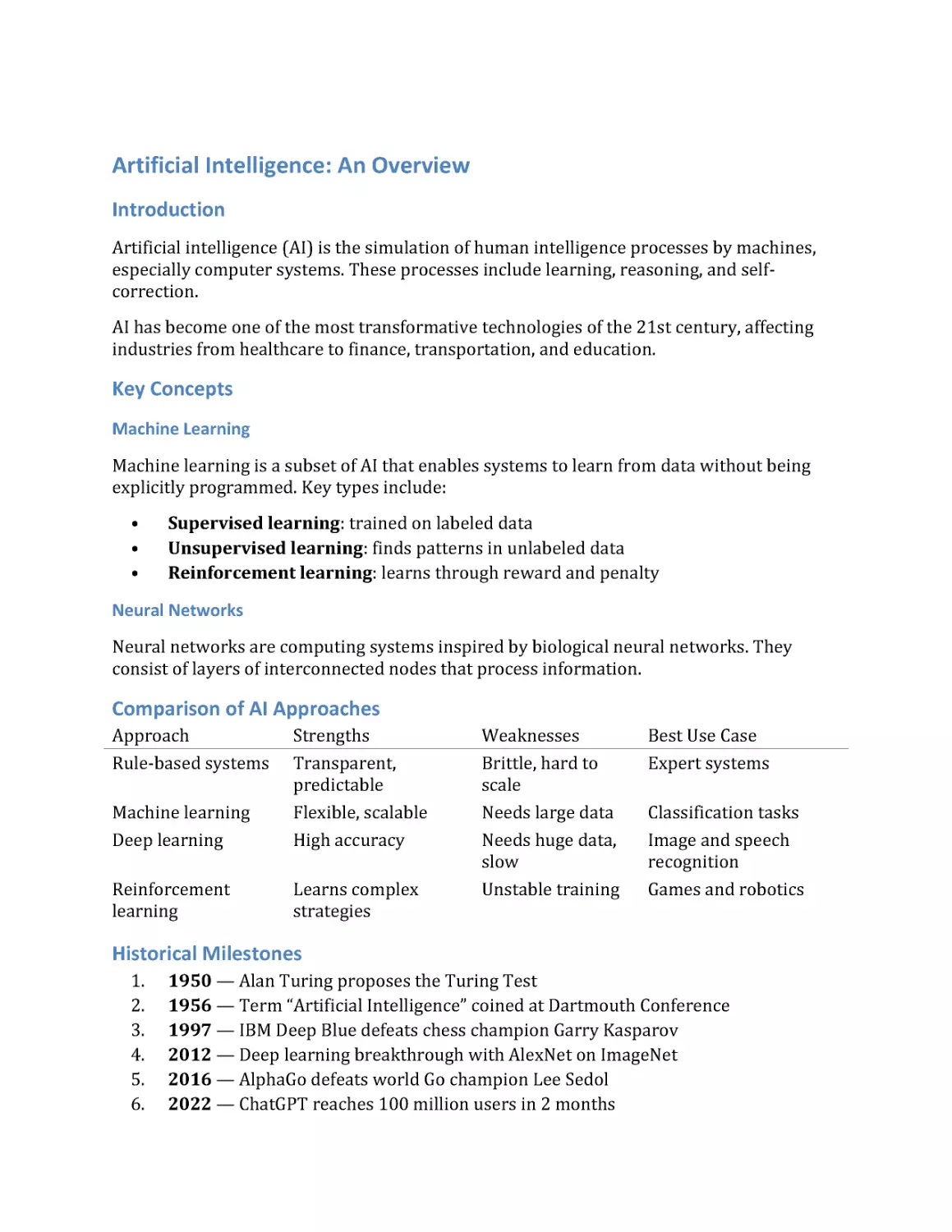
Comparison of AI Approaches
Approach
Strengths
Weaknesses
Best Use Case
Rule-based systems Transparent,
predictable
Brittle, hard to
scale
Expert systems
Machine learning
Flexible, scalable
Needs large data
Classification tasks
Deep learning
High accuracy
Needs huge data,
slow
Image and speech
recognition
Reinforcement
learning
Learns complex
strategies
Unstable training Games and robotics
Historical Milestones
1. 1950 — Alan Turing proposes the Turing Test
2. 1956 — Term “Artificial Intelligence” coined at Dartmouth Conference
3. 1997 — IBM Deep Blue defeats chess champion Garry Kasparov
4. 2012 — Deep learning breakthrough with AlexNet on ImageNet
5. 2016 — AlphaGo defeats world Go champion Lee Sedol
6. 2022 — ChatGPT reaches 100 million users in 2 months

Applications
AI is currently applied across many domains:
•
Healthcare: disease diagnosis, drug discovery, medical imaging
•
Finance: fraud detection, algorithmic trading, credit scoring
•
Transportation: autonomous vehicles, route optimization, traffic management
•
Education: personalized learning, automated grading, tutoring systems
•
Entertainment: recommendation systems, generative content, game AI
Ethical Considerations
The rapid development of AI raises important ethical questions:
1. Bias and fairness: AI systems can perpetuate or amplify existing biases present in
training data.
2. Privacy: large-scale data collection raises concerns about surveillance and personal
privacy.
3. Employment: automation may displace workers in many industries.
4. Accountability: it is often unclear who is responsible when AI systems make
harmful decisions.
5. Existential risk: some researchers warn about long-term risks from advanced AI
systems.
Conclusion
Artificial intelligence represents both an enormous opportunity and a significant challenge
for humanity. Responsible development, clear regulation, and broad public understanding
are essential to ensure that AI benefits society as a whole.