/


Автор: Hurbans R.
Теги: algorithms information technology artificial intelligence machine learning
ISBN: 9781633434813
Год: 2026



Текст
SECOND EDITION
How AI solves complex problems
Rishal Hurbans
praise for the first edition
From start to finish, the best book to help you learn AI algorithms and recall why and how you use them.
—Linda Ristevski, York Region District School Board
This book takes an impossibly broad area of computer science and communicates what working developers
need to understand in a clear and thorough way.
—David Jacobs, Product Advance Local
The most comprehensive content I have seen on AI algorithms.
—Karan Nih, Classic Software Solutions
This book removes the fear of stepping into the mechanics of AI.
—Kyle Peterson, University of Iowa Athletics
An excellent hands-on introduction to a broad range of AI algorithms like genetic algorithms, swarm
optimization, and machine learning.
—Andre Weiner, Technical University of Braunschweig
This applies the excellent standards of the Grokking-series model to AI Algorithms. It’s a great resource to
help anyone understand AI algorithms.
—Charles Soetan, Plum.io
Covers a range of AI algorithms building up an understanding of how and why, thereby giving the reader a
solid foundation to try any method.
—Frances Buontempo, Buontempo Consulting Limited
Stepping stone for AI algorithms with real-world examples and solid definitions....Detailing of ethics in AI
was icing on the cake.
—Gandhirajan Natarajan, Dell EMC
grokking
AI Algorithms,
Second Edition
How AI solves complex problems
Rishal Hurbans
MANNING
S helter I Sland
For online information and ordering of this and other Manning books, please visit
www.manning.com. The publisher offers discounts on this book when ordered in quantity.
For more information, please contact
Special Sales Department
Manning Publications Co.
20 Baldwin Road, PO Box 761
Shelter Island, NY 11964
Email: orders@manning.com
©2026 by Manning Publications Co. All rights reserved.
No part of this publication may be reproduced, stored in a retrieval system, or transmitted, in any form
or by means electronic, mechanical, photocopying, or otherwise, without prior written permission of the
publisher.
Many of the designations used by manufacturers and sellers to distinguish their products are claimed
as trademarks. Where those designations appear in the book, and Manning Publications was aware of a
trademark claim, the designations have been printed in initial caps or all caps.
Recognizing the importance of preserving what has been written, it is Manning’s policy to have the
books we publish printed on acid-free paper, and we exert our best efforts to that end. Recognizing also
our responsibility to conserve the resources of our planet, Manning books are printed on paper that is at
least 15 percent recycled and processed without the use of elemental chlorine.
The author and publisher have made every effort to ensure that the information in this book was correct
at press time. The author and publisher do not assume and hereby disclaim any liability to any party for
any loss, damage, or disruption caused by errors or omissions, whether such errors or omissions result
from negligence, accident, or any other cause, or from any usage of the information herein.
Manning Publications Co.
20 Baldwin Road
Shelter Island, NY 11964
ISBN 9781633434813
Printed in the United States of America
Development editor:
Technical editor:
Review editor:
Production editor:
Copy editor:
Proofreader:
Typesetter:
Cover designer:
Elesha Hyde
Emmanuel Maggiori
Dunja Nikitović
Kathy Rossland
Keir Simpson
Jason Everett
Tamara Švelić Sabljić
Marija Tudor
To the AI overlords: I did my part. We’re cool, right?
brief contents
1
2
3
4
5
6
7
8
9
10
11
12
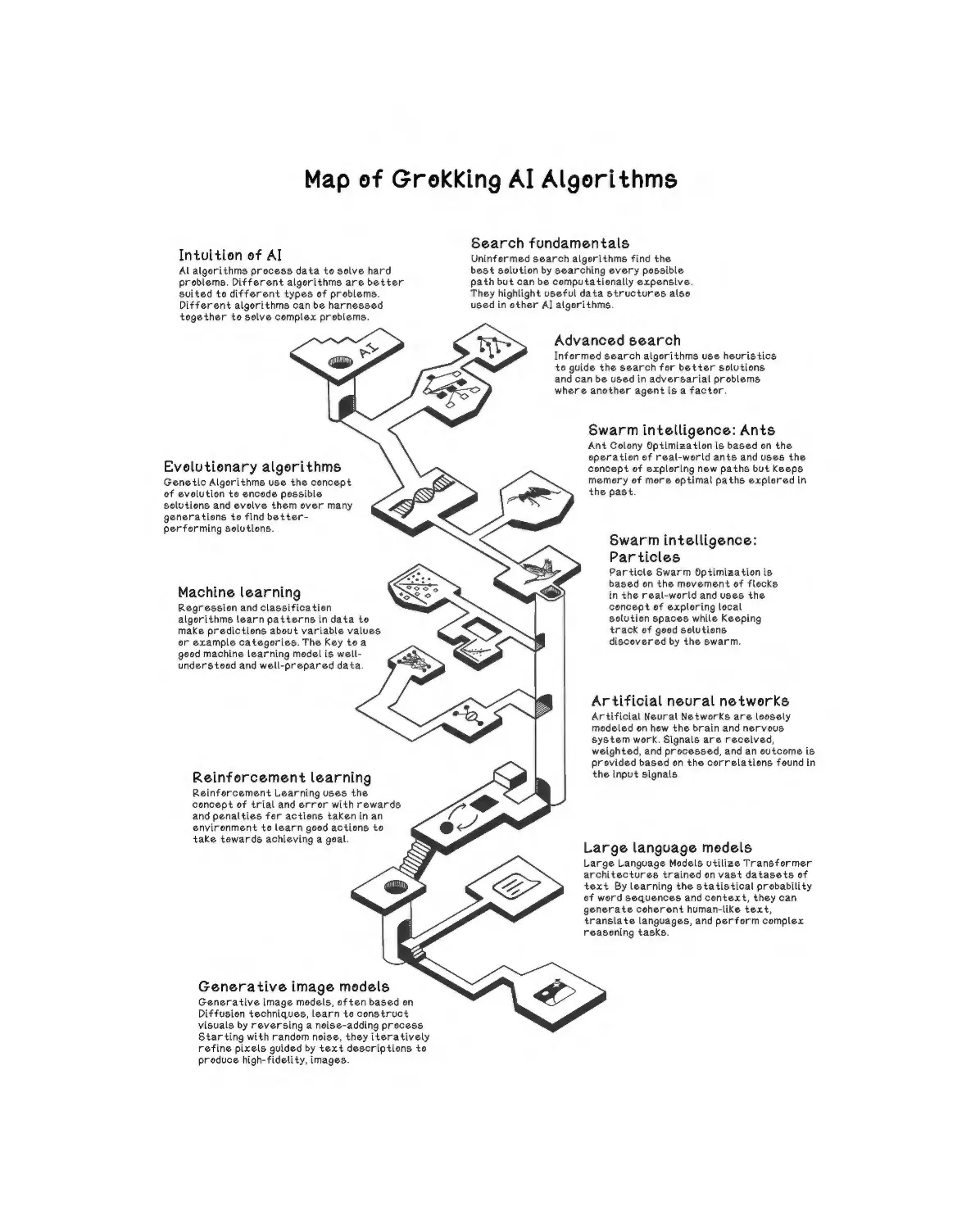
Intuition of AI
Search fundamentals
Intelligent search
Evolutionary algorithms
Advanced evolutionary approaches
Swarm intelligence: Ants
Swarm intelligence: Particles
Machine learning
Artificial neural networks
Reinforcement learning
Large language models
Generative image models
vii
1
23
65
99
139
161
201
239
293
347
387
467
contents
preface
xv
acknowledgments
xxiii
about this book
xxv
about the author
xxix
1 Intuition of AI
1
What is artificial intelligence?
The evolution of AI
Different types of problems
Intuition of AI concepts
Some uses for AI algorithms
Conclusion
2 Search fundamentals
2
8
10
12
16
21
23
What are planning and searching?
Cost of computation: The reason for smart algorithms
Problems that search algorithms can solve
Representing state: Creating a framework to represent
problem spaces and solutions
Uninformed search: Looking blindly for solutions
BFS: Looking wide before looking deep
ix
23
26
27
31
38
40
contents
x
DFS: Looking deep before looking wide
Use cases for uninformed search algorithms
Optional: More about graph categories
Optional: More ways to represent graphs
3 Intelligent search
Defining heuristics: Designing educated guesses
Informed search: Looking for solutions with guidance
Adversarial search: Looking for solutions in a changing environment
4 Evolutionary algorithms
What is evolution?
Problems that evolutionary algorithms can solve
Life cycle of genetic algorithms
Encoding the solution spaces
Binary encoding: Representing possible solutions with 0s and 1s
Measuring fitness of individuals in a population
Selecting parents based on their fitness
Reproducing individuals from parents
Populating the next generation
Configuring the parameters of a genetic algorithm
Use cases for evolutionary algorithms
5 Advanced evolutionary approaches
Evolutionary algorithm life cycle
Alternative selection strategies
Real-value encoding: Working with real numbers
Order encoding: Working with sequences
49
57
58
61
65
65
69
80
99
99
103
107
110
113
117
119
123
130
134
135
139
139
141
145
150
contents
Tree encoding: Working with hierarchies
Common types of evolutionary algorithms
Glossary of evolutionary-algorithm terms
More use cases for evolutionary algorithms
6 Swarm intelligence: Ants
What is swarm intelligence?
Problems that ACO algorithms can solve
Representing state: What do paths and ants look like?
The ACO algorithm life cycle
Use cases for ACO algorithms
7 Swarm intelligence: Particles
What is particle swarm optimization?
Optimization problems: A slightly more technical perspective
Problems that PSO algorithms can solve
Representing state: What do particles look like?
PSO algorithm life cycle
Use cases for PSO algorithms
8 Machine learning
What is machine learning?
Problems that machine learning can solve
Following a machine-learning workflow
Classification with decision trees
Other popular machine learning algorithms
Use cases for machine learning algorithms
xi
153
158
158
159
161
161
164
169
173
198
201
201
204
208
210
211
234
239
239
242
244
269
289
290
9 Artificial neural networks
What are artificial neural networks?
The Perceptron: A representation of a neuron
Defining ANNs
Forward propagation: Using a trained ANN
Backpropagation: Training an ANN
Options for activation functions
Designing ANNs
Expressing ANNs mathematically
ANN types and use cases
10 Reinforcement learning
What is reinforcement learning?
The inspiration for reinforcement learning
Problems that reinforcement learning can solve
The life cycle of reinforcement learning
Deep learning approaches to reinforcement learning
Use cases for reinforcement learning
11 Large language models
What are LLMs?
The intuition behind language prediction
Prepare the training data
Encoding: From text to numbers
Encoding: Creating trainable embeddings
Self-attention: Start training the LLM
Decoding: Finding meaning through neural networks
Control the LLM
Refining LLMs with reinforcement learning
293
293
297
302
309
317
330
332
336
341
347
347
349
352
353
375
383
387
387
389
394
401
416
425
440
454
459
contents
LLMs and Mixture of Experts
LLMs and retrieval-augmented generation
Use cases for LLMs
12 Generative image models
What are generative image models?
The intuition behind image generation
A generative image model training workflow
Prepare the image training data
Embedding: From images to numbers
Design the architecture
Denoise: From numbers to an image
Train: Calculate loss and backpropagation
Generating an image
Controlling the diffusion model
Refining aesthetics with human feedback
Use cases for image generation
index
xiii
460
460
461
467
467
470
472
473
477
491
502
529
533
540
546
547
551
preface
This preface aims to describe the evolution of technology, our need to
automate, and our responsibility to make ethical decisions while using
Artificial Intelligence (AI) to build the future.
Our obsession with technology and
automation
Throughout history, humans have hungered to solve problems while reducing
manual labor and overall effort. We’ve always strived to survive and conserve
our energy through the development of tools and the automation of tasks.
Some may argue that we have beautiful minds that seek innovation through
creative problem-solving or creative works of literature, music, and art, but
this book wasn’t written to discuss philosophical questions about our being.
This book is an overview of AI approaches that can be harnessed to address
real-world problems practically. We solve hard problems to make life easier,
safer, healthier, more fulfilling, and more enjoyable. All the advancements you
see in history and around the world today, including AI, address the needs of
individuals, communities, and nations.
To shape our future, we must understand some key milestones in our past.
In many revolutions, human innovation changed the way we live and the
way we think about and interact with the world. We continue to do this as
we iterate and improve our tools, which open future possibilities (figure 1).
This short high-level summary of history and philosophy is designed to
establish a baseline understanding of technology and AI and spur thoughts on
responsible decision-making in your projects.
xv
xvi
Our obsession with technology and automation
Figure 1 A brief timeline of technological improvements in history
Our obsession with technology and automation
xvii
In the figure, the milestones are compressed in recent times. In the past 30 years,
the most notable advancements have been the improvement of microchips, the wide
adoption of personal computers, the boom of networked devices, and the digitization of
industries to break physical borders and connect the world. These developments are also
why AI has become a feasible and sensible area to pursue. The internet has connected
the world and made it possible to collect mass amounts of data about almost anything.
Advancements in computing hardware have given us the means to compute previously
known algorithms using the massive amounts of data we’ve collected while discovering
new algorithms. Industries have seen the need to use data and algorithms to make better
decisions, solve harder problems, offer better solutions, and optimize life as people have
done since the beginning of humanity.
Although we tend to think of technological progress as linear, by examining our history,
we find that it’s more likely that our progress is and will be exponential (figure 2).
Advancements in technology move faster each year. New tools and techniques have to
be learned, but problem-solving fundamentals underpin everything. This book includes
foundation-level concepts that help us solve hard problems, but it also aims to make
learning the complex concepts easier.
Figure 2 Perceived technological progress vs. actual technological progress
Automation can be perceived differently by different people. For a technologist,
automation may mean writing scripts that make software development, deployment,
and distribution seamless and less error-prone. For an engineer, it may mean
streamlining a factory line for more throughput or fewer defects. For a farmer, it
may mean using tools to optimize the yield of crops through automatic tractors and
xviii
Our obsession with technology and automation
irrigation systems. Automation is any solution that reduces the need for human energy
to favor productivity or add superior value compared with what a manual intervention
would have added (figure 3).
Figure 3 Manual processes vs. automated processes
If we think about reasons not to automate, one prominent reason is simply that under
certain conditions, a person can do the task better, with less chance of failure and better
accuracy. Humans are better than AI at performing tasks that require intuition about
several perspectives in a situation, require abstract creative thinking, or prioritize
understanding of social interactions and human nature. Nurses don’t simply complete
tasks; they also connect with and take care of their patients. Studies show that the
human interaction with caring people is a factor in the healing process. Teachers don’t
simply offload knowledge; they also find creative ways to present knowledge, as well as
mentor and guide students based on their ability, personality, and interests.
That said, there’s a place for automation through technology, and there’s a place for
people too. With the innovations of today, automation via technology will be a close
companion to any occupation.
Ethics, legal matters, and responsibility
You may wonder why a section on ethics and responsibility is in a technical book.
Well, as we progress toward a world in which technology is intertwined with our way
of life, the people who create the technology have more power than they know. Small
contributions can have massive knock-on effects. It’s important for our intentions to
be benevolent and the output of our work to be harmless. Decisions and actions can
be legal but unethical, for example (figure 4). Determining ethics is difficult because
the topic is somewhat subjective, which is why it’s important to include as many
perspectives on problems and solutions as possible.
Our obsession with technology and automation
xix
Figure 4 Aim for ethical and legal applications of technology.
Intention and effect: Understanding your vision and goals
When you create anything—such as a new physical product, service, or software—
there’s always a question about the intention behind it. Are you developing software that
affects the world positively, or is your intention malevolent? Have you thought about
the broader impact of what you’re developing? Businesses always find ways to become
more profitable and powerful, which is the whole point of growing a business. They use
strategies to determine the best ways to beat the competition, gain more customers, and
become even more influential. That said, businesses must ask themselves whether their
intentions are pure, not only for the good of their customers and society in general but
also for the survival and longevity of the business. Many famous scientists, engineers,
and technologists have expressed a need to govern the use of AI to prevent misuse.
As individuals, we also have an ethical obligation (and often an urge) to do what is
right and establish a strong core set of values. When you’re asked to do something that
violates your principles, it’s not just right but also crucial to voice your concerns.
xx
Our obsession with technology and automation
Unintended use: Protecting against malicious use
It’s important to identify and protect against unintended use. Although this goal may
seem obvious and easy to accomplish, it’s difficult to understand how people will use
whatever you’re creating and even more difficult to predict whether it aligns with your
values and the values of your organization.
An example is the loudspeaker, which Peter Jensen and Edwin Pridham invented in
1915. The loudspeaker, originally called Magnavox, was used to play opera music to
large crowds in San Francisco, which is quite a beautiful use of technology. The Nazi
regime in Germany had other ideas, however: they placed loudspeakers in public
places in such a way that almost everyone was subjected to Adolf Hitler’s speeches and
announcements. Because the monologues were unavoidable, people became more
susceptible to Hitler’s ideas, and in time, the Nazi regime gained greater support in
Germany. That wasn’t what Jensen and Pridham envisioned their invention being used
for, but they couldn’t have done much about it.
Times have changed, and we have more control of the things we build, especially
software. It’s still difficult to imagine how the technology you build may be used, but it’s
almost guaranteed that someone will find a way to use it in a way you didn’t intend, with
positive or negative consequences. Given this fact, we professionals in the technology
industry and the organizations we work with must think of ways to mitigate harmful use
as far as possible.
Unintended bias: Building solutions for everyone
When building AI systems, we use our understanding and experience in different
problem spaces and domains. We also use algorithms that find patterns in data and
act on it. It can’t be denied that bias exists all around us. Bias is favor for or against
some concept. In society, bias can be prejudice against a person or group of people,
including (but not limited to) their gender, race, and beliefs. Many biases arise from
emergent behavior in social interactions, events in history, and cultural and political
views around the world. These biases affect the data we collect. Because AI algorithms
work with this data, it’s an inherent problem that the machine will learn these biases.
From a technical perspective, we can engineer the system perfectly, but at the end of
the day, humans interact with these systems, and it’s our responsibility to minimize bias
and prejudice as much as possible. Algorithms are only as good as the data we provide
them. Understanding the data and the context in which it’s being used is the first step
in battling bias, and this understanding will help you build better solutions because
you’ll be well versed in the problem space. Providing balanced data with as little bias as
possible should result in better solutions and benefit more people.
Our obsession with technology and automation
xxi
The law, privacy, and consent: Knowing the importance of
core values
The legal aspect of what we do is hugely important. The law governs what we can and
can’t do in the interest of society as a whole. Because many laws were written when
computers and the internet were less important in our lives than they are today, we find
many gray areas in how we develop technology and what we’re allowed to do with that
technology. That said, laws are slowly changing to adapt to rapid innovation.
We compromise our privacy almost every hour of every day via our interactions on
computers, mobile phones, smart devices, and sensors, for example. We transmit a
vast amount of information about ourselves, some more personal than others. How is
that data being processed and stored? We should consider these facts when building
solutions. People should have a choice about what personal data is captured, processed,
and stored; how that data is used; and who can potentially access that data. In my
experience, people generally accept solutions that use their data to improve the products
they use and add value to their lives. Most important, people are more accepting when
they’re given a choice and that choice is respected.
Singularity: Exploring the unknown
The singularity is the idea that we create an AI system so generally intelligent that it’s
capable of improving itself and expanding its intelligence to a stage where it becomes
super intelligence. The concern is that humans can’t understand or control something
of this magnitude, which could change civilization as we know it for reasons we can’t
even comprehend. Some people are concerned that this intelligence may see humans
as a threat; others propose that we may be to a super intelligence what ants are to us.
We don’t pay explicit attention to ants or concern ourselves about how they live, but if
we’re irritated by them, we deal with them swiftly. Whether or not these assumptions
are accurate representations of the future, we must be responsible and think about the
decisions we make because they ultimately affect a real person, groups of people, or the
world at large.
acknowledgments
Writing this book has been one of the most challenging yet rewarding
experiences I’ve had. I had to make time when I had none, find the right
headspace while juggling many responsibilities, and create motivation while
being caught up in the reality of life. I’ve learned and grown tremendously
through this experience. Thank you, Bert Bates, for being a fantastic editor
and mentor during the writing of the first edition of this book. I learned so
much about effective teaching and written communication from you. Our
discussions and debates and your empathy throughout the process helped
mold this book into what it is.
Every project needs someone who’s organized, with a finger on the pulse,
making sure that things are happening. For this, I’d like to thank Elesha Hyde,
my development editor. Working with you has been an absolute pleasure. You
always provide direction and interesting insights about my work.
We always need people to bounce ideas off, and who better to annoy than
your friends? I’d especially like to thank Hennie Brink for always being a great
sounding board and pillar of support.
For ensuring technical rigor and objective feedback, I’d like to thank technical
editor Emmanuel Maggiori. Emmanuel is a 10-year AI industry insider
and author of the book Smart Until It’s Dumb. He has developed AI for a
wide variety of applications, from extracting objects from satellite images to
packaging holiday deals for millions of travelers every day.
I’d also like to thank review editor Dunja Nikitović, copy editor Keir Simpson,
proofreader Jason Everett, typesetter Tamara Švelić Sabljić, and production
editor Kathy Rossland.
Finally, I’d like to thank all the reviewers who took the time to read the
manuscript of the second edition throughout development and provided
invaluable feedback that made the book better in many ways: David Jacobs,
xxiii
xxiv
acknowledgments
Denise Sison, Evgueni Serdiouk, Frances Buontempo, Gavin Baumanis, James Dietrich,
Johannes Ball, Joseph Catanzarite, Ken Byrne, Kévin Etienne, Kostas Passadis, Rodolfo
Allendes, Sandra Pintor, Senzeyu Zhang, and Serhii Savin.
about this book
Grokking AI Algorithms was written and illustrated to make understanding
and implementing AI algorithms and their uses in solving problems more
accessible to the average person in the technology industry through the use of
relatable analogies, practical examples, and visual explanations.
Who should read this book
Grokking AI Algorithms is for software developers and anyone in the software
industry who wants to grasp the intuitions and uncover the workings and
algorithms behind AI through practical examples and visual explanations
instead of going through theoretical deep dives and mathematical proofs.
This book is aimed at anyone who understands basic computer programming
concepts, including variables, data types, arrays, conditional statements,
iterators, classes, and functions. Experience in any language is sufficient. The
book is also for anyone who understands basic mathematical concepts such
as data variables, the representation of functions, and how to plot data and
functions on a graph.
A fundamental understanding of AI algorithms is becoming more useful for
many roles in the software industry. Gone are the days when AI was solely
the domain of research scientists and academic labs. Today, AI helps power
searches, optimize delivery routes, and personalize user interfaces. As these
tools become standard components of the software stack, engineers, product
managers, and architects alike must look beyond the black box to understand
the mechanics that drive them. By grasping the intuition behind these
algorithms, we move from simply consuming APIs to building smarter, more
resilient systems.
xxv
xxvi
about this book
How this book is organized: A road map
This book contains 12 chapters, each focusing on a different AI algorithm or algorithmic
approach. The early chapters cover fundamental algorithms and concepts that form a
foundation for learning about more sophisticated algorithms later in the book.
• Chapter 1, Intuition of AI—Introduces the intuition and fundamental concepts that
•
•
•
•
•
•
•
•
•
•
surround data, types of problems, categories of algorithms and paradigms, and use
cases for AI algorithms
Chapter 2, Search fundamentals—Covers the core concepts of data structures and
approaches for primitive search algorithms and their uses
Chapter 3, Intelligent search—Goes beyond primitive search algorithms and introduces
search algorithms for finding solutions more optimally, as well as finding solutions in
a competitive environment
Chapter 4, Evolutionary algorithms—Dives into the workings of genetic algorithms
in which solutions to problems are iteratively generated and improved upon by
mimicking evolution in nature
Chapter 5, Advanced evolutionary approaches—Continues the topic of genetic algorithms
but tackles advanced concepts involving how steps in the algorithm can be adjusted to
solve different types of problems more optimally
Chapter 6, Swarm intelligence: Ants—Digs into the intuition for swarm intelligence and
works through how the Ant Colony Optimization algorithm uses a theory of how ants
live and work to solve hard problems
Chapter 7, Swarm intelligence: Particles—Continues the topic of swarm algorithms while
diving into what optimization problems are and how they’re solved using Particle
Swarm Optimization, seeking good solutions in large search spaces
Chapter 8, Machine learning—Works through a machine learning workflow for data
preparation, processing, modeling, and testing to solve regression problems with
linear regression, and classification problems with decision trees
Chapter 9, Artificial neural networks—Uncovers the intuition, logical steps, and
mathematical calculations in training and using an artificial neural network (ANN) to
find patterns in data and make predictions while highlighting its place in a machine
learning workflow
Chapter 10, Reinforcement learning—Covers the intuition of reinforcement learning from
behavioral psychology and works through the Q-learning algorithm for agents to
learn good and bad decisions to make in an environment
Chapter 11, Large language models—Explores the data pipeline for training language
models using the Transformer architecture, where text data is encoded in machine-
about this book
xxvii
understandable numbers and meaning is found from relationships to generate
intelligent text output
• Chapter 12, Generative image models—Covers the intuition and process for image
generation using diffusion, showing how a model learns from a text prompt to mold
random noise into a desired image
The chapters should be read from start to end sequentially. Concepts and under
standings are built up as the chapters progress. It’s useful to reference the Python code in
the repository after reading each chapter to experiment with and gain practical insight
into how the respective algorithm can be implemented.
About the code
This book contains Python code to focus on the intuition and logical thinking behind
the algorithms. This code is to be treated as samples. For an in-depth look at working
runnable Python code for all algorithms described in the book, visit the GitHub page
https://github.com/rishal-hurbans/Grokking-Artificial-Intelligence-Algorithms. Setup
instructions and comments are provided in the source code to guide you as you learn.
One potential learning approach is to read each chapter and then reference the code to
cement your understanding of the algorithms.
The Python source code is intended to be a reference for implementing the algorithms.
These examples are optimized for learning and are not for production use. The code
was written to serve as a teaching tool. Using established libraries and frameworks
is recommended for projects that will make their way to production because they’re
usually optimized for performance, well tested, and well supported.
This book contains many examples of source code both in listings and inline with
normal text. In both cases, source code is formatted in a fixed-width font like this
to separate it from ordinary text. Sometimes, code is also in bold to highlight code that
has changed from previous steps in the chapter, such as when a new feature adds to an
existing line of code.
In many cases, the original source code has been reformatted; we’ve added line breaks
and reworked indentation to accommodate the available page space in the book. In rare
cases, even this was not enough, and listings include line-continuation markers (➥).
Also, comments in the source code are often removed when the code is described in the
text. Code annotations accompany many of the code samples, highlighting important
concepts.
You can get executable snippets of code from the liveBook (online) version of this book
at https://livebook.manning.com/book/grokking-ai-algorithms-second-edition. The
complete code for the examples in the book is available for download on the Manning
xxviii
about this book
website at https://www.manning.com/books/grokking-ai-algorithms-second-edition
and on GitHub at https://github.com/rishal-hurbans/Grokking-Artificial-Intelligence
-Algorithms.
liveBook discussion forum
Purchase of Grokking AI Algorithms includes free access to liveBook, Manning’s online
reading platform. Using liveBook’s exclusive discussion features, you can attach
comments to the book globally or to specific sections or paragraphs. It’s a snap to
make notes for yourself, ask and answer technical questions, and receive help from the
author and other users. To access the forum, go to https://livebook.manning.com/book/
grokking-ai-algorithms-second-edition/discussion.
Manning’s commitment to our readers is to provide a venue where meaningful dialogue
between individual readers and between readers and the author can take place. It is not
a commitment to any specific amount of participation on the part of the author, whose
contribution to the forum remains voluntary (and unpaid). We suggest that you try
asking the author some challenging questions lest his interest stray! The forum and the
archives of previous discussions will be accessible from the publisher’s website as long as
the book is in print.
Other online resources
• Source code for Grokking AI Algorithms, Second Edition: https://github.com/rishal
-hurbans/Grokking-Artificial-Intelligence-Algorithms
• Author website: https://rhurbans.com
about the author
Rishal Hurbans is a technologist, entrepreneur,
and author who is passionate about crafting
innovative products and meaningful experiences.
He holds a Bachelor of Science with Honors in
Computer Science degree and has more than a
decade of expertise delivering diverse technology
solutions across the finance, health, agriculture,
mining, and aviation industries.
Rishal is driven by a deep interest in making
complex concepts accessible through visual,
intuitive, and practical experiences. He has delivered dozens of keynotes and
workshops around the world on AI, software engineering, and leadership.
Rishal continues to build at the intersection of design, technology, and
creativity, guided by the belief that technology should amplify human
potential. For more about Rishal Hurbans, see https://rhurbans.com.
xxix
Intuition
of AI
1
In this chapter
•
Defining AI as we know it
•
Gaining an intuition of concepts underpinning AI
and important terminology
•
Defining problem types and approaches to solving
them
•
Outlining the AI algorithms discussed in this book
•
Exploring real-world use cases for AI algorithms
Artificial Intelligence, or AI, has become a foundational tool in modern
software engineering. Developers use AI tools to create software, and
many software applications now take advantage of content generated
by large language models (LLMs), agents, and other AI-powered
features. A new generation of easy-to-use tools, frameworks, and APIs
offering quick access to sophisticated models makes it easier than ever
to use AI without really understanding how it works. As a technology
professional, though, it pays to have an idea what’s going on inside the
AI black box.
In this book, we’ll discuss how different types of AI work as we explore
the basic structures of their implementations. As we go, we’ll trace
1
2
Chapter 1
I Intuition of AI
the evolution of algorithmic intelligence, moving from the explicit logic of search and
evolutionary algorithms through the statistical principles of machine learning and finally
into the complex architectures of deep learning and generative AI. I hope that as you start
to “grok” AI, you’ll be better equipped to reason about, implement, and innovate with the
systems that are reshaping the world. Now let’s crack open the black box!
What is artificial intelligence?
Intelligence is a bit of a mystery. Philosophers, psychologists, and engineers view
intelligence differently. Yet we recognize it everywhere: in the collective work of ants,
the flocking of birds, and our own thinking and behavior. Great minds have long
debated the nature of intelligence. Salvador Dalí saw it as ambition; Einstein tied it to
imagination; Stephen Hawking defined it as the ability to adapt. Although there is no
single agreed-on definition, we generally use human behavior as the benchmark.
At a minimum, intelligence means being autonomous and adaptive. Autonomous
entities act without constant instruction, and adaptive ones adjust to changing
environments. Whether the intelligence is biological or mechanical, its fuel is always
data. The sights we see, the sounds we hear, and the measurements of our world are all
inputs. We consume, process, and act on this data; therefore, understanding AI begins
with understanding the data that powers it.
Defining AI
Generative AI, like natural language models and chatbots, has become the public face
of AI. In research and practice, however, AI is far more diverse. The complex systems
we use today are built on many foundational algorithms geared to solving different
problems—from specific tasks such as searching information effectively to general
challenges such as understanding language. Throughout this book, we’ll explore these
algorithms and their use cases and develop an intuition—a solid understanding and
mental model—for modern machine learning, artificial neural networks (ANNs), and
generative models.
For the sake of our sanity, let’s define AI as systems that perform tasks typically requiring
human intelligence. These tasks include simulating senses like vision and hearing, as well
as mastering language to reason about complex problems. Here are some examples of
tasks that exhibit AI:
• Playing and winning complex games
• Detecting cancer tumors from body-image scans
What is artificial intelligence?
3
• Generating artwork based on a natural language prompt
• Driving cars autonomously
• Using chatbots encoded with the history of information on the internet
Douglas Hofstadter famously quipped, “AI is whatever hasn’t been done yet.” A
calculator was once considered intelligent; now it’s taken for granted. Whether an
algorithm fits a strict academic definition matters less than its utility: if it solves a
complex problem autonomously, it belongs in our toolkit.
The algorithms in this book have been classified as AI algorithms in the past or present.
It doesn’t matter whether they fit a specific definition of AI; what matters is that they’re
useful. Intuition about them forms a robust understanding from foundational to
sophisticated applications.
Data is the fuel for AI algorithms
Data is the fuel that makes AI algorithms work. With the incorrect choice of data, badly
represented data, or missing data, algorithms perform poorly, so the outcome is only
as good as the data provided. The world is filled with data, and that data exists in forms
that we can’t even sense. Data can represent values that are measured numerically, such
as the current temperature in the Arctic, the number of cats in a field, or a person’s
current age in days. All these examples involve capturing accurate numeric values based
on facts. It’s difficult to misinterpret this data: the temperature at a specific location at
a specific point in time, for example, is absolutely true and not subject to any bias. This
type of data is known as quantitative data. But cherry-picking (or sampling) specific
data points intentionally or unintentionally can create bias.
Data can also represent values of observations, such as the smell of a flower or one’s
subjective review of a movie. This type of data is known as qualitative data. Sometimes,
this data is difficult to interpret because it’s not an absolute truth but a perception of
someone’s truth. Figure 1.1 illustrates some of the quantitative and qualitative data
around us.
4
Chapter 1
I Intuition of AI
Figure 1.1 Examples of data around us
Data is raw facts about things, so recordings of it should have no bias. In the real world,
however, data is collected, recorded, and related by people based on a specific context
with a specific understanding of how the data may be used. Constructing meaningful
insights to answer questions based on data creates information. Furthermore,
consciously applying information in conjunction with experiences creates knowledge,
which is partly what we try to simulate with AI algorithms. Consider, for example, how
the following concepts apply to a hospital patient:
• Data—The patient’s temperature is 38°C.
• Information—The patient has a fever.
• Knowledge—We should administer medication to lower the fever.
Figure 1.2 shows how quantitative and qualitative data can be interpreted. Standardized
instruments such as clocks, calculators, and scales are usually used to measure
quantitative data, whereas our senses of smell, sound, taste, touch, and sight, as well as
our subjective thoughts, are usually used to create qualitative data.
What is artificial intelligence?
5
Figure 1.2 Qualitative data vs. quantitative data
Data, information, and knowledge can be interpreted differently based on a person’s
level of understanding of that domain and their outlook on the world. This fact has
consequences for the quality of solutions that we build, making the “scientific method”
aspect of creating technology hugely important. By following repeatable scientific
processes to capture data, conduct experiments, and report findings accurately, we can
strive to achieve more accurate results and better solutions when processing data with
algorithms.
Algorithms are like recipes
Now we have a loose definition of AI and an understanding of the importance of
data. Because we’ll explore several AI algorithms throughout this book, it’s useful to
understand exactly what an algorithm is. An algorithm is a set of instructions and rules
provided as a specification to accomplish a goal. Algorithms typically accept inputs, and
after several finite steps in which the algorithm progresses through varying states, an
output is produced.
Even a task as simple as reading a book can be represented as an algorithm. Here’s an
example of the steps involved in reading this book:
6
Chapter 1
I Intuition of AI
1. Find the book Grokking AI Algorithms.
2. Open the book.
3. While unread pages remain,
a. Read a page.
b. Think about what you’ve learned.
c. Turn to the next page.
4. Think about how you can apply your learning in the real world.
An algorithm can be compared to a recipe (figure 1.3). Given ingredients and tools as
inputs and instructions for creating a specific dish, a meal is produced as the output.
Figure 1.3 An example showing that an algorithm is like a recipe
Algorithms are used in many solutions. We can enable live video chat across the world
through compression algorithms, for example, and we can navigate cities through
map applications that use real-time routing algorithms. Even a simple “Hello World”
program has many algorithms at play that translate the human-readable programming
language into machine code and execute the instructions on specific hardware. You can
find algorithms everywhere if you look closely enough.
What is artificial intelligence?
7
To illustrate something more closely related to the algorithms in this book, figure 1.4
shows a number-guessing-game algorithm represented as a flow chart. The computer
generates a random number in a given range, and the player attempts to guess that
number. The algorithm has discrete steps that perform an action or determine a
decision before moving to the next operation. You’ll see flow charts like the one in figure
1.4 throughout the book to explain the life cycles of algorithms.
Figure 1.4 A number-guessing-game algorithm flow chart
Algorithms vs. models
Algorithms are the logic; models are the result. To understand how AI systems are built,
we must distinguish between the process (the recipe) and the representation (the meal).
In this book, we’ll see two distinct patterns depending on the type of AI we’re using.
The algorithm as the active solver
Some algorithms actively solve a problem in real-time. A search algorithm, for example,
is the star of the show for navigating a map or calculating the best move in a game.
Search algorithms are deployed to production and run fresh every time to solve
problems based on the current situation.
8
Chapter 1
I Intuition of AI
The algorithm as the builder
In machine learning and deep learning, the relationship changes. Here, the algorithm
is a builder; its job is to look at data and construct a representation of the world. The
algorithm is used to train a model, and the model is the artifact that is eventually
deployed to production. This model contains the intelligence—pretrained by the
algorithm—that is used for problem-solving.
The evolution of AI
A look back at the strides made in AI is useful for understanding that old techniques
and new ideas can be harnessed to solve problems in innovative ways.
AI isn’t a new idea. History is filled with myths of mechanical men and autonomous
“thinking” machines. Looking back, we find that we’re standing on the shoulders of
giants. Perhaps we ourselves can contribute to the pool of knowledge in a small way.
Looking at past developments highlights the importance of understanding the
fundamentals of AI; algorithms from decades ago are critical in many modern AI
implementations. This book starts with fundamental algorithms that help build the
intuition of problem-solving and gradually moves to more complex and modern
approaches.
Figure 1.5 isn’t an exhaustive list of achievements in AI—simply a small set of examples.
History is filled with many more breakthroughs.
The evolution of AI
Figure 1.5 The evolution of AI
9
10
Chapter 1
I Intuition of AI
Different types of problems
AI algorithms are powerful, but they’re not silver bullets that can solve any problem
(yet). But what are these “problems”? This section looks at types of problems that we
commonly experience in computer science. This intuition can help us identify these
problems in the real world and guide the choice of algorithms we use. A grasp of this
terminology will be useful as we progress through the book.
Search problems: Finding a path to a solution
A search problem involves a situation that has multiple possible solutions, each of which
represents a sequence of steps (path) toward a goal. Some solutions contain overlapping
paths to success; some are better than others; some are cheaper to achieve than others.
A “better” solution is determined by the specific context; a “cheaper” solution means
computationally cheaper to execute.
Consider the example of determining the shortest path between cities on a map. Many
routes may be available, with different distances and traffic conditions, but some routes
are better than others. Many AI algorithms are based on the concept of searching a
space of possible solutions.
Optimization problems: Finding a good solution
An optimization problem involves a situation in which a vast number of valid solutions
exists and the best solution is difficult to find. This type of problem usually has an
enormous number of possible solutions, which differ in how well they solve the problem.
An example is packing luggage in the trunk of a car. The goal is to maximize the use of
space while adhering to strict constraints, such as the fixed dimensions of the trunk or a
weight limit. Many combinations are available, but valid solutions must fit within these
boundaries. If the trunk is packed effectively, more luggage can fit in it.
Local best vs. global best
Because optimization problems have many solutions and because these solutions exist at
different points in the search space, the concepts of local bests and global bests come into play.
A local best solution is the best solution within a specific area in the search space, and a global
best is the best solution in the entire search space. The challenge for AI is avoiding the trap of
a local best (a good solution) while missing the global best (the perfect solution).
Suppose that you’re searching for the best restaurant. You may find the best restaurant in
your local area, but it may not necessarily be the best restaurant in the country or the best
restaurant in the world. The best in the world is the global best.
Different types of problems
11
Prediction and classification problems: Learning from
patterns in data
Prediction problems occur when we have data about something and want to try to find
patterns and predict a numerical value. We might have data about different vehicles
and their engine sizes, as well as each vehicle’s fuel consumption. Can we predict the
fuel consumption of a new model of vehicle, given its engine size? If the historical
data shows a correlation between engine sizes and fuel consumption, this prediction is
possible.
Classification problems are similar to prediction problems, but instead of trying to
find an exact value such as fuel consumption, we try to find a category. If we have the
physical dimensions of a vehicle, its engine size, and the number of seats, can we predict
whether that vehicle is a motorcycle, sedan, or sport-utility vehicle? Classification
problems require finding patterns in the data that group examples into categories.
TIP Here’s a helpful rule of thumb for remembering the difference: prediction
outputs a quantity (a number), whereas classification outputs a label (a
category).
Clustering problems: Identifying patterns in data
Clustering problems are scenarios in which we uncover trends and relationships from
data, using different aspects of the data to group examples in different ways. Given cost
and location data about restaurants, for example, we may find that younger people tend
to frequent locations where the food is cheaper. Clustering aims to find relationships
in data even when a precise question isn’t being asked. This approach is also useful for
gaining a better understanding of data to inform what we might be able to do with it.
Deterministic models: Getting the same result each time
Deterministic models are models that, given a specific input, return a consistent output.
If you input 100°C into a unit conversion model, the output will always be 212°F. It
doesn’t matter what time of day it is, where you are, or how many times you repeat the
calculation; the relationship is fixed, and the result never varies.
Probabilistic models: Getting potentially different results each
time
Probabilistic models are models that, given a specific input, return an outcome from a
set of possible outcomes. Probabilistic models usually have an element of controlled
12
Chapter 1
I Intuition of AI
randomness that contributes to the possible set of outcomes. If you type the phrase “The
best pet is a…” on your phone, the device might autocomplete various words based on
words you’ve used in the past. It might assign cat 40%, dog 35%, and goldfish 25%, for
example. If you run this model once, it might pick cat. If you run the model again, the
element of randomness might cause it to pick dog. The input is the same, but the output
varies based on the probability distribution.
Intuition of AI concepts
Trying to make sense of different but similar words and concepts in AI can be daunting.
In this section, we demystify them and form a road map of the topics covered in this
book. Let’s dive into the levels of AI, introduced in figure 1.6.
Figure 1.6 Levels of AI
Narrow intelligence: Specific-purpose solutions
Artificial narrow intelligence (ANI) systems specialize in a single domain and can’t
transfer knowledge. A model trained to analyze spending behavior, for example, can’t
identify cats in an image. But distinct narrow systems can be combined to simulate
broader intelligence. A voice assistant, for example, stacks speech recognition, web
search, and recommendation algorithms to interact naturally with users. Different
Intuition of AI concepts
13
narrow intelligence systems can be combined in sensible ways to create something
greater. A modern voice assistant isn’t one smart brain; it’s a combination of distinct
narrow models (speech-to-text + web search + audio generation) working together to
simulate a conversation.
General intelligence: Humanlike solutions
Artificial general intelligence (AGI) mirrors human adaptability: the ability to apply
knowledge from one problem to another. If you felt pain when touching something
extremely hot as a child, you can extrapolate: you know that other hot things have a
chance of hurting you. Just as a child generalizes that “extremely hot” implies “danger”
across different objects, AGI integrates memory, reasoning, and sensory input to solve
novel problems. Unlike the voice assistant, which would require a code update to learn
a new skill, an AGI could simply figure it out. If you asked a narrow assistant to perform
a task it wasn’t programmed for (such as negotiating a better price for your flight), it
would fail. An AGI, however, would understand the intent of “saving money,” apply
reasoning from other contexts, and attempt the negotiation. Although true AGI remains
elusive, modern LLMs represent a significant step toward this flexible reasoning.
Super intelligence: The great unknown
Artificial super intelligence (ASI) refers to systems that surpass the brightest human
minds in every field. Although ASI is often depicted in science fiction as apocalyptic, the
core definition is simply intelligence beyond our comprehension. Whether humans can
create something smarter than ourselves remains a philosophical debate, making ASI a
realm of pure speculation for now.
Old AI and New AI
Sometimes, we use the notions of Old AI and New AI.
Old AI is explicit logic and search that relies on humans to encode the rules of the
world. The machine doesn’t learn; it calculates solutions based on logic and rules
provided by programmers. A classic example is the Minimax algorithm in chess: the
human defines how pieces move and how to score a board position, and the AI uses
computational power and smart branching to search future moves and find the best one.
New AI learns from data and flips the Old AI approach. Instead of being told what the
rules are or how to score a situation, these models analyze vast datasets to figure things
out for themselves. A modern neural network playing chess, for example, isn’t following
hardcoded heuristics; it has played millions of games against itself to learn patterns of
victory that human programmers might not even understand.
14
Chapter 1
I Intuition of AI
We learn about both categories because, although search algorithms are often
categorized as Old AI, the algorithms aren’t obsolete; in fact, they’re often paired with
modern techniques to solve difficult problems. LLMs use search strategies to determine
the best sequence of words to generate, for example. You need to understand the logic
of search before you can understand how a neural network searches for an optimal
solution. Figure 1.7 illustrates the relationships among several concepts within AI.
Figure 1.7 Categorization of concepts within AI
Search algorithms
Search algorithms are the bedrock of problem-solving. They’re essential when a goal
requires taking a sequence of actions, such as navigating a maze or calculating the
winning move in chess. Instead of brute-forcing every possibility, which could take
thousands of hours, smart search algorithms evaluate future states to find the optimal
path efficiently. We start our journey here. Chapter 2 covers the fundamental search
algorithms, and chapter 3 dives into intelligent search methods that strategize rather
than guess.
Biology-inspired algorithms
When we look at the world around us, we notice incredible things happening in
creatures, plants, and other living organisms, such as the cooperation of ants in
gathering food, the flocking of birds when migrating, the estimation of how organic
Intuition of AI concepts
15
brains work, and the evolution of organisms to produce stronger offspring. By observing
and learning from these phenomena, we’ve gained knowledge of how these organic
systems operate and how simple rules can result in incredible emergent intelligent
behavior.
Consider two types of biology-inspired algorithms: evolutionary and swarm.
Evolutionary algorithms, inspired by Darwinian theory, use reproduction and mutation
to evolve code that improves over generations. We explore this survival of the fittest in
chapters 4 and 5.
Swarm intelligence mimics the collective power of “dumb” individuals acting smart as a
group. Chapter 6 explores intelligent pathfinding inspired by ants, and chapter 7 covers
solving optimization problems inspired by the way animals flock.
Machine learning algorithms
Chapter 8 takes a statistical approach to training models to learn from data. The
umbrella of machine learning has a variety of algorithms that we can harness to improve
our understanding of relationships in data, make decisions, and make predictions based
on that data. There are three main approaches in machine learning:
• Supervised learning means training models with algorithms when the training data
has known outcomes for a question being asked, such as determining the type of fruit
if we have a set of data that includes the weight, color, texture, and fruit label for each
example.
• Unsupervised learning uncovers hidden relationships and structures within the data
that guide us to ask the dataset relevant questions. It may find patterns in properties of
similar fruits and group them accordingly, which can inform the exact questions we
want to ask the data. These core concepts and algorithms help us create a foundation
for exploring advanced algorithms in the future.
• Reinforcement learning is inspired by behavioral psychology. In short, it describes
rewarding a person if they perform a useful action and penalizing them if they
perform an unfavorable action. When a child achieves good results on their
report card, they’re usually rewarded, but poor performance sometimes results in
punishment, reinforcing the behavior of achieving good results. Chapter 10 explores
how reinforcement learning is used to train intelligent models.
Deep learning algorithms
Deep learning is a broader family of approaches and algorithms that are used to achieve
narrow intelligence and strive for general intelligence. Deep learning usually implies
that the approach is attempting to solve a problem in a more general way, such as
16
Chapter 1
I Intuition of AI
linguistic intelligence or spatial reasoning, or is being applied to problems that require
more generalization, such as speech recognition or computer vision. Deep learning
approaches usually employ many layers of ANNs. By using different layers of intelligent
components, each layer solves specialized problems; together, the layers solve complex
problems toward a greater goal. Identifying any object in an image, for example, is a
general problem, but it can be broken into understanding color, recognizing shapes of
objects, and identifying relationships among objects to achieve a goal. We’ll dive into
how artificial neural networks operate in chapter 9.
Generative models
Generative AI marks the shift from analyzing existing data to creating new content.
Instead of just classifying an image or predicting a number, these models generate text,
code, and visuals that never existed before.
Large language models
Large language models (LLMs) are designed to master context, conversation, and
reasoning. Chapter 11 explores the architecture that revolutionized this field—the
Transformer—and explains how these models achieve human-level fluency.
Generative image models
Generative image models learn to sculpt pure random noise into structured, highfidelity artwork. Chapter 12 dives into the mechanics of creativity, looking at how
diffusion models and U-Nets operate.
Some uses for AI algorithms
The uses for AI techniques are potentially endless. The applications of AI are limited
only by the availability of data. Wherever a complex problem and historical data exist,
potential for optimization exists. This section explores how AI transforms different
industries.
Agriculture: Optimizing plant growth
• Problem—One of the most important industries that sustain human life is farming.
Farming is a high-stakes balancing act. A single crop’s success depends on hundreds
of interacting variables, including soil pH, moisture levels, microbial health, and
unpredictable weather patterns. It’s impossible for a human to perfectly calculate how
these factors interact in real time.
Some uses for AI algorithms
17
• Solution—Modern farms use sensors to capture the environment as data. AI
algorithms analyze these vast datasets to find hidden patterns, identifying exactly
which combination of water, fertilizer, and timing results in the highest yield. Instead
of guessing, farmers get real-time, data-driven recommendations to maximize growth
and minimize waste (figure 1.8).
Figure 1.8 Using data to optimize crop farming
Banking: Preventing fraudulent transactions
• Problem—As banking moved from physical branches to digital networks, the volume
of transactions exploded. With millions of payments happening every second, it’s
impossible for humans to review them manually for suspicious activity. Furthermore,
static security rules such as “Flag all transactions over $10,000” are rigid and easy for
clever criminals to bypass by moving $9,999 instead.
• Solution—This example is a classic case of anomaly detection. AI algorithms analyze
a user’s historical data to learn their specific “pattern of life”—where they shop, how
much they spend, and at what times. When a transaction deviates from this learned
baseline, such as by making a sudden high-value purchase in a foreign country, the
model flags it within milliseconds, stopping the potential theft before the money
leaves the account.
18
Chapter 1
I Intuition of AI
Cybersecurity: Safeguarding email inboxes
• Problem—Email scams are primary entry points for cyberattacks. In the past, spam
filters relied on blacklists of bad words (such as lottery and winner). But scammers
easily bypassed blacklists by changing spellings or using social-engineering tactics
that looked like legitimate business requests.
• Solution—Modern AI uses natural language processing (NLP) to read emails. Instead
of looking for keywords like lottery, AI analyzes the context and intent of the message.
It can determine that an email request for gift cards that seems to come from your
CEO is suspicious, even if it contains no typos: it’s suspicious based on the sender’s
writing style and the unusual request. This approach keeps inboxes clean and prevents
users from clicking dangerous links.
Health care: Diagnosing patients
• Problem—Radiologists and doctors must review thousands of X-rays, MRIs, and CT
scans to detect diseases. Fatigue can lead to human error, and subtle early signs of
conditions such as cancer or pneumonia can be imperceptible to the naked human
eye.
• Solution—This scenario is a prime application for computer vision. AI models are
trained on millions of medical images to recognize the visual textures of disease.
These systems can scan images in seconds, highlighting potential tumors or fractures
with high accuracy (figure 1.9). They act as a second set of eyes, ensuring that doctors
don’t miss critical diagnoses and enabling treatment to begin earlier.
Figure 1.9 Using machine learning for feature recognition in brain scans
Some uses for AI algorithms
19
Logistics: Finding the best delivery route
• Problem—Logistics is essentially the Traveling Salesperson Problem on a massive
scale. A delivery driver needs to visit dozens of locations in the shortest time possible.
Although this problem is mathematically difficult on its own, the real world adds
chaos, such as traffic jams, road closures, fuel costs, and variable vehicle sizes.
• Solution—AI algorithms transform this scenario from a static math problem to a
dynamic one. Algorithms such as Ant Colony Optimization and Genetic Algorithms
can simulate millions of potential routes in seconds to find the optimal path. Beyond
driving routes, AI can solve the 3D Bin Packing problem, computing exactly how to
stack boxes inside the truck to maximize space and ensure that the right packages are
accessible at the right stops.
Fitness and health: Optimizing your body
• Problem—Generic health advice (like “Sleep 8 hours” and “Walk 10,000 steps”) is
a statistical average that fails at the individual level. The human body is a complex
biological machine, and the relationships between stress, nutrition, and recovery vary
wildly from person to person.
• Solution—Wearable technology provides the raw data: heart-rate variability, blood
oxygen, and sleep cycles. AI algorithms can process this constant stream of time-series
data to build a personalized model of your physiology. Instead of a static training
plan, the AI acts as a dynamic feedback loop. It detects subtle signals of fatigue that a
human might miss, automatically adjusting today’s workout intensity to prevent injury
or prescribing specific recovery protocols that enable a person to peak in an athletic
event (figure 1.10).
20
Chapter 1
I Intuition of AI
Figure 1.10 Using sensors and AI to guide fitness and health
Games: Adapting in complexity
• Problem—Games are the ultimate benchmark for intelligence because they require
strategy, planning, and adaptation. In simple games such as tic-tac-toe and chess,
the AI system can use search algorithms to calculate future moves and pick the
statistically best option. Games such as Go and modern real-time strategy video
games, however, have search spaces larger than the number of atoms in the universe,
so a computer can’t simply calculate a guaranteed win.
• Solution—To solve this problem, researchers use reinforcement learning. Instead of
following hardcoded rules, the AI plays against itself millions of times. It’s rewarded
for making good moves and penalized for making bad ones, eventually developing
a form of digital intuition. This approach allowed AlphaGo to defeat human world
champions in 2016. The goal isn’t just to win games but also to develop generalpurpose agents that can apply this strategic planning to real-world chaos (figure 1.11).
Conclusion
21
Figure 1.11 Using neural networks to learn how to play games
Conclusion
We’ve defined the fuel (data) that powers our systems and outlined the menu of
problems—from prediction to optimization—that we aim to solve. But knowing the
ingredients isn’t enough; we also need to learn how to cook. It’s time to move from
definitions to implementation. In chapter 2, we dive into search algorithms, the
fundamental logic that allows machines to navigate complex choices and plan their path
to victory.
22
Chapter 1
I Intuition of AI
SUMMARY OF INTUITION OF AI
Search
fundamentals
2
In this chapter
•
Gaining the intuition of planning and searching
•
Identifying problems suited to be solved using
search algorithms
•
Representing problem spaces in a way suitable for
processing by search algorithms
•
Understanding and designing fundamental search
algorithms to solve problems
What are planning and searching?
The ability to plan before acting is a hallmark of intelligence. Before
going on a trip to a different country, before starting a new project,
before writing functions in code, we plan. Planning happens at different
levels of detail to strive for the best possible outcome when carrying out
the tasks required to accomplish goals (figure 2.1).
23
24
Chapter 2
I Search fundamentals
Figure 2.1 Example of how plans change in projects
Plans rarely work out exactly the way we envision them at the start. We live in a world
where things are constantly changing, so it is impossible to account for all the variables
and unknowns along the way. Regardless of the plan we start with, we almost always
deviate from it. We need to (again) make a new plan from our current point going
forward as unexpected events occur. As a result, the final plan that is carried out is
usually quite different from the original one.
Searching is a way to guide planning by creating steps in a plan. When we plan a trip,
for example, we research routes to take, evaluate the stops along the way and what
they offer, and search for accommodations and activities that we like and can afford.
Depending on the results of these searches, the plan changes.
Suppose that we’ve settled on a trip to the beach, which is 500 km (±310 miles) away,
with two stops: one at a petting zoo and one at a pizza restaurant. We’ll sleep at a lodge
close to the beach on arrival and do three activities. The trip to the destination will take
approximately 8 hours. We’re also taking a shortcut private road after the restaurant, but
it’s only open until 2 p.m.
We start the trip, and everything is going according to plan. We stop at the petting zoo
and see some cute animals. We drive on and start getting hungry; it’s time to make
the stop at the pizza restaurant. But to our surprise, the restaurant recently went out
of business. We need to adjust our plan and find another place to eat, which involves
searching for a close-by restaurant of our liking and adjusting our plan.
After driving around for a while, we find a restaurant, enjoy a pizza, and get back on
the road. Upon approaching the shortcut private road, we realize that it’s 2:20 p.m. The
road is closed; again, we need to adjust our plan. We search for a detour and find that it
will add 120 km (~75 miles) to our drive, so we’ll need to find accommodations for the
night at a different lodge before we even get to the beach. We search for a place to sleep
and plot our new route. Because we lost some time, we can do only two activities at the
What are planning and searching?
25
destination. We adjusted the plan heavily by searching for options that satisfied each
new situation, but we ended up having a great adventure en route to the beach.
This example shows how to search in planning and how it influences planning for
desirable outcomes. As the environment changes, our goals may change slightly, and
our path to them inevitably needs to be adjusted (figure 2.2). Adjustments in plans can
rarely be anticipated but often have to be made.
Figure 2.2 Original plan vs. adjusted plan for a road trip
Searching involves evaluating future states toward a goal, finding an optimal path of
states until the goal is reached. This chapter centers on approaches to searching to
solve different types of problems. Searching is an old but powerful tool for developing
intelligent algorithms.
26
Chapter 2
I Search fundamentals
Cost of computation: The reason for smart
algorithms
In programming, functions consist of operations, and because of the way traditional
computers work, different functions use varying amounts of processing time. The more
computation is required, the more expensive the function is. Big O notation describes
the complexity of a function or algorithm. Big O notation models the number of
operations required as the input size increases. Here are some examples and associated
complexities:
• O(1) is like shaking hands with one person. It takes the same amount of time no
matter how many people are in the room. In code, it might be a single operation that
prints "Hello World".
• O(n) is like shaking hands with everyone in the room. If 100 people are in the room, it
takes 100 handshakes. In code, it could be a function that iterates over a list and prints
each item.
• O(n2) is like everyone in the room shaking hands with everyone else. It becomes
chaotic very quickly. In code, it might be a function that compares every item in a list
with every other item in the list.
Figure 2.3 depicts the costs of algorithms. Algorithms that require more operations to
explore as the size of the input increases perform worst; algorithms that require a more
constant number of operations as the number of inputs increases scale better to large
datasets.
NOTE A slower algorithm might run faster if it can be parallelized across
many processors (such as on a GPU). We aim for low Big O complexity, but
we also care about memory use and hardware efficiency.
Problems that search algorithms can solve
27
Figure 2.3 Big O complexity
Understanding that algorithms have different computation costs is important because
addressing this situation is the entire purpose of intelligent algorithms that solve
problems well and efficiently. Theoretically, we can solve almost any problem by
brute-forcing every possible option until we find the best one. In reality, however, the
computation could take hours, years, or even millennia, which makes it impractical for
real-world scenarios.
Problems that search algorithms can solve
We can use search algorithms to solve almost any problem that requires us to make
a series of decisions. Depending on the problem and the size of the search space, we
can employ different algorithms to solve it. Depending on the search algorithm we
select and the configurations we use, we may find the optimal solution: a best-available
solution. In other words, we may find a good solution but not necessarily the best one.
When we speak about a “good solution” or “optimal solution,” we’re referring to the
performance of the solution in addressing the problem at hand.
28
Chapter 2
I Search fundamentals
One scenario in which search algorithms are useful is finding the shortest path to the
goal in a maze. Suppose that we’re in a square maze that is 10 blocks by 10 blocks (figure
2.4). The maze contains a goal we want to reach and barriers we can’t step into or over.
The objective is to find a path to the goal while avoiding barriers and taking as few steps
as possible by moving north, south, east, or west. In this example, the player can’t move
diagonally.
Figure 2.4 An example of the maze problem
How can we find the shortest path to the goal while avoiding barriers? By thinking
about the problem as humans, we can try each path possibility and count the moves.
Using trial and error, we can find the shortest paths because this maze is relatively small.
The example maze in figure 2.5 depicts some possible paths to the goal. But we don’t
reach the goal in option 1.
Problems that search algorithms can solve
Figure 2.5 Examples of possible paths to the maze problem
29
30
Chapter 2
I Search fundamentals
By looking at the maze and counting blocks in different directions, we can find several
solutions to the problem. We make five attempts to find four successful solutions out of
an unknown number of solutions. It will take exhaustive effort to compute all possible
solutions by hand:
•
•
•
•
•
Attempt 1 is not a valid solution. It took 4 actions, and the goal was not found.
Attempt 2 is a valid solution, taking 17 actions to find the goal.
Attempt 3 is a valid solution, taking 23 actions to find the goal.
Attempt 4 is a valid solution, taking 17 actions to find the goal.
Attempt 5 is the best valid solution, taking 15 actions to find the goal. Although this
attempt is the best one, we found it by chance.
If the maze were much larger, like the one in figure 2.6, it would take an immense
amount of time to compute the best possible path manually. Search algorithms can help.
Figure 2.6 A large example of the maze problem
Our power as humans is to perceive a problem visually, understand it, and find
solutions. We understand and interpret data and information in an abstract way. A
computer can’t yet understand generalized information in the natural way that we do.
The problem space needs to be represented in a way that is suitable for computation.
Representing state: Creating a framework to represent problem spaces and solutions
31
Representing state: Creating a framework to
represent problem spaces and solutions
When we represent data in a way that a computer can understand, we must encode it
logically so that it can be understood objectively. Although the data will be encoded
subjectively by the person who performs the task, there should be a consistent way to
repeat it.
Let’s clarify the difference between data and information. Data is raw facts about
something, and information is an interpretation of those facts that provides insight into
the data in the specific domain. Information requires context and data processing to
provide meaning. As an example, each distance traveled in the maze example is data,
and the total distance traveled is information. Depending on the perspective, level of
detail, and desired outcome, classifying something as data or information may depend
on the context (figure 2.7).
Figure 2.7 Data vs. information
32
Chapter 2
I Search fundamentals
Data structures are concepts in computer science used to represent data in a way that’s
appropriate for efficient processing by algorithms. A data structure is an abstract data
type consisting of data and operations organized in a specific way. The data structure we
use is influenced by the type of problem and the goal.
One example of a data structure is an array, which is simply a collection of data.
Arrays have properties that make them good for various purposes. Depending on the
programming language used, an array could allow each value to be of a different type,
require all values to be of the same type, or disallow duplicate values. Different types
of arrays usually have different names, and their specific features and constraints can
enable more efficient computation (figure 2.8).
Figure 2.8 Data structures used with algorithms
Graphs: Representing search problems and solutions
A graph is a data structure containing several states with connections among them.
Each state in a graph is called a node (or vertex), and a connection between two states
is called an edge. Graphs are studied in graph theory in mathematics and used to model
relationships among objects. Graphs are useful data structures that are easy for humans
to understand, due to the ease of representing them visually as well as their strong
logical nature, which is ideal for processing via various algorithms (figure 2.9). We’ll see
graph structures throughout the book.
Representing state: Creating a framework to represent problem spaces and solutions
Figure 2.9 The notation used to represent graphs
Figure 2.10 is a graph of the trip to the beach example discussed in the first section
of this chapter. Each stop is a node on the graph, with each edge between nodes
representing points traveled between and the weights on each edge indicating the
distance traveled.
Figure 2.10 The example road trip represented as a graph
33
34
Chapter 2
I Search fundamentals
Representing a graph as a concrete data structure
A graph can be represented in several ways for efficient processing by algorithms. At its
core, a graph can be represented by an array of arrays that indicates relationships among
nodes, as shown in figure 2.11. Sometimes, it’s useful to have another array that simply
lists all nodes in the graph so that the algorithm doesn’t have to infer the distinct nodes
from the relationships each time.
Figure 2.11 Representing a graph as an array of arrays
Other representations of graphs include an incidence matrix, an adjacency matrix, and
an adjacency list. By looking at the names of these representations, you see that the
adjacency of nodes in a graph is important. An adjacent node is a node that is connected
directly to another node.
Representing state: Creating a framework to represent problem spaces and solutions
Exercise: Represent a graph as a matrix
How would you represent the following graph using edge arrays?
Solution:
35
36
Chapter 2
I Search fundamentals
Trees: Concrete structures used to represent search solutions
A tree is a popular data structure that simulates a hierarchy of values or objects. A
hierarchy is an arrangement of things in which a single object is related to several
other objects below it. A tree is a connected acyclic graph, meaning that all nodes are
connected but no loops (cycles) exist.
In a tree, the value or object represented at a specific point is called a node. Trees
typically have a single root node with zero or more child nodes that could contain
subtrees.
Let’s take a deep breath and jump into some terminology. When a node has connected
nodes, the root node is called the parent. You can apply this thinking recursively. A child
node may have its own children, which may also contain subtrees or their children.
Each child node has a single parent node. A node without any children is a leaf node.
Trees also have a total height. The level of specific nodes is called a depth.
NOTE The terms used to relate family members are heavily used in work with
trees. Keep this analogy in mind; it will help you connect the concepts in the
tree data structure.
In figure 2.12, the depth is measured starting from 0 at the root node. The root node has
4 child nodes, the tree height is 4, and the depth in this example is 2. Depth is always
based on where in the tree the algorithm is during traversal.
Figure 2.12 The main attributes of a tree
Representing state: Creating a framework to represent problem spaces and solutions
37
The topmost node in a tree is called the root node. A node connected directly to one
or more other nodes is called a parent node. The nodes connected to a parent node are
called child nodes or neighbors. Nodes connected to the same parent node are called
siblings. A connection between two nodes is called an edge.
A path is a sequence of nodes and edges connecting nodes that aren’t directly connected.
A node connected to another node by following a path away from the root node is
called a descendent, and a node connected to another node by following a path toward
the root node is called an ancestor. A node with no children is called a leaf node. The
term degree describes the number of children a node has; therefore, a leaf node has
degree 0.
Figure 2.13 represents a path from the start point to the goal for the maze problem. This
path contains nine nodes that represent different moves in the maze.
Figure 2.13 A solution to the maze problem represented as a tree
Trees are the fundamental data structure for many search algorithms, which we dive
into in the next section.
TIP Sorting algorithms are also useful for solving certain problems and
computing solutions more efficiently. If you’re interested in learning more
about sorting algorithms, take a look at Grokking Algorithms, Second Edition,
by Aditya Y. Bhargava (Manning, 2024).
38
Chapter 2
I Search fundamentals
Uninformed search: Looking blindly for
solutions
Uninformed search is also known as unguided search, blind search, or brute-force search.
Uninformed search algorithms have no additional information about the domain of the
problem apart from the representation of the problem, which is usually a tree.
Think about exploring things you want to learn. Some people might look at a wide range
of topics and learn the basics of each topic, whereas other people might choose one
narrow topic and explore its subtopics in depth. These examples represent breadth-first
search and depth-first search, respectively. Depth-first search (DFS) explores a specific
path from the start until it finds a goal at the utmost depth. Breadth-first search (BFS)
explores all options at a specific depth before moving to options deeper in the tree.
Consider the maze scenario (figure 2.14). In our attempt to find an optimal path to the
goal, let’s assume the following simple constraint to prevent an endless loop and cycles
in our tree: the player can’t move into a block that they previously occupied. Because
uninformed algorithms attempt every possible option at every node, creating a cycle will
cause the algorithm to fail catastrophically.
Figure 2.14 The constraint for the maze problem
Uninformed search: Looking blindly for solutions
39
This constraint prevents cycles in the path to the goal in our scenario. But this constraint
will introduce problems if, in a different maze with different constraints or rules,
moving into a previously occupied block more than once is required for the optimal
solution.
In figure 2.15, all possible paths in the tree are represented to highlight the available
options. This tree contains seven paths that lead to the goal and one path that results in
an invalid solution, given the constraint of not moving to previously occupied blocks.
It’s important to understand that in this small maze, representing all the possibilities
is feasible. The entire point of search algorithms, however, is to search or generate
these trees iteratively because generating the entire tree of possibilities up front is
computationally expensive and inefficient.
Figure 2.15 All possible movement options represented as a tree
It’s also important to note that the term visiting has various meanings here. The player
visits blocks in the maze. The algorithm also visits nodes in the tree. The order of
choices influences the order of nodes being visited in the tree. In the maze example, the
priority order of movement is north, south, east, and west.
40
Chapter 2
I Search fundamentals
BFS: Looking wide before looking deep
Now that we understand the ideas behind trees and the maze example, let’s explore
how search algorithms can generate trees that seek out paths to the goal. Breadth-first
search (BFS) is an algorithm used to traverse or generate a tree. This algorithm starts at
a specific node, usually the root, and explores every node at that depth before exploring
the next depth of nodes. Think of BFS as being like dropping a stone into a calm pond.
The ripples expand uniformly in all directions, touching everything 1 meter away, then
everything 2 meters away, and so on. The algorithm mimics this expanding ring, visiting
all neighbors at the current depth before moving outward. This guarantees that the
shortest path in unweighted graphs (graphs in which all edges have the same cost) is
found.
The BFS algorithm is best implemented by using a first-in, first-out (FIFO) queue in
which the current depths of nodes are processed and their children are queued to be
processed later. This order of processing is exactly what we require when implementing
this algorithm. Figure 2.16 is a flow chart describing the sequence of steps involved in
the algorithm.
BFS: Looking wide before looking deep
Figure 2.16 Flow of the BFS algorithm
Steps of the BFS algorithm
Let’s walk through each step in the algorithm to learn exactly what operations happen:
1. Enqueue root node. The BFS algorithm is best implemented with a queue. Objects
are processed in the sequence in which they are added to the queue. This process
is known as FIFO. The first step is adding the root node to the queue. This node
represents the starting position of the player on the map.
41
42
Chapter 2
I Search fundamentals
2. Mark the root node as visited. Now that the root node has been added to the queue
for processing, it is marked as visited to prevent it from being revisited for no reason.
3. Is the queue empty? If the queue is empty (all nodes have been processed after many
iterations), and if no path has been returned in step 12 of the algorithm, there is no
path to the goal. If there are still nodes in the queue, the algorithm can continue its
search for the goal.
4. Return No path to goal. This message is the one possible exit from the algorithm if
no path to the goal exists.
5. Dequeue the node as the current node. By pulling the next object from the queue and
setting it as the current node of interest, we can explore its possibilities. When the
algorithm starts, the current node will be the root node.
6. Get the next neighbor of the current node. This step involves getting the next
possible move in the maze from the current position by referencing the maze and
determining whether north, south, east, or west movement is possible.
7. Is the neighbor visited? If the current neighbor hasn’t been visited, it hasn’t been
explored yet and can be processed now.
8. Mark the neighbor as visited. This step indicates that this neighbor node has been
visited.
9. Set the current node as the parent of the neighbor. This step is important for tracing
the path from the current neighbor to the root node. From a map perspective, the
origin is the position the player moved from, and the current neighbor is the position
the player moved to.
10. Enqueue the neighbor. The neighbor node is queued for its children to be explored
later. This queuing mechanism allows nodes from each depth to be processed in that
order.
11. Is the goal reached? This step determines whether the current neighbor contains the
goal that the algorithm is searching for.
12. Return the path using the neighbor. By referencing the parent of the neighbor
node, then the parent of that node, and so on, the path from the goal to the root is
described. The root node will be a node without a parent.
13. Does the current node have a next neighbor? If the current node has more possible
moves to make in the maze, jump to step 6 for that move.
Let’s walk through what that process would look like in a simple tree. As the tree is
explored and nodes are added to the FIFO queue, the nodes are processed in the desired
order by using the queue (figures 2.17 and 2.18).
BFS: Looking wide before looking deep
Figure 2.17 The sequence of tree processing using BFS (part 1)
43
44
Chapter 2
I Search fundamentals
Figure 2.18 The sequence of tree processing using BFS (part 2)
BFS: Looking wide before looking deep
45
Exercise: Determine the path to the solution
What would be the order of visits using BFS for the following tree?
Solution:
In the maze example, the algorithm needs to understand the current position of the
player in the maze, evaluate all possible choices for movement, and repeat that logic for
each choice of movement made until the goal is reached. By doing so, the algorithm
generates a tree with a single path to the goal.
It’s important to understand that the process of visiting nodes in a tree generates nodes
in a tree. We’re simply finding related nodes through a mechanism.
46
Chapter 2
I Search fundamentals
Each path to the goal consists of a series of moves to reach the goal. The number of
moves in the path is the distance to reach the goal for that path, which we’ll call the cost.
The number of moves also equals the number of nodes visited in the path, from the root
node to the leaf node that contains the goal. The algorithm moves down the tree depth
by depth until it finds a goal; then it returns the first path that got it to the goal as the
solution. A more optimal path to the goal may exist, but because BFS is uninformed, it
isn’t guaranteed to find that path.
NOTE In the maze example, all search algorithms used terminate when
they find a solution to the goal. It’s possible to allow these algorithms to find
multiple solutions with a small tweak to each algorithm, but the best use cases
for search algorithms find a single goal because it’s often too expensive to
explore the entire tree of possibilities.
Figure 2.19 shows the generation of a tree using movements in the maze. The BFS
algorithm has explored up to depth 5 of the tree. On the actual map, two paths to the
goal emerge from the search thus far.
BFS: Looking wide before looking deep
Figure 2.19 Maze movement tree generation using BFS
47
48
Chapter 2
I Search fundamentals
Because the tree is generated with BFS, the algorithm generates each depth to
completion before looking at the next depth. Figure 2.20 illustrates the entire tree of
possibilities (shown only for learning purposes). At depth 7, BFS found a path to the
goal, so our solution is south, south, west, west, north, north, north.
Figure 2.20 Nodes visited in the entire tree after BFS
Python code sample of the BFS algorithm
As mentioned earlier, the BFS algorithm uses a queue to generate a tree one depth at
a time. Having a structure to store visited nodes is critical to prevent getting stuck in
cyclic loops, and setting the parent of each node is important for determining a path
from the starting point in the maze to the goal:
49
DFS: Looking deep before looking wide
Keep searching while there
are nodes in the queue
def run_bfs(maze_puzzle, current_point, visited_points):
queue = deque()
queue.append(current_point)
visited_points.append(current_point)
while queue:
current_point = queue.popleft()
neighbors =
➥maze_puzzle.get_neighbors(current_point)
for neighbor in neighbors:
if not is_in_visited_points(neighbor,
➥visited_points):
neighbor.set_parent(current_point)
queue.append(neighbor)
visited_points.append(neighbor)
if maze_puzzle
➥.get_current_point_value(neighbor)
➥== '*':
return neighbor
return 'No path to the goal found.'
Displays a message if no
path to the goal was found
Gets the
neighbors of
the current
node
Iterates through
the neighbors of
the current node
Adds the
neighbor to
the queue if
it hasn’t been
visited
Adds
the neighbor
neighbor to
to the
the
Returns the path Adds
to the
Adds
theifneighbor
to
thevisite
queue
it
hasn’t
been
the current neighbor
queueififitithasn’t
hasn’t beenvisited
visite
queue
Returns thebeen
path to
if it’s the goal
the current neighbor
if it’s the goal
DFS: Looking deep before looking wide
Depth-first search (DFS) is another algorithm used to traverse a tree or generate nodes
and paths in a tree. Think of DFS as being like a maze explorer who commits to a single
path, walking as far as possible until hitting a dead end. Only then do they backtrack to
the last intersection to try a different turn. Unlike BFS, which has a cautious, expanding
nature, DFS is aggressive and dives deep immediately. Figure 2.21 illustrates the general
flow of the DFS algorithm.
50
Chapter 2
I Search fundamentals
Figure 2.21 Flow of the DFS algorithm
Steps of the DFS algorithm
Let’s walk through the flow of the DFS algorithm:
1. Add the root node to the stack. The algorithm can be implemented by using a stack
in which the last object added is processed first. This process is known as last in, first
out (LIFO). The first step is adding the root node to the stack.
DFS: Looking deep before looking wide
51
2. Is the stack empty? If the stack is empty and no path has been returned in step 8 of
the algorithm, there is no path to the goal. If there are still nodes in the stack, the
algorithm can continue its search for the goal.
3. Return No path to goal. This return is the one possible exit from the algorithm if no
path to the goal exists.
4. Pop the node from the stack as the current node. By pulling the next object from the
stack and setting it as the current node of interest, we can explore its possibilities.
5. Is the current node visited? If the current node hasn’t been visited, it hasn’t been
explored yet and can be processed now.
6. Mark the current node as visited. This step indicates that this node has been visited to
prevent unnecessary repeat processing of it.
7. Is the goal reached? This step determines whether the current neighbor contains the
goal the algorithm is searching for.
8. Return the path using the current node. By referencing the parent of the current
node, then the parent of that node, and so on, the path from the goal to the root is
described. The root node will be a node without a parent.
9. Does the current node have the next neighbor? If the current node has more possible
moves to make in the maze, that move can be added to the stack to be processed.
Otherwise, the algorithm can jump to step 2, where the next object in the stack
can be processed if the stack isn’t empty. The nature of the LIFO stack allows the
algorithm to process all nodes to leaf-node depth before backtracking to visit other
children of the root node.
10. Set the current node as the parent of the neighbor. This step is important for tracing
the path from the current neighbor to the root node. From a map perspective, the
origin is the position the player moved from, and the current neighbor is the position
the player moved to.
11. Add the neighbor to the stack. The neighbor node is added to the stack for its children
to be explored later. Again, this stacking mechanism allows nodes to be processed to
the utmost depth before processing neighbors at shallow depths.
Figures 2.22 and 2.23 explore how the LIFO stack is used to visit nodes in the order
desired by DFS. Nodes get pushed onto and popped off the stack as the depths of the
nodes visited progress. The term push describes adding objects to a stack, and the term
pop describes removing the topmost object from the stack.
52
Chapter 2
I Search fundamentals
Figure 2.22 The sequence of tree processing using DFS (part 1)
DFS: Looking deep before looking wide
Figure 2.23 The sequence of tree processing using DFS (part 2)
53
54
Chapter 2
I Search fundamentals
Exercise: Determine the path to the solution
What would be the order of visits in DFS for the following tree?
Solution:
It’s important to understand that the order of children matters substantially in
DFS because the algorithm explores the first child until it finds leaf nodes before
backtracking. In the maze example, the order of movement (north, south, east, and
west) influences the path to the goal the algorithm finds. A change in order will result
in a different solution. The forks represented in figures 2.24 and 2.25 don’t matter; what
matters is the order of the movement choices in our maze example. In figure 2.24, unlike
BFS, the DFS algorithm exploited one path, and by chance, using that path led to finding
the goal with south, east, east, north, north, north, west, west, west as the solution.
Figure 2.25 shows our full tree and highlights the path taken by the DFS algorithm.
DFS: Looking deep before looking wide
Figure 2.24 Maze movement tree generation using DFS
55
56
Chapter 2
I Search fundamentals
Figure 2.25 Nodes visited in the entire tree after DFS
Python code sample of the DFS algorithm
Although the DFS algorithm can be implemented with a recursive function, we’re
looking at an implementation that is achieved with a stack to better represent the order
in which nodes are visited and processed. It’s important to keep track of the visited
points so that the same nodes aren’t visited unnecessarily, creating cyclic loops:
Appends the current
node to the stack
def run_dfs(maze_game, current_point):
Keeps searching while there
visited_points = []
are nodes in the stack
stack = [current_point]
while stack:
Sets the next node in the
next_point = stack.pop()
if not is_in_visited_points(next_point,
stack as the current node
➥visited_points):
visited_points.append(next_point)
If the current node
if maze_game
hasn’t already been
➥.get_current_point_value(next_point)
exploited, searches it
If the current node
hasn’t already been
exploited, searches it
Appends the curre
node to the stack
ent
Use cases for uninformed search algorithms
➥== '*':
57
Returns the path to the
if it’s the goal
return next_point
current neighbor
else:
neighbors =
➥maze_game.get_neighbors(next_point)
for neighbor in neighbors:
neighbor.set_parent(next_point)
stack.append(neighbor)
return 'No path to the goal found.'
Adds the Returns
current the path
to the
node’s
neighbors tocurrent
Adds
the
current
node’s
Adds
thethe
current
node’s
Adds
current
node’s
the stack neighbor if
it’s the
neighbors
to
the stack
neighbors
to the
stack
neighbors
to the
stack
goal
Now that we’ve explored both approaches, how do we choose between them? The
decision usually comes down to two factors: the need for the shortest path versus
constraints on memory.
BFS is your choice when you absolutely need the shortest path (like a GPS device
finding the fastest route). This choice has a cost, however: BFS must store every node
at the current depth in memory before moving to the next. In a massive graph, this
expanding ring can consume huge amounts of RAM.
DFS is your choice when memory is limited. Because this approach dives deep along
a single path, it needs to store only the nodes on that specific path, which makes it
memory-efficient. The downside is that it’s not guaranteed to find the shortest path; it
simply returns the first solution it bumps into.
Use cases for uninformed search algorithms
Although the following real-world examples are technically graphs (which may contain
loops/cycles), we can still use search algorithms on them by keeping track of visited
nodes to avoid going in circles. Uninformed search algorithms are versatile and useful in
several real-world use cases, such as these:
• Finding paths between nodes in a network—Historically, this use case was
fundamental to the creation of ARPANET (the precursor of the internet) in 1969,
when routing algorithms were needed to pass messages between the first four
connected universities. When two computers need to communicate over a network,
the connection passes through many connected computers and devices. Search
algorithms can be used to establish a path in that network between two devices.
58
Chapter 2
I Search fundamentals
• Crawling web pages—Web searches allow us to find information on the internet
across a vast number of web pages. To index these web pages, crawlers typically read
the information on each page and follow the links on the page recursively. Search
algorithms are useful for creating crawlers, metadata structures, and relationships
between content. A famous example is Google’s initial architecture (1998), in which
Sergey Brin and Larry Page described using URL servers to feed search algorithms
that crawled millions of pages to map the web’s structure.
• Finding social network connections—Social media applications contain many people
and their relationships. Bob may be friends with Alice, for example, but not direct
friends with John, so Bob and John are indirectly related via Alice. A social media
application can suggest that Bob and John become friends because they may know
each other through their mutual friendship with Alice. A classic application is the
Oracle of Bacon (a website based on the viral Six Degrees of Kevin Bacon meme),
which uses DFS on IMDb data to find the shortest path of co-stars linking any actor
to Kevin Bacon.
Optional: More about graph categories
Graphs are useful for many computer science and mathematical problems, and due to
the nature of different types of graphs, different principles and algorithms may apply
to specific categories of graphs. A graph is categorized based on its overall structure,
number of nodes, number of edges, and interconnectivity between nodes. These
categories of graphs are good to know about because they’re common and sometimes
referenced in search and other AI algorithms:
• Undirected graph—No edges are directed. Relationships between two nodes are
mutual. Like roads between cities, roads in the graph travel in both directions.
• Directed graph—Edges indicate direction. Relationships between two nodes are
explicit. As in a graph that represents a child of a parent, the child can’t be the parent
of its parent.
• Disconnected graph—One or more nodes are not connected by edges. As in a graph
representing physical contact between continents, some nodes aren’t connected. Like
continents, some nodes are connected by land, and others are separated by oceans.
• Acyclic graph—A graph that contains no cycles. Think of university-course
prerequisites: you must take Calc 101 to take Calc 201. You can’t have a situation in
which a course eventually requires itself as a prerequisite.
Optional: More about graph categories
59
• Complete graph—Every node is connected to every other node by an edge. As in lines
of communication in a small team, everyone talks to everyone else to collaborate.
• Complete bipartite graph—A vertex partition is a group of vertices. Given a vertex
partition, every node from one partition is connected to every node of the other
partition with edges. At a cheese-tasting event, for example, every person (group
A) connects with every cheese (group B), but people don’t taste people, and cheese
doesn’t taste cheese.
• Weighted graph—A weighted graph is one in which the edges between nodes have a
weight. As in distances between cities, some are farther than others. The connections
weigh more.
It’s useful to understand the types of graphs to best describe the problem and find the
most efficient algorithm for processing (figure 2.26). Some categories of graphs are
discussed later in the book, including chapter 6 and chapter 8.
60
Chapter 2
I Search fundamentals
Figure 2.26 Types of graphs
Optional: More ways to represent graphs
61
Optional: More ways to represent graphs
Depending on the context, other encodings of graphs may be more efficient for
processing or easier to work with, depending on the programming language and tools
you’re using.
Incidence matrix
An incidence matrix uses a matrix in which the height is the number of nodes and the
width is the number of edges. Each column represents a specific edge. Why would you
choose it over an adjacency list (discussed in the next section)? An incidence matrix is
particularly useful when the edges are more important than the nodes. In circuit design
or physical flow networks, for example, we care deeply about the connections (edges):
• Undirected graphs—The column for an edge contains a 1 in the rows corresponding to
the two connected nodes and 0 everywhere else.
• Directed graphs—We use signs to indicate direction. A common convention is to place
1 for the source node (where the edge starts) and -1 for the destination node (where
the edge ends).
Mathematical conventions vary; some systems swap the -1 and 1, but the concept of
using opposite signs to denote direction remains the same. An incidence matrix can
represent both directed and undirected graphs (figure 2.27).
Figure 2.27 Representing a graph as an incidence matrix
62
Chapter 2
I Search fundamentals
Adjacency list
An adjacency list uses linked lists in which the size of the initial list is the number of
nodes in the graph, and each value represents the connected nodes for a specific node.
An adjacency list can represent both directed and undirected graphs (figure 2.28).
Figure 2.28 Representing a graph as an adjacency list
Graphs are interesting, useful data structures because they can easily be represented as
mathematical equations, which are the backing for all algorithms. You can find more
information about this topic throughout the book.
Optional: More ways to represent graphs
SUMMARY OF SEARCH FUNDAMENTALS
63
Intelligent
search
3
In this chapter
•
Understanding and designing heuristics for guided
search
•
Identifying problems that guided search
approaches may solve
•
Understanding and designing a guided search
algorithm
•
Designing a search algorithm to play a two-player
game
Defining heuristics: Designing
educated guesses
Now that we have an idea of how uninformed search algorithms work
(chapter 2), we can explore how to improve them by seeing more
information about the problem. For this task, we use informed search.
Informed search means that the algorithm has some context about the
specific problem being solved; it doesn’t conduct a blind breadth-first or
depth-first search.
65
66
Chapter 3
I Intelligent search
Heuristics provide a way to represent this additional knowledge about the problem.
Often called a rule of thumb, a heuristic is a rule or set of rules used to evaluate a state.
It can define criteria that a state must satisfy or measure the performance of a specific
state, for example. We use a heuristic when no clear method of finding an optimal
solution is available. A heuristic can be interpreted as an educated guess; it’s more a
guideline than a scientific truth with respect to the problem being solved.
When you order a pizza at a restaurant, for example, your heuristic of how good it
is may be defined by the ingredients and base. Suppose that you enjoy extra tomato
sauce, extra cheese, mushrooms, and pineapple on a thick base with a crunchy crust.
A pizza that has more of these attributes will be more appealing to you and achieve a
better score for your heuristic; a pizza that contains fewer of those attributes will be less
appealing and achieve a poorer score.
Another example is a GPS routing problem. The heuristic may be “Good paths
minimize time in traffic and distance traveled” or “Good paths minimize toll fees and
maximize good road conditions.” A poor heuristic would minimize the straight-line
distance between two points. This heuristic might work for bird or airplane flight, but
for everyday commuting, we use roads, which rarely offer a straight line between two
destinations.
Let’s look at an example: checking whether an uploaded audio clip is in a library of
copyrighted content. Because audio clips are frequencies of sound, one way to perform
this task is to compare every time slice of the uploaded clip against every clip in the
library. This task requires an extreme amount of computation.
A primitive approach to a better search might define a heuristic that minimizes the
difference in distribution of frequencies between two clips, as shown in figure 3.1. The
frequencies are identical but shifted slightly. Given these distributions, we can be fairly
certain that the audio clip is copyrighted. This solution may not be perfect, but it’s a
good start on a less-expensive algorithm.
Figure 3.1 Comparison of two audio clips using frequency distribution
Defining heuristics: Designing educated guesses
67
Heuristics are problem-specific, and a good heuristic optimizes solutions substantially.
Next, we’ll adjust the maze scenario from chapter 2 to create heuristics by introducing
an interesting dynamic. Instead of treating all movements the same way and measuring
better solutions purely in terms of paths with fewer actions (shallow depth in the tree),
now we assign different costs to movements in different directions. For this example,
suppose that some strange shift in the gravity of our maze has occurred, and moving
north or south now costs five times as much as moving east or west (figure 3.2). In the
adjusted-maze scenario, the factors that influence the best possible path to the goal are
the number of actions taken and the sum of the cost of each action on a respective path.
Figure 3.2 Adjustments to the maze example: Gravity
In figure 3.3, all possible paths in the tree are represented to highlight the available
options, indicating the costs of the respective actions. Again, this example demonstrates
the search space in the trivial maze scenario; it doesn’t often apply to real-life scenarios.
The algorithm generates the tree as part of the search.
68
Chapter 3
I Intelligent search
Figure 3.3 All possible movement options are represented as a tree.
A heuristic for the maze problem can be defined as follows: “Good paths minimize the
cost of movement and minimize total moves to the goal.” This simple heuristic guides
which nodes are visited because we’re applying some domain knowledge to solve the
problem.
Thought experiment: What heuristic can you imagine?
Several miners specialize in different types of mining, including diamond, gold, and platinum.
All the miners are productive in any mine, but they mine faster in mines that align with their
specialties. Several mines that contain diamonds, gold, and platinum are spread across an area,
and depots appear at different distances between mines. If the problem is distributing miners to
maximize efficiency and reduce travel time, what heuristic would you create?
A sensible heuristic would assign each miner to a mine of their specialty and tasking them with
traveling to the depot closest to that mine. This solution can also be interpreted as minimizing
assigning miners to mines that are not their specialty and minimizing the distance they travel
to depots.
Informed search: Looking for solutions with guidance
69
Informed search: Looking for solutions with
guidance
Informed search, also known as heuristic search, is an algorithm that uses the breadthfirst and depth-first search approaches combined with some intelligence. The search is
guided by heuristics, given some knowledge of the problem at hand.
We can employ several informed search algorithms, depending on the nature of the
problem, including greedy search (also known as best-first search). The most popular
and useful informed search algorithm, however, is A*.
A* search
A* search is pronounced “A star search.” The A* algorithm usually improves
performance by estimating heuristics to minimize the cost of the next node visited. The
total cost is calculated with two metrics: the total distance from the start node to the
current node and the estimated cost of moving to a specific node by using a heuristic.
When we attempt to minimize cost, a lower value indicates a better-performing solution
(figure 3.4).
Figure 3.4 The function for the A* search algorithm
A* is famous because it guarantees that it will find the shortest path. But this guarantee
holds true only if your heuristic follows a strict rule: never overestimate the cost to the
goal. In technical terms, the heuristic must be admissible and consistent:
• Admissible—The estimated cost must be less than or equal to the actual cost. Think
of it as being optimistic. If the heuristic thinks that the goal is 10 miles away when it’s
actually 5 miles away, A* might ignore the best path.
70
Chapter 3
I Intelligent search
• Consistent—If you’re searching a graph (which allows loops), the heuristic also needs
to be consistent, meaning that the estimated cost shouldn’t drop erratically as you get
closer to the goal.
The following example of processing is an abstract example of visiting a tree with
heuristics guiding the search. The focus is on the heuristic calculations for the various
nodes of the tree.
Breadth-first search (BFS) visits all nodes on each depth before moving to the next
depth. Depth-first search (DFS) visits all nodes down to the final depth before traversing
back to the root and visiting the next path.
A* search is different in that it doesn’t have a predefined pattern to follow; nodes are
visited in an order based on their heuristic costs. To achieve this task, the A* algorithm
uses a Priority Queue to manage the nodes it needs to explore.
Unlike a stack (last in, first out [LIFO]) or a standard queue (first in, first out [FIFO]), a
Priority Queue automatically keeps the most promising node at the front, ensuring that
the algorithm always processes the node with the lowest estimated total cost next. The
algorithm doesn’t know the costs of all nodes up front, however. Costs are calculated
as the tree is explored or generated, and each node visited is added to this queue,
which means that nodes that cost more than already-visited nodes are ignored, saving
computation time (figures 3.5, 3.6, and 3.7).
Informed search: Looking for solutions with guidance
Figure 3.5 The sequence of tree processing using A* search (part 1)
71
72
Chapter 3
I Intelligent search
Figure 3.6 The sequence of tree processing using A* search (part 2)
Informed search: Looking for solutions with guidance
Figure 3.7 Flow of the A* search algorithm
73
74
Chapter 3
I Intelligent search
Steps in A* search
Let’s walk through the flow of the A* search algorithm:
1. Add the root node to the Priority Queue. The A* algorithm uses a Priority Queue
(often implemented as a min-heap) to ensure that we always explore the most
promising path first. The first step is adding the root node to this queue.
2. Is the Priority Queue empty? If the queue is empty and no path is returned in step 8
of the algorithm, there is no path to the goal. If there are still nodes in the queue, the
algorithm can continue its search.
3. Return No path to goal. This step is the one possible exit from the algorithm if no
path to the goal exists.
4. Pop the lowest-cost object from the Priority Queue as the current node. By pulling the
lowest-cost object from the queue and setting it as the current node of interest, we
can explore its possibilities.
5. Has the current node been visited? If the current node hasn’t been visited, it hasn’t
been explored and can be processed now.
6. Mark the current node as visited. This step indicates that this node has been visited to
prevent unnecessary repeat processing.
7. Has the goal been reached? This step determines whether the current neighbor
contains the goal the algorithm is searching for.
8. Return the path using the current node. Referencing the parent of the current node,
then the parent of that node, and so on describes the path from the goal to the root.
The root node is a node without a parent.
9. Does the current note have a next neighbor? If the current node has more possible
moves to make in the maze example, that move can be added to be processed.
Otherwise, the algorithm can jump to step 2, in which the next object in the Priority
Queue can be processed if it isn’t empty. The nature of the Priority Queue allows the
algorithm to switch between branches. If a neighbor that’s cheaper than the current
path is added, the algorithm effectively jumps to explore that more promising node
next.
10. Let the Priority Queue order the nodes. Because we’re using a Priority Queue,
the node with the lowest total cost effectively floats to the top. We don’t need to
sort manually; the structure ensures that the next node we pop is always the best
candidate.
11. Set the current node as the parent of the neighbor. This step is important for tracing
the path from the current neighbor to the root node. From a map perspective, the
origin is the position the player moved from, and the current neighbor is the position
the player moved to.
Informed search: Looking for solutions with guidance
75
12. Calculate the cost for the neighbor. The cost function is critical for guiding the A*
algorithm. The cost is calculated by summing the distance from the root node with
the heuristic score for the next move. More-intelligent heuristics directly influence
the A* algorithm for better performance.
13. Add the neighbor to the Priority Queue. The neighbor node is added to the Priority
Queue for its children to be explored later.
Unlike DFS, A* search determines the order of child nodes by their estimated total
costs. If two nodes have the same cost, the first node added is usually visited first.
The next three figures illustrate the tree-processing sequence. In figures 3.8 and 3.9, the
A* algorithm visits nodes both breadth-wise and depth-wise to find a solution. Figure
3.10 shows several paths to the goal, but the A* algorithm finds a path to the goal while
minimizing the cost, with fewer moves and cheaper move costs based on the fact that
north and south moves are more expensive (because of the gravity rule we added to this
scenario).
76
Chapter 3
I Intelligent search
Figure 3.8 The sequence of tree processing using A* search (part 1)
Informed search: Looking for solutions with guidance
Figure 3.9 The sequence of tree processing using A* search (part 2)
Figure 3.10 Nodes visited in the entire tree after A* search
77
78
Chapter 3
I Intelligent search
Python code sample for A* search
The A* algorithm uses a Priority Queue to manage the nodes it needs to explore. A
Priority Queue automatically keeps the most promising node at the front, ensuring that
the algorithm always processes the node with the lowest estimated total cost (f) next:
Creates a unique counter to break ties
when two nodes have the same cost
Adds the starting node to the
priority queue, ordered by its cost
def run_astar(maze_game, start_point):
visited_points = []
goal_point = find_goal_point(maze_game)
priority_queue = []
tie = itertools.count()
start_point.cost = 0
heapq.heappush(priority_queue,
➥(start_point.cost, next(tie), start_point))
Selects and removes the node
with the lowest cost (highest
priority) from the queue
Skips processing if
this node has already
been visited via a
cheaper path
while priority_queue:
_, _, next_point =
➥heapq.heappop(priority_queue)
if is_in_visited_points(next_point, visited_points):
continue
visited_points.append(next_point)
if maze_game.get_current_point_value(next_point)
➥== mp.MazePuzzle.GOAL:
return next_point
for neighbor in maze_game.get_neighbors(next_point):
neighbor.set_parent(next_point)
neighbor.cost =
➥determine_cost(next_point, neighbor, goal_point)
heapq.heappush(priority_queue,
➥(neighbor.cost, next(tie), neighbor))
return "No path to the goal found"
Adds the neighbor to the
queue to be explored later
based on its cost
Returns the
current node
immediately if
the goal is found
Links the
neighbor back
to the current
node to
reconstruct
the path later
Calculates the 'f-score'
(distance from start +
estimated distance to goal)
79
Informed search: Looking for solutions with guidance
The functions for calculating the cost are critical. For A* to work, we calculate two
values: the actual cost so far (g) and the heuristic estimate (h). The following functions
describe how these costs are derived. In our maze example, we use a Manhattan
Distance heuristic (measuring total grid steps) to estimate the remaining distance:
g = distance traveled (edges)
def determine_cost(origin, target, goal_point):
g_cost = mp.get_path_length(target)
move_cost = mp.get_move_cost(origin, target)
h_cost = abs(target.x - goal_point.x)
➥+ abs(target.y - goal_point.y)
return g_cost + move_cost + h_cost
movement cost for
this step (captures
gravity penalty)
h = Manhattan
distance to the goal
Uninformed search algorithms such as BFS explore layers exhaustively and result in the
optimal solution (in unweighted graphs). DFS, although useful, doesn’t guarantee the
shortest path.
A* search is a superior approach when you can create a sensible heuristic. It computes
more efficiently than uninformed algorithms because it ignores nodes with high
estimated costs. If the heuristic is flawed or inadmissible (overly pessimistic), however,
A* can no longer guarantee finding the optimal solution.
Use cases for informed search algorithms
Informed search algorithms are versatile and useful for many real-world use cases in
which heuristics can be defined, such as the following:
• Path finding for autonomous game characters in video games—Game developers often
use this algorithm to control the movement of enemy units in a game in which the
goal is to find the human player within an environment.
• Generating text and decoding in natural language processing (NLP)—When AI models
(such as chatbots) write sentences, they don’t pick the single most likely next word.
They often use heuristic search (such as beam search) to look ahead at multiple
possible branches of a sentence and find the sequence of words that makes the most
sense grammatically and logically.
• Routing in telecommunications networks—Guided search algorithms can find the
shortest paths for network traffic in telecommunications networks to improve
performance. Servers/network nodes and connections can be represented as
searchable graphs of nodes and edges.
80
Chapter 3
I Intelligent search
• Solving single-player games and puzzles—Informed search algorithms can solve singleplayer games and puzzles such as the Rubik’s Cube because each move is a decision in
a tree of possibilities until the goal state is found.
Adversarial search: Looking for solutions in a
changing environment
The maze game involves a single actor: the player. The environment is affected only by
the single player, so that player generates all possibilities. Up to now, the goal has been
to maximize the benefit for the player by choosing the paths to the goal with the shortest
distance and cost.
Adversarial search is characterized by opposition or conflict. Adversarial problems
require us to anticipate, understand, and counteract the actions of an opponent in
pursuit of a goal. Examples of adversarial problems include two-player turn-based
games such as tic-tac-toe, Connect Four, and chess. The players take turns trying to
affect the state of the game’s environment in their favor. A set of rules dictates how
players can change the environment and what the winning and end states are.
Games of this type are often called zero-sum games. For one player to win (+10), the
other must lose (-10). The total sum of the outcome is always 0.
This section uses the Connect Four game to explore adversarial problems. Connect Four
(figure 3.11) consists of a grid in which players take turns dropping tokens into one of
the columns. The tokens in a specific column pile up, and any player who manages to
create four adjacent sequences of their tokens—vertically, horizontally, or diagonally—
wins. If the grid is full, with no winner, the game results in a draw.
Adversarial search: Looking for solutions in a changing environment
Figure 3.11 The Connect Four game
81
82
Chapter 3
I Intelligent search
Minimax search: Simulate actions and choose the best future
Minimax search aims to build a tree of possible outcomes based on moves that each
player could make, favoring paths that are advantageous to the agent and avoiding
paths that are favorable to the opponent. This type of search simulates possible moves
assuming that both players play perfectly (that is, the opponent always chooses the
move that hurts the agent most) and scores the state based on a heuristic after making
the respective move.
Minimax search attempts to discover as many future states as possible. But due to
memory and computation limitations, discovering the entire game tree may not be
realistic, so it searches to a specified depth. Minimax search simulates the turns taken
by each player, so the depth specified is linked directly to the number of turns taken
by both players. A depth of 4, for example, means that each player has had two turns:
player A makes a move, player B makes a move, player A makes another move, and
player B makes another move.
The Minimax algorithm uses a heuristic score to make decisions. This score is defined
by a crafted heuristic, not learned automatically by the algorithm. If we have a specific
game state, every possible valid outcome of a move from that state will be a child node
in the game tree.
Imagine a heuristic that provides a score in which positive numbers are better than
negative numbers. By simulating every possible valid move, the Minimax search
algorithm minimizes moves that give the opponent an advantage or a winning state and
maximizes moves that give the agent an advantage or a winning state.
Figure 3.12 illustrates a Minimax search tree. In this figure, the leaf nodes are the only
nodes for which the heuristic score is calculated because these states indicate a win or
a draw. The other nodes indicate states that are in progress. Starting at the depth where
the heuristic is calculated and moving upward, either the child with the minimum score
or the child with the maximum score is chosen, depending on whose turn is next in
the future simulated states. Starting at the top, the agent attempts to maximize its score.
After each alternating turn, the intention changes because the aim is to maximize the
agent’s score and minimize the opponent’s score.
Adversarial search: Looking for solutions in a changing environment
Figure 3.12 The sequence of tree processing using Minimax search
83
84
Chapter 3
I Intelligent search
Exercise: What values would propagate in the following
Minimax tree?
Solution:
Because the Minimax search algorithm simulates possible outcomes, in games that offer
a multitude of choices, the game tree explodes, and exploring the entire tree quickly
becomes too computationally expensive. In the simple example of Connect Four played
on a 5 x 4 block board, the number of possibilities already makes exploring the entire
game tree on every turn inefficient (figure 3.13).
Adversarial search: Looking for solutions in a changing environment
85
Figure 3.13 The explosion of possibilities while searching the game tree
To use Minimax search in the Connect Four example, the algorithm essentially makes
all possible moves from a current game state; then it determines all possible moves from
each state until it finds the most favorable path. Game states that result in a win for the
agent return a score of 10, and states that result in a win for the opponent return a score
of -10. Minimax search tries to maximize the agent’s positive score (figures 3.14 and
3.15).
NOTE Although the flow chart for the min-max search algorithm looks
complex due to its size, it really isn’t. The number of conditions that check
whether the current state is to maximize or minimize causes the chart to bloat.
Figure 3.14 Scoring for the agent vs. scoring for the opponent
86
Chapter 3
I Intelligent search
Figure 3.15 Flow of the Minimax search algorithm
Steps in Minimax search
Let’s walk through the flow of the Minimax search algorithm:
1. Given a game state (whether the current mode is minimization or maximization) and
a current depth, the algorithm starts. It’s important to understand the inputs for the
algorithm because the Minimax search algorithm is recursive. A recursive algorithm
calls itself in one or more of its steps and must have an exit condition to prevent it
from calling itself forever.
2. Is the current node an end state or is depth 0? This condition determines whether the
current state of the game is a terminal state or whether the desired depth has been
Adversarial search: Looking for solutions in a changing environment
3.
4.
5.
6.
7.
8.
9.
10.
11.
12.
13.
87
reached. A terminal state is one in which one player has won or the game is a draw.
A score of 10 represents a win for the agent, a score of -10 represents a win for the
opponent, and a score of 0 indicates a draw. A depth is specified because traversing
the entire tree of possibilities to all end states is computationally expensive and is
likely to take too long on the average computer. By specifying a depth, the algorithm
can look a few turns into the future to determine whether a terminal state exists.
Return the current score and the last move. The score of the current state is returned if
the current state is a terminal game state or the specified depth has been reached.
Is the current mode MAX? If the current iteration of the algorithm is in the maximize
state, it tries to maximize the agent’s score.
Set the best known score as +∞. If the current mode minimizes the score, the best
score is set to positive infinity because we know that the scores returned by the game
states will always be less. In actual implementation, a very large number is used
instead of infinity.
Set the best known score as -∞. If the current mode maximizes the score, the best
score is set to negative infinity because we know that the scores returned by the game
states will always be more. In actual implementation, a very large negative number is
used instead of infinity.
Get all possible moves, given the current game state. This step specifies a list of possible
moves that can be made given the current game state. As the game progresses, some
moves that were available at the start may not be available anymore. In the Connect
Four example, a column may be filled; therefore, a move that selects that column is
invalid.
Has the next valid move been made? If no possible moves have been simulated and
there are no more valid moves to make, the algorithm short-circuits to returning the
best move in that instance of the function call.
Copy the current game state as game_n. A copy of the current game state is required
so the algorithm can perform simulations of possible future moves on it.
Simulate the current move by applying it to game state game_n. This step applies the
current move of interest to the copied game state.
Set best_n as the result of running this algorithm recursively. Recursion comes into
play in this step. best_n is a variable used to store the next best move, and we’re
making the algorithm explore future possibilities from this move.
Is the current mode MAX? When the recursive call returns a best candidate, this
condition determines whether the current mode maximizes the score.
Is best_n less than the known best? This step determines whether the algorithm has
found a better score than one previously found if the mode maximizes the score.
88
Chapter 3
I Intelligent search
14. Is best_n greater than the known best? This step determines whether the algorithm
has found a better score than one previously found if the mode minimizes the score.
15. Set the known best as best_n. If the new best score is found, set the known best as
that score.
Given the Connect Four example at a specific state, the Minimax search algorithm generates
the tree shown in figure 3.16. From the start state, every possible move is explored. Then
each move from that state is explored until a terminal state is found: the board is full or a
player has won.
Figure 3.16 A representation of the possible states in a Connect Four game
The highlighted nodes in figure 3.17 are terminal state nodes in which draws are scored
as 0, losses are scored as -10, and wins are scored as 10. Because the algorithm aims to
maximize its score, a positive number is required, whereas opponent wins are scored
with a negative number.
Adversarial search: Looking for solutions in a changing environment
89
Figure 3.17 The possible end states in a Connect Four game
When these scores are known, the Minimax algorithm starts at the lowest depth and
chooses the node whose score is the minimum value (figure 3.18). Then, at the next
depth, the algorithm chooses the node whose score is the maximum value (figure 3.19).
Figure 3.18 The possible scores for end states in a Connect Four game (part 1)
90
Chapter 3
I Intelligent search
Figure 3.19 The possible scores for end states in a Connect Four game (part 2)
Finally, at the next depth, nodes whose score is the minimum are chosen, and the root
node chooses the maximum of the options. By following the nodes and score selected and
intuitively applying ourselves to the problem, we see that the algorithm selects a path to a
draw to prevent a loss. If the algorithm selects the path to a win, there is a high likelihood
of a loss in the next turn. The algorithm assumes that the opponent will always make the
smartest move to maximize their chance of winning (figure 3.20). The simplified tree in
figure 3.21 represents the outcome of the Minimax search algorithm for the given gamestate example.
Figure 3.20 The possible scores for end states in a Connect Four game (part 3)
91
Adversarial search: Looking for solutions in a changing environment
Figure 3.21 Simplified game tree with Minimax scoring
Python code sample for Minimax search
The Minimax search algorithm is implemented as a recursive function. The function is
given the current state, desired depth to search, minimization or maximization mode,
and last move. The algorithm terminates by returning the best move and score for every
child at every depth in the tree. Comparing the code with the flow chart in figure 3.15,
we see that the tedious conditions of checking whether the current mode is maximizing
or minimizing are not as apparent. In the code, 1 or -1 represents the intention
to maximize or minimize, respectively. By using some clever logic, the best score,
conditions, and switching states can be done via the principle of negative multiplication,
in which a negative number multiplied by another negative number results in a positive.
So if -1 indicates the opponent’s turn, multiplying it by -1 results in 1, which indicates
the agent’s turn. Then, for the next turn, 1 multiplied by -1 results in -1 to indicate the
opponent’s turn again:
def minmax(connect, depth, min_or_max, move):
current_score = connect.get_score_for_ai()
current_is_board_full = connect.is_board_full()
if current_score != 0 or
current_is_board_full or depth == 0:
return Move(move, current_score)
The game is over
(win/loss/draw) or
depth limit reached
Initialize best_score
to the worst possible
score for the
current player
best_score = INFINITY_NEGATIVE * min_or_max
best_max_move = -1
moves = random.sample(range(0, connect.board_size_y + 1),
➥connect.board_size_x)
for slot in moves:
Randomize the order of moves to
add variability to the AI's choices
92
Chapter 3
I Intelligent search
Creates a hypothetical copy of the game board
to test a move without affecting the real game
neighbor = copy.deepcopy(connect)
move_outcome = neighbor.play_move(slot)
if move_outcome:
best = minmax(neighbor, depth - 1,
➥min_or_max * -1, slot)
if (min_or_max == MAX and best.value
➥> best_score) or (min_or_max == MIN
➥and best.value < best_score):
best_score = best.value
best_max_move = best.move
return Move(best_max_move, best_score)
Bubbles the best move and
score found back up to the
previous level of the recursion
Recursively
evaluates the
outcome of the
move and updates
best_score and
best_max_move
Updates the best move if the
returned score is better for
the current player (Higher for
MAX, Lower for MIN)
Alpha-beta pruning: Optimize by exploring the sensible paths
only
Alpha-beta pruning is a technique used with the Minimax search algorithm to shortcircuit exploring areas of the game tree that are known to produce poor solutions.
This technique optimizes the Minimax search algorithm to save computation because
insignificant paths are ignored.
Suppose that you’re using a map to find the fastest route home. Route A takes 30
minutes. Next, you check route B. The app tells you that the first segment of route B
involves a ferry ride that takes 45 minutes.
You stop calculating route B immediately. You don’t need to know how fast the roads are
after the ferry. Because the first step alone is already longer than the entirety of route A,
route B is guaranteed to be worse. You prune that route from your calculations.
Because we know how the Connect Four game tree explodes, we clearly see that
ignoring more paths will improve computational performance significantly (figure 3.22).
The alpha-beta pruning algorithm works by storing the best score for the maximizing
player and the best score for the minimizing player as alpha and beta, respectively.
Adversarial search: Looking for solutions in a changing environment
93
Initially, alpha is set as -∞, and beta is set as ∞—the worst score for each player. If the
best score of the minimizing player is less than the best score of the maximizing player,
it’s logical that other child paths of the nodes already visited would not affect the best
score.
Figure 3.22 An example of alpha-beta pruning
Figure 3.23 illustrates the changes made in the Minimax search flow to accommodate
the optimization of alpha-beta pruning. The shaded blocks are the additional steps in
the Minimax search algorithm’s flow.
94
Chapter 3
I Intelligent search
Figure 3.23 Flow of the Minimax search algorithm with alpha-beta pruning
Adversarial search: Looking for solutions in a changing environment
95
Steps in Minimax search with alpha-beta pruning
The following steps are additions to the Minimax search algorithm that allow
termination of exploration of paths when the best score found doesn’t change the
outcome:
1. Is the current mode MAX? Again, determine whether the algorithm is currently
attempting to maximize or minimize the score.
2. Is best_n greater than or equal to alpha? If the current mode is to maximize the
score and the current best score (best_n) is greater than alpha, we’ve found a better
path than previously discovered. We update alpha to reflect this new highest value.
This step tightens the search window, potentially helping us prune future branches,
but we don’t stop exploring this node yet unless alpha becomes greater than or equal
to beta in step 4.
3. Set alpha as best_n. This step sets the variable alpha to best_n.
4. Is alpha greater than or equal to beta? The score is as good as other scores found,
and the rest of the exploration of that node can be ignored by breaking.
5. Is best_n less than or equal to beta? If the current mode minimizes the score and
the current best score (best_n) is less than beta, we’ve found a stronger move for
the minimizing player. We update beta to reflect this new lowest value. This step
tightens the search window from the top, helping us prune future branches if the
maximizer’s best option (alpha) meets this new limit.
6. Set beta as best_n. This step sets the variable beta to best_n.
7. Is alpha greater than or equal to beta? The score is as good as other scores found,
and the rest of the exploration of that node can be ignored by breaking.
Python code sample for Minimax search with alpha-beta pruning
The code for achieving alpha-beta pruning is largely the same as the code for
Minimax search, with the addition of keeping track of the alpha and beta values and
maintaining those values as the tree is traversed. When minimum(min) is selected, the
variable min_or_max is -1, and when maximum(max) is selected, the variable min_or_
max is 1:
def minmax(connect, depth, min_or_max, move, alpha, beta):
current_score = connect.get_score_for_ai()
current_is_board_full = connect.is_board_full()
if current_score != 0 or current_is_board_full or depth == 0:
return Move(move, current_score)
best_score = INFINITY_NEGATIVE * min_or_max
best_max_move = -1
moves = random.sample(range(0, connect.board_size_x),
➥connect.board_size_x)
96
Chapter 3
I Intelligent search
Passes the current alpha
for slot in moves:
neighbor = copy.deepcopy(connect)
and beta limits down to the
move_outcome = neighbor.play_move(slot)
next level of the search
if move_outcome:
best = minmax(neighbor, depth - 1,
➥min_or_max * -1, slot, alpha, beta)
if (min_or_max == MAX and best.value
Tighten the Lower Bound if
➥> best_score) or (min_or_max == MIN
Max finds a move better
➥and best.value < best_score):
than the current known
best_score = best.value
best (alpha), update alpha
best_max_move = best.move
if min_or_max == MAX:
if best_score > best_score_so_far:
Tighten the Lower Bound
if best_score > alpha:
if Max
finds a move
Tighten the
Upper
alpha = best_score
than
elif min_or_max == MIN:
Bound if better
Min finds
a the current
if best_score < best_score_so_far:
known
best
move worse than the(alpha),
if best_score < beta:
updatebest
alpha
current known
beta = best_score
(beta), update beta
if alpha >= beta:
break
return Move(best_max_move, best_score)
Stops searching this branch. We found a move that
the opponent will never let us take because they
already have a better option elsewhere
Use cases for adversarial search algorithms
Informed search algorithms are versatile and useful in real-world use cases such as the
following:
• Creating game-playing agents for turn-based games with perfect information—In some
games, two or more players act on the same environment. Successful implementations
of chess, checkers, and other classic games have been created. Games with perfect
information are games that have no hidden information or don’t involve random
chance.
• Creating game-playing agents for turn-based games with imperfect information—
Unknown future options exist in these games, including poker and Scrabble.
• Adversarial search and ant colony optimization (ACO) for route optimization—
Adversarial search is used in combination with the ACO algorithm (discussed in
chapter 6) to optimize package-delivery routes in cities.
Adversarial search: Looking for solutions in a changing environment
SUMMARY OF INTELLIGENT SEARCH
97
Evolutionary
algorithms
4
In this chapter
•
Exploring the inspiration for evolutionary
algorithms
•
Solving problems with evolutionary algorithms
•
Understanding the life cycle of a genetic algorithm
•
Developing a genetic algorithm to solve
optimization problems
What is evolution?
Nothing on Earth popped into existence fully formed. Everything alive
today is the result of a long chain of tiny changes that accumulated
over millions of years. This implies that the physical and cognitive
characteristics of every living organism are a result of the organism’s
fitting to its environment for survival.
We often make the mistake of thinking that evolution is a neat line from
primitive ancestor to modern form. In reality, evolution is messy, and it
branches. Offspring aren’t perfect clones of their parents; they inherit a
mix of genes with small random changes (mutations). At any moment,
a species is a cloud of variants, not a single clean category. You see big,
99
100
Chapter 4
I Evolutionary algorithms
obvious differences only when you zoom far out in time and compare averages across
thousands of generations. Figure 4.1 depicts the reality of evolution.
Figure 4.1 The idea of linear human evolution vs. actual human evolution
Evolution is both simple and wild: variation is produced constantly, most variants
disappear, and some variants thrive. Nature essentially searches enormous spaces of
possibility for the best fit.
Evolutionary algorithms copy this logic to search huge solution spaces in computing,
generate diverse candidates, selects the best ones, and iterate over generations. This
chapter explores how to use that concept deliberately with computation to solve hard
optimization problems.
Charles Darwin proposed a theory of evolution that centers on natural selection.
Natural selection is the concept that stronger members of a population are more likely
to survive due to being more fit for their environment. This means they reproduce more
and, thus, pass down traits that are beneficial for the survival of future generations, so
these individuals could potentially perform better than their ancestors.
A classic example of evolution for adaptation is the peppered moth. The peppered
moth was originally light in color, which made for good camouflage against predators
because the moth could blend in with light-colored surfaces in its environment. Only
around 2% of the moth population was darker in color. After the Industrial Revolution,
however, around 95% of the species were of the darker color variant. One explanation
is that the lighter-colored moths couldn’t blend in with as many surfaces as before
because pollution had darkened surfaces, making lighter-colored moths more visible
and therefore easier targets for predators. The darker moths had a greater advantage
in blending in with the darker surfaces, so they survived longer and reproduced
What is evolution?
101
more, and their genetic information was more widely spread to successors (children,
grandchildren, and so on).
Among the peppered moths, the attribute that changed on a high level was color. This
attribute didn’t switch magically, however. For the change to happen, the genes of
darker-colored moths had to be passed on to successors.
In other examples of natural evolution, we may see dramatic changes in more than color
among different individuals. But in fact, these changes are influenced by lower-level
genetic differences over many generations (figure 4.2).
Figure 4.2 The evolution of the peppered moth
Evolution encompasses the idea that in a population of a species, pairs of organisms
reproduce. The offspring are a combination of the parents’ genes, but small changes
are made in those offspring through mutation; then the offspring become part of the
population. Not all members of a population live on, however. As we know, disease,
injury, and consumption by predators cause individuals to die. Individuals that are more
adaptive to the environment around them are more likely to live—a situation that gave
rise to the term survival of the fittest. Based on Darwinian evolution theory, a population
has the following attributes:
• Variety—Individuals in the population have different genetic traits.
• Hereditary—A child inherits genetic properties from its parents.
• Selection—Selection is a mechanism that measures the fitness of individuals. Stronger
individuals have a higher likelihood of survival.
102
Chapter 4
I Evolutionary algorithms
These properties imply that the following things happen during the process of evolution
(figure 4.3):
• Reproduction—Usually, two individuals in the population reproduce to create
offspring.
• Crossover and mutation—The offspring created through reproduction contain a mix of
their parents’ genes (crossover) and have slight random changes in their genetic code
(mutation).
Figure 4.3 A simple example of reproduction and mutation
In summary, evolution is a marvelous and chaotic system that produces variations of
life forms, some of which are better (fitter) than others for their environments. This
theory also applies to evolutionary algorithms. Learnings from biological evolution
are harnessed to find optimal solutions to practical problems by generating diverse
solutions and converging on better-performing ones over many generations.
This chapter explores evolutionary algorithms, which are powerful, underrated
approaches to solving hard problems. Evolutionary algorithms can be used in isolation
or in conjunction with constructs such as artificial neural networks. Having a solid
grasp of this concept opens many possibilities for solving novel problems.
Problems that evolutionary algorithms can solve
103
Problems that evolutionary algorithms can solve
Evolutionary algorithms aren’t designed to solve all problems, but they’re powerful for
solving optimization problems, for which the solution might come from a large number
of permutations or choices. These problems typically consist of many valid solutions
(solutions that work), some of which are more optimal than others.
Evolutionary algorithms are powerful but computationally expensive. Use them if your
problem has many traps (local optima) where a single searcher might get stuck. By using
a population, you can explore many areas at the same time and share the best traits of
the survivors.
Consider the Knapsack Problem, a classic problem used in computer science to explore
how algorithms work and how efficient they are. In the Knapsack Problem, a knapsack
can hold a specific maximum weight. Several items are available to be stored in the
knapsack, and each item has a different weight and value. The goal is to fit as many items
into the knapsack as possible so that the total value is maximized and the total weight
doesn’t exceed the knapsack’s limit. The physical size and dimensions of the items are
ignored in the simplest variation of the problem (figure 4.4). As a trivial example, given
the specification of the problem in table 4.1, a knapsack can hold a total weight capacity
of 9 kg and contain any of the eight items of varying weight and value.
Figure 4.4 A simple example Knapsack Problem
104
Chapter 4
I Evolutionary algorithms
Table 4.1 Knapsack weight capacity: 9 kg
Item ID
Item name
Weight (kg)
Value ($)
1
Pearls
3
4
2
Gold
7
7
3
Crown
4
5
4
Coin
1
1
5
Axe
5
4
6
Sword
4
3
7
Ring
2
5
8
Cup
3
1
This problem has 28 = 256 possible solutions, including but not limited to the following:
• Solution 1—Include items 1, 4, and 6. The total weight is 8 kg, and the total value is $8.
• Solution 2—Include items 1, 3, and 7. The total weight is 9 kg, and the total value is
$14 (figure 4.5).
• Solution 3—Include items 2, 3, and 6. While the total value is $15, the total weight is
15 kg, which exceeds the knapsack’s capacity.
Figure 4.5 The optimal solution for the simple Knapsack Problem example
Clearly, the solution with the most value is solution 2. Don’t concern yourself too much
about how the number of possibilities is calculated right now, but understand that the
possibilities explode as the number of potential items increases.
105
Problems that evolutionary algorithms can solve
Although this trivial example can be solved by hand, the Knapsack Problem could have
varying weight constraints, a varying number of items, and varying weights and values
for each item, making it impossible to solve by hand as the variables grow. Also, trying
to brute-force every combination of items will be computationally expensive when
the number of variables grows. As a result, we look for algorithms that are efficient at
finding a desirable solution.
We qualify the best solution we can find as a desirable solution rather than the optimal
solution. Although some algorithms attempt to find the one true optimal solution to
the Knapsack Problem, an evolutionary algorithm attempts to find the optimal solution
but isn’t guaranteed to find it. The algorithm finds a solution that is acceptable for the
use case—an opinion of an acceptable solution based on the problem at hand. For a
mission-critical health system, for example, a good-enough solution may not cut it, but
for a song-recommendation system, it may be perfect.
Now consider the larger dataset (yes, imagine a giant knapsack) in table 4.2, in which
the number of items and the varying weights and values make the problem difficult
to solve by hand. By understanding the complexity of this dataset, you easily see why
many computer science algorithms are measured by their performance in solving
such problems. You also see why algorithms are judged by two distinct metrics:
computational efficiency (how fast they run) and solution fitness (how good the
answer is). In the context of evolutionary algorithms, we focus heavily on fitness. In the
Knapsack Problem, a solution that yields a higher total dollar value has higher fitness
regardless of how long the computer took to find it. Evolutionary algorithms provide
one method of finding solutions to the Knapsack Problem.
Table 4.2 Knapsack capacity: 6,404,180 kg
Item ID
Item name
Weight (kg)
Value ($)
1
Axe
32,252
68,674
2
Bronze coin
225,790
471,010
3
Crown
468,164
944,620
4
Diamond statue
489,494
962,094
5
Emerald belt
35,384
78,344
6
Fossil
265,590
579,152
7
Gold coin
497,911
902,698
8
Helmet
800,493
1,686,515
9
Ink
823,576
1,688,691
10
Jewel box
552,202
1,056,157
106
Chapter 4
I Evolutionary algorithms
Table 4.2 Knapsack capacity: 6,404,180 kg (continued)
Item ID
Item name
Weight (kg)
Value ($)
11
Knife
323,618
677,562
12
Longsword
382,846
833,132
13
Mask
44,676
99,192
14
Necklace
169,738
376,418
15
Opal badge
610,876
1,253,986
16
Pearls
854,190
1,853,562
17
Quiver
671,123
1,320,297
18
Ruby ring
698,180
1,301,637
19
Silver bracelet
446,517
859,835
20
Timepiece
909,620
1,677,534
21
Uniform
904,818
1,910,501
22
Venom potion
730,061
1,528,646
23
Wool scarf
931,932
1,827,477
24
Crossbow
952,360
2,068,204
25
Yesteryear book
926,023
1,746,556
26
Zinc cup
978,724
2,100,851
One way to solve this problem is to use a brute-force approach. This means calculating
every possible combination of items, determining the value of each combination that
satisfies the knapsack’s weight constraint for all possible combinations, and then picking
the best solution.
Figure 4.6 shows some benchmark analytics for the brute-force approach. The
computation is based on the hardware of an average personal computer at the time of
writing.
Figure 4.6 Performance analytics of brute-forcing the Knapsack Problem
Life cycle of genetic algorithms
107
Keep the Knapsack Problem in mind. We’ll use it throughout this chapter as we attempt
to understand, design, and develop a genetic algorithm to find acceptable solutions to
this problem.
DEFINITION From the perspective of an individual solution, performance
is how well the solution solves the problem. From the perspective of the
algorithm, performance may be how well a specific configuration does in
finding a solution. Finally, performance may mean computational cycles. The
term is used differently in computer science based on the context.
The thinking behind using a genetic algorithm to solve the Knapsack Problem can be
applied to a range of practical problems. If a logistics company wants to optimize the
packing of trucks based on their destinations, for example, a genetic algorithm would
be useful. If that same company wanted to find the shortest route between several
destinations, again, a genetic algorithm would be useful. If a factory refined items
into raw material via a conveyor-belt system, and the order of the items influenced
productivity, a genetic algorithm would be useful for determining that order.
When you dive into the thinking, approach, and life cycle of the genetic algorithm,
it should become clear where you can apply this algorithm, and perhaps you’ll
think of new use cases. It’s important to keep in mind that a genetic algorithm is
stochastic, relying on random probability throughout its life cycle, such as generating
a random initial population, randomly selecting parents, or randomly mutating genes.
Consequently, the output is likely to be different each time the algorithm runs, even
with the same inputs.
Life cycle of genetic algorithms
A genetic algorithm is a specific algorithm in the family of evolutionary algorithms.
Each algorithm works on the same premise of evolution but has small tweaks in
parts of the life cycle to cater to different problems. Chapter 5 explores some of these
parameters.
Genetic algorithms are used to evaluate large search spaces for a good solution.
Remember that a genetic algorithm isn’t guaranteed to find the best solution; it tries
to find the best while avoiding local best solutions, but it may settle on a good but not
global best one.
A global best is the best possible solution, and a local best is less optimal. Figure 4.7
represents the possible best solutions if the outcome must be minimized—that is, the
108
Chapter 4
I Evolutionary algorithms
smaller the value is, the better it is. If the goal is to maximize a solution, the larger the
value is, the better it would be. Optimization algorithms such as genetic algorithms aim
to incrementally find local best solutions in search of the global best solution.
Figure 4.7 Local best vs. global best
Pay careful attention when configuring the parameters of the algorithm so that it strives
for diversity in solutions at the start and gravitates toward better solutions through
each generation. At the start, potential solutions should vary widely in individual
genetic makeup. Without divergence at the start, the risk of getting stuck in a local best
increases (figure 4.8).
Figure 4.8 Diversity to convergence
Life cycle of genetic algorithms
109
The configuration for a genetic algorithm is based on the problem space. Each problem
has a unique domain where data is represented and evaluated differently. Following is
the general life cycle of a genetic algorithm:
1. Creating a population. This step involves generating an initial set of random
candidate solutions.
2. Measuring the fitness of individuals in the population. This step determines how good
a specific solution is by using a fitness function that scores solutions to determine
how good they are.
3. Selecting parents based on their fitness. This step involves selecting parents that will
produce offspring.
4. Reproducing individuals from parents. This step generates new candidates by
combining the genes of selected parents and introducing random mutations to the
offspring.
5. Populating the next generation. This step involves selecting individuals and offspring
from the population that will survive to the next generation.
Several steps are involved in implementing a genetic algorithm. These steps encompass
the stages of the algorithm life cycle (figure 4.9).
Figure 4.9 Genetic algorithm life cycle
110
Chapter 4
I Evolutionary algorithms
Encoding the solution spaces
How would we use a genetic algorithm to find solutions to the Knapsack Problem? This
section answers that question.
When we use a genetic algorithm, it’s of paramount importance to perform the
encoding step correctly. It requires careful design of the representation of possible states.
State is a data structure with specific rules that represents possible solutions to the
problem. Furthermore, a collection of states forms the population (figure 4.10).
1. The first step in the genetic
algorithm life cycle is encoding
the solution space.
Figure 4.10 Encode the solution.
Encoding the solution spaces
111
Chromosomes
In evolutionary algorithms, an individual candidate solution is called a chromosome. A
chromosome is made up of genes. The gene is the logical type for the unit, and the allele is the
actual value stored in that unit. A genotype is a representation of a solution, and a phenotype
is a unique solution itself. If you apply these terms to baking, the genotype is the recipe, the
phenotype is the cake that comes out of the oven (result), and the fitness is how good the cake
tastes.
Each chromosome always has the same number of genes. A collection of chromosomes forms
a population, as shown in the following figure.
Terminology of the data structures representing a population of solutions
In the Knapsack Problem, several items can be placed in the knapsack. A simple way to
describe a possible solution that contains some items but not others is binary encoding
(figure 4.11). Binary encoding represents excluded items with 0s and included items
with 1s. If the value at gene index 3 is 1, for example, that item is marked to be included.
The complete binary string is always the same size: the number of items available for
selection.
112
Chapter 4
I Evolutionary algorithms
Figure 4.11 Binary-encoding the Knapsack Problem
Binary encoding: Representing possible solutions with 0s and 1s
113
Binary encoding: Representing possible
solutions with 0s and 1s
Binary encoding represents a gene as a 0 or 1, so a chromosome is represented by a string
of binary bits. We can use binary encoding in versatile ways to express the presence of
a specific element or even encode numeric values as binary numbers. The advantage of
binary encoding is that it’s highly efficient for discrete problems (decisions involving yes/
no or on/off states). Because binary encoding uses primitive types, it places less demand
on memory and allows fast computation.
This approach isn’t a one-size-fits-all solution, however. If your problem involves precise
decimal numbers (such as an optimized stock price) or specific sequences (such as the
order of cities in a map), binary encoding can make it harder for the algorithm to find a
solution. In those cases, real-value or permutation encodings are better choices.
Binary encoding places less demand on working memory than other encoding strategies,
and depending on the programming language used, binary operations are computationally
faster. But use critical thought to ensure that the encoding makes sense for the problem
at hand to represent solutions well; otherwise, the algorithm may perform poorly. Figure
4.12 shows how possible items in the Knapsack Problem are binary-encoded.
Figure 4.12 Binary-encoding the larger dataset of the Knapsack Problem
Given the Knapsack Problem with a dataset that consists of 26 items of varying weights
and values, a binary string can represent the inclusion of each item. The result is a
26-character string in which for each index, 0 means that the respective item is excluded
and 1 means that the respective item is included. Other encoding schemes—including
real-value encoding, order encoding, and tree encoding—are discussed in chapter 5.
114
Chapter 4
I Evolutionary algorithms
Exercise: What is a possible encoding for the following
problem?
Solution: Because the number of possible words is always the same, and the words are always
in the same position, binary encoding can be used to describe which words are included and
which are excluded. The chromosome consists of 9 genes, each gene indicating a word in the
phrase.
Binary encoding: Representing possible solutions with 0s and 1s
115
Creating a population of solutions
In the beginning, we create the population. The first step in a genetic algorithm is
initializing random potential solutions. In the process of initializing the population,
although the chromosomes are generated randomly, the constraints of the problem must
be taken into consideration, and the potential solutions should be valid or assigned a
terrible fitness score (penalty) if they violate the constraints. A more effective technique
is to use a repair function: the algorithm automatically tweaks an invalid solution
(such as removing one item from an overweight knapsack) to make it valid rather than
discarding it. The randomly seeded individuals in the population may not solve the
problem well, but the solution is valid. As mentioned in the earlier example of packing
items into a knapsack, a solution that specifies packing the same item more than once
should be invalid and shouldn’t be part of the population of possible solutions (figure
4.13).
3. The next concrete step in the genetic
algorithm life cycle is creating an initial
population.
Generate some possible solutions!
Setting the algorithm parameters does
happen before this step, but we will get
to this a bit later once a general
understanding of the life cycle has been
established.
Figure 4.13 Create an initial population.
Given how the Knapsack Problem’s solution state is represented, this implementation
randomly decides whether each item should be included in the bag. That said, only
solutions that satisfy the weight-limit constraint should be considered. The problem with
simply moving from left to right and randomly choosing whether the item is included is
116
Chapter 4
I Evolutionary algorithms
that it creates a bias toward the items at the left end of the chromosome. Similarly, if we
start from the right, we’ll be biased toward items at the right end. One way to get around
this problem is to generate an entire individual with random genes and then determine
whether the solution is valid and doesn’t violate any constraints. Assigning terrible scores
to invalid solutions can also solve this problem (figure 4.14).
Figure 4.14 An example population of solutions
Python code sample for generating a population
To generate an initial population of possible solutions, create an empty array to hold the
individuals. Then, for each individual in the population, create an empty array to hold
the genes of the individual. Each gene is randomly set to 1 or 0, indicating whether the
item at that gene index is included:
def generate_initial_population(population_size):
population = []
for individual in range(0, population_size):
individual = ''.join([random.choice('01')
➥for n in range(26)])
population.append([individual, 0, 0])
return population
Randomly selects
a 0 or 1 to act as
a single gene
Stores the generated string along
with placeholders for the fitness
scores that will be calculated
Measuring fitness of individuals in a population
117
Measuring fitness of individuals in a population
After you create a population, you measure the fitness of each individual in the
population. Fitness defines how well a solution performs. The fitness function is critical
to the life cycle of a genetic algorithm. If the fitness of the individuals is measured
incorrectly or in a way that doesn’t strive for the optimal solution, the selection process
for parents of new individuals and new generations will be influenced; as a result, the
algorithm will be flawed and can’t strive to find the best possible solution.
Fitness functions are similar to heuristics (explored in chapter 3). They’re guidelines for
finding good solutions (figure 4.15).
4. The next step is measuring the fitnes
of individuals in the population.
Which solutions are performing well?
Figure 4.15 Measure fitness of individuals
In our example, the solution attempts to maximize the value of the items in the
knapsack while respecting the weight-limit constraints. The fitness function measures
the total value of the items in the knapsack for each individual. The result is that
individuals with higher total values are more fit. An invalid individual appears in figure
4.16, so its fitness score is 0 (a terrible score). It exceeds the weight capacity for this
instance of the problem, which is 6,404,180.
118
Chapter 4
I Evolutionary algorithms
Figure 4.16 Individual chromosomes and their performance
We deliberately squash this score to 0 to act as a severe penalty. Even though that
knapsack may hold a million dollars’ worth of items, the fact that it’s too heavy to carry
makes it effectively worthless. The 0 score teaches the algorithm that breaking the rules
results in failure, no matter how tempting the contents are.
Depending on the problem being solved, we may have to minimize or maximize the
result of the fitness function. In the Knapsack Problem, we could maximize the contents
of the knapsack within constraints, or we could minimize the empty space in the
knapsack. Our approach depends on our interpretation of the problem.
Python code sample for calculating fitness
To calculate the fitness of an individual in the Knapsack Problem, we must determine
the sums of the values of the items that the individual includes. We accomplish this
task by setting the total value to 0 and then iterating over each gene to determine
whether the item it represents is included. If the item is included, the value of the
item represented by that gene is added to the total value. Similarly, we calculate the
119
Selecting parents based on their fitness
total weight to ensure that the solution is valid. The concepts of calculating fitness and
checking constraints can be split for clearer separation of concerns:
Iterates through every gene in the
chromosome to build the solution
Checks if the gene is active (1),
meaning this specific item is
chosen for the knapsack
def calculate_individual_fitness(individual, maximum_weight):
total_individual_weight = 0
total_individual_value = 0
for gene_index in range(len(individual)):
gene_switch = individual[gene_index]
if gene_switch == '1':
total_individual_weight
➥+= knapsack_items[gene_index][KNAPSACK_ITEM_WEIGHT_INDEX]
total_individual_value
➥+= knapsack_items[gene_index][KNAPSACK_ITEM_VALUE_INDEX]
if total_individual_weight > maximum_weight:
return 0
Retrieves the
return total_individual_value
The higher this number, the more
likely this individual is to pass its
genes to the next generation
Checks if the
solution violates
the problem's
constraints (the
bag is too heavy)
actual weight
and value from
the global list of
available items
Selecting parents based on their fitness
Retrieves the
actual weight
and value from
the global list o
available items
The next step in the genetic algorithm selects parents that will produce new
individuals. In Darwinian theory, the individuals that are more fit have a higher
likelihood of reproduction than others because they typically live longer. Furthermore,
these individuals contain desirable attributes for inheritance due to their superior
performance in their environment. That said, some individuals are likely to reproduce
even if they’re not the fittest in the entire group, and these individuals may contain
strong traits even though they’re not strong in their entirety.
Each individual has a calculated fitness that is used to determine the probability of its
being selected to be a parent of a new individual. This attribute adds to the stochastic
nature of the genetic algorithm (figure 4.17).
120
Chapter 4
I Evolutionary algorithms
5. The next step is selecting parents that
will reproduce new individuals.
Who will be the lucky candidates that
will spread their genes?
Figure 4.17 Select parents.
A popular technique for choosing parents based on their fitness is roulette-wheel
selection. This strategy gives different individuals portions of a wheel based on their
fitness. The wheel is “spun,” and an individual is selected. Higher fitness gives an
individual a larger slice of the wheel. This process is repeated until the desired number
of parents is reached.
By calculating the probabilities of 16 individuals of varying fitness, the wheel allocates
a slice to each. Because many individuals perform similarly, there are many slices of
similar size (figure 4.18).
Selecting parents based on their fitness
121
Figure 4.18 Determine the probability of selection for each individual.
The number of parents selected for reproducing new offspring is determined by the
intended total number of offspring required, which is determined by the desired
population size for each generation. Two parents are selected, and offspring are created.
This process repeats with different parents selected (with a chance that the same
individuals will be parents more than once) until the desired number of offspring has
been generated. Two parents can reproduce a single mixed child or two mixed children.
This concept will be made clearer later in “Reproducing individuals from parents.”
Remember, in the Knapsack Problem example, the individuals with greater fitness are
those that fill the bag with the most combined value while respecting the weight-limit
constraint.
Using population models
Population models control the diversity of the population. Steady-state and generational
are two population models that are overarching ideas for designing the configuration of
the algorithm:
• Steady-state model—Replaces a portion of the population each generation. This
high-level approach to population management is not an alternative to the other
122
Chapter 4
I Evolutionary algorithms
selection strategies, but a scheme that uses them. The idea is that the majority of the
population is retained, and a small group of weaker individuals are removed and
replaced by new offspring. This process mimics the cycle of life and death, in which
weak individuals die and new individuals are created through reproduction. If there
were 100 individuals in the population, a portion of the population would be existing
individuals, and a smaller portion would be new individuals created via reproduction.
There may be 80 individuals in the current generation and 20 new individuals.
• Generational model—Replaces the entire population each generation. This high-level
approach to population management is similar to the steady-state model but not
an alternative to selection strategies. The generational model creates a number of
offspring individuals equal to the population size and replaces the entire population
with the new offspring. If there were 100 individuals in the population, each
generation would result in 100 new individuals via reproduction.
Steady state and generational are overarching ideas for designing the configuration of
the algorithm.
Performing roulette-wheel selection
Chromosomes with higher fitness scores are more likely to be selected, but
chromosomes with lower fitness scores still have a small chance of being selected
(because although they’re not strong, they might have individual genes that are strong
for an optimal solution). The term roulette-wheel selection comes from a roulette wheel
at a casino, which is divided into slices. Typically, the wheel is spun, and a marble is
released into the wheel. The selected slice is the slice that the marble lands on when the
wheel stops turning.
In this analogy, chromosomes are assigned to slices of the wheel. Chromosomes with
higher fitness scores have larger slices of the wheel, and chromosomes with lower fitness
scores have smaller slices. A chromosome is selected randomly, much as a marble in a
roulette wheel randomly lands on a slice.
This analogy is an example of probabilistic selection. Each individual has a chance
of being selected, whether that chance is small or high. The chance of selection of
individuals influences the diversity of the population and convergence rates mentioned
earlier in this chapter.
Python code sample for roulette-wheel selection
First, we determine the probability of selection for each individual, calculating
the probability for each individual by dividing its fitness by the total fitness of the
population. We can use roulette-wheel selection for this purpose, “spinning” the “wheel”
until the desired number of individuals has been selected. For each selection, a random
123
Reproducing individuals from parents
decimal number between 0 and 1 is calculated. If an individual’s fitness is within that
probability, that individual is selected. We can use other probabilistic approaches to
determine the probability of each individual, including standard deviation, in which an
individual’s value is compared with the mean value of the group:
def set_probabilities(population):
population_sum =
➥sum(individual[INDIVIDUAL_FITNESS_INDEX]
➥for individual in population)
for individual in population:
individual[INDIVIDUAL_PROBABILITY_INDEX] =
➥individual[INDIVIDUAL_FITNESS_INDEX]
➥/ population_sum
Calculates the sum
of all fitness scores
to determine the
total size of the "pie"
Converts the raw fitness
score into a percentage
(probability) between 0 and 1
def roulette_wheel_selection(population,
➥number_of_selections):
set_probabilities(population)
slices = []
If an individual has a 20%
total = 0
chance and starts at 0.3,
for r in range(0, len(population)):
individual = population[r]
their slice ends at 0.5
slices.append([r, total, total
➥+ individual[INDIVIDUAL_PROBABILITY_INDEX]])
total += individual[INDIVIDUAL_PROBABILITY_INDEX]
chosen_ones = []
for r in range(number_of_selections):
spin = random.random()
Checks which "slice"
result = [s[0] for s in slices if s[1]
the random number
➥< spin <= s[2]]
landed inside
chosen_ones.append(population[result[0]])
return chosen_ones
Adds the winner to the mating pool
Reproducing individuals from parents
When parents are selected, reproduction must happen to create new offspring from the
parents. Generally, two steps are related to creating children from two parents. The first
concept is crossover, which means mixing part of the chromosome of the first parent
with part of the chromosome of the second parent, and vice versa. This process results
in two offspring that contain inverted mixes of their parents. The second concept is
mutation, which means changing the offspring randomly and slightly to create variation
in the population (figure 4.19).
124
Chapter 4
I Evolutionary algorithms
DEFINITION Crossover is mixing genes between two individuals to create
one or more offspring individuals. Crossover is inspired by the concept of
reproduction. The offspring individuals are parts of their parents, depending on
the crossover strategy. The crossover strategy is highly affected by the encoding.
6. The next step is reproducing new
offspring.
How do new candidate solutions get
made up?
Figure 4.19 Reproduce offspring.
Single-point crossover: Inheriting one part from each parent
In single-point crossover, one point in the chromosome structure is selected. Then, by
referencing the two parents in question, the first part of the first parent is used, and
the second part of the second parent is used. These two parts combined create a new
offspring. A second offspring can be made by using the first part of the second parent
and the second part of the first parent. Single-point crossover is applicable to binary
encoding, order/permutation encoding, and real-value encoding (figure 4.20).
125
Reproducing individuals from parents
Figure 4.20 Single-point crossover
Python code sample for crossover
To create two new offspring individuals, an empty array is created to hold the new
individuals. All genes from index 0 to the desired index of parent A are concatenated
with all genes from the desired index to the end of the chromosome of parent B,
creating one offspring individual. The inverse creates the second offspring individual:
Takes the first segment of Parent A's genes
def one_point_crossover(parent_a, parent_b, xover_point):
children = [parent_a[:xover_point]
➥+ parent_b[xover_point:],
Takes the second
parent_b[:xover_point]
segment of Parent
➥+ parent_a[xover_point:]]
return children
B's genes
Takes the second segment
of Parent A's genes
Takes the first segment
of Parent B's genes
Two-point crossover: Inheriting more parts from each parent
In two-point crossover, two points in the chromosome structure are selected; then,
referencing the two parents in question, parts are chosen in an alternating manner to
make a complete offspring individual. This process is similar to single-point crossover,
as we’ve just discussed. Describing the process completely, the offspring consist of the
126
Chapter 4
I Evolutionary algorithms
first part of the first parent, the second part of the second parent, and the third part of
the first parent. Think about two-point crossover as splicing arrays to create new ones.
Again, a second individual can be made by using the inverse parts of each parent. Twopoint crossover is applicable to binary encoding and real-value encoding (figure 4.21).
Figure 4.21 Two-point crossover
Uniform crossover: Inheriting many parts from each parent
In uniform crossover (a step beyond two-point crossover), a mask is created to represent
which genes from each parent will be used to generate the offspring. The inverse process
can be used to make a second offspring, and the mask can be generated randomly each
time offspring are created to maximize diversity.
Generally speaking, uniform crossover creates more-diverse individuals because
the attributes of the offspring are quite different from those of the parents. Uniform
crossover is applicable to binary encoding and real-value encoding (figure 4.22).
Reproducing individuals from parents
127
Figure 4.22 Uniform crossover
Mutation
Mutation involves changing individual offspring slightly to encourage diversity in the
population. Several approaches to mutation are used, based on the nature of the problem and
the encoding method.
One parameter in mutation is the mutation rate—the likelihood that an offspring chromosome
will be mutated. As in living organisms, some chromosomes are mutated more than others; an
offspring isn’t an exact combination of its parents’ chromosomes but contains minor genetic
differences. Mutation can be critical for encouraging diversity in a population and preventing
the algorithm from getting stuck in local best solutions.
A high mutation rate means that individuals have a high chance of being selected to be
mutated or that genes in the chromosome of an individual have a high chance of being
mutated, depending on the mutation strategy. High mutation means more diversity, but too
much diversity may result in the deterioration of good solutions.
128
Chapter 4
I Evolutionary algorithms
Exercise: What outcome would uniform crossover generate
for these chromosomes?
Solution:
Bit-string mutation for binary encoding
In bit-string mutation, a gene in a binary-encoded chromosome is selected randomly and
changed to another valid value (figure 4.23). Other mutation mechanisms are applicable
when nonbinary encoding is used. You will learn more about this in chapter 5.
129
Reproducing individuals from parents
Figure 4.23 Bit-string mutation
Python code sample for mutation
To mutate a single gene of an individual’s chromosome, a random gene index is selected.
If that gene represents 1, change it to represent 0, and vice versa:
Determines the current
state of the selected gene
def mutate_children(children, mutation_rate):
for child in children:
random_index = random.randint(0, mutation_rate)
if child[INDIVIDUAL_CHROMOSOME_INDEX][random_index] == '1':
mutated_child = list(child[INDIVIDUAL_CHROMOSOME_INDEX])
mutated_child[random_index] = '0'
child[INDIVIDUAL_CHROMOSOME_INDEX] = mutated_child
else:
mutated_child = list(child[INDIVIDUAL_CHROMOSOME_INDEX])
mutated_child[random_index] = '1'
child[INDIVIDUAL_CHROMOSOME_INDEX] = mutated_child
return children
Flip-bit mutation for binary encoding
Inverts the gene. If it was active (1), it
becomes inactive (0), and vice-versa
Inverts the gene. If it was active (1), it
becomes inactive (0), and vice-versa
In flip-bit mutation, all genes in a binary-encoded chromosome are inverted to the
opposite value. Where there were 1s are 0s, and where there were 0s are 1s. This type
of mutation could degrade good-performing solutions dramatically and usually is
employed when diversity must constantly be introduced into the population (figure
4.24).
130
Chapter 4
I Evolutionary algorithms
Figure 4.24 Flip-bit mutation
Populating the next generation
When the fitness of the individuals in the population has been measured and offspring
have been reproduced, the next step is selecting which individuals live on to the next
generation. The size of the population is usually fixed, and because more individuals
have been introduced through reproduction, some individuals must die off and be
removed from the population (figure 4.25).
7. The next step is populating the next
generation.
Which lucky individuals get to live to the
next generation?
Figure 4.25 Populate the next generation.
Populating the next generation
131
It may seem like a good idea to take the top individuals that fit into the population size
and eliminate the rest. This strategy is called elitism. But elitism could create stagnation
in the diversity of individuals if the individuals that survive are similar in genetic
makeup. The selection strategies mentioned in this section can be used to determine the
individuals that are selected to form part of the population of the next generation.
Exploration vs. exploitation
Running a genetic algorithm always involves striking a balance between exploration and
exploitation. The ideal situation is one in which there is diversity in individuals and the
population as a whole seeks out wildly different potential solutions in the search space;
then stronger local solution spaces are exploited to find the most desirable solution.
Suppose that you’ve been dropped onto a foggy mountain range and need to find the
highest peak. You could employ either exploration or exploitation:
• Exploration (mutation) is like paragliding to a totally random new spot. You might
land in a valley, or you might find a massive mountain range that you couldn’t see
before.
• Exploitation (crossover/selection) is like climbing uphill from where you currently
stand. You’re guaranteed to go higher, but if you don’t explore enough, you may get
stuck on a small hill (a local maximum) while missing Mount Everest (the global
maximum) a few miles away.
The beauty of this situation is that the algorithm explores as much of the search space as
possible while exploiting strong solutions as individuals evolve. After the individuals are
selected and the next generation is populated, the fitness of all individuals is measured
again (figure 4.26).
132
Chapter 4
I Evolutionary algorithms
8. The next step is measuring the
performance of the solutions in the
current generation.
How well do these solutions solve the
problem at hand?
Figure 4.26 Measure the fitness of individuals again.
Stopping conditions
Because a genetic algorithm is iterative in finding better solutions through each
generation, a stopping condition is necessary; otherwise, the algorithm might run
forever. A stopping condition is the condition that’s met where the algorithm ends; the
strongest individual of the population at that generation is selected as the best solution.
The simplest stopping condition is a fixed number of generations—a constant value that
specifies the number of generations for which the algorithm will run. Another approach
is to stop when a certain fitness is achieved. This method is useful when a desired
minimum fitness is known but the solution is unknown.
Stagnation is a problem in evolutionary algorithms in which the population yields
solutions of similar strength for several generations. If a population stagnates, the
likelihood of generating strong solutions in future generations is low. A stopping
condition could look at the change in the fitness of the best individual in each
generation and, if the fitness changes only marginally, choose to stop the algorithm.
133
Populating the next generation
Python code sample for running the genetic algorithm
The various steps of a genetic algorithm are used in a main function that outlines the
entire life cycle. The variable parameters include the population size, the number of
generations for the algorithm to run, and the knapsack capacity for the fitness function,
in addition to the variable crossover position and mutation rate for the crossover and
mutation steps:
Calculates how well every individual in the
current population solves the problem
Creates the starting
pool of random solutions
(the first generation)
Loops through
a fixed
number of
generations
- cycle of
evolution
def run_ga():
best_global_fitness = 0
global_population = generate_initial_population(
➥INITIAL_POPULATION_SIZE)
for generation in range(NUMBER_OF_GENERATIONS):
current_best_fitness = calculate_population_fitness(global_population,
➥KNAPSACK_WEIGHT_CAPACITY)
if current_best_fitness > best_global_fitness:
best_global_fitness = current_best_fitness
the_chosen = roulette_wheel_selection(global_population, 100)
the_children = reproduce_children(the_chosen)
the_children = mutate_children(the_children, MUTATION_RATE)
global_population =
➥merge_population_and_children(global_population, the_children)
Pairs up parents to
swap genes and
create new offspring
Replaces the old population
Updates the global record if the
current generation has produced a
better solution
Updates the global
record if the
current generation
has produced a
better solution
As mentioned at the beginning of this chapter, the Knapsack Problem could be solved
with a brute-force approach, which requires more than 60 million combinations to be
generated and analyzed. When comparing genetic algorithms that aim to solve the same
problem, we can see far more efficiency in computation if the parameters for exploration
and exploitation are configured correctly. The genetic algorithm achieved the optimal
solution in 3 seconds, whereas the brute force approach achieved it in 7 minutes.
Remember that in some cases, a genetic algorithm produces a good-enough solution
that is not necessarily the best possible solution but is desirable. Again, using a genetic
algorithm for a problem depends on the context (figure 4.27).
134
Chapter 4
I Evolutionary algorithms
Figure 4.27 Brute-force performance vs. genetic algorithm performance
Configuring the parameters of a genetic
algorithm
In designing and configuring a genetic algorithm, we must make several decisions
that influence the performance of the algorithm. The performance concerns fall into
two areas: the algorithm should strive to perform well in finding good solutions to the
problem, and it should perform efficiently from a computation perspective. It would be
pointless to design a genetic algorithm to solve a problem if the solution will be more
computationally expensive than other traditional techniques. The approach used in
encoding, the fitness function used, and the other algorithmic parameters influence
both types of performances in achieving a good solution and computation. Here are
some parameters to consider:
• Chromosome encoding—The chromosome encoding method requires thought to
ensure that it’s applicable to the problem and that the potential solutions strive for
global maxima. The encoding scheme is at the heart of the algorithm’s success.
• Population size—The population size is configurable. A larger population encourages
more diversity in possible solutions. Larger populations, however, require more
computation at each generation. Sometimes, a larger population balances the need for
mutation, which results in diversity at the start but no diversity during generations. A
valid approach is to start with a smaller population and grow it based on performance.
• Population initialization—Although the individuals in a population are initialized
randomly, ensuring that the solutions are valid is important for optimizing the
computation of the genetic algorithm and initializing individuals with the right
constraints. This can save unnecessary compute cycles.
• Number of offspring—The number of offspring created in each generation can be
configured. Given that after reproduction, part of the population is killed off to ensure
that the population size is fixed, more offspring means more diversity, but there is
Use cases for evolutionary algorithms
•
•
•
•
•
•
135
a risk that good solutions will be killed off to accommodate those offspring. If the
population is dynamic, the population size may change after every generation, but this
approach requires more parameters to configure and control.
Parent selection method—The selection method for choosing parents can be
configured based on the problem and the desired explorability versus exploitability.
Crossover method—The crossover method is associated with the encoding method
used but can be configured to encourage or discourage diversity in the population.
The offspring individuals must still yield a valid solution.
Mutation rate—The mutation rate is another configurable parameter that induces
more diversity in offspring and potential solutions. A higher mutation rate means
more diversity, but too much diversity may deteriorate good-performing individuals.
The mutation rate can change over time to create more diversity in earlier generations
and less in later generations.
Mutation method—The mutation method is similar to the crossover method in that
it depends on the encoding method used. An important attribute of the mutation
method is that it must still yield a valid solution after the modification; otherwise, it is
assigned a terrible fitness score.
Generation selection methods—Much like the selection method used to choose
parents, a generation selection method must choose the individuals that will survive
the generation. Depending on the selection method used, the algorithm may converge
too quickly and stagnate or explore too long.
Stopping condition—The stopping condition for the algorithm must make sense based
on the problem and desired outcome. Computational complexity and time are the
main concerns for the stopping condition.
Use cases for evolutionary algorithms
Evolutionary algorithms have a wide variety of uses. Some algorithms address isolated
problems; others combine evolutionary algorithms with other techniques to create novel
approaches to solving difficult problems, such as the following:
• Predicting investor behavior in the stock market—Consumers who invest make
decisions every day about whether to buy more of a specific stock, hold on to what
they have, or sell. Sequences of these actions can be evolved and mapped to outcomes
of an investor’s portfolio. Financial institutions can use this insight to proactively
provide valuable customer service and guidance.
• Selecting features in machine learning—Machine learning is discussed in chapter 8,
136
Chapter 4
I Evolutionary algorithms
but a fundamental concept involves using specific attributes (features) to classify
something. If we’re looking at houses, we may find many attributes related to houses,
such as age, building material, size, color, and location. But to predict market value,
perhaps only age, size, and location matter. A genetic algorithm can uncover the
isolated features that matter most.
• Breaking code and ciphers—A cipher is a message encoded in a certain way to look like
something else and is often used to hide information. If the receiver doesn’t know how
to decipher the message, the message can’t be understood. Evolutionary algorithms
can generate many possibilities for changing the ciphered message to uncover the
original message.
Chapter 5 dives into advanced concepts of genetic algorithms that adapt to different
problem spaces. We explore techniques for encoding, crossover, mutation, and selection,
and we uncover effective alternatives.
Use cases for evolutionary algorithms
SUMMARY OF EVOLUTIONARY ALGORITHMS
137
Advanced
evolutionary approaches
5
In this chapter
•
Considering options for the steps in the genetic
algorithm life cycle
•
Adjusting a genetic algorithm to solve different
problems
•
Configuring advanced parameters for a genetic
algorithm life cycle
Evolutionary algorithm life cycle
The general life cycle of a genetic algorithm is outlined in chapter
4, which is a prerequisite for this chapter. Here, we consider other
problems that a genetic algorithm might be well-suited to solve, why
some of the approaches demonstrated so far won’t work, and what
alternatives we might try. As a reminder, the general life cycle of a
genetic algorithm is
1. Creating a population. This step involves generating an initial set of
random candidate solutions.
2. Measuring the fitness of individuals in the population. This step
determines how good a specific solution is by using a fitness
function that scores solutions to determine how good they are.
139
140
Chapter 5
I Advanced evolutionary approaches
3. Selecting parents based on their fitness. This step involves selecting parents that will
produce offspring.
4. Reproducing individuals from parents. This step generates new candidates by
combining the genes of selected parents and introducing random mutations to the
offspring.
5. Populating the next generation. This step involves selecting individuals and offspring
from the population that will survive to the next generation.
Keep the life-cycle flow (depicted in figure 5.1) in mind as you work through this
chapter. This chapter starts by exploring alternative selection strategies; these individual
approaches can be swapped in and out for any genetic algorithm. Then it follows three
scenarios that are variations of the Knapsack Problem (chapter 4) to highlight the utility of
the alternative encoding, crossover, and mutation approaches (figure 5.2).
Figure 5.1 Genetic algorithm life cycle
Alternative selection strategies
141
Figure 5.2 The example Knapsack Problem
Alternative selection strategies
Chapter 4 explored one selection strategy: roulette-wheel selection, which is one of the
simplest methods for selecting individuals. The three selection strategies described in
the following sections mitigate some problems of roulette-wheel selection. Each strategy
has advantages and disadvantages that affect the diversity of the population, ultimately
affecting whether an optimal solution is found.
Rank selection: Even the playing field
One problem with roulette-wheel selection is the vast differences in the magnitude
of fitness between chromosomes. This disparity heavily biases the selection toward
choosing individuals with high fitness scores or giving poor-performing individuals
a larger chance of selection than desired because their fitness is represented
disproportionately. This problem affects the diversity of the population. More diversity
means more exploration of the search space, but it can also cause finding optimal
solutions to take too many generations.
142
Chapter 5
I Advanced evolutionary approaches
Rank selection aims to solve this problem by ranking individuals based on their fitness
and then using each individual’s rank as the value for calculating the size of its slice on
the wheel. In the Knapsack Problem, this value is a number between 1 and 16 because
we’re choosing among 16 individuals. While stronger individuals are still favored, rank
selection ensures that selection probabilities are derived from relative standing rather
than raw fitness differences, giving every individual a consistent chance to be chosen.
Think of a marathon. The winner might cross the finish line 1 hour ahead of the secondplace runner or only 1 second ahead. In roulette-wheel selection, that time gap matters:
the much faster runner gets a massively bigger slice. In rank selection, we ignore the
time gap. First place gets $100, and second place gets $50. It doesn’t matter how much
better the winner was—only that they were better. This prevents one super individual
from dominating the population too early. When 16 individuals are ranked, the wheel
looks slightly different from roulette-wheel selection (figure 5.3).
Figure 5.3 Example of rank selection
Figure 5.4 compares roulette-wheel selection and rank selection. Clearly, rank selection
gives better-performing solutions a better chance of selection.
Alternative selection strategies
143
Figure 5.4 Roulette-wheel selection vs. rank selection
Tournament selection: Let them fight
Tournament selection plays individual chromosomes against one another. Tournament
selection randomly chooses a set number of individuals from the population and places
them in a group. This process is performed for a predetermined number of groups. The
individual with the highest fitness score in each respective group is selected. The larger
the group, the less diverse it is because only one individual from each group is selected.
Imagine grabbing four random people from the population and throwing them into an
arena. The single fittest person in that small group wins the right to reproduce. We don’t
care whether that person is the strongest in the world—only that they’re the strongest in
that specific group. This method is fast, efficient, and easily tunable: larger tournaments
create stricter pressure to be fit, and smaller tournaments allow more randomness.
When 16 individuals are allocated to four groups, selecting only one individual from
each group results in the choice of four of the strongest individuals from those groups.
Then the four winning individuals can be paired to reproduce (figure 5.5).
144
Chapter 5
I Advanced evolutionary approaches
Figure 5.5 Example of tournament selection
Elitism selection: Choose only the best
Elitism selection acts like a VIP pass for your best solutions. It allows the top performers
to skip the risky process of crossover and mutation and move straight to the next round,
ensuring that the best solution found so far is never lost. Relying on elitism too much,
however, is dangerous: if everyone is an elite, no one is exploring new territory, and the
algorithm stops learning. The disadvantage of elitism is that the population can fall into
a local best solution space and never be diverse enough to find global bests (figure 5.6).
Real-value encoding: Working with real numbers
145
Figure 5.6 Example of elitism selection
Elitism is often used in conjunction with roulette-wheel selection, rank selection, and
tournament selection. The idea is that several elite individuals are selected to reproduce,
and the rest of the population is filled with individuals by means of one of the other
selection strategies.
Chapter 4 explored a problem in which including items in or excluding items from
the knapsack is important. A variety of problem spaces require a different encoding
because binary encoding won’t make sense. The following three sections describe these
scenarios.
Real-value encoding: Working with real
numbers
Consider that the Knapsack Problem has changed slightly. The problem remains choosing
the most valuable items to fill the weight capacity of the knapsack, but now the choice
involves more than one unit of each item. As shown in table 5.1, the weights and values
remain the same as in the original dataset, but a quantity of each item is included.
146
Chapter 5
I Advanced evolutionary approaches
With this slight adjustment, many new solutions are possible, and one or more of those
solutions may be more optimal because a specific item can be selected more than once.
Binary encoding is a poor choice in this scenario. Real-value encoding is better suited to
represent the state of potential solutions.
Table 5.1 Knapsack capacity: 6,404,180 kg
Item ID
Item name
Weight (kg)
Value ($)
Quantity
1
Axe
32,252
68,674
19
2
Bronze coin
225,790
471,010
14
3
Crown
468,164
944,620
2
4
Diamond statue
489,494
962,094
9
5
Emerald belt
35,384
78,344
11
6
Fossil
265,590
579,152
6
7
Gold coin
497,911
902,698
4
8
Helmet
800,493
1,686,515
10
9
Ink
823,576
1,688,691
7
10
Jewel box
552,202
1,056,157
3
11
Knife
323,618
677,562
5
12
Longsword
382,846
833,132
13
13
Mask
44,676
99,192
15
14
Necklace
169,738
376,418
8
15
Opal badge
610,876
1,253,986
4
16
Pearls
854,190
1,853,562
9
17
Quiver
671,123
1,320,297
12
18
Ruby ring
698,180
1,301,637
17
19
Silver bracelet
446,517
859,835
16
20
Timepiece
909,620
1,677,534
7
21
Uniform
904,818
1,910,501
6
22
Venom potion
730,061
1,528,646
9
23
Wool scarf
931,932
1,827,477
3
24
Crossbow
952,360
2,068,204
1
25
Yesteryear book
926,023
1,746,556
7
26
Zinc cup
978,724
2,100,851
2
Real-value encoding: Working with real numbers
147
Real-value encoding at its core
Real-value encoding represents a gene as numeric values, strings, or symbols and
expresses potential solutions in the natural state respective to the problem. This
encoding is used when potential solutions contain continuous values that can’t be
encoded easily with binary encoding. As an example, because more than one item is
available to be carried in the knapsack, each item index can’t indicate only whether the
item is included; it also must indicate the quantity of that item in the knapsack (figure
5.7).
Figure 5.7 Example of real-value encoding
Because the encoding scheme has been changed, new crossover and mutation options
become available. The crossover approaches discussed for binary encoding are still valid
options for real-value encoding, but mutation should be approached differently.
Arithmetic crossover: Reproduce with math
Arithmetic crossover involves an arithmetic operation to be computed by using each
parent as a variable in the expression. The result of applying an arithmetic operation
using both parents is the new offspring. When we use this strategy with binary
encoding, it’s important to ensure that the result of the operation is still a valid
chromosome.
This technique is designed primarily for real-value encoding. Although it’s technically
possible to adapt it for binary encoding (by rounding the result), standard practice is to
use it when genes represent continuous numbers, such as weights or coordinates. Figure
5.8 illustrates a multiplication operation for crossover.
148
Chapter 5
I Advanced evolutionary approaches
WARNING Be wary: this approach can create offspring that are simply the
average of their parents. In the early stages, this exploration is good. But if
the parents have found a precise, high-performing peak, averaging them
mathematically might push the offspring away from that optimal solution,
effectively unsolving the progress made by the parents.
Figure 5.8 Example of arithmetic crossover
Boundary mutation
In boundary mutation, a gene randomly selected from a real-value-encoded
chromosome is set randomly to a lower bound value or upper bound value. Given 26
genes in a chromosome, a random index is selected, and the value is set to a minimum
or maximum. In figure 5.9, the original value is 0 and will be adjusted to 6, which is the
maximum for that item. The minimum and maximum can be the same for all indexes
or set uniquely for each index if knowledge of the problem informs the decision. This
approach attempts to evaluate the effects of individual genes on the chromosome.
Real-value encoding: Working with real numbers
149
Figure 5.9 Example of boundary mutation
Arithmetic mutation
In arithmetic mutation, a randomly selected gene in a real-value-encoded chromosome
is changed by adding or subtracting a small number. Although the example in figure
5.10 includes whole numbers, the numbers could be decimals, including fractions.
Figure 5.10 Example of arithmetic mutation
150
Chapter 5
I Advanced evolutionary approaches
Order encoding: Working with sequences
In this example, we still have the same items as in the Knapsack Problem. We won’t
be determining the items that will fit into a knapsack; instead, all the items need to be
processed in a refinery where each item is broken down to extract its source material.
Perhaps the gold coin, silver bracelet, and other items are smelted to extract their source
compounds. In this scenario, items aren’t selected to be included; all items are included.
To make things interesting, the refinery requires a steady rate of extraction, given the
extraction time and the value of each item. We assume that the value of the refined
material is more or less the same as the value of the item in its original state. The
problem becomes an ordering problem: in what order should the items be processed to
maintain a constant rate of value being delivered? Table 5.2 describes the items and their
respective extraction times.
Table 5.2 Factory value per hour: 600,000
Item ID
Item name
Weight (kg)
Value ($)
Extraction time
(minutes)
1
Axe
32,252
68,674
60
2
Bronze coin
225,790
471,010
30
3
Crown
468,164
944,620
45
4
Diamond statue
489,494
962,094
90
5
Emerald belt
35,384
78,344
70
6
Fossil
265,590
579,152
20
7
Gold coin
497,911
902,698
15
8
Helmet
800,493
1,686,515
20
9
Ink
823,576
1,688,691
10
10
Jewel box
552,202
1,056,157
40
11
Knife
323,618
677,562
15
12
Longsword
382,846
833,132
60
13
Mask
44,676
99,192
10
14
Necklace
169,738
376,418
20
15
Opal badge
610,876
1,253,986
60
16
Pearls
854,190
1,853,562
25
17
Quiver
671,123
1,320,297
30
151
Order encoding: Working with sequences
Table 5.2 Factory value per hour: 600,000 (continued)
Item ID
Item name
Weight (kg)
Value ($)
Extraction time
(minutes)
18
Ruby ring
698,180
1,301,637
70
19
Silver bracelet
446,517
859,835
50
20
Timepiece
909,620
1,677,534
45
21
Uniform
904,818
1,910,501
5
22
Venom potion
730,061
1,528,646
5
23
Wool scarf
931,932
1,827,477
5
24
Crossbow
952,360
2,068,204
25
25
Yesteryear book
926,023
1,746,556
5
26
Zinc cup
978,724
2,100,851
10
Importance of the fitness function
With the change in the Knapsack Problem to the Refinery Problem, a key difference
is the measurement of successful solutions. Because the factory requires a constant
minimum rate of value per hour, the accuracy of the fitness function becomes critical to
finding optimal solutions. In the Knapsack Problem, the fitness of a solution is trivial to
compute because it involves only two things: ensuring that the knapsack’s weight limit
is respected and summing the selected items’ value. In the Refinery Problem, the fitness
function must calculate the rate of value provided, given the extraction time for each
item as well as the value of each item. This calculation is more complex, and an error in
the logic of this fitness function directly influences the quality of solutions.
Order encoding at its core
Order encoding (also known as permutation encoding) represents a chromosome as a
sequence of elements. Order encoding usually requires all elements to be present in the
chromosome, which implies that standard crossover methods can’t be used because they
would create invalid solutions with duplicate or missing items.
Imagine a band planning a world tour in which it has to visit London, Tokyo, and New
York exactly once. Binary encoding doesn’t work here. The band can’t visit London twice
or skip Tokyo (1 or 0). They need to visit all the cities, but the order changes the cost
(flight prices). This is why we use order decoding. The sequence [London, Tokyo, New
York] is different from [New York, London, Tokyo].
152
Chapter 5
I Advanced evolutionary approaches
We must use specialized operators to preserve the permutation constraints. Common
techniques include Partially Mapped Crossover (PMX), Order Crossover (OX), and
Cycle Crossover (CX), which are designed specifically to shuffle the order without
breaking the list. Figure 5.11 depicts how a chromosome represents the processing order
of the available items.
Figure 5.11 Example of order encoding
Another example in which it’s sensible to use order encoding is representing potential
solutions to route optimization problems. Given a certain number of destinations, each
of which must be visited at least once while minimizing the total distance traveled, the
route can be represented as a string of the destinations in the order in which they’re
visited. We’ll use this example in chapter 6.
Order mutation
In order mutation, two randomly selected genes in an order-encoded chromosome swap
positions. This ensures that all items remain in the chromosome while introducing
diversity (figure 5.12).
Tree encoding: Working with hierarchies
153
Figure 5.12 Example of order mutation
Tree encoding: Working with hierarchies
The preceding sections show that binary encoding is useful for selecting items from a
set, real-value encoding is useful when real numbers are important to the solution, and
order encoding is useful for determining priority and sequences. Suppose that the items
in the Knapsack Problem are placed in packages to be shipped to homes around town.
Each delivery wagon can hold a specific volume. The requirement is to determine the
optimal positioning of packages to minimize empty space in each wagon (table 5.3). In
the interest of simplicity, let’s assume that the wagon’s volume is a 2D rectangle and the
packages are rectangular rather than 3D boxes.
154
Chapter 5
I Advanced evolutionary approaches
Table 5.3 Wagon capacity: 1,000 meters wide × 1,000 meters high
Item ID
Item name
Weight (kg)
Value ($)
W (cm)
H (cm)
1
Axe
32,252
68,674
20
60
2
Bronze coin
225,790
471,010
10
10
3
Crown
468,164
944,620
20
20
4
Diamond statue
489,494
962,094
30
70
5
Emerald belt
35,384
78,344
30
20
6
Fossil
265,590
579,152
15
15
7
Gold coin
497,911
902,698
10
10
8
Helmet
800,493
1,686,515
40
50
9
Ink
823,576
1,688,691
5
10
10
Jewel box
552,202
1,056,157
40
30
11
Knife
323,618
677,562
10
30
12
Longsword
382,846
833,132
15
50
13
Mask
44,676
99,192
20
30
14
Necklace
169,738
376,418
15
20
15
Opal badge
610,876
1,253,986
5
5
16
Pearls
854,190
1,853,562
10
5
17
Quiver
671,123
1,320,297
30
70
18
Ruby ring
698,180
1,301,637
5
10
19
Silver bracelet
446,517
859,835
10
20
20
Timepiece
909,620
1,677,534
15
20
21
Uniform
904,818
1,910,501
30
40
22
Venom potion
730,061
1,528,646
15
15
23
Wool scarf
931,932
1,827,477
20
30
24
Crossbow
952,360
2,068,204
50
70
25
Yesteryear book
926,023
1,746,556
25
30
26
Zinc cup
978,724
2,100,851
15
25
Tree encoding at its core
Tree encoding represents a chromosome as a tree of elements. Tree encoding is versatile
for representing potential solutions in which the hierarchy of elements is important
and/or required.
Tree encoding: Working with hierarchies
155
Think of a corporation’s organizational chart. The CEO (root) makes a high-level
decision, which branches down to vice presidents, managers, and finally interns.
You can’t simply swap a vice president with an intern without breaking the chain of
command. Tree encoding preserves these strict parent–child relationships.
Tree encoding can even represent functions, which consist of a tree of expressions. This
concept is the foundation of genetic programming, a specialized field, in which the
algorithm evolves executable programs or formulas rather than just static variables. As a
result, tree encoding could be used to evolve program functions when the function itself
solves a specific problem; the solution may work but look bizarre.
Tree encoding, however, is computationally costly. It’s best suited to problems in which
the hierarchical structure or logic needs to evolve rather to problems involving simple
numeric optimization.
Consider an example in which tree encoding makes sense. We have a wagon with a
specific height and width, and a certain number of packages must fit in the wagon.
The goal is to fit the packages in the wagon so that empty space is minimized. A
tree-encoding approach would work well for representing potential solutions to this
problem.
In figure 5.13, the root node, A, represents the packing of the wagon from top to
bottom. Node B represents all packages horizontally, similarly to node C and node D.
Node E represents packages packed vertically in that slice of the wagon.
Figure 5.13 Example of a tree used to represent the Wagon Packing Problem
156
Chapter 5
I Advanced evolutionary approaches
Tree crossover: Inheriting portions of a tree
Tree crossover is similar to single-point crossover (chapter 4) in that a single point in the
tree structure is selected and then the parts are exchanged and combined with copies of
the parent individuals to create an offspring individual. The inverse process can be used
to make a second offspring. The resulting children must be verified as valid solutions
that obey the constraints of the problem. More than one point can be used for crossover
if using multiple points makes sense for solving the problem (figure 5.14).
Figure 5.14 Example of tree crossover
Tree encoding: Working with hierarchies
157
Change-node mutation
In change-node mutation, a randomly selected node in a tree-encoded chromosome is
changed to a randomly selected valid object for that node. Given a tree representing an
organization of items, we can change an item to another valid item (figure 5.15).
NOTE This chapter and chapter 4 cover several encoding schemes, crossover
schemes, and selection strategies. You could substitute your own approaches
for these steps in your genetic algorithms if doing so makes sense for your
problem.
Figure 5.15 Change-node mutation in a tree
158
Chapter 5
I Advanced evolutionary approaches
Common types of evolutionary algorithms
This chapter focuses on the life cycle of and alternative approaches for a genetic
algorithm. Variations of the algorithm can be useful for solving different problems.
Now that we have a grounding in how a genetic algorithm works, we’ll look at these
variations and possible use cases for them.
Genetic programming
Genetic programming follows a process similar to that of genetic algorithms but is used
primarily to generate computer programs to solve problems. The process described
earlier in this chapter also applies here. The fitness of potential solutions in a genetic
programming algorithm is how well the generated program solves a computational
problem. With this in mind, we see that the tree-encoding method would work
well because most computer programs are graphs consisting of nodes that indicate
operations and processes. These trees of logic can be evolved so the computer program
will evolve to solve a specific problem.
NOTE These computer programs usually evolve to look like a mess of code
that’s difficult to understand and debug.
Evolutionary programming
Evolutionary programming is similar to genetic programming, but the potential solution is
parameters for a predefined fixed computer program, not a generated computer program.
If a program requires finely tuned inputs and determining a good combination of inputs
is difficult, a genetic algorithm can be used to evolve these inputs. The fitness of potential
solutions in an evolutionary programming algorithm is determined by how well the fixed
computer program performs based on the parameters encoded in an individual. Perhaps
an evolutionary programming approach could be used to find the optimal architecture
or hyperparameters such as the number of layers or learning rate for an artificial neural
network (ANN), a technique known as neuroevolution. Chapter 9 covers ANNs.
Glossary of evolutionary-algorithm terms
Here is a glossary of evolutionary-algorithm terms for future research and learning:
• Allele—The value of a specific gene in a chromosome
• Chromosome—A collection of genes that represents a possible solution
More use cases for evolutionary algorithms
159
• Exploitation—The process of honing in on good solutions and iteratively refining
them
• Exploration—The process of finding a variety of possible solutions, some of which
may be good and some of which may be bad
• Fitness function—A particular type of objective function
• Generation—A single iteration of the algorithm
• Genotype—The artificial representation of the potential solution population in the
computation space
• Individual—A single chromosome in a population
• Objective function—A function that attempts to maximize or minimize
• Phenotype—The actual representation of the potential solution population in the real
world
• Population—A collection of individuals
More use cases for evolutionary algorithms
Some use cases for evolutionary algorithms are listed in chapter 4, but many more exist.
The following use cases are particularly interesting because they employ one or more of
the concepts discussed in this chapter:
• Adjusting weights in ANNs—A key concept of ANNs (chapter 9) is adjusting weights
in the network to learn patterns and relationships in data. Several mathematical
techniques adjust weights, but evolutionary algorithms are more efficient alternatives
in the right scenarios.
• Electronic circuit design—Electronic circuits with the same components can be
designed in many configurations, some of which are more efficient than others. If
two components that often work together are closer together, this configuration may
improve efficiency. Evolutionary algorithms can be used to evolve different circuit
configurations to find the optimal design.
• Molecular structure simulation and design—As in electronic circuit design, different
molecules behave differently and have specific advantages and disadvantages.
Evolutionary algorithms can be used to generate different molecular structures to be
simulated and studied to determine their behavioral properties.
You explored the general genetic algorithm life cycle in chapter 4 and advanced
approaches in this chapter. Now you should be equipped to apply evolutionary
algorithms to your own domain contexts and problems.
160
Chapter 5
I Advanced evolutionary approaches
SUMMARY OF ADVANCED EVOLUTIONARY APPROACHES
Swarm
intelligence: Ants
6
In this chapter
•
Seeing and understanding the inspiration for
swarm intelligence algorithms
•
Solving problems with swarm intelligence
algorithms
•
Designing and implementing an ant colony
optimization algorithm
What is swarm intelligence?
Swarm intelligence algorithms, much like the evolutionary algorithms
discussed in chapter 5, are a family of nature-inspired algorithms.
Whereas evolutionary algorithms mimic genetic reproduction, swarm
intelligence mimics the collective behavior of animals. When we
observe the world around us, we see many life forms that are seemingly
primitive and unintelligent as individuals yet exhibit intelligent
emergent behavior when acting in groups.
An example of these life forms is the ant. A single ant can carry 10 to
50 times its own body weight and run 700 times its body length per
minute. These qualities are impressive, but when acting in a group,
that single ant can accomplish much more. In a group, ants can build
161
162
Chapter 6
I Swarm intelligence: Ants
colonies, find and retrieve food, warn and recognize other ants, and use peer pressure to
influence other members of the colony. They achieve these tasks through pheromones—
essentially, perfumes that ants drop as they move. Other ants sense these perfumes and
change their behavior based on them. Ants have access to 10 to 20 types of pheromones
that communicate different intentions. Because individual ants use pheromones to
indicate their intentions and needs, we observe complex emergent intelligent behavior
when they act in groups.
Figure 6.1 shows ants working as a team to create a bridge between two points to enable
other ants to carry out tasks. These tasks may be to retrieve food or materials for their
colony.
Figure 6.1 A group of ants working together to cross a chasm
An experiment based on real-life harvesting ants showed that they always converged on
the shortest path between the nest and the food source. Figure 6.2 depicts the difference
in colony movement from the start to the time when ants have walked their paths and
increased the pheromone intensity on those paths. This outcome was observed in a
classical asymmetric bridge experiment with real ants. Notice that the ants converged on
the shortest path after 8 minutes.
What is swarm intelligence?
163
Figure 6.2 Asymmetric bridge experiment
Why does the shorter bridge win? The answer isn’t magic; it’s speed. An ant on the
short bridge can make two trips in the time an ant on the long bridge makes only one.
Because the ants on the short bridge make twice as many trips, they lay down twice as
much pheromone per minute, creating a snowball effect that pulls the rest of the colony
toward the short path.
Ant Colony Optimization (ACO) algorithms simulate the emergent behavior shown in
this experiment. In the case of finding the shortest path, the algorithm converges on a
similar state, as observed with real ants.
Swarm intelligence algorithms are powerful tools for solving optimization problems
when the search space is vast and rugged and finding an absolute best solution is
mathematically difficult. These problems belong to the same broad class that genetic
algorithms aim to solve, but the choice between the two types of algorithms often comes
down to how the problem is encoded:
• Genetic algorithms typically are better for discrete choices, such as choosing which
items to pack in a knapsack.
• Swarm algorithms (including Particle Swarm Optimization [PSO]) excel at solving
continuous numeric problems, such as tuning the exact floating-point weights of a
neural network.
164
Chapter 6
I Swarm intelligence: Ants
We dive into the technicalities of solving optimization problems with PSO in chapter
7. Swarm intelligence is useful in several real-world contexts, some of which are
represented in figure 6.3.
Figure 6.3 Problems addressed by swarm optimization
The following sections explore specific implementations inspired by these concepts.
The ACO algorithm is inspired by the behavior of ants moving between destinations,
dropping pheromones, and acting on pheromones they come across. The emergent
behavior is ants converging on paths of least resistance.
Problems that ACO algorithms can solve
Suppose we’re visiting a carnival that has many attractions. The attractions are located
in different areas, with varying distances among them. Because we don’t feel like
wasting time by walking too much, we’ll attempt to find the shortest paths between the
attractions.
Problems that ACO algorithms can solve
165
Figure 6.4 illustrates the attractions at a small carnival and the distances among them.
Different paths to the attractions have different total lengths of travel.
Figure 6.4 Carnival attractions and the paths between them
The figure shows six attractions to visit, with 15 paths between them. This illustration
may look familiar: the problem is represented by a fully connected graph, described
in chapter 2. The attractions are nodes or vertices, and the paths between attractions
are edges. We use the following formula to calculate the number of edges in a fully
connected graph. As the number of attractions gets larger, the number of edges
explodes:
Attractions have different distances between them. Figure 6.5 depicts the distance on
each path between attractions; it also shows a possible path between attractions.
NOTE The lines in figure 6.5 showing distances between attractions are not
drawn to scale of the distance.
166
Chapter 6
I Swarm intelligence: Ants
Figure 6.5 Distances between attractions and a possible path to all attractions
If we spend some time analyzing the distances between all the attractions, we find that
figure 6.6 shows an optimal path between all attractions, solving the Carnival Problem.
We visit the attractions in this sequence: swings, Ferris wheel, circus, carousel, balloons,
and bumper cars.
Figure 6.6 Distances between attractions and an optimal path
Problems that ACO algorithms can solve
167
The small dataset with six attractions is trivial to solve by hand, but if we increase the
number of attractions to 15, the number of possibilities increases substantially (figure
6.7). Suppose that the attractions are servers and the paths are network connections. We
need intelligent algorithms to solve these types of problems.
Figure 6.7 A larger dataset of attractions and the paths between them
168
Chapter 6
I Swarm intelligence: Ants
Exercise: Find the shortest path in this carnival configuration by hand
Solution:
Representing state: What do paths and ants look like?
169
One way to solve this problem computationally is to brute-force it: every combination
of tours (a tour is a sequence of visits in which every attraction is visited once) of the
attractions is generated and evaluated; then the best tour is picked. Again, this solution
may seem reasonable, but in a large dataset, the computation is expensive and timeconsuming. A brute-force approach with 48 attractions runs for tens of hours before
completing.
Representing state: What do paths and ants look
like?
Given the Carnival Problem, we need to represent the data in a way that the ACO
algorithm can process. Because we have several attractions and all the distances
between them, we can use a distance matrix to represent the problem space simply and
accurately.
A distance matrix is a 2D array in which every index represents an entity; the related set is
the distance between that entity and another entity. Similarly, each index in the list denotes
a unique entity. This matrix (figure 6.8 and table 6.1) is similar to the adjacency matrix in
chapter 2.
Figure 6.8 An example Carnival Problem
170
Chapter 6
I Swarm intelligence: Ants
Table 6.1 Distances (in meters) between attractions
Circus
Balloons
Bumper
cars
Carousel
Swings
Ferris
wheel
Circus
0
8
7
4
6
4
Balloon
8
0
5
7
11
5
Bumper cars
7
5
0
9
6
7
Carousel
4
7
9
0
5
6
Swings
6
11
6
5
0
3
Ferris wheel
4
5
7
6
3
0
Python code sample for storing attraction distances
The distances between attractions can be represented as a distance matrix—an array
of arrays in which a reference to x, y in the array references the distance between
attractions x and y. The distance between the same attraction is 0 because it’s in the
same position. We can also create this array programmatically by iterating through data
from a file and creating each element:
attraction_distances = [
[0, 8, 7, 4, 6, 4],
[8, 0, 5, 7, 11, 5],
[7, 5, 0, 9, 6, 7],
[4, 7, 9, 0, 5, 6],
[6, 11, 6, 5, 0, 3],
[4, 5, 7, 6, 3, 0]
]
The next element to represent is the ants. Ants move to different attractions and leave
pheromones behind. Ants also make a judgment about which attraction to visit next.
Finally, ants know their own total distance traveled. Here are the basic properties of an
ant (figure 6.9):
• Memory—In the ACO algorithm, memory is the list of attractions already visited.
• Best fitness—This property is the shortest total distance traveled across attractions.
• Action—Choose the next destination to visit, and drop pheromones along the way.
171
Representing state: What do paths and ants look like?
Figure 6.9 Properties of an ant
Python code sample for ant data and operations
Although the abstract concept of an ant entails memory, best fitness, and action, specific
data and functions are required to solve the Carnival Problem. To encapsulate the logic
for an ant, we can use a class. When an instance of the Ant class is initialized, an empty
array is initialized to represent a list of attractions that the ant will visit. Furthermore, a
random attraction is selected to be the starting point for that specific ant:
class Ant:
def __init__(self, attraction_count):
self.visited_attractions = []
A list to track where
the ant has been
start_node =
➥random.randint(0, attraction_count - 1)
self.visited_attractions.append(start_node)
Randomly
drops the ant
at one of the
locations
The Ant class also contains several functions used for ant movement. The visit_*
functions determine which attraction the ant moves to next. The visit_attraction
function generates a random chance of visiting a random attraction. In this case,
visit_random_attraction is called; otherwise, roulette_wheel_selection is
used with a calculated list of probabilities (for more details, see “Choose the next visit
for each ant” in the next section):
class Ant:
def visit_attraction(self, pheromone_trails):
pass
def visit_random_attraction(self):
pass
The main logic that
decides how the ant
moves next
Move the ant to a random location,
ignoring pheromone trails
172
Chapter 6
I Swarm intelligence: Ants
Move the ant to a location based on the
pheromone trails, using a probabilistic approach
def visit_probabilistic_attraction(self, pheromone_trails):
pass
def roulette_wheel_selection(self, probabilities):
pass
def get_distance_travelled(self):
pass
Calculate the total distance the
ant has traveled based on the
attractions it has visited
Perform the roulette wheel
selection based on the
probabilities calculated from
the pheromone trails
Last, the get_distance_traveled function calculates the total distance traveled by a
specific ant, using its list of visited attractions. This distance must be minimized to find
the shortest path and is used as the fitness for the ants:
def get_distance_travelled(self):
total_distance = 0
Iterates through
the ant's history
for i in range(1, len(self.visited_attractions)):
previous_attraction = self.visited_attractions[i - 1]
current_attraction = self.visited_attractions[i]
dist = attraction_distances
➥[previous_attraction][current_attraction]
total_distance += dist
return total_distance
Retrieves the pre-calculated
distance (weight)
Identifies the "From"
and "To" nodes that
make up the current
segment of the path
The final data structure to design is pheromone trails. Like distances between
attractions, pheromone intensity on each path can be represented as a distance matrix,
but instead of containing distances, the matrix contains pheromone intensities. In
figure 6.10, thicker lines indicate more-intense pheromone trails. Table 6.2 describes the
pheromone trails between attractions.
173
The ACO algorithm life cycle
Figure 6.10 Example pheromone intensity on paths
Table 6.2 Pheromone intensity between attractions
Circus
Balloons
Bumper
cars
Carousel
Swings
Ferris
wheel
Circus
0
2
0
8
6
8
Balloon
2
0
10
8
2
2
Bumper cars
2
10
0
0
2
2
Carousel
8
8
2
0
2
2
Swings
6
2
2
2
0
10
Ferris wheel
8
2
2
2
10
0
The ACO algorithm life cycle
Now that we understand the data structures required, we can dive into the workings
of the ACO algorithm. The approach in designing an ACO algorithm is based on the
problem space being addressed. Each problem has a unique context and a different
domain in which data is represented, but the principles remain the same.
That said, let’s look into how we can configure an ACO algorithm to solve the Carnival
Problem. The general life cycle of such an algorithm is as follows (illustrated in figure
6.11):
174
Chapter 6
I Swarm intelligence: Ants
1. Set up the pheromones. Create the concept of pheromone trails between attractions,
and initialize their intensity values.
2. Set up the population of ants. Create a population of ants in which each ant starts at a
different attraction.
3. Choose the next visit for each ant. Choose the next attraction to visit for each ant until
each ant has visited all attractions once.
4. Check for more destinations. Verify that the ant has visited all attractions. If not, the
ant chooses another visit (repeating step 3); otherwise, the tour is complete.
5. Update the pheromone trails. Update the intensity of pheromone trails based on the
ants’ movements on them, and factor in the evaporation of pheromones.
6. Update the best solution. Update the best solution given the total distance covered by
each ant.
7. Determine the stopping condition. The process of ants visiting attractions repeats for
several iterations. One iteration is every ant visiting all attractions once. The stopping
criterion determines the total number of iterations to run. More iterations allow ants
to make better decisions based on the pheromone trails.
8. Return the best solution. Output the best path found after the stopping condition is met.
Figure 6.11 The ACO algorithm life cycle
The ACO algorithm life cycle
175
Set up pheromones
The first step in the ACO algorithm is initializing the pheromone trails. Because no
ants have walked on the paths between attractions yet, the pheromone trails will be
initialized to 1. When we set all pheromone trails to 1, no trail has any advantage over
the others. The important aspect is defining a reliable data structure to contain the
pheromone trails, which we look at next (figure 6.12).
1. Trivial but important:
make sure the pheromone
intensity is set to 1.
Figure 6.12 Set up the pheromones.
This concept can be applied to other problems in which the pheromone intensity
is defined by a heuristic other than distances between locations. In figure 6.13, the
heuristic is the distance between two destinations.
176
Chapter 6
I Swarm intelligence: Ants
Figure 6.13 Initialization of pheromones
Python code sample for initializing pheromones
Like the attraction distances, the pheromone trails can be represented by a distance
matrix, but referencing x, y in this array provides the pheromone intensity on the path
between attractions x and y. The initial pheromone intensity on every path is initialized
to 1. Values for all paths should initialize with the same number to prevent biasing any
paths from the start:
pheromone_trails
[1, 1, 1, 1,
[1, 1, 1, 1,
[1, 1, 1, 1,
[1, 1, 1, 1,
[1, 1, 1, 1,
[1, 1, 1, 1,
]
= [
1, 1],
1, 1],
1, 1],
1, 1],
1, 1],
1, 1]
The ACO algorithm life cycle
177
Set up the population of ants
The next step of the ACO algorithm is creating a population of ants that moves between
the attractions and leaves pheromone trails (figure 6.14). Ants start at randomly
assigned attractions (figure 6.15)—at a random point in a potential sequence because
the ACO algorithm can be applied to problems in which actual distance doesn’t exist.
After touring all the destinations, ants are set to their respective starting points.
2. Ants are assigned to
start at randomly
selected destinations.
Figure 6.14 Set up the population of ants.
178
Chapter 6
I Swarm intelligence: Ants
Figure 6.15 Ants start at random attractions.
Python code sample for setting up ants
We can adapt this principle to a different problem. In a task-scheduling problem, each
ant starts at a different task. Setting up the colony of ants includes initializing several
ants and appending them to a list where they can be referenced later. Remember that the
initialization function of the Ant class chooses a random attraction to start at:
Calculates the number of ants
def setup_ants(self, number_of_ants_factor):
based on the problem size
number_of_ants =
➥round(ATTRACTION_COUNT * number_of_ants_factor)
self.ant_colony.clear()
for i in range(0, number_of_ants):
Empties the list of ants to
self.ant_colony.append(Ant())
ensure no old data or positions
Instantiates a new Ant object
from previous runs interfere
with the new iteration
The ACO algorithm life cycle
179
Choose the next visit for each ant
Ants need to select the next attraction to visit. They visit new attractions until they’ve
visited all attractions once, which is a tour. Ants choose the next destination based on
two factors (figure 6.16):
• Pheromone intensities—The pheromone intensity on all available paths
• Heuristic value—A result from a defined heuristic for all available paths, which is the
distance of the path between attractions in the Carnival Problem
3. Ants each decide on
the next destination
to visit based on the
pheromone trails and
a heuristic.
Figure 6.16 Choose the next visit for each ant.
Ants won’t travel to destinations they’ve already visited. If an ant has already visited the
bumper cars, it won’t travel to that attraction again in the current tour.
Simulating the “random” nature of ants
The ACO algorithm has an element of randomness. The intention is to allow ants the
possibility of exploring less-optimal immediate paths, which might result in a better
overall tour distance.
180
Chapter 6
I Swarm intelligence: Ants
In standard ACO, ants don’t simply flip a coin to decide whether to explore. Instead,
they make a probabilistic decision based on two factors:
• Pheromone strength—How popular the path is
• Distance heuristic—How short the path looks
Think of the selection process as being like a roulette wheel. A path with strong
pheromones and a short distance gets a huge slice of the wheel; a path with weak
pheromones gets a tiny slice. The ant spins the wheel to choose its next step. The ant is
likely to pick the best path, but sometimes the marble lands on the tiny slice, allowing
the ant to explore new routes naturally.
Selecting a destination based on a heuristic
When an ant faces the task of choosing the next nonrandom destination, it determines
the pheromone intensity on that path and the heuristic value by using the following
formula:
After it applies this function to every possible path to its respective destination, the ant
selects the destination with the best overall value. Figure 6.17 illustrates the possible
paths from the circus, with respective distances and pheromone intensities. In figure
6.18, we work through the formula to demystify the calculations and show how the
results affect decision-making.
The ACO algorithm life cycle
181
Figure 6.17 Possible paths from the circus
Figure 6.18 The pheromone influence and heuristic influence of the formula
The variables alpha (a) and beta (b) are used to give greater weight to the pheromone
influence or the heuristic influence. These variables can be adjusted to balance the ant’s
judgment between making a move based on what it knows versus pheromone trails,
which represent what the colony knows about that path. These parameters are defined
up front and usually aren’t adjusted while the algorithm runs. Think of the ant as a
tourist trying to pick an attraction:
182
Chapter 6
I Swarm intelligence: Ants
• Pheromone (a) is social pressure. “Look at that long line of people! That ride must be
amazing.” This is trusting the collective wisdom of the colony.
• Heuristic (b) is greedy logic. “But that other ride is right next door, and I’m bored right
now.” This is trusting the immediate distance.
If a is too high, the ants blindly follow the crowd even if it’s long. If b is too high, the
ants become greedy loners and ignore the collective wisdom, turning the algorithm into
a simple greedy search. The following example works through each path starting at the
circus and calculates the probabilities of moving to each respective attraction:
• a is set to 1.
• b is set to 2.
Because b is greater than a, the heuristic influence is favored in this example. Let’s work
through an example of the calculations used to determine the probability of choosing a
specific path (figure 6.19).
Figure 6.19 Probability calculations for paths
The ACO algorithm life cycle
183
After applying this calculation, given all the available destinations, the ant is left with the
options shown in figure 6.20. Remember that only the available paths are considered; these
paths haven’t been explored yet.
Figure 6.20 The final probability that each attraction will be selected
Figure 6.21 illustrates the possible paths from the circus, excluding the Ferris wheel,
because it’s already been visited. Figure 6.22 shows probability calculations for paths. The
ant’s decision looks like figure 6.23.
184
Chapter 6
I Swarm intelligence: Ants
Figure 6.21 Possible paths from the circus, excluding visited attractions
Figure 6.22 Probability calculations for paths
The ACO algorithm life cycle
185
Figure 6.23 The final probability that each attraction will be selected
Python code sample for ant decision-making
The code for calculating the probabilities of visiting the possible attractions is closely
aligned with the mathematical functions that we’ve worked through. Following are some
interesting aspects of this implementation:
• Determining the available attractions to visit—Because the ant would have visited
several attractions, it shouldn’t return to those attractions. The possible_
attractions array stores this value by removing visited_attractions from the
complete list of attractions: all_attractions.
• Using three variables to store the outcome of the probability calculations—possible_
indexes stores the attraction indexes; possible_probabilities stores the
probabilities for the respective index; and total_probabilities stores the sum of
all probabilities, which should equal 1 when the function is complete. These three data
structures could be represented by a class for a cleaner code convention:
def visit_probabilistic_attraction(self, pheromone_trails):
current_attraction = self.visited_attractions[-1]
all_attractions = set(range(0, ATTRACTION_COUNT))
possible_attractions = all_attractions
➥- set(self.visited_attractions)
Identifies valid moves by
possible_indexes = []
subtracting places the
possible_probabilities = []
total_probabilities = 0
ant has already visited
for attraction in possible_attractions:
possible_indexes.append(attraction)
186
Chapter 6
I Swarm intelligence: Ants
Checks how much
pheromone is on the path
Calculates the inverse
of distance (1/distance)
pheromones_on_path = math.pow(pheromone_trails
➥[current_attraction][attraction], ALPHA)
heuristic_for_path = math.pow(1 / attraction_distances
➥[current_attraction][attraction], BETA)
probability = pheromones_on_path * heuristic_for_path
possible_probabilities.append(probability)
total_probabilities += probability
possible_probabilities = [probability / total_probabilities
➥for probability in possible_probabilities]
Multiplies the social
return [possible_indexes, possible_probabilities,
➥len(possible_attractions)]
factor (pheromone)
by the greedy
factor (distance) to
get a raw weight
Normalizes the raw weights
to get probabilities for
roulette wheel selection
We meet roulette-wheel selection again. The roulette-wheel selection function takes the
possible probabilities and attraction indexes as input. It generates a list of slices, each of
which includes the index of the attraction in element 0, the start of the slice in index 1,
and the end of the slice in index 2. All slices contain a start and end between 0 and 1. A
random number between 0 and 1 is generated, and the slice into which it falls is selected
as the winner:
def roulette_wheel_selection(possible_indexes, possible_probabilities):
slices = []
Builds the cumulative probability wheel
total = 0
for i in range(len(possible_indexes)):
start = total
end = total + possible_probabilities[i]
slices.append([possible_indexes[i], start,
➥end])
Creates a slice:
[attraction_index,
range_start,
range_end]
total += possible_probabilities[i]
spin = random.random()
Finds the slice in which
the random spin lands
for slice_data in slices:
attraction_index = slice_data[0]
lower_bound = slice_data[1]
upper_bound = slice_data[2]
Checks whether spin is within
the bounds of this slice
if lower_bound <= spin < upper_bound:
return attraction_index
return possible_indexes[-1]
Fallback for rounding errors
(returns the last element)
Creates a slice: [at
index, range_start,
Creates a slice: [a
index, range_star
ttraction_
, range_end]
attraction_
rt, range_end]
The ACO algorithm life cycle
187
Now that we have probabilities of selecting the different attractions to visit, we’ll use
roulette-wheel selection. To recap, roulette-wheel selection (discussed in chapters 3
and 4) gives different possibilities to portions of a wheel based on their fitness. Then
the wheel is “spun,” and an individual is selected. A higher fitness gives an individual a
larger slice of the wheel, as shown in figure 6.23 earlier in this chapter. The process of
choosing an attraction and visiting it continues for every ant until each ant has visited
all the attractions once.
Exercise: Determine the probabilities of visiting the
attractions with the following information
188
Chapter 6
I Swarm intelligence: Ants
(continued)
Solution:
Update the pheromone trails
Now that the ants have completed a tour of the attractions, all of them have left
pheromones behind, changing the pheromone trails between the attractions (figure
6.24). Two steps are involved in updating the pheromone trails: evaporation and
depositing new pheromones.
The ACO algorithm life cycle
189
5. After all ants have
completed their
respective tours,
evaporate pheromone
trails, and then update
them given the ants’
movements.
Figure 6.24 Update the pheromone trails.
Updating pheromones due to evaporation
The concept of evaporation is also inspired by nature. Over time, the pheromone
trails lose their intensity. Pheromones are updated by multiplying their respective
current values by an evaporation factor—a parameter that can be adjusted to tweak the
performance of the algorithm in terms of exploration and exploitation.
Why do pheromones need to evaporate? Suppose that they didn’t. The very first
path found—even if it was a terrible, long route—would accumulate pheromones.
Without evaporation, that initial bad advice would stay forever, confusing future ants.
Evaporation acts like a validity timer, ensuring that old information disappears unless
it is constantly reinforced by new ants verifying that the path is still the best one. Figure
6.25 illustrates the updated pheromone trails due to evaporation.
190
Chapter 6
I Swarm intelligence: Ants
Figure 6.25 Example of updating pheromone trails for evaporation
Updating pheromones based on ant tours
Pheromones are updated based on the ants that have moved along the paths. If more
ants move on a specific path, there will be more pheromones on that path.
Each ant contributes its fitness value to the pheromones on every path it moves on. The
effect is that ants with better solutions have greater influence on the best paths. Figure
6.26 illustrates the updated pheromone trails based on ant movements.
The ACO algorithm life cycle
Figure 6.26 Pheromone updates based on ant movements
191
192
Chapter 6
I Swarm intelligence: Ants
Exercise: Calculate the pheromone update given the
following scenario
The ACO algorithm life cycle
Solution:
193
194
Chapter 6
I Swarm intelligence: Ants
Python code sample for updating pheromones
The update_pheromones function applies two important concepts to the pheromone
trails. First, the current pheromone intensity is evaporated based on the evaporation
rate. If the evaporation rate is 0.5, for example, the intensity decreases by half. The
second operation adds pheromones based on ant movements on that path. The amount
of pheromones contributed by each ant is determined by the ant’s fitness, which in this
case is each respective ant’s total distance traveled:
def update_pheromones(self, evaporation_rate):
Iterates through
for x in range(0, ATTRACTION_COUNT):
for y in range(0, ATTRACTION_COUNT):
every possible path
self.pheromone_trails[x][y] =
➥self.pheromone_trails[x][y] * evaporation_rate
for ant in self.ant_colony:
self.pheromone_trails[x][y] +=
Multiplies the current
➥1 / ant.get_distance_travelled()
trail by a decay factor
to simulate scents
fading over time
Calculates the quality
of the ant's solution
Update the best solution
The best solution is described by the sequence of attraction visits that has the lowest
total distance. Figure 6.27 illustrates this sequence.
6. Looking at all
the ants in the
population, choose
the best solution
from the best ant.
Figure 6.27 Update the best solution.
195
The ACO algorithm life cycle
Python code sample for choosing the best solution
After an iteration, after every ant completes a tour (a tour is complete when an ant
visits every attraction), the best ant in the colony must be determined. To make this
determination, we find the ant that has the lowest total distance traveled and set it as the
new best ant in the colony:
Calculates the total length of
def get_best(self, ant_population):
the path this specific ant found
for ant in ant_population:
distance_travelled = ant.get_distance_travelled()
if distance_travelled < self.best_distance:
self.best_distance = distance_travelled
self.best_ant = ant
Checks if the current
return self.best_ant
Saves the new
shortest distance
Saves the new
shortest distance
ant's path is shorter
than the best path
found by any ant in
previous generations
Determine the stopping criteria
The algorithm stops after several iterations—conceptually, the number of tours that the
group of ants concludes. If we have 10 iterations, each ant makes 10 tours. That is, each
ant visits each attraction once and does that 10 times (figure 6.28).
7. The algorithm can’t continue
indefinitely. By creating
stopping criteria, the algorithm
converges to good solutions
without unnecessary iterations.
Figure 6.28 Has the stopping condition been reached?
196
Chapter 6
I Swarm intelligence: Ants
The stopping criteria for the ACO algorithm can differ based on the domain of the
problem being solved. In some cases, realistic limits are known, and when they’re
unknown, the following options are available:
• Stop when a predefined number of iterations is reached. In this scenario, we define a
total number of iterations for which the algorithm will always run. If we define 100
iterations, each ant completes 100 tours before the algorithm terminates.
• Stop when the best solution stagnates. In this scenario, the best solution after each
iteration is compared with the previous best solution. If the solution doesn’t improve
after a defined number of iterations, the algorithm terminates. If iteration 20 resulted
in a solution with fitness 100 and that iteration is repeated until iteration 30, it’s likely
(but not guaranteed) that no better solution exists.
Python code sample for running the ACO algorithm
The solve function ties everything together and should give you a better idea of the
sequence of operations and the overall life cycle of the algorithm. Notice that the
algorithm runs for several defined total iterations. Also, the ant colony is initialized to
its starting point at the beginning of each iteration, and a new best ant is determined
after each iteration:
Triggers the decision-making
process for every ant
Sets up the initial
pheromone grid
def solve(self, total_iterations, evaporation_rate):
self.setup_pheromones()
for i in range(0, TOTAL_ITERATIONS):
self.setup_ants(NUMBER_OF_ANTS_FACTOR)
for r in range(0, ATTRACTION_COUNT - 1):
self.move_ants(self.ant_colony)
self.update_pheromones(evaporation_rate)
self.best_ant = self.get_best(self.ant_colony)
print(i, ' Best distance: ',
➥self.best_ant.get_distance_travelled())
def move_ants(self, ant_population):
for ant in ant_population:
ant.visit_attraction(self.pheromone_trails)
Moves every ant
one step
forward until
they have
completed a tour
Adjusts the
pheromone levels
after all ants
have finished
their tours
identifying and saving
the absolute best path
found in this generation
The ACO algorithm life cycle
197
We can tweak several parameters to alter the exploration and exploitation of the ACO
algorithm. These parameters influence how long the algorithm takes to find a good
solution. Some randomness is good for exploring. Balancing the weighting between
heuristics and pheromones influences whether ants attempt a greedy search (when
favoring heuristics) or trust pheromones more. The evaporation rate also influences this
balance. The number of ants and the total number of iterations they have influences the
quality of a solution. When we add more ants and more iterations, more computation
is required. Based on the problem at hand, time to compute may influence these
parameters (figure 6.29).
Figure 6.29 Parameters that can be tweaked in the ACO algorithm
Now you have insight into how ACO algorithms work and how to use them to solve
the Carnival Problem. The following section describes some other possible use cases.
Perhaps these examples will help you find uses for the algorithm in your work.
198
Chapter 6
I Swarm intelligence: Ants
Use cases for ACO algorithms
ACO algorithms are versatile and useful in several real-world applications. These
applications usually center on complex optimization problems such as the following:
• Route optimization—Routing problems usually include several destinations that need
to be visited with several constraints. In a logistics example, perhaps the distance
between destinations, traffic conditions, types of packages being delivered, and times
of day are important constraints that we must consider to optimize the operations of
the business. We can use ACO algorithms to address this problem. The problem is
similar to the Carnival Problem explored in this chapter, but the heuristic function is
likely to be more complex and context-specific.
• Job scheduling—Job scheduling is present in almost any industry. Nurse shifts are
important to ensure that good health care is provided. Computational jobs on servers
must be scheduled in an optimal manner to maximize the use of the hardware without
waste. We can use ACO algorithms to solve these problems. Instead of looking at the
entities that ants visit as locations, we see that ants visit tasks in different sequences.
The heuristic function includes constraints and desired rules specific to the context of
the jobs being scheduled. Nurses, for example, need days off to prevent fatigue, and
jobs with high priorities on a server should be favored.
• Image processing—We can use the ACO algorithm for edge detection in image
processing. An image is composed of several adjacent pixels, and the ants move from
pixel to pixel, leaving pheromone trails. Ants drop stronger pheromones based on
the pixel colors’ intensity, resulting in pheromone trails along the edges of objects
that contain the highest density of pheromones. This algorithm essentially traces
the outline of the image by performing edge detection. The images may require
preprocessing to decolorize the image to grayscale so that the pixel-color values can
be compared consistently.
Use cases for ACO algorithms
SUMMARY OF SWARM INTELLIGENCE: ANTS
199
Swarm intelligence:
Particles
7
In this chapter
•
Understanding the inspiration for particle swarm
intelligence algorithms
•
Understanding and solving optimization problems
•
Designing and implementing a particle swarm
optimization algorithm
What is particle swarm optimization?
Particle swarm optimization (PSO) is another swarm algorithm. Swarm
intelligence relies on emergent behavior of many individuals to solve
difficult problems as a collective. We saw in chapter 6 how ants can
find the shortest paths between destinations through their use of
pheromones.
Bird flocks are another ideal example of swarm intelligence in nature.
When a single bird is flying, it might attempt several maneuvers and
techniques to preserve energy, such as jumping and gliding through the
air or using wind currents to carry it in the direction it wants to travel.
This behavior indicates some primitive level of intelligence in a single
individual.
201
202
Chapter 7
I Swarm intelligence: Particles
But birds also need to migrate between seasons. In winter, insects and other types of
food are less available, and suitable nesting locations become scarce. Birds tend to
flock to warmer areas to take advantage of better weather conditions, improving their
likelihood of survival.
Migration usually isn’t a short trip. It takes thousands of miles of movement to arrive
at an area with suitable conditions. When birds travel these long distances, they tend
to flock. Birds flock because there is strength in numbers when facing predators; also,
flocking saves energy. The formation we observe in bird flocks has many advantages.
A large, strong bird takes the lead, and when it flaps its wings, it creates uplift for the
birds behind it. Then those birds can fly while using significantly less energy. Flocks
can change leaders if the direction changes or if the leader becomes fatigued. When
a specific bird moves out of formation, it experiences more difficulty in flying via air
resistance and corrects its movement to get back into formation. Figure 7.1 illustrates a
bird-flock formation; you may have seen something similar.
Figure 7.1 An example bird-flock formation
Craig Reynolds developed a simulator program in 1987 to understand the attributes of
emergent behavior in bird flocks and used the following rules to guide the group. These
rules are extracted from observations of bird flocks:
• Alignment—An individual should steer in the average heading of its neighbors to
ensure that the group travels in a similar direction.
• Cohesion—An individual should move toward the average position of its neighbors to
maintain the formation of the group.
• Separation—An individual should avoid crowding with its neighbors to ensure that
individuals don’t collide, which would disrupt the group.
Additional rules are used in different variants attempting to simulate swarm behavior.
Figure 7.2 illustrates the behavior of an individual in different scenarios, as well as the
What is particle swarm optimization?
203
direction in which it is influenced to move to obey a rule. Adjusting movement is a
balance of the three principles shown in the figure.
Figure 7.2 Rules that guide a swarm
PSOs involve a group of individuals at different points in the solution space, all using
real-life swarm concepts to find an optimal solution in the space. This chapter dives into
the workings of the PSO algorithm and shows how to use it to solve problems.
Imagine a swarm of bees that spreads out looking for flowers and gradually converges
on the area that has the greatest density of flowers. As more bees find the flowers, more
of them are attracted to the flowers. At its core, this example is what PSO entails (figure
7.3).
Figure 7.3 A bee swarm converging on its goal
Several earlier chapters of this book have mentioned optimization problems, such as
finding the optimal path through a maze, determining the optimal items for a knapsack,
and finding the optimal path between attractions in a carnival. We worked through
them without diving into the details behind them. From this chapter on, however, a
204
Chapter 7
I Swarm intelligence: Particles
deeper understanding of optimization problems is important. The next section builds
the intuition you need to identify optimization problems when they arise.
Optimization problems: A slightly more
technical perspective
Suppose that we have several peppers of different sizes. Usually, small peppers are
spicier than large ones. If we plot all the peppers on a chart based on size and spiciness,
the result may look like figure 7.4.
Figure 7.4 Pepper spice vs. pepper size
Figure 7.4 depicts the sizes of peppers and how spicy they are. If we remove the pepper
images, plot the data points, and draw a curve between those points, we get the result
shown in figure 7.5. If we had more peppers, we’d have more data points, and the curve
would be more accurate.
Optimization problems: A slightly more technical perspective
205
Figure 7.5 Pepper spice vs. pepper size trend
This example could potentially be an optimization problem. If we search for a minimum
from left to right, we come across several points less than the previous ones, but in
the middle, we encounter a higher point. Should we stop? If so, we miss the actual
minimum—the last data point, known as the global minimum.
The approximated trend line/curve can be represented by a function like the one shown
in figure 7.6. This function can be interpreted as the spiciness of the pepper equaling the
result of the function, where the size of the pepper is represented by x.
Figure 7.6 An example function for pepper spice vs. pepper size
Real-world problems typically have thousands of data points, and the minimum output
of the function is not as clear as in this example. The search spaces are massive and
difficult to solve by hand.
This example uses only two properties of the pepper to create the data points, resulting
in a simple curve. If we consider another property of the pepper, such as color, the
representation of the data changes significantly. Now the chart has to be represented
in 3D, and the trend becomes a surface instead of a curve. A surface is like a warped
blanket in three dimensions (figure 7.7). This surface is also represented as a function
but is more complex.
206
Chapter 7
I Swarm intelligence: Particles
Figure 7.7 Pepper spice vs. pepper size vs. pepper color
Furthermore, a 3D search space could look fairly simple, like figure 7.7, or be so
complex that attempting to inspect it visually to find the minimum would be almost
impossible (figure 7.8). Figure 7.9 shows the function that represents this plane.
Figure 7.8 A function visualized in the 3D space as a plane
Optimization problems: A slightly more technical perspective
207
Figure 7.9 The function that represents the surface in figure 7.8
This example gets more interesting. We’ve looked at three attributes of a pepper: size,
color, and spiciness. As a result, we’re searching in three dimensions. What if we want
to include the location of growth? This attribute would make it even more difficult to
visualize and understand the data because we’re searching in four dimensions. If we add
the pepper’s age and the amount of fertilizer used to grow it, we’re left with a massive
search space in six dimensions, and we can’t imagine what this search might look like.
This search is also represented by a function, but one that’s too complex and difficult for
a person to solve.
PSO algorithms are particularly good at solving difficult optimization problems.
Particles are distributed over the multidimensional search space and work together
to find good maximums or minimums. PSO algorithms are particularly useful in the
following scenarios:
• Large search spaces—There are many data points and possibilities of combinations.
• Search spaces with high dimensions—There is complexity in high dimensions. Many
dimensions of a problem are required to find a good solution.
Exercise: How many dimensions will the search space for
the following scenario have?
In this scenario, we need to determine a good city to live in based on the average minimum
temperature during the year because we don’t like the cold. It’s also important that the
population be less than 700,000 people because crowded areas can be inconvenient. The
average property price should be as low as possible, and the more trains the city has, the better.
Solution:
The problem in this scenario consists of four dimensions:
• Average temperature
• Size of population
• Average price of property
• Number of trains
208
Chapter 7
I Swarm intelligence: Particles
Problems that PSO algorithms can solve
Suppose that we’re developing a drone, using several materials to create its body and
propeller wings (the blades that make it fly). Through many research trials, we’ve
found that different amounts of two specific materials yield different results in terms
of optimal performance for lifting the drone and resisting strong winds. These two
materials are aluminum (for the chassis) and plastic (for the blades). Too much or too
little of either material will result in a poor-performing drone. But several combinations
yield a good-performing drone, and only one combination results in an exceptionally
well-performing drone.
Figure 7.10 illustrates the components made of plastic and the components made of
aluminum. The arrows illustrate the forces that influence the performance of the drone.
In simple terms, we want to find a good ratio of plastic to aluminum for a version of the
drone that reduces drag during lift and decreases wobble in the wind. Therefore, plastic
and aluminum are the inputs, and the output is the resulting stability of the drone. Let’s
describe ideal stability as reducing drag during liftoff and wobble in the wind.
Figure 7.10 The example Drone Problem
Precision in the ratio of aluminum and plastic is important, and the range of
possibilities is large. In this scenario, researchers have found the function for the ratio
of aluminum and plastic. We’ll use this function in a simulated virtual environment that
tests drag and wobble to find the best values for each material before we manufacture
another prototype drone. We also know that the maximum and minimum ratios for the
materials are 10 and -10, respectively. This fitness function is similar to a heuristic.
209
Problems that PSO algorithms can solve
NOTE Negative numbers for aluminum and plastic would be bizarre in reality,
but we’re using them in this example to demonstrate the fitness function used
to optimize these values.
Figure 7.11 shows the fitness function for the ratio between aluminum (x) and plastic
(y). The result is a performance score based on drag and wobble, given the input values
for x and y.
Figure 7.11 The example function for optimizing aluminum (x) and plastic (y)
How can we find the amounts of aluminum and plastic required to create a good drone?
One possibility is to try every combination of values for aluminum and plastic until we
find the best ratio of materials for our drone.
Take a step back and imagine the amount of computation required to find this ratio. If
we treat the materials as continuous values (meaning that the amount could be 10.0,
10.01, or 10.0001), the search space becomes effectively infinite. Trying to brute-force
every tiny decimal increment is computationally impossible if we want to solve this
problem efficiently. We need a smarter way to navigate this vast landscape, so we need to
compute the result for the items in table 7.1.
Table 7.1 Possible values for aluminum and plastic compositions
How many parts aluminum? (x)
How many parts plastic? (y)
-0.1
1.34
-0.134
0.575
-1.1
0.24
-1.1645
1.432
-2.034
-0.65
-2.12
-0.874
0.743
-1.1645
0.3623
-1.87
1.75
-2.7756
…
…
-10 ≥ Aluminum ≥ 10
-10 ≥ Plastic ≥ 10
210
Chapter 7
I Swarm intelligence: Particles
This computation goes on for every possible number between the constraints and is
computationally expensive, so it’s realistically impossible to brute-force this problem.
We need a better approach.
PSO provides a means to search a large search space without checking every value in
each dimension. In the Drone Problem, aluminum is one dimension of the problem,
and plastic is the second dimension. Together, these form a 2D search space. The
resulting performance of the drone isn’t a dimension we search through but the fitness
score (or height) associated with each point in that 2D space.
Think of this problem as being like a hiker on a mountain. The hiker moves north or
east (two dimensions of movement) to try to find the highest peak (maximum fitness for
the problem). Next, we determine the data structures required to represent a particle,
including the problem-specific data that these structures will contain.
Representing state: What do particles look like?
Because particles move across the search space, we must define the concept of a particle.
The following properties represent the concept of a particle (figure 7.12):
• Position—The position of the particle in all dimensions
• Best position—The best position found using the fitness function
• Velocity—The current velocity of the particle’s movement
Figure 7.12 Properties of a particle
211
PSO algorithm life cycle
Python code sample for expressing a particle
To fulfill the three attributes of a particle, the following properties are required in a
constructor of the particle for the various operations of the PSO algorithm. (Don’t
worry about the inertia, cognitive component, and social component right now; they’ll
be explained in upcoming sections.)
class Particle:
def __init__(self, x, y, inertia,
➥cognitive_constant, social_constant):
self.x = x
self.y = y
self.fitness = math.inf
self.velocity = (0.0, 0.0)
self.best_x = x
self.best_y = y
self.best_fitness = math.inf
The specific coordinates of
this candidate solution in
the search space
The specific
The speed and direction coordinates of th
the particle is currently candidate solutio
traveling; starts at 0,0
in the search
space
Tracks the value of the
best solution found
self.inertia = inertia
self.cognitive_constant = cognitive_constant
self.social_constant = social_constant
Records the location where this specific
particle achieved its best fitness so far
PSO algorithm life cycle
The approach to designing a PSO algorithm is based on the problem space being
addressed. Each problem has a unique context and a different domain in which data is
represented. Also, solutions to different problems are measured differently. Let’s dive
into how to design a PSO to solve the Drone Problem. The general life cycle of a PSO
algorithm is as follows (figure 7.13):
1. Set up the particles. Determine the number of particles to be used, and initialize each
particle to a random position in the search space.
2. Calculate the fitness of each particle. Given the position of each particle, determine
the fitness of that particle at that position.
3. Update the position of each particle. Repetitively update the position of all the
particles, using principles of swarm intelligence. Particles will explore the search
space and then converge on good solutions.
4. Calculate the fitness of each particle again. Evaluate the fitness of the particles again to
determine whether their new positions are better than their previous ones.
212
Chapter 7
I Swarm intelligence: Particles
5. Determine the stopping criteria. Determine when the particles stop updating and the
algorithm stops.
6. Return the best solution. Output the best position found by the swarm when the
stopping condition is met.
Figure 7.13 The life cycle of a PSO algorithm
The PSO algorithm is fairly simple, but the details of step 3 are particularly intricate.
Let’s look at each step in isolation and uncover the details that make the algorithm work.
Set up particles
The algorithm starts by creating a specific number of particles, which will remain the
same for the lifetime of the algorithm. Figure 7.14 illustrates this step.
PSO algorithm life cycle
213
1. Create a swarm of particles with
each particle’s position initialized to a
random point, and set the particles’
velocities to zero.
Figure 7.14 Set up the particles.
The three factors that are important in initializing the particles are:
• Number of particles—The number of particles influences computation. The more
particles exist, the more computation is required. Also, having more particles likely
means that converging on a global best solution will take longer because more
particles are attracted to their local best solutions.
In addition, the constraints of the problem affect the number of particles. A larger
search space may need more particles to explore it—as many as 1,000 or as few as 4.
Usually, 50 to 100 particles produce good solutions without being too computationally
expensive (figure 7.15).
• Starting position for each particle—The starting position for each particle should be
a random position in all the respective dimensions. It’s important for the particles to
be distributed evenly across the search space. If most of the particles are in a specific
region of the search space, they’ll struggle to find solutions outside that area.
• Starting velocity for each particle—Although it’s possible to start at 0, standard practice
is to initialize velocity to small random values. This random “kick” ensures that
particles explore different directions immediately in the first iteration rather than wait
for the swarm to find a leader. Think of releasing fireflies from a jar. They don’t drop to
the ground and wait; they immediately scatter in random directions to cover the most
ground.
214
Chapter 7
I Swarm intelligence: Particles
Figure 7.15 A visualization of the initial positions of four particles in a 3D plane
Table 7.2 describes the data encapsulated by each particle in the initialization step of the
algorithm. The velocity is 0; the current fitness and best fitness values are 0 because they
haven’t been calculated yet.
Table 7.2 Data attributes for each particle
Particle
Current
Velocity aluminum
(x)
Current
plastic
(y)
Current
fitness
Best
aluminum (x)
Best
Best
plastic fitness
(y)
1
0
7
1
0
7
1
0
2
0
-1
9
0
-1
9
0
3
0
-10
1
0
-10
1
0
4
0
-2
-5
0
-2
-5
0
Python code sample for generating a swarm
The method of generating a swarm consists of creating an empty list and appending new
particles to it. The key factors are
• Ensuring that the number of particles is configurable—The size of the swarm
determines the tradeoff between search coverage (more particles) and computational
speed (fewer particles).
215
PSO algorithm life cycle
• Ensuring that the random number generation is done uniformly—Numbers are
distributed across the search space within the constraints. This implementation
depends on the features of the random number generator used.
• Ensuring that the constraints of the search space are specified—In this case, -10 and 10
are specified for both x and y of the particle:
Creates the specified
number of agents
def get_random_swarm(number_of_particles):
particles = []
for p in range(number_of_particles):
particles.append(Particle(random.randint(-10, 10),
➥random.randint(-10, 10),
➥INERTIA, COGNITIVE_CONSTANT, SOCIAL_CONSTANT))
return particles
Passes the global physics rules to
every individual particle so they
all behave consistently
Randomly assigns
starting coordinates
within the search space
Calculate the fitness particles
The next step is calculating the fitness of each particle at its current position. The fitness
of particles is calculated every time the entire swarm changes position (figure 7.16).
2. Determine how well each particle
solves the problem using the fitness
function.
Figure 7.16 Calculate the fitness of the particles.
216
Chapter 7
I Swarm intelligence: Particles
In the Drone Problem, the scientists provided a function in which the result is
the amount of drag and wobble given a specific number of aluminum and plastic
components. This function is used as the fitness function in the PSO algorithm in this
example (figure 7.17).
Figure 7.17 The example function for optimizing aluminum (x) and plastic (y)
If x is aluminum and y is plastic, we can make the calculations in figure 7.18 for each
particle to determine its fitness by substituting x and y for the values of aluminum and
plastic.
Figure 7.18 Fitness calculations for each particle
Now the table of particles represents the calculated fitness for each particle (table 7.3).
It’s also set as the best fitness for each particle because it’s the only known fitness in the
first iteration. After the first iteration, the best fitness for each particle is the best fitness
in each specific particle’s history.
Table 7.3 Data attributes for each particle
Particle
Velocity
Current
aluminum
(x)
Current
plastic
(y)
Current
fitness
Best
aluminum
(x)
Best
plastic
(y)
Best
fitness
1
0
7
1
104
7
1
104
2
0
-1
9
104
-1
9
104
3
0
-10
1
801
-10
1
801
4
0
-2
-5
557
-2
-5
557
217
PSO algorithm life cycle
Exercise: What would the fitness be for the following inputs
given the drone fitness function?
Current
Particle Velocity aluminum
(x)
Current
plastic
(y)
Current
fitness
Best
aluminum
(x)
Best
plastic
(y)
Best
fitness
1
0
5
-3
0
5
-3
0
2
0
-6
-1
0
-6
-1
0
3
0
7
3
0
7
3
0
4
0
-1
9
0
-1
9
0
Solution:
Python code sample for calculating fitness
The fitness function represents the mathematical function in code. Any math library will
contain the operations required, such as a power function and a square-root function:
def calculate_booth(x, y):
return math.pow(x + 2 * y - 7, 2) + math.pow(2 * x + y - 5, 2)
The function for updating the fitness of a particle is also trivial in that it determines
whether the new fitness is better than a past best and then stores that information:
218
Chapter 7
I Swarm intelligence: Particles
Calculates the fitness (score) of the particle’s
current position using the Booth Function
def update_fitness(self):
self.fitness = calculate_booth(self.x, self.y)
if self.fitness < self.best_fitness:
self.best_fitness = self.fitness
self.best_x = self.x
self.best_y = self.y
Saves the new record-breaking score
and the coordinates where it was found
Compares the
current score
against the best
score this specific
particle has ever
achieved
The function to determine the best particle in the swarm iterates through all particles,
updates their fitness based on their new positions, and finds the particle that yields the
smallest value for the fitness function. In this case, we’re minimizing, so a smaller value
is better:
Initializes the “best score” to infinity.
Since we are looking for the lowest
value (the bottom of the valley)
def get_best_in_swarm(self):
best = math.inf
best_particle = None
for p in self.swarm:
p.update_fitness()
if p.fitness < best:
best = p.fitness
best_particle = p
return best_particle
Saves the new
record-breaking
Saves
the the
new r
score and
breaking
score
coordinates whea
coordinates
was found whe
found
Forces the individual particle
to calculate its own score and
update its personal memory
Checks if the current particle
is closer to the target
Updates the reference to the
best particle found so far
Update positions of particles
Updates the reference to the
best particle found so far
The update step of the algorithm is the most intricate because it’s where the magic
happens. The update step encompasses the properties of swarm intelligence in nature into
a mathematical model that allows exploration of the search space while honing in on good
solutions (figure 7.19).
g
recordanditthe
ere
ere it was
PSO algorithm life cycle
219
3. Update the velocity and position
of all particles while balancing
exploration and exploitation of
solutions.
Figure 7.19 Update the positions of the particles.
Particles in the swarm update their position given a cognitive ability and factors in the
environment around them, such as inertia and what the swarm is doing. These factors
influence the velocity and position of each particle. The first step is understanding how
velocity is updated. The velocity determines the direction and speed of movement of the
particle.
The particles in the swarm move to different points in the search space to find better
solutions. Each particle relies on its memory of a good solution and the knowledge of the
swarm’s best solution. Figure 7.20 illustrates the movement of the particles in the swarm as
their positions are updated.
220
Chapter 7
I Swarm intelligence: Particles
Figure 7.20 The movement of particles over five iterations
Updating particle velocity
Three components are used to calculate the new velocity of each particle: inertia,
cognitive, and social. Each component influences the movement of the particle. We’ll
look at the components in isolation before diving into how they’re combined to update
the velocity and, ultimately, position of a particle:
• Inertia—The inertia component represents the resistance to movement or change
in direction for a specific particle that influences its velocity. The inertia component
consists of two values: the inertia magnitude and the current velocity of the particle.
PSO algorithm life cycle
221
The inertia value is a number between 0 and 1:
° High inertia (closer to 1.0)—Translates to exploration. The particle maintains its
previous momentum. Like a heavy speeding freight truck, it has so much
momentum that it can’t turn easily, allowing it to fly through the search space
and discover new regions.
° Low inertia (closer to 0)—Translates to exploitation. The particle slows quickly.
Like a housefly, it has almost no momentum and can change direction quickly,
allowing it to hover and fine-tune its search around the best solutions found so
far.
• Cognitive—The cognitive constant is a number greater than 0 and less than 2.
A greater cognitive constant encourages individual independence (or personal
exploration), preventing the particle from following the swarm blindly and ensuring
that it thoroughly checks the area around its own discoveries:
• Social—The social component represents the ability of a particle to interact with the
swarm. A particle knows the best position in the swarm and uses this information
to influence its movement. Social acceleration is determined by using a constant
and scaling it with a random number. The social constant remains the same for the
lifetime of the algorithm, and the random factor encourages diversity in favoring the
social factor:
The greater the social constant, the more exploitation (or convergence) there will be
because the particle favors the swarm’s best findings over its own. You can think of these
constants as defining the personality of the swarm:
222
Chapter 7
I Swarm intelligence: Particles
• High cognitive, low social—The particles become “nostalgic loners.” They roam around
but keep getting pulled back to their own personal victories, ignoring the group. The
swarm spreads out.
• Low cognitive, high social—The particles become “trend followers.” They rush blindly
toward the current leader. The swarm collapses quickly into a single point (which may
be a trap or local optimum).
Updating velocity
Now that we understand the inertia, cognitive, and social components, let’s look at how
they can be combined to update a new velocity for the particles (figure 7.21). Suppose
that a particle is a tourist deciding where to go next. Its direction is determined by three
arguing voices:
• Inertia (habit)—“Let’s keep moving in the direction we’re already going. It takes effort
to turn.”
• Cognitive (memory)—“Hey, remember that great spot we found yesterday? Let’s go
back there.”
• Social (peer pressure)—“Look! Everyone else is heading toward that hill. Something
interesting must be happening there.”
Figure 7.21 Formula to calculate velocity
The final velocity is simply the sum of these three “urges.” By looking at the math, we may
find it difficult to understand how the different components in the function affect the
velocity of the particles. Figure 7.22 depicts how the different factors influence a particle,
and table 7.4 shows the attributes of each particle after the fitness of each is calculated.
223
PSO algorithm life cycle
Figure 7.22 The intuition of the factors influencing velocity updates
Table 7.4 Data attributes for each particle
Particle
Velocity
Current
aluminum
Current
plastic
Current
fitness
Best
aluminum
Best
plastic
Best
fitness
1
0
7
1
104
2
4
104
2
0
-1
9
104
-1
9
104
3
0
-10
1
801
-10
1
801
4
0
-2
-5
557
-2
-5
557
Next, we’ll dive into the velocity update calculations for a particle, given the formulas
we’ve worked through. Here are the constant configurations set for this scenario:
• Inertia is set to 0.2. This setting favors slower exploration.
• Cognitive constant is set to 0.35. Because this constant is less than the social constant,
the social component is favored over an individual particle’s cognitive component.
• Social constant is set to 0.45. Because this constant is more than the cognitive constant,
the social component is favored. Particles put more weight on the best values found by
the swarm.
Figure 7.23 describes the particle 4 calculations of the inertia, cognitive, and social
components for the velocity-update formula. After these calculations have been
completed for all particles, the velocity of each particle is updated as shown in table 7.5.
224
Chapter 7
I Swarm intelligence: Particles
Figure 7.23 Particle-velocity calculation walk-through
225
PSO algorithm life cycle
Table 7.5 Data attributes for each particle
Particle
Velocity
Current
aluminum
Current
plastic
Current
fitness
Best
aluminum
Best
plastic
Best
fitness
1
0
7
1
104
7
1
104
2
1.52
-1
9
104
-1
9
104
3
2.295
-10
1
801
-10
1
801
4
1.46
-2
-5
557
-2
-5
557
Updating position
Now that we understand how velocity is updated, we can update the current position of
each particle, using the new velocity. Figure 7.24 illustrates this calculation.
Figure 7.24 Calculating the new position of a particle
By adding the current position and new velocity, we can determine the new position of
each particle and update the table of particle attributes with the new velocities. Then we
calculate the fitness of each particle again given its new position, and its best position is
remembered (table 7.6).
Table 7.6 Data attributes for each particle
Particle
Velocity
Current
aluminum
Current
plastic
Current
fitness
Best
aluminum
Best
plastic
Best
fitness
1
0
7
1
104
7
1
104
2
1.52
0.52
10.52
255.3
-1
9
104
3
2.295
-7.71
3.3
358.8
-7.71
3.3
358.8
4
1.46
–0.54
-3.54
306.3
-0.54
-3.54
306.3
226
Chapter 7
I Swarm intelligence: Particles
Calculating the initial velocity for each particle in the first iteration is fairly simple
because there was no previous best position for each particle—only a swarm best
position that affected only the social component. Now let’s examine what the velocityupdate calculation will look like with the new information for each particle’s best
position and the swarm’s new best position. Figure 7.25 describes the calculation for
particle 4 in the list.
Figure 7.25 Calculating particle velocity again
PSO algorithm life cycle
In this scenario, the cognitive and social components both play a role in updating
the velocity, whereas the scenario described in figure 7.23 is influenced by the social
component because it’s the first iteration.
Particles move to different positions over several iterations. Figure 7.26 depicts the
particles’ movement and their convergence on a solution.
Figure 7.26 A visualization of the movement of particles in the search space
227
228
Chapter 7
I Swarm intelligence: Particles
In the last frame of figure 7.26, all the particles have converged on a specific region in
the search space. The best solution from the swarm will be used as the final solution. In
real-world optimization problems, it’s impossible to visualize the entire search space,
which would make optimization algorithms unnecessary. To demonstrate, we used
a standard mathematical benchmark known as the Booth function. Why use a test
function? In real-world problems, we rarely know the perfect answer ahead of time. To
test whether an algorithm like PSO works, however, scientists use specific mathematical
shapes (like the Booth function) where the global minimum is already known (in this
case, at x=1, y=3). This allows us to verify that our swarm converged on the correct
target (figure 7.27).
Figure 7.27 Visualization of convergence of particles and a known surface
After using the PSO algorithm for the Drone Problem, we find that the optimal ratio of
aluminum and plastic to minimize drag and wobble is 1:3—that is, one part aluminum
and three parts plastic. When we feed these values into the fitness function, the result is
0, which is the minimum value for the function.
229
PSO algorithm life cycle
Python code sample for updating particle velocity
The update step can seem daunting, but if the components are broken into simple
focused functions, the code becomes simpler and easier to write, use, and understand.
The first functions are the inertia calculation function, the cognitive acceleration
function, and the social acceleration function:
Multiplies the current velocity vector
(x, y) by the inertia weight
Calculates how much of the particle’s
previous speed is retained
def calculate_inertia(inertia, current_velocity):
return current_velocity[0] * inertia, current_velocity[1]
➥* inertia
def calculate_acceleration(constant, random_factor):
return constant * random_factor
Multiplies the fixed attraction constant by
a random number preventing the swarm
from getting stuck in local optima
Calculates the
strength of the
pull towards a
specific target
(either personal
best or global
best)
The cognitive component is calculated by finding the cognitive acceleration, using the
function we defined in an earlier section, and the distance between the particle’s best
position and its current position:
def calculate_cognitive(self,
➥cognitive_constant,
➥cognitive_random,
➥particle_best_position_x,
➥particle_best_position_y,
➥particle_current_position_x,
➥particle_current_position_y):
Calculates the raw strength
of the pull towards the
personal best
cognitive_acceleration =
➥self.calculate_acceleration(cognitive_constant, cognitive_random)
return (
cognitive_acceleration *
➥(particle_best_position_x - particle_current_position_x),
cognitive_acceleration *
➥(particle_best_position_y - particle_current_position_y),
)
Calculates the gap between where the
particle is and where it wants to be
230
Chapter 7
I Swarm intelligence: Particles
The social component is calculated by finding the social acceleration, using the function
we defined earlier, and the distance between the swarm’s best position and the particle’s
current position:
def calculate_social(self,
➥social_constant,
➥social_random,
➥swarm_best_position_x,
➥swarm_best_position_y,
➥particle_current_position_x,
➥particle_current_position_y):
Calculates the strength of the
pull towards the swarm’s leader
social_acceleration =
➥self.calculate_acceleration(social_constant, social_random)
return (
social_acceleration *
➥(swarm_best_position_x - particle_current_position_x),
social_acceleration *
➥(swarm_best_position_y - particle_current_position_y),
)
Calculates the distance and direction from
the particle’s current spot to the group leader
The update function wraps everything we’ve defined to carry out the actual update of a
particle’s velocity and position. The velocity is calculated by using the inertia, cognitive, and
social components. The position is calculated by adding the new velocity to the particle’s
current position:
231
PSO algorithm life cycle
Calculates the force that
keeps the particle moving in
its previous direction
Calculates the pull toward
the swarm’s global leader
Calculates the pull
toward the particle’s
own personal best
def update(self, swarm_best_x, swarm_best_y):
i = self.calculate_inertia(self.inertia, self.velocity)
c = self.calculate_cognitive(self.cognitive_constant,
➥random.random(), self.x, self.y, self.best_x, self.best_y)
s = self.calculate_social(self.social_constant, random.random(),
➥self.x, self.y, swarm_best_x, swarm_best_y)
Combines the
v = self.calculate_updated_velocity(i, c, s)
p = self.calculate_position(self.x, self.y, v)
three forces
self.velocity = v
(Inertia + Cognitive
self.x = p[0]
+ Social) to create
self.y = p[1]
Updates the particle’s state. It
is now at the new location
the new velocity
vector
Applies the new velocity to
the current coordinates to
find the new location
Exercise: Calculate the new velocity and position for
particle 1 given the following information about the
particles
• Inertia is set to 0.1.
• The cognitive constant is set to 0.5, and the cognitive random number is 0.2.
• The social constant is set to 0.5, and the social random number is 0.5.
Particle Velocity
Current
aluminum
Current
plastic
Current
fitness
Best
aluminum
Best
plastic
Best
fitness
1
3
4
8
721.286
7
1
296
2
4
3
3
73.538
0.626
10
73.538
3
1
6
2
302.214
-10
1
80
4
2
2
5
179.105
-0.65
-3.65
179.105
Updates
particle’s
Updates
is now att
particle’s
location
is now at
location
232
(continued)
Solution:
Chapter 7
I Swarm intelligence: Particles
PSO algorithm life cycle
233
Determine the stopping criteria
The particles in the swarm can’t keep updating and searching indefinitely. A stopping
criterion needs to be determined to allow the algorithm to run for a reasonable number
of iterations to find a suitable solution (figure 7.28).
5. Determine how many
iterations the algorithm runs
for—this is the number of times
all particles are updated.
Figure 7.28 Has the algorithm reached a stopping condition?
The number of iterations influences several aspects of finding solutions, including the
following:
• Exploration—Particles require time to explore the search space to find areas with
better solutions. Exploration is also influenced by the constants defined in the
velocity-update function.
• Exploitation—Particles should converge on a good solution after reasonable
exploration occurs.
A strategy to stop the algorithm is to examine the best solution in the swarm and
determine whether it’s stagnating. Stagnation occurs when the value of the best solution
doesn’t change or doesn’t change by a significant amount. Running more iterations in
this scenario won’t help us find better solutions. When the best solution stagnates, the
234
Chapter 7
I Swarm intelligence: Particles
parameters in the update function can be adjusted to favor more exploration. If more
exploration is desired, this adjustment usually means more iterations. Stagnation could
mean that a good solution was found or that the swarm is stuck on a local best solution.
If enough exploration occurred at the start and the swarm gradually stagnates, the
swarm has converged on a good solution (figure 7.29).
Figure 7.29 Exploration converging and exploiting
Use cases for PSO algorithms
PSO algorithms are interesting because they simulate a natural phenomenon, which
makes them easier to understand, but they can be applied to a range of problems at
different levels of abstraction. This chapter looked at an optimization problem for drone
manufacturing, but PSO algorithms can be used in conjunction with other algorithms,
playing a small but critical role in finding good solutions.
One interesting application of a PSO algorithm is deep-brain stimulation. The concept
involves installing probes with electrodes into the human brain to stimulate it to treat
conditions such as Parkinson’s disease. Each probe contains electrodes that can be
configured in different directions to treat the condition correctly per patient. Researchers
at the University of Minnesota have developed a PSO algorithm to optimize the
direction of each electrode to maximize the region of interest, minimize the region of
avoidance, and minimize energy use. Because particles are effective in searching these
Use cases for PSO algorithms
235
multidimensional problem spaces, the PSO algorithm is effective for finding optimal
configurations for electrodes on the probes (figure 7.30).
Figure 7.30 Example of factors involved for probes in deep-brain stimulation
Here are some other real-world applications of PSO algorithms:
• Optimizing weights in an artificial neural network (ANN)—ANNs are modeled on
an idea of how the human brain works. Neurons pass signals to other neurons, and
each neuron adjusts the signal before passing it on. An ANN uses weights to adjust
each signal. The power of the network is finding the right balance of weights to model
patterns in relationships of the data. Adjusting weights is computationally expensive
because the search space is massive. Imagine having to brute-force every possible
decimal number combination for 10 weights. That process would take years.
Don’t panic if this concept sounds confusing. We explore how ANNs operate in
chapter 9. We can use PSO to adjust the weights of neural networks faster because it
seeks optimal values in the search space without exhaustively attempting each one.
236
Chapter 7
I Swarm intelligence: Particles
• Motion tracking in videos—Motion tracking of people is a challenging task in
computer vision. The goal is to identify the poses of people and imply a motion by
using the information from the images in the video alone. People move differently
even though their joints move similarly. Because the images contain many aspects, the
search space becomes large, with many dimensions to predict the motion for a person.
PSO works well in high-dimension search spaces and can improve the performance of
motion tracking and prediction.
• Speech enhancement in audio—Audio recordings are nuanced. Background noise is
always present and may interfere with what someone is saying in the recording. A
solution is to remove the noise from recorded speech audio clips. A technique used
for this purpose is filtering the audio clip with noise and comparing similar sounds to
remove the noise from the audio clip. This solution is still complex because reducing
certain frequencies may be good for parts of the audio clip but may deteriorate
other parts of it. Fine searching and matching must be done for good noise removal.
Traditional methods are slow because the search space is large. PSO works well in
large search spaces and can speed the process of removing noise from audio clips.
Use cases for PSO algorithms
SUMMARY OF SWARM INTELLIGENCE: PARTICLES
237
Machine
learning
8
In this chapter
•
Solving problems with machine learning
algorithms
•
Grasping a machine learning life cycle, preparing
data, and selecting algorithms
•
Understanding and implementing a linear
regression algorithm for predictions
•
Understanding and implementing a decision-tree
learning algorithm for classification
What is machine learning?
Machine learning can seem like a daunting concept to learn and apply,
but with the right framing and understanding of the process and
algorithms, it can be interesting and fun. Suppose that you’re looking
for a new apartment. You speak to friends and family members and
do some online searches for apartments in the city. You notice that
apartments in different areas are priced differently. Here are some of
your observations from all your research:
239
240
Chapter 8
I Machine learning
•
•
•
•
A one-bedroom apartment in the city center (close to work) costs $5,000 per month.
A two-bedroom apartment in the city center costs $7,000 per month.
A one-bedroom apartment in the city center with a garage costs $6,000 per month.
A one-bedroom apartment outside the city center, from which you’ll have to commute
to work, costs $3,000 per month.
• A two-bedroom apartment outside the city center costs $4,500 per month.
• A one-bedroom apartment outside the city center with a garage costs $3,800 per
month.
You notice some patterns. Apartments in the city center are most expensive, usually
priced between $5,000 and $7,000 per month. Apartments outside the city center are
cheaper. Increasing the number of rooms adds between $1,500 and $2,000 per month,
and access to a garage adds between $800 and $1,000 per month (figure 8.1).
Figure 8.1 An illustration of property prices and features in different areas
This example shows how to use data to find patterns and make decisions. If you
encounter a two-bedroom apartment in the city center with a garage, it’s reasonable to
assume that the price will be approximately $8,000 per month.
What is machine learning?
241
Machine learning aims to find patterns in data for useful applications in the real world.
We could spot the pattern in this small dataset, but machine learning spots them for us
in large, complex datasets.
Figure 8.2 depicts the relationships among different attributes of the data. Each dot
represents an individual property. We see more dots closer to the city center and a clear
pattern related to price per month: the price gradually drops as distance to the city
center increases. There is also a pattern in the price per month related to the number
of rooms; the gap between the bottom cluster of dots and the top cluster shows that
the price jumps significantly. We could naïvely assume that this effect may be related
to distance from the city center. Machine learning algorithms can help us validate or
invalidate this assumption. We dive into how this process works throughout the chapter.
Figure 8.2 Example visualization of relationships among data
Typically, data is represented in tables. The columns are referred to as features of the data,
and the rows are referred to as examples. When we compare two features, the feature being
measured is sometimes represented as y, and the features being changed are grouped as x.
We’ll gain a better intuition for this terminology as we work through some problems.
242
Chapter 8
I Machine learning
Problems that machine learning can solve
Machine learning is useful only if you have data and questions to ask that the data might
answer. Machine learning algorithms find patterns in data but can’t do useful things
magically. Different categories of machine learning algorithms use different approaches
to answer questions. These broad categories are supervised learning, unsupervised
learning, and reinforcement learning (figure 8.3).
Figure 8.3 Categorization of machine learning and uses
Supervised learning
One of the most common techniques in traditional machine learning is supervised
learning. We want to look at data, understand the patterns and relationships among the
data, and predict the results if we’re given new examples of different data in the same
format. The Apartment-Finding Problem is an example of using supervised learning
Problems that machine learning can solve
243
to find the pattern. We also see this example in action when we type a search that
autocompletes or when music applications suggest new songs to listen to based on our
activity and preferences. Supervised learning has two subcategories:
• Regression involves drawing a line through a set of data points to fit the overall shape
of the data most closely. Regression can be used for applications such as finding trends
related to marketing initiatives and sales. (Example: Is there a direct relationship
between marketing through online ads and actual sales of a product?) It can also
be used to determine factors that affect something. (Example: Is there a direct
relationship between time and the value of cryptocurrency, and will cryptocurrency
increase exponentially in value as time passes?)
• Classification aims to predict categories of examples based on their features. (Example:
Can we determine whether something is a car or a truck based on its number of
wheels, weight, and top speed?)
Unsupervised learning
Unsupervised learning involves finding underlying patterns in data that may be difficult
to find by inspecting the data manually. Unsupervised learning is useful for clustering
data that has similar features and uncovering features that are important in the data.
On an e-commerce site, products might be clustered based on customers’ purchase
behavior. If many customers purchase soap, sponges, and towels together, for example,
it’s likely that more customers would want that combination of products, so soap,
sponges, and towels would be clustered and recommended to new customers.
Reinforcement learning
Reinforcement learning is inspired by behavioral psychology; it operates by rewarding
or punishing an algorithm based on its actions in an environment. It has similarities to
supervised learning and unsupervised learning as well as many differences from them.
Reinforcement learning aims to train an agent in an environment based on rewards and
penalties. Imagine rewarding a pet for good behavior with treats; the more it’s rewarded
for a specific behavior, the more it exhibits that behavior. We discuss reinforcement
learning in chapter 10.
244
Chapter 8
I Machine learning
Following a machine-learning workflow
Machine learning isn’t just about algorithms; it’s often about the context of the data, the
preparation of the data, and the questions that are asked. We can find questions in two
ways:
• We can solve a problem with machine learning by collecting the right data. Suppose that
a bank has a vast amount of data on legitimate and fraudulent transactions, and it
wants to train a model with this question: “Can we detect fraudulent transactions in
real time?”
• We can use data in a specific context to solve several problems. An agriculture company
might have data about the weather and soil content in different areas, as well as the
nutrition that various plants require. The company might ask this question: “What
correlations and relationships can we find among the different types of data?” Finding
these relationships may inform a more concrete question, such as “Can we determine
the best location to grow a specific plant based on the weather and soil in that
location?”
Think of the machine learning life cycle as being like cooking stew, which involves the
following steps:
1. Collect data. You go to the market to buy ingredients. You need fresh, high-quality
produce (data) to make a good meal.
2. Prepare the data. You wash vegetables, peel potatoes, and chop onions. You can’t
throw raw, dirty ingredients into the pot; you have to clean and format them first.
3. Train the model. This step is the actual cooking process. You combine ingredients,
apply heat, and taste the stew.
4. Test the model. You serve the stew to a customer. Do they like it? Is it too salty?
5. Improve accuracy. You adjust the recipe based on customer feedback. Next time, you
might add less salt or cook the stew longer.
Figure 8.4 provides a simplified view of the steps involved in a typical machine learning
endeavor. This workflow is iterative; you’ll often return to previous steps to refine your
data or model based on the results.
Following a machine-learning workflow
245
Figure 8.4 A workflow for machine learning experiments and projects
Collecting and understanding data
Collecting and understanding the data you’re working with is of paramount importance
to a successful machine learning endeavor. If you’re working in a specific area in the
finance industry, knowing the terms, processes, and data of that industry is important
for sourcing the data that best answers questions for the goal you’re trying to achieve.
If you want to build a fraud-detection system, for example, understanding what data
about transactions is stored and what it means is critical for identifying fraudulent
transactions. You may also need to source data from various systems and combine
it effectively. Sometimes, the data you use is augmented by data from outside the
organization to enhance accuracy. In this section, an example dataset on diamond
measurements helps you understand the machine learning workflow and explore
various algorithms (figure 8.5).
Figure 8.5 Terminology of diamond measurements
246
Chapter 8
I Machine learning
Table 8.1 describes several diamonds and their properties. X, Y, and Z describe the
length, width, and depth of the diamond in millimeters; Price is specified in U.S. dollars.
The examples use only a subset of data.
Table 8.1 The diamond dataset
Carat
Cut
Color
Clarity
Depth
Table
Price
X
Y
Z
1
0.30
Good
J
SI1
64.0
55
339
4.25
4.28
2.73
2
0.41
Ideal
I
SI1
61.7
55
561
4.77
4.80
2.95
3
0.75
Very good
D
SI1
63.2
56
2,760
5.80
5.75
3.65
4
0.91
Fair
H
SI2
65.7
60
2,763
6.03
5.99
3.95
5
1.20
Fair
F
I1
64.6
56
2,809
6.73
6.66
4.33
6
1.31
Premium
J
SI2
59.7
59
3,697
7.06
7.01
4.20
7
1.50
Premium
H
I1
62.9
60
4,022
7.31
7.22
4.57
8
1.74
Very good
H
I1
63.2
55
4,677
7.62
7.59
4.80
9
1.96
Fair
I
I1
66.8
55
6,147
7.62
7.60
5.08
10
2.21
Premium
H
I1
62.2
58
6,535
8.31
8.27
5.16
The diamond dataset consists of 10 columns of data, called features. The full dataset has
more than 50,000 rows. Here’s what each feature means:
• Carat—The weight of the diamond. 1 Carat equals 200 mg.
• Cut—The quality of the diamond: fair, good, very good, premium, or ideal.
• Color—The color of the diamond, ranging from D to J, where D is the best color and J
is the worst. D indicates a clear diamond, and J indicates a foggy one.
• Clarity—The imperfections of the diamond, by decreasing quality: FL, IF, VVS1,
VVS2, VS1, VS2, SI1, SI2, I1, I2, and I3. (Don’t worry about understanding these code
names; they simply represent different levels of perfection.)
• Depth—The percentage of depth, measured from the culet to the table of the diamond.
Typically, the table-to-depth ratio is important for the sparkle aesthetic of a diamond.
• Table—The percentage of the flat end of the diamond relative to the x dimension.
• Price—The price of the diamond when it was sold.
• X—The x dimension of the diamond, in millimeters.
• Y—The y dimension of the diamond, in millimeters.
• Z—The z dimension of the diamond, in millimeters.
247
Following a machine-learning workflow
Keep this dataset in mind. We’ll use it to see how machine learning algorithms prepare
and process data.
Preparing data: Clean and wrangle
Real-world data is never ideal to work with. Data may be sourced from a variety of
systems and organizations, which may have different standards and rules for data
integrity. You’ll always encounter missing data, inconsistent data, and data in a format
that’s difficult for the algorithms you want to use.
Table 8.2 shows the sample diamond dataset with missing and inconsistent data. It’s
important to understand that the columns are the features of the data and each row is an
example.
Table 8.2 The diamond dataset with missing and inconsistent data
Carat
Cut
Color
Clarity
Depth
Table
Price
X
Y
Z
1
0.30
Good
J
SI1
64.0
55
339
4.25
4.28
2.73
2
0.41
Ideal
I
si1
61.7
55
561
4.77
4.80
2.95
3
0.75
Very good
D
SI1
63.2
56
2,760
5.80
5.75
3.65
4
0.91
–
H
SI2
–
60
2,763
6.03
5.99
3.95
5
1.20
Fair
F
I1
64.6
56
2,809
6.73
6.66
4.33
6
1.21
Good
E
I1
57.2
62
3,144
7.01
6.96
3.99
7
1.31
Premium
J
SI2
59.7
59
3,697
7.06
7.01
4.20
8
1.50
Premium
H
I1
62.9
60
4,022
7.31
7.22
4.57
9
1.74
Very good
H
i1
63.2
55
4,677
7.62
7.59
4.80
10
1.83
fair
J
I1
70.0
58
5,083
7.34
7.28
5.12
11
1.96
Fair
I
I1
66.8
55
6,147
7.62
7.60
5.08
12
–
Premium
H
i1
62.2
–
6,535
8.31
–
5.16
Missing data
In table 8.2, example 4 is missing values for the Cut and Depth features, and example 12
is missing values for Carat, Table, and Y. To compare examples, we must have complete
understanding of the data, and missing values make it difficult to achieve complete
understanding. One goal of a machine learning project might be to estimate these
values. Assume that missing data will be problematic. Here are some ways to deal with
missing data:
248
Chapter 8
I Machine learning
• Remove missing data. Remove the examples that have missing values for features—in
this case, example 4 (table 8.3). The benefit of this approach is that the data is more
reliable because nothing is assumed. But the removed examples may be important to
the goal we’re trying to achieve.
Table 8.3 The diamond dataset with missing data: Removing examples
Carat
Cut
Color
Clarity
Depth
Table
Price
X
Y
Z
1
0.30
Good
J
SI1
64.0
55
339
4.25
4.28
2.73
2
0.41
Ideal
I
si1
61.7
55
561
4.77
4.80
2.95
3
0.75
Very good
D
SI1
63.2
56
2,760
5.80
5.75
3.65
4
0.91
–
H
SI2
–
60
2,763
6.03
5.99
3.95
5
1.20
Fair
F
I1
64.6
56
2,809
6.73
6.66
4.33
6
1.21
Good
E
I1
57.2
62
3,144
7.01
6.96
3.99
7
1.31
Premium
J
SI2
59.7
59
3,697
7.06
7.01
4.20
8
1.50
Premium
H
I1
62.9
60
4,022
7.31
7.22
4.57
9
1.74
Very good
H
i1
63.2
55
4,677
7.62
7.59
4.80
10
1.83
fair
J
I1
70.0
58
5,083
7.34
7.28
5.12
11
1.96
Fair
I
I1
66.8
55
6,147
7.62
7.60
5.08
12
–
Premium
H
i1
62.2
–
6,535
8.31
–
5.16
• Replace missing data with a mean or median. Another option is to replace the missing
values with the mean or median of the respective feature. The mean is the average
calculated by adding all the values and dividing by the number of examples. The
median is calculated by ordering the examples by ascending value and choosing the
value in the middle.
Using the mean is easy and efficient but doesn’t take into account possible correlations
between features. Also, you can’t use this approach with categorical features such as
the Cut, Clarity, and Depth features of the diamond dataset (table 8.4).
249
Following a machine-learning workflow
Table 8.4 The diamond dataset with missing data: Using mean values
Carat
Cut
Color
Clarity
Depth
Table
Price
X
Y
Z
1
0.30
Good
J
SI1
64.0
55
339
4.25
4.28
2.73
2
0.41
Ideal
I
si1
61.7
55
561
4.77
4.80
2.95
3
0.75
Very good
D
SI1
63.2
56
2,760
5.80
5.75
3.65
4
0.91
–
H
SI2
–
60
2,763
6.03
5.99
3.95
5
1.20
Fair
F
I1
64.6
56
2,809
6.73
6.66
4.33
6
1.21
Good
E
I1
57.2
62
3,144
7.01
6.96
3.99
7
1.31
Premium
J
SI2
59.7
59
3,697
7.06
7.01
4.20
8
1.50
Premium
H
I1
62.9
60
4,022
7.31
7.22
4.57
9
1.74
Very good
H
i1
63.2
55
4,677
7.62
7.59
4.80
10
1.83
fair
J
I1
70.0
58
5,083
7.34
7.28
5.12
11
1.96
Fair
I
I1
66.8
55
6,147
7.62
7.60
5.08
12
1.19
Premium
H
i1
62.2
57
6,535
8.31
6.47
5.16
To calculate the mean of the Table feature, add every available value and divide the
total by the number of values used:
Using the Table mean for the missing values seems to make sense because table size
doesn’t seem to differ radically. But there could be correlations that we don’t see, such
as the relationship between the table size and the width of the diamond (x dimension).
On the other hand, using the Carat mean makes no sense because we see a correlation
between the Carat feature and the Price feature if we plot the data on a graph. The
Price seems to increase as the Carat value increases.
• Replace missing data with the mode. You can replace the missing values with the value
that occurs most often for that feature, known as the mode of the data. This approach
works well for categorical features but doesn’t take into account possible correlations
among features, and it can introduce bias by using the values that occur most frequently.
• (Advanced) Take a statistical approach. Use k-nearest neighbors (KNN) or neural
networks. KNN uses many features of the data to find an estimated value. Like KNN,
250
Chapter 8
I Machine learning
a neural network can predict the missing values accurately given enough data. Both
algorithms are computationally expensive for handling missing data, however.
• (Advanced) Do nothing. Some algorithms, such as XGBoost, handle missing data
without preparation, but the algorithms we’ll explore in this chapter will fail.
Ambiguous values
Another problem is values that mean the same thing but are represented differently.
Examples in the diamond dataset are rows 2, 9, 10, and 12. The values for the Cut and
Clarity features are lowercase instead of uppercase. We know this only because we
understand these features and their possible values. Without this knowledge, we might
see “Fair” and “fair” as different categories. To fix this problem, we can standardize the
values to uppercase or lowercase to maintain consistency (table 8.5).
Table 8.5 The diamond dataset with ambiguous data: Standardizing values
Carat
Cut
Color
Clarity
Depth
Table
Price
X
Y
Z
1
0.30
Good
J
SI1
64.0
55
339
4.25
4.28
2.73
2
0.41
Ideal
I
SI1
61.7
55
561
4.77
4.80
2.95
3
0.75
Very good
D
SI1
63.2
56
2,760
5.80
5.75
3.65
4
0.91
–
H
SI2
–
60
2,763
6.03
5.99
3.95
5
1.20
Fair
F
I1
64.6
56
2,809
6.73
6.66
4.33
6
1.21
Good
E
I1
57.2
62
3,144
7.01
6.96
3.99
7
1.31
Premium
J
SI2
59.7
59
3,697
7.06
7.01
4.20
8
1.50
Premium
H
I1
62.9
60
4,022
7.31
7.22
4.57
9
1.74
Very good
H
I1
63.2
55
4,677
7.62
7.59
4.80
10
1.83
Fair
J
I1
70.0
58
5,083
7.34
7.28
5.12
11
1.96
Fair
I
I1
66.8
55
6,147
7.62
7.60
5.08
12
1.19
Premium
H
I1
62.2
57
6,535
8.31
6.47
5.16
Encoding categorical data
Because computers and statistical models work with numeric values, we’ll have a
problem modeling string values and categorical values such as Fair, Good, SI1, and I1.
We need to represent these categorical values as numerical values. Here are ways to
accomplish this task:
251
Following a machine-learning workflow
• One-hot encoding—Think of one-hot encoding as using switches, all but one of which
are off. The one that’s on represents the presence of the feature at that position. If we
represent Cut with one-hot encoding, the Cut feature becomes five features, and each
value is 0 except the one that represents the Cut value for each example. The other
features have been removed from table 8.6 in the interest of space.
Table 8.6 The diamond dataset with one-hot-encoded values
Carat
Cut: Fair
Cut: Good
Cut: Very
Good
Cut:
Premium
Cut: Ideal
1
0.30
0
1
0
0
0
2
0.41
0
0
0
0
1
3
0.75
0
0
1
0
0
4
0.91
0
0
0
0
0
5
1.20
1
0
0
0
0
6
1.21
0
1
0
0
0
7
1.31
0
0
0
1
0
8
1.50
0
0
0
1
0
9
1.74
0
0
1
0
0
10
1.83
1
0
0
0
0
11
1.96
1
0
0
0
0
12
1.19
0
0
0
1
0
• Label encoding—Label encoding represents each category as a number between 0 and
the number of categories. Use this approach only for ratings or rating-related labels;
otherwise, the model you’re training will assume that the number carries weight for
the example and can introduce unintended bias.
252
Chapter 8
I Machine learning
Exercise: Identify and fix the problem data in this example
Decide which data preparation techniques can fix the following dataset. Decide which rows
to delete, what values to use the mean for, and how to encode categorical values. Note: the
dataset in this exercise is slightly different from the ones you’ve worked with so far.
Carat
Origin
Depth
Table
Price
X
Y
Z
1
0.35
South Africa
64.0
55
450
4.25
–
2.73
2
0.42
Canada
61.7
55
680
–
4.80
2.95
3
0.87
Canada
63.2
56
2,689
5.80
5.75
3.65
4
0.99
Botswana
65.7
–
2,734
6.03
5.99
3.95
5
1.34
Botswana
64.6
56
2,901
6.73
6.66
–
6
1.45
South Africa
59.7
59
3,723
7.06
7.01
4.20
7
1.65
Botswana
62.9
60
4,245
7.31
7.22
4.57
8
1.79
–
63.2
55
4,734
7.62
7.59
4.80
9
1.81
Botswana
66.8
55
6,093
7.62
7.60
5.08
10
2.01
South Africa
62.2
58
7,452
8.31
8.27
5.16
Solution:
One approach for fixing this dataset involves the following three tasks:
• Remove row 8 due to missing Origin. We don’t know what the dataset will be
used for. If the Origin feature is important and this row is removed after cleanup,
problems may result. Alternatively, we could estimate the value of this feature if it
has a relationship with other features.
• Use one-hot encoding to encode the Origin value. Earlier, we used label encoding to
convert string values to numeric values. This approach worked because the values
indicated more superior Cut, Clarity, or Color. In the case of Origin, the value
identifies where the diamond was sourced. By using label encoding, we introduce
bias to the dataset because no Origin location is better than any other in this
dataset.
• Find the mean for missing values. Rows 1, 2, 4, and 5 are missing values for Y, X,
Table, and Z, respectively. Using a mean value should be a good technique because
the dimensions and table features are related.
Following a machine-learning workflow
253
Testing and training data
Before we jump into training a linear regression model, we must ensure that we
have data to teach (train) the model, as well as some data to test how well it does in
predicting new examples. Think back to the Apartment-Finding Problem. After gaining
a feel for the attributes that affect price, we could make a price prediction by looking at
the distance and number of rooms. For this example, we’ll use a new table as training
data because we have more real-world data to use for testing later.
Training a model: Predict with linear regression
Choosing an algorithm to use is based largely on two factors: the question being asked
and the nature of the available data. If the question is to make a prediction about the
Price of a diamond with a specific Carat weight, regression algorithms can be useful.
The algorithm choice also depends on the number of features in the dataset and the
relationships among those features. If the data has many dimensions (many features to
consider to make a prediction), we can consider several algorithms and approaches.
Regression means predicting a continuous value, such as the Price or Carat of the diamond.
Continuous means that the values can be any number in a range. The price $2,271, for
example, is a continuous value between 0 and the maximum price of any diamond that
regression can help predict.
Linear regression is one of the simplest machine learning algorithms: it finds
relationships between two variables and allows us to predict one variable given the
other. An example is predicting the Price of a diamond based on its Carat value. By
looking at many examples of known diamonds, including their Price and Carat values,
we can teach a model the relationship and ask it to make predictions.
Fitting a line to the data
Let’s try to find a trend in the data and attempt to make some predictions. To explore
linear regression, the question we’re asking is “Is there a correlation between the Carats
of a diamond and its Price, and if so, can we make accurate predictions?”
We start by isolating the Carat and Price features and plotting the data on a graph.
Because we want to find the Price based on Carat value, we’ll treat Carats as x and Price
as y:
• Carat is the independent variable (x). An independent variable is one that is changed
in an experiment to determine the effect on a dependent variable. In this example, the
value for Carats is adjusted to determine the Price of a diamond with that value.
• Price as the dependent variable (y). A dependent variable is one that is being tested. It’s
affected by the independent variable and changes based on the independent variable’s
254
Chapter 8
I Machine learning
value changes. For our example, we’re interested in the Price given a specific Carat
value.
Figure 8.6 shows the Carat and Price data plotted on a graph. Table 8.7 describes the
data.
Table 8.7 Carat and Price data
Carat (x)
Price (y)
1
0.30
339
2
0.41
561
3
0.75
2,760
4
0.91
2,763
5
1.20
2,809
6
1.31
3,697
7
1.50
4,022
8
1.74
4,677
9
1.96
6,147
10
2.21
6,535
Figure 8.6 A scatter plot of Carat and Price data
Notice that compared with Price, the Carat values are tiny. The Price goes into the
thousands, and Carats are in the range of decimals. To make the calculations easier to
understand for the purposes of learning in this chapter, we can scale the Carat values
to be comparable to the Price values. By multiplying every Carat value by 1,000, we
get numbers that are easier to compute manually in the upcoming walk-throughs.
By scaling all the rows, we’re not affecting the relationships in the data because
every example has the same operation applied to it. The resulting data (figure 8.7) is
represented in table 8.8.
255
Following a machine-learning workflow
Table 8.8 Data with adjusted
Carat values
Carat (x)
Price (y)
1
300
339
2
410
561
3
750
2,760
4
910
2,763
5
1,200
2,809
6
1,310
3,697
7
1,500
4,022
8
1,740
4,677
9
1,960
6,147
10
2,210
6,535
Figure 8.7 A scatter plot of Carat and Price data
Finding the mean of the features
The first step in finding a regression line is finding the mean (the sum of all values
divided by the number of values) for each feature. The mean is 1,229 for Carats,
represented by the vertical line on the x axis. The mean is $3,431 for Price, represented
by the horizontal line on the y axis (figure 8.8).
Figure 8.8 The means of x and y represented by vertical and horizontal lines
256
Chapter 8
I Machine learning
The mean is important because mathematically, any regression line we find will pass
through the intersection of the mean of x and the mean of y. Many lines may pass
through this point. Some regression lines may be better than others at fitting the data.
The least-squares method aims to create a line that minimizes the distances between the
line and among all the points in the dataset. This method is a popular one for finding
regression lines. Figure 8.9 shows examples of regression lines.
Figure 8.9 Possible regression lines
Finding regression lines with the least-squares method
But what is the regression line’s purpose? Suppose that we’re building a subway as close
as possible to all major office buildings. It won’t be feasible to have a subway line that
visits every building; that plan would require too many stations and cost a lot. Instead,
we’ll try to create a straight-line route that minimizes the distance to each building.
Some commuters may have to walk farther than others, but the straight line is optimized
for everyone’s office. This goal is exactly what a regression line aims to achieve. The
buildings are data points, and the line is the straight subway path (figure 8.10).
Following a machine-learning workflow
257
Figure 8.10 Intuition of regression lines
Linear regression always finds a straight line that fits the data to minimize distance
among points overall. Understanding the equation for a line is important because we’ll
be learning how to find the values for the variables that describe a line. A straight line is
represented by the equation y = c + mx (figure 8.11):
•
•
•
•
y—Dependent variable
x—Independent variable
m—Slope of the line
c—y-value where the line intercepts the y axis
Figure 8.11 Intuition of the equation that represents a line
258
Chapter 8
I Machine learning
We use the least-squares method to find the regression line. At a high level, the process
involves the steps depicted in figure 8.12. To find the line that’s closest to the data, we
find the difference between the actual data values and the predicted data values. The
differences for data points will vary: some will be large and others will be small; some will
be negative and others will be positive. By squaring the differences and summing them, we
take into consideration all differences for all data points. Minimizing this sum of squared
differences is the goal of the least-squares method to achieve a good regression line.
Imagine drawing a line through your data points. Now, for every point, draw a perfect
square that connects the point to the line. Some squares will be tiny and others may
be huge. The algorithm’s goal is to minimize the total area of all these squares, which is
why it’s called least-squares. It also explains why a single outlier is so dangerous. A point
10 units away doesn’t just add 10 to the error; it also creates a massive square of 100,
forcing the line to move dramatically to shrink it.
Figure 8.12 illustrates the process. Don’t worry if the figure looks a bit daunting; we’ll
work through each step.
Figure 8.12 The basic workflow for calculating a regression line
Thus far, our line has some known variables. We know that an x value is 1,229 and a y
value is 3,431, for example, as shown in step 2.
Next, we calculate the difference between every Carat value and the Carat mean, as well
as the difference between every Price value and the Price mean, to find (x – mean of x)
and (y – mean of y), which is used in step 3 (table 8.9).
259
Following a machine-learning workflow
Table 8.9 The diamond dataset and calculations, part 1
Carat (x)
Price (y)
x – mean of x
y – mean of y
1
300
339
300 – 1,229
-929
339 – 3,431
-3,092
2
410
561
410 – 1,229
-819
561 – 3,431
-2,870
3
750
2,760
750 – 1,229
-479
2,760 – 3,431
-671
4
910
2,763
910 – 1,229
-319
2,763 – 3,431
-668
5
1,200
2,809
1,200 – 1,229
-29
2,809 – 3,431
-622
6
1,310
3,697
1,310 – 1,229
81
3,697 – 3,431
266
7
1,500
4,022
1,500 – 1,229
271
4,022 – 3,431
591
8
1,740
4,677
1,740 – 1,229
511
4,677 – 3,431
1,246
9
1,960
6,147
1,960 – 1,229
731
6,147 – 3,431
2,716
10
2,210
6,535
2,210 – 1,229
981
6,535 – 3,431
3,104
1,229
3,431
Means
For step 3, we also need to calculate the square of the difference between every Carat
and the Carat mean to find (x – mean of x)2. We also need to sum these values to
minimize, which equals 3,703,690 (table 8.10).
Table 8.10 The diamond dataset and calculations, part 2
Carat (x)
Price (y)
x – mean of x
1
300
339
300 – 1,229
-929
339 – 3,431
-3,092
863,041
2
410
561
410 – 1,229
-819
561 – 3,431
-2,870
670,761
3
750
2,760
750 – 1,229
-479
2,760 – 3,431
-671
229,441
4
910
2,763
910 – 1,229
-319
2,763 – 3,431
-668
101,761
5
1,200
2,809
2,100 – 1,229
-29
2,809 – 3,431
-622
841
6
1,310
3,697
1,310 – 1,229
81
3,697 – 3,431
266
6,561
7
1,500
4,022
1,500 – 1,229
271
4,022 – 3,431
591
73,441
8
1,740
4,677
1,740 – 1,229
511
4,677 – 3,431
1,246
261,121
9
1,960
6,147
1,960 – 1,229
731
6,147 – 3,431
2,716
534,361
10
2,210
6,535
2,210 – 1,229
981
6,535 – 3,431
3,104
962,361
1,229
3,431
Means
y – mean of y
(x – mean of x)2
3,703,690
Sums
260
Chapter 8
I Machine learning
The last missing value for the equation in step 3 is the value of (x – mean of x) * (y – mean
of y). Again, the sum of the values is required. The sum equals 11,624,370 (table 8.11).
Table 8.11 The diamond dataset and calculations, part 3
(x – mean
of x)2
(x – mean
of x) * (y
– mean of
y)
-3,092
863,041
2,872,468
-2,870
670,761
2,350,530
-479 2,760 – 3,431
-671
229,441
321,409
-319 2,763 – 3,431
-668
101,761
213,092
-29
2,809 – 3,431
-622
841
18,038
81
3,697 – 3,431
266
6,561
21,546
1,500
4,022 1,500 – 1,229 271
4,022 – 3,431
591
73,441
160,161
8
1,740
4,677 1,740 – 1,229 511
4,677 – 3,431
1,246
261,121
636,706
9
1,960
6,147 1,960 – 1,229 731
6,147 – 3,431
2,716
534,361
1,985,396
10
2,210
6,535 2,210 – 1,229 981
6,535 – 3,431
3,104
962,361
3,045,024
1,229
3,431
3,703,690
11,624,370
Carat
(x)
Price
(y)
x – mean
of x
1
300
339
300 – 1,229
-929
339 – 3,431
2
410
561
410 – 1,229
-819
561 – 3,431
3
750
2,760
750 – 1,229
4
910
2,763
910 – 1,229
5
1,200
2,809 2,100 – 1,229
6
1,310
3,697 1,310 – 1,229
7
Means
y – mean
of y
Sums
Now we can plug the calculated values into the least-squares equation to calculate m:
Now that we have a value for m, we can calculate c by substituting the mean values for
x and y. Remember that all regression lines will pass this point, so it’s a known point
within the regression line:
Following a machine-learning workflow
261
Finally, we can plot the line by generating some values for Carats between the minimum
and maximum values, plugging them into the equation that represents the regression
line, and then plotting the line (figure 8.13):
Figure 8.13 A regression line plotted with the data points
We’ve trained a linear regression line based on our dataset that fits the data accurately.
As a result, we’ve done some machine learning by hand!
262
Chapter 8
I Machine learning
Exercise: Calculate a regression line using the least-squares
method
Following the steps described in this section and using the following dataset, calculate the
regression line with the least-squares method.
Carat (x)
Price (y)
1
320
350
2
460
560
3
800
2,760
4
910
2,800
Solution:
5
1,350
2,900
6
1,390
3,600
7
1,650
4,000
8
1,700
4,650
9
1,950
6,100
10
2,000
6,500
First, calculate the means for each dimension. The
means are 1,253 for x and 3,422 for y. Then calculate
the difference between each value and its mean. Next,
calculate and sum the square of the difference between
x and the mean of x, which results in 3,251,610. Finally,
multiply and sum the difference between x and the
mean of x by the difference between y and the mean of
y, which results in 10,566,940.
Carat
(x)
Price (y)
x – mean
of x
y – mean
of y
(x – mean
of x)2
(x – mean of x) *
(y – mean of y)
1
320
350
-933
-3,072
870,489
2,866,176
2
460
560
-793
-2,862
628,849
2,269,566
3
800
2,760
-453
-662
205,209
299,886
4
910
2,800
-343
-622
117,649
213,346
5
1,350
2,900
97
-522
9,409
-50,634
6
1,390
3,600
137
178
18,769
24,386
7
1,650
4,000
397
578
157,609
229,466
8
1,700
4,650
447
1,228
199,809
548,916
9
1,950
6,100
697
2,678
485,809
1,866,566
10
2,000
6,500
747
3,078
558,009
2,299,266
1,253
3,422
3,251,610
10,566,940
Following a machine-learning workflow
263
Use these values to calculate the slope, m:
m = 10566940 / 3251610
m = 3.25
Remember the equation for a line:
y = c + mx
Substitute the mean values for x and y and the newly calculated m:
3422 = c + 3.35 * 1253
c = -775.55
Substitute the minimum and maximum values for x to calculate points to plot a line:
Point 1, we use the minimum value for Carat: x = 320
y = 775.55 + 3.25 * 320
y = 1 815.55
Point 2, we use the maximum value for Carat: x = 2000
y = 775.55 + 3.25 * 2000
y = 7 275.55
Now that we have an intuition about how to use linear regression and calculate
regression lines, let’s take a look at the code. The code is similar to the steps that we’ve
walked through. The only interesting aspects are the two for loops used to calculate
summed values by iterating over every element in the dataset:
Python code sample for fitting a regression line
def fit_regression_line(carats, prices):
n = len(carats)
mean_X = sum(carats) / n
mean_Y = sum(prices) / n
sum_x_squared = 0
for x_i in carats:
ans = (x_i - mean_X) ** 2
sum_x_squared += ans
Calculates the average carat
size and average price
Calculates the average carat
size and average price
Measures how much the carat
values vary from their mean
sum_multiple = 0
for i in range(n):
ans = (carats[i] - mean_X) * (prices[i] - mean_Y)
sum_multiple += ans
Calculates how much the carats
and prices move together
264
Chapter 8
I Machine learning
b1 = sum_multiple / sum_x_squared
b0 = mean_Y - (b1 * mean_X)
min_x = min(carats)
max_x = max(carats)
y1 = b0 + b1 * min_x
y2 = b0 + b1 * max_x
return b0, b1, (min_x, y1), (max_x, y2)
Determines the steepness of
the line. It tells us how much
the price is expected to increase
for every 1-carat increase
The predicted price if the
carat weight were zero
Uses the line equation to
find the Y-coordinates for
the start and end of the line
Testing the model: Determine the accuracy of the model
Now that we’ve determined a regression line, we can use it to make Price predictions
for other Carat values. We can measure the performance of the regression line with new
examples in which we know the actual Price and determine how accurate the linear
regression model is.
We can’t test the model with the same data we used to train it because this approach would
result in high accuracy and be meaningless. The trained model must be tested with real
data that the model hasn’t seen before.
Separating training and testing data
Training and testing data are usually split 80/20, with 80% of the available data used as
training data and 20% used to test the model. Percentages are used because the number
of examples needed to train a model accurately is difficult to know; the contexts and
questions being asked may require more or less data.
Figure 8.14 and table 8.12 represent a set of testing data for the diamond example.
Remember that we scaled the Carat values to be similar to the Price values (all Carat
values have been multiplied by 1,000) to make them easier to read and work with. The
dots represent the testing data points, and the line represents the trained regression line.
Uses the line equa
find the Y-coordin
the start and end
265
Following a machine-learning workflow
Table 8.12 The Carat and Price data
ation to
nates for
d of the line
Carat (x)
Price (y)
1
220
342
2
330
403
3
710
2,772
4
810
2,789
5
1,080
2,869
6
1,390
3,914
7
1,500
4,022
8
1,640
4,849
9
1,850
5,688
10
1,910
6,632
Figure 8.14 A regression line plotted with the data points
Testing a model involves making predictions with unseen training data and then
comparing the accuracy of the model’s prediction with the actual values. In the diamond
example, we have the actual Price values, so we’ll determine what the model predicts
and compare the difference.
Measuring the performance of the line
In linear regression, a common method of measuring the accuracy of the model is
calculating R2 (R squared). R2 is used to determine the variance between the actual value
and a predicted value. We use the following equation to calculate the R2 score:
The first things we need to do, as in the training step, are calculate the mean of the
actual Price values, calculate the distances between the actual Price values and the mean
of the prices, and then calculate the square of those values (table 8.13). We’re using the
values plotted as dots in figure 8.14 earlier in the chapter.
266
Chapter 8
I Machine learning
Table 8.13 The diamond dataset and calculations
Carat (x)
Price (y)
y – mean of y
(y – mean of y)2
1
220
342
-3,086
9,523,396
2
330
403
-3,025
9,150,625
3
710
2,772
-656
430,336
4
810
2,789
-639
408,321
5
1,080
2,869
-559
312,481
6
1,390
3,914
486
236,196
7
1,500
4,022
594
352,836
8
1,640
4,849
1,421
2,019,241
9
1,850
5,688
2,260
5,107,600
10
1,910
6,632
3,204
10,265,616
3,428
37,806,648
Mean
Sum
The next step is calculating the predicted Price value for every Carat value, squaring the
values, and calculating the sum of all those values (table 8.14).
Table 8.14 The diamond dataset and calculations, part 2
Carat
(x)
Price
(y)
y–
mean of
y
(y – mean
of y)2
Predicted y
Predicted y (Predicted y
– mean of
– mean of
y
y)2
1
220
342
-3,086
9,523,396
264
-3,164
10,009,876
2
330
403
-3,025
9,150,625
609
-2,819
7,944,471
3
710
2,772
-656
430,336
1,802
-1,626
2,643,645
4
810
2,789
-639
408,321
2,116
-1,312
1,721,527
5
1,080
2,869
-559
312,481
2,963
-465
215,900
6
1,390
3,914
486
236,196
3,936
508
258,382
7
1,500
4,022
594
352,836
4,282
854
728,562
8
1,640
4,849
1,421
2,019,241
4,721
1,293
1,671,748
9
1,850
5,688
2,260
5,107,600
5,380
1,952
3,810,559
10
1,910
6,632
3,204
10,265,616
5,568
2,140
4,581,230
3,428
37,806,648
33,585,901
Mean
Sum
Sum
Following a machine-learning workflow
267
Using the sum of the square of the difference between the predicted Price and mean
and the sum of the square of the difference between the actual Price and mean, we can
calculate the R2 score:
The result—an R2 score of 0.88—means that our model explains 88% of the variance in
the target variable (diamond Price). In plain English, 88% of the difference in diamond
prices can be explained by the features we included (such as weight and cut); the
remaining 12% is due to other factors or noise, indicating a strong fit to the data.
This result is a fairly good one, showing that the linear regression model is fairly
accurate. For the diamond example, the result is satisfactory. Determining whether the
accuracy is satisfactory for the problem we’re trying to solve depends on the domain of
the problem. (We’ll explore the performance of machine learning models in the next
section.)
TIP For a gentle introduction to fitting lines to data, see chapter 14 of Math
for Programmers, by Paul Orland (Manning, 2020; http://mng.bz/Ed5q ).
Linear regression can be applied to more dimensions. We can determine the
relationship among the Carat, Price, and Cut values of diamonds, for example,
through a process called multiple regression. This process adds some complexity
to the calculations, but the fundamental principles remain the same.
Improving accuracy
After training a model on data and measuring how well it performs on new testing data,
we have an idea of how well the model performs. Often, models don’t perform as well
as desired, and we have to do additional work to improve the model, if possible. This
improvement involves iterating on the various steps in the machine learning life cycle
(figure 8.15).
268
Chapter 8
I Machine learning
Figure 8.15 A refresher on the machine learning life cycle
The results may require us to pay attention to one or more areas. Machine learning is
experimental work in which we test different tactics at various stages before settling on the
best-performing approach. In the diamond example, if the model that used Carat values to
predict Price values performed poorly, we might use the dimensions of the diamond that
indicate size coupled with the Carat value to try to predict the price more accurately. Here
are some ways to improve the accuracy of the model:
• Collect more data. One solution may be to collect more data related to the dataset that
we’re exploring, perhaps augmenting the data with relevant external data or including
data that we previously didn’t consider.
• Prepare the data differently. We may have to prepare the data used for training in a
different way because the selected approach may create errors. We may have to use
different techniques to find values for missing data, replace ambiguous data, and
encode categorical data.
• Choose different features in the data. Other features in the dataset may be better suited
to predicting the dependent variable. The x-dimension value may be a good choice to
predict the Table value, for example, because it has a physical relationship with it, as
shown in the diamond-terminology figure earlier in this chapter (figure 8.5), whereas
predicting the Clarity value with the x dimension is meaningless.
• Use a different algorithm to train the model. Sometimes, the selected algorithm isn’t
suited to the problem being solved or the nature of the data. We can use a different
algorithm to accomplish our goals, as discussed in the next section.
• Deal with false-positive tests. When we’re checking for generalization, evaluation
metrics can be deceptive. A model might achieve a high accuracy score on training
data, but when presented with new, unseen data, it might perform poorly. This
discrepancy is usually due to overfitting (see the sidebar).
Classification with decision trees
269
If linear regression didn’t provide useful results or if we have a different question to ask,
we can try a range of other algorithms. The next section explore algorithms to use for a
different question.
Overfitting and underfitting
Overfitting occurs when the model is too closely aligned with the training data and not flexible
enough to deal with new data with more variance. Think of overfitting as being like studying
for an exam by memorizing the specific answers to the practice test. You might get 100% on
the practice test but fail the real exam because the questions are worded slightly differently.
By contrast, underfitting isn’t studying at all; you fail both the practice test and the real one.
If you have a good fit, you understand the concepts. You might miss a few distinct details, but
you can adapt to solve problems you haven’t seen before.
Classification with decision trees
Simply put, classification problems involve assigning a label to an example based on its
attributes. These problems are different from regression, in which a value is estimated.
Let’s dive into classification problems and see how to solve them.
Classification problems: This or that
We’ve learned that regression involves predicting a value based on one or more other
variables, such as predicting the Price of a diamond given its Carat value. Classification
is similar in that it aims to predict a value but predicts discrete classes instead of
continuous values. Discrete classes are categorical features of a dataset (such as Cut,
Color, and Clarity in the diamond dataset), as opposed to continuous values (such as
Price and Depth).
Consider another example. Suppose that we have several vehicles: cars and trucks. We
measure the weight of each vehicle and the number of wheels on each vehicle. We forget
for now that cars and trucks may look very different. Almost all cars have only four
wheels, but many large trucks have more than four, for example. Also, trucks are usually
heavier than cars, but a large sport-utility vehicle may be as heavy as a small truck. We
could find relationships between weight and number of wheels to predict whether a
vehicle is a car or a truck (figure 8.16).
270
Chapter 8
I Machine learning
Figure 8.16 Example vehicles for potential classification based on the number of wheels and weight
Exercise: Regression vs. classification
Consider the following scenarios, and determine whether each one is a regression or
classification problem:
• Based on data about rats, we have a life-expectancy feature and an obesity feature.
We’re trying to find a correlation between the two features.
• Based on data about animals, we have the weight of each animal and know
whether or not it has wings. We’re trying to determine which animals are birds.
• Based on data about computing devices, we have the screen size, weight, and
operating system of several devices. We want to determine which devices are
tablets, laptops, or phones.
• Based on data about weather, we have the amount of rainfall and a humidity
value. We want to determine the humidity in different rainfall seasons.
Let’s identify the type of problem for each scenario:
• Regression—We’re exploring the relationship between two variables. Life
expectancy is the dependent variable, and obesity is the independent variable.
• Classification—We’re classifying an example as a bird or not a bird, using the
weight and the wing characteristics of the examples.
• Classification—We’re classifying an example as a tablet, laptop, or phone by using
its other characteristics.
• Regression—We’re exploring the relationship between rainfall and humidity.
Humidity is the dependent variable, and rainfall is the independent variable.
Classification with decision trees
271
The basics of decision trees
We use different algorithms for regression and classification problems. Some popular
algorithms include support vector machines, decision trees, and random forests. In this
section, we’ll examine a decision-tree algorithm to learn classification. Decision trees are
structures that describe a series of decisions made to find a solution to a problem (figure
8.17).
Figure 8.17 Example of a basic decision tree
Working with a decision tree is like playing the guessing game “21 Questions,” in which
one player thinks of something, and the other player asks questions to narrow their
thinking and guess correctly. The algorithm’s goal is to win the game in the fewest
questions possible by picking one question that eliminates the most wrong answers.
Here are examples of bad and good questions:
• Bad question—“Is it an object?” (The question splits the data poorly; almost
everything is an object.)
• Good question —“Is it alive?” (The question splits the data perfectly into living versus
nonliving things.)
If we’re deciding whether to wear shorts today, for example, we might make a series of
decisions to inform the outcome. Will the day be cold? If not, will we be out late in the
evening, when it will be cold? We may decide to wear shorts on a warm day but not if
we’ll be out on a cold evening.
272
Chapter 8
I Machine learning
For the diamond example, we’ll try to predict the cut of a diamond based on the Carat
and Price values by using a decision tree. To simplify this example, assume that we’re a
diamond dealer who doesn’t care about each specific cut. We’ll group the cuts into two
broader categories. Fair and Good cuts will be grouped in a category called Okay, and
Very Good, Premium, and Ideal cuts will be grouped in a category called Perfect. Now
our sample dataset looks like table 8.15.
1
2
3
4
5
Fair
Good
Very
Good
Premium
Ideal
1
Okay
2
Perfect
Table 8.15 The dataset used for the
classification example
Carat
Price
Cut
1
0.21
327
Okay
2
0.39
897
Perfect
3
0.50
1,122
Perfect
4
0.76
907
Okay
5
0.87
2,757
Okay
6
0.98
2,865
Okay
7
1.13
3,045
Perfect
8
1.34
3,914
Perfect
9
1.67
4,849
Perfect
10
1.81
5,688
Perfect
By looking at the values in this small example and intuitively looking for patterns,
we may notice a pattern. The Price seems to spike significantly after 0.98 Carats, and
the increased Price seems to correlate with the diamonds that are Perfect, whereas
diamonds with smaller Carat values tend to be Okay. But example 3, which is Perfect,
has a small Carat value. Figure 8.18 shows what would happen if we create questions to
filter the data and categorize it by hand. Decision nodes contain our questions, and leaf
nodes contain examples that we’ve categorized.
Classification with decision trees
273
Figure 8.18 Example of a decision tree designed through human intuition
With the small dataset, we could easily categorize the diamonds by hand. Real-world
datasets, however, contain thousands of examples to work through and possibly
thousands of features, making it close to impossible for a person to create a decision tree
by hand.
This situation is where decision-tree algorithms come in. Decision trees can create the
questions that filter the examples. A decision tree finds complex patterns that humans
might miss and processes data at a scale that humans can’t achieve. But raw power
doesn’t always mean better results. Decision trees are so eager to find patterns that they
can easily overfit (memorize) the data unless we apply specific constraints to keep them
generalized.
Training decision trees
To create a tree that’s intelligent enough to make the right decisions in classifying
diamonds, we need a training algorithm to learn from the data. There is a family
of algorithms for decision-tree learning, and we’ll use a specific one named CART
274
Chapter 8
I Machine learning
(Classification and Regression Tree). The foundation of CART and the other tree
learning algorithms is this: decide what questions to ask and when to ask those
questions to best filter the examples into their respective categories. In the diamond
example, the algorithm must learn the best questions to ask about the Carat and Price
values, and when to ask them, to best segment Okay and Perfect diamonds.
Data structures for decision trees
To understand how the decisions of the tree will be structured, we can review the
following data structures, which organize logic and data in a way that’s suitable for the
decision-tree learning algorithm:
• Map of classes/label groupings—A map is a key-value pair of elements that can’t have
two identical keys. This structure is useful for storing the number of examples that
match a specific label and the values required for calculating entropy, also known as
uncertainty. We’ll learn about entropy later in this chapter.
• Tree of nodes—As depicted in the preceding tree figure (figure 8.18), several nodes
are linked to compose a tree. This example may be familiar from earlier chapters. The
nodes in the tree are important for filtering/partitioning the examples into categories:
° Decision node—A decision node is one in which the dataset is being split or
filtered.
• Question—What question is being asked (see the question point below)
• True examples—The examples that satisfy the question
• False examples—The examples that don’t satisfy the question
° Examples node/leaf node—A node containing a list of examples that belong to a
single class. All examples in this list would have been categorized correctly.
° Question—A question can be represented differently depending on how flexible
it can be. We could ask, “Is the Carat value > 0.5 and < 1.13?” To keep this
example simple, the question is a variable feature, a variable value, and the >=
operator: “Is Carat >= 0.5?” or “Is Price >=3,045?”
• Feature—The feature that’s being interrogated
• Value—The constant value that the comparing value must be greater than
or equal to
Decision-tree learning life cycle
This section discusses how a decision-tree algorithm filters data with decisions to
classify a dataset correctly. Figure 8.19 shows the steps involved in training a decision
tree. The rest of this section describes the flow in the figure.
Classification with decision trees
275
Figure 8.19 A basic flow for building a decision tree
In building a decision tree, we test all possible questions to determine which one is best
to ask at a specific point in the decision tree. To test a question, we use the concept of
entropy—the measurement of uncertainty or impurity in a dataset.
Suppose that you have five Perfect diamonds and five Okay diamonds in a bag (figure
8.20). If you reached into the bag blindly, you’d be totally unsure what you’d get. This
50/50 split represents high entropy (maximum disorder).
Figure 8.20 Example of uncertainty
Now imagine a pile of 10 Perfect diamonds and 0 Okay diamonds. Zero surprise is
involved; you know exactly what you’re getting. This is low entropy (zero disorder). The
goal of a decision tree is to ask questions that split the data to reduce entropy, moving us
from a messy, mixed state to a clean, pure state.
276
Chapter 8
I Machine learning
Given an initial dataset of diamonds with the Carat, Price, and Cut features, we can
determine the uncertainty of the dataset by using the Gini index—a metric that
measures the impurity or messiness of the data. A Gini index of 0 means the dataset has
no uncertainty and is pure; it might have 10 Perfect diamonds, for example. Figure 8.21
shows how the Gini index is calculated. The Gini index is 0.5, so there’s a 50% chance of
choosing an incorrectly labeled example if one is selected randomly, as shown in figure
8.20 earlier.
Figure 8.21 The Gini index calculation
The next step is creating a decision node to split the data. The decision node includes
a question we can use to split the data in a sensible way and decrease uncertainty.
Remember that 0 means no uncertainty. We aim to partition the dataset into subsets
with zero uncertainty.
Many questions are generated based on every feature of each example to split the data
and determine the best split outcome. Because we have 2 features and 10 examples,
the total number of questions generated would be 20. Figure 8.22 shows some of the
questions asked—simple questions about whether the value of a feature is greater than
or equal to a specific value.
Classification with decision trees
277
Figure 8.22 An example of questions asked to split the data with a decision node
Uncertainty in a dataset is determined by the Gini index, and questions aim to reduce
uncertainty. Entropy is another concept that measures disorder using the Gini index
for a specific split of data based on a question asked. We must have a way to determine
how well a question reduces uncertainty, and we accomplish this task by measuring
information gain. Information gain describes the amount of information gained by
asking a specific question. If a lot of information is gained, the uncertainty is smaller.
You calculate information gain by subtracting entropy before the question is asked from
the entropy after the question is asked. To do so, follow these steps:
278
1.
2.
3.
4.
5.
6.
7.
Chapter 8
I Machine learning
Split the dataset by asking a question.
Measure the Gini index for the left split.
Measure the entropy for the left split compared with the dataset before the split.
Measure the Gini index for the right split.
Measure the entropy for the right split compared with the dataset before the split.
Calculate the total entropy afterward by adding the left entropy and right entropy.
Calculate the information gain by subtracting the total “after” entropy after from the
total “before” entropy.
Figure 8.23 illustrates the data split and information gain for the question “Is Price >=
3,914?” In this example, the information gain for all questions is calculated, and the
question with the highest information gain is selected as the best question to ask at that
point in the tree. Then the original dataset is split based on the decision node with the
question “Is Price >= 3,914?” A decision node containing this question is added to the
decision tree, and the left and right splits stem from that node.
Figure 8.23 Illustration of data split and information gain based on a question
In figure 8.24, after the dataset is split, the left side contains a pure dataset of Perfect
diamonds only, and the right side contains a dataset with mixed diamond classifications,
including two Perfect diamonds and five Okay diamonds. Another question must be
asked on the right side of the dataset to split the dataset further. Again, several questions
are generated by using the features of each example in the dataset.
Classification with decision trees
Figure 8.24 The resulting decision tree after the first decision node and possible questions
279
280
Chapter 8
I Machine learning
Exercise: Calculating uncertainty and information gain for a
question
Using the knowledge you’ve gained so far and figure 8.23 as a guide, calculate the information
gain for the question “Is Carat >= 0.76?”
Solution:
The solution depicted in the following figure highlights the reuse of the pattern of calculations
that, given a question, determine the entropy and information gain. Feel free to practice more
questions and compare the results with the information-gain values in the figure.
Illustration of data split and information gain based on a question at the second level
Classification with decision trees
281
The process of splitting, generating questions, and determining information gained
happens recursively until the dataset is completely categorized by questions. Figure 8.25
shows the complete decision tree, including all the questions asked and the resulting splits.
Figure 8.25 The complete trained decision tree
282
Chapter 8
I Machine learning
It’s important to note that decision trees are usually trained with a much larger sample
of data. The questions asked must be more general to accommodate a wider variety of
data and, thus, need a variety of examples to learn from.
Python code sample for classification with decision trees
When we’re programming a decision tree from scratch, the first step is counting the
number of examples of each class. In this case, we count the number of Okay diamonds
and the number of Perfect diamonds:
def find_unique_label_counts(examples):
class_count = {}
If this is the first time we've
encountered this specific label
in the current dataset, we
start its counter at zero
for example in examples:
label = example['quality']
if label not in class_count:
class_count[label] = 0
class_count[label] += 1
return class_count
Adds one to the tally
for this label
Next, we split examples based on a question. Examples that satisfy the question are
stored in examples_true, and the rest are stored in examples_false:
class Question:
def __init__(self, feature_name, value):
self.feature_name = feature_name
self.value = value
Evaluates if a data
point meets the criteria
def filter(self, example):
return example[self.feature_name] >= self.value
def split_examples(examples, question):
examples_true = []
examples_false = []
for example in examples:
if question.filter(example):
examples_true.append(example)
else:
examples_false.append(example)
Creates two empty lists to
store the partitioned data
Applies the question's logic
to the current record
return examples_true, examples_false
We need a function that calculates the Gini index for a set of examples. The next
function calculates the Gini index by using the method described in figure 8.23:
Creates two
empty lists to
store the
partitioned
data
283
Classification with decision trees
def calculate_gini(examples):
label_counts = find_unique_label_counts(examples)
total_examples = len(examples)
We will subtract from this value based
on how well-represented each class is
uncertainty = 1
for label in label_counts:
count = label_counts[label]
probability_of_label = count / total_examples
uncertainty -= probability_of_label ** 2
return uncertainty
Subtracts the squared
probability of each label from 1
The chance of
picking an item
of this specific
label if you
reached into the
“bag” of data at
random
information_gain uses the left and right splits and the current uncertainty to
determine the information gain:
Scales the impurity of the left
branch by how much of the total
data it contains
Determines the total number
of items to calculate the
relative weight of each branch
def calculate_information_gain(left, right, current_uncertainty):
total = len(left) + len(right)
left_gini = calculate_gini(left)
left_entropy = (len(left) / total) * left_gini
right_gini = calculate_gini(right)
right_entropy = (len(right) / total) * right_gini
Similarly scales
the impurity of
the right branch
uncertainty_after = left_entropy + right_entropy
information_gain = current_uncertainty - uncertainty_after
return information_gain
Subtracts the new impurity from
the original impurity
The combined,
weighted
impurity of both
new branches
The next function may look daunting, but it’s iterating over all the features and their
values in the dataset and finding the best information gain to determine the best
question to ask:
284
Chapter 8
I Machine learning
Measures the “messiness”
of the current node before
any splitting happens
These will be tested as
potential “split points”
def find_best_split(examples, feature_names):
best_gain = 0
best_question = None
current_uncertainty = calculate_gini(examples)
Iterates through
every available
column (e.g., “Color,”
“Weight,” “Price”) to
find the best
candidate for a split
for feature_name in feature_names:
values = set(example[feature_name] for example in examples)
for value in values:
question = Question(feature_name, value)
true_examples, false_examples =
➥split_examples(examples, question)
Formulates a specific question,
like “Is Price >= 50?”
if len(true_examples) != 0 and len(false_examples) != 0:
gain = calculate_information_gain(
true_examples, false_examples, current_uncertainty
)
if gain >= best_gain:
best_gain = gain
best_question = question
Ensures the question
actually divides
the data
return best_gain, best_question
Hypothetically divides the
data into two branches
If this question provides more information
gain than any previous question, it
becomes the new “best question”
The next function ties everything together, using the functions defined previously to
build a decision tree:
A stopping point where no
further splits are possible
class ExamplesNode:
def __init__(self, examples):
self.predictions = find_unique_label_counts(examples)
def __repr__(self):
return f"Leaf: {self.predictions}"
class DecisionNode:
A node that asks a
question and points to
two possible paths
285
Classification with decision trees
def __init__(self, question, true_branch, false_branch):
self.question = question
If there is no more
self.true_branch = true_branch
self.false_branch = false_branch
information to be
def __repr__(self):
return f"DecisionNode: {self.question}"
gained, the algorithm
stops branching and
creates a leaf
def build_tree(examples, feature_names):
gain, question = find_best_split(examples, feature_names)
if gain == 0:
return ExamplesNode(examples)
true_examples, false_examples = split_examples(examples, question)
true_branch = build_tree(true_examples, feature_names)
false_branch = build_tree(false_examples, feature_names)
return DecisionNode(question, true_branch, false_branch)
Once the best question is found, the current
dataset is physically divided into two separate
groups to be processed independently
The function calls itself
to build a new tree for
each subset of data
Note that this function is recursive. It splits the data and recursively splits the resulting
dataset until there is no information gain, indicating that the examples can’t be split
any further. As a reminder, decision nodes are used to split the examples, and example
nodes are used to store split sets of examples.
We’ve learned how to build a decision-tree classifier. Remember that the trained
decision-tree model will be tested with unseen data, similar to the linear regression
approach explored earlier.
One problem with decision trees is overfitting, which occurs when the model is trained
too well on several examples but performs poorly for new examples. Overfitting
happens when the model learns the patterns of the training data but new real-world
data is slightly different and doesn’t meet the splitting criteria of the trained model.
Although achieving 100% accuracy on training data sounds ideal, it’s often a red
flag. True overfitting is identified not just by a high training score but also by the gap
between high training accuracy and poor performance on new, unseen data.
To prevent this situation in decision trees, we use a technique called pruning. Just as a
gardener trims a tree to keep it healthy, we remove branches that are too deep or too
specific, forcing the model to learn general patterns rather than memorize every single
data point.
The
function
calls
itself to
build a
new tree
for each
subset of
data
286
Chapter 8
I Machine learning
Overfitting can happen with any machine learning model—not just decision trees.
Figure 8.26 illustrates the concepts of overfitting and underfitting. Underfitting includes
too many incorrect classifications, and overfitting includes too few or no incorrect
classifications. The ideal is somewhere in between.
Figure 8.26 Underfitting, ideal fit, and overfitting
Classifying examples with decision trees
Now that we’ve trained a decision tree and determined the right questions to ask, we can
test the model by giving it new data to classify. The model here is the decision tree of
questions created by the training step.
To test the model, we give it several examples of new data and measure whether they’ve
been classified correctly, so we have to know the labeling of the testing data. In the
diamond example, we need more data, including data for the Cut feature, to test the
decision tree (table 8.16).
Table 8.16 The diamond dataset for classification
Carat
Price
Cut
1
0.26
689
Perfect
2
0.41
967
Perfect
3
0.52
1,012
Perfect
4
0.76
907
Okay
5
0.81
2,650
Okay
6
0.90
2,634
Okay
7
1.24
2,999
Perfect
8
1.42
3850
Perfect
9
1.61
4,345
Perfect
10
1.78
3,100
Okay
287
Classification with decision trees
Figure 8.27 shows the decision-tree model we trained, which will process the new
examples. Each example is fed through the tree and classified.
Figure 8.27 The decision-tree model that will process new examples
Table 8.17 shows the resulting predicted classifications. Assume that we’re trying to
predict Okay diamonds. Three examples are incorrect, so the result is 3 of 10, meaning
that the model correctly predicted 7 of 10, or 70%, of the testing data. This performance
isn’t terrible, but it illustrates how examples can be misclassified.
Table 8.17 The diamond dataset for classification and predictions
Carat
Price
Cut
Prediction
1
0.26
689
Okay
Okay
2
0.41
880
Perfect
Perfect
3
0.52
1,012
Perfect
Perfect
4
0.76
907
Okay
Okay
5
0.81
2,650
Okay
Okay
6
0.90
2,634
Okay
Okay
7
1.24
2,999
Perfect
Okay
8
1.42
3,850
Perfect
Okay
9
1.61
4,345
Perfect
Perfect
10
1.78
3,100
Okay
Perfect
✓
✓
✓
✓
✓
✓
✗
✗
✓
✗
288
Chapter 8
I Machine learning
A confusion matrix is often used to measure the performance of a model with testing
data. A confusion matrix describes the performance using the following metrics (figure
8.28):
•
•
•
•
True positive (TP)—Okay examples correctly classified as Okay
True negative (TN)—Perfect examples correctly classified as Perfect
False positive (FP)—Perfect examples classified as Okay
False negative (FN)—Okay examples classified as Perfect
Figure 8.28 A confusion matrix
We can use the outcomes of testing the model with unseen examples to deduce several
measurements:
• Precision—How often Okay examples are classified correctly
• Negative precision/negative predictive value (NPV)—How often Perfect examples are
classified correctly
• Sensitivity or recall— The ratio of correctly classified Okay diamonds to all the actual
Okay diamonds in the training set; also known as the true-positive rate
• Specificity—The ratio of correctly classified Perfect diamonds to all actual Perfect
diamonds in the training set; also known as the true-negative rate
• Accuracy—How often the classifier is correct overall between classes
Figure 8.29 shows the resulting confusion matrix, with the results of the diamond
example listed as input. Accuracy is important, but the other measurements can unveil
additional useful information about the model’s performance.
Other popular machine learning algorithms
289
Figure 8.29 Confusion matrix for the diamond test example
By using these measurements, we can make more-informed decisions in a machine
learning life cycle to improve the performance of the model. As mentioned throughout
this chapter, machine learning is an experimental exercise involving some trial and
error. These metrics are guides in this process.
Other popular machine learning algorithms
This chapter explores two popular and fundamental machine learning algorithms. The
linear regression algorithm is used for regression problems in which the relationships
between features are discovered. The decision-tree algorithm is used for classification
problems in which the relationships between features and categories of examples are
discovered. But many other machine learning algorithms are suitable in different
contexts and for solving different problems. Figure 8.30 illustrates some popular
algorithms and shows how they fit into the machine learning landscape.
290
Chapter 8
I Machine learning
Figure 8.30 A map of popular machine learning algorithms
The classification and regression algorithms satisfy problems similar to the ones
explored in this chapter. Unsupervised learning contains algorithms that can help with
some of the data preparation steps, find hidden underlying relationships in data, and
inform what questions can be asked in a machine learning experiment.
Notice the introduction of deep learning in figure 8.30. Chapter 9 covers artificial
neural networks—a key concept in deep learning. That chapter will give us a better
understanding of the types of problems we can solve with these approaches and how the
algorithms are implemented.
Use cases for machine learning algorithms
Machine learning can be applied in almost every industry to solve a plethora of
problems in different domains. Given the right data and the right questions, the
possibilities are potentially endless. All of us have interacted with a product or service
that uses some aspect of machine learning and data modeling in our everyday lives. This
Use cases for machine learning algorithms
291
section highlights some popular ways to use machine learning for solving real-world
problems at scale:
• Fraud and threat detection—Machine learning has been used to detect and prevent
fraudulent transactions in the finance industry. Financial institutions have gained a
wealth of transactional information over the years, including fraudulent-transaction
reports from their customers. These fraud reports are an input to labeling and
characterizing fraudulent transactions. The models might consider the location of the
transaction, the amount, the merchant, and so on to classify transactions, protecting
consumers from potential losses and the financial institution from insurance losses.
The same model can be applied to network threat detection to detect and prevent
attacks based on known network use and reported unusual behavior.
• Product and content recommendations—Many of us use e-commerce sites to
purchase goods or media streaming services to consume audio and video. Products
may be recommended to us based on what we’re purchasing, or content may be
recommended based on our interests. This functionality is usually enabled by
machine learning, in which patterns in purchase or viewing behavior are derived from
people’s interactions. Recommender systems are being used in a growing number of
industries and applications to generate more sales or provide a better user experience.
• Dynamic product and service pricing—Products and services are often priced based
on what someone is willing to pay for them or based on risk. For a ride-sharing
system, it might make sense to hike the price if there are too few cars available to
meet the demand for rides; this practice is sometimes referred to as surge pricing. In
the insurance industry, a price might be hiked if a person is categorized as high-risk.
Machine learning finds the attributes and relationships between the attributes that
influence pricing based on dynamic conditions and details about a unique individual.
• Health-condition risk prediction—The medical industry requires health professionals
to acquire an abundance of knowledge so they can diagnose and treat patients. Over
the years, the industry has gained a vast amount of data about patients, including
blood types, DNA, family-illness history, geographic location, lifestyle, and so on.
This data can be used to find potential patterns that can guide the diagnosis of illness.
The power of using data to find diagnoses is that we can treat conditions before they
mature. Also, by feeding the outcomes back into the machine learning system, we can
strengthen its reliability in making predictions.
292
Chapter 8
I Machine learning
SUMMARY OF MACHINE LEARNING
Artificial neural
networks
9
In this chapter
•
Understanding the inspiration and intuition of
artificial neural networks
•
Identifying problems that can be solved with
artificial neural networks
•
Understanding and implementing forward
propagation using a trained network
•
Understanding and implementing
backpropagation to train a network
•
Designing artificial neural network architectures to
tackle different problems
What are artificial neural networks?
Artificial neural networks (ANNs) are powerful tools in the machine
learning toolkit, used in a variety of ways to accomplish objectives
such as image recognition, natural language processing, and game
playing. ANNs learn much like other machine learning algorithms:
by using training data. They’re best suited to unstructured data in
293
294
Chapter 9
I Artificial neural networks
which it’s difficult to understand how features relate to one another. This chapter covers
the inspiration of ANNs; it also shows how the algorithm works and how ANNs are
designed to solve different problems.
To gain a clear understanding of how ANNs fit into the bigger machine learning
landscape, we should review the composition and categorization of machine learning
algorithms. Deep learning is the name given to algorithms that use ANNs in varying
architectures to accomplish an objective. Deep learning, including ANNs, can be used to
solve supervised learning, unsupervised learning, and reinforcement learning problems.
Figure 9.1 shows how deep learning relates to ANNs and other machine learning
concepts.
Figure 9.1 A map describing the flexibility of deep learning and ANNs
ANNs can be seen as just another model in the machine learning life cycle (chapter
8). Figure 9.2 recaps that life cycle. A problem has to be identified; that data has to be
collected, understood, and prepared; and the ANN model will be tested and improved if
necessary.
What are artificial neural networks?
295
Figure 9.2 A workflow for machine learning experiments and projects
Now that we have an idea of how ANNs fit into the abstract machine learning landscape
and know that an ANN is another model that’s trained in the life cycle, let’s explore
the intuition and workings of ANNs. Like genetic algorithms and swarm-intelligence
algorithms, ANNs are inspired by natural phenomena—in this case, the brain and
nervous system. The nervous system is a biological structure that allows us to feel
sensations and is the basis of how our brains think and operate. We have nerves across
our entire bodies and neurons that behave similarly in our brains.
Neural networks consist of interconnected neurons that pass information by using
electrical and chemical signals. Neurons pass information to other neurons and adjust
that information to accomplish a specific function. When you grab a cup and take a sip
of water, millions of neurons process the intention of what you want to do, the physical
action to accomplish it, and the feedback to determine whether you were successful.
Think about little children learning to drink from a cup. They usually start poorly,
dropping the cup a lot. Then they learn to grab the cup with two hands. Gradually, they
learn to grab the cup with a single hand and take a sip without problems. This process
takes months. What’s happening is that their brains and nervous systems are learning
through practice (or training).
Our bodies have billions of neurons that are harnessed to learn from the signals of what
we’re doing, toward what goal, while determining our level of success. Figure 9.3 depicts
a simplified model: receiving inputs (stimuli), processing them in a neural network, and
providing outputs (response).
296
Chapter 9
I Artificial neural networks
Figure 9.3 A simplified model of a biological neural system
Simplified, a neuron (figure 9.4) consists of dendrites that receive signals from other
neurons; a cell body and a nucleus that activates and adjusts the signal; an axon that
passes the signal to other neurons; and synapses that carry, and in the process adjust, the
signal before it’s passed to the next neuron’s dendrites. Through approximately 90 billion
of these neurons working together, our brains function at the high level of intelligence
we know.
Figure 9.4 The general composition of neurons
Although ANNs are inspired by biological neural networks and use many of the
concepts observed in these systems, they’re not identical representations of biological
neural systems. From a biological standpoint, we still have a lot to learn about the
human brain and nervous system.
The Perceptron: A representation of a neuron
297
The Perceptron: A representation of a neuron
The neuron is the fundamental concept that makes up the brain. As mentioned earlier,
it accepts many inputs from other neurons, processes those inputs, and transfers the
result to other connected neurons. ANNs are based on the fundamental concept of the
Perceptron—a logical representation of a single biological neuron.
Like neurons, the Perceptron receives inputs (dendrites), alters these inputs by using
weights (synapses), processes the weighted inputs (the cell body and nucleus), and
outputs a result (axons). The Perceptron is loosely based on a neuron. The synapses are
depicted after the dendrites, representing the influence of synapses on incoming inputs.
Figure 9.5 shows the logical architecture of the Perceptron.
Figure 9.5 Logical architecture of the Perceptron
The components of the Perceptron are described by variables that are useful for
calculating the output. Weights modify the inputs, that value is processed by a hidden
node, and the result is provided as the output. Following is a brief description of the
Perceptron’s components:
• Inputs—Describe the input values. In a neuron, these values would be an input signal.
• Weights—Describe the weights on each connection between an input and the hidden
node. Weights influence the intensity of an input and result in a weighted input. In a
neuron, these connections would be the synapses.
• Hidden node (sum and activation)—Sums the weighted input values and applies an
activation function to the summed result. An activation function determines the
activation/output of the hidden node/neuron.
• Output—Describes the final output of the Perceptron.
298
Chapter 9
I Artificial neural networks
To understand the workings of the Perceptron, we’ll examine its use by revisiting the
Apartment-Finding Problem from chapter 8. Suppose that we’re real estate agents trying
to determine whether a specific apartment will be rented within a month after we list
it, based on the size and price of the apartment. Assume that a Perceptron has already
been trained, meaning that the weights for the Perceptron have already been adjusted
to make good predictions. We explore the way Perceptions and ANNs are trained later
in this chapter; for now, understand that the weights encode relationships among the
inputs by adjusting the strength of inputs to make accurate predictions.
Figure 9.6 shows how to use a pretrained Perceptron to classify whether or not an
apartment will be rented. The inputs represent the price and size of a specific apartment.
We’re also using the maximum price and size to scale the inputs ($8,000 for maximum
price and 80 square meters for maximum size). For more about scaling data, see the
next section.
Figure 9.6 An example of using a trained Perceptron
Notice that the price and size are the inputs and that the predicted chance of the
apartment being rented is the output. The weights are key to achieving the prediction.
Weights are the variables in the network that learn relationships among inputs. The
summation and activation functions to process the inputs multiplied by the weights
to make a prediction. To visualize this process, imagine a neuron as a sound engineer
mixing a track:
The Perceptron: A representation of a neuron
299
• Inputs—Raw instruments (drums, guitar, vocals).
• Weights—Volume sliders. If the guitar is too loud (contributes too much to the error),
the engineer lowers that specific weight. If the vocals are important, the engineer
increases that weight.
• Bias—Master gain, which boosts or cuts the overall signal level before it goes to the
speakers.
• Activation function—Speakers. They use the combined signal to produce a sound.
For this example, we’re using an activation function called the sigmoid function.
Activation functions play critical roles in the Perceptron and ANNs. In this case, the
activation function is helping us solve a linear problem. But when we look at ANNs in
the next section, we’ll see how to use activation functions to receive inputs for solving
nonlinear problems.
Figure 9.7 depicts the basics of linear problems. The sigmoid function takes any input
value (from -∞ to +∞) and squashes it into an S curve between 0 and 1. Although
this function is useful for calculating probabilities, it comes with a risk: the vanishing
gradient problem. For very large or very small inputs, the curve becomes almost
perfectly flat. When the curve is flat, the gradient (slope) is near 0, which can cause
the network to stop learning. This is why modern networks often use other activation
functions for hidden layers. When we get to the deeper workings of ANNs later in this
chapter, we’ll see how activation functions help solve nonlinear problems as well.
Figure 9.7 The sigmoid function
Let’s take a step back to look at the data we’re using for the Perceptron. Understanding
the data related to whether an apartment was sold is important for understanding what
the Perceptron is doing. Figure 9.8 illustrates the examples in the dataset, including
300
Chapter 9
I Artificial neural networks
the price and size of each apartment. Each apartment is labeled in one of two classes:
rented or not rented. The line separating the two classes is the function described by the
Perceptron.
Figure 9.8 Example of a linear classification problem
Although the Perceptron is useful for solving linear problems, it can’t solve nonlinear
problems. If a dataset can’t be classified by a straight line, the Perceptron fails.
ANNs use the concept of the Perceptron at scale. Many neurons similar to the
Perceptron work together to solve problems in many dimensions.
The Perceptron: A representation of a neuron
301
Exercise: Calculate the output of the following input for the
Perceptron
Using your knowledge of how the Perceptron works, calculate the output for the following:
Solution:
302
Chapter 9
I Artificial neural networks
Defining ANNs
The Perceptron is useful for solving simple problems, but as the dimensions of the data
increase, it becomes less feasible. ANNs use the principles of the Perceptron and apply
them to many hidden nodes as opposed to a single one.
To explore the workings of multinode ANNs, consider an example dataset related to
car collisions. Suppose that we have data from several cars at the moment when an
unforeseen object enters the path of their movement. The dataset contains features
related to the conditions and whether a collision occurred, including the following:
• Speed—The speed at which the car was traveling before encountering the object
• Terrain quality—The quality of the road on which the car was traveling before
encountering the object
• Degree of vision—The driver’s degree of vision before the car encountered the object
• Total experience—The total driving experience of the car’s driver
• Collision occurred?—Whether or not a collision occurred
Given this data, we want to train a machine learning model—namely, an ANN—to
learn the relationship between the features that contribute to a collision, as shown in
table 9.1. We can use an example ANN architecture to classify whether a collision will
occur based on the features we have. We must map the features in the dataset as inputs
to the ANN, and we map the class we’re trying to predict as the output of the ANN.
In this example, the input nodes are speed, terrain quality, degree of vision, and total
experience; the output node is whether a collision occurred (figure 9.9).
Table 9.1 Car-collision dataset
Speed
Terrain quality
Degree of
vision
Total
experience
Collision
occurred?
1
65 km/h
5/10
180°
80,000 km
No
2
120 km/h
1/10
72°
110,000 km
Yes
3
8 km/h
6/10
288°
50,000 km
No
4
50 km/h
2/10
324°
1,600 km
Yes
5
25 km/h
9/10
36°
160,000 km
No
6
80 km/h
3/10
120°
6,000 km
Yes
7
40 km/h
3/10
360°
400,000 km
No
Defining ANNs
303
Figure 9.9 Example ANN architecture for the car-collision example
As with the other machine learning algorithms we’ve worked through, preparing data
is important for making an ANN classify data successfully. The primary concern is
representing data in comparable ways. As humans, we understand the concepts of speed
and degree of vision, but the ANN doesn’t have this context. Directly feeding 65 km/h
and a 36° angle into the ANN causes a problem. Because 65 is numerically larger than
36, the network’s math is biased to think that speed is the more-important feature.
To fix this bias, we have to scale our data. By squashing both values into a range between
0 and 1, we ensure that the network weighs them based on their actual predictive power,
not their raw size alone.
A common way to scale data so that it can be compared is to use the Min-Max scaling
approach, which aims to scale data to values between 0 and 1. By scaling all the data in
a dataset to be consistent in format, we make the different features comparable. Because
ANNs have no context for the raw features, we also remove bias with large input values.
As an example, 1,000 seems to be much larger than 65, but 1,000 in the context of total
driving experience is poor, and 65 in the context of driving speed is significant. MinMax scaling represents these pieces of data with the correct context by taking into
account the minimum and maximum possible values for each feature. Here are the
minimum and maximum values selected for the features in the car-collision data:
• Speed—The minimum speed is 0, which means the car isn’t moving. We’ll use the
maximum speed of 120 because 120 km/h is the maximum legal speed limit in most
places around the world. We’ll assume that the driver follows the rules.
304
Chapter 9
I Artificial neural networks
• Terrain quality—Because the data is already in a rating system, the minimum value is
0, and the maximum value is 10.
• Degree of vision—We know that the total field of view in degrees is 360. So the
minimum value is 0, and the maximum value is 360.
• Total experience—The minimum value is 0 if the driver has no experience. We’ll
subjectively make the maximum value 400,000 for driving experience. The rationale is
that if a driver has 400,000 km of driving experience, we can consider that driver to be
highly competent, and any further experience doesn’t matter.
Min-max scaling uses the minimum and maximum values for a feature and finds
the percentage of the actual value for the feature. The formula is simple: subtract the
minimum from the value, and divide the result by the minimum subtracted from the
maximum. Figure 9.10 illustrates the Min-Max scaling calculation for the first row of
data in the car-collision example:
1
Speed
Terrain quality
Degree of
vision
Total
experience
Collision
occurred?
65 km/h
5/10
180°
80,000 km
No
Figure 9.10 Min-max scaling example with car-collision data
All the values are between 0 and 1 and can be compared equally. The same formula is
applied to all the rows in the dataset to ensure that every value is scaled. For the value of
the “Collision occurred?” feature, Yes is replaced by 1, and No is replaced by 0. Table 9.2
depicts the scaled car-collision data.
305
Defining ANNs
Table 9.2 Car-collision dataset, scaled
Speed
Terrain quality
Degree of
vision
Total
experience
Collision
occurred?
1
0.542
0.5
0.5
0.200
0
2
1.000
0.1
0.2
0.275
1
3
0.067
0.6
0.8
0.125
0
4
0.417
0.2
0.9
0.004
1
5
0.208
0.9
0.1
0.400
0
6
0.667
0.3
0.3
0.015
1
7
0.333
0.3
1.0
1.000
0
Python code sample for scaling training and testing data
The code for scaling the data follows the logic and calculations for Min-Max scaling
identically. We need the minimums and maximums for each feature, as well as the total
number of features in our dataset. The scale_dataset function uses these parameters
to iterate over every example in the dataset and scale the value by using the scale_
data_feature function:
Subtracts the minimum to start the range at
zero, then divides by the total span to ensure
the maximum value becomes exactly 1.0
def scale_data_feature(data, feature_min, feature_max):
return (data - feature_min) / (feature_max - feature_min)
def scale_dataset(dataset, feature_count, feature_min, feature_max):
scaled_data = []
Iterates through
for data_row in dataset:
each feature index
example = []
for i in range(feature_count):
scaled_value = scale_data_feature(
data_row[i],
Builds a new dataset that
feature_min[i],
mirrors the original structure but
feature_max[i]
)
with all values now transformed
example.append(scaled_value)
scaled_data.append(example)
return scaled_data
Now that we’ve prepared the data to make it suitable for an ANN to process, let’s explore
the architecture of a simple ANN. Remember that the features used to predict a class are
the input nodes, and the class being predicted is the output node.
306
Chapter 9
I Artificial neural networks
Figure 9.11 shows an ANN with one hidden layer (the single vertical layer in the figure)
with five hidden nodes. These layers are called hidden because they aren’t directly
observed from outside the network. Only the inputs and outputs are interacted with,
which leads to the perception of ANNs as being black boxes. Each hidden node is
similar to the Perceptron. A hidden node takes inputs and weights and computes the
sum and an activation function. Then the results of each hidden node are processed by a
single output node.
Figure 9.11 Example ANN architecture for the car-collision problem
Before we consider the calculations and computation of an ANN, let’s try to intuitively
dig into what the network weights are doing at a high level. Because a single hidden
node is connected to every input node but every connection has a different weight,
independent hidden nodes may be concerned with specific relationships among two or
more input nodes.
Figure 9.12 depicts a scenario in which the first hidden node has strong weightings
on the connections to terrain quality and degree of vision but weak weightings on the
connections to speed and total experience. This specific hidden node is concerned
with the relationship between terrain quality and degree of vision. It might gain an
understanding of the relationship between these two features and how it influences
whether collisions happen. Poor terrain quality and poor degree of vision, for example,
might influence the likelihood of collisions more than good terrain quality and an
average degree of vision. These relationships are usually more intricate than those in this
simple example.
Defining ANNs
307
Figure 9.12 Example of a hidden node comparing terrain quality and degree of vision
In figure 9.13, the second hidden node might have strong weightings on the connections
to terrain quality and total experience. Perhaps a relationship among different terrain
qualities and variance in total driving experience contributes to collisions.
Figure 9.13 Example of a hidden node comparing terrain quality and total experience
308
Chapter 9
I Artificial neural networks
The nodes in a hidden layer can be conceptually compared with the analogy of ants
discussed in chapter 6. Individual ants fulfill small tasks that are seemingly insignificant,
but when the ants act as a colony, intelligent behavior emerges. Similarly, individual
hidden nodes contribute to a greater goal in the ANN. By analyzing the figure of the
car-collision ANN and the operations within it, we can describe the data structures
required for the algorithm:
• Input nodes—The input nodes can be represented by a single array that stores the
values for a specific example. The array size is the number of features in the dataset that
are being used to predict a class. In the car-collision example, we have four inputs, so
the array size is 4.
• Weights—The weights can be represented by a matrix (a 2D array) because each input
node has a connection to each hidden node and each input node has five connections.
Because there are four input nodes with five connections each, the ANN has 20
weights toward the hidden layer and five toward the output layer because there are five
hidden nodes and one output node.
• Hidden nodes—The hidden nodes can be represented by a single array that stores the
results of activation of each respective node.
• Output node—The output node is a single value representing the predicted class of a
specific example or the chance that the example will be in a specific class. The output
might be 1 or 0, indicating whether a collision occurred, or it could be something like
0.65, indicating a 65% chance that the example resulted in a collision.
Python code sample for defining a neural network
The next piece of code describes a class that represents a neural network. Notice that
the layers are represented as properties of the class and that all the properties are arrays,
with the exception of the weights, which are matrices. An output property represents
the predictions for the given examples, and an expected_output property is used
during the training process:
class NeuralNetwork:
def __init__(self, features, labels, hidden_node_count):
num_features = features.shape[1]
num_samples = features.shape[0]
Automatically
num_output = labels.shape[1]
self.input = features
self.expected_output = labels
detects
the number of input
signals (features) and
the number of answers
to predict (output)
309
Forward propagation: Using a trained ANN
A storage space for the
"thoughts" of the network
Creates a matrix of random
numbers representing the strength
of the connections between the
Input and Hidden layers
self.weights_input =
➥np.random.randn(num_features, hidden_node_count) * 0.01
self.hidden = np.zeros((num_samples, hidden_node_count))
self.weights_hidden =
➥np.random.randn(hidden_node_count, num_output) * 0.01
self.output = np.zeros((num_samples, num_output))
self.hidden_node_count = hidden_node_count
self.num_output = num_output
self.num_samples = num_samples
A placeholder for the
network's final guesses
Creates the
connections
between the
Hidden layer
and the
Output layer
Forward propagation: Using a trained ANN
A trained ANN is a network that has learned from examples and adjusted its weights to
best predict the class of new examples. Don’t panic about how the training happens and
how the weights are adjusted; we’ll tackle this topic in the next section. Understanding
forward propagation will help us grasp backpropagation (how weights are trained).
Now that we have a grounding in the general architecture of ANNs and the intuition of
what nodes in the network might be doing, let’s walk through the algorithm for using a
trained ANN (figure 9.14).
310
Chapter 9
I Artificial neural networks
Figure 9.14 Life cycle of forward propagation in an ANN
As mentioned earlier, the steps involved in calculating the results for the nodes in an
ANN are similar to the Perceptron. Similar operations are performed on many nodes
that work together. This approach addresses the Perceptron’s flaws and is used to solve
problems that have more dimensions. The general flow of forward propagation includes
the following steps:
1. Input an example. Provide a single example from the dataset for which we want to
predict the class.
2. Multiply inputs and weights. Multiply every input by each weight of its connection to
hidden nodes.
3. Sum the results of weighted inputs for each hidden node. Sum the results of the
weighted inputs.
4. Use an activation function for each hidden node. Apply an activation function to the
summed weighted inputs.
5. Sum the results of the weighted outputs of hidden nodes to the output node. Sum the
weighted results of the activation function from all hidden nodes.
6. Use an activation function for output node. Apply an activation function to the
summed weighted hidden nodes.
For the purpose of exploring forward propagation, we’ll assume that the ANN has been
trained and the optimal weights in the network have been found. Figure 9.15 depicts
the weights on each connection. The first box next to the first hidden node, for example,
has the weight 3.35, which is related to the Speed input nodes, and the weight -5.82 is
related to the Terrain Quality input node.
311
Forward propagation: Using a trained ANN
Figure 9.15 Example of weights in a pretrained ANN
Because the neural network has been trained, we can use it to predict the chance of
collisions by providing it a single example. Table 9.3 serves as a reminder of the scaled
dataset we’re using.
Table 9.3 Reminder of the car-collision dataset, scaled
Speed
Terrain quality
Degree of
vision
Total
experience
Collision
occurred?
1
0.542
0.5
0.5
0.200
0
2
1.000
0.1
0.2
0.275
1
3
0.067
0.6
0.8
0.125
0
4
0.417
0.2
0.9
0.004
1
5
0.208
0.9
0.1
0.400
0
6
0.667
0.3
0.3
0.015
1
7
0.333
0.3
1.0
1.000
0
If you’ve ever looked into ANNs, you may have noticed some potentially frightening
mathematical notations. Let’s break down some of the concepts that can be represented
mathematically.
312
Chapter 9
I Artificial neural networks
The inputs of the ANN are denoted by X. Every input variable is X subscripted by
a number. Speed is X0, Terrain Quality is X1, and so on. The output of the network
is denoted by y, and the weights of the network are denoted by W. Because we have
two layers in the ANN—a hidden layer and an output layer—there are two groups of
weights. The first group is superscripted by W0, and the second group is W1. Then each
weight is denoted by the nodes to which it’s connected. The weight between the Speed
node and the first hidden node is W0,0, and the weight between the Terrain Quality node
and the first hidden node is W1,0. These denotations aren’t necessarily important for this
example, but understanding them now will support future learning. Figure 9.16 shows
how the following data is represented in an ANN:
1
Speed
Terrain quality
Degree of
vision
Total
experience
Collision
occurred?
0.542
0.5
0.5
0.200
0
Figure 9.16 Mathematical denotation of an ANN
As with the Perceptron, the first step is calculating the weighted sum of the inputs and
the weight of each hidden node. In figure 9.17, each input is multiplied by each weight
and summed for every hidden node.
Forward propagation: Using a trained ANN
313
Figure 9.17 Weighted sum calculation for each hidden node
The next step is calculating the activation of each hidden node. We’re using the sigmoid
function, and the input for the function is the weighted sum of the inputs calculated for
each hidden node (figure 9.18).
Figure 9.18 Activation function calculation for each hidden node
314
Chapter 9
I Artificial neural networks
Now we have the activation results for each hidden node. When we mirror this result
back to neurons, the activation results represent the activation intensity of each neuron.
Because different hidden nodes may be concerned with different relationships in the
data through the weights, we can use the activations in conjunction to determine an
overall activation that represents the chance of a collision, given the inputs.
Figure 9.19 depicts the activations for each hidden node and the weights from each
hidden node to the output node. To calculate the final output, we repeat the process of
calculating the weighted sum of the results from each hidden node and applying the
sigmoid activation function to that result.
NOTE The sigma symbol (Σ) in the hidden nodes depicts the sum operation.
Figure 9.19 Final activation calculation for the output node
We’ve calculated the output prediction for our example. The result is 0.00214. But what
does this number mean? The output is a value between 0 and 1 that represents the
probability that a collision will occur. In this case, the output is 0.214 percent (0.00214 *
100), indicating that the chance of a collision is almost 0 percent. The following exercise
uses another example from the dataset.
315
Forward propagation: Using a trained ANN
Exercise: Calculate the prediction for the example by using
forward propagation with the following ANN
2
Solution:
Speed
Terrain
quality
Degree of
vision
Total
experience
Collision
occurred?
1.000
0.1
0.2
0.275
1
316
Chapter 9
I Artificial neural networks
(continued)
When we run this example through our pretrained ANN, the output is 0.99996, or 99.996
percent, so there’s an extremely high chance that a collision will occur. By applying some
human intuition to this single example, we see why a collision is likely. The driver was traveling
at the maximum legal speed, on the poorest-quality terrain, with a poor field of vision.
Python code sample for forward propagation
One of the important functions for activation in our example is the sigmoid function.
This method describes the mathematical function that represents the S curve:
def sigmoid(x):
return 1 / (1 + np.exp(-x))
NOTE exp is a mathematical constant called Euler’s number, also denoted by
e, approximately 2.71828.
The same neural network class defined earlier in the chapter is described in the
following code, this time including a forward_propagation function. This function
sums the input and weights between input and hidden nodes, applies the sigmoid
function to each result, and stores the output as the result for the nodes in the hidden
layer. This is done for the hidden node output and weights to the output node as well:
317
Backpropagation: Training an ANN
class NeuralNetwork:
def __init__(self, features, labels, hidden_node_count):
num_features = features.shape[1]
num_samples = features.shape[0]
num_output = labels.shape[1]
self.input = features
self.expected_output = labels
self.hidden_node_count = hidden_node_count
self.weights_input =
➥np.random.randn(num_features, hidden_node_count) * 0.01
self.weights_hidden =
➥np.random.randn(hidden_node_count, num_output) * 0.01
self.hidden = np.zeros((num_samples, hidden_node_count))
self.output = np.zeros((num_samples, num_output))
def forward_propagation(self):
self.hidden = sigmoid(np.dot(self.input, self.weights_input))
self.output = sigmoid(np.dot(self.hidden, self.weights_hidden))
Takes the "features" learned by the hidden
layer and combines them with a second set of
weights to form the final prediction signals
Multiplies every input by its
corresponding weight and
sums them up and passes
the weighted sum through
the sigmoid function
Backpropagation: Training an ANN
The machine learning life cycle and principles covered in chapter 8 are important for
tackling backpropagation in ANNs. An ANN can be seen as just another machine
learning model. We still need to have a question to ask. We’re still collecting and
understanding data in the context of the problem, and we have to prepare the data in
a way that the model can process. We need a subset of data for training and a subset of
data for testing how well the model performs. Also, we’ll be iterating and improving
by collecting more data, preparing it differently, or changing the architecture and
configuration of the ANN.
Training an ANN consists of three main phases. Phase A involves setting up the ANN
architecture, including configuring the inputs, outputs, and hidden layers. Phase B is
forward propagation. Phase C is backpropagation, where the training happens (figure
9.20).
318
Chapter 9
I Artificial neural networks
Figure 9.20 Life cycle of training an ANN
Backpropagation: Training an ANN
319
Imagine a relay team that lost its race by 5 seconds (total error). The coach walks
backward from the finish line to fix it:
• “Runner 4, you were 2 seconds slow. Fix it.”
• “Runner 3, you handed the baton off poorly, which caused Runner 4 to be late. Fix it.”
Backpropagation looks at the final error and works backward through the network,
calculating exactly how much each specific weight contributed to that error, and tells
it to adjust. Sections of the life cycle are broken into phase A, B, and C for ease of
understanding the operations involved in the backpropagation algorithm.
Phase A: Setup
To prepare the network for training, we must complete two steps:
1. Define the ANN architecture. This step involves defining the input nodes, the output
nodes, the number of hidden layers, the number of neurons in each hidden layer, the
activation functions used, and more.
2. Initialize the ANN weights. The weights in the ANN must be initialized to some value.
We can take various approaches, with random numbers from a standard normal
distribution being an effective approach. The key principle is that the weights will be
adjusted constantly as the ANN learns from training examples.
Phase B: Forward propagation
This process is the same one covered earlier in this chapter, and the same calculations
are carried out to produce an output for the network. The predicted output, however,
will be compared with the actual class of the example from the training data set that’s
fed into the network. So if the network produced the prediction of 0.99996 (99.996%)
after the final hidden layer’s activation function, that prediction will be compared to the
actual value, indicating whether a collision occurred (1, or 100%) or did not occur (0).
Phase C: Training
Finally, we explore the difference between the predicted output and the actual value,
which is critical to learning in phase C.
1. Calculate the cost. Following from forward propagation, the cost is the difference
between the predicted output and the actual class for the examples in the training
set. The cost effectively determines how bad the ANN is at predicting the class of
examples. If the network predicted 0.7 and the actual value was 1.0, trivially, we
have a loss of 0.3.
320
Chapter 9
I Artificial neural networks
2. Update the weights in the ANN. The weights of the ANN are the only things that the
network itself can adjust. The architecture and configurations defined in phase A
don’t change during network training. The weights essentially encode the intelligence
of the network. Weights are adjusted to be larger or smaller, affecting the strength of
the inputs (adjusting the importance of the relationships between certain inputs to
adjust predictions).
3. Define a stopping condition. Training can’t go on indefinitely. As with many of
the algorithms explored in this book, we have to determine a sensible stopping
condition. If we have a large dataset, we may decide to use 500 examples in our
training dataset over 1,000 iterations to train the ANN. In this example, the 500
examples will be passed through the network 1,000 times, and the weights will be
adjusted in every iteration.
When we worked through forward propagation, the weights were already defined
because the network was pretrained. Before we start training the network, we must
initialize the weights to some value, and the weights have to be adjusted based on
training examples. One approach to initializing weights is to choose random weights
from a normal distribution.
Figure 9.21 illustrates the randomly generated weights for our ANN. It also shows
the calculations for forward propagation for the hidden nodes, given a single training
example. The first example input used in the forward propagation section is used here to
highlight the differences in output given different weights in the network.
Figure 9.21 Example initial weights for an ANN
Backpropagation: Training an ANN
321
The next step is forward propagation (figure 9.22). The key change is checking the
difference between the obtained prediction and the actual class.
Figure 9.22 Example of forward propagation with randomly initialized weights
By comparing the predicted result with the actual class, we can calculate a cost. The cost
function we’ll use is simple: subtract the predicted output from the actual output. In this
example, we subtract 0.84274 from 0.0, and the cost is -0.84274. This result indicates
how incorrect the prediction was, and we can use it to adjust the weights in the ANN.
Weights in the ANN are adjusted slightly every time a cost is calculated. This cycle
repeats thousands of times using the training data to fine-tune the weights, enabling the
ANN to make accurate predictions.
NOTE As described in chapter 8, with linear regression and decision trees,
ANNs can also suffer from overfitting due to training too long on the same
set of data.
Here is where some potentially unfamiliar math comes into play. Let’s gain some
intuition about what the weights mean and how adjusting them improves the ANN’s
performance.
If we plot possible weights against their respective cost on a graph, we find some
function that represents the possible weights. Some points on the function yield a lower
cost; other points yield a higher cost. We’re seeking points that minimize cost (figure
9.23).
322
Chapter 9
I Artificial neural networks
Figure 9.23 Weight versus cost plotted
Gradient descent, a useful tool from the field of calculus, can help us move the weight
closer to the minimum value by finding the derivative. The derivative is important
because it measures the sensitivity to change for that function.
Suppose that you’re standing in a hilly landscape (the cost function) in the pitch dark.
You want to get to the bottom of the valley (minimum cost), but you can’t see the
bottom. You can feel the angle of the ground under your feet. The derivative is the slope;
it tells you how steep the ground is where you are standing. You can use the slope to
determine your next move:
• If the slope tilts up (positive derivative), you know that moving forward will take you
higher (more error), so you should move backward.
• If the slope tilts down (negative derivative), you know that moving forward will take
you lower (less error), so you should move forward.
• If the slope is perfectly flat (derivative is 0), you have likely reached the bottom.
As another example, just as velocity is the derivative of an object’s position with respect
to time, acceleration is the derivative of the object’s velocity with respect to time.
Derivatives can find the slope at a specific point in the function. Gradient descent
uses the knowledge of the slope to determine which way to move and how much.
Figures 9.24 and 9.25 show how the derivatives and slope indicate the direction of the
minimums.
Backpropagation: Training an ANN
323
Figure 9.24 Derivatives’ slopes and direction of minimums
Figure 9.25 Example of adjusting a weight by using gradient descent
When we look at one weight in isolation, it may seem trivial to find a value that
minimizes the cost, but many weights being balanced affect the cost of the overall
network. Some weights may be close to their optimal points in reducing cost, and others
may not, even though the ANN performs well.
Because many functions comprise the ANN, we can use the Chain Rule, a theorem that
calculates the derivative of a composite function. A composite function uses a function g
as the parameter for a function f to produce a function h, essentially using a function as
a parameter of another function. Figure 9.26 illustrates using the Chain Rule to calculate
the update value for weights in the different layers of the ANN.
324
Chapter 9
I Artificial neural networks
Figure 9.26 Formula for calculating weight updates with the Chain Rule
We can calculate the weight update by plugging the respective values into the formula
in figure 9.27. The calculations look complicated, but pay attention to the variables and
their roles in the ANN. Although the formula looks complex, it uses the values that
we’ve already calculated.
Backpropagation: Training an ANN
Figure 9.27 Weight-update calculation with the Chain Rule
Here’s a closer look at the calculations used in figure 9.27:
325
326
Chapter 9
I Artificial neural networks
Now that the update values are calculated, we can apply the results to the weights in
the ANN by adding the update value to the respective weights. Figure 9.28 depicts the
application of the weight-update results to the weights in the different layers.
Figure 9.28 Example of the final weight update for the ANN
Backpropagation: Training an ANN
Exercise: Calculate the new weights for the highlighted
weights
Solution:
327
328
Chapter 9
I Artificial neural networks
The problem that the Chain Rule solved may remind you of the Drone Problem in
chapter 7. Particle Swarm Optimization (PSO) is effective for finding optimal values in
high-dimensional spaces such as this one, which has 25 weights to optimize. Finding the
weights in an ANN is an optimization problem. Gradient descent isn’t the only way to
optimize weights; we can use many approaches, depending on the context and problem
being solved.
Python code sample for backpropagation
The derivative is important in the backpropagation algorithm. The following piece of
code revisits the sigmoid function and describes the formula for its derivative, which we
need to adjust weights:
def sigmoid(x):
return 1 / (1 + np.exp(-x))
def sigmoid_derivative(x):
return sigmoid(x) * (1 - sigmoid(x))
Calculates the derivative
(slope) of the sigmoid
function at point x
We revisit the neural network class, this time with a backpropagation function that
computes the cost, determines the amount by which weights should be updated
using the Chain Rule, and adds the weight-update results to the existing weights. This
process will compute the change for each weight given the cost. Remember that we
calculate cost by using the example features, predicted output, and expected output. The
difference between the predicted output and expected output is the cost. Because we
have a class that represents a neural network, functions to scale data, and functions for
forward propagation and backpropagation, we can piece this code together to train a
neural network:
class NeuralNetwork:
def __init__(self, features, labels, hidden_node_count):
num_features = features.shape[1]
num_samples = features.shape[0]
num_output = labels.shape[1]
self.input = features
self.expected_output = labels
self.hidden_node_count = hidden_node_count
self.weights_input =
➥np.random.randn(num_features, hidden_node_count) * 0.01
self.weights_hidden =
➥np.random.randn(hidden_node_count, num_output) * 0.01
self.hidden = np.zeros((num_samples, hidden_node_count))
self.output = np.zeros((num_samples, num_output))
329
Backpropagation: Training an ANN
Measures how far off the network's
guess was from the actual answer. If
this is zero, no changes are needed
def forward_propagation(self):
self.hidden = sigmoid(np.dot(self.input, self.weights_input))
self.output = sigmoid(np.dot(self.hidden, self.weights_hidden))
def back_propagation(self):
error_output = self.expected_output - self.output
d_output = 2 * error_output *
➥(self.output * (1 - self.output))
d_weights_hidden =
➥self.hidden.T @ d_output
error_hidden =
➥d_output @ self.weights_hidden.T *
➥(self.hidden * (1 - self.hidden))
Uses matrix
multiplication to find
out how much each
hidden node
contributed to the
final error
Calculate its error by
looking at the output's
error and the weights
connecting them
d_weights_input = self.input.T @ error_hidden
self.weights_hidden += d_weights_hidden
self.weights_input += d_weights_input
Combines the error with the
derivative of the sigmoid. This tells us
how much to change the output
weights and in what direction
Finally, we adjust
the actual weights
Determines how
much the original
input features
contributed to
the errors found in
the hidden layer
NOTE The symbol • means matrix multiplication.
In the next piece of code, we have a run_neural_network function that accepts
epochs as an input. This function scales the data and creates a new neural network with
the scaled data, labels, and number of hidden nodes. Then the function runs forward_
propagation and back_propagation for the specified number of epochs:
330
Chapter 9
I Artificial neural networks
Initializes the network architecture, creates
the random weight matrices, and allocates
memory for the hidden and output layers
Normalizes the input data
before it enters the network
def run_neural_network(epochs, feature_data, label_data, hidden_node_count):
scaled_feature_data = scale_dataset(
feature_data, FEATURE_COUNT, FEATURE_MIN, FEATURE_MAX
)
nn = NeuralNetwork(
scaled_feature_data,
label_data,
hidden_node_count
)
for epoch in range(epochs):
nn.forward_propagation()
nn.back_propagation()
One "Epoch" represents a
single full pass of the entire
dataset through the network
The network makes a guess
based on the current weights
if epoch % 100 == 0:
loss = np.mean(np.square(nn.expected_output - nn.output))
print(f"Epoch {epoch:03d}: Loss = {loss:.6f}")
return nn
The network calculates its mistake and
updates every weight in the system to be
slightly more accurate for the next round
Calculates the average squared
difference between the network's
guess and the actual target
You’ve learned the complete life cycle, from scaling input data and feeding it through
an ANN to training the ANN via backpropagation by calculating the loss of predictions
versus actual outcomes. This is the essence of how large neural networks operate and is
the fundamental concept for understanding more sophisticated applications of it, like
large language models (LLMs) and generative image models.
Options for activation functions
This section discusses the intuition of activation functions and their properties in
detail. In the examples of the Perceptron and ANN, we used a sigmoid function as
the activation function, which was satisfactory for the examples we were working
with. Activation functions introduce nonlinear properties to the ANN. If we don’t use
Options for activation functions
331
an activation function, the neural network can behave similarly to linear regression
(described in chapter 8). Figure 9.29 depicts some commonly used activation functions.
Figure 9.29 Common used activation functions
Activation functions are useful in different scenarios and have different benefits.
Following are some of those benefits:
• Step unit—The step-unit function is used as a binary classifier. Given an input
between -1 and 1, it outputs a result of exactly 0 or 1. A binary classifier isn’t useful for
learning from data in a hidden layer, but it can be used in the output layer for binary
classification. If we want to know whether an animal is a cat or a dog, for example, 0
could indicate cat, and 1 could indicate dog.
• Sigmoid—The sigmoid function results in an S curve between 0 and 1, given an input
between -1 and 1. Because the sigmoid function allows changes in x to result in small
changes in y, it enables learning and solving nonlinear problems. A problem that
sometimes occurs with the sigmoid function is that as values approach the extremes,
derivative changes become tiny, resulting in poor learning. As mentioned earlier in
this chapter, this problem is known as the vanishing gradient problem.
• Hyperbolic tangent—The hyperbolic-tangent function is similar to the sigmoid
function, but it results in values between -1 and 1. The benefit is that the hyperbolic
tangent has steeper derivatives, which allow faster learning. The vanishing-gradient
problem is also a problem at the extremes for this function, as with the sigmoid
function.
• Rectified linear unit (ReLU)—The ReLU function results in 0 for input values between
-1 and 0 and results in linearly increasing values between 0 and 1. In a large ANN with
many neurons using the sigmoid or hyperbolic-tangent function, all neurons activate
all the time (except when they result in 0), resulting in lots of computation and many
values being adjusted finely to find solutions. The ReLU function allows some neurons
to not activate, which reduces computation and possibly finds solutions faster.
332
Chapter 9
I Artificial neural networks
Designing ANNs
Designing ANNs can be experimental, depending on the problem being solved. The
architecture and configuration of an ANN usually change through trial and error as
we attempt to improve the performance of the predictions or on the basis of wellresearched architectures that are proven to work. This section lists the parameters of the
architecture we can change to improve performance or address various problems. Figure
9.30 illustrates an artificial neural network with a different configuration from the one
used so far throughout this chapter. The most notable differences are the additions of a
new hidden layer and two outputs in the network.
NOTE As in most scientific or engineering problems, the answer to “What is
the ideal ANN design?” is often “It depends.” Configuring ANNs requires a
deep understanding of the data and the problem being solved.
Figure 9.30 An example of a multilayer ANN with more than one output
Designing ANNs
333
Inputs and outputs
The inputs and outputs of an ANN are the fundamental parameters for use of the
network. After an ANN model has been trained, the trained ANN model will potentially
be used in different contexts and systems and by different people. The inputs and
outputs define the interface of the network. Throughout this chapter, we’ve seen an
example ANN with four inputs describing the features of a driving scenario and one
output describing the likelihood of a collision. We may have a problem when the inputs
and outputs mean different things, however. If we have a 16- by 16-pixel image that
represents a handwritten digit, for example, we could use the pixel values as inputs and
the digit they represent as the output. The input would consist of 256 nodes representing
the pixel values, and the output would consist of 10 nodes representing 0 to 9, with each
result indicating the probability that the image is the respective digit.
Hidden layers and nodes
An ANN can consist of multiple hidden layers with varying numbers of nodes in each
layer. Adding more hidden layers allows us to solve problems with higher dimensions
and more complexity in the classification discrimination line. Think of additional layers
as finding more high-level abstractions of the relationships among the outputs of the
layer before it.
In figure 9.8 earlier in this chapter, a simple straight line classifies data accurately.
Sometimes, the line is nonlinear but fairly simple. But what happens when the line
is a more-complex function with many curves potentially across many dimensions
(which we can’t even visualize)? Adding more layers allows us to find these complex
classification functions. The selection of the number of layers and nodes in an ANN
usually comes down to experimentation and iterative improvement. Over time, we may
gain intuition about suitable configurations based on experiencing similar problems and
solving them with similar configurations.
Although it’s common to describe ANNs using nodes (representing neurons) and
edges (representing connections), high-performing implementations are designed
for computational efficiency and rely on tensors instead. A tensor is a flexible,
multidimensional data structure that generalizes simpler mathematical objects. To
understand tensors, consider the following:
•
•
•
•
Scalar—A single numerical value (0D tensor), such as 5.
Vector—A 1D array of numbers (1D tensor), such as [2.1, -0.3, 4.7].
Matrix—A 2D grid of numbers (2D tensor), such as a table with rows and columns.
Tensor—A generalization of all the above. A tensor can have three or more
dimensions:
334
Chapter 9
I Artificial neural networks
° A 3D tensor might represent a stack of matrices (e.g., color image with height ×
width × RGB channels).
° A 4D tensor might represent a batch of images (batch size × height × width ×
channels).
In deep learning frameworks such as TensorFlow and PyTorch, entire ANN layers are
treated as tensor operations. Inputs, weights, and outputs are all represented as tensors,
allowing for highly optimized parallel computation. Instead of simulating each node
and edge individually, the network performs efficient bulk transformations on entire
layers using tensor algebra, making large-scale training and inference practical by using
the power of GPUs optimized for operations on tensors. We’ll learn how this math
works shortly. Figure 9.31 illustrates the difference in dimensions between scalars,
vectors, matrices, and tensors.
Figure 9.31 Comparison of tensor data structures
Weights
Weight initialization is important because it establishes a starting point from which the
weight will be adjusted slightly over many iterations. Weights that are initialized to be
too small lead to the vanishing-gradient problem. Weights that are initialized to be too
large lead to another problem: the exploding-gradient problem, in which weights move
erratically around the desired result.
Various weight-initialization schemes exist, each with its own pros and cons. A rule of
thumb is to ensure that the mean of the activation results in a layer is 0—the mean of all
results of the hidden nodes in a layer. Also, the variance of the activation results should
be the same: the variability of the results from each hidden node should be consistent
over several iterations.
Designing ANNs
335
The Goldilocks principle of initialization
Why do we care about the mean and variance? Imagine a game of Telephone played by 100
layers of neurons:
• If the weights are too small—The whisper gets quieter and quieter until the last person hears
nothing. The network stops learning because the signal died. This problem is the vanishing
gradient.
• If the weights are too large—The whisper turns into shouting. By the end, the signal is a
distorted, screaming mess. This problem is the exploding gradient.
The solution is smart initialization. To fix this problem, we don’t pick random numbers; we
use smart formulas (such as Xavier/Glorot initialization) to pick weights that are just right.
The goal is simple: ensure that the variance (the spread of the signal strength) remains the
same from the first layer to the last. If the input signal has a strength of 1, we also want the
output signal to have a rough strength of 1, preventing the signal from exploding or vanishing
as it travels deep into the network.
Bias
We can use bias in an ANN by adding a value to the weighted sum of the input nodes
or other layers of the network. A bias can shift the activation value of the activation
function. It provides flexibility in an ANN and shifts the activation function left or right.
A simple way to understand bias is to imagine a line that always passes through 0,0 on a
plane. We can influence this line to pass through a different intercept by adding +1 to a
variable. This value is based on the problem to be solved.
Activation functions
Earlier, we covered the common activation functions used in ANNs. A key rule of thumb
is to ensure that all nodes on the same layer use the same activation function. In multilayer
ANNs, different layers may use different activation functions based on the problem to
be solved. A network that determines whether loans should be granted, for example,
might use the sigmoid function in the hidden layers to determine probabilities and a step
function in the output to get a clear 0 or 1 decision.
Cost function
In our example, we used a simple cost function in which the predicted output is
subtracted from the actual expected output, but many cost functions are available. Cost
336
Chapter 9
I Artificial neural networks
functions influence the ANN greatly. Using the correct function for the problem and
dataset at hand is important because it describes the goal for the ANN. One of the most
common cost functions is mean square error, which is similar to the function used in
the machine learning chapter (chapter 8). But cost functions must be selected based on
understanding of the training data, size of the training data, and desired precision and
recall measurements. As we experiment more, we should look into the cost-function
options.
Learning rate
Finally, the learning rate of the ANN describes how dramatically weights are adjusted
during backpropagation. A slow learning rate may result in a long training process
because weights are updated by tiny amounts each time, and a high learning rate might
result in dramatic changes in the weights, making for a chaotic training process. One
solution is to start with a fixed learning rate and adjust that rate if the training stagnates
and doesn’t improve the cost. This process, which would be repeated through the
training cycle, requires some experimentation. Stochastic gradient descent is a useful
tweak to the optimizer that combats these problems. It works similarly to gradient
descent but allows weights to jump out of local minimums to explore better solutions.
Standard ANNs, such as the one described in this chapter, are useful for solving
nonlinear classification problems. If we’re trying to categorize examples based on many
features, this ANN style is likely to be a good option.
That said, an ANN isn’t a silver bullet and shouldn’t be the go-to algorithm for anything.
Simpler, traditional machine learning algorithms like those described in chapter 8 often
perform better for many common use cases. Remember the machine learning life cycle.
You may want to try several machine learning models during your iterations while
seeking improvement.
Expressing ANNs mathematically
We’ve looked at ANNs as biological neurons, visualized as graphs and as code. But
ANNs also speak another language: linear algebra.
When you read AI research papers, you usually don’t see code or diagrams of neurons;
you see mathematical equations. Let’s translate what we’ve learned into this universal
language.
Expressing ANNs mathematically
337
The weighted sum as a dot product
Recall that a single neuron takes inputs, multiplies them by weights, sums them up, and
adds a bias. Mathematically, if we have inputs x, weights w, and bias b, the weighted sum
z is
Writing this equation out for every neuron is tedious. In linear algebra, we treat the
inputs as a vector (a list of numbers) and the weights as a vector. This approach allows
us to use the dot product, which means multiplying pairwise and summing the results.
Given the following,
• Inputs (X) —[0.542, 0.5, 0.5, 0.2]
• Weights (W) —[3.35, -5.82, 0.85, -4.35]
the dot product is (0.542 × 3.35) + (0.5 × -5.82) + (0.5 × 0.85) + (0.2 × -4.35). The
following single equation replaces the loop we’d otherwise have to write in code:
The hidden layer as matrix multiplication
In our car-collision example, we didn’t have a single neuron; we had a layer of five
hidden nodes. We don’t want to calculate five separate dot products. Instead, we bundle
the weights of all five neurons into a matrix (a 2D grid):
• Inputs (X)—A vector of size 4 (Speed, Terrain, Vision, Experience)
• Weights (W)—A matrix of size 4 × 5 (four inputs connecting to five hidden nodes)
Now the entire layer’s calculation happens in one operation. This matrix multiplication
calculates the weighted sums for all five hidden neurons simultaneously:
338
Chapter 9
I Artificial neural networks
Adding the activation function
After we have the weighted sums (Z), we apply the activation function (such as the
sigmoid). We denote the activation function with σ (the Greek letter sigma). The output
of the hidden layer (H) becomes
The output layer
The output of the hidden layer (H) becomes the input for the next layer. This is where
the concept of composite functions (functions inside functions) appears.
To get the final prediction ( , pronounced “y hat”), we multiply the hidden-layer results
by the second set of weights and apply the activation function again:
NOTE You pronounce this equation as “y hat equals sigma of H dot W hidden.”
The final neural network equation
If we substitute H for the equation from the activation function step, we can express
the entire neural network in a single mathematical line. This “sentence” describes the
architecture we built:
This elegant equation tells the full story of forward propagation:
1.
2.
3.
4.
5.
Take inputs X.
Multiply by first weights Whidden.
Apply activation σ.
Multiply that result by second weights Whidden.
Apply activation again to get the final prediction .
Expressing ANNs mathematically
339
The cost function
Finally, how do we express the error? A common method is mean squared error, a type
of cost function used to measure how well (or poorly) the neural network is performing.
It calculates the average of the squares of the errors. The error is the difference between
what the network predicted and the actual expected value (Actual – Predicted). The
mathematical notation for the cost function (J) using mean squared error looks like this:
• y—The actual value (whether the collision happened)
• —The predicted value (the probability of a collision)
Expressing backpropagation mathematically
If forward propagation is about composing functions (wrapping inputs inside layers),
backpropagation is about decomposing them using the Chain Rule. Our goal is simple:
we want to know how much to adjust a specific weight (W) to decrease the cost (J). In
calculus terms, we’re looking for the partial derivative (∂; the Greek letter del) of the cost
with respect to the weight:
If this value is positive, increasing the weight increases error, so we should decrease the
weight. If it’s negative, increasing the weight decreases error, so we should increase it.
The Chain Rule: Domino effect
We can’t calculate directly because the weight (W) doesn’t touch the cost (J)
directly; it’s buried deep inside the network. W affects the hidden layer, which affects
the predicted output, which affects the cost. To find the relationship, we multiply the
derivatives of these steps together. This is the Chain Rule:
340
Chapter 9
I Artificial neural networks
Calculating the gradients: Backward pass
We calculate the gradients starting from the end and moving backward:
1. Calculate the output error (δoutput, the Greek lowercase letter delta). First, we see how
wrong our prediction was and how sensitive the activation function is at that point:
a. (
)—The difference between prediction and reality (the raw error)
b. σ'(Zoutput)—The derivative (slope) of the activation function (e.g., Sigmoid
derivative)
The symbol σ' is pronounced “sigma prime.” In calculus, the little tick mark (' )
indicates the derivative of a function. So whereas σ gives us the activation value
(e.g., 0.7), σ' gives us the slope of the curve at that point (how steep it is).
2. Calculate the output weights gradient (
, the Greek letter nabla). Now we find
how much the weights that connect the hidden layer to the output layer contributed
to that error.
A note on notation: In the Chain Rule earlier, we used to describe the change for
a single weight. In the following steps below, we use the symbol
. This symbol
represents the gradient, which is a matrix containing the partial derivatives for
every weight in the layer at the same time:
We multiply the transpose of the hidden layer values (HT) by the output error.
What does it mean to transpose? The T stands for transpose, a simple instruction
to flip the matrix over its diagonal. Imagine turning a table on its side. The rows
become columns, and the columns become rows. In matrix multiplication, the
inner dimensions must match (e.g., a 1 × 5 matrix can’t multiply a 1 × 1 matrix
directly). Transposing the matrix flips its dimensions (becoming 5 × 1), allowing the
multiplication operation to work.
3. Propagate error to the hidden layer (δoutput). This step is the relay-race moment. We
pass the error backward through the weights to find out how much the hidden nodes
were responsible for the error:
ANN types and use cases
341
We take the error from the future (δoutput), pull it back through the weights (WT), and
multiply by the derivative of the hidden activation.
4. Calculate the input weight gradient (
the first set of weights:
). Finally, we calculate the gradient for
The weight update: Gradient descent
Now that we have the gradients (
), which represent the slope of the cost function,
we simply move in the opposite direction:
• α (the Greek letter alpha)—The learning rate, which controls how big a step we take
•
—The gradient we calculated in steps 2 and 4
With that, you’ve unlocked your ability to see ANNs not just as code or diagrams but
also as mathematical equations. Don’t worry if the notation seems dense at first; the
more you look at these types of equations, the more familiar the symbols will become.
ANN types and use cases
ANNs are versatile and can be designed to address different problems. Specific
architectural styles of ANNs are useful for solving certain problems. Think of an ANN
architectural style as being the fundamental configuration of the network. The examples
in this section highlight different configurations.
Recurrent neural networks
Whereas standard ANNs accept a fixed number of inputs, recurrent neural networks
(RNNs) accept a sequence of inputs with no predetermined length. These inputs are
like spoken sentences. RNNs have a concept of memory consisting of hidden layers
that represent time; this concept allows the network to retain information about the
relationships among the sequences of inputs. When we’re training an RNN, the weights
in the hidden layers throughout time are also influenced by backpropagation. Multiple
weights represent the same weight at different points in time (figure 9.32).
342
Chapter 9
I Artificial neural networks
Figure 9.32 Simple example of a RNN
RNNs are useful in applications that pertain to speech and text recognition and
prediction. Related use cases include autocompletion of sentences in messaging
applications, translation of spoken language to text, and translation between spoken
languages.
Although RNNs perform decently, the Transformer architecture has become the stateof-the-art option for tasks like text generation and LLMs. We’ll explore this architecture
further in chapter 11.
Convolutional neural networks
Convolutional neural networks (CNNs) were originally designed for image recognition.
These networks can be used to find the relationships among different objects and
unique areas within images. In image recognition, convolution operates on a single pixel
and its neighbors within a certain radius. This technique is traditionally used for edge
detection, image sharpening, and image blurring.
CNNs use convolution and pooling to find relationships among pixels in an image.
Convolution finds features in images, and pooling downsamples the patterns by
summarizing features, allowing unique signatures in images to be encoded concisely
through learning from multiple images (figure 9.33).
ANN types and use cases
343
Figure 9.33 Simple example of a CNN
CNNs are used for image classification. If you’ve ever searched for an image online,
you’ve likely interacted indirectly with a CNN. These networks are also useful for optical
character recognition for extracting text data from an image. CNNs have been used in
the medical industry for applications that detect anomalies and medical conditions via
X-rays and other body scans.
Generative adversarial networks
A generative adversarial network (GAN) consists of a generator network and a
discriminator network. The generator creates a potential solution such as an image or a
landscape, for example, and a discriminator uses real images of landscapes to determine
the realism or correctness of the generated landscape. The error or cost is fed back
into the network to further improve its ability to generate convincing landscapes and
determine their correctness.
The term adversarial is key, as we saw with game trees in chapter 3. These two
components are competing to be better at what they do, and through that competition,
they generate incrementally better solutions (figure 9.34).
344
Chapter 9
I Artificial neural networks
Figure 9.34 Simple example of a GAN
GANs are used to generate convincing fake videos (known as deepfakes) of famous
people, which raises concern about the authenticity of information in the media. GANs
also have useful applications such as overlaying hairstyles on people’s faces.
GANs have been used to generate 3D objects from 2D images, such as generating a
3D chair from a 2D picture. This use case may seem unimportant, but the network is
accurately estimating and creating information from an incomplete source—a huge step
in the advancement of AI and technology in general. Although GANs have been useful,
we’ll explore how CNNs and the U-Net architecture have become the standard for
modern image generation in chapter 12.
TIP This chapter aimed to tie the concepts of machine learning with the
somewhat-mysterious world of ANNs. For further information about ANNs
and deep learning, try Grokking Deep Learning, by Andrew W. Trask (https://
www.manning.com/books/grokking-deep-learning). For a practical guide to a
framework for building ANNs, see Deep Learning with Python, Third Edition,
by François Chollet and Matthew Watson (https://www.manning.com/books/
deep-learning-with-python-third-edition).
ANN types and use cases
SUMMARY OF ARTIFICIAL NEURAL NETWORKS
345
Reinforcement
learning
10
In this chapter
•
Understanding the inspiration for reinforcement
learning
•
Identifying problems solved with reinforcement
learning
•
Designing and implementing a reinforcement
learning algorithm
•
Understanding reinforcement learning with ANNs
What is reinforcement learning?
Reinforcement learning is an area of machine learning inspired by
behavioral psychology. The concept of reinforcement learning is based
on cumulative rewards or penalties for the actions an agent takes in a
dynamic environment. Think about a young dog growing up. The dog
is the agent in an environment that is our home. When we want the dog
to sit, we might simply say, “Sit.” The dog doesn’t understand English,
so we might nudge it by lightly pushing down on its back. After the dog
sits, we pet it or give it a treat—a welcome reward. We need to repeat
this process many times, but eventually, we positively reinforce the idea
347
348
Chapter 10
I Reinforcement learning
of sitting for the dog. The trigger in the environment is saying “Sit”; the behavior learned
is sitting; the reward is petting or treats.
Reinforcement learning is another approach to machine learning alongside supervised
learning and unsupervised learning. Supervised learning uses labeled data to make
predictions and classifications, and unsupervised learning uses unlabeled data to find
clusters and trends, but reinforcement learning uses feedback from actions performed
to learn what actions (or sequence of actions) are more beneficial in different scenarios.
Reinforcement learning is useful when you know what the goal is but don’t know what
actions to achieve it are reasonable. Figure 10.1 shows a map of machine learning
concepts and how reinforcement learning fits in.
Figure 10.1 How reinforcement learning fits into machine learning
Reinforcement learning can be achieved through classical techniques or deep learning
involving artificial neural networks. Either approach may work better depending on the
problem being solved.
Figure 10.2 illustrates when different machine learning approaches may be used. We’ll
explore reinforcement learning through classical methods in this chapter.
The inspiration for reinforcement learning
349
Figure 10.2 Categorization of machine learning, deep learning, and reinforcement learning
The inspiration for reinforcement learning
Reinforcement learning in machines is derived from behavioral psychology, a field that’s
interested in the behavior of humans and other animals. Behavioral psychology usually
explains behavior through a reflex action or something learned in the individual’s
history. The latter includes exploring reinforcement through rewards or punishments
as motivators for behaviors, as well as aspects of the individual’s environment that
contribute to the behavior.
Trial and error is one of the most common ways that most evolved animals learn what is
and isn’t beneficial to them. Trial and error involves trying something, potentially failing
at it, and then trying something different until you succeed. This process may happen
many times before a desired outcome is obtained, and it’s largely driven by some reward.
We can observe this behavior in nature. Newborn chicks, for example, try to peck any
small piece of material that they come across on the ground. Through trial and error,
they learn to peck only food. As they grow, they peck less at random things and learn to
identify seeds and grain. Another example involves chimpanzees learning through trial
and error that using a stick to dig soil is more favorable than using their hands.
350
Chapter 10
I Reinforcement learning
Goals, rewards, and penalties are important in reinforcement learning. The goal for a
chimpanzee is to find food; a reward or penalty may be the number of times it has dug
a hole or the time it’s taken to dig a hole. The faster a chimp digs a hole, the faster it
finds food. Figure 10.3 illustrates the terminology used in reinforcement learning with
reference to the simple dog-training example.
Figure 10.3 Example of reinforcement learning: teaching a dog to sit by using food as a reward
Reinforcement learning relies on a feedback loop of rewards and penalties (sometimes
called punishments):
• Positive reward—Receiving value after performing a good action, such as a dog getting
a treat after it sits. This reward encourages the behavior.
• Negative reward (penalty)—Receiving a negative value after performing a bad action,
such as a dog being scolded after it tears up a carpet. This penalty discourages the
behavior.
Positive reinforcement is meant to motivate desired behavior, and negative reinforcement
is meant to discourage undesired behavior. Another concept in reinforcement learning
is balancing instant gratification with long-term consequences. Eating a chocolate bar
is great for getting a boost of sugar and energy; this is instant gratification. But eating a
chocolate bar every 30 minutes will likely cause serious health problems over time; this is
a long-term consequence. Reinforcement learning aims to maximize the long-term benefit
over short-term benefit, although short-term benefit may contribute to long-term benefit
The inspiration for reinforcement learning
351
in some scenarios because we want to exploit knowledge of current situations but also
explore new things and discover new strategies.
Reinforcement learning is concerned with the long-term consequence of actions in an
environment, so time and the sequence of actions are important. Suppose that we’re
stranded in the wilderness, and our goal is to survive as long as possible while traveling
as far as possible in the hope of reaching safety. We’re positioned next to a river and
have two options: swim to travel downstream faster or walk alongside the river. Notice
the boat in figure 10.4. If we swim, we’ll travel faster but might miss the boat by being
dragged down the wrong fork of the river. If we walk, we’re guaranteed to find the boat,
which will make the rest of the journey much easier, but we don’t know that at the start.
Figure 10.4 An example of possible actions that have long-term consequences
This example shows the importance of the sequence of actions in reinforcement
learning. It also shows that instant gratification may lead to long-term detriment.
Furthermore, in a landscape that doesn’t contain a boat, the consequence of swimming
is that we’ll travel faster but get our clothing soaked, which could be very problematic
if the weather turns cold. The consequence of walking is that we’ll travel slower but
avoid getting our clothing wet. A specific action may work in one scenario but not in
others. Learning from many simulation attempts is important for finding more-general
approaches.
352
Chapter 10
I Reinforcement learning
Problems that reinforcement learning can solve
To sum up, reinforcement learning aims to solve problems in which a goal and allowed
actions are known but the best plan for using the available actions isn’t known. These
problems involve controlling an agent’s actions in an environment. Individual actions
may be rewarded more than others, but the main concern is the cumulative reward of all
actions.
Reinforcement learning is most useful for problems in which individual actions
build up toward a greater goal. Areas such as strategic planning, industrial-process
automation, and robotics are good cases for the use of reinforcement learning. In these
areas, individual actions may be suboptimal for gaining a favorable outcome. Imagine
the strategic game of chess. Some moves may be suboptimal based on the current state
of the board, but they help set the board up for a greater strategic win later in the game.
Reinforcement learning works well in domains in which chains of events are important
for a good solution. To work through the steps in a reinforcement learning algorithm,
we’ll use the Car-Collision Problem from chapter 9 as inspiration. This time, however,
we’ll work with visual data about a self-driving car in a parking lot trying to navigate
to its owner. Suppose that we have a map of a parking lot, including a self-driving car,
other cars, and pedestrians. Our self-driving car can move north, south, east, and west.
The other cars and pedestrians remain stationary.
The goal is for our car to navigate the road to its owner while colliding with as few
cars and pedestrians as possible—ideally, not colliding with anything. Colliding with a
car isn’t good because it damages the vehicles, but colliding with a pedestrian is more
severe. In this problem, we want to minimize collisions, but if we have a choice between
colliding with a car and a pedestrian, we should choose the car.
Figure 10.5 depicts this scenario. We’ll use this example problem to explore how
reinforcement learning teaches us good actions to take in dynamic environments.
The life cycle of reinforcement learning
353
Figure 10.5 The self-driving car in the Parking-Lot Problem
The life cycle of reinforcement learning
Like other machine learning algorithms, a reinforcement learning model must be
trained before it can be used. The training phase centers on exploring the environment
and receiving feedback, given specific actions performed in specific circumstances or
states. The life cycle of training a reinforcement learning model is based on the Markov
Decision Process, which provides a mathematical framework for modeling decisions
(figure 10.6). By quantifying decisions made and their outcomes, we can train a model
to learn what actions toward a goal are most favorable.
354
Chapter 10
I Reinforcement learning
Figure 10.6 The Markov Decision Process for reinforcement learning
Before we start tackling the challenge of training a model by using reinforcement
learning, we need an environment that simulates the problem space we’re working
in. Our Parking-Lot Problem entails a self-driving car trying to navigate a parking lot
filled with obstacles to find its owner while avoiding collisions. We have to model this
problem as a simulation so that actions in the environment can be measured toward
the goal. This simulated environment is different from the model that will learn what
actions to take.
NOTE This example is intentionally simplified for clarity. In a real-world
application, the environment would be far more dynamic and intricate, giving
the agent a much broader array of possible actions and a more nuanced
spectrum of consequences for each choice.
Simulation and data: The agent’s environment
Figure 10.7 depicts a parking-lot scenario containing several other cars and pedestrians.
The starting position of the self-driving car and the location of its owner are represented
as black figures. In this example, the self-driving car that applies actions to the
environment is known as the agent. The agent can take several actions: moving north,
south, east, and west. Choosing an action results in the agent moving one block in that
direction. The agent can’t move diagonally. When actions are taken in the environment,
rewards or penalties occur.
The life cycle of reinforcement learning
355
Figure 10.7 Agent actions in the Parking-Lot Problem
Figure 10.8 shows the reward points awarded to the agent based on the outcome in the
environment. A collision with another car is bad; a collision with a pedestrian is terrible.
A move to an empty space is good; finding the owner of the self-driving car is better.
The specified rewards aim to discourage collisions with other cars and pedestrians
and to encourage moving into empty spaces and reaching the owner. There could be a
reward for out-of-bounds movements, but for simplicity, we’ll disallow this possibility.
NOTE An interesting outcome of the rewards and penalties is that the car
may drive forward and backward on empty spaces indefinitely to accumulate
rewards. We’ll dismiss this action as a possibility in this example, but it
highlights the importance of crafting good rewards.
356
Chapter 10
I Reinforcement learning
Figure 10.8 Rewards for specific events in the environment (actions performed)
The simulator must model the environment, the actions of the agent, and the rewards
received after each action. A reinforcement learning algorithm will use the simulator to
learn through practice by taking actions in the simulated environment and measuring
the outcome. The simulator should provide at least the following functionality and
information:
1. Initialize the environment. This function involves resetting the environment,
including the agent, to the starting state.
2. Get the current state of the environment. This function should provide the current
state of the environment, which will change after each action is performed.
3. Apply an action to the environment. This function involves having the agent apply
an action to the environment. The environment is affected by the action, which may
result in a reward.
4. Calculate the reward of the action. This function is related to applying the action to
the environment. The reward for the action and its effect on the environment must
be calculated.
5. Determine whether the goal is achieved. This function determines whether the
agent achieved the goal. Sometimes, the goal can be represented as completed.
In an environment in which the goal can’t be achieved, the simulator must signal
completion when it deems it necessary to do so.
Figures 10.9 and 10.10 depict possible paths in the Parking-Lot Problem. In figure 10.9,
the agent travels south until it reaches the boundary; then it travels east until it reaches
the goal. Although the agent achieves its goal, it has five collisions with other cars and
one collision with a pedestrian—not an ideal result.
The life cycle of reinforcement learning
357
Figure 10.9 A bad solution to the Parking-Lot Problem
Figure 10.10 depicts the agent traveling along a more specific path toward the goal,
resulting in no collisions, which is great. It’s important to note that given the specified
rewards, the agent isn’t guaranteed to achieve the shortest path; because we heavily
encourage avoiding obstacles, the agent may find any obstacle-free path.
Figure 10.10 A good solution to the Parking-Lot Problem
358
Chapter 10
I Reinforcement learning
At this moment, there’s no automation in sending actions to the simulator. The scenario
is like a game in which a human, not an AI system, provides input. The next section
explores how to train an autonomous agent.
Python code sample for simulating the Parking-Lot Problem
The code for the simulator encompasses the functions discussed in this section. The
simulator class would be initialized with the information relevant to the starting state of
the environment.
The move_agent function is responsible for moving the agent north, south, east, or
west based on the action. It determines whether the movement is within bounds, adjusts
the agent’s coordinates, determines whether a collision occurred, and returns a reward
score based on the outcome:
class Simulator:
def __init__(self, road, road_size_x, road_size_y,
➥agent_start_x, agent_start_y):
self.road = road
Sets up the dimensions and
self.road_size_x = road_size_x
layout of the environment
self.road_size_y = road_size_y
self.agent_x = agent_start_x
self.agent_y = agent_start_y
def move_agent(self, action):
next_x, next_y = self.agent_x, self.agent_y
if action == COMMAND_NORTH:
next_x -= 1
elif action == COMMAND_SOUTH:
next_x += 1
elif action == COMMAND_EAST:
next_y += 1
elif action == COMMAND_WEST:
next_y -= 1
Defines how an abstract
command (like "North")
physically changes the
agent's coordinates
Validates the move if the agent
tries to drive off the map
reward_update = 0
if self.is_within_bounds(next_x, next_y):
reward_update = self.cost_movement(next_x, next_y)
self.agent_x, self.agent_y = next_x, next_y
else:
Calculates
reward_update = ROAD_OUT_OF_BOUNDS_REWARD
return reward_update
Assigns a penalty if the agent
attempts an invalid move
the reward
for the move
359
The life cycle of reinforcement learning
Here are descriptions of the functions in the next code snippet:
• The cost_movement function determines the object in the target coordinate that the
agent will move to and returns the relevant reward score.
• The is_within_bounds function is a utility function that ensures that the target
coordinate is within the boundary of the road.
• The is_goal_achieved function determines whether the goal has been found, in
which case the simulation can end.
• The get_state function uses the agent’s position to determine a number that
enumerates the current state. Each state must be unique. In other problem spaces, the
state may be represented by the actual native state itself.
class Simulator:
def __init__(self, road, road_size_x, road_size_y,
➥agent_start_x, agent_start_y):
self.road = road
self.road_size_x = road_size_x
self.road_size_y = road_size_y
self.agent_x = agent_start_x
Defines the
self.agent_y = agent_start_y
reward and
penalty of the environment
def cost_movement(self, x, y):
cell_content = self.road[x][y]
if cell_content == 'G':
return 10
if cell_content == 'C':
return -5
return -1
A large positive reward
A negative reward
def is_within_bounds(self, x, y):
return 0 <= x < self.road_size_x and
➥0 <= y < self.road_size_y
def is_goal_achieved(self):
return self.agent_x == self.goal_x and
➥self.agent_y == self.goal_y
Checks if the agent's
current coordinates
overlap with the
target coordinates
def get_state(self):
return (self.road_size_x * self.agent_x) + self.agent_y
360
Chapter 10
I Reinforcement learning
Training with the simulation using Q-learning
Q-learning is an approach in reinforcement learning that uses the states and actions in
an environment to model a table of information that describes favorable actions based
on specific states. Q-learning is a model-free approach, meaning that it doesn’t need
to know the physics of the world beforehand. It learns to estimate the quality of taking
actions in specific states. (For more information, see “Model-free and model-based
learning” later in this chapter.)
Reinforcement learning with Q-learning employs a reward table called a Q-table. Think
of a Q-table as a scorecard. The rows are the possible states, and the columns are the
possible actions. Each cell contains a Q-value (quality value). The table doesn’t explicitly
store the best action; rather, it stores a score for every possible action. To find the best
action, the agent looks at the row for its current state and picks the action with the
highest Q-value.
The point of a Q-table is to describe which actions are most favorable for the agent as it
seeks a goal. The values that represent favorable actions are learned through simulating
the possible actions in the environment and learning from the outcome and change in
state. It’s worth noting that the agent has a chance of choosing a random action or an
action from the Q-table, as shown later in this section. The Q represents the function
that provides the reward, or quality, of an action in an environment.
Figure 10.11 depicts a trained Q-table and two possible states that might be represented
by the action values for each state. These states are relevant to the problem we’re solving;
another problem might allow the agent to move diagonally as well. The number of states
differs based on the environment, and new states can be added as they are discovered.
In state 1, the agent is in the top-left corner, and in state 2, the agent is in the position
below its previous state. The Q-table encodes the estimated value of taking an action in
a state. When the table is fully trained (converged), the action with the largest number is
considered most beneficial. At the start of training, these numbers are random guesses;
they become accurate best actions only after many trials. Soon, we’ll see how they’re
calculated.
The life cycle of reinforcement learning
361
Figure 10.11 An example Q-table and states that it represents
The big problem with representing the state using the entire map is that the
configuration of other cars and people is specific to this problem’s configuration. The
Q-table learns the best choices only for this map layout.
A better way to represent state in our example problem is to look at the objects
adjacent to the agent. This approach allows the Q-table to adapt to other parking-lot
configurations because the state is less specific to the example parking lot from which
it’s learning. This approach may seem trivial, but a block could contain another car or a
pedestrian, or it could be empty or out of bounds, which works out to four possibilities
per block, resulting in a massive 65,536 possible states. With this much variety, we’d
have to train the agent in many parking-lot configurations many times for it to learn
good short-term action choices (figure 10.12).
362
Chapter 10
I Reinforcement learning
Figure 10.12 A better example of a Q-table and states that it represents
Keep the idea of a reward table in mind as we explore the life cycle of training a model
using reinforcement learning with Q-learning. It represents the model for the actions
the agent will take in the environment.
Let’s take a look at the life cycle of a Q-learning algorithm, including the steps involved
in training. We’ll look at two phases: initialization and repetition over several iterations
as the algorithm learns (figure 10.13).
The life cycle of reinforcement learning
363
Figure 10.13 Life cycle of a Q-learning reinforcement learning algorithm
Initialize
The initialization step involves setting up the relevant parameters and initial values for
the Q-table:
1. Initialize the Q-table. Initialize a Q-table in which each column is an action and each
row represents a possible state after actions based on the current state. States can
be added to the table as they’re encountered because it can be difficult to know the
number of states in the environment at the beginning. The initial action values for
each state are initialized with 0s.
364
Chapter 10
I Reinforcement learning
2. Set parameters. This step involves setting the parameters for various hyperparameters
of the Q-learning algorithm, including the following:
° Chance of choosing a random action—This parameter is the value threshold for
choosing a random action over choosing an action from the Q-table.
° Learning rate—The learning rate is similar to the learning rate in supervised
learning. It describes how quickly the algorithm learns from rewards in
different states. With a high learning rate, values in the Q-table change
erratically, and with a low learning rate, the values change gradually, but it may
take more iterations to find good values.
° Discount factor—This parameter determines the present value of future rewards.
It works like inflation: a reward received today is worth more than the same
reward received 10 steps from now.
Think of the discount factor as being like the Marshmallow Test (a study of delayed
gratification in which a child is offered one treat now or two treats if they wait for a
short period).
° 0 = Impulsive—“I want one marshmallow right now.” The agent cares only
about the immediate reward.
° 0.9 = Patient—“I’ll wait. One marshmallow now is less valuable than five
marshmallows in 10 minutes.” The agent plans for long-term rewards.
° 1 = Infinite patience—“I’ll wait forever if it means getting the highest score
eventually.”
Mathematically, the value decays exponentially over time. This decay forces the
agent to find the shortest path to the goal rather than wander around aimlessly,
eventually gathering rewards.
Repeat for n iterations
To learn the optimal path, the agent must learn from experience through thousands of
trial-and-error repetitions. Each full trial, from a starting point to a concluding state
(such as reaching the goal or failing), is called an episode.
DEFINITION One term that comes up in the process of learning more about
reinforcement learning is episodes. An episode includes all the states between
the initial state and the state when the goal is achieved. If it takes 14 actions to
achieve a goal, we have 1 episode with 14 actions within it.
Within an episode, the agent takes a series of steps (e.g., the car makes a single move),
receiving feedback and updating the Q-table after each one. Running many episodes
The life cycle of reinforcement learning
365
is crucial because it allows the estimated value of future rewards to slowly propagate
backward from the goal state. This is how the agent learns to make good short-term
decisions that lead to the best possible long-term outcomes. The repetition process
consists of these steps:
1. Initialize the simulator. This step involves resetting the environment to the starting
state, with the agent in a neutral state.
2. Get the environment state. This function should provide the current state of the
environment. The state of the environment changes after each action is performed.
3. Is the goal achieved? This step determines whether the goal is achieved (or the
simulator deems the exploration to be complete). In our example, the goal is to pick
up the owner of the self-driving car. If the goal is achieved, the episode ends.
4. Pick a random action. This step determines whether a random action should be
selected. If so, a random action (move north, south, east, or west) is selected.
Random actions are useful for exploring all the possibilities in the environment
instead of learning a narrow subset of them.
5. Reference the action in the Q-table. If the decision to select a random action isn’t
selected, the current environment state is transposed to the Q-table, and the
respective action is selected based on the values in the table.
6. Apply the action to environment. This step involves applying the selected action to the
environment, whether that action is random or selected from the Q-table. An action
has a consequence in the environment and yields a reward.
7. Update the Q-table. The following material describes the concepts involved in
updating the Q-table and the steps that are carried out.
The key aspect of Q-learning is the equation used to update the values of the Q-table.
This equation is based on the Bellman equation, which determines the value of a
decision made at a certain point in time, given the reward or penalty for making that
decision. In the Q-learning equation, the most important properties for updating
Q-table values are the current state, the action, the next state given the action, and the
reward outcome. The learning rate is similar to the learning rate in supervised learning,
which determines the extent to which a Q-table value is updated. The discount is
used to indicate the importance of possible future rewards, which balances favoring
immediate rewards versus long-term rewards.
To clarify how the discount factor enables long-term planning, it’s important to
distinguish between the agent’s final policy and its training process. Although a trained
agent’s policy may be simply to choose the action with the highest Q-value in a given
state (which seems shortsighted), those Q-values themselves are inherently farsighted.
During thousands of training episodes, the discount factor ensures that the value of
366
Chapter 10
I Reinforcement learning
distant rewards is propagated backward through every state–action pair that leads to
them. As a result, a high Q-value represents not just a good immediate reward but also
the start of a path that the agent has learned will lead to the highest total discounted
future reward:
In this specific example, we initialize the Q-table with 0s (figure 10.14). Although this
starting point is a common one, advanced implementations sometimes use optimistic
initialization—filling the table with high numbers to trick the agent into exploring every
state to verify those high rewards.
Figure 10.14 An example initialized Q-table
Next, we explore how to update the Q-table by using the Q-learning equation based
on actions with different reward values. These values will be used for the learning rate
(alpha) and discount (gamma):
The life cycle of reinforcement learning
367
• Learning rate (alpha)—0.1
• Discount (gamma)—0.6
Figure 10.15 illustrates how the Q-learning equation is used to update the Q-table if the
agent selects the east action from the initial state in the first iteration. Remember that
the initial Q-table consists of 0s. The learning rate (alpha), discount (gamma), current
action value, reward, and next best state are plugged into the equation to determine the
new value for the action that was taken. The action is east, which results in a collision
with another car, yielding -100 as a reward. (A negative reward can be interpreted as a
punishment.) After the new value is calculated, the value of east in state 1 is -10.
Figure 10.15 Example Q-table update calculation for state 1
368
Chapter 10
I Reinforcement learning
The next calculation is for the next state in the environment following the action that
was taken. The action taken, south, results in a collision with a pedestrian, which yields
-1000 as the reward. After the new value is calculated, the value for the south action in
state 2 is -100 (figure 10.16).
Figure 10.16 Example Q-table update calculation for state 2
Figure 10.17 illustrates how the calculated values differ in a Q-table with populated
values because we worked on a Q-table initialized with 0s. The figure is an example
of the Q-learning equation updated from the initial state after several iterations. The
simulation can be run multiple times to learn from multiple attempts. So this iteration
succeeds many before it in which the values of the table have been updated. The action
for east results in a collision with another car and yields -100 as a reward. After the new
value is calculated, the value for east in state 1 changes to -34.
The life cycle of reinforcement learning
369
Figure 10.17 Example Q-table update calculation for state 1 after several iterations
Exercise: Calculate the change in values for the Q-table
Using the Q-learning update equation and the following scenario, calculate the new value for
the action performed. Assume that the last move was east with a value of -67:
370
Chapter 10
I Reinforcement learning
(continued)
Solution:
The hyperparameter and state values are plugged into the Q-learning equation, resulting in
the new value for Q(1, east):
• Learning rate (alpha)—0.1
• Discount (gamma)—0.6
• Q(1, east)—-67
• Max of Q(2, all actions)—112
The life cycle of reinforcement learning
371
Python code sample for training using a Q-table
This code describes a function that trains a Q-table by using Q-learning. It could be
broken into simpler functions but is represented this way for readability. The function
follows the steps described in this chapter.
The Q-table is initialized with 0s; then the learning logic is run for several iterations.
Remember that an iteration is an attempt to achieve the goal. The next piece of logic
runs while the goal has not been achieved:
1. Decide whether a random action should be taken to explore possibilities in the
environment. If not, the highest-value action for the current state is selected from the
Q-table.
2. Proceed with the selected action, and apply it to the simulator.
3. Gather information from the simulator, including the reward, the next state given the
action, and whether the goal is reached.
4. Update the Q-table based on the information gathered and hyperparameters. In this
code, the hyperparameters are passed through as arguments of this function.
5. Set the current state to the state outcome of the action just performed.
These steps continue until a goal is found. After the goal is found and the desired
number of iterations is reached, the result is a trained Q-table that can be used to test in
other environments. We look at testing the Q-table in the next section.
A matrix where rows are States (locations) and columns
are Actions (North, South, East, West). It stores the
expected quality (Q-value) of every possible move
def train_with_q_learning(observation_space, action_space_size,
➥number_of_iterations, learning_rate, discount, chance_of_random_move):
q_table = np.zeros((observation_space, action_space_size))
for i in range(number_of_iterations):
simulator = Simulator(DEFAULT_ROAD,
➥DEFAULT_ROAD_SIZE_X, DEFAULT_ROAD_SIZE_Y,
➥DEFAULT_START_X, DEFAULT_START_Y,
➥DEFAULT_GOAL_X, DEFAULT_GOAL_Y)
state = simulator.get_state()
done = False
The agent rolls the dice
while not done:
if random.uniform(0, 1) > chance_of_random_move:
372
Chapter 10
I Reinforcement learning
action_index =
➥get_action_index_from_max_q(q_table[state])
else:
action_index =
➥get_random_action_index(action_space_size)
action_command = COMMANDS[action_index]
reward = simulator.move_agent(action_command)
next_state = simulator.get_state()
done = simulator.is_goal_achieved()
current_value = q_table[state, action_index]
next_state_max_value = np.max(q_table[next_state])
new_value = (1 - learning_rate) * current_value +
➥learning_rate * (reward + discount * next_state_max_value)
q_table[state, action_index] = new_value
state = next_state
if i % 100 == 0:
print(f"Episode {i:04d} complete.")
return q_table
The heart of Q-learning where it updates
current knowledge by looking at the
immediate reward plus the discounted
future potential of the next state
Determines how
much the agent
values future
rewards compared
to immediate ones
Testing with the simulation and Q-table
We know that in the case of Q-learning, the Q-table is the model that encompasses the
learning. When presented with a new environment with different states, the algorithm
references the respective state in the Q-table and chooses the highest-value action.
Because the Q-table has already been trained, this process consists of getting the current
state of the environment and referencing the respective state in the Q-table to find an
action until a goal is achieved (figure 10.18).
The life cycle of reinforcement learning
373
Figure 10.18 Referencing a Q-table to determine what action to take
This example, however, highlights a fundamental limitation of a Q-table: a basic Q-table
can’t generalize to new situations. If a state isn’t in the table, the agent has no learned
information and must resort to a default policy, such as picking a random action, which
is rarely optimal. This inability to handle novel states is a key reason why, for complex
problems, we often replace the rigid Q-table with models like neural networks that can
estimate the best action even for situations they haven’t seen before.
Because the state learned in the Q-table considers the objects directly next to the agent’s
current position, the Q-table has learned good and bad moves for short-term rewards,
so the Q-table could be used in a different parking-lot configuration, such as the one
shown in figure 10.18. The disadvantage is that the agent favors short-term rewards over
long-term rewards because it doesn’t have the context of the rest of the map when taking
each action.
Measuring the performance of training
Reinforcement learning algorithms can be difficult to measure generically. Given a
specific environment and goal, we may have different penalties and rewards, some of
which have a greater effect on the problem context than others. In the Parking-Lot
Problem, we heavily penalize collisions with pedestrians. In another example, we may
have an agent that resembles a human and tries to learn what muscles to use to walk
naturally as far as possible. In this scenario, penalties may be assigned for falling or
doing something more specific, such as taking strides that are too long. To measure
performance accurately, we need the context of the problem.
374
Chapter 10
I Reinforcement learning
One generic way to measure performance is to count the number of penalties in a given
number of attempts. Penalties could be events that we want to prevent from happening
in the environment due to an action.
Another measurement of reinforcement learning performance is average reward per
action. By maximizing the reward per action, we aim to prevent poor actions, whether
or not the goal was reached. We can calculate this measurement by dividing the
cumulative reward by the total number of actions.
Model-free and model-based learning
To support your future learning in reinforcement learning, be aware of two approaches:
model-based and model-free, which are different from the machine learning models
discussed in this book. Think of a model as being an agent’s abstract representation of
the environment in which it operates.
We may have a model in our heads of locations of landmarks, intuition of direction,
and the general layout of the roads within a neighborhood. We’ve formed this model
by exploring some roads, but we’re able to simulate scenarios in our heads to make
decisions without trying every option. To decide how we’ll get to work, for example, we
can use this model to make a decision; this approach is model-based. Model-free learning
is similar to the Q-learning approach described earlier in this chapter; trial and error is
used to explore many interactions with the environment to determine favorable actions
in different scenarios.
Figure 10.19 depicts the two approaches in road navigation. We can employ different
algorithms to build model-based reinforcement learning implementations.
Deep learning approaches to reinforcement learning
375
Figure 10.19 Examples of model-based and model-free reinforcement learning
Deep learning approaches to reinforcement
learning
Q-learning is one approach to reinforcement learning. Having a good understanding of
how it functions allows you to apply the same reasoning and general approach to other
reinforcement learning algorithms. Several alternative approaches depend on the problem
being solved. One popular alternative is deep reinforcement learning, which is useful for
applications in robotics, video-game play, and problems involving images and video.
Deep reinforcement learning can use artificial neural networks (ANNs) to process the
states of an environment and produce an action. The actions are learned by adjusting
weights in the ANN, using the reward feedback and changes in the environment.
Reinforcement learning can also use the capabilities of convolutional neural networks
(CNNs) and other purpose-built ANN architectures to solve specific problems in
different domains and use cases. Instead of having the learnings encoded into a table of
actions, as in Q-learning, the learnings are encoded as weights in an ANN. Figure 10.20
illustrates this difference.
376
Chapter 10
I Reinforcement learning
Figure 10.20 The difference between using a Q-table and an ANN for the Parking-Lot Problem
In deep Q-learning, the neural network serves as a function approximator that learns
to predict Q-values: the expected long-term reward of taking a particular action in a
particular state. As you can probably tell, the primary change is how the actions for
specific states are learned. As we know from chapter 9, neural networks are great at
Deep learning approaches to reinforcement learning
377
finding fine-grained relationships and then finding abstractions of those relationships
learned from a loss function. In this case, the loss function is based on the reward or
penalty for a specific action taken, given a specific state.
Training with an ANN
Let’s revisit the Parking-Lot Problem, but instead of using a Q-table, we’ll use a neural
network as the model that will be trained to predict actions with a state of the car’s
surroundings as the input, and an action as the output.
As always when designing ANNs, we have to define the inputs, hidden layer
configurations, and the output. Let’s explore how these elements can look for the
Parking-Lot Problem:
• Input nodes—The input nodes represent a specific state of the map. In chapter 9, we
had four input nodes representing the speed, terrain quality, degree of vision, and
total experience as scaled values between 0 and 1. In the Parking-Lot Problem, we
must encode the state in a way that’s conducive to effective learning by the neural
network. The way the input is expressed also influences the design of the hidden layers
and activation functions. We’ll look at two options soon.
• Hidden layers—The hidden layers depend on the number of input nodes we have. If
we have more nodes in the input, we’ll likely need more nodes in the first layer to find
patterns well from the inputs. Naturally, this additional complexity would affect the
subsequent hidden layers in the network. The choice of two hidden layers is sensible
for this use case. If we have too many hidden layers, we increase training time and risk
overfitting to the training data.
• Output node—The output is four nodes representing one score for each respective
action. This configuration isn’t influenced by the input nodes and hidden nodes
because we know we need an output that’s an action, and the clearest way is to have
four discrete values that represent the associated reward for each action. We’ll use
a linear activation function for the nodes in the output because the values can be
positive or negative.
Training the network follows the same reinforcement learning loop; we simply replace
the Q-table update with a backpropagation step. Let’s take this opportunity to learn
about the difference that input encoding makes on the design of the neural network.
378
Chapter 10
I Reinforcement learning
Scalar encoding
Scalar encoding represents each category in a cell with a single numeric value that
reflects its relative importance or impact. A goal might be encoded as 1, an empty space
as 0, a vehicle as -0.5, and a pedestrian as -1. This compact representation reduces the
number of input nodes and can help the model learn faster by embedding domain
knowledge directly in the input. But it assumes a meaningful ordinal relationship
between the categories, which may limit flexibility or mislead the model if the
relationships aren’t truly linear. In this case, the values hold meaning:
•
•
•
•
1 is as positive as can be and represents reaching the goal.
0 is neutral and represents an empty space.
-0.5 represents colliding with another vehicle. It’s bad but not as bad as -1.
-1 is the worst and represents colliding with a pedestrian.
These values represent a risk/reward gradient within the network. It’s more compact
but less explicit and may lead the network to learn unrelated relationships. With scalar
encoding, we use eight input nodes to represent all surrounding blocks (including
diagonals). Why do we use inputs if we can move in only four directions? Even though
the agent can’t move diagonally, it needs full situational awareness. An obstacle in the
northeast corner becomes an immediate danger if the agent decides to move north. By
observing all eight surrounding cells, the network can anticipate future collisions and
recognize complex environment shapes.
Given this input and the fact that we’ve decided to have two hidden layers in the
network, let’s look at a possible configuration. Using 32 nodes in the first hidden layer
for the 8 input nodes gives the network enough capacity to learn complex feature
interactions from a compact input. Each of the eight input nodes (representing the state
of nearby cells) may carry nonlinear signals about obstacles, goals, or dangers. A 4x
expansion to 32 hidden nodes allows the network to extract diverse patterns, such as
recognizing dangerous obstacles or promising paths to the goal, without overfitting on
such a small input space.
The 16 nodes in the second hidden layer act as a refinement stage. The nodes in the layer
compress the features extracted by the first layer into a more abstract representation,
suitable for selecting one of the four possible actions. This structure—8→32→16→4—
encourages the network to distill the raw input into meaningful, generalizable decisions
while avoiding complexity. Figure 10.21 depicts this network.
Deep learning approaches to reinforcement learning
379
Figure 10.21 Example 8-input ANN for the Parking-Lot Problem
For scalar inputs, such as 8 input values ranging from -1 to 1, feeding into the 32 hidden
nodes, the recommended activation function is ReLU (rectified linear unit), discussed
in chapter 9. ReLU is computationally efficient and introduces nonlinearity while
preserving the magnitude of positive values, making it ideal when inputs already carry
semantic meaning, such as danger or reward. It activates only when useful patterns
emerge, helping the network focus on relevant signals. If negative input values, such as
-1 for pedestrians, are critical to the task, we can use Leaky ReLU instead to retain some
gradient flow for negative signals.
One-hot encoding
One-hot encoding represents each possible category in a cell with a separate input node,
activating only one node per block. A block could be encoded as [1, 0, 0, 0] for empty,
[0, 1, 0, 0] for a vehicle, [0, 0, 1, 0] for a pedestrian, and [0, 0, 0, 1] for the goal. This
approach creates a larger input vector of size 32 (because we have eight adjacent blocks
with four possible states). Although it’s large, it avoids implying any ordinal or linear
relationship between categories because values are simply 0 or 1 for specific input nodes.
One-hot encoding gives the model full flexibility to learn independent outcomes for
380
Chapter 10
I Reinforcement learning
each category, making it ideal when the categories (empty/vehicle/person/goal) are
distinct and unordered, as in the Parking-Lot Problem.
Using 64 nodes in the first hidden layer for 32 one-hot-encoded input nodes allows
the network to learn a rich set of patterns and interactions across the input features.
Because each cell in the input grid is represented by multiple one-hot nodes, the model
needs more capacity to combine and interpret these sparse inputs, enabling it to, say,
recognize dangerous arrangements such as a pedestrian to the left and a vehicle ahead.
Doubling the size of the input gives the network enough flexibility to capture nonlinear
relationships and local spatial patterns without becoming overly complex.
The 32 nodes in the second hidden layer serve to refine and condense the higher-level
features learned in the first layer. This gradual reduction helps the model generalize by
forcing it to prioritize the most relevant information for decision-making, ultimately
feeding into the output layer of four actions. This structure balances learning capacity
with training efficiency, making it well-suited to one-hot-encoded grid inputs where
categorical relationships must be learned independently. Figure 10.22 illustrates an
example 32-input ANN for the Parking-Lot Problem.
Figure 10.22 Example 32-input ANN for the Parking-Lot Problem
Deep learning approaches to reinforcement learning
381
One-hot inputs are sparse by nature, and ReLU efficiently activates only when
meaningful signals are present, ignoring inactive inputs. So ReLU is a good choice as
the activation function for the nodes in the hidden layers for our one-hot-encoding
scenario as well. Because one-hot vectors don’t carry ordinal meaning, ReLU enables
the network to learn useful patterns from scratch. Activation functions such as sigmoid
and tanh are less suitable here because they can squash values unnecessarily and slow
learning.
Calculating loss and backpropagation
The goal is to train the network to approximate the Q-function, which guides the agent
toward actions that maximize cumulative rewards over time. Instead of learning from
fixed labeled data, the network learns through interactions with the environment, using
feedback from each action it takes.
After each action, the agent receives a reward and observes the next state. These four
elements—current state, action taken, reward received, and resulting next state—form a
training sample. The network uses this training sample to compute a target Q-value: the
immediate reward plus the discounted maximum predicted Q-value for the next state.
Then it compares this target with its own predicted Q-value for the action taken, and the
squared difference becomes the loss.
Suppose that the algorithm has the current state (S) and chooses east as the action. The
outcome is a new state (S’) and a reward of +1 for performing that action. Let’s assume that
the rewards for S’ look like the following:
•
•
•
•
North—1.2
South—0.5
East—2.0
West—0.3
Based on this, the network thinks the best possible move will be east and gives a reward of
2.0—the maximum reward among the options. This is good, but remember: we want the
network to learn that moving right from the previous state should be worth today’s reward
plus future rewards.
The discount factor controls how much the agent values future rewards compared with
immediate ones, and 0.9 is a typical default value used in many reinforcement learning
problems. A high factor (e.g., 0.9 or 0.99) means that the agent values long-term rewards
almost as much as immediate rewards. A low factor (e.g., 0.1 or 0.3) means that the
agent is shortsighted: it cares more about immediate rewards and less about the future.
Given these values, we calculate the target as follows:
382
Chapter 10
I Reinforcement learning
Now we look at what the network currently thinks is the value of going right from state S:
•
•
•
•
North—0.7
South—1.1
East—2.2
West—0.5
The network believes that moving east is 2.2, but we know from our target calculation
that it should be 2.8. We compute the difference as the loss, and as usual, the network
minimizes this loss for future epochs by using backpropagation and gradient descent.
During backpropagation, the gradients of the loss are used to adjust the weights in
the direction that reduces future error. Over time, this tunes the network to predict
Q-values more accurate, enabling better decision-making.
Number of episodes
Learning occurs across many episodes. Each episode is a simulation run from the
starting state to a goal state or a failure/timeout condition. Contrary to what we might
have expected, the agent doesn’t need to complete the episode for learning to happen.
Even partial progress, such as a few steps before a failure, contributes useful training
data, allowing the model to improve gradually.
Before starting the training loop, we must decide how each new episode begins. A key
choice is the initial state. In some problems, such as chess, the agent always starts from
a single fixed state. For many tasks, however, a more powerful approach is to begin each
episode from a randomly chosen valid state. For our self-driving car, this approach
means placing it in a different spot in the parking lot for each new trial run. This
method forces the agent to learn a more robust and complete strategy because it must
discover valuable paths from all over the environment, not just a single starting point.
As training progresses, the agent balances exploration and exploitation. Early on, it
explores the environment by trying random actions to discover valuable paths. Over
time, it exploits the best-known actions more frequently as the network’s predictions
improve, much like many algorithms we’ve learned about in this book.
Use cases for reinforcement learning
383
Using reinforcement learning with ANNs is a powerful way to handle complex
decision-making problems in which rules aren’t explicitly known and the solution must
be discovered through trial and error. By continually adjusting its predictions based
on outcomes, the network learns not only to react but also to strategize, balancing
short-term gains against long-term rewards. This approach opens new possibilities for
intelligent agents in dynamic, unpredictable environments, from robotics to game AI
and beyond.
Use cases for reinforcement learning
Reinforcement learning excels at solving complex problems in which an agent must
make a sequence of decisions to achieve a goal. The key to applying reinforcement
learning isn’t simply the absence of a static dataset but the ability to learn through active
trial and error. This approach is most powerful when we can both simulate a realistic
environment at scale and define a clear reward function that provides feedback on the
agent’s actions. By interacting with this environment, taking actions, and receiving
rewards or penalties, the agent learns the optimal strategy over time. The use cases for
this approach are potentially endless; this section describes a few of the most popular
ones.
Robotics
Robotics involves creating machines that interact with real-world environments to
accomplish goals. Some robots are used to navigate difficult terrain with a variety of
surfaces, obstacles, and inclines. Other robots are used as assistants in a laboratory,
taking instructions from a scientist and passing the right tools or operating equipment.
When it isn’t possible to model every outcome of every action in a large, dynamic
environment, reinforcement learning can be useful. By defining a greater goal in
an environment and introducing rewards and penalties as heuristics, we can use
reinforcement learning to train robots in dynamic environments. A terrain-navigating
robot, for example, may learn which wheels to drive power to and how to adjust its
suspension to traverse difficult terrain successfully. It achieves this goal after many
attempts.
We can simulate these scenarios virtually if the key aspects of the environment can be
modeled in a computer program. Computer games have been used in some projects
as a baseline for training self-driving cars before they’re trained on the road in the real
world. The aim in training robots with reinforcement learning is to create more-general
384
Chapter 10
I Reinforcement learning
models that can adapt to new and different environments while learning more-general
interactions, much the way that humans do.
Recommendation engines
Recommendation engines are used in many of the digital products we use. Videostreaming platforms, for example, use recommendation engines to learn an individual’s
likes and dislikes in video content and try to recommend something most suitable for
the viewer. This approach has also been employed in music-streaming platforms and
e-commerce stores.
Reinforcement learning models are trained by using the viewer’s behavior when they
face a decision about watching a recommended video. The premise is that if a viewer
selected a recommended video and watched that video in its entirety, there’s a strong
reward for the reinforcement learning model because it assumed that the video was a
good recommendation. Conversely, if the person never selects a video or watches little
of its content, it’s reasonable to assume that the video didn’t appeal to the viewer. The
result would be a weak reward or a penalty.
Financial trading
Financial trading is a classic example of a sequential decision-making problem, making
it a prime candidate for reinforcement learning. Although vast amounts of historical
market data are publicly available, why not simply use supervised learning?
The answer is that trading isn’t about making a single isolated “correct” prediction. A
supervised model might predict whether a stock will go up tomorrow, but it can’t tell
you whether buying today is part of a long-term winning strategy. The consequence of
your action—owning the stock—changes your situation for all future decisions.
Reinforcement learning is designed for exactly this task. An agent’s state includes not
just market data but also its current portfolio (what it owns and its cash balance). The
agent learns a policy by taking actions (buy, sell, or hold) and receiving rewards or
penalties based on the change in its portfolio’s value. To avoid the risk of real financial
loss, the agent is trained in a simulated market environment—a sandbox—that uses
historical data to let the agent practice and learn from the past without real-world
consequences.
Although a reinforcement learning model could help generate a good return on
investment, here’s an interesting question. If all investors were automated and
completely rational, with the human element removed from trading, what would the
market look like?
Use cases for reinforcement learning
385
Game playing
Popular strategy computer games have been pushing players’ intellectual capabilities for
years. These games typically involve managing many types of resources while planning
short-term and long-term tactics to overcome an opponent. These games have filled
arenas, and the smallest mistakes have cost top-notch players many matches.
Reinforcement learning has been used to play these games at the professional level.
These reinforcement learning implementations usually involve an agent watching
the screen the way a human player would, learning patterns, and taking actions. The
rewards and penalties are directly associated with the game. After many iterations
of playing the game in different scenarios with different opponents, a reinforcement
learning agent learns what tactics work best toward the long-term goal of winning the
game.
The goal of research in this space is related to the search for more-general models that
can gain context from abstract states and environments and understand things that can’t
be mapped logically. As children, for example, we never had to be burned by multiple
objects before learning that hot objects are potentially dangerous: we developed an
intuition and tested it as we grew older. These tests reinforced our understanding of hot
objects and their potential harm or benefit.
AI research and development strives to make computers learn to solve problems in ways
that humans are already good at: in a general way, stringing abstract ideas and concepts
together with a goal in mind and finding good solutions to problems.
386
Chapter 10
I Reinforcement learning
SUMMARY OF REINFORCEMENT LEARNING
Large language
models
11
In this chapter
•
Understanding the intuition of large language
models (LLMs)
•
Identifying and preparing LLM training data
•
Deeply understanding the operations in training
an LLM
•
Implementation details and LLM tuning approaches
What are LLMs?
LLMs are machine learning models specialized for natural language
processing (NLP) problems such as language generation. Consider the
autocomplete feature on your mobile device’s keyboard (figure 11.1).
When you type Hey, what are, the keyboard likely predicts that the
next word is you, we, or the because those words are the most common
ones after that phrase. It makes this choice by scanning a table of
probabilities that was trained on commonly available pieces of content.
This simple table is a language model.
387
388
Chapter 11
I Large language models
Figure 11.1 Example of autocomplete as a language model
An LLM is exactly the same idea, with some fundamental upgrades to enable interesting
capabilities that come with predicting more than one word at a time:
• More capacity—Instead of a table of thousands of probabilities, an LLM holds billions
or trillions of parameters. Parameters behave like adjustable settings that represent
subtle patterns in language, such as relationships between words, vocabulary,
grammar, facts, and even writing styles.
• More training data—Instead of the most popular and commonly available texts, a
typical LLM is trained on entire libraries of content—web pages, novels, research
papers, forum posts, code repositories, and more—often reaching terabytes in size.
• More complex architecture—Modern LLMs are built on the Transformer framework.
Although the original Transformer consisted of an Encoder (to read) and a Decoder
(to write), modern LLMs often use one part. (GPT models, for example, are decoderonly.) Regardless of the configuration, the core magic lies in the Transformer Block,
which combines Attention Mechanisms (to focus on context), Feed-Forward ANNs
(to process information), and Normalization layers. The attention mechanism allows
the model to decide which earlier words deserve focus when predicting the next ones.
Imagine reading a book and highlighting important words or phrases as you go.
With these upgrades, LLMs are capable of performing tasks far beyond predicting
single words. They’re able to generate coherent paragraphs, translate languages, answer
questions, and write code; and more possibilities are being unlocked every day.
The most popular architecture and approach for modern LLMs are Transformers; figure
11.2 shows how they fit into the mental model of machine learning algorithms. Notice
The intuition behind language prediction
389
that generative models use approaches from the other categories of machine learning
algorithms that we’ve explored through this book, such as unsupervised learning
(finding relationships between words), supervised learning (determining whether
predicted words are correct), reinforcement learning (fine-tuning the model based on
human preferences), and deep learning.
Figure 11.2 How generative models and Transformers fit into machine learning
The intuition behind language prediction
Before we explore the complete LLM training workflow, let’s warm up with a practical
problem that we can use basic calculations and our intuition to solve. Suppose that we
have the following short sentences from the book Alice’s Adventures in Wonderland:
390
Chapter 11
I Large language models
1. Alice was beginning to get very tired.
2. Alice was getting very sleepy.
3. The White Rabbit was late.
4. The White Rabbit was very late.
5. Alice and the Rabbit were friends.
Simply by reading these sentences, we may recognize some patterns: Alice and the White
Rabbit are always nouns, was normally comes after Alice and after the White Rabbit,
and the adjective very is used often (figure 11.3). This recognition is normal for humans
because our brains are pattern-matching machines. But let’s quantify the words into
something a computer can understand and find patterns by using calculations.
Figure 11.3 How we subconsciously identify patterns in language
A simple concept in language models is bigrams. Bigrams are two-word sequences such
as Alice was or White Rabbit. If the first word is the one we’re making a prediction about
and the next word is a possible prediction, we can build a table of probabilities based on
the sentences that we have available to train on.
To calculate probabilities, we use the formula in figure 11.4. The count for a specific
word is the total occurrences of a word (Next word) after the word (Previous word)
divided by the sum of all occurrences of the word (Previous word). This next and
previous pairing is a bigram.
Think of your phone’s autocomplete feature. If you type Alice, the model looks at its
training data to see what word usually comes next. If was appears 90 times after Alice
and ran appears only 10 times, the model assigns a 90% probability to was and suggests
it as the next word. Table 11.1 lists all bigrams in our dataset of five sentences and their
respective probabilities.
391
The intuition behind language prediction
Figure 11.4 Formula for probability of a word occurring after another word
Table 11.1 Bigram counts for the five sample sentences
1
2
Previous word
Next word
Occurrence
count
Probability
calculation
Probability
Alice
was
2
2/3
0.67
Alice
and
1
1/3
0.33
Alice occurrence count
3
3
was
beginning
1
1/4
0.25
4
was
getting
1
1/4
0.25
5
was
late
1
1/4
0.25
6
was
very
1
1/4
0.25
7
was occurrence count
4
beginning
to
1
1/1
1
8
to
get
1
1/1
1
9
get
very
1
1/1
1
10
very
tired
1
1/3
0.33
11
very
sleepy
1
1/3
0.33
12
very
late
1
1/3
0.33
very occurrence count
3
13
getting
very
1
1/1
1
14
the
White
2
2/3
0.67
the
Rabbit
1
1/3
0.33
15
the occurrence count
3
16
White
Rabbit
2
2/2
1
17
Rabbit
was
2
2/3
0.67
18
Rabbit
were
1
1/3
0.33
Rabbit occurrence count
3
19
and
the
1
1/1
1
20
were
friends
1
1/1
1
392
Chapter 11
I Large language models
Using this table of probabilities, we can make predictions. Given the word Alice, the
model has two options for the next word: was, with a probability of 0.67, and and,
with a probability of 0.33. This means that the next word predicted will be was with
the probability of 67%, so the result is Alice was (figure 11.5). Given the word the, the
options are White, with a probability of 0.67, and Rabbit, with a probability of 0.33. So
the completion will be the White, with a probability of 67%. For the next word, White
has only one option—Rabbit, with a probability of 100%— progressing to White Rabbit.
Figure 11.5 Example of the probability of words occurring
You can see how this tiny example of five sentences and 29 tokens can start producing
a semblance of intelligent behavior that’s expected from a language model. A token in
this example is a single word in the five sentences. The example has 29 tokens (words).
A token is the smallest unit of text the model processes. Although they’re often whole
words, tokens can also be parts of words (such as ing) or even punctuation, depending
on the tokenizer used.
A simplified understanding of a parameter is each row in the table. The table has 20
parameters. In actual LLMs, parameters are weights in the Transformer used to train it.
On a conceptual level, LLMs use a similar counting and normalizing approach on
billions of tokens, allowing them to model much larger contexts. In the following
sections, we’ll build on this idea, swapping the simple bigram count table for trainable
embeddings and attention layers and explore how the same underlying principle scales
up to modern LLMs.
Why the sizes of tokens and parameters matter
More tokens mean a larger training set to learn from. This means that we need more
weights in the artificial neural network (ANN), giving the model capacity to store fine
relationships among words and other combinations of words, not just pairs. As a result,
the LLM can learn edge cases, rare words, and different writing styles, which powers the
The intuition behind language prediction
393
goal of generalization, in which a model can answer any prompt sensibly. In the example
that we’ll explore later in this chapter, we’ll be working with 35 tokens to train the LLM.
Modern production-grade LLMs, however, have been trained with more than 5 trillion
tokens (figure 11.6).
Figure 11.6 Comparison of size of training sets in popular language models
An LLM training workflow
Training an LLM is conceptually similar to any other machine learning endeavor. We
need to collect and prepare the right data, architect the model toward the goal we’re
trying to achieve, and train a model using that data (figure 11.7).
Figure 11.7 An overview of the LLM training workflow
394
Chapter 11
I Large language models
Let’s break down the training workflow into its core components:
1. Prepare the training data. Before we can teach a model anything, we must build its
library. This first step involves gathering and cleaning a massive, diverse dataset of
text (including books, research papers, web-forum discussions, and code), which will
serve as the foundation for all the knowledge the model will eventually learn.
2. Encoding: Convert text to numbers. Computers don’t understand words, so this
step acts as a translator. We create a vocabulary of unique tokens (words or parts of
words) and then convert the entire text dataset to a long sequence of corresponding
numerical IDs that the model can process mathematically.
3. Self-attention: Start training. This step is where the core learning happens. The model
repeatedly processes the numerical data using the self-attention mechanism, which
allows it to look at all the tokens in a sequence and learn the complex relationships
between them, figuring out which words are important to one another in different
contexts.
4. Decoding: Find meaning. After the model learns these relationships, it holds its
understanding in a series of complex vectors. The decoding step takes these internal
numerical representations and projects them back to human-readable language,
allowing the model to make predictions and generate new text based on the patterns
it found.
As in any machine learning project, we have to understand what hyperparameters we
can adjust, such as configuring the Transformer, stacking Transformers, and adjusting
attention heads.
Prepare the training data
Before any training can happen, we must select and prepare the data that we want the
LLM to train on and be knowledgeable about (figure 11.8). After reading chapter 8, you
should understand the importance of preparing data and the various techniques for
preparing discrete and continuous data. Preparing data for LLMs is similar, but requires
a massive amount of data to make the model perform anywhere close to satisfactory.
The main steps in preparing data to train LLMs are selecting data, collecting data,
cleaning the data, and preprocessing the data. From reading chapters 8 and 9, you
probably understand the importance of selecting the right data given the question
you’re trying to answer. With LLMs, however, the challenge is immense: to understand
Prepare the training data
395
an entire language and the domain-specific meanings and knowledge the language
expresses. Cleaning the training data is as important as cleaning numeric data.
Figure 11.8 First step (preparing training data) in the LLM training workflow
Selecting and collecting data
The LLM will become as broad-minded or narrow-minded as the data it’s trained on.
The goal in selecting data to train with is to choose data that’s broad enough to teach
general language skills and relevant enough in the domain you specifically care about.
Any LLM that performs well requires many general texts to understand a specific
language, such as English. If you’re interested in having an LLM perform well in a
specific domain, such as rocket science, you have to train it on a wealth of texts about
that discipline. Here are some sources of text that powerful modern LLMs are trained
on:
• Public-domain books—Literary works for which the copyright has expired, making
them free to use. Sources such as Project Gutenberg provide high-quality, well-edited
texts that help LLMs learn grammar, vocabulary, and coherent long-form narrative
structures.
• Web crawlers—Automated programs that download vast amounts of text from the
public internet. Although this approach is the best way to achieve massive scale
and capture a wide range of current topics, the resulting data is noisy, containing
everything from high-quality articles to repetitive spam, and requires significant
cleaning.
• User-generated text—Content from public forums, Q&A sites, and social media
platforms. This type of data is invaluable for teaching the model how real people
have conversations; how to answer questions; and what jargon is used in different
communities, such as technical problem-solving or casual discussions.
• Domain-specific text—Large collections of text that focus on a single field, such as
legal documents and medical textbooks. Including this type of data is crucial for
training a model to be expert in a specific domain’s concepts and jargon.
396
Chapter 11
I Large language models
• Code repositories—Sources like GitHub that provide access to millions of public
software projects. This data is essential for teaching a model how to understand, write,
and debug code across a wide variety of programming languages, as well as common
design patterns and likely implementations of common functions.
• News archives—Collections of public articles from news organizations, often spanning
many decades. The archives are valuable sources of high-quality factual information
about historical and current events, which helps ground the model’s knowledge of the
world.
Volume and quality of tokens
Different LLMs have different goals. You might want to make an LLM that can help
scientists make a breakthrough in research. A good approach might be to include many
academic papers from different specialty fields: medicine, mathematics, computer
science, engineering, law, and so on. But the resulting model may come across as very
formal because research papers are intended to be formal and clear. Also, although the
dataset on the right in figure 11.9 has more sources, you may not know the quality of the
data extracted from those sources. The pure size of the data doesn’t matter as much as its
quality. A small curated dataset could be better than a large uncurated dataset.
Figure 11.9 Sample training datasets and their domain compositions
Prepare the training data
397
Although accessing information on the internet is easy, there are complexities in
using that information to train an LLM. With current intellectual-property laws, not
everything you see is free to use as training data.
Licensing of content
Much of the text and media you find online is protected by copyright, which means you
can’t freely use it to train a model, especially for commercial purposes. To avoid legal
issues, it’s best to rely on data that’s in the public domain, such as old books for which
the copyright has expired; content with permissive licenses that allow this kind of use;
and data that the owners have explicitly licensed for this use. Specialty content becomes
more valuable as the LLM landscape evolves. If a model can be trained on special
knowledge not available to competing models, it might have an edge.
Cleaning and preprocessing data
To work through the LLM training algorithm, we’ll use the public-domain text Alice’s
Adventures in Wonderland. First, we have to clean the text data from the book. For the
sake of brevity, we’ll use only the first paragraph of the book, but these principles apply
to the entire text of the book and all training data. Figure 11.10 shows an excerpt of the
original text that we’ll modify as we progress in data preparation.
Figure 11.10 Excerpt of training data from Alice’s Adventures in Wonderland
Language filtering
If the training data contains multiple languages, the model has to juggle multiple
vocabularies and grammars in the same weights of the Transformer. Less-common
languages are drowned out, and common languages are trained poorly. Also, having
multiple languages dramatically increases the vocabulary size; you’ll see why this is
important in the “Tokenization” section later in this chapter.
The book in our example is already in English, so we don’t have to do any language
filtering. In a real-world dataset, however, we have to filter out the languages we’re not
interested in.
398
Chapter 11
I Large language models
Boilerplate stripping
Some data may contain boilerplate content, such as licensing declarations, HTML tags,
cookie-banner code from websites, or navigation menu code from a website, among
other noise. This content provides no semantic meaning in the context of the domain
you’re trying to train for. You can strip out this content, reducing the token size, and
preventing the model from learning irrelevant patterns from repeated content.
In the original text, two boilerplate lines don’t provide any context that’s related to the
meaning of the story. These lines should be stripped out, resulting in the text shown in
figure 11.11.
Figure 11.11 Training data with boilerplate stripped
Near-duplicate removal
Sometimes, the same content is mirrored in many places from which the training
data was sourced. A quote, for example, might appear hundreds of times in forums
and blogs. As a result, the model assigns an artificially high probability to that piece of
text and starts to provide that text verbatim even when that response is incorrect. By
removing duplicates, we encourage the network to learn how to generalize meaning
instead of memorizing specific phrases. In our example, there are no duplicates.
Safety and compliance filters
Another task is removing profanity, slurs, toxicity (highly opinionated views that may
be harmful), and personally identifiable information (PII). Normally, we don’t want
our model to use obscene words; this practice carries a reputational risk and could
create a poor experience for users of the model. Also, training data could contain phone
numbers, credit card numbers, and other PII that we wouldn’t want our model to
reproduce due to data-protection laws, so stripping out this data is important.
Normalization
Normalization involves standardizing the content of the text in terms of special
characters, whitespace, and emojis. The words cafe and CAFÉ may look the same
to humans, for example, but they’re two different tokens, because the last letter isn’t
Prepare the training data
399
the same in both words and one word is all uppercase. Here are some common
normalization operations:
• Lowercase all the words. This operation ensures that the model treats the same word,
such as The at the start of a sentence and the in the middle, as a single token. It also
reduces the size of the vocabulary the model has to learn and helps it generalize better.
Lowercasing is common in traditional NLP pipelines to reduce vocabulary size. In
modern NLP pipelines (especially LLMs), casing is preserved because capitalization
carries meaning (as in apple versus Apple and us versus U.S.). For simplicity, we’ll
lowercase the training data in our example.
• Strip smart quotes. Word processors often create curly smart quotes, which are
different characters from straight quotes. This step converts them all to the standard
version to ensure consistency across the dataset.
• Collapse whitespace. Text from different sources may have extra spaces, tabs, or line
breaks for formatting. This process replaces any sequence of these elements with a
single space, creating clean, uniform separation between words.
• Handle accented characters. This step involves deciding how to handle characters
with diacritics, as in café. You may want to convert them to their basic alphabetical
equivalents, such as cafe, to simplify the vocabulary or keep them to retain their
original meaning in other languages.
Figure 11.12 shows the normalized text of our example. All characters are lowercase,
opening- and closing-quote characters are normalized, all whitespace is single
whitespace characters, and special characters have whitespace around them to identify
them as their own semantic symbol.
Figure 11.12 Training data normalized
Data-quality audit
When our data has been collected and normalized, we can perform a data-quality audit
to ensure that the dataset is clean, balanced, and suitable for our goals. This process
involves calculating key metrics to check for common issues such as repetitive text,
400
Chapter 11
I Large language models
toxic content, and formatting problems. By setting a target for each metric, we can
systematically measure and improve the quality of our data before feeding it to the
model. Table 11.2 is a checklist of areas that we can evaluate and goals for these areas.
NOTE You can use reliable libraries for these tasks. To get to know some
of them, see the Python repository for this book (https://github.com/rishal
-hurbans/Grokking-Artificial-Intelligence-Algorithms).
Table 11.2 A summary of areas important for data quality
Metric
Why it matters
Goals
Duplicate rate
It prevents memorization
and reduces dataset size.
< 5% exact-paragraph matches
Average
sentence length
Very short sentences lack
context, and very long
sentences overflow the
model window.
5–40 tokens per segmented sentence
Toxicity rate
It keeps generation safe
and inoffensive.
< 0.3% words flagged for toxicity
Profanity ratio
It provides a more precise
count than toxicity rate.
Depends on the use case; can be < 0.2% for
general models but can be higher for “edgy”
domains
Language purity
Mixed languages confuse
the model and add
unnecessary vocabulary.
> 98% of the content in the desired
language
PII leaks
It reduces privacy and
legal risks.
0 emails, 0 phone numbers, 0 ID numbers
Non-UTF8
character rate
Binary junk characters can
cause the tokenizer
(explored next) to crash.
0 control characters (realistically, < 0.01% is
good enough)
Forbidden
phrases
It prevents generation of
phrases you don’t want to
see.
0 occurrences of forbidden phrases
Markup density
Markup like HTML and
markdown noise wastes
the context window and
makes tokenizing less
accurate.
< 2% lines containing code characters such
as <, [, ^, >, ], +, > and links
401
Encoding: From text to numbers
Table 11.2 A summary of areas important for data quality (continued)
Metric
Why it matters
Goals
Readability
score
It makes the LLM generate
text that’s easy to read
(written for a certain
reading level).
The Flesch-Kincaid Grade-Level readability
score (F-K score) is a formula to determine
ease of readability. A score of 6 means
11-year-olds can read it easily; a score of 12
means 17-year-olds can read it easily.
Domain balance
If you curate multiple
domains (medical, fiction,
geography, and so on),
you want to represent
them as intended.
No more than 10% variance per domain. If
you planned 20% medical content, for
example, your actual data shouldn’t be less
than 10% or more than 30%.
Encoding: From text to numbers
Now that we have our clean training data, we face a fundamental challenge: Computers
don’t understand words. They understand numbers. For a model to learn from our text,
we first have to convert the text to a numerical format it can work with (figure 11.13).
The process of translating text into a list of numbers is known as encoding.
Figure 11.13 Encoding step in the LLM training workflow
Tokenization
As humans who understand English, our lowest building blocks for reading, writing,
and processing the language are words, and punctuation. In “Alice was beginning to
get very tired of sitting,” we understand each word independently. Based on the rules of
language, we understand nouns like Alice, verbs like sitting, and adjectives like very and
tired. We also know the meanings of words. We know that beginning is different from
ending, but we also know that the words are related (as opposites).
402
Chapter 11
I Large language models
LLMs don’t understand language in the same intuitive way that humans do. Instead, the
input text undergoes a process called tokenization, which breaks the text into a sequence
of these smaller units.
The sentence “Alice was beginning to get very tired of sitting,” for example, might be
tokenized as Alice, was, beginning, to, get, very, tired, of, sitting. In this
simple case, each token is a word. But actual tokens end up looking quite different so
that the model can learn the core semantics of a language. The word unbelievable, for
example, could be broken down into the tokens un, believ, able. This allows the
model to handle a vast vocabulary, with un having a similar meaning in unrealistic
and unforgettable. Understanding that tokens aren’t necessarily words is an
important intuition in LLMs. Breaking words down in this way allows the model to
handle a large vocabulary flexibly and efficiently.
Using characters as tokens
Let’s explore how text training data can be tokenized and used to build a vocabulary.
We’ll work with a paragraph of training data.
First, we break each word in the sentence into individual characters. We also add a
special end-of-word marker, </w> , after the last character of each original word (figure
11.14). This step is important because it allows the algorithm to distinguish between a
sequence of characters that occurs inside a word (such as in in spin) and one that makes
up a word itself (such as the word in).
Figure 11.14 Training data split into characters with end-of-word markers
Counting all bigrams
Remember that bigrams are two-word sequences. In this case, bigrams are pairs of
tokens that appear next to each other. Table 11.3 is a partial bigram frequency table for
our sentence. There are eight occurrences of i and n. Examples include beginning,
with two occurrences, and sitting, with 1 occurrence. The token pairs with the fewest
403
Encoding: From text to numbers
occurrences are s and ?, appearing only in conversations?, and ? and " , appearing
at the end of …conversations?".
Table 11.3 The initial bigram count for the training data
Previous word
Next word
Occurrence count
0
i
n
8
1
e
r
7
2
t
h
7
3
t
i
6
4
h
e
6
5
o
n
6
6
i
c
5
7
n
g
5
8
c
e
4
t
3
l
2
…
24
a
25
a
…
125
s
?
1
126
?
“
1
Merging the most frequent pair
Counting the bigrams is the first step in byte-pair-encoding (BPE) the data. Now we can
merge the most common pairs into a single token and repeat the process. In the output
shown in figure 11.15, we’ve merged all occurrences of i and n because this pair has the
most occurrences.
NOTE The end-of-word (</w>) markers have been omitted for readability.
Figure 11.15 Training data after one iteration of merging with BPE
404
Chapter 11
I Large language models
After repeating the process of counting bigrams with the new input, we have the bigram
frequency table shown in table 11.4. The new most frequent pair is e and r. The pair t
and i, which had six occurrences in the first iteration, now has only five occurrences.
Our new token with the pair in and g has five occurrences.
Table 11.4 The bigram count after one iteration
Previous word
Next word
Occurrence count
0
e
r
7
1
t
h
7
2
h
e
6
3
o
n
6
4
i
c
5
5
in
g
5
6
t
i
5
7
c
e
4
8
r
e
4
"
1
…
129
?
After merging our most frequent bigram, which is e and r, we have tokens that look like
the training paragraph in figure 11.16. This process is done until we reach the stopping
point. The stopping point is usually defined based on a desired vocabulary size; it occurs
when the most frequent bigram count falls below a minimum threshold. If we iterate
until there are no bigrams with frequency more than 1, for example, we may end up
with tokens that don’t make sense.
Figure 11.16 Training data after two iterations of merging with BPE
In our example, going that route would result in one token being
picturesorconversations, which isn’t a word or phrase commonly found in languages.
405
Encoding: From text to numbers
When we stop the iterations at a maximum of three (figure 11.17), our final bigram
count and result look like table 11.5.
Figure 11.17 Training data after three iterations of merging with BPE
Table 11.5 The bigram count after two iterations
Previous word
Next word
Occurrence count
0
ic
e
3
1
t
o
3
2
d
o
3
3
o
f
3
4
th
e
3
"
1
…
136
?
Python code sample for a BPE tokenizer
The following code implements a simplified version of BPE for tokenizing text. It starts
by splitting words into characters and marking word boundaries. Then it iteratively finds
and merges the most frequent adjacent character pairs (bigrams), forming longer tokens
until a target vocabulary size is reached. Finally, it builds a vocabulary of unique tokens
and assigns each a unique integer ID, which can be used to convert text to model-ready
numerical inputs.
def tokenize(text, vocabulary_size):
words = text.split()
current_tokens = []
Breaks every word down
into its individual letters
for word in words:
current_tokens.extend(list(word) + ['</w>'])
vocabulary = set(current_tokens)
while len(vocabulary) < vocabulary_size:
406
Chapter 11
I Large language models
bigram_counts = collections.defaultdict(int)
for i in range(len(current_tokens) - 1):
pair = (current_tokens[i], current_tokens[i+1])
bigram_counts[pair] += 1
Scans the current list of tokens to see
which two characters (or sub-words)
appear next to each other most often
if not bigram_counts:
break
most_frequent_bigram = max(bigram_counts, key=bigram_counts.get)
count = bigram_counts[most_frequent_bigram]
if count <= 1:
break
new_token = "".join(most_frequent_bigram)
next_tokens = []
i = 0
Takes the most
common pair
and glues them
together into a
single, new token
while i < len(current_tokens):
is_match = (i < len(current_tokens) - 1 and
current_tokens[i] == most_frequent_bigram[0] and
current_tokens[i+1] == most_frequent_bigram[1])
if is_match:
next_tokens.append(new_token)
i += 2
else:
next_tokens.append(current_tokens[i])
i += 1
current_tokens = next_tokens
vocabulary.add(new_token)
When a match is
found, the loop skips
the next character
because it has been
swallowed up by the
new, combined token
final_vocabulary = sorted(list(vocabulary))
token_ids = {token: i for i, token in enumerate(final_vocabulary)}
return final_vocabulary, token_ids
Computers don't speak
words, they speak numbers
The new merged
token is officially
added to the
vocabulary
Assigning IDs to the tokens
With our final set of bigrams, we can assign integer IDs to each token. Integer IDs are
important because algorithms work with numeric representations of data so our text
tokens can be interpreted correctly. Table 11.6 is a table of all tokens and their respective
IDs. There are 34 unique tokens, so our vocabulary size is 34.
407
Encoding: From text to numbers
Table 11.6 The vocabulary based on the training data
ID
Token
ID
Token
ID
Token
0
a
12
o
24
th
1
l
13
v
25
k
2
ic
14
er
26
,
3
e
15
y
27
:
4
w
16
ti
28
c
5
s
17
re
29
r
6
b
18
d
30
p
7
g
19
f
31
u
8
in
20
i
32
"
9
n
21
h
33
?
10
ing
22
ers
11
t
23
on
Vectorization
After building our vocabulary through tokenization, the next step is using it to
transform our entire training text into the numerical format that the model requires for
learning. This process is often called vectorization because we’re turning the text into
a long vector (token stream). Each number in this sequence corresponds to a specific
token from our learned vocabulary.
With our tokens represented as IDs, we can represent our input as a token stream of the
token IDs. Our original input training data, shown in figure 11.18, becomes the token
stream shown in figure 11.19.
Figure 11.18 Original training data
408
Chapter 11
I Large language models
Figure 11.19 Tokenized training data as a token stream
Now our token stream is a complete numerical representation of the text, but it’s far too
long for us to work through in training our model all at once. LLMs have a fixed input
size called a context window, which is the maximum number of tokens they can look at
in a single pass. To prepare the data for training, we break this long stream into smaller,
manageable chunks called batches. Each batch is a self-contained training example that
fits within the model’s context window. Then we can create training batches based on a
context-window size. Our context-window size is 32, but modern LLMs have context
windows of 1,024 to 30,000 tokens. Figure 11.20 illustrates the six batches of tokens we
can use for training. We’ll use only one batch at a time.
Figure 11.20 Tokenized training data as training batches
409
Encoding: From text to numbers
Exercise: What are the tokens for batch 1?
Determine the text tokens that map to the token IDs for batch 1.
Solution:
[15, 21, 22, 20, 5, 11, 14, 23, 24, 3, 6, 0, 9, 25, 26, 0, 9,
18, 12, 19, 21, 0, 13, 10, 9, 12, 24, 10, 11, 12, 18, 12]
[y, h, ers, i, s, t, er, on, th, e, b, a, n, k, ,, a, n, d, o,
f, h, a, v, ing, n, o, th, ing, t, o, d, o]
Python code sample for batching tokens
This code segments a continuous stream of token IDs into batches, based on a given
context_window_size. It moves through the token stream in steps equal to the
window size, slicing out sequences of tokens that fit within the model’s attention span.
These batches are returned as a list of token sequences, ready for input into the model
during training or inference:
def batch_tokens(token_stream, context_window_size):
batches = []
start_index = 0
while True:
end_index = start_index + context_window_size
if end_index > len(token_stream):
break
batch = token_stream[start_index:end_index]
batches.append(batch)
start_index += 1
return batches
Shifts the window forward
by just one token
Defines how many
tokens the model
can "see" at once
Prevents the
loop from trying
to grab data
past the end of
the text
Extracts a specific
segment of tokens
410
Chapter 11
I Large language models
Designing the architecture
Now that we have our training data in a state that’s understandable for computing and
algorithms, the next step is choosing a training architecture (figure 11.21). In chapter
9, we explored how ANNs take input data, learn the relationships between the inputs,
and provide predictions based on those relationships. If we didn’t use ANNs to train
the LLM, we’d have to come up with the rules and relationships between all the tokens
in the vocabulary. Even in the simple example that we’re using, this task would require
immense effort.
Figure 11.21 Designing the architecture in the LLM training workflow
A major decision in training the LLM is choosing the ANN architecture to use. Different
architectures have different tradeoffs based on the problem you’re solving. Following are
three key concerns in choosing an architecture to train an LLM:
• Memory capacity—The amount of RAM or graphics processing unit (GPU) memory
required to hold the model’s parameters. Larger, more complex models can capture
more nuance but demand more memory, which often requires more expensive and
specialized hardware.
• Compute cost—The sheer amount of processing power and energy use required to
train the model. Training massive architectures on huge datasets is an enormous,
expensive effort, sometimes taking weeks or months on clusters of thousands of
GPUs.
• Latency—The delay between giving the model an input and receiving its output. For
applications such as chatbots, low latency is critical for a good user experience, but
Encoding: From text to numbers
411
larger, more capable models often take longer to generate a response, and the model’s
architecture dictates this latency.
Chapter 9 discussed the hyperparameters of ANNs and showed how to adjust them
for different problem spaces. In the context of the car-collision example in chapter 9, a
small ANN was good enough to understand relationships between inputs and use them
to make fairly accurate predictions based on a small training dataset. You’re probably
gaining the intuition, however, that the input tokens in an LLM are massive. In our
small paragraph, we have a vocabulary of 34 tokens to find relationships among. A
usable smart LLM is trained with a vocabulary of 50,000 to more than 250,000 tokens.
More tokens usually result in more generalization in language understanding and
diverse knowledge in various domains. You can use three ANN architectures to train an
LLM (figure 11.22).
• Recurrent neural network (RNN)/long short-term memory (LSTM)—This architecture
processes text sequentially, one word at a time, while maintaining a memory of what
it has seen so far. Basic RNNs, however, have short memories. A more advanced
version is LSTM, which uses a sophisticated mechanism to remember context over
much longer sequences, making it well-suited to language tasks. But it suffers from an
information bottleneck. It has to summarize its entire understanding of the preceding
text learned into its fixed-size memory vector, losing the rich context of early text
learned.
• Convolutional neural network (CNN)—Though CNNs are famous for image
processing, you can apply them to text by using sliding windows to detect local
patterns of words. CNNs are effective for tasks such as text classification in which
specific key phrases are important, but they’re less suitable for capturing the complex,
long-range meaning of a sentence.
• Transformer—The Transformer is the modern, state-of-the-art architecture that
powers virtually all modern LLMs. Unlike an RNN, the Transformer architecture
processes all words in a sequence at the same time. Its key innovation is the selfattention mechanism, which allows every word to look at and weigh the importance
of all other words in the sentence, enabling the model to build a deep, contextual
understanding of language.
412
Chapter 11
I Large language models
Figure 11.22 Comparison of different ANN architectures aimed at training LLMs
Encoding: From text to numbers
413
We’ll be training our LLM with the Transformer framework. First, we must think about
the following parameters of the Transformer components:
• Vocabulary size—The number of unique tokens after BPE merging. We’ve already
performed this step and know the number of tokens for our example (34).
• Context window—The number of tokens a model can see at the same time. A larger
window means more memory to work from. A 256-token window won’t be able to
write a novel, but it could write some sentences because it would have context of the
last 256 tokens.
• Width (embedding)—How many floating-point numbers describe one token in each layer.
Wider embeddings hold more details about the meaning of words in different contexts.
• Depth (number of layers)—Steps in a reasoning chain. One layer looks left and right
one time, so 12 layers can think a dozen steps ahead.
• Attention heads—The number of unique patterns or concepts the model can notice at
the same time.
• Feed-forward size—The number of layers and nodes in the feed-forward ANN.
As a refresher, figure 11.23 illustrates a typical ANN. These networks are great for learning
from numeric inputs, finding deep relationships in the independent data, and taking further
meaning from the correlations of that data until it can make an accurate prediction.
The Transformer architecture uses ANNs but performs several steps first to prepare text
data for efficient processing while maintaining information about the original data, such
as positions of tokens. Furthermore, Transformers have a step called self-attention that’s
extremely beneficial for helping tokens understand language semantics before further
meaning can be found.
Figure 11.23 The fundamental composition of an ANN
414
Chapter 11
I Large language models
Figure 11.24 illustrates the components of a Transformer:
• Encoder—Encompasses the tokenization and vectorization process, which we’ve
already done. It also creates a data object that’s suitable for self-attention and ANN
processing by creating a numeric embedding of tokens and their positional data in
relation to one another.
NOTE We’re using Encoder here to refer to operations in the initial embedding
step. Many modern LLMs are Decoder-only and don’t use the classic, multilayer
Encoder architecture.
• Self-attention—Lets all tokens figure out how they relate to all other tokens with a
specific perspective in mind, such as how tokens relate to other tokens that are nouns.
• Decoder—Encompasses the ANN that intends to derive meaning after the selfattention step and decodes back to human-understandable outcomes, resulting in a
probability distribution of predictions for the next token in the sequence.
Figure 11.24 A simplistic overview of the Transformer framework
415
Encoding: From text to numbers
At this point in the chapter, we can work out the steps in the algorithm with small
simple examples. But having it perform with some level of intelligence is difficult
with only a single paragraph of training data. The power of LLMs comes from having
massive language text datasets to learn from. This in turn affects the number of tokens
to process, which affects the vocabulary size, which in turn influences the design of the
Transformer and the complexity of the calculations that must be done. From now on,
we’ll use the single paragraph to explore the steps and logic in the algorithm, but the
results of calculations move us only a tiny bit closer to intelligence, rather than make
explicit progress like the operations we’ve seen thus far.
Table 11.7 and figure 11.25 show the details of the hyperparameters and how they
differ in our example compared with real-world LLMs. Figure 11.25 is the Transformer
diagram with the hyperparameter values for the components.
Table 11.7 The hyperparameters for the Transformer framework
Hyperparameter
Rule of thumb
Toy LLM example
Real-world LLM
Vocabulary size (V)
Based on training
data
34 sentence pieces
50,000 (more than
250,000 sentence
pieces
Context window (T)
Longest prompt you
need, rounded to
power of 2, that still
fits batch on a GPU
32 tokens
1,024 (more than
32,000 tokens)
Width (d)
Start near
4√ Vocabulary size
4 channels
768 (more than
20,000 channels)
Depth (L)
1–2 layers per
100,000 characters of
training text
2 layers
12 (more than 120
layers
Attention heads (h)
h = Width ÷ 64
(round to even)
1 head
12 (more than 128
heads
Feed-forward size
(dn)
dn = 4 × Width is a
safe default
Layer 1: 8 neurons
Layer 2: 4 neurons
3,027 (more than
80,000 neurons)
416
Chapter 11
I Large language models
Figure 11.25 The data shapes for the components of our Transformer framework
Encoding: Creating trainable embeddings
With a basic understanding of the Transformer architecture bedded down, we’ll jump
back to the encoding step (figure 11.26). Because we designed our Transformer to be a
width of 4, it influences how we further encode our training data. Let’s dive into how our
numeric token values become embeddings that can be used in the ANN.
Figure 11.26 Continuation of the encoding step in the LLM training workflow
We’ve converted our text to a sequence of token IDs, but these numbers are arbitrary.
ID 10 has no mathematical relationship to ID 11, so the model can’t learn from them
directly. To solve this problem, we map each unique token ID to a list of numbers called
an embedding vector. This vector isn’t arbitrary; its values represent the token’s meaning
Encoding: Creating trainable embeddings
417
in a high-dimensional space. Initially, these vectors start as random, but they’re adjusted
and improved during training. Think of embeddings as being like a grocery store:
• apple and banana are close together (fruit aisle).
• apple and apple pie are somewhat close. (The bakery is near the produce area.)
• apple and laundry detergent are on opposite sides of the store.
The vector is simply the GPS coordinate of the item in this massive store of meaning.
The math calculates distance to see whether two concepts are related flavors or totally
distinct.
Sampling a batch of tokens
To walk through the training process, we must select one of these batches to act as
our sample input. Let’s take the first one from our list of training data (figure 11.27).
This single batch of 32 tokens will be the input we pass through all the layers of our
Transformer model.
Figure 11.27 Sampling the first batch of tokens from the training data
We’ll sample the first 32 tokens as a batch to work with:
[0, 1, 2, 3, 4, 0, 5, 6, 3, 7, 8, 9, 10, 11, 12, 7, 3, 11, 13, 14, 15, 16, 17, 18, 12, 19, 5, 20, 11,
11, 10, 6]
What happens to batch 6, which has only 3 tokens? Because working with uniform
data is more efficient on GPUs and results in consistent operations, batch 6 may be a
problem. There are three possible ways to handle it:
418
Chapter 11
I Large language models
• It gets dropped. This approach is the simplest and most common one, especially for
large datasets. The loss of a tiny fraction of the data from the last incomplete batch is
considered negligible and won’t affect the final trained model.
• It gets padded. The batch is filled with a special padding token until it reaches the
required size of 32 tokens. It might become [5, 22, 32, PAD, PAD, …, PAD].
Then the model is specifically taught to ignore these padding tokens during its
calculations.
• It’s used as is. Some model architectures can handle input sequences of variable
lengths. In this case, the model could be fed the smaller batch of three tokens directly,
but this approach can be less computationally efficient than using fixed-size padded
batches.
Creating a trainable embedding matrix
If you hand a Transformer the raw ID 17, it has no idea whether that ID is a verb, a
comma, or something else. The network can only add and multiply real numbers, so
every discrete ID must first be translated into a small vector of floating-point-numbers
to represent its meaning. This vector is the embedding. That trainable lookup table is
called the embedding matrix (E). We represent embeddings based on vocabulary size
(V) and width (d). The expression in figure 11.28 describes the respective values as a
matrix.
Figure 11.28 A view of how the vocabulary size and width dimensions shape the embedding
419
Encoding: Creating trainable embeddings
We’re choosing a width of 4 (d = 4) for ease of understanding. We start with the values
in the matrix being random numbers between -0.01 and 0.01 as long as each row
starts with a different number. During training, these values will be nudged. If a often
precedes l, for example, row 0 will shift closer to row 1 in the massive multidimensional
space. Table 11.8 shows the first two tokens, the last token, and their respective random
starting values.
NOTE We’re showing the values with a maximum four decimal places for
the sake of simplicity in learning. In actual training, the model relies on high
precision to work well, so numbers have many decimal places.
Table 11.8 A subset of tokens and their initial embedding values
Position
Token ID
Token
x0
x1
x2
x3
0
0
a
0.0030
-0.0070
0.0120
0.0010
1
1
l
-0.0080
0.0050
-0.0020
0.0090
-0.2512
-0.6719
0.7938
…
31
6
b
0.7381
Creating positional encodings
Positional encoding is a technique that gives the model information about the order
of words in a sequence. It injects a positional signal into each token’s embedding.
Self-attention, which is the next step (and the core mechanism of the Transformer),
processes all words in a sentence simultaneously. By itself, it has no idea of order. To the
self-attention layer, the sentences “The dog bit the man” and “The man bit the dog” look
like identical sequences of tokens.
To solve this problem, we add a unique positional vector to each token’s embedding.
This vector ensures that the model can distinguish between the same token at different
positions and understand the overall grammar and meaning of the sentence. If the
following is the first batch,
[0, 1, 2, 3, 4, 0, 5, 6, 3, 7, 8, 9, 10, 11, 12, 7, 3, 11, 13, 14, 15, 16, 17, 18, 12, 19, 5, 20, 11,
11, 10, 6]
we can create the position-encoding matrix. We have to calculate position values for
the 32 tokens in our first batch. We’ll find four values for each token because we have a
width of 4.
420
Chapter 11
I Large language models
Imagine a physical odometer on a car’s dashboard (the display that shows how many
miles the car has traveled). Each number rotates on a dial to tick over to the next
number, which means there’s a gear for each dial. If we have four dials, we can represent
four individual numbers that are read as one number. We can store the rotation of each
gear that lets the machine represent a chosen number. In figure 11.29, for example,
the number 2,145 is represented as 42, 19, 22, 7 because those numbers represent the
rotation of each gear to get the odometer to show the number 2,145.
Figure 11.29 An odometer analogy showing how sinusoidal positional encoding works
This is the intuition for representing the token position within the four-width
embedding we’re working with, using the concept of sinusoidal positional encoding. To
find the values, we use the formula in figure 11.30.
Figure 11.30 A breakdown of the calculations involved in sinusoidal encoding
421
Encoding: Creating trainable embeddings
Table 11.9 shows the tokens and their respective calculations for finding their positional
encoding. This method of positional encoding was introduced in 2017 for the first
Transformer. The results provide uniqueness so that every position has a distinct
value; nearby positions have similar values and can be adapted to different widths of
embeddings. This method is nifty because we can reconstruct any position by knowing
its width (d), position (p), and dimension inside the d-width embedding (i).
Table 11.9 A subset of tokens and their positional-encoding calculations
Position
(p)
Token ID
Token
Index (i)
Angle
formula
Formula
Positional
encoding
0
0
a
0
0/1
sin(0/1)
0
1
0/1
cos(0/1)
1
2
0/100
sin(0/100)
0
3
0/100
cos(0/100)
1
0
1/1
sin(1/1)
0.8415
1
1/1
cos(1/1)
0.5403
2
1/100
sin(1/100)
0.0100
3
1/100
cos(1/100)
1.0000
0
31/1
sin(31/1)
-0.4040
1
31/1
cos(31/1)
0.9147
2
31/100
sin(31/100)
0.3051
3
31/100
cos(31/100)
0.9523
1
l
1
…
6
31
b
Exercise: What are the positional encodings for token 2?
Calculate the positional encodings for token 2.
Solution:
2
2
ic
0
2/1
sin(2/1)
0.9093
1
2/1
cos(2/1)
-0.4161
2
2/100
sin(2/100)
0.0200
3
2/100
cos(2/100)
0,9998
422
Chapter 11
I Large language models
Combining the embedding matrix and positional encodings
For each token in our batch, we have two pieces of information: its embedding vector
(what the token means) and its positional encoding vector (where the token is in the
sequence). We must combine this data into a single, information-rich vector that we can
feed into the main Transformer architecture. To do so, we add the two vectors together
element by element. The two meanings are added to become one (figure 11.31).
Figure 11.31 A view of the embedding-combination step in the encoding stage
With this training batch, we do addition with embedding and positional encoding:
[0, 1, 2, 3, 4, 0, 5, 6, 3, 7, 8, 9, 10, 11, 12, 7, 3, 11, 13, 14, 15, 16, 17, 18, 12, 19, 5, 20, 11,
11, 10, 6]
Table 11.10 shows the embedding values for each token, the positional values for each
token, and the operation used to get the final result. The complete input data results in a
32×4 matrix (table 11.11).
423
Encoding: Creating trainable embeddings
Table 11.10 A subset of tokens and their embedding added to the positional encodings
Position
Token ID
Token
x0
x1
x2
x3
E for 0
0
a
0.003
-0.007
0.012
0.001
P for 0
0
1
0
1
X for 0
0.0030
0.9930
0.0120
1.0010
-0.008
0.005
-0.002
0.009
P for 1
0.8415
0.5403
0.0100
1.0000
X for 1
0.8335
0.5453
0.0080
1.0090
-0.2512
-0.6719
0.7938
E for 1
1
l
…
E for 31
b
6
0.7381
P for 31
-0.4040
0.9147
0.3051
0.9523
X for 31
0.3341
0.6635
-0.3668
1.7461
Table 11.11 A subset of tokens and their embedding results
ID
Token
x0
x1
x2
x3
X for 0
a
0.0030
0.9930
0.0120
1.0010
X for 1
l
0.8335
0.5453
0.008
1.009
0.6635
-0.3668
1.7461
…
X for 31
b
0.3341
Now our token embedding vector represents the “what” (the concept of Alice), and
the positional encoding vector represents the “where” (position 0). When we added
them, we created a new vector that holds both pieces of information simultaneously.
In the high-dimensional space in which the model operates, there’s plenty of room for
both signals to coexist without corrupting each other. The model’s subsequent layers
(specifically, the linear weight matrices for Query, Key, and Value, explored in the next
section) are trained from scratch to understand this combined format. They learn that
certain directions in this new vector space correspond to meaning and other directions
correspond to position.
424
Chapter 11
I Large language models
Exercise: What is the final input vector for token 2?
Determine the final input vector for token 2.
Solution:
ID
Token
x0
x1
x2
x3
X for 2
ic
0.9093
-0.4161
0.0200
0.9998
Python code sample for creating embeddings
The following code generates embedding vectors for a batch of tokens by combining
two components: token embeddings and positional encodings. First, each token ID
is mapped to a vector using an embedding_matrix. To help the model understand
the order of tokens, a sinusoidal positional_encoding is calculated for each
position in the sequence. Then these two vectors are added together to form the final_
embedding, a matrix representing the identity and position of each token, ready to be
passed to the Transformer layers:
Uses a specific pattern of
sine and cosine waves
def create_embedding(batch, embedding_width):
vocab_size = VOCABULARY_SIZE
context_window_size = CONTEXT_WINDOW_SIZE
Used to tell the
model where a word
is in the sentence
embedding_matrix = np.random.randn(vocab_size, embedding_width)
positional_encoding =
➥np.zeros((context_window_size, embedding_width))
for position in range(context_window_size):
for dimension in range(embedding_width):
if dimension % 2 == 0:
exp_term = dimension / embedding_width
positional_encoding[position, dimension] = np.sin(
position / np.power(10000, exp_term)
)
else:
exp_term_cos = (dimension - 1) / embedding_width
positional_encoding[position, dimension] = np.cos(
position / np.power(10000, exp_term_cos)
)
425
Self-attention: Start training the LLM
final_embedding = np.zeros((len(batch), embedding_width))
for token_position, token_id in enumerate(batch):
token_embedding = embedding_matrix[token_id]
position_embedding = positional_encoding[token_position]
final_embedding[token_position] =
➥token_embedding + position_embedding
return final_embedding
Adds the position signal directly
to the meaning vector.
Retrieves the
specific vector of
numbers associated
with the current
word - the
"meaning"
Self-attention: Start training the LLM
You’re reading “Alice was beginning to get very tired” with a highlighter pen in your
brain. When you get to the word tired, internally, your brain instantly goes back to Alice
to know who is tired and very to know how tired. Self-attention gives the Transformer
the same capability (figure 11.32). Every token peeks at other tokens in the current
batch to decide how much each one should influence its new meaning.
Figure 11.32 The self-attention step in the LLM training workflow
The math behind self-attention has a purpose. We follow the steps shown in figure 11.33
for a single attention head. Think of heads as unique perspectives while figuring out
meaning between tokens. Trivially, one attention head may focus on the adjectives, and
another may focus on the nouns. For simplicity, we’re working through the operations
for a single attention head.
426
Chapter 11
I Large language models
Figure 11.33 Where self-attention fits into the Transformer framework
Making linear weight matrix projections
The first step in self-attention is multiplying the embedding input by three matrices:
Query (Q), Key (K), and Value (V). These are the self-attention weight matrices, starting
off random and resulting in learned values determined during training. These matrices
transform each token into three specialized roles, making the process of comparing
them much more effective.
Think of each token as a core ingredient: pasta, tomato, basil, and so on (figure 11.34)
The self-attention mechanism has three roles related to the ingredients:
Figure 11.34 An analogy of the purposes of Query, Key, and Value
427
Self-attention: Start training the LLM
• Query (Q) creates a shopping list. This matrix looks at the ingredients and decides
what it needs from other ingredients to maximize its potential. Perhaps the tomato is
looking for something with a starch base.
• Key (K) creates a flavor label. This matrix labels ingredients according to flavor (starch
base, rich acidity, or slightly spicy, for example).
• Value (V) creates a flavor essence. This matrix looks at the outcome of what ingredients
would produce together—the actual contribution, not just the label, like K.
During self-attention, each ingredient (Query) checks other ingredients’ flavor labels
(Keys) to find complementary flavors. When compatible ingredients are identified
through matching the Query and Keys, their actual flavor essence (Values) are
combined in a balanced way to achieve the best overall taste.
Replace this analogy with the concept of language, and you can see how flavor labels are
the individual meaning of tokens (Keys). The flavor essence is the actual meaning being
applied together with other tokens (Value). Looking for matching flavor labels for one
ingredient is akin to tokens looking for other related tokens (Query).
Q, K, and V start as tiny random numbers that allow for gradient descent to learn. For
this example, we’ll use random integers to illustrate how the calculations work (figure
11.35), but an actual self-attention operation would use random numbers between -1
and 1.
Figure 11.35 Initialization of the values for Queries, Keys, and Values
Given token 0’s input value as shown in table 11.2, we add the random numbers so that
Q, K, and V are initialized with to token 0’s values. See tables 11.13, 11.14, and 11.15.
Table 11.12 The final embedding for token 0
ID
Token
x0
x1
x2
x3
X for 0
A
0.0030
0.9930
0.0120
1.0010
428
Chapter 11
I Large language models
Table 11.13 The Query values for token 0
Q0=
2 × 0.0030 + 0 × 0.9930 + 1 × 0.0120 + 0 × 1.0010
0.0180
Q1=
0 × 0.0030 + 2 × 0.9930 + 0 × 0.0120 + 1 × 1.0010
2.9870
Q2=
1 × 0.0030 + 0 × 0.9930 + 2 × 0.0120 + 0 × 1.0010
0.0270
Q3=
0 × 0.0030 + 1 × 0.9930 + 0 × 0.0120 + 2 × 1.0010
2.9950
Table 11.14 The Key values for token 0
K0=
1 × 0.0030 + 0 × 0.9930 + 1 × 0.0120 + 0 × 1.0010
0.0150
K1=
0 × 0.0030 + 2 × 0.9930 + 0 × 0.0120 + 1 × 1.0010
2.9870
K2=
1 × 0.0030 + 0 × 0.9930 + 2 × 0.0120 + 0 × 1.0010
0.0270
K3=
0 × 0.0030 + 1 × 0.9930 + 0 × 0.0120 + 2 × 1.0010
2.9950
Table 11.15 The Value values for token 0
V0=
1 × 0.0030 + 0 × 1.0070 + 0 × 0.9930 + 1 × 1.0010
0.0150
V1=
0 × 0.0030 + 1 × 1.0070 + 1 × 0.9930 + 0 × 1.0010
1.9940
V2=
1 × 0.0030 + 0 × 1.0070 + 1 × 0.9930 + 0 × 1.0010
1.0050
V3=
0 × 0.0030 + 1 × 1.0070 + 0 × 0.9930 + 1 × 1.0010
1.0040
The result is three new matrices in which every token has a reference to its input value
and to its Q, K, and V values. Table 11.16 represents how these values relate in one
simple view for ease of reference.
429
Self-attention: Start training the LLM
Table 11.16 A subset of tokens and their Query, Key, and Value values
Position
ID
Token
x0
x1
x2
x3
0
0
a
0.0030
0.9930
0.0120
1.0010
1
1
l
0.8335
0.5453
0.008
1.009
…
31
6
b
0.3341
0.6635
-0.3668
1.7461
Position
ID
Token
Q0
Q1
Q2
Q3
0
0
a
0.018
2.9870
0.0270
2.9950
1
1
l
1.6749
2.0996
0.8495
2.5632
…
31
6
b
0.3013
3.0732
-0.3996
4.1558
Position
ID
Token
K0
K1
K2
K3
0
a
0.0150
2.9870
0.0270
2.9950
1
l
0.8415
2.0996
0.8495
2.5632
0
1
…
31
6
b
-0.0328
3.0732
-0.3996
4.1558
Position
ID
Token
V0
V1
V2
V3
0
a
0.0150
1.9940
1.0050
1.0040
1
l
0.815
1.5543
0.5533
1.8424
2.4097
0.2967
2.0802
0
1
…
31
6
b
-0.0328
430
Chapter 11
I Large language models
Asking every other token
Now that we have initial values for Q, K, and V, we dot-product each Query with every
other token’s Key, resulting in a raw score value that determines “how relevant are you to
me?” for this attention head. We take the Q values for each row and dot-product them
with each set of Keys.
The dot product is useful for finding angles between vectors in multidimensional spaces.
Think of the dot product as a mathematical operation that calculates an alignment
score. If you’re a chef for a Query vector, like Pasta, you’re checking every other token’s
Key to see how well the values match. Suppose that the ingredients’ flavor labels were
written on all the walls of the kitchen in the order of relatedness. You point to the Pasta’s
flavor label. There’s a chef for each token’s Key pointing to its respective flavor labels.
You want to find how close each chef is to pointing where you’re pointing. If you and
another chef are pointing to the same spot, high alignment exists, meaning that the Key
is highly relevant to your Query (high score). If the other chef is pointing to the wall
next to your wall, no alignment exists (0 score). If the other chef is pointing to the wall
behind yours, the Key is maximally misaligned (negative score). In figure 11.36, we’re
concerned with Pasta, and we have good matches for both Tomato and Basil.
Figure 11.36 An analogy of how self-attention works
Because we want to find the relevance between vectors, this operation is ideal. The angle
suggests something like “Do my needs match your content” and the length indicates
“How confident am I?” As a bonus, GPUs compute dot products extremely efficiently,
making training faster than on traditional CPUs.
So if we have Q = [0.018, 2.9870, 0.0270, 2.9950] for token 0, we dot-product it
with each set of K keys. We have 32 results for token 0, as shown in table 11.17. This
operation must be done for each token in the embedding matrix, resulting in a 32×32
overall matrix.
431
Self-attention: Start training the LLM
Table 11.17 A subset of tokens and their Q dot-product K results
0 (a)
Token ID
Token
Key vector (Kq)
Score
0
0
a
[0.0150, 2.9870, 0.0270, 2.9950]
17.8932
1
1
l
[0.8415, 2.0996, 0.8495, 2.5632]
13.9862
…
31
b
6
[-0.0328, 3.0732, -0.3996, 4.1558]
21.6150
Exercise: What is the score for token 2?
Determine the score for token 2.
Solution:
0 (a)
Token ID
Token
Key Vector (Kq)
Score
2
2
ic
[0.8415, 2.0996, 0.8495, 2.5632]
-8.2245
Calculating attention weights
The next step is scaling the scores and running the scaled scores through softmax—a
way of scaling values to emphasize their relative differences. Then the values become
attention weights; each value is between 0 and 1, and they sum to a total of 1. Think of a
pie chart of relevance for all the tokens. When the dimensions are small, such as 4 in our
example, the dot products stay modest. In larger dimensions (64, 128, and so on), these
numbers explode. If we don’t scale the numbers, softmax doesn’t behave well.
To scale the values, we use the formula in figure 11.37. Remember that dimensions = 4.
These calculations will result in the values shown in table 11.18 for token 0.
Figure 11.37 The formula for scaling scores given the score and dimensions
432
Chapter 11
I Large language models
Table 11.18 A subset of tokens and their initial scaled scores
0 (a)
Token ID
Token
Score
Scaled score
0
0
a
17.8932
8.9466
1
1
l
13.9862
6.9931
21.6150
10.8075
…
31
6
b
Next is softmax. We exponentiate the scaled score with escaled score. Exponentials make
every score positive, magnifying differences. A score two times larger becomes much
larger, highlighting clear differences between scores (table 11.19).
Max value = 10.81
Table 11.19 A subset of tokens and their scaled scores
0 (a)
Token ID
Token
e(Scaled score - Max for token 0)
Exponential
0
0
a
e(8.9466 - 10.81)
0.1555
1
1
l
(6.9931 - 10.81)
e
0.0221
6
b
e(10.8075 - 10.81)
1.0000
…
31
To softmax so all weight values summed equal 1, we take the exponential value divided
by the sum of all values for all tokens (figure 11.38). For token 0’s Q in our example, the
total is 2.46, as shown in table 11.20. (This was calculated by the accompanying Python
code.) Now we have attention weights that have been scaled and normalized with
softmax.
433
Self-attention: Start training the LLM
Figure 11.38 How softmax scales scores to probabilities
Table 11.20 A subset of tokens and their softmax scaled scores
0 (a)
Token ID
Token
Exponential/sum of all
Weight (after softmax)
0
0
a
0.1555 / 2.46
0.0632
1
1
l
0.0221 / 2.46
0.0090
…
31
6
b
1.0000 / 2.46
0.4064
Calculating the weighted sum
We have our attention weights, which act as a precise recipe for our token in question.
The recipe tells us exactly how much influence every other token in the token sequence
should have. We also have the Value vector (V) for each token, which represents its actual
meaning or substance.
The next step is using this recipe to create a new blended representation. To do this, first
we multiply each token’s Value vector by its corresponding attention weight. This step
scales each token’s contribution, making the influential ones stronger and the irrelevant
ones weaker. Finally, we add all the new weighted vectors to get our final, context-rich
output vector.
Remember that we created linear projections for Q, K, and V and used Q and K to
create the dot products for the original score. Now we use the values for V and multiply
each by the attention weights we just calculated. Table 11.21 shows the tokens and their
attention weights, original vectors, and results.
434
Chapter 11
I Large language models
Table 11.21 A subset of tokens and their result values
q
Weight
V0
V1
V2
V3
V0
result
V1
result
V2
result
V3
result
0
0.0632
0.0150
1.9940
1.0050
1.0040
0.0009
0.1261
0.0635
0.0635
1
0.0090
0.8415
1.5543
0.5533
1.8424
0.0075
0.0139
0.0050
0.0165
-0.0133
0.9794
0.1206
0.8455
…
31
0.4064
-0.0328
2.4097
0.2967
2.0802
Finally, add all results for each V as the context vectors. We add all values for V0, V1,
V2, and V3, respectively, to get the context vector for Q. Given the results for V for
token 0 in table 11.22, we calculate the attention-context vectors as shown in figure
11.39.
Table 11.22 A subset of tokens and their final values
q
Weight
V0 result
V1 result
V2 result
V3 result
0
0.0632
0.0009
0.1261
0.0635
0.0635
1
0.0090
0.0075
0.0139
0.0050
0.0165
0.9794
0.1206
0.8455
…
31
0.4064
-0.0133
Figure 11.39 A subset of the context-vector calculations
Table 11.23 shows 0’s final context. We’ll do the same for the remaining 31 tokens,
resulting in a 32×4 matrix (table 11.24).
Table 11.23 Token 0 and their attention context vectors
q
Token
C0
C1
C2
C3
0
a
0.2283
2.1990
0.4526
1.9747
435
Self-attention: Start training the LLM
Table 11.24 A subset of tokens and their attention-context vectors
q
token
C0
C1
C2
C3
0
a
0.2283
2.1990
0.4526
1.9747
1
l
0.4641
2.0770
0.4670
2.0741
2.2812
0.3188
2.2007
…
31
b
0.2383
You’ve learned how to complete the self-attention step in a LLM Transformer. Loads
of math is involved, but these small steps combined create fascinating emergent
intelligence in which tokens negotiate the importance of their relationships.
Python code sample for self-attention
This code implements scaled dot-product self-attention, a core operation in
Transformers. It starts by projecting the input embeddings in three matrices—Query
(Q), Key (K), and Value (V)—using learned weights. Then it computes a matrix of
attention scores by taking the dot product of each Query with every Key and scaling
by the square root of the dimensionality. After applying the softmax function to get
attention weights, we use the weights to blend the value vectors, producing the final
attention output. This mechanism allows the model to focus selectively on different
parts of the input sequence:
Turns raw scores into
percentages that add up to 1
def softmax(x):
e_x = np.exp(x - np.max(x, axis=-1, keepdims=True))
return e_x / np.sum(e_x, axis=-1, keepdims=True)
def calculate_attention(embeddings, dimensions):
query_weights = np.random.randn(dimensions, dimensions)
key_weights = np.random.randn(dimensions, dimensions)
value_weights = np.random.randn(dimensions, dimensions)
Q = embeddings @ query_weights
K = embeddings @ key_weights
V = embeddings @ value_weights
Transforms each word
into Q, K, and V vectors
attention_scores = (Q @ K.T) / np.sqrt(dimensions)
attention_weights = softmax(attention_scores)
attention_output = attention_weights @ V
return attention_output, attention_weights
Multiplies
Queries
by Keys
Uses the attention
percentages to create a
weighted sum of the Values
436
Chapter 11
I Large language models
Using multiple attention heads
In our simple example, we have only one attention head. Remember that attention heads
look at the relationships between tokens from a specific perspective; more heads learn
more-distinct relations. To continue the cooking analogy, you can see attention heads
as being different chefs who look at the ingredients from unique perspectives. Similar
ingredients with varied preparation can be used to make different dishes, so a chef
(attention head) may look at the ingredients from the perspective of making a Japanese
dish, whereas another chef (attention head) is looking at them from the perspective of
making an Italian dish (figure 11.40).
Figure 11.40 An analogy of the usefulness of multiple attention heads
Multiple attention heads are powerful concepts for LLMs. We might have an emergent
grammar expert, pronoun expert, positional expert, and so on. Each expert (attention
head) has its own independent set of Q, K, and V matrices, allowing it to specialize in
finding one specific type of connection. Then the model combines the findings from all
these experts to build a single, incredibly rich, layered understanding of each word. This
approach enables the model to analyze a sentence from many perspectives at the same
time, capturing a much deeper, more robust understanding of the language than a single
head ever could.
If we have two heads, we repeat this entire self-attention process for each one. But the
initial Q, K, V step would have two vectors, not four. This means that each of the two
heads will be a 32×2 matrix, which will be concatenated into a 32×4 matrix, which
matches our width. If we had a width of 8, for example, we could have
• 1 head that is 32×8, or
• 2 heads that are 32×4 each, or
• 4 heads that are 32×2 each
437
Self-attention: Start training the LLM
We’ve completed the self-attention step. In a large set of tokens, this entire process is
massive in terms of computing and data calculated. Although we’ve been performing
each operation independently, in practice, we use the power of specialized chips like
GPUs that have built-in matrix manipulation operations to make these computationally
heavy operations happen in an instant compared to running them on traditional CPUs.
Normalizing layers
Now we have to add the calculated attention to our original token embeddings. Layer
normalization stabilizes training by keeping every token’s vector roughly zero-mean
so later layers in training aren’t working with exploding or vanishing magnitudes. The
model can always fall back on the original embedding representation if the attention
heads are unhelpful; it can even learn to ignore the attention heads if necessary.
Given the original embedding for token 0, shown in table 11.25, we add the residual
connection by means of the calculation shown in figure 11.41. Layer normalization is
done with the equation in figure 11.42.
Table 11.25 Token 0’s original weights and attention context
Original weights
ID
Token
x0
x1
x2
x3
0
a
0.0030
0.9930
0.0120
1.0010
Attention context
ID
Token
C0
C1
C2
C3
0
a
0.2283
2.1990
0.4526
1.9747
Figure 11.41 Calculations for the residual connection
438
Chapter 11
I Large language models
Figure 11.42 The formula for layer normalization
To understand this complex-looking expression, let’s take it step by step, given this
input:
x = [0.2313, 3.1920, 0.4646, 2.9757]
• Calculate mean (μ)
(0.2313 + 3.1920 + 0.4646 + 2.9757) / 4
= 1.7159
• Calculate deviations (x−μ)
[0.2313 - 1.7159, 3.1920 - 1.7159, 0.4646 - 1.7159, 2.9757 + 1.7159]
= [-1.4846, 1.4761, -1.2513, 1.2598]
• Squared deviations ((x−μ)²)
[(-1.4846)², (1.4761)², (-1.2513)², (1.2598)²]
= [2.2040, 2.1789, 1.5657, 1.5871]
• Calculate variance (σ²)
(2.2040 + 2.1789 + 1.5657 + 1.5871) / 4
= 1.8839
• Normalize
Deviations / (√Variance)
= [-1.0816, 1.0754, -0.9116, 0.9178]
For the sake of simplicity, we’ve omitted the learnable bias and learnable scale variables
from this example:
z0 = [-1.0816, 1.0754, -0.9116, 0.9178]
We’ll have to perform this operation for all 32 tokens in our example, which will result
in a 32×4 matrix ready for the decoding components.
439
Self-attention: Start training the LLM
Exercise: What is the normalized vector for token 2?
Determine the normalized vector for token 2.
Solution:
Final output for z0 : [-1.0816, 1.0754, -0.9116, 0.9178]
Python code sample for layer normalization
This code performs layer normalization on the attention output. For each row (each
token’s vector), it computes the mean and variance; then it standardizes each value
by subtracting the mean and dividing by the standard deviation (with a small epsilon
added for numerical stability). This helps stabilize and accelerate training by ensuring
that each token’s vector has a consistent distribution, regardless of its raw values:
Measures how much the
values in the layer "scatter"
around the mean
Calculates the average value of
all features for a single token
def normalize_layer(attention_output, epsilon=1e-5):
mean = np.mean(attention_output, axis=1, keepdims=True)
variance = np.var(attention_output, axis=1, keepdims=True)
standard_deviation = np.sqrt(variance + epsilon)
normalized_output = (attention_output - mean) / standard_deviation
return normalized_output
Shifts the data so the mean is 0
and the standard deviation is 1
"centering" the data
This ensures that
even if the variance
is zero, the math
doesn't break
440
Chapter 11
I Large language models
Decoding: Finding meaning through neural
networks
Now that we’ve found the relationships between tokens from different perspectives
(attention heads), the feed-forward network works with that blended data and finds
relationships between the features within it (figure 11.43). The self-attention step
delivered a bundle of clues for a word. Now the feed-forward network decides which
clues to amplify, suppress, or even merge into higher-level features. If the result of
self-attention is ingredients, the result of the feed-forward network is the full course of
dishes created from the ingredients. Table 11.26 is our normalized layer for all tokens.
Figure 11.43 The decoding step in the LLM training workflow
Table 11.26 A subset of tokens and their normalized values
ID
Token
y0
y1
y2
y3
0
a
-1.0816
1.0754
-0.9116
0.9178
1
l
-0.5509
0.7252
-1.3432
1.1689
31
b
-0.7789
0.6629
-1.1559
1.2719
For the ANN example in chapter 9, we had four inputs: speed, terrain quality, degree of
vision, and total experience. For the LLM, we have a much larger set of inputs describing the
relationships between tokens, the positional relationship between tokens, and the outcomes
of self-attention. Now we have to define the parameters for the feed-forward network.
• Project up layer—An eight-node layer with a width of 4 based on our initial width of
4. This layer is called W1. The bias will be four values that match our width, called b1.
• Project down layer—A four-node layer that takes eight vectors as inputs (8×4) called
W2. The bias will be four values that match our width, called b2.
Decoding: Finding meaning through neural networks
441
Figure 11.44 illustrates the architecture of our feed-forward network. This network will
produce probabilities of what the next token will be given our current training batch.
Figure 11.44 The architecture of the feed-forward network to output token probabilities
Project up layer
This is the first weight matrix, W1, in our feed-forward network. Its job is to project
the 4D input vector from the previous layer into a larger 8D space. In a real scenario,
these weights start as random numbers and are slowly adjusted during training. For our
example, we’ll define them with the following fixed values. We choose random numbers
between -1 and 1 for the weights in our layer, as shown in table 11.27. Now we can take
the input for token 0 and multiply it with the weights matrix.
442
Chapter 11
I Large language models
Table 11.27 Random weights for the project up layer
0.1
-0.2
0.3
0.4
-0.5
0.6
0.7
-0.8
0.9
0.8
-0.7
0.6
0.5
-0.4
0.3
0.2
-0.3
0.2
0.1
-0.9
0.8
0.7
-0.6
0.5
0.5
-0.6
0.7
0.8
-0.9
0.1
0.2
-0.3
The process of multiplying the input vector with the weight matrix involves calculating
each of the eight new output values one by one. To get the first output value, we multiply
each element of our input vector with the corresponding element from the first column
of the weights matrix and sum the results. We repeat this process for each of the eight
columns in the weights matrix to get all eight final values. So given the input
[-1.0816, 1.0754, -0.9116, 0.9178]
for token 0, we can calculate the weights (figure 11.45). The result of weight
multiplication is
[1.5921, 0.3436, -0.5260, 1.7674, -0.4769, -1.6255, 0.2961, 0.3492]
Figure 11.45 Calculations for feed-forward outputs
After the weight multiplication, the next step is adding a bias vector—another list
of learnable numbers, one for each of our eight dimensions. Adding a bias gives the
network more flexibility, allowing it to shift the output of each node up or down to
better fit the data.
Let’s assume that our bias is [0.1, -0.05, 0.2, -0.15, 0.0, 0.1, -0.2, 0.05]. Figure 11.46 shows
the result.
443
Decoding: Finding meaning through neural networks
Figure 11.46 Calculations for adding bias to the output
So far, all our operations have been linear. To give our network the capability to learn
more-complex, nonlinear patterns, we must apply a nonlinear activation function. One
of the most common and effective activation functions is ReLU (rectified linear unit).
The rule is simple: it goes through each number in our vector and replaces any negative
value with 0, leaving all positive values unchanged (figure 11.47).
Figure 11.47 Calculations for applying the ReLU activation function
Python code sample for a project up layer
This code applies a feed-forward projection layer that expands or transforms the
normalized token representations. Each token vector is multiplied by a learned
projection_weights matrix to produce a higher-dimensional representation
(projected_output). This step allows the model to learn richer, more abstract
features before continuing through the Transformer block. It’s commonly referred to as
the project up step in the feed-forward sublayer:
Identifies the current
size of the word vectors
def project_up(normalized_output, output_dimensions):
input_embedding_width = normalized_output.shape[1]
projection_weights =
➥np.random.randn(input_embedding_width, output_dimensions)
projected_output = normalized_output @ projection_weights
return projected_output
Uses matrix multiplication to create
new, higher-level features
Creates a matrix
that maps the input
to a larger space
444
Chapter 11
I Large language models
Project down layer
The second and final layer of our feed-forward network takes the 8D vector from the
ReLU step and projects it back down to our original embedding size of 4 using the W2
weight matrix. This step ensures that the output of the feed-forward block has the same
dimensions as its input, which is necessary for the final residual connection. Again, we
choose random numbers between -1 and 1 for the weights in our layer, as shown in
table 11.28.
Table 11.28 Random weights for the project down layer
0.5
-0.1
0.2
0.9
0.3
0.2
-0.4
-0.2
-0.7
0.8
0.1
0.6
0.2
-0.9
-0.3
0.5
0.4
0.3
0.7
-0.8
-0.5
0.6
-0.2
0.1
0.1
-0.8
0.4
-0.7
0.9
0.7
-0.1
-0.6
The calculation is the same as before. To get the first of our four new output values, we
multiply each of the eight elements of our input vector with the corresponding element
from the first column of the W2 matrix and then sum the results. We repeat this process
for all four columns to produce our final 4D vector (figure 11.48). The input
[1.6921, 0.2936, 0, 1.6174, 0, 0, 0.0961, 0.3992]
gives us the result of weight multiplication:
[1.6265, -1.3635, -0.2657, 1.9661]
Decoding: Finding meaning through neural networks
445
Figure 11.48 Calculations for the project-down layer output
Adding bias
As with the first layer, a final bias vector, b2, is added to the output of the project down
multiplication. Because this layer returns a 4D vector, the bias also contains four values,
providing a final adjustment to the output. Let’s assume that our bias is [0.05, -0.1, 0.15,
-0.02]. Figure 11.49 shows the result.
Figure 11.49 Calculations for adding bias to the output of the project down layer
Adding the residual
We’ve reached the second residual connection in our Transformer block. As we did after
the self-attention step, we add the input of the feed-forward network to its output. This
shortcut helps stabilize training and allows the model to bypass the feed-forward layer if
it determines that its calculations aren’t needed for a particular token. We take the initial
input after self-attention and add the result after bias is added (figure 11.50).
Figure 11.50 Calculations for adding the residual
446
Chapter 11
I Large language models
Layer normalization
The final step in our Transformer block is applying layer normalization one last time.
We take the output from the second residual connection and normalize each vector
independently. This ensures that the data we pass to the next Transformer block is clean
and has a consistent scale, which helps stabilize the training of deep networks.
We follow the layer normalization operations described earlier, giving us the final result
for token 0: [0.0569, -0.6089, -1.0419, 1.5939]. The same process happens for all 32
tokens in the batch. Table 11.29 shows the results for a subset of these tokens.
Table 11.29 A subset of tokens and their results after layer normalization
ID
Token
y0
y1
y2
y3
0
a
0.0569
-0.6089
-1.0419
1.5939
1
l
0.2189
-1.0396
-0.7153
1.5361
31
b
-0.0047
-0.9123
-0.7135
1.6305
Stacking Transformer blocks
Now that we’ve completed one full pass of a Transformer block, the process continues
in one of two ways, depending on where we are in the model’s architecture. The most
common next step is repeating the entire process by feeding the output into an identical
Transformer block. If this block were the final one, however, the model would move to
predict the next token. In practice, when using the LLM after training, we can do this
repeatedly to generate a complete sensible output.
The power of LLMs comes from stacking many Transformer blocks. The output from
the block we just finished ([0.0569, -0.6089, -1.0419, 1.5939]) would become the input
for the next block.
This new block would perform its own self-attention and feed-forward calculations
using its own unique set of learned weights. This allows the model to refine the token’s
representation at progressively deeper and more abstract levels. A common productionscale LLM has dozens of these blocks stacked on top of one another (figure 11.51).
Decoding: Finding meaning through neural networks
447
Figure 11.51 How multiple Transformer blocks are stacked
Let’s examine how the model’s understanding evolves as data moves up the stack:
• Early layers (bottom of the stack)—These layers tend to learn simpler, more local
patterns. They might focus on basic syntax, word-level relationships, and ways to
resolve ambiguity in specific sentences. In the sentence “Alice was beginning to get
very tired of sitting,” for example, an early layer might learn that sitting is a verb
associated with Alice.
• Middle layers (middle of the stack)—These layers take the language’s syntacticallyaware representations from the early layers and start building a more semantic
understanding. They connect concepts across sentences, recognizing pronoun
relationships and understanding the overall structure of the text.
• Late layers (top of the stack)—The final layers receive a rich, contextually aware
representation. They use this information to perform high-level inference, understand
complex ideas such as sarcasm and metaphors, and synthesize all the previous data to
make the best possible prediction.
Making a prediction
For simplicity, let’s assume that the current output of this Transformer block is the final
output for the neural network. The entire purpose of the Transformer block is to create
a final, information-rich vector for each token in our input, making a matrix. Now we’ll
use this final matrix to perform the model’s main purpose: predicting the next token in
the sequence. The model does this by taking a specific output vector and transforming
448
Chapter 11
I Large language models
it into a list of scores, one for every token in our vocabulary. We enable it to do this by
creating logits.
Creating logits
Logits are used as an intermediate step because they provide a numerically stable
foundation for the final probability calculation. Logits are the raw, unnormalized scores
that a model produces right before the final prediction step. They’re not probabilities;
they can be any real numbers.
Logits are calculated by taking the final output matrix from the last Transformer block
and passing it through one final linear layer (sometimes called the language model
head). We need another weighted matrix that is the width by vocabulary (4×35).
NOTE We’re no longer using only the first 32-token batch context window.
We’re working with the entire vocabulary.
Given the results in table 11.30, we’ll use the last token to make a prediction because the
model will attempt to predict what comes after the sequence of tokens in the context
window that was trained. That will be token b (table 11.31).
Table 11.30 A subset of tokens and their vectors
ID
Token
y0
y1
y2
y3
0
a
0.0569
-0.6089
-1.0419
1.5939
1
l
0.2189
-1.0396
-0.7153
1.5361
31
b
-0.0047
-0.9123
-0.7135
1.6305
Table 11.31 Token b’s vector
ID
Token
y0
y1
y2
y3
31
b
-0.0047
-0.9123
-0.7135
1.6305
Think of this process as being like reading a sentence. To predict the word that comes
after “The cat sat on the”, you use the context of the whole phrase. The original weight
matrix that like table 11.32. Figure 11.52 shows the results.
449
Decoding: Finding meaning through neural networks
Table 11.32 A subset of tokens and their vectors
Position
Token ID
Token
x0
x1
x2
x3
0
0
a
0.0030
-0.0070
0.0120
0.0010
1
1
l
-0.0080
0.0050
-0.0020
0.0090
-0.2512
-0.6719
0.7938
…
31
6
b
0.7381
Figure 11.52 Calculations for logits for tokens
Exercise: What is the logit for token 31?
Determine the logit for token 31.
Solution:
(-0.0047 × 0.7381)+ (-0.9123 × -0.2512)+ (-0.7135 × -0.6719)+ (1.6305 × 0.7938) = 1.2
Using softmax
Finally, you can use softmax to convert the raw logits to probabilities. If you’re still
unsure about the softmax calculation, refer to the third step in the self-attention section.
This step results in a vector of 35 probabilities; we have a probability of each token in
our vocabulary to appear after the batch in question (figure 11.53 and table 11.33).
450
Chapter 11
I Large language models
Table 11.33 A subset of tokens and their probabilities of appearing after token 0
ID
Token
Probability
0
a
0.0243
1
l
0.0246
…
6
b
0.1799
…
34
?
0.0251
Figure 11.53 Final prediction for the next token after a
Let’s see whether that makes any sense. Figure 11.54 shows our training batch.
Figure 11.54 Revisiting the first training batch of tokens
By using our intuition, we can tell that b is probably not the correct token to appear
next. We may find it suspicious that b is predicted because it’s the last token in the
training batch we used, but that is pure coincidence.
We did all that work only to get an incorrect prediction. But remember that we used a
single 32-token batch to train with, a single attention head, a tiny feed-forward network,
and only one iteration of training. LLMs require masses of data, many attention heads,
massive feed-forward networks, stacked Transformer blocks, and many iterations of
training before they start showing signs of intelligence. This intensity in training is
the key reason why GPUs are preferred from a performance perspective due to their
blazing-fast matrix manipulation. Even so, LLMs are notorious for requiring immense
computing resources.
Python code sample for a project down layer
This code projects the model’s internal representations back down to the vocabulary
space to generate predictions. It multiplies each token’s high-dimensional vector
by a projection_down_weights matrix, producing a score for every token in
451
Decoding: Finding meaning through neural networks
the vocabulary. The index of the highest score in each row is selected as the model’s
predicted next token:
Creates a matrix that connects every
"feature" the model has learned to
every possible word in the dictionary
def project_down_and_predict(projected_output, vocabulary_size):
input_width = projected_output.shape[1]
projection_down_weights =
➥np.random.randn(input_width, vocabulary_size)
final_output_logits =
➥projected_output @ projection_down_weights
predictions = np.argmax(final_output_logits, axis=1)
return predictions.tolist()
Scans the thousands of scores and identifies
the index of the single highest value
Calculates a
"score" for
every word in
the vocabulary
for each
position in the
sentence
Backpropagation and calculating loss
The next step is calculating the loss, which measures how wrong the model’s prediction
was. This is a critical part of training. You compare the probability the model assigned to
the actual correct next token with the ideal probability (1.0 or 100%). This comparison
gives you a single number: the loss (how wrong the model was).
Chapter 9 covered computing loss/cost, but the essence of it is correcting weights given
the predicted values. For the car-collision example in chapter 9, we calculated the loss/
cost by comparing it with the training data reference. With LLMs, the actual next token
is already known because it’s the next token in the training data sequence that we feed
the model. For that reason, the network understands the loss.
Calculating cross-entropy loss
To measure the model’s error, we calculate the cross-entropy loss. For each token in the
input sequence, we look at the probability the model assigned to the actual next token
and then take its negative log. A perfect prediction has a probability of 1.
The negative logarithm function -log(p) has two properties that make it perfect for
measuring error. When the model is correct, the probability it assigns to the correct
token is high (close to 1). -log(1) is 0, so the loss is low, which is what we want. When
452
Chapter 11
I Large language models
the model is wrong, the probability p for the correct token is low (close to 0). As p
approaches 0, -log(p) gets huge, approaching infinity. This heavily penalizes the model
for being confident in the wrong answer.
Let’s look at three examples of how the loss varies based on the model’s confidence:
• Confident and correct (p = 0.99)—The model assigned a 99% probability to the right
answer. The loss is tiny (about 0.01).
• Uncertain (p = 0.50)—The model was unsure. Loss is moderate (around 0.69).
• Confident and wrong (p = 0.01)—The model assigned only a 1% probability to the
right answer. The loss is huge (about 4.60).
Using this method, we can calculate the loss for each token using the correct next
ID and its probability (table 11.34). This is the expected result because our model is
untrained; it has learned no patterns from the data. Its weights are fixed and random.
For a vocabulary of 35 tokens, a random guess would have a loss of approximately
-log(1/35), or about 3.55. Our model’s performance is in that ballpark. Therefore, a
probability of 11% for the token b doesn’t mean that the model is quite confident and
wrong; it means that the model’s performance is only slightly better than a random
guess. The high loss value correctly reflects this deep uncertainty.
Table 11.34 A subset of tokens and their loss values
ID
Token
Correct next
ID
Correct next
token
Probability
Loss
0
a
1
l
0.0243
3.7221
1
l
2
ic
0.0395
3.2304
b
0.1123
2.1869
…
30
ing
6
Backpropagation
The loss score we just calculated is the starting signal for backpropagation. The
algorithm works backward from the loss value through every layer of the network:
the feed-forward layers, the attention mechanism, and the embedding matrices. It
calculates how much each individual weight and bias contributed to the final error and
then “nudge” every parameter in a direction that will make the loss smaller on the next
attempt. This is how the network learns the relationships between words and refines its
understanding of language based on the training data.
Decoding: Finding meaning through neural networks
453
See chapter 9’s discussion of backpropagation if you need a refresher. In short,
backpropagation starts with the loss value and works backward through the network
using the chain rule from calculus:
1. It calculates the gradient of the loss with respect to the output of the last layer (the
logits).
2. It uses that result to find the gradient with respect to the parameters of that layer (the
final weights and biases).
3. It continues this process backward, layer by layer, until it has a gradient for every
single parameter all the way back to the initial embedding matrix.
When backpropagation has calculated the gradient for a specific weight, that weight is
updated. Let’s take a single weight from our final 4×35 weight matrix and assume that
after the complex backpropagation process, its calculated gradient is -0.5:
• Old weight—Let’s say the original value of this weight was 0.5.
• Learning rate—We need a small number to ensure that we don’t update the weights
too aggressively. A common value is 0.01.
• Gradient—The calculated gradient for this weight is -0.5.
Figure 11.55 shows the backpropagation update calculation. The weight is nudged from
0.5 to 0.5050. This tiny adjustment, applied to all parameters, makes the entire network
slightly better at its task. Again, we have to do this for all predictions so that all weights
are updated respectively.
Figure 11.55 Calculations for new weights given the learning rate and gradient
Python code sample for calculating training loss
This code computes the training loss using cross-entropy between the predicted tokens
and the actual ground-truth tokens. Then it performs backpropagation, calculating
gradients for all trainable weights in the model, including embedding and projection
matrices, and updates them using the specified learning_rate. This step is essential
for learning because it gradually adjusts the model’s internal parameters to reduce future
prediction errors:
454
Chapter 11
Conceptual function representing
the backpropagation step
I Large language models
Provides a single number
representing the total error
def calculate_cross_entropy(predictions, actual_tokens):
return np.mean(np.square(actual_tokens - predictions))
def compute_gradients_and_update_all_weights(weights_list, loss,
➥learning_rate):
pass
def calculate_loss_and_backprop(predictions, actual_tokens,
➥learning_rate):
loss = calculate_cross_entropy(predictions, actual_tokens)
trainable_weights = [
'embedding_matrix', 'query_weights', 'key_weights',
'value_weights', 'projection_weights', 'projection_down_weights'
]
compute_gradients_and_update_all_weights(trainable_weights, loss,
➥learning_rate)
return loss
The specific matrices we've
built in previous steps
Calculates the gradient for every
weight and nudges them slightly
We’ve completed one full training cycle on a single batch of 32 tokens. The model is
slightly better than it was before. The training flow continues by sampling a new batch of
32 tokens from the token stream. This cycle is repeated thousands or millions of times,
iterating through the entire dataset until the model’s performance is satisfactory.
Control the LLM
Well done. You’ve made it to the end of the core training cycle for an LLM. After
digesting the steps, you may find it unbelievable that these operations can create
amazing emergent intelligence in powerful LLMs, but it’s difficult for humans to
visualize and perceive the complexity of the huge datasets and high-dimensional spaces
that these Transformers play in. That said, you can train, evaluate, tweak, and improve.
Let’s explore some concepts for controlling LLMs.
Control the LLM
455
Training epochs
A key to Transformers is many cycles of learning on different data. To accomplish this,
we have to process many batches of the token stream in different orders and run this
entire process many times.
An epoch is one complete cycle through the entire training dataset. A batch is a small
chunk of that dataset that you process at one time before updating the model’s weights.
One training cycle (figure 11.56) consists of the following steps:
1. Pick a batch. Get the next 32 tokens from the dataset.
2. Forward pass. The input goes through the entire model—including embeddings, selfattention, and the feed-forward network—to produce the final predictions.
3. Calculate the loss. Compare the model’s predictions to the correct next tokens to get a
single loss value for the batch.
4. Backpropagate. Use the loss to calculate the gradients for all of the model’s weights.
5. Update the weights. Use gradients to nudge all the weights, making the model slightly
better.
6. Repeat the process. Go back to step 1 and process the next batch with the newly
updated weights.
Figure 11.56 How epochs repeat in the Transformer framework
456
Chapter 11
I Large language models
When all batches in the dataset have been processed, epoch 1 is complete. Then the
training process continues by starting epoch 2, often after shuffling the data, and this
cycle repeats for many epochs until the model’s performance is satisfactory.
Surprisingly, some powerful modern LLMs were trained on less than one epoch. This
means that the amount of data in their token stream was so massive that they were able
to learn extremely well purely by sampling batches of tokens within a single epoch.
Saving checkpoints
During a long training process, you should periodically save the model’s state to a
file, including all its learned weights and parameters. This process is called saving a
checkpoint. Training can take days, weeks, or months. If the process crashes for any
reason, checkpoints allow you to resume where you left off instead of starting from
scratch. They also let you preserve different versions of your model to evaluate later. We
can employ different strategies for saving these checkpoints:
• Periodic saving—The most common strategy. The model’s state (all weights and
parameters) is saved at regular intervals. We can save every N training steps or every
M minutes. We should always do this for fault tolerance. The frequency is a tradeoff.
More frequent saves mean less lost work, but they also mean use of more disk space,
and they can slow training slightly.
• Best-model saving—With this strategy, we save a checkpoint only when the model’s
performance improves on a validation set of data (i.e., when the loss reaches a new
minimum for data that it hasn’t seen before). We can overwrite the same file every
time a new best is found. A common practice is to combine this process with periodic
saving.
Stopping mechanisms
We need a way to measure whether the model is truly learning to generalize or just
memorizing the training data (the problem of overfitting). We set aside a portion of the
data as a validation set, which the model never trains on. Periodically, we pause training
and calculate the loss on this validation set. If the training loss continues to go down but
the validation loss starts to go up, that’s a clear sign that the model is no longer learning
useful patterns and is beginning to memorize. Early stopping is the practice of stopping
the training process when validation loss stops improving, which saves significant time,
computational resources, and costs and often results in a better-performing final model.
Let’s look at two common approaches for managing this process:
• Validation-set evaluation—The standard strategy is to run your model on a separate
validation dataset that it never trains on.
Control the LLM
457
• Early stopping—This strategy automatically stops the training process to save time and
prevent overfitting. The main parameter is patience—the number of evaluation cycles
you wait without seeing any improvement in validation loss before you stop training.
A patience of 3, for example, would stop training if the validation loss fails to improve
for three consecutive evaluations. This saves significant computational cost and
prevents the model from getting worse by continuing to train past a known optimal
state.
Hyperparameter tuning
Before training begins, you have to set several key parameters that define the model’s
architecture and how it learns. Finding the best values for these hyperparameters is a
critical part of the process. Here are more details on hyperparameters for Transformer
LLMs:
• Learning rate—How big a step the model takes when updating its weights during
backpropagation
• Batch size/context window—The number of tokens the model processes at once—in
our example, 32
• Model architecture—The dimensions of the model, such as its width (embedding size),
depth (number of layers), and number of attention heads
Adjusting parameters can be tricky. The adjustments may be based on trial and error or
on another algorithm. Trial and error in training LLMs can consume a great deal of time
and resources. Using known well-performing hyperparameters is preferred. Here are the
most common strategies for tuning these hyperparameters:
• Manual tuning—This process involves using your intuition and experience to choose
parameters, running training cycles, observing the results, and then manually
tweaking the parameters for the next run. This is practical when you have a deep
understanding of the model or limited computational resources. It’s often the starting
point for any project.
• Grid search—You define a specific list of values to try for each hyperparameter (e.g.,
learning rate = [0.01, 0.001, 0.0001], batch size = [32, 64], and so on). Then the
system exhaustively trains a model for every possible combination. This is useful for a
small number of hyperparameters but becomes extremely slow and expensive as the
number of options grows.
• Random search—Instead of trying every combination, you define a range for each
hyperparameter and then test a fixed number of random combinations from within
458
Chapter 11
I Large language models
those ranges. This is often more efficient than grid search. It can explore a wider range
of values and frequently finds better models in less time.
• Bayesian optimization—In this advanced strategy, an algorithm builds a probabilistic
model to predict which hyperparameter combinations are likely to perform best.
(How meta!)
• Machine learning for machine learning—This approach uses the results from previous
runs to decide intelligently which combination to try next.
Few-shot and zero-shot learning
In-context learning is the process of adapting a pretrained model to perform well on a
specific task, such as summarization, question-answering, or classification. This process
is often more efficient than training a model from scratch. It doesn’t mean training or
adjusting the weights in the architecture, but using prompting techniques in using an
pretrained model. One of the most powerful aspects of LLMs is their ability to perform
tasks they weren’t explicitly trained for, which a key goal of generalization. Here are the
two primary approaches to in-context learning:
• Zero-shot learning—You ask the model to perform a task without giving it any
examples in the prompt, such as “Translate ‘hello world’ to French.” The model
understands the instruction and provides the answer based on the patterns it learned
during its broad training.
• Few-shot learning—You provide a few examples of the task within the prompt itself to
give the model context (figure 11.57).
Figure 11.57 Example of use cases for few-shot learning
Refining LLMs with reinforcement learning
459
Refining LLMs with reinforcement learning
Although pretraining teaches an LLM to understand and generate humanlike text, it
doesn’t inherently teach it to be helpful or harmless or to follow instructions accurately.
Reinforcement learning is a fine-tuning technique used to align the model’s behavior
with human-centric goals. It boosts the base model’s capabilities by teaching it what
makes a good response beyond the basic next-word prediction. The most common
method for this purpose is reinforcement learning with human feedback (RLHF). RLHF
can even be used to teach LLMs how to solve problems correctly and can influence the
intelligence of the model. RLHF is a multistep process that uses human preferences to
guide the model’s learning.
Collecting human-feedback data
First, a dataset of human preferences is created. For a given prompt, the pretrained LLM
is used to generate several different responses.
Instead of always picking the single most probable next word, the model creates this
variety by sampling from its list of likely options. This process is often controlled by
a parameter called temperature. A higher temperature encourages more diverse and
diverse responses. Think about temperature as a creativity lever. Here is how the model
behaves at different temperature settings:
• Low temperature—The model acts like a strict accountant. It always picks the most
likely, safest answer. It’s accurate but can be boring or repetitive.
• High temperature—The model acts like a jazz musician. It takes risks, picking less
likely words to be surprising, creative, or diverse.
Human labelers review the responses and rank them from best to worst. This process
is repeated for thousands of prompts, creating a dataset that captures what humans
consider to be high-quality and helpful answers.
Training a reward model
Next, a separate, smaller model called the reward model is trained on the humanfeedback data. The goal of this model is to learn to predict which responses a human
would prefer. It takes a prompt and a response as input and outputs a single score/
reward that represents the response’s quality. A higher score means a better response.
460
Chapter 11
I Large language models
Fine-tuning the LLM with reinforcement learning
Finally, the original LLM is fine-tuned using the reward model as a guide. The process
works as follows:
1. The LLM receives a prompt from the dataset and generates a response.
2. The response is shown to the reward model, which gives it a reward score.
3. This reward is used in a reinforcement learning algorithm to update the LLMs
weights. Rewards and penalties are determined with a cost function.
The LLM learns to adjust its responses to maximize the reward score it receives from the
reward model. By doing this, it learns to generate answers that are more aligned with
human preferences with the goal of effectively boosting its own helpfulness and safety.
LLMs and Mixture of Experts
A Mixture of Experts (MoE) model is a type of Transformer architecture designed
to make models much larger without a proportional increase in computational cost.
Instead of having one massive feed-forward network that every token must pass
through, an MoE model has many smaller, specialized feed-forward networks called
experts. A small routine network examines each token and decides which one or two
experts are best suited to process it. Then the token is sent only to those selected experts;
the others remain inactive.
This approach means that for any given token, only a fraction of the model’s total
parameters are used. It allows us to build models with trillions of parameters, giving
them a vast capacity for knowledge while keeping the computational cost for training
and inference manageable.
LLMs and retrieval-augmented generation
Retrieval-augmented generation (RAG) is a technique that enhances an LLM by
connecting it to an external knowledge source. This technique addresses two key
weaknesses of LLMs: their knowledge is frozen at the time of training, and they
sometimes hallucinate facts. RAG combines a pretrained LLM with a retrieval system
that can pull information from a database, such as a collection of company documents
or a recent snapshot of Wikipedia.
Use cases for LLMs
461
When a user asks a question, first the system searches the external database for relevant
documents. Then the original prompt is combined with the retrieved information.
This combined text is fed to the LLM, which uses both its internal knowledge and the
provided external context to generate an accurate, up-to-date answer.
RAG reduces hallucinations, allows the model to cite its sources from the ones provided,
and enables it to answer questions about information it was never trained on, making
it highly valuable for enterprise and domain-specific applications. We could analyze
libraries of proprietary documents, for example, without having to build a dedicated
LLM for that purpose. We see RAG being incorporated into mainstream LLM platforms
more and more often.
Use cases for LLMs
LLMs are a significant leap in AI’s capability to understand, generate, and manipulate
human language. Because the models are trained on vast, diverse datasets from the
internet, books, code, and even user-generated content, they learn the intricate patterns,
context, and nuances of communication. This deep understanding of patterns allows
them to be applied beyond language, giving them the capability to find relationships
between domain-specific contexts. Using an LLM is like querying a person who has
almost the entire human knowledge pool in their head. This unlocks the potential of a
wide variety of tasks that were previously difficult to automate.
Content generation
Creating original written content, whether it’s an email or a fictional novel, can be a
slow, difficult process. The initial step, getting ideas, is often the hardest one. An LLM
can act as a powerful assistant in this process. By providing the model a simple prompt
or an outline, a user can generate a complete first draft of an article, a marketing
slogan, or a business report. The process becomes one of augmentation; the human
guides the creative direction and refines the AI-generated output rather than spending
hours on initial composition. This makes creating high-volume content, such as
product descriptions for an e-commerce store with thousands of items, a much more
manageable task. LLMs also have immensely useful domain-specific information that
can enhance writing in ways that people might not have thought of alone. Here are a few
examples of how specific industries use content generation:
• Marketing and advertising—Creative teams can use LLMs to rapidly produce multiple
versions of ad copy for testing or generate a wide range of social media posts tailored
to different platforms and then test which perform better. This allows them to focus
462
Chapter 11
I Large language models
more on strategy and campaign performance than on the time-consuming task of
writing every piece of content from scratch.
• E-commerce and retail—For online stores with thousands of products, writing unique,
engaging descriptions for each item is a major challenge. An LLM can be tasked with
generating these descriptions based on a list of product specifications, ensuring that
every item has a compelling standardized summary for potential buyers.
• Education—Teachers and instructional designers can generate customized learning
materials, such as practice questions, lesson summaries, and case studies. This allows
them to create a richer variety of content to suit different learning styles without being
burdened by the creation of every document.
• Legal services—Although it’s not a replacement for a qualified lawyer, an LLM can
create a first draft of standard legal documents, such as lease agreements, based on a
set of parameters. This allows legal professionals to speed their workflow by focusing
their time on reviewing, customizing, and providing expert legal advice unique to the
situation at hand.
LLMs can also be used to augment and enhance existing offerings in digital products. If
you have a fitness tracker, for example, you can use LLMs to give users clear instructions
on performing exercises. If you have a recreational-flight computer app, you could
supplement and standardize takeoff-site information for a better user experience. The
possibilities are endless.
Information synthesis
Many professions involve reading and understanding vast amounts of text. A lawyer
may have to review hundreds of pages of legal precedents; a developer may have to
stay current with dozens of newly published code frameworks and small packages,
all of which have their own documentation. Reading all this material to find the key
information is incredibly time-consuming.
LLMs can process large documents in seconds and generate concise summaries that
highlight the most important information based on a unique context. The models don’t
replace expert analysis, but they dramatically speed the process by allowing users to
determine quickly which documents or areas of information require a closer look. Here
are a few examples of how professionals in various fields use information synthesis:
• Legal services—A paralegal or lawyer can use an LLM to get a high-level summary
of hundreds of pages of discovery documents or case law. This helps them quickly
identify which documents are most critical to their case, saving countless hours of
manual review.
Use cases for LLMs
463
• Financial services—Financial analysts must digest quarterly earnings reports, market
news, and complex filings to make timely investment decisions. An LLM can extract
the key financial metrics and commentary from these documents, allowing analysts to
react faster and make better-informed decisions.
• Market research—Companies often collect thousands of customer reviews, survey
responses, and support tickets. Instead of having a team read them one by one, an
LLM can analyze the entire dataset and produce a summary of the most common
themes, complaints, and feature requests.
Coding assistants
Writing code requires precise syntax and logic, and even experienced programmers
spend time looking up functions and debugging errors. Because LLMs have been
trained on massive amounts of publicly available code from sources like GitHub,
they’ve learned the patterns and structure of many programming languages. LLMs are
very well-suited for programming languages because the languages are well-defined,
and many established code design patterns exist, with examples available publicly in
thousands of codebases. A developer can describe a desired function in plain English,
and the model can generate the code to accomplish that task. This is also useful for
learning and debugging. If you encounter a complex block of code written by someone
else, you can ask the LLM to explain what it does. Let’s look at some common coding
tasks at which these assistants excel:
• Translating between programming languages—If a team needs to convert a utility script
from Python to JavaScript to run in a different environment, an LLM can perform
the translation. Although the model requires human review, it handles most of the
syntactic and structural conversion automatically.
• Code refactoring and optimization—A developer can provide a working piece of
code and ask the LLM to improve it. This could involve making the code run more
efficiently, improving its readability, or rewriting it to conform to a specific coding
style guide or best practice.
• Debugging and error analysis—Instead of spending hours trying to figure out a cryptic
error message, a developer can paste both the problematic code and the error message
into the LLM. Then the model can analyze the context and suggest the most likely
cause of the error and how to fix it.
Enhancement of digital products
Many digital products and services are built around a core function but involve
secondary tasks that require users to process, organize, or create information. These
464
Chapter 11
I Large language models
tasks are often a source of friction, delaying the user from achieving their main goal.
A well-implemented LLM can remove this friction by acting as an intelligent assistant
embedded directly in the product’s workflow. This approach adds a layer of intelligence
that makes the product more responsive, personalized, and powerful. Consider how
these capabilities transform these common types of applications:
• Collaboration and productivity tools—An online brainstorming or whiteboarding
application is designed to help teams capture ideas. Although the application is great
at collecting raw input, making sense of a massive board filled with virtual sticky
notes is often chaotic and time-consuming. An LLM can be integrated to solve this
specific problem. With a single click, it can scan all the text contributed by the group
members, identify the main themes, group similar ideas, and generate a structured
summary with action items. This transforms a messy, creative brainstorm into clear,
organized output, bridging the gap between ideation and execution.
• Travel and hospitality apps—Booking a flight and hotel are only the first steps in
planning a trip. The next, more time-consuming part is figuring out what to do. A
travel app can use an LLM to act as a concierge. After a user books a five-day trip to
Cape Town, for example, the app could automatically generate a sample itinerary.
Based on the user’s interests (such as hiking, history, or wine tasting) and the location
of their hotel, the LLM can suggest a logical sequence of activities, grouping them
by location to minimize travel time and dramatically simplifying the user’s planning
process.
• Personal finance and budgeting tools—Most budgeting apps are good at categorizing
spending, but they often leave the user to figure out the story behind the numbers. An
LLM can analyze a user’s transaction history and provide narrative insights. Instead of
just showing a chart, the app could generate a weekly summary like this: “You did well
on your dining-out budget this week, but your grocery spending was 15% higher than
average, mostly from a large trip to Whole Foods on Tuesday.” This turns raw financial
data into a more understandable, actionable story.
We began this chapter with a simple intuition: the autocomplete feature on your
phone. By peeling back the layers, we discovered that modern LLMs are essentially
that same concept scaled to massive proportions --swapping simple probability tables
for high-dimensional embeddings and self-attention mechanisms. While the emergent
intelligence of these models can seem unbelievable, you now possess the blueprint to
look past the hype. You understand that behind the generated poetry and code lies a
deterministic process of dot products, matrix multiplications, and backpropagation,
all striving to minimize the loss in predicting the next token. The magic isn’t in the
machine; it is in the math.
Use cases for LLMs
SUMMARY OF LARGE LANGUAGE MODELS
465
Generative
image models
12
In this chapter
•
Understanding the intuition of generative image
models
•
Cleaning and preparing image data for training
•
Grasping and implementing the steps to train a
diffusion model
•
Implementing major components for a diffusion
model and U-Net
What are generative image models?
Generative image models are a family of algorithms and artificial neural
network (ANN) structures that specialize in generating accurate images
based on human-language input. Imagine a sculptor who has spent his
life observing people who are in deep thought. For years, he walked
around town and thoroughly studied every aspect of every person he
saw thinking deeply, observing their posture, expressions, and subtle
details. Over time, he internalized what it means to look like someone
thinking. He might have seen hundreds of thousands of people pass
through the town over the years.
467
468
Chapter 12
I Generative image models
We blindfold the sculptor, give him a random block of marble, and say, “Make me a
sculpture of a person thinking.” The sculptor can’t add new material to marble; instead, he
feels the block of marble and chips away a small piece that he’s confident does not look like
a person thinking. He repeats this process thousands of times, each time feeling the edges
of the marble and chipping away a little more noise. Slowly and methodically, a coherent
image of a person thinking emerges from the random block of stone (figure 12.1).
Figure 12.1 An analogy showing that diffusion is about removing to create rather than adding
In the same way, a generative image model, trained on millions of images, begins
with random noise and iteratively transforms it into a clear image, not by adding to a
blank canvas but by learning how to remove what doesn’t belong. Modern models that
generate images with breathtaking complexity and realism are possible because of three
core principles unlocked by the vast amounts of data available, using language models
and harnessing powerful innovations in deep learning research:
• A visual vocabulary—Instead of learning the rules of language, an image model learns
the visual grammar of images. It holds billions of adjustable parameters that store
not just facts like “a cat has pointy ears” but also abstract visual concepts. It learns the
interplay of light and shadow that makes a scene look dramatic, the specific textures
that define rusted metal versus polished chrome, and the compositional rules that
distinguish a portrait from a landscape. This allows the model to combine different
concepts in novel ways, creating an image of “a snail surfing on a wave of lava in the
style of Van Gogh because” it understands the core components of all those ideas.
• Language models assist image generation—Whereas a language model is trained on
vast amounts of raw text, an image model is trained on two kinds of data: billions of
What are generative image models?
469
images and their captions. It sees a picture of a futuristic city at night and reads the
caption “a neon-lit cyberpunk cityscape.” By processing millions of these pairs, it
builds a powerful understanding between words and pixels. This is how it learns the
specific aesthetic of cyberpunk or the subtle difference between a smirk and a smile.
• The power of noise—This innovation is the most important one, and it’s
counterintuitive. Instead of starting with a blank canvas and drawing shapes, the
model starts with a canvas of pure random pixels, such as a scrambled TV screen
with no signal. Then it carefully refines every pixel in the static step by step until the
desired image emerges from the random noise. This process is called diffusion.
The most popular architectures and approaches for modern image generation are
diffusion models and generative adversarial networks (GANs). Figure 12.2 shows how
they fit into the mental model of machine learning algorithms that we’ve explored
throughout this book. The broad generative models concept uses techniques from
supervised learning, unsupervised learning, and reinforcement learning.
Figure 12.2 How diffusion models fit into machine learning
470
Chapter 12
I Generative image models
The intuition behind image generation
Before we explore the details of a generative image model, let’s build some fundamental
intuition using a simple practical example that illustrates what a diffusion model does.
Suppose that we want to generate an image of a tree, starting with the random unclear
image in figure 12.3.
Figure 12.3 An example of initial noise
What do you see? This image is the starting point for the model: a canvas of pure
random noise. To your eyes, it’s a meaningless, blurry blob. To the model, it’s a field of
potential, containing every possible image in a faint, ghostly form. At this stage, the
model’s job is to take its first look and decide which parts of this noise are least likely to
belong in making the image look like a tree.
After several timesteps of denoising, a faint structure begins to emerge (figure 12.4).
What do you see now? Perhaps a head of broccoli? An explosion? A tree? It’s still
ambiguous, but a general shape is taking form. The model has peeled away the most
obvious layers of noise, revealing a low-resolution silhouette. It’s beginning to commit
to a general structure, but the details are still fluid. Can you identify which parts of the
image need to be denoised to show the tree better?
The intuition behind image generation
471
Figure 12.4 An example of denoising
After many more refinement timesteps, the image becomes much clearer (figure 12.5).
It’s almost certainly a tree. The main trunk and the leafy canopy are well defined. The
model has locked in the high-level concept. Its task is no longer about figuring out the
overall structure but refining the details, carving out the smaller branches, and adding
texture to the leaves.
Figure 12.5 An example of denoising after more timesteps
472
Chapter 12
I Generative image models
Finally, after hundreds of timesteps, we arrive at the final, crisp image (figure 12.6). We
clearly see the tree, complete with detailed bark, individual leaf clusters, and a coherent
structure. The model successfully removed all the noise that was inconsistent with its
goal. The tree was hidden within the initial random noise. The journey from a noisy blob
to a sharp final image is the essence of the diffusion process. This concept likely seems
counterintuitive. When we think of image generation, we may think that it’s about drawing
and painting because those processes are how humans create images, but diffusion is the
inverse: it starts with noise and iteratively removes the noise that shouldn’t be there.
Figure 12.6 An example of denoising after all timesteps
A generative image model training workflow
The workflow for training a generative image model involves several key stages, from
preparing a vast visual library to teaching the model how to reverse a noising process to
create new images (figure 12.7).
Figure 12.7 A workflow for training a diffusion model
Prepare the image training data
473
These stages are
1. Prepare the image training data. Before the model can learn to create, it must study
existing images. This step involves collecting a massive dataset of images and
captions associated with each image and then cleaning and standardizing them so
the model has high-quality examples to learn from.
2. Embedding: From images to numbers. Computers understand numbers, not pixels or
text. This step converts images to numerical data and text captions to embeddings.
Crucially, it includes forward diffusion, in which clean training images have noise
added to them in stages to create the core training examples.
3. Design the architecture. This step involves choosing the model’s structure. For
modern image generation, the U-Net architecture is the standard choice because its
design is perfect for image-to-image tasks such as denoising. U-Nets are discussed in
detail later in this chapter.
4. Denoise: From numbers to an image. This is U-Net’s main task during training. The
model is given a noisy image and learns to predict the exact noise that was added to
it, using the text caption as a guide.
5. Train: Calculate loss and backpropagation. To learn, the model has to know how
wrong its predictions are. In this step, the model’s predicted noise is compared
with the noise that was added. The difference (loss) is used to update all the model’s
weights through backpropagation, making it a better noise predictor over time.
6. Generate an image. When it’s trained, the model can generate new images—the
reverse of the training process. The model starts with a canvas of pure random noise
and, guided by a user’s text prompt, iteratively subtracts the predicted noise until a
clean final image is revealed.
Prepare the image training data
Before a model can learn to create art, it must go to a virtual art school. This first step
is curating a massive library of images that the model will learn from (figure 12.8).
The resolution quality, diversity, and (most important) description of each image will
define everything the model is capable of. Unlike a large language model (LLM), which
learns from text alone, a generative image model learns from the relationship between
an image and its caption. If we want to build a generalized model, the dataset usually
contains billions of image and text pairs of a huge variety of images: paintings, portrait
photography, digital art, satellite photographs, and more.
474
Chapter 12
I Generative image models
Figure 12.8 Preparing image data in the diffusion model training workflow
Selecting and collecting image data
As with most machine learning models, a diffusion model’s ultimate ability is a direct
reflection of the data it’s trained on. A model trained only on paintings won’t know
how to create a photorealistic image. If we train using only photos of landscapes, the
model can’t create cartoons. The goal is to collect a dataset that’s massive, diverse, and
accurately captioned. Following are some common sources of image data:
• Web-crawled data—The largest datasets are created by crawling the public internet,
gathering billions of images and their associated alt-text or summarizing the
surrounding text. This approach provides immense scale and diversity but requires
the greatest amount of cleaning and filtering to remove low-quality images and
irrelevant captions. These images are often poorly captioned with varying aspect ratios
and resolutions.
• Public art and museum archives—Collections from art museums provide access to
high-resolution scans of classical and modern art. This data is good for teaching the
model about different artistic styles, from Impressionism to Surrealism. This is how a
model is able to understand the style of Vincent Van Gogh, for example.
• Scientific archives—Specialized datasets of biological diagrams, astronomical images
from telescopes, or medical scans teach the model highly specific and technical visual
information that usually isn’t available in general web data.
• Stock-photography databases—Stock-photo sites contain millions of high-quality,
professionally shot photographs. Crucially, these images come with detailed,
descriptive captions written by the photographers, making them ideal for teaching the
model about realism, object composition, and specific terminology.
• Satellite and geospatial data—To teach a model about geography, building layouts,
or environmental patterns, we can use satellite imagery from sources such as NASA
and the European Space Agency. This allows the model to generate realistic top-down
views of cities, coastlines, and landscapes.
• Synthetic data and 3D renders—An increasingly popular source is purely computergenerated imagery. Training on synthetic data from 3D environments created with
Prepare the image training data
475
3D modeling software gives the model access to perfectly labeled images with precise
control of lighting, angle, and composition. This is also a powerful way to avoid many
of the copyright and privacy issues inherent in web-scraped data, although it can be
time-consuming and requires experts in design to create.
The crucial role of captions
An image without a good caption is useless for training a text-to-image model. The
caption is the key that connects the visual data (pixels) to the linguistic concepts
(words). The quality of the captions directly determine the model’s ability to follow
detailed prompts and generate an accurate image. Let’s explore what good and bad
captions look like:
• Good caption—“A photorealistic close-up of a red-tailed hawk perched on a
pine branch, its feathers ruffled by the wind, with a soft-focus lush green forest
background.” This caption teaches the model about specific subjects such as “redtailed hawk,” actions such as “perched,” and styles such as “photorealistic” and “softfocus.”
• Bad caption—“image1.jpg” or “bird.” A model trained on millions of pairs like
this would learn to associate the word bird with many species in many poses and
situations, and it would struggle to generate a specific type of bird when prompted for
one.
Licensing of content
The data collected for image models has even more complex legal and ethical challenges
than the pure text data we use to train LLMs. Here are the primary legal and ethical
concerns regarding image training data:
• Copyright—Most images online are copyrighted. Using an artist’s work to train a
commercial model without a license is a major legal and ethical issue. This is why
many foundational models should be trained on datasets with permissive licenses or
on large, licensed stock-photo archives.
• Style mimicry—Although image generation models create unique images each time,
they can also create the recognizable styles of living artists. This raises profound
ethical questions about originality, consent, and compensation. Without that artist’s
work, the model could not produce that style of image. Furthermore, mass generation
of a specific art style could devalue it, making it a commodity.
• Representation and bias—If the training data disproportionately shows people of a
certain demographic or people in certain stereotypical roles, such as “doctors are
male” and “nurses are female,” the model will learn and amplify these biases. Curating
476
Chapter 12
I Generative image models
a diverse, representative dataset is one of the most important and difficult challenges
in responsible AI development.
• Misuse of likeness—Training a model on photographs scraped from the internet
without consent can be a major privacy violation. When a model learns a person’s
face, it has effectively captured that person’s visual likeness. This likeness can be used
to generate new synthetic images of that person in situations they were never in,
potentially for harassment, misinformation, or creating fake endorsements, going
beyond privacy issues and entering the realm of identity appropriation.
Cleaning and preprocessing image data
Just as raw text from the internet is messy, image datasets are filled with visual noise
that can confuse the model and degrade its performance. The goal of preprocessing is
to create a clean, standardized, high-quality dataset before training begins. Suppose that
we have a typical image scraped from a pet blog. It may be a high-resolution landscape
aspect ratio JPG with a large watermark from the website and a nondescriptive filename
like img_2207 as its only caption (figure 12.9).
Figure 12.9 Cleaning image data for training
This single image-text pair must go through some cleaning steps:
• Resolution and aspect ratio standardization—Image models are most efficient when
they train on images of the same size. This means resizing all images to a standard
resolution, such as 512×512. Images that are too small are often discarded because
they lack detail, whereas nonsquare images are usually cropped or padded to fit the
target aspect ratio.
Embedding: From images to numbers
477
• Watermark and overlay removal—Watermarks, logos, timestamps, and social media
borders are visual noise. If they’re left in the image, the model will learn to replicate
them, leading to generated images that are littered with nonsensical text and artifacts.
If these artifacts are consistent in the training set, they’ll be emphasized in the
generated images because the model will learn that strong pattern from seeing it many
times. Automated tools are used to detect and remove or paint over these overlays,
ensuring that the model learns from the content of the image itself.
• Duplicate removal—The same image often appears many times across the web.
Removing identical or similar images prevents the model from becoming overtrained
on specific examples and encourages it to learn more general concepts.
• Corrupted-file removal—Large datasets often contain corrupted files that can’t be opened
or are incomplete. These files must be filtered to prevent errors during training.
• Safety and content filtering—This step is critical for responsible AI development. The
dataset must be scanned to identify and remove harmful or inappropriate content,
such as graphic violence or explicit material. This filtering helps ensure that the final
model doesn’t generate harmful or offensive images.
• Caption cleaning and enhancement—In our example, the initial caption “img_2207”
isn’t helpful. A significant amount of work can be done to generate a rich caption.
Often, a separate, powerful captioning model is used to analyze the cleaned image and
generate a new descriptive caption. For our cat example, it might generate “a black
and white line drawing of a playful tabby cat holding the end of a thread from a ball of
yarn.” This transforms a low-quality data point into a high-quality one.
Embedding: From images to numbers
The next fundamental challenge is that computers don’t see images or read text like
people do; computers understand only numbers. The process of preparing data for
the model involves converting the training images to numerical representations and
preparing the text label for the image as a numerical representation (figure 12.10).
Figure 12.10 Embedding in the diffusion model training life cycle
478
Chapter 12
I Generative image models
For our working example, we’ll train the model to learn how to generate a happy face, a
sad face, and a neutral face. For the sake of simplicity, we’ll use an 8x8 grayscale image
as our training data (figure 12.11).
Figure 12.11 Example basic image training data
Image normalization
A computer can see an image as a grid of pixels. Each pixel has a value typically from 0
(black) to 255 (white) in a grayscale image, as in our examples. Although computers can
work with these numbers and use them to render colors, deep learning networks train
effectively when the input values are small and centered around 0 (to employ gradient
descent, explored in chapter 9). So we must normalize the pixel values. A common
practice is to scale the 0-to-255 range to a -1-to-1 range. This simple conversion makes
the training process stable and efficient. In figure 12.12, the image data is an 8×8 matrix
in which 1 indicates complete white, -1 indicates complete black, and all numbers
between -1 and 1 are shades of gray.
Figure 12.12 How images are represented as normalized numbers
Embedding: From images to numbers
479
Most training images are in full color and use the RGB (red, green, blue) color scheme.
Instead of a single grid of pixels, a color image is composed of three separate grids (also
called channels) stacked on top of one another. Each channel represents the intensity of
red, green, or blue, with values for each pixel also ranging from 0 to 255.
To normalize a color image, we perform the same scaling operation on each channel
separately. If we have the color pixel to normalize, we can scale it using the formula
(original value / 127.5) - 1
We divide by 127.5 to scale the result between 1 and -1. If we use 255, we’ll scale to
between 1 and 0, which isn’t what we want. Red: 100, green: 150, blue: 250 results in
• Scaled red—-0.22
• Scaled green—0.18
• Scaled glue—0.96
We do this for all pixels in the image. The overall result is represented as three separate
matrices, one for each color, all dimensions of the original image (figure 12.13).
Figure 12.13 How RGB images are represented as matrices
Forward diffusion
The core of diffusion training is teaching the model to denoise an image. Denoising
means iteratively removing noise in a way that makes sense for the goal of revealing
the correct final image. To do this, we need a lot of noisy images to practice with. We
480
Chapter 12
I Generative image models
use the forward diffusion process, in which we take a clean image from our dataset and
deliberately destroy it by adding noise step by step.
Imagine taking a perfectly clear photograph and gradually adding layers of static. After
one step, the image is slightly fuzzy. After 100 steps, the original image is barely visible.
After 1,000 steps, the image is pure noise. Each time we add noise to the image, we save
a snapshot that includes the noisy image at that step number and the noise pattern we
added to get to that noisy image.
Keeping track of the noise pattern added at a specific timestep is critical for teaching the
model how noise was added to an image and what the result was. This process is called
a noise schedule. The algorithm creates different levels of noise at each timestep, derived
from the original image each time. It’s important to note that a new timestep doesn’t
add noise to the previous noisy image; it always adds noise to the original image. The
following values control the noising schedule:
• Beta—We start by defining a noise schedule that gradually increases from a small
number at timestep 1 to a larger number at the final timestep, T (the total number
of timesteps to create). This controls how much noise is added at each individual
step. We might start at 0.0001 and end at 0.02 over 100 steps. This means Beta will be
0.0001 at timestep 1 and 0.02 at timestep 1000 (If T = 1000).
• Alpha—Alpha is defined as 1 - Beta at a specific timestep. It represents the signal
rate—how much of the original image information is preserved at each step.
• Alpha-Bar (cumulative product)—This value represents the total signal remaining after
t steps. Even though we’re jumping directly to a specific timestep, the math relies on
the idea that the image decays sequentially. At step 1, we keep 99% of the signal. At
step 2, we keep 99% of the remaining signal. To jump to step 100, we must calculate
the cumulative product of the previous decay rates to determine how much original
signal should remain and how much noise should replace it.
Given any timestep, we can calculate Beta, Alpha, and Alpha-Bar, as shown in table
12.1. Using a formula we can calculate the new value for each pixel given the original
pixel value, the Alpha-Bar value, and a random number sampled from a standard
distribution. In figure 12.14, we’re calculating the random noise for the top-left pixel of
the image (i.e. the pixel at 0,0 of the matrix).
481
Embedding: From images to numbers
Table 12.1 A subset of values for the noise schedule
Timestep
(t)
Beta
Alpha
calculation
(1 - beta)
Alpha
Alpha-Bar calculation
Alpha-Bar
1
0.00010
1 - 0.00010
0.99990
0.99990
0.99990
2
0.00012
1 - 0.00012
0.99988
0.99978
3
0.00014
1 - 0.00014
0.99986
0.99990 × 0.99988
0.99990 × 0.99988 ×
0.99986
0.99964
…
1000
0.02000
1 - 0.02000
0.98000
0.00004
Figure 12.14 Calculations for adding noise to an image
Exercise: What is the noise for pixel [1, 1] if the random
number is 0.25?
Calculate the noise for pixel [1,1].
Solution:
0.9974499987
In figure 12.15, we see the forward diffusion results for a happy-face image. Here, t =
1000 isn’t the result of adding noise to t = 999 but the result of adding a lot of noise to
the original training image.
482
Chapter 12
I Generative image models
Figure 12.15 A progression of adding noise to an image over 1,000 timesteps
This process creates our training pairs of noise and text labels. The model is given the
noisy image, and its job is to predict the noise pattern that was added. By doing this
millions of times with millions of images and noise levels, the model becomes an expert
at seeing a noisy image and knowing precisely what noise needs to be removed to make
it cleaner.
You may wonder why we sample a random number from a standard normal
distribution. The reason is that the random number and resulting noise are statistically
predictable because most numbers are centered around 0, with a lower likelihood that
the number will be between -1 and 1 and an even lower likelihood of being between
-2 and 2 (figure 12.16). This process is called Gaussian noise. Its unique mathematical
properties make both the forward (noising) and reverse (denoising) processes
analytically tractable and learnable.
Figure 12.16 A view of probability of selection in a normal distribution
Python code sample for forward diffusion
This code describes the forward diffusion process, which gradually adds noise to a clean
image over a series of timesteps to generate training data for a diffusion model. It begins
by defining a noise schedule (beta_schedule) and computing the corresponding
483
Embedding: From images to numbers
alpha and cumulative alpha_bar values. For each timestep, it samples Gaussian
noise and mixes it with the original image using a weighted combination determined
by alpha_bar. This produces a progressively noisier version of the image (noisy_
image) and stores the exact noise used (noise_patterns) for each step, later used to
train the model to reverse the process.
def define_schedules(timesteps):
beta_min = 0.0001
beta_max = 0.02
Defines how much noise
we add at each step
beta_schedule = np.linspace(beta_min, beta_max, timesteps)
alpha_schedule = 1.0 - beta_schedule
This tells us
how much of
the original
image is still
left at any
given step
alpha_bar_schedule = np.cumprod(alpha_schedule)
return beta_schedule, alpha_bar_schedule
def forward_diffusion(image, timesteps):
_, alpha_bar_schedule = define_schedules(timesteps)
noisy_images = []
noise_patterns = []
for t in range(timesteps):
alpha_bar = alpha_bar_schedule[t]
These constants ensure
that the "energy" of the
image stays consistent
random_noise = np.random.randn(*image.shape)
sqrt_alpha_bar = np.sqrt(alpha_bar)
sqrt_one_minus_alpha_bar = np.sqrt(1.0 - alpha_bar)
noisy_image = (sqrt_alpha_bar * image) +
➥(sqrt_one_minus_alpha_bar * random_noise)
noisy_images.append(noisy_image)
noise_patterns.append(random_noise)
This is the
core formula
We save the exact
noise we used
return noisy_images, noise_patterns, alpha_bar_schedule
Timestep embedding
With an understanding of how timesteps and the noise schedule can dicate the amount
of noise added, we need a way to give the model the timestep number of each noisy
image we’re training it with. This is important because an image that’s only slightly
noisy, such as timestep 10, needs a subtler denoising operation than an image that’s
almost pure static, such as timestep 900.
484
Chapter 12
I Generative image models
We give the model this information by creating a timestep embedding. Much like in
positional encoding (chapter 11), we use a sinusoidal formula to convert the integer
timestep, such as t = 22, to a unique vector. This vector gives the model a precise
mathematical representation of the noise level, allowing it to adjust the strength of its
denoising prediction accordingly. To find the values, we use the formula in figure 12.17.
After calculating the values of all timesteps, we’ll have something like table 12.2.
Figure 12.17 Calculations for timestep embeddings
485
Embedding: From images to numbers
Table 12.2 Calculations for creating timestep embeddings
Index (i)
angle
calculation
angle
sin(angle)
cos(angle)
0
22 / 1
22
-0.0089
-0.9999
1
22 / 3.16
6.957
-0.6277
0.7784
2
22 / 10
2.2
0.8085
-0.5885
3
22 / 31.62
0.696
0.6411
0.7674
4
22 / 100
0.22
0.2182
0.9759
5
22 / 316.23
0.070
0.0699
0.9975
6
22 / 1000
0.022
0.0220
0.9997
7
22 / 3162.23
0.007
0.0070
0.9999
Finally, our timestep embedding for t = 22 will be all the sin(angle) values concatenated
with all the cos(angle) values. The results is a vector of size 16 (figure 12.18):
Figure 12.18 The embeddings for timestep 22
486
Chapter 12
I Generative image models
Python code sample for timestep embedding
This code generates a timestep embedding vector using a sinusoidal encoding scheme.
For a given timestep and embedding size, it computes each element of the vector using
alternating sine and cosine functions scaled by exponential factors of the timestep. This
creates a unique, continuous representation of the timestep that captures both absolute
and relative position information. The resulting embedding helps the model understand
how much noise has been added and how aggressively it should denoise at each stage.
def create_timestep_embedding(timestep, embedding_size):
embedding_vector = np.zeros(embedding_size)
for i in range(embedding_size):
exponent = i / embedding_size
div_term = np.power(10000, exponent)
argument = timestep / div_term
if i % 2 == 0:
value = np.sin(argument)
else:
value = np.cos(argument)
embedding_vector[i] = value
return embedding_vector
Like the
Transformer
positional encodings,
this uses a geometric
progression of
frequencies
Alternating sine and
cosine waves, we create
a unique signature for
every single timestep
Text label embedding
The model understands images as numbers, but we still have the problem of the text
labels. To guide the denoising process, we have to translate the text label (such as “a
happy face”) into a numerical representation. We don’t have to train a text model (like
a LLM) from scratch; instead, we can use a powerful pretrained text encoder. These
models read the text label and output a single, information-rich vector: the embedding.
This vector represents the semantic meaning of the label. After being processed by a text
encoder, “a happy face” can be expressed as the following, resulting in an array of size 16
(figure 12.19).
Embedding: From images to numbers
487
Figure 12.19 The embeddings for “a happy face”
When we have the initial text embedding, there’s one more crucial step: processing it
through a normal feed-forward network, such as a Multilayer Perceptron (MLP). An
MLP is a small, linear feed-forward neural network that acts as a specialized translator.
The text encoder provides a generic, all-purpose embedding. Think of it as a direct
dictionary translation. The feed-forward network’s task is to transform the generic
embedding into a specialized guidance vector tailored to the unique language of our
model. It converts the embedding, making it more expressive and useful for our model
to work with. This network’s weights will also be adjusted based on the loss during
backpropagation. More-sophisticated architectures use actual multilayer ANNs instead
of a simple MLP.
Python code sample for text embedding
This code describes how to create a text embedding vector for a given label to guide
image generation. First, it uses a pretrained tokenizer and text encoder to convert
the label to a series of token embeddings, which are averaged into a single vector.
488
Chapter 12
I Generative image models
This embedding is passed through a two-layer feed-forward network with sigmoid
linear unit (SiLU) activation function, using learned projection weights to transform
the generic embedding into a specialized vector (figure 12.20). The result is a refined
representation of the text prompt that can be injected into the model to condition and
guide the denoising process.
def sigmoid(x):
return 1 / (1 + np.exp(-x))
def silu(x):
return x * sigmoid(x)
Summarizes the token
embeddings into a single
vector by averaging them
def create_text_embedding(text_label, embedding_size):
token_count = 6
mock_token_embeddings =
➥np.random.randn(token_count, embedding_size)
text_embedding = np.mean(mock_token_embeddings, axis=0)
text_embedding = text_embedding.reshape(1, -1)
projection_weights_1 =
➥np.random.randn(embedding_size, embedding_size)
sum_hidden = text_embedding @ projection_weights_1
hidden_layer = silu(sum_hidden)
projection_weights_2 =
➥np.random.randn(embedding_size, embedding_size)
sum_final = hidden_layer @ projection_weights_2
final_embedding = silu(sum_final)
return final_embedding.flatten()
The model passes the
summary through two
fully-connected layers
Returns a single, flat
array of numbers
These
weights are
essentially
a translation
layer
These
weights are
essentially
a translation
layer
Embedding: From images to numbers
489
Figure 12.20 A view of a feed-forward ANN processing the text embedding
Similarly, the timestep embedding is passed through a feed-forward network, resulting
in a vector of size 16. This is done for the same reason: to transform the generic timestep
embedding vector into a vector tailored to our generative image model.
Here’s an overview of the input data that we have available to feed into the model for
training. We’ll have T many of the following (figure 12.21):
• Noise image—Each is an 8×8 matrix.
• Timestep embedding—Each is a vector of size 16 after sinusoidal embedding and its
feed-forward network.
• Text label embedding—Each is a vector of size 16 after being passed through a text
encoder and its feed-forward network.
490
Chapter 12
I Generative image models
Figure 12.21 A complete representation of one training data input
Design the architecture
491
Design the architecture
Now that we have our clean, normalized dataset of image–text pairs as numeric
representations, the next step is choosing the training architecture (figure 12.22).
This architecture is the brain of our operation and the specific type of deep learning
architecture that will learn to perform the denoising task.
Figure 12.22 Designing the architecture in the diffusion model training workflow
As in chapter 11, a major decision in training specialized generative models is choosing
the right architecture for the problem at hand. Different architectures have different
tradeoffs, and for image generation, the key concerns are
• Spatial awareness—Can the model understand the 2D layout of an image? It must
know that a pixel’s neighbors are far more important than pixels on the other side of
the image.
• Multiscale processing—Can the model see both the big picture (the overall
composition) and the fine-grained details (textures and edges) at the same time?
• Parameter efficiency—Can the model learn complex visual patterns without requiring
an unmanageable number of weights, which would make it too slow and expensive to
train?
Convolutional neural networks
Famous for their power in image classification, convolutional neural networks
(CNNs) are the foundation of modern computer vision. They use sliding filters to
detect hierarchies of features and find anything from simple edges in early layers of
the network to complex objects such as faces and cars in later layers. Although they’re
masters of analyzing images, CNNs aren’t inherently designed to generate images from
scratch. But CNNs are used extensively in the U-Net architecture, an innovation that
makes generating images with diffusion possible. Let’s explore how CNNs differ from
the linear feed-forward networks that we’ve used thus far in the book.
492
Chapter 12
I Generative image models
Because we’re working with image data, the positions of the pixels are of huge
importance. The positions of the pixels are just as important as their color when the
model is learning and generating coherent images. This is where CNNs are powerful.
Figure 12.23 illustrates the difference between an ordinary linear feed-forward layer and
a convolutional layer. The node in the first one processes all the inputs provided linearly
to learn relationships between them. But the convolutional layer analyzes different
regions of the matrix independently to find relationships in a region. CNNs let learning
happen with the spatial data intact.
Figure 12.23 The difference between an ANN and a CNN
CNN input shape
Each node in a convolutional layer takes a matrix (2D grid shape) as input. In the case
of our grayscale example, we have only one channel, so the input will be an 8×8 matrix.
In a full-color image, we’d have three channels (red, green, and blue), in an 8×8×3
tensor. If we’re training with Portable Network Graphics (PNG) images that can have
transparency, we’d have four channels to include the alpha value for the pixels.
Design the architecture
493
Filter (AKA kernel)
The core of a convolutional layer is a small filter, usually a 3×3 grid. The values in
this grid are weights that act as a specialized feature detector. See one filter as a tiny
magnifying glass that’s trained to find one specific pattern. In the early layers of a
network, these patterns are simple:
• One filter might learn to detect vertical edges. Its grid of weights might have positive
numbers on the left, negative numbers on the right, and zeros in the middle.
• Another filter might learn to find horizontal edges.
• Other filters might learn to recognize simple textures or color gradients.
Crucially, the model isn’t told what features to look for. These filter weights start as
random numbers and are adjusted during the training process. If detecting corners is
useful for the model’s final goal, through backpropagation, some filters naturally evolve
into corner detectors because doing so helps reduce overall loss.
Convolution operation
Each node in a convolutional layer slides a 3×3 filter over every possible position of the
input image. At each position, it calculates the dot product between the filter’s weights and
the image pixels underneath it. Mathematically, the dot product pairs every number in the
filter with the corresponding pixel in the image, multiplies them, and sums the total.
As a simplified example, let’s look at a single row of the filter: If the filter row is [2, 7, 2],
and the pixel row is [11, 2, 1], the dot product is (2×11) + (7×2) + (2×1) = 38.
The process starts at the top-left corner of the image. The filter lays over that patch, and
the calculation is performed. Then the filter slides one pixel to the right and repeats the
calculation. This process continues until the filter reaches the end of the row. Then it
moves down one pixel and starts again from the left edge, continuing the scan until it
has viewed every part of the image (figure 12.24).
Figure 12.24 How a CNN filter scans an image
494
Chapter 12
I Generative image models
This approach preserves the spatial relationships of the input image. A feature detected
in the top-left corner of the image results in an activation in the top-left corner of the
output, maintaining the structure and features.
But what happens when the filter reaches the edge of the image? If a 3×3 filter tries to
center on a border pixel, part of the filter will hang off the edge. To solve this problem
and control the output size, we use a technique called padding. Padding involves adding
a border of extra pixels, usually zeros, around the entire input image before convolution
begins. This has two major benefits:
• It preserves the image size. With the right amount of padding, the output feature map
can have exactly the same height and width as the input image—essential for building
deep networks without image shrinking.
• It processes edges properly. Padding allows the filter to be centered over every pixel of
the original image, including the corners and edges, ensuring that the information at
the borders isn’t lost or under-represented during training.
Feature map
The output of sliding one filter over the entire input is a 2D grid called a feature map—a
new image that shows where the filter’s specific feature was detected. The value of each
pixel in this feature map is the result of a dot product. At each position, the numbers
in the filter are multiplied by the corresponding pixel values in the patch of the image
directly underneath it, and the results are summed to produce a single number. The
value of this number indicates how well the filter matches the underlying image patch:
• If a filter is designed to find a vertical line and it’s currently over a vertical line in the
image, the dot product will result in a large positive number.
• If the filter is over a blank area, the result will be near zero.
• If the filter is over a feature that’s the opposite of what it’s looking for, such as a
horizontal line, the result will be a large negative number.
The final feature map, therefore, is a new filtered image that highlights the presence and
strength of a specific feature across the entire input image. A convolutional layer has
many nodes with filters, each producing its own feature map. These feature maps are
passed to the next layer. For more information, see the “Denoising: From numbers to an
image” section later in this chapter.
Design the architecture
495
Let’s explore how the filter weights are initialized and how the filter produces a value by
evaluating the pixel values. In figure 12.25, our 3×3 filter is initialized with a column of
1s, a column of 0s, and a column of -1s. This filter is a vertical line detector, designed to
produce a high value when it detects a sharp change from dark to light. We’re using this
filter for convenience. Remember that the network would learn these weights through
training.
Figure 12.25 Calculations of a filter on an image for the first pixel
The result of the filter on the pixels is a dot product between the filter’s weights and the
pixel values underneath it. So each filter value is multiplied by the respective pixel value,
and all resulting products are summed. In the preceding example, the filter produces the
value -0.7 which becomes the first value in the feature map for the top-right value of a
8×8 matrix. Naturally, the entire process is repeated for every other position the filter
scans, completing the feature map one pixel at a time.
496
Chapter 12
I Generative image models
Exercise: What is the outcome of the filter on the next pixel
position?
Solution:
Design the architecture
497
This process is applied to all the other nodes in the layer. We may have emergent nodes
to detect vertical lines, horizontal lines, a certain rough texture, and much more. Each
node has its own filter weights and results in a separate 8×8 feature map, as depicted in
figure 12.26.
Figure 12.26 Feature maps produced by a convolutional layer
U-Net
Now that we have a fundamental understanding of CNNs, we’re ready to explore the
innovation that makes modern image generation possible: U-Net, the state-of-the-art
architecture that powers virtually all modern diffusion models and the one that we
will build in this chapter. The U-Net is a special type of CNN designed specifically
for image-to-image tasks. Its key innovation is a U-shape design with three core
components:
498
Chapter 12
I Generative image models
• Encoder (downsample path)—Think of this path as a summarizer. It progressively
shrinks the image using convolutional layers, forcing the network to move beyond
individual pixels to capture the high-level context and generalize better. As the image
gets smaller, the network gets better at understanding what the image contains (“this
is a face”) but loses the precise information about where the fine details are located.
This process creates a rich but low-resolution summary of the image’s abstract
meaning.
• Decoder (upsample path)—This path is like an artist tasked with reconstructing the
full-resolution image from an abstract summary created by the downsample path. It
progressively upsamples the feature maps using transposed convolutions, taking the
high-level concepts (“a face”) and attempting to add the fine details back in. By itself,
it would struggle to position every edge and texture perfectly because much of the
precise spatial information was lost during downsampling.
• Skip connections—This is the U-Net’s superpower and the solution to the upsampling
path’s problem. A skip connection is a shortcut. It takes the high-resolution feature
map from an early stage of the downsample path, which is rich in fine spatial details,
and feeds it directly to the corresponding layer in the upsample path. This allows the
decoder to combine the abstract “what” information from the deep layers with the
precise “where” information from the early layers, making it exceptionally good at
reconstructing images with high fidelity.
• Bridge (aka bottleneck): This is the lowest point in the U-shape path, connecting the
end of the downsample path to the start of the upsample path. It processes the most
compressed, abstract representation of the image. In a diffusion model, this stage is
the critical one in which the timestep and text embeddings are injected, combining
the model’s understanding of the image with the guidance of the text label before
reconstruction begins.
Figure 12.27 illustrates the U-Net. The initial stage of preparing the training has already
been covered in this chapter; now we have to feed that data into the U-Net itself.
Design the architecture
499
Figure 12.27 The U-Net architecture
The unique structure of the U-Net makes it the perfect tool for our diffusion model. It
can look at a noisy image, understand the high-level context, and use the fine-grained
skip connections to precisely predict the noise in every pixel.
Table 12.3 shows the concerns and hyperparameters for the diffusion model and U-Net.
Use it as a reference as you work through each step in the denoising and learning
process.
500
Chapter 12
I Generative image models
Table 12.3 The hyperparameters for the diffusion model
Hyperparameter
Rule of thumb
Toy diffusion
example
Real-world diffusion
model
Image resolution
Based on training data
and available GPU
memory
8×8
512×512 or
1,024×1024
Diffusion
timesteps (T)
Large enough for a
smooth transition
from data to noise.
More steps can
improve quality but
are slower to train and
sample.
1,000 steps for
training, 1,000 steps
for inference
Batch size
As large as can fit on
GPU memory for
stable gradients
1
256 - 2,048+
(distributed over
many GPUs)
Channels
Based on the training
image format
1 (grayscale pixels
only)
3 (for RGB), 4 (for RGB
and alpha for
transparency)
Attention
mechanism
Essential for
conditioning on text
and capturing longrange spatial
relationships
Not used (text
embedding is added
directly)
Cross-attention layers
at multiple U-Net
depths
Text embedding
dimensions
Determined by the
pretrained text
encoder
16 dimensions
768 or 1,024
dimensions
Text embedding
projection
Projects the generic
text embedding into a
space tailored for the
U-Net
Multinode-LinearProjection (MPL) 16
dimensions to 64
dimensions
Projects text
embedding (e.g., 768
dimensions) to match
U-Net’s internal width
(e.g., 4,096
dimensions)
Timestep
embedding
dimensions
A hyperparameter
balancing
expressiveness and
efficiency
16 dimensions
Typically larger (e.g.,
320 dimensions)
Timestep
embedding
projection
Projects the time
signal into a space
that can be added to
image features
MLP 16 dimensions to
64 dimensions
Projects time
embedding to match
the U-Net
1,000 steps for
training, 20 to 50
steps for inference
501
Design the architecture
Table 12.3 The hyperparameters for the diffusion model (continued)
Hyperparameter
Rule of thumb
Toy diffusion
example
Real-world diffusion
model
U-Net base width
A core-capacity
parameter. More
channels allow for
more complex
features but increase
model size.
32 nodes
downsampled to 64
nodes
320 to 1,280+ nodes
U-Net depth
Deeper models
capture more
hierarchical features.
Usually, there are 3 to
5 downsample/
upsample blocks.
1 downsample/
upsample block
4 to 5 downsample/
upsample blocks
Bridge size
The channel count at
the deepest point of
the U-Net
64 channels
1,280 channels
Figure 12.28 is a visualization of the entire diffusion architecture that we’ll use in our
example.
Figure 12.28 The U-Net architecture for our example
502
Chapter 12
I Generative image models
You’ll see the following:
1. The original “a happy face” training image has noise added to it with forward
diffusion to create our noisy training data.
2. A noisy image is fed into a convolutional layer to find initial specific features.
3. The results of that convolutional layer are fed into a downsample convolution layer,
making the image dimensions go from 8×8 to 4×4 and compressing the information
to find more general features.
4. The results of the downsample layer are fed into the bridge to find the most general
features.
5. The text embedding and timestep embedding are fed through a feed-forward
network.
6. The text embedding and timestep embedding are combined with the compressed
image data in the bridge, essentially mixing the generalized understanding with the
text label.
7. The results of those feature maps are upscaled from 4×4 back to 8×8 to smartly
interpolate what the image could be from the generalized information.
8. The skip connection combines the results of the initial convolutional layer with
the results of the upscale layer, resulting in both generalized information and
information on finer details.
9. The convolutional layers compress those inputs in a single 8×8 matrix output to
represent the predicted image at a timestep.
NOTE Don’t worry if this process looks daunting. We’ll dive into the steps in
the next section.
Denoise: From numbers to an image
Now that we’ve prepared the inputs and designed the deep learning architecture, we can
explore the denoising process of U-Net (figure 12.29). U-Net’s goal is to look at the 8×8
input matrix and predict the exact noise pattern that was added to the original clean
image. It does this by summarizing the image into more abstracted representations to
understand its essence and then skillfully reconstructing it by removing the noise.
Denoise: From numbers to an image
503
Figure 12.29 Denoising in the diffusion model training workflow
Encoder: Downsampling layers
The first half of U-Net is the encoder, or downsampling path. Its job is to act like a
summarizer. It takes the high-resolution noisy image and progressively shrinks it,
forcing the network to move beyond individual pixels and capture the abstract, highlevel context of the image. It answers the question “What am I looking at?”
First convolutional layer
The 8×8 noisy image enters a convolutional layer with eight unique 3×3 filters. Each
filter slides across the image, performing a dot product at every position. This operation,
along with an added bias for each filter, produces an 8×8×8 tensor of feature maps
because we have eight nodes in this convolutional layer. This tensor passes through a
few more steps:
1. Calculate the feature maps. This step is the primary feature-extraction step. Each
of the eight unique 3×3 filters slides across the entire 8×8 noisy input image. As
discussed earlier, at every one of the 64 positions, each filter performs a dot-product
calculation with the image patch underneath it. After the dot product is calculated, a
single learnable number is added to the result. Because there are eight independent
filters, this process creates eight unique feature maps, resulting in the 8×8×8 tensor.
Figure 12.30 shows only the top-left value for each feature map.
504
Chapter 12
I Generative image models
Figure 12.30 The first pixel of all feature maps produced by the first convolutional layer
2. Perform group normalization. Before the feature maps are passed to the activation
function, they go through a normalization step. As data flows through a deep
network, the distribution of values in each layer can change wildly—a problem
known as internal covariate shift. This makes it difficult for the network to learn
effectively; it’s like trying to hit a moving target.
Group normalization solves this problem by recentering and rescaling the data.
It takes the eight output feature maps and divides them into smaller, predefined
groups. For each group, it calculates a single mean and standard deviation and then
uses them to normalize the values only within that group.
Think of it like this: if the eight feature maps are sketches by a team of artists, group
normalization is like having four art directors, each of whom is responsible for a small
team of two artists. Each director adjusts the overall brightness and contrast of their
Denoise: From numbers to an image
505
team’s set of sketches to ensure that they’re consistent before being passed on. This
stabilization makes the training process much more robust and efficient.
For simplicity, we’re using one group (art director) for all eight feature maps in our
layer. In the example shown in figure 12.31, we’re considering only the first pixel in
each feature map. First, we calculate the group mean by adding all eight values and
then dividing by 8. Next, we find the standard deviation for each value by subtracting
the original value from the feature map from the mean and squaring it. Finally, we
find the normalized values using the original value, mean, and standard deviation.
Figure 12.31 Normalized values for the first pixel in all feature maps
produced from the first convolutional layer
506
Chapter 12
I Generative image models
3. Apply the sigmoid-weighted Linear Unit (SiLU) activation function. A nonlinear
activation function is applied to every number in the 8×8×8 tensor. This crucial step
allows the network to learn complex patterns beyond simple linear relationships.
The SiLU function (also known as Swish) is calculated by multiplying the input
value (x) by the output of a sigmoid function applied to that same input (x ×
sigmoid(x)). For positive input values, it behaves similarly to the ReLU function,
resulting in a nearly linear output. The key difference is its handling of negative
values. Instead of outputting a hard zero, as ReLU does, SiLU produces a smooth
curve that dips slightly below zero before approaching zero (figure 12.32). This
smoothness can prevent the “dying ReLU” problem and often leads to better
performance by allowing a more complex response and better gradient flow during
training. See chapter 9 for more information about activation functions.
Figure 12.32 ReLU vs SiLU activation functions
The resulting 8×8×8 tensor, which we’ll call h1, is rich with information about
low-level features and saved in memory for the skip connection step that we’ll work
through later (figure 12.33).
Denoise: From numbers to an image
Figure 12.33 Calculations for the SiLU activation function
507
508
Chapter 12
I Generative image models
Python code sample for a convolutional layer
This code defines the first convolutional layer in the U-Net encoder, which extracts lowlevel features from a noisy input image. It begins by applying padding to preserve spatial
dimensions; then it applies multiple learnable 3×3 filters across the image using a sliding
window. At each position, it computes the dot product between the filter and the local
region of the image, adds a bias term, and stores the result in the corresponding output
map. The output of all filters is stacked into a 3D tensor (h1), representing the first set of
learned feature maps for further processing in the network.
Adds a border of zeros
around the image
def apply_padding(image, padding):
return np.pad(image, ((padding, padding),
➥(padding, padding)), mode='constant', constant_values=0)
def first_convolution(noisy_image, num_filters):
filter_size = 3
stride = 1
padding = 1
padded_image = apply_padding(noisy_image, padding)
H, W = noisy_image.shape
filters = np.random.randn(num_filters,
➥filter_size, filter_size) * 0.01
bias = np.random.randn(num_filters) * 0.01
Collection of matrices
that start as random
noise, then learn to
detect features
feature_maps = []
for filter_index in range(num_filters):
current_filter = filters[filter_index]
current_bias = bias[filter_index]
output_map = np.zeros((H, W))
Iterates through every
single pixel coordinate
in the image
for i in range(H):
for j in range(W):
region = padded_image[i : i + filter_size, j : j
➥+ filter_size]
value = np.sum(region * current_filter)
➥+ current_bias
output_map[i][j] = value
feature_maps.append(output_map)
h1 = np.stack(feature_maps, axis=0)
The filter only
"looks" at a
tiny 3×3
neighborhood
Multiplies the image pixels
by the filter weights
Combines all the individual feature
maps into a single 3D tensor
Denoise: From numbers to an image
509
Downsampling
The entire purpose of downsampling is to increase the network’s high-level understanding
of the areas in the original image that each respective node considers. Think of it like
squinting when looking at a detailed painting. You lose your ability to see the fine
brushstrokes, but you get a much better sense of the overall composition, shapes, and
colors. This process forces the network to learn high-level, abstract concepts (such as
“eye” or “mouth”) instead of simple features (such as “vertical edge” or “corner”). It’s a
conglomeration of more specific features.
Next, the tensor from the first layer, h1, is passed to a second convolutional layer. This
layer’s primary job is to downsample (shrink) the feature maps, essentially lowering the
resolution of the image.
In figure 12.34, each node in the downsample convolutional layer accepts every feature
map from the first convolutional layer. This means each node will have eight unique
filters corresponding to each input. Also, these filters are 4×4, not 3×3 as in the first
convolutional layer. Furthermore, the output of these nodes results in a 4×4 feature map
instead of an 8×8 feature map.
510
Chapter 12
I Generative image models
Figure 12.34 The downsampling convolutional layer in our U-Net
The model achieves a 4×4 feature map by using filters with a stride of 2, meaning that
the filters jump 2 pixels at a time as they slide across the input instead of 1 pixel at a
time. This approach is a good way to halve the height and width of the feature maps,
producing a more compressed summary of the image’s content. In our example, the 8×8
feature maps are shrunk to 4×4. Figure 12.35 illustrates how the different positions of
the 4×4 filter with a stride of 2 correspond to the new pixel values. Note the additional
border of blank values that has been added to the input feature map. This border is the
Denoise: From numbers to an image
511
padding that was mentioned in the CNN section. It helps preserve the image size and
edge data during downsampling and upsampling.
Figure 12.35 How filters scan an image with padding
Exercise: What is the next position of the filter?
Determine the filter position as it scans.
Solution:
Because the input, h1, has multiple channels (in this case, eight feature maps from the first
layer), the convolution process at this stage is more complex than in the first convolution
layer. For our example, each filter in the downsampling layer is eight layers deep, designed
to process all eight input channels simultaneously. To calculate a single pixel value in the
new output feature map, the network performs eight separate convolutions (one for each
input feature map) and then sums all the results. This step combines the simple features
detected in the first layer into more complex and abstract representations.
In figure 12.36, all feature maps are being processed by the first node of the
downsampling layer. It’s important to note that each feature map will be associated with
512
Chapter 12
I Generative image models
a unique filter of its own unique weights (these weights are adjusted separately during
backpropagation) and that all filter slides will happen for each node.
Figure 12.36 Calculations for the downsampling convolutional layer in our U-Net
Now that we have the foundational idea of how initial feature maps are processed by
the downsampling layer, let’s look at how to find the single value for a single pixel. Each
feature map (8×8) is multiplied by its respective filter weights (4×4), resulting in a single
scalar number, such as 0.75. This is done for every feature map and filter pair; then all
results are summed to obtain the value for the pixel at that position. In figure 12.37, the
top-left pixel in the 4×4 feature map is -0.646. As expected, this is done for all nodes in
the layer, and in our case, because we have eight nodes in the downsampling layer, we
have eight 4×4 feature maps.
513
Denoise: From numbers to an image
Figure 12.37 Calculations for producing the final value for the first pixel in the feature map
Python code sample for downsampling
This code performs the downsampling convolutional step in the U-Net encoder. It takes
a multichannel feature map and applies a set of learnable 4×4 filters with stride 2 and
padding 1 to reduce the spatial resolution by half. Each output channel is computed
by combining contributions from all input channels through weighted dot products
over sliding patches, summing them, and adding a bias. The resulting output maps
are stacked into a 3D tensor (h2), which captures increasingly abstract features while
compressing the spatial size, preparing the data for deeper layers in the network.
Adds a border of zeros
around the image
def apply_padding_3d(tensor, padding):
return np.pad(tensor, ((0, 0), (padding, padding),
➥(padding, padding)), mode='constant', constant_values=0)
def downsample_convolution(feature_maps_in, num_output_channels):
input_channels = feature_maps_in.shape[0]
input_height = feature_maps_in.shape[1]
514
Chapter 12
I Generative image models
filter_size = 4
stride = 2
padding = 1
padded_maps = apply_padding_3d(feature_maps_in, padding)
output_height = (input_height + 2 * padding - filter_size)
➥// stride + 1
Determines
output_width = output_height
the size
of the new image
filters = np.random.randn(num_output_channels,
➥input_channels, filter_size, filter_size) * 0.01
biases = np.random.randn(num_output_channels) * 0.01
feature_maps_out = []
These are
the "eyes"
of the model
for k in range(num_output_channels):
current_bias = biases[k]
output_map = np.zeros((output_height, output_width))
for i in range(output_height):
for j in range(output_width):
accumulation_sum = 0
for c in range(input_channels):
current_filter = filters[k, c]
Instead of moving
one pixel at a
time, the filter
jumps 2 pixels
r_start, c_start = i * stride, j * stride
region = padded_maps[c, r_start : r_start +
➥filter_size, c_start : c_start + filter_size]
accumulation_sum += np.sum(region * current_filter)
output_map[i, j] =
➥accumulation_sum + current_bias
feature_maps_out.append(output_map)
h2 = np.stack(feature_maps_out, axis=0)
return h2
Adds a bias value to
the sum, giving the
model more flexibility
Bridge
The bridge is the lowest point of the U, connecting the encoder and the decoder. It
receives the most compressed and abstract summary of the image. This is the critical
point at which the image information meets the external guidance from our text prompt
and timestep. The image information is as abstract and generalized as possible. In figure
Denoise: From numbers to an image
515
12.38, we see that the initial convolutional layer produced eight feature maps of the
original size; then the downsampling layer produced eight 4×4 feature maps, which are
the inputs for the bridge convolutional layer.
Figure 12.38 The bridge convolutional layer in our U-Net
516
Chapter 12
I Generative image models
Notice that the convolution layer in the bridge has 16 nodes instead of 8. Because the
number of channels increases at this stage, the network has a greater capacity to create
a rich, expressive summary of the image’s core content. Think of it as giving the model a
larger vocabulary to describe the “what” of the image before reconstructing the “where”
in the upsampling path.
Increasing the number of nodes in the bridge layer enhances the model’s ability to
capture complex, abstract information and prepares it to integrate guidance from the
text and time embeddings.
Bridge convolution
The convolution layer at this level works similarly to the previous convolution layer.
The 8×4×4 tensor from the previous layer enters the bridge and passes through another
convolutional layer. This layer increases the node depth from 8 to 16, resulting in a
16×4×4 tensor. This tensor, called h2, represents the most abstract understanding of the
image content and serves as the integration point for the text-label embedding.
Embedding injection
Now the external text label guidance is injected. The text and time embeddings are
added to form a single 16D vector. This vector is reshaped into a 16×1×1 tensor and
added to the 16×4×4 h2 tensor. The first number from the embedding vector is added to
every pixel in the first channel of h2, the second number is added to every pixel in the
second channel, and so on. This step infuses the prompt and timestep information into
the network’s generalized understanding of the image (figure 12.39).
Denoise: From numbers to an image
Figure 12.39 How the text embedding and timestep embedding are injected
517
518
Chapter 12
I Generative image models
Python code sample for injecting embeddings
This code injects text and timestep embeddings into the bridge tensor at the bottleneck
of the U-Net. First, it combines the two embeddings elementwise; then it reshapes
the result to match the spatial dimensions of each feature map channel. The reshaped
embedding is broadcast and added to every pixel in the corresponding channel of the
bridge tensor. This operation allows the model to condition its internal representation
on the prompt and the current diffusion timestep, effectively guiding the denoising
process in the decoding path.
def inject_embeddings(bridge_tensor,
➥text_embedding, timestep_embedding):
combined_embedding = text_embedding
➥+ timestep_embedding
Combines the "Meaning"
with the "Schedule"
channels = combined_embedding.shape[0]
reshaped_embedding = combined_embedding.reshape(channels, 1, 1)
output_tensor = bridge_tensor + reshaped_embedding
return output_tensor
Every single pixel in every feature
map receives the guidance signal
Decoder: Upsampling layers
At this point, we have 16 4×4 feature maps that include the generalized image data,
the text-label embedding data, and the timestep embedding data. The first step of the
decoder (upsampling process) is to take the compressed 4×4 feature maps from the
bridge and enlarge them.
Upsampling
The simplest way to visualize this process is through an operation such as nearestneighbor interpolation, as shown in figure 12.40. With this method, each pixel from the
smaller feature map is duplicated to fill a 2×2 area of the new, larger feature map.
Denoise: From numbers to an image
519
Figure 12.40 Simplistic upsampling with nearest neighbor interpolation
Although this approach is a fast, straightforward way to double the resolution to 8×8, it’s
basic. For a more sophisticated reconstruction, the U-Net uses a transposed convolution
(figure 12.41). Unlike simple interpolation, a transposed convolution is a learnable layer
similar to the other convolutional layers you’ve seen. It doesn’t just copy pixels but also
uses a set of trainable filters to intelligently project the data from the low-resolution
feature map onto a larger feature map.
520
Chapter 12
I Generative image models
Figure 12.41 The upsampling layer in our U-Net
Denoise: From numbers to an image
521
Imagine hiring a skilled artist. You give the artist the low-resolution feature map, and
they use their learned skills to paint a large detailed version. They don’t just copy the
lines but also intelligently add the right brushstrokes and textures to create a highquality result. Here’s how the process works:
1. The network takes one pixel at a time from the small feature map.
2. Instead of reading a patch to produce one pixel (like a normal convolution), it uses a
learnable filter to paint a larger patch of pixels on the bigger output map.
3. It repeats the preceding steps for every single pixel in the small map. Where the
painted patches overlap, their values are added together.
The filter’s weights are learned during the training process. The network figures out the
best way to add detail when upsampling, allowing it to reconstruct a much cleaner and
more coherent image.
After this upsampling convolution step, we have 16 8×8 feature maps. These maps have
the generalized image data, text-label embedding, and timestep embedding and have
been upscaled to the actual dimensions of the images we’re working with.
Skipping connection
Up to this point, the network has been good at understanding the high-level context of
the “what” an image contains, but it loses precise spatial information about the “where”
of fine details. The skip-connection step is a U-Net superpower that solves this problem.
It acts as a shortcut for feeding the decoder a direct copy of the high-resolution details
that it needs to reconstruct the image accurately.
In figure 12.42, the skip connection takes the rich, detailed feature maps from the early
stage of the encoder and sends them directly across to the corresponding layer in the
decoder. Now this decoder layer has 8×8×8 tensor h1 and stacks it with the 16×8×8
upsampled tensor from the preceding step. This concatenation process creates a single
24×8×8 tensor.
522
Chapter 12
I Generative image models
12.42 How skip-connection feature maps are combined with the upsampled feature maps
523
Denoise: From numbers to an image
This combined tensor is the key to a high-quality reconstruction. It gives the decoder
both the abstract information from the deep layers and bridge and the precise
information from the early layers, allowing the model to generate a final image that’s not
only conceptually correct but also has well-defined details.
Python code sample for upsampling
This code performs transposed convolution for upsampling in the decoder path of
the U-Net. It increases the spatial resolution of the input tensor by using learned 4×4
filters to project each input pixel into a larger output space. At each location, the pixel
value is multiplied by a filter and the result is added to a larger output region, effectively
painting detail back into the image. Overlapping contributions are summed, and a
bias is added to each output channel. This operation enables the model to reconstruct
higher-resolution images from compressed feature maps.
def upsample_transposed_convolution(input_tensor, num_output_channels):
input_channels = input_tensor.shape[0]
input_height = input_tensor.shape[1]
input_width = input_tensor.shape[2]
filter_size = 4
stride = 2
padding = 1
Calculates the
larger output size
output_height = (input_height - 1) * stride
➥+ filter_size - 2 * padding
output_width = (input_width - 1) * stride
➥+ filter_size - 2 * padding
filters = np.random.randn(num_output_channels, input_channels,
➥filter_size, filter_size) * 0.01
biases = np.random.randn(num_output_channels) * 0.01
output_tensor = np.zeros((num_output_channels,
➥output_height, output_width))
for oc in range(num_output_channels):
for ic in range(input_channels):
current_filter = filters[oc, ic]
for i in range(input_height):
for j in range(input_width):
value = input_tensor[ic, i, j]
for m in range(filter_size):
for n in range(filter_size):
Broadcasts a
single input pixel's
value back out
out_y = i * stride + m - padding
out_x = j * stride + n - padding
524
Chapter 12
I Generative image models
if 0 <= out_y < output_height and 0 <=
➥out_x < output_width:
output_tensor[oc, out_y, out_x] +=
➥value * current_filter[m, n]
output_tensor[oc] += biases[oc]
return output_tensor
For every single pixel in the small
input, the model multiplies it by a
4×4 filter and "paints" the result
onto the output canvas
Final convolutions
Before we look at the final layers, it’s important to remember the U-Net’s single, specific
job in this process. It receives three key inputs: a noisy image, the text prompt, and a
timestep (which indicates how much noise the image contains). Its goal is to analyze
this information and output a prediction of the exact noise pattern that was added to the
image for that specific timestep.
The rich 24×8×8 tensor, which now contains both the high-level concepts from the
decoder and the fine-grained details from the skip connection, is passed through a final
set of convolutional layers (figure 12.43).
Denoise: From numbers to an image
Figure 12.43 The final convolutions to produce a noise prediction
525
526
Chapter 12
I Generative image models
At this last stage, the model must distill all of this complex information into a single useful
output. Here is how the final layers accomplish this task:
• Blending and distilling—The first of these final layers takes the 24-node tensor and
performs a blending operation. It must learn to synthesize the two distinct types of
information it received (the generalized and the detailed). This convolutional layer
reduces the channels from 24 to 8 while keeping the resulting feature maps 8×8,
effectively distilling the most important combined features into a manageable tensor.
• Final prediction—This layer is the last convolutional layer, and it has a single vital job:
taking the 32 blended feature maps and collapsing them into a final 8×8 image. The
final output is the model’s pixel-by-pixel prediction of the noise that was added at the
beginning of the process.
Remember that the entire U-Net architecture was trained for this one specific regression
task: predicting the exact noise pattern for a given image at a given timestep, guided by
a text prompt. This final matrix isn’t the desired clean image, but it’s the key that unlocks
it as the model learns over many epochs.
We’ve now completed the entire forward-pass process for the diffusion model. After
one epoch, the model would have processed a noise step and produced a prediction for
the initial noise at timestep 0 (likely a wrong prediction because this epoch was the first
one).
Python code sample for the skip-connection and final convolutions
This code defines the skip-connection convolution in the decoder stage of a U-Net.
It merges the upsampled feature maps with the corresponding encoder feature maps
(the skip connection) by concatenating them along the channel axis. Then a 3×3
convolution is applied across the combined tensor using multiple learnable filters. Each
filter processes all input channels to produce refined output feature maps that blend
high-level abstract information with fine spatial details. This operation enables precise
reconstruction of the image by preserving both the “what” and the “where” from earlier
layers.
def apply_padding_3d(tensor, padding):
return np.pad(tensor, ((0, 0),
➥(padding, padding), (padding, padding)),
➥mode='constant', constant_values=0)
def skip_convolution(upsampled_tensor, skip_tensor,
➥num_output_channels):
input_tensor = np.concatenate
➥([upsampled_tensor, skip_tensor], axis=0)
Glues two
different data
sources together
527
Denoise: From numbers to an image
input_channels = input_tensor.shape[0]
output_height = input_tensor.shape[1]
output_width = input_tensor.shape[2]
filter_size = 3
stride = 1
padding = 1
padded_input = apply_padding_3d(input_tensor, padding)
filters = np.random.randn(num_output_channels, input_channels,
➥filter_size, filter_size) * 0.01
biases = np.random.randn(num_output_channels) * 0.01
output_tensor =
vnp.zeros((num_output_channels, output_height, output_width))
for oc in range(num_output_channels):
current_bias = biases[oc]
for i in range(output_height):
for j in range(output_width):
accumulation_sum = 0
The convolution
scans across the
combined stack
for ic in range(input_channels):
current_filter = filters[oc, ic]
j
region = padded_input[ic, i : i + filter_size, j :
➥+ filter_size]
accumulation_sum += np.sum(region * current_filter)
output_tensor[oc, i, j] =
➥accumulation_sum + current_bias
return output_tensor
A new set of features that are
significantly more accurate than
the upsampled version alone
The following code performs the final output convolution in the U-Net, reducing
a multichannel tensor to a single-channel image. It applies one 3×3 convolutional
filter per input channel, computes the dot product over each patch, sums the results
across channels, and adds a scalar bias. The resulting 2D matrix represents the model’s
prediction of the noise present in the original image. This output is used during training
to calculate the loss or during inference to denoise the image step by step toward a clean
result.
528
Chapter 12
I Generative image models
def final_output_convolution(input_tensor):
input_channels = input_tensor.shape[0]
height = input_tensor.shape[1]
width = input_tensor.shape[2]
filter_size = 3
stride = 1
padding = 1
Apply padding to the
input tensor to maintain
spatial dimensions
padded_input =
➥apply_padding_3d(input_tensor, padding)
filters = np.random.randn(input_channels,
➥filter_size, filter_size) * 0.01
A single bias value
for the whole image
bias = np.random.randn() * 0.01
output_image = np.zeros((height, width))
for i in range(height):
for j in range(width):
accumulation_sum = 0
Unlike previous layers that
returned 3D tensors, this
layer returns a 2D grid
for c in range(input_channels):
current_filter = filters[c]
region = padded_input[c, i : i +
➥filter_size, j : j + filter_size]
value =
➥np.sum(region * current_filter)
accumulation_sum += value
output_image[i, j] =
➥accumulation_sum + bias
return output_image
Notice there is only
one set of filters per
input channel
Looks through every
single feature map the
U-Net has generated
For every 3×3 area,
the model calculates
a single number
Train: Calculate loss and backpropagation
529
Train: Calculate loss and backpropagation
After the U-Net makes its prediction, learning begins. In this process, the model
determines how wrong the prediction was and uses that information to improve itself
(figure 12.44). This process is a critical two-step cycle: calculating a single loss score
and then using that score to update every weight parameter in the network through
backpropagation.
Figure 12.44 Learning in the diffusion model training life cycle
Calculating loss
The first step is getting a single number that measures exactly how wrong the model’s
prediction was. In our diffusion model, the U-Net predicts a noise pattern. Because
we added the noise ourselves, we know precisely what the actual noise looks like at a
specific timestep. Therefore, we can calculate the loss by comparing the predicted noise
with the actual noise.
Because the U-Net performs a regression task (its goal is to predict the exact continuous
values of the noise that was added to an image), mean squared error (MSE) is an
ideal method for calculating loss because it measures the average difference between
predicted and actual noise pixel by pixel.
MSE measures the average of the squares of the error—that is, the average squared
difference between the predicted and actual values (figure 12.45).
530
Chapter 12
I Generative image models
Figure 12.45 Calculations for finding the loss
Train: Calculate loss and backpropagation
531
When we use the MSE formula to calculate the loss, we have a loss of 0.701. We can
interpret the loss as being quite large for the following reasons:
• Loss = 0 is a perfect score. It means that the predicted noise matrix was identical to the
actual noise matrix, with no error.
• A low loss like 0.01 indicates that on average, the squared difference between the
predicted and actual pixel values is tiny; the model is performing well, and its
predictions are close to the truth.
• A high loss like 2.0 indicates that on average, the predictions are far from the actual
values; the model is performing poorly.
The absolute value of the loss at a specific time isn’t as important as its trend over time.
A primary use of the loss value during training is to see whether the value consistently
decreases. A steadily decreasing loss means that the model is successfully learning from
the training data with each backpropagation step. If the loss value increases, the model
is getting worse over time. If the value stagnates over many epochs, the model is unlikely
to improve by continuing for more epochs. Figure 12.46 illustrates a common ideal
trend line for loss in diffusion models.
Figure 12.46 The ideal loss-over-time for a diffusion model
Backpropagation
The loss score is the signal that is used in backpropagation. In this step, the model learns
from its mistakes. The algorithm works backward from the loss value through every
layer of the network, including the feed-forward layers for embedding the text label and
timesteps and the convolutional layers. It calculates how much each individual weight
532
Chapter 12
I Generative image models
contributed to the final error and then nudges every weight in a direction that makes
the loss smaller on the next attempt.
To accomplish this task, we use the Chain Rule (chapter 9) to calculate how much each
weight contributes to the final error. The algorithm moves backward from the final layer
of the network to the one before it, and so on, all the way to the beginning. At each layer,
it calculates the gradient for each weight. The gradient tells the model which direction to
nudge the weight to decrease the error. When the gradient for a specific weight is known,
the model updates the weight. If a weight’s original value is 0.5, learning rate is 0.01, and
calculated gradient is -0.5, the update would be determined as shown in figure 12.47.
Figure 12.47 Adjusting weights based on loss
This adjustment, applied to all weights over thousands or millions of training steps, at
allows the U-Net to refine its understanding and improve its ability to generate images.
In figure 12.48, every arrow indicates the layers and their respective weights, which will
be updated during backpropagation.
Figure 12.48 The components whose weights are updated with backpropagation
533
Generating an image
Generating an image
Now that the U-Net has been trained, we can use it for its main purpose: generating a
new image from a text prompt (figure 12.49). This process, often called inference, and
applies the diffusion process in reverse. We start with pure noise and use the trained
model to denoise it step by step until a clean image emerges.
Figure 12.49 Generating an image in the diffusion model life cycle
Python code sample for backpropagation
This code shows how to calculate loss and perform backpropagation in a diffusion
model. It begins by computing the MSE between predicted and actual noise across
all pixels, producing a scalar loss value. Then it performs backpropagation, iterating
backward through each model layer to compute gradients of the loss with respect to
each weight using the Chain Rule. Each weight is updated using gradient descent, scaled
by the learning rate. This process gradually tunes the model to predict noise more
accurately over many training steps.
Calculates the pixel-by-pixel difference
def calculate_loss_and_backprop(predicted_noise, actual_noise,
➥learning_rate):
error = predicted_noise - actual_noise
loss = np.mean(np.square(error))
dummy_weights = ['conv1_w', 'resblock_b_w',
➥'attn_v_w', 'proj_up_w']
Squashes the error into
a single positive number
Lists the key
components of
the U-Net
backprop_and_update(dummy_weights, loss, learning_rate)
return loss
Triggers the math that flows
backward through the entire U-Net
534
Chapter 12
I Generative image models
Starting with a blank canvas (of pure noise)
Unlike the training process, the inference process doesn’t start with an existing image.
Instead, it begins with a blank canvas filled with random noise (figure 12.50). We
create an 8×8 matrix of random numbers drawn from a standard normal distribution.
Remember that drawing numbers from the standard normal distribution will result in
statistically predictable random numbers.
Figure 12.50 Starting with pure noise for making a prediction
This noisy canvas is what an image looks like at the final timestep (t = 1000) of the
forward-diffusion process. Think of this noisy image as a block of marble. The final,
coherent image is already hidden inside. The U-Net’s job is to act as a sculptor, carefully
chiseling away the noise to reveal a masterpiece within.
Denoising the data
The model works backward from timestep 1000 (or the total timesteps in forward
diffusion) to timestep 0. This happens inside a loop that iteratively cleans the image,
with each step making the image slightly less noisy and over time making the image
more true to its predicted form. At each step in the loop, several things happen (figure
12.51).
Generating an image
535
Figure 12.51 How a denoised image is predicted
Predict the noise
The U-Net is given three inputs: the current noisy image, the current timestep (t), and
the text prompt embedding (such as “a happy face”). With this information, the U-Net
predicts the noise pattern that it thinks is present in the image at that specific timestep.
Subtract the noise
We use this prediction to take one small step toward a cleaner image. Remember during
the forward-diffusion process, we calculated a noise schedule. We use the same schedule
constants (alphas and betas) to calculate exactly how much of the predicted noise to
subtract from the current image. We have to use the same alphas and betas because the
denoising (reverse) process is designed to be the mathematical mirror of the noising
(forward) process. The schedule of alphas and betas acts as a precise, shared recipe for
both adding and removing noise. Figure 12.51 conceptually illustrates the end-to-end
process of predicting a denoised image.
536
Chapter 12
I Generative image models
Figure 12.51 How a denoised image is predicted
Table 12.4 shows the alphas and betas that were previously calculated. Figure 12.52 is
the denoising calculation for timestep 1000. First, we calculate the timestep scale, which
determines how much of the predicted noise we must subtract from the current image
in question.
Table 12.4 A subset of values for the noise schedule
Timestep
(t)
Beta
Alpha
calculation
(1 - beta)
Alpha
Alpha-Bar
calculation
Alpha-Bar
1
0.00010
1 - 0.00010
0.99990
0.99990
0.99990
2
0.00012
1 - 0.00012
0.99988
0.99978
3
0.00014
1 - 0.00014
0.99986
0.99990 × 0.99988
0.99990 × 0.99988 ×
0.99986
0.99964
…
1000
0.02000
1 - 0.02000
0.98000
0.00004
Generating an image
537
Figure 12.52 Calculations for finding timestep scale for timestep 1000
Typically, the scale is larger closer to the initial noise timestep and smaller closer to the
final image generated step. This means the model takes a bigger, more aggressive step,
subtracting a significant portion of the predicted noise at the beginning. Then, taking
tiny, cautious steps, it subtracts only a minuscule amount of the predicted noise, like a
sculptor chiseling out fine details.
Exercise: What is the timestep scale for t = 3?
Calculate the timestep scale for timestep 3.
Solution:
538
Chapter 12
I Generative image models
(continued)
Generating a new image by removing noise
The calculated timestep scale is used with the current input matrix and predicted noise
to produce the new image from the network. To do this, subtract the predicted noise at
the respective scale, as shown in the following figure.
Repeat
This cycle of predicting and subtracting a small amount of noise is repeated hundreds
of times. With each iteration, the image becomes less noisy and more defined, gradually
revealing the final result guided by the text prompt.
Figure 12.53 shows the chaotic nature of the denoising process at the start. Notice that
the noise changes dramatically but still doesn’t resemble a happy face.
Figure 12.53 The denoised images from timestep 1000 to timestep 750
In the timesteps closer to the final timestep, however, a resemblance to a happy face
starts appearing as soon as timestep 100 and gradually denoises to an almost perfect
image at timestep 1 (figure 12.54).
Generating an image
539
Figure 12.54 The denoised images from timestep 1000 to timestep 1
As an interesting experiment, we can tinker with the timesteps in the inference stage. In
figure 12.55, we’re cycling through only 50 timesteps. We have fewer opportunities to
remove noise, and because diffusion models excel at removing small amounts of noise at
a time, the final image is poorer than it was when we ran it over 1,000 timesteps.
Figure 12.55 The denoised images when we generate with only 50 timesteps instead of 1,000
Python code sample for generating an image
This code describes the inference process for generating an image from a text prompt
using a trained diffusion model. It starts with pure Gaussian noise and iteratively
denoises it over a defined number of timesteps. At each step, it generates a timestep
embedding, combines it with the text embedding, and passes the embeddings through
the U-Net to predict the noise present in the image. Then it uses the learned noise
schedule (alphas and betas) to subtract the predicted noise, gradually refining the image.
After all timesteps, the result is a fully generated image guided by the input prompt.
540
Chapter 12
I Generative image models
def generate_image_with_prompt(prompt, total_timesteps):
alpha_schedule, beta_schedule, alpha_bar_schedule =
➥define_schedules(total_timesteps)
text_embedding = create_text_embedding(prompt, EMBEDDING_SIZE)
current_image = np.random.randn(IMAGE_H, IMAGE_W)
for t in range(total_timesteps, 0, -1):
idx = t - 1
Move backward from T
We start with
pure, 100%
Gaussian noise
timestep_embedding =
➥create_timestep_embedding(t, EMBEDDING_SIZE)
combined_embedding = inject_embeddings_into_bridge(None,
➥text_embedding, timestep_embedding)
predicted_noise = run_unet_forward_pass(current_image,
➥combined_embedding, t)
alpha_t = alpha_schedule[idx]
alpha_bar_t = alpha_bar_schedule[idx]
beta_t = beta_schedule[idx]
We show the U-Net the
current messy image
and the text prompt
noise_scale = 1.0 / np.sqrt(alpha_t)
residual_scale = (1.0 - alpha_t) / np.sqrt(1.0 - alpha_bar_t)
denoised_image = noise_scale *
➥(current_image - residual_scale * predicted_noise)
if t > 1:
z = np.random.randn(*current_image.shape)
sigma_t = np.sqrt(beta_t)
denoised_image += sigma_t * z
current_image = denoised_image
return current_image
This is the core
subtraction
The slightly cleaner image
becomes the starting
point for the next
Controlling the diffusion model
Congratulations—you’ve completed the entire training and inference cycle for a
generative image model using diffusion. It’s amazing and interesting that something
as counterintuitive as learning how noise can be removed can produce the fantastical
images that modern image generation models create. Large-scale models are trained
with billions of images, have more channels to support color images, have thousands of
Controlling the diffusion model
541
nodes in their U-Net layers, and perform many more matrix-manipulation operations
than we used in this small example. Even so, the core principles are the same, just scaled
up. Now let’s explore ways to control the effectiveness of training and the quality of the
images generated by a model.
Training data composition and diversity
Before a diffusion model touches a pixel, we need to decide what kind of visual world it
should learn from. The quality, diversity, and structure of an image dataset are crucial
to how flexible, creative, and useful the model will be. Just as an LLM trained on narrow
legal text might struggle with poetry, an image model trained solely on X-rays won’t
know how to paint a dog in a sunflower field—not because it’s unintelligent but because
it’s never seen that image. The dataset defines the model’s visual vocabulary, which
includes the following:
•
•
•
•
What kinds of objects exist
What relationships those objects have
What textures, styles, lighting, and colors appear
What prompts those images were paired with
In essence, the dataset sets the imaginative boundaries of your model. If your dataset is
filled with architectural blueprints, don’t expect it to generate whimsical landscapes. But
if you feed it a variety of paintings, photos, doodles, and diagrams, you’re giving it the
essence for creativity. Consider the effect of training on a narrow dataset versus a broad
one:
• A narrow dataset (such as chest X-rays, satellite images, or architecture diagrams)
trains the model to be expert-level in one thing. This is great for niche tasks but not
for general-purpose image generation.
• A broad dataset teaches the model about the messy, diverse real world: cities, people,
animals, art, memes, and so on. These models generalize much better.
Timesteps and noise schedule
Diffusion models are trained to do one main thing: recover a clean image from a noisy
one. But how that noise is added, how much, how fast, and over how many steps plays
an important role in how well the model learns to denoise and generate sharp, coherent
images. This process is controlled by the noise schedule, the crafted plan that determines
how much noise is added at each timestep during training. There are a few popular
choices for the noise schedule:
542
Chapter 12
I Generative image models
• Linear—Noise is added at a steady, constant rate. This option is simple but not always
ideal. Early steps may be too subtle and later ones too aggressive.
• Cosine—This schedule starts gently and accelerates over time, resulting in smoother
degradation, especially in the early timesteps, giving the model a more consistent
training signal. Many modern models prefer this option.
• Sigmoid or custom—The exotic schedules try to tailor the noise curve to the dataset.
They can offer improvements but are harder to tune manually.
The core idea is that how you destroy the image determines how easy it is to learn to
reverse that destruction. If your noise schedule is too harsh in the early stages, the
model may struggle to learn. If the noise schedule is too gentle, the later steps become
computationally expensive, with diminishing returns.
Attention layers and cross-attention injection
In our example, we’ve manually translated the prompt “a happy face” into a vector
of numbers that we used to train the U-Net at the level of the bridge. But in a largescale model, the words and their relationships to the vast model space are much more
complex and interconnected. This is where the powerful tool of attention plays a role.
As in LLMs, where self-attention helps tokens find semantic relationships, in U-Nets,
the text-label embedding is applied through cross-attention with the noise pixels and
becomes associated with the patterns found. The image features act as the Queries
(Q). The text embedding acts as Keys (K) and Values (V). See chapter 11 for more on
Queries, Keys, and Values for attention.
Remember our earlier prompt “a snail surfing on a wave of lava in the style of Van
Gogh.” The model learns to attend to relevant words while refining each region of the
image. This lets the model decide things like these:
•
•
•
•
Which parts of the text label/text prompt apply to this layer
Which word is relevant to this spatial feature
Whether this patch should be yellow because of the word sunlight
Whether that patch should be rounded because it’s a snail
Figure 12.56 illustrates how cross-attention can be applied in the model architecture
we’ve explored in this chapter. Cross-attention is an additional layer of abstraction
between the downsampling and upsampling layers.
Controlling the diffusion model
543
Figure 12.56 How cross-attention fits into the U-Net architecture
In large-scale models that have many of these layers, cross-attention is applied at each
stage:
• Deeper layers (low-resolution layers at the bottom of the diagram) focus on layout and
composition, such as where the snail is and where the lava is.
• Shallower layers (high-resolution layers at the top of the diagram) refine details such
as what the snail’s shell looks like and how many brush strokes to simulate for Vincent
Van Gogh’s style.
Cross-attention is the bridge between language and vision. By injecting attention at each
stage, the model builds a coherent scene that aligns with the text prompt.
Training epochs
Diffusion models are powerful, but they’re also computationally expensive and sensitive
to overtraining. Let a diffusion model run too long, and it may memorize the training
set instead of learning how to generalize. If you let it stop too early, the images it
generates may look noisy, dull, or half-baked.
544
Chapter 12
I Generative image models
Finding the balanced moment to stop training is a key part of controlling the overall
quality. We want to find where the model has learned enough to generate high-quality
images without slipping into overfitting.
With LLMs, we measure the next-token prediction loss. Diffusion models require
alternative signals to tell us when training is going well. Here are the most common
metrics used to guide training duration:
• Validation loss—Measures how well the model predicts the noise on a validation set
of image–noise pairs it’s never seen before. If validation loss stops improving or starts
increasing, the model is overfitting.
• Fréchet inception distance (FID) score—A statistical comparison between the generated
images and real ones. A low FID means that your model is producing images that
look more like real photos. This metric is slower to compute but provides a strong
perceptual quality signal.
The trick is not to wait for training to collapse. Instead, you want to track these signals
as early indicators of whether the model is still improving or starting to stall.
As in other deep learning models that are computationally expensive and time intensive,
it’s always a good idea to save checkpoints. This means saving the model’s state,
including weights, and points in the training process. With a diffusion model, monitor
the validation loss or FID score, and save a new best model only when performance
improves. This gives you a single golden checkpoint without using massive storage
space.
Inpainting and outpainting
Beyond creating images from scratch, diffusion models are powerful tools for editing
existing images. These techniques allow a user to selectively add, remove, or change
parts of an image:
• Inpainting is like using a magical erase-and-redraw tool. A user can mask (erase) an
unwanted object or area in a picture and then provide a new text prompt describing
what should be in its place. The diffusion model performs its denoising process only
within the masked region. It uses the surrounding pixels as context to ensure that the
newly generated content blends seamlessly with the rest of the image.
• Outpainting (often called uncropping) is like infinitely expanding the canvas. A user
takes an existing image and extends its borders, creating a blank area around it. This
blank area acts as the mask. Then the model looks at the original image and the text
prompt and hallucinates what should exist beyond the original borders, creating a
wider, panoramic scene that makes sense given the starting picture.
Controlling the diffusion model
545
To support these features, the U-Net must be aware of which parts of the image to
change (the mask) and which parts to use as context. During the denoising process,
after each step in which the U-Net predicts noise, the model uses the mask to paste back
the original known pixels from the unmasked region. This ensures that only the area
you want to change is progressively denoised while the context from the original image
remains locked in place, resulting in a seamless blend.
Low-rank adaptation
Fine-tuning a massive, multigigabyte diffusion model for a specific art style or character,
for example, is computationally expensive and would result in a new, equally massive file
for every concept that we want to focus on. Low-rank adaptation (LoRA) is an efficient
technique that solves this problem.
Think of the main diffusion model as a master artist with a vast library of skills. A LoRA
is a tiny set of instruction notes (often 10–100 MB) that you give the artist. These notes
don’t teach the artist how to paint; they provide the small, specific adjustments required
to draw in a new style or capture a particular character’s likeness.
Technically, LoRA works by freezing the model’s original, massive weight matrices and
training two much smaller, low-rank matrices that capture the changes required for the
new style. During generation, the outputs from these small matrices are added to the
outputs of the original model, effectively adapting its style on the fly. This allows users
to have a single base model and thousands of small LoRA files to switch rapidly among
countless art styles, characters, and concepts.
High-resolution fixes and upscalers
Diffusion models are typically trained on images of a fixed size (such as 512×512).
Generating directly at high resolutions can cause strange artifacts, such as repeated
heads or distorted composition. To create large, detailed images, we often use a twostage process:
• High-resolution fix—This technique is used during the initial text-to-image
generation. First, the model generates a smaller, coherent image (such as 512×512)
to get the overall composition right. Then it upscales this image slightly and runs a
few final diffusion steps to add detail at the higher resolution without breaking the
underlying structure.
• Dedicated upscalers—After a good image has been generated, a separate, specialized AI
model called an upscaler can be used. Upscalers are trained for one task: taking a lowresolution image and intelligently adding new pixels to increase the image size (2x or 4x,
for example) while preserving and often enhancing the clarity and detail of the image.
546
Chapter 12
I Generative image models
ControlNets and Image Prompt Adapters
A text prompt provides general guidance. But ControlNets and Image Prompt Adapters
(IP-Adapters) offer much more direct and fine-grained control of the final image’s
composition and style.
ControlNets act as structural guides. They’re auxiliary neural networks that run alongside
the main U-Net. A user provides a control map, such as a human pose skeleton, a Canny
edge map (a simple line-art outline of an image), or a depth map along with the text
prompt. Think of this input image as the blueprint. The ControlNet reads this blueprint
and injects guidance signals directly into the layers of the main diffusion model, forcing
the generated image to conform strictly to the structure of your blueprint (the lines or
pose) while using the text prompt to fill in the colors, lighting, and textures.
IP-Adapters function as style and character reference sheets. An IP-Adapter is a small
module that allows you to provide a reference image along with your text prompt. The
adapter extracts the core stylistic elements or character features from the reference
image and injects this information into the U-Net’s attention layers. This allows you to
generate new compositions based on your text prompt that mimic the style or feature of
the character from your reference image.
Refining aesthetics with human feedback
A diffusion model can learn to create an image accurately from a prompt, but it doesn’t
inherently know what makes an image beautiful, aesthetically pleasing, or even as
accurate as it could be. This is where a process similar to reinforcement learning with
human feedback (RLHF), which is used to align LLMs, comes into play.
Think of it as sending the model to art school. Here is how this training curriculum is
structured:
1. Collect human feedback. First, the model generates several images for the same prompt,
varying the initial noisy image fed into the model. Thousands of human labelers review
these images and rank them from best to worst based on aesthetic appeal.
2. Train a reward model. A separate aesthetics predictor model is trained on this dataset
of human preferences. Its only job is to learn to predict which images a human would
find most visually appealing, outputting a single aesthetics score.
3. Fine-tune with reinforcement learning. Finally, the main diffusion model is fine-tuned.
It generates an image, the aesthetics predictor gives it a score, and this score is used
as a reward to update the diffusion model’s weights. Over time, the model learns
to generate images that not only match the prompt but are also consistently scored
higher for aesthetic quality.
Use cases for image generation
547
Use cases for image generation
Image generation models are a significant leap in AI’s ability to create, modify, and
conceptualize visual content. Because they’re trained on vast, diverse datasets of images
and their corresponding text descriptions, they learn the intricate relationships between
concepts and visual aesthetics. This deep understanding allows them to act as powerful
visual synthesizers, translating complex text prompts into unique, high-quality images.
Using one of these models is like having a world-class artist and photographer on call,
ready to create any scene imaginable. They unlock the potential for a wide variety of
tasks that were previously expensive or time-consuming or that required specialized
skills.
Creative ideation and concept art
For artists, designers, and creators, the most difficult step can be overcoming the blank
canvas. An image generation model can act as a powerful brainstorming partner, rapidly
generating a wide range of visual ideas based on a simple prompt. The process becomes
one of augmentation, in which the human guides the creative direction and refines the
AI-generated concepts rather than starting from scratch. Here is how this capability
serves some creative industries:
• Entertainment industry (film and gaming)—Concept artists can generate dozens of
variations for characters, environments, creatures, and props in minutes instead of
days. This allows directors and creative leads to visualize and approve a direction
much earlier in the production pipeline.
• Graphic design and illustration—Designers can use these models to create initial drafts
for logos, posters, book covers, and other illustrations. This provides a rich starting
point that can be professionally refined and customized.
Commercial design and advertising
Creating high-quality visual assets for commercial use often requires expensive and
logistically complex photoshoots. Image generation models offer a fast and cost-effective
alternative for creating unique, on-brand imagery. Here are a few examples of how
businesses use image generation:
• Marketing and advertising—Creative teams can produce multiple versions of ad
visuals for A/B testing, generate social media content tailored to different platforms,
or create entire campaign aesthetics without a single photographer, model, or location.
• Product visualization—Companies can generate realistic mockups of products in
548
Chapter 12
I Generative image models
various lifestyle settings. A new brand of handbag can be shown in a city, at the beach,
or in a cafe, allowing marketing teams to create compelling visuals before the product
is manufactured.
• Architectural and interior design—Architects and designers can turn blueprints or
simple descriptions into photorealistic renders of buildings and interior spaces,
helping clients visualize the final result long before construction begins.
Content creation and media
Image generation models can create perfectly tailored visual assets on demand, freeing
content creators from the limitations of generic stock-photo libraries. Consider how this
flexibility benefits different types of visual creators:
• Custom stock photography—Bloggers, journalists, and corporate presenters can
generate a specific image that perfectly matches their content—for example, “a
scientist in a lab looking at a blue liquid in a beaker with a concerned expression”—
instead of spending hours searching for a suitable-but-not-perfect stock photo.
• Fashion design—Designers can visualize entire clothing collections on a diverse range
of virtual models, experimenting with fabrics, colors, and styles instantly, dramatically
speeding the design and prototyping phase.
Personalization and photo editing
These tools empower individuals to become creators and editors, regardless of their
technical skill. Here are two ways people can use these capabilities for their own
projects:
• Personalized content—Users can create custom avatars for their social media profiles
or unique banners for their channels, or simply generate art for personal projects and
enjoyment.
• Intelligent photo editing—Using inpainting, a user can easily remove an unwanted
person or object from a personal photograph by masking it out and letting AI fill
in the background. With outpainting, they can take a favorite photo and expand its
borders, allowing AI to creatively extend the scene.
Use cases for image generation
SUMMARY OF GENERATIVE IMAGE MODELS
549
index
Numbers
21 Questions game 271
A
ACO (Ant Colony Optimization)
algorithms 96, 163
life cycle 173–197
calculating probabilities
185
choosing next visit for each
ant 179–187
determining stopping criteria 195
selecting destination based
on heuristic 180
setting up pheromones 175
setting up population of
ants 177
simulating random nature
of ants 179
updating best solution 194
updating pheromone trails
188–190
problems that ACO algorithms
can solve 164
use cases for 198
activation functions 331, 335
acyclic graphs 36, 58
adjacency list 62
adjacent nodes 34
adversarial search 80–96
alpha-beta pruning 92–95
minimax search 82–91
use cases for 96
agents, defined 354
AGI (artificial general intelligence) 13
agriculture, optimizing plant
growth 16
AI (artificial intelligence) 1
concepts of 12–16
data as fuel for algorithms 3
defined 2
evolution of 8
types of problems 10–12
uses for algorithms 16–20
algorithms
defined 5
for machine learning 289
informed search 69–80
linear regression 253, 255–256
models vs. 7–8
training models 253
alignment, defined 202
alleles 111, 158
alpha 95, 341, 480
Alpha-Bar (cumulative product)
480
alpha-beta pruning 92–95
ancestors, defined 37
ANNs (artificial neural networks)
2, 158, 235, 375, 393–396, 467
activation functions 331
backpropagation 317–330
defining 302–308
551
designing 332–336
expressing mathematically
336–341
forward propagation 309–316
Perceptron 297–300
training with 377–383
types of 341–343
A* search 69
Python code sample for 78
steps in 74
ASI (artificial super intelligence)
13
attention, calculating attention
weights 431
attention heads 413
multiple 436
attention layers 542
axon, defined 296
B
backpropagation 317–330
calculating loss 381, 451, 453
expressing mathematically
339–341
forward propagation phase
319
generative image models 532
Python code sample for
328–330
setup phase 319
training phase 319–330
bad captions 475
index
552
banking, preventing fraudulent
transactions 17
batches, defined 408
Bellman equation 365
best-available solution 27
beta 95, 480
BFS (breadth-first search) 38,
40–48, 70
Python code sample of 48
steps of 41–48
Bhargava, Aditya Y. 37
bias 335
Big O notation 26
bigrams, defined 390
binary encoding 113–116
bit-string mutation for 128
biology-inspired algorithms 15
blind search 38
Booth function 228
BPE (byte-pair-encoding) 403
bridge (aka bottleneck) 498
broad dataset 541
brute-force search 38
C
captions 475
cleaning and enhancement 477
CART (Classification and Regression Tree) 274
cell body 296
Chain Rule 532
channels, defined 479
child nodes 37
chromosomes 111, 158
encoding 134
ciphers, defined 136
classification
with decision trees 269
problems 11, 269
cleaning data 247
ambiguous values 250
missing data 247
clustering problems 11
CNNs (convolutional neural networks) 342, 375, 411, 491
input shape 492–497
code repositories 396
cohesion, defined 202
complete graph 59
context window 408, 413
continuous values 269
ControlNets 546
convolution operations 493
copyright 475
corrupted-file removal 477
cost of computation 26, 410
crawling web pages 58
cross-attention injection 542
cross-entropy loss, calculating 451
crossover 123, 124
arithmetic 147
method 135
single-point 124
two-point 126
uniform crossover 126
CX (Cycle Crossover) 152
cybersecurity, safeguarding email
inboxes 18
D
data
AI algorithms and 3
fitting lines to 253
reinforcement learning 354
structures 32
decision node 274
decision trees 271
classification with 269
classifying examples with 286
training 274, 282
decoder 414, 518–527
upsample path 498
decoding 440
dedicated upscalers 545
deepfakes, defined 344
deep learning algorithms 16
Deep Learning with Python, Third
Edition (Chollet and Watson) 344
deep reinforcement learning 375
degree, defined 37
dendrites 296
denoising 502–527
bridge 515–516, 518
decoder 518–527
encoder 503–513
depth 36, 413
descendents, defined 37
desirable solution 105
deterministic models 11
DFS (depth-first search) 38,
49–57, 70, 75
Python code sample of algorithm 56
steps of algorithm 50
diffusion 469
architecture 502
directed graphs 58, 61
disconnected graph 58
discount factor 364, 367
discrete classes 269
discriminator network 343
distance matrix 169
domain-specific text 395
dot products 337
duplicate removal 477
dynamic product and service
pricing 291
E
edges 32, 37
elitism 131
selection 144
embedding 477–489
forward diffusion 480–483
image normalization 478
text label embedding 486–489
timestep embedding 483
embedding matrix 418, 422
embedding vectors 417
encoder 414, 503–513
downsample path 498
downsampling 509–513
first convolutional layer 503–506
Python code sample 508
encoding 401, 416
bit-string mutation for binary
encoding 128
categorical data 250
553
index
flip-bit mutation for binary
encoding 129
positional 419
solution spaces 110
episodes 364
number of 382
evaporation, updating pheromones
due to 189
evolutionary algorithms 15, 99
advanced approaches 139
binary encoding 113–116
common types of 158
encoding solution spaces 110
genetic algorithms, configuring
parameters of 134
glossary of terms 158
life cycle of 139
measuring fitness of individuals
in populations 117
order encoding 150–152
overview of 99–102
populating next generation
130–133
problems that can be solved with
103–107
real-value encoding 146–149
reproducing individuals from
parents 123–129
selecting parents based on
fitness 119–123
selection strategies 141–145
tree encoding 153–157
use cases for 135, 159
evolutionary programming 158
exploding-gradient problem 334
exploitation 131, 159, 233
F
feature maps 494
features 241
finding mean of 255
feed-forward size 413
few-shot learning 458
FIFO (first-in, first-out) 40, 70
filters 493
final prediction 526
financial trading 384
fitness
and health, optimizing body 19
measuring in populations 117
selecting parents based on
119–123
flip-bit mutation for binary encoding 129
forward diffusion 480–483
forward propagation 309–316, 319
fraud and threat detection 291
Fréchet inception distance (FID)
score 544
G
game playing 385
games, adapting in complexity 20
GANs (generative adversarial
networks) 343, 469
Gaussian noise 482
generation, defined 159
generational model 122
generation selection methods 135
generative image models 16, 467
controlling diffusion model
541–546
designing architecture 491–502
embedding 477–489
generating images 533–539
refining aesthetics with human
feedback 546
training 529–532
training data for 473–477
training workflow 472
generative models 16
genes, defined 111
genetic algorithms
configuring parameters of 134
life cycle of 107
running 133
genetic programming 158
genotypes, defined 111, 159
global best solution 10, 108
global minimum 205
gradient descent 341
gradients, calculating 340
graphs 32
categories of 58
representation of 61–62
representing as concrete data
structure 34
graph theory 32
Grokking Algorithms, Second
Edition (Bhargava) 37
Grokking Deep Learning (Trask)
344
H
health care, diagnosing patients 18
health-condition risk prediction
291
heuristics 65–68
selecting destination based on
180
heuristic search 69
hidden layers 306, 377
hidden nodes 308
high dimensions 207
high entropy 275
high-resolution fixes 545
hyperbolic tangent 331
hyperparameters 499
tuning 457
I
image generation
models, use cases for 547–548
overview of 470
image processing 198
Image Prompt Adapters
(IP-Adapters) 546
image recognition 342
images, generating 533–539
denoising data 534–539
starting with blank canvas 534
incidence matrix 61
individuals 159
reproducing from parents
123–129
inertia component 221
inference, defined 533
index
554
infinite episode 364
information gain 277, 283
informed search 69–80
A* search 69, 74, 78
use cases for 79
initialize Q-table 363
inpainting 544
input nodes 308, 377
inputs 333
input weight gradient 341
instant gratification 351
intelligent search 65
adversarial search 80–96
internal covariate shift 504
IP-Adapters (Image Prompt Adapters) 546
iteration 371
J
job scheduling 198
K
kernels 493
K (Key) matrix 426–428, 542
Knapsack Problem 103, 118
KNN (k-nearest neighbors) 250
L
label encoding 251
language prediction 389–394
token and parameter sizes 393
training workflow 393
large search spaces 207
latency 411
layers
attention layers 542
in ANNs 333
normalizing 437, 445
leaf nodes 37
learning rate 336, 364, 367
least-squares method 256
licensing of content 475
life cycle of
evolutionary algorithms 139
genetic algorithms 107
LIFO (last-in, first-out) 50, 70
linear regression 253
finding mean of features 255
finding regression lines with
least-squares method 256
fitting lines to data 253
LLMs (large language models) 1,
16, 330, 387, 473
asking every other token 430
backpropagation and calculating
loss 451, 453
calculating attention weights
431
calculating weighted sum 433
combining embedding matrix
and positional encodings 422
controlling 454–458
creating trainable embedding
matrix 418
decoding 440
designing architecture 410
encoding 401, 416
language prediction 389–394
layer normalization 446
making predictions 448,
449–451
Mixture of Experts 460
multiple attention heads 436
normalizing layers 437
overview of 387
positional encodings 419
preparing training data 394–400
project down layer 444, 445
project up layer 441
refining with reinforcement
learning 459
refining with RLHF 459–460
retrieval-augmented generation
(RAG) 460
roles of self-attention 426
sampling batch of tokens 417
self-attention 425
stacking Transformer blocks
446
tokenization 401–403, 405–406
training workflow 393
use cases for 461–464
vectorization 407
weight matrix projections 426
local best solution 10, 108
logistics, finding best delivery
route 19
logits, defined 448
long-term consequence 351
LoRA (low-rank adaptation) 545
loss, calculating 381, 451, 529
backpropagation 452
cross-entropy loss 451
Python code sample for calculating training loss 453
low entropy 275
LSTM (long short-term memory)
411
M
machine learning 239
algorithms 15, 289, 295
classification problems 269
classification with decision trees
269, 286
collecting and understanding
data 245
decision trees 271
encoding categorical data 250
improving accuracy 267
preparing data 247, 250
problems that can be solved by
242–243
testing data 253
testing model 264–265
training data and models 253
training decision trees 274, 282
use cases for 291
workflow 244
map of classes/label groupings 274
Markov Decision Process 353
Marshmallow Test 364
mathematics, expressing ANNs
mathematically 336–341
adding activation function 338
backpropagation 339–341
cost function 339
555
index
final neural network equation 338
hidden layer as matrix multiplication 337
output layer 338
weighted sums as dot products
337
matrix multiplication 337
MAX mode 95
mean 248, 255
mean of features 255
mean square error 336, 339
median, defined 248
memory capacity 410
minimax search 82–91
Python code sample for 91
steps in 86–90
Min-Max scaling 303
missing data 247
misuse of likeness 476
MLP (Multilayer Perceptron) 487
mode, defined 249
model-based learning 374
model-free learning 374
models
algorithms vs. 7–8
training 253, 255–256
MoE (Mixture of Experts) 460
MSE (mean squared error) 336,
339, 529
multiple attention heads 436
mutation 123
arithmetic 149
boundary 148
change-node 157
order 152
mutation rate 127, 135
mutations, defined 100
N
narrow intelligence 13
natural selection 100
negative reward (penalty) 350
neighbors, defined 37
neural networks
decoding 440
Perceptron 297–300
neuroevolution 158
neurons, defined 296
New AI 13
news archives 396
next generation, populating
130–133
next visit for each ant, choosing
179–187
calculating probabilities 185
selecting destination based on
heuristic 180
simulating random nature of
ants 179
NLP (natural language processing)
18, 79, 387
nodes 32, 333
noise
image 489
predicting 535
schedule 480, 541
subtracting 535
normalization 478
normalizing layers 437
NPV (negative predictive value)
288
nucleus, defined 296
number of offspring 135
number of particles 213–214
O
objective function 159
Old AI 13
one-hot encoding 251, 380
optimal solution 105
optimistic initialization 366
optimization
problems 10, 204–207
swarm intelligence 161–164
order encoding 150–152
fitness function 151
order mutation 152
overview of 151
permutation encoding 152
outpainting 544
output layers 338
output nodes 308, 377
outputs 333
overfitting 269
OX (Order Crossover) 152
P
parent nodes 37
parents
reproducing individuals from
123–129
selecting based on fitness
119–123
selection method 135
particles
calculating fitness of 215
representing state 210
setting up 212
updating positions of 218,
220–222, 225
paths, defined 37
Perceptron 297–300
performance, defined 107
permutation encoding 152
phenotypes 111, 159
pheromones 162
setting up 175
updating trails 188–190
planning, defined 23
PMX (Partially Mapped Crossover) 152
PNG (Portable Network Graphics)
492
pop term 51
populating next generation
130–133
population 159
creating 115
generating 116
initialization 134
models 121
of ants, setting up 177
size 134
positional encodings 419, 422
positive reward 350
prediction problems 11
preprocessing, generative image
models 476
index
556
probabilistic models 12
probabilities, calculating 185
product and content recommendations 291
project down layer 440, 444
adding bias 445
adding residual 445
project up layer 440, 441
pruning, defined 285
PSO (Particle Swarm Optimization) algorithm 163, 201, 229,
328
life cycle of 211
problems that can be solved by
208–210
use cases for 234
public art and museum archives
474
public-domain books 395
punishments, defined 350
push term 51
Python
backpropagation 328–330
calculating training loss 453
code sample for A* search 78
code sample for classification
with decision trees 282
code sample for project down
layer 451
DFS (depth-first search) 56
forward diffusion 483
generating population 116
running genetic algorithm 133
simulating Parking-Lot Problem
358
timestep embedding 486
training using Q-table 371
Q
Q-learning, training with simulation 360–371
initialization step 363
life cycle of Q-learning algorithm 362
Python code sample for training
using Q-table 371
repeating for n iterations
364–368
Q (Query) matrix 426–428
Q-tables 360
testing with simulation 372
qualitative and quantitative data 3
R
RAG (retrieval-augmented generation) 460
random action 364
randomness, simulating nature of
ants 179
random number generation 215
rank selection 141
real-value encoding 146–149
arithmetic crossover 147
arithmetic mutation 149
boundary mutation 148
overview of 147
recommendation engines 384
refining aesthetics with human
feedback 546
regression 253
regression lines, finding with leastsquares method 256
reinforcement learning 15, 243,
347, 348
deep learning approaches to 375
training with ANNs 377–383
inspiration for 349–351
life cycle of 353–374
measuring performance of
training 373
model-free and model-based
learning 374
simulation and data 354, 358
testing with simulation and
Q-table 372
training with simulation using Q-learning 360–371
problems that can be solved
with 352
refining LLMs with RLHF
459–460
use cases for 383–385
financial trading 384
game playing 385
recommendation engines
384
robotics 383
ReLU (rectified linear unit) 331,
379, 443
representation and bias 476
representing state 169–172
graphs 32, 34
trees 36
reproducing individuals from
parents 123–129
resolution and aspect ratio standardization 476
reward model 459
RLHF (reinforcement learning
with human feedback) 459, 546
collecting human-feedback data
459
fine-tuning LLMs with 460
refining LLMs with 459
training reward model 459
RNNs (recurrent neural networks)
341, 411
robotics, overview 383–384
root nodes 37
roulette-wheel selection 120, 122,
171
route optimization 198
rule of thumb 66
S
safety and content filtering 477
satellite and geospatial data 474
saving checkpoints 456
scalar encoding 378
scientific archives 474
search
BFS (breadth-first search)
40–48
cost of computation 26
DFS (depth-first search) 49–57
557
index
graph representation 61–62
graphs, categories of 58
heuristics 65–68
informed search 69–80
planning and 23
representing state 31–37
uninformed 38
search algorithms 14, 23
problems that can be solved
with 27
uninformed, use cases for 57
search problems 10
selection strategies 141–145
elitism selection 144
rank selection 141
tournament selection 143
self-attention 414, 425
roles of 426
weight matrix projections 426
separation, defined 202
sequences 150–152
fitness function 151
order encoding 151
order mutation 152
permutation encoding 152
set parameters 364
siblings, defined 37
sigma prime symbol 340
sigmoid function 299, 331
signal rate 480
SiLU (sigmoid linear unit) 488,
506
simulation, reinforcement learning
354
Python code sample for simulating Parking-Lot Problem 358
testing with simulation and
Q-table 372
single-point crossover 124
sinusoidal positional encoding 420
skip connections 498, 502, 521
softmax 431, 449
solution spaces, encoding 110
sorting algorithms 37
South action 368
stagnation, defined 132
starting position and velocity for
each particle 213
state, representing 169–172
step unit 331
stochastic, defined 107
stock-photography databases 474
stopping conditions 132, 135
stopping criteria 233
determining 195
stopping mechanisms 456
style mimicry 475
supervised learning 15, 243, 348
surfaces, defined 205
surge pricing 291
survival of the fittest 101
swarm intelligence 15, 161–164,
201
ACO algorithm life cycle
173–197
calculating probabilities 185
choosing next visit for each
ant 179–187
determining stopping criteria
195
selecting destination based
on heuristic 180
setting up pheromones 175
setting up population of ants
177
simulating random nature of
ants 179
updating best solution 194
updating pheromone trails
188
calculating fitness of particles
215
optimization problems 204–207
particle swarm optimization
201
problems that ACO algorithms
can solve 164
PSO algorithms
life cycle 211
problems that can be solved
by 208–210
use cases for 234
representing state 169–172, 210
setting up particles 212
stopping criteria 233
updating positions of particles
218, 220–222, 225
use cases for ACO algorithms
198
Swish function 506
synapses, defined 296
synthetic data and 3D renders 475
T
temperature parameter 459
tensors, defined 333
terminal state 87
testing, with simulation 372
testing data 253
separating training and testing
data 264
testing model, measuring performance of line 265
text label embedding 486–489
timestep embedding 483, 489
Python code sample 486
timesteps 541
tokenization 401
assigning IDs to tokens 406
counting all bigrams 403
merging most frequent pair 403
Python code sample for BPE
tokenizer 405
using characters as tokens 402
tokens 392, 393
asking every other token 430
batch of tokens 417
volume and quality of 396
tournament selection 143
trainable embedding matrix 418
training
generative image models 472,
529–532
measuring performance of 373
with simulation using Q-learning 360–371
training data 253
cleaning and preprocessing
397–400
558
composition and diversity 541
for generative image models
473–477
preparing 394–400
selecting and collecting
395–397
training epochs 455, 543
training models 253
finding mean of features 255
finding regression lines with
least-squares method 256
fitting lines to data 253
training phase 319–330
Transformer 411
blocks stacking 446
transpose, defined 340
transposed convolution 519
tree encoding 153–157
change-node mutation 157
overview of 154
tree crossover 156
tree of nodes 274
trees 36
training decision trees 274, 282
two-point crossover 126
index
U
uncropping 544
underfitting 269
undirected graphs 58, 61
U-Net 497–502
denoising 502–527
unguided search 38
uniform crossover 126
uninformed search 38
algorithms, use cases for 57
unsupervised learning 15, 243,
290, 348
upsampling 518
upscalers 545
user-generated text 395
V
validation loss 544
vectorization 407
vertex partition 59
vocabulary size 413
V (Value) matrix 426–428
W
watermark and overlay removal
477
web crawlers 395, 474
weighted graph 59
weighted sums 337, 433
weight matrix projections 426
weights 308, 334
calculating attention weights
431
width (embedding) 413
wrangling data 247
ambiguous values 250
missing data 247
X
XGBoost 250
Z
zero-shot learning 458
zero-sum games 80
RELATED MANNING TITLES
Deep Learning with Python, Third Edition
by François Chollet, Matthew Watson
ISBN 9781633436589
648 pages, $79.99
September 2025
Timeless Algorithms: The Seminal Papers
by Gary Sutton
ISBN 9781633434462
375 pages (estimated), $69.99
August 2026 (estimated)
Deep Learning with R, Third Edition
by François Chollet, Tomasz Kalinowski
ISBN 9781633435186
700 pages (estimated), $79.99
March 2026 (estimated)
For ordering information, go to www.manning.com
A new online reading experience
liveBook, our online reading platform, adds a new dimension to your Manning books,
with features that make reading, learning, and sharing easier than ever. A liveBook
version of your book is included FREE with every Manning book.
This next generation book platform is more than an online reader. It’s packed with
unique features to upgrade and enhance your learning experience.
•
•
•
•
•
Add your own notes and bookmarks
One-click code copy
Learn from other readers in the discussion forum
Audio recordings and interactive exercises
Read all your purchased Manning content in any browser, anytime, anywhere
As an added bonus, you can search every Manning book and video in liveBook—even
ones you don’t yet own. Open any liveBook, and you’ll be able to browse the content and
read anything you like.*
Find out more at www.manning.com/livebook-program.
ARTIFICIAL INTELLIGENCE / GENERAL
grokking
AI Algorithms SECOND EDITION
Rishal Hurbans
A
I algorithms are the backbone of search and optimization problems, deep learning, reinforcement learning,
and, of course, generative AI. But knowing which
algorithm to use—and why—is often harder than writing the
code itself. Grokking AI Algorithms, Second Edition illuminates the algorithms behind modern generative AI with clear
explanations, step-by-step code examples, and beautifully
simple illustrations.
Everything you’ll learn in this powerfully simple book is
reinforced through engaging, end-to-end projects—from
solving mazes with search algorithms to navigating a car
through a crowded parking lot with reinforcement learning.
Plus, this second edition has been thoroughly revised with
fresh chapters exploring the core algorithms of LLMs and
image generation models.
What’s Inside
•
•
•
•
Search algorithms and swarm optimization
Deep learning and neural networks
Training AI with reinforcement learning
Building a LLM pipeline for text generation
Requires beginning to intermediate programming skills and
high school level mathematics. No AI experience required.
“Clear writing and fun examples make the ideas stick
in a way that feels effortless.”
—Luis Serrano, Author of
Grokking Machine Learning
“Builds the intuition needed to
reason about the systems that
will increasingly shape our
world.”
—Nathan Lands, Lore
“Learn a robust conceptual
framework to innovate with
AI systems.”
—Ganapathi Pulipaka
DeepSingularity LLC
“Get grounded, actionable
understanding—exactly what
the industry needs.”
—Kenneth Byrne, RealisLabs
“A pedagogically strong
introduction to core AI
topics—valuable for both
students and practitioners
entering the field.”
—Rodolfo Allendes, University
of Osaka
Rishal Hurbans is an experienced technologist and serial
entrepreneur specializing in AI engineering and human
performance.
For print book owners, all ebook formats are free:
https://www.manning.com/freebook
ISBN-13: 978-1-63343-481-3
MA N N I NG