/


Автор: Lorentzen L. Waadeland H.
Теги: mathematics algebra exact sciences
ISBN: 0-444-89265-6
Год: 1992

Текст
                    STUDIES IN COMPUTATIONAL MATHEMATICS 3
editors: C. BREZINSKI and L. WUYTACK
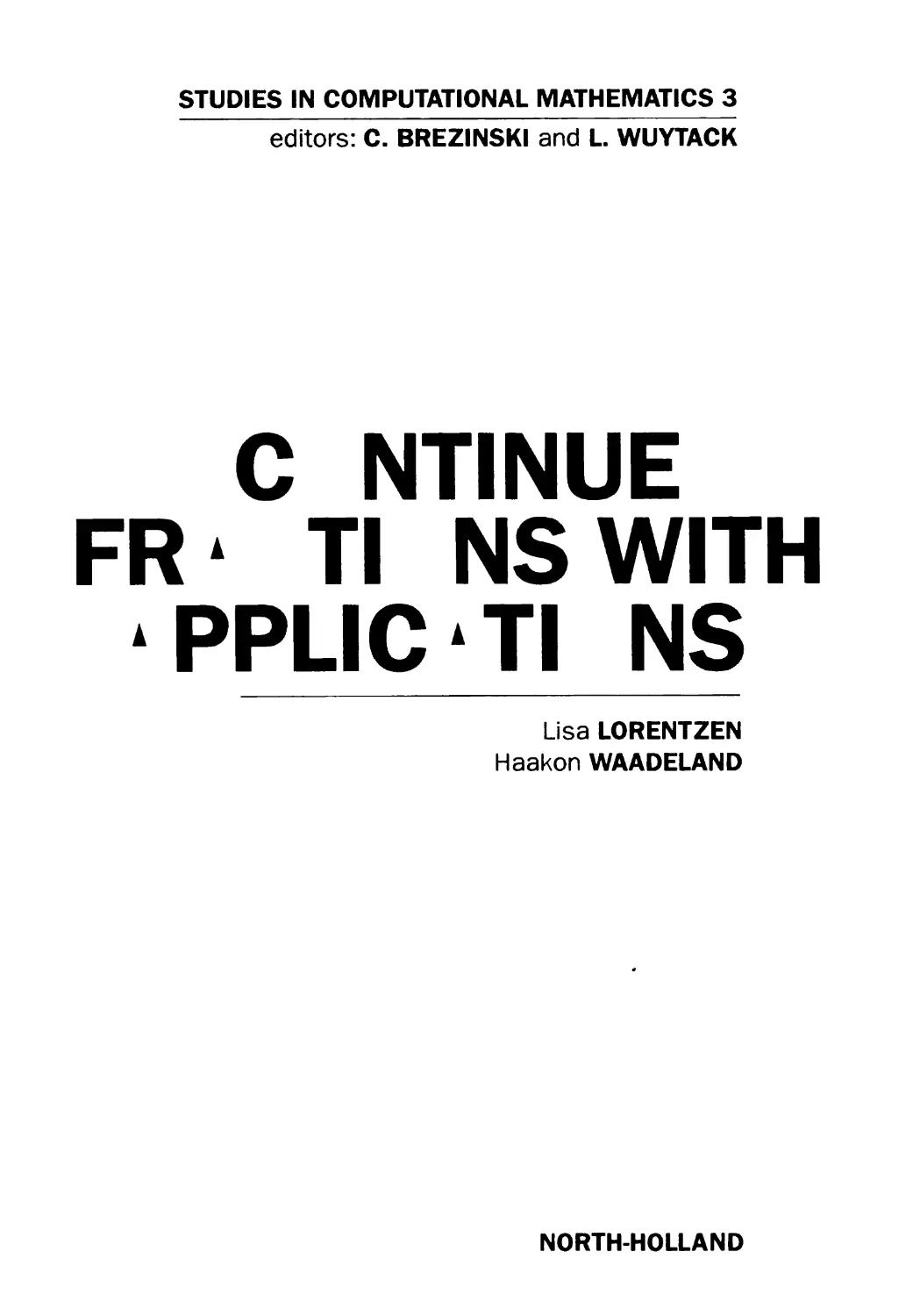
C NTINUE
FR Tl NSWITH
PPLIC Tl NS
Lisa LORENTZEN
Haakon WAADELAND
NORTH-HOLLAND

CONTINUED FRACTIONS
WITH APPLICAl IONS

STUDIES IN
COMPUTATIONAL MATHEMATICS 3
Fditors:
C.BREZINSKI
Univerity of I Me
Villeneuved'Ascq, France
L. WUYTACK
University of A n twerp
Wilrijk, Belgium
HH
NORTH-HOLLAND
AMSTERDAM -LONDON -NI?VVYORK -TOKYO

CONTINUED FRACTIONS
WITH APPLICATIONS
Lisa LORENTZEN
Division of Mathematical Sciences
University of Irondheim
Trondheim, Norway
Haakon WA ADELAND
Department of Mathematics and Statistics
University of Irondheim
Trondheim, Norwav
L992
NORTH-HOLLAND
AMSI LRDAM • LONDON • NEW YORK -TOKYO

FI SEVICR SCIliNC'F PUBI ISHERS B.V.
Sara Burgerhartsiraat 25
P.O. Box 211.1000 AH Amsterdam,The Netherlands
ISBN:() 444 W265 6
© 1992 HIscvicr Science Publishers B.V. All rights reserved.
No part of this publication may be reproduced, stored in a retrieval system oi transmitted in anv form or
by any means, electronic, mechanical, photocopying, recording or otherwise, without the prior written
permission of the publisher, lilsevicr Science Publishers B.V.. Copyright & Permissions Department.
P.O. Box 521, 1000 AM Amsterdam. The Netherlands.
Special regulations for readers in the U.S.A. —This publication has been registered with the Copviight
Clearance Center, Inc. (CCC), Salem. Massachusetts. Information can be obtained from the CCC about
conditions under which photocopies of parts of this publication may be made in the U.S.A. All other
copyright questions, including photocopying outside of the U.S. A., should be referred to the publisher.
No responsibility is assumed by the publisher for any injuiv and/or damage to persons or property as a
matter of products iiabilitv negligence or otherwise, or from am use or operation of any methods,
products, instructions or ideas contained in the material herein.
This book is printed on acid-free paper.
Printed in The Netherlands

Preface
The name Shortly before this book was finished we sent out a number
of copies of Chapter I, under the name "A Taste of Continued Fractions".
Now, in the process of working our way through the chapters on a last
minute search for errors, unintended omissions and overlaps, or other
unfortunate occurrences, we feel that this title might have been the right
one even for the whole book. Tn most of the chapters, in particular in
the applications, a lot of work has been put into the process of cutting,
cancelling and "non-writing". In many cases we are just left with a
"taste", or rather a glimpse of the role of the continued fractions within
the topic of the chapter. We hope that we thereby can open some doors,
but in most cases we are definitely not touring the rooms.
The chapters Each chapter starts with some introductory informa-
information, "About this chapter". The purpose is not to tell about the contents
in detail. That has been done elsewhere. What we want is to tell about
the intention of the chapter, and thereby also to adjust the expectations
to the right (moderate) level. Each chapter ends with a reference list,
reflecting essentially literature used in preparing that particular chap-
chapter. As a result, books and papers will in many cases be referred to
more than once in the book. On the other hand, those who look for a
complete, updated bibliography on the field will look in vain. To present
such a bibliography has not been one of the purposes of the book.
The authors The two authors are different in style and approach.
We have not made an effort to hide this, but to a certain extent the

VI
creative process of tearing up each other's drafts and telling him/her to
glue it together in a better way (with additions and omissions) may have
had a certain disguising effect on the differences. This struggling type
of cooperation leaves us with a joint responsibility for the whole book.
The way we then distribute blame and credit between us is an internal
matter.
The treasure chest Anybody who has lived with and loved contin-
continued fractions for a long time will also have lived with and loved the
monographs by Perron, Wall and Jones/Thron. Actually the love for
continued fractions most likely has been initiated by one or more of
these books. This is at least the case for the authors of the present
book, and more so: these three books have played an essential role in
our lives. The present book is in no way an attempt to replace or com-
compete with these books. To the contrary, we hope to urge the reader to
go on to these sources for further information.
For whom? We are aiming at two kinds of readers: On the one hand
people in or near mathematics, who are curious about continued frac-
fractions; on the other hand senior-graduate level students who would like
an introduction (and a little more) to the analytic theory of continued
fractions. Some basic knowledge about functions of a complex variable,
a little linear algebra, elementary differential equations and occasionally
a little dash of measure theory is what is needed of mathematical back-
background. Hopefully the students will appreciate the problems included
and the examples. They may even appreciate that some examples pre-
precede a properly established theory. (Others may dislike it.)
Words of gratitude We both owe a lot to Wolf Thron, for what
we have learned from him, for inspiration and help, and for personal
friendship. He has read most of this book, and his remarks, perhaps most
of all his objections, have been of great help for us. Our gratitude also
extends to Bill Jones, his closest coworker, to Arne Magnus, whose recent
death struck us with sadness, and to all other members of the Colorado
continued fraction community. Here in Trondheim Olav Njastad has

Vll
been a key person in the field, and we have on several occasions had a
rewarding cooperation with him.
Many people, who had received our Chapter I, responded by sending
friendly and encouraging letters, often with valuable suggestions. We
thank them all for their interest and kind help.
The main person in the process of changing the hand-writ ten drafts
to a camera-ready copy was Leiv Arild Andenes Jacobsen. His able
mastering of I?Tj\X, in combination with hard work, often at times when
most people were in bed, has left us with a great debt of gratitude. We
also want to thank Arild Skj0lsvold and Irene Jacobsen for their part
of the typing job. We finally thank Ruth Waadeland, who made all the
drawings, except the I^T^X-made ones in Chapter XI.
The Department of Mathematics and Statistics, AVH, The University
of Trondheim generously covered most of the typing expenses. The rest
was covered by Elsevier Science Publishers.
We are most grateful to Claude Brezinski and Luc Wuytack for urging
us to write this book, and to Elsevier Science Publishers for publishing
it.
Trondheim, December 1991.
Lisa Lorentzen Haakon Waadeland

Contents
Introductory examples 1
1 Definition and basic concepts. Convergence 3
1.1 Prelude to a definition 3
1.2 Formal definition. Convergence. Notation 7
2 Some examples 10
2.1 The very best 10
2.2 A differential equation 13
2.3 An expansion of a function 14
2.4 A log-expansion 17
3 More examples 18
3.1 Ilypergeometric functions 18
3.2 From power series to continued fractions 21
3.3 From continued fractions to power series 22
3.4 One fraction, two series 23
3.5 The length of an elliptic orbit 26
4 Three classical convergence theorems 30
4-1 Sleszyriski-Pringsheim's Theorem 30
4.2 Van Vleck's Theorem 32
4.3 Worpitzky's Theorem 35
5 Convergence once again 37
5.1 Critical remarks on convergence 37
5.2 Modified approximants 38
5.3 Another concept of convergence 41
5.4 Another concept of continued fraction 44
5.5 Computation of approximants 44
Problems 46
Remarks 50
References 52
IX

II More basics 55
1 Tails of continued fractions 56
1.1 Tails 56
1.2 Tail sequences 59
1.3 Some properties of linear fractional transformations . 62
1.4 Speed of convergence. Truncation error bounds .... 63
1.5 More about general convergence 66
2 Transformations of continued fractions 69
2.1 Generating a continued fraction from a sequence ... 69
2.2 Equivalence transformations 72
2.3 The Bauer-Muir transformation 76
2.4 Contractions and extensions 83
Problems 86
References 91
III Convergence criteria 93
1 Two classical results 94
1.1 The Stern-Stolz divergence theorem 94
1.2 Continued fractions with positive elements 96
2 Periodic continued fractions 101
2.1 Introduction 101
2.2 Classification of linear fractional transformations . . . 101
2.3 Convergence of periodic continued fractions 104
2.4 Thiele oscillation 105
2.5 Tail sequences 106
3 Techniques to prove convergence 108
3.1 Convergence sets 108
3.2 Value sets 110
3.3 Value set techniques I. A posteriori truncation error
bounds 114
3.4 Value set techniques II. A priori truncation error bounds 116
3.5 Value set techniques III. The Hillam-Thron theorem . 119
3.6 Value set techniques IV. The Stieltjes-Vitali theorem . 123
3.1 Smaller value sets for truncation error bounds . . . .125
4 Convergence results 126
4.1 Two useful lemmas 126
4.2 Parabola Theorems 130
4.3 S-fractions 138
4.4 Oval theorems 141

XI
5 Limit periodic continued fractions 150
5.1 Definition 150
5.2 Finite limits, loxodromic case 150
5.3 Finite limits, parabolic case 157
5.4 Finite limits, elliptic case 159
5.5 Choice of approximants 160
5.6 Continued fractions K.(an/1) where an —> 00 169
5.1 Analytic continuation 174
Problems 177
Remarks 182
References 184
IV Continued fractions and three-term recurrence rela-
relations 189
1 Three-term recurrence relations 191
1.1 The structure of the solution space 191
1.2 Approximants for periodic continued fractions in closed
form 194
1.3 Linear independence of two solutions 196
1.4 The adjoint recurrence relation 197
1.5 Recurrence relations in a field F 200
2 Convergence of continued fractions 201
2.1 Pincherle's theorem 201
2.2 Auric's theorem 206
3 Tail sequences once more 209
3.1 Connection to recurrence relations 209
3.2 Minimal solutions and value sets 211
3.3 Tails and convergence 212
4 An application to linear recurrence relations 218
4.1 Forward stability of recurrence relations 218
4.2 A method for computing minimal solutions 220
5 Some generalizations of continued fractions 224
5.1 Introduction 224
5.2 G-continued fractions 225
5.3 Generalized (or vector valued) continued fractions . . 228
Problems 230
Remarks 235
References 237

Xll
V Correspondence of continued fractions 241
1 The nonned field (L,||-||) 242
1.1 Introducing the normed field 242
1.2 Correspondence at z — oo 243
1.3 Properties of the normed field (L, || -||) 246
2 Classification of continued fractions 248
2.1 Criteria for correspondence 248
2.2 Terminating continued fractions 251
2.3 Why classifications? 252
2.4 C-fractions 252
2.5 When does f(z) have a regular C-fraction expansion? 256
2.6 Algorithms for producing corresponding continued frac-
fractions 259
3 Pincherle's and Auric's theorems in (L, || ¦ ||) 265
3.1 Interpretation 265
3.2 A link between correspondence and classical conver-
convergence 270
3.3 Tails and correspondence 274
4 Branched continued fractions 274
4.1 A simple example 274
4.2 Approximants 277
4-3 Another example 279
Problems 281
Remarks 284
References 286
VI Hypergeometric functions 291
1 The hypergeometric functions 2^1 292
1.1 Why and how 292
1.2 A special case 296
1.3 Choice of approximants 298
1.4 Other continued fraction expansions 304
2 Confluent hypergeometric functions 311
2.1 Notation 311
2.2 iFi(b;c;z) 312
2.3 2F0(a,b;z) 316
2.4 oi51! (c; z) 317
3 Basic hypergeometric functions 318
3.1 Definition 318

Xlll *
3.2 2<Pi(a,b)c;q;z) 320
4 Continued fractions bo -f K(ari/6n) where an and 6ri are
polynomials inn 322
4.1 Introduction 322
4.2 Some special cases 322
Problems 326
Remarks 328
References 329
VII Moments and orthogonality 331
1 Orthogonality and continued fractions 332
1.1 Three examples 332
1.2 Moment sequences and moment functionals 338
1.3 Favard's theorem and Jacobi fractions 345
2 Gaussian quadrature 348
2.1 A quadrature formula 348
2.2 An example 351
3 Moment problems 353
3.1 The Stieltjes moment problem 353
3.2 Connection to continued fractions 356
Problems 361
Remarks 363
References 365
VIII Pade approximants 367
1 Classical Pade approximants 369
1.1 A creative problem 369
1.2 Pade approximants 374
1.3 Normal tables. Block structure 379
1.4 Connection to continued fraction expansions 382
1.5 A convergence result 385
2 Generalizations and extensions 386
2.1 Two-point Pade table 386
2.2 Pade type approximants 389
2.3 Multivariate Pade approximants 389
Problems 391
Remarks 392
References 393

XIV
IX Some applications in number theory 397
1 Some basics on regular continued fractions 399
1.1 The Euclidean algorithm 399
1.2 Representation of positive numbers by regular contin-
continued fractions 402
1.3 Best approximation 408
2 Some diophantine equations 410
2.1 Linear diophantine equations 410
2.2 Pell's equation 413
3 Factoring integers 418
3.1 Introduction 418
3.2 Fermat factorization 420
3.3 Factor bases 423
3.4 A lemma on continued fractions 427
3.5 The continued fraction factoring algorithm 428
Problems 435
Remarks 437
References 439
X Zero-free regions 441
1 Zero-free regions for certain sequences of polynomials . . . 442
1.1 Introduction 442
1.2 An application of Van Vleck's theorem 448
1.3 An application of the parabola theorem 451
1.4 The Stieltjes case 453
1.5 The case when an ? R 456
1.6 A fundamental recurrence formula 460
1.1 Chain sequences 462
1.8 Two theorems on zero-free regions 464
2 Stable polynomials 468
2.1 Introductory remarks 468
2.2 Polynomials with real coefficients 470
2.3 Polynomials with complex coefficients 472
Problems 474
Remarks 477
References 479
XI Digital filters and continued fractions 481
1 Filters and their representation 482

XV
1.1 Some introductory examples 482
1.2 Digital filters 484
1.3 Stable filters 489
1.4 Graph representation of filters 493
2 The Schur algorithm 501
2.1 An old algorithm 501
2.2 Schur fractions and digital filters 505
3 Model reduction 508
3.1 General remarks 508
3.2 Stable filters with rational transfer function 509
Problems 514
Remarks 518
References 519
XII Applications to some differential equations 521
1 Second order linear equations 523
1.1 Introduction 523
1.2 An "almost" Euler-Cauchy equation 531
1.3 Two further examples 535
2 Riccati equations 540
2.1 General Remarks 540
2.2 An old example 544
2.3 A new example 547
Problems 554
Remarks 556
References 557
Appendix. Some continued fraction expansions 559
1 Introduction 560
2 Mathematical constants 561
3 Elementary functions 563
3.1 Introduction 563
3.2 The exponential function 563
3.3 The general binomial function 564
3.4 The natural logarithm 566
3.5 Trigonometric and hyperbolic functions 568
3.6 Inverse trigonometric and hyperbolic functions .... 569
3.1 Continued fractions with simple values 571
4 Hypergeometric functions 573

XVI
4.1 General expressions 573
4-2 Special examples with 0^1 575
4.3 Special examples with 2^o 576
4.4 Special examples with \F^ 578
4.5 Special examples with 2^1 580
4.6 Some simple integrals 582
4-7 Gamma function expressions by Ramanujan 584
5 Basic hypergeometric functions 593
5.1 General expressions 593
5.2 Two general results by Andrews 594
5.3 ^-expressions by Ramanujan 595
References 598
Subject index 601

Chapter I
Introductory examples
About this chapter
We have often been asked questions, by students as well as by established
mathematicians, about continued fractions: what they are and what
they can be used for. Sometimes the questions have been raised under
circumstances where a quick answer is the only alternative to no answer:
in the discussion after a talk or lecture, by a cup of coffee in a short
break, in an airplane cabin or on a mountain hike. In responding to
these questions we have very often been pleased by the sparks of interest
we have seen, indicating that we had managed to transmit a glimpse of
new and apparently appealing knowledge. In quite a few cases this led
to a further contact and "follow-up activities".
This introductory chapter is to a large extent inspired by the questions
we have received and governed by the answers we have given. There
is of course a great danger: A quick answer is often a wrong answer.
It may (and even ought to) tell the truth and nothing but the truth,
but it definitely does not tell the whole truth. This may lead to false
guesses. This danger is in particular great in cases where observations
and experiments are used to create and support guesses, such as in
Section 2 of the present chapter. But we still wanted to keep this (often

2 Chapter I. Introductory examples
non-accepted, but highly necessary) aspect of mathematics as part of
the introductory chapter. We have tried to reduce the danger partly by
the way things are phrased, partly by indicating briefly how wrong such
guesses can be, and finally by referring to a more careful treatment later
in the book.
We decided to include, already in the introductory chapter, on the one
hand three classical convergence theorems, on the other hand some of the
newer thoughts on convergence and computation of continued fractions.

Definition and basic concepts. Convergence 3
1 Definition and basic concepts. Convergence
1.1 Prelude to a definition
Let {tn} be a sequence of complex numbers. When we talk about the
series
oo
*n=*l+*2 +••- + *« + ¦¦-, A.1.1)
we have in mind the sequence {Tn} of partial sums
n
or recursively defined
= Tn -f
Convergence of the series A.1.1) means convergence of {Tn} to a complex
number T, in which case we write
oo
X>n=T. A.1.2)
n=l
Similarly we are familiar with infinite products
oo
II Pn = P\ • V2 ¦ • -Pn ' • * , A.1.3)
n=l
where all pn are complex numbers ^0. {Pn} is the sequence of partial
products
n
k=l
or recursively defined
Pn+l = Pn ' Pn+l ¦
Convergence of the infinite product A.1.3) means convergence of the
sequence {Pn} to a complex number P ^ 0, in which case we write
oo
J[Pn = P- A-1.4)
n=l

Chapter I. Introductory examples
Let {an} be a sequence of complex numbers ^ 0, and let {/rt} be the
sequence from C = C U {00} given by
/i = «i ? h = — , h =
1 -f ao
and generally
*
Jn —
do
Similarly to what we have for sums and products this also leads to
a concept, having to do with the nonterminating continuation of the
process, in this case the concept of a continued fraction, constructed
from a sequence {an} of complex numbers, all ^ 0:
CO fli
K K/l) = . A.1.5)
l tt
Convergence of A.1.5) means convergence of the sequence {fn} of ap-
proximants. We shall also accept convergence to 00.
Example 1 For the continued fraction
oo
6
1 + 7—
we find
t 6 t 42

Definition and basic concepts. Convergence 5
It is easy to prove, by induction (see Problem 5, with x = 2, y = —3)
that generally
(-3)" -2"
Jn D
From this it follows that the continued fraction converges to 2.
O
Quite similarly we can construct, from any sequence {bn} of complex
numbers, a continued fraction
oo 1
K A/M = , A.1-6)
n=l 1
or from two sequences, {an} and {bn} of complex numbers, where all
an ^ 0, a continued fraction
00 «i
K K/6n) = . A.1.7)
6 °
&3 +
A.1.5) and A.1.6) are obviously special cases of A.1.7). In the partic-
particular case when in A.1.6) all bn are natural numbers we get the regular
continued fraction, well known in number theory, the one coming from
the Euclidian algorithm. We shall look at regular continued fractions in
Example 2 of the present chapter, and more seriously in Chapter IX.
Let us take a look at the common pattern in the three cases: series, prod-
products and continued fractions (and other constructions for that matter).
In all three cases the construction can be described in the following way:
We have a sequence {<j>k} of mappings from C into C. By composition
we construct a new sequence {$n} of mappings
= <t>\ , $n = #n-l O <j)n = (j)i O <jJ O • • • O <j)n . A.1.8)

6 Chapter I. Introductory examples
In all three cases there is a fixed complex number c, by means of which
convergence is defined: as convergence of {<?n(c)} for that particular c.
(There is a difference in the question of whether or not convergence to
0 or oo is counted as convergence or not.)
For series we have
and the partial sums are
$n@) = 4>i o fa o • - • o (j)n(Q) = tx + t2 + •¦• + *„,
i.e. here we have c = 0.
For products we have
fa(w) =
and the partial products are
i.e. here we have c = 1.
For continued fractions A.1.7) we have
k + w
and the approximants are
¦n@) =
a
ti
n
i.e. here we have c = 0.
Remark: If all ak ^ 0 the mappings fa are all non-singular linear
fractional transformations. Hence <^jTl all exist. We shall later make
much use of this property.

Definition and basic concepts. Convergence
1.2 Formal definition. Convergence. Notation
The following definition is due to Henrici and Pfluger, see for instance
[Henr77, p. 474] (for a slightly different version):
Definition A continued fraction is an ordered pair
(({«»}, {*»}). {/»}) , A-2-1)
where {fln}i° and {&n}o° are given sequences of complex numbers, an
0, and where {/„} is the sequence of extended complex numbers, given
by
n = 0,1,2,3,---, A.2.2)
where
So(w) = so(w), Sn(w) = 5n_i (sn(w)), n = 1,2,3, - - - , A.2.3a)
sn(w) = -—-—, n = l,2,3,---. A.2.3b)
See also [JoTh80, p. 17].
The continued fraction algorithm is the function K mapping a pair
({ari}, {bn}) onto the sequence {/n} defined by A.2.2) and A.2.3). Here
the numbers an and bn are called the nth partial numerators and de-
denominators. A common name is element. The number
Sn@) = bo+ ~ A.2.4)
5

8
Chapter I. Introductory examples
is called the nth approximant. Several more convenient ways of writing
the approximants are introduced in the literature on continued fractions.
We shall here use:
A.2.4')
and more generally
c / \ * . ai . a'2
Sn(w) = bo+ —+ —
6, b2
t
bn
Convergence of a continued fraction to an extended complex number /
means convergence of {/«} to /, in which case we write
/ = bo + — , ~r
a
n
n H
or
A.2.5)
A.2.5')
We even use the notation on the right-hand side when we discuss con-
continued fractions more generally, regardless of convergence properties.
In computing numerically the value of a continued fraction the approx-
approximants, in particular those of high order, are essential. The first ones
are:
/o = &o »
Gb{ -f a\
-I- a2
A straightforward computation without cancellation leads to fractions
for the approximants:
A.2.6)
If we define
B~-\
—
1 '
0
>
—
1
A.2.7)
the following is easily proved by induction:
An + vlri
A.2.8)

Definition and basic concepts. Convergence
where the recurrence relation
9
An '
= bn
' An-l '
+ an
Bn-2
A.2.9)
for n = 1,2,3,... holds. The proof is left as an exercise. Observe that
5n, being a composition of non-singular linear fractional transformations
sk(w) =
is itself a non-singular linear fractional transformation. We have in par-
particular
Bn-\
We shall here call An and Bn nth canonical numerator and denominator
(sometimes just numerator and denominator). An important property
of the numbers An and /?„, is the determinant formula
n
AnBn.x - An_KBn = (-
A-2.10)
k=i
The proof is straight forward use of the recurrence relation A.2.9), and
is left as an exercise.
Let it finally be mentioned that we also may go "in the opposite di-
direction", i.e. from given sequences {An} s^d {Bn} to a continued frac-
fraction A.2.5'). Actually, any pair ({;4n},{f?n}) with the initial condition
A.2.7) determines uniquely a continued fraction A.2.5') with
Jn - .. ,
provided that
AnBn-X - An-xBn ? 0, n = 0,1,2,
(Theorem 7 in Chapter II).

10 Chapter I. Introductory examples
2 Some examples
2.1 The very best
Example 2 From the equality
follow the equalities
2 + 2 + (>/2 - 1) 2 + 2 + 2 +(v/2-1)
1 1 1 1
2 + 2 + 2 + 2 + (V5-1)'
and so on, as long as we want to. Since obviously
. 11 1 1
for any length of the row of dots, it seems to be a good idea to take a
look at the approximants of the regular continued fraction
We find
111
+ 2 + 2 + 2+.
•¦i-
1+11 =
2 + 2
1+2 + 2 + 2
2 + 2 + 2 + 2 ~~
1 + 1 I l I I -
^ 2 + 2 + 2 + 2 + 2
1.5
7
5 ~~
99
70
1
= 1.4
= 1.4166... ,
= 1.41379... ,
= 1.4142857... .
These fractions seem to approach v2 pretty quickly. Already the fifth
one, the last one listed, has an error less than .00008. We phrase tlus

Some examples 11
observation in the following way: The fractions seem to be very good
rational approximations to the irrational number y/2.
O
This is a good place for a warning: Identities such as the ones we have
studied here, which led us into the temptation of studying 1 + K{\/2),
in the hope of getting good approximations to y/2, may just as well be
a dead end. (Actually, the normal thing is that it goes wrong.) The
equality
1 V
will for instance lead to
but the continued fraction (still) seems to converge to y/2. See also Sub-
Subsection 3-4- Such identities are special cases of more general recurrence
formulas, which will play a crucial role later in this exposition.
But in the present case everything goes well. Our numerical observations
are matched by mathematical reality: In fact, it can be proved, that the
fractions obtained are not only very good approximations to \/2, but the
very best, in the following sense: If p/q is one of the fractions obtained
in the way described above, and if m/n is a fraction such that
771
yfi--
n
o
>
i.e. m/n is a better approximation to y/2 than p/q, then n > q. Slightly
rephrased: In order to find a better approximation to y/2 than p/q, we
have to increase the denominator, (p,q,m,n are all positive integers.)
We shall not go into the proof of this here, merely present a geometric
illustration (also without proof) of this way of approximating an irra-
irrational number:
Let a be a positive irrational number (in our case y/2). We shall let the
number a be represented by the ray y = ax from the origin and into
the first quadrant of a cartesian coordinate system. Let furthermore

12
Chapter I. Introductory examples
the lattice point (n, m) represent the fraction m/n. Then the following,
illustrated in Figure 1, can be proved: Assume that there is a nail in
every lattice point, and a rubber band fastened in the points A,0) and
@,1). Stretch the rubber band with a pencil following the ray y = ax
(or y = \/2x in our case). Then the corners of the polygon, in the
order they turn up, are the lattice points corresponding to the rational
approximants of the regular continued fraction for a. Observe e.g. on
Figure 1. the points A,1), B,3), E,7), corresponding to the fractions
1/1, 3/2, 7/5. Inside the polygon, i.e. where the ray is, there are no
lattice points, showing the "bestness" of the fractions 1/1,3/2, 7/5 (and
17/12,41/29, • • •) as approximants for y/2.
This way of illustrating approximations was told to one of the authors
by Viggo Brun in lectures at the University of Oslo [Brun50j, but it
goes way back, and different people have been given credit for it. Any
positive irrational number has a unique representation by a continued
fraction of this type. See remark 2 at the end of this chapter.

Some examples 13
2.2 A differential equation
Example 3 From the differential equation
y = V + y"
follow by differentiation the equalities
y' =
yK ' -
and hence, assuming that we do not divide by 0:
y1 = 2Jt7l7"
y"
= 2 +
y(n+\)/y(n+2) '
From this it follows that
2/7
Tl+l
This suggests to look at the continued fraction
2 + 2+---+2+.--
We "know" from Example 2 that this converges to \/2 + l> which suggests
that
y'
or
y

14 Chapter I. Introductory examples
from which it would follow that
This is actually a solution of the given differential equation.
O
There is of course no good reason to use this "method" for the present
differential equation, since there exists a perfectly good, simple method
taught in elementary calculus classes. Furthermore, the continued frac-
fraction method (even after it is properly established) produces only a par-
particular integral, not the general solution. But there are cases, where this
idea leads to non-trivial results, and where the method may represent an
alternative to (or at least a supplement to) existing power series meth-
methods for solving Unear ODEs. See [Khov63], [Steen73], [Waad83] and the
references there. See also Chapter Xll of the present book.
2.3 An expansion of a function
Example 4 From the identity
x
follow, as it did in Example 2, the identities:
x x
\/l + x - 1 = - -
This suggests to look at the approximants of the continued fraction
xx x
2 + 2+-..+ 2+-.-'
i.e. at the rational functions
x xx 2x x x x x2 + Ax
2' 2 + 2 ~ z + 4' 2 + 2 + 2 = Ax + 8 '
and so on. We refer to the warning in Subsection 2.1.

Some examples
15
Continued fraction expansions are less known than power series expan-
expansions. In the present case the Taylor series expansion at 0 is
oo
- 1 =
I, L L n JLo 0|
* = 2* - 8* + 16* - 128* +
It converges for \x\ < 1 and diverges for \x\ > 1. The approximants of
the series are the partial sums
1
-
2
1
So = -X X ,
2 2 8 '
and so on. Observe that the series approximants are polynomials, whereas
the continued fraction approximants are rational functions.
Let us make an experiment: We compute the two types of approximants
for a certain x— value to see what happens. We choose x = .96, in which
case the value of the function is exactly .4. In the table below some power
series approximants (sn) and some continued fraction approximants (/n)
are listed, all correctly rounded in the 4th decimal place:
n
fn
1
.4800
.4800
2
.3648
.3871
3
.4201
.4022
4
.3869
.3996
5
.4092
.4001
6
.3932
.4000
7
.4053
.4000
This of course does not prove anything, but it suggests that in some
cases the continued fraction may be better (converge faster) than the
power series expansion. (It is, however, only fair to say, that such a
comparison, based merely upon the order n of the approximant, does
not always give the correct picture. Essential in the comparison is the
resources needed, usually the time.)
Even more flattering for the continued fraction expansion is the choice
x = 3. In this case it does not make sense to compute power series
approximants, since we know that the power series diverges. In the next
table the first seven continued fraction approximants are listed, correctly
rounded in the 4th decimal place. Keep in mind that the value of the
function is 1.

16
Chapter I. Introductory examples
n
fn
1
1.5000
2
.8571
3
1.0500
4
.9836
5
1.0055
6
.9982
7
1.0006
The table suggests that the continued fraction expansion converges to
the right value for x = 3, i.e. for a value where the power series diverges,
in which case the continued fraction is better than the power series also
in that respect. (The next three approximants are .9998, 1.0001 and
1.0000.)
O
In Chapter 111 it will be proved that the continued fraction in Exam-
Example 4, with real x, converges for all x ? [—l,oo) and diverges for all
x ? (—oo, — l). For complex x it will be proved, that the continued frac-
fraction expansion converges in the whole plane, except on the ray (—oo, — 1)
of the negative real axis, and to the right value. In Figure 2 we have
convergence of the continued fraction expansion in the whole plane, ex-
except on the strongly indicated ray, whereas the power series expansion
converges inside the dotted circle and diverges outside of it.
\
\
p
Figure 2.

Some examples 17
For later use in the present chapter we rewrite the identities at the
beginning of this example in the following form:
flc-1 x/A
x/A x/A x/A
11 ' B.3.1)
1 + 1 H h 1 + (-s/T+aB - l)/2
The approximants are the former ones, divided by 2.
2.4 A log-expansion
Example 5 An example, related to the previous one, but less trivial,
is the expansion
or more precisely
1 /1 , \ z azz a'iZ
logfl -f z) — —
SV ^ ; 1+1 + 1
where log here shall mean the principal value of the natural logarithm,
and where for all k > 1
k k
2Bib
Right now we shall not worry about how one gets this, only use it for
some experiments, to compare it to the power series expansion
z2 z* zA
log(l + z) = z-j + — - — + .-..
Let us take the "worst" example, z = 1. The series then converges to
log 2, but very slowly. The first seven continued fraction approximants
are listed in the table below, correctly rounded in the 5th place. The
value is log 2 = .69314718, correctly rounded in the 8th place.

18
Chapter I. Introductory examples
n
fn
1
1.00000
2
.66667
3
.70000
4
.69231
5
.69333
6
.69312
7
.69315
In order to get the series approximation sn with the same accuracy we
need n > 105.
Let us also here try a z- value where the series does not converge, for
instance z — 3. In the next table the first 7 continued fraction approx-
imants are listed, all correctly rounded in the 4th place. The value is
log 4 = 2 log 2 = 1.38629436, correctly rounded in the 8th place.
n
fn
1
3.0000
2
1.2000
3
1.5000
4
1.3636
5
1.3973
6
1.3837
7
1.3874
This table also suggests convergence to the right value.
_O
We shall later see, that the present continued fraction expansion for
log(l -f z) converges for all complex z, except on the ray (—oo,-1]
of the negative axis, whereas the power series expansion converges for
\z\ < 1 and diverges for \z\ > 1. An illustration would look like Figure
2.
3 More examples
3.1 Hypergeometric functions
Example 6 The hypergeometric functions
ab z a(a+ 1NF+ I) z2
+\
C.1.1)
where a, b, c are complex numbers, and c not 0 or a negative integer,
are of great importance in several applications. Many of the well known

More examples 19
special functions are special cases of C.1.1). Tf we assume that also a
and 6 are different from 0 and the negative integers, the series C.1.1) is
an infinite power series whose radius of convergence is 1. The following
formal identities can be established from C.1.1) by comparing the power
series on both sides term by term:
F(a,6;c;z) = F(a,b + 1; c + 1; z)
a + 1,6 + 1; c + 2; z)
F(a,6 + l;c+l;z) = F(a + 1, 6 + 1; c + 2; z)
zF(a+ l,6+2;c + 3;
Assuming that we avoid zeros in the denominators, this can be rewritten
in the following way:
F(a, b\c\z)
F(a,b+l;c+l;z)
- 1 +
- 1 +
—a(<
c
F(a,b
F(a+1,
-F + 1
(c +
F(a + 1,
(c
+
6
)(
1
,6
«
: +
i;
)(i
+
-6)
1)
c4
1; c
- a
c +
1; c
z
i;
'I
2)
-' +
^)
2;z)
l)z
2;z)
F(a+l,6+2;cH 3;
Observe that the denominator on the right-hand side of the first equality
is equal to the left-hand side of the second one. Furthermore, the de-
denominator on the right-hand side of the second equality coincides with
the left-hand side of the first one, if in the former a is replaced by a + 1,
6 is replaced by 6 + 1 and c by c + 2 in all places. Hence, by repeatedly
increasing the first two parameters by 1 and the third one by 2 we are
lead to a continued fraction in a similar way as we have seen in Subsec-
Subsection 2.2. The continued fraction, already studied by Gauss [Gaussl3],
[Gauss 14], is of the form
1 -f- 1 -J-' • •-{- L -J-
where
,(° + ").(c:^ + "> , . = 0,1,2,-, C.1.2')
(c + 2n)(c -f 2n + 1)

20 Chapter I. Introductory examples
(b -f n)(c — a + n) ,
K A ' 71=1,2,3,--.. C.1.2")
-f 272 - 1)(C + 272)
We shall see later, in Chapter VI, that the sequence of approximants
converges to a meromorphic function in the whole plane, except on the
ray z > 1 of the positive real axis, and that this function is
F(a,b;c;z)
(or its ineromorphic continuation, if we regard the function as primarily
defined by its power series).
Observe that
<zn-> --. C.1.3)
The continued fraction C.1.2) thus is an example of what is called a
limit periodic continued fraction. The tails of the continued fraction
"look more and more like" the continued fraction expansion for
2 > C-L4)
(see B.3.1)). We shall later use this property to improve the procedure
of computing the values of the continued fraction C.1.2). The idea is to
replace the actual tails of C.1.2) by C.1.4) in forming the approximants.
This means, that we, instead of using 5n@) as approximants, use 5n (?/;),
with it? as in C.1.4). Recall that STI(w) is given by the formula in A.2.8).
is called a modified approximant.
Later in this exposition we shall see more of hypergeometric functions
and their expansions. The reasons for including this particular example
here are: 1. To emphasize the connection between three term recurrence
relations (such as the formal identities for the hypergeometric series or
the differential equations in Subsection 2.2.) and continued fractions.
2. To put the example from Subsection 2.4 into a more general context:
The log-function is a special hypergeometric function:
Three-term recurrence relations will be the topic of Chapter IV.
O

More examples 21
3.2 From power series to continued fractions.
We have seen, that continued fractions of the form
CL\Z
1 + 1 H + i H
in some cases are of advantage compared to power series expansions both
as far as speed of convergence and domain of convergence are concerned.
Hence it is of interest, and sometimes useful, to go from a power series
to this particular continued fraction. We shall illustrate the most prim-
primitive way of doing this (in [CuWu87] called the method of successive
substitutions) by using the log-series as an example:
z2 z3 zl
log{l + z) = lu(z) = *-_ + ---
«¦> -
This leads to the identity
/,(*)'
1 + k{z) '
z
where l\(z) is a uniquely determined power series starting with a term
cz. We recognize the start of the expansion from Subsection 2.4, and the
process could have been continued to any length (depending upon how

22 Chapter I. Introductory examples
many terms we start with in the log-series). It is of course not obvious,
that we will get a continued fraction of the form
d\Z (I2Z 0>nz
1 _|_ 1 +...+ 1 +...'
since we possibly may run into an ^B), starting with a term czk with
k > 1. It is known, however, that this will not happen in the present
case. This procedure gives a partial answer to the question mentioned
in Subsection 2.4, how we can get the continued fraction expansion for
log(l 4- 2). But by this procedure, as presented here, we do not get
general formulas for an, let alone anything about convergence. In con-
conclusion we may say, that the present method by far is not the best
practical method, but it indicates a possible bridge from power series to
a continued fraction expansions.
3.3 From continued fractions to power series
Sometimes we want to go in the opposite direction, i.e. from continued
fraction to power series. We shall use our continued fraction expansion
for log(l -f 2) as an example. Here are the first (classical) approximants
with their power series expansions at 0:
First approximant:
- = 2 -f O22 + O23 + 0z
Second approximant:
Z2 23 ZA
1 + 2/2 2_ 4 8
Third approximant:
2 _ z2 2^ 2
. 2/2 ~z~Y + y~9'
+1 + 2/6

More examples 23
Fourth approximant:
_2 ~3 _4
A* & >C
z/2 2 3 4
The underlined terms coincide with terms in the power series for log(l -f
z). Observe that the agreement increases with the order of the approxi-
mants. It can be proved (and it will, in Chapter V) that this continues.
It is called correspondence between the power series and the continued
fraction expansion. A proper definition will be given later.
3.4 One fraction, two series
We shall now look at a very special example, which however will prove
very useful later.
Example 7 The identity
1-Z
used repeatedly leads to the identities
z z z z
z—- , z =
I-z+l-z + z1 I -z + l -z + l-z + z'
and generally
z z
1-Z+1-Z+---+1-Z
On the other hand, the identity
leads to
1 - z + \ - z-\ +1 - z - 1

24 Chapter I. Introductory examples
Inspired by these two identities we look at the continued fraction
z z z
I- z + 1 - z-\ +l-z-\
For simplicity we assume z to be different from all roots of unity, in
which case the approximants fn are:
z z(l + z)
~ \-Z~ 1 - 22
z z
_ z(l - z) z(l - z2)
1 — z 4-1 — z 1 — z -\- z2 1-f- z'3
z z z z(l 4- zA
h -
JJ 1-z + l-z + l-z 1-z1
By induction the following formula is easily established:
fn =
See Problem 5, with x = z, y = — 1.
We shaD make tauo types of observations on the approximants, one on
convergence, one on correspondence. We distinguish two cases:
lim fn = z
n —> oo
/„ = z + (—z)n+1 + higher powers of z
lim /„ = -1
n —> oo
/„ = — 1 + (—z)~n -f higher powers ofz
The way these observations will be phrased within the analytic theory
of continued fractions is as follows:
The continued fraction
-? — — C.4.2)

More examples 25
a) converges in \z\ < 1 to z, and corresponds at 0 to the series
z + Oz2 + O23 + • ¦ • ,
b) converges in \z\ > 1 to — 1, and corresponds at 00 to the series
_O
This example shows that one and the same continued fraction expansion
may converge to two different functions in two different regions and
correspond to two different series at two points (here 0 and 00).
This trivial example has its non-trivial relatives, where one continued
fraction simultaneously represents two different analytic or meromorphic
functions by convergence and correspondence.
We conclude this section with another trivial remark (still in Example
7), which also has its non-trivial analogues. It has to do with replacing
the classical approximants fn = 5n@) by some modified approximant
Sn(w). The interesting w-values here are z and —1:
Case 1: If 5n@) is replaced by Sn(z), all (classical) approximants will
be replaced by z. This implies two things: The convergence to z
in IzI < 1 is accelerated (bull's eye, the value is hit right away),
and the convergence to z is extended also to the region \z\ > 1,
i. e. we have an analytic continuation of the limit function in
\z\ < 1 to the whole plane.
Case 2: If 5rt@) is replaced by 5n(—1), all classical approximants will
be replaced by —1. This implies two things: Acceleration of con-
convergence to —1 in \z\ > 1 (again bull's eye), and the convergence
to —1 is extended also to 0 < \z\ < 1, i.e. we have an analytic
continuation of the limit function in \z\ > 1 to the whole plane,
minus the origin.

26 Chapter I. Introductory examples
The continued fraction C.4.1) is a special case of a T-fraction, named
after W. J. Thron. We shall get back to T-fractions later in the book.
3.5 The length of an elliptic orbit
Example 8 We shall look at the computation of the circumference L
of the ellipse
?- + L. = lJ a>6>0, a>0. C.5.1)
The well known arc length formula leads to an elliptic integral. One way
of finding approximate values for it is to use power series. By using the
arc length formula one easily proves the following, which is a well known
formula, see for instance [Il{itte55]:
t t2 t3 25J4 \
+ + + + j C.5.2)
1 22 2r> 28 214
where
* = f<2—rl - C.5.2')
\a + bj
For the general coefficient an explicit formula exists, and also the con-
convergence properties are known. We shall leave out both here. Observe
that the formula is exact for a circle, a = 6, i.e. t = 0.
One way of finding approximate values for L is to truncate the series at
different places. We shall, however, use a quite difFerent approach:
We transform the series into a continued fraction the way it is shown in
Subsection 3.2. The start of the continued fraction is in this case
i/4 -t/16 -3t/16 -31/16
1 i . ^o.O.oJ
The first approximants are
MO = i,

More examples 27
... t/4 -*/16 -3*/16 64 -
/3@ - 1 + T+~T"+~T^-
t/A -t/16 -31/16 -3J/16 _ 256 - 48* - 21*2
17+ I + I + I ~ 256 -112* + 3i2
These rational functions are what we later will learn to know as Pade
approximants to the series in the //-formula.
The Pade approximants determined above give us a sequence of approx-
approximate formulas for L:
We shall not include any discussion on the accuracy of the formulas,
merely mention some points to indicate it: The formula with n = 2,
simple as it is, has an error less than 3 mm for an ellipse with size and
eccentricity as the orbit of the planet Mercury. The formula with n = 3
has for the same ellipse an error roughly = 1/10 of the wave length of
blue light. In the "flat" case, which is likely to be the "worst" case
(t — 1), the exact value of L is 4a. The approximate formulas give in
this case:
= 3.1416a
= 3.9270a
7ra/2(l) = 3.9794a
7ra/:J(l) = 3.9924a
7ra/,(l) = 3.9964a
The factors are all correctly rounded in the 4th decimal place.
We shall conclude this example by presenting two approximate formulas
obtained in a different way, namely by using a modified approximant
for the continued fraction C.5.3). We have already touched upon the
concept in the Subsections 3.1 and 3.4-

28 Chapter I. Introductory examples
In the continued fraction C.5.3) we pretend that all partial fractions
from the second one are equal to
1 '
i.e. we replace the continued fraction C.5.3) by
4/4 -f/16 -*/16 -*/16
+ T+ 1 + 1 + I +.-."
(This is of course only an experiment, and we have no guarantee that
it will lead to a good approximation.) This continued fraction may be
written
1 + -^- , C.5.4)
1 -+- w
(which, in standard notation, is S\(w)), where w is the value of the
continued fraction
-t/16 -
1 + 1 + 1 +
i.e. (see B.3.1))
Since
= 3 - V4 - t,
we get the formula
L « ?r(a + 6)C - \/4-0 . C.5.5)
This formula was first found by Ramanujan [Rama57]. For an ellipse of
si/e and eccentricity as the orbit of Mercury this formula has an error
less than 2 mm. For the degenerate case ("flat" case) it gives the value
3.9834a.
The next formula also uses a modified approximant C.5.4), but with an-
another w, based upon the observation that the continued fraction C.5.3)
has two equal partial fractions

More examples 29
in a row, and in front of them
-t/16
1 '
If we pretend that all subsequent partial fractions are
-3S/16
1 '
(again merely an experiment) we have in C.5.4)
w
_ 1 /-3*/16 -3^/16 -3*/16 -3*/16 \
~ 3 V 1 + 1 + 1 + 1 +•• J '
which has the value
-3J/4-1).
(See B.3.1).) This suggests the approximate formula
t/4
or, rewritten in a nicer form
L % ir(a + b) A 4 , ) • C.5.6)
This seems to be the best of the approximate formulas mentioned in this
section. For the "flat" case it gives the value 3.9984a.
This formula also is due to Ramanujan, although it is not known how
he established it. It is assumed, though, that the method shown in the
present section was the one he used [AlBe88].
O

30 Chapter I. Introductory examples
4 Three classical convergence theorems
4-1 Sleszyriski-Pringsheim's Theorem
Theorem 1 The continued fraction K.{a,n/bn) converges if for all n
fl. D.1.1)
D.1.2)
D.1.2')
Under the same condition
1/-1 <
holds for all approximants fn} and
for the value of the continued fraction.
Proof : We first prove D.1.2) by induction. For any n > 1 we have
a
n
bn
a
n
On I +
which proves D.1.2) for n = 1. Next, for any n > 2
On/bn
which establishes D.1.2) for n = 2.
Assume that for some /z, 1 < k < n
has the property /A
(*)
< 1. Then
\ak\ + 1 - \fn
(*)
< 1

Three classical convergence theorems
31
Hence, by induction on /z,
- I f (o)
l/nl = |/<
< 1
To prove the convergence of K(an/^«) we observe that the determinant
formula A.2.10) gives
B
n
i-l
Hence the convergence is established as soon as we have proved the
convergence of the series
oo
E
n-\
BnBn-.\
D.1.3)
From the recurrence formulas A.2.9) we have, for n > 1
\Bn\ = |6nUn_, f an^n-2| > |6n||i?n-i| - |an||2?ri_2
and hence
From this it follows that
n
and the general term in D.1.3) thus satisfies
\Bn-\
We therefore find that D.1.3) converges absolutely, and that the nth
partial sum has absolute value less than or equal to
\Bn
Hence the series D.1.3) converges. D.1.2') is now a simple consequence
of D.1.2). ¦

32 Chapter I. Introductory examples
Remark: If D.1.1) holds, then it follows from our proof that also
< 1 for all |u>| < 1 and Sn(w) —> f locally uniformly for \w\ < 1.
Example 9 Let z be a complex number, and assume that all |an| < 1.
Then the continued fraction
oo an
K —
71=1 Z
converges for all \z\ > 2. In the special case when an = 1 for all n we
find for the value f(z) :
From this it follows that
In Chapter III we will discuss periodic continued fractions more gener-
generally. The continued fraction K(l/z) is a special case. So are also the
continued fractions in the Subsections 2.1 and 2.2. Here in Example 9
the branch of the square root is to be chosen such that f(z) —> 0 when
z —> oo, i.e. such that
/ 2 \ 2
+ 4 = z f 1 + — + - - •) = z + - + ¦ • • ,
and hence
(The • • • mean higher powers.of z~x.)
O
4.2 Van Vleck's Theorem
Theorem 2 (Van Vleck's Theorem) Let 0 < ? < 7r/2, and let bn
satisfy
-|+* <arg6n< |-? D.2.1)

Three classical convergence theorems 33
for all n. Then all approximants o/K(l/6n) are finite and in the angular
domain
< - - e . D.2.2)
Furthermore, the sequences {/2m} and {/2m+i} converge to finite values.
If (and only if), in addition
00
? K\ = 00 , D.2.3)
then K(l/6n) converges.
Partial proof: We shall here restrict ourselves to a proof of the first
part of the theorem, i.e. that the approximants all satisfy D.2.2). The
proof is closely related to the first part of the proof of Sleszynski-
Pringsheim's Theorem, i.e. the proof of the statement on the location of
the approximants fn.
A crucial point in the present case is the following observation for the
angular domain Ve described in D.2.1) and D.2.2):
ve D.2.4)
for all 6fc E Ve. This follows immediately from the fact that the sum of
two elements in Vc also is in Ve, and that
weve=> - ev?.
From D.2.4) it follows by induction as in the previous section that D.2.2)
holds for all n. ¦
This argument is a special case of a basic type of argument in conver-
convergence theory for continued fractions. We shall return to this later, and
also to the rest of the proof of Van Vleck's Theorem.

34 Chapter I. Introductory examples
Remark: If D.2.1) holds, then also the approximants Sn(w) of K(l/6n)
are finite and E V? if w E Ve. Moreover {Sn(w)} converges locally uni-
uniformly to the value of K(l/6n) in Ve. The convergence is also uniform
with respect to the actual choice of bn from compact subsets of V?.
Example 10 It follows immediately from Van Vleck's Theorem that a
regular continued fraction always converges. (As defined in Subsection
1.1 and illustrated in Subsection 2.1 a regular continued fraction is a
continued fraction K{l/bn), where all bn are natural numbers. Obviously
then all 6r, are in any Ve with 0 < e < tt/2, and also ? |6n| = J] bn = oo.
O
Example 11 It follows immediately from Van Vleck's Theorem that
any periodic continued fraction K(l/6n) where all bn have positive real
part will converge. We hope that the following two-periodic continued
fraction will serve as an example. The continued fraction to be studied
here is
1 1 1 1 1 1
Since we know that it converges, it is rather easy to find the value / it
converges to. It must satisfy the equation
_ 1
1-2 + /
i.e.
This quadratic equation has the two roots
/ - Q
2&ai 2
Since the real part of / has to be positive, we find
.O

Three classical convergence theorems 35
4-3 Worpitzky's Theorem
Theorem 3 (Worpitzky's Theorem) Let for all n > 1
aTl\ < i . D.3.1)
Then K(an/1) converges. All approximants fn are in the disk
<\, D-3.2)
and the value f is in the disk \w\ < ^.
Proof: Let
a 1 a-} an
1 + 1 +---+ 1 +¦
D.3.3)
be such that |an| < 1/4 for all n. It is easily seen, that the sequence of
approximants for the continued fraction
2a, 4a, Aa, 4^
2 + 2 + 2 +•••+ 2 +••- v '
is exactly the same sequence as the sequence of approximants for D.3.3).
Since \an\ < 1/4 for all n, we have
2>|4on| + l,
and from Sleszynski-Pringsheim's Theorem it follows that the continued
fraction D.3.4), and hence D.3.3) converges. If the continued fraction
D.3.4) is multiplied by two, which means to replace the first partial
fraction by 4di/2, we find from Sleszynski-Pringsheim's Theorem that
all approximants have absolute value < 1, and hence all approximants
of D.3.3) have absolute value < 1/2. From the convergence it then
follows, that the value of the continued fraction is in the disk \w\ < ^.
This concludes the proof of Worpitzky's Theorem. (This is essentially
Sleszynski's proof.) ¦

36 Chapter I. Introductory examples
Remark: Again the convergence of Sn(w) is uniform with respect to
{aTl} and w for \aTl\ < 1/4 and \w\ < 1/2.
We shall now, through an example, indicate how the knowledge of a set
where the values must be, can be used in the computation of continued
fraction values.
Example 12 Let
— — D.3.5)
1+1+1 + 1+-.. ^ }
be a continued fraction where all an have absolute value < 1/4. What
can be said about the value of the continued fraction?
From Worpitzky's Theorem it follows that the value of the tail
a.i a. j an
1 + 1 +¦•¦+ 1 +•¦•
is in the disk \w\ < 1/2. The linear fractional transformation (l.f.t.)
1/8
w —> —¦
1 + w
maps the disk \w\ < 1/2 onto the disk
1
w--
and the l.f.t.
-1/4
w —* —
maps this disk onto the disk
14
(This is established by using standard methods for mapping disks by
linear fractional transformations, or simply by computing, in each case,
the intersections with the real axis together with the knowledge that
the images are disks.) Observe how quickly we reach good values. By
taking —14/65 as an approximate value, the error is < 1/65, regardless
of which continued fraction D.3.5) we have, if it satisfies \an\ < 1/4 for
all n > 3.
O

Convergence once again 37
5 Convergence once again
5.1 Critical remarks on convergence
We return to some of the thoughts from the very first section in the
present chapter. When a series
oo
converges, the nth tail goes to 0 when n goes to oo:
oo
lim V tk = 0. E.1.1)
k=n+\
The nth approximant of a series is obtained by removing the nth tail,
or, phrased differently: by replacing it with its limit (which is 0), i.e.
the nth approximant is
n
Tn =
When a product
oo
converges, the nth tail goes to 1 when n goes to oo:
oo
lim J[ Pk = l. E.1.2)
n —> oo AA
k=n+\
The nth approximant of a product is obtained by removing the nth tail,
or, phrased differently: by replacing it with its limit (which is 1), i.e.
the nth approximant is
n
Pn =
n
The nth approximant of a continued fraction is also obtained by cutting
off the tail, i.e. the nth approximant is
n B/r.
K 7T'

38 Chapter I. Introductory examples
but for continued fractions this does not mean to replace the tail by its
limit. Usually this limit does not exist at a//, and if it exists, it is 0 only
in very special cases. A continued fraction where the limit exists, is the
one in Example 1,
where all the tails, including the continued fraction itself, have the value
2. This raises the questions:
1) In computing the value of a continued fraction other sequences
{Sn(wn)} may be better than {5n@)}. (Look back to Subsections
2.3, 34 and 3.5.)
2) Perhaps the concept of convergence of continued fractions should
not have been tied to the sequence {5rt@)}, but to some {Sn(wn)}.
We shall consider these questions in the rest of the chapter.
5.2 Modified approximants
The word has been used earlier, and in the Subsections 3-4 and 3.5 we
have seen examples indicating that in some cases sequences {Sn(w)} or
even {Sn(wn)} may be better than {5n@)} in the computation of the
value of a continued fraction. Here are two more examples:
Example 13 For the continued fraction
oo 30 + 0.9n /r « ,\
K —- , E.2.1)
the tails look more and more like
oo 30 ,
K T, 5.2.2)
if we let them start further and further out. One can prove, that E.2.2)
converges to the positive root of the quadratic equation
30
it —
1 '

Convergence once again
39
i.e. to 5. (Problem 2, the hint in Problem 6 and a little more.) This
suggests, that in the computation of E.2.1) the sequence {?^E)} may
turn out to be better than {5n@)}. (The convergence of E.2.1) is not
hard to prove directly, but after Chapter III it will be trivial. For the
time being we take convergence for granted.) The following table indi-
indicates strongly that this is in fact true. In the table C stands for classical
approximants, i.e. 5n@), whereas J stands for modified approximant, in
the present case 5nE). See [JaWa84], [ThWa82].
n
1
2
3
4
35
36
37
38
39
40
41
85
86
87
88
89
C
30.9000
0.97139
15.6770
1.85765
5.10127
5.07160
5.09631
5.07571
5.09288
5.07857
5.09049
5.08507
5.08506
5.08507
5.08507
5.08507
J
5.15000
5.03667
5.12176
5.05762
5.08507
5.08506
5.08507
5.08506
5.08507
5.08507
5.08507
5.08507
5.08507
5.08507
5.08507
5.08507
-O
Example 14 For the continued fraction
3 + 1/12 4 + 3/22 3 + 1/32 4 + 3/42 3
the tails "look more and more like"
3 4 3 4
1/5
+¦
E.2.3)
E.2.4)

40
and
Chapter I. Introductory examples
E.2.5)
4 3 4 3
1 + 1 + 1 + 1+..."
We take convergence for granted in all cases, since it will be obvious after
Chapter III. The value of the continued fraction E.2.4) is the positive
root of the quadratic equation
3
u = ,
which is 1. The value of the continued fraction E.2.5) is the positive
root of the quadratic equation
4
u =
u
which is 2.
In the table below {5n@)} is compared to {Sn(wn)}, where w-2k — 1 and
w2k-i = 2.
71
J
2
3
4
5
6
7
8
9
10
11
12
13
23
24
25
26
C-app.
4.00000
0.69565
1.85580
1.00775
1.38927
1.12527
1.25252
1.16637
1.20885
1.18033
1.19451
1.18502
1.18975
1.18739
1.18738
1.18738
1.18738
J-app.
1.33333
1.18519
1.20055
1.18752
1.18941
1.18745
1.18777
1.18740
1.18746
1.18738
1.18740
1.18738
1.18738
1.18738
1.18738
1.18738
1.18738

Convergence once again 41
The table indicates strongly that {Sn(wn)} converges to the same value
as {Sn@)}, and faster.
O
From Example 13 and Example 14 it seems (and it will later be proved)
that with {wn} properly picked {Sn(wn)} converges to the value of the
continued fraction, and faster than {^(O)}. What "properly picked"
means will be discussed later. We easily can make "improper choices":
Take any sequence {/3tl} of extended complex numbers, and choose
This is possible, since all Sn are non-singular. Then we have
n
This shows, that we can make {5n(w;ri)} converge to anything we want,
or diverge, regardless of the convergence behavior of the continued frac-
fraction itself.
Let it finally be mentioned, that in some cases attempts to compute the
value of some continued fraction K(an/&n) lead to a sequence {Sn(wn)}
which converges to something we have reason to believe is the value
of the continued fraction, whereas {5n@)} may be hard to handle, or
even to get hold of. In such cases one needs results about going from
convergence of {Sn(wn)} to convergence of the continued fraction, and
to the same value (which, as we just have seen, is not true in general).
5.3 Another concept of convergence
We shall first look at an example [Jaco86]:
Example 15 For the 3-periodic continued fraction
1 I — - i Zl
l+I-i- i +I+T+T+-.-

42 Chapter I. Introductory examples
it is not hard to prove, by using the recurrence relations A.2.9) and
induction, that for all n > 1
A'ta-2 = 2n, ^3n-l = 2n, A[in = 0,
-2, ?3n = 1.
Hence the approximants An/Bn are
2" 2"
i3n-l = 2n+l 2 ' ¦*Jn ~ '
_ 3 »
from which
Hm /3n_2 = - , lim /3n_, = - , lim fMl = 0
n —> oo 2 « —*¦ °° 2 " —*¦ oo
immediately follow. This shows that the continued fraction diverges.
For the modified approximants Sn(wn) we find from A.2.8)
2n + t«3W.2 ¦ 0 11
when 72 —> cxd, if the sequence {ti?3n_2} is bounded.
2" + tU3n-1 • 2"
1 + W3n-1
2A + ^3n-i) - C«;3n_i + 2J"" * 2
when n —> oo, if the sequence {tu3n_i} is bounded away from — 1.
0 + w3n • 2" u^1
1 + «>3nBn+1 - 2) 2 - wan + A - 2 • ti;3nJ-» " 2
when 7i —* oo, if the sequence {w^n} is bounded away from 0.
Hence we have, in this example, that limn —> oo 5r,@) does not exist,
whereas
for all {wn} bounded away from 0,-1, oo. This example suggests strong-
strongly, more so than earlier considerations, that the definition of convergence
of continued fractions is "wrong", since the continued fraction in this
example "ought to converge".
O

Convergence once again 43
This example (together with other observations) has led to a new def-
definition of convergence [Jaco86]. In the definition we use the chordal
distance d(z,w), which is defined by
if w and z are both finite, whereas
1
d(w, oo) =
This is a metric very much used in the theory of functions of one complex
variable, in particular in cases where the point at infinity is not supposed
to play a special role, different from the role of other points. The name
comes from the fact, that d(w, z) is the length of the chord between the
images of w and z on a sphere by a suitable stereographic projection.
Definition K.(an/bn) is said to converge generally to an f ?C if there
exist two sequences {vn} and {wn} in C such that
liminf d(vn,wn) > 0 E.3.1)
and
Sn(vTl)= Urn Sn(wn) = f. E.3.2)
n —r oo n —*¦ oo
We shall see later, that / is unique. (If not, the definition would not
make sense.) One property follows directly from the definition: If a
continued fraction converges in the ordinary (classical) sense to /, we
have
lim Sn@)= lim Sn(oo) = f.
n —* oo n —r oo
Since 0,0,0,... and oo, oo, oo,... are two sequences satisfying E.3.1), it
follows that ordinary convergence to / implies general convergence to /.
Thus the new concept includes the classical one, and picks up additional
cases, for instance the one in Example 15.
More important is, that it in many cases is easier to apply. One ad-
advantage is, that we do not need to worry about {5n@)}. Once we have
proved E.3.2) for two sequences satisfying E.3.1) we are through (as far
as general convergence is concerned).

44 Chapter I. Introductory examples
5.4 Another concept of continued fraction
The formal definition of a continued fraction was presented in Subsec-
Subsection 1.2, and the sequence {?^@)} played a crucial role in the definition.
Recently there has been an increased use of and emphasis on modifica-
modifications. Out of this has grown the concept of modified continued frac-
fractions, obtained by replacing the sequence {/n}, fn = 5n@), by {gn},
gn = Sn(wn). Of course the notation must then contain {?#„}. This ap-
appeared in print at first in [BaJo86], and the modified continued fraction
was there written
An abbreviated notation is
K(an,bn,wn).
We obviously have, with reference to notation introduced earlier:
«n}, {6n},
K(an,6n,0) = K(an/6n),
K(an,l,0) = K(an/l).
In working with modified continued fractions the classical one is some-
sometimes referred to as the reference continued fraction.
The earlier mentioned problem of going from convergence of Sn(wn) to
convergence of 5n@) can now be expressed as a problem of going from
convergence of modified continued fractions to convergence of ordinary
continued fractions.
5.5 Computation of approxirnants
To compute
a
n
"
, + by +• •.+ bn + wn ~ Bn + Bn.
there are several algorithms. We shall only mention the two obvious
ones:

Convergence once again 45
1. The forward recurrence algorithm consists of computing An and
Dn by the recurrence relation A.2.9).
2. The backward recurrence algorithm starts at the other end by
setting
tn = wn
and then work backwards by setting
+ tk
for k = n, n — 1,..., 1. Then Sn(wn) = to (or &o + to).
The first method has the advantage that if you have found Sn(wn), you
can easily find 5n+i(tyn+i)» whereas you must start again from scratch
in the second method. On the other hand, the backward recurrence al-
algorithm is in general more stable. (Why will become evident in Chapter
IV.) The computations in this book are done by means of the backward
recurrence algorithm.

46 Chapter I. Introductory examples
Problems
A) Use the identity
y/b- 1
2 i . Vs-\
1 ^ 2
to produce a continued fraction by the procedure of Example 2.
Compute the first 7 approximants fn and compare the values to
- l)/2. Prove that
where Fo = 1, FL = 1, F2 = 2, F3 = 3, F, = 5, and generally
Fn+i =Fn + Fn-l forn> 1.
(The sequence {Fn} is the sequence of Fibonacci numbers, and the
ratio (\/o — l)/2 = .61803... is the golden ratio.)
B) Prove the following: For any real a, if the continued fraction
a a a
T+T+T+-..
converges, then it converges to one of the roots of the equation
a
x —
1 + x
Use this to prove that the continued fraction diverges for all a <
-1/4.
C) Assume that we know that the continued fraction
1 1 1
1 + 1-j l-\
converges. Prove that it then converges to (\/5 — l)/2.
D) Find a particular integral of the differential equation
y = 22/' + Zy"
by using the "method" in Subsection 2.2.

Problems 47
E) Let x and y be complex numbers, \x\ ^ |y|, and let fn be the
nth approximant of the continued fraction
—xy
-(« + y) + -(a: + y) + ~{x + y) +• • - *
Find a formula for /„ in terms of x and y.
F) Assume that we know that the continued fraction in Example 4,
xxx
converges to \/l + 2 — 1 for positive 2-values. Use this to find \/5
with an error < 5 • 10" "*J. (Hint: Observe — and prove — that
{f'2n} and {/2n+i} are monotone. Take a; = 1/4.)
G) Compute for a suitable n the first n approximants of the continued
fraction in Problem 6 for x = 1 — 2z. Try to guess in advance
what the sequence will converge to, and compare to the computed
approximants.
(8) Assume that we know that the log(l + z)-expansion of Subsection
2.4 converges to log(l + z) for positive z-values. Use this to find
log 5 with an error < 5 • 10~3. (Hint as in Problem 6 with z = 4.)
(9) Compute for a suitable n the first n approximants of the continued
fraction in Subsection 2.4 for z — i — 1. Try to guess what the
sequence of approximants converges to.
A0) Use Example 6 in Subsection 3.1 to establish the expansion of
log(l + z) of Subsection 2.4-, assuming that the continued fraction
expansion C.1.2) of
F(a, 6; c; z)
is established. (Hint: Take a = 1,6 = 0, c = 1, and replace z by
A1) Let a be real and not a positive integer. With F as in Subsection
3.1, prove that
F(-a,l;l;-z) =

48 Chapter I. Introductory examples
Under the same assumptions as in Problem 10 find a continued
fraction of the form
1 + 1 + 1 +...
for 2A -j- z)n by using Subsection 3.1.
A2) Let a be as in A1). Use the procedure of Subsection 3.2 to trans-
transform the power series expansion of z(\ -f z)a at 0 to a continued
fraction of the form
b\z b2z 63Z
1 + 1 + 1 +...
(Of course only the start, for instance up to and including b\z/l.)
A3) Use the procedure of Subsection 3.2 to transform the power series
expansion at 0 of ez — 1 to a continued fraction of the form
b\z
1 + 1 + 1 H
(Compute 61,62,6;j, b,\.)
A4) Use the procedure of Subsection 3.3 to find the first terms of the
power series expansion at 0 corresponding to the regular C-fraction
z_ -z/2 z/6 -z/6
1+ 1 +T+ 1 +...
A5) Let a be a positive number. For which values of a does the con-
continued fraction 'K^2i(l/n~nL) converge, and for which values does
it diverge? (Hint: Use Van Vleck's Theorem.)
A6) Use Worpitzky's Theorem to prove the following:
a) The value of any continued fraction
1/4 -1/4 a3 a,
~T+ 1 +T+T+...'
with |arl| < 1/4 for all n must lie in the disk
2
w
5

Problems
49
b) The value of any continued fraction
z/4 ct2 a:i
T+T+T+--.'
with \an\ < 1/4 for all n must lie in the disk
1
- 6
A7) For the continued fraction in Example 15 of Subsection 5.3 com-
compute Sn(wn) for the following values of wn. In which cases do we
have convergence?
a) wn = 1,
b) wT> = n,
c) wn = 2("
d) wn = 1/n,
e) wn = 2-"/3.

50 Chapter T. Introductory examples
Remarks
1. For those who want to go deeper into the analytic theory of con-
continued fractions we refer to the three standard monographs in
the field: the classical text-book by Perron [Perr54], Wall's book
[Wall48], with its introduction to some of the new ideas, upon
which the modern theory is built, and finally the most modern
exposition, by Jones and Thron from 1980 [J0TI18O]. In Henrici's
3 volume work on Applied and Computational Complex Analysis
[Henr77] a large portion of Volume 2 is devoted to analytic theory
of continued fraction. Khovanskii's book [Khov63] contains some
interesting applications. References to further books and papers in
the field are found in the texts above. As for the history of contin-
continued fractions we refer to a recent book by Brezinski [Brez91], but
also to the texts mentioned, in particular to the book [JoTh80] by
Jones and Thron, which contains many interesting comments on
the historic development of concepts, methods and applications.
2. To most people (meaning mathematicians) continued fractions are
most closely associated with Number Theory, for instance in con-
connection with diophantine equations of degree 1 or 2. The continued
fractions used there are mostly regular continued fractions. One
very important thing in the Theory of Numbers is the connection
between the Euclidean algorithm and the terminating regular con-
continued fraction expansion of rational numbers. In the present expo-
exposition we shall not say much about continued fractions in number
theory, except for a small chapter on some applications in number
theory (Chapter IX). We also refer to [Perr54].
3. After Example 4 and Example 5 in Subsections 2.3 and 2.4, indi-
indicating superiority of continued fractions over power series expan-
expansions, both as far as domain of convergence and speed of conver-
convergence are concerned, it is only fair to say, that this is not always
the case. Sometimes it is the other way around. One trivial exam-
example, which has its non-trivial analogues, is Example 7 in Subsection
3.4- There the power series z + O.z2 + O.z** + • • • is transformed
into the continued fraction C.4.1). The series converges to z in
the whole plane. The convergence is the "fastest possible", since
all partial sums = z. The continued fraction converges to z in the

Remarks 51
open unit disk \z\ < 1, but more slowly, and for \z\ > 1 it even
converges to "something wrong", namely to —1. (It can be proved,
that it diverges on the circle \z\ — 1, except for z = — 1, where it
converges to — 1.) On the other hand, we shall see in Chapter VI
that the continued fraction in Example 6 always "wins over the
hypergeometric series".
4. For references and comments connected to the three classical the-
theorems in Section 4 we refer essentially to the book by Jones and
Thron [JoTh80]. Let it be mentioned, though, that Worpitzky's
Theorem was proved already in 1865, but remained unknown to
workers in the field until Pringsheim rediscovered it more than 30
years later. It was not until 1905, through Van Vleck, that Wor-
pitzky got credit for it. Part of the reason may be the way it was
published, (in an annual report from the school where Worpitzky
was teaching, [Worp65]), but there may be other more significant
reasons, see [JaTW89]. Theorem 1 usually carries the name of
Pringsheim. However, as pointed out to us by W. J. Thron, J.
Sleszynski is the right one to give credit, since he already proved
the theorem in 1888, see [Sles89].
5. Already Hamel [Hamell8] raised the question about the concept
of convergence for continued fractions.

References
[AlBc88]
[BaJo86]
[Brez91]
[Brun50]
[CuWu87]
[Gaussl3]
[Gaussl4]
G. Almkvist and B. Berndt, Gauss, Landen, Ramanu-
jan, the Arithmetic-Geometric Mean, Ellipses, ir, and the
Ladies Diary. Amer. Math. Monthly A988), 585-608.
C. Baltus and W. B. Jones, A Family of Best Value Re-
Regions for Modified Continued Fractions, "Analytic Theory
of Continued Fractions II", Lecture Notes in Mathematics
1199 (ed. W. J. Thron), Springer-Verlag, Berlin A986),
1-20.
C. Brezinski, "History of Continued Fractions and Pade
Approximants", Springer Series in Computational Mathe-
Mathematics, 12, Springer-Verlag, Berlin A991).
V. Brun, "Forelesninger over Kjedebr0k", Universitetet i
Oslo A950).
A. Cuyt and L. Wuytack, "Nonlinear Methods in Numer-
Numerical Analysis", North-Holland Mathematics Studies, Ams-
Amsterdam A987).
C. F. Gauss, Disquisitiones generates circa seriem infini-
*x* etc,
Commentationes Societatis Regiae Scientiarium Gottin-
gensis Recentiores 2 A813), 1-46; Werke, Vol. 3 Gottingen
A876), 134-138.
C. F. Gauss, Methodus Nova Integralium Valores per Ap-
proximationem Inveniendi, Commentationes Societatis Re-
52

References
53
[Hamell8]
[Henr77]
[Hiitte55]
[Jaco86]
[JaTW89]
[JaWa84]
[JoTh80]
[Khov63]
[Perr54,57]
[Rama57]
giae Scientiarium Gottingensis Recentiores 15 A814), 39-
76; Werke 3 Gottingen A876), 165-196.
G. Hamel, Uber einen limitarperiodischen Kettenbruch,
Archiv der Math, und Phys. 27 A918), 37-43.
P. Henrici, "Applied and Computational Complex Analy-
Analysis", Vol. 2, Wiley, New York A977).
Hiitte, "Des Ingenieurs Taschenbuch", 28. Aufl. 1, Wilhelm
Ernst & Sohn, Berlin A955), Seite 139.
L. Jacobsen, General Convergence for Continued Fractions,
Trans. Amer. Math. Soc. 281 A986), 129-146.
L. Jacobsen, W. J. Tliron and H. Waadeland, Julius Wor-
pitzky, his Contributions to the Analytic Theory of Con-
Continued Fractions and his Times, "Analytic Theory of Con-
Continued Fractions III", (ed. L. Jacobsen), Lecture Notes in
Mathematics 1406, Springer-Verlag, Berlin A989), 25- 47.
L. Jacobsen and H. Waadeland, Modification of Contin-
Continued Fractions, "Pade Approximation and its Applications,
Bad Honnef 1983", (H. Werner and H. J. Biinger eds.) Lec-
Lecture Notes in Mathematics, Springer-Verlag, Berlin 1071
A984), 176-196.
W. B. Jones and W. J. Thron, "Continued Fractions: An-
Analytic Theory and Applications", Encyclopedia of Mathe-
Mathematics and its Applications, 11, Addison-Wesley Publish-
Publishing Company, Reading, Mass. A980). Now distributed by
Cambridge University Press, New York.
A. N. Khovanskii, "The Application of Continued Fractions
and Their Generalizations to Problems in Approximation
Theory", P. Noordhoff, Groningen A963).
0. Perron, "Die Lehre von den Kettenbriichen", Vol. 1, 2
3. Aufl., B. G. Teubner, Stuttgart A954, 1957).
S. Ramanujan, "Notebooks", Vol. 2 Tata Institute of Fun-
Fundamental Research, Bombay A957). Now distributed by
Springer-Verlag. l

54 Chapter I. Introductory examples
[Sles89] J. V. Sleszyriski, Zur Frage von der Konvergenz der Ket-
tenbruche (in Russian), Mat. Sbornik 14 A889), 337-343,
436-438.
[Stecn73] A. Steen, Integration af LineeEre Differentialligninger af
Anden Orden ved Hj&lp af Kjdsdebr0ker, Kobenhavn
A873).
[ThWa82] VV. J. Thron and H. Waadeland, Modifications of Contin-
Continued Fractions, a Survey, "Analytic Theory of Continued
Fractions", Proceedings 1981, (W. B. Jones, W. J. Thron
and H. Waadeland eds.), Lecture Notes in Mathematics
932, Springer-Verlag, Berlin A982), 38-66.
[Waad83] II. Waadeland, Differential Equations and Modifications
of Continued Fractions, some Simple Observations, "Pade
Approximants and Continued Fractions", Proceedings
1982, (H. Waadeland and H. Wallin eds.) Det Kon-
gelige Norske Videnskabers Selskabs Skrifter, Trondheim
1 A983), 136-150.
[Wall48] II. S. Wall, "Analytic Theory of Continued Fractions", Van
Nostrand, New York A948).
[Worp65] J. Worpitzky, Untersuchungen u'ber die Entwickelung
der monodromen und monogenen Funktionen durch Ket-
tenbruche, Friedrichs-Gymnasium und Realschule Jahres-
bericht, Berlin A865), 3-39.

Chapter II
More basics
About this chapter
Continued fractions are defined by means of linear fractional transfor-
transformations. Such transformations have very nice properties. One way to
take advantage of this is to introduce the concept of tail sequences. (The
beautiful mapping properties of linear fractional transformations will be
exploited in Chapter III.)
Continued fractions can also be described by means of linear recurrence
relations. This will be treated at length in Chapter IV, but already now
we observe the following from formulas A.2.6)-A.2.9) in Chapter I: If
{An} and {Bn} are given, satisfying certain conditions, then the ele-
elements {an} and {bn} of the continued fraction can be determined. This
is the background for the useful transformations of continued fractions
to be presented in this chapter, transformations that allow us to change
the coefficients of a continued fraction without altering its approximants
(too much).
55

56 Chapter II. More basics
1 Tails of continued fractions
1.1 Tails
The Nth tail of the continued fraction 60 + K(an/^«) is the continued
fraction
oo an ayv+i Qn+2 Qn+'a f \
n=N+\ bn O/V + l -fOA'+i + 0vV+3+* * *
for AT G Nrj. Here and in the rest of the book No is the notation for the
set of non-negative integers; i.e. No = NU{0}. There are several reasons
to study such tails, and one is described in the following theorem.
Theorem 1 The following three statements are equivalent.
A) 6q + K(an/&n) converges/converges generally.
B) A.1.1) converges/converges generally for an N G Nq.
C) A.1.1) converges/converges generally for all N G No-
Proof : C => B and C => A follow trivially.
A => C: Let &o + 'K(an/bn) converge to /. That is, its approximants
fn = «Sn@) converge to /. Let N G No be chosen arbitrarily, and let
i ' = 5;, ^@) denote the approximants of A.1.1). Then
so that fn = SjS,\fi\r+n). The convergence of /r\ ' as n —> oo follows
therefore from the fact that 5^' is a linear fractional transformation,
and therefore is a bijection of C onto C, since all an ^ 0. (This will be
discussed in Chapter III.)
The proof for general convergence uses the same idea, where we use the
analogue
Siv+n(w) = Stw(S^ }(w)) = 5/v o S^ '(w) A.1.3)

Tails of continued fractions
57
to A.1.2).
C: This can also be proved in a related way.
Example 1 We shall prove that the continued fraction K(an/l) con-
converges if an —> 0.
Since an —> 0 there exists an N ? No such that \an\ < 1/4 for all n >
N. Hence, the JVth tail of K(an/l) converges by Worpitzky's theorem,
Theorem 3 in Chapter T.
Observe that we can no longer conclude that the value / of K(otn/1) is
in the closed disk |/| < 1/2. This is only true for the value /W of its
Nth tail, |/W| < 1/2 (and for /(*) for all k > N). The value / may
even be infinite.
O
We have used An and Bn to denote the canonical numerators and de-
denominators of 60 + K(an/bn), and Sn(ivn) and fn = 5Tl@) to denote
its approximants. For its iVth tail we use An , Bn , Sn (w^vv+n) and
fy ' = Sn @) to denote the corresponding quantities. This notation
will be used throughout the book.
Just as for ATn Bn and Sn we have
n + A {
G7)fTv)
for n = 1,2,3,..., and
o - - • o sN+n(w), A.1-4)
where A^ = 1, A^ = 0, B™ = 0, B
= 1 and
r aw 1
Bw
n
— D/V-t-n
/I
B{N)
An-2
. ^n-2 .
N+n
A.1.5)
A.1.6)
In addition one can also prove:

58 Chapter II. More basics
Lemma 2 With the notation just introduced the following equalities
hold:
W = aN+lB forN>0, n > 0, A.1.7)
=bN+lB^ +aN+2BZ2) forN>0, n > 1 , A.1.8)
N+n
TT / x
11 I ajJ '
Proof : A.1.7) is trivially true for n = 0 and n — \. Hence it holds
for all n, since by A.1.5)
A^ = bN+nA{nN_\ + aN+nA[N_\ for all n > 1
and
?<*?'' = bN+nBtV] + a/v+n^3+'' for all n > 2 .
A.1.8) holds trivially for n = 1 and n = 2. By induction on n we find
that it holds for all n, since by A.1.5)
= bN+l \bN+nB^_2 +ajv+n#n_3 J
forn>3.
Finally, it follows from A.1.6) that A.1.9) holds for k = 0 since
1. For fe = 1 we get by A.1.5) that
B

Tails of continued fractions 59
which proves A.1.9) for this value of k. By the same process we find
that
n-l An-lnn+k
for * = 2,3,4,...
which is the same recurrence relation as A.1.5) for \ B, \
x ' I * JJt=
Hence A.1.9) follows.
1.2 Tail sequences
Assume that &o + K(an/&n) converges. Let /W G C denote the value of
its Nth tail A.1.1) for N = 0^1,2,.... Then we find from A.1.l) that
/ = 60 + /(") is the value of 60 + K(an/bn) and
N = 0,1,2,.... A.2.1)
(A.2.1) is to be interpreted in the obvious way if /(^) or /(N+1) is infi-
infinite.) We say that {/^}w=o ^s ^ne "ri&t toil sequence [or the convergent
continued fraction 6q + J&(an/bn).
More generally, we say that a sequence {tn}?JLu °f elenients from C is a
tail sequence for 60 + K(an/bn) if
*"-' = h ^f =sn(tn) for n= 1,2,3,.... A.2.2)
This means in particular that
t0 = Sl(tx) = a, o «2(t2) = ... = «! o ... o an(tn) - 5<0)(*n) A.2.3)
L-l
for all n, and thus that {5A (^))}^Lo ^s a ^a^ sequence (uniquely
defined) for every *o € C. Observe that if {tn}™-o is a tail sequence for
bo + K(an/&n)> then {*n}^L^ is a tail sequence for its A^th tail A.1.1).

60 Chapter II. More basics
Theorem 3 Let {tn} be a tail sequence for 60 -f K(an/bn). Then
for all n.
A.2.4)
Proof : Inverting A.2.3) gives tn = sn^ o snl_l o • • • o sx '(to) which is
equal to s~l os~[{ O---O5J osq1F0 + to) = 5~1F0 + to)- From A.2.2)
we find that
-»(„,)= _6*+ — = -(&* +t^t) forA;> I. A.2.5)
*• to L {w)j
This proves the last equality in A.2.4).
Remark: Observe that if {tn} and {tn} are two tail sequences for
bo + K(ari/6n) with tk = t^ for one index fc, then tfl = tn for all ?7 by
A.2.4) since all Sk are bijections of C onto C.
We shall see later that the tail sequence {S^^oo)} plays a special role
in our theory. We define
hn = -S~x(oo) for n = 0,1,2,... , A.2.6)
which gives h.Q = oo, h\ =b\, and
h,. = -^~ = 6n 4 T^^^1^ ,r for n = 1,2,.... A.2.7)
(Observe that 5~'(oo) = 5n (oo) since so(oo) = oo> regardless of
the value of 6n.) This sequence {hn} is called the critical tail sequence
of 60 + K(a«/^rt) (although it is strictly speaking {—hn} which is a tail
sequence).
Example 2 In Example 15 in Chapter I we saw that the 3-periodic
continued fraction
an 2 1 -1 2 1 -1 2
K i 1 + 1+T+1+I+ i

Tails of continued fractions 61
converges generally to / = 1/2, but diverges in the classical sense since
5:jn@) = 0 for all n. We shall see that the tail sequence {tn} of K(a«/l)
with ?o = 0 is 3-periodic, why this has any connection to the convergence
behavior of K(ctnA)> and compute this tail sequence. We shall also see
whether K(ctn/l) has any other 3-periodic tail sequences.
Let t0 = 0. By A.2.3) we have tn = si^' («„) = 5~1@) since 60 = 0.
Since 53n@) = 0 for all n, this means that <3n = 0 for all n. Prom A.2.2)
with n replaced by 3n, we find that ?3n_ | has a value independent of n
since {an} is periodic and all bn = 1. Similarly also t^n-z has a value
independent of n, so {tn} is 3-periodic.
We may say that {tn} reveals the "trouble" we have with the convergence
of fn = 5ri@). For every tail sequence we have &o -f to = Sn(tn). So if
{tn} is not a right tail sequence, we must stay away from tn (wn ^ tn)
when we choose approximants Sn(wn) for our continued fraction, at least
from some n on. Otherwise we destroy the convergence to /. Our {tn}
is not the right tail sequence since to ^ / = 1/2. And we did not stay
away from {tn} when we chose our approximants Sri@). For every third
index n we have wn = tn = 0.
With to = 0 the terms of {tn} are
2
?<J = t:in = 0, t\ — *3n+i = Sj (to) = ~ 1 + - = CX),
t'i = *jn+2 = S2 {t\) = —i-\ = — 1 for n = 1,2,3,....
CX)
The right tail sequence {f^} must also be periodic since every third
tail of K(an/1) ls identical to K(an/l) itself. It is given by
l=_2 forn=1>2>3>
These two sequences are the only 3-periodic tail sequences of K(ct«/l),
since {tn} is a 3-periodic tail sequence if and only if tn = tn+^; that is,

62 Chapter II. More basics
if and only if tn is a solution of the equation
tn = S3 (^n+.O = S3 (tn).
Tliis is a quadratic equation which has at most two solutions.
O
1.3 Some properties of linear fractional transformations
Both a continued fraction bu + J?(an/bn) and its tail sequences are closely
tied to linear fractional transformations
t(w)= aW^~ ad-bc^O. A.3.1)
(See for instance A.1.4) and A.2.2).) Such transformations t(w) are
bijective mappings of C onto C with very nice properties:
a) t(w) maps (generalized) circles on the Riemann sphere C onto
(generalized) circles on C.
b) Let C be a (generalized) circle on C. Then t maps points symmet-
symmetric with respect to C onto points symmetric with respect to t(C).
(The reflection property.)
c) The cross ratio is invariant under linear fractional transformations;
that is, if W|, w<2, w^ and w4 are four distinct points in C, then
- t{w2))(t(w3) -
- w3)(w2 - u>.i) {t{wi) - t(w-j))(t(w2) - t(w.\)) '
(If one of the points w^ or its image t(wk) is equal to infinity, then
A.3.2) has the standard meaning.)
Sometimes it is of advantage to use the chordal metric d(w\, w-i) as
defined in Subsection 5.3 of Chapter I. The cross ratio is still invariant
under t if we define it by the chordal metric:
, w2) • d(w3, w,\) d(t(wi)it(w2)) • d(t(w3),t(wi)) .
— A.3.3)
d(t(wi),t(w3))-d(t(w2),t(wl))
for wi,W2,W3,W\ G C all distinct.

Tails of continued fractions 63
Speed of convergence. Truncation error bounds
Convergence properties are often important in applications of continued
fractions. Not only the existence of a limit, but also how fast this limit is
approached by the approximants fn (or more generally Sn(wn)). Hence
it is important to have estimates for this speed of convergence. We
distinguish between a priori truncation error bounds
|/-/n|<An, A.4.1)
where An > 0 is a bound we can find in advance, before we start com-
computing the approximants, and a posteriori truncation error bounds
\f-fn\<Mn\fn -/n-l|, A.4.2)
where the bound Mn\fn — fn-i\ can be determined only after we have
computed (at least) the approximants fn and fn-\. A priori bounds
A.4.1) can be used to determine, in advance, the index n we need in
order to obtain a desired accuracy. This saves work in the sense that
one only needs to compute fn for this particular index. A posteriori
bounds A.4.2) work more like a stopping criterion. One computes ap-
approximants /|, /a, fa,... until the right hand side of A.4.2) is sufficiently
small. Sometimes the a posteriori bounds are more accurate, so we can
stop at a lower value of n than indicated by the a priori bound.
To find a posteriori truncation error bounds, and to compare speed
of convergence of {Sn(wn)} for different sequences {w>n}> we shall use
A.3.2) with t = Sn. (This idea was presented by Thron [Thron89].)
If we choose Wi = 0,^2 = /^ ,w>3 = 00, and w<i = —hn (notation as
in A.1.2) and A.2.6)), and we require that these four points in C are
distinct, then A.3.2) reduces to
0 - fi^ Sn(Q) - SMi^) fn - fn+k
5n@) - 5B(oo) - /„ - /„_, •
Now, our four chosen points Wk are distinct if and only if the four points
f°r k = 1,2,3,4 are distinct; i.e. if and only if
/n,/rl_i and fn+k are distinct and finite. A.4.4)

64 Chapter II. More basics
Hence
f
fn+k ~ fn = 7^ (/„ - /„-.) if A.4.4) holds, A.4.5)
fl J + K
and thus
\fn+k ~ fn\ <Mn\fn -/n-l|
if f?n' and hn can be estimated properly to give a bound Mn. If
fn+k —*¦ / as k —>oo and Mn is independent of k, this gives us a poste-
posteriori truncation error bounds
\f - fn\ < Mn\fn - fn^\. A.4.6)
Example 3 We shall find a posteriori truncation error bounds for a
continued fraction K(cn/l) with all \cu\ < g < 1/4. (Tool: Worpitzky's
theorem in Subsection 4-3 of Chapter [ states that K.(a,n/l) converges
and has approximants |/n| < 1/2 if all \an\ < 1/4.)
All tails of K(cn/1) satisfy Worpitzky's theorem, so \fn '| < 1/2 for all
n and N. However, since /„ ' = -Sy\r+i(/ri_i ) = cn+i/A + /„_
we really have
= 2g
1-1/2
for all N > 0 and n — 1,2,3, The critical tail sequence
., . cn cfl_i c2
can be regarded as 1 4- (approximant of continued fraction K(rfn/1) with
all \dTl\ < g). Hence, \hn\ > 1 — 2g for n = 1,2,3,.... Assume that
/„, fn-\ and fn+k are distinct. (We shall see later that this is really so.)
Then by combining the above we find from A.4.5) that
2g
\fn+k — fn\ < ~ 7~l/« ~" fn-[ \ >
1 - 4g
and thus

Tails of continued fractions
65
This is a useful bound. To find the value of K@.2em/l) with an error
less than 0.05, we compute approximants fn for n = 1,2,3,... until
. 2'.°"!j/» - /-iI = 2|/» - /"-iI < 0-05
1 — I • \J.Z
for some index n, and then we use / ~ /„ for this n.
n
1
2
3
fn
0.1081 + zO.1683
0.1484 + zO.1541
0.1567 +i0.1462
2|/n - fn-l
0.0856
0.0229
Hence we can use / ~ /;j ~ 0.16 + z'0.15. We shall return to the question
of a priori truncation error bounds in Chapter III.
O
fjf1 W2 =
Next we choose W\ — f^ \w2 = wn,wx = 0 and W\ = —hn in A.3.2).
If these are distinct; i.e. if /„+&, Sn(wn) and fn are distinct and finite,
then
r(n) - ^/»)@ + K) _ (fjrt - wn)hn _ fn{.k - Sn{wn)
^ — 0)(wTl + hn) fl (wu + hn) Jn+k — Jn
This formula is useful for comparing modified approximants Sn(wn)
to the approximants /„ = 5n@). If fn+k —> / ^ ex) as fc —> oo, and
\hn/fk{wn + hTl)\ is bounded by some constant M, then we get in
particular that
/ - Sn(wn)
-w
0 if
f-fn
That is, Sn[wn) converges faster to / than /„. This idea was used in
Example 13 and 14 in Chapter I.
To compare various approximants Sn[un),Sn(vn) and S,,(wn) of 6o +
~K(an/bn) one can choose the four points vn, un, wn and — hn in A.3.2)
(if these are distinct) to get
{Vn ~ Un)(wrl + hn) _ Sn[vn) ~ Sn{un) A4 8)
[vn - wn)(un + hn) Sn{vn) - Sn[wTl) '

66 Chapter II. More basics
For later use we record that the chordal metric version of A.4.8) is
-hn) _ h. + \Sn(un)\2 d(Sn(vn),Sn[un))
d(vn, wn)d(un, - hn) V 1 + \Sn(wn)\2 d(Sn[vn), Sn[wn)) '
But when are the approximants /„, fn+k distinct? Assume that /„ =
fn+ki i.e. that 5M@) = 5n(/^n'). Then we have /^ = 0. So, if we can
ascertain that /^ / 0, then fn / fn+k- Since /, ' — an+i/bn+\ /Owe
always have /„ / /n+i- We shall return to this later.
1.5 More about general convergence
In Subsection 5.3 of Chapter I we introduced the concept of general con-
convergence of continued fractions b{) -f J<L(an/bn) due to Jacobsen [Jaco86].
(See E.3.1)-E.3.2) in Chapter I.) We also found that if 60 + K(an/bn)
converges to a value / in the classical sense, then it converges generally
to /, and we saw an example of a continued fraction which converges
generally but not in the classical sense. (Example 15 in Chapter I.) But
what about the following questions?
A. Why do we require a common limit for two sequences of modifying
factors {vn} and {wn} in the definition of general convergence?
B. If bo-\-K(an/bn) converges generally to /, for which sequences {un}
will limSn(un) = /?
C. Is the value / of a generally convergent continued fraction really
unique?
We shall look at some answers.
A. Assume that we have the following information about a continued
fraction 6o -f- K(an/6n): Iim5n(wn) = / for some sequence {wu} from
C. What can we then say about fc0 + K(an/^n)? Jf we do not have any
additional information we can say nothing! In fact, let 6(J -f ~K(aTl/bn)
be an arbitrarily chosen continued fraction, and let {qn} be an arbitrary

Tails of continued fractions 67
sequence of numbers from C, converging to /. Then the choice wn =
ST^(qn) for all n gives the approximants Sn(wn) = qn —> / for 60 +
K(an/6n).
Hence, it would not suffice to require convergence of just one sequence
{5n(u>n)} in the definition. We need more. Common limit for two
sequences is one way of doing this. Another possibility is demonstrated
in Theorem 4 to come.
B. Let 60 + *K[an/bn) converge generally to /. When will Sn(un) —* /?
It is easy to see that if {un} is a tail sequence for 60 + K(ari/&n) with
u0 / /- 60, then Sn(un) = b{) | «o / /• A deeper result is that
Iim5n(ttn) = / if {un} "stays far enough away asymptotically" from
one such tail sequence:
Theorem 4 The continued fraction 6q + H(an/bn) converges generally
to f if and only if limSn(un) = / for every sequence {un} from C such
that
liminf d(un. —hn) > 0 if f ^ 00 ,
--*~ v A.5.1)
Tl * OO
liminf ct(un, —ATl/An-[) > 0 if f = 00 .
n —> 00
Proof : The if-part follows from the definition of general convergence.
To prove the only if-part we let
Iim5n(vn) = limSn(iun) = / A.5.2)
where
liminfd(vn,it;ri) > 0; A.5.3)
i.e. 60 + K(an/^n) converges generally to /. Let {un} satisfy A.5.1), and
assume first that / ^ 00. We then know that from some n on, say n > Ny
we have vn 7^ wn, un ^ —hn, Sn(vn) 7^ 00 and Sn(wn) 7^ 00, where the
two last statements are equivalent to vn ^ —hn and wn ^ —hn. It
suffices to prove that if {njtlfcLi is the subsequence of N where n > N
and un ¦? vni un ^ wn for all n = njt, then
Urn Srik(unk) = f . A.5.4)
k —> ex)

68 Chapter II. More basics
For n = rik we can use A.4.9). The left side of A.4.9) stays bounded as
k —> oo. Since d(Sn{vn), Sn(wn)) in the denominator of the right side
of A.4.9) approaches 0 as k —» oo [n = n^) and Sn(wn) —* f z/L oo, we
therefore need that d(SH(un), Sn(vn)) in the numerator also approaches
0 when n = n^ and A; —» oo. This proves A.5.4).
The case / = oo is not much different. {- hn} is no longer dangerous,
but -An/An-X = 5-!@) is! ¦
C. The uniqueness of / is a simple corollary of Theorem 4:
Corollary 5 Let 6<j -f K(an/6W) converge generally to f and to g. Then
Proof : Let {vn} and {wn} be such that A.5.2) and A.5.3) hold, and
let
Sn(gn) = g A.5.5)
where
\im'mfd(pn,qn) > 0.
Assume first that / ^ oo. For each n define
_
Pn if rf(Pm -hn) > d(qn, -hn),
Qn otherwise .
Then A.5.1) holds, and thus Sn(un) —> f. On the other hand Sn(un) —> g
by A.5.5). Hence f — g.
if / = oo we repeat the argument with hn replaced by An/An-\. *
Thus having answered our three questions A, B and C, a new question
springs to the mind: How can it be that we only have to stay "sufficiently
far away" from one particular tail sequence when all tail sequences {tn}
with t[) ^ / — 6t) are dangerous choices for wnl There can only be one
answer to this:

Transformations of continued fractions 69
Theorem 6 Let 6o+K(a,i/6n) converge generally to f, and let {tn} and
{tn} be tail sequences for &o + K(an/6TI) with to ^ f — 60 andl^ ^ f — bQ.
Then
iimd(tn,tn) = 0. A.5.6)
2 Transformations of continued fractions
2.1 Generating a continued fraction from a sequence
In the previous chapter we saw examples of how a continued fraction
6o + K(an/6n) can be derived to represent a number / or a function f(z).
The hope was that the continued fraction would converge to /, i.e. that
its sequence of approximants would converge to /. Tn fact, our interest
was in the behaviour of the approximant sequence, not in the continued
fraction itself. The continued fraction was just an intermediate step, as
it is for any such limiting process.
Still we prefer to study the continued fractions because we have some-
something to gain by doing so. For instance, the convergence criteria for {/n}
in Chapter I were all based on the elements of the continued fraction.
And in Example 13 and 14 in Chapter I, these elements helped us to
choose favorable approximants.
Indeed, one might ask the question: Given a sequence {/rt}, which con-
continued fraction 60 + K(&«/&«) has this as an approximant sequence, if
such one exists at all?
Theorem 7 The sequences {An}^L_l and {Bn}™___l of complex num-
numbers are the canonical numerators and denominators of some continued
fraction 60 + K(an/&n) if and only if
0 B.1.1)
for alln E N. If B.1.1) holds, then 6o+K(a«/6n) is uniquely determined

70 Chapter II. More basics
by
b0 = Ao, 6, = B{ , a, = Ai - A^BX ,
an = — — , btl = forn>2. B.1.2)
Proof : If b(J+'K(an/bn) is given, then B.1.1) holds by the determinant
formula A.2.10) and the initial conditions A.2.7) in Chapter I. If {An}
and {Bn} are given, satisfying B.1.1), then an and bn are solutions of
the system
bnAn-X -f arli4n_2 = An , .
of linear equations. The determinant of this system is An_j ^ 0. Hence
the solution B.1.2) is unique. ¦
Example 4 We shall find the continued fraction 6u + K(an/6n) which
has An = n2 and Bn — n2 -f 1 for n = 0,1,2,
Using Theorem 7 we get
An = AnBn-i - BnAn-i = 2n - 1
and
AnJ5rl_2 ~ ^n^n-2 = 4fl - 4
which means that
bo = 0, 6, = 2, a, = 1,
- 1 4n - 4
6
Hence, the continued fraction
1 -3/1 -5/3 -7/5 -9/7 -11/9
2+ 4/1 + 8/3 +12/5 + 16/7+ 20/9 +•••
has canonical approximants n2/(n2 + 1), and converges to 1.
O

Transformations of continued fractions 71
If we only have given the sequence {/n}JJLo of approximants, the contin-
continued fraction &o + K(an/&n) is no longer unique. One way to use Theorem
7 is then to choose
Bn = 1, An = fn if fn ? oo ,
*n = 0, An = l if/n =
for n = 0,1,2, To emphasize that {/n} shall be approximants of the
type /„ = 5n@), we shall call them classical approximants in contrast
to the (modified) approximants Sn[wn).
Corollary 8 The sequence {/n}?L0 from C is a sequence of classical
approximants for some continued fraction 60 -f K(an/&n) if and only if
oo and fn ^ /„_] /orn = 1,2,3,... . B.1.5)
Proof : Let 60 + K(an/bn) be given. Then, by B.1.1)
f1 =L ^
(This holds also if Bn or /?n_i are equal to 0, since two consecutive J9n's
can not be equal to 0 by the difference equations B.1.3).)
If {/„} is given, we define {An} and {/?„} by B.1.4), and the result
follows from Theorem 7. ¦
Example 5 We shall find a continued fraction &o + K(an/6n) which has
classical approximants /„ = n2/(n2 + 1) for n = 0,1,2,
With the choice B.1.4) for An and Bn we find from Theorem 7 that
&o -f K(an/&n) has classical approximants /„ if &o = /o = 0,6i = l,aj =
f\ - /o = 1/2 and
-i Bn-l)(n2-4n+5)
^;:^^ .2,3,4,....
n-i ~ fn-2 Bn - 3)(n2 + 1)
O

72 Chapter II. More basics
Example 6 The infinite product ni?() Pk has partial products fn —
\Xk-oPk- Let all pk ^ 1,0, oo. We shall find a continued fraction 6o -f
~K(atl/bn) which has classical approximants {/„}.
With the choice B.1.4) for An and Bn we find by Theorem 7 that 60 =
/o = Po,&i = l,aj = f\ - fo = Pu(pi ~ 1) and
— /n In-1 Pn-\\Pn -j f o Q A
an = — — — lor n = 2,3,4,...,
/n-1 — Jn-2 Pn-l ~ 1
, fn ~ fn-2 PnPn-] ~ 1 f n o a
bn = 7 ~ = — for n = 2, 3,4,
Jn-1 — Jn-2 Pn-\ ~ 1
Hence the continued fraction
, Pu{p\ ~
- 1) - (P2P3 "
has classical approximants fn = YYi=:oPki an^ a^ its canonical denomi-
denominators Bn are equal to 1.
O
2.2 Equivalence transformations
Definition We say that two continued fractions are equivalent if they
have the same sequence of classical approximants.
We write 60 + K(an/bn) w d0 + K(cn/dn) to express that 6{) + K(an/bn)
and c?u + K(cn/rfM) are equivalent. Let the canonical numerators and
denominators be denoted by An and /?„ for 6u + K.(an/bn) and by Cn
and jD71 for do + K(cr,/dn). If we require that all Cn = An and Z)n = BTl1
then it follows from Theorem 7 that the two continued fractions are
identical; that is, cn = an and dr, = bn for all n. So that has no point.
We have required too much. What we can do, and shall do, is to require
that An/Bn = Cn/Dn for all n.
The idea of equivalent continued fractions is due to Seidel [Seid55] who
also proved:

Transformations of continued fractions 73
Theorem 9 60 + K(an/bn) « d0 + ~K(cn/dn) if and only if there exists
a sequence {rn} of complex numbers with r*o = l,rn ^ 0 for all n E N,
such that
du = 60 , cn = rnrn_ian , dn = rnbn for aline N . B.2.1)
Proof : Let AtnBn be the canonical numerators and denominators of
60 + K(an/6n). Then 60 + K(an/6n) w dQ -f K(cn/dn) if and only if
there exist numbers rn ^ 0 such that the canonical numerators Cn and
denominators X)n of d$ -f K(cn/dn) can be written
n
C_, = 1, ?>_i = 0, Cn = An I] »"*, Dn = Bnl[rk B.2.2)
for all n. Since Z)o = ^u = 1 we need 7*0 = 1. From Theorem 7 it follows
then that d0 -f K(cn/dn) is given by B.2.1). ¦
Remarks:
1. The concept of equivalence is tied to the classical approximants.
Tf 60 4- K(an/bn) w d0 + K(cn/dn) by the relations B.2.1), then
S»(wn) = Tn(rnwn) for n = 0,1,2,... , B.2.3)
where Sn(w) are approximants of 6o + K(an/6n), and Tri(iy) are
approximants of d() + K(cn/rfn).
2. Tf {*„} is a tail sequence for 6o + K(an/^?i)» then {tnrn} is a tail
sequence for rfo+K(cn/rfn), where &o+K(an/&n) and rfo
are as in Theorem 9.
Example 7 The continued fractions in Example 4 and 5 in the previous
subsection are equivalent since they have the same sequence of approx-
approximants. To derive the one in Example 4 from the one in Example 5 we
use
n2 + l
7-0 = 1, T-, =2, rn = for n = 2,3,4,
(n- IJ + 1

74 Chapter II. More basics
An even simpler equivalent continued fraction can be obtained from the
one in Example 4 by using ru = 1, r^ = 1, rn = 2n — 3 for n — 2,3,4,
We get
1 ll -5-1 -7-3 -9-5 -11-7
2+ 4 |- 8 + 12 + 16 + 20 +•••
which therefore also has approximants n2/(n2 + 1) —» 1.
O
Example 8 The continued fraction in Example 6 also has a simpler,
equivalent form. The choice Tq = 1, r\ = 1, rn = pn-\ — 1 for n > 2
leads to
1 - P1P2 — 1 — P2P3 — 1 — PzPi — 1
which therefore also has approximants fn = nJJ=u Pk-
O
Example 9 We shall prove that K(^i2/3n) converges.
An equivalence transformation with rn = 1/n for n = 1,2,3,... brings
K(w2/3n) over to the form
Zl!~I 2/1 3/2 4/3 5/4 6/5
K
which converges by the Sleszynski-Pringsheim theorem, Theorem 1 in
Chapter I.
O
The following two equivalence transformations are of particular interest:
Corollary 10
A. 60 + K(an/6n) ^ b0 + K[l/dTl) where
dn = &nlla* forn = 1,2,3,.... B.2.4)

Transformations of continued fractions 75
B. Ifbn^O for alln>\, then bQ -f K(an/bn) « 60 + K(cn/1), where
cl = ^-, cn = . a.n forn = 2,3,4,.... B.2.5)
Remarks:
1. The transformation in A can always be performed. The elements
dn have the structure
d\ = bi • — , d2 = bi— , ds — 03 , CL4 = 0.1
ay a Cttt
2. The transformation in B can only be applied if all bn ^ 0, since
otherwise cn would not be a well denned complex number. Com-
Combined with Worpitzky's theorem in Subsection J^.3 in Chapter I,
it shows for instance that every continued fraction 60 + K(an/^»)
with |ai/&i| < 1/4 and |an/6n6n_i| < 1/4 for all n > 2 converges
to a finite value.
Proof :
A: Use Theorem 9 with
rt
*n = 11 fi~ for all n > 1
• : Use Theorem 9 with rn = l/6n for all n > 1.
Example 10 We shall see that the continued fraction K(C0+@.9)")/l)
in Example 13 of Chapter I converges.

76 Chapter II. More basics
By Corollary 10A it follows that K(C0 ¦+ @.9)n)/l) % K(l/dn) where
d\ — > —
30 + 0.9 31
30 + 0.9
d
30 + @.9J >
30 +
3 ~
30 + @.9J
30 + @.9J _1_
0.9)C0 + @.9)J) > 31
_ C0 + 0.9)C0+@.9):*)
4 C0 + @.9J)C0 + @9)')
In fact, we find d>n > 1 and d2n+i > 1/31 for all n, so ]T<in =
Hence the convergence follows by Van Vleck's theorem, Theorem 2 in
Chapter I. We also get that the value of the continued fraction is finite.
O
2.3 Fhe Bauer-Muir transformation
Definition The Bauer-Muir transform of a continued fraction 6q +
K.(atl/bn) with respect to a sequence {wn} from C is the continued frac-
fraction do + I<L(cn/dn) whose canonical numerators Cn and denominators
Dn are given by
^T1' n"-=H°'+JB B.3.1)
for n = 0,1,2, , where {An} and {Bn} are the canonical numerators
and denominators of b{) -f K(ari/^n)-
This transformation dates back to the 1870's [Bauer72], [Muir77]. What
the Bauer-Muir transformation does, is to give a continued fraction do ¦+
K(cn/dri) whose classical approximants Tn@) are equal to the modified
approximants Sn(wn) of 60 + K(ar»/^n)- With this notation we have:
Theorem 11 The Bauer-Muir transform ofbo~\-'K(an/bn) with respect
to {wn} front C exists if and only if
3 forn = 1,2,3,... . B.3.2)

Transformations of continued fractions 77
// it exists, then it is given by
t . , A] C2 C3
&o + ™o + t— , x , 7~ , B.3.3)
where
cn = an_iqn-i , dn = bn + wn - wn^2qn-i , 9, = An+l/An . B.3.4)
Proof: Let {Cn} and {?>„} be given by B.3.1). Then {Cu} and
{Dn} are canonical numerators and denominators of a continued fraction
do+KtcnKOifandonlyifC-! = A) = l,#-i = 0 and An = CnJDn_i-
DnCn-\ ^ 0 for all n > 1. (See Theorem 7.) The initial conditions for
Cn and Dn are satisfied. Moreover
An = CnDTl-i — DnCn-\
= (An + An_i«;
where the first factor is different from 0 by the determinant formula
A.2.10) in Chapter I and the second factor is equal to An in B.3.2). This
proves the existence part of Theorem 11. The elements of do + K(cTl/dn)
follows now from B.1.2). ¦
We shall see examples of three different applications of the Bauer-Muir
transformation.
Example 11 We shall see later (Theorem 28 in Chapter 111) that the
limit periodic continued fraction K(C0 + @.9)n)/l) has critical tail
sequence hn —*¦ 6 and right tail sequence /(n) —¦> 5 as n—»oo. Using
this here, we shall prove that 5nE) converges faster to the value / of
K(C0 + @.9)")/l) than 5n@), in the sense that
>0 asn->oo, B.3.5)

78 Chapter II. More basics
and find a Bauer-Muir transform of K(C0 + @.9)")/1) with respect to
wu = 5.
We proved in Example 10 that K(C0 + @.9)n)/l) converges to a finite
(ri\
value /. Indeed, by the same type of argument we find that all /^ } ^ oo
and all /'") ^ oo for this continued fraction. Since
f(n) _ fl»+1 ,
4 " 6 fiT
we therefore also have that all fjf1' ^ 0, /M ^ 0. This means that
all approximants /n, fn+k a^e distinct and finite (see remark at the end
of Subsection l-4)t an(^ B.3.5) follows from A.4.7). (This is consistent
with our observations in Example 13 of Chapter I.)
From Theorem 11 we get
An = 30 + @.9)n - 5E + 1) = @.9)",
which means that the Bauer-Muir transform is
da + K(cn/du)
0^ C0 + 0.9H.9 C0 + @.9JH.9
+ 6
= O +
6 + 6-0.9-5 + 6-0.9-5 +•••
0.9 27+@.9J 27 + @.9K 27+ @.9)l
6 + 1.5 + 1.5 + 1.5 +-
Idea: This continued fraction has the same structure as K(C0 + @.9)n)/
1), and for the same reasons we know that the modified approximants
Tn(w) of du + K(cn/dM) converge faster to / than Tn@) if w is the
positive root of the quadratic equation
27
w = i.e. w = 4.5 = 5 • 0.9.
1.5 + w
Hence, let us replace the first tail of dn + K(cn/dn) by its Bauer-Muir
transform with respect to wn = 4.5. This time we get
An = 27 + @.9)"+1 - 4.5A.5 + 4.5) = @.9)B+l,

Transformations of continued fractions
79
so the result is
0.9 @.9J
5 +
B7 + @.9J) • 0.9 B7 + @.9K) • 0.9
6 + 4.5 + 1.5 + 4.5 + 1.5 + 4.5 - 0.9 • 4.5 + 1.5 + 4.5 - 0.9 • 4.5+- - •
0.9 @.9J 24.3 + @.9K 24.3 +@.9)' 24.3 + @.9M
+ 10.5+ 6 + 1.95 + 1.95 + 1.95 +• - •
B.3.7)
Again we can repeat the process, this time with wn — 4.5-0.9 = 4.05 and
so on. Each time we get a continued fraction converging faster than the
previous one. It can be proved that this leads to the continued fraction
5 +
0.9 @.9J @.9)'* @.9I @.9)r>
10.5+10.05 + 9.645+9.2805+ L +•
B.3.8)
where
bn = 6 + 5 • @.9)n for n > 1.
The table below gives the first classical approximants for the given
continued fraction and for the continued fractions B.3.6), B.3.7) and
B.3.8).
n
1
2
3
4
•
•
¦
16
17
18
•
•
38
39
40
•
•
•
86
87
88
K(C0+@.9)n)/l)
30.90000
0.97139
1.56770
1.85765
•
*
*
4.59286
5.53149
4.73830
*
*
•
5.07571
5.09288
5.07857
*
•
5.08506
5.08507
5.08507
B.3.6)
5.15000
5.03667
5.12176
5.05762
¦
•
¦
5.08418
5.08573
5.08457
•
•
•
5.08506
5.08507
5.08507
•
•
•
B.3.7)
5.08571
5.08463
5.08536
5.08486
•
¦
5.08506
5.08507
5.08507
•
•
•
B.3.8)
5.08571
5.08506
5.08507
5.08507
*
•
•

80 Chapter II. More basics
In every column we have stopped when the computed value has reached
the accuracy of the table. (To determine this accuracy, we have used
a theorem for continued fractions with positive elements which will be
proved in Chapter TTI, Theorem 2.)
Let it finally be mentioned, that the continued fraction B.3.8) is even
better than the table shows. With more figures in the approximants of
order 3 and 4 we actually find for the value /:
/i ^ 5.085066164 < / < 5.085066199 « /3 .
O
Example 12 One can prove that the approximants Sn(—6) of K(C0+
@.5)")/l) converge, but not to the value / of the continued fraction.
But if we try to compute Sn(—6) from the continued fraction, we have a
problem. Small inaccuracies in the input or computation will have the
effect that our computed sequence still converges to /. The computation
of 5n(—6) in this way is unstable. (See the table.) How can we find a
more stable method to compute Sn(—6)? This problem is important for
(for instance) analytic continuation by the method to be described in
Chapter III.
We find the Bauer-Muir transform of K(C0 + @.5)")/l) with respect to
wn = —6. Since
An = 30 + @.5)n - (-6)A - 6) = @.5)" ,
this transform d,Q -f- ~K(ctl/dn) is given by
(U> C0 + 0.5) -0.5 C0 + @.5J) • 0.5
+ 5 5FH5 -5-(~6)-0.5 +-¦¦
0J5 15 + @.5J 15 + @.5K
" -5+ -2 + -2 +-..'
and its classical approximants Tn@) (which can be computed stably)
are exactly 5n(—6).
We observe that the correct "table-value", -6.06220, of limSn(-6) is
taken on for Tri@) for all n > 19.

Transformations of continued fractions
81
n
1
2
3
•
•
•
12
13
14
15
¦
¦
•
18
19
20
•
•
161
162
163
Sn(- 6)
-6.09999
-6.03962
-6.07580
•
-6.06215
-6.06218
-6.06229
-6.06208
•
•
¦
-6.06247
-6.06189
-6.06257
•
•
•
5.05858
5.05859
5.05859
Tn@)
-6.03960
-6.07582
-6.05404
•
•
•
-6.06228
-6.06215
-6.06223
-6.06218
•
¦
•
-6.06221
-6.06220
-6.06220
•
•
•
-6.06220
-6.06220
-6.06220
Observe also, that the computed values of Sn(—6) for n = 13 and 14 are
pretty close to the value —6.06220. By increasing n, however, the values
"take off" and in the long run (n > 162) approach the value 5.05859 of
limSn@).
O
Example 13 The continued fraction
K(an(z)/1) where
z + n
n(n — 1)
+ n)/n) ls equivalent to
0 as n —> oo
Hence, K((z + n)/n) converges to some value f(z) for all z G C by the
argument of Example 1. What does this function f(z) look like? What
is the value of K((z + n)/n)?
Let us assume that the modified approximants 5n(l) of K((z + n)/n)
also converge to the same value f(z). (It is possible to prove this, as

82 Chapter II. More basics
we shall see later. It is for instance a consequence of the parabola
theorem, Theorem 20 in Chapter III.) Then its Bauer-Muir transform
d[) -f- "K.(cn/dn) with respect to wn = 1 must also converge to f(z). To
determine d{) -f K(cn/dn) we find that
\n — z -f- n — X(n + 1) = z — 1 for all n.
Hence
cn z-\ z+X z + 2 z + 3
which looks similar to K((^ + n)/n). Indeed, the first tail g^x\z) of
do + JC(cn/dn) is such that
z z z -f 1 z + 2 z—1 + n
K
n
Since c?0 + K(cM/dn) also converges to /(^), tills means that
which is a functional equation for /(z). If we let z = X in this equation,
we find that
i
7(o)+T -J
since /@) must be a positive number. Hence, we can at least obtain the
value of f(k) for all k G N. For instance
1+14
21 ?36
?:
—+ 4 IO + 5
13 73
_O

Transformations of continued fractions 83
2.4 Contractions and extensions
We shall call do + K(cn/rfn) a contraction of 6q + ]&.{an/bn) if its classical
approximants {gn} form a subsequence of the classical approximants
{/„} of 60 + K(an/bn). We call b0 + K(an/6n) an extension of d0 +
K(cn/dn) in this case. Also this idea is due to Seidel [Seid55] although
Lagrange had some special cases already in 1774-76 [Lagr74], [Lagr76].
We call in particular do + K(cn/d,) a canonical contraction of 60 -f-
K(ajbn) if
Ck = Ank1 Dk = Bnk forfc = 0,1,2,..., B.4.1)
where Cn,DniAn and #n are canonical numerators and denominators
of du -f K(cn/dri) and 6q + K(an/&n) respectively. To derive a general
expression for a canonical contraction we can use Theorem 7 combined
with formula A.1.9) in Lemma 2 (with TV = 0). Rather than considering
the general case we shall restrict ourselves to some important special
cases.
Theorem 12 The canonical contraction of bo -f J<i{an/bn) with
Ck = A2k, Dk = B2h for k = 0,1,2,...
exists if and only if b2k 7^ 0 for k = 1,2,3,..., and is then given by
, b2ai a>2a;ibi/b2 04A56G/ki /2 .
b2b\ -f- a2—ax + b^b.{ + a^b/b + 66 + b/b
^_0 is a ^az7 sequence for bo + K(ari/^n) ti/ttfe a// ?„ ^ oo;
» —^i^2» —^3^4, • • • is a tail sequence for B-4-2).
Proof : From Theorem 7 we find that the canonical contraction has
elements
do = Co = Au = b0 ,
d\ = D{ = B2 = 626i + a2 ,
cj = Ci - C0D1 = A2 - A0B2 = 62aj ,

84 Chapter II. More basics
cn = -Arl/An_!, where
An = CnDn-\ — DnCn-\ = A2nB2n-2 ~ #2n^2/i-2
2n-L 2n-l
= ~D[in-^ n (-«>) - -**» n (-
by formula A.1.9), and finally dn = Pn/An_i, where
Pn = CnDn-2 — DnCn-2 = A2n-#2n-4 — -^2
2n-3
= -42-:i) n (-«>
J=l
This proves B.4.2). Let {tn} be a tail sequence for &o + (/)
with all tn ^ cxd. Then an = tn^\{bn + tn) for all n. To see that
^o, — t\t2i —*:i^4» ••• is a tail sequence for d0 + K(cn/dn) given by B.4.2)
it suffices to prove that
C\ = tQ(di — t}t2), Cn = —t2n-
for n — 2,3, This follows by straight forward computation using the
substitution an = ?n_iFn + tn). m
A contraction of this kind, where the approximants are the even-num-
even-numbered approximants of 6o + K(an/&n) ls often called the even part of
fco + K(an/^n). By an equivalence transformation, B.4.2) can be written
in the form
-f
a6a76864
- 64(a6 + 6566) -f- a566 - 66(a« + 676s) + 076s
which is more widely used (but which is no longer canonical). If {tn};
tn ^ 00 is a tail sequence for 6U + K(ari/6n), then t0, —tit2, —62^3^1,
—6.jM6? —tehl*,... is a tail sequence for B.4.3). This follows from
Remark 2 to Theorem 9.

Transformations of continued fractions 85
Theorem 13 The canonical contraction of 60 -f 1<L(arl/bn) with Co =
A\/Bi, Dq = 1 and
for k = 1,2,3,...
exists if and only if b2k+i ^ 0 /or k = 0,1,2,..., and is then given by
6i(a3 + b2b
070369/6
6567 + 0067/65 —
B.4.4)
//{/„} 25 a tail sequence for 6q + K(ari/6n) wiJ/i a// in 7^ oo, then
—t{)ti/b\, —61^2*37 " ^4*5; —^6^7? • • • *s a ^a^ sequence for B.4-4)-
The proof follows the same lines as the proof of Theorem 12 and is
omitted. Contractions such as B.4.4) which have the odd-numbered
approximants of 60 + J?.(a>n/bn) as classical approximants, are called odd
parts of 60 + K.(an/bn). An equivalence transformation changes B.4.4)
to the form
61 6l(a3 + 6263) + 0263
03016561 05006763
(z.4.5)
- 6:j(a5 + 6165) 4- 0,465-65@7 4- 6G67) 4- a667--
By Remark 2 to Theorem 9, the tail sequence —tyti/bx, — 61 ?2^) — *'i*5> • ¦ •
of B.4.4) transforms into the tail sequence — ?0*1/61, —&i?'2*3» —63^,^5,...
of B.4.5).

86 Chapter II. More basics
Problems
A) Prove that K(an/l) converges if an —> — 0.2.
B) Prove that K(an/bn) converges if an —> 2 and all |6n| > 4.
C) Let {tn} be a tail sequence for K(an/&r») with all tn ^ oo, and
let An and Bn denote its canonical numerators and denominators.
Show that then
n
B^tn = JJ F^ + tk) , (l)
n
and
where fn — An/Bn and hn = Bn/Brl-i.
D) Given the periodic continued fraction
_2-42-42-4 \
" 4+ i +4+ i +4+ 1 4---./ "
(a) Find the periodic tail sequences of K(an/6n).
(b) Find the first ten terms of its critical tail sequence {hn}.
(c) Show that
~ ^ h>2n 5: 1 and h-in+x > 6 for all n > 2.
(d) Use the results from a) and c) and the formula C) in Problem
3 to prove that K(an/&n) converges to 1.
(e) Use formula A.4.5) to find a posteriori truncation error bounds
for K(an/bn).

Problems 87
(f) Use Theorem 6 to determine the asymptotic behavior of {hn}.
(g) Compute the 10 first approximates of the types 5n@), Sn[tn)
and Sn(tn) for the continued fraction
2 + 0.5 4 + @-5)'2 2 + @.5):* 4 + @.5L 2 + @.5M
4- 1 + 4 - 1 + 4
where {tn} and {tn} are the periodic tail sequences of
K(on/6n) from a). Compare these sequences of approxi-
mants.
E) We return to the 3-periodic continued fraction
ori_211211.2
KT ~ I+1T+1TT+1
from Example 15 in Chapter I and Example 2 in this chapter.
(a) Find the first 5 terms of its critical tail sequence.
(b) Determine the critical tail sequence of its first tail
1 1. 2 1 1 2
T—T+T+T—T+Th—
Compare this to the results in Example 2.
(c) Determine the asymptotic behavior of the critical tail se-
sequence in (a).
(d) Explain the convergence result
lim 5tl(turi) = - for all {wn} bounded away from 0, — 1, oo
for K(on/1) by means of Theorem 4. (This result was proved
by another method in Example 15 in Chapter I.)
F) (a) Use the method of Example 3 to compute the value of
K((-0.2+ @.4)")/l) with an absolute error less than 0.05.
(b) Which approximants Sn(wn) would you choose to compute
G) (a) Show that if K.(a/b) is a 1-periodic continued fraction which
converges generally to /, then it converges to / also in the
classical sense.

88 Chapter II. More basics
(b) Show that if K(an/1) is a 2-periodic continued fraction which
converges generally to /, then it converges to / also in the
classical sense.
(c) Give an example (other than the one in Problem E)) of a
periodic continued fraction which converges in the general
sense but not in the classical sense.
(8) Prove that the continued fraction
Po+ ~T ., ,2 ., ,3 where all pk f. 0
1 -1 + pi — 1 + p$
has canonical approximants An/Bn with
n = 0,1,2,
(9) Let N be a fixed natural number. Show that the canonical con-
contraction of fc0 + K(««/&«) with
Cn = An,Dn = Bn forn = 0,1,2,...,N - 1
and
Cn = An+U Dn = Bn+] for n = N, N + 1, ^V + 2,...
exists if and only if 6^+1 ^ 0, and show that then it is given by
bo + P-
-\ \- 6yv_
4-
Show further that if {tn}'?L() is a tail sequence for 6q +
with tjv ^ ex) and ?/v+i 7^ °°} then
<o, ?1,..., ?;\_i, — ivv^+ii ^Ar+2> ^N+3? • • • is a tail sequence for this
contraction.
A0) Given 6q + K(a«/6n) with critical tail sequence {/&„} such that all
/in ^ 0. Prove that its equivalent continued fraction
°
has all canonical denominators equal to 1 for n > 0.

Problems 89
A1) Let 60 + K(an/&n) have classical approximants 5n@) = /n, let
N G N, N > 2 and let g 6 C be chosen such that
AN - BNg
Prove that
a/v-i fl/v /? ai\+i/p aN+z
is an extension of 60 + K(an/^n) with classical approximants
/n for n = 0,1,..., N — 1,
<7 for n — N ,
(This idea can be found in [Perr57, p. 15] and [J0TI18O, p. 43].)
A2) The Khovanskii transform of ~K(an/l) is given by
2a2 - 1 - 1 + 2a3 + 2a.j - 1 - 1 + 2a5
O-ln a'2n+\
_. . ._ 1 — 1 -j-
See also [Khov63, p. 22]. Prove that if both K(an/1) and its
Khovanskii transform converge (in the classical sense), then they
converge to the same value.
A3) Prove that the following continued fractions converge.
(a)
(b)
(c) i
A4) (a) Find the Bauer-Muir transform of
2 . . 22 22 42 42 62 62
z - 1 + —
1 +Z2 - 1+ 1 +22 - 1+ 1 +Z2 - 1 +•
with respect to
- — k if n is odd,
n(z + 1) + ^C + 2z - z2) if n is even.

90 Chapter II. More basics
(b) Assume that the continued fraction in (a) and its Bauer-Muir
transform converge to the same value f(z) for z > 1. Find a
functional equation for f(z).

References
[Bauer72] G. Bauer, Von einem Kettenbruch von Euler und einem
Theorem von Wallis, Abh. der Kgl. Bayr. A lead, der Wiss.,
Miinchen, Zweite Klasse, 11 A872), 99-116.
[Jaco86] L. Jacobsen, General Convergence of Continued Fractions,
Trans. Amer. Math. Soc. 294, no. 2 A986), 477-485.
[JoTh80] W. B. Jones and W. J. Thron, "Continued Fractions: An-
Analytic Theory and Applications", Encyclopedia of Mathe-
Mathematics and its Applications, 11, Addison-Wesley Publish-
Publishing Company, Reading, Mass. A980). Now distributed by
Cambridge University Press, New York.
[Khov63] A. N. Khovanskii, "The Application of Continued Fractions
and their Generalizations to Problems in Approximation
Theory", P. NoordlioffN. V., Groningen, The Netherlands
A963).
[Lagr74] J. L. Lagrange, Additions aux Elements d'Algebre d'Euler,
Lyon A774).
[Lagr76] J. L. Lagrange, Sur I'usage des fractions continues dans le
calcul integral, Nouveaux Mem. Acad. Sci. Berlin 7 A776),
236-264; Oeuvres, 4 (J. A. Serret, ed.), Gauthier Villars,
Paris A869), 301-322.
[Muir77] T. Muir, A Theorem in Continuants, Phil. Mag., E) 3
A877), 137-138.
91

92 Chapter II. More basics
[Perr57] O. Perron, "Die Lchre von den Kettenbrikhen" Band 2, B.
G. Teubner, Stuttgart A957).
[Seid55] L. Seidel, Bemerkungen uber den Zusammenhang zwischen
dem Bildungsgesetze eines Kettenbruches und der Art des
Fortgangs seiner Ndherungsbruche, Abh. der Kgl. Bayr.
Akad. der Wiss., Miinchen, Zweite Klasse, 7:3 A855), 559.
[Thron89] W. J. Thron, Continued Fraction Identities Derived from
the Invariance of the Crossratio under Linear Fractional
Transformations, "Analytic Theory of Continued Fractions
III", Proceedings, Redstone 1988, (L. Jacobsen ed.), Lec-
Lecture Notes in Mathematics 1406, Springer-Verlag, Berlin
A989), 124-134.

Chapter III
Convergence criteria
About this chapter
Applications of continued fractions are often tied to their possible con-
convergence. It is therefore important to have convergence criteria which
are easy to check and which cover large classes of continued fractions.
Rather than discussing a large variety of such criteria we shall empha-
emphasize how one can derive them. This means in particular that only the
best known and/or the widest applicable convergence theorems will be
presented here. For a more complete list we refer to [JoTh80].
The methods we use are based upon some very nice mapping properties
of linear fractional transformations. Some of these methods will also
lead to truncation error estimates. In this respect we have taken the
attitude that relatively simple and easy to use bounds are often to be
preferred to more complicated but slightly tighter ones.
93

94 Chapter III. Convergence criteria
1 Two classical results
1.1 The Stern-Stolz divergence theorem
In Chapter I we presented three classical convergence theorems. We
shall now see two more. The first one is in fact a divergence theorem.
It dates back at least to the 1860's [Stern60], [Stolz86]. We state it in a
slightly more general form:
Theorem 1 (The Stern-Stolz Theorem) The continued fraction
bo + K(l/6n) diverges generally if J2 \bn\ < oo. In fact
lim A2n+P = PP / oo, lim B2n+P = QP ^ oo C1-1-1)
n —r oo n —r oo
for p = 0,1, where
= i. A-1.2)
Remarks:
1. We say that 6() + K(aTl/bn) diverges (generally) if it fails to con-
verge (generally) in C. Since general convergence is a slightly
wider concept than classical convergence, it follows that general
divergence is a slightly stronger property than divergence in the
classical sense.
2. From A.1.1) it follows that
lim S2nM= n[)llW
—>oo lnK ' Qo +
n—>oo
A.1.3)
That is, the even and odd parts of K(l/6n) converge in the classical
sense to Pu/Qo and P\IQ\. However, by A.1.2) these limits are
distinct, so the continued fraction itself diverges. It even diverges
generally.

Two classical results 95
Here is the place for a little reflection. The even part of K(l/bTl)
converges and thus converges generally. Still it follows from A.1.3)
that the limit of S2n(w) is totally dependent on the choice of w.
How can this be? Does not this violate Theorem 4 in Chapter II?
Please note that {5^@)} is the sequence of classical approximants
{Tn@)} for the even part of K(l/67l), whereas S2n(w) / Tn(w) for
w / 0. In fact, if we consider the canonical even part of K(l/6n)
as described in Theorem 12 in Chapter II, then S2n(w) = TTl(wn)
if and only if
A2n + A2n-\W A2n + A2n
B2n + B2n-jw ~ B2n + B2n-2wn '
that is, if and only if
wn = - for all n.
Hence, the classical convergence of the even part of K{l/bn) im-
implies general convergence of the even part, but not convergence of
S2n(w) to a value independent of w.
3. An equivalence transformation does not change the classical ap-
approximants of a continued fraction. Hence, from Corollary 10A in
Chapter II it follows that K(an/&n) diverges in the classical sense
if
OO n
Ebn TI ak
n= 1 &:= 1
The series in A.1.4) is called the Stern-Stolz series of K(an/bn). It
is invariant under equivalence transformations of K(an/6n). The
general divergence of ~K(an/bn) also follows easily.
<oo. A-1.4)
Proof of Theorem 1: It suffices to prove A.1.1)-A.1.2). {An} and
{Bn} are solutions of the recurrence relation
Xn = 6nXn_i + Xn-2 for n = 1,2,3,.... A.1.5)
By induction it follows that any such solution satisfies
-tU \XQ\} • (\bx\ + 1)(|62| + 1) ¦ - .(|6n| + 1).

96 Chapter HI. Convergence criteria
Hence {ATl} and {BTl} are bounded under our conditions. This means
that Yl^nAn-\ and Y^bnBn-\ converge absolutely. Since Xn — Xn-.2 =
6nXn_i by A.1.5), we get for instance
« n
jrt2n — / j \J^lm ~~ ^12»« —2/ — / v
m=l rn=l
and similar expressions for A2n+i-> ^2n a^d B2n+i- This proves A.1.1).
A.1.2) follows then since by the determinant formula (see formula A.2.10)
in Chapter T)
A2n+\B2n - A2nB2n+i = 1 for all n.
1.2 Continued fractions with positive elements
Let K(an/6n) have all an > 0 and bn > 0. Then
5,@) = fL>0,
0<52@) = -^.<Jl- =
since (a2/b>) > 0. Furthermore
53@) = ^-a— > ^^ = 52@)
since
Moreover
*3
and so on. We get:

Two classical results 97
Theorem 2 Let all the elements an and bn of K(arl/6n) be positive.
Then
52@) < 5,@) < 5G@) < ¦ • • < 55@) < S:,@) < 5^0). A.2.1)
Remarks:
1. We find from A.2.1) that {52«@)} is a bounded, monotonely in-
increasing sequence. This implies that {5^@)} converges to a finite
value L[). Similarly {S2n+i@)} decreases monotonely to a finite
value L\, and Lq < L\. Hence, both the even and odd parts of
~K(an/bn) converge to finite values.
2. If we know that K{an/bn) itself converges, then A.2.1) can be used
to estimate its value /. By setting
/-/„' = \(S2n+, @) + 52rl@)) A.2.2)
(the average value of the two approximants), we know that the
error is bounded by
- fn\ < \(S2n+l{0) - 52n@)). A.2.3)
Example 1 In Example 5 in Chapter I we used a continued fraction to
estimate the value of log 2:
The first seven approximants /„ = 5n@) were given in a table. The
oscillatory character of {5n@)} is consistent with A.2.1). In particular
we get
log2 « i(/7 + /6) ± \{f7 - /6) « 0.693135 ± 0.000015
which agrees with the correct value of log 2.
O

98 Chapter III. Convergence criteria
Knowing Theorem 2 makes it easy to prove the second classical result
due to Seidel [Seid46] and Stern [Ster48]:
Theorem 3 (The Seidel-Stern Theorem) Let all the elements bn of
n) be positive. Then K(l/6n) converges if and only ifYl^n = °°-
Remarks:
1. From Remark 1 to Theorem 2, we know that if K(l/&u) converges,
then it converges to a finite value, and if it diverges, then its even
and odd parts still converge to finite values.
2. An equivalent formulation of Theorem 3 is that K(an/^n) with all
an > 0,6n > 0 converges if and only if its Stern-Stolz series A.1.4)
diverges to oo.
Proof: If ?6n < oo, then Jji(l/bn) diverges by Theorem 1. Let
^2bn = oo. To prove that then ~K(l/bn) converges, it suffices to prove
that
@) - S2,,@) = ?=±i - ^ = \ - 0. A.2.4)
Since
Bn = bnBn-\ + Bn-2 f°r w = 1,2,... and D-\ = 0 , Bq = 1,
it follows that all B2n > B2n-2 > — • > B{) = I and B2n+i > B2n-\ >
- - • > B\ — b\, so that
B2n > b2nbi + B2n-2 > •' > (&2n + hn->
and
B2n+l > b-in+l ' 1 + B2n-\ > • • • > b2n+l +
The divergence of J2 bn now proves A.2.4).

Two classical results 99
Example 2 In Example 2 in Chapter I we used the continued fraction
1 - - -
2 + 2 + 2 + --.
to compute approximations to y/2. This can be done since the continued
fraction converges by Theorem 3, and its value must be the positive
solution of the equation / = 1+1/A+/); i.e. / = \/2. The approximants
fn — 5n@) were computed for n = 1,2,..., 5. They show the oscillation
property described in A.2.1). In particular we get f.\ = 41/29 < y/2 <
f5 = 99/70, i.e.
± 777^ ~ 1.41404 ± 0.00025
4060
7^77 ± 777^
4060 4060
which agrees with the value y/2 = 1.41421356
O
If we use modified approximants Sn(wn), this useful oscillation property
sometimes gets lost. When is it preserved?
Example 3 In Example 14 in Chapter I we used the classical approx-
approximants 5n@) and the modified approximants Sn(wn) where w-2k = 1,
w2k+\ = 2, for the continued fraction
3 + 1/12 4 + 3/22 3 + 1/32 4 + 3/42 3 + 1/52
1 + 1 + 1 + 1 + 1 +•••"
The table for fn = 5n@) displays the oscillation property A.2.1). Also
the table for Sn(wn) shows the same property, but only up to and in-
including n = 5. In this case we have
3 + 1/12 ^ g/ 3 + 1/12
1 + 2 -""i""/- 4 + 3/22
because
= 2 4 + 3/22 a2
1 + 1 1 + w2 '

100 Chapter HI. Convergence criteria
and
= =T^ >***> = 7^4+ »/*
2
o -r l / o
because
4 + 3/22 a2
- 2
1 + 2
and so on. But S\(wa) > 5
O
If we follow the same line of argument as in Example 3 we find:
Theorem 4 Let all the elements an and bn of~K(an/bn) be positive and
let all wn > 0. Then
S2{w2) < 5.| (w.|) < S6(wG) <•¦< Sn(ws) < 53(^j) < ?,(«;,) A.2.5)
if
wn < ¦ and wn < ^— A.2.6)
t>n+2 + W^
/or a// n G N.
Remarks:
1. A.2.6) holds trivially if all wn = 0.
2. If A.2.6) holds with the opposite inequality signs, then A.2.5)
holds with the opposite inequality signs.
3. In Example 3 the second inequality in A.2.6) fails to hold for r? = 4,
since wl{ = 1 and the righthand side = C + l/25)/C + 1/24).

Periodic continued fractions 101
2 Periodic continued fractions
2.1 Introduction
A continued fraction 6o + K(an/&n) is called periodic with period length
k 6 N, or k-periodic for short, if the sequences {an}S?=i and {Aj}^! of
its elements are all k-periodic; i.e. if
a*p
B.1.1)
for some N G N(). We say that the period begins at n = N -f 1. We
have already seen several examples of periodic continued fractions.
The approximants of 60 + K(an/&n) w^n property B.1.1) can be written
SN+kn+P{w) = SNo T? o Tp(w) B.1.2)
where Syv is as used earlier, and
*
7i = 1,2,..., k. B.1.3)
a
The convergence behavior of 6o + K(an/6n) depends therefore on how
the linear fractional transformation Tf. behaves under iterations.
2.2 Classification of linear fractional transformations
Linear fractional transformations
t(w) =
C* \JU | \JL
are often classified according to how iterations behave asymptotically;
i.e. to what happens to
tn(w) = toto---ot(w) n times B.2.2)
as n —* oo. If tn(w) —> x, then clearly x must be a fixed point of t; i.e.
t(x) = x. Unless t is the identity function t(w) = w (i.e. a = d ^ 0,6 =

102 Chapter III. Convergence criteria
c = 0), it can have at most two distinct fixed points, since they have to
be solutions of the equation
ex2 + (d - a)x - b = 0 . B.2.3)
We allow x = oo as a fixed point. From B.2.1) we see that x = oo is a
fixed point for t if and only if c = 0.
Basis for the classification is the following result:
Theorem 5 Let t be a linear fractional transformation B.2.1) with at
most two fixed "points x and y.
A. If x — y (only one fixed point) then
lim tn(w) = x for allw EC. B.2.4)
n —* oo
B. Ifx^y and
\cx + d\ = \cy + d\
0,
[2.2.0)
a\ = \d\
then t"(w) diverges (by oscillation) for all w
C. Ifx^y and
0,
[2.2.b)
a\ / |rf| ifc = 0 ,
then
lim tn(w) = x for allw ^y. B.2.7)
n —* oo
(If c = 0 then x = oo if \d\ < \a\ and y = oo if \d\ > \a\.)
For the proof of Theorem 5 we refer to text-books on complex analysis.
These three different types of linear fractional transformations are given

Periodic continued fractions 103
special names. We say that t is parabolic if it has only one fixed point
as in Theorem 5A, elliptic if it is as in Theorem 5B and loxodromic if it
is as in Theorem 5C. It is also common to say that t is hyperbolic if it is
loxodromic with
{ex + d)/(cy + d) > 0 ^,
B.2.8)
a/d>0 ifc = O.
(In some books one has chosen to say that t is not loxodromic if it
is hyperbolic.) Note that these three possibilities: parabolic, elliptic
and loxodromic, are the only ones we have in addition to the identity
transformation. Note also that t is parabolic (and not elliptic) if cx + d =
cy -\- d and c^0orifa = d^0, c = 0 and
We also say that the fixed point x of t is attractive if tn(w) —> x for all
w different from a point y, and repulsive if tn(w) —> p ^ x for all w ^ x.
Properties
1. Let i be a fixed point of t. Then x is also a fixed point of t ].
That is, t and t~l have the same fixed points. However, if x is
an attractive (repulsive) fixed point of ?, then x is a repulsive
(attractive) fixed point of t~l. In particular this means that the
classification (parabolic/elliptic/loxodromic) off is invariant under
inversion.
2. We say that a linear fractional transformation tc is conjugate (or
similar) to t if there exists a linear fractional transformation p such
that
tc -pot op . B.2.9)
Since then ?" = p o tn o p, it follows that our classification is
invariant under conjugation.
If x is a fixed point for 2, then p(x) is a fixed point for tc in B.2.9).
And if x is attractive (repulsive) for t, then p(x) is attractive (re-
(repulsive) for tc.

104 Chapter III. Convergence criteria
2.3 Convergence of "periodic continued fractions
By combining B.1.2) and Theorem 5, we find our main result in this
section. We refer to B.1.1)-B.1.3) for notation.
Theorem 6 Let 60 -f K(flri/^n) ^e a k-periodic continued fraction satis-
satisfying B.1.1).
A. IfTf- is parabolic, then 60 + K(an/bn) converges to Sn(x), where
x is the fixed point o
B. If Tk is elliptic or the identity transformation, then fc0 + K(an/^n
diverges generally.
C. If Tk is loxodromic, then 60 -f K(an/67J) converges generally to
Sjsj(x), where x is the attractive fixed point ofT^. It also converges
to Sjv(x) in the classical sense if
TP=l,2,...,k, B.3.1)
where y is the repulsive fixed point of Tk.
Example 4 Tn Example 2 we proved that the 1-periodic continued frac-
fraction
1 I I
2 + 2 + 2+-.¦
converges to / = \fi. This agrees with Theorem 6 since T\{w) = 1/B +
w) is loxodromic with attractive fixed point x = y/2 — 1.
O
Example 5 In Chapter I, Subsection 2.3, we promised to return to the
continued fraction
x x x x
2+2 + 2 + 2H
and prove that it converges to / = y/l + x — 1 for all x in the cut plane
C \ X, where the cut L is the real ray (—oo, —1). This follows now

Periodic continued fractions 105
easily from Theorem 6 since Ti(w) = x/B + w) is parabolic for x = — 1,
elliptic for x ? L and loxodromic otherwise, and since / is an attractive
fixed point for rl\ when T\ is parabolic or loxodromic when we choose
the principal branch for the square root; i.e. 3ft f yl-j-ajj > 0.
O
2.4 Thiele oscillation
Let us return to condition B.3.1) in Theorem 6C. Tf Tk is loxodromic
and Tp@) = y for some p ? {1,2, ...,&}, then 60 + K(an/6n) diverges
in the classical sense although it converges generally. This follows easily
since then
for all n G N , B.4.1)
whereas SW+Jfcn+m@) —> Sj\f(x) as n —> 00 for all m such that Tm@) ^ 2/.
This phenomenon is called Thiele oscillation, due to Thiele [Thie79] who
was the first one to point out that this thing could happen.
In Example 2 in Chapter II this phenomenon was connected to properties
of tail sequences for 60 + K(an/6n). Let us do so here too. Since 7^ is
loxodromic, it has two distinct fixed points x = x^ and y =
Moreover, since
rl
- TrloTkoTj{w), B.4.2)
and thus is a conjugate of 7),., we know by Property 2 in Subsection
2.2 that also T^ is loxodromic. Let xW and yW be the attractive and
^ y
repulsive fixed points of TJfK Then the right tail sequence {/(")} of
fco + K(an/^n) is periodic, looking like
aj(°) aj(O aj^) x^ - x^ x^ ajC*) -(o) T2 4 3^1
from some n on. The second periodic tail sequence {tn} ofb() + 'K(aTl/bn)
looks like
@ (*-i) (*)(«) (l) v(*-0 «

106 Chapter III. Convergence criteria
from some n on. If Tp@) = y = y(°\ then
Tl»\0) = T~' o Tk o Tp@) = T"' (») = 0;
i.e. j/(p) = 0. Hence we have the following alternative characterization of
Thiele oscillation: 2\ loxodromic and y(p) = 0 for some p G {0,1,..., fc —
Or, since j/^ = 0 if and only if y&+l) = oo: 6o + K(an/&n) diverges
by Thiele oscillation if and only ifTf. is loxodromic and y(f)+l) = oo for
some p ? {0,1,..., A: — 1}.
It is worth noticing that Thiele oscillation can never occur if k = 1 or if
A; = 2 and 6; = 6? = 1. (See Problem 7 in Chapter II.)
Example 6 The periodic continued fraction
2 112 112
T-fi—T+T+i —T
in Example 15 in Chapter I and Example 2 in Chapter II, diverges by
Thiele oscillation. Its periodic tail sequences are
! 3 -HI 3 -2 1
2" 3'2' ' 3'2'""
and
0, oo, —1,0, oo, —1,0, oo, —1,0,....
The first one is the right tail sequence. The second one reveals the Thiele
oscillation.
O
2.5 Tail sequences
For simplicity we let H(an/bn) be a A;-periodic continued fraction where
the period begins at n = 1. That is, B.1.1) holds with N = 0. Then
K(an/&n) has the periodic tail sequences B.4.3) and B.4.4). Combining
tills knowledge with Theorem 6 in this chapter, we immediately find:

Periodic continued fractions
107
Theorem 7 Let "K(an/bn) be as described above. Let {tn} C C be a
tail sequence for ~K(an/bn).
A.
(= Sk) is parabolic with fixed point x, then
lim tkn+p = T~](x) =
n —f oo
-l. B.5.1)
B. If Tk is loxodromic with attractive fixed point x and repulsive fixed
point y, and tu ^ x, then
forp = 0,1,..., k - 1. B.5.2)
lim
n —> oo
Example 7 The 4-periodic continued fraction
1.13211321
T+T-T-i-fT+T-T-T+T+
converges generally to the attractive fixed point x
transformation
2 4 +
B.5.3)
¦
1 of the loxodromic
^/x 113
Ti(w) = - -
¦|V ; 1 11
The repulsive fixed point of Tj is y = —4. Hence
5i
Therefore, every tail sequence {tn} with fu ^1 satisfies
n —> oo
ifp=l,
9
5
2
I 3
if p = 3.
Tn particular this is the case for tn = —hn where {hn} is the critical tail
sequence for B.5.3).
Note also that since all y(p) ^ oo, we have no Thiele oscillation, so
B.5.3) converges to x = 1 also in the classical sense.
O

108 Chapter III. Convergence criteria
3 Techniques to prove convergence
3.1 Convergence sets
Convergence criteria for continued fractions are often given in terms of
convergence sets O C C X C: If (an,bn) G fi for all n, then J<L(an/bn)
converges. Examples of such sets are the Sleszynski-Pringsheim set
H = {(a, b) G C x C; |6| > \a\ + 1} C.1.1)
(Theorem 1 in Chapter I) and the Worpitzky disk
il = E X {1} where E = {a G C; \a\ < 1/4} , C.1.2)
(Theorem 3 in Chapter I). Observe that here {1} means the one-point
set consisting of only the element 1. This use of symbols is not consistent
with the use of {•} for sequences, but will be used in a few places where
the context prevents confusion. A conditional convergence set fi is a set
fiCCxC such that: If (an,6n) 6 Q for all n, then "K(an/bn) converges
if and only if its Stern-Stolz series diverges to oo, i.e.
?
n
k=\
k
= oo. C.1.3)
The Van Vleck sector
H = {1} X G where G( = V( = Ib G C; |arg6| < | - e| C.1.4)
for an 6 > 0 is an example of a conditional convergence set, (Theorem 2
in Chapter I). Another example is Q = {(a, 6) GCxC;a>0,6> 0},
(Theorem 3 and the subsequent Remark 2 in this chapter).
A uniform convergence set U is a convergence set to which there corre-
corresponds a sequence {Aa} of positive numbers converging to 0 such that
|?n+m@) - Sn@)| < AM for all m, n G N C.1.5)
for every continued fraction K(an/6n) from H; i.e. for every continued
fraction K(an/6n) with all (anibn) G H.

Techniques to prove convergence 109
All these types of convergence sets refer to classical convergence. For
general convergence we shall use the terms general convergence sets,
conditional general convergence sets, and uniform general convergence
sets with respect to some set W C C, where
\Sn+m(wn+m) - Sn(wn)\ < Xn for all m, n G N and wk e W.
C.1.6)
For continued fractions K(an/1), a convergence set Q can always be
described as Cl — E x{l}. For short we say that E C C is a convergence
set for continued fractions K(an/1) ifn = 2?x{l}isa convergence set.
Similarly, we say that G C C is a convergence set for continued fractions
K(l/6n) if H = {1} X (? is a convergence set. For instance, the Van
Vleck sector Gc in C.1.4) is a conditional convergence set for continued
fractions
Sometimes we need the more general notion of a sequence {Qn}^_, C
C X C of convergence sets: Tf (anjbn) ? Qn for all n, then K.(an/bn)
converges.
Example 8 The 3-periodic continued fraction
2 112 11 _ an
T_t_I_T_t_T+T_7+..." K T
from Example 6 converges generally, but diverges in the classical sense.
Hence {Hri} where Qn = {an} X {1} is a 3-periodic sequence of general
convergence sets, but not a sequence of convergence sets.
O
A 2-periodic sequence {Qn} of convergence sets is determined by the
pair (Q 1,0,2)- We say that (fii,^) 1S a Paip °f twin convergence sets,
or, for short, that Q1? Q2 a*e twin convergence sets.
Without loss of generality we shall restrict ourselves to continued frac-
fractions 60 + K(an/6n) with 60 = 0 in this section.

110 Chapter III. Convergence criteria
3.2 Value sets
To determine whether a continued fraction K(an/6n) converges or not,
we have the following tool:
Definition. We say that {K,}^L0 is a sequence of value sets for
K(an/bn) if all Vn CC;Kn/0 and
sn{Vn) = . a"r C Vn-! forn = 1,2,3,... . C.2.1)
bn -f Vn
(In the literature {Vn} is often referred to as pre value sets.) The im-
importance of value sets lies mainly in the fact that they contain values of
approximants of JC(cLn/bn):
Theorem 8 Let {Vn} be a sequence of value sets for H(an/bn). Then
Kk '(wn+k) = ? Vn C.2.2)
for all wn+k 6 Vn+ki for w = 0,1,2,... and k = 1,2,3,
In particular S^w^) = S^. (w^) G Vq if Wk G V/fc. Theorem 8 is a simple
consequence of C.2.1) and the fact that S^ = sn+i o sn+2 ° • • ¦ ° Sn+k-
If 0 G Vn for all n, then S^\o) G Vn for all k by Theorem 8. That
is, Vn contains all the classical approximants fk of J^(an/bn). In this
case we say that {Vn} is a sequence of classical value sets for K(an/&n)-
The reason for this is that historically the emphasis has mostly been on
classical approximants, and thus, when one referred to value sets or value
regions, one always meant sets containing the classical approximants.
See for instance [JoTh80, p. 64]. (For information on the historical
development of this concept we refer to the section of remarks at the
end of this chapter.)
Following the classical ideas, we say that V is a value set for K(an/6n)
if {Vn}, where all Vn = V, is a sequence of values sets for K(an/^n)- If

Techniques to prove convergence 111
{Vn} is 2-periodic such that V-m — Vo and V*2n+i = V\ for all n, we say
that T'o, Vi are twin value sets for J<L(an/bn).
Assume that K(an/6n) converges generally to some value / G C. Will
then / G Vo? Here and in the rest of the book A denotes the closure
of the set A in C. We shall try to avoid confusion with the complex
conjugate z of a complex number z.) The answer is of course Yes if
Sn(un) —> / f°r some sequence {wn} from {Fn}; i.e. wn € Vn for all n.
According to Theorem 4 in Chapter II it suffices that we can find two
sequences {pn} and {qn} from {Vn} such that
hm'mf d(prnqn) > 0,
where d(u, v) denotes the chordal metric on the Riemann sphere. In
that case we can always construct a sequence {un} from {Vn} such that
Sn(un) ~* /• We just use the same technique as in the proof of Corollary
5 in Chapter II. This proves the first two statements in the following
theorem. We shall return to the proof of Theorem 9C after having seen
some examples.
Theorem 9 Let {Vn} be a sequence of value sets for the generally con-
convergent continued fraction K(an/^n) such that Vq ^ C and
liminf diam^V,,) > 0, where
n->°° C.2.3)
61amd(Vn) = sup{d(u,v); u,v G Vn} .
Then:
A. The value f of K(an/6n) is contained in Vy.
B. The value /(n) of the nth tail ofj?(an/bn) is contained in Vn.
C. Hmn _> oc Sn(wn) = f for every sequence {wn} such that wn G Vn
and
liminf distd(wn,dVn) > 0, where
"-*00 C.2.4)
dist d(wn, dVn) = inf{d(wn, v); v G dVn} .

112 Chapter III. Convergence criteria
Here dVn denotes the boundary of the set Vn, (and Vn denotes the closure
of Vn in C).
Example 9 The unit disk
V = U = {weC; \w\ < 1} C.2.5)
is a (classical) value set for the Sleszynski-Pringsheim convergence set
C.1.1). This can be seen from the proof of Theorem 1 in Chapter T (or
by direct verification).
We know that every continued fraction from the Sleszynski-Pringsheim
set C.1.1) converges to some value / ? V since 0 ? V and thus 5"n@) ? V
for all 72. So in this example Theorem 9A, B does not bring anything
new. From Theorem 9C we can conclude that not only the classical
approximants of such a continued fraction from C.1.1) converge to the
value /, but
Bm Sn(w) = f for all w ? V . C.2.6)
From Stieltjes-Vitali's theorem, to be presented later (Subsection 3.6),
we can conclude that the convergence in C.2.6) is uniform on compact
subsets of V. This was mentioned in a remark to the Sleszynski/Prings-
heim theorem in Chapter I.
The Worpitzky disk C.1.2) has the value set
V = {w ? C; H < 1/2}. C.2.7)
Hence, every continued fraction K(an/1) from the Worpitzky disk has
approximants Sn(w) converging locally uniformly to a constant function
in this V. This was also mentioned in Chapter 1.
O
Example 10 A value set for the Van Vleck sector C.1.4) is
V(, = Gc = lw e C; |arg™| < | - e\ . C.2.8)
(See the proof of Theorem 2 in Chapter I.) Since fc/1+i ? G( =>> l/6M+i ?
V<, we find from Theorem 8 that S^\l/bn+k+i) = 5^,@) = /?? ? V(

Techniques to prove convergence 113
for all n > 0 and k > 0. Hence every convergent continued fraction
K(l/6n) from Gc converges to a value in Vcy and A and B in Theorem 9
are obvious. From Theorem 9C we find that if ~K(l/bn) is a convergent
continued fraction from GCi then C.2.6) holds with V = V(.
O
Other examples where Part A and B are no longer obvious will come
later.
Proof of Theorem 9C: Let t0 E C \ Vu. Then t0 ^ /, and the
tail sequence {tn}; tn — S~l(to) is not a right tail sequence. Since
Sn{Vn) C V() it follows that Vn C S'^Vo) and thus that
S (C \ Vo) C C \ Vn . C.2.9)
Hence tn G C \ Vn for all n. All tail sequences {tn} which are not the
right tail sequence of K(an/&n)? have the same asymptotic behavior in
the sense that d(tn, in) —> 0. (See Theorem 6 in Chapter II). Hence {wn}
stays "sufficiently far away" from all such "dangerous" tail sequences in
the sense of Theorem 4 in Chapter II, and thus Sn(wn) —» /. ¦
Value sets are in no way unique. This is illustrated by the following two
examples:
Example 11 Let {?n}^o ^e a *a^ sequence for K.(an/bn). Then
{V),}J^_0, where Vn is the one-point set containing ?„, is a sequence of
value sets for K.(an/bn).
O
Example 12 We shall find some value sets for the 3-periodic continued
fraction in Example 8. Combining results in Example 2 in Chapter II
with results in Example 11 above, we find that
}, forn = 0,1,2,...

114
Chapter III. Convergence criteria
is a sequence of value sets. Similarly
W3n = {0}, W3n+i={oo},
is another such sequence. Still another one is given by
for n = 0,1,2,...
UAn =
C;
w- -
<
-j
U3n+i = {we C; |ti; - 3| < 1}
; + -
O
5.5 Va/we se? techniques I. A posteriori truncation error bounds
In Formula A.4.5) of Chapter II we proved that if /n, /n_i and /„+& are
distinct and finite, then
fn+k - fn =
7^
+ fk
" ~ /n-l)
C.3-1)
for 7i, ^ G N. But when are /n?/n-i and /n+jt distinct and finite? The
following theorem gives a very simple criterion:
Theorem 10 Let {Vn} be a sequence of classical value sets for J^(an/bn)
such that oo ^ Vn for all n. Then all the approximants fn ofK.(an/bn)
are distinct and finite.
Proof : Since /„ € V^ an(l °° i K)» it follows that /„ ^ ex) for all n.
That /„ ^ fn+k is a consequence of the determinant formula: Assume
that fn = fn+k for some k > 1; i.e. that Srl@) = 5n(/^n)). Then 0 =
f1' (which rules out the case k — 1), and thus fjen_l ' = Sn+iifk ) =
fjf (which rules out the case k — 1), and thus fje_l = Sn+iifk ) =
-bn+\ -\-an+l I fl = oo which is impossible since fj^_l ' G Vri+i whereas

Techniques to prove convergence 115
To derive useful a posteriori truncation error bounds from C.3.1) we
want to estimate the factor /^ /(hn + fj. )• We shall show how this
can be done by means of value sets in the special example where the
continued fraction has the form K(an/1) and has a bounded classical
value set V. Then /^n) G V for all n and fc, and by A.2.7) in Chapter II
1 + 1 H hi
forallneN. C.3.2)
Example 13 Let E = {w G C; \w\ < g(l-g)} and V = {w e C; \w\ <
g} for a positive number g < 1/2. Then V is a classical value set for E
since 0 G V and
a
1 + w
For g = 1/2 this is exactly the Worpitzky situation.
Let g < 1/2. Since hn e 1 + V hy C.3.2) and /f/l) G V\ we then have
that |/fn)| < ^ and \hrl + /^n)| > 1 - 2g, and thus by C.3.1)
|/-/n|<T-Vl/n-/n-l| fom = 1,2,3,... .
1 2y
In Example 3 in Chapter II we also considered continued fractions
K(cn/1) with \cn\ < M < 1/4. (The notation differed slightly.) We
found that
2M
Our new truncation error bound is slightly better since M = g(\ — g)
implies that g = A - \/l - 4M)/2 so that
1 - Vl - 4M 4M 2M
- AM 2vT -4MA + Vl -4M) 1 - 4M
For M = 0.2 we have for instance
—— = 0.382 ,
1-4M
Numerically this improvement is not much worth, of course. As is often
the case, we can find reasonable truncation error bounds by using rough

116 Chapter III. Convergence criteria
estimates, and we gain very little by careful refinements (unless we can
pull in some new factors going to zero. We shall return to this point in
Section 5).
O
The crucial points are really that /M = lim* —> oo fl ^ ^ an<^ tnat
hn ? 1 + V. If we turn to the more general situation where {Vri}^.0 is
a sequence of value sets for K(an/^n)> we still have that /(") ? Vn if the
Vris are "large enough" in the sense of Theorem 9. But we loose control
over
hn = bn + 7 - —. C.3.3)
On-l +0n-2-\ h Oi
We find, though, that if (Vo, Vi) is a pair of classical twin value sets for
K(an/1), then h2n ? 1 + Vi and /i2n+i ? 1 + Vo for n > 1.
The same idea also works if V is a classical value set (or Vy, V\ are
classical twin value sets) for a continued fraction of the form K(l/6n).
Then sn(V) = l/Fn + V) C V and (l/6n) ? V for all n and therefore
hn € bn-\-V C 1 fV. Hence, if V is bounded, say |w| < M for all w ? V,
and
infflz + 2/|; a; ? V, y ? 1/F} = rf > 0 , C.3.4)
then
M
|/n+m - /n| < "T^" ~ /n-1 I • C.3.5)
3.4 Value set techniques II. A priori truncation error bounds
Let {VnJJJLo be a sequence of value sets for K.(an/bn). Then it follows
from the definition C.2.1) that if wTl ? Vn then
Sn(wn) € Sn(Vn) = 5n_,(«B(Vrn)) C 5n_,(Vn_l), C.4.1)
so that Kn = Sn(Vn) forms a sequence of nested closed sets, V0D K\ D
K-2 3 '" •• This sequence will therefore converge to a non-empty set K.
Assume first that K contains only one point, K = {/}. (The limit point
case.) Then / ? Kn for all n, and
|/-5n(ti;n)|<diain(jRrn)-0 \twneVn, C.4.2)

Techniques to prove convergence 117
so that Sn(wn) —» /. If now liminf diam(/(V/i) > 0, where the diameter
is measured by the chordal metric as in C.2.3), then J<i(an/bn) converges
generally to /. Bounds for diam(/fn) can be used as a priori bounds for
the truncation error |/ — Sn(wn)\.
To keep the computation simple one often chooses Vn to be circular disks
on the Riemann sphere C. The following lemma may then be of help:
Lemma 11 Let D be a circular disk with center at c and radius r, and
let -b?D. Then
is a circular disk with center ca and radius ra given by
(b + c)a r\a\
|6 +
The proof is a simple exercise in mapping theory for linear fractional
transformations and is left out here.
Example 14 Let E and V be as in Example 13 for a fixed g, 0 <
g < 1/2. Then Kn = Sn(V) = s{ o 5, o ••• o sn(V) C V when all
Sk(w) — a/t/(l "I w) ai*d CLk € ^- By Lemma 11, Dnn = sn(V) is a
circular disk with center and radius given by
Furthermore Dnn_i = sn^\(Dnn) is a circular disk with center cn^n-
and radius
- g)
'n,n—
9
- 7-2
and so on. Observe that since Dn^ C V it follows that \critk\ + ^«,fc ^ ^>
and thus that |1 ¦+- cn^\ > 1 — |cri,A;| > 1 — <7 + ^rt,A:j which again means
that
cB,*|2 - r'lk > A - g + r-n,,J - <A: = A - gf + 2A - y)rniifc.

118 Chapter III. Convergence criteria
Therefore
- g) rTlykg{l - g)
2(rniib)max '
,K fmax
where (rn?fc)mtIvC is a positive number such that rntk < (^n,A:)/»ttx- This
means that
1 ff 1 1/2 1
r
2/6 10 '
V2 = JL
< < =
~ 10 l-y +2/10 "* 101/2 + 2/10 14'
and so on, and thus the radius Rn of Kn = 5n(V") is bounded by
Rn = ^n,i < 2 for n = 1,2,3,
Since therefore Rn —> 0, we have proved that E is a convergence set
(which we already knew from Worpitzky's theorem), and we have proved
that
1/ - 5n(«;)| < diam (Kn) = 2Rn < —-— for w ? V . C.4.4)
2n + 1
Tf g < 1/2 we can do even better. Then
r .
0 - ffJ + 2A-ff)rB*l-/B>
where g/(l — g) < 1. By the same argument we get R\ < g2/(l + g) and
- Sn(w)\ < 2Rn < -^- (yzt) ^oiweV. C.4.5)
If g < 1/2, the bound C.4.5) approaches 0 faster than C.4.4) and is
thus better.
O

Techniques to prove convergence 119
Example 15 We want to compute the value of
0.2em 0.2el 0.2e2j 0.2e:jl
K
1 1 + 1 + 1 +¦
with an error less than 0.05, as we did in Example 13, but this time we
want to determine the index n for 5n@) in advance by means of the a
priori truncation error bound C.4.5). We use g(l — g) = 0.2 so that
g - A - \/0^2)/2 < 0.28, and we require
29 ( 9 \ < 0.1225-0.39"-1 < 0.05
V f 9 \
1 + 9 \l-g)
which holds already for n — 2.
-O
3.5 Value set techniques III. The Hillam-Thron theorem
If the sequence of nested sets {Kn} in Subsection 3.4 converges to a
larger set K instead of a one-point-set {/}, the question about con-
convergence of {Sn(wn)} is a little more tricky. But the very fact that
limdiam(jfiTn) = d > 0 can have implications which lead to convergence
of the continued fraction. This is demonstrated in the following theorem
due to Hillam and Thron, [HiTh65]:
Theorem 12 (The Hillam-Thron theorem) Let V C C be an open
circular disk with 0 G V. If V is a value set for the continued fraction
K.(an/bn), then J!i(an/bn) converges.
Notice that both the Sleszynski-Pringsheim theorem and the Worpitzky
theorem are simple consequences of the Hillam-Thron theorem.
To prove Theorem 12 we shall use a value set technique, but not di-
directly on V. We shall rather prove the following lemma which has wider
applications:

120 Chapter 111. Convergence criteria
Lemma 13 Let U = {z E C; \z\ < 1} be the unit disk, and let 0 < k <
1. Le< {?„} 6e a sequence of linear fractional transformations such that
tn(U) C 17 and |*n(oo)| < k for alln, C.5.1)
and let Tx = i,,Tn = T^o^ = *! o*2 o---oin for all n. Then {Tn(w)}
converges locally uniformly in U to a constant function T(w) = c E U.
Also this can be found (in a slightly weaker form) in [HiTh65]. In this
setting U plays the role of the value set and {Tn} the role of the continued
fraction. We still have
Kn = Tn(U) C Tn_,(G) = Kn-x C - • • C & C.5.2)
where #„ now are circular disks, and we distinguish between the limit
point case where diam(iifn) —> 0 and what we can call the limit circle
case where diarn(jRTn) —* d > 0.
Proof of Lemma 13: Let Cn and Rn be center and radius of Kn for
each n. If Rn —> 0 then the lemma is trivial, so assume that Rn —» R > 0.
The nestedness C.5.2) then ensures that Cn —> C, the center of K. The
most general linear fractional transformation which maps U onto U is
given by
w — o.
S(w) — e1^ — where lu G R, a ? U.
1 — aw
(Here a denotes the complex conjugate of a.) Hence, we can write
7»l Qi
TJw) = Cn + Rne'"n z-^ for n = 1,2,3,..., C.5.3)
1 — anw
where all o;n E R and qm € 27. The plan now is to develop two in-
inequalities which together will prove our lemma. The first one is a result
of the condition tu(oo) E U, which leads to Tn(oo) = Tn-\[tn(oo)) E
Tn-i(U) = Kn-i\ that is, Tn(oo) = Cn-\ + Rn-\zn for some zn E <7.
Since therefore
- Cn = ^ = Crj_i + i2ri_|Zn - Cn ,

Techniques to prove convergence 121
we have
Rn
and thus
= \(Cn-\ — Cn) + Rn-\Zn\ < (Rn-l — Rn) + Rn-l , C.5.4)
2|aH| 1 - \an\
= 1
#n_t 1 +|an| l + |an
which gives us the inequality
n
1 — \ctj\
where 6j = —^ < 1. C.5.5)
The second inequality depends on the stronger condition that if kn =
tn(oo), then |A:n| < k for all n. We get
Tn+1(oo)-Tn(oo) = Tn
an(l - Q
so that
C.5.6)
- 2,,(oo)| < J^-YZy < —k(l - \an\
by use of C.5.4), and thus the inequality
« d m — I
|Tn+m(oo) - Tn(oo)| < ^ E A - ^
C.5.7)
Since J?n —» R > 0, it follows by C.5.5) that Yl $j < °°- Hence, by
C.5.7) {Tn(cx))} is a Cauchy sequence and thus converges to a value
c e K. Since by C.5.3)
\Tn(w) - Tn(oo)| = fln
w-an L Rn 1 - la
+ —
- anw an
2
\a
n
r=rr> C-5.8)
where \an\ —> 1 (since 6n —> 0), this actually proves that Tn(w) —> c
locally uniformly in C \ dU in the limit circle case. (dU is the boundary
of U\ i.e. the unit circle.) ¦

122 Chapter HI. Convergence criteria
Proof of Theorem 12: Let 7 and p be the center and the radius of
dV, and let t(w) = pw + 7 so that t(U) — V. Then tn = t o sn o t
maps U into G and
tn(oo) = r1 o «n(oo) = rJ(o) = --
for all n, where |7/p| = k < 1 since 0 E V. Hence Tn(u>) converges
locally uniformly in U to a constant function T(w) = c ? U. Now
Tn = ti o ?2 o • • • o tn — t~* o S\ o t o t o 52 o t o • • • o t~l o sn o t
= t~* o s\ o s-2 o > > - o sn o t = t" o 5n o t. C.5.9)
Hence Sn(w) converges for all w ? t(U) = V to the constant function
= / where r'(/) = q i.e. / = t(c) eV. m
We can also prove a slightly more general result by means of Lemma 13:
Theorem 14 Let {Kj^Lu be a sequence of value sets for K{aTi/bn)
consisting of open circular disks with centers 7n and radii pn such that
\jn/Pn\ < k for all n for some k < 1. Then "K(an/bn) converges to a
value / G Vu-
Remark: Since 0 € Fn for all n, it follows that {Vn} are indeed clas-
classical value sets for K.(an/bn).
Proof : Let rn(w) = jn -f pnw so that rn(U) = Vn for all n. Then
tn = r~_|, O5n orn maps U into {/ and tn(oo) = ^,@) = -fn-i/Pn-i-
The result follows by the same line of argument as Theorem 12 since
Tn = t\ O ?2 ° " " * ° tri
= Tq* OS] O Ti OT,"' O 5-2 O T2 O • • • O T~\ O Su O Tn C.5.10)
= T~loSnOTn.
Theorem 14 and the Hillam-Thron theorem illustrate an important point
in the value set techniques to derive convergence theorems. One picks

Techniques to prove convergence 123
"nice" value sets {Vn}. And then K(an/bn) converges if all sn have
the "right mapping properties" sn(Vn) C Vn-\. Collections of such
continued fractions K(an/&«) can then be described by convergence sets
{nn}.
We shall return to this in Section 4.
3.6 Value set techniques IV. The Stieltjes-Vitali theorem
Theorem 15 (Stieltjes-Vitali's theorem) Let {fn} be a sequence of
holomorphic functions in a region D, such that
(i) there exist two points a, 6 ? C such that fn(z) ^ a,/n(z) ^ b for
all n and all z ? D, and
(ii) {fn{z)} converges to finite values for every z in an infinite set
ACD which has at least one point of accumulation in D.
Then {fn{z)} converges locally uniformly in D to a holomorphic func-
function.
We recall that the word "region" here (as it is generally in this book)
is used in the strict sense: open, connected set. This theorem is a
consequence of MontePs theorem for normal families. For the proof
we refer to text books on functions of a complex variable, for instance
[Hille62, p. 248-251].
The idea of application of this theorem is best explained if V is a classical
value set for an element region fi; i.e. Q C C x C is an open, connected
set and a/(b + V) C V for all (a, 6) ? Q. Assume that we know that
every continued fraction K(a«/6«) from a subset Qq C Q converges. We
can then introduce an auxiliary variable z such that
(an(z),bn(z)) ? n0 if-z? A,
(an(z),bn(z)) € n if z€D, C.6.1)

124 Chapter III. Convergence criteria
to get fn{z) € V for z ? Q, where fn is assumed to be holomorphic. So
if there exist two points a, b ? C which are not contained in V, then
limn —> oo fn(z) exists for all z ? D.
We can also follow the same idea if V is a non-classical value set for H.
Then we use modified approximants f*(z) = Sn(w,z) for some w 6 V
and consider general convergence.
In Chapter I we presented Van Vleck's convergence theorem in Theorem
2. We promised to return to the proof. We shall prove this result now
by means of the Stieltjes-Vitali theorem, by extending the convergence
result in Theorem 3 for continued fractions with positive elements. The
proof is taken from [JoTh80, p. 89].
Proof of Van Vleck's theorem: We want to prove that Gc given by
C.1.4) is a conditional convergence set. We know that V^ = Gc is a value
set for Gt. (See C.2.8).)
Let K(l/6n) be an arbitrarily chosen continued fraction from G(. If
\bn\ < oo, then K(l/fcn) diverges, so assume that ^ |fcn| = oo. Let
Pn = arg(fc,t) and dn(z) = \bn\ei0nZ for all n. C.6.2)
Then dn(z) <E G(/2 if |arg(|6n|c?/3»z)| < tt/2 - c/2; i.e. if \/3
it 12 — e/2 where |/3n| < tt/2 — e. Hence
dn{z)€Gf/2 UzeD = {zeC;\M(z)\ < ^f^} • C.6.3)
Moreover
dn(z) > 0 if z ? A = {z ? C; &{z) = 0} . C.6.4)
Since
Y, dn{>) = E \K\e-p"^ > e-^W ? |6n| = oo ; * 6 A ,
it follows from Seidel-Stenrs theorem, Theorem 3, that ~K(l/dn(z)) con-
converges for z 6 A; i.e. that the classical approximants fn{z) of K.(l/dn(z))
converge for z ? A. By Stieltjes-Vitali's theorem it follows therefore that
K(l/^n(^)) converges for all z (E D. In particular it converges for z — 1.
Hence ~K(l/bn) converges since 6n = dn(l). ¦

Techniques to prove convergence 125
The idea in this subsection can be extended to sequences {Vn} of value
sets for sequences {Hn} of element regions.
3.1 Smaller value sets for truncation error bounds
If we want to use value sets to estimate truncation error bounds, as we
did in Subsection 3.3 and 3.4, we really want these sets to be "as small
as possible" to obtain best possible bounds. In some cases we can then
use:
Lemma 16 Let {Un} and {Wn} be two sequences of value sets for
K(an/6n). If Vn — Un fl Wn / 0 for all n, then {Vn} is also a sequence
of value sets for K.(an/bn).
Proof: If an/(bn + Un) C ?/"„_! and an/(bn + Wn) C Wn-U then
an/(bn + Unf\ Wn) C Un-i n Wn-i- ¦
Lemma 17 Let W^W\ be twin value sets for K(an/6n). Then:
A. If all bn = 1 and
Vb = Wb\(-l-Wi)^0, Vl = W, \(-l-Wb)^0, C.7.1)
then Vq,V\ are also twin value sets for K(an/1).
B. If all an = 1 and
Vo = Wo\ (-1/Wx) + 0 , Vi = Wx \ (-1/Wo) / 0, C.7.2)
Vqi V\ are also twin value sets for K(l/6n)-
Proof: A: In view of Lemma 16 it suffices to prove that Uq = C \
(-1 -Wl)&ndUi=C\ (-1 - Wo) are value sets for K(an/l); i.e. that
«2n(C/b) = . ,2r!r C C/", and s2n+i{U\) = 2"+l C C/"o,

126 Chapter III. Convergence criteria
or, since sn is bijective, that
*2n{C\U0)DC\Ul and j2n+l(C \ Ux) D C \ Uo ,
i.e.
5-1-W^o and
i.e.
-i - iy, d ^(-i - w0) = -
and
But this follows directly from the fact that Wq, Wi are twin value sets
for K(aTl/l).
B: This part can be proved in a similar way, observing that if s(w) =
1/F + w), then s~l(w) = -b + 1/w. m
4 Convergence results
4-1 Two useful lemmas
Value set techniques give results on general convergence for continued
fractions. If the value sets do not contain the classical approximants
from some n on, it may be difficult or even impossible to prove classical
convergence. This is not so if K.(an/bn) has the form K(an/1) or
and {Vn} is either 1-periodic or 2-periodic and bounded.
Lemma 18 Let (Vb,Vl) be a pair of bounded twin value sets for the
generally convergent continued fraction K(an/6n), and let Vq (or V\)
contain at least two points. Then K(an/bn) converges in the classical
sense if either all an = 1 or all bn ~ 1.

Convergence results 127
Proof : Let / be the value ofK(an/6n), and observe that both Vq and
V\ must contain at least two elements since si(Vi) C Vq and s>(Vo) C V{.
It follows therefore from Theorem 9A that / G Vq and thus / / 00. For
a given i0 G C we recall from Theorem 3 in Chapter II that the tail
sequence {tn}™=0 for K(an/6n) is given by
' I4'1'1)
o) -
Assume first that all 6n = 1 and choose to ? — 1 — Vi,to / /. Then,
by D.1.1), tn 6 —1 — V(n+i)moj2 f°r all n, and is thus bounded. From
properties of tail sequences of generally convergent continued fractions
(Theorem 6 in Chapter II) it follows therefore that limsup|/in| < oo.
This in turn means that liminf rf(oo, — hn) > 0 so that Iim5n(oo) = /
by Theorem 4 in Chapter II. This proves the classical convergence since
5n(oo) = Sn_i@).
Assume next that all an = 1, and choose to 6 — 1/V\,to ^ /. Then
tn e -bn - V(n)morf2 ^ -l/V(n+])mod2 by D.1.1). Hence liminf \tn\ > 0.
By the same argument as above we now get that liminf \hTl\ > 0, so that
liminf <2@, — hn) > 0 and thus lim5n@) = /. ¦
This first lemma gave a method to conclude classical convergence from
general convergence. The next lemma shows a method to conclude clas-
classical convergence from the convergence of the even and the odd part of
a continued fraction. It is due to Lane and Wall, [LaWa49].
Lemma 19 Let ~K(an/bn) have finite approximants fn = 5n@) satisfy-
satisfying
oo oo
Yl \f-2n+2 ~ f2n\ < OO and ]T |/2n+l ~ /2n-l | < OO . D.1.2)
n=l n=l
Then K(an/^n) converges if and only if its Stem-Stolz series
oo
E
n=l
n
bn
Lk
k=l
D.1.3)
diverges to oo.

128 ChapteT III. Convergence criteria
Remarks:
1. The condition D.1.2) implies that XX/2n+2 — /2n) and
/2n-i) converge to finite values; i.e. that fm —* Lq ^ oo and
/2n+i —» L\ / oo. When D.1.2) holds, we say that the even and
odd parts of K(art/&n) converge absolutely.
2. From the proof of the Sleszynski-Pringsheim theorem in Chapter
I, we find that
oo
A a OO ,-m
OO
?n|J
that is, if the unit disk is a value region for K(an/6n), then
converges absolutely.
Proof of Lemma 19: Since the approximants fn and the Stern-Stolz
series D.1.3) are invariant under equivalence transformations, we may
assume that K(a«/&n) has the form K.(l/bn). We use the standard
notation /„ = An/Bn and hn = —S~[(oo) = Bn/Bn-i. Since /n ^ oo,
it follows that Bn / 0 and thus hn ^ oo,0. We shall see later (Formula
C.3.4) in Chapter IV combined with Formula A.1.7) in Chapter II) that
then An can be written
ft
(;-*;) ft h
A:=l \j=2 j=k+\
for all n > 1, where the empty sum is 0 and the empty product is 1. Since
#! = 6, we have Bn = Bx YYj^Bj/Bj-i) = 6, n"=2 hj> ^d therefore
itP where P, =
and
6; —
V
1A
l/ftj-

Convergence results
129
By Theorem 1, the Stern-Stolz theorem, we know that K(l/6n) diverges
if 2 l^n| < oo. So, assume that J^ l^nl = oo. We want to prove that
{fin} and {/2n+i} have a common limit Lo = L\\ i.e. that
fn+l — fn — —T
0.
D.1.7)
By D.1.2) and D.1.5) we find, using D.1.6), that
oo
OO
El,
|/2n+2
n=l
OO
OO
n=\
< OO,
and similarly
OO OO
| hn+1 — fin- 1 | =
n=\
n=\
2n+l°2n+l
< OO
Now, if J^l^nl = oo and Xll^n^rJ < oo, then Pn —> 0 which proves
D.1.7). Hence we only need to prove that Yl |^n| = oo. We have
fc-1
so that
h'2n-2 =
D.1.8)
and similarly
b>
w| < °°» then
D.1.9)
< oo by D.1.8)-D.1.9), a contradiction.
Hence

130 Chapter III. Convergence criteria
Example 16 In Remark 2 to the Seidel-Stern theorem, Theorem 3, we
noted that "K(an/bn) converges if and only if its Stern-Stolz series D.1.3)
diverges to oo if all an > 0 and 6n > 0. How does this relate to Lemma
19?
We shall first prove that the even and odd parts of K(an/6n) converge
absolutely when all an > 0 and 6n > 0. From Theorem 2 we know that
{/2n} is a bounded, monotonely increasing sequence. Hence f2n —> Lq ^
oo and
oo oo
/ , |/2»+2 — I2n\ = /^{Jln+l ~ Jin) = ^0-
n=l n=l
Similarly, {/2n+i} is bounded and monotonely decreasing, so /2M+1 —>
L\ / 00 and
00 00
2^ l/2n+l - fln-\ I = - 2^(/2n+l ~ /2n-l) = ~L\ + /l ¦
Hence, by Lemma 19, I?(an/bn) converges if and only if D.1.3) diverges
to 00, i.e. Q = {(a, 6) € C x C; a > 0 and 6 > 0} is a conditional
convergence set.
O
4.2 Parabola Theorems
The value set techniques described in this chapter are all based on map-
mapping properties of the linear fractional transformations sn and 5n. The
convergence set or the element set is the set of all (an, 6n) which give s t
the wanted mapping properties. Since linear fractional transformations
map circles and lines into circles and lines, it is nice to work with value
sets that are circular disks, the exterior of circular disks or halfplanes.
In this subsection we shall work with value sets that are halfplanes.
The parabola theorem is a convergence theorem for continued fractions
K(an/l):
Theorem 20 (The parabola theorem) Let a be a fixed, real num-
number, -tt/2 < a < 7r/2. Then:

Convergence results 131
A. The parabolic region
Pa = ia? C; \a\ - »(ac"?2a) < \. cos2 a\
; 0 < r < 2 "^ ° \ D.2.1)
1 - cos 0 J
= jc2 <E C; |S(ce-'a)| < ^ cos a|
25 a conditional convergence set for continued fractions K(an/1).
B. The even and odd parts of continued fractions K(a«/1) from Pa
converge to finite values.
C. The half plane
Va = \w e C; $l(we-ia) > -^cosaj D.2.2)
w a value set for Pa.
D. If an 6 Pa for alln and Yl(n\an\)~l — °°; then {Sn(w)} converges
uniformly in Va to a value f. In fact,
forallweVa. D.2.3)
< „
I cos a
E. The set Ea^i = {a ? Pn; \a\ < M} is a uniform convergence set
for continued fractions K(an/l).
Remarks:
1. The boundary of Pn is a parabola with axis along the ray arg z —
2a, focus at the origin and vertex at — (l/4)el2a cos2 a. It intersects
the real axis at z = —1/4. (See Figure 1.)

132
Chapter HI. Convergence criteria
Figure 1.
2. Since oo ^ Fa and 0 G Va, it follows that all approximants Sn@) =
An/Bn of a continued fraction from Pa are finite. In particular all
3. It follows from Part 13 that if K(an/1) from Pa converges, then it
converges to a finite value.
4. In Part C we actually prove the stronger result that a/(l + Va) C
Va if and only if a ? Pa-
5. The truncation error bound D.2.3) is also valid in Part E.
6. The parabola theorem generalizes the Worpitzky theorem, since
the Worpitzky disk E = {a ? C; \a\ < 1/4} C PQ.

Convergence results
133
Sketch of proof: We shall first prove part C and B, and then use
these to prove part A. Finally we look at part D and E.
C: The mapping s(w) = a/(l + w) maps Va onto the closed circular disk
\
Figure 2.
with center at 7a = (ae~ia)/ cos a and radius pa = |a|/cosa. This disk
is contained in Va if and only if 7a G Va and 7a has a distance da to dV&
such that da> pa. Now
ii ~*~ ~— f*c\^ f\ —I— mi I ^v & I
2
where da > 0 if and only if 7a G Va. (See Figure 2.) So da > pa if and
only if
,—tot
- cos a + tfi I e
2 V cos a
cos a
i.e. if and only if a (E Pa.
B: We define the linear fractional transformation
—1 + ela cos a — w
l(w) = TTT^ •
D.2.4)

134 Chapter HI. Convergence criteria
Then t maps the closed unit disk U onto V^ with t(oo) = —1 and
t(—1) = oo. Let K(an/1) be from Pa and let
>-1
— t ° S2n-l ° S2n °t(w) for 71 = 1, 2, 3, . . . . D.2.5)
Then, tn(U) = t~x o «2n_, o s2n(FQ) C r1 o s2n_,(Fa) C r
J7, and tn(oo) = t~x o s2n_, o s2n(-l) = *"' ° s2n-i{oo) =
— 1 + e"* cos a = k ? G. It follows therefore by Lemma 13 that Tn(w) =
t\ o?2 o • • -o?n(w) converges locally uniformly in U to a constant function
T(w) = ceU. Since
Tn = tj o t2 o • • • o tn
— (t~x o s\ o 52 o t) o (t-1 o 53 o s4 o t) o • • • D.2.6)
we therefore have that 52n(if) —> t(c) = Xq for all w ? ?
and in particular 52n@) —* Lq. To see that Xo 7^ 00, we observe that
S2n@) G ^(V^)^ ^2n C s,(Fa) for all_ n, so that L0
Further, 00 ^ 5|(^) since $7'(oo) = -1 ^ Fa.
Similarly one can also prove that 52n+i@) —> L\ ^ 00.
A: It follows by Theorem 1 that if K(an/1) converges, then its Stern-
Stolz series diverges. We need to prove that if K(an/1) diverges, then
the Stern-Stolz series converges. As before we let Kn = Sn{Vn) so that
Kn+i Q Kn Q • • • ^ si(Fa), where S\[V(k) is bounded. If diam(iTn) —> 0,
then K{an/1) converges, so assume that diam(.K') > 0 where K —
lim Kn. Then the radius Rn of Tn(U) = f'o S-2n o t(U) must converge
to an R > 0; i.e. we have the limit circle case for {Tn} in D.2.6). We
shall prove that
00
? |52n+2@) - 52n@)| < 00. D.2.7)
Since {Tn} satisfies the conditions of Lemma 13, it follows by C.5.6)
and C.5.8) that ? |Tn+,(oo) - Tn(oo)| < 00, and thus by C.5.8) that
?|!Tn+iM - Tn(w)\ < 00 for \w\ ? 1. In particular "?\Tn+1(w) -
Tn(w)\ < 00 for w — — 1 -f el"cosa. D.2.7) follows therefore, since
5,4@) = t o Tn(-1 + e.in cos a) ? «i(Fa) which is bounded.

Convergence results 135
In a similar way we prove the second condition in D.1.2), and the result
follows from Lemma 19.
D: It is possible to prove by elementary methods that the radius Rn of
the circular disk Kn = Sn(Va) satisfies the inequality
Rn< n , |ai|/cOS^ forn = 1,2,3,.... D.2.8)
([Thron58].) This proves Part D.
E: This follows directly from D. ¦
The parabola theorem is in several ways the queen among the conver-
convergence theorems for continued fractions K.(an/1). It is best in several
respects. In particular one can not enlarge the conditional convergence
set Pa, not even by adding just one point, without destroying that prop-
property; i.e. if a $¦ PQ, then {a} U Pa is not a conditional convergence set,
[Lore].
Example 17 The continued fraction
sc xxx sc/2 sc/4 sc/4 sc/4
was discussed in Chapter I, Example 4. Let
^arg(z) if |arg(z)| <tt,
a = <
0 if I arg(sc)| = 7r.
Then sc/4 ? Pa if | arg(sc)| < ?r, and thus K(sc/2) converges. If sc < 0,
then sc/4 ? Po if and only if |sc| < 1. Hence K(sc/2) converges in the cut
plane D = {sc ? C; | arg(l + sc)| < tt} U { — 1}, just as proved in Example
5 in Subsection 2.3, and illustrated in Figure 2 in Chapter I.
From D.2.3) we further get the a priori truncation error bound
X\ / tt / COS
cos a / +\ \ (j — l)|sc
3=2

136
Chapter III. Convergence criteria
which shows that K(sc/2) converges locally uniformly in D. We can not
expect that this bound is the best possible, since we have not taken into
account the special periodic character of K(*c/2).
O
Example 18 In Example 5 of Chapter I we presented the continued
fraction expansion
Let
anz
1
, where
71
2Bn-
a
z
iI
= <
2/2
» O>2r
0
2/6 22/6
1 + 1
n
1+1 ~ 2Brc
SM ^ 1
if|
22/10
+ 1 +
+ 1) f°r
arg(z)| <
argB)| =
32/10
1
71= 1
^¦»
+ ¦••
, 2,3,
Then anz G Pn if |arg(,z)| < 7r. If |arg(,z)| = 7r, then anz G Po if and
only if \anz\ < 1/4. Hence, anz G Pn for all n > 2 (with our choice
of a) if z is in the cut plane D\ = {z ? C; | arg(>z -f 1/2I < tt}, and
thus ~K(anz/l) converges for all z G i^i • We can even conclude that this
convergence is uniform on compact subsets of Di, since for every z ? D\
there exist a neighborhood Bz and a permissible a such that Bz C Pai
and the result follows therefore from Theorem 20E. (Keep in mind that
every compact subset of D \ can be covered by a finite number of such
neighborhoods Bz.)
O
We can improve the result in Example 18 if we let Va vary with 71 as in
the following theorem by Jones and Thron, [Thron58], [JoTh68]:
Theorem 21 (The parabola sequence theorem) Let a be a fixed
number, —ir/2 < a < ir/2, 0 < go < 1 and 0 < gn < 1 for n — 1,2,3,
Then:

Convergence results 137
A. The parabolic regions
P«,n = {a G C; \a\ - ^R(ae't2n) < 2<7n_1(l - <?n)cos2a} D.2.9)
for n = 1,2,3,... form a sequence of conditional convergence re-
regions for continued fractions
B. The even and odd parts of continued fractions K(an/1) from {Pa,n}
converge to finite values.
C. The half planes
V^n = {weC; ft(we-ifx) > -gn cos a} D.2.10)
for n = 0,1,2,... form a sequence of value sets for {Pa,n}-
D. If an G Pa,n for aM nf then
If I
\f - Sn
— 71
- /
for all w G V^>n and n G N, where
m=0k=\
E. If
OO m
En — {a G P(x,ni \a\ < M} is a uniform sequence of conver-
convergence sets for continued fractions K(an/1).
(Part A, B and C follow from [JoTh68, Theorem 5.1] with tpn = a and
Pn = 9n cos a for all n. Part D and E follow from [Thron58].) The proof
follows the same pattern as the proof of Theorem 20. Notice that also
here all canonical denominators Bn ^ 0 for continued fractions ~K{an/l)
from {jPa,n} since oo

138 Chapter III. Convergence criteria
Example 19 Let K.(anz/1) and a be as in Examle 18. If z is real and
negative, we now have that anz G Po,« if and only if \anz\ < flrM_i A —</«).
Let us choose
g2n-\ = n/Bn - 1), g2n = 1/2 for n = 1,2,3,... .
Then an = yn_i(l — <7n) for all n > 2. Hence K(an2/1) converges
locally uniformly in the cut plane D = {z G C; | arg(,z + 1)| < 7r} to a
holomorphic function.
O
4.3 S-fractions
S-fractions, or Sticltjes fractions, are continued fractions of the form
K.(auz/1), where all on > 0 and z is a complex variable. Example 17
and 18 were studies of some special S-fractions. The parabola theorems
are well suited to prove convergence of such continued fractions. But we
also have:
Theorem 22 The S-fraction ~K(anz/l) where all an > 0, has the fol-
following properties.
A. Its even and odd parts converge locally uniformly in D = {z ?
C; |arg(,z)| < tt} to holomorphic functions.
B. It converges to a holomorphic function in D if and only if the
Stern-Stolz series
OO n
e n Ki(-o"~k+l D-3.1)
n=l A.— 1
o/K(an/l) diverges to 00.
C. It diverges for all z € D if the series D-3.1) converges.
This result is due to Stieltjes [Stie94], but it is also a corollary of The-
Theorem 21. In some cases we obtain better results by using the parabola
theorems, such as in Example 17, 18 and 19.

Convergence results 139
A very nice consequence of Theorem 22 is that an S-fraction converges
to a holomorphic function in D if and only if it converges at a single
point z G D.
Henrici and Pfluger [HePf66] have proved the following a posteriori trun-
truncation error bounds for S-fractions:
Theorem 23 (The Henrici-Pfluger truncation error bounds)
Let —7r < 6 < 7r. Then the sector
V = {weC;0< sgn@) • arg(w) < |0|} D.3.2)
is a value set containing the classical approximants of the S-fraction
~K(anz/l), where all an > 0 and arg(,z) = 0. If this S-fraction converges
to f(z), then
where fn{z) denotes the nth classical approximant of~K(anz/l).
Proof : anz/(l + V) C V, since for w G V
arg
which lies between 6 and 0. Since anz G V, it follows therefore by
Theorem 8 that fn(z) G V for all n > 1.
Let J4Tri = 5n(F) where Sn — S\ o s2 o • • • o sn and 5^(w) = Ofez/A +
Then JRTn is bounded by the circular arcs 5n(R+) and Su(Ro), where
Rq is the ray arg(w) = 6. The truncation error bound D.3.3) is derived
by a careful study of these convex, lens-shaped, closed regions Kn. For
details we refer to [IIePf66]. ¦
The value set V in D.3.2) can also be used to derive a priori truncation
error bounds for S-fractions J?(anz/l), [GrWa83]:

140 Chapter HI. Convergence criteria
Theorem 24 (The Gragg-Warner bounds) Let K(anz/l) be an S-
fraction with z = rel2cc for \a\ < 7r/2 and all an > 0. Then
A
\fn+m(z) ~ fn(z)\ < 2—— || ' D.3.4)
cos a ?^2 y/\ + 40*77 cos2 a + 1
/or n > 2 and m > 1.
Example 20 Let us once again turn to the continued fraction expansion
anz _ z z/2 z/6 2z/6 2z/lO 3z/lO
K~T~ I+T"+T"+"T"+ i + i +...
of log(l + z). (See Example 18 and 19.) This is an S-fraction, and it
converges, not only for | arg(,z)| < ?r, but for | arg(,z + l)| < 7r by Example
19.
We want to compute log(l + z) for z > 0. Then, by D.3.3),
- fn(z)\ < \fn(z) ~ fn-l(z)\ foTZ>0
which is consistent with results from Subsection 1.2. From D.3.4) we
get the a priori bounds
which for z — 1 is
2v/lT2-l y/l + 2/3-1^/1
+ 2 + 1 yi + 2/3 + 1 v/1 + 4/3 + 1
+ 4/5-1 VI + 4an - 1
+ 4/5 + lVl + 4an + 1
Hence |/A) - /3A)| < 0.0681, |/A) - /,A)| < 0.0142, |/A) - /5A)| <
0.0021 and so on. Compare these estimates to the table of the first
approximants /«A) of J?(anz/l) in Chapter I, Example 5.
O

Convergence results 141
4.4 Oval theorems
As pointed out in Subsection 3.7, we want as "small" value sets as
possible for a given continued fraction to derive as good truncation error
bounds as possible. For this reason, although we are happy with the
parabola theorem, we also want other value set results for continued
fractions K(an/1).
In the first theorem in this subsection, we let
? C; \w-C\ < R}, CeC, R>0 D.4.1)
be the value set, and we consider continued fractions K(an/1) where
an/(l + V) CV for all n. Since V is bounded, we can not allow — 1 G V,
so a necessary condition is |1 + C\ > R.
Theorem 25 (The oval theorem) Let C G C with $l(C) > -1/2
and 0 < J2 < |1 + C| be given. Then
E = {ae C; |a(l + C) - C(\l + C\2 - R2)\ + J2|a| < R(\l + C\2 - R2)}
D.4.2)
is a convergence set for continued fractions K(an/1), and
V = {w e C; \w - C\ < R}
is a value set for E. Moreover
- Sn(*>)\ < 2fl,,7^, \M» "l D.4.3)
M =
: w G V
> D.4.4)
J
for every continued fraction K(«n/1) from E andw ? V, where f is the
value o/K(fitn/l).

142
Chapter III. Convergence criteria
Remarks:
1. We shall see from the proof of Theorem 25 that the condition
3?(C) > —1/2 is necessary for the existence of an o 6 C, a ^ 0,
such that a/(l + V) C V.
2. We shall also see that o/(l + F)CF if and only if a G E.
3. The oval theorem also gives some new convergence criteria in the
sense that not every E is contained in some parabolic region Pa
from the parabola theorem. (See [JaTh86].)
4. If M < 1, then D.4.3) implies that E is a uniform general con-
convergence set with respect to V. M is always less than 1 if R <
-plane
Figure 3.
5. The boundary dE of E is called a Cartesian oval. If C = 0 it is
the circle which bounds
E = {a e C; \a\ < R(l - R)} , 0 < H < 1,

Convergence results 143
a convergence set known from Example 13 in Subsection 3.3. if
C/ 0 we define
4 = C(l + C) (l - ^) . D.4.5)
Then ?7 can be written
|<1ff}. D-4.6)
From this we see that the Cartesian oval dE is symmetric about
its axis through 0 and d, and that it is some kind of a "weighted
ellipse" with foci at a = d and a = 0 and vertices at
D47)
and
One can also prove that E contains the circular disk with center
at d and radius |v2 — d\ and that E is contained in the closed
circular disk with center at d and radius \v^ — d\. (See Figure 3
and [JaTh86].)
6. The oval theorem generalizes the Hillam-Thron theorem, Theo-
Theorem 12, for continued fractions K(an/1), since 0 ? V is no longer
required.
We shall not prove the fact that E is a convergence set in general. For
that we refer to [LoRu]. We shall prove the rest of Theorem 25, though,
in addition to the points mentioned in Remark 1 and 2.
Proof of Theorem 25: By Lemma 11 it follows that a/(I + V) is a
circular disk with center and radius given by
" ~
r
- B? ' "~ \l + C\2 - B? "

144
Chapter III. Convergence criteria
This disk is contained in V if and only if \C — ca\ + ra < R\ i.e. if and
only if a ? E.
Next we shall prove that E ^ 0 if and only if $t(C) > -1/2. From
Remark 5 it follows that E — 0 if and only if C ^ 0 and R and C are
chosen such that
If - H + ttv^ICI < i?r D-4-10)
is impossible for every F C. The left side of D.4.10) attains it minimum
for ( = 1- So D.4.10) is impossible if and only if R/\l + C\ > R/\C\; i.e.
< \C\ i.e. »(C) < -1/2.
Finally, to prove D.4.3), we observe that the circumference of #„ =
Sn{V) is given by
27rRn= f \S'n{w)\dw, D.4.11)
where S'n(w) denotes the derivative of Sn and Rn is the radius of Kn.
Since Sn = S\ o S2 o • - ¦ o sn we get by the chain rule that
s'n(w) = «ik
D.4.12)
where K;njU =
G ^ for fe < n and
——- = rbh=Lm D.4.13)
A + Wn,kY 1 + Wn,k
Combining D.4.12) D.4.13) we get D.4.3) since
n
= n
n-\
n
¦M
n-\
so that by D.4.11)

Convergence results 145
Example 21 How do the truncation error bounds D.4.3) turn out for
the S-fraction expansion of log(l + z) that we studied in the previous
examples? Again we choose z — \. Then ~K(anz/l) is a continued
fraction with positive elements such that 1/6 < anz < 1.
Of course we can not expect the bounds D.4.3) to be as good as the
Gragg-Warner bounds in Example 20 or the practical bounds we get
from Theorem 2 for continued fractions with positive elements. Those
types of upper bounds are "designed" for the particular S-fraction (or
continued fraction with positive elements) in question. The bounds
D.4.3) hold for all continued fractions from E.
On the other hand it is useful to get an idea of how well D.4.3) is
doing compared to these more specialized bounds. Since 1/6 < an < 1,
we want to choose C and R such that the element set E is symmetric
about the positive real axis with vertices V\ = 1/6 and v^ — 1. From
D.4.7)- D.4.8) we find, if 0 < R < C,
v, = A + C + R){C -R) = l, v2 = {l + C- R){C + R) =
b
i.e. R = 5/12 and C = (\/l45 - 6)/12, and
C + R x/145-1
M = = -7= « 0.479.
1 + C + fl ^145+11
Hence
1/A) - /»A)| < \ f^Srr) @.479)"-' « 0.706- @.479)"-'.
o?\vl45f 1/
That is, |/A) - /:l(l)| < 0.16, |/A) - /,A)| < 0.078, |/A) - /5A)| <
0.037, and so on.
O
Again we can do better if we allow V (and thus E) to vary with n:
Theorem 26 (The oval sequence theorem) Let Cn G C and 0 <
Rn < |1 + Cn\ be given for n = 0,1,2,... such that
\Cn-v\Rn < \l + Cn\Rn-l forn = 1,2,3,... . D.4.14)

146
Then
Chapter III. Convergence criteria
Vn = {w e C; \w-Cn\ < Rn} forn = 0,1,2,.
D.4.15)
is a sequence of value sets for
En = {a?C',\{)
< Rn-X(\l + Cn\2-R2n)} for n = 1,2,3,
If K.(an/1) is a continued fraction from {En} and all
n)\ < 2R0
D.4.16)
G Vkt then
Mk D.4.17)
where
= max
w
}¦
D.4.18)
The proof follows the same lines as the proof of Theorem 25 and will be
left out.
Example 22 How can we find better truncation error estimates for the
S-fraction expansion K(anz/l) of log(l -f z) by using D.4.17)? Again
we let z = 1. To keep things simple, we want to choose all Cn = C and
let Rn vary. Since
= 1, a2k —
1
k
1
4
and an —> 1/4, it seems reasonable to choose C such that C(l + C) = 1/4;
i.e. C = (y/2 — l)/2, and to choose Rn such that, except for ai, the
elements a^A- and «2A:+i are alternatingly close to the right vertex
Cn\ - Rn)ei2<Xn ,
where 2arl = arg(Cn_i(l + Cr,)) = 0, and the left vertex
D.4.19)
= <
if «„_
D.4.20)

Convergence results 147
A simple (but not the best) choice is for instance
Ro = 1.06 and Rn = for n = 1,2, 3,... .
4ri — 0.2
We then get
Mk - ~ — ~ ^= for A = 1,2,3,... ,
l + C + #/t (v5+l)Jfe + 0.4 ' ' ' '
and thus
0.5
That is, \f-S:i(w:i)\ < 0.20, \f - S4{wA)\ < 0.044, \f - S5(w5)\ < 0.009,
and so on.
O
Remarks:
1. If {Cn} and {Rn} are chosen such that liminfn —> ^ Rn/(l-\-\Cn\) >
0 and the right side of D.4.17) diverges to 0 as n —> oo, then
D.4.17) shows that {En} is a uniform sequence of general conver-
convergence sets with respect to
2. If all Cn = C and Rn = R, then Theorem 26 reduces to parts of
the oval theorem. The condition D.4.14) is then equivalent to the
condition 9ft(C) > —1/2 in the oval theorem.
3. If all C2n — Co,C2n+i = C\,R2n = #u>^2n+i = -fti> then (Vo, V
is a pair of twin value sets for the twin element sets (Eq,Ei).
Condition D.4.14) now implies that the centers Co, C\ must satisfy
the inequality
A = |1 + C0||l + Ci | - \C0Ci | > 0. D.4.21)
It is no longer sufficient that 0 < Rn < |1 -f Cn\. D.4.14) imposes
a second condition on the radii. The choice
Rx = |i + C| + |Cbi D'4-22)
where 0 < fi < A is one possibility.

148 Chapter HI. Convergence criteria
4. For period lengths k > 2, the corresponding expressions for A and
Rn are
A=fl\l + Cj\-f[\Cj\>0, D.4.21)
and
a A--2 m fc-2
Ji where AA_,= ? IIl^^l II \Cj\
71 m=-l j=U J=m+1
D.4.22)
and the other Ans are determined from A/t-i by cych'c shifts. For
instance, for k — 3 the three An are given by
Ao =
A, = |C2Co| + |1 -f C2||C0| + |14- C2III + Co|,
A2 =
Example 23 We want to find a priori truncation error bounds for the
continued fraction K(an/1) given by
3+ l/l2 4 4- 3/22 3 + 1/32 4 + 3/42 3 + 1/52
1 + 1 + 1 + 1 + 1 +¦¦•
in Example 14 of Chapter I. To keep things simple we choose Cm — 1 and
C2n+1 = 2 for all 7i, since then C271-1 A + C2n) = 4 and C2n(l + <?2n+1) =
3. Since we want an to the left of the vertex w2in given by
+ Cn - Rn) ,
(see D.4.19)) it follows that
R'2n = -——, Rin+i = ~——- for n = 0,1,2 .
In + 1 In + 1
is a possible choice. We get
C, -1 i?2t- ! 4t-l
= 1,2,3,

Convergence results 149
and
Co + R2k
which lead to the truncation error bounds
1
|/-S2n(ti/2n)| < 2
1
\f - S2n+l(w2n+l)\ < 2
2 - « 7 *=
2ti+1
1 2n
4 A:=l
2n+ 1
for wn G Vn- For instance
- S6(u/6)| < 0.24 , |/ - 57(«;7)| < 0.062 ,
which is not so very impressive compared to the table in Example 14 in
Chapter 1, of course. Still this type of bound is useful.
O
The oval theorem and the oval sequence theorem are results on continued
fractions of the form ~K(an/l). The only reason for this restriction was
to keep expressions like D.4.16) and D.4.17) as simple as possible. For
continued fractions ~K(an/bn) the oval sequence theorem takes the form
Theorem 27 Let Cn G C and Rn > 0 be given for n = 0,1,2,
Then {Vn} given by (J^.J^.15) is a sequence of value sets for
+ Rn\a\ < Rn-i{\b + Cn\2 - R2n)} forn = 1,2,3,....
D.4.23)
a«/&n) is a continued fraction from {fln} and all w^ € Vk, then
\Sn+m(wn+m) - Sn(wn)\ < 2^0M^V ft
where
Mk — max
( r~^— i w G Vk\ . D.4.25)

150 Chapter III. Convergence criteria
5 Limit periodic continued fractions
5.1 Definition
A continued fraction K.(an/bn) is said to be limit periodic with period
length fe, or limit fc-periodic for short, if its sequences {an} and {bn} of
elements are limit fe-periodic, i.e. the limits
bkn+p = K for p - 1,2,..., k E.1.1)
n —> oo ^ H n —*¦ oo
exist in C. One only has to cast a glimpse at the appendix of this book
to see that most of the continued fraction expansions of special functions
that are in use are indeed limit periodic.
Limit periodic continued fractions have been widely studied. Not only
for their importance, but also for their nice properties. They resemble
periodic continued fractions, both by appearance and behavior in several
aspects. This connection to the well understood periodic continued frac-
fraction is very useful. We shall use it to prove properties of limit periodic
continued fractions and to choose approximants for them.
5.2 Finite limits, loxodromic case
We assume in this subsection that all the limits in E.1.1) are finite.
Consider first the case where also all a* ^ 0. Since convergence of a
continued fraction is a property which always depends on terms far out
in the continued fraction, and since a limit periodic continued fraction
looks more and more like the corresponding periodic continued fraction
a* a? aT, af. a\ d!X
6* 6T -|" b% -f** • *-f~ b*L-\-b1^ -\- b?y-\-• • •
it is to be expected that the convergence/divergence of ~K(au/brl) is
closely tied to the convergence/divergence of E.2.1). And, as we saw
in Subsection 2.3, Theorem 6, this convergence is determined by the

Limit periodic continued fractions 151
classification of the linear fractional transformation
a?,
E.2.2)
and by the fixed points x^ and y^ of
p+2 +• • •+ Dp+fc + w
E-2.3)
If a* = 0 for some p, then E.2.1) is no longer a continued fraction by
our own definition. But if T^ is well defined, then K.(an/bn) may still be
a convergent continued fraction.
Let us first study limit 1-periodic continued fractions K.(an/bn) of loxo-
loxodromic type: that is, an —> a\ ? C, 6r, ->fcjGC and T\(w) = aJJt/F'J-f w)
is loxodromic if a\ ^ 0, and b\ ^ 0 if a\ — 0. In the latter case Ti is
a singular transformation, Tx{w) = 0 for w / —6*. We say that x = 0
is the attractive fixed point of (the singular transformation) T\ in this
case, and that y = —b*{ ^ x is the repulsive fixed point of T\.
Theorem 28 Let ~K(an/bn) be limit 1-periodic of loxodromic type, where
T\ has attractive fixed point x and repulsive fixed point y. Then:
A. ~K(an/bn) converges to a value f ? C.
B.
lim tn = ( X *'-? ~ ' E.2.4)
12/ lJzoT J
n —> oo
for every tail sequence tn = Sn l(to) of JS.{cLn/bn).
C. Let all bn = 1 and dn = sup{|am — a*|; m > n} for n = 1,2,3,
Ifd2 < A2/4 where A = |1 + x\ - \x\, then
n-\
n
- 4d
n+, J

152
Chapter III. Convergence criteria
for \w — x\ < Rtlf where
Ux
- U2)
x\ + \x
E.2.7)
= max
E.2.8)
Proof : A: We want to use Theorem 27 with all Vn — V and all
Qu — J7. As center for V we choose the attractive fixed point x. (This
is possible since x ^ oo under our conditions.) To make sure that
(aro&ri) ? ^} at least from some n on, we require that (a[,b\) be con-
contained in the interior of $7; i.e.
- x{\b\ + z|'2 - #2)| + R\a{\ < R(\b1 + x\2 - R2),
where R is the radius of V. Since a* = icF* + x) this can be written
x
- R.
Hence, the choice R = A-fi where A = |6, + x\ - \x\ and A/2 < fi < A
is fine. By Theorem 27 we then find that
2R
for 71?^ € V for all j, where N € N(j is chosen so large that (anybn) E
for all 7i > N and
<
+ x\-R
x\
<
A/2
as k —> oo. This proves that {.S^ (w^N+n)} is a Cauchy sequence and
thus converges to a value /W E V. This value is independent of the

Limit periodic continued fractions 153
actual choice of w^+n ? V. Hence the Nth tail of K{an/bn) converges
generally to /(;V). The classical convergence of this tail follows then
by Theorem 9. Finally Theorem 1 in Chapter TI gives the classical
convergence of the continued fraction K.(aTl/bn) itself.
B: Let first t0 = f. Then tn is the value of rath tail of K{an/bn) for
every n ? No- Therefore tn ? V for all n > N by the argument in the
proof of part A. Since fi can be chosen arbitrarily close to A (such that
R is arbitrarily close to 0), this proves that tn —> x.
Next we consider the case to ^ f. We shall use that
(see Theorem 3 in Chapter II). Let fi, A/2 < fi < A, be arbitrarily
chosen, and let N — N(fi) be an integer such that (an, 6n_i) ? fi for all
n> N. This is possible since also (an, 6n_i) —> (a*, 6f) in the interior of
fi. Further, let tyy be chosen such that — F;v + tjv) ? V and tyv ()
Since by E.2.10)
- (bN+n + tN+n) = , E.2.11)
we then have that — (bn + tn) ? V for all n> N. Hence {tn} has all its
limit points ? —{b\-\-V). By Theorem 6 in Chapter II we know that
all tail sequences of a generally convergent continued fraction have the
same asymptotic behavior, except the right tail sequence {/^'}. Hence
every tail sequence {trt} with t0 ^ f has all its limit points in —(b\ + V).
Since \i can be chosen arbitrarily close to A so that the radius R of V
is arbitrarily close to 0, we find that limn —> oo tn = — F* + x) if to ^ /.
Now x and y are the two solutions of the quadratic equation T\(w) = w.
Hence x -f- y = —b*{, and so tn —> — FJ + x) = y.
C: As in Part A we let Vn be circular disks with centers at Cn = sc, but
this time we shall vary the radii Rn. Moreover, since we want to derive
truncation error bounds for K(an/1)» we want (an, 1) ? fi for all n > 1;
that is
On(l + SB) - SB(|1 4- X\2 - R2n)\ + Rn\On\ < Rn-l{\l + *? ~ K) E.2.12)

154 Chapter III. Convergence criteria
for n — 1,2,3, Since an — a\ -f- en where |en | < dn and a^ = x(l +
the choice for i?o and i?n as given in the theorem works fine. Inserted
into D.4.24) this gives E.2.5). ¦
An alternative way to prove Theorem 28A is as follows: Since b*{ ^ 0 un-
under our conditions, we can transform some tail of K.(an/bn) to a contin-
continued fraction of the form K.(an/l) where cn —> a\/b]2. (For such equiva-
equivalence transformations, see Corollary 10B in Chapter II.) The convergence
then follows from the parabola theorem, Theorem 20. We chose to use
Theorem 27 since then the proof can be generalized to limit fc-periodic
continued fractions with period lengths k > 1.
Theorem 29 Let K(an/6n) be a limit k-periodic continued fraction of
loxodromic type with finite limits E.1.1). Let x^ and y(p) denote the
attractive and repulsive fixed points of TJf' for p = 0,1,..., k. If all
oo, then:
A. K(ttn/6n) converges generally to a value / G C.
B. K(an/^n) converges in the classical sense if all y^v' ^ oo.
C
n
JEW iftU = f
forp — 1,..., k .
y{p) if to ¦? f
E.2.13)
Remark: K(an/^n) is limit A-periodic of loxodromic type if either T^ is
a loxodromic linear fractional transformation or a singular, well defined
transformation Tf,(w) = c for all w ^ Wq for elwq^c. We then say that
x = c is the attractive fixed point of Tfc and that y = w^ is the repulsive
fixed point of
We shall not prove Theorem 29 in detail, but the idea is to use Theorem

Limit periodic continued fractions 155
27 with Ckn+p — Cp = a^ as centers of Vkn+p* Hence we need that
k-\
3=0
k-l
*u)\ - n
3=0
Fortunately E.2.14) holds in our case:
Lemma 30 Let x^ ^ oo be a fixed point ofTg' (as given in E.2.3))
for p = 0,1,..., k, chosen such that x(p~l) = flp/F* + x^) for p —
19 h
JL * ^»* • ¦ • • A/ •
A. If x^ is the attractive fixed point of T^ and y(p) ^ x^ is the
repulsive fixed point, then E.2.14) holds.
B. If Tf~ is parabolic, then
k-\ k-\
j=o j=o
C. IfTk is elliptic, then A = 0 fA as given in E.2.14)) but E.2.15)
does not hold.
Proof : A: Assume first that Tk is non-singular (i.e. all a* ^ 0). Then
ifc is a loxodromic linear fractional transformation, which can be written
According to Theorem 5C we have
and if J3J_j = 0 then a(°) = oo if |BJ| < |^_J and y = oo if
_,|. We have assumed that x^0' ^ oo.

156 Chapter III. Convergence criteria
Let first i??_, "=/=¦ 0. Then z(°) and y are finite solutions of the quadratic
equation Tk(w) = w. Hence x^ + y = (AjT^j — ???)/???_, which means
that
«l + m-,V = iift-i - **-i*@) • E-2.17)
In Problem 3 in Chapter II you were asked to prove that if {tn} is a tail
sequence for a continued fraction K(an/bn) and all tn ^ oo, then
n n
Bn + Bn^tn = Y[{bk + tk) , ^n ~ ^n^O = IK"^) ¦ E.2.18)
k=Q
The periodic sequence sc(°),scA)J...Ja:(*:-l)Ja!(*) = x^\x^ is a tail se-
sequence with all x(p> ^ oo for the periodic continued fraction K(g?/6?
given by E.2.1). Hence, by E.2.17),
fc-i
and
fc-i
p=0
Hence E.2.16) is equivalent to E.2.14) in this case.
Now let J9j_! = 0. Then \B'k\ > |AJ_J and «(°) = AJ/(BJ - AJ_,). By
E.2.18) with *„ = a;(n) we thus have
j=0 j=U
and E.2.14) follows since |BJ| > |A?_J.
Finally assume that a* = 0. Then a^) = 0. Hence E.2.14) follows
since 6; + a;(n) ^ 0 for all n. (If 6* + z(n) = 0 for an n € {1,..., A;},
then ?(""*') = a*i/(fc*t 4- ai^) = oo, since T& is weU denned and thus, in
particular, a* ^ 0.)
The results B and C follow by the same kind of arguments. ¦
To prove Theorem 29C we can use that the classification of linear frac-
fractional transformations 2\ are invariant under inversion. (See Property

Limit periodic continued fractions 157
1 in Subsection 2.2.) Theorem 29B follows then easily from part A and
C, using Theorem 4 in Chapter II.
In applications it is often functions of a complex variable z which are ex-
expanded in limit periodic continued fractions K.(an(z)/bn(z)) with poly-
polynomial elements an(z) and bn(z). Theorem 29 gives a domain D where
H(an(z)/bn(z)) converges, but we can only conclude pointwise conver-
convergence. However, Theorem 29 was based on Theorem 27, where the
bound D.4.24) can be used to prove uniform convergence.
Theorem 31 Let K{an(z)/bn(z)) with polynomial elements an(z) and
bn(z) be limit k-periodic. Let D C C be an open set where K.(an(z)/bn(z))
satisfies the hypotheses of Theorem 29 for all z ? D. Let F(z) be
the value of K{an(z)/bn(z)) in D. Then the (general) convergence of
K{an(z)Ibn(z)) in D is uniform on compact subsets C C D where
oo ^ F(C).
The proof is based on the fact that a compact set C which is contained
in a union (J«5i ®n °f open sets is also contained in a union of a finite
number of these sets Dn.
5.3 Finite limits, parabolic case
Also in this section we consider limit ^-periodic continued fractions
K{an/bn) where the limits E.1.1) are finite, but now we assume that
either T*. given by E.2.2) is a (non-singular) linear fractional transforma-
transformation of parabolic type, or T^ is singular (a* = 0 for some p ? {1,..., k})
and well defined for all w ^ c for a c ? C, with T(w) = c for all w ^ c.
We say that K(an/6n) is limit fc-periodic of parabolic type.
The situation is then substantially different from the loxodromic case.
Periodic continued fractions of parabolic type converge generally (see
Theorem 6), but they are in a way on the border line between the pe-
periodic continued fractions of loxodromic type which converge generally
and the ones of elliptic type which diverge generally. This is reflected

158 Chapter III. Convergence criteria
by the limit fc-periodic continued fractions of parabolic type. They may
converge or diverge generally depending on how the elements (an,6n)
approach their limit points E.1.1).
Example 24 The continued fraction K(an/1) is limit 1-periodic of para-
parabolic type if and only if a\ = limn —> qq an = —1/4. Let first an —
— 1/4+ €n where all en > 0, en —> 0. Then an G ^b in the parabola
theorem, and K(an/1) converges.
If an = ( — 1/4) — l/Drc2 — 1) for all rc, then one can prove that K(an/1)
diverges generally.
On the other hand, if
foraUri'
°n = 44Dng-l)
then an G Po,n in the parabola sequence theorem with gn — (n+l)/Bn-f-
1), and thus K(an/1) converges. In fact, /^n^ = —gn = — (n -\- l)/Bn +
1) is the right tail sequence of K(an/1) in this case, so the continued
fraction converges to — g^ = — 1.
O
The parabola theorems, the oval theorems etc. are useful tools for deter-
determining whether a given limit ^-periodic continued fraction of parabolic
type converges. From these we can find "safe directions" in which
(a>n,bn) may approach the limit points without disturbing the conver-
convergence (such as an > —1/4, an —*• — 1/4 in Example 24). We can also
find conditions for "safe speed in unsafe directions" (such as in E.3.1)).
The next result belongs to this latter category. It describes the border-
borderline between the convergent and divergent continued fractions K(a«/1)
where an —> — 1/4 monotonely from the "unsafe direction" an < —1/4.
It is due to Jacobsen and Masson, [JaMa90]. We use the notation
log0rc =n, logmn = logflog^.! n) form = 1,2,... E.3.2)
for the natural logarithms, and let Lk(n) denote the product
n = rc(l°grc)(k)g2 n) • • • (logfc n). E.3.3)
rn=0

Limit periodic continued fractions 159
Theorem 32 Let p ? No be a fixed number. The limit J-periodic con-
continued fraction K(an/1) converges if there exists an N ? N such that
p
-2
-i)|<^Dr»r E-3.4)
/nom some n on. All tail sequences of K.(an/l) then converge to x =
— 1/2. The limit J-periodic continued fraction K(an/1) diverges gener-
generally if
an = - \ - E DI») - d /(Up(n)J E.3.5)
from some n on with d > 1.
Sketch of proof: K(an/1) converges if a tail of K(an/1) converges.
A tail of K(an/1) converges if a/v+n ? Po,n from some n on, where Po,n
are the parabolic element regions in the parabola sequence theorem.
a>N+n ? Po,n from some n on if
+ + E-3-6)
2 4n 4nlogn 4Lp(n)
from some n on. ¦
Observe that the case E.3.1) is covered by E.3.4) with p = 0, and the
case an = ( — 1/4) — l/Dn2 — 1) is covered by E.3.5) with p = 0 and
d — 4. Similar results can be obtained for limit ^-periodic continued
fractions of parabolic type with period lengths A: > 1.
5.4 Finite limits, elliptic case
If I* in E.2.2) is an elliptic transformation, we say that K.(an/bn) in
E.1.1) is limit fc-periodic continued fraction of elliptic type. Such con-
continued fractions may also converge or diverge generally depending on
how (anibn) approach their limit points. In [Gill73] it is proved that
K(art/l)j where limn _* oo an = a\ < —1/4, may converge or diverge. It
always diverges if an —> a\ fast enough; i.e. if \an — a\\ < Crn for some
positive r < 1.

160 Chapter HI. Convergence criteria
5.5 Choice of approximants
Let K(an/bn) be limit fc-periodic of loxodromic type. Since
lim f(kn+P) — v(p) fnr n — 0 1 h — 1 /c; ^ 1 "\
n —r oo
by Theorem 29C, it seems reasonable to use the approximants
Sfcn+P(a;(p)). Actually, we find that if / ^ oo and all x^ ^ 0, oo, then
lim , V ,^ = lim " ^ w, n =0 E.5.2)
since hkn+P —* — y^ asn-^oo and y^ / x^p\ Here we have used for-
formula A.4.7) in Chapter II and Theorem 29C.) We say that Skn+p(xW)
converges faster to / than Sfcn+p@), or that the modification Wkn+p =
xW accelerates the convergence of K(an/6n).
In E.5.2) we used our information E.1.1) to choose approximants for
J?(an/bn). What if we also know that the limits
n —> oo
lim 7+p+1 = rp forp= l,2,...,Jfc E.5.3)
exist, where
+ wn), E.5.4)
what then? Can one use this information to find even better approxi-
approximants Sn(wh.') for K(an/^n)? The answer is yes, under mild conditions.
Let us demonstrate how this works for the case where the period length
is k = 1. We get:
Theorem 33 Let K(an/^n) be a limit 1-periodic continued fraction of
loxodromic type, with finite limits atl —> a| ^ 0 and bn —-»¦ tf cmdf wif/i
finite value f. Further let {wn} be a sequence from C such that en —
wn — /G^ ^0 as n —*¦ oOj and let 6n be given by E.5.4)- Then:
A.
— r s ? inn tri_i_]/tn — / . io.o.oi
n —>¦ oo --¦¦-- n —> oo

Limit periodic continued fractions 161
B. If limn —> oo 6n+\ /6n = r, then limn —> oo ?n/en_i = b\ + x + rz.
C. // limn _> oo 6n+i /?„ = r / 0, oo, Z^en
= 0,
km
,,—>00 / - Sn(wTl)
where Wn ' = wn -\- 6n+\ /(b\ + x -\- rx).
Proof : A: We know from Theorem 28B that /M —»¦ x ^ 00. Since
a\ ^ 0 we also have x / 0. Assume first that en+i /en —> r. Then
cn-, + €n} , E.5.6)
where the expression in the parentheses { } converges to b*x -\-x+xr =: d
as ?2—> oo. This expression d is ^ 0 since It]* -f x\ > \x\ by Lemma 30
and \r\ < 1. Hence lim^n+i/^n = Iim6n/€n_i = r.
Assume next that 6n+\/Sn —> r. From E.5.6) we obtain the equality
Sn+l _ Cn f6n+l+/(w+l)+/(w)Cn+l/€n+gn+ll ,- -
«n "€„_! \ bn + /(») + /(»-!)?„/€„_, +?„ /' ^'^
that is
tn
which means that {/(rt^€n+i/€n} is a tail sequence for a continued frac-
fraction K(cn/dn) where
'n

162 Chapter III. Convergence criteria
and
J L i "Il-fl .TIM—II L* i
«n = o«+i + ^n+i r—r ; -* 6X + jb - jcr =:
Or
¦Tl
Since T^(w) = c*/(rfj + iu) is loxodromic or singular with attractive
fixed point ra? and repulsive fixed point —(b\ + jb), where |6^ -f e| > \rx\,
it follows from Theorem 28 that /^n~l^€n/en_| —> ra;. This proves that
?n/cn_i —> r since x ^ 0, oo.
B: This is a direct result of E.5.6) and the subsequent remark.
C: We have as in E.5.2) that
W™ hn+wn
f-Sn{wn) n
where (hn + wn) —+ (—y + x) ^ 0, oo and where
0
by Part B.
In a way one might say that Theorem 33 describes a device to improve
approximants in the sense that the new approximants converge faster
to the value / of the continued fraction K.(an/bu) than the old ones.
As a starting point we need to have approximants {Sn(wn)} working
better than {Sn@)} in the sense of E.5.2).The process works under
mild conditions if the asymptotic side condition E.5.3) holds.
Example 25 The Stieltjes fraction
22z 2?z 42z b2z
JT^ 5j JT^ 9-11
converges to a holomorphic function f(z) for | arg(z + 1)| < ?r since
an —> 1/4. For such values of z this S-fraction is limit 1-periodic of
loxodromic type. We have d\(z) — z/4 and b\ = 1, and thus x = x(z) =
T
+7- l)/2 and y = y(z) = (-y/l + z ~ l)/2, where Jft(vTT^) > 0.
Hence we can choose the approximants
Sn(v>{n})) where w?\z) = x{z) = {yfiT~z - l)/2.

Limit periodic continued fractions 163
These approximants converge faster to f(z) than Sn@) in the sense of
E.5.2). With this choice we find that
= anZ _ ? =
Hence 6^{/6n —> 1, so by Theorem 33C the approximants Sn(wn (z))
where
@/ \
converge even faster to f(z). Suppressing the variable z we have
and thus
(lix
Bn+l)Bn+3)A + +Bn+3)Bn+5)
Bn + l)Bn + 3)Bn + 5) \ Bn + 3)A + 2e)
so also %^i/ft ~+ 1. Hence Sn(wn ) where
converge even faster again. We can continue the process. In this example
it is possible to prove that S^\ /6n —> 1 at every step m ? No, and
therefore
at every step m. In Table 1 we show the first approximants Sfl@), Sn(x),
Sn(wn ) and Sn(w}? ) for K{arl/l) (i.e. z = 1).
The table stops when we have reached the correct value with 8 digits, and
this value is repeated for all larger indices. Of course, in this example
we would always choose the approximants 5n@) or Sn(x) since they

164
Chapter HI. Convergence criteria
n
1
2
3
4
5
6
7
8
9
Sn@)
1.267
1.2121
1.2213
1.21970
1.219971
1.219924
1.2199320
1.2199306
1.2199308
•
•
•
Sn(x)
1.221
1.21984
1.219941
1.2199296
1.2199309
1.2199308
•
•
1.219993
1.2199258
1.21993125
1.2199307
1.2199308
•
*
•
1.2199356
1.2199305
1.2199308
•
*
•
Table 1: Example 25.
converge so fast anyway. But for values of z close to the ray | arg(z+l)| =
7r where the continued fraction diverges, or with \z\ large, there is much
to be gained by this method.
O
Example 26 Let us once more consider the S-fraction
K
anz
2*/6 2z/10
1+ 1 + 1 +¦
which converges to log(l + z) for | arg(l + z)\ < n. Also here a\(z) — z/4
and 6j = 1, so the approximants Sn(x) converge faster than 5n@) to
the value f(z) = log(l + z) in the sense of E.5.2). With this choice we
find for n > 2
= anz -
= anz -
x
)
= anz - z/4 =
1) if n is even,
if n is odd.
This means that limn
/?„ ' = —1, so by Theorem 33C the

Limit periodic continued fractions
165
n
1
2
3
4
5
6
7
8
9
10
Sn@)
0.667
0.700
0.6923
0.69333
0.693122
0.693152
0.6931464
0.69314733
0.693147158
0.693147185
Sn(x)
0.707
0.6948
0.6933b
0.693177
0.693152
0.69314783
0.69314728
0.693147196
0.693147183
0.693147181
0.6921
0.69309
0.693137
0.6931464
0.69314703
0.693147168
0.693147178
0.693147180
0.693147181
0.693147181
Table 2: Example 26.
approximants Sn(wn ) where
x — z/4(n -f 1)
x 4- z/4n
converge even faster to log(l + z). Now we find
if n is even,
if n is odd,
z2/\6n2
if n is odd.
Hence
n —* oo c@
=
ft1
- 8a?
if n is even,
if n is odd.

166 Chapter HI. Convergence criteria
To continue the process we therefore need results similar to Theorem 33
for limit 2-periodic situations. We shall return to this later. In Table 2
we have compared the values of 5n@), Sn(x) and Sn(wn ) for z = 1.
O
For the limit fc-periodic situations one can prove a similar result.
Theorem 34 Let K(«n/^«) be a limit k-periodic continued fraction of
loxodromic type with finite limits E.1.1), finite value f and finite and
nonzero attractive fixed points x^ for TJf' . Further let {wn} be a se-
sequence from C such that en — (wn — f^) —¦ 0 as n —¦ oo, and let 6nbe
given by E.5.4)- Then:
A. If for an m G {1,.. •,
lim €kn+p+l =3 c C /orp = m,m-l, E.5.8)
and sp ^ ~(bp+l + x(p+l))/x(p) for at least one of the indices p =
7?2, m — 1, then
..
B. If
11-rvi *^ — -f ?~ m * ¦f-j-i<y> «yx —. Illy m 1 I K h I II I
™-*°° Okn+p
then
f'~ ' ~' ' } = 0,1,2,..., k - 1.
E.5.11)
C. If E.5.10) holds, then
km ——-^—r = 0, E.5.12)
-*oo f - Sn(wn)

Limit periodic continued fractions
167
where
A) _
E.5.13)
and sp is given by the equations E.5.9) for m — 1,2,..., k.
To simplify the notation we have used that b*n+k = 6*4, aj(m+*) =
x^m\ tm+k = tm and sm+k = srn . The proof of this result follows
the same lines as the proof of Theorem 33. (It can be found for the
special cases all au = 1 or all bn = 1 in [JaWa88] and [JaWa90].)
Example 26 continued. If we regard 'K(anz/l) as a limit 2-periodic
continued fraction, then our observation
lim
n —> oo
ffi
(I)
= to = t> —
2n
z-Sx'
n —> oo
'2n+2 _ f _
(i \ — *1 —
z-8x
2n+l
n
1
2
3
4
5
6
7
Sn(™i2))
0.693170
0.693159
0.69314740
0.69314728
0.693147183
0.693147182
0.693147181
Table 3: Example 26.
gives by E.5.9)
z - 8e -
Si = — =
- 8ar - 8a?2
Sx2

168 Chapter HI. Convergence criteria
and thus
lim
when
- 82 - 8ar2
( _ g _
The first approximants Sn(wn ') are given in Table 3. The value is
repeated for all n > 7.
O
Another question is: How can we improve the convergence of limit pe-
periodic continued fractions of parabolic type? These continued fractions
often converge very slowly, if they converge at all, so the question is very
relevant. Let us look at an example:
Example 27 The continued fraction K(on/1) where
an = -- + — for n = 1, 2, 3,...
4 on
is limit 1-periodic of parabolic type. It converges to a finite value / by
virtue of the parabola theorem, Theorem 20, since all an € Pw This
value is in fact / = —0.172160, correctly rounded to 6 decimal places.
Two other properties can also be derived from this fact that all an are
real and G Po- The first one is that /^ is real and G Vq for all n and k\
i.e. /|. > — 2 f°r a^ n
Sn@) = ^tty- < 0 for all n ,
1 4- P '
1 + Jn-\
and
5n@) > 5n+i@) for all n.

Limit periodic continued fractions 169
Hence {5n@)} is a decreasing sequence of negative numbers converging
to /. The other property is that the right tail sequence of K(an/l)>
{/(")}, converges to — ?. (Clearly, all /(n) are negative and > —1/2 by
the arguments above. If /* is a limit point of {/(")}, then so is /*,
where /* = (-l/4)/(l + /*). Hence, the set of limit points for {/M}
must contain the tail sequence {t"t} of the periodic continued fraction
K(( — l/4)/l) which begins with JJ = /*. The only such tail sequence
which is contained in Vq is the right tail sequence, where all <* = —1/2.)
This suggests that Sn( —1/2) is a good choice for the approximants of
K(an/1). Since /(n) > —1/2 for all n, this in turn means that
/ = $„(/(">) > 5B(-i/2)
for all n, so Sn(Q) > f > 5n( —1/2), which is a useful truncation error
bound. On the other hand, since also hn —*¦ 1/2 (by a similar argu-
argument), we do not have high expectations to the speed of convergence of
Sn(—1/2) as compared to 5n@). (See the formula in E.5.2).)
We shall estimate /H a little better than just using /(n) % -1/2. The
idea was suggested by Gill in another context, [Gil 180]. We have
/(») =
an+2 an+A
1 + 1 + 1
1 + 1 -f 1
1 1
2 + ^T1
Therefore Sn(wn) ought to converge faster to / than 5rt@) and 5n( —1/2).
Table 4 gives the first approximants of the types ^(O), Sn( —1/2) and
K(an/1).
O
5.6 Continued fractions K(art/J-) where an —> oo
Let K(an/1) have elements an —> oo. Then K(a«/1) may converge or
diverge depending on how {an} approaches infinity. For instance, if

170
Chapter III. Convergence criteria
n
1
2
3
4
•
*
17
18
19
20
5n@)
-0.125
-0.154
-0.164
-0.168
¦
•
•
-0.172147
-0.172150
-0.172153
-0.172155
5n(-l/2)
-0.25
-0.20
-0.184
-0.1780
¦
•
•
-0.172176
-0.172171
-0.172169
-0.172166
-0.167
-0.1704
-0.1714
-0.1718
•
•
•
-0.172160
-0.172160
-0.172160
-0.172160
Table 4: Example 27.
all an > 0, then K(a«/l) converges if and only if its Stern-Stolz series
diverges. (See Theorem 3 and the subsequent Remark 2.)
Evidently the techniques of Subsections 5.2- 5.5 can not be applied here.
So, how can we find good approximants and truncation error bounds?
We shall illustrate some ideas in the following examples.
Example 28 Does the continued fraction K(an/1)> where an = inn,
converge or diverge? The even part of ~K(an/i) is
- 1 + a.-? + a.x - 1 + a5 + aG -
4-5«
1-2-1-3z
i 2-3z
+ 5f-6-1-7z+ 8-
4-5i 6 • li
-1 -1 + D - 3z) - 1 - F - 5z) -1 + (8 - 7i) '
(See Theorem 12 and formula B.4.3) in Chapter IT.) This continued
fraction Kv is equivalent to a continued fraction of the form K(cn/1),
where
-Bn - 2)Bn -
(-l)nBn - 2 - Bn -
n - Bn -

Limit periodic continued fractions 171
for n > 3. (See Corollary 10B in Chapter II.) Since
—4z i 1
- if = 2'
we find that K(cn/l) is limit 1-periodic of elliptic type. One can prove
that K(cn/l) diverges by methods presented in Chapter IV.) Hence also
K(an/1) diverges.
O
Example 29 Let a-2n-i = ^rc2 and a-zn — n for all n G N. Will then
K(an/1) converge or diverge? The even part of K(an/1) is
_ il* 1 • z2'2 2-z32 3 ¦ i42 Cn
e~ 1
+ 1-1 +z22 + 2-l + z32 + 3-l+z42-f 4
where
—i(n — l)n2
G2 -f «(w - l)J)(n + 1 + in1)
Hence cn —¦ 0 as n —> 0 and thus K(cn/1) converges. By the same type
of argument we find that the odd part of K(a7J/l) converges. But we
can not say whether K.(an/1) itself converges or not, unless we can prove
that (fn+i — fn) —* 0 or not.
O
Example 30 Let an = n for all n G N. Then we know by Theorem 3
that K(fln/1) converges. But the convergence of {5n@)} is slow. Can
we find better approximants?
The even part of K(ra/1) is
K =!
2'3 4'5 ~k
1 + 2-1 + 3 + 4-1 + 5 + 6-.
where C\ = 1/3, ci — —1/4 and
-Bn- 2)Bn-
A + 2n - 3 + 2n - 2)A + 2n - 1 + 2n)
72-1/2 11 1
= — H > — - as 72 —> oo .
472 4 071 4

172 Chapter III. Convergence criteria
We recognize the continued fraction from Example 27. The second tail
of that one is identical to the second tail of K(cn/1). Hence we can
use the same modification wn = —A/2) + l/B>/2G2 + 1)) to compute
approximants STl(wn) of K(cn/l).
O
Example 31 Another approach for finding good approximants for
K(n/1) is the following: Since art = n is not so very different from
an+i, we guess that the value of the nth tail
\ an+i an+2 an+3 n + 1 n + 2 n + 3
1 + 1 + 1 +•-- 1 + 1 + 1 +-
of K(w/1) is not so very different from
wn =
an+l an+i an+\ y/1 + 4a/l+1 - 1 y/4n + 5-1
1 + 1 + 1 +..- 2
Hence we want to try the approximants
12 n 12 n
Sn(wn) = - -
1 +1 +...+1 + Wn 1 + lH h(l + v/4n + 5)/2 *
Table 5 compares the approximants 5n@) and Sn(wn). The last column
contains the approximants suggested in Example 30.
We can in fact prove that Sn(wn) converges faster than 5n@) to the
same value /; i.e. that
,. / - Sn(wn)
lim — x / = 0.
n-^oo f-Sn@)
To do this we can use the oval sequence theorem, Theorem 26, with
centers Cn = wn — (\/4ti + 5 — l)/2 and radii Rn = R = 1/2. This
choice satisfies the conditions of Theorem 26. Moreover a G En as given
by D.4.16) if and only if

Limit periodic continued fractions
173
n
1
2
3
4
5
6
7
8
9
10
Sn{0)
1.0
0.33
0.67
0.44
0.583
0.487
0.553
0.506
0.540
0.515
Sn{yjn)
0.5
0.535
0.5205
0.5275
0.5238
0.52592
0.5247
0.52544
0.5249
0.52527
Ex.30
n=2: 0.5168
n=3: 0.5218
n=4: 0.5236
n=5: 0.5244
Table 5: Example 31.
Hence an = n ? En if and only if
4n(l
n + 5) - (\/472
5 + 4n
+4n < 2\/4ra + 5 4-472
that is if
-4n(l 4- \/4n 4- 5) 4-
- l)B\/472 + 5 4- 4n 4- 5) + 472
< 2\/472 4- 5 + 4n 4- 5.
Straight forward computation shows that this holds for all n. Hence
Vn = {w\ \w — u;n| < 1/2} is a sequence of value regions for K(ti/1).
Since Vn is contained in the right half plane $l(w) > —1/2, at least
from some 72 on, it follows from the parabola theorem with a — 0 that
/(") € Vn for all n; that is, |/(n) - wn\ < 1/2. Hence, by formula A.4.7)
in Chapter II
- Sn(wn)
f-sn(o)
W ~ wn)
(K 4- wTl)fH
1/2
Wn ~ 1/2
0
since hn > 0 and wn > 0 and thus \hn/(hn 4- wn)\ < 1.
We can also derive truncation error estimates. From Theorem 26 it

174 Chapter 111. Convergence criteria
follows that
\f - Sn{wn)\ < 211— || — —
1 + wn - R ^ 1-f wk -f R
(A slightly smaller R would have given better bounds.)
O
5.1 Analytic continuation
Let us illustrate the idea by a trivial example.
Example 32 The periodic C-fraction
az az az az
a?C\{0} E.7.1)
converges in the cut plane D = {z G C; |arg(l -f ±az)\ < w} to the
holomorphic function
w
(z) = (y/l i Aaz - l)/2 where ^(v/l +4az) > 0 . E.7.2)
(See Theorem 28.) This function w(z) can be extended analytically
to a 2-sheeted Riemann surface D" with branch points of order 1 at
z = —I/4a and at z — oo. Let W(z) denote this function,
W(*) = @ +4az)l/2-l)/2 foTzeD". E.7.3)
Then K{anz/l) converges to W(z) for z G D C D*. The classical
approximants of J?(anz/l) are rational functions of z, and thus have
no branch points. Hence there is no way that these approximants can
converge to W(z) for z G D~ \ D. For the modified approximants
az az az
liowever, the picture is totally different. For these we have Sn(W(z)) =
W(z) for all 7i and all z G D*. That is, they "converge" to W(z) for all

Limit periodic continued fractions 175
z ? D*. So this choice of approximants lead to analytic continuation of
the value w(z) of the continued fraction ~K(az/l).
O
As already mentioned, this example was trivial. But what if we try to
use modified approximants
c nxn w aiZ a2Z a3Z anZ r^7A\
S«(W(z)) = —+—+—+ + I-^y E.7.4)
for a continued fraction K.(anz/1) where an —> a? Can we also then ob-
obtain convergence of Sn(W(z)) to a holomorphic or meromorphic function
in a larger domain C D* than D where J^(anz/l) is known to converge?
The answer is yes under proper conditions:
Theorem 35 Let a ? C \ {0}, c>0,0<r<l
and
where W(z) is as given in E.7.3). IfK.(anz/l) satisfies
\an~a\<Crn for n = 2,3,4,..., E.7.6)
then {Sn(W{z))} converges to a meromorphic function F(z) in D*. The
convergence is uniform on compact subsets of D* where F(z) ^ oo.
Remarks:
1. D* is a domain in Dm. D* C Dl if r > t. D\ = D and jDq is equal
to D" where the point 0 is removed from the sheet D* \ D.
2. D; is all of D* except for a bounded hole H = D* \ D;. This hole
is contained in the sheet Dx \ D, and it is symmetric about the
axis arg(—az) = 2tt. It is bounded away from the branch points
z = — l/4a and z = oo.
3. The observations in the previous remark imply that the limit func-
function F(z) also has branch points of order 1 at z = — l/4a and
z = oo.

176
Chapter III. Convergence criteria
4. The computation of the approximants Sn(W(z)) is unstable for
z G D* \ D. Small inaccuracies lead to approximants which con-
converge to /(?) ^ F(z)i where z is the projection of z onto D.
This unstability can be avoided by using the Bauer-Muir trans-
transformation as described in Chapter II. The new continued fraction
thus obtained (the Bauer-Muir transform of K(anz/l) with re-
respect to W(,z)) can often be accelerated by methods described in
the present section, or be extended analyticly even further.
For the proof of Theorem 35 we refer to [Lore]. We shall rather show an
example.
Example 33 The limit 1-periodic S-fraction K(anz/l) where
an = 0.25 -|- @.3)n for n = 1,2,3,...
converges to a meromorphic function in the cut plane D = {z G C; | arg(l
+z)| < tt}. According to Theorem 35, however, its approximants
S«{W{z)) =
CL\Z CL2Z
anz
W(z) =
for z G D* converges to a meromorphic function for z G D*K. Here D* is
the 2-sheeted Riemann surface with branch points of order 1 at z = —1
and at z — oo, and Dq 3 is the subset of D* where
W(z)
W{z)
_1_
(U
10
3
Observe that z G D^ if 5RA + zI'2 > -7/13 whereas z G D if and only
if SRA + zfl2 > 0. Moreover z G D?K if |1 + z\ll2 > 13/7. Hence Z>*>3
contains D and neighborhoods of the branchpoints z = — 1 and z = oo.
.0

Problems 177
Problems
A) Determine whether K{an/bn) converges or diverges and whether
its even and odd parts converge or diverge in each of the following
cases.
(a) All an = 1 and bn = z/n2 for z ? C.
(b) All an = z/n2 and bn = 1 for z ? C \ {0}.
(c) All an = zn2 and bn = 1 for z ? C \ {0}.
B) Given the continued fraction
a a a a
+ K26= + 26 + 26 + 26+---
(a) Prove that if a > 0 and 6 > 0 then 6 + K(a/26)converges to
y/a + 62. Use this to find a rational approximation to vl3
with an error less than 10~4.
(b) For which values of (a, 6) ? C X C does 6 + K(a/26) con-
converge/diverge? Find its value if it converges.
C) In Example 26 we suggested approximants Sn(wn ) for the con-
continued fraction
a!L_l 1/2 1/B-3) 2/B-3) 2/B-5) 3/B-5)
KT~T+1+ 1 + 1 + 1 + 1 +•¦-
n/BBn-l)) n/{2Bn + l))
+ i + i +•••
for log 2 (natural logarithm).
Does {Sniwn )} or {Sn(iVri )} have an oscillating character which
can be used to obtain upper bounds for the truncation error | log 2—
D) We want to improve the speed of convergence of the continued
fraction
an _ 6 + @.9) 6 + @.9J 6 + @.9K 6 + @.9)'
K 1 " 1 + 1 + 1 + 1 +•••*
(a) Prove that K(a«/1) converges to a finite value /.

178 Chapter III. Convergence criteria
(b) Suggest a value wn = w for all n such that
,. / - Sn(w)
lim —; „ . . = 0.
n -> oo / - 57I@)
Does the sequence {Sn(w)} have an oscillating character which
can be used to obtain upper bounds for the truncation error
(c) Suggest values for wn such that
lim = o
„ -> oo / _ 5n(ii/)
where w is the value from a). Does {Sn(wn)} have such an
oscillating character?
E) For which values of z does the 4-periodic continued fraction
n_
KT ~ T+ITT+T+TT
T T+I-T-T+T+T-T-T+-..
(a) converge /diverge generally?
(b) oscillate by Thiele oscillation?
(c) converge in the classical sense?
What is the value of this continued fraction when it converges
generally?
F) Let z be chosen such that the continued fraction 7<L(an/l) in Prob-
Problem 5 converges generally. Determine the asymptotic behavior of
the tail sequences of K(a«/1) in the sense of Theorem 7.
G) For which bn > 0 is V = {w ? C; |u; — 1| < 1} a value set for
K{l/bn)l For which an > 0 is V a value set for K(an/1)?
(8) Let V be the half plane V = {w G C; $l(w) > p} where p > 0 or
p < —1. Do there exist continued fractions K(an/1) or K(l/bn)
(with complex elements arn bn) such that V is a value set for this
continued fraction?
(9) Let K(l/6n) be the continued fraction where bn = 4 + @.9)n for
all n.

Problems 179
(a) Find a connected value set V for K(l/&n)- (Try to make V
small.)
(b) Does K(l/&n) converge to a finite value /?
(c) Are the classical approximants fn of K(l/6n) all distinct; i.e.
771?
(d) Use the value set V found in (a) to derive upper bounds for
the truncation error |/ — 5n(it;)| for suitably chosen it; G C.
A0) Let p, q,r ? No, and
v
:, a2n{z) = Yiki2O1*
b2n-i{z) =
be polynomials in n for n = 1, 2,3,..., where all q^, 7a.., C^ and
6k are entire functions of z and ap(z)~fp(z)/3q(z)8r(z) p 0. Further
let D = {z ? C; /3(](zNr(z) ? 0 and all an(z) ? 0}.
Prove that K(an(^)/bn(z)) converges in D if D is open and con-
connected and
(a) q -f t > p and D C D
(b) q + r = p and
(c) q + r = p - 1, ocv{z) = *)p{z) and
D C {z ? D; /3yB;)^rB;)/QpB;) ^ [-00, 0]}
(d) 9 + r = p - 2, apB;) = 7PB;) and
qp(z)

180 Chapter HI. Convergence criteria
(Hint: To prove (b)-(d) one can first prove that the even and
odd parts of K.(an(z)/bn(z)) converge to meromorphic functions
or functions identically oo in D. Then use the parabola theorem
to prove that these functions are identical on some (large enough)
subset of D. Finally one can use Stieltjes-Vitali's theorem to prove
that they are identical in D.)
A1) Use the parabola theorem to derive a priori truncation error bounds
for
, -x _ r, ^ _ / 7( 3) 22/B-3) 2tVB • 5)
+1) - k — - T+^r+—— + i + i
where a2n = n/BBn— 1)) and c^n+i = n/BB7i+1)) for all n > 1.
Compare these with the Gragg-Warner truncation error bounds in
Theorem 24.
A2) Let K{an/l) have all elements an G E = {w G C; \w-3-i\ < 0.4}.
Find a C G C and an jR < |1 + C\ such that E is a subset of the
cartesian oval in Theorem 25. Use this to prove that K(an/l)
converges to a finite value and to find truncation error bounds for
suitably chosen approximants of K(an/1). (Hint: See Remark 4
to Theorem 25.)
A3) Use Theorem 28 to estimate the speed of convergence of Sn(w) for
the continued fraction K.(ani/1) in Problem 11 when
w = (Vl + i - l)/2, $(y/TTi) > 0.
A4) Let an be as in Problem 11. Does K(—an/l) converge?
A5) Let K(on/1) be given by
an = x(l -f sc) -f rn where 0 < \x\ < |1 + x\ and 0 < \r\ < 1.
Choose approximants 5n(«ii ) for K.(an/1) according to the
scheme in Subsection 5.5 such that
f _ c / (m)\
lim n\ n _ q ^ m = 1 2,3,... .
n —» oo / c f '•"-"'
Compare with the Bauer-Muir transformation in Example 11 of
Chapter II.

Problems 181
A6) Let K(an/l) have real elements an such that (—l)nan > 0 and
|«2n-l| < 1 + a2n, \d2n+l \ < 1 + «2n for all 71.
Prove that {S\n+p@)}^-i converges for p = 1,2,3 and 4.
A7) Suggest expressions for wn such that the approximants Sn(wn) of
(hopefully) converge faster to the value of ]&.(an/l) than 5n@).
Compute the first 6 approximants of 5n@) and Sn(wn) and use
the oscillating character to determine an error bound for Sq@) and

182 Chapter III. Convergence criteria
Remarks
1. The idea of using value regions for continued fractions to derive
convergence criteria was presented by Paydon and Wall in 1942,
[PaWa42]. They had V = {w ? C; |w - 1| < 1} and tIt(w) =
1/A -f an+|it;), and studied continued fractions
1 d] a-2
1+ 1 + 1 + 1 | ...
with the property that tn(V) C V for all n.
This fruitful idea was further exploited by Wall and Wetzel,
[WaWe44] in two papers on positive definite continued fractions.
W. J. Thron realized the potential of this idea, and in a long series
of important papers, some of which in collaboration with others, he
refined it and used it to derive several useful convergence criteria.
We can mention his work on the parabola theorem [Thron58] and
twin convergence regions [Thron59]. A nice survey is given in
[Ihron74]. See also his book with W. B. Jones [JoTh80] for further
references.
In this classical work, value regions or value sets always contained
the classical approximants 5n@) of the continued fractions. It was
not until 1982 that one realized that value sets for other approxi-
approximants Sn(wn) could be used in the same way, [Jaco82], [Jaco83],
[Jaco86].
2. The demand for truncation error estimates became more promi-
prominent in the 1960s with the growing use of computers. W. J. Thron
[Thron58] realized that value sets could also be used for the pur-
purpose of deriving such estimates. This started a series of useful
publications in this area, such as [HePf66] and [JoTh76]. For fur-
further references we refer to [JoTh76, p. 298].
3. The first parabola theorem was published by Scott and Wall in
1940, [ScWa40]. It was proved by exploiting what they called
the fundamental inequalities. The result was generalized almost
immediately [PaWa42] and [LeTh42]. The most general parabola
theorem is due to Jones and Thron, [J0TI168].

Remarks 183
4. Limit periodic continued fractions, included those where an —> oo
or bn —> oo, have been extensively studied, the reason being that
so many useful continued fraction expansions have this form. One
important issue here is the question of how to choose approximants
{Sn(wn)} in order that Sn(wn) shall converge as fast as possible to
the value of the continued fraction. The first known result in this
direction dates back to Sylvester in 1869 [Sylv69]. More recently
Wynn [Wynn59], Gill [Gill75], Masson [Mass83], [Mass85], Thron
and Waadeland [ThWa80] and Jacobsen, Jones and Waadeland
[JaJW87] contributed to this area.
The idea of using asymptotic side conditions to improve the speed
of convergence even further, was published by Jacobsen and Waade-
Waadeland [JaWa88], [JaWa90] and improved by Levrie [Levr89].
In the paper [Waad66], the idea of deriving analytic continuation
of the value f(z) of a continued fraction K.(an(z)/bn(z)) by careful
choice of approximants Sn(wn(z)) was introduced. Independently,
Masson came up with the same method, [Mass83]. A thorough
presentation of the method can be found in [ThWa80], [ThWa81].

References
[GI1173] J. Gill, Infinite Compositions of Mobius Transformations,
Trans. Amer. Math. Soc. 176 A973), 479 -487.
[GU175] J. Gill, The Use of Attractive Fixed Points in Accelerating
the Convergence of Limit-Periodic Continued Fractions,
Proc. Amer. Math. Soc. 47 A975), 119-126.
[Gill80] J. Gill, Convergence Acceleration for Continued Fractions
K(an/1) with lim<zn = 0, "Analytic Theory of Contin-
Continued Fractions", (W.B.Jones, W.J.Thron, ll.Waadeland,
cds), Lecture Notes in Mathematics 932, Springer-Verlag,
Berlin A980), 67-70.
[GrWa83] W. B. Gragg and D. D. Warner, Two Constructive Results
in Continued Fractions, SIAM J. Numer. Anal. 20 A983),
1187-1197.
[HePf66] P. Henrici and P. Pfluger, Truncation Error Estimates for
Stieltjes Fractions, Numer. Math. 9 A966), 120-138.
[HiTh65] K. L. Hillam and W. J. Tliron, A General Convergence
Criterion for Continued Fractions K.(an/bn), Proc. Amer.
Math. Soc. 16 A965), 1256-1262.
[Hille62] E. llille, "Analytic Function Theory", Vol 2, Ginn, Boston
A962).
[Jaco82] L. Jacobsen, Some Periodic Sequences of Circular Conver-
Convergence Regions, "Analytic Theory of Continued Fractions",
184

References
185
Lecture Notes in Mathematics 932 (W. B. Jones, W. J.
Thron and H. Waadeland eds.), Springer-Verlag, Berlin
A982), 87-98.
[Jaco83] L. Jacobsen, Convergence Acceleration and Analytic Con-
Continuation by Means of Modification of Continued Fractions,
Det Kgl. Norske Vid. Selsk. Skr. No 1 A983), 19-33.
[Jaco86] L. Jacobsen, General Convergence of Continued Fractions,
Trans. Amer. Math. Soc. 294B) A986), 477-485.
[JaJW87] L. Jacobsen, W. B. Jones and H. Waadeland, Conver-
Convergence Acceleration for Continued Fractions K.(an/l) where
an —* oo, "Rational Approximation and Its Applications in
Mathematics and Physics", Lecture Notes in Mathemat-
Mathematics 1237 (J. Gilewicz, M. Pindor and W. Siemaszko eds.)
Springer-Verlag, Berlin A987), 177-187.
[JaMa90] L. Jacobsen and D. R. Masson, On the Convergence
of Limit Periodic Continued Fractions Jt(an/l), where
an —> -1/4. Part 111., Constr. Approx. 6 A990), p.363-374.
[JaTh86] L. Jacobsen and W. J. Thron, Oval Convergence Re-
Regions and Circular Limit Regions for Continued Fractions
K(aw/l)j "Analytic Theory of Continued Fractions" II,
Lecture Notes in Mathematics 1199 (W. J. Thron ed.),
Springer-Verlag, Berlin A986), 90-126.
[JaWa86] L. Jacobsen and H. Waadeland, Even and Odd Parts
of Limit Periodic Continued Fractions, J. Comp. Appl.
Math. 15 A986), 225-233.
[JaWa88] L. Jacobsen and H. Waadeland, Convergence Acceleration
of Limit Periodic Continued Fractions under Asymptotic
Side Conditions, Numer. Math. 53 A988), 285-298.
[JaWa90] L. Jacobsen and II. Waadeland, An Asymptotic Property
for Tails of Limit Periodic Continued Fractions, Rocky
Mountain J. of Math. 20A) A990), 151-163.
[JoTh68] W. B. Jones and W. J. Thron, Convergence of Continued
Fractions, Canad. J. of Math. 20 A968), 1037-1055.

186 Chapter III. Convergence criteria
[JoTh70] W. B. Jones and W. J. Thron, Twin-Convergence Regions
for Continued Fractions J?(an/1), Trans. Amer. Math.
Soc. 150 A970), 93-119.
[JoTh76] W. B. Jones and W. J. Thron, Truncation Error Analysis
by Means of Approximant Systems and Inclusion Regions,
Numer. Math. 26 A976), 117-154.
[JoTh80] W. B. Jones and W. J. Thron, "Continued Fractions: An-
Analytic Theory and Applications", Encyclopedia of Mathe-
Mathematics and its Applications, 11, Addison-Wesley Publish-
Publishing Company, Reading, Mass. A980). Now distributed by
Cambridge University Press, New York.
[Lane45] R. E. Lane, The Convergence and Values of Periodic Con-
Continued Fractions, Bull. Amer. Math. Soc. 51 A945), 246-
250.
[LaWa49] ft. E. Lane and H. S. Wall, Continued Fractions with Abso-
Absolutely Convergent Even and Odd Parts, Trans. Amer. Math.
Soc. 67 A949), 368-380.
[LeTh42] W. Leighton and W. J. Thron, Continued Fractions with
Complex Elements, Duke. Math. J. 9 A942), 763-772.
[Levr89] P. Levrie, Improving a Method for Computing Non-
dominant Solutions of Certain Second-Order Recurrence
Relations of Poincare-Type, Numer. Math. 56 A989), 501-
512.
[Lore] L. Lorentzen, Analytic Continuation of Functions Repre-
Represented by Continued Fractions, Revisited. To be published
in Rocky Mountain J. of Math.
[Lore] L. Lorentzen, Bestness of the Parabola Theorem for Con-
Continued Fractions. To be published.
[LoRu] L. Lorentzen and St. Ruscheweyh, Simple Convergence Sets
for Continued Fractions K.(an/l). To be published.
[Mass83] D. Masson, The Rotating Harmonic Oscillator Eigenvalue
Problem. 1. Continued Fractions and Analytic Continua-
Continuation, J. Math. Phys. 24 (8) A983), 2074-2088.

References
187
[Mass85]
[PaWa42]
[ScWa40]
[Seid46]
[Stern48]
[Stern60]
[Stie94]
[Stolz86]
[Sylv69]
[Thie79]
[Thron58]
[Thron59]
D. Masson, Convergence and Analytic Continuation for a
Class of Regular C-fractions, Canad. Math. Bull. 28D)
A985), 411-421.
J. F. Pay don and II. S. Wall, The Continued Fraction as
a Sequence of Linear Transformations, Duke. Math. J. 9
A942), 360 -372.
W. T. Scott and II. S. Wall, A Convergence Theorem for
Continued Fractions, Trans. Amer. Math. Soc. 47 A940),
155-172.
L. Seidel, Untersuchungen u'ber die Konvergenz und Diver-
genz der Kettenbruche, Habilschrift Miinchen A846).
M. A. Stern, Uber die Kennzeichen der Konvergenz eines
Kettenbruchs, J. Reine Angew. Math. 37 A848).
M. A. Stern, "Lehrbuch der Algebraischen Analysis",
Leipzig (I860).
T. J. Stieltjes, Recherches sur les fractions continues, Ann.
Fac. Sci. Toulouse 8 A894), J, 1-122; 9 A894), A, 1-47;
Oeuvres 2, 402-566. Also published in Memoires Presentes
par divers savants a PAcademie de sciences de PInstitut
National de France 33 A892), 1-196.
0. Stolz, "Vorlesungen iiber allgemeine Arithmetic", Teub-
ner, Leipzig A886).
J. J. Sylvester, Note on a New Continued Fraction Appli-
Applicable to the Quadrature of the Circle, Philos. Mag. Ser. 4
A869), 373-375.
T. N. Thiele, Bemcerkninger om periodiske Kjasdebr0kers
Konvergens, Tidsskrift for Mathematik DK A879).
W. J. Thron, On Parabolic Convergence Regions for Con-
Continued Fractions, Math. Zeitschr. 69 A958), 173-182.
W. J. Thron, Zwillingskonvergenzgebiete fur Kettenbruche
1 + K.{an/1), deren eines die Kreisscheibe |a2n-i| < p2 ist,
Math. Zeitschr. 70 A959), 310-344.

188
Chapter III. Convergence criteria
[Thron74]
[ThWa80]
[ThWa80]
[ThWa81]
[Waad66]
[WaWe44]
W. J. Thron, A Survey of Recent Convergence Results
for Continued Fractions, Rocky Mountain J. Math. 4B)
A974), 273-282.
W. J. Thron and H. Waadeland, Accelerating Convergence
of Limit Periodic Continued Fractions K(an/l)» Nuiner.
Math. 34 A980), 155-170.
W. J. Thron and H. Waadeland, Analytic Continuation of
Functions Defined by Means of Continued Fractions, Math.
Scand. 47 A980), 72-90.
W. J. Thron and H. Waadeland, Convergence Questions
for Limit Periodic Continued Fractions, Rocky Mountain
J. Math.ll A981), 641-657.
H. Waadeland, A Convergence Property of Certain T-
fraction Expansions, Det Kgl. Norske Vid. Selsk. Skr. 9
A966), 1-22.
H. S. Wall and M. Wetzel, Contributions to the Analytic
Theory of J-Fractions, Trans. Amer. Math. Soc. 55 A944),
373-397.
[WaWe44] H. S. Wall and M. Wetzel, Quadratic Forms and Conver-
Convergence Regions for Continued Fractions, Duke. Math. J. 11
A944), 89-102.
[Wynn59] P. Wynn, Converging Factors for Continued Fractions, Nu-
mer. Math. 1 A959), 272-320.

Chapter IV
Continued fractions and
three-term recurrence
relations
About this chapter
The fact that the canonical numerators {An} and denominators {Bn}
of the continued fraction K.(an/bn) satisfy the equalities
An = bn An_! ¦+- an An_2 , Bn = &„?„_ L + anBTl_2 for n = 1,2,3,... ;
i.e. that {An} and {Bn} are solutions of the three-term recurrence rela-
relation
Xn = bnXn-1 + ariA"n_2 for n = 1,2, 3,...
with initial values A-\ = lt Aq = 0, J?_i = 0 and Bo — 1, is very useful.
The solution space of this recurrence relation has a very nice structure:
it is a linear space. And this fact can be used in the convergence theory
for continued fractions with "surprisingly" good results, as we shall see.
But we can also make use of this connection in the opposite direction, as
the basis for a continued fraction method to compute certain solutions
of three-term recurrence relations. So useful is this connection that one
189

190 Chapter IV. Three-term recurrence relations
has asked the question of whether there are some continued fraction-like
structures which corresponds to "longer" recurrence relations. This will
be touched upon at the end of this chapter.
Readers familiar with hypergeometric functions and/or orthogonal poly-
polynomials will probably guess that this link between continued fractions
and three-term recurrence relations provides a link between continued
fractions and hypergeometric functions and between continued fractions
and orthogonal polynomials. This is indeed so, but will be treated in
later chapters.

Three-term recurrence relations 191
1 Three-term recurrence relations
1.1 The structure of the solution space
Let us take a closer look at the three-term recurrence relation
Xn = 6nXrl_! + anXn-2 for n = 1,2, 3,... ,
where all an and bn are complex numbers and all an ^ 0. A sequence
{Xn}^__, of complex numbers is called a solution of A.1.1) if its ele-
elements satisfy this equality for all n ? N.
Example 1 The sequence {Xn}<^__l = < (L~2 ) \ is a solution
I J n=-i
of the three-term recurrence relation
Xn = XTl-i + Xn_2 for n = 1,2,3,... .
We shall see this by checking that its elements Xn satisfy the relation.
We have, for n > 1
2 \ 2
and
_ , 1 - V5
Arl —

192 Chapter IV. Three-term recurrence relations
which proves the assertion. By the same method we also find that
{^n}^L-i — {( L 2 °) }r^=-i 1S a solution of the same recurrence re-
relation. A third solution is
{Fn}~=_, = A,1,2,3,5,8,13,21,34,55,89,...).
This solution is obtained by starting with F_} = Fo = 1 and using
the recurrence relation recursively: each element Fn is the sum of the
two previous ones. We recognize {Fn} to be the sequence of Fibonacci
numbers. (See Problem 1 in Chapter I.)
O
The set of all solutions {Xn}™__l of A.1.1) is called the solution space
of A.1.1). It has some nice properties:
1) {0}^L_1 is a solution and thus belongs to the solution space.
2) If {Xn} is a solution of A.1.1), then so is a{Xn} = {aXn} for
every fixed complex number a.
3) If {Xn} and {Yn} are two solutions of A.1.1), then {Xn} -{- {Fn} =
{Xn + Yn} is also a solution.
This means that the solution space is a linear space (vector space) with
0-element ^
Theorem 1 The solution space for the three-term recurrence relation
Xn = 6nXn_ i + OnXn-2 » «n, 6n G C , an ^ 0 forn = 1,2,3,...
25 a linear space of dimension 2. The canonical numerators {An} and
denominators {Bn} ofj?(an/bn) form a basis for the solution space.
Proof : We have seen that the solution space is a linear space. We
also know that a solution {Xn} is uniquely determined if X_i and Xo
are given. In particular this means that {^4n} and {Bn} are uniquely

Three-term recurrence relations 193
determined, {An} = A,0,...) and {#„} = @,1,...). An arbitrary
solution {Xn} can therefore be written as the linear combination {Xn} =
X_i ¦ {An} -f -Xo • {Bn}- Hence, the dimension of the solution space is
<2. It remains to prove that {An} and {Bn} are linearly independent.
Let Ci{i4n} -f C2{Bn} = {0} for two complex constants C[ and c2. Then,
in particular, c\A-\ + ?iB-\ — 0 and c\A^ -f c-iBq — 0; i.e. c\ — C2 = 0.
Example 2 The two solutions
n+l
I fT/ t
from Example 1 are linearly independent, and thus form a basis for the
solution space of
Xn = Xrl_, +Xn_2 for n = 1,2,3, A.1.2)
The Fibonacci sequence {Fn} can therefore be written {Fn} = c\
Ci{Xn) for some complex constants C\ and c2. To determine these con-
constants we check the equality for n = — 1 and n = 0:
F_i = C]X_i + c2y_i , that is 1 = cj 4- c2
Fu= c1Xq + c2Y(>, that is 1 = ct-L^4-c-i1^.
Solving these equations for c{ and c2 gives C\ = —A — y/b)/2\/b and
c2 = A4- Vo)/2\/5. We thus have the following closed form for the
Fibonacci numbers:
_
This formula goes by the name of Binet's formula.
O
Example 3 The canonical numerators {An} and denominators {Bn}
of the continued fraction

194 Chapter IV. Three-term recurrence relations
are solutions of the recurrence relation A.1.2). By Theorem 1 they
actually form a basis for the solution space of this recurrence relation.
However, so do also the two solutions {Xn} and {Yn} from Example
2 since they are linearly independent. Therefore there exist complex
constants Qj, ct-2, P[ and ft such that
for all n. Checking these equalities for n — — 1 and n = 0 gives that
a, = A + v/5)/2\/5, a2 = -A - y/h)/2yfe, ft = -l/\/5 and ft = l/vfc
The approximants of K(l/1) can therefore be written in closed form:
f^ _ (
An _onXn + a2Yn = 2VE \ 2 / 2V5 \^~J
B
n
J
7E\ 2 J +je{ 2
(This expression may of course be considerably simplified.) Since (A —
\/5)/2)n+1 -> 0 as n -> 00 and (A + \/5)/2)n+1 -> 00 as n -+ 00, it fol-
follows that An/Bn converges to {y/& — l)/2 which is consistent with The-
Theorem 6C in Chapter III.
O
1.2 Approximants for periodic continued fractions in closed form
The idea of Example 3 can be extended to more general periodic contin-
continued fractions. For simplicity we limit ourselves to the 1-periodic ones:
Theorem 2 Let the linear fractional transformation s(z) = a/(b -f- z)
have two distinct fixed points x and y. Then the 1-periodic continued
fraction ~K(a/b) has approximants

Three-term recurrence relations 195
Proof : Since x = a/(b-\-x) and y = a/(b-\-y), it follows that a = — xy,
b= -(x + 2/) and thus that {(-sc)M+1KJl_, and {(-jf)n+lKIL-.i are two
linearly independent solutions of the three-term recurrence relation
Xn — bXn—-\ -\- dXn _2 for n = 1,2,3,... .
Hence the canonical numerators {An} and denominators {J9n} o
can be written
An = ()()
+l ()+l, forn--1,0,1,....
In particular
_, =l=a,+a2, J?_! =0 =
o = 0 = -q^ - a2y, Bo = 1 = -
so that qx = -2//(k - y), q2 = a:/(aj - y), C\ = -l/(x - y) and f32
l/(x - y). Hence A.2.1) follows.
Remark: Note that the closed expression A.2.1) for fn can be written
1 —(x/v)n
Hence, If |ar| < |y| then lim/n = x, just as proved in Theorem 6C in
Chapter III. Note also that in Problem 5 in Chapter I you were asked
to prove Theorem 2 (by a different method, induction).
Example 4 The periodic continued fraction KC/2) has approximants
,An 3"-(-!)"
Tn Bn
since the linear fractional transformation s(z) = 3/B + z) has the two
fixed points x = 1 and y = —3. See also Example 1 in Chapter I.
O

196 Chapter IV. Three-term recurrence relations
1.3 Linear independence of two solutions
How can we easily see that two solutions of a three-term recurrence
relation are linearly independent? Intuitively one would say that {Xn}
and {Yn} ^ {0} are linearly dependent if and only if Xyv-i = ctK/V-i
and Xn = aY^ for some a ? C and JV G No- This is indeed the case.
The following theorem provides this result together with some other
useful characterizations of linear independence:
Theorem 3 Let {Xn} and {Yn} be solutions of the three-term recur-
recurrence relation
Xn = 6nXn_i + anXn-2 ? «n i=- 0 for n — 1,2,3,.... A.3.1)
Then the following statements are equivalent.
(A) {Xn} and {Yn} are linearly independent.
(B) There exists an N ? Nq such that X;vY}v-i — Yj^X^_l jd 0.
(C) xoy-i-yox_, ^o.
(D) XnYn.{ - ynXn_! ± 0 for all n ? No.
(E) If{Uu}, {Vu} is a basis for the solution space of A.3.1) and {Xn} —
n} + a2{Vn}, {Yn} = Cl{Un} + C2{Vn}, then a^-^p, ^ 0.
To prove this theorem we use the following lemma which is a generaliza-
generalization of the determinant formula, formula A.2.10) in Chapter I. It follows
by induction on n, using the recurrence relation:
Lemma 4 Let {Xn} and {Yn} be solutions of A.3.1). Then
„ - 1 O Q

Three-term recurrence relations 197
Proof of Theorem 3: The equivalence of (B), (C) and (D) follows
directly from Lemma 4.
(A) <^> (C): Let Cl{Xn} + c2{Yn} = {0}. Then
i + c2Y-i = 0 and CiXq + c2Y{i = 0 .
This is a system of linear equations in c^ and c2. It has a unique solution
if and only if its determinant X0K_i — Y§X-\ ^ 0. This unique solution
is C\ = C2 = 0.
(C) <=> (E): The equivalence follows from the identity
where UqV^ - VqXJ-\ ^ 0 by the equivalence (A) <=> (C).
1.4 The adjoint recurrence relation
The adjoint of the three-term recurrence relation
Xn = bnXn-i + OnXn-2 where an ^ 0 , for n = 1,2,3,...
is by definition the recurrence relation
Pn = bnPn+l + an+lPn+2 for n = 0,1,2,... , A.4.2)
where 60 is some (arbitrary) complex constant. (It is not essential that
n runs from n = 0 in A.4.2), but it is convenient for our purpose.)
Solutions of A.4.2) have the form {jPnj^Lo- This recurrence relation is
more natural for the hypergeometric functions:
Example 5 The confluent hypergeometric function
\z 1 z2 1 z3
(c;z) -
c(c+l)(c + 2) 3T
zn
c(c -f-1) • • • (c + n — 1) n\

198 Chapter IV. Three-term recurrence relations
where c is a fixed complex number ^ 0,-1, —2,..., is an entire function.
For such functions we have that
; z) = *(c + 1; z) + * x*(c + 2; z).
c(c + 1)
This can be seen by comparing the coefficient of zk in the power series
on both sides of the equality sign, for k = 0,1,2, Setting Pn{z) =
+ n; z) for n — 0,1,2,..., we see that
A.4.3)
That is, {\P(c -f n\ ^)}^-0 ^s a solution of this recurrence relation for
every z ? C.
O
There is a strong connection between solutions of A.4.1) and its adjoint
A.4.2):
Theorem 5
(A) {Pn}^Lo ^s o, solution of A.4-2) where all an / 0 if and only if
Po = fco^Pi + CL1P2 and {Pn+2lYjii(-aj)}™=-i is a solution of
A.4.1).
(B) {Xn)<^__l is a solution of A-4-1) if and only if {Pn}^L0 given
by Pn = Jrn_2/ll"=i1(-oj) for all n G N, Po = buPi + aYP2 is a
solution of (I.4.2).
(The empty product n?=i • • • = 1 by definition.)
Proof :
(A): Let {Pn} be a solution of A.4.2). Then
Jrn+2 — ~Z *n+l + Jri ~ bn T On
an+1

Three-term recurrence relations 199
so that
n+l n n~1
Pn+2
That is, {Pn+2 Ilj=i(-«j)} is a solution of A.4.1). The if-part follows
from the same relations.
(B): This is a simple corollary of part (A) since
n+l n+l
Xn = Pn+2 Yl [-aj) if a™1 only ^ Pn+2 = Xn/ Y[
Example 6 In Example 5 we saw that Pn(z) = *(c + n; z) is a solution
of the three-term recurrence relation A.4.3) for all z ? C. Hence
«=-1,0,1,...
is a solution of
Xn{z) = Xn_, (z) + — \ ,Xn.2(z) forn = 1,2,3,... .
(c + n — l){c + n)
(Remember that T(x + 1) = xT(x) for the gamma function T(x). By
using the Pochhammer symbol (a)n = a(a + 1) • • • (a + n — 1) =
F(a + n)/r(a), the expression for Xn(z) can be somewhat simplified.)
This illustrates that it sometimes is easier to look for solutions of the
adjoint equation.
O

200 Chapter IV. Three-term recurrence relations
1.5 Recurrence relations in a field F
Until now our recurrence relations have had coefficients ani bn from C,
and their solutions {Xn} have been sequences of complex numbers. In
some cases, for instance in the Examples 5 and 6, this is too special.
Let us look closer at Example 5: A better approach is to regard A.4.3)
as a recurrence relation in the field M of functions f(z) meromorphic
at z = 0. That is, its coefficients anz = z/((c + n)(c -f n + 1)) G M
and bn(z) = 1 6 M. Its solutions {Pn(z)} also consists of elements
from M in this case; for instance the confluent hypergeometric functions
/>„(*) = ?(c + n;z).
More rewarding is to regard A.4.3) as a recurrence relation in the field
L of formal power series J^JJLno cnzn with no 6 Z. That is, we regard
an(z) and bn(z) as elements from L ("very short" power series) and
get solutions {Pn(z)} C L, as for instance the confluent hypergeometric
series Pn[z) = \t(c + n\ z).
To cover this case, we let F denote a field which is either C or L. We
further let || • ||p be a norm in F, as for instance | • | in C (the usual
absolute value; i.e. the euclidean norm). We shall return to the norm in
L later. For the time being we just think of (F, || • ||p) as (C, | • |).
Inspired by the notation C = Cu{oo}, we write L = L U {/«} where
/oo is the equivalence class of formal power series X]^L-oo cnzU where
cn ^ 0 for arbitrary small indices n. (The reason for this choice will
become clear later.) That is, for short, F = FU
Remark: Theorems 1, 2, 3 and 5 still hold when the three-term recur-
recurrence relations are in F. We could of course have considered even more
general fields F, but we shall not need that in this exposition.

Convergence of continued fractions 201
2 Convergence of continued fractions
2.1 Pincherle's theorem
The clue to Pincherle's theorem [Pinc94] can be found in the proof of
Theorem 2 combined with the subsequent remark. The fact that the
canonical approximants of K.(an/bn) can be written
where {Xn} and {Yn} are solutions of
Xn — bnXn-\ + anXn_2 where an ^ 0 for n — 1, 2,3,... , B.1.2)
leads to convergence of {/n} if Xn/Yn —*¦ 0. And not only that, in such
a case we have that lim/n = etilfi'i- This is essentially the idea we shall
pursue in this section.
Let {Xn} and {Yn} be two linearly independent solutions of B.1.2).
Then Xn and Yn can not be zero for the same index n, by Theorem 3.
Hence Xn/Yn is well defined in F for all n.
Definition We say that {Xn} is a minimal (or subdominant) solu-
solution of the linear three-term recurrence relation B.1.2) if {Xn} is non-
trivial (i.e. ^ {0}j, and there exists a solution {YTl} of B.1.2) such that
limn —> oo Xn/Yn — 0. The solution {Yn} is then said to be dominant.
Let {Xn} be a minimal and {Yn} be a dominant solution of B.1.2) Then
all solutions c{Xn} = {cXn}, where c G F\{0}, are also minimal. All
other non-trivial solutions {Zn} are dominant since they can be written
{Zu} = cA{Xn} + c2{YTl} where cuc2 G F, c2 ^ 0.
From this we also see that Zn/Yn—* c2 ^ 0. The converse is also true;
i.e. if Zn/Yn —> c2 G F\{0}, then {Zn} and {Yn} are both dominant:
Theorem 6 Let {Yn} and {Zn} be two linearly independent solutions
of B.1.2) such that hmYn/Zn = R exists in F. Then B.1.2) has a
minimal solution.

202 Chapter IV. Three-term recurrence relations
Proof : If R = oo then {Zu} is minimal. If R ^ oo then Xn =
yn — RZn is a non-trivial solution of B.1.2) with Xn/Zn —> 0; i.e. {Xn}
is a minimal solution. ¦
Theorem 7 (Pincherle's theorem) LetK.(an/bn) be a continued frac-
fraction with elements an and bn from F and all an ^ 0. Then:
(A) K.(an/bn) converges in F if and only if the corresponding linear
three-term recurrence relation B.1.2) has a minimal solution.
(B) If B.1.2) has a minimal solution {Xn}, then K.(an/bn) converges
to -Xo/X-t G F.
(C) If B.1.2) has a minimal solution {^n}; and {Yn} 2S a dominant
solution, then the approximants fn ofK.(an/bn) satisfy
as n —> oo
fn ~ C2(Yn/Xn) as n —> oo if X-\ = 0
for some constants C\ and C2 from F\{0}.
Remark: The notation in B.1.3) is to be understood as follows:
*n ~ Cyn as n —> 00 <=> lim tn/yn = C
n —* 00
for a C 6 F\{0}. We say that tn is asymptotically equal to Cyn. If
F = C and ||*||p = | • |, the usual absolute value norm, then B.1.3)
expresses the speed of convergence of the continued fraction H.(an/bn).
Proof of Theorem 7: Let /„ = An/Bn be the nth canonical approx-
imant of ~K(an/bn).
(A): Assume first that B.1.2) has a minimal solution {A"w}. Let {Yn}
denote a dominant solution of B.1.2). Then {Xn} and {Yn} form a basis

Convergence of continued fractions 203
for the solution space of B.1.2), and there exist elements ai, ct2, ft and
ft from F such that
Y jlRV for n=-1,0,1, B.1.4)
Hence fn can be written on the form B.1.1). If ft ^ 0 it follows that
fn —> a2/ft. If ft — 0 we necessarily have that ft ^ 0 and q2 ^ 0 since
{ilw} and {Bn} are linearly independent. Hence fn —> oo if ft = 0.
That is, the continued fraction converges to o^/ft ? F.
To prove the "only if" part we first assume that K(an/^n) converges to
a value / G F. That is, limn _> ^ An/Bn — f. Since {An} and {!?„} are
two linearly independent solutions of B.1.2), the existence of a minimal
solution then follows from Theorem 6.
(B): In view of the observations above, it suffices to prove that o^/ft =
-i: Setting n = — 1 and n ~ 0 in B.1.4) gives the equations
,, b_, = o = ftx_,+fty_,,
= 0 = alX0+
which has the solution ct\ = Yy/A, ct2 = —Xo/A, ft = — K_i/A, ft =
X_j/A, where A = yoX_, - K_iX0 ^ 0, since {Xn} and {Fn} are
linearly independent.
(C): Let X_! ^ 0. Then
J Jn — a
ft j9i xn + ftyn ft (/3iXn + fti;)
a2ft -
where Xn/Yn —*¦ 0 and ft ^ 0. For the case X_i = 0, the approximants
satisfy
r _ — i--k 4- Q>2Yn YqXti — Xol^i Yq — XuYn/X
-y_,xn -y.
where X() -/ 0 and Y_i ^ 0 by virtue of Theorem 3.
n

204 Chapter IV. Three-term recurrence relations
The value —Xq/X-i is unique, since every minimal solution of B.1.2) is
proportional to {Xn}. If both a minimal solution {Xn} and a dominant
solution {Yn} are explicitly known, then the approximants /„ = An/Bn
and their limit / = —Xq/X-\ are also known, and the truncation error
estimate in part (C) is of no interest. What is often the case, however,
is that {Yn} is only known in the sense that we have an estimate for the
speed by which Xn/Yn approaches 0. Or, alternatively, that the expres-
expressions for Yn are so complicated that we prefer to use such estimates.
Example 7 In Ramanujan's second notebook we find the formula
x -\- a + 1 x -f a x -f 2 a x -f 3a
z + 1 "~a;-l+aj + a-l+aj +2a-!+¦••
for a € C\{0} and x G C\{—a, —2a, —3a,...}. The meaning of this
formula is that the continued fraction on the right side converges to the
value on the left side. Unfortunately Ramanujan very rarely indicated
how his formulas could be proved! So how could he have found and
proved his result?
Well, a clue is that {Xn} given by
Xn = (-l)n(aj + na + cH 1) for n =-1,0,1,2,...
is a solution of the three-term recurrence relation
Xn = (x -\- na — a — l)Xn_i -f (x + na)Xn-2. for n = 1,2,3,....
If {Xn} is a minimal solution, then Ramanujan's formula follows by
Pincherle's theorem. Is {Xn} minimal? The answer is yes. One can
prove (by BirkhofPs method which is described in [Wimp84]) that there
is a solution {Yn} such that the limit
Urn Yn/(n+1I ann(xM-2
n —> oo
exists in C\{0}. That is, Yn ~ C{n - 1)! a1lnxla and {Yn} is dominant.
The speed of convergence of the continued fraction is of the order
O

Convergence of continued fractions 205
Pincherle's theorem can also be stated for b{) + K.(an/bn) and the adjoint
recurrence relation
Pn = bnPn+i + anPn+2 for n = 0,1,2,... : B.1.5)
Corollary 8 Let 6q + K.(an/bn) be a continued fraction with elements
an and bn from F and all an ^ 0. Then:
(A) 60 -f K.(an/bn) converges in F if and only if the three-term recur-
recurrence relation B.1.5) has a minimal solution.
(B) If {Pn} is a minimal solution of B.1.5), then 60 -| K.(an/bn) con-
converges to Pq/P\.
(C) If {Pn} is a minimal solution of B.1.5) and {Qn} is a dominant
solution, then
{fn-Po/Pi)~ C{(Pn+2IQn+2) asn->oo ifPx ? 0,
fn ~ C2(Qn+2/Pn+2) as Tl-+ OO if jP, = 0
for some constants C\ and C2 from F\{0}.
Proof:
(A): By Pincherle's theorem we know that b0 -f K.(an/bn) converges if
and only if B.1.2) has a minimal solution. From Theorem 5A it follows
that {Pn} is a solution of B.1.5) if and only if Pq = b^Pi -f a\P2 and
\Xn}n--\ given by
n+l
Xn = Pn+2 fj(—a>j) for n =—1,0,1,... B.1.6)
is a solution of B.1.2). It follows from B.1.6) that {Pn} is a minimal
solution of B.1.5) if and only if {Xn} is a minimal solution of B.1.2).
(B): Let {Pn} be a minimal solution of B.1.5). By the arguments above
and Pincherle's theorem we then know that 60 + K.(an/bn) converges to

206 Chapter IV. Three-term recurrence relations
(C): This follows from Theorem 7C and the connection B.1.6) between
solutions of the two recurrence relations. ¦
2.2 Auric's theorem
Application of Pincherle's theorem requires knowledge of two solutions
of the corresponding recurrence relation. What can we do if we only can
find one? And how can we decide whether this is a minimal solution or
not?
Theorem 9 Let {Xn} be a solution of the three-term recurrence relation
Xn = 6nXn_i + anXn-2 where an, bri G F, an / 0 for n= 1,2,3,...
B.2.1)
with Xn ^ 0 for all n. Then {Xn} is a minimal solution of B.2.1) if
and only if
g rcu.(-«m) = ^ B 2 2)
Proof : Let {Xn} be a minimal solution. Then it follows by Pincherle's
theorem, Theorem 7, that K.(an/bn) converges to / = —Xo/X_i ^ oo
since Jf_l ^ 0. Let /„ = An/Bn be the approximants of K(an/bn) in
canonical form. Since {An} and {Bn} are linearly independent solutions
of B.2.1), it follows that {Bn} is minimal if and only if An/Bn —> oo.
We have /„ = An/Bn —> / ^ oo. Hence {Bn} is dominant and
Bn/Xn —» oo. Using Lemma 4 we find that
where we have used that I?_i = 0 and B^ = 1. This proves B.2.2).

Convergence of continued fractions 207
Assume next that B.2.2) holds. From B.2.3) it follows then that
—> oo. But this means that {Xn} is a minimal solution. ¦
This result leads directly to the following useful theorem [AuricO7]:
Theorem 10 (Auric's theorem) Let K{an/bn) be a continued frac-
fraction with elements an, bn ? F and all an ^ 0, and let {Xn} be a solution
of the corresponding recurrence relation B.2.1) such that all Xn ^ 0 and
oo .. _
B.2.4)
n=O A»-1A"
Then K.(an/bTi) converges to the finite value —Xo/X-i, and
(A + t±) - C (? n7l(flm)) « n -. oo B.2.5)
m=0
for some constant C G F\{0}.
Proof : That K{an/bn) converges to —X0/X_i is a direct consequence
of Theorem 9 and Pincherle's theorem, Theorem 7. From the proof of
Theorem 9 it follows that {#n} is a dominant solution of the recur-
recurrence relation. Hence, the order of the speed of convergence follows by
Theorem 7C and B.2.3). ¦
Example 8 The continued fraction
18 40
converges by virtue of the parabola theorem, Theorem 20 in Chapter
III. However, since {Xn} given by
n
Xn = Y[(-2k-3) for n= -1,0,1...
A:=0
is a solution of the corresponding three-term recurrence relation
Xn = Xn-i + Dn2 + 10n + 4)Xn_2 for n = 1, 2, 3,... ,

208 Chapter IV. Three-term recurrence relations
we can also use Auric's theorem to study K.(an/l). We have
nti B« + 3) nr=o
OO
^— TT
Pc -Bm + 4)Bm+ 1)
n=(i m= I
Bm + IJ
(-1)" 1^1
^-f, 2n + 3 i-L, 2m + I
g^ (-l)n A 2m+4
ii 2m + 3
This series diverges to oo G C since its partial sums Sk satisfy
l V* / TT 2to + 4 'tt1 HrnjM
_, - " 3 2. | 11 5^^ - 11 2^^
+ OO
3 | 5^^
n=0 ^m=l m=l
3 ^ 4n + 5 1J-
3 ^ An + 5 AJ\ 2m + 3
n=0 m=l
and
1 1 J^ f2!pj.' 2m+4 i^ 2m + 4l
~ ~3 + 3 ^-J 1 11 2m+3 ~ 11 2m+ 3 J
n=l Vrn=l m=l -^
* ' '2n-12m + 4
3 3 ^ 4n + 3 ±J-, 2m + 3
— CXD
Hence K(ari/l) converges to —Xq/X-\ — 3.
O
Corresponding results for the adjoint recurrence relation
Pn = bnPn+i + an+[Pn+2 where an, btl ? C, an ^0 for n = 1, 2,3,...
B.2.6)
are obtained by use of Theorem 5A. The analogue to Auric's theorem,
Theorem 10 is

Tail sequences once more 209
Corollary 11 Let bo + K(«n/6n) be a continued fraction with elements
an->bn G F and all an ^ 0, and let {Pn} be a solution of the corresponding
recurrence relation B.2.6) such that all Pn ^ 0 and
oo
n=l
bo + K(an/^n) converges to the finite value Po/Pi and
II (-am) as n -> oo B.2.8)
=l m=l
/or some constant C G F\{0}.
Proof : Let Xn = Pn+2 ]l"^i (~aj) for n = -1,0,1,.... Then {Xn}
is a solution of B.2.1) by Theorem 5A. Moreover
B.2.9)
Hence K(an/^n) converges to —Xq/X-\ by Theorem 10 and
to + K{an/bn) converges to
Po
The estimate B.2.8) follows from combining B.2.5) and B.2.9).
3 Tail sequences once more
3.1 Connection to recurrence relations
Let JH(an/bn) be a continued fraction with elements aTl and 6n from
(F, || • ||) with an ^ 0 for all n. Recall that {in}JJLo ls a *a2'' sequence for
K(on/6n) if
tn-i=an/(bn + tn) forn = 1,2,3,... C.1.1)

210 Chapter IV. Three-term recurrence relations
with the usual interpretation if tn_^ = 0 or oo. It is called a right tail
sequence if K(ari/bn) converges to to-
Let {Xn} be a non-trivial solution of the corresponding three-term re-
recurrence relation
Xn — bnXn-\ -f anXri_2 for n = 1, 2,3,... . C.1.2)
If Xn-\ ^ 0, then we can divide this relation by Xn-\. Rearranging its
terms gives us
"~L °n — for n = 1,2,3, C.1.3)
bn — Xn
This equation is also valid (with the usual interpretation) if Xn-i = 0.
What happens if Xn_i = 0? First we note that since {Xn} is non-
trivial and all an ^ 0, there are no two consecutive Xn which are both
0. Hence Xn/Xn_i is always well defined in F for all n. Furthermore,
the left side will be 0 and the right side an/oo = 0. So, C.1.3) holds
without exceptions when {Xn} is non-trivial and all an ^ 0. Comparison
of C.1.1) and C.1.3) shows us that {—X7l/Xn_i}J?i0 is a tail sequence
for 6q + K.(an/bn). It is a right tail sequence if K.(an/bn) converges to
-i] i.e. if {Xn} is a minimal solution of C.1.2).
We say that {^n}^=o 1S a sequence of Perron-tails for 6() + K.(an/bn) if
Tn_, = 6n_i + ^r for 72 = 1,2,3,.... C.1.4)
n
Also here we allow Tn = cxd. We say that {Tn} is a sequence of right
Perron-tails if 60 + K(«n/^n) converges to To.
As earlier, let us assume that all an ^ 0. Then {Tn} is connected with
the three-term recurrence relation
Pn = bnPn+i + an+i Pn+2 for n = 0,1,2,... C.1.5)
in the following way. Let {Pn} be a non-trivial solution of C.1.5). Then,
as before, Pn/Pn+\ is well defined in F for all n, and reaxranging C.1.5)
shows that {Pn/Pn+\ }J^0 is a sequence of Perron-tails for bo-\-K.(an/bn).
It is a sequence of right Perron-tails if {Pri} is a minimal solution of
C.1.5) so that 60 -f K(ct«/^n) converges to Po/P\.

Tail sequences once more 211
3.2 Minimal solutions and value sets
So far we have seen two methods to determine whether a solution {Xn}
of the recurrence relation
Xn = 6nXn_! + OnXn-2 , an, bn e C , an ^ 0 for n ? N C.2.1)
is minimal or not. Either by comparing {Xn} to another solution {Yn}
to see if Xn/Yn —* 0, or by using Theorem 9. Here comes a third one
for the special case when (F, || • ||) = (C, | • |). It is often easy to apply if
we already know that K.(an/bn) converges generally, and if we know a
sequence {Vri} of value sets for K.(an/bn) with Vo ^ C. (.4 denotes the
closure of a set A in C.) So assume that this is so.
We plan to use Theorem 9 from Chapter 111, which essentially says that
if Vn is not "to small" for large n, and wTl ? Vn has a positive distance
to the boundary dVn of VTn uniformly with respect to n, then
lim Sn(u;n)->/@) and /(n) G KM for all rc, C.2.2)
n —r co
where /(") is the value of the nth tail of K(an/bn). This leads to the
following strategy: Form the tail sequence tn = —XnjXn-\. Tf tn (?
Vn for arbitrary large n, then {Xn} is dominant. If tn ? Vn for all
n and has a positive distance to the boundary dVn (measured in the
chordal metric), uniformly with respect to n, then {Xn} is minimal
since Sn(tn) = t{) —> f({)). Let us see how this works in an example:
Example 9 We want to prove that the solution
x-=n (z - ttt'
V 4 ? -4- 1
7=0 V J ^
of the recurrence relation
Xn = B - ——r ) Xn-i + ( -^ + — J Xn_2 for n = 1,2,3,...
\ 71+1/ \lo 71/
is a minimal solution. The corresponding continued fraction K.(an/bn)
satisfies
2-
16 + n
+ 1

212 Chapter IV. Three-term recurrence relations
from some n on. Hence we know from the Sleszyriski-Pringsheim the-
theorem (Theorem 1 in Chapter I) that K.(an/bn) converges and that the
unit disk V = {w ? C; \w\ < 1} is a value set for some tail of K.(an/bn).
We form the tail sequence
in = ~Xnj X +
4 71+1
Since tn ? V, bounded away from the boundary dV from some n on, it
follows that {Xn} is minimal.
O
In some cases we know in addition that {5n(V"n)} converges to a one-
point set (the limit point case). Then {Xn} is minimal if tn ? Vn from
some n on (and thus for all 71). Take for instance the parabola theorem,
Theorem 20 in Chapter III:
If all an are contained in the parabolic region Pa for a fixed angle a and
XX71!61"!1) = ao, then Sn(Vn) converges to a one-point set, where Va is
the halfplane which is the value set for Pa. In other words, if {Xn}<^>__l
is a solution of
Xn = Xn- 1 + OnXn-2 for n = 1, 2, 3, ...
where all an ? Pa and J2{n\an\)~l = 00, and tn — —Xn/Xn-i ? Va for
all n, then {Xn} is minimal.
Example 10 {Xn}^__l where X-m-\ — —1> ^2n = n + 1 is a solution
of
Xn = Xn-1 + anXn-2 for n — 1, 2,3,...
where a^n — 1 + 2/n and atn+i — " + 2 for all n. Since an ? Pa for all n,
^(nlanl) = oo and tn = —Xn/Xn-\ > 0 (and thus ? Vb), it follows
that {A*n} is minimal.
O
3.3 Tails and convergence
The connection between tails and solutions of the corresponding recur-
recurrence relations makes it possible to state Pincherle's and Auric's theo-

Tail sequences once more 213
rems in terms of tails. The first result is based on Pincherle's theorem,
Theorem 7:
Theorem 12 Let {tn} and {un} be two tail sequences with finite ele-
elements for the continued fraction K.(an/bn), where ty ^ Wq- Then:
(A) K{an/bn) converges if and only if the limit
n
lim Rn where Rn = TT
> rvi JL -A.
n —> oo
exists in F.
(B) IfllmRn — R, then K.(an/bn) converges to
_ t0 - RuD
1-R
with the usual interpretations if R — 1 or R = oo; and its speed of
convergence is given by
f — fn~ C\ (Rn — R) as n—* oo ifR^ oo, 1,
f — fn~C2/Rn asn—* oo ifR = oo,
fn ~ C[}/(Rn — 1) as n—* oo if R = 1 and thus / = oo
for some constants C[, C2 and C$ from F \ {0}.
Proof : We first observe that since all tn ^ oo and un ^ cxd, we
also have all tn ^ 0 and un ^ 0 since tn = an+\/(bn+i + ^n+i) and
un = art+i/Fn^i -\-un+\). Hence, Rn is well defined. Next we know that
there exist solutions {Xn} and {Yn} of the recurrence relation C.1.2)
such that tn = —Xn/Xn-\ and un — —Yn/Yn-\ for all n. Clearly, all
Xn and Yn are non-zero. We have
Xn
X/X X
T
Moreover, {Xn} and {Fn} are linearly independent since ?q ^ uo-

214 Chapter IV. Three-term recurrence relations
(A): This part follows directly from C.3.1), Theorem 6 and Pincherle's
theorem, Theorem 7.
(B): If R = oo7 then {Yn} is minimal and I?(an/bn) converges to / =
-yo/y-i = w0 by Theorem 7B. Otherwise, {Xn - YnRX-i/Y^i} is a
minimal solution, and K.[anfbn) converges to
Xp- YqRX-JY- ! = t0 - Ru0
i l-R
Further it follows from Theorem 7C that as n —> oo
if {Yn} is minimal; i.e. R = oo ,
C'2(Xn/Yn) = C2Rn
if {Xn} is minimal; i.e. R = 0 ,
R
- —
- Cs{Rn-R) ifJ2^0,oo,l
and
C,
if R = 1 and thus / = oo .
Remarks:
1. A similar result is also valid for Perron-tails {Tn} and {Un} of
bu + K(an/fcn)? since Tr, ^ oo can be written Tn = bn + *n and
JJn y? oo can be written ?/„ = bn -f- wn where {^r,} and {un} are as
in Theorem 12. Hence the value / of 6o + K(an/6n) is given by
l-R

Tail sequences once more 215
and
" = 11 ^ = 11 ^ 11
k=i
k+i + Wit
2. In Problem 12 you are asked to prove that
and
where R = ]imRn and J?n is as in Theorem 12.
Example 11 Let a < b and flf > 0 be arbitrary real constants, such that
a + nd -fi 0,6+rcflf^ 0 for all nonnegative integers n. We shall prove
that the continued fraction
ab (a+ d)(b + d) (a + 2c?)F + 2d)
+ b
+ + d- a + + + +
converges to 6. We find that {Tn} and {Un} given by
To = 6, Uo = a, Tn-b-\-nd-d, Un = a + nd-d for 72 = 1,2,3,
are Perron-tails for this continued fraction. Since
l
the continued fraction converges to
O
If we only know one sequence of tails for 60 + K(an/^n), w^ are in a
situation where Auric's theorem can be used. For tails it takes the form:

216 Chapter IV. Three-term recurrence relations
Theorem 13 Let {tn} with all tn ^ oo; be a tail sequence for the con-
continued fraction K.(an/bn) such that aflan ^L 0. Then K(an/bn) converges
if and only if the limit
n k i , ,
uiii J^ tnhcro Tf — X lit-- rfnA *r • — —— —
n —> oo
, where Rn = J^ TJ kj and kj = —
k=oj=i ~li
exists in F. If Jimlin = R ? F; then K.(an/bn) converges to
f = to(l - IIR)
with the usual interpretation if R — 0 or R — oo; and
f~fn= tO{l/Rn-l/R)
fn = to(l — 1/Rn) if R = 0 and i/iws / = oo .
This was proved in [Waad84]. To prove Theorem 13 we shall use the
formulas
n
C.3.2)
n
JJ(-ij) for n = -1,0,1,2, C.3.3)
3=0
ft
f+tj) • ft (-*i
for n = -1,0,1,2, C.3.4)
for the canonical numerators An and denominators Bn of I?(an/bn) when
{?„} is a tail sequence with finite elements. These formulas can be proved
by straight forward induction on n. (See also Problem 3 in Chapter II.)
Similar expressions for An + An_itn and for An are easy to derive since
An = a\B\t_x where {Bk } are the canonical denominators of
K(aI+i/6n+1)= — — —

Tail sequences once more 217
Proof of Theorem 13: By using C.3.3)-C.3.4) we find that
Ant An - Bnt0
This proves the assertions.
Remark: The corresponding result for Perron-tails {Tn} follows im-
immediately by using the connection Tn = bn + tn. In particular we then
have
Example 12 The continued fraction
x—ai+K = aj—aH for aj ^ 0 , an ^ 0 ,
is one of the many continued fractions studied by Ramanujan. We find
that tn = an+i is a sequence of tails. Hence, the continued fraction
converges if and only if
that is, if and only if
for some J? G F. For instance, if {ay} is bounded, real and alternating in
sign, then R = oo and the continued fraction converges to a? — a\ -\-t^ — x
for all x > lim sup |aj|.
O

218 Chapter IV. Three-term recurrence relations
4 An application to linear recurrence relations
Forward stability of recurrence relations
Let us consider the three-term recurrence relation
Xn = 6nXn_i -f anXn_2 ; an, bn 6 C,
a
n
0 for n = 1, 2,3,...,
which we assume has a minimal solution {Xn}. Assume further that the
two first elements of this solution, X_i and Xo, are known, and that we
want to compute Xn for n > 1. A simple method seems to be to use the
recurrence relation directly, and compute Xj, X2,... recursively.
However, this method does not work in practice. The computation is
unstable; i.e. roundoff errors "blow up" when we deal with minimal
solutions. This can be seen by the following argument. Assume that
all the computations we are doing are totally accurate, and that Xo is
given with its exact value. But in X_i we have a small roundoff error,
such that we begin with the values X_i = X_! + e and Xo = Xo. Then
we are getting a sequence {Xn} which is no longer minimal, since it is
not proportional to {Xn}. If it is not minimal (and not trivial), it has
to be dominant; i.e. Xn/Xn —> 0). The relative error for our values Xn
(after our exact computations) will therefore blow up:
Xn — Xn
Xn
00
We need another method to compute {Xn}. For dominant solutions this
forward computation is in general stable. Under the same assumptions
as above, only with {Xn} dominant instead of minimal, we have the
relative error
Xn — Xn
X
n
Xn - aXn -
Xn
where {Xn} denotes a minimal solution and Xn = aXn + pXn.
Example 13 The three-term recurrence relation
Xn = Xn_! -}- Xn_2 for 71 = 1,2,3,...
D.1.1)

An application to linear recurrence relations
219
has the minimal solution {(A - V/5)/2)n+1}~=_1. (See Example 1.)
The following table shows the actual value of Xn = (A - \/5)/2)n+L,
and what we get when we use the recurrence relation to compute {Xn}.
The computation is done with 4 decimals precision.
n
-1
0
1
2
3
4
5
6
7
8
9
10
11
12
13
14
15
16
17
18
19
20
*» = ((l-V5)/2)»+I
1.0000
-0.6180
0.3820
-0.2361
0.1459
-0.0902
0.0557
-0.0344
0.0213
-0.0132
0.0081
-0.0050
0.0031
-0.0019
0.0012
-0.0007
0.0005
-0.0003
0.0002
-0.0001
0.0001
-0.0000
Xn — Xn-i 4- Xn-2
0.3820
-0.2360
0.1460
-0.0900
0.0560
-0.0340
0.0220
-0.0120
0.0100
-0.0020
0.0080
0.0060
0.0140
0.0200
0.0340
0.0540
0.0880
0.1420
0.2300
0.3720
The value of Xn keeps on decreasing in absolute value, whereas the value
obtained by use of the recurrence relation, will stay positive and keep
on increasing, "faster and faster", as n increases from n — 12 on.
O
What one therefore can do is to compute two linearly independent dom-
dominant solutions {Yn} and {Zn} and then find the minimal solution as a
linear combination of these. This requires that we know, say, X_i and
Xq.

220 Chapter IV. Three-term recurrence relations
4-2 A method for computing minimal solutions
We want to compute the first terms of a minimal solution {Xn} of the
three-term recurrence relation.
Xn = bnXn-\ + anXn-2 ; an,bneC, ari^0, for n — 1,2,3,
D.2.1)
(We assume that such a solution exists.) Strictly speaking, {Xn} is
uniquely determined if we choose one of its elements Xn, say X_i. But
how can we find this solution? Pincherle's theorem, Theorem 7, tells us
that the continued fraction K.(an/bn) connected with D.2.1) converges
to —Xu/X^\. Similarly, using Pincherle's theorem on the iVth tail
K (aN+n/bN+n) = D.2.2)
n=\
of H(an/bn) shows that this tail converges to —X/v/X^v-i- We can
therefore compute Xn (approximately) by the following method:
1) Compute approximants f\, ' or 5}/ \w^+k) of D.2.2) for suffi-
sufficiently large k, for N = 0,1,2,..., n.
2) Set -Xyv/JT/v-L « f(kN) (or S{kN\wN+k)).
3) Compute Xn from the relation
n
Xn = X-i JJ X/v/X/v_i
/v=o
where X_i is given.
This method was suggested by Gautschi, [Gaut67].
Example 14 To see how this turns out in practice, let us return to the
problem in Example 13, where the minimal solution {Xn} is actually
known in advance. The continued fraction corresponding to D.1.1) is

An application to linear recurrence relations 221
Using its 10th approximant fw to approximate its value, we get
55
/ = -Xo/X_, « fw = — « 0.61798.
Indeed, we also have
c r
/ /vr\ i A71 OO
/ = ~-&NlA-N—1 ~ /in — /lO — ~7T ~ U.01 iyo.
89
Choosing X_i =1 we thus get that
^ | « (-0.61798)"+1,
which is very close to the exact value ((l-\/5)/2)n+1) » (-0.61803)n+1.
Of course, using the exact value / = /W = A — Vo)/2 for the value of
K(l/1) leads to the exact values for Xn.
O
Minimal solutions {Pn} of the adjoint recurrence relation
Pn = bnPn+i + an+\Pn+2 for n = 0,1,2,... ,
can be computed similarly, since then
— on + ^ ^ tor iV = 0,1,2,.
Example 15 We want to compute the integral
/•OO g-u^a-l
/(a,b\x)= I rrdu where b ? No and a > 0,a? > 0
Jo A + ajw)D
For 6 = 0 it reduces to the gamma function
/•OO
To get a value if 6 > 0 we observe that
I(a,b;x)= J
OO
e-uua-|(l +
a V

222 Chapter IV. Three-term recurrence relations
Further, by integration by part, we get (when we first integrate ua~l)
that
'(«.»+M*)=,,11xt|)HIjo
1 f°° -e-uua(l + xu)b+l - e~uua(b + lWl + xu)b ,
~~ ¦ Tr,—yIm du
a Jo A + xu)*°~t~z
= -/(a + l,6+l;aj) + —tiaj7(a+1,6 + 2; x).
( , ; )
a a
Hence, {Pn(x)} given by
P-2n{x) = 7(a+n,6 + n;aj), P2n+l(x) = I(a + n,b + n + l;x),
satisfies the linear three-term recurrence relation
Pn(x) = 6nPn+i (») + an+ixPn+2(x) for n = 0,1,2,... ,
where
h 1 a 1 &+rc t
»2n = A > &2n+l = j > «2n = ; T , «2n+l = 1 •
a-\- n a + n — 1
If a > 6 > 0, one idea could therefore be to compute /(a, 6; x) by means
of this recurrence relation, beginning with I(a—b, 0; x) = F(a —6). There
are however two problems connected with this procedure:
1) We do not know the value of I (a — 6,1; x).
2) {Prl(x)} is a minimal solution of the recurrence relation, so the
calculation is unstable. (This follows from Theorem 13.)
The continued fraction technique takes care of both these problems. We
get
JV
+ . ^r , , + 1 +•
a + N ' a + iV
(b + N + l)x (a + iV+L)aj F + N + 2)x
1 + I + 1 + 1 +¦••'

An application to linear recurrence relations 223
and
_
I{a + N + l,b+N I¦ 1;a?) a + TV + 1 + }T , , +
a + iv + 1
1 + 1 +
So let us for instance find an approximate value for
du.
+ 2)aj 1
1 +¦•./
We find that
JE,3;l)
-l
where /"C,0; 1) = TC) = 2! =2,
3 + A^ JV + 1 4 + iV JV + 2 5 + ^ JV + 3
1 + 1 + 1 + 1 + 1 + 1 -f
for N = 0,1,2 and
1 f 7V + 1 4 + N iV + 2 5 + iV JV + 3 1
3 + iVl + l + i + i + i + 1 +.-.J
for JV = 0,1. Using the 20th approximants of these continued fractions
to approximate their values gives
7E,3; 1) « 2{3.3534 • 0.42483 • 3.6410 • 0.37841 • 3.8888} « 0.26202 .
However, here we could have saved some work by using several different
continued fractions instead of several tails of the same continued fraction.
We have

224
Chapter IV. Three-term recurrence relations
where
IE,JV;1) 5 JV
= l -+- — . —
6 AT+ 2 7
/E,iV+l;l) -+1 +1+ 1 +1+ 1 +.
Using the 20th approximants for N ~ 0,1 and 2 gives us
7E,3; 1) « {3.8888 • 4.5126 • 5.2212}"l - 4! « 0.26194 .
5 Some generalizations of continued fractions
5.1 Introduction
We have seen that a continued fraction J<i(an/bn) is closely related to
the three-term recurrence relation
Xn = 6nX,,_i -f anXn-2 for n = 1,2,3,... .
E.1.1)
We have:
(i) {tn} is a tail sequence for Vi[an/bn) if and only if there exists a
nontrivial solution {XTl} of E.1.1) such that tn = — Xn/Xn-i for
all n.
(ii) The approximants of K.(an/bn) can be written on the form /„ =
An/Bn, where {An} and {Bn} are solutions of E.1.1) with initial
values
1 0
0 1
Can we get something similar if we have a "longer" recurrence relation,
say four-term? Or more generally, an (N + l)-term linear recurrence
relation
Ar
k=0
^XT^k = 0 , where a^+^alP ? 0 , for n = 1,2,3,... .
E.1.2)

Some generalizations of continued fractions 225
For N > 2 we can not combine (i) and (ii). We have to settle for one or
the other.
5.2 G-continued fractions
Let us first introduce a generalized form of continued fractions which
is connected with E.1.2) in the sense of (i). The idea is to extend
Gautschi's continued fraction method for computing minimal solutions
to this longer recurrence relation. Let all aj, ' = 1. For the case
N = 2 with afi = —an-, o,n = — &m tne recurrence relation takes the
familiar form
Xn = 6nXr,_! + ariXri_2 where an ^ 0 , for ra = 1,2,3,
For a non-trivial solution {Xn} we thus have that
a
n
Xn-2 bn — Xn/XTl-\
= 8n(-Xn/Xn-i) for n= 1,2,3,...,
where sn(w) is the linear fractional transformation sn[w) =
Gnlipn + w)- So, {— Xn/Xn-i} is a tail sequence for the continued
fraction K.(an/bn). In analogy with this, we have for JV > 0,
Xn + aWXn-L + a!iN-l)Xn-2 + • • • + a^Xn.N = 0 E.2.1)
where a;t ^ 0. Let {Xn} be a solution with all Xn ^ 0. Dividing E.2.1)
by Xn_/v+i leads to
an
B) , r:
= a), > + al
"n ' ~n — ' a
W —1 v
. TT An
+ ¦ • • + 11 —^
such that
where ak ' = 1.

226 Chapter IV. Three-term recurrence relations
Let us introduce the transformations sn and Sn from C^ into C given
by
_a@
sn(wu...,wN_l) =
Si(wu...,wN-\) =
and
for n = 2,3,4, Then E.2.2) can be written
_
\X X
and
c
^J '
f
\
52 I v i • • • > v- I i v- j • • • ? v-
3 ^n \
> • • * 1 v" /
2 ^n-\ /
A_/v+n+l
Following the idea of Levrie and Piessens [LePi87] we define the G-
continued fraction (G in honor of W. Gautschi) Kg(—Qn /an ;...; aj, ')
by its approximations fn = 5n@,0,.. .,0). {X_Ar+n+2/^-7V+n+i}S'Lo
acts as a tail sequence for Kr;(—al /aL ,...;a^ ). Note that for TV = 2
we have Kc(-fln /i ) defined by
_a0)
^n(w) = n— for 7i = 1,2,3,...
a!, + w
and
@ @ @
-a\ J -a2 ; -a>n

Some generalizations of continued fractions
227
whereas the classical continued fraction K(—aii / — a!i ) has approxi-
approximations Sn[w) given by
n(w) -
it;
and
Sn(w) =
a
(L)
0)
-a{2) + -a
B)
2
a
<2)
-«$?>
— w
That is, 5M(«;) = — Sn(—w) and {Xn/X^i-ij^u is a tail sequence for
Kc(-fln /fln ) if and only if {—Xn/Xn-\}^LU is a tail sequence for
K(—a>n I ~ a\i )• This change in sign is also reflected in the theorem
below. We say that the G-continued fraction converges and has the value
/, if / = lim/n exists in C. For such continued fractions we have the
following theorem of "Pincherle"-type due to Zahar [Zahar68]:
Theorem 14 The G-continued fraction K(—a\t 7<zn ';...; ah *)
converges if and only if the solution space of E.2.1) has a basis
such that
lim -t2-= 0 /or» = l,2,...,iV-l,
n —> 0 A,,
E.2.3)
where
-@ \r(iV-1
n ' ' " -A n
X
(N-l)
n-N+2
and An is the determinant we obtain by replacing column number i in
Am by the column (Xn ,.. .,Xn_;Y+2J .
If E.2.3) holds, then the G-continued fraction has the value

228
Chapter IV. Three-term recurrence relations
We shall not give the proof of this theorem, but rather indicate an appli-
application. The forward computation of a solution {Xn ^} of E.2.1), which
satisfies E.2.3), is unstable. Hence, we prefer to compute approximants
t of the G-continued fractions
E.2.4)
<?Li •¦¦•,<?$») form = 0,1,2,....
Since E.2.4) converges to
we can then use
m
in
y{N) TT Aj)
A-N+\ 11 h
j=Q
for some suitable k 6 N. The computation of /? for given m and k
can be done recursively by the formulas
(m+fc-l) _
^f
@
f(
In
(m+k-n) _
l) f {m+k-n+N-2)
j Jri_/V+2 1
,(m+fe-rt+l)x for n - 2 *?
/n_, ^ ior n — z, o,.
., k ,
where fj 3' — 0 for jf > 0. (For N = 2 this corresponds to using
the backwards recurrence algorithm to compute K(—Q>n / — a>n )•) To
improve these approximations one can also use modified approximants
OI Jn — On
5.3 Generalized (or vector valued) continued fractions
A generalized continued fraction of dimension N — 1, is given by its
approximants
/n =
Jn
L/A

Some generalizations of continued fractions
229
where {An } and {Bn} are solutions of the linear (iV + 1)-term recurrence
relation
Xn = bnXn^ + 4y
_2 + • •. +
for n = 1,2,3,
where all <!„ ^ 0, with initial values
•• A
(/V-l)
o
1 ••• 0 0
¦ . • ¦
• * . .
. • . .
0 ••• 1 0
0 ••• 0 1
Hence, this type of continued fraction is connected with this longer re-
recurrence relation, in the sense of (ii) in Subsection 5.1. Its approximants
are (N — 1)-dimensional vectors. We see that a generalized continued
fraction belonging to a given (N + l)-term recurrence relation may fail
to exist. (We may get An = Bn = 0 for some natural numbers n and
1 < i < N — 1.) This can be counteracted by using modified approxi-
approximants
Sn(w) =
where
WN-[) =
An° +
-i + . . . +
B
n
Such generalized continued fractions are used for simultaneous approx-
approximation of (iV — 1) functions, when we require that the approximants
are rational functions with common denominators. They are written
) a{N~l)-b ^

230 Chapter IV. Three-term recurrence relations
Problems
A) Show that the TchebychefT polynomials
[n/2] ( r> \
W = E ( 2 J *n~2k(*2 -1)" far n = 0,1,2,...
of the first kind satisfy the three-term recurrence relation
Tn(x) = 2xTn.l(x) - Tn-2{x) for n = 2,3,4,....
(Here [p] denotes the largest integer < p. Hint: Use that Tn(x) =
cos n6 where x = cos#.)
B) Show that {r(z + 7i)}?_0 is a solution of the three-term recurrence
relation
Pn(z) = ~1—;—vT~pn+i(z)- ~,—;—r^Pn+2{z)ioTn = 0,1,2,...,
where z e C\{-1, -2, -3,...}.
C) Show that the integrals
/•oo
/„(»)== / c"xltanhn*d«
Jo
for x > 0 and n (E N, satisfy the recurrence relation
x
= --In(x) + /n_!(a;) for n > 1.
n
n
(Hint: Use integration by part.) Prove further that they satisfy
X ^ , x 71 Tt _. , •>. ~ _
71 > 2.
D) The incomplete gamma function is given by
1 fT
G{atx) = —— / e'lta~xdt, where a > l,sc > 0.
Prove that
Xn(x) = G(a + n, jc) for n = 0,1,2,...
is a solution of the three-term recurrence relation
Xn+l(x) — I 1 + —¦— ) Xn{x) ¦—Xn-\(x)io\:n = 1,2,3,...
1 a -f- 71/ a + n

Problems 231
E) The function
1 r°° e~uuP-1 , n ^
is well denned for x > 0. Show that {Pn(aj)}^0, where
i = /(a + rz,/3 + rc + 1
is a solution of the recurrence relation
Pn{x) = Pn+i{x) + an+lxPn+2{x) for n - 0,1,2,... ,
where
ln P + , 2n+ 1 = a + 71 .
F) Let
where (g)it = FljLiC1 ~ 9j)- Show that {G(zqn)}™=u is a solution
of the three-term recurrence relation
Pn(z) = Pn+i{z) + qn+l zPn+2(z) forn = 0,1,2,... .
G) Show that
f°° xi , . ! 1-2 2-3 3-4
Jo x+ x + x + x -)
for x > 0. (Hint: Use the result from Problem 3.)
(8) Show that the ratio G(a-\-1, x)/G(a, sc), where G(a, x) denotes the
incomplete gamma function
1 fx
G(a,x)= ---r e~lta~^dt for a > 1, x > 0 ,
l\a)Jo
has a T-fraction expansion of the form
G{a + l,x) oo f Fnx \ -1
—~ r^ = - K I — , where Fn = —— .
G(a,x) n=i\l-FnxJ n + a
(Hint: Use the result from Problem 4.)

232 Chapter IV. Three-term recurrence relations
(9) Show that
by use of the result from Problem 2.
A0) Assume that the continued fraction
a | -f h a\ a-2 + h ai
1 +6+ 1 +6-1
converges. Prove that then
cl\ d\ -f- h q>2 CL'i -\- h
1 4 b -f- 1 + 6 +¦ •.
converges to the same value if it converges.
A1) Show that the recurrence relation
Xn = 3Xn_i — 2Xn_2 for n = 0,1,2,...
has the general solution
Xn = C\ + C2 • 2"
where C\ and Ci are arbitrary complex constants.
What can therefore be said about the convergence/divergence of
the 1-periodic continued fraction K(—2/3)?
A2) Let {tn} and {un} be two different tail sequences for the continued
fraction ~K(an/bn) with all an / 0, tn ^ oo and un ^ oo. Let
further the limit
n
R = lim Rn where Rn = TT
n —> cxa ¦*¦¦*¦
k=Q
exist in C, so that ~K(an/bn) converges to
t0 - RuQ
f =
l-R

Problems 233
by Theorem 12. Prove that
/ -to~
Jn —
and
r _ r _ / . N R- Rn
J Tn
A - R)(l - R
A3) Let {tn} be a tail sequence for the continued fraction K.(an/bn)
with all an ^ 0 and tn ^/- oo. Let further uq E C be arbitrarily
chosen. Prove that then {un}, where
un =
and «
/fc=rj=l
is also a tail sequence for K{an/bn).
A4) We want to solve the differential equation
by Frobenius' method. That is, we try to find a formal power series
solution Yl Cktk- Substituting y[t) = Yl Cktk into the equation gives
oo
oo . oo
Jfc=O A:=0
(a) Find the recurrence relation for {c/t} by matching the coeffi-
coefficients for tk for every fc E No.
(b) Show that this recurrence relation has a minimal solution.
(c) Explain why the minimal solution is of particular interest for
us, in this situation.
(d) How do you propose to find Co, C\,..., cyv if {ck} iS a minimal
solution?

234 Chapter IV. Three-term recurrence relations
A5) In each of the following cases, try to find a tail sequence for the
given continued fraction, and use this to find its value.
n—l
OO
3i 2a;+ 1 •
/j\ ?? 1 u l (n + aJ + (n + a-1) , . ,
(d) K r1- where 0n = ^ w 4- a 4- 1 ' a a 1S a complex
constant ^ —1, —2, —3, ....

Remarks
Remarks
235
1. Linear recurrence relations are closely related to linear difference
equations. Written on the form
A(n)A2Yn + B(n)AYn + C(n)Yn = 0 ,
where AYn = Yn+1 -Yn and A2Yn = A(AYn) = Yn+2 -2Yn+l +Yn,
it is often called a linear, homogenous difference equation of order
2.
Linear recurrence relations may also be given on a matrix form
Yn = A(n)Yn_! ,
where A(n) is an (N X N)- matrix and Yn =
The three-term recurrence relation
Yn = bnYn-l +a»Y1l-2 for n= 1,2,3,
may for instance be written
that is
r v(i^ i
* n
VB)
—
0 1
an bn
r vA) i
yB)
For more information on recurrence relations we refer to [Batc27],
, [Wimp84].
2. Pincherle's theorem was proved already in 1894, [Pinc94]. In their
book, [JoTh80], Jones and Thron presented a generalized version.
This version is the basis for our presentation here.
3. The Indian mathematican Ramanujan left an overwhelming her-
heritage of deep, interesting and useful formulas at his far too early
death in 1920. Among these were more than 50 results on con-
continued fractions, of complex and astonishing character, [Rama57].
Unfortunately, most of these results were left without proofs.
Hence, mathematicians are still working to prove them. We refer
in particular to Berndt, [ABBW85], [ABJL92] and [BeLW85].

236 Chapter IV. Three-term recurrence relations
4. Generalized continued fractions were introduced by de Bruin,
[Bruin74], [Bruin78]. They are based on the Jacobi-Perron algo-
algorithm, [PerrO7]. Independently of this, Graves-Morris introduced
the vector valued continued fractions, [Grav83], [Grav84] based on
a work of Wynn, [Wynn63]. These structures turn out to be the
same.

References
[ABBW85] C. Adiga, B. C. Berndt, S. Bhargava and G. N. Wat-
Watson, Chapter 16 of Ramanujan's Second Notebook- "Theta-
functions and q-series", Memoirs Amer. Math. Soc,
Vol. 53, No 315 A985), 1-85.
[ABJL92]
[Batc27]
[Bern89]
[BeLW85]
G. E. Andrews, B. C. Berndt, L. Jacobsen and R. L. Lam-
phere, The Continued Fractions Found in the Unorganized
Portions of Ramanujan's Notebooks (to appear in Mem.
Amer. Math. Soc. 1992). ^/> ^U V I y9 d
[AuricO7] A. Auric, Recherches sur les fractions continues algebri-
ques, J. Math. Pures et App. F) 3 A907), 105-206.
P. M. Batchelder, "An Introduction to Linear Difference
Equations", Cambridge, Mass. A927), Dover Publications,
Inc., New York A927).
B. C. Berndt, "Ramanujan's Notebook. Part II", Springer-
Verlag A989).
B. C. Berndt, R. L. Lamphere and B. M. Wilson, Chap-
Chapter 12 of Ramanujan's Second Notebook: "Continued Frac-
Fractions", Rocky Mountain J. Math., Vol. 15, No 2 A985),
235-310.
[Bruin74] M. G. de Bruin,, "Generalized C-fractions and a Multidi-
Multidimensional Pade Table", Dissertation, Universiteit van Am-
Amsterdam A974).
237

238
Chapter IV. Three-term recurrence relations
[Bruin78]
[Cruy79a]
[Cruy79b]
[Gaussl3]
[Gaut67]
[Grav83]
[Grav84]
[JoTh80]
[Levr87]
[LePi87]
[MU168]
M. G. de Bruin, Convergence of Generalized C-fractions,
J. of Approx. Theory 24 A978), 177-207.
P. van der Cruyssen, Linear Difference Equations and Gen-
Generalized Continued Fractions, Computing 22 A979), 269-
278.
P. van der Cruyssen, "Computing the Minimal Solution
of a Certain Matrix-Vector Recursion", Report no 79-34,
Universiteit van Antwerpen A979).
C. F. Gauss, "Disquisitiones generales circa seriem infini-
infinite 1 . M~ . <>(<>+l)/3(/3+l) . a(a+l)(tt+2)/3Q3+l)(i8+2) 3
tarn 1 -I- 1>7z + i.2.7.G+i) xxm+ i.2.:j.7:G+i)G+2) x
etc", Commentationes Societatis Regiae Scientiarium Got-
tingensis Recentiores", Vol. 2 A813), 1-46, Werke, Vol. 3
Gottingen A876), 134-138.
W. Gautschi, Computational Aspects of Tree-Term Recur-
Recurrence Relations, SIAM Review 9 A967), 24-82.
P. Graves-Morris, Vector Valued Rational Interpolants I,
Numer. Math. 42 A983), 331-348.
P. Graves-Morris, Vector Valued Rational Interpolants II,
IMA J. Num. Analy. 4 A984), 209-224.
W. B. Jones and W. J. Thron, "Continued Fractions: An-
Analytic Theory and Applications", Encyclopedia of Mathe-
Mathematics and its Applications 11, Addison-Wesley Publishing
Co., Reading, Mass. A980). Now distributed by Cambridge
University Press, New York.
P. Levrie, "Het numeriek oplossen van lineaire recursiebe-
trekkingen: Een veralgemening van de kettingbreukmeth-
ode van Gautschi", Dissertation, Katholieke Universiteit
Leuven, Faculteit Wetenschappen A987).
P. Levrie and R. Piessens, "Convergence Acceleration for
Miller's Algorithm", Report TW88, Department of Com-
Computer Science, K. U. Leuven (February 1987).
K. S. Miller, "Linear Difference Equations", Benjamin,
New York A968).

References
239
[PerrO7]
[Pinc94]
[Rama57]
[Waad84]
[Wimp84]
[Wynn63]
0. Perron, liber die Konvergenz der Jacobi-Ketten-
algorithmen mit komplexen Elementen, Sitzungsber. der
Bayer. Akad. Wiss., Math. Naturwiss. Klasse 37 A907)
401-481.
S. Pincherle, Delle Funzioni ipergeometriche e di varie
questioni ad esse attinenti, Giorn. Mat. Battaglini 32
A894), 209-291, Opere Selecte, Vol 1, 273-357.
S. Ramanujan, "Notebooks", Vol. 2, Tata Institute of Fun-
Fundamental Research, Bombay A957).
H. Waadeland, Tales About Tails, Proc. Amer. Math.
Soc. 90 A984), 57-64.
J. Wimp, "Computation with Recurrence Relations", Pit-
Pitman Advanced Publishing Program, Pitman Publishing
Inc., Boston, London, Melbourne A984).
P. Wynn, Continued Fractions whose Coefficients Obey a
Non-commutative Law of Multiplication, Arch. Rat. Mech.
Anal. 12 A963), 273-312.
[Zahar68]
R. V. M. Zahar, Computational Algorithms for Linear Dif-
Difference Equations, Thesis, Purdue University A968).

Chapter V
Correspondence of
continued fractions
About this chapter
In Chapter I correspondence was a link between formal power series
L(z) and continued fractions K.(on(z)/bn(z)) with polynomial elements
an(z) and bn(z). Judging from the examples there, it may seem as if
K{an(z)Ibn(z)) ~ L(z) (i.e. correspondence) implies that J?(an(z)/bn(z))
and L(z) converge to the same function, or, at least that if K.(an{z)/bn{z))
converges to a function /(-z), then L(z) is a power series expansion of
f(z). It is important to know that this is not always so. In this chapter
we shall look closer at what kind of conditions that enters the picture.
Results of this type can be used to sum divergent series, as in Chapter I,
and to find the value of a continued fraction by identifying the function
to which it corresponds.
241

242 Chapter V. Correspondence of continued fractions
1 The normed field (L, || • ||)
1.1 Introducing the normed field
Let K.(an(z)/bn(z)) be a continued fraction with polynomial elements
an(z) and bn(z). We are interested in the following question: Does
K.(an(z)/bn(z)) correspond to a power series
oo
L(z) = V cnzn where m G Z, cn G C , crn ^ 0 ? A-1-1)
That is, do the classical approximants
Bk{z)
have power series expansions which coincide with L(z) as far out as we
want for k large enough?
Let us introduce some notation. Let L denote the field of all power
series A.1.1) with zero element /q = ]C0zr\ (We do not require that
these series converge at any point z, we are for the moment regarding
them as mathematical objects in their own right. They are what we call
formal power series.) For a function f(z), meromorphic at z = 0, we
let ?(/) denote the Laurent series expansion of / in a neighborhood of
z = 0. That is, ?(/) E L. Finally, the degree of the first non-zero term
of an L € L shall be denoted by A(L), that is
oo
X(L)={m *OT L{z) = ?nCnZn withc™^' A.1.3)
oo for L(z) = lu(z) = ? 0zn .
Then J?(an(z)/bn(z)) corresponds at z = 0 to L(z) iff
i/n :=A(L-?(/„))-*oo. A.1.4)
The number vn is called the order of correspondence of fn(z) to -?B).
If Bf.(z) ^ 0, then the classical approximant fk(z) in A.1.2) is a rational
function, and ?(fk) is well defined. It is simpler though to regard an,

The normed field (L, || • ||) 243
6n, An and BTl as elements from L directly. Then the approximants
__ Ak(z)
~ 6, (z) + 62(z) +• • •+ bk(z) ~ Bk(z)
are again elements from L if B^ / /0. Clearly, L& = ?(/&). For conve-
convenience we shall use this way of presentation, that is, we shall use the same
notation for a polynomial p(z) and its Laurent series ?(p(z)) = p(z).
It was the idea of Jones and Thron [JoTh80, p. 148] to regard A.1.4) as
convergence in L. They did so by introducing the norm
for/, EL. A.1.6)
(Recall that ||X|| is a norm in the field L by definition if
II ^ II > 0.
(ii) ||?|| = 0 if and only if L = Zu,
(iii) ||L1L2||
(iv) || L, + L21| <
for all L, L\ and L<l in L. We see that our norm A.1.6) meets the
requirements.) Then A.1.4) is equivalent to
L-Ln II —0, A.1.4')
where Ln is given by A.1.5); i.e. ~K(an(z)/bn(z)) corresponds to L if
and only if K.(an(z)/bn(z)) converges to L in this norm.
1.2 Correspondence at z = oo
Sometimes it is convenient to consider correspondence at other points
than z — 0. Correspondence at a point z = a is the same as convergence
in the normed field (L(a), || • ||a), where L(a) consists of Laurent series
oo
^3 cn(z — a)n if a ^ oo and cm ^ 0 ,
"S" A-2.1)
if a = oo and cm ^ 0 ,
n

244 Chapter V. Correspondence of continued fractions
and || L \\a = 2~m as before. (A polynomial p(z) can always be regarded
as an element in L(a).) For correspondence at z = oo we have in
particular:
Lemma 1 The continued fraction K.(an(z)/bn(z)) with polynomial ele-
elements an(z) and bn(z) corresponds at z = oo to L ? L(oo) if and only
corresponds to L(]/z) at z = 0.
Example 1 The continued fraction
corresponds at 2; = oo to the power series
1! 2! 3! 4!
1
+ + .--. 1.2.3
z zz zs zx
This result is due to Stieltjes [Stiel8]. It can be proved in several ways.
We shall here only observe that the classical approximants fn{z) of
A.2.2) can be written
AW = i = !.
z 1 JL_
z + 1 1 2 4
z_l_ O "°1 ~ I + ^2 ~ ^3 "^ »
and so on. The order of correspondence turns out to be vn = n.
Another matter is that the power series A.2.3) diverges for all z 6 C.
It is known to be an asymptotic expansion of the function
e-ldt
Jo
(o 1 + zt
The corresponding continued fraction A.2.2) converges to F(z) for all
z in the cut plane | argz| < tt. For more information on how continued
fractions can be used to sum asymptotic series, we refer to Chapter VII.
O

The normed field (L, || • ||) 245
Example 2 The T-fraction in Example 7 in Chapter I corresponds to
one power series at z = 0 and to another power series at z = oo. We shall
see later (in Example 6) that this is always so for general T-fractions
Fnz
+ Gnz) 1 + Giz + 1 + G2z+. ¦.
if all Gn ^ 0. The following (modified) T-fraction
c l(c-a + l)z 2(c-a + 2)z 3(r - a + 3)z
c + A -a)z-c + 1 + B- a)z-c + 2 + C - a)z-c+ 3 + D - a)z
A.2.5)
where we assume that neither a, —c + l nor a — c is a natural number,
corresponds at z = 0 to the power series
„ a a(a+l) 9 a(a+l)(a+2) ^
= 1 + z + >--—'—- z2 + t w XT X2f3 +
c + 1 T(+l)( + 2) ( + l)( + 2)( + 3)
A.2.6)
That this is so will be evident in Theorem 4 in Chapter VI. Here we
shall just check the first 3 approximants to see the pattern:
Lx{z) =
c+ A - a)z
= 1 z+[
c \ c J
L2(z) =
2
z2-
(c + 1) + 2c(l - a)z + A - a)B - a)z2
a A - a)Bc + 2 - a + ac) 9
= 1H z— — -z +
+ C + l C(C+ IJ
a a(a + 1) 9
= H z + 7 V——^-T7^2 + ---, where
c + l (c+l)(c+2)
CO) - c(c +1H + 2) + 3c(c+l)(l-a)z
+ 3c(l - a)B - a)z2 + A - a)B - a)C - a)z3 .
The order of correspondence is vn = n. At z = oo A.2.5) corresponds
to the power series
c 1 cA-c) 1 c(l - c)B - c) 1
l-az (l-a)B-a)z2 A - a)B - a)C - a) z3

246 Chapter V. Correspondence of continued fractions
This is also something we will return to later. (Theorem 4 in Chapter
VI.) At the moment we only check the first 3 approximants again. Let
Lk{z) be the approximants regarded as elements in L(oo). Then
c 1 / c \2 1
l-a2 \1 — a) z2
L2(z) =
- a)B - a)z2 + 2c(l - a)z + c(c
( - c) 1
z (l)Ba)z2 '
1- az (l-a)B-a)zi
- cB - a)C - a)z2 + cCc + 3 - 2ac - a)z + c(c + l)(c + 2)
L3\z) = (^73
c 1 c(l - c) 1
l-az A - a)B - a) z2
c(l - c)B - c) 1
+ ~i WrN— .. —- ~r + • • • , where
A - a)B - a)C - a) z3 '
E(z) = A - a)B - a)C - a)z3 + 3c(l - a)B - a)z2
+ 3c(c + 1)A - a)z + c(c + l)(c + 2).
The order of correspondence is vn = n + 1.
O
Remark: In this chapter we shall always let an(z) and bn(z) be poly-
polynomials, as they are in most applications. However, it is straight forward
to see that most of what we do also holds for the more general situation
where an and bn are functions of z which are meromorphic at z = 0 (or
at some other fixed point z = a ? C).
1.3 Properties of the normed field (L,
In view of the previous section we are led to study convergence in
(L, ||-||). Let us first note some properties of the functional A acting

The normed field (L, || • ||) 247
on L. For L[, L-i G L we have
A-3.1)
A(?,/i2) = A(?,)-A(I2), A.3.2)
is
is
This can be verified by inspection.
The normed field (L, || • ||) is known to be complete. Hence a sequence
{Ltl} of elements from L converges to an element L G L if and only if
{Ln} is a Cauchy sequence; that is, if and only if to every e > 0 there
exists an N G N such that
Ln+m - Ln\\ < e for all m and n G N with n> N . A.3.4)
ln our field, this condition can be simplified:
Lemma 2 {Ln} is a Cauchy sequence in (L, || • ||) if and only if
— Ln\\ —> 0.
Proof : The "only if"-part follows immediately from A.3.4) with m —
1. To prove the "if"-part we assume that ||^n+i — ^n|| —*¦ 0. That is,
to every e > 0 there exists an N G N such that || Ln+i — Ln \\ < e for all
n > N. From A.3.3) it follows that
m
A.3.5)
for m G N. That is
II Ln+m — Ln || < max || Ln+j — LJl+j-\ \\ < e for n > N . A.3.6)
This proves that {//«} is a Cauchy sequence. ¦
Tf \(Ln+\ — Ln) —¦ oo strictly monotonely, then A.3.5) can be written
A(//ri+m — Ln) = X(Ln+i — Ln) for alln and m. A.3.7)
In particular this means:

248 Chapter V. Correspondence of continued fractions
Lemma 3 // ||-?n+i — Ln || —> 0 strictly monotonely, then vn — \[L —
Ln) = X(Ln+\ — Ln) for all n, where L is the limit of {Ln} in (L,
2 Classification of continued fractions
2.1 Criteria for correspondence
We return to our original question: Which continued fractions
K.(an(z) / bn(z)) correspond to some L ? L? We can not expect that
every one does since we can not expect that every sequence {L^z)}
from L converges in (L, || • ||). The first example shows a simple contin-
continued fraction which does not correspond to any L G L:
Example 3 The Thiele interpolating continued fraction is given by
. . Z — Zq Z — Z\ Z — Z2
where all zn 6 C are given, distinct points, [ThieO9]. We shall assume
that all Zk ^ 0. Its approximants can be written
F0 + b2)z
J2\*) -
Hz)
etc. so that
FO61626:
(M
Fo6j
' F162
F,62 — Z\) -f Z
J — 6263Z0 — 6063Z1
»263 — b3z\ — b\z2)
-\- 6963 -|- 6263 — Zq
63 - 63Z] - bvz2) H
- 6,N!
+ FiH
- z2)z
hF,+
z2 -
h63
+ ;
h).
V zoz2)
)z
,2

Classification of continued fractions 249
C(f,) = Fo-..6^(l22. ) + ••¦ etc.
As we see, the constant term changes each time we increase the index,
so there is no chance that this continued fraction corresponds to a power
series.
For the sake of justice, let it be mentioned that the application of this
continued fraction has nothing to do with this kind of correspondence.
It interpolates a function f(z) with given values f(zn) = fn(zTl) at the
interpolation points zo, zj, z-i, The coefficients 6ri are calculated
from the equations f(zn) = fn(zn) for n = 0,1,2, —
O
So, what does it take for K.(an(z)/bn(z)) with polynomial elements to
correspond to some IeL? Or in other words, what does it take for its
approxirnants Lk{z) = ?(/^(z)) to be a Cauchy sequence in (L,
According to Lemma 2 we ought to look at the difference
- Bn{z)Bn+x{z) '
where the last step follows from the determinant formula A.2.10) in
Chapter I. Using A.3.1) - A.3.2) this leads to
n+l
X(Ln+i-Ln) =
/0, B.1.2)
or, translated to the language of continued fractions:
Theorem 4 Let K.(an(z)/bn(z)) be a continued fraction with polyno-
polynomial elements an(z) ^ 0 and bn(z), and let An(z)/Bn(z) be its approxi-
mants in canonical form. Then the following statements hold.

2.50 Chapter V. Correspondence of continued fractions
(A) K.(an(z)/bn(z)) corresponds to some L ? L if and only if
n+l
^2 Hak) ~ H^n) ~ HBn+1 ) —> OO ttS U —> OO . B.1.3)
k=l
(B) If K.(an(z)Ibn(z)) corresponds to L G L, then L is uniquely deter-
determined.
(C) If B.1.3) tends strictly monotonely to oo, then the order of corre-
correspondence of An(z)/Bn(z) to L is given by
n+l
vn = ? A(afc) - \(Bn) - X(Bn+l). B.1.4)
Proof : (A): Let K.(an(z)/bn(z)) correspond to an L G L. Then {Ln}
converges to L in (L, || • ||), wliich implies that Bn(z) ^ 0 from some n on.
Hence B.1.3) follows from B.1.2) and Lemma 2. Conversely, if B.1.3)
holds, then, again, Bn(z) ^ 0 from some n on, and the correspondence
follows similarly.
(B): Since L is the limit of a convergent sequence in (L, || • ||), it is unique.
(C): This follows from Lemma 3 and B.1.2). ¦
Theorem 4 is essentially due to Jones and Thron [JoTh80, p. 151-153].
Example 4 How does this fit in with the observation in Example 3? For
the Thiele interpolating continued fraction we have A(ajt) = A(z — z^-i) =
0 unless Zk~\ = 0, but that can happen for at most one index. Hence
ii A(<Zfr) < 1- At the same time Bn(z) are polynomials so that
n) > 0 for all n. So, there is no way B.1.3) can be satisfied, not even
if we allow one of the points z*. to be = 0-
O
Example 5 In Chapter I we saw examples of regular C-fractions 1 +
K.(anz/l) which correspond to power series. For these we have

Classification of continued fractions 251
= n + 1 whereas Bn(z) are polynomials with Bn(Q) = 1 so
that A(Pn) = 0 for all n. This means that regular C-fractions always
correspond, to power series. The order of correspondence is vn > n -f 1
by virtue of Theorem 4C.
O
Example 6 Let us look at the correspondence properties of a T-fraction
A.2.4). Also here ??+{ \{Fkz) = n+1 and Bn(Q) = 1 so that A(?n) = 0
and i/n = n -f 1 if all 2Y) / 0. That is, T-fractions always correspond at
z = 0 to a power series.
To study possible correspondence at z = oo we shall apply Lemma 1.
We have
Fjz F2/z FJz Fv F2z F3z
where X(FX) = 0, ??+.] A(Ffcz) = n and Bn@) = GiG2-Gn. Hence,
at least if all Gn ^ 0, the T-fraction corresponds to a power series at
z — oo. The order of correspondence is vn — n if all F^ ^ 0 and all
Gk ? 0.
O
2.2 Terminating continued fractions
There is always a question of how to deal with continued fractions
K(an(z)Ibn(z)) where a/v(z) = 0 for some N € N. Different authors
have chosen different ways to handle this. Following Henrici and Pfluger
we defined a continued fraction in Chapter I, Subsection Jf.^by requiring
that all an ^ 0. However, it is convenient to allow an = 0 at times. We
shall say that if
aN(z) = 0 , an(z) ^0 for 1 < n< N , B.2.1)
then the continued fraction terminates after N — 1 terms. That is, we
make no distinction between the two structures
oo
K {an(z)/bn(z)) with aN(z) = 0 B.2.2)

252 Chapter V. Correspondence of continued fractions
and
K (an(z)/bn
In fact, we also say that two continued fractions B.2.2) arc equal if they
have equal elements up to and including the first partial numerator which
is 0. From B.2.3) we can see that a terminating continued fraction with
polynomial elements always corresponds to a power series if /vv-
oo, namely Z-yv-i = ?(/;v-i).
2.3 Why classifications?
The correspondence properties of a continued fraction cq(z) +
K.(an(z)/bu(z)) with polynomial elements are closely connected to the
degree and form of these polynomials. For instance, comparing Exam-
Examples 4 and 5 shows that the two continued fractions
K((an + z)/l) and K(anz/l) where 0/flrl?C
have very different properties. The first one does not in general cor-
correspond to any power series L ? L at z = 0, whereas the second one
always corresponds to some L G L. This has led to the introduction of
a long list of various "types" of continued fractions with different corre-
correspondence properties. We shall here look at oidy one of these, and see
what kind of questions one can answer, and how.
2.4 C-fractions
A C-fraction is a continued fraction of the form
c0 + K(anzan/1) where c0 G C , an G C and an G N . B.4.1)
(Also the form cy/(l + K(an^a"/1)) is called a C-fraction. We shall
even say that c0 + K.{an{z)/bn(z)) is a C-fraction (modified) if it can be
brought to one of these forms by an equivalence transformation and/or
a change of variable z = l/?. In the following, though, we shall use

Classification of continued fractions 253
the form B.4.1).) A regular C-fraction, as described in Example 5, is
a special kind of C-fraction with all ctn = 1. The importance of C-
fractions lies in their powerful correspondence properties combined with
their simple form. Before stating these properties, it is convenient to
define the subset
B.4.2)
of L. That is, series from Lo are Taylor series in the sense that they do
not contain terms with negative exponents. Lq is no longer a field. The
following can be found in [LeSc39]:
Theorem 5
(A) To every C-fraction B.^.1), terminating or not, there corresponds
a uniquely determined L 6 Lo. The order of correspondence of the
nth approximant fn{z) is
n+l
(for n < N — 1 if the C-fraction terminates with ayv = 0^.
(B) To every L € Lo there corresponds a uniquely determined C-
fraction, terminating or not.
(C) L E Lo is the Taylor expansion at z = 0 of a rational function
holomorphic at z = 0 if and only if its corresponding C-fraction
terminates.
Proof: (A): C-fractions B.4.1) have canonical denominators Bn(z)
such that ?_,(z) = 0, B0(z) = 1 and Bn(z) = Bu_i(z) + anzCXnBn_2\z)
for n = 1,2,3 This means that Bn@) = 1 for all n > 0, so that
X(Bn) = 0 for all n > 0. In the same way X(An) > 0 for all n > 0 and
thus X(An/Bn) > 0; i.e. An/Bn 6 Lo for all n > 0. The correspondence
follows therefore trivially if the C-fraction terminates. Assume next that

254 Chapter V. Correspondence of continued fractions
all an ^ 0. Then B.1.3) in Theorem 4 holds since
n+l
k-\
(Xk)-X(B
»)
— AG?n+
.)
n+l
/ j
k—\
where a^ are natural numbers > 1. In fact, Ylak ~~* °° strictly mono-
tonely, and the result follows from Theorem 4.
(B): Let L G Lo be given, say
L{z) = k
If Cfc = 0 for all k ? N, then L(z) — cy, which can be regarded as a
terminating C-fraction. Otherwise, let n be the first positive index for
which cn ^ 0. Then L(z) can be written
L(z) = c0 + cn.
and we choose aj = cn and aj = n. The power series in the brackets
can be inverted in Lo, and we obtain
where xO(z) = |1+g^} eLo.
B.4.4)
If all the coefficients of L^l\z) are zero, apart from its constant term
which is 1, then
a terminating C-fraction, and we are finished. Otherwise we repeat the
procedure with L^lUz) to obtain
and thus
Hz) =

Classification of continued fractions 255
and so on. Either the process stops, and we get a corresponding C-
fraction which terminates, or it never stops, and we get an infinite C-
fraction. That this C-fraction actually corresponds to L(z) follows since
X(L — Ln) = A(Xn+i — Ln). It remains to prove that this C-fraction is
unique. Assume that the C-fraction do -f J?(bnz@n/I) also corresponds
to L(z). Since
K(anzan/l)~alZai +-.. and K(bnz^/l) ^byz01 +•-¦
it follows directly that do = c0, b\ = a\ and @\ = oty. Hence
lM(z) ~ 1 + K (anza« /I) , L^(z) ~ 1 + K (&„**"/1) .
n=2 n=2
But then 62 = 02 an(l Pi — a2 f°r the same reason as above. Continua-
Continuation of this process shows that bn = ari and f3n = ctn for all n (up to and
including the first zero-term if one of the C-fractions terminates). That
is, the C-fraction is unique.
(C): If the C-fraction terminates at a at = 0, then it corresponds to
Z/v-t = C(Aj\'-i /Bn-[) by definition. (See Subsection 2.2.) To prove
the converse we assume that the non-terminating C-fraction
K(anz""/1) corresponds at z = 0 to L(z) = P(z)/Q(z) = J2kS
where P and Q are polynomials. Without loss of generality we assume
that Q@) = 1. Then we can write
=co + in?) B-4-6)
= W)
where ai and a] are determined as in B.4.4), and
where Qi(^) = (P(^) — c0QB))/a1zO!l is a polynomial with Qi@) =
1. The degree deg(Qi) of this polynomial must satisfy the inequality
< max{deg(P),deg(Q)} — an. Repeating this process with
we get from B.4.5) that
Q(z) - 0

256 Chapter V. Correspondence of continued fractions
where Q-i(z) = (Q(z) — Q\(z))/a2zct:i is a polynomial with $2@) = 1 and
degree deg(Q2) < *nax{deg(Q),deg(Qi)} - a2l and so on. This can not
go on for ever, since a polynomial QTi(z) always must have deg(Qn) > 0.
Hence the continued fraction terminates. ¦
Part C of this theorem implies that a non-rational function, holomorphic
at z = 0, always has a corresponding non-terminating C-fraction. This
can be useful to know in advance.
Theoretically, the result in part C can also be used to determine whether
a given power series L(z) is the MacLaurin series of a rational function
or not. However, this is often simpler to decide by other means.
The proof of part B is constructive in the sense that it actually describes
a method to produce the C-fraction corresponding to a given power
series. The algorithm is easy to program on a computer. It is described
as Method 1 in Subsection 2.6.
The proof of part C is also constructive. It describes a method to pro-
produce a C-fraction corresponding to a given rational function. In Subsec-
Subsection 2.6 we shall see how these methods can be generalized.
Another question is: if the C-fraction converges to a function f(z) holo-
holomorphic in a neighborhood of z = 0, will then L = ?(/)? The answer
is in fact yes, at least if the convergence is uniform, as we shall see later
in Theorem 10.
2.5 When does f(z) have a regular C-fraction expansion?
Let f(z) be holomorphic at z = 0 and let L = C(f). Then we know
from Theorem 5 that L has a corresponding C-fraction CQ + J?(anzan /I).
When is this C-fraction regular (all ctn = 1), and when does this regular
C-fraction converge to f(z) in a neighborhood of z = 0?
One way to find out is to actually find the corresponding C-fraction and
look at it. Is it regular? Does it converge? This can be used if the
C-fraction terminates or if we can find a formula for its elements an.

Classification of continued fractions
257
What we would like to have, though, are criteria which can be checked
before we go to the trouble of actually finding the C-fraction. We shall
list four different results to this effect, all of them without proof.
Theorem 6 The C-fraction expansion of the power series L(z) =
53??ocj.zfc is regular and non-terminating if and only if H^ H^ ^ 0
for k = 1,2,3,..., where
*Lm) =
n+k-1 cn+k m ' •
B.5.1)
// h[X)H^] ? 0 for all k ? N, tfien L(z) - c0 + K(an^/l) w/iere
w@ ;
B.5.2)
k-\
This is really not much improvement over the scheme already presented.
Fortunately we have some more user-friendly results. The two next ones
concern S-fractions (Stieltjes fractions) which are regular C-fractions
with Co > 0 and all an > 0. (See for instance Subsection J^.3 in Chapter
III.)
Theorem 7 (Stieltjes, [Stiel8]) The power series L(z) =
has a corresponding S-fraction if and only if there exists a distribution
function \E : [0, oo] —¦ R such that
/•OO
ck = / (-t)kdV(t) fork = 0,1,2,.., .
B.5.3)
By a distribution function we mean a real function which is bounded,
nondecreasing with infinitely many points of increase. We shall return
to this in Subsection 3.1 in Chapter VII. A nice and simple consequence
of Theorem 7 is obtained if L(z) has a positive radius of convergence

258 Chapter V. Correspondence of continued fractions
R. Then L(z) converges locally uniformly to a function f(z) in \z\ < R,
and
oo oo
(-t)kd*(t)
r00 S l. r°° d$(t)
= / y^(-tz) d^U) = /
on compact subsets of \z\ < R. Hence, f(z) has a corresponding S-
fraction if and only if it can be written in the form
>«> - r f
where ^(t) is a distribution function on [0, oo).
Theorem 8 (Carleman [Carl26]) If L(z) = ?°f0 ck*k satisfies B.5.3)
and
oo
»*|-1/BA:) = °°, B-5.5)
k=0
then its corresponding S-fraction converges to f(z) given by B.5-4) l°~
cally uniformly in the cut plane \ arg(z)| < tt.
For the proof of this theorem we refer to Wall's book [Wall48, p. 330].
A different approach was made by Lubinsky:
Theorem 9 (Lubinsky [Lubi85, Theorem 2]) Let f(z) be an entire func-
function with C(f) = ]ClS) ckzk where all Ck ^ 0 and
</?2 fork = 1,2,3, B.5.6)
Jfere /> = 0.4559 ... is J/ie positive root of the equation
oo
2 ^ /? = 1. B.5.7)
Then f(z) has a regular C-fraction expansion which converges locally
uniformly to f(z) in C.

Classification of continued fractions 259
2.6 Algorithms for producing corresponding continued fractions
Let
oo
L(z) = J2 c^k B.6.1)
k=tn
be a given power series from L. We shall look at some methods to pro-
produce a continued fraction 60 + K(an(z)/6n(a:)) with polynomial elements
of given degree and/or form, which corresponds to L at z = 0.
Method 1 The idea from the proof of Theorem 5B can be used to
find a corresponding C-fraction. In fact, this was done in Chapter I,
Subsection 3.2, where it was used to find the beginning of the regular
C-fraction expansion of
lOg{kl + z) = Z-j + j-j+j-.~. B.6.2)
The method was called successive substitutions. This method can of
course also be used to find other types of continued fractions.
Example 7 We want to expand B.6.2) into a continued fraction of the
form
2
axz2 + b\3? a2z + 62* a3* + b3z
co + ciz+ - B.6.3)
i + l + i +• ¦ •
We have no guarantee that this is possible, even though B.6.3) always
corresponds to some power series. In fact, we have by Theorem 4C that
n+l
vn = ? Kakz2 + bkz3) - X(Bn) - X(Bn+l) > 2(n + 1)
k=\
as long as not both a^ and bk are equal to zero. (Why?) Say we want
the fourth approximant of B.6.3). Then we need to use the 2D + 1) = 10
first terms of the series in B.6.2) which we denote by L(z). (We also
count the constant term Co = 0.) We have
L(z) = z+ 2 ^

260 Chapter V. Correspondence of continued fractions
where
z2
z1 z3 lzA 5z5 2221z6 2603z7
~~2~+15~180+189~ 113400 + 170100
1 . ~T + 15
?3
15
z2 z
1
1 90
¦' 7z4
i_
1 1575
L
1 189
47250
2221z()
113400 '
2306z5
1 118125
2603z7
170100
90 + 1575
and
7z2 67z3
_ ~~90~+ 1575
^_ 6 97 2306z5
~~90~+ 1575 " 47250 + 118125
1297z2 104382T1
3675 + 180075 '
This means that
log(l
2
1 + 1+ 1 +
1297z2
3675 + 180075
B^
+ 1 +•••
Let us look a little closer at this continued fraction for z = 1 We
used the first 10 terms of the Taylor series for log(l + z). Summing

Classification of continued fractions 261
these 10 terms with z = 1 gives 1627/2520 « 0.645635 which is not a
good approximation to log 2 « 0.6931472. Computing the approximant
/i(l) of B.6.4) gives /.t(l) = 545953/787182 % 0.6935537 which is much
better.
O
The disadvantage of this method is that we repeatedly have to invert
power series. We shall now see how this can be avoided:
Method 2 In the proof of Theorem 5C, L(z) was a rational function,
L(z) = P(z)/Q(z). This in turn led to
$?$& B-6-5)
where
Q(z)
~ P(z) - cu(z)Q(Z) =
where Qi(z) is again a polynomial if c^(z) is a polynomial and a\ (z) is a
polynomial which divides the polynomial P(z) — Cu(z)Q(z). And so on.
What happens if we start with an arbitrary power series L(z) ? Lq?
Let us define P(z) = L{z) and Q(z) = 1. Then B.6.5)-B.6.6) still
holds, only P(z) and Q\(z) are no longer necessarily polynomials. The
coefficients of the new series Q\(z) in B.6.6) can be found from the
relation
Qi{z) = (P(z) - co{z)Q(z))/ai(z) B.6.7)
which becomes particularly simple to compute if a\ (z) is just a constant
or a contant times a power of z. Repeating this process gives the con-
continued fraction (if we have chosen a form for an{z), bn(z) which works).
Example 8 Let L(z) = ]>] Ckzk be a given power series from Lq. Then
we know from Theorem 5B that L(z) has a corresponding C-fraction. Let
us say that we know (or believe or hope) that this C-fraction is regular.
That is, we want to find a continued fraction of the form c0 +

262 Chapter V. Correspondence of continued fractions
corresponding to L(z). Following B.6.5) with P(z) = L(z) and Q(z) = 1
we get
P(z) Cq + C\Z + C2Z2 + ••¦ C{Z
Q(z)
where
<?,(*) = -(P(z) - c0Q(z)) = 5>*+i** =: X)
Repeating the process we find that
C\Q(z) ciQ(z)-Ql(z) c2tQz
Qi{z) OW Q()/
where
02(^) = -(ciQ(z) - Qi W) and c2,o =
and
OW "C|f0
where Q:i(z) = ~{c2yoQ\{z) - cU[)Q2(z)) and c:Ji0 = Q3@).
Writing Qn(z) — 52?So cn,kzk•» the general step becomes
@()n-1f0 ~ Qn-
that is,
Cn,ib = Cn_iioCn_2,fc+l - Cn-Z.oCn-l.lt+l B.6.8)
for fc = 0,1, 2,..., n = 2,3,4, From the expansion of Q i (z) we see
that
el,* = cfc+i for fc = 0,1,2,... . B.6.9)
Writing Qt)(z) = Q(z) = 1 and Q-\{z) = P(z) so that
co,o = 1 , co,jt = 0 and c_i,jt = c^ for fc = 1,2,3,... , B.6.10)
we find that also B.6.9) follows from B.6.8) with n = 1.

Classification of continued fractions
263
This particular recurrence system B.6.8)-B.6.10) goes by the name of
Viscovatov's algorithm, [ViscO6], [CuWu86, p. 16]. If all cn>o ^ 0 we get
L(z)~co+
ci,o
,o H
which is easily converted to a regular C-fraction by an equivalence trans-
transformation. If cnio = 0 for an index n, then either we have a terminating
regular C-fraction (all cnk = 0 for this particular n), or the C-fraction
corresponding to L(z) is not regular after all. Let us try this algorithm
on the power series
L(z) = 1 - z - z
- zl -
7z
6
where the coefficients Ck are given by the (k X fc)-determinant
c, =
The recursion B.6.8) and initial values B.6.9)-B.6.10) then gives
Ck+l '
-ci,fc+i :
cl,A:+l + C2,k+1 '•
—4c2,Ar+l — c3,/:+l
8c3ja;+i + 4c4ifc+i
1
1
-1
1
-4
: 8
: 0
-1
0
-1
-3
4
-8
0
-1
0
3
1
4
-8
3
0
-1
5
-12
-1
0
-5
-7
-5
0
7
7
0
Here the algoritlim breaks down. Hence the C-fraction either terminates
after these terms or the next term has a higher degree in z. We can
determine which of these two cases we actually have by computing the

264
Chapter V. Correspondence of continued fractions
general expression for c^^ to see if they all vanish or not. We get:
C2,fc =
- -H('+7f)(-
A:+2
c3,Jfc =
C4.it =
=> c2lo = 1,
= Ck+2 ~ ck+3
k+2 ^
=> c.Jj0 = -4 ,
(>*$) (=
k+3
=> c4(o = 8,
= 0.
Hence the continued fraction terminates, and we get
z z 4z Sz z z 4z 2z
.o
Looking a little closer at method 2, we find from B.6.5)-B.6.6) that
what we essentially do is setting
and in the general step
Qn(z)
-•*¦>
that is,
= bn+l(z)
Qn{z) = bn+\(z)Qn+i(z) f an+2{z)Qn+2{z).
This means that the sequence {P{z),Q(z),Q\(z),Q-2(z),...} is essen-
essentially a solution of the three-term recurrence relation.

Pincherle's and Auric's theorems in (L, ||-||) 265
There exists a wide variety of algorithms for producing various types
of continued fractions corresponding to a given power series. (See the
remarks at the end of this chapter.)
3 Pincherle's and Auric's theorems in (L,
3.1 Interpretation
We have already defined correspondence of a continued fraction Cu(z) +
K(an(z)/6n(z)) to a power series L G Las convergence of its approxi-
mants An(z)/Bn(z) = C(fn(z)) to L(z) in the norm ||-|| in L. In Chap-
Chapter IV we tied convergence of a continued fraction to the existence of
dominant /minimal solutions of the corresponding three-term recurrence
relation
Xn(z) = 6n(z)Xn_1(z) + an{z)Xn.2{z) for n = 1,2,3,... . C.1.1)
With further applications in mind we permitted convergence in some
normed field (F, ||*||). So, what we want to do now, is to apply these
results to the field (L, || • ||). For convenience we still restrict the elements
an and bn to be polynomials, and we use the simplified notation art, 6M,
An and Bn to denote both the polynomials and their Taylor expansion
at z = 0.
We recall that {Xn} is a minimal solution of C.1.1) if not all Xn =
0 and if there exists another solution {Yn} such that Xn/Yn —> 0. If
{Xn} is minimal, then every solution {Zn} of C.1.1) which is linearly
independent of {XTl} is dominant; i.e. Xn/Zn —> 0. In the field (L, || • ||)
we thus have that {Xn}; Xn ? L is a minimal solution of C.1.1) if not
all Xn(z) = /o and if there exists another solution Yn(z) of C.1.1) such
that j| Xn/Yn || -> 0, i.e. X(Xn) - X(Yn) -+ oo.
Theorem 10 (Pincherle's theorem, modified)
(A) The continued fraction b^ + Ji.(an(z)j^bn(z)) with polynomial ele-
elements an(z) ~? 0 and bTl(z) corresponds to some formal power se-

266 Chapter V. Correspondence of continued fractions
ries L(z) 6 L if and only if its canonical denominators {Bn} form
a dominant solution of C.1.1) in (L, ||
(B) If {Xn} is a minimal solution of C.1.1) in (L, ||-||) with
X-\(z) ^ /(j, then bu(z) + K.[(in(z)/bn(z)) corresponds to the for-
formal power series L = 6q — Xq/X_i 6 L.
To determine whether a given solution {Xn} is minimal or not is often
easier in (L, || • ||) than in (C, | • |). A typical situation is for instance that
Bn@) ^ 0 for all n, whereas X(Xn) —> oo. Then we immediately know
that {Xn} is a minimal solution.
Example 9 In Example 5 in Chapter IV we saw that Pn(z) =
+ n; z) is a solution of the three-term recurrence relation
= Pn+\(Z) + /r,wvlt,,1Xf"+2W for 71 = 0, 1, 2, . . . ,
{c + n){c + n + I)
where c is a complex constant / 0, — 1, —2, This can be regarded as
a recurrence relation in L, and we want to use this fact to prove that
1 + K(fln2/1), where an = l/(c + n — l)(c + ra), corresponds to \t(c; z)j
+ 1; z), [Gaussl3]. From Example 6 in Chapter IV it follows that
+ n + 2;,)^f^ +$^^ for n =-1,0,1,...
is a solution of the recurrence relation
Xn(z) = Xn-i(z) + anzXn--2(z) for n = 1,2,3,...
for {Bn(z)}. Since X(Xn) = n + 1 whereas \(Bn) = 0 for all ri, it follows
that X(Xn/Bn) —> oo; i.e. ||Xn/??n || —> 0. Hence, {Bn} is dominant,
{Xn} is minimal, and by Theorem 10, 1 4- K.(anz/1) corresponds to
c(c+ 1) *(c + l;z)
O

Pincherle's and Auricfs theorems in (L, || • ||) 267
Theorem 11 (Auric's theorem, modified) LefK(an(z)/bn(z)) be a
continued fraction whose elements an,bn ? L are polynomials with all
an ^ /o. Further let {Xn}, where Xn ? L, be a solution of the corre-
corresponding recurrence relation C.1.1) such that Xn / /o for all n. Then
T?{an(z)/bn(z)) corresponds to —Xq/X-i if and only if
n —* oo
lim_ || Rn || = oo where Rn = ^ ^"^^ e L • CX2)
Condition C.1.2) may not be so easy to check. (Sums are always worse
to control than products and ratios. See Subsection 1.3.) We shall derive
a useful consequence of this result:
Theorem 12 Let K.(an(z) / bn(z)) be a continued fraction where an, bn ?
L are polynomials with all an / /o, and let {Xn(z)}} where Xn ? L;
be a solution of the corresponding recurrence relation C.1.1) such that
Xn ^ /(j for all n. If
AFri_!) + AFn) < A(an) for n = 1, 2,3,... , C.1.3)
and
X(bn) < XiXjXn-i) for n = 1,2, 3,... , C.1.4)
then 'K.(an(z)/bn(z)) corresponds (at z = 0) to —Xq(z)/X-\(z).
Proof : According to Theorem 11 we need that \(Rn) —* — oo, where
Rn is given in C.1.2) by a sum of n + 1 terms Rj such that
J) for j = 0,1,2,
m-\
In view of the rule A.3.3) for calculations of X(L\ ± L-i) it thus suffices
to prove that dJ+I < dj under our conditions. We have
and thus
J^n _ t , anAn-2
Xn-1 Xn-1

268 Chapter V. Correspondence of continued fractions
By use of C.1.4) and the rules A.3.1)-A.3.3) of calulation it follows that
so that
This gives
= A(ai+2) - X(bj+l) - X(bj+2) > 0
by C.1.3). Hence dj+i < dj. ¦
This result is essentially proved by Jones and Thron [JoTh80, Thm. 5.2,
p. 152] (in a slightly different way).
By means of Theorem 5 of Chapter IV this result can be "translated"
to solutions of the recurrence relation
Pn = buPn+l + <xn+|jPn+2 for n = 0,1,2, C.1.5)
Corollary 13 Let K.(an(z)/bn(z)) be a continued fraction, where
«n>^ri ? k are polynomials with all an / /<j, and let {Pn}\Pn ? L;
be a solution of C.1.5) with bo = 0 and Pn / /q for all n. If
n) < X(an) forn = 1,2,3,... , C.1.6)
and
A(Pn/Pn+i) + AFn_l)<A(on) forn= 1,2,3,..., C.1.7)
then K.(an(z)/bn(z)) corresponds to Pu/P\.
Example 10 Let us use this to prove that the regular C-fraction 1 +
K(a»z/1) in Example 9 corresponds to \t(c; z)/\?(c + l;z). In that

Pincherle's and Auric's theorems in (L, || • ||) 269
example Pn(z) = ^(c + n\ z) so that Pn@) = 1 for all n, and thus
A(Pn/Pn+1) = 0. Further bn — 1 so that AFn) = 0, and an(z) = anz
so that A(an(z)) = 1. This means that C.1.6)-C.1.7) are satisfied, and
the conclusion follows.
O
Example 11 Recall that the hypergeometric function 2^1 (a? 6;c; z) is
given by
, x ab z a(a+ 1NF+ 1) z2
where a, 6 and c are complex constants and c ^ 0, —1, —2, We can
also regard 2^1 (a> 6; c; z) as an element from L(), in which case it is often
referred to as the hypergeometric series. The following formulas due
to Gauss [Gauss 13] can be verified by comparing the coefficients of the
series on each side of the equality signs:
(c-aJFi(a-1,6; c; z) = (c-a-bJF\ (a, 6; c; z)+b(l-zJFi(a, 6 + 1; c; z)
and
(c-6-lJFI(a,6;c;z) = (c - a - 6 - lJF,(a,6 + l;c;z)
This means that the sequence {PnB)}?To of elements from Lo given by
P2n(z) = 2F\(CL + Tl — 1 6 \ W C Z) P2n+l(^) = 2^1 (a + ^? 6 + M", C z)
is a solution of the three-term recurrence relation
Pn{z) = bnPTl+l(z) + an+I(l - z)Pn+2(z) for n = 0,1,2,3... ,
where
_ 6 + n i _ c — a — b — 2n
~~ c — a — n 2n ~ c — a — n »
_ a + n — 1 l _ c — a — 6 — 2n + l

270 Chapter V. Correspondence of continued fractions
if a, 6, a — c and 6 — c are ^ 0,-1, —2, It is therefore tempting to
believe that the continued fraction
«n( *) c-q-6
o + K : = r
6n c-a c-a-j-1 +
c — o —
6+1
c — a — 6 — 2 -f c — a — 6 — 3
c — a — 1 c — b — 2
{c — a —
c — a[ c — a — b— 1 +
a(c — a —
c-a-6-2 + c-a-6-3 +••
corresponds to Pq[z)/P\(z) at z = 0. According to Auric's Theorem for
the adjoint recurrence relation as stated in Corollary 11 in Chapter IV,
this is equivalent to
Rn\\ = oo where Bn = )TPjPj+l{l - z)j f[ (-arn) e L.
3=2 m=l
This is impossible since
4,(o)=y, PjWPj+iw n (-a™)=e n (-«".) ^ °
j=2 m=l p2m=l
for infinitely many indices n, except possibly for very special values of
the parameters a, b and c. Hence, we do not have correspondence at
z = 0. Another matter is that the correspondence at z = 1 follows
easily if P,(l) 7^ 0 for infinitely many indices.
O
3.2 A link between correspondence and classical convergence
We have two ways of assigning a function f(z) to a continued fraction
J?(an(z)/bn(z)): 1) Convergence of the continued fraction to f(z) in

Pincherle's and Auric's theorems in (L, ||-||) 271
some domain D, and 2) Correspondence of the continued fraction to
?(/) at z = 0 if / is meromorphic at z = 0. Convergence is usually
what one wants in applications. Correspondence is often what one has
or what one is able to establish. So, the important question is then: say
K.(an(z)/bn(z)) corresponds at z = 0 to a power series L(z) which is the
Laurent expansion of a function f(z) in a neighborhood of z = 0. Will
then K(an(z)/bn(z)) converge to /(z)?
One has the feeling that if the classical approximants are uniformly
bounded in a domain D with 0 ? D, then the answer is yes. This feeling
is based on the experience that uniform boundedness + "something else"
often lead to uniform convergence of a sequence of analytic functions.
And indeed, so it is:
Theorem 14 (Jones and Thron [JoTh80]) LetD be a deleted neighbor-
neighborhood of the origin. Further let K.(aTl(z)/bn(z)) with polynomial elements
an(z) ^ 0 and bn(z) correspond to an L ? L and have holomorphic
approximants in D. Then the following statements hold.
(A) K.(a.n{z)/bn(z)) converges locally uniformly in D if and only if its
approximants are uniformly bounded on every compact subset of
D.
(B) If K.(au(z)Ibn(z)) converges locally uniformly in D, then its value
f(z) is holomorphic in D, meromophic at z = 0 and L = C(f).
Proof : (A): Let first C be a compact subset of D and K.(an(z)/bn(z))
converge uniformly in C. Then {fn(z)} converges to a holomorphic
function in C, and \f(z) — fn(z)\ < l*n for all z ? C where {/xn} is a
sequence of positive numbers converging to 0. Hence |/«(z)| < |/(^)| +
fin < max{|/(z)|; z ? C} -f max{/zn;n ? N} =: M < oo for all n. This
proves the "only if" part.
To prove the "if" part, we let 0 < 8 < r^ < r>z < R be positive numbers
such that the annulus A = {z ? C; 6 < \z\ < R} C D, and Mx =
max{|/n(z)|;7i ? N and z ? A}. Since each fn{z) is holomorphic in D

272 Chapter V. Correspondence of continued fractions
and meromorphic at z — 0, it has a Laurent expansion Ln(z) = C(fn) G
L which converges to /n(z) in A. By Cauchy's estimate we thus know
that
oo
c».*2*> where
Let i/?Nbe chosen arbitrarily. Since || L — Ln || —> 0 and thus X(L -
Ln) —> oo, there exists an n G N such that A(?n+? — //„) > v for all
n > N and Aj G N. This means that
oo °°2M
< E lc«+*.i - c'vlklj < E r (
C.2.2)
for all z G i4x ={^C;Kz<ri} and all n > iV, k G N. This proves
that {/n(^)} is a (uniform) Cauchy sequence on A\ and thus converges
on A\. The locally uniform convergence of {fn(z)} on D follows then
by Stieltjes-Vitali's theorem.
(B): Let K(an(z)/&n(z)) converge locally uniformly to f(z) in D. Then
f(z) is holomorphic in D. We need to prove that / is meromorphic at
z = 0 and that L = ?(/). Let L(z) = ?g?m cfcz*. Since A(L - Ln) =
i/n —> oo, it follows from C.2.1) that 7?i = 7n(n) from some n on and
that |c/b| < M\/r% for all fc. Now
|/(z) - X(z)| < |/(z) - fn(z)\ + |/n(z) - Xn(z)| + \Ln(z) - L(z)\ C.2.3)
where \f(z) - fn{z)\ —» 0 uniformly in A^ |/n(z) - Ln(z)\ = 0 in Au
and |X?l(z) — /yB)| < M2{ri/r2)Un in A] by the same argument as in
C.2.2). Hence, the right hand side of C.2.3) can be made arbitrarily
small, so L(z) converges to f(z) in A\. Since the inner radius 6 in A,
can be made arbitrarily small, it follows that L — C(f). In particular
then / is meromorphic at z = 0. ¦
As we can see, the theorem is a simple consequence of the normality of
the family {/n(z)} of approximants for K.(an(z)/bn(z)), combined with
the correspondence of K.(an(z)/bn(z)). This theorem provides a useful
method for proving convergence of a continued fraction with polynomial
elements. In fact, there are even cases of continued fractions with con-
constant elements where it pays to introduce an auxiliary variable z, just
to apply this method:

Pincherle's and Auric's theorems in (L, ||-||) 273
Example 12 We want to find the value of the so-called Rogers-Rama-
nujan continued fraction
2 3
i^c 0<|g|<i. C.2.4)
(We already know that it converges, since it has the form K(cn/1) where
cn —> 0. See for instance Example 1 in Chapter II.) Trying to find explicit
solutions of the three-term recurrence relation
Pn = Pn+l + <7n+1 Pn+2 for 71 = 0, 1, 2, . . . ,
turns out to be rather difficult. So also for
An — An_i -f- ^ -^n-2 Ior n — 1, Z, O, . . . .
Let us introduce a complex variable z, to get the regular C-fraction
qz q2z q*z .
1 + — ^— ^— • C.2.5)
1 + 1 + 1 +--- ^ ^
Then we find that
oo
where
(9)o = 1 and (q)k = A - g)(l - q1) ¦ ¦ ¦ A - gk) ,
is a solution of
Pn{z) = Pn+i(z) + qn+lzPn+2{z) for n = 0,1,2,...,
and that C.2.5) corresponds to Pu(z)/P\(z). (See Problem 6 in Chapter
IV.) We are interested in the convergence for z — 1. Let D — {z ?
C; \z\ < R} for an R > 1. Then there exists an TV ? N such that
\qnz\ < 1/4 for all n > N. That is, the continued fraction
T+1+T+. • • C-2-6)
satisfies the conditions of Worpitzky's theorem for z ? Z), and thus its
approximants are uniformly bounded by 1 + 1/2 in D. Hence C.2.6)
converges to P^-\(z)/Pj\(z) in D by virtue of Theorem 14. This in

274 Chapter V. Correspondence of continued fractions
turn implies that C.2.5) converges to P{)(z)/P\(z) in D and thus, in
particular,
'¦) 11? ~w] '
where the equality sign stands for convergence.
O
3.3 Tails and correspondence
In the previous subsections, correspondence of a continued fraction
~K.(an(z)Ibn(z)) was tied to properties of solutions of the correspond-
corresponding three-term recurrence relation
Xn(z) = bn(z)Xn^(z) + an(z)Xn.2(z) for rc= 1,2,3.... C.3.1)
Of course, each time we have such a non-trivial solution {Xn(z)} we also
have a tail sequence {—Xn(z)/Xn-\(z)}. (See Subsection 3.3in Chapter
TV.) Hence, Theorem 12 is actually a theorem based on properties of
a tail sequence. Similar relationships exist between Perron-tails and
solutions of the adjoint of C.3.1), so that Corollary 13 is in reality based
on properties of Perron-tails.
4 Branched continued fractions
A simple example
The idea of correspondence can be extended to functions of several vari-
variables. The application is still the same, namely to find rational approx-
approximations to such functions or to sum divergent series. Let us look at a
very simple example of how this can be done:
Example 13 We consider the function
— x

Branched continued fractions 275
of the two complex variables x and y. The Taylor expansion of f(x,y)
around @,0) can be found in the following way:
L{x,y) =
y2 y3 )
4 U . . . >
2! 3! I
{ + 2! + 3J"
Now
'K XXX
4- sc* H ~~ = - -r=:K
1 1 1
1 — x 1 — 1 1
which can be regarded as a terminating regular C-fraction, and
. y2 . y* . y y y y y y y
y -L _U 4.... r^, — — — — — — —
9 2! 3! 1-2 + 3-2 + 5-2 + 7
~~* ^ ,(o) >
(see Problem 1), so
a?]x r@)
L(x,y) - 1 + K^—+ K-
xy
21 + 3T +
()
x Cn'y xy
L[{x,y)'
where
2! + 3! + ''"
y , y2 y'x , y6

276 Chapter V. Correspondence of continued fractions
, A y , y2 yl , \
\ 2 2 - 3! 3! 5! J
y:i
Again — x can be regarded as a regular C-fraction K(a« ^/l) and
y
2!
Finally,
1
2! 2
f 2
2/
•3!
y2
3!
1
2/
3!
y
3!
5!
i .
5! '
y y
. m fN^
O 1 Q
Zi -\- O
2 + 3-
y
+ 3-
y y y y
_2+5-2+7—
1
y y y y
2+5-2+7
y y y y
2+5-2+7
_. 1C Cn
Therefore
f{x,y) - l+K-^ + K
+
a;
2 + K-^f
-O
Let us look closer at what we got in D.1.1). The right side can be
regarded as a terminating continued fraction
where the partial denominators BUi B\ and #2 are (sums of) continued
fractions. D.1.1) ib an example of what we call a branched continued

Branched continued fractions 277
fraction. More specifically it is a special case of what is called a TDCF
(two-dimensional continued fraction), sometimes called a regular two-
dimensional C-fraction. The structure of these regular two-dimensional
C- fractions is in general
xy xy xy .
Bo + -jf -jf / , D.1.2)
where
(k) (k)
/i,\ OO ah. X OO Cn V
Bk = b™ + K -^- + K -^ for* = 0,1,2,...; D.1.3)
i.e. sums of regular C- fractions in x and y separately.
4.2 Approximants
To form approximants of D.1.2) (or any other branched continued frac-
fraction), we need to truncate all the continued fractions involved. This can
be done in many different ways, and it is not always easy to know which
ones will serve meaningful convergence or correspondence purposes. If
we truncate after the same number of terms in each branch of D.1.2),
then its 2. approximant (of classical type) would be
. (o) a\}x (o)
1 + 6<°> '
xy
A)
! 41}
B) B)
0 + B) I
42)
This choice is, however, usually not so good. Since ordinary, conver-
convergent continued fractions have values which depend mostly on their early

278 Chapter V. Correspondence of continued fractions
elements, a better choice might be to include more terms in the first
branches than in the later ones. The 2. approximant of D.1.2) could
then be for instance
,@)
oo +
«i
(())
o, +
'X
ci
M
i •
y
(°)
D.2.2)
This choice, where branch number k in the nth approximant uses (n—k)
terms in each continued fraction is often the best choice.
Also for branched continued fractions one may choose to replace tails by
some modifying factors Wnjt when forming approximants, both for the
main fraction and for the branches.
Example 14 We consider again the regular, branched C-fraction ex-
expansion D.1.1) of ey/(l — a;), and we form approximants of the form
D.2.2). We get
() (o)
a, 'x c\ y xy

a\'x c\'y t xy
2 + 2/
I- X 1 - tt 1 - fl! - ^ 4
K y xy
6 + 4y +
A-20F-230
and so on.

Branched continued fractions 279
4-3 Another example
A power series L(z) — ]T cnzn has a natural ordering of its terms cnzn.
This fact was the basis for our concept of correspondence. This is no
longer so if we move on to power series L(x, y). Correspondence between
L(x,y) and a TDCF will depend on how we order the terms in L(x,y).
The TDCF in D.1.2) corresponds to a power series with the ordering
@0 00 \ /oo 00
)
)
n—\ n=l / \n=\ n=l
(Correspondence is here tied to the main continued fraction D.1.2) and
not to its branches D.1.3).)
Example 15 We return to the function
l-x
from Example 13, but this time we arrange its Taylor expansion L(x, y)
differently:
L(x,y)
y y2 t/3
2 v3
bn
1
v y2
" 1 I O!
A. m ?u m
1
v v2
' 1! ' O?

280 Chapter V. Correspondence of continued fractions
(lTl
x
d
n
where 1 + J<L(cTly/dn) is the regular C-fraction expansion of ev as given
in Problem 1. The TDCF has now the structure
(o)
xx
 i xv
n "ri

Problems 281
Problems
A) The exponential function ez has the corresponding regular C-frac-
tion
_ z z z z z z z
e* ~ 1 + - - - - - - -
1-2+3-2+5-2+7
at z — 0. Find the Taylor series expansion of the first four approx-
imants and compare to the Taylor series of ez at z — 0.
B) The function f(z) = log((l + z)/(l — z)) has the corresponding
C-fraction
1 + z 2z l2z2 2V 3V
log - — -— —- -— at z = 0 .
1 — z 1— 6 — 5 — 7 — •••
Show that the continued fraction
2 12 2* 3*
z — 3z — 5z— Iz
corresponds to the function log(B; + l)/(z — 1)) at z — oo.
C) P-fractions introduced by Magnus [Magn62A], [Magn62B] are con-
continued fractions of the form
1 1 1
where each bn(z) is a polynomial in 1/z with degF^.) > 1 for k > 1,
bn(z) = ? 4"'// •
ib=0
Show that a P-fraction always corresponds at z — 0 to a power
series L(z), and determine its order of correspondence.
D) Regular ^-fractions introduced by Lange [Lange82] are continued
fractions of the form
diz d2z
Ot) — +
where 6n is either 0 or 1 for every n and where 6q, dn are complex
constants with dn+i = 1 for each n such that ?n = 1.

282 Chapter V. Correspondence of continued fractions
(a) Show that a regular ^-fraction always corresponds at z — 0
to a power series L(z), and determine its order of correspon-
correspondence.
(b) Show that to every L(z) E Lo there exists a corresponding
regular ^-fraction.
(c) Show that L(z) 6 Lt) is the Taylor series expansion at z = 0
for a rational function if and only if its corresponding regular
^-fraction terminates.
E) Hermitian PC-fractions (Perron-Caratheodory-fractions) are
continued fractions of the form
J
+8xz-\- 8\ -\-62z+ 52 H
[J0NT86], [Perr57]. Show that if all 8n ^ 0 then the hermitian
PC-fraction corresponds to a power series L(z) at z = 0 and to a
power series L(l/z) at z = 00. What is the connection between
L(z) and 1A/2)?
F) Use Viscovatov's algorithm to develop the first 5 terms of the C-
fraction corresponding to
L(z) = 1- z + 2z2 - 2z:i - 4z4 + 22z5 + • • ¦ .
G) Find the first 5 terms of the ^-fraction (see Problem 4 for defini-
definition) corresponding at z — 0 to the power series
L(z) = 1 + z - 2z2 + 4z3 - Uzl + 58z5 + • • ¦ .
(8) Show that if
a2z a
1+1 + 1 + 1 +¦•¦
whore all an ^ 0, then
C2Z C'AZ C4Z
where {cn} is given by c-i = a\ + a-} and
= cn+l
at z — 0

Problems 283
for all n > 1, if all cn ^ 0.
Hint: Compare the odd part of the first continued fraction to the
even part of the second one.
(9) Let 1 + J?(anz/[) be a non-terminating regular C-fraction corre-
corresponding (at z = 0) to the formal power series L(z) = 1 + X] cnZn-
(a) Prove that L(z)L( — z) = 1 if and only if
and a2n = —a-m-y for all n > 2.
(b) Prove that c-2k+\ = 0 for all k E N if and only if
a2Jfc+i = —a-2k f°r all fc G N .
Hint: Use the result in Problem (8).
A0) Show that the non-terminating general T-fraction K(Fn2;/(l +
Gnz)) with all Fn ^ 0, Gn / 0, corresponds to L(l/z) = -1
at z = oo if and only if Gn — — Fn for all n.
A1) Let the non-terminating general T-fraction K(Fnz/(l -\-Gnz)) cor-
correspond to
L(z) = c{z + c2z2 -f C32;3 + • • •
at z = 0 and to
dx z~x + d2^ + d3z~3 + • • •
at z = 00. Prove that L(z) = — zL(l/z), i.e.
l — c:\z~2 - • • •
if and only if all Gn — — 1.
A2) Find the first terms of the branched C-fraction described in D.1.2)
corresponding to:
(a)
(b) \n(x\ny)

284 Chapter V. Correspondence of continued fractions
Remarks
1. C-fractions go all the way back to Worpitzky, Pringsheim, Sleszyri-
ski and others, who used them extensively. Leighton and Scott
made a systematic study of them in their paper from 1939, [LeSc39].
One of the advantages of C-fractions is that every L 6 Lo has a
corresponding C-fraction.
2. T-fractions were closely examined by W. J. Thron, [Thron48],
[Thron77]. As mentioned in Chapter I, 0. Perron therefore sug-
suggested the name Thronsche Kettenbruche (or T-fractions) for these
structures, [Perr57, p. 174]. Their surprising correspondence prop-
property, that they correspond to two power series, one at z = 0 and
one at z — oo, was established by J. H. McCabe and J. A. Mur-
Murphy [McMu76], [McCa78]. They called their continued fractions
M-fractions, but M-fractions are essentially T-fractions. See also
[Waad64].
3. There exist several algorithms for finding the continued fraction
(of given type) which corresponds to a given power series L(z).
For instance:
Regular C-fractions: The qd-algorithm introduced by Rutishau-
ser [Ruti54]. This algorithm is also described in [JoTh80, p.
227]. Henrici [Henr63] has written a very interesting survey
on applications of this algorithm. The stability is discussed
in [Ruti63], [Henr74, Sect. 7.6].
The classical approximants of regular C-fractions are Pade
approximants. Hence, one can also apply algorithms which
produce these approximants directly. This is in particular
useful if we do not need the continued fraction itself.
C-fractions: E. Frank [Frank46] suggested a method for simul-
simultaneous computation of the denominators Bn(z) and the ele-
elements anzan of the C-fraction corresponding to a given power
series. The method is also described in [Perr57, p. 111].
T-fractions: The FG-algorithm was introduced by Jones and
Thron, [JoTh80]. In [McCa83] McCabe showed that this al-
algorithm can be regarded as an extension of the qd-algorithm.

Remarks 285
4. There are several special examples of Theorem 7. For a survey we
refer to [JaWa89].
5. Special versions of Theorem 14 have been known for a long time.
See for instance [LeSc39].
6. Branched continued fractions were introduced by V. Ya. Skorobo-
gat'ko. We refer to his book in Russian [Skor83] on the subject.
He also wrote an article in English for the conference proceedings
of a French-Polish meeting in Lancut in Poland [Skor87]. The
typical feature of such continued fractions are that the partial de-
denominators of the main continued fraction Bo + K(an/^n) a*e
again (sums of) continued fractions. Branched continued fractions
have in general no natural connection to three-term recurrence re-
relations. For more information we refer to the extensive works of
Kutchminskaya, Cuyt, Wuytack, Verdonk, Siemasko and Bodnar.
See for instance [Kuch78], [Kuch80], [Siem80], [Bodn86], [KuSi87],
[CuWu86], [CuVe88] and the references therein. Let it merely be
mentioned that the type of TDCF in Subsection J^.l was intro-
introduced independently by O'Donoghue, Kutchminskaya and Cuyt
and Verdonk.

References
[Bodn86]
[Carl26]
[CuVe88]
[CuWu86]
[Frank46]
[Gaussl3]
[Henr63]
[Henr74]
D. I. Bodnar, "Branched Continued Fractions", Kiev
Naukova Dumka A986). (In Russian.)
T. Carleman, "Les Fonctions Quasi Analytiques", Paris
A926), 78-96.
A. Cuyt and B. Verdonk, A Review of Branched Contin-
Continued Fraction Theory for the Construction of Multivariate
Rational Approximants, Appl. Numer. Math. 4 A988).
A. Cuyt and L. Wuytack, "Nonlinear Methods in Numeri-
Numerical Analysis", North-Holland, Amsterdam A986).
E. Frank, Corresponding Type Continued Fractions, Am. J.
of Math. 68 A946), 89-108.
C. F. Gauss, Disquisitiones generates circa seriera infini-
,3 i
+ 22-T +
+1-7a!+ 1-2.7G+1) TG)G)
etc., Commentationes Societatis Regiae Scientiarum Goet-
tingensis Recentiones, Vol. 2 A813); Werke, Band 3,
Koniglichen Gesellschaft der Wissenschaften, Gottingen
A876), 123-162.
P. Henrici, Some Applications of the Quotient-Difference
Algorithm, Proc. Symp. Appl. Math. 15, Amer. Math. Soc,
Providence, R.I., A963), 159-183.
P. Henrici, "Applied and Computational Complex Analy-
Analysis", Vol. 1, Wiley, New York A974).
286

References
287
[JaWa89] L. Jacobsen and H. Waadeland, When does f(z) have
a Regular C-Fraction or a Normal Fade Table?, Journ.
Comp. and Appl. Math. 28 A989), 199-206.
[JoTh80] W. B. Jones and W. J. Thron, "Continued Fractions: An-
Analytic Theory and Applications", Encyclopedia of Math-
Mathematics and its Applications, Vol. 11, Addison-Wesley
A980). Now distributed by Cambridge University Press.
[J0NT86] W. B. Jones, O. Njastad and W. J. Thron, Schur Fractions,
Perron-Caratheodory Fractions and Szego Polynomials, a
Survey,"Analytic Theory of Continued Fractions II, Pro-
Proceedings, Pitlochry and Aviemore", 1985 (W. J. Thron,
ed.) Lecture Notes in Math., No. 1199, Springer-Verlag
Berlin, Heidelberg A986), 127-158.
[Kuch78] K. I. Kuchminskaya, Corresponding and Associated
Branched Continued Fractions for Double Power Series,
Dokl. Akad. Nauk Ukr. SSR, Ser. A 7 A978), 614-617.
(In Russian.)
[Kuch80] K. T. Kuchminskaya, On Approximation of Functions by
Continued and Branched Continued Fractions, Mat. Met.
Fiz. Meh. Polya 12 A980), 3-10.
[KuSi87] K. I. Kuchminskaya and W. Siemasko, Rational Approxi-
Approximation and Interpolation of Functions by Branched Con-
Continued Fractions, "Rational Approximation and its Appli-
Applications in Mathematics and Physics, Proceedings, Lancut
1985", (J. Gilewicz, M. Pindor, W. Siemaszko, eds.), Lec-
Lecture Notes in Math., No. 1237, Springer-Verlag Berlin,
Heidelberg A987), 24-40.
[Lange82] L. J. Lange, 6-Fraction Expansions of Analytic Functions,
"Analytic Theory of Continued Fractions, Proceedings,
Loen, Norway 1981", (W. B. Jones, W. J. Thron and
H. Waadeland, eds.), Lecture Notes in Math., No. 932,
Springer-Verlag Berlin, Heidelberg A982), 152-175.
[LeSc39] W. Leighton and W. T. Scott, A General Continued Frac-
Fraction Expansion, Bull. Amer. Math. Soc. 45 A939), 596-
605.

288
Chapter V. Correspondence of continued fractions
[Lubi85] D. S- Lubinsky, Pade Tables of Entire Functions of Very
Slow and Smooth Growth, Constr. Approx. 1 A985), 349 -
358.
[Magn62A] A. Magnus, Certain Continued Fractions Associated with
the Pade Table, Math. Zeitschr. 78 A962), 361-374.
[Magn62B] A. Magnus, Expansion of Power Series into P-Fractions,
Math. Zeitschr. 80 A962), 209 -216.
[McCa78]
[McCa83]
[McMu76]
[Perr57]
[Ruti54]
[Ruti63]
[Skor83]
[Skor87]
[Siem80]
J. H. McCabe, A Further Correspondence Property of M-
Fractions, Math, of Comp. 32 A978), 1303-1305.
J. H. McCabe, The Quotient-Difference Algorithm and the
Pade Table: An Alternative Form and a General Continued
Fraction, Math, of Comp. 41 A983), 183-197.
J. H. McCabe and J. A. Murphy, Continued Fractions
which Correspond to Power Series Expansions at Two
Points, J. Inst. Maths. Applies. 17 A976), 233 -247.
O. Perron, "Die Lehre von den Kettenbriichen", Band II,
B. G. Teubner, Stuttgart A957).
H. Rutishauser, Anwendungen des Quotienten-Differenzen-
Algorithmus, Z. Angew. Math. Phys. 5 A954), 496-508.
II. Rutishauser, Stabile Sonderfdlle des Quotienten-Diffe-
renzen-Algorithmus, Numer. Math. 5 A963), 95-112.
V. Ya. Skorobogat'ko, Theory of Branched Continued Frac-
Fractions and Their Applications in Computational Mathemat-
Mathematics, ed. Nauka, Moscow A983). (In Russian.)
V. Ya. Skorobogat'ko, Branched Continued Fractions and
Convergence Acceleration Problems, "Rational Approxima-
Approximation and its Applications iti Mathematics and Physics,
Proceedings, Lancut 1985", (J. Gilewicz, M. Pindor, W.
Siemaszko, eds.) Lecture Notes in Math., No. 1237,
Springer-Verlag Berlin, Heidelberg A987), 46-50.
W. Siemasko, Branched Continued Fractions for Double
Power Series, J. Comp. Appl. Math. 6 A980), 121-125.

References
289
[Stiel8]
[ThieO9]
[Ihron48]
[Throti77]
[ViscO6]
[Waad64]
[Waad66]
T. J. Stieltjes, Recherches sur le fractions continues, Ann.
Fac. Sci. Toulouse Sci. Math, et Sci. Phys. 8 A894), 1-
122; 9 A895), 1-47. Oevres completes, Tome 2, P. Noord-
hofT, Groningen A918), 402-566. Also published in Mem-
Memoirs presences par divers savants a l'Academie de Sciences
de PInstitut National de France, 33, 1-196.
T. N. Thiele, "Interpolationsrechnung" Teubner, Leipzig
A909).
W. J. Tliron, Some Properties of Continued Fraction 1 -f
doz + K{z/(l + dnz)), Bull. Amer. Math. Soc. 54 A948),
206-218.
W. J. Thron, Two-Point Fade Tables, T-Fractions and
Sequences of Schur, "Pade and Rational Approximation",
(E. B. Saff and R. S. Varga, cds.), Academic Press, New
York A977), 215-226.
B. Viscovatov, De la methode generate pour reduire toutes
sortes de quantites en fractions continues, Mem. Acad.
Imperiale Sci. St. Petersburg 1 A803-1806), 226-247.
H. Waadeland, On T-Fractions of Functions Holomorphic
and Bounded in a Circular Disk, Det Kgl. Norske Vid.
Selsk. Skr. 8, Trondheim A964), 1-19.
II. Waadeland, A Convergence Property of Certain T-
Fraction Expansions, Det Kgl. Norske Vid. Selsk. Skr. 9,
Trondheim A966), 1-22.
[Wall48] II. S. Wall, "Analytic Theory of Continued Fractions", Van
Nostrand, New York A948).

Chapter VI
Hypergeometric functions
About this chapter
Hypergeometric functions 2^1 form an important class of special func-
functions. They satisfy three term recurrence relations which lead to very
nice continued fraction expansions. This was pointed out already by
Gauss in 1812, [Gaussl2]. He obtained a regular C-fraction expansion of
the ratio 2^1 (a, b] c; z)J2F\ (a, 6 +1; c + 1; z)> the so-called Gauss fraction.
It has very nice convergence properties compared to the hypergeometric
series itself. Also other types of continued fraction expansions for ra-
ratios of hypergeometric functions have been developed. We shall present
some of them here.
The basic hypergeometric functions (or q-hypergeometric functions) 2<?>i
also have natural connections to continued fractions. The regular C-
fraction expansion of 2^1 (a> &>c> 9» z)/2*Pi (a» bq\ cq\ q; z) is the q-analogue
of the Gauss fraction. It was developed by Heine in 1847 [Heine47], and
we call it the Heine fraction.
As an illustration of the role the hypergeometric functions play in the
continued fraction theory, we refer to the appendix. Most of the func-
functions there are related to hypergeometric functions.
291

292 Chapter VI. Hypergeometric Junctions
1 The hypergeometric functions 2^1
1.1 Why and how
Let us look at the hypergeometric series
q(q+l)fe(fe+l)z2
- + ... , A.1.1)
where the parameters a, 6 and c are complex constants. For short we
denote it by F(a, 6; c; z). For obvious reasons we assume that c 0 Z \ N.
If a ? Z \ N or 6 G Z\N then jP(a, 6; c; 2) reduces to a polynomial.
Otherwise the infinite series in A.1.1) has radius of convergence = 1.
This can be seen by the ratio test. It converges at z = 1 if -R(c—a—b) > 0.
(See for instance [AbSt64, p. 556].) The function to which it converges
can be extended analytically to the cut plane
D = {z?C; |arg(l - z)\ < tt} , A.1.2)
that is, to the complement of the real interval [1, 00). It is known as the
hypergeometric function, or more precisely, the principal branch of the
hypergeometric function, and we use the same notation F(a, 6; c; z) for
this function as for the series. Special examples of such functions are
jPA, 1; 2; z) = -z~l log(l — z) , (natural logarithm)
= z~'arctanz,
F(a,b;b;z) = A - z)~" for fc?Z\N.

The hypergeometric functions 2^1 293
For special values of z we get for instance
| + la)
if | + |
l~cT(c)T(-
For more examples we refer for instance to [AbSt64, p. 556-557], [Bern89],
[Erde53], [Bail64]. In Subsection 3.1 of Chapter I we claimed that
F(a,6;c;z) ^ a^ O2? W A14)
F(a,6 + l;c + l;z) 1 + 1 + 1 +
where
(a -f n)(c — 6 + n)
a'2n+1 — —
(c + 2n)(c + 2n
F + n)(c- a -f
We even indicated that 1 + K(an2/1) Converges to the function on the
left side of A.1.4) in the cut plane D given by A.1.2) (which of course
is much larger than the convergence disk of radius 1 for the series). We
shall justify this. Let us first assume that all an ^ 0.
Correspondence. By comparing the coefficients of zn on both sides of
the equality, we derived that
F(a, 6; c; z) = F(a, b + 1; c + 1; z) - ; ~ ( zF(a + 1, b + 1; c + 2; z) .
c(c+ 1)
A.1.6)
Since F(at 6; c; z) = F(b, a; c; z) we therefore also have
a,6 + l;c+l;z) = F(a + 1,6 + 1; c + 2; z)
(t?l)(c + 2I)gi;i(fl+1'6+2;C+3;g)-

294 Chapter VI. Hypergeometric functions
This means that {P«B)}^Lo> where
P-2n{z) = F(a+n, 6+n; c+2n; z), P2n+i = F(a+n, 6+n+l; c+2n+l; z)
is a solution of the three-term recurrence relation
+ an+lzPn+2(z) for 71 = 0,1,2,.... A.1.7)
The correspondence A.1.4) follows therefore from Corollary 13 in Chap-
Chapter V.
Convergence. We see from A.1.5) that an —> —1/4 asn-» oo. Hence
1 + TS.{anz/l) is limit periodic of loxodromic type for z ? D, uniformly
on compact subsets C C D such that oo ^ f(C). (See Theorem 28 and
Theorem 31 in Chapter III.) That f(z) = P0(z)/P,(z) follows then by
Theorem 14B in Chapter V.
The point z = 1. At this point 1 -f K(anz/L) = 1 -f K(an/1) is limit
periodic with an —> —1/4. Therefore the continued fraction may con-
converge or diverge, depending on how {an} approaches —1/4. In Problem
10 you are asked to prove that 1 -f K(an/l) converges to 1 — a/c if
?R(c — a - 6) > 0 or if c = a + 6, and that 1 + K(an/l) also converges if
R(c-a-b) < 0. 1 + K(an/1) diverges if c - a - 6 = it with* 6 R\{0}.
For 0?( c— a — b) >0 or c = a + b the value agrees with A.1.4) since
F(q,6;r;l) _ T(c)T(c - a - b) /T(c + l)r(c - a - 6)
a, 6 + 1; c + 1; 1) ~ T(c - a)r(c - 6) / T{c + 1 - a)r(c - b)
- r^ r(c-a+l) = ?-a_
The cut z > 1. We shall not go into details here. The fact of the
matter is however that the continued fraction diverges for z > 1. (See
[Lore].)
So far we have assumed that all the coefficients an of K(anz/1) are non-
nonzero, such that the regular C-fraction is non-terminating. It remains to
look at:
The terminating case. We have that aw = 0 for some N 6 N if either
a?Z\N, or 6 G Z \ No, or c - b 6 Z \ N, or c - a 6 Z \ No.

The hypergeometric functions 2F1 295
Case 1: a € Z\N. Let a = -k, k E No. Then F(a+ /;,& + &; c + 2fc; z) =
F(a 4- fc, 6 -f k + 1; c -f 2/j + 1; z) = 1 and GL2A-+1 = 0. By repeated use of
A.1.7) we find that
 '
Hence the choice N — 2k in this relation gives
F(-k}b\c;z) aiz_ a^ a-lkz
1 + 1 +...+ 1
for all z E C. On the other hand a-ifc+i = 0 so the right hand side
of A.1.10) is equal to 1 + K(an^/1). Hence we still have /(z) = 1 +
J?(aTlz/l). In a similar way we can prove that 1 + K(anz/1) has the
value as given by the left side of A.1.4) if 6 = —k for a k E N.
Case 2: c - b ? Z \ N. Let c - 6 = -k, k E No. We shall use the well
known formula (see [Erde53, p. 69])
F(a, 6; c; z) = A - z)r-a-fcF(c - 6, c - a; c; z).
Since c — b = — &, it follows that
F(a+k, fc+ib; c+2fc; z) = (l-z)r-a-fcF@, c-a+k\ c+2A;; z) = (l-z)c'a'b
and similarly
F(a + A, 6 + ib + 1; c + 2ib + 1; z) = A - 6
Further, a.2k+i — 0, so A.1.10) still holds and its right side is equal to
1 + K(a«z/1). The argument for the case c — a E Z \ No is essentially
the same.
Of course, if z = 0 then the continued fraction also terminates. Then
both sides of A.1.4) are equal to L, and equality holds trivially. But this
case is already covered by the previous arguments, (z = 0 E D.)
We collect all these results to get:
Theorem 1 (Gauss fractions) Let a, b and c be complex constants
with c ^ Z \ N, and let {an} be given by A.1.5). Then:

296 Chapter VI. Hypergeometric functions
(A) 1 + K(anz/l) ~ F(a, 6; c; z)/F(a, b + 1; c + 1; z).
= f(z) = F(a, 6; c; z)/F(a, b + 1; c + 1; z) ire
plane D — {z ? C; | arg(l — z)| < 7r}. 77mz? is, 1 + K(an
verges to the well defined, meromorphic function f(z) in D. The
convergence is uniform on every compact subset of {z ? D\ f(z)
oo}.
(C) 1 + K(an/1) = /(I) = 1 - a/c if »(c - a - b) > 0 or c = a + b.
That is, 1 + K(an/l) converges to /(I) (given as in B) under
these conditions. If !R(c — a — b) < 0 then 1 + K(an/l) converges
—> i_ f(z).
(D) 1 + K(an2/1) = f{z) = F(a1b',c]z)/F(a,b + l;c+l;z) for all
z 6 C if the continued fraction terminates.
(E) l + J<i(anz/l) diverges if all an ^ 0 and either z = 1 with c — a — b =
it;t e R\{0}, or z > 1.
1.2 A special case
Tf b — 0, then F(a, 6; c; z) = F(a, 0; c; 2) = 1. This means that Theorem 1
can be used to obtain a continued fraction expansion of F(a, 0;c;z)/
/^(a, 1; c+ 1; z) = l/F(a, 1; c+ 1; z). Let us replace c by c — 1. Then we
get
a(c- 1) (c- q
1- 1 - 1 - 1
l(c — a)z (a-fl)cz
1-c- c+1 - c+2 -
(a+2)(c+l)z
c + 3 - c + 4
for c 0 Z \ N, c / 1, z € D = {z 6 C; | arg(l - z)\ < ?r}.
V - • ;

The hypergeometric functions 2F1 297
Example 1 We apply Theorem 1 to the special examples mentioned in
the beginning of Subsection 1.1. We get
log(l-z) = -zF(l,l;2;z) =
? l!f l!i ?!f ?!f ?!i ?!i
1_ 2-3-4-5-6-7
for 2 € D ,
2z ^z2 l2z
2z2
1_3_5_ 7 _9
2 2 2 2
2z l2z2 22z2 32z2
l_3-5-7-9 '
arctanz = zF(?, 1; §;-z2)
z IV 2V 3V 4V
D
log [z +
A-
arc sin
(i - *)
(i + -2)'
z
1/2
1
for
2
1-
1-
3-
z
- 3
z2
- 3
2
1-
4z2
9
1-
+
-z2
1.3.
' 2'
—
2z2
3
5
—
2z2
5
el
' 2Z
5
2
1
—
•6z
11
1
+ '
2 2
—
•2z2
5
2
¦ ¦ •
•2z2
• |,
7
2
3
—
•
3
h 9
r2 2
—
-4z2
7
for
•4z2
+ ••
37
'22
9
2
z2
3-
•
2 3
—
4z2
• ^z2
2"
>
T+ 3 + 5 + 7 + 9+-
for - z2 E D .
-O

298
Chapter VI. Hypergeometric functions
1.3 Choice of approximants
What kind of approximants should one choose for 1 + K(an^/l) in The-
Theorem 1? Since anz —» — z/4 we can use the idea from Subsection 5.5 in
Chapter III and use
a\Z
A.3.1)
where
x{z)=
A.3.2)
with
z) > 0 for z € D
(If one needs rational approximants, then y/1 — z can be approximated
by a constant, a polynomial or a rational function.) But we can do
better. From A.1.5) we find that
1 4n(fc - a + |) + c2 - 4a(c - 6) + c
and
a2n+l ~ 4 ' 4(c + 2n)(c + 2n
1 4rc(a - 6 - i) + c2 - 46(c - a) - c
4 +
Hence, writing
= (an + ^
we find that
n —> oo
= <
so that
Wl'iZ) = <
.3.3)
1 ifa-6-^=0 A.3.4)
and c2 - c - Abe + 4fc2 + 26 ^ 0 ,
A.3.5)

The hypergeometric functions 2F1 299
is an even better choice according to Theorem 33 in Chapter III. (If
a - b - \ = 0 and c2 - c - 46c + 462 -f 26 = 0, then all 6^ = 0 and
1 + K(an^/l) is periodic with value x(z).) Continuing this process we
can write
#>(*) = anz - «,«,!>,(*) (l +wW(z)) A.3.6)
to find Wn . We distinguish between two cases.
Case 1: P = a - 6 - 1/2 = 0.
Suppressing the variable z we have
) ^. l( + ¦
@)
2zJ '
where C = Qz/(c + n - l)(c + n), Q = (c - 26)(c - 26 - l)/4. Hence
l>n+\/6n —> 1. In fact, by induction one finds that S^\/6n —* 1 as
n —> 00 for every m > 0, just as in Example 25 in Chapter III. So we
choose
A.3.8)
Case 2: P = a - 6 - 1/2 ^ 0.
Now we get
where
+ Qu .@) _ -Pn
2n ~ (c+2n- l)(c + 2n)Z? 2rt+1 " (c + 2n)(c + 2n+ i

300 Chapter VI. Hypergeometric functions
with Qo = (c2 — c)/4 - fc(c — a) and Q\ = (c2 + c)/4 — a(c — 6). Hence
c@ _ W-P + Qo + Qj )? + P2z]n2 + lower degree terms
2n = ~* (c + 2n - l)(c + 2nJ(c + 2 + 1)
and
A) [4(Qu + QiK1 + P"z]n2 + lower degree terms
2/1+1 = ~2 (c + 2n)(c + 2n + lJ(c + 2n + 2)
and thus
and
1 .
* ~ 2" ^ ( 3 }
just as in Example 26 in Chapter III. Hence, by Theorem 34 in Chap-
Chapter III we get faster convergence to the right value if we choose the
approximants Sn(wn ') where
•" *=w)
and
« *=w")+1/:{',' (x-3-12)
1 + x + iq
q = Q\ = — • A.3.13)
q
* 1 + X - Xt\
Let us look at some examples.
Example 2 Let a — 1/2, b — 3/2 and c = 5/2 in Theorem 1, so that
1-2. 5-6 _3-4, 7-8 .
1
1 - 1 - 1 - 1 -••
We have P — a — b — 1/2 ^ 0, so we can use

The hypergeometric functions
301
Since by A.3.10) - A.3.11)
lim
- 2x(z)
n
we choose
= W
where
3z
3z
t
3z- 1(
- 10zB)'
- 10i(z)
-2x(z) '
, _ 8i2(z)
We stop here, although we could have continued the process. We shall
instead study the effect numerically, for given values of z.
We first choose z = — 1. Then 1 + K(an^/1) 1S a continued fraction
with positive elements, and we expect fast convergence. The first 8
approximants are given in Table 1. The value of the continued fraction
is 1.0397662053001, correctly rounded to 14 digits.
n
1
2
3
4
5
6
5n@)
1.057...
1.0387...
1.0401...
1.039736...
1.039774...
1.0397653...
Sn{x)
1.047...
1.0409...
1.03988...
1.03978...
1.0397685...
1.03976659...
$,.(«?})
1.03986...
1.03963...
1.0397675...
1.0397647...
1.039766226...
1.039766182...
1.039791...
1.03976603...
1.03976642...
1.0397662018...
1.0397662079...
1.03976620523...
Table 1: z - -1. /(-I) = 1.0397662053001
Notice also the nice oscillation properties of {5n@)}, {5n(iUn )} and
n )}. In fact, Theorem 4 in Chapter III can be applied to deter-
determine when Sn(wn) oscillates regularly about its limit.

302
Chapter VI. Hypergeometric functions
In Table 2 we show how fast the various types of approximants reach the
value of the continued fraction, correctly rounded to the given number
of digits for some values of z. The number N is the smallest index such
that the approximants take this value for all indices n > N.
z
-1
-2000
10 + 0.H
100 + 0.H
Value of the
continued fraction
1.039766
1.198201
1.2152-0.1424z
1.21728-0.018383i
iVfor
Sn@)
7
202
2991
> 5000
iVfor
Sn(x)
7
161
1149
>5000
AT for
5
141
291
1483
AT for
2
93
37
183
Table 2.
As expected, the convergence is slower when z is close to the cut z > 1
of D. But it is for such values of z that the gain by using 5ri(iUn ) or
Sn{wn ) is most dramatic.
Another question is: IIow can we use the (approximate) value of A.3.14)
to find for instance F(l/2,5/2;7/2; zI We have
P( I 5. 7. _\ _
x V2> 2' 2' ^) ~
I 5. Z. 7\
2' 2' 2' /
1 3. 5. \
2 ' 2' 2 ' /
I1 I1 I1 I p>( l_ •> . .±.
\ 'I 'i \ \ 2' 2' 2'
2' 2 ' 2' /
where F{ — ^, |; :|; 2) is known to be equal to A
where
1 13
2» 2» 2»
1 *±
2' 2» 2'
= 1-
3-4
3-5
3-4
9 • 11
for z ? D and
hk
1 _ 1 _ 1 _ 1 _.
by Theorem 1, and f(z) =
A.3.14). Hence
IT/I 5. Z._|\
¦* V2' 2' 2' XJ
±, §; f; z)/F(^/j] \\ z) is the value of
1.039766
0.768692
1.030766

The hypergeometric functions 2^\
303
Example 3 According to Example 1 we have
log—= 2zF(l, !;§;,')- y.-j- ______
for z2 ? D — {w ? C; | arg(l — w)\ < 7r}. Or, equivalently,
log((l + z)/(l - z)) ~ 2z/(l + K^2(anz/1)) where
l 1 9v,^/l 3
-,0;-;«2)/F(-,l;-;*
Therefore we are in Case 1 where P = 0, and by A.3.8) we choose
for 77 = 1,2, 3,... ,
oo
1+ K
n=:2
and so on. For z — 52 we have
1 + z
log
1
where ^ = arg(l + 5i) « 1.37340077. That is, the continued fraction
converges to 2.74680152, correctly rounded to 8 digits. Its first approxi-
mants are given in Table 3.
n
1
2
3
4
5
6
7
8
5n@)
10.0...2
1.07. ..2
4.79. ..2
Lot). . • 2
O.Oo. . • 2
2.308. ..2
3.08. ..2
2.540...z
Sn(x)
%J m ? I m m m L
2.679...2
2.7658...z
?j* i oyy... 2
2.7496... 2
2.7454...z
2.7474...2
2.74647... 2
2.891... 2
2.731...i
2.750...z
2.7457... z
2.74716...z
2.74665... z
2.746863... i
2.746773... i
Sn(w™)
2.7427... z
2.7475. ..2
2.74660... z"
2.746860... 2
2.746780... z
2.7468095... i
2.7467982... i
Table 3: z = 52. /(z) = 2.74680152
A similar exposition as given in Table 2 is given for this continued frac-
fraction in Table 4.
O

304
Chapter VI. Hypergeometric functions
&
52
1 +»
5 + O.li
Value of the
continued fraction
2.7468 2
0.804719 + 2.0344442
0.4053 + 3.133i
TV for
Sn@)
30
15
1448
N for
Sn(x)
12
9
69
TV for
8
7
21
iVfor
6
6
10
Table 4.
1.4 Other continued fraction expansions
So far we have looked at regular C-fraction expansions of ratios
F(a, 6; c; z)/F(a, b + l;c+ 1;^), usually called Gauss fractions. They
are very useful. In this section we shall briefly mention two other clas-
classical expansions. The first one is due to Norlund [N6rl24].
Theorem 2 (Norlund fractions) Let a, b and c be complex constants
with c ? Z \N. Then:
(A) The continued fraction
<c+l)
+ b 4- 3
4.
a 4- 6+ 5
c+2
4
corresponds at z = 0 ?0 ?/ie series
L(z) =
A.4.1)
A.4.2)
The continued fraction A.4.1) converges to the function in A.4.2)
if it terminates, or if $l(z) < 1/2, or if z — 1/2 and \$s(a + b)\ <
-a-6- 1).

The hypergeometric functions 2F1 305
Proof : (A): {F(a + n,6|n;c|n; z)}5S=o ls a solution of the three-
term recurrence relation
a + b + 2n + 1
^ ~
(c + n){c-\- n -f
for n = 0,l,2, A.4.3)
(This can be verified by comparing the coefficients of the power series
involved.)
(B): An equivalence transformation brings A.4.1) to the form 6o
K(cn(z)/1) where
= (a + n)(b + n)(z - z2
(c + n - (a + b + 2n + l)z)(c +n-l-
for n > 2. Hence lim^ —> oo cn(z) = c*(z) = (z — z2)/(l — 2zJ. Since
c"(z) is real and negative < —1/4 if and only if $l(z) = 1/2, z / 1/2, it
follows that A.4.1) converges to a meromorphic function for 9ft(z) ^ 1/2.
By Theorem 14B in Chapter V we find that this function is A.4.2) in
the domain 9ft(z) < 1/2.
For z = 1/2 we find that cn(z) reduces to
For 5RBc - a - b) > 1 we let a = - argBc - a - b - 1) where \a\ < v/2.
We plan to use the parabola theorem, Theorem 20 in Chapter III, to
prove convergence of 60(l/2) + K(cn(l/2)/l). We have for n > 2 that
cn(l/2) G Pa from some n on if and only if
(a + n){b + n)
Bc- a- b- 1)-
2
1. e.
\n2 + (a -f b)n + ab\ < n2 + 5R((a -f ^>)^ + a6) H—|2c — a — 6 — 1|2 cos2 a
?*

306 Chapter VI. Hypergeometric functions
from som n on. Squaring this equation and collecting terms of the same
degree in n gives
n2 ([$s(a + 6)]2 - |2c - a - b - l|2 cos2 a) + lower terms < 0
which holds from some n on if \$s(a + b)\ < |2c — a — b — 1| cos a =
The terminating case can be proved in the same way as in Theorem 1.
The Norlund fraction A.4.1) can be multiplied by c and simplified some-
somewhat by means of an equivalence transformation to give
(a + 2)F + 2){z -
c + 2- (a+b + 5)z +
o,6;c;z)
By substituting z = 1 — u in A.4.1) we can also clarify what happens if
> 1/2 or if z = 1/2 with 5RBc - a - b) < 1:
Corollary 3 Le? ?/ie continued fraction A.4.1) be non-terminating.
Then it converges to
c — a — b — 1 F(ai b;a-\- b -\- 1 — c]X — z)
c F(a + l,6 + l;a+^ + 2-c;l-z)
if either $l(z) > 1/2 or z - 1/2 with |S(a+ 6)| < -5RBc - a - 6 - 1)

The hypergeometric functions 2F1 307
Proof : With z = 1 — ii, the continued fraction A.4.1) can be written
{a f 2)F + 2){u - u2)
2-a-6-5 + (a + 64
+
1
-C - 1 + (a + 6 + 3)u
a+2)F +
5W4.... I
where c* = — c + a + 6-fL An equivalence transformation brings this
over to the form
+ c* + 2 - (<
which we know converges to
2)(tt-i/2) I
a + b + S)u -\ J
c F(a+ 1,6+ l;c*+ l;w
for 5ft(w) < 1/2 or for u = 1/2 with 5(a + 6)| < ftBc* - a - 6 - 1) by
Theorem 2 and A.4.4). Substituting u = 1 — z and c* = — c + a+6+1
gives the result. ¦
PfafF's transformation
F(a, 6; c; z) = A - z)~fcF(c - a, 6; c; z/(z - 1)) A.4.5)
can be verified (formally) by comparing the coefficients of the power
series G Lo on both sides. If we apply this in Theorem 2 and use the
substitution z/(z— 1) —> z in A.4.1)- A.4.2), we get a continued fraction
which essentially is due to Euler, [Euler27], [Euler67]:
Theorem 4 (Euler fractions) Let a, b and c be complex constants
with c ? Z \N. Then:

308 Chapter VI. Hypergeometric functions
(A) The general T-fraction
_ a + 2)z-c + 2 + F - a
A.4.6)
corresponds at z = 0 to
cF(a, 6; c; >z)/F(a, 6 + 1; c + 1; z) A-4-7)
and converges to A.4.7) if\z\ < 1, or i/z = —1 with \$s(c — a
+ a — 6 — 1), or i/ A.4.6) terminates.
(B) Ifb — a^ —2,-3,-4,..., then A.4.6) corresponds at z — oo to
A.4.8)
converges to A.4.9) if\z\ > 1 or if z = —1 wi
c + a-b-l).
Remark: Strictly speaking it is A.4.6) divided by c which is a T-
fraction in the usual sense, since this can be written on the form 1 -f
Goz + K{Fnz/(l + Gnz)) where
_ _(ca + n)F + n) ^ 6-q
n~ "( + nl)(c + n)' n~
c-l-n

The hypergeometric functions
309
Proof (A): By Theorem 2 and A-4.4) we know that
-c
c+l-(a + 6 +
(a + !)(>+
-fl
(a+ 2)F
c + l + (a + 6 + 3-c-l),
A.4.9)
where z — —f/(I — f), converges to
=
=
F(a + 1,6 + 1; c + 1; 0 A -
- a, 6 + 1; c + 1;
Uj
for »(() < 1/2 or ? = 1/2 with |S(o + 6)| <
cancel the factor A — ?). Replacing a by c
< 1/2 <=> |z| < 1, and ( = 1/2 <=> z =
- a - 6 - 1). We can
a gives the result since
-1.
(B): By Corollary 3 we find that for 3?(f) > 1/2, i. e. for \z\ > 1, or
for f = 1/2 with |S(a + 6)| < — 5RBc — a — 6 — 1), the continued fraction

310 Chapter VI. Ilypergeometric functions
A.4.9) converges to
F(q,6;q + 6 + l-c;l-e)
^a+ c;JF(a+ij6 + l;a + & + 2-c;l-O
f "fcF ( 6 + 1 - c, 6; a + 6 + 1 - c;
= -(a + 6+l-c) ?
Again we replace a by c — a and ?/(l — f) by —z to get the result.
Example 4 Let 6 = 0 in A.4.1) and replace a by a— 1. Then Theorem 2
leads to the expression
«41.C+1.J)=Ja
c- az + c + 1 - (a + 2)z+ c + 2 - (a + )
A.4.11)
for 5R(z) < 1/2. Similarly, with 6 = 0 in A.4.6) - A.4.7) we find that
)
A.4.12)
for |z| < 1. Hence, also counting A.2.1), we have three different contin-
continued fraction expansions for F(a, 1; c + 1; z). They converge in somewhat
different domains, but let us compare them for the function
for some values of z where they all are valid. All three of them have the
form K.(an(z)/bn(z)) where the limits
= a{z)
exist. Hence we use the approximants Sn(bn(z)x(z)) where
x(z) = ( yj\ + Aa(z) ~ 1J /2 where 5R^/l + 4a(z) > 0 .
With JV as used in Table 2 and 4, the results are given in Table 5.

Confluent hypergeometric functions
311
z
0.49
0.99z
-0.99
0.49 + 0.8*
-0.2
-z~x log(l - z)
1.37417
0.788256 + 0.345024i
0.6950855
0.941249 + 0.510734*
0.911608
JVfor
A.2.1)
7
8
9
10
5
N for
A.4.11)
139
23
17
278
6
JVfor
A.4.12)
13
299
ca 700
83
7
Table 5.
Of course the convergence is slower the closer we are to the boundary of
the convergence regions. Still the Gauss fraction seems to be doing very
well.
O
One can find several continued fraction expansions of similar nature for
hypergeometric functions. For instance, in [AbSt64, p. 558]: one can find
quite a number of three-term recurrence relations for such functions. In
the cases where the hypergeometric functions are minimal solutions of
these relations, minimal regarded as elements in (F, || • ||), (see Chap-
Chapter V), we immediately have a corresponding continued fraction. The
usefulness of this continued fraction is normally tied to its convergence
properties.
2 Confluent hypergeometric functions
2.1 Notation
Let us introduce the Pochhammer symbols
(aH=l, (a)fc = a(a + l)(a
for Jb€N. B.1.1)

312 Chapter VI. Hypergeometric functions
Then the hypergeometric series in (l.l.l) can be written
[^h N. B.1.2)
A generalized hypergeometric series is defined for given numbers p, q ?
No:
where ai,... ,ap,6i,... ,bq are complex parameters with 6],... ,6q ^ Z\N.
The series in B.1.2) is a 2^1 - The series ^(c; z) in Example 9 in Chapter
V is a o-Fi. We shall look at some cases which can be derived from
2.2
The series 2^1 (a? &5 ci z/a) converges locally uniformly for \z/a\ < 1.
Hence, we can let a —> 00 termwise in this series. Since
lim ^ = lim A + -\ (l + -V • • A + ^—^ = 1 B.2.1)
«—> 00 a« a—>oo \ a) \ a) \ a )
for all n ? N, we find that
00
lim
a —> 00
for c ^- 0,-1,-2,... . If we let a —* 00 term by term in the Gauss
fraction 1 + I?((anz/a)/\) corresponding to
= /(f)
that is, an is given by A.1.5), then it transforms into the continued
fraction
1 , v dnz x j c-b + n
1 + K -7- where d2n+1 = -
1 ~znTI (c + 2n)(c + 2n
h 4- 77
^2n =
(c+ 2n- l)(c-
There are at least two ways in which we can prove:

Confluent hypergeometric functions 313
Theorem 5 Let b and c be complex constants with c $ Z \ N. Then the
continued fraction B.2.3) corresponds (at z — 0) to the function
g(z) := ,F{F; c; z)/iFl (b + 1; c + 1; z) B.2.4)
and converges to g(z) for all z G C. The convergence is uniform on
compact subsets of DfJ = {zE C;g(z) ^ oo}.
Correspondence. We can either proceed as in the proof of Theorem 1
and start with the recurrence relation
Pn{z) = Pn+i{z) + dn+lzPn+2{z) for n = 0,1,2,... ,
or we can use the following theorem due to Perron, [Perr57, Satz 3.10,
p. 112]:
Theorem 6 Let
V 2 i4----, B.2.5)
+ V , V V + i +
I -f 1 + 1 +
where the coefficients a*, and c& are functions of a parameter p such that
lim a^ = at and lim c^ — cl for k = 1,2,3,... B.2.6)
p—*po p—*poK
where pu G C and a*k ^ 0 if a^ = a^.(p) ^ 0. Then
n
i -f- i -f i -+¦
. B.2.7)
It simply gives that the correspondence 1 +K{dnz/1) ~ ^(z) is inherited
from the correspondence 1 -f K((c?n2;/a)/l) ~ f(z/a). Theorem 6 is a
direct consequence of the following observation:
Lemma 7 Let the C-fraction 1 -f 'K(anz/1) correspond to the power
series L(z) ? Lo and have approximants Ln(z) ? Lo- Then
Ln+\(z) — Ln(z) = dnzUn + higher order terms B.2.8)

314 Chapter VI. Hypergeometric functions
and
L(z) - Ln(z) = dnzVn + higher order terms B.2.9)
where
dn = (-1)" II ak and "n = Yj(*k. B.2.10)
Proof of Lemma 7: Let Ln(z) = An(z)/Bn(z) (canonical form).
Then we find, (as in Chapter V, formula B.1.1)) that
T
n+l(z) Ln(z) - rr , ,
_ An+\{z)Bn(z) - ATl(z)Bn+l(z)
Bn+l{z)Bn(z)
=
Bn+l{z)Bn{z)
= dnzUn -f higher order terms. B.2.11)
The expression for L{z) — Ln(z) follows then by Theorem 4C in Chapter
V. ¦
Convergence. That l|KDz/l) in B.2.3) converges to g(z) in B.2.4)
can also be seen in two different ways. Either we observe that dnz —¦ 0
locally uniformly with respect to z in C. This means that 1 + K(rfn^/1)
converges to a meromorphic function in C. If all dn ^ 0, then this
function must be g(z) because of the correspondence.
The other way to see this, is that, on each compact set C C C with 0
as an interior point, 1 -f K((^n2/«)/l) has a tail 1 -f K((d2N+nz/a)/l)
converging uniformly to 2iri (« + N, 6 + JV; c + 2iV; z/a)/2F\ (a + JV, 6 -f
N + 1; c -f 2N + 1; z/a) in C by Theorem 1. (The index N depends on
C, of course.) Moreover z/a —* 0 uniformly in C. Hence the uniform
convergence of 1 + K{d<2N+nz/l) to tF,F + N\ c + 2iV; z)j^Fi{b + JV +
l;c + 2iV + 1"}2) follows. This proves that 1 + K(^n<z/1) converges to

Confluent hypergeometric functions 315
The terminating case, d^j — 0 for some N ? N only if a^ = 0 in
1 + K.{an(z/a)/l). From Theorem ID it follows therefore that g(z) =
1 + K{dnz/l) for all z e C if dN = 0.
Now we have proved Theorem 5. The regular C-fraction converges to
g(z) for all z ? C. On the other hand, the \F\-series in B.2.2) also
converges for all z ? C, so we do not gain anything when it comes to
domain of convergence. What we gain is speed of convergence and less
chance of overflow. As approximants we choose ?n@) which normally
converges reasonably well for these continued fractions. The squareroot
modification as described in for instance Example 27 of Chapter III is
not a good idea here because of the alternating character of {dn}. But
one might try Sn(wn) where wn is the value of the 2-periodic continued
fraction
t \ _ dn+iz dn+'2z dn+\z dn+2z
if it converges.
Example 5 The confluent hypergeometric series 12*1A; c + 1; z) can be
written iF|(l; c -f 1; z)/\F\@\ c; z) since iFi@]c;z) = 1. Application of
Theorem 5 therefore leads to
z \-z (c+l)z 2z
T-c + l + c + 2- c + 3 +c + 4- c + 5 +c+6 "
Let c = 2. We shall compare the speed of convergence of the hypergeo-
hypergeometric series \Fi(l\3]z) and the corresponding C-fraction
1 z 1 • z
for some values of z. Of course we neither need the series nor the con-
continued fraction to compute
On the other hand, since we know the value of \F\(\.\ 3; z) already, the
convergence is easier to study. Table 6 gives the number of terms needed
to reach the given accuracy.
O

316
Chapter VI. Hypergeometric functions
z
1
10
-10
10+lOi
lOi
-1000
Value
1.4365636569
440.3039
0.180000908
-119.9286+184.9278i
0.03678143+0.2108804i
0.001998
Series
N = 12
N = 28
N = 38
iV = 40
AT = 35
overflow
Sn@) for c.fr.
N=l0
N = 24
N = 20
N = 29
JV = 23
iV = 116
Table 6.
2.3
If we replace z by cz in Theorem 1 and let c —> oo, we obtain
Theorem 8 Let a and b be complex constants. Then
where p2n+\ — — {a + n)i P2n = —{b-\-n) B.3.1)
corresponds (at z = 0) to
2F[)(aJb;z)
B.3.2)
and converges in the cut plane D = {z 6 C; | arg(—z)\ < ir} to a func-
function h(z)} meromorphic in D. The convergence is uniform on compact
subsets of Dh = {z ? D\ h(z) ^ oo}.
In this case the hypergeometric series has radius of convergence zero.
That is, 2-^0(^5 b\ z) diverges for all z ^ 0 if a,6 ^ Z \ N. However the
continued fraction 1 -f- lK.(puz/l) corresponds to B.3.2) and converges
to h(z) in D. It turns out that the connection between h(z) and the
divergent series 2-^o(a, b; z) is that 2^o(«j ^5 z) is an asymptotic series for
h(z) in D as z —> oo. For more information on asymptotic series we
refer to Chapter VII.
Since pnz —> oo, approximately as (—nz) as n—> oo, the squareroot
modification is likely to work well for this continued fraction. That

Confluent hypergeometric functions 317
is, we may use approximants Sn(wn) where
pn+lz pn+lz pn+]z
and expect these to converge faster to the value of B.3.1) than the
classical approximants 5n@).
2.4 o
Still another confluent case arises if we replace z in Theorem 5 by z/b
and let b —> oo. We get:
Theorem 9 Let c be a complex constant with c ? Z \ N. Then
where qn = J— iW ^ ,, B-4.1)
(c + n — l)(c + n)
corresponds at z — 0 to
converges to k(z) for all z 6 C. T/te convergence is uniform on
compact subsets of D^ = {z 6 C; A?(z) ^ oo}.
This is exactly the continued fraction that we studied in Example 5 in
Chapter IV and Example 9 in Chapter V. It is connected with the Bessel
function Ju{z) of the first kind of order v. For v $ Z\ No we have

318 Chapter VI. Hypergeometric functions
so that
= 2(^ + l):
i
= 2(i/ +
2(i/ + l)-
1
2 ^2
i/ + 2) - 2(i/ + 3) - 2{v + 4) —
3 Basic hypergeometric functions
.1 Definition
In 1847 Heine [Heine47] studied the series
where \q\ < 1. By use of L'llopital's theorem we find that
s
1 a
lim = lim
2
C.1.1)
This means that C.1.1) is transformed into 2JF1 (a, /3; 7; 2) when g —> 1.
C.1.1) is called a basic hypergoometric series (ot just a q-hypergeometric
series). Many results for hypergeometric series have their counterpart
for q-hypergeometric series.
Watson [Wats29] simplified the notation in C.1.1) by writing a = grt,
6 = qQ and c = q1. Inspired by the Pochhammer symbol B.1.1) used in
hypergeometric series, we define
(a;g)o= 1, (a\q)n = (l-a)(l-aq){l-aq2) • • -{l-aqn-1) for n ? N.
C.1.2)

Basic hypergeometric functions 319
Then C.1.1) can be written
00
which strongly suggests the connection to hypergeometric series. The
parameters a, 6, c and q are complex constants with \q\ < 1. To avoid
zeros in the denominators we assume that c is chosen such that (c; q)n ^
0 for all n\ that is, c/ 1, g, q~2, <j~3, .... Tf the series in C.1.3) is
non-terminating, then it converges locally uniformly for \z\ < 1. Hence,
the function to which it converges is analytic in the unit disk \z\ < 1.
On the other hand, if a ^ q and b ^ q then
A - zJ<px (a, 6; c; q; z)
= . , ^(a;g)n-i(*;q)n-i f(i-ag-'Xi - 6g"~') A „
?
g
- 6/g) ^ (c; g)n(9; 9)TJ
r-a-6 + cj-g ab- cqf 2 ri\
( M + —jr-iq z) )
l2^1 (~'~5c;g;^)-1 [
{ \q q ) J
-1)- C-L4)
Tf a = 9 ot 6 = g, similar expressions can be found. Dividing by 1 — z
we thus find that the function, which we also denote by 2(p\ («j b\ c; q\ z),
is analytic for \z\ < q~l except for a simple pole at z ~ 1. Repeating
the argument, we find that 2^1 (a, b\ c; q\ z) is analytic in the whole com-
complex plane except at the points z = 1, z = g, z — q~2, ... where
it has simple poles. This function 2(P\{aib; c;q\ z) is called the basic
hypergeometric function or the q-hypergeometric function.

320 Chapter VI. Hypergeometric functions
Just as for hypergeometric functions, one may generalize to get
r<ps(ax,..., ar; 6,,..., 6.,; q\ z) = > )- { tt r— 7 r- . C.1.5)
3.2
The q-analogue of the recurrence relation A.1.6) for 2F1 is
2<p\(a,b\c\q\z) =
2
^ w1-c N
C.2.1)
(Notice the simpe and straightforward transformation of A.1.6) into
C.2.1)! That C.2.1) really is true can for instance be checked by com-
comparing the coefficients of zn on each side of the equality.) Based on this
relation, it is natural to study the continued fraction
- bq)
()()
(l-c)(l-cg)Z A - cg)(l - eg2) (T?)(l - eg3)
1 + 1 + 1 +•••
C.2.2)
and its possible connection to the series (or function)
2y?1(q,6;c;g;z)
t\z) — — -. {6.2.6)
<p(abq]cq;q\z)
This was first done by Heine himself [Heine47], and C.2.2) goes by the
name of Heine's continued fraction. By the same methods as used in
Subsection 1.1 one finds:
Theorem 10 Let a, 6, c and q be complex constants with \q\ < 1 and c
q~n for all n ? Ny. Then the continued fraction in C.2.2) corresponds
at z = 0 to F(z) in C.2.3) and converges to F(z) in the whole complex
plane. The convergence is uniform on compact subsets of{z ? C; F(z)
oo}.

Basic hypergeometric functions 321
The continued fraction in C.2.2) has the form 1 + K(anz/1) where
A - aqn){cqn - b)qn
- bqn)(cqn - a)qn-1
a'2n ~ (l-cq2n-l){l-cq2n) '
That is, an —> 0, and the classical approximants {5ri@)} represent a rea-
reasonable choice. For large \z\ one can also use the squareroot modification
Sn(wTl) where
an+vz an+lz an+lz y/l + 4a,l+1z 1
wn[z) = = . M.z.o
K J 1 + 1 + 1 +¦-. 2 K J
Some other continued fraction expansions for hypergeometric functions
also have their counterparts for basic hypergeometric functions. The
relation A.4.3) has the analogue
a + h - ab - abq
— z
(I - aq)(i - bq) . 2 ., .,
_ c \
C.2.6)
which leads to:
Theorem 11 Let a, b, c and q be complex constants with \q\ < 1 and
c ^ q~n for all n 6 Nu- Then the continued fraction b^ + K(an/^n
an(z) = A - ag")(l - bqn)qn~lz(c - zabqn) ,
corresponds at z = 0 ?o f/ie function
F(z) = A - cJ^i(a,&;c;g;z)/2<pi(ag,6<7;c<7;g;z) C.2.8)
converges to F(z) for all z ? C. T/ie convergence is uniform on
compact subsets of {z 6 C; F(z) ^ oo}.

322 Chapter VI. Hypergeometric functions
The proof is left as an exercise.
Here also the classical approximants represent a reasonably good choice
since an —> 0. The continued fraction 6q + H(an/bn) is the q-analogue
of Norlunds continued fraction A.4.1).
4 Continued fractions bo + K(an/6n) where an
and bn are polynomials in n
4.1 Introduction
The continued fraction expansions of (ratios of) hypergeometric func-
functions presented in the previous sections have all had the form b^z) -+-
K.(an(z)/bn(z)), where a2n+p{z) and b2n+p(z) have been polynomials in
n for p = 0,1. This leaves the impression that maybe every continued
fraction 60 + K(an/bn) where an and 6n (or a2n+p, b2n+p\ p = 0,1) are
polynomials in n, is related to hyp crgeome trie functions? This question
is easy to answer affirmatively in some special cases.
4-2 Some special cases
Let
an = 17k=o Pk">k with pr / 0 ,
D.2.1)
bn = EiLo ^nk with qH ^ 0 .
Do we then know the value of the continued fraction 6o + K(<Jn/6n) in
terms of hypergeometric functions?
The case r = s = 0: Then all an = pu and bn = go- This means that
bo + K(a«/6n) is 1-periodic, and thus has the value
f (v/l + 4po/go2 + l) = |(l + , fo(-l/2; -4R,/«g)) ; S(D > 0

Continued fractions 6^ + K(an/6M)
323
if
The case r = 0, .s = 1: From Theorem 9 it follows that
= c
0JFi(c+l;z)
where the equality sign means convergence for all z 6 C as long as
c ? Z \ N. Hence, if go ^ 0 then
Po
Po
Po
go
<7o
— +
If go = 0 then
Po Po Po
Pu/g?
+¦
Pu/g? Po/g?
2 + 3 +.
gi o^i A;
Po/gi
x o^iA;Po/g?)
^B/?)
case r = 1, .s = 1: If we replace z by z/a in the Euler fraction
A.4.6) and let a —> oo, we get the continued fraction
D.2.2)
By the same argument as used in Subsection 2.2 one can prove that
D.2.2) converges to the function
D.2.3)

324
Chapter VI. Hypergeometric functions
for all 2 ? C. (This identity can be found in [Perr57, p. 279], and
in formula D.1.5) in the appendix in a slightly different form.) Our
continued fraction is therefore
Pi
3p,
q\
o , Pi
919
Qi
2
Pi ^?,qEL
2 2 ¦ " 2
qj_ qf qf
2 '
J>1
01 gf
2
r
T/ie case r = 2, s = 1: We want to find the value of
V\ + P2 Po
Po
32
32p2
q\
+¦
D.2.4)
and the general T-fraction A.4.6) in Theorem 4 seems to be a nice
continued fraction to compare with. It has parameters a, 6, c and z
which we will try to adjust to match D.2.4). We evidently need p2 — —z
and gi = 1 -f z. But this can only be done if qi + pi — 1. To get enough
freedom we introduce an extra unknown 6^0 and write D.2.4) as
H
u-
D.2.5)
Then we need that p26z — —z,p\62 = — (c— a -f ^>)>z, Pu^2 = — (c — a
gj ^ = 1 + z and <7q? = c + F — a + 1 )z. This is a system of 5 equations to
determine our 5 unknowns a,b,c,z and 6. If we find one solution with
\z\ ¦? 1, then Theorem 4 gives us the value of D.2.4).
Example 6 To find the value of
1
K -\
Tl=l 77
1 (^ c
?\5 + J
OO -
K
=i ^/2 +
2^2n2 1
26n J

Continued fractions bo -f ~K(an/bn) 325
by comparing with A.4.6) we get the system
262 = -z, 0 = -(c - a + 6J, -?2/2 = -(c
5 = 1 + z9 6/2 = c + F - a +
of equations. This system has the solutions
A) a=I,* = -l,a=l,6=l,c=-J,
B) $=!,z = -I,a = 0,6=-?,c=i,
C) $ = -1, z = -2, a = 0, 6 = -?, c = ?,
D) 5 = -1, z = -2, a = 1, b = ?, c = i.
The first solution leads to the value
by Theorem 4A. So does also the second solution. If we choose solution
C), we apply Theorem 4B which gives the same value
as it should.
O

326 Chapter VI. Hypergeometric functions
Problems
A) Prove that Pn{z) = i F\ (a + n; c + n; z) where a and c are complex
numbers ^ 0, — 1, — 2,..., is a solution of the three-term recurrence
relation
(c + n)Pn(z) = (c-\ n- z)Pn+l(z) + — —~zPn+2{z)
c f- n + 1
for n = 0,1,2,...
in L. Determine the correspondence and convergence properties
of the corresponding general T-fraction
(a + l)z (a + 2)z (a+ 3)
+ I - 2 + C + 2 - z + c + 3- z-\ '
B) Compute the first two approximants of each type 5n@), Sn(x),
Sn(iVn ') and Sn{wn ^) for the C-fraction expansion of arctanz for
2=1 and compare with arctanl. (This C-fraction expansion can
be found in Example 1.)
C) Establish a formula for approximants of the type Sn(wij }) for the
Norlund fraction in Theorem 2.
D) Establish a formula for approximants of the type Sn{wn ) for Eu-
ler's T-fraction in Theorem 4.
E) Use Theorem 5 to determine the C-fraction expansion of ez.
F) Use Theorem 9 to determine the C-fraction expansion of tanz =
sinz/ cos z.
G) Prove Theorem 11.
(8) Express the value of
2 2 4 6 8
by means of hypergeometric functions.

Problems 327
(9) Express the value of
(l2-t2)z B2-t2)z C2-t2)z , ,
1 + - V-^J r~^J 7-1-. for |argz|<7r.
by means of hypergeometric functions.
A0) Let 1 + K(on/1) be given by A.1.5); that is
fl2n =
(c + 2n)(c + 2n) '
and assume that neither a, 6, c — a, c — 6 nor c is a non-positive
integer.
a) Prove that fn, where
"~ c + 2n' +1 c + 2n+l
is a tail sequence for 1 -f K(an/1)-
b) Prove that 1 -f K(an/1) converges to
1 + t0 = 1 - a/c
if 3ft(c - a - b) > 0 or if c = a + b.
c) Prove that 1 + K(an/1) converges if 5?(c — a — 6) < 0.
(Hint: Theorem 13 in Chapter IV may be of help.)

328 Chapter VI. Hypergeometric functions
Remarks
1. Gauss' work on hypergeometric functions [Gaussl2] is very useful.
His contiguous relations lead to recurrence relations for hypergeo-
hypergeometric functions which again lead to continued fraction expansions
of ratios of such functions. The Gauss-fractions are the most well
known and widely used of these expansions. But also the Euler
fractions and the Norlund fractions, among others, can be obtained
from these relations. See for instance [AbSt64, p. 558].
Another important source for continued fraction expansions of ra-
ratios of hypergeometric functions or functions strongly related to
these is llamanujan's work. This extraordinary mathematician
had a strong liking for continued fractions. In [ABBW85] and
[Bern89] some of his results are presented with comments and
proofs.
Apart from this, almost every book on continued fractions contains
a section on hypergeometric functions. We mention in particular
[Perr57] and [JoTh80].
2. Quite a number of formulas for hypergeometric functions have an
analogue valid for basic hypergeometric functions. From a contin-
continued fraction point of view the most striking is the Heine fraction
[Heine47] which is the q-analogue of the Gauss fraction. But this
is not the only one. Again we refer to Ramanujan's notebooks as
described in [ABBW85] for a wide selection of continued fraction
expansions related to basic hypergeometric functions.
3. The art of finding the value of a given continued fraction 60 +
K(an/6n) where an and bn are polynomials (or rational functions)
in n, is well described in [Perr57, p. 276—*].

References
[AbSt64] M. Abramowitz and T. A. Stegun, "Handbook of Mathe-
Mathematical Functions with Formulas, Graphs and Mathemati-
Mathematical Tables", National Bureau of Standards, Appl. Math.
Ser. 55, U.S. Govt. Printing Office, Washington, D.C.
A964).
[ABBW85] C. Adiga, B. C. Berndt, S. Bhargava and G. N. Watson,
"Chapter 16 of Ramanujan's Second Notebook: Theta-
Functions and q-Series", Memoirs, Amer. Math. Soc, 315,
Providence A985).
[Bail64] W. N. Bailey, "Generalized Hypergeometric Series",
Stechert-Hafner, New York A964).
[Bern89] B. C. Berndt, "Ramanujan's Notebooks", Part II, Springer-
Verlag A989).
[Erde53] A. Erdelyi et al, "Higher Transcendental Functions",
Vol. 1, McGraw-Hill, New York A953).
[Euler27] L. Euler, "Institutions Calculi Integralis", Vol. 2, 3. ed.,
Impensis Academiae Imperialis Scientiarum, Petropoli
A827); Opera Omnia, Ser. 1, Vol. 12, B. G. Teubner, Lip-
siae A914), 1-413.
[Euler67] L. Euler, De fractionibus continuis observationes, Comm.
Acad. Sci. Imp. St. Petersbourg, 11A767), 32-81 Opera
Omnia, Ser. 1, Vol. 14, B. G. Teubner, Lipsiae A925),
291-349.
329

330
Chapter VI. Hypergeometric functions
[Gaussl2]
[J0TI18O]
[Lore]
[N6rl24]
[Perr57]
[Wats29]
C. F. Gauss, Disquisitiones Generates circa Seriem Infini-
3 ¦
+
--
7 7G) ^G+ )(y+)
etc., Pars prior, Comm. soc. regiae sci. Gottingensis rec. 2
A812), 1-46; Werke, Band 3, Konigliche Gesellschaft der
Wissenschaften, Gottingen A876), 123-162.
[Heine47] E. Heine,
Untersuchungen u'ber die Reihe
¦x2 + >¦-, J.
reine angew. Math. 34 A847), 285-328.
W. B. Jones and W. J. Thron, "Continued Fractions. An-
Analytic Theory and Applications", Encyclopedia of Math-
Mathematics and its Applications 11, Addison-Wesley, Read-
Reading, MA A980). Now distributed by Cambridge University
Press, New York.
L. Lorentzen, Divergence of Continued Fractions Related
to Hypergeometric Series. To appear.
N. E. Norlund, "Vorlesungen uber Differenzenrechnung",
Springer-Verlag, OHG, Berlin A924).
O. Perron, "Die Lehre von den Ketteiibruchen", Band TT,
B. G. Teubner, Stuttgart A957).
G. N. Watson, A New Proof of the Rogers-Ramanujan Iden-
Identities, Journal London Math. Soc. 4 A929), 4-9.

Chapter VII
Moments and
orthogonality
About this chapter
The threefold, rather modest, intention of this chapter is reflected in its
three sections: In the first one the connection between orthogonal poly-
polynomials and continued fractions is established, key words being Favard's
theorem and Jacobi fractions. Tn the second section the denominators of
the approximants of the Jacobi fraction are used to construct the clas-
classical Gaussian quadrature formula. The third section is different: For
the classical Stieltjes moment problem necessary and sufficient condi-
conditions for existence of a solution may be expressed in terms of continued
fractions. This is also true for uniqueness.
The chapter contains very few proofs. Examples are used to illustrate
the theorems. Even the topics chosen are meant merely as examples of
connections between orthogonality, moments and continued fractions.
331

332 Chapter VII. Moments and orthogonality
1 Orthogonality and continued fractions
1.1 Three examples
Example 1 The TchebychefF polynomials Un(x) of the seond kind are
defined by
find generally
sin(n
=
We easily find, e.g.,
U2{x) = 4k2 - 1,
G3(ar) = 8z3 - 4z.
We shall first establish two properties: a) They satisfy a certain three-
term recurrence relation, b) They are orthogonal with respect to a
certain weight function.
a) From
sin((n + 2H) + sin(n0) = 2 sin((n + 1H) cos 6
we find
Un+l{x) = 2xUn{x) - Un-i{x),
valid for n > 0 if we define U-i(x) = 0.
b) From
r s'm(k6) - sm{pe)d6 = 0
Jo
for integers k, p, k ^ p we get
i
' sin(n + 1N sin(m + 1N
— —— ¦ — • sin 6 - sin
sm0 sin0
f Un{x)Urn(x){l-x2)l'2dx = Q
J-i
for m ¦? 7i, which means orthogonality on [—1, +1] with respect to
the weight function w(x) = A — a;2I/2. For m = n the integral
= ?r/2.

Orthogonality and continued fractions 333
A natural connection to continued fractions is through the recurrence
relation, from which it follows that Un(x) is the canonical denominator
of the nth approximant of the continued fraction
-1 -1 -1 -1
2x-{-2x-{- 2x -\ f- 2x -\ *
The polynomial Un(x) is of degree n, and the coefficient of a:" is 2". The
polynomials
Un(x) = 2-"Un(x) (M.)
are monic, i.e. the coefficient of xn is 1. We have
U0{x) = l, Ul{x) = x,
and generally
Un+l(x) = X • Un(x) - \Un-l{*) (Rl)
for n > 0 ifU-i(x) = 0. The monic polynomials Un(x) are the canonical
denominators of the approximants of the equivalent continued fraction
1
2
X + X -{- X -\ h X +•
(J.)
The reason for using the symbol J is that the continued fraction here
is a special case of what is called a Jacobi continued fraction. We shall
return to other special cases as well as to the general Jacobi fraction
later.
We still have the orthogonality, in fact
/" Un[x) ¦ 0m(x)(l - x2)l'2dX = ^2-<+">«mn . @,)
/
(The symbol 6mn is called the Kronecker delta, and has the value 0 for
772 ^ n and 1 for m = n.) In conclusion we emphasize the following key
points: The properties of being monic (Mi) and orthogonal (Oj), the
recurrence relation (Rl) and the Jacobi continued fraction (Ji). These
points will also be present in the other examples, and will play a crucial
role in the general theory.
O

334 Chapter VII. Moments and orthogonality
Example 2 The Legendre polynomials Pn{x) are given by
and generally
(n + l)Pn+i(x) = {2n + l)xPn(x) - nPn_, (x)
for n > 0, if we define P_i(») = 0. We easily find the first polynomials
3
4 2 ,
-x --x +_
The Legendre polynomials are known to be orthogonal on the interval
[—1, +1] with respect to the weight function w(x) = 1, we have in fact
/
2n
The recurrence relation can be written
For a continued fraction ~K{an/bn) with arbitrary a\ / 0 and
2n + 1 n
n
the recurrence relation above is exactly the recurrence relation for the
canonical numerators and denominators of the approximants. The se-
sequence {Pn(x)}™=l is thus the sequence of canonical denominators for
the approximants of the continued fraction
1 _2 3
ai ~2 ~3 ~4
7
a; x —
2 3 4
3 -f5 .1-7
—a; ' — x —x
2 3 4

Orthogonality and continued fractions 335
By an equivalence transformation this continued fraction can be changed
to
I2 22 32
X -\- X -f X -f X H '
which is again a J-fraction. The recurrence relation (for the denomina-
denominators) is
2
PTl+l(x) = xPn(x) - — -Pn-iix) , (ll2)
and the initial values are
We easily find that
P2(x)
P3(x)
3
-
5
and generally
Pn(a:) = k" ¦+- lower powers of x ,
i.e. the coefficient of a;" in Pu[x) is 1, Pn(x) is a monic polynomial. The
orthogonality is of course preserved:
r\
I Pm(x)Pn(x)dx = 0 for m^n. @2)
J-\
The same four key points as in Example 1 are indicated in a similar
way, by writing (J), (R), (M), @).
O
Example 3 Let G be the following function of two variables x (real)
and w (complex), given by

336 Chapter VII. Moments and orthogonality
The Taylor expansion at w = 0 is
w w2
n=0 nm
valid at least in |w;| < 1. Here
and generally
Cn(x) = (-1)"
n
From this formula it is not difficult to prove that these polynomials are
determined by the initial values Cq(x) — 1, C\(x) — x — 1 and the
recurrence relation
Cn+i(x) = (x-n- l)Cn(x) - nCn-i(x), n > 1. (R3)
Cn(a;) is a polynomial of degree n, and the coefficient of xn is 1, i.e.,
Cn(x) is monk. (M;i)
We find from the recurrence relation that Cn(x) is the canonical de-
denominator of the nth approximant of the continued fraction
a.\ —1 —2 —3 —n
• -f x — n — 1-}-- • •
which is also a J-fraction. The value of a\ ^0 can be chosen arbitrarily.
Also for the polynomials Cn(x) we have orthogonality:
Cn{k) • Cm(k)— = e • n\ ¦ 6tnn . (O:J)
The proof is left as an exercise, see Problem 3 (with hints). This is
orthogonality on R with respect to the discrete mass distribution with
mass 1/fc! at x — k. An alternative way of writing the orthogonality

Orthogonality and continued fractions
337
relation is as a Ricmanii-Stieltjes integral with respect to the function
, defined by:
=: <
0
1
1+A
for x G ( — 00,0)
for x G [0,1)
for x G [1,2)
^i fora; G [k,k+l)
/•OO
/ Cm(x) • Cn{x)dip(x) = e • n!
J—oo
The polynomials Cn(x) are special cases of the monic Charlier polyno-
polynomials. The function G(x, w) is a generating function for the polynomials
Cn(x)
n! '
meaning that the Taylor expansion at w — 0 is such that these polyno-
polynomials are the coefficients of wn in the expansion.
O
Remark: The polynomials in the Examples 1 and 2 can also be pro-
produced by generating functions:
oo
UJx) - wn (See Problem lb.)
n-0
OO
v1 —
w
n=0
For Charlier polynomials as well as other orthogonal polynomials and
their elementary theory we refer to the first chapter of Chihara's book
[Chih78].

338 Chapter VII. Moments and orthogonality
1.2 Moment sequences and moment functionals
In the three examples in Subsection 1.1 we dealt with different integrals
of polynomials,
l i
/ Q(x)dip(x) — I Q{x)\/\ — x2dx in Example 1,
-l -i
i i
I Q{x)dij>~{x) = f Q(x)dx in Example 2,
-i -l
OG
/ Q(x)dip[x) in Example 3.
—oo
If
Q(x) = au -f aix -\ + anxn
we may in Example 1 write
/_'
— x2dx
1
/•l /.i
= a0 / 1->/l-x2dx + --- + an xn\J\-x1dx
J-i J-\
h an/in ,
where fi^ = /I, xk\/l — x2dx — /I, xkd7p(x) for k — 0,1,2,... and
similarly for the other examples. The integrals are in all cases examples
of linear functionals acting on the space of polynomials. We shall now
look at this more generally.
Definition Let {/^n}JJLu ^e a sequence of complex numbers and L a
complex linear functional defined on the space of all polynomials by
L[xn] = fin , n — 0,1,2,... .
Then L is called the moment functional determined by the moment se-
sequence {fJ>n}' Vn is called the moment of order n.

Orthogonality and continued fractions
339
The polynomials ]C?=o ckxk *° De considered have complex coefficients,
whereas the symbol x is regarded as being real. Since the functional is
linear we have
n
?
U-=u
and, since x is real (and z means the complex conjugate of z),
n
Uk=O
n
A:=0
We shall now define the concept of orthogonal polynomial sequence. The
concept of orthogonality in itself, and in this setting will come later,
after having introduced an inner product.
Definition An orthogonal polynomial sequence {Qn(x)}™=o for L is
defined by the requirements
Qn(%) has exact degree n,
L[Qn(x)Qm(z)] = 0 for m ^ n ,
Since {Qn(%)}n=u sPan the space of polynomials of degree < iV, it is a
consequence of this definition that also
L[xnQN(x)] = 0 for n< N
for every TV. In the examples in Subsection 1.1 the moment functionals
and the moment sequences are as follows:
In Example 1 we have
L[Um(x)UTl(x)] = f Um(x)Un(x)(l-x2)^2dx,
Vn = f xn{l-x2ff2dx.

340 Chapter VII. Moments and orthogonality
For odd n we have /zn = 0, since the integrand in this case is an odd
function. For even n, n — 2fc, k — 0,1,2,... we have (jlq = tt/2 and
= r cos2*" 0 • sin2 0d6
Jo
[* cos2k6d6- [* cos2k+20d0
q Jo
7T l-3---BJfe-l)
:
2-4---2A:
The details are left as an exercise (Problem 4).
Tn Example 2 we have
( 0 for odd n,
. for k > 1.
., "^ | ^^ for n = 2k,k = 0,1,2,
In Example 3 we have
oo
/
—OO
in particular
= e,
OO i 2
L 111
- 1V = ^ ^ifc - IV
U" k=l KK L)-
oo 1 oo
Next we find /X3 = 5e. The proof is left as an exercise (Problem 5.)
In the examples in Subsection 1.1 the orthogonal polynomial sequence
was the starting point, or more precisely: We were in each case given a
polynomial sequence, which turned out to be an orthogonal polynomial
sequence if the moment functional was properly defined. In the present

Orthogonality and continued fractions
341
subsection, however, we shall go in the opposite direction: We shall start
with a moment functional L, or equivalently, with a moment sequence
{//}?L0, and ask for necessary and sufficient conditions for existence of
an orthogonal polynomial sequence for L. Let us look at "the start of an
answer": The two first polynomials (assumed to be monic) must be of
the form Pq(x) — 1, P\(x) = x + ai for some constant a.\. The conditions
L[P0(xJ] / 0, L[PQ(x)Pi(x)] = 0, L[Px{xJ} ± 0 take the form
L[P0(x)Pi(x)] = L[x + ax] = i±y +ai/z0 = 0, i.e. a, =
Mo
L[Pv{xJ] = L[x2 + 2a, x + a2] = fi2 + 2a,//, +
2 2 2
Mo
The two first conditions are thus
:= Mo
Mo
Mo Mi
Mi M2
The general answer is given in terms of the determinants (Hankel deter-
determinants)
Mo Mi
Mi M2
^ F A.2.1)
by the following theorem, here stated without proof (see e.g. [Chih78],
p. 11):
Theorem 1 Let L be a moment functional and {fin} Us moment se-
sequence. Necessary and sufficient for existence of an orthogonal polyno-
polynomial sequence is that
n ^ 0 for n — 0,1,2,... .
A.2.2)
Remark: A moment functional for which A.2.2) is true, is called
quasi-definite.

342 Chapter VII. Moments and orthogonality
In the examples we met in Subsection 1.1 the moment functional L was
defined by an integral: In Example 1 and Example 2 we had a Riemann
integral with a non-negative weight function (\/l — x2 in Example 1 and
1 in Example 2), in Example 3 we had a Stieltjes integral with respect
to a function tp. The most important orthogonal polynomials are such
that the moment functional L is defined by a Riemann integral with a
weight function or more generally, as a Stieltjes integral
/•OO
L[xn]= /
•/— OO
A.2.3)
where ip is a bounded, non-decreasing function with an Infinite number
of points of increase, called distribution function. It can be proved,
that this is the case, if and only if L is such that L[p(a;)] > 0 for all
polynomials p(x) which are > 0 for all real x and not identically zero,
or equivalently, if and only if
all moments are real and all An > 0. A.2.4)
Such moment functionals are called positive-definite. They have some
important properties, for instance having a corresponding orthogonal
polynomial sequence of real polynomials with only real, simple zeros.
For a positive-definite moment functional it is easily verified that
J~ A.2.5)
defines an inner product on the space of all polynomials in one real
variable. What we so far have called orthogonality of a sequence, with-
without any reference to an inner product, is in fact orthogonality with
respect to the inner product A.2.5) in the case of a positive-definite
moment functional. (We have in fact for polynomials Pm and Pn in
an orthogonal polynomial sequence, that (Pm, Pn) — L[Pm(x)Pn(x)] —
L[Pm(x)Pn(x)\ ~ 0 for m ^ n. This follows immediately from the prop-
property L[Pm(x)xn] = 0 for all n < m — 1.) The whole theory of inner
product spaces will be at hand, e.g.: starting from
we can by the Gram-Schmidt-process recursively construct an orthogo-

Orthogonality and continued fractions 343
nal sequence {pnC3*)} of polynomials in the usual way:
Pi (x) = x- apo(x), a = L[xpo(x)],
pi(x) = F
and generally
Pn+i(x) = *"+' - E*=o<*kPk(x), a* = L{xn+lpk{X)},
Observe that we, through the standard Gram-Schmidt process, get or-
orthogonal polynomials which are normalized by the requirement
L[pn(.nJ] = 1, i.e. orthonormal polynomials, rather than by the require-
requirement that the coefficients of xn be 1. They are (if desired) transformed
to monic orthogonal polynomials by suitable divisions by factors inde-
independent of x. Furthermore, having constructed an orthonormal sequence
{pn(sc)} we can find a Fourier expansion of an arbitrary polynomial Q(x)
of degree n:
n
Q(x) = J2 CkPk(x), ck = L[Q(x)pk(x)]. A.2.7)
Example 4 In Example 1 we have
f Un(x)Un(x){l-x2y/2dx= rsin2(GH 1)^)^=^.
J-\ Jo I
Hence the sequence {w/t(ai)}^.(), where
is an orthonormal sequence. We expand a;2 in a Fouries series based
upon {//fc}) and find
x2 = couo(x) + ciui(x) + c2u2{x),
where
/
-i
sin0

344
hence
and
i
Chapter VII.
^, Cl =
c)-f w2(k))
0 , C-2
Moments and orthogonali
^
" 8 " ^
l + 4i2- 1) = xA .
O
Example 5 In Example 2 it can be proved (for instance by using the
generating function) that
I O
PUfd
/¦I
/ PUxfdx =
J-i K }
Hence the sequence {pkfa)}^^ where
2Jfe
is an orthonormal sequence. A Fourier expansion based on these poly-
polynomials is then given by
x2 = dopu(x) + dxpx(x) -f d2p\{x),
where
= x2pk(x)dx,
J-i
hence
rfo = ~^-, rfi=0, d2 = —
o 15
and
3 r w 15
V2 1 2
-O

Orthogonality and continued fractions 345
1.3 Favard's theorem and Jacobi fractions
In the three examples we have studied in Subsection 1.1, the monic
orthogonal polynomials satisfied a recurrence relation of the form
Qn{x) = {x- cn)Qn_i(a0 - XnQn.2{x), A.3.1)
valid for n > 1 if we define Q-i(x) = 0. In Example 1 we had cn = 0 and
Xn = 1/4 for all n, in Example 2 we had cn = 0 and An = n2/Dn2 — 1),
whereas in Example 3 we had cn = n and An = —n + 1 for n > 2. This is
actually a general property for monic orthogonal polynomial sequences
for a quasi-definite moment functional. If in particular the functional is
positive-definite, then cn is real and \rl+\ > 0 for n > 1 (as in the three
examples). See [Chih78, Thm. 4.1].
An important property in the theory of orthogonal polynomials is that
a converse type of result is also true. The theorem carries the name of
Favard. According to Chihara [Chih78, p. 21] it was discovered at about
the same time independently by J. Shohat and I. Natanson. Jones and
Thron point out that it can be deduced form a result in Perron's book
on continued fractions [Perr57].
Theorem 2 (Favard's theorem) Let {cn}^=l and {Ki}^Li be arbi-
arbitrary sequences of complex numbers, and let {Qn{x)}^=o be defined by
the recurrence formula
Qn(x) = (x- cn)Qn_i(as) - AnQn_2(ar), n = 1,2,3,... A.3.1)
with Q-x(x) = 0, Qo{x) — 1- Then there is a unique moment func-
functional L such that L[l] = Ai, L[QTTl(x)Qn(x)] = 0 for m ^ n, m,n =
0,1,2, This L is quasi-definite and {Qn{x)} 25 the corresponding
monic sequence of orthogonal polynomials if and only if An ^ 0, and L
is positive-definite if and only if cn is real and An > 0 for n > 1.
For the proof we refer to [Chih78], p. 22.
These two results show the close connection between monic orthogonal
polynomials and Jacobi fractions:

346
Chapter VII. Moments and orthogonality
a) For an arbitrary quasi-definite moment functional there is a J-
fraction
x —
+ x - c2 -| -f- ar - cn -|
such that the sequence of denominators of the approximants is
the corresponding monic orthogonal polynomial sequence. If in
particular the functional is positive-definite, the parameters cn are
all real and \Tl+i > 0 for n > 1.
b) For an arbitrary J-fraction A.3.2) with all An ^ 0 there exists
a unique quasi-definite moment functional L with X[l] = X\ such
that the sequence {Qn{x)} of denominators of the approximants is
the sequence of monic orthogonal polynomials for L. If in particu-
particular cn is real and An > 0 for all n > 1, then the moment functional
is positive-definite.
c) It follows from Theorem 4 in Chapter V that the J-fraction A.3.2)
corresponds at x = oo to a formal Laurent series
oo
E
n=0
X
This correspondence represents in fact an important link between
continued fractions on the one hand and orthogonality on the
other. Let us first look at the start of the corresponding series
in the Examples 1, 2, 3, with Ai = /xo = X[l] > 0 in all cases.
In Example 1: Ai = jlzq = j[^(l — x'2)l/2dx = 7r/2. J-fraction
7T 1
2. Zi
1
i
1
i
1
i
Corresponding series:
7T 7T 7T
X X
With weight function
X
7T
X
7T
X
w
(x)= A -

Orthogonality and continued fractions 347
the first moments are:
2' '8' '16' '128' '256' '
In Example 2: Ai = fly = J_x dx = 2. J-fraction:
I2 22 32
1 1 -3 ~3-5 ~5-7
x-\ x + ar + x -|
Corresponding series:
2 2 2
X X* X° X
Corresponding series:
e e 2e be 15e
a; a;^ a;-* aj1 a;j
With distribution function
-O
With weight function
the first moments are:
- 0 - -
'°'3' '5' '7'0'""
O
In Example 3: Aj = /io = c. J-fraction:
e -1 -2 -3
where ^ is defined as in Example 3, the first moments are:
o

348 Chapter VII. Moments and orthogonality
We observe in the three examples that the first coefficients of the
corresponding series coincide with the first moments. It can be
proved that this goes on, such that the sequence of coefficients co-
coincides with the sequence of moments. And more so: This holds
generally: If {Qn} is a sequence of polynomials satisfying a 3-term
recurrence relation of the form A.3.1) with real cn and positive
An for all n > 1, then the J-fraction A.3.2) given by the recur-
recurrence relation A.3.1) corresponds at x = oo to a Laurent series
A.3.3), where the coefficients /xn are the moments with respect to
the unique moment functional of Favard's theorem. In our case
the functional can be represented as an integral with respect to a
distribution function rp{x), which means that we will have
[°° A.3.4)
[
—oo
in particular X\ — J^000dijj(x). (Tn the Examples 1 and 2 this
is to be understood as follows: Extend the definition of w(x) in
both cases to the whole real line by puttting w[x) = 0 for all
x ? [—1,-f-l]- Next take ip(x) to be the absolutely continuous
function
ip(x) = f w(t)dt.)
J —oc
We leave out the proof, and refer to the monographs [Wall48],
[Chih78] and [JoTh80] for a more thorough treatment of the sub-
subject.
2 Gaussian quadrature
2.1 A quadrature formula
We shall derive a formula for numerical integration of /f^ f(x)w(x)dx,
or more generally /^ f(x)dtp(x), where $(x) is a distribution function.
If f(x) is a polynomial we can write this as X[/(aj)], where L is the
positive definite moment functional corresponding to tp.
We shall first get aquainted with the Lagrange interpolation polynomial,

Gaussian quadrature 349
which is a polynomial Ln(x) of degree (n — 1) taking prescribed values
y^y2,..-,yn at given points xl,x2,.. .,xn:
Let x\, x2,.. .,arn be n distinct numbers, and let F(x) be given by
n
x^ \*"i — I I l«» — *"k) m I ^dil I
For any k we find that
is a polynomial of degree (n — 1) (when the removable singularity at
x — Xk is removed, whereby /nfcCzfc) = !)• Moreover lnk{zj) = 0 for all
k. Then the polynomial
n
B-1-3)
takes the value y^, for ar = Xj. This formula is called the Lagrange
interpolation polynomial. The points X\,X2,.. .<,xn are called the nodes.
The significance of the Lagrange polynomial is that it interpolates a
function / at the points ajl5 x2,. • •, xn by taking yk = f{^k)- In such a
case the name Lagrange interpolation formula is used for
n
B.1-4)
although we only know that it holds for x — Xk-, k = 1, 2,..., n. (But it
is often very useful as an approximate formula for other aj-values.)
We shall now use the Lagrange interpolation polynomials to compute
L[f(x)], where / is a polynomial of a real variable k, and where L is a
positive-definite moment functional. We know in this case that L can
be represented by an integral, as earlier mentioned:
L[f(x)]= [bf(x)d^(x). B.1.5)
J
Observe that whereas the lefthand side is defined only for polynomials
f(x), the righthand side is defined for all /, integrable with respect to
ip on the interval in question ([a, 6] if a and 6 are finite).

350 Chapter VII. Moments and orthogonality
We shall use nodes, determined by L itself: It is known, that the or-
orthogonal polynomials Qn{x) all are real for real x, and that they have
simple, real zeros, located in the interval. Let the zeros of Qn(x) be
We shall use them as nodes. This particular choice will prove to be very
profitable compared to other choices. For a given polynomial f(x) we
replace f(x) by the Lagrange interpolation polynomial, and find
n
n
= ? Ank • /(*,.*) , B.1-6)
k=\
where
Ank = L[lnk(x)] = / lnk(x)dip(x).
Ja
For a polynomial of degree < n — 1 the Lagrange polynomial equals
the polynomial, since it is uniquely dermined by its values at n points.
Hence, for such polynomials the righthand side of B.1.6) gives the exact
value. This would be true for any choice of nodes. But with our partic-
particular choice we get much more: The formula B.1.6) actually holds for all
polynomials up to and including the degree 2n — 1. This can be seen as
follows:
Let f(x) be a polynomial of degree < 2n — 1, and let Ln(x) be the
Lagrange interpolation polynomial constructed as above. Then
f(x)-Ln(x)
has degree < 2n — 1 and vanishes at the nodes. Hence it is equal to
Qn{x)-R{x),
where R(x) is a polynomial of degree < n — 1. The Fourier expansion of
R(x) is a linear combination of the polynomials Qk(x), k = 0,1,..., n— 1.
Since L[Qn(x)Qk{x)] — 0 we find
L[f(x)-Ln(x)] = 0.
In conclusion we have: With the notation introduced the formula
L
f{x)diP{x) = ? Ankf{xnk) B.1.7)
k=i

Gaussian quadrature 351
holds when / is a polynomial of degree < 2n — 1. This is the Gauss
quadrature formula. It has turned out to be of great use in numerical
analysis, as an approximate formula in cases when it is not exact. We
shall not go further into this here. Note that both the nodes xnk and
the weights Ank are independent of f(x).
2.2 An example
We shall illustrate the formula B.1.7) on a specific example. For the
example, as well as generally, we notice that the normalization of the
orthogonal polynomials is insignificant for the formula.
Example 6 For the first Legendre polynomials we have
We shall find the quadrature formula in two cases. Here the weight
function is 1 and the interval is [—1, +1].
n = 2. The equation P'z[x) = 0 leads to the two nodes
and (with the notation used)
^l - I
3 - 2

352 Chapter VII. Moments and orthogonality
and the formula takes in this case the form
It holds for polynomials up to and including degree 3 (which is also
easily verified directly).
n = 3. The equation PK\(x) — 0 leads to the three nodes
/3 „ /3
K:ii= V5' K->2 = °3 333= Yg-
We furthermore get
M*) = " x o v"y =**2-
6 6
5 2
3* '
5 .
= 5*
and thus
_ 5
~ 9'
10
In this case the formula takes the form
It holds for all polynomials up to and including degree 5 (also easily
verified directly).
An illustration with Tchebycheff polynomials of the second kind is left
as an exercise (Problem 7).

Moment problems 353
3 Moment problems
3.1 The Stieltjes moment problem
A moment problem is roughly as follows: When is a sequence of num-
numbers the sequence of moments with respect to some distribution func-
function? And when is (in case of existence) the function unique up to an
additive constant, except at the points of discontinuity? We shall make
the first question more precise in one special case, which is a classi-
classical problem, the Stieltjes moment problem. Following Jones and Thron
[JoTh80, p. 331] we shall for a, 6 with -oo < a < b < +oo let $(a,6)
denote the family of all real-valued, bounded, non-decreasing functions
ip with infinitely many points of increase on [a, 6] if a, 6 E R, else on
(—oo, 6], [a, oo) or (—oo, oo).
Stieltjes moment problem: Find conditions on a sequence {cn}^0 of real
numbers to ensure the existence of a ip E $@, oo), such that
/•OO
cn = / {-t)ndi/;{t), n = 0,1,2,... . C.1.1)
Jo
(The factor ( — 1)" is included for practical reasons.) Such a function is
called a solution of the moment problem.
There are several reasons for being interested in this problem, and in
moment problems generally. Let it here merely be mentioned (as will
also be seen in Theorem 3 and subsequent examples) that solutions of
moment problems can be used to "sum" certain divergent series or to
find closed integral representations of certain continued fractions.
We shall use the concept of asymptotic expansion: We say that the series
oo
? cnz~n C.1.2)
n=0
is an asymptotic expansion of F(z) at z = oo with respect to the angular
region |argz| < a, 0 < a < tt, if there exist sequences of positive

354 Chapter VII. Moments and orthogonality
numbers {rjtl} and {Rn}, such that for each n > 0
n
-k
F(z) - ? ckz
C.1.3)
for \z\ > Rn and | argjz| < a.
Remarks:
1. The asymptotic expansion C.1.2) may very well diverge, in fact:
in many of the important cases it does. The point is, that for any
fixed n the section 53JjJ=o Cfcz~k is an approximation to F(z) that
improves with increasing \z\ in the sense of C.1.3).
2. Asymptotic expansions C.1.2) may also be defined with respect to
other angular regions, or other regions stretching to oo for that
matter.
For the Stieltjes moment problem the following holds:
Theorem 3 Let ip 6 $@, oo) be a solution of the Stieltjes moment
problem for a sequence {cn}™=(J. Then the integral
JO
z + t
is a holomorphic function F(z) in the cut plane |arg,z| < ir, and the
series
oo
X>^-n C.1.2)
71=0
is the asymptotic expansion of F(z) at z = oo with respect to the angular
region \ argz\ < a, 0 < a < tt.

Moment problems 355
Step in the proof: Crucial in the proof is the connection between
C.1.4) and C.1.2):
Jo z+t Jo
71 /-oo (_
a correspondence we recognize from Subsection 1.3.
We shall illustrate Theorem 3 by an example:
Example 7 (first time). For the sequence {cn}J?_0, where
cn = (-
we see by direct verification that
ip(t) = 1 - e~l for 0 < t < oo
is a solution of the Stieltjes moment problem. By Theorem 3 the function
/•OO yp — t
F(z) = / ^— dt
Jo z + t
is holomorphic in the cut plane | arg z\ < tv. The series
1 - 1! z~x + 2! z~2 - 3! z~3 + • • ¦
is an asymptotic expansion of F(z) at z = oo with respect to the an-
angular region |argz| < a, 0 < a < 7r. This is easily verified. We have
therefore, by determining ip(t), succeeded in summing the divergent se-
series Ylcnz~n-
O
Let it briefly be mentioned, that for bounded intervals the following result
by Markov holds: If in C.1.1) and C.1.4) the interval of integration is
changed to [a, 6], —oo < a < b < oo, then the J-fraction corresponding
to C.1.2) converges to C.1.4) for all z G C not on the segment [—6, —a]
on the real line [Mark95].

356 Chapter VII. Moments and orthogonality
3.2 Connection to continued fractions
When it comes to the solution of a moment problem there are in fact
three questions to handle: existence, uniqueness and the actual con-
construction of a possible solution.
Let us first consider the question of existence. In Favard's theorem we
found that a positive definite moment functional L is uniquely deter-
determined by the J-fraction
A > A ;Afl>0, cn<ER. C.2.1)
X — C\ — X — C2 — X — C-j — •
Moreover, in the subsequent discussion we found that the series
oo
/ -i ~n+l
to which this J-fraction corresponds, has coefficients fin which actually
are the moments of L\ i.e. /zn = 2/[scn]. Hence, a given sequence {/xn}
consists of the moments of a positive definite moment functional L (i.e.
ip exists) if and only if the series C.2.2) has a corresponding J-fraction
C.2.1) with all An > 0 and cn ? R. But this is a ip G $(-oo,oo). In
the Stieltjes moment problem we are looking for a ip (E $@, oo).
We shall first see that this is equivalent to the existence of a ip G
#(—oo,oo) with ip(—x) = —ip(x). Let tp G $(—00,00) with ip(—x) —
— ip(x). Then dip(-x) = dtp(x), and the moments are
°° ( 0 if n is odd,
] ^() ifniseven.
-00 I 0
Hence 2dip(*Jx) restricted to x > 0 gives a function ^1 G $@,oo) with
moments fik — //2fc- Similarly, given ^1 G $@,oo), an odd extension of
gives a^G $(-00,00) with moments C.2.3).
One can prove that ip ? $(—00, 00) is an odd function if and only if all
Cfc in the corresponding J-fraction C.2.1) are zero. Hence the Stieltjes

Moment problems
357
moment problem for a sequence
series
^_0 has a solution if and only if the
n=0
x.x
2n
n
has a corresponding J-fraction
A3
A,|
x-x-x
One can also prove that the solution is unique if and only if this partic-
particular J-fraction converges. Multiplying by x and substituting z = —a?2
now gives:
Theorem 4 The Stieltjes moment problem for a sequence {cn}^_0 has
a solution if and only if the series
co + c^-1 + c2z~2 + • • •
corresponds at z = 00 to a continued fraction of the form
a 1 do
C.2.4)
C-2-5)
where an > 0 for n = 1, 2,3,.... The solution is unique if and only if
C.2.5) converges for \ arg z\ < 7r.
The continued fraction C.2.5) is traditionally called a modified Stieltjes
fraction, or more generally, if all an (E C \ {0}, a modified regular C-
fraction. Note also that C.2.5) converges for all z with |argz| < -k if
and only if it converges for one such z (see Theorem 22 in Chapter III).
We shall illustrate Theorem 4 on the Stieltjes problem for the sequence
in Example 7.
Example 7 (second time). We have (again) the sequence
{(-l)n -ti!}?10. To the series

358 Chapter VII. Moments and orthogonality
corresponds the modified regular C-fraction
11.12233 n n
which is a modified Stieltjes fraction since the coefficients all are > 0.
From Theorem 4 it then follows that the Stieltjes moment problem in
this particular case has a solution. From Theorem 22 in Chapter III it
follows that the continued fraction converges for |argz| < 7r, and hence
the solution of the Stieltjes problem is unique. (We already know one
solution, namely
ip(t) = l-e~e, 0 < t < oo,
and hence the solution is
V-(t) = K - e-(,
where K is arbitrary.)
O
Again bounded intervals represent a simpler situation. Markov has
proved, that if there is a solution tp (E $@,fc), 0 < 6 < oo, then C.2.5)
converges for all z ? C not on the segment [—fe, 0] of the real line (to
C.1.4), where oo is replaced by 6) [Mark95].
In Theorem 4 necessary and sufficient conditions for
a) existence and b) uniqueness
of a solution to the Sieltjes moment problem were presented. In both
cases the conditions were expressed in terms of conditions on a continued
fraction expansion. We shall not here go into the question of the actual
construction of a solution. We shall merely indicate briefly one way,
where also in fact continued fractions are used as a tool: We assume
that the continued fraction C.2.5) is a modified Stieltjes fraction, in
which case we know that there exists a solution. Let {An(z)/Bn(z)} be
the sequence of approximants. It can be proved, that the zeros of all Bn
are real, negative and simple. The partial fraction decomposition of the

Moment problems
359
approximants can be written as a Stieltjcs integral. To illustrate this
take A,i(z)/B,i(z) in Example 7.
1112
z2 + 4z + 2
2+n/2 ^
I 2
roo
JO
z + t
Here
=z <
r o
2+v^2
2+n/2
-1
forO < t < 2-
for 2- y/2 < t <
If the continued fraction converges, the expression
An(z) f°° zdipn(t)
converges to
A (z\ r00
Bn(z) Jo
roo
F(z) = /
Jo
z + t
dip(t)
From F(z) the distribution function can be determined by using Stieltjes
inversion formula, see for instance [Chih78, p. 90],
Mt) -
1
= lim
7T y —> 0+
/
iy)}dx .
If the continued fraction diverges, the solution is no longer unique. In
such a case its even and odd parts converge, and by the above procedure
one can get two different solutions ip\ and ip2 (and hence infinitely many,
aij)\ +A -a)V>2,0 < a < 1).
Remarks:
1. Closely related to the Stieltjes moment problem is the Hamburger
moment problem, in which the interval is ( — oo,oo) instead of
@, oo). Observe that a solution of the Stieltjes problem auto-
automatically gives a solution of the Hamburger problem, by defining

360 Chapter VII. Moments and orthogonality
it also for t < 0 by ip(t) = 0. Furthermore, if we have (in either
problem) a double sequence
. . . , C_2, C_i, C(j, C\, C'2, . . .
instead of a simple one {cn}?L0, the moment problems are called
strong problems. The strong Stieltjes problem and the strong
Hamburger problem have both been studied recently, see for in-
instance the survey article [JoTh82]. All problems mentioned above,
as well as other moment problems, play an important role in the
analytic theory of continued fractions, and may be successfully
dealt with by using continued fractions.
2. Some times it is useful to have simple tests. A simple test for
uniqueness of solution of the Stieltjes problem (if we know the
existence) is the Carleman criterion
oo
= oo,
n-=l
see also Theorem 8 in Chapter V.

Problems
Problems
361
A) (a) Prove that the monic TchebychefF polynomials of the second
kind, Un(x), can be expressed by the (n x n)-determinant
X
1
4
0
(b) Prove that the function
1 0
1
1 x
0 0
i
4
0
0
•
1
x
1 — 2xw -f w2
is a generating function for the Tchebycheff polynomials of
the second kind Un(x).
B) (a) Take for granted the expression
oo
= "V Pn
for the Legendre polynomials Pn(z). Then establish the re-
recurrence relation for the Legendre polynomials. Hint: Prove
first that
_^_
dw
w
X —
= 0.
(b) Find the coefficient of xn for the Legendre polynomials Pn(z).
(c) Prove the following connection between Legendrc polynomi-
polynomials and TchebychefF polynomials of the second kind:
n
Un(x) =
Pn-k(*)
k=0

362 Chapter VII. Moments and orthogonality
C) Prove the orthogonality of the Charlier polynomials (i.e. the rela-
relation O3). Hint: Establish the two expansions
„ G(k,w)G(k,z)
> ,. = c • e~™ =
f-1 k\
and
oo
CnW - lzn,wnt
1 «-» **" ii \ I r\ III" ll>. n.
fc=O rn,n=O \ fc=O
where ^(Zjiy) is the generating function €~w(l + w)x. Then com-
compare coefficients.
D) Compute the moments for the functional in Example 1. (See Sub-
Subsection 1.2.)
E) Compute the moments [i-i and /i.i for the functional in Example 3.
(See Subsection 1.2.) What can you say about /jLn generally?
F) Find the Fourier expansion of x3
(a) in terms of TchebychefF polynomials of the second kind, and
(b) in terms of the Legendre polynomials.
Find in both cases the expansions also in terms of the correspond-
corresponding orthonormal polynomials.
G) Find the Gauss quadrature formula for n = 2 and n = 3 for the
integral
f(x)\/l-x2dx.
(8) In the continued fraction in Example 7 write An(z)/Bn(z), n = 2, 3
in the form
zdipn(z)
r
Jo-
(9) Use Carleman's test to prove the uniqueness of the solution of
the Stieltjes problem for the sequence in Example 7. (Hint: Use
Stirling's formula.)

Remarks 363
Remarks
1. For a deeper study of orthogonal polynomials, including their con-
connections to continued fractions, we refer to the book [Chih78] by
T. S. Chihara. It also contains the concept of chain sequences,
which will be briefly touched upon in Chapter X on zero-free re-
regions. See also Wall's book [Wall48]. Other useful expositions are
for instance [Nevai79] and [Lubi87]. As an example of orthogonal
rational functions we refer to [HeNj89].
2. For moment problems we refer to the book by N. I. Akhiezer
[Akhi65] and the book by U. Grenander and G. Szego [GrSz58].
But the topic is treated in a large number of books and papers. A
useful survey article is [JoTh82].
3. For the Hamburger moment problem a result related to the one
for the Stieltjes moment problem in Theorem 3 holds. Essential
differences are that the integral
/•CO
J — CO
zdip(t)
t
represents two different functions in different regions (half-planes),
and the series
oo
is an asymptotic expansion at z = oo to the two functions in the
two regions.
For the strong Stieltjes problem we have two series, being asymp-
asymptotic expansions of
zdi/>(t)
Jo
+ t
at 0 and oo. For details, see [JoTh80], Section 9.2.
4. Moment theory can be established on different real or complex
sets, and several things have been done, which will not be discussed
here. Moment theory on the unit circle is one special topic which
has attracted attention recently. The topic is old, but much of the
theory developed from the old roots is rather new. We refer to

364 Chapter VII. Moments and orthogonality
the paper [JoNT89] and to the bibliography therein. Orthogonal
polynomials on a circular arc are studied in [Gaut89] and [DeBr90].

References
[Akhi65] N. I. Akhiezer, "The Classical Moment Problem and Some
Related Questions in Analysis", Hafner, New York A965).
[Chih78] T. S. Chihara, "An Introduction to Orthogonal Polynomi-
Polynomials", Mathematics and Its Applications Series, Gordon and
Breach, New York A978).
[DeBr90] M. G. de Bruin, Polynomials Orthogonal on a Circular Arc,
J. Comp. and Appl. Math. 31 A990), 253-266.
[Gaut89] W. Gautschi, On Zeros of Polynomials Orthogonal on the
Semicircle, SIAM J. Math. Anal. 20 A989), 738-743.
[Gragg74]
[GrSz58]
[HeNj89]
[JoThSO]
W. B. Gragg, Matrix Interpretations and Applications of
the Continued Fraction Algorithm, Rocky Mountain J.
Math. 4 A974), 213 -225.
U. Grenander and G. Szego, "Toeplitz Forms and their Ap-
Applications", University of California Press, Berkeley A958).
E. Hendriksen and 0. Njastad, A Favard Theorem for Ra-
Rational Functions, J. Math. Anal. Appl., 142, 2 A989), 508-
520.
W. B. Jones and W. J. Thron, "Continued Fractions: An-
Analytic Theory and Applications", Encyclopedia of Mathe-
Mathematics and its Applications 11, Addison-Wesley Publish-
Publishing Company, Reading, Mass. A980). Now distributed by
Cambridge University Press, New York.
365

366
[JoNT89]
[JoTh82]
[Lubi87]
[Mark95]
[Nevai79]
[Pcrr57]
[WaU48]
Chapter VII. Moments and orthogonality
W. B. Jones, 0. Njastad and W. J. Thron, Moment Theory,
Orthogonal Polynomials, Quadrature, and Continued Frac-
Fractions associated with the Unit Circle, Bull. London Math.
Soc. 21 A989), 113-152.
W. B. Jones and W. J. Thron, Survey of Continued Frac-
Fraction Methods for Solving Moment Problems and Related
Topics, "Analytic Theory of Continued Fractions", Lec-
Lecture Notes in Math. 932 (W. B. Jones, W. J. Thron and
H. Waadeland eds.) Springer-Verlag, Berlin A982), 4-37.
P. S. Lubinsky, A Survey of General Orthogonal Polynomi-
Polynomials with Weight Functions on Finite and Infinite Intervals,
Acta Appl. Math. 10 A987), 237-296.
A. Markov, Deux demonstrations de la convergence de cer-
taines fractions continues, Acta Math. 19 A895), 93-104.
P. G. Nevai, Orthogonal Polynomials, Mem. Amer. Math.
Soc. 213, Providence, R. I. A979).
0. Perron, "Die Lehre von den Kettenbriicheii", Band II,
B. G. Teubner, Stuttgart A957).
II. S. Wall, "Analytic Theory of Continued Fractions", Van
Nostrand, New York A948).

Chapter VIII
Pade approximants
About this chapter
Any decent book on continued fractions should contain a section on
Pade approximants (and vice versa). Anything else would mean re-
renouncing one's nearest of kin. On the other hand, the topic of Pade
approximants or more generally rational approximations is treated in
numerous expositions, such as the monograph [BaGr81], to name but
one example. The many conferences on the subject illustrate the rapid
development of the field, as well as the increased interest in applications,
for instance in physics. One example is Lhe 1985-conference in Lancut,
Poland, [GiPS87]. The field and its applications are thus pretty well
taken care of. This justifies, in our opinion, the low profile we have
chosen in our book. We have restricted ourselves to an example-based
introduction to the basic, classical elements of the theory. Next we have
emphasized connections to certain continued fraction expansions whose
approximants follow certain paths in the Pade table. The Pade table
and continued fraction expansions are based upon the same principle,
the principle of correspondence. This means that convergence (or diver-
divergence) results for continued fraction expansions may lead to convergence
(divergence) results for paths in the table, and vice versa.
367

368 Chapter VIII. Pade approximants
Pade approximants, as well as continued fraction expansions for a given
function, can be derived by certain practical algorithms. We decided to
leave these out here, and merely refer to them in the remarks.
The rapid and fruitful development of the theory of Pade approximants
has also lead to interesting generalizations. In the second part of the
chapter some of them are mentioned in a way which is to be regarded
as a list of keywords with some comments.

Classical Pade approximants 369
1 Classical Pade approximants
1.1 A creative problem
We shall let three examples serve as introduction to the main topics of
this chapter.
Example 1 Given the formal power series
(which happens to coincide with the Taylor expansion of exp(z) at z =
0). We want to find the rational function R\^(z) (numerator degree
< 1, denominator degree < 1) whose Taylor expansion at z — 0 agrees
with the given formal series as far out as possible. More precisely: If
the expansion is
= ao + a\z + a2Z2 H ,
we want oq = 1, a\ = l/l!, ..., an = i/n\ for an n as large as possible.
Since Rit\@) = ao = 1, the constant terms in numerator and denomi-
denominator must be equal and ^ 0 (if we ignore the case when they both are
zero). Without loss of generality we may assume them to be = 1, in
which case we have, for R]\ and its Taylor expansion at z = 0:
1±H + b{b - a)z2 + b\a -
= l +
L + DZ
From
a-b - 1
6F-a) = \
we find agreement up to and including the z2-term if and only if
a — - , b — — ,
2' 2'

370 Chapter VIII. Pade approximants
i.e.
_ l + 2Z __ z2 *
is the unique solution to our problem. Since 1/4 ^ 1/3!, the agreement
terminates at the 22-term. We write this L(z) — R\^(z) —
We could raise the problem more generally for rational functions Rm,n(z)
(numerator degree < ra, denominator degree < n). Let us briefly look
at the solution in the case m = 2, n = 1, in which case R2,i(z) and its
Taylor expansion may be assumed to be of the form
#2,1B:) = -J——-— = 1 - (bi - ax)z -f (a2 - aibi + b\)z2
1 + b\z
Agreement with A.1.1) in the coefficients of z, z2 and z3 is obtained if
and only if
+ 6j = -,
-F1 - axb\ + a2b\) = — .
Simple computation leads to the unique solution
2 l a X
O D O
i.e. to the rational function
1 — jjZ 2 D 18
The agreement with the given series terminates at the 23-term (L(z) —
R2j(z) = Olz*]), since 1/18 ^ 1/4!. Since the solution was unique, we
did not have any possibility to require agreement any further. (Observe
that the denominator in R2,i differs from the denominator in R\t\.)
For large values of m and n the computation becomes more complicated.
We shall (try to) require L(z) - Rmin{z) = O[zm+n+l]. One case where

Classical Pade approximants
371
we can write down the solution right away, is the case n — 0, i.e. where
the rational function is a polynomial. In this case the solution is
,m
The solutions may be arranged in a table with increasing m going down
and increasing n going to the right. In the present example the start
of the table (i.e. the top left corner, actually the only corner) is easily
computed, and is shown below. Observe in particular the symmetry
property
which is a consequence of the property exp(z) = [exp(—z)]~ for the
exponential function.
0
1
2
3
4
0
1
1 + z
1 + z + \
i + 2 + T + ir
•
l
i
1-2
i+J«
•
2
l
i-*+ir
•
3
i
l-x+f-«f
1--X+-X2-—23
•
*
•
4
•
¦
We shall look at a related problem, illustrated on the same formal power
series as the one in Example 1.
Example 2 Let L(z) be the formal power series of Example 1. Find
polynomials (^ zero-polynomials)
= a0 + axz + a2z2 ,
Q\(z) - 60 + 612,

372 Chapter VIII. Pade approximants
such that as many as possible of the first consecutive terms of the formal
series
Qi(z) - L(z) - P2(z)
vanish. We find for the start of this formal power series
F0 + bxz) • (l + z + -z2 + -z:i + .. -J - (oo + a,z + a2z2) =
(bo - ao) + F0 + 61 - a^* + (j + 6i - a2) ^ + (y + y
and a system of equations with the following start:
bo — a0 = 0
&o + &i - a>\ = 0
^ = 0
^ + ^ = 0
6 2
This is necessary and sufficient for vanishing of the first four coefficients
of Q1 • L — P-2 (starting with the constant term). Since the total number
of coefficients in P2 a^d Q\ is 5, this is all we can require. Simple
computation leads to the values
"' - 3'
a0 = 60,
2
bo
i.e.
Qi(z) = bQ-jz, P2(z) = bu + huz + ^
where fc0 ^ 0 (since we do not accept the zero polynomial). We have
Qi(z)- L(z) - P2(z) = O[z1]. For the rational function P2(z)/Qi(z) we
find, after having cancelled the factor 6q
\
P2{z) 1 + \z
_

Classical Pade approximants 373
which is the same as the function Ri\{z) in Example 1. Actually, for
the formal series in Examples 1 and 2 the problem of finding Pm(z) and
Qn(z) such that as many as possible of the first consecutive coefficients
of Qn • L — Pm vanish, leads to the same rational functions Rm,n{z) —
Pm(z)/Qn(z), and thus to the same table of rational functions.
O
Remark: Since the numerator and denominator polynomials in
both depend upon m and n, it might have been better to write Pm,
and Qm,n(z)i rather than Pm(z) and Qn(z). The latter notation is chosen
in order to avoid too many subscripts.
We conclude this section by making an observation which illustrates the
connection between continued fraction expansions and tables as the one
in Example 1. We shall use the same formal power series.
Example 3 Let L(z) be the formal power series from Examples 1 and
2. We know from Chapter V, Problem 1, that this series has a corre-
corresponding regular C-fraction of the form
1+1+1+1+1 +•••"
The first approximants are
/o = 1, fi = l + z, ft = 1 + 7 . -^ = ¦:—I,
1+ 1 1-f
2
f _ ,.* -2* g
- , .* zif if zi
+1 1 1 1
12
1 i z iJ b LU
O

374
Chapter VIII. Pade approximants
We look at the table in Example 1 and observe that the approximants
f\i fit hi fi all are in the table, they actually form a diagonal staircase
in the table. If we had extended the table to the case m — 3, n = 2, we
would also have found /r, there. Their location in the table is illustrated
below:
/i
h
h
h
A natural question is if this holds more generally, and in fact, the answer
is YES, under certain conditions. It represents an important example of
the connection between such tables and continued fractions.
1.2 Pade approximants
We shall here, as in Subsection 1.1, let Pm(z) and Qn{z) denote poly-
polynomials of degree at most m and n respectively, and with complex co-
coefficients. We shall furthermore assume Qn(z) to be different from the
zero polynomial. Moreover, we shall regard two rational functions
Pm(z)
and
as identical iff PmQn —QnPm = 0. The three examples in Subsection 1.1
are different examples of approximating a formal power series by means
of rational functions. In the first one a formal power series
L(z) =
c2z
2
A.2.1)
is approximated by rational functions Rm,n(z) in the metric defined in
Chapter V, Subsection i.i, i.e. the metric "turning correspondence into
convergence". The problem is called the Hermite rational interpola-
interpolation problem, and is as follows: To a given formal power series A.2.1)

Classical Pade approximants 375
and given non-negative numbers m, n find an RTnin(z)-> such that when
Rm,n(z) is replaced by its Taylor expansion at 0, then
L(z) - Rm,n(z) = O [*m+"+l] , A.2.2)
meaning that the series on the left-hand side starts with a term of degree
at least m + n -f 1. In the second one we approximated by making
Qn(z)L(z) — Ptn(z) small in the metric of Chapter V, Subsection 1.1,
i.e. starting with a high degree term. This again means, more precisely,
to replace A.2.2) by
Qn(z) ¦ L{z) - Pm(z) = O [zm+"+1] . A.2.3)
Whereas the Hermite interpolating problem does not always have a so-
solution (we shall soon see an example), it can be proved that the second
problem always has a solution.
The rational functons jRm>ri(z) = Pm(z)/Qn(z), where Pm and Qn satisfy
A.2.3) and QTl(z) ^ 0, are the Pade approximants of L, and the two-
dimensional array
R\,0 #1,1 #1,2
#2,0 #2,1 #2,2
is called the Pade table of L.
In the Examples 1 and 2 it seemed that the Hermite problem had a
solution, at least for the (m, n) we computed, and it seemed to lead
to the Pade approximants. It is readily seen, that the solution of the
Hermite interpolation problem, if it exists, is the Pade approximant.
Observe that if Qn@) ^ 0 it follows from A.2.3) that
We have used the term approximation problem, meaning approximation
in the "correspondence metric". On the other hand we have the classical,

376 Chapter VIII. Fade approximants
well established name Hermite interpolating problem. The significance
of the word interpolation is that if the formal power series represents a
function /, we ask for a rational function R{z), for which
jR(*)(O) = /W@) for 0 < Ik < m + n.
(Here /M@) denotes the Jfeth derivative of f(z) at z = 0.) The next
example shows a case where the Hermite problem A.2.2) has no solution.
Example 4 Given the formal power series
_2 I 2n
AY
L(z) = 1 - — + (-1Y
1 ] 2 + 24 { }
+AY 4
2 + 24 { } Bn)\ ^
(which is of course the well known Taylor series expansion of cos z at 0).
Take m = n — 1. A possible solution of the Hermite problem is of the
form
If we ignore the case 60 = 0, which implies that a$ — 0, and thus
that z can be cancelled, then we must have aa = fco in order to have
correspondence in the first term, and with
a := — , b := —
we find
For the desired correspondence we need simultaneously
a — 6 = 0, b — ab = — — ,
which is impossible.
For the other problem A.2.3), i.e. the one leading to the Pade approxi-
approximants, we must solve the equation
z2
F0 + bxz) [ 1 - — + • • •) - (<*> + a{z) =

Classical Pade approximants 377
i.e. the coefficient equations
b0 — a0 = 0 (Constant term),
b\ — a\ = 0 (^-coefficient),
^o*( —2) = ® (^-coefficient).
This system has the solution
ao = *>o = 0, ai = 61 ^ 0.
Hence (with the earlier notation)
Pi(z) = a,2, 61B;) = aiz,
and for the Pade approximant we get in this case
R11 = 1.
We observe that in this case the rational function in the A, l)-place in
the Pade table may be expressed as the ratio of polynomials of degree 0
(i.e. < 1). Observe also that L(z) — R\(z) = O[z2]; i.e. the interpolation
is not good enough as compared to A.2.2).
O
The next example is less trivial.
Example 5 We shall look at the same two interpolation problems for
a formal series starting with
z2 zx
for m = 3, n = 1. A solution of the Hermite problem must have the
form
Oq + CL\Z -\- CL'iZ -f- CL3Z
where fco /0 and a0 = 60 Without loss of generality take ay = 60 = 1,
then R[it\(z) and its Taylor expansion at z — 0 must be of the form
-f
b\)z2
— CI361 -f- fl'2^1 ~~ al^i "f" ^l)'2' + ' * ' •

378 Chapter VIII. Pade approximants
We have the desired correspondence if and only if the following equations
are simultaneously satisfied:
a, - 61 = 1,
ah ±h* l
CLj — ^2^1 + fllO| — b\ = 0 ,
L , x.2 ,3,1 1
— CI3O1 -f 0,20^ — djOj + 0| =^ ——• .
We find successively from the first three equations
1
0J 1 ~ 2 '
When this is inserted into the last equation we find the contradictive
statement 0 = 1/24, showing that the Hermite problem has no solution.
For the problem A.2.3), i.e.
l + 2-y + — j - (a0 + axz + a2z2 + a;,zJ) = O\zh]
the solution is given by
if
= 0,
= 0,
= 0,
y - 0,
^ = 0.
24
We find 60 = ao = 0» ai = ^2 — ^i» a3 — —b\/2,. Without loss of
generality we may take 61 = 1, and find
=: Z + Z2 - -Z* ,

Classical Pade approximants 379
and hence (after cancelling of the factor z)
-z2
Observe that the rational function in the C, l)-place in the Pade table
is expressed as the ratio of polynomials of lower degrees than 3 and 1,
actually 2 and 0.
O
We have here chosen to use A.2.3) as the basis for our definition of
the Pade table, but also A.2.2) is widely used. Both approaches have
their advantages and disadvantages. The use of A.2.2) is in a way more
natural, since we are aiming at a rational approximation (in the corre-
correspondence metric) to a formal series. On the other hand, as illustrated
in the Examples 4 and 5, the A.2.2)-approximation does not always ex-
exist. Important is, however, that when it exists, it coincides with the
Pade approximation in our definition. This implies, for instance, that
the table in Example 1 is a Pade table. If the A.2.2)-approximation fails
to exist for a pair G71,72), then the G71,72) Pade approximant is equal to
a A.2.2) approximant of lower order. This will be evident in the next
subsection.
1.3 Normal tables. Block structure.
In the Pade table in Example 1 we have seen that our entries RTn,n(z)
rational functions where the degrees in numerator and denominator are
exactly 771 and n respectively, and can not be reduced by cancellation,
and the entries are all different. Such a Pade table is called a normal
Pade table. It can be proved that the table in Example 1 is normal (the
whole table, not only the part we have seen). In Example 4 the rational
function in the A, l)-place was 1, the same as in the @,0)-place. It is
easily seen that we also get 1 in the places A,0) and @,1). The upper

380
Chapter VIII. Pade approximants
left corner of the Fade table in this case is
0
1
2
0
1
1
*
1
1
1
*
2
*
*
*
Observe the square block of equal elements.
In Example 5 we found in the C, l)-place the function
1 + z - ?z2
This is obviously also the function in the B,0)-place (since it is a section
of the given series) and even the C,0)-place, since the z3-term in the
series is 0. Simple computation (Problem 3) shows that it is also the
function in the B, l)-place. In the Pade table for the series in Example
5 we have a square block of equal elements as shown below.
0
0
2
3
1
1
+
+
z —
1
z-
1
2Z
1
1
+
+
Z
1
z-
1
1
2'
Z2
Z2
These observations reflect a general structural pattern of the Pade table:
Equal entries appear only in square blocks. In a normal table each block
consists of only one function. The "block theorem" is as follows:

Classical Fade approximants
381
Theorem 1 (The block theorem) Let R(z) = P(z)/Q(z), where P
and Q are relatively prime polynomials of degree m and n respectively.
Assume furthermore that R(z) occurs in the Fade table of a formal power
series L. If, for a non-negative integer r the formal power series
QL-P
A.3.1)
starts with the term of degree m -f n + r + 1, then the set of places where
R(z) occurs is a square block with (r + IJ places and opposite corner
places in (ra, n) and (ra + r, n -f r).
For a proof we refer to [Gragg72].
Remark: Observe that in a square block of size > 1 the elements not
in the upper, leftmost corner have numerator or denominator degrees (or
both) lower than the place (ra, n) "should indicate". This is illustrated in
the Examples 4 and 5. The computation (solution of linear equations)
in these cases indicate why it happens, and a corresponding general
discussion is essential in the proof of the theorem.
The theorem extends to r = oo, in which case the block is unbounded
down and to the right and QL — P is the zero series. This can only
happen if L(z) is the Maclaurin series of the rational function P/Q.
The word normal is used for the approximants R(z) = P(z)/Q(z), where
P and Q are relatively prime and of degree 771 and n respectively, mean-
meaning that QL — P starts with the term of degree m -\- n -f 1. It is used
for the table, meaning that all elements are normal, and for the formal
power series, meaning that the table is normal. Criteria for normal-
normality of a power series ^ cnz" may be expressed in terms of the Toeplitz
determinants
m
cm-l
-in
A.3.2)
where c^ = 0 for k < 0, cmo = 1, m = 0,1,2,..., in e.g. the following
theorem:

382 Chapter VIII. Pade approximants
Theorem 2 An (m, n) Pade approximant of a formal power series
co + c^-f c2z2 + ..- , co ^0, A.3.3)
is normal if and only if the determinants
are a// ^ 0.
For a proof we refer to [Gragg72].
It follows from Theorem 2 that a formal power series and its Fade table
are normal if and only if
m,n
0 for all m, n — 0,1,2,... . A.3.5)
This shows in particular that a formal power series with gaps, i.e. where
at least one c/t = 0, k > 1, is not normal, since cjt,i = c*.
1.4 Connection to continued fraction expansions
In Example 3 we saw (at least for the first entries) that the corresponding
regular C-fraction to the given formal power series was such that the
successive approximants coincided with the rational functions i?o,o> -Ki,o,
-fti,i» ^2,1» ^2,2, • - • in the Pade table for the formal series. This property
actually holds generally, under the condition of normality.
Theorem 3 Let
1 + cxz + c2z2 + c3z3 + - - - A-4.1)
be a formal power series with the property that the Pade approximants
all are normal. Then A.4-1) has a corresponding regular C-fraction
l+K^, A-4.2)
whose approximants fn satisfy
flm — Rmjnt f2jn+\ = Rm+l,rm m = 0, 1, 2, . . . . A.4.3)

Classical Pade approximants 383
For a proof we refer to [JoTh80], p. 191. See also Problem 4.
Even a converse result holds:
Theorem 4 Let A.4-2) be a given regular C-fraction, and A.4-1) the
corresponding formal power series. Then the successive approximants
fn of the C-fraction come as a staircase in the Pade table of A.4-1) by
satisfying A-4-3).
Idea of proof: The correspondence of C-fractions (not only regular C-
fractions) to power series is described in Theorem 5, Chapter V. We also
know that the successive approximants of a regular C-fraction is such
that /„ = An/Bn, where the degrees are given by deg(yl2m+1) = m + 1,
deg(J52m+i) < m, deg(A2m) < "*, deg(J?2m) = m. Furthermore, the
correspondence is such that the Taylor expansion at 0 of Ari/Bu agrees
with the formal series up to and including the term zN, where N = m+n.
For a detailed proof we refer to [JoTh80, p. 192].
Theorem 4 tells about one illustration of the connection between Pade
tables and continued fraction expansions. There are several. Generally,
if {Rmk,nk} is any path in the Pade table with Rmk+l,nk+l ^ Rmk,nk,
then there is a corresponding continued fraction with approximants
{Rmk,nk}'kLo- (See Corollary 8 in Chapter II.) We shall not go into that
here, only mention very briefly one interesting example due to Arne
Magnus [Magn62a], [Magn62b]. He introduced the P-fractions (princi-
(principal part continued fractions), which in a way is related to the regular
continued fractions. Whereas the regular continued fraction may be
constructed by repeatedly taking the integer part of a number and the
reciprocal of the fractional part, the P-fraction is constructed in a simi-
similar way by letting the principal part plus the constant term play the role
of the integer part, and the Taylor part minus the constant term play
the role of the fractional part:
k
-f C2Z2 -f

384 Chapter VIII. Pade approximants
For the formal power series of Example 1 we find the following start of
the P-fraction:
— 4- — a. — -L ... I z 2 ' z
1 I O! Q!
J-. ?i. O.
For the first approximants we find:
/u = 1, /¦ = 1 + ! f = —jf
2 "" 2 L 2
.2
1 1 l+f +
z2
f _ 1 i ~ ~ _ ~ ' 2 ' 12
J2 ~ ^ ^ 1 1 I 12 — -. * . Z2
z
We observe that these elements are the first three diagonal elements in
the Pade table for the series, and it can be proved that the successive
approximants of the P-fraction in this case are in turn the diagonal
elements of the Pade table. This actually holds generally, in the following
sense: For any formal power series
Co + c, z + c2z2 + • • • , Co ^ 0 ,
let fn{z) denote the nth approximant of the corresponding P-fraction.
Then fn is the nth element in the main diagonal of the corresponding
Pade table if we only count distinct elements (i.e. one element from each
square block the main diagonal passes through). This result, proved
by Arne Magnus [Magn62a], tells that the P-fraction picks up exactly
one element from each block intersecting the diagonal. For a normal
table fn(z) is the element on the (n, n)-place. In [Magn62a] it is proved
that the P-fraction also can create the side-diagonals: For any integer
5, take the nth approximant fn\z) of the P-fraction corresponding to
the formal power series
zsL(z) = z'(cq + c,z + c2z
2
Then fn z~s is the nth distinct element in the (m, m — s)-diagonal for
s < 0 and the G71 + s, m)-diagonal for 5 > 0.

Classical Pade approximants 385
1.5 A convergence result
There are several results on convergence of Pade approximants, and sev-
several open questions. They concern different types of convergence. We
have of course some obvious results in the metric defined in Chapter V,
Subsection i.i, the "correspondence metric". Any path in the Pade table
with 77i + n —> oo is such that the sequence of corresponding approxi-
approximants converges to the series from which the Pade table is constructed
in this particular metric. But this is only a restatement of the corre-
correspondence property. Usually one wants more, for instance pointwise or
uniform convergence. We have of course already some results: Conver-
Convergence results for continued fraction expansions may lead to convergence
results along paths in the Pade table, for instance in the case of regular
C-fractions. Some examples are promising, such as for instance the Pade
approximants to the circumference of the ellipse, discussed in Chapter
I, Subsection 3.5, but there are also some nasty results on "nonconver-
gence", for instance that there exists an entire function / such that the
diagonal sequence of Pade approximants is divergent everywhere in the
complex plane except at the origin [Wall74]. We shall here restrict our-
ourselves to one single convergence result, perhaps the most famous one for
Pade approximants. It is due to de Montessus de Ballore [Mont02], and
concerns vertical sequences in the Pade table, i.e. sequences {Rm,n}m=Q •
Theorem 5 (Montessus de Ballore) Let f(z) be holomorphic in the
disk
1*1 < a,
except for n simple poles p\, p2? • - • >Pn> where
Take the formal power series to be the Taylor expansion of f(z) at 0,
and let Rm,n{z) denote the [m,n)-Pade approximant. Then for all z in
the disk \z\ < R minus the poles we have
lim RmAz) = f(z) >
m—»oo
and the convergence is uniform on compact subsets of this set.

386 Chapter VIII. Pade approximants
Proofs may be found in for instance [Gragg72] and [Perr57]. In the
case n = 0 this reduces to convergence of the Taylor series of a function,
holomorphic in the disk \z\ < R. For a fixed n > 0 we get a generalization
to functions, holomorphic in \z\ < R, except for n simple poles in 0 <
\z\ < R. All the rational functions Rm>n with this fixed n have n poles,
tending to the poles of f(z) when n —> oo.
2 Generalizations and extensions
2.1 Two-point Pade table
The ordinary Pade table interpolates one formal power series at one
point, usually, z — 0 (Hermite interpolation), and is connected to con-
continued fractions like regular C-fractions and P-fractions in the way de-
described in Section 1. For different types of continued fractions corre-
correspondence to a formal power series is a property which is appreciated,
and more so if the correspondence is strong enough to make the approx-
approximants entries in the Pade table. This is — as we have seen — the case
for regular C-fractions, whose approximants form a staircase in the Pade
table, and P-fractions, whose entries form a diagonal in the table. The
T-fractions
z z z
1 + d\Z-\r\ + diZ-\-\ -f d$z-\
introduced in 1948 by Thron [Thron48], have a simple structure, and
much can be said about convergence. It also corresponds to a power
series. However, none of the approximants are in the Pade table (except
for the case dn = 0 for all n). (This was said with some implicit regret.)
Much later it was discovered that in addition to correspondence to a
power series
Co 4- C\Z + c-2Z2 -f c3z3 4- • • • (correspondence at 0), B.1.1)
the general T-fraction

Generalizations and extensions 387
also corresponds to a power series
Cq + c*_{z~x + cL22~2 + • • • (correspondence at oo) B.1.3)
under the additional condition Gn ^ 0 for all n. Under certain determi-
determinant conditions on the coefficients we also know the converse, i.e. that to
a pair of series B.1.1) and B.1.3) there corresponds a general T-fraction
B.1.2). The interpolation provided by the general T-fraction is shared
between interpolation at 0 and at oo (actually roughly equally shared
as far as degree of correspondence is concerned). The two-point Pade
table (the points being 0 and oo) is constructed from a pair of series
B.1.1) and B.1.3) in a way related to what is done for ordinary Pade
tables (one-point tables) of one formal series. And in such a table we
find the approximants of the general T-fraction B.1.2). This was first
observed by McCabe and Murphy [McMu76] (for M-fractions, which are
closely related to general T-fractions). Let L and L* denote the series
B.1.1) and B.1.3) respectively. Then the two-point Pade approximant
Pm,n/Qm,n °f (^> L*) is defined by simultaneous requirements on the
orders of the first terms of the series
,/)^ ~~ -* m,n and Qm,n^ ~~ *m,n •
It can be done in different ways. We want the correspondence to be
close to be "equally shared" by the two interpolations, we require (for
even m + n + 1)
- Pm,B = O [z*^] , Qm,nL* - Pm,n = O
m,B = O [z^] , Qm,nL - Pm,n [
B.1.4)
(and a related condition for odd 7n + n + 1)- We shall not go further
into this. We refer to [Magn82] for a precise definition of the two-point
Pade approximants and properties of the two-point table, as well as an
example and references.
Another important connection between continued fractions and two-
point Pade tables is given by the PC-fractions (Perron-Caratheodory
fractions) introduced by Jones, Njastad and Thron. They are continued
fractions of the form
/3, 1 a:iz 1 a5z 1
i ~7> ~~7,— ~7, ~^— ~7> (Z.l.Ol
1 +/32+ ft +&Z+ ft +PZ+

388 Chapter VIII. Pade approximants
where K\ ^ 0 and a.2n+\ = 1 — fanfan+i 7^ 0 for n = 1,2,3, For
these one has an even/odd correspondence as follows
Q~2n ' L- J ' ~ Q2n+]
? - — = O , j , ? - —— = O * I J . B.1.6)
For a description and also more correspondence properties of these and
a proof of the connection to two-point tables we refer to [J0NT86]. Let
it finally be mentioned, that the PC-fractions, or rather certain subfam-
subfamilies are closely related to the trigonometric moment problem, Gaussian
quadrature on the unit circle, and Szego polynomials. The even and odd
parts of PC-fractions are T- and M-fractions respectively if they exist.
See also Remark 2 in Chapter V.
One may have other points of interpolation, and there may be more
than two points. This leads to multiple point Pade approximants. The
reference list in [JoTh80] provides a relevant bibliography on the sub-
subject. There are also bridges between continued fractions and multiple
point Pade approximants. E. Hendriksen and 0. Njastad introduced in
[HeNj89a] multipoint Pade fractions (to mention but one example). See
also [HeNj89b] and the references therein.
One approach to multiple point Pade tables is through the formal New-
Newton series, where the formal power series L is replaced by a formal New-
Newton series
00 n
L = co+X!c»nB:-A)' B-L7)
71=1 k=\
where the points /3fc, not necessarily distinct, are the interpolation points.
Certain staircase sequences of normal Newton-Pade-approximants are
the approximants of a Thiele continued fraction
a2{z - ft,)
" •
-j- 1 +¦ ¦ •
Observe that if all interpolation points /3^, = 0, we are back to the
ordinary normal Pade table and the regular C-fractions. We refer to
[CuWu87] and the references therein.

Generalizations and extensions 389
2.2 Pade type approximants
In the process of interpolating a function or a formal series by rational
functions one sometimes want other conditions to be satisfied in addition
to the correspondence. That, of course, has its price, the payment being
a reduction in the degree of correspondence.
The Pade type approximants, introduced by Brezinski (see e.g. [Brez80])
represent such a case. The background for inventing and studying such
a concept is that the poles of Pade approximants are essentially beyond
control, since the Pade approximants are uniquely defined by the corre-
correspondence requirement. Sometimes, however, we want to choose some of
the poles of the approximant and then determine the numerator and the
denominator in such a way that the Taylor expansion at z = 0 matches
the given formal series as far out as possible. We then get what is called
Pade type approximants. There are two extreme cases: On one hand we
can choose all the poles, on the other hand we choose no pole. Tn the
latter case we are back to ordinary Pade approximants.
We shall not go further into this topic, only refer to [Brez80]. Let it also
be mentioned that further generalizations have been made along the
same line, by fixing not only poles, but also zeros of the approximants
(pseudo-approximants).
2.3 Multivariate Pade approximants
There are different ways of obtaining the univariate Pade approximants,
such as solving the system of equations for the coefficients, or to use
continued fractions to produce staircases of diagonals, both mentioned
earlier in the chapter. Other methods are using some kinds of recursive
schemes to produce the table. These different approaches, being equiv-
equivalent in the univariate case, have been generalized to the multivariate
case. The equivalence between the different techniques, however, is no
longer there in the multivariate case. Also in the multivariate case ra-
rational approximants and interpolants can be constructed by using con-
continued fractions. In Chapter V, Subsections J^.l and ^.5, we have briefly

390 Chapter VIII. Pade approximants
touched upon branched continued fractions and different ways of defining
approximants in order to obtain (a meaningful type of) correspondene.
The definition used in [CuWu87] preserves several properties of the uni-
univariate Pade approximants. The starting point is the bivariate function
/ with Taylor expansion
oo
/(*,?)= E c.\i*V". B.3.1)
From the determinant solution of the univariate Pade approximation
problem (obtained from the system of equations by the Cramer rule)
the multivariate Pade approximants are defined by analogy: The nu-
numerator and denominator polynomials p(x,y) and q(x,y) are given by
determinants related to the ones for P(x) and Q(x) in the univariate
case (approximant P(x)/Q(x)). We refer to the exposition [CuWu87],
which also includes (among other things) muitivariate versions of meth-
methods of computation, such as e-algorithm and <7<i-algorithm (see remarks
in Chapter V), and also examples.

Problems 391
Problems
A) Use the method of Example 1 to compute #2,3B) and #3,2B) in
the Pade table for the series A.1.1).
B) Use the method of Example 2 to compute Pz{z) and Qz(z) of
degrees < 2 and 3 respectively, such that as many as possible of
the first consecutive terms of
H*)Q3(z) - P2(z)
vanish, when L is the power series A.1.1). Compare P2(z)/Qj(z)
to #2,3B) of Problem 1.
C) Compute the function in the B, l)-place in Example 5.
D) Given the formal power series A.4.1). Assume that it has a cor-
corresponding regular C-fraction A.4.2). Compute the approximant
/:1, in terms of the coefficients of A.4.1). Compute next the Pade
approximant #2,1B), and compare it to
E) Determine the start of the P-fraction expansion of the series in
Example 4 (Taylor-expansion of cos z at 2 = 0) up to and including
the third term (i.e. the Oth, the 1st, the 2nd and the 3rd). Compute
the approximants, and verify their positions in the Pade table.

392 Chapter VIII. Pade approximants
Remarks
1. For practical computation of Pade approximants different algo-
algorithms are available. We refer to [CuWu87], Chapter II, Section
3 and to the references therein. Some key words deserve to be
mentioned: The gd-algorithm, the method of Viscovatov, Gragg's
algorithm, and the e-algorithm.
2. The method of vector valued interpolation is introduced by
[Wynn63] and further developed by Graves-Morris and others, see
e.g. [Grav83]. See also Subsection 5.3 and Remark 4 in Chapter
IV. For any proper vector v in a complex finite-dimensional linear
space we define the vector inverse, called Samelson inverse by
where * denotes complex conjugation. It is easily verified, that
with this definition
v~l-v = l and (v~l)~l = v .
As observed by Peter Wynn these inverses may be used to general-
generalize the Thiele continued fraction to treat the case of vector valued
interpolation.

References
[BaGr81] G. Baker and P. Graves-Morris, "Pade Approximants: Ba-
Basic Theory." Encyclopedia of Mathematics and its Appli-
Applications, Vol. 13, Addison-Wesley Publishing Co., Reading
Mass. A981).
[Brez80] C. Brezinski, "Pade-Type Approximation and General Or-
Orthogonal Polynomials", International Series of Numerical
Mathematics, Vol. 50, Birkhauser, Basel A980).
[CuWu87]
[Gragg72]
A. Cuyt and L. Wuytack, "Nonlinear Methods in Numeri-
Numerical Analysis", North-Holland Mathematics Studies in Com-
Computational Mathematics 1, Amsterdam A987).
[Gile78] J. Gilevicz, "Approximants de Pade", Lecture Notes in
Mathematics 667, Springer-Verlag, Berlin A978).
[GiPS87] J. Gilewicz, M. Pindor and W. Siemaszko, "Rational
Approximation and its Applications in Mathematics and
Physics", Proceedings, Lancut 1985, Lecture Notes in
Mathematics 1237, Springer-Verlag, Berlin A987).
W. B. Gragg, The Pade Table and its Relation to Cer-
Certain Algorithms in Numerical Analysis, SI AM Review 14
A972), 1-62.
[Grav83] P. R. Graves-Morris, Vector Valued Rational Interpolants
J, Num. Math. 42 A983), 331-348.
393

394
Chapter VIII. Pade approximants
[HeNj89a]
[HeNj89b]
[J0NT86]
[JoJ?h80]
[Magn62a]
[Magn62b]
[Magn82]
[McMu76]
[Mont02]
[Perr57]
[Thron48]
E. Hendriksen and O. Njastad, A Favard Theorem for Ra-
Rational Functions, Journal of Math. Anal. AppL, Vol. 142,
2 A989), 508-520.
E. Hendriksen and O. Njastad, Positive Multipoint Pade
Continued Fractions, Proceedings of the Edinburgh Math.
Soc. 32 A989), 261-269.
W. B. Jones, O. Njastad and W. J. Thron, Continued Frac-
Fractions Associated with Trigonometric and Other Strong Mo-
Moment Problems, Constructive Approx. 2 A986), 197-211.
W. B. Jones and W. J. Thron, "Continued Fractions: An-
Analytic Theory and Applications", Encyclopedia of Mathe-
Mathematics and its Applications Vol. 11, Addison-Wesley Pub-
Publishing Company, Reading, Mass. A980). Now distributed
by Cambridge University Press, New York.
A. Magnus, Certain Continued Fractions Associated with
the Pade Table, Math. Zeitschr. 78 A962), 361-374.
A. Magnus, Expansions of Power Series into P-Fractions,
Math. Zeitschr. 80 A962), 209 -216.
A. Magnus, On the Structure of the Two-Point Pade Table,
"Analytic Theory of Continued Fractions" (W. B. Jones,
W. J. Thron and H. Waadeland eds.), Lecture Notes in
Mathematics No. 932, Springer-Verlag, Berlin A982), 176-
193.
J. H. McCabe and J. A. Murphy, Continued Fractions
which Correspond to Power Series Expansions at Two
Points, J. Inst. Maths. Applies. 17 A976), 233-247.
R. de Montessus de Ballore, Sur les fractions continues
algebriques, Bull. Soc. Math. France 30 A902), 28-36.
O. Perron, "Die Lehre von den Kettenbruchen", 3. Auflage,
Band II, B. G. Teubner, Stuttgart A957).
W. J. Thron, Some Properties of Continued Fraction 1 +
duz + K{z/(l + dnz)), Bull. Amer. Math. Soc. 54 A948),
206-218.

References
395
[Wall74]
[Wall83]
[Wynn63]
H. Wallin, The Convergence of Pade Approximants and the
Size of the Power Series Coefficients, Applicable Analysis
4 A974), 235-251.
H. Wallin, Convergence of Multipoint Pade Approximants
with a Fixed Number of Poles, Det Kgl. Norske Vid. Selsk-
abs Skrifter, No. 1 A983), 151-158.
P. Wynn, Continued Fractions whose Coefficients Obey a
Non-Commutative Law of Multiplication, Arch. Rat. Mech.
Anal. 12 A963), 273-312.

Chapter IX
Some applications in
number theory
About this chapter
Books in Number Theory usually have a chapter, or at least some sec-
sections, on continued fractions, mostly restricted to regular continued frac-
fractions. This restriction is of course highly understandable, in view of the
role these continued fractions have played (and play) in number theory.
On the other hand, as an undesired side-effect, many people (meaning
mathematicians) think of a continued fraction as "something" within
number theory, and only there. They are highly surprised (hopefully
pleasantly surprised) to see the many fields in mathematics and adja-
adjacent subjects where continued fractions are of use as a descriptive or
problem-solving tool.
Here we have the opposite situation: A book on continued fractions, that
contains a chapter on number theory, and a very restricted one, as far
as topics are concerned. Nevertheless, we do not think we are running
any noticeable risk of making people think that Number Theory, the
"Queen of Mathematics", is a small subset of the Theory of Continued
Fractions.
397

398 Chapter IX. Some applications in number theory
As in most books on Number Theory, this chapter uses exclusively reg-
regular continued fractions (although others would also have been of inter-
interest). We have chosen, in this chapter, wliich is placed in the "applied
part" of the book, to present two applications in number theory: The
simplest examples of the very classical field of diophantine equations,
and the likewise old problem of factoring numbers, which however, in
view of modern (but classically based) cryptography has caused renewed
interest and has led to research, where the combination of classical math-
mathematics and modern computer technology has demonstrated its power.

Some basics on regular continued fractions 399
1 Some basics on regular continued fractions
1.1 The Euclidean algorithm
Let a and b be two positive integers. We want to find the greatest
common divisor of a and 6, here written
gcd(a, 6).
As will be seen in Section 3 we shall for practical reasons be very inter-
interested in finding this quantity, in particular for large numbers a, 6. The
algorithm used for this goes all the way back to Euclid's Elements, al-
although in a slightly different form, and is usually called the Euclidean
algorithm. It goes as follows: There is a unique non-negative integer 5u
and a unique integer i"i,0<ri<6 — 1, such that
a = q$b + ri • A.1.1)
If r[ =0, then 6 divides a, written 6|a, and we have
a
The process stops. In this case the greatest common divisor is 6. If
7*1 ^ 0, we let F, r{) replace (a, 6) in the argument above:
+ r2, 0<r2<r1-l, A.1.2)
and, if 7*2 / 0:
f\ = 92»*2 + 7*3 j 0<7>3<r2-l, A.1.3)
and so forth. Since 0 < r\ < b — 1,0 < r2 < i"i — 1, and so on, we will,
after a finite number of steps, reach an r^+i, which is 0, whereas r{ ^ 0
for all i < fc, and we have
, where qk ^ 0 . A.1.4)
Hence r^rk-x-, and from
Tk-2 = Qk-lTk-l + r A:

400 Chapter IX. Some applications in number theory
it follows that r^|rA_2- Step by step we reach a and 6, and find that r*
is a common divisor of a and 6. Conversely, if d is a common divisor
of a and 6, it must divide in turn r\, r-z,..., 77.. Hence the last non-zero
residuum r^ is the greatest common divisor of a and 6,
gcd(a,6) = rk. A.1.5)
Example 1 Find gcdB587,1547).
2587 = 1-1547 + 1040
1547 = 1-1040 + 507
1040 = 2-507 + 26
507 = 19-26 + 13
26 = 2-13
Hence: gcdB587,1547) = 13.
O
Example 2 Find gcd(96577,1155).
96577
1155
712
443
269
174
95
79
16
15
= 83-1155 + 712
= 1 • 712 + 443
= 1 • 443 + 269
= 1 • 269 + 174
= 1-174 + 95
= 1-95+79
= 1-79+16
= 4-16 + 15
= 1-15+1
= 15-1
Hence: gcd(96577,1155) = 1. We also say, that 1155 and 96577 are
coprime.
O

Some basics on regular continued fractions 401
The equalities of Example 2 can be written
96577 n 712 1
= 83 + —- = 83 +
1155 ' 1155 ' 1155
712
1155 _ 443 _ J_
712 " 1+712~1+ 712
443
79 15
— = 4 + —
16 " " ' 16 " * ' 16
15
15
By repeated substitution of the fractions we find
96577
1155
" + 111 + 1 + 1 + 1+1 + 4
Quite similarly we find that Example 1 gives rise to the following termi-
terminating continued fraction
2587 _ 1 1 J_ 1
1547 " + 1 + 2 + 19 + 2"
Continued fractions where all partial numerators are 1 and all partial
denominators are positive integers are called regular continued fractions.
We permit a term in front (positive integer), and we permit it to termi-
terminate, in which case we call it a terminating regular continued fraction.
We have seen, through the two examples, that the Euclidean algorithm
gives rise to a terminating regular continued fraction
a _ l_ 1 1
b q\ + #H YQk '
where qo is an integer > 0 and </,, 1 < i < k are positive integers. In
expanding a fraction a/b in a terminating regular continued fraction as
seen here, we often assume a and 6 to be coprime, gcd(a, b) = 1, but it
also works (of course) without this assumption.

402 Chapter IX. Some applications in number theory
1.2 Representation of positive numbers by regular continued frac-
fractions
An alternative way of obtaining a regular continued fraction expansion of
a positive number x{i is as follows, and please observe that this algorithm,
contrary to the Euclidean algorithm, is not restricted to merely rational
numbers Xq:
We let (as usual) [a] mean the integer part of a, and start by writing
in the following way:
x0 = [x0] + (x0 - [x0]). A.2.1)
If xq is not an integer, we have Xq — [aj0] > 0, and we define
xi = j—r- A.2.2)
If x i is not an integer, define
^ (L2-2'}
and so on. There are now two possibilities:
1) Either we hit, sooner or later, an integer xn, or 2) no xn will be an
integer.
We shall comment on both possibilities:
1) Since
r i 1
+ —
X\
r i 1
[Xl\+
X 2
and finally
X
n

Some basics on regular continued fractions 403
we have Xq = [xq] + J_ J_ 1 (L2>3)
in which case Xq is a rational number a/b. On the other hand, if we
start with a rational number x^ = a/b, the steps indicated above
all coincide with the steps of the Euclidean algorithm. It suffices
to look at the first step: With xq = a/b, a, b positive integers we
have from A.1.1)
a 7*1
x0 = T - ft) + — •
Here go must be the largest integer < Zo, i.e. [sco], and r\/b the
"fractional part" Xq — [x0], since 0 < rv < 6 — 1. For the later steps
the argument is the same. This means that for rational numbers
the last algorithm is the same as the Euclidean as far as regular
continued fraction are concerned. We have also proved that x0
is a rational number if and only if it has a terminating regular
continued fraction expansion.
Is the expansion unique? Unfortunately the answer is No, as may
be seen from the following example:
3 and 2 + -
are both regular continued fraction expansions of one and the same
number 3. The left one is according to the two algorithms, since
[3] = 3, the other one is not. The same goes for any positive integer
xn > 2, which may be written as
zn or xn - 1 + - .
But the expansion is unique if we require the last partial denomi-
denominator to be > 1.
2) If we never hit an integer in the described algorithm we get a non-
terminating continued fraction, which is a continued fraction in
the proper sense, as defined in Chapter I, Subsection 1.2. Since it
is of the form K(l/&n) where all bn are positive and ? bn = oo, it
follows from Theorem 3 in Chapter III (the Seidel-Stern Theorem),
that the continued fraction converges. See also Example 10 in

404 Chapter IX. Some applications in number theory
Chapter I. To see that it converges to the right value x^, which in
this case has to be an irrational number, we realize that
[scn] < xn < [xn] -f
from which it follows that x^ in value (for all n) lies (properly)
between the two approximant values
r , 1 1 . . . 1 1
[Bo] + r—f , , ?—r and [x0] +
From this and the convergence, it follows that the convergence
is to the right value. Uniqueness of the expansion follows as in
the rational case. Let it also be mentioned, that since the regular
continued fraction is a positive continued fraction where all q^ > 1,
we have (from Theorem 2 in Chapter III) that the sequences of
even order approximants and of odd order approximants both are
monotone,
/o < h< f\<-< hn<"'< /2n+i < h < h < h i A-2.4)
and that we, for the value x0 have the truncation error estimate
A-2.5)
We summarize the results of the discussions in two theorems [Perr54,
Satz 2.2 and Satz 2.6, p. 25 and p. 33].
Theorem 1 Every terminating regular continued fraction represents a
unique positive rational number, and every positive rational number is
uniquely represented by a terminating regular continued fraction where
the last partial denominator is > 2 (or where the last partial denominator
is I).
Theorem 2 Every non-terminating regular continued fraction repre-
represents (converges to) a positive irrational number, and to every positive
irrational number there is a unique, non-terminating regular continued
fraction converging to that number.

Some basics on regular continued fractions
405
To compute the approximants of a regular continued fraction, we can
use the familiar recurrence relations, which in this case, since all a* = 1,
take the form
+
and the initial conditions
/1_! = 1, A0 = 60 ,
B-i = 0, Bo = 1.
We arrange the partial denominators and the approximants in a table
as follows:
0 1
L 0
bo
Au-
Bq
A2
• • •
• a •
The lines indicate the relation
A2 =
We shall illustrate this on four examples.
Example 3 For the rational number 4199/1155 we find the following
regular continued fraction expansion:
4199 _ IIIIIIIII
1155 ~ 3+ T + I + I T T '
In this case the table looks as follows:
0 1
1 0
3
3
1
1
4
1
1
7
2
1
11
3
2
29
8
1
40
11
8
349
96
1
389
107
4
1905
524
2
4199
1155
We shall use this example later.
-O

406
Chapter IX. Some applications in number theory
Example 4 The continued fraction
111 1
1 + 1+ 1H +1H
is known from Problem 3 in Chapter T, and we know that it converges
to (\/5 - l)/2. The table now looks like
0 1
1 0
0
0
1—1
1
1
1
1
1
2
1
2
3
1
3
5
1
5
8
1
8
13
1
13
21
1
21
34
i—i
34
55
¦ ¦ •
We know from Problem 1 in Chapter I that the numerators and denomi-
denominators are the Fibonacci numbers Fn, and the sequence of approximants
is {Fn/Fn+l}.
O
Example 5 z0 = y/2. This is known from Chapter I, where the treat-
treatment was informal and heuristic. If we here use the integer part algo-
algorithm we find
x0 =
v/2
and as we see, all later Xk must be V^2 +1. We find the continued fraction
/-_ -.111 1
~ 2 + 2 + 2 + - ..+ 2+
The table is as follows
0 1
1 0
1—1
1
1—1
1
2
3
2
1.5
2
7
5
1.4
2
17
12
1.417
2
41
29
1.414
2
99
70
1.4143
• ¦ •
• • •
• * •

Some basics on regular continued fractions
407
We have earlier observed how quickly the approximants approach y/2.
O
Example 3 was a terminating continued fraction and represented a ra-
rational number. Examples 4 and 5 were periodic continued fractions, in
both cases of period 1. For convergent periodic regular continued frac-
fractions we know from Theorem 6 in Chapter 111 that their value is of the
form
AN +
where x is the attractive fixed point of
That is, the value is of the form
yfD
E
where D is a non-negative integer, C, E are integers, E ^ 0.
The next example is neither terminating nor periodic. It is the regular
continued fraction expansion of 7r.
Example 6 With x0 = tt = 3.1415926535... we find the following (start
of a) continued fraction:
111111
+ 7 +15+1 +292+1 + 1+..."
The table with the approximants is as follows:
0 1
1 0
3
3
1
3
7
22
7
3.143
15
333
106
3.1415...
1
355
113
3.1415929...
292
103993
33102
3.141592653...
1
•
•
•
Observe how good this is already for n = 3 and n = 4. That it is so
good for n = 3 has to do with the very small tail, caused by the partial
denominator 292.
O

408 Chapter IX. Some applications in number theory
1.3 Best approximation
Already in Chapter I, in Subsection 2.1, we mentioned that a regular
continued fraction produces the best rational approximation to an irra-
irrational number. The main purpose of the present section is to prove this.
We first recall the definition of bestness (A, B, P, Q are integers):
Definition For fractions A/B, gcd(i4, B) = 1, B > 0 we use the term
best rational approximation to a real number ?, if (and only if) every
other fraction P/Q, Q > 0, with |f — P/Q\ < |f — A/B\, has a larger
denominator.
The main theorem to be proved in the present subsection is the following
[Perr54, Sektion 15]:
Theorem 3 The regular continued fraction approximants of order > 1
for a positive number ? are the best rational approximations to
Remark: The lattice point illustration in Subsection 2.1 of Chapter
I illustrates the bestness. No lattice points (P, Q) are contained in the
polygon with corners in @,0), A,0), @,1) and the points (Arn Bn) cor-
corresponding to the nth regular continued fraction approximants off (and
a point on the ray y = ?sc), as described in Example 2, Chapter T.
Our main tool in the proof of bestness is the following Lemma, which in
fact is a theorem of Lagrange, see for instance [Perr54, Satz 2.17]:
Lemma 4 Let ? be a positive number, and let An/Bn be the nth app-
roximant (n > 1) of the regular continued fraction expansion of f in
canonical form. Let P and Q be positive integers such that P/Q ^
An/Bn with 0 < Q < Bn. Then
\Qi -P\> |Bn_,? - An.y | > \BnZ - An\. A.3.1)

Some basics on regular continued fractions 409
Proof of Lemma 4: This proof goes back to Legendre. Let M and
N be such that
AM + AN P , .
Since the determinant of this 2 X 2-system of linear equations with un-
unknowns M, JV is
AnBn-\ — BnAn-\ = ±1,
such numbers M, JV exist uniquely, and they are integers. It is readily
seen, that JV ^ 0, since TV = 0 would lead to An/Bn = P/Q, which is
assumed not to be the case. Furthermore M is either = 0 or has opposite
sign of JV, else Q > /?n, contradicting the conditions.
With M and JV as given above we study the identity
nt, - An) + N(Bn^i - An_,). A.3.3)
Here the two expressions in parantheses have opposite signs by property
A.2.4), and M, JV also have opposite signs (unless M = 0). Hence
\Qi -P\ = \M{Bn(, - An)\ +
and, since JV is an integer / 0, we have
A.3.4)
Since always |i?n_if — An_i | > \Bn? — An\ (Problem 4), the lemma is
proved. ¦
Proof Theorem 3: Let An/Bn be a continued fraction approximant
for ? (canonical form), and let P/Q / An/Bn be closer to f or equally
close, and 0 < Q < Bn. That is,
Simultanous multiplication, left by Q and right by Bni gives
\Qt ~P\< \Bnt ~ An\ .
This contradicts Lemma 4, and the theorem is thus proved.

410 Chapter IX. Some applications in number theory
2 Some diophantine equations
2.1 Linear diophantine equations
Diophantine equations are algebraic equations in two or more unknowns,
with integer coefficients, where one seeks integer solutions. They are
named after Diophantos of Alexandria (around 250 A.D.). Linear equa-
equations in two unknowns are of the form
ax + by = c, B.1.1)
where a, b and c are integers, and where the problem is to find all integer
solutions (k,2/). In some cases one wants to find particular solution(s)
satisfying certain conditions, for instance all positive solutions sc, 3/, both
less than some fixed N.
If d / 1 is a positive integer which is a common factor for a and 6, then
any combination ax + by with integers sc, y must be divisible by d. Hence,
unless also d is a factor in c, the equation does not have any solution
at all. On the other hand, if such a factor exists, it can be cancelled,
and hence without loss of generality we assume a and b to be coprime,
gcd(a,6) = 1.
We shall at first find the "structure" of the set of solutions. Assume
that we somehow have found a solution (aj0,2/0), i.e.
+ by0 = c .
Then any other solution (x,y) must satisfy the equation
a(x - so) + b(y - y{)) = 0 .
Since gcd(a, 6) = 1, the set of solutions is given by
x - xo - tb , y - 2/0 = -ta,
where t ? Z, i.e. the set of solutions is
tbty0-ta)-tteZ}. B.1.2)

Some diophantine equations 411
This means: If we have one solution, we have them all. Differently
phrased: If we are able to find one solution, we have the general solution.
We shall see how we can use regular continued fractions to find one
solution.
In addition to the condition gcd(a, b) = 1 we shall now assume a and 6
to be positive. (As we shall see later, this is no severe restriction.) We
expand a/b into a regular continued fraction. Then the last approximant,
An/Bn must be = a/b. Since gcd(a, 6) = 1 and gcd(An, Bn) = 1, we
have
An = a, Bn = 6,
and hence, by the determinant formula A.2.10) in Chapter I,
From this it immediately follows that
a- (-l)"~li?n_,c + &- (-l)ni4n_ic= c.
Here we have our special solution
x0 = {-\)n-lBn_lC, 2/0 = (-l)nAn_lC, B.1.3)
and the following:
Theorem 5 Let a and b be positive coprime integers, and let An_ \ / Bn-\
be the second to last approximant in one of the two regular continued
fraction expansions of a/b. Then the general solution of the diophantine
equation
ax -j- by — c
is
We shall illustrate this by an example.
Example 7 We shall find all integer solutions of the diophantine equa-
equation
3k + 5y = 2.

412 Chapter IX. Some applications in number theory
The regular continued fraction expansion of 3/5 is
3 „ 1 1 1
0 +
The second to last approximant is A2/B2 — 1/2, and we have A2 = 1,
?2 = 2. We then have the general solution (n = 3)
z = 2.2f5t = 4 + 5(
y=:-1.2-3t = -2-3i ' fc
O
If a and 6 are not both positive it is just as simple. Since we disregard
the case when a or 6 is 0, we may without loss of generality assume
a > 0. If b is negative we get the same aj, but opposite sign for y as
compared to the case a > 0, 6 > 0. We have for instance that
- by = 2
has the general solution
s = 4 + 5t
(Compare Example 7.) Rather than thinking in terms of formulas, such
as the ones in Theorem 5 or some modification for other a, 6-signs, we
should keep the main ideas in mind:
1) To get a special solution by using the determinant formula (from
the expansion of |a|/|&| or |6|/|a|).
2) To get from one special solution to all of them.
We illustrate this by a final example.
Example 8 We shall find the general solution of the diophantine equa-
equation
4199z- 11552/= 3.

Some diophantine equations 413
In Example 3 we found the regular continued fraction expansion of
4199/1155. The second to last approximant was found to be 1905/524.
The determinant formula gives
4199 • 524 - 1155 • 1905 = 1,
and hence
4199-1572- 1155-5715 = 3.
The general solution is then
y = 5715 + 4199* ' G
We find in particular that t = — 1 gives the solution with smallest abso-
absolute value of x as well as y. This solution is
a;'= 417, 3/'= 1516.
_O
2.2 Pell's equation
The Pell equation is a diophantine equation of the form
22 = lt B.2.1)
where D is a positive integer, and where we are looking for integer
solutions (sc,2/) different from the trivial ones (±1,0). If D = C2 for an
integer C / 0, then B.2.1) can be written
(x - Cy)(x + Cy) = 1,
which has only the trivial solutions (±1,0). Therefore we shall assume
that D is not the square of an integer. We shall also be interested in
diophantine equations
x2 - Dy2 = -1. B.2.2)
Let us first look at a special case, which indicates how the regular con-
continued fraction expansion of \[T) enters into the process of solving the
two equations.

414 Chapter IX. Some applications in number theory
Theorem 6 Let D be of the form m2 -f 1, where m is a positive integer,
and let An/Bn be the nth regular continued fraction approximant for
j canonical form. Then the following holds for all k = 0,1,2,3,...;
4!t - DB>k = -1, A\M - DBik+l = 1. B.2.3)
Proof : We find that the regular continued fraction is
y/D = y/m2 + 1 = m + —
2m-f 2m H f-2m-| '
Hence the sequence of right tails /(") is /(") = \D — m for all n.
Therefore
and hence
n+l + An(,/D - m)V Aj
)
Bn+l + Bn{y/D - m)
+ 2AnBn(An+lBn - AnBn+l)(VD - m)
- TTl)
(-1)" (Aw+1 + An(y/]9 - m))Bn + (Bw+I + Bn{yfD - m))An
(Bn+X + Bn{y/B - m))
(-1)" VS
B2 ' Bn+{ + Bn(y/D - m)'
where we used B.2.4) to arrive at the last equality. From B.2.4) it
follows that x = y/D is a solution of the quadratic equation
x(Bn+i + Bn(x - m)) = An+l + 4n(sc - m)
i.e.
2 - mBn - An)x - An+l + Anm = 0.

Some diophantine equations 415
This means that Bn+i —mBn — An = 0; i.e. An = Bn+l —mBn. Inserted
into the last expression for D — A^/B^ this gives
(-1)" y/DBn + Bn+l - mBn (-1)"
which proves B.2.3).
Remark: It can be proved, that the solutions given by Theorem 6 are
the only non-trivial solutions.
Example 9 Take D = 2, that is: We study the equations
x2 - 2y2 = I
and
x2 - 2y2 = -1 .
This example fits right into Theorem 6 with m = 1. We have in Example
5 the regular continued fraction expansion of y/D = y/2, as well as its
first approximants in canonical form. From the table of approximants
we find, by using Theorem 6:
Solutions (x,y) of
x2-2y2 = 1: C,2), A7,12), (99,70),...
x2-2y2 = -1 : A,1), G,5), D1,29),...
Numerical verifications:
992 - 2 ¦ 702 = 9801 - 2 • 4900 = 1,
412-2-292 = 1681-2-841 =-1.
O
Example 10 D = 50 is also an example of Theorem 6. Here m = 7.
The continued fraction expansion of v 50 is
J_ jL _L
T4+T4+14+.

416 Chapter IX. Some applications in number theory
The first approximants are
7 99 1393 19601
1 ' 14 7 197 ' 2772 '*"
The first solutions are :
Foraj2-50y2 = 1: (99,14), A9601,2772),...
Fora;2-50y2 = -1 : G,1), A393,197) ,...
We have, for instance,
196012 - 50 • 27722 = 384199201 - 50 • 7683984 = 1,
and
13932 - 50 ¦ 1972 = 1940449 - 50 ¦ 38809 = -1.
O
We shall see that also for general D the solutions are found by using the
regular continued fraction expansion of y/l).
It is a well known fact that if D is a positive integer, not a perfect square,
then y/D has a periodic regular continued fraction. (This is even true if
D is a rational number such that y/D is non-rational, [Perr54, Satz 3.9,
p. 79].) It turns out that the length of the period enters into the process
of solving the equations and also into the solution itself. Theorem 6
deals with the very simplest case, with period length 1. We conclude
this section by stating without proof a general theorem by Legendre
[Perr54, Satz 3.18, p. 93], followed by two examples as illustration.
Theorem 7 Let D be a positive integer, not the square of an integer.
Further let k be the length of the primitive (shortest) period in the regular
continued fraction expansion of y/l) and let An/Bn be the approximants
in canonical form. The Pell equation x2 — Dy2 — 1 is always solvable.
The set of non-trivial solutions consists of all (a:, y) with
x — Ank-1 , y = Bnk-1 ,
for n — 1,2,3,... for even k, n — 2,4,6... for odd k. The equation
x2 — Dy2 = —1 is only solvable for odd k, and the set of solutions
consists of all (x, y) with
l} 71=1,3,5,....

Some diophantine equations
417
(Observe again that Theorem 7 contains Theorem 6 as a special case
(k = 1). Observe again that the Pell equation x2 — Dy2 — 1 always has
the trivial solution x = ±l,y = 0.)
Example 11
x2 - 51jT = ±1.
VoT has the following 2-periodic regular continued fraction expansion
(Problem 3b):
1111
^ 714 7 14
The first approximants are listed in the table below :
0 1
1 0
7
7
1
7
50
7
14
707
99
7
4999
700
14
70693
9899
* • *
• • •
From Theorem 7 we know that the equation x2 — 51y2 = — 1 has no
solutions (the period length k = 2). The Pell equation x2 — 51y2 = 1
has the solutions (x,y) = (^2m-i>i?2m-i) f°r ro = 1,2,3,..., the first
ones being:
, y) = E0, 7) : 502 - 51 • 72 = 2500 - 2499 = 1,
(se, y) = D999,700) : 49992 - 51 • 7002 = 24990001 - 24990000 = 1.
Let us, just for fun, se what happens to
j i-e- we compute
for D = 51 for some small m- values :
m = 0 : 72 - 51 • I2 = -2 ,
m = 1 : 7072 - 51 • 992 = 499849 - 499851 = -2 ,
m = 2 : 706932 - 51 - 98992 = 4997500249 - 4997500251
= -2
(All of you will be able to guess, some of you may be able to prove what
happens for larger in-values.)
O

418
Chapter IX. Some applications in number theory
Example 12
x2 - 53y2 = ±1 ,
\/53 has the following 5-periodic regular continued fraction expansion
(Problem 3c):
71 I I i L I
Period
From Theorem 7 we know that
^iom-6 ~ 53
for m = 1,2,3,..., and that
for m = 1,2, 3,... The first approximants are listed in the table below:
0 1
1 0
7
7
1
3
22
3
1
29
4
1
51
7
3
182
25
14
2599
357
* • •
« • •
We have for instance
A\ - 53 ¦ B\ = 1822 - 53 • 252 = 33124 - 33125 = -1 .
If we go on with the table we find A9/J&9 = 66249/9100, and we have
A% - 53 • Bl = 662492 - 53 • 91002 = 4388930001 - 4388930000 = 1.
-O
3 Factoring integers
3.1 Introduction
The problem of factoring integers with a large number of digits B0, 30,
40 and more) has become gradually more important, also from a prac-
practical point of view, throughout the last 10-15 years. The reason for this

Factoring integers 419
is the rapid development and increased use of number theoretic cryp-
tosystems for secret communication in business, for instance in banking.
Such systems are beautiful, interesting and, in some cases, rather sim-
simple examples of modern applications of classical (old) mathematics. We
shall not go into this here, but refer the interested reader to the books
[Kobl87], [Schr86].
One important feature of the crypto-system (RSA-cryptography) we
here have in mind, is that the way of encrypting a message (in form
of a number, a string of digits) is publicly known, whereas the way of
decrypting an encrypted message is known only to the receiver of the
message. The way to break the code depends upon the possibility of
writing a certain known number (usually a product of two publicly un-
unknown primes) as a product of at least two proper factors. A proper
factor is a factor that is different from 1 and the number itself. The
methods developed to factor large numbers are of course not aiming at
a criminal type of application. They serve two purposes:
1) They represent examples of what can be accomplished by using
mathematical algorithms adjusted to the potential and power of
present computer technology.
2) They help draw the line for what is presently possible or not, a
line which is vital for the use of cryptography.
With the technology present in the 19807s, the factoring of a number of
100 digits was estimated to take 74 years. A number of 200 digits would
take 3.8 • 109 years. This means that the banks (or other users) were
pretty safe in using as their crucial number for their crypto-system one
that is a product of two prime numbers of approximately 50 digits each.
(A "mere-luck" breaking of the code has probability of the order 1O~50.)
The time estimates do not exclude the possibility of finding one or more
factors more quickly. We can e.g. see it immediately if a 200-digit is di-
divisible by 2 and by 5, say, and if other small prime numbers are present,
they are easily traced in a short time. But there still remains the fac-
factoring problem for a number with almost as many digits as the original
one. Experience seems to indicate, that numbers with few, large factors
are the worst.

420 Chapter IX. Some applications in number theory
A description of factoring methods can be found in for instance [Kobl87]
and [Ries85]. In the present exposition we shall restrict ourselves to one
single method, where a basic continued fraction property plays a crucial
role.
3.2 Fermat factorization
In the rest of the chapter the problem to be discussed is how to factor
a positive integer n. In most cases we will assume n to be an odd
number, not a perfect square (i.e. not the square of an integer). These
restrictions are not severe, they are only meant to rule out the two most
trivial cases. If n is a perfect square, we already have a factorization,
and we may proceed the factoring process on y/n. Similarly with n/2, in
case n had been even. If we do not test these things in advance, it will
show up through the method. Another remark before we start: Once
we have found a proper factor of n, we are through, because what we
are aiming at here, is to describe a method for factoring a number n
into two proper factors. If we need a further factorization, for instance
down to the prime factors, we can use the method again and again on
the factors we successively find (or a simpler method, when we come
down to smaller numbers).
Assume now that n is an odd integer, not a perfect square. Fermatys
method is to search for positive integers a;, y, such that x2 — y2 = n, in
which case we have
n= (x -
Unless x — y — 1, this gives a proper factorization. Since x > y/n we
start the search at x — [y/n\ -f 1 and go on to i = [^/n\ -f 2, x —
[y/n\ -f 3,.. .and every time ask the question: Is x2 — n a perfect square?
When (if) we get a conclusive answer we are through: x2 — n = y2 gives
n = x2 — y2 = (x — y)(x + y). Even if x — y = 1 we are finished. If this
is the very first x for which the answer is yes, then n is a prime. Hence:
The search in Fermat's method will always, sooner or later, lead to a y
with x2 — y2 — n. If it happens "as late as for" x = (n + l)/2, then n
is a prime. (Another story is that for numbers of more than 3-4 digits
we would never go as far as that in the search. Already a prime number
near 1000 would cost more than 450 steps in the process.)

Factoring integers
Example 13
421
a) n = 44377, ^=210.658...
X
211
x2 — n
144
Square?
Yes A22)
n = 44377 = 2112 - 122 = B11 + 12)B11 - 12) = 223 • 199
b) n = 1018579, yfn = 1009.2457...
X
1010
x2 — n
1521
Square?
Yes C92)
n = 1018579 = 10102 - 392 = A010 + 39)A010 - 39) = 1049 ¦ 971
c) n = 962001, v^= 980.816...
X
981
982
983
984
985
•
¦
•
999
1000
1001
x2 - n
360
2323
4288
6255
8224
•
¦
36000
37999
40000
Square?
No
No
No
No
No
•
•
•
No
No
Yes B002)
n = 962001 = 10012-2002 = A001 + 200)A001-200) = 1201 • 801
-O

422
Chapter IX. Some applications in number theory
In working out the last list, we have used the fact that the square of an
integer never ends with 2, 3, 7 or 8.
The Fercnat method obviously is useful only if n can be written as a
product of two factors rather close to >/n. If this is not so, the number
of cases will be large.
A slight modification of Fermat's method is to take a small, positive &,
and with x = [\/kn] + 1, x = [y/kn] -f 2,.. .ask the question: Is x2 — kn
a perfect square? If the answer is Yes, we have
x2 — kn = y2
for some positive integer, and hence
kn — (x + y)(x - y).
C.2.1)
C.2.2)
This is a factorization of kn. Since here k is known, (we have chosen it)
we divide by k and get a factorization of n.
Example 14
a) n = 2813. Take k = 3. Vkn = 91.864
X
92
x2 - 3ra
25
Square?
Yes E2)
3n = 922 - 52 = 97 • 87, n = 97-29
b) Let us try the Fermat method unmodified on the same number:
n = 2813. y/n = 53.0377...
X
54
55
¦
¦
62
63
x2 — n
103
212
¦
¦
1031
1156
Square?
No
No
•
«
No
Yes C42)

Factoring integers 423
n = F3 + 34)F3 - 34) = 97-29
-O
Observe that the modified process in this example is much quicker than
the ordinary Fermat method, the reason being that n — a • 6, where 36
is near a.
Since in most non-trivial cases we have no way of finding in advance a
"good" &-value, like the one in Example 14, we need a further modifica-
modification. Instead of looking for sc, y such that x2 — y2 = n or kn for a given
k, we just look for jc, y such that n is a factor in x2 — y2,
n\(x2 -y2), C.2.3)
or written a different way:
x
2 _
= yl (mod n). C.2.3')
If we are able to find such x, y-values, we find a factor in n by deter-
determining gcd(aj — y, n) or gcd(aj -f y, n) by using the Euclidean algorithm,
which is a very simple and quick procedure. The rest of our discussion
on factoring integers n will be to establish a procedure for finding such
x,y- values.
3.3 Factor bases
In the search for x, y with x2 = y2 (mod n) we shall be helped by the
concept of a factor base, which is a set
B = {pi,P2,--,Ph}, C.3.1)
where the numbers pt are distinct primes, except that p\ may be — 1.
For a given odd integer n and a given factor basis B an integer A shall
be called a B-number iff the unique number a, given by
A2 = a (mod n), -- < a < - C.3.2)

424 Chapter IX. Some applications in number theory
can be written as a product of factors from B.
A more precise name would perhaps have been ^-number with respect to
n, since n is a part of the definition. The way it will be used, though, is
that we are keeping n fixed throughout the process (to is the number to
be factored), whereas we may have to change from B to a B or B* etc.
Accordingly, there will be ^-numbers, B-numbers, i^-numbers etc., all
with respect to n.
We shall now illustrate the concepts of factor base and JB-numbers
through an example. In this example the base and the jB-number seem
to come out of the thin air. This example, however, will come back
repeatedly, and in the end be the first one to illustrate the method we
are aiming at. We will in congruences often omit (mod n) when it is
clear from the context.
Example 15 (First time.) Let n = 6649, and let
B = {-1,3,5}
be the factor base. Then, since
822 = 75 = 3 • 52 ,
1632 = -27 = (-1)-3:|,
10602 = -81 = (-!)• 3%
we see that 82, 163 and 1060 are i?-numbers. Observe that if we switch
over to the factor base B = { — 1, 3}, the numbers 163 and 1060 are B-
numbers, but not 82.
O
Let h be the number of elements in the factor base #, and let Th be the
vector space of dimension h over the field of the two elements 0, 1 with
operations + (mod 2) and • (mod 2). To each /^-number A we associate
a vector in Tin such that the ith coordinate counts the number of times
(mod 2) the base number p, occurs as a factor in a (i.e. 0 if we have
no pi or pi raised to an even number, 1 if we have a p, raised to an odd
number). We shall illustrate this:

Factoring integers 425
Example 15 (Second time.)
n = 6649, B = {-1,3,5}.
From the factors of the a's we find that the ^-numbers are associated
with the following vectors in Ty.
82 > @,1,0),
163 —•» A,1,0),
1060 > A,0,0).
O
We shall now see how these vectors are used. We still assume that we
have an odd, positive number n, not a perfect square, and that we have
a factor base B and some jB-numbers A{. Let a; be the numbers given
by
A2 = n- <T n- <T — A ^ 9'^
i * ' OO
i is supposed to belong to a certain index set /. Assume now, that the
set of vectors associated with the set of A^s is linearly dependent. Since
we only can have 0 or 1 as coefficients in a linear combination, the linear
dependence means that the sum of some of the vectors is @, 0,0,..., 0)
(we may as well assume all, since we may throw away the A^s where
the associated vector has the coefficient 0 in the linear combination in
question). Since the sum of the vectors is the zero vector, the product of
the a;'s must have all its factors Pi,p2, • • • ,P/i an even number of times,
i.e. it must be a perfect square C2. From
H Af = H a; (mod ti) C.3.3)
we find
A2 = C2 (mod n), C.3.4)
where A is the product of the A^s, reduced (mod n) to a positive num-
number < 7i. C is also reduced (mod n) to ± a fixed positive number. But
now we have found what we have been looking for, two squares such
that 7i divides the difference:
n\(A - C)(A + C). C.3.5)

426 Chapter IX. Some applications in number theory
Unless we have bad luck, meaning that A = ±C (mod n) we find a
factor of n by computing
gcd(A + C, n) or gcd(j4 - C, n) .
We illustrate this by going back to our example:
Example 15 (Third time.)
n = 6649, B = {-1,3,5}.
i?-numbers and their vectors:
82 —> @,1,0),
163 _> A,1,0),
1060 > A,0,0).
The three vectors are linearly dependent, since their sum is @,0,0). The
product of the a,'s is (see Example 15, first time.)
75 • (-27) • (-81) = 3 • 52 - (-1) • 33 - (-1) • 31
= (-1) -3 -5 ,
which is a square. We take
C = (-l)-3l-5= -405.
We furthermore use
JJ At = 82 • 163 ¦ 1060 = 14167960 = 5590 = ^1.
We now know, that
6649|E590 - 405)E590 + 405).
We seek the greatest common divisor of 5590 — 405 = 5185 and 6649:
6649 = 1 • 5185 + 1464
5185 = 3-1464 + 793
1464 = 1-793 + 671
793 = 1 • 671 + 122
671 = 5 • 122 + 61
122 = 2-61

Factoring integers
427
Hence the greatest common divisor is 61. We find
6649 = 61-109.
Since both factors are prime numbers, no further factoring is possible.
-O
What we have seen in Example 15 is of no use, unless we, to a given
n, are able to pick a base B and jB-numbers in a "good" way, i.e. such
that we can find .4, B with A2 = C2 (mod n) by using a reasonable
amount of effort. Here we will be helped by the continued fractions. In
the next section we shall present a lemma, which is the basis for the use
of continued fractions in the problem of factoring numbers.
3-4 A lemma on continued fractions
Lemma 8 Let x > 1 be a real number, and {Ai/Bi} its sequence of
regular continued fraction approximants in canonical form. Then
I A? - x'2Bf\ < 2x for all
C.4.1)
Proof : From the proof of Theorem 3 in Chapter III we have, since
the continued fraction is non-terminating,
— X
1
from which it immediately follows that
2r>2i
\M-*'Bi\ =
i-xB>\ =
\2x
Bf
Bi
C.4.2)
— x + 2x
— x
Bf

428 Chapter IX. Some applications in number theory
, Bi 1 \
= 2x —-i- + —5- ) <2x
< 2k
since i?;+i = b{+\Bi -f #i-i > 1?? + 1 for i > 1. This proves the lemma.
Our use of the lemma is for the case
X2 = 7? ,
where n is a positive integer, in which case we have
C.4.3)
As before we assume that n is an odd number, not a perfect square. The
significance of this result to us is that if we from such an A{ compute
Af and reduce it (mod n) to get an a, with
we even get
- 2y/n < ai < 2y/n. C.4.5)
In connection with the choice of base one needs to factor the at's. And
if n has say 40 digits, the a,'s we get by using the continued fraction
approximant numerators will have at most roughly 20 digits rather than
the expected 40. This makes a huge difference as far as computing the
factors of a, is concerned.
We are now ready to describe a continued fraction method for factoring
large numbers.
3.5 The continued fraction factoring algorithm
Let n be the positive integer we want to factor. Without loss of gener-
generality we assume that n is an odd number, not a perfect square.

Factoring integers 429
Step 1 Expand yfn into a regular continued fraction (meaning the start
of the expansion, as far out as it turns out to be needed).
Step 2 Find the corresponding numerators A; of the approximants (ca-
(canonical form), if desired reduced (mod n).
Step 3 Compute Af and reduce (mod n) to a number dj between — n/2
and -f-n/2, which, as we know from Lemma 8, is between —2y/n
and 2y/n.
Except for the question about how far out one should go, these steps
are straightforward and require no estimation or test. The next step is
more of a trial-and-error step.
Step 4 By studying the factors of the computed a^-values we try to
choose a base B. We do this by picking the indices such that
—1 (possibly) and primes occur more than once among the picked
ai's. Let B consist of these primes and possibly —1. Then all Ai
with the corresponding indices are i?-numbers. List the associated
vectors in T\t- If we find a linearly dependent set of vectors, take
as A the corresponding product of the A^s (mod n) and as C2
the product of the corresponding at-'s (since we know that it is a
square). Unless A = ±C (mod n) we are through, since gcd(A +
C, n) or gcd(A — C, n) is a proper factor in n, which is then easily
found by the Euclidean algorithm.
Step 5 If we have not found a linearly dependent set of vectors in
or if we have reached the situation A = ±C (mod n), we have to
continue the expansion and run through steps 1, 2, 3, 4 (and in
unfortunate cases 5) again.
We shall ilustrate this method on the number in Example 15.
Example 15 (Last time.)
n = 6649
%/6649 = 6o + KA/6B) = 81 + j \ J -j-
1 +1 + 5+iH

430
Chapter IX. Some applications in number theory
i
bi
Al
ai
0
81
81
-88
1
1
82
75
*
2
1
L63
-27
*
3
5
897
80
4
1
1060
-81
*
Observe the sizes of the a,'s, compared to
-] = 3324 and [2y/n] = 163 .
Interesting z-values are indicated by *. They are interesting because
the set of a^values {75, —27,-81} is such that all factors occuring, i.e.
—1, 3,5, occur more than once^ and hence it may be a good idea to try
out
B = {-1,3,5}
as a factor base, in which case A\ = 82, A2 = 163, and A\ = 1060
automatically are i?-numbers. Now we are back to what we did in
Example 15 (Third time). The rest of the argument is identical with
what we did there, leading to the factorization
6649 = 61-109.
-O
The only new thing in this version of Example 15 is that factor base and
B-numbers are the result of a search based upon some simple principles.
A final remark in connection with "interesting i-values": Why could
not other i-values have been chosen within the ones for which Ai is
computed? Obviously i = 0 is out, since 11 is a factor in a0 and nowhere
else within the table. But i = 3 could have been chosen. We have 2 as a
factor more than once, but 5 only once. Hence i = 1 has to be chosen,
since also there we have 5 as a factor. But in order to match the factor
3 there we must choose i = 2 or i = 4. But if one of these is chosen,
the other one must be chosen, in order to match the factor — 1. These
considerations suggest the factor base
5 = {-1,2,3,5}.

Factoring integers
ii-numbcrs and vectors are
82
163
897
1060
431
V, = @,0,1,0)
V2 = A,0,1,0)
?:, = @,0,0,1)
Ki = A,0,0,0)
We find that V1,V2, Vt are linearly dependent, V3 is not needed in the
argument. The element 2 G B is not needed to establish a working
factor base. It is a good strategy to keep the factor base as simple as
possible. Thus we are back to B.
We shall briefly present two more examples. They are worked out pre-
precisely as Example 15, and will be presented without comments.
Example 16 Factoring n — 9073 by the c.f. method:
3+I+26 + 2 + ---
i
b;
A{ (mod n)
a, = Aj (mod n)
0
95
95
-48
*
1
3
286
139
2
1
381
-7
3
26
1119
87
4
2
2619
-27
*
Interesting i-values are indicated by *. Suggested factor base: B
{—1,2,3}. ^-numbers and vectors:
95
2619
A,0,1)
A,0,1)
They are linearly dependent (Sum = @,0,0)).
C2 = (-48)-(-27) = (-lJ-2t-31
C = f-l)-22-32= -36
A = 95 • 2619 (mod n) A = 3834

432
Chapter IX. Some applications in number theory
We find gcd(A - C,n) = gcdC870,9073) = 43, for instance by the
Euclidean algorithm. Conclusion: 9073 = 43 • 211.
(Since 43 and 211 both are primes, no further factorization is possible.)
O
In the next example we show how the method at first fails (since A =
±C), and next how we can make it work again by increase of i and
change of base.
Example 17 A case of bad luck.
n = 26069
1 1 1 J_ 1 1
+ 4 + 1+1 +16+ 2 + 4+•
t
bi
Ai (mod n)
0
161
161
-148
1
2
323
53
2
5
1776
-173
3
1
2099
140
*
4
1
3875
-119
5
2
9849
52
*
6
5
982
-229
7
1
10831
61
8
4
18237
-133
*
9
2
21236
65
*
10
4
24974
-149
11
1
20141
172
12
T—l
19046
-19
*
13
16
12049
•
•
•
•
Interesting i- values are indicated by a *. Suggested factor base:
B = {-1,2,5,7,13,19}.
The ^-numbers Ai, the corresponding a; = A* (mod n) and the vectors
are in the table below.

Factoring integers
433
At
2099
9849
18237
21236
19046
a-i
140 = 22 • 5 • 7
52 = 22 ¦ 13
-133 = (-l)-7-19
65 = 5 • 13
-19 = (-!)• 19
Vector
@,0,1,1,0,0)
@,0,0,0,1,0)
A,0,0,1,0,1)
@,0,1,0,1,0)
A,0,0,0,0,1)
The vectors are linearly dependent (Sum = @,0,0,0,0,0)).
A = Y[Ai = 85!!
C2 = (-lJ.2l.52-72-132.192
C = (-l)-22- 5 -7- 13 -19= -34580= -8511. Too bad!
... followed by good luck:
Go on to i = 13. We find
and
= 12049 (mod n)
3 = A23 = 140 (mod n).
Now the interesting i-values are 3 and 13. They suggest the factor base
^ = {2,5,7}.
J5-numbers Ai, corresponding at and vectors are
a:i = 140 @,1,1)
Ai:i = 12049 a13 = 140 @,1,1)
The vectors are linearly dependent, sum = @,0,0).
A = 43-^,3 = 3921
C2 = 2J • 52 • 72 , C = 22 • 5 • 7 = 140
gcdD + C,n) = gcdD061,26069) = 131
Conclusion: 26069 = 131 ¦ 199.
Since 131 and 199 both are primes, no further factorization is possible.
O

434 Chapter IX. Some applications in number theory
A final suggestion: Look at the a^'s, how small they are. They are always
picked to be in each case the unique one for which
|a,| < 13034 (= [|]),
but since we have regular continued fraction numerators as Afs, we
know they must satisfy

Problems 435
Problems
A) Use the'Euclidean algorithm to find:
(a) gcdA19,221),
(b) gcdC839,1711),
(c) gcdD9907,22243).
B) Find the regular continued fraction expansion and the approxi-
mants for the following numbers:
(a) 47/99,
(b) 3839/1711,
(c) 15015/7429.
C) Find the regular continued fraction expansion, including the pe-
period, and some of the first approximants for
(a) >/82,
(b) v/51,
(c) \/53.
D) With notation and conditions as in Lemma 4 prove that
> \Bn?-An\.
E) Find the general solution of the following linear diophantine equa-
equations:
(a) 11k - 3j/ = 5,
(b) 99k - 472/ = 3,
(c) 3839x - 17112/ = 1,
(d) 3839k + 17112/ = 1.
In all cases find in addition the particular solution with the small-
smallest positive k-value. In problem (c), before solving it, justify the
existence of solutions from Problem lb.

436 Chapter IX. Some applications in number theory
F) Find explicit formulas for An and Bn for the continued fraction
used in the proof of Theorem 6. Use these formulas to prove that
i - DBl = (-!)
"+'
(Hint: Put r = y/m2 -f- I — ra, and hence r l = y/m2 -f- 1 + tji.)
G) Find two solutions of each of the following diophantine equations:
(a) x2 - Wy2 = ±1,
(b) x2 - 37y2 = ±1.
(Use Theorem 6.)
(8) Use Theorem 7 to decide which of the following diophantine equa-
equations have solutions and which ones do not. In cases of existence,
find two solutions.
(a) x2 - 6y2 = ±1,
(b) x2 - UOy2 = ±1.
(9) (a) For n = 2077 take B = {-1,2,3,13}. Prove that 45, 46 and
91 are ??-numbers, and use this to factor 2077 as shown in
Subsection 3.3 and Example 15.
(b) For n = 6649 take B = {-1,2,3,5}. Prove that 75, 163, 1060
are B-numbers, and try to use this to factor 6649. (Compare
with Example 15.) Why does it fail?
A0) Use the continued fraction factoring algorithm to factor
(a) 943,
(b) 2077.
A1) Pretend that you overlook the fact that 286 is an even number.
Go ahead with the continued fraction factoring algorithm and see
what happens.

Remarks 437
R emarks
1) For historic information on the Pell equation we refer to Perron's
book [Perr54, Sektion 27]. As remarked there, the name Pell equa-
equation is misleading. It was Euler, who incorrectly believed that a
method, used by Wallis, was due to the contemporary mathemati-
mathematician Pell.
2) The continued fraction method for factoring integers, described in
the present exposition, goes back to 1931, to D. H. Lehmer and
R. E. Powers [LePo3l], but was for a long time regarded as being
of little practical value, because of its fallibility, and was not used.
Towards the end of the 60's John Brillhart suggested that the
advent of electronic computers might have changed the practical
basis for the use of the method. He was in many ways supported
by Lehmer and Donald Knuth. Together with Michael Morrison he
worked out the method, programmed and tested it and attacked,
by use of the IBM 360/91 at UCLA, the seventh Fermat number,
Fj — 2l28 +1, a 39 digit number. They succeeded in factoring it on
September 13,1970. This was the first successfull attempt to factor
ivV, although it had been known since 1905 that it was not a prime.
Brillhart and Morrison published a description of the method in
1975 [MoBr75]. They wrote in their paper that it took 90 minutes
(over a period of 7 weeks) to factor F-j and that this most likely
could be pushed down to 50 minutes, without corning anywhere
near the factoring of F«, though. They emphasized strongly the
importance of the "small" Af (mod n).
The method has been followed up in different ways. On one
hand running time analyses have been made [PoWa83], [Wund79],
[Wund84], often heuristic. On the other hand, the method has
been modified. One version is Cfrac. In the papers [PoWa83]
and [Wund85] implementations of Cfrac on parallel machines are
described.
3) Lenstra and Manasse in April 1989 completed the factorization
of a 106 digit number. This was done by using 80 Firefly multi-
multiprocessor workstations in California, and by borrowing computers
all over the world through electronic mail. They estimated that
this would have taken a century on one processor operating at 1

438 Chapter IX. Some applications in number theory
million operations per second. These informations were given by
Carl Pomerance in a talk at the American Mathematical Society
Short Course in Cryptology and Computational Number Theory
in Boulder, Colorado, August 6-7, 1989. In the same talk he also
mentioned that Alford and Pomerance, by using 140 Zenith PC's
have factored 95 digit numbers through nights and week-ends over
a 5 week period, corresponding to 2 years on a processor as the
one mentioned above.
The use of continued fractions for factoring numbers is likely to
become history pretty soon. Other methods are about to take over,
such as the quadratic sieve method and the elliptic curve method.
But the Morrison-Brillhart method, being essentially the Lehmer-
Powers continued fraction method with factor bases introduced to
combine the congruences in an efficient way, certainly deserves its
place in a chapter of applications of number theory as well as in
the history of factoring numbers. Carl Pomerance, in his Boulder
talk, said: "It can be safely said that the Morrison-Brillhart paper
began the modern era of advances in factoring."

References
[LePo31]
[MoBr75]
[Perr54]
[PoWa83]
[Kobl87] N. Koblitz, "A Course in Number Theory and Cryptog-
Cryptography", Graduate Texts in Mathematics, Springer-Verlag,
Berlin A987).
D. H. Lehner and R. E. Powers, On Factoring Large Num-
Numbers, Bull. Amer. Math. Soc, Vol. 37 A931), 770 776.
M. A. Morrison and J. Brillhart, A Method of Factoring and
the Factorization of F7, Math, of Comp., Vol. 29 A975),
183-205.
0. Perron, uDie Lchre von den Kettenbriichen", Band I,
Dritte Aufl., B. G. Teubner, Stuttgart A954).
C. Pomerance and S. S. WagstafF, Jr., Implementation of
the Continued Fraction Integer Factoring Algorithm, Pro-
Proceedings of the 12th Winnipeg Conference on Numerical
Methods and Computing, A983).
[Ries85] H. Riesel, "Prime Numbers and Computer Methods for
Factorization", Birkhauser, Boston A985).
[Seid46] L. Seidel, Untersuchungen u'ber die Konvergenz und Di-
vergenz der Kettenbruche, Habilitationsschrift Miinchen
A846).
[Schr86] M. R. Schroeder, "Number Theory in Science and Com-
Communication", Second Enlarged Edition, Springer Series in
Information Services, Springer-Verlag, Berlin A986).
439

440 Chapter IX. Some applications in number theory
[Ster48] M. A. Stern, Uber die Kennzeichen der Konvergenz eines
Kettenbruchs, J. Rcine u. Angew. Math. 37 A848), 255-
272.
[Wund79] M. C. Wuiiderlich, A Running Time Analysis of Brillhart's
Continued Fraction Factoring Method, "Number Theory,
Carbondale 1979", Lecture Notes in Mathematics 751,
Springer-Verlag, Berlin A979), 328-342.
[Wund84] M. C. Wunderlich, Factoring Numbers on the Mas-
Massively Parallel Computer, Advances in Cryptology (David
Chaum, ed.) A984), 87-102.
[Wund85] M. C. Wunderlich, Implementing the Continued Fraction
Factoring Algorithm on Parallel Machines, Math, of Com-
Computation, Vol. 44 A985), 251-260.

Chapter X
Zero-free regions
About this chapter
The largest part of the present chapter deals with the problem of find-
finding zero-free regions for sequences of polynomials, given by three-term
recurrence relations. The close connection between continued fractions
and the three-term recurrence relations makes it natural to try contin-
continued fractions as a tool in determining such zero-free regions. The main
purpose of this part is to give examples of how this can be done. In
those examples we will mainly see what can be done by direct use of
established results on continued fractions, i.e. we will illustrate an ap-
approach based upon "continued fraction attitude" and basic knowledge
of continued fractions.
There are, on the other hand, some continued fraction based methods
that are tailor-made (and often very fit) for certain important special
sequences. It is beyond the scope and the purpose of this little chapter
to include a discussion of those methods, let alone bring a "catalogue"
of them. We have included some good references and also a little sub-
subsection, where two such methods are briefly described.
The chapter finally contains a brief discussion of stability of polynomials
including a continued fraction test for stability.
441

442 Chapter X. Zero-free regions
1 Zero-free regions for certain sequences of po-
polynomials
1.1 Introduction
The problem of locating zeros of polynomials is important in mathe-
mathematics and applications of mathematics. Up to and including degree
4 the problem can be solved by explicit formulas (although not always
very manageable). From degree 5 on, however, this can only be done
in special cases. Hence numerical methods are needed. Often we use a
combination of some general result on location of zeros and an algorithm
for the actual determination of the zero. A reference on location of zeros
is volume 1 of [Henr86].
In the present section we shall be concerned with the problem of finding
zero-free regions for polynomials given by certain three-term recurrence
relations. We shall briefly list some of the familiar examples of such
sequences of polynomials, all given by recurrence relations of the form
with some initial conditions, and where bn and an are polynomials of
low degrees.
Tchebycheff polynomials:
First kind:
Tn(z) = 2zTn_1(z)-T,l_2(z), n>2,
= 1, Tx(z) = z.
Second kind:
Un{z) = 2zUn-l(z)-Un-2(z),
Legendre polynomials:
Pn{z) = B-^jzPn^(z)-^l-^jPn.2(z), n>2,

Zero-free regions for certain sequences of polynomials 443
= 1, Pi(z) = z.
Laguerre polynomials:
() ( i) ()n>2,
Hermite polynomials:
IIn{z) = 2zHn_x(z)-2{n-l)Hn_2{z), n > 2,
H0{z) = 1, H
The close connection between continued fractions and three-term recur-
recurrence relations makes it natural to try continued fraction techniques in
the search for zero-free regions for such sequences of polynomials. And
indeed, this has been done. We refer to the recent survey article by de
Bruin, Gilewicz and Runckel [BrGR87]. There some of the most im-
important techniques are described (also for some polynomials satisfying
a fc-term recurrence relation). The article contains an extensive bibliog-
bibliography.
Many of the papers referred to in [BrGR87] establish continued fraction
like methods for the purpose of determining regions where the zeros must
be located, or equivalently: zero-free regions. We shall not do this here.
We shall give some examples of how direct use of established continued
fraction results can lead to results on zero-free regions. See [Waad88].
The idea is to use continued fractions K.(an(z) / bn(z)) where the polyno-
polynomials in question are canonical denominators of the approximants. The
key to the argument is then the following simple observation:
Lemma 1 Let An and Bn be the canonical numerators and denomina-
denominators of J?(an/bn), where all an ^ 0. Then
An + An-Xw and Bn
cannot vanish simultaneously for any w € C.

444 Chapter X. Zero-free regions
Proof : One way to see this is that
An + An^w
Sn(w) =
Bn -f
is a well defined, non-singular linear fractional transformation when all
an / 0. It also follows immediately from the determinant formula, since
= AnBn_i — J5nAn_i = —
n
Hence, if all an(z) ^ 0 for each z in some set jD, and V(z) is a value set
for K.{an(z)/bn(z)) for each z (E D with cx> ^ V{z)i then
J5n(z)
for w(z)
and thus Bn(z) -}- Bn-\(z)w(z) ^ 0 for z (E D. (Of course, one can
carry out the same type of argumentation if {Ki(^)} is a sequence of
value sets for J&.(cLn(z) I bn(z)) with oo 0 Vo(z). Sometimes numerators
of approximants are more convienient to use, rather than denominators.
The argument is the same, only with oo replaced by 0.)
As an illustration of this we shall first see what we can get "almost
for free" about the zeros of the polynomials above. We temporarily
disregard the knowledge we may have about their zeros.
Example 1 From the recurrence relations and the initial conditions we
sec that the TchebychefF polynomials of the second kind for n > 1 are
the denominators of the approximants of the continued fraction
-1 -1 -1
2z + 2z + 2z -\
By using Sleszynski-Pringsheim's theorem, Theorem 1 in Chapter I, we
find that for \z\ > 1 all approximants fn(z) = An(z)/Bn(z) satisfy
< 1. Since An(z) and Bn(z) cannot have any zero in common by

Zero-free regions for certain sequences of polynomials 445
Lemma 1, we may conclude that the polynomials Un(z) have no zeros
in the set given by \z\ > 1. (See also Example 9, Chapter I.)
Although this is already pretty good we can do better. We may restrict
the discussion to the disk \z\ < 1. By an equivalence transformation the
continued fraction changes to
2z
1 + 14-14-
Take any point z in the disk \z\ < 1 and off the real diameter, i.e.
z = rei0, 0<r<l, O<|0|<tt.
Then the point
1 - * e-2i0
4z2 4r2
is in the complement of the ray (—oo, — -j] of the negative real axis and
hence in some parabolic region Pa from the Parabola Theorem (Theorem
20 in Chapter 111). Hence the sequence of approximants will have all its
elements in (a bounded part of) the half plane Vn for this particular z.
(Here V(X is the value set for Pa as described in the parabola theorem.)
The classical approximants for the two equivalent continued fractions
are of course the same (although their canonical forms differ). Hence all
the approximants of K(—l/2z) are finite, and none of the denominators
can have a zero at that z. We thus conclude that the complement of the
interval ( — 1,4-1) of the real axis (complement w.r.t. C) is zero-free.
For later use we also observe that for each such z the sequence of ap-
approximants is bounded away from the boundary of the half-plane Vn, in
particular from — ^.
The first part (that \z\ > 1 is zero-free) can also easily be proved by
using Worpitzky's theorem. This is left as an exercise (Problem 1).
Observe that we, at no point in the proof, have used the fact that the
continued fraction is periodic. To use this would have given another
(but more special) way of finding a zero-free region.

446
Chapter X. Zero-free regions
For TchebychefF polynomials Tn of the first kind we find that they are
denominators of the approximants of the continued fraction
-1 -1 -1
which can be written
where
U = 2
z -
1
f 2z
1 H
4
+ 2z -f
1
z
-u1
1
: 2
- « • •
1
4*2
Since the expression in paranthesis is bounded away from — \ for each
z (fc ( —1,+1), we find again the same zero-free regions. The details are
left to the reader (Problem 2).
O
Example 2 The Legendre polynomials are easily seen to be the denom-
denominators of the approximants of the continued fraction
, where au — — A — — ) and bn = B ) z.
\ nj \ nj
From n = 2 on the Sleszyiiski-Pringsheim condition is satisfied in
\z+ IC (<*„/&„)
71=2
HK)
71
and thus all approximants of the continued fraction
Li
n—2 Dn
have absolute value < 1 when \z\ > 1. Hence the approximants of the
original continued fraction are all finite, and we have established \z\ > 1
as a zero-free region for the Legendre polynomials. (More information
on zeros can be obtained by using the parabola theorem or the limit
periodicty of the continued fraction.) By using the fact that the zeros
are all real (Chapter VII) we may conclude, that the zeros are all located
on the interval (—1, +1) of the real axis.
O

Zero-free regions for certain sequences of polynomials
447
Example 3 The Laguerre polynomials are denominators of the approx-
imants of the continued fraction
1-2+ K
n=2 2 -
1 + 2
n
Again by Sleszynski-Pringsheim's theorem we find that if 2 is such that
for all n > 2
1
n
i.e.
|2n - I - z\ > In - 1,
which holds iff $l(z) < 0, then the values of the approximants of
oo an
K IT
n=2 Dn
are all of absolute value strictly less than one. Since |1 — z\ > 1 when
$l(z) < 0, all approximants of the continued fraction A.1.1) are finite
when $l(z) < 0, and hence the closed left half plane is established as a
zero-free region for the Laguerre polynomials. (Again, by using the fact
that the zeros are real, we find now that they are all positive.)
O
Example 4 The llermite polynomials are the successive denominators
of the approximants of the continued fraction
This can be written
1 -2
22+ 22 -f
-2
1 4z2
1 +
-4
-22
1
22
-4
422
1
-6
+ 22+---*
-6
422
+!+••¦
If 2 is not real, the elements
-2 -4 -6
422 ' 422 ' 422 '

448 Chapter X. Zero-free regions
are located equidistantly along a ray ^ negative real axis from the ori-
origin to infinity. From Theorem 20 in Chapter III it follows that the
approximants of
-2 -4 -6
1 + 1 + 1 +•¦•
all are finite and located in the half plane Va, where
2a =
and hence bounded away from — 1. The approximants of
_1_ -2 -4 -6
22+ 2z + 2z + 2z H
are thus all finite, and the set consisting of the open upper and lower
half-planes (i.e., C minus the real axis) is a zero-free set for the llermite
polynomials.
O
It is well known that for TchebychefT polynomials of both kinds, as well
as for Legendre polynomials all zeros are located on the interval (— 1, -f-1)
of the real axis. The Laguerre polynomials have all their zeros on the
positive real axis, and the Hermite polynomials on the whole real axis.
Observe that in the TchebychefF and Legendre cases the method we used
gave us (as zero-free regions) the whole plane, except for the segment
(or line) where all zeros are located.
1.2 An application of Van Vleck's theorem
The following theorem is due to Runckel [Runc86]. He proved it by using
a continued fraction technique. We present an alternative (continued
fraction based) proof.
Theorem 2 Let {BTl(z)} be the sequence of polynomials, given by the
recurrence relation
Bn{z) = (gnz + Jin)tfn_i (z) + Bn-2{z), n > 1, A.2.1)

Zero-free regions for certain sequences of polynomials
449
with initial values
A.2.2)
Let furthermore ^R(hn) > 0 for all n, and a < arg^n < C for all n,
where j3 — a < ?r. Then Bn(z) ^ 0 for all n > 0 when z is in the angular
opening
A.2.3)
7T
-a- - < argz < -
Figure 1.
Proof : Bn(z) is the (canonical) denominator of the nth approximant
for the continued fraction
+ hA +g2z -f h2 +• •
From van Vleck's theorem, Theorem 2 in Chapter I, we know that if all
guz + hn are in the angular opening
-- + e < arg(ynz + hn) < - - c, 0 < e < - ,
then all approximants are finite, and located in the angular opening
7T

450 Chapter X. Zero-free regions
Here we are merely interested in the finiteness of An(z)/Bn(z), from
which it follows that Bn(z) ^ 0 for all n.
Assume now that, for all n > 1,
\ z + hn) < |. A.2.4)
Then to each TV there is an e^v > 0, such that the condition holds with
e/v for all n < TV, and hence Bn(z) ^ 0 for n < TV. Since TV is arbitrary
we have that A.2.4) implies Bn(z) ^ 0 for all n.
Now, from the conditions of the theorem it follows that
~2 < arg@»z) < 2 for ~ a ~ 2 < Mg Z "^ ~^ + 2 '
and since 3ft(/in) > 0 we have
~2 < ™g(9nZ + hn) < -,
and the theorem is proved. ¦
Observe that the more we know about grn i.e. the more narrow the
angular opening for gn is, the more we can say about zero-free regions.
Assume that for a fixed 7 we have arg^n — 7 for all n. Then a and C
can be chosen arbitrarily close to 7 (a < 7 < C). From Theorem 2 it
follows that for all n, Bn(z) ^ 0 in the angular opening
(-7 -«) + €< arg z < (-7 + -) - c
for any e > 0, and we get
Corollary 3 // in Theorem 2 the condition on arg gn is replaced by
arg#n = 7 for all n, A.2.5)
then Bn(z) ^ 0 /or all n> 0 w&en z ?s m //ie /ia// plane
-7-| <argz<-7 + |. A.2.6)
J/; in particular, all gn are positive, the right half plane is a zero-free re-
region for all Bn(z). If all gn are purely imaginary with positive imaginary
parts, the lower half-plane $s(z) < 0 is zero-free.

Zero-free regions for certain sequences of polynomials 451
1.3 An application of the parabola theorem
We shall use the parabola theorem (Theorem 20 in Chapter IIT) to ob-
obtain results on zero-free regions. Again, we are only interested in the
finiteness of the approximants, not convergence or the value set in itself.
We shall here be interested in polynomials given by recurrence relations
of the form
Bn(z) = Bn.^ + a^Bn^z), n>l, A.3.1)
= 0, J?0(z) = l, A.3.2)
where all an ^ 0. It may seem more natural to study the problem
with anz instead of anz2. But if the latter is solved, it is a simple
transformation to obtain the solution of the problem with anz. The
reason for choosing anz2 is partly that the results are geometrically
more appealing.
The polynomials Bn(z) are the (canonical) denominators of the approx-
approximants of the continued fraction
9 1 9 1
c a-jz anzc
1 + 1 + 1 +•••+ 1 +•••
From the value set part of the parabola theorem we know that if all anz2
are in a parabolic region
|w;| < SR(^e^) + - cos2 6>
for some fixed 6 6 (—7r/2,7r/2), then all approximants An(z)/Bn(z) are
finite (and located in a half plane), and hence Bn(z) ^ 0 for z ^ 0. For
z = 0 we can see that Bn(z) = 1^0 for all n.
We shall, for a fixed 6 and a fixed ra, describe the set 5r,@), which is
such that z G SnF) iff anz2 is in the parabolic region described above:
SnF) is the set of all z, such that
\anz2\ < 3l{anz2e-2ie) + - cos2 9 A.3.3)
holds. With an = |an|e2^n, —?r/2 < ipn < tt/2, this transforms into
\z\2 < ft (z2e2i^-°)) + ^?JL. A.3.3')
'2 an

452
Chapter X. Zero-free regions
(Keep in mind that all an ^ 0.) With
this can be written
COS
>20
or
cos 6
A.3.4)
This shows that SnF) is a parallel strip, as illustrated in Figure 2.
Figure 2.
Obviously all Bn(z) ^ 0 when
oo
z g sF) = f] sn@).
n=2
Since this statement is true for all 6 E (—7r/2,7r/2), the set 5 =
the union taken over all 6 6 (—7r/2,7r/2), is a zero-free region for the
sequence {Bn(z)} of polynomials.

Zero-free regions for certain sequences of polynomials
453
This describes a method for determining zero-free regions for the se-
sequences {Bn(z)} given by recurrence relations and initial condition at
the beginning of this section. But unless we know more about the coef-
coefficients, this method is hardly more than a "pre-method". In the next
subsections we shall study two special cases where the determination of
5 can be carried out to an explicit, simple result.
The Stieltjes case
We are still studying the sequence {Bn} from Subsection 1.3, but now
with the condition
an > 0 for all n.
The reason for calling this the Stieltjes case is that the continued frac-
tions
Figure 3.
00 anw
n=l 1
a
n
0
A.4.1)
are Stieltjes fractions (as in Chapter Til, Subsection ^.5). Let
A = sup an .
n>2

454
Chapter X. Zero-free regions
Then, if A < oo, the set S@) is the parallel strip
I V /I —
as illustrated in Figure 3.
A.4.2)
Observe that the strip intersects the real axis at an angle of #, and that
the boundary lines intersect the imaginary axis in the points ^zi/By/A),
regardless of 6. If A — oo, the strip degenerates to a line. In both cases
we find that the zero-free region
A.4.3)
is the whole plane C minus the two cuts from i/By/A) to oo along the
positive imaginary axis and from —i/By/A) to oo along the negative
imaginary axis. An illustration (with A < oo) is shown in Figure 4.
Figure 4.
Another way of phrasing this result is: All zeros of Bn(z) are located on
the imaginary axis at distance > l/B\/~A) from the origin. (For A — oo
this means the whole imaginary axis minus the origin.)

Zero-free regions for certain sequences of polynomials 455
We shall now replace the z2 by w. It follows immediately that all Bn(z)
are polynomials in z2 and hence in w. Let Gn denote those polynomials:
Gn(w) := Bn(yfiS).
(Branch of y/w is insignificant, since we never have y/w to an odd power.)
The mapping
w = z
maps the two z-cuts onto the w;-cut
-oo, —
' 4A
on the negative real axis, and the rest of the plane to the complement
of the cut (or rather: two copies of it). We thus have the result:
Theorem 4 Let {Gn(w)} be the sequence of polynomials, given by the
recurrence relation
Gn(w) = Gn-\ (w) + anwGn-2{w), n > 1 , A.4.4)
and the initial values
G-i{w) = 0, G0(w) = 1. A.4.4')
If an > 0 for all n > 2, then all Gn(w) ^ 0 in the cut plane
ec;
arg \w + —J < ttJ , A.4.5)
where A — sup an, 0 < A < oo.
The zero-free region is illustrated on Figure 5.
Theorem 4 is a well known result for Stieltjes fractions [IIePf66]
oo anw
K -V" , an > 0 .
n=l 1
Moreover, it is really not much more than a restatement of Remark 2 to
Theorem 20 in Chapter III, the parabola theorem.

456
Chapter X. Zero-free regions
Figure 5.
1.5 The case when an G
The "pre-method" of Subsection 1.3 can be carried out to a method
under additional conditions on an, like e.g. in the last subsection, where
all an > 0. Another natural condition is to require a fixed value, not
necessarily 0 for the argument of all an, or, more generally: to require
argan to be in a given finite set. We shall here let arga.n ? {0,7r}; that
is, all an are real. We are thus interested in the sequence {Bn(z)} of
polynomials, given by the same recurrence relation and initial values as
in Subsection 1.4,
Bn{z) =
n
= 0,
A.5.1)
A.5.2)
but where we now require an G R (instead of an > 0). Tf the set of
negative an is empty, we are back to the situation discussed in Subsection
1.4- If the set of positive an is empty, we get back to the situation in
Subsection 1.4 by the transformation ( = iz. We shall thus, without
loss of generality, assume that neither the set of positive an nor the set
of negative an is empty (although we shall occasionally comment on it).
We want to determine the set SF) by taking the intersection of all the

Zero-free regions for certain sequences of polynomials
457
parallel strips 5ri@), see Subsection 1.3, in particular Figure 2. Let
supari =: A+,
sup(-an) =: A_.
Since the sets of positive an and negative an are both nonempty, we have
0 < i4f < oo,
0 < A- < oo.
Let S+@) be the intersection of all Sn@) with an > 0, and S-(#) the
intersection of all SnF) with an < 0. Then, just as in Subsection 1.4,
we find that S+(Q) is the parallel strip, given by
<
2,/A.
A.5.3)
(See Figure 3.) Almost the same way, but with zie l0, because ipn = — f
when an < 0, we find that S-F) is the parallel strip, given by
-io-
$s{zie-'u)\ = \Sl(ze-lU)\ <
cos 6
A.5.4)
We have SF) — S+@) f\ S-F), which is a rectangle, as shown in Fig. 6.
Figure 6.

458
Chapter X. Zero-free regions
The boundary lines of S+@) go through ±i/By/A+) (indicated by •),
and the boundary lines of S-@) go through ±1/B^^4T), (x). Thus, by
elementary geometry: When 6 varies, the corners of the rectangle will
describe four circles with the four line segments
from
from
from —
and from %
2y/A +
as diameters. Only the semicircles between any two neighboring points
of the four indicated ones and not going through the origin are of interest
to us. The zero-free set
= U5@).
0
is the set bounded by the four semicircles described below (see Fig. 7).
Figure 7.
The result is more simply expressed by switching from z to l/z, since the
four circles then are transformed into straight lines. We replace Bn(l/z)
by Dn(z):

Zero-free regions for certain sequences of polynomials
459
Theorem 5 Let {Dn(z)} be the sequence of polynomials, given by the
recurrence relation
an ? 0, A.5.5)
and the initial values
= 0, D0(z) = L.
A.5.6)
// an 6 R for all n, and there is at least one positive and one negative
an, then the zeros of all Dn(z) are all in the closed parallelogram with
corners in
±2iy/A+ and ±
where A+ = supan; yl_ = sup(—an).
In Figure 8 the zeros are in the "white" region (which is bounded in
this case). The indicated points correspond to the ones in Figure 7, by
z —» l/z.
Figure 8.

460 Chapter X. Zero-free regions
Remark: So far we have used value sets in the argument, in the way
described just before Example 1. Another way of doing it would be to
use critical tail sequences, since hn(z) = Bn(z)/Bn-\(z), where we know
that Bn(z) and Bn_i (z) can not have any common zeros if all an(z) ^ 0.
If {Vn} is a sequence of value sets for J?(an/bn), then
-hm <?Vm => — hn $ Vn for all n > m.
This follows since sn(Vn) C Vn_, => Vn C *-l{Vn-}) => S-l(C\Vn^)C
C \ Vn and since { — hn} is a tail sequence so that —hn — s"^ —/in_i).
1.6 A fundamental recurrence formula
The recurrence relation
Pn(z) = (Z- Cn)Pn_, (z) - \nPn-2{z) , A-6-1)
An ^ 0, P-\(z) = 0, Pq{z) = lj is of great importance in the theory
of orthogonal polynomials. On the one hand, if to a given quasi-definite
moment functional (Chapter VTT, Section 1) Pn{z) are the corresponding
monk orthogonal polynomials, then there exist constants cn and An ^ 0,
such that A.6.1) holds. On the other hand, by Favard's theorem (Chap-
(Chapter VII, Theorem 2), any sequence {PnB)} satisfying some recurrence
relation A.6.1) (with all Ar, ^ 0 and including the initial conditions) is
an orthogonal polynomial sequence for some linear functional.
Since the question about location of zeros of orthogonal polynomials is
important, it is of interest to describe procedures leading to information
about zeros of the polynomials in A.6.1). We shall here restrict ourselves
to the very simplest types of argument.
Observe first that for all n > 0 the polynomials Pn{z) are the canonical
denominators of the Jacobi continued fraction
XA A
Z- C1+Z-C2+---+2- CrI+...
If we assume z to be different from all cn this continued fraction is

Zero-free regions for certain sequences of polynomials 461
equivalent to
Ai —A^ — \n
z-ci (z-Cl)(z-c2) (z - cn_v)(z - cn) A6 3)
1 + 1 +•••+ 1 H '
By using well known element/value set results we find zero-free regions
by using the principle stated earlier in this chapter. From Worpitzky's
theorem we know that if z is such that
A
n
. < - for all n > 2,
(z - cn-i)(z - cn) 4
then all approximants of A.6.3) are finite, and thus all Pn{z) are 7^ 0.
A special case of this is the following result which also can be found in
[Wall48, Thm. 26.2] (proved in a different way):
Proposition 6 If in A.6.1) 0 < |An| < M2 for all n > 2 and \cn\ < N
for alln > 1, then all zeros of Pu{z) are located in the disk \z\ < 2M+N.
Proof : For \z\ > 1M + N we have z / cn for all n and
A,
ln
(z - cn^i)(z - cn)
BM + N - N){2M +N - N) 4
Hence the result follows from Worpitzky's theorem. ¦
We can also base our arguments on the parabola theorem, as we did in
Subsections 1.3-1.5. if, for some 6 E ( — f, f) and all n > 2
\dn(z)\ - RKOOe-™) < ^ cos2 9, A.6.4)
with
then Prt(z) 7^ 0 for all m. A special example of this is as follows, [Jaco89,
Cor. 3.4]:
Proposition 7 // in A.6.1) all cn = 0 anrf all \n are real, ^ 0 and
An < M2, then all zeros of Pn(z) are contained in the strip
<2M.

462 Chapter X. Zero-free regions
Proof : For 5ft(z) > 0 take 0 = - arg z, and for 3?(;z) < 0 take 0 =
it — arg z where the value of arg z is taken to give — ^ < 0 < ^. In both
cases we find in A.6.4):
Left hand side =
\z\
Right hand side = - .
II
From this the conclusion of Proposition 7 follows immediately. ¦
1.7 Chain sequences
As in the previous subsection we shall consider monic orthogonal polyno-
polynomials {Pn{z)} satisfying the recurrence relation A.6.1) for some cri G C,
An G C, Xn ^ 0. We plan to use the following part of the parabola
sequence theorem, Theorem 21 in Chapter III: Let — *¦ < 0 < 5 and
{gn}%Lo be fixed numbers such that 0 < go < 1 owrf 0 < gn < 1 /or
n = 1, 2,3, // \an\ — 8l(ane~l20) < 2^rl_i(l — gn) cos2 6 for all n > 2,
then the approximants An/Bn o/K(an/l) are all finite. We continue
to use the notation dn(z) as in A.6.5) for z ^ c*. for all &. We get:
Proposition 8 Let {Pn(z)} 6e ^zven 6j/ A.6.1) with F_i(z) = 0
= 1. Then Pn(z) ^ 0 for all n G N /or all z ? C such that
\dn(z)\ < gn-i{l - 9n) for n= 2,3,4,... A.7.1)
where 0 < gn < 1 for all n.
Proof : According to the parabola sequence theorem with 0 = 0, we
have that An(z)/Bn(z) ^ oo for all n > 0 if c?i(z) ^ oo and
for 72 > 2.
This holds in particular if |cfn(z)| + |c?rt(-z)| < 2^n_i(l — gn)', i.e. if A.7.1)
holds. ¦

Zero-free regions for certain sequences of polynomials 463
Remarks
1. A sequence {/3n} = {A -7n-iOn} where 0 < 70 < 1 and 0 < 7n <
1 for n = 1, 2,3,... is called a chain sequence. The sequence {7n}
is called a parameter sequence for {/3n}- (A parameter sequence for
a given chain sequence is not necessarily unique.) The condition
A.7.1) can therefore be interpreted as |dnB:)| < /?„ for some chain
sequence {/?„} (with parameter sequence such that 7n = 1 — gn).
This is a classical result in the special case where all An > 0 and
cn G R.
2. Let {/3n} be a chain sequence with parameter sequence {7n}- Then
-Pn = -(l-7n-iO« = -0n-i(l-0n) where gn - l-7n as above.
That is, {—gn}™=o or equivalently {7n — 1}?LO is a tail sequence
forK(-/3n/l).
The following lemma is a classical result which easily follows from the
continued fraction theory:
Lemma 9 Let {/3n} be a chain sequence, and let 0 < j3n < f3n for all n.
Then {/3n} is also a chain sequence.
Proof : Let {7n} be a parameter sequence for {/3n} and let gn = 1 — fn
for all n. We shall use the following part of the oval sequence theorem,
Theorem 26 in Chapter III, with all Cn = 0 and Rn = gn: If for all n
Vn is the disk \w\ < gn and En is the disk \a\ < gn-\(l — gn), then {Vn}
is a sequence of value sets for En. Since — f3n G Eu for all n, it follows
that the continued fraction K(—/3n/l) has a tail sequence {— gn} such
that —gn ? Vn for all n. Hence J3n = A — 7n-iOn where 7ri = 1 — gn for
all 72. ¦
A reformulation of Proposition 8 is therefore: All Pn(z) 7^ 0 for
z ? C such that \dn(z)\ is a chain sequence. This result appeared from
a rather rough application of the parabola sequence theorem. More
careful arguments yield:

464 Chapter X. Zero-free regions
Proposition 10 Let {Pn{z)} be given by A.6.1) with Xn G C \ {0},
cn e C, P-i(z) = 0 and Pu(z) = 1. Then Pn(z) ^ 0 for all n ? N for
all z 6 C such that {/3n}, with
Pn(z,V) = » 2~/j /or n = 1,2,3,...
Zi COS u
is a chain sequence for some 6, — ^ < 0 < |.
Remark: An equivalent expression for f3n{z,6) is
which is easier to check in some cases. (It does not matter which branch
of \/dn(z) we choose since the result is raised to the power 2.) For more
information we refer to [Jaco89].
1.8 Two theorems on zero-free regions
So far our aim has been to give examples of how standard continued
fraction results can be used directly to establish zero-free regions for
polynomials satisfying certain three-term recurrence relations. But it
would be strange to write a section on zero-free regions without including
some of the established results in the theory. We restrict ourselves to two
examples. In both cases the proofs make use of continued fraction type
arguments, essentially on value sets, as we have done in the more direct
approaches. Space does not allow for comparison between methods, but
examples will be included to illustrate the theorems. The first theorem is
the prominent Parabola Theorem by SafFand Varga [SaVa76] (not to be
confused with the parabola theorem in the analytic theory of continued
fractions).
Theorem 11 (Saff-Varga's Parabola Theorem) Let the polynomi-
polynomials qn(z) be defined by the recurrence relation
Qn(z) = (z + f3n)qn-\{z) - CLnzqn-*(z), n > 1 A.8.1)

Zero-free regions for certain sequences of polynomials 465
and the initial values
g_,(z) = O, 5b(*) = l, A.8.2)
where ctn > 0 /or 2<n<N,Pn>0 for 1 < n < N, and
DN := rnin{{Pn - an); 1 < n < N} > 0, A.8.3)
with ct\ = 0. T7ie7i ^B) ^ 0 for 1 < n < N and all z in the parabolic
region
{w G C; \w\ < $l(w) + 2?>/v} . A.8.4)
Example 5 Take in A.8.1)
n n
Then X>, = 2 and DN = I for all N > 2. From the Parabola Theorem
by SafT and Varga we find that the parabolic region, given by
M
is zero-free for all <7r,
With
if = u -+¦ zv , w, v G R,
the parabolic region can also be described by the following inequality:
v2 < 4(u+ 1).
Numerical examples:
n = 2 : q2(z) = z2 + 3z + 3
In Figure 10 these zeros are indicated by •.
n = 3 : g:,(z) = z:i + 4z2 + -^z + 4
Zeros:- 1.61, -1.19±1.03i
In Figure 10 these zeros are indicated by •.

466
Chapter X. Zero-free regions
Figure 9.
Figure 10.
_O
We refer to the survey article [BrGR87] and to the references therein,
in particular reference [32]. For applications and extensions we refer to
Remark 1 at the end of the chapter and also to Problem 10 there.
The second theorem is due to Runckel, [Runc84], see for instance the
survey article [BrGR87]. It gives an angular zero-free region under con-

Zero-free regions for certain sequences of polynomials 467
ditions which are the same as the ones in the SafF-Varga Parabola The-
Theorem.
Theorem 12 Let the conditions be as in Theorem 11. Let furthermore
ct
:= max Bn, Qn'= max ~^ ¦ A.8.5)
l<</V 2<n</V /3 V '
Then qn(z) ^ 0 for 1 < n < N in the angular opening given by
z = re1*, r>0, A.8.6)
A.8.7)
Bn
As an example, we shall apply this to the sequence earlier studied in
Example 5 by the SafF-Varga Parabola Theorem.
Example 6 Take in A.8.1)
1
, ft, = 1 + -
n n
Then
?>/v = 1 for JV > 2.
On = J
We find the following zero-free region: the angular opening z = rel<t>
where
i. e. | argz| < 1.738 .... This is in some respects much better than the
region obtained in Example 5 (for large z-values), in other respects it is
not as good (for small z-values).
O

468 Chapter X. Zero-free regions
2 Stable polynomials
2.1 Introductory remarks
In the present section we shall also present a continued fraction technique
for solving a problem on location of zeros. But this time it has to do with
one polynomial, not a sequence of polynomials, and the technique is also
completely different to the one used in the previous section. We shall be
aiming at a necessary and sufficient condition for a polynomial P(z) to
have all its zeros in the left half plane 5?(z) < 0. Such a polynomial is
called a stable polynomial, or a Hurwitz polynomial, in honor of Hurwitz,
who solved it for real coefficients. Stable polynomials are important
in the theory of differential equations and its application to vibration
problems. The following simple example illustrates the type of problems
which can be handled by using the results of the present section. The
differential equation
Ad2y dy
+ 4 + 6 +
has the general solution
y = deal +
where a, /3, 7 are the zeros of the polynomial
r3 -f- 4r2 + 6r + 4 = 0
(provided that they all are simple). If neither of the constants Ck is zero,
we have
y{t) —> 0 as t —> 00
iff the polynomial r3 + 4r2 + 6r + 4 = 0 is stable. This can of course be
checked by finding the roots, but it is most useful to be able to check it
without knowledge of the roots. The purpose of the present section is
to present a tool for such questions, a practical test for stability, based
upon continued fractions.
Let Q(z) — anzn + an_i zn~] + ... -f o-o^ am > 0 for m = 0,1,2,.. .n be
the given polynomial to be tested. We define
P(z) = an^zn~x + an

Stable polynomials 469
and find the continued fraction expansion of the form
P{z) _ 1 J_ J_ J_
Q(z) 1 + dlz + d2z + d2z-\ \-dkz"
if it exists. In order to make it dear how this is found, by successive
substitutions, we illustrate by some examples with small n:
n = 2
n = 1 :
P(z) =
P(z) a0
ao 1 + —z
«0
i ,
l-\ Z-\
a\
n = 3 : Q(z) = a:izA + a2z2
P(z) = a2z2 + a0 ,
a2z2 +
Q(z) a3z3 + a222 + ax z + a0
a0
1
03 ((aLa2
i z -\-
a2
If aia2 — ao<i;j = 0 we have
Q(*)

470 Chapter X. Zero-free regions
else we have
P(z) _ 1 1 1
«(*) " 1 + ^z , 4 ¦
2.2 Polynomials with real coefficients
The following theorem uses the described type of expansion in a test for
stability.
Theorem 13 Lei
Q(z) = zn + an-{zn~l + . .. + aiz + a{) B.2.1)
he a polynomial with real coefficients, and let
P(z) = an_] z" + an_:}z"~3 -{-... . B.2.2)
Then Q(z) has all its zeros in the open left half plane if and only if the
test function t(z) = P(z)/Q(z) can be written as a terminating continued
fraction
-\ \-duz
where dj > 0, 1 < j < n.
Proof of the "if- part": Assume that t(z) can be written in the form
:— —— ... —— , where d, > 0 for 1 < j < n.
1 + ^12 + ^22+ +dnz J ~ ~
Let z be an arbitrary complex number with $l(z) > 0. Let H denote the
closed right half plane defined by JR(iu) > 0, where the closure is taken
in C so that oo G //, and let sj be the linear fractional transformations,
defined by
for j > 2 .
djz

Stable polynomials
471
Straightforward computation shows that si(H) is the disk given by
w —
Figure 11.
where x = ^R(z). Since d± > 0 and x > 0 this disk is obviously contained
in the disk given by
1
W
1
2
Furthermore, for 2 < j < n, the following computation shows that Sj(H)
is contained in H: For z — iy we have sj(H) — H. For x = 3l(z) > 0 we
find that Sj(H) is the disk given by
w —
2djX
which is contained in //. Hence s 2 o .. .0 srl(H) C H, and thus
f 1 11
...o sn(H) C \w; w - - < -> .
P(z)
-f— = 5, OS2 O...O5n@)
Since
(the zero refers to the auxiliary variable iu) we have, for 5R(z) > 0,
P(z) 1
B.2.4)

472 Chapter X. Zero-free regions
This shows the finiteness of P(z)/Q(z). Since Q(z) and P(z) are the
canonical denominator and numerator of an approximant of a continued
fraction with partial numerators ^ 0, they can not vanish simultane-
simultaneously. Therefore it follows that Q(z) ^ 0. This step in the argument is
the same as the one used in the previous section. We have thus proved
that the conditions on the continued fraction expansion imply Q(z) ^ 0
for $t(z) > 0, or, in other words: Q(z) is stable.
For the proof of the "only-if"-part we refer to [JoTh80, Sec. 7.4], from
which also the essence of the proof above is taken. ¦
Example 7 For the polynomial in the beginning of this section,
we find
the
expansion
4r2
r
+
+
4
6r
4r2 +
+ 4 ~
6r +
1
4,
\r-\
1
1
and the theorem tells us that the polynomial is stable. This agrees
with the fact that the polynomial has the zeros rj — — 2, r-2 = — 1 + i,
r.j = —l — i\
O
2.3 Polynomials with complex coefficients
We shall state without proof the corresponding theorem for polynomials
with complex coefficients, just to give the flavor of the more general
situation. Also here we refer to [JoTh80, Sec. 7.4] for the proof.
Theorem 14 Let
Q(z) = 2n + an_,zn-1 +an_22n~2 + '- + alz + a0 B.3.1)
be a polynomial with complex coefficients
— ak + iffk ? Ai = 0,1,..., n — 1. B.3.1')

Stable polynomials 473
Let
P{z) = an^.lzn-i + z/3n_22n~2 + ccn-:izn~3 + iPn-^'4 + • • • • B.3.2)
f(z) is a stable polynomial if and only if the test function t(z) =
P(z)/Q(z) can be expressed as a terminating continued fraction of the
form
1 11 1
r~» B.3.3)
c,
and dj, > 0 , j = 1,2,..., n.
Let it finally be mentioned that Hurwitz, who was the first one to solve
the stability problem for polynomials in the real case, established a cri-
criterion for stability in terms of certain determinants of the coefficients.

474 Chapter X. Zero-free regions
Problems
A) Use Worpitzky's theorem to prove that the set \z\ > 1 is a zero-free
region for the Tchebycheff polynomials of the second kind.
B) Fill in the details in the proof that the TchebychefF polynomials of
the first kind have all their zeros in the interval ( — 1,1) of the real
axis.
C) Use Theorem 13 to decide which ones of the following polynomials
are stable:
(a) z3 + 6z2 + llz + 6.
(b) z3 - Iz - 6.
(c) zs + 7z2 + 16z + 10.
(d) z3 + 5z2 + 4z - 10.
In some of the "no-cases" we can see directly that the polynomial
is instable. How? Give a general statement.
D) What can be said about the zeros of the TchebychefF polynomials
of the second kind Un(z) merely by using Theorem 2. Hint: Study
the polynomials Vn(z), defined by
inVn(z) = Un(z).
E) Take in Theorem 2 gn = z, hn = 1 for all n. Compute the zeros of
Bi{z) and ^(z), and check that they are in the "right" region.
F) Let h be an arbitrary number with 5R(/i) > 0. Take in Theorem
2 gn — —1/h and hn — h for all n. Find out as much as possible
about the zeros of B7l(z), and check with the theorem.
G) Let{Gn(w;)} be the sequence in Theorem 4. Show by direct com-
computation, that the real solutions r of the equation
(i.e. all solutions) satisfy the inequality
r< i
and relate this to Figure 5.

Problems 475
(8) Let the sequence {DTl(z)} be defined as in Theorem 5, and let 02
be negative and 03 be positive. Apart from that we know that
a2 > -A- ,
a:i < A+.
Find by computation the set of all possible zeros of the function
(9) (a) Use SafF- Varga's parabola theorem, Theorem 11, to determine
a zero-free region for the polynomials qn(z) with /3n = 2,
an = 1. Sketch the parabola. Compute the zeros of qz{z)
and q:i{z), and indicate them on the same figure.
(b) Use also Theorem 12 to find a zero-free region.
A0) Let Pn(z) denote the nth degree partial sum of the Taylor expan-
expansion of the exponential function ez:
zn
+ 77 + + , n>0.
Let qn(z) be defined by
qn(z) = n\ Pn(z) for n > 0 .
Prove that the sequence {qn(z)} satisfies the conditions in SafF-
Varga's Parabola Theorem, Theorem 11, and use the theorem to
prove that for n > 2
Z2 Zn
in the parabolic region
See finally what you can find out about the zeros of Pn(z) by using
Theorem 12.
A1) Use Theorem 2 to prove that the denominator of the continued
fraction from Theorem 13,
1 , , , 7- , ,7-, dj > 0 , 1 < j < n,
1 + d\z-\-d'2z-\ -\-dnz
has all its zeros in the closed left half plane.

476 Chapter X. Zero-free regions
A2) Prove by computation that any polynomial
z2 -\- az -\- b , a,b real,
with both roots (possibly coinciding) in the open left half-plane is
such that its test function has a terminating continued fraction
1 -f d\ z -j- di z
with di > 0, d2 > 0.
A3) Prove a similar result as in Problem 12 for polynomials of
degree 3.
A4) Verify by direct computation Theorem 12 for N = 2.

Remarks 477
Remarks
1) The result obtained by solving Problem 10 is a very special case of a
whole family of problems that can be solved by using SafT-Varga's
Parabola Theorem. Tn fact: For a given formal power series where
the coefficients satisfy certain conditions (some Toeplitz determi-
determinants / 0) the Pade numerators Um^n or denominators Vm,n, in
both cases with a fixed m > 0 will, properly equipped with fac-
factors C(m,n), D(m,n) satisfy the recurrence relation A.8.1) when
an and Pn are chosen in the right way. With additional condi-
conditions satisfied, an and Cn will be positive and have a difference
Pn — an? bounded below by a positive number. In such cases
the SafF-Varga Parabola Theorem permits us to conclude that the
sequence of Pade numerators (or denominators) is zero-free in a
parabolic region. Partial sums of power series are special cases of
Pade approximants. In Problem 10 we had the partial sums of the
Taylor series for ez at 0, and the factor that made them satisfy the
recurrence relations was n\.
Another interesting application of SafF-Varga's theorem is for gen-
generalized Bessel polynomials, where remarkably good results have
been obtained (a region bounded by a cardioid, where every point
on the cardioid is a point of accumulation for the relevant zeros).
H.- J. Runckel has generalized the Parabola Theorem substantially,
to the complex case, and applied it to Bessel polynomials, Bessel
functions and Lommel polynomials.
Gilewicz has studied recurrence relations where the second coeffi-
coefficient has higher degree. De Bruin has studied M-term recurrence
relations, in particular 4-term relations. For all these results we
refer to the earlier mentioned survey article [BrGR87] and to the
references mentioned there.
2) If, in Subsection 1.5, we change the definition for A+ and A_
slightly, the results will also cover the cases when the set of all n
with an < 0 or the set of all n with an > 0 is empty. The modified
definition:
A+ := max{0, supan} , A_ := max{0, sup(—an)}.

478 Chapter X. Zero-free regions
If the sets of positive and of negative an are both ^ 0, we have
A+ = j4+, j4_ = A_. If the set of negative an is empty, A_ = 0,
S-(8) is the whole plane and S@) — S+@) = a parallel strip. If
the set of positive an is empty, we have A+ = 0, and S ^.@) — C,
S@) = S-@)i another parallel strip. In either case the rectangle
in Figure 6 is replaced by one of the two parallel strips, and the
union of the sets S@) will in one case be as in Subsection 1.4, in
the other case of the same form, except that the omitted slits are
on the real axis. (Expand the disks on Figure 7, either with • fixed
or with • fixed.) In Theorem 5, the parallelogram collapses to a
segment on the imaginary axis if A- = 0 and on the real axis if
A+ = 0.
3) Among other results on stability of polynomials we choose to refer
to the recent papers [IsKi83] and [Isma85].

References
[BrGR87]
[CuWu87]
[Henr86]
[HePf66]
[Hurw95]
[IsKi83]
[Isma85]
M. G. De Bruin, J. Gilewicz and H.-J. Runckel, A Sur-
Survey of Bounds for the Zeros of Analytic Functions obtained
by Continued Fraction Methods, "Rational Approximation
and its Applications in Mathematics and Physics, Pro-
Proceedings, Laricut 1985", (J. Gilewicz, M. Pindor and W.
Siemaszko eds.), Lecture Notes in Mathematics No 1237,
Springer-Verlag, Berlin A987), 1-23.
A. Cuyt and L. Wuytack, "Nonlinear Methods in Numer-
Numerical Analysis", North Holland Mathematics Studies 136,
Amsterdam A987).
P. Henrici, "Applied and Computational Complex Analy-
Analysis", I, II and III, J. Wiley & Sons, New York A974, 1977,
1986).
P. Henrici and P. Pfluger, Truncation Error Estimates for
Stieltjes Fractions, Numer. Math. 9 A966), 120-138.
mm
A. Hurwitz, Uber die Bedingungen unter welchen eine
Gleichung nur Wurzeln mit negativen reellen Teilen besitzt,
Math. Annalen 46 A895), 273-284.
M. Ismail and 11. K. Kim, A Simplified Stability Test for
Discrete Systems Using a New z-Domain Continued Frac-
Fraction Method, IEEE Trans. Circuits Sys., Vol. CAS-30 (July
1983), 505-507.
M. Ismail, New z-Domain Continued Fraction Expansions,
IEEE Trans. Circuits Sys., Vol CAS-32 A985), 754-758.
479

480
[Jaco89]
[Jofh80]
[Lange86]
[Runc84]
[Runc86]
[SaVa76]
[WalM8]
[Waad88]
Chapter X. Zero-free regions
L. Jacobsen, Orthogonal Polynomials, Chain Sequences,
Tree-term Recurrence Relations and Continued Fractions,
"Proc. of the Conference on Computational Methods and
Function Theory, Valparaiso 1989", (St. Ruscheweyh, E.
B. Saff, L. C. Calinas, R. S. Varga eds.), Lecture Notes
in Mathematics 1435, Springer-Verlag, Berlin A990), 89-
101.
W. Jones and W. J. Thron, "Continued Fractions: Ana-
Analytic Theory and Applications", Encyclopedia of Mathe-
Mathematics and its Applications 11, Addison-Wesley Publish-
Publishing Company, Reading, Mass. A980). Now distributed by
Cambridge University Press, New York.
L.J. Lange, Continued Fraction Applications to Zero Loca-
Location, "Analytic Theory of Continued Fractions II", (W. J.
Thron ed.), Lecture Notes in Mathematics 1199, Springer-
Verlag, Berlin A986), 220-262.
II.-J. Runckel, Zero-free Regions for Polynomials with Ap-
Applications to Pade Approximants, "Constructive Theory of
Functions, Proceedings of the International Conference on
Constructive Theory of Functions, Varna 1984", Publishing
House of the Bulgarian Acad. Sci., Sofia A984), 767-771.
II.-J. Runckel, Pole- and Zero-free Regions for Analytic
Continued Fractions, Proc. Amer. Math. Soc. 97 A986),
114-120.
E. B. Saff and R. S. Varga, Zero-Free Parabolic Regions for
Sequences of Polynomials, SIAM J. Math. Anal. 7 A976),
344-357.
H. S. Wall, "Analytic Theory of Continued Fractions", Van
Nostrand, New York A948).
H. Waadeland, Some Recent Results in the Analytic The-
Theory of Continued Fractions, "Nonlinear Numerical Meth-
Methods and Rational Approximation", (Annie Cuyt ed.), Rei-
del Publ. Co., Dordrecht, Holland A988), 299-333.

Chapter XI
Digital filters and
continued fractions
About this chapter
Linear system theory is a field where rational approximation is an im-
important tool, and techniques from Pade theory have been quite useful
in many different ways. In the present chapter we have tried to give a
little taste of this. We have been rather restrictive, first of all by limiting
the description and discussion to digital filters, essentially stable digital
filters. And out of the many applications of Fade and continued fraction
theory we have only included two: Stability test and model reduction.
Again, as in other chapters, for instance the number theory chapter, we
see an example where "old mathematics" (the Schur algorithm) proves
useful in "new theory". This is the case for both applications included.
481

482 Chapter XL Digital filters and continued fractions
1 Filters and their representation
1.1 Some introductory examples
Example 1 Let x be a real-valued, continuous function of a real vari-
variable t, defined on some interval of R. Let furthermore aj0, SB), X2v • -be
values of the function at equally spaced, increasing values of t. Without
loss of generality we may assume that x(t) is defined on [0,oo), and
that xn = x{n), n = 0,1,2, Define the sequence {yn}^-o by
2/o = 0, 2/nfi = 2/n +-
Then we have
^ ^ y'2 = 2
and generally for n > 2
Vn = ^o + 2ii + • • • + 2an_l + xn) ,
i.e. yn is the trapezoid formula approximation to the integral
/ x(t)dt,
Jo
with sub-intervals of length 1. Similarly we find, that with
zq = 0 zn+\ — zn + xn+\ , n > 0,
zn is the Riemann sum
with ti = i, i = 0,1,2,.. .,7i, t* = f,-, i > 1, for the same integral.
( At = 1.)
Simpson's formula may also be described in a similar way:
= 0 Wn+, = Un + -
o

Filters and their representation 483
un is then the Simpson approximant (with sub-intervals of length 1) to
the integral
p2n+2
/ x(t)dt.
<0
Example 2 Let x be a real-valued, continuous function of a real vari-
variable t, denned for all t G R- Let {»n}2foo be measured values of x,
possibly containing noise (the word being used intuitively). Let
be denned by
oo
— oo
1
Vn = ^
0
Tn this case the transformation {xn} —> {2/«} is used as a "smoothing
process" for measured values of functions. Other averaging processes
can also be used, generally
Vn = Yl aix"+i» where a, > 0, ^ a,; = 1.
<0
Tn these examples a sequence {xn} was given, and another sequence {yn}
was computed from formulas
oo oo
Vn =
k=—oo A;=l
where in the examples all c^ and djt, except finitely many, are 0. Often,
as in Example 1, xp = yp = 0 for p < 0. Such a formula is often referred
to as a digital filter. The word /i/Jer comes from electrical engineering,
where filters are used to transform signals from one form to another,
in many cases to remove noise. The examples above merely indicated
applications within mathematics itself (although strongly directed to-
towards applications). But the scope of applications is very wide, and
includes such diverse fields as astronomy, economics, medicine, radar
technology, seismology and speach processing. It generally is concerned
with extraction and enhancement of information contained in a sequence

484 Chapter XL Digital filters and continued fractions
of measurements of continuous waveform phenomena. In many of the
applications the variable t is time but not in all. For a short survey of
applications (key words and some comments) we refer to the introduc-
introductory section in the article [JoSt82]. As for books on the subject we refer
to [Hamm77] and [OpSc75].
We shall not go into specific applications. The problems to be discussed
here will be common to several applications of digital filters, and will
illustrate how analytic theory of continued fractions can be used in this
field.
We shall in the rest of the chapter use a much more restricted definition
of a filter than the one given by the formula in the present section.
1.2 Digital filters
As mentioned in the previous section many different problems and situa-
situations give rise to the concept of a digital filter. A digital filter is a device
mapping a sequence of complex numbers into a sequence of complex
numbers. It is a linear mapping. Before presenting a proper defini-
definition we need to introduce some notation and basic concepts concerning
sequences.
We shall let / denote the set of all sequences {dn}^Lu °f complex num-
numbers. With the standard operations, addition:
A-2.1)
and multiplication by a scalar.
c{an} = {can} , A.2.2)
/ is a linear space. We shall need two additional operations, convolution:
{an} * {&„} := I ? akbn-k I , A.2.3)
and unit delay:
D{an} := {a'n} , where a[} = 0, a'n = an-i for n > 1. A.2.4)

Filters and their representation 485
With eacli sequence A = {a^l^Lo we associate a formal power series
a(z) by
oo
a(z) = Y^anZ~n . A.2.5)
This mapping is usually written in the following way:
a(z)»-oA. A.2.6a)
The mapping A o—• a(z) shall be referred to as the z-transform and
often be written
A m a(z). A.2.6b)
The operations on the sequence correspond to operations on the formal
power series in the following way:
A -f B o—• a(z) -f- b(z), cA o—• ca(z),
DA o—• z~* • a(z), A * B o-1* a(z) • b(z).
Here a(z) - b(z) denotes the Cauchy product of the two formal power
series:
F0 + bxz~] + b2z~2 + •-
x + (a2b0 + ai6, + ao62J:~2 + • • • •
Observe that DA also can be written
A * B , where ? = @,1,0,0,0,0,...).
In many cases it is of advantage to operate on the formal power series
rather than on the sequences.
In the case of convergence a(z) represents a function, holomorphic in
some \z\ > r (also at oo). In this case the Cauchy formula gives us the
inverse transform:
an = ^—: f a(z)zn~ldzi
Air i Jc
where C is a circle around the origin with radius > r, traversed coun-
counterclockwise.

486 Chapter XL Digital filters and continued fractions
Certain sub-spaces of / are of special importance, for instance the sub-
space / , consisting of all {an}^_0 for which
limsup|ari|" < oo.
(It is well known and easily proved that / in fact is a linear space.) The
main importance of / lies in the fact that the formal power series a(z)
represents a function, holomorphic at z — oo, if and only if A G / -
Example 3
A,1,1,...) o-'« 1 +2T1 + ••¦ = —— for|z|>l.
At "~~ L
z2
z
A,2,3,...) o^'« 1+ 22T1 + 32T2 + . ..= -—-— for|2f|>l.
\z )
1 1 - z~] z~2 z
) l + ~2~ + ~y + '"' = zlnYI^ for|2f|>l.
-O
We are now ready for the definition of digital filters. In this "theoretical
part" we shall use the concept for the mapping itself, not for some
"device" producing the mapping. Following [JoSt82] we define:
Definition A digital filter F : I—> I is a mapping of sequences
onto sequences {yn} according to formulas
N M
Vn + Yl hkVn-k = ]T akxn-k , n = 0,1,2,..., A.2.7)
k=l k=0
where a0, a\,..., as\j, by, 62,..., b^ are given constants, at\j / 0; 6jv ^ 0
and xn = yn = 0 for n < 0.
Remark: M = 0 or N = 0 is permitted. In the latter case the sum
on the lefthand side is empty, and hence 0, in which case the filter is
called nonrecursive. In all other cases it is called recursive. The sequence
X = {xn} is called the input, and Y = {yn} the output.

Filters and their representation
487
Example 4 (a) N = 0, M — 2: Tn this case the recurrence relations
are:
-f
-f
For arbitrary n > 2 the recurrence relations can be written in
matrix form (n = 4 in the illustration):
2/o
2/i
2/2
2/3
. 2/4 .
—
a0
a,
«2
0
0
0
a0
^2
0
0
0
ao
«i
«2
0
0
0
a0
a,
0
0
0
0
a
(b) JV = 2, M = 2: In this case the recurrence relations are
2/0
2/2 +
f &22/O
2/n
For n > 2 the recurrence relations can be written in matrix form
(n = 4 in the illustration):
0
0
0 0
1 0
bi 1
hi 6,
0 6,
0 0
0 0
0 0
1 0
6, 1
2/o
2/2
2/3
a0
^2
0
0
0
ao
av
a2
0
0
0
a0
ai
«2
0
0
0
CLr\
0L\
0
0
0
0
a0
-O

488 Chapter XL Digital filters and continued fractions
Definition For a given digital filter (F) the rational function
is called the transfer function of the filter. (Keep in mind that a^j ^ 0,
bN # o.;
The reason for this name is that the transfer from input to output can
be done by using the function h. With
A = (ao, Oi,.. .,aM»0,0,0,0,...)
B = A,6,,...,6^,0,0,0,...)
X = (xu,xi,x2,...) G /
Y = (t/u, ?/i, ?/2» • - •) ^ I (since X E / , see remark below)
the filter can be written
B*Y = A*X.
By the z- transform we get
b(z) - y(z) = a(z) • x(z)
=
which is the same as
y(z) = h(z) - x(z). A.2.9)
This gives us an algorithm for computing the output from a given input.
Remark: Observe that X E /l => x(z) is holomorphic in a neighbor-
neighborhood of z = oo =$> ?/(z) is holomorphic in a neighborhood of z — oo ^
Definition Ifh(z) is the transfer function, then the inverse z-transform
sequence H = {hn}}
25 called the shock response of the filter.

Filters and their representation 489
Observe that
= ? hnz~n (by "long division").
The reason for this name is that the input
X = A,0,0,0,...) ("shock")
has the sequence
H = (hu,huh2>...)
as its output.
1.3 Stable filters
Let Zcx; be the linear space of bounded sequences. A filter with the
property that a bounded input gives a bounded output is called a stable
filter. This is an important property. A useful theorem for deciding the
possible stability of a filter is the following, stated in [Henr86, Vol. 2] as
a problem (with reference to Martin Gutknecht):
Theorem 1 The following properties are equivalent:
(a) The filter is stable.
(b) The poles of the transfer function h(z) are all located in the open
unit disk \z\ < 1.
(c) Ifh(z) •-* {hn}, then E?Lo \hn\ < oo.
We shall establish the proof in three steps, the proofs of (a) => (b),
(b) =?> (c) and (c) ^ (a), by operating on the ^-transforms of {scn}, {hn}
and {yn}. A tool in our proof is the following:

490 Chapter XL Digital fillers and continued fractions
Lemma 2 Let g(w) be rational, and holomorphic in the open unit disk
U, where it has the power series expansion
g(w) = d0 -f d^w -f d2w2 + ¦ ¦ • .
If g has a pole of order > 1 on the circle \w\ = 1, the sequence {dn} is
not bounded.
Proof of Lemma 2: Being a rational function, g(w) can be written
as a linear combination of terms of the forms (where r, s are natural
numbers):
q(w\
, \P\ = 1, deg(g) < s ,
- py
and possibly a polynomial.
The coefficient dn will then be the ^"-coefficient we get by expanding
all the terms separately, followed by adding the expansions. The contri-
contributions of the first and third types add up to a function, holomorphic in
some disk \w\ < 1 -f f, € > 0, and their contribution to dn will therefore
—» 0 when n —> oo. Without loss of generality we may restrict ourself
to the study of the terms of the second type. We rewrite the term:
q(w) {-P)sq{w) qo + qiw + • - - + qnwm _i0
~~ ¦. P = e
- py
(i-pwy
This has a partial fraction decomposition of the form
i-pw
where we assume s > 2 and AH ^ 0. The coefficient of wn in the power
series expansion of this expression is

Filters and their representation 491
which is equal to A[ent0 for 5 = 1. For s > 2 it is easily seen to tend
to oo when n —> oo. (No asymptotic cancelling is possible, since for
2< k < s
tk - 2 + n\ k_l
—. ^-—-=- >0 whpnn->oo.)
/k-l + n\ k -l + n '
\ n i
The proposition is thus proved for the case when we only have one term
of the second type or even in the case when we have more such terms,
but only one with maximal s for the function. In case we have more,
say p, terms of the second type and with s maximal, the dominant term
in the coefficient for zn is of the form
where As ^ 0 for all v and all Qv are distinct. Since
v
limsup
n —> oo
U=\
(else lim??=1 As' exp(inOu) = 0, which is not possible, see Problem 6)
and
s -f n — 1
oo
n
a subsequence of {dTl} converges to infinity, and Lemma 2 is proved.
In the application we have w — 1/z. We now proceed to the
Proof of Theorem 1:
Proof of (a) => (b): With the input X = A,0,0,...) the output is
H = {hn}, the shock response. This is then a bounded sequence, and
hence h(z) is holomorphic for \z\ > 1 (also for z = oo). Assume that
h(z) has a pole on \z\ = 1, say for z — ei0. Then
9(>)
z-

492 Chapter XL Digital filters and continued fractions
where g(z) is holomorphic for \z\ > 1 and g(el°) ^ 0. Take X =
e2l°,...), which is a bounded sequence. Then
oo -.
Aez
n=0
and
Z9(z)
y(z) = h(z) • x(z) =
(z-ei0J'
y(z) thus has a pole of order at least 2 at z = el°. Therefore we know
from Lemma 2 that {yn} is not a bounded sequence, which contradicts
the assumption on stability of the filter. Hence (a) ^ (b) is proved.
Proof of (b) => (c): The function h(z) must be holomorphic in \z\ >
1 — 6 for some e > 0, which implies absolute convergence of the series
expansion for \z\ > 1 — e/2, in particular for z-values on the unit circle.
(Remember, h(z) is a rational function and has only finitely many poles.)
Hence ? \hn\ = M < oo.
Proof of (c) ^ (a): Let X = {xn} be a bounded sequence, |scn| < c
for all n. Since
¦i II \ — < h \ sk < Of \
\ynj — \"rjj * i*nj 3
i.e.
rt
2/n == / J %khn—k ?
fc=O
we find
n OO
|2/n| ^ / |x^||Ain_a-| < c ^ ^ |/i^| = c • M. < 00 .
k=0 k=0
Theorem 1 is thus proved. ¦
Remark: In the cases where we have the power series expansion at oo
for the transfer function, the stability can be checked by (c). But there
are cases when the transfer function is given a quite different represen-
representation, in which case other criteria may be of use. We shall return to
this in Subsection 2.2.

Filters and their representation
1.4 Graph representation of filters
493
Thinking of the independent variable as time, the realization of a digital
filter requires that past and immediate values of the input, and past
values of the output be available. This requires the possibility of delay or
storage of the past values. Furthermore, we need means for multiplying
by coefficients and adding the results. We illustrate these operations in
Figure 1. Keeping in mind that the unit delay in the sequence {xn}
•••) —» @, a; 1,
corresponds to multiplication of the z-transform x(z) by z~x, we indicate
the delay by using a "z^-box".
X,
X
n
a
X
—fr
a
X
•xn
n-\
Figure 1.
This is perhaps a good place for some remarks on notation, in order to
avoid confusion: It is beyond the scope of the present chapter to discuss
the sampling of values from some function. From now on we shall take
the sequence {xn} (or other sequences) for granted, and forget about the
"underlying function" from which the numbers xn are sampled. Hence,
when we use the symbol x(z) (or a(z), b(z) etc.) we shall mean the
z-transform of the sequence {xn} (or {an}, {bn} etc.). We shall use
upper case letters X, A, D as symbols for sequences: X = {xn} etc. In
some cases we shall need (as already seen in the description of graphs
of filters) symbols like Xi, X2,. - .for different sequences, in which case
the z-transform shall be denoted xi(z), 22BI • ¦ • •

494
Chapter XL Digital filters and continued fractions
Example 5 The following difference equation fits into the definition of
a recursive digital filter:
Vn + biyn-i + b2yn-2 = o-o^n •
This is an inhomogenous recurrence relation of order 2. The block di-
diagram representation of this digital filter is as shown in Figure 2. In
x
Vn-2
Figure 2.
order to understand this illustration we write the relation in the follow-
following form:
yn = al}xn + (-6
_O
Example 6 The digital filter
N
M
k=l
k=0
has a block diagram illustrated in Figure 3.
-O
This illustration is only one way of many ways to present the filter
(transfer function).

Filters and their representation
495
Vn-N
Figure 3.
A related way of implementing a digital filter is by using a directed graph.
A directed graph consists of two types of elements, points, called nodes,
and simple directed curves from one node to another, called branches.
To each node there is associated a node sequence Xi, or equivalently, by
the z-transform, a formal power series sb,-(z) (possibly a function). The
node sequences are influenced by the other node sequences through a
transmittance sequence T,-j, or equivalently, a transmittance function.
The transmittance sequences in question are all of the form
, ---,0),
where at most one of the numbers a,-,-, &;,-, is
0. The node sequences

496
Chapter XL Digital filters and continued fractions
are interrelated in the following way:
ij *
where the sum is taken over the whole range of node indices, and where
i also ranges over the same set. For the 2-transform this can be written
where tij(z) is one of the three functions; 0 (no influence), ai7 ^ 0
(multiplication), b{jZ~^ (delay and multiplication). We only draw the
arrows (branches) between the nodes where the transition function is not
0. For a directed graph there is one particular node where no branch
ends, the source node, and one where no branch starts, the sink node.
In order to compare the block diagram and the directed graph we shall
look at an example.
Example 7 We use as example the recurrence relation
JJn = aVn-
which is a first-order difference equation, since we only have n and n— 1
A block diagram for this relation is shown in Figure 4.
Figure 4.
With 6 = 0 and a = 0 respectively we would get the two block diagrams:

Filters and their representation
497
x
n
J
a
4
z~
yn
-1
yn-\
Figure 5.
By combining the two diagrams, using the delay (with z l) for X as
well as Y, we get the diagram in Figure 6.
x
n
a
Vn
Figure 6.
A directed graph for the same recurrence relation is shown in Figure 7.
In this graph we have node sequences X{, and their z-transforms X{(z).
There is a sink node with node sequence Y, z-transform y(z), and a
source node with node sequence X and z-transform x(z). Observe that
the recurrence relation by the z- transform is turned into the following
equation for formal power series x(z) and y(z):
y(z) — az y(z) + x(z) + bz x(z).

498
Chapter XL Digital filters and continued fractions
x(z)
xi(z)
Figure 7.
This gives
showing that
is the transfer function. Keep in mind that the arrows go in the direction
of influence.
One way to check this is to establish that it has the right transfer func-
function. We find:
= x(z) + ax;i(z),
x2(z) — xx(z),
= z~lx2(z),
y(z) = x2{z) -f 63:3B:) .
Simple computation shows that
x2(z) - x(z)
y(z) =
az~1x2{z)

Filters and their representation
499
and hence
-O
We conclude this section with an introductory example for a particular
filter to be discussed later. Observe how we can work our way from node
to node, starting with the source node A), ending at the sink node D).
Example 8 For the directed graph in Figure 8 we find:
xx
+
+
X\
Xi
+
+
Z3
Figure 8.
x2(z) =
xi(z) =
1
x3(z)
Simple computation shows that

500 Chapter XL Digital filters and continued fractions
(from the two first equations). Since the arrow from X>i to X% is drawn,
c-2 ^ 0, although the case C2 = 0 is easily dealt with (trivial). If this is
inserted into the last equation we get
The case of particular interest is such that C\ and c-2 are complex numbers
with |ci| < 1, |c2| < 1 and d^ is the positive number d^ — y/\ — \C[\2.
We shall maintain these conditions in the following. In this case we have
where the transfer function is given by
which is a terminating continued fraction (or an approximant of some
continued fraction).
O
In a later section we shall extend this example. We shall here only
indicate the next step: From ?2B) to X:i(z) we have the transfer function
C2j i.e. x,i(z) = c? • x-2{z). Assume that this transfer function is replaced
by another one (possibly given by some directed graph). Let T(z) be
the new transfer function. Then the transfer function h\(z) is replaced
by the function
-1 1
In some interesting cases it is natural to write T(z) in the form T(z) =
C2 + To(z)t and the transfer function
can be regarded as a modified approximant of some continued fraction.

The Schur algorithm 501
2 The Schur algorithm
2.1 An old algorithm
In 1917 and 1918 a paper appeared [Schurl8], in which functions holo-
holomorphic and bounded in the open unit disk were studied. The author
was I. Schur, and the paper has proved to be of interest and of influence
in several ways. We shall not even try to indicate the variety of prob-
problems upon which this paper had an impact, merely show a connection
to digital filters and continued fractions. We first recall two basic facts
from the theory of analytic functions of a complex variable:
Schwarz' lemma: Let f be holomorphic in the open unit disk U,
\f{w)\ < 1 in U and /@) = 0. Then
\f(w)\ < \w\ inU
with equality if and only if f(w) = elOw.
(Schwarz' lemma can be found in most textbooks in complex analysis,
see for instance [Ahlf53, Chapter III, Thm. 13].)
A simple mapping property. Let a be a complex number, \a\ < 1.
Then the linear fractional transformation
1 — aw
maps the closed unit disk U one to one and conformally onto itself.
Following Schur we shall study the family E of functions /, holomorphic
in U and mapping U into E/, f(U) C U. (Observe that the function
taking only the value 1, or elfl, is in E.) For a given /o 6 ? we have the
power series expansion
fo(w) = c0 + cxw -f c2w2 -\ , |u;|<l. B.1.L)

502 Chapter XI. Digital filters and continued fractions
Here |co| < 1. If \cq\ = 1 the function reduces to the constant cq — e*°°.
If |co| < 1, we put
co=:7o- B.1.2)
Then the function g\, defined by
t \ Mw) ~ To
1
is also in E (from the mapping property of SI). Furthermore <7i@) = 0,
and hence the Schwarz Lemma applies, and \g\(w)/w\ < 1, i.e. the
function
/,(») = !fW)]\, B-1.3)
w(l7/(w))
is again a function in E. (The removeable singularity at 0 causes no
problem). The power series expansion of /i starts with
If |7i| = 1, we have
which means that the function we started with was
(This follows easily from B.1.3) by putting f\(w) = el°.)
If |7j I < 1, we construct a second function /2, defined by
=
This is again a function in E, and we can go on. Either we come to
some fn which has a constant value of modulus 1, or we get an infinite
sequence {/„ }g° of functions in E. The forward and backward recurrence
relations are
r / x /n(wOw . 7n + Wn+lW ,o -. ^
fn+1(w)= V _ , /„(«;)=—— r v 7 B.1.5)
w(! ifW) I + 7W(w)
Here 7n is the constant term in the power series of frl(w). We thus have
two cases:

The Schur algorithm 503
1. The algorithm produces an infinite sequence of functions in E. In
this case all 7n have absolute value < 1. A permitted special case
is that for some k the function /* reduces to the value 7^, in which
case fi(z) = 0 for all i > k + 1.
2. The algorithm produces only a finite number of functions, all in E,
the last one a constant with absolute value 1. In this case |7fc| < 1
for all k < n, whereas |7n| = 1. (n = 0 is permitted.)
It can be proved, that the case 2 occurs if and only if /o(w) is of the
form (Blaschke product)
f
fn(w) = e f[ it"++g1^ , 0<K-|<l, |«| = l, B.1.6)
alternatively written
where
n
P(w) = JJA -f Wiiv) = 1 + ife, «; + ••• + knwn
i=\
is a polynomial of at most degree n, and where P(w) is the polynomial
1 -f k\ w + h knwn. We shall not give the proof, although it is rather
simple. We have already seen, that the statement holds for n — 0 and
n = 1. See also Problem 10.
Schur calls his algorithm "kettenbruchartig", continued fraction like, and
indeed it is. It must be, since we get fn from /n+i by linear fractional
transformations, where {/«} acts like a tail sequence. We rewrite the
recurrence relation
in the form

504 Chapter XL Digital filters and continued fractions
This gives
for all ?i in case 1, and also in case 2 if n < N, where N > 2 is the
smallest number for which |7n| = 1. For n = N we have
/u(™) = 7o for N = 0 ,
(l-|7o|2)™ 1 A - Itat-iI2)^
= 7o -t
generally for N > 2. Hence, on one hand case 2 occurs if and only if
fu(z) is of the form
On the other hand, f[)(w) is in case 2 equal to a terminating continued
fraction of the type above. It is not hard to see, that if a function /(J
is primarily given by such a continued fraction, this function can be
written in the product form above.
Continued fractions of the form
- l7ul> 1
7o H1
jw +7+ liw +72+-
where |7n| < 1 for all n were first studied by Wall [Wall48]. They, or the
terminating ones with the last 7n being of absolute value = 1 are called
positive Schur fractions in honor of I. Schur. They have many interesting
properties, for instance convergence and correspondence properties. See
for instance [J0NT86] and [Wall48]. They are furthermore connected to
many different areas, some of which are mentioned in the remarks. We
shall in the next subsection discuss the connection between terminating
Schur fractions and digital filters.

The Schur algorithm 505
2.2 Schur fractions and digital filters
We go back to Example 8 in Subsection 1.4- Figure 8 shows the directed
graph of a digital filter with transfer function
+c2
In the final remark of this example the transfer function c-z was replaced
by another transfer function T(z), in which case we would get the trans-
transfer function
1
If T(z) is given by a directed graph of exactly the same type, we would
have
C2Z
and the transfer function for the "combined graph" would be
-fc.3
Again we could replace C3 by a transfer function of the same type as the
one in Example 8, and we could even go on for an arbitrary number of
steps. The graph is illustrated in Figure 9, where we have renumbered
the nodes for obvious reasons. Instead of merely 4 nodes, as in example
8, we have 4JV nodes, where N is a positive integer. We maintain the
condition |c,-| < 1, except for the last one, for which we assume |ca"+i| =
1, and dk = y/\ - \ck\2, k < N.

506
Chapter XL Digital filters and continued fractions
Figure 9.
It follows immediately from the above considerations that the trans-
transfer function is equal to the terminating continued fraction of the type
above, only with 1/cjv+j as the last partial fraction. From the product
representation in Subsection 2.1 it follows that the poles of the transfer
function all are located in the open unit disk, and from Theorem 1 it
follows that the filter is stable. These results deserve the status of a
theorem:
Theorem 3 Let F be a digital filter represented by a directed graph
of the form shown in Figure 9 with \ck\ < 1 for k — 1,2, ...,7V and
|c/v+i| = 1, and let hp^(z) be the transfer function. Then the filter is
stable, and the transfer function is given by
hN(z) = cx
-1
B.2.1)
This result, due to Jones and Steinhardt [JoSt82j, may seem rather spe-
special, since the graph is the special one in Figure 9. But the next theorem,
also due to Jones and Steinhardt [JoSt82], and being "an almost con-
converse" of Theorem 3, shows that it is of much more general interest that
it may look like.
Theorem 4 Let F be an arbitrary stable digital filter, and let h(z) de-
denote its transfer function. Then one of the following holds:

The Schur algorithm 507
a) h(z) = a constant.
b) There exists a unique finite sequence {cnYni\ with \ck\ < 1, k =
1, 2,..., JV, |cjv+i| = 1 and a positive /3, such that
h{z) =
A - \cN\2)z
c) There exists a unique sequence {cn}™=l with |cfc| < 1, k = 1,2,
and a positive /3, such that
h(z) = C ¦ lim
N>
C/v -f- C{\[Z -f~ 1 /
Outline of proof: h(z) = constant is obviously a (trivial) possibility.
Else, since the filter is stable, h(z) has all its poles in the (open) unit
disk, and from Property (c) in Theorem 1 and the maximum principle
it follows that g*(w) = h(l/w) is bounded in U. With
P = sup \g*(w)\,
u
the function g*(w)/P satisfies the "Schur-conditions" in Subsection 2.1,
and permits repeated use of the Schur algorithm. In case 2 this gives, by
replacing w by z~l, the b-case of the theorem. In case 1 the algorithm
never stops, and one is led to a non-terminating continued fraction,
whose approximants are ail rational functions and the modified approx-
imants
z
cxw
where |?/v| = 1, are holomorphic in \w\ < 1. From Theorem 5.11 in
[Schurl8] (normality of the sequence of modified approximants combined

508 Chapter XL Digital filters and continued fractions
with correspondence) it follows that for any sequence {tn} with \tn\ = 1,
in particular for tn = 1, the sequence of modified approximants converges
to one and the same function. This modification ties the c-case to the la-
case of the theorem. The convergence is locally uniform on \w\ < 1, and
the limit function is holomorphic and of absolute value < 1 for \w\ < 1.
Inserting w = z~l leads to the c-part of Theorem 4.
3 Model reduction
3.1 General remarks
What we have been discussing in this chapter belongs to (and is a very
little part of) what is called linear system theory. One important prac-
practical problem in this theory is the model reduction problem. In vague
terms it means to replace one system <S, having a rational transfer func-
function of high degree, by another system <S(), with a transfer function of
lower degree, such that So in a relevant sense approximates S. A proper
definition of linear systems, as well as a survey of techniques for model
reduction and a huge bibliography from the field is given by Bultheel
and Van Barel in [BuBa86]. This paper, by the way, really illustrates
the role of continued fractions and Pade approximants in this field.
We shall restrict ourselves to the reduction of transfer functions for stable
digital filters, like the ones discussed earlier in this chapter, but first we
shall discuss some general principles.
Assume that we have some kind of transfer function h(z), and that this
has a Taylor expansion
oo
k
h(z) = g(w) = Y, 9kWk C.1.1)
k=o
near w = 0. Here w may be \jz in some cases, z — a for some constant
q in other cases. One of the requirements for model reduction is often
that as many as possible of the coefficients g^ be preserved, i.e. we are

Model reduction 509
looking for some
oo
g(w) = y2<jkwk C.1.2)
k=l
where g^ = g^ for k = 0,1, 2,..., r — 1, and where r is as large as possi-
possible without violating other requirements (one of which is simplification
compared to the original model). The most natural idea to think of is
to produce, somehow, a sequence {gr(w)} of functions corresponding to
the series for g{w). Then raise the question: Can this be done by dif-
different kinds of continued fraction expansion, or by using some path in
the Pade table for g{w)t One such path is the staircase formed by the
successive approximants of a regular C-fraction (if a regular C-fraction
exists).
3.2 Stable filters with rational transfer function
We now turn to the particular type of linear systems we are dealing with
in this chapter, the digital filter. We shall furthermore assume that it
is stable. Let h(z) be the transfer function and H = {hn} its shock
response,
h(z) = ho + h]Z-1 + h2z~2 + • • • , \z\ > 1. C.2.1)
In replacing this by a reduced model we want to preserve
a) stability
b) /io, hi,..., hr for some r.
Example 9 Let
40 + 2Sz~l + 100z~2
This is, as we soon shall see, a transfer function for a stable filter. Its
(terminating) regular C-fraction expansion is given by
2 (84/500)*-' D72/100)z-1 C00/59)z-] E/59)*-1
~5+ 1 1 + 1 - 1

510 Chapter XL Digital filters and continued fractions
If we try to approximate by using its 2. approximant J2{z) we get
10- 432-l
but this has a pole Zq = 118/25 outside of the unit circle, and can there-
therefore not be the transfer function of a stable filter. This is a disadvantage
by using C-fractions, that you may lose the stability when you choose
an approximant. Some methods based upon Pade-type approximants
instead of Pade-approximants work in some cases.
O
For stable filters we shall do it differently, but still based upon continued
fractions and correspondence. The new idea is to use Schur fractions.
Let the function h{z) serve as the first example.
Example 10 Since the poles of h(z) are complex conjugates, both with
absolute value -y/2/5, h(z) is the transfer function of a stable filter, and
since it is not a constant, it can be represented in the form of Theorem
4b or c. Since it happens to be of the form
2
where Pn is a polynomial, we have the b-case, even with /3 = 1. (See
B.1.6').) In fact, if we expand h(z) in a Schur fraction, we get
The graph is the one in Fig. 9, with
2 1
iV = 2, Cl~5' °2~5
The idea is now to replace the tail
0 ~ ?)«-' 1
5 l,-i +1

Model reduction 511
by 1, and get a function
This corresponds to replacing the rightmost part of Fig. 9 (with 4 nodes)
by one single arrow c2 = I between the two now rightmost nodes. We
get a graph as the one in Fig. 9, but now with
N = 1, Cl = - , c2 = 1
5
representing a stable filter with C.2.5) as its transfer function. We find
\ + z~l 2 21 ,
which has a single pole zq — —2/5. Only the first coefficient coincides
with the one for h(z),
2
K = h0 = - .
5
o
This example illustrated how the reduction can be carried out for stable
filters, assuming that we have a non-constant transfer function. Then,
according to Theorem 4 the transfer function can be represented by using
a Schur continued fraction. By truncating to get the 2rath approximant
(last partial fraction being l/cm+i) we get a rational function corre-
corresponding to the transfer function up to and including the 2~m-term
[J0NT86, Thm. 2.2]. In order to make sure it is a transfer function for
a stable filter we replace l/(cm+i) by 1/1 (or l/eItt for arbitrary real
a), and get a terminating Schur fraction, where we know that the poles
are in the unit disk. (The factor /3 has of course no influence on the
poles.) The price we have to pay for this change, is that we lose the last
coefficient in the correspondence, and hence we only preserve
(In Example 10 we used the approximant of order 2, i.e. m = 1 and
replaced I/C2 by 1/1. We got stability, and the coefficient ho.)

512 Chapter XL Digital filters and continued fractions
In order to make this a practically useful method we need to be able
to transform the given transfer function into a constant times a Schur
fraction, or at least a reasonably long start of such an expansion. One
way is already described in Subsection 2.1, we only have to find /3 =
supig^j h(z) first. If we have the special situation of 4b, which means
that the transfer function is of the form
h{z) =
then it can be handled easier by the Schur-Cohn algorithm. It is rather
easily proved from the Schur algorithm. We quote it without proof, and
refer to [BuBa86] and [JoSt82]. The notation in C.2.3') differs from the
one in C.2.3), in order to conform with [J0NT86]. In the latter a proof
is included. The algorithm goes as follows:
From a given array
dj=aj, j = 0,1,.. .,72, C.2.6a)
being the array of coefficients of the denominator polynomial Qn(z),
we construct for m = n,n— 1,...,1 new arrays ar™ in the following
way:
(m) C.2.6b)
(m-1) 0,)+i - Cn-
i-m+l|
with j = 0,1,..., 771 — 1 and cn+i = a[} /% . Then the c^'s are the
parameters of the terminating Schur fraction of h(z). We shall illustrate
this on an example.
Example 11
" - 16

Model reduction
We see that this
4°
(-0
a) }
a,
4])
a[l)
c4
has the
= 1
= 0
= 0
= 0
- -16
_ _ jl
= 0
= -16
= 0
form C.2
C)
ai
aC)
a{3)
a3
40)
.3') with P
= 0
= 0
= 0
= -16
= 0
= -16
= 1
= 1 and
B)
a^ =
a%] =
n = 4.
: 0
: 0
: -16
: 0
513
In this case the Schur fraction is
^ 0 +0+ 0 +0+ 0 +1"
The cutting procedure described in Example 10 gives the following re-
reductions of our model:
1
(/)-1 +0+ 0
and similarly
o

514 Chapter XL Digital filters and continued fractions
Problems
A) Let / be a real-valued function of a real variable u, defined on
an interval [a,6], and let a = Uq, u\,. .., un = b be equally spaced
it-values, and /(uo)> f{v>\ )>• • -the corresponding values of the func-
function. Find a simple transformation u = g(t), such that with
we have f(uk) =
B) Find the z-transform of the sequence {a«}JJL0, where the sequence
is given by
(a) an = (-1)",
(b) an = i(l + (-in
(c) an — 0.
C) Find the inverse /-transform of the formal series or functions in
the following cases
(a) a(z) = exp(l/z),
(b) a(z) = ln(l + 1/z),
(c) a(z)= 1 + z +
D) Find the transfer function and the shock response for the filters
given for n > 0 by the recurrence relation below, where xm =
ym = 0 for negative m.
(a) yn = 2xrl + zn_i,
(b) yn = 2/n-i +2a;u + a;n_i,
Vn = -yn-\ + 2a;n - «„_,.
E) Draw the block diagram illustrations of the filters in Problem 4.
F) Prove the following theorem: Let a and f3 be two distinct angular
values, and A, D two complex numbers ^ 0. Then
n

Problems 515
G) A digital filter F has the transfer function
h(z) =
(z _ Q\2 '
For which values of ft is F a stable filter? Compute
oo
in all cases when F is stable.
(8) Let F be a filter with transfer function
h(z) =
(p + 1 + q)z2 + 2(p - q)z + (p - 1 + q) '
where p and q are real numbers. Use Theorem 13 in Chapter X to
determine for which p, q the filter is stable. (Hint: Transform the
unit disk to the left half plane by
z — 1
It then turns out that
is a polynomial.)
(9) Use the result in problem 8 to establish a criterion for stability of
filters F with transfer function
(z - I)'2
=
= Az2 + 2Bz + {A - 2) '
where A and B are real mumbers. Illustrate in an A, i?-plane.
A0) Write explicitly fo{w) in case 2 of Schur's algorithm when
(a) |7o| <1
(b) |7o|<l
(c) l7o| < 1, 7i = 72 = • • ¦ = 7* = 0, |7it| = I-

516 Chapter XL Digital filters and continued fractions
A1) Let fo(w) be holomorhic in the unit disk \w\ < 1 and
1 there. Assume that all yn produced by the Schur algorithm
are = 1/2. (We have not established that the 7-values may be
prescribed!) Determine the Schur fraction associated with this
sequence of 7-values.
A2) Use results from Chapter III to prove that the continued fraction
in Problem 11 converges for \w\ < 1. Prove that its value is
w - 1 + \/w2 - w + 1 1
fo(w) — = —(- positive powers 01 w .
w 2
Next prove that f\(w) — fo(w), and hence that fo(w) gives rise
to the sequence {7n}> where all 7n = 1/2 when we use the Schur
algorithm. (f\(w) is here the next function in the Schur algorithm,
not to be confused with the approximants of the Schur fraction.
We do not raise the question about sup
A3) Find the continued fraction produced by the Schur algorithm in
the following cases:
(a) /0(ti/) = 0,
(b) fo{w) = Ci where |cL| < 1,
(c) fo(w) = ckwk where \ck\ < 1,
(d) fo(w) — CkWk where |cjt| = 1.
A4) Let h(z) be the transfer function called h\(z) in Subsection 2.2.
Find the shock response {hn} of the filter. For which c2-values is
the filter stable, if Ci is assumed to have absolute value < 1?
A5) Let F be a digital filter with transfer function
Mz)=\i ~, ¦
Find the Schur fraction expansion of Theorem 3 for h(z), and hence
its sequence of cn-values.
A6) Use the Schur-Cohn algorithm to find the Schur continued fraction
of
(a) the function in Example 9.

Problems 517
(b) the function
h(z) =
In problem 16b find also the first three model reductions as de-
described in Example 11, and compare the start of their power series
expansion (in powers of l/z) with the one for h(z).

518 Chapter XL Digital filters and continued fractions
Remarks
A) In Chapter X we have discussed stability of polynomials, i.e. the
property of having all zeros in the open left half plane. A re-
related concept is the concept of disk-stability of a polynomial, i.e.
the property of having all zeros in the open unit disk. There is
an obvious connection between disk-stable polynomials and stable
digital filters. Combination of Theorem 3 and Theorem 4b leads
to the following result on disk-stability. Let
Q(z) = a0 + ai z + {¦ anzn
be a given polynomial of degree n, i.e. an ^ 0. Then Q(z) is
disk-stable if and only if
z»Q(l/z)
=
has a Schur fraction expansion
h{z) = C| +
C2
z
where \cj\ < 1 for j — l,2,...,n, |cn+1| = 1. (See also [JoSt82].)
B) The positive Schur-fractions and the closely related PC-fractions
(Perron-Caratheodory-fractions) are important in the study of the
trigonometric moment problem, and, in connection with that, poly-
polynomials orthogonal on the unit circle (Szego polynomials) and
Gaussian quadrature on the unit circle. For references we refer
to the remark section at the end of Chapter VII.

References
[Ahlf53]
[BuBa86]
[Hamm77]
[Ilenr86]
[J0NT86]
[JoSt82]
[JoTh80]
L. Ahlfors, "Complex Analysis", McGraw-Hill, New York
A953).
A. Bultheel and M. van Barel, Pade Techniques for Model
Reduction in Linear System Theory: A Survey, J. of Comp.
and Appl. Math., 14 A986), 401-438.
It. W. Hamming, "Digital Filters", Prentice-Hall Inc., En-
glewood Cliffs, New Jersey A977).
P. Henrici, "Applied and Computational Complexs Analy-
Analysis", Vol. T, IT, III, J. Wiley & Sons, New York A974, 1977,
1986).
W. B. Jones, O. Njastad and W. J. Thron, Schur Fractions,
Perron-Caratheodory Fractions and Szegd Polynomials, a
Survey, "Analytic Theory of Continued Fractions II" (W.
J. Thron, ed.), Lecture Notes in Mathematics, No. 1199,
Springer-Verlag, Berlin A986), 127-158.
W. B. Jones and A. Steinhardt, Digital Filters and Contin-
Continued Fractions, "Analytic Theory of Continued Fractions"
(W.B.Jones, W.J.Thron and H.Waadeland, eds.), Lecture
Notes in Mathematics, No. 932, Springer-Verlag, Berlin,
A982), 129-151.
W. B. Jones and W. J. Thron, "Continued Fractions: An-
Analytic Theory and Applications", Encyclopedia of Math-
Mathematics and its Applications, Vol. 11, Addison-Wesley,
519

520
Chapter XL Digital filters and continued fractions
[OpSc75]
[Schurl8]
Reading, Mass. A980). Now distributed by Cambridge Uni-
University Press, New York.
A. V. Oppenheim and R. W. Schafer, "Digital Signal Pro-
Processing", Prentice-Hall Inc., Englewood Cliffs, New Jersey
A975).
I. Schur, Uber Potenzreihen die im Innern, des Einheits-
kreises beschrdnkt sind, Journal fur die reine und ange-
wandte Mathematik 147 A917), 205-232 and 148 A918),
122-145.
[Wall48] H. S. Wall, "Analytic Theory of Continued Fractions", Van
Nostrand, New York A948).

Chapter XII
Applications to some
differential equations
About this chapter
A linear homogenous ODE of order 2 is a three-term linear relation be-
between i/, y' and y". Under certain conditions differentiations and rear-
rearrangements will lead to three-term recurrence relations for the successive
derivatives, and in turn to a continued fraction, where {2/'nV2/ } ls a
tail sequence (right or "wrong" tails). Tf the continued fraction converges
to yjy1 or equivalently: {y^/y^n+l^} is a right tail sequence, then we
have a continued fraction representation of the logarithmic derivative of
a solution.
A Riccati equation has an important invariance property with respect
to linear fractional transformations. This property has given rise to
different continued fraction procedures for solving such equations.
There is a transformation from Riccati equations to second order linear
equations and the converse. This opens up the possibility of treating
second order linear equations the "Riccati way" or the other way around.
The topics of the present chapter are limited to the types of differential
521

522 Chapter XII. Applications to some differential equations
equations mentioned above. The emphasis is on the formal algorithmic
part. For rigorous proofs that the expansions represent the solutions (by
correspondence and convergence) we mostly refer to the sources. But in
some cases, in order to present the underlying idea, we outline a proof.
In some very special cases an "a posteriori verification" may be used to
establish that the result of the procedure in fact represents the solution.

Second order linear equations 523
1 Second order linear equations
1.1 Introduction
Already in Chapter I we have seen an example of a connection between
differential equations and continued fractions. In Subsection 2.2 of that
chapter we saw how a linear second order differential equation gave rise
to a continued fraction, which turned out to be a continued fraction
expansion of /'(*)//(«), / being a particular solution of the differential
equation. This can be done more generally:
Given a second order linear differential equation
y = Po{x)y'+ Qo{x)y", A.1.1)
where ; means differentiation with respect to x, and where Po(x) and
Qo(x) are infinitely differentiate. We differentiate and rearrange:
where
for all x where P^{x) ^ 1. We proceed and find generally
»W = PB(*)if("+1) + Qn(a:J/("+2), A.1.3)
where
Since (if no denominator is 0)
J/_ _
y'
y'
y"
y{n) p . Qn
— -*n
y(n+l) n y(n+l)/y(n+2)

524 Chapter XII. Applications to some differential equations
we get the formal identity
y' Pi +P2+---+;
This suggests to look at the continued fraction
Pn
A.1.6)
for which we ask the questions: Does it converge (for the x-values we are
interested in, e.g. an interval on the real axis, a domain in the complex
plane)? In case of yes: Does it converge to y1 jy for some particular
solution y in that domain? If also the answer to the second question is
yes, we easily find this y, and by putting y = y • u we find a linearly
independent solution in the familiar standard way. This way of looking
at the problem can be found in Perron [Perr57] who referred to A. Steen
[Steen73].
If we have the very special case that A.1.6) converges to a continuously
differentable function / which is "manageable", e.g. we have a closed
form for it, the second question can be answered by using the following
lemma:
Lemma 1 Assume that A.1.6) converges to a differentiate function f
with a continuous derivative f. Then there is a solution y of A.1.1)
with
I = /(*) A-1.7)
if and only if
= QuU2 + f), A-1-8)
where
-Po, A.1.9)
is the value of the first tail of A.1.6).

Second order linear equations 525
Proof of lemma: A.1.8) is equivalent to
1 - Pof = Qo(f2 + /') • A-1-8')
Let y be a solution of the differential equation
y
i.e.
y = Ce1'^ , where Ff(x) = f(x).
Then A.1.8) is equivalent to
i'Y , y"y~{y'f
y " \\yJ y2
i.e. to
1 p? -or
1 - JRJT - VU~ i
y y
and hence to A.1.1). ¦
We shall now illustrate the technique in some cases where the conditions
of Lemma 1 turn out to be satisfied.
Example 1 If Po and Q{) are constants, we are back to Example 3 in
Subsection 2.2 of Chapter I. We shall write them as
Qo = -a.
and assume that a and P are complex numbers of different absolute
values, 0 < \a\ < \P\. The process described leads to the continued
fraction A.1.6) which now takes the form
1 ~aP ~°P . A.1.6')
-(a +fi) + -(a + p) + -(a + p) +• • • *
We know from Theorem 6 in Chapter III that the periodic continued
fraction
P
oo -
r?i -(a

526 Chapter XII. Applications to some differential equations
converges to /(!) = a, and hence that A.1.6') converges to
/ = : '
From this it follows that
(a/3)
i.e. the relation A.1.8) holds. Hence, one solution y of
y =-(a + P)y' - apy" A-1-1')
may be found by solving the equation
? = _!
y P*
and we find
By putting, in the familiar way
y — e~x^-
into A.1.1'), we easily find a second, linearly independent solution
and hence the general solution
There is of course no reason to use this method for differential equations
A.1.1'), since the standard method, taught in elementary courses, is
simpler. The purpose was only to illustrate the procedure and the test
by the lemma in a familiar case.
O

Second order linear equations 527
Remark: In Lemma 1 we have assumed that the continued fraction
A.1.6) converges to some /, and that /(*) is the value of the first tail.
But the Lemma also holds if {<7^}JJLo is any tail sequence for A.1.6).
For Example 1 we have for instance that
a
is a "wrong" tail sequence (if we maintain the condition 0 < \a\ < \{3\).
With g = — I/a and gW = j3 we have
1
a a'
g.gW = -Z: = -afl.^ = Qu(g* + gr),
and we find a particular solution of A.1.1') by solving
- = --,
y a'
i.e. wo find the particular solution
y = C2e-*l«,
and together with what we did with the right tail sequence we get the
general solution.
We do not even need convergence of A.1.6). It suffices to have tail
sequences with smooth elements satisfying the lemma. Taking again
Example 1 as an illustration, but now with 0 < \a\ = \/3\,a / /3, the
continued fraction A.1.6) diverges, but it still has
1 1
,/3,p,/3,/3,... and — —, q, a, q, a,...
a p
as tail sequences, (where both are wrong tail sequences). Since in both
cases the equality A.1.8) holds (with (/, /O) replaced by (<7,<7^)), we
find two linearly independent solutions just as before. (It is easy to
prove, that no other tail sequences than the two mentioned above are
such that the equality A.1.8) in Lemma 1 holds.) As an example, take
a = i,/3 — —i in Example 1. The differential equation takes the form

528 Chapter XII. Applications to some differential equations
The continued fraction A.1.6') is in this case
I li li ll
0+0 + 0 + 0 +•••"
It diverges, but the two "useful" tail sequences are
l/m 6* *"— (• ~~~ 6j m m •
and
• ¦ • •
The general solution is
y = Cie1'-" + C2e~Ia:(= (?! cos a: + C2
The next example is also a familiar one from elementary courses. In this
case we restrict ourselves to real equations and look for real solutions.
The differential equation
y = poxy* + qox2y" , x > 0 , Pu,tfuGR, <|o/0,
is an example of a differential equation with a regular singular point at
the origin, actually the Euler-Cauchy equation. The first step in the
standard solution procedure is to insert y — xr and solve the algebraic
equation for r. Another method is to transform it to an equation with
constant coefficients. But we shall here use the continued fraction tech-
technique just described.
Example 2 Given the differential equation
y = - xy' -6x2y", x > 0 .
We shall see what happens if we use successive differentiations and the
continued fraction method:
y'=-yf - xy" - I2xy" -
i.e.
y'= ~^xy" - 3x2y>"

Second order linear equations 529
This is again an Euler-Cauchy equation, this time for y' instead of for
y, and we proceed:
y = -~xy' - -zV
o o
/// 37 u\ 3 2
From
y
y'
y'
y"
y"
y'"
y"'
y«)
13
2
5
3
37
40^
we arc led to a continued fraction
1 -6z2
-3x
6x2
y'ly"
3x2
y"/y'"
try I C \~,2
y'"/y(<)
C/20)z2
y(*) jyw
2 / 2/5)aj2
somehow associated to y'/y. A natural thing to try now is to establish
general formulas for the elements, and from there on try to find out
whether or not the continued fraction converges, and to what. Here we
shall follow another path. With pn and qn as in
x > 0 , n > 0 ,
the continued fraction is of the form
H *
By an equivalence transformation (divisions by x) we get the continued
fraction
1/g 9o ^ 92

530 Chapter XII. Applications to some differential equations
which, apart from the start, is independent of x. In case of convergence
it converges to r/x for some r ? R. In any case we try out
x
in Lemma 1. We find
• /0) = -(-- Po* ) =
x \r )
1 - rp() = 1 + r
x \r ~ J
and
—9 I ~ %)r\r ~ 1) = "^G* —
Hence y1 jy — r/x for some solution of the Euler-Cauchy equation in this
example, if and only if r is such that
-6r(r- 1) = 1 +r,
i.e. r = ^ or r — ^, and we thus find, from the equations
tA and tA
y x y x
the two linearly independent solutions a:1'*1 and a?1/2, and thus the gen-
general solution
Generally we are led to the algebraic equation
qor(r - 1) = 1 - por,
i.e. the same equation as in the standard method for solving Euler-
Cauchy equations.
O
Example 2 shows that the continued fraction method used on Euler-
Cauchy equations merely leads to the standard method of solving such
equations, and that there is no need to make a "continued fraction de-
detour". The purpose of Example 2 is on one hand to give another illus-
illustration of what the continued fraction looks like in a familiar case, on
the other hand to prepare for a not so familiar case in Subsection 1.2.

Second order linear equations 531
1.2 An "almost77 Euler-Cauchy equation
In the present subsection we shall illustrate the use of the continued
fraction method on a special case of differential equations
y = (pf) + bxs)xy' + (q0 + Pxs)x2y" , x > 0 , A.2.1)
where p(), <fc), b, /3 and s are real. We shall first rewrite the equation and
also impose some restrictions. Observe first that if b — j3 — 0 we are
back to the Euler-Cauchy equation. If the algebraic equation
1 =p»r + qor(r-l) A.2.2)
has two distinct real roots ri, r2, the general solution of the Euler-
Cauchy equation is C\Xr* + C'ix1. We shall here assume this to be the
case. We shall furthermore express Po and <jo in terms of r\ and r<i- We
rewrite A.2.2) (note that go 7^ 0 under our assuptions):
r2
_ (i _ El) r _ 1 = o . A.2.2')
\ QoJ qo
We have
i Po
ri+r2 = 1 ,
Qo
1
from which it follows that
The restrictions to be imposed are (in addition to the assumptions on
ri and 7*2)
6
s = -r2, /3 = -,
r-i - 1
where r\ is required to be ^ 1.
The differential equations to be studied are thus of the form
n+s-r + \ + /j_ + b gA x2 x>(j
\ r.s J \rs 1 — r /

532 Chapter XII. Applications to some differential equations
where r and s are real numbers, both ^ 0, r / 1 and r -+ s ^ 0, and
where 6 is a real number. (We have replaced r-i by — s and r\ by r.)
Later we will put on some further restrictions on r and s. Keep in mind
that for b = 0 the equation A.2.1') reduces to the Euler-Cauchy equation
with the general solution
x>0.
We find from A.2.1') that
y fl + s-r \ \rs l-r
xy1
, A.2.3)
xy"
provided that no dominator is 0. We differentiate A.2.1') and rearrange:
rs 1 — r
:2 b
rs 1 — r
By cancelling the factor
xs+2)y"'
/I 6 A
— +- x")
\rs 1 — r J
we find
f s - r)xy"
where we assume (in addition to earlier assumptions) that s ^ —1. This
is an Euler- Cauchy equation for y'. We have
r lf - ti?Li_±A. A.2.4)
Since we have reached an Euler-Cauchy equation we could proceed as in
Example 2.

Second order linear equations 533
But it is just as easy to go on directly: From A.2.3) and A.2.4) and the
way it must continue, we find that the continued fraction A.1.6) (i.e.
the one associated with y'/y) in this case has the form
+ fa.) x + K
where cn and dn are independent of x. If it converges, it must be to
for some constant c ? C. We assume that c / oo and use Lemma 1,
with / as in A.2.6) and thus with
V 1 — r
We find that
/./(') =
—b-
+ fa-) + (A + ^^ c
+
1 + s — r + c
rs
and
/i i. \
x2-
A.2.7)
1 + s — rj-c
Ki
A.2.8)
The expressions in A.2.7) and A.2.8) are equal if and only if
c = -(s + 1) or c = r - 1. A.2.9)
From Lemma 1 we know that we get solutions of A.2.1') by taking y' jy
equal to A.2.6) with either one of the c-values A.2.9).

534 Chapter XII. Applications to some differential equations
c = —(s + 1) gives
y' -1 -s
V [I + -iL±Ax»] x
a
.»-l
_ __ j 1 — T
X -. ,
x
and hence, since x > 0,
c = r — 1 gives
2/' f*
— = — , and hence y =
y x
By combining the two solutions we find the general solution of the dif-
differential equation A.2.1') for x > 0:
y
= C, (*- + b{[+_SJS) + C2x' . A.2.10)
Example 3 We shall solve the differential equation
where d is a real number / 0.
Simple verification shows us that this is an "almost" Euler-Cauchy equa-
equation in the meaning just described, with r = —1, s — —2 and 6 = 2d:
y = @ + 2dx-2)xy' + (i + dx-2)x2y".
According to A.2.10) the general solution is
O

Second order linear equations 535
1.3 Two further examples
In the examples we have seen so far the continued fraction produced by
the method led to, by convergence or by some skilled or lucky choice of
the zeroth tail value, a closed form of y'/y for two linearly independent
solutions of the differential equation. This is of course very special.
Moreover, in many such cases, as seen by the equations with constant
coefficients, by the Euler-Cauchy equation and by the "almost" Euler-
Cauchy equation, the continued fraction method is in fact dispensable,
except for being illustrations of how the continued fraction method works
in familiar cases.
Of practical value is the continued fraction method only in such cases
when we, on the basis of properties of the given differential equation, can
come up with a statement about the solution, related to the continued
fraction A.1.6). Such a statement may for instance be that the continued
fraction A.1.6) converges to yf/y for some particular solution y of the
given differential equation. (Knowledge of a possible closed form is not
taken into account.) Theorems of this type would be related to theorems
on power series solutions of linear second order ODE's.
The continued fraction method described in this section has been dis-
discussed and applied in many different cases, se e.g. [Khov63] and [Steen73]
and the references therein. But in most cases the method has been car-
carried out formally, with little or no attention paid to questions of justifi-
justification. Several things could be done - and ought to be done. We shall
not go into that here, but in the next example we shall include some
remarks containing the relevant key words.
Example 4 The differential equation
has a regular singular point at x = 0. It can be solved by using the
Frobenius method, which is to put
y = ajs(i40 + -Ai x + A2x2 + ...)

536 Chapter XII. Applications to some differential equations
into the differential equation and determine s and the coefficients An.
In the present case we find for s the equation
4s(s - l) + 2s = 0,
with the solution s = 0 and s — ^, for which we get two linearly inde-
independent formal solutions
y = AQ + Axx 4- A2x2 + ... , Ao / 0 ,
y = x?{BQ + Bxx + B2x2 + ...), Bu / 0 .
But they are more than just formal solutions. The given differential
equation has the form
x2y" tx
where P(x) = |,<5(k) = =y. If P and Q are analytic in \x\ < R in the
complex plane, the series YZnLo An2n and Y^=o^n^n both represent
functions, analytic in \x\ < R. In the present case P and Q are entire
functions, and the same will be the case for the two series. The two par-
particular integrals expressed by means of the two series, hereafter denoted
y\ and ?/#, are analytic in the plane and the cut plane (cut along the
negative real axis) respectively. For Aq ^ 0, yf.\/yA is meromorphic in
the whole plane and holomorphic in a neighborhood of the origin. For
B{) / 0, y'nlyB is meromorphic in the whole plane. It has a pole of
order 1 at the origin.
After these preliminary remarks we switch over to the continued fraction
method. Successive differentiations give
+y =0
4xy'" +62/" +,,' =0
+Dn
We find
, = 2±x,
yf y'
or
y' -1/2
y y"
y 1 + 2x{y"/y')

Second order linear equations 537
and generally
A) -1/2
#(") 2n + 1 +
We are thus led to the continued fraction
-1/2 -x -x -x
1 +3 + 5 + 7 +•••'
Since it is equivalent to the continued fraction
-1/2 z/(l-3) z/C-5) x/{4n2 -
where x/Dn2 — 1) —> 0 as n —* oo, we know by Example 1 in Chapter
II that it converges to a meromorphic function in the whole plane, and
by Worpitzky's theorem in Chapter 1 that the convergence is uniform
in some closed disk around the origin. Furthermore, it corresponds to a
power series
1 x
2 6
with the same start as the Taylor expansion at 0 of y\/y.\. From the
way the continued fraction is constructed it follows that it actually cor-
corresponds to the expansion of y\/yA- From the correspondence- and
convergence-properties it follows that
k _ zi zi z? —
yA 1 + 3 + 5 + 7 +...
in the whole complex plane.
Observe that we have used the knowledge of existence and convergence
of series representations of solutions, but not the series themselves. We
furthermore used convergence (uniform) of the continued fraction to
"something" and correspondence to the "right thing", and were able to
conclude that yf/y = the continued fraction, without having to depend
upon a possible closed form of the continued fraction.
In some cases, for instance in using second order equations in order to
solve Riccati equations, this (i.e. the logarithmic derivative of a solution)

538 Chapter XII. Applications to some differential equations
is actually what we need. In other cases we are looking for the general
solution of the second order equation, in which case a continued fraction
representation is not always the best starting point for further progress.
(To connect it to a power series is a possibility, but in that case a very
natural question is to ask if it had not been just as good to use a power
series method from the very beginning.)
Another use of the method is for finding continued fraction expansions
of functions. For such applications knowledge of a solution is needed.
Sometimes this can be carried out by constructing a differential equa-
equation with a prescribed solution. As an illustration we shall see how
the present example can produce a continued fraction expansion for the
function tanu. If
y = cos y/x , x G C ,
then
2y/xy' = — sin y/x ,
and by differentiation
and hence
4xy" + 2yl + y = 0 ,
i.e. y = cosa/sc is a solution of the differential equation we just have
studied. Actually we have
yA = Ay cos
and consequently
— o —x —x —x
2yfx~ 1 + 3 + 5 + 7 +•
and we find
2 9 9
U —U —U —U
taim = — A.3.1)
1+3 + 5 + 7 +-.. V '
in the whole complex plane.
O

Second order linear equations 539
We conclude this section by showing another example of how a function
satisfying a differential equation can be expanded in a continued fraction.
Example 5 The Bessel function Ju{z) of the first kind of order v is
defined by
It converges for all z (E C, and is a solution of the Bessel equation
1 / v2
w" 4- ~wr 4- 1 - -5- I w = 0.
z V z2
Since
L) 2
and thus
1/2 — V r I \ 2l/ + 1
Z2 * ' Z
the differential equation may be written
B) - ^
which leads to the continued fraction expansion
i/ + 1) - 2(i/ + 2) - 2(i/ + 3) ~ • -
for Jl/+\(z)/Jl/(z). (See Subsection ?.^ in Chapter VI.) This continued
fraction was also known to Bessel himself.
O

540 Chapter XII. Applications to some differential equations
2 Riccati equations
2.1 General Remarks
A Riccati differential equation is a first order ODE of the form
y1 = ao(a:) + a, (x)y + a2{x)y2 , B.1.1)
where ao, ai and a2 satisfy certain smoothness conditions on some real
interval or in some domain in the complex plane. In the history of
continued fractions the Riccati equation has attracted a lot of attention.
Already Euler was interested in the connection between the Riccati equa-
equation and continued fractions. Later, many authors have devoted time
and effort to the Riccati equation, for instance Worpitzky, to name but
one example. Actually, the very first mathematical paper we know of
from him [Worp62], dealt with a continued fraction expansion of a so-
solution of a Riccati equation. There are several reasons for this great
interest. First of all: The Riccati equations are among the very simplest
non-linear ODE's, and they appear in applications, such as general rel-
relativity theory, system theory and acoustics. Next: They are, as we
soon shall see, closely related to second order linear ODE, and finally:
They have a certain invariance property with respect to linear fractional
transformations, a property that makes them fit for continued fraction
types of solutions.
In B.1.1) we may assume that a2(x) is not identically 0 in the interval
or domain we are interested in. Restricting ourselves to an interval
or domain where a2(x) ^ 0, we get, if a2 is differentiable, that the
substitution
u{x)
y(x) = -
a2(x)
leads to a Riccati equation for it, where the coefficient of u2 is — 1.
The verification of this is left to the reader. Essentially without loss
of generality we may therefore in the following assume that the Riccati
equation is of the form
y' = ao(x) + ai{x)y - y2 . B.1.2)

Riccati equations 541
The way to get from a Riccati equation B.1.2) to a second order linear
equation is to replace
-<¦>
and
for some "good" choices of /o, /i, /2, and to replace
y by-.
We then get
h{x)w" + /, (x)w' + fo{x)w = 0 . B.1.3)
We get from B.1.3) to B.1.2) by the opposite substitutions. We have the
word "good' undefined, but the idea is of course to make a substitution
leading to a differential equation we can handle.
We shall illustrate the transformation from Riccati equations to second
order linear equations in two examples.
Example 6 The equation
y'=-l + 2y-y2
is a Riccati equation. (It is also a separable differential equation, with
the general solution
V = 1 + ——p; , including y = 1.)
x + O
We want to transform it to a second order linear homogenous differential
equation. Using the above notation, we put
. _ /»(*) „ /¦(«)
One way is to take /^(ac) = 1, fo(x) — 1 and /i(k) = —2. This gives the
linear equation
w" - 2w' + w - 0 .

542 Chapter XII. Applications to some differential equations
The general solution of this is
w = (Ci + C2x)ex .
From this it follows, when C\ and C2 do not both vanish:
which is equal to 1 for C2 = 0 and to 1 4- 1/(k + C\ /C2) for C2 ^ 0, just
as expected.
O
Example 7 Given the Riccati equation
/ 1 1 2
y = -1 + -2 - -y-y -
Xz X
We want this transformed to a second order homogenous ODE. With
notation from above we put
4
a;2 ' /2(k) a;
Take fa{x) = 1 - 1/z2, f{ = l/x, f2(x) = 1. We then get the differential
equation
// 1 / ( 1
W H W | I 1 ;
X \ X'
which is the Bessel equation of index I. (See Example 5.)
O
We now consider the invariance property: Given a Riccati equation
y' = ao(x) + ax(x)y + a2(x)y2 . B.1.4)
By introducing the new dependent variable w given by
6(x) ' v '

Riccati equations 543
(with obvious smoothness and non-singularity conditions on a, j3, 7, 8),
the equation B.1.4) is transformed to a new Riccati equation
wf = d(j(x) -f a~\(x)w + d2(x)w2, B.1.6)
where do, d\, d<i are easy to compute (Problem 2). The crucial thing is
that the ww'-terms cancel.
For the history of continued fraction solutions to Riccati equations we
refer to [Khov63], and more updated to [Coop88]. See also the remark
section at the end of this chapter. Let us here merely mention some
steps from the early history.
Lagrange had proposed the following method for solving differential
equations by using continued fractions: For a given differential equa-
equation let y be "near" ?0 when \x\ is small. Write
ih B-L7)
and insert this into the differential equation. If y\ is "near" f { we repeat
the process, and if it can be repeated without stop (or terminates), we
are led to a continued fraction expansion
^. B.1.8)
a=l 1
The terms ?„ have (in the cases studied) mostly been of the form anxfin,
where a G C and qn > 0.
This idea can not be expected to work generally. But for Riccati equa-
equations we know at least that the new equation also is a Riccati equation,
so in the present section we shall concentrate on this type of a differen-
differential equation. Euler and Lagrange treated differential equations of the
form
(a + ctx)xy' + (P + P'x)y + 72/2 = 6x , B.1.9)
where a, a', /?, /?', 7 and 8 are constants. Euler also applied Lagrange's
idea to
axyf + Py + 2/2 = xk , fceN, y(Q) — ~P , — ^N, B.1.10)
a

544 Chapter XII. Applications to some differential equations
to find the solution
oo xk
K — „. B.1.11)
n=i nka — 6
Worpitzky [Worp62] was briefly mentioned in the introduction. He stud-
studied the Riccati equation
yf + y2 = ax'2 B.1.12)
and found the solution
oo axm
= 1+ K T rr- B.1.13)
k=i km -f 1
2.2 An old example
The "technical part", i.e. the part where some formal continued fraction
for the solution is created, depends upon a "good" choice of a linear
fractional transformation, such that the new Riccati equation can be
transformed again in a reasonably simple way. In fortunate cases one can
see a pattern. The first example is closely related to equation B.1.10),
but not directly a special case of it.
Example 8 Let k be a real number. We study the Riccati equation
xy'+ ky + y2 = -x2, 2/@) = 0. B.2.1)
We try, heuristically, to find a "good" transformation: Insert the power
series expansion
y = ax + 6k2 -f- • • • .
The left-hand side then takes the form
(k + l)ax + (b(k + 2) + a2)x2 + • • • .
If k is not a negative integer, we find that a — 0 and b = —l/(k + 2).
Then it is natural to try f0 = —x2/(k -f 2) in B.1.7), and thus (almost
following Lagrange)
-x2 I -x2
I
x2-z(x) xl[z(x)]
k + 2 + z I ~ k + 2 + (k + 2J (k + 2)

Riccati equations 545
where (by studying the power series expansion) we have 2@) = 0.
We find, by putting this into the given Riccati equation:
-2x2(k + 2 + z) + x[izr kx2(k + 2 + z) x4 _ 2
(k + 2 + zJ ~Jk + 2 + zJ + (Jb + 2 + 2J ~ "^ '
After multiplication by ?~2(& + 2 + zJ and rearranging terms (out of
which several cancel) we get
xz' + (Jb + 2J + 22 = -z2 , 2@) = 0.
This is a Riccati equation of exactly the same type as the one we started
with, only with k replaced by k -f 2. In the same manner we can use the
transformation
-x2
2 =
+ 4 + u
and get the Riccati equation
xu' + (k + 4)w + u2 = -x2 , u@) = 0 ,
and so on. If we, instead of using 2, w, etc. use the notation y\, 2/2 5 ...,
we find by repeated use of these transformations that
22 2
^~ X X X
y ~ k + 2 + k + 4 + .-.+ k + 2n + yn "
(We recall that k is assumed not to be a negative integer). From this
equality one is led to the function defined by the continued fraction
00 —x2
y= K -——-. 2.2.2
n=\ k -f In
We shall outline the proof that this in fact is the solution with 2/@) = 0:
a) The continued fraction converges in the whole plane to a mero-
morphic function, holomorphic in some neighborhood of x — 0
and with 2/@) = 0. In order to see this one can replace — x2 by ?,
and by an equivalence transformation we get the regular C-fraction
j ±
F+2 (* + 2)(fc + 4) (F+4)(Ar + 6)
1 + 1 + 1 +•••'
whose properties can be established as for the continued fraction
in Example 4.

546 Chapter XII. Applications to some differential equations
b) The continued fraction corresponds to a formal power series solu-
solution with 2/@) = 0 of the differential equation: The formal power
series solution starts with the same term —x2/(k + 2) as the series
corresponding to the continued fraction. Moving from the original
differential equation to the next one (for 7) we have the same sit-
situation, with — sc2/(&-f-4) as the first term, and similarly for u and
all subsequent equations. (Every time we jump to the next tail
of the continued fraction.) The correspondence is an immediate
consequence of this.
c) The formal power series solution represents a holomorphic function
in a neighborhood of the origin, since the continued fraction has
this property, and is thus not only a formal solution, but a solution.
Hence the continued fraction is a solution.
The outline is closely related to considerations in Example 4. Note also
that a comparison between B.2.2) and the continued fraction A.3.2) for
a ratio of Bessel functions leads to an expression for y in terms of such
Bessel functions.
O
Example 9 We can use the previous example to re-establish the ex-
expansion of tana; which we found in Example 4.
The differential equation
y' = 1 + y2, 2/@) = 0, B.2.3)
is separable. It has the solution y = tana?. If we insert a power series
and compare coefficients, we find that it is of the form
x3
y = x ^ -f higher powers of x .
o
Following the procedure of Example 8 we substitute
B.2.4)

Riccati equations 547
and get the differential equation
xz' + z + z2 = -x2 , z@) - 0 ,
which is the one in Example 8 with k = 1. Hence
z =
3 + 5 + 7
and finally
2 2 9
or. IE X X
= t 4-^r ±r Mr ±
1+ o + o + 7 +•••
for all x G C. This expansion was discovered by Lambert, and later by
Lagrange and Euler. The book [Khov63] contains several examples of
expansions found by means of Riccati equations.
Let it briefly be mentioned, that if x is replaced by — ix in B.2.5) we
get, since ztan(—ix) = tanha;,
9 9 9
X X X X
tanhz = - — — — . B.2.6)
1+3 + 5 + 7+••• v }
This also converges in the whole plane.
O
2.3 A new example
Among the newer continued fraction results on Riccati equations we
have chosen to mention one particular result, namely a solution by using
general T-fractions. This was presented by Sandra C. Cooper in her
thesis [Coop88]. See also [C0JM88]. We shall here give a very rough
and brief sketch of the idea.
We remember about the general T-fractions that they interpolate and
possibly approximate simultaneously at 0 and 00. In the method to
be mentioned here two initial value problems for a Riccati equation are
simultaneously solved by one and the same general T-fraction.

548 Chapter XII. Applications to some differential equations
Here the Riccati equation is assumed to be of the form
zAQ{z) + Bu{z)Wu{z) + C0{z)WS[z) - zW^(z) = 0, B.3.1)
where
A{j(z), Bu(z), Co(z) are analytic at z = 0 ,
??o@) is not a positive integer,
B.3.2)
Aq(z), Bq(z),Cq(z) are analytic at z = oo,
A)(oo) = Co(oo) = 0,
, Inn zCo(z) f 0 , ^ Urn A - J50(z)) $ Z" .
oo z —» oo
We seek possible solutions, holomorphic at z — 0 and satisfying the
initial condition Wq@) = 0, and possible solutions, holomorphic in a
neighborhood of z — oo, except for a pole of order 1 at z — oo.
The method aims at a solution, represented by a general T-fraction of
the form
where Fn ^ 0, Gn ^ 0 for n > 1.
The T-fraction corresponds at z = 0 to a power series
(Go + Fx)z - (FiGi + F{F2)z2 + higher powers of z,
and at z = oo to
+ —- + higher powers of z~A .
Observe that these power series have the same form as the expansions
at 0 and at oo of the two solutions we are looking for.
The idea is related to the one we saw in Example 8, where a formal
power series solution was inserted and the initial coefficient determined,
from which the transformation of the variable was decided. The main
difference here is that two series are involved. Let the two series (formal
solutions) be
iz + p2z2 + ... .

Riccati equations 549
We insert them into the differential equation, and use our knowledge of
the expansions of A{), B^, Cq at 0 and at oo:
A / \ @) , @) . a / \ a\ ¦ a2 .
A0(z) = %J + a) 'z + ... , A0(z) = —?-+-^ + ... ,
B0(z) = 4°) ^
(o\ <a\ -v@)
Straightforward computations (comparison of coefficients) lead to for-
formulas for the p- and /^-coefficients in terms of the known coefficients
above, in particular for pi,jp!!_i and p^. Since
Go + Fi = Pi, Co = pli and
we find Go,F\ and ??i such that the two series corresponding to the
general T-fraction coincide with the formal series solutions up to and
including the terms p\z and p*_\Z + p^. Rather than writing up the
formulas (which, by the way, are easily found) we shall illustrate this
process later in an example.
After having found Go, F[ and G\ we introduce the new variable
by
Wi(z) (with W^ifO) = 0) is the solution of a Riccati equation of exactly
the same form as B.3.1), only with subscripts 1 instead of 0. Ai(z),
B\(z), C\(z) are easily expressed in terms of Aq(z), Bo(z), Cq(z) and
Gq. We next introduce a new variable ^2B), defined by
rW B-3-4)
Here is the place where the invariance property of Riccati equations is
used: Under certain mild condition ^f^) not only satisfies a Riccati
equation, but a Riccati equation of exactly the same form as B.3.1):
B2{z)W2{z) + C2{z)W22{z) - zWi{z) - 0. B.3.5)

550 Chapter XII. Applications to some differential equations
Continuing the process we set
Wt(z) = ^ ,
and so on. If we can proceed indefinitely, a general T-fraction B.3.3) is
generated, where
Fnz
and where Wn+\(z) is the solution with Wn+ifO) = 0 of a Riccati equa-
equation B.3.5) with subscript 2 replaced by subscript n -f 1.
In the papers [Coop88] and [C0JM88] conditions (on Ani Bn, Cn) are
established, which ensure that the process can be carried out. Recur-
Recurrence relations for AniBn,Cn are proved, as well as formulas for the
parameters FniGn in the general T-fraction.
The main result of [Coop88] and [C0JM88] is as follows:
Theorem 2 Let
zA0{z) + B»(z)Wo{z) + C0(z)WS(z) - zW&z) = 0 B.3.7)
give rise to the general T-fraction
\ jr FnZ r 1 FxZ F'lZ
K G+
a) If B.3.8) converges uniformly in a neighborhood ofO to a function
W(z), then W(z) is the unique solution of B.3.7), analytic in a
neighborhood of z = 0 and with Wo@) = 0.
b) If (GqZ + j!i(Fnz/(l + Gnz)))/z converges uniformly in a neigh-
neighborhood of z — 00 to a function V(z), then W(z) = zV(z) is the
unique solution of B.3.7) at z = 00 with a simple pole at z = 00.
We shall illustrate the algorithm on an example, picked from [C0JM88].

Riccati equations 551
Example 10 Let a, 6, c be distinct real numbers, not 0 or negative in-
integers. We shall illustrate the first two steps of the algorithm (from Wo
to W2) on the Riccati equation
Z x. Z
x. Z
With notation from the text we get
. , x a(b — c)/c a(b — c) / 9 \
1 — z c >. /
aF-c) /111
= ( + ++
at 2 = 00
(
c \z z
at z = 0
^
in/1 1 l \
a-6) (- + — + — -^ I
•¦¦} at^ =
z + z2
111 \
We insert this into the Riccati equation and compare coefficients to find
that
at z = 0 :
, a(b - c)
z : cpx - pi = 0,
c
a(b-c)
=
+ c)
at ^ = 00 :

552 Chapter XII. Applications to some differential equations
\-\-b~ a
sop_x = , (P-\ = 0 is ruled out)
z° : -aF~c) + (a - b)p*0 + (c + a - 6)pl1 +
c
- cB + 6-a) •
Hence
1+fr-a F+l)(a-c-l) 2 + 6-a
c c(l + c) 1 + c
WithW|(«) defined by
we find that W^i(^) is the unique solution, analytic at z = 0 and with
= 0, of the Riccati equation
+
1 — z I — z
c
JL i2
With W2{z) defined by
Wl{z)= f
l+
2t+c j
we find that ^(-j) is the unique solution, analytic at z = 0 and with
= 0, of the Riccati equation
^ c+l '* (-(c + l) + (a-t-3),)
1 1

Riccati equations 553
Observe that we get the differential equation for W2 by replacing
b by 6 -f 1 and c by c -f 1
in the difierential equation for W\. We find F2 and G2 from Fi and
G\ in the same way, and by repeating the argument we are led to the
continued fraction
+ K w ,
1 + G2
n){a-c-n)
where
C [C + 72 — L)(C 4" 72)
_ n+l+6-a
Lrn — , 71 — 1, Z, O, . . .
c-fn
The general T-fraction found here is limit periodic, Fn—* — 1 and
Gn —> 1 when n —* 00. We may thus conclude from the theorem that
the T-fraction represents both solutions (by correspondence and con-
convergence).
O

554 Chapter XII. Applications to some differential equations
Problems
A) Use the procedure of Example 1 to solve the differential equations
(a) y = yr + 6y",
(b) y = -22/' - by".
In which case does the continued fraction converge? diverge?
B) Find the explicit expressions for flo(aj), dy(x) and do(x) in B.1.6).
C) The differential equation
y = l + y2, y@) = 0
is separable, and can be solved as such. Do this first. But it is
also a Riccati equation. Transform it into a second order linear
differential equation. Solve this, and use the solution to find the
solution of the given differential equation. Compare the solutions.
D) Transform the Euler-Cauchy equation
x2w" + xw' — -w = 0
4
to a Riccati equation, and use the solution of the first equation to
find the solution of the Riccati equation.
E) For the equation B.1.10) with k = 1
axy' + j3y + y2 = x , y@) = -j3 , - g N
we find that the power series expansion of the solution has the
start
x
y = —/3 H + higher powers of x .
ex. — p
This suggests the transformation
a-

Problems 555
Show that this leads to the differential equation
axy\ + (a - P)yx + y\ = z , ^ @) = 0 .
Next try the transformation
x
V\ =
2a - /3 + y2
(also suggested by the power series expansion) to find a Riccati
equation for t/2- Proceed in a similar way to obtain formally the
solution B.1.11) in the case k — 1. Finally, introduce
into the equation
x = t and — =
k
axy -\- py -\- y — x
and use what you have found to establish formally the solution of
form B.1.11) (but with t and a\) for the equation B.1.10) (with t
and
F) Take in the Riccati equation B.1.12), studied by Worpitzky, a — 1
and 772 = 2. We then get
y' + y2 = l •
We are interested in the solution where \jy —> 0 when a? —> 0 (actu-
(actually coth x). Use Worpitzky's solution B.1.13) to establish (again)
the continued fraction expansion B.2.6) for tanha;.
G) Carry out the details of the computations in Example 10.

556 Chapter XII. Applications to some differential equations
Remarks
A) In her dissertation from 1988 [Coop88], Sandra Clement Cooper
has a chapter on "A history of continued fraction solutions to Ric-
cati differential equations". We refer to this, in particular to the
part dealing with recent results, and also to the references in the
thesis.
B) In the method of T-fraction solutions of Riccati equations, strong
conditions had to be imposed on the coefficient functions. By using
the ^-fractions of L. J. Lange instead of T-fractions a related, but
more general method has been establised [Coop89].
C) The paper [Steen73] by A. Steen, referred to by Perron, is in dan-
ish. It is in fact a document of invitation to a celebration at the
University of Copenhagen on April 8, 1873, on the occasion of the
55th birthday of His Majesty King Christian IX. Adolph Steer was
a professor of mathematics, but was also active in many other ar-
areas. He was during a long period Rector (i.e. President) of the Uni-
University of Copenhagen. The mathematical paper [Steen73], used
as an invitation document, was meant to be material for teaching
of graduate students. One may wonder how much the participants
at the party, including the King, could understand!

References
[Coop88] S. C. Cooper, "General T-Fraction Solutions to Riccati
Differential Equations", Dissertation, Colorado State Uni-
University (Spring 1988).
[Coop89] S. C. Cooper, 6-Fraction Solutions to Riccati Equations.
"Analytic Theory of Continued Fractions III, Proceedings,
Redstone 1988", (L. Jacobsen ed.), Lecture Notes in Math-
ematics, Springer-Verlag, Berlin-Heidelberg A989), 1-18.
[C0JM88] S. C. Cooper, W. B. Jones and A. Magnus, General T-
Fraction Solutions to Riccati Differential Equations, "Non-
"Nonlinear Numerical Methods and Rational Approximation",
(A. Cuyt, ed.), D. Reidel Publishing Company A988), 409-
425.
[JoTh80] W. B. Jones and W. J. Thron, "Continued Fractions: An-
Analytic Theory and Applications", Encyclopedia of Mathe-
Mathematics and its Applications 11, Addison Wesley Publ. Co.,
Reading, Mass. A980). Distributed now by Cambridge Uni-
University Press, New York.
[Khov63] A. N. Khovanskii, "The Application of Continued Fractions
and their Generalizations to Problems in Approximation
Theory" (translated by Peter Wynn), P. Noordhoff N.V.,
Groningen A963).
[Perr57] 0. Perron, "Die Lehre von den Kettenbriichen", Band 2,
B. G. Teubner, Stuttgart A957).
557

558 Chapter XII. Applications to some differential equations
[Steen73] A. Steen, "Integration af lineaere Differentialligninger af an-
den Orden ved lljaelp av Kjacdebr0ker", Kobenhavns Uni-
versitet, Kobenhavn A873), 1-66.
[Worp62] J. Worpitzky, Beitrag zur Integration der Riccatischen Gle-
ichung, Greifswald A862), 1-74.

Appendix
Some continued fraction
expansions
About this section
This is a catalogue of some of the known continued fraction expansions.
The list is in no way complete. Still it can be useful, both to find a
continued fraction expansion of some given function and to "sum" a
given continued fraction.
As for the notation in this catalogue, we write /(z) = the continued
fraction for z G D to mean that the continued fraction converges in the
classical sense to f(z) for all z G D. The set D is usually an open set,
such as for instance D = C \ i[—1,1]. The continued fraction will then
normally diverge on the cut i(—1,1), and it may converge or diverge at
the end points z = dbi. We give a reference to only one of the possibly
many books or papers where the expansion can be found. We have not
attempted to find the origin of the various results.
559

560 Appendix. Some continued fraction expansions
1 Introduction
It is evident that not every continued fraction expansion can find room
in a book like this. On the other hand, quite a number of the known
continued fraction expansions can be derived from one another by simple
transformations. We have for instance
Similarly, if/ = 60+ K(an/6n) then y = (/-l)/(/ + l) = 1-2/A + /),
that is
Another simple transformation is maybe most easily described for reg-
regular C-fractions. Assume that f(z) = bo + ~K{anz/l). Then f(z~l) =
bu + J?.(anz~l/I). Equivalence transformations lead to
f(z) = bu f- K(anz/l) =>
/1\ GL\ a-i Q>\\ Q>\ CL5
\zj z + 1 + z + l + zH
&2 GL3 d.\ GL&
a5
where f2 = z. We shall not list equivalent continued fractions like this
separately. Another situation that often arises is the following: We have
• A.1.4a)
60+
1 + l + 1
Then
re \ u aiz a2* a*z i, n AU\
f(iz) = b0 — —r- —— - A.1.4b)
1 — 1 — L — • • •
Of course, every time we have a continued fraction expansion / =
&o + K.(an/bn) with all an,bn ^ 0, we can take its even or odd part and
obtain a "new" continued fraction converging to the same value /. Some

Mathematical constants 561
of these variations will be listed. (In particular if they turn out to be
nice and simple.) We give references to other continued fractions in the
appendix which have the present continued fraction as a special case, or
which can be transformed into the present continued fraction by simple
means.
2 Mathematical constants
ill l liiiilii
+ 7151
B.1.1)
[JoTh80, p. 23]. This is the regular continued fraction expansion of tt.
4 I2 22 32 42
[JoTh80, p. 25], (see also C.6.1)). For the Riemann zeta function we
have
1 7T2 1 I4 2'1 3
2CB) =
[Bern89, p.150].
1 I2 1^2 22 2-3 32 3-4 4^
B.1.4)
[Bern89, p. 153], (see also D.7.32)).
1 I-1 I3 2-* 23 3J 33 43 43
- — — — — — — — — B.1.5)
4+ 1 +12+ 1 +20+ 1 +28+ 1 +36+.-.' v '

562 Appendix. Some continued fraction expansions
[Bern89, p. 155], (see also D.7.37)).
e = -------- , B.1.6)
-1 + 2-3 + 2-5 + 2-7+
[JoTh80, p. 25], (see also C.2.1)).
11.11.1111
6 " 2+l + 2 + l+T+4 + T+l + 6+' (
[JoTh80, p. 23].
2 1111
[Khov63, p. 114], (see also C.2.2)).
[Perr57, p. 57].
[Khov63, p. 114], (see also C.2.2) for z - -1).
The golden ratio:
e = I i I ± ± 1 , B.a.10)
1-3 + 64 10 + 14 + 18+--- v '
1
2 i + i + i+... 3-3-3
[JoTh80, p. 23].
=1-1 i I , B.1.11)
333' v '

Elementary functions 563
Catalan's constant G = J2k2a(-l)k fBk + IJ:
t2 22 22 42 42 62 62
2G = 2-t+t+t+t+t+t+t+...' B-L12)
[Bern89, p. 151], D.7.30).
+
1/2 + 1/2+ 1/2+1/2+ 1/2 + 1/2+1/2 +¦
[Bern89, p. 153], D.7.32).
3 Elementary functions
3.1 Introduction
The elementary functions listed here are all special cases of hypergeo-
hypergeometric functions or ratios of hyper geometric functions. Their nice corre-
corresponding continued fraction expansions are special examples of expan-
expansions for the hypergeometric functions in general. Still, we prefer to list
them separately in this section.
3.2 The exponential function
, _ ,. » \zzzzzzz
e = iF
z \z \z 2z 2z 3z Zz Az
l_l+2-3 + 4-5 + 6-7 + 8-9 +•••
C.2.1)
[JoThSO, p. 207]. (See also D.1.4).) The odd part of this continued
fraction is
2z z2 z2 z2 z2 ,
ez = 1 + _____ : zeC, C.2.2)
2-z+ 6 +10+14+18+-- •' V ;

564 Appendix. Some continued fraction expansions
[Khov63, p. 114].
z z I z 2 z 3 ^
• 1c
[BoSh89, p. 32].
The even part of C.2.3) is
e* = l+-L- -±?- -?I- -*±- -zeC, C.2.4)
1- 2 + 2- z + 3- z + 4 -Z+...1 ' v ;
[J0TI18O, p. 272]. Since ez = l/e~z, we can find 4 more expansions from
C.2.1)-C.2.4) by use of A.1.1). For instance, C.2.4) transforms into
I ^_ X^_ 2z_ Jz_
II + Z2 + Z3 + Z4 + Z+' V ;
[Khov63, p. 113]. An unusual expansion is
_t - 2fc ^±i! *i±^! *l±i! C26)
tan^ Aj+ 3tan0 -f 5tan^ + 7tan0 -\ v ;
for tan2 ^ G C\[-l,0]; i.e. tan^ G C\i[-l, 1], [BoSh89, p. 50]. (See also
C.3.8) with q = ik and z — ztanfl and C.6.8).) Lambert's continued
fraction
ez - e~z z z2 z2 z2
ez -\-e~z 1+3 + 5 + 7+-••' '
[Wall48, p. 349], is easily obtained from C.2.2) by use of A.1.2).
3.3 The general binomial function
1 az_ A + a)z A - a)z B + a)z
T-T+ 2 + 3 + 2 4-
B - a)z C + a)z C - a)z
C.3.1)
+ 2 + 7 +••• v ;

Elementary functions 565
for |arg(z+ 1)| < tt, [J0TI18O, p. 202]. (See also D.1.6).) The odd part
of this continued fraction is
^-a2)
2)*2
2+(l-a)z- 3(z + 2) - 5B + 2) - 7B + )
C.3.2)
for I arg(z + 1)| < tt, [Khov63, p. 105]. C.3.2) is also the odd part of
1-1A + 2)- 2 -3A +
B - a)z B + a)z C - a)z
2 _5(l + 2)- 2 -••
for I argB + 1)| < tt, [Khov63, p. 101].
+ qJ- 2 + C + qJ - 3 + E + aJ
C.3.4)
for 3^B) > -1/2, [Khov63, p. 101].
\<* - I az 1A-a)z 2B - a)z 3C - a
^ ^ ~ l-l + a2 + 2-
C.3.5)
for \z\ < 1, [Khov63, p. 102].
For the general binomial function we have
C.3.6)
Hence the equality A.1.1) applied to these 5 expansions gives us 5 new
ones. To find a continued fraction expansion for
my -
¦
we can use any of the 5 expansions C.3.1)-C.3.5) with 2 replaced by
2/(z — 1). For instance C.3.2) gives Laguerre's continued fraction
z — tX"! "^ "T" "•* ~r ¦ •* i**"
for |arg(^Y + 1)| < tt; that is z G C \ [-1,1], [Perr57, p. 153]. An
interesting special case of for instance C.3.1) is obtained by replacing

566 Appendix. Some continued fraction expansions
1 + z by z and a by —1/z:
B-z- l)(z- 1) Bz + l)(z - 1)
2 + 5.z +
C*-!)(*-!) C«+ !)(*-!)
2 + 7z +-..
for |arg.z| < 7r, [Khov63, p. 109]. The even part of C.3.9) is
= 1 +
Z* + I — SZ{Z + 1J —
V'2
C.3.10)
for | argz| < tt, [Khov63, p. 110].
' _ 2a{a - b)z (a-6J(l2-a2)z2
~ 2 + (a+6-a(a-6))z- 3B + (a + b)z)
(a — 6) B*1 — a )z (a —
ioT 2-j?$1 6 C \ I- !]. (Perr57' P- 2641-
T/ie natural logarithm
log(l + z) = z2Fl(l,l'12;-z)=z [ -
Jo 1
2z 3z 3z 4z
-5 + 2-1-7-1-2 +~9~+-
Z \2Z 1^2 222
C.4.1)
for |arg(l + z)\ < tt, [JoTh80, p. 203]. (See also D.1.6).)
, , x z z 1 z 1/2 z 1 z 2/3
locfl + z) = - - —¦— - - —-—
M ^ 1+Z-1 + 1 + Z-1 + 1+2-1 + 1+2-1 + 1 + Z
C.4.2)

Elementary functions 567
for |arg(l + z)\ < tt, [JoTh80, p. 319 (NB! misprints)]. Here the con-
continued fraction has the form K.(an(z) / bn(z)) where all a<2n(z) = —z,
O"\n-\(z) — 1 and a.in+i(z) = n/(n + 1). C.4.1) is the even part of
C.4.2). The odd part of C.4.2) can be written
- —{
z 2z z 3z 2z 42 3z 5z 42
+ 2 Y2~5"T yT "9" Y
z l-2z 1-22 2-32 2-32
1 + -
3-4z 3-4z
for | arg(l + z)\ < tt. The even part of C.4.1) is
for | arg(l + z)\ < tt, [Khov63, p. 111].
2 l2z 22z 322 42z 522
^ + ^^+ C.4.5)
for |z| < 1, [Khov63, p. 111]. The connection
log(l + z) = - log (rl-) = - log (l - ^) C.4.6)
can be applied to C.4.1)-C.4.5) to get 5 new continued fraction expan-
expansions. For instance, from C.4.1) we get
Iz lz 22 2z 3z 32
_ Y_ 7A +
C.4.7)
for | arg(l + z)| < tt, [Khov63, p. 110], and from C.4.5)
for 5RB) > -1/2, [Khov63, p. 111].
2? IV 2V 3V 4V
1_ 3 _ 5 _ 7 _ 9 _.

568 Appendix. Some continued fraction expansions
for |arg(l - z2)\ < tt, [JoTh80, p. 203]. (See also D.1.6).) Of course,
also other continued fraction expansions for log(l + z) can be used to
derive expressions for log((l -f z)/(l — z)). Notice also that
, z + 1 , 1 + 1/2 2 I2 22 32 42
log —— = log / = - — — — — C.4.10)
z1 5ll/z zZzhz7z§zv ;
for z e C \ [-1,1], [Perr57, p. 155].
3.5 Trigonometric and hyperbolic functions
sin*
tan z = = z
cos z
2222
f
[JoTh80, p. 211], (See also D.1.1).) The odd part of C.5.1) is
tan z — z -\
1 • 3 -1> — bz* - a • (• y - i4z^ -
^ . 1 1 v ' Q . 1 7 r'1
9-ll-13-22z2-13-15-17-30z2 \ ' ' )
for all z E C.
ztt 2 I2-*2 32-z2 52-z2 72-z2 /ornX
tanT = T+-^-+-i-+-^-+^-+...C-5-3)
for all z E C.
[Perr57, p. 35]. (See also D.7.7).) From these expansions one also gets
continued fractions for cot z = 1/ tan z, tanhz = — i tan(z'z) and cothz =
ij tan(zz) by use of A.1.1) and A).
Quite another type of expansion for tan z follows from
.(l-Hztan2)Q-(l-2tanz)tt .y - 1
tanaz = —%-. : ; ; — = —i , C.5.4)
tA f ztanz)rt + A -2tanz)Q y+1 v '

Elementary functions 569
where y = (A + ztanz)/(l — z"tanz))Q can be expanded according to
C.3.8). Combined with A.1.4) we get
a tan z (a2 — I2) tan2 z
tanaz = _____ _ _
(a2 -22) tan2 z (a2 - 32) tan2 z
for | arg(l + tan2 z)\ < tt, [Khov63, p. 108]. Since
C.5.5)
* (coth T -
it follows that
TT7 1T7 7* 12(z24-12^ 22(z24
—— coth — = 1 -\
O O 1_l Q _1_ Ci 1 7 1
C.5.7)
for all z e C, [ABJL, Entry 44].
atanhGr6/2) — 6 tanhGra/2)
atanhGra/2) — 6 tanliGr6/2)
ab (a2 + 12)F2 + I2) (a2 + 22)F2 + 22)
T + 3 + 5 +• • • C-5'8)
for all a, 6 G C, [ABJL, Entry 47].
sinhGT2) — sinhGrz) 2z2 4z'1 + I'1 \z4 + 2'1 4z4 + 34
sinhGrz) + sinhGrz) 1+ 3 + 5 + 7 -|
C.5.9)
for all z G C, [ABJL, Entry 49].
3.6 Inverse trigonometric and hyperbolic functions
arctanz = z2F\{\, 1; |; -z2) = --log .
jL L Z2
z l2z2 22z2 32z2 4z /o x
— C.6.1)
1+3 + 5 + 7 + 9 +••• v ;

570 Appendix. Some continued fraction expansions
for|arg(l + z2)| < tt; i.e. z G C\i((-oo,-l]U[l, oo)), [JoTh80, p. 202].
(See also D.1.6).) The C-fraction for arctan z can also be written
z3 3V 2V 5V 4V 72z2 62z2
arctan. = z - _ + _+_ + _+_+_+_+ C.6.2)
for z e C \ z((-oo, -1] U [1, oo)), [Khov63, p. 117].
z 1 • 2z2 1 • 2z2
1A + z2)- 3 -5A +
3 • 4z2 3 • 4z2 5 • 6z2
arctan z =
7 -.(! + ,.)- 11 -. ^
for z e C \ i((-oo,-l] U [l,oo)), [Khov63, p. 121]. (This follows
from C.6.6) with z replaced by z(\ + z2)/2.) Since arctanhz =
iarctan(—z'z), we also get continued fraction expansions for arctanhz
from C.6.1)- C.6.3). Also expressions for
f Z y/\ - Z2
arcsm z = arctan . , arccos z — arctan -
z
can be obtained. For instance, from C.6.1) we get
arcsin z z l2z2 22z2 32z2 42z2
V
for|
l-z2 l(l-z'2)+ 3 +
arg(l - z2)| < 7T, [Khov63,
arccos z 1 12A — z2)
for 3ft(z) >
arcsin z
-z2
¦ z2 z+ 3z
0, [Khov63, p. 119].
2^1B' ~2' 2' Z
z l-2z2 1-2
p. 118]
22A-
-\- bz
But we
and
also
z2
7 +9A-
32A - z2
f- 7z
have
3•4z2 5¦
z)+... V
i C
+••¦ C
• 6z2 5 • 6z2
C.6.4)
T_3_5_7_9_H_13
C.6.6)
for | arg(l — z2)\ < 7r, [JoTh80, p. 203], and thus, since arccos z =
arcsin v 1 — z2
arccos z z 1 ¦ 2A - z2) 1 ¦ 2A - z2)
1-3-5
3-4(l-z2) 3-4A -z2)
C.6.7)

Elementary functions 571
for 3ft(z) > 0, [Khov63, p. 121]. Obviously similar expressions for inverse
hyperbolic functions can be derived, since arcsinhz = zarcsin(—iz) and
(arccosh;z)/\/V2 - 1 = (arccos z)/y/l - z2. A neat formula can be ob-
obtained from C.2.6) in the following way
/iz + l\ia ,.,12 + 1, , , , xx
I 1 = exp(zalog ) = expBaarctan(l/z))
\iz — 1/ iz — 1
= J^ o^ o^ o^
za + 3z + 52 -I- 7z +'
for | arg(l + 1/22)| < tt, i.e. z ? i[-l, 1], [Wall48, p. 346].
arcsinhz „
2A+ 2*) 4^ 4A + ^) C_6_g)
1+1+ 1 + 1 + 1 +
for ft(z2) > -1/2, [ABJL, Entry 37].
arctanz = Z2jFi(?, 1; |;-z2) =
2A + z2) 3Z2 4A + z2)
C.6.10)
1+ 1 + 1 + 1 + 1 +
for 9R(z2) > -1/2, [ABJL, Entry 38].
S.I Continued fractions with simple values
z 2z Zz .
0 = -a-z+ C.7.1)
1 — a — z-\-2 — a — z-\-6 — a — z-\
for z ^ 0 if a is a non-negative integer; i. e. a E No, [Perr57, p. 279].
1=i±l ?+2 ?+3 z+4
z +Z + 1 + Z + 2 + Z + 3 + v l
for z ^ 0,-1,-2,..., [Bern89, p. 112]. (See also D.1.5) with z = 1,
a = z + 1 and c = z -{• 1.)
_ z + a (z + aJ - a2 (z + 2aJ - a2 (z + 3aJ - a2
JL — lo.i.ol
a -|- a + a + a -{

572 Appendix. Some continued fraction expansions
for a ^ 0 and z/a ^ 0,-1,-2,..., [Bern89, p. 118]. (See also D.1.8)
with z = —1, a = 0, 6 = {z/a) — 2 and c = z/a.)
ah (a + d)(b+d) (a + 2<*)F + 2d)
a
- a + 6 + 5d \mm)
for d f 0, 6/d ^ 0, -1, -2,... and 3ft((a - b)/d) > 0 or a = b. Tt also
holds for d = 0 if |a| < |6|, [Bern89, p. 119]. (See also D.1.6) with
z = 1, a replaced by (a + d)/2d, b replaced by a/2d and c replaced by
(a + 6 + d)/2d.) For 6 = a replaced by a + 1 and d = 1, C.7.4) can be
transformed into
a-2a| 1 (Q+i) {a + 2) (Q+3) C75)
2a+3 - 2a+ 5 - 2a + 7 \ • • J
for a f 0, -1, -2,..., [Perr57, p. 105].
2 (a4-2)(fe+2)^
az=
6-
for |*| < 1,6 ^ 0,-1,-2,..., [Perr57, p. 290]. (See also D.1.8) with z
replaced by —z, a replaced by 6 — a, and b = c replaced by 6 — 1.)
z-t-a + 1 z -Ha z-\-2a z + 3a
z + 1 z- l + z-\-a- 1 + Z + 2a-
for a ^ 0 and z/a ^ 0,-1,-2,... . If a = 0, then C.7.7) is periodic
and converges to the said value (which now is 1) for \z\ > 1, [Bern89,
p. 115]. (See also D.1.5) with z replaced by I/a, a replaced by z/a 4- 1
and c replaced by z/a.) If we instead let z = 1 and replace a by z — 1,
c by z — 3 in D.1.5) we get
z2 + z\\ = z z\\ z + 2 z + 3 z + 4 7
2 z + 1 ~ z 3 + Z2 + Z 1+ ^ +Z+1+ ^ " "
z2 -z + 1 z-
for z ^ 3,2,1,0,-1,-2,..., [Bern89, p. 118]. For z = l,a= z- 1 and
c = z — 4 in D.1.5) we get
z3 + 2z -HI _ z z + 1 z + 2 z + 3 z + 4
(z- lK + 2(z-l) + l ~ z-4+z-3 + z-2 + z-l+ z +.>.'''
for z ^ 4,3,2,1,0,-1,..., [Bern89, p. 118]. We can continue the pro-
process.
f-log(\/2+l) r1 t2dt I2 32 42 72 82 II2 ,
2 6V ; = / = — — — — — C.7.10)
2v^ Jo 1 + f1 3 + 7+11 + 15+19+23+•>• ;
[BoSh89, p. 56]. (See also D.1.6).)

Hypergeometric functions 573
4 Hypergeometric functions
4-1 General expressions
i)F\ (c'z) z z z ,
c—-—1V ' '— = c + D 1
F^c+ljz) c+l + c+2 + c + 3+ K ' '
for all z e C, c 7^ 0, -1, -2,..., [JoTh80, p. 210].
2F0(a, 6+1; z)
_ az_ F + l)z (a+l)z F + 2J (a
1111
1-1-1-1-1 _...
for I arg( — z)\ < tt, [JoTh80, p. 213]. The even part of this one is
2F[)(a,b'1z)
az (a+l)F+l)z2 (a + 2)F + 2)z
"^ F + 1J - 1 - (a + 6 + 3)z - 1 - (a + 6 + 5)z - 1 — ?- }
for |arg(-2)| < tt.
(c - a)z (a
° c + 1 + c + 2
(c-a+lJ (a+ 2J (c-a + 2J
- c + 3 +c + 4- c + 5 +•
for all 2 G C, c / 0, -1, -2,..., [JoTh80, p. 206].
D.1.4)
iFi(a+l;c+l;z) c (a+1J (a + 2)z (a + 3)z
^r~; ;^ — : ——z z D.1.
" *

574 Appendix. Some continued fraction expansions
for all z e C, c f 0, -1, -2,..., [J0TI18O, p. 278].
2F\(a,6;c; z) a(c — b)z F + l)(c — a + l)z
C c+1 - c + 2
(a + l)(c -6 + 1J F + 2)(c - a + 2)z
c + 3 - c + 4
a + 2)(c-b +
c + 5
D.1.6)
for I arg(l - z)\ < tt, c / 0, -1, -2,..., [J0TI18O, p. 199]. The Norlund
fraction has the form.
0+ 1,6+1; c+1;*)
(a + 2)F + 2)(z-z2) (a + 3)F + 3)(* - *2)
for ft(z) < 1/2, c ^ 0, -1, -2, The Euler fraction has the form
c + F-n4
(c - a + 2)F + 2J; (c-a + 3)F + .,.
c + 2 + F-a + 3)^-c + 3 + F- a +
for \z\ < 1, c^ 0,-1,-2,....
Letting 6 = 0 in D.1.2), D.1.5), D.1.6) or D.1.7) and using A.1.1) we
get continued fraction expansions for 2^o(o> 1; z) and 2^i(a> 1; c + 1; ^).
Similarly, a = 0 in D.1.3) or D.1.4) gives continued fraction expansions

Hypergeometric functions 575
for | jFj A; c + 1; z). A different expansion is
_v ^ L __^ 1± L (a i q\
for \z - 1| < 1 and c ^ -1,-2,-3,..., [Bern89, p. 164. NB! Mistake
in the condition]. From this follows after some computation, [Bern89,
p. 165] that
Cl — 1 O >. O O —
1A -c)
zc z + 1- z-z + 3- c-
2B - c) 3C - c)
z+h-c-z+7-c
D.1.10)
for |argz| < 7r and c ^ —1,-2,-3,..., [Bern89, p. 165] (the second
continued fraction is the even part of the first one).
4-2 Special examples with qFi
The Bessel functions of the first kind and order v are
so that by D.1.1)
z 0Fi(i/ + 2; -*
!?1
-2(i/ + 2)-2A/ + 3)-2(i/ + 4)-
for ^ € C, v ? -1, -2, -3,..., [JoTh80, p. 211], D.1.1).

576 Appendix. Some continued fraction expansions
4-3 Special examples with 2-Fo
The connection (see for instance [Wall48, p. 352, p. 355])
1 rOO e—l^a—\ 1 /.OO g-'^-l
implies that D.1.2) - D.1.3) lead to continued fraction expansions for
ratios of such integrals. In particular, the incomplete gamma function
a, z) satisfies
e-lta-ldt ~ e-zza-l2F0(l - a, 1; -1/*), D.3.2)
[EMOT53, p. 266]. Hence, by D.1.2)
e~zza 1-a 1 2-a 2 3-a 3
T{a,z) =
z -y l -yz-y 1 -t-z-t- i. fzi
D.3.3)
z + I +z+ 1 +z+ 1 + *+•¦•
2B-a) 3C - a)
z—a—
for |argz| < tt, [AbSt65, p. 260, p. 263], [Khov63, p. 144], where the
second continued fraction is the even part of the first one.
This (and the expressions to come) are to be interpreted in the fol-
following way: The integral in D.3.2) is taken for real z. Then F(a, z)
is the analytic continuation of this function to the given domain. The
complementary error function erfc z satisifies
/oo
[EMOT53, p. 266], which means that by D.1.2)
_j / 1 2 4 6 8
y — P <
\ 2z + 2z + 2z + 2z + 2z
> —
. - - J
\>2 3-4 5-6 7-8
for 3ft(z) > 0, [JoTh80, p. 219]. (There is a slightly different notation
in [JoTh80].) Again the second continued fraction is the even part of

Hypergeometric functions 577
the first one. If we integrate this complementary error function we get
similar expressions: Let
= e~z , z'oerfc2 = erfcz , znerfc2 = / in~leTfctdt D.3.6)
Jz
for 7i = 1, 2,3, Then
zn~~lerfc2 7$
i"erfcz 2F0(
= _ + _i±_ 2_±_ ___2 D.3.7)
2z + 2^ + 2^ +••• v J
for 3?(^) > 0 by D.1.2), [JoTh80, p. 219]. For the exponential integral
/OO c-t e-z
—dt 2F0(l,l;-i), D.3.8)
[EMOT53, p. 267], we get by D.1.2) and its even part
v e-* 1 1 2 2 3 3 4
z) = _______
} z +1 + ^ + 1 + 2 + 1 + ^ + !
D.3.9)
for | argz| < 7r, [Khov63, p. 145]. Similarly for the logarithmic integral
r fZ di r-n \ 2 112 2
hz = = Ei(log2:) = - - r
Jq log t log Z — 1 — log Z — 1 — log 2
^ I2 22 32 42
1 — log z — 3 — log z — 5 — log 2 — 7 — log z — 9 — log z '
D.3.10)
The plasma dispersion function is
•OO ^,-f2
/.00 c-r-
dt = 2ie~z erfc(-zz)
J-oo t - z
1-2 3-4 5-6 7-8
- 2z2 - 5 - 2z2 - 9 - 2z2 -13 - 2z2 -17 - 2z2
D.3.11)

578 Appendix. Some continued fraction expansions
for S(z) > 0, [JoTh80, p. 219].
a
a « + l a + 2 a^3
6+6 + 6 + 6 +¦--
for 3?F) > 0, [Perr57, p. 297].
4-4 Special examples with \F\
From [EMOT53, p. 255] it follows that
P fe^-^l-ty—Ut D.4.1)
for 5R(c) > 0, 5R(a) > 0. Hence D.1.4), D.1.5) and D.1.10) lead to con-
continued fraction expansions of ratios of such integrals. The error function
is given by
i-2--*2\ [EMOT53,p. 266]
j2),[JoTh80,p. 282].
D.4.2)
Hence,
r*2 2z2 4z2
erf(z) =
4z2 Sz2 12z2
D.4.3)
1 - 2z2 + 3 - 2z2 + 5 - 2z2 + 7 - 2z2 +. • •
for z G C, [JoTh80, p. 208, p. 282].
The error function is related to Dawson's integral
fZ ee = zerf(-zz), [JoTh80,p. 208] D.4.4)

Hypergeometric functions 579
and to the Fresnel integrals
C(z) = r cos (-tA dt, S{z) = f* sin (-tA dt D.4.5)
by
C{z) + iS(z) = / eil *'2 dt=J-A I e~u du
JO V VK Jo
D.4.6)
The incomplete gamma function
o a
(a + 2)z
a -a+l-l-a + 2- a + 3 +a + 4- a + 5 +
^-' az A + aJ B + a)z C + a
a -l + a + 2-2-|-a + 2-3 + a-|-2-4 + fl + z
D.4.7)
for all z ? C, [JoTh80, p. 209], [Khov63, p. 149-150].
The Coulomb wave function
,p) = pL+le-ipCt A7)^1 A + 1 - 117; 2L + 2; 2z» D.4.8)
where CL(v) = ^ exp(-7T7?/2)|r(L + 1 + if])\l{2L 4-1)! for 7? G R, p > 0
and L ? No satisfies
+ 1)(L2 + r;2I/2 (L + 2)((L + IJ + r;2)
BL + I)(i7 + L(L + l)/p) - BL + 3)(t?
(L + 3)((L + 2J + r;2)
3)/p)
D.4.9)

580 Appendix. Some continued fraction expansions
[J0TI18O, p. 216]. It is well known that
00 (z\k 00 k -z
E u\ In = e~z E 71— = —iFi(i;«+ i;«), D.4.10)
^o fc! (a + *)
[Bern89, p. 166]. This means for instance that
°° (-«)* _rW !(!-«) 2B - a) D4U)
za z-\-1 — a — z + 3 — a— 2 + 5 — a
for I arg;z| < 7r. For a = 1/2 and z replaced by z/2 this gives
V ** _ /?] a/2 1 1-2 3-4 5-6
D.4.12)
for I argz| < tt, [Bern89, p. 166. NB! Misprint], and
2\k
+ + +9-2*2 +13--..
for 5R(^) > 0, [Bem89, p. 166] (even part and equivalence transforma-
transformation).
4-5 Special examples with
[* tPdi z'>+1 /p+1 ,^P+1 q\
p+l (O^ + p + lJ^9 {lqJzq
P+1)V B^
for (p+1)/^ / 0, -1, -2, -3,... and | arg(l + z^)\ < tt, [Khov63, p. 127].

Hypergeometric functions 581
Incomplete beta functions are given by
= I* tp-\\-t)i-ldt= — 2Fl{p,l-q]p+l:x) D.5.2)
Jo P
for p > 0,9 > 0 and 0 < x < 1, [EMOT53, p. 87]. Hence, by D.1.6) and
D.1.8)
px 2
1A - g)a (p
p+1- p+2 - p+3
2B - g)x
p+4- p+5
px
p + 1 + (p + q)x -p + 2 + (p + q + l)a; -
D.5.3)
for p ^ —1, —2, —3,... and | arg(l — x)\ < 7r in the first continued
fraction, \x\ < 1 in the second, [JoTh80, p. 217]. Legendre functions of
the first kind of degree a and order m are given by
+l\m/2 „ / l~z\
r 2F! -a,Q + l;l-m;—-
-1/ \ 2 /
- m)
In [Gaut70, p. 55] it is proved that
+ a)(m-a- 1) (m + 1 -f a)(m - a)
_ 1I/2 B2_ 1I/2
+ l -a)
2_ 1I/2

582 Appendix. Some continued fraction expansions
(to + a)(m — a — l)y/z2 — 1 G71 + 1 + cx){m ~~ a)(z2 ~
27712 — 2G71-f l)z
(to 4- 2 + a)(m + 1 - a)(z2 - 1)
2(ra+
(m + 3 + a)(m + 2 - a)(z2 - 1)
2(to+3)z
D.5.4)
for $l(z) > 0. Legendre functions of the second kind of degree a and
order to are given by
r(a-m+l)
f°°
J0
coshmf
plTHTC
2J2
In [JoTh80, p. 205] it is proved that
(a 4-m4-3J (a 4-m +4)
Ba 4- l)z - Ba 4- 9)z -
a + m + 5J (q + to4-6J
- Ba + 13)*
for a ^ -3/2, -5/2, -7/2,..., and z ? [-1,1].
D.5.6)
4-6 Some simple integrals
Ilypergeometric functions can be written in terms of integrals. This
has already been used to some extent in the preceding subsections, and
we refer to [AbSt65] and [EMOT53] for further details. Here we shall
just list some simple examples without bringing in the hypergeometric
functions themselves.
r°° p~ldt 1 I2 92 ^2
/ 7Tr = 7TT 7Z1 7^ IT7 ; M(z) > °' D-6^

Hypergeometric functions 583
[BoSh89, p. 20].
I
OO p-t/z
dt
+ ty
z nz \z (n-fl)z 2z (n + 2)z 32
1+1+1+ 1 +1+ 1 + 1 +•••
z nz2 2(n+lJ2 3(n + 2)z2
(n + 2J-1 + (n + 4)^-1 + G1 + 6J-
D.6.2)
for |arg2| < 7r, n ^ 0,-1,-2,..., [BoSh89, p. 157]. The second con-
continued fraction is the even part of the first one. For Jacobi's elliptic
functions sn ?, cti t and dn t with modulus k we have
»OO
/•CXJ
Jo G *SIitdt =
1 1 . 92 - Ik2 ^ - 42 .
J. 1 tj Oft/ O t:
+ Z2 - 32A + k2) + 22 - 52A + k2) +
for aU 2 e C, |ib| < 1, [Wall48, p. 374],
/•OO
/ e~tzsn2tdt =
Jo
2 2 ¦ 32 ¦ 4fc2 4 • 52 • 6k2
22A-I
for all 2 G C, |ib| < 1, [Wall48, p. 375],
r00 lz _, 1 I2 22A;2 32 42A;2 52
/ e-^cn*cfe=- — — — D.6.5)
Jo z+ z + z -{- z + z + z -\
for all 2 G C \ {0}, |ib| < 1, [Perr57, p. 220],
yOO i i2l2 o2 q2jl2 a2 c2l2
/ € dntut = — — — D.6.6)
Jo z+ z + z + z + z + z • • >
for all 2 G C \ {0}, \k\ < 1, [Wall48, p. 374], and
°°sntcn* _„ ..
Jo
dnt C "'"
3-42-5A:1
2 • 12B - A;2) + 22 - 2 • 32B - k2) + 22 - 2 ¦ 52B - k2) + 22
D.6.7)

584 Appendix. Some continued fraction expansions
for all z e C, |fc| < 1, [Wall48, p. 375]. For k = 1 we have
snt = tanhi and cnt — dni = sech t, [Lawd89, p. 39]. D.6.8)
This can be used in D.6.3)-D.6.7) to derive new expressions.
I
Jo
)
ra ar rch (a + l)r 2rcb (a + 2)r
— — — D.6.9)
2+1+2+ 1 +2+ 1 +..- V '
for a > 0,6 > 0,c > 0, |arg2| < tt, where r = A - c)/(l - r5), [Wall48,
p. 359].
^ -11^^ D 6 1Q)
7o sinhi
for »(z) > 0, [Wall48, p. 371].
te-tz
4-I2 4-I2 4-2
4-22 4-3
2
D.6.11)
for 3?B) > 0, but 2 not real and < 1, [Perr57, p. 30]. For z = y/b we get
y4tc x l2 t2 22 22 32 32
/ rr*=7 T -T t ^T V T" > Perr57, p. 30 .
o coshf 1+1 + 1 + 1 + 1 + 1 + 1+...' L J
D.6.12)
/-°° . , dt z 1 3 5
exp / e tanni— = —: — r — r
Jo t z- 1 + 2B- l) + 2B-l) + 2(z-l)+...
D.6.13)
for $t(z) < 1, [BoSh89, p. 157], (after a change of variable x = \jz and
an equivalence transformation).
4-7 Gamma function expressions by Ramanujan
Ramanujan produced quite a number of continued fraction expansions of
ratios of gamma functions. These ratios have all proved to be connected

Hypergeometric functions 585
to hypergeometric functions. Let us first introduce the notation.
+ b + c)T(a-b+c),
JJ T(a + eb + ec + d) = r(a + 6 + c + d)T{a -b + c + d)
e
T(a 4- b - c + d)r(a - 6 - c + d)D.7.1)
and so on. Then
l-R p l2-q2 22-p2 32-g2 42 - p2
1 + R z+z + z +
for 3fcBr) > 0, [Bern89, p. 156], where
D.7.2)
7 ^ (
R = TI 4-r-f-TW ' TT -7 _^ ^n( ¦ D.7.3)
From this it follows that
z - q 4- 2k - 1
11 - R f°° cosh(qt)e~tz ,
= hm = / ^V dt
p—> o p 1 4- it yo cosh ?
1 I2 - a2 22 32 - a2 42
= - — — — — for ft(z)> 0,D.7.4)
z -\- z -\- z -\- z -\- z -\-m • •
[Bern89, p. 148], [BoSh89, p. 157] and
22-a2 32 42-a2
, f f°° sinh(at)e-^ 1 a I2
tanh < / *—f dt } = - —
I yo * cosh t I z + 2
z + z + z 4
D.7.5)
for »(z) > 0, [Wall48, p. 372], and
tanh \ — I dt > =
a I*-a2 22-a2 32 - a2 42 - a2
D.7.6)
z+ z + z + z + z 4 v '

586 Appendix. Some continued fraction expansions
for tt(z) > 0, [Wall48, p. 371]. Solving D.7.2) for l/R gives
2-g2 2'-P2 32~g2 42 - p2
2 + ? + z + 2 H
for $l(z) > 0, [Perr57, p. 34]. The values p = q = l/2 lead to
D.7.8)
and thus, for z = 4n or z = 4n — 2 where n G N, we have
Bn)
1-3 3-5
1 / 2-4----BiQ
iTT \l-3----Bn-
o o c r >jr
" —- , [Perr57, p. 34], D.7.9)
l j
2-4 Bra)
, [Perr57, p. 34].
8n -
I — t
b
g+1 y0 " \l + tj v ^g + 1 (a+l)(g + 2) (a + 2)(g+3)
a /•> a_1/l-A6 26 + 26 + 26 +•••
Jo l \T+t) dt
D.7.11)
for *ftF) > 0, [Perr57, p. 299]. From this follows directly that also
[
Jo
dt
1 + tJ 1-t Q+l (a+l)(a + 2) (a+2)(g+3)
26 + 26 + 26 +•
to
D.7.12)

Hypergeometric functions
587
for 3ftF) > 0, [Perr57, p. 300]. A formula of the same character as D.7.2)
is
n
4
8
!2-g2 !2-p2 32-g2 32-p
for | arg(z2 - 1)| < tt; i.e. for $l(z) > 0 with z
For p — 0 (or q — 0) this reduces to
@,1], [Bern89, p. 159]
V
4
8
\l-ql I2
8
1 I2-?2 32 32-g
Z2 _
for 3?B) > 0 with z $ @,1], [Bern89, p. 145]. One can also derive the
formula
\
z+ 2z + 2z + 2z
^ j
for Jft(z) > 0, [Bern89, p. 140]. For q = 0 and 2 = 4ra - 1 or z - 4n + 1
for an n ? N, this reduces to
-3 Bn-l)\2
2-4-:-Bn) )
7T
4n + 1 +
l °
I2
52
[Perr57, p. 36].

588 Appendix. Some continued fraction expansions
A formula closely related to D.7.15) is
00 /. cosh2at\ _tzdt
U(
cosh 2t ) t
D.7.18)
z1 + 1 + z2 H
for $t(z) > 0, [Wall48, p. 371]. The most involved of Ramanujan's
formulas of this type is
R-Q Sabcdh
R + Q 1{25, - E2 - 2 • 0 • IJ - 4@2 + 0 + IJ} +
64(a2 - 12)F2 - I2)(c2 - 12)(^ - 12)(/i2 - I2)
- E2 - 2 -1 • 2J - 4A2 + 1 + 1J}
64(a2 - 22)F2 - 22)(c2 - 22)(cf2 - 22)(/i2 - 22)
5{254 - E2 - 2 ¦ 2 • 3J - 4B2 + 2 + IJ} +
, D.7.19)
where S4 = a4 + b4 + c4 + d4 + h4 + 1, S2 = a2 + *>2 + c2 + d2 + h2 - 1,
and
R =
l\
n
E r
[Bern89, p. 163]. The expansion D.7.19) only holds if the continued
fraction terminates. But as a corollary one can prove
1-R _ 2abc 4(a2 - 12)F2 - I2)(c2 - I2)
1 + R zl - a2 - b2 - c2 + 1 -{- 3(z2 - a2 - b2 - c2 + 5) +
4(a2 - 22)F2 - 22)(c2 - 22) ^ ?^
H

Hypergeometric functions 589
for $l(z) > 0, [Bern89, p. 157], where
l\
D.7.22)
Replacing z by z/c and letting c —> oo in D.7.22) leads to
rrl = D-7-23)
ab (a2 - 12)F2 - I2) (a2 - 22)F2 - 22) (a2 - 32)F2 - 32)
+ { + Iz
for 9RB) > 0, [Bern89, p. 155], where
. D.7.24)
In particular
1 11 11- R
b -^o b 1 + R
a 12A2 - a2) 22B2 - a2) 32C2 - a2)
z+ 3-z + 5z + 72
for fR(z) > 0, [Bern89, p. 149]. Moreover,
S («+*)(* +
1 (a + lJF+lJ (a + 2JF + 2J
(a+l)F+l)+ a + 6 + 3 + a + 6 + 5 +•••"'
for a, 6 ^ -1, -2, -3,..., [Bern89, p. 123]. We also have
l-R ab 22-b2 22-a2 42 - 62 42 - a2
l + i2~22-l-a2+ 1 +22-l+ 1 -fz2-l+...
D.7.27)
for *ftB) > 0, [Bern89, p. 158], where

590 Appendix. Some continued fraction expansions
Dividing D.7.27) by a and letting a —> 0 gives
g I
I
b 22-b2 22 42-62
for $l(z) > 0, [Bern89, p. 150]. Of course, dividing by b and letting 6 —> 0
gives
for fft(z) > 0, [Bern89, p. 151].
^ (-1)* 1 1-2 2-3 3-4
-^ ^r = -
D.7.31)
z + 2k z+ z + z + z +•¦¦ v y
fC— I
for »(z) > 0, [Bern89, p. 151].
^^^ D.7.32)
for »(«) > 0, [Bern89, p. 152].
Jo
e~tzdt =
sinhc?
ab 4 - I2(l2c2 - a2)(l2c2 - 62)
l(z'2 + c2 - a2 - 62) - 3(z2 + 5c2 - a2 - 62) -
4-22B2c2-a2)B2c2-62)
+ l3c2_a2_62) _... ' D-7-33)
where the coefficients for c2 are 2k2-\-2k + \ in the denominators [Wall48,
p. 370]. D.7.33) is valid for | arg(l ± c2)\ < v.
m ^"^^^^ CI T1 f~l ft m ft I I I f* —^ ft I f I J f* ^^— ft I
m w I I I 1 I (Xv J ^W X. IX. Vrf ^^^ (X I ^i I ^j L. IJi I
C I P fit — — — — in. I <4-1
Jo sinhci 2+ 32 + 52 -)
for R(c/z) > 0, [WaU48, p. 370].
/•oo e~tzdt
I e dt = D.7.35)
Jo (coshf + asinh()°
1 1-6A-a2) 2F+l)(l-a2) 3F + 2)(l-a2)
a(b+ 2)+ 2 + aF + 4) + z + aF + 6)

Hypergeometric functions 591
for 9ft(
for9ft(
/¦<
a) > 0, [Wall48, p. 369].
/ F I n h- -
Jo \ z
1 4 • lat 4 •:
/I *i f *-* 1 O \ f %\ 1 O \ f *-»
» > 0, [Wall48, p. 370].
~ 1
[ o, 2 -|- 1) — > . ¦ ¦
1 I3
1
1B^2 + 2z + 1)
26
smh2t\e-tzdt-
2(a + l)F+l)(o+6)
^(a + 6+3J +
I3 2:i 23
I6
-3B22 + 22 + 3)-
06
D.7.36)
5Bz2 + 22 + 7) - 7B^ + 2z + 13) D-7.37)
for 3F?(jz) > —1/2, [Bern89, p. 153]. The second continued fraction in
D.7.37) is the even part of the first one.
i _.. \, — i —' i - i — •- i * 2 Q 0 ~t" ZAC
1 1
|_ 1J _ a2 _ 62}2 _
2a6 2A2 - b2) 2A2 - a2)
for 3?B) > 0, [Bern89, p. 158]. Dividing by 2a and letting a -> 0 in
D.7.38) leads to

592 Appendix. Some continued fraction expansions
2A2 - b2) 2 • I2
4B2 - b2) 4-2
4A2 - 62I4
4B^J' <(*-r> D.7.39)
5B2 _ b2 + 13)-7B2 _ b2 + 25)— • •
for $l(z) > 0, [Bern89, p. 158]. Let
_2 /2 + 1
i ( 2a VI r V^
l\/
2
D.7.40)
Then
u-v _ 2a?_ 4a4 + 1' 4a1 + 21 4a4 + 3'
w + v~ 12+ 32 + 52 + 72 +•-- \ ' ' )
for 9ftB) > 0, [ABJL, Entry 48]. Let
u=fli1+fe)}' "=Hr fe)}- D-7-42)
Then
w - v a3 a6 - I6 a6 - 26
w + v 1B22 + 22 + l) + 3Bz2 + 22 + 3) + 5B22 + 22 +
for ftB) > -1/2, [ABJL, Entry 50]. Let
2/ = ((l + 22I/2-l)/2 and r = a/(l + 22I/'2, D.7.44)
where 9ft (A + 22I/2) > 0. Then
i2-2 o2^2 o2-2
D 7 45)
+ a+ ^ ' "
00 / i\*7|2fc+l 7 i2-2

Basic hypergeometric functions 593
for 9ft(z) > 0, [ABJL, Entry 14],
y
r + 2k 2-f
D.7.46)
for R(z) > 0, [ABJL, Entry 15],
E
a + 6 + 4 + a + 6 + 6 +
for JftB) > 0, [ABJL, Entry 17].
D.7.47)
5 Basic hypergeometric functions
5.1 General expressions
-b)qz
c 1
1 — cq + 1 — c^2 -{- 1 —
- bq2)(cq2 - a)qz A - aq2)(cq2 - b)q2z
1 - eg1 -{- 1 - cq3 +
E.1.1)
for |g| < 1, 2 G C, c ^ 1, g, q~2,..., Thm 10 in Chapter VI, [ABBW85,
p. 14].
= bo + K(a»/0n) E.1.2)
for |g| < l,z G C,c ^ I,?,?,- •- where
an = {l-aqn)(l-bqn)cqn-1(l-zabqn/c)z
bn = l-cgn-(a + 6-

594 Appendix. Some continued fraction expansions
Theorem 11 in Chapter VII.
q(l — c) —* —- = A — c)q + (a — bq)z —
(a — cq)(l — bq)qz (a — cg2)(l — bq'2)qz
a — bq2)z— A — cq2)q + (a —
E.1.3)
for \q\ < l,c^l,q-\q-'\... [ABBW85, p. 18].
If we choose 6 = 1 in E.1.1), E.1.2) or E.1.3) we obtain continued
fraction expansions for 2^1 (ai tfi CQ\ 5?z) or 2^1 (a9i 95 C95 95z)-
Two general results by Andrews
G(a,b,c;q) aq + eg bq + eg2 aq2 + eg3
F)-1+ 1+1+1
for |(f| < 1, [ABJL89, p. 80] where
. + (l + qgz)gz A + ag2;)g2; g g
1 + 6g2z + 1 + 6g32 H
= x
H(aua>\ qz\ q)
for |^| < 1, z € C,a = —\ja\a2 and 6 = —\ja\ — l/a-2, where
<?z \ fqz \
—5 9 (—5 5
'~> V°2 ^
00
9H0A-2)
k=U
[ABJL89, p. 79]

Basic hypergeometric functions 595
5.3 q-expressions by Ramanujan
The formula E.2.1) can also be found in Ramanujan's lost notebook
[Andr79, p. 90]. Quite a number of Ramanujan's expressions are special
cases of E.2.1) and E.2.3). We refer in particular to [ABJL] for more
details. From E.1.1) we find that
(-a; g)ooF; g)oo - (a; g)oo(-fr; g)
(-a; g)oo(&; g)oo + (a; q)oo(-b; q)
oo
CO
bq bq2 , .,
j i0 >0 5a
y a a
1-g /&? b_, . 2.a2\
\a'a' ' /
a — b (a — 60)(ag — 6) (a — 6g2)(ag2 — b)q
l-<?3 + 1-g5
for |g| < 1, [ABBW85, p. 14].
oo
_a6)(^2+ 1)+ (l-a6)(g' + l) +
for \q\ < 1, [ABBW85, Entry 12].
If we let a = 0 in E.2.1) we get
<p{cq)
where
00
E.3.1)
(a _ bq)(b - aq) (a - 6g3)F - aq*)
F(b:a) aq aq2 cur
v ' = 1 + — —=¦ —r ; \q\ < 1, E.3.
[ABBW85, Entry 15], where
oo ak k2
F(b] a) = V 7-7 ^7 r- . E.3.4)
. , W H + eg2 eg3 bq2 + eg4 eg
= 1 H , 10.6.5)
T 1+ 1 + 1 + 1 + 1 +' l ^

596
Appendix. Some continued fraction expansions
for \q\ < 1, [ABJL, Entry 56]. If 6 = — c this reduces to
oo
1+1+ 1 + 1 + 1
for \q\ < 1, [ABBW85, p. 22].
G(z) = _
G{qz)
q2z q6z q3z
for \q\ < 1, [ABJL, Formula 9.1], where
Jb=O
t?
1-1
[ABJL, Entry 10].
3; g4)oc
o 1-1 + g2-1 + g1 - 1 + g6-• •'
[ABJL, Entry 11].
(-<?2;g2)ool ? ?l+i g
g4 + g2
(-g;g2)oo 1 + 1+ 1 +1+ 1 +1+-
[ABJL, Entry 12].
(g;g'2)
E.3.6)
A * ' ^
E.3.10)
E.3.11)
oo
{(g3;gG)oo}3
+ i +¦
, [ABJL89, Thm 7], E.3.12)
(g;g5)cx:(g4;g5)oo _ I g
_ I g g! [ARTLRQ
 + 1+1 +...'tABJL89'
(g;g8)oo(g7;g8)c
(g3;g8)oo(g5;g8)
g + g
8
i +1+
+•
E.3.14)

Basic hypergeometric functions 597
[ABJL89, Thm 6].
(a; q)^
+ fa
a A — a)gz A — q)aqz (l —
1+ I + i + I +
' E-3-15)
1+i+
[WalM8, p. 376].

References
[AbSt65] M. Abramowitz and I. A. Stegun, "Handbook of Mathe-
Mathematical Functions", Dover, New York A965).
[ABBW85] C. Adiga, B. C. Berndt, S. Bhargava and G. N. Watson,
"Chapter 16 of Ramanujan's Second Notebook: Theta-
Functions and q-Series", Mem. of the Amer. Math. Soc,
no. 315, Providence A985).
[Andr79]
[ABJL89]
[ABJL]
G.E. Andrews, An Introduction to Ramanujan's "Lost"
Notebook, Amer. Math. Monthly, 86, A979), 89-108.
G. E. Andrews, B. C. Berndt, L. Jacobsen and R. L.
Lamphcre, Variations on the Rogers-Ramanujan Contin-
Continued Fraction in Ramanujan's Notebooks, "Number The-
Theory, Madras 1987" (K. Alladi ed.) Lecture Notes in Math.
Springer-Verlag, 1395 A989), 73-83.
G. E. Andrews, B. C. Berndt, L. Jacobsen and R. L. Lara-
phere, "The Continued Fractions Found in the Unorganized
Portions of Ramanujan's Notebooks". To appear in Mem-
Memoirs of the Amer. Math. Soc, Providencs R.I.
[Bern89] B.C. Berndt, "Ramanujan's Notebooks, Part II", Springer-
Verlag, New York A989).
[BBLW85] B. C. Berndt, R. L. Lamphere and B. M. Wilson, Chapter
12 of Ramanujan's Second Notebook: Continued Fractions,
Rocky Mountain J. Math. 15 A985), 235-310.
598

References 599
[BoSh89] K. 0. Bowman and L. R. Shenton, "Continued Fractions
in Statistical Applications", Marcel Dekker, Inc., New York
and Basel A989).
[EMOT53] A. Erdelyi, W. Magnus, F. Oberhettinger and F. G. Tri-
comi, "Higher Transcendental Functions", Vol. 1, McGraw-
Hill, New York A953).
[Gaut70] W. Gautschi, Efficient Computation of the Complex Error
Function, SIAM J. Numer. Anal. 7 A970), 187-198.
[JoTh80] W. B. Jones and W. J. Thron, "Continued Fractions:
Analytic Theory and Applications", Addison-Wesley, En-
Encyclopedia of Mathematics and its Applications, Vol.11,
London, Amsterdam, Don Mills, Ontario, Sydney, Tokyo
A980). Now distributed by Cambridge University Press.
[Khov63] A. N. Khovanskii, "The Application of Continued Frac-
Fractions and Their Generalizations to Problems in Approxima-
Approximation Theory", P. Noordhoff, Groningen, The Netherlands
A963).
[Lawd89] D. F. Lawdcn, "Elliptic Functions and Applications",
Springer-Verlag, Applied Mathematical Sciences Vol. 80,
New York A989).
[Perr57] Perron, O., "Die Lehre von den Kettenbriichen", Band IE,
B.G. Teubner, Stuttgart A957).
[Wall48] H. S. Wall, "Analytic Theory of Continued Fractions", Van
Nostrand, New York A948).

Subject Index
a posteriori truncation error
bounds, 63, 114
a priori truncation error
bounds, 63, 116
absolute convergence, 128
acceleration of convergence, 25,
160
adjoint recurrence relation, 197
analytic continuation, 25, 174
approximant, 8
asymptotic expansion, 353
asymptotic side condition, 162
asymptotically equal, 202
attractive fixed point, 103, 151
Auric's theorem, 207
Auric's theorem, modified, 267
— B —
backward recurrence algorithm,
45
basic hypergeometric functions,
319, 593
basic hypergeometric series, 318
Bauer-Muir transform, 76
Bauer-Muir transformation, 76
Bessel equations, 542
Bessel functions Ju{z)^ 317,
477, 539, 575
Bessel polynomials, 477
best rational approximation,
408
Binet's formula, 193
binomial function, 47
BirkhofFs method, 204
Blaschke product, 503
block diagram, 494
block theorem, 381
branch point, 174
branched continued fraction,
277, 285
branches, 495
C-fraction, 252
canonical contraction, 83
canonical denominator, 9
canonical even part, 95
canonical numerator, 9
Carleman criterion, 360
Cartesian oval, 142
Catalan's constant, 563
Cauchy sequence, 247
chain sequence, 363, 463
Charlier polynomials, 337
chordal distance, 43
classical approximant, 39, 71
classical value set, 110
classification of linear fractional
transformations, 101
601

602
Subject Index
complementary error function,
576
conditional convergence set, 108
conditional general convergence
set, 109
confluent hypergeometric
function, 311
conjugate transformation, 103
continued fraction, 7
continued fraction algorithm, 7
continued fraction expansion,
15
continued fraction factoring
algorithm, 428
contraction, 83
convergence criteria, 93
convergence of a continued
fraction, 8
convergence set, 108
convolution, 484
coprime numbers, 400
correspondence, 23, 242
correspondence at z = a, 243
correspondence at z = oo, 244
Coulomb wave function, 579
critical tail sequence, 60
cross ratio, 62
— D —
Dawson's integral, 578
determinant formula, 9, 411
difference equation, 71
differential equation, 13, 521
digital filter, 486
Diophantine equations, 410
directed graph, 495
disk-stability, 518
distribution function, 257, 342
diverge, 94
dominant solution, 201
— E —
element region, 123
ellipse, arc length of, 26
elliptic transformation, 103
elliptic type, 159
empty product, 128
empty sum, 128
equivalence transformation, 72
equivalent continued fractions,
72
error function, 578
Euclidean algorithm, 399
Euler fraction, 307
Euler-Cauchy equation, 528
even part, 84
exponential function, 281, 563
exponential integral, 577
extension, 83, 89
factor base, 423
Favard's theorem, 345, 460
Fermat factorization, 420
FG-algorithm, 284
Fibonacci numbers, 46, 193, 406
field, 200, 243
fixed point, 101
formal power series, 200, 242
forward recurrence algorithm,
45
forward stability, 218
Fourier expansion, 343
Fresnel integrals, 579
functional equation, 82

Subject Index
603
fundamental inequalities, 182
G-continued fraction, 226
gamma function, 199, 221
Gauss fraction, 295
Gauss quadrature formula, 351
general binomial function, 564
general convergence, 43, 66
general convergence set, 109
general divergence, 94
generalized continued fractions,
228, 236
generalized hypergeometric
series, 312
golden ratio, 46, 562
Gragg-Warner bounds, 140
Gram-Schmidt-process, 342
greatest common divisor, 399
— H —
Hamburger moment problem,
359
Hankel determinant, 341
Heine's continued fraction, 320
Henrici-Pfluger truncation error
bounds, 139
Hermite polynomials, 443
hermitian PC-fraction, 282
Hillam-Thron theorem, 119
history of continued fractions,
50
Hurwitz polynomial, 468
hyperbolic functions, 568
hypergeometric functions, 18,
292, 573
hypergeometric series, 292
identity function, 101
incomplete beta functions, 581
incomplete gamma function,
230-231, 576, 579
input, 486
integer part, 402
inverse hyperbolic functions,
569
inverse trigonometric functions,
569
iteration, 101
Jacobi continued fraction, 345,
460
Jacobi's elliptic functions, 583
— K —
^-periodic continued fraction,
104
Khovanskii transform, 89
Kronecker delta, 333
Lagrange interpolation
polynomial, 349
Laguerre polynomials, 443
left vertex, 146
Legendre functions, 581
Legendre polynomials, 334, 442
limit circle case, 120
limit ^-periodic, 150
limit periodic continued
fraction, 20, 150
limit point case, 116
linear differential equation, 523

604
Subject Index
linear fractional transformation,
6, 62, 101
linear independence, 196
linear space, 192
linear system theory, 508
linearly independent, 196
logarithm, 17, 177, 566
logarithmic integral, 577
Lommel polynomials, 477
loxodromic transformation, 103
loxodromic type, 151
— M —
M-fraction, 284
minimal solution, 201
model reduction problem, 508
modified approximant, 20, 25
modified continued fraction, 44
modified regular C-fraction, 357
modified Stieltjes fraction, 357
moment, 338
moment functional, 338
moment problem, 353
moment sequence, 338
monic polynomials, 333
Montessus de Ballore's
theorem, 385
multipoint Pade fraction, 388
multivariate Pade
approximants, 389
— N —
Norlund fraction, 304, 574
nested closed sets, 116
Newton-Pade-approximants,
388
nodes, 349, 495
non-trivial solution, 201
nonrecursive filter, 486
norm, 243
normal Pade table, 379
— O —
odd part, 85
order of correspondence, 242
orthogonal, 332
orthogonal polynomial
sequence, 339
orthonormal polynomials, 343
oscillation property, 99
output, 486
oval sequence theorem, 145
oval theorem, 141
P-fractions, 281, 383
Pade approximants, 27, 375
Pade table, 375
Pade type approximants, 389
parabola sequence theorem, 136
parabola theorem, 130
parabolic transformation, 103
parabolic type, 157
parameter sequence, 463
partial denominators, 7
partial fractions, 28
partial numerators, 7
PC-fraction, 282, 387
Pell's equation, 413
period length, 101, 150
periodic continued fraction, 101
periodic tail sequence, 105
Perron-tails, 210
PfafT's transformation, 307

Subject Index
605
Pincherle's theorem, 202, 235
Pincherle's theorem, modified,
265
plasma dispersion function, 577
Pochhammer symbol, 199, 311
positive elements, 96
positive-definite moment
functional, 342
pre value set, 110
Pringsheim's theorem, 30
— Q —
q-hypergeometric function, 319
q-hypergeometric series, 318
qd-algorithm, 284
quasi-definite moment
functional, 341
— R —
Ramanujan's lost notebook, 595
rational approximation, 11
recursive filter, 486
reference continued fraction, 44
reflection property, 62
regular C-fraction, 250
regular continued fraction, 5,
401
regular ^-fraction, 281
regular singular point, 528
regular two-dimensional
C-fraction, 277
repulsive fixed point, 103, 151
Riccati differential equation,
540
Riemann sphere, 62
Riemaim surface, 174
Riemann zeta function, 561
Riemann-Stieltjes integral, 337
right Perron-tails, 210
right tail sequence, 59, 210
right vertex, 146
Rogers-Ramanujan continued
fraction, 273
RSA-cryptography, 419
S-fractions, 138, 257
Saff-Varga's parabola theorem,
464
Schur algorithm, 501
Schur fraction, 504
Schwarz' lemma, 501
Seidel-Stem theorem, 98
separable differential equation,
541
sequence of convergence sets,
109
sequence of value sets, 110
shock response, 488
similar transformation, 103
sink node, 496
Sleszyriski-Pringsheim set, 108
Sleszyriski-Pringsheim's
theorem, 30
solution space, 191
source node, 496
speed of convergence, 63
stable filter, 489
stable polynomial, 468
Stern-Stolz divergence theorem,
94
Stern-Stolz series, 95
Stieltjes fractions, 138, 453
Stieltjes moment problem, 353
Stieltjes-Vitali theorem, 123

606
Subject Index
strong Stieltjes problem, 363
successive substitutions, 21, 259
Szego polynomial, 388
unit delay, 484
unstable computation, 80
T-fraction, 26, 245, 251
tail, 56
tail sequence, 59, 209
Tchebycheff polynomials, 230,
332, 442
TDCF, 277
terminating continued fraction,
251
terminating regular continued
fraction, 401
Thiele interpolating continued
fraction, 248
Thiele oscillation, 105
three-term recurrence relation,
191
transfer function, 488
transformations of continued
fractions, 69
trigonometric functions, 568
trigonometric moment problem,
388
truncation error bounds, 63
truncation error estimate, 182
twin convergence sets, 109
twin value sets, 111
two-point Pade table, 387
value region, 182
value set, 110
van Vleck sector, 108
van Vleck's theorem, 32
vector inverse, 392
vector space, 192
Viscovatov's algorithm, 263
— w —
weight function, 332
Worpitzky disk, 108
Worpitzky's theorem, 35
— Z —
z-transform, 485
U —
uniform convergence set, 108
uniform general convergence
set, 109
uniqueness, 68