/



Текст
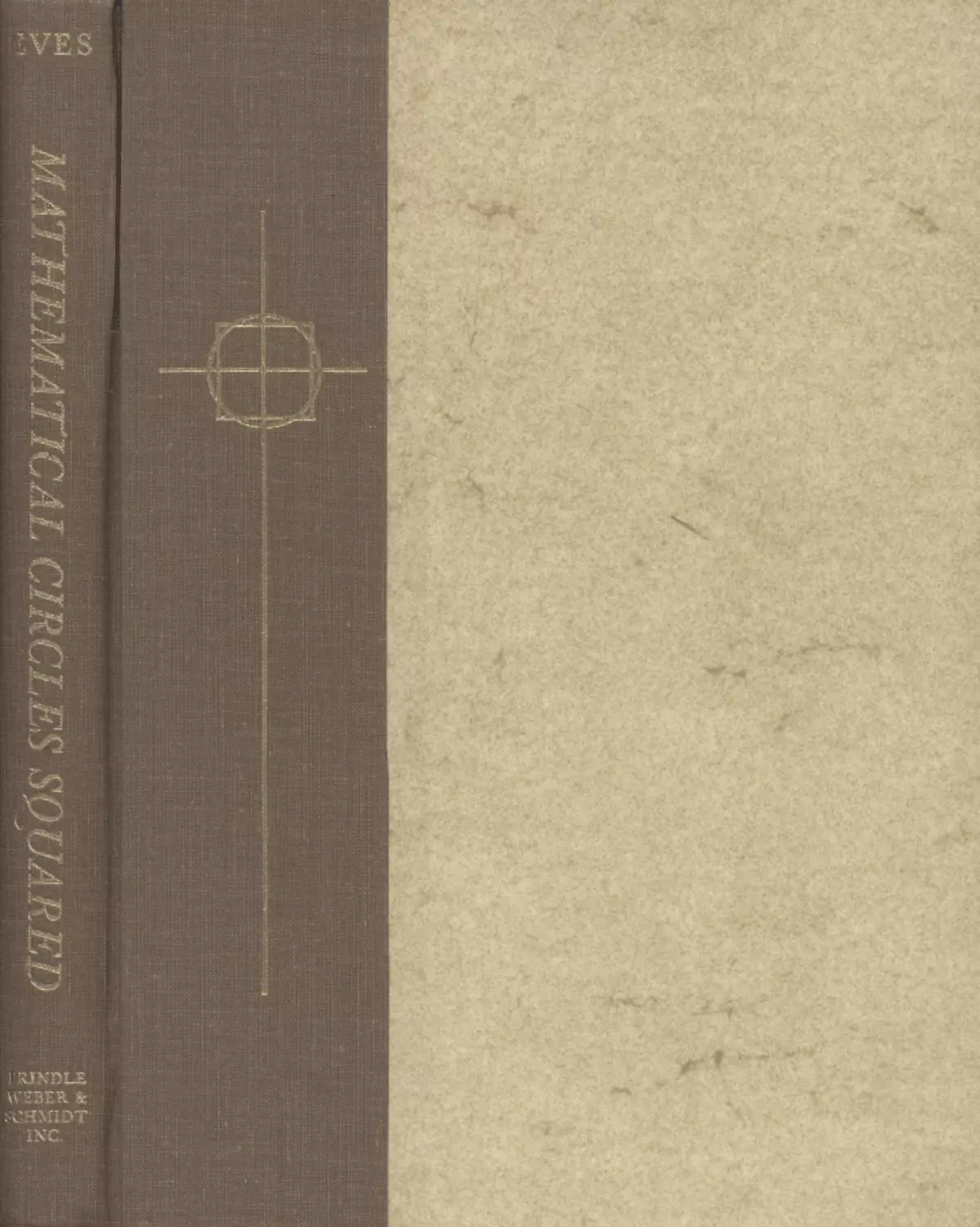
                    MATHEMATICAL
CIRCLES
SQUARED

REG
HO

MATHEMATICAL
CIRCLES SQUARED
A THIRD COLLECTION OF
MATHEMATICAL STORIES AND ANECDOTES
HOWARD W. EVES
PRINDLE, WEBER & SCHMIDT, INC
Boston, Massachusetts

Frontispiece : "Boxing the mathematical compass" is described in I tern 315(
© Copyright 1972 by Prindle, Weber & Schmidt, Incorporated,
Statler Office Building, 20 Providence Street, Boston, Mass. 02116
Prindle, Weber & Schmidt is a subsidiary of Wadsworth, Inc.
All rights reserved. No part of this book may be reproduced or transmitted in any form or
by any means, electronic or mechanical, including photocopying, recording, or any information
storage and retrieval system, without permission in writing from the publisher, except by
reviewers, who may quote brief passages in a review.
Library of Congress Catalog Card Number 76-175520
SBN 87150-154-6
Printed in the United States of America

TO Verner E. Hoggatt, Jr.
who, over the years, has sent me more
mathematical goodies than anyone else

PREFACE
Here is a third trip around the mathematical circle, and, at least
for some time, it must be the last such trip. I cannot deny that it has
been fun making these trips, but there are so many other, and more
serious, things I wish to write that it is high time I set the mathematical
stories and anecdotes aside—with somewhat more than half of my
collection now in print.
Except for the first quadrant and the tail end of the fourth
quadrant, the items in this third set of stories are classified by geography,
in contrast to the classification by chronology in In Mathematical
Circles and by subject matter in Mathematical Circles Revisited.
At one time it had been my intention to devote a whole and
separate work to the subject of mathematically motivated designs.
With more pressing writing commitments on hand, I have decided
to forego this project, and have incorporated a couple of dozen
examples in the first quadrant of the present work. Perhaps some reader
may be inspired to take up the project and carry it out more fully and
more deservingly.
Once again, I express thanks to those colleagues who have shown
interest in my trips about the mathematical circle and who have sent
me favorite items for possible inclusion. It has been my desire to
acknowledge these contributors, and any other special sources, at the
end of the items concerned; I hope I will be forgiven if I have
unintentionally overlooked anyone. Special thanks go to Academic Press
and to Dover Publications for permitting me to quote from some of
their books.
As with the preceding trip around the circle, this third one was
written intermittently during a (second) year spent assisting at the
Gorham unit of the University of Maine. Upon completion of this
ix

Preface
second year, I return to the central campus at Orono, carrying with
me exceedingly pleasant memories of my two enjoyable years at
Gorham.
Howard W. Eves
x

CONTENTS
Preface ix
QUADRANT ONE
Numbers and Number Reckoning
1° Saint Jerome's commentary on a passage in Matthew,
2° The ring finger, 4
3° Finger counting in Rome, 4
4° A reversal, 5
5° Richer or poorer?, 5
6° Holding the bowstring, 5
7° Attitude for prayer, 5
8° Frederick II on falconry, 5
9° Fibonacci and finger counting, 6
10° ThePa-kua, 6
11° One way to put it, 7
12° A misplaced credit, 7
13° The origin of the printers' ellipsis, 7
14° Wise men versus fools, 8
15° An unintentional commentary, 8
16° An old order giving way, 8
17° The case for the abacists, 8
18° How Xerxes counted his army, 9
19° Popular immensities, 9
20° Overestimation, 10
21° Perfect numbers, 10
22° You can't fool the sergeant, 10
23° An application of the "least natural number principle,
XI

Contents
24° Lehmer's table of primes, 11
25° Modern numerals, 11
26° Chalk one up for the human being, 12
27° Broadening the college language requirement, 13
28° A possible hope for the world, 13
29° A proud boast, 13
Magic Squares
30° Some terminology and a celebrated unsolved probl
31° The lo-shu, 15
32° The early Hebrews and the lo-shu, 16
33° Talismans and charms, 16
34° The earliest fourth-order magic square, 18
35° Albrecht Diirer's magic square, 18
36° A pandiagonal magic square on a torus, 20
37° A pandiagonal magic square on a plane, 20
38° A pandiagonal magic square on a hypercube, 21
39° A magic square in architectural decoration, 22
40° Magic squares of odd order, 22
41° Magic squares of doubly-even order, 23
42° Doubly-magic and trebly-magic squares, 25
43° Prime magic squares, 26
44° Fibonacci magic squares, 26
45° Magic cubes, 27
46° Brains versus machines, 28
47° Origin of Eulerian squares, 30
Mathematically Motivated Designs
48° Some artistic applications of the lo-shu, 31
49° Magic traces, 31
50° Re-entrant knight's path, 33
51° Half-board solutions, 35
52° Magic re-entrant half-board knight's paths, 36
53° Re-entrant strong-knight paths, 36
54° Magic re-entrant king's path, 37
55° A conversation piece, 37
56° A patio mosaic, 38
57° The octagon puzzle, 39
58° A toral tulip garden, 41
59° A flower garden on a projective plane, 41
XII

Contents
60° Schlegel flower gardens, 41
61° Professor Tucker's flag, 43
62° More patio designs, 43
63° In the foyer of the mathematics building, 45
64° Room numbers, 45
65° Tying gift boxes, 46
66° A Pythagorean theorem design, 46
67° A maple-leaf tile, 47
68° Another maple-leaf tile, 48
69° Some other tiles, 48
70° A lamp base, 49
71° A quilt, 49
72° Some more quilts, 52
Geometry
73° An analogy, 56
74° Another analogy, 56
75° A science fiction possibility, 56
76° The truth of a theory, 56
11° Zeuxis and Apollodorus, 57
78° Maps, 58
79° An anthology of great poetry, 59
80° The method of dual languages, 59
81° Blind geometers, 59
82° The true meaning of the Delphian oracle, 60
83° The origin of geometry, 60
84° Geometers and analysts, 61
85° DIN, 61
86° An early love affair, 62
87° Albrecht Durer's approximate constructions,
88° Two daffynitions, 64
89° The birthplace of topology, 64
90° Q,. E. D., 66
QUADRANT TWO
From the American Scene
91° Super-respectability, 69
• • •
Xlll

Contents
92° Practical rambler, 69
93° Mountain climber, 70
94° Creator of suspense, 70
95° Epicurean, 70
96° Einstein and religion, 70
97° A sufficient reward, 70
98° Einstein and his check, 71
99° The prankster, 71
100° Identification, 71
101° How Norbert Wiener got his beard, 71
102° Wienerian wit, 72
103° The modern physicist, 72
104° Shop-talker, 72
105° Wienerian disease, 72
106° An incomplete story, 72
107° How a young mathematician saved himself by ingenuity, 72
108° Crackpots, 73
109° Benjamin Franklin Finkel, 73
110° Problemist extraordinaire, 74
111° Two prizes, 75
112° A student from Missouri, 75
113° Cupid's problem, 75
Among the English
114° Blissard's sermon, 76
115° From Blissard's obituary, 77
116° Unattached, 77
117° A man of peculiarities, 78
118° Mrs. De Morgan, 78
119° Definite integrals, 79
120° No ear for music, #0
121° A legend, 80
122° Mathematical talent foreshadowed, 50
123° Kiteflying, 80
124° Unlocking a puzzle, 81
125° A repeated tribute, 81
126° Eddington on the fourth dimension, 81
127° Student, 82
128° Preparing for an examination, #2
129° Littlewood and the Dedekind cut, 82
xiv

Contents
130° Littlewood and Hardy, 83
131° Littlewood and Veblen, 83
132° A comment by J. E. Littlewood, 83
133° Littlewood demonstrates mountain-climbing techniques, 83
Two Irishmen
134° Poetry and disappointment, 84
135° Hamilton and Wordsworth, 86
136° A rare compliment, 87
137° Hamilton's second love affair, 87
138° A bad choice, and alcohol, 88
139° A rare honor, 88
140° Hamilton's wish, 89
141° Modified Irish blarney, 89
142° On the turn of a penny, 89
143° His last act, 90
Two Scotsmen
144° Wiping away a stigma, 91
145° TandT, 91
146° Tait and Stevenson, 91
147° Holding back the crowd, 91
148° Keeping the demonstration desk clear, 91
149° Behind the times, 92
150° The Tait's compass, 92
151° The hare and the hounds, 93
152° An embarrassment, 93
153° An allegory, 95
154° Unpopular, 94
155° Taking roll, 94
156° Poor arithmetician, 94
157° The marble, 94
The Last Universalist
158° Poor motor coordination, 95
159° The artist, 95
160° Fame helps, 95
161° How does he do it?, 95
162° A misunderstanding, 96
163° Cousins, 96"
xv

Contents
164° Literary success, 96
165° A poor administrator, 97
166° A powerful and unusual memory, 97
167° Poincare's manner of working and composing mathematics, 97
168° Rated an imbecile, 98
169° Two kinds of absentmindedness, 98
170° A lover of animals, 99
171° An act of heroism, 99
172° Sylvester meets Poincare, 99
173° An unfinished symphony, 99
Croutons for the French Soup
174° Deep insight, 100
175° Precision, 100
176° Jordan and notation, 100
177° A story of Hadamard's youth, 101
178° A story of Hadamard's older age, 101
179° Bourbaki's office, 101
180° Mathematicians are like Frenchmen, 102
QUADRANT THREE
Two Norwegians and a Russian
181° A lost manuscript, 105
182° By studying the masters, 106
183° Spurred on because of a bully, 106
184° An unfortunate incident, 106
185° An almost unique event, 107
186° A most admirable trait, 107
187° An apt description, 108
The Prince of Mathematicians
188° A student's lamp, 108
189° Lost fame, 108
190° Ribbentrop as an overnight guest, 109
191° Ribbentrop as an observatory guest, 109
192° Gauss's assistant, 110
193° Gauss's power of concentration, 110
xvi

Contents
194° Source of pleasure, 110
195° Maintaining a standard, 110
196° Some similarities between father and son, 111
197° Gauss and his grandson, 111
198° Gauss and the British Admiralty, 111
199° The Berlin Academy of Sciences, 112
200° Wrong order, 112
201° Theory and practice, 112
202° A sacrilege, 113
203° The hunt rather than the treasure, 113
204° Gauss and a student, 113
205° The onerous side of teaching, 113
206° Cayley on Gauss, 114
207° Absolute and relative properties of a surface, 114
208° The heliotrope, 114
209° The Hohenhagen Tower, 115
210° The Gauss-Weber monument, 115
211° Ravages of war, 115
Three Great Gottingen Professors
212° An interesting analogy. 116
213° Presents, 116
214° Rapid assimilation, 116
215° Contrast, 116
216° Riemann's Habilitationsschrift, 117
217° Genius and craftsmen, 111
218° Intellectual tonnage, 118
219° A prodigy, 118
220° At a department meeting, 779
221° A rare burst of arrogance, 119
222° Minkowski on Einstein, 779
223° Minkowski on Mrs. Hilbert, 779
224° Minkowski's death, 120
225° The spoiled child of mathematics, 120
226° A Landau game, 120
227° The two sides of the ledger, 121
228° Felix and Serge, 121
229° Fermat's last theorem, 121
230° Irrepressible, 727
231° Slightly incorrect, 122
xvii

Contents
232° Landau leaves Gottingen, 122
233° Mrs. Landau, about her husband, 122
The Master
234° Stimulation, 123
235° Hilbert conducts business with the Minister of Culture, 124
236° The Wolfskehl Prize, 124
237° Inflation, 125
238° Requirements for a good problem, 125
239° Catching a fly on the moon, 125
240° In defense of Galileo, 125
241° Hilbert's "flames," 125
242° Brutally direct, 126
243° Hilbert's harshness, 127
244° Geheimrat Hilbert, 127
245° Poor memory and slow understanding, 127
246° Hilbert's obtuseness, 128
247° Hilbert's class lectures, 128
248° Existence, 128
249° Hilbert and the new quantum mechanics, 128
250° Hilbert and the prime numbers, 129
251° Student adulation, 129
252° Hilbert and Ackermann, 130
253° The Riemann hypothesis, 130
254° Hilbert and Hilbert space, 130
255° Taking credit, 131
256° Franz Hilbert, 131
257° Imagination, 132
258° Point of view, 132
259° The frog and mouse battle, 132
260° Hilbert on the law of excluded middle, 133
261° No roast goose, 133
262° Memorial to Darboux, 134
263° Declaration to the Cultural World, 134
264° A medical success story, 134
265° An anti-Semite, 135
266° Bieberbach and the Second International Congress, 135
267° Hilbert and the Second International Congress, 136
268° Hilbert's hotel bill, 136
269° Hilbert Strasse, 136
xviii

Contents
270° A comparison of two deaths, 136
QUADRANT FOUR
Further Gottingen Mathematicians
271° Ordinary and extraordinary, 141
272° Felix the Great, 141
273° A distant god, 141
274° A faux pas, 141
275° A syllogism, 141
276° Runge as a calculator, 142
277° Runge introduces skiing, 142
278° A proof of an impossibility, 143
279° Walzermelodie, 143
280° No effort too great, 143
281° BlumenthaFs dissertation, 143
282° BlumenthaFs end, 143
283° First member of the honors class, 144
284° Emmy Noether as a lecturer, 144
285° The Noether boys, 144
286° Hilbert and Emmy Noether, 144
287° Max Born's examination, 144
288° Twice disappointed, 145
289° The Bohr brothers, 145
290° Harald Bohr's examination, 145
291° Siegel goes to Gottingen, 145
292° A poor prediction, 145
293° A paper for the Annalen, 146
294° Van der Waerden as a boy, 146
295° How Jacob Grommer was led to mathematics, 147
More German Mathematicians
296° Reward for a discovery, 148
297° Discouragement, 148
298° A Kummer simile, 148
299° Kummer unexpectedly wins a prize, 148
300° Kummer's empathy, 149
301° Kummer's last nine years, 149
302° Lotus-eaters, 149
xix

Contents
303° Hot from the forge, 149
304° Blaschke's bad mark, 150
305° Immortality, 150
Olla-Podrida
306° A means of escape, 150
307° Depressed mathematicians, 150
308° The spirit of mathematical inquiry, 150
309° The sure test, 151
310° A truism, 151
311° Pioneer work is clumsy, 152
312° How to win a war, 152
313° The Greeks versus the European Christians, 152
314° The Greeks versus the Romans, 153
315° Boxing the mathematical compass, 153
316° Internationalism, 153
317° The performers and the creators, 153
318° Virtuosity versus depth, 154
319° A lesson in freedom, 154
320° A difference between mathematics and other arts, 154
321° The grove of scholarship, 155
322° A law of genetics, 155
323° Cheating, 155
324° Equivalence and identity, 155
325° A proposal and its acceptance, 156
326° On large numbers, 156
327° Dependence, 156
328° The Alfonsine Tables, 157
329° Bad news, 157
330° A consuming proof, 157
331° What a sprouting acorn said, 158
332° A revolutionary sputnik, 158
333° The queen of the sciences, 158
334° An accidental immortality, 158
335° The Scopes trial, 158
336° Hermannus Contractus, 159
Printers and Books
337° The copy editor, 160
338° A typist's error, 160
xx

Contents
339° A questionable practice, 160
340° Linguistic oddities, 160
341° Dash it all, 160
342° Proofreading, 161
343° The compositor, 161
344° A ghost-author, 161
345° An unkind textbook reference, 161
346° Another unkind textbook reference, 162
347° Weitzenbock's "Invariantentheorie," 162
Psychology
348° Gauss's experience, 162
349° Hamilton's experience, 163
350° Poincare's experience, 163
351° Hadamard's experience, 165
352° Loss of interest, 165
353° A mathematical dream, 165
354° The mathematics bump, 166
355° Servants, not masters, 166
356° At what age?, 167
357° Morning or evening?, 167
358° Preparation-incubation-illumination, 167
359° Two kinds of discovery, 167
360° The thought curve, 168
ADDENDA
Esthetics
1081° The esthetic appreciation of mathematics, 1
1082° Esthetic appreciation smothered, 174
1083° The practical versus the esthetical, 174
1084° Popular appeal of mathematics, 174
1085° The guide for the choice of research subjects,
1086° Judging a graduate research student, 175
1087° A case history, 176
1088° Another case history, 176
1089° = [(33)2]° Ten pertinent quotations, 176
Index, 179
XXI

QUADRANT ONE
From a divine's commentary
to "quite elegantly done"

NUMBERS AND NUMBER RECKONING
There are lots of stories—many of them of pedagogical value—about
numbers and number reckoning. Here are some which do not appear in
our two earlier collections. Several of these stories refer to the one-time
popular finger numbers and to the time when number reckoning was
done on a counting board or abacus.
1° Saint Jerome's commentary on a passage in Matthew, Saint
Jerome (ca. 340-420) was born in a small village in the Illyrian Alps.
When about thirty-four, he commenced his five years of hermit life
in the desert near Antioch, after which he was ordained and went to
Constantinople and began his intensive study of the Scriptures. After
a short return to Rome, he settled, in 386, as a recluse and student in a
monastery near Bethlehem. His great knowledge of the Scriptures
rendered him foremost among the early interpreters of the Bible, and
his translation of the Old Testament from Hebrew into Latin became
the Vulgate, or popular, version officially used today by the Roman
Catholic Church. He also revised the Latin New Testament, referring
to the best Greek manuscripts available at his time. In Albrecht
Diirer's famous painting, Saint Jerome is pictured in a small house
studiously bent over a writing desk and absorbed in his translation of
the Bible.
In addition to translating the Bible, Saint Jerome wrote extensive
commentaries on the Scriptures, including an especially interesting
one on Matthew 13:8, concerning the Parable of the Sower:
But others fell into good earth, and brought forth fruit, some an
hundredfold, some sixtyfold, some thirtyfold.
Here is Saint Jerome's commentary on this passage:
The hundredfold and the sixtyfold and the thirtyfold fruit, though
they may have sprung from the same soil and the same seed, nevertheless
differ greatly in their number. Thirty is a symbol of marriage: for this
manner of placing the fingers, which are joined and interwoven as in a
sweet embrace, represents both man and wife.
Sixty stands for widowhood, because the widow endures trouble and
3

[2°] Mathematical Circles Squared
tribulation that weigh on her, just as the thumb is pressed down by the
index finger which lies above it. But the more difficult it is to abstain
from the pleasures that were once enjoyed, the greater will be the reward.
But now attend carefully, dear Reader: the number hundred is
transferred from the left hand to the right, where it is formed with the
same fingers but not on the same hand as the hand which symbolized
marriage and widowhood.
In order to understand this passage, one must be familiar with the
finger counting of medieval times. The number 30 was formed on the
left hand by placing the tip of the index finger on the end of the thumb,
forming a circle called "the tender embrace," the other fingers of the
hand being outstretched. The number 60 was formed on the left hand
by pressing the thumb into the palm with the end of the index finger,
the other fingers of the hand being outstretched. The various hundreds
were formed on the right hand.
Saint Jerome's commentary bears excellent witness to the popular
use of finger counting in his day, for his commentary is quite
unintelligible to anyone lacking that knowledge.
One still sees, today, "the tender embrace" used as a gesture of
something sweet or pleasant or successful.
2° The ring finger. In ancient times it was believed that there is a
vein running directly from the heart to the finger next to the little
finger. This finger was accordingly called the medicus, and, because of
its supposed connection with the heart, it was deemed to be the most
proper finger to bear any sort of sacred ring. The finger thus became
known as the ring finger. When, in medieval times, finger counting
was developed and systematized, it was decided that 6, the first perfect
number (a perfect number is one which is equal to the sum of its
proper divisors: 6=1+2 + 3), should be formed on the sacred ring
finger. It thus turned out that 6 was represented by folding down the
ring finger on the left hand.
3° Finger counting in Rome. Pliny the Elder, who died in a.d. 79,
has told us of a statue of the two-headed god Janus in the forum at
Rome. He said that the statue showed Janus representing the 365 days
of the year on his fingers, by forming—according to the common
4

Quadrant One [4°]
method of finger counting of the time—the number 300 with his right
hand and the number 65 with his left.
4° A reversal. In Roman finger counting, the numbers less than
100 were formed on the left hand, while the hundreds were formed on
the right hand. Among the Arabs, the roles played by the two hands
were reversed, in accordance with Arabic script which runs from right
to left.
5° Richer or poorer? An Arabic poet once cleverly scoffed another
Arabic poet, named Khalid, who had become very rich, by the
following line: "Khalid went with 90 and came back with 30."
It would at first seem that Khalid returned poorer. But the number 90
was formed (by the Arabs) on the fingers of the right hand by laying
the index finger on the base of the thumb, thus forming a very small
or "lean" circle; the number 30 was formed on the fingers of the right
hand by joining the tips of the index finger and thumb, thus forming
a large or "rich" circle.
6° Holding the bowstring. An Arabic script describes how the
bowstring is to be held when shooting an arrow. It is to be grasped with
the tips of the index finger and thumb of the right hand, "as the
number 30 is formed."
7° Attitude for prayer. Another Arabic script describes the proper
physical position for prayer by saying that the believer should place
his right hand on his leg as though he were forming the number 54
(that is, only the index finger should be extended).
8° Frederick II on falconry. Emperor Frederick II (1194-1250)
was a noted patron of learning and of the arts. He also enjoyed hunting
and wrote a famous book on falconry {On the Art of Hunting with Birds).
In his book he describes how a huntsman should hold the falcon:
The hand is held facing neither inward nor outward, but extended in
the same direction that the arm is extended. The index finger is then
laid over the extended thumb and bent forward over the end segment of
the thumb, just as the masters of computation form the number 70
5

[9°] Mathematical Circles Squared
with their fingers. The other fingers of the hand are bent over the palm
beneath the index finger and thumb, to support the latter, just as the
number 3 is formed. Thus the index finger is bent over the thumb and
the three other fingers beneath it, in the manner of a master of
computation forming the number 73.
9° Fibonacci and finger counting. It is interesting that Fibonacci,
who was the great advocate for the use of the Hindu-Arabic numeral
system with its place-value notation and convenient computing
algorithms, also strongly recommended the retention of finger
counting. For in finger counting he found an excellent way for a computer
to retain temporary numbers that are to be carried or that are partial
results of a more lengthy computation, such as a long division.
10° The Pa-kua. In the ancient Chinese classic, the I-king, or
Book of Permutations, appear the Liang /, or "two principles" (the male
yang, —, and the female ying, . From these were formed the
Sz' Siang, or four figures,
and the Pa-kua, or eight figures,
The eight symbols of the Pa-kua had various attributes assigned to
them (see Figure 1), and hence came to be used in divination.
heaven
5.
stream
S.E.
—
fire
E.
_ _
thunder
N.E.
wind
S.W.
water
W.
— ——
mountain
N.W.
earth
N.
Figure 1
6

Quadrant One [11°]
Though there is no supporting historical evidence, one cannot
help but see, in the Pa-kua, numerals based on the scale of two. For if
we take — as one and as zero, the successive trigrams shown
in Figure 1, beginning at the right, would represent the numbers 0, 1,
2, 3, 4, 5, 6, and 7. The Pa-kua are today found on diviners' compasses,
fans, vases, other household objects, and various kinds of talismans.
11° One way to put it. In the binary system we count on our fists
instead of on our fingers.
12° A misplaced credit. The so-called Attic, or Herodian, Greek
numerals were developed some time prior to the third century B.C.
and constitute a simple grouping system to base 10 formed from initial
letters of number names. In addition to the symbols /, A, //, X, M for
1, 10, 102, 103, 104, there is a special symbol for 5. This special symbol
is an old form of IT, the initial letter of the Greek pente (five), and A is
the initial letter of the Greek deka (ten). The other symbols can be
similarly explained. The symbol for 5 was frequently used both alone
and in combination with other symbols in order to shorten number
representations. As an example in this numeral system we have
-xxrHHHFni
in which one can note the special symbol for 5 appearing once alone
and twice in combination with other symbols.
These numerals were employed for several hundred years prior
to the first century B.C. in Attic inscriptions and in public tribute lists
and accounts; this explains why the name Attic is attached to them.
But the name Herodian, attached to these numerals, is quite misleading.
For Herodian lived in Byzantium around the year a.d. 200, well over
five centuries after the appearance of the numerals bearing his name.
However, Herodian was a grammarian and he happened to mention
the numerals, only once and in a passing way, and thus his name became
associated with them.
13° The origin of the printers' ellipsis. In Sanskrit, "zero" was
called sunya, meaning "empty," and also sunya-bindu, meaning "empty-
7

[14°] Mathematical Circles Squared
dot," from the fact that in positional notation, and originally on the
counting board, a particular position is empty. Such an empty
position was shown in written work by a dot. The modern printers'
custom of indicating by three dots the omission from a sentence of a
word or words goes back to this Indian practice of using a dot to
represent zero.
14° Wise men versus fools. Thomas Hobbes (1588-1679), the
famous English moralist, philosopher, and political scientist, in Part 1
of Chapter 4 of his great work The Leviathan, published in 1651 at the
conclusion of the civil war that left Cromwell in power, says, "Words
are wise men's counters, they do but reckon with them, but they are
the money of fools." This is a fine reference to the counters and counting
boards of the time.
15° An unintentional commentary. In Bailey's English Dictionary of
1725 we read, "Ciphers are certain odd Marks and Characters in
which Letters are written, that they may not be understood." This
may be an unintentional commentary on the general distrust of the
Hindu-Arabic numerals in those days.
16° An old order giving way. The accounts entered in the Mayor's
Audits for the City of Bristol of England appear only in Roman numerals
until late in the sixteenth century, when Hindu-Arabic numerals
begin to make an occasional appearance. In the Audits of 1635, the
final two pages appear completely in Hindu-Arabic numerals, but
then there is a reversion to Roman numerals the following year.
From 1640 on, however, Hindu-Arabic numerals only are used.
We witness here an older custom gradually giving way to a newer
one, and perhaps a little tug of war between an elderly conservative
clerk adhering strictly to traditional methods and a bright young
fellow eager to introduce the new mode in figures.
17° The case for the abacists. The advocates of the Hindu-
Arabic numeral system with its convenient computing algorithms
became known as the algorists; those defending the Roman numeral system
and calculation with it on an abacus became known as the abacists.
8

Quadrant One [18°]
The battle between the algorists and the abacists was long and
sometimes bitter. In this battle, the abacists are usually criticized as having
been overly conservative and too fearful of change. Of course there was
a widespread natural feeling of insecurity with the new numerals;
the forms of the numerals were unfamiliar and not standardized, the
zero numeral was particularly confusing, and there was much that had
to be patiently learned before one could properly use the new system.
But the abacists had a much stronger and much more cogent
objection to the new numerals: the new numerals too easily lent
themselves to fraud. One could easily turn a 0 into a 6 or a 9, or turn a 1
into a 4, a 6, a 7, or a 9. Other numeral forms could also be tampered
with, and insertion of numerals between or after some already recorded
was often quite possible. However, it is difficult to alter a number
expressed in Roman numerals, especially if one followed the
recommended customs of writing the numerals of a number close together,
of replacing each final I by a J, and of running a short horizontal stroke
after each final numeral in a number. It was for reasons of such possible
falsification that the City Council of Florence, for example, in 1299
issued its ordnance prohibiting under fine the use of the new numerals
in financial procedures.
18° How Xerxes counted his army. Herodotus, in Book VII of his
Historia, tells us how Xerxes once numbered the size of his army on the
plain at Doriscus.
. . . the count of the whole land army showed it to be a million and seven
hundred thousand. The numbering was done as follows: a myriad
[10,000] men were collected in one place, and when they were packed
together as closely as might be, a line was drawn round them; this
being drawn, the myriad was sent away, and a wall of stone built on
the line reaching up to a man's middle; which done, others were
brought into the walled space, till in this way all were counted.
19° Popular immensities. In his article "Large numbers"
(Mathematical Gazette, vol. xxxii, no. 300), J. E. Littlewood mentions a huge
stone a cubical mile in size and a million times harder than diamond.
Every million years a holy man visits the stone and gives it the very
lightest touch. After a period of time, the stone is thus worn away.
9

[20°] Mathematical Circles Squared
The period of time turns out to be something like 1035 years, which
most people would regard as a vast underestimation.
20° Over estimation. Also in his article "Large numbers," Little-
wood points out that improbabilities are likely to be overestimated.
To illustrate he says, "It is true that I should have been surprised in the
past to learn that Professor Hardy had joined the Oxford Group.
But one could not say the adverse chance was 1:106. Mathematics
is a dangerous profession; an appreciable proportion of us go mad, and
then this particular event would be quite likely."
21° Perfect numbers. "Perfect numbers like perfect men are very
rare," said Decartes. There are only twenty-four perfect numbers
known today, and only twelve were known at the time of Descartes.
22° Tou can't fool the sergeant. When the tall inductee presented
himself for a physical examination and was asked his height by the
examining sergeant the inductee promptly answered:
"I am five feet, seventeen and one-half inches tall, sir."
"You can't kid me, Slim. I know you are more than six feet,"
snapped the sergeant.—Pi Mu Epsilon Journal, Nov. 1950, p. 106.
23° An application of the "least natural number principle.'" The
untimely passing of Leo Moser on February 9, 1970, at the age of
forty-eight, was a real loss to mathematics on the American continent.
He was a singularly able and versatile mathematician, and this writer
enjoyed years of correspondence with him. As a contrast to his serious
work, he was interested in the odd and the amusing in mathematics,
and he often sent cute little tidbits to his friends. Here is one, received
in a P.S. of a letter dated July 25, 1957.
Here is a new version of an old idea which might amuse you.
Problem'. What is the smallest perfect number? Answer'. 6. Here we
have a question which mentions no number explicitly and yet has the
unique solution 6. Can one propose for every natural number n a problem
which mentions no number explicitly and which has n as its unique
solution?
Solution: Yes! For suppose there are some natural numbers for which
io

Quadrant One [24°]
no problem of the required type can be proposed, and consider the
problem: "What is the smallest natural number for which there is no
problem of the required type?" This yields a contradiction which proves
the required result.
24° Lehmer's table of primes. In 1914, D. N. Lehmer listed all the
primes from 2 to 10,006,721. This was in the days before electronic
computers, and the task was a considerable one. The number
10,006,721 is the 664,999th prime number. It is natural to wonder
why Lehmer stopped at this particular prime. The explanation is
simple. He had defined 1 as a prime also, and thus 10,006,721 was the
665,000th prime number in his list. Now his aim was to find all primes
not exceeding 10,000,000, and to list them on pages of 5000 primes each.
He reached the last prime under 10,000,000 on page 133, and then
completed the page, thus listing a total of (133)(5000) = 665,000
numbers.
25° Modern numerals. Most of us have noticed, and probably
wondered about, the peculiar characters (see Figure 2) used for
numerals on our bank checks. They are part of a computer data
processing practice now widely used in automatic bookkeeping and
accounting procedures. The numerals are printed with an ink
containing ferromagnetic substances so that they may be read by the
magnetic-ink character recognition (MICR) process. The numerals
are shaped for better identification by the computer, while at the same
time they are readable by us.
ID
Figure 2
The automatic reading method is shown in Figure 3(a). The
check is inserted into a reader which slides the check past a permanent
magnet, causing the materials in the printed numerals to become
11

[26°]
Mathematical Circles Squared
magnetically energized. The check then passes over a read head which
senses the magnetic density of each numeral and produces
corresponding output signals. Matrix decoding is employed to interpret and
identify the numerals.
card or
check
magnet read head
gap
/7
output
(a)
(b)
Figure 3
As shown in Figure 3(b), the signals developed depend upon the
width and position of the vertical and horizontal segments of the
numeral. For the numeral 9 shown, signals of opposite polarity are
produced as the right vertical segment of the 9 approaches and leaves
the read head. During the time the horizontal sections pass the head,
no magnetic change occurs, and the output signals drop to zero level.
As the left vertical member of the 9 is reached, a negative and positive
voltage change again occurs.
Each numeral produces its own individual signal waveform.
The decoding circuits are designed to recognize the particular make-up
of a given signal and to establish its numerical value.
26° Chalk one up for the human being. In early November, 1970,
subscribers to the various journals handled by Greenwood Publications,
Inc., received copies of a letter that commenced as follows:
12

Quadrant One [27°]
Dear Subscriber:
I think you should be the first to know that we have fired our computer
—and replaced it with real people who will be able to process and handle
your subscription orders effectively.
Because of the complications and inaccuracies we have experienced
with the automated data processing system, I know that many of you
have not received the total portion of your 1970 subscriptions, and that
is why I have enclosed this postage-paid reply card. I would appreciate
your indicating on the card the issues that you are missing to date so
that we may send them to you. . . .
A great concerted sigh of relief must have escaped on the receipt
of the above letter. For who, these days, has not been harassed and
frustrated by the moronic-minded computer? Heart-rending tales
have been told by subscribers to journals, members of book and record
clubs, mail-order purchasers, people contacting government agencies
in connection with taxes, social security, old-age pensions, medicare,
and so on. The machine would consistently ignore all explanatory
letters and would relentlessly continue to dun and harass the innocent
individuals sucked into its vortex of numbers.
27° Broadening the college language requirement. Oakland
University in Rochester, Michigan, announced that, beginning with the
1970 winter term, students who want to learn a computer's technical
language can substitute that for the traditional foreign language
requirement. — UPI
28° A possible hope for the world. It has often been said that the
pen is mightier than the sword. It might be, then, that a motorized
pen may be mightier than a motorized sword. Herein may lie the
superiority of the electronic computer over the atomic bomb.
29° A proud boast. One is hard pressed to think of universal
customs that man has successfully established on earth. There is one,
however, of which he can boast—the universal adoption of the Hindu-
Arabic numerals to record numbers. In this we perhaps have man's
unique worldwide victory of an idea.
13

[30°] Mathematical Circles Squared
MAGIC SQUARES
There seems no doubt that magic squares originated in ancient China,
whence they found their way to Japan, India, Burma, Siam and other
adjacent countries to the south, the Malay Peninsula, and Sumatra.
They later played a part in the cabalistic writings of the early Hebrews
and they reached the Arabs from India, China, or Persia. Astrologers
carried the squares westward, where they influenced medieval
European mathematics. There their study prospered fantastically and
continued into present times. Today a comprehensive treatise on magic
squares and their known remarkable properties would run into many
fat volumes.
Magic squares have long been a part of the trappings of fortune
tellers. They have been used as charms. They have appeared in fortune
bowls, in medicine cups, and on amulets, to protect from illness and
plague and to ward off evil. They became linked with medieval
alchemy and astrology. Their charm and challenge have attracted a
wide array of devotees, initiates to the cult of their study ranging from
such eminent mathematicians as Arthur Cayley and Oswald Veblen
to such prominent laymen as Benjamin Franklin.
30° Some terminology and a celebrated unsolved problem. An nth
order magic square is a square array of n2 distinct integers so arranged that
the n numbers along any row, column, or main diagonal have the same
sum, called the magic constant of the square. The magic square is said
to be normal if the n2 numbers are the first n2 positive integers; in this
case it can be shown that the magic constant is n(n2 + 1 )/2. A square is
said to be semimagic if the numbers along any row or any column have
the same sum, but the sum of the numbers along one or each of the main
diagonals differs from this sum. A magic square is said to be symmetric
if any two numbers of the square occupying cells symmetric with
respect to the center of the square add to the same sum. In the case
of symmetric normal magic squares of order a, this sum is always
n2 + 1. A magic square is said to be pandiagonal (or nasik, or perfect, or
diabolic) if, in addition to the numbers along the two main diagonals,
the numbers along each broken diagonal also sum to the magic constant
of the square. Finally, two magic squares of order n are said to be
H

Quadrant One [31°]
distinct if neither one can be obtained from the other by reflections or
rotations. From a given magic square, seven others can be obtained by
these operations.
Perhaps the most celebrated unsolved problem in connection
with normal and with normal pandiagonal magic squares is the
determination of the number of them of a given order. In such an
enumeration, only distinct squares are counted. This problem has been partially
solved. Thus it is known that there is only one normal magic square of
order 3, and this is not pandiagonal. There are exactly 880 (distinct)
normal magic squares of order 4, and forty-eight of these are
pandiagonal. J. Barkley Rosser and Robert J. Walker have shown that there
are exactly 3600 normal pandiagonal magic squares of order 5, and
that there are no such squares of order n where n is divisible by 2 but not
by 4. Thus there is no normal pandiagonal magic square of order 6.
This is the extent of our exact knowledge. The number of normal magic
squares of order 5 is certainly more than three-quarters of a million,
and is estimated to be about fifteen million. It is known that there are
more than thirty-eight million normal pandiagonal magic squares of
order 7, and more than 6.5 trillion of order 8.
The large number of normal magic squares of any given order
higher than 3 makes it feasible to construct such a square satisfying
some other more or less stringent limitation. The search for such further
restricted squares has been intensive.
31 The lo-shu. The oldest known example of a magic square is
the 3x3 square shown in Figure 4. It appears in one of the oldest of the
Chinese mathematical classics, the I-king, or Book of Permutations, a
work of uncertain but very ancient origin. But myth claims the square
H
3
8
9
5
1
2
1
<o
Figure 4
•5

[32°]
Mathematical Circles Squared
to be even much older, asserting that it was first seen by the Emperor
Yu in about 2200 B.C. as a decoration upon the back of a divine tortoise
along a bank of the Yellow River. Being the earliest, and the simplest,
of all magic squares, this square has appeared more frequently than
any other in connection with fortune telling, charms, amulets, and
cabalistic rites. The square was known in ancient China as the lo-shu,
and the numerals in it later took the form of knots in strings, as shown
in Figure 5, in which black knots are used for the even numbers and
white knots for the odd numbers.
o
Figure 5
32° The early Hebrews and the lo-shu. Since the number 15 in
the Hebrew alphabetical numeral system is made up of the first two
letters of Jahveh (Jehovah), and since 15 is also the magic constant of the
lo-shu, Eastern Jews of early times found a religious symbol in the
ancient Chinese magic square.
The corner numbers of the lo-shu are even, or female, numbers.
The suppression of these numbers of the square yields a cruciform
arrangement (see Figure 6) of only odd,' or masculine, numbers.
This cruciform served as a charm among various eastern peoples.
33° Talismans and charms. If the same integer should be added
16

Quadrant One [33°]
3
9
5
1
7
Figure 6
to every element of a magic square, the resulting array will, of course,
also be magic. Figure 7 shows two magic squares constructed in this
way from the lo-shu. The magic constants of these squares are 21 and
18, respectively.
6
5
10
n
7
3
4
9
&
5
H-
9
10
6
2
3
8
7
Figure 7
Since 2+1=3, the first magic square might well serve as a
protective symbol on a barn or a ship, for 3 is the number assigned to
Jupiter, and Jupiter, as the god of the heavens, manifests himself in
atmospheric phenomena. Thus the first magic square might be
regarded as a symbol for protection from storm and lightning.
Since 1 + 8 = 9, the second magic square might serve as a talisman
to be worn by a soldier, or as a symbol on a school building, for 9 is
the number assigned to Mars, the god of war and the protector of the
weak and innocent. In the Maldivian Islands of the Indian Ocean,
charms bearing numbers adding to 18 are worn as protective devices
by the virgins.
The lo-shu itself might be worn as a talisman for love, or set up in a
flower garden, for the magic constant of the lo-shu is 15 and 1+5 = 6,
the number of Venus, goddess of love and of the garden.
17

[34°] Mathematical Circles Squared
34° The earliest fourth-order magic square. The earliest recorded
magic square of the fourth order is found in an eleventh or twelfth
century Jaina inscription at Khajuraho, in India, and is shown in
Figure 8. This square exhibits a somewhat advanced knowledge
of magic squares, for it possesses further "magic" properties. First of
all, it is pandiagonal—for example, the numbers, 2, 12, 5, and 15,
?
2
16
9
12
13
3
6
1
8
10
15
\h
11
5
H-
19
9 25
15
19
25 9
15
15
9 ZS
19
15
25 9
19
Figure 8
and the numbers 2, 3, 15, and 14, are along broken diagonals, and these
sum to the magic constant 34. Further, the four subsquares formed by
drawing the horizontal and vertical midlines of the given square are
interestingly related to one another, as can be seen from Figure 8,
where in the top left subsquare the 19 is 7 + 12, the 15 is 2 + 13, the 9
is 7 + 2, and the 25 is 12 + 13. This square is perhaps the earliest
instance showing some of the further fantastic elaborations and
limitations that can be assigned to a normal magic square.
35° Albrecht Diirefs magic square. Of the artist-mathematicians
of the sixteenth century, Albrecht Diirer stands out prominently. He was
born at Niirnberg in 1471 and died in the same city in 1528. Famous as a
painter and an engraver, he also showed considerable interest and
ability in various areas of mathematics, as is shown by his treatises
on geometry, fortifications, and human proportions. His geometry was
the first printed work on higher plane curves. His approximate
solution of the trisection problem and of the construction of a regular
18

Quadrant One [35°]
nonagon and a regular heptagon are of interest to high school geometry
students.
Diirer's interest in mathematics is also evident from some of his
engravings, in particular his famous etching Melencolia. In this
engraving appear various mathematical items, such as a sphere, a
compass and straightedge, a proportional compass, a polyhedral solid, and
a magic square of the fourth order. The magic square, which was one
of the first magic squares to be printed, is pictured in Figure 9. In
addition to the usual "magic" properties of such squares, it has the
following curious properties:
16
5
9
4
3
10
b
15
2
11
X
14
13
8
12
1
Figure 9
1. The date, 1514, in which the Melencolia engraving was made,
appears in the two middle cells of the bottom row.
2. The sum of the squares of the numbers in the first two rows
(columns) is equal to the sum of the squares of the numbers in the last
two rows (columns).
3. The sum of the squares of the numbers in the first and third rows
(columns) is equal to the sum of the squares of the numbers in the
second and fourth rows (columns).
4. The sum of the numbers in the diagonals is equal to the sum
of the numbers not in the diagonals.
5. The sum of the squares of the numbers in the diagonals is
equal to the sum of the squares of the numbers not in the diagonals.
6. The sum of the cubes of the numbers in the diagonals is equal
to the sum of the cubes of the numbers not in the diagonals.
19

[36°]
Mathematical Circles Squared
36° A pandiagonal magic square on a torus. A dramatic way to
exhibit the properties of a pandiagonal magic square is to draw the
square on a torus. We can accomplish this by taking the pandiagonal
magic square, as in Figure 10(a), and first forming a cylinder by
bringing together the top and the bottom of the square as in Figure
10(b), and then finally forming a torus by stretching and bending the
cylinder as in Figure 10(c). All rows, columns, and diagonals (both
main and broken) of the square become closed loops on the torus.
T
Z
16
9
12
13
3
6
1
a
10
15
14
n
5
4
(a)
i3 \ a \ 11
J6
to
(c)
(b)
Figure 10
If, for a fourth-order normal pandiagonal magic square rolled and
bent into a torus in the above fashion, we start with any number and
move two numbers away in any direction along a diagonal, we arrive
at the same number. Two numbers related in this way are called
antipodes, and the sum of any two antipodes is 17. The numbers along
any loop (diagonal or orthogonal) sum to 34; any square group of
four adjacent numbers sums to 34.
37° A pandiagonal magic square on a plane. If we form a mosaic
on a plane by fitting together a large number of duplicate pandiagonal
20

Quadrant One [38°]
squares of order n (see Figure 11), we obtain a field of squares on which
any a x a group of numbers is pandiagonal. Any n adjacent numbers of
the field, taken vertically, horizontally, or diagonally, yield the same
magic sum.
IS
1
6
10
15
1
6
10
IS
1
a
10
is
i
4
/4
ii
8
4
i4
11
5
4
14
11
5
4
n
9
r
2
16
9
r
2
16
9
T
2
16
9
7
6
12
13
3
6
12
13
3
6
12
13
3
b
12
IS
1
6
10
15
1
6
10
IS
1
6
10
15
1
4
14
11
5
4
14
11
5
4
14
11
5
4-
14
9
T
2
16
9
t
2
16
9
T
2
16
9
T
6
12
13
3
6
12
13
3
6
12
13
3
6
12
IS
1
a
10
15
1
t>
10
IS
1
e
10
IS
i
*
&
ii
s
4
14
11
5
4-
14
11
5
4
14
9
T
2
16
9
*
2
16
9
r
2
16
9
T
6
12
13
3
6
12
13
3
6
12
13
3
6
12
IS
1
a
10
is
i
0
10
IS
1
a
10
15
1
4-
14
11
S
4
14
11
3
4-
14
11
5
4
14
9
r
2
16
9
T
2
16
9
T
2
16
9
7
6
12
13
3
6
12
13
3
6
12
13
3
6
12
15
1
6
10
15
1
&
10
IS
1
a
10
is
i
Figure 11
38° A pandiagonal magic square on a hypercube. We can map a
fourth-order pandiagonal magic square onto a hypercube by
transferring the sixteen numbers of the square to the sixteen vertices of the
hypercube, as shown in Figure 12, where we employ the familiar
two-dimensional projection of a hypercube. The sum of the numbers
at the vertices of each of the twenty-four square faces of the hypercube
is 34. Antipodal points of the magic square appear as diagonally
opposite vertices of the hypercube.
21

[39°]
Mathematical Circles Squarld
X
2
16
9
12
13
3
6
1
8
10
15
14
11
5
4
15
39° A magic square in architectural decoration. One of the most
elaborate instances of a magic square employed in architectural
decoration is one of the ninth order chiseled into a wall in the Villa
Albani in Rome.
40° Magic squares of odd order. Simon de la Loubere,* when
envoy of Louis XIV to Siam in 1687-1688, learned a simple method
for finding a magic square of any odd order. Let us illustrate the method
by constructing one of the fifth order. Draw a square and divide it
into 25 cells (see Figure 13). Border the square with cells along the top
and right edges, and shade the added cell in the top right corner.
Write 1 in the middle top cell of the original square. The general rule
is then to proceed diagonally upward to the right with the successive
integers. Exceptions to this general rule occur when such an operation
takes us out of the original square or leads us into a cell already occupied.
In the former situation we get back into the original square by shifting
* Not to be confused with Antoine de la Loubere (1600-1664), a Jesuit
lecturer on mathematics, rhetoric, and religion, who showed interest in the
study of both planar and spatial curves. Simon de la Loubere later in life
wrote a work on the solution of equations.
22

Quadrant One [41°]
clear across the square, either from top to bottom or from right to left,
as the case may be, and then continue with the general rule. In the
second situation we write the number in the cell immediately beneath
the one last filled, and then continue with the general rule. The shaded
cell is to be regarded as occupied.
17
23
if
10
11
Id
IH
5
6
12
18
25
1
t
13
19
25
2
8
14
20
21
2
9
15
16
22.
3
9
IT
23
h
10
Figure 13
Thus, in our illustration, the general rule would place 2 diagonally
upward from 1 in the fourth cell bordered along the top edge. We
must, therefore, shift the 2 to the fourth cell in the bottom row of the
original square. When we come to 4, it falls in the third cell up bordered
along the right edge. It must, therefore, be written clear across to the
left in the third cell up in the first column of the original square. The
general rule would place 6 in the cell already occupied by 1. It is
accordingly written in the cell just below that occupied by the last
written number, 5. And so on.
The reader may now care to construct, by de la Loubere's rule, a
magic square of order seven. The lo-shu is essentially the 3x3 magic
square as constructed by de la Loubere's method.
41° Magic squares of doubly-even order. There is an easy way to
construct magic squares of doubly-even order, that is, magic squares
whose orders are a multiple of 4. Consider, first of all, a square of order
23

[41°]
Mathematical Circles Squared
4 and visualize the diagonals as drawn (see Figure 14). Beginning in
the upper left corner, count across the rows from left to right in
descending succession, recording only the numbers in cells not cut by a
diagonal.
s
9
Z
\h
3
13
8
\Z
\<6
5
9
4
2
11
7
ft
3
10
b
15
13
8
12
1
Figure 14
Now, beginning at the lower right corner, count across the rows
from right to left in ascending succession, recording only the numbers
in the cells that are cut by a diagonal. The resulting magic square is
little different from Durer's square of Item 35°.
The same rule applies to any magic square of order \n if we
visualize, as drawn in, the diagonals of all the n2 principal 4x4
sub-blocks. Figure 15 shows the construction of an 8 x 8 magic square
by this rule. The reader may now care to construct a magic square of
order 12.
9
17
41
49
2
26
34
58
3
27
35
59
12
20
Hh
SI
13
21
*f5
53
6
30
36
62
T
31
39
63
/
16
2H>
48
56
64
9
IT
40
32
41
49
8
2
55
47
26
34
23
15
58
3
54
\6
2Y
35
IZ
14
59
61
»2
20
37
2?
44
52
5
60
13
21
36
28
45
53
4
6
51
43
30
38
»9
11
62
T
50
42
31
39
16
10
63
57
16
24
33
25
46
56
1
Figure 15
24

Quadrant One [42°]
42° Doubly-magic and trebly-magic squares. For certain values of
n it is possible to construct an nth order magic square such that if each
number of the array is squared, the resulting array will also be magic.
Figure 16 shows an example, due to M. H. Schots, of a normal doubly-
magic pandiagonal square of order 8. The magic constant of the square
is 260; the magic constant of the square obtained by squaring each
element is 11180.
16
26
1
23
38
52
43
61
41
63
40
50
3
21
14
25
36
54
45
59
10
32
T
IT
5
19
12
30
47
57
34
56
2T
13
22
4
49
39
64
42
62
44
51
31
24
2
25
15
55
33
56
48
29
It
20
6
18
8
31
9
60
46
53
35
Figure 16
Figure 17 shows an example, due to R. V. Heath, of a normal
doubly-magic square of order 9. There are no normal doubly-magic
TO
If
42
57
4
35
XX
27
46
TS
22
53
68
16
37
61
2
33
59
9
28
79
20
51
66
13
44
15
45
65
8
30
58
19
50
81
26
46
76
10
41
72
6
34
56
1
32
63
24
52
T4
IT
39
6T
38
69
16
31
62
3
54
T»
23
49
80
21
48
64
14
*9
60
T
36
SB
9
47
T6
25
40
Tl
12
Figure 17
25

[43°] Mathematical Circles Squared
squares of order less than 8.
A square which is magic for the original numbers, for their squares,
and for their cubes is said to be trebly magic. There exists normal
trebly-magic squares of orders 64, 81, and 128.
43° Prime magic squares. A magic square is said to be prime if
each of its numbers is a prime, 1 being considered as a prime. The
famous British puzzle expert, H. E. Dudeney, gave the prime square
of Figure 18(a). E. Bergholt and C. D. Shuldham gave the prime
square of Figure 18(b). Here occur the first 13 odd primes, along with
the primes 47, 53, and 71. Prime magic squares of orders 5, 6, • • •, 12
have been constructed by H. A. Sayles and J. N. Muncey. Muncey's
prime magic square of order 12 is particularly interesting in that its 144
numbers are the first 144 odd primes: 1, 3, 5, 7, 11, • • •, 827. It has been
shown that the first n2 odd primes cannot form a magic square when
n < 12.
3
53
it
v
XI
ii
13
X
5
yt
Hi
19
23
1
31
4*
6T
13
31
1
3r
T3
m
61
T
(a) (b)
Figure 18
Figures 19(a) and 19(b) show prime magic squares of the third
and fourth orders wherein the number 1 is not admitted as a prime
number. In the October 1961 issue of the Recreational Mathematics
Magazine (p. 28) appears a prime magic square of this sort of order 13.
It has been conjectured that there exist infinitely many prime magic
squares of this sort for every orders > 8.
44° Fibonacci magic squares. The sequence of numbers 1, 1, 2, 3,
5, 8, • • •, wherein, after the first two numbers are written, each number
26

Quadrant One [45°]
IT
301
1ZI
yn
31X
J57
tvc
Mr?
39*
10T
257
3%
61
ZZl
13T
36T
569
239
209
59
559
659
HH9
W
rt9
(a) (b)
Figure 19
is the sum of the two immediately preceding numbers, is called the
Fibonacci sequence. It has been proved that there are no magic squares
composed only of numbers of the Fibonacci sequence. There are,
however, magic squares composed only of such numbers and sums of
pairs of such numbers. (For some of the esoteric properties of the
Fibonacci sequence, see Item 114° of In Mathematical Circles.)
45° Magic cubes. An nth order magic cube is a cubical array of n3
distinct integers so arranged that the n numbers along any row, column,
file, or main diagonal have the same sum, called the magic constant of
the cube. The magic cube is said to be normal if the n numbers are the
first n3 positive integers. In this case the magic constant is n (n3 + 1 )/2,
and it occurs in 3n2 + 4 ways. Normal magic cubes of any odd or any
doubly-even order can be constructed by extensions of the methods
used for normal magic squares. A magic cube is said to be pandiagonal
if not only its four main diagonals, but all broken diagonals as well,
sum to the magic constant. In a pandiagonal magic cube the magic
constant occurs In2 times.
One of the most remarkable examples of a normal pandiagonal
magic cube was given by R. V. Heath and is illustrated in Figure 20.
Here an eighth-order normal magic square is cut into quarters, each
quarter serving as a layer of a fourth-order normal pandiagonal magic
cube. Each layer is itself a fourth-order magic square. The original
eighth-order magic square has the additional property that if either
set of alternate rows and either set of alternate columns be deleted—
27

[46°] Mathematical Circles Squared
and this can be done in four ways—the remaining 16 numbers form
a fourth-order magic square of magic constant 130.
(first layer) (second layer)
1
61
X
15
32
55
kS
18
8
59
53
10
25
3d
W
23
61
2
16
51
36
31
It
H6
80
X
9
54
3X
26
zh
Hi
46
19
£9
34
4?
14
4
63
41
22
2d
39
56
11
5
58
20
4T
33
30
13
30
64
3
21
42
40
27
12
55
5T
6
(fourth layer) (third layer)
Figure 20
46° Brains versus machines. An nth order Latin square is an n x n
array such that each of n distinct symbols appears once and only once
in each row and each column of the array. An nth order Eulerian square
is an n x n array of n2 distinct elements wherein the (i,j) th element
(that is, the element in the zth row and thejth column) is an ordered
pair of symbols, the first one being the (z, j)th element of one Latin
square and the second one being the (i,j) th element of a second Latin
square. For example, in Figure 21 there are two fifth-order Latin
squares in each of which 0, 1, 2, 3, 4 are the five distinct symbols.
From these two Latin squares we obtain the fifth-order Eulerian square
(since all 25 elements in this square are distinct) shown in Figure 22.
For a couple of hundred years methods have been known for
constructing Eulerian squares of odd order and of doubly-even order
28

Quadrant One [46°]
3
2
1
0
4
1
0
4
3
2
4
3
2
1
0
2
1
0
*
3
0
4
3
2
1
4
0
1
2
3
2
3
4
0
1
0
1
2
3
4
3
4
0
1
2
1
2
3
4
0
Figure 21
34
20
11
02
43
12
03
W
30
21
40
31
22
13
04
23
14
00
41
32
01
42
33
24
10
Figure 22
(that is, of order n = 4m). After much futile effort to construct an
Eulerian square of singly-even order (that is, of order n = 4m + 2j,
Euler conjectured in 1782 that none exists. This conjecture is trivial
for n = 2, and in 1900 G. Tarry verified it for n = 6 by the exhausting
method of systematically examining all possibilities. For the next case,
n = 10, the number of possibilities is so enormous that Tarry's procedure
is utterly worthless. Indeed, even an electronic computer proved to
be of no use. One of these machines once spent 100 hours searching for
a tenth-order Eulerian square, failed to find any, and still had not even
begun to scratch the surface in its examination of possibilities. It was
not until 1959 that further progress was made; in that year R. C. Bose,
S. S. Shrikhande, and E. T. Parker disproved Euler's conjecture.
Parker gave the tenth-order Eulerian square shown in Figure 23.
A year later it was shown that Euler's conjecture is wrong for all n > 6;
that is, there exist rcth-order Eulerian squares for all orders n except
n = 2 and ft = 6.
29

[47°] Mathematical Circles Squared
00
86
95
59
X3
66
3t
14
21
hz
W
\\
60
96
69
W
08
25
32
53
ie
SX
22
81
90
09
15
36
43
64
t6
26
67
33
82
91
19
40
54
05
29
XO
39
OT,
44
83
92
51
65
16
FlGUI
93
39
X)
48
n
55
8H
62
06
20
*e23
65
94
>t9
72
58
2T
66
03
10
31
3^
45
56
60
01
12
23
XX
89
98
61
QZ
13
2H
35
k6
50
88
9T
X9
52.
63
04
15
26
30
41
99
X6
QX
The fifth-order and tenth-order Eulerian squares exhibited in
Figures 22 and 23 are semimagic squares. Every Eulerian square leads
to at least a semimagic square.
47° Origin of Eulerian squares. Eulerian squares originated in a
problem that Euler stated as follows: "A very curious question is the
following: A group of 36 officers of 6 different ranks and from 6
different regiments are to be arranged in a square in such a manner that each
row and each column contains 6 officers from different regiments and
of different ranks." Euler was unable to obtain a solution to the
problem.
Since the desired square array of officers would be an Eulerian
square of order 6, we know (see Item 46°) that the problem has no
solution.
30

Quadrant One [48°]
MATHEMATICALLY MOTIVATED DESIGNS
A worthy, enjoyable, and not at all difficult project would be to
assemble a booklet of unusual and attractive designs originating in
certain mathematical problems and puzzles. Following are some
illustrations of the idea. Perhaps some reader may feel motivated to
continue the project; the material would be of value in high school
mathematics laboratories.
48° Some artistic applications of the lo-shu. Not many years ago,
before the advent of jet plane travel, the 3x3 magic square known as
the lo-shu (see Figure 4, Item 31°) was commonly seen on the play
decks of large transoceanic passenger ships, for scoring in such games as
shuffleboard.
One person has used the lo-shu in its knotted-string representation
(see Figure 5, Item 31°) as a pleasing decoration on his bedroom ceiling,
motivated by the connection of the lo-shu with the number 6 assigned
to Venus, the goddess of love (see Item 33°).
Another person, who designed a beach house with oriental motifs,
employed the knotted-string representation of the lo-shu to light the
central room of the house. The knots appear as tiny lights in small
cylindrical recesses in the ceiling, blue lights for the odd (or masculine)
numbers and pink lights for the even (or feminine) numbers.
49° Magic traces. The American architect and occultist, Claude
Fayette Bragdon (who died in 1946), became fascinated by the
observation that the line segments traced from cell to cell, in the sequential
order of the numbers, on many magic squares produce a pleasing
artistic pattern. Sometimes it is advisable to trace the line segments
sequentially connecting only the odd (masculine) or only the even
(feminine) numbers. Mr. Bragdon used designs obtained in this way
for book covers, textile patterns, and architectural ornaments. He
decorated the chapter headings of his autobiography, More Lives Than
One, with these designs, and he constructed the ventilating grill in the
ceiling of the Chamber of Commerce of his home city of Rochester,
New York, as the trace obtained from the lo-shu.
Figure 24 shows the design yielded by the fifth-order magic square
3i

[49°] Mathematical Circles Squared
constructed by de la Loubere's method. This pattern, drawn on a
screen or on a scarf, or utilized as grille work for a gate, would be quite
attractive, and few beholders could guess its origin. The author was
once presented with a gold tie clasp bearing this interesting design
engraved on it. Figures 25(a) and 25(b) show the "masculine" and
the "feminine" traces for the same magic square.
Figure 26 shows the "masculine" and the "feminine" traces,
superposed, of the lo-shu; it could serve as a symbol of marriage and
could fittingly decorate the door, and the headboard of the bed, of a
honeymoon suite.
Figure 24
(a) (b)
Figure 25
32

Quadrant One
[50°]
Figure 26
50° Re-entrant knight's path. One of the challenging problems
on an ordinary chessboard is that of determining a path a knight might
take so as to land on each square of the board once and only once,
returning to the starting square on the last jump. One of the prettiest
solutions to this problem was given by P. M. Roget in 1840 and is
shown in Figure 27. The path traced by the knight yields a singularly
attractive design for a screen, a tapestry, or iron grille work.
34
31
50
13
46
27
62
11
51
1*
33
30
63
12
47
26
32
35
16
49
20
45
10
61
15
52
29
36
9
64
25
46
36
17
56
1
44
Z1
60
7
53
2
3T
20
57
8
43
24
16
39
4
55
2Z
41
6
59
3
54
19
40
5
56
23
42
Figure 27
The total possible number of distinct re-entrant knight's paths on a
chessboard is not known, but it is a very large number lying somewhere
between the number of combinations of 168 things taken 63 at a time
as an upper bound and 122,802,512 as a lower bound. Since the
problem has so many solutions and since there are so many magic
33

[50°]
Mathematical Circles Squared
squares of order 8, it is natural to wonder if there is a re-entrant knight's
path on the ordinary chessboard that also yields a magic square of
order 8. Figure 28 shows a re-entrant knight's path that yields a semi-
magic square of order 8—that is, the rows and the columns add to the
same sum, but the two main diagonals do not. This latter design would
make an attractive pattern on a bedspread. It would also be attractive
laid out on the floor of a patio.
63
1*
3T
2H
11
26
35
50
22
59
a
13
36
51
10
21
15
6H
23
36
25
\Z
*9
34
HO
21
16
61
52
33
26
9
1
60
41
20
29
0
53
H6
%2
1T
4
57
46
55
32
r
59
2
19
4¥
5
30
47
54
16
43
56
3
56
45
6
31
Figure 28
35
62
41
52
37
60
43
58
40
53
36
6\
42
5?
46
*«9
63
3H
55
38
51
46
59
Hk
54
39
64
33
56
45
50
*7
15
16
13
24
1
32
r
22
12
27
16
19
6
23
2
31
IT
14
25
10
29
4
21
8
26
11
26
5
20
9
30
3
V \
\ \
V \
\ \
\ \
\ \
\ \
Figure 29
34

Quadrant One
[51°]
35
54
39
60
41
6Z
45
50
3d
57
36
53
40
51
42
63
55
34
59
40
61
44
49
kio
55
3T
56
33
52
4T
64
43
II
32
15
20
1
24
5
26
14
IT
12
29
8
27
2
23
31
10
19
16
l\
4
25
6
18
13
30
9
26
T
22
3
V /
\/
/ ^
/ /
r /
/ /
/ /
A
/ \
/ \
Figure 30
51° Half-board solutions. The two solutions of the re-entrant
knight's path illustrated in Figures 29 and 30 are remarkable in that
the right half of the board is covered first, then the left half of the board.
The first of these solutions is due to the great Swiss mathematician
Leonhard Euler; the second solution is due to P. M. Roget. Each
solution is especially well suited for the decoration of a two-part
folding screen. They would also be attractive on bedspreads for double
beds.
15
10
25
30
IX
40
47
50
20
31
16
45
24
49
26
41
IT
14
19
26
39
46
51
45
36
21
*4
59
6
23
42
29
13
60
5
22
43
50
1
52
64
35
62
55
10
3
30
1
61
12
33
4
5T
32
53
8
3H
63
56
11
54
9
2
31
v
^
o
\
<
/
^^
w
V
V K
\A
\
a
^
.V**.
4^
.•>
^\
L
J
/*
'>
V
S*
-•w
/
<
v\
O
fj\
_
:>
7
_ —
Figure 31
35

[52°] Mathematical Circles Squared
52° Magic re-entrant half-board knight's paths. Each of the two
re-entrant knight's paths shown in Figure 31 covers exactly 32 cells of
the board. They are remarkable in that together they constitute a
magic square. The two paths, done in two different colors, would
furnish a very attractive pattern for a blanket or a bedspread.
53° Re-entrant strong-knight paths. Whereas an ordinary knight
on the chessboard moves one square diagonally followed by one square
nondiagonally, a strong knight moves one square diagonally followed by
two squares nondiagonally. It follows that if a strong knight starts on,
say, a black square of a chessboard, it is ever after restricted to black
squares. This raises the question of whether we can cover a chessboard
by two re-entrant strong-knight's paths, one knight covering the black
squares of the board and the other covering the red squares. Figure 32
shows a beautiful solution to the problem, which again suggests a very
attractive design for a blanket or a bedspread. [Note: A strong knight
is an instance of a leaper in fairy chess.)
Figure 32
36

Quadrant One [54°]
54° Magic re-entrant king's path. Figure 33 shows a re-entrant
king's path on a chessboard, which also yields a magic square. It is a
splendid design for a bed blanket, and it looks like an authentic
American Indian pattern.
61
60
ie
13
20
21
37
36
62
U
59
14
19
36
22
35
63
56
10
15
18
23
39
34
64
sr
9
16
IT
24
40
33
1
8
56
49
48
41
23
32.
2
T
55
50
4T
42
16
31
3
54
6
51
46
2T
43
30
4
5
53
52
45
44
2J6
29
Figure 33
55° A conversation piece. Henry Ernest Dudeney( 1857-1931), by
all odds England's foremost inventor of puzzles, was spectacularly
adept in the art of geometrical dissections. His best-known achievement
in this field is his four-piece dissection of an equilateral triangle into a
square. A five-piece solution of this problem had been known for some
time, and it was generally believed that this could not be bettered.
Dudeney's discovery was made about 1902, and has since become
famous in dissection literature. Figure 34 shows the dissection. The
segments AD, DB, BE, EC, FG are all equal to half the side of the
triangle; EFis equal to the side of the equivalent square; DJ and GK
are each perpendicular to EF.
If the four pieces 1,2,3,4 are successively hinged to one another at
the points D, E, G, then, holding piece 1 fixed and swinging the
connected set of pieces 4-3-2 counterclockwise (see Figure 35), the
equilateral triangle is neatly carried into the square. A set of four
connected tables has been built upon this fact; swinging the tables in
one direction causes the tops to fit together into a single equilateral
_\
7V^
_\
f
/\
V
/
\
\
A
\
/
A
\
^Y
~\
y\y
I
37

[56°]
Mathematical Circles Squared
triangular table, and swinging them in the other direction causes the
tops to fit together into a single square table. The table is adaptable
for card games requiring either three or four players. It makes an
interesting piece of furniture, and, if nothing else, is a fine conversation
piece.
Figure 34
equilateral
triangle
Figure 35
56° A patio mosaic. L. V. Lyons has used Dudeney's construction
given in the preceding Item to obtain a very attractive dissection of the
plane into a mosaic of interlocking equilateral triangles and squares, as
pictured in Figure 36. This artistic pattern is excellent for a patio floor,
or for use somewhere in a university mathematics building.
38

Quadrant One [57°]
Figure 36
57° The octagon puzzle- Dudeney bettered several
long-established records in polygonal dissection. He was the first, for example, to
dissect a regular pentagon into a square with only six pieces, and to
dissect a given square into three equal squares with only six pieces. Very
curious along this line is a statement made by Alice Dudeney (Mrs. H.
E. Dudeney) in the preface to Puzzles and Curious Problems, by H. E.
Dudeney, published in 1932, after the author had died. The book was
reprinted in 1936, 1941, and 1948, revised by James Travers. The
statement is: "It is remarkable that the regular octagon can be cut
into as few as four pieces to form a corresponding square." The
implication is that such a four-piece dissection was another of Dudeney's
triumphs. But no one has since been able to find such a solution. A
beautiful five-piece dissection, illustrated in Figure 37, was published
by Travers in 1933. It is strange that Travers, who revised the book in
question, made no correction or comment on Alice Dudeney's un-
verifiable statement. It is difficult to believe that a four-piece solution
of the problem is possible.
39

[57°] Mathematical Circles Squared
C c
Figure 37
We have, in Travers' dissection, the possibility of another unusual
set of tables. Four identical tables (1, 2, 3, 4 in Figure 37) can be placed
tightly about a square pillar to form a single surrounding octagonal
table or a single surrounding square table.
T
i
5
7
3
1
Z
H
t
6
7
Figure 38
Figure 39
40

Quadrant One [58°]
58° A toral tulip garden. P.J. Heawood was the first to prove that
seven is the least number of colors needed to color all maps on a torus.
One establishes this theorem by simply exhibiting a map on a torus
that requires seven colors, since it can be shown that seven colors are
sufficient. Many simple maps of this sort can be devised; Figures 38
and 39 show two such maps. In each of these figures one is first to
imagine the rectangle rolled into a tube by joining together the top
and bottom edges of the rectangle, and then to imagine the tube bent
into a torus by joining together the two circular ends of the tube. Each
map is then seen to contain seven countries so arranged that each
country shares a boundary with each of the other six, thus necessitating
seven colors to color the map properly.
Each of Figures 38 and 39 can be cleverly utilized for a rectangular
flower bed, say a bed of tulips, wherein tulips of seven different colors
are planted to form the seven different countries of the map.
The figures can also serve as designs for a courtyard or entrance
hall in a mathematics building of a university. Here the seven different
countries could be indicated by seven different colors of cement or
floor covering.
59° A flower garden on a projective plane. Heinrich Tietze proved
that six is the least number of colors needed to color all maps on a
projective plane. Since a projective plane can be represented by a
circular disk in which diametrically opposite points on the rim of the
disk are identified with one another, any one of Figures 40(a), 40(b),
40(c) represents a six-color map on a projective plane (each of the six
countries shares a boundary with each of the other five). As in the
preceeding Item, any one of these three maps can serve admirably for
the design of a flower garden—this time circular and requiring six
different colors of flowers.
60° Schlegel flower garden. While on the subject of designs for
flower gardens, we might mention some so-called Schlegel diagrams
(named after Victor Schlegel, 1843-1905) of the five regular polyhedra.
A Schlegel diagram of such a polyhedron (or, more generally, of any
convex polyhedron) can be obtained by a central projection of the
polyhedron from an exterior point sufficiently close to the centroid of a
4i

[60°]
Mathematical Circles Squared
selected face of the polyhedron. The projection of the selected face
contains the projections of all the other faces. Figure 41 shows such
Schlegel diagrams of the five regular polyhedra. Each of these diagrams
could serve nicely as the design of a flower bed.
(a)
octahedron
FlGl'Rh 40
icosahedron
Fku'ri II
42

Quadrant One [61°]
61° Professor Tucker's flag. Figure 42 shows another toral map
(see Item 58°), here represented on a square. We certainly have in this
map a very interesting and attractive design for a lady's head scarf.
Fku'rk 12
By a horizontal stretch, one can convert the square map of Figure
42 into a rectangular map. About this rectangular map, Professor
Albert Tucker of Princeton University once remarked, many years
ago during a course in elementary combinatorial topology that he was
teaching, "If I were a dictator, I would fashion my flag after this
map."
62° Adore patio designs. In 1925, Z. Moron noted (see Figure 43)
that a 32 x 33 rectangle can be dissected into nine squares, no two of
which are equal. This raised the question of whether a square can be
dissected into a finite number of squares, no two of which are equal.
This latter problem was felt to be impossible, but such turned out not
to be the case. The first published example of a square dissected into
unequal squares appeared in 1939; the dissection was given by R.
Sprague of Berlin, and contained fifty-five subsquares. In 1940,
R. C. Brooks, C. A. B. Smith, A. H. Stone, and W. T. Tutte, in a joint
paper, published a dissection containing only 26 pieces. These men
ingeniously established a connection between the problem of dissec-
43

Mathematical Circles Squared
3Z
15
6
18
t
1
10
14
33
Figure 43
55
56
39
16
4-=
3P
18
9
14
-5
1
20
38
64
31
35
81
30
29
51
8
"2
35
H3
F IGURE 44
44

Quadrant One [63°]
tion and certain properties of currents in electrical networks. In 1948,
T. H. Willcocks published the 24-piece dissection of a square into
unequal squares pictured in Figure 44, and this dissection is today the
record so far as least number of pieces is concerned. Surely, somewhere
in the planning and designing of a mathematics building at a university,
one or other of these two squarings should appear.
63° In the foyer of the mathematics building. It would seem fitting,
when considering the construction of a new mathematics building, to
incorporate into the building a number of attractive designs and motifs
representing the different areas of mathematical study. Some possible
suggestions have already been made in a few of the preceding Items.
Now in the area of projective geometry there are few prettier or
more fertile theorems than the famous Pascal mystic hexagram theorem,
which states that "the three points of intersection of the three pairs of
opposite sides of a hexagon inscribed in a conic section are collinear."
Why not, then, in the entrance hall of the new building, have this
theorem attractively represented as in Figure 45, using, perhaps,
inlaid brass bands for the lines of the figure?
Figure 45
64° Room numbers. In the new mathematics building referred to
in Item 63°, one might employ some attractive numeral system, in
addition to the usual Hindu-Arabic system, for numbering the doors
of the rooms and offices of the building. The choice of the additional
numeral system might depend upon the country or place of the
45

[65°] Mathematical Circles Squared
university. In Mexico it would be natural to choose the ancient Mayan
numeral system, and in Egypt the ancient Egyptian hieroglyphic
system. Other possibilities are Babylonian cuneiform, Hebrew,
Chinese (traditional or scientific), Greek (alphabetic or Herodianic),
Persian, and Roman. It should be particularly fitting in an institution
of learning to have such little evidences of the blending of an old and a
new culture.
65° Tying gift boxes. Frequently gift boxes are artfully tied with
a ribbon as indicated in Figure 46; two parallel and more-or-less
diagonally directed segments of the ribbon can be seen on both the top
and the bottom of the box. If the length, width, and depth of the box
Figure 46
are represented by a, b, and c, respectively, it can be shown that the
length of the ribbon (not counting any knot or bow) is
d= 2y/(a + c)2 + (b + c)\
and that the ribbon can be shifted into parallel positions without
stretching. (The tangent of the angle at which the ribbon intersects
the edges of the box is (a + c)/(b + c) or (b + c)/(a + c).) Many large
department stores use these facts to secure boxes, quickly and efficiently,
with an endless loop of slightly elastic tape, of which the length of the
unstretched loop is a trifle less than d.
66° A Pythagorean theorem design. Sometimes the diagram of a
46

Quadrant One [67°]
geometrical proof can be utilized as a design. For example, there is a
simple "dissection" proof of the Pythagorean theorem that runs as
follows. The square on the hypotenuse of the right triangle is dissected,
as shown in Figure 47(a), into four triangles congruent to the given
right triangle and a square of side equal to the difference of the legs
(a)
(b)
Figure 47
of the right triangle. Denoting the legs and the hypotenuse of the right
triangle by a, b, c, where a > b, we then have
c2 = 4(a*/2) + (a - b)2 = 2ab + (a2 + b2 - 2ab) = a2 + b2,
and the Pythagorean theorem is established. Figure 47(b) shows the
diagram of this proof employed as the basis of an attractive lattice
design. This lattice was actually used by the Arabs in the Middle
Ages.
67° A maple-leaf tile. One usually sees a floor tiled with square,
rectangular, equilateral triangular, or regular hexagonal tiles. Tiling
a floor with tiles of some other single shape is interesting and a bit
47

[68°]
Mathematical Circles Squared
challenging. Figure 48(a) shows a simple tile, roughly resembling a
maple leaf, that can be used for tiling a floor (see Figure 48(b)). Such a
floor might be particularly attractive in a public building in Canada.
(a)
(b)
Figure 48
68° Another maple-leaf tile. Figure 49 shows a somewhat more
complicated maple-leaf tile and a more complicated tiling with it.
This tiling appears in the Alhambra, and a tile of this shape has been
manufactured for the present-day market.
69° Some other tiles. The six parts of Figure 50 show a number of
other attractive tiles. Some of these designs can also serve for iron grille
work. The tiling shown in Figure 50(b) has appeared as the basis for a
Roman mosaic and also for a Byzantine mosaic. The tiling of Figure
50(c) is found in a Roman pavement. The modern tiling of Figure
50(d) is of Arabic origin, as is also the tiling of Figure 50(e). All the
48

Quadrant One
[70°]
tiles except the one of Figure 50(f) are constructed from semicircles and
quadrants.
70° A lamp base. Just as there are curves filling the interior of a
square (see Item 332° of Mathematical Circles Revisited), there are curves
filling the interior of a cube. As in the planar cases, the spatial curves
are defined as limits of sequences of polygonal (space) curves. Figure
51 shows the first two stages leading to a curve that fills a cubical box.
The second one of these, fashioned from iron rods, would make an
unusual base for a modern table lamp.
71° A quilt. At first glance, the quilt illustrated in Figure 52
seems to be quite random. Nevertheless, there is a certain symmetry
in it and a certain reason behind its construction.
If we should think of the quilt as a chessboard, and each cell with
(a)
(b)
Figure 49
49

[71°] Mathematical Circles Squared
(e) (0
Figure 50
an R in it as containing a queen, we would have a solution of the
eight queens problem (that is, we would have eight queens on the
board so located that no queen can take any other queen). The same
50

Quadrant One
[71°]
/\ /
/ 1 ^ ^
y^ 1 >y ^
1
1
1
•
•
+
y
'
/
*'
/
*
s'
^
!7
(a)
Figure 51
(b)
M
P
<;
o
Y
B
H
P
B
n
Y
*r
M
<9
0
n
Y
M
0
Q
B
P
or
0
<?
3
jr
p
n
M
Y
B
n
0
M
Y
Q
JV
p
Q
P
jr
B
4
o
Y
M
Y
o
Q
P
M
If
n
3
tr
Y
n
B
p
0
<?
Figure 52
is true of each of the letters B, T, G, 0, and P—each leads to a solution
of the eight queens problem. The letters M and jVeach lead to seven
queens on the chessboard such that no queen can take any other. We
thus have six superposed sets of eight queens along with two further
51

[72°] Mathematical Circles Squared
superposed sets of seven queens, filling sixty-two of the sixty-four
squares of the chessboard. Thorold Gosset has shown that it is
impossible to have eight superposed sets of eight queens.
It is to be noticed that the eight sets are, in pairs, reflections of
one another in the vertical bisecting line of the board. Thus the /?'s
and the G's, the 5's and the O's, the Y's and the P's, and the M's and
the JV's are symmetrical arrangements. If the cells of each pair of
symmetrical arrangements were to be colored alike, we would obtain
the attractively symmetrical quilt of Figure 53.
Figure 53
72° Some more quilts. A pentomino is a planar arrangement of
five unit squares joined along their edges. There are exactly twelve
types of pentominoes; they are pictured in Figure 54.
An interesting puzzle is to put the twelve pentominoes together to
form an 8 x 8 square with a square 2x2 hole in the middle. In 1958,
Dana S. Scott instructed the MANIAC digital computer to search out
all solutions to this puzzle. After operating for about three and a half
hours, the machine produced a complete list of sixty-five distinct
solutions, wherein no solution can be obtained from another by
rotations and reflections. In every solution, the straight pentomino
appears along an edge of the 8x8 square. There are exactly seven
52

Quadrant One
[72°]
Figure 54
solutions with no "crossroad," that is, with no point where four corners
meet; Figure 55 shows one of these. There are a great many ways
Wm.
Figure 55
53

[72°]
Mathematical Circles Squared
of forming the twelve pentominoes into an 8 x 8 square in which the
four extra unit squares are separated but symmetrically arranged;
Figures 56, 57, and 58 show three of these arrangements. Any one of
the four designs illustrated in Figures 55, 56, 57, 58 could admirably
serve as a quilt for a double bed. Figure 59 shows the twelve
pentominoes formed into two 5x6 rectangles; these might serve for quilts
on a pair of twin beds.
Figure 56
'A
z
Figure 57
54

Quadrant One
[72°]
v.
Figure 58
Figure 59
All twelve pentominoes can be assembled into a 6 x 10, a 5 x 12,
a 4 x 15, or a 3 x 20 rectangle, but we leave these assemblages as
puzzles for the reader.
GEOMETRY
Having just finished a discussion involving a number of attractive
designs from geometry, it is perhaps fitting to complete the present
quadrant with a few stories about the venerable science of geometry
itself.
55

[73°] Mathematical Circles Squared
73° An analogy. The Euclidean foundation of geometry is to
the Gaussian foundation of geometry as the Newton particle concept
of physics is to the Faraday-Maxwell vector concept of physics.
74° Another analogy. The decomposition of a tensor into
components appears to be an artificial act, for the components of the tensor
do not belong to the essential substance of the tensor. Setting up a
reference system to analyze a tensor by its components is like erecting
a scaffold to study a building by its parts. The scaffold does not belong
to the building, but it certainly fulfills a useful purpose.
75° A science fiction possibility. Some geometric concepts have
been utilized for science fiction purposes, for example the Mobius
strip, the tesseract, and higher-dimensional spaces have each been
frequently used. An apparently overlooked possibility is the Riemann-
ian sphere, a spherical surface in which antipodal points are identified.
A peculiar feature of the Riemannian sphere is that upon
circumnavigation and return to one's point of beginning, the directions left
and right become interchanged. The navigator, on arriving at his
home port, finds his directional sense confounded, for what was
originally on his right now appears on his left, and the whole city has
turned into its mirror image. He cannot even read the newspapers,
for now the printing goes backward from right to left. But after one
more circumnavigation, everything returns to familiar order, and the
strange reversal of directions becomes rectified.*
76° The truth of a theory. In Book VII of The Republic, Plato
discourses on the finding of the laws that control the movements of the
* For a fictional application of the somewhat similar idea of making
coincide two symmetrical figures (like a right-hand and a left-hand glove) of
a three-dimensional point space immersed in a four-dimensional point space,
see The Plattner Story by H. G. Wells.
56

Quadrant One [77°]
heavenly bodies, and he asks if one should look up to the sky to find these
laws. He compares such observations to the visual scrutiny and
measurement of a geometrical diagram, and he points out that no
amount of such scrutiny and measurement, even of the most perfectly
constructed diagram, will truly find the geometrical properties of the
figure—these must be found by rigorous deduction from given basic
principles. Astronomy, Plato concludes, should be pursued in a
similar way, and therefore the astronomer who looks down has a better
chance of finding the laws of the heavens than the astronomer who
looks up. Newton and Einstein each became a Plato's astronomer and,
by gazing down rather than up, found inner secrets of the heavens.
"The truth of a theory," said Einstein, "is in your mind, not in your
eyes."
77° %euxis and Apollodorus. The development of projective
geometry in the seventeenth century and later owed much of its
inspiration to art; earlier Renaissance artists and architects, seeking a
way to produce truer representations, sought the laws of perspective.
Thus artists like Leonardo da Vinci and Albrecht Durer were
forerunners of the European development of projective geometry.
Now projective geometry did not originate with the Europeans,
for we find certain aspects of the subject already considerably developed
by the ancient Greeks. But here, too, the inspirational source in all
likelihood lay in the art of the times. The Greeks excelled not only in
philosophy and science, but equally well in the fine arts, as the
sculpture and architecture of their day attest. In the fine arts, the Greeks
were hardly less accomplished in the field of painting and drawing, but,
because this medium is much less durable, time has erased almost all
of their efforts, and to form some judgment of Greek skill in this area
we must resort to literary allusions.
It seems that the Greek playwrights, vying with one another to
produce superior plays, demanded props and painted backdrops.
These were supplied by the artists, who, in turn, in order to produce
naturalistic effects, required the basic laws of perspective. These laws,
accompanied by a later technique of shading, led to some highly
realistic backdrop paintings.
57

[78°] Mathematical Circles Squared
There is a legend claiming that the two greatest exponents of three-
dimensional illusion through perspective and shading were the painters
Zeuxis and Apollodorus (ca. 400 B.C.). These painters were in friendly
rivalry with one another, and it was difficult to tell which was the
greater master. Zeuxis once painted a bunch of grapes that appeared so
realistic that birds came and picked at the canvas. A little later,
Apollodorus invited Zeuxis to inspect his latest painting of a landscape.
Zeuxis, on viewing the painting, asked his friend to pull aside the
curtains at the two sides of the painting, so that he might view the
whole canvas—but the curtains were a part of the painting. Zeuxis
thereupon conceded superiority to his friend Apollodorus. He said,
"Zeuxis deceived the birds, but Apollodorus deceived Zeuxis."
78° Maps. In bygone days a sailor found it convenient to set the
course of his vessel at a fixed reading of his compass—constantly
heading the prow of his vessel, for example, always in the direction
NNW by his compass. Such a course intersects the earth's meridians
at a constant angle and is called a loxodrome. To serve this method of
sailing, the Renaissance geographer Gerhard Mercator (1512-1594)
devised a method of mapping a sphere onto a plane in which loxodromes
on the sphere map into straight lines on the plane. Such a mapping
has become known as a Mercator projection, and a sailor using a Mercator
projection could easily plot a course on his map simply by drawing the
appropriate straight line path. He would then steer this course by
holding the vessel at the corresponding fixed reading of the compass.
Today the communication satellites make it very easy to pinpoint the
position of a vessel at any time of day or night, and the once
indispensable compass is no longer a vital instrument in ship navigation.
In air travel, a pilot generally wants to choose his course so as to
arrive at his destination in the shortest time and with the least
consumption of fuel. This means that he wishes to fly over great circle
paths on the earth. An ideal map for the pilot would then be one which
maps, not loxodromes of the sphere, but great circles of the sphere, into
straight lines on the map, for on such a map the pilot could plot his
desired route simply by drawing the straight line from his point of
departure to his point of arrival. Maps of this sort, called geodetic
58

Quadrant One [79°]
mappings, are easily made; one simply projects the sphere from its
center onto any appropriate tangent plane of the sphere.*
79° An anthology of great poetry. Apologizing for the many
omissions in his elegant book, Space through the Ages, Cornelius Lanczos
says, "Completeness could not be aimed at in a book of this nature;
nor was it in any way contemplated. An anthology of great poetry
must always compromise and be guilty of omissions. And so it is with
this anthology of great geometrical ideas—so akin to an anthology
of great poetry." f
80° The method of dual languages. Cornelius Lanczos, writing of
the principle of duality of projective geometry in his book Space
through the Ages, says, "One of the most surprising phenomena of
projective geometry is the point-line dualism. Let us imagine that
somebody studies projective geometry from a textbook written in a
foreign tongue. Owing to an oversight he translates two words wrongly.
What is meant by the word 'point' is translated as 'line,' and vice versa.
Then the peculiar fact holds that he is not able to discover his mistake
because all statements remain correct, in spite of the different
interpretation given to them."t
81° Blind geometers. The invention of analytic geometry was a
development that changed the complexion of geometrical research.
Unforeseen advances became possible because of the abstract nature of
* The Mercator projection maps the point with latitude 0 and longitude
(() of the sphere into the point on the plane having cartesian coordinates
(x,y) given by
x = <fyy y = — log tan 9/2.
The geodetic mapping of the northern hemisphere of the earth onto the
tangent plane at the earth's north pole maps the point with latitude 9 and
longitude (() into the point of the plane having polar coordinates (r, a2 given by
a = ((), r = tan 9.
t Quoted by permission of Academic Press, New York.
59

[82°] Mathematical Circles Squared
algebraic thinking, but also, in a sense, the esthetic satisfaction derived
from the contemplation of geometric figures was taken away. One no
longer had to "see" what happens in space. Even a blind person, who
has never seen a straight line, or a circle, or an ellipse, or a sphere, can
investigate the properties of these figures. Geometrical invention became
a manipulative and routine procedure, and geometry became open
to anyone—even to one possessing no trace of a space perception. In
a way we are all like this blind geometer when we study geometry in
higher dimensions than three.
82° The true meaning of the Delphian oracle. Plato was born in or
near Athens in 427 B.C., probably the year in which a severe plague in
Greece killed off a large portion of the population of Athens. A story
is told that a delegation of citizens of Delos was sent to the oracle of
Apollo at Delphi to find out how the gods might be placated and the
plague ended. The oracle explained that the gods were dissatisfied
with the size of the cubical altar to Apollo and that the altar must be
doubled in size. This led to the problem of constructing the edge of a
cube having twice the volume of a given cube. In spite of assiduous
effort, the Greeks were unable to obtain a theoretically exact solution
to this problem using compasses and straightedge.
Now it is difficult to believe that the gods would not be satisfied by
a reasonably close approximation to the doubled altar, but to the Greek
mind the theoretically exact solution of the problem became one of
eminent scientific interest. When Plato was asked as to the true meaning
of the reply made by the oracle, he gave a characteristic answer. He
said he believed the reply was designed to point out the shameful
neglect on the part of the Greeks of the scientific pursuit of geometry
and to restimulate interest in pure geometrical research.
83° The origin of geometry. Many historians have advanced the
thesis that the beginnings of geometry are to be found in the early
surveying practices of the ancient Egyptian rope-stretchers; indeed,
the word "geometry" means "measurement of the earth." Another
thesis is that geometry had its origins in religious ritual and the
construction of holy altars. A third thesis can be defended—namely
that the beginnings of geometry are to be found in the stars.
6o

Quadrant One [84°]
Mesopotamian shepherds in their lonely night vigils could not but
help observe, in the clear Babylonian skies, the courses of the moon
and the stars, and to notice the ever-returning constellations. The
regularity of the motions of the sun, moon, and planets evoked in early
man a desire to understand something of the mystery of these
astronomical events, and to predict their recurrences. Thus primitive astronomy
cradled the natural sciences and furnished the starting point of
geometrical theories. The concept of a "point" is suggested by the
stars themselves. Triangles, quadrilaterals, and other rectilinear figures
appear in the constellations. The circle is seen in the periphery of the
sun and the moon. The misty beginnings of geometrical thinking may
have arisen in this purely subconscious fashion through simple
stargazing. This thesis is advanced by Cornelius Lanczos in his beautiful
book, Space through the Ages.
84° Geometers and analysts. The story on p. 85, Vol. 2^ of In
Mathematical Circles, about botanists being nice and mathematicians
being nasty reminds me of Jesse Douglas who used to say that geometers
were nice and analysts nasty.
And in Moscow, in the thirties, I was told that early in the century
the liberal students at the University went to hear Kagan, the geometer
(who was a Jew), and the reactionary ones went to Egorov, the analyst
(who was Orthodox and an anti-Semite).—Dirk J. Struik
85° DIN. The Deutsche Industrie Normen (DIN), a German
committee on standardization, recommended that the shapes and
sizes of the sheets of paper used for printing, typewriting, letter writing,
note pads, and so on, be chosen so as to minimize waste in cutting the
larger sheets to the smaller sizes. This economy of paper is achieved by
choosing the proportions of a sheet so that when the sheet is halved the
two smaller sheets will have the same shape as the original sheet.
Thus a sheet of typing paper, when halved, could produce two smaller,
similar sheets suitable for personal letter writing, and each of these,
when halved, could produce two still smaller, similar sheets for pages
of a note pad. If the length and width of the standard sheet are x andj
units, then, after one halving,
6i

[86°] Mathematical Circles Squared
x:y = y:x/2,
whence x = y^j2.
Since y/2 fairly closely approximates the golden ratio (1 + ^/5)/2,
it follows that the rectangle which is most economical is at the same
time the most pleasing, for it does not differ seriously from the golden
rectangle which artists find so congenial.
86° An early love affair. Bertrand Russell (1872-1970) began the
study of Euclid's Elements when he was eleven, with his eighteen-year-
old brother serving as tutor. In his Autobiography, Russell says, "This
was one of the great events of my life, as dazzling as first love. I had not
imagined there was anything so delicious in the world. . . . From that
moment until. . . I was thirty-eight, mathematics was my chief interest
and my chief source of happiness."
87° Albrecht Diirefs approximate constructions. Although an
arbitrary angle cannot be trisected exactly with compass and straightedge,
there are constructions with these tools that give remarkably good
approximate trisections. An excellent example is the construction
given in 1525 by the famous engraver and painter Albrecht Dlirer.
Take the given angle AOB as a central angle of a circle (see Figure 60).
Let C be that trisection point of the chord AB which is nearer to B
(this can be found exactly with compass and straightedge). At C erect
the perpendicular to AB to cut the circle in D. With B as center and
BD as radius draw an arc to cut AB in E. Let F be the trisection point
Figure 60
62

Quadrant One [87°]
of EC which is nearer to E. Again, with B as center, and BE as radius,
draw an arc to cut the circle in G. Then OG is an approximate trisecting
line of angle AOB. It can be shown that the error in trisection increases
with the size of the angle AOB, but is only about 1" for angle AOB =
60° and about 18" for angle AOB = 90°.
An approximate construction, given by Albrecht Diirer, of a
regular nonagon inscribed in a given circle of radius r is as follows
(see Figure 61). Draw a circumference concentric with the given circle
and having its radius equal to 3r. Divide this circumference into six
equal parts by the points A, B, C, Z), E, F. With F and B as centers,
draw arcs through A and the common center 0 of the two circles,
these arcs cutting the given circle in M and JV, respectively. Then
Figure 61
MM is approximately a side of the sought nonagon. The
approximation, this time, is not very good. A considerably better approximation
is to take half of angle NOB as the central angle of the required
nonagon.
63

[88°] Mathematical Circles Squared
88° Two daffynitions. Topology is the study of badly drawn
figures (illustrated by the topological circle shown in Figure 62). A
topologist is a person who doesn't know the difference between a
doughnut and a coffee cup (illustrated in Figure 63).
Figure 62
Figure 63
89° The birthplace of topology. Sometime in the first quarter of
the eighteenth century a gala affair was planned in old Konigsberg of
Prussia. Part of the festivities was to be a parade that would march in
64

Quadrant One [89°]
a circuitous course about the town. Now Konigsberg was on the
Pregel River, about four and a half miles from where the river empties
into the Baltic Sea and where there is a small island called the Kneiphof
(beer garden), inasmuch as it lacked a water supply of its own. There
were seven distinctive bridges, each with its own cherished design,
connecting various banks of the Pregel River (see Figure 64). The
cathedral of Konigsberg was on the island, and adjacent to it the
university and the grave of Konigsberg's best known son, the famous
philosopher Immanuel Kant. It was hoped to start the parade at the
Figure 64
cathedral on the island, cross each of the bridges once and only once,
and return to the cathedral on the island. But try as they would, no
one was able to plot a course of the desired sort.
In time the problem reached the great Swiss mathematician
Leonhard Euler, who, in 1736, submitted to the St. Petersburg
Academy a paper on linear graphs in which the general problem of any
number of islands and bridges was considered. In the paper, the
original Konigsberg bridge problem was shown to be impossible, and
the subject of topology received its start.
Today Konigsberg is known as Kaliningrad and the original
arrangement of bridges has been augmented. The old academic
atmosphere is gone and a military one has replaced it, for Kaliningrad
is the largest naval base of the Soviet Union. The author of the present
book once possessed, in MMM*, a beautiful aerial view of Konigsberg
* MMM (My Mathematical Museum). See Items 246°, 247°, 248°,
and 249° of Mathematical Circles Revisited.
65

[90°] Mathematical Circles Squared
and its seven famous bridges taken from the Graf Zeppelin. One
wonders where the picture is now.
90° Q. E. D. The custom arose in olden days of appending the
letters Q. E. D. (standing for "quod erat demonstrandum," meaning
"that which was to be proved") at the end of the proof of a geometric
theorem. Today, in the geometry classroom, one might put Q. E. D. at
the end of a particularly simple and straightforward proof, and tell
the class that it there stands for "quite easily done." Again, the same
letters might be used in the geometry class at the end of a particularly
beautiful and clever proof, and the class told that the letters now stand
for "quite elegantly done."
66

QUADRANT TWO
From super-respectability
to a mathematical quiddity

FROM THE AMERICAN SCENE
In this section we give a few stories about some American
mathematicians: William Fogg Osgood, the great analyst at Harvard University
during the late eighteen and the early nineteen hundreds; Edward
Kasner, the brilliant geometer of Columbia University in the first
half of this century; Albert Einstein, world-famous mathematical
physicist who, though born in Germany, is quite properly claimed by
America; Robert Lee Moore, America's first topologist; Norbert
Wiener, the M.I.T. genius and eccentric; Spofford Kimball, who
was for over a quarter of a century the beloved Chairman of the
Mathematics Department of the University of Maine. The section is
concluded with five stories connected with the Problem Department
of the American Mathematical Monthly, with which the present writer
was editorially associated for over twenty-five years. It would be easy
to devote a whole volume just to stories and anecdotes about American
mathematics and mathematicians.
91° Super-respectability. It was said at Harvard that Professor
William Fogg Osgood (1864-1943) was so respectable and took
himself so seriously that every morning, when he got up, he looked at
himself in the mirror and said, "Good morning, Professor Osgood."
Dirk J. Struik
92° Practical rambler. Clifton Fadiman has told some amusing
anecdotes about Edward Kasner (1878-1955),* the charmingly
eccentric one-time Adrian Professor of Mathematics at Columbia
University. This, and the next three items, are examples.
Kasner was fond of solitary rambling, particularly along the
Palisades in New Jersey and New York. To save himself the discomfort
of toting too much eating paraphernalia, he carried only his tea and
sugar, and had the other items, such as teapots and essentially im-
* Clifton Fadiman dedicated his delightful anthology, The Mathematical
Magpie (Simon and Schuster, 1962), to the memory of Edward Kasner.
69

[93°] Mathematical Circles Squared
perishable foods, cached in a series of lunch boxes hidden in secret
places along his route.
93° Mountain climber. Kasner spent his summer vacations in
Brussels, and each summer he organized a mountain-climbing
expedition to the highest point in Belgium. He claimed he experienced
great satisfaction in yearly attaining this peak. When asked the height
of the eminence, he would reply, "Twelve feet above sea level."
94° Creator of suspense. Kasner appeared never to wear any but
a loose pepper-and-salt suit. Since he long ago abandoned the belt as
an extraneous modern invention, he spent a lot of time holding up his
trousers, and during his lectures there would be much speculation as
whether he would or would not make it to the end before his pants
would fall down.
95° Epicurean. Kasner maintained that the best food in New
York City was to be found in one of the city's Automats. He would
occasionally visit a first-class restaurant solely to reassure himself of
his opinion.
96° Einstein and religion. Albert Einstein (1879-1955) was
deeply impressed by the manner in which cosmic happenings obey
rational and universal laws. The operation of these laws, with their
rational motivation, appeared to him as proof of a cosmic wisdom that
he called God. On the other hand, he could not accept the humanized
qualities of a personal God, such as a God of retribution and
punishment, or a God of love and a listener to the supplicant, and so on,
which seems to be demanded by the codified religions. Such attributes,
he felt, were perhaps introduced by a misunderstanding or
misinterpretation of the prophetic teachings. He accordingly called himself
a "deeply religious unbeliever."
97° A sufficient reward. It seems that a little girl in Princeton had
trouble with her homework in arithmetic. Suddenly, her homework
improved immensely. The teacher, amazed, asked how she had made
such progress. "Oh," said the girl, "there is a nice old gentleman on
70

Quadrant Two [98°]
Mercer Street who is helping me." The teacher thought that it was
best to tell the mother what was happening. This lady, embarrassed
no end, went to see the nice old gentleman. "But Professor Einstein,
why do you spend your time helping my little girl? What do you get
out of it?" Said Einstein, "But I do get something out of it. Every time
I help her she gives me a lollipop."—Dirk J. Struik
98° Einstein and his check. It has been told that when Dr.
Einstein received his first check as a member of the Institute of
Advanced Study at Princeton, New Jersey, he used the back of the check
for some mathematical figuring and then in a short time lost the scrap
of paper. After that, his stipend checks were turned over directly to
Mrs. Einstein for safer keeping.
99° The prankster. Robert Lee Moore indulged in innocent
pranks. For example, it is said that when inviting some of the bright
young graduate students of mathematics to his home for dinner, he
would afterwards measure their heights with a yardstick that was
really only thirty-five inches long.
100° Identification. Norbert Wiener (1894-1964) tells, in his
book I Am a Mathematician, how the mathematicians George Bouligand
and Leon Lichtenstein identified themselves when he met each of them
for the first time. Bouligand was awaiting Wiener's arrival at the
Portiers railway station, prominently holding up a copy of one of
Wiener's articles. Later, in Germany, Lichtenstein similarly identified
himself at the railway station by holding up a sheet of paper on which
he had written, in Wiener's honor, the principal formula of potential
theory. Leon Lichtenstein and Norbert Wiener were cousins.
101° How Norbert Wiener got his beard. It was in the summer of
about 1927 that Norbert Wiener and Dirk Struik undertook an
extended hiking expedition into the Presidential Range of New
Hampshire, from which they returned with luxurious growths of beard.
Struik, who Norbert claimed now resembled a Rembrandt painting,
soon shaved off his beard, but Mrs. Wiener trimmed Norbert's down
to the more modest proportions that he continued to wear the rest of
his life.
7i

[102°] Mathematical Circles Squared
102° Wienerian wit. A large group of Americans once attended
a mathematical gathering in Guadalajara, Mexico. Among the
Americans was Professor Francis Murnaghan of Johns Hopkins University,
who experienced considerable difficulty adjusting to the Mexican
diet. One morning Arturo Rosenblueth said, in English and to no
one in particular, "I feel fine, period!" Norbert Wiener, who was
standing nearby, replied, "Murnaghan feels rotten, colon."
103° The modern physicist. Describing the state of present-day
physics, Norbert Wiener said, "The modern physicist is a quantum
theorist on Monday, Wednesday, and Friday and a student of
gravitational relativity theory on Tuesday, Thursday, and Saturday. On
Sunday he is neither, but is praying to his God that someone, preferably
himself, will find the reconciliation between the two views."
104° Shop-talker. When Heisenberg was at M.I.T., in the
thirties, Wiener was constantly visiting him, talking mathematics. Said
Heisenberg to some of us, "Don't you think that Professor Wiener
takes mathematics a little too seriously?"—Dirk J. Struik
105° Wienerian disease. After the publication of his Cybernetics,
Wiener was often embarrassed by the enthusiasm of some of his
followers, who saw in it a kind of universal panacea. Remembering
that Marx had exclaimed that he was not a Marxian, Wiener said
to one of his friends, "I am not a Wienerian." Answered his friend,
"Yes, but there are plenty with Wienerian disease."—Dirk J. Struik
106° An incomplete story. The story of Item 358° of In
Mathematical Circles is incomplete. Wiener came from the cafeteria and met
and talked with the student. After the talk was over, Wiener asked,
"Do you recall, when we met, in which direction I was headed?" The
student told him. "Ah," said Wiener, "then I have had my luncheon."
Dirk J. Struik
107° How a young mathematician saved himself by ingenuity.
Norbert Wiener has told an amusing anecdote about one of the
instructors in the Mathematics Department of M.I.T. This young man later
72

QUADRANT TWO [108°]
went to Munich to study and there got himself entangled in a challenge
to duel an army officer. To escape the duel, he used his right to name the
weapons. He chose bows and arrows and then had some of his friends
adroitly noise it around that he was a champion archer. When some
of his colleagues at M.I.T. read the story in the Paris edition of The
Mew York Times, they sent the young man a letter purporting to come
from an archery society and offering him the highest honor the
society could bestow.
108° Crackpots. Professor Spofford Kimball, for many years the
Chairman of the Mathematics Department of the University of Maine
at Orono, had a way of discouraging angle trisecters, cube duplicaters,
and circle squarers. When he received a supposed construction from
some crackpot, he politely replied that his professional fee for examining
the construction would be $100. This usually terminated the
bothersome correspondence.
109° Benjamin Franklin Finkel. Since its inception in 1894, The
American Mathematical Monthly has been, among other things, a problems
journal. Benjamin Franklin Finkel, the founder, was himself an
enthusiastic problemist and was the author of the once popular FinkeVs
Mathematical Solution Book.
Professor Finkel liked to tell the story of how, at the age of fifteen,
while attending a small country school in Ohio, his interest in
mathematics was aroused by a senseless problem that was going the rounds of
the country. An older half brother of his, hearing the problem
discussed at a village grocery store gathering, brought it home for him
to think on. He took it to his schoolteacher who pointed out how it could
possibly be solved by geometry. Having never seen a geometry book,
this gave Benjamin little satisfaction, and he tried to apply the rules of
mensuration found in his copy of Ray's Third Part Arithmetic. His
efforts were crowned with success several years later. The problem
concerned was: "There is a ball 12 feet in diameter on top of a pole 60
feet high. On the ball stands a man whose eye is 6 feet above the ball.
How much ground beneath the ball is invisible to him?"
This problem later found its way into FinkeVs Mathematical Solution
Book, and it so impressed Finkel in connection with his own introduction
to mathematics that throughout his life he advocated the educational
73

[110°] Mathematical Circles Squared
value of a good senseless problem as against that of the so-called
practical problem which is so insisted upon by some modern educators.
When Finkel's plan to start the publication of The American
Mathematical Monthly was about to crystalize, he looked about for an
associate, and finally invited Professor John M. Colaw of Monterey,
Virginia, to join him. He had never personally met Professor Colaw,
but had been impressed by the man's contributions, mostly problems,
to The School Visitor, to which Finkel was an avid subscriber.
With the personal interest of the two associates in problems, and
the difficulty of a new journal at that time to obtain high grade articles
by top men, it is little wonder that for the first few years The American
Mathematical Monthly was predominantly a problems journal, and
bore on its title page the following description of purpose: "Devoted
to the solution of problems in pure and applied mathematics, papers
on mathematical subjects, biographies of noted mathematicians,
etc."
In the introduction to the first issue of The American Mathematical
Monthly Finkel said, "The solution of problems is one of the lowest
forms of mathematical research, . . . yet its educational value cannot be
overestimated. It is the ladder by which the mind ascends into higher
fields of original research and investigation. Many dormant minds
have been aroused into activity through the mastery of a single
problem." One can take a stronger stand: It is by means of problems that
mathematics develops and actually lifts itself by its own bootstraps.
Every research article, every doctoral thesis, every new discovery in
mathematics, results from an attempt to solve some problem. Not
only is the posing of appropriate problems a very suitable way to
introduce the promising student to mathematical research, but the
ability to propose significant problems is one requirement for being a
creative mathematician.
110° Problemist extraordinaire. When The American
Mathematical Monthly started in 1894, the problem section of the journal
immediately attracted G. M. B. Zerr, a professor and school
administrator, chemical engineer, and highly versatile mathematician. In the
first seventeen years of the journal's existence, G. M. B. Zerr, right up
to his untimely death in 1910, far surpassed all other problemists in both
74

Quadrant Two [111°]
the quantity and the quality of his contributions. In those seventeen
years he amassed the incredible total of 1697 contributions, and during
this same period he contributed with equal fervor to the problem sections
of a number of other contemporary magazines.
111° Two prizes. Two of the problems in The American
Mathematical Monthly had prizes attached to them. The earlier of these
appeared in the very first volume of the journal, as Algebra Problem
43, p. 433 (1894). F. M. Shields of Cooperwood, Mississippi, proposed a
complicated time-rate-distance problem and offered "a city lot at
St. Andrews, Florida, to the party sending the Editor the first correct
answer." The prize was collected by G. B. M. Zerr (see Item 110°).
The second problem appeared in the December 1929 issue of the
journal. S. A. Corey of Des Moines, Iowa, in proposing Problem 3402,
offered a prize of $10 "to the person sending in a solution or comment
most enlightening, in the judgment of the editors." This problem is still
in the list of unsolved problems of the journal, and so the prize has
remained uncollected.
112° A student from Missouri. Professor L. M. Kelly, when
teaching a freshman course in analytic geometry at the University of
Missouri in about 1946, once casually remarked to his class that if the
inside of a race track is elliptical, and the track is of constant width, then
the outside of the track is not necessarily an ellipse. Among the students
in the class was one truly "from Missouri," who asked to be shown that
the outside need not be an ellipse. Now this was not the easiest thing
to do at the student's level of mathematical understanding. As a result,
Professor Kelly proposed, as Problem E 753 in the January 1947 issue
of The American Mathematical Monthly, the question, "How can one
convince a class in elementary analytics that if the inside of a race track
is a noncircular ellipse, and the track is of constant width, then the
outside is not an ellipse?" Solutions, which may have been beyond the
student, appeared in the September 1947 issue of the journal.
113° Cupid's problem. In the October 1946 issue of The American
Mathematical Monthly appeared the attractive little problem E 740:
"Let there be given five points in the plane. Prove that we can select
75

[114°] Mathematical Circles Squared
four of them which determine a convex quadrilateral." This problem
was published as proposed by Esther Szekeres, then of Shanghai, China,
and when solutions to the problem were published in the May 1947
issue of the journal, the problem was titled "Cupid's problem."
There is no doubt that very few readers of the Monthly understood
why the problem received this particular title. Actually, the problem
had been submitted, not by Esther Szekeres, but by a close friend of
both Esther and her husband George Szekeres. The friend, who
wished to remain anonymous, stated that it was this problem and some
of its generalizations* that first brought Esther and George together, and
he asked that the problem be published as proposed by Esther.
Cognizant of the above romantic facts, the editor of the Problem Department,
when solutions were published, titled the problem "Cupid's problem."
AMONG THE ENGLISH
Here we offer a score of stories about an assortment of English
mathematicians from John Blissard, born in 1803, to J. E. Littlewood, born in
1885. The others represented are Augustus De Morgan, J. J. Sylvester,
Isaac Todhunter, William Kingdon Clifford, Sir Arthur Eddington,
and William Sealy Gosset. Mathematicians William Frend, A. H.
Frost, Roger Cotes, Isaac Newton, Robert Tucker, G. H. Hardy,
Alexander Macfarlane, Paul Halmos, Oswald Veblen, and Norbert
Wiener come in for incidental mention—all English except the
last four. Tales have already been told about a number of the above
men in our two earlier collections of mathematical stories and
anecdotes.
114° Blissard's sermon. John Blissard (the last name is
pronounced with the accent on the second syllable) is noted in the history
* The general case of this problem is discussed by Paul Erdos and George
Szekeres in an article in Compositio Mathematical vol. 2 (1935), pp. 463-470.
From nine points in the plane we can select five which determine a convex
pentagon, but it was not known if from 2n~2 + 1 points in the plane we can
select n which determine a convex w-gon. Given n + 3 points in an w-flat,
we can select n + 2 which determine a convex polytope.
76

Quadrant Two [115°]
of mathematics almost solely for his "symbolic method" or "umbral
calculus." He was born in 1803 in Northampton, England, where his
father was a physician, and he died in 1875 in the inconspicuous village
of Hampstead Norreys, where he conscientiously served as a clergyman
for forty-six years. Shelved at Hampstead Norreys, where he and his
wife reared twelve children, his mathematical talents were all but
buried. Nevertheless, he was never heard to express any discontent
with his lot, and he managed to keep his mathematical soul alive by
coaching a few private pupils for the Cambridge mathematics
examinations, and by ruminating on mathematical problems.
It is said that the schism in Blissard's loyalties to his parish duties
and to his mathematical proclivities led him to become absentminded
as he aged. The following anecdote is told about this amiable
clergyman. In those days, churchgoers felt shortchanged if the sermon was
not of epic proportions, and one Sunday Blissard unwittingly satisfied
his parishioners in this respect. He chose as his text the twenty-third
psalm, each sentence of which was to serve as a subtext for a subsermon
within the overall delivery. When he reached "He restoreth my soul,"
the subsermon attained such an extraordinary length that he forget
where he had left off, and gave forth once more with "He restoreth
my soul," and delivered another lengthy sermon on this same subtext
completely different from his first one. At the conclusion he again lost
his cue and for a third time came out with "He restoresth my soul,"
and delivered a third and yet different subsermon on these words.
"All three addresses," said his wife later, "were quite different and all
quite perfect each in its own way. And the people didn't mind a bit."
115° From Blissard']s obituary. When John Blissard died in
1875, the Reading Mercury, Berks County Paper, recorded, "Throughout
his life he [Blissard] scarcely made an enemy, and although his house
was once set on fire by an evil servant he forgave her, when she
admitted her guilt."
116° Unattached. Augustus De Morgan (1806-1871) was born
in India, and his father and grandfather had also been born there.
Because of this, De Morgan used to say he was neither English, Scottish,
nor Irish, but was a Briton "unattached," using the term technically
77

[117°] Mathematical Circles Squared
as applied to an undergraduate of Oxford or Cambridge who is not a
member of one of the colleges of his university.
117° A man of peculiarities. When Augustus De Morgan's friend,
Lord Brougham, was installed as Rector of the University of Edinburgh,
the University Senate offered to confer the honorary degree LL.D.
on De Morgan. De Morgan declined the honor, claiming that as
applied to him the degree was a misnomer. He once signed his name as:
Augustus De Morgan
HOMO • PAUCARUM • LITER-ARUM
De Morgan did not enjoy the country, and when his family was
vacationing at the seaside, or the British Association was meeting in the
countryside, he stayed behind in the heat and dust of the city. He said
he felt like Socrates, who once declared that the farther he got from
Athens the farther he was from happiness.
De Morgan never attended a meeting of the Royal Society and
never sought membership in the Society. He never voted at an election,
and he took pride in the fact that he never visited the House of Commons,
the London Tower, or Westminster Abbey.
118° Mrs. De Morgan. When Augustus De Morgan took up
residence in London he found a congenial friend in William Frend, a
one-time second wrangler and a fellow arithmetician and actuary
sharing similar religious views. In 1796 Frend had published a book,
Principles of Algebra, protesting against the use of negative numbers.
Frend lived in the outskirts of London in a country house that had
earlier been occupied by the famous writer Daniel Defoe and the great
preacher and hymnologist Isaac Watts.
De Morgan, who performed exquisitely on the flute and was
always merry company, was a frequent and very welcome visitor at
the Frends' home. The outcome was that in 1837, when he was thirty-
one years old, De Morgan married Sophia Elizabeth, one of Frend's
daughters. Sophia was interested in spiritualism, and later, as Mrs. De
Morgan, wrote a book describing such phenomena of spiritualism as
table rapping, table turning, and voices from the grave. She also put
78

Quadrant Two [119°]
her husband's essentially completed and highly entertaining work,
A Budget of Paradoxes, through the press after he had died.
119° Definite integrals. At one period in the history of
mathematics it was very fashionable to add to the list of interesting definite
integrals, such as:
/»00
1. x2e~*2 dx = ^/S/4,
Jo
/»00 _
2. dx/(l + x) -Jx = 71,
Jo
3. I (cos x dx)/x = oo
/•00
Jo
4. (tan x dx)/x = n/2
/»00
Jo
5. I (sin x dx)jx = 7i/3
•'o
00
4.. i \ i.A
/»<-«j
6. cos {x2) dx =^/(^/2)/2,
Jo
7. x log(l 4- x) dx = 1/4,
Jo
8. f (logxdx)l(l + x) = - tc2/12,
Jo
/»7C/2
9. I (log tan x) dx = 0.
Jo
Collections of mathematical tables contain pages and pages of
such integrals. Commenting on the fashion, J. J. Sylvester said, "It
seems to be expected of every pilgrim up the slopes of the mathematical
Parnasus; that he will at some point or other of his journey set down
and invent a definite integral or two towards the increase of the
common stock."
79

[120°] Mathematical Circles Squared
120° No ear for music. Isaac Todhunter (1820-1884), the
British mathematician who wrote so many fine textbooks and
comprehensive histories of special areas of mathematics, had no ear whatever for
music. He claimed he knew only two tunes—one was "God save the
Queen," and the other wasn't. He said he recognized the former by the
people standing up.
121° A legend. Alexander Macfarlane has said that the
following legend was applied to Isaac Todhunter, if not actually recorded of
him. "Once on a time, a senior wrangler gave a wine party to celebrate
his triumph. Six guests took their seats round the table. Turning the key
in the door, he placed one bottle of wine on the table asseverating with
unction, 'None of you will leave this room while a single drop remains.'"
122° Mathematical talent foreshadowed. There is interest in
knowing if a great mathematician, other than an obvious prodigy,
showed any inclination for his subject at a young age. There are a
couple of foreshadowing stories told of William Kingdon Clifford's
young days. For example, when he was six years old his parents left him
for a short time under the charge of his aunt Mrs. McLoed. Putting
Willie to bed one night, the aunt found the boy looking very thoughtful,
and she asked him what was on his mind. Smiling, the boy looked up at
his aunt and said, "Aunt Annie, I don't think you would know." Upon
pressing further, the little boy said he was calculating "the number of
penknife edges it would take to go round the wheel of a coach." He
gave his aunt the result of his calculation, along with the size of the
wheel. The problem and answer were later submitted to an uncle of
Willie's, Mr. Frank Kingdon, who was a fair mathematician. The
calculation was found to be correct to within a few knife edges.
123° Kite flying. William Kingdon Clifford remained much of a
boy during all thirty-four years of his brief life, and he never cared to
give up the games and play of his boyhood. Among the entertaining
activities of his boyhood was that of flying kites. In 1863, when he was
eighteen years old, Clifford wrote to a Mr. Miller "I have had in my
mind, almost from the time I began to fly kites (I have not yet left off),
the problem of finding the form of a kite string under the action of the
8o

Quadrant Two [124°]
wind. On a rough trial, the other day, the intrinsic equation seemed not
very difficult to obtain; if I get any result, I will send it to you hereafter."
The question of the kite string finally figured as Problem 6009 in the
Educational Times, July 1879 and May 1880. Clifford died March 3,
1879.
124° Unlocking a puzzle. The Reverend Percival Frost once
boasted to his brother A. H. Frost (who had done missionary work in
India) of the remarkable space perception possessed by the young
William Kingdon Clifford. Now the brother had brought back with
him from India a complicated three-dimensional puzzle in the form of a
sphere composed of a number of cleverly interlocked pieces, and the
challenge of the puzzle was to take it apart. A. H. could scarcely believe
the incredible things Percival said about the boy Clifford, and so he
asked Percival to invite the youngster to tea and see if he could unlock
the three-dimensional puzzle. Forthwith the boy was invited and
shown the puzzle. Without touching the puzzle, Clifford carefully
looked it over for a few minutes, and then sat with his head in his hands
for a few more minutes. He then picked up the puzzle and, to A. H.'s
astonishment, immediately took it apart.
125° A repeated tribute. The two very promising
mathematicians, Roger Cotes (1682-1716) and William Kingdon Clifford (1845-
1879), each died at the young age of thirty-four. Of Cotes, Isaac
Newton once said, "If Cotes had lived, we had known something" (see
Item 220° of In Mathematical Circles). When in 1882 Robert Tucker
edited the mathematical papers of Clifford, he placed on the title page
of the work the words, "If he had lived we might have known
something."
126° Eddington on the fourth dimension. Sir Arthur Eddington,
in his Space, Time, and Gravitation, comments on the concept of the
fourth dimension as follows:
However successful the theory of a four-dimensional world may be,
it is difficult to ignore a voice inside us which whispers: "At the back
of your mind, you know that a fourth dimension is all nonsense." I
fancy that voice must often have had a busy time in the past history
of physics. What nonsense to say that this solid table on which I am
8l

[127°] Mathematical Circles Squared
writing is a collection of electrons moving with prodigious speed in
empty spaces, which relatively to electronic dimensions are as wide as
the spaces between the planets in the solar system! What nonsense to
say that the thin air is trying to crush my body with a load of 14 lbs.
to the square inch! What nonsense that the star cluster which I see
through the telescope, obviously there now, is a glimpse into a past age
50,000 years ago! Let us not be beguiled by this voice. 11 is discredited. . . .
We have found a strange footprint on the shores of the unknown.
We have devised profound theories, one after another, to account for
its origins. At last, we have succeeded in reconstructing the creature that
made the footprint. And lo! It is our own.
127° Student, The English statistician William Sealy Gosset
published his pioneer work on the theory of small samples under the
name of "Student," perhaps, as Paul Halmos once remarked, to avoid
embarrassing his employers, the well-known brewers of Guinness.
128° Preparing for an examination. J. E. Littlewood, in writing
of his mathematical education, tells of an experiment in studying that he
once performed. He had an examination to prepare for over an Easter
vacation, and he decided to bury himself at Hartland Quay, noted for
its superb scenery and remoteness from all railway stations. He was
to give up smoking and immerse himself in concentrated study of
mathematics, relaxing—over poetry and philosophy—only in the
evenings. The window of his room opened on the sea, and on arrival he
ceremoniously tossed his pipes and tobacco into the water. The very
next day he relapsed from his rigorous program, and thenceforth did
only a negligible amount of studying. The experiment taught him
that for serious work one seems to do best in a familiar setting with
customary routine.
129° Littlewood and the Dedekind cut. In a Dedekind cut, the set
of all rational numbers falls into two classes, L and R, such that L has no
greatest member and every number of L is less than every number of/?.
It was Littlewood who first introduced the logical letters L (for left)
and R (for right) for the two classes, and he rightfully regarded this
small contribution of notation as one for which students would be
grateful.
In the first edition of Hardy's Pure Mathematics, the letters Tand U
82

Quadrant Two [130°]
are used for the two classes; later editions use L and R. In the later
editions Hardy gives a number of fine acknowledgments to Littlewood,
but none in connection with the letters L and R. When Littlewood
teasingly pointed out to Hardy that this contribution should also be
acknowledged, Hardy refused on the ground that it would be insulting
to mention anything so minor. Littlewood claimed this was merely the
familiar response of the oppressor: "What the victim wants is not in his
own best interests."
130° Littlewood and Hardy. Littlewood read the first proof-
sheets of an article by Hardy on the remarkable Hindu mathematician
Ramanujan. In the article Hardy had written, "As someone said, each
of the positive integers was one of his personal friends." On reading
this, Littlewood commented, "I wonder who said that; I wish I had."
In the final proof-sheets Littlewood read (and this is how it came out
in the printed article), "It was Littlewood who said, each of the positive
integers was one of his personal friends."
131° Littlewood and Veblen. At one time Oswald Veblen gave a
sequence of three lectures on Geometry of paths. At the conclusion of one
of the lectures, the paths had worked themselves into the form
x — a y — b z — c t — d
^^- ^^- ^^- •
I m n p
Here Veblen broke off, briefly announced what was to come, and
ended up with the words, "I am acting as my own John the Baptist."
To this Littlewood (who was attending the lectures) commented,
"Having made your own paths straight."
132° A comment by J. E. Littlewood. "A good mathematical
joke is better, and better mathematics, than a dozen mediocre papers."
133° Littlewood demonstrates mountain-climbing techniques. A
surprising number of American and British mathematicians are or have
been amateur mountain climbers. J. E. Littlewood was one of these, and
Norbert Wiener, in his book I Am a Mathematician, says that when he
visited England in 1932, Littlewood was at the peak of his climbing
83

[134°] Mathematical Circles Squared
career. Littlewood used to invite Wiener to his digs at Trinity and there
demonstrate rock-climbing maneuvers by taking traverses about the
pillars in Neville's Court.
TWO IRISHMEN
William Rowan Hamilton (1805-1865) is without question the greatest
mathematician Ireland has so far produced. Which Irishman should
be accorded second place may not be so easily determined, but surely
Henry John Stephen Smith (1826-1883) would be among the
candidates. We have already (in In Mathematical Circles and in Mathematical
Circles Revisited) told some seven stories about Hamilton, and Hamil-
tonian lore is so rich and extensive that we here tell some seven more
tales about this eminent mathematician. While we are concerned with
Ireland, we also tell three stories about Smith—a man not so rich in
legend and stories as Hamilton, but whose neglect in our earlier
collections should certainly now be rectified.
134° Poetry and disappointment. In his boyhood Hamilton had
translated Homer into blank verse, and, being gifted in rhyme and
meter, had begun to compose poetry of his own. Hamilton's collected
poetic efforts would fill a more-than-slim volume. The following poem,
entitled "On College Ambition," is fairly representative of his
attainments; it was written during his first year in college, when he was
eighteen.
Oh! Ambition hath its hour
Of deep and spirit-stirring power;
Not in the tented field alone,
Nor peer-engirded court and throne;
Nor the intrigues of busy life;
But ardent Boyhood's generous strife,
While yet the Enthusiast spirit turns
Where'er the light of Glory burns,
Thinks not how transient is the blaze,
But longs to barter Life for Praise.
84

Quadrant One
Look round the arena, and ye spy
Pallid cheek and faded eye;
Among the bands of rivals, few
Keep their native healthy hue;
Night and thought have stolen away
Their once elastic spirit's play.
A few short hours and all is o'er,
Some shall win one triumph more;
Some from the place of contest go
Again defeated, sad and slow.
What shall reward the conqueror then
For all his toil, for all his pain,
For every midnight throb that stole
So often o'er his fevered soul?
Is it the applaudings loud
Or wond'ring gazes of the crowd;
Disappointed envy's shame,
Or hollow voice of fickle Fame?
These may extort the sudden smile,
But they leave no joy behind,
Breathe no pure transport o'er the mind,
Nor will the thought of selfish gladness
Expand the brow of secret sadness.
Yet if Ambition hath its hour
Of deep and spirit-stirring power,
Some bright rewards are all its own,
And bless its votaries alone:
The anxious friend's approving eye;
The generous rival's sympathy;
And that best and sweetest prize
Given by silent Beauty's eyes!
These are transports true and strong,
Deeply felt, remembered long:
Time and sorrow passing o'er
Endear their memory but the more.
The "silent Beauty" mentioned in the last stanza was not just a
85
[134°]

[135°] Mathematical Circles Squared
poetical abstraction, but was a very real young lady whom Hamilton
met through her brothers, who were fellow students at Trinity College.
His feelings for the young lady led to an effusion of poetry. The lady,
however, preferred another, and Hamilton suffered deep pangs of
disappointment in his first love. One day, walking from the college to
the observatory, he was strongly tempted to end everything in the still
waters of the Royal Canal.
[More mathematicians than one might believe have been, or are,
poets of one degree or another. As just one example, how many students
of elementary geometry realize that Lorenzo Mascheroni (of compass-
construction fame) is never considered in the encyclopedias as a
mathematician, but as an accomplished Italian poet? An interesting paper
could be written on mathematicians who were poets, with samples of
their verses. One thinks of an essay or a brief anthology by, say, Clifton
Fadiman.]
135° Hamilton and Wordsworth. 1827 Hamilton was appointed
to the chair of astronomy at the University of Dublin when he was not
yet twenty-two years old. Before assuming his professorial duties, he
decided to tour England and Scotland. It was in this way that he first
met the great poet William Wordsworth at the latter's home at Rydal
Mount in Cumberland. The two men had a memorable midnight
walk, oscillating between Rydal and Ambleside, and found it very
difficult to separate. Each acquired a lifelong respect and admiration
for the other. Later in life Wordsworth claimed that Coleridge and
Hamilton were the two most wonderful men he had ever met.
In October of 1827, Hamilton moved into the Dunsink
Observatory to commence his new duties. One of his first distinguished visitors
was Wordsworth, and in commemoration of the visit one of the shaded
walks in the gardens of the observatory was named "Wordsworth
Walk." Hamilton, with his deep desire to be a poet, must have pressed
his friend for encouragement. But Wordsworth advised Hamilton to
concentrate his remarkable powers on science, and not long after his
visit wrote to Hamilton as follows:
You send me showers of verses which I receive with much pleasure,
as do we all; yet have we fears that this employment may seduce you
from the path of science which you seem destined to tread with so
86

Quadrant Two [136°]
much honor to yourself and profit to others. Again and again I must
repeat that the composition of verse is infinitely more of an art than
men are prepared to believe, and absolute success in it depends upon
innumerable minutiae which it grieves me you should stoop to acquire
a knowledge of. . . . Again I do venture to submit to your consideration,
whether the poetical parts of your nature would not find a field more
favorable to their exercise in the regions of prose; not because those are
humbler, but because they may be gratefully and profitably trod, with
footsteps less careful and in measures less elaborate.
The truth of the matter is that Hamilton, though he possessed
poetic imagination, lacked poetic technique. Of course, imagination
is one of the ingredients strongly found in poetry and in mathematics.
We recall the statement made by Weierstrass: "It is true that a
mathematician, who is not somewhat of a poet, will never be a perfect
mathematician."
136° A rare compliment. When, in 1845, Hamilton attended
the second Cambridge meeting of the British Association, he was
lodged for a week in the sacred rooms of Trinity College in which
tradition asserts that Isaac Newton composed his Principia. Hamilton
was greatly affected by this compliment, and when he returned to
Ireland he was fired with enthusiasm to try to prepare a work on
quaternions that would not unworthily compare with Newton's
Principia.
137° Hamilton's second love affair. Among Hamilton's pupils
was the young Lord Adare, the eldest son of the Earl of Dunraven. While
visiting Adare Manor one time, Hamilton was introduced to the
De Vere family, who lived close by at Curragh Chase. The attractive
daughter, Ellen de Vere, awoke amoral feelings in Hamilton, and he
was soon composing sonnets and love poems to the young lady. His
suit was encouraged by the Countess of Dunraven and favorably
received by both of the young lady's parents. Things reached the point
when he was about to propose marriage when the young lady made an
incidental remark that restrained him and brought the affair to an
end; she commented that she "could not live happily anywhere
except at Curragh."
87

[138°] Mathematical Circles Squared
138° A bad choice, and alcohol. Hamilton failed twice in love,
and then made an unfortunate third choice. The lady this time was a
Miss Bayly, who frequently visited her sister near the Dunsink
Observatory where Hamilton lived. She was weak in mind, spirit, and
body, highly inefficient, a poor manager, and a hypochondriac. The
wedding took place, and Hamilton, who needed a wife of exactly the
opposite qualities, had to spend the rest of his life enduring irregular
and often forgotten meals, excessive and mislaid bills, and unbelievably
attrocious and inefficient housekeeping.
By nature a convivial man, Hamilton took more and more to the
solace and stimulation of alcohol, gradually expanding his
intemperance from the privacy of his study to the open glare of the banquet hall.
At one time, in his late thirties, he completely lost control of himself at a
dinner of a scientific society in Dublin. When he sobered up, he was
mortified at his public performance and he resolved thenceforth to
abstain totally from all alcohol. He kept his resolution for two years, and
then, at another scientific party, given by Lord Rosse, the Greenwich
astronomer Airy taunted him for being a teetotaler. He broke his
resolution, and from that time on gave in readily to his craving for
alcohol.
When Hamilton died, at the age of sixty, his study-room floor was
found heaped with piles of manuscripts, with little narrow paths between
the piles. When the piles were carried out for examination, enough
plates and dishes for a large family were found sandwiched between
the sheets, bearing crusted and rotted remains of food. Unappetizing
and poorly prepared meals had been thrust in upon Hamilton and
nauseatingly left untasted, and his study room had developed into a
pigsty.
E. T. Bell subtitled his excellent biographical chapter on Hamilton,
"An Irish tragedy."
139° A rare honor. Hamilton died, after several months of
suffering, on September 2, 1865, at the start of his sixty-first year.
During this final illness he received a singular honor from the United
States. While the Civil War was in progress, the National Academy of
Sciences was founded, and Hamilton received the news that he had been
elected one of the ten foreign members and that his name had been
88

Quadrant Two [140°]
voted to be placed the first on the list. Thus Sir William Rowan
Hamilton was the first foreign associate of the National Academy of
Sciences of the United States.
140° Hamilton's wish. "I have very long admired Ptolemy's
description of his great astronomical master, Hipparchus, as a labor-
loving and truth-loving man. Be such my epitaph."
141° Modified Irish blarney. H. J. S. Smith was a brilliant
talker, a wit, and always in social demand. Alexander Macfarlane has
reported some instances of Smith's wit. When someone mentioned the
enigmatical motto of Marischal College, Aberdeen, "They say, what
say they; let them say," Smith reacted, "Ah, it expresses the three
stages of an undergraduate's career. 'They say'—in his first year he
accepts everything he is told as if it were inspired. 'What say they'—in
his second year he is skeptical and asks questions. 'Let them say'
expresses the attitude of contempt characteristic of his third year."
Smith once greeted a friend, "You take tea in the morning; if I did
that I should be awake all day." Of a writer he said, "He is never right
and never wrong; he is never to the point." Of the astronomer Lockyer,
who served for many years as the editor of the scientific journal Nature,
he said, "Lockyer sometimes forgets that he is only the editor, not the
author, of Nature." Giving advice to a newly elected fellow of his college,
he said, "Write a little and save a little; I have done neither." In
1881, at the jubilee meeting of the British Association held at York,
Professor Huxley strolled down to the fine cathedral known as the
Minster and met Smith coming out. Smith put on an expression of
mock surprise. "You seem surprised to see me here," said Huxley.
"Yes," replied Smith, "going in, that is; I would not have been
surprised to see you on one of the pinnacles." Macfarlane said that socially
Smith "was an embodiment of Irish blarney modified by Oxford
dignity."
142° On the turn of a penny. H. J. S. Smith in 1849 carried off
the highest honors in both the classics and mathematics at Oxford. It is
said that he decided between these two areas of study for the field of
his life's work by tossing a penny.
89

[143°] Mathematical Circles Squared
Smith advocated an antiutilitarian view of mathematics and once,
at a banquet of the Red Lions, proposed the toast, "Pure mathematics,
may it never be of any use to anyone." It has been reported that in one
of his lectures, after he had furnished a new solution to an old problem,
he commented, "It is the peculiar beauty of this method, gentlemen,
and one which endears it to the really scientific mind, that under no
circumstance can it be of the smallest possible utility." It must be
admitted, however, that Smith made such exaggerated statements as a
kind of defiance to the grossly utilitarian view of mathematics prevalent
in England at the time. He also gave, on more than one important
occasion, noted talks on the valuable and intimate union between
mathematics and physics.
143° His last act. H. J. S. Smith was a consistent liberal in
politics, in university administration, and in religion. When, in 1882—
1883, political agitation had grown favoring the extension of the
franchise in the county constituencies, Smith supported the movement.
Though he was suffering from a severe cold, at a meeting in the Oxford
Town Hall he delivered a ringing speech on behalf of the movement,
urging justice for all classes. He left the speaker's platform and made
his way home to die of complications induced by the exposure and the
excitement. He passed away on February 9, 1883, while in his fifty-
seventh year.
TWO SCOTSMEN
Much of the mathematics of Scotland in the nineteenth century
emanated from the University of Edinburgh, supplied by the minds and pens
of some very able men. Among these were Peter Guthrie Tait (1831-
1901), mathematical-physicist and ardent advocate of Hamilton's
quaternions, and George Chrystal (1851-1911), master algebraist.
The second of these two men was mentioned in passing in Item 333°
of In Mathematical Circles, and the first one figures in Items 119°, 277°,
346°, and 349° of Mathematical Circles Revisited. Here are fourteen more
tales about these two colorful professors. Some of these tales have been
preserved for us by J. M. Barrie in his delightful and little-known An
Edinburgh Eleven, Pencil Portraits from College Life. Though this is a very
90

Quadrant Two [144°]
early work of Barriers, one finds in it much of the charm, humor,
sentiment, and whimsy that later characterized his famous novels
and plays.
144° Wiping away a stigma. J. M. Barrie has told a few
interesting stories about Peter Guthrie Tait, whom he had as Professor of
Natural Philosophy when he was a student at the University of
Edinburgh. One story is to the effect that when Tait himself was a student
at Cambridge University, the mathematicians there were taunted for
never excelling in Scriptural knowledge. Tait and a fellow mathematics
student resolved to remove this stigma, and for two consecutive years
each of them in turn captured the first prize in Biblical knowledge.
145° Tand T. The Elements ofNatural Philosophy, by William
Thomson and P. G. Tait, was a famous text and came to be referred to
as T and T (sometimes as Tand T'). Barrie says that in his time at the
University of Edinburgh, T and T was better known as The Student's
First Glimpse of Hades. But Barrie ranked Tait not only as the most
superb of demonstrators, but also as beyond doubt the finest lecturer
at the University.
146° Tait and Stevenson. When Robert Louis Stevenson's
biographical memoir of Fleeming Jenkin appeared, Tait criticized it at
length, claiming that a sketch of a scientific man should be done by a
scientific man. To this view Barrie has remarked that though scientific
men may be the only ones who have something to say, they are also
the only ones who can't say it.
147° Holding back the crowd. When students crowded too near
a demonstration experiment conducted by Tait, he would squirt water
on them from a tube.
148° Keeping the demonstration desk clear. There is a legend
about the natural philosophy classroom at the University of Edinburgh
that may or may not antedate Tait. It seems that the professor became
annoyed by the students' habit of leaving their hats on the end of his
demonstration desk when they entered the room. He accordingly
91

[149°] Mathematical Circles Squared
warned them that the next hat he found there he would cut into pieces
before their very eyes. The warning took effect, until one day when the
professor had to leave the room for a few moments to get a piece of
apparatus. During his absence one of the students quickly slipped into
the closet where the professor hung his own hat and coat, secured the
hat, and put it on the end of the demonstration desk, and with a certain
degree of panic attained his customary seat in the classroom just seconds
before the professor returned. When the professor saw the hat, he
paused and said, "Gentlemen, I warned you what would happen if ever
again I found a hat on the end of my demonstration desk." Deliberately
taking a penknife from his pocket, he proceeded to slit the hat into
several pieces, which he then tossed into the sink, whereupon the
students gave forth with a great cheer.
This story recalls old "Reddy" Echols, Professor of Mathematics
at the University of Virginia in the early nineteen hundreds. He kept one
window of his classroom open so that he could spit out the window every
so often. Once, when the professor was momentarily called from the
room, the students closed his window—with very messy results after the
professor returned to the classroom.
149° Behind the times. Tait was very conservative and constantly
battled university reform. Of his students he said that the less they knew
of his subject when they started his course, the less, probably, they
would have to unlearn—a remark heard today from some college
instructors of calculus in regard to the teaching of calculus in the high
schools.
150° The Tait's compass. The telling of some Tait stories to
Professor Lee Swinford, the beloved punster of the Mathematics
Department of the University of Maine, brought forth from him the
following additional Tait story. Though not many people seem to be
aware of it now, Professor Swinford asserted, Tait once invented a
remarkably good and different kind of direction compass, which
became very popular and was known as a Tait's compass. The compass
was widely adopted by mariners, hunters, surveyors, armies, and others.
But one day, due to some strange and never-accounted-for
astronomical incident—perhaps an overabundance of sun spots—all the Tait's
92

Quadrant Two [151°]
compasses in the world simultaneously went berserk. Mariners got
off their courses, hunters became lost, surveyors committed serious
errors, whole armies went astray. All of which gave rise to the familiar
saying: "He who has a Tait's, is lost."
151° The hare and the hounds. J. M. Barrie recalled a gloomy
student who sat before him in Professor George Chrystal's first-year
mathematics class. The fellow hacked, "All hope abandon, ye who enter
here," into his desk with his penknife. "It took him a session," said
Barrie, "and he was digging his own grave, for he never got through;
but it was something to hold by, something he felt sure of. All else
was spiders' webs in chalk." Chrystal's lectures were apparently only
for the gifted few and soon pulled away from the average student. He
was, Barrie concluded, "a fine hare for the hounds who could keep
up with him." The students "doggedly took notes, their faces
lengthening daily. Their notebooks reproduced exactly the hieroglyphics of
the blackboard, and, examined at night, were as suggestive as the
photographs of persons one has never seen." Chrystal's classes were
quiet, "nothing heard but the patter of pencils, rats scraping for grain,
of which there was abundance, but not one digestion in a bench."
152° An embarrassment. Barrie turned in a paper of answers to
the first weekly set of exercises in Chrystal's beginning mathematics
class at the University of Edinburgh. When the papers were returned,
Barrie was there "to accept fame—if so it was to be—with modesty;
and if it was to be humiliation, still to smile." Professor Chrystal
remarked that there was one paper in the set whose owner's name he
could not read, and he sent the paper about the class to be deciphered.
When the paper reached Barrie, he recognized it as his, but embarrassed
by the miserable grade on it he pleasantly passed it along and it finally
returned unclaimed to the professor.
153° An allegory. Barrie tells of an elderly man who for years
daily read The Times from beginning to end. The man fell ill for a
fortnight and got behind in his reading. Upon recovery he began with
the copy of The Times where he had left off just before his illness. He
struggled valiantly to catch up on The Times ^ but in vain. "This is an
93

[154°] Mathematical Circles Squared
allegory for the way the students panted after Chrystal," says Barrie.
154° Unpopular. Chrystal's lectures were so difficult for the
ordinary student to follow that his classes were not greatly sought
after. There is a legend that says one day on Chrystal's classroom door
appeared the notice: "There will be no class today, as the student is
unwell."
155° Taking roll. Chrystal discovered that students can sit too
near the classroom door. He accordingly took to calling roll in the
middle of the hour to insure a continued attendance.
156° Poor arithmetician. "In the middle of some brilliant
reasoning," recalls Barrie, "Chrystal would stop to add 4, 7, and 11. Addition
of this kind was the only thing he could not do, and he looked to the
class for help—'20,' they shouted, '24,' '17,' while he thought it over.
These appeals to their intelligence made them beam."
157° The marble. The benches in Professor Chrystal's
classroom rose in steps above the front floor. One day a student at the end
of bench ten dropped a marble while the professor, with his back to the
class, was working at the blackboard. The marble rolled downward
toward the professor, very audibly falling down each of the ten steps
on its way to the floor. Professor Chrystal never turned his head, but
when the marble reached the floor, he said, still without turning his
head, "Will the student at the end of bench ten, who dropped that
marble, stand up?" While continuing his work at the blackboard, he
had kept count of the falls of the marble from step to step.
THE LAST UNIVERSALIST
Henri Poincare (1854-1912) is generally regarded as the last of the
universalists in the field of mathematics—that is, as the last
mathematician of whom it can in a reasonable sense be claimed that all of
mathematics was his province. Mathematics has grown at such an
incredible rate in modern times that it is believed quite impossible for
94

Quadrant Two [158°]
anyone ever again to achieve such a distinction. But this same view
had been held before Poincare began his mathematical career, when it
was regarded that Gauss would surely have to be listed as the last of the
universalists in the field of mathematics.
Here are some stories about Poincare, who somehow or other
received no mention in either of our two earlier collections.
158° Poor motor coordination.- From infancy Poincare was
physically awkward and was never able to participate successfully in
children's sports. When he learned to write it was discovered that he
was ambidextrous; he could perform equally badly with either hand.
It has been said that his later work in science might have been closer to
reality if he had not been handicapped in the laboratory by lack of
dexterity with his hands. In spite of his physical awkwardness, however,
he did considerable hiking and climbing (because of his interest in
geology), and he became an indefatigable dancer.
159° The artist. Poincare had no ability whatever in drawing,
and he earned a flat score of zero in this subject. At the end of the school
year his classmates jokingly organized a public exhibition of his artistic
masterpieces. They carefully labelled each item in Greek—"This is a
house," "This is a horse," and so on. Because of his inability to draw,
Poincare lost first place in geometry, though he did secure second place.
160° Fame helps. In 1871, when he was seventeen, Poincare
took and passed the examinations for the degrees of bachelor of letters
and bachelor of science. But he almost failed in mathematics! He had
arrived late for the examination and became flustered, with the result
that he bungled in giving the simple proof of the formula for the sum of
a convergent geometrical progression. Fortunately the fame he had
already earned in mathematics had preceded him. The chief examiner
declared that any student other than Poincare would have been
rejected.
161° How does he do it? Since Poincare never took notes in
class, his classmates thought he was a trifler who could bandy
terminology but had no real grasp of the subject matter. To test him out, an
95

[162°] Mathematical Circles Squared
advanced student was one day delegated to quiz him on a particularly
tough problem in mathematics. With no preliminary thought,
Poincare immediately furnished the solution. Later he again surprised
his classmates by easily capturing, without any preliminary
preparation, the first prize in mathematics in the entrance examinations for the
School of Forestry. There is a famous story that when he later entered
the Ecole Polytechnique, the examiner, having been warned that
young Poincare was a mathematical genius, deferred the examination
for almost an hour in order to devise some especially hard questions for
this candidate. Poincare effortlessly disposed of each question, won the
highest grade, and passed in first place into the Ecole Polytechnique.
His off-the-cuffspeed in solving mathematical difficulties led colleagues
throughout his life to exclaim, "How does he do it?"
162° A misunderstanding. Henri Poincare's paternal
grandfather had two sons, Leon and Antoine. Leon became a first-rate
physician and a professor of medicine and Antoine became inspector-
general of the department of roads and bridges. Leon's son Henri
became the world's leading mathematician of his time. One of Antoine's
two sons, Raymond, went into law and became the President of the
French Republic during World War I; Antoine's other son became
director of secondary education.
A story is told that during the days of the War someone asked
Bertrand Russell who he regarded as the greatest man produced
by France in modern times. Without hesitation, Russell replied,
"Poincare." "What! That man?" exclaimed his astonished questioner
in surprise, believing that Russell meant Raymond Poincare, the
President of the French Republic.
163° Cousins. There was little love lost between Henri Poincare
and his cousin Raymond, at one time President of France. Once, when
Henri was introduced to a group, someone asked, "Aren't you Raymond
Poincare's cousin?" "Not at all," answered Henri, "he is my cousin."
[See Item 344° of In Mathematical Circles for a similar story about
C. G. J. Jacobi and his brother M. H. Jacobi.]—Maxey Brooke
164° Literary success. Poincare was not only one of the foremost
96

Quadrant Two [165°]
creators of mathematics and science, he was also one of the ablest
popularizers of these subjects. His inexpensive paperback expositions
were avidly bought and widely read by people of all walks of life. They
are masterpieces that, for lucidity of communication and engaging
style, have never been excelled, and they have been translated into
many foreign languages. So great was the literary excellence of
Poincare's popular writing that he was awarded the highest honor that
can be conferred on a French writer—he was elected a member of
the literary section of the French Institute an honor truly envied by any
aspiring French poet or novelist.
165° A poor administrator. Many an eminent mathematician
has shown himself also to be an expert administrator, and frequently
a top-flight mathematician at a university ultimately becomes a
dean or the president of his institution. Poincare seems completely to
have lacked this type of ability, a skill that his cousin Raymond, who
became President of the French Republic, possessed in such great
abundance.
166° A powerful and unusual memory. Poincare could read at
incredible speed, and whatever he read became a permanent possession
of his mind. In retention and recall he even exceeded the fabulous
Euler (see Item 242° of In Mathematical Circles). He was particularly
strong in spatial memory, and could always recall the very page and
line of a book where any particular statement had been made. Another
of his peculiarities, brought on by his poor eyesight, was his ability
to absorb theorems and passages of mathematics chiefly by ear, rather
than eye, as do most other mathematicians. He developed this ability
in school, where, unable to see the blackboard well, he sat back and
listened, following and remembering everything without taking any
notes.
167° Poincare's manner of working and composing mathematics.
Poincare worked his mathematics in his head while restlessly pacing
about, and when it was completely thought through, he committed it
to paper in a dash and with essentially no rewriting or erasures; noise
did not disturb him while he worked. Cayley, and perhaps Euler, too,
97

[168°] Mathematical Circles Squared
composed mathematics in the same way. Marks of this hasty
composition show in some of Poincare's papers. In contrast one recalls the
meticulously prepared productions of Gauss, and Gauss's motto:
"Few, but ripe."
168° Rated an imbecile. When Poincare was at the height of his
powers, both as a creator and as a popularizer of mathematics and
science, he submitted to a battery of Binet intelligence tests. His
showing on these tests was so disgraceful that he was rated an imbecile.
It might be that most intelligence tests will fail properly to judge a
genius, for a genius frequently sees more deeply into the questions of a
test than does the originator or administrator of the test. For example,
a common question that used to appear on the Binet tests (before the
shortcomings of the question were pointed out) ran somewhat as follows.
"It is now twenty minutes past eight. What time would the clock read if
the two hands of the clock should be interchanged, the big hand put
where the little hand is and the little hand put where the big one is?"
The expected answer is, "Twenty minutes to four," but the correct
answer is, "No time at all." For if the hands are interchanged, the little
hand would be exactly on the four. But if the little hand is exactly on
the four, the clock must read precisely four o'clock, and the big hand
would have to be on the twelve, and not down near the eight.
169° Two kinds of absentmindedness. Poincare was absent-
minded in two different ways. One way was genuine, such as the time
when he (really) quite unintentionally packed and carried off some
hotel linen in his traveling bag. The other way was for convenience,
such as the time he left a distinguished, but unwanted, visitor waiting for
three hours behind some drapes that divided his study, although the
visitor knew Poincare had been notified of his presence. The visitor
waited patiently without making a sound. Finally, in hopes of getting
better results, Poincare thrust his head through the drapes, bellowed,
"You are greatly disturbing me," and then quickly withdrew behind the
drapes again. Upon this, the visitor got up and departed, leaving the
"absentminded" professor to his work.
Poincare frequently forgot his meals and hardly ever could
remember if he had or had not breakfasted. Since he was not overly
98

Quadrant Two [170°]
fond of eating, as eating too often interfered with more important
things, it is hard to say which of his two kinds of absentmindedness
this was.
170° A lover of animals. Like William Rowan Hamilton (see
Item 337° of In Mathematical Circles), Poincare was a genuine lover of
animals. The first time he experimented with a rifle he accidentally
killed a bird at which he was not intentionally aiming. He was so
deeply affected by this mishap that he refused (except with great
distaste in compulsory military drill) ever again to handle a firearm.
171° An act of heroism. Because of his interest in geology,
Poincare at one time considered becoming a mining engineer, and
accordingly entered the School of Mines after he graduated from the
Polytechnique. During his apprenticeship, an explosion and fire
occurred in the mine he was connected with, and sixteen lives were
taken. Immediately after the explosion, Poincare descended into the
mine as part of a rescue crew.
172° Sylvester meets Poincare. In Item 143° of In Mathematical
Circles, we described the first meeting between Briggs and Napier, as
recorded for us by the astrologer William Lilly in the History of his Life
and Times. It will be recalled that upon meeting, the two
mathematicians stared with admiration at each other for almost a quarter of an
hour before speaking. J. J. Sylvester alludes to this historic meeting
when describing the first time he met the famous Henri Poincare.
"I quite entered into Briggs' feelings at his interview with Napier
when I recently paid a visit to Poincare in his airy perch in the Rue
Gay-Lussac. . . . In the presence of that mighty reservoir of pent-up
intellectual force my tongue at first refused its office, and it was not
until I had taken some time (it may be two or three minutes) to peruse
and absorb as it were the idea of his external youthful lineaments that
I found myself in a condition to speak."
173° An unfinished symphony. In 1911 Poincare had a
premonition that he would not live much longer. On December 9th he wrote a
letter to the editor of a mathematics journal asking if, contrary to
99

[174°] Mathematical Circles Squared
custom, it would be possible to have accepted for publication an
unfinished paper on a problem that he regarded as of great importance.
He explained to the editor that at his age he might not be able to
complete the solution of the problem, but he felt his partial results might put
some researcher on the right path. The paper was accepted and
published, and, not long after, the solution was completed by the
twenty-seven year old American mathematician George David
Birkhoff( 1884-1944). Poincare died suddenly on July 17, 1912.
CROUTONS FOR THE FRENCH SOUP
We complete the present quadrant with a small handful of stories about
some French mathematicians, amateur and professional. Napoleon
Bonaparte (1769-1821) has already been considered in several Items
of In Mathematical Circles, and Camille Jordan (1838-1922) and the
poly cephalic Bourbaki in a number of Items of Mathematical Circles
Revisited.
174° Deep insight. During the Egyptian campaign, Napoleon
occasionally sat down to chat with the academicians on the expedition.
Once, in an expansive mood, he confessed that he had missed his real
vocation in life. He had wanted to be a scientist and emulate Newton.
"But, mon general," said Monge, "that is impossible. Newton has
already found the principle of the universe." "No," said Napoleon,
"Newton has only found what governs the world in the large. What still
has to be found is the principle that governs the world in the small—
the laws of the atom."—Dirk J. Struik
175° Precision. Napoleon certainly had a precise mathematical
way of expressing himself. My favorite example is the article of the
Code Napoleon that reads, "L'enfant concu pendant le marriage a
pour pere le mari."— Dirk J. Struik
176° Jordan and notation. Camille Jordan employed a certain
complexity of notation in his mathematical writing, and it has been
said that if he had four quantities all on the same standing (such as 0,
b, c, rfora, P,y, 5) they would appear as a, M3\ e2, n1>2".
ioo

Quadrant Two [177°]
177° A story of Hadamard'syouth. Jacques Hadamard (1865—
1963), because of his kinship with the wife of Colonel Dreyfus of the
famous Dreyfus affair in France, was an ardent Dreyfusard. On the
other hand, the great mathematician Charles Hermite was a
conservative and an equally ardent anti-Dreyfusard. Now it happened that
Hermite was to examine young Hadamard for the doctorate. Because
of their political differences, Hadamard felt considerable nervousness
as the time for the examination approached, and his nervousness
certainly was not relieved when at the start of the official occasion
Hermite growled, "M. Hadamard, you are a traitor!" As Hadamard
began to mumble something in confusion, Hermite continued, "You
have deserted geometry for analysis."
178° A story of Hadamard's older age. A notice of the passing of
Jacques Hadamard in October 1963, at the very old age of ninety-
eight, appeared in the Bulletin de la Societe de Mathematique de France.
The notice was accompanied by a fine portrait of Hadamard as he
looked to his friends for so many, many years. The sparse and almost
stringy beard, the hooked nose, the scarce and closely clipped hair, and
the thinnish, friendly, sensitive features recalled a story told by Norbert
Wiener. When Professor Wiener was lecturing in China in 1935, his
friend Hadamard, then seventy, arrived for a prolonged stay at the
beginning of the second semester. One day, while rummaging in the
antique shops of Peiping, Wiener came across a Chinese-ancestor
portrait that remarkably resembled Hadamard—so much so that
anyone familiar with Hadamard's features would immediately notice
the very close resemblance. Wiener bought the portrait and gave it to
Hadamard. Though Hadamard appreciated the picture very much, it
somehow later became lost or misplaced, and on subsequent visits by
Wiener to the Hadamards the picture could not be located. Professor
Wiener felt that Mme. Hadamard did not admire her husband in the
role of the conventional nodding mandarin, and so secretly disposed of
the likeness.
179° Bourbaki's office. One of the oldest buildings on the Cham-
paign-Urbana campus of the University of Illinois is Altgeld Hall.
Originally the library, this building later housed the Law School and
IOI

[180°] Mathematical Circles Squared
the Mathematics Department, and most recently has been taken over
completely by the Mathematics Department. Over the years
renovations, including additional partitions and floors, have taken place.
However, not all of these have come out evenly. In particular, there
is one small room, without a window, located between floors, access
to which is possible only by an emergency stop on the elevator.
Shortly before a regional meeting of the American Mathematical
Society on the campus, a university official was inspecting the building
before the visiting mathematicians arrived. To his horror, he
discovered the small cobwebbed and dusty room had been furnished with
a broken-down desk and rickety chair, an empty wine bottle holding
a candle dripping wax, an antique inkwell, and a long quill pen. The
small sign attached to the entrance read: N. Bourbaki.
John W. Toole
180° Mathematicians are like Frenchmen. Goethe, in Maximen
und Relexionen, said, "Mathematicians are like Frenchmen: whatever
you say to them they translate into their own language and forthwith
it is something entirely different."
102

QUADRANT THREE
From a misplaced masterpiece
to a comparison of two deaths

TWO NORWEGIANS AND A RUSSIAN
Niels Abel (1802-1829), who died in his twenty-seventh year, is
regarded as Norway's greatest mathematician; we start this new
quadrant by telling three more stories about him. Marius Sophus Lie
(1842-1899), of transformation-group fame, was another eminent
Norwegian mathematician, and we tell an anecdote about him. We
then conclude this short introductory section with three stories about
the Russian mathematician Nicoli Ivanovich Lobachevsky (1793—
1856), the creator of the first non-Euclidean geometry.
181° A lost manuscript. Few things can be more exasperating to
an author than to have his manuscript lost or misplaced after he has
submitted it for possible publication. Niels Abel once left one of his
greatest masterpieces, Memoir on a general property of a very extensive class
of transcendental functions, in Cauchy's care to be presented to the French
Academy for judgment and possible publication. Cauchy, being very
busy with researches of his own, passed the paper over to Hachette,
who made the presentation to the Academy on October 10, 1826.
The outcome was that Legendre and Cauchy were appointed to referee
the paper—Legendre was seventy-four and Cauchy was thirty-nine.
A couple of years then passed, during which Abel heard nothing about
his paper. He finally wrote to Jacobi, telling of the paper and what was
in it. On the fourteenth of March, 1829, Jacobi wrote to Legendre in
an effort to find out the fate of the remarkable paper. Legendre replied
that the manuscript was barely legible, the ink hardly visible, and the
letters badly formed, and that it was agreed the author should be asked
to submit a more readable copy. Cauchy took the paper home,
presumably to communicate with Abel on its rewriting, misplaced the
paper and soon forgot all about it. In time the author's unheeded
enquiries about his paper became known in Norway, and the
Norwegian consul at Paris, in an effort to stir up the Academy and secure
some sort of report on the disposition of the paper, raised a minor
diplomatic fuss about the missing manuscript. Upon this, Cauchy
managed to resurrect the paper, and in 1830 the French Academy
105

[182°] Mathematical Circles Squared
made amends for all its bungling and awarded Abel, jointly with
Jacobi, the Grand Prize in Mathematics. But Abel was then dead.
It was not until 1841 that Abel's epoch-making paper was finally
published. Even here some inexcusable bungling took place. For,
somehow or other, before the proof-sheets could be read, the editor
and the printer managed between them to lose the original manuscript!
182° By studying the masters. Once when asked his formula for
so rapidly forging ahead to the first ranks of his discipline, Abel replied,
"By studying the masters and not their pupils."
183° Spurred on because of a bully. Isaac Newton, it will be
recalled (see Item 192° of In Mathematical Circles) received his first stimulus
for serious school study when he was kicked in the stomach by a bully
and fellow schoolmate. After roundly defeating the bully in a fight,
Isaac was determined also to beat him at the books.
Niels Abel, when a youngster in school, was stimulated to serious
study, not through brutality to his own person, but to that of a fellow
student. The student was so unmercifully flogged by the sadistic
schoolmaster that he died. The school board found itself forced to
remove the brutal teacher from his position. He was replaced by Bernt
Michael Holmboe (1798-1850), a fine pedagogue and a competent
mathematician. Holmboe soon recognized deep mathematical talent
in the young Niels and inspired the lad to hard work and
accomplishment. Holmboe became Abel's lifelong and devoted friend, and he did
all he could to assist the young man financially and professionally. It
was Holmboe who later in 1839 edited the first edition of Abel's
collected works.
184° An unfortunate incident. The Norwegian mathematician
Marius Sophus Lie and the Prussian mathematician Felix Klein first
met in Berlin in the winter of 1869-70, and the two mathematicians
there published some joint papers. In the summer of 1870, Lie and
Klein were together in Paris and in close touch with the two French
mathematicians Camille Jordan and Jean Gaston Darboux. This
fruitful gathering of mathematicians of different nationalities was
brought to a sudden end by the outbreak of the Franco-Prussian War.
106

Quadrant Three [185°]
Klein immediately left Paris for Germany, and Lie started out afoot to
walk through France to Italy. Looking suspicious, Lie was arrested as
a spy and held in prison for a month until Darboux was able to obtain
his release.
185° An almost unique event. When the Russian government
decided to modernize the old buildings on the Kazan University
campus and to construct some new ones, Lobachevsky became very
concerned that the work be done well and with no wasting of the
appropriation. To fit himself properly for the task, he learned
architecture, mastering it so practically that not only were the new and the
renovated buildings very attractive and highly functional, but they
were constructed for less money than had been appropriated.
186° A most admirable trait. Lobachevsky had such a pride in,
and love for, his university that even when he had attained the dignity of
Rector of the institution, he would not hesitate to doff his coat and
collar and do the most menial work if such labor would result in the
improvement of the university. There is a story told that a distinguished
foreign visitor, coming upon the coatless Rector scrubbing some floors,
took the worker for a janitor and asked to be shown through the library
and the museum of the university. The visitor was much impressed
by the courtesy and high intelligence of the janitor, and on completion
of the tour proffered a handsome tip. To the visitor's surprise, the
janitor indignantly refused, and the visitor put the behavior down as
one more eccentricity of the high-minded janitor. That evening he and
Lobachevsky were introduced to one another at the Governor's table,
and apologies then issued from both sides.
Would that all administrators, faculty, and students of a college
take a similar pride in their institution. The result would be halls
constantly clean of paper scraps and cigarette butts, and a campus
free of beer cans, candy wrappers, broken lights, and mutilated
shrubbery.
During two years spent at the Gorham campus of the University
of Maine, the writer of these stories lived next door to the retired
President, Francis L. Bailey, a fine and remarkable man who, though
retired from the headship of the college, never failed to pick up any
107

[187°] Mathematical Circles Squared
litter that he passed as he walked about the campus and the town, and
in the fall he donned his old clothes and helped the grounds crew rake
up the fallen leaves.
187° An apt description. William Kingdon Clifford had a happy
knack of coining apt descriptive phrases. Thus it was he who first
called Lobachevsky (the creator of the first non-Euclidean geometry),
"the Copernicus of geometry."
THE PRINCE OF MATHEMATICIANS
Carl Friedrich Gauss (1777-1855) was easily the most eminent
mathematician of the nineteenth century and one of the very greatest
mathematicians of all time. He gave to Gottingen University such an
aura in the field of mathematics that that institution became and
remained for years the Mecca and dream of students of the subject,
and there developed at Gottingen one of the truly great schools of
mathematics of modern times. Stories and anecdotes were bound to
accumulate around such an influential founder and such a towering
genius. We have already, in our two earlier collections, told over a
dozen stories about Gauss; here are a couple of dozen more.
188° A student's lamp. On cold winter nights Carl Friedrich
Gauss and his older brother Georg were sent to bed early by their father
in order to save light and heat. Carl would take a turnip with him up to
his attic room. By hollowing out the turnip, rolling a wick of rough
cotton for it, and using some fat for fuel, he obtained a dim light by
which he studied far into the night until driven to bed by cold and
fatigue.
189° Lost fame. One day, in the yard of the palace, the Duchess
of Brunswick came across young Carl Friedrich Gauss absorbed in a
book, and she was much amazed to find that the little boy fully
understood what he was reading. Upon receiving a report of the
incident, the Duke sent a messenger to the Gauss home to bring the
boy to the palace. When the messenger arrived at the Gauss home, it
was mistakenly thought that the invitation was for Carl's older brother
108

Quadrant Three [190°]
Georg, who resisted with much crying and carrying on. Then it was
discovered that the invitation was not for Georg, but for Carl. As a
result of Carl's visit to the palace, the impressed and kindly Duke of
Brunswick furnished the financial means for furthering the boy's
education. After Carl became world-famous and Georg was but a
common laborer, Georg is alleged to have said, "Yes, if only I had
known, then I would be a professor now; the invitation was offered to
me first, but I didn't want to go to the castle."
190° Ribbentrop as an overnight guest. Among Gauss's friends
was Georg Julius Ribbentrop (1798-1874), a professor of law at
Gottingen University. Ribbentrop was a confirmed bachelor, a
campus eccentric, and the typical absentminded professor. Some
amusing anecdotes have been told about Ribbentrop in connection
with Gauss. Thus there was the time Ribbentrop was invited to Gauss's
home at the Gottingen observatory for an evening dinner. After the
dinner was over, a long and heavy thunderstorm came up. Since the
observatory was a considerable distance from Ribbentrop's rooms in
town, he was invited to stay the night at his host's home. Ribbentrop
accepted the invitation, but soon disappeared when no one was
noticing. Some time later the observatory doorbell rang, and there in
the rain before his astonished host stood Ribbentrop, soaked to the
skin. He had hurried home to fetch his sleeping equipment for the
overnight invitation.
191° Ribbentrop as an observatory guest. A total eclipse of the
moon occurred on the evening of November 24, 1836, and Gauss had
promised to show it, through the observatory telescope, to his friend
Ribbentrop. On the appointed evening a pouring rain had set in,
making the observation impossible. Gauss assumed that his guest would
not appear, and so was considerably surprised when, suddenly,
Ribbentrop, thoroughly drenched, stood at his door.
"My dear colleague," Gauss said, "in this rain our planned
observation of the eclipse will be impossible."
"Not at all," replied friend Ribbentrop, flourishing a large
umbrella, "My landlady saw to it that this time I did not forget my
umbrella."
109

[192°] Mathematical Circles Squared
192° Gauss's assistant. The optician J. H. Teipel served as
Gauss's assistant at the Gottingen observatory. Among his duties was
that of showing visitors through the observatory, giving them a view
through the telescope, and satisfying them with popular explanations
of the heavenly bodies. One evening, while showing a group some of
the planets, a lady inquired as to the distance between the earth and
Venus. "I cannot tell you that, Madame," explained Teipel. "Hofrat
Gauss takes care of the numbers in the heavens; I call attention to the
beauties in the sky."
193° Gauss's power of concentration. Carpenter, in his Mental
Physiology, tells a story about Gauss's power of concentration that is
probably apocryphal, for Gauss has never been described as the
absentminded-professor type. According to the story, Gauss was
engaged in some profound investigation when a servant told him that
his wife, for whom he had a deep attachment and who was seriously ill,
had grown worse. Gauss seemed to hear, but he continued his work.
After a while, the servant appeared again, announced that his mistress
was much worse, and begged the professor to come at once. "I will
come presently," Gauss replied, but again lapsed into his concentrated
train of thought. A little later, the servant appeared a third time and
stated that his mistress was dying and that if the professor did not come
at once he might not find her alive. Gauss raised his head and calmly
replied, "Tell her to wait until I come."
194° Source of pleasure. Gauss had six children, four sons and
two daughters. The fourth child, Peter Samuel Marius Eugenius
Gauss—always called Eugene—lived to be eighty-five and was the last
survivor of the children. He was the most talented of all the children,
showing some promise in both mathematics and languages. Once, when
only a boy, Eugene told his father of the delight he experienced in
solving a certain problem in grammar. The father's eyes brightened and he
replied, "Yes, son, the pleasure one receives from the solution of such
problems is very great, but it cannot be compared with the similar
pleasure one derives from the solution of mathematical problems."
195° Maintaining a standard. After Gauss had felt out his sons'
i io

Quadrant Three [196°]
abilities, he did not want them to attempt specialization in mathematics,
for he was convinced none of them would surpass him, and he did not
wish the name of Gauss in the field of mathematics to be lowered.
196° Some similarities between father and son. Eugene Gauss,
like his great father, had a penchant for languages. When only a boy he
mastered French almost perfectly. Indeed, later in life, when in
America, he spoke French so fluently that he was occasionally taken to
be a Frenchman. When he was in the employ of the American Fur
Company, at the headwaters of the Mississippi and Missouri rivers,
he easily learned to speak the Sioux tongue and assisted a missionary
by the name of Pond in constructing a Sioux alphabet and in translating
the Bible into the Sioux language. In 1895, the year before he died,
he spoke of his lifelong desire to study philology, and ruminated that
had he stayed in Europe he might have become a professor of philology.
Again like his great father, Eugene Gauss found a certain
enjoyment in performing long arithmetical calculations mentally. As an
example, when he was over eighty years old and had become blind,
he mentally computed the amount to which one dollar would grow over
a period of 6000 years if compounded annually at the rate of 4 per cent.
If the resulting sum should be put in the form of a cube of gold, the
mass would be so enormous that it would take light some quadrillions
of years to travel the length of the edge of the cube.
197° Gauss and his grandson. Gauss had a number of
grandchildren but got to see only one of them, for the others lived in America.
One day the German grandson was playing in the garden at the
Gottingen observatory, where Gauss lived. Coming upon the child,
the grandfather asked, "What do you expect to make of yourself?"
The young boy replied, "Well, Grandfather, what do you expect to
make ofyourself?" The old man patted the boy on the shoulder and
smilingly said, "My boy, I am already somebody."
198° Gauss and the British Admiralty. The following story is told
by Augustus De Morgan in his Budget of Paradoxes.
Francis Baily (1774-1844), a London stockbroker with an interest
in science and astronomy in particular, in 1835 wrote a book entitled
111

[199°] Mathematical Circles Squared
An Account of the Rev. John Flams teed, the First Astronomer-Royal. The book
was published for distribution by the British Admiralty, and Baily was
entrusted with the task of drawing up the distribution list. Just before
the book appeared, rumors as to its extraordinary revelations caused
many persons of influence to apply to the Admiralty for copies. With
an insufficient supply of copies, the Lords of the Admiralty found
themselves in a difficulty, but on examining Baily's distribution list
they found names of people they considered so obscure as not to merit
receiving copies of the book. Mr. Baily was summoned and the matter
put to him. Upon inquiring as to which names were found
undeserving, the Admiralty secretary said, "Well, now, let us examine the list;
let me see; now—now—come! Here's Gauss, who's Gauss?" Mr.
Baily had to inform the secretary that Gauss was considered to be the
greatest living mathematician.
199° The Berlin Academy of Sciences. In 1805 Frederick
William III of Prussia invited Alexander von Humboldt to membership in
the Berlin Academy of Sciences, so that the Academy might shine from
the luster of his presence. Humboldt replied that his presence in the
Academy would be of no importance, and that the only man who could
give new splendor to the Berlin Academy was Carl Friedrich Gauss.
On April 18, 1810, Gauss was elected a member of the Berlin Academy
of Sciences.
200° Wrong order. Adolf Friedrich, a Gottingen alumnus and
Duke of Cambridge, once said to Alexander von Humboldt,
"Gottingen is often criticized, but as long as we have the library and Gauss,
we can ignore it." Humboldt replied, "I agree, but it is my duty to
request your royal highness to change the order of rank of the treasures
and to name first the foremost mathematician of our age, the great
astronomer, the brilliant physicist."
201° Theory and practice. H. B. Lubsen (1801-1864), a private
teacher of mathematics in Hamburg, wrote highly successful
elementary textbooks for self-instruction in algebra and arithmetic. He also
wrote a textbook on higher geometry. This latter he dedicated to the
Spirit of Descartes, and in the foreword to the first edition wrote,
I 12

Quadrant Three [202°]
"Theory, said my revered teacher Gauss, attracts practice as the
magnet attracts iron."
202° A sacrilege. It was on July 16, 1799, that Gauss was
awarded his doctorate from the University of Helmstedt, after offering
his famous dissertation containing the first rigorous proof of the
fundamental theorem of algebra. This material was incorporated, with
other gems, in his great Disquisitiones arithmeticae, published September
29,1801.
On July 16, 1849, exactly fifty years after the awarding of his
doctorate, Gauss enjoyed the celebration at Gottingen of his golden
jubilee. As a part of the "show," Gauss, at one point of the proceedings,
was to light his pipe with a piece of the original manuscript of his
Disquisitiones arithmeticae. Dirichlet, who was present at the celebration,
was appalled at what seemed to him a sacrilege. He boldly rescued
the paper from Gauss's hands and treasured the memento the rest of
his life; it was found by his editors among his papers after he died.
203° The hunt rather than the treasure. In a letter dated
September 2, 1808, to his friend Wolfgang Bolyai, Gauss wrote:
It is not knowledge, but the act of learning, not possession but the
act of getting there, which grants the greatest enjoyment. When I
have clarified and exhausted a subject, then I turn away from it, in
order to go into darkness again; the never-satisfied man is so strange-—
if he has completed a structure, then it is not in order to dwell in it
peacefully, but in order to begin another. I imagine the world conqueror
must feel thus, who, after one kingdom is scarcely conquered, stretches
out his arms for others.
204° Gauss and a student. One day Gauss encountered a student
staggering along a street of Gottingen. On approach the student
endeavored to straighten up, but with only partial success. Gauss
eyed him critically, pointed a finger at him, and smilingly said, "My
young friend, I wish science would intoxicate you as much as does our
good Gottingen beer!"
205° The onerous side of teaching. In a letter dated January 7,
1810, to his astronomer friend Friedrich Wilhelm Bessel, Gauss wrote:
"3

[206°] Mathematical Circles Squared
This winter I am teaching two courses for three listeners, of whom one is
only moderately prepared, one scarcely moderately prepared, and the
third lacks preparation as well as ability. These are the onera of a
mathematical profession.
206° Cay ley on Gauss. Arthur Cayley greatly admired Gauss:
All that Gauss has written is first rate; the interesting thing would be to
show the influence of his different memoirs in bringing to their present
condition the subjects to which they relate, but this is to write a History
of Mathematics from the year 1800.
207° Absolute and relative properties of a surface. A surface can
be looked at in two ways: as the boundary of a solid body or as a detached
two-dimensional film. The former is the way a construction engineer
might regard the surface, and the latter the way a surveyor might
regard it. The first viewpoint leads one to search out the properties of
the surface that relate it to its surrounding space, and the second
viewpoint leads one to search out the properties of the surface that are
independent of its surrounding space. Properties of the first kind are
called relative properties of the surface, and their study is called the
extrinsic geometry of the surface; the properties of the second kind are
called absolute properties of the surface, and their study is called the
intrinsic geometry of the surface. It is interesting that the two great early
contributors to the differential geometry of surfaces, Monge and
Gauss, respectively saw a surface primarily as the boundary of a solid
and primarily as a detached two-dimensional film. Monge is noted,
among other things, for his work as a construction engineer of military
fortifications, and Gauss is noted, among other things, for his work
in geodesy and geodetic surveying.
208° The heliotrope. The heliotrope (or heliograph) was Gauss's
favorite invention, and he claimed that he was led to it by meditation
(in connection with his interest in geodetic surveying) and not by
accident. From the steeple of St. Michael's in Llineberg he once saw
the sunlight reflected from a windowpane of a Hamburg steeple, but
this, he maintained, was an after-incident that merely strengthened
his conviction of the instrument's practicality. Gauss enjoyed telling
114

Quadrant Three [209°]
how, when the heliotrope was first tested, a crowd of gathered spectators
gave a shout of exultation when the distant reflected light first appeared.
209° The Hohenhagen Tower. In 1818 Gauss was commissioned
to make a geodetic survey of the kingdom of Hanover, a task that
occupied him for several years and led to his invention of the heliotrope
and his brilliant work on the differential geometry of surfaces. The
actual triangulation of the survey covered the years 1821-23.
The most imposing memorial to Gauss is the Gauss Tower on
Mt. Hohenhagen. It marks one vertex of the Brocken-Hohenhagen-
Inselsberg triangle, so important in the Hanover survey. Built of basalt
and topped with a red tile roof, the tower rises 120 feet above the ground
and furnishes the visitor a splendid view of the surrounding country.
In the tower there is a room containing some relics, some astronomical
and surveying instruments, and a large marble bust of Gauss executed
by Gustav Eberlein.
210° The Gauss-Weber monument. It was in 1831 that Guass
commenced collaboration with his colleague Wilhelm Weber in basic
research in electricity and magnetism, and it was in 1833 that the two
scientists devised their electromagnetic telegraph. This discovery is
represented by a masterful monument created by Ferdinand Hartzer
and erected in 1899 on the Gottingen campus. Built with a cylindrical
base, it shows Gauss seated and Weber standing, the two men apparently
discussing their telegraph. The monument was unveiled during
elaborate ceremonies. The only error in the monument is the seeming
closeness in age of the two men; actually, Gauss was twenty-seven
years older than Weber.
211° Ravages of war. To protect the great Gottingen library
(one of the richest collections in Germany) from possible destruction
by bombs during the Second World War, the volumes and incunabula
were removed to what was considered a safe place. Gottingen emerged
from the war unscathed, but a bomb accidentally found and destroyed
the removed library.
The house in Brunswick in which Gauss was born, and which
served as a museum, was destroyed in an air raid on October 15, 1944.
"5

[212°] Mathematical Circles Squared
Fortunately, the contents of the museum had been removed and are
now found in the municipal library.
THREE GREAT GOTTINGEN PROFESSORS
A List of the mathematicians, starting with the eminent Carl Friedrich
Gauss, who either studied or taught at Gottingen University, reads
like an honor roll of the profession. The next eighty-four items will be
stories and anecdotes about members of this list. When we add to these
stories the couple of dozen just told about Gauss, we obtain over a
hundred items devoted (in the present work) to mathematicians on
the Gottingen list. We here commence with three giants of the list,
Georg Bernhard Riemann (1826-1866), Hermann Minkowski (1864-
1909), and Edmund Landau (1877-1938).
212° An interesting analogy. It is sometimes challenging to
search out two men, A and 5, in different fields of work about which one
can say, with some degree of sense, that A in his field was like B in his.
These analogies can be interesting, though they are usually quite
limited. An analogy of this sort has been stated between Georg Bernhard
Riemann, the mathematician, and Samuel Taylor Coleridge, the
poet. Each published surprisingly little in his field, but what each
did publish was of a quality worthy of being bound in gold, and each
had a considerable influence on the work of others. Of course there are
also many contrasts between these two men.
213° Presents. One of Riemann's greatest joys as a boy was to
make or buy small remembrance gifts for his parents, brother, and
sisters. He once presented his parents with an original perpetual
calendar that he had invented and that astonished his schoolmates.
214° Rapid assimilation. Riemann devoured advanced
mathematics texts with ease and with speed. In six days he read and
completely mastered the 859 pages of close reasoning found in Legendre's
Theorie des Nombres.
215° Contrast. Many a person who is very shy in his public
116

Quadrant Three [216°]
behavior is very bold in his creative thinking. Riemann was such a
person—in his physical life very bashful, timid, and diffident, but in
his scientific life very daring, intrepid, and powerful.
216° Riemann1*s Habilitationsschrift. One of the most interesting
stories about Riemann concerns his Habilitationsschrift, or probationary
lecture—a trial lecture that he had to deliver and have accepted before
he could be appointed to an unpaid lectureship at Gottingen University.
According to custom, he had to submit titles for three different lectures,
from which the faculty was to choose one. Expecting that the faculty
would follow general practice and pick the first, or possibly the second,
of the submitted titles, Riemann assiduously prepared himself for these
possibilities, and spent almost no time on the third and rather
incautiously submitted title.
Now the third lecture concerned itself with the hypotheses which
lie at the foundations of geometry, a topic on which Gauss had pondered
for sixty or more years. Gauss was so curious to hear what the brilliant
young Riemann might say on this topic that he designated the third
lecture as the one for Riemann to deliver. And so, after a frantic
eleventh-hour preparation, Riemann presented to the Gottingen
faculty, and thus to the world, his third lecture, a masterpiece in both
mathematics and exposition, and since ranked as perhaps the richest
single paper of comparable length in the history of mathematics.
Omitting sticky technical details, so as not to discourage the non-
specialists of the faculty who were present, this paper of Riemann's
cast out an enormous number of new and highly fruitful ideas, ideas
that engaged the attention of researchers for many years to follow.
In the concluding comments of his lecture, Riemann apologized
for presenting such an apparently useless topic, but, he said, the value
of such an investigation perhaps lies in its ability to liberate us from
preconceived ideas should the time ever come when explorations of
physical laws might demand some geometry other than the Euclidean.
These highly prophetic words were actually realized some fifty years
after his death, through Einstein's general theory of relativity.
217° Genius and craftsmen. In his splendid book, Space Through
the Ages, Cornelius Lanczos, speaking of the remarkable geometrical
117

[218°] Mathematical Circles Squared
achievements of Gauss and Riemann, says, "The genius illuminates
with a single vision a landscape as by sheet lightning. Then the craftsmen
rush in and develop the territory to a habitable place."*
218° Intellectual tonnage. Riemann possessed prodigious
mathematical gifts, and though he wrote comparatively little, that little was
so rich in new ideas and fertile concepts that it led to an enormous
amount of significant research on the part of others. Cornelius Lanczos
put it well when he said, "Although Riemann's collected papers fill
only one single volume of 538 pages, this volume weighs tons if measured
intellectually. Every one of his many discoveries was destined to change
the course of mathematical science."*
219° A prodigy. Hermann Minkowski was one of the most
likeable of all mathematicians. He was uniformly kind in his relations
with his students and with his colleagues, and apparently never
entertained a mean thought about anyone. He was also powerfully
creative—and he was a prodigy. His sister Fanny has told us that even
as a schoolboy his mathematical abilities were very impressive, and
that whenever his teacher became stuck at the blackboard with a
mathematical problem, the fellow students would chorus, "Minkowski,
help!"
When Minkowski was a young university student in Berlin, he
won a monetary prize for his mathematical ability, but he quietly gave
it up to a more needy classmate. Even his family was unaware of this
incident, and only learned of it later when the classmate's brother told
ofit.
When Minkowski was eighteen years old, he won, jointly with the
fifty-seven year old Irish mathematician Henry John Stephen Smith,
the much-coveted Grand Prix des Sciences Mathematiques of the
Paris Academy for his work connected with the representation of a
number as the sum of squares. He won even though, because of lack
of time, he had not first translated his paper into French, which was
* Quoted by permission of Academic Press, New York.
n8

Quadrant Three [220°]
one of the rules of the competition. Smith unfortunately died two
months before the Academy made the award.
220° At a department meeting. At a department meeting, Klein
once completely filled a large blackboard with data and statistics
concerning the German middle schools—among which he was trying
to institute an educational reform. Turning to his colleagues he asked
if any of them had a question. "Yes," replied Minkowski softly,
"Doesn't it seem to you that there is an unusually high percentage of
primes among those figures ?"
221° A rare burst of arrogance. Minkowski was a gentle and
modest man who seldom permitted himself to be in any way arrogant.
On one occasion, however, he chanced in a course on topology to
mention the four-color conjecture. He told the class that the
conjecture was unproved, but only because mathematicians of
inferior rank had worked on it; he felt he himself could prove it. And
right there in class he started an attempt. He continued his efforts
the next time the class met, and for several weeks he struggled in class
with the recalcitrant conjecture. Finally, on a rainy morning, just as
he entered the classroom there occurred a great clap of thunder. He
faced the class and in deep seriousness said, "The heavens are angered
at my arrogance. I, too, am unable to prove the four-color conjecture."
The four-color conjecture is today still unproved.
222° Minkowski on Einstein. Minkowski used to tell his students
at Gottingen that Einstein's presentation of the theory of relativity was
mathematically awkward. "I can say this," he said, "because Einstein
received his mathematical education at Zurich from me."
223° Minkowski on Mrs. Hilbert. Many of David Hilbert's
papers were written out for the publisher in the neat and very readable
handwriting of Mrs. Hilbert, and also many of these papers were then
checked and proofread by Hilbert's gracious friend Hermann
Minkowski. In one of his congratulatory letters to Hilbert, Minkowski
wrote, "I also congratulate your wife on the fine example that she has
set for all mathematicians' wives, which will now for all time remain
"9

[224°] Mathematical Circles Squared
preserved in memory." He also accused Hilbert of omitting an
important person from his list of acknowledgments. "That you omitted thanks
to Mrs. Hilbert I find scandalous, and feel that this simply must not
be allowed to remain so."
224° Minkowski's death. On a Sunday afternoon, after dinner,
Minkowski was suddenly stricken with a ruptured appendix, and
that night it was realized that an operation had to be performed. The
next day his condition grew worse. He knew the hopelessness of his
situation and tried, on his hospital bed, to correct the proof-sheets of
his latest work. He expressed to Hilbert his regrets at his fate, for he
had hoped to accomplish so much more. He was also concerned that
now he would miss Hilbert's lecture on the Waring problem at the
coming meeting of the mathematics seminar. Tuesday noon, January
12, 1909, Minkowski asked for his family and Hilbert. When Hilbert
arrived at the hospital the gentle Minkowski was dead.
225° The spoiled child of mathematics. Professor Edmund
Landau of Gottingen University came from a rich banking family and had
been raised with all the luxuries that his parents could provide. He was a
small, chubby man, with an innocent face, a small bristling mustache,
and an absolutely complacent self-esteem. When asked how to find
his home in Gottingen he would artlessly say, "You will have no
difficulty finding it; it is the finest house in town."
226° A Landau game. Edmund Landau loved to invite fellow
mathematicians to his beautiful Gottingen home. After dinner, in his
study, he encouraged them to play games, all highly sophisticated.
One of them I remember well. If "meeting a person" means "shaking
hands with him," build the shortest chain of mathematicians (or
scientists in general) linking, say, Hilbert with Euler, by persons who
met each other.
For example: "Hilbert met Gordon, Gordon met Clebsch,
Clebsch met Riemann, Riemann met Gauss, Gauss met Kastner,
Kastner met Euler," somebody might say. Then others would try
to pick holes in it, perhaps by asking, "Did Kastner really meet
Euler?"—or by suggesting shorter chains.
120

Quadrant Three [227°]
Try the game. How many links do you need in a chain of "meeters"
to go back to George Washington, Euler, Martin Luther, or Bowditch?
"Meeters" may be anybody, not necessarily scientists.
The game can also be played "horizontally," between
contemporaries. How many links connect you and, say, Mao Tse-tung, or Albert
Schweitzer?—Dirk J. Struik
227° The two sides of the ledger. Edmund Landau possessed a
certain overbearing arrogance that at times annoyed his colleagues
and students at Gottingen, and many feared his sharp wit and ruthless
honesty. But all admired his indefatigable diligence and his impersonal
devotion to mathematics. Professor Hardy once remarked that though
almost everyone is at bottom a little jealous of progress made by others,
Landau was surprisingly free of this unworthy emotion. And as a
researcher in analytical number theory, Landau has had few equals.
228° Felix and Serge. A student once consulted Landau
concerning the quality of a certain piece of amber. The German word for
amber is Bernstein. Landau didn't think the piece of amber was
particularly superior, so he replied, "Felix." You see, there were two
mathematicians named Bernstein, Felix Bernstein and Serge
Bernstein, and Landau regarded Serge Bernstein as quite the superior of
Felix Bernstein.
229° Fermat's last theorem. Landau kept a form for replying to
those who sent "proofs" of Fermat's last theorem. The form read:
"On Page , lines to , you will find there is a mistake."
The task of locating the mistake fell to the Privatdozent.
230° Irrepressible. In the long partnership of collaboration
between Hardy and Littlewood, the latter was much the more self-
effacing. Once, when Littlewood visited Edmund Landau at
Gottingen, the irrepressible Landau said, "So you do exist! I thought you
were merely a name used by Hardy for those papers which he didn' t think
were quite good enough to be published under his own name." (See
Item 301° in Mathematical Circles Revisited.)
121

[231°] Mathematical Circles Squared
231° Slightly incorrect. Here is a witticism that Jesse Douglas was
fond of telling. At Gottingen he once attended a lecture by Landau on
Fourier series, and when Landau explained the so-called Gibbs
phenomenon, Landau said, "Dieses Phenomen ist von dem englischen
Mathematiker Gibbs [he pronounced it Dzjibs] in Yale [he pronounced
it jail] entdeckt worden." Only respect for Landau, said Jesse,
prevented him from saying, "Herr Professor, what you say is absolutely
correct, but for a few things. Erstens, he was not English, but American.
Zweitens, he was not a mathematician, but a physicist. Drittens, his
name was Gibbs, not Dzjibs. Viertens, he was not in jail, but at Yale.
Und funftens, he was not the one who discovered it."—Dirk J. Struik
232° Landau leaves Gottingen. With the rise of German
nationalism, many of the Jewish students and faculty began to leave
Gottingen. Then, when Adolf Hitler became chancellor of Germany,
the universities were ordered to remove all full-blooded Jews from
teaching positions, and the great exodus of Jewish talent really got
under way. Landau, because of his great wealth and financial
holdings, couldn't bring himself to leave the country. He tried to continue
lecturing, but when he announced a calculus course an unruly mob
kept him from the lecture hall. So he, too, finally left Gottingen.
Professor Hardy arranged for him to give a series of lectures in England.
"It was quite pathetic to see his delight when he found himself again
in front of a blackboard and his sorrow when his opportunity came to
an end," reported Professor Hardy.
233° Mrs. Landau about her husband. Several years ago, at the
University of Pennsylvania, Professor Isaac Schoenberg invited a
number of graduate students to his home for a buffet supper. While
we were there, Mrs. Landau, who was visiting him at the time (Landau's
daughter, then deceased, was Schoenberg's first wife) came down and
was introduced to us. She had heard some of our conversation regarding
problems we were struggling with, and innocently remarked, "You
know, my husband was something of a mathematician, too," which
has seemed to me to be the understatement of all time.
John C. Mairhuber
122

Quadrant Three [234°]
THE MASTER
David Hilbert (1862-1943), the greatest mathematician of recent
times, achieved a perfect equilibrium between intuition and logic,
between individual concrete problems and general abstract concepts,
between pure mathematics and applied mathematics, and between
mathematics and science.
Probably each of us who works at mathematics has a special idol
in our field whom we admire above all others. David Hilbert has long
been the special idol of the writer of these pages. It therefore
particularly pleases this writer to sing a few praises of the recent and truly
excellent biography of his hero, Hilbert, by Constance Reid (Springer
Verlag, 1970)—a brilliant model for subsequent writers of lives of
mathematicians to emulate. Our little book of stories will be a success
if it does little else than bring this beautifully touching biography to
the attention of some readers. Many of the stories we here tell about
Hilbert are also told, sometimes in a slightly different version, in
Constance Reid's wonderful book.
Highly gifted and highly versatile, David Hilbert radiated over
mathematics a catching optimism and a stimulating vitality that can
only be called "the spirit of Hilbert"—may that spirit never pass
away! Engraved on a stone marker set over Hilbert's grave in Got-
tingen are the Master's own optimistic words:
Wir miissen wissen.
Wir werden wissen.
234° Stimulation. Walking seems to be highly conducive to the
thought processes, and many mathematicians have arrived at their
greatest ideas while walking. Not only has it been common for pairs, or
small groups, of mathematicians to ramble about the countryside
together, discussing mathematics, but many mathematicians compose
mathematics in their study rooms while pacing back and forth.
Hilbert claimed he worked best out-of-doors. He accordingly
attached an eighteen-foot blackboard to his neighbor's wall and built a
covered walkway there so that he could work outside in any weather.
He would intermittently interrupt his pacing and his blackboard
computations with a few swirls around the rest of the yard on his
123

[235°] Mathematical Circles Squared
bicycle, or he would pull some weeds, or do some garden trimming.
Once, when a visitor called, the maid sent him to the backyard and
advised that if the master wasn't readily visible at the blackboard to
look for him up in one of the trees.
235° Hilbert conducts business with the Minister of Culture.
Erich Hecke (1887-1947), who became an accomplished
mathematician, served in his early Gottingen days as Hilbert's assistant. Though he
was awarded only the paltry sum of 50 marks a month (about $12.50
in United States money at the time) for this work, he always regarded
his assistantship with Hilbert as the high point of his life.
Hilbert felt that Hecke should receive greater recompense, and he
told Hecke that the next time he went to Berlin he would take up the
matter with the Minister of Culture. The occasion soon arose, and after
Hilbert had finished discussing university business with the Minister,
he realized there was something he had forgotten. He accordingly
poked his head out of the Ministry window and shouted down to his wife
waiting in the park below, "Kathe, Kathe! About what else did I want
to talk to the Minister?" "Hecke," Mrs. Hilbert called back. Hilbert
pulled in his head and turning to the startled Minister demanded that
Hecke's salary be doubled. It was.
236° The Wolfskehl Prize. When the Darmstadt mathematics
professor Paul Wolfskehl (1856-1906) died, he bequeathed 100,000
marks to the Gottingen Scientific Society as a prize for the first complete
proof of Fermat's last "theorem." Until the prize should be awarded,
the interest accruing on the sum was to be used as recommended by a
committee of the Society. Hilbert, who became chairman of the
committee, was able to arrange that 2500 marks of the interest be used to
bring Henri Poincare to Gottingen for a series of lectures. Hilbert
later arranged to bring other guest lecturers in the mathematical
sciences to Gottingen in this same way. Someone once asked Hilbert
why he didn't try to win the Wolfskehl Prize by proving Fermat's
last "theorem." "Why kill the goose that lays the golden eggs?"
he replied.
The spiraling inflation in Germany following the disasters of
World War I finally rendered the Wolfskehl Prize worthless.
124

Quadrant Three [237°]
237° Inflation. After World War I, the German mark declined
ever more rapidly in value as inflation soared exponentially. The
situation is strikingly illustrated in the growing cost of a volume of the
Mathematiche Annalen. Constance Reid, in her book Hilbert^ reports that
in 1920 the price was 64 marks; at the beginning of 1922 it was 128
marks; toward the end of 1922 it was 400 marks. By 1923 it reached 800
marks, and by the end of 1923 it was 28,000 marks.
Inflation ended abruptly in 1923 when the German government
created a new unit of currency called the Rentenmark. Hilbert
skeptically commented that one cannot solve a problem by merely changing
the name of the independent variable.
238° Requirements for a good problem. At the International
Congress of Mathematicians held in Paris in the summer of 1900,
Hilbert listed and discussed twenty-three important and, at that time,
unsolved problems in mathematics, the solution of any one of which he
felt would materially add to the development of mathematics in the
coming century. He prefaced his discussion of the problems with some
brief remarks as to what constitutes a good mathematical problem.
Such a problem, he said, had to be: (1) clear and easily comprehended,
(2) difficult yet not hopelessly inaccessible, (3) fruitful.
239° Catching a fly on the moon. Hilbert was asked what
technological achievement he would regard as the most important "To
catch a fly on the moon," he replied. When the surprised questioner
asked why, Hilbert pointed out that the attendant technical problems
that would have to be solved first, before a fly could be caught on the
moon, would involve solutions of almost all the material difficulties
of mankind.
240° In defense of Galileo. Someone once blamed Galileo for
recanting before the Inquisition (see Item 156° of In Mathematical
Circles). Hilbert objected: "Galileo was no idiot. Only an idiot could
believe that science requires martyrdom—that may be necessary in
religion, but in time a scientific result will establish itself."
241° Hilbert's "flames.'" Hilbert had a fondness for pretty young
125

[242°] Mathematical Circles Squared
ladies and he flirted outrageously with them in boyish innocence. He
was adept at gallant bon mots and grew flowers in his garden for his
"flames." He particularly enjoyed dancing with the pretty ladies and it
was common at a dance to see him whirling the beautiful young wife of a
colleague about the dance floor, unabashedly sweeping her into his
arms at the end of the dance and planting a kiss on her lips.
Once during one of his birthday parties he sat in an adjoining room
with his arms about the two young nurses who daily gave him physical
treatments. When he was urged to come out and listen to the glowing
speeches being made about him, he said he was enjoying himself much
better where he was.
At another birthday party (his fiftieth), the students decided to
honor him with a Love Alphabet—for each letter of the alphabet
they were to compose a rhyming couplet about one of the professor's
"flames" whose name started with that letter. When they got to the
letter K, no one could think of a name. Finally Mrs. Hilbert, whose
name was Kathe, pointed out that surely they could just once think
of her. The delighted students thereupon composed the couplet
Gott sei Dank, nicht so genau
Nimmt es Kathe, seine Frau.
David Hilbert had a remarkably understanding wife.
242° Brutally direct. Hilbert could be brutally direct. If one of
his students presented something too easy he would cut in with, "But
that is completely elementary." If another student gave an inadequate
presentation, he would chastize, "Your report has been nothing but
chalk, chalk, chalk!" Again, if a student should be long-winded, he
would say, "Only the raisins of the cake, please."
Of his physicist colleagues he said, "Physics is much too difficult
for physicists." He once asked someone if a certain mathematician
was still alive. The person said yes, and then went on to tell where the
man was living, what he was teaching, what he was researching on,
about the man's family, and so on. Hilbert finally managed to interrupt
with, "Yes, but I don't want to know all that; I only asked, does he
still exist?" Once, upon being asked what he thought of astrology, he
replied, "If you should assemble the ten wisest men of the world and
126

Quadrant Three [243°]
ask them to find the most stupid thing in existence, they will be unable
to find anything more stupid than astrology."
243° Hilbert's harshness. Hilbert could be rudely harsh. Thus
there was the occasion when he interrupted a speaker at the
Mathematics Club with, "My dear colleague, it is apparent that you don't
know what a differential equation is." The speaker, shocked and
humiliated, stalked out of the room and into the adjoining mathematics
library. Thereupon, many who were present reproached Hilbert for
the rawness of his remark. "But it is clear that he doesn't know what a
differential equation is," Hilbert countered. "See, he has now gone
into the library to look it up."
On another occasion Norbert Wiener, then a young man, gave
an important talk at the Mathematics Club. After the meeting, the
group hiked up to Der Rohns for their customary supper together.
During the supper Hilbert rambled on about talks he had heard at
Gottingen. The more recent ones, he said, were much poorer than
those of some years ago, and those of the past year had all been especially
bad. "Except for the one this afternoon," he said. Then, as Wiener
prepared himself for a compliment, Hilbert went on, "The talk this
afternoon was the very worst we have ever had."
244° Geheimrat Hilbert. Someone, who kept addressing Hilbert
over and over as "Herr Geheimrat," noticed that the professor looked
irritated, and worriedly asked, "Am I annoying you, Herr Geheimrat?"
"There is nothing about you that annoys me," replied Hilbert, "except
your obsequiousness."
245° Poor memory and slow understanding. Throughout his life,
Hilbert was poor at memorization and was slow at grasping new ideas
presented by others. He later claimed that mathematics first appealed
to him because it required no memorization—he could always figure
things out for himself. And as for any new idea, to understand it properly
he had to work it all out for himself from the beginning. At
mathematical gatherings he astonished many quick minds by his slowness at
comprehending new ideas.
127

[246°] Mathematical Circles Squared
246° Hilbert's obtuseness. Hilbert was quite slow at grasping new
or complicated concepts in mathematics, and the young men
attending the meetings of the Gottingen Mathematics Club were
frequently surprised at Hilbert's difficulty over things that they had no
trouble in seeing immediately. Hilbert, looking perplexed, would
interrupt the speaker for clarification, and it was not uncommon finally
for all present to join in trying to help him understand. Hilbert himself
confessed that whenever he read or was told something in mathematics,
he found it very difficult, indeed often almost impossible, to
understand the explanation. He had to seize the thing, get to the bottom of
it, chew on it, and work it out on his own—usually in a new and much
simpler way.
247° Hilberfs class lectures. Though Hilbert was a very inspiring
lecturer, he frequently garbled things at the blackboard. He only
prepared an outline for his lectures and left the details to be worked out
during delivery in the classroom. It was not uncommon for him to get
stuck at the blackboard even in his elementary courses. In such cases
he would drop the matter with a flourish of his hand and a comment that
it was trivially easy. Fortunately he was blessed with outstanding
assistants who, after taking notes of the lecture, would then proceed to
smooth out the muddled parts so that the students could later pick up
good clean copies of the material.
248° Existence. To illustrate a claim of the existence of something
by merely asserting a purely existential statement rather than by
actually producing the specified object, Hilbert used to say to his class,
"Among the people now in this lecture hall, there is one who has the
least number of hairs on his head." This always brought a laugh,
presumably because the individual he referred to was quite clearly
himself.
249° Hilbert and the new quantum mechanics. I attended
Hilbert's seminar. One afternoon he came running in and bawled us out:
"There you are sitting and talking about your petty problems! I have
just come from the physics seminar—und da machen sie gerade die
groszartigsten Sachen!"
128

Quadrant Three [250°]
The year was 1925; the seminar was Max Born's. Heisenberg
had just been lecturing on his new quantum mechanics.
Dirk J. Struik
250° Hilbert and the prime numbers. When, in 1925, I attended
Hilbert's class at Gottingen on number theory, he began by writing
down all the prime numbers below 100. The next hour, before he
continued his lecture, he came running into the room. "Ach, I have
forgotten one prime number! Das darf nicht sein, sie sind schon—
man muss sie gut behandeln!"— Dirk J. Struik.
251° Student adulation. There were occasions when other
institutions endeavored to entice Hilbert away from Gottingen. This
happened when Lazarus Fuchs died in 1902 and his chair at the
University of Berlin was offered to Hilbert.
When the news of the "call" to Berlin became known to the
mathematics students at Gottingen, they became upset and worried
that Hilbert might accept. Finally a delegation of three students,
headed by Walther Lietzmann (who himself later became a
distinguished mathematician), was selected to go to Hilbert's home and
express the deep wish that he remain at Gottingen. Hilbert listened to
the students but made no comment, and after a drink of punch served
by Mrs. Hilbert, the delegation left feeling quite discouraged.
Hilbert seemed slow coming to a decision, and his frequent trips
to Berlin and the obvious fact that his mind was not entirely on his
teaching, led everyone to believe he intended to accept the Berlin
post. Actually, however, Hilbert was planning how to use the Berlin
offer to improve the department at Gottingen. Finally, as his price to
stay at Gottingen, he secured permission to create a new professorship in
mathematics at Gottingen and to invite Minkowski to fill it. The whole
maneuver was carried out with great diplomatic skill.
When the students and the members of the Gottingen
Mathematics Club finally heard the good news that Hilbert was staying and
also that Minkowski was coming, they celebrated by organizing a
great smoking and drinking party in Hilbert's honor, at which Felix
Klein delivered a magnificent speech praising Hilbert's work in
mathematics.
129

[252°] Mathematical Circles Squared
252° Hilbert and Ackermann. Hilbert was against young
mathematicians and scientists marrying; it prevented them from fulfilling
their obligations to their subject. When Wilhelm Ackermann (1896—
1962), who had collaborated with Hilbert on an excellent book on
logic, married, Hilbert became very angry and he refused to assist
Ackermann further in his career. Unable to obtain a university post
without Hilbert's help, the gifted young man had to take a position
teaching in a high school. When Hilbert later learned that the
Ackermanns were expecting a baby, he exclaimed, "That is wonderful
news, as it excuses me completely from having to do anything more for
such a crazy man."
253° The Riemann hypothesis. There is a story, probably
apocryphal, to the effect that one of Hilbert's students once submitted a
purported proof of the Riemann hypothesis. Hilbert was much impressed
with the effort, even though he found it contained an error. Not long
after, the student died, and Hilbert secured permission from the parents
to speak a few words at the boy's funeral. As the parents and some
friends stood at the graveside in the rain, Hilbert stepped forward.
He started by lamenting the tragedy of the gifted boy's early death.
He went on and remarked that though the young man's proof of the
Riemann hypothesis contained an error, it was quite possible that
someone might later secure a sound proof along the lines laid down by
the deceased. "In fact," he said, with a sudden light in his eyes, while the
rain continued to fall at the graveside, "let f(z) be a function of the
complex variable z- Consider.. . ."
254° Hilbert and Hilbert space. Many a mathematical concept
has been generalized and extended so far beyond its original substance
that the motivating idea has become scarcely recognizable. This
happened to a brilliant idea put forth by David Hilbert, wherein he
ingeniously placed geometry in the service of analysis by a remarkable
isomorphism which he established between the geometrical theory of
quadratic surfaces in Euclidean space of many dimensions and
properties of linear differential and integral operators. These geometrical
ideas of Hilbert were later developed into a considerably more abstract
and sophisticated formulation that received the name Hilbert space,
130

Quadrant Three [255°]
so christened in 1931 by John von Neumann in an important paper of
his devoted to the mathematical foundations of quantum mechanics.
Schrodinger's earlier work in quantum mechanics had given particular
weight to Hilbert's original idea, but the subsequent demands of
advanced quantum theory required von Neumann to formulate a more
abstract approach which broke through some of the limitations of
Hilbert's geometrical picture. Thus Hilbert's basically geometric
discussion was retranslated into a much more analytical and formalistic
language while still retaining a good deal of the former geometrical
terminology. A story is told that after his retirement Hilbert once
attended a seminar at Gottingen in which some mathematical
consequences of Hilbert space were discussed. At the conclusion of the
lecture, a perplexed Hilbert rose and asked, "Sir, can you please tell
me, what is Hilbert space?"
255° Taking credit. As a boy, David Hilbert's son Franz did not
take much to mathematics. Hilbert used to say, "He inherited his
mathematical ability from his mother; everything else he got from me."
256° Franz Hilbert. There is something pathetic about Franz
Hilbert, the only child the Hilberts had. He was born in the summer of
1893 at the seaside vacation resort of Cranz. In his early youth his
father entertained some hopes for him, but, though not unintelligent
or untalented, the boy seemed highly strung and at times confused.
In school he appeared to have very little retentive power and
accordingly did poorly. Later, when the army did not take him, he tried a
number of small jobs, at all of which he failed. He seemed increasingly
disturbed. Then one day he had a tragic breakdown and had to be
admitted into a mental institution. At this, Hilbert disowned his son
and thereby increased Mrs. Hilbert's sorrow. Franz was later released
from the hospital and tried further little jobs, but he could not keep
any of them very long. As he aged he came to look more and more like
his famous father, many of whose mannerisms he endeavored to
imitate, but without the accompanying mental force of his father the
imitation was only a tragic parady. He frequently spoke of learning
mathematics so that he might be able to appreciate his father's work.
When Mrs. Hilbert died in 1945, almost blind and a couple of years
I31

[257°] Mathematical Circles Squared
after the death of her husband, there was no old friend available to
speak beside her coffin. Franz finally begged a woman who had never
known the family well to say a few words. Franz himself lived a long
life, passing away in 1969 at the age of seventy-six.
There is disappointment when one learns that one's mathematical
hero was at times much less of a hero in his personal life.
257° Imagination. Once, when a mathematician had turned
novelist and exclamations of surprise arose as to how such a thing
could happen, Hilbert said it was easy—the man lacked sufficient
imagination to be a mathematician but had enough to be a novelist.
258° Point of view. On another occasion Hilbert said that
sometimes a person's circle of broadmindedness becomes smaller and smaller,
and as the radius approaches zero and the circle approaches a point,
that single point becomes the person's point of view.
259° The frog and mouse battle. There were occasions in the
battle between the intuitionists, led by L. E. J. Brouwer, and the
formalists, led by David Hilbert, when the participants became
overheated.
When Brouwer was invited to the Gottingen Mathematics Club
to give a talk on his ideas, someone objected, "You say that we cannot
claim that the statement, 'In the decimal expansion of n the sequence
of digits 0123456789 occurs,' is true nor that it is false. Perhaps we
cannot, but God can." "I have no pipeline to God," replied Brouwer
acidly. Finally Hilbert arose. "According to your tenets," said Hilbert
to Brouwer, "most of the results of modern mathematics must be
abandoned; to me the important thing is not to get fewer results in
mathematics, but to get more results."
Brouwer became a fanatic for his cause and considered Hilbert
as his personal enemy. He once stalked out of a gathering when van der
Waerden, who was also present, referred to Hilbert as his friend.
Both Brouwer and Hilbert were on the editorial staff of the
Mathematische Annalen. Hilbert was one of three chief editors and
Brouwer was a member of a seven-man board of associate editors.
Brouwer demanded that all papers submitted to the Annalen by Dutch
132

Quadrant Three [260°]
mathematicians, and all papers in topology, be given to him to referee.
The other editors objected to this dictatorial demand. Hilbert, fearing
for the integrity of the Annalen, felt that Brouwer must be removed from
the editorial staff. He further feared that if, for reasons of health, he
himself had to withdraw from the journal, Brouwer might take over—
to the detriment of the journal. Since it was difficult to ask Brouwer
alone to resign, Caratheodory, who was on the seven-man board,
recommended that the entire seven-man board be dismissed. Hilbert
promptly adopted the suggestion.
Albert Einstein, who had been one of the three principal editors,
became so disturbed by the controversy that he resigned. "What is this
frog and mouse battle among the mathematicians?" he wondered.
260° Hilbert on the law of excluded middle. One of the tenets of
the intuitionist school of philosophy in mathematics is that the law of
excluded middle does not hold universally—it holds in finite situations
but not in infinite ones. Now in mathematics, the law of excluded middle
is often powerfully employed in the prohibited fashion. Hilbert
declared that "to prohibit a mathematician from using the law of
excluded middle was like prohibiting a boxer from using his fists."
261° No roast goose. During World War I, when food,
especially meat, had begun to be scarce in Germany, Hilbert, with other
Gottingen academic barons, was called to an evening gathering in the
Great Hall by the University Rector. The last time a similar gathering
had been called, the university had distributed some succulent geese
among the chosen of the faculty. Hilbert now convinced himself that
the new occasion was for a similar reason, and he primed himself for the
anticipated gift of more geese, or perhaps some other choice meat.
When the group assembled, it was found that there was no meat to be
handed out; the Rector merely wanted to announce with great cere-
money that Kaiser Wilhelm had just declared unrestricted submarine
warfare on the enemy. Amidst the cheers of the other professors,
Hilbert, disappointed and disgusted, turned to a neighbor and said,
"The German people are like that. They don't want geese; they prefer
unlimited submarine warfare."—B. L. van der Waerden.
!33

[262°] Mathematical Circles Squared
262° Memorial to Darboux. In 1917, the same year in which the
United States entered the war against Germany, the great French
mathematician Gaston Darboux (1842-1917) died. Hilbert, who had
admired Darboux, immediately set about preparing a memorial
tribute for publication in the Nachrichten. When the tribute appeared,
a mob of incensed students marched to Hilbert's home and demanded
that the memorial to the enemy mathematician be disavowed and
withdrawn. Hilbert refused and then threatened to resign from the
university if he did not receive an official apology for the students'
barbaric behaviour. He received the apology and his memorial to
Darboux remained in print.
263° Declaration to the Cultural World. In an effort during
World War I to convince the enemy that cultural Germany supported
military Germany, a Declaration to the Cultural World was drawn up-
and passed around to certain great scientists, artists, and writers to sign
Here it was declared that Germany had not caused the war, and the
"slanders and lies of the enemy" were listed and denied. Felix Klein,
who was an ardent patriot, signed the declaration without carefully
reading it, somewhat to his dismay later when he took time to examine
what he had put his name to. Hilbert, who also was asked to sign, refused,
and many thereby regarded him as a traitor. Another conspicuously
absent signature was that of Albert Einstein, then at the Kaiser Wilhelm
Institute in Berlin. But Einstein had become a Swiss citizen, and so
escaped the opprobrium of traitor. Klein was dropped from
membership in the Paris Academy; Hilbert was permitted to remain.
The whole war, with its growing anti-Semitism, was completely
baffling to Hilbert. He was never able really to understand it. He could
not account for such seemingly aberrant behavior on the part of
supposedly civilized men.
264° A medical success story. In his early sixties, Hilbert showed
steadily growing signs of ailing, and by the fall of 1925 his trouble was
finally diagnosed as pernicious anemia. There was no known treatment
for this disease at the time, and Hilbert's doctors predicted he could
live only a few more months. But a pharmacologist friend at Gottingen
happened to read in the Journal of the American Medical Association about
134

Quadrant Three [265°]
work being done in connection with pernicious anemia by G. R.
Minot, wherein the patient's blood is regenerated by feeding the patient
quantities of an extract of raw liver. Mrs. Landau, who had contacts
with the medical profession, with the aid of Richard Courant, sent a
long telegram to Minot, who was then at Harvard, requesting aid for
the ailing Hilbert. Another telegram was sent to Professor Kellogg,
of the mathematics faculty at Harvard, to follow up the request.
Minot and his associates were not overly receptive—there was
very little of the liver extract on hand, it had to be taken by the patient
for the rest of his life, and there were people right there in America
dying from pernicious anemia. Professor George Birkhoff, also of the
Harvard mathematics staff, had recently seen Shaw's play, The
Doctor's Dilemma, in which a doctor able to save only ten lives must
decide which lives he should save. Birkhoff quoted from the play to
Minot, and Minot gave in.
A telegram was sent to the Gottingen pharmacologist, instructing
him how to prepare raw liver to serve for treatment until the extract
could come later. Hilbert declared he would rather die than eat raw
liver, but eventually the extract arrived. Hilbert's condition
improved immediately, and he outlived his doctors' original grant of only
a few months by close to twenty years.
265° An anti-Semite. The mathematician Ludwig Bieberbach
was very anti-Semitic. Along with others, he tried to analyze the
differences between German and Jewish mathematics, in an effort
to make the latter appear inferior.
There was a joke at Gottingen that the only Aryan mathematician
at the university there really had Jewish blood in his veins; when
Hilbert was suffering from pernicious anemia he had received a blood
transfusion from Richard Courant.
266° Bieberbach and the Second International Congress.
Bieberbach was a passionate German nationalist and strongly opposed
Germany sending a delegation to the International Congress of
Mathematicians held at Bologna in 1928 after the war was over. Backed
by Brouwer, who, though Dutch, supported the German nationalists,
Bieberbach sent letters to all the secondary schools and colleges in
135

[267°] Mathematical Circles Squared
Germany urging a boycott of the congress. Hilbert countered with a
letter of his own, pointing out the folly of Bieberbach's proposal. He
said it could only result in misfortune for German science, and expose
Germany to justifiable criticism on the part of others.
267° Hilbert and the Second International Congress. Though
somewhat shaky in health, in August of 1928 Hilbert led a delegation of
sixty-seven German mathematicians to the International Congress of
Mathematicians held at Bologna, Italy. It was the first time since the
War that German scientists attended an international meeting. The
delegation was given a standing ovation by all present, and Hilbert
commented, "I am very pleased that after a long and arduous time,
mathematicians of all countries are gathered together. So it should be,
and so it must be, for the progress of our beloved science. . . . To form
differences according to people and races is a complete
misunderstanding of our science, and can be defended only by very shabby
reasons. Mathematics knows no races or geographic boundaries; for
mathematics, the cultural world is one country."
There is pleasure when one learns that one's mathematical hero
was also at times as fine a hero in his personal life.
268° Hilbert's hotel bill. When, on leaving the Second
International Congress, Hilbert proceeded to settle his hotel bill, he was
told that his accommodations had already been taken care of by the
committee that planned the Congress. "Ah, if only I had known that,"
he said, "I would have eaten a lot more."
269° Hilbert Strasse. When Hilbert retired from teaching in
1930, a street in Gottingen was named Hilbert Strasse after him.
"Isn't that a thoughtful idea, David," asked Mrs. Hilbert of her
husband, "to name a street after you?" "Not the idea, but the act,"
replied Hilbert. "Klein died before they named a street after him."
270° A comparison of two deaths. When Hilbert died, Max Born,
who had been at Gottingen when Minkowski died, was in war-bombed
England, and he wondered, "Hilbert outlived his friend Minkowski
by over thirty years, and was permitted to go on accomplishing impor-
136

Quadrant Three [270°]
tant work. But who would care to say if his lonely death in the dark
Nazi days was not even more tragic than Minkowski's at the height
of his power?"
137

QUADRANT FOUR
From a student rationale
to the wheels of thought

FURTHER GOTTINGEN MATHEMATICIANS
Here are stories about some further mathematicians who either
studied or taught at Gottingen University. Felix Klein headed the
mathematics department there for many years.
271° Ordinary and extraordinary. In Germany an extraordinary
professor is merely an assistant professor, and is usually considered in
faculty circles as quite inferior to an ordinary, or full, professor. The
students at Gottingen had their own explanation: "An extraordinary
professor knows nothing ordinary and an ordinary professor knows
nothing extraordinary."
272° Felix the Great. Felix Klein (1849-1925) on occasion gave
dinners in his home to which students and colleagues were invited,
and he presided over these dinners with a very kingly air. So awesome
was the host that it is said a student would stand up when the presiding
potentate directed him a question.
273° A distant god. Felix Klein took himself and his many
projects very seriously. It was said that he allowed himself two jokes, one
for the fall semester and one for the spring semester. He budgeted his
time so carefully that his own daughter had to make an appointment
to talk with him.
274° A faux pas. The title "Geheimrat" is one of the most highly
respected of titles in German science, and is somewhat equivalent in
England to a scientist who has been knighted. Both Hilbert and Klein
had received the title of Geheimrat; Hilbert put little value on it, but
Klein insisted upon being addressed by it. When Norbert Wiener
once called on Klein he committed a terrible blunder. Met at the door
of Klein's house by an elderly housekeeper, he asked, "1st der Herr
Professor zu Hause?" With stern rebuke in her voice, the housekeeper
replied, "Der Herr Geheimrat ist zu Hause."
275° A syllogism. With advancing age, Klein became more and
141

[276°] Mathematical Circles Squared
more Olympian, and a favorite syllogism circulated among the students
at Gottingen: "There are two kinds of mathematicians at Gottingen—
those who do what they want but not what Klein wants, and those who
do what Klein wants but not what they want. Klein is clearly of neither
kind. Therefore Klein is not a mathematician."
276° Runge as a calculator. In the winter term of 1904-1905, the
distinguished mathematician-physicist Carl Runge (1856-1927) joined
the Gottingen faculty. Soon the weekly Thursday walking trio of Klein,
Minkowski, and Hilbert became a quartet. Runge possessed an
impressive gift for computation which amazed even his new colleagues.
On one occasion, when they were endeavoring to set a schedule for a
conference to be held several years in the future, it became necessary
to know the date of Easter. Now the date of Easter, depending as it does
on the phases of the moon, is no simple thing to determine, and the
mathematicians began to look for a calendar. But Runge stood
thoughtful for a moment and then announced the required date to his astonished
friends.
277° Runge introduces skiing. Runge, who became the sportsman
of the Gottingen faculty, introduced skiing to the college community.
Hilbert and some of the younger instructors decided to learn the
strenuous but enjoyable sport under Runge's coaching.
One day at the weekly meeting of the Gottingen Mathematics
Club, Hilbert told his friend Minkowski of a plight he had gotten into
while skiing earlier that day. He said he had fallen into a ditch and found
himself on his back with both legs up in the air. Right then one of the
skis fell off and slid down the hill. He had therefore to take off the other
ski and encumbered with it go down the hill in the deep snow to
retrieve the escaped one. And that, Hilbert concluded, was not so simple.
"Why didn't you," asked Minkowski, who was not among the ski
enthusiasts, "let the second ski slide down the path of the first one? It
would have come to rest alongside of the first one."
"Oh," replied Hilbert, "Runge never thought of that!"
One wonders if Item 303° ofMathematical Circles Revisited is perhaps
an imperfect recollection of this story.
142

Quadrant Four [278°]
278° A proof of an impossibility. ErnstZermelo( 1871-1956) was
a solitary man with a preference for whisky over companions When he
was at Gottingen he used to argue that it is impossible for anyone ever
to reach the North Pole, because the amount of whisky needed to reach
any latitude, he said, is proportional to the tangent of that latitude.
279° Walzermelodie. When people asked Zermelo about his
unusual name he would explain to them that it used to be Walzer-
melodie, but that later it became necessary to discard the first and last
syllables.
280° No effort too great. Constantin Caratheodory (1873-1950)
was on his way to a promising career as an engineer when, at the age of
twenty-six, and quite against his family's advice, he decided to return
to school and devote his life to the study of pure mathematics. He felt
that only in this way would his life become truly worthwhile. The
Caratheodory family was well known and very influential in Greece;
the motto of the family was, "No effort too great." Constantin lived
up to the family motto, contributed notably to mathematics
(particularly in function theory), and produced some classic books in the field.
281° BlumenthaVs dissertation. Otto Blumenthal (1876-1944),
when he was a student at Gottingen, one day sadly discovered that the
prettiest part of his dissertation had already been written up in another
paper. When he notified Hilbert of this dismaying fact, Hilbert merely
shrugged his shoulders and asked, "Why do you read so much
literature?"
282° BlumenthaVs end. In the tragic days of the rise of Hitler,
with the help of friends Blumenthal was smuggled out of Germany
to Holland. But on one of its periodic raids on the Jews of Holland, the
German Gestapo netted Blumenthal and he was sent to Theresien-
stadt, a Czechoslovakian village that the Nazis had converted into
a ghetto-prison for old Jews. At one time Blumenthal was placed
on a train for the infamous Auschwitz, but was strangely removed before
the train departed. He died in the Theresienstadt ghetto some time
toward the end of 1944.
143

[283°] Mathematical Circles Squared
283° First member of the honors class. The first of Hilbert's
famous twenty-three Paris problems to receive solution was the third on
the list. It was solved by one of Hilbert's own students, the 22-year-old
Max Dehn (1878-1952), who obtained a partial solution within the
year of proposal (1900), and a complete solution in the following year.
Thus Max Dehn became the first member of "the honors class" of
mathematicians who have either partially or completely solved one of
Hilbert's twenty-three problems.
284° Emmy Noether as a lecturer\ Emmy Noether (1882-1935)
was a poor lecturer and lacked pedagogical abilities Her classes,
accordingly, were always very small. One day at Gottingen, however, she
arrived at her class and was surprised to find that, in addition to the
regular students, there were so many visiting students that the total
audience exceeded a hundred. After her lecture was over, a note was
handed up to her which read, "The visiting students have understood
your lecture just as well as have the regular students."
285° The Noether boys. Emmy Noether bore both a personal and
a professional concern for her students; in Gottingen they were called
• • • •
"the Noether boys " —Rora Iacobacci
286° Hilbert and Emmy Noether. Emmy Noether was already
famous, but could not get on the Gottingen faculty because the majority
was against admitting a woman. Said Hilbert in the faculty meeting,
"Aber meine Herren, die Universitat ist doch keine Badeanstalt!"
This was in the years when there was no mixed bathing.
Dirk J. Struik
287° Max Bom's examination. Max Born, when he was writing
his dissertation as a student at Gottingen, inquired of Hilbert how he
might best prepare himself for the mathematics part of his
examination. Hilbert asked him in what area he felt most poorly prepared, and
Born told him "ideal theory." Upon this, Born assumed that at the
examination Hilbert would not ask him any questions on ideal theory,
but on the fateful day it turned out that all of Hilbert's questions were
in this area. When the matter was later brought up, Hilbert
144

Quadrant Four [288°]
said, "I was merely curious to see how much you know about something
about which you know nothing."
288° Twice disappointed. The two chief figures at Gottingen in
the early days of quantum mechanics were Max Born and his favorite
student Werner Heisenberg. Born, a gentle and modest man of Jewish
origin, saw Heisenberg attracted to the rising German nationalism
and ultimately become a member of the Nazi Party.
After the war, when Born retired to England, his most brilliant
student was Klaus Fuchs, who later confessed to the British authorities
that as a physicist at Los Alamos working on the atomic bomb project,
he had passed on vital information to Russian agents.
289° The Bohr brothers. When the two Bohr brothers, Niels and
Harald, were small boys, a friend of the family sympathized with the
mother for having two such dull children. Niels (1885-1962) became a
national hero of Denmark because of his outstanding work in science,
and Harald (1887-1951) became recognized as Denmark's foremost
mathematician.
290° Harald Bohfs examination. Harald Bohr enjoys the unique
distinction of being probably the only person whose doctoral
examination in mathematics (taken at Gottingen) was reported in the sports
columns of the newspapers. He was a famous athlete and in the 1908
Olympic games had been a member of Denmark's runner-up soccer
team.
291° Siegel goes to Gottingen. Carl LudwigSiegel refused to serve
in the German army during World War I and was accordingly
confined in a mental institution. The institution was located next to a
clinic owned by Edmund Landau's father. In this way Siegel became
acquainted with the eminent number theorist of Gottingen. The result
was that in 1919 Siegel became a mathematics student at Gottingen.
In time he became one of the world's outstanding number theorists.
292° A poor prediction. Hilbert proposed, as the seventh problem
in his list of twenty-three significant unsolved problems given at the
145

[293°] Mathematical Circles Squared
1900 International Congress of Mathematicians, a proof of the
transcendence or of the nontranscendence of 2^2. This problem remained
refractory for about thirty years.
In 1920, during a lecture on the theory of numbers, Hilbert
wanted to give his audience some examples of problems that may seem
simple on a first acquaintance, but which are really very difficult;
he chose the Riemann hypothesis, Fermat's last "theorem," and the
transcendence of 2^2. He pointed out that progress had been made
on the Riemann hypothesis problem and believed he himself might
live to see its solution; some of the young students in his audience, he
said, might live long enough to see Fermat's last "theorem" cracked;
but no one present, he asserted, would live long enough to see a proof
of the transcendence of 2^2. Carl Ludwig Siegel, as a 23-year-old
student at Gottingen, heard Hilbert's lecture, and about ten years
later, utilizing some work done by the Russian mathematician A. O.
Gelfond (who had managed to establish the transcendence of 2v/-2),
succeeded in proving the transcendence of 2^2.
The Riemann hypothesis problem and Fermat's last "theorem"
are today still unproved conjectures!
293° A paper for the Annalen. Carl Siegel was once asked to ref-
feree a paper for the Mathematische Annalen^ and finding the paper both
partially incorrect and unnecessarily circuitous he recommended
rejection. Hilbert, who was one of the principal editors of the journal,
returned the paper to Siegel, saying that he felt obligated to publish
the paper since the author was on the committee in 1910 that awarded
him the Bolyai Prize. "Fix whatever needs fixing," he asked Siegel. So
Siegel corrected the paper and the improved version was published in
the Annalen. Hilbert said nothing to Siegel, but several months later
Siegel received a package containing Minkowski's two-volume
collected works, bearing the inscription, "With friendly wishes from
the editor."
294° Van der Waerden as a boy. The story is told that when B. L.
van der Waerden (b. 1903) was a boy, his father (who was a high school
teacher) took away his mathematics books, feeling that the boy should
be outdoors playing with other boys. When the father later discovered
146

Quadrant Four [295°]
that his son had invented trigonometry entirely on his own, devising
his own names and notations for the trigonometric functions, he
restored the books.
295° How Jacob Grommer was led to mathematics. There was a
Lithuanian mathematics student at Gottingen who took up
mathematics for an unusual reason. His name was Jacob Grommer, and he
suffered from acromegaly, a chronic nervous disease characterized
by an enlargement of the feet and hands. Grommer had prepared
himself in a Talmudic school to become a rabbi. But it was traditional
in the part of Europe from which he came that the new rabbi marry
the daughter of the former rabbi. When the old rabbi's daughter
saw Grommer's grotesque feet and hands she refused to marry him.
His rabbinical career thus ended, Grommer turned for consolation to
mathematics.
Grommer wrote a brilliant paper which, because of a
technicality, was considered unacceptable as a doctoral dissertation. The
technicality was that since Grommer had never received a gymnasium
diploma (he had attended a Talmudic school instead of a gymnasium)
he was not eligible for a doctoral degree. Hilbert took up Grommer's
case, asserting that if students without a gymnasium diploma should
always write dissertations of the caliber of Grommer's, it would become
necessary to pass a law forbidding the awarding of the gymnasium
diploma. Grommer eventually received his degree of doctor of
philosophy.
MORE GERMAN MATHEMATICIANS
Franz Ernst Neumann (1798-1895) was the father of the school of
applied mathematics at the University of Konigsberg, where he
originated the format of the academic seminar and established the
first institute of theoretical physics in a German university. Hermann
Glinther Grassmann (1809-1877), of Stettin, played an historical role
in the liberation of algebra from its traditional mold. Ernst Eduard
Kummer (1810-1893), professor of mathematics at the University
of Berlin, became closely identified with number theory and introduced
147

[296°] Mathematical Circles Squared
the concept of ideal numbers. Leopold Kronecker (1823-1891), who
had Kummer as a teacher in both his gymnasium and his college
years, also taught at the University of Berlin and was an accomplished
algebraist and the strong advocate for the arithmetization of
mathematics. Lazarus Fuchs (1833-1902), another professor at the University
of Berlin, specialized in the theory of linear differential equations.
Wilhelm Blaschke of Hamburg was born in 1885 and was a powerful
geometer and author of several classics in his field. P. Koebe of Leipzig
was an analyst.
296° Reward for a discovery. At one time an important academy
attempted to arrive at some regulations for the awarding of credit for
scientific discovery. The versatile Franz Ernst Neumann, who almost
became a centenarian and many of whose discoveries were never made
public, said, "The greatest reward lies in making the discovery;
recognition can add little or nothing to that."
297° Discouragement. In the year 1844, Hermann Giinther
Grassmann published the first edition of his remarkable Ausdehnung-
slehre (Calculus of Extension). Unfortunately, Grassmann was a very
poor expositor and his obscure presentation remained practically
unknown to his contemporaries. A second reformulation, put out in
1862, proved scarcely more successful. The resulting complete
indifference on the part of the scientific world so discouraged Grassmann
that he gave up mathematics for the study of Sanskrit language and
literature, a field in which he contributed a number of brilliant papers.
298° A Kummer simile. Ernst Eduard Kummer, who was a
remarkably broad and creative mathematician, had the easygoing
nature, lively humor, and bluff simplicity of the conventional German
of his day. He became famous in his teaching for his homely figures of
speech and his semiphilosophical similes. Once, to emphasize the
importance of a particular factor in a certain expression, he remarked,
"If you overlook this factor you will be like a man who in eating a
plum swallows the pit and spits out the pulp."
299° Kummer unexpectedly wins a prize. Kummer once won a
148

Quadrant Four [300°]
prize for which he had not competed. The French Academy of Sciences
had set a competition for the Academy's "Grand Prize" in 1853. Not
receiving any competing works deemed worthy of the prize, the
competition was continued to 1856. Still receiving only inferior papers,
it was finally decided, in 1857, to award the prize to Kummer for his
researches on the complex roots of unity—work which Kummer had
not submitted to the Academy in competition for the Grand Prize.
300° Kummefs empathy. Anyone who studied under Kummer
ever after remembered him as both a great teacher and a warm friend.
Many stories are told of his empathy for and interest in his students.
Thus there was the time when a needy young student was stricken with
smallpox just before he was to take his doctoral examination. The young
man was forced to forego the examination and to return to his home in
Posen by the Russian border. Hearing nothing from the unfortunate
student, and fearing the young man might be unable to afford proper
medical assistance, Kummer sought out one of the student's friends,
supplied him with money, and sent him off to Posen to see to it that
whatever needed doing there was done.
301° Kummer's last nine years. Kummer spent the last nine years
of his life in absolute retirement, surrounded only by his family of
nine surviving children. He completely abandoned his mathematics
and, except for a few trips to the scenes of his boyhood, lived in strict
seclusion. He died, after a short attack of influenza, at the good old
age of eighty-three.
302° Lotus-eaters. Leopold Kronecker said that mathematicians
who work in number theory are like lotus-eaters—having once tasted
of this food they can never give it up.
303° Hot from the forge. Lazarus Fuchs of Berlin had one quality
in common with J. J. Sylvester: only rarely did either prepare his
classroom lectures beforehand, but rather produced the material on
the spot. The students of these two great mathematicians had the
unusual opportunity of frequently actually seeing mathematics in
the making by a master.
149

[304°] Mathematical Circles Squared
304° Blaschke's bad mark. Professor Wilhelm Blaschke of
Hamburg was an eminent and creative geometer, and he wrote a number of
exceptionally fine geometry texts. But he has a bad mark against him;
he became an ardent supporter of the Nazis and he wrote articles
ridiculing American mathematics. He showed contempt for the great
school of mathematics at Princeton and called Princeton "a little
Negro village."
305° Immortality. The story is told that P. Koebe, of Leipzig
and of function-theory fame, on viewing Leonardo da Vinci's badly
deteriorated painting of The Last Supper, exclaimed, "How sad!
This painting will pass away, while my theorem on the uniformization
of analytic functions will endure forever!"
OLLA-PODRIDA
Our stew will be a mixture of three M's—Mathematicians,
Mathematics, and Miscellaneous.
306° A means of escape. It has been observed by some that
mathematicians seem generally to meet family and personal tragedies
more stoically than do many other people, as though through
preoccupation with their subject they have somehow acquired a strength
to meet the changing courses of life. Minkowski ventured the opinion
that this is not the true explanation, but rather that the mathematicians
have really done no more than to find in their work an escape from their
sorrows.
307° Depressed mathematicians. Many great mathematicians
have, like Felix Klein and G. H. Hardy, undergone periods of deep
depression. Richard Courant sees this as natural, for there must be
periods in the life of almost any creative person when he feels he is losing
his powers. This comes as a dismaying shock and leads to a fit of
depression.
308° The spirit of mathematical inquiry. Our knowledge of
150

Quadrant Four [309°]
mathematics and of the real world constantly grows in ever-swelling
circles. One is reminded of the engraving of the logarithmic spiral (see
Figure 65) along with the motto Eadem mutata resurgo ("I shall arise the
Figure 65
same though changed") on Jakob Bernoulli's tombstone—see Item 205°
of In Mathematical Circles. The figure and the motto are symbolic of the
ever-widening and yet forever-changing spirit of mathematical and
scientific inquiry.
309° The sure test. "I constantly meet people who are doubtful,
generally without due reason, about their potential capacity [as
mathematicians]. The first test is whether you got anything out of
geometry. To have disliked or failed to get on with other
[mathematical] subjects need mean nothing; much drill and drudgery is
unavoidable before they can get started, and bad teaching can make
them unintelligible even to a born mathematician."
J. E. Littlewood
310° A truism. "The infinitely competent can be uncreative."
J. E. Littlewood
l5l

[311°] Mathematical Circles Squared
311° Pioneer work is clumsy. "A mathematician's reputation
rests on the number of bad proofs he has given "—A. S. Besicovitch
312° How to win a war. In these days, a war is won as much by
mathematical scientists as by soldiers. Now a good mathematical
scientist is, by nature, incurably addicted to puzzle problems. For
example, it was estimated that in England during World War II,
the intriguing "false coin" problems* wasted something like 10,000
scientist-hours of war work. Why not, then, drop some new,
challenging, and difficult puzzle problems over the enemy country, and thus
demobilize the enemy's mathematical scientists?
313° The Greeks versus the European Christians. Aristarchus of
Samos (310-230 b c ) anticipated the Copernican theory of the solar
system by 1800 years. It is interesting to compare the response made to
this theory in ancient Greece with that later made in Christian Europe.
The contemporaries of Aristarchus scientifically discussed the theory
as a possible hypothesis and finally felt it was implausible because they
were unable to observe a certain consequence (stellar parallax) of the
theory. The contemporaries of Copernicus condemned the theory,
* For example: (1) A man has 12 coins, all of which appear exactly alike,
but one of which is counterfeit and does not weigh the same as a genuine coin.
He has at his disposal a beam balance, but no weights. How can he detect
the false coin, and whether it is light or heavy, in not more than three
weighings? (2) Given 31 coins, of which exactly one is false, being of weight unequal
to that of the other 30, and also given a spring balance, in five weighings
determine which coin is false, the weight of the false coin, and the weight of a
good coin. (3) As is well known, Lower Slobbovia is too poor a country to
afford its own mint. There are N coiners engaged in making Rasbuckniks,
the local currency, to government specifications. However it is suspected that
some of them may be counterfeiting by introducing base metal into the alloy.
Any pair of counterfeits will weigh the same, although they are slightly
different from the weight of a good coin. Each coiner produces either all good
coins or all counterfeits. With one guaranteed good coin, a set of infinitely
refinable weights, a beam balance, and as many coins from each coiner as
may be needed, determine in three weighings whether any of the coiners is
dishonest, and which ones.
152

Quadrant Four [314°]
and persecuted its believers, because it removed man from the central
position of the universe.
314° The Greeks versus the Romans. Referring to the death of
Archimedes (see Item 77° of In Mathematical Circles), A. N. Whitehead,
the philosopher, pointed out the difference between the Greek and the
Roman mind by saying, "No Roman ever died in contemplation over
a geometrical diagram."
Petr Beckmann has divided the men who make history into two
classes, the thinkers and the thugs. The Greeks were thinkers and the
Romans were thugs. The general law seems to be that the thugs
always win, but the thinkers always outlive them.
315° Boxing the mathematical compass. Some years ago Walter
Crosby Eells undertook the task of listing the one hundred most
eminent mathematicians in the order of their eminence (see his paper,
"One hundred most eminent mathematicians," The Mathematics
Teacher, November, 1962, pp. 582-588; also see Item 254° of In
Mathematical Circles). For his method of listing, Eells chose the so-called
space method, wherein order of eminence is determined simply by
measuring the amount of space occupied by the accounts of the various
mathematicians in a selected group of standard encyclopedias and
biographical dictionaries of the world. His list runs from Newton, as
number one, to Zeno, as number one hundred. In the frontispiece to
this volume, the reader will find, in clockwise order from north back
to north again, abbreviations of the first thirty-two mathematicians
on Eell's list, and the intrigued reader may care to try to figure out the
names involved before peeking into Eell's article cited above.
316° Internationalism. The absolute calculus, as we know it
today, originated in the fundamental paper, "Methodes de calcul
differentiel absolu et leurs applications," written in French, by the
two Italian mathematicians G. Ricci and T. Levi-Civita, and published
in the German journal Mathematische Annalen, Vol. 54 (1901)—a
splendid example of the international spirit of mathematics.
317° The performers and the creators. All great musicians can be
!53

[318°] Mathematical Circles Squared
classified as either expert virtuosos or expert composers, and a few
have been both. Similarly, all great mathematicians can be classified
as either expert formal operators or expert creators of theory, and a
few have been both. For example, Euler was primarily a great formal
operator, Lagrange a great theorist, and Gauss was pre-eminently
accomplished as both. Thus Euler was like a Heifitz, Lagrange a
Beethoven, and Gauss a Johann Sebastian Bach.
318° Virtuosity versus depth. "The pursuit of pretty formulas and
neat theorems can no doubt quickly degenerate into a silly vice, but so
can the quest for austere generalities which are so very general indeed
that they are incapable of application to any particular."—E. T. Bell
319° A lesson in freedom. In a branch of mathematics, once one
has chosen a consistent set of postulates, one has complete freedom in
the development of that branch of mathematics. In other words, in
mathematics there is a restricted freedom—a freedom subject to some
set of consistent basic laws. This is true of any creative art. The water-
colorist and the oil painter have freedom, but only so far as their media
permit. A composer of orchestral music has freedom, so far as the
instruments he is writing for permit. A poet has freedom, though his
language may be confined by a grammar and his sonnets by a form.
In short, any freedom to create has certain basic confinements; the
task is to use this purposefully restricted freedom to achieve something
new or significant. Freedom with no accepted underlying restrictive
laws is anarchy, and is hardly creative. To be free to do anything one
pleases amounts to being free to do absolutely nothing.
320° A difference between mathematics and other arts. The
following thought was expressed by Cornelius Lanczos.
Most of the arts, as painting, sculpture, and music, have emotional
appeal to the general public. This is because these arts can be
experienced by some one or more of our senses. Such is not true of the art
of mathematics; this art can be appreciated only by mathematicians,
and to become a mathematician requires a long period of intensive
training. The community of mathematicians is similar to an imaginary
community of musical composers whose only satisfaction is obtained
!54

Quadrant Four [321°]
by the interchange among themselves of the musical scores they
compose.
321° The grove of scholarship. The following thought was
expressed by Norbert Wiener
The value of a grove of sequoia trees does not lie in the returns that
can be obtained from it today by some lumber company cutting up the
trees into boards. Such returns would soon be dissipated and the grove
would be forever gone. The value of the grove of sequoia trees lies in its
benefit to all mankind by its mere presence among us over a very long
period of time, and to cut up the grove into lumber today would be to
sell out something of our future and of the futures or our children and
grandchildren.
In much the same way, the value of a university of scholars cannot
be counted by its present cost to a state or a government. Most of the
discoveries and ideas achieved by the scholars of today have little chance
of redounding to the benefit of those now paying the bill. The value of
the university of scholars lies in its long-range good for all mankind,
and to discontinue the university today would be to sell out something
of our future and of the futures of our children and grandchildren.
Thus neither the value of the grove of sequoia trees nor the value
of a tradition of scholarship can be measured by the cash-worth of the
moment; rather they rest in the belief that the continued existence of
the trees and the continued development of knowledge are each fine
things that conspire for the good of all men.
322° A law of genetics. There have been so many instances in the
academic world of mathematicians marrying the daughters of their
professors, that a peculiar law of genetics concerning mathematical
ability has been formulated: "Mathematical ability is not inherited
from father to son, but from father-in-law to son-in-law."
323 Cheating. A student caught copying from the paper of
another student during a mathematics examination defended himself
by saying, "I was merely trying to create a good impression "
324° Equivalence and identity. Though it is true that sin x =
0(1), it is not true that 0(1) = sin x.
155

[325°] Mathematical Circles Squared
"Honesty is the best policy." Therefore, if one acts so as to do the
best for oneself, one is assured of acting honestly.
325° A proposal and its acceptance. In Ripley's Believe It or Mot,
15th Series, a story is told of a mathematics teacher Robert Greer,
who taught at the Mount School in York, England. In 1880 he
proposed to a girl named Anne as follows:
"If/? = 1/2 and A = 1/2,
Then/? + A = 1,
But R — A = nothing at all."
He received the happy answer: "Let it be R + A."
326° On large numbers. The relative sizes of a million, a billion,
and a trillion can be made striking by pointing out that a million
seconds is equivalent to about 12 days, a billion seconds to about
32 years, and a trillion seconds to about 32 millennia.
327° Dependence. In an address entitled "The function concept
in elementary teaching and in advanced mathematics," delivered in
Albuquerque, New Mexico, on April 26, 1938, before the
Southwestern Section of the Mathematical Association of America and the
Mathematics Section of the Southwestern Division of the American
Association for the Advancement of Science, E. R. Hedrick made the
following interesting remarks:
That the bare fact of dependence requires intelligent thought may be
illustrated best by an example. For many centuries, the engineers of the
Roman Empire constructed aqueducts, and they supplied water to
cities for domestic purposes and to farmers for irrigation. The quantities
of water furnished were determined solely by the size of the opening
through which the water was delivered. Apparently the first man to
notice that the amount of water that would pass through a given
opening depends also on the pressure (or "head") was Leonardo da
Vinci. He also stated the approximate formula that is still in use by
engineers. In this country, even during the latter half of the nineteenth
century, water rights for irrigation were stated in "inches," that is,
per square inch of opening, without regard to the pressure; many legal
battles have resulted, especially in California, as a result of this practice.
156

Quadrant Four [328°]
I have stated this as a conspicuous instance of the failure, even by fairly
intelligent persons vitally concerned, to note the dependence of one
quantity upon another.
328° The Alfonsine Tables. The first major trigonometric work
in Western Europe was the revision of the Ptolemaic planetary tables.
This work was completed about 1254 at Toledo, under the reign of the
Spanish ruler Alfonso X. The revised tables, which were highly
esteemed by later astronomers, became known as the Alfonsine Tables,
thus glorifying in the history of mathematics the name of a deserving
patron of learning.
329° Bad news. The mathematics teacher announced a coming
test to his class by first writing the word "gnu" on the blackboard and
then saying, "As Mrs. Gnu said to Mr. Gnu when he visited her in
the maternity ward, CI have gnus for you.'" He then stated that at
the next class meeting there would be a mathematics test on the first
two chapters of the textbook.
330° A consuming proof. The theorem and proof of Figure 66
were seen on the blackboard of a mathematics classroom.
Roger Hough
Figure 66
157

[331°] Mathematical Circles Squared
331° What a sprouting acorn said. "Gee, I'm a tree."
(Geometry.)
332° A revolutionary sputnik. On October 4, 1957, the Russians
launched the first artificial satellite, Sputnik I, which, until it fell to
the earth on January 4, 1958, traveled at a speed of 18,000 miles per
hour and circled the earth once about every ninety-five minutes.
Russia and the United States have since launched other artificial
satellites, some bearing passengers, as a monkey, a pair of dogs, and
human beings. It is unofficially rumored that Russia is now
contemplating putting into orbit around the earth a sputnik carrying two cows.
Apparently this is being considered by the Russians so that they might,
in a sense, outdo the Americans, for should the feat be accomplished it
will be known as "the herd shot round the world."—Robert A. Estes
333° The queen of the sciences. Professor L. M. Passano, of our
Department of Mathematics at M.I.T., was also a literary man. He
was opposed, as a humanist, to the prominence the department was
giving to applied mathematics. As he wrote in a memorandum,
"This trend will make the queen of the sciences into the quean of the
sciences."— Dirk J. Struik
334° An accidental immortality. When Ramanujan was sixteen,
he happened upon a copy of Carr's Synopsis of Mathematics. This chance
encounter secured immortality for the book, for it was this book that
suddenly woke Ramanujan into full mathematical activity and
supplied him essentially with his complete mathematical equipment
in analysis and number theory. The book also gave Ramanujan his
general direction as a dealer in formulas, and it furnished Ramanujan
the germs of many of his deepest developments.
335° The Scopes trial. The facts of the famous Scopes trial of
Tennessee are usually presented somewhat as follows:
In March of 1925, the Tennessee legislature passed a law
forbidding the teaching in any of the public schools of the state of "any
theory which denies the story of the Divine creation of man as taught
in the Bible." The law was obviously aimed at the spreading popular
theory in educational circles of the Darwinian theory of evolution.
i58

Quadrant Four [336°]
A few months later, John T. Scopes, a biology teacher in the high
school of Dayton, Tennessee, was indicted for teaching evolution,
contrary to the recently passed state law, and was brought to trial on
July 10th. The prosecution was conducted by the state attorney
general with the oratorical assistance of William Jennings Bryan, an
ardent fundamentalist in religion. The defence was led by the famous
lawyer Clarence W. Darrow, assisted by Arthur G. Hays. After a
spectacular eleven-day trial that roused nationwide ridicule, Scopes
was found guilty and fined $100. Five days later, while resting in
Dayton after the trial, Bryan suddenly died. Two years later, in 1927,
the state appellate court reviewed the case and reversed the decision,
thus preventing the further embarrassment to the state of an appeal to
the United States Supreme Court.
Now the above facts are neither quite complete nor quite accurate.
In the first place, Scopes was a mathematics and physical education
teacher at the Dayton high school, and never taught biology a single
day of his life. In the second place, Scopes volunteered to stand trial
in order to furnish the board of education a test case of the ridiculous
state law. When Scopes died, in October 1970, these additional and
generally unknown facts were publicized on the NBC Nightly News
television broadcast.
336° Hermannus Contractus. The Swabian Count Wolverad had
a son Hermann (1013-1054) who, at birth or as a young child, was so
paralyzed that he could not move his lips, use his crippled hands, or
manage his twisted legs. Yet this unfortunate child in time became a
celebrated astronomer, mathematician, clockmaker, and creator of
fine musical instruments. Because of his painfully contracted limbs,
he bore the name of Hermannus Contractus, or Hermann the Lame.
He received an education in the monastic school of Reichenau, later
joined the Benedictine order, gave lectures in mathematics that drew
about him a large group of pupils, and wrote notable works on the
astrolabe, the abacus, and the number game of rithmomachia.
PRINTERS AND BOOKS
Before we complete our circuit of stories we ought, perhaps, to tell
!59

[337°] Mathematical Circles Squared
some that are connected with the printing of mathematics articles and
books. Here, then, is a small selection. The last few stories in the group
concern jokers in mathematics books. Stories of this genre are often
either unkind or indelicate. The interested reader can find another
example in a generalization of the concept of osculation on the last
page of Dirk J. Struik's A Source Book in Mathematics, 1200-1800,
Harvard University Press, 1969. Dr. Struik says that the story is his
own little joker; in accordance with a long tradition he has left it
untranslated.
337° The copy editor. Octave Levenspiel once told of an author
(perhaps it was himself) who used three characters called Lurch, Reel,
and Stagger in the problem sets of an elementary mathematics text.
The publishing house copy editor, when checking the index of the work,
looked the three characters up in the text and found they were "people."
Since, by adopted style, the index recorded the last names and initials
of all persons referred to, the copy editor, in a note to the author, in
connection with Lurch, Reel, and Stagger, asked, "Furnish initials,
please."
338° A typist's error. "There should be a more vigorous
treatment of rectors."
339° A questionable practice. There is a literary convention that
numbers less than 10 should be spelled out as words. This is sometimes
unsuitable in mathematics. Thus J. E. Littlewood has cited the
following horrible example that he once came across: "functions never taking
the values nought or one."
340° Linguistic oddities. A linguist would be disturbed to learn
that "set E is closed" does not mean "set E is open," and that "£ is
dense in E" does not have the same meaning as "£" is dense in itself."
On the other hand, the phrases "there is more than one" and "there
are fewer than two" can sound queer to a mathematician.
341° Dash it all. Littlewood said that he had occasion to read
aloud the phrase: "where E' is any dashed [i.e., derived] set." He
160

Quadrant Four [342°]
found it necessary to place the stress with some care. (It should be
realized that the British read £", not as "E prime," but as "E dash,"
and that to them the word "dashed" is equivalent to the popular
American "damned," used as a mild imprecation.)
342° Proofreading. Proofreading is a boring, tedious, and onerous
task, and the proofreader is often chagrined later to find one or more
errors that escaped him. Professor G. H. Hardy was a meticulous
mathematician and perhaps as good a proofreader of mathematical
papers as could be found. He and J. E. Littlewood formed one of the
most famous collaboration teams of modern times; they collaborated
for thirty-five years, turning out a large number of brilliant papers.
Littlewood once challenged Hardy to find a misprint on a certain page
of one of their joint papers. Hardy failed; the misprint occurred in
his own name: "G, H. Hardy."
343° The compositor. Amusing incidents occur in connection
with compositors and printers of mathematical articles. J. E.
Littlewood, about 1917, wrote a memorandum for the British Ballistic
Office, ending with the sentence, "This a should be made as small as
possible." When the draft was printed, this sentence did not appear.
Reading the memorandum, someone asked, "What is that?" Upon
careful scrutiny, a little speck in the blank space at the end of the
memorandum proved to be the tiniest a imaginable; the compositor
must have scoured London to secure it.
One wonders what the compositor might have done with a phrase
like: "where big Xis very small."
344° A ghost-author. In the article, "Noether's canonical curves,"
Mathematical Gazette, XIV, 23, by W. P. Milne, there is a note by the
author that refers to "a paper by Guyaelf (Proc. London Math. Soc,
ser. 2, 21, part 5)." Guyaelf was a pseudonym used by W. P. Milne.
345° An unkind textbook reference. In B. M. de Kerekjarto's
Vorlesungen uber Topologie, the index has a reference to Bessel-Hagen.
On the corresponding page Bessel-Hagen is not mentioned, but there is
a figure (No. 27) of a face-like thing with two huge ears. Bessel-Hagen
161

[346°] Mathematical Circles Squared
was a quiet, warm-hearted fellow, and in the rather cruel atmosphere
of Gottingen was an easy prey for jokes. (See Item 314° in Mathematical
Circles Revisited.) — Dirk J. Struik
346° Another unkind textbook reference. In E. T. Bell's
Development of Mathematics (second edition), the index has a reference to G. A.
Miller on p. 445. You do not find the name of Miller there, only a
remark on "industrious laborers little advanced beyond mathematical
illiteracy."—Dirk J. Struik
347° Weitzenbock's "Invariantentheorie." R. Weitzenbock, a
professor in America, had been an officer in the Austrian army and
remained a Franzosenfresser. If you take the initial capitals of every
sentence in the introduction to his Invariantentheorie, you read, "Neider
mit den Franzosen."—Dirk J. Struik
PSYCHOLOGY
In 1902 and 1904, the Swiss periodical VEnseignement Mathematique (a
journal devoted to the teaching of mathematics), undertook an inquiry
into the working methods and habits of mathematicians. A
questionnaire containing upwards of thirty questions was mailed to a number of
mathematicians, and in time replies from over a hundred of the
recipients were received. The answers, along with an analysis of
suggested traits and trends, were published in a 137-page memoir in 1912.
This work is of cardinal interest to anyone concerned with the
psychological make-up of mathematicians. More recently (1945)
there has appeared Jacques Hadamard's splendid 136-page essay on
The Psychology of Invention in the Mathematical Field.
348° Gauss's experience. Carl Friedrich Gauss once referred as
follows to a theorem which for years he had unsuccessfully tried to
prove: "Finally, two days ago, I succeeded—not on account of my
hard efforts, but by the grace of the Lord. Like a sudden flash of
lightning, the riddle was solved. I am unable to say what was the
162

Quadrant Four [349°]
conducting thread that connected what I previously knew with what
made my success possible."
On another occasion, after one of his insightful flashes of intuition,
Gauss exclaimed, "I have the result, but I do not yet know how to get
it."
(See also Item 329° of In Mathematical Circles.)
349° Hamilton's experience. In Item 338° of In Mathematical
Circles, it was told how William Rowan Hamilton, after wrestling with
the problem of quaternion multiplication for fifteen years, was
suddenly struck with the unorthodox idea of abandoning the traditional
commutative law of multiplication. The event occurred in 1843, when
Hamilton was thirty-eight years old and had already for two years
been President of the Royal Irish Academy. It is interesting to read
Hamilton's own description of his discovery as given in a letter to his
son:
On the 16th day of October, which happened to be a Monday, and
Council Day of the Royal Irish Academy, I was walking in to attend
and preside, and your mother was walking with me along the Royal
Canal, to which she had perhaps driven; and although she talked with
me now and then, yet an undercurrent of thought was going on in my
mind, which gave at last a result, whereof it is not too much to say that
I felt at once the importance. An electric circuit seemed to close; and
a spark flashed forth, the herald (as I foresaw immediately) of many
long years to come of definitely directed thought and work, by myself
if spared, and at all events on the part of others, if I should even be
allowed to live long enough distinctly to communicate the discovery.
Nor could I resist the impulse—unphilosophical as it may have been—
to cut with a knife on a stone of Brougham Bridge, as we passed it, the
fundamental formula with the symbols i, j, k: namely
i2 — j1 = k2 = ijk = — 1,
which contains the solution of the problem, but of course as an
inscription has long since mouldered away. A more durable notice remains,
however, in the Council Book of the Academy for that day, which records
the fact that I then asked for and obtained leave to read a paper on
Quaternions, at the first general meeting of the session, which reading
took place accordingly on Monday the 13th of November following.
350° Poincarfs experience. The best known and most quoted
163

[350°] Mathematical Circles Squared
example of the "preparation-incubation-illumination" sequence in
mathematical discovery is that told by Henri Poincare:
For fifteen days I struggled to prove that no functions analogous to
those I have since called Fuchsianfunctions could exist; I was then very
ignorant. Every day I sat down at my work table where I spent an hour
or two; I tried a great number of combinations and arrived at no result.
One evening, contrary to my custom, I took black coffee; I could not go
to sleep; ideas swarmed up in clouds; I sensed them clashing until, to
put it so, a pair would hook together to form a stable combination. By
morning I had established the existence of a class of Fuchsian functions,
those derived from the hypergeometric series. I had only to write up the
results, which took me a few hours.
Next I wished to represent these functions by the quotient of two series;
this idea was perfectly conscious and thought-out; analogy with elliptic
functions guided me. I asked myself what must be the properties of
these series if they existed, and without difficulty I constructed the series
which I called thetafuchsian.
I then left Caen, where I was living at the time, to participate in a
geological trip sponsored by the School of Mines. The exigencies of
travel made me forget my mathematical labors; reaching Coutances we
took a bus for some excursion or other. The instant I put my foot on the
step the idea came to me, apparently with nothing whatever in my
previous thoughts having prepared me for it, that the transformations
which I had used to define Fuchsian functions were identical with those
of non-Euclidean geometry. I did not make the verification; I should
not have had the time, because once in the bus I resumed an interrupted
conversation; but I felt an instant and complete certainty. On returning
to Caen I verified the result at my leisure to satisfy my conscience.
I then undertook the study of certain arithmetical questions without
much apparent success and without suspecting that such matters could
have the slightest connection with my previous studies. Disgusted at
my lack of success, I went to spend a few days at the seaside and thought
of something else. One day, while walking along the cliffs, the idea came
to me, again with the same characteristics of brevity, suddenness, and
immediate certainty, that the transformations of indefinite ternary
quadratic forms were identical with those of non-Euclidean geometry.
On returning to Caen, I reflected on this result and deduced its
consequences; the example of quadratic forms showed me that there
were Fuschian groups other than those corresponding to the
hypergeometric series; I saw that I could apply to them the theory of
thetafuchsian functions, and hence that there existed thetafuchsian functions
other than those derived from the hypergeometric series, the only ones
164

Quadrant Four [351°]
I had known till then. Naturally I set myself the task of constructing all
these functions. I conducted a systematic siege and, one after another,
carried all the outworks; there was however one which still held out and
whose fall would bring about that of the whole position. But all my
efforts served only to make me better acquainted with the difficulty,
which in itself was something. All this work was perfectly conscious.
At this point I left for Mont-Valerien, where I was to discharge my
military service. I had therefore very different preoccupations. One
day, while crossing the boulevard, the solution of the difficulty which
had stopped me appeared to me all of a sudden. I did not seek to go
into it immediately, and it was only after my service that I resumed the
question. I had all the elements, and had only to assemble and order
them. So I wrote out my definitive memoir at one stroke and with no
difficulty.
351° Hadamard's experience. A phenomenon, closely related to
dreaming, reported by many mathematicians is the immediate
illumination of a solution to a problem at the very moment of sudden
awakening. The French mathematician Jacques Hadamard (1865—
1963) has related such an experience that happened to him. Some
noise, it seems, suddenly awakened him, and immediately a long-
searched-for solution to a problem appeared to him without any
reflection whatever on his part, and the solution was in a direction
entirely different from any he had previously tried.
352° Loss of interest. A number of mathematicians have
confessed to a loss of interest in a problem or investigation immediately after
a solution has been obtained. Unfortunately, this "letdown" usually
coincides with the time when the solution should be recorded.
Apparently the excitement and interest lie in the pursuit of the solution,
not in the writing up of the result. Jakob Steiner (1796-1863)
frequently discovered geometrical properties with such speed that he
disliked the tedium of writing up their proofs, and so he left many
remarkable discoveries as puzzles for his successors to establish.
(See also Item 203°.)
353° A mathematical dream. Very few mathematical dreams
have been described. A remarkable instance, however, was reported
by the American mathematician Leonard Eugene Dickson (1874—
165

[354°] Mathematical Circles Squared
1954). His mother and her sister were rivals in geometry at school,
and once they spent an entire evening in vain over a certain problem.
That night, Dickson's mother dreamed of the problem and while
asleep developed a solution in a voice so clear that her sister, who
awoke, was able to take notes. The next morning in geometry class,
the sister presented the solution (which was correct), while Dickson's
mother could not recall it.
One is reminded of Marie Agnesi's mathematical
accomplishments while sleepwalking (see Item 273° of In Mathematical Circles).
354° The mathematics bump. The German physician and
phrenologist, Franz Joseph Gall (1758-1828), put forth the theory that
any particular mental aptitude was connected with a greater
development of some special part of the brain, and that this greater
development of some part of the brain resulted in a bulge in the corresponding
part of the skull. Thus a person's mental characteristics could be
determined by examining the shape of his head. All creative mathematicians,
for example, would possess a "mathematical bump" at some well-
located place of the skull. Modern researches by anatomists and
neurologists have proved that Gall's phrenology is physiologically unsound.
355° Servants, not masters. There is a distinction between
discovery and invention. The former concerns something that already
existed but had not yet been perceived; the latter concerns something
that never existed until it was perceived. Thus on the one hand
Columbus discovered America; America was already in existence
before Columbus found it. On the other hand, Edison invented the
light bulb; there was no light bulb until Edison created one.
We now see a great difference between art and mathematics.
The works of an artist are inventions; his works did not exist before he
created them. The findings of a mathematician are discoveries; his
findings already existed before he came upon them. A mathematical
truth, though not yet known to us, pre-exists, and thus imposes on the
mathematician certain paths that he must follow if he is to find it.
This is the root of a remark made by Charles Hermite (1822-1901):
"We are servants rather than masters in mathematics." In contrast,
artists are masters rather than servants.
166

Quadrant Four [356°]
356° At what age? The first question on the questionnaire
distributed by U Enseignement Mathematique was, in part, "At what time,
as well as you can remember, . . . did you begin to be interested in
mathematics?" There were ninety-three replies to this question:
thirty-five said it was before the age often; forty-three said it was from
eleven to fifteen; eleven said it was from sixteen to eighteen; three said
it was from nineteen to twenty; and one said it was at twenty-six.
357° Morning or evening'! Question 27 on the questionnaire
distributed by U Enseignement Mathematique was, "Would you rather
work [at mathematics] in the morning or in the evening?" Answers
to this question varied but indicated an interesting and possibly
significant trend. Though there were exceptions, the mathematicians
of the northern races said they preferred to work at night, while the
mathematicians of the Latin races favored the mornings. It was also
brought out that among the evening-workers, the late concentration
often induced insomnia in later age, with the result that work hours
were reluctantly changed from evening to morning.
358° Preparation-incubation-illumination. The three-part
sequence of mathematical discovery—preparation, incubation,
illumination—has its counterparts in everyday life. How often it happens that
the name of some person or place elludes our most strenuous efforts at
recollection, and then suddenly occurs to us when we are no longer
thinking of it. And how well-known is the saying, "Sleep on it."
Professor Kurt O. Friedrichs has said, "Creative ideas come mostly of
a sudden, frequently after great mental exertion, in a state of mental
fatigue combined with physical relaxation."
359° Two kinds of discovery. There seem to be two kinds of
discovery. In one kind, the goal is given first and then the mind goes
from the goal to the means, that is, from the question to the solution.
In the other kind, the mind goes from the means to the goal, that is,
the mind first discovers a fact and then seeks a use for it. In mathematics,
and elsewhere, most significant discoveries are of the second kind. As
Hadamard has put it, "Practical application is found by not looking
for it, and one can say that the whole progress of civilization rests on
167

[360°] Mathematical Circles Squared
that principle." An outstanding example in mathematics is the
exhaustive study of the conies by the Greeks, and then, some two
thousand years later, Kepler's stunning application of the Greek
findings to the movement of the planets in the solar system. The
physicist and artist Duhem once compared Hadamard to a landscape
painter who in his studio creates a landscape painting and then leaves
the studio to find in nature some landscape fitting his painting.
360° The thought curve,
"Very good. Now, Mr. Soames, we will take a walk in the quadrangle,
if you please."
Three yellow squares of light shone above us in the gathering gloom.
"Your three birds are all in their nests," said Holmes, looking up.
"Halloa! What's that? One of them seems restless enough."
It was the Indian, whose dark silhouette appeared suddenly upon
his blind. He was pacing swiftly up and down his room.
". . . Why should he be pacing his room all the time?"
"There is nothing in that. Many men do it when they are trying
to learn anything by heart."
The Adventures of the Three Students—A. Conan Doyle
Like the Indian in The Adventure of the Three Students, many
scholars find that concentration and the thinking process are stimulated
by regular and rhythmic pacing—that is, that "legs are the wheels of
thought." This has certainly been true of many of the great creative
mathematicians (see, for example, Items 167° and 234°).
Clearly the most convenient place for this kind of pacing is in the
quiet and privacy of one's own study. But if one is to pace about in an
ordinary study room, the curve or path of pacing clearly must satisfy
some very definite requirements. Let us examine some of these
requirements of the thought curve.
1. It would be convenient to have the curve fit neatly into a
rectangle. This follows from the fact that the largest clear space amongst
the furniture pieces is usually either rectangular or readily converted
to a rectangle.
2. The curve should be closed. The convenience of this is obvious.
3. The curve should be planar. This is by no means necessary,
168

Quadrant Four [360°]
but is desirable on at least two counts, namely the difficulty of setting
up a nonplanar path and the fact that for regular and rhythmic pacing
one would not care to be climbing at some point of the path and then
hurriedly descending at another.
4. The curve should be continuous. Again, within limits, this
is not necessary, but is certainly convenient. For, roughly speaking,
there are two major types of discontinuity.
a. Discontinuity caused by an infinite branch of the curve. The
dimensions of the room and the continuous nature of time exclude
the possibility of having this type of discontinuity.
b. Discontinuity caused by a break in the curve. If there is
such a break, it must, for humanly physical reasons, be less than
one's maximum leap. But further, since a sudden leap is contrary to
the notion of regular and rhythmic pacing, we must actually have
any such break in the curve less than the length of one's ordinary step.
Now, since the curve is closed, it is unlikely, unless great care is
taken in laying out its length, that after one complete cycle the pacer
will arrive at the break just right to clear it by his next step. For this
reason, the longer one walks the curve, the smaller should be any
such break. The best thing is to settle for continuity.
5. The curve should possess a continuous first derivative (except
for some possible infinite values). Regularity and rhythm in pacing
preclude the idea of a sudden or sharp turning. One's turning must be
smooth, whence the curve must have a continuous first derivative as
prescribed.
6. The curve should have a curvature never greater than, say,
that of a circle of 2j feet. For, clearly, any greater curvature tends to
become too sharp for comfort in regular and rhythmic pacing.
7. The curve must contain at least two inflections. This follows
because the curvature cannot persist in one direction without leading
to dizziness. But, of course, a closed curve with opposite curvatures
must contain an even number of inflections, whence the requirement.
8. Symmetry in the curve is helpful, as symmetry supports
regular and rhythmic pacing.
Now we are very fortunate to find in mathematics a curve that
satisfies all the above requirements—a curve which is indeed ideal for
thought stimulation. So at this point let us offer the lemniscate of
169

[360°]
Mathematical Circles Squared
Jakob Bernoulli as the perfect thought curve * This curve appears as in
Figure 67 and has for a polar equation
r1 = a2 cos 2 0,
and for a Cartesian equation
{x2 +y2)2 = a2(x2 -j2).
Figure 67
* Royal-Dawson, of England, has recommended the lemniscate of Bernoulli
as a transition spiral in highway designing. Thus this lemniscate is not only a
curve conducive for thought, but also a curve comfortable for driving.
170

ADDENDA
From esthetic appreciation
to some associated quotes

ESTHETICS
We have, at this point of our three works (In Mathematical Circles,
Mathematical Circles Revisited, Mathematical Circles Squared), told a
total of 3(360) = 1080 mathematical stories and anecdotes. We now
add nine more items, all dealing with the esthetic aspect of mathe-
matics, to raise the total to 1089 = (33) , the first square number
above 1080, so that we may complete Mathematical Circles Squared.
1081° The esthetic appreciation of mathematics. [The two following
items are adapted, with permission, from H. E. Huntley's attractive
little book, The Divine Proportion, a Study in Mathematical Beauty, Dover
Publications, Inc., 1970.]
The feeling for beauty in mathematics is infectious. It is caught,
not taught. It affects those with a flair for the subject. I well remember
when it happened to me, as a very young undergraduate of Bristol
University. It was a seminal experience in life.
The late Peter Frazer, Lecturer in Mathematics, a lovable man
and a brilliant teacher, was discussing cross ratios. Swiftly he chalked
on the blackboard a fan of four straight lines, crossed them with a
transversal and wrote a short equation; he stepped down from the dais
and surveyed the figure. I cannot of course recall precisely what he
said but it went something like this. Striding rapidly up and down
between the class and the blackboard, waving his arms about excitedly,
with his tattered gown, green with age, billowing out behind him, he
spoke in staccato phrases. "Och, a truly beautiful theorem! Beautiful!
. . . Beautiful! Look at it! Look at it\ What simplicity! What economy!
Just four lines and one transversal." His voice rises in a crescendo.
"What elegance! Any lines, any transversal! Its generality is
astonishing." Then, muttering to himself, "Beautiful! ... beautiful! . . .,"
he stopped, slightly embarrassed (he was from Aberdeen), and
returned to earth.
The students were amused. But not all. Sparks from that blazing
enthusiasm fell on at least one boy. He took fire and that fire was never
extinguished.—H. E. Huntley.
173

[1082°] Mathematical Circles Squared
1082° Esthetic appreciation smothered. On an occasion when I
was speaking to a Student Christian Movement meeting of sixth
formers I happened to remark, incidentally, that the famous theorem
of Pythagoras was "a thing of beauty." The explosion of derisive
laughter that greeted this innocent remark was shattering. The reason
for the outburst was, in my view, very simple. Everyone knew that what
I had said was true, but to admit it involved "wearing one's heart on
one's sleeve," and this "isn't done" by sixth formers. One seldom
hears the adjective "beautiful" from the lips of an adolescent; his
private feelings are not for public display.—H. E. Huntley
1083° The practical versus the esthetical. Practicality is an
important feature of mathematics, but what is practically useful in
mathematics in one era may no longer be practically useful in another, and
there are large parts of mathematics for which little practical use has
been found. We find the same situation in science. Einstein claimed
that, though the world can be understood in terms of reason, the
criteria for the acceptance of a theory are, in the last analysis, esthetical
(see Item 313° of In Mathematical Circles). The same thesis was
maintained by Dirac when he said, "It is more important to have beauty
in one's equations than to have them fit experiment."
It follows that mathematics, and perhaps science too, should be
studied more with a view to its esthetic values than with a utilitarian
objective in mind.
1084° Popular appeal of mathematics. There is a widespread belief
that appreciation of the esthetic qualities of mathematics is rare and
that very few people are sensitive to the kind of beauty found in
mathematics. The universal popularity of games with a mathematical
basis, like Go in Japan and chess in Russia, seems to contradict this
view. There is even a vast literature, in both periodical and book form,
devoted to the intricacies of some of these games, such as chess and
checkers. The very adjectives used by mathematicians in describing
a particularly fine proof or theorem are frequently employed by the
players of games. Thus an end game in chess may be described as
"beautiful," a certain checkmate as "neat," and the solution of some
chess problems as "elegant." As further supporting evidence for the
174

Addenda [1085°]
really widespread appeal of mathematical reasoning there is the great
popularity of mathematical puzzles found in the puzzle columns of
newspapers and magazines, and in the fact that books on popular
mathematics are sold yearly as paperbacks by the millions. If
mathematics in the lower schools should be taught with a stress on its esthetical
charms, the subject would win ever so many more converts.
1085° The guide for the choice of research subjects. Since it very
seldom happens that significant mathematical research is undertaken
directly with a view toward practical application (see Item 359°), the
question naturally arises: How are mathematicians to select their
subjects for research? This choice is certainly important, for on it we
form our judgment of the mathematical stature of the researcher.
There seems no doubt as to the proper basis for the choice of topics—
it is an esthetic sensibility, a finely developed feeling for what is
beautiful. Just as there is a literary taste and an artistic taste, there is
this mathematical taste, and some possess it more deeply or with more
refinement than others, and these latter tend to develop more lasting
and more significant mathematics. The applications almost always
appear in time.
The Greek development of the conic sections proved to be lasting
and significant mathematics, not because it was applicable (the
applications of the conies came centuries later), but because that
development was intrinsically beautiful. The Greeks were such
remarkable mathematicians because they somehow or other could
distinguish the more beautiful from the less beautiful. The Hindus
generally lacked this ability, and their mathematics has proven to be
of very uneven quality, good and bad appearing side by side. The
Greeks had the ability to select the good and discard the bad—the
good being the esthetically pleasing and the bad not.
1086° Judging a graduate research student. One of the most
disappointing things is to have one of your graduate students come up to
you and ask for possible subjects for research. One's almost immediate
reaction is to classify such a student as probably at best second rate.
If a student, having attended college courses in mathematics for three
or four years, has not yet perceived that there are attractive matters
175

[1087°] Mathematical Circles Squared
still awaiting deeper development, then that student appears not to
possess the esthetic taste mentioned in the previous item and seems
predoomed to mediocrity in his field.
1087° A case history. Hadamard wrote his doctoral dissertation
under the direction of Hermite. When Hadamard presented his thesis
for examination, Hermite noted that it would be nice if Hadamard
could find an application. Now, at the time, Hadamard had no
application and had not even thought about finding one, but between
the time his thesis was handed in and the day it was accepted, he became
aware of an important question whose answer was supplied by the
thesis. Thus his paper did turn out to be useful, showing that his sheer
feeling for the attractiveness of the problem of his thesis had guided
him in the right direction.
A similar event occured to Hadamard in connection with his
beautiful theorem of 1893 on determinants. Seven years later, in 1900,
the Fredholm theory found Hadamard's determinant theorem to be
essential.
1088° Another case history. In the eighteenth century, Jean
Bernoulli became interested in the curve, connecting two points not
in the same horizontal plane, down which a weighted particle will
slide in the least time. Now it was the sheer beauty, and the entirely
different nature, of this problem that attracted Bernoulli. That problems
of this new short (that is, consequences of the "calculus of variations")
would be vital to the development of mechanics at the turn of the
century was not, indeed could not have been, suspected by Bernoulli
at the time.
1089° = [(33)2]° Ten pertinent quotations. The following ten
quotations support the contention that a sense of beauty is the principal
drive of discovery in mathematics.
1. The mathematician's patterns, like the painter's or the poet's,
must be beautiful; the ideas, like the colors or the words, must fit
together in a harmonious way. Beauty is the first test: there is no
permanent place in the world for ugly mathematics.—G. H. Hardy
2. It is, so to speak, a scientific tact, which must guide mathe-
176

Addenda [1089°]
maticians in their investigations, and guard them from spending
their forces on scientifically worthless problems and abstruse realms,
a tact which is closely related to esthetic tact and which is the only
thing in our science which cannot be taught or acquired, and is yet
the indispensable endowment of every mathematician.—H. Hankel
3. The mathematician requires tact and good taste at every step
of his work, and he has to learn to trust to his own instinct to
distinguish between what is really worthy of his efforts and what is
not.—J. W. L. Glaisher
4. It was not alone the striving for universal culture which
attracted the great masters of the Renaissance, such as Brunellesco,
Leonardo da Vinci, Raphael, Michael Angelo, and especially Albrecht
Diirer, with irresistable power to the mathematical sciences. They
were conscious that, with all the freedom of the individual fantasy,
art is subject to necessary laws, and conversely, with all its rigor of
logical structure, mathematics follows esthetic laws.—F. Rudio
5. Mathematics, rightly viewed, possesses not only truth, but
supreme beauty—a beauty cold and austere, like that of sculpture,
without appeal to any part of our weaker nature, without the gorgeous
trappings of painting or music, yet sublimely pure, and capable of a
stern perfection such as only the greatest art can show.—B. Russell
6. The true mathematician is always a good deal of an artist, an
architect, yes, of a poet.—A. Pringsheim
7. Who has studied the works of such men as Euler, Lagrange,
Cauchy, Riemann, Sophus Lie, and Weierstrass, can doubt that a
great mathematician is a great artist?—E. W. Hobson
8. Mathematics has beauties of its own—a symmetry and
proportion in its results, a lack of superfluity, an exact adaptation of
means to ends, which is exceedingly remarkable and to be found only
in the works of the greatest beauty. . . . When this subject is properly
. . . presented, the mental emotion should be that of enjoyment of
beauty, not that of repulsion from the ugly and the unpleasant.
J. W. A. Young
9. A peculiar beauty reigns in the realm of mathematics, a beauty
which resembles not so much the beauty of art as the beauty of nature
and which affects the reflective mind, which has acquired an
appreciation of it, very much like the latter.—E. E. Kummer
177

[1089°] Mathematical Circles Squared
10. He must be a "practical" man who can see no poetry in
mathematics.—W. F. White
i78

INDEX
References are to items, not to pages. A number followed by the letter p refers to
the introductory material just preceding the item of the given number (thus 181/?
refers to the introductory material immediately preceding Item 181°).
Abacists, 17
Abacus (See Counting board)
Abel, N , 181/>, 181, 182, 183
Memoir on a general property of a very extensive class of
transcendental functions, 181
Absolute calculus, 316
Account of the Rev John Flamsteed, the First Astronomer-
Royal, An (F Baily), 198
Ackermann, W , 252
Adare, Lord, 137
Adventure of the Three Students, The (A Conan Doyle),
360
Agnesi, M G , 353
Airy, Sir G B , 138
Alfonsine tables, 328
Alfonso X, 328
Algebra, 160, 325
Algorists, 1 7
American Association for the Advancement of
Science, 327
American Fur Company, 196
American Mathematical Monthly, The,9\p, 109, 110,
111, 112, 113
Analytic geometry, 81
Apollodorus, 77
Archimedes, 314
Aristarchus, 313
Attic numerals, 12
Ausdehnungslehre (H G Grassmann), 297
Autobiography (B Russell), 86
Automated data processing system, 26
Babylonian cuneiform numerals, 64
Bach, J S ,317
Bailey, F L , 186
Bailey's English Dictionary, 15
Baily, F , 198
An Account of the Rev John Flamsteed, the First
Astronomer-Royal, 198
BarrieJ M , 144/>, 144, 145, 146, 151, 152, 153, 156
An Edinburgh Eleven, Pencil Portraits from College
Life, 144/>
Bayly, Miss, 138
Beckmann, P , 314
Beethoven, L von, 317
Believe It or Not, 15th series (R Ripley), 325
Bell, E T, 138,318
The Development of Mathematics, 346
Bergholt, E , 43
Berlin Academy of Sciences, 199
Bernoulli, Jakob, 308, 360
motto, 308
Bernoulli, Jean, 1088
Bernstein, F , 228
Bernstein, S , 228
Besicovitch, A S , 31 1
Bessel, F W , 205
Bessel-Hagen, 345
Bieberbach, L , 265, 266
Binary system, 11
Binet intelligence tests, 168
Birkhoff, G D , 173, 264
Blaschke, W , 296/>, 304
Blissard,J , 114/>, 114, 115
Blumenthal, O , 281, 282
Bohr, H , 289, 290
Bohr, N , 289
Bolyai, W , 202
Bonaparte, N , 1 74/>, 174, 175
Book of Permutations, 10, 31
179

Index
Born, M , 249, 270, 287, 288
Bose, R C , 46
Bouligand, G , 100
Bourbaki, N , 1 74/>, 179
Bowditch, N , 226
Bragdon, C F , 49
More Lives Than One, 49
Briggs, H , 1 72
British Admiralty, 198
British Association, 117, 136, 141
British Ballistic Office, 343
Brooke, M , 163
Brooks, R C., 62
Brougham, Lord, 117
Brouwer, LE.J, 259, 266
Brunellesco (Filippo Brunelleschi) 1089
Brunswick, Duke and Duchess of, 189
Bryan, W J , 335
Budget of Paradox, A (A De Morgan), 118, 198
Bulletin de la Societe de Mathematique de France, 1 78
Calculus, 360
Calculus of variations, 1088
Cambridge, Duke of, 200
Cambridge University, 116, 144
Caratheodory, C , 259, 280
Carpenter's Mental Physiology, 193
Carr's Synopsis of Mathematics, 334
Cauchy, A. L , 181, 1089
Cayley, A , 30/>, 167, 206
Chinese numerals, 64
Chrystal, G., 144/», 151, 152, 153, 154, 155, 156, 157
Clebsch, A ,226
Clifford, W K , 114/>, 122, 123, 124, 125, 187
Code Napoleon, 1 75
Colaw, J M , 109
Coleridge, S. T , 135,212
Columbia University, 9\p, 92
Columbus, C , 355
Compositio Mathematua, 113«
Computers, 26, 27,28,46
MANIAC, 72
Copernican theory, 313
Copernicus, N , 187, 313
Corey, S A , 111
Cotes, R , 114/>, 125
Counting board, 13, 14, 17
Courant, R ,264,265,307
Course in Pure Mathematics, A (G H Hardy), 129
Cromwell, O , 14
Cross ratio, 1081
Cupid's problem, 1 13
Cybernetics (N Wiener), 105
Darboux, J G , 184, 262
Darrow, C W , 335
Darwinian theory of evolution, 335
Da Vinci, L ,77,305, 1089
Declaration to the Cultured World, 263
Dedekindcut, 129
Definite integrals, 119
Defoe, D , 118
Dehn, M,283
Delphian oracle, 82
De Morgan, A , 114/>, 116, 117, 118
A Budget of Paradoxes, 118, 198
De Morgan, S E (Mrs A De Morgan), 118
Descartes, R ,21,201
Development of Mathematics, The (E T Bell), 346
Diabolic magic squares, 30
Dickson, L E , 353
Differential geometry, 207
DIN (Deutsche Industrie Normen), 85
Dirac, P A M , 1083
Dirichlet, P G Lejeune, 202
Discovery, 359
Discovery versus invention, 355
Disquisitionesarithmeticae (C F Gauss), 202
Dissection(s)
equilateral triangle into a square, 55
Pythagorean theorem, 66
rectangle into squares, 62
regular octagon into a square, 57
square into squares, 62
Distinct magic squares, 30
Divine Proportion, a Study in Mathematical Beauty, The
(H E Huntley), 1081
Doctor's Dilemma, The (G B Shaw), 264
Doubly-even magic squares, 41
Doubly-magic squares, 42
Douglas, J , 84, 231
Doyle's The Adventure of the Three Students, 360
Dreyfus, A , 177
Dudeney, A (Mrs H E Dudeney), 57
Dudeney, H E , 43, 55, 56, 57
Puzzles and Curious Problems, 57
Duhem, P M M , 359
Dunraven, Countess of, 137
Dunraven, Earl of, 137
Dunsink Observatory, 135, 138
Durer, A , 1,77, 1089
approximate constructions, 87
magic square, 35, 41
Melencolia, 35
Eberlein, G , 209
Echols, W H , 148
180

Index
Ecole Polytechnique, 161, 171
Eddington, Sir A , 114/», 126
Space, Time, and Gravitation, 126
Edinburgh Eleven, Pencil Portraits from College Life, An
(J M Barrie), 114/»
Edison, T , 355
Educational Times, 123
Eells, W C.,315
Egorov, K N , 84
Egyptian hieroglyphic numerals, 64
Eight queens problem, 71
Einstein, A , 76, 91/», 96, 97, 98, 216, 222, 259, 263,
1083
Einstein, Mrs A , 98
Electromagnetic telegraph, 210
Elements (Euclid), 86
Elements of Natural Philosophy, The (W Thomson
andP G Tait), 145
Ellipsis, 13
English Dictionary (Bailey), 15
Equivalence, 324
Erdbs, P, 113
Estes, R A , 332
Euclidean foundation of geometry, 73
Euclid's Elements, 86
Euler, L, 46,47, 51, 89, 166, 167,226,317, 1089
Eulerian squares, 46
origin of, 47
Eves, H W
In Mathematical Circles, 44, 84, 106, 125, 134/»,
144/», 163, 166, 170, 172, 174/», 183, 240, 308,
314, 315, 348, 349, 353, 1081/», 1083
Mathematical Circles Revisited, 70, 89«, 134/>, 144/>,
230,277,345, 1081/»
Mathematical Circles Squared, 108 \p
Extraordinary professor, 271
Fadiman, C , 92, 92«, 134
The Mathematical Magpie, 92«
False-coin problems, 312,312«
Faraday-Maxwell vector concept, 73
Fermat's last "theorem," 229, 236, 292
Fibonacci, 9
magic squares, 44
sequence, 44
Finger numbers, 1, 2, 3, 4, 5, 6, 7, 8, 9
attitude for prayer, 7
falconry, 8
holding the bowstring, 6
Roman versus Arabic custom, 4
Finkel, B F , 109
Finkel's Mathematical Solution Book (B F Finkel), 109
First International Congress of Mathematicians
(Paris, 1900),238, 292
Formalists, 259
Fourier series, 231
Fourth dimension, 126
Franklin, B , 30/»
Frazer, P , 1081
Frederick II, 8
On the Art of Hunting with Birds, 8
Frederick William III, 199
Fredholm theory, 1087
French Academy of Sciences, 181,219, 263, 299
Frend,S E , 118
Frend, W , 114/», 118
Principles of Algebra, 118
Friedrich, A.,200
Friedrichs, K. O., 358
Frog and mouse battle, 259
Frost, A H , 114/», 124
Frost, P , 124
Fuchs, K.,288
Fuchs, L ,251,296/», 303
Functional dependence, 327
Galileo, 240
Gall, F J ,354
Gauss, C. F, 158/», 167, 188/», 188, 189, 190, 191,
192, 193, 194, 195, 196, 197, 198, 199, 200, 201,
202, 203, 204, 205, 206, 207, 208, 209, 210, 211,
212/», 216, 226, 317,348
Disquisitiones arithmeticae, 202
motto, 167
Gauss, P S. M E , 194, 196
Gaussian foundation of geometry, 73
Gauss-Weber monument, 210
Gelfond, A O , 292
Geometry, 63, 73, 74, 75, 76, 77, 78, 79, 80, 81, 82,
83, 84, 85, 86, 87, 88, 89, 90, 159, 181/», 187,
207,221,254,309,331,360, 1081
Geometry of paths (O Veblen), 131
Gibbs phenomenon, 231
Glaisher, J W L , 1089
Gnu, Mr and Mrs ,329
Goethe, J W von, 180
Maximen und Reflexionen, 180
Gordon, P., 226
Gosset, T , 71
Gosset, W S , 114/», 127
Gottingen Mathematics Club, 243, 246, 251, 259,
277
Gottingen Scientific Society, 236
Gottingen University, 188/», 190, 212/», 216, 225,
271/»
Graf Zeppelin, 89«
181

Index
Grassmann, H G , 296/», 297
Ausdehnungslehre, 297
Greek alphabetic numerals, 64
Greenwood Publications, Inc , 26
Greer, R , 325
Grommer, J , 295
Guyaelf, 344
Habilitationsschrift (G B Ricmann), 216
Hachettc, J N P , 181
Hadamard, J , 177, 178, 351, 359, 1087
determinant theorem, 1087
The Psychology of Invention in the Mathematical
Field, 348/»
Halmos, P, 114/», 127
Hamilton, Sir W R , 134/», 134, 135, 136, 137, 138,
139, 140, 144/», 170,349
"On College Ambition," 134
Hankel, H , 1089
Hardy, G H , 20, 114/», 129, 130, 227, 230, 232,
307,342, 1089
A Course in Pure Mathematics, 129
Hartzer, F ,210
Harvard University, 91/», 91, 264
Hays, A G ,335
Heath, R V ,42,45
Heawood, P J , 58
Hebrew numerals, 64
Hecke, E ,235
Hedrick, E R ,327
Heihtz, J , 317
Heisenberg, W , 104, 249, 288
Heliograph, 208
Heliotrope, 208
Hermannus Contractus, 336
Hermann the Lame, 336
Hermite, C , 177,355, 1087
Herodian, 12
Herodianic numerals, 12,64
Herodotus' Historia, 18
Hilbert (C Reid), 234/», 237
Hilbert, D , 223, 224, 234/», 234, 235, 236, 237, 238,
239, 240, 241, 242, 243, 244, 245, 246, 247, 248,
249, 250, 251, 252, 253, 254, 255, 256, 257, 258,
239, 260, 261, 262, 263, 264, 265, 266, 267, 268,
269, 270, 276, 277, 281, 283, 286, 287, 292, 293,
295
Hilbert, F ,255, 156
Hilbert, K (Mrs D Hilbert), 223, 235, 241, 251,
256, 269
Hilbert space, 254
Hilbert Strasse, 269
Hindu-Arabic numerals, 9, 15, 16, 17,29,64
Hipparchus, 140
Historia (Herodotus). 18
History oj /us Life and limes (\V Lillvi, 172
Hitler, A ,232,282
Hobbes,T, 14
The Leviathan, 14
Hobson, E W , 1089
Hohenhagen Tower, 209
Holmboe, B M , 183
Holmes, S ,360
Hough, R ,330
Humboldt, A von, 199, 200
Huntley, H E , 1081, 1082
The Divine Proportion, a Study in Mathematical
Beauty, 1081
Huxley, T H , 141
Iacobacci, R , 283
/A ma Mathematician (N VVienci), 100, 133
Identity, 321
I-kino, 10,31
In Mathematical Circles (H W Eves), 44, 84, 106,
125, 134/», 144/», 163, 166, 170, 172, 174/», 183,
240, 308, 314, 315, H8, 349, 1081/», 1083
Intuitionists, 259, 260
Invariantentheorie (R Weitzenbock), 347
Jacobi, C G J , 163. 181
Jacobi,M H , 163
Janus, 3
Jehovah,32
Jenkin, F , 146
Johns Hopkins University, 102
John the Baptist, 131
Jordan, C , 174/», 176, 184
Journal oj the American Medical Association, 264
Jupiter, 33
Kagan, V F , 84
Kaiser Wilhelm Institute, 263
Kant, I ,89
Kasner, E , 91/», 92, 92«, 93, 94, 95
Kastner, A G , 226
Kazan University, 185
Kellogg, O D , 264
Kelly, L M , 112
Kepler, J , 359
Kerekjarto, B M de. 345
Vorlesungen uber I opologie, 345
Khalid, 5
Kimball, S H ,91/», 108
Kingdon, F , 122
Klein, F , 184, 220, 251, 263, 269, 271/», 272, 273,
274,275,276,307
l82

Index
Koebe, P , 296/», 305
Konigsberg bridge problem, 89
Kronecker, L , 296/), 302
Kummer, E E , 296/», 298, 299, 300, 301, 1089
Lagrange, J L , 317, 1089
Lanczos, C , 320
Space through the Ages, 79, 80, 83, 21 7, 218
Landau, E , 212/», 225, 226, 227, 228, 229, 230, 231,
232,233,291
Landau, Mrs E , 233, 264
Large numbers, 19, 20
Latin squares, 46
Law of excluded middle, 260
Leaper, 53
Least natural number principle, 23
Legendre, A M , 181
Jheorie des Nombres, 214
Lchmcr, D N , 24
Lemniscate, 360
L'Enseignement Mathematique, 348/>, 356, 3.57
Levenspiel, O , 337
Leviathan, The (T Hobbes), 14
Levi-Civita, T , 316
Liang 1,10
Lichtenstcin, L , 100
Lie, M S , 181/», 184, 1089
Lietzmann, VV ,251
Lilly's History of his Life and Times, 1 72
Littlewood,J E, 19, 20, 114/>, 128, 129, 130, 131,
132, 133, 230, 309, 310, 339, 341, 342, 343
Lobachevsky, N I , 181/), 185, 186, 187
Lockyer, Sir J N , 141
Lo-shu, 31,32,40
artistic applic ations of, 48
Loubere, A dela, 40«
Loubere, S dc la, 40
rule, 40
Louis XIV, 40
Loxodromc, 78
Lubsen, H B,201
Luther, M ,226
Lyons, L V , 56
Macfarlane, A , 114/>, 121, 141
Magic constant, 30, 45
Magic cubes, 45
magic constant, 45
normal, 45
pandiagonal, 45
Magic squares, 30/», 30, 31, 32, 33, 34, 35, 36, 37, 38,
39, 40, 41, 42, 43, 44, 46, 48, 49, 50, 52, 54
diabolic, 30
distinct, 30
doubly-even, 41
doubly-magic, 42
Durer's, 35,41
Fibonacci, 44
lo-shu, 31,32,40,48
magic constant, 30
nasik, 30
normal, 30
odd, 40
pandiagonal, 30, 34, 36, 37, 38, 42
perfect, 30
prime, 43
semimagic, 30, 46, 50
symmetric, 30
trebly-magic, 42
Magic traces, 49
Mairhuber, J C , 233
Mao Tsc-tung, 226
Maps, 58, 59,61,78, 78«
Marischal College, 141
Mars, 33
Maschcroni, L , 134
Mathematical bump, 354
Mathematical Circles Revisited (H W Eves), 70, 89«,
134/», 144/>,230,277,345,353, 1081/»
Mathematical Circles Squared (H W Eves j, 108 \p
Mathematical existence, 248
Mathematical Gazette, The, 19, 344
Mathematical Magpie, The (C Fadiman^, 92«
Mathematical taste, 1085, 1086
Mathematics Teacher, The, 315
Mathematische Annalen, 237, 259, 293, 316
Matthew, 1
MaximenundRefiexionen{] VV von Goethe), 180
Mayan numerals, 64
Mayor's Audits, 16
McLoed, Mrs , 122
Medicus, 2
Melencolia (A Durcr), 35
Memoir on a general property of a very extensive class if
transcendental functions (N Abel), 181
Mental Physiology (Carpenter), 193
Mercator, G , 78
projection, 78, 78«
Michaelangelo, 1089
MICR process, 25
Miller, Mr , 123
Miller, G A ,346
Milne, VV P ,344
"Noether's canonical curves," 344
Minkowski, F ,219
Minkowski, H , 2\2p, 219, 220, 221, 222, 223, 224,
251,270,276,277,293,306
183

Index
Minot, G R ,264
M I T ,9\p, 104, 107,333
MMM (My Mathematical Museum), 89«
Mobiusstrip, 75
Modern numerals, 25
Monge,G ,207
Moore, R L ,91/>,99
More Lives Than One (C F Bragdon), 49
Moron, Z , 62
Mosaics, 56, 66, 67, 68, 69
Moser, L ,23
Muncey, J N , 43
Murnaghan, F , 102
JVachrichten, 262
Napier, J , 172
Napoleon Bonaparte, 1 74/», 174, 175
Nasik magic squares, 30
National Academy of Sciences, 139
Mature, 141
NBC Nightly News television broadcast, 335
Neumann, F E , 296/>, 296
Neumann, J von, 254
Newton, I , 114/>, 125, 136, 1 74, 183,315
Pnncipia, 136
Newton particle concept, 73
New York Times, 107
Noether, E, 284, 285,286
"Noether's canonical curves" (W P Milne), 344
Non-Euclidean geometry, 181/>, 187
Normal magic squares, 30
Numbers (See Finger numbers, Numerals)
large, 19,20
perfect, 2, 21
prime, 24
Numerals
Attic, 12
Babylonian cuneiform, 64
binary, 1 1
Egyptian hieroglyphic, 64
Greek alphabetic, 64
Hebrew, 64
Herodianic, 12, 64
Hindu-Arabic, 9, 15, 16, 17,29,64
Mayan, 64
modern, 25
Pa-kua, 10
Persian, 64
Roman, 16, 17, 64
scientific Chinese, 64
zero, 13, 1 7
Oakland University, 27
Octagon puzzle, 57
Odd-order magic squares, 40
"On College Ambition" (Sir W R Hamilton), 134
On the Art ofHunting with Birds (Frederick II), 8
Opdinary professor, 271
Osgood, W F , 91/», 91
Oxford Group, 20
Oxford University, 116
Pa-kua, 10
Pandiagonal magic squares, 30, 34
doubly-magic, 42
onahypercube, 38
on a plane, 37
on a torus, 36
Parable of the Sower, 1
Paris Academy (See French Academy of Sciences)
Parker, E T , 46
Pascal's mystic hexagram theorem, 63
Passano, L M , 333
Pentominoes, 72
Perfect magic squares, 30
Perfect numbers, 2
Persian numerals, 64
Pi Mu Epsilon Journal, 22
Plato, 82
The Republic, 76
Planner Story, The (H G Wells), 75«
Pliny the Elder, 3
Poincare, A , 162
Poincare, H, 158/», 158, 159, 160, 161, 162, 163,
164, 165, 166, 167, 168, 169, 170, 171, 172, 173,
350
Poincare, L , 162
Poincare, R , 162, 163, 165
Practical versus esthetical, 1083
Preparation-incubation-illumination, 350, 358
Prime magic squares, 43
Prime numbers, 24
Principia (I Newton), 136
Principle of duality of plane projective geometry, 80
Principles ofAlgebra (W Frend), 118
Pringsheim, A , 1089
Problems, 71, 89, 109, 110, 111, 112, 113, 113«,
123,312,312«
Proceedings of the London Mathematical Society, 344
Projective geometry, 1081
Psychology of Invention in the Mathematical Field, The
(J Hadamard), 348/>
Ptolemaic system, 328
Ptolemy, C , 140
Puzzles and Curious Problems (H E Dudeney), 57
Pythagorean theorem, 66
QE D , 90
184

Index
Quaternions, 349
Quilts, 71,72
Ramanujan, S, 130, 334
Raphael (Raffaello Sanzio), 1089
Ray's Third Part Arithmetic, 109
Reading Mercury, Berks County Paper, 1 15
Recreational Mathematics Magazine, 43
Re-entrant king's path, 54
Re-entrant knight's path, 50
half-board solutions, 51
magic half-board solutions, 52
Re-entrant strong-knight paths, 53
Reid's Hilbert, 234/>, 237
Republic, The (Plato), 76
Ribbentrop,G J , 190, 191
Ricci,G ,316
Riemann, G B , 212/>, 212, 213, 214, 215, 216, 217,
218,226,1089
Habilitationsschrift, 216
hypothesis, 253, 292
Riemannian sphere, 75
Ring finger, 2
Ripley's Believe It or Not, 15th series, 325
Roget, P M ,50,51
Roman numerals, 16, 17,64
Rosenblueth, A , 102
Rosse, Lord, 138
Rosser, J B , 30
Royal-Dawson, F. G., 360«
Royal Irish Academy, 349
Royal Society, 117
Rudio, F, 1089
Runge, C, 276, 277
Russell, B , 86, 162, 1089
Autobiography, 86
Saint Jerome, 1
Sanskrit, 13
Sayles, H A , 43
Schlegel,V ,60
diagrams, 60
Schoenberg, I , 233
School Visitor, The, 109
Schots, M H , 42
Schweitzer, A , 226
Science fiction, 75, 75«
Scopes, J T , 335
trial, 335
Scott, D S , 72
Second International Congress of Mathematicians
(Bologna, 1928), 266, 267, 268
Semimagic squares, 46, 50
Set theory, 340, 341
Shaw's The Doctor's Dilemma, 264
Shields, F M , 111
Shrikhande, S S , 46
Shuldham, C D., 43
Siegel, C L ,291,292,293
Sioux, 196
Smith, C A B.,62
Smith, H J S, 134/>, 141, 142, 143,219
Space method, 315
Space through the Ages (C Lanczos), 79, 80, 83, 217,
218
Space, Time, and Gravitation (Sir A Eddington), 126
Sprague, R , 62
Sputnik I, 332
Steiner, J , 352
Stevenson, R L , 146
Stone, A. H , 62
Struik, D J ,84,91,97, 101, 104, 105, 106, 174, 175,
226, 231, 249, 250, 286, 333, 345, 346, 347
A Source Book in Mathematics, 337p
Student, 127
Student Christian Movement, 1082
Student's First Glimpse of Hades, The, 145
Sunya, 13
Sunya-bindu, 13
Swinford, L , 150
Sylvester, J J , 114/>, 119, 172, 303
Symbolic method, 114
Symmetric magic squares, 30
Synopsis of Mathematics (Carr), 334
Szekeres, E , 113
Szekeres, G , 113, 113«
Sz' Siang, 10
TandT, or TandT'(W Thomson and P G Tait),
145
Tait, P G , 144/>, 144, 145, 146, 147, 148, 149, 150
Tand T, or T and T, 145
The Elements of Natural Philosophy, 145
The Student's First Glimpse of Hades, 145
Tarry, G., 46
Teipel, J H , 192
Tender embrace, the, 1
Tensors, 74
Tesseract, 75
TheoriedesNombres (A M Legendre), 214
Theory of numbers, 219, 220, 229, 250, 291
Third Part Arithmetic (Ray), 109
Thomson, W , 145
T and T, or T and T, 145
The Elements of Natural Philosophy, 145
The Student's First Glimpse of Hades, 145
Thought curve, 360
185

Index
Tietze, H , 59
Tiling (See Mosaics)
Times, The, 153
Todhunter, I , 1 14/>, 120, 121
Toole, J W , 1 79
Topology, 75,88,89, 221
Travers, J , 57
Trebly-magic squares, 42
Trinity College, 133, 134, 136
Tucker, A W , 61
Tucker, R , 114/>, 125
Tutte, W T,62
Umbra
l calculus, 1 14
ty of Berlin, 251, 296/>
tyofDublin, 135
ty of Edinburgh, 117, 144/>, 145, 148, 152
tyofHelmstedt, 202
ty of Illinois, 179
ty of Kbnigsberg, 296/>
ty of Maine, 91/>, 108, 150, 186
ty of Missouri, 1 12
ty of Pennsylvania, 233
ty of Virginia, 148
UPI,27
Van der Waerden, B L , 259, 261, 294
Vcblen,0 , 30/>, 114/>, 131
Geometry of paths, 131
Venus, 33,48
Von Neumann, J , 254
Vorlesungen uber Topologie (B M de Kerekjarto), 345
Vulgate version, 1
Un
Un
Un
Un
Uni
Un
Uni
Uni
Uni
Un
lvers
vers
vers
vers
vers
vers
vers
vers
vers
vers
Walker, R J , 30
Washington, G , 226
Watts, I , 118
Weber, W ,210
Wells' The Plattner Story, Ibn
Weierstrass, K , 1089
Weitzenbock, R ,347
Invariantentheorie, 347
White, W F , 1089
Whitehead, A N ,314
Wiener, N , 91/>, 100, 101, 102, 103, 104, 105, 106,
107, 114/>, 133, 178,243,274,321
Cybernetics, 105
I Am a Mathematician, 100, 133
Wilhelm, Kaiser, 261
Willcocks, T H , 62
Wolfskehl, P , 236
Wolfskehl Prize, 236
Wolverad, Count, 336
Wordsworth, W , 135
Wordsworth Walk, 135
Xerxes, 18
Yang, 10
Ying, 10
Young, J W A , 1089
Yu, Emperor, 31
Zeno, 315
Zermclo, E ,278,279
Zero, 13, 1 7
Zerr, G M B , 1 10
Zeuxis, 77
186