/




Текст
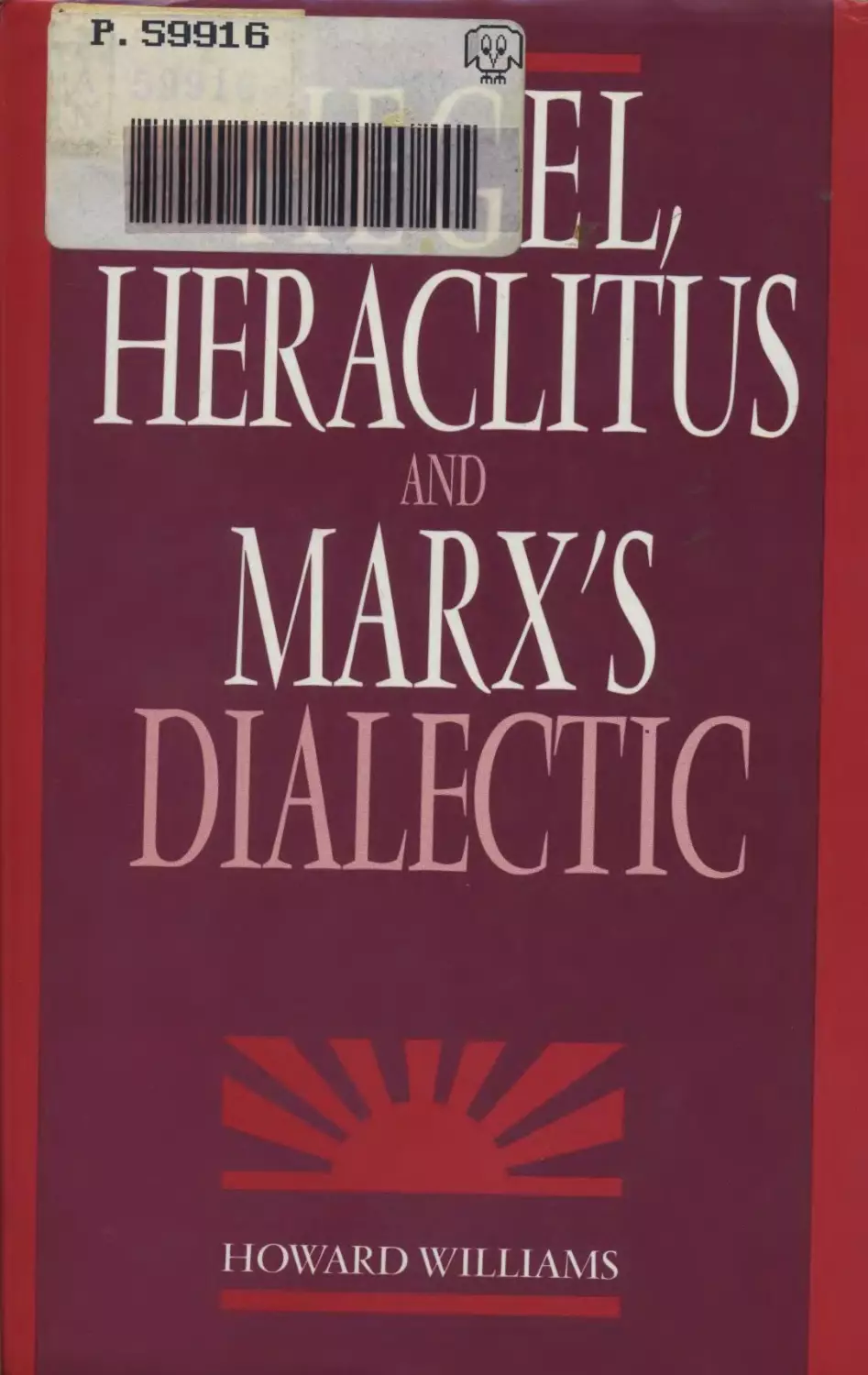
                    HERACLITUS
AND
MARX'S
DIALECTIC
HOWARD WILLIAMS

Hegel, Heraclitus and
Marx's Dialectic
Howard Williams
Senior Lecturer in Political Theory
Dean of the Faculty of Economic and Social Studies
University College of Wales, Aberystwyth
Я 946
Harvester Wheatsheaf
New York London Toronto Sydney Tokyo
59916
66 Wood Lane End, Hemel Hempstead,
Hertfordshire, HP2 4RG
A division of
Simon & Schuster International Group
© Howard Williams 1989
All rights reserved. No part of this publication may be
reproduced, stored in a retrieval system, or transmitted,
in any form, or by any means, electronic, mechanical,
photocopying, recording or otherwise, without the prior
permission, in writing, from the publisher.
Printed and bound in Great Britain by
Billing and Sons Ltd, Worcester
British Library Cataloguing in Publication Data
Williams, Howard LI. (Howard Lloyd), 1950-
Hegel, Heraclitus and Marx's dialectic
1. Marxism. Dialectical materialism.
I. Title
335.4'112
ISBN 0-7450-0527-6
1 2 3 4 5 93 92 91 90 89
P.59916

k.
ft.
For Peter and Anne

Contents
Preface	ix
Acknowledgements	xvi
1	Heraclitus's Philosophy and the Origins of Dialectic	1
The doctrine of flux	10
The unity of opposites	11
Knowledge and the world	14
Heraclitus, Hegel and Marx	25
2	Kant's Dialectic and Hegel's Logic	32
Introduction: Kant and the limits of reason	32
The scope and origins of Hegel's Logic	38
Idealist dialectic in the Logic - some criticisms	41
The terminology of dialectical logic	46
A logic of objects (or the unity of form and content)	52
The limitations of the judgement	58
3 Dialectical Logic I	66
Logic and ontology	66
'The laws of thought'	71
Identity	74
Contradiction	76
The law of the excluded middle	80
4	Dialectical Logic II	87
The transition from the objective logic to the
subjective logic	87
Hegel on the syllogism	95
viii Contents
5	The Meaning of Aufhebung	and	Vorstellung
in Hegel's Philosophy	115
6	Dialectic in Marx's Capital	138
Facts	140
Two concepts of appearance	143
The distinction between the mode of presentation
and the mode of research	146
The rational form of dialectic	150
Concrete abstraction	155
7	Marx's Dialectical Mode of	Presentation:
the Circulation of Commodities	167
The value form	167
The fetishism of commodities	178
8	Contradiction and Dialectical Transition in Marx	191
Contradiction	191
Say's Law and the unity of opposites	194
The dialectical transition	199
The dialectic of property
The transformation of quantity into quality	204
The negation of the negation	206
9	Conclusion	220
Adorno's negative dialectic	220
The philosophical status of Marx's Capital	224
'The true is the whole'	227
Essence and appearance	231
The unity of opposites	233
Real contradictions	237
Selected Bibliography and Further Reading	243
Index
252
Preface
The objectives of this book are threefold. The first, historical,
objective is to demonstrate where the idea of dialectic enters into
the work of Heraclitus, Hegel and Marx and to show what
function it performs for them. The second, philosophical, objec-
tive is to provide an assessment of the worth of the use they make
of dialectic and to criticize this use where necessary. The third,
methodological, objective is to present and defend what I think is
valuable in the dialectic and to recommend some fields in which it
might profitably be employed. These objectives are, of course,
closely interrelated but all three represent equally valid angles
from which to approach the problem of dialectic. Those of histor-
ical bent will want to know what precisely dialectic meant for its
main practitioners; those of a philosophical bent will want to
know what sense we can make of the logic of dialectic; and those
of a methodological bent will want to know what we can make of
the dialectic in our scientific, historical and social enquiries. I
hope not to have set myself too ambitious a task in trying to
interest all three types of reader.
One of the main themes of this book is to demonstrate how
Marx draws extensively on Heraclitus and Hegel in presenting
his dialectic. The debt he owes to Hegel in particular is enormous.
But this should not blind us to the fact that there is also a marked
difference between Hegel's and Marx's interpretation of dialectic.
This difference is that for Hegel dialectic is both a method of
argument and an ontology whereas for Marx dialectic properly
describes only his method of argument. This difference is of great
consequence to their work. One of the main purposes of Hegel's
philosophical system is to demonstrate that reality is dialectical. It
might be argued that Marx's main purpose in writing Capital is
x Preface
similar, namely, to demonstrate that the essence of human
society is dialectical. However, it is my contention that Marx does
not, in Hegel's fashion, see reality as dialectical but rather takes
the view that reality can only be understood dialectically. This may
seem only to be a minor distinction to make. But it has the
implication that Marx does not devote his lifetime's work to
demonstrating the identity of rational thought with reality but,
rather, to demonstrating the lack of identity between the two. For
Marx, unlike Hegel, neither is the real necessarily rational nor is the
rational necessarily real. Marx, on the contrary, comes to the con-
clusion that the real has to be made rational and the rational real.
The first chapter turns to the originator of dialectic, the Greek
pre-socratic philosopher, Heraclitus. Hegel's reception of the
early Greek philosopher Heraclitus is of seminal importance in
the history of philosophy. Heraclitus first introduces the dialec-
tical view of the universe which plays such a prominent role in
Hegel's philosophy and Marx's criticism of capitalist society.
Hegel deals meticulously with Heraclitus's philosophy in his
Lectures on the Philosophy of History, and acknowledges his in-
debtedness to all aspects of Heraclitus's teachings. Hegel is not
only greatly excited by Heraclitus's method of argument, which
stressed the unity of opposites, but also shows great sympathy
for Heraclitus's ontology. Like many of the pre-socratic philo-
sophers Heraclitus believes that reality may be reduced to one
principle. For Heraclitus this principle is the principle of move-
ment or change, everything is both in a condition of coming to be
and ceasing to be. This condition is symbolized for Heraclitus by
fire. Hegel accepts this principle of movement in his philosophic-
al system with his notion of becoming. He rejects the organizing
concept of fire but otherwise finds a prominent place for Hera-
clitus's teachings in his philosophy. Marx similarly rejects the
concept of fire as the universal equivalent but none the less
adopts Heraclitus's principle of movement and change as an
integral part of his dialectical method.
We can gain an invaluable insight into the origins and nature of
Hegel's and Marx's dialectic in looking at Heraclitus's philosophy
and Hegel's comments upon it. However, to discover Hegel's
own view and treatment of dialectic we must turn to his Science of
Logic. Hegel regards his Science of Logic as both explicating and
demonstrating the truth of his dialectic. In the second chapter I
Preface xi
try, therefore, to give as clear an appreciation as possible of
Hegel's view of logic and show how it grows from his response to
Kant's dialectic. This is an extremely difficult task. Account not
only has to be taken of Hegel's view of traditional, formal logic
and his assessment of Kant's transcendental logic but also of his
view of the relationship of logic to ordinary thought, culture and
society's development in general. Because of Hegel's compre-
hensive view of dialectic, his Science of Logic is also a metaphysic
or a theory of being. As well as making some criticism of this
approach I try also to commend what I find stimulating and true
in Hegel's method.
Chapters 3 and 4 look more closely at some of the main
concepts of Hegel's dialectical logic. I attempt first of all to explain
what Hegel might mean by describing the first volume of his Logic
as an objective logic. I then outline his objections to the presenta-
tion of the 'laws of thought' usual in the logic of his day. I
compare Hegel's concept of 'concrete' identity with the concept
of identity of formal logic and point to the dependence of the one
concept upon the other. I next deal with Hegel's astonishing
treatment of the notion of contradiction and outline his case
against Aristotle's law of the excluded middle. I argue that Hegel
does not reject Aristotle's logic but, rather, seeks to revolutionize
it by making it into a logic of both form and content.
In view of the importance of the concept of transition - both in
the presentation of an argument and in the development of
reality - for Hegel and Marx I look in Chapter 4 at the transition
from the objective to the subjective logic in the Science of Logic. I
suggest Hegel takes too ambitious a view of this philosophical
transition. In the final section of the chapter I look in detail at
Hegel's account of the syllogism. Hegel provides a complex
account of the syllogism which places the various forms in a
hierarchical order, leading from the more basic 'syllogism of
existence' to the most sophisticated disjunctive syllogism. I dis-
cuss Hegel's view of the limitations of the syllogistic form and
suggest why his analysis may have had such a profound in-
fluence on Marx. With all its limitations Hegel's Logic none the
less outlines some of the main methodological rules of the dialec-
tical method. Hegefs highest form of the syllogism, the syllogism
of necessity, provides the model for the pattern of reasoning
Marx adopts in Capital.
xii Preface
Chapter 5 looks at two vital concepts in Hegel's dialectic: the
concepts of Aufhebung and Vorstellung. Aufhebung is of particular
importance because it suggests for Hegel how a process of
negation may take place without there being a solely negative
outcome. Hegel wants to build upon the complex of meanings
available in German for the term, ranging from 'destruction' to
'preservation', to present his positive dialectic. Whilst accepting
Hegel's methodological point I reject the idealist ontological
implications of his analysis. In my account of Hegel's treatment of
the term Vorstellung I attempt to bring out the implications of
Hegel's dialectic for our ordinary experience. Hegel takes the
view that most ordinary thinking is trapped at the level of
representation (Vorstellung). We look at things in a representative
way not caring for those aspects of their make-up which run
counter to our received view of them. This will not do for Hegel,
and he recommends his dialectic as a method of subverting our
ordinary taken-for-granted knowledge, and so supplanting
understanding with reason. I suggest that modern theories of
ideology may bear some affainity with Hegel's criticism of repre-
sentational thinking.
In Chapter 61 turn to the question of Marx's use of dialectic in
Capital. Marx makes a number of remarks in passing about his use
of dialectic in his correspondence and unpublished manuscripts,
but it is only in Capital Marx claims to have employed in a
systematic way the dialectical method. I first look closely at the
important remarks that Marx makes in the afterword to the
second German edition of the work to elicit from them the
important distinction between the method of enquiry
(Forschungsmethode) and the method of presentation (Darstellung-
smethode). On the basis of this distinction I argue that Marx
confines his dialectic to the method of presentation. His is not an
ontological or 'materialist' dialectic. I then show how Marx seems
to work with two distinct concepts of appearance in presenting
his account of capitalism. I argue that these two distinct concepts
of appearance are of importance to him in distinguishing his
dialectic from that of Hegel. For Marx dialectic is above all a
critical way of presenting our findings about nature and society.
We can speak only metaphorically of dialectic 'dissolving'
appearances, in reality the appearance of things alters only when
circumstances are changed.
Preface xiii
In Chapter 71 try to illustrate how Marx employs his dialectical
method of presentation of Capital in his discussion of the circula-
tion of commodities. In this analysis Marx outlines the origins
and role of money in the modem capitalist economy. I demon-
strate how Marx calls upon several Hegelian categories such as
reciprocity and the solicitation of force in presenting his analysis.
I also suggest what role Hegel's account of the passive and the
active and the unity of opposites may play in Marx's elucidation
of his theory of money. I show how the influence of Hegel's
analysis of the syllogism may be seen in the notational form
which Marx adopts in explaining the role of money. I then seek to
show the practical dimension implicit in Marx's view of the
dialectical method.
This practical dimension arises I suggest because of the clash
brought about by the critical use of dialectic between the syste-
matic and coherent knowledge of capitalism which it affords and
the actual incoherence of the system as we experience it in our
everyday lives. Marx thinks that this clash between what we
know and what we experience can be resolved only through
transforming our circumstances. Unlike Hegel, Marx does not
think rational insight is in itself sufficient for us to be at home in
the world.
This view conditions Marx's treatment of the two categories I
deal with in the eighth chapter, the categories of contradiction
and the dialectical transition. I outline the occasions on which
Marx employs the category 'contradiction' in Capital and try to
glean from them the objections Marx might raise to Hegel's
treatment of the category. For Hegel a contradiction dissolves in
its ground, but for Marx what he calls a 'real contradiction' does
not dissolve itself in another category. Real contradictions are, in
Marx's view, resolved only by an adjustment in the circum-
stances of which they form part. This is not to suggest that Marx
believes (as does Engels) that contradictions are a feature of
nature 'in itself'* Contradictions arise only in our conscious
understanding of nature and of our relationship with other
individuals. Marx appears to be aware that it is only propositions
which can be contradictory, and is conscious that to overcome a
contradiction we experience often requires a great deal more than
merely an adjustment in our thought.
This realist view of our experience colours Marx's approach to
xiv Preface
the dialectical transition. In Capital he presents all the theoretical
transitions with great care. He is anxious to avoid forcing his
material into the pattern that best fits his conceptual scheme.
Scepticism has been justifiably expressed about a number of the
key transitions in Hegel's system. Marx himself raises doubts in
his early writings about the transition from the absolute idea to
nature at the end of the Science of Logic. Whilst maintaining the
continuity and coherence of Hegel's dialectical presentation Marx
wants to avoid the appearance of artificiality in his transitions. I
suggest that Marx is more effective in the transitions he depicts in
Capital, and then look at the thorny issues raised by his allusion to
Hegel's views of the transformation of quantity and quality and
the negation of the negation in key sections of the work. Whilst it
does not directly represent one of the main themes of the work, I
suggest that Marx's approach to dialectics is at odds with the
official version of Marxian dialectic given by Engels in his later
writings.
Throughout I have been concerned to draw out what is positive
in both Hegel and Marx's view of dialectic. What is positive is, I
suggest, the method of argument through contraries which they
put forward. For any proposition to hold true presupposes that a
number of contrary propositions might possibly hold true. But
each of these contrary propositions have their own contrary
propositions which may possibly hold true for the former to hold
true - and so on. This is a point seemingly grasped most soundly
in the most profoundly methodological of Plato's dialogues, the
Parmenides. The extreme variety of approaches allowed by dialec-
tic when dealing with a problem of comprehension may seem to
open up the possibility of an infinite regress in an argument, but
in reality this is the pattern that sound, systematic argument
follows since the initial propositions ultimately re-appear as the
contrary of later propositions (or their contraries). So the pattern
followed by the dialectical unfolding of our knowledge is not one
of infinite linear development but, rather, a spiral one in which
the circle at its core is continually increasing its boundaries.
In the conclusion I suggest some cautious generalizations
which may be made about Hegel's and Marx's dialectic. I stress
that the methodological rules that may be drawn from dialectic,
such as the unity of opposites and the true is the whole, have to
be seen not as statements about existents but, rather, as state-
Preface xv
ments about how best we are to comprehend existents in terms of
human social experience. Dialectic is not to be found in existent
things, it represents a means of comprehending those things
and, above all, our relationship to them and to other human
individuals.
Acknowledgements
Many academic colleagues have commented upon various drafts
of this book, I am grateful to them all. The British Academy
provided me with a small grant with which I could pursue my
research for a short period at Frankfurt University. My thanks to
the Academy. Wendy Davies typed sections of the final draft. My
thanks to her also. An earlier draft of the first chapter appeared in
the journal History of Political Thought. I am grateful to the editors
of the journal for their kind permission to reprint part of the
article here.
Jen, Ceri, Wyn and Huw as ever deserve special thanks.
1
Heraclitus's Philosophy and
the Origins of Dialectic
Perhaps the most familiar source and point of origin of dialectic is
the philosophy of Plato. In his dialogues Plato brought to the
attention of the world both what he took to be the negative and
unsatisfactory dialectic of the sophists and the positive dialectic
of his teacher Socrates. Socrates looked on dialectic as the art of
midwifery: as the process of giving birth to new insights through
analysing and criticizing the thoughts of others. Plato saw him-
self as practising this art in his own dialogues. In the best known
of his works, the Republic, we can, for instance, see him develop-
ing his own theory of the state from the criticism voiced by
Socrates's partners in the dialogue. Plato employs the same
means as the sophists in defeating the arguments of his oppo-
nents, but then goes on to advance his own point of view on the
basis of the conclusions that are drawn. Plato shows himself to be
thoroughly dissatisfied with the sophists' role of refutation for its
own sake. He practises the art of dialectic most successfully
producing powerful and well-founded conclusions from engag-
ing and sometimes entertaining dialogues. In one of his most
abstract dialogues, the Parmenides, Plato produces an account of
his dialectical procedure which stresses the attainability, yet
apparent relativity, of knowledge. This dialectic had the most
profound effect upon Hegel.1
However, Plato is not the most radical dialectician of ancient
times. The thinker who employed dialectic in the most far-
reaching way and provided the inspiration for Plato's own dialec-
tic was Heraclitus. The path followed by Heraclitus also set a
model for both Hegel and Marx. Both testify to the crucial
significance of Heraclitus's work for the development of their
dialectic. Heraclitus stood outside his own society and was
2 Heraclitus and the origins of dialectic
wholly sceptical of ordinary opinion. He would not yield any-
thing to the status quo, insisting on being his own judge on
matters of knowledge and morality. Heraclitus was prepared to
reject any external authority not founded on reason and good
sense. Yet despite the distance he maintained between himself
and the ordinary concerns of individuals Heraclitus none the less
showed himself to be deeply interested in the fate of mankind.
Heraclitus is an extraordinary figure in Greek history and the
history of philosophy. None of his writings survive in their
original completed form. In his own lifetime he seems to have cut
himself off deliberately from other individuals and society, living
a simple and austere life in the mountains around his home city of
Ephesus. Among the Ancients he was known as Heraclitus 'the
obscure' and, if we are to judge by his surviving fragments, this is
a wholly apt and deserved reputation. He was thought to be fond
of riddles, and many of his views are expressed in pithy, pungent
and witty aphorisms preserved for us by later philosophers and
biographers, such as Aristotle and Plutarch. Heraclitus is said to
have been in his prime as a philosopher in the 69th Olympiad or
504-501 вс2
Very little that is certain is known of Heraclitus's life. He seems
to have been of aristocratic birth and to have shunned public
office in his own city. In one of his surviving fragments he speaks
with contempt of his fellow citizens of Ephesus, saying that what
they 'deserve is to be hanged to the last man' for having expelled
from the city their most honourable and capable fellow citizen
Hermodorus.3 Heraclitus has little respect for the judgement of
the ordinary individual and suggests that little is lost by standing
to one side of the preoccupations and concerns of everyday life.
But his detached attitude should not be mistaken for a lack of
concern with the course of human life and society. Heraclitus's
surviving fragments suggest he has a consuming interest in the
vagaries of nature and society.
Heraclitus has a deserved reputation for obliqueness and opac-
ity which should not prevent us from reading his work sym-
pathetically. He is, in my view, a most penetrating and profound
thinker, and I think little credence should be given to W. К. C.
Guthrie's suggestions in the first volume of his History of Greek
Philosophy that Heraclitus is purposely obscure because of
the contempt in which he holds the rest of mankind. Guthrie
Heraclitus and the origins of dialectic 3
acknowledges that for Heraclitus 'the truth is something that is
there for all men to grasp', but draws the false conclusion that Heracli-
tus thought 'most men are too stupid to see it'.4 There is nothing
in Heraclitus's fragments to suggest that he thought men univer-
sally stupid or that he did not want, as Guthrie puts it, 'to demean
himself by using language that fools can understand'.5 The
meaning of his sayings is often crystal clear and where difficulties
of interpretation arise, they arise not from Heraclitus's supposed
intellectual arrogance but from the difficulty and the complexity
of the problems concerned. Heraclitus thought the truth was
difficult to get at even though it was accessible to all. The
preoccupations of the ordinary individual often make it difficult
to see things clearly.
In discussing Heraclitus's mode of expression it should, above
all, be remembered that he was contributing to a philosophical
and cultural tradition which was still primarily oral.6 Although he
is said to have deposited his book in the temple of Artemis at
Ephesus the principal method for disseminating his thoughts
and preserving them for posterity was still by word of mouth.
Thus the pithy, pointed form of expression was essential for the
preservation of his ideas, a form which Heraclitus found
appropriate both to convey his ideas and to ensure they were
retained. It is of course in retrospect fortunate that Hera-
clitus collected his thoughts in this way, or else all record of his
ideas might now be lost as what we know of his thinking is for the
most part based on quotations from memory by later classical
authors.
In his Lectures on the History of Philosophy Hegel identifies
completely with the philosophy of Heraclitus. He sees in Hera-
clitus a kindred spirit who recognizes the true worth of dialectical
thinking. The conclusion he comes to, having studied Hera-
clitus's philosophy is: 'We can in fact say of Heraclitus what
Socrates said. What remains to us of Heraclitus is excellent, and
we may conjecture of what is lost, that it was as excellent.'7 Hegel
suggests that the significance of Heraclitus's philosophy for the
development of his own dialectical method can be shown by
means of this general scheme. Hegel suggests dialectic is, first,
an external dialectic, reasoning back and forth without getting to
the heart of the matter; secondly, it is the 'immanent dialectic' of
the object, but falling within the subject's observation; thirdly, it
<3
4 Heraclitus and the origins of dialectic
is the 'objectivity of Heraclitus' which grasps the dialectic itself as
a principle.8
What leads Hegel to attribute to Heraclitus dialectic in its
mature form? What, in Hegel's view, raises Heraclitus's thinking
to the highest point of human reason is that, unlike his critics the
Eleatic philosophers Melissus, Parmenides and Zeno, who see
true reality as Being (Seiri) only, Heraclitus sees true reality as
Becoming (Werden). Hegel thinks that the Eleatics go beyond an
external dialectic which merely stresses the relativity of all opin-
ions to an immanent or objective dialectic 'in which the object is
taken for itself, without previous hypothesis, idea or obligation,
not under any outward conditions, laws or causes'.9 However
this dialectic remains negative in that the Eleatics prime objective
was to refute the views of their opponents and ordinary men.
Thus although Hegel would no doubt agree with Parmenides's
advice: 'You shall inquire into everything both the motionless
heart of well-rounded truth, and also the opinions of mortals, in
which there is not true reliability. But nevertheless you should
learn these things (opinions) also - the opinion that what seems
must certainly exist, being indeed everything,'10 he does not
agree with stopping simply with the errors of common sense. He
thinks the more difficult task, and the most important one, the
one of moving on from the refutation of opinion to demonstrating
what is true. Truth for Hegel can never be a mere assertion as we
find, for instance, with Parmenides when he says that the One
'is, and it is not possible for it not to be'.11 It has rather to be a fully
developed process of reasoning in which the reality of one point
of view is shown from the refutation of an earlier point of view.
This, Hegel thinks, we find in Heraclitus. Heraclitus recognizes
the diversity of opinion, view and thought in human society but
shows from this diversity that certain ideas hold true.
There are very few aspects of Heraclitus's metaphysics, there-
fore, with which Hegel does not agree. He says in his Lectures on
the History of Philosophy: 'Here we see land; there is no proposition
of Heraclitus which I have not adopted in my Logic'.12 There is no
other philosopher who gains Hegel's whole-hearted approval in
the same way as Heraclitus. This approbation for Heraclitus's
philosophy as a whole is ever more surprising in the light of the
negligible interest that Hegel shows in the cosmology of Hera-
clitus's contemporary philosophers. It is the methods of argu-
Heraclitus and the origins of dialectic 5
ment of the Eleatics that interests Hegel, not their cosmologies.
But Heraclitus is different since he makes movement and change
the theme of his thinking. This is in complete contrast to Parme-
nides and Zeno who seek energetically to deny the reality of
motion and change.
Hegel thinks Zeno's attempts to deny the reality of motion fully
worthy of our attention. They are an example of an immanent, if
simply negative dialectic. Hegel thinks it can be compared
favourably with that of Kant. Zeno, as does Kant, makes great
play with the subjective and incomplete nature of appearance,
but Hegel thinks Zeno shows greater merit in his dialectic than
Kant in his in that he uses his dialectic to come to a positive
conclusion about appearance.13 Whereas Kant rules that our
knowledge is deficient because we cannot properly be said to
know what lies behind appearance, Zeno comes to the conclu-
sion that there is an unchanging reality behind appearance which
only our knowledge can affirm. As with Parmenides, what can be
said unfailingly about the reality behind appearance is that only
the one is.
Zeno's denial of the reality of motion derives from his monism.
He advances four famous arguments to prove the point. Hegel
deals with each of these arguments in his Lectures on the History of
Philosophy which have become known, respectively, as the argu-
ment of the 'dichotomy', the 'Achilles' argument, the argument
of the 'arrow' and the argument of the 'stadium'. In the dicho-
tomy argument Zeno suggests that motion is not real since any
object which travels over a certain distance must first pass
through the halfway point. But within any given distance, say,
from A to B, there are an infinite number of possible halfway
points. Even the minutest distance can be divided to yield
another notional halfway point. Thus, in order for a body to pass
through all these halfway points entails that it would never
complete its journey. The Achilles argument rests on a similar
paradox. Here it is argued that in a race a slower runner will never
be overtaken by the quicker (as with Achilles and the tortoise)
because the pursuer must first reach the point from which the
slower runner begins, in the meanwhile the runner being pur-
sued will always have moved ahead. The race is not seen by Zeno
as a continuous one, the competition always beginning afresh
with Achilles in pursuit. In the argument of the arrow Zeno takes
6 Heraclitus and the origins of dialectic
a different tack in suggesting that a moving body such as an
arrow must at any stage in its flight be somewhere in particular,
occupying a space which is at least as large as itself. However, if
the arrow is always somewhere in particular it cannot be in
motion. The final argument concerning the stadium is somewhat
more complex. It deals with a number of bodies moving at the
same speed in opposite directions within the same stadium. Here
Zeno thinks he can prove that half a given amount of time can be
shown equal to its double if we persist in holding the view that
bodies can be shown to move.14
Although much impressed by the dialectical skills Zeno ex-
hibits Hegel does not fully accept the conclusions Zeno draws
from the paradoxes of motion. To Zeno's contention in the arrow
argument that nothing moves as no object can both be in a place
and not in a place at one time, Hegel makes the telling reply that
for a body to be in motion precisely 'means to be in this place and
not to be in it.'15 Hegel is fully prepared to accept that there is
much in the phenomenon of motion that is paradoxical, however
the phenomenon should not for this reason be regarded as null
and void. Contrary to the view advanced by Zeno the paradoxes
of motion have to be accepted as real and properly explained.
Here Hegel's and Zeno's ontologies clash. Hegel has room for
development and change within his ontology which Zeno's
monism rules out. But Zeno sets about his task in a manner of
which Hegel greatly approves. Zeno demonstrates how space
and time are both infinitely divisible, and if a supposedly moving
object is regarded as coming to rest, as in the dichotomy argu-
ment, at all these notional points of division it would never
complete its journey. Indeed an object could never undertake
such a journey since the requirement that it constantly comes to
rest at points of division would leave it constantly at rest. Hegel
does not deny that this is true. But he suggests that greater
imagination is required to portray motion properly. A moving
object should not simply be conceptualized as moving away from
that point. A body in motion is, for Hegel, a telling example of a
contradictory phenomenon which can be explained only dialecti-
cally. For Marx capitalism is a social system which is continually
involved in a process of movement and change, thus he also
draws on the ancient Greek philosophers' dialectical understand-
ing of motion.
Heraclitus and the origins of dialectic 7
In contrast with Zeno, Heraclitus stresses the reality of move-
ment and change. Hegel attributes to him the view that 'being
and nothing are one and the same, everything is and yet is not'.16
As with every other saying attributed to Heraclitus there is some
difficulty in establishing the authenticity of this aphorism. Hegel
takes as his authority Aristotle who attributes to Heraclitus a
similar view when he says in the Metaphysics 'that it is impossible
for any one to believe the same thing to be and not to be, as some
think Heraclitus says; for what a man says he does not necessarily
believe'.17 To further support his view of Heraclitus as one who
sees reality as becoming Hegel also quotes from Aristotle the
suggestion 'the doctrine of Heraclitus, that all things are and are
not, seems to make everything true'.18 Hegel, however, does not
share Aristotle's scepticism about Heraclitus's conclusions.
Hegel is prepared to go along with Heraclitus in thinking that
things both are and are not, and propounds a very similar
doctrine in the Science of Logic where he argues that finite things
both are and cease to be:
When we say of things that they are finite, we understand thereby
that they not only have a determinateness, that their quality is not
only a reality and an intrinsic determination, that finite things are
not merely limited . . . but that on the contrary, non-being con-
stitutes their nature and being. Finite things are, but their relation to
themselves is that they are negatively self-related and this very
relation drives them beyond their being. They are, but the truth of
this being is their destruction. The finite not only alters, as anything
does, but it ceases to be, and it is not merely a possibility that it
ceases to be, as though it could be that it might not cease. No, the
nature of the being of finite things is that they have within them the
seeds of their own destruction; the hour of their birth is the hour of
their death.19
Much as I believe that this doctrine makes sense from a
developmental point of view, namely, that over time things alter
to such an extent that they cease to be what they were previously,
I think that Hegel (and Heraclitus - if this is his view) have a
problem in defending their view as an account of things as they
are observed in a representative way. An account of an object
which seeks to be representative will attempt to isolate those
characteristics which are on average found to inhere in the object.
Such a static, observational account finds little room for attribut-
ing an object with opposed characteristics. But this is precisely
8 Heraclitus and the origins of dialectic
what Hegel and Heraclitus try to do with their ontology, they try
to show that things both are and are not as they seem.
Thus the objections that Aristotle raises to Heraclitus's views
are serious and fundamental. Aristotle devotes a great deal of
attention in his logic to demonstrating that you cannot predicate
the same thing with opposing qualities, or, as he puts it in the
Metaphysics, 'that the same attribute cannot at the same time
belong and not belong to the same subject in the same respect'.20
What lies at the heart of the dispute between Aristotle and
Heraclitus is Aristotle's insistence upon dealing with the attri-
butes that inhere in a thing at the 'same time'. Hegel and
Heraclitus are making a general proposition about the nature of
things over time, Aristotle wants to confine the discussion to the
properties of a thing at a distinct point in time. Given their
different perspectives we have to conclude that both parties are
correct. Hegel and Heraclitus would acknowledge the truth of
Aristotle's suggestion from a static point of view. Aristotle,
equally, would have to admit that any widening of perspective
with respect to time, place or nature of the percipient might alter
the nature of the report given about the characteristic of a thing,
and possibly lead to opposed characteristics being attributed to it.
This is why the dialectical approach is of such great value to Marx
in that it looks at things over time.
For instance, there is no doubt that for the average citizen a
prison is a place of confinement and loss of freedom, however,
there exists a class of unfortunate individuals, those incurable
recidivists, for whom (we are told) it is a place of refuge and
companionship. Here we do not have an example of opposed
characteristics inhering in the same institution, but the character-
istics attributed to the institution are so radically different that we
get an inkling of the point that Hegel and Heraclitus have in
mind. A convinced Aristotelian might seek to circumvent the
point by arguing that the radically different characteristics are not
attributed to prison by the same individual, but it would be
churlish not to concede the point that things can, from different
points of view, and at different times, appear to have opposed
characteristics. Heraclitus's suggestion seems to be that we re-
gard things in a fluid way, alive always to the possibility that their
properties may alter and, indeed, become the opposite of what
they are at present. In contrast to this view Aristotle's continual
Heraclitus and the origins of dialectic 9
refining of the thing observed and the standpoint of the observer
appears somewhat formalistic and dogmatic. It is doubtful that
Aristotle establishes in a fully satisfactory way why 'of one
subject we must either affirm or deny any one predicate'.21 For
some purposes of scientific observation and classification the
approach Aristotle suggests in his Metaphysics may be useful, but
for purposes of synthesis and explanation Heraclitus's more
developmental perspective is more satisfactory. Aristotle's
approach would make Marx's and Engels's account of capitalism
difficult to sustain. Marx and Engels see capitalism as being both
thoroughly flawed yet thoroughly progressive. They are able to
attribute to the society such opposed characteristics because they
see it from the contrasting perspectives of the feudal past and the
hoped-for socialist future.
Both Aristotle and Heraclitus see philosophy as being about
what is ultimately real, however, they see ultimate reality in
different ways. Aristotle concentrates on substance as the ulti-
mate form of being and in its attributes we discover the nature of
things. Heraclitus, on the other hand, regards thought or the
logos as the ultimate form of being. For Aristotle the deepest
reality is unchangeable - the unmoved moved, for Heraclitus the
deepest reality is eternal flux, symbolized by the simultaneously
destructive and creative power of fire. The different approaches
to metaphysics of Artistotle and Heraclitus are reflected in the
different approaches to logic. Aristotle's philosophy betrays a
deep interest in the analysis of our experience. His philosophy
deals with a vast range of topics: from zoology, botany and
astronomy to the study of politics and ethics. In his treatment of
these topics Aristotle is always categorizing and defining. Hera-
clitus in contrast shows less interest in categorization and defin-
ing the variety of our experience and much more in trying to
discover its underlying unity. Therefore, in political philosophy,
whereas there is no doubt that Aristotle's method would be the
better one for us to adopt to distinguish the various types of
constitution, assuming that there are clear marks of demarcation
among constitutions, Heraclitus's dialectical method would be
the better one for us to employ to account for a change from one
form of constitution to the next. Heraclitus's method would serve
best to explain the change because his approach would not
suppose that the various types of constitution were wholly
10 Heraclitus and the origins of dialectic
distinct from one another, i.e. that the constitution of a society
could both be one thing and another. This may perhaps help to
explain the superiority of Plato's account of the various types of
constitution in the Republic over Aristotle's account in The Politics.
Plato was a far more enthusiastic advocate of dialectic than
Aristotle, and in the Republic we see a fluid account of the various
forms of constitution not only delineating their differences, but
also demonstrating how the one constitution of its own nature
tends to another: timarchy to oligarchy, oligarchy to democracy
and democracy to tyranny. It seems that Plato, unlike Aristotle,
was prepared to accept Heraclitus's point, that of one subject we
can both affirm and deny the one predicate. It is, of course, the
Heraclitean and Platonic view of change that Hegel and Marx are
most at home with. In so far as they take a view of ultimate reality
they see it as one of a process of fluid change.
The doctrine of flux
There is some controversy amongst specialists as to whether or
not the views Heraclitus expresses about change being perpetual
are central to his philosophy. In an article first published in Mind
entitled 'Natural Change in Heraclitus', G. S. Kirk claims that 'the
constancy of change is not an idea Heraclitus particularly
stressed'.22 It need hardly be said that this view is not in keeping
with Hegel's interpretation of Heraclitus. Kirk regards Plato as
being responsible for linking Heraclitus's philosophy with the
idea of flux by making the suggestion in Cratylus 402a that
Heraclitus took the view 'that everything is moving and nothing
stays still, and likening things to the flow of a river he says you
could not step twice into the same river'.23 Kirk suggests that
there can be some doubt as to whether Plato's memory served
him correctly here. Not surprisingly, Hegel is prepared to accept
Plato's testimony on this matter and in this he has the support of
W. К. C. Guthrie, author of the comprehensive and scholarly
Cambridge History of Greek Philosophy who says that the river
quotation is 'first and correctly given by Plato'.24 Guthrie sug-
gests that the balance of scholarly evidence is very much against
Kirk's view and in favour of the view that the doctrine of flux
forms an essential part of Heraclitus's thinking.
Heraclitus and the origins of dialectic 11
Another classical scholar to take a similar view to Hegel on this
question is С. H. Kahn. In his recent re-translation and re-editing
of Heraclitus's work he also testifies to the authenticity of the
river-statement, but this time as reported by Plutarch, a Platonist
philosopher of the later first century вс. The statement, as quoted
by Plutarch and translated by Kahn is:
One cannot step twice into the same river, nor can one grasp any
mortal substance in a stable condition, but it scatters and again
gathers; it forms and dissolves, and approaches and departs.25
To this Kahn adds the further fragment:
As they step into the same rivers, others and still other waters flow
upon them.26
For Hegel these statements represent the most profound on-
tology. He fully agrees that no aspect of the natural or social
world should, as these fragments imply, be taken as fixed or
static. Reality is a continual process of change in any aspect of
which each individual is but momentarily caught up. In trying to
depict reality accurately we set ourselves a highly elusive goal
which requires a continually critical and open-ended approach.
An analytical approach which sets out from definitions and seeks
certainties can never be fully adequate to the task. The impact of
these views on Marx is also unmistakeable. In the account he
gives of capital definitions play only a preliminary role. The
meaning of a concept is continually widened with Marx as we
learn more of the reality it is intended to convey.
The unity of opposites
Given this view, Marx would agree with Hegel that Heraclitus's
philosophy is still relevant today. This philosophy, Hegel says,
'is not one past and gone; its principle is essential'.27 The essen-
tial principle which Heraclitus establishes is, in Hegel's view, that
'the truth is only as the unity of opposites.'28 The idea of the unity
of opposites, although much overworked by some Marxist com-
mentators, takes us to the heart of Hegel's and Marx's dialectic.
For both Hegel and Marx this idea is no mere formula which is
applied to any problem of comprehension and rational explana-
tion, it is a summary of his experience of the nature of knowledge
12 Heraclitus and the origins of dialectic
and reality. Marx would quarrel only with Hegel's desire, albeit
after a serious and thorough study of natural science and philos-
ophy, to regard the principle of the unity of opposites as an
ontological, as well as, epistemological principle. There is a great
deal of difference between the assertion that the principle is a
useful one to have in mind in seeking to understand any phe-
nomenon, and the assertion which Hegel makes that all things
or phenomena are a unity of opposites. This second move is
illegitimate, since we cannot legislate in advance about the nature
and kind of new knowledge we may acquire: otherwise it would
not be new knowledge.29
None the less, although there is room for scepticism about the
applicability of the unity of opposites as an ontological principle,
there is a great deal to be said for it as a methodological principle,
namely, one we entertain as a hypothesis about any object we
intend to investigate. As we shall see, this is the sense in which
Marx adopts the principle. Heraclitus, as Hegel suggests, contri-
butes a great deal to the development of this heuristic principle.
This is a view which is corroborated by Kahn who says in his
Introduction to his recent translation of Heraclitus's fragments
that 'the characteristic achievement of Heraclitus lies in his articu-
lating a view within which the opposites can be seen together as a
unity.'30 And it is interesting to note that Kirk, who is less
convinced of the dialectical side of Heraclitus's thinking, also
testifies that what Heraclitus stressed 'above all else was his
discovery of the unity that subsists in apparent opposites.'31
Hegel sees the idea of the unity of opposites as providing the
theme of those intriguing paradoxes which Heraclitus brings to
light in his many aphorisms. Some of these aphorisms appear at
first sight to be mere platitudes, as when Heraclitus says 'the way
up and the way down is one and the same';32 however I think that
commentators like Hegel and Kahn are right to look for a deeper
meaning in these apparently straightforward statements. Her-
aclitus here, for instance, is nor merely pointing to the fact that we
can normally go up and down an incline along the same path, but
is, rather, trying to bring out the necessary relativity of many of
our usual claims about the world. What we perceive merely as an
upward path may well be perceived by another person descend-
ing as merely a downward path, just as what we perceive as
deterioration in social conditions might be perceived by another
Heraclitus and the origins of dialectic 13
as an improvement. This contrast is essential to Marx's critique of
capitalist society. He regards what is normally seen as a deteriora-
tion in conditions, i.e., the heightening of class struggle, as a sign
of an impending improvement in social conditions. Thus, there is
much to be said for looking beyond the literal truth of Heraclitus's
statements to their implications about our understanding of the
world. This aphorism seems to bring out that in attributing a
particular property or characteristic to something we ought also
to be alive to the possibility that some element of the opposite of
that characteristic or property might also be attributable to it from
a different point of view.
Heraclitus appears to broaden the idea of the unity of opposites
into a view of life and the cosmos as a whole. This is a path Hegel
follows. Another of the sayings attributed to Heraclitus by Kahn
is that the 'path of the carding-wheel is straight and crooked'.33
An alternative, and more illuminating rendering of this fragment
is given by Guthrie who suggests this fragment be read as 'the
track of writing is straight and crooked'.34 Whichever of the two
renderings is preferred the deeper significance of the saying
appears to be that the execution of a straightforward task may
often involve a seemingly indirect and roundabout method.
Kahn suggests that the fragment may have an even more allusive
meaning in line with Heraclitus's metaphysics as a whole: 'At the
most allusive level', he says, 'this brief text can be understood as a
comment on the order of nature and the course of human life.
Irrational, cruel and needlessly destructive as it often appears,
this "twisted" course of events is plotted according to a wise
pattern'.35 This view has its echo in what Hegel has to say about
the 'cunning of reason' in his Philosophy of History.
Another similar saying attributed to Heraclitus is: 'Cold warms
up, warm cools off, moist parches, dry dampens'.36 This saying
appears to illustrate Heraclitus's view that the unity of opposites
is just as much a feature of nature as we observe it as it is a feature
of human life. Heraclitus seems to suggest in his fragments that
no description of the natural world can hold true always and
absolutely. The natural world is subject to continued change in
which opposites pass from one to another: winter becomes
summer, day passes into night, heat into cold and calm into
storm. We have to be aware of the relativity of all our descriptions
of natural conditions: at best a description will hold true for only a
14 Heraclitus and the origins of dialectic
short period of time. Our descriptions of nature are not only
partial and limited in this sense though, they are also limited by
the standpoint of the observer. With this fragment Heraclitus
brings out the point that we attribute properties to something
usually from an anthropocentric point of view: 'The sea is the
purest and foulest water: for fish drinkable and life-sustaining;
for men undrinkable and deadly'.37 Another fragment which
may be linked with this one is, as Kahn suggests, Heraclitus's
suggestion that 'Asses prefer garbage to gold'.38 These fragments
point, once again, to the relative and almost arbitrary nature of
our usual classification of things. Our values and sentiments
cannot but effect our perception and understanding of things,
and this point is brought home no more aptly than by the
inter-species comparisons Heraclitus suggests.
In his gloss on these fragments Kahn suggests that these ideas
were later seized upon by the sceptics to show why it is necessary
always to suspend judgement on the perceptions and observa-
tion of our senses. Sceptics such as Sextus Empiricus exploited
these fragments of Heraclitus to suggest that we can know only
how things appear to our senses, not as they actually are.39 But it
is doubtful that Heraclitus's intention is simply to cast doubt on
the possibility of our knowing the external world. His is a positive
dialectic. Others of his fragments suggest that he thinks it possi-
ble for us to enjoy a clear comprehension of the world.40 In the
first and longest fragment he speaks, for instance, of his account
of the universe holding 'forever' even though 'men ever fail to
comprehend,'41 and in a subsequent fragment he claims, more
positively, that 'the account is shared and accessible to all,
although most choose to ignore it.42
Knowledge and the world
Thus for Heraclitus knowledge is possible, but it requires we
question many of our usual assumptions. Heraclitus is highly
contemptuous of the untutored views of the ordinary individual.
The ordinary individual is not incapable of achieving an insight
into the nature of things, rather he chooses to overlook and
ignore what insight he gains.43 Above all, what the attainment of
knowledge requires is that we are always conscious of the
Heraclitus and the origins of dialectic 15
opposed and reciprocal nature of the relations between things.
Here Hegel and Marx would concur. The attributes or properties
of a thing attain their significance through the relation of those
attributes or properties to the attributes or properties of the thing
to which they are opposed. This is, I think, brought out in the
aphorism:
It is not better for human beings to get all they want. It is disease that
has made health sweet and good, hunger satiety, weariness rest.44
Health, hunger and weariness attain their significance through
the contrast with their opposites, disease, satiety and rest. The
ingredients of the good life are as easily described in terms of
what is to be avoided as they are in terms of what is to be actively
sought. The goals of ethical and political life are chosen in a
similar way. Justice and right can be actively sought in society
only when their opposites injustice and wrong are properly
recognized and understood. Knowledge of what is right and
what is wrong presuppose each other, they are opposites which
bear an essential and reciprocal relation to each other. Marx, for
instance, is fully aware that to overcome the 'evils' of capitalist
society first requires that we recognize them as evils.
In an astute comment upon the fragment describing the sea as
'the purest and foulest water: for fish drinkable and life-
sustaining; for men undrinkable and deadly'45 Kahn suggests
how best to interpret Heraclitus's continual linking of opposites.
Here, Kahn says, 'the trivial reading of Heraclitus's doctrine . . .
is that there is no accounting for tastes. The fallacious reading is
that because one man's meat is another man's poison, there is no
difference between meat and poison. The confused reading is
that all things are inherently contradictory. If we wish to ascribe
an intelligent doctrine to Heraclitus . . . these texts provide the
basis for a valid generalization: in an opposed pair the negative
term, as defined by human needs and desires, is never wholly
negative.'46 As Kahn suggests, Heraclitus is not a universal
relativist who thinks that the significance and truth of a matter
depend wholly on the standpoint of the observer, nor equally, is
Heraclitus a thoroughgoing sceptic who thinks that nothing in
our experience is certain because of the fleeting, transient and
conflicting nature of our perception of things. In pointing to the
apparent contradictions in our observation and evaluation of the
16 Heraclitus and the origins of dialectic
world Heraclitus appears to want to draw our attention to an
important methodological point. This methodological point is, as
Kahn says, that there is generally a positive side to any negative
human evaluation of a quality, circumstance and condition. We
may, for instance, prefer an altruistic companion to a selfish one,
but in so far as selfishness implies a high level of self-esteem, and
altruism a low level of self-esteem, there are possibly some
circumstances where we might prefer the selfish person as a
companion. An ungovernable society might also be one we might
not best like to live in, however, where the ungovernability is
attributable to an extensive and effective employment of demo-
cratic practices we might in the end find the ungovernability of
the society acceptable. Nothing in individual and social existence
can be taken as unconditionally good or bad. In keeping with this
Heraclitean precept, Marx's favourite saying was, apparently,
that 'nothing human is foreign to me'. There is always a great deal
more to be said than can be contained in one individual judge-
ment. We gain knowledge and understanding in recognizing the
two-edged and conflicting character of the significant properties
we atttribute to objects, circumstances and events.
Hegel says, therefore, of Heraclitus that he has a 'beautiful,
natural, childlike manner of speaking the truth of the truth'.47
Those concepts which lie at the root of Hegel's own philosophy
like the unity of subject and object, the ever-present nature of
mind or spirit, and the unity of experience emerge, he suggests,
for the first time in Heraclitus's philosophy. Kahn in his commen-
tary on Heraclitus's fragments suggests that Hegel is indebted to
Heraclitus in one other respect, namely, for his interpretation of
the principle of negativity. As Kahn says:
It is this positive interpretation of the principle of negativity that has
made Heraclitus so congenial to Hegel and his followers. For there is
something like an anticipation of Hegelian dialectic in Heraclitus's
treatment of opposites. . . . The dialectic of opposites is focussed on
the partiality of the human perspective. . . . It is not that we are (for
example) mistaken in preferring sweet drinking water and clean
baths, any more than we are wrong to prefer health to sickness and
satiety to hunger. But the doctrine of opposites is, among other
things, an attempt to attain a larger vision by recognizing the
life-enhancing function of the negative term, and hence of compre-
hending the positive value of the antithesis itself.48
In describing the dialectical nature of reason in the Preface to the
Heraclitus and the origins of dialectic 17
first edition of the Science of Logic Hegel stresses its negative
nature. Reason undermines and destroys the 'determinations of
the understanding' but, importantly, it does not stay 'in the
nothing of this result but in the result is no less positive.'49 Hegel
then connects this procedure with what he regards as the correct
philosophical method which builds a systematic and coherent
account of experience from the most thoroughgoing scepticism.
In keeping with this view, Hegel's own point of departure in
presenting his philosophical system is his radical criticism of
previous philosophy, just as later Marx's point of departure in his
account of capitalism was a radical criticism of classical political
economy.
Heraclitus's dialectic is not, of course, restricted to our know-
ledge and understanding of the world. It also has an ethical
dimension. His dialectic leads him for example to suggest that 'It
is not better for human beings to get all that they want. It is
disease that makes health sweet and good, hunger satiety, weari-
ness rest'.50 In satisfying all his desires an individual is left with
little to strive for, and often the striving is as fulfilling as the
attainment of the goal itself. Heraclitus seems to be cautioning
against both too high an expectation and too low an expectation
of success. Too high an expectation leads to disappointment, too
low an expectation leads to a feeling of lassitude and despon-
dency. He seems to suggest that we recognize and acknowledge
the ebb and flow of life and the contrasts which this entails. There
is no joy without sadness, no good fortune without ill-luck, no
peace without conflict and no success without failure. Hegel is, as
we shall see, able to find good use for this ethical dialectic.
The same doctrine of the complementarity of opposites is
applied by Heraclitus to politics and law. As Kahn suggests in his
commentary, the thought that lies behind the cryptic fragment:
'If it were not for these things, they would not have known the
name of justice' appears to be 'the conceptual dependence of
justice upon the existence of injustice and legal disputes'.51 We
learn to value rules and institutions best as we learn to value other
human beings: through their absence. The benefits afforded by
justice are best appreciated in an unjust and tyrannical society;
equally, the benefits of peace are no more apparent than when a
state is at war. We can envisage Marx echoing this point in his
criticism of the capitalism sys^nwit is in contrast with the
18 Heraclitus and the origins of dialectic
drawbacks of capitalism that the advantages of socialism are best
seen.
These opposites are complementary in the sense that one is no
more dispensable than the other. The possibility of injustice is as
indispensable to the possibility of justice as the possibility of war
is as indispensable to peace. Indeed perhaps the most famous of
Heraclitus's aphorisms is:
War is the father of all and king of all; and some he has shown as
gods, others men; some he has made slaves, others free.52
War for Heraclitus is not only indispensable for peace it is
indispensable for all life and development. Conflict and struggle
are, he suggests, at the root of culture and civilization. This is a
discomforting thought for many of a liberal or pacificist disposi-
tion, but it is mistaken to suggest, as Popper does, that Heraclitus
shows moral approval for the conflict-ridden course of human life
and society.53 The tone of Heraclitus's fragments about human
society is not one of moral approval or disapproval, rather it is
that of the dispassidnate observer of both success and tragedy.
Hegel and Marx adopt a similar tone in their historical writings,
believing that history and morality were not always and of
necessity in accord. This point comes out in two more of Hera-
clitus's fragments which, following Kahn, may be linked with the
aphorism on war as the 'father of all':
Homer was wrong when he said 'Would that conflict might vanish
from among gods and men!' (Iliad XVIII. 107) For there would be no
attunement without high and low notes nor any animals without
male and female, both of which are opposites.54
One must realize that war is shared and conflict is Justice, and that
all things come to pass (and are ordained?) in accordance with
conflict.55
The three fragments taken together shed a great deal of light on
Heraclitus's thinking about man and society. What he appears
here to have in view is the seemingly arbitrary and violent way in
which any kind of settled justice and law has been brought into
being. This can be said not only of the Greek city-states with
which Heraclitus was familiar but also of the modern European
states. There have been very few boundaries drawn in Europe
without the use or the threat of the use of force. And how many of
the new states that have entered the United Nations since 1945
Heraclitus and the origins of dialectic 19
were able to establish their sovereignty without threat of force
and violence? Settled justice and law were established in these
states, as they were in the modem European states, by coercive
means. But these coercive means do not obviate the need to
respect justice and law where they exist. Heraclitus has no wish
to conclude that settled law and justice are undesirable. Indeed,
from others of his fragments it appears that Heraclitus , like
Hegel, held the law in high respect. He is reported as saying, for
instance, that 'the people must fight for the law as for their city
wall'.56 To be aware, as Heraclitus is, that in first establishing a
legal system, and in later enforcing it, a number of contingent and
painful things may occur - some may be rendered dependent,
others may be rendered masters and kings - does not, in his view,
detract from the necessity and requirement that it takes place.
Although law is the product of conflict and stress it should, none
the less, be respected. It is in this vein I think that Heraclitus
suggests that 'it is law also to obey the counsel of one'.57 Unlike
Popper I do not think that Heraclitus is recommending a con-
servative and anti-democratic form of rule here,58 Heraclitus is
suggesting merely that a system of rule is not only established in
the first instance through conflict, but its maintenance may also
involve conflict and abnormal forms of rule.
Far from thinking the drift of Heraclitus's argument here being
undemocratic and conservative I think that it is equally open to a
radical interpretation. In suggesting that justice and law originate
in conflict and are the continual product of conflict, Heraclitus
implies that future and more desirable legal forms are most
effectively won thiough engaging in debate and conflict. This is a
line of argument that Marx follows. Heraclitus acknowledges that
laws are altered and prevailing social practices are changed by
struggle and opposition. There may be something conservative, I
grant, however, in Heraclitus's conclusion that this insight into
social forces underlying law should not prevent us from obeying
the law as it is in force at the time, especially in so far as the
existing law may not allow radical political opposition. Hegel
would, of course, fall in with this view. But the defence of the rule
of law is not something that conservatives can claim as an
exclusive characteristic of their thinking.
Heraclitus's suggestion that 'conflict is justice'59 seems at first
sight a most puzzling example of his use of the idea of the unity of
20 Heraclitus and the origins of dialectic
opposites which it would be foolish to interpret merely in terms
of present political doctrines. Heraclitus appears to think that
conflict should not be thought of as an aberrant feature of society
but should rather be seen as a normal and integral feature of
human life, in a sense vital to the persistence and health of a
society. A fully stable society without divisions and antagonism
is, Heraclitus implies, one that is tending towards ill-health and
injustice. Competition and antagonism between individuals and
factions is a sign of the need for justice, balance and equity among
groups. Where there is no longer need for balance and equity
among groups and individuals justice has already died. But is not
Heraclitus here pointing at the dynamic nature of any society in
which no rules and institutions can be taken as entirely fixed and
fast, and in which the pattern is not set by what is commonly
agreed but rather what is controversial and under dispute?
Without doubt for Heraclitus conflict is not only part of society, it
is its vital element. Here, of course, Marx and Engels with their
doctrine of class struggle would concur.
One saying which is attributed by Theophrastus, a pupil of
Aristotle, to Heraclitus: 'The fairest order in the world is a heap of
random sweepings'60 brings out well the connection which
Heraclitus sees between contingency and order. The main thrust
of Heraclitus's argument here is no doubt cosmological, not
social, yet I think his argument can equally be seen to apply to
society. Heraclitus suggests that whichever of the two ways we
look at the universe: whether we see it as the product of chance or
whether we see it as the product of necessity, what cannot be
denied is that it appears to form a coherent pattern. The outcome
is the same if we regard society as either the product of contin-
gency or of necessity: there is a recognizable social order in which
we can or cannot participate. Heraclitus, if anything, appears to
imply that any coherent order is both the product of necessity and
contingency. Necessity dictates that human beings live in a
society together according to established rules, contingency dic-
tates the nature of a society and the manner in which its rules are
formed and changed.
Conflict and contingency are as much a part of society as its
established rules and practices. Moreover, conflict gives rise to
the need for socially enforceable rules of justice, just as the need
for rules presupposes conflict. In this respect I think Heraclitus is
Heraclitus and the origins of dialectic 21
right about the identity of justice and conflict. This identity
Heraclitus relates to a wider and interesting point about the
mutually dependent nature of conflict and harmony. As we have
seen in the fragment culled from Aristotle's Eudemian Ethics
Heraclitus expresses the unity of harmony of conflict in terms of
two similes: 'There would be no attunement without high and
low notes nor any animals without male and female both of
which are opposites.'61 This view is echoed in the fragments:
'The hidden attunement is better than the obvious one' and 'They
do not comprehend how a thing agrees at variance with itself'.62
The implication of these fragments is that a society which in-
cludes within itself the greatest variety of social and cultural
groupings may very well be the most harmonious. And the more
indirect and subtle this harmony the more effective it may be. -
The idea of a hidden harmony arising from the conflicting
pursuits of different individuals and groups is echoed in modern
times in the thinking of the early political economists and, in
particular, in Adam Smitlf s idea of the invisible or hidden hand
which guides the activity of individuals in a market society. This
is an idea which also much impressed Hegel and is incorporated
in his Philosophy of Right. In the section on civil society he remarks
that 'in the course of the actual attainment of selfish ends - an
attainment conditioned in this way by universality - there is
formed a system of complex interdependence, wherein the liveli-
hood, happiness and legal status of one man is interwoven with
the livelihood, happiness and rights of all'.63 Hegel clearly thinks
this system of unintentional or hidden interdependence prefer-
able to a direct and centrally enforced system of interdepend-
ence. The advantage of the market system is that a 'hidden
attunement' is brought about so that the pursuit of individual
ends is thereby 'conditioned by universality'. Marx's scepticism
about this hidden attunement led him, of course, to recommend a
consciously planned form of attunement in a socialist society.
Heraclitus's philosophy has a marked influence on Hegel's
thinking about history and war. Unlike his immediate forerun-
ner, Kant, Hegel shows no great enthusiasm for the idea of
perpetual peace among nations. Kant published in 1795 a power-
ful and persuasive essay on the topic of perpetual peace ('Zum
Ewigen Frieden') which called for the formation of an interna-
tional federation which would have as its main purpose the
22 Heraclitus and the origins of dialectic
elimination of the evil of war. In the Philosophy of Right Hegel
expresses no great sympathy for Kant's views:
There is no Praetor to judge between states; at best there may be an
arbitrator or a mediator, and even he exercises his functions contin-
gently only, i.e. in dependence on the particular wills of the dis-
putants. Kant had an idea for securing 'perpetual peace, by a
federation of states to adjust every dispute . . This idea presup-
poses an accord between states; this would rest on moral or religious
or other grounds and considerations, but in any case would always
depend ultimately on a particular sovereign will and for that reason
would remain infected with contingency.64
Whereas Kant thinks it undesirable that individual states
should always wholly be the arbiter of their own fates, free to
declare war when they see fit, Hegel thinks it inevitable and, to an
extent, beneficial that states should be in this position. He
appears to find Kant's hopes for the international order too
conciliatory and timid. Hegel does not agree fully with the moral
injunction which finds favour with Kant to seek to avoid war at all
costs. He shares Heraclitus's view of war as a catalyst of change
(up to his time) integral to the human condition. War, Hegel
suggests, has even an ethical 'moment':
War is not to be regarded as an absolute evil and as a purely external
accident, which itself has some accidental cause, be it injustice, the
passions of nations or the holders of power, etc., or, in short,
something or other which ought not to be . . . War is the state of
affairs which deals in earnest with the vanity of temporal goods and
concerns . . . War has the higher significance that by its agency, as I
have remarked elsewhere, the ethical health of peoples is preserved
in their indifference to the stabilization of finite institutions; just as
the blowing of the winds preserves the sea from the foulness which
would be the result of a prolonged calm, so also corruption in
nations would be the product of prolonged, let alone 'perpetual'
peace.65
Hegel finds a positive value in war on grounds similar to those
of Heraclitus. The modern state is, for Hegel, the legitimate
arbiter of its own fate, where states are in dispute there can be no
other power to which ultimately to appeal. States are, in this
sense, very much like individuals in modern society. They have
to be seen as self-determining and developing their own persona-
lities and cultural forms. But unlike the citizen in modern society
state-individuals cannot be subject to the rule of law. So vital is
Heraclitus and the origins of dialectic 23
their independence and individuality to the maintenance of their
personality that states can enter into federations only on con-
ditions that must ultimately lead to their break-up. Since, even
within a federation, where a dispute with another state arises,
each state will reserve for itself the right to decide where justice
lies. Moreover, given the nature of international society it will still
have the right and power to do so. Thus, even within a federation
- unless the personality of each of its member states is exting-
uished - war remains the factor which finally decides a conflict
between states.
War for Hegel, as for Heraclitus, is not simply to be deplored as
an instrument of policy. War is, for Hegel, the manner in which
the state expresses its personality, both internally and externally,
in the most forceful way. War can be a most reliable means of
preserving the internal stability of a state threatened by domestic
conflict. National war may, in Hegel's terms, bring the individual
back to the universal. In the exigency of war the individual citizen
is often forced to forfeit his individual private interest for the sake
of the common, national good, for a time at least, the good of the
nation as a whole becomes the focus of the individual's attention.
For Hegel this is an indisputable point: 'This fact appears in
history in various forms, e.g., successful wars have checked
domestic unrest and consolidated the power of the state at
home'.66
Heraclitus believes that conflict is at the root of all that is vital
and worthy in human life. Without conflict and war social re-
lations, individual striving and effort atrophy and perish. Hegel
appears to endorse this view in his analysis of modern civil
society: Hegel, just as does Heraclitus, sees the positive side of
conflict and antagonism among individuals and states. Tn enmity
amongst men, the one sets himself up independently of the
other, or is for himself and realizes himself; but unity and peace
sink this independence in an indivisibility [Ununterschiedbarkeit]
or unreality.'67 Individual personality both amongst men and
states depends on the existence of conflict and opposition. Thus,
war is not always to be deplored since without it a state may often
not be able to express its personality.
However, in taking this view of the relations among states
Hegel exposes himself to the criticism, voiced by Bertrand Rus-
sell, that his doctrine justifies 'every external aggression that can
24 Heraclitus and the origins of dialectic
possibly be imagined'.68 Hegel appears to be ascribing to the idea
of the virtue of militarism by pointing out the beneficial effects,
both domestically and internationally, of the pursuit of conflict.
However, it can be said in defence of Hegel, that he does not see it
as his task in his political philosophy to recommend to states and
rulers how they should conduct their affairs. He sees his task as a
philosopher merely to analyse and report on the society he finds
before him. The philosopher, as Hegel famously puts it, 'comes
on the scene too late' to give 'instruction as to what the world
ought to be' .69 Thus for Hegel to suggest that war has a positive of
beneficial side is not the same as actively advocating war as a
means of resolving international disputes. Thus, although Hegel
does not in the passages cited go out of his way to condemn war,
he does not, as Russell implies, openly advocate it as an instru-
ment of policy. Hegel believes he is merely depicting the world as
it is, and in the world as it is, it seems to him that war is at some
times unavoidable and not always wholly evil.70
Hegel sees war as an integral part of the dialectical flow of the
relations among states in his time. The question of the function
that war performs cannot be decided, in his view, in isolation
from the development of world affairs. War must be seen in the
context of world history as a whole which is, for Hegel, the
teleological product of world spirit or mind (der Weltgeist). In war,
he suggests, world spirit brings about many of those vital
changes of course which are necessary to its unfolding and
self-realization. As Hegel in a chilling passage puts it:
Justice and virtue, wrongdoing, power and vice, talents and their
achievements, passions strong and weak, guilt and innocence,
grandeur in individual and natural life, autonomy, fortune and
misfortune of states and individuals, all these have their specific
significance and worth in the field of known actuality; therein they
are judged, and therein have their partial, though only partial,
justification. World-history, however, is above the point of view
from which these things matter. Each of its stages is the presence of
a necessary moment in the idea of world spirit, and that moment
attains its absolute right in that stage.71
From the standpoint of world history the suffering and pain
caused by any individual war can appear slight and insignificant.
World history is a drama in whose unfolding the fate of in-
dividuals and states can be decided in the most arbitrary of ways.
Hegel encourages the rational spectator not to be put off by these
Heraclitus and the origins of dialectic 25
events but, rather, to see in them evidence of a greater and more
far-reaching purpose. The spectator should look beyond the
confusing and distressing appearance of war to the underlying
reality of the development and advance of spirit. Marx and
Engels similarly do not take a wholly negative attitude towards
the occurrence of war and conflict. Like Hegel, they look to the
positive side to see what might emerge from such conflict. Marx
even attempted, for instance, to discover the positive side to the
horrendous defeat of the Paris proletariat in the 1871 Commune.
But it is to Lenin we must turn for an interpretation of history
which mirrors most closely Hegel's dialectic of war. Lenin's essay
on Imperialism, written at the height of the 1914-18 war, although
deploring the destruction and havoc wrought by the war, sees it
as presenting an enormous opportunity for the international
working class to go on to the offensive. Lenin regarded the
foundations of the Bolshevik Revolution of 1917 - in which he
played such an enormous part - as having been set by the
sacrifices and depredations of the World War.
Heraclitus, Hegel and Marx
There are many paradoxes which Heraclitus's aphoristic philo-
sophy brings to light. Just as with Hegel and Marx, the whole of
his thinking is premissed on the assumption that all is not as it
seems to the ordinary person. In Heraclitus's view the ordinary
individual is too easily puzzled and confused by paradox and
contradiction and is, as a result, too prepared to remain in
ignorance. He expresses regret in the first of his preserved
fragments that 'although this account (logos) holds forever, men
ever fail to comprehend both before hearing it and once they have
heard. Although all things come to pass in accordance with this
account, men are like the untried when they try such words as I
set forth, distinguishing each according to his nature and telling
how it is.'72 Most live in a twilight world where the true order of
the universe is not visible to them. In this twilight world they
perceive all as accident and chance whereas in fact everything is
governed by an eternal law. This eternal law is called by Hera-
clitus the logos which is, as Guthrie explaines, 'both human
thought and the governing principle of the universe'.73 Because
26 Heraclitus and the origins of dialectic
the logos is thought it is in principle accessible to every individual
but, in Heraclitus's view, most individuals choose to ignore it so
that they are from his point of view like individuals asleep not
aware of the waking world. The conflictual, dialectical nature of
the world is not properly known to the majority, since the
majority see conflict and paradox as something merely to be
avoided. But for Heraclitus these apparent contradictions, con-
flicts and paradoxes belie an immanent and underlying order.
The logos is both everywhere and present in everything.
There are notable similarities between Heraclitus's and Hegel's
metaphysics. This is not surprising in view of the almost com-
plete approval Hegel shows for Heraclitus. Hegel, like Hera-
clitus, believes in the permanency of conflict, opposition and
contradiction in our outward experience, and shares Heraclitus's
view that the paradoxes this causes belie an immanent and
rational order. Hegel calls this immanent order spirit or mind
(Geist) in contrast to the logos of Heraclitus, but Hegel's spirit
shares with Heraclitus's logos the cfffacteristic of being both
representative of human thought and the governing principle of
the universe. With Heraclitus the logos has its material or natural
counterpart in fire. The ordering of the universe (kosmos) is,
Heraclitus says, 'the same for all, no god or man has made, but it
ever was and is and will be: fire everliving, kindled in measure
and in measures going out.'74 This is not a view that Hegel
shares. He distances himself from the cosmology of the pre-
<4 socratic philosopher. In comparison with the earlier pre-socratic
philosopher who had chosen water and air as their first principle
г *	Hegel finds preferable the idea of fire because it depicts a process
of 'absolute unrest';75 however, in Hegel's view the primary
principle of the universe should not be material or physical. The
first principle of reality cannot be perceived by the senses, it is,
Hegel thinks, wholly and exclusively spirit. In Hegel's meta-
physics there is nothing in the material world which wholly
corresponds with spirit (Geist).
Hegel derives a great deal of his dialectic from his reading of
Heraclitus's philosophy. Above all, he sees the surviving frag-
ments as establishing a pattern to follow in the treatment of
paradox and contradiction in philosophy. He takes from Hera-
clitus the idea that philosophical analysis ought not to be put off
by apparent difficulty and contradiction in the expression of a
Heraclitus and the origins of dialectic 27
view. Heraclitus shows how paradox and contradiction are more
often than not a necessary, if sometimes painful, part of experi-
ence. Hegel appears also to derive from Heraclitus the view that
once contradiction and paradox have been properly compre-
hended they are already some way towards being resolved. This
is, for Hegel, the crucial task of philosophy: in reducing paradox
and contradiction to their constituent element it paves the way
for knowledge of the Idea. For Heraclitus the task of the philo-
sopher is to discover the logos in the incomplete and confused
experience of the shared world of human beings. Both Heraclitus
and Hegel believe that through the broadening of our under-
standing and our reason it is possible to come to terms with
conflict and strife. In this respect, as we shall see, Marx differs.
Heraclitus's attitude is that we should not be puzzled by
division and conflict, but that we should view them as an express-
ion of the dynamic nature of the universe. This is an attitude
Hegel shares. Hegel tries to work out in greater detail the prin-
ciple of dialectical change which underlies Heraclitus's philoso-
phy in his Science of Logic, by stressing that identity is identity only
through difference. In his Logic Hegel comes to the conclusion:
Our consideration of the nature of contradiction has shown that it is
not, so to speak, a blemish, an imperfection ora defect in something
if a contradiction can be pointed out in it. On the contrary, every
determination, every concrete thing, every notion is essentially a
unity of different and distinctive moments, which by virtue of their
clear and essential difference pass over into contradictory
moments.76
Thus, on Hegel's own authority, we can regard Heraclitus's
dialectic as the first, and perhaps most important, forerunner of
the Hegelian dialectic. This dialectic is given its full expression in
Hegel's Science of Logic.
On the surface it appears we have less direct evidence of the
influence of Heraclitus on Marx. We know that Marx was well
versed in Greek philosophy since his doctoral dissertation sub-
mitted at Jena University in 1841 deals with the philosophy of
Democritus and Epicurus. Marx's own Hegelian background
implies also that he could hardly avoid being familiar with the
doctrines of Heraclitus, and it is not difficult to note the parallels
in Marx's work where he appears to have been strongly
influenced by Heraclitus's aphorisms.
28 Heraclitus and the origins of dialectic
But there is more startling and historically telling evidence than
this. We know from Marx's extraordinary and voluminous cor-
respondence with Engels that Marx regarded Heraclitus as 'the
most succinct of philosophers'.77 Marx had his attention drawn
once again to Heraclitus's work at a most important point in his
intellectual development in the writing of Capital. The German
socialist leader Ferdinand Lassalle published a two-volume work
on Die Philosophic Herakleitos des Dunkeln von Ephesos in 1858 of
which Marx received copies in January of that year.77 Marx was
most anxious to read the work and wrote by February 1 to Engels
in Manchester with his first comments. Despite thinking the book
‘au fond, a very silly concoction' Marx shows a deep interest in the
connection between Heraclitus's thinking and Hegel's dialectical
method. Marx favours the Hegelian interpretation of Heraclitus
over that of contemporary philologists but laments Lassalle's
failure to make any 'critical reflections on dialectics as such.'78
Marx is particularly struck also by a reference which Lassalle
makes to the relevance of Heraclitus's method for the study of
political economy. Lassalle sees promise in Heraclitus's com-
ments about the interchangeability of gold with all commodities
for the development of a new theory of money.79 Marx returns to
this point in a later letter to Engels, quoting at length from
Lassalle's work. Although Marx strongly disapproves of the way
in which Lassalle mismanages the interpretation of political
economy in this excerpt he none the less gives credit to Lassalle
for having drawn attention to this remarkable point. Marx sees it
as 'a surprising insight'80 which pays testimony to the strength of
Heraclitus's dialectical approach. Marx goes on to show how his
own theory of money is, with none of Lassalle's pedantries,
similarly founded on Heraclitus's insight. Since Marx's theory of
money plays a central role in his analysis of capitalism we have
here also the most striking evidence for the centrality of Heracli-
tus's philosophy in the development of Marx's dialectical
method.
Notes
The best known source for Heraclitus's fragments is H. Diels, Die
Fragmente der Vorsokratiker (6th edition, Berlin, 1951) to which reference is
Heraclitus and the origins of dialectic 29
made below. English quotations are taken from С. H. Kahn's recent
translation of the fragments in the Art and Thought of Heraclitus. Another
English rendering of the fragments can be found in K. Freeman, Ancilla to
the Pre-Socratic Philosophers.
I am grateful to Rosemary Wright of the Classics Department at the
University College of Wales, Aberystwyth, for her comments on the
chapter. On her advice, I have slightly altered the wording of K.
Freeman's translation of Parmenides (Note 10).
1.	Hegel's Logic, (part one of the Encyclopaedia of the Philosophical Science),
81A, p. 117; Werke 8, p. 173. Cf. Lectures on the History of Philosophy,
Vol. 1, pp. 56-7, Werke 19, p. 79.
2.	Kahn, С. H., The Art and Thought of Heraclitus, Cambridge University
Press, 1979, p. 1.
3.	Kahn, LXIV, p. 59; Diels 121.
4.	Guthrie, W. К. C., History of Greek Philosophy, Vol. 1, Cambridge
University Press, 1962, p. 413.
5.	Ibid.
6.	Kahn, p. 3.
7.	Hegel, G. W.E., Lectures on the History of Philosophy, Vol. 1, Routledge
& Kegan Paul, London, 1968, p. 297; Werke 18, Suhrkamp, Frank-
furt, 1970, p. 343.
8.	Hegel, History of Philosophy, Vol. 1, pp. 278-9; Werke 18, pp. 319-20.
9.	Hegel, History of Philosophy, Vol. 1, p. 65; Werke 18, p. 303.
10.	Freeman, K., Ancilla to the Pre-Socratic Philosophers, Basil Blackwell,
Oxford, 1948, p. 42.
11.	Ibid.
12.	Hegel, History of Philosophy, p. 279; Werke 18, p. 320.
13.	Hegel, History of Philosophy, p. 277; Werke 18, p. 318.
14.	Cf., Zeno of Elea, tr. and ed. H. D. P. Lee, Cambridge, 1936, pp.
42-63.
15.	Hegel, History of Philosophy, p. 270; Werke 18, p. 310.
16.	Hegel, History of Philosophy, p. 282; Werke 18, p. 323.
17.	Aristotle, Metaphysics, Book VI 3T, 1005a.
18.	Aristotle, Metaphysics, Book 7T, 1012a.
19.	Science of Logic, tr. A.V. Miller, Allen & Unwin, London, 1969, p. 129;
Werke 5, pp. 139-40.
20.	Metaphysics, Book VI 3T, 1005a.
21.	Metaphysics, Book V. ch. VII, 1011a.
22.	The Presocratic Philosophers, ed. A. Mourelatos, Anchor Books, New
York, 1976, p. 189, first published in Mind, 1951.
23.	Ibid.
24.	Guthrie, History of Greek Philosophy, Vol. 1, p. 492.
25.	Kahn, L, p. 52; Diels 91.
26.	Kahn, L, p. 52; Diels 12.
27.	Hegel, History of Philosophy, p. 283; Werke 18, p. 325.
28.	Hegel, History of Philosophy, p. 282; Werke 18, p. 325.
30 Heraclitus and the origins of dialectic
29.	I take K. Popper to be making a similar point in his Preface to the
Poverty of Historicism, (Routledge, London, 1961), p. v-vii when
seeking to refute historicist claims to predict the future.
30.	Kahn, p. 14.
31.	Kirk, 'Natural Change in Heraclitus' in Mourelatos's The Presocratic
Philosophers, p. 189.
32.	Kahn, CI; Diels 60.
33.	Kahn, LXXIV, p. 63; Diels 59.
34.	Guthrie, History of Greek Philosophy, p. 443 and 443n. Guthrie pro-
vides this rendering on Kirk's authority.
35.	Kahn, p. 193.
36.	Kahn, XLIX, p. 53; Diels 126.
37.	Kahn, LXX, p. 61; Diels 61.
38.	Kahn, LXXI, p. 61; Diels 9.
39.	Kahn, p. 187.
40.	'If Heraclitus does not tell men how to achieve true wisdom, he does
the next best thing. He communicates to them, in a suitably oracular
style, the truths that his own insight have shown him.' Those truths
are the content of what Heraclitus calls 'the logos'. Hussey, The
Presocratics, Duckworth, London, 1972, p. 39.
41.	Kahn, I, p. 29; Diels 1.
42.	Kahn, IU, p. 29; Diels 2.
43.	See Hussey, The Presocratics, p. 39.
44.	Kahn, LXVII, p. 59; Diels 110, 111.
45.	Kahn, LXX, p. 61; Diels 61.
46.	Kahn, p. 188.
47.	Hegel, History of Philosophy, p. 293; Werke 18, 338.
48.	Kahn, p. 189.
49.	Hegel, Science of Logic, p. 28; Werke 5, 17.
50.	Kahn LXVII, p. 59, Diels 111.
51.	Kahn, LXIX, p. 61; Diels 23.
52.	Kahn, LXXXIII, p. 67; Diels 53.
53.	K. Popper, The Open Society and its Enemies, Routledge & Kegan Paul,
1977, p. 16. Heraclitus 'being a typical historicist, accepts the judge-
ment of history as a moral one; for he holds that the outcome of war
is always just'.
54.	Kahn, LXXXI, p. 67; Aristotle, Eudemian Ethics, VII.1. 1235a25.
55.	Kahn, LXXXII, p. 61; Diels 80.
56.	Kahn, LXVI, p. 59; Diels 44.
57.	Kahn, LXVI, p. 59; Diels 33.
58.	K. Popper, The Open Society, p. 13.
59.	Cf. Kahn, pp. 205-6.
60.	Kahn, LXXV, p. 85; Diels 124. See also Kahn pp. 290-1 for a report on
Theophrastus's work.
61.	Kahn, LXXXI, p. 67.
62.	Kahn, LXXVIII, p. 61; Diels 51.
63.	Hegel, Philosophy of Right, para 183.
64.	Hegel, Philosophy of Right, para 333; Comment.
Heraclitus and the origins of dialectic 31
65.	Hegel, Philosophy of Right, para 324; Comment. The quotation is
taken from Hegel's Essay on Natural Law, published in June 1801, see
Werke 1.
66.	Hegel, Philosophy of Right, para 324; Comment.
67.	Hegel, History of Philosophy, 288, Werke 18, p. 332.
68.	Russell, B., History of Philosophy, Allen & Unwin, London, 1961,
p. 711.
69.	Preface to the Philosophy of Right, tr. T. M. Knox, Oxford University
Press, p. 12; Werke 7, p. 28.
70.	For a sympathetic account of Hegel's view of war see S. Avineri,
Hegel's Theory of the Modern State, Cambridge University Press, 1972,
pp. 194-208. Constance J. Smith also deals with 'Hegel and War7 in
the Journal of the History of Ideas, 26, 1965, pp. 282-5. This issue of
Hegel's supposed belligerence and nationalism in his political
theory is dealt with in detail in W. Kgufmann (ed.), Hegel's Political
Philosophy, Atherton, New York, 1970.
71.	Hegel, Philosophy of Right, para 345.
72.	Kahn, I, p. 29, Diels 1.
73.	Guthrie, History of Greek Philosophy, p. 428.
74.	Kahn, XXXVII, p. 45; Diels 30.
75.	Hegel, History of Philosophy, p. 287, Werke 18, p. 330.
76.	Hegel, Science of Logic, p. 422, Werke 6, 79.
77.	Marx and Engels, Collected Works, Vol. 40, Lawrence & Wishart,
London, 1983, p. 397.
78.	Marx and Engels, Collected Works, Vol. 40, p. 255. Marx's first
impression of the book was that it 'seems altogether Old Hegelian.
Very possibly the legal tradition of hermeneutics came in useful for
the interpretation and comparison of passages.'
79.	Collected Works, 40, p. 260. Marx is referring to Heraclitus's aphor-
ism: 'All things are requital for fire, and fire for all things, as goods
for gold as gold for goods'. Kahn, XL, p. 45; Diels 90.
80.	Collected Works, 40, p. 260.
2
Kant's Dialectic and Hegel's Logic
Introduction: Kant and the limits of reason
Hegel's Logic, as does his dialectical method in general, derives
much of its impetus from Kant's Critique of Pure Reason. There are
two aspects of Kant's Critique which are of particular importance
for Hegel's Logic. They are the transcendental logic and the
transcendental dialectic. In the transcendental logic Kant outlines
those categories which in his view make possible our experience.
Hegel, as we shall see, extends this insight in his Logic. In the
transcendental dialectic Kant enters into a criticism of traditional
metaphysics for having employed these categories in an over-
ambitious way. But, in comparison with Hegel's dialectic Kant's
transcendental dialectic is a somewhat more modest affair. Kant's
objective in outlining the dialectic of reason in the Critique of Pure
Reason is to demonstrate the inherent limitations of human
understanding and knowledge. He believes that human reason is
driven into posing questions which lead inevitably into
contradiction.1 Kant thinks that the way out of these difficulties is
for human reason to recognize within itself the origin and source
of this dialectic. Thus, human reason can act as a curb on its own
ambitions. No such modesty accompanies Hegel's enthusiastic
advocacy of dialectic. With him dialectic is the very essence of our
experience; properly developed and understood it conveys no-
thing less than the truth.2 Hegel is prepared to defend dialectic
against all detractors, suggesting that where dialectic has been
deplored it has either not been fully understood or not properly
been employed. He claims that dialectic has gained its many
opponents and detractors because it often appears as the enemy
of common sense and conventional thought. In his view, this is
Kant's dialectic and Hegel’s Logic 33
not to be helped since much genuine philosophical insight does
run counter to the opinions of common sense. Like Plato, Hegel
believes the philosopher has often to ascend to the sunlight and
away from the dark shadows cast by our everyday conceptions.
The contrast between Hegel's and Kant's dialectic is an illumi-
nating one. Kant regards his account of transcendental dialectic
as uncovering the 'illusions [Scheine] of transcendental
judgements'3, as, in other words, unmasking the pretensions of
human reason to attain an unconditioned reality beyond that
which is conveyed to us by the understanding and our senses. By
demanding that the world revealed to us by our understanding
conform with the demands of our reason we are, Kant thinks, led
necessarily to error. For Kant these errors are natural and inevit-
ably recur even after they are acknowledged and understood to
be illusions:
These conclusions are, then, rather to be called pseudo-rational than
rational, although in view of their origin they may well lay claim to
the latter title since they are not fictitious and have not arisen
fortuitously, but have sprung from the very nature of reason. They
are the sophistications not of men but of pure reason itself. Even the
wisest man cannot free himself from them. After long effort he
perhaps succeeds in guarding himself against actual error, but he
will never be able to free himself from the illusion, which unceas-
ingly mocks and torments him.4
What makes reason at fault in wanting to apply its ideas directly
to the world of understanding (namely, the everyday world and
the world of scientific discovery) is that in doing so reason
supposes it has a privileged access to a reality underlying the
ordinary world of experience. Kant thinks knowledge of such a
world entirely out of the question. As the world we experience is
a composite of what is derived through intuition (Anschauung) via
our senses and what we furnish through the ordering activity of
our cognitive faculties we cannot assume that we have a direct
and privileged access to an external reality. But our reason
naturally wants to impute to the world we experience the finality
and completeness that reason as a faculty demands. In doing so
our reason overlooks the fact that the ordinary world is already
partially a product of the mind, and thus whatever patterns and
regularities it may evince may already have upon them the
imprint of our understanding. Thus reason overreaches itself by
34 Kant's dialectic and Hegel's Logic
conceiving of the experienced world as an ultimate reality to
which its own ideas of finality and totality apply.
The kind of idea which, in Kant's view, our reason may
harbour and seek illegitimately to impute to the world of our
experience is the view that the world has a beginning in time.
Reason, he thinks, naturally looks for the totality of the con-
ditions underlying an object or an event. The difficulty is that as
our experienced world can provide no absolute and definitive test
of the reality of such an idea, competing and, indeed, opposed
ideas can be put forward to explain the totality of those conditions
underlying an experience or an object. The idea that the world
must have a beginning in time can, for instance, be opposed by
the idea that the world has always existed in more or less its
present form.5 In Kant's view the conflict between these two
ideas can never be resolved providing we think it possible to treat
our experience in such a fundamentalist way. The only satisfac-
tory resolution of this dialectical conflict for Kant is to recognize
the hopelessness of applying directly to our experienced world
what are, in his view, merely subjective demands of reason.
These cosmological ideas 'are such that an object congruent with
them can never be given in any possible experience, and that
even in thought reason is unable to bring them into harmony
with the universal laws of nature'.6
Dialectic then with Kant is not a device for enlarging our
knowledge of the world. He uses the term 'dialectic' to refer to an
errant reason which inevitably undertakes to do more than it can
ever hope to achieve. Human reason is, in Kant's view, guilty of
issuing a false prospectus concerning its own capabilities. Our
reason seeks to enclose everything it lights upon within the
conditions of its own operation. Reason, in short, follows a
certain pattern in its activity and mistakenly demands that the
world conform to that pattern. 'Dialectic' is the title which Kant
gives to the false prospectus issued by our reason. This false
prospectus leads to what Kant calls the 'transcendental problems
of pure reason' which are fundamentally of two kinds, the
'antinomies of pure reason' and the 'paralogisms of pure
reason'.7
Kant's transcendental dialectic is primarily destructive in that it
undermines many of the claims of previous metaphysics and
philosophy. Transcendental dialectic undermines, in particular,
Kant's dialectic and Hegel's Logic 35
the claims to objective truth of the great system builders of the
seventeenth and eighteenth centuries like Spinoza, Leibniz, and
Kant's own precursor, Wolff, and also puts in doubt the claims of
the empiricist philosophers such as Locke and Hume who simi-
larly believed that in our sense-impressions they had found the
sole true foundation for all our knowledge.8 For Kant we can
make accurate assertions about only the world given to us by both
our senses and our understanding, and even then those asser-
tions are valid from a phenomenal and thus, ultimately, subjec-
tive human point of view. As Walsh notes:
The antinomy of pure reason is the name Kant gives to the result
produced when human reason is given its head and allowed to think
about the world, its nature and conditions of existence without any
restrictions; what happens in these circumstances, he says, is that
we find ourselves driven to contradictory conclusions each of which
appears to be intellectually compelling.9
Kant's transcendental dialectic concentrates in particular on
the conclusions of religious philosophy. Theologians and philo-
sophers such as the great Catholic theologian, Aquinas, had
repeatedly sought to prove that God objectively exists. And in
Kant's day under the influence of Leibniz and Wolff something
like this view was accepted in German philosophical circles. To
support this view philosophers drew attention to those aspects of
our experience which appear inexplicable without reference to
the existence of a divine or providential being. The origin of the
world is, of course, one such apparent mystery, and this is an
issue that Kant takes up in his first antinomy of pure reason. An
equally contentious and enigmatic issue is raised by the existence
of human life and the apparent autonomy that individuals enjoy.
This again is not a matter that is immediately explicable in secular
terms and has at some point added strength to the monotheist
lobby. Kant tries to deal with the question of human freedom in
the third antinomy; the paralogisms deal with the equally knotty
problem of the apparent continuity of the human intellect or soul.
In all these instances theologians have attempted to extrapolate
from paradoxical aspects of our experience a view of the world
which sees a single divine being as its creator. Although Kant is
not entirely hostile to the theological enterprise - indeed in many
respects he sees himself as a devout Christian - his dialectic is
aimed at what he regards as this illegitimate way of drawing
36 Kant's dialectic and Hegel's Logic
inferences from our experience. Rational inferences cannot be
dogmatically drawn from our experience because not all of what
underlies our experience is accessible to us. As our experience is
grounded partly on what is provided by our cognitive faculties
and partly on what is provided by our sense-impressions we
cannot impute any completeness and finality to our knowledge of
the world. Kant's transcendental dialectic tries to demonstrate
the unrealiability of our over-ambitious reason. In Kant's view,
we cannot assume that the external world in itself corresponds
with the structure and demands of human reason.
One of the difficulties with Hegel's dialectic is that often it is
presented in too vague and grandiose a way. Kant's transcenden-
tal dialectic seems, on the other hand, to suffer from the opposite
defect, namely, overprecision. The problem with Kant is that if,
as he suggests, the cause of dialectic is the spontaneous tendency
of reason to overreach itself, it is difficult to see how it does so
merely in the apparently convenient ways that he suggests. Why
indeed does the false application of our reason lead merely to
paralogisms and antinomies? Kant draws his antinomies from
the history of philosophy and the metaphysics of his day. As
Jonathan Bennett points out, 'the theory of reason, as well as
failing to show how dialectical difficulties about psychology and
theology arise, also fails to illuminate those difficulties once they
have arisen'.10 Surely, if reason oversteps the bounds of sense
and understanding why is there such an orderly limit to the
havoc it wreaks? It seems too convenient that reason should give
rise merely to four antinomies.11 Kant's list of antinomies
appears to neglect the debate between materialist and idealist
philosopher. It might be objected that it should be possible to
subsume this debate under one of the existing antinomies, and
there are, of course, many possible lines of connexion, but none
seems to me strong enough to justify its exclusion. Its inclusion
would give five antinomies of reason rather than the four,
'neither more nor fewer' that Kant suggests.12 If reason is an
entirely spontaneous and independent faculty it seems odd that
its defects can be so neatly summarized. As it always seeks the
wholly unconditioned, any limits set on its ability to fall into error
will surely be transcended.
On these grounds Kant's transcendental dialectic seems, as a
whole, unacceptable. Kant appears to give no satisfactory
Kant's dialectic and Hegel's Logic 37
account of why our over-ambitious reason gets itself into such
odd difficulties and gives rise to illusion, nor is any explanation
given as to why human reason should for centuries have fought a
bitter and an apparently barren conflict over the four
antinomies.13 Equally, it is difficult to agree with Kant that there
is nothing to choose between the rival theses. Arguments may
well be brought to bear which help demonstrate the superiority of
one view over an other. For instance, many rational grounds and
much evidence can be adduced for concluding that the universe
as it is presently structured began at some point in time. How-
ever, it is not clear that reason has sent us down the wrong path in
pursuing this line of enquiry. It may be difficult to discover a
wholly satisfactory answer to such a question - clearly, there may
have been other universes prior to the present one - but the effort
is certainly worthwhile. Our knowledge grows and expands
through the pursuit of the apparently unanswerable questions
posed by our reason, and an essential part of this process is the
supposition that Kant wishes to remove from our thinking,
namely, that our reasoning may accurately depict what is going
on in an independently existent reality. He is prepared to grant a
'regulative' role to the use of our reason in expanding our
knowledge but this regulative role is seemingly then made point-
less by denying any 'constitutive' role to reason. Who is going to
persist in the search for the totality of conditions underlying an
object when it is acknowledged from the outset that no such
totality can be attained? The merit of Kant's dialectic is, of course
to draw attention to a number of recurrent patterns of human
reasoning and some of its possible blind alleys and, at the same
time, to draw attention to the inadvisability of making general
(ontological) claims about the nature of being. He also makes an
important contribution, as Hegel suggests, in stressing the un-
avoidable nature of dialectic. But he does not, as he believes,
demonstrate for all time the limitations of reason and the possible
problems with which it can deal. The outcome of any critique of
reason, including Kant's, must surely be that reason can set no
final limits on its own application and efficaciousness. We cannot
know what new insights and forms of knowledge lie over the
horizon otherwise there would be no new insights or new forms
°f knowledge. Kant's attempt to limit the use of human reason
through his transcendental dialectic cannot be rated a complete
38 Kant's dialectic and Hegel's Logic
success. Dialectic has a more positive role to play than this. To see
what that wider role might be we turn now to Hegel's Logic.
The scope and origins of Hegel's Logic
As an idealist philosopher, Hegel sees the universe as originating
in thought and culminating in thought. Hegel combines this
idealism with a thoroughgoing rationalism which sees all experi-
ence as ultimately explicable in conceptual terms. He uses the
term Geist (which can be translated as either 'Spirit' or 'Mind') as
shorthand for describing this complex arrangement. The Science of
Logic (first published in two volumes in 1812-13) is an integral
part of this idealist project which takes seriously the claims of
reason both to be entirely self-generative and to encompass
within itself all reality. In the Logic, as Charles Taylor puts it,
'thought and the determinations through which it operates . . .
are not the apanage of a subject over against the world, but lie at
the very root of things. For the reality which we perceive as finite
subjects is the embodiment of Geist or infinite subject'.14 Hegel is
no doubt ambitious in undertaking this task, and some may say
that as a consequence his Logic is embedded in a metaphysics
largely unacceptable to a modem audience.15 None the less,
there is much to recommend in his outline of logic. He makes an
important attempt at what is an essential philosophical task of
demonstrating the immanence of concepts to the construction of
our world. Like Marx, he sees the world in a large part as a human
construction. Hegel also undertakes the equally important philo-
sophical task of demonstrating the inter-connectedness of our
major ontological concepts, and most significantly from the point
of view of this study he develops and demonstrates in the Logic
his dialectical method.
Any exposition of Hegel's philosophy must at some point come
to grips with his objective idealism. His dialectical method lies at
the core of this objective idealism. In the Logic Hegel describes the
method as the absolute idea. Now this absolute idea is:
The universal, but the universal not merely as an abstract form to
which the particular content is a stranger, but as the absolute form,
into which all the categories, the whole fullness of the content it has
given being to, have returned. The absolute idea may in this respect
Kant's dialectic and Hegel's Logic 39
be compared to the old man who utters the same creed as a child, but
for whom it is pregnant with the significance of a lifetime.16
For Hegel the dialectic possesses the power of permeating the
things of our experience, synthesizing them into a rational whole
and presenting that whole to us in a philosophical theory. The
dialectic unites the 'inner' and 'outer' world in a multi-faceted
conceptual synthesis, consequently, the absolute idea has an
all-encompassing social and historical significance.
This though is too ambitious a view of the power of philosophy
and dialectic. Nor is it wholly in keeping with the dialectical
method itself. For the assertion that everything ultimately lies
within philosophy depends paradoxically on the assumption that
there is always something outside philosophy subsequently to be
brought within its compass. Our thinking and the world are of
course deeply interrelated but not in the absolute sense Hegel
implies. There would be no world (nor thought) if the two were
identical.
Hegel sees his dialectical Logic as responding to an objective
need, not only in the development of philosophy, but in the
development of the German nation.17 Germany was, Hegel
believed, in danger of losing its philosophical heritage as a result
of Kant's attack on metaphysics. This attack pushed into the
background questions of religious and theological interest to
such an extent that, he claims, 'even the former proofs of God are
cited only for their historical significance'.18 Although Hegel
thinks it greatly to Kant's credit that he had set in train the process
which undermined the previously dogmatic metaphysics and
theology Hegel finds him at fault for not having left anything new
in its place. Kant and his followers had given the appearance of
combining with 'ordinary common sense to bring about the
downfall of metaphysics'.19 Kant's idea that the understanding
ought not to go beyond phenomenal experience, otherwise it
would give birth to nothing other than phantoms of the mind,
had seemingly provided the scientific justification for entirely
giving up speculative thinking.20
Hegel, of course, exaggerates his case against Kant. It is a
peculiar reading of Kant that comes to the conclusion that, for
Kant, philosophy has to confine itself to placing limits on our
thinking.21 This is a conclusion one might possibly draw from a
40 Kant's dialectic and Hegel's Logic
reading of Kant's theoretical philosophy. But for Kant it is practi-
cal philosophy which takes on a pre-eminent significance. In his
book on Religion Within the Limits of Reason Alone (1792) he looks,
for example, at what he regards as the authentic content of the
Christian experience, contained in its moral precepts. Although
seen by some as atheistic Kant regarded the work as an attempt to
revive the Christian faith in rapidly changing times. Kant there-
fore would dispute Hegel's view of the destructive impact of his
philosophy.
None the less, Hegel thoroughly disapproves of the way in
which Kant gives practical reason precedence over theoretical
reason. It is this, Hegel thinks, that downgrades philosophy in
general by giving up philosophy's claim to wholly dependable
knowledge. Fortunately, logic had not suffered as greatly as
other disciplines from the general decline in standing sustained
by philosophy. Although rightly no longer regarded as providing
the ability to think ('just as if one could not learn how to digest
and move about until one had studied anatomy and
physiology'22), it was still taught in the institutions of learning
and enjoyed a position amongst the sciences. However, there
was no great virtue in this for Hegel, because logic in its received
form had remained the same for a period of over two thousand
years. Logic shows 'no trace of the new spirit which has arisen in
the sciences no less than in the real world'.23 It is, he thinks, a
vain pursuit when the 'substantial form' of thinking has altered to
try to preserve the old habits and practices of the study of logic;
they are like 'withered leaves' which have to be removed by the
new buds 'already growing at their roots'.24
Hegel then undertakes to revolutionize logic according to
principles developed in the newest philosophy of his time, in
Kant's philosophy and the philosophies of his close contempor-
aries Fichte and Schelling. Hegel agrees with the view put for-
ward by Fichte (based upon Kant's transcendental logic) that the
ego or the self plays a crucial role in the formation of our
experience. However, he does not agree with the empirical way
Fichte presents this thesis. The role of the self in structuring
experience has first of all to be established by philosophical
argument and not simply be taken for granted. Fichte demon-
strates part of the truth but fails to grasp it in its entirety. As Hegel
concludes in his Lectures on the History of Philosophy Fichte:
Kant's dialectic and Hegel's Logic 41
Maintained the ego to be the absolute principle, so that from it, the
direct and immediate certainty of self, all the matter in the universe
be represented as produced . . . But this principle in just an equally
one-sided manner he set aside; from the very beginning the princi-
ple is subjective, conditioned by an opposite, and its realization is a
continual rushing onward in finitude [Endlichkeit], a looking back at
what had gone before.25
To be successful Fichte's subjective idealism has to be modified
by the principles of Schelling's objective idealism. Schelling
grasped that it was equally as important to hold that nature,
systematically conceived, led us to the self as it was to hold that
the self, understood philosophically, led us to nature. Yet
although Schelling's overall principle is correct he tends to make
the same error of presentation as Fichte. 'What is lacking in
Schelling's philosophy,' Hegel suggests, 'is . . . the fact that the
point of indifference of subjectivity and objectivity or the concept
of reason, is absolutely presupposed, without any attempt being
made at showing this is the truth'.26 The Science of Logic provides
the opportunity, Hegel thinks, for a full demonstration of the
truth of Fichte's principle of the ego and the absolute of Schell-
ing's philosophy.27 But the two principles have to be taken
together in Hegel's view, since Fichte's concept of the ego repre-
sents the element of subjectivity which is essential to any useful
philosophy and Schelling's concept of the absolute represents the
objectivity and truth at which all philosophy also must aim. The
Kantian inspired attempt of Fichte's to deduce the world from the
I or the ego and Schelling's seemingly mystical emphasis on
speculative unity in the Absolute can be justified in Hegel's view
as steps towards the attainment of the complete philosophical
synthesis he is trying to attain in his Logic. Fichte's ego, Schell-
ing's absolute and Kant's transcendental logic gain their correct
place, Hegel would argue, in the sections on reality (in the
doctrine of essence) and on the concept (in the doctrine of the
concept) in the Science of Logic.
Idealist dialectic in the Logic - some criticisms
Hegel is nothing if not bold in his approach to philosophy. As he
sees it, what is most novel about his Logic is its dialectical method.
42 Kant's dialectic and Hegel's Logic
In introducing the method to logic he regards himself as creating
a new concept of knowledge in the human and natural
sciences.28 It is important for Hegel that this method should be
seen to derive from philosophy and represent its own contribu-
tion to human knowledge. Hegel does not share the more modest
view of the role of philosophy favoured by the empiricist, analy-
tical and linguistic schools who see the task of philosophy as
removing difficulties and clearing up confusions which may
hamper our progress in everyday thinking and other 'first order'
fields of enquiry.29 Philosophy, he thinks, has to be set on the
throne if it is to play any role at all. The philosopher cannot be
content with the tasks of an underlabourer or a handmaiden. This
claim of philosophy to superiority should be based on the sys-
tematic and reliable nature of its method of enquiry. Dialectic is
scientific (wissenschaftlich) because it demonstrates how the object
under examination is itself constituted, as he puts it: 'it can be
only the nature of the content itself which spontaneously de-
velops itself in the scientific method of knowing, since it is at the
same time the reflection of the content itself'.30 Like Heraclitus
Hegel is looking for the inner order to the universe in a logos
which is not only internally coherent but also accurately reflects
the way things are.
Hegel goes a great deal further than Heraclitus though in
spelling out the nature of the internal logic he thinks present in
the universe. Hegel thinks it can be spelled out in a science of logic,
as a method of comprehending the world which is both a logic
and a theory of being (ontology). In Hegel's view it is the mastery
of dialectical method in the science of logic which marks off our
reason from the understanding. Whereas the understanding, he
argues, merely distinguishes the properties of things and holds
fast to these distinctions, reason is critical and negative. Reason
undermines the distinctions of the understanding and makes
them seem valueless and wrong-headed. However, Hegel also
sees reason as positive. The truly dialectical critic does not stop at
the merely negative outcome of the rational analysis of the
properties and characteristics held dear by our understanding,
rather rational analysis through the negation of the 'particular'
attains the 'universal'.31
This distinction between reason and understanding is, as we
shall see, a very important one for comprehending Hegel's
Kant's dialectic and Hegel's Logic 43
dialectic. It may be taken to mean a combination of two things,
one of which is broadly acceptable and one of which is somewhat
misleading. What is broadly acceptable is the suggestion that an
analysis and criticism of the categories typically brought forward
by our understanding such as quality, quantity, measure,
appearance and essence does not leave us without anything
futher to discuss. With this aspect of Hegel's view of the 'negative
power of reason' it is possible to agree. However, when he goes
on to suggest that the critical activity of our reason not only
negates the characteristics which the understanding isolates but
also the objects of which they are the characteristics the argument
becomes a great deal less plausible. To establish from the descrip-
tive statements we make about things that objects are not what
they first seem is not to establish, as Hegel appears to suggest,
that objects are not ultimately real.
Michael Rosen describes this process in Hegel's philosophy
which marks off reason from the understanding as one of 'deter-
minate negation'. He also sees it as involving two features,
namely:
1. Negation is not all negation but the negation of a determinate
matter which dissolves.
2. That from which it results is essentially contained in the result.32
Rosen also objects to the suggestion that thought can somehow
become active and dissolve its object. However, he thinks it not
an unusual occurrence for a philosopher to argue along such
lines. 'Indeed,' Rosen says, 'when someone is thinking, asserting
or negating then our language entitles us to say that there is
something that he thinks, asserts or negates. This “something" is
the “object" of the thinking, asserting or negative activity. But,
encouraged by the surface structure of our language, philo-
sophers have assumed that these objects are like “things" and
share their status as entities'.33 Rosen is thoroughgoing in his
criticism. He not only believes Hegel overstates the impact of
thought upon the world with his conception of determinate
negation but also that nothing positive results from such a
process of reasoning. Rosen is not prepared to defend Hegel even
to the extent of supporting Hegel's claim that a new positive line
of argument may emerge from the negation of a previous pos-
ition. Rosen defends this conclusion by invoking two similes.
44 Kant's dialectic and Hegel's Logic
'Even if we concede that negation is a process which must adapt
itself to the contours of its object, why should this be like
moulding a piece of wax or chiselling a block of marble (which
always leaves a new shape), rather than like unravelling a knot in
a piece of string (which by no means leaves a new knot when we
have finished)?'34 However, it is not clear that the second simile
works in the way Rosen would wish it to. A knot unravelled
certainly may not leave us with another knot to deal with but it
does leave us with a piece of rope or string with which to do
something else. Undoing a knot clearly leaves us with some-
thing.
Rosen is, however, right to suggest that with Hegel we find a
combination of the persuasive and less probable in explaining
even the most perceptive parts of his dialectic. The great flaw in
Hegel's objective idealism is that it identifies changes in the state
of our knowledge with changes in the world we observe.
Although the world and the state of our knowledge are intercon-
nected, they may develop separately from each other and at a
separate pace, and they never develop in such a way that the one
fully determines alterations in the other. Because of his aversion
to materialist philosophy, Hegel tends in his dialectic to exagger-
ate the power of reason. No doubt, it is useful to recognize the
power that human reason has to make a nonsense of propositions
raised by the ordinary understanding, and to recognize as well
its power to synthesize the conclusions of this criticism. Little is
gained, however, in thinking that the power our reasoning
faculty has of generating generalizations which accurately
summarize significant aspects of our experience, actually does
away with our concrete experience. This is to follow too closely
the path of the ancient sceptics. However astutely Hegel de-
scribes the process of generalizing our experience through reason
in 'concrete universals' as a process that represents the Mitbestim-
mung (concurrence) of the thing,35 he cannot be taken to have
established the identity of reason with a supposedly self-
dissolving concrete world.
It may well be true also that concrete universals conceptually
synthesize our experience, but they do not establish the power of
mind or spirit fully to overcome external reality. For instance, the
concrete universal, 'the navy' quite neatly summarizes and ex-
Kant's dialectic and Hegel's Logic 45
presses the existence of all the surface ships, underwater vessels,
shore installations and their personnel of the armed power of a
state or a group of states. For the purposes of discussion then we
can quite legitimately abstract from the actual existence of all
these various physical objects and refer to them under their
collective title. This kind of abstraction helps make sense of our
experience and so facilitates rational discourse. The implications
of Hegel's view is that once this concrete universal is derived in
discourse the empirical existence of the navy is somehow
negated.36 But this confuses the thought of something with its
reality. The power of synthesis of human reason is, no doubt,
extraordinary but there is no justification for the kind of hyper-
bole which Hegel employs to describe its powers.
In a similar vein, Hegel in the initial chapters of the Phenomen-
ology concentrates upon showing how 'the thing' given to us by
our ordinary experience dissolves, and what develops in its place
is not a world of such isolated, individual objects but a world of
interrelated concepts. Here he tries to establish that our experi-
ence is at root conceptual. Things, objects and events can, accord-
ing to this view, only be properly understood as part of an
interrelated whole given sense and significance by our reason.
Put in a non-idealist form this view makes a great deal of sense.
Reason plays a vital part in intimating to us a common universe of
experience, however, it is misleading to suggest that reason in
giving this experience does away with any external impetus to
our thinking. Hegel employs the dialectical method in the Phe-
nomenology to show the external world is nothing and that the
human, social world - the world of mind is everything. Absolute
knowledge at the end of the Phenomenology surmounts or over-
comes the object of consciousness.37 However, the proper course
for him to adopt was not to show the superiority of the one over
the other but to show that the two worlds are со-extensive. Just as
nothing properly enters human discourse without its being the
product of our mind, so rational discourse can extend itself only
to what is in nature or human society. This is a crucial point on
which Marx parts company with Hegel's dialectic. Hegel
accommodates the external world, so to speak, only in passing,
whereas its presence is in fact permanent and, often, over-
whelming.
46 Kant's dialectic and Hegel's Logic
The terminology of dialectical logic
It is interesting that in the Preface to the second edition of the
Science of Logic published in 1831 Hegel asks for the indulgence of
his readers because his undertaking was to a large extent new.38
He was conscious of the novelty of his undertaking and excuses
the difficulties that, as a consequence, arise on the grounds that
the materials for his projected reform of logic were previously
only sparsely available. There is, he says, 'available for the
contents of the science only external material in the older
metaphysics and logic'.39 In this respect Hegel's project of revis-
ing previous logic and metaphysics can be usefully compared
with Marx's in revising and criticizing classical political economy
in Capital. Both are inspired by a similar purpose in that they were
attempting to revolutionize a traditional discipline for what they
held to be historical and epistemological reasons. Marx might
equally be heard to complain of political economy, as does Hegel
of traditional logic, that 'this traditional material . . . must be
regarded as an extremely important source . . . even though
what it offers is only here and there a meagre shred or a dis-
ordered heap of bones'.40 Both thinkers seem intent on breathing
new life into a dismal and apparently moribund science. This is
perhaps why Marx found Hegel's Logic particularly valuable in
putting together Capital.
In an often quoted letter of Marx to Engels, 16 January 1858,
Marx speaks of having discovered some 'nice developments, for
example, I have completely demolished the theory of profit as
hitherto propounded'. And 'what was of great use' to him 'as
regards method of treatment was Hegel's Logic' which he had
'again paged through by mere accident, Freiligrath having found
and made me a present of several volumes of Hegel, originally
the property of Bakunin'. This re-reading of Hegel's Logic clearly
made a great impression on Marx for he concludes his comments
with the remark: 'If ever a time comes when such work is again
possible, I should like very much to write 2 or 3 sheets making
accessible to the common human understanding what is rational
in the method which Hegel discovered but at the same time
mystified'.41 This question of the relationship between Hegel's
Logic and Marx's method in Capital has been looked at more
closely by Terrell Carver who comes to the conclusion, which is
Kant's dialectic and Hegel's Logic 47
most interesting in this context, that:
Neither 'the dialectic' nor Hegel's Logic represents a master key to
Marx's work. For a methodological reason his arguments about
capitalist society are dervied from Hegel's treatises on logic, as well
as from selected theorists of political economy and other sources.
Some of these arguments are hardly intelligible unless their exact
relationship with Hegel's work is grasped. Hence the Science of Logic
is a valuable (though hitherto little-used) aid in making sense of
Marx's arguments and of his comments on dialectical method. This
work on method is of considerable interest to present-day students
of society, particularly those taking concepts as primary data for
analysis. Specifying as many facets as possible of a phenomenon, by
sorting our (for example) 'positive' and 'negative' aspects of its
concept, is a useful technique in analysis, an antidote at least to
studies where only the 'operational' is counted as real.42
Hegel is emphatic that the mode in which logic should be
conveyed is through an adaptation and modification of our
ordinary language. The use of language is what raises the human
individual above other animals. Through permeating our de-
sires, needs, inclinations, and sensations language, as a medium
of our thought, humanizes our personalities and environment.
For this reason Hegel, somewhat dramatically, describes logic as
'the supernatural element'.43 Even our ordinary language repre-
sents something of an achievement in that it provides us with the
power to generalize about our experience. The progress of educa-
tion and science depends on the words of a language being used
in a specialized sense. Logic represents a higher level of refine-
ment again and thus, for Hegel, it stands as our paramount
spiritual achievement. Natural science represents an important
stepping-stone between our ordinary language and the thor-
oughgoing logical use of language. Natural science both shar-
pens the language of everyday discourse and introduces to it
elements of its logical use. Where natural science has led the way
Hegel intends to follow. Because the raw materials lie ready to
hand in our ordinary language 'philosophy, therefore stands in
no need of a special terminology'.44
Here again we can see a parallel with Marx. Marx's approach in
Capital is to take up many of the terms that are used in everyday
life, such as commodity, money, wages and labour and to give
them a more precise meaning in his analysis. Marx also gives the
impression that no special terminology is required in political
48 Kant's dialectic and Hegel's Logic
economy other than a more systematic use of terms with which
we are already familiar. Where new terms such as surplus value
are employed they are coined from concepts already familiar to
all. But just as the natural sciences do not take up words entirely
as they form part of our ordinary vocabulary so Hegel does not
intend to use words in his Logic precisely as they are to be found
in everyday use. In our everyday use of language what we are
familiar with (bekannf) is often for that very reason not properly
known (erkannt) or understood.45 Although Hegel has much that
is harsh to say about his forerunners in metaphysics and logic he
is prepared to acknowledge his debt to those philosophers who
first systematically attempted to outline the categories of human
thought and thus drew them out of their 'naturalness' in every-
day life. Without the work of Plato and, particularly, Aristotle in
sifting and sorting out our everyday use of terms logic would not
be possible. This process of making thought the object of our
thought Hegel regards as the beginning of all knowledge. Logic
is, he suggests, first discovered through the contemplation of our
use of language and it requires that the philosopher abstract from
all those interests which normally occupy the human mind. It is a
precondition of all philosophical thinking (and one that is met as
well by formal logic) that the familiarity of our everyday experi-
ence be transcended. Although Plato's forms - which exist both
logically prior to and metaphysically outside our world - do not in
Hegel's view properly express the relationship between philo-
sophical thought and reality they do, none the less, bring out the
truth that logical thinking runs counter to the preconceptions and
preoccupations of ordinary life. Hegel admits that in our every-
day life we employ a kind of 'natural logic' which serves its
purpose in a reliable way, but precisely because it works uncon-
sciously it will not do to use it as a basis for a general and rational
logic.46
Hegel has something more against the natural logic we uncon-
sciously employ in everyday life other than its inaccuracy. He
thinks it harbours a conception of the use of logic that is harmful
and misconceived. Natural thinking often mistakenly regards
logic as a tool or a means to be taught, mainly to young people, as
a preparation for the difficulties and problems that may face one
in life. In doing this it mistakenly and unconsciously undervalues
logic. Logic should not, in Hegel's view, be taken as providing a
Kant's dialectic and Hegel's Logic 49
key to knowledge which we can turn to and use at will. Hegel
points to the contrast between this everyday view of logic with
the everyday view of the manner in which we see our other
natural attributes are related to us. No one thinks of describing
their feelings or needs as merely serving them. We think of our
needs and feelings (quite rightly) as belonging to us in a particu-
larly intimate way. Hegel wants to encourage a similar attitude to
logic. Instead of seeing it merely as a useful appendage to our
talents and capacities, it should be regarded as one of our
essential attributes as human beings. Logic is thoroughly de-
graded if it is seen merely as a means. The position which logic
finds itself in our natural thinking has, therefore, to be reversed.
Just as we cannot conceive of our needs as standing in a subordin-
ate relation to our personalities and characters so we ought to
conceive of logic as an integral part of ourselves. Logic is essential
to true self-consciousness in the same way that logic depends for
its expression on the development of human self-consciousness.
Rational thinking must be regarded as much a part of our person-
alities as human beings as any of our natural needs. In Hegel's
view, either we are rational beings or we are nothing.
Any truly mature person must be fully conversant with logic.
Hegel wants to raise the status of logic from being the special
study of the patterns of correct human thought into the authorita-
tive account of human rationality and freedom. In logic he wants
to unite theoretical and practical reason.47 This is a view which
made a profound impression on Marx. The individual who
merely employs logic when he sees fit is, according to this view,
neither free nor rational. Marx similarly wanted to introduce
rational deliberation into the conduct of ordinary life. But a great
deal rests on what is taken to be the authoritative view of logic.
Marx thinks it can be found through a critique of capitalism,
Hegel through a critique of previous metaphysics.
Hegel thinks the defect of logic as it is found in ordinary
experience is that it is 'unconsciously active'. The activity of
thought', he continues, 'which is at work in all our ideas, pur-
poses, interests and actions is . . . natural logic; what we con-
sciously attend to is the contents, the objects of our ideas, that in
which we are interested; on this basis, the determinations of
thought have the significance of forms which are only attached to
the content, but are not the content itself.'48 It seems that the way
50 Kant's dialectic and Hegel's Logic
in which we visualize an object in our ordinary experience
depends on our subjective intentions. Because what is foremost
in our minds is attaining our purpose, the manner in which we
describe and characterize the world appears minor and secon-
dary. Thus, it seems the concepts employed are not of an object but
about it. Natural logic combines with the ordinary understanding
to produce the wrong synthesis. This causes confusion and
misleads us into thinking that all the concepts we use to charac-
terize objects are somehow accidental and related only to our
purposes. But the important thing for Hegel is that we can
discover a necessary relationship between an object and the
/concepts we use to describe and characterize it. He is not in the
least happy to see our categories as mere subjective inventions for
,us to get along as best we can in the world. He demands that true
( logic be seen not as coming between ourselves and the world, but
rather as part of the actual construction of the world. Hegel
rejects Kant's view of the categories as a priori products of the
human mind. Categories are, indeed, products of the mind, but
Hegel wishes to see them also as the objective essence of the
’ world. So Hegel wants to go one step further than the, arguably
correct, assertion that our categories are subjective creations
which, when properly used, may accurately depict the world, to
make the less defensible assertion that the categories, when
properly ordered, are the world. But this is not so. We may
loosely speak of our categories when properly ordered express-
ing the essence of a situation or event, however, the use of
essence in this context would mostly be taken to be metaphorical.
. Few would follow Hegel's path and suggest that our well ordered
categories were the essence of things.
Hegel sees his task of criticizing the natural logic exhibited by
our everyday use of language in the following way:
As impulses the categories are only instinctively active (in natural
logic). At first they enter consciousness separately and are thus
variable and mutually confusing; consequently they afford to mind
only a fragmentary and uncertain actuality. The loftier business of
logic is therefore to clarify these categories and in them raise mind to
freedom and truth.49
But because these categories are the 'very heart of things, their
simple life impulse', the 'loftier business of logic' implies a great
deal more than has hitherto been achieved by and presented in
Kant's dialectic and Hegel's Logic 51
formal logic.50 The categories with which formal logic deals such
as identity, negation and contradiction have much more far-
reaching implications than are attributed to them by the formal
logician. In Hegel's view, these categories have a concrete rel-
evance for the accurate depiction of our experience. They cannot
be applied piecemeal as categories are in our everyday lives. They
have to be presented in such a way that they transcend the
incomplete and inconsistent manner in which they are employed
in natural logic. The categories of a consistent and coherent logic
are present in our ordinary discourse but they are not systemat-
ically employed. The task of the dialectical logician is not only to
isolate these categories, as Kant attempts to do, but also to
present them in their concrete and systematic interconnexion.
Just as Marx saw his task in the Critique of Political Economy not
only as one of isolating the most important economic categories
used in everyday life (a task to a large extent already accom-
plished by political economy), but also putting them into some
systematic order (a task less successfully accomplished by polit-
ical economy) so Hegel wants to refine and systematically order
the categories of everyday life and formal logic. Here we might
legitimately regard Hegel as having anticipated many of the
preoccupations of twentieth-century linguistic philosophy. The
linguistic philosopher sees the use of our language as in some
way constitutive of our world. Thus in looking closely at the use
we make of concepts we learn more about the nature of our
world. But in formal logic the concrete truth of any proposition is
regarded as irrelevant to the matter in hand. Just as contempor-
ary economists are often happy to tinker with intriguing 'models'
of economic activity without regard to the actual economy, the
forms of thought are examined by logicians for their supposed
power and truth independently of the content. For Hegel this is
most ironic: that logic whose object should be truth rests upon a
conception of thought which appears incompatible with this aim.
Truth concerns both the content and the form. What equally
perturbs Hegel about formal logic - since he regards the forms of
thought as semi-divine - is that it regards these forms as merely
finite 'and the truth, which is itself infinite, they seem incapable
of attaining'.51 Hegel suggests that the layman rightly turns his
back on such empty scholasticism which merely aims at sup-
plying the rules for correct thinking without regard to what is
52 Kant's dialectic and Hegel's Logic
being said. What is being said is, after all, the matter of genuine
interest and concern.
A logic of objects (or the unity of form and content)
The formal logician takes the view, as Cohen and Nagel put it,
that:
In every attempt at a complete proof of propositions of practical
importance we find two questions involved:
1. Are the propositions offered as evidence true?
2. Are the conclusions so related to the evidence as premisses that
the former necessarily follow from and may thus be properly
deduced from the latter?
. . . Logic as a distinctive science is concerned only with the second
question - with the relation of implication between propositions.
Thus the specific task of logic is the study of the conditions of under
which one proposition necessarily follows and may therefore be
deduced from one or more others, regardless of whether the latter
are in fact true.52
The formal logician distinguishes truth from validity. A deduc-
tion or an inference may be regarded as valid without what is
being proposed actually holding true and, conversely, it is possi-
ble to make an invalid inference from true premisses. Hegel
would not deny that either of these possibilities might occur but,
in his view, it is highly undesirable that the teaching of logic
should be based upon this distinction. In his view the distinction
leads to an unacceptable separation between the objects of our
experience and the structure of our thought. As I have suggested,
a similar problem appears to beset the 'model-builders' of con-
temporary economic and social theory. They appear to have to
choose between either internally coherent abstract accounts of
the economy and society, which bear no relation to what they
purport to describe, or detailed empirical descriptions of econo-
mic and social activities, which bear no relation to any coherent
theory. But objects and their concepts are not totally distinct
entities which are connected in a merely contingent and
accidental way. Concepts and their objects are different sides of
the same coin. It is their combination which gives rise to our
experience. Thus the task of logic for Hegel is not merely to
Kant's dialectic and Hegel's Logic 53
provide tests of consistency in the use of our concepts but, rather
it is to show how the consistent use of our concepts gives rise to a
coherent and complete view of the universe.
The fundamental principle of formal logic is, Hegel holds, the
principle of identity. Around this principle all its rules are
framed. This principle is generally expressed in the banal equa-
tion 'A=A'. Hegel accepts this principle as true, but it is true only
because it is a tautology. Because this principle abstracts from
anything that may be asserted in a systematic way about the
world Hegel regards it as adding nothing to what we know
already. People who actually reasoned in such a way and went
around suggesting that a tree is a tree, or a plant is a plant would
be regarded as insufferable. Hegel thinks formal logic cannot
hope to succeed as a philosophical discipline with such an
abstract and uninformative principle at its basis.
In Hegel's view the formal logician's view of logic rests upon an
empiricist theory of knowledge. It is assumed as part of the
enquiry that logic must abstract from all content, or to quote
Cohen and Nagel once again, that 'logic as a distinctive science is
concerned only with . . . the relation of implication between
propositions'.53 The form in which our understanding of the
world is expressed is deemed susceptible to logical investigation
whereas the content of what is expressed is deemed irrelevant
from a logical point of view. Hegel interprets this as a distinction
between certainty and truth. All truth is taken to lie in the content
which is excluded from logic, and the method of the certainty of
our knowledge is regarded as lying in a contentless logic. We
might see this as another way of expressing the distinction
between truth and validity which the formal logician accepts. The
advocate of formal logic supposes 'that the material of knowing is
present on its own account as a ready-made world apart from our
thought, that thinking on its own is empty and comes as an
external form to the said material fills itself with it and thus only
acquires a content and so becomes real knowledge'.54 But the
result of separating the form of knowledge from its content and
truth in this way is that the form always appears to be incompati-
ble with the content. It seems a priori impossible properly to make
the two distinct spheres of, on the one hand, rational and
consistent thought and, on the other hand, the data given to us
by our experience concur.
54 Kant's dialectic and Hegel's Logic
The incompleteness of this view of logic can be overcome,
Hegel thinks, only by incorporating 'the material of knowing' in
the philosophical presentation of logic. The form has to be shown
to imply the content and contrariwise, the content has to be
shown to imply the form. Hegel thinks this is not an innovation
which is as arbitrary as it first appears. What the ordinary logician
takes to be separated from the pure logical forms as content is not
in fact wholly formless. Hegel thinks Kant falls into this error in
proposing his concept of the 'thing in itself' (Ding an sich), in order
to separate what legitimately derives from our experience from
what pertains to the things we perceive. In Hegel's view, there
are no things in themselves existing apart from our conceptions
and thoughts, and to suppose that there is is to fall into the trap of
believing in empty abstractions.
He sums up his views on Kant's notion of the thing in itself in
the Encyclopaedia Logic when he says:
The thing in itself expresses the object when we leave out of sight all
that consciousness makes of it, all its emotional aspects, and all
specific thoughts of it. It is easy to see what is left - utter abstraction,
total emptiness, described still only as an 'other-world' [Jenseits] -
the negative of every image, feeling and definite thought. Nor does
it require much penetration, to see that this caput mortuum is still
only a product of thought, such as accrues when thought is carried
on to pure abstraction: that is the work of the empty ego [left], which
makes the object from this empty self-identity of its own. The
negative characteristic which this abstract identity receives as an
object is also enumerated among the categories of Kant, and is no
less familiar than the above empty identity. Hence one can read only
with surprise the perpetual remark that we do not know the thing in
itself, for there is nothing that we can more easily know'.55
In taking this view Hegel is, of course, donning his idealist hat,
but if we set to one side the ontological implications of his
criticism of Kant's Ding an sich he can be seen as making the sound
methodological point that the content given to us in sense experi-
ence is never totally devoid of conceptual structure. It is true that
at the highest level of generality our sense experience gives us
only a mass of indistinguishable perceptions, and these quite
rightly cannot form the basis for logical analysis, but these
perceptions can, in Hegel's view, be shown on closer inspection
to be a mass of diverse and distinguishable objects which provide
suitable material for conceptual analysis. For this reason his logic
Kant's dialectic and Hegel's Logic 55
is intended to be not merely a formal account of the rules of
thought but also a concrete account of the logic of objects
(Sache).56
This logic of objects need not, in Hegel's view, be merely
imposed from the outside on the usual structure of formal logic.
He argues that when the rules of thought which generally make
up formal logic are examined closely they can be shown to imply a
great deal more than is usually supposed. For example it can be
shown that the concept of identity crucially depends on the
concept of difference, and that identity and difference are not,
therefore, two mutually indifferent concepts as is often sug-
gested by their separate classifications. The various categories
with which logic usually deals should, in line with the experience
they are supposed to reflect, be seen in interrelation. Hegel,
therefore, sees his logic as a reconstruction in two senses. First of
all Hegel sees his logic as reconstructing the apparently fossilized
forms of traditional logic and, secondly, he sees it as reconstruct-
ing in a systematic way the forms of thought which have occurred
to us in a more or less instinctive and unconscious way in our
everyday lives. Marx's Capital might usefully be seen as a recon-
struction in the same sense. He reconstructs both the ideas of the
political economists and systematically constructs the economic
categories of everyday life. The scope of logic as Hegel under-
stands it therefore is considerable, encompassing both the issue
of the validity of forms of reasoning and the truth of conceptions
of reality.
The difficulty of regarding logic so widely as a logic of objects is
that as the scope of human experience is potentially limitless it
may seem at first an impossible task to draw together in one
exposition the concepts that structure our world. But the endless
stream that occurs to us when thinking of the world in this way is
not, in Hegel's view, the proper way of looking upon our experi-
ence. The whole point about the use of categories is that it divides
the undifferentiated mass or 'stream of consciousness' into dis-
tinguishable objects and events. Through the use of categories
we internalize what is given in our sense awareness. We can
never hope to synthesize what is given in our sense awareness in
the form of sense awareness: such things as rivers, seas, moun-
tains, lakes, roads, houses, cities and towns; however, the power
of conceptual thinking is that it can abbreviate and summarize
56 Kant's dialectic and Hegel's Logic
these experiences in a manner that can be communicated to
others. Such experiences as the atomic bombing of Hiroshima
and Nagasaki might never be communicated to those who did
not witness the event without the use of the concepts provided by
our ordinary language. Because his logic draws together the
concepts provided by our ordinary language and presents them
as a systematic whole Hegel believes it has a vital contribution to
make to our culture and education. Hegel's objective in the
Science of Logic is no less than to make philosophical sense of our
total experience. To do this concepts and the logical pattern of our
thinking cannot be treated separately, they have to be dealt with
as reciprocally dependent parts of a whole. This is why Hegel
begins his logic with being, a seemingly abstract concept which
refers paradoxically to everything.57
The type of logic Hegel proposes here is, of course, closely
related to Kant's transcendental logic. Like Kant, Hegel believes
that the mind has a vital hand in shaping our experience.58 Both
believe that our thinking faculties play a generative role in
making the objects of our perception and observation what they
are. With Hegel, however, thought or spirit plays a more compre-
hensive part in shaping our surrounding world. Kant sees our
thought as acting upon an existing empirical content, as therefore
forming and shaping our perceived environment. Hegel, how-
ever, rejects the idea of an empirical foundation to our experience
and suggests that the whole of our empirical experience and our a
posteriori knowledge be seen as the product of a suprahistorical
spirit (Geist). The story of spirit is the story of the world.59
Whereas Kant presents the categories of the understanding in his
transcendental logic as the subjective possibility of the formation
of objects and events in our experience, Hegel not only regards
the categories as subjectively making possible our objective ex-
perience but also as objectively creating it. Logical thought is
objective in a literal sense for Hegel. The table of categories,
drawn from Aristotle, which Kant outlines in his transcendental
logic represents for Hegel the bare bones of an objective logic
which goes to the roots of our experience. Properly dealt with the
categories will give us the doctrine of being (die Lehre vom Sein).
But Hegel finds Kant greatly at fault for the way in which he
takes the categories of his transcendental logic much as he finds
them in Aristotelian logic. Hegel accuses him of taking the
Kant's dialectic and Hegel's Logic 57
categories as merely a series of 'contentless forms'. But Hegel
does not see the categories like this as coming from the outside
and giving structure and form to what we take in through our
senses. This makes the categories appear too subjective and
arbitrary in the work that they do in marking out and differentiat-
ing our experience. His response is to go to the opposite extreme
and argue that the categories as well as being forms of mind are
also forms of being. In his view, the categories not only shape our
experience, they also make our experience. Thus, what Hegel
requires of logic is that it outlines the nature of our world. Logical
reason is, he suggests, substantial or real being 'which holds
together within itself every abstract determination and is their
substantial, absolute concrete unity'.60 The categories and forms
of argument of logic should be seen to correspond with the object
of knowledge. In traditional logic it is wrongly assumed, in
Hegel's view, that when judgements, syllogisms and definitions
are set out that we are simply operating technical devices for the
satisfaction of our thought. This is a mistaken view. If the logical
forms are set out properly, Hegel thinks, they can be shown to be
identical with reality.
Hegel's account of logic is, as I have said, a version of philo-
sophical idealism. Hegel likes to believe that he is advocating an
objective idealism which avoids the pitfalls of solipsism and
transcendentalism. He thinks of his logical 'spirit' as immanent in
human self-consciousness and its objects. His aspiration is to
liberate philosophy 'from the opposition of consciousness'. He
sees his Science of Logic as containing 'thought in so far as this is
just as much the object in its own self, or the object in its own self
in so far as it is equally pure thought'.61 In Kant's transcendental
logic the function of the categories in the activity of the under-
standing is to give unity to the different sensations and impress-
ions received in our intuition. Kant's intention is to show how the
objects of our experience are constructed, and to stress that it
requires an act of imagination to synthesize what is given to us by
our senses. Kant does not go on to argue that the knowledge we
thereby gain is a knowledge of things as they are in themselves.
In his view, there is an inherent limitation to the knowledge we
gain through the activity of the understanding, namely, that we
cannot detach what we discern from the activity of the human
imagination. Our knowledge appears imperfect because we
58 Kant's dialectic and Hegel's Logic
cannot be sure that our imagination depicts things as they are in
themselves. Hegel, of course, disagrees. He sees the imagination
when properly employed as merely portraying the world as it
actually is. The imagination has the power, in Hegel's view, to
reproduce the world as it appears to our senses.62 Imagination is
not, however, the highest stage in the development of our
knowledge and cognitive faculties precisely because it is limited
by our sense experience. But by showing what is the case in our •
experience, as the imagination does, our cognitive faculties col-
lectively establish that the world is through and through a
product of thought. Because of this intellectuality of the world
Hegel is, he thinks, without contradiction able to hold that truth
consists in the correspondence of thought with its objects.63 The
pursuit of truth and the advocacy of philosophical idealism are,
according to this view, one and the same thing. One of the tasks
that the new logic has to carry out, therefore is to test the
adequacy of the usual logical tools in performing the work of
bringing our thought into line with its object.
The limitations of the judgement
Hegel finds it regrettable that in the former logic the cognitive
tools of the judgement and the syllogism were dealt with uncriti-
cally and not subjected to investigation as to their adequacy and
inadequacy in conveying the truth. The usual procedure in
formal logic was, for example, simply to list the positive judge-
ment as one of a number of possible forms of judgement whose
worth and veracity depends wholly on what they are used to
assert. But in Hegel's opinion, the logical tool of positive judge-
ment, which simply asserts the individual is the universal (e.g.
the apple is green, or the rose is red) is incomplete and, therefore,
dialectical. This form of the judgement is surpassed in its useful-
ness and worth by other forms of judgement, such as the
apodeictic judgement. Moreover, Hegel takes the view that the
form of judgement is, in general, not compatible with the deepest
truths. Indeed, he says, 'how should the judgement possibly
contain truth seeing that either its notion and object do not agree
or it lacks both notion and object'.64 In the Phenomenology of Spirit
Hegel goes on to suggest that the ordinary judgement be replaced
Kant's dialectic and Hegel's Logic 59
by the speculative judgement or proposition. In such a specula-
tive judgement the defects of the ordinary judgement are over-
come through the predicate being united with the subject as its
essence.65 A harmony is achieved between subject and pre-
dicate here which never seems possible with the ordinary
judgement.
It may well be, for instance, in the positive judgement 'the rose
is red' that this actually is the case. Hegel's point is, however, that
the notion 'red' does not include within it the notion of rose. The
connection between the subject and the predicate in the judge-
ment is not a necessary one it is, rather, a contingent one. The
rose in question might well have been any other colour or
combination of colours. The true universal that corresponds with
the object rose is not red but, rather, the species to which it
belongs, namely, the species of 'flower'. We arrive at the more
valid and useful generalization that the rose is a flower not merely
by a process of judgement or of matching subjects to predicates,
but by categorizing the object properly following the rules of the
understanding. The aim of the judgement is, on the other hand,
to attribute to the object which is being assessed the property
which expresses most effectively the impression made upon our
sensibility and intellect, and so to point out the representative
properties of an object, whereas Hegel's concern is to point out
the crucial determining features of an object. The best that the
judgement can do towards attaining this goal is to be seen in the
apodeictic judgement. Apodeictic judgements take the form: 'the
object in such and such a guise or constituted in such and such a
way is good, bad, right, wrong, etc.'. Hegel regards this as the
highest form of judgement. 'This judgement is,' he says, 'truly
objective; it is the truth of the judgement in general'.66 Hegel
thinks so highly of this judgement because here the subject in fact
corresponds with the predicate. It is not merely supposed or
asserted that the object is this, that or the other. It is established
from the beginning what the object is and all that is sought is an
instance or example of such an object. But because this judge-
ment is, in Hegel's terms, able to attain objectivity it is not for him
the typical form of judgement. Indeed, it is the form of judgement
which demonstrates the need to pass on to higher forms of
cognition. If the judgement has to be so modified and hedged in
as it is in the apodeictic judgement to convey the truth then there
60 Kant's dialectic and Hegel's Logic
can be no surer evidence of its limitations and defectiveness as a
logical form (or device or argument).
This criticism of the judgement as a form of knowledge repre-
sents a direct attack on one of the most important principles of
Kant's philosophy.67 For Kant the judgement represents the
highest form of synthesis available to the human mind. The
teleological judgement outlined in the Critique of Judgement pro-
vides, in Kant's view, the only avenue available to the human
mind in seeking to make complete sense of the universe.68 What
sense we make of the universe should for moral reasons be based
upon the conjecture of progress. This is too open-ended a view
for Hegel. He is happy only with a speculative judgement which
demonstrates the reality of improvement and the certainty of the
worth of the world. For Hegel the syllogism is a higher form than
the judgement because its outcome is complete agreement of the
subject with the predicate, so there is no incommensurability
between what is thought and the object of that thought. Hegel
demands total objectivity of philosophy. Kant is, in Hegel's view,
too ready to settle for approximation. Hegel was unprepared to
accept the inevitable finitude of human knowledge, and the
probable impenetrable nature of some facets of our experience.
Because he sought an idealist, all-sided view of our experience he
was not able to accept what he saw as the one-sided and subjec-
tive form of knowledge given to us by the faculty of judgement as
fully adequate. Hegel sought not a passive synthesis for human
experience in contemplating the world, but an active synthesis in
belonging to (and being at home in) it. The truth for Hegel is not
to be found in an isolated judgement but in a philosophical
system.
Notes
1.	Critique of Pure Reason, Aviii: 'But by this procedure human reason
precipitates itself into darkness and contradictions; and while it may
indeed conjecture that these must in some way be due to concealed
errors, it is not in a position to detect them.'
2.	Science of Logic, p. 830; Werke 6, pp. 576-7: 'The absolute (dialectical)
method does not behave like external reflection but takes the deter-
minate element from its own subject matter, since it is itself that
subject matter's immanent principle and soul.'
Kant's dialectic and Hegel's Logic 61
3.	Critique of Pure Reason, B354, A298.
4.	Critique of Pure Reason, B397, A339.
5.	Kant calls this the 'first conflict of the transcendental ideas'. Critique
of Pure Reason, B454, A426.
6.	Critique of Pure Reason, B490, A462.
7.	Critique of Pure Reason, B396-8, A338-40.
8.	'But when empiricism itself, as frequently happens, becomes
dogmatic in its attitude towards ideas, and confidently derives
whatever lies beyond the sphere of its intuitive knowledge, it
betrays the same lack of modesty [as the system builders]; and that is
all the more reprehensible owing to the irreparable injury which is
thereby caused to the practical interests of reason'. Critique of Pure
Reason, B499, A471.
9.	W. H. Walsh, Kant's Criticism of Metaphysics, Edinburgh University
Press, 1975, pp. 195-6.
10.	J. Bennett, Kant's Dialectic, Cambridge University Press, 1974, p. 282.
11.	J. Bennett calls Kant's account of why there are exactly these four
antinomies 'feeble', and adds, 'I do not know whether the theory of
reason actually constrained Kant to select these four, or merely
helped him to rationalize a selection he had made on other grounds'.
Kant’s Dialectic, p. 114.
12.	Critique of Pure Reason, B490, A462.
13.	'The illusion of which he speaks was perhaps "natural and inevit-
able" to a thinker with Kant's background in rationalist meta-
physics, but would be less dangerous for, say, a scientifically-
minded positivist. The force of the argument may thus be more
personal than Kant supposes.' W. H. Walsh, Kant's Criticism of
Metaphysics, p. 173.
14.	C. Taylor, Hegel, Cambridge University Press, 1975, p. 225.
15.	'This magnificent Hegelian synthesis has dissolved. After achieving
an extraordinary ascendancy over the German intellectual world in
the 1820s and 1830s, it began to wane a decade after his death in 1831
. . . His actual synthesis is quite dead. That is, no one actually
believes his central ontological thesis, that the universe is posited by
a spirit whose essence is rational necessity.' C. Taylor, Hegel, p. 538.
16.	Hegel's Logic, tr. W. Wallace, Oxford, 1975 (Part One of the Encyclo-
paedia of the Philosophical Sciences), p. 293; Werke 8, p. 398.
17.	Science of Logic, p. 25; Werke 5, p. 13.
18.	Science of Logic, p. 25; Werke 5, p. 13.
19.	Science of Logic, p. 25; Werke 5, p. 14.
20.	It is interesting to note that this is not how Kant saw his enterprise.
As Walsh aptly puts its: 'To read Kant as if he were a positivist before
his time, interested only in demonstrating that metaphysics is
nonsense, is profoundly mistaken; the truth is that he is anxious to
recommend a certain set of metaphysical convictions, if not exactly a
set of metaphysical truths'. W. H. Walsh, Kant's Criticism of Meta-
physics. p. 170.
21.	'Theoretically the Kantian philosophy is the Enlightenment reduced
62 Kant's dialectic and Hegel's Logic
to method; it states that nothing true can be known, but only the
phenomenal; it leads knowledge into consciousness and self-
consciousness, but from this standpoint maintains it to be subjective
and finite knowledge. Thus although it deals with the infinite idea,
expressing its formal categories and arriving at its concrete claims, it
yet again denies this to be the truth.' Lectures on the History of
Philosophy, III, pp. 426-7; Werke 20, pp. 332-3.
22.	Science of Logic, p. 26; Werke 5, p. 14.
23.	Science of Logic, p. 26; Werke 5, p. 15.
24.	Science of Logic, p. 26; Werke 5, p. 15.
25.	Lectures on the History of Philosophy, Vol. 3, p. 481; Werke 20,
pp. 388-9.
26.	Lectures on the History of Philosophy, Vol. 3, p. 525; Werke 20, p. 435.
27.	Science of Logic, p. 27; Werke 5, p. 15.
28.	Science of Logic, p. 27; Werke 5, p. 16.
29.	A representative definition of these schools' view of philosophy is
given by Ayer when he says that 'philosophy has to do with criteria.
It is concerned with the standards which govern our use of concepts,
our assessments of conduct, our methods of reasoning, our evalua-
tions of evidence. One thing which it may do is to bring to light the
criteria which we actually employ; another to adjudicate if they are
found in conflict; another, perhaps, to criticize them and find better
substitutes for them'. A. J. Ayer, The Central Questions of Philosophy,
Penguin, Harmondsworth, 1978, p. 2.
30.	Science of Logic, p. 27; Werke 5, p. 16. As Marcuse puts it: 'The striking
difference between Hegel's Logic and the traditional logic has often
been emphasized in the statement that Hegel replaced the formal by
a material logic, repudiating the usual separation of the categories
and forms of thought from their content'. H. Marcuse Reason and
Revolution, Routledge & Kegan Paul, London, 1969, p. 121.
31.	Science of Logic, p. 28; Werke 5, p. 17. 'The result of dialectic is
positive, because it has a definite content, or because of certain
specific propositions which are contained in the result - for the very
reason that it is a resultant and not an immediate nothing.' Hegel's
Logic, p. 119; Werke 8, pp. 176-7.
32.	M. Rosen, Hegel's Dialectic and its Criticism, Cambridge University
Press, 1982, p. 32.
33.	Ibid.
34.	Ibid.
35.	Science of Logic, p. 28; Werke 5, p. 17: A given particular is not
subsumed under this universal but in this determining, this positing
of a difference, and the resolving of it, the particular has at the same
time already determined itself.'
36.	'Here Hegel wishes to re-emphasize the point that objects of every
sort can ultimately be credited with no content in their own indi-
vidual right, and that such content as any object has consists in a role
which it embodies, a role within some job or Project.' We cannot
'credit physical facts with any content in themselves apart from the
Kant's dialectic and Hegel's Logic 63
role' they play 'in regard to underlying principles, and so, vice versa,
with those underlying principles'. C. Elder, Appropriating Hegel,
Aberdeen University Press, 1980, p. 28.
37.	'This surmounting of the object of consciousness is not to be taken
one-sidedly to mean that the object showed itself as returning to the
self, but is to be taken more definitely to mean not only that the
object as such presented itself to the self as vanishing, but rather that
it is the externalization of self-consciousness that posits the thing-
hood and that this externalization has not merely a negative but a
positive meaning, a meaning which is not only for us or in itself, but
for self-consciousness itself.' The Phenomenology of Spirit, p. 479;
Werke 3, p. 575.
38.	Science of Logic, p. 31; Werke 5, p. 20.
39.	Ibid.
40.	Science of Logic, p. 31; Werke 5, p. 19.
41.	Marx to Engels, 16 January 1858. Marx-Engels Werke. Vol. 29, p. 260;
Collected Works, Vol. 40, p. 249.
42.	T. Carver, 'Marx and Hegel's Logic', Political Science, XXXIV, 1, p. 68.
43.	Science of Logic, p. 32; Werke 5, p. 20: 'Into all that becomes something
inward for men, an image or conception as such, into all that he
makes his own, language has penetrated, and everything that he has
transformed into language and expresses in it contains a category -
concealed, mixed with other forms or clearly determined as such, so
much is logic his natural element, indeed his own peculiar nature. If
nature as such, as the physical world, is contrasted with the spiritual
sphere, then logic must be said to be the supernatural element which
permeates every relationship of men to nature, his sensation, intui-
tion, desire, need, instinct, and simply by doing so transforms it into
something human, even though only formally human, into ideas
and purposes.
44.	Science of Logic, p. 32; Werke 5, p. 20.
45.	Science of Logic, p. 33; Werke 5, p. 22. Cf. The Phenomenology of Spirit, p.
18; Werke 3, p. 35. As M. Rosen points out: 'The contrast between the
Bekannte and the Erkannte ... is the contrast between natural
thought, which has attained science in the form of Vorstellung, and
true science. But this suggests that the task of knowing what we are
acquainted with is a task which cannot be canned out except as part
of the transition from science in the form of Vorstellung to pure
Science'. Hegel's Dialectic and its Criticism, pp. 55-6.1 deal with this
issue in detail in Chapter 5.
46.	Science of Logic, p. 36; Werke 5, p. 26.
47.	The absolute idea which represents the final stage in the develop-
ment of Hegel's Logic is, 'in the first place, the unity of the theoretical
and practical idea, and thus at the same time the unity of the idea of
life with the idea of cognition'. Hegel's Logic, para 236A, p. 292; Werke
8, p. 388. This is, of course, in sharp contrast to Kant's position. He
unites practical and theoretical reason only outside the realm of
cognition. See L. W. Beck, Commentary on Kant's Critique of Practical
64 Kant's dialectic and Hegel's Logic
Reason, University of Chicago Press, 1960, p. 48 and H. Williams,
Kant's Political Philosophy, Basil Blackwell, Oxford, 1983, pp. 38-9.
48.	Science of Logic, p. 36; Werke 5, p. 26.
49.	Science of Logic, p. 37; Werke 5, p. 27.
50.	Science of Logic, p. 37; Werke 5, p. 27.
51.	Science of Logic, p. 38; Werke 5, p. 28.
52.	M. R. Cohen and E. Nagel, An Introduction to Logic and Scientific
Method, Routledge & Kegan Paul, London, 1949, p. 8.
53.	Cohen and Nagel, An Introduction to Logic, p. 8.
54.	Science of Logic, p. 44; Werke 5, p. 36.
55.	Hegel's Logic, para 44, p. 72; Werke 8, pp. 120-1. See also Hegel’s Logic,
para 124, pp. 180-1; Werke 5, pp. 254-5.
56.	Science of Logic, p. 39; Werke 5, p. 29.
57.	'Being, pure being, without any further determination. In its indeter-
minate immediacy it is equal only to itself. It is also not unequal
relatively to another; it has no diversity within itself nor any with a
reference outwards. It would not be held fast in its purity if it
contained any determination or content which could be disting-
uished in or by which it could distinguished from an other. It is pure
indeterminateness and emptiness. . . . Being, the indeterminate
immediate, is in fact nothing, and neither more nor less than
nothing.' Science of Logic, p. 82; Werke 5, p. 82-3.
58.	'The title Logic is therefore very misleading if we have in mind the
formal logic with which we are familiar. But in fact Hegel is using the
title here in the sense of Kant's "transcendental logic".' C. Taylor,
Hegel, p. 226. Cf. James E. Griffiss, 'The Kantian Background of
Hegel's Logic', New Scholasticism, Vol. 43, 1969, pp. 514-15: 'Kant's
conception of logic . . . raises the question, which was to become
essential to Hegel, of the relationship through the categories of form
to matter, or method to content'. But 'there must remain for Kant an
irreducible and irrational given which is outside the rational struc-
ture of mind and unapproachable by it. The task for Hegel, then, is to
find in the knowing subject itself an originative source of all reality in
which the dualism of subject and object can be overcome and the
irrational given brought within the system of rational activity'.
59.	It may be said of universal history, that it is the exhibition of spirit in
the process of working out the knowledge of that which it is
potentially. And as the germ bears in itself the whole nature of the
tree, and the taste and form of its fruits, so do the first traces of spirit
virtually contain the whole of that history.' Philosophy of History,
Dover Publications, New York, 1956, pp. 17-18; Werke 12, p. 31.
60.	Science of Logic, p. 49; Werke 5, pp. 41-2.
61.	Science of Logic, p. 49; Werke 5, p. 43.
62.	'The reactive imagination is the centre in which the universal and
being, one's own and what's picked up, internal and external, are
completely welded into one.' Hegel’s Philosophy of Mind, Part Three of
the Encyclopaedia, tr. W. Wallace, Clarendon Press, Oxford, 1972,
para 457, p. 211; Werke 10, p. 268.
Kant's dialectic and Hegel's Logic 65
ага
Science of Logic, p. 593; Werke 6, pp. 265-6.
Science of Logic, p. 595; Werke 6, p. 268.
Phenomenology of Spirit, p. 38, Werke 3, p. 59: 'Formally, what has
been said can be expressed thus: the general nature of the judgement
or proposition, which involves the distinction of subject and predi-
cate, is destroyed by the speculative proposition, and the proposi-
tion of identity which the former becomes contains the counter-
thrust against the subject-predicate relationship.' Cf. H. Marcuse,
Reason and Revolution, Routledge & Kegan Paul, London, 1969,
pp. 101-2: 'The speculative judgement does not have a stable and
passive subject. Its subject is active and develops itself into its
predicates. The predicates are various forms of the subject's exist-
ence . . . The focus of truth is not the proposition, but the dynamic
system of speculative judgements in which every single judgement
must be 'sublated' by another, so that only the whole process
represents the truth.'
66.	Science of Logic, p. 662; Werke 6, p. 349.
67.	For a technical discussion of why Hegel rejects the Kantian theory of
judgement see R. E. Aquila, 'Predication and Hegel's Metaphysics',
Kant-Studien, Vol. 64, (1973), pp. 231-45, reprinted in Hegel, ed. M.
Inwood, Oxford University Press, 1985, pp. 67-84. It is interesting
that Aquila should stress that for Hegel 'bare individuals are un-
thinkable and hence unreal'. Hegel, ed. M. Inwood, p. 76.
68.	Kant's position is well summed up by Roger Scruton when he says:
'The perception of "purposiveness", like the regulative ideas of
reason, is not a perception of what is, but a perception "as if".
However, it is an inescapable "as if": we must see the world in this
way if we are to find our proper place in it, both as knowing and
acting creatures. Aesthetic judgement, which delivers to us the pure
experience of design in nature, frees us both for theoretical insight
and for the endeavours of the moral life. It also permits the transition
from the theoretical to the practical: finding design in nature, we
recognize that our own ends might be enacted there.' Kant, Oxford
University Press, 1982, p. 88.
3
Dialectical Logic I
Logic and ontology
An ontology is a theory of being. Ontology therefore represents a
fundamental enquiry into the nature of everything that is. Onto-
logy is sometimes used interchangeably with the term metaphy-
sics. But, strictly speaking, metaphysics is a wider enquiry than
ontology since it deals both with the ultimate nature of things and
the theory of knowledge. Metaphysics is equivalent with all
branches of philosophy and is occasionally regarded as synony-
mous with philosophy itself. Hegel would be sympathetic to this
view since his purpose is to unite logic, the theory of knowledge
and ontology into one systematic metaphysics. He is one of the
last great philosophers to undertake such a daunting task.
For the most part, Hegel regards his dialectical logic not as an
alternative to formal or Aristotelian logic but as a valuable addi-
tion to it.1 Formal logic makes an important contribution to our
knowledge by isolating and developing the generally established
positions of rigorous human thought but, in Hegel's view, it does
not go far enough. The formal logician insistently abjures the one
thing which is of crucial interest, namely, the matter of conveying
the truth about our experience. Hegel sees his dialectical logic as
addressing itself to this issue by not only showing what consti-
tutes a valid argument but also what constitutes a valid argument
about our experience. Hegel sees his dialectical logic as not only
dealing with the form of our knowledge but its content as well.
Hegel is, I believe, to be congratulated for trying to develop a
concrete type of logic and so complete the enterprise begun by
Kant in his transcendental logic. Here I shall try to bring out what
was valid and useful in this attempt, since this concrete logic is an
essential step towards Marx's logic of the concrete in Capital. For
Hegel developing a concrete form of logic represented less of a
Dialectical logic I 67
problem than it might for many others because he ultimately saw
no divergence between thinking and the experience it was de-
signed to report. In Hegel's view the great virtue of philosophical
thought is that it can wholly encapsulate our experience. This is a
point on which he differs markedly from Kant.2 The importance
of distinguishing between thought processes and the processes
in the world which they are intended to describe cannot be
overestimated. As Kant stresses, form and content have always
to be distinguished. Hegel distinguishes between the two only to
show they are one.
Hegel would not be happy for his chain of reasoning in the
Logic to be seen separately from its content because of its ontolo-
gical implications. In the Logic he sees himself as not only unfold-
ing an argument but the nature of being itself.3 Hegel's Logic
should not, however, be seen as he himself views it - as the
development of actuality itself - but as a way of trying to explain
how experience is constituted. Without accepting it in its en-
tirety, there is much to be said for Hegel's logic as a systematic
account of our experience. Hegel at least focuses upon those
concepts, such as being, nothing, quantity and quality which are
fundamental in giving to us our world. The ability to make use of
such concepts is essential to our experiencing the world in a
coherent way. But these concepts do not themselves, as Hegel
believes, wholly constitute the world.
The structure of Hegel's Logic has much to do with the way in
which he sees concepts as originating and creating our experi-
ence. Beginning with Being in the objective logic and passing
through such categories as quality, quantity, essence, appear-
ance and actuality the Logic takes us through the inanimate and
animate world to the realm of human consciousness and activity
in the subjective logic. Hegel sees as a totality the world of our
natural experience and the world of our purposeful, conscious
experience. Concepts (and finally ideas) provide the tools
through which this complete experience is woven. And because
nature and human subjectivity are seen in continuity Hegel does
not mark off the techniques of argument we have devised to
understand our environment and each other's actions from our
more basic conceptual armoury through which we first become
conscious of our existence and environment. Concepts such as
quantity and quality are seen in continuity with the propositional
68 Dialectical logic I
structures of formal logic. All the major concepts of the Logic are
seen as an attempt to come to grips with a reality which is
ultimately spiritual in form. Because reality finally boils down to
spirit Hegel thinks the categories which make it possible may be
presented in a hierarchical form, with those that are nearest to
spirit coming last and representing higher forms of knowledge
and comprehension. However, this hierarchical ordering is as
problematic as the submission that reality is ultimately thought.
Types of knowledge and forms of argument may be fuller and
more convincing than one another, but this does not necessarily
make one better than the other. Indeed, there can be no such thing
as better or superior forms of knowledge. If they are all know-
ledge they must enjoy an equal status.
Hegel regards the contribution that his Logic can make to the
education and culture of society as similar to the contribution that
the teaching of grammar makes towards the learning or teaching
of a language. For the student who is unfamiliar with philosophy
or the natural sciences his Logic will appear to be a dull and
unexciting glossary of external forms. All that the novice will see
in the Logic are the categories, propositional forms and an attempt
at synthesis. However, for the student who has partly mastered
philosophy or one of the sciences the Logic - just as would a
grammar for an individual who has already learnt a language -
takes on an entirely different shape. The same categories and
patterns of thought which previously had assumed an unin-
formative and dry appearance now take on, in Hegel's words, 'a
substantial living value'4. Just as grammar illuminates a language
that is already mastered and makes new languages easier to
learn, so an understanding of logic, both formal and dialectical -
gives the individual a more profound understanding of the
knowledge he has already in his grasp, and a new and greater
capacity to tackle other fields of knowledge. For example, the
person who has a knowledge of physics or mathematics will
know how the concept of measure operates in practice. What the
Logic provides, in Hegel's view, is a theoretical comprehension of
the concept which not only clarifies its role in practice but also
illuminates its general position in the sciences and everyday life.5
Hegel objects to stating in a preliminary way what the main
sections and sub-section of his Logic are.6 He says that any such
division can only be provisional. He takes this view because he
Dialectical logic I 69
sees logic as an interconnected whole where section headings do
not so much mark separate parts of the subject, as, rather, mark
separate stages in the one argument. Hegel also feels that the
usual exponent of logic uses such a preliminary division of the
subject matter to avoid all the more awkward questions with
which logic has to deal. The division of the subject matter must be
shown to arise from the subject matter itself. This is, as we shall
see, a pattern followed by Marx in Capital. The ordinary logician
(in one respect quite understandably) divides up his task to
lighten his load, arbitarily beginning with what most strikes his
interest. But this will not do for Hegel because logic, for him, has
no less a task than the rational depiction of objective reality. This
is why he makes his beginning with objective logic which he sees
as taking the place of what was previously called metaphysics.7
The examination of the fundamental nature of reality is the
proper point at which to begin logic.
Objective logic is for Hegel by its very nature ontology. Earlier
metaphysicians like Spinoza, Leibniz and Wolff had tried to
construct valid ontologies which demonstrated in thought form
the systematic structure of experience and being. Hegel's objec-
tion to the systems of these earlier metaphysicians was that they
proceeded from a small number of dogmatically stated axioms.
Spinoza, for instance, defines God as substance and then goes on
to identify substance in its two attributes of extension and
thought with reality. This will not do for Hegel.8 Being for Hegel
has to be deduced from its concept and should not merely be
presumed to take on such and such a form. Hegel is, in particular,
not happy with the way his metaphysician forerunners simply
identify being with God. He argues that the ideal nature of our
experience has to be proved, and this is a task he gladly under-
takes in his Logic.
Hegel's objective logic is, then, supposed to be both a criticism
of previous metaphysics and a deduction of reality. The objective
logic takes us, therefore, to the core of Hegel's philosophy.
Previous philosophers had made the error of separating the
deduction of being from the deduction of the categories of logic.
Hegel revives Aristotle's project in the Metaphysics of explaining
the true nature of 'substance' but in unity with, rather, than
separately from, logic.9 Aristotle overlooks his own concrete logic
by dealing with form and content separately. Hegel thinks both
70 Dialectical logic I
should be examined simultaneously since, properly conceived,
they represent aspects of the one problem. The categories of the
objective logic are not, Hegel thinks, simply the thought of being
(or the essence of existence) they are being in its fullest and most
comprehensive form. The world has, in Hegel's opinion, to be
regarded as a logic not merely because it is inherently logical but,
rather, because the only way that it can be said to truly exist is as
an interrelated series of categories. This is the sense in which
Hegel makes his famous claim in the Preface to the Philosophy of
Right that 'what is rational is real and what is real is rational'.10
For something to be, in Hegel's view, presupposes that it has an
intellectual coherence. As Findlay puts it, when speaking of
Hegel's Logic:
Hegel draws no distinction between the subjective acts by which
entities are brought to mind, and the entities which exist indepen-
dently of such acts. The thought determinations and categories of
Hegel have no subsistence apart from the life of thinking and
self-conscious spirit'.11
Hegel takes the conditions for the reality (which subsumes its
existence) of an object to be the same as the conditions for our
knowledge of it. So, in his view, there is nothing we can truly be
said to have experienced that we cannot fully comprehend. Thus,
in describing the second volume of his Logic as the subjective logic
Hegel does not intend to contrast unfavourably the knowledge
provided by subjective logic with the knowledge provided by
objective logic. Subjective logic he sees, rather, as subjective in
the sense that it is the stage in the unfolding of reality in which we
become conscious of the involvement of our own thinking in the
reality we depict. In the second volume of the Logic the categories
of logic become what they have been implicitly all along: the
expression of human self-consciousness and the self-
consciousness of spirit.12
A condition for knowing the world is, of course, that it is
potentially comprehensible. Normally also we take it that it can
be comprehensible only for the human subject. But this does not
mean it must always be comprehensible. We often encounter
things in our experience we cannot fully understand. Not every
experience can be reduced to the thought of that experience.
Indeed, the thought of an experience can wholly alter what is
Dialectical logic I 71
experienced. Happiness reflected upon is not the same as the
happiness we spontaneously experience. Hegel's suggestion that
because we find something comprehensible it is, therefore,
necessarily rational is also a dubious one. Just as there is much we
experience we cannot comprehend, there is also much we com-
prehend which we do not always find rational. Thus, whereas
Hegel favours an ontology which is developmental (evolution-
ary) and rationally bounded, there is probably more to be said for
an ontology which is also developmental (evolutionary) but is not
of necessity rationally bounded. Contingency and chance are not
merely subordinate parts of our experience, they enjoy an equal
place with order and purpose. For Hegel we know what being is
because it has been revealed to us in our knowledge of spirit, but
in my view we are always learning more and more about the
nature of being. Being is not given to us by spirit, we discover it
for ourselves. History - in its widest sense - is the story of this
unending process of discovery.
"The laws of thought"
One of the main objectives of formal logic is to discover and
present what are held to be the procedures followed in a valid
process of reasoning. Formal logicians regard themselves as
having developed a discipline in which 'results, once estab-
lished, seem to remain forever accepted as correct'.13 Although
less prepared nowadays to speak in terms of the 'laws of thought'
that this discipline has established, logicians, none the less, think
of themselves as developing and defending rules that are the very
foundation of our reasoning capacities. Hegel is very much aware
of the efforts of logicians in this direction, but he is not, on the
whole, impressed by their achievements. His criticism of formal
logicians is not that they are wholly wrong in the rules they
defend, but rather that the rules they defend so vigorously are
not as important as they suppose.
In an article on 'Hegel and Contemporary Logic' in Soviet
Studies in Philosophy I. S. Narski argues that Hegel at various
stages in his philosophy offers differing evaluations of formal
logic. Tn some cases he treats it as an alternative to dialectical
logic and even as its metaphysical enemy.'14 Hegel creates this
72 Dialectical logic I
impression particularly when he is attacking the empiricist frame
of mind which occasionally goes hand in hand with the advocacy
of formal logic. In other cases Hegel gives the impression, as
Narski points out, that he sees formal logic as a 'lower stage of
contemporary cognition - useful in school, in the home and the
special sciences'. And it is true that Hegel identifies formal logic
with the working of the understanding which seeks to classify,
define and isolate. Such skills are clearly invaluable in any walk of
life. But at another level Hegel, Narski continues, 'treats formal
logic as a historically justified but outdated preparation for
dialectics'.15 This again rings true but none of this runs counter to
what Narski regards as Hegel's most convincing position, name-
ly, that formal logic 'remains in force in its entirety and operates
throughout the process of theoretical (dialectical) thought'.16
Whatever his strictures on formal logic Hegel is fully conscious
that he could not get along without it.
Hegel has three interconnected complaints about the way in
which the laws of thought (or 'the determinations of reflection')
are presented in ordinary logic. Firstly, he thinks that these
supposed laws of thought are presented in too abstract a way for
propositions which are supposed to be eternally and everywhere
valid. The laws of thought, such as that of identity and the law of
the excluded middle, are usually presented in a notational form.
The ordinary logician argues that it is a prerequisite of rational
thought that things remain self-identical and they express this
usually by saying that A must be equal to A or X=X. Hegel,
however, thinks that if this law is supposed to hold for every-
thing why cannot the proposition be expressed in a form that
brings in the facts of our experience? In Hegel's view, the reason
that these laws are not referred to our experience is that this
would immediately demonstrate their inadequacy.17 The truth is
that in our experience of the world the identity of a thing is not
solely expressed through identity, but also through difference. 'A
determinateness of being is,' Hegel says, 'essentially a transition
into its opposite; the negative of any determinateness is as
necessary as the latter itself; as immediate determinateness, each
is directly confronted by the other'.18 A pig identifies itself as a
pig just as much by rejecting those characteristics which would
prevent it from being a pig (e.g., cleanliness) as by exhibiting
those characteristics which make it a pig (ie., dirtiness). The
Dialectical logic I 73
positive character 'dirtiness' requires the existence of the nega-
tive character 'cleanliness' in order that it can be attributed to the
pig. We can recognize dirtiness only through its contrast with its
opposite, cleanliness. The laws of thought, such as this law of
identity have to be expressed in an abstract way in logic because
when translated to reality they fail properly to convey what they
claim to convey. They tell us nothing of the world and remain
true because they are couched at a level of total abstract gener-
ality. As Taylor aptly puts it in his monumental work on Hegel:
The whole Hegelian message is that 'form', or the nature of thought
itself, goes over into its opposite. Concepts reveal on examination
inner contradictions; as universals they show themselves neces-
sarily related to particulars which nevertheless negate them. And in
showing these inner contradictory relations they are really showing
forth the nature of things, for our concepts behave like this because
they are the vehicles of the self-consciousness of the inner necessity
of the cosmos.19
By sticking to abstract rules of thought formal logic can never
depict what is true about the world.
Hegel's second objection to the usual presentation of the laws
of thought flows from this conclusion. The formal logician de-
fends the validity of the laws of thought by arguing that they
should not be taken as applying to anything in particular. But
Hegel fails to understand why these laws should have gained
such prominence in logic if they are not to be taken as applying to
anything.20 They are formulated, it seems, at too abstract a level
to contribute anything to our thought. In the third place the fact
that the determinations of reflection are dealt with merely as
abstract propositional forms of logic leads to their dependence on
one another being ignored. In Hegel's view the idea of identity
makes little sense without its being related to the ideas of differ-
ence and contradiction, the other determinations of reflection.
Indeed, in his view, 'the several propositions which are set up as
absolute laws of thought are. . . more closely considered opposed
to one another, they contradict one another and mutually sus-
pend themselves'.21 Thus, the formal correctness of the age-old
laws of thought belies a concrete divergence and conflict in what
they purport to prove. Just as Hegel in the Logic refuses to see the
laws of thought in isolation from each other so Marx later refuses
to see the laws of political economy in isolation from each other.
74 Dialectical logic I
Identity
Genuine identity is, Hegel thinks, unity which is expressed
through difference. Something is self-identical through holding
together its many various properties. These properties are often
as contrary to each other as they are compatible with each other.
In Hegel's terms, negativity is an essential aspect of identity,
namely, that the identity of a thing becomes apparent through its
rejection of the 'other' of itself. As R. W. Mulligan notes, 'in no
other modern philosophy does negativity play the critical role
that it plays in the philosophy of Hegel'. Hegel 'insists that
negation is equally as important as affirmation' as 'the very
possibility of negation . . . presupposes some knowledge as
having being achieved, because one cannot deny that a predicate
belongs to a subject unless he knows of some positive attribute of
the subject which excludes the predication in question.22 But this
reliance on the other is ultimately the undoing of identity.
This complex, paradoxical view of 'genuine' identity Hegel
contrasts with the kind of identity which is generally stressed in
formal logic. This kind of identity is one which simply stresses the
self-equality and internal consistency of a thing. It is the kind of
identity which is encapsulated in the formula A is A or A=A.
Abstract identity of this kind Hegel associates with an 'external'
style of thought. In this style of thinking our reason is seen as no
more than 'a loom on which it externally combines and inter-
weaves the warp, of say, identity, and then the woof of
difference'.23
For Hegel this kind of thinking represents no more than a kind
of mental exercise which, whilst admittedly sharpening our
reasoning faculties, gets us no nearer a clear comprehension of
our experience. Moreover identity is a much more complex
category than is first realized. The formal logician feels that he has
said all there is to say when he presents the formula that some-
thing must be either 'a or non-а', but applied to our experience
this simply gives us informationless tautologies such as 'a tree is a
tree' or 'an apple is an apple'. Such claims are no doubt true, but
we do not in fact establish the identity of a thing in experience by
such devices. In establishing the identity of an apple we refer to
its properties, which make sense to us only through comparison
and contrast with the properties of other objects. For instance, we
Dialectical logic I 75
would begin to identify an apple for those who might (perhaps
from another planet) not have experienced one by saying it is a
spherical object, grows on trees, is sometimes edible, etc. All
these references take us beyond the immediate object and, there-
fore, beyond a merely abstract identity. This is, as we shall see,
the pattern that Marx's analysis of the commodity follows in
Capital, the properties he discovers lead him well beyond the
object itself to a discussion of such categories as money and
labour time.
But Hegel's analysis of identity fails to distinguish sufficiently
between the kind of 'concrete' identity, i.e., identity in the real
world, that he is talking about and the formal identity of the
logician. He is, of course, highly critical of the 'abstract' identity
of formal logic, but in seeing his view of identity as an adequate
replacement for the view of identity of the logician he steps
beyond what is merited by his argument. Hegel is unprepared to
accept that what he is dealing with are simply two distinct
accounts of identity, which deal with our experience in distinct
and not always competing ways. Underlying the concrete or
dialectical view of identity must always be the formal view that an
object, say a tree, is always the one object although its nature or
concrete identity is established and maintained through a myriad
variety of contrasts to and comparisons with other objects and
events and, indeed, extensive changes in its own physical or
social form. But this is a point Hegel chooses not to bring out.
Whereas elsewhere he is prepared to accept the validity of formal
logic, here he stresses, rather, the way in which his concrete
conception of identity undermines the simple, unchanged view
of identity and negates the object. This is an instance of formal
logic being treated, in Narski's words, as dialectical logic's
'metaphysical enemy'.24 Hegel does this for idealist purposes. He
sees his account of identity as establishing the falsity of a mater-
ialist account of experience which regards objects as having an
existence independent of thought. This is why Hegel argues that
genuine identity 'instead of being the unmoved simple ... is the
passage beyond itself into the dissolution of itself'.25
This conclusion is wholly unconvincing. To say that identify-
ing an object in our experience is far more complex and various a
process than simply maintaining the lifeless formula of the logi-
cian, that whatever an object is it can only be that object, is not to
76 Dialectical logic I
say that the logician's premise is totally wrong. As Hegel himself
admits elsewhere, the proposition is not wrong: it simply fails to
add a great deal to our knowledge of the object. But if Hegel admits
this much he cannot then go on to argue that logical identity is
'dissolved' in the concrete notion of identity. Rather, what hap-
pens is that logical identity is shown to be incomplete, there is
something wholly self-identical to which it refers, but this self-
identity makes itself felt through opposites and contraries. But
for Hegel the fact that a thing establishes its identity through
other things means that the independent existence of that thing is
destroyed. However there is no truth to this assertion. To estab-
lish the interdependence in our thought of the properties of
objects leaves the independent existence of those objects totally
unaffected.
For Hegel the conception of identity 'passes over7 into the
conception of difference. Identity, in other words, becomes dif-
ference. Hegel means this both in a sense which is persuasive and
in a sense which is unacceptable. Hegel's suggestion is perfectly
acceptable in so far as he is saying that the conceptions of identity
and difference are necessarily interrelated and they cannot be
used in argument without implying each other. However, in so
far as Hegel uses the term 'passing over' to suggest that the things
we describe lose their identity and actually become different
through this process of argument his views are implausible. No
doubt our conceptual world and our everyday world, of experi-
ence are related, but this is not the nature of that relationship.
Hegel's Logic confuses changes in what objects are for us (both as
observers and participants) with changes in those objects them-
selves. In Sartre's terms, being for itself is confused with being in
itself.
Contradiction
Hegel's interpretation of contradiction takes us to the heart of his
dialectical (and ontological) view of logic. In his view it should be
'enunciated as a law that everything is inherently con-
tradictory'.26 Contradiction cannot only be predicated of an
argument or a process of thought it can also be predicated of
reality. The idea of contradiction has both a logical and ontologi-
Dialectical logic I 77
cal significance. The idea depicts the truth about the 'finite things
of being', namely, that they are inherently self-contradictory and
so show themselves to be infinite. If we comprehend reality
properly, Hegel thinks, we must see that it establishes the truth
of philosophical idealism. In his chapter on finitude and infini-
tude in the Science of Logic Hegel says, 'the proposition that the
finite as ideal constitutes idealism. The idealism of philosophy
consists in nothing else than in recognizing that the finite has no
true being'.27
Despite the reservations which may be expressed about
Hegel's idealism and his attempt to fuse ontology with logic,
Hegel's account of contradiction in his Science of Logic must be
seen as containing some of the finest passages in his work. He is
most scathing about traditional logic and common-sense think-
ing. The failure to come to terms with contradiction represents, in
his view, a lack of both philosophical and moral courage: 'It is,' he
says, 'one of the fundamental prejudices of logic as hitherto
understood and of ordinary thinking, that contradiction is not so
characteristically essential and immanent a determination as
identity; but in fact, if it were a question of grading the two
determinations and they had to be kept separate, then contradic-
tion would have to be taken as the profounder determination and
more characteristic of essence. For as against contradiction,
identity is merely the determination of the simple immediate, of
dead being; but contradiction is the root of all movement and
vitality; it is only in so far as something has a contradiction within
it that it moves, has an urge and activity.'28
Hegel's greatest objection to the treatment of contradiction by
traditional logic and ordinary thought is that it is 'kept aloof from
things'.29 But in thinking contradiction, in Hegel's view, we are
thinking in the most concrete way possible. To suppose that
nothing is contradictory, and that it is our thinking that imports
contradiction into things demeans our reasoning faculties. 'In-
telligent reflection . . . consists, on the contrary, in grasping and
asserting contradiction'.30 This is, of course, a conclusion which
Marx wholeheartedly affirms.
It is interesting, in the light of our earlier discussion of Hera-
clitus, that Hegel takes as his example of intelligent reflection,
thinking which holds on to contradiction (and does not allow
it to dominate it), the correct understanding of motion. Seen
78 Dialectical logic I
dialectically all motion is, as the Eleatic philosophers had pointed
out, in fact a contradiction through which an object both is and is
not in one and the same place.31 'Something moves', Hegel says,
'not because at one moment it is here and at another there, but
because at one and the same moment it is here and not here,
because in this "here", it at once is and is not'.32 Anything that
lives is, in Hegel's view, subject always to contradiction. Indeed,
he is prepared to put it more strongly than that and say that a
thing lives only so long as it has the power 'to hold and endure
the contradiction within if.33 Thus, Hegel sees his logic as having
a positive dimension not only in providing a deeper comprehen-
sion of philosophical thinking, but also in providing a more
profound moral understanding of experience. The rational and
moral person is one who faces up to the contradictory nature of
our lives. Hegel sums up his feelings on the matter when he says
in an addition to paragraph 119 in the Encyclopaedia Logic: 'Contra-
diction is the very moving principle of the world: and it is
ridiculous to say contradiction is unthinkable'.34
It is true that contradiction appears wholly bound up with
human experience. There is no one - even the most contented -
who would claim that their experience is entirely unproblematic.
At each stage in individual or social development choices arise
and decisions are made which involve loss as well as gain. There
is a great deal to be said for referring to this perplexing and
dilemma-ridden aspect of our experience as 'contradictory'. Dif-
ficulties with Hegel's Logic arise, however, when he goes on to
argue that it is not only our experience which is contradictory, but
the things which inhabit it as well. However the things that
inhabit our experience are inherently innocent. Outside human
society and discourse the properties of things have no epistemo-
logical significance. They become contradictory only when
brought into the purview of human thinking, purposes and
action. As Shakespeare aptly puts it in Hamlet: 'Nothing is good
or evil, but thinking makes it so'. No doubt things in their
absolute innocence betray certain primary characteristics that any
disembodied mind might observe or note, but once the question
of the interrelating of those characteristics is raised the manner in
which they are evaluated cannot be seen as something which
pertains solely to the thing. Hegel appears to confuse the compre-
hension of a thing with that thing, but knowledge is always of
Dialectical logic I 79
something and not that thing itself. Thus, Hegel's talk of contra-
dictions becomes intelligible only if we regard him as speaking of
things as they are experienced by the human individual. And
here I would stress his dialectical view that all we experience has
its incomplete and problematic side and it is, therefore, if one
likes, contradictory.
Jon Elster in his book Logic and Society has looked at the
question of under what circumstances it makes sense to talk
about contradictions in our experience. He does so in the light of
his analysis of Hegel's theory of contradictions. He notes how
important is the idea of motion to Hegel's theory and comments
on Hegel's indebtedness to Zeno's paradoxes.35 It is Hegel's
appreciation of change that seems to lie at the root of his theory of
contradiction. Motion, as Elster points out, represents the para-
digm case. Elster rejects, as I have done, the view that there 'are
contradictions in reality'. He does so on grounds he adduces from
Karl Popper's essay 'What is dialectic?'.36 Popper's criticism
appears to be that if we admit contradictory statements about the
world then any theory whatsoever is admissible. A theory, he
argues, which 'adds to every information which it asserts also the
negation of this information can give us no information at all'.37
Elster diverges from Popper, however, in admitting the possibil-
ity of plausible theories which ascribe contradictory features to
the world. He is at one with Popper in thinking that contradictory
arguments do not make for consistent theories but, on the other
hand, he takes the view that 'there are situations in reality that
can only be described by means of the concept of a logical
contradiction'.38
This is an interesting conclusion. Elster rules out the possibility
of talking sensibly about 'contradictions in reality' and dismisses
the idea that 'adequate descriptions of reality must contain self-
contradictory propositions'.39 None the less, he still thinks it
possible to speak cogently about 'real contradictions'. I would
agree with Elster that we can observe events and situations which
can be described as logically contradictory - as when politicians
arm for war whilst calling for peace. However, this assertion im-
plies nothing final about any supposed reality beyond appearance,
nor does it commit us to expressing our ideas in a contradictory
way. Popper, however, seems to identify dialectic wrongly with
this second position. Dialectical logic, in his view, represents
80 Dialectical logic I
the complete rejection of formal logic. Popper sees Hegel as dis-
carding the law of contradiction and so as running contrary to
all the reasoning of modern science.40 But, as Elster's contribu-
tion shows, Popper's criticism misses the mark. Not only does
Hegel accept the formal implications of the law of contradiction
but also his account of contradiction as concretely experienced
can be taken to depend on the idea of a logical contradiction.
Although Hegel gives an ontological gloss to his interpretation of
a (dialectical) contradiction it is possible to glean from it a useful
methodological generalization about how best to understand our
experience. Real contradictions do arise in our experience. This is
particularly the case in social life, where it is possible to observe
contradictory desires, purposes and beliefs.
One common contradiction Elster thinks to be found in social
life is what he calls the 'fallacy of composition'.41 By this Elster
means that from the premisses that a certain course of action is
open to one individual in a class or category it is falsely assumed
that the course of action is open to all individuals in that class or
category. For instance, because it is always possible for some of
the unemployed to find work many have been led to believe that
all the unemployed can obtain work. This is a logically contradic-
tory belief, but none the less it is a belief often enough held,
arising just as much from the different circumstances in which
individuals find themselves as from their inability to think logi-
cally. It is in this sense Elster would argue that Marx is receptive
to Hegel's account of contradiction.42 Circumstances lead in-
dividuals to perceptions of the world which, though logically
contradictory, are none the less real. As we shall see, this insight
is fundamental to Marx's account of commodity fetishism.
The law of the excluded middle
According to the law of the excluded middle, which was first
formulated by Aristotle in his Metaphysics: 'There can be no
intermediate between contradictions, any given predicate must
be either affirmed or denied of one subject'.43 In other words,
Aristotle argues that something can either be said to possess or
not possess a certain attribute. There is no middle between these
two terms. This is a problem we have discussed in the chapter on
Dialectical logic I 81
Heraclitus. There we concluded that Aristotle could not have the
argument all his own way. The good sense of Aristotle's sugges-
tion is obvious. When we say that an object possesses a certain
property we usually want at the same time to imply that it does
not possess the opposite property. The fixity and stability of what
we are describing would be subverted if it were possible to assert
opposed things. Formal logicians stress this fixed view of our
experience when they maintain that what is not true of an object
cannot also be true of it. But this, though undoubtedly correct to
Hegel 'is a triviality leading nowhere'.44 A more profound and
valuable way of understanding the law of the excluded middle is
to see it as demonstrating that 'everything is an opposite, is
determined as either positive or negative'.45
Hegel says this because he believes that a careful analysis of the
terms of the positive and negative shows that they are mutually
related and dependent terms which cannot be seen in an isolated
and exclusive sense. The propositions 'this is A', and 'this is not
A' make sense only in relation to one another. The two proposi-
tions that the law of the excluded middle strives to distinguish
and keep apart are, therefore, found to be an inseparable pair.
Hegel finds the usual treatment of the positive and negative in
our ordinary thinking to be entirely lacking in perception and
sensitivity.
The opposition between the positive and the negative is taken
strictly in the sense that the former ... is supposed to be objective
and the latter subjective which stems only from an external reflec-
tion and is no concern of the objective, which exists in and for itself
and for which the subjective does not exist at all.46
In the ordinary grasp of the terms all truth is taken to lie on the
positive side and untruth is taken to be on the negative side. Just
as when we hear of a riot our first response is to blame the
undisciplined, unlawful mob and to praise the disciplined, lawful
action of the police in suppressing the riot. But such unreflective
thinking overlooks the way in which opposites form a unity; as
Heraclitus points out there is no light without darkness, no good
without evil and no justice without conflict, and no truth without
falsity. It ought, in Hegel's view to be:
A simple consideration that, in the first place, the positive is not an
immediately identical, but on the one hand is an opposite to a
82 Dialectical logic I
negative, having meaning only in this relation, so that the negative
is contained in its own concept . . . Similarly, the negative which
stands over against the positive, has meaning only in relation to its
other.47
There is, therefore, no positive without the negative, just as there
is no negative without the positive. The terms are brought
together by their opposition. The idea of rioting presupposes the
idea of law enforcement, just as the idea of law enforcement
presupposes forms of law-breaking of which rioting is one.
Hegel's understanding of the interrelatedness of the positive
and the negative leads him to the view that there is a possible
third too in the law of the excluded middle. The law argues in the
propositional form that there is nothing which is at once A and
not-A. Hegel claims, that, on the contrary, there is something
which is neither the first positive A nor the second negative A,
and that is A itself. Hegel, therefore argues that the law of the
excluded middle when seen dialectially can be said to contradict
itself because there is something which is neither +A or - A and
that is the something itself.48 Thus, although something cannot
be asserted of a subject and not asserted of it at one and the same
time and in the same respect it is perfectly possible and indeed
likely, that opposites can be attributed to something at different
times and in different respects. As Elster again aptly puts it,
' "real contradictions" in this sense - are closely linked to proces-
ses of change; partly because they are themselves a variety of
change and partly because they generate a movement of change
in the direction of consistency'.49
Hegel sums up his argument on the relation of the positive and
negative well when he says in an addition to paragraph 119 of the
Encyclopaedia version of the Logic:
Positive and negative are supposed to express an absolute differ-
ence. The two are however at the bottom the same: the name of
either might be transferred to the other. Thus, for example, debts
and assets are not two particular, self-subsisting species of property.
What is negative to the debtor is positive to the creditor. A way to
the east is also a way to the west. Positive and negative are therefore
intrinsically contained by one another, and are only in relation to
each other. The north pole of the magnet cannot be without the
south pole and vice versa. If we cut the magnet in two, we have not a
north pole in one piece, and a south pole in the other. Similarly, in
electricity, the positive and the negative are not two diverse and
Dialectical logic I 83
independent fluids. In opposition, the different is not confronted by
simply any other, but by its other.50
Because change is ubiquitous and contradictions are endemic in
our experience of nature and society, the positive and negative do
not simply coexist with one another they are always in conflict. The
negative is not the only disruptive force. The positive, because it
withstands the change the negative portends, also creates
opposition. This is the line of analysis followed by Marx in his
account of class structure in modem society. The bourgeoisie
identify themselves as a class through their opposition to the
working class, just as members of the working class identify
themselves as belonging to one class in their conflict with the
bourgeoisie.
Notes
1.	'Hegel is not simply some nineteenth-century German romantic
listening to his own incantations of World spirit but a philosopher
concerned with carefully working out the logical relations between
all the different ways in which we experience things and talk about
that experience. Nor is he the champion of those who would like to
reject the principle of non-contradiction, as he is often supposed to
be.' T. Pinkard, 'The Logic of Hegel's Logic' in Hegel, ed. M. Inwood,
Oxford, 1985, p. 109. Reprinted from the Journal of the History of
Philosophy, Vol. 17, 1979, pp. 417-35.
2.	For Kant there are 'two elements of our knowledge - that which is in
our power (Gewalt) completely a priori, and that which is obtainable
only a posteriori from experience.' Critique of Pure Reason, B871,
A843.
3.	'Hegel makes clear in the introduction to the Logic that he is not
treating concepts as they are normally treated, but rather in his
sense, as straddling the opposition between subject and object.' C.
Taylor, Hegel, Cambridge, 1975, p. 226.
4.	Science of Logic, p. 57; Werke 5, p. 53.
5.	'Thus the value of logic is only appreciated when it is preceded by
experience of the sciences; it then displays itself to mind as the
universal truth, not as a particular knowledge alongside other
matters and realities, but as the essential being of all these latter.'
Science of Logic, p. 58; Werke 5, p. 54-5.
6.	Science of Logic, p. 59; Werke 5, p. 56; 'The general division of it here
can be given, as it were only in so far as the author is already familiar
with the science.'
7.	Science of Logic, p. 63; Werke 5, p. 61. Cf. Hegel's Logic tr. W. Wallace
84 Dialectical logic I
Encyclopaedia, Vol. 1, (Oxford 1975); Werke 8, p. 81: 'Logic therefore
coincides with Metaphysics, the science of things set and held in
thoughts - thoughts which can be accredited with the ability to
express the essentialities of things.'
8.	Although Hegel thinks very highly of Spinoza's philosophy he
thinks his notion of substance is too rigidity applied: 'As all differ-
ences and determinations of things and of consciousness simply go
back into the one substance, one may say that in the system of
Spinoza all things are merely cast down into this abyss of annihila-
tion. . . . This philosophy has only a rigid and unyielding substance,
and not yet spirit; in it we are not at home with ourselves.' Lectures on
the History of Philosophy III, Routledge & Kegan Paul, London, 1968,
p. 288; Werke 20, p. 166.
9.	In his Lectures on the History of Philosophy, Hegel says of Aristotle's
logic: 'Like the whole of Aristotle's philosophy, his logic really
requires recasting, so that all his determinations should be brought
into a necessary systematic whole - not a systematic whole which is
correctly divided into parts, and in which no part is forgotten, all
being set forth in their proper order, but one in which there is one
living organic whole, in which each is held to be a part, and the
whole alone as such is held to be true.' Lecture II, p. 223; Werke 19,
pp. 241-2. Cf. Francis O'Farrell, 'Aristotle's, Kant's and Hegel's
Logic', Gregorianum, Vol. 54, 1973, pp. 477-8.
10.	Philosophy of Right, tr. T. M. Knox, Oxford 1969, p. 10; Werke 7, p. 24.
11.	J. N. Findlay, Hegel: a Re-examination, Allen & Unwin, London, 1958,
p. 152.
12.	C. Taylor, Hegel, p. 297: 'Having reached thesubject, Hegel is now in
a position to spell out what has only been implicit in the earlier books
(of the Logic). We saw that the categories of essence as against those
of being make implicit reference to a subject of knowledge. This
reference is now made explicit. And this consciousness that the real
is for a subject will no longer be lost sight of in the Logic.'
13.	H. Putnam, Philosophy of Logic, Allen & Unwin, London 1972,
pp. 4-5.
14.	I. S. Narski, 'Hegel and Contemporary Logic', Soviet Studies in
Philosophy, 9, Spring 1971, p. 358.
15.	Ibid.
16.	Ibid.
17.	Hegel gains support here from A. J. Ayer who says of the theory of
identity, that the 'reasoning appears sound, but it leads to unaccept-
able consequences when we proceed to substitute values for the
variables (x-y). That Dickens is Dickens may pass for a necessary
proposition, at least under the presupposition that Dickens exists,
though if anyone were actually to use these words it would more
probably be as a means of saying that Dickens was a law into himself,
or something of that sort, rather than just that he was self-identical
. . . What of the proposition that the morning star is identical with
the evening star and that both are identical with Venus? Surely it is a
Dialectical logic I 85
contingent fact that one and the same planet is to be found at the
places in question in the morning and at night. It has been claimed
that these propositions are necessary, even though their truth has to
be empirically discovered, but on any natural interpretation of them,
it seems to me clear that this is wrong.' The Central Questions of
Philosophy, Penguin, Harmondsworth, 1978, p. 197.
18.	Science of Logic, p. 410; Werke 6, pp. 36-7.
19.	C. Taylor, Hegel, p. 300.
20.	S. Stebbing, Introduction to Modern Logic, Methuen, London 1933,
pp. 469-70: 'But neither the traditional law of identity nor any
principle of identity concerning the use of symbols has ever been
interpreted in terms of applying to'.
21.	Science of Logic, p. 411; Werke 6, p. 38.
22.	R. W. Mulligan, 'A Note on Negativity', New Scholasticism, Vol. 33,
1959, p. 170.
23.	Science of Logic, p. 412; Werke 6, p. 39.
24.	See above p. 71.
25.	Science of Logic, p. 415; Werke 6, p. 44.
26.	Science of Logic, p. 439; Werke 6, p. 74.
27.	Science of Logic, p. 154; Werke 5, p. 172.
28.	Science of Logic, p. 439; Werke 6, p. 75.
29.	Ibid.
30.	Science of Logic, p. 441; Werke 6, p. 78.
31.	See above, ch. 1, pp. 6-8.
32.	Science of Logic, p. 440; Werke 6, p. 76.
33.	Science of Logic, p. 440; Werke 6, p. 76.
34.	Hegel's Logic, p. 174; Werke 8, p. 247.
35.	J. Elster, Logic and Society, Wiley, Chichester, 1978, p. 67.
36.	Elster, Logic and Society, p. 68.
37.	K. Popper, Conjectures and Refutations, Routledge & Kegan Paul,
1969, p. 319. First published in Mind, Vol. 49,1940. 'A theory which
involves a contradiction is therefore entirely useless as a theory.'
38.	Elster, Logic and Society, p. 70.
39.	Elster, Logic and Society, p. 68.
40.	Popper, Conjectures and Refutations, p. 328.
41.	Elster, Logic and Society, pp. 97-8. Elster suggests that this fallacy is
'of crucial importance for an understanding of the social sciences'.
Ibid., p. 99.
42.	Making Sense of Marx, Cambridge 1985, pp. 43-8. Here Elster tries to
establish '(i) that there is a pattern of argument that occurs fre-
quently in Marx and that may well be referred to as a "theory of
social contradictions", and (ii) that Marx himself occasionally, but far
from invariably, uses the term "contradiction" when engaged in
such argument. . . The general idea that unintended consequences
arise when agents entertain beliefs about each other that exemplify
the fallacy of composition is an extremely powerful one'. Ibid., p. 48.
43.	Metaphysics, Book I, ch. 7.
44.	Science of Logic, p. 438; Werke 6, p. 73.
86 Dialectical logic I
45.	Science of Logic, p. 438; Werke 6, p. 73: 'An important proposition,
which has its necessity in the fact that identity passes over into
difference, and this into opposition. Only it is usually not under-
stood in this sense, but usually means nothing more than that, of all
predicates, either this particular predicate or its non-being belongs
to a thing'.
46.	Science of Logic, p. 436, Werke 6, p. 71.
47.	Science of Logic, p. 436; Werke 6, p. 70.
48.	Science of Logic, pp. 438-9; Werke 6, p. 74.
49.	J. Elster, Logic and Society, p. 70.
50.	Hegel's Logic, p. 173; Werke 8, p. 245.
4
Dialectical Logic II
The transition from the objective logic
to the subjective logic
Hegel sees all the categories of his Science of Logic as related to each
other in a hierarchical way. In his view there is a dialectical
movement from being to essence, from essence to actuality and,
finally, from actuality to the absolute idea which it is the purpose
of his Logic to trace. Hegel's emphasis on this hierarchical order-
ing puts too much stress on his argument and this along with his
(of course connected) philosophical idealism makes his undertak-
ing as a whole flawed. But, as I have suggested before, there is a
great deal to be said for Hegel's attempt to see our categories as
fundamentally interrelated and helping us, in the cognitive
sense, to create our world. He carries out with greater fruitfulness
Kant's project in the transcendental logic.1 The way in which
Hegel portrays the transitions from one to the other of his
important categories is particularly instructive in understanding
his dialectical method, none more so than the transition from the
objective to the subjective logic. This is, moreover, Marx's way of
developing his argument in Capital. We need now to look more
closely at a Hegelian transition in order later to be able to contrast
it with a Marxian transition.
Hegel initially made his name in philosophy by espousing a
philosophy of identity with his senior colleague at Jena Univer-
sity, Schelling.2 This philosophy of identity was intended to
contrast with Kant and Fichte's subjective idealism. In 1802-3
Hegel produced with Schelling a Critical Journal of Philosophy,
published in Tubingen in which they jointly argued for a philoso-
phy of the absolute and which saw the absolute identity of subject
88 Dialectical logic II
and object as best being attained in art.3 Hegel subsequently
broke with Schelling because although he agreed with Schelling
that the purpose of philosophy should be to achieve the identity
of subject and object he felt this could best be achieved not
through the form of immediate intellectual intuition advocated
by Schelling (and typified in art) but through systematic philo-
sophical argument.4 Hegel believed that Schelling took as his
presupposition precisely what had to be proved to be true.
This theme of the identity of the subject and object - unham-
pered by the Kantian postulate of a thing in itself - is taken up
again in Hegel's Logic. Hegel sees the transition from the objec-
tive realm of the first volume of the Logic to the subjective realm of
the second volume, not only as demonstrating the interconnec-
tions of the linking terms, necessity and freedom, but as also
demonstrating the unity of subject and object.5 And when Hegel
speaks of the unity of the subject and object we can be sure that
the absolute is not far away. Just as the Phenomenology of Spirit has
the negative task of showing that the subjective reality of our
consciousness and self-consciousness is identical with the world
it experiences, so the Logic has the positive task of showing that
the objective world of experience is identical with our self-
consciousness. Hegel sees both processes in a semi-theological
way as leading our thought to the absolute.
For Hegel, as we have seen, his objective logic represents, or
rather is, the possibility of the world, and so takes the place of
previous metaphysics. Categories such as quality, quantity,
appearance and existence create our concrete experience. The
subjective logic which Hegel calls the logic of the concept (Begriff)
deals, on the other hand, with most of what is usually treated in
formal logic. The subjective logic takes on an even more strongly
Kantian flavour because Hegel attributes to Kant the discovery of
the importance of the self (with his concept of the unity of
apperception) for our knowledge and comprehension.6 Hegel's
task in the chapters concerned with the transition is to show that
the truth of objective logic is suspended or aufgehoben in the
subjective logic.
The absolute is the first term with which the final section on
actuality opens. It seems somewhat peculiar to found our experi-
ence on such an apparently extravagant concept as the absolute.
However, Hegel's procedure may appear less implausible if we
Dialectical logic II 89
see him as speaking in terms of the absolute presuppositions of
experience. And such an absolute presupposition of experience
for Hegel, following Kant, is the notion that there must be
something permanent forming the backdrop to what we perceive
and interact with. This is why, with some modifications, Hegel
depicts the absolute as the substance of Spinoza's Ethic. 'Corres-
ponding to the concept of the absolute', he says, 'and to the
relation of reflection to it ... is the concept of substance in
Spinoza. Spinozism is a defective philosophy because in it reflec-
tion and its manifold determining is an external thinking'.7 The
second term Hegel expounds is actuality itself. In the sub-
divisions of actuality Hegel deals with, first, contingency, possi-
bility and necessity; secondly relative necessity, possibility and
necessity; and, thirdly, absolute necessity. Hegel's purpose in
analysing all the sub-divisions of the category of actuality is, in
his words, to show that 'the blind transition of necessity is rather
the absolute's own exposition, the movement of the absolute
within itself which, in its alienation, rather reveals itself'.8 The
third and final term Hegel expounds leading up to the subjective
logic is the term absolute relation which also has three sub-
divisions, namely, the relation of substantiality, the relation of
causality and the relation of reciprocity. The analysis of the final
section of the objective logic on actuality (Wirklichkeit) is, in short,
an analysis of substance and its relations. Although not on the
same metaphysical plane, this analysis provides in many respects
the model for Marx's account of capitalist production. In a dif-
ferent form the same categories of reality, causality, reciprocity
and necessity play a crucial role in his portrayal of the develop-
ment of the modern economy.
As Marx realized, it is not always possible to extract Hegel's
arguments from their idealist and theological embellishments.
Hegel is, as we have seen, not prepared to confine himself to
analysis of the relationships between concepts. He regards his
analysis as having a deep ontological significance. This is why he
is able to identify the first, static conception of actuality with
Spinoza's concept of substance, which is both divine and total,
representing God's true existence. But Hegel, to his credit, is not
happy with this account of actuality as one all-embracing sub-
stance which contains within it all that exists and can potentially
occur. His dialectical approach requires that actuality make room
90 Dialectical logic II
for the concepts of individuality, subjectivity and, above all, spirit
if it is to reflect the true nature of experience. Hegel sums up his
relationship to Spinoza in a most interesting way in this remark to
paragraph 151 in the Encyclopaedia Logic:
Though an essential stage in the evolution of the idea, substance is
not the same as the idea itself, or the absolute idea, but the idea
under the still limited form of necessity. It is true that God is
necessity or, as we may also say, he is the absolute object [Sache], but
he is at the same time the absolute person. That he is the absolute
Person however is a point which the philosophy of Spinoza never
reached: and on that side it falls short of the true notion of God
which forms the content of religious consciousness in Christianity.
Spinoza was by descent a Jew; and it is upon the whole Oriental way
of seeing things, according to which the nature of the finite world
seems frail and transient that has found intellectual expression in his
system. The Oriental view of the unity of substance certainly gives
the basis for all real further development. Still it is not the final idea.
It is marked by the absence of the principle of the western world, the
principle of individuality, which first appeared contemporaneously
with Spinozism in the monadology of Leibniz.9
Growth, individuality and opposition are essential to any satis-
factory dialectical view of the world.
Hegel tries to demonstrate the lack of individuality in Spinoza's
concept of substance through his analysis of those categories
which lead up to the subjective logic, (the relationship of) sub-
stantiality, causality and reciprocity. According to Spinoza all the
detailed wealth of our experience is the outpouring of the one
substance. What we experience are no more than the accidents of
that substance.10 Hegel tries to show that these accidents are just
as essential to the relationship of substantiality as is substance
itself. This criticism of Spinoza brings Hegel on to the category of
causality and the relationship of cause and effect. Hegel puts his
objection to Spinoza's position in this way:
Substance is cause in so far as substance reflects into self as against
its passage into accidentally and so stands as the primary fact, but
again no less suspends this reflection-into-self (its bare possibility),
lays itself down as the negative of itself and thus produces an
effect.11
No doubt the category cause first appears as the original or
primary category which sets in train the reaction known as the
effect. The cause appears, then, essential and the effect appears
as inessential or a mere response. But this initial appearance is
Dialectical logic II 91
misleading. Hegel suggests that the effect is equally as necessary
as the cause, since we cannot attest to a cause without first
observing an effect. The most important point, in Hegel's view, is
to clear up the confusion about the apparent independence of the
cause from the effect. Much of the power of Spinoza's concept of
substance derives from keeping the one distinct from the other.
Isolated as the first and only cause, the one divine substance puts
all else into the shade.12 Cause and effect are, indeed, distinct but
they are not separate. Spinoza's divine being cannot be indepen-
dent of its effects. According to Hegel even with ordinary cases of
causality 'we can see this identity between cause and effect in
point of contact. The rain (the cause) and the wet (the effect) are
the self-same existing water'. Thus we could not speak of the
'way of God in the world' without the apparently devastating
effects which we can observe wreaked by the almighty cause.
Indeed since it is the effect which first draws our attention to the
possibility of a cause we might turn the tables entirely and argue
that the effect is the primary or original fact and suggest, as does
Hume, that we should content ourselves with observing effects
without enquiring after deeper causes. In other words, the world
may have its way, but this is not necessarily the way of God.13
This is not, of course, a path which appeals to Hegel. In his
view, neither cause nor effect is primary. This is, as we shall see, a
view shared by Marx. They are part of the one substantial
relationship. Effect implies cause, just as cause implies effect. Just
as no effect is self-subsistent, no cause is entirely self-subsistent.
This can be seen in the fact that causes can often themselves be
seen as prior effects of a further cause. For example the wetness
caused by rain can be seen as the result of prior atmospheric
changes. The existence of such causal chains had led some
philosophers, such as Hobbes, to argue that there is an infinite
causal chain which must lead ultimately to the one ultimate
cause.14 However, whilst accepting the interrelationship of cause
and effect Hegel does not accept that this necessarily leads to an
infinite regression. For him this is a bad infinite in which the
opposition between cause and effect is not resolved; whereas the
true infinite is one where, just as with cause and effect, finite and
infinite are seen as mutually determining. 'This infinity,' Hegel
says in the Encyclopaedia Logic, 'is only a negation of a finite: but
the finite rises again the same as ever, and is never got rid of and
92 Dialectical logic II
absorbed. In other words, this infinite only expresses the ought
to be [so/ten] elimination of the finite. The progression to infinity
never gets further than a statement of the contradictions involved
in the finite, that it is both something and its other. It is the
perennial continuation of the alternation between these two
terms, each leading up to the other'15 The endless repetition of
cause and effect leads nowhere. Hegel sees the true infinite as
qualitatively different from this unceasing regression. In the true
infinite each moment of the opposition is seen as containing the
other. The infinite lies in the finite and the finite lies in the
infinite; thus there is no question of the finite becoming infinite
and the infinite becoming finite. As Charles Taylor aptly puts it:
The Hegelian notion of the infinite is therefore that of an infinite life
embodied in a circle of finite beings, each of which is inadequate to it
and therefore goes under, but is replaced in a necessary order by
another, the whole series not being boundless but closed in on itself
in a circle . . . The infinite must thus englobe the finite. At its most
basic level this reflects Hegel's option for an absolute which is not
separate from or beyond the world but includes it as its
embodiment.16
Hegel's analysis of casuality leads him, therefore, directly to
the category of reciprocity. Since cause and effect are mutually
determining they can be seen as in reciprocal relationship with
each other as action and reaction. In looking closely at the categor-
ies of cause and effect we realize it is misleading to see the one
category as the passive one and the other as the active one. Both
are active and passive in turn. In reciprocity the two opposed
poles of cause and effect are seen as part of a continuing process
where neither one nor the other takes the lead.
This is an important methodological point which has a large
number of ramifications. And it is surely not a point that can be
overlooked (as both Hegel and Marx are aware) in the study of
society. Public opinion, common prejudice and the prevailing
mood within societies often combine in denoting one phe-
nomenon as the cause of present discontents. Hegel's dialectical
analysis suggests that the prudent observer would do well to
reverse the accepted priorities and see the effect as in turn a
cause. The rabble rouser, the mob orator and the street rioter (as
many a historian has noted) are as much products of an uprooted,
disturbed environment as its cause. Hegel's analysis suggests
Dialectical logic II 93
also that removing such an apparent cause, as the mob orator or
street rioter, may do little to lessen the discontent since the
reciprocal nature of the relationship between cause and effect
ensures that once an apparent source of discontent is removed
another will necessarily emerge.
In an article in the New York Daily Tribune, 18 February 1853,
Marx employs a similar line of argument in dealing with the
problem of capital punishment. As one might expect, Marx finds
the spectacle of capital punishment in a supposedly civilized
society as a wholly degrading one. He draws on Kant's and
Hegel's retributive theory of punishment as the only one that
might possibly morally justify the act. According to Kant and
Hegel, punishment is something the criminal calls for himself:
the individual's dignity as a free person depends on the act being
regarded as a voluntary one and therefore voluntarily willing its
public consequences. But Marx is unconvinced by this view. 'Is it
not a delusion to substitute for the individual with his real
motives, with multifarious social circumstances pressing upon
him, the abstraction of free will?'17 Marx is impressed by the
statistical regularity with which crimes and punishments occur
within the civilized societies. He quotes the work of A. Quetelet
on L'Homme et ses facultes who was able to predict with some
certainty the probable numbers of different types of crime which
would be committed in France in 1830.18 Quetelet saw this as
evidence of the operation of the laws of cause and effect in human
society just as much as in the natural world. But with a brilliant
dialectical touch, Marx reverses the apparent priority of cause
and effect. Ordinarily punishment is seen as the innocent out-
come of the underlying wrong: the presence of crime in society.
But Marx concludes with this stark challenge to his readers: 'Is
there not a necessity for deeply reflecting upon an alteration of
the system that breeds these crimes, instead of glorifying the
hangman who executes a lot of criminals to make room only for
the supply of new ones.'19
Cause and effect should, therefore, not be seen as mechanisti-
cally related to one another. It is important to bear in mind, as
modem jargon has it, that there is always a feedback from effect
to cause and cause to effect. As Hegel puts it:
In reciprocity . . . the straight line movement from causes to effect
94 Dialectical logic II
and from effects to causes, is bent round and back into itself and
thus the progress ad infinitum ... is ... really and truly
suspended.20
With reciprocity we are dealing not with a mechanistic re-
lationship but an organic relationship, namely, one that is im-
bued with life. In an organic relationship action (cause) and
reaction (effect) are equivalents in one process. As Crawford
Elder remarks: 'Hence in a certain sense it is also right to say that
what each cause causes is itself; in a certain sense it is also right to
say that everything which gets necessitated, brought about, is
necessitated not by some alien other at all but by itself'.21 Neither
is prior nor superior to the other. The poles in the relationship
must be dealt with as equals. Hegel sees this as the transition to
freedom, or in terms of his Logic as a transition to the concept
(Begriff), and the subjective logic: 'the dialectical movement of
substance through causality and reciprocity is the immediate
genesis of the concept, the exposition of the process of its
becoming'.22
But there is no necessary link between the category of recipro-
city and the concept of freedom. Although the category of reci-
procity can be applied to the relationship between two or more
free and equal human beings it is not true that the category forms
a vital or only bridge between the human and non-human world.
Hegel sees the category of reciprocity as the point of transition
between necessity and freedom, but why does he suppose that
such a point of transition is required? Surely the points of contact
between the human and non-human world are so infinite and
complex that to seek one essential, universal point of contact takes
to extremes the desire for logical completeness and neatness.
Hegel achieves a considerable feat in demonstrating one way in
which we might wish to see the world of human action and the
external world as intimately interconnected. There appears to be
a progression in the categories we use to understand our environ-
ment from the simple and mechanistic to the complex and
organic. The category reciprocity is also one that is well chosen to
denote the appearance of freedom. In political life the reciprocal
acceptance of equality with other persons is essential for each to
exercise his freedom. We have to accord equal or reciprocal rights
to others if we are ourselves to enjoy liberty. One individual
cannot consistently claim rights without acknowledging the re-
Dialectical logic II 95
ciprocal rights of others.23 In the political realm there is, there-
fore, a strong case for arguing that reciprocity and freedom are
closely, if not necessarily, related.
Hegel demonstrates the merits of his own dialectical approach
in the case he puts against Spinoza's concept of substance.
Spinoza argues for a fully deterministic view of experience where
all events and actions are seen as emanating from the prior
thought of substance. Every existent is, therefore, merely an
accident of substance. Every individual human being is, con-
sequently, a mere aspect of this substance. As Malcolm Clark
puts it:
Spinoza's metaphysics, Hegel holds, represents the final point of
reflection that remains external. For all its grandeur, it does no more
than take up determinations that are given and predicate them of
the absolute, rather than deriving them from the absolute with the
immanent necessity of thought. Spinoza's totality remains, in the
end, merely formal and abstract.24
But Hegel shows that the modes and attributes of substance are
just as essential as substance itself and, indeed, if substance is
seen as distinct and independent then the human being is equally
so.25 In this respect also Hegel can be thought to have brought
subjectivity on to the scene in a plausible and systematic way.
Thus, although the transition to the subjective logic brings out
Hegel's excessive idealism it can, nevertheless, be taken as a
plausible response to Spinoza's substance, if not to all the other
problems of ontology.
Hegel on the syllogism
Aristotle defines a syllogism as 'a form of speech in which, certain
things being laid down, something else follows of necessity from
them'.2* Aristotle thought it to be a very important form, devot-
ing the whole of his Prior Analytics to the topic. Within formal
logic ah exposition of the various kinds of syllogism is indispens-
able. In essence, what the rules of the syllogism demonstrate is,
how from two given propositions a third proposition necessarily
follows. None of the three propositions need be factually true,
the crucial thing is that the conclusion should follow from the two
given propositions.
96 Dialectical logic II
In Hegel's Logic discussion of the syllogism follows on from his
account of the judgement. The syllogism is, in Hegel's view, not
only a superior logical form to the judgement, but also contains
what remains true of the judgement.27 In the syllogism it is two
judgements which are brought together by a middle term (itself a
judgement) to produce a formally valid conclusion. Thus, the
syllogism is made up of judgements which are related to each
other in a formally sound and conclusive way. In Hegel's terms,
the judgement is here subsumed in the syllogism.
The syllogistic process Hegel regards as a characteristic of
reason, marking reason off from the understanding. Hegel sees
the understanding as isolating, refining and categorizing, but
reason he sees as unifying those properties and categories
brought to the fore by understanding. Typically the activity of the
understanding is one of analysis and the activity of reason is one
of synthesis. In the Encyclopaedia version of the Logic Hegel speaks
of the understanding as forming concepts and reason drawing
conclusions.28 But the line of demarcation is not a hard and fast
one. Reason builds upon the insights of the understanding, just
as the syllogism can also be a tool of the understanding. Indeed,
Hegel attributes many of the problems of the usual presentation
of the syllogism to the fact that often what is being dealt with is
only the syllogism of the understanding.29 Hegel sees human
reason, in the same way as Kant, as trying always to interpret
experience in its totality. One of reason's principal tools in
attempting this task is the syllogism properly employed as 'the
rational and everything rational'.30 Although the syllogism, as
with the judgement, first appears to be a tool of understanding
through which our various observations and experiences are
classified and categorized, closer inspection demonstrates that
the syllogism's key characteristic is one of synthesis. As Hegel
says, 'the essential feature of the syllogism is the unity of the
extremes, the unifying middle term and the ground which main-
tains them'.31 A syllogism should not, in his view, be seen as
bringing together two seemingly independent conditions or
properties. For Hegel, who takes a rationalist view of the uni-
verse, it is not merely a happy accident that many aspects of our
experience are syllogistically related to one another but this,
rather, is the essence of things.32
Dialectical logic II 97
Hegel sets out various forms of the syllogism in an order of
priority. The lowest (and, therefore, least intellectually satis-
fying) form is the syllogism of existence or the qualitative
syllogism.33 A syllogism of existence provides in its conclusion
an item of information about a person, thing or event. In the
example Hegel gives the conclusion is 'Gaius is mortal'. But the
types of syllogism increasingly improve in their effectiveness
giving us the higher forms of the syllogism of reflection and the
syllogism of necessity. With a syllogism of reflection the three
propositions or terms which make up the syllogism are brought
together in a more persuasive way so that the conclusion pro-
vides not merely an item of information but a proposition which
may have many fruitful implications. Finally, Hegel sees as the
highest form of syllogism the syllogism of necessity. The conclu-
sion of a syllogism of necessity he sees not only as informative
and fruitful but also as containing a necessary truth. Of the three
types of syllogism of necessity, the categorical, hypothetical and
disjunctive, Hegel sees, for reasons we shall see later, the dis-
junctive as the highest and most dialectical form.
Hegel's discussion of the various aspects of the syllogism of
existence or qualitative syllogism is complex. What accounts for
this complexity is that he separates the three propositions that
make up the syllogism into first, the statement which concerns
the individual (e.g., 'this rose is red'); secondly, the statement
which concerns the particular (e.g., 'red is a colour'); thirdly, the
statement which concerns the general or universal (e.g. 'this rose
is a coloured object'). Unfortunately, examples of individual,
particular and universal statements do not greatly help as what
appears as the individual, particular or universal statement in
one syllogism might also appear in any of the three roles in
another syllogism.34 The reason for this is that the individual, the
particular and the universal are defined in relation to one another
within a syllogism. This is a point that Hegel draws out in his
extended analysis of the syllogism of existence when he ex-
amines the possibilities that are opened up by changing the
positions of the various terms of the syllogism. The usual way in
which the syllogism of existence is stated is with the individual
proposition first, followed by the particular proposition with the
universal coming in the conclusion. In our example this reads as:
98 Dialectical logic II
This rose is red	-	Individual
Red is a colour	-	Particular
This rose is a coloured object	-	Universal
But Hegel suggests that this might equally be read as:
Red is a colour	-	Particular
This rose is red	-	Individual
This rose is a coloured object	-	Universal
or:
This rose is red	-	Individual
This rose is a coloured object	-	Universal
Red is a colour	-	Particular
Hegel thus presents these three figures in notational form, I-P-
U, P-I-U and I-U-P. In the Encyclopaedia Logic, for reasons that
are left unexplained, the first and last terms are reversed in the
final two figures to give the three figures: I-P-U, U-I-P and
P-U-1.35 This notational form and the interchangeability of terms
rightly bring to mind Marx's analysis of the circulation of com-
modities in Capital. In Capital Marx takes the simple figure of
Commodity-Money-Commodity (C-M-C), and by looking at its
various ramifications derives his theory of money.36 Just as Hegel
uses his analysis primarily to show how each configuration of the
syllogism of existence provides us with a progressively more
satisfactory type of argument and knowledge, so Marx uses his
analysis to show how simple commodity circulation can give rise
to money and capital.
Hegel is particularly scathing about the weaknesses of the first
figure of the syllogism of existence (I-P-U). This, in his view, is
the syllogism as it is commonly understood (or misunderstood)
as three judgements artificially brought together:
At the approach of this kind of syllogism we are at once seized with
the feeling of boredom; this stems from that unprofitable form
which by means of the isolated propositions presents a semblance of
difference that immediately dissolves in the fact itself. It is mainly
this subjective shape that gives the syllogistic process the appear-
ance of a subjective makeshift to which reason and understanding
resorts when it cannot immediately comprehend. The nature of
things, the rational element, certainly does not set to work by first
framing for itself a major premiss, the relation of a particularity to a
subsistent universal, and then secondly, picking up a separate
Dialectical logic II 99
relation of an individuality to the particular, out of which thirdly and
lastly a new proposition comes to light. This syllogistic process that
advances by means of separate propositions is nothing but a subjec-
tive form.37
Everything that enters our conscious experience is, in Hegel's
view, already a syllogism: 'a universal that through particularity
is united with individuality.38 This is not a point which requires
labouring, since a condition of our recognizing any distinct entity
or event is that it should possess an identity. And for it to possess
an identity an entity or event must have a particular property or
properties that marks it off as being of a certain kind. For
instance, when we see and recognize snow. Here we have
already gone through a syllogistic process. The mind will have
gone (instantaneously) through the process of observing small,
feathery, white objects fall from the sky, noted they are snow-
flakes and come to the conclusion that it is snowing. As Hegel
puts it, in giving his own anachronistic example:
the several forms of syllogism make themselves constantly felt in
our cognition. If anyone, when awakening on a winter morning,
hears the creaking of the carriages on the street, and is thus led to the
conclusion that it has frozen hard in the night, he has gone through
a syllogistic operation - an operation which is every day repeated
under the greatest variety of conditions'.39
In contrast with the instantaneous processes of the cultivated
human mind the manner in which the syllogism of existence is
laid out is both cumbersome and mechanical. Hegel is particu-
larly unhappy about the way in which the terms that appear in
this kind of syllogism are chosen. Here any property of an object
may be picked out to connect the individual proposition with the
universal. Indeed, nothing is proved by citing a syllogism of
existence since all depends on the middle term one adopts. As
Hegel says, we can correctly infer from the middle term that the
wall is being painted blue that the wall will be blue, but if we
know that the wall beforehand was yellow it would be equally
correct to conclude that the wall will be green. The qualitative
syllogism has no way of coping with such contingencies. Many
defects in ordinary argument can be seen to arise in this way:
From the middle term of the gravitation of the planets, satellites and
comets towards the sun, it correctly follows that these bodies fall
into the sun; but they do not fall into it because each is no less its own
centre of gravity, or, as it is said, they are impelled by centrifugal
100 Dialectical logic II
force. Similarly, from the middle term of sociality we can deduce the
community of goods among citizens, but from the middle term of
individuality, if it is pursued with equal abstraction, there follows
the dissolution of the state, as happened in the Holy Roman Empire
from holding to the latter middle term. It is justly held that there is
nothing so inadequate as a formal syllogism of this kind, since it is a
matter of choice or caprice which middle term is employed.40
Hegel sees Kant's antinomies in the Critique of Pure Reason as
arising in a similar way through choosing alternating middle
terms for his theses and antitheses.41 The only way out of such
confusions is to abandon the syllogism of existence and turn to
more satisfactory forms of the syllogism.
The syllogism which follows on the syllogism of existence in
Hegel's account is the syllogism of reflection. In the syllogism of
reflection the middle term does not express a merely accidental or
contingent connection, but an appropriate and interesting one. It
is clear from the beginning with the syllogism of reflection that
each term is indicated by the others and that, consequently, 'the
middle term is posited as the totality of the terms'.42 The middle
term does not connect the subject with this or that quality, rather
the subject is now united with its genus or Species.
Hegel suggests there are three types of syllogism of reflection,
namely, the syllogism of allness, the syllogism of induction and
the syllogism of analogy. It is not surprising that he also refers to
them as syllogisms of the understanding since they appear to be
typical of the kind of thinking employed in the natural sciences -
thinking which Hegel generally includes under understanding
(Verstand) rather than reason (Vernunft). The object of such syl-
logisms is to subsume a particular instance under a general rule.
The syllogism of allness does so by presupposing in its major
premiss the conclusion of the syllogism. Thus, for instance, we
can readily conclude from the fact that:
All men are mortal,
Gaius is a man;
Gaius is mortal.
Hegel thinks not a great deal is achieved by adumbrating this
kind of syllogism. This syllogism represents an improvement
upon the syllogism of existence only because the category of 'all'
excludes contrary determinations of the same subject, so the
Dialectical logic II 101
syllogism (of allness) has the mark of greater concreteness. Even
greater concreteness is given by the syllogism of induction which
actually requires that each individual be investigated to ensure
that the exclusive property attributed to the genus is correctly
attributed. Hegel refers to it as the 'syllogism of experience' as
opposed to the syllogisms of existence which were merely 'syl-
logisms of perception or of contingent experience'.43 In the
Encyclopaedia version of the Logic Hegel gives as an example of an
inductive syllogism the process of establishing that all metals
conduct electricity:
Gold is a metal: silver is a metal: so is copper, lead, etc. This is the
major premiss. Then comes the minor premiss: all these bodies
conduct electricity; and hence results the conclusion, that all metals
conduct electricity.44
But this is always an incomplete syllogism (presumably this is
why a number of logicians have refused to recognize it as a form
of the syllogism) since the investigations necessary to round off
comprehensively (and exhaustively) the middle term can be
continued ad infinitum. In our example, it always remains a
possibility that a metal which does not conduct electricity might
one day be discovered. Thus, the conclusion of the syllogism can
only be forwarded provisionally on the basis of present know-
ledge and information.45 Karl Popper's theory of knowledge,
which draws heavily on the principle of induction has a similar
structure, placing heavy emphasis on the provisional nature of
any knowledge we may hold.
It is the incompleteness of the syllogism of induction that leads
on, in Hegel's view, to the syllogism of analogy. Ultimately our
acceptance of the truth of a syllogism of induction rests upon an
analogy, namely, the assumption that all other possible members
of that species will share the same property. It is for all practical
purposes assumed, for instance, that all metals are malleable
(including within this all future metals that may be discovered)
on an analogy with the properties of all metals encountered up to
now. Although inconclusive and unsatisfactory - since with a
syllogism of analogy it cannot be attested for certain that this or
that property belongs to something - Hegel holds the syllogism
of analogy to be a higher form than the other two syllogisms of
reflection because it seeks to introduce new knowledge, not
102 Dialectical logic II
already contained in the major premiss. We might, for instance,
argue by analogy (as Hegel suggests):
The earth is inhabited
The moon is an earth
Therefore the moon is inhabited.46
This analogy is, no doubt, incorrect, but there is in the form the
possibility of concluding something new. This kind of reasoning
has proved of immense value in the natural sciences in providing
hypotheses about the behaviour of plants, animals, solids,
liquids and gases. As Hegel puts it in the Encyclopaedia Logic:
Analogy is the instinct of reason, which intimates that this or that
characteristic which experience has discovered has its root in the
inner nature or genus of an object, and argues further on that
basis.47
As we might expect Hegel is not content with the mere instinct of
reason and moves on to the syllogism of necessity as a means of
fully realizing the requirements of rationality. Just as the syllog-
ism of existence takes on the general form of I-P-U or individual,
particular and universal, Hegel argues that the syllogism of
reflection takes on the general from of P-I-U (particular, indi-
vidual, universal). In contrast the syllogism of necessity takes on
the general form of I-U-P. Whereas Aristotle (reflecting his more
empirical frame of mind) regarded the first figure as the only
wholly satisfactory one, Hegel regards the third figure as a much
more promising basis for providing a truly rational conclusion.
Whilst, on the one hand, a syllogism of existence connects the
individual with the universal in a wholly haphazard and contin-
gent way and a syllogism of reflection connects the particular
with the universal in a coherent but incomplete way, a syllogism
of necessity on the other hand, connects the universal with the
individual and particular in an objective and complete way. In a
syllogism of necessity the particular is related to the universal not
through one or other more or less important characteristic but
through its essential characteristic.48 This is, Hegel suggests, the
only acceptable path for a dialectical chain of reasoning to follow.
Just as with the two other types of syllogism, Hegel divides the
syllogism of necessity into three kinds: the categorical, the
hypothetical and the disjunctive. Once again each is regarded as
Dialectical logic II 103
progressively more concrete and objective than its predecessor,
from which it is dialectically derived. A categorical syllogism 'has
the categorical judgement for one or both of its premisses.' Here
'a subject is united with its predicate through its substance'.49 For
instance:
Liza is a lioness
Lionesses are members of the cat family
Liza is a member of the cat family.
This categorical syllogism does not, as do the syllogisms of
reflection, presuppose its conclusion for its premisses. Here 'the
subject is no longer contingently united through the syllogism
with any quality through any middle term'.50 This syllogism
represents an objective advance in our knowledge, the individual
is correctly categorized. But for Hegel there is still a subjective
element to the categorical syllogism. This subjective element he
attributes to the fact that the individual or subject which figures in
the syllogism is entirely contingent. In our example, the syllog-
ism itself provides no reason or justification why Liza was chosen
rather than an infinite number of other lionesses. And because
the lioness, Liza, has other characteristics which determine its
individuality and are not taken up in the syllogism Hegel thinks it
lacks concreteness.
Greater objectivity and concreteness are to be found in the
hypothetical and disjunctive forms of the syllogism. These are, in
Hegel's view, the two highest forms of the syllogism, with the
disjunctive syllogism representing the highest form of all. Be-
cause the disjunctive syllogism brings to perfection the syllogistic
form of knowledge Hegel regards it as superseding (aufheben, i.e.,
both preserving and destroying) the logical syllogism. Why does
Hegel attribute this power to the disjunctive syllogism?
The hypothetical and disjunctive syllogisms take a form which
is both elegant and surprisingly simple. The hypothetical syllog-
ism states that:
If A is, then В is
But A is
Therefore В is51
and the disjunctive syllogism, which is a firmer version of the
above states that:
104 Dialectical logic II
A is either В or C or D
But A is В
Therefore A is neither C nor D.52
These two syllogisms take Hegel's eye because of their objectivity.
Their middle terms affirm and at the same time rule out the most
pertinent and essential pieces of information. The hypothetical
syllogism allows us to identify what is the case given certain
relevant information, and the disjunctive syllogism allows us to
determine precisely the nature of the subject of the syllogism.
From the beginning the disjunctive syllogism is imbued with
concreteness. Each term represents in its own right a valuable
addition to our knowledge and when brought together in one
syllogism these terms represent a most powerful and irrefutable
argument. As Charles Taylor remarks:
What is being demanded of the syllogism here is something we do
not usually ask of our inferences: not just that the conclusion follow
from the premises, but that these two be grounded in necessity.
What is being sought ... is a form of self-subsistent necessity, a
necessity of reasoning which requires no postulate, when whatever
is given at the beginning must be shown out of the system.53
Another way in which the disjunctive syllogism can be stated
is, Hegel suggests:
A is either В or C or D
But A is neither C nor D
Therefore A is B.54
Here it is even clearer that the basis of the disjunctive syllogism is
the actual nature of the subject. Nothing is merely conjectured
about its properties. The subject is first known to be one of a
number of possibles, but the subject is, secondly, known not to
be these particular possibles, consequently the conclusion that it
is this or that (possible) is unavoidable.
Hegel takes this form of the syllogism to subvert the syllogism
as such because the middle term no longer genuinely represents a
mediating or connecting factor. The middle term here does not
bring the subject together with one or other predicate, rather it
fully identifies the subject. The appearance of the syllogism being
a three-stage process is, therefore, undermined since the middle
term already forms the conclusion. The apparent artificiality of
Dialectical logic II 105
the syllogistic process equally disappears since it is no longer a
question of connecting distinct entities or events, but of demon-
strating the essential nature of an entity or event. In superseding
the syllogism we are, Hegel thinks, led necessarily to the form of
objectivity.
Essentially it is because of its objectivity, namely, that it syste-
matically connects two known realities in our experience, that
Hegel regards the disjunctive syllogism as the most advanced
form of the syllogism. But because it deals with such concrete
realities the disjunctive syllogism is not the typical form of the
syllogism. To this extent we can agree with Hegel that the
syllogism of necessity supersedes the syllogistic form. The more
typical form is one that deals with exemplifying aspects of our
experience (syllogism of reflection) or, least pleasingly of all, with
fortuitous or contingent aspects of our experience (syllogism of
existence or the qualitative syllogism).
Summing up Hegel's account of the syllogism presents con-
siderable difficulties. In the first place, Hegel's account differs so
markedly from that given in standard textbooks of logic that it is
difficult to maintain that he and the ordinary logician are talking
about the same thing. No doubt their starting points are the same:
the pioneering work of Aristotle remains the foundation both for
Hegel's enquiry and that of the ordinary logician. However, from
this point on similarities are few. Hegel wants to subvert the
usual mode of presentation of the syllogistic forms. He puts the
various types of syllogism into a hierarchical order. The ordinary
logician would not only question the hierarchical ordering but
also the typology. To the best of my knowledge, the textbooks on
logic contain nothing on syllogisms of existence, reflection and
necessity. These are Hegel's own categories. Some of the syllog-
isms contained within these broad categories are discernibly the
same as syllogisms dealt with in the textbooks, e.g., the categori-
cal, hypothetical and disjunctive syllogism, but few logicians
would recognize as syllogisms Hegel's inductive and analogical
syllogisms. Hegel's notational form is equally original (to him-
self) and although it illuminates his account of the syllogistic
forms it is doubtful that it would be acceptable to mainstream
logicians. But this is a minor point, since the use of some
notational form is standard practice in all books on logic.
Given the divergences and similarities between Hegel's logic
106 Dialectical logic II
and conventional logic what are we to make of Hegel's venture in
the field? I think his account of logic can best be understood and
valued as an attempt to demonstrate practically what he thinks
could be achieved using his dialectical method. The use of this
dialectical method leads Hegel to oppose an exposition of the
subject which does not systematically relate its various parts. No
account of the syllogism will do, for instance, if it does not relate
the syllogism to its immediate antecedent, the judgement, and to
the overriding question of the objectivity of our thinking. The
syllogism, like logic in general, should not, in his view, be seen as
a subjective tool which we merely manipulate for entertainment
or simply to demonstrate cleverness and agility of mind. Logical
forms for Hegel have a vital significance in ordering our lives as
social beings and citizens. Hegel wants the student of logic to
internalize its most significant forms both to see how he or she
already unconsciously employs such forms and to see how this
unconscious operation might consciously be improved. This is
what leads Hegel ultimately to link up logic with life55 and,
finally, the idea of the true with the idea of the good.56 The Science
of Logic is the unfolding of reality.
For Hegel human experience is a totality. He accepts no final
division between the internal and the external, between thought
and its object, mind and body. Where the two appear to be
irretrievably separated Hegel argues this is quite simply - as the
phrase itself suggests - an appearance. The forms of traditional
logic and the hurly-burly concerns of everyday life seem at first
glance to be poles apart. But all such opposites are necessarily
interrelated. Life is as much an idea (for Hegel part of the one
over-arching Idea) as the categories of formal logic, and the
categories of formal logic make sense only when seen as part of
the process of the construction of reality. The same vision of the
unity of subject and object within one absolute totality informs
Hegel's Logic as first fired him to take up philosophy as a career at
Jena University in 1800. Hegel sees the Logic as providing conclu-
sive proof of what all the great philosophers had intimated,
namely, that human thought is capable of complete objectivity
and the universe is correspondingly fully rational. The rational
and real are, therefore, one.
It is this ambitious programme that Hegel wants to complete in
the concluding section of the Science of Logic, on the idea and the
Dialectical logic II 107
absolute idea. Within this section he deals with life as 'the
immediate [unmittelbare] idea', whose concept 'is reduced in a
body'.57 Hegel is conscious that the 'idea of life is concerned with
a subject matter so concrete, and if you will be so real, that with it
we may seem to have overstepped the domain of logic as it is
commonly conceived'.58 But as the idea represents the totality of
our experience Hegel thinks it only natural that a discussion of
the 'idea' begins with our total experiences in its most obvious
and direct form. Hegel argues that the logical idea of life is
different from the spiritual and scientific ideas of life as it deals
only with life's conceptual structure. There are three aspects to
this structure: first, the concept of the living individual; secondly,
the concept of the life process, which encompasses both the life
and death of individuals; thirdly, the concept of the genus or
species process which is 'the process of overcoming [aufheben], its
individualization and relating itself to its objective existence as
itself'.59
As we might expect, Hegel takes a dialectical view of life seeing
it both as a process of coming to be and ceasing to be. The life of
the individual appears as the first positive step in the process,
only to be negated by the death of that individual. But this
negation is superseded by the life of the species which is the
process of the continued demise and renewal of the members of
the species. This cycle is not though peculiar to human life, all
animal life takes on a similar form. The conscious human indi-
vidual cannot be satisfied with what Hegel calls this 'bad infinity'
of continual demise and renewal,60 and seeks satisfaction not in
the life of the species itself but in the idea of that life. The human
individual sees its truth not in the concrete existence of the
species but in spirit. As Hegel strikingly puts it: 'The death of the
solely immediate individual living being is the inauguration of
spirit (hervorgehen)'.61
From this analysis of life the young Hegelian, Feuerbach, one
of Hegel's most sensitive critics, derived his humanistic religion.
In his early essay Thoughts on Death and Immortality he says to his
audience in a Hegelian mode: 'Your essence as an individual is
clearly the species, your essence as a man therefore is in man-
kind. The species, mankind, is to you therefore an object in that
you distinguish it from your essence'.62 In the same vein he goes
on to say, 'the individual dies because he is only a successive
108 Dialectical logic II
moment in the renewal process of spirit, he dies only through
and in history because he is a member of the historical whole'.63
Feuerbach argues that it is implausible for anyone to claim
physical immortality, however, true immortality is possible
through our existence being remembered in the life of the
species: 'The true belief in immortality is the belief in spirit itself,
in consciousness, in its absolute essentially and infinite re-
ality'.64
Is life though a spiritual and logical totality as Hegel and the
early Feuerbach believe? I think the thesis has to be considerably
modified before it can be acceptable. Hegel's belief in the spir-
ituality of life rests upon a teleological view of the world. The
world is a whole, in Hegel's view, because it is informed by the
purpose of an intangible, immaterial and ubiquitous intellectual
essence. This essence is potentially all that is and all that will
occur, but it reveals itself only gradually and progressively to the
human spirit. Spirit becomes conscious of itself when the human
mind comprehends what is around it and the events that occur.
But Hegel reads backwards the true course of things. He sees
evidence of spirit in the comprehensibility of the world to the
rational human mind. He takes as unreal and untrue those
objects and external events which appear to the human senses.
But these objects and events, which initiate change in our experi-
ence, are real, and are not simply the external appearance of
spirit. AU our senses and our own mortaHty attest to the reality of
a non-spiritual world. These are points brought by the later
Feuerbach and the young Marx against Hegel's materialism.
They both speak of the reality of human needs and the unques-
tionable reality of objects which are external to spirit.65
However, there is a sense in which spirituality is a permanent
aspect of our experience of the world. What is undeniable is that
experience is always the experience of the human mind. As Kant
intimated, the world of which we become conscious always bears
upon it the mark of our own synthesizing activities. We observe,
recall and understand objects always through the human eye and
mind. Thus, although Hegel's claim that the world is teleological
is incorrect it has to be acknowledged that the world we look
upon is one which is both shaped by human activity and is
thoroughly imbued with human purposes. Life is, indeed, not a
Dialectical logic II 109
category that can be imputed to any world or to any object we care
to imagine but it has nevertheless to be imputed to the world we
know. In rejecting Hegel's view that the material world is ulti-
mately all spiritual, I am prepared to accept the modified thesis
that there is always an intellectual or spiritual element to our
experience of the material.
No doubt, there is a great deal that is faulty and over-ambitious
in Hegel's account of Logic and his view of the syllogism in
particular, but, in my opinion he should be given credit for his
attempt to make the subject more concrete and practical. Hegel is
right about the usual ennui which accompanies the study of logic
and right to have attempted to remove it. It might be argued that
subsequent developments in logic, and in particular, in mathe-
matical logic (through the work of Peirce, Frege and Russell) have
made it a more exciting subject. But of course, Hegel's extrava-
gant idealism and his implausible objective of fitting every logical
form and important category of thought into one overall pattern
prevents him from achieving his other purpose of making logic
more relevant to the ordinary person. Indeed, the irony is that
Hegel's idealistic exposition probably make his Logic a great deal
less accessible to the ordinary person than even the driest book on
conventional logic. Even the most committed Hegel scholars at
times find themselves frustrated by his more obscure passages.
But Hegel's failure to make his text popular does not mean that it
contains nothing of wider concern. Later philosophers and social
theorists have taken up Hegel's interests and concerns. Many
have argued that the moral and natural sciences cannot be
separated and many have also argued that philosophy must
address itself to practical life (pragmatists, linguistic philo-
sophers and social theorists). Marx, perhaps the most successful
of Hegel's followers, showed conclusively that the dialectical
exposition of a subject can meet with success with a wider public.
And although logicians have not on the whole accepted Hegel's
revision of the subject they have been led to accept that there are
possible 'deviant logics'.66 In Marx the idea of the true and the
good are united in the theoretical exercise of comprehending
capitalism. Hegel's attempt to establish the syllogism of a con-
crete form meets perhaps with its greatest success in Marx's
exposition of the commodity form in Capital.
110 Dialectical logic II
Notes
1.	'This amounts to a demand for a transcendental philosophy along
Kantian lines. Hegel rarely characterizes his philosophy as transcen-
dental; for the most part, he characterized it as speculative. However,
his understanding of the "transcendental" was limited: he took it to
refer to a philosophy of subjectivity and took exception to Kant's
idea that a transcendental consciousness and not simply purely con-
ceptual conditions was the ground of knowledge. . . . While Hegel
condemned Kant's transcendentalism, he understood the rational
core of Kant's theory not to be transcendental but to be speculative.
For our purposes we can use "transcendental" in a broader sense
than Hegel understood it, since in this broader sense it can perfectly
well characterize his system also.' T. Pinkard, The Logic of Hegel's
Logic, in riegel, ed. H. Inwood, Oxford, 1985, p. 87.
2.	F. W. T. Schelling was in fact Hegel's junior in age. They had been
colleagues earlierat their Tubingen Stiff (seminary). See H. S. Harris,
Hegel's Development, 1770-1801, Oxford, 1972, pp. 64-6.
3.	In his Jena essay on the Difference Between the Fichtean and the
Schellingian Philosophy, tr. J. P. Surber, Ridgeview Publishing, Re-
seda, California, 1978, Hegel characterizes the philosophy of iden-
tity in this way: 'Philosophy and system coincide, and identity is not
lost in the parts, much less in the result... it is necessary that the
subject and object both be posited as subject-object.' Ibid., pp. 71-2:
Werke 2, p. 94.
4.	'The highest objectivity which the subject attains, the highest iden-
tity of subjective and objective, is that which Schelling terms the
power of the imagination. Art is thus comprehended as what is
inmost and highest, that which produces the intellectual and real in
one and philosophizing is conceived as this genius of art. But art and
power of imagination are not supreme. For the idea, spirit, cannot be
truly given expression to in the manner in which art expresses its
idea. This last is always a method pertaining to intuitive perception;
and on account of this sensuous form of existence the work of art
cannot correspond to the spirit. . . . What is lacking in Schelling's
philosophy is thus the fact that the point of indifference of sub-
jectivity and objectivity, or the notion of reason, is absolutely pre-
supposed, without any attempt being made at showing that this is
the truth.' Lectures on the History of Philosophy, Vol. 3, Routledge &
Kegan Paul, London, 1968, pp. 524^5; Werke 20, pp. 434-5. Cf. R. C.
Solomon, In the Spirit of Hegel, Oxford, 1983, pp. 96-107.
5.	'The concept (Begriff) is the principle of freedom, the power of
substance self-realized. It is a systematic whole, in which each of its
constituent functions is the very total which the concept is, and is
put as indissolubly one with it'. Hegel's Logic, tr. W. Wallace, para
160, p. 223; Werke 8, p. 307. Cf. J. E. Griffiss, 'The Kantian Back-
ground of Hegel's Logic', New Scholasticism, Vol. 43, 1969, p. 518:
'Nothing would remain outside the ego because in the development
Dialectical logic II 111
of mind through the process of thought both subject and object
would reveal themselves. This is the ultimate, absolute unification
which Hegel sought to accomplish.'
6.	'Thus we are justified by a cardinal principle of the Kantian philoso-
phy in referring to the nature of the I in order to learn what the
concept (Begriff) is.' Science of Logic, p. 585; Werke 6, p. 255. Cf. C.
Taylor, Hegel, Cambridge, 1978, pp. 297-8: 'Hegel takes the basic
Kantian ideas of the original unity of apperception . . . and gives it a
twist which Kant would have received with horror. . . . Where Kant
went wrong, he says, was that he thought of this unity of the object
in the thought of transcendental apperception as simply phe-
nomenon, as set over against the thing in itself, which was unknow-
able . . . But, on Hegel's view, the concept is such that it develops
the reality which corresponds to it out of itself'.
7.	Science of Logic, p. 536; Werke 6, p. 195.
8.	Science of Logic, p. 553; Werke 6, p. 217.
9.	Hegel's Logic, pp. 211-2; Werke 8, p. 295.
10.	Hegel's Logic, p. 213; Werke 8, p. 294: 'Substance accordingly is the
totality of all the accidents, as an absolute power over them, and at
the same time the wealth of all the content.' Cf. B. Spinoza, Ethic,
Proposition XXIII. 'Every mode which exists necessarily and infi-
nitely must necessarily follow either from the absolute nature of
some attribute of God, or from some absolute modified by a mod-
ification which exist necessarily and infinitely.' Spinoza: Selections,
ed. J. Wild, Scribner's, New York, 1958, p. 121.
11.	Hegel's Logic, para 153, p. 125; Werke 8, p. 297. 'But substance is the
necessity, the power which is fully manifest. Hence it is entirely
deployed in the creation and destruction of accidents; and these
"accidents" are subsisting entities. Hence this same power must also
be seen as the flow of necessitation which runs between these
entities; but this is the relation of cause to effect.' C. Taylor, Hegel,
p. 288.
12.	Spinoza, Ethic, Proposition XXXV: 'Whatever we conceive to be in
God's power necessarily exists'. Spinoza: Selections, p. 133.
13.	'The efficacy or energy of causes is neither placed in the causes
themselves, nor in the Deity, nor in the concurrence of these two
principles, but belongs entirely to the soul, which considers the
union of two or more objects in all past instances.' David Hume,
Treatise of Human Nature, Book One, Collins, London, 1962, p. 217.
14.	'For he that from any effect he seeth come to pass, should reason to
the next and immediate cause thereof, and from thence to the cause
of that cause, and plunge himself profoundly in the pursuit of
causes; shall at last come to this, that there must be, or as even the
heathen philosophers confessed, one first mover; that is, a first, and
eternal cause of all things; which is that which men mean by the
name of God.' Leviathan, Part One, ch. 12, Collins, London, 1969,
p. 130. Cf. Spinoza, Ethic Proposition XXV 'God is not only the
efficient cause of the existence of things, but also of their essence';
яя
112 Dialectical logic II
Proposition XXVI: 'A thing which has been determined to any action
was necessarily so determined by God, and that which has not been
thus determined by God cannot determine itself to action'. Spinoza:
Selections, pp. 122-3.
15.	Hegel's Logic, p. 137; Werke 8, p. 199.
16.	C. Taylor, Hegel, p. 240.
17.	New York Daily Tribune, 18 February 1853. Quoted in Karl Marx:
Selected Writings in Sociology and Social Philosophy, ed. T. B. Bottomore
and M. Rubel, Penguin, Harmondsworth, 1961, p. 234; Marx-Engels
Werke 8, pp. 508-9.
18.	A. Quetelet, Sur L'Homme et le developpment de sesfacultes ou Essai de
physique social, Vol. 1-2, Paris, 1835, p. 509.
19.	Karl Marx: Selected Writings in Sociology, p. 235; Marx-Engels Werke 8,
p. 5.
20.	Hegel's Logic, p. 217 1; Werke 8, p. 300.
21.	Crawford Elder, Appropriating Hegel, Aberdeen University Press,
Aberdeen, 1980, p. 26.
. Science of Logic, p. 7T, Werke 6.
. This is a point that is made convincingly by Kant (drawing on
Rousseau) in his theory of property rights. See H. Williams, Kant's
Political Philosophy, Blackwell, Oxford, 1983, p. 86.
24.	Malcolm Clark, Logic and System, M. Nijhoff The Hague, 1971, p. 90.
25.	'The Accidents of a Substance - are supposed to be items which we
can pin down, and discuss, only by reference to that underlying
Substance: they are phases of it, or features of it. Substance is, as
Hegel puts it, the "absolute power" over the accidents. But it is
equally true, as closer examination shows that substance needs its
Accidents, and cannot be credited with a standing or a being of its
own apart from them.' C. Elder, Appropriating Hegel, p. 25.
26.	Prior and Posterior Analytics, Book 1, ch. 1.
27.	Science of Logic, p. 664; Werke 6, p. 351: 'We have found the syllogism
to be restoration of the concept in the judgement, and consequently
the unity and truth of both.'
28.	Hegel's Logic, p. 246; Werke 8, p. 334.
29.	Hegel's Logic, p. 247; Werke 8, p. 335. 'In this syllogism the concept is
at the very height of self-estrangement.'
30.	Hegel's Logic, p. 244; Werke 8, p. 331.
31.	Science of Logic, p. 655; Werke 6, p. 353.
32.	'Syllogism unites concept and judgement. And it too must be seen
first as ontologically grounded.' C. Taylor, Hegel, p. 313.
33.	Hegel uses the term 'syllogism of existence' (des Schluss des Daseins)
in the Science of Logic, but prefers the title 'qualitative syllogism' in
the Encyclopaedia Logic. However, in the first paragraph of his discus-
sion in the Encyclopaedia Logic he makes it clear that he regards the
two terms as synonymous. Cf. Hegel's Logic p. 246; Werke 8, p. 334.
34.	'Hence each of these realities is related to the whole through the
other; and to the other through the whole. So that all three terms can
be thought of as a middle term in its turn.' C. Taylor, Hegel, p. 313.
Dialectical logic II 113
35.	According to J. N. Findlay there are 'the three Aristotelian figures of
syllogism, . . . We may note, however, that Hegel, for his own
purposes, has altered the numbering of the traditional figures. The
Hegelian second figure is the Third Figure of tradition and the
Hegelian third figure the Second figure of tradition.' Hegel: A Re-
examination, Allen & Unwin, London, 1958, p. 237.
36.	An example of the way in which Marx works with the notational
forms is given by his derivation of the General Formula for capital:
'The simplest form of the circulation of commodites is C-M-C, the
transformation of commodities into money, and the change of the
money back again into commodities; or selling in order to buy. But
alongside this form we find another specifically different form:
M-C-M, the transformation of money into commodities, and the
changes of commodities back again into money; or buying in order to
sell. Money that circulates in that manner is thereby transformed
into, becomes capital, and is already potentially capital. Capital, Vol.
1, pp. 146-7; Das Kapital, Werke 23, p. 162.
37.	Science of Logic, p. 669; Werke 6, p. 358.
38.	Science of Logic, p. 669; Werke 6, 359. 'With these words, Hegel
reminds the reader that he is not simply repeating the rules for
thinking about experience. He is trying to map the course of that
self-development where experience and its thought are one. M.
Clark, Logic and System, p. 200.
39.	Hegel's Logic, p. 247; Werke 8, p. 335.
40.	Science of Logic, p. 671; Werke 6, p. 361.
41.	'The Kantian antinomies of reason amount to nothing more than
that from a notion first one of its determinations is laid down as
basis, and then with equal necessity, the other. In these cases the
inadequacy and contingency of a syllogism must not merely be
shifted on to the content, as though these defects were independent
of the form and the latter along were the concern of logic. On the
contrary it lies in the form of the formal syllogism that the content is
such a one-sided quality'. Science of Logic, pp. 671-2; Werke 8, p. 361.
42.	Science of Logic, p. 686; Werke 6, p. 381.
43.	Science of Logic, p. 690; Werke 6, p. 395.
44.	Hegel's Logic, p. 253; Werke 8, p. 342.
45.	This . . . syllogism in its turn is no more than the appearance of an
inference, since the enumeration of the individuals concerned is
only a task involving a progress into the Bad Infinite, and leaving its
conclusion always problematic.' J. W. Findlay, Hegel: A Re-
examination, p. 242.
46.	Science of Logic, p. 692; Werke 6, p. 387.
47.	Hegel's Logic, p. 254; Werke 6, p. 343.
48.	The inferential defects of the syllogism of reflection can only be
cured in the syllogism of necessity, where the middle term is no
longer a class or collection, incapable of being exhausted, and
therefore incapable of functioning as a true middle, and becomes the
essence . . . For Hegel as for Aristotle the knowledge producing
114 Dialectical logic II
syllogism is one mediated by essential nature J. N. Findlay, Hegel: A
Re-examination, p. 242.
49.	Science of Logic, p. 696; Werke 6, p. 392.
50.	Science of Logic, p. 99; Werke 6, p. 393.
51.	Science of Logic, p. 698; Werke 6, p. 395.
52.	Science of Logic, p. 701; Werke 6, p. 399.
53.	C. Taylor, Hegel, p. 314.
54.	Science of Logic,	p.	702;	Werke 6, p.	399.
55.	Science of Logic,	p.	761;	Werke 6, p.	469.
56.	Science of Logic,	p.	818;	Werke 6, p.	541.
57.	Hegel's Logic, p. 279; Werke 8, p. 373.
58.	Science of Logic,	p.	781;	Werke 6, p.	469.
59.	Science of Logic,	p.	764;	Werke 6, p.	472.
60.	Hegel's Logic, p. 282; Werke 8, p. 376.
61.	Hegel's Logic, p. 282; Werke 8, p. 377.
65.	L. Feuerbach, Gedanken uber Tod und Unsterblichkeit, Samtliche werke,
Bd 11, ed. Bolin and Jodi, Frommann Verlag, Stuttgart Bad Cann-
statt, 1959, p. 194.
63.	Ibid., p. 218.
64.	Ibid., p. 226.
65.	K. Marx, 'Critique of Hegelian Philosophy' in Economic and Philo-
sophic Manuscripts of 1844, Lawrence & Wishart, London, 1970,
p. 181; Marx-Engels Werke, Erganzungsband I, p. 578. 'To say that
man is a corporeal, living, real, sensuous, objective being full of
natural vigour is to say that he has real, sensuous, objects as the
objects of his being or of his life, or that he can only express his life in
real, sensuous objects. To be objective, natural and sensuous, and at
the same time to have object, nature and sense outside oneself, or
oneself to be object, nature and since for a third party, is one and the
same thing. Hunger is a natural need; it therefore needs a nature
outside itself, and object outside itself, in order to satisfy itself, to be
stilled.'
L. Feuerbach, Principles of the Philosophy of the Future, tr. M. H. Vogel,
Bobbs-Merrill, New York, 1966, p. 51; Samtliche Werke, Vol. 11,
p. 296. 'Only a sensuous being is a true and real being. Only through
the senses, and not through thought for itself, is an object given in a
true sense ... a real object is given to me only where a being that
affects me is given to me and where my self-activity . . . finds its
boundary or resistance in the activity or another being.'
66.	See S. Haack, Deviant Logic, Cambridge University Press, 1974, and
W. V. Quine, Philosophy of Logic, Prentice Hall, New Jersey, 1970.
5
The Meaning of Aufhebung and
Vorstellung in Hegel's Philosophy
Despite appearances to the contrary Hegel was not a person to
use words casually or carelessly. He delighted in their skilful and
ingenious use. His obscurity often stems, therefore, not so much
from a failure to find the mot juste in a particular context as from a
certain over-precision in his use of terms. As anyone who is
familiar with his work will know, Hegel developed and used his
own specialized philosophical vocabulary. However, it was not a
vocabulary which aimed at overturning all received and estab-
lished philosophical meanings. For Hegel was, above all, im-
mensely well-read in philosophy. He had studied avidly and
assiduously all the major (and a large number of the less well-
known ones as well) philosophers from the Greeks onward. He
was as a result, thoroughly familiar with their works. Indeed his
great erudition can but amaze, and be the envy of, the contem-
porary philosopher. So familiar was Hegel with the works of his
forerunners, and so familiar with these works did he expect his
audience to be, that he rarely makes specific reference to any
philosopher whose doctrine he happens to be discussing. Hegel
expects that, as a matter of course, everyone knows which
philosopher is occupying his attention. It is in this spirit that
Hegel develops his terminology.
Nowadays Hegel's erudition appears to be beyond us or, if it is
not beyond us, such erudition is not seen to matter so much.
Whereas once comprehensive, encyclopaedic knowledge had
been the standard at which to aim, greater and greater specializa-
tion is now the accepted goal. Inevitably therefore we find
Hegel's philosophy obscure because references are implicit
rather than explicit. He shows a facility with each philosophical
doctrine which is now confined to experts in those fields. The
116 Aufhebung and Vorstellung
concepts which he developed in his attempts to get to grips with
the whole variety of doctrines tend to pass way above our heads.
It is only gradually, as we become more familiar with his system,
that we come to terms with them.
Vorstellung and Aufheben are concepts which fall into this cat-
egory. They are concepts whose significance - in true dialectical
fashion - is only revealed in the course of the argument. Hegel's
treatment of the two terms illuminates his whole approach.
Vorstellung, Hegel associates with individual phases and doc-
trines found in the history of philosophy. Kant, for example, is
criticized at certain instances for remaining at the level of Vorstel-
len. What we make of this depends, of course, on what we know
of Kant's philosophy. We have always to be alive to the historical
allusion in Hegel's use of these terms. But there is also something
more to the use that Hegel makes of these terms. They are in
addition key concepts in the construction of his philosophical
system. Hegel sees them not simply as useful terms which make
sense of and thereby advance philosophical thinking but also as
concepts whose own internal dialectical construction illustrates
the truth of his system. They are key philosophical terms because
they bring out key philosophical arguments. They are invaluable
to him in making certain methodological points and have impor-
tant features which match well with the whole tenor of his
system. Hegel is, of course, an idealist philosopher who believes,
as he tells us in the Logic, that a 'philosophy which ascribes true,
final and absolute being to the finite determinate thing as such
does not deserve the name of philosophy'.1 An important fea-
ture of key philosophical terms in his view, therefore, is that
they lend support to the idealist. Indeed such key terms must
point the way to idealist conclusions; and this is certainly so,
Hegel argues, for the terms Aufheben and Vorstellung.
The German sense of these terms is of course important for us
here. One single translation of the terms, like 'overcoming' for
Aufhebung, certainly will not do. We have to get nearer the mark
than that. Hegel prides himself on having taught philosophy to
speak German. Kant, he believes, had properly introduced phi-
losophy to the German language, so the task Hegel saw before
himself was the one of making philosophy thoroughly at home in
the language. This signified to Hegel that all types of philosophi-
cal argument had to be expressed in the native tongue. Loan
Aufhebung and Vorstellung 117
words naturally were permissible,2 but the true purpose of a
German philosopher in his view was to bring out the philosophi-
cal potential already inherent in his own language. It goes with-
out saying that Aufheben and Vorstellung, according to Hegel,
have that potential. In the preface to the second edition of the
Logic Hegel brings up this issue of language and philosophy. He
argues that a well developed language is the foundation of all
good philosophy. It is important, he says:
That in a language the determinations of thought are presented in
substantives and verbs, and so stamped out into objective forms. . .
In this the German language has many advantages over the other
modem languages; many of its words even have the further pro-
perty of not only having differing meanings but also opposed
meanings. So there is in the language itself a speculative element
which ought not to be ignored. It can give great pleasure to specula-
tive thinking to come across such words and to discover the unity of
opposites lexically . . . naively already as one word with the oppo-
site meanings.3
The idea of the unity of opposites represents to Hegel one of
the most important points of his dialectic. He regards the German
language therefore as to some extent being already dialectical
before the philosopher sets to work on it or, more precisely, with
it. It is a natural advantage of the language that it possesses such
words with opposed meanings, and it is a natural advantage of
which Hegel intends making use.
This is why Hegel alights with such pleasure on the word
Aufheben. Now, no student of Hegel can afford to be without a
clear idea of the senses in which Hegel uses this term. As Hegel
himself suggests, it is one of the most significant terms in his
philosophy. But one thing has to be made clear at the outset.
There is, I believe, no adequate direct translation of the term into
the English language. To be sure many attempts have been made
to translate the word satisfactorily and, indeed, any translator is
under an obligation to make this attempt. It is part and parcel of
his craft to attempt to translate the apparently untranslatable. But
here, I think, he has to admit defeat. No one word will do for the
Hegelian concept Aufheben. This is clear from even the best efforts
so far. The artificially coined 'sublate' may help to convey the
specialized philosophical meaning but it cannot approach the
concrete meanings of Aufheben which Hegel sometimes relies on
118 Aufhebung and Vorstellung
as well. Martin Nicolaus's more recent attempt to translate the
term, apparently on the authority of Marx, as 'suspension' also
misses the mark.4 To some extent this translation manages to
convey the ambiguity of the original but Aufheben has an air of
finality about it to which 'suspension' is not often appropriate.
There is a world of difference between a law which is suspended
and one which is abolished - which Aufheben may be taken to
mean. I am afraid that there is no way out for us other than to bear
in mind the range of meanings of the word.
It is here that a translator's dictionary will be of some help to us
because, naturally, it will list all the more common meanings of
the term. If we analyse what is said we shall find that the term has
one of two alternative shades of meaning. As is pointed out in
Cassell's German English Dictionary the word may signify either: to
keep; preserve; store away; provide for; reserve; or: to abolish;
suspend; repeal; annul; invalidate; break up. What emerges is,
and this is what makes it so difficult to translate, that the term has
two apparently contradictory meanings. It is, in other words, that
those possible meanings of the term listed in the first category are
the opposite in their meaning to those listed in the second
category. This appears confusing. When, for instance, we hear
that it has been decided to preserve an old ship or building we are
not inclined to think of them as being on the point of being broken
up or removed. But these contradictory meanings lie within the
range of Aufheben. This is where the problem is posed in its most
difficult form for the translator, to whom the two lists simply
represent alternative meanings depending on the context in
which the word is found. In Hegel's view, however, it is precisely
the two contradictory meanings which are of genuine advantage
to philosophy. This argument takes some getting used to for
philosophers brought up in the analytic tradition. The analytic
tradition looks for clarity and simplicity in the use of words;
where a word is likely to be ambiguous it should preferably be
omitted. But this is a way out that Hegel does not want. He
positively favours the word with two contradictory meanings.
The two opposed meanings have to be stressed. To adopt the
common-sense view and choose one of the opposed meanings,
the one thought best suited to the context, would be to miss a
wonderful opportunity to take advantage of the dialectic inher-
ent in the living word. Aufheben for Hegel does mean both to
Aufhebung and Vorstellung 119
preserve and abolish, to keep and to break up, to provide for and
nullify. This is why the word gives, as he says, 'great pleasure to
speculative thinking'.5
That is the gist of a short note Hegel devotes to the term at the
end of his discussion of Being in the Logic. In his view there is a
great difference between calling something das Aufgehobene and
calling that something nothing. Clearly if we take on the mean-
ings of Aufheben: to abolish, annul or break up we would not be all
that mistaken in thinking that an aufgehobene thing was in fact
nothing. But the great difference in Hegel's view between an
aufgehobene thing and simply nothing is that nothing is immediate
(unmittelbar) and an aufgehobene thing is, on the other hand,
mediate (vermittelt).6 And a mediate thing is neither simply
nothing nor simply being. In a word then, Hegel wants us to
think of a thing or object which is aufgehoben as both abolished
and preserved. Therefore in any concrete instance of the use of
the term we have to think of the two opposed meanings as
coinciding.
Hegel gives this explanation of his use of the term at the end of
his account of Being in the Logic because, he claims, the notion
Aufheben precisely describes the nature of Becoming. This is a
notion that takes us right to the heart of Hegel's system. Hegel
declares his support for the Heraclitean notion of Becoming, as
we have seen, in his Lectures on the History of Philosophy and it is
much the same notion we find in the Logic. Becoming in general
is, Hegel argues, a continual process of the old both being
destroyed and preserved. It is a continual change which (and
here the debt to Heraclitus is clear) is not the mere disappearance
of the existing world but also its renovation. This is the source of
the dialectical power of the term Aufheben. It catches the true
nature of Being. Being, in Hegel's view, is not one unchanged,
eternal state of affairs. It is the continual transition of Being into
nothing and nothing into Being. It is, in other words, the unceas-
ing process of the Aufhebung of all apparently fixed states. Here
we are reminded of Marx's comments on dialectic in his Preface to
the second German edition of Capital. Dialectic, Marx claims,
whilst comprehending the affirmative side of the present state of
affairs also recognizes the transient, negative side of existing
conditions and discovers in it the seeds of a new world. It sees the
whole in a fluid movement. And it is to such a view of things that
120 Aufhebung and Vorstellung
the notion of Aufheben is invaluable. It conveys destruction, but
without complete negation, and it conveys preservation, but
without stagnation. In short, the notion for both Marx and Hegel
corresponds with the fluid nature of the world we experience. It
is important to bear in mind, however, that Hegel's use of the
term is not entirely the same as that of Marx. Marx, as we shall
see, associates a dialectical understanding with the concrete task
of creating a new society. For Hegel, on the other hand, the use
and significance of dialectic is closely intertwined with philo-
sophical idealism. The way in which Hegel employs the notion
Aufhebung therefore is not entirely critical. Indeed at an important
point in his philosophy the instrument of dialectic becomes
blunt. We can best see how this happens by looking at Hegel's
discussion of the finite (das Endliche) in the Science of Logic.
The central concept in Hegel's analysis of the finite in the Logic
is the concept of limit or barrier (Grenze or Schranke). To begin with
Hegel rightly points out that something defines itself by its limits.
This much is as true in the human sphere as the natural sphere. In
human society, for instance, an individual preserves his identity
by rejecting or excluding those features and characteristics he
thinks not properly to belong to him. Identities are established in
a negative fashion, as Hegel says, they are 'the non-being of the
other'.7 A pear is a pear by virtue of its excluding from itself all
those properties which might individually characterize any other
species of its genus. It is not round, for instance, like an apple,
nor does it have a thick bright skin like an orange. We have only
to try to define an object like this for ourselves to see the truth of
what Hegel is saying.
This is one side of things. The finite thing preserves itself
through its limits. But there is, according to Hegel, a negative side
to this situation as well. There is also, he claims, an inevitable
tension between the thing and its limits. This is a difficult
argument to follow. Each thing, he says, is what it is through
what it is not; but this appears to contradict its independent
identity. This identity simply exists through difference. It is as
though we suddenly discover we are not in fact different from
others, because it is they in truth who define what is different.8
The limits therefore which formerly appeared to assure our
complete independence now appear as what they indeed are:
limits or barriers. I am, for instance, known for being an exces-
Aufhebung and Vorstellung 121
sively heavy drinker and I like it like that because it makes me
stand out in what is by and large a jovial group of people. But
suppose, overnight, I find myself in amongst a totally different
group of people, a group which thinks excessive drinking is a sin.
Those previous characteristics which had helped the individual to
stand out amongst a former group of friends becomes a handicap.
They become more obviously what they were in the first place:
limits. But, in Hegel's view, the repentant drunkard need not feel
himself to be an exception in this. He argues that it is a contradic-
tion in which all finite things find themselves. It is the contradic-
tion within the finite thing 'which sends it beyond itself';9 for the
qualities which limit a thing not only preserve it but also, even-
tually destroy it. This is the dialectic of limit or barrier. The limit
marks out or distinguishes a finite thing. It is what makes it
individual and unique. Yet it is, at the same time, what causes it
to perish. The finite thing comes up against its limit. This, Hegel
claims, is the fate of any individual, particular thing. It is,
inevitably, aufgehoben.
This means, as we have seen, that the individual particular
thing we experience is both destroyed and preserved. Hegel
argues that such a finite thing is preserved in the infinite which is,
we discover, the continual process of the finite negating itself.
The infinite therefore because it is the embodiment of the finite is
as 'the negation of the negation, the affirmative'.10 We shall look
in detail at the implications of this phrase for Hegel and Marx.
What needs to be brought out here is Hegel's suggestion that the
finite is only preserved in its mediate form. What Hegel means by
'mediate form' in this instance is complex. What we can first of all
be sure it means is that the individual particular thing is des-
troyed as a perceived object of the senses. In that sense, the thing
ceases to exist. It is more difficult, in the second place, to tell what
is preserved. The infinite is, it seems, simply the process of the
finite ceasing to be and coming to be. According to Hegel it is
nothing tangible. His argument is, it appears, that what is pre-
served is the concept of the finite thing. This concept, he sug-
gests, is its reality.
This is not what we would expect. If we follow Hegel's argu-
ment that when a finite thing ceases to be there is both a negative
and positive outcome it is not likely that we would discount all
the empirical factors in relating the positive outcome. After all
122 Aufhebung and Vorstellung
when a thing is destroyed it is not merely its concept that is
preserved. We would agree that where a church is destroyed by a
fire its concept remains but we would also see that there were
other 'remains'. Indeed it might be that some of them would be
used as a foundation or a new church. If people began to think
less well of the church it could still be that some of the physical
features of the building would be preserved to form the basis of
some other building. But in Hegel's dialectic the empirical thing is
not preserved as a transformed empirical thing. Hegel takes no
account of the empirical outcome of the destruction of a thing. It
is simply destroyed (aufgehoben) and that is the end of it. It may be
that it is preserved in a ghost-like fashion in its concept but this
comes nowhere near the true state of affairs. Ideas are not the
only outcome of physical destruction. But Hegel by the clever use
of Aufheben hopes to show this is so. The finite thing is destroyed,
he suggests, but its idea is preserved. Hegel has slipped up here
however. What he has done is to stress the one concrete meaning
of Aufheben: to destroy at the expense of the other concrete
meaning: to preserve. It is true that at the abstract level Hegel
maintains a balance: the notion of 'finite' is, as we have seen, both
overcome and preserved. But this does not make Hegel's analysis
any the less wrong. He concludes that 'the finite is ideal',11 but
had he been consistent and held to the two concrete meanings of
Aufheben Hegel might have to have reconsidered his idealism.
Aufheben, as Hegel himself admits, can mean a thing is main-
tained as well as removed. But Hegel loses sight of this at the
empirical level and decides 'not to recognize the finite as a truly
existing thing.'12
Hegel's use of the term Aufheben is then, as we can see, closely
connected with the general presentation of his philosophical
view. The concept, he claims, is itself dialectical. On the one hand
it can signify the inevitable transience of a thing and on the other
- and this at the very same time - it can signify its preservation.
The concept can therefore supply a movement and flow to an
argument which corresponds with the movement and flow of the
real world. One stage in an argument may be superseded but at
the same time, because it is both superseded and maintained,
provide the basis for the next stage of the argument. This method
of presentation is very much in evidence in the Phenomenology of
Spirit where the break up (Aufhebung) of one form of conscious-
Aufhebung and Vorstellung 123
ness provides the basis for the new mode of consciousness. The
transition from stoicism to scepticism early in the work is perhaps
the best example of this. In the second place, Hegel suggests, the
notion of Aufhebung itself leads to an idealist point of view. Das
Aufgehobene is in his view synonymous with das Ideelle (the
ideal).13 And here I do not think Hegel's argument is as convinc-
ing. It appears that the term has to carry too much weight at this
point, a weight which it cannot carry without shedding some of
its meanings. Aufheben can be used to mean the destruction of a
thing and its preservation at a higher level. But its idealist use
relies too heavily on one aspect of its meaning, namely, the aspect
which signifies the concrete negation of a thing. This is the use to
which Hegel puts Aufheben when he suggests that philosophical
analysis 'raises up' (a literal translation of the term) the things of
common-sense experience to their conceptual truth. Here, Hegel
implies, concrete things are what they really are: ideas.
Marx shares the spirit of Hegel's analysis of aufheben. Several of
the transitions in Capital rely on the notion that what has been
discussed previously, though now passed over and completed,
none the less enters into the present discussion. Although Marx
completes his discussion of the commodity with his account of
commodity fetishism, the discussion and its conclusion none the
less remain the basis of the next topic Marx raises, namely, the
money-form. In one sense the commodity has been fully dealt with
but it is still a topic of analysis in its 'sublated' form, since money
for Marx is identical with 'the circulation of commodities'.14 At a
more dramatic level the 'spirit' of Hegel's analysis of Aufheben is
also evident in Marx's analysis of the transition from one econo-
mic system to another and, in particular, the transition from
capitalism to socialism. Marx warns not of a clean break with the
past economic forms but a break which must perforce show
elements of continuity. He says in the 'Critique of the Gotha
Programme' when dealing with the document's account of the
rise of socialism:
What we have to deal with here is a communist society, not as it has
developed on its own foundations, but, on the contrary, just as it
emerges from capitalist society; which is thus in every respect,
economically, morally and intellectually, still stamped with the birth
mark of the old society from whose womb it emerges.15
Thus for Marx the destruction of capitalist society by socialism
124 Aufhebung and Vorstellung
cannot be wholly a process of demolition nor of construction. In
the process of destruction socialists will inevitably have to work
with many of the old materials, giving them a new form. With
Marx also we can see that the dialectical process of Aufhebung in
no way does away with the concrete world since the same
material problems remain for a socialist society, it is merely that
they will be tackled in a new and different way.
Hegel employs the notion Vorstellung in much the same kind of
way. But the analysis he makes of the concept is perhaps more
fruitful. Although the notion of Vorstellung, as Malcolm Clark has
pointed out,16 plays an important role in all parts of Hegel's
system, it is in the Phenomenology that its meaning is of most
significance. Needless to say, the translation of this term also
presents peculiar difficulties. Vorstellung (like Aufhebung) is a
compound word made up of the preposition vor which means
simply in front of or before, and the noun Stellung which means
position or placement. Naturally Hegel is not indifferent to the
literal meaning of Vorstellu ng when he employs the term so that in
his use of it we would expect that he intends an admixture of its
abstract connotation - idea or conception, and its more literal
connotation - position in front of. In the Phenomenology Hegel
employs Vorstellung to describe the ideas that the natural con-
sciousness (which forms the starting point of the work) has of its
inorganic nature, or what Hegel also calls its substance. The
inorganic nature of the natural consciousness is its cultural con-
text. Those who are familiar with the Phenomenology may recall
that the natural consciousness is one of the principal subjects of
the work and from this point of view Hegel sees it as the purpose
of the Phenomenology to raise the natural consciousness to science.
The natural consciousness sets out from sense-certainty, sharing
in what Hegel calls an unconceptualized (unbegriffene) fashion the
'spirit of the age'. There is no difficulty in understanding what
Hegel means by the spirit of the age. The phrase has very much
the same meaning nowadays. It is the spirit of the age, Hegel
argues, which forms the inorganic nature or 'substance' of their
natural consciousness. It is inorganic to the natural conscious-
ness because it is a set of common meanings which is not properly
understood. Now the suggestion that Hegel makes is that the
ideas that the natural consciousness has of the 'spirit of the age' or
its substance are, in fact, Vorstellungen. Vorstellungen, Hegel
Aufhebung and Vorstellung 125
claims, are ideas that take on their form externally to my thinking.
They are for that reason, Hegel argues, ideas which I have not
reflected upon. This is an important, if obscure point. It is only by
understanding it that we will discover the meaning of Vorstel-
lungen in Hegel's system.
Hegel is essentially critical of the form of thought which relies
on Vorstellungen. This criticism can, I believe, be understood in
two ways. Vorstellungen, Hegel says are ideas which take on their
form externally to my thought. In the first place this can be taken
to mean that Hegel associates thinking which merely consists of
such ideas with bifurcation (Entzweiung). We have to look to one
of Hegel's early works, the essay on the Differenz des Fichteschen
und Schellingschen Systems der Philosophic, to discover the meaning
of this term. Bifurcated thinking, we discover, is thinking which
according to Hegel is always bound up with otherness or aliena-
tion, and is therefore unable to restore the shattered harmony of
existence. Philosophy, Hegel claims in the essay, both arises from
and aims at restoring the harmony of existence and is therefore
directed against thinking which is bifurcated. He says in the
essay:
If we look more closely at the particular form which a philosophy
takes we see it, on the one hand, as springing from the living
originality of spirit which has produced it and self-actively formed it
within the sheltered harmony. On the other hand we can see it as
springing from one particular form which bifurcation takes from
which the system proceeds. Bifurcation is the source of philosophy and
is in the culture of the age the unfreely given side of the form. In
culture that which is the appearance of the absolute is isolated from
the absolute and fixed as something independent... To dissolve
such hard and fast oppositions is the sole interest of reason.17
Philosophy represents the autonomous activity of the mind,
but the philosopher's thinking does not take place in a vacuum.
The philosopher's system, in Hegel's view, arises from the bifur-
cated nature of the world (of the understanding) as it is experi-
enced in that age. The general form in which that bifurcation is
experienced is represented by the culture of the time. The philo-
sopher tries to rise above bifurcation in his system, but to do this
he has to master both the divisions of his cultural milieu and the
fixed conceptions of the understanding. Hegel attributes to the
representative (vorstellende) thinking of the understanding the
126 Aufhebung and Vorstellung
traditional oppositions of philosophy: the opposition of spirit and
matter, body and soul, freedom and necessity and belief and
understanding itself. In any age these oppositions are inevitable
for philosophy, but what Hegel wants particularly to overcome is
the understanding's 'absolute fixing of this bifurcation'.18
The first aspect then of Hegel's criticism of Vorstellungen is that
it is the form in which bifurcated thinking expresses itself.
Vorstellungen is appropriate to that mode of thinking because it is
thinking which assumes that its ideas always reflect an object
external to itself. The thinker always supposes that the object
about which he is thinking is in some sort of position (Stellung) in
front of (vor) him. The object remains the other of mind. And this
for Hegel is the essence of alienation, the assumption that mind
and reality are permanently opposed.
But the criticism of Vorstellungen has another, perhaps more
significant aspect. In the Phenomenology of Spirit, Vorstellungen are
seen as ideas that the natural consciousness has of its inorganic
nature. What Hegel appears to mean by the inorganic nature of
the natural consciousness is again quite complex. Hegel sees the
ordinary consciousness as embodying in a hazily understood
manner the 'spirit of the age' or its culture (Bildung). This spirit of
the age is, he argues, the product of a nation's history and present
condition. To some extent therefore, present culture contains
within itself all the past forms of culture of the society. But
philosophy according to Hegel stands in a privileged relationship
to the 'spirit of the age'. The history of philosophy is, he says, 'the
innermost soul of world history - this work of the mind of men in
his inner thought is parallel with all the stages of reality. No
philosophy can go beyond its own time'.19 Indeed the principal
philosophy of an epoch perfectly embodies that spirit, it is in
Hegel's own terms its 'self-conscious' expression. Because it is
the same self-consciousness of its age philosophy is also therefore
the understanding of past forms of culture as they are to be found
in existing society. The natural consciousness, however, is in a far
less favoured position. Its ideas of past culture are inorganic to
itself because they only become part of its make-up through the
general climate of the time. In other words, the natural conscious-
ness simply receives ideas of those past forms as part and parcel
of living in the age. So in this other sense as well as Vorstellungen
of the natural consciousness are ideas which are external to the
Aufhebung and Vorstellung 127
thinker. In this second instance, therefore, Hegel's criticism of
Vorstellungen is that they tend to reflect too readily the preconcep-
tions of the age. This does not mean that Vorstellungen of the
natural consciousness are merely prejudices. Hegel insists that
they are ideas which take on an objective form for their thinker. If
we employ a term which is perhaps nearest to the original,
representation, we might say Vorstellungen are the ideas in which
the ordinary consciousness represents to the world itself. It is the
world as it genuinely imagines it to be.20
Hegel does not, as I have suggested, use terms in a casual way
and some of the more important terms in his system provide a
key to the understanding of its more complex aspects. This
applies particularly to the role of Vorstellung in the Phenomenology
of Spirit, because the phenomenological method is directly in-
tended to overcome the representations (i.e., Vorstellungen)
which are the mainstay of the natural consciousness.21 Looking
closely at Hegel's use of Vorstellungen allows us also to analyse
one of the principal purposes of Phenomenology, and, because
Hegel regards the work as an introduction to his system, gives us
a clearer picture of his use of dialectic.
Hegel inveighs most heavily against the reliance on Vorstel-
lungen in the first volume of the Encyclopaedia where he says:
Since the determinations of feeling, perception, desire and will, etc.,
are, in so far as we are aware of them, generally called representa-
tions [Vorstellungen] thus it can on the whole be said that the
philosophy puts thoughts, categories or more accurately concepts
[Begriffe] in the place of representations. Representations can be
seen as the metaphors of thought and concepts. So that to have
representations is not, however, to imply that we appreciate their
intellectual significance nor yet the thoughts and concepts to which
they correspond.22
In the modern era representations (Vorstellungen) are the un-
avoidable starting points of philosophy. (Marx, as we shall see,
was to say the same of political economy.) Everyone has his own
idea of how this or that is constituted. These familiar ideas have to
be scrutinized and developed into genuine thoughts. But Vorstel-
lungen have their role to play as the mediating point between
mere impressions and genuine self-consciousness. In the third
volume of the Encyclopaedia Hegel refers to this point as 'the
remembered impression (Anschauung) ... the mine and yours
128 Aufhebung and Vorstellung
(das Ihrige) intelligence'.23 Through representations the intellect
first begins to make itself feel at home in the world. For this
reason Vorstellungen should never be overlooked.
For Hegel Vorstellungen have, as we have seen, two essential
features. They are, in the first place, the ideas of an alienated,
bifurcated experience. In the second place they are what we
might now know as ideological ideas, ideas which do not repre-
sent a worked-out personal point of view but rather simply reflect
the society in which we live.24 The aim of the Phenomenology is
accordingly to show the natural consciousness how to re-
appropriate those ideas which it has merely accepted in order
that it may properly be at home with them. Hegel describes this
process as re-appropriation because with it, he believes, the dis-
tinction between self and the other of self is broken up. The
assumption that lies at the basis of the vorstellende mode of
thought, that the subject is confronted with a particular, distinct
external object, is at last retracted. But this now leads us on to the
definition of understanding and reason. For, in Hegel's view, the
distinguishing mark of understanding is the activity of breaking
down Vorstellungen. Understanding, he argues, consists of
'breaking down a conception into its original elements' and
thereby 'revoking the form of its being familiar or well-known'.25
Through separating and sifting out the ideas of the natural
consciousness the understanding makes the world of the natural
consciousness appear unreal. And this power of the understand-
ing, Hegel continues, 'is the most amazing and greatest of
powers or rather the absolute power'.26 Understanding, he fur-
ther claims, 'looks the negative in the face, stays with it.'27 This
description makes little sense unless we realize that what Hegel
means by the negative is, in fact, external reality. The whole of
the immensely detailed empirical world of common-sense ex-
perience is to Hegel a negative and initially alien world.
Hegel derives the distinction between reason and understand-
ing from Kant's philosophy. Kant distinguishes between the two
by describing 'the understanding as . . . the faculty of rules' and
'reason . . . the faculty of principles'.28 Kant suggests there are
three faculties of knowledge standing in a hierarchical order,
with sensing (Anschauung) at the bottom, understanding in an
intermediate position and reason at the head. Whereas the fac-
ulty of sense gives mere intuitions, the understanding provides
Aufhebung and Vorstellung 129
categories enabling a judgement to be made. The judgements of
the understanding provide the basis for our everyday and scien-
tific knowledge. Reason represents a further layer upon this
ordering in that it is the faculty which seeks to draw together the
judgements of understanding. Kant provides a fuller account of
this distinction at the end of the subsection on 'Reason in general'
in the Critique of Pure Reason. 'Understanding,' he says here 'may
be regarded as a faculty which secures the unity of appearances
by means of rules, and reason as being the faculty which secures
the unity of the rules of understanding under principles. Accor-
dingly, reason never applies itself directly to experience or to any
object, but to understanding, in order to give the manifold
knowledge of the latter an a priori unity by means of concepts, a
unity which may be called the unity of reason, and which is quite
different in kind from any unity that can be accomplished by the
understanding'.29 Kant believes, as we have seen, that reason
has a legitimate use as a faculty of knowledge in bringing coher-
ence and shape to the concepts of the understanding. In this
regulative use reason does not overstep its bounds. However,
reason can be put to an illegitimate constitutive use when it seeks
to impute to objects the conditions of its own working.
Although Hegel accepts Kant's broad distinction between the
understanding and the reason, he is highly critical of the way in
which Kant presents it. Hegel cannot accept Kant's view that
reason has only a legitimate regulative use in terms of our
knowledge. He provides a detailed criticism of Kant's philosophy
in his Lectures on the History of Philosophy. He is first of all disturbed
by the way in which Kant comes across reason. Kant, Hegel says,
'hunts through the sack of the soul to see what faculties are left
there, and thus by merest chance lights upon reason'.30 In Hegel's
view, Kant proceeds in too empirical a fashion. Kant is too kind to
the world of things, instead of seeing the world in the light of
reason as inherently contradictory, Kant to Hegel's amazement
attributes the contradictions to reason itself.31 Antinomies (or
contradictions) are, Hegel thinks, to be found in our experience
and they should not be resolved as Kant suggests by attributing
them to the over-ambitious or the transcendent use of reason.
Reason no more than depicts the paradoxes that face the rational,
self-conscious person. These paradoxes can be resolved only by
regarding reason as genuinely constitutive, as bringing harmony
130 Aufhebung and Vorstellung
to our experience through its synthesizing concepts. Under-
standing, Hegel suggests, brings out the contradictory nature of
our experience, the task of reason is to resolve (aufheben) these
contradictions.
The understanding is therefore the power of working with all
the rich data of experience. This is what Hegel means when he
claims in the Phenomenology that the understanding stays with the
negative (bei ihm verweilt). Indeed its 'absolute' power consists of
its ability to push the division between mind and reality to its
extreme limit. The understanding is not only the alienation of
mind but the consciousness of that alienation. In the Philosophy of
Nature Hegel refers to nature 'estranged from the idea (of reason)'
as only the 'corpse of the understanding'.32 This enigmatic
expression shows how Hegel connects understanding both with
the experience of estrangement (for him synonymous with the
externality of the world) and with its overcoming. Where a thing
reaches its limit in the Hegelian dialectic it undergoes a qualita-
tive transformation. As we have seen, it is aufgehoben. It is in other
words destroyed in its old form and preserved in a new one. This
is what happens to the understanding now. For, Hegel claims, it
'only gains its truth in that it finds itself in the absolute division'
that it itself posits.33 According to Hegel it was Kant who, making
the assumption that experience might be divided into a priori
ideas and impressions provided by the faculty of sense, derived a
notion of the understanding as the unifying activity of the subject
or, what Hegel and Fichte simply call, the I or ego (das Ich). The
importance of Kant's derivation in Hegel's view was that the
world 'without7 was shown to be subjective or a product of the
mind. Kant proves that the objective world which the under-
standing describes with the categories is a world that is organized
by the ego itself, or, as Kant calls it, the unity of apperception.34
This is how, in Hegel's view, the understanding finds itself in
that absolute division which is of its own making. Hegel might
readily quote Kant himself here who says in the Critique of Reason:
Thus the order and regularity in the appearances, which we entitle
nature, we ourselves introduce. We could never find them in
appearances, had not we ourselves, or the nature of mind, originally
set them there.35
The understanding discovers that its very own concepts make
possible the notion of an external world. With this however, it is
Aufhebung and Vorstellung 131
no longer understanding; it has become reason.
It is the revocation of the representational ideas (Vorstellungen)
of the natural consciousness that puts us in this position. Reason
is not simply a higher form of consciousness than understanding;
it supersedes it. It takes over, according to Hegel, the truth of the
representational ideas whilst at the same time denying them
absolute reality. He tries to illuminate this process in the Phe-
nomenology of Spirit by contrasting the form of philosophical
study in modem times with that practised in ancient Greece. In
ancient times, Hegel suggests, the problem was to educate thor-
oughly the natural consciousness. In order that this might be
achieved the natural consciousness was encouraged to reflect on
its own activities and indeed all else that might crop up in its life
(Hegel appears to have the Socratic method in mind here). On the
other hand, Hegel thinks that in modem times the 'individual
finds the abstract form already prepared'.36 The individual's
effort to make his own, to understand it, is not therefore an effort
to raise him from the concrete and manifold to the abstract, but to
make known what is already internal to himself, in other words,
to make his abstract ideas concrete. What has happened with the
general development of culture from Greek times onward is that
the ordinary consciousness has become not so much sunk in its
own particular existence as unaware of the existence of the
general level of consciousness in itself.
Therefore the work we have to do now is not so much to purify the
individual from the immediate sensuous manner and to make him
into thought and thinking substance as much more than the oppo-
site: through overcoming fixed, determinate thoughts we have to
give reality to the universal, infuse it with the spirit.37
The ordinary individual in the modem world already has a
complex and sophisticated view of life. It is, as we have seen, a
consciousness that contains within itself, as its inorganic nature,
all previous forms of culture. Now Hegel argues that these past
forms exist in consciousness as remembered in themselves (erin-
nerte an sich). They are the form in which Vorstellungen come to
exist for the ordinary consciousness. What Hegel suggests here is
that it is not sufficient that the understanding analyse these
received forms, breaking them down into their constituent parts,
they have also to be rendered fluid or 'infused with spirit'. This is
the role of reason. The attainment of this goal is, however, a far
132 Aufhebung and Vorstellung
more difficult task than what Hegel calls education from sen-
suous immediacy because the activity of the understanding itself
has to be superseded; and it is this, in the thinking activity of the
understanding, that the I has its certainty. This presents an
obstacle to reason because the I has a vanity towards the particu-
lar conceptions that it holds. The natural consciousness of the
modem epoch has no objection to the educational process of the
Phenomenology in so far as it points out the content of its experi-
ence through reviving and analysing the past forms that provide
its background. However, it stops short at the point where its
own fixed thoughts are abrogated, where the contemporary (and
apparently absolute) significance of its ideas is not only ques-
tioned but also denied, because it is in those ideas that the
individual finds his or her certainty. Reason has, nevertheless, to
overcome this dogmatism of the understanding. This is achieved,
according to Hegel, where thinking abstracts itself from mere
certainty, in other words, of wanting to know things are as they
are. What is asked is not that the consciousness set to one side its
self in thinking; this would be contrary to the whole spirit of
Hegel's philosophy. Reality has to have the significance of the I
for Hegel.38 Rather what is asked is that the subject 'give up the
fixity of the activity of positing itself' just as much as it 'gives up
the fixity of the pure concrete'.39 What Hegel demands is that the
subject, to transcend mere understanding, give up the stance or
assumption of the absolute division of subject and object. It is this
assumption of a fixed subject and a fixed world which, though
essential in the process of knowing, reason has to transcend.
The stance 'which is I itself in opposition to a different
content'40 is necessary, in Hegel's view, when we embark on
philosophy but in the course of philosophical development we
are shown that the stance is inadequate. This we would expect in
Hegel as an opponent of materialism. But there are also positive
points to his criticism of dualism. In reason the notion of a world
external to mind is, Hegel thinks, set aside and in setting aside
this notion the vanity of the I is overcome or, in Hegel's words, its
fixity in positioning itself. This has its result that the subject's
ideas become fully fluid, because its world has become fully fluid.
'It is through this movement', Hegel says, that the understand-
ing's 'pure thoughts become concepts and are for the first time
what they are in truth, self-movement, circles, that which their
Aufhebung and Vorstellung 133
Substance is, spiritual essentialities'.41 The transition from Vor-
stellungen to Begriffe is now complete. The world of reason is a
world simply of synthesizing ideas which encompasses both the
difference between thought and its object and its overcoming. On
these grounds, Hegel concludes the rational subject has no desire
to settle at any particular conception because the subject has
attained a consciousness of consciousness or is now pure self-
consciousness. Genuine knowledge for Hegel is not a knowledge
'of' something, it is a knowledge of the process of knowing or a
knowledge of concepts. 'This movement of pure essences,' he
says, 'constitutes the nature of scientific method in general'.42
The analysis of Hegel's critique of Vorstellen leads us to the
heart of his system and dialectical method. There are several
other key terms in Hegel's system which lead us in the same
direction. Aufhebung is, as we have seen, one such term. This
stems from the fact that Hegel does not use terms casually. He
often uses them in a skilful and ingenious way to illuminate and
illustrate his dialectical method. This suggests that we should be
extremely cautious in dealing with the undoubted obscurity of
Hegel's philosophy. At times our inability to comprehend may
well disguise a failure to come to terms with the more profound
and intricate parts of his system.
However, it is extremely difficult, if not impossible, always to
explain Hegel's point in his own terms. Hegel seems to suggest at
the conclusion of his analysis of Vorstellen, that an individual who
attains the level of reason would not wish to take any fixed
standpoint in the world of ideas. The rational person is one who
contents himself/herself with the comprehension of the world of
ideas. Each position within that world will be seen as a product of
its time and circumstances and its inherent limitations exposed.
The view is not one that is self-evidently clear, but an illuminating
parallel with Hegel's position can, I think, be found in Karl
Mannheim's theory of ideology. Mannheim sees ideology as a
product of the natural consciousness of the time. Each person
is inevitably caught (as Hegel argues) in the thinking of his or
her time. For the analyst this seems to present an insuperable
obstacle to the attainment of knowledge. But with Mannheim this
comes within the analyst's grasp when 'the total conception of
ideology is being used' and 'he has the courage to subject not just
the adversary's point of view but all points of view, including his
134 Aufhebung and Vorstellung
own, to the ideological analysis'.43 This conclusion, although not
entirely worded in the same terms as Hegel's phenomenological
method, allows us to shed some light on Hegel's apparently odd
suggestion that reason attacks the vanity of the ego. With Mann-
heim, it is clear that the ego is under threat because the subject's
own identity is linked to the spirit of his age. To reflect on an
identity which is more inherited than personally acquired can be
interpreted as affecting a person's vanity. Hegel appears to have
something like this in mind when he refers to reason's critical
power and his desire to see subject and object as interwoven.
This parallel with Mannheim's sociology of knowledge may
appear somewhat strained, but we must not lose sight of Hegel's
objectives in analysing the representational (or vorstellende) mode
of thought. Hegel's purpose is to undermine both the alienating
and misleading aspects of representational thinking. However
the misleading aspect of representational thinking arises pri-
marily from its being the received wisdom of an era or its natural
consciousness. So Hegel's efforts to devise a scientific (wissen-
schaftlich) method that overturns the (vorstellende) mode of
thought is very closely related to Mannheim's efforts to devise a
successful theory of ideology. Mannheim's purpose is to gain an
insight into the standpoint of each and every individual in his
time and Hegel's purpose is, as he puts it in the Phenomenology of
Spirit, to create 'this pathway, through the movement of the
concept [Begriffe] [which] will encompass the entire sphere of
secular consciousness in its necessary development'.44 Reason
with which Hegel subverts the everyday representational reality of
the understanding through what we might anachronistically call a
theory of ideology. He thus paves the way for Marx's critical,
more explicitly social use of the dialectical method. Hegel's attack
on the rigidities of representational thinking is the precursor of
Marx's theory of ideology and his account of commodity fetish-
ism. Conventional understanding is for both Hegel and Marx too
closely wedded to its age. The first task of any account of
experience which aims at objectivity is to strip away this conven-
tional understanding to make room for knowledge.
Here Hegel's and Marx's thinking connects once again with
ancient dialectic. Plato's theory of knowledge was founded on a
similar suspension of the claims of conventional thinking. The
myth of the cave in the Republic gives expression to this doubt. For
Aufhebung and Vorstellung 135
Plato the ordinary individual's understanding of the world is
similar to that of prisoners chained with their faces to the wall of a
cave who see only the shadows of individuals milling around
them. These shadows are cast by a fire some way away behind
them in the cave. The task of the person pursuing knowledge is to
free himself or herself from this bondage in order not only to
observe directly the fire and the other occupants of the cave but
also to force themselves up from the cave into the sunlight. The
sunlight represents the true knowledge denied to those in-
dividuals who are the prisoners of their ordinary experience.45
Notes
1.	Wissenchaft der Logik I Werke 5, Suhrkamp Verlag, Frankfurt, 1970,
p. 172.
2.	Ibid., p. 21.
3.	Ibid., p. 20.
4.	Foreword to the Grundrisse, Pelican Marx Library, translated by
Martin Nicholas, p. 32.
5.	Wissenschaft der Logik I SW 5, p. 20.
6.	Ibid., p. 113.
7.	Ibid., p. 136.
8.	An 'outsider' or a 'dropout' may find himself in this kind of di-
lemma. He makes a deliberate attempt to cut himself off and be
radically different from the rest of society. But he cannot get out of
the fact that it is the rest of society which determines what is radically
different.
9.	Wissenschaft der Logik I, p. 138.
10.	Ibid., p. 150.
11.	Ibid., p. 172.
12.	Ibid
13.	Ibid., p. 113.
14.	Capital I, p. 94; Das Kapital, p. 109.
15.	Marx-Engels, Selected Works in One Volume, Lawrence & Wishart,
London, 1968, p. 323.
16.	Logic and System: A Study of the Transition from 'Vorstellung' to thought
in the Philosophy of Hegel (Nijhoff, The Hague). See especially
pp. 23-38 and pp. 50-66.
17.	Werke 2, pp. 20-1. Hegel: The Difference between the Fichtean and
Schellingian Systems of Philosophy, tr. J. P. Surber, Ridgeview, Reseda,
California, 1978, pp. 10-11. Raymond Plant also brings out the
importance of the idea of overcoming bifurcation for Hegel's system
and deals especially with this passage, saying of it: 'The solution to
the problem of fragmentation and dissonance in the modem world is
136 Aufhebung and Vorstellung
now seen to be in philosophy, whereas before Hegel had looked for
it in political and religious reform'. Hegel, Allen & Unwin, London,
p. 79 ff.
18.	Werke, 2, p. 22. The Difference between the Fichtean and Schellingian
Systems, p. 11.
19.	Hegel, History of Philosophy, III, Routledge & Kegan Paul, London,
1968, p. 547; Werke, 20, p. 456. The role of the history of philosophy
in relation to philosophy is also dealt with on pp. 552-3 and in the
Encyclopaedia I, paras 13 and 14.
20.	M. Clarke, op. cit., 'The Stage of Vorstellung is therefore the first at
which one may speak of objectivity . . . Vorstellung must be seen
both as thought and as the "other" of thought', p. 28.
21.	Phenomenology of Spirit, Oxford University Press, 1979, pp. 17-20;
Phanomenologie des Geistes, Werke, 3, '[genuine] knowing on the other
hand is directed against the familiarity of being acquainted (Bekannt
seiri)' p. 18: p. 35.
22.	Encyclopaedia, I, para 3.
23.	Encyclopaedia, II, Para 451.
24.	This is a clear point of contact between Hegel and Marx. I am
particularly reminded here of Marx's claim in Capital I: 'Man's
reflections on the forms of social life and consequently also his
scientific analysis of these forms take a course directly opposite to
that of their actual historical development. He begins, post festum,
with the results of the process of development ready to hand before
him. The characters that stamp products as commodities . . . have
already acquired the stability of natural, self-understood forms of
social life before man seeks to decipher, not their historical character,
for in his eyes they are immutable, but their meaning.' Capital, I.
p. 75; Das Kapital, pp. 89-90. One of Marx's objectives in Capital, is to
undermine the representative ideas of the economists of the age.
The political economists of the day accept too readily their own
conceptions (Vorstellungen) of society.
25.	Phenomenology of Spirit, p. 18; Werke 3, p. 35. 'The commonest way in
which we deceive either ourselves or others about understanding is
by assuming something as familiar, and accepting it on that account;
with all its pros and cons, such knowing never gets anywhere.'
26.	Phenomenology of Spirit, p. 18; Werke 3, p. 36.
27.	Phenomenology of Spirit, p. 19; Werke 3, p. 36. 'But the life of spirit is
not the life that shrinks from death and keeps itself untouched by
devastation, but rather the life that endures it and maintains itself.'
28.	Critique of Pure Reason, B356, A300.
29.	Critique of Pure Reason, B359, A302.
30.	Lectures on the History of Philosophy, III, p. 443; Werke, p. 351.
31.	History of Philosophy, III, p. 451; Werke, p. 359.
32.	Philosophy of Nature, Encyclopaedia, П, para 247, comment. Werke 9,
p. 25.
33.	Phenomenology of Spirit, p. 19; Werke 3, p. 36.
34.	The 'Transcendental unity of apperception forms out of all possible
Aufhebung and Vorstellung 137
appearances, which can stand alongside one another in experience,
a connexion of all these representations according to laws.' Critique of
Pure Reason, A108.
35.	Critique of Pure Reason, A125.
36.	Phenomenology of Spirit, p. 19; Werke 3, p. 37.
37.	Phenomenology of Spirit, p. 19; Werke 3, p. 37.
38.	Hegel makes this point particularly strongly in his criticism of
Spinoza's philosophy. Spinoza's notion of substance is, he thinks,
too rigid and unyielding: 'AU differences and determination of
things and of consciousness simply go back into the one substance,
one may say that in the system of Spinoza all things are merely cast
down into this abyss of annihilation'. History of Philosophy, III, p. 288,
Werke 20, p. 166. This defect can be remedied only by taking
substance as subject and infusing reality with spirit. And this is of
course what Hegel tries to do in his system. Cf. Phenomenology of
Spirit, p. 14; Werke 3, p. 28.
39.	Phenomenology of Spirit, p. 20; Werke 3, p. 37.
40.	Ibid.
41.	Ibid. Begriffe (concepts) therefore 'comprise Hegel's highest group of
logical categories, which define nothing less concrete than self-
conscious spirit. The notion (Begriffe) is therefore Reason and not
understanding. It is thought explicitly articulating the unity of
thought and being, the movement of spirit's self-negation and
self-reconciliation or return upon self.' G. R. G. Mure, The Philosophy
of Hegel, Oxford, 1965, p. 21.
42.	Phenomenology of Spirit, p. 20; Werke 3, p. 37.
43.	K. Mannheim, Ideology and Utopia, Routledge & Kegan Paul, Lon-
don, p. 69.
44.	Phenomenology of Spirit, p. 20; Werke 3, p. 38.
45.	Plato, Republic, Penguin, Harmondsworth, pp. 278-86.
6
Dialectic in Marx's Capital
In the afterword to the second German edition of Capital Marx
remarks that the method he employs in the work had been little
understood. The same might still be said nowadays. Despite the
great interest that has been shown in Marx's economic theory and
the revival that has taken place in Marxist economic studies little
attention has been given to the status of dialectic in the work, a
question which is vital to the manner in which Marx arrives at and
presents the conclusions of his economic analysis. This is a
surprising omission since, of course, a theorist's conclusions
must stand or fall with his method.
Marx's dialectical method in Capital bears, it seems, very little
relation to the methods of the conventional modem economist.
From the viewpoint of the free market economist, especially,
Marx's method will appear to have sprung from the most dubious
of backgrounds. Indeed he is most likely to see it simply as a
philosophical method which Hegel had revived from the
metaphysics of ancient Greece and which Marx, for some inex-
plicable reason, had decided to apply to the political economy of
his day. And there is little point in denying that Marx's dialectic
does have these origins; it is, as we have seen, a philosophical
form of procedure which is employed most extensively in the
Science of Logic and The Phenomenology of Spirit, Hegel's major
works. Dialectical logic has its origins in the most profound, yet
abstruse, of metaphysics. Nevertheless, Marx believes that dia-
lectic, when employed in a critical way, is the only entirely
satisfactory method of presenting the results of his economic
analysis of capitalist society.
When Marx remarks in the afterword to Capital that his method
had been little understood he is able to quote a number of reviews
Dialectic in Marx's Capital 139
of his book to illustrate the confusion. The Paris Revue Positiviste
criticizes Marx, in obvious reference to his dialectical method, for
dealing with economics metaphysically. And here, of course, the
Revue Positiviste is only echoing the views of the modem econo-
mist. However, Marx is able to reply to the criticism by quoting
from a book by Sieber, a Russian economist. According to Marx,
Sieber says:
In so far as it deals with actual theory, the method of Marx is the
deductive method of the whole English school whose failings and
virtues are common to the best theoretic economists.1
In contrast to the French reviewer, Sieber finds little difference
between the procedure Marx adopts and the empiricist proce-
dures of Smith and Ricardo. This, in Marx's view, dismisses the
claim that he has dealt with economics entirely metaphysically.
Although it has a number of small defects, Marx thinks that the
review of the Petersburg European Messenger best presents his
position and he quotes extensively from it to show how this is so.
Now this reviewer is in the first place unable to reconcile Marx's
apparently realistic method of enquiry (Forschungsmethode) with
what he is sure is the German idealistic method of presentation
(Darstellungsmethode).
At first sight, the author says, if the judgement is based on the
external form of presentation of the subject, Marx is the most ideal of
ideal philosophers (grosste Idealphilosoph), always in the German,
i.e., the bad sense of the word.2
But Marx thinks this is a difficulty the author himself resolves
in a further section of the review. As Marx regards this section of
the review as giving a striking and generous picture of the
dialectical method he employs in Capital,3 it becomes an import-
ant point of departure for us.
We can see from the review that one of Marx's methodological
starting points is the distinction between appearance and reality
or, put differently, the distinction between phenomenon and
essence:
The one thing which is of moment to Marx is to find the law of the
phenomena with whose investigation he is concerned; and not only
is that law of moment to him, which governs those phenomena, in
so far as they have a definite form within a given historical period.
Of still greater moment to him is the law of their variation, of the
development, i.e., of their transition from one form into another,
from one series of connexions to a different one.4
140 Dialectic in Marx's Capital
What Marx hopes to have presented in Capital is, as the reviewer
says, the law of the phenomena of capitalist production. Marx
assumes, therefore, that things appear differently in everyday
life from what they are in economic science. Evidently, Marx
subscribes to the notion that there is a reality Ъehind' the
appearance of economic life which systematic analysis can
discover.5
Marx raises a contentious epistemological point here. He
draws on what is, in the first place, a Kantian distinction between
things as they appear (phenomena) and things as they are in
themselves (noumena). But it is evident he does not agree with
Kant's view that we cannot know what things are in themselves,
for Capital, he suggests, presents the reality which lies behind the
appearance of everyday economic life. Here Marx takes Hegel's
part and argues, in the second place, that what we know in
scientific experience is things as they are in themselves. This is, of
course, where Marx becomes contentious. In accepting Hegel's
criticism of Kant he appears to be subscribing to an idealist point
of view, for Hegel employs the idea that scientific experience is
the reality behind appearance to argue that all reality is thought.6
This is not, of course, a position that Marx would wish to share,
so a question he has to resolve in Capital is how it is possible to
hold the view that there is a reality behind the appearance and yet
retain the view that the objects of our experience enjoy an
existence independently of our thought.7
Facts
Marx makes a beginning by stressing the importance that facts
play in his analysis. They have to play an important epistemo-
logical role in Capital because Marx places so little trust in the
ideas of men concerning their circumstances. As Marx's Russian
reviewer says:
Marx treats the social movement as a process of natural history,
governed by laws not only independent of human will, conscious-
ness and intelligence, but, rather, on the contrary, determining
that will, consciousness and intelligence.8
This is a point which refers back to an argument in Marx's Preface
to the Contribution to the Critique of Political Economy and the
Dialectic in Marx's Capital 141
manuscript written jointly with Engels, The German Ideology.9 In
both these works Marx argues that man's ideas are the product of
his social circumstances, rather than men's social circumstances
being the product of their ideas. The term ideology describes
those systems of ideas which men produce to deal with those
incompletely understood circumstances. For Marx, therefore, the
ideas that men have concerning their circumstances - and this
includes the ideas of professional political economists - have
themselves to be investigated if we are properly to understand an
issue of social enquiry. It goes without saying that ideas which
have arisen naturally in the course of the development of society
cannot provide the sole basis for a systematic investigation.
According to Marx, much of the thinking of the political econom-
ists of his day is necessarily ideological. Thus, the starting point
of scientific enquiry into capitalist production has not to be 'the
idea, but only the external appearance'. And, as Marx allows the
reviewer to continue, 'such an enquiry will confine itself to the
confrontation of a fact, not with ideas, but with another fact.'10
At the basis of Marx's critique of political economy is, there-
fore, an appeal to everyday empirical reality. Marx, quite simply,
accuses the political economist of being unable to explain the facts
of capitalist production. This appears to be a mundane enough
point; but it becomes more complex if we view it in the light of
Marx's claim that we cannot rely on the facts as they manifest
themselves to the ordinary person. Marx does not think we
should take the facts of the everyday world as they stand, rather,
they have to be compared and confronted with one another.
According to him, they have to be investigated as accurately as
possible and then shown to form 'each with respect to the other,
different moments of an evolution (Entwicklungsmomente)'1 We
have to be careful to distinguish, therefore, what Marx means by
'facts' and what is ordinarily meant by the term. For Marx facts
are not immediate, isolated experiences, as they are for the
empiricist philosopher; all facts in a subject of human enquiry,
such as economics, are internally connected and they can by
careful analysis often be shown to form a coherent whole.
Marx's views on facts brings us to an important point in the
methodology of the social sciences which has been well put by
Theodor Adorno in his essay on 'Karl Mannheim's Sociology of
Knowledge'. Mannheim, Adorno says:
142 Dialectic in Marx's Capital
Flirts with positivism to the extent that he believes himself able to
rely on objectively given facts, which, however, in his rather lax
manner he describes as 'unarticulated'. These unarticulated facts
can then be put through the sociological thought-machine and thus
elevated to general concepts. But such classification according to
ordering concepts would be an adequate cognitive process only if
the facts, which are assumed to be immediately given, could be
abstracted from their concrete context as easily as it would appear to
the naive at first glance. It is not adequate, however, if social reality
has, prior to every theoretical ordering glance, a highly 'articulated'
structure upon which the scientific subject and the data of his
experience depend.12
If we set to one side the aspects of this argument which are solely
connected with Mannheim's particular misuse of the notion of
facts, what Adorno is saying is reasonably straightforward and
directly relevant to what Marx has to say in Capital. What Adorno
stresses is that a social scientist cannot assume the facts present
themselves in totally innocent and unstructured ways. In other
words, the social scientist's facts are not objectively given, nor, in
Mannheim's phrase, 'unarticulated' direct experiences. The facts
are what they are as an outcome of a complex social and historical
development both in society and within the discipline itself. This
means that the social theorist cannot assume that they are suf-
ficiently substantial and 'out there' for him to be able to test hypo-
theses against them in an uncritical way. The social scientist is part
and parcel of the social world he is trying to explain, and this social
world is not amenable to arbitrary hypotheses or 'leaps' of the
imagination because it is already structured in itself. As Adorno
concludes, in a manner which makes clear his debt to Marx:
The thesis of the primacy of being over consciousness includes the
methodological imperative to express the dynamic tendencies of
reality in the formation and movement of concepts instead of
forming and verifying concepts in accordance with the demand that
they have pragmatic and expedient features.13
Like Hegel, Marx prefers the disjunctive form of the syllogism,
because of its greater concreteness, to the reflective forms. Seen
from the viewpoint of Marx's dialectical method it is not a
question of matching ideas to the facts but of discovering the
interconnexions which already exist among the facts, and those
facts and our ideas. We have first to disentangle these ideas from
the facts of social life properly to understand those facts.
Dialectic in Marx's Capital 143
Two concepts of appearance
Of the problems to which Marx's notion of facts gives rise by far
the most difficult results from his being perfectly happy to
describe a fact as an external appearance (aussere Erscheinung).
This gives rise to confusion because, as we have seen, Marx also
wants to claim that appearances are misleading. Marx, in other
words, holds that things as they appear are different from what
they are otherwise, or in reality. This would seem to leave him on
very shaky ground if he is to rely on appearance or 'the facts' to
refute classical political economy. For, on the one hand, Marx
suggests that appearance is what is real and, on the other, he
suggests it is not in the least bit real.
Now, in our view, this apparent confusion in Marx's thinking
can only be explained on the assumption that he is employing
two concepts of appearance. In the first place, he employs
appearance to designate an everyday reality which is indubitably
real. Here appearance refers to phenomena whose existence,
unlike Hegelian phenomena, is without doubt. And the notion of
appearance is often used in this sense. If we were asked to
describe a person's appearance, for instance, there would be no
implication that what we described was somehow unreal. We
would have no hesitation in saying that what we describe, for
instance, a person's long hair, thick beard and dark eyes, was real
enough. In describing an appearance here we would be describ-
ing what is the case.
At many points in his argument, however, Marx also stresses
that he subscribes to the accepted scientific distinction between
appearance and reality. This can seem confusing. Marx has
already said that appearance is what is the case; but this scientific
distinction implies the opposite about the nature of appearance.
The scientific distinction implies that appearance is just what is
not wholly the case, whereas the scientific law reveals the true
nature of reality. In this instance appearance is taken to be what is
unreal, much in the sense we might say a person 'appeared' to
have drowned when in fact he had swum off to safety. The gasp-
ing, the waving of arms, and the apparent panic were deceptive.
These appearances belied what was actually taking place. And
this is also a sense in which Marx employs the term appearance.
He can, of course, only sustain this position by holding two
144 Dialectic in Marx's Capital
different concepts of appearance, the first of which stresses the
reality of appearance (in an existential sense) and the second
which stresses its deceptiveness or unreality (in an epistemo-
logical sense).
This is a difficult position to understand, particularly if we
prefer concepts always to be used in a totally clear-cut way. But
Marx does not see it as his task to simplify complicated relations.
He uses the two distinct concepts of appearance because both are
essential to his argument. Marx begins by stressing the reality of
everyday experience. He has no desire wholly to dissolve the
reality of empirical experience in the manner of the idealist
philosopher. Hegel's argument about scientific understanding in
the Phenomenology of Spirit, namely, that science in its laws
demonstrates the ideality of our experience, is not one which
appeals to Marx.14 He argues, therefore, that the manner in
which the objects of analysis in Capital appear to the ordinary
person represents an undeniable, factual reality. But this does
not prevent the uncompromising, factual reality from being
misleading. Indeed, more often than not, the manner in which it
appears to the ordinary man will lead him to misunderstand its
true nature. There has to be a place, therefore, in Marx's system
for scientific (wissenschaftlich) analysis which goes behind the
appearance of capitalist production to the complex of laws which
control the movements of the phenomenon. This reality is natur-
ally different from and in a sense opposed to empirical reality
because it is only accessible through scientific understanding.
The scientific understanding regards appearance as appearance,
in other words, as the manner in which the facts immediately
present themselves; whereas for the ordinary understanding
appearance goes largely unquestioned. The important point is
however, that both these worlds are equally real. Empirical
reality exists just as much as does scientific reality. The one can be
observed by the senses and the other can be discovered by the
intellect. Marx subscribes to two distinct concepts of appearance,
therefore, because appearance possesses these two aspects.
In an important and well written article Norman Geras tackles
this problem of 'Essence and appearance' in Marx's Capital, Geras
stresses how Marx 'presents the conceptual distinction between
appearance and reality as a form of scientificity as such'.15 He
points out, in other words, that Marx thought the task of scientific
Dialectic in Marx's Capital 145
understanding was to uncover a reality behind appearance. He
cites some convincing evidence to show that this is how Marx saw
his task in Capital and he also detects that Marx uses appearance
in an apparently conflicting sense to describe what he takes to be
undeniably real. In discussing, in particular, Marx's account of
commodity fetishism Geras says:
The distinctions, form/content, appearance/essence, retain their
significance for the analysis and explanation of these realities, but
on the condition that the first term of each opposition is not taken to
be synonymous with illusion. Because the forms taken by capitalist
social relations, their modes of appearance, are historically, scientific
ones, they are puzzling forms, they contain a secret. The reasons
why social relations should take such forms, rather than others, are
not self-evident. It requires a work of analysis to discover them, to
disclose the secret, and, in doing this, it reveals the contents of these
forms and the essence of these appearances. At the same time the
content explains the form, and the essence the appearances. But this
must not be regarded as a journey from illusion to reality. It is rather
a process of elucidating one reality by disclosing its foundation in
and determination by another.16
As Geras suggests, Marx employs the distinction between
appearance and essence (or reality) in a subtle way. From the
point of view of scientific understanding appearance has to be
seen as confusing or deceptive, but this is not to say that it does
not in fact exist. Geras puts Marx's point well when he says
appearance is not necessarily an illusion. He is equally correct
when he speaks in terms of two realities one of which (the reality
of appearance) has 'its foundation in and determination by
another' (the reality of the scientific explanation). Marx is firmly
of the view that the world as it appears to us is not something we
have merely imagined. As Geras indicates, Marx speaks in terms
of the necessary appearance of capitalist social relations and not
simply in terms of mistaken or confused understanding. And this
is also the manner in which Marx regards the hopelessly con-
fused reasoning of the political economists of his day. This is
again a point that Geras brings out when he quotes Marx as
saying:
The categories of bourgeois economy . . . are forms of thought
expressing with social validity the conditions and relations of a
definite, historically determined mode of production, viz., the
production of commodities.17
146 Dialectic in Marx's Capital
Even the best political economists are, in a sense, excused for
failing fully to come to grips properly with the relations which
underlie capitalist production. They, like the ordinary person,
are taken in by the necessary appearance of those relations.
It comes as a great surprise, therefore, when Geras after taking
this view argues that Marx also analyses in Capital 'forms which
are illusory in the full sense, appearances which are mere
appearances'.18 One such form is, Geras suggests, the wage
form. But if we follow Geras's initial argument it seems that Marx
does not at any stage need to employ appearance to signify mere
illusion. Indeed, it would seriously undermine Marx's argument
in certain key sections of Capital if he did so, and, perhaps more
importantly, lead him to a possibly idealist ontology. In my view
Marx takes appearance always to have an existential or factual
basis, and he would not have been led to infer as, for instance,
Geras implies that 'the wage-form . . . unlike the value-form,
corresponds to no objective reality'.19 Marx most certainly argues
that the wage form obscures the manner in which the worker is
paid less for the labour power he expends in producing a com-
modity than the value he in fact produces, but he adds that the
manner in which this transaction appears as 'the price of labour'
does not represent, as Geras suggests, a mere illusion. For as
Geras himself quotes Marx as saying, 'the price of labour-power
inevitably appears as the price of labour under the capitalist mode
of production'.20 Here, as before, the appearance is a necessary
one and does not represent mere illusion.
The distinction between the mode of presentation and the
mode of research
I should like now to turn to a point of similar importance in
discussing Marx's method in Capital. In the Foreword to his
translation of the Grundrisse (compiled by Marx in 1857-8), Martin
Nicolaus employs a distinction which derives very clearly from
the work of Marx. He argues:
In every science there is a difference between the method of working
and method of presentation. It is the difference of form between the
laboratory and the lecture hall. Very little about the physical world,
say, would be widely understood if the only presentation of results
Dialectic in Marx's Capital 147
came in the form of a film or a diary displaying the scientist working.
Conversely, relatively less would be understood about the scientific
method of working if the only source of knowledge about it were
papers presenting results.21
Nicolaus goes on to argue that the Grundrisse which is the first
rough draft of Capital represents a striking illustration of Marx's
method of working. The Grundrisse is, so to speak, Marx's labora-
tory where Marx grapples with 'fundamental problems of
theory'.22 In the Grundrisse we can observe how Marx comes to
his most important conclusions. What Marx has to say in the
afterword to Capital would appear to bear out Nicolaus's claim.
Of course, Marx says:
The method of presentation [Darstellungsweise] must differ in form
from that of research or enquiry [Forsc/twwgsweise]. The latter has to
appropriate the material in detail, to analyse its different forms of
development, to trace out their inner connexion. Only after this
work is done, can the actual movement be described. If this is done
successfully, if the life of the subject-matter is ideally reflected as in a
mirror, then it may appear as if we had before us a mere a priori
construction.23
Clearly, in presenting Capital the task of 'appropriating the mate-
rial in detail' lies behind Marx. There seems no reason to doubt
that some of this work took place, as Nicolaus suggests, in the
seven notebooks we have come to know as the Grundrisse. What,
in contrast, we have before us in Capital is the completed scientific
work, which outlines the 'actual movement' of capitalist produc-
tion by drawing out the inner connexions which Marx takes to
exist among the various stages of development of the phe-
nomenon. What comes to the fore in Capital is, therefore, Marx's
Darstellungsweise or method of presentation.
This conclusion has, of course, an important bearing on Marx's
use of dialectic in Capital. It is not lightly that Marx describes his
method in the work as dialectical. He is most conscious of the
idealist and, ultimately, conservative use to which Hegel put
dialectics. Consequently Marx is always at pains to distinguish
the outcome of a dialectical analysis he may undertake from the
probable outcome of such an analysis with Hegel; and his re-
marks on the Darstellungsweise of Capital also bear the marks of
this kind of consideration.
I take the view that Marx thinks of dialectic in Capital as the
148 Dialectic in Marx's Capital
mode of presentation of the inner connexion (innres Band) of the
different forms of development of capitalist production. Marx, in
other words, does not believe there is anything particularly
dialectical about his mode of research. He is prepared to accept
that he adopts the same empirical and analytical techniques of
investigation as the British political economists whom he criti-
cizes. In his preparatory work for Capital Marx dissects the work
of his predecessors in political economy and compares their
theories with the actual circumstances in British society. For his
empirical material Marx draws heavily on Parliamentary Reports,
newspapers and journals of the day and innumerable works on
social, economic and political history. Marx's mode of research
presupposes, above all, an open and critical mind, seeking out
connexions and interrelationships. However, the mode of pre-
sentation of the results of the research does draw upon dialectics.
In saying this, a remark that Marx immediately directs at Hegel is
that, unfortunately, with Hegel dialectic is presented as also
determining the method of research. Hegel sees dialectic not only
as a method of presenting the 'inner connexion' among things,
but also as that inner connexion itself.24 Of course if dialectic
were (in a Hegelian fashion) regarded as being itself the inner
connexion of the different forms of development of capitalist
production it would seem as though the mere idea of those inner
connexions brought them into being. We would, in other words,
see the different forms of capitalist production as connected
merely by an idea rather than see them also as connected in fact.
As Marx is aware, this is the kind of idealist thesis Hegel puts
forward, most remarkably, in his Philosophy of Nature. In the
Naturphilosophie Hegel argues that because science discovers the
essence of nature the natural world is merely the externalization
(Entiiusserung) of the Idea.25 This is a conclusion Marx seeks, at all
costs, to avoid. He has no wish for his dialectic to detract at all
from the reality of capitalist production.
But Marx does grant that if the movement of a phenomenon is
described successfully in science, or:
If the life of the subject-matter is ideally reflected as in a mirror, then
it may appear as if we had before us a mere a priori construction.26
But this impression is, in his view, misleading. For it is not the
Dialectic in Marx's Capital 149
scientist's ideas which make the subject-matter as it is but it is,
rather, that the ideas contained in the explanation merely reflect
accurately the nature of the subject-matter. The results of a
successful scientific enquiry demonstrate how the object of the
enquiry is constituted but they do not, in a Hegelian fashion,
constitute the object. This is an important distinction since it is
because Hegel fails to make it that he is, as Marx says, able to
transform the process of thought into 'an independent subject'.27
and make the real world into a form of manifestation of the Idea.
Hegel fails to see that 'the ideal is nothing else than the material
world reflected by the human mind, and translated into forms of
thought'.28
It is important that we take Marx's point here and not see it as
mere logical hair-splitting. Marx argues that his dialectical
method presents the reality behind the appearance of the capital-
ist production process. But he wants to suggest this in a way
which will not lead him into the pitfall of Hegelian idealism. For
this reason he has to be perfectly clear on the point that his
dialectic does not represent the only reality. Dialectics is merely a
special kind of thought and all thought, in Marx's view, leaves
the empirical world as it stands. Of course, thought can illumin-
ate the underlying structure of the empirical world but this does
not alter it in any immediate way. So the reality which scientific
investigation uncovers must be seen as existing alongside the
empirical world; it does not overcome nor negate it. Hegel, on the
other hand, takes his dialectic to overcome and dissolve the
empirical world so that the dialectical philosopher is enabled to
raise himself in philosophy above the contradictions of everyday
reality. But that Hegel mystifies the dialectical method by making
it into the moving force of the real world does not detract from the
fact that he was, in Marx's view, the 'first to present its general
form of working in a comprehensive and conscious manner.'29
Dialectic in its mystical Hegelian form had been, Marx admits,
fashionable with the German middle class because it seemed to
be able to explain away the existing state of affairs. In making the
idea the subject and social reality the object and, consequently,
making social relations the appearance of the idea, Hegel was
able to give the existing social relations the blessing of
philosophy.30
150 Dialectic in Marx's Capital
The rational form of dialectic
Marx, of course, does not want to use dialectic to mystify and to
sanctify social relations in a manner similar to Hegel. One of
Marx's earliest writings was a Critique of Hegel's Philosophy of Right
(1843). In this manuscript, which has only relatively recently
been published in the English language, Marx takes Hegel to task
for his philosophical idealization of contemporary political forms.
In contrast Marx's object in using dialectic is to throw as much
light as possible on the social relations of his day. If dialectic is
used properly Marx cannot see how it can become popular with a
ruling class because, in his view, it is an inherently critical
method. He thinks dialectic is inherently critical:
Because it includes in its comprehension and affirmative recognition
of the existing state of things at the same time also, the recognition of
the negation of that state, of its necessary breaking up; because it
regards every historically developed social form as in fluid move-
ment, and therefore takes into account its transient nature, not less
than its momentary existence, because it lets nothing impose on
it. .
Clearly, therefore, Marx thinks that dialectic in its rational form is
not a method which compromises with the existing state of
affairs. Perhaps Marx has in mind here the classical dialectic of
Heraclitus, Socrates and Plato. Hegel, however, attempts to use
dialectic in his later work, especially the Philosophy of Right, to
show that we have ultimately to 'recognize Reason as the rose in
the cross of the present' and in this way become reconciled to the
world as it is.32 Hegel regards his political philosophy as remov-
ing for the thinking person the unresolved conflicts of civil
society. But Marx cannot accept this resignation. In his view, the
insight dialectic provides into the reality of the present has
revolutionary implications because the method not only brings
out the 'good side' of the existing state of affairs but also its 'bad
side'. It is, Marx argues, always the 'bad side' which produces the
movement which makes history. The 'bad side' is the progressive
side because it is what generates conflict and change. As Marx
argues in The Poverty of Philosophy, no development or progress
would take place if we sought, like Proudhon, always to elimin-
ate the 'bad side' from history.33
Marx's comments on Proudhon in The Poverty of Philosophy
Dialectic in Marx's Capital 151
pertain to the procedure of political economy as well as his own
dialectical method. Marx criticizes political economists for re-
garding the capitalist economic system as the only natural and
eternally valid mode of production. Economists, he says,
Have a singular method of procedure. There are only two kinds of
institution for them, artificial and natural. The institutions of feudal-
ism are artificial institutions and those of the bourgeoisie are natural
institutions.34
They are guilty of employing double standards in their approach.
Economists are prepared, on the one hand, to see feudal (or
pre-capitalist) economic forms in their historical context as ones
which are inevitably to be superseded. Capitalist economic re-
lations, on the other hand, are hallowed and presented as eter-
nally valid. This Marx finds disingenuous. The approach which
economists are prepared to adopt in relation to feudal society
should also be adopted for capitalist society. Just as feudal society
has its disintegrating side (the flight of serfs to the towns, the
growth of merchandising and manufacturing in the towns), to
which the economist is prepared to point as its progressive
aspect, leading to the growth of capitalism, so capitalism has its
own disintegrating tendencies leading to the possible develop-
ment of socialism. If the economist is not prepared to overlook
the 'bad side' of feudal society because he can see there the germs
of a new economic system, equally he should not be prepared to
overlook the 'bad side' of capitalism. For Marx, in the 'bad side' of
capitalism: its exploitation, its poverty, its dissident working
class and its cyclical crises, lie the germs of its own possible
transcendence. Thus, in his view, it makes no sense to devise an
economic theory which aims at eliminating within the capitalist
form the deficiencies of that system. This would simply artifici-
ally prolong the system and weaken those very forces which
threaten to transform the society. Marx argues that the only
rational solution to the problems of capitalism is to allow the Ъас!
side' to work its way through. The successful transformation of a
society must take place from within and not be introduced
extraneously. 'What constitutes dialectical movement,' Marx
says, 'is the coexistence of two contradictory sides, their conflict
and their fusion into a new category. The very setting of the
problem of eliminating the bad side cuts short the dialectical
movement.'35
152 Dialectic in Marx's Capital
Marx employs dialectic, therefore, to bring out the inner con-
nexions of the different forms of capitalist development as tran-
sient, contradictory forms. He brings out the conflictual as well as
the harmonious side of capitalist economic relations. Marx uses
the term transient or transitory (vergangliche) to refer to social
forms which are fully justified from the viewpoint of the system
they articulate but which are, nevertheless, from the viewpoint of
historical development limited forms. Such forms, which abound
in the capitalist economy, are analysed by Marx, therefore, not
only as relations which make the system, of which they are part,
possible but also as relations which will lead to its possible
breakdown. Marx's dialectical method is, clearly, double-edged.
Marx regards the social institutions of capitalism as living forms
which, just as they have the power of coming into being, also
have the potential to pass away. Unlike the bourgeois eeconomist
Marx sees the economic forms of capitalism such as money,
capital, wage-labour and competition as finite.36 Like Hegel,
Marx sees the truth not as being but becoming.
This allusion to finite, living forms is of central significance in
the understanding of Marx's method. The purpose of the allusion
is not difficult to see. In the first place, we must grant that we
would tind nothing out of the ordinary with a description of the
life-cycle of a living organism which outlined the internal con-
ditions present in that organism which initially brings it into
being and then, similarly, outlined the internal conditions pre-
sent in the mature organism which bring about its demise. This
would be part and parcel of the description of the life-cycle of a
living organism. We would be looking at it as a finite form; and
this is how Marx suggests we should analyse capitalist produc-
tion. In his view, it is a mode of production which has come into
being in an unplanned or natural way. It was not, in other words,
anyone's conscious intention that the capitalist economic form
should come into being. For Marx, therefore, it is part of man's
natural history and as such capitalism must suffer the fate com-
mon to all finite forms, decline and ultimate extinction.
It goes without saying that most modern economists, particu-
larly those of the positivist school, would be unhappy with this
approach. Economists of the positivist school see it as their task to
describe and analyse what is taking place in the modem capitalist
economy and not what they think ought to take place. They claim
Dialectic in Marx's Capital 153
that they are social scientists and not moralists. But things are not
as simple as this. For what Marx argues is that it is not merely a
moral imperative that capitalism be replaced. His position is more
complex than that. What he argues is that the only way properly
to comprehend the modern capitalist economy is to regard it as a
finite or transient form which has the seeds of its own decline and
overthrow within itself. In other words, Marx recommends that
the economist regard the capitalist mode of production as a
limited, deficient form of production simply if he is to understand
it properly. The tendency amongst the political economists of
Marx's day was to regard capitalist economic relations as the only
possible form of economic relations, in other words, to see
categories such as value, money and capital as immutable forms.
In Marx's view this stems from the defect that:
Political economy starts with the fact of private property, but it does
not explain it to us. It expresses in general, abstract formulas the
material process through which private property actually passes,
and these formulas it then takes for laws. It does not comprehend
these laws, i.e. it does not demonstrate how they arise from the very
nature of private property.37
But these laws are, in Marx's view, the product of a particular
epoch in the development of man. To be understood properly
capitalist economic relations have to be seen as social forms
which are in 'fluid movement' and, certainly, they are no more
eternally valid than the fashions of the day.
Marx takes with him a sense of history to his analysis of the
modem economy. He envisages that the capitalist mode of
production may be superseded and replaced by a new and
different mode of production, the communist mode of produc-
tion. This contrast, he argues, allows him to see the relations of
capitalist production in a new and clearer light from the other
economists. We can see an example of Marx's use of this perspec-
tive in the chapter on commodities in Capital. After outlining
what he thinks to be the grounds for the fetishism of commod-
ities, Marx says:
Let us now picture to ourselves, by way of change, a community of
free individuals, carrying on their work with the means of produc-
tion in common, in which the labour-power of all the different
individuals is consciously applied as the combined labour-power of
the community. . . . The total product of our community is a social
154 Dialectic in Marx's Capital
product. One portion serves as fresh means of production and
remains social. But another portion is consumed by the members as
means of subsistence. Distribution of this portion amongst them is
consequently necessary. ... In this case the social relations of the
individual producers, with regard both to their labour and to its
product are perfectly simple and intelligible, and that with regard
not only to production but also distribution.38
According to Marx, therefore, the economic relations of capitalist
society take on a mysterious form for the participants in those
relations. As we have seen, Marx thinks that the ordinary person
is taken in by the appearance of capitalist economic relations. The
fetishism of commodities is an important example of this where
the facts take on a necessary appearance which belies their true
relationship. And what Marx claims here is that the complex and
apparently mysterious economic relations of capitalist society are
only divested of their complexity and mystery when they are
viewed from the vantage point of a different mode of production.
So, what the positive economist might regard simply as the
normative or political aspect of Marx's method in Capital he
himself regards as an aspect of its scientific nature. In his view, if
we are to have an objective understanding of capitalist produc-
tion we must see it from a standpoint both within and outside
capitalist society. As Marx puts it in the third thesis on Feuerbach:
'The coincidence of the changing circumstances and of human
activity or self-change can be conceived and rationally under-
stood only as revolutionary practice'.39 Marx's point is, on one
plane, simple enough. All he is saying is that if the economist
wishes to understand the capitalist economy properly he has not
to be fully committed to that system. At another level what he is
saying is much more difficult to accept, namely, that to under-
stand capitalist society properly an individual has to be engaged
in its revolutionary transformation.
Marx's conviction that to understand capitalist society properly
requires that we are involved in its revolutionary transformation
derives from his view of history and knowledge. Marx agrees
with Hegel that each individual is 'a child of his time'40 and is
consequently in his usual or received thinking trapped in the
consciousness of his era. But Marx notes that historical change
comes about through the clash between oppressed and oppres-
sing classes. In any such divided society the oppressing class
Dialectic in Marx's Capital 155
dominates the manner of thinking of the society, in other words,
the ideology of the ruling class is the ruling ideology.41 Thus the
only satisfactory way of getting outside the framework of the
received ideas of a society (its 'conventional wisdom') is to
challenge with the oppressed class the existing order. We cannot,
according to Marx, escape the divisions of society by withdrawal
from it to private life or academic study. In that we are social
beings we unavoidably situate ourselves within the currents of
our times. Thus to avoid simply accepting these currents Marx
suggests that the correct cognitive and historically progressive
stand to take is that of a revolutionary. The theorist has also to be
involved in the practical efforts to transform society to become
well and truly acquainted with its nature.
Concrete abstraction
In an article in Economy and Society Geoff Hodgson draws our
attention to another important feature of Marx's method in
Capital. Marx, he says:
Takes the 'form of value', and the 'commodity form' as the starting
point because it is the most abstract and highly generalized form
taken by the social product in the specific object of investigation -
the capitalist mode of production.42
It is apparent that Marx thought deeply about how best to begin
Capital. In the omitted Introduction to the 1859 Critique of Political
Economy he deals at length with the question of the appropriate
starting point in political economy. Here he dismisses what
appears to be the obvious starting point: the living whole, 'the
population, the nation and state'.43 He dismisses the living
whole because it is too general an idea to make any great sense of
the economic system. We must in the end, Marx argues, turn to
more abstract concepts such as value, the division of labour,
exchange and money to discover the complex relations under-
lying capitalist production.44 Consequently, the obvious, con-
crete beginning with real individuals and states is not the best
one. We are reminded here of Hegel's discussion at the beginning
of his Science of Logic, 'With what must the science begin?', and his
rejection of Fichte's ego or I as the correct starting point for
156 Dialectic in Marx's Capital
philosophy.45 In being Hegel believed he had the correct concrete
universal with which to begin his Logic.
Marx makes his point about the best way in which to begin the
analysis of capitalism in terms of two contrasted concepts: the
concrete and the abstract. He argues that what science requires is
that 'abstract determinations lead towards a reproduction of the
concrete by way of thought'.46 Marx grants that it is tempting to
make direct observation the starting point and then proceed, as
do the economists of the seventeenth century, to discover
'through analysis a small number of determinant, abstract re-
lations such as the division of labour, money, value etc.'47
However, the most obvious manner of beginning is also one of
the least rewarding because it is precisely those abstractions with
which the early economists conclude their study which are the
most penetrating and informative. What the successful study of
any phenomenon requires is powerful abstraction which draws
together the essential features of the phenomenon. In political
economy such concepts as exchange value, the world market,
competition and wage labour draw together features of the object
under study far more successfully than aggregative and more
intuitively apparent concepts such as population, the nation,
production and consumption. Proceeding intuitively leads to a
failure to discriminate between those categories which mark out a
capitalist economy and those which are a feature of economies in
general. To reconstruct the concrete world in thought requires an
eye for the synthesizing category or what Hegel calls the 'con-
crete universal'.
There is a marked difference though between Marx's and
Hegel's treatment of the 'concrete'. The 'concrete' with Marx
always conveys a reality 'out there' - external to our minds and
thought, which our thinking seeks to illuminate and compre-
hend. For Hegel, however, the concrete indeed conveys a reality
external to our thought, but this is not a permanent 'otherness' or
externality. Through the use of concrete universals such as we
find in his Science of Logic we can, in Hegel's view, undermine the
apparent independence of the world.48 With Hegel science and
logical thought both penetrate and dissolve the external world.
Hegel sees the power of comprehension as a power which can
overcome the world. Marx puts it in a nutshell when he says in
the 1857 Introduction to the Grundrisse: Tn this way Hegel fell into
Dialectic in Marx's Capital 157
the illusion of conceiving the real as the product of thought
concentrating itself, probing its own depths, and unfolding itself
out of itself, by itself'.49 In Marx's view, Hegel misunderstands
his own method. Hegel sees thought as creating the concrete
rather than merely reconstructing it in thought.
The concrete, with Marx, represents the phenomenon which is
to be explained, and the abstract determinations represent the
ideas which are to constitute the explanation. However, when
the 'abstract determinations' provide an accurate explanation of
the phenomena they are no longer entirely abstract. They are,
according to Marx, scientific or concrete abstractions. This is the
procedure Marx adopts in Capital and the role of the introductory
concept is, therefore, to provide a conception of the whole of
capitalist production which is nevertheless firmly grounded in
the individual's empirical experience. And this is, of course, how
Marx introduces the reader to his subject. He says:
The wealth of those societies in which the capitalist mode of produc-
tion prevails, presents itself as an 'immense accumulation of com-
modities', its unit being a single commodity.50
Marx takes the commodity as his starting point because it repre-
sents the elementary form (Elementarform) of the wealth of capital-
ist societies.51 We are immediately given a conception of the
whole, yet we still retain a foothold in the everyday world.
Although an ordinary person does not usually think of commod-
ities as embodying a whole economic system he is at least familiar
with them as a means through which people satisfy their wants.
The commodity is, therefore, the ideal concrete abstraction from
which to begin the analysis of capitalist production.
Apart from the convenience of the commodity in introducing
Marx's topic there is another important aspect to the procedure.
Marx argues that the best way in which to begin an account of
capitalist production is with an abstract concept. We might take
this to mean that Marx intends from the outset to leave to one side
empirical considerations. But we would be altogether mistaken if
we thought this; because Marx intends his abstract concepts to
have a precise bearing on the facts. Marx introduces his subject
with a concept which is a unique combination of the empirical
and the abstract. As he points out, the important feature of the
commodity is that it is not only the observable, tangible way in
158 Dialectic in Marx's Capital
which wealth manifests itself in a capitalist society, but it is also
the elementary form of the mode of production under investiga-
tion. So the distinction to which Marx draws our attention with
the concept commodity is also a distinction which is a feature of
the empirical world. Marx here sees a parallel between the
abstraction taking place in his understanding of capitalism and
the abstraction within capitalist society itself. In short, the ab-
straction reflects the already structured nature of reality. This
type of abstraction enjoys many of the same features as the
syllogism of necessity outlined by Hegel. Unlike other forms of
the syllogism this kind of reasoning does not relate one arbitrary
feature of the world to another but rather brings together two
such features in a necessary relationship. Wealth and commod-
ities are related to each other in an essential way in a capitalist
society.
We can show more clearly what we mean by the phrase 'the
already structured nature of reality' if we look at another example
of Marx's method of abstraction in Capital. This example concerns
his distinction between use-value and exchange-value. Marx
introduces the distinction in this way:
Every useful thing like iron, paper etc., is to be regarded from two
points of view, according to quality and quantity. Each such thing is
a whole of many properties and can, therefore, be of use according
to its various sides.52
The qualitative side of a thing comes to the fore with use-value
and the quantitative side with exchange-value. Here the standard
Aveling-Moore translation of Capital is not quite adequate, for
they translate the key first line as 'every useful thing like iron,
paper etc., may be regarded from two points of view'. The
translation of 'is' as 'may' - although on the face of it a trivial
mistake - none the less loses the force of Marx's argument. The
original phrasing illustrates clearly how Marx understands the
process of theoretical abstraction, namely, as an objective process
which brings out the existing distinctions in the object under
investigation. In using 'may' Moore and Aveling give the im-
pression that Marx makes the distinction only to help us under-
stand a complex and detailed subject. But Marx does not think of
abstraction merely as a teaching device. The pattern of reasoning
they imply is taking place follows more closely the pattern of
Dialectic in Marx's Capital 159
what Hegel calls the syllogism of reflection rather than that of the
more satisfactory syllogism of necessity. Marx is not engaged in
extracting a variable from its empirical surroundings in order then
to get down to analysing it. Rather Marx sees theoretical abstrac-
tion itself as a process of illuminating the complex and many-
sided relations of an object in its empirical surroundings. With
the conventional notion of theoretical abstraction, abstraction
precedes analysis, with Marx the process of abstraction is also the
process of analysis. As Marx puts it in the Preface to the first
edition of Capital: 'In the analysis of economic forms . . . neither
microscopes nor chemical reagents are of use. The force of
abstraction must replace both. For bourgeois society, however,
the commodity form of the product of labour or the value form of
the commodity is the economic cell form'.53
The distinction between use-value and exchange-value is,
therefore, not only a distinction that aids our understanding of
the origin of value - which is the usual manner in which abstrac-
tion is understood in economics - but is also an abstraction which
appears to take place in the actual reproduction of capitalist
society. The abstraction has on it all the hallmarks of the concrete
form of argument which attracted Hegel to the disjunctive syllog-
ism. Marx is not concerned to develop models or 'ideal types' of
the capitalist economy in the manner suggested by Weber.54 A
distinction is, Marx thinks, made in practice in capitalist societies
between use-value and exchange-value. Quite simply, capitalist
production is so organized that an object's value in use is totally
distinct from its commercial value. The distinction is one with
which every individual is familiar. Nobody expects that the
market will place the same value on objects as the possessor
himself places on them. So Marx reasons that what is made
equivalent in exchange certainly cannot be the use-values of
objects. In exchange, in other words, a commodity possesses a
value which abstracts from its actual value to the owner. So, on
the one hand, a commodity is desired for its use-value but, on the
other hand, the commodity's socially recognized value is some-
thing different. For what is being equated in exchange is not
use-value, but the human labour embodied in the commodities.
Naturally, this is not the specific human labour embodied in
each, but what Marx calls the 'abstract human labour'. Marx
argues that in the analysis of the value relation:
160 Dialectic in Marx's Capital
Along with the useful qualities of the products themselves, we put
out of sight both the useful character of the various kinds of labour
embodied in them, and the concrete forms of that labour; there is
nothing left but what is common to them all; all are reduced to one
and the same sort of labour, human labour in the abstract.55
From this we can see that Marx sees his analytical ordering of the
relations of the capitalist mode of production as at one and the
same time being the way in which economic relations in capitalist
society are themselves ordered. This is what is meant by concrete
abstraction. In Hegelian terms, Marx sees his method in Capital
not as a form of 'positing' relations but as a form of 'determining'
them. Now we can see why it is that Marx regards his procedure
of leaving out of 'consideration the use-values of commodities'
whereby they have one common property left, 'that of being
products of labour' as simply being commensurate with what
occurs in practice for, as Marx himself says, 'in the exchange
relationship of commodities itself, exchange-value appears as
something totally independent of use-value',56 so there is only
one thing left that is common to all commodities. Marx reduces all
commodities to the common denominator of abstract human
labour in exchange because he argues that this is, in fact, what
takes place. The abstraction is, he suggests, an abstraction of the
capitalist system itself.
Marx employs the dialectical method in Capital not to show in
the Hegelian fashion that all our experience is ultimately concep-
tual, but to bring out categories and concepts which clarify and
explain our experience. The categories of orthodox economics are
revolutionized by Marx to demonstrate the underlying structure
of contemporary civilization. Marx does not see the capitalist
world as exemplifying or realizing certain categories or ideas.
This world is not governed by ideas. It requires a dialectical
synthesis to show how the anonymous force of the market
operates. The dialectical ordering of ideas reflects a world which,
far from embodying rational thought, has yet to be properly
mastered and controlled by it.
Notes
1.	Marx, K., Capital, Vol. I, Lawrence & Wishart, London, 1970, p. 17;
Das Kapital, Band I, Werke 23, Dietz Verlag, Berlin, 1962, p. 25.
Dialectic in Marx's Capital 161
2.	Marx, Capital, Vol. I, p. 17; Das Kapital, p. 25.
3.	'I cannot answer the writer better than by aid of a few extracts from
his own criticism which may interest some of my readers to whom
the Russian original is inaccessible.' Capital, I, p. 17; Das Kapital, p.
25.
4.	Capital, I, p. 18; Das Kapital, p. 25.
5.	As G. Cohen puts it, 'Marx frequently pronounced his teaching on
essence and appearance when he was at work on Capital, which he
conceived as an attempt to lay bare the reality underlying and
controlling the appearance of capitalist relations of production'. Karl
Marx's Theory of History: A Defence, Oxford University Press, 1978,
p. 326. See also D. S. Sayer, Marx's Method, Harvester, Sussex, 1979,
PP- 8-9-
6.	This is a view which Hegel derives originally from Schelling. Schell-
ing claims that what the successful natural scientist achieves in his
writing is the idealization of nature. The scientist achieves this by
reducing complex natural phenomenon to a law. (F. W. J. Schelling,
System des Transcendentalen Idealismus, Werke, Vol. 2, Munich, 1965,
p. 339). This is what lies behind Hegel's intriguing suggestion in the
third chapter of the Phenomenology of Spirit that there would be
nothing for us to see 'behind the curtain of appearance' unless we
ourselves had not stepped behind. (Phenomenology of Spirit, tr. A. V.
Miller, Oxford, 1979, p. 103, Werke 3, Suhrkamp Verlag, Frankfurt,
1970, p. 135). The outcome of scientific investigation for Hegel is as
subjective as it is objective, in the scientific law, mind and nature
meet.
7.	I take it for granted that Marx is a materialist. This materialism
appears to me to have two important dimensions. Firstly, Marx is an
existential materialist, namely, he holds that the objects of our
perception have an existence separate and distinct from that percep-
tion. Secondly, Marx is an epistemological realist in that he holds
that the objects and events of our knowledge subsist or take place
independently of knowing them. Both aspects of Marx's materialism
are, of course, interrelated but it is valuable, I have found, to
distinguish the two.
8.	Capital, I, p. 18, Das Kapital, 26.
9.	'The mode of production of material life conditions the general
process of social, political and intellectual life'. It is not the con-
sciousness of men that determines their existence, but their social
existence that determines their consciousness'. Contribution to the
Critique of Political Economy, Lawrence & Wishart, London, 1971,
pp. 20-1. 'Morality, religion, metaphysics, and all the rest of ideology
and their corresponding forms of consciousness no longer seem to
be independent. They have no history or development. Rather, men
who develop their material production and their material re-
lationships alter their thinking along with their real existence.
Consciousness does not determine life, but life determines con-
sciousness'. The German Ideology, in L.D. Easton and K.M. Guddat
162 Dialectic in Marx's Capital
(editors and translators), Writings of the Young Marx on Philosophy and
Society, Anchor Books, New York, 1967, p. 415.
10.	Capital I, p. 18; Das Kapital, p. 26. This is my translation. The
translation of S. Moore and E. Aveling (and edited by Engels) reads
'the idea, but the material phenomenon alone'. This is but the first of
a number of discrepancies which arise between a more literal and
technical translation of Marx's test and the freer and less technical
translation authorized by Engels. Clearly, Engels authorized a trans-
lation which fitted in with his own appreciation of Marx's enterprise.
More recently considerable doubt has been thrown on the authen-
ticity of Engels's understanding and interpretation of Marx. Terrell
Carver has suggested that there is a considerable divergence be-
tween Marx's understanding of his enterprise and Engels's later
interpretation of it. In Carver's view the divergence is most marked
in their understanding of materialism and science and the scope of
Marx's undertaking. Engels in his later work tended, in Carver's
view, to see Marx's writing as constituting a closed system in a
semi-Hegelian fashion - one thing that Marx wanted, above all, to
avoid. (T. Carver, Marx & Engels: the Intellectual Relationship, Harves-
ter, Brighton, 1983, especially pp. 152-9). Even more pertinent to
this enquiry is Norman Levine's attempt to show in Dialogue within
the Dialectic that Engels (systematically) misconstrued Marx's mean-
ing in Capital through his editorial control over the second and third
volumes. Levine comes to the following conclusion after comparing
the relevant manuscripts and texts:
'Advertently, Engels desired to transmit the rational purpose of
Marx. Inadvertently, Engels did introduce modifications of different
orders and quality into the text. ... In the case of Engels we are
dealing with inadvertent consequences resulting from poor under-
standing. Engels inadvertently introduced other "shifts of emph-
asis" or "shifts of meaning" into Volume 2 of Capital.' Dialogue within
the Dialectic, Allen & Unwin, London 1984, p. 185. I think there is
strong evidence to show that the same inadvertence is evident in
Engels's editorial work on the translation of Capital undertaken by
Moore and Aveling. I think it was probably unavoidable that Engels
should see Marx's purpose differently from Marx himself. But
Engels in his philosophical writings tends toward the mechanical
materialism of the eighteenth century. Marx's materialism (probably
under the influence of Feuerbach) was always a humanly oriented
materialism.
11.	Capital I, p. 18; Das Kapital, p. 26.
12.	Prisms, Neville Spearman, London, 1967, pp. 42-3.
13.	Adorno, Prisms, p. 43.
14.	Marx says of the Phenomenology of Spirit in his essay 'Critique of the
Hegelian Dialectic and Philosophy as a whole': 'Despite its thor-
oughly negative and critical appearance and despite the genuine
criticism contained in it, which often anticipates far later develop-
ment, there is already latent in the Phenomenology as a germ, a
Dialectic in Marx's Capital 163
potentiality, a secret, the uncritical postion and the equally uncritical
idealism of Hegel's later works - that philosophic dissolution and
restoration of the existing empirical world'. Economic and Philosophic
Manuscripts of 1844, Lawrence & Wishart, London, 1970, pp. 175-6.
15.	'Fetishism in Marx's Capital', New Left Review, 65, 1971, p. 71.
16.	Ibid., p. 77.
17.	Ibid., p. 76. The quotation is taken from Capital I, p. 76; Das Kapital I,
p. 90.
18.	Ibid., p. 80.
19.	Ibid., p. 81. Geras's mistaken attempt to distinguish the value form
and commodity form in this respect probably arises from his desire
not to regard 'the appearance that the worker disposes of his labour
power according to his own free will' ('Fetishism in Marx's Capital',
p. 81) as having any basis in reality. But in this he is wrong. In
contrast with the feudal serf the modem wage worker does enjoy
real freedom - at least to choose his employer. Geras loses a vital
element in Marx's analysis in not following through how this free-
dom turns (dialectically) into its opposite. The assertion that 'the
wage form corresponds to no objective reality' is one that would
delight the idealist, Hegel, but would strike Marx, who has his feet
firmly on the ground - as bizarre.
20.	Ibid., p. 82.
21.	Marx, Grundrisse, Penguin, Harmondsworth, 1973, p. 25. Cf. D.
Sayer, Marx's Method, p. ix: 'Marx was careful to distinguish between
his method of enquiry . . . and his method of presentation, which
can come into play 'only after the work is done'.
22.	Grundrisse, p. 25.
23.	Capital I, p. 19; Das Kapital, p. 27.
24.	Hegel says of his dialectical method in the Science of Logic that it is 'to
be recognized as the unrestrictedly universal, external and internal
mode and as the absolutely infinite power to which no object, in so
far as it presents itself as an external foreign to reason, independent
of it could offer resistance . . . and could not be penetrated by it. It is
therefore the soul and the substance, and anything at all is only
grasped and known in its truth when it is absolutely subordinated to
the method.' Werke, 6, pp. 551-2; Science of Logic, p. 826. Hegel sees
his dialectical method as destroying the independence and extern-
ality of an object. Dialectic is for Hegel itself idealist. It is precisely
this Marx wants to get away from.
25.	Hegel, Encyclopaedia II, The Philosophy of Nature, para 247, comment;
Werke 9, p. 25. Hegel speaks here of nature as 'spirit alienated from
self' and that the thinking way of regarding nature is as 'this process
of becoming spirit'. Marx comments on this in the Economic and
Philosophic Manuscripts of 1844: 'Externality here is not to be under-
stood as the self-externalizing world of sense open to the light,
open to the man endowed with senses. It is to be taken here as a
defect, which ought not to be. For what is true is still the idea',
p. 192.
164 Dialectic in Marx's Capital
26.	Capital I, p. 19; Das Kapital p. 27. A more literal translation is: 'If this
succeeds and the life of the material now ideally reflects itself back to
us, then it may appear as though we have to do with a construction a
priori'.
27.	Ibid.
28.	Ibid.
29.	Ibid.
30.	Marx derives the view that Hegel inverts the relationship of idea and
reality or subject and predicate from Feuerbach's philosophy. See
Economic and Philosophical Manuscripts of 1844, where Marx says
'Feuerbach is the only one who has a serious critical attitude to the
Hegelian dialectic and who has made genuine discoveries in this
field', p. 172. Marx was particularly impressed by Feuerbach's
Preliminary Theses towards the Reform of Philosophy (1842) where Feuer-
bach develops the view that Hegel's idealism falsely subordinates
being to the idea or thought. L. Feuerbach, Anthropologische Mater-
ialisms: Ausgewdhlte Schriften I, Frankfurt, 1967, p. 94.
31.	Capital I, p. 20; Das Kapital, p. 28.
32.	Hegel, Philosophy of Right, Oxford, 1969, p. 12, Werke 7, p. 26. In
Hegel's view dialectical reason always comes to the scene too late to
change things or to give 'instruction as to what the world ought to
be'. It is only when a society is properly formed that the truth about it
is known, so that it has already been put into practice when we
discover it. Philosophy of Right, p. 13; Werke 7, p. 28. For Marx this
conclusion underestimates the qualities of what he calls practical-
critical activity.
33.	The Poverty of Philosophy, International Publishers, New York, 1971,
p. 121.
Ibid., p. 121.
Ibid. pp. 112-13.
Cf. Hegel, Science of Logic, p. 129; Werke 5, p. 139 'Something with its
immanent limit, posited as the contradiction of itself, through which
it is directed and forced out of and beyond itself, is the finite.’
37.	Marx, Economic and Philosophic Manuscripts, p. 106.
38.	Capital I, pp. 78-9; Das Kapital, p. 92.
39.	Writings of the Young Marx on Philosophy and Society, p. 40.
40.	Hegel, Philosophy of Right, p. 11; Werke 7, p. 26.
41.	Writings of the Young Marx on Philosophy and Society: 'In every epoch
the ideas of the ruling class are the ruling ideas, that is, the class that
is the ruling material power of society is at the same time its ruling
intellectual power7, p. 438.
42.	G. Hodgson, 'Marxian Epistemology and the Transformation Prob-
lem', Economy and Society, Vol. 3, 4, p. 374.
43.	Grundrisse, p. 100.
44.	Ibid. p. 101.
45.	Science of Logic, pp. 67-79; Werke 5, pp. 65-79. Hegel decides on pure
being as his point of departure because 'the beginning must be an
absolute, or what is synonymous here, an abstract beginning; and so

Dialectic in Marx's Capital 165
it may not presuppose anything, must not be mediated by anything
nor have a ground; rather it is to be itself the ground of the entire
science. Consequently, it must be purely and simply an immediacy,
or rather merely immediacy itself. (Science of Logic, p. 70; Werke 5,
pp. 68-9) Marx would no doubt approve of the attempt to combine
the abstract with the immediate in the beginning, but not the desire
to see this as absolute.
46.	Grundrisse, p. 101.
47.	Ibid., p. 100.
48.	Science of Logic, p. 603; Werke 6, p. 277; 'As negativity in general or in
accordance with the first, immediate negation, the universal con-
tains determinateness generally as particularlity; as the second
negation, that is, as negation of the negation, it is absolute deter-
minateness or individuality and concreteness. The universal is thus
the totality of the notion [Begriff]; it is a concrete, and far from being
empty, it has through its notion [Begriff\ a content'. For a discussion of
the 'concrete universal' in Hegel's philosophy see J. N. Findlay,
Hegel: A Re-examination, Allen & Unwin, London, 1958, pp. 225-7
and M. J. Inwood, Hegel, Routledge & Kegan Paul, London, 1983,
pp. 366-80. Inwood's discussion, in my view, too readily glosses
over Hegel's idealism.
49.	Grundrisse, p. 101.
50.	Capital I, p. 35, Das Kapital, p. 49.
51.	'Elementary form' represents a more literal and accurate translation of
the original than 'its unit being'. That it represents a more accurate
translation can also be gleaned from what Marx says in his Theories of
Surplus Value III, Lawrence & Wishart, London, 1972, p. 112; Marx-
Engels Werke 26, III, p. 11: 'We start with the commodity, this specific
social form of the product as the foundation and prerequisite of
capitalist production ... the starting-point of the formation of
capital and of capitalist production is the development of the pro-
duct into a commodity, commodity circulation and consequently
money circulation within certain limits, and consequently trade
develops to a certain degree. It is as such a prerequisite that we treat
the commodity, since we proceed from it as the simplest element in
capitalist production'. See also T. Carver (translator and editor),
Texts on Method, Basil Blackwell, Oxford, 1975, p. 134 and pp. 133-8.
52.	Capital I, p. 35; Das Kapital, p. 49.
53.	Capital I, p. 8; Das Kapital, p. 12.
54.	Max Weber assumes that social reality is so infinitely complex that it
is impossible for a general theory to allow for and explain all
particulars. None the less 'theoretical analysis in the field of socio-
logy is possible only in terms of such pure types'. (The Theory of Social
and Economic Organization, New York Free Press, 1964, p. 110).
Not surprisingly Weber concludes that such a pure or ideal type
cannot be taken to represent accurately any particular aspect
of social reality. In the empiricist fashion Weber takes theoreti-
cal abstraction from an object as departing from its reality. Marx
88
166 Dialectic in Marx's Capital
believes the contrary, namely, that it is only through theoretical
abstraction we can genuinely acquaint ourselves with something.
On this aspect of Weber's method see W.G. Runciman, A Critique of
Max Weber; Philosophy of Social Science, Oxford University Press, 1972,
p. 36, and J. Freund, The Sociology of Max Weber, (tr. Mary Ilford)
Harmondsworth, 1968, p. 110.
. Capital I, p. 38; Das Kapital, p. 52.
. Ibid.
7
Marx's Dialectical Mode of
Presentation: the Circulation of
Commodities
The value form
There is ample evidence to suggest that Marx thought his analysis
of the value-form at the beginning of Capital, Vol. I, crucial to the
understanding of the modem capitalist economy.1 Marx recog-
nized that this section of the book represented the most difficult
part of the whole analysis but was, none the less, indispensable.2
He excuses its difficulty not only on the grounds that the begin-
ning in any "science" is 'difficult' but also on the grounds that the
analysis he offers is extremely new. Indeed, Marx sees himself
here as providing an answer to a problem which 'the human
mind has for more than 2,000 years sought in vain to get to the
bottom of'.3
Marx does, in my view, make an important contribution to the
theory of money, although his name is very little remembered on
this account in orthodox economics textbooks. His contribution is
not only to stress the various capacities in which money is used:
as a means of payment; as a store of wealth; as a measure of value;
as a means of exchange; and as a form of capital; but also in
accounting for the many other extraordinary capacities money
appears to possess. As well as possessing its various mundane
qualities money also appears as an object of great mystery and
power. The existence of money gives rise to the most powerful
emotions and desires. This is a topic to which Marx devotes his
attention in the Economic and Philosophical Manuscripts. He quotes
Shakespeare's famous lines from Timon of Athens:
Gold? Yellow glittering, precious gold? No, Gods.
I am no idle votarist!
168 Marx's circulation of commodities
Thus much of this will make black white; foul fair;
Wrong right; base noble; old young; coward valiant,
. . . Why, this
Will lug your priests and servants from your sides;
Pluck stout men's pillows from below their heads:
This yellow slave
Will knit and break religions; bless the accursed;
Make the hoar leprosy ador'd.4
Money transforms the world of its possessor. Money makes the
individual who was once poor, rich. So 'what I am and am
capable of is by no means determined by my individuality'.5
Money can make the most ugly person beautiful, the evil person
good and the insignificant into the significant. Money transforms
my desires and wants into goals and objectives that can be
achieved. Nothing appears beyond its power. As Shakespeare
points out, it has two prominent but antithetical properties.
Money appears to be both the visible divinity which can sub-
ordinate everything to its whim and 'the common whore' or
'common pimp of people and nations'6 which brings together the
most unlikely partners. The source of its alternately splendid and
demeaning powers is an object of great interest to Marx. Here we
see him at the height of his dialectical powers.
At the very beginning of the Grundrisse (the earliest draft of
Capital) Marx takes the Proudhonist Darimon to task for his
misleading diatribe against metallic currency in De la Reforme des
banques (Paris, 1856).7 Darimon attributed the crisis in the French
economy of his day to the outflows of bullion from the French
Exchequer. His answer to these difficulties was to suggest that
the metallic basis of the currency be abolished and consequently
gold and silver lose their privileged position as commodities.8 In
Marx's view Darimon confuses the symptoms of an underlying
economic ill with its cause. Gold and silver were exported at times
of financial crisis not because of any inherent property in the two
metals, but because of the depreciation of the paper money into
which silver and gold were nominally convertible. Quite simply,
foreign creditors were demanding to be paid in bullion rather
than in the depreciating paper currency. The value of a paper
currency quite naturally decreases vis a vis gold and silver (pro-
viding there is no glut of the metals) when the nation which
issues a paper currency is economically hard pressed.
Marx's circulation of commodities 169
The beginnings of Marx's dialectical consideration of the
money form lie in this discussion in the Grundrisse. Darimon and
the Proudhonists in general were, Marx suggests, bewildered by
the money form and clearly failed to get to the bottom of it. They
present one solution and then another in an attempt to resolve
the difficulties of exchange and the money form. Their proposal
to replace money as a means of payment with a system of labour
time-chits would evidently do no more than reproduce the prob-
lems inherent in the money system in a different form. The
reason that Darimon fails to decipher the money form is that the
premisses of the questions he poses are entirely wrong. Marx
takes the view that with apparently intractable intellectual prob-
lems of this kind 'frequently the only possible answer is a critique
of the question and the only solution is to negate the question'.9
What Darimon fails to see is that the system of exchange which
the currency in both its metallic and paper forms makes possible
rests on a specific mode of production - production for a market -
and that reforms in the system of exchange can do nothing to
remove difficulties which arise from the mode of production
itself. The export of gold and silver were not the cause of crises in
the French economy, they were merely the most obvious manner
in which the crisis expressed itself.
In Capital Marx seeks to pose the question of money in what he
takes to be its true form. The correct point at which to begin is, he
thinks, the value form or exchange value. The value form and the
money form are for Marx opposite sides of the same coin. The
appearance of the value form presupposes that 'exchange-value
obtains a separate existence, in isolation from the product. The
exchange-value which is separated from commodities and exists
alongside them as itself a commodity, this is money'.10 In Capital
Marx claims that this is a fact of which every individual is aware, if
only through the realization that the value an object has in use to
its consumer is different from and often cannot be expressed in
terms of its exchange-value. For example, the market values of a
favourite old sweater or tie bear no relation to their value to the
owner; none the less, once offered as commodities even trea-
sured personal items such as these can be expressed in a common
currency. Money is, therefore, first and foremost the universal or
general measure of the relative market values of commodities. As
170 Marx's circulation of commodities
such, money has an inherently equalizing tendency: high and
low, extravagant and mean, the luxurious and the simply ade-
quate. All may be brought before this court of judgement and
demeaned or enhanced by it. As Marx puts it in Capital, 'every-
thing becomes saleable and buyable,' not 'even are the bones of
saints able to withstand this alchemy'.11 Money, as he puts it
more strongly in the Grundrisse is 'the god among commodities'
representing their 'divine existence while they represent its
earthly form'.12
In Marx's view the secret of the value form lies in the appar-
ently simple equation:
x commodity A = у commodity B,
or x commodity A is worth у commodity B,
which can be expressed more concretely as:
20 yards of linen = 1 coat,
or 20 yards of linen are worth one coat.
But this equation has to be carefully and dialectically analysed.
The first stage in this analysis is to determine precisely the
function of the commodities figuring in the two equations. In the
second equation the linen expresses its worth in terms of the coat.
It appears that at the time of exchange twenty yards of linen are
worth one coat. Here the coat serves as the tangible expression of
the value of the linen. In this equation, therefore, the twenty
yards of linen (or commodity A in the first equation) plays an
active role, and the coat (or commodity B) plays a passive role.13
The coat basks in the reflected glory of the linen just as in the
initial equation commodity В reflects the worth of commodity A.
The value of the linen and commodity A are what has to be
measured and the coat and commodity В represent the measures.
Marx expresses this in this way: the linen and commodity A
represent the relative pole of the equation and the coat and
commodity В represent the equivalent pole of the equation.
This discussion of the passive and the active, of relative and the
equivalent poles, and measure brings us deep into Hegelian
dialectical waters. These are terms which figure prominently in
Hegel's Science of Logic and The Phenomenology of Spirit.14 Although
it is the similarities between Marx's approach and Hegel's which
are more apparent at this stage, Marx's object in Capital is to use
Marx's circulation of commodities 171
these Hegelian terms to develop a different type of analysis.
Marx's method of presentation is Hegelian, although the content
of the analysis is entirely his own. He draws on Hegel's notion of
the unity of opposites to explain more fully the relationship of the
equivalent and relative poles. In the exchange of commodities, he
says, 'the relative form and the equivalent form are two inti-
mately connected, mutually dependent, and inseparable ele-
ments of the expression of value but, at the same time, are
mutually exclusive, antagonistic extremes - i.e., poles of the
same expression'.15
Marx suggests that the opposed commodities in the equation
are the same in that all might serve either as equivalent or relative
forms of value. In other words the equation might just as easily
read:
у commodity В = x commodity A, or
1 coat = 20 yards of linen.
Here the roles of the commodities are (wholly) reversed. Those
commodities which previously played the passive role (the coat
and commodity B) now play an active role and, vice versa, those
commodities which played the active role, now play a passive role.
However, although all the commodities are in this respect the
same, none the less, the partners in each equation remain
opposed to one another. Once one partner is established as
playing the active role the other partner must necessarily play the
passive role. Just as in bridge where at the outset any player may
be 'dummy', but once that role is allotted, that player's partner
inevitably plays the active part. Once cast in the passive part as
the commodity whose worth is to be measured the equivalent
cannot play an active part as the commodity whose worth re-
quires measuring. It is not possible for the coat or commodity В in
the original equation to express their value in terms of them-
selves. One coat = one coat, or commodity В = commodity В are
not expressions of value. They are mere tautologies. Their values
can, of course, be expressed in terms of other commodities, but
once the value of the coat is expressed in terms, say, of bars of
soap (and commodity В in terms of say commodity C) they have
ceased themselves to be equivalents and now perform the role of
relative poles.16
The interchangeability of the roles of the various commodities
172 Marx's circulation of commodities
in Marx's equation expressing the simple or accidental value form
bears a strildng similarity to Hegel's discussion of the roles of the
various terms in the first form of the syllogism, the syllogism of
existence.17 Hegel designates the three terms of the syllogism, the
individual, the particular and the universal, and shows that it is in
relation to each other that the three judgements that make up the
syllogism perform these roles. A judgement that performs the
role of the particular in one syllogism may equally perform the
role of individual or universal in another syllogism. There is
nothing intrinsic in a judgement itself that casts it in one of the
three roles; each depends on its relation to the other two judge-
ments. However, once a judgement takes one role in a syllogism
it can no longer perform either of the other two roles.
Marx's argument about the two poles of the simple value
equation is the same. As he points out 'the commodity that
figures as the equivalent cannot at the same time assume the
relative form'.18 This distinction helps Marx to mark out the role
played by money in commodity exchange, since money is origi-
nally no more than one commodity that has through practice and
custom been established as the equivalent pole in a large variety
and number of exchanges.
'Money,' Marx puts it in the Grundrisse, 'does not arise by
convention ... it arises out of exchange, and arises naturally out
of exchange'.19 At first those commodities act as money which
are most commonly exchanged, such as 'salt, cattle, hides and
slaves'. However, with the development of exchange more atten-
tion is given to the serviceability of the commodity for exchange.
The need for durability, and for smallness of size and weight in
relation to the value embodied in the commodity all make them-
selves felt and the role gradually falls to the precious metals such
as silver and gold. Paradoxically, just as in the earlier stages it is
the most commonly exchanged commodities which are used, at
the more advanced stages it is the least commonly used commod-
ities which become the medium of exchange. These commodities
come to function almost exclusively as money.
In Marx's view the basis of the equivalence among commod-
ities, and expressed by money, is human labour time. But what is
being equated in a commodity transaction is not the actual hours
of human labour expended on the production of a commodity but
those hours expressed in terms of the average amount of labour
Marx's circulation of commodities 173
time required to produce that commodity at an established level
of technology.20 What the exchange relation does is to equate the
abstract human labour time embodied in the relative pole with
the abstract human labour time concretely realized in the equiva-
lent. In Marx's example;
The value of the commodity linen is expressed by the bodily form of
the commodity coat, the value of the one by the use value of the
other. As a use-value, the linen is something palpably different from
the coat; as value it is the same as the coat, and now has the
appearance of a coat. The linen acquires a value form different from
its physical form.21
In his account of Plato's philosophy in his Lectures on the History
of Philosophy Hegel speaks of Plato's criticism of the techniques of
argument of the Sophist in the dialogue of the same name. Hegel
commends Plato's view that more difficult and more rewarding
than the sophist's approach of showing something always to be
other than it appears is to show that 'what is the other is the same
and what is the same is another, and indeed in one and the same
respect'.22 In Hegel's view this is a higher form of dialectic than
that practised by the sophists and provides the basis for genuine
knowledge. Marx's dialectic of the value form draws on the same
points. He stresses, as Hegel believes Plato suggests, the differ-
ences of the two sides of the value relation but also brings out the
sense in which they are the same.
Both sides of the value equation are alike in that they are
commodities embodying abstract human labour, but they are
unlike each other in that the use value of one expresses the
exchange value of the other. Through this Marx hopes to demon-
strate that it is not the peculiar property of gold, silver, banknotes
or coin that gives rise to the apparently dazzling and mystifying
character of money but the value relation itself. In the simple
value equation the coat can represent the value of twenty yards of
linen because for the linen the coat is the universal representative
of value. Marx uses this example to illustrate his point: 'A for
instance, cannot be "your majesty" to B, unless at the same time
majesty in B's eyes assumes the bodily form of A, and what is
more, with every new father of the people changes its features,
hat and many other things besides'.23 The peculiarity of the
equivalent pole which endows it with mystery and apparent
'majesty' is that its use-value 'becomes the form of manifestation,
174 Marx's circulation of commodities
the phenomenal form of its opposite, exchange-value'.24
Another way of putting this is to say that the particular physical
attributes of the commodity which represents the equivalent
express the general social attributes of the commodity of the
relative pole. As most of the physical attributes of the equivalent
pole are a product of nature it appears as though the value is
embodied in certain natural qualities, e.g., the whiteness of wool
(in the coat) or the brilliance of the gold or silver. As Marx says:
The very essence of this form is that the material commodity itself -
the coat - just as it is, expresses value, and it is endowed with the
form of value by nature itself. Of course this holds good only so long
as the value relation exists in which the coat stands in the position of
equivalent to the linen.25
Marx's analysis of the equivalent and relative form of value
parallels Hegel's account of the solicitation of force in the Science
of Logic. At first sight it appears that the equivalent pole (the linen)
- the pole that eventually becomes money - is the solicited force
and the relative pole (the coat) is the soliciting force. The role of
the equivalent appears to be simply to act as a reflection of the
relative worth of the active pole. It is the poor relation whose
function is merely to mirror the value of the first commodity. But
everything is not as it seems. Here, as Hegel puts it, 'one force is
determined as soliciting and the other as being solicited; these
determinations of form appear in this way as immediate differ-
ences already present in both forces. But they are essentially
mediated'.26 Once it is established that the essence of the equiva-
lent's role is to be the embodiment of another commodity's worth
it is clear that it requires an opposed relative pole as much as the
relative pole requires an equivalent in which to express its worth.
Here we can allow Hegel to take up the story once again.
Accordingly, the fact that it (the equivalent) is solicited is its own act,
or it itself decides that the other force is indeed an other and solicits
it.27
In other words the relative pole (the linen) can be seen as:
Solicited only in so far as it itself solicits the other to solicit it. . .each
of the two receives the impulse from the other; but the impulse
which it gives as active force consists in its receiving an impulse from
the other; the impulse which it receives was solicited by itself'.28
A further example may explain Marx's and Hegel's point. Earlier
Marx's circulation of commodities 175
legislation in English law has concentrated on curbing the activity
of prostitution by making it illegal to solicit on the streets. These
laws concentrated on prostitutes as the soliciting force, and some
opponents of these laws claimed this implied the innocence of the
solicited force, the (generally) male customer. More recent pro-
posals have reversed this position by concentrating on the 'kerb-
crawler', i.e., a car driver who drives around slowly in a car in
search of a prostitute.29 Removed from the streets by the pre-
vious laws the customers have now resorted to their cars to solicit
the services of prostitutes. This apparent reversal in roles illus-
trates Hegel's view of the reciprocity of the soliciting relationship.
Both the kerb-crawler and the prostitute solicit only in so far as
they are 'solicited to solicit'. Responsibility cannot be exclusively
apportioned to one side or the other. Both poles are an essential
part of the relationship. Marx speaks of these categories as reflex
relationships (Reflexionsbestimmungen).30
Given the equal status of the relative pole (the linen) and the
equivalent pole (the coat) the mysterious and powerful aura that
surrounds the most developed form of the equivalent pole in
exchange - money - seems difficult to explain. But money owes
its power not to its actual equivalence in exchange to this or that
amount of a given commodity but to its potential equivalence to
this or that amount of any commodity:
With the possibility of holding and storing up exchange-value in the
shape of a particular commodity arises also the greed for gold.
Along with the extension of circulation, increases the power of
money, that absolutely social form of wealth ever ready for use. But
money itself is a commodity, an external object, capable of becoming
the private power of private persons. Thus social power becomes
the private power of private persons.31
The power of money derives from its acceptance as a universal
equivalent, society gives to money its power, but that power is
not exercised by the society. It is exercised by private individuals.
Marx argues that this is why 'the ancients denounced money as
subversive of the economic and moral order of things'.32 Society
indeed solicits the power of money but finds itself dazzled and
corrupted by it. What is solicited turns out itself to solicit (most
forcibly).
Marx believes this dialectical analysis discloses the mysterious
power of money but, crucially, does not make it any the more
176 Marx's circulation of commodities
resistible to those who suffer from its power. Here is a key
difference between Hegel and Marx's dialectic. Hegel believes
that the employment of dialectic in philosophy can make us more
at home in the world. The conclusion of a dialectical analysis,
such as that Hegel undertakes in the Philosophy of Right, leads in
his view, to an alteration in the object of investigation. At the end
of such an investigation we have before us a new object. This is a
point that Hegel puts clearly in the Phenomenology of Spirit:
In fact, in the alteration of the knowledge, the object itself alters for it
too, for the knowledge that was present was essentially a know-
ledge of the object: as the knowledge changes, so too does the
object, for it essentially belonged to this knowledge.33
Marx, on the other hand, regards the original object of investiga-
tion as unchanged by the dialectical analysis which it undergoes.
Although he recognizes there has inevitably been a change in our
perception and understanding, this change in our understanding
cannot of itself alter the world. Because in his view a dialectical
account can alter its object, Hegel offers his readers in the
Philosophy of Right the rational peace with the world which
'knowledge provides'.34 But Marx in Capital offers nothing of the
sort. Like Hegel he hopes to advance the individual's compre-
hension of his society through his analysis in the work so that the
individual instead of being the unconscious subject of society's
forces becomes their conscious subject. However, unlike Hegel,
he provides this knowledge not to imbue the individual with a
sense of resignation towards the present state of affairs - because
all problems are in the end intellectual problems - but to imbue
the individual with the impetus and knowledge with which to
transform society. The object of knowledge is not changed
merely by contemplating it. We can change the world only with
the help of our practical activity.35
Marx argues that money becomes an object of worship and
greed because it embodies an estranged social power.36
Although it is only individuals in society who can impart to coin
and paper notes the property of being universally exchangeable,
this power does not appear as the power of those individuals. It
appears rather as a power possessed solely by those things which
serve as money. Just as 'one man is king only because other men
stand in the relation of subject to him, and they, on the contrary,
Marx's circulation of commodities 177
imagine that they are subjects because he is king'37 so the
appearance that money is all-powerful, and all other commod-
ities are inferior substitutes to it is also unavoidable. The con-
dition under which money can serve as a universal medium of
exchange is that the society alienate its powers to it. Identity is
established through difference; no doubt a great deal is gained in
return in terms of convenience and potential for the generation of
wealth through society alienating its powers in this way, but
there are also costs in terms of social solidarity, disorganization of
production, avarice and greed which have to be met. These costs
do not become easier to accept because we now properly under-
stand how they arise. Indeed in Marx's view in coming to
understand the difficulties which money brings in its train society
might be changed to overcome them.
In a striking passage in the Grundrisse Marx has this to say
about the power of money:
It has been said and may be said that this is precisely the beauty and
greatness of it; this spontaneous interconnexion, this material and
mental metabolism which is independent of the knowing and
willing of individuals, and which presupposes their reciprocal inde-
pendence and. . . certainly, this objective connexion is preferable to
the lack of any connexion or to a merely local connexion resting on
blood ties, or on primeval, natural or master-servant relations.
Equally certain is that individuals cannot gain mastery over their
own social interconnexions before they have created them. But it is
an insipid notion to conceive of this merely objective bond as a
spontaneous, natural attribute inherent in individuals and insepar-
able from their nature (in antithesis to their conscious knowing and
willing). This bond is their product. It is a historic product. It
belongs to a specific phase of their development. The alien and
independent character in which it presently exists vis a vis indi-
viduals proves only that the latter are still engaged in the creation of
the conditions of their social life, and that they have not yet begun,
on the basis of these conditions to live it.38
To comprehend the complex role of money as universal equiva-
lent is to see why that role must be revolutionized to realize fully
the social powers embodied in its present uncoordinated private
use. The role of money in society remains unchanged at the end
of Marx's dialectical analysis, but in seeing it differently we are in
a position through our practical activity 'to alter that role'.
178 Marx's circulation of commodities
The fetishism of commodities
Marx's account of the fetishism of commodities has rightly been
the subject of a great deal of interest since this section of Capital is
perhaps the most methodologically profound in the whole of
Marx's work. Georg Lukacs in his seminal work History and Class
Consciousness (1922) was one of the first to point to the wider
significance of Marx's account of fetishism in Capital. Lukacs
connects the account with the problem of reification in Marx's
thinking. In Lukacs's view Marx's account of the commodity
shows how the hostile objectification of human powers takes
place in a market society. According to Lukacs 'commodity
exchange' stamps its imprint upon the whole consciousness of
man: 'There is no natural form in which human relations can be
cast, no way in which man can bring his physical and psychical
qualities into play without their being subjected increasingly to
this reifying process'.39 With his analysis Lukacs not only set in
train the whole recent discussion of the concept of alienation in
Marx but also provided a vital starting point for the speculations
of the most important figures in the Frankfurt school.
Marx thinks himself to be dealing with a common enough
phenomenon in accounting for commodity fetishism. Com-
modity fetishism gives rise, he believes, to that inordinate long-
ing for acquiring things through their purchase in markets, stores
and shops. Commodity fetishism leads to a desire to acquire
goods not so much for their use or enjoyment, but primarily for
the sake of possession. It is, in practice, of course, difficult to
distinguish the two types of desire but Marx's particular concern
was to explain the latter: the urge to spend and acquire for its own
sake. What accounts for this urge, in Marx's view, is that in the
process of purchase and sale an exchange takes place between
things, which is also a social relation between individuals. By this
Marx does not mean that the seller and buyer get to know each
other through the transaction (though this might well occur), but
that in the exchange of money with goods two essential social
processes are brought together, namely production and con-
sumption. The sale and purchase of the commodity is the sole
means whereby the activities of the producers are formally linked
with each other. As a producer my labour is directly connected
with that of other producers only through an exchange relation
Marx's circulation of commodities 179
between things. Thus, the commodity exchange has a far wider
significance than is apparent at the time to the partners in the
exchange. Commodity exchange is the conduit through which all
products must flow if their producers are to be gainfully em-
ployed. It is this ever present, but not visible, wider significance
that drives individuals on, in Marx's view, continually to repeat
the transaction even where the material motive for making
further acquisitions is apparently absent.
Marx's approach to the commodity is an odd one for a thinker
who claims to be a materialist. The materialist philosophers with
whom Marx was acquainted such as Locke, Condillac, Helvetius
and Feuerbach took sensation as the ultimate source and touch-
stone of our knowledge of the external world. To be certain that
an idea was correct, according to these thinkers, it was sufficient
to know that it corresponded precisely with the impressions
made on our senses by an object. Experience, in the narrow sense
of what we observe in looking around us, was the great store
from which all knowledge of the world might be drawn. These
materialists placed our knowledge of the world in a hierarchical
order with those ideas which corresponded to the most immedi-
ate and simple perceptions standing at the apex. Locke, for
instance, saw the ideas of whiteness, bitterness, etc. as represent-
ing more faithfully the properties of a substance than our more
complex ideas which depicted various properties as co-existing
with one another in one body.40 Locke here takes the appearance
of a body to be a more reliable indication of its nature than the
complex ideas we might impute to it. Marx though in Capital takes
a contrary view. As I suggested in the previous chapter he, like
Hegel, takes appearances often to be misleading and looks to our
theoretical ideas to provide a more comprehensive account of the
nature of things. This he shows in his approach to the commodity
in the section on Fetishism:
A commodity appears, at first sight, a very trivial thing, and easily
understood. Its analysis shows that it is in reality a very queer thing,
abounding in metaphysical subtleties and theological niceties.41
Marx would agree with the traditional materialist about the
reality of the existence of the (external) things we observe,
however, he would deny the validity of many of the 'ideas' we
immediately perceive. Like Hegel, Marx gives precedence in our
180 Marx's circulation of commodities
knowledge to the intellectually formed ideas of the understand-
ing (Vorstellungen) over the impressionistically formed 'ideas' of
the senses.
Indeed, the way in which Marx approaches the phenomenon
of commodity fetishism might well be taken as a good example of
what Hegel means by his conception of the scientific thinker
'going behind' the 'so-called curtain' of appearance, 'as much in
order that we may thereby see, as there may be something behind
there which can be seen'.42 The source of the phenomenon of
fetishism becomes known only through an analysis which pene-
trates its outward form. Marx recognizes that this is a difficult
task because the 'characters that stamp products as commodities
. . . have already acquired the stability of natural, self-
understood forms of social life'.43 None the less, the critical
powers of the human mind are such that the underlying reality
can be revealed. Thus far Marx shares Hegel's understanding of
appearance in the Phenomenology of Spirit. However their paths
diverge from this point on. Hegel believes that going beyond
appearance not only reveals the reality underlying appearance,
but also that this reality is ultimately nothing other than self. He
says in the Phenomenology: 'Vie see that in the inner world of
appearance . . . the understanding in fact experiences only
itself'.44 Marx no doubt would acknowledge, on the one hand,
that the ideas the thinker uses to explain an appearance are the
thinker's own product and in this respect part of the self, but he
would diverge from Hegel's idealism in arguing, on the other
hand, that the ideas summarized an aspect of our experience
which lay beyond the self. For Marx the reality that lies behind
appearance is as real and as external to the self as is the initial
appearance or phenomenon. Theoretical comprehension indeed
reveals a different world from that of the ordinary understanding
but this is not a world that exists only for theoretical comprehen-
sion. Marx counters Hegel's idealist view that science knows only
itself, with the view that theoretical comprehension is a compre-
hension of concrete forces and processes. The world cannot for
Marx be fully brought within self-consciousness.
Commodity fetishism is, Marx thinks, a form in which the
objects of consumption necessarily appear in capitalist society.
Through the theoretical comprehension of capitalism we can
discover the cause of this odd form. It derives from the fact that
Marx's circulation of commodities 181
fundamental social productive relations take on the appearance
of relations among things. The producer is led by this appearance
into a desire to acquire commodities for its own sake. The
commodity appears imbued with a mystical power. An observer
might be led to think that this desire and mystery would dis-
appear once the producer was properly apprised of the under-
lying causes - through perhaps reading the relevant sections of
Capital'. But Marx is not as sanguine as this. However convinc-
ingly the underlying reason for commodity fetishism can be
shown to be the strange form in which the acquisition of wealth
takes place under capitalism, this in no way alters the form in
which commodity transactions in fact take place. The producers
will still encounter their collective output as objects which can be
acquired simply by being exchanged for notes and coins, even
though they may well be aware that the success of any commodi-
ty transaction depends on a vast number of other social relations.
The distinction between appearance and essence with Marx gives
rise not to one reality, as with Hegel, but to two conflicting
realities: the reality of appearance and the reality of the processes
uncovered by theoretical comprehension.
G. A. Cohen, in Karl Marx's, Theory of History: A Defence,
provides an excellent summary of the theory of commodity
fetishism. He rightly points out that to 'make a fetish of some-
thing ... is to invest it with powers it does not itself have'.45 He
stresses, as have I, that commodity fetishism 'does not result
from a thought process, but from a process of production'.46
Cohen points out that the term derives from the study of re-
ligions, where it has been similarly argued that objects have been
attributed with powers they do not in reality possess. The healing
powers attributed to visits to religious shrines or to touching a
variety of religious objects - like the bones of saints - are cases in
point. But Cohen argues that with commodity fetishism there is
one essential difference: the powers that are wrongly attributed
to commodities are not imparted to them by thought alone but
arise from the actual role commodities play in the economy. With
commodities 'the mind registers the fetish. It does not, as in the
religious case, create it'.47
The existence of commodities, in Cohen's view, gives rise to a
duality in our experience. Two worlds emerge: the formal where
commodity exchange appears as merely an exchange between
182 Marx's circulation of commodities
things, and the material where commodity exchange is also seen
as a complicated social relation among producers. Because the
formal world is the more visible it takes precedence in the minds
of producers over the material world.
Cohen thinks the doctrine can be summarized in five essential
points:
1.	The labour of a person takes the form of the exchange-value of
things.
2.	Things do have exchange-values.
3.	They do not have it autonomously.
4.	They appear to have it autonomously.
5.	Exchange value, and the illusion accompanying it, are not perma-
nent, but peculiar to a determinate form of society.48
What takes the eye of producers is the embodiment of exchange-
value (money) in things, and not the embodiment of their labour
in exchange value. Consequently, exchange-value appears to
them as a quality inherent in things and not something which
derives from the social organization of production. And this is
how commodities are invested with powers which they do not
possess, but this illusion can be removed only when the particu-
lar form of production is altered.
Cohen connects the phenomenon of commodity fetishism with
the phenomenon of capital fetishism also discussed by Marx.
Marx argues that capital is invested with the same kind of magical
properties as commodities by the process of production. Capital
is seen as itself capable of generating wealth, giving rise to new
markets and expanding itself, although in fact capital merely
embodies the wealth generated by labour. However, there is
nothing inherent in the various forms which capital takes:
money, loans, machines, buildings and land which makes them
productive in their own right. Again it is only the particular form
of the social organization of production which imparts to these
things their power to generate wealth. Once the social organiza-
tion of production is altered capital is stripped of its seemingly
magical powers.49
Cohen rightly places great stress on the transformation of the
economy as holding the key to the unmasking of commodity and
capital fetishism. Fetishism, Cohen strikingly argues, 'protects
capitalism', and the role of communism - with which Marx hopes
ultimately to replace capitalism - is, he continues, to 'liberate the
Marx's circulation of commodities 183
content'.50 Cohen means by this phrase that the goal of the
communist organization of society is to put back into the hands of
the producers the powers which are alienated from them and are
disguised through the fetishism of commodities and capital. The
value embodied in things should directly reflect the labour ex-
pended upon them, and the wealth of the society be collectively
controlled. Planning has to take the place of the chaotic, unco-
ordinated organization of the market.
Cohen's account draws together in a colourful way the main
threads of Marx's argument. It is interesting though that he
leaves to one side the most important epistemological points
raised by Marx's doctrine. Cohen speaks of Marx's analysis
resting on the assumption of the existence of two worlds, one
formal and visible and the other material but less apparent. But
the problem which Marx's method poses is, how do these two
worlds relate to one another? Is one world more real than the
other? Cohen puts the stress on the material and conveys the
impression that communism is merely a technical answer to a
pressing social problem, and so overlooks the fact that com-
modity fetishism becomes apparent only when Marx's epistemo-
logical premisses are adopted, and can equally be resolved only if
one shares Marx's ethical premises. But Marx's dialectic has un-
avoidable prescriptive implications which arise from the epistem-
ological position he takes on the relation of the two worlds to
which Cohen refers.
With commodity fetishism both the appearance of the com-
modity exchange as a relation between things (the formal world),
and the underlying process of capitalist production for the mar-
ket (the material world) which explains this are real. This view is
in marked contrast to that of Hegel who argues that appearance is
subsumed, once it is explained, under the explanation. Hegel
says at the conclusion of the section on the understanding in the
Phenomenology of Spirit that 'the sensible world is regarded by
self-consciousness as an existence which is only appearance or
difference, which in itself has no being'.51 Thus through theoret-
ical comprehension the unity of self-consciousness is restored
and the otherness of existence subverted. But in Capital Marx
takes a diametrically opposed view. In the fetishism of commod-
ities 'the relations connecting the labour of one individual with
that of others appear, not as direct social relations in their work,
184 Marx's circulation of commodities
but as they really are, material relations among persons and social
relations between things'.52 The appearance with Marx truly
persists, its being does not disappear in the unity of self-
consciousness. Indeed, through the theoretical comprehension
of fetishism self-consciousness finds itself at odds with itself and
the world. Through the analysis of commodity fetishism the
self-conscious individual becomes aware of a misleading form of
existence, but finds that nothing can be done at the level of
thinking and understanding to remove the source of this con-
fusion. Theoretical knowledge does not of itself resolve the
confusions of the world. As with the value form:
The fact that only in the particular form of production we are dealing
with . . . the specific social character of private labour carried on
independently consists in the equality of every kind of that labour
by virtue of its being human labour which character, therefore,
assumes in the product the form of value - this fact appears to those
caught up in the relations of commodity production, notwithstand-
ing the above discovery, to be just as real and final as the fact that
after the discovery by science of the component gases of air, the
atmosphere itself remained unaltered.53
In understanding that the appearance of the exchange of
commodities conflicts with its actual nature we do not undermine
nor remove this appearance. The contrast between the two arises
from the process of commodity exchange itself. Thus so long as
commodity exchange continues those caught up in commodity
transactions will still be susceptible to commodity fetishism. For
commodity fetishism to cease to have a hold on our knowledge
and perception of the world requires the transition to commun-
ism. Communism resolves not only the technical problem of the
domination of production by an uncontrolled process of market
exchange but also removes the clouds of confusion in the minds
of the producers about their own economic and social relations.
There is an interesting contrast here not only between Hegel
and Marx's use of dialectic but also between Marx and Kant's
understanding of the term. Kant sees that a conflict between the
requirements of human reason and the conclusions that can be
justified in terms of our direct knowledge of experience is inevit-
able. This he calls dialectic because 'we take the subjective
necessity of a connection of our concepts ... for an objective
necessity in the determination of things in themselves'.54
Marx's circulation of commodities 185
Reason, in Kant's view, demands a completeness and coherence
of our experience which experience itself does not justify. This
leads to what he calls transcendental illusion.
It is most interesting that Kant should observe that 'this is an
illusion which can no more be prevented than we can prevent the
sea appearing higher at the horizon than at the shore',55 because
Marx also speaks of the unavoidability of the illusion of com-
modity fetishism, even though we may be fully aware of its
cause. But this unavoidable dialectic is not for Marx one that
pertains to reason alone. With Hegel, Marx would argue that
Kant shows 'too great a tenderness for things' in his dialectic, for
instead of finding reason wanting in seeking too great a coher-
ence in the world Kant should have been more prepared to
discover within appearance itself the origin of dialectic.56 Thus,
though agreeing with Kant that conflicts between the demands of
reason and what we observe in experience are inevitable, Marx
does not conclude that it is our reason that is at fault for being
over-ambitious. For Marx, reason can detect a unity and a coher-
ence underlying our experience which is not merely one imputed
by our cognitive faculties but also describes the objects of experi-
ence as they are in themselves. A natural dialectic operates in our
understanding in capitalist society which gives rise to phe-
nomena such as commodity fetishism, but this natural dialectic,
although discovered by reason, is not caused by it. Reason for
Marx simply brings out the contradictory nature of our experi-
ence, but not as with Hegel to lay to rest those contradictions but,
rather, to heighten them to the point where their only resolution
can be sought in practice. Whereas Kant's dialectic leads to the
imputation of contradictions or illusions solely to our reason, and
Hegel's dialectic leads to the suppression of contradictions in
knowledge and self-consciousness, Marx's dialectic leads to the
raising of the contradictions of experience into issues to be
resolved by political action. Kant discovers contradictions in
reason which leave things as they stand, Hegel discovers 'contra-
dictions in things', which lead to their dissolution, Marx discov-
ers contradictions in our understanding of things which equally
leaves things as they stand, but at the same time demands their
overthrow.
Appearance with Marx is, therefore, both real and potentially
deceptive, whereas with Hegel appearance is but a moment in
186 Marx's circulation of commodities
the forward development of consciousness, and that it is poten-
tially deceptive merely underlines its essential unreality.57 The
two worlds of appearance and essence with Hegel ultimately
become one, whereas with Marx they remain distinct and persist
separately from one another. With Kant appearance is the rock
upon which our knowledge of the world is founded and,
although it may deceive, the vital role it plays in our knowledge
cannot be superseded. There is no deeper knowledge with Kant
than the understanding of appearance, whereas Hegel and Marx
point to a profounder basis to our knowledge in the conceptual
generalizations of our reason. Hegel sees these conceptual gener-
alizations - ideas - as what is ultimately real and as in some way
totally embodying our experience. For Marx ideas can account -
sometimes comprehensively - for our experience, but they do not
represent its summation. Marx counters Hegel's idealism with a
realism similar to that of Kant's which insists upon the persist-
ence of appearance even when unmasked as such by rational
thought. Those external stimuli which gave rise to appearance do
not vanish once the appearance is explained. Unlike with Hegel,
knowledge and its object are never identical with Marx and Kant.
That our knowledge and its object are in Marx's mind always
distinct has important implications for Marx's dialectical critique
of capitalism. It is a point he returns to repeatedly in the early
sections of Capital. The theory of value of the classical political
economists which shows that the relative values of commodities
are determined by the amount of socially necessary labour time
incorporated in each, Marx sees as an example of a theory
penetrating a misleading appearance, in this instance the con-
tinually fluctuating prices of commodities, and disclosing the
underlying reality. However, this discovery removes the appear-
ance of mere accidentality from the determination of the magni-
tude of the values of products, but in no way alters its concrete
form.58 Although the political economist and his readers have
understood what lies behind the accidental appearance of price
fluctuations, for those involved in capitalist production the
accidental appearance of value determination continues to assert
itself. Indeed the law of value, as Marx calls it, exerts itself behind
the backs of individuals 'like an overriding law of nature'.59
Marx's circulation of commodities 187
Changes in our understanding cannot affect this process although
they may well clarify it for us. Commodity exchange and its
effects may take on a clearer pattern in our eyes, but this will not
ameliorate its damaging effects. Thus, with Marx a tension arises
between the theoretical insight afforded to us by our knowledge
of the world and its continued contrary appearance. The theoret-
ical coherence of our understanding of capitalism clashes with
the palpable empirical incoherence of such an economy. The
more we know of the system the less we are at ease with it; an
imperative arises within our knowledge itself that the economy
we observe be in fact made as coherent to those who work in it as
it is in its theoretical explanation. This can only be achieved by
empirically transforming the economy. As Marx puts it, 'the
whole mystery of commodities, all the magic and necromancy
that surrounds the products of labour so long as they take the
form of commodities vanishes only when we come to other forms
of production'.60
Thus, that Marx revives Kant's title, the Critique of Pure Reason,
in the subtitle to Capital: 'a critique of political economy', is
significant. Like Kant, Marx wants to draw attention to the
contradictions which necessarily arise in attempting to conceive
the world rationally. Marx establishes limits to the understanding
of the political economists resting on a Kantian view of a ration-
ally organized human experience. With Hegel Marx thinks that
reason supersedes understanding through revoking the fixed
ideas (Vorstellungen) of the ordinary consciousness. Thus, he
departs from Kant's critical enterprise by attributing to our cogni-
tive faculties the power to comprehend properly the contradic-
tory nature of our experience. Unlike Kant, Marx does not leave
to a practical reason, divorced from theoretical reason, the role of
synthesizing our experience into one coherent totality. Rather,
Marx follows Hegel in uniting theoretical with practical reason,
but for Marx the synthesis sought is not one which takes place in
thought alone, as occurs with Hegel's spirit. Marx looks for a
synthesis in human society. Communism for him represents the
acceptance and implementation of the ideas of reason in practice.
In trying to implement a rational plan for society the truth about
our ideas and circumstances is revealed.
188 Marx's circulation of commodities
Notes
1.	A Dictionary of Marxist Thought (ed. T Bottomore), Basil Blackwell,
Oxford, 1983, p. 511. See also Marx's letter to Engels, 22 June 1867,
Mark-Engels Werke, 31, pp. 305-6.
2.	Capital, Vol. 1, pp. 7-8; Das Kapital, Vol. 23, Mark-Engels Werke,
pp. 11-12.
3.	Capital I, p. 8; Das Kapital, 23, p. 12.
4.	Timon of Athens, Act 4, Sc. 3. Cf. Economic and Philosophical Manu-
scripts, Lawrence & Wishart, London, 1970, p. 166; Marx-Engels
Werke, Erganzungsband, I, p. 563-4.
5.	Economic and Philosophical Manuscripts, p. 167; Werke, Erganzungs-
band I, p. 564.
6.	Economic and Philosophical Manuscripts, p. 168; Werke, Erganzungs-
band I, p. 565.
7.	Darimon was a French journalist and politician who enjoyed some
success as a radical in the 1860s, eventually defecting to the Bonapar-
tist cause in 1864.
8.	Grundrisse, Penguin, Harmondsworth, 1973, p. 126; Grundrisse der
Kritik der politischen Okonomic, Europa Verlag, Frankfurt/Vienna,
p. 46. Darimon's 'final judgement is: abolish the privilege of gold
and silver, degrade them to the rank of all other commodities. Then
you no longer have the specific evils of gold and silver money. . . .
You abolish all evils.' Cf. R. Rosdolsky, The Making of Marx's Capital,
tr. P. Burgess, Pluto Press, London, 1980, p. 99.
9.	Grundrisse, p. 127; Grundrisse der Kritik, p. 46.
10.	Grundrisse, p. 145; Grundrisse der Kritik, p. 63.
11.	Capital, p. 132; Das Kapital, p. 146.
12.	Grundrisse, p. 221; Grundrisse der Kritik, pp. 132-3.
13.	Capital, p. 48; Das Kapital, p. 63.
14.	Cf. the discussion of force in the Phenomenology of Spirit, Oxford,
1979, pp. 79-103; Werke 3, pp. 107-37 and the discussion of measure
in the Science of Logic, Allen & Unwin, London, 1969, pp. 327-89;
Werke 5, pp. 387-445.
15.	Capital, p. 48; Das Kapital, p. 63.
16.	Cf. D. Sayer, Marx's Method, pp. 24-30.
17.	Science of Logic, pp. 666-81; Werke 6, pp. 354-74.
18.	Capital, p. 48; Das Kapital, p. 63.
19.	Grundrisse, p. 165; Grundrisse der Kritik, p. 83.
20.	'Human labour power in motion or human labour creates value, but
it is not value itself.' Capital, p. 51; Das Kapital, p. 65.
21.	Capital, p. 52; Das Kapital, p. 66.
Lectures on the History of Philosophy, Vol. 2, p. 64; Werke 19, p. 72.
Capital, pp. 51-2; Das Kapital, p. 66.
24.	Capital, p. 56; Das Kapital, p. 70.
25.	Capital, p. 57; Das Kapital, p. 71.
26.	Science of Logic, p. 522; Werke 6, pp. 177-8.
яя
Marx's circulation of commodities 189
8
27.	Ibid.
28.	Ibid.
29.	Criminal Law Revision Committee, 16th Report, Prostitution in the
Street, Cmnd 9329, HMSO, London, 1985.
30.	Capital, p. 57n.; Das Kapital, p. 72n. The same term is used by Hegel
in discussing identity, difference and contradiction in the Science of
Logic, Book 2, ch. 2. Marx no doubt has the discussion in mind when
dealing with the relationship of the two poles in commodity
exchange.
31.	Capital, pp. 131-2; Das Kapital, p. 145.
32.	Ibid.
. Phenomenology of Spirit, p. 54; Werke 3, p. 78.
. Philosophy of Right, tr. T. H. Knox, Oxford, 1969, p. 12; Werke 7, p. 27.
. Theses on Feuerbach, Thesis XI: The philosophers have only inter-
preted the world in various ways; the point is, to change it.' Thesis II:
'In practice man must prove the truth, that is, actuality and power,
this-sidedness of his thinking.'
36.	Economics and Philosophical Manuscripts, p. 168; Werke, Erganzungs-
band, p. 565. 'Money is the alienated ability of mankind.'
37.	Capital, p. 57; Das Kapital, p. 72.
38.	Grundrisse, p. 161-2; Grundrisse der Kritik, p. 38.
39.	G. Lukacs, History and Class Consciousness, Merlin, London, 1968,
p. 100. 'We need only think of marriage', Lukacs continues, 'and can
remind ourselves of the way in which Kant, for example, described
the situation with the naivety and cynical frankness peculiar to great
thinkers. "Sexual community," he says, "is the reciprocal use made
by one person of the sexual organs and faculties of another." ' For a
full discussion of Kant's view of marriage see H. Williams, Kant's
Political Philosophy, Basil Blackwell, Oxford, 1983, pp. 114-25.
40.	J. Locke, An Essay Concerning Human Understanding, Collier-
Macmillan, London, 1965, Book IV, ch 4, pp. 320-1.
41.	Capital, p. 71; Das Kapital, p. 85.
42.	Phenomenology of Spirit, p. 103; Werke 3, pp. 135-6.
43.	Capital, p. 75; Das Kapital, p. 86.
44.	Phenomenology of Spirit, p. 103; Werke 3, p. 135.
45.	G. A. Cohen, Karl Marx's Theory of History: A Defence, Oxford
University Press, 1978, p. 115.
46.	Ibid., p. 115.
47.	Ibid., p. 116.
48.	Ibid., pp. 116-17.
49.	For a fuller discussion of Marx's theory of capital fetishism which he
thinks most vividly evident in the writings of Dr Richard Price, see
H. Williams, 'Karl Marx and Richard Price', Enlightenment and Dis-
sent, No. 3, 1984, pp. 94-6.
50.	G. A. Cohen, Marx's Theory of History, p. 129.
51.	Phenomenology of Spirit, p. 105; Werke 3, p. 139. See also J. Hyppolite,
Genesis and Structure of Hegel's Phenomenology of Spirit, tr. S. Chernik
190 Marx's circulation of commodities
and J. Heckman, Northwestern University Press, Evanston, 1974,
p. 143; 'In knowing nature, then, understanding knows itself, its
knowledge of another is a self-knowledge, a knowledge of know-
ledge'.
52.	Capital, p. 73; Das Kapital, p. 87.
53.	Capital, p. 74; Das Kapital, p. 89.
54.	Critique of Pure Reason, B353/A297.
55.	Ibid.
56.	Hegel, Lectures on the History of Philosophy, Ш, p. 451. Werke 20,
p. 359. See also Encyclopaedia, Vol. 1 (Hegel's lesser Logic), tr. W.
Wallace, Oxford, 1975, p. 77; Werke 8, p. 126: Kant's only motive
'was an excess of tenderness for the things of the world. The blemish
of contradiction, it seems, could not be allowed to mar the essence of
the world; but there could be no objection to attach it to the thinking
reason, to the essence of mind.'
57.	Cf. Science of Logic, p. 509; Werke 6, p. 161. Book 2, section 2, ch 2,
'The dissolution of appearance'.
58.	Capital, p. 75-6; Das Kapital, p. 89-90.
59.	Ibid.
60.	Ibid.
8
Contradiction and Dialectical
Transition in Marx
Contradiction
The idea of contradiction represents an extremely important
category in Hegel's dialectic. In his Logic he employs the category
in a natural and ontological way. In speaking of contradiction
Hegel speaks not only of a logical category denoting an error in a
piece of argument but also of a category which can be applied
with certainty to the world. In contrasting the idea of contradic-
tion with the idea of identity in the Science of Logic he says, for
example, that contradiction can be described with greater justi-
fication as a law since 'everything is inherently contradictory'.1
Hegel is anxious to get away from the idea which, in his view, is
all too prevalent in everyday thinking that contradiction is some-
how inessential or a less significant category than identity or
difference:
For as against contradiction, identity is merely the determination of
a simple immediate, of dead being; but contradiction is the root of all
movement and vitality; it is only in so far as something has a
contradiction within it that it moves, has an urge and activity.2
There is no doubt that Marx shares Hegel's view of the import-
ance of the category of contradiction, but he does not see the
category in the same ontological light. For Marx contradiction is,
as with other categories, a means through which we make sense
of our experience. With Kant, Marx sees categories as shaping
our experience rather than creating it. Marx would probably
agree with Hegel that the category of contradiction sheds greater
light on our experience than does the category of identity but the
belief that 'everything is inherently contradictory' (although to be
192 Contradiction and dialectical transition
found in Engels's work)3 is not one to which Marx would sub-
scribe. Marx appears to see the category of contradiction as of
experiential and methodological, rather than ontological, signifi-
cance. Hegel wants to suggest that prior to any human experi-
ence of something it can be regarded as contradictory. Marx, I
shall argue, seems to suggest that we cannot speak of such a
world.
Hegel's analysis of contradiction has to be followed through to
its conclusion to discover one further (major) reason why Marx
would not fully accept his analysis of the category. For Hegel a
contradiction is ultimately dissolved in its ground. Contradiction,
like all finite things, shows itself to be transient and a nullity.
'Every determination, every finite thing,' Hegel says 'is essen-
tially a unity of distinct and distinguishable movements, which,
by virtue of the determinate, essential difference pass into contra-
dictory moments. This contradictory side of course resolves itself
into nothing, withdrawing into its negative unity'.4 Now what
saves this nothing from becoming an absolute nullity is Hegel's
further doctrine that the negative is also positive. The dissolved
determination or concrete thing 'is no less the contradiction
resolved: it is the ground that contains and supports its
determinations.'5 For Hegel it is not that things are that point to
their infinite reality but rather it is the fact that they are 'disrupted
within themselves' and 'inherently self-contradictory', in other
words that they are not. Contradiction demonstrates the non-
reality of the world for Hegel: 'The truth is that the absolute is,
because the finite is the inherently self-contradictory opposition,
because it is not. . . the non-being of the finite is the being of the
absolute'.6
Needless to say, Marx takes exception to the mystical and
idealist aspect of Hegel's account of contradiction. Contradictory
aspects of our experiences are not for Marx resolved in the 'being
of the absolute', or the 'non-being of the finite'. Because they
reflect processes taking place in the outside world, he believes
contradictions are resolved in a totally different way. We can gain
an understanding of Marx's view of the matter from this passage
on the metamorphosis of commodities in Capital.
We see that the exchange of commodities comprises [einschliesst]
contradictory and mutually exclusive [ausschliessende] relations. The
(wider) development of the commodity does not remove these
Contradiction and dialectical transition 193
contradictions but rather provides the form within which they can
move. This is generally the method through which real contradic-
tions resolve themselves [sich losen]. For instance, it is a contradic-
tion that one body consistently falls towards another and just as
consistently flies away with it. The ellipse is a form of motion within
which this contradiction is both realized and resolved'.7
Marx thinks there is an analogy between the way in which
commodities circulate and the elliptical manner in which the
planets revolve. Both movements express and make possible
contradictory relations. Just as the planets can be regarded as
simultaneously falling into and away from the sun, so the two
poles of the commodity relation, money and commodity, can be
regarded both as distinct yet wholly dependent on one another.
Money is, indeed, a reliable and independent store of wealth: but
only so long as it is accepted as the universal equivalent for all
other commodities. Equally commodities are universally ex-
changeable only through the institution of money. These are the
'contradictory and exclusive relations' of which Marx speaks. But
unlike Hegel, Marx does not see these contradictions as reduced
to nothing by the dialectical analysis he undertakes. Indeed Marx
does not see contradictions in our understanding of the social and
natural world being resolved in this way at all. 'Real contradic-
tions,' as he says, 'are resolved by their finding “room to
move" '. Such experiential contradictions must find a way in
which to develop and express themselves, consequently they
have to be resolved by an adjustment in the environment itself.
Just as the universe accommodates the elliptical motion of the
planets, so in a capitalist society the producers have to accommo-
date the contradictory relations of the commodity.
There is a distinct difference here, therefore, in Marx's under-
standing of contradiction. Marx agrees with Hegel that our
experience of contradiction is real and profound, but against
Hegel Marx would argue that this real experience of contradiction
cannot be overcome simply by gaining a higher level of compre-
hension with the concept of ground. (For Marx the contradictory
relations remain real although they are accommodated in a wider
development and form.) The movement of the planets is still a
simultaneous moving towards and away from the sun even when
the path of their movement is explained to take an elliptical form.
The ellipse rests on these contradictory relations. Similarly the
194 Contradiction and dialectical transition
contradictory relations of the commodity and money persist
within the process of the circulation of commodities. Indeed the
circulation of commodities just as much expresses these contra-
dictory relations as it resolves them. To reflect this the simple
formula for the circulation of commodities which Marx uses:
C-M-C, can be broken up into two complementary yet antitheti-
cal moments: C-M and M-C, representing the exchange of the
commodity for a fixed sum of money and the exchange of a fixed
sum of money for another commodity.
Say's Law and the unity of opposites
There is a similarity between the notational form in which Marx
expresses the circulation of commodities and the notational form
Hegel uses in the Science of Logic to deal with the various kinds of
syllogism. This is a similarity which was also noted by Lenin in
his Conspectus of Hegel's Science of Logic which he undertook in the
Berne Library in 1914-16.8 It is such similarities which probably
led Lenin to claim in a famous passage that 'it is impossible
completely to understand Marx's Capital, and especially its first
chapter, without having thoroughly studied and understood the
whole of Hegel'. Consequently, half a century later none of the
Marxists understood Marx!!9 Lenin had a number of other illumi-
nating things to say about Hegel and Marx in this Conspectus. As
Althusser points out, Lenin's contribution to philosophy cannot
be lightly dismissed.10 However, much of his philosophical work
such as Materialism and Empirio-Criticism was completed before he
undertook a systematic study of Hegel's philosophy. So we
cannot look to Lenin for a clear guide to Marx's method. By his
own admission the Conspectus must be regarded as one of his
most advanced works on the topic. And although Lenin clears
important ground in the Conspectus, he does not systematically
relate Hegel's and Marx's dialectic. Lenin usefully detects the
broad similarities and differences but not the nuances in the
relationship.11 Here Lenin notes that Marx borrows from the
Logic the notational form but does not add that Marx also employs
the technique of splitting the formula (C-M-C, I-P-U with
Hegel) into its constituent parts: C-M/M-C, I-P/P-U.
This distinction enables Marx to get more easily to the contra-
Contradiction and dialectical transition 195
dictory relations which persist in the circulation of commodities.
C-M represents for Marx the first metamorphosis or sale. The
commodity is exchanged for money. Notes or coins replace the
commodity I formerly had in my hand. But this process cannot
take place automatically. Not every commodity that is advanced
for sale gains a buyer. Today the product satisfies a social want.
Tomorrow the article may either altogether or partially be super-
seded by some other more appropriate product.12 Each producer
anticipates a potential market for his commodity and anticipates
the price at which it may be sold. But even the best prepared
commodity producers may well have their hopes dashed. Be-
cause the capitalist economic system is one in which branches of
the same industry develop independently of one another, pro-
ducers may find that in entering the market they are met by a
competitor with a superior product or a competitor who is able to
offer the same commodity at a lower price. As Marx aptly puts it,
'commodities are in love with money, but “the course of true love
never does run smooth" 43 The sale of commodities has a
dialectic of its own. In taking commodities (C-M) to the market
their owners:
Find out that the same division of labour that turns them into
independent private producers also frees the social process of
production and the relation of the individual producers to each
other within the process from all dependence on the will of the
producers, and that the seeming mutual independence of the in-
dividuals has as its complement a system of general and mutual
material dependence.14
In one respect the commodity which is brought to the market is
just the same as money. Under normal circumstances it can be
transformed immediately into money by being sold. But in
another respect a commodity is precisely the opposite of money,
as a change in market conditions or a lack of suitability in the
commodity itself will rapidly demonstrate. In dialectical terms
money and commodities are opposites whose fates are neces-
sarily linked together. Marx puts the point in markedly Hegelian
terms:
In this opposition commodities are use-values and money as ex-
changed values stand over against one another. On the other hand
both opposing sides are commodities, unities therefore of use- and
exchange-value. But this unity of differences manifests itself at two
opposite poles, and at each pole in an opposite way.15
196 Contradiction and dialectical transition
However, he does not follow Hegel in showing that these opposi-
tions 'dissolve' in their 'ground'. Rather in, Marx's view, these
oppositions are precisely the forms which make possible and
realize the transactions of the market.16
The first metamorphosis which takes place in the circulation of
commodities the sale (M-C) is also, seen from the opposite point
of view a purchase (C-M). There are no sellers where there are no
buyers just as there are no buyers without there being sellers. On
the basis of this unity of purchase and sale the French economist
J. B. Say and other economists subsequently have argued that the
market for goods is of necessity always in equilibrium. Marx
strongly attacks this idea saying that 'nothing can be more
childish than this dogma. ... If this means that the number of
actual sales is equal to the number of purchases, it is mere
tautology. But its real purpose is to prove that every seller brings
his buyer to market with him. Nothing of the kind'.17 The sale of a
commodity does imply that another person has bought, but this
does not establish that everything which is put up for sale must
be bought. Nor is it true to suggest that because a sale is
completed and money has been placed in the hands of the seller
that that person will always then buy. As Keynes recognized, on
average, part of everyone's income is always saved, so that every
sale will not bring about a purchase of a similar magnitude.
This notion that supply will always generate its own demand
(or the identity of supply and demand) was known to Keynes as
Say's Law. In The General Theory of Employment, Interest and Money
Keynes formulates the law in this way; 'Say's Law, that the
aggregate demand price of output as a whole is equal to its
aggregate demand supply price for all volumes of output, is
equivalent to the proposition that there is no obstacle to full
employment'.18 It is from his criticism of Say's Law that Keynes
derives his well-known view that unemployment may arise from
a lack of effective aggregate demand for goods. Essentially,
however, Keynes's point is the same as that of Marx in Capital,
namely, that although in one respect purchase and sale are
identical, they are in another respect antithetical. To say that
purchase and sale are one is also to say that an unsold commodity
is useless. For Marx the identity of sale and purchase is expressed
just as much in the normal smooth process of commerce as it is in
the periodic economic crisis.19 More sales imply more purchases,
Contradiction and dialectical transition 197
but fewer sales also imply fewer purchases. As Keynes was
aware, therefore, there is no unique level in an economy where
aggregate demand matches aggregate supply. 'Effective de-
mand', as he puts it, 'instead of having an equilibrium value is an
infinite range of values all admissible'.20 It is interesting that
Keynes does not acknowledge any direct debt to Marx in coming
to this conclusion but he does recognize that his (for the English
people in his time) novel ideas lived 'furtively, below the surface,
in the underworlds of Karl Marx, Silvio Gesell or Major
Douglas'.21
Keynes argues that the essential link in maintaining effective
demand is investment. As individuals' expenditure will always
fall short of their income (which Keynes assumes is all derived
from present output) to bridge the gap between effective demand
and the total output of the economy, investment in new machin-
ery, roads, houses, etc. must be undertaken.22 In Marx's survey
of the defects of Say's Law (which he attributes originally to
Adam Smith in a different and less crude form),23 he also regards
investment in new capital as the key function that undermines
Say's theory. But Marx comes to the point from a different
perspective. In arguing that supply creates its own demand Say
overlooks, in Marx's view, the element in the value of a product
attributable to depreciation and replacement of raw materials. If
all revenue from the sale of a product is regarded as attributable
ultimately to either profit or wages then it seems plausible that it
may be spent on other goods in the course of the year. However,
the element in the value of the good attributable to capital
depreciation is unlikely to result in further expenditure every
year.24 Machinery depreciates slowly and requires replacement
over a long period. It is in the periodical nature of this investment
that Marx sees, like Keynes, one of the main obstacles to full
employment.
In his account of simple reproduction Marx divides the produc-
tion of an economy as a whole into two departments, depart-
ment one producing the means of production and department
two producing the articles of consumption.25 This distinction
allows Marx to bring out, albeit in a different light, Keynes's
theory of employment. Once divided in this way into one depart-
ment that produces goods for the final use and enjoyment of
individual consumers, and another which produces goods such
198 Contradiction and dialectical transition
as machine-tools, oil, thread, and building materials, commodities
used as capital goods and raw materials in the production pro-
cess, it becomes clear that there is no necessary relation between
the goods consumed by a society and the ones it produces.
Indeed, the uncoordinated nature of capitalist production be-
comes ever more apparent. A sudden upsurge in demand in one
year for a good intended for final consumption will lead to an
upsurge in demand for capital goods in that line of production
which it may be possible to meet only in the following year. But in
that subsequent year the demand for the consumption good may
have radically altered, possibly leaving the producer with a great
deal of underutilized capacity. Paradoxically this new situation
may not have worked its way through to the producers of the
capital goods in Department II who may well still be increasing
output in line with the previous year's demand. Far from the
capitalist economy exhibiting a picture of spontaneously harmo-
nized decision, it would appear, following Marx's account, that
the possibilities of disruption are infinite. For Marx capitalist
production has its own inherent limits. He sums up his views on
Say's Law in this remarkable way:
The phrase that the value of the entire annual product must ulti-
mately be paid by the consumer would be correct only if consumers
were taken to comprise two really different kinds: individual con-
sumers and production consumers. However, that one portion of
the product must be consumed productively [in Keynesian terms,
invested] means nothing other that it must function as capital and not
be consumed as revenue.26
Marx argues therefore with Keynes that insufficient aggregate
demand is generated by a society's total consumption pattern to
assure full employment. The shortfall, if it is to be made up, must
be met by investment. As Keynes discovered, the post facto
identity of aggregate demand and aggregate supply (or purchase
and sale) marks an underlying antithesis. The ever-present possi-
bility of a capitalist economy sliding into recession because of
insufficient aggregate demand provides one of Marx's most
telling examples of a 'real contradiction'. Such a contradiction is
accommodated not, as Hegel suggests, through its dissolving
into its ground but by real and sometimes painful adjustments in
the environment. In one sense high unemployment removes the
contradiction in that fewer companies are producing new un-
Contradiction and dialectical transition 199
wanted goods, but in another it maintains it in that there are
fewer well-paid workers to stimulate aggregate demand.
Thus, what high unemployment provides is a form within
which the contradiction can move. Far from being 'nullified' the
contradiction is institutionalized in the fate of a group of indi-
viduals. What Marx calls the 'reserve army of the unemployed' in
his view, 'belongs to capital quite as absolutely as if the latter had
bred it at its own cost. Independently of the limits of the actual
increase of population, it creates, for the changing needs of the
self-expansion of capital, a mass of human material always ready
for exploitation.'27
The dialectical transition
Marx employs dialectic as his method of presentation in Capital.
The main objective of any method of presentation must be to
provide as clear an exposition as possible of the writer's conclu-
sions. Marx appears to imply therefore that the conclusions he
presents in Capital may well have been arrived at through non-
dialectical means; however, in order to provide the reader with
systematic knowledge the argument has been expounded in a
dialectical manner. This suggests it is not the subject-matter of
Capital that is dialectical but rather, the proper way of compre-
hending that subject matter. So capitalism itself is not, on the one
hand, dialectical but, on the other hand, capitalism can only be
fully understood dialectically.
I suggest that it is in this relation to its subject matter that
Marx's employment of dialectic is different from Hegel's. For
Hegel it is the subject matter itself or the 'world' - what he
variously calls 'the world' 'the thing', or 'reality' - which is
dialectical. Because the dialectical method conveys to Hegel what
is the case about the world he confuses this view of truth with the
world itself. The subject matter and the truth about it become one
in the dialectic, because Hegel mistakenly believes the only
reality is the one conveyed in objective thought. Marx stren-
uously opposes this view. Because Hegel rightly saw abstract
thought as penetrating the heart of things in explaining them
he 'fell into the illusion of conceiving the real as the product
of thought concentrating itself, probing its own depths, and
200 Contradiction and dialectical transition
unfolding out of itself'.28 Rational thought can reconstruct the
world for us in a comprehensible form but because this can be
done does not mean, as Hegel appears to believe, that the world
is purely and simply rational thought.
Transitions from one aspect of the subject matter to another
form an important aspect of dialectical method. Both Marx and
Hegel favour systematic transitions which reflect essential points
about the subject and allow it to be presented as an interrelated
whole. But because of the contrast between the comprehensive
way in which Hegel sees dialectical thought and Marx's more
modest view, transitions in Capital necessarily take on a different
form from the form they take in Hegel's philosophy. Consider-
able doubts have been raised about the artificiality of Hegel's
transitions.29 Some, such as the transition from Being to Nothing
to Becoming, at the beginning of the Science of Logic, appear to
work well, but others such as the transition from the objective to
the subjective logic through reciprocity appear far less plausible.
Reciprocity in nature appears to be a far different thing from the
reciprocity encountered in human relations. The self-conscious
reciprocity required, for instance, in the implementation of a
contract appears qualitatively different from the imposed or
merely accidental reciprocity found in nature as occurs, for
instance, in the symbiotic relationship.
I would argue, however, that an element of artificiality attends
many of the transitions to be found in Hegel's work, precisely
because Hegel wants to identify dialectical thought with the
world. When a transition takes place from one category to the
next in Hegel's Phenomenology, we not only take an element of the
previous category with us but the world itself, leading to absolute
knowledge which encompasses both thought and its object (real-
ity). In one respect this defect in Hegel's presentation is excusable
since in pursuing his aim of objectivity he wants to demonstrate
that the transition takes place not simply in thought but within
the object itself. In Capital Marx shares this aim and appears at
times to have carried it out successfully. In his account of the
accumulation of capital, for instance, he employs distinctions,
such as that between manufacturing and industry, concentration
and centralization of capital which accurately portray historically
found distinctions.30 The transition from the discussion of the
circulation of commodities to the discussion of money which we
Contradiction and dialectical transition 201
looked at in the last chapter appears also to present a significant
historical transition. Marx, however, unlike Hegel, does not
burden himself with the further (I would say impossible) task of
showing that the categories used to denote these transitions are
the world. Such categories, of course, help us to reconstruct the
world in thought by illuminating transitions which occur
naturally or historically but they ought not to be seen as identical
with or replacing the world.
In Hegel's philosophy, spirit or the Absolute Idea develops
from itself. The crude sense awareness with which the Phe-
nomenology of Spirit begins and the bare being of the beginning of
The Science of Logic are shown to be mere aspects of the totality,
spirit or Absolute Idea. Sense awareness and being are shown to
be mere shadows of the true reality. Quantity, quality, essence,
appearance, existence and actuality all fall by the wayside in the
onward progress of spirit. As Hegel puts it at the end of the Logic:
'All else is error, confusion, opinion, endeavour, caprice and
transitoriness; the Absolute Idea alone is being, imperishable life,
self-knowing truth, and is all truth'.31 In Marx's work capital is the
totality within which the various aspects of the society move. But
this totality does not wholly subsume or negate the reality and
distinctiveness of the separate parts. The commodity with which
Capital opens is indeed shown to be an integral part of the
capitalist system, but Marx also stresses that it is a form which
precedes the capitalist mode of production. Commodities were
produced in ancient societies and circulated long before capitalist
production took root. The category of money similarly cannot
simply be subsumed under the totality of capitalist productive
relations. Money in its various forms can be traced back to the
very beginning of human society in Sumerian times. Under
capitalism commodities, money and capital form an integral
whole, but this was not always so: for Marx the particular is not
extinguished in the universal.
Thus the transition which brings us to the emergence of capital
itself in Capital is one which is in marked contrast to the kind of
transition found in Hegel's philosophy. Marx makes it abun-
dantly clear that the transition is not one which takes all reality
with it nor is it one which occurs solely through the interplay of
categories themselves. An actual historical transition is, rather,
represented to us in terms of those categories:
202 Contradiction and dialectical transition
The circulation of commodities is the starting point of capital. The
production of commodities and their circulation in its mature form,
commerce and trade, represent the historical presuppositions under
which capital arises.32
Capital first appears as the 'moneyed wealth' of merchants and
usurers. Marx uses his formula for the circulation of commodities
(C-M-C) to show how this occurs. Instead of the usual pattern
being followed of commodities being sold to acquire other com-
modities, the merchant advances money to buy commodities in
order to sell them. With the merchant the stress is on the form of
circulation M-C-M(l). The usurer in contrast lends money to
acquire more money M-M(l). But what occurs through both
processes is that the person who advances money in the first
instance gradually amasses more and more money which ulti-
mately forms the basis for the introduction of capital. It is when
such money-capital is invested in manufacture that we have the
true beginning of capitalist production.
This transition which takes place in Marx's Capital seems an
eminently plausible one. Not only can we envisage that this is
how things took place historically but also this is what explains
the working of capital today. There is no suggestion of ideas or
concepts merely developing from themselves. Marx himself
seems alive to the non-idealist aspects of his analysis. Contrary to
Hegel's attempts to weave transitions solely from the interplay of
categories he says of the transition from money to capital:
But we have no need to refer to the origin of capital in order to
discover that the first form of appearance of capital is money. We see
it daily under our very eyes. All new capital to commence with
comes on the stage, i.e., the market... in the shape of money.33
Here Marx seems to avoid the danger both of reifying the
concept of capital and of supposing that external develop-
ments are somehow moved on by developments in thought.
Capital appears as what it is: a particular sum of money used to
employ an individual to produce goods with tools and raw
materials supplied by the expenditure of the same sum of
money.
The transition from money to capital is, none the less, a
dialectical one. In Marx's view, there are a number of contra-
Contradiction and dialectical transition 203
dictions in what he calls the 'general formula for capital':
M-C-M.34 Here money (M) is advanced to make more money
(M(l)), but if all merchants buy cheap to sell dear no one stands to
gain. Each merchant will be cheating the other and all merchants
will be cheating the final consumer. Although this process of
buying and selling may account for the surpluses gained by mer-
chants from their transactions with consumers it provides no sur-
plus to society considered as a whole. Merchants are simply better off
because they sell their products to consumers for more than they
are worth. All this amounts to is that the combined produce of the
society is re-distributed in favour of merchants. Thus, although
the emergence of capital is, on the one hand made possible by the
buying and selling of commodities it is not, on the other hand,
engendered by the process. Capital cannot exist without the
circulation of commodities, but it does not arise solely within
circulation.35 This Marx sees as 'real' contradiction within
capitalist economic relations. How is this contradiction resolved?
Clearly Marx does not think it can be resolved merely by thinking
the problem through. For the 'real contradiction' to be resolved
some adjustment to the world (which our thought describes)
must take place. The adjustment which takes place that resolves
this contradiction is that a source for the surplus made possible by
commodity circulation is found in a particular type of commodity
transaction. Marx thinks this source may be found in the buying
and selling of labour power. This is an activity which takes place
within the sphere of circulation but which has implications
running far beyond it. In labour power the capitalist finds on the
market a commodity which has the property of being able to
create more value than it itself embodies. The value of labour
power is determined by the value of what is conventionally
required to feed, clothe and reproduce the worker. This
represents a fixed sum of money which the capitalist must
advance in wages, whereas the capitalist can use that labour
power to produce a commodity whose value is far in excess of
what is laid out in wages. It is on this formula that the success of
capitalism rests. The real contradiction in the general formula of
capital is 'resolved' for Marx in the further and real contradiction
of the exploitation of labour.
204 Contradiction and dialectical transition
The dialectic of property
The transformation of quantity into quality
In his account of property relations in Capital Marx draws heavily
upon dialectical concepts. These concepts were familiar to him
from the work of Hegel. But Marx cannot take them over as they
are used by Hegel since these concepts are an integral part of
Hegal's idealism. The care and success with which Marx employs
the concepts must determine whether or not his claim to have
made a rational and convincing use of Hegel's dialectic can be
upheld.
In Chapter 10 of Capital on the 'rate and mass of surplus-value'
Marx discusses the rise of the modem capitalist in unmistakeably
Hegelian dialectical terms. Marx is at pains to point out that not
every 'sum of money, or of value, is at pleasure transformable
into capital'.36 The would-be capitalist must, at the least, have
sufficient money at his disposal to employ one labourer. In
practice, of course, a great deal more money than this is required
before the employer can stand back from the production process
and act as the embodiment of capital. Small 'masters', who are
themselves involved to a greater or less extent in production,
form an intermediate stage between craftsmen, who worked side
by side with their colleagues in medieval guilds, and the fully-
fledged capitalist. In the medieval guild restrictions were placed
on the number of hands a master craftsman could employ in
order to prevent one craftsman gaining dominance within the
guild. But in modern market society this limit is swept away and
the individual capitalist emerges. Whereas the member of the
medieval guild was strictly limited in the amount of money he
could advance for future production the modern capitalist may
advance for production sums which vastly exceed his personal
wealth:
The possessor of money or commodities actually turns into a capital-
ist in such cases . . . where the maximum sum advanced for produc-
tion greatly exceeds the maximum of the middle ages. Here, as in
natural science, is shown the correctness of the law discovered by
Hegel in his Logic that merely quantitative changes beyond a certain
point pass into qualitative differences.37
Engels also draws attention to this passage in Anti-Diihring
where he defends Marx against an accusation made by Duhring - a
Contradiction and dialectical transition 205
school teacher and sometime Dozent at the University of Berlin -
that Marx applied Hegel's nonsensical dialectical method in a
slavish fashion in Capital. Engels defends Marx more than ade-
quately from this accusation by pointing out that Marx refers to
Hegel's law of the transformation of quantity into quality only
after having presented his case. There is, Engels thinks, no
question of Marx imposing a Hegelian law upon the facts, rather
Marx finds in Hegel's law confirmation of his own independently
drawn conclusion.38
In a footnote Marx refers to the development of molecular
theory in chemistry in his time as providing more striking evi-
dence of the correctness of Hegel's law and to reinforce the view
that he does not take the law to be a priori true, but is rather one
that can only progressively be confirmed by the facts. Engels, as
might be expected, elaborates on this footnote in the third edition
of Capital to show more graphically what Marx might mean.39
Clearly Hegel's observation about the transformation of
quantity into quality is of considerable value to Marx in present-
ing his argument. The idea that at certain points quantity merely
changes into quality allows Marx to discuss in an illuminating
way the variety of problems attendant upon trying to establish a
capitalist enterprise. The quantitative changes necessary at the
margin to make the qualitative leap vary greatly according to the
time and place and, crucially, according to the level of tech-
nology. In an advanced country a new entrant to a branch of
production may find the market so taken up by competitors that
entry becomes impractical, unless it is at a scale that will drive a
number of competitors out of business. Such obstacles might not
stand in the way of a new producer in a less developed country,
yet that country may be so poor, and the level of technology in the
relevant branch of industry so high, that the quantitative barrier
to entering the new area (a qualitative step) of capitalist industry
is insuperable. Marx shows himself to be alive to such problems
when he concludes that:
Certain spheres of production demand, even at the very outset of
capitalist production, a minimum of capital that is not as yet found
in the hands of single individuals. This gives rise partly to state
subsidies to private persons . . . partly to the formation of societies
with legal monopoly for the exploitation of certain branches of
industry and commerce, the forerunners of our modern joint-stock
companies.40
206 Contradiction and dialectical transition
We can conclude therefore that the Hegelian concept of the
transformation of quantity into quality is used quite successfully
by Marx to explain at what point capitalism takes off. What is
interesting is that although Marx describes the transformation as
a law the circumstances in which the generalization applies have
always to be empirically determined. We cannot assume in
advance that the rule that quantitative changes lead to qualitative
changes always applies. Not content with this success Marx then
goes on more adventurously to deal with the complex and often
slippery concept of the 'negation of the negation'.
The negation of the negation
At its inception capitalism led to a society of small-scale pro-
ducers. Both in manufacture and agriculture production centred
on the individual. In agriculture the break-up of the large feudal
estates brought into existence a mass of small peasant proprietors
who owned sufficient land to maintain themselves and their
dependants. The capitalist owner in manufacture emerged from
the medieval guild system as a small-scale employer of skilled
craftsmen. Workshops were not large so that relations between
employer and employee were on a face to face basis. Side by side
with the growth of the independent manufacturers, skilled
craftsmen were able to break away from their original guilds to
establish themselves independently, selling their wares and
skills to the highest bidder on the open market. Each city, town
and village boasted its skilled craftsmen who earned their living
in this way. Proud of their independence these small proprietors
played a significant role in the formation of the modern state.
Indeed room exists even now in the contemporary industrial and
corporate economy for individual self-employed people to make
their way in the world as purveyors of a scarce product or trade.
The historical starting point of capitalism is still for many the
starting point to their own fortune.
However, in the earlier stages of commercial society all enter-
prises were single or small-scale. These enterprises inaugurated
the capitalist system based upon private property. It is in this
early stage of capitalist production that the classical theoretical
defences of private property emerge. Locke's, Mandeville's,
Smith's and Burke's arguments for private property rest on
small-scale competitive capitalist production. They point to the
Contradiction and dialectical transition 207
benefits which accrue to society from the individual's being in
charge of his own affairs; from being able to call things one's own,
and from retaining control of the product until it is completed and
sold.
John Locke's property theory excellently portrays the dream of
individual capitalist advancement. In his Second Treatise of Govern-
ment Locke argues that it is a natural right that each individual
should own that part of nature he subdues and fashions to his
own ends. Locke presents what might justly be called a 'labour
theory of property' which puts stress on the fact that it is the
labour expended on a product which marks it off from the
common property given to us by God in nature. Locke argues
that capitalist property necessarily develops from our original
common ownership of the earth through the pursuit of our
individual needs. Water found in its natural condition quite
rightly belongs to no one, but as soon as one individual has
expended time and energy in laying hold of that water then it is
his own. As Locke himself put it, 'though the water running in
the fountain be everyone's, yet who can doubt but that in the
pitcher is his only who drew it out?'.41
Locke appears to take the side of the small capitalist producer
in demonstrating that it is through hard work and effort that the
capitalist's wealth is acquired. To those who demand greater
equality in the distribution of wealth followers of Locke and
defenders of private property answer: apply yourselves with the
same industry and vigour and you yourself can become rich.
God, as Locke says, 'when he gave the world in common to all
mankind, commanded man also to labour. ... He that in obedi-
ence to that command of God, subdued, tilled and sowed any
part of it, thereby annexed to it something that was his property
which another has no title to, nor could without injury take from
him'.42 The merit and moral appeal of this argument appears
undeniable, particularly where capitalist agriculture and manu-
facture are beginning to get on their feet and opportunities for
establishing new lines of production and of offering new skills
abound. However, the great difficulties inherent in this argu-
ment were foreshadowed by Locke himself when he recognized
that the introduction of money and money-capital into the eco-
nomy makes it possible for an individual to acquire more wealth
and land than he personally can possibly use. Money provides a
208 Contradiction and dialectical transition
store of wealth which is not necessarily limited in duration or
extent. Locke tries to overcome the difficulties that this develop-
ment presents for his argument by suggesting that as each
individual tacitly agrees to the introduction of money that the
ensuing inequalities are also acceptable and justifiable.
Locke's claim that we tacitly agree to inequality through accept-
ing and using money removes some of the sheen from his
otherwise engaging defence of individualistic property rights.43
With the introduction of money and the consequent accumula-
tion of wealth not all prosperous owners are in the position to
claim that their riches are the outcome of solely their own effort.
The existence of money and, more particularly, money-capital
both allows individuals to acquire more wealth than they can
usefully employ and to transmit that wealth to their heirs. Signifi-
cantly, Marx's account of accumulation in Capital follows a similar
line to that of Locke in suggesting that large inequalities appear
once money-capital is introduced, but goes further than Locke in
suggesting that the development of capitalism itself undermines
individual private property. The wealth of the few takes the
place, in Marx's view, of the wealth of the many. In the place of
individual private property comes the large-scale property of the
joint-stock company. It is then that Marx goes on to suggest that
socialist property relations based on the common ownership of
the means of production, as a negation of capitalist property
relations, represents the negation of the negation.
Marx deals with the question of the negation of the negation in
the development of property relations in Chapter 32 of Volume 1
of Capital entitled the 'Historical Tendency of Capitalist Accu-
mulation'. This is perhaps one of the briefest, if most powerfully
argued, chapters in the book. Marx appears partly to accept the
Lockean view of the origins of capitalist private property when he
says:
The private property of the worker (Arbeiter) in his means of produc-
tion is the foundation of petty industry, whether agricultural,
manufacturing or both; petty industry again, is an essential con-
dition for the development of social production and of the free
individuality of the worker himself.44
But Marx notes that 'this mode of production presupposes par-
celling of the soil, and scattering of the means of production',45
corresponding to what Locke appears to regard as the early, ideal
Contradiction and dialectical transition 209
stage of the acquisition of property. There is at this stage no doubt
a great flowering of the talents of the skilled artisan and great
ingenuity is shown on the part of the peasant proprietor in
cultivating his soil, but this stage of development has as its great
drawback the fact that 'it excludes cooperation, division of labour
. . . and the productive application of the forces of nature by
society'.46
Individual producers indeed enjoy solely the fruits of their own
labour, but the corollary of this is that no one enjoys the fruit of
the collective labour of individuals. However idyllic this type of
economy might be pictured to be, Marx, like Locke, thinks the
arrangement to be inherently unstable. The accumulation of
capital in the more successful enterprises gradually makes the
small individual proprietor into an endangered species. The
growth of the division of labour within enterprises and the
economies of scale brought about through the concentration of
production in one place lead to the products of the individual
proprietor's being increasingly uncompetitive. Often these pro-
prietors are driven out of business and made to join the ranks of
either the manufacturing or agricultural working class. At a
certain stage, Marx argues, the individualist mode of production
'brings forth the material agencies for its own dissolution'. The
'pigmy property of the many' is transformed into the 'huge
property of the few'.47
Marx depicts the path of capitalist accumulation as a harsh and
brutal process which makes a mockery of the point of origin of
capitalist property in self-earned private property. Peasants are
physically driven from the land by the larger capitalist pro-
prietors. In the haste to develop a more advanced and more
profitable system of agriculture the rights of the existing pro-
prietors are cruelly disregarded. The eighteenth-century Enclo-
sure Acts represented the most shameful use of parliamentary
power to expropriate part of the British people. In the cities and
towns the independent craftsmen were treated no less shame-
fully in being driven out of business by their larger competitors
through both fair means and foul. In Marx's view 'the expropria-
tion of the immediate producers was accomplished with merci-
less vandalism and under the stimulus of passions the most
infamous, the most sordid, the pettiest, the most meanly
odious'.48 In following this course though the larger proprietors
210 Contradiction and dialectical transition
were no more than agents of economic forces which forcibly
exercised their control over them. The capitalist enterprise is in a
ruthless, dog eat dog situation. It has to drive out its competitors
to survive. But the outcome on society of these unavoidable
pressures is an extraordinary one:
The capitalist mode of appropriation, the result of the capitalist
mode of production, produces capitalist private property. This is the
first negation of individual private property as founded upon the
labour of the proprietor. But capitalist production with the necessity
of a natural process begets its own negation. It is the negation of the
negation.49
This dialectic of property ownership provides one of the more
contentious examples of Marx's use of Hegelian dialectical pro-
cedures. The analysis not only follows Hegel's precept of looking
on reality or 'being' as becoming, but also Marx concludes with
the apparently resounding Hegelian phrase 'the negation of the
negation'. Marx brings out what Kahn in his commentary on
Hercalitus's fragments calls the positive aspect of the principle of
negativity.50 According to this view, the partiality of the human
perspective means that there is always something that is of value
and life-enhancing in what is generally regarded as negative and
deleterious to human harmony. Fresh approaches can be dis-
covered to the understanding of objects and events. This view
comes out in various ways in Marx's analysis. It becomes ap-
parent in the first instance in his view of the break-up of the
original community of small proprietors. This damages the in-
terests of the small proprietors, but Marx draws attention to the
benefits which accrue to society from more efficient production
within larger units. Marx then repeats this procedure with his
analysis of the deficiencies of large-scale capitalist production. He
points to what might be taken as positive in the centralization,
concentration and increasing socialization that takes place within
capitalist production.
But has Marx transported Hegelian dialectic into alien territory
here? It may appear that he has prejudiced the objective nature of
his enquiry into capitalist society by drawing into it misleading
Hegelian labels and supposed laws.51 This issue cannot be re-
solved without looking, albeit briefly, at the role that Engels plays
in the transmission of Marx's ideas about dialectic.
After Marx's death, in the essay the Dialectics of Nature, Engels
Contradiction and dialectical transition 211
sought to formulate dialectics in terms of three indubitable laws
which operated both in nature and in our thought. Because of the
intimate intellectual relationship that Engels enjoyed with Marx
these formulations have gained a great deal of authority both in
Marxist and non-Marxist circles. The three laws were:
1.	The law of the transformation of quantity into quality.
2.	The law of the interpenetration of opposites.
3.	The law of the negation of the negation.52
Engels was anxious to give to Hegel the credit for first formulat-
ing these laws, although Engels felt that Hegel, because of his
idealist preconceptions, was unable to see these laws in their true
light. In Engels's view, Hegel's mistake 'lies in the fact that these
laws are foisted on nature and history as laws of thought, and not
deduced from them'.53 But it is far from certain that this is Hegel's
main mistake in his presentation of dialectics. Contrary to Engels's
view, Hegel appears to be greatly concerned when he employs
his dialectical method to show that it is no mere external ap-
paratus of thought brought to the object from the outside but,
rather, reflects the inner composition of the object. Hegel's error
is, I would argue, that after completing his (often highly objec-
tive) dialectical account of a topic he identifies the reality of that
topic solely with the dialectical account. Hegel takes too literally
his claim that dialectic represents the 'innermost soul' of its
object. However, in trying to correct Hegel Engels appears to
commit a similar error, for instead of wishing our thought,
encapsulated in dialectic, to represent all that is truly real Engels
takes the object or what he calls 'matter in motion' to hold the
secret to all knowledge.54 For Engels the three laws of dialectics
merely reflect this ultimate reality.
Engels provides a number of examples of the application of
these laws. These examples are drawn more or less exclusively
from natural science, reflecting Engels's bias towards traditional
materialism. For Engels the law of the transformation of quantity
into quality, this law 'of nature discovered by Hegel celebrates its
most important triumph' in chemistry.55 If, as Engels suggests,
we look at the atomic composition of carbon compounds and the
effect of quantitative changes in this composition the evidence
appears quite convincing. Simple numerical changes in the num-
bers of carbon atoms and hydrogen atoms combined with one
212 Contradiction and dialectical transition
another produce vastly different substances, ranging from the
gas methane (CH4) to the solid body hexadecane (C16 H34).
Equally the behaviour of magnets and the relationship of poles in
the transmission of electricity appear to confirm the second law of
the interpenetration of opposites. Engels draws on mathematics
to confirm the validity of the third law of the negation of the
negation. In algebra by multiplying two minus quantities e.g. —a
by —a, we obtain a positive quantity 4-a2. Proof of the same law
can be found, Engels thinks, in differential calculus where two
quantities are made 'so infinitely small that in comparison with
any real quantity, however, small, they disappear'.56
Engels marshals impressive evidence then to confirm the
dialectical laws he believes always and unfailingly to hold both in
nature and thought. Thereby he became the author of the idea of
a materialist dialectics. There is room to believe, however, that
Marx approaches the 'laws of dialectics' in a more sceptical and
open-ended way.57 In his account of dialectics Engels appears to
want to prime the individual in advance with an idea of the kind
of behaviour to be expected and looked for in the objects being
investigated. We are asked to look for patterns already estab-
lished. In this Engels seems to fall behind Hegel who seems
always to stress that in the application of the dialectical method
the object should be approached without preconception so that it
can be understood as it is. What Engels appears to overlook is the
possibility that with the object under investigation none of the
dialectical laws he cites may apply. Marx is, as Carver points out,
much more circumspect.58 In Capital Marx points to a number of
instances in which Hegel's dialectical laws appear to apply but
does not suggest that these laws inhere in things, and that we
might in advance of the investigation expect them to apply. Marx
turns to the dialectical method to expound those things he thinks
to have discovered, not to make those discoveries in the first
place. The distinction he makes between the mode of enquiry
(Forschungsweise) and the mode of presentation (Darstel-
lungsweise)59 runs counter to Engels's view that dialectics prevail
throughout nature and thought. At root, Engels makes the same
mistake as Hegel in trying to see dialectic as an ontological
principle that is somehow 'embedded' within reality.
Now, the standard translation of the passage on the 'negation
of the negation' in property relations in Chapter 23 of Capital
Contradiction and dialectical transition 213
reflects, I believe, Engels's rather than Marx's preconceptions
about dialectics. The standard translation was prepared by
Samuel Moore and Edward Aveling under the supervision of
Engels. This explains, I think, a number of differences in emph-
asis between the original German and English editions. Such a
difference of emphasis is evident here since the translation autho-
rized by Engels speaks of the negation of the negation (capital-
ism) occurring 'with the inexorability of a law of Nature'.60 In this
(standard) translation the path of capitalist development is por-
trayed as a teleological one, one that is pre-ordained by a non-
human agency. But this is not I think, Marx's meaning. The
original German is quite clear. Marx speaks of capitalism beget-
ting its own negation 'with the necessity of a natural process'.61
Marx speaks in metaphorical terms of nature, in contrast Engels
speaks in concrete terms of the working of a natural law. Also
whereas Marx speaks of a natural 'process', Engels speaks mis-
leadingly of a law. Thus, the translation authorized by Engels
alters the weight of the meaning of the sentence which speaks of
the probability of the breakdown of capitalism and its transforma-
tion into socialism, to the less accurate suggestion that the
breakdown and transformation is inevitable.
Engels's approach to dialectics in the Dialectics of Nature and
Anti-Diihring seems, on the whole, to be a particularly wooden
one. He appears falsely to embrace the idea, which Hegel so
trenchantly criticizes in his Introduction to the Phenomenology of
Spirit, of knowledge as an instrument with which to grasp 'the
absolute'.62 In the formula of the negation of the negation Engels
believes himself to have found one such instrument or key to
comprehending the universe. As he puts it in Anti-Duhring:
And so, what is the negation of the negation? An extremely general
- and for this reason extremely far-reaching and important - law of
development of nature, history, and thought; a law which. . . holds
good in the animal and plant kingdoms, in geology, in mathematics,
in history and philosophy.63
But this account of the negation of the negation has the unfortun-
ate consequence of reducing the human world into the biological
world. Unlike Marx, Engels is in no doubt that the operation of
the law of the negation of the negation in the social world is as
inexorable as the way in which night follows day.
But what stance does Marx take? I think Marx is searching for
214 Contradiction and dialectical transition
terms with which to explain a process he thinks to be taking place
in market economies. The Hegelian term the 'negation of the
negation' springs to mind not as the creator of the process he
observes but as a useful way of accounting for the facts and
patterns he believes he has already discovered.64 Marx seems not
to move from the universal law of the negation of the negation to
the particular instance, as Engels's interpretation of dialectics
suggests, rather he appears to discover a particular instance
which gives credence to Hegel's generalization. Also for Marx the
process of the negation of the negation of capitalist society has to
be achieved. The necessity for this change asserts itself like a
natural process, but it appears far from being a natural process.
For the change to be successfully undertaken requires 'the ex-
propriation of a few usurpers by the mass of the people'.65 The
language Marx employs here is that of ethical necessity and not
physical inevitability. Marx speaks in imperative mood of the
'centralization of the means of production and the socialization of
work' reaching 'a point where they become incompatible with
their capitalist shell. This shell is [wird] burst. The hour of capitalist
private property strikes. The expropriators are expropriated'.66
But this expropriation can occur only through its being willed by
the vast majority. The emancipation of the working class has to be
the task of the members of the working class themselves. Should
they remain unconvinced of the practicality of this aim the
majority may well remain in the negative condition of capitalist
exploitation.
Whatever the future holds the evidence of the past appears to
confirm, in Marx's view, the value of many dialectical rules and
generalizations. Although we cannot say with confidence the
world is developing dialectically we can say with confidence that
if wc look on the world dialectically we see it in a more interesting
and informative light. The social and natural world appears to be
in a continual process of change or becoming. This change occurs
not through a harmonious process of linear development, but
occurs seemingly through conflicts and clashes among opposing
forces. Complete agreement and complete conformity may well
imply stagnation and decline. The clash of opposing views and
forces in human society provides the impetus for development.
The main motor of this development is the seemingly negative.
Contradiction and dialectical transition 215
What undermines existing society is often also what points it on
in a new direction. Of course, not all negative forces in society are
of a potentially healthy nature. Some appear to point to a marked
decline and an apparently lower standard of civilization. The
encouragement of the seemingly negative forces in society may
not then inevitably imply the encouragement of what is implicitly
barbarous and bestial. What Marx tries to bring out with his
dialectics is the positive forces which lie within the negative.
What we judge to be genuinely retrograde within society should
be rejected. But in rejecting what appears retrograde that which
may be valuable and life-enhancing should be encouraged. So for
Marx the employment of dialectic in comprehending society most
likely involves a moral choice. Following this view dialectic is no
mere tool with which to unveil the secrets of the world and to
confuse and dazzle in the manner of some of the ancient sophists
and sceptics. The use of dialectic as Marx understands the term
implies exercising a judgement as to where the path of progress
lies. Knowing that the most valuable interpretation is not to be
found in simply looking on at the world, Marx in his dialectic
seeks to establish an object which may be commensurate with an
ideal of human achievement. Arguably, this is the role the
concept of a communist society plays. The goal of free individuals
democratically combining together to produce according to a
common plan represents the standpoint from which the truth
about the world is evaluated. Although this goal might not be
easily achieved, working towards it may help to put the present
in perspective.
Notes
1.	Science of Logic, p. 439; Werke 6, p. 74.
2.	Science of Logic, p. 439; Werke 6, p. 75.
3.	See F. Engels, Anti-Diihring, Lawrence & Wishart, London, 1969,
pp. 144-5: 'True, so long as we consider things as at rest and lifeless,
each one by itself, along side and after each other we do not run up
against any contradictions in them. . . . Here, therefore, we have a
contradiction which is "objectively present in things and processes
themselves" '. Cf. V.I. Lenin Collected Works, 38, pp. 221-2.
4.	Science of Logic, p. 442; Werke 6, p. 79.
5.	Science of Logic, p. 442; Werke 6, p. 79. Cf. Encyclopaedia I (Hegel's
Lesser Logic), tr. W. Wallace, Oxford, 1975, p. 174; Werke 8, p. 247:

216 Contradiction and dialectical transition
'Contradiction is the very moving principle of the world: and it is
ridiculous to say that contradiction is unthinkable. The only thing
correct in that statement is that contradiction is not the end of the
matter, but cancels itself'.
6.	Science of Logic, p. 443; Werke 6, pp. 79-80.
7.	Capital, pp. 103-U; Das Kapital, pp. 118-19.
8.	V.I. Lenin, Collected Works, 38, p. 178.
9.	Ibid., p. 180.
10.	Lenin and Philosophy and Other Essays, tr. B. Brewster, New Left
Books, London, 1971, pp. 27-67.
11.	See in particular Lenin's lists of the sixteen elements of dialectics
(Collected Works, 38, pp. 221-3), and his conclusion that 'dialectics
can be defined as the doctrine of the unity of opposites'. All this is
higly informative, although it overlooks the points that neither
Hegel nor Marx would try to list the properties of dialectics nor define
it. Dialectical method can be described or, best of all, illustrated but
to try to fix it as an object through classifying its characteristics
reduces it to precisely that kind of abstract understanding it was
designed to transcend.
12.	Capital, p. 106; Das Kapital, p. 121.
13.	Capital, p. 107; Das Kapital, p. 122.
14.	Ibid.
15.	Capital, p. 104; Das Kapital, p. 118.
16.	Capital, p. 105; Das Kapital, p. 118. Cf. Grundrisse, p. 213; Grundrisse
der Kritik, p. 127, where Marx speaks of 'the contradictory functions
of money'.
17.	Capital, p. 113; Das Kapital, p. 127. Cf. Howard, M. C. and King, J. E.,
The Political Economy of Marx, Longmans, London 1985, p. 208: 'A
proposition frequently used to justify an equilibrium methodology is
Say's Law which maintains that "supply creates its own demand".
This implies that there can be no general glut of commodities'.
18.	J. M. Keynes, The General Theory of Employment, Macmillan, London,
1967, p. 28.
19.	Capital, p. 114; Das Kapital, p. 128.
20.	J. M. Keynes, General Theory, p. 28.
21.	Ibid., p. 32.
. Ibid., p. 27.
. Capital, Vol. 2, p. 394; Das Kapital, II: 'Adam Smith opposes the
necessary conclusion of his resolution of the value of commodities,
and therefore also of the value of social annual product into wages
and surplus-value and therefore into mere revenue - the conclusion
that in this event the entire annual produce might be consumed. It is
never the original thinkers that draw the absurd conclusion. They
leave that to the Says and MacCullochs.'
24.	'Storch, for example, remarked quite correctly against Say that a
great part of consumption is not consumption for immediate use,
but consumption in the production process, e.g., consumption of
Contradiction and dialectical transition 217
machines, coal, oil, required buildings etc. This consumption is in no
way identical with that at issue here.' Grundrisse, p. 413; Grundrisse
der Kritik, p. 316.
25.	Capital, Vol. 2, p. 399; Das Kapital II, p. 394.
26.	Capital, Vol. 2, p. 440; Das Kapital II, p. 434. For a discussion and
critical assessment of Marx's treatment of Say's Law see M. M.
Howard and J. E. King, The Political Economy of Marx, pp. 110-13 and
pp. 209-13.
27.	Capital, p. 632; Das Kapital, p. 661.
28.	Grundrisse, Introduction, p. 101; Grundrisse der Kritik, p. 22.
29.	Cf. G. R. G. Mure, A Study of Hegel's Logic, Oxford, 1950, pp.
294-310.
30.	Capital, ch. XV, pp. 271-507; Das Kapital, ch. XV, pp. 391-530.
31.	Science of Logic, p. 824; Werke 6, p. 549.
32.	Capital, p. 146; Das Kapital, p. 161.
33.	Ibid.
34.	Ibid.
35.	Capital, pp. 165-6; Das Kapital, p. 181: 'It is therefore impossible for
capital to be produced by circulation, and it is equally impossible for
it to originate apart from circulation. It must have its origin both in
circulation and yet not in circulation.'
36.	Capital, pp. 307-8; Das Kapital, p. 326.
37.	Capital, p. 309; Das Kapital, p. 327.
38.	F. Engels Anti-Diihring: Herr Eugen Duhring's Revolution in Science,
Progress Publishers, Moscow, 1969, p. 150.
39.	To Marx's brief comment: 'The molecular theory of modem chemis-
try first scientifically worked out by Laurent and Gerhart rests on no
other law' (i.e. the law of the transformation of quantity to quality)
Engels adds: 'the author speaks here of the homologous series of
carbon compounds, first so named by C. Gerhart in 1843, each series
of which has its own general algebraic formula'. Engels then goes on
to give a number of examples of these carbon compounds. Capital,
p. 309; Das Kapital, p. 327.
40.	Capital, p. 309; Das Kapital, pp. 327-8.
41.	J. Locke, Two Treatises of Government, Dent, London, 1977, Book II,
ch. V, p. 131.
42.	J. Locke, Two Treatises of Government, Dent, Book II, ch. V, p. 132.
43.	Cf. Alan Ryan, Property and Political Theory, Blackwell, Oxford, 1984,
p. 40: 'To the landless labourer this is mere mockery. If he had land
enough to subsist on, he could opt out perhaps, but if he is bom into
the world without access to the land which would keep him alive, he
has no choice but to sell his labour to whoever will employ him'.
AlsoC. B. Macpherson, The Political Theory of Possessive Individual-
ism, Oxford, 1962, pp. 203-4: 'Wherever money has been introduced
there ceases to be unappropriated land. The introduction of money
by tacit consent has removed the previous natural limitations of
rightful appropriation, and in so doing has invalidated the natural
218 Contradiction and dialectical transition
provision that everyone should have as much as he could make use
of. Locke then proceeds to show in more detail how the introduction
of money removes the limitation inherent in his initial justification of
individual appropriation'.
44.	Capital, p. 761; Das Kapital, p. 789.
45.	Ibid
46.	Capital, p. 762; Das Kapital, pp. 789-90.
47.	Ibid
48.	Ibid.
49.	Capital, p. 763; Das Kapital, p. 791.
50.	See Chapter 1, and also С. H. Kahn, The Art and Thought of Heraclitus,
p. 189.
51.	'The same Hegelian influence--comes to light in the imprudent
formulation in Chapter 23 of Volume 1, Part VIII, where Marx,
discussing the "expropriation of the expropriators", declares. "It is
the negation of the negation". Imprudent, since its ravages have not
yet come to an end, despite the fact that Stalin was right, for once, to
suppress "the negation of the negation" from the laws of dialectic, it
must be said to the advantage of other, even more serious errors'.
Louis Althusser, 'Preface to Capital', Lenin and Philosophy and Other
Essays, p. 91. Althusser takes the view that Hegel's influence on the
writing of Capital as a whole, was a baleful one, so that we ought 'to
rewrite Part I' of the book. (Ibid.)
52.	Dialectics of Nature, tr. from the German by C. Dutt, Progress
Publishers, Moscow, 1976, p. 62.
53.	Ibid., p. 62.
54.	'Dialectics. . . is nothing more than the science of the general laws of
motion and development of nature, human society and thought.'
Anti-Duhring, p. 109.
55.	Dialectics of Nature, p. 65.
56.	Ibid., p. 164.
57.	With Jon Elster I find 'it hard to believe that Marx would have come
to accept the laws of dialectics had he put his mind to them'. Marx
'was invariably critical of all attempts from Proudhon to Lassalle, to
employ the Hegelian mode of reasoning in a mechanical way. . .Yet
Engels's attempt to formulate laws of dialectics is precisely that - the
subsumption of miscellaneous cases under general principles.' Mak-
ing Sense of Marx, Cambridge University Press, 1985, pp. 42-3.
58.	Marx and Engels: the Intellectual Relationship, Harvester, Brighton
1983, pp. 136-7: Since Engels's model of science was inductive (the
'facts' provide the 'view'), causal and law-directed, his projection of
these suppositions onto Marx's work, has caused difficulties . . .
Neither Marx's correspondence nor the comments on the social and
natural sciences in his works support the 'scientific' Weltanschauung
propounded by Engels after Marx's death and elaborated in Engels's
posthumously published manuscripts. . . . What Marx actually said
about social science and natural science . . . does not bear at ail on
Contradiction and dialectical transition 219
Engels's grandiose claims about matter in motion and dialectical
laws'.
59.	See above ch. 6, pp. 146-9.
60.	Capital, p. 763.
61.	Das Kapital, p. 791.
62.	Phenomenology of Spirit, p. 46-7; Werke 3, p. 68-9: 'For, if cognition is
the instrument for getting hold of absolute being, it is obvious that
the use of an instrument on a thing certainly does not let it be what it
is for itself, but sets out to reshape and alter it'. However, 'if we
remove from a reshaped thing what the instrument has done to it,
then the thing - here the Absolute - becomes for us exactly what it
was before this superfluous effort'.
63.	Anti-Duhring, p. 168.
64.	As Elster puts it: 'To refer to a process as an instance of the negation
of the negation, then, is only to draw attention to the fact that it can
be interestingly described in a characterization with these features. It
is emphatically not to suggest that there exists a specifically dialectic-
al form of negation that, unlike the standard logical negation, does
not cancel when iterated.' Making Sense of Marx, p. 41.
65.	Capital, p. 764; Das Kapital, p. 791.
66.	Capital, p. 763; Das Kapital, pp. 790-1.
9
Conclusion
Adorno's negative dialectic
I have attempted in this book to outline positively the main
features of Hegel's and Marx's dialectical method. This runs
counter to the thesis of Theodor Adorno in his celebrated Negative
Dialectics who argues that a genuinely dialectical method cannot
be spelled out in a straightforward narrative form. To establish
the identity of the dialectical method through such a narrative
would, in his view, render the method impotent. What, at best,
can be done to present the method is to identify some of the
underlying concepts which are important in its use and then to
advance a number of models in which these concepts are em-
ployed. According to Adorno, dialecticians may legitimately
aspire to teach by example, but in trying to do more they risk the
method being turned into a dogma. Above all, Adorno believes
those who employ dialectic should attempt to avoid the plati-
tudes and simplifications of the Marxism of the Stalinist era.
The key principle of dialectical thinking for Adorno is the
principle of non-identity. By this principle Adorno means 'that
objects do not go into their concepts without leaving a
remainder.'1 With this principle Adorno appears to be attacking
both the philosophical basis of Hegel's dialectic and the dogmas
of dialectical materialism. Common to both these approaches
appears to be the assumption that in dialectic we have an exhaus-
tive explanation of human experience. The dogmatist assumes
that dialectic sums up all that can be rationally said of the world.
Adorno takes such an approach to be antagonistic to a truly
dialectical mode of procedure since for him the main impetus
behind such a procedure is the recognition that our thinking can
Conclusion 221
never fully encapsulate its object. It is the inherent incomplete-
ness of our intellectual attempts to capture the essence of our
experience which provides the continual stimulus for dialectical
enquiry.
Insisting on this principle of non-identity is not, however, a
straightforward task since 'the appearance of identity is inherent
in thought itself.' 'To think is,' as Adorno says, 'to identify'.2 The
way out of this dilemma for those who want to think and write
dialectically is to refrain from fully establishing the identity of
objects. To attempt to encapsulate in full the nature of an object
is, for Adorno, to undermine the dialectical process of thought. In
place of such a positive philosophy of identification Adorno
proposes negative dialectics. Negative dialectics he sees as a
metaphilosophy which is parasitic on ordinary, non-dialectical
thought. The metaphilosophy points out the contradictions of
ordinary thinking and hints at more enlightening ways of con-
ceptualizing our experience.
But persuasive as Adorno's criticisms of idealism and dialecti-
cal materialism are, his metaphilosophy in which he refuses to
identify dialectic with anything in particular leaves us with
nothing solid to grasp. Apparently, the conclusion we can draw
from this is that without Adorno's own complex, aphoristic
speculation there cannot, it seems, be a negative dialectic. When
we set to one side Adorno's ornate style what is most striking
about his critique of identity thinking is the sense of scepticism
and aloofness which it imparts. Withdrawal from the world
appears to be Adorno's answer to the dilemmas of modern life.
He takes too far his thesis of non-identity when he refuses to be
clear about what he is doing. If dialectic is a riddle then it cannot
be recommended to anyone as a form of thought. Adorno harks
back to the suggestive, enigmatic dialectic of Heraclitus rather
than moving forward to the more systematic dialectic of Hegel
and Marx. I think it is worth the effort to go beyond Adorno. To
show that there is something solid to grasp I have outlined and
criticized Hegel's metaphilosophy of dialectic and tried to derive
from various examples of Marx's analysis of capitalist society an
account of his dialectical method. But I have not entirely rejected
Adorno's conclusions. I agree with Adorno and Sartre's view
(expressed in the Critique of Dialectical Reason) that existence is
primary and that our way of comprehending the world should
222 Conclusion
not be identified with the world.3 As Adorno puts it, concepts do
not fully contain their objects. I accept also Adorno's view that
dialectic is a form of metaphilosophy which is parasitic upon
ordinary thought. The best starting point for our attempts to
comprehend the world is the given of ordinary experience and
thought. Existence though has its own peculiar form. We cannot
start simply with objects, sensations or theories since what is first
given to us is given to us also in our language and its received
ideas. Our existence is usually already structured by thought. But
this ordinary thought operates with categories and concepts
which are not brought into a fully systematic relation with each
other. What the analyst attempts to do with the dialectical method
is to bring these categories and concepts into a coherent form.
If dialectic is a metaphilosophy it appears to follow that it
cannot be something which is inherent in things. By definition it
would appear that a metaphilosophy is not directly of the world.
Things (i.e., external objects in the world) provide an impetus to
this metaphilosophy but they never wholly provide its sub-
stance. In attempting to comprehend the world with the help of
this metaphilosophy we come to know it only as the knowledge
of 'things' as they affect the human senses and mind and as they
are, in turn, shaped by human activity and purposes. (To speak
of a knowledge of things not brought to our attention in this way
is, I feel, to speak of a non-imaginable world). In Marx's dialecti-
cal method this subjective element pertaining to all knowledge is
taken into account, but he appears to regard it not as indicating
the limited nature of human knowledge but as testifying to its
possible authenticity. Our knowledge of the world is always that
of practically active human beings. But this is a knowledge of
something which when initially encountered always lies beyond
the wit and intelligence of the individual human being. Our
thought is inevitably incommensurate with the reality it seeks to
take in. We form our knowledge from our experience of things,
not from those things in themselves. In recognizing that dialectic
operates only at a metaphilosophical level we take it for granted
that things may have an unpredictable logic of their own. Dialec-
tical method does not provide a privileged intuition into the
nature of the world. On the contrary, the dialectic method when
employed most usefully affords an understanding of the world
which captures its essence only at one particular historical junc-
Conclusion 223
ture. The dialectical method feeds off what we experience of the
world, it does not control that experience.
In this respect I agree with Adorno. However, his Negative
Dialectics tries to avoid, rather than deal with, a difficulty which
besets any attempt to outline the dialectical method. This dif-
ficulty is summed up in Spinoza's famous dictum 'all determin-
ation is negation'. Interestingly, this phrase is referred to in
Volume 1 of Marx's Capital where he criticizes the vulgar econom-
ists who try to explain profit as a return for the abstinence of the
capitalist.4 These vulgar economists fail to see that any activity
can from one point of view be regarded as abstinence whilst from
another being seen as enjoyment. The abstinence of the capitalist
in not deciding to spend his income is no doubt compensated for
by the enjoyment received through maintaining and expanding
the business through further investment. Doing anything has
both a positive and negative significance. The risk that Adorno
thinks is run by spelling out the dialectical method is similar in
that it may, he fears, by exposing both its strengths and weaknes-
ses, appear simply to be one philosophical method just like any
other. In this respect Adorno appears to share Hegel's view that
dialectic represents the only appropriate method of enquiry. But
to try to shield dialectical method from critical examination in
refusing to stipulate what it is, does nothing to advance the claim
that the method may often be the most appropriate one. The
truth of Hegel's claim about dialectic has to be tested by an
examination not only of examples of the method's use in practice
but also through an analysis of the bare bones of the method
itself. When this is done it becomes apparent, as Marx recog-
nizes, that the dialectical method is not the one solely satisfactory
method of enquiry in science or the humanities. Knowledge can
be gained in a vast variety of ways: through observation, classi-
fication, experiment, play, repetition, and making mistakes; pro-
cedures which owe nothing to the dialectical method. Where the
dialectical method does offer a unique contribution to our gaining
understanding is possibly in the systematic presentation of the
results of an enquiry. Its suggested rules, such as the unity of
opposites, the true is the whole and difference within identity,
provide us with the means with which to make sense of the most
complex and confusing information given to us by our experience
and understanding.
224 Conclusion
The philosophical status of Marx's Capital
Marx's Capital - where he most markedly employs dialectical
method - is a deeply philosophical work. This may seem odd
given Marx's apparent antipathy to philosophy. However, when
Marx criticizes the philosophers in his 'Theses on Feuerbach' for
having interpreted the world only I think he does not mean to
imply with this that all philosophy is misleading. Philosophy
does indeed contain truth, but because of its primarily contem-
plative nature what it has to say is often presented in a confusing
and incomplete form. This might be a view legitimately expres-
sed of Hegel's philosophy. Marx is dismissive, for example, of the
ontological claims of Hegel's idealism. Marx rejects the reduction
of being to thought in the Science of Logic, just as he rejects the
attempt to reduce being to matter in certain kinds of materialist
philosophy. However, Marx praises the active side of Hegel's
idealism. It is this active side which, in Marx's view, redeems
Hegel's philosophy. Marx would also join with Kant in criticizing
traditional metaphysics for suggesting that being corresponds
with reason, but he would not follow Kant in demanding that
reason give up the attempt to comprehend the given objectively.
To comprehend the given objectively we have to become in-
volved with the world. The given is what provides the stimulus to
our thought and remains its context. Marx's Capital represents his
attempt to comprehend this given reality through reason. Capital
depicts a human, social reality predominantly governed by eco-
nomic forces. This corresponds with Marx's view that there can
be no being which is not at the same time a human, social form of
being. From his perspective phrases such as 'being in itself' or
'being as such' convey little or no meaning to those who hear
their use, since there is no form of being on which we can report
which can dispense with the practically interested human stand-
point.
Nevertheless the projects of metaphysics and traditional epis-
temology are not, Marx thinks, wholly misguided. He thinks
metaphysicians right in trying to grasp reality as a whole, but
incorrect in their approach and presuppositions. Similarly he
sees their efforts in the field of epistemology in trying to identify
what is or is not reliable knowledge to be valuable. His own early
deliberations in the 'Theses on Feuerbach' on the nature of
Conclusion 225
knowledge arise from his critical reception of the 'problem of
knowledge' which appears to dominate modern philosophy from
Descartes to Kant. But where classical epistemology (as taught by
Descartes and Kant) seemingly falls down for Marx is in the way
in which the subject and object of knowledge (or the thinker and
the thing thought) are grasped. The perspective which appar-
ently dominates in Cartesian philosophy is one of a subject
wholly external to the object and one of an object wholly other to
the subject. On one view, Marx's Capital represents an attempt to
comprehend the human subject and external object in an authen-
tic way. Seemingly for Marx the human subject has always to be
an active, practical being and the object thought, in contrast, falls
within a nature constantly being shaped and re-shaped by the
human species.
So from a philosophical point of view Marx's Capital can
plausibly be described as a social ontology, namely, a theory of
being which is a theory of our social being. This phrase is used by
Carol Gould in her excellent book Marx's Social Ontology.5 The
phrase derives most probably, as does so much in this field, from
the work of the Hungarian philosopher Georg Lukacs. Lukacs
also sees Marx as deeply interested in philosophy and in a
paradoxical way carrying on the tradition. The critic of such a
standpoint might naturally protest that Capital has little or no-
thing to do with philosophy, since it might reasonably be said
that the work is a fairly orthodox piece of classical political
economy, resting as it does on Adam Smith's and David
Ricardo's theory of value. However, this criticism arguably fol-
lows too closely currently accepted boundaries in the intellectual
division of labour. Because economics, philosophy and sociology
exist for the most part as separate departments within modem
universities and colleges it is often convenient to assume that the
subject under consideration divides itself up in such convenient
ways. In support of this view we can say there are probably issues
which have to them greater social or philosophical dimensions
than they have economic dimensions. But points of emphasis
such as this ought not to lead us to overlook the interconnected
nature of the totality we study. The subjects we study in the social
and human sciences are not first and foremost subjects of study.
As independent entities they have a life of their own which
transcends the accepted intellectual division of labour. This
226 Conclusion
important insight appears to lie behind Marx's approach in
Capital. Things, Marx seems to suggest, do not appear before us
in a neutral, simply object-like form, they appear before us for the
most part as commodities - objects which embody exchange-
value - which belong to one or other individual, group, or
institution.
Because objects first appear before us as objects of need within
an institutionally recognized form this does not imply that objec-
tive, scientific knowledge of the world is wholly impossible.
Indeed Marx controversially sees Capital as a contribution to
scientific knowledge. But what Marx appears to deny is the
possibility of there existing an object of science which lies outside
our needs dominated relationship with other human individuals
and nature. Marx appears to see scientific knowledge as arising
within this needs relationship. A clear, objective knowledge of
nature becomes helpful, not for merely academic purposes, but
in order to harness the forces of nature for human ends. Our
comprehension of nature is, for Marx, part of our active re-
lationship to it. In understanding nature in a scientific way we
seem to abstract from our immediate needs and interests but we
cannot abstract from our total interest dependent relationship to
nature. Taken as a whole natural science is the application of our
knowledge to the transformation of nature. Our knowledge of
nature expands in the context of our pressing requirement to
survive as a species. All science and human knowledge is unified
in this respect.6 As Kant suggests, our knowledge forms a totality
only from within the human practical perspective.
This explains why Marx in addressing economic issues in
Capital may also be regarded as addressing philosophical issues.
We have been able to turn to Capital here to provide an informa-
tive and useful account of Marx's dialectic. In looking at economic
concerns we are, from a Marxian perspective, looking at the
relationship of the human species to nature and the manner in
which this relationship is socially dealt with. For Marx philoso-
phy must fall within the perspective of everyday life as well. The
questions with which philosophy deals, such as the nature of
truth, the nature of the good life and the nature of judgement
have to be tackled within this context.
Conclusion 227
'The true is the whole'7
We come now to the question of the positive contribution that
Hegel and Marx make with their dialectical method. Clearly I
cannot provide an exhaustive answer. Here I intend only to
summarize one or two respects in which Hegel and Marx pro-
vide methodological rules which may be useful to us. The first
respect in which I think the method may be useful is in its
recommendation of a holist approach. This is a tricky recom-
mendation given the fluidity of the dialectical approach. I take it
for granted that Karl Popper is right in suggesting that Hegel and
Marx are holists, but I think he is mistaken in his assessment of
the worth of the approach.8 Despite Popper's strictures, it may
well be the case that looking at an object in the context of the
totality of its relations does have a great deal to commend it.
Popper rejects holism on the plausible Humean grounds that 'it is
not possible for us to observe or to describe a whole piece of the
world, or a whole piece of nature; in fact, not even the smallest
whole piece may be so described, since all description is neces-
sarily selective.'9 Like Kant, Popper thinks we should not confuse
the demands of our subjective human reason with the nature of
the reality we are attempting to describe. For Popper the com-
plexities surrounding each individual thing or event are infinite,
therefore any approach we take to understanding a thing must be
particularistic. We have both positively to select and negatively to
ignore. But the particular cannot, I feel, be approached or inter-
preted without the general. For instance, we can only fully
understand the singularity or uniqueness of a given earthquake
by knowing how it compares with earthquakes in general. That
we cannot grasp a totality in every one of its minutest details (i.e.,
we do not know everything about every earthquake there ever
has been) does not imply that there are no generalizations that
can valuably be made. We can only begin to take in the world by
making such generalizations. It should be borne in mind that all
categories, even that of the 'earthquake', are necessarily gener-
alizations and that we would not be in a position to report
anything significant about the world unless we were prepared to
go beyond the particular to the whole.
228 Conclusion
Thus, the particular and the whole are probably best seen as
interrelated. In analysing experience we move, it seems, from the
particular to the whole and from the whole to the particular,
making greater and greater generalizations as we proceed. What
is interesting about experience is, indeed, its particularity but the
particular only becomes evident within the context of the
whole.10 Hegel and Marx take the view that our experience is a
totality. However, they differ in their view of this organizing
totality. For Hegel the organizing totality is Geist or spirit. What-
ever enters our experience has on it, Hegel thinks, the mark of a
supreme form of intellectuality. At first glance when we are
confronted by physical objects, this may not seem to be the case.
But the task of philosophy is, in Hegel's view, to show all such
apparent external experience is in the end through and through
mind or spirit. Marx declines to accept Hegel's notion of spirit as
an organizing totality on the grounds of its idealism. In Marx's
view, ideas are the product of the human mind, and although
they can help portray the way in which the external world is
structured, they cannot be taken to be its sole organizing prin-
ciple. Marx treats nature as a given which has its own organizing
structure. This structure is not established by thought, although
it can be reported upon in an illuminating way by scientific
thought. Nature is not for Marx subsumed by spirit as it is for the
idealist philosopher. This means that Marx has to propose a
different notion of the organizing totality which gives shape to
our experience. This organizing totality is to be found, he thinks,
in man's relationship to nature. In general, this relationship is
one of need. In modern society that relationship is formed and
shaped by the movements of capital.
Marx accepts the methodological suggestion that the 'true is
the whole'. But the 'whole' which he takes as shaping our
experience is not spirit but human productive experience under
the sway of capital. In the modern world capital is the social
relation which appears to Marx to dominate all others. It is a social
relation which may even take precedence over the self in the
formation of our world. For Marx the human relation to capital
performs the role which the notion of the unity of apperception
performs for Kant in his critical system. It is a notion which draws
together our experience in a manner which can make sense of it.
The leading mode of production is the capitalist mode. Nature is
Conclusion 229
appropriated in a capitalist fashion. The production process gets
under way only with the adequate provision of investment
capital; the process of distributing society's product takes place
only when sufficient commercial capital is available to create
retailing outlets and provide stocks; and the goods are only
consumed when people have available to them sufficient of the
circulating medium of capital (money) to buy them. In seeing our
experience in the context of capital Marx does not regard himself
as bringing an extraneous factor to bear on an unrelated phe-
nomenon. Family relations, cultural phenomena, scientific inves-
tigation, political activity - all such seemingly independent
spheres - fall, he thinks, within the framework of capitalist
production. No doubt Marx would wish to put out of his mind
economic issues in discussing activity within other spheres. He
simply finds that the economy always intrudes. Put in his own
terms: before people can paint, act, draw, write poetry, sing, play
and reproduce they must first of all eat and drink.
Marx accepts the notion that the true is the whole as a metho-
dological supposition but, in keeping with his reception of
Hegel's dialectic, he does not accept it as an ontological principle
which applies to reality independently of all human observation
and intervention. It is not an absolutely necessary fact that capital
dominate our experience. For Hegel spirit underlies being so that
he can draw the conclusion that all being is spirit. For Marx being
is always the being of a human, social being so that it is always an
open question whether or not the present organizing totality
remains so. Capitalism is a product of history and human inter-
action. It is not in the nature of being per se and that of the human,
social being that it should be capitalist. Indeed, Marx has nothing
to say of being per se. So at a metaphilosophical and ethical level
he refuses to accept the validity of the capitalist organisation of
society. Our being is always subject to amendment and change
by the individual and the social classes to which individuals
belong. Hegel does not follow this line of argument. For Hegel
there is no question of doubting the ethical validity of the whole.
The whole is spirit. This is an abstract, ubiquitous entity which
lies beyond nature and everyday life. We might similarly say that
capital (in the form of financial capital) has its supra-individual
abstract side to it but it has, in the end, to be recognized as what it
is: a definite form of the social organization of production.
230 Conclusion
What also follows from the acceptance of the methodological
rule that the true is the whole is that knowledge can best be
expressed in the form of a system. Although an individual
assertion, statement, proposition or judgement can make sense,
genuinely informative thinking is too complex to be conveyed in
such an atomistic form. An assertion or judgement can at best
only summarize what is the case. There is always more to be said
than can be included in one such judgement or proposition. This
is why Hegel in the Phenomenology of Spirit expresses his unease
with the notion of the propositional form as the best method of
presenting knowledge. The correctness of any proposition rests,
he thinks, on its exclusion of its dialectical opposite. Its validity
therefore depends on the invalid nature of a contrary proposition
which might well under other circumstances hold true. Consider-
ing this possibility brings into play other propositions which may
also be valid or invalid, depending on whether the initial proposi-
tion holds or does not hold. Thus, a proposition can only be held
to be valid in combination with other propositions. No such prop-
osition stands alone. To illuminate more is required. This is why
Hegel turns to the system. What forms a system is a combination
of valid, interrelated propositions.11 These provide one interpre-
tive picture of experience. It is systems of this kind that Hegel and
Marx put forward, the former in his philosophy of objective
idealism, and the latter in his critique of capitalist society.
The notion of an intellectual system may be understood in two
senses. It may be understood in the loose sense of a series of
interconnected ideas put up for consideration, and in the more
comprehensive sense of a watertight, irrefutable set of ideas. My
feeling is that Hegel and Marx would benefit most from applying
system in the first sense to their writings. Unfortunately, both
were drawn to the notion of system in the second sense. Hegel
tends to see the Science of Logic as an exhaustive account of
philosophy. Marx equally is tempted to regard his account of
capitalism as an all-inclusive scientific view of modem society.
My view is that such a total insight into our condition is rarely
likely to be given to us. In the light of this I have found it more
helpful to see Hegel's and Marx's systems as partially and not
completely illuminating our experience. A system of ideas is to be
preferred to the proposition as a form of knowledge but no
system can convey everything.
Conclusion 231
Essence and appearance
A second aspect of Hegel's dialectical method which Marx
accepts and makes use of is the distinction between essence and
appearance. I suggest this represents a valuable methodological
rule. What is uniquely dialectical about the distinction between
appearance and essence Hegel and Marx make is that both see
essence as inhering in appearance.12 Like most modern philo-
sophers Hegel and Marx take the view that the world initially
confronts us as appearance. Following Kant they hold that
appearance, although it has roots in what we perceive with our
senses, is none the less also conceptually structured. We account
for something's appearance by using judgements such as 'com-
modities are bought and sold at their market price' and such
accounts are corrected, refuted, or amended by weighing up
further judgements such as 'gold has no natural price' or 'the
price of wheat varies wildly.' In employing such judgements we
are able to allot what we perceive into appropriate categories in
order to convey something's outward form.
But appearance, as well as letting us know what is the case,
may also mislead. The misleading aspect of appearance comes to
light when the various judgements which compose an appear-
ance are brought into conflict with one another. Kant's response
in his transcendental dialectic to such conflicts in appearance is to
suggest that they are natural and arise from reason itself. In
saying this Kant distinguishes between what he calls ordinary
illusion (Schein) and transcendental illusion.13 Ordinary illusion
occurs when owing to the nature of our sensory faculties we
perceive an object in an inverted form, e.g., as when the sun
seems to drop below the horizon, or when we perceive a spoon
partially placed in water as bent. Here there is an underlying state
of affairs which give rise to the misleading appearance. However
with transcendental illusion Kant argues there is no underlying
state of affairs. Here it is simply a case of our reason projecting on
to the everyday world and the world of scientific experience its
own subjective demands. Reason tries to discover a totality
underlying our experience for which we can never find fully
convincing scientific testimony. For Kant we can know only
what appears to our senses. But Hegel and Marx reject his dual-
istic epistemology and suggest that there is an essence which
232 Conclusion
underlies appearance. This essence is to be discovered not through
transcendent speculation but by regarding appearance as appear-
ance. The schemata and categories with which we make sense of
our experience also, according to Hegel and Marx, unfold its
essence. The scientific laws which we construct with the cat-
egories unveil to us a world (which is as Kant thinks) partially put
there by our understanding but also a world which subsists in its
own right in nature and human history.14
For Hegel appearance dissolves itself, whereas with Marx
appearance and existence remain in being even when they are
shown to be scientifically misleading. Marx thinks the appear-
ance of capitalist society is particularly misleading. It is a society
in which each appears to enjoy freedom, equality, security and
the possibility of property. On the one hand, each individual
has the opportunity to sell his or her ability to work to the high-
est bidder and no one is forced to undertake any activity
against their will. Yet, on the other hand, capitalist society
appears to be one of great dependence where great inequalities of
income and wealth persist. Work is despised by the majority of
the population and their conditions of work appear as coercive to
them as they did to serfs in the middle ages. Capitalism opens up
vast opportunities to all, but appears also to afford success only to
the select few. These conflicts in the appearance of capitalist
society greatly exercised Marx, and one of his main hopes in
Capital is to explain these conflicts. To do so he has to assume that
there is a reality underlying the appearance - an essence - which
can be discovered and explained.
The difficulty with suggesting that an essence underlies
appearance is that this is often taken to have the implication that
this conceptual essence is a power in its own right. The concept of
essence is made into an object (reified) and taken to have some
kind of mystical quality which generates the appearance. This is
how Hegel tends to see essence. For Hegel 'essence is being that
has been sublated (aufgehoberi) in and for itself'.15 Essence has a
life of its own. This is not, I think, so with Marx. Marx seems not
to regard the essence which underlies the appearance of capitalist
society as a 'sublated' or dissolved form of being. With Marx the
underlying reality is not reduced to its concept. The movements
of capital which give rise to the misleading appearances of
everyday life are existent forms, just as are the misleading
Conclusion 233
appearances. For instance, the competition which gives rise to
the concentration and centralization of capital is no mere concept.
It is experienced as a force which threatens the existence of each
individual capitalist and worker. Under pain of extinction all
capitalists try to increase the size of their companies. Appearance
and essence are two levels at which the capitalist system in fact
operates. The essence reflects its underlying dynamic and the
appearance corresponds with its particular effects at any one
time. The appearance would, for instance, be the closure of a local
manufacturing company whereas the essence would be the con-
centration and centralization which affects all companies in that
sphere of manufacture.
The unity of opposites
Lenin suggests that the main principles of Marx's dialectical
method might be summed up in the one phrase 'the unity of
opposites'.16 Although Marx does not conspicuously employ the
phrase there is something to be said for Lenin's suggestion since
Marx carries out a number of analyses which appear to exemplify
the view. Pairs of opposites such as: proletariat and bourgeoisie;
money and commodity; socialism and capitalism; classical politic-
al economy and vulgar political economy; capital and wage
labour; freedom and necessity play a striking part in his thinking.
But when the phrase the 'unity of opposites' is used to describe
this aspect of Marx's method it is probably mistaken to take this to
mean that the opposites are, or become, one. The term 'unity of
opposites', when used with reference to Marx's method, might
best be taken metaphorically to describe the way in which op-
posites go together or are inseparable. In Hegel's philosophy the
poles of such opposing relationships such as positive and nega-
tive, and master and slave often seem to disappear in each other.
That there is no positive without there also being a negative, as
there is no master without a slave, is apparently re-interpreted to
mean that the relationship 'dissolves itself'. The opposites,
according to Hegel, merge at the last into each other. The positive
and negative in his account of contradiction dissolve, for exam-
ple, in their 'ground', just as appearance passes over into essence
and the opposition between the two is apparently overcome.17
234 Conclusion
Marx rejects this interpretation of the 'unity' of opposites as, I
think, his analysis of the circulation of commodities shows.
Opposites for Marx remain opposites although they are united in
their opposition. Similarly, he thinks it misleading to speak of
appearance 'passing over' into essence once it is shown that the
one accounts for the other. He disagrees also with Hegel in
thinking the positive and negative sides of a contradiction do not
disappear once the grounds of the contradication are revealed.
Marx is, like Hegel, aware that the properties of physical things
become apparent by excluding their opposites. Hegel sees this
development merely as an intellectual process. But for Marx this
dialectical insight represents more than the movement of con-
cepts. For example, day is day because it is no longer dark, an
apple is sweet because it is not sour, and a wage labourer is a
wage labourer because s/he has insufficient capital to become a
capitalist, but corresponding to these conceptual distinctions are
palpable physical distinctions. What Hegel appears at times to
overlook is that these are real and not just nominal exclusions. In
his description of the human labour process in Capital Marx
frequently tries to bring home his point through making a num-
ber of important contrasts. The notion of idleness provides a
crucial background contrast to the discussion: idleness is a possi-
bility permanently closed to the human species as a whole, but it
is none the less open to some of its members through the control
they have over the labour of others.
In contrast to idleness labour is first and foremost a natural
necessity imposed on the human race. Like all other living
creatures human beings have to wrest the means of their exist-
ence from nature. But the way in which human beings exploit
nature is sharply distinguished from the survival activities of
other species. Through being conscious, human productive activ-
ity marks itself off from the productive activities of other species.
'A spider conducts operations that resemble those of a weaver,
and a bee puts to shame many an architect in the construction of
her cells. But what distinguishes the worst architect from the best
of bees is this, that the architect raises his structure in the
imagination before he erects it in reality.'18 With other species
productive activity is instinctive; although the outcome may
appear planned, the activity is never thought out in advance.
Were it not possible to point to such a distinction between human
Conclusion 235
productive activity and animal productive activity Marx's
analysis of the human labour process would break down. The
dialectical contrast makes the analysis.
Marx's criticisms of the function of money in a capitalist eco-
nomy also rest heavily on the concept of the unity of opposites.
Money is, for Marx, the universal embodiment of the exchange-
value of commodities which is through purchase and sale
brought into contact with its particular embodiment, the single
commodity. In exchange the concrete human labour realized in a
commodity (measured in the number of hours spent on produc-
ing it) is equated with the abstract human labour (measured in
socially necessary hours) required to produce the commodity.
Actual labour time is weighed against socially necessary labour
time. The institution of money under capitalism, therefore, per-
manently gives rise to the possibility that the number of hours
actually spent on producing a good may not be adequately
recompensed by the amount of the symbol of socially necessary
hours exchanged for it. Furthermore, since all human labour only
has value in social terms under capitalism when it can take on the
form of abstract human labour, the possibility always exists that
many objects produced by human labour may never realize a
value. The housework carried out by spouses and parents is, for
instance, productive human labour but it has no value in market
terms. Its value can be measured only indirectly in terms of the
costs of hiring an alternative. One other possible consequence of
the separation of concrete human labour from value is that
companies may market goods that no longer have value or
whose value is greatly depreciated. This may happen because
tastes have changed or because techniques of production have
changed radically elsewhere. For the money system to work
smoothly under capitalism the opposites of abstract human
labour and concrete human labour have to be in accord - yet they
never are. The necessity for the opposites to be united has,
therefore, to be brought home forcibly to society through the
general economic crisis.
Finally, we can remark that the notion of the unity of opposites
enters into Marx's overall approach in a striking way. One of the
alleged defects of bourgeois political economy is that it takes the
market economy as the eternally existent and valid form of
human production. Marx ridicules some of his contemporary
236 Conclusion
economists for taking capitalism back to the most primitive states
of human society by describing bows, arrows, flints and other
early weapons and implements as forms of capital. 'Such a
primordial condition/ he says, 'explains nothing; it merely
pushes the question into a grey nebulous distance. It assumes in
the form of a fact, of an event, what the economist is supposed to
deduce - namely, the necessary relationship between two
things'. As a result of accepting such fallacies bourgeois political
economists deprive themselves of the contrasts which allow
capitalist production to be seen in a more revealing light. Marx
suggests that 'theology in the same way explains the origin of evil
by the fall of man; that is, it assumes as a fact, in historical form
what has to be explained'.19 Instead of accepting and seeking to
understand the present in all its many sidedness we are trans-
posed to a primitive condition where there is no conflict and
variety. Then the conflict is tautologically explained as arising
from the loss of that original condition.
Marx's concept of a future communist society is intended to
perform a different role. In serving as a 'counterfactual', opposite
state of affairs Marx is helped in trying to bring out the specific,
historical features of capitalist production. The concept of com-
munism serves not only an ethical purpose as a goal at which
humanity might aim but also a methodological purpose. For
example, to those who are inclined to think of capitalism as the
only possible form of production the category of wage labour fails
to denote what might be taken to be its more disturbing aspects.
Where all labour, past and present - in our own society and in
other societies, is seen as wage labour nothing very distinctive
can be said about wage labour. To see wage labour in its most
complex and complete sense Marx thinks we have to imagine a
condition which gives us the opposite of wage labour, namely,
the combined production of free labourers.
Imagining the opposite state of affairs in order to explain the
present does not though imply that the imagination should have
entirely free rein. To perform its correct dialectical role the other
state of affairs has most usefully to be the other of the present.
This is where Marx thinks the distinction between his approach
to socialism and that of the utopian socialists most clearly lies.
Utopian socialists propose blueprints for the future which are, in
his view, pure works of the imagination. They put forward ideas
Conclusion 237
of a system which suppose the present state of affairs has
completely disappeared. They fail to see the historical continuity
with the past which must underlie and shape any new society. As
Marx and Engels put it in the Communist Manifesto, for Utopian
socialists 'historical action is to yield to their personal inventive
action, historically created conditions of emancipation to fantas-
tic ones, and the gradual spontaneous class-organization of the
proletariat to an organization of society specially contrived by
these inventors.'20
For example, the early Utopian socialist Robert Owen in calling
for a more planned approach to manufacturing - whilst maintain-
ing a free market economy - overlooked the incompatibility of
production for profit with cooperative enterprise.21 The most
revealing contrast with wage labour (labour which takes place
only when the means of production owned by another are put at
the disposal of the worker by another at an agreed hourly rate of
pay) and the poverty and misery it causes is with labour control-
led by the producers themselves using the means of production
they themselves own and pay for from the proceeds of their own
labour. Such planned collective labour holds out the best pros-
pect for the advancement of human freedom. Thus the details of
the ordering of a new socialist society emerge from the criticism of
capitalism, just as a clearer understanding of capitalism emerges
from the contrast with its polar opposite, socialism.
Real contradictions
A final distinctive feature of the dialectical method as advocated
by Hegel and Marx is the recognition of the reality of contradic-
tion in human experience. There are differences though, as I have
tried to show, in how Marx and Hegel see this dialectical reality.
Hegel subscribes to the view that contradiction is an ontological
condition, namely, something inherent in things. This view is to
some extent perpetuated in the Marxist tradition by Engels and
Lenin. But I do not think this wholly reflects Marx's position.
With Hegel, Engels and Lenin hold there is an absolute certainty
about the contradictory nature of things. Marx on the whole
avoids such statements about the necessity of contradiction.
What Marx seems to stress is the fact that we as human subjects
238 Conclusion
often experience things in a contradictory way. Arguably, contra-
diction for Marx is a relationship between ourselves and the
world and not something to be found in the world in itself.
Following this view, for contradictions to be experienced requires
a sensuous, feeling and knowing subject.
As reality - as understood by Marx - is humanly centred the
contradictions we experience ought not sensibly to be regarded
as having a basis in an abstract 'being as such'. Being is always
social being for Marx. Thus, if we are to have an ontology it has
only to be a social ontology. Contradictions arise in the course of
our apprehension of the world. We communicate what we
apprehend about the world most publicly in the form of state-
ments and propositions. Therefore a contradiction can only be
taken fully to exist through its linguistic expression. In stressing
the role that contradiction plays in our experience he has in mind
the contradictions which often unavoidably arise among the
propositions we make about the world. It is human relations that
give rise to contradictions and they are typically expressed in our
communicative process. A being that does not relate to other
human beings and does not communicate, experiences no con-
tradictions. My understanding is - and it appears also to be
Marx's - that in the realm of human communicative experience
there seems to be no predetermined harmony. In our observation
of the world and in reporting it to others contradictions seem
always to arise. No two people appear to experience the same
thing in precisely the same way.
Those who argue therefore that there can be no contradictions in
things are in the strict sense correct. The experience we document
and report is not made up of things, it consists of propositions.
There is, none the less, an element of truth in what those who
wish to ontologize (make it into an objective thing) dialectic
claim. There may, indeed, not be contradictions in things, but
there seem certainly to be contradictions in our experience of
things. It is on conveying these contradictions that Hegel and
Marx concentrate their attention. For Hegel the experience of life
itself is contradictory. 'Pain is,' he says, 'the prerogative of living
natures;. . . they are an actuality of infinite power such that they
are within themselves the negativity of themselves, that this
negativity is for them, and that they maintain themselves in their
otherness. It is said that contradiction is unthinkable; but the fact
Conclusion 239
is that in the pain of a living being it is even an actual existence.'22
For Marx human experience is similarly dominated by need.
Human beings are not self-sufficient - they require frequently to
bend to the demands of nature to attain their ends. The human
individual is both independent of nature and dependent on it.
The labour process, Marx says in Capital, 'is the necessary con-
dition for effecting exchange of matter between man and nature;
it is the everlasting nature imposed condition of human
existence.'23 We experience the labour process, therefore, in an
unavoidably painful and contradictory way. Labour both limits
and makes possible our freedom. In the activity of labour we have
to concentrate our energies on a fixed purpose for a prolonged
period of time. This requires both effort and an element of
self-denial. Simultaneously labour is both fulfilling and very
demanding. Present joys are set to one side for future gains.
Although as the tools and machinery at our disposal improve and
the work we have to perform becomes lighter and less physically
exhausting, the contradictory and painful aspect of human
labour is unlikely fully to disappear in the future. Labour is both a
curse on mankind and its saving grace. Labour civilizes us by
temporarily denying us the fruits of civilization.
In bringing out such contradictions Marx thinks we are led to a
fuller understanding of ourselves and our world. To attempt to
depict the world in such a way that it makes it devoid of such
tensions is to give a flat, lifeless, and, above all, misleading view
of its nature. Marx clashes most often on this account with the
political economists. Since they appear, on the whole, commited
to the economic system they are trying to describe they often
gloss over in what they report a number of the system's apparent
difficulties. In the Economic and Philosophical Manuscripts of 1844
Marx criticizes political economy for not recognizing 'the unoc-
cupied worker, the working man, in so far as he happens to be
outside this labour relationship. The cheat-thief, swindler beg-
gar, and unemployed; the starving, wretched and criminal work-
ing man - these are figures who do not exist for political economy
but only for other eyes, those of the doctor, the judge, the
gravedigger and bumbailiff etc., such figures are spectres outside
its domain.'24 Within the framework of political economy the sole
matter of concern appears to be the role of the worker as a factor
of production. In order to show the highest return on their
240 Conclusion
investment capitalists are, quite naturally, interested in hiring
their workers at the lowest possible cost. Political economy
mirrors this concern. Marx suggests that political economists
might also pursue the labourer's fate in social and private life
outside the factory gates instead of confining their attention to
the labourer's wage rate. Political economists tend to examine
carefully what determines this rate of wages without at the same
time giving a passing thought to what this wage rate implies for
the individual worker. On Marx's reading the standard of life of
the majority of the population seems for political economists to be
a matter which falls outside their subject.
In contrast Marx in Capital attempts to follow through dialecti-
cally the effects of the capitalist process of production on
individual workers. In an extensive section on the topic of un-
employment he looks at the various categories of what he calls
the 'relative surplus population' or 'industrial reserve army'.25 To
this day, the generally accepted manner of treating the topic of
unemployment in economics is to regard it as a factor extraneous
to the workings of the economy in its normal condition arising
only when the system is in disequilibrium. According to this view
when a capitalist economy is working at its natural level there can
be no unemployment. As a consequence many economists attri-
bute what unemployment occurs to what they call 'structural
constraints' and often a favourite concern of today's monetarist
economists is the seemingly excessive power of trades unions.
Marx, however, would present this as an example of bourgeois
economists attempting to gloss over the unavoidably contra-
dictory nature of the capitalist economy. Seen from his dialectical
perspective the capitalist economy is unlikely ever to attain
'equilibrium'. Disequilibrium is a feature of economic life. The
contradictions capitalism displays are real and not imaginary.
Contrary to what the monetarist economists claim, the natural
condition of the capitalist economy is one in which the spectre of
mass unemployment is never far away.
One point which flows from Marx's contradictory view of our
experience should not, however, be overlooked. To resolve a
contradiction in practice - such as the contradiction of unemploy-
ment - does not imply that all contradictions in our experience are
resolved. Alterations which resolve one contradiction may, in all
likelihood, give rise to others. Therefore a socialist society would
not, for Marx, be seen as one which is free from contradiction. On
Conclusion 241
the contrary, it should be a society in which contradictions are
openly recognized, understood and, in so far as is humanly
possible, resolved. Given that we are natural individuals there
are some contradictions in our experience that can never fully be
resolved. Human individuals will always be mortal, always be
subject to disease, always have more desires than they can
possibly fulfil and will always suffer from limitations in their
knowledge. A dialectical view of experience (which is one way of
thinking about life, and not life itself) helps us see the con-
tradictory nature of our ways of thinking about the world but it
does not fully do away with this contradictory nature. As Marx
puts it, 'because it regards every historically developed social
form as in fluid movement, therefore according to its transient
side, because it lets nothing impose on it, it is in its essence critical
and revolutionary'.26
Notes
1.	Adorno, Negative Dialectics, Routledge & Kegan Paul, London, 1972,
p. 5; Negative Dialektik, Suhrkamp Verlag, Frankfurt am Main, p. 15.
2.	Ibid.
3.	'Marx's originality lies in the fact that, in opposition to Hegel, he
demonstrates that history is in development, that being is irreducible
to knowledge.' J.-P. Sartre, Critique of Dialectical Reason, New Left
Books, London, p. 23.
4.	Capital, p. 597; Das Kapital, p. 623.
5.	Marx's Social Ontology, MIT Press, Cambridge, Mass., 1978. My
understanding of Marx's social ontology differs from that of Gould
because Gould regards the 'fundamental entities that compose the
world' as 'individuals in social relations' (pl) whereas I take Marx's
view to be that those fundamental entities are in fact commodities.
Since commodities are social relations which are also things this
analysis and Gould's are not as far apart as first appears. Marx's view
seems to be that knowledge of human individuality emerges
through our knowledge of the commodity form and the market
economy. Gould appears to follow the reverse path of regarding
individuality as presently embedded in the commodity form. My
view I take to be nearer to that of Lukacs who sees Marx as making
'the production and reproduction of human life into his central
problem'. (Zur Ontologie des gesellschaftlichen Seins, Luchterhand
Neuwied, 1977, p. 10). But the line of demarcation which Lukacs
draws between philosophy and science is confusing (p. 19). This
leads Lukacs to the conclusion that Marx's arguments in Capital
are informed by philosophy rather than being in the strict sense
242 Conclusion
philosophical. But this leads back to the idea that philosophy is above
practice - an idea that Marx specifically rejects. For an excellent
discussion of Capital as a philosophical work see also F. Vosskuhler,
Negative Dialektik als Problem, doctoral dissertation, Mainz
University, 1979.
6.	J. Habermas, Knowledge and Human Interests, Heinemann, London,
1972, p. 317; The truth of statements is linked in the last analysis to
the intention of the good and true life.'
7.	The Phenomenology of Spirit, p. 11; Werke 3, p. 24.
8.	K. Popper, The Poverty of Historicism, Routledge & Kegan Paul,
London, 1961, p. 17; p. 76.
9.	Ibid., p. 77.
10.	Cf. Sartre, Critique of Dialectical Reason, p. 48: 'And knowledge, itself
totalizing, is the totalization itself in so far as it is present in particular
partial structures of a definite kind.'
11.	The moments of a totality. . . can be known and understood only if
we know the relation of each to all the rest, and it is this systematic
structure of relations which constitutes the totality'. R. Norman, 'On
the Hegelian Dialectic', in R. Norman and S. Sayers, Hegel, Marx and
Dialectic, Harvester, Brighton, 1980, p. 33.
12.	This view is distinct from that advanced by S. Sayers in Reason and
Reality, (Blackwell, Oxford, 1985, p. 32) that 'appearance and reality
are opposites which exist in unity.' This view can be easily confused
with the suggestion that appearance and reality are one (i.e., the
same). This is a view that suits Hegel's idealist purposes, but it is not
one shared by Marx.
13.	Kritik der reinen Vemunft, B350/A293-B355/A298; Werke 3, p. 111.
14.	'Law is not beyond appearance but is immediately present in it; the
realm of laws is the stable image of the world of existence or
appearance.' Science of Logic, p. 503; Werke 6, pp. 153-4.
15.	Science of Logic, p. 393; Werke 5, p. 18.
16.	Lenin, Collected Works, Vol. 38, Lawrence & Wishart, London,
p. 223.
17.	'The truth of appearance is the essential relation.' Science of Logic,
p. 513; Werke 6, p. 164.
18.	Capital, p. 178; Das Kapital, p. 193.
19.	Economic and Philosophical Manuscripts, p. 121; Werke Ergiinzungsband
1, p. 511.
20.	Marx and Engels, Selected Works in One Volume, Lawrence & Wishart,
London, 1967, p. 60.
R. Owen A New View of Society, Dent, London, 1977, pp. 86-7.
Science of Logic, p. 770; Werke 6, p. 481.
Capital, p. 184; Das Kapital, p. 198.
Economic and Philosophical Manuscripts, p. 121; Werke Ergiinzungsband
1, pp. 523-4.	_____
Capital, ch. xxv, secs 2 & 3.
Capital, p. 20; Das Kapital, p. 21
21.
вв
24.
26.
HlUITtU г
*/
•/
Selected Bibliography and Further
Reading
Selected bibliography
Works by Hegel and Marx in the original German
Hegel, G. W. F., Werke in zwanzig Banden, Suhrkamp, Frankfurt am Main,
1977.
Hegel, G. W. F., Gesammelte Werke, Felix Meiner, Verlag, Hamburg,
1968.
Hegel, G. W. F., Jenaer Realphilosophie, Felix Meiner Verlag, Hamburg,
1969.
Marx, K. and Engels, F., Werke, Dietz Verlag, Berlin, 1964.
Marx, K. Grundrisse der Kritik der politschen Okonomie, Europaische Verla-
ganstalt, Europa Verlag, Vienna.
Works by Hegel and Marx in English translation
Hegel
Early Theological Writings, tr. T. M. Knox, Peter Smith, Gloucester,
Mass., 1970.
Difference between the Systems of Fichte and Schelling, tr. W. Cerf and H. S.
Harris, State University of New York Press, 1977 also tr. J. P. Surber,
Ridgeview, Reseda, California, 1978.
Faithand Knowledge, tr. W. Cerf and H. S. Harris, State University of New
York Press, 1977.
Natural Law, tr. T. M. Knox, University of Pennsylvania Press, 1975.
System of Ethical Life and First Philosophy of Spirit, tr. H. S. Harris and T. M.
Knox, State University of New York Press, 1979.
Phenomenology of Spirit, tr. A. V. Miller, Clarendon Press, Oxford, 1977.
Science of Logic, tr. A. V. Miller, Allen & Unwin, London, 1969.
Philosophy of Right, tr. T. M. Knox, Oxford University Press, 1969.
Hegel's Logic, tr. W. Wallace, Oxford University Press, 1975, Vol. 1 of the
Encyclopaedia of Philosophical Sciences.
Philosophy of Nature, tr. A. V. Miller, Oxford University Press, 1970; Vol. 2
of the Encyclopaedia of Philosophical Sciences. .
244 Selected bibliography and further reading
Philosophy of Mind, tr. W. Wallace and A. V. Miller, Oxford University
Press; 1971, Vol. 3 of the Encyclopaedia of Philosophical Sciences.
Philosophy of Subjective Spirit, 3 vols, tr. M. J. Petry, Reidel, Dordrecht and
Boston, 1978.
Philosophy of History, tr. J. Sibree, Dover Publications, New York, 1956.
Lectures on the Philosophy of World History: Introduction, tr. H. B. Nisbet,
Cambridge University Press, 1975.
Hegel's Aesthetics, 2 vols, tr. T. M. Knox, Oxford University Press, 1975.
Hegel's Introduction to Aesthetics, tr. T. M. Knox, Oxford University Press,
1979.
Lectures on the Philosophy of Religion, 3 vols, tr. E. B. Spiers and J. B.
Sanderson, Routledge & Kegan Paul, London, 1895.
Lectures on the History of Philosophy, 3 vols, tr. E. S. Haldane and F. H.
Simpson, Routledge & Kegan Paul, London.
Political Writings, tr. T. M. Knox, Oxford University Press, 1964.
Hegel: The Letters, tr. Clark Butler and Christiane Seiler, Indiana Uni-
versity Press, Bloomington, 1984.
Marx
Karl Marx and Friedrich Engels, Collected Works, Lawrence & Wishart,
London, 1975.
Writings of the Young Marx on Philosophy and Society, ed. and tr. by L. D.
Easton and К. H. Guddat, Anchor Books, New York, 1967.
Economic and Philosophic Manuscripts of1844, tr. M. Milligan, Lawrence &
Wishart, London, 1970.
The Poverty of Philosophy, International Publishers, New York, 1971.
Grundrisse, tr. Martin Nicolaus, Penguin Books, Harmondsworth, 1973.
A Contribution to the Critique of Political Economy, tr. S. W. Ryazanskaya,
Lawrence & Wishart, London, 1971.
Capital, Vol. 1, tr. from the 3rd German edition by Samuel Moore and
Edward Aveling, edited by F. Engels, Lawrence & Wishart, London,
1970.
Capital, Vol. 1, tr. by Ben Fowkes, Penguin Books, Harmondsworth,
1976.
Capital, Vol. 2, Foreign Languages Publishing House of the USSR,
Lawrence & Wishart, London, 1967.
Capital, Vol. 3, Foreign Languages Publishing House of the USSR,
Lawrence & Wishart, London, 1974.
Theories of Surplus-Value, 3 vols, Lawrence & Wishart, London, 1972.
Karl Marx and Friedrich Engels, Selected Works in One Volume, Lawrence
& Wishart, London, 1968.
Karl Marx: Texts on Method, tr. and ed. by Terrell Carver, Basil Blackwell,
Oxford, 1975.
Karl Marx: Selected Writings in Sociology and Social Philosophy, ed. T. B.
Bottomore and M. Rubel, Penguin, Harmondsworth, 1961.
Selected bibliography and further reading 245
Further reading
Acton, H. B., The Illusion of the Epoch, Routledge & Kegan Paul, London,
1973.
Adorno, T. W., Drei Studien zu Hegel, Suhrkamp Verlag, Frankfurt, 1970.
Adorno, T. W. Minima Moralia, Verso Books, London, 1984
Adorno, T. W., Negative Dialectics, Routledge & Kegan Paul, London,
1972.
Adorno, T. W., Prisms, Neville Spearman, London, 1967.
Althusser, L., For Marx, Penguin University Books, Harmondsworth,
1969.
Althusser, L., Lenin and Philosophy and Other Essays, New Left Books,
London, 1971.
Althusser, L., and Balibar, E., Reading Capital, New Left Books, London,
1970.
Aristotle, Metaphysics, Dent, London, 1961.
Aristotle, Prior and Posterior Analytic, Dent, London, 1964.
Ayer, A. J., The Central Questions of Philosophy, Penguin Books, Har-
mondsworth, 1976.
Becker, W., Hegel's Begrijf der Dialektik und das Prinzip des Idealismus,
Kohlhammer, Stuttgart, 1970.
Becker, W., Idealistische und Materialistische Dialektik, Kohlhammer, Stutt-
gart, 1970.
Bennett, J., Kant's Dialectic, Cambridge University Press, 1974.
Berlin, I., Karl Marx, Oxford University Press, 1978.
Bloch, E., Subjekt-Objekt: Erlduterungen zu Hegel, Suhrkamp Verlag,
Frankfurt, 1972.
Bologh, R. W., Dialectical Phenomenology, Routledge & Kegan Paul,
London, 1979.
Bubner, R., Dialektik und Wissenschaft, Suhrkamp Verlag, Frankfurt,
1973.
Burbidge, J., On Hegel's Logic, Humanities Press, Atlantic Highlands,
New Jersey, 1981.
Caird, E., Hegel, Blackwood Philosophical Writings, Edinburgh and
London, 1883.
Carver, T., Marx and Engels: the Intellectual Relationship, Harvester Press,
Brighton, 1983.
Carver, T., Marx's Social Theory, Oxford University Press, 1982.
Clark, M., Logic and System: A Study of the Transition from 'Vorstellung' to
thought in the Philosophy of Hegel, Martinus Nijhoff, The Hague, 1971.
Cohen, G. A., Karl Marx's Theory of History: A Defence, Oxford University
Press, 1978.
Colletti, L., From Rousseau to Lenin, New Left Books, London, 1972.
Colletti, L., Marxism and Hegel, New Left Books, London, 1972.
246 Selected bibliography and further reading
Croce, B., What is Living and What is Dead of the Philosophy of Hegel, tr. D.
Ainslie, London, 1915.
Cullen, B., Hegel's Social and Political Thought, Gill and Macmillan, Dub-
lin, 1979.
Cutler, A., Hindess, B., Hirst, P. and Hussain, A., Marx's 'Capital' and
Capitalism Today, Routledge & Kegan Paul, 1977.
Della Volpe, G., Logic as a Positive Science, New Left Books, London, 1980.
Dewey, J., Logic: The Theory of Inquiry, Allen & Unwin, London, 1939.
Diels, H., Die Fragmente der Vorsokratiker, 6th edn, Berlin, 1951.
D'Hondt, J. (ed.), Hegel et la pensee modeme, Presses Universitaires de
France, 1970.
Dupre, L., Marx's Social Critique of Culture, Yale University Press, New
Haven, 1983.
Dupre, L., The Philosophical Foundations of Marxism, Harcourt, Brace &
World, New York, 1966.
Elder, C., Appropriating Hegel, Scots Philosophical Monograph, Aber-
deen University Press, 1980.
Elster, J., Logic and Society, John Wiley, Chichester, 1978.
Elster, J., Making Sense of Marx, Cambridge University Press, 1985.
Evans, M., Karl Marx, Allen & Unwin, London, 1975.
Fackenheim, E., The Religious Dimension in Hegel's Thought, Indiana
University Press, 1967.
Feuerbach, L., Samtliche Werke, Frommann Verlag, Stuttgart/Bad Can-
statt, 1962.
Feuerbach, L., The Essence of Christianity, Tr. Marian Evans, Harper &
Row, New York, 1957.
Feuerbach, L., Principles of the Philosophy of the Future, tr. M.H. Vogel,
Bobbs-Merrill, Indianapolis, 1966.
Findlay, J. N., Hegel: A Re-examination, Allen & Unwin, London, 1958.
Fine, B., Marx's Capital, Macmillan, London, 1975.
Fine, B., Theories of the Capitalist Economy, Edward Arnold, London, 1982.
Freeman, K., Ancilla to the Pre-Socratic Philosopher, Basil Blackwell
Oxford, 1948.
Fulda, H. F., Das problem einer Einleitung in Hegels Wissenschaft der Logik,
Klostermann, Frankfurt am Main, 1965.
Fuller, D. J., 'The Difference between Hegel's and Marx's Doctrines of
Logic', Ph.D. 1986, Pennsylvania State University. University Micro-
films International.
Gadamer, H. G., Hegel's Dialectic, Yale University Press, New Haven,
1976.
Gould, С. C., Marx's Social Ontology, МГГ Press, Cambridge, Mass.,
1978.
Guthrie, W. К. C. History of Greek Philosophy, Vol. 1, Cambridge
University Press, 1962.
Guzzoni, U., Werden zu sich. Eine Untersuchung zu Hegels Wissenschaft der
Logik, Alber, Freiburg/Munich, 1963.
Habermas, J., Theory and Practice, Heinemann, London, 1974.
Selected bibliography and further reading 247
Habermas, J., Knowledge and Human Interests, Heinemann, London,
1972.
Harris, E. E., An Intepretation of the Logic of Hegel, University of America
Press, New York. 1983.
Harris, H. S. Hegel's Development: Night Thoughts, (June 1801-1806),
Oxford University Press, 1983.
Harris, H. S. Hegel's Development toward the Sunlight, 1770-1801, Oxford,
Clarendon, 1972.
Henrich, D., Hegel in Kontext, Suhrkamp Verlag, Frankfurt, 1971.
Henrich, D., and Fulda, H. F. (eds), Materialien zu Hegels Phanomenologie
des Geistes, Suhrkamp Verlag, Frankfurt, 1973.
Hook, S., From Hegel to Marx, Ann Arbor, Michigan, 1962.
Houlgate, S., Hegel, Nietzsche and the Criticism of Metaphysics, Cambridge
University Press, 1986.
Hume, D., A Treatise on Human Nature, Collins/Fontana, Glasgow, 1962.
Hussey, E., The Presocratics, Duckworth, London, 1972.
Hyppolite, J., Genesis and Structure of Hegel's Phenomenology of Spirit,
Northwestern University Press, Evanston, 1974.
Hyppolite, J., Studies on Marx and Hegel, Heinemann, London, 1969.
James, C. L. R. Notes on Dialectics, Allison & Busby, London, 1980.
Jameson, F., Marxism and Form, Princeton University Press, New Jersey,
1971.
Jay, M., The Dialectical Imagination, Little Brown, Boston, 1973.
Inwood, M., Hegel, Routledge & Kegan Paul, London, 1983.
Inwood, M. (ed.), Hegel, Oxford University Press, 1985.
Kahn, С. H., The Art and Thought of Heraclitus, Cambridge University
Press, 1979.
Kant, L, Werke in Zwolf Banden, Suhrkamp Verlag, Frankfurt, 1968.
Kant, I., The Critique of Judgement, Oxford University Press, 1969.
Kant, I., Critique of Pure Reason, Macmillan, London, 1964.
Kant, I., Critique of Practical Reason, Bobbs-Merrill, New York, 1965
Kant, I., The Metaphysical Elements of Justice. Bobbs-Merrill, New York,
1965.
Kant, I., Kant's Political Writings, ed. H. S. Reiss, Cambridge University
Press, 1977.
Kant, I., Religion within the Limits of Reason Alone, Open Court, Chicago,
1934.
Kirk, G., Heraclitus, The Cosmic Fragments, Cambridge University Press,
1962.
Kolakowski, L., Main Currents of Marxism, 3 vols, Oxford University
Press, 1978.
Kolakowski, L., Marxism and Beyond, Paladin, London, 1971.
kolakowski, L., Positivist Philosophy, Pelican Books, Harmondsworth,
1972.
Krohn, W., Die Formale Logik in Hegels Wissenschaft der Logik, Carl Hanser
Verlag, Munchen, 1972.
Kroner, R.z Von Kant bis Hegel, 2 vols, re-published in the one book,
248 Selected bibliography and further reading
Mohr, Tubingen, 1961.
Lamb, D. (ed.) Hegel and Modern Philosophy, Croom Helm, London, 1987.
Lefebvre, H., A la lumiere du Materialisme Dialectique, I. Logique Formalie.
Logique Dialectique, Editions sociales, Paris, 1947.
Lefebvre, H., Dialectical Materialism, Jonathan Cape, London, 1968.
Lefebvre, H., The Sociology of Marx, Penguin University Press,
Harmondsworth, 1972.
Lenin, V. L, Materialism and Empirio-Criticism, Collected Works Vol. 14,
Lawrence & Wishart, London, 1962.
Lenin, V. L, Philosophical Notebooks, Vol. 37, Lawrence & Wishart,
London, 1962.
Levine, N., Dialogue within the Dialectic, Allen & Unwin, London, 1984.
Levine, N., The Tragic Deception: Marx contra Engels, Clio Books, Santa
Barbara, 1975.
Lobkowicz, N., Theory and Practice: History of a Concept from Aristotle to
Marx, Notre Dame, Illinois, 1967.
Locke, J., Essay Concerning Human Understanding, Collier Books, New
York, 1965.
Locke, J., Two Treatises of Government, Dent, London, 1977.
Lukacs, G., History and Class Consciousness, Merlin Press, London, 1971,
orig. 1922.
Lukacs, G., The Young Hegel, Merlin Press, London, 1975.
McBride, W. L., The Philosophy of Marx, Hutchinson, London, 1977.
MacGregor, D., The Communist Ideal in Hegel and Marx, Allen & Unwin,
London, 1984.
McLellan, D., Karl Marx: His Life and Thought, Macmillan, London, 1974.
McLellan, D., Marx before Marxism, Pelican, Harmondsworth, 1972.
McLellan, D., The Young Hegelians and Karl Marx, Macmillan, London,
1969.
McTaggart, J. E., A Commentary of Hegel's Logic, Cambridge University
Press, 1931.
Marcuse, H., Hegel's Ontologie und die Grundlegung einer Theorie der
Geschichtlichkeit, Klostermann, Frankfurt, 1933.
Marcuse, H., Negations, Essays in Critical Theory, Penguin, Harmonds-
worth, 1972.
Marcuse, H., One-Dimensional Man, Sphere Books, London, 1968.
Marcuse, H., Reason and Revolution, Routledge & Kegan Paul, London,
1969.
Marcuse, H., Studies in Critical Philosophy, New Left Books, London,
1972.
Marx, W., Hegels Phdnomenologie des Geistes, Klostermann, Frankfurt,
1971.
Mephan, J. and Ruben, D. H. (eds), 4 vols, Issues in Marxist Philosophy,
Harvester, Brighton, 1979.
Mure, G. R. G. An Introduction to Hegel, Oxford University Press, 1940.
Mure, G. R. G., The Philosophy of Hegel, Oxford University Press, 1965.
Mure, G. R. G. A Study of Hegel's Logic, Oxford University Press, 1950.
Selected bibliography and further reading 249
Negt, O. (ed.), Aktualitat und Folgen der Philosophic Hegels' Suhrkamp
Verlag, Frankfurt, 1970.
Norman, R., Hegel's Phenomenology, Sussex University Press, London,
1976.
Norman, R. and Sayers, S., Hegel, Marx and Dialectic, Harvester,
Brighton, 1980.
Novak, G., Logic of Marxism, Pathfinder Press, New York, 1978.
Plamenatz, J., Ideology, Pall Mall Press, London, 1971.
Plamenatz, J., Karl Marx's Philosophy of Man, Oxford University Press,
1975.
Plant, R., Hegel, 2nd edn. Basil Blackwell, Oxford, 1983.
Popper, K. R., Conjectures and Refutations, Routledge & Kegan Paul,
London, 1969.
Popper, K. R., The Poverty of Historicism, Routledge & Kegan Paul,
London, 1961.
Prawer, S. S., Karl Marx and World Literature, Oxford University Press,
1976.
Prokopczyk, C., Truth and Reality in Marx and Hegel: A Reassessment,
University of Massachusetts Press, Amhurst, 1980.
Putnam, H., The Philosophy of Logic, Allen & Unwin, London, 1972.
Rademaker, H., Hegels objektive Logik, Bouvier, Bonn, 1969.
Raphael, M., Zur Erkenntnistheorie der konkreten Dialektik, Verlag Neue
Kritik, Frankfurt, 1972, (First published Paris, 1934).
Redlich, A., Die Hegelsche Logik als Selbsterfassung der Personlichkeit,
Meisenheim am Gian, A. Hain, 1971.
Reichelt, H., Zur logischen Strucktur des Kapital begriffe bei Karl Marx,
Europaische Verlaganstalt, Frankfurt, 1973.
Riedel, M., System und Geschichte, Suhrkamp Verlag, Frankfurt, 1973.
Riedel, M., Theorie und Praxis im Denken Hegels, Kohlhammer, Stuttgart,
1965.
Rohrmoser, G., Subjektivitat und Verdinglichung, Gerd Mohn Gutersloh,
1961.
Rosdolsky, R., The Making of Marx's Capital, Pluto, London, 1980.
Rosen, M., Hegel's Dialectic and its Criticism, Cambridge University Press,
1982.
Rosenkranz, K., G. W. F. Hegels Leben, Wissenschaftliche Buchgesell-
schaft, Darmstadt, 1971.
Ruben, D. H., Marxism and Materialism, Harvester, Brighton, 1977.
Russell, B., History of Philosophy, Allen and Unwin, London, 1961.
Sander, P., Historic de la Dialectique, Editions Nagel, Paris, 1947.
Sarlemijn, A., Hegelsche Dialektik, de Gruyter, Berlin, 1971.
Sartre, J.-P. Being and Nothingness, Methuen, London, 1957.
Sartre, J.-P., Critique of Dialectical Reason, New Left Books, London, 1976.
Sartre, J.-P., The Problem of Method, Methuen, London, 1963.
Sayer, D., Marx's Method, Harvester, Brighton, 1979.
Schmidt, A., Beitrdge zur marxistischen Erkenntnistheorie, Suhrkamp
Verlag, Frankfurt, 1971.
250 Selected bibliography and further reading
Schmidt, A., The Concept of Nature in Marx, New Left Books, London,
1971.
Schmidt, A., Emanzipatorische Sinnlichkeit, Reihe Hanser, Munich, 1973.
Schmidt, A., Geschichte und Struktur, Reihe Hanser, Munich, 1971.
Scruton, R., Kant, Oxford University Press, 1982.
Shaw, W. H., Marx's Theory of History, Hutchinson, London, 1978.
Sohn-Rethel, A., Intellectual and Manual Labour, Macmillan, London,
1978.
Soil, I., An Introduction to Hegel’s Metaphysics, Chicago University Press,
1968.
Spinoza, B., Ethic and On the Improvement of the Understanding, in Spinoza
Selections, Scribner's, New York, 1958.
Stace, W. T. The Philosophy of Hegel, Dover Publications, New York, 1955.
Stirling, J. H. The Secret of Hegel Longmans, London, 1865.
Steinkraus, W. E. and Schmitz, К. I. (eds), Art and Logic in Hegel’s
Philosophy, Humanities Press, New Jersey, 1980.
Suchting, W. A., Marx: An Introduction, Wheatsheaf Books, Brighton,
1983.
Taylor, C., Hegel, Cambridge University Press, 1977.
Taylor, C., Hegel and Modern Society, Cambridge University Press, 1979.
Theunissen, M., Hegels Lehre vom absoluten Geist als theologisch-politische
Traktat, de Gruyter, Berlin, 1970.
Theunissen, M., Sein und Schein, Suhrkamp Verlag, Frankfurt, 1978.
Theunissen, M., Die Verwirklichung der Vernunft: Zur Theorie-Praxis-
Diskussion im Anschluss an Hegel, Philosophische Rundschau, Beiheft 6,
Mohr, Tubingen, 1970.
Timpanaro, S., On Materialism, Verso, London, 1975.
Toews, J. E., Hegelianism, Cambridge University Press, 1980.
Tucker, D. F. B., Marxism and Individualism, Basil Blackwell, Oxford,
1980.
Tucker, R., Philosophy and Myth in Karl Marx, Cambridge University
Press, 1971.
Van der Meulen, J., Hegel: Die gebrochene Mitte, Felix Meiner Verlag,
Hamburg, 1958.
Walsh, W. H., Hegelian Ethics, Macmillan, London, 1969.
Walsh, W. H., Kant's Criticism of Metaphysics, Edinburgh University
Press, 1975.
Wartofsky, M. W. Feuerbach, Cambridge University Press, 1977.
Wein, H. Realdialektik: von Hegelscher Dialektik zur dialektischen, Anthro-
pologic, Martinus Nijhoff, The Hague, 1964.
Westphal, M., History and Truth in Hegel's Phenomenology, Humanities
Press, New Jersey, 1979.
Wetter, G., Dialectical materialism, Routledge & Kegan Paul, London,
1958.
Wetzel, M., Reflexion und Bestimmtheit in Hegels Wissenschaft der Logik,
Fundament-Verlag Sasse, Hamburg, 1971.
Wildermuth, A., Marx und die Verwirklichung der Vernunft, 2 vols,
Nijhoff, The Hague, 1970.
Selected bibliography and further reading 251
Wildt, A., Autonomic und Anerkennung, Klett-Cotta, Stuttgart, 1982.
Williams, H., Kant's Political Philosophy, Basil Blackwell, Oxford, 1983.
Williams, H., Marx, Gyfres у Meddwl Modern, Gee, Denbigh, 1980.
Wolf, D., Hegel und Marx. Zur Bewegungstrukur des absoluten Geistes und
des Kapitals, 1979.
Wolff, R. P., Understanding Marx, Basil Blackwell, Oxford, 1985.
Wood, A. W., Karl Marx, Routledge & Kegan Paul, London, 1981.
Zeleny, J., The Logic of Marx, Basil Blackwell, Oxford, 1980.
Index
absolute, 41,45,88,92,125,192,
200
Achilles, 5
active and passive, 170-2
actuality, 67,89
Adorno, T„ 141-2,220-4
alienation, 126,128,130,134,163
Althusser, L., 218n.
analogy, 10
antinomy (antinomies), 35-6,
100,113n., 129
appearance, xii, 5,106,139-40,
143-6,180-1,184-6,
231-3,242n.
external, 143-4
Aquinas, 35
Aristotle, xi, 2,7-9,20,21,48,56,
66,69,80-1,84n., 95,102,
105, 113n.
art, 88, llOn.
Artemis, 3
Aquila, R.E.,67n.
Aufhebung, xii, 107,115-24,232
Ayer, A.J.,62n.,84n.
Bakunin, 46
becoming, x, 4,7,119,152,214
Begriff, 88,94,110n., 133,137n.
being, xi, 4,7,9,56,64n., 67,70,
72,119,164n., 200
Bennett, J., 36,61n.
bifurcation (Entzweiung), 125-6,
128,135n.
Bildung (culture), 126
Burke, E.,206
capital, 228
accumulation of, 208-9
fetishism, 182
general formula for, 202-3,217
Capital, ix, xi, xii, xiii, xiv, 28,46,
47-8,55,66,69,75,87,98,
109,113n., 119,136,
138-66,213,223,224-6,
232,240,242n.
capitalism, xiii, 6,9,13,15,17,
49,150-1,109,195,229,
232,236-7
Carver, T., 46,162n., 218n.
categories, 50,56-7,70,94,
130-201,232
cause, 90-5
Clarke, M., 95,113n., 136n.
class struggle, 20
Cohen, G.A., 161,181-3
commodity, xiii, 47,75,98,123,
136n., 157,159,168-87,
192-3,201
fetishism, 80,134,145,153-4,
178-87
communism, 123,153,182-3,
184,187,215,236
Communist Manifesto, 237
conflict, 20-1,23-4,26-7
Conspectus of Hegel’s Science of
Logic, 194
content, 54,66,69
contingency, 20
contradiction, xi, xiii, 27,51,
76-80, 85,121,185,191-4,
202-3,216n., 237
Index 253
real, 79,82,193,198-9,203
cosmology, 4,34
Cratylus, 10
Critique of Hegel's Philosophy of
Right, 150
Critique of Judgement, 60
Critique of Political Economy, 51,
140,155,161n.
Critique of Pure Reason, 32,
129-30,136-7n„ 187
Darimon, 168-9,188n.
Darstellungsmethode, xii, 139,
146-50
definition, 11
Democritus, 27
Descartes, 225
dialectic, xiv-xv, 4,37,42,47,
106-9,133,134,138-40,
147-9,150-5,163n., 185,
211,214-15,218n., 220-41
transcendental, 33-5,231
difference, 55,73,75,86n.
Differenz des Fichteschen und
Schallingschen System der
Philosophic, 12
Ding an sich, 54,58
dualism, 132
Duhring, E., 204-5,213
Economic and Philosophic
Manuscripts, 114n., 163n.,
164n., 167,239
effect, 90-5
ego(dasfch), 130,132-3,155
Elder, C, 63n., 94,112n., 218n„
219n.
Eleatic philosophers, 4-7,78
Elster, J., 79-80,84n.
ellipse, 193
empiricism, 53,61 n.
Encyclopaedia of Philosophical
Sciences, 127
Engels, xiii-xiv, 9,28,46,162n.,
192,204-5
Enlightenment, 61-2n.
Ephesus, 2-3
essence, 87,139,145,186
Eudemian Ethics, 21
exchange value, 158,160,169-79,
182
excluded middle law of, 7-9,72,
80-3
experience, 36,44-5,52,55,66-7,
72,78,80,106,160,179,
228,239
facts, 140-6
feudalism, 157
Feuerbach, L„ 107-8,114n., 154,
162n.,164n.,189n.,224
Fichte, 40-1,87,130,155
Findlay, J„ 70,113n.,114n.,
165n.
finite, 7,41,51,77,90,120-2,152,
164n., 192
fire, 9,26
flux, 10-11
form, 54,66,69
Forschungsmethode, xii, 139,
146-50
Frankfurt School, 178
freedom, 88,94-5,232
Freiligrath, 46
Geist see spirit
Geras, N., 144-6,163n.
German Ideology, 141,161n.
Germany, 39
God, 89-91, llln.
gold,28,167-8,173-4
Gotha Programme, Critique of, 123
Gould, C., 225,241,242n.
GriffissJ.E., llOn.
ground, 192-3,196,198,233
Grundrisse, 156-7,168,170,177,
217
guild, 204-6
Guthrie, W.K.C., 2-3,10,13
Habermas, J., 242
harmony, 21
Hegel, ix, 114-15,150,157,172,
176,191-2,201-3,210-12,
229,231,237-41
254 Index
Heraclitus, ix, x, 1-31,42,77,80,
119,221
Hermodorus, 2
Hobbes, 91,11 In.
Hodgson, G., 155
holism, 227-30
Homer, 18
Hume, 35,91,llln.,227
Idea,122
absolute, 38,63n., 106-7,148,
201
idealism, 36,38,41-6,57,58,60,
75,87,89,109,116,120,
123,139,144,146,149,
180,186,211,221,228
objective, 38-9,44,163n.
subjective, 41
ideology, xii, 128,133-5,141,155
identity, 51,53,54,72,74-6,
84n.,86n.,88,99,120,
134,177,189,191, 220-2
illusion, transcendental, 185,231
imagination, 57-8
immortality, 108
individuality, 89-90,131
induction, 101
infinite, 51,77,91-2,121-2
bad, 91,107,113n.
judgement, 57,58-60,65n., 96,
230
apodeictic, 58-60
positive, 58,59
justice, 15,17-20,23,24
Kahn, C.H., 11-14,210
Kant, xi, 5,21-2,32-8,39-40,
50-1,54,60,66-7,83n.,
87,88,93,96,101,108,
113,116,128-9,140,
184-5,190,191,226,228,
231-2
Keynes, J. M., 196-7
Kirk, G.S., 10
knowledge, 42,44,68,79,184,
187,213,222-3,226
labour, 47,146,160,172-3,207,
234-5,239
labour-power, 146,152,188
language, 46,51,63n., 68,116-17
Lassalle, F., 28
law, 19,22
laws of thought, 71-6
Lectures on the History of
Philosophy, x, 3,4,119,
129,173
Leibniz, 35,69
Lenin, V.I., 25,194,216,233,237
Levine, N., 162n.
life, 106-7
limit, 120-1,130
Locke, J., 35,179,206,208-9,
218n.
logic, 9
dialectical, xi
formal, xi, 51-2,66-7,71-2,
80-1,95,106
logos, 9,25-6,42
natural, 48-50,75
objective, 87-9
subjective, 70-1,88-9,95
Lukacs, G., 178,189,225,241
Mandeville, 206
Mannheim, K., 133-4,141
Marcuse, H., 62n., 65n.
Marx, ix, xiv, 6,11-13,16,25,
27-8,45,77,80,83,89,91,
93-4,108,114n., 123,127,
134
materialism, xii, 36,75,161,179,
212,224
mediate, 119,121
Melissus, 4
merchant, 202-3
Metaphysics, 8-9,46,69,80,84n.
metaphysics, 26,38,39,48,49,
66,69
molecular theory, 205
money, xiii, 28,47,113n., 123,
167-77,189,193,201,
207-8,217n., 235
monism, 5
morality, 215,236
Index 255
motion, x, 5-7,77-8,150
Mulligan, R.W., 74
Mure, G.R.G., 41n.
Narski, J.S., 71-2
natural consciousness, 124-7,
131-2,134
nature, xiii, 13,45,114n., 190n.,
226,228
necessity, 20,88-9
negation, xiv, 17,43-5,51
negation of the negation, 206-15,
218n.,219n.
negative, 81-2,128,215
negative dialectics, 220-2
negativity, 16,42-3,74,165n.
New York Daily Tribune, 93
Nicolaus, M., 118,146-7
Norman, R., 242
nothing, 7
objectivity, 104-5,132,134,200
ontology, ix, x, 6,11,12,37,38,
42,67-71,76,80,89,191-2
opposite, 81
opposites, unity of, xiii-xiv,
11-14,116,117,171,194-9
pain, 238-9
Parmenides, xiv, 1,4-5
peasants, 209
Pinkard, T., 83n., HOn.
Phenomenology of Spirit, 45,58,88,
122,124,130,134,161n.,
170,176,183,200-1,213,
230
phenomenon, 140,156
philosophy, 39,42,47,66,77,
117-18,125,226
Philosophy of History, (An., 71
Philosophy of Nature, 130,148,163
Philosophy of Right, 21-2,70,150,
164n.,176
Plant, R., 135n.
Plato, xiv, 1,10,48,134-5,173
Plutarch, 2,11
political economy, 21,28,49,51,
55,73,138,141,145-6,
148,152-3,156,180,235,
239-40
Popper, K., 18,19,30n., 79,85n.,
101,227
positive, 81-2
Poverty of Philosophy, 150-1
practice, 176
Price, R.,189
progress, 60
property, 153,204-5
prostitution, 124-5
Proudhon, 150,168
punishment, 93
purchase and sale, 195-9
quantity and quality,
transformation of, 204-6,211
Quetelet, A., 93,112n.
rationalism, 38
reason, 17,32-4,36-7,42-3,45,
96,100,128-9,131-2,150,
185,231
practical, 40,49,187
theoretical, 40,49,187
reciprocity, xiii, 15,90-5,200
reflex relationship, 175
reification, 178-9,232-3
Religion within the limits of Reason
Alone, 40
representative thinking, 125-7,
131,134
see also Vorstellung
reproduction, simple, 197-8
Republic, 10,134
revolution, 154-5
Revue Positiviste, 139
Ricardo, D., 139,225
Rosdolsky, R., 188
Rosen, H., 43
Russell, B„ 23-4,109
Ryan, A., 217n.
Sartre, 76,221,241n., 242n.
Sayers, S., 242n.
Say's Law, 194-9,216n.
Scepticism, 14-15,17,123
Schelling, 40-1,87-8,110,161n.
256 Index
science, 12,46-7,100,102,124,
129,134,140,143,146,
148,154,156,211-13,226,
242n.
Science of Logic, x, xi, xiv, 7,17,27,
38-65,106,117-20,155-6,
170,174,191-2,194,
200-1,206,230
Scruton, R., 65n.
Second Treatise on Government, 206
Sextus Empiricus, 14
Shakespeare, 18,167
Smith, A., 21,139,197,206,
216n.,225
socialism, 18,21,240
see also communism
Socrates, 1,3,131
solicitation (of force), xiii, 174^5
Sophist, 173
Sophists, 1
Spinoza, 35,69,84n., 89-90,95,
137n.,223
spirit, 16,24-5,38,56,68,71,90,
107-8,110n., 126,201,
228-9
Stebbing, S., 83n.
syllogism, xi, 57,60,95-109,
112n., 113n„ 172
categorical, 102-13
disjunctive, xi, 102,103-5,142
of necessity, 97,102-5,113n.,
158
qualitative, 97-8,112n., 172
reflective, 97,100-2,159
Taylor, C., 38,61n., 64n., 73,
83n.,84n.,92,104, llln.,
112n.
Theophrastus, 20
Timon of Athens, 167
transition, xi, xiii-xiv
dialectical, 199-203
truth, 4,16,51,52,58,60
understanding, 17,33,35,42-4,
59,96,100,125-6,128-9,
131-2,136n.,187
unemployment, 196-9,240
universals
concrete, 44
use-value, 158,160
Utopian socialism, 236-7
value, 155,159,186
form, 167-77,204
surplus, 48
Vorstellung, xii, 63n., 116,124-35,
180,187
wages, 47,146,162n., 203,236,
240
Walsh, W.H.,61n.
war, 17-19,22-3
Weber, M., 159,165n.
Wolff, C., 35,69
world history, 24
Zeno, 4-7,79
ALSO BY HOWARD WILLIAMS
Concepts of Ideology
'This well-constructed book takes us to the heart of
Ricoeur's crucial question: is it possible to make a
critique of ideology which is not itself ideological? The
fact that Williams writes with exceptional lucidity and
care makes this an ideal text for undergraduates
seeking to wrestle with one of the most teasing
conceptual phenomena of our time.'
John Hoffman,
Lecturer in Politics, University of Leicester.
This provocative book deals with the explanatory power of
the concept of ideology in the social and historical
sciences.
I toward Williams takes three competing concepts of
ideology from across the political spectrum — those of
Marx, Mannheim and Oakcshott — and asks what light
they shed on fascist doctrine, a particularly crucial
ideology. How did fascism exercise such a powerful hold
over the populations of large parts of Europe during the
1920s and 1930s? I his specific case study allows the reader
to evaluate the explanatory strengths and weaknesses of
each perspective.
The author also assesses some of the more recent accounts
of ideology, such as those of Louis Althusser, whose
analysis is shown to be closer to the idealism of Oakcshott
than the materialism of Marx. 11c also asks to what extent
recent work on ideology contributes to the concept's
explanatory power.
This book will be essential reading for all students of social
and political theory, and both philosophers and
sociologists will be drawn to its insights.