/












Автор: Rinpoche G.V.
Теги: yoga spirituality meditation dreams spiritual world
ISBN: 1-55939-018-2
Год: 1993




Текст
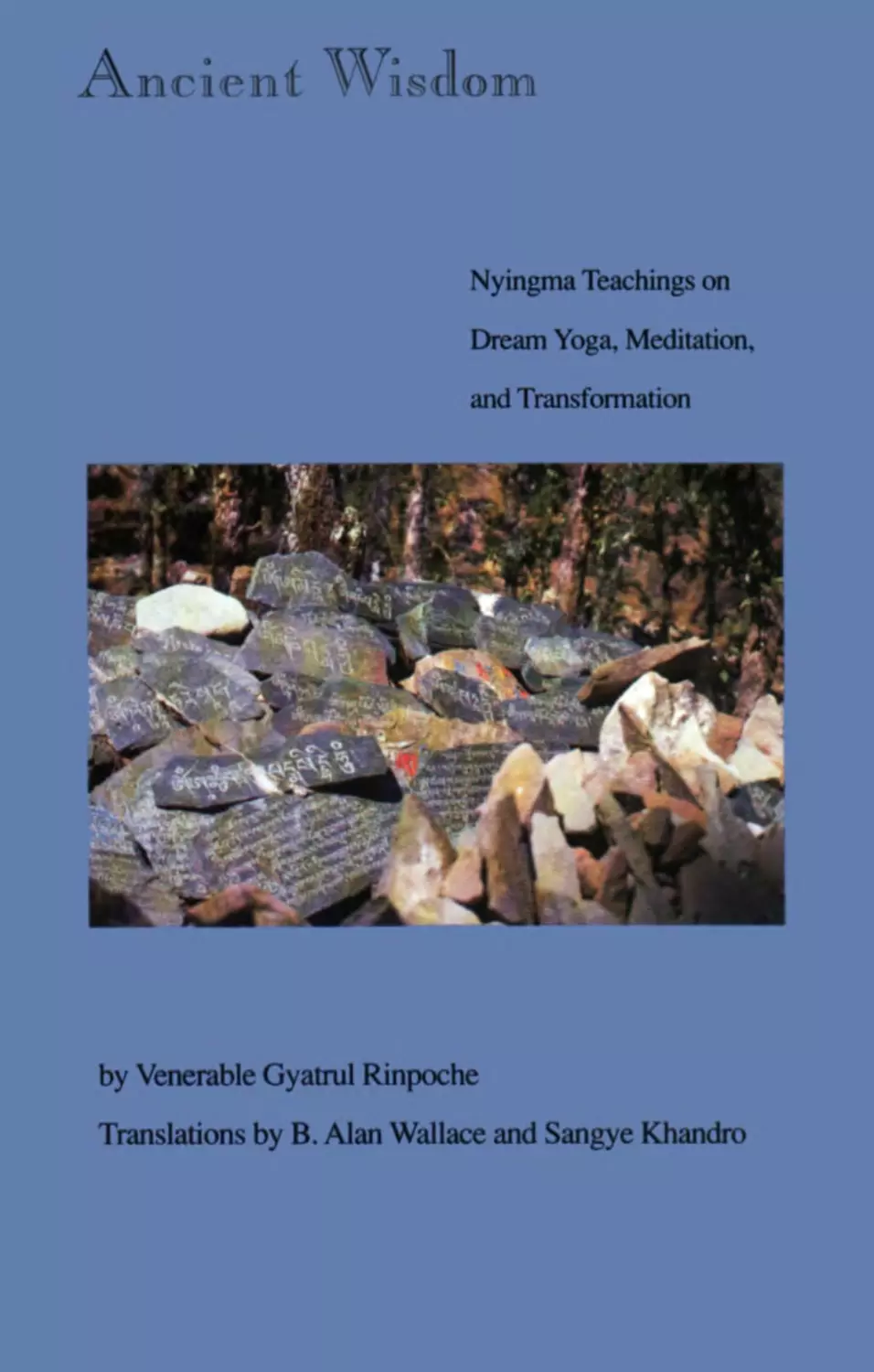
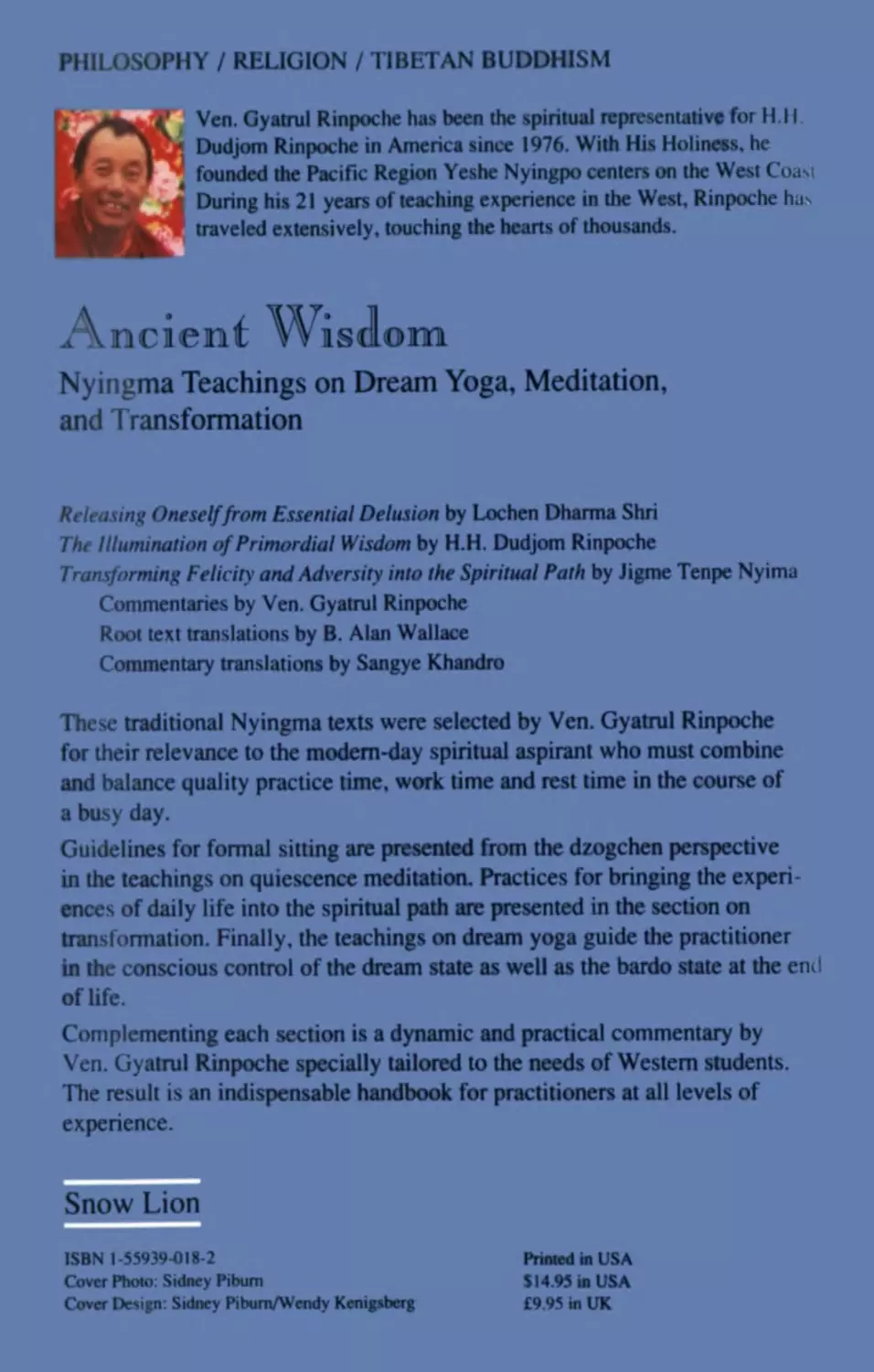
A n c i e n t 'W i s d o m
Nyingma Teachings on
Dream Yoga, Meditation,
and Transformation
by Venerable Gyatrul Rinpoche
Translations by B. Alan Wallace and Sangye Khandro
ANCIENT WISDOM
Nyingma Teachings on Dream Yoga,
M editation and Transformation
ANCIENT WISDOM
,
Nyingma Teachings on Dream Yoga
M editation and Transformation
Root Text:
Transforming Felicity and Adversity
into the Spiritual Path
by Jigme Tenpe Nyima
Root Text:
Releasing Oneself from Essential
Delusion
by Lochen Dharma Shri
Root Text:
The Illumination o f Primordial
Wisdom
by His Holiness Dudjom Rinpoche
Commentaries by Venerable Gyatrul Rinpoche
Root text translations by B. Alan Wallace
Commentary translations by Sangye Khandro
Snow Lion Publications
Ithaca, New York
Introduction
If we were to consider condensing all Dharma prac
tices and required daily commitments into the most
essential practices necessary to accomplish realiza
tion in this immediate lifetime, we must then consider
our own time and how it is spent. A slot of time is
usually dedicated to a daily practice or routine of
formal practice. Most of the daytime is spent involved
in various activities with family, friends and in the job
place. Finally there is the time that we spend sleeping
and dreaming during the night. It is with these three
time periods in mind that the three texts were chosen
for this book. Each of these three texts and their
commentaries give the methods and practical instruc
tions that are applicable to these times so that our goal
of liberation in this very life can be achieved.
First, Transforming Felicity and Adversity into the
Spiritual Path by Jigme Tenpe Nyima was selected as
the contemporary classic for improving the quality of
daily life experiences and teaching the precise m eth
ods through which extremes can be brought to the
8 Ancient Wisdom
path. This new English translation by B. Alan Wallace
is illuminating and superb.
The second selection, Releasing Oneself from Essen
tial Delusion by Lochen Dharma Shri, is one of the
most direct and useful dream yoga accomplishment
manuals available. Translated from the original Ti
betan by B. Alan Wallace, it is as clear as it is precise.
The commentary to it presented here was taught by
Gyatrul Rinpoche during the summer of 1990 in
Ashland, Oregon.
The third selection, The Illumination of Primordial
Wisdom by H.H. Dudjom Rinpoche, again is one of the
most simple, direct and useful manuals on ascertain
ing the view, meditation and conduct through the
Great Perfection practices of quiescence and insight
(samatha and vipassana). This teaching is meant to be
accomplished in formal sitting sessions and carried
into daily life experience.
Even if we are successful in our formal practice and
lucid dream awareness, if our daily life experiences
are still the cause of hope and fear - thus increasing
our excitement and disappointment - then the goal of
liberation in this life is impaired. This little key to the
transformation of all highs and lows into true spiri
tual awareness is truly indispensable.
The commentary to this text was given by Gyatrul
Rinpoche to the Vajradhatu community at Boulder,
Colorado in the fall of 1991. Hours before the teaching
was scheduled to begin, we received the sad news of
the parinirvana of H.H. Dilgo Khyentse Rinpoche in
Thimphu, Bhutan. The impact of this news, combined
with the subject material, was yet another miraculous
display of the guru's kindness.
introduction 9
I would like to thank B. Alan Wallace for the excel
lent translation he has made of the three root texts. In
the twenty years that we have known one another as
dharm a friends, Alan has always been a source of
knowledge and an inspiration, as well as a good
friend.
I would also like to thank Kay Henry for all the
effort she has put into the preparation of this m anu
script. Her enthusiasm to work hard for the Dharma
is a source of joy.
- Sangye Khandro
Tashi Choling
August, 1992
PARTI
TRANSFORMATION
Transforming Felicity and Adversity
into the Spiritual Path
by
Jigme Tenpe Nyima,
The Third Dodrupchen Rinpoche
Translated by
B. Alan Wallace
Commentary by
Venerable Gyatrul Rinpoche
Translated by
Sangye Khandro
Part 1
The Root Text
by Jigme Tenpe Nyima,
The Third Dodrupchen Rinpoche
Transforming Felicity and Adversity into
the Spiritual Path
Homage:
Oh, Noble Avalokiteshvara,
Who always rejoices at the happiness of others,
Who is deeply saddened by others' suffering,
Who has perfectly realized the qualities of great
compassion,
And who has released his own joy and sorrow...
I bow to you recalling your virtues; and I shall explain
in part the quintessential teaching on transforming
felicity and adversity into the spiritual path, this
being an indispensable tool of spiritually realized
beings, which is invaluable in the world.
14 Ancient Wisdom
HOW TO TRANSFORM ADVERSITY INTO THE
SPIRITUAL PATH BY MEANS OF RELATIVE
TRUTH
Whenever you are afflicted by sentient beings or
anything else, if you habituate your mind to dwelling
on suffering only, even the most insignificant circum
stance will bring forth great distress. This is because
whatever attitude you cultivate towards felicity and
adversity will, by nature, grow stronger. Thus, as the
power of gradual habituation increases, eventually
virtually everything that appears will lead to misery,
and there will be no possibility of happiness.
By not recognizing that this is due to your own
mental habits, you blame this on external circum
stances, and eventually the flames of hatred, evil
actions, suffering and so on spread endlessly. Thus,
appearances arise as enemies. The reason why sen
tient beings of this corrupt era are afflicted by suffer
ing stems from our interior powers of discrimination;
so this calls for precise understanding.
Therefore, the meaning of not being afflicted by the
hindrances of enemies, sickness, malevolent spirits,
and so on is not that one averts the arising of illness,
etc. or prevents their occurrence in the future. Rather,
it means that these things are not able to arise as
obstacles to following the spiritual path.
In order for this to happen, you m ust (1) dispense
with the attitude of utter aversion to adversity and (2)
develop the attitude of good cheer in the face of
adversity.
Transformation 15
Dispensing with the Attitude of Utter Aversion
to Adversity
Recognize again and again the pointlessness and
great detriment of all the miserable anxiety you expe
rience through regarding adversity as being purely
unfavorable. And thoroughly accustom yourself to
the powerful anticipation, "From now on, whatever
kind of adversity arises, I shall not quail." In this way
practice cultivating great courage.
The pointlessness of aversion to adversity. If adversity
can be corrected, there is no need to be despondent;
and, if it cannot be remedied, there is no benefit even
if one becomes unhappy.
The great detriment of such aversion. If you do not react
with anxiety, due to the strength of your mind, it will
be easy to experience and handle even great adversity
as if it were as light and flimsy as cotton wool. On the
other hand, if you react with anxiety, you will become
unbearably oppressed with overwhelming misery in
the face of even minor adversity.
For example, while thinking about a gorgeous
wom an (or man), even if you try to stop desire, you
just wear yourself out. Likewise, by engrossing your
self in the miserable aspects of some adverse situa
tion, you will be unable to develop any sense of
fortitude. Thus, as in the instructions on guarding the
doors of the senses, in the event of adversity you
should not become engrossed in its characteristics;
rather, get used to placing your mind in its natural
state and let it apprehend its own nature.
16 Ancient Wisdom
Developing a Sense of Good Cheer in the Face
of Adversity
Cultivate a sense of good cheer by regarding adver
sity as an aid on the spiritual path. Moreover, for
whatever kind of adversity arises, if you do not have
individual practices to apply to each one in accor
dance with your own mental abilities, by merely
having a theoretical understanding, you may simply
think m any times, "In general, if one is skillful, itis
possible to attain such and such benefits as a result of
adversity." But this will be like the saying, "Great is
the distance between the sky and the earth." And it
will be difficult for you to succeed. The goal is farther
than the sky is from the earth.
Adversity as the support for training in the mind of emer
gence (renunciation) from samsara. Recognize that as
long as you w ander without self-control in the cycle of
existence, the occurrence of such adversity is not an
injustice or something unfair; rather, that is the very
nature of the cycle of existence. Further, if it is difficult
to bear even such minor adversity as this that is
encountered occasionally in this fortunate realm of
existence, there is no point in mentioning the adversi
ties of the unfortunate realms. Develop a sense of
disillusionment, thinking, "Alas! The cycle of exist
ence is a bottomless and endless ocean of adversity!"
and direct your attention towards liberation.
Adversity as the support for training in going for refuge.
Practice going for refuge by contemplating with con
viction, "For the repeated affliction of such fear as this
throughout all my lives, the sole, unfailing refuge is
Transformation 17
the Three Jewels. So, whatever happens, I shall en
trust myself to them alone and never abandon them
under any circumstances."
Adversity as the support for dispelling arrogance. Bearing
in mind the way in which you lack self-control, as
explained previously, and the way in which you
continuously fail to escape being controlled by adver
sity, snuff out the enemy of pride, which destroys
prosperity, and the unwholesome attitude of holding
others in contempt.
Adversity as the support for purifying unwholesome ac
tions. Consider, "Such adversity as this, as well as
immeasurably greater adversities, arise only as a
result of unwholesome actions," and carefully pon
der the four points that (1) actions invariably give rise
to corresponding effects, (2) the effects of actions
increase, (3) one never experiences the effects of ac
tions that were not committed, and (4) deeds commit
ted never fail to produce results. Thus, bear in mind,
"If I don't want adversity, I m ust avoid its cause,
which is non-virtue," and by means of the four pow
ers disclose such actions that you have already
amassed, and strive to restrain yourself in the future.
Adversity as the support for attraction to virtue. Ponder
at length, "If I take delight in felicity, which is the
opposite of adversity, I must strive for its cause,
which is virtue," and in various ways do whatever
you can to progress in the direction of virtue.
Adversity as the support for training in compassion. Re
flect on the ways in which other sentient beings, like
18 Ancient Wisdom
you, are afflicted with adversity like your own or even
far greater, and train yourself in thinking, "May they,
too, be free of all adversity!" This will also bring an
understanding of how to cultivate loving-kindness
for those who are bereft of happiness.
Adversity as the support for cultivating the attitude of
cherishing others more than oneself. Cultivate the atti
tude, 'T he reason that I am not free of such adversity
is that I have always been self-centered, so now I shall
devote myself solely to the attitude of cherishing
others, which is the source of happiness and prosper
ity."
When misfortune stares you in the face, it is very
difficult, so it is crucial to become familiar with these
practices beforehand, and to emphasize those in which
you have the most vivid experience.
It is not enough for adversity to become an aid to
your spiritual practice. Rather, it is vital that you
cultivate a strong and continuous sense of gladness as
a result of clearly recognizing that this is happening.
So, whenever you apply what has been explained
here, think such thoughts as this: "Such adversity is a
great help to me in experiencing the many, wonderful
joys of the higher realms that lead to liberation, which
are extremely difficult to reach. By continuing in this
way, even if my suffering is severe, it is extremely
agreeable, like ladu, a sweetmeat the taste of which is
both sweet and hot." Consider this point repeatedly
and with care, and accustom yourself to a sense of
good cheer.
By doing this, your abundant, or predominant,
sense of mental well-being will make physical pain
Transformation 19
seem imperceptible. The inability of physical pain to
afflict the mind is the criterion of being able to over
come illness by means of inner strength, and this
suggests that this is also the criterion for overcoming
enemies, malevolent spirits, and so on.
As explained above, reversing the attitude of an
tipathy towards adversity is the basis for causing
adversity to arise as the spiritual path. For as long as
your m ind is troubled with anxiety and despair, it is
impossible for adversity to be brought onto the path.
Moreover, by training in actually bringing adver
sity onto the path, you will encounter unprecedented
benefits, for you will see for yourself how adversity
can enhance your spiritual practice, and your sense of
well-being will continue to increase.
It is said, "If you practice at first with minor adver
sity, it will gradually become easy; and, in this way,
you will finally be able to practice even in the face of
great adversity." This is what is needed, for it is
difficult to reach an experience that is beyond the
capacity of your own mind.
In between meditation sessions, pray to your spiri
tual mentor and the Three Jewels that adversity will
arise as the spiritual path. When the power of your
m ind has increased somewhat, make offerings to the
Three Jewels and other beings, with the supplication,
"For the sake of empowering my spiritual practice, let
there be unfavorable circumstances!" And at all times
sustain a deep sense of good cheer.
When you first begin to practice, it is helpful to
meditate far removed from distractions. For in the
m idst of distractions (1) you are liable to be diverted
by many unwholesome companions who will ask
20 Ancient Wisdom
you, "How can you put up with such adversity,
contempt, and abuse?"; (2) worrying about enemies,
relatives, and possessions will cloud and uncontrolla
bly disturb your awareness, and you will slip into bad
habits; and (3) furthermore, you will be carried away
by all kinds of distracting situations.
In solitude your awareness will be very clear due to
the absence of those things, so it is easy to set your
mind to the task at hand. It is said that this is the very
reason that, when those who engage in "cutting
through" (chod) train in the attitude of suppressing
adversity, at first they put off applying the training, in
the m idst of distractions, to harm caused by humans.
Instead, they emphasize applying this training to
illusory manifestations of gods and demons in soli
tary cemeteries and wild habitats.
To sum up: In order not only to prevent all unfavor
able circumstances and adversity from afflicting your
mind, but to cause them to elicit a sense of good cheer,
you should put a stop to experiences of aversion
toward both inner and outer obstacles - illness as well
as enemies, spirits, vicious gossip, etc. Practice seeing
everything solely in an agreeable way. For that to
happen, you should stop seeing those harmful situa
tions as something wrong, but give all your effort to
seeing them as valuable. For it is the way our minds
apprehend situations that makes them agreeable or
disagreeable. For example, those who reflect at length
on the faults of worldly amusements become increas
ingly perturbed the more they are surrounded by
admiring people and enjoyments; whereas those who
regard worldly amusements as beneficial aspire to
increase them.
Transformation 21
By training in this way, you will become gentleminded, easy-going, and courageous; there will be no
obstacles to your spiritual practice; all unfavorable
circumstances will arise as splendid and auspicious;
and your mind will continually be content with the
joy of serenity. To follow a spiritual path in a degen
erate era, such armor as this is indispensable.
Then, since you are free of the suffering of anxiety,
other types of misery also vanish, like weapons falling
from the hands of soldiers; and even illnesses, etc.
tend to disappear of their own accord. We can learn
from the saints of the past who say, "By not becoming
distressed at anything and not succumbing to unhap
piness, your mind will not become troubled; since it is
undisturbed, your nervous system will not become
disturbed; due to that, the other elements of your
body will not come into disequilibrium; as a result,
your m ind will not become troubled, etc., and the
wheel of well-being spins on."
They also say, "Just as birds find horses and don
keys with sores on their backs easy prey, so do m a
levolent spirits find an easy target in people with
fearful dispositions, but it is hard for them to over
come people of steady character."
Therefore, the wise see that all adversity and felic
ity depends on the mind, and they seek happiness
within the mind. Since they have the complete causes
of happiness within them, they do not rely on exter
nals. They are not afflicted by the harms of sentient
beings or anything else, and this remains true even at
the time of death. They are always free.
In this way the bodhisattvas attain the "samadhi
that suffuses all phenom ena w ith well-being."
22 Ancient Wisdom
However, the foolish run after external objects in the
hope of finding happiness, but whatever happiness
they achieve, great or small, turns out like the saying,
"It's not you who is in charge; your hair is caught up
in a tree!" There is just one failure after another, due
to things not working out, not coming together,
occurring in disproportionate ways, etc. Enemies,
thieves, and so on have ample opportunities to harm
them, and even the slightest criticism separates them
from their happiness. However much a crow looks
after a baby cuckoo, the cuckoo can't become its own
offspring. Just so, since their minds can never become
steady, there is nothing but fatigue for the gods,
affliction for the spirits, and misery for themselves.
This is quintessential advice that comprises a hundred
crucial points in one.
There are many other types of austerities for fol
lowing the spiritual path by willingly accepting ad
versity, and other types of instructions, such as those
in the Zhije teachings, for bringing illness and harmful
influences onto the path. But here I have offered an
easily understandable, general discussion of accept
ing adversity, based on the treatises by the noble
Shantideva and his wise followers.
HOW TO TRANSFORM ADVERSITY INTO THE
SPIRITUAL PATH BY MEANS OF ULTIMATE
TRUTH
With the instrument of such reasoning as the refuta
tion of the "four extreme views concerning produc
tion," the m ind is brought to the supreme peace of
emptiness and abides there, in the nature of reality in
Transformation 23
which unfavorable circumstances and adversity, or
even their names, are not to be found. Even when one
rises from that state, adversity does not appear to the
m ind as it did earlier, when it would be experienced
with fear, despair, and so on. Rather, adversity is
overcome by regarding it as an assemblage of mere
words. I shall not elaborate.
HOW TO TRANSFORM FELICITY INTO THE
SPIRITUAL PATH BY MEANS OF RELATIVE
TRUTH
When happiness and the objective conditions for
happiness occur, if you fall under their control, arro
gance, conceit, complacency, etc. will grow and ob
struct your spiritual path. It is difficult not to succumb
to their influence, for as Padampa Sangye said, 'Teople
can handle only a little felicity, but they can handle a
lot of adversity."
Therefore, from various perspectives regard those
things as impermanent and unsatisfactory, and culti
vate a strong sense of disillusionment. Try to direct
your mind away from carelessness and think, 'T hus,
all the pleasures of the world are trifling and are
bound up with many problems. Nevertheless, some
of them have good qualities. The Buddha said that, for
a person whose freedom is impaired by suffering, it is
very difficult to attain enlightenment; but one who
abides in happiness attains enlightenment with great
ease. The fact that I have the opportunity to practice
dharm a in such a state of happiness is great fortune.
So, at this time I shall by all means convert my
happiness into dharma; and since dharma also gradu
ally gives rise to happiness, I shall practice making
24 Ancient Wisdom
dharm a and happiness complement each other. Oth
erwise, like boiling a drink in a wooden vessel, I will
end up just where I started." You should grasp the
essence by earnestly integrating whatever happiness
you experience with dharma. This is the message of
(Nagarjuna's) Jewel Garland.
Even when you are happy, by failing to recognize it
you will not be able to use it for your dharma practice.
So, as a remedy against devoting your whole life to a
myriad of concerns and activities in the pursuit of just
a bit more pleasure, recognize the agreeable as being
agreeable, and devote yourself to the nectar of con
tentment.
There are other practices of bringing felicity onto
the spiritual path, etc., based on contemplation of the
kindness of the Three Jewels and on the instructions
for cultivating a spirit of awakening, but this will do
for now.
Resorting to solitude, you should alternately train
in practices of accumulating (wisdom and merit) and
of purification. The same is true of bringing adversity
onto the path.
HOW TO TRANSFORM FELICITY INTO THE
SPIRITUAL PATH BY MEANS OF ULTIMATE
TRUTH
The practice by means of ultimate truth is to be
understood from the previous explanation.
If you cannot practice dharma when you are sad,
due to w hat this does to your mind, and you cannot
practice dharma when you are happy, because you
become attached to that, then there will be no time at
all when you can practice dharma. So, if you are to
Transformation 25
practice dharma, there is nothing more useful than
this. If you do have this practice, wherever you dwell,
in solitude or in a city, whether you accompany good
or bad companions, whether you are rich or poor,
happy or sad, whether you hear praise or blame, or
pleasant or unpleasant speech, since you are free from
fear that any of this can bring you down, you respond
in the manner of a lion-like yogi. Whatever you do,
your m ind will be cheerful and spacious, and your
character will be pure and benevolent. Even if your
body dwells in an impure land, your mind will frolic
in the splendor of unimaginable joy, like a bodhisattva of a pure realm. This corresponds to the saying of
the precious Kadampas:
With happiness brought under control
And sadness brought to an end,
When you are lonely, this will be your
companion;
When you are ill, this will be your nurse.
For example, a goldsmith purifies gold by melting
it in fire and makes it malleable by rinsing it again and
again in water. Likewise, by bringing felicity onto the
path your mind will be subdued, and by bringing
adversity onto the path, it will become pristine. When
this happens, you will easily achieve extraordinary
states of samadhi in which your body and m ind will
be perfectly fit for the tasks you set them. I feel that this
is the most profound of instructions for perfecting
moral discipline, which is the root of all that is good.
By not being attached to felicity, you establish the
basis for the special moral discipline of a renunciant;
26 Ancient Wisdom
and, by not being afraid of adversity, you fully purify
that moral discipline. This is implied by the saying
that generosity is the basis of moral discipline, and
forbearance is the purifier of moral discipline.
By practicing in this way right now, when you
ascend to high spiritual paths, your experience will be
like the verse,
One realizes (with wisdom) that all phenomena
are like illusions,
And (with compassion) realizes that birth is like
strolling into a park.
In times of prosperity and even in poverty,
One has no fear due to afflictions or adversity.
To relate this to the life of the Buddha, before he
attained Awakening, he rejected the throne of a world
ruler as if it were straw, and he lived by the Nairanjana
River, unconcernedly applying himself to harsh aus
terities. This demonstrates that to experience the
ambrosial meaning of your own existence, you must
regard adversity and felicity as being of one taste.
Following his attainment of Awakening, the rulers
of humans and gods up to the Akanishta heaven
placed his feet upon their heads and honored him
with all good things. The Brahmin Bharadhvaja abused
him a hundred times; a haughty Brahmin's daughter
accused him of sexual misconduct; and in the land of
King Agnidatta he lived for three months on rotten
horse fodder. On all such occasions he remained with
an unfluctuating mind, like Mount Meru remaining
unm oved by the wind. This demonstrates that to
serve the needs of sentient beings, you m ust regard
Transformation 27
adversity and felicity as being of one taste.
Colophon
This teaching should be given by those with the life-style of
the Kadampa masters, which is characterized by the saying,
" When distressed, they do not complain. When happy, they
are disillusioned." When it is taught by someone like
myself, I feel as if my own tongue is embarrassed. Neverthe
less, in order to accustom myself to regarding the eight
mundane concerns (namely adversity and felicity, gain and
loss, praise and blame, and good and bad reputation) as
being of one taste, I, the old beggar Tenpe Nyima, have
composed this in the Forest of Many Birds.
At the crest of the flourishing tree of publication,
May the flowers and fruits of this good counsel
Adorn the grove of the teachings of the Omni
scient One,
And may it bring delight to flocks of fortunate
beings.
Subham astu sarvajagatam!
(May all the world be well!)
Part 2
The Commentary
by Venerable Gyatrul Rinpoche
Oral Commentary to the Root Text on the
Transformation of Felicity and Adversity
into the Spiritual Path
Here this evening, and any time when you are en
gaged in any aspect of dharma practice, you m ust first
and foremost examine your motivation to see whether
it is wholesome, unwholesome or indifferent. Whether
you are listening to teachings, as you are here this
evening, whether you are contemplating the meaning
of the teachings that you've heard, or whether you are
meditating or giving teachings, you m ust check care
fully to see if the five mental afflictions0’ and the eight
worldly concerns(2) are present in the mindstream. If
so, you should uproot them because this would be an
unwholesome intention, the cause for suffering and
discontent.
Rather you should give rise to a wholesome inten
tion which is to listen to the teachings, practice, or
30 Ancient Wisdom
contemplate solely for the benefit of all parent sen
tient beings in order to accomplish their purpose. If
you have no such motivation and remain indifferent
with no real intention at all, then there will be no
positive experience from the opportunity that you
have at hand. Such an indifferent attitude bears no
fruit. Since you need to produce something and that
something should be as virtuous and positive as
possible, it's extremely important that you give rise to
a virtuous, wholesome intention.
The text that I am teaching from this evening is a
very well-known text composed by the great mahasiddha and scholar Jigme Tenpe Nyima, the Third
Dodrup Rinpoche, called Transforming Felicity and
Adversity into the Spiritual Path.
According to the tradition, when teachings are
received from a text such as this, initially one comes to
understand the title of the text and the author's hom
age and personal aspiration. The aspiration will es
sentially state the author's commitment, or inten
tion to accomplish by composing the text.
Considering the title Transforming Felicity, or hap
piness, and Adversity, suffering, into the Spiritual Path,
for the great scholars of India and Tibet just to hear the
title of a text, they will come to know everything that
is contained within it. For those of mediocre sensibil
ity, who nevertheless have some training, they will
immediately come to understand whether this is go
ing to be a teaching that falls under the category of
sutra or tantra. For those beginners with basic scho
lastic training, when they hear or read the title, they
will be able to determine some general idea of what
the teaching will be about. This will also help them to
Transformation 31
be able to locate this text for future reference. Each text
has its own title just like each of you have your own
name.
Following the title, the author pays homage. In this
case the author, Dodrup Tenpe Nyima, bows down to
the noble Avalokiteshvara, the great Bodhisattva of
Compassion. As he poetically writes, the reason this
homage is rendered to Avalokiteshvara is because
Avalokiteshvara is one who always rejoices at the
happiness of others. As the Bodhisattva of Compas
sion, whenever the happiness of others is viewed - be
it temporary or ultimate - he always rejoices. On the
other hand, he is deeply saddened by the suffering of
others. When he views all sentient beings of the six
classes - those in the hell, hungry spirit, animal,
hum an, titan and the deva realms - he realizes that
they are somewhat like stubborn children.
Even though countless buddhas and great teachers
have come in the past, live in the present, and will
come in the future, still you have doubt. Still you are
stubborn. Still you don't believe the teachings. Still
you don't practice with open-hearted sincerity. It
saddens Avalokiteshvara to see this predicament, yet
he is one who has perfectly realized the qualities of
great compassion. In doing so, he has released his
own joy and sorrow. This means that, because he's
exchanged himself for others and experiences only
great compassion and has developed the qualities of
that great compassion, he is self-liberated from this
bondage of fluctuating joy and sorrow.
So it is Avalokiteshvara, whom you all are very
aware of, who is the source of the one thousand
buddhas of this light aeon - in fact the source of all
32 Ancient Wisdom
buddhas and the emanation of the compassion of all
buddhas. It is to such an embodiment that the author
pays homage. By recalling the noble qualities and the
virtues of Avalokiteshvara, he begins his commitment,
which is to comprehensively explain in part the
quintessential teachings on how to transform felicity
and adversity into the spiritual path. This teaching is
in fact considered to be the indispensable tool that all
of the lamas of the past have relied upon. Without this
tool they would be hard pressed to really accomplish
the path because it is indeed the tool of those who are
truly realized. It is considered to be invaluable in the
world. It is like a wish-fulfilling jewel. It is indis
pensable and, once acquired, always needs to be
maintained upon the path.
Considering then that this quintessential teaching
is such a tool to use on the path, through this you will
be able to accomplish your own purpose and the
purpose of others which you have not yet been able to
accomplish. This is something that you definitely
need. It is just like a crucial little key to the path. The
author commits himself to it by stating here in the text
that he shall bring forth this explanation in two parts.
Transforming Adversity
The first part is the teaching on how to transform
adversity into the spiritual path, and the second is the
teaching on how to transform felicity into the spiri
tual path. We'll begin with the first section: the trans
formation of adversity. This explanation is given ac
cording to relative and ultimate truth.
It should be understood that, if someone is not on
the spiritual path, then in a sense this teaching is
Transformation 33
irrelevant and somewhat useless. This teaching is
meant for someone who is really practicing. Not only
is it meant for such people, but also it is extremely
important and indispensable as a tool to use through
out the many experiences on the path.
Whenever you are afflicted by another being or by
anything at all, if you habituate your mind to dwell
ing on suffering only, then even the most insignifi
cant, tiny circumstance will bring forth great distress.
This occurs because you always want to accomplish
your own needs and fulfill your own desires, which
are primarily the eight worldly concerns, leading to
non-virtue. This is your habituation. Since your mind
is habituated to dwelling on negativity, if some small
thing happens, some small affliction, then you imme
diately grasp onto this, shaping it into something
very, very big. Even though initially it's something
very insignificant, you allow it to bring you a huge
amount of distress.
The example of relationships between men and
women is convenient and perhaps the most obvious
or pertinent example. When you meet someone that
you are very attracted to, initially sparks fly between
you that are so intense that you're satisfied by the
mere sight of each other. Sometimes you don't even
need to touch hands. But then, after your habitual
nature begins to emerge (in reference to the first line
of the text), since your mind is habituated to dwelling
on suffering due to your attraction to non-virtue, then
after even a very short time, the smallest condition
will cause you extreme agitation or irritation and
distress since it involves your relationship with that
object of your attraction. Then you will blame your
34 Ancient Wisdom
cherished object of attraction for this distress, when in
fact you have created it yourselves. You've created it
because you yourselves are attracted to suffering.
This happens because, whatever attitude is being
cultivated towards happiness or adversity, by nature
it will grow stronger. This is something that you
become accustomed to.
For instance, most habits are considered to be some
w hat harmful. Perhaps you like to eat hot chili, be
cause you have cultivated an attitude to partake of hot
chili. But in fact it burns your tongue; it makes you
sweat; it burns holes in your stomach; and on and on.
Nevertheless, it is your habit, so you keep eating it.
Perhaps you like to drink liquor or have another habit
such as this, which may actually be shortening your
life, but in fact you keep on partaking of it, all the
while knowing that it7s really harming you. Because
you are so attracted to it, you think it's something
good.
Another example is bearing children. In this coun
try this might not pertain as much as it did in Tibet,
because here you have good hospitals where women
go to give birth, which seems to be something that's
carried out quite easily. But in Tibet there would be no
place to go, and oftentimes the mother would lose her
life. It was something quite dangerous and difficult.
Yet after having one child, two, or three, they would
keep on having more; four, five, so forth, all the while
knowing the difficulty and suffering that m ust be
endured.
The desire is stronger than knowing what the result
will be, which is suffering. Because the habit or desire
is so strong, the suffering is not considered to be so
Transformation 35
great.
In Tibet the men were all so macho that they would
love to fight with each other and stick each other with
swords, practically killing one another, just to have a
little fun. They would come out of such a battle
bruised, bleeding and sometimes near to their death,
claiming, "Oh, I'm just fine. There's no problem."
They w ouldn't think that they were suffering because
it was so important to them to maintain their status as
a "real man."
This is what is meant by the idea of having habitu
ated your mind. The strength of the mind can never be
underestimated; it is the single most powerful force in
existence. Any habituation will continue to increase,
depending upon which direction it is headed. Even
tually everything will lead to that.
Keeping this in mind, as the gradual habituation
increases in the case of suffering, virtually everything
that appears will eventually lead to misery. Even the
most insignificant event will be the cause for much
greater misery. Eventually there will be no possibility
for happiness at all. This is something important to
bear in m ind in terms of your close relationships and
family situations.
If you don't recognize that this is due to your own
mental habits, you will blame it on external circum
stances. Eventually the flames of hatred, non-virtue,
and suffering will spread on endlessly, because you
continue to believe that the problem arises from exter
nal circumstances.
This experience is also referred to as "appearances
arising as enemies." You are very aware of this. You
know of people or you may be someone who is easily
36 Ancient Wisdom
angered. Such a person who is easily angered will
experience many immediate negative reactions over
incidental events. It's almost as though it took no
effort to invoke such a response. The reason is their
habituation. This is the habit of their mind, and they
have failed to realize that they themselves have cre
ated this result. When the result itself gets so strong,
it becomes harder and harder for them to realize the
cause, because appearances are already arising as the
enemy. They become bewildered because they feel
the phenomena are outside of themselves. This is why
they keep on reacting to external conditions and
circumstances. Now anger, you should remember, is
the leading cause for rebirth in the lowest realms.
Particularly in these degenerate times, sentient be
ings have a very weak power of discriminating aware
ness. Having failed to realize their primordial wis
dom awareness nature, they confuse it for desire.
Discriminating wisdom remains undeveloped. There
fore, there is weakness in mindfulness and mental
alertness. They are not able to accurately pinpoint the
accumulation of non-virtue a n d /o r virtue, to success
fully reject and accept. Most of the suffering that you
are afflicted by in this corrupt era of difficult times
really arises from your inferior powers of discrimina
tion. Keeping that in mind, you should work harder to
develop more wisdom. You say, "Watch your step."
But you should watch before stepping. Watch and
then step.
In particular if you are a dharma practitioner, the
meaning of not being afflicted by the hindrances that
arise from enemies, illness, malevolent spirits or any
thing else is not that you are actually going to be able
Transformation 37
to prevent the arising of such things in the future. In
fact, killing one enemy will not guarantee you that a
second one is not going to manifest. Or by freeing
yourself from one illness, you cannot be guaranteed
in cyclic existence that you are not going to acquire a
new one. What this does mean, rather, is that hin
drances are not able to arise as obstacles to the spiri
tual path. You do not and cannot avert them com
pletely, but they do cease to hinder progress on the
path because they become part of the path.
In order for this to happen, there are two things that
you have to practice. The first is to dispense with the
attitude of utter aversion to adversity. This you must
eliminate. The second is to develop the attitude of
good cheer in the face of adversity.
Let's begin with the first, which is dispensing with
the attitude of utter aversion to adversity. There is
really no reason to dislike adversity. Instead you m ust
recognize again and again the pointlessness and the
great detriment that arises from all of the miserable
anxiety that is experienced through regarding adver
sity as something so totally unfavorable. If you keep
reminding yourself how pointless this is, you will
begin to realize this.
Then by trying to accustom yourself to the power
ful anticipation of feeling "from now on whatever
kind of adversity or suffering arises, I will not fear it;
I will not befriend it; I will just allow it to be...," in this
way great courage is cultivated in the face of adver
sity. This is no simple matter. But if you do this a
num ber of times, then power develops and eventu
ally the old habitual tendencies are put to rest.
If someone is always bickering with you, irritating
38 Ancient Wisdom
you, or causing an on-going negative relationship,
after a while you may decide, "Well, I'm not going to
dread this, because it's pointless; I'm going to just let
it be." Rather than reacting, allow it to occur and
observe it. After a while that individual who's always
bickering and carrying on will either become too tired
to continue or too embarrassed. If they are a decent
individual, they will become embarrassed. If the indi
vidual is not so decent, they will simply become bored
or tired.
The main point here is that the entire conflict is
baseless. There's no need to continue developing
something that has no point.
If you are in a house and there really are no ghosts
or malevolent spirits there and yet you think there are
and become quite paranoid about it, then every time
the door slams shut or some wind comes through the
room, your fear will be verified. This will intensify
until actual ghosts are generated. The home will then
become haunted; and then you will have developed a
big problem.
In further developing your attitude of dispensing
with this utter aversion to adversity, as the famed
Shantideva said, "If suffering can be corrected, then
there's no need to be despondent. And if it cannot be
remedied, there is no benefit even if one becomes
unhappy." This should be kept in mind since it clearly
points out the uselessness of aversion to adversity.
While developing this attitude, you should m ain
tain awareness of the great detriment of such aver
sion. If one does not react with strong anxiety and the
m ind is filled with courage and strength, it's easy to
experience any difficulty. That so-called difficulty
Transformation 39
will become as flimsy as a light piece of cotton. Such
was the experience of the Karmapa, whom many of
you know since he passed away here in your own
country. At the time of his passing, he was afflicted
with so many different illnesses that were devouring
his body. In the face of such hardship, even a rock
would be hard pressed to remain patient. Yet each
morning, as the doctor came in and asked him how he
was, he said he was fine and was only concerned
about how others were feeling. Here is a supreme
example of someone who truly realized this practice.
There are many, many true accounts about the great
lamas who have realized the path of transforming
adversity into the path. For example, H.H. the Dalai
Lama, who lost his country and in spite of all the
difficulties that he's had to undergo in his lifetime, has
never spoken negatively about the Communist Chi
nese. When Mao Tse Tung died, His Holiness felt very
sad, and he offered many prayers on his behalf. He
considers all of these people to be objects of compas
sion and love. He has realized the pointlessness and
the great detrim ent of such aversion. Chogyam
Trungpa Rinpoche was another great example of one
who underw ent tremendous difficulties solely for the
purpose of others.
The problem is, when you cherish yourself, you
accomplish nothing. Is there a point to accomplishing
nothing? If you really view it in this way, it is clear.
The realized beings have exchanged self for others
and cherish only others. They are now liberated, and
you are not. There's a big difference.
If you fail to have this strength of mind whereby
great adversity becomes as easy to handle as a light
40 Ancient Wisdom
piece of cotton, due to your reacting with tremendous
anxiety, you will become overwhelmingly oppressed
with misery, even in the face of something very irrel
evant.
For instance, because of the depth of true bodhicitta
that the great bodhisattvas of the past had developed,
many of them were actually able to offer parts of their
bodies such as fingers, toes, or limbs. They had no
pain in this experience because of the purity and
strength of their mind. Instead of pain, they actually
would experience gratitude and bliss.
While you are thinking of an attractive man or a
gorgeous woman, even if you try to stop the desire
that you have for this person, you will just wear
yourself out. Right? Similarly, if you engross yourself
in the miserable aspects of your adverse situation,
then you will be unable to develop any sense of
fortitude. It's something that will not be possible
because of your focus.
This is why, as you know from the instructions that
you have received in the past on guarding the doors
of the senses, in the event of adversity, rather than
becoming engrossed in its characteristics, you should
get used to the recollection of the instructions that you
have received. Place your mind in the natural state
where the true nature is appreciated.
If you are confronted with an object of desire, then
according to the vinaya, there are many ways to
meditate upon that object as being repulsive. If it is
someone's body, you may focus upon it as a heap of
aggregates or something unclean by mentally dissect
ing the body into organs and parts. According to the
mahayana, the method is to imagine its true nature to
Transformation 41
be illusory and to view it as an apparition - and to
view oneself as an apparition as well. Another method
is to view it as an object of compassion rather than as
an object of desire. You may also consider the teach
ings in the preliminary practices'3’ about how all
living beings have at one time or another been your
father or mother and have been kind to you, just like
your father and mother of this life. Giving rise to
immeasurable equanimity, you would then give rise
to immeasurable compassion, which is much more
sublime than attachment. Attachment only brings
about its opposite, aversion.
If you are practicing vajrayana, then you will visu
alize the object as the deity and view the form as an
expression of primordial awareness. It then becomes
an object of devotion rather than an object of desire.
The second part of this teaching is to develop a
sense of good cheer in the face of adversity. The
cultivation of good cheer is a forthright attitude that
regards adversity as an aid on the spiritual path. This
is an experience of training. Whenever there is suffer
ing, you will use it as an aid to the development of
virtue. This is done by considering the benefits of
virtue, the nature of cyclic existence to be that of
suffering, and the unfailing truth of the law of cause
and effect. No matter what kind of adversity arises, if
you are lacking individual practices to apply to each
case in accordance with your own mental abilities,
then you may simply think, "If I am skillful, it is
possible to achieve some real benefit as a result of this
adversity." That may also be just theoretical, which is
like saying that the goal is farther than the sky is from
the earth.
42 Ancient Wisdom
Your hands must not be empty. Iťs not enough to
just think, "Well there are these methods to be ap
plied," because this is like the example given. You
must have the individual practices to apply to each
instance. For example, in order to really practice the
six perfections, you have to receive teachings on how
each perfection is developed in dependence upon an
object, circumstance, and application of awareness.
Let's consider the perfection of patience. Patience
cannot be developed if there is no object through
which patience can be cultivated. It is the same for
morality, diligence, generosity and concentration.
Wisdom is the awareness of the actual nature of
subject, object, and activity as well as the skillful
application of the method coupled with discriminat
ing awareness.
In dependence upon suffering, you are able to
accumulate the merit that is necessary to produce
permanent happiness and liberation. If you examine
the life stories and examples of the past saints and
mahasiddhas, as well as the Jataka accounts of previ
ous lives of Buddha Shakyamuni, you can clearly see
how true practitioners dedicated their lives toward
this pursuit - such as the example of Lord Buddha's
past life when he was in Nepal and offered his body
to the dying tigress and her cubs at the spot called
"Namo Buddha."
First you must train. Iťs like getting ready to go into
combat. The army has to train from the very first day
in order to know how to handle the actual moment of
combat. You are practitioners on the path; and, as
spiritual warriors, you are preparing for your time of
death. If you get these methods down now, then the
Transformation 43
transition will be something you can easily face. You
will be well prepared.
There are some who use adversity as the support
for training in the development of renunciation. This
is done by recognizing that, as long as you wander
without any self-control in cyclic existence, the occur
rence of this type of adversity is not an injustice that's
being imposed upon you. It's not something that is
unfair. Rather, it is the play of the very nature of cyclic
existence itself. Furthermore, while you are basically
happy with this precious human rebirth, if it is diffi
cult for you to bear such minor adversity now when
you are in what is considered to be a fortunate rebirth,
just imagine how very difficult it will be for you to
endure the suffering of the lower realms. What would
it be like if one were reborn in the lower realms where
the suffering is truly unbearable?
Notice then that, if you are not able to be patient or
to endure the small distress and misery that occurs
now, you will not be able to endure it in the lower
realms. Right now is the time to make sure that you do
not have to endure the suffering of the lower realms.
Now is the time to realize that, until now, you have
not been able to get out of this predicament without a
true guide. This is why you are still wandering. The
source of refuge, or guide needed, must have the full
potency of having realized this predicament and
passed through it successfully to reach the other side,
the shore of liberation. When you choose your object
of refuge, and go for refuge, you should be sure that
you're taking refuge in someone who clearly sees the
predicament of samsara, having been through it, and
who knows precisely how to be set free from it. Such
44 Ancient Wisdom
an experienced individual—a compassionate guide, a
worthy guide, a guide who has the full qualifications
- can guide you in the methods to be able to lead all
other sentient beings out of cyclic existence.
Regarding the subject of transforming adversity
into the path, one of the great ways that you suffer as
practitioners is at the death of your spiritual mentors.
This is because there is nothing more precious than
your spiritual guides. When their physical presence
leaves this world, you suffer tremendously. Yet the
moment that the teacher departs from his or her
corporeal form is also the moment that the teacher's
m ind mingles with the ultimate nature of truth. If,
through your prayers, you can make a connection
with this nature, there can be no greater benefit than
that. At the time of the passing into nirvana of a highly
realized being and in the days that folio w, your suffer
ing can turn to very strong development of realization
on the path, once again due to the teacher's kindness.
Developing a sense of good cheer in the face of
adversity, you can specifically use adversity as the
support for refuge and true spiritual development. I
am discussing how you relate to your suffering, how
you relate to your adversity, as it affects you in life and
on the path. Now, as you know, whenever you are
suffering by way of the body, speech, and mind, be it
physical illness or a mental affliction (which seems to
be the affliction of malevolent spirits, obstructive
forces, or external enemies), this is a very big deal to
you. Usually it appears as something major. Even if
iť s minor, you make it into some great distress. If you
lose a little money or if someone speaks nastily to you,
it invokes a strong reaction. This is called "appear
Transformation 45
ances arising as the enemy."
When your habituation to adversity reaches such a
point that you actually fall prey to appearances aris
ing as the enemy, it means that you no longer have
patience for suffering. This presents the same prob
lem mentioned earlier. If you can't bear the minor
aspects of adversity in this, the best rebirth in cyclic
existence, the precious human rebirth, what will you
do when you're reborn in the three lower realms?
Samsara is so vast, so deep and limitless, and the
num ber of sentient beings within samsara are equal to
that. All of them want to be free; all of them desire
liberation. You should consider then how unneces
sary or pointless it is to think that your small problems
in this fortunate life are so great, when in fact they
really are not.
Any rebirth in this ocean of cyclic existence will by
nature bring this type of discontent or suffering. Since
you've been in this cycle of rebirths from beginningless
time until now and you are still not free, it points out
the fact that help is needed. Refuge is necessary.
Adversity then becomes the support for training in
refuge, which demonstrates that adversity is used to
your advantage.
Taking refuge in a supreme object is not to become
overpowered or controlled by someone or some
thing. It is so one can be assisted to reach liberation,
freedom from the ocean of suffering. It's for your own
security. It's for your own benefit. It really has noth
ing to do with the object of your refuge or benefiting
the object. Your object of refuge should be unmistaken.
In this case the supreme object of refuge is Lord
Buddha Shakyamuni as the one who is able to accom
46 Ancient Wisdom
plish the purpose of all beings, having fully accom
plished his own self-interest. In Buddhism, when
refuge is taken in the Three Jewels, there are different
ways of taking and understanding refuge according
to the different sensibilities of the aspirants. Some
individuals will be led to relate to refuge externally.
Some will be led to understand externally and inter
nally, some secretly, some extremely secretly. In both
sutra and tantra, the outer, external refuge in the
Three Jewels - Buddha, Dharma and Sangha - is fully
embraced.
The inner manner of embracing refuge is practiced
specifically in tantra by those who are practicing the
generation stage. This is the transformation of the
buddha, dharma and sangha into the lama, yidam
and dakini. The lama is the spiritual guide; the yidam
is the meditation deity; and the dakini represents the
female principle of enlightened awareness. Those
who are practicing completion stage transform the
inner into the secret refuge taken in the channels,
energies, and essential fluids. The channels are un
derstood to be the nirmanakaya; the energies are
understood to be the sambhogakaya; and the essen
tial fluid is the dharmakaya. For those who join the
two stages indivisibly to practice the extremely secret
approach, refuge is taken directly in the nature of the
mind: the essence, the nature, and the unobstructed
quality of compassion. This refers to the intrinsic
awareness nature of mind whereby the object, the
subject, and the activity arise simultaneously and
samsara and nirvana are experienced as one flavor.
Understanding this is dependent upon the level of
individual development. This is not something that
Transformation 47
can be grasped without having already achieved or
developed your noble qualities to a certain state of
awareness.
When you practice going for refuge and train in
refuge as a support for practice, you must have the
mental conviction that considers that whatever hap
pens, you shall entrust yourself to the Three Jewels
alone and never abandon them under any circum
stances, even if it m ust cost you your own life. This
type of refuge is not being filled with faith and devo
tion for a few days or for a short period of time. This
is something that goes far beyond that. This is more
im portant than your own life. Your own life is still
temporary. Iťs short lived. After that, then what?
The next step is using adversity as the support for
dispelling arrogance. Understand that arrogance,
pride, or haughtiness is a very potent mental affliction
with the potential to destroy everything wholesome
and all of one's efforts towards liberation. Here, in
using adversity as the support for dispelling arro
gance specifically, bear in mind the way in which you
lack self control and the way in which you continu
ously fail to escape being controlled by your own
adversity. Therefore, recognizing that failure of yours
also has the potency to snuff out any pride you might
have had about yourselves as practitioners.
Pride is something that is very nasty and sneaky
because, without your even noticing it, it actually
closes the door to the development of pure qualities.
If you think you already know something, then even
while you're listening to teachings or contemplating
teachings, you already have an attitude that you
know something more than that. This prevents you
48 Ancient Wisdom
from learning about what you are hearing. When you
achieve the status of full awakening and are free from
the bondage of cyclic existence, then you can have
some sense of true confidence that you know some
thing because your m ind is finally free from mental
darkness.
There is, however, a kind of pride that is necessary
- deity pride. This is not the same as ordinary pride.
When you practice vajrayana and generate self-na
ture as the deity, you become aware of your prim or
dial wisdom nature and its expression or embodi
ment as a particular deity - peaceful, wrathful, or
whatever class the deity belongs to. This expression
arises in order to tame the minds of sentient beings as
well as your own mind. While you are in that state of
pure awareness, you are awakening the seed which
leads to liberation. On the other hand, ordinary pride
produces the seed of discontent and suffering, be
cause it is a mental affliction. There is a big difference
here which should be recognized.
Those wljo suffer from the mental affliction of pride
always want to put others below them. They maintain
an attitude of being more supreme than others perhaps the best in the world. With a prideful mind,
you will always think that you are right. This prevents
you from learning anything, because you always feel
that your way is the best.
The next step is to use adversity as the support for
purifying unwholesome actions or negative karmic
accumulations. In this case you consider that such
adversity as this as well as all of the greater adversities
arise only as a result of negative causes. Here you
should consider the four points about karma: that
Transformation 49
actions invariably give rise to corresponding effects,
that the effects of actions increase, that one never
experiences the effects of actions that were not com
mitted, and finally that deeds committed never fail to
produce results. Since this is the unfailing law of
karma, you need to carefully consider all of your
negative karmic accumulations. All negative accu
mulations are caused because of your futile attempts
to bring some benefit to this cherished self of yours.
From that you are just planting the seeds for whatever
result will ripen. Whether great or small, it just de
pends on the motivation behind the cause, but surely
that result will be experienced.
Please bear in mind then that, if you don't want
adversity, you should avoid its cause, non-virtue.
Why continue to produce the cause of negative karma
when you don't want that result? This is w hat you
should consider. Then consider that, by means of the
four remedial powers, you should disclose such ac
tions that you've already amassed and strive to re
strain from accumulating them again in the future.
N ow most of you are familiar with the four remedial
powers, which are the backbone of the Vajrasattva
purification practice. To be free from negative causes,
you m ust apply these four powers through Vajrasat
tva purification and recitation. This points out that
non-virtue has a quality - it is impermanent and can
be removed. It can be fully purified.
These four powers are effective only if they are
complete. They are the power of the support, visual
izing Vajrasattva above the crown of one's head; the
power of remorse, recollection of one's past mis
deeds, shortcomings, and negative accumulations;
50 Ancient Wisdom
the power of the purification, the descent of the nectar
from Vajrasattva's head down into your crown and
body, purifying negative accumulations; and finally
the power of the vow not to repeat these negativities
in the future. The final power to never repeat the
negativity again is probably the most important. These
days there are many prisoners who get put into jail
who then confess and promise to never repeat their
crime. Then they're let out on parole, and they repeat
their crime. If you just continue to produce the same
negative causes although you've purified them, no
one can promise a clear karmic slate. This is totally
dependent upon the power of your own commit
ment.
You are very familiar with this condition, or habitu
ation of repeating your faults, especially amongst
your loved ones within the family circle. The hus
band, the male, may be cheating on his partner, his
wife or the woman whom he is living with or has a
commitment to, and she finds out about it, then he
promises, "Oh, I'll never do it again. I promise, I
promise." So for a few days there's happiness be
tween them, and everything's fine. Then after a little
while, that old habit re-emerges, and the problem
occurs again. This leads to divorce, and then later on
to another marriage. Then it happens again. This is a
cycle you are very familiar with.
The next step is to use adversity as a support for
attracting one to virtue or wholesome deeds. That7s
done by pondering at length that, if you take some
delight in happiness which is the opposite of adver
sity or unhappiness, then you should strive for its
cause which is virtue. What is virtue? From the point
Transformation 51
of view of the explanation of the ten root non-virtues,
virtue is the opposite of those ten. It's not just the
avoidance of killing, stealing, adultery, lying, slan
der, harsh speech, idle gossip, craving, ill will, and
wrong view; it is to intentionally practice the opposite
of those ten. It's not enough just to be attracted to
virtue. One has to practice virtue and strive for its
cause in various ways, however one can, to progress
in the direction of virtue. Being attracted to virtue is
somewhat like the first aspect of bodhicitta, which is
aspirational. Aspirational bodhicitta is the develop
m ent of the four immeasurables (love, compassion,
joy, and equanimity). Actually striving to accomplish
virtue, to put that attraction into one's practice or into
one's mainstream of activities is practical bodhicitta,
the second aspect of bodhicitta. Here you strive to
engage in the practice of the six perfections (generos
ity, morality, patience, perseverance, concentration,
and wisdom).
If someone asks you, "Do you like happiness?" of
course you will answer, "Yes." Happiness is the result
of virtuous wholesome causes. To have an attitude
such as, "I like it but I can't really create it. Why?
Because I'm too lazy or I'm not motivated," or all the
m any different excuses that you come up with, then
w hat's the point of just liking it? How far will that get
you? To be attracted to virtue is not enough. It must be
developed by way of body, speech, and mind through
cultivating the wisdoms of hearing, contemplating,
and meditation.
The next step is to use adversity as the support for
training in compassion. Here you reflect on the m any
ways in which other sentient beings just like yourself
52 Ancient Wisdom
are afflicted with suffering which is for the most part
far greater than your own. It is important to train
yourself in the contemplation upon the futility of
cyclic existence and the way in which all sentient
beings are lost in samsara as the result of what they've
caused, contradicting their own wishes. Especially
try to visualize the three lower realms of existence and
how unbearable the suffering in those realms m ust be.
Try to bring out the wish that all beings may be freed
from their suffering and pray for them until you feel
you cannot bear it until all beings are freed.
The reason that immeasurable impartiality m ust be
developed first is so that one realizes the equality of
all living beings. After that, one follows the corre
sponding training to develop immeasurable love,
compassion, and joy.
Next, adversity is used as the support for cultivat
ing the attitude of cherishing others more than one
self. Here you should consider that the reason that
you're not free from such adversity is that you've
always been self-centered. Now rather than that, you
should vow to dedicate yourself to cherishing others
by clearly understanding this to be the source of
happiness and the source of prosperity. You have to
consider that, because of your self-centeredness which
causes you to fluctuate between attachment, aver
sion, and indifference, you have created this problem
of adversity. Realizing this to be the main root of the
problem now, you are clear that you must exchange
that self-cherishing for the cherishing of others.
This is what all the buddhas and bodhisattvas have
realized and put into practice. Simply put, they real
ized this problem, exchanged self for others, and
Transformation 53
became liberated. You, on the other hand, have not
done that. That7s the difference between those of you
who are still sentient beings and those who are liber
ated and are called buddhas and bodhisattvas. You
cherish yourselves more than others. They cherish
others more than themselves.
This is something that you have to train in because
your habit of being self-centered is so strong. In
meditation the mind is trained to become accustomed
to the exchange of self for others. If you think that you
can easily accomplish this, you might be disappointed
when some strong adversity arises and you react
immediately. Please do not consider that this habit is
going to subside very easily. Training is a slow pro
cess. You shouldn't have expectations that are too
high or you will experience low ebbs of disappoint
ment.
In Tibet there was one Geshe who was meditating
on patience. That was his main practice. So he m edi
tated and meditated all the time. Whenever a student
w ould come and say, 'Teacher, Geshe-la, w hat are
you meditating upon?" he would always reply, "Pa
tience." So different students would come and again
ask the same question, "What are you meditating
upon?" "Patience." One time one student came along
and said, "Oh teacher, what are you meditating upon?"
And he replied, "Patience." Then the student said,
"Eat shit." And Geshe-la replied, "What?! W hat are
you talking about? You eat shit."
It's very easy for you to be wholesome and virtuous
and spiritual when things are going right. But as soon
as a little bit of adversity arises, then the real test
begins. That's the time when you can find out how
54 Ancient Wisdom
well your practice has been proceeding, especially
when you look at how you deal with your family life.
There's a good way to test yourselves.
When you are experiencing tremendous misfor
tune that seems to be staring you in the face, this
indicates the onset of difficult times. You all have
experienced this. That7s the very time that it is crucial
to be familiar with these practices by having previ
ously accomplished the training. This is why you
train. You should place your emphasis on the most
vivid experience, knowing where your weaknesses
are.
Furthermore, it's not really enough for adversity
just to become an aid to your spiritual practice. This is
still a beginning step. It is a vital point that you should
cultivate a continuous sense of joy or gratitude as a
result of recognizing that this is happening. Adver
sity as an aid to your spiritual practice is something to
truly rejoice over.
There are some other problems that may arise from
this point which I would like to bring out. Many
Tibetans actually get involved on the spiritual path,
take ordination, join monasteries or scholastic col
leges or practice colleges, because they are able to find
security and sponsorship in such institutions. It is safe
there because they will receive food, clothing, and
necessities. This allows for easy survival. It's difficult
to survive as a refugee in India, Nepal and elsewhere.
Even in Tibet this was the case. Many would enter
monasteries to have a comfortable life where they'd
be taken care of. A lot of Americans come to the path
because they're lost, confused or overwhelmed. To
escape from that predicament, they become Bud
Transformation 55
dhists and enter the spiritual path.
In a sense this is what is meant by saying it's not
enough for adversity to become an aid to your spiri
tual practice. In the worst sense, you can use adversity
as an excuse for entering the path. The main point to
bring out is that it is vital that you cultivate this strong
and continuous sense of gratitude. It is through grati
tude that even severe suffering will be extremely
agreeable. This is how it is that practitioners achieve
enlightenment in one body and in one lifetime. There's
no other way, because they have the ultimate goal in
mind. If you dwell only on the temporary hardships,
which is where you get caught up and where you
stop, how can you proceed? You must understand
that temporary hardships are part of the path. This is
w hat leads to the ultimate state of liberation. If you
look at Milarepa, Longchenpa, all of the great masters
of the past who are your examples, you can clearly
determine that there's no other way. You must face up
to this and develop this sense of good cheer and
gratitude when you have temporary difficulties, know
ing that they will change. They are a part of what leads
all of you to ultimate bliss.
Suffering is very kind to you. If you don't have
suffering, you will not turn from attraction to cyclic
existence, which means you will never be free. It's as
simple as that.
Sometimes it's very difficult to take a foul-tasting
medicine, for instance Chinese medicinal tea. You
take it because you know that it will benefit you. How
difficult is it to undergo surgery, yet you know that
there's a chance that your illness may be cured. Just
like that, it's extremely difficult to accomplish dharma.
56 Ancient Wisdom
How could it be otherwise? Yet, if you understand
that this suffering, although severe, is something
agreeable to what your goal is and, in fact, can be
endured quite easily by facing adversity with a sense
of good cheer, your inability to endure physical pain
will be overcome. Because one has a sense of mental
well-being, which means mental strength, the m ind
becomes strong and begins to feel peaceful or happy
about the practice. That alone makes the physical pain
seem like something imperceptible. Then the inability
for physical pain to afflict the mind is achieved. This
is something that is a prerequisite for someone who is
going to go deeper into dharma practice, particularly
the ability to overcome illness by means of inner
strength. This indicates that one is able to overcome
physical pain through one's sense of mental well
being, suggesting that this is also the same way to
overcome enemies, demonic force possession, and on
and on.
What is also being brought out here is that revers
ing this attitude of aversion towards adversity is the
basis for causing adversity to arise as the spiritual
path. As long as your m ind is still troubled with
anxiety and despair, it's impossible for adversity to be
brought onto the path. If the mind is troubled and
you're trying to force yourself to endure suffering,
that's not going to work. The only way that it will
work is if you are able to consider the points of this
training, to apply them to each experience, and to
train gradually.
By performing the training according to the teach
ings, bringing adversity onto the path, you will en
counter special benefits. During those experiences,
Transformation 57
you will see for yourself how it helps your spiritual
path; and your sense of well-being will continue to
increase. You will be inspired to continue on with this
type of practice.
Initially you must practice with some minor adver
sity. T h a ťs a very important point. Gradually it will
become easier, until finally you will be able to practice
in the face of great adversity. You must never try to
practice in the face of great adversity as a beginner.
As you develop each virtue on the path, it's just like
developing patience. First, you learn to be patient
with yourself. Once you've been able to see some
effective positive results and unprecedented benefits,
then you can practice patience with your spouse,
family, friends, and so forth. Once you see benefits
there, you can practice patience with other objects
that are more difficult to practice with. Training in
generosity may begin with something as simple as
giving something from the right hand to the left hand
and back to the right hand, then giving it to the hand
of another, like your spouse or your child, and then to
the hand of a friend, and eventually to the hand of a
stranger. Like this, minor moves to major.
It is difficult for you to expect to be able to reach an
experience that is beyond the capacity of your own
mind, yet at the same time it's not a case where
everyone is the same. Usually approaching the path,
you begin with the essence of hinayana. Once this is
realized, you move to the essence of mahayana. And
once this is realized, you move to vajrayana. But there
are those individuals who, by the power of their past
prayers and aspirations, karmic causes and results,
may go straight to vajrayana or to mahayana, who
58 Ancient Wisdom
may not need to go through the graduated stages of
development. People are on different levels. We all
have different sensibilities and are all not going to be
the same. You shouldn't try to categorize yourselves.
You should check up on your own capacities and be
instructed to train accordingly.
In between meditation sessions, you should make
regular prayers to your spiritual teacher and to the
Three Jewels so that adversity will arise as the spiri
tual path. When you've noticed that the power of your
m ind is beginning to increase, you should then make
offerings to the Three Jewels and to the spiritual
teacher as an expression of gratitude. When you are
experiencing your own development of this transfor
mation of adversity into the path, you should pray to
your teacher and the Three Jewels to give you more
unfavorable circumstances, so that your practice can
deepen - like praying that you would be afflicted by
spirits, ghosts or some horribly distracting situation.
We've been discussing in a deeper sense the kind
ness of adversity and obstacles. I have my own expe
rience with my mother of this life who was a very
good example for me. She was always preoccupied
with negative habits. Later in her life she became
blind. She used to say the vows of refuge on a regular
basis, but otherwise her mind was preoccupied with
worldly concerns. After I was taken from her, then her
suffering increased. Later she began praying con
stantly to Chenrezig and reciting OM MANIPADME
HUM. She was able to repeat several million recita
tions of the Mani mantra. Eventually before her death,
her sight returned. Her white hair began turning
black, and she even grew some new teeth in her
Transformation 59
mouth. There were some very amazing signs at the
time of her death. I feel that, based on knowing her
nature, if she hadn't become blind, this would never
have happened.
Several of my friends or students have fallen ill
with cancer and other incurable diseases. After re
ceiving teachings on Vajrasattva practice, then they
began to practice seriously. Some of them were able to
be completely cured. Others, at the time of their death,
were very happy to die and had no regrets at all,
showing very good signs of accomplishment at that
moment. N ow I know for a fact because these were
students and friends of mine that if they had not fallen
ill, this would never have happened. It was due to the
suffering of physical illness that they were brought to
the path of practice.
Speaking for myself, in Tibet I had seven hundred
monks in my own monastery before the Cultural
Revolution. After I escaped in 1959, many of these
monks were m urdered, especially the high lamas. I
am the only survivor from my monastery who es
caped. After coming to India, I had the opportunity to
meet the great realized beings of our time such as the
Dalai Lama, the Karmapa, Dudjom Rinpoche, Kalu
Rinpoche, and many others. If I hadn't left Tibet and
undergone this difficult transition, I would still be
there in some sort of high position in my monastery
thinking of myself as being a great lama. In fact, this
gave me the opportunity to meet the great lamas
elsewhere and to go to the great power spots such as
Bodhgaya, Sarnath, and many others.
The next point to consider is that, when you first
begin to practice, it is helpful to meditate in an envi
60 Ancient Wisdom
ronment where you are removed from distractions.
This advice is usually given to beginners. Ideally you
retreat to an isolated place where you're not so easily
distracted. This is because in the midst of distractions,
it is easy to be diverted by unwholesome companions
and others who influence you to stray from the direc
tion that you've taken. On the other hand, there are
those who choose to practice in isolated places like
cemeteries in order to be among the gods and spirits.
All of the different distractions that arise are valid
in that they tend to lead you from your course. You
may worry about possessions, relatives, get caught
up in some other bad habits, or get carried away by the
distractions that other humans cause. On the other
hand, if you go to a burial ground to practice, you can
train in an environment where there are non-human
spirits. If you can stabilize the mind in such an unruly
environment, then your training will deepen, and the
m ind will become more peaceful.
Those who decide to practice in burial grounds
may do so in order to train in the illusory nature of the
manifestations of gods and demons. One attempts to
eliminate the inner delusions through this method.
There is a well-known account of a practitioner of
chod (exorcism of grasping to appearances). While he
was in the burial ground practicing, deeply engrossed
in his meditation, chant, and use of the ritual instru
ments, along came a thief who tried to steal his bag
and some other possessions. While attempting to do
so, the thief became very frightened. Overcome by
fear, he took out his knife and sliced off the head of the
practitioner while he was deeply absorbed in prac
tice. When the head dropped off and hit the ground,
Transformation 61
the thief became horrified and ran far away. This chod
practitioner, who was deeply involved in the unity of
appearances and emptiness, thought that this was
just a false apparition manifesting as an obstacle.
W ithout a second thought he just reached down,
picked up his head and placed it back in position
while he continued on with the practice. To him this
was just part of the practice. When his meditation was
complete, he put his instruments away and went back
home.
A few days later, he was out circumambulating at
the stupa nearby and the same thief saw him there and
recognized him as the very yogin whose head he had
sliced off. He was overcome with terror and remorse
to see him there alive and well. If he hadn't said
anything, it would have been just fine; but, unfortu
nately, he went up to the yogin, and prostrated him
self, confessing what he had done. The yogin immedi
ately got doubt about it and he said, "Oh, so you're the
one who really came and cut off my head." With that
thought, his head fell off and he died.
In Tibet there are so many examples that I have
personally experienced with great lamas who have
this level of advanced realization. If you don't ask
them how they're feeling, they will never be sick. But
if you go to them and say, "Oh, Rinpoche, how do you
feel today?" then immediately they'll be bent over
with pain. I have seen some great lamas burst out in
tears as an expression of their pain, whereas if you
hadn 't brought the subject up, they were perfectly
fine. It was very much like this with H.H. Dudjom
Rinpoche. If you went in his presence and said, "Oh,
Rinpoche, you must not be feeling very well," or
62 Ancient Wisdom
"How are you feeling today? Are you okay?" then he
would say, "Oh, yes, I don't feel so well." Then he
would begin to show signs of illness. But if you went
to him and said, "Oh, Rinpoche, you m ust be feeling
very well," he would say, "Oh, yes, I'm feeling fine."
This demonstrates to you the power of discursive
thoughts.
Whatever negative circumstance befalls you, be it a
physical illness or some bad news, you have an op
portunity to use this adversity as the very path itself.
Right now you are all suffering from the bad news of
the passing of H.H. Khyentse Rinpoche, but this is a
time that you ought to apply this type of training. If
there were nothing that you could do with bad news
but suffer, then that would be one thing; but you now
have all these methods through which to make the
most of the opportunity. The time has come to employ
the methods.
If at first something seems as though it may be
harmful, if you can turn from aversion and open
yourself to its potency to become the path, your
strength on the path will surely increase. In order for
all this to happen, you simply have to stop seeing
circumstances as harmful situations or as something
that is wrong. Give all your effort towards practicing
to see it as something that is valuable. Based on that,
you develop a sense of good cheer. Trying to practice
this is the essence of the first aspect of the teaching on
the transformation of adversity into the path.
This way of transforming mental afflictions into the
path automatically transforms one's own manner.
You will become gentle-minded, easygoing, and cou
rageous. Furthermore, there will be no obstacles to
Transformation 63
your spiritual practice. They will disappear. All of the
unfavorable circumstances will arise as something
challenging and fortunate.
You can consider that, in order to follow the spiri
tual path in a degenerate era, this is the indispensable
armor, the indispensable weapon, the indispensable
key. It is the armor that has been worn by all of the
great saints of the past. If you're free of the suffering
of anxiety, other types of suffering and misery will
drop away and vanish like soldiers who put down
their weapons.
Those who are wise see that all experiences of
adversity and felicity depend upon the mind. They
seek happiness that arises from within the mind. They
realize then that all the causes for happiness come
from within themselves, and no longer need to be
dependent upon external circumstances. They achieve
what is called personal freedom or self-control. They're
not afflicted by the harms of other sentient beings. If
you have personal power or freedom, then this will be
something that holds true even at the time of death.
You are always free, because you are free.
Without accomplishing this, you are like the foolish
whose minds never become steady. There will be an
endless flood of obstacles that seem to be plaguing
you which go on and on. The foolish then go running
after external objects in their pursuit of happiness.
W hatever happiness they achieve is something that
leads to yet more suffering. There arises an inability to
be satisfied because, whenever you think happiness
arises due to external events, this will be endless. Such
is the example of myself in having built a temple, and
wanting to do retreat; the more elaborate it gets, the
64 Ancient Wisdom
more elaborate it has to become. The time for a simple
life and a simple retreat continues to slip farther away.
Life gets more and more complicated rather than
more and more simple.
This is a brief explanation of how to use adversity
as the path. You may elaborate on this by using your
preliminary practices as a support for this training.
Then you can make use of many different contempla
tions to transform adversity and felicity. For example,
using the six realms of existence while contemplating
cyclic existence, or the four noble truths. Based on
suffering, there's a cause; and based on the cause of
suffering, the path arises. Based on the path, there's an
end to suffering. Similarly you can apply this to the
different contemplations and practices that you are
already engaged in, including the Seven-Point Mind
T raining and the stu dy of Shantideva's Bodhicharyavatara, the Guide to a Bodhisattva's Way of Life.
The second subdivision for this section on trans
forming adversity into the spiritual path is by means
of ultimate truth. The discussion that we've just had
is by means of relative truth. Concerning ultimate
truth, one has to have the instrument of such reason
ing as awareness of the four extreme views and the
refutation of the four extreme views, so that the m ind
is able to ascertain emptiness. Abiding in the aware
ness of the nature of emptiness is the essence of the
intrinsic awareness nature of the mind. In the essence
of intrinsic awareness, the conceptual proliferations
are automatically arrested. This occurs spontaneously
without effort.
In this nature, which is the nature of truth, unfavor
able circumstances and adversity as well as their
Transformation 65
names are not to be found; they are non-existent.
Where did they go? They dissolved into the expanse
of the view. They arose from the view; they dissolve
in the view. Where is the view? Is it outside of your
self? Your nature is the view.
The view is to believe in and understand the buddha nature, the essence of all the buddhas. If one
knows the buddha nature, then that is to know the
unchanging essence which is free from any limitation,
the original primordial nature of the mind as it is. This
is not like a light bulb that suddenly comes on or
something that is newly acquired. It is the nature as it
has always been and always will be: primordially
perfect. To recognize the buddha nature is the view.
To fail to recognize the buddha nature is to deviate
into confusion. If you recognize your buddha nature,
this is the same as having an audience with all the
buddhas. You will meet face to face with all your root
teachers.
Where is it? How can you see it? Why don't you see
it? You are in a state of obscurity which is only
temporary, like a suddenly-arising condition such as
the clouds that obscure the sun. You know the sun is
there, as it always is; but you cannot see it, because it
is temporarily covered by clouds. That does not mean
the sun is no longer there. Like that, while you are in
this sudden condition of habituation with karmic
afflictions and obscurations, you must train on the
path to remove them. The path is practiced only to
remove obscurations and to accumulate merit, so that
you can realize your own nature. When the wind
comes along and blows the clouds away, the sun is
then revealed. Such is the potency of the path through
66 Ancient Wisdom
which the obscurations dissolve. The buddha nature
is revealed.
Transforming Felicity
The second part of the teaching concerns transform
ing felicity into the spiritual path by means of relative
truth and ultimate truth. Whenever you consider
there is bliss and the objective conditions for bliss
occur, if you fall under the control of that by becoming
arrogant or conceited, then that will fester as an
obstruction to the spiritual path. Rather than thinking
about what has caused this happiness, which most
probably is the accumulation of merit or the removal
of obscurations, as soon as the bliss occurs, you think,
'T hat's my nature." Based on that, you become arro
gant or lazy, thinking, "Well, I've accomplished it."
This is the greatest obstacle to the spiritual path. This
is what creates the realms of deva-gods. Oftentimes it
is said that people can handle only a little bit of felicity,
but they can handle a lot of adversity. This is because
happiness on the spiritual path is the most difficult
thing to handle. Once it arises, that's where the path
stops.
In order not to deviate in this way, the crucial point
is that you should regard all of these states of happi
ness and these conditions of bliss as being imperma
nent and unsatisfactory. You should also develop a
strong sense of disillusionment towards them by
realizing that they have no essence. Directing your
m ind in this way is quite useful. Thinking that the
pleasures of the world are trifling, that even the
relationships and strong attractions between men
Transformation 67
and women, attraction to status, fame, and glory are
all impermanent gives rise to a sense of disillusion
ment with all of this. Realize that all of you are
impermanent and every aspect of your life's experi
ence must be impermanent also.
This does not mean that it is necessary to give it all
up. Giving up happiness is not the practice. The main
point is not to become mesmerized by happiness as
the end result. You realize that, "Ah, now, the good
quality of this is that I am fortunate, and this is another
result of the great fortune of the path and the result of
the accumulation of merit and wholesome deeds.
Even more than ever, I will carry on with the work at
hand to achieve liberation from cyclic existence." So
with more diligence and more courage, you continue
listening to teachings, contemplating, meditating, and
appreciating this precious hum an rebirth. One real
izes that in fact, "I have an opportunity here to make
offerings. I can practice. I can accomplish the purpose
of self and others."
Thinking that the opportunity to practice dharma
in such a state of happiness is one's great fortune is
extremely useful. If freedom is impaired by suffering,
then it's difficult to attain enlightenment. Further
more, if you consider that if you convert all of your
happiness into dharma and that dharma itself is the
source of happiness, happiness and dharma are to
tally conducive. They're complementary. By joining
the two together, the result will be a constant connec
tion with dharma in all of your future lifetimes.
This point is usually lost because, once happiness
occurs, you are not satisfied, thinking you need more.
You think that your situation can improve so you
68 Ancient Wisdom
keep on trying to improve it until you are hopelessly
entangled once again.
It is necessary to recognize the agreeable as some
thing that's agreeable and to try to devote oneself to
realizing what it is to be satisfied and content. Other
practices that bring felicity into the path include con
templating the kindness of the Three Jewels of refuge,
and the instructions for cultivating the spirit of awak
ening. There are many, many other ways; however,
these methods alone are more than sufficient.
When practicing in solitude, the same advice ap
plies as for transforming adversity into the path.
Apply this training and alternately practice to accu
mulate merit and purify negative karma.
Concerning the transformation of felicity into the
spiritual path by means of ultimate truth, it is exactly
the same as the transformation of adversity by means
of ultimate truth. In the nature of truth, there is no
distinction between good and bad, better or worse.
When you are happy like you are now, with the
freedom to practice dharma, if you postpone the
practice, then in the future when you become seri
ously ill or approach your death, at that time you will
not have the power to practice. It is most important to
cultivate that power to practice while you are able and
happy. If you do not practice when you're happy,
then when will you practice?
It is important to consider that, now while you do
have this state of tremendous freedom, your condi
tions are ripe with opportunity. It is inconceivable
when you really consider just how fortunate you are.
In order to avoid wasting this opportunity and the
intense regret that arises at the moment of death, this
Transformation 69
present opportunity must be seized. Realize that
dharma practice is something that accumulates gradu
ally, like tiny little drops. Eventually there is the
potential to become a large body of water. Virtue is
accumulated just like that. All the virtue that you've
accumulated in the past is still with you; it will never
leave you. The more and more that you accumulate it,
the stronger and stronger it becomes. However, you
m ust remember that it's never exhausted if you gen
erate the pure motivation prior to every practice and
dedicate the merit at the end. You must always have
a pure motivation in the beginning, then a pure aware
ness of the practice, and dedication at the end. Prac
tice is not just only formal sitting or contemplating.
Practice must be carried into all aspects of daily life
with the bodhicitta attitude of loving-kindness and
compassion. If you are experiencing negative thoughts
or harmful intentions, this is the play of the mental
afflictions of the five poisons. You must always check
throughout your daily experience to make sure that
the m ind is motivated by goodness.
If you think about some of the real problems that
you face, it seems that you are easily influenced by
external conditions. If you lose something, you be
come very upset. If you lose one of your important
possessions or if someone speaks unkindly to you, it
hurts you deeply. It' s very easy for you to react. In one
instant, one state of mind can change to another just
based on one word, sign, or action. On the other hand,
if something good occurs - perhaps you receive a
compliment from someone - it brings a surge of
pleasure. This can produce a total change from u n
happiness to happiness instantaneously due to ego
70 Ancient Wisdom
gratification. I believe that this is the main obstacle to
progress on the path, because the emphasis on what
is important is mistaken.
For the most part the things that you focus on in life
as important are really not important at all. That is
proven by the way that you react and relate. The m ind
has the strongest reaction to meaningless things and
the weakest reaction to the most important things, in
particular the precious human rebirth. Every second
of every day this chance slips away since life gets
shorter, not longer. There is only one vessel through
which enlightenment can be reached; the precious
human rebirth is the only vessel through which one
achieves liberation in one body and in one lifetime.
Furthermore, you have met with the most profound
aspect of the Buddha's teachings and have connec
tions with great lamas who have been extremely kind.
The thought of losing all of that should be very
upsetting. When a prized possession is lost, it is very
upsetting. The point is that the emphasis is off bal
ance. This needs to be examined and readjusted.
I w ant to conclude by reminding everyone that,
since you've all received many empowerments, trans
missions, and teachings, you must always take care to
keep your samaya pure and to maintain your place of
practice with pure samaya. It's very good if you
always have a chance to meditate in this kind of
conducive environment. However, if you don't have
a chance to do retreat or actually sit in formal medita
tion, you don't need to feel disheartened. You can
always practice while going about your daily routine
and even while driving. Every time you get into the
car, that can be the time that you recite the Vajrasattva
Transformation 71
mantra, for instance. So that becomes your driving
retreat. You can use each part of your day like this.
You don't have to feel that you need to have a special
time for practice, because it's difficult to have "special
time." If you wait for special time, you might wait a
long time. That's my own experience.
You should always try to serve and repay the
kindness of your spiritual teachers. When the lamas
leave this world, going to their body and crying is not
the way to please them. The way to please them is to
work for the welfare of sentient beings and to honor
and uphold their teachings. You must serve and
dedicate your life to others, whether you think you're
qualified or not. Just do your best. That's the greatest
offering, the greatest rendering of praise, and the
greatest way to fulfill the kindness that they've shown
to you.
Part II
DREAM YOGA
Releasing Oneself from Essential Delusion
Notes on the W ritten Instruction in the
Vajrasattva M ind Accomplishment of Dreams
by
Lochen Dharma Shri
Translated by
B. Alan Wallace
Commentary by
Venerable Gyatrul Rinpoche
Translated by
Sangye Khandro
Part 1
The Root Text
by Lochen Dharma Shri
Releasing Oneself from Essential Delusion
Notes on the Written Instruction in the
Vajrasattva M ind Accomplishment of
Dreams
Om Svasti!
By setting free the apprehender and the appre
hended in the expanse of self-awareness,
The immutable energy-mind of clear light (is
revealed) as the illusory deity.
Offering homage to the guide and spiritual m en
tor Vajrasattva,
I shall reveal the quintessential instruction on
apprehending and transforming dreams.
In the brief instruction on the phases of the Vajra
sattva Mind Accomplishment, there are two parts -
76 Ancient Wisdom
preparation and actual practice - with respect to
putting into practice the quintessential teachings on
dreams.
THE PREPARATION
First purify your mindstream with the prelimi
nary practices.
At the outset, repeatedly reflect on the difficulty of
obtaining this life of endowment and leisure. Culti
vate awareness of impermanence by thinking, "Now
I have obtained such a life; but I shall certainly die,
and there is no certainty when death will occur."
Recognize that no matter where you are bom in the
cycle of existence, in a high or low state, everything
entails involvement in dissatisfaction. Thus, seeing
that all is pointless, restrain your mind with a power
ful sense of disillusionment.
Imagine your dwelling to be as a pure realm, and in
the space in front of you visualize on a high and broad
throne your spiritual mentor in the form of Vajrasattva, in the nature of all the combined objects of
refuge. Thinking, "If I and all other sentient beings,
fearing the misery of the cycle of existence, seek
refuge, the holy spiritual mentor knows," go for ref
uge. Recognizing all sentient beings throughout space
as your own kindly parents, arouse your heart with
overwhelming compassion. Generate the spirit of
awakening by thinking, "I shall liberate all sentient
beings from suffering and bring them to the attain
ment of perfect awakening. To do so, I shall meditate
on the profound path."
At the crown of your head, meditate on your spiri
Dream Yoga 77
tual mentor in the nature of all the combined objects
of refuge, and with reverence that makes your hair
stand on end and brings tears to your eyes, earnestly
pray that you apprehend your dreams and transform
them through training. Finally, imagine your spiri
tual mentor melting into light and dissolving into you
from the crown of your head, and visualize your body
appearing in the clear, empty form of Vajrasattva.
With undistracted, utterly free awareness, nakedly
place your mind in the illusory-like nature of appear
ances without inhibiting their arising.
THE ACTUAL PRACTICE
Apprehending the Dreams
During the daytime, sustaining
mindfulness w ith ou t distraction
Apart from the power of mental imprints, (phe
nomena) do not exist.
All avenues of appearances, negative and affir
mative,
Are dream-like, though they are apprehended as
external phenomena.
Without distraction, earnestly and continually
sustain your mindfulness and attention (to this
truth).
In solitude earnestly generate a sense of disillusion
ment with respect to death and impermanence and
the suffering of the cycle of existence. Sincerely culti
vate overwhelming compassion by thinking, "All
phenomena are like illusions devoid of true existence,
but these sentient beings do not know that and thus
78 Ancient Wisdom
wander in the cycle of existence - beware!" As before,
pray to your spiritual mentor with sincere reverence,
asking, "May I apprehend my dreams and train in the
illusory body of the dream state," and with a sense of
fervent reverence, regard the present, seemingly sub
stantial appearances as shrouded displays of appear
ances that are devoid of true existence. These goodand bad-appearing objects, as well as all mind states
of apprehending them as negative and affirmative,
are experienced due to the power of the deceptive
manifestations of imprints placed upon the mind.
Apart from that, there is not even an atom that truly
exists.
Thinking, 'These (things) that appear are appear
ances, but they are not truly existent," bear in mind
that, in general, nothing is truly existent and, in par
ticular, recognize (events) as dreams. Thus, establish
single-pointed meditative equipoise in the aware
ness, "I have fallen asleep. This appearance is a dream.
It is an illusion. I have certainly fallen asleep." Subse
quently reflect, 'There is death in all sorts of activity,
in walking, lying down, sitting, eating, speaking and
so on. Come what may, it is pointless." Never parting
from the vision of your spiritual mentor, abide in
sincere reverence. Especially, strongly project the
thought, "I have fallen asleep. This movement, too, is
a dream.
By continually practicing in that way, at all times
during and after formal meditation, appearances will
always seem devoid of true existence and of fear.
Furthermore, place your awareness in a non-conceptual sphere, without focusing it anywhere. Then di
rect your mind to all the appearances of yourself and
Dream Yoga 79
others and think, "All these are just appearances.
They are not true." In particular, forcefully, without
distraction, cultivate the sense that, "I have fallen
asleep. All these appearances are just a dream."
A t night strongly disciplining yourself in the
quintessential instructions
Lie down to sleep with the resolve to apprehend
your dreams.
Let your behavior be unhurried and calm, and as
for the mind:
In your heart (imagine) a white, stainless AH (($])
Sending forth varicolored rays of light,
Which melt samsara and nirvana into light and
dissolve them into the AH.
Fall asleep with the sense of a clear vision,
Like the moon rising in a stainless sky.
It is sure your dreams will be many and they will
be clear.
In the evening when you are about to sleep, meditate
on the guru, and with sincere reverence pray, 'T o
night may I dream many dreams - clear dreams, good
dreams - and may I recognize the dreams as dreams,"
or "May I apprehend my dreams."
Prepare for sleep with unhurried behavior, in order
not to disturb your channels and energies. In terms of
the body, fall asleep in the cross-legged posture, in the
posture of a sage, or in the "sleeping lion position,"
with your head supported and facing north, with the
right side of your torso facing down. In terms of the
object, in your heart appearing in the clear emptiness
of your own body in divine form, clearly stabilize
80 Ancient Wisdom
your mind in the visualization of a white syllable AH
of the nature of stainless light. Abide with reverence
for your spiritual mentor and the aspiration to recall
your dreams. From the syllable AH are emitted rays
of light of five colors like the light of a rainbow, and
they pervade all appearances. Reflect, 'T hey are all a
dream." Imagine that those rays of light dissolve the
appearances of all phenomena in samsara and nir
vana into shimmers of light and think of them as a
dream. Imagine that they are then drawn back and
dissolve into the AH at the heart. Direct your atten
tion to the syllable AH as to the radiant image of the
moon rising in a clear sky. From that space, direct
your m ind to the clear syllable AH without grasping
onto it. By falling asleep in that way, you will have
many clear dreams, and you will apprehend them
thinking, 'T his is a dream."
Here there are two sorts of experience. A pprehend
ing a gentle dream entails thinking, 'This is a dream"
and many periods of deep sleep. Apprehending a
rough dream involves nightmares such as falling off
a cliff or being chased by a dog, and knowing, 'T his
is a dream." If you do not apprehend them that
evening, wake up and reflect, "At dusk I had such a
dream, but I didn't apprehend it." Look ahead and
meditate on phenomena as illusory. Thinking, "Now,
by all means I shall apprehend the dream," meditate
on the previous object and fall asleep.
If you still do not apprehend the dream, try the
following. In terms of the time, there is the first light
of dawn, dawn, and sunrise. Wake up at the end of the
night, when you still need a little more sleep. Place
your body in the proper posture and earnestly m edi
Dream Yoga 81
tate on the previous object. When you arrive at any of
the three periods, be in any of the three postures, and
with the utmost clarity meditate on the previous
object without grasping onto it. Fall asleep without
letting any other thoughts intrude. In summary, by
the power of continuous, undistracted mindfulness
of the dream (nature of phenomena) throughout the
day, both during and after meditation, when you fall
asleep at night, the gross appearances of the waking
state will vanish. Before you fall deeply asleep, there
are the so-called thoughts between falling asleep and
dreaming, sound faintly heard in the ears, the sense of
the body becoming torpid, being pressed into dark
ness, and deep breathing. Right after there is a sensa
tion of numbness at the point midway between the
eyes, there will occur unclear, vague thoughts of
people, the environment and so on. They are the cause
of dreams, so if you recognize them, like inserting a
thread through the eye of a needle, you will continue
to dream. At that time, without opening your eyes,
retract your "posterior energy," and direct your imagi
native attention towards the dream without becom
ing diffused into the waking state.
For the superior person it is possible to practice like
that. If upon engaging in the practice repeatedly like
that, you do not apprehend the dreams, your mind
has become diffused. Here there are four sorts: (1)
empty diffusion as a result of not being inclined to
dream, (2) disturbed diffusion when there are many
dreams but you do not recognize them as such, (3)
waking diffusion in the case that you wake up as soon
as you apprehend the dream, and (4) lethargic diffu
sion when, immediately upon apprehending the
82 Ancient Wisdom
dream, you get lost in an ordinary dream and slip into
confusion. If you get into a habit in which any of those
happen repeatedly, you need practical instruction on
eliminating diffusion, and this you must know through
oral guidance.
Training
Training in transform ing the dream
When you apprehend (the dream) like that,
Reflect that all the appearances of the dream
Can be transformed in any way.
One can be increased to many,
Many can be reduced to one.
And peaceful and wrathful can be changed into
each other.
Once you have become steady in apprehending your
dreams, you should train in them. As an antidote to
grasping at something as being one, you should train
in increasing it. Meditate on the guru, praying that
you may train in the dreams. Then by imagining that
all appearances during the daytime are dreams, dis
pel all grasping onto them as being real. Think, "I
have fallen asleep. All these appearances are the
appearances of a dream. Since the appearances of a
dream are not truly existent, they can be transformed
in any way." When reflecting thus, practice moving
gross and subtle appearances of sentient beings and
the environment back and forth; increase one to many;
gradually reduce many to one; transform pillars and
pots and so on into living beings, both hum an and
animal; within the environment and its inhabitants
change living beings into pillars, pots and so forth just
Dream Yoga 83
as you please; transform the peaceful into the w rath
ful and the wrathful into the peaceful and so on.
Increase and transform in various ways whatever you
like in whatever way you like. At night, recognize the
dream as a dream, and with your previous imagina
tion and objects, increase things as much as you wish,
and change them in any way you like.
Training in the illusion
If upon dreaming of such things as fire, flood, and
precipices, fear arises and obstructs your practice,
calmly accept whatever comes your way, thinking, "I
have fallen asleep. My actual body is on the bed. This
body is a dream-body of mental impressions. These
appearances, too, are appearances of a dream. Since
dreams are not truly existent, being like an illusion, I
can't be burned by fire or carried away by a flood."
With a sense of carefree acceptance, enter into the
raging fire and the raging flood, and strongly imagine
the dream to be illusory.
Furthermore, reflect, "Dreams are deceptive ap
pearances of the mind, and my mind is empty."
Knowing this, abide in meditative equipoise on the
inseparable union of the threatening appearances
and your own mind.
Training in illusory liberation
In the pure and impure realms,
Dissolve beings and other phenomena and ob
serve their mode of existence.
Attend like that, and apply it to the nighttime.
Whatever you see, bring forth your imagination.
84 Ancient Wisdom
The training in illusory liberation in order to cultivate
noble qualities entails ascertaining objective appear
ances. One can observe the impure realms, including
the abodes of gods and humans and so on, as well as
all kinds of realms of hell, etc. One can receive spiri
tual teachings in the pure realm of Sukhavati from
such buddhas as Amitabha, and one can meet one's
spiritual mentors, wherever they are, and receive
instruction from them as well. With the wish to ob
serve the pure and impure realms and to see how
individuals exist, meditate on the guru and pray to
ascertain objective appearances.
During the day, direct your attention to the various
realms you wish to observe and to whatever spiritual
teachings you wish to hear; and at night know that
you can apprehend your dreams and are able to do
anything with them. By this practice, if you effort
lessly and spontaneously see whatever you wish to
observe and hear the spiritual teachings and pro
phetic indications that you desire, this is excellent. If
this does not happen, during the daytime imagine
either your own body or yourself visualized in an
other form as swiftly flying up into the sky, arriving
wherever you wish, and seeing and hearing what you
desire. By so doing, this will also happen at night in
your dreams. At first this will occur only vaguely, but
gradually it will become clearer so that finally you
will know these things as they are.
THE ABSORPTION OF UNIFICATION
The absorption o f unification w ith the pure illu
sory body
Then look upon your divine body as an illusion
Dream Yoga 85
And fall asleep strongly imagining this.
If, while sleeping, appearances of ferocious ani
mals,
Fire, flood, and other dangers arise,
With the sense that they are non-existent and
merely appearances,
Meditate on them as being merged with your
m ind and on your divine body as an illusion.
Pray that your divine form in the dream may appear
like an illusion. During the day, determine not only to
apprehend your dreams, but repeatedly think, 'T o
night it's not enough to recognize my dreams as
dreams. I m ust also transform the divine form of the
meditation deity so that it is like an illusion, appear
ing but empty and free of clinging." If, while sleeping
at night, due to some frightening apparitions you are
effortlessly able to transform yourself into a divine
form, this is best. If you are not able to do so, during
the day think, "I have fallen asleep. These appear
ances are visions of a dream. Since dreams are decep
tive appearances of my own mind, they can be changed
in any way whatever. So now I shall transform them
into the deity." Reflecting in that way, meditate on
transforming yourself into a divine form. Thus, train
in this illusory, dream-like imagination.
Meditate on the divine form appearing like a reflec
tion in a mirror, without an inherent nature, clear and
empty, free of clinging. By so doing, at night due to the
appearance of frightening and amazing dreams, in
your mind, your m ind will naturally appear in divine
form, clear and empty, without grasping, like an
illusion. Then, by practicing transforming yourself
86 Ancient Wisdom
into a variety of divine forms and increasing their
number, all appearances will arise and increase in
clear, empty divine forms.
The absorption of unification w ith the clear light
During the day, (think) This is a dream;
It is emptiness, like space/
And place the illusion in the nature of clear light
That itself is empty and clear, like space.
From the sphere of lucidity you arise in divine
form,
Increasing and transforming yourself and so on.
Maintain this awareness during the day without
distraction,
And at night apply the immutable essential oral
instructions.
Pray, "May I apprehend the clear light, and may I
appear from the clear light in the divine form of
union." During the day, while imagining the illusion
of the dream, think with determined anticipation,
"Tonight I shall place my sleep in the clear light, and
from that I shall arise in divine form." Even if you
appear in an ordinary way either in your own appear
ance or in divine appearance, by individually observ
ing the appearance and the mind which produces the
appearance, you will see them as illusions and grasp
ing will thus be dispelled. In that very mental space
immediately abide in meditative equipoise without
the grasping of discrimination. Once the mind has
dissolved into the clear light, pristine primordial
awareness will spontaneously arise, like space clear, empty and free from conceptualization.
Dream Yoga 87
Moreover, from that same mental space, practice
arising in divine form, clear, empty and free of cling
ing, like a fish surfacing from the water. When you fall
asleep at night, direct your mind to the tiny, radiant
white AH at your heart, and place your awareness in
lucid meditative equipoise, in clarity without grasp
ing. Let your awareness become neither tense nor
wavering. Meditating thus, when you fall asleep do
not let thoughts intrude between the sleeping and
dreaming states, and without wavering direct your
m ind to the AH. For ordinary people sleep takes place
in the manner of obscuring the m ind with darkness.
But for those who have apprehended the clear light,
like rays of sunlight cast upon a clear sky, all appear
ances arise in clarity, without conceptualization, joy
fully and without clinging.
Furthermore, it is said that if you apprehend the
clear light of light sleep, simultaneously with falling
asleep you will have a sense of clarity and emptiness
with just a little mental grasping; and if you appre
hend the clear light of deep sleep, you will have a firm
sense of abiding in non-grasping to clarity and emp
tiness like space. Thus, from the non-conceptual sphere
of clear light you will arise in the divine form of union
from the reverse sequence of appearances and ener
gies. With this, train in strongly imagining increase,
transformation, etc. during the day, as done before;
and, at night, put the immutable pith instructions into
practice. When you train in this way, divine forms
will fill the space, without one obscuring the other;
they will all appear without having an inherent na
ture; and they will be clear without conceptualiza
tion, blissful without clinging. They will appear with
88 Ancient Wisdom
those three characteristics.
The absorption of unification xvith the interme
diate state
If, during the night, you familiarize yourself with
the inseparability
Of the illusory body, the dream and the interme
diate state,
Imagine the play of the spiritual body (dharmakaya) through the gradual dissolution
Into the ultimate clear light of death.
Imagine all self-arising deceptive appearances
As the arisings of the illusory fulfilled body (sambhogakaya).
Attend to the emptiness and lack of true exist
ence of the entrance ways,
And thus train in the displays of the emanation
body (nirmanakaya).
Thinking in anticipation, "All appearances are like
illusions," or "At night in relation to the appearances
of dreams, I shall know the intermediate state as the
intermediate state," apprehend your dreams, and
think, "These are the appearances of the intermediate
state. I shall apply the practical instructions about the
intermediate state." By bringing to mind and meditat
ing on the practical instructions about the intermedi
ate stage, if you do not get lost in your dreams but
apprehend them, you will apprehend the intermedi
ate state.
N ow a person of finest sensibilities will be liberated
in this life and thus will not need to undergo the
bondage of the intermediate state.
Dream Yoga 89
Those of medium sensibilities will witness the signs
of death and bring forth the spiritual body at the clear
light of death. Then thinking in anticipation, "I shall
arise in the illusory body of union in the intermediate
state and shall serve the needs of sentient beings,"
they should repeatedly imagine, 'This very appear
ance at the time of waking is the intermediate state."
By bearing in mind that even in sleep and dreams
there is the clear light and the intermediate state, and
by meditating on the practical instructions, at the time
of death they will dwell in the clear light of emptiness
and bliss, their mind at death being the primordial
awareness of the integration of the mother and child
clear light. Then in place of the intermediate state,
they will be liberated by the self-arising divine form of
union.
There are three levels of people of inferior sensibili
ties. Superior individuals meditate on the insepara
bility of the illusory body, the dream and the interme
diate state at all times, both while awake and while
dreaming. If they become accustomed to this, finally
at the time of death there will occur (1) the stages of
dissolution of appearances of objects of the six fields
of visual form, etc., (2) the stages of dissolution of the
gross elements of earth into water, etc., and (3) the
stages of dissolution of gross and coarse conceptual
ization. Following the dissolution of the "appear
ance," "expansion," and "attainment," the spiritual
body of clear light will arise without creation. From
the unimpeded play of the spiritual body, the fulfilled
body will arise of itself spontaneously; and, due to
this, the emanation body will mature and liberate
sentient beings by means of the power of its enlight
90 Ancient Wisdom
ened activity.
Middling people, not having purified the three
appearances and not knowing the illusion-like nature
of reality, bring forth from the clear light the three
appearances together with the four elements in re
verse order, and they take a body in the intermediate
stage that arises from the four subtle elements. From
this point they attend to the emergence of the appear
ances of the intermediate state and develop strong
disillusionment with them. Praying to be liberated in
the fulfilled body of the intermediate state, they indi
vidually inspect themselves and whatever else ap
pears to them and reflect, T have died. These appear
ances are appearances of the intermediate state, so I
shall train in recognizing the intermediate state for
w hat it is." By thinking in anticipation, "I shall place
this mental body of the intermediate state in the clear
light, and from that I shall arise as the fulfilled body,
the illusory divine body of union," they will arise in
the self-appearing fulfilled body.
Inferior people experience fear in the intermediate
state and craving for a place of rebirth. When, out of
craving and aversion, they consider, "I have died,"
they should not be afraid. Rather, they should think,
"Alas, since taking birth due to craving and aversion
is great misery, now I shall go to a pure realm!" and
they should pray to be liberated in the emanation
body in the intermediate state. It is best if they realize
the emptiness of the entrances to rebirth and thus
block them. The middling approach is for all the
appearances of the intermediate state to appear from
oneself, and by the power of seeing all self-appear
ances as being like illusions, without true existence,
Dream Yoga 91
one stops them by transmuting appearances, sounds,
and motion into deities, mantras, and emptiness,
respectively. The inferior approach is to block evil
rebirths by pure conduct, going for refuge, and so on.
With powerful imagination, thinking, "I shall go to a
pure realm!" they should depart the intermediate
state with the practical instructions of "transference
of consciousness" and the anticipation of prayer.
Upon taking birth in Sukhavati and so on - realms of
the natural emanation body - they will be liberated.
By practicing in that way one will accomplish the
illusory body of union in this very life. Even if the
illusory body is not accomplished, by repeatedly cul
tivating faith and devotion toward one's spiritual
mentor, maintaining a sacred outlook toward the
environment and its inhabitants and rousing the sense
of the lack of true existence of phenomena, corre
sponding mental imprints will be stored. With such
imprints, it is then possible to attain liberation in the
intermediate state in one of three ways, according to
one's sensibilities.
Be mindful in that way again and again,
And look upon the environment and its inhabit
ants as a palace and deities.
Finally you will arise as an illusory body,
But you will have personal freedom in the inter
mediate state.
Having heard and retained the oral transmission
of the profound meaning
Of the practical instructions, from the platform of
my senses,
I offer the turning of the wheel of dharma
92 Ancient Wisdom
To the glory of fortunate trainees.
By the merit of receiving this, may all animate
beings
Purify the two obscurations and all mental im
prints,
And may they swiftly, without difficulty, attain
The primordial awareness of clear light and the
illusory body.
A t the request of the elucidator of the teachings of the
earlier translations, the supreme emanation bodyKiinzang
Padma Lekdub, I, the foolish monk (Lochen) Dharma Shri
received the above teachings from my spiritual mentor
(Terdag Lingpa) and presented them as notes. May they be
flawless!
Translator's note: The author of these notes, Lochen
Dharma Shri, lived in the latter half of the seventeenth
century and received the above teachings from his brother
and spiritual mentor, gTer bdag gling pa, the founder of
Mindroling Monastery. In the spring of 1990,1received the
oral transmission and explanation of this text from the
Venerable Gyatrul Rinpoche. In October 1990,1completed
this translation with the invaluable corrections and sug
gestions of Gyatrul Rinpoche, Khenpo Gyurme Samdup
and Sangye Khandro.
B. Alan Wallace
Part 2
The Commentary
by Venerable Gyatrul Rinpoche
Oral Commentary to the Root Text on
Releasing Oneself from Essential Delusion
The teaching here today on dream yoga concerns six
different intermediate states that occur in cyclic exist
ence, which are called bardos. If one has received
these teachings and successfully prepared oneself
through practice, then to accomplish this "bardo of
the dream state" is to simultaneously prepare oneself
for all "bardo states." The similarity of the bardo
states cdnnot be underestimated when you take into
consideration the repetitive cycles of conditioned ex
istence. The dream bardo stands out as a separate
state or experience with which you seem to be very
familiar. In this teaching you should merge that famil
iarity with reality.
This particular dream yoga teaching is based on a
treasure of Vajrasattva that belongs to the well-known
ter ton Ter dag Lingpa. It was written down in the form
94 Ancient Wisdom
of notes by the great scholar Lochen Dharma Shri and
is a well-known practice in the Nyingma tradition.
The title of this text is Releasing Oneself from Essential
Delusion. The release of oneself from delusion is an
ongoing process as long as you remain in a state of
impure awareness. These notes that comprise the root
text for this practice instruct you in how to release the
m ind from impure awareness according to Vajrasattva's mind accomplishment of the dream state.
The text begins with the author's homage and then
the statement of his commitment. The author pays
homage to the guide and spiritual mentor Vajrasattva
in the first stanza of the root text. This text provides a
brief instruction on how to accomplish the mind of
Vajrasattva by way of apprehending and transform
ing dreams. The teaching is divided into two parts:
the preparatory part of the training and the actual
training itself.
The preparatory stages of the training involve the
preliminary practices, called ngondro. The ngondro
is likened to the preparation of a field for planting
crops. Initially, you prepare the field as best as you
can, removing all the unwanted weeds, stones, boul
ders and so forth, making the soil as fertile, rich and
workable as possible. This is the same procedure
needed in spiritual training. In order to prepare the
field of your mind according to this system, you
perform the preliminary practices. The preliminary
practices employ specific skillful methods to weed
out the grosser delusions in the mindstream and
prepare the mind for the stages of practice and real
ization that follow, such as deity generation, dissolu
tion, the Great Perfection, and so forth.
Dream Yoga 95
Many of you are very unstable in your practice and
in your life in general, with many highs and lows, like
a teeter-totter. The main reason this occurs is because
you lack the foundation necessary upon which to
build stability. You have failed to cultivate a pure,
clean field, the mindstream, that you can then apply
to the practices. This is best done by accomplishing
the preliminaries. Many people, even after ten years
of practice, will find that they are still not making that
much progress and that they still have an abundance
of obstacles and doubt. The only reason for this is their
failure to prepare the field of the mind, which is in fact
the accomplishment of the preliminaries prior to
moving on to higher, more advanced techniques which
the mind is simply not ready to receive.
This is true not only for Buddhist practitioners, but
also for Christians, Muslims, Hindus and all practitio
ners of the great religions of the world. The basic
principles and precepts of all true religions are very
pure. What you see as impure is simply the inability
of those who adhere to them. So as Buddhists, for
instance, if you fail to embrace and internalize the
basic principles and precepts of the practice, then
your mind is always going to be overrun by the five
mental afflictions. These negative afflictions are de
sire, hatred, jealousy, pride, and ignorance. They are
the basic obstacles which impede you from making
any true progress on the path. It is, in fact, the function
of the preliminary training to prepare the field of the
m ind so that you are actually able to put to rest the
gross delusions and give rise to your innermost quali
ties. This allows you to actualize your true bodhicitta
nature, the mind which cares about others more than
96 Ancient Wisdom
self.
Leaving aside the idea of the so-called spiritual
path, or religion, if you are able to uproot these
delusions, the stones and boulders, from the field of
your mind, then you will become an honorable per
son, respected in the world, with an easier, flexible
attitude toward yourself and others. If you are able,
through your development of wisdom and skillful
means, to unite the teachings with your life, then true
results will be achieved. This begins with knowing
the cause for non-virtue or the accumulation of nega
tive karma. With an understanding of w hat the ten
non-virtues are and that they arise as the result of the
presence of the five mental afflictions, you come
closer to an accurate understanding of the source of
your delusion. Taking rebirth in any of the six states
of rebirth is the result of these causes. Depending on
the motivating force and degree of intensity of the
cause, rebirth is taken either in the hell, hungry spirit,
animal, human, jealous god, or long-life god realm.
Now you might be thinking, "What is he talking
about?! We don't know that these so-called realms
really exist (except for maybe the human, animal and
perhaps the spirit realm)." Indeed these realms are
just as real as your present experience of this one.
They are places where countless beings experience
various inconceivable numbers of life forms. Leave
aside the others and look at your own realm - the
hum an realm. The most fortunate rebirth of all of
these six classes is certainly that of a hum an being, but
among hum an rebirths, the best is that of a precious
hum an rebirth. It is considered to be extremely fortu
nate to possess a precious human rebirth with the
Dream Yoga 97
eight freedoms and ten endowments.
Of the eight freedoms, four are external and four
are personal. You need to examine to see if you
possess them because, if you do, it means that you are
in a state of total freedom to practice on the spiritual
path with the full potential to achieve liberation in this
very life. The first external freedom (the freedoms
from rebirth in other states) is, specifically, freedom
from rebirth in the hell realms. AU states of rebirth are
created by the mind and arise as the projection of
mental habituation, and the hell realms are no excep
tion. In this experience beings m ust endure unbear
able heat and intense cold, with no interlude, for the
duration of time that their karma confines them.
The second is freedom from rebirth in the hungry
spirit realm where beings suffer from constant, insa
tiable desire. Such beings are never free from the
sensation of tremendous hunger and thirst. The third
freedom is from rebirth as an animal. Since you can
see the animal kingdom, you know the lack of free
dom and karmic restrictions the animals bear - for
instance mistreatment by humans, preying on one
another, living in a state of fear and anxiety and
stupidity to the point where it is virtually impossible
to be liberated from cyclic existence as an animal. The
fourth is freedom from rebirth as a god, be it titan or
deva. Generally, in the state of existence of the gods,
there is no opportunity to consider spiritual practice
or liberation simply because of the overpowering
influence of pleasure and other states of preoccupa
tion. If you are not experiencing rebirth in any of these
four states, it means you possess the four external
freedoms.
98 Ancient Wisdom
The four personal freedoms are, first, freedom from
birth in a barbaric land, for instance a Communist
country where one is only able to hear incorrect,
mistaken views and never has a chance to be intro
duced to any religious belief. The second is freedom
from rebirth as a person holding incorrect views so
that one is unable to appreciate or trust in the truth
when it is heard - for instance, maintaining the view
of an atheist with no interest or ability to hold reli
gious views. The third freedom is from rebirth in a
place where even the sound of religion is never heard
because it simply does not exist there. The fourth is
freedom from being bom with mental incapacities or
retardation in which one is simply not able to compre
hend the meaning of truth and put it into practice.
Now, if you possess the eight freedoms, you are
extremely fortunate.
What causes the eight states of non-freedom? The
basic state of delusion, lacking awareness of one's
own innate awareness, or wavering from that, enter
ing into a state of delusion and accumulating negative
karma based on that delusion, produces all of these
various unwanted results.
The ten endowments also pertain to you both cir
cumstantially and personally. They include birth in a
land where there is exposure to the dharm a or reli
gious traditions, birth with all mental faculties intact,
birth with a mind that possesses irreversible faith in
the infallible law of cause and result, birth during a
time that the Buddha's teachings exist in the world,
birth in a situation whereby one meets with a true
compassionate guide who leads one upon the path,
and so forth. When you consider whether you possess
Dream Yoga 99
these eighteen qualifications of a precious human
rebirth or not, it becomes clear that probably all of you
here do. Now you must recognize that this is defi
nitely the result of a tremendous accumulation of
merit and practice over countless past lifetimes as
well as in this very lifetime. These are results that you
are presently experiencing which are extremely fortu
nate. What would it be like if you didn't possess this?
W hat would it be like if you were experiencing a
different situation? You have to consider that, if you
lack these freedoms and endowments, it means you
possess an abundance of negative karmic accumula
tions instead. At least at this time, you can consider
that you have an abundance of positive karma and
merit of which you are experiencing the immediate
results. You need to appreciate it and embrace it as the
single most important possession in your lives. Other
things in life you cherish are not nearly so important,
like good looks, money, position, and charisma. In
actuality, and particularly according to the spiritual
path, these things are of no importance whatsoever.
In one way worldly qualities are important tempo
rarily, but consider where all those good-looking and
rich people go when they die. Eventually they m ust
pass from this life. I don't really need to tell you the
answer. Think carefully for yourself, 'W hat happens
to all the pretty, important, and rich people?" Obvi
ously their lives are impermanent, as all lives are.
What you need to consider is that your present situa
tion of freedom and endowments is not going to last
forever. In fact, you have no idea when it will be over.
You should consider that all animate beings, as well
as all inanimate things, are subject to the truth of
100 Ancient Wisdom
impermanence. Look around your world at the other
cultures and countries and the different calamities
that are constantly occurring. Clearly you can see
impermanence in constant action.
Especially you m ust look at yourself. When stand
ing in front of the mirror, take a good look. If you look
at others, you can see impermanence; but, until you
apply it to yourself, it won't really matter. It m ust hit
you that you are losing yourself, your own personal
situation which, according to the path, is a very rare
and precious state of freedom and endowment. With
each and every day, a part of this chance slips away.
If you wish to travel to a land far away and need a
suitable vehicle to transport you there, yet you just
ignore the vehicle and still wish very much to get
there, it's kind of futile, isn't it? In the same way, if you
wish to achieve liberation and the only suitable ve
hicle that will bring about that result is the precious
hum an body, to ignore the opportunity at hand and
postpone the seizing of this opportunity is a great
mistake.
Do you know someone who can help you to get
there? According to Buddhism, that someone is Lord
Buddha Shakyamuni. The reason is because the Bud
dha is one who first brought himself there; he actually
went through the stages on the path and became
enlightened, thus becoming known as the Buddha,
the Fully Awakened One. As an awakened being who
has achieved that state through his own efforts, he has
all of the capabilities to show you the path unm istak
ably through his precious teachings, the Dharma, that
comprise the path to liberation. Those who uphold
the teachings and follow the path are the Sangha, the
Dream Yoga 101
other buddhas and bodhisattvas, or the spiritual com
munity comprised of practitioners on all levels of
awareness from bodhisattvahood and arhatship on
down. These are the Three Jewels of Refuge: the
Buddha, Dharma and Sangha.
If I were to elaborate on the subject of the prelimi
nary practices, it would take me an entire week. It's
too bad there's no time because I like to talk about this;
however, we have only one short day to cover the
main topic, the apprehension of dreams. I'll begin
with that now, but please do consider the importance
of these preliminary contemplations to this and all
practices.
As you begin your practice of dream yoga each day,
reflect on your own death. Recognize that, wherever
you are born in cyclic existence, be it high or low, its
very nature is saturated with discontent and suffer
ing. Seeing that cyclic existence is pointless, you should
restrain your mind with a powerful sense of disillu
sionment; and, in that sense of powerful disillusion
ment, you should allow the mind to remain in pure
awareness. In this state of pure awareness, begin to
see your dwelling place as a pure realm which is an
expression of your m ind's nature.
Imagining your dwelling place to be a pure realm,
visualize in the space in front of you, on a high and
broad throne, the appearance of your own spiritual
teacher in the aspect of Vajrasattva. Consider that
Vajrasattva is the condensed essence of all objects of
refuge and the nature of Vajrasattva is that of your
own spiritual guide. Then, think to yourself, "I and all
other sentient beings, fearing the misery of cyclic
existence, seek refuge, and it is only the object of
102 Ancient Wisdom
refuge who knows the true nature and can guide and
liberate me." Recognize as well that all parent sentient
beings have, at one time or another in your countless
past lifetimes, been kind to you just like your own
present-life mother and father who have given you
your life, have given you food and drink, and have
expressed nothing but kindness towards you. In or
der to repay that kindness, you should arouse from
your hearts a sense of overwhelming compassion and
love for all beings and make a vow to personally
liberate them from their suffering and bring them to
the attainment of perfect awakening. Make the com
mitment that, for this reason, you will practice the
profound path of dream yoga.
This age-old analogy of the kindness and love that
a father or mother has for his or her child sometimes
hits the American mind and heart a little bit incor
rectly. This is because a lot of people feel that they
were abused by their parents or as adults they don't
have a good relationship with their parents. So when
they hear "all parent sentient beings" and then "at one
time or another every living being has been your
mother or father and you should repay their kind
ness," they think of their own mother and father
toward whom they harbor hatred, anger and frustra
tion. This is very incorrect because, no matter what
has happened through your childhood or even your
adult years, it is in fact your parents who gave you the
body that you now possess; they gave you your
precious life. You should, at least, consider how kind
they were to nourish you when you were very young
and care for you until you were able to survive on
your own. Without your parents of this life, you
Dream Yoga 103
w ouldn't be here. When you feel that type of aggres
sion toward your own parents, you need to consider,
"Do I love my own children or not?" If you have
children, how do you feel about them? How do you
care for them? The love that parents have for children
and children for parents is unconditional and ex
tremely sacred. You should not defile it with ordinary
mental afflictions.
In most cultures in the world, particularly in the
Tibetan culture, this is definitely not a problem, and
the parent-child relationship is honored as the prime
example for developing immeasurable love toward
others. If it is still a problem for you in this culture,
then think about your loved ones, those whom you do
love - perhaps it's your boyfriend, girlfriend, wife,
husband - think about those beings and how kind
they have been to you and what joy they have brought
you. Then imagine all living beings to be just like that.
N ow as you focus with pure awareness upon Vajra
sattva in the space in front or above the crown of your
head, give rise to a state of fervent devotion to the
point where your hair stands on end or tears sponta
neously fall from your eyes. Then begin to earnestly
pray that you may have many clear, lucid dreams and
that you may be able to apprehend your dreams and
gain the potential to transform dreams into beneficial
experiences for the sake of benefiting others. By m ak
ing strong prayers in this way, finally you should
consider that Vajrasattva, as your root teacher, melts
into light and dissolves down into you and that you
then become the clear, empty form of Vajrasattva. In
that state of awareness, simply remain in undistracted,
fresh, pure perception with an apprehension of the
104 Ancient Wisdom
illusory nature of all appearances. This completes the
preliminary stages to the actual dream yoga practice.
The second part of this practice, the actual dream
yoga, is practiced according to your own stage of
development. Each stage naturally leads to the next
experience. The first stage is the teaching on appre
hending dreams. After you become adept at dream
apprehension, you enter upon the second stage, which
is to train in transforming dreams. This then leads to
the remaining stages of development, the training in
the absorption of unification. Each of these three
stages has sub-stages of corresponding development.
Concerning the first stage - the apprehension of
dreams - there are two parts beginning with daytime
practice. During the daytime, one must sustain m ind
fulness without distraction. This mindfulness is to
constantly remind oneself that all daytime appear
ances are nothing other than a dream. Throughout the
different experiences during the daytime reality, you
just keep on mindfully sustaining the awareness,
'T his is a dream, this is a dream, I'm asleep and I'm
dreaming," and this will create a habit. The second
stage is that, at night, you must strongly discipline
yourself in the quintessential instructions. The mind
must be strong enough to take the quintessential
instructions, which is what you are receiving now,
and apply the instructions in the midst of a dream. For
instance, even if you are having a nightmare or some
frightening experience, the mind must be able to
apprehend that it is a dream although the experience
seems to be intensely real.
This daytime training is called "sustaining m ind
fulness without distraction during the daytime expe
Dream Yoga 105
rience." It should be clear that this does not mean you
are sleeping. This practice occurs when you are awake
and going about the usual routine of a day. You m ust
simply remind yourself again and again that you
have fallen asleep and that your experience is a dream,
in order to establish the habit of lucid dreaming.
Then you are ready to begin the practice for night
time, which is the application of strong discipline in
the quintessential instructions. Even though you may
be feeling quite sleepy or uneasy, you should not be
too anxious to fall asleep immediately. Take a few
moments to calm and center the mind. The root text
says, "Lie down to sleep with the resolve to appre
hend your dreams. Let your behavior be unhurried
and calm. As for the mind, in your heart imagine a
white, stainless AH (^)sending forth varicolored rays
of light which melt samsara and nirvana into light and
dissolve them into the AH. Fall asleep with the sense
of a clear vision, like the moon rising in a stainless sky.
It is sure your dreams will be many and they will be
clear."
After calming the mind, meditate upon the guru
and recall the kindness of the lama as mentioned
before. In a state of sincere devotion and reverence,
you should continue to pray in the following way:
'T onight may I dream many dreams. May I have
many dreams, and may my dreams be very clear. May
they be very good. May I recognize the dream as a
dream. Simply put, may I apprehend my dream."
With that prayer in mind, as your final thought, you
should try to fall asleep either in the sitting meditation
posture, the sage or rishi posture, or the posture
known as the "sleeping snow lion."
106 Ancient Wisdom
The meditation posture is called the seven-point
posture of Buddha Vairocana and requires legs crossed
right over left in the full or half lotus position, a
straight spine, relaxed arms, hands right over left in
your lap, chin tucked in slightly, eyes gazing out over
the tip of your nose and the tip of the tongue touching
the roof of your mouth. This posture is to be m ain
tained until you naturally fall asleep; and if thereafter
the posture shifts, it is no longer relevant. The rishi
posture is to sit with knees up parallel to the chest,
right leg crossed in front of left with crossed arms
(right over left) and elbows touching knees with
fingertips touching opposite shoulders. Feet are flat
on the ground. The third, most popular option is the
sleeping snow lion posture. Here you are on your
right side with right hand under your head (or pil
low), knees tucked in slightly with left arm extended
down the side of the body. This is the posture as
sumed by Lord Buddha Shakyamuni when he passed
into parinirvana.
It is most important not to be hurried so that you do
not disturb the natural, subtle flow of the body's
energies. It is ideal if your head points to the north
with your face toward the west. In terms of the body,
this is how you should position yourself to fall asleep.
In terms of the mind, you should consider that, in the
center of the physical location of your heart, a clear,
empty syllable AH appears which is clear white and
luminous. Do not forget to maintain pure awareness
of self-nature as the embodiment of primordial wis
dom (the deity). You should allow your m ind to
remain in equipoise upon this stainless white syllable
AH.
Dream Yoga 107
At this point, once again you may invoke the bless
ings of the lama by recalling his or her kindness.
Inspired by pure faith and devotion, once again state
your aspiration to recall and apprehend your dreams.
With that as your final thought, from the syllable AH,
five-colored rainbow light rays radiate to encompass
all of phenomenal existence. Imagine that there is no
place where the rays do not pervade. All appearances
become like five-colored rainbow light. Consider that
all appearances are just like a dream and that all the
light rays and patterns are but a dream. Then consider
that all the light rays dissolve all appearances of
samsara and nirvana into shimmers of light which are
also like a dream. Imagine then all appearances as
shimmering light being drawn back to reabsorb and
dissolve into the AH in your heart. Then focus solely
upon the syllable AH appearing lucidly like a radiant
image of the moon rising in a clear sky. At this point
the m ind is concentrating solely upon AH, without
grasping, simply remaining aware. By falling asleep
in this way, you will have many clear dreams, and you
will apprehend your dreams, thinking, 'This is a
dream," while you are in the middle of it, or just
shortly after it begins.
As soon as you apprehend your dream, two sorts of
experiences may occur. The first experience is appre
hending what's called a gentle dream. This entails
thinking, 'This is a dream," and then having many
periods of deep sleep which follow the thought, "This
is a dream." Apprehending a rough dream, which is
the second experience, involves nightmares such as
falling off a cliff or being chased by a wild animal or
a ferocious dog and, while in the middle of that
108 Ancient Wisdom
experience, still apprehending it as a dream. This is
what is called apprehending a rough or coarse dream.
If you do not apprehend the dream, when you
awaken, reflect, "At dusk (or whenever it was) I had
such a dream, but I didn't apprehend it correctly."
Then you should look ahead and meditate on all
phenomena as illusory in the same way that you had
been doing before, and you should re-establish your
commitment. Think, "Now, by all means, I shall ap
prehend the dream without any distraction." Then
just as before, by employing the methods, fall asleep
and try again.
If it occurs that you still do not apprehend the
dream, then you should try the following. In terms of
time, there are three periods to consider: the first light
of dawn, dawn, and sunrise. During any of these three
times, when you are still able to sleep longer if you
awaken, then you should position your body and
earnestly meditate upon the AH in your heart and
perform the same procedure again. Generate a very
strong resolve that you will indeed apprehend your
dream.
In short, if you are unable to apprehend your dreams
in a normal sense after numerous attempts, then try to
make use of any one or all of these three periods of
time. Do no t forget the three physical postures as well.
The meditation remains the same in all cases. The
most important thing to bear in mind is to maintain
awareness of AH without any mental grasping and to
fall asleep in that state without letting any other
thoughts intrude. You must try to fall asleep before
the intrusion of mental distraction. By continuous,
undistracted effort and mindfulness of the dreamlike
Dream Yoga 109
nature of daytime phenomena, both during and after
meditation, when you fall asleep at night the gross
appearances of the waking state will vanish. This is
the key point: to maintain the daytime awareness to a
point where gross appearances will vanish so that
you can apply the method and fall asleep without the
intrusion of ordinary, coarse discursive thoughts.
Before you fall into a deep sleep, there are so-called
thoughts between falling asleep and dreaming. Be
fore you actually fall asleep and you are still in the
process of falling asleep, thoughts arise and sounds
are still faintly heard. You have a sense of the body's
becoming very torpid and a sense of becoming pressed
into darkness. You also have a sense of the experience
of deep breathing as you begin to relax. Right after
that, there is a sensation of numbness at the point
m idw ay between the eyes. At that time, you will
begin to feel vague impressions of people, animals,
environments, or whatever your recent mental im
pressions are. These vague mental impressions are
the cause for the dream. The dream you will have
actually arises as the result of these impressions. If
you recognize this, it is your chance to recognize the
dream, like threading a needle right through the eye,
and you will immediately enter the dream and appre
hend it.
This is called a bardo or intermediate period, be
cause, when the dream phenomena begin to arise,
your state of awareness moves from the waking state
to the dream state. The last indications before this are
the vague impression, the numbness sensation, the
torpid feeling, and so forth that were just explained.
In particular, it is the vague mental impressions which
110 Ancient Wisdom
then uncontrollably become the dream state, like a
thread going into the eye of a needle. This is almost
identical to the stages of dissolution that occur when
the intermediate state of your current birth changes to
the moment of death. The moment of death is identi
cal to falling asleep in that sounds are faintly heard,
the body becomes torpid, and mental impressions are
vague and unclear. Although you may be surrounded
by people as you approach the moment of death, the
mind is no longer able to grasp onto the fading objec
tive appearances of that life. Then you enter into the
moment of death.
If you are able to come to a dream by moving the
mind from the vague mental impressions into the
dream state by recognizing that that is the cause of the
dream, you will be able to apprehend the dream. It's
important at that point that you don't open your eyes
or become distracted by the diffusion of awakening. If
you do awaken, then the experience stops and you are
prevented from moving on into the experience of the
intermediate state of dreaming. It's also useful to
bring up your posterior wind by closing off the lower
orifices and drawing the energy up in the body,
keeping your eyes closed and experiencing the dream
without diffusion.
A person with superior capabilities will be able to
p ractice acc o rd in g ly and experience re su lts.
Otherwise, if you find that you are still unable to
apprehend your dreams, it means that you are
suffering from diffusion. According to this practice,
there are four different states of diffusion. The first is
empty diffusion, an experience in which you are not
inclined to dream and so you simply do not dream.
Dream Yoga 111
Therefore, there is nothing to apprehend. This presents
a problem since you are thereby unable to train in this
practice Usually this indicates that the mind is so
diffused or scattered that it is not contained in a point
at which a dream can occur. The second is disturbed
diffusion, an experience in which you have many
dreams but are not able to recognize them as such
because your mind is too disturbed. The third is
waking diffusion in which you wake up as soon as
you apprehend the dream. In the moment right after
you apprehend the dream , you awaken, which
prevents you from training any further. The fourth is
lethargic diffusion upon apprehending a dream - the
m ind then gets lost in the dream and skips into
confusion. Here the mind is so lethargic, sluggish, or
deluded that, although you apprehend the dream, it
just continues on and you slip into o rd in ary
phenomena in the dream state, which shifts into
confusion, thereby preventing you from carrying out
the training.
If you get into a habit in which any of these four
diffusions begin to occur and re-occur, then it means
that you need to receive practical instructions on how
to eliminate this habituation to diffusion. That kind of
practical instruction can only be received through an
oral transmission given by a qualified teacher. It is
extremely important to seek out such guidance when
it is necessary.
The second stage is the actual training which fol
lows the apprehension of dreaming. Once you've
been successful in apprehending your dreams, then
you m ust train. The training occurs in three parts
which are also stages of development. The first stage
112 Ancient Wisdom
is the conscious transformation of dreams. This in
cludes dream creativity and transformation. Here
you can change the dream into whatever you wish.
The second stage is the training in illusion, and the
third is training in illusory liberation.
In the section on training in transforming the dream,
the root text states, "When you apprehend a dream
like that, reflect that all the appearances of the dream
can be transformed in any way. One can be increased
to many, many can be reduced to one. Peaceful and
wrathful can be changed into each other." Once you
are apprehending dreams with confidence, training is
performed to clear the mind of negative habitual
patterns in much the same way that you practice to
purify negative tendencies during the waking state.
For instance, an antidote to the m ind's tendency to
grasp onto an experience as being real is to intention
ally increase it into many. This dissolves the need to
grasp onto that particular appearance.
In this way you train to improve your own aware
ness while in a lucid dream. Here you should con
tinue to pray to the guru and practice guru yoga,
shifting the emphasis of the prayer to accomplish the
stage of training that you've reached. By praying to
the guru to be able to train in the dreams, imagining
that all appearances in the daytime are dreams and
telling yourself that you are asleep and in a dream,
you will complement your practice with mindfulness
while awake.
At this time, since you have apprehended that the
appearances of the dream have no true inherent exist
ence, you begin to reflect on the practice of moving
things back and forth, shifting and changing them,
Dream Yoga 113
transforming them at will. The gross and subtle as
pects of the imagination or of phenomena are easily
transformed in the dream state, and you can even
exchange sentient beings for inanimate objects. Basi
cally, whatever you want to do, you'll have the ability
to do because it's all lacking true or inherent existence
anyway. In other words, since it is a dream, it can be
changed and it will be changed. You must proceed
with confidence and try it out. One dream can be
increased to many; many can be reduced to one. You
can exchange pillars for pots and pots for pillars; you
can exchange animals for humans and humans for
animals. Just proceed to transform all those illusory
appearances any way you like. You can transform
peaceful into wrathful, wrathful into peaceful, and so
on and so forth. This practice also encourages the
flexible, supple nature of the mind to manifest. With
your previous imagination and objective impressions,
you may proceed to create whatever wholesome ex
perience you would like to have. This is basically
w hat this stage of training is all about.
This training in transforming the dream leads to the
second stage of training in the illusion. For training in
illusion, you should consider that if you dream that
you are being carried away in a flood, burning in a
fire, falling into a ravine, or experiencing some other
type of danger, then you need to calmly accept it as it
is occurring and enter into it as being illusory in
nature. At the time that you are actually endangered,
rather than trying to stop or change it, accept it by
entering into it. That is best accomplished by think
ing, "I have fallen asleep. My actual body is on the
bed. This is just a dream experience. This body is a
114 Ancient Wisdom
dream body of mental impressions. Appearances,
too, are dream appearances. Since dreams don't have
any true, inherent existence, there is no possibility for
the fire to really burn me or hurt me; there's no
possibility that I will drown or be carried away by this
flood, or that my bones are going to be broken when
I fall down this ravine, because this is just a dream."
Strongly ascertain the illusory nature of dreams.
Training in the illusory awareness of phenomena in
general is very useful, but specifically here you m ust
train during the apprehension of a dream. Due to this
awareness of illusion, fear dissipates and there is no
need to avoid anything. Otherwise, those would have
been frightening experiences. In addition to that, you
should reflect that dreams are deceptive appearances
of the mind and that the mind's nature is that of
emptiness. Since the dream is just the arising of decep
tive appearances, allow it to dissolve back into its
empty source, which is the nature of the mind. In this
way, there is nothing threatening about the appear
ances other than the fact that it's simply your own
mind. Your own mind should not be a threat to you.
The third stage is training in illusory liberation. As
the root text states, "In the pure and impure realms,
dissolve beings and other phenomena and observe
their mode of existence. Attend like that and apply it
to the nighttime. Whatever you see, bring forth your
imagination."
This practice, which is slightly different, is done by
examining objective appearances in order to develop
noble qualities and specifically to cultivate a state of
liberation that occurs through illusory awareness. In
this context, you can observe impure realms, like the
Dream Yoga 115
realms of beings in the six classes: gods, hum ans and
the like, as well as pure realms such as the realms of
the buddhas and bodhisattvas, Amitabha's pure realm
(Dewachen) and so forth. Your spiritual teachers who
have passed away can all be experienced again by
accomplishing the experience of training in illusory
liberation. You can meet with spiritual mentors and
spiritual friends and receive additional training in the
dream state. Now in order to accomplish this, once
again you need to meditate on guru yoga and make
very strong prayers to be able to see how individuals
exist in pure and impure realms. Through your m edi
tation upon guru yoga and the force of prayer, these
appearances will become apparent.
During the daytime, you should focus on whatever
hidden passions or desires you may have in order to
observe various realms of existence. For instance,
while practicing, allow the m ind to enter more natural
states of awareness and then make prayers to observe
various realms or to receive different types of instruc
tions from different spiritual mentors. At night you
should know that, if you're able to apprehend your
dreams, then you can do anything with them. If you
have a wish in the daytime that you want to enter into
the pure realms and receive teachings in those realms,
then you need to bring that wish directly into the
dream state, apprehend it and create it. Basically,
that's how it's done.
Individuals with superior awareness will effort
lessly and spontaneously accomplish this because of
their previous habits and the rapid ripening of their
prayers. If this does not occur and you find that you
are having difficulty, then during the daytime you
116 Ancient Wisdom
need to imagine that your own body is a pure illusory
form (such as that of your own meditational deity),
that you are flying swiftly up and throughout space,
going here and there with very supple flexibility. If
you imagine that you have these powers very strongly
during the daytime, then at night in your dreams because dreams are just extensions of daytime ha
bitual tendencies - the same phenomena will occur.
At first this will occur only vaguely, but gradually it
will become more and more clear until the experience
seems as real as you think ordinary daytime experi
ences are.
Here there is a pitfall to be avoided, namely the
tendency to develop spiritual pride. For instance, if
one has been able to apprehend a dream, transform it
into a visitation with a buddha or a journey to a pure
realm, then one may also develop a strong tendency
to want to boast about this accomplishment to others.
There are many who are inclined to very quickly
express what they think is a spiritual accomplishment
to others, saying, "Oh, I was able to fly into space in
my dream, and I had this accomplishment," and so
on. The problem with that is, inasmuch as it was able
to occur due to an ungrasping mind, if you then allow
the grasping mind to cling to that state, you have
created a stronger habit of grasping than you had
before you started, which will completely block any
further spiritual development. It is like building a big
wall on the path. If you boast about your accomplish
ments in the dream state to people who have accom
plished identitylessness of self and who keep their
spiritual insights private, then they are easily able to
see your impeded state of awareness. Inasmuch as
Dream Yoga 117
you are probably trying to impress such people
(whether they are your mentor or not), you will surely
make a fool of yourself, unbeknownst to yourself. It is
much more useful to remain silent.
Until now we have covered the first two general
stages in dream yoga development: dream apprehen
sion and training (on various levels). The third section
is the absorption of unification. In the absorption of
unification, there are three additional stages of devel
opment: unification with the pure illusory body, uni
fication with clear light, and unification with the
intermediate state (bardo).
We begin with the absorption of unification with
the pure illusory body, as the root text states, 'T hen
look upon your divine body as an illusion and fall
asleep strongly imagining this. If, while sleeping,
appearances of ferocious animals, fire, flood, and
other dangers arise, with the sense that they are non
existent and merely appearances, meditate upon them
as being merged with your mind and meditate on
your divine body as an illusion." Here, as before, you
need to pray that your divine form in the dream may
appear like an illusion, and you need to meditate
upon your body as a divine form as you are going to
sleep, making the prayer that it may appear as an
illusion. During the day, you m ust not only determine
to apprehend dreams, but to think repeatedly, "To
night it's not enough to recognize my dreams as
dreams; I m ust also transform the divine form of the
meditational deity so that it is like an illusion, appear
ing empty and free of clinging."
If, while you are sleeping at night, you are able to
take a frightening apparition, something terrifying,
118 Ancient Wisdom
and effortlessly transform it into a divine form (that of
the deity), then this is suitable for accomplishing this
stage of the practice. In fact, this is the best.
To be able to effortlessly transform a frightening
apparition into the divine form of the deity is excel
lent. If you find that you're not able to do that, then the
other way to approach it is to remind yourself again
during the day, "I've fallen asleep, I'm dreaming.
These appearances are visions of a dream. Since
dreams are deceptive appearances of my own mind,
they can be changed in any way whatsoever (which is
similar to what we've already covered); so now I shall
transform these appearances into the form of the
deity." Reflecting in this way, you meditate upon
transforming yourself into the divine form of the
deity and train in the illusory, dreamlike imagination.
You can meditate upon the divine form appearing
like a reflection in a mirror in order to understand the
illusory nature. Think of it as being like a reflection in
a mirror, or like the reflection of the moon in a clear,
still body of water. Imagine that it has no true, inher
ent existence; it is simply luminously clear and empty.
Think that this is the very nature of appearance. By
creating this habit again and again in the daytime
through imaginative techniques, at nighttime you
will have a stronger habit and a stronger ability not to
be frightened during nightmares. Rather, at the m o
ment of that apparition, simply see it as the illusory
form of the deity with which you have previously
been working.
This particular stage of the dream yoga training
corresponds directly to the bardo of intrinsic reality
which occurs after the bardo of the moment of death.
Dream Yoga 119
After the subtle mind has separated from the body,
the m ind (which is a mental body now) experiences
itself beginning to travel through the intermediate
state, separated from a gross corporeal body. H ow
ever, it still carries with it the same mental impres
sions. Therefore, if through training in the dream
state, you have the ability to recognize yourself as the
illusory form of the deity, you can then multiply the
appearance of that form into countless impressions of
peaceful, expansive, powerful, or wrathful embodi
ments - whatever you wish to create. Likewise, in the
bardo, all of these types of phenomenal projections
will arise from one's own mind. They will be recog
nized as manifestations of illusory form, and all fear
will dissolve in that moment. Herein lies the key to
liberation in the bardo of intrinsic reality - recogniz
ing that all is merely a projection of one's own mind.
The second stage to this unification is unification
with clear light. This is simply a deepening of the
awareness of the nature of the mind. As the root text
states, "During the day, think, 'This is a dream. It is
emptiness, like space.' And place the illusion in the
nature of clear light that itself is empty and clear like
space. From the sphere of lucidity, you arise in divine
form, increasing and transforming yourself and so
forth. Maintain this awareness during the day w ith
out distraction, and at night apply the immutable,
essential oral instructions." In order to unify with the
clear light in the dream state, again you should m ain
tain special prayers related to this particular accom
plishment: "May I apprehend the clear light, and may
I appear from the clear light in the divine form of
union."
120 Ancient Wisdom
As you can see, the training of dream yoga corre
sponds to the other stages of the bardo because all are
interrelated, almost identical experiences. In fact, you
are dealing with the same mind. The mind just contin
ues on through different intermediate periods. You
have already moved through experiences which are
likened to the bardo at the moment of death and the
bardo of intrinsic reality, and this point of unification
with clear light closely resembles the bardo of seeking
rebirth in which the mind is about to be brought back
into an embodied form. In order to consciously expe
rience that in the dream state, from clear light the
divine form needs to re-emerge. Clear light arises
from the empty nature. The nature of emptiness is
luminosity. The union of emptiness and luminosity is
expression, and it is from that seed of expression that
the divine form is born. In regard to this, you must
have determined anticipation and the strong prayer,
"Tonight I shall place my sleep in clear light aware
ness, and from that clear light I shall re-emerge as the
divine form of the deity."
Whether you appear in your own appearance or in
divine appearance, by individually observing the
nature of the appearance and the mind producing the
appearance, they will be seen as an illusion and grasp
ing will be dispelled. If you watch both the appear
ance and the mind that is apprehending the appear
ance, whether the appearance is pure or impure, and
if you apprehend that both are illusory, grasping and
clinging will automatically be dispelled. In that very
space void of grasping or clinging to subjective self or
objective phenomena, by abiding in meditative ab
sorption upon the nature of the mind, the clear light
Dream Yoga 121
unification will spontaneously manifest. This experi
ence self-originates. When the mind is finally free
from conceptualization and discrimination, the na
ture of mind is exactly like space. The spaciousness of
that nature is empty; it has no boundaries or limita
tions and is luminously clear and utterly open. This is
how you will experience the nature of your mind.
When you are abiding in the nature of mind, the
manner in which the illusory form arises from the
m ind is similar to the way a fish suddenly emerges
from water. The spontaneity of your appearance as
the illusory deity will arise from the clear, empty
nature of the mind as simply and suddenly as a fish
emerges from water. Direct your mind into the tiny,
radiant AH which is right in the empty center of your
heart (core of your being); and placing your aware
ness in clarity without grasping, without tension or
wavering, abide gently with awareness until you fall
asleep. If you're able to fall asleep in that state, this
corresponds to the place in between thoughts.
In between each thought formation, moment by
moment, there is an empty state where the mind is in
its natural state. This corresponds to the moment after
you fall asleep and before the dream appearances
arise. Having just fallen asleep, once the waking
appearances subside and before the dream appear
ances begin, the experience is empty, clear, and open.
Similarly at death, when the elements have dissolved
and the subtle mind separates from the body, there is
an experience of space before entering into the bardo
of intrinsic reality. This is the very moment that the
appearances of the past lifetime cease. Before the
bardo appearances begin, there is empty, open space.
122 Ancient Wisdom
This is the space that you need to actualize and
maintain. Each morning when you awaken, this space
is again experienced. When dream appearances end
and before you awaken, that moment in between is
the empty clear nature. Recognize it. Again, in be
tween thoughts, when one discursive thought ceases
and before a new one arises, the clear, empty nature is
manifest.
The crucial point here is to fall asleep without any
mental fixation or grasping, remaining aware of the
syllable AH in your heart and not allowing other
thoughts to intrude in between the point of falling
asleep and dreaming. By maintaining awareness of
AH, the thoughts are prevented from intruding as one
naturally enters that empty, clear, open space. Ordi
nary, untrained, deluded people will fall asleep in the
manner of obscuring the mind with darkness. Due to
the mind being obscured with darkness, the dreams
become meaningless floods of past events and ha
bitual concepts and so forth, which produce nothing
more than additional conceptual attitudes. This is on
going. Otherwise a deep sleep may occur like a de
luded state of darkness. For a person with training,
who has been able to ascertain the clear light, or the
nature of mind, even a little bit, the experience is more
like the sun shining in a clear sky - everything is
luminously lit up and very, very clear, experienced
without any grasping and with total joy. This is the
experience of a person who falls asleep successfully
through this method.
There is a subtle difference that may occur here
based on apprehending the clear light in a light sleep
or a deep sleep. If when you fall asleep your sleep is
Dream Yoga 123
light and you've fallen asleep with an awareness of
AH and with all of the teachings intact, you enter into
your experience of clear light; but, because your sleep
is very light, there is still a subtle grasping tha t occurs.
If you fall into a deeper sleep with the clear light
awareness, there will be no grasping or conceptual
ization at all, and it will be the experience of deep
meditative equipoise on the nature of emptiness which
is the nature of clear light.
From this non-conceptual sphere of clear light, you
will experience yourself spontaneously arising as the
divine form of the deity. Just as awareness of self
nature as the deity dissolved into the open, empty
expanse of clear light, you now re-emerge as the
expression of pure divine form. By ascertaining emp
tiness and clarity, the illusory divine form is naturally
manifest. From that, countless manifestations of one
self as well as other appearances arise as the display
of clear light without any stain or mental obscuration.
This experience is endowed with the qualities of
emptiness, clarity and bliss.
The third unification is the unification with the
intermediate state or bardo. This bardo is understood
as analogous to the experience before your next life
time. As the root text states, "If during the night you
familiarize yourself with the inseparability of the
illusory body, the dream, and the intermediate state,
imagine the play of the dharmakaya through the
gradual dissolution into the ultimate clear light of
death. Imagine all self-arising deceptive appearances
as visions of the illusory sambhogakaya. Attend to the
emptiness and lack of true existence of the entrance
ways, and thus train in the displays of the nir-
124 Ancient Wisdom
manakaya."
Here, to begin the training, you are preparing for
the intermediate state, which is the state after your
death. You should think with anticipation that all
appearances are like illusions, which is similar to
what you've been doing all along. Or you may think
at night, in relation to the appearance of the dream, "I
shall know the intermediate state as the intermediate
state." Apprehend your dreams and think, "These are
the appearances of the intermediate state." Within
apprehending the dream, imagine that these dreams
are none other than the intermediate state, the bardo.
Furthermore, have a strong conviction that you will
apply the instructions that you have received from
your spiritual mentor about the intermediate state at
that time, bringing to mind the practical instructions
about the intermediate state during the dream state.
If you do not get lost in your dreams and are able to
apprehend them, then you will also apprehend the
intermediate state. It stands to reason that you will do
so. Rather than a dream, you are apprehending w hat
is an experience of the intermediate state to you. For
people with sharp faculties, there is no need to train in
any of this, because they will actually be liberated in
this life through the force of their daytime and night
time practice. They will not need to consider the
intermediate period because liberation will occur prior
to this time. People of middling faculties will be able
to witness the fact that they're dying, to directly
confront it, and enter the stages of dissolution into the
clear light experience. That clear light experience will
be in accordance with their practice and from it they
will arise in the illusory body of union in the interme
Dream Yoga 125
diate state.
However, people who are able to give rise to the
illusory body of union in the intermediate state must
also bear in mind that, even in sleep and in dreams,
they're experiencing the clear light in the intermedi
ate state. By meditating on the practical teachings that
they've received from their spiritual teachers, at the
time of their death they will dwell in the clear light as
a blissful, empty experience. At death their minds will
experience the integration of the mother clear light
and the child clear light. These two clear lights will be
joined again, like a child jumping back into the lap of
its mother, and as they integrate to become a single
experience, liberation occurs.
Now, regarding people of inferior sensibilities who
are temporarily unable to accomplish liberation in the
manner mentioned, there are three categories given.
The superior-inferior will meditate on the insepara
bility of the illusory body of the dream and of the
intermediate state. Through their sustained mindful
ness most of the time in waking and dreaming reality,
they will become so familiar with their practice that at
the time of death, they will have the following expe
rience: A normal dissolution will occur at the time of
death, wherein the objective appearances of the six
conscious states, such as visual forms and so forth,
will dissolve into the organs, and the elements of the
body will dissolve back into the basic elements of the
universe - earth, water, fire, air and space.
During these stages of dissolution and finally as
coarse conceptualization comes to an end, appear
ances will dissolve simultaneously as the white seed
descends to the heart. Then the dissolution of expan
126 Ancient Wisdom
sion occurs as the red seed ascends to the heart.
Finally, the dissolution called "near attainment" oc
curs when the red and white seeds mix together and
the mind enters into a state of unconsciousness. A
trained person (the superior-inferior) would then enter
into the clear light. In the clear light one would realize
the nature of the dharmakaya and that all appear
ances arise as sambhogakaya. Then from the samb
hogakaya, by the force of one's prayers and vow to
liberate all sentient beings, the nirmanakaya will arise.
Here the arising of the nirmanakaya is the intentional
direction of the consciousness to assume an embodi
m ent for the sole benefit of others. This is the manifes
tation of the power of concerned activity.
The mediocre-inferior would be those people who
have not yet purified the three visions to be under
stood as illusory nature, dream, and the intermediate
period. Having failed to purify these three, they will
not know the illusory nature of reality encompassed
by illusion, dreams, and the intermediate state. With
out this training, they cannot realize that all appear
ances are an illusion. Therefore, when they pass from
this life, they are unable to be liberated in the clear
light at the moment of death. They then go on into the
bardo of intrinsic reality, where again phenomenal
projections begin to arise. It is there that they begin to
recall their training from the immediate past life and
a very strong sense of disillusionment with these
appearances arises. Although they are unable to as
certain the true nature of the appearances, the degree
of disillusionment that is experienced prevents them
from experiencing attraction or attachment. Then they
pray to be liberated in the bardo of intrinsic reality;
Dream Yoga 127
and, by the force of the prayers and teachings they
have received in the past as well as their own aware
ness of what appears to them, they reflect, "Now I've
died, I am dead. I am in the intermediate period. I am
no longer with my body; my body is dead and has
been left behind. I'm a mental body traveling in the
bardo. I need to pray to be liberated at this time. I need
to pray to recognize the nature of all these appear
ances to be the nature of the sambhogakaya deity." In
this state of prayer, by giving rise to pure awareness,
w hen the mind merges with the nature of the appear
ance, liberation occurs.
The most inferior person will be one who experi
ences fear in the intermediate period at the time of the
arising of appearances and apparitions and fails to go
into union with the sambhogakaya presence. Such a
person will have a strong craving to find a place of
rebirth. This craving arises due to the basic deluded
habit of attachment to desire and copulation. The
m ind attaches to the intensity of that attraction. If the
m ind is more attracted to the father, then one will be
reborn as a girl. If the mind is more attracted to the
mother, then rebirth will occur as a boy.
Inferior people at this point in the bardo do have
virtuous, positive mental impressions because they
were practitioners from their previous lives. It may
seem to them, at that point of intense habituation to
desire that, "Oh! I have died! I'm dead; I'm in the
bardo." If, rather than feeling fear, they are then able
to consider that, "Yes, I'm dead. I'm a mental body in
the bardo. If I take birth due to strong desire and
sexual attraction, this is a cause for great misery. This
is the very reason that I have been conceived into
128 Ancient Wisdom
rebirth after rebirth. This is the play of samsara, and
now I must reverse this. This is my last chance." At
this point, if prayers are made to be reborn in a pure
realm and to be in the presence of Buddha Amitabha
or any buddha for whom they have the strongest
affinity, liberation in the nirmanakaya (embodiment
of intentional manifestation) will occur before actu
ally being conceived into another rebirth in cyclic
existence.
In this moment there are three possibilities which
again correspond to the degree of one's mental train
ing and development. At this very point, individuals
with superior sensibilities would be those who have
in some way or another ascertained the view of emp
tiness. Because they have that view of the nature of
emptiness, then they enter into the view and are able
to obstruct the door to future rebirth. When ordinary
appearances cease, this is one way to stop the cycle of
rebirth taken in an ordinary sense. Persons of inter
mediate sensibilities recognize at that moment that all
appearances are their own projection and have no
true, inherent existence. They ascertain all appear
ances as the play of illusion and enter into the aware
ness of all form as the deity, all sound as mantra, and
all thought as the arising of the mind of primordial
wisdom. These are the three vajra states. In that
awareness, the door to ordinary rebirth is closed.
Inferior persons recall their pure conduct and refuge
from the past life.
For instance, if one has been ordained, one may
recall those good habits which also have the power to
obstruct negative tendencies. Based on that, one may
be able to then think, "I shall go to a pure realm rather
Dream Yoga 129
than taking an ordinary rebirth." If one has been
fortunate enough to receive and accomplish the prac
tical instructions on the transference of consciousness
(given by one's spiritual mentor during the past life),
then this technique, known as phowa, can be per
formed. At that very moment in the bardo, one will
transfer awareness to a pure realm.
From that pure realm, such as Sukhavati, Amitabha's paradise, or whichever, one will then be liber
ated. Once arriving in a pure realm, one does not fall
back into cyclic existence, and liberation is gradually
realized. Even the inferior person is able to achieve
liberation in this way. Through training one will be
able to accomplish the absorption of unification in
these different ways. If accomplishment of this level
does not occur, it is still very important to bear in
m ind the importance of cultivating faith and devotion
toward the spiritual mentor as well as an aspiration to
cultivate pure vision by transforming the environ
m ent and its contents into a pure realm and the
illusory expression of the deity. This is done by con
stantly reminding oneself that there is no true, inher
ent existence to any aspect of subjective or objective
appearances. Such potent mental imprints will at one
time or another bring you to the state of liberation.
Then it is entirely possible that liberation will occur
during the intermediate state in any of these ways
mentioned.
In conclusion the root text includes a prayer which
reads,
Be mindful in that way again and again and look
upon the environment and its inhabitants as a
palace and deities. Finally you will arise as an
130 Ancient Wisdom
illusory body, but you will have personal free
dom in the intermediate state. Having heard and
retained the oral transmission of the profound
meaning of the practical instructions from the
platform of my senses, I offer the turning wheel
of dharma to the glory of fortunate trainees. By
the merit of receiving this, may all animate be
ings purify the two obscurations and all mental
imprints, and may they swiftly, without diffi
culty, attain the primordial awareness of clear
light and the illusory body.
PART III
MEDITATION
The Illumination of Primordial Wisdom
An Instruction M anual on the Utterly
Pure Stage of Perfection of the Powerful and
Ferocious Dorje Drolo, Subduer of Demons
by
His Holiness Dudjom Rinpoche,
Jigdrel Yeshe Dorje
Translated by
B. Alan Wallace
Commentary by
Venerable Gyatrul Rinpoche
Translated by
Sangye Khandro
Part 1
The Root Text
hy His Holiness Dudjom Rinpoche,
Jigdrel Yeshe Dorje
The Illumination of Primordial Wisdom
An Instruction Manual on the Utterly
Pure Stage o f Perfection o f the Powerful
and Ferocious Dorje Drolo, Subduer of
Demons
Namo Maha Guru Vajrakrodha Lokottaraye!
There are two parts to this instruction manual on the
utterly pure, profound stage of perfection, which is an
essential treatise on the powerful accomplishment of
the very secret, powerful, and ferocious Dorje Drolo,
subduer of demons: the preparation of establishing
the basis of quiescence; and the main practice of
cultivating the primordial wisdom of insight.
134 Ancient Wisdom
THE PREPARATION OF ESTABLISHING THE
BASIS OF QUIESCENCE
From the primary text:
The profound stage of perfection involves
Directing the spear of your combined energy and
awareness
Exclusively at the red HUM(1) at your heart.
In a solitary place free of hum an distractions and
without disturbing noise and so on, firmly compose
yourself on a comfortable cushion in the erect, straight,
cross-legged posture having the seven qualities of
Vairocana. With respect to speech, let your breath be
normal. With respect to your mind, without letting
your mind indulge in any activity of dwelling on the
past or pondering the future, etc., cut off conceptual
elaborations concerning the three times, and place
your attention in a non-creative, undistracted state.
If you can abide in that state, that is fine. If you
cannot, imagine at your heart the syllable HUM filled
with the color red, of any size that you find appropri
ate. Let this image arise vividly, without forcefully
grasping it with your mind, and with complete atten
tion focus on this clear image by naturally letting your
awareness settle upon it.
If you also find it difficult to rest your attention on
this, place in front of you a small or large object, such
as a draw n syllable, a stick, or a pebble. Then direct
your visual gaze upon it, without moving your eyes
or eyebrows. Do not bring to mind any discrimination
of good or bad mind states and so on, and without
Meditation 135
imagining anything, cast off all concerns and settle
your awareness in this state.
From within that mental state, whatever concep
tual appearances arise, do not follow after them; but,
applying yourself to the meditative object, focus your
entire attention upon it without conceptualization
and without distraction.
If your attention becomes dull, lift your gaze, firm
up your posture, and stimulate your attention. Bring
forth an energetic awareness, and gaze at the object
single-pointedly.
If your attention becomes scattered and agitated,
lower your gaze, relax your posture, relax deeply, and
let your awareness rest in a natural state.
Similarly, apart from your awareness of distinct
sounds, pungent smells, and your natural respira
tion, do not reflect on anything, but place your atten
tion upon the object in a relaxed way. Or, it is also
suitable to place your attention immediately without
any object, or upon some other object.
By meditating in this way, at the beginning you
m ay think there are m any appearances of con
ceptualizations, but without looking upon these as
either virtues or vices, continue to meditate, and by so
doing they will gradually become pacified. Then joy
will arise in your body and mind, your mind will be
unable to rise from the stability of this non-conceptual
state, and you will abide single-pointedly and
continously, without any desire to move. These are
the signs of familiarization with quiescence.
136 Ancient Wisdom
THE MAIN PRACTICE OF CULTIVATING THE
PRIMORDIAL WISDOM OF INSIGHT
Coming to a Conviction by Means of the View
E stablishing the nature o f objects, w hich are
apprehended as external
Demons, hindrances, and spiteful and malevo
lent spirits All these are nothing more than appearances of
the mind.
All animate and inanimate phenomena, including
oneself and others, and things that are designated and
characterized as obstacles, demons and hindrances,
seem to be truly existent. However, apart from the
deceptive appearances of one's own mind, there is
nothing whatever that exists in reality. Things do
indeed appear, but they are not real. Regard these as
illusory hallucinations, like the appearances of a dream
which do not, in fact, exist, and see them simply as
random, unconnected appearances.
Moreover, apart from mere designations, their na
ture is beyond the conceptual elaborations of existent
and non-existent objects. Thus, do not view them in
reality even in the manner of apprehending them as
illusions. In this way come to the conviction that all
these appearances are illusion-like primordial wis
dom, which is self-appearing and without distinc
tion.
Establishing the nature o f the mind, which is the
internal apprehender
Recognize the mind free of characteristics.
Meditation 137
In terms of the body, establish the seven qualities of
the proper posture. In terms of the speech, let your
respiration proceed naturally. In terms of the mind,
let it be neither tense nor slack. Without bringing
anything to mind, place your awareness in an
uncontrived, relaxed state. With your attention di
rected inward, focus completely on the m ind's own
nature. By so doing, there will arise a "self-clarity"
that is without object, free of the extremes of concep
tual elaborations, and free of any sense of apprehender
and apprehended, including any viewer and viewed,
experiencer and experienced, and subject and object.
Freshly enter into meditative equipoise in that very
state, without contriving anything, contaminating, or
changing it.
The above is the meditation technique for those of
superior faculties, and it brings one into the general
nature of essential awareness. Most people will find it
difficult to encounter essential awareness in this way,
for their minds are disturbed by compulsive ideation.
So, by following after essential awareness alone, seek
out the mind.
Furthermore, if now and again you become dis
tracted by deceptive thoughts, follow them and ob
serve whence they first arose, where they now exist,
and where they finally cease. Moreover, w hat are
these agents of joy and sorrow, including those who
wander in the cycle of existence, all the way up to
those who are becoming spiritually awakened? If you
think that agent is the mind, ask yourself, "Does that
m ind have a beginning, an end, and an intermediate
phase? Is the mind itself a thing or not a thing? If it is
a thing, what kind of a shape, color, etc. does it have?"
138 Ancient Wisdom
If you think that it is not a thing, repeatedly ask
yourself, "Does it not exist at all, or what is the case?"
Examine these issues without forsaking the task at
hand.
If you think there is such a thing as this, you have
fallen to the reification of grasping onto true exist
ence. If you think it does not exist at all, that it is
empty, you are simply speculating. If, as a result of
not finding the mind, you conclude that it is utterly
non-existent, or if you feel that it must exist but you
cannot decide whether you have identified it or not,
continue investigating and questioning.
If you do not perceive either the observed or the
observer, the seen or the seer, and so on; if by means
of your investigation and examination you find noth
ing, in much the same manner as you see nothing by
looking into space; and if primordial awareness ap
pears nakedly and serenely, divorced from any recog
nition of the nature of the duality of appearances and
cognition, unmediated, inexpressible, inconceivable,
unobservable, empty and clear, without an object - in
this event you have internalized the instructions.
Ascertaining the view of the nature o f reality
Emptiness and clarity are the ultimate Drowo
Lo.<2)
Do not seek it elsewhere but in this unmediated,
Self-arisen, primordial awareness The great omnipresent Lord of Samsara and Nir
vana.
Return to this great, primordial place of rest.
In this way, one is freed of all characteristics of elabo
Meditation 139
rations concerning the apprehender and apprehended
objects. One recognizes the primordial nature of aware
ness, empty of any intrinsic identity, the place of rest
that is pure from the beginning and beyond thought
and expression. One recognizes the self-display of
prim ordial wisdom, which is clear, radiant, and
unimpedable, as the spontaneously existent, great,
omnipresent Lord of Samsara and Nirvana. More
over, the nature of reality is the non-composite place
of res t, primordially free of the duality of apprehender
and apprehended. Awakened from the beginning,
unm ediated, this self-arisen, prim ordial wisdom
abides in itself. The recognition of knowledge of the
exhaustion of all phenomena is the view of the Great
Perfection, which transcends the intellect. Realize this
through an authentic encounter with it.
Practicing by Means of Meditation
The past has ceased, and the future
Has not arisen. Bring the consciousness of the
present,
As unmediated, empty awareness, onto the path.
Recognize for yourself that the dharmakaya is none
other than this great, empty, clear, self-arisen aware
ness which transcends the intellect. Do not create or
alter anything in the momentary consciousness of the
present in which past thoughts have ceased and later
ones have not arisen. By so doing, settle your ordinary
consciousness in its natural, uncontrived state,
uncontaminated by conceptualizations concerning
the three times, altogether free of the dimension of
time. Come to the firm conviction that the technique
140 Ancient Wisdom
of meditation entails nothing whatever apart from
this.
Come to the innermost liberation of the realization
that everything that appears is the welling up of the
dharmakaya, and the realization of empty awareness
that is unm ediated and free of the intellect. Upon this
basis, casually settle your consciousness in a state of
effortless relaxation, like space, free of extremes.
At that time, while the objects of the six senses do
appear, let your awareness be self-illuminating, ut
terly unmediated, and free of grasping. Inwardly let
your mind be devoid of conceptual, discursive elabo
rations and withdrawals, and be self-awakened w ith
out mediation. Even when awareness abides in its
own state, it is not bound by antidotes; but left as it is,
it remains uninfluenced by good and bad objects. Do
not contaminate it with grasping. Without letting the
intellect intrude with its antidotes for countering
obstacles, recognize the unadulterated facet of aware
ness. Cultivating your awareness in this way, without
obstruction or mediation, is a quality of the Great
Perfection.
Sustaining Continuity with One's Behavior
In this way if you find stability through
fam iliarity...
During meditative equipoise, casually release your
se lf-illu m in a tin g , e m p ty a w are n ess, w ith o u t
contam inating it w ith grasping or clinging to
unmediated, primordial wisdom. During the period
after m editation, w ith o u t grasping, decisively
ascertain all appearances as being clear and empty
Meditation 141
like illusory apparitions or the appearances of a dream.
By applying this to the spiritual path, meditation and
p o st-m e d ita tio n sessions becom e in d iv isib ly
integrated. Since all appearances manifest as personal
liberation, conceptualizations will arise as aids to
meditation. If you are afflicted by conceptualizations,
direct your full attention to whatever thoughts arise.
By so doing, thoughts will vanish without a trace, like
w aves disap p earin g into the w ater. Once the
conviction arises that conceptualizations are without
any foundation or essence, the cultivation of your
practice will proceed joyfully. In short, during all
your activities do not let your ordinary mind succumb
to the onslaught of delusion, but practice the yoga of
unwavering non-grasping continuously, like a river.
In this way you will come to the culmination of
familiarity with the practice.
The Manner in Which Fruition Is Achieved
Once all phenomena with characteristics have
been overwhelmed,
The glorious heruka will become manifest.
Spontaneously present awakening is one's own pure
awareness, which has never been deluded. But by
immediately clinging onto the characteristics of de
luded thoughts, which do not exist as they appear,
awareness is obscured, and one is captivated by the
view of searching for awakening elsewhere. Due to
the kindness of one's spiritual mentor, one is intro
duced to the nature of the dharmakaya, which dwells
within, and one rests in the cultivation of the realiza
tion of primordial liberation. Thus, without fabricat
142 Ancient Wisdom
ing any new attainment, the primordial nature m ani
fests as it is, and this is called the fruition of the
practice. Having become empowered in the attain
ment of the wrathful heruka, the omnipresent Lord of
Samsara and Nirvana, one will spontaneously en
gage in effortless, boundless, enlightened activity.
Colophon
Due to the encouragement ofTsewang Paljor, the teacher
from Nyo, and many other aspirants to this path, I, Jigdrel
Yeshe Dorje, have composed these concise, clear instruc
tions so that they can be easily understood firsthand. May
there be victory!
Translator's note: In July 1990,1received the oral trans
mission and explanation of this text from the Ven. Gyatrul
Rinpoche. In October 1990, I completed this translation
with the invaluable corrections and suggestions of Gyatrul
Rinpoche, Khenpo GyurmeSamdup, and Sangye Khandro.
B. Alan Wallace
Part 2
The Commentary
by Venerable Gyatrul Rinpoche
Oral Commentary to the Root Text on the
Illumination of Primordial Wisdom
The subject that we are going to discuss concerns a
combination of topics which are quite unique. The
topics are the union of m aham udra and mahasandhi
as applied to the practice known as shamatha m edita
tion or quiescence. These pith instructions have been
condensed into a manual which was written by H.H.
Dudjom Rinpoche, one of the greatestBuddhistscholars of all time. Because of his tremendous scholarship,
he had the unique ability to be able to condense this
type of material into short, comprehensive practice
instructions which are as straightforward as they are
deep. It seems appropriate to offer this teaching to
you at this time, and please do understand that this is
something very precious and rare.
Although this subject is the essence of the pinnacle
instructions on the Buddhist path, it is important to
understand that this must be preceded with a founda
144 Ancient Wisdom
tion. You cannot expect to be able to actualize that
which is so profound if there is no basis or ground.
There m ust be an entranceway before you can enter a
building; before you reach the highest step, you m ust
step upon the steps that precede it.
One of the main points of contemplation in estab
lishing the foundation is the consideration of your
condition as sentient beings existing in the round of
birth and death. This state of cyclic existence that you
are in as hum an beings is but one of the six classes of
existence. Although you are unable to perceive the
higher god realms and the two lowest realms, you can
see the animal realm as an integral part of your own
hum an realm. Clearly you can see how animals m ust
endure suffering due to their many limitations and
mistreatment imposed by hum an beings. Hum an
beings on the whole m ust endure the four great rivers
of birth, illness, aging, and death. Perhaps it is diffi
cult to really believe in the other realms of existence.
As Buddhists you must trust in the words of the
Enlightened One, Lord Buddha himself, who, upon
his own awakening, delivered his first discourse on
the subject of the four noble truths based on his own
experience and omniscient wisdom. In having seen
the condition of cyclic existence that is by nature that
of suffering, wherever you're born in any of these six
classes, inevitably you will experience suffering rather
than happiness.
The different states of rebirth and circumstances
that beings in the six classes experience are totally
dependent upon karmic accumulations, the infallible
law of cause and effect. The actions of the past pro
duce the result of the future place of rebirth and the
Meditation 145
circumstances associated with the birthplace. Gener
ally speaking, the cause for rebirth in the two god
realms is the accumulation of negative karma moti
vated by pride, arrogance, jealousy, or aggression.
The circumstance of the rebirth is thereby that of
constant warfare, competitiveness and, in the case of
the long-life gods, a very blissful and happy life until
the karma is exhausted. Seven days before the gods
pass from that realm, they perceive their future place
of rebirth in the lower realms. At this point they are
powerless to reverse their karma because their time as
a god is exhausted and new merit was not accumu
lated. As everything around them begins to wither
and die, they suffer tremendously because they have
used up all of their good karma and have no store
house for that type of rebirth again. As human beings,
you suffer at the time of birth, when you are ill, as you
grow old, and of course at the time of your death.
Animals suffer from stupidity and mistreatment and
the necessities of survival. Hungry spirits suffer from
intense thirst and hunger, hell beings from intense
heat and cold.
Among beings in these six classes of rebirth, those
in the hum an realm experience the least amount of
suffering. However, hum an beings, in order to really
be able to practice the dharma, m ust be born with
freedoms and endowments. Just possessing a hum an
rebirth in an ordinary sense is not enough; you m ust
have a precious human rebirth. You must have free
doms and endowments, such as having your sensi
bilities intact and birth in a country where you can
hear the dharma, where you can actually practice,
where you can meet with compassionate spiritual
146 Ancient Wisdom
teachers, and so forth. It is essential that you have
these freedoms; otherwise the opportunity for achiev
ing liberation from cyclic existence will not arise.
With these freedoms and endowments, you are
then in a position to achieve freedom or ultimate,
perm anent happiness in this very body, in this very
lifetime. On the other hand, if you misuse such an
opportunity, through this very body you can accu
mulate karma which produces the result of lower
rebirth.
How is it, then, that you should proceed on the path
to total, ultimate freedom? It should be done accord
ing to the example that Buddha Shakyamuni has
given you. By recognizing your precious opportu
nity, this precious hum an rebirth so difficult to obtain,
you then follow the path as the first priority in your
lives and achieve the result that you wish to accom
plish. In this way you become like the great bodhisattvas or accomplished masters, male and female alike,
whom you admire. In fact, they are no different from
you. The opportunity that you have right now is the
same opportunity that they had. The difference is that
they actualized the full potential of their opportunity
until the ultimate goal was realized. You should not
see yourselves as being different from the greatest
masters or bodhisattvas of the past. There's really no
difference at all. They were hum an beings with a
precious hum an rebirth, just like you are. Contem
plating the suffering of cyclic existence and the pre
cious hum an rebirth which is so difficult to obtain
inspires you to seize this rare and precious opportu
nity, yet it is the contemplation of impermanence that
truly motivates you to begin practice immediately.
Meditation 147
Since you cannot guarantee how long your life will be,
you have no idea how long this precious human
rebirth will be yours. Because wherever you are bom
in cyclic existence is the result of your karmic accumu
lations, you begin to realize that, even though you
have this potential, you must make use of it immedi
ately. You also begin to realize that it is extremely
difficult to consider getting out of samsara without
someone to guide you. Until now you have been
unable to liberate yourselves without a guide. It's
very important that you find a spiritual teacher who
is qualified and willing to help you achieve freedom.
According to Buddhism the best spiritual guide is
the Buddha as the teacher, the Dharma as the path,
and the Sangha as the best spiritual companions to
befriend you upon the path. All schools of Buddhism
take refuge in the Three Jewels as the external sources
of refuge. As you go deeper on the path, the refuge
becomes more internal. According to the hinayana
and mahayana schools, refuge is always taken in
Buddha, Dharma and Sangha. As you enter vajrayana
or secret mantra, while refuge is taken in the Buddha,
Dharma and Sangha according to one's level of un
derstanding and practice, refuge is also taken in the
Lama (the spiritual teacher), the Yidam (meditational
deity) and the Dakini (the female principle of enlight
ened awareness).
As the understanding of this inner refuge deepens
(according to maha yoga practice), refuge is then
taken in one's channels, vital energies and essential
fluids (according to the mother tantra anu yoga). As
this process deepens or becomes more internal (ac
cording to ati yoga or the vehicle of the Great Perfec
148 Ancient Wisdom
tion), refuge is taken directly in the mind in its es
sence, which is empty; in its nature, which is radiantly
luminous; and in its quality, which is unobstructedly
compassionate.
Why are these different aspects of taking refuge
necessary? Because this is a natural development that
occurs. As the view of one's own nature as a buddha
develops, one's innermost qualities arise spontane
ously, like a child who is growing up. When you enter
the spiritual path, at first your focus is more external.
This is natural because as beginners you need to relate
to it in that way. Gradually, as you begin to deepen,
the focus becomes more internal and less emphasis is
placed on the objects existing outside of yourselves.
Initially, the objects are your guides and then slowly,
slowly you come to see that in fact it is your own true
nature that is your guide. At first you wish to emulate
your guides, but eventually you recognize that in fact
this is your own nature. Step by step your focus moves
from outer to inner as you come to understand that
the Three Jewels are the channels, energies and fluids,
and similarly the channels, energies and fluids are the
manifestation of the essence, nature and qualities of
the mind.
Oftentimes, the Buddhist religion is looked upon as
a path of idol worship because of its strong external
expression of devotion to the objects of refuge. Such
devotion is necessary as long as dualistic awareness
exists. Because of your habituation to grasping and
clinging, it is necessary to worship or venerate the
refuge objects outside of yourselves. Particularly in
the lower schools of Buddhism, it is essential. For
instance, as a fetus during the nine months in the
Meditation 149
womb, you are totally dependent upon your mother,
and after you are born you are still dependent upon
your mother. As you grow up and begin to mature,
you become dependent upon your teachers, and even
tually you become dependent upon yourself. What
you are doing is developing those qualities within
yourself. You cannot expect your mother or your
teacher to take care of everything for you for the rest
of your life.
On the spiritual path - that of inner pursuit although it may seem that initially there is an external
focus, eventually you have to recognize that all quali
ties m ust arise and be developed from within. Due to
the kindness of your parents and the kindness of your
teachers, you are able to come to recognize your own
potential. When it comes to the task of liberation or
enlightenment, you m ust recognize that enlighten
m ent is already your own nature. It is the true essence
of your own nature, like the sun. Similarly, the expe
rience of cyclic existence occurs due to your own
confused perception and mental afflictions. The m ind
that will achieve enlightenment is the same m ind that
has created this state of confusion. All images of the
buddhas, all thangkas of meditational deities, all
mandalas, statues, and so forth are used as supports
through which the true nature of the mind may be
actualized.
For instance, if you want to grow a flower garden or
even one flower, you must have water, proper soil,
and fertilizer. However, it is not the water and the
fertilizer that produce the flower; it is the seed, the
essence, which has the potential to become a flower.
Just like that, your own mind - the nature of your
150 Ancient Wisdom
mind - has the potential to either create samsara, as it
has done, or to establish liberation, total freedom
from all pain and suffering. However, it needs sup
port. Just as a flower needs water and fertilizer, the
mind needs the support of a spiritual teacher and
practices on the path in order to get in touch with and
actualize its true nature.
Once an understanding of liberation has been es
tablished, there are two ways to approach it. You can
approach it according to the hinayana path, whereby
you wish to achieve freedom for yourself alone, or
according to the mahayana path, whereby you wish
to achieve freedom for the sake of liberating all other
beings. The latter is definitely the better approach,
because it includes all living beings. Up until now,
your focus has been wanting to accomplish only your
own ends, always doing things with the motivation of
self-interest. Because of that, you are still in samsara,
still suffering, still full of discontent. This arises due to
concern for oneself alone. The buddhas and bodhisattvas have dropped the concept of self and ex
changed self-concern with concern for others; they
always focus on the needs of others. They always
consider, "What can I do to help others? What can I do
to serve them?" With that as the motivating force,
liberation from the bondage of suffering is easily
achieved. This is a very important point to consider.
As long as you grasp onto and cherish yourselves,
you will remain in samsara; but, if you can reverse
that focus and cherish and work for the welfare of
others, this is the way freedom is achieved.
Developing the wish to liberate or enlighten all
living beings is the initial stage of developing bodhi-
Meditation 151
citta, the awakening mind. With that wish, you need
to develop immeasurable impartiality, love, compas
sion, and empathetic joy for all beings and their
deeds. Once these four immeasurables have been
developed, you are ready to practice bodhicitta by
engaging in the six perfections.
This has been a brief overview of the meaning and
importance of the preliminary contemplations, as
well as the basic taking of refuge and generation of
bodhicitta. These practices are essential prerequisites
to the practice of quiescence which is the main subject
of discussion.
What is the benefit of peacefully abiding, allowing
the m ind to remain still, in a natural state which is
motionless? Until you are able to develop quiescence,
you will not be able to control or suppress deluded
mental afflictions. They will continue to arise and
control the mind. The only way to get a handle on that
and put an end to it is to accomplish quiescence. Once
that is accomplished, all other spiritual qualities will
arise from that basis, such as superknowledge, clair
voyance, the ability to see into the minds of others, to
recall the past, and so forth. These are m undane
qualities that arise on the path but are developed only
after the m ind can abide peacefully. Qualities such as
heightened awareness and clairvoyance must be de
veloped, because it is through them that one is able to
understand and realize the fundamental nature of the
mind. As it says in the Bodhicharyavatara, one of the
most important mahayana texts, "Having developed
enthusiasm in this way, I should place my mind in
concentration; for one whose mind is distracted dwells
between the fangs of mental afflictions."
152 Ancient Wisdom
An individual who has been able to accomplish
quiescence will no longer be overpowered by attach
ment to ordinary activities and contact with worldly
people. The mind automatically turns from attach
ment and attraction to cyclic existence, because quies
cence is the experience of mental contentment and
bliss which is far more sublime than ordinary attrac
tions that arise from confused perception. When the
m ind is at peace, it can then be directed to concentrate
undistractedly for indefinite periods of time. Quies
cence destroys delusion because mental afflictions do
not arise when one is experiencing the equipoise of
single-pointed concentration.
People who have achieved quiescence naturally
experience compassion as they view the predicament
in which other living beings are ensnared. Pure com
passion arises as they begin to clearly perceive the
nature of emptiness in all aspects of reality. These are
only a few of many qualities as taught by the Buddha
which are the direct result of accomplishing quies
cence.
Quiescence is the preparation and basis for the
main practice which is the cultivation of the prim or
dial wisdom of insight. These two meditations are
complimentary. The success that one has in develop
ing insight is dependent on the success that one has
with developing quiescence. If you are able to de
velop quiescence only to a certain degree, then your
experience of insight will be limited. However, if you
are able to fully accomplish quiescence, then you will
be able to fully perfect insight as well. If that is the
case, then that is as good as saying perfect enlighten
m ent will be realized.
Meditation 153
Now as for accomplishing quiescence, initially you
should try to practice in a place which is isolated,
quiet, and comfortable. It is important to feel comfort
able and content in the place you have chosen to
meditate. After arranging a comfortable cushion to be
seated upon, assume a very straight sitting posture.
The seven-point posture of Buddha Vairocana is ideal.
Otherwise, be sure to sit so that the spine is erect. If
you are sitting in a cross-legged position, then the best
position to sit in is the full lotus. If you are unable to
sit in full lotus, you can sit in a cross-legged position
and elevate your buttocks a bit so that your back will
be straight. Otherwise you may sit in a chair so that
your back is straight. Keeping your spine straight,
you should bend your head down a bit so that the chin
is slightly tucked in and allow the gaze to go out over
the tip of the nose. Allow the tip of the tongue to barely
touch the roof of the mouth in a natural way so that the
m outh is neither tightly closed nor gaping open. The
arms and hands should be down to the sides. If you
are sitting in a cross-legged position, the hands can be
placed right over left in your lap. Otherwise, if you are
sitting in a chair, they can hang naturally.
The sitting posture is very important and so is the
position of the speech. Allow the speech to be silent no talking, no making of sounds, just natural breath
ing. There is nothing else to do other than remain calm
and natural.
The position of the mind is to avoid recalling events
of the past, anticipating future events, and contriving
or controlling the present moment. Just allow your
self to remain natural and at ease. Whatever arises
should be allowed to be as it is without alteration or
154 Ancient Wisdom
adjustment.
To "allow your mind to rest in the natural state" is
easier said than done. The main reason for that is
because, from countless past lifetimes until now, you
have established habitual instincts, mental impres
sions that make your mind chaotic and full of count
less varieties of conceptual proliferations. In order to
achieve peace, you must employ techniques. This
does not mean that you should try to control thoughts
by recalling, anticipating, or altering the experience.
But rather, as you begin, you should attempt to place
the m ind upon an object so that the mind can focus
and calm down. The use of objects on which to place
the mind corresponds to the three kayas. The first step
is the nirmanakaya method and is accomplished by
using an image of Buddha Shakyamuni appearing as
the nirmanakaya buddha (embodiment of intentional
manifestation). An image of Buddha Shakyamuni is
positioned directly in front of you so that you will
gaze naturally upon it.
The second step is the sambhogakaya m ethod ac
complished by using an image of Vajrasattva appear
ing as the sambhogakaya buddha (embodiment of
complete rapture). The third step, the dharmakaya
method, is accomplished by visualizing an image of
Vajradhara in the center of the heart. Once quiescence
is accomplished in these three stages, you are ready to
begin quiescence practice with no elaborations at all.
If you do not possess any of these images of the
Buddha, the practice can still be carried out. You m ay
use a stone, a stick, a flower, or something natural that
is found in the environment and that costs nothing.
Simply practice with that object directly in front of
Meditation 155
you exactly as you would practice with the image.
Ideally the object should be about four finger-widths
wide. The mind should remain single-pointedly fo
cused upon that object without any other distraction.
While allowing your gaze to remain single-pointedly
focused upon the statue or object, notice what your
m ind is doing while you are trying to focus. There
should be no attempt to generate a visualization as
you would in generation-stage practice. You are sim
ply looking at the image with single-pointed concen
tration, nothing else.
When you are practicing for more extended peri
ods of time, you may experience the mind becoming
dull and sleepy. When that starts to happen - and it is
a common reaction - you should straighten up your
body, readjust your position, and move your gaze to
the upperm ost part of the image upon which you are
focused. If, on the other hand, you find that the mind
starts becoming more chaotic with an abundance of
thoughts, then you should lower the gaze to the
Buddha's navel center or seat or to the lower part of
the object, trying to relax. If the mind becomes chaotic,
too much effort is being applied. If there seems to be
no extreme reaction and things are progressing fairly
well, then you can maintain your view at the heart
center of the image.
This stage of the practice may be maintained for
however long is necessary, until you are able to main
tain your concentration for an extended period of
time without the distraction of disturbing thoughts.
When you are tired of using objects or images, then
do not think of anything; simply remain in the nature
of the mind, without any focus or thought of the past,
156 Ancient Wisdom
hope for the future, or contrivance in the present. Just
remain in the natural state of the mind as it is. If you
are able to maintain quiescence when there is no
elaboration or focus, then that is good. The method
that is taught according to the root text is to use a seed
syllable. Here, the syllable HUM is visualized in the
center of the heart and is about the size of one's
thumbnail, red in color. When you become aware of
the HUM, you should not try to grab hold of it with
your mind, especially to the point where you are
holding onto its size, color and other details of its
characteristics. Instead, you should just simply ac
knowledge the presence of HUM, allowing it to be
there.
After that, if you find that you are a bit distracted
and you need another technique, again you may try to
focus upon an object in the space in front. Allow your
gaze and mind to mingle with the object, whether it?s
a stone, a stick, or a flower. Your eyes should not be
shifting from side to side - in fact, your eyebrows
shouldn't even be moving. Your gaze should be mo
tionless.
Whatever you are focusing upon, your mind m ust
be upon that, not just your visual perception. If you
are using an object in the space in front of you, visually
you are perceiving it. With your mind, you m ust
cognize it, and there m ust be no other distractions.
After practicing this way for even a short period of
time in the beginning, you will become distracted; you
will become tired. You will start to become mentally
agitated, or you will become dull and sleepy. These
are both distractions. What do you do? You may
shout, 'That!" in order to cut through the distractions
Meditation 157
and put your mind and vision back on the right track.
You may straighten up your body again and turn
your gaze upward. If you are having a lot of distracted
thoughts, you may take that distracted thought and
just apply it to your meditative object. At this point in
the practice, you may actually take the thought that
you have been chasing and force it into the object that
you are focusing upon in the space in front of you, in
order to bring your attention back to the object.
Just as you may be distracted by different thoughts,
you may also be distracted by other sensual experi
ences, such as sound. As you hear a sound, if it's
pleasing to you, rather than pursuing the sound be
cause of your attraction, recognize that its nature is
empty and allow it to dissolve into the empty nature,
and maintain your meditation. If it is an unpleasant
sound that you dislike, it's no different from the
pleasant one. Your mind may also be distracted by a
smell, a feeling, or a sensation. As soon as you can,
become aware that you've become distracted by that
sensual experience. Realize that that experience is of
the nature of emptiness. Let it dissolve into its empty
origin and return to your meditation.
When you are able to work through some of these
coarse distractions, slowly, slowly through your prac
tice, you will begin to become aware of discursive
thoughts that you have never been aware of before.
The obvious distractions would have already sur
faced, right from the very beginning; but then those
thoughts that you have never been aware of, that you
cannot remember ever even having, new memories,
and previously unrecalled events will emerge. In fact,
you may feel as though you are losing your mind.
158 Ancient Wisdom
The important thing to remember is that these
discursive thoughts are not new. They are very old.
The m ind is like dirty water that's been stirred up so
that all the m ud and silt that would otherwise settle to
the bottom remains at the surface. When the mind
begins to settle down, like the mud naturally settling
to the bottom, you are able to observe characteristics
that you were not aware of before. In fact, those
characteristics of your delusion have always been
there and must be dealt with as well.
When these thoughts arise, itdoesn'tm atter whether
they seem to be good or bad. On this level of practice,
there is no difference between good thoughts and bad
thoughts. Thoughts are thoughts. What you m ust do
is recognize them as thought formations that are
arising, and as soon as you identify them with indif
ference, they will dissolve. After you practice this way
for some time, you will certainly begin to experience
physical and mental bliss to the point where you will
not want to get up from the meditation cushion. The
meditation will be far more comfortable to you than
w hat you do the rest of the time. You will w ant to
remain practicing indefinitely.
At this point, there are two experiences that arise
during quiescence. The first is the experience of physi
cal and mental bliss and a feeling that you never want
to stop meditating. This experience is still impure.
Here in your meditation experience you may no
longer experience the sense fields of form, sound,
sight, taste, and touch. It is somewhat like entering
into a deep sleep. You do not really know w hat's
going on around you; you cannot hear things; you
cannot see things; you cannot feel things, smell, taste,
Meditation 159
etc. When you arise from meditation, it is similar to
awakening from a very deep sleep. You do not know
w hat happened or where the time went. This is the
experience of impure quiescence, because you are
unable to recall what happens during the experience.
It is almost as though the mind goes into a blank state.
This is not liberation, nor is it the ultimate result. This
is, however, a stage in the experience. Why? Because
it is a sign that you are beginning to accomplish
quiescence and that the mind is able to remain still for
a duration of time without the disturbance of mental
afflictions. If you become attached to this as the ulti
mate experience, you will take rebirth again in cyclic
existence. Without attachment you m ust move on in
your practice, knowing that there is much more to
come.
Pure quiescence is the next step in the experience of
remaining in a state of single-pointed concentration
for an indefinite period of time. Here there is tremen
dous clarity. Although the mind is still, it is lucid and
clear. There is total recollection of the experience
throughout the meditation and in the post-meditative
experience.
During the initial stage of impure quiescence, the
eight cognitive states'” are obstructed while in m edi
tation. As one proceeds to the experience of pure
quiescence, clarity is unobstructed since the sensory
experiences function normally yet the mind never
wavers from single-pointed absorption.
While meditating there is the freedom to be in the
experience of single-pointed concentration at any
given time and in any way. The conclusion of formal
meditation would not constitute the termination of
160 Ancient Wisdom
quiescence because the power of the state of aware
ness would permeate the post-meditative experience
of daily life activities.
How long does it take to achieve pure quiescence?
This kind of experience comes as the result of tremen
dous effort in practice. This is not a result that comes
easily or quickly.
Other benefits of this accomplishment include physi
cal and mental exhilaration; and since there is no
distraction, the practice can then be carried out indefi
nitely. Right now when you practice, both mind and
body tire easily; and, as you become uncomfortable,
you switch to something else in order to change the
experience of discomfort. Upon arriving at the level of
pure quiescence, the body and mind are always in a
state of comfort. However, if the mind attaches to the
experience of feeling mental and physical bliss, then
that mind of attachment will begin to produce the
causes for rebirth in the desire realm, bringing you
right back into cyclic existence again. There m ust
never be attachment to any experience.
Generally you should keep in mind that, when
your meditation practice begins to deepen, there are
three experiences that will occur. The first is bliss, the
second is clarity, and the third is the experience of
having no thoughts. When you have these experi
ences, if you allow yourself to attach to the experience
thinking that somehow you've achieved the ultimate
result, then you will be producing causes for rebirth in
samsara once again. Do not mistake these experiences
for the ultimate result of enlightenment. If you attach
to bliss, you will be establishing the causes for rebirth
in the desire realm. If you become attached to lumi
Meditation 161
nosity or clarity, this establishes causes for rebirth in
the form realm. Attachment to no thoughts estab
lishes causes for rebirth in the formless god realm.
These are the three realms (desire, form, and form
less) of cyclic existence within which the six classes of
beings revolve. Through meditation, you can actually
produce causes for rebirth in those three realms of
existence if you are not careful.
This is a concise explanation of how to practice to
accomplish quiescence which includes advice on what
to be aware of while practicing. If you are able to
practice successfully, you will achieve quiescence for
extended periods of time and meditate with clarity,
thus preparing you for the second phase, the main
practice of cultivating the primordial wisdom of in
sight.
The teachings and practice of developing the pri
mordial wisdom of insight have two approaches. The
first is the approach of scholastic training in order to
ascertain the empty nature of the mind. Here, empti
ness is ascertained through analytical investigation,
eventually proving it to be void of true inherent
existence. This view of emptiness is based on intellec
tual understanding. The second approach is to ascer
tain the nature of emptiness through the depth of
one's practice. This view of emptiness is based on
internal realization. If one is able to realize emptiness
according to the second approach, then the first is
unnecessary.
If you wish to pursue the first approach through
scholastic training and then apply that to the practical
application of meditation, this is most excellent and
is the way that many great practitioners have ap
162 Ancient Wisdom
proached the path. However, at this time in your
lives, you should also consider that you might not
have many years to practice, since the time of death is
uncertain. Furthermore, with such busy lifestyles, the
opportunities for practicing meditation are few. It
might be better to directly engage in practice in order
to get results more quickly.
These days it seems almost everyone is more inter
ested in push-button techniques that work quickly,
bringing instant results. Naturally everyone wants
the swiftest results. If you think that you can find a
push-button experience on the spiritual path, then it
means that you have got to practice and meditate, not
just listen to the teaching, not just think about it later
on, but sit down and really practice. Oftentimes people
just listen to dharma, think about it occasionally, and
don't practice. How can there be results if there is no
practice?
It is through the experience of insight that the
primordial wisdom nature of mind is actualized.
There are four stages to this development. The first is
achieving confidence in the view; the second, experi
encing the meditation. The meditation must be expe
rienced; it cannot be just an intellectual pursuit. Oth
erwise it's like a patch that is placed over a hole to
cover it. At some time or another, the patch will fall
off. Intellectual understanding is impermanent and
subject to change. Realization achieved through m edi
tation is permanent. The third stage is sustaining
continuity with behavior in daily life activities, and
the fourth is actualizing the ultimate result.
First, to achieve confidence in the view, there are
three parts. The first is to establish the nature of
Meditation 163
objects which are apprehended as external. The sec
ond is to establish awareness of the nature of the mind
which is the internal apprehender. The third is to
ascertain the view of the nature of reality.
The first stage of establishing the nature of objects
which are apprehended as external involves aware
ness of how the mind grasps onto external objects as
truly existing. This refers to all objective appearances
that are perceived outside of the self. All such appear
ances are grasped onto by the subjective m ind as truly
existing. Due to this, many scholars will dissect objec
tive appearances into atomic particles and then into
nothingness, thus coming to understand that their
nature is void of true existence. According to this
system, objective phenomena arise from the mind
and exist in the mind of the apprehender. Although
you think that objective appearances truly exist, the
inanimate and animate world would not exist if it
were not for the mind. Failing to recognize the mind's
nature and allowing the mind to remain in the expe
rience of confused perception, you actually believe
that objective appearances are true just as they are
perceived. It then becomes very difficult to accept that
objective appearances do not have true, inherent ex
istence and are created by the mind.
The first problem is that your mind is in the experi
ence of confused perception. The second is the truth of
impermanence, in that there is nothing that the mind
perceives, including itself, that is permanent and that
can be held onto as true or real. Since everything is
subject to change, this implies that there is no true
inherent existence, because the nature of phenomena
is impermanent. The dream you had last night is no
164 Ancient Wisdom
longer true today. At the time you were dreaming, it
seemed to be very true, very real. Where is it now?
W hat happened?
To give another analogy, a magician who is skilled
in the manipulation of appearances is able to create a
magical illusion through the use of substances and
mantras, all the while knowing that the appearance
he creates is not real. Those who view the magic
display think it is real. Perhaps an elephant, tiger or
bird came out of the hat and, as it is perceived, it is
believed to true; however, the magician knows it is
merely an illusion.
Similarly, all objective appearances are nothing
more than mental labels. You can say, 'This is a table.
This is a house." Each one of these objects has its name
because it appears to you to be that object. Therefore,
you have a label for it. In truth, its nature is illusory
and it doesn't really exist any more than the illusory
appearance that a magician creates. Therefore, you
m ust have confidence in the primordial wisdom
awareness of the illusory nature of all appearances.
Through this you are able to establish the nature of
objects which are apprehended as external.
This leads you to the second step in the practice of
developing insight, which is establishing the nature
of the mind as the internal apprehender. The creator
of objective appearances is the subject, the m ind itself.
If you try to locate the mind, can you find its location?
Can you determine its characteristics? Can it be found
to be substantial or tangible? According to the many
systems of Buddhist thought, there are countless tech
niques that may be employed to discover the origin of
the mind to determine if it truly exists or not.
Meditation 165
In order to engage in the formal practice, first of all
you should sit in the correct meditation posture.
Allow the speech to remain silent and breathe natu
rally. Do not force the mind to be too tense or too slack;
just remain relaxed in your own pure awareness
nature.
Sometimes as you sit, it may occur to you that there
are two processes occurring: that of apprehending the
m ind and that of apprehending the apprehender. If
you notice this, then allow the apprehender to look at
the apprehending mind, which is like observing one's
own face directly without anything else in between.
When you become aware in this way, you will begin
to realize that the apprehender and apprehending
m ind are non-dual. Then you will realize that the
object being apprehended by the apprehender and
the mind apprehending it are all indivisible, the same
experience. Thereby, you can come to see that the
object and the subject, the grasping and clinging, are
no longer dual. It is one experience, which is the
nature of the mind, free from any limitations of con
trived mental activity. What happens then if there is
no subject and no object? Then what do you have? All
you have is the experience of your own innate buddha
nature. In the initial stages of the practice, you will
experience this state free from duality for a fleeting
instant. In the second moment, dualistic grasping and
clinging will resume. These days there are many who
spend a considerable amount of time sitting in silent
meditation. If you know how to practice the genera
tion or completion stage and have actually estab
lished the view with confidence so as to be able to
ascertain the nature of emptiness, then extended pe
166 Ancient Wisdom
riods of silent meditation can be extremely illuminat
ing. However, if you have no training or experience
and just sit there silently with surges of turbulent
concepts and mental distractions, it is just a waste of
time.
During the experience of non-duality, allow your
self to remain in the freshness of the experience,
without any contrived alterations. A practitioner with
superior intelligence will be able to remain in this
experience of intrinsic awareness indefinitely. In the
beginning, it is difficult to remain for very long. This
experience is, however, identical to the experience
you have in between thoughts. When the first thought
ends and before the second thought begins, the fresh
moment in between is identical to the experience of
intrinsic awareness. The reason you are not aware of
that now is because you have so many thoughts
arising so quickly that the moment in between them
remains unnoticed.
Maybe you will think the moment in between
thoughts is a dull state similar to the experience of
impure quiescence. In the experience of the moment
between thoughts, all eight cognitive states are func
tioning normally. The mind is luminously clear and
able to cognize anything, yet totally void of duality
because there is no presence of thought formations or
deluded mental activity. If you have understood this,
it means you have had a glimpse of the general
experience of intrinsic awareness.
Why, then, do you as ordinary individuals have
such a difficult time recognizing this general experi
ence of your own primordial wisdom nature? This is
primarily due to the intensity of habituation to dual
Meditation 167
ity and discursive thoughts. Due to that you are
d e fe a te d tim e and tim e again by y o u r ow n
conceptualizations. In addition, in the past you have
heard instructions about the nature of the mind but
have failed to practice. Then, what method can you
employ since you are so distracted by your own
mind? The method is to try to search for the source of
the m ind, the creator of discursive thoughts, the root
cause of all of your problems.
You've already been able to come to terms with the
fact that concepts arise from the mind. Now you must
find where the mind originates, where it exists, and
where it finally ceases. Similarly, try to understand
where discursive thoughts originate, where they ex
ist, and where they cease.
Where does the experience of enlightenment origi
nate, exist, and cease? Where does the experience of
samsara originate, exist, and cease? Who experiences
bliss and suffering? If you come to the conclusion that
it is the m ind that experiences enlightenment and
samsara, then from where does the mind originate,
exist, and cease? Is it tangible or not? Is it formless?
If you determine that the mind has a form, then you
should try to determine what shape and color it is. If
it is tangible, it must possess some characteristics. If
you think that it is void of any substantial existence,
then you should try to examine what that experience
is. It is essential to have a spiritual teacher who has
already realized the nature of the mind who can help
to accurately guide you through this experience. A
qualified spiritual teacher on this level of practice is
one who has ascertained the nature of the mind. In
Tibet there are many instances where disciples were
168 Ancient Wisdom
led astray by teachers with no realization. On this
level of practice, there are many dangers and pitfalls.
If, through the process of examination, you are
totally unable to find the mind and what you have
found instead is just like the sphere of space itself open, like looking into a vast, empty space - yet you
are unable to express it, then you are on the right track.
However, this experience of voidness is not the nega
tion of everything, falling to the extreme of nihilism,
believing there is nothing. It is an experience that is
very open; and, within that openness, there are many,
many possibilities. It is also important to be very
careful about the depth of these teachings. If you take
them literally, without any meditative experience,
there is the danger of becoming confused about real
ity and losing your sanity. This is why it's important
to receive teachings under the guidance of a qualified
teacher according to the tradition. Through this tradi
tion, enlightenment can be realized in one body and in
one lifetime, because these teachings have the power
to establish practitioners in the state of liberation
where there is permanent freedom from all traces of
confused perception. Knowing the nature of the mind
is really the pith point of the entire path; however, it
can also be very dangerous if you do not approach it
carefully and correctly.
The third step is ascertaining the view of the nature
of reality. According to this rediscovered treasure
from the wrathful emanation of Guru Rinpoche, Dorje
Drolo, open luminosity is the nature of Dorje Drolo.
This refers to the nature of the mind of all buddhas,
which is the nature of all meditative deities, of all
lamas, dakinis, and true objects of refuge. In order to
Meditation 169
realize that nature, you do not need to search any
place other than within yourselves. That nature is the
essence of your mind and is a self-originating experi
ence. Realize that it pervasively encompasses all that
constitutes samsara and nirvana. The mind of all the
buddhas, your own innate nature, is the experience of
primordial wisdom, free from duality, luminously
clear, unobstructedly compassionate.
After you have achieved confidence in the view,
you can then gain the experience of meditation as the
deepening of the view. Remaining free from the
thoughts of the past, present, or future, poised in
unmediated, fresh awareness is also referred to as the
meditation. This luminous, open experience, which is
the self-originating nature of one's mind, does not
need to be searched for as a separate meditation
experience. You should not consider that you're try
ing to create an artificial experience. It is simply
recognizing and remaining directly introduced to
your own nature.
This is the meaning of the dharmakaya (embodi
m ent of ultimate reality). Furthermore, in this dhar
makaya experience, sensual perceptions are present
and are simply observed impartially, without any
dualistic grasping or clinging. This openness is lumi
nously clear and encompasses everything, without
suffering, because there is no duality. It cannot ben
efit, and it cannot harm. It goes beyond the realm of
benefit and harm, acceptance or rejection. You no
longer need to think, "Oh, I can't do that; I m ust not do
that."
The third step is to sustain continuity with one's
behavior. Conduct must be like the meditation, and
170 Ancient Wisdom
the meditation m ust be like the view. Each one sub
sumes the other. Usually you consider that conduct is
a post-meditative experience that occurs after your
formal session. To sustain continuity with conduct is
to integrate the view, meditation, and conduct indivisibly.
Since the meditative equipoise is simply remaining
in open, unmediated intrinsic awareness, unspoiled
by grasping and clinging, totally luminous and re
laxed, when you arise from that experience, you
should perceive all appearances and experiences to
be like an illusory display of the intrinsic awareness
nature. All form is seen as the meditational deity,
divine form. You may hear the essence of all sound to
be that of mantra. All thoughts are understood as the
play of pure awareness. You may also consider that
appearances in daily life are like a dream, an illusion,
with no true inherent existence.
On this level of practice, there is no distinction
between the meditation and conduct. The meditative
experience is to be carried into the way one perceives
daily life appearances and conducts oneself. This
means that discursive thoughts would be utilized as
the appearance of the path, rather than a hindrance.
When grasping and clinging ceases, thoughts arise as
an illusion to adorn the path.
If, perhaps, you still think that a discursive thought
is harming you, bringing some pain or problem, just
enter into it and see that it is empty in nature and it will
dissolve. If you pursue the thought and thereby allow
it to control the mind, then you have lost the view.
Otherwise, if you absorb into the thought, you will see
that the nature is empty and it will dissolve, like the
Meditation 171
waves that well up in the ocean and disappear back
into the ocean. There's nothing wrong with a discur
sive thought arising, when you realize that it arises
from pure awareness and dissolves back into pure
awareness.
When you are able to recognize that discursive
thoughts are none other than the display of intrinsic
awareness itself, empty and void of true inherent
existence, you will let go of them and watch them
dissolve back into their empty source. In brief, you
m ust be careful, in this practice of conduct as the path,
not to become disturbed by distractions and over
powered by your habituation to grasping and cling
ing. As a practitioner, your practice should be like a
flowing river - unceasing and steady.
The fourth and final step is the manner in which
fruition is achieved. Fruition is the recognition of
one's own originally pure, intrinsic awareness na
ture, free from confusion. This experience, which is
the result of the view, meditation, and conduct, is the
experience of enlightenment or ultimate freedom from
the confusion of cyclic existence. If your practice is
strong, then even before your death, by realizing this
nature and actualizing it according to these four steps,
you will be liberated. Otherwise, liberation will occur
at the moment of your death or in the bardo state.
Through the blessings of accomplishing this practice,
it is certain that liberation will occur during one of
these times.
It is imperative to have strong faith in your primary
teacher, the teacher who introduces you to the nature
of the mind, so that you can recognize your own
nature. These are the pith instructions for success in
172 Ancient Wisdom
this practice. The ultimate result of quiescence, pri
mordial wisdom insight, m aham udra and mahasandhi, is nothing other than this.
Notes
PART I
TRANSFORMATION
Part 2: Commentary
(1>The five mental afflictions are impure awareness,
aggression-hatred, pride, desire-attachment, and
jealousy.
(2) The eight worldly concerns are to practice dharma
for gain, loss, pleasure, misery, praise, degradation,
fame, or fear of blame.
(3>The preliminary practices include six common con
templations and six uncommon practices. The six
common contemplations are the precious hum an re
birth and how difficult it is to obtain, the imperm a
nence of life and existence, the truth of the law of
cause and result, the suffering of cyclic existence, how
to rely upon a qualified spiritual teacher, and the
benefits of liberation. The six uncommon practices are
refuge-bodhicitta, mandala, Vajrasattva, guru yoga,
chod (exorcism of self-grasping), and phowa (trans
ference of consciousness).
174 Ancient Wisdom
PART III
MEDITATION
Part 1: Root Text
0) Pronounced "hoong."
(2) Dorje Drolo.
Part 2: Commentary
(1)The eight cognitive states are eye consciousness, ear
consciousness, nose consciousness, tongue conscious
ness, body consciousness, mental consciousness, af
flicted consciousness and foundation consciousness
or mind basis of all.
P H IL O S O P H Y / RE L IG IO N / T IB E T A N B U D D H ISM
Ven. Gyatrul Rinpoche has been the spiritual representative for H.H
Dudjom Rinpoche in America since 1976. With His Holiness, he
founded the Pacific Region Yeshe Nyingpo centers on the West Coast
During his 21 years of teaching experience in the West, Rinpoche has
traveled extensively, touching the hearts of thousands.
A m c ie m f W is d o m
Nyingma Teachings on Dream Yoga, Meditation,
and Transformation
Releasing O neself from Essential Delusion by Lochen Dharma Shri
The Illumination o f Primordial Wisdom by H.H. Dudjom Rinpoche
Transforming Felicity and Adversity into the Spiritual Path by Jigme Tenpe Nyima
Commentaries by Ven. Gyatrul Rinpoche
Root text translations by B. Alan Wallace
Commentary translations by Sangye Khandro
These traditional N yingm a texts w ere selected by Ven. G yatrul Rinpoche
for their relevance to the m odern-day spiritual aspirant w ho m ust com bine
and balance quality practice tim e, work tim e and rest tim e in the course o f
a busy day.
G uidelines for form al sitting are presented from the dzogchen perspective
in the teachings on quiescence m editation. Practices for bringing the ex p eri
ences o f daily life into the spiritual path are presented in the section on
transform ation. Finally, the teachings on dream yoga guide the practitioner
in the conscious control o f the dream state as well as the bardo state at the end
o f life.
C om plem enting each section is a dynam ic and practical com m entary by
Ven. G yatrul R inpoche specially tailored to the needs o f W estern students.
The result is an indispensable handbook fo r practitioners at all levels o f
experience.
Snow Lion
ISBN 1-55939-018-2
Cover Photo: Sidney Pibum
Cover Design: Sidney Pibum /W endy Kenigsberg
Primed in USA
$14.95 in USA
£9.95 in UK