/
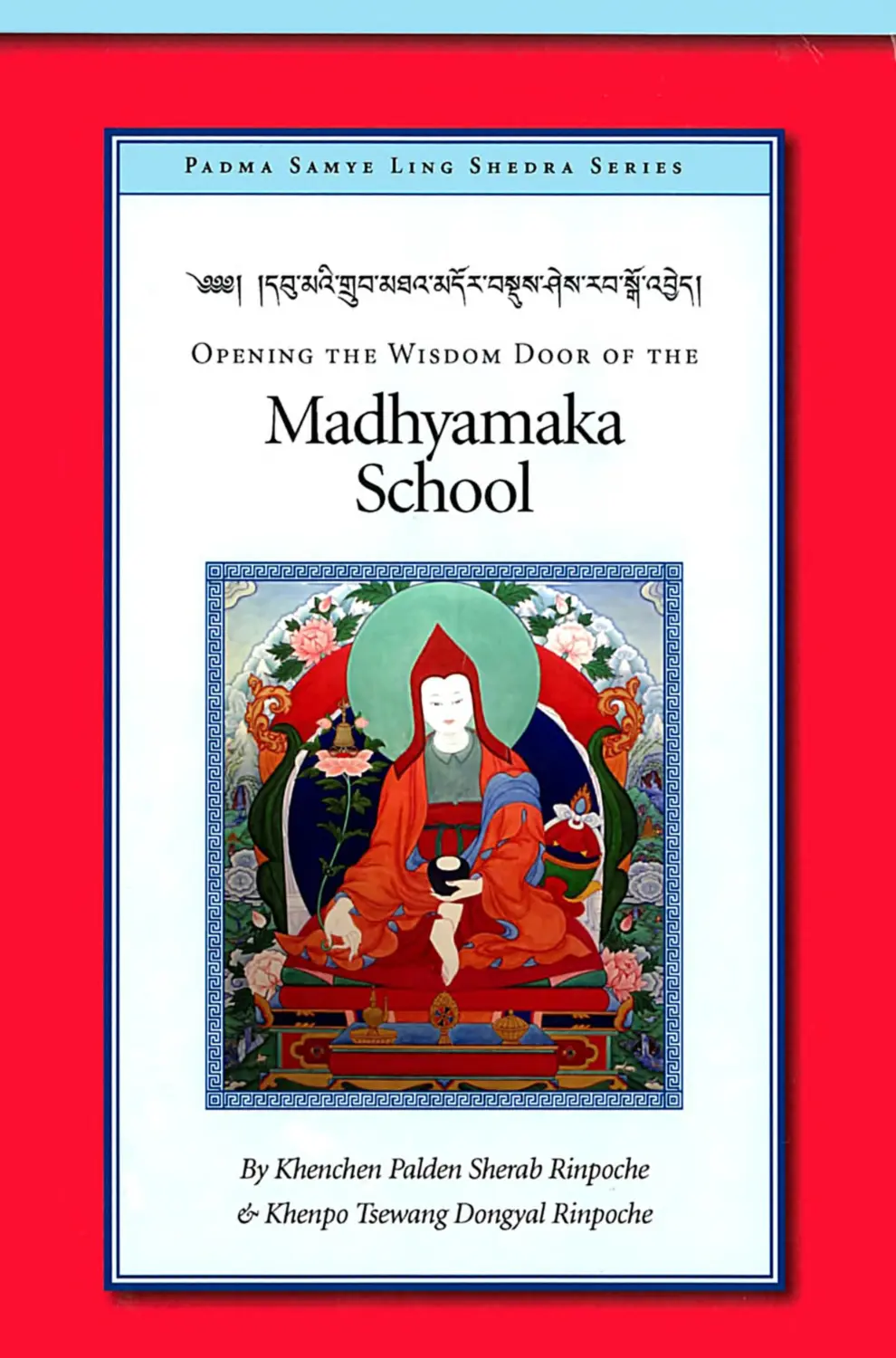


Автор: Rinpoche K.P.S. Rinpoche K.T.D.
Теги: spirituality cultural studies spiritual world spiritual culture
ISBN: 0-9659339-6-2
Год: 2007
Похожие

Текст
^ 3321
O
pening
t h e
W
isdom
D
oor
of
the
Madhyamaka
School
By Khenchen Palden Sherab Rinpoche
& Khenpo Tsewang Dongyal Rinpoche
O
pening
the
W
isdom
D
oor
of
the
Madhyamaka School
by
Khenchen Palden Sherab Rinpoche
and
Khenpo Tsewang Dongyal Rinpoche
O
pening
the
W
isdom
D
oor
of
the
Madhyamaka School
by
Khenchen Palden Sherab Rinpoche
and
Khenpo Tsewang Dongyal Rinpoche
Edited by Andrew Cook and David Mellins
Opening the Wisdom Door of the Madhyamaka School
Copyright © 2007 Khenchen Palden Sherab Rinpoche and
Khenpo Tsewang Dongyal Rinpoche
All rights reserved. No part of material may be reproduced in any
form or by any means, electronic or mechanical, including
photocopying, recording, 01*by any information storage and retrieval
system, without prior written permission from the authors.
Published by Dharma Samudra.
Padma Samye Ling
618 Buddha Highway
Sidney Center, NY 13839
(607) 865-8068
wwvv.padmasambhava.org
ISBN: 0-9659339-6-2
C
ontents
Acknowledgements.................................................................................... 9
Introduction...............................................................................................13
The 84,000 Teachings of the Buddha................................................. 14
Beginning Discussion ofM adhyam aka............................................. 16
Bhavaviveka Refutes B uddhapalita................................................... 17
Chandrakirti Refutes Bhavaviveka..................................................... 19
Shantarakshita and M adhyam aka..................................................... 20
Questions and Answers....................................................................... 22
H is to ry ...................................................................................................... 27
How Svatantrika Madhyamaka Came to Tibet................................ 27
How Prasangika Madhyamaka Came to T ibet.............................. .3 0
The Svatantrika Madhyamaka o f This S hedra................................ 32
Review of Svatantrika Madhyamaka Teachings.................................. 35
Benefits o f the Nature As It I s ........................................................... 38
Madhyamaka Is Beyond Conception.................................................41
Madhyamaka and P rajnaparam ita...................................................42
Questions and Answers........................................................................46
Rangtong and S h en to n g ......................................................................... 49
Svatantrika M adhyam aka................................................................... 50
Khenchen Bodhisattva, Shantarakshita.............................................50
Longchenpa and MipHam Rinpoche.................................................52
Relative and Absolute T r u th ................................................................... 55
Refuting the Sameness of the Two Truths.........................................55
1. Error O n e ....................................................................................55
2. Error T w o ....................................................................................56
3. Error T h re e ..................................................................................56
4. Error F o u r.................................................................................... 56
Refuting the Separateness of the Two T ru th s ...................................57
1. Error O n e .................................................................................... 58
2. Error T w o .................................................................................... 58
3. Error T h re e .................................................................................. 58
4. Error F o u r.................................................................................... 59
Valid Cognition and the Two T ruths.................................................60
Meaning of the Two T ru th s ............................................................... 62
Jnanagarbha’s Two T r u th s ................................................................. 64
The Four Categories of Relative T r u th .............................................64
Two Divisions of Absolute T ru th ....................................................... 65
Madhyamaka and the Vajrayana............................................................. 69
Absence o f a Singular and Plural Self-Existing N a tu re .................. 71
Refuting Singularity............................................................................72
Refuting P lu ra lity ................................................................................ 74
How Do Phenomena Really Exist?..................................................... 75
Further Characteristics of Absolute and Relative T r u th ................ 76
The Five Essential Points of Yogachara M adhyam aka........................ 79
1. Functionality.................................................................................... 79
2. Independent Self-Awareness......................................................... 79
3. Interiority— Phenomena as Mental Projections.......................... 80
4. Countable and Uncountable Absolute T ru th ...............................80
5. Gradual Approach to Uncountable Absolute T ruth .................... 82
Uncountable Absolute T r u th ............................................................. 84
Svatantrika-Prasangika Distinction: Gradual Versus I n s ta n t
84
The Five Great Reasonings of M adhyam aka.........................................87
The First Great Reasoning of M adhyam aka.........................................91
1. Results Do Not Arise From Them selves.......................................92
2. Results Do Not Arise From O th e rs ............................................... 92
3. Results Do Not Arise From Self or O th e r.....................................94
4. Results Do Not Arise From Nothing W hatsoever................... 94
General Review....................................................................................95
Distinctions Between Svatantrika and Prasangika M adhyamaka... 97
Review of the First Great Reasoning of M adhyamaka.................... 99
The Second Great Reasoning of M adhyamaka...................................101
1. Phenomena Do Not Arise From Existence.................................102
2. Phenomena Do Not Arise From N onexistence.........................103
3. Phenomena Do Not Arise From Both Existence
and N onexistence..........................................................................103
4. Phenomena Do Not Arise From N othingness.......................... 103
All is Em ptiness.................................................................................. 104
Nagarjuna, Aryadeva, and the Five Reasonings.............................105
General Review.................................................................................. 107
Emptiness and C la rity ......................................................................108
The True Nature of Appearances..................................................... 110
The Third Great Reasoning of M adhyam aka.....................................113
Relationship Between Causes and Results........................................... 114
Do Cause and Result Occur Simultaneously?................................ , . 115
Do Cause and Result Make Contact?................................................... 115
The Fourth Great Reasoning of M adhyam aka...................................117
Reviewing the Purpose of M adhyam aka.............................................119
The Fifth Great Reasoning of M adhyam aka....................................... 121
Absolute Truth and Valid C ognition............................................... 125
Questions and Answers..........................................................................127
Dzogchen and M adhyam aka................................................................131
C onclusion.............................................................................................. 133
About the A uthors...............................................................
139
O ther Publications by the Authors....................................................... 143
Endnotes...................................................................................................147
A
c k n o w le d g em en ts
The Samye Translation Group would like to thank everyone who
was involved in helping bring this project to fruition. In particular, we
would like to thank Andrew Cook for his joyful and diligent efforts in
completing this book and editing these transcriptions. W ithout his
aspirations and hard work, this book could not have been completed in
such a short period of time. Thanks are also well deserved by David
Mellins and Keith Endo for their extensive help w ith editing, and by
Ann Helm for her help with the Tibetan and Sanskrit terms. We would
also like to thank the many people who helped transcribe these
teachings, including Ani Joanie Andras, M ary Ann Doychak, Keith
Endo, Beba Febo, Colin Foote, and Pema Tara. Additional thanks goes
out to Rita Frizzell for her assistance in preparing the text and cover for
publishing, to Sujata Ghosh for her help with final editing, and to Pema
Dragpa for his work w ith editing and layout.
As always, we are deeply grateful to Ani Lorraine O’Rourke and Pema
Tsultrim for their steadfast administrative help with Padmasambhava
Buddhist Center.
We would also like to thank all the resident staff of Padma Samye
Ling whose work actively supports the Khenpo Rinpoches’ activities
locally and internationally. We also wish to extend our thanks to all
mem bers and friends of the Padmasambhava Buddhist Center
worldwide for their constant support over m any years.
Most importantly, we offer our heartfelt gratitude and devotion to
the Venerable Khenpo Rinpoches for blessing us with the opportunity
to receive and practice these profound teachings. We hum bly request
9
Opening the Wisdom Door of the Madhyamaka School
that Khenchen Palden Sherab Rinpoche and Khenpo Tsewang Dongyal
Rinpoche continue to turn the wheel of Dharma, and we offer prayers
for their long and healthy lives.
We sincerely ask forgiveness from all wisdom beings, holders of the
teachings, and readers for all errors and m isinterpretations of the
teachings present in this text. We welcome any suggestions on how to
improve the text.
May everyone who reads this book understand the value and
meaning of their precious hum an life. May their highest aspirations be
fulfilled for the benefit of all beings.
10
Opening the Wisdom Door of the Madhyamaka School
S h e d r a Ye a r T h r e e :
SvATANTRIKA MADHYAMAKA
Teaching:
The Svatantrika Madhyamaka of Shantarakshita
(Yogachara Svatantrika Madhyamaka) according to
the commentaries of M ipham Rinpoche and
Longchenpa.
Teachers:
Venerable Khenchen Palden Sherab Rinpoche and
Venerable KhenpoTsewangDongyal Rinpoche.
Time:
August 27 to September 1,2005.
Place:
Palden Padma Samye Ling Monastery and Retreat
Center, Upstate New York.
Retinue:
Thirty to forty students came from around the world
to participate in six days of intensive study of
Tibetan Buddhist philosophy.
¡1
In t r o d u c t io n
We should begin by restrengthening our beautiful bodhichitta
motivation by thinking of all living beings, who extend as far as space.
Keep the following intention in your mind: “In order to liberate all
sentient beings into the state of perfect enlightenment, I am going to
listen to, contemplate, and practice the profound and essential teachings
of Buddha Shakyamuni known as Madhyamaka.”
Over the past two years, we have had the wonderful opportunity to
briefly discuss some of the philosophical systems of Buddhism, according
to our time and capabilities. Everything we practice is based on this
philosophy. But what does it really mean to study Buddhist philosophy? It
means we are engaging in and understanding the profound meaning of the
true nature exactly as it is, by discovering the truth without any exaggeration
or depreciation. It is therefore very important to have a correct
philosophical view. The Madhyamaka teachings are as profound and deep
as an ocean. And in this shedra we will try to enter the depths of the ocean
of Madhyamaka, rather than hang out on Madhyamaka’s beach! So let us
try and deepen ourselves by taking a dip in the vast ocean of Madhyamaka.
There are two different schools of Madhyamaka: Svatantrika
Madhyamaka, or Rangyupa [rang rgyud pa \, and Prasangika Madhya
maka, or Thalgyurpa \thal *gyur pa].' These two schools present
profound and sophisticated philosophical systems, both within the
specific context of Buddhism and in the m ore general context of human
history. Before going a bit deeper into the Svatantrika Madhyamaka
school, we will give an overview of the wider span of Madhyamaka
teachings. It is im portant to understand Prasangika and Svatantrika
M adhyamaka, since each school is very profound; however, we don’t
have enough time to cover both in detail, and simply reviewing them
m ight not be very beneficial. So we have decided that during this shedra
we will mainly focus on Svatantrika Madhyamaka.
The Madhyamaka philosophy is a teaching of Buddha Shakyamuni,
13
Opening the Wisdom Door of the Madhyamaka School
who began his spiritual journey by developing the thought of enlightenment
known as “bodhichitta.” After cultivating bodhichitta, he continually
accumulated the two merits for three countless aeons.2 Finally, the Blessed
One reached complete enlightenment—the state of buddhahood. He then
began to share the knowledge and wisdom he gained through his practice
and meditation Mipham Rinpoche5praises the sublime achievement of the
Buddha: “You achieved the ultimate state of realization and discovered the
nectar of the Dharma. Filled with love and compassion, you shared this
nectar with living beings without any trace of self-importance or egodinging.” This nectar is the authentic message of the Buddha, based upon
his realization of the truth. He shared this realization with beings to lead
them to liberation. What we are experiencing now is the glorious nectar of
the Dharma, and we will drink it according to our capabilities.
The Buddha taught about the truth o f the nature as it is. He did not
describe the nature to be fander than it is, nor did he attempt to inspire
or please others by exaggerating. In the same way, the Supreme Teacher did
not subtract anything from the truth in order to avoid displeasing others.
He taught the truth in a straightforward manner, exactly as it is. Truth is
truth. But in order to help small, dualistic minds understand the nature,
the Blessed One taught the Dharma according to different levels of
subtlety, with each level corresponding to unique dualistic fixations and
the various ways the nature is perceived by various types of mind. These
teachings are known as the 84,000 teachings of the Buddha. Yet Buddha
Shakyamuni was not randomly trying to show us different things: Again,
he taught according to the readiness of our dualistic minds so that we
could understand in terms of our capacity, accept the validity of the
teachings, and develop progressively greater understanding.
The 84,000 Teachings of the Buddha
All the teachings of the buddha are encompassed by three seminal
teachings known as the three“tum ings o f the wheel of Dharma.” A great
Dzogchen tantra states that the Buddha gave different teachings in order
14
Opening the Wisdom Door of the Madhyamaka School
to subdue the three poisons of anger, attachment, and ignorance. To
dispel the attachment of sentient beings, Buddha gave 21,000 teachings
on the Vinaya. To dispel anger, Buddha gave 21,000 teachings on the
Sutras. To dispel ignorance, Buddha gave 21,000 teachings on the
Abhidharma. Finally, so that all three poisons could be dispelled and
subdued, Buddha gave 21,000 teachings on the Tantras.
These teachings do not essentially contradict one another because all
o f us are afflicted by the three poisons o f attachment, anger, and
ignorance, and these poisons need to be uprooted and removed. For this
reason, any Dharma teaching we apply is always good, since it will
directly remove the obstacles and obscurations that prevent joy and
realization; all Dharm a teachings are extremely special. The 84,000
teachings are alternately divided into three o r nine yanas, o r “vehicles,”
according to the various ways we can classify the teachings.4In any case,
the yanas become deeper and more sophisticated as they progress; this
is how the Buddha skillfully leads the childlike minds o f individual
sentient beings along the path to enlightenment. The teachings become
deeper as we grow and our understanding becomes more subtle.
Therefore, the teachings of the first yana are less sophisticated than the
teachings of the second yana, and the second yana is less sophisticated
than the third yana, etc. Each yana includes the teachings of the yanas
that precede it, so the presentation of the nature as it is becomes more
refined and accurate as one moves up the different vehicles. This trend
continues through all nine yanas. In general, this is how the system of the
nine yanas functions in terms of the minds of different sentient beings.
First, it is very im portant to understand the “view” and base our
practice upon this understanding.5 The view is our goal and target.
Once we have established this view, we can progress along the path and
eventually achieve our goals. Hence, the view is the foundation of both
the path and its result, or fruition. In Tibetan Buddhism it is often said,
“Madhyamaka is the view, Mahamudra is the path, and Dzogpa Chenpo
is the result.” Madhyamaka, M aham udra, and Dzogchen are not
15
Opening the Wisdom Door of the Madhyamaka School
contradictory or isolated from each other; they are al J connected. So we
follow a particular path according to our view, and, as we continue, we
discover the view as it is.
B e g in n in g D
is c u s s io n o f
M adhyamaka
Madhyamaka is known as Uma [dbu ma\ in Tibetan. Uma means
“middle” or “center.” It is this “middle view” or “middle way” we are
going to uncover and explore through the techniques of Madhyamaka.
But why is Madhyamaka referred to as the “Middle Way”? It is called the
Middle Way because it is not extreme; Madhyamaka is not right wing
or left wing. These are the ultimate teachings of the Buddha. In Tibetan
Buddhist philosophy, this ultimate view is known as ngedon [ngesdon],
literally “definitive truth.” Ngedon refers to the certain, definitive,
inevitable meaning of the nature as it is. Since there is nothing further
to add and nothing to subtract from Madhyamaka, it is known as
definitive. By directly referring to the nature as it is, Madhayamaka
explains the ultimate meaning of truth, the nature of all things.
As we m entioned earlier, the Buddha gave three or four seminal
teachings known as the turnings of the wheel of Dharma. Madhyamaka
comes from the second and third turnings, and the Vajrayana
teachings— sometimes known as the “fourth turning of the wheel of
Dharma”— are based upon Madhyamaka. Consequently, Madhyamaka
is the essence of the Buddha’s second, third, and fourth seminal
teachings. Generally speaking, Madhyamaka comes from the
Prajnaparamita teachings of the second turning of the wheel of
Dharma. Prajnaparamita m eans“transcendent wisdom” or “perfection
of wisdom, and is the foundation of the third and fourth turnings as
well. The philosophical system of the Prajnaparamita teachings was
made popular by the great masters Nagarjuna and Asanga, who were
predicted several times by Buddha Shakyamuni in different Mahayana
sutras and tantras. Nagarjuna, the first Madhyamaka teacher, was born
16
Opening the Wisdom Door of the Madhyamaka School
about four hundred years after the Blessed One’s mahaparinirvana.
The Buddha’s teachings on the Pi'ajnaparamita are very sophisticated,
very profound, and very vast, so they are difficult to immediately
understand.
But
Nagarjuna
summarized
the
philosophy
of
Prajnaparamita in a condensed way that is easy to follow. He wrote a very
famous
book called the Mula-madhyamaka-karikas, or Mula-
madhyamaka-prajna. In Tibetan, this work is called Urrn tsa wa’i
sherab,and it is sometimes translated into English as the Root Verses on
M adhyamaka.6 The Mula-madhyamaka-prajna has twenty-seven
chapters. Yet these chapters are not based on Nagarjuna’s own
presum ptions— he was not just guessing. Instead, this work relies on
logic, reason, and the reader’s own intelligence to explore and introduce
the nature as it is. The great Nagarjuna wrote four or five additional texts
to further support and explain the root text of the Mula-madhyamakaprajna,. These are called the Six Treastises o f the Reasoning o f Madhyamaka.
Altogether, these texts clearly establ ish the view of Madhyamaka.
Nagarjuna was the second head abbot of Nalanda Monastic
University, and many great masters and scholars came to studyat Nalanda
during the time of its flourishing. Arya Nagarjuna had several great
disciples, one of whom was Buddhapalita, a master renowned for his
understanding of Madhyamaka philosophy. Buddhapalita wrote a very
famous commentary on Nagarjuna’s Mula-madhyamaka-prajna entitled
Buddhapalita-vrtti, or The Commentary o f Buddhapalita. Like all great
Buddhist masters of his time, Buddhapalita was Indian, and he too was
studying and teaching at Nalanda. In his commentary on The Root Verses
on Madhyamaka, Buddhapalita directly establishes that everything is
within the profound state of great emptiness. Again, this work was very
popular in India and at Nalanda around the time it was written.
Bhavaviveka Refutes Buddhapalita
Between thirty and one hundred years later, another great master
was born in southern India. His name was Acharya Bhavya, or
17
Opening the Wisdom Door of the Madhyamaka School
Bhavaviveka, also known as Lobpon Bhavya and Leg Den Je.
Bhavaviveka had studied all the Madhyamaka texts, including
Nagarjuna’s Mtila-madhyamaka-prajna, as well as Buddhapalita’s
com m entary on this work. He refuted certain aspects of the
Buddhapalita-vrtti, arguing that Buddhapalita had gone too far in
establishing great emptiness. O f course, Bhavaviveka used solid
reasoning to support his refutation. He claimed that Buddhapalita’s
com m entary was not the correct way to present and explain great
emptiness to other disciples and practitioners. Acharya Bhavya’s famous
com m entary on the Mtda-madhyamaka-karikas is called Sherab
Dronma— the Lamp of Wisdom,7 and it is in this text that he contradicts
different parts of Buddhapalita’s commentary. The Lamp o f Wisdom
outlines the principal philosophical system o f Acharya Bhavya,
explaining that we should understand relative truth according to the
Sautrantika school o f the Hinayana. From this perspective, on the
relative level everything we see externally is formed by atoms.
Furthermore, perception is inseparable from mind, b u t the objects we
see perceive are made of matter. And this matter is composed of atoms.
Therefore all the objects o f the senses are com pounded— made of
atoms— and these objects are experienced through the perceptions and
conceptions of mind. This is the level of relative truth.
In contrast, on the level of absolute truth everything is empty: All
phenom ena composed o f atoms are empty, and all perceptions,
conceptions, and states of consciousness are empty as well. Based upon
this understanding of the absolute, it should be recognized that
everything is totally empty. Bhavaviveka explains that we should
m aintain this understanding of emptiness on the absolute level, but on
the relative level we should precisely follow the philosophical
understanding of the Sautrantika school of the Hinayana. As we said,
this interpretation of Madhyamaka from the Lamp o f Wisdom became
very popular, and is known as the Sautrantika Madhyamaka school, or
the Sautrantika Svatantrika Madhyamaka school.
is
Opening the Wisdom Door of the Madhyamaka School
Bhavaviveka was truly a great m aster of Mahayana Buddhism. In
addition to his Lamp o f Wtsdomy which is a word comm entary on
Nagarjuna’s Root Verses on M adhyamaka, Acharya Bhavya wrote a
meaning commentary on the same work entitled Madhyamaka-hrdaya,
or Umax nyingpoi tsig lerchepa.8 This is roughly translated into English
as Verses on the Essence o f Madhyamaka, He then wrote a third book—
a commentary on his own Verses on the Essence o f Madhyamaka— called
Madhyamaka-hrydaya-tarka-jvalay the Blaze o f Reasoning. These last
two works are considered to be essence or meaning commentaries on
Nagarj una’s works.
Chandrakirti Refutes Bhavaviveka
Several generations after Bhavaviveka, the great Indian master
Chandrakirti was born. Eventually Chandrakirti also became the head
abbot of Nalanda. He had studied the M ula-madhyamaka-prajna
commentaries of both Buddhapalita and Acharya Bhavya, and believed
that Buddhapalita’s work was perfect. As a result, Chandrakirti refuted
Bhavavikeka’s teaching, which had since become the basis of the
popular
Svatantrika
Madhyamaka
school.
He
claimed
that
Bhavavivekas’s teachings were more distracting than those of
Buddhapalita, since they did not immediately lead to absolute truth.
Therefore, he argued, Acharya Bhavya created many distracting
conceptual layers and detours to practitioners’ realization of the
absolute. Chandrakirti reasoned that all the different systems and
methods concerning matter, mass, and consciousness merely relate with
relative truth, and relative truth is both deceiving and distracting. He
questioned, “Why should we spend time worrying about relative truth
when it distracts practitioners from the true nature? As Buddhapalita
taught, we should immediately arrive at the absolute truth of emptiness.
This method is accurate, true, and doesn’t mix anything up.”
The
great
master
Chandrakirti
wrote
two
very famous
commentaries on Madhyamaka. First is the Mula-madhyamaka-vrtti19
Opening the Wisdom Door o f the Madhyamaka School
prasannapada, or Clear Words, more commonly known as Prasannapada.
This is called Tsig Salwa [tshig gsal ba) in Tibetan. Second is the
Madhyamakavatara, or Entrance to the Middle Way. The Prasannapada
is a comm entary that explains the words o f Nagarjuna’s Mulamadhyamaka-prajna, whereas the Madhyamakavatara, or Uma lajugpa
[dbu ma la fug pa], is a commentary on the meaning o f Madhyamaka.
These works created the foundation o f the Prasangika Madhyamaka
school o f Buddhism; because Chandrakirti emphasized a direct
approach to absolute truth, he is known as the second great Prasangika
master. We might say that Buddhapalita was the first master of
Prasangika Madhyamaka, but Chandrakirti became the most famous.
Others argue that Chandrakirti himself was actually the founder o f the
Prasangika Madhyamaka school.
Shantarakshita and Madhyamaka
The great Indian master Shantarakshita was bo m shortly after, or
even during, the time o f Chandrakirti.9 Like Chandrakirti before him,
Shantarakshita eventually became the head abbot o f Nalanda Monastic
University. He was also the principal teacher of the king of Bengal, and,
as you all know, the cofounder o f Tibetan Buddhism. Shantarakshita
studied all the Madhyamaka texts we have been discussing, and he wrote
his own commentary on the Mula-madhyamaka-prajna o f Nagarjuna
known as the Madhyamakalankara, or the Ornament o f Madhyamaka.
He then wrote another text known as Madhyamakalankara-svavrtti,
otherwise known as the Auto Commentary on the Madhyamakalankara.10
The great master Shantarakshita explained relative truth according
to the Mind Only philosophical school [Sems tsam pa]. This school
regards all relative phenom ena as mind: subject, object, and m ind itself
are all held to be mind. So, Shantarakshita describes relative truth in the
tradition of the great masters Asanga and Vasubandhu, exactly according
to the Mind Only view. In terms o f absolute truth, however, he follows
the teachings o f Nagarjuna. Thus Shantarakshita combines the
20
Opening the Wisdom Door of the Madhyamaka School
understanding of Mind Only and Madhyamaka into a single philosophy
by merging the teachings of Asanga/Vasubandhu and Nagarjuna into a
single state. Normally these two schools are considered to be two major,
independent schools o f thought. For this reason, Shantarakshita’s lineage
teaching of this philosophical doctrine is known as Chittam atra
Madhyamaka or Mind Only Madhyamaka. More precisely, it is known
as Yogachara Svatantrika M adhyamaka
Shantarakshita’s teacher was Yeshe Nyingpo (Skt. Jnanagarbha),
another famous Madhyamaka master who taught at Nalanda. Yeshe
Nyingpo wrote a very popular book on Madhyamaka known as Dettpa
nyi nampar chepa [bDen pa gnyis m am par ‘byedpa; Skt. Satya-dvayavibhanga\, the Division of the Two Truths. This text provided an
explanation of Madhyamaka very similar to that of Shantarakshita’s,
except Yeshe Nyingpo did not specify that relative truth should be
understood as described in the M ind Only school. Shantarakshita’s
m ost renowned disciple, Kamalashila, came to Tibet after he himself
arrived in the Land o f Snows. Kamalashila also wrote a famous book on
Madhyamaka— consistent with Shantarakshita’s presentation— known
as Umanangwa [dBum asnangba;Skt.M adhyam akaloka),theLighton
Madhyamaka. This very famous text is not exactly a commentary, but
rather a general work on the subject o f Madhyamaka.
Jnanagarbha— the teacher o f Shantarakshita— Shantarakshita
himself, and Kamalashila are generally regarded as the most renpwned
masters o f Svatantrika Madhyamaka. When we divide Madhyamaka
into Prasangika and Svatantrika, they are always classified as belonging
to the Svatantrika school. These masters are often referred to as the
“three great masters o f the east,” since they all came from India, Bengal,
and the surrounding area. Examining the history o f India, we discover
that Svatantrika Madhyamaka was very popular there, where it was
taught by masters such as Bhavaviveka and the three great masters of
the east.
21
Opening the Wisdom Door of the Madhyatnaka School
Q
u e s t io n s a n d
A n sw ers
Q u e s t i o n : Could you say a little bit more about how Yogachara
Madhyamaka developed based upon the Cittam atra, or M ind Only
school?
A n s w e r : I think you all know that Yogachara is a synonym for the Mind
Only school, which is called sem tsam pa in Tibetan. The terms
Yogachara and Cittamatra are both Sanskrit words. Roughly translated,
yoga refers to an inner state of concentration and is deeply connected
with the mind. Chara means “conduct” or “action.” So Yogachara can be
translated as “action of the mind.” The M ind Only schools sees
everything in the world and beyond as none other than the emanations
and activities of mind. There are two ways to understand this. First, all
schools agree that one’s own perceptions, conceptions, and ideas are
mind. These are associated with the perceiving subject. Next, we have to
look at seemingly “objective” phenomena, such as mountains, the
world, the galaxy, and other objects. W hat are these? You may wonder
how these phenomenal objects could be projections of mind.
The M ind Only school teaches that our habits patterns of grasping
to phenomena as substantially solid and inherently existent have been
continually im printed in the subconscious storehouse (Skt. alaya), or
the eighth consciousness." Based upon these imprints, our perceptual
habit patterns reflect back to ourselves and others as phenomenal
appearances. Although objects seem to be distinct from mind, they all
begin with mind. Generally, we have accumulated habit patterns: (I)
the habit pattern of (perceiving things) as singular and solid, which is
the universal habit pattern; (2) the habit pattern of perceiving
phenomenal appearances, which are the objects of the senses; and (3)
the habit patterns of individual, physical characteristics. Even though
these three habit patterns appear to be different from m ind itself, they
are actually im prints that have been stored in the alaya for a very long
22
Opening the Wisdom Door of the Madhyamaka School
time. At the present time, these imprints (objects) are reflecting back to
ourselves (subjects), despite the fact that they are manifestations o f
m ind previously registered in the alaya. In this way, external objects and
all phenom ena are actually part of m ind’s own display; on the absolute
level, nothing substantially solid has ever existed throughout
beginningless time, phenomena are like illusions or magic. This is the
principal philosophy of the Yogachara schools.
The great Shantarakshita incorporated this Mind Only view of
conventional reality in the Yogachara Madhyamaka school, which
therefore describes relative reality in precisely the same m anner as the
Mind Only school. On the absolute level, however, M adhyamaka
describes everything as empty. Even m ind itsel fit seen to be empty and
devoid of inherent self-existence. Shantarakshita united these two
profound philosophical systems— the Yogachara view of conventional
reality and the Madhyamaka view of absolute tru th — w ithout any
hardship or contradiction. To summarize, on the relative level,
everything is a display of m ind; on the absolute level, everything is
completely beyond all characteristics and complexity.
In the Madhyamakalankara, Khenchen Bodhisattva • him self
describes the Yogachara Madhyamaka school as "riding the chariot o f
two great philosophical systems, holding the reins of logic and
reasoning.” And what are these two great chariots? They are the
profound Madhyamaka system of Nagarjuna and the vast philosophical
system of Asanga and Vasubandhu combined together in a single state
of practice. Based upon this profound system o f logic and reason—
applied in meditation— we will proceed directly to the perfect state o f
buddhahood.
Q uestion: You say that, since beginningless time, m ind has created
everything, even atoms. So m ind created that wall right there...could
you put this in an evolutionary context for us?
Answer: [Rinpoches laughing.] Yes, that is really true! If we look closely,
23
Opening the Wisdom Door of the Madhyamaka School
we will see that this entire building was created by mind; mind projected
the building, m ind made the plans, m ind carried out those plans, and
m ind constructed the building with different materials. And, as you
pointed out, all atom s are also created by m ind, or habitual patterns.
O ur habitual patterns developed a very long tim e ago. In fact, since
beginningless time we have been busy creating and reinforcing habit
patterns. For instance, the habit patterns of m ind gave rise to the four
elements: earth, fire, water, and wind.
One of the main habit pattern shared by sentient beings is the habit
of solidity, the tendency to perceive things as solid. W hen this habit
pattern of solidity is strongly developed, it appears as the earth element.
The habit pattern of moisture or liquid appears as the water element.
The habit pattern of warmth appears as the fire element. The habit
pattern of movement appears as the wind elem ent So the four elements
develop based upon our habit patterns, developing the physical body
and phenomena. These habit patterns reflect outwardly in a variety of
different ways as the objects of the five senses: form, sound, smell, taste,
and touch (i.e. feeling). The habit pattern o f spaciousness reflects
externally as the sky. Each of these “external” reflections is based upon
the habit patterns of the mind. This is why the M ind Only school and
many Buddhist teachers explain that our environment and the whole
universe begin in the m ind, and are none other than m ind’s own
reflections. Even though it seems to be the opposite— that everything
begins outside— deep down, the reverse is actually true; everything
starts inwardly and projects externally.
Our habitual patterns and karmic imprints are stored in the alaya,
which is often translated as the “subconscious storehouse,” the “all
base,” or the “all-ground.” In a way, all the karma we produce through
volitional action12 is stored in the alaya as a karmic im print or habitual
tendency. When corresponding causes and conditions come together,
karmic tendencies begin to reflect externally as the waves and echoes
of these imprints. We call this “karmic vision,” “karmic experience,” or
24
Opening the Wisdom Door of theMadhyamaka School
“karmic activity.”
O ur meditation practice cleanses and purifies the karmic imprints
on the alaya, and we begin to create new habit patterns associated with
enlightenment. When we completely dissol ve and remove the negative
habit patterns of m ind through our meditation on the great emptiness
of the true nature, we are freed from the habit patterns o f grasping to
phenom ena
as
substantially
solid,
and
we
achieve
perfect
enlightenm ent. Once more, as we purify the alaya, habit patterns of
solidity begin to dissolve, and the space element becomes m ore
predominant. W hen the habit patterns of wisdom become stronger and
stronger, m undane habit patterns related with misperceiving the nature
completely disappear, and we begin to perceive the external universe as
a pureland and ourselves as an enlightened being, or deity.This is a brief
explanation of why m ind is the basis of everything.
25
Opening the Wisdom Door of the Madhyamaka School
H istory
How Svatantrika Madhyamaka Came to Tibet
But how did Shantarakshita’s philosophical system come to Tibet?
Of course you probably know that Khenchen Shantarakshita himself
travelled to the Land of Snows. There he taught Svatantrika
Madhyamaka, although he did not specifically use the word
“Svatantrika” to describe his philosophy; it was simply part o f the
philosophical teachings he gave in Tibet during the 8th century.13 The
twenty-five disciples of Guru Padmasambhava and other great masters
of that time were all schooled in the philosophical system rooted in the
Svatantrika Madhyamaka school. That is, Svatantrika Madhyamaka was
the only form o f Madhyamaka taught in 8th century Tibet. Although
both Svatantrika and Prasangika texts were translated during the tim e
of Shantarakshita, it wasn’t until the 11th century that Prasangika
became more widespread and activated in the Land of Snows.
A great Tibetan master named Ngok Lotsawa Loden Sherab lived in
Tibet during the 11th century. He was also a great translator and teacher.
Loden Sherab was born in central Tibet, but he left the Land of Snows
at the age o f seventeen to travel to India, particularly to the area of
Kashmir. He stayed in India for seventeen years before returning to the
Tibet, at which time he began teaching in central Tibet. Lotsawa Loden
Sherab became so renowned that each time he gave a teaching ten or
even twenty thousand disciples would gather to listen. It is often said
that there was no room large enough to hold all his disciples, so he
would teach in a meadow or on the plain ground outside. It is also said
that when he taught there were no obstacles: He would simply stand
up on the throne facing east and teach the disciples in that direction,
before turning to teach the disciples in the southern, western, and
northern directions. The Tibetan histories recount that at the end of
his teachings, everybody would say lekparsong [legs pargsungs], which
27
Opening the Wisdom DooroftheMadhyamaka School
is like the Sanskrit exclamation “sadhu!” It means “wonderful.” So
everybody would say “Wonderful! Wonderful!” This is still done today
in Sri Lanka.
At this time in 8,h century Tibet, they used a special book holder
called a shokala. When the teachings concluded, everyone would close
their books at the same time. The sound of these books shutting was so
loud that it would echo throughout the mountains, startling horses and
other animals. Loden Sherab’s philosophical teachings are classified
along with those of Acharya Bhavya and the three great masters of the
east. Thus, he is also renowned as a Svatantrika Madhyamaka master in
the tradition of Shantarakshita.
Loden Sherab eventually became the head of Sangphu Monastic
University in central Tibet. According to Tibetan history, Samye was
Tibet’s first monastic university and Sangphu was its second. Many
great masters of Tibetan Buddhism, including the Omniscient
Longchenpa, started their education at Sangphu. Ngok Lotsawa Loden
Sherab was the second abbot of this monastery and he was responsible
for making Sangphu so famous. It was founded in the 11th century and
survived through the late fifteenth or 16,h century. Sangphu truly
became one of the greatest centers of studying, learning, and knowledge
in all of Tibet. Upon reading the histories, you will find that all the great
masters of Tibetan Buddhism before the 16th century— regardless of
their particular school— studied at Sangphu monastery. Briefly, Loden
Sherab was a very famous master of Svatantrika Madhyamaka.
Lotsawa Loden Sherab had many renowned students, including
TolungGyamarwa [stodlungrgyadmarba) andTolungwa [grolungba],
who were very famous. Because these disciples were great adherents of
the Svatantrika Madhyamaka school, they were also followers of the
three great masters of the east and Bhavaviveka. Later on, another
remarkable master appeared in Tibet named Chapa Chokyi Senge, who
eventually became the head teacher of Sangphu monastery. He was a
very famous logician and practitioner, regarded as an exceptional
28
Opening the Wisdom Door of the Madhyamaka School
follower of the masters of the east and Acharya Bhavya. Chapa Chokyi
Senge himself had many famous disciples, among whom the m ost
renowned were known as the “eight line disciples of Chapa Chokyi
Senge.” Each one of these disciples became a very famous logician and
scholar, following the Svatantrika Madhyamaka philosophical school.
Generally speaking, the Madhyamaka philosophical system is based
upon logic, philosophy, and correct view— all three are united together.
Thus, each of these Svatantrika teachers was also an expert logician.
Chapa Chokyi Senge is one of the greatest logicians in Tibetan history.
In fact, in a way he is the founder of Tibet’s system of debate. Although
Buddhist debate already existed in India, the Tibetan debate system and
style were invented by Chokyi Senge.
Around the same time as the eight line sons of Chapa, the glorious
master Sakya Pandita appeared in Tibet. One of the greatest masters of
Tibetan Buddhism, Sakya Pandita became the royal teacher o f the
youngest Tibetan prince. He was an accomplished master of Svatantrika
Madhyamaka, a hence follower of the three great masters of the east
and Acharya Bhavya.
When we speak of all these distinguished logicians and masters, we
are not simply referring to intellectuals; these beings were also great
practitioners who achieved the highest realization by practicing
Madhyamaka in combination with the Vajrayana teachings. Both
Svatantrika and Prasangika Madhyamaka were popular in India, but
Svatantrika Madhyamaka was especially widespread. Many of the great
Indian masters— such as the eighty-four mahasiddhas— followed the
philosophy of the Svatantrika Madhyamaka school. As we explained
earlier, this philosophy later came to Tibet and influenced the twenty-five
disciples of Guru Padmasambhava. Consequently, the philosophy of the
twenty-five disciples is also based upon the Svatantrika Madhyamaka
school. The same can be said for the eighty mahasiddhas of the Yerpa
region.14 All the students of Loden Sherab practiced according to the
Svatantrika view, along with the skillful means of the Vajarayana,
29
Opening the Wisdom Door of the Madhyamaka School
reaching the highest level of realization. This is just a brief history about
how Svatantrika Madhyamaka was transmitted and became popular in
India and Tibet, up until the eleventh or 12th century.
How Prasangika Madhyamaka Came to Tibet
While Prasangika M adhyamaka is often referred to as the
philosophical teachings of Chandrakirti, it actually includes the
teachings of both
Chandrakirti and Buddhapalita. Prasangika
Madhyamaka was also translated into Tibetan during the 8th century,
the time of Guru Padmasambhava and Shantarakshita, but it was never
as popular as Svatantrika Madhyamaka. In terms of ultimate meaning,
Svatantrika Madhyamaka and Prasangika Madhyamaka agree: For both
schools, the absolute meaning is the same, so there they are not so
different in that respect. It is only the method through which each school
establishes the ultimate philosophical view that differs. Again,
Prasangikas and Svatantrikas agree on the essential nature of absolute
truth.
After the time of Lotsawa Loden Sherab— sometime at the end of
the eleventh or the beginning of the 12th century—another noble being
appeared in Tibet whose name was Patsap Nyima Dragpa. Nyima
Dragpa also travelled to northw est India to study in the pocket o f
Buddhist activity in Kashmir, eventually becoming a great translator
and master before returning to Tibet. Nyima Dragpa became interested
in Prasangika Madhyamaka and devoted himself to this philosophical
system. He corrected and retranslated Chadrakirti’s Prasamapada, or
Tsig Tsel (Clear Words), teaching Prasangika Madhyamaka to his
disciples using the Madhyamakavatara. As a result, the Prasangika
tradition grew in popularity during this period in Tibet.
W hen Nyima Dragpa initially began teaching Prasangika
Madhyamaka in Tibet he did not have m any followers. Thereafter,
however, another great Kadampa master began sending his disciples to
study with the famed Sharawa, who specifically taught Chandrakirti’s
30
Opening the Wisdom Door of the Madhyamaka School
Madhyamakavatara. Due to the efforts of these students, many Tibetan
practitioners soon became interested in the Prasangika Madhyamaka
school. For this reason, there was a rapid growth of the Prasangika
Madhyamaka school in 'fibet during this period.
It was around this time that Chapa Chokyi Senge was said to have
eight lines o f spiritual sons, sometimes referred to as the “sons of the
eight great lines.” Among these spiritual sons was Magda Changchub.
Because he was a disciple of Chapa Chokyi Senge, Magda studied
Svatantrika Madhyamaka; nevertheless, he was also interested in the
Prasangika philosophical system. Thus, Magda Changchub continued
his studies of Prasangika Madhyamaka under Patsap Nyima Dragpa,
eventually becoming one of the greatest Prasangika masters of Tibet.
In later Tibetan histories, Patsap Nyima Dragpa is said to have four
spiritual sons, or renowned disciples, including Magda Changchub.
Hence, Magda Janchub is considered to be a spiritual son of both Chapa
Chokyi Senge as well as Patsap Nyima Dragpa.
But what is the red difference between Svatantrika and Prasangika
Madhyamaka? In essence, there are no big differences between these
schools; the only significant distinction lies in the methods each
tradition uses to establish the two truths, or relative truth and absolute
truth. Regarding their presentations of the absolute level with respect to
the principal “view,” they are the same. So both schools are very similar,
differing only in very subtle ways.
This has been a brief history of the two Madhyamaka schools,
including how they originated in India and later arrived in Tibet. It is
very beneficial to know the history o f how these Madhyamaka schools
began and gained popularity. After Sharawa’s teaching on Prasangika
Madhyamaka, this philosophical school became well-known and widely
practiced in Tibet, and has remained so until the present. Along with
Svatantrika Madhyamaka, Prasangika Madhyamaka is now a principal
subject of meditation in all the schools of Tibetan Buddhism. The
Dzogchen tantra known as Ati kopa chenpcd gyu (Ati bkod pa chen pa’i
31
Opening the Wisdom Door of the Madhyamaka School
rgyud) emphasizes the importance o f understanding a given teaching’s
history, explaining that it is hard to have confidence in a teaching
without exploring its history. This is said in various teachings. We have
begun our shedra by following this tradition and mentioning the names
of just a few o f the great Madhyamaka masters of India and Tibet.
Among the Indian and Tibetan masters we just m entioned, a few
contemplated and practiced Madhyamaka in com bination with
Dzogchen and tantra teachings, thus reaching high realization. Each of
the eighty-four mahasiddhas— these wonderful Indian and Tibetan
masters— were practitioners o f Madhyamaka as well as Dzogchen.
There have been countless practitioners and masters who achieved
realization through the practice of Madhyamaka. The mahasiddhas of
India are not restricted to those who gathered at Bodhgaya for a single
ganachakra ceremony, later coming to be known as the “eighty-four
mahasiddhas.”15After that ganachakra ceremony, the enum eration of
“eighty-four” mahasiddhas became very popular, but this does n o t
m ean there were only eighty-four. In India alone there were hundreds
of thousands o f great masters who practiced in this way; the names we
havevlisted here are just a small percent of the total num ber o f
accomplished masters. Each one o f these masters had m any great
disciples, and hence there are lots of authentic lineage holders. This is
how the teaching lineage of Madhyamaka has remained vital until the
present time. Many of the ancient masters came from the first monastic
university in India, Nalanda. Later, sometime between the sixth and
eighth centuries, another exceptional m onastic university was
established, called Vikramashila. As we have already seen, the first
Tibetan monastery was Samye and the second was Sangphu.
The Svatantrika Madhyamaka o f This Shedra
Throughout this shedra we will be using Mipham Rinpoche’s
comm entary on Shantarakshita’s Madhyamkalankara, which is called
Uma gyen gi namshe jatnyang lama gyepai zhalung.16 Since the
32
Opening the Wisdom Door of theMadhyamaka School
Madhyamakalankara is a large book that contains many topics, we will
not have time to discuss it in its entirety. Instead, we will use the text as
a support for our teaching and study o f Svatantrika Madhyamaka,
exploring as m uch as possible in our discussion of this sublime
philosophical school. Among all the commentaries on Shantarakshita’s
Madhyamakalankara, Mipham Rinpoche’s is the largest and most
detailed; it is actually one o f the m ost thorough and precise
commentaries in Tibetan Buddhist history.
Some of you may already know that the great master Tsongkhapa
also began to write an extensive com m entary on Shantarakshita’s
Madhyamakalankara. He started his text with a beautiful verse of praise
to Shantarakshita, then began. But for some reason, he could not finish
the commentary. Later, his disciple Gyaltsab Dharm a Rinchen wrote
what am ounts to footnotes on Tsongkhapa’s initial work, presenting
his additional text under the title Uma gyen gijeyang [dBu ma rgyan gi
brjed bang). O f course, this is not an extensive commentary.
We have seen that Lotsawa Loden Sherab and Chapa Chokyi Senge
were great logicians and followers o f Shantarakshita’s philosophical
system. In all likelihood they also wrote commentaries on the
Madhyamakalankara. However, because they lived so long ago— in the
eleventh and twelfth centuries— many o f their works have disappeared.
People hope to find commentaries by these great masters, but so far no
additional works have been discovered. The teachings written by the
great masters during this early period in Tibet (i.e. the eleventh and
twelfth centuries) were transcribed by disciples and copied by hand—
it takes a long time to write out these texts! And the Tibetan woodblock
printing system is a relatively sophisticated and m odem phenom enon
that was not developed until around the 14th century. Even then, the
woodblocks and prints took quite a long time to make. Thus, many
works o f the ancient masters have completely disappeared. For example,
most o f the works by Chapa Chokyi Senge, written in the beginning of
the 12th century, are gone. I think a copy o f a text by Chokyi Senge,
33
Opening the Wisdom Door of the Madhyatnaka School
providing an overview o f Madhyamaka, was recently found in Tibet.
Philippe Turenne obtained a copy of this text, which has not yet been
published— we are sure that somebody will publish it soon. In any case,
this is the reason why many ancient texts have disappeared.
34
R
M
eview
of
Svatantrika
adhyam aka
Teachings
We will now begin to explore the teachings o f Svatantrika
Madhyamaka. Just last year, we consulted Longchenpa’s teachings with
respect to the four schools of Buddhism; this year we will consult his
explanations of Mipham Rinpoche’s commentary on the Madhyamakalankara.
From the Madhyamaka point of view, we must first consider the
two truths. The two truths are extremely important since they comprise
all objects of knowledge. But where were these truths taught and who
taught them? They come directly from the teachings of Buddha
Shakyamuni. There is a Mahayana sutra known as the Sutra o f the
Meeting o f Father and Son [Yab sras mjal ba’i mdo] that recounts the
story of how the Awakened One, after leaving his kingdom and
attaining enlightenm ent, returned to meet his father the king. The
Buddha is praised in this sutra: “O h O m niscient One who knows
everything! All-Knowing One, you taught the two truths, never before
taught by anyone else in the world! And what are these two truths? They
are relative and absolute truth.” According to the teachings of Mahayana
and Madhyamaka, many things exist both in the world and beyond it.
Whatever can be conceived in the m ind can be categorized into these
classes of relative and absolute truth.
First, what is relative truth? Relative truth includes everything we
think, hear, feel, and analyze. It includes everything we do. All
phenomenal objects are classified under the label “relative truth.”
Relative truth is also known as that which is interrelated, functional,
and connected to the m undane level. Consequently, different teachings
such as the Sutra o f the Meeting o f Father and Son explain that relative
tru th can also be known as “relative truth o f the mundane world” or
“relative truth of samsara” (Skt. loka-vyavahara-samvrti-satya).
35
Opening the Wisdom Door of the Madhyamaka School
W hen we begin to analyze the exact meaning of relative truth and
investigate the nature of phenomena we experience by means of feeling,
hearing, seeing, and touching— in fact, all our activities— we do not
find anything substantially solid to which we can grasp or cling. There
is no solid existence behind these experiences: all evaporate into the
state of emptiness, without a trace. This is known as “absolute truth.”
Nevertheless, the two truths were never made into law by the
Buddha. He never ordered us to believe in them. Even so, the two truths
accurately describe the nature o f reality. If we investigate reality on our
own, trying to discover the essence of things by grasping on to objects
as tangible— as things we can hold, touch, or feel— then the words of
the Buddha appear to be false. We will say, “No, the two truths are not
actually correct.” However, as we continue investigate and discover the
essence of objects, we eventually come to the realization that there is
really nothing to find. In this case, we will see that the Buddha’s words
are true and that reality is as he described it. We will conclude that the
two truths correctly describe the nature of reality as it is. Again, this is
referred to as “absolute truth.”
When we establish things according to how they appear to ordinary
perception through hearing, touching, and feeling, this is relative truth.
It includes conceptions such as “I like” and “I don’t like”; “I am happy”
and “I am not happy”; “this is good” and “that is bad”; “this is beautiful”
and “that is not beautiful.” All types of analysis, conceptualization, and
everything we can express in words is relative truth just as it is. Yet when
we look into each of these things, we cannot find any substantially solid
basis behind them. This is known as “emptiness.” The system of relative
and absolute, which is actually two systems, is known as the view of
Svatantrika Madhyamaka. Understanding reality in this way, one can
experience relative truth exactly as it is, w ithout grasping and clinging
to things as substantial and solid. Such is the m ethod for transcending
limited conceptions and accepting reality exactly as it is, w ithout
overlapping the two truths, and w ithout ignoring, judging, or imposing
36
Opening the Wisdom Door of theMadhyamaka School
the two truths upon each other. We simply accept relative truth as it is
and then move beyond it. This is taught by Svatantrika Madhyamaka.
When we say something is “beautiful” or “wonderful,” this is relative
truth. But let us think about what this “beautiful” thing really is. Where
is this beauty? Does it lie in a mental state or in an object? To begin, we
should examine where our concept of beauty comes from. Does this
label exist in the m ind— the subject— or in an object? Upon
investigating in this way, we discover that there is nothing vve can really
hold or grasp on to; there is no substantially solid existing beauty. This
is known as emptiness.
Similarly, when we speak of something as being “bad,” this
“badness” exists in terms of relative truth. Relatively speaking, bad is
bad. But looking closer at the situation, we should try to find where
badness resides. Does it reside in the perceiving subject or the perceived
object? W here is this so-called “badness”? This name and label, this
form ation called “bad”— where is it? The more we think about and
investigate the location of our conception, the more the whole thing
evaporates. Not finding anything whatsoever is itself absolute truth.
This is the philosophical view of the Svatantrika Madhyamaka school,
put very simply and briefly.
“Svatantrika” is a Sanskrit word. Sva means “self” and tantrika comes
from the word tantra, which means “continuation” or “self
continuation.” Hence “Svatantrika” means “self-continuity.” This means
each and every object of relative truth is, in a way, self-continuing. On
the relative level, everything is a chain of momentary instants, a selfcontinuing continuum. The first instant becomes the cause of the second
instant, and the second instant is the result of the first. This is the self
continuation of conventional reality. On the absolute level, however,
everything we see— all this self-continuation— is just an echo of great
emptiness. Self-continuity is a sparkling chain of mirages, of emptiness.
There is nothing anywhere that exists in a substantial or solid way.
Svatantrika Madhyamaka encourages us to discover this self-continuing
37
Opening the Wisdom Door of the Madhyamaka School
nature exactly as it is, both on the relative and absolute levels.
As we m entioned earlier, the Buddha taught about the nature as it
is; he taught about the truth. But there is no imposition and no doctrine
in the Buddha’s teachings— there is nothing to believe. In Svatantrika
Madhyamaka, we consider what is happening behind the scenes of mere
appearances. We have to investigate and analyze what is really going on.
In other words, the Buddha is talking to us and we are talking to the
Buddha, to this nature. Simultaneously, we ourselves are part o f the
nature, so we have every right to investigate w hether or n o t the
teachings are true. Buddha Shakyamuni said this m any times
throughout the teachings. He said, “You should investigate, analyze, and
discover whether or not my words are true. Only then should you accept
or reject them.” Therefore, we do n o t have to be overly polite or
respectful when we talk about philosophical matters. Only when we
agree w ith the teachings based on valid cognition— once th etru e nature
has been legitimately established— do we have to accept them as true.
If we persist in arguing after that point, we are m erely lying and
deceiving ourselves, ignoring tru th as truth.
Benefits of the Nature As It Is
So, what are the benefits o f this nature we have established through
philosophical analysis? W hen we follow the true nature, we discover
reality as it is: the Buddha. Once we find this nature, dualistic m ind will
no longer trick us. We all know that duality m ind loves to fabricate and
manipulate. It likes to grasp at phenom ena, to doubt and hesitate. This
is how duality m ind operates. O ur own self-deception has deceived us
about the nature o f reality from the beginning.
We have heard m any times that all our labels, beliefs, and actions
are simply the creations o f our own minds. Nonetheless, we tend to
believe in what we have created. We hold on to these phenom ena,
continually supporting and analyzing our m ental constructions. Yet
when we begin to investigate the nature of our beliefs by seeking their
38
Opening the Wisdom Door oftheMadhyamaka School
location, we find that none of them are substantially existent. None of
them exist with any solidity. This is the nature of emptiness. Still,
emptiness is not just a black hole som ething that helps us cover up or
ignore the true nature. It is just the simple nature as it is. O ur
conceptions themselves create the ideas o f perm anence and
impermanence, of “this” and “that,” “up” and “down.” And our duality
m ind then clings to these conceptions. Everything we can name is the
creation of duality mind! It is this very situation we must investigate
and analyze.
Again, not finding anything upon looking is referred to as
“emptiness.” The Tibetan word for emptiness is tonpa nyid [stong pa
nyid], but it is also called denpe tongpa [bden pe stong pa], which means
“no solid nature exists.” Emptiness, the absence of a solid nature, is
pervasive. Nothing has a substantial nature, regardless of whether we
believe a given thing to be good or bad. Even enlightenment has no solid
nature. This means we cannot say “samsara is empty but nirvana is not
empty,” or “samsara has no solid nature, but nirvana has a solid nature.”
That is not what the Buddha taught: samsara has no solid nature;
nirvana has no solid nature; samsara is emptiness; and nirvana is
emptiness. For this reason, in his Prajnaparamita teachings, the Blessed
One often said, “There is something even higher and deeper than
buddhahood, which goes beyond any concept such as ‘Buddha is empty,
or enlightenment is empty.”’ Enlightenment has no solid nature and
nirvana also has no solid nature. Then what is really going on?
Appearances are just a magical display—they are magic.
This is why we chant the H eart Sutra every day when we get
together. In this teaching, the Awakened One says, “No eye, no ear, no
nose, no tongue, no body...no wisdom, no five aggregates, no twelve
nidhanas, no eighteen dhatus, no twelve links of dependent origination,
no path, no journey, no wisdom, no loss, no gain, no decrease, and no
increase.” W hat is the meaning of this? When the Buddha taught in this
way, he had not become a cuckoo— he wasn’t crazy! Still, if he said this
39
Opening the Wisdom Door of the Madhyamaka School
under normal circumstances, people surely would have thought he was
crazy and completely out of order. This is due to the fact that we believe,
grasp, cling, and hold on to our conceptions. As a result we constandy
suffer. Buddha Shakyamuni released all conceptual boundaries and
traps. His teachings bring us to the state of total freedom which results
from discovering the essence of the nature as it is. This is the central
philosophy of Svatantrika Madhyamaka. Once more, it means that
every aspect of what we normally consider to be our “selves” is empty:
the self has no solid nature, the eye has no sol id nature, and the nose has
no solid nature, etc. Put another way, the eye is self-emptiness, the nose
is self-emptiness, consciousness is self-emptiness, and the entire
universe— including samsara and nirvana— is self-empty.
By discovering the nature as it is, we will actually be in the natural
state. This is known as “meditation.” Meditation is nothing more than
m aintaining awareness of the nature as it is, w ithout extreme views.
Simply resting in the natural state, we discover meditation— such is the
authentic view of the nature. There is only one true nature; therefore,
the views of Madhyamaka, Mahamudra, and Dzogpa Chenpo are not
contradictory. The same is true for the Chod practice o f Machig
Labdron, which we have had the opportunity to discuss in the past.
Additionally, discovering the nature as it is will pacify the sufferings of
duality, as in the Shije practice of Padampa Sangye. The great master
Padampa Sangye’s Shije teachings are referred to as “the pacification
lineage teachings” because by practicing them, one pacifies the suffering
that results from duality mind and its fabrications. The various kinds of
suffering are just part of the game of duality. By discovering the nature
and m aintaining this discovery, one attains realization. This great
realization is known as Lamdre, or “path and result,” according to the
teachings of the Sakya school of Tibetan Buddhism. Due to practicing
these teachings, one achieves the result that was sought on the level of
relative truth.
We should understand that Madhyamaka is not just some kind of
40
Opening the Wisdom Door of the Madhyamaka School
intellectual game. It represents an essential practice and meditation.
W ithin Buddhism, study, contemplation, and meditation on the
Buddha’s teachings m ust be united so that one doesn’t fall into the
scapegoat of intellectualism or skepticism. We have to nourish ourselves
and absorb the teachings, so that we can expand our realization, love,
kindness, and thoughts related with the goodness of the natural state,
thus breaking through the boundaries o f duality. Then we will really
begin to reveal our own true beauty as it is. This is the purpose of all the
philosophical teachings that were laid out and taught by the many
accomplished and realized masters we'mentioned earlier.
As we continue our discussion of Madhyamaka, we should
continually restrengthen our beautiful motivation o f bodhichitta,
thinking, “All living beings would like to achieve enlightenment, and I
wish to lead them all to this state. In order to do so, I am going to study,
contemplate, and meditate on the profound meaning o f the
Prajnaparamita and Madhyamaka.” It is always im portant to keep this
beautiful motivation in our hearts.
Madhyamaka Is Beyond Conception
In general,“Madhyamaka” is known as Uma in Tibetan. It has been
commonly translated into English as “the Middle Way” or “the Middle
Path,” but it may also be translated as “center.” But this does not refer to
a center with boundaries— it is a center completely free from all limits
and territory. Anything with boundaries is not considered to be
Madhyamaka, the Middle Way. In a way, this “m iddle” refers to the
“ heart of the true nature.” Buddha Shakyamuni taught again and again
that if we have any grasping, clinging, or holding, we are not practicing
Madhyamaka. Grasping and holding are forms o f extremism; they are
at the edge. So if we grasp to notions such as “existence,” we are not
engaging in Madhyamaka. Likewise, holding on to any notion o f
“nonexistence” is not Madhyamaka. Nor is grasping to the notions of
“both existing and non-existing” and “neither existing nor n o n
41
Opening the Wisdom Door of the Madhyamaka School
existing.” We have to release every aspect of dualistic conception, freeing
ourselves from all extremes. Studying, contemplating, and meditating
in this way is known as Madhyamaka.
The simple way to understand Madhyamaka is to recognize that it
is entirely beyond all conceptions. W hen you have the view which is
free from conceptions, and you behold the state devoid of all grasping
and duality, you are experiencing an authentic glimpse of the
M adhyamaka view. Truly, grasping and clinging have nothing to do
with Madhyamaka. For this reason, the words “center,” “Madhyamaka,”
and “Middle Way” are just names that point out the profound nature
and usher us into recognition of the nature as it is. This is a brief
description of the meaning of the word “Madhyamaka.”
M adhyam aka and Prajnaparam ita
When we investigate Madhyamaka, we discover that there are many
different categories and divisions through which we can explore this
philosophical school. In this shedra we are presenting an overview of
the entire scope of the Madhyamaka teachings, as if gazing out from
the peak o f a m ountain in a panoram ic view of the entirety of the
Buddha’s teachings. From this perspective, we can see the Madhyamaka
of the sutras as well as the Madhyamaka of the tantras; it is possible to
divide Madhyamaka in this way. According to the Madhyamaka of the
sutras, there are two Umas: scriptural Madhyamaka and commentarial
Madhyamaka, the second of which is more more with texts, teachings,
and books. These books explain the teachings o f Buddha Shakyamuni,
including the commentaries made by great masters who expounded the
doctrine of the Awakened One. In Tibetan, we call these Ka Uma and
Shang Uma, respectively— that is, the Uma of the Buddha’s speech (i.e.
scriptural) and the Uma o f the commentaries on his oral teachings.
Scriptural Madhyamaka refers to the three seminal teachings given
by the Blessed One, as described in Sutra Mahayana: the first, second,
and third turnings of the wheel of Dharma. O f these seminal teachings,
42
Opening the Wisdom Door of the Madhyamaka School
the first turning of the wheel of Dharma is not considered to be a
Madhyamaka teaching; the entire second turning is considered to be a
teaching on Madhyamaka; and the third turning contains teachings on
both Madhyamaka and other subjects. Thus, for the most part, the third
turning o f the wheel of Dharm a is connected with Madhyamaka. To
summarize, the entire second turning and most of the third turning are
Madhyamaka teachings.
However, the Buddha did not specifically use Madhyamaka
terminology in his teachings, only occasionally using related terms.
Instead, the Blessed One explained Madhyamaka in the language o f his
Prajnaparamita teachings, which were given throughout the second and
third turnings of the wheel of Dharma. But what is the true meaning of
“prajnaparam ita”? As most of you know, it is roughly translated into
English as “wisdom that goes beyond” or “transcendent wisdom.” Yet
within the context of Prajnaparamita, the word “wisdom” does not refer
to intellectual knowledge, but rather to wisdom without territory,
wisdom completely beyond conception. This transcendent wisdom is
impartial, clearly and perfectly understanding the truth nature on both
the relative and absolute levels. By realizing this nature we “go beyond.”
And what do we go beyond? Duality. This is the essence of the
Prajnaparamita teachings. The practice and meditation o f transcendent
wisdom leads us to that which transcends duality altogether. In other
cases, “prajnaparamita” is understood as something that goes beyond
samsara and nirvana. Nevertheless, more specifically it relates with
“going beyond duality.” When we transcend duality, we discover the
innate nature as it is. So, the Buddha generally explained Madhyamaka
by way of his Prajnaparamita teachings.
The great master Nagarjuna used Madhyamaka terminology to
explain the Buddha’s teachings on Prajnaparamita. This language was
established in his famous work entitled the Mula-madhyamaka-prajna.
So, this text and those that followed it widely use Madhyamaka
term inology to explain and explore the profound meaning of the
43
Opening the Wisdom Door of the Madhyamaka School
Prajnaparamita. Asanga, another exceptional master, also applied
Madhyamaka vocabulary to the Supreme Teacher’s Prajnaparamita
discourses. In this way, Nagarjuna and Asanga were the two principal
masters who intensely explored Prajnaparamita— in a pointed and
accessible way— so th at everybody could understand and learn how to
practice on transcendent wisdom. The Prajnaparamita teachings are
often said to be very profound, vast, and deep; many masters describe
them as being “as deep as an ocean, as vast as the sky, and as infinite as
space.” Such are the common descriptions o f the Perfection o f Wisdom
Sutras. It is difficult even for m ature, intellectual people to understand
their meaning. Therefore, it is extremely fortunate that Nagarjuna and
Asanga clarified the profound and essential m eaning of these teachings.
Prajnaparamita is often described in terms of its “direct meaning”
and “hidden meaning.” The direct meaning of Prajnaparamita was
widely taught by Nagarjuna in his Mula-madhyamaka-prajna, whereas
the hidden meaning was discovered by Asanga. Asanga wrote many
famous works throughout his lifetime, including the Five Treatises of
Maitreya, which were actually taught by Maitreya and written down by
Asanga himself.17 Because their teachings are so profound, these two
remarkable masters— Nagarjuna and Asanga— are often known as the
“great suns of Buddhism,” or “the sun and m oon o f the Buddha’s
teachings.” As we have seen, Buddha Shakyamuni predicted their arrival
as well as the arrival of many others, b u t it would take too m uch time
to mention them all here. It is not accidental that Nagarjuna and Asanga
are so renowned; actually, they were so special and powerful that
Buddhist philosophy in general, and the
Madhyamaka and
Prajnaparamita teachings in particular, have continued in an unbroken
lineage until the present.
Three major Buddhist philosophical schools developed as a result
of
Nagarjuna’s
Mula-madhyamaka-prajna,
his
exposition
of
Madhyamaka as the deep m eaning o f the Prajnaparamita. These are
known as Sautrantika Madhyamaka (Sutra Middle Way school),
44
Opening the Wisdom Door of the Madhyamaka School
Yogachara Madhyamaka (M ind Only Middle Way school), and
Prasangika Madhyamaka (Consequentialist Middle Way school).
Although other Madhyamaka schools also developed, these three are
principal am ong them all. For instance, the Vaibashika Madhyamaka
school— associated with the Hinanyana school of the Vaibashikas— also
emerged after Nagarjuna’s great work. Sautrantika M adhyamaka
emerged with Bhavaviveka; Yogachara Madhyamaka emerged with the
cofounder o f Tibetan Buddhism, our own great master Shantarakshita;
and, finally, Prasangika M adhyamaka emerged with Chandrakirti.
Regarding these three schools, the first two are classified as Svatantrika
Madhyamaka, whereas C handrakirti’s teachings are classified as
Prasangika Madhyamaka. Therefore, the simplest way to classify
Madhyamaka is according to the Svatantrika-Prasangika (or RangyupaTangyurpa) distinction.
45
Opening the Wisdom Door of the Madhyatnaka School
Q
u e s t io n s a n d
A n sw ers
Q u e s t i o n : Madhyamaka and the Hinayana seem to be very different
from one another? How are they related to one another?
A n s w e r : Madhyamaka is referred to as th e “Middle Way” in part because
it incorporates teachings from the Hinayana all the way up to Dzogchen.
Yet there is a slight difference between the Madhyamaka as it appears in
Hinayana Buddhism and Madhyamaka philosophy itself. Buddhism often
speaks about “view,” “conduct, “ and “meditation.” Our conduct should
be Madhyamaka conduct, our view should be Madhyamaka view, and
our meditation should be Madhyamaka meditation.
The Hinayana view is related with Madhyamaka, so we often speak
of the “Hinayana view of Madhyamaka.” Once we let go of the notion
of a substantial or perm anent ego— a defining characteristic of
Hinayana Buddhism— we are freed from the extreme of permanence.
Yet although we are freed from the mistaken conception of an ego,
everything functions without any blockage. But what is left when we
drop the extreme of permanence? Egolessness; we are left with
egolessness.This direct experience of egolessness frees us from nihilism.
In this way, the Hinayana view is also a Madhyamaka view. The view of
egolessness is actually the view of both the Vaibhashikas and
Sautrantikas, including the Pratyekabuddhas.
Madhyamaka conduct is also free from extremes, since it does not lean
towards indulgence (i.e. luxury) or asceticism. In other words,
Madhyamaka does not engage in the hardships of asceticism, nor the greed
that is often related with luxury. This is the conduct of the Middle Way.
Finally, the view of Cittamatra (Mind Only) is self-awareness free
from duality, which also releases us from the extreme view of
permanence. Still, because the luminosity and radiance of awareness is
ever-present, we do not fall into the trap o f nihilism. In this way, the
view of the Cittamatrins is also a Madhyamaka view.
46
Opening the Wisdom Door of theli'hdhyamaka School
Question: W hat does “contemplation” really mean?
Answer: Contem plation refers to investigating and analyzing the
teachings we have received. It is im portant to inquire into the deep
m eaning o f the teachings and try to make some sense of them. In
general, all living beings have some form o f contemplation wisdom,
which basically means they are free from doubt.There are m any things
about which we have no doubt: For example, we tend to believe in
causes, conditions, and results. Upon seeing a result, everybody knows
that it is produced from causes and conditions. Nobody questions this.
Once we have developed this certainty, that is known
as
“contemplation,” since true contem plation is knowledge free from
doubt. The fact that results develop from causes and conditions is
known as the true nature o f illusory, or relative truth. But it is not as
though somebody forced us to believe in conventional reality. It’s very
simple: W hen perfect causes and conditions come together, results are
produced.
However, when we aren’t aware of the causes and conditions that
give rise to a particular result, we m ust thoroughly investigate the
relationship between cause and result at a deeper level. This is also
known as contem plation. Contemplation does not mean we merely
hear the teachings; we have to carefully investigate and analyze them to
discover their deep meaning. Once more, contem plation means we
develop certainty wisdom, about which we don’t haveany doubt. That’s
it! In a way the contemplation guidelines are very simple.
Sometimes, in the Tibetan monasteries, a younger student or junior
khenpo would review the teachings given by a senior khenpo. He might
go over the teachings with the other monks. Perhaps they would study
the teachings once or twice, and then get together and encourage one
another. They often debated, asking each other difficult questions. This,
too, is contem plation. Also, we can read through different Dharma
books and ask a lot of questions about what we have discovered; there
47
Opening the Wisdom Door of the Madhyamaka School
are many different angles through which we can view the teachings. In
this way we will develop the wisdom of contemplation.
48
Ra
ngtong
and
Sh
entong
After their introduction from India, these two philosophical
systems became extremely powerful and popular in Tibet. Sometime
between the 14th and 16th centuries, further divisions of Madhyamaka
appeared, including the Rangtong (“self-emptiness”) and Shentong
(“other-emptiness”) schools. “Self-emptiness” and “other-emptiness”
are rough English translations of the Tibetan, but it is more accurate to
simply refer to them as Rangtong and Shentong.
Generally speaking, the division between Rangtong and Shentong is
based upon a very subtle point concerning buddha-nature. Everyone
agrees that buddha-nature is inherent in every living being, without
exception. However, although the Rangtongpas believe buddha-nature is
continuously inherent since beginningless time until enlightenment, they
claim that its nature is empty, or self-empty. In other words, buddhanature is empty of itself. This is the Rangtong view.
In contrast, Shentong means “empty of other.” The Shentongpas assert
that buddha-nature is already enlightened, already in the fully-developed
wisdom state. They explain that, even though buddha-nature is in this
state right now, we do not recognize it at the present lime due to temporary
obscurations and defilements. Basically, Shentongpas believe that
enlightenment is immediately present when buddha-nature is emptied of
all things not buddha-nature Thus, they teach the importance of emptying
and releasing buddha-nature from the obscu ring habitual patterns, from
all negativities and defilements, at which point enlightment is right there.
This is why the Shentong school is called “empty of other.” We have now
completed our brief overview and general introduction to the different
Madhyamaka systems.
49
Opening the Wisdom Door of the Madhyamaka School
SVATANTRIKA MADHYAMAKA
We will now proceed to discuss the teachings o f Svatantrika
Madhyamaka itself, specifically the Yogachara Madhyamaka school as it
was taught by the great master Shantarakshita. Shantarakshita’s
Madhyamakalankara is the root text of the Yogachara Madhyamaka
school; in a way, it is the foundation of the entire Svatantrika philosophy.
We will study this text according to Longchenpa’s teachings on the
Yogachara Svatantrika Madhyamaka school, in addition to Mipham
Rinpoche’s commentary on Shantarakshita’s work. As we have said
throughout these teachings, there are no big differences between the
various Madhyamaka traditions, and the differences that do exist have to
do with very subtle points. The correct practice of any of these traditions
will lead us to enlightenment, so there is also no difference between the
schools at the level of result. Nonetheless, regarding their application, or
m ethod o f practice, each o f the Madhyamaka schools is unique.
Khenchen Bodhisattva, Shantarakshita
Shantarakshita’s Madhyamakalankara has been translated into
English along with Mipham Rinpoche’s famous commentary. By
reading these texts, we can see how special Shantarakshita really was.
We all know th at Khenchen Shantarakshita was the cofounder of
Tibetan Buddhism, b ut his greatness was not limited to this
achievement alone: He was also a highly accomplished master, an
enlightened being, m ahasiddha, great scholar, logician, debater, and
thinker. His fame is in no way coincidental. As M ipham Rinpoche
explains in his commentary, Shantarakshita was also predicted by
Buddha Shakyamuni.
It is said that Shantarakshita lived for over nine hundred years;
according to his own explanation, he spent nine generations waiting
for the appearance of King Trisong Deutsen. Shantarakshita remarked
that in a past life, Guru Padmasambhava, King Trisong Deutsen, and
50
Open ing the Wisdom Door of the Madhyamaka School
him self all made aspiration prayers that in the future they would
together bring the Buddhadharma to a place where it hadn’t previously
existed. When Shantarakshita first m et King Trisong Deutsen, he took
firm hold o f the king’s hands and shook them as he spoke, “I have
waited nine generations for this m om ent. Do you rem em ber our
ancient commitment? Do you remember?” King Trisong Deutsen
answered, “I can vaguely remember, though I don’t remember clearly
because I have not meditated long enough.”
It is said that Shantarakshita repeatedly travelled back and forth
between India and Tibet— and even went to China— to spread the
Dharma. The fact that he could postpone his death for nine generations
and live for nine hundred years demonstrates his extremely high level
o f realization— truly, he was an enlightened master. As normal people,
we generally live for seventy or eighty years before ending up in a
nursing home, if we are lucky! Most likely we would experience many
difficulties and great suffering at the end of such a long life. But
Shantarakshita never underwent these hindrances. He simply waited
for the right time to be born and then established Buddhism in Tibet.
Finally, having left his legacy and fulfilled his comm itm ents, he
departed. Many emanations of Shantarakshita appeared in later times
due to his strong comm itm ent while chanting aspiration prayers.
The glory o f Shantarakshita cannot be overstated. He was one of
the most accomplished masters of Tibetan Buddhism, particularly in
terms o f the Tibetan monastic institution. It was Shantarakshita himself
who founded monasticism in the Land of Snows. Furtherm ore, the
example Shantarakshita offered as a role model and the teachings and
messages he delivered are still alive for today’s practitioners o f Tibetan
Buddhism, not only in Tibet, but also in the bordering countries o f
China, Nepal, Bhutan, and Mongolia. The great m aster’s teachings
travelled far and wide, and we continue to practice his lineage teachings
and benefit from his blessings.
Many teachings state that Shantarakshita was an emanation of
51
Opening the Wisdotn Door of the Madhyamaka School
Vajrapani. W hen he first arrived in Tibet, the great bodhisattva had
some difficulty establishing the Buddhist tradition due to the m any
negative and destructive forces of invisible beings throughout the
region. In reality, however, Shantarakshita had no trouble subduing
these beings; he only made it appear so because of his ancient pact with
Guru Padmasambhava and King Trisong Deutsen. It was necessary for
all three teachers to spread the Buddhadharm a in Tibet, so
Shantarakshita used the pretext of difficulty subduing the negative
forces to
encourage
King Trisong
Deutsen
to
invite
Guru
Padmasambhava to Tibet, stating that Padmasambhava would easily
subdue the obstacles. The great bodhisattva was using skillful means to
create auspicious circumstances for the country of Tibet. He definitely
had the ability to pacify the evil spirits of the region— this is why he
was renowned as an em anation of Vajrapani. Additionally, Guru
Padmasambhava was renowned as an em anation of Buddha Amitabha,
and Trisong Deutsen was renowned as an emanation of Manjushri.
Hence one often hears that three buddhas— Vajrapani, Amitabha, and
M anjushri— came together to establish Dharma in the Land of Snows.
There were m any lineage holders of Shantarakshita’s teachings,
including Kamalashila, Acharya Haribhadra, Dharmamitra, Arya
Vimuktisena, and Abhayakara Gupta. Each of these teachers was a
lineage holder of the Yogachara Madhyamaka school and a follower of
Shantarakshita’s philosophical system. As we discussed earlier, the
twenty-five disciples of Guru Padmasambhava also adhered to
Shantarakshita’s philosophical system.
Longchenpa and M ipham Rinpoche
The great masters Longchen Rabjarn Drime Oser (Longchenpa)
and Mipham Jamyang Namgyal Gyatso were predicted both in the
discourses of Buddha Shakyamuni and in many termas of Guru
Padmasambhava. As foretold, they became exceptional masters.
Although their degree of realization was equal to that of the Blessed
52
Opening the Wisdom Door of theMadhyamaka School
One and G uru Rinpoche, they were extremely h umble, simple, and
gentle, as if they were ordinary hum an beings. Longchenpa and
M ipham Rinpoche continually m aintained these qualities o f modesty,
humility, respect, and appreciation, along with devotion and pure
perception throughout their lives. In fact, they possessed all the good
qualities o f conduct we' can nam e— including loving-kindness and
renunciation— despite the fact they had achieved unsurpassed
scholarship and ultimate realization.
53
R elative an d
A bsolute T ruth
We will continue our exploration of Madhyamaka with a discussion
o f relative and absolute truth. The great Longchenpa describes “five
categories o f explanation” associated with the two truths. The first
category is known as the “object of valid cognition,” which is the basis
of the two-truth division. This refers to all mere objects of knowledge
perceived with valid cognition. W ithout such a basis, the two truths
could not be differentiated in the first place.
The second category of explanation is the “purpose of the
divisions.” In order to dispel mistaken perceptions about the nature as
it is, it is im portant to clarify why we distinguish between relative and
absolute truth. This second category has four subdivisions: the first two
relate with mistaken perceptions about the two truths, whereas the last
two are accurate descriptions o f the two truths used by different
Madhyamaka masters.
R e f u t in g
the
Sa m e n e s s
of the
T w o Truths
Some people claim that relative and absolute truth are simply two
different names that refer to a single object. For example, the object we
refer to as the “sun” in English is known as dawa in Tibetan and sol in
Spanish. This view is incorrect; relative and absolute truth are not the
same, nor are they different names for the same object. Four logical
fallacies result from asserting the sameness of the two truths.
1. Error One
First, if we were to hold the belief that relative and absolute truth
are the same, they would both be absolute, and consequently we would
make many logical errors. Logically speaking, if relative and absolute
truths were the same, everybody would recognize absolute truth
55
Opening the Wisdom Door of the Madhyamaka School
immediately after experiencing relative truth: Since anyone can perceive
relative truth, this truth would simultaneously be understood as
absolute in the very m om ent of experiencing conventional reality. It is
comm only accepted that upon seeing absolute tru th one becomes
enlightened, it logically follows that everybody who experiences relative
truth would instantly be enlightened. But such is not the case at all. This
is the biggest error that results from assuming relative and absolute
truths to be the same.
2. Error Two
Second, if the two truths were the same, there would have to be the
same num ber o f relative and absolute truths: mountains, water, tables,
and cups are all examples o f relative truth, so there would have to be just
as many absolute truths. Still, by definition there cannot be m any
absolute truths. This is the second error that results from failing to
distinguish between the two truths.
3. Error Three
The third logical fallacy is connected w ith emotions. The emotions
o f sentient beings naturally arise along with the many appearances of
relative truth, swinging back and forth between extremes of happiness
and sorrow. In contrast, the recognition of absolute truth does not cause
emotions to increase and fluctuate between opposite poles; instead, it
leads to the state o f perfect enlightenm ent So, sentient beings are
constantly deluded by relative phenomenal appearances and so
experience many negative emotions and suffering due misperceiving
this conventional reality. O n the other hand, they attain perfect
enlightenment upon recognizing the absolute state and m aintaining
that recognition. Thus, absolute and relative truth are not the same.
4. Error Four
Finally, if the two truths were the same, why would we make the
56
Opening the Wisdom Door oftheMadhyamaka School
distinction between relative and absolute in the first place? What would
be the purpose of creating two absolute truths? These four arguments
are used to refute the view that relative and absolute truths are identical.
Thus, we have to accept that the two truths are different. We will later
use four similar points to refute the mistaken assumption that the two
truths are completely separate. The Omniscient Longchenpa used four
reasonings to refute both erroneous views: (1) believing the two truths
to be identical, and (2) believing the two truths to be completely
separate. From these reasonings, we come to understand that absolute
and relative truths are not the same; rather, they are two different aspects
of the same nature.
If relative and absolute truth are not the same, how should we
perceive them? We should perceive them as though witnessing a magic
show. Actually, the two truths are magical. Relative truth exists
conventionally, but the m om ent we investigate it, we find that it no
longer exists in the way we normally perceive it— it is simply a magical
display. This is why, in the Prajnaparamita Sutra, the Buddha said, “O n
the level of reality, the nature is neither true nor untrue.” The nature is
beyond the dualistic concepts of “true” and “untrue* As long as we cling
to these notions, we will not behold the nature of reality. At the level of
m editation, or realization, we m ust recognize everything as great
emptiness, totally beyond all false dichotomies and conceptual
fabrications. From this perspective, everything is like the blue sky, or
space, w ithout any essential or solid nature. Simultaneously, on the
relative level o f experience, everything should be understood as a
continually arising magical display.
R e f u t in g
the
Sepa r a ten ess
of the
T w o T ruths
We have just refuted the mistaken notion that the two truths are
the same. Now we will use four additional reasonings to refute the
mistaken notion that the two truths are completely different This is the
57
Opening the Wisdom Door of the Madhyamaka School
second subdi vision of Longchenpa’s second category o f explanation.
1. Error One
Some people claim that relative and absolute truth are completely
different, just as a horse is different from a cow. This view is also
incorrect. First, it is commonly agreed that complete realization of
absolute tru th leads directly to enlightenm ent. But if relative and
absolute truths were totally distinct, one would not achieve
enlightenment even upon realizing absolute truth. After reaching this
so-called “enlightenment,” one would have to search for the nature of
relative truth as well. By definition, such a realization would be partial
and limited.
2. Error Two
Second, if the two truths were completely separate, what would the
authentic nature o f absolute truth be? If absolute truth did not actually
include the nature of relative truth, what would make it “absolute”?
Furtherm ore, where would absolute truth come from is the two truths
were separate? And how would recognizing that things don’t
substantially exist benefit us at all? Such an understanding of the
^substantiality (or interdependence) of phenom ena would be totally
disconnected from emptiness. So why did the Buddha teach, “Form is
emptiness, emptiness is form”? If the two trut hs were separate, realizing
absolute truth would make absolutely no difference in terms of
conventional reality.
3. Error Three
Third, if relative and absolute truth were two different things, there
would be no point in realizing the relative absence of an ego. How
would this help, since understanding egolessness on the relative level
could never lead to realization o f absolute truth? Similarly, there
wouldn’t be any benefit to understanding that objects have no
58
Opening the Wisdom Door of the Madhyamaka School
substantial nature. For instance, recognizing that objects have no
substantially solid existence— i.e. a vase has no essential “vaseness”
outside of imputed labels— would not help us understand the absolute
nature, or great emptiness, because relative and absolute are assumed to
be completely separate. Relative and absolute realization would have
two different objects of perception.
4. Error Four
Fourth, if the two truths were distinct, a perfect realization of
absolute truth would not lead to enlightenment, given that one would
still lack a complete realization of relative truth. One would not be
omniscient. Having achieved absolute realization, we would still lack
understanding on the relative level. Thus, we would have to learn all
relative truths and would experience all kinds of emotions due to
grasping, since understanding the absolute would not help us
understand conventional reality in the least. Relative understanding
would correspond to an entirely distinct object of knowledge, separate
from absolute truth. Again, we would have to develop realization on
the conventional level, continually experiencing ignorance and
suffering. For all these reasons, relative and absolute tru th cannot be
separate from one another, nor can they refer to the same thing.
What, then, is the actual relationship between the two truths? The
basis of the division between the two truths is an object o f knowledge.
And all objects of knowledge, including everything that can be
conceptualized or imagined, can be divided according to the two truths.
As quoted in Longchenpa’s text, the two truths are not one, yet they are
not two, either. This is the third subdivision o f the second category: The
two truths are two different aspects of the same nature. Put differently,
they are one m eaning with two aspects. Lastly, other Madhyamaka
masters explained the actual nature of the two truths in a slightly
different way. They said, “One exists due to the absence of the other.”
Similarly, nighttime is absent when daytime is here; to say “yes” implies
59
Opening the Wisdom Door oftheMadhyamaka School
the absence o f “no”; and to say that one thing is here logically implies
that its opposite is absent.
V a l id C o g n it io n
and the
T wo T ruths
W ho observes these two truths? None other than our own
intelligence, our own minds. O ur minds observe both relative and
absolute truth. Yet m ind has many different aspects. For example, there
is a correct aspect of m ind and an incorrect aspect of mind. When we
see an accurate picture of relative truth, our intelligence is known as
“accurate intelligence.” In Tibetan, this is known as chog tsema [mchog
tshad ma], which means “true m ind” or “accurate mind,” as well as
“valid knowledge” or “valid cognition.” Valid cognition may examine
either relative or absolute truth, and it is this same valid cognition that
observes and judges objects in relation to relative and absolute truth.
There are two different types of relative truth: “mistaken relative
truth” and “accurate relative truth.” Accurate relative truth itself has two
divisions: “pure accurate relative truth” and “impure accurate relative
truth.” Pure accurate relative truth is only experienced by buddhas and
bodhisattvas and relates with wisdom, whereas impure accurate relative
truth is the perception that arises during times of heavy obscuration.18
Im pure accurate relative tru th is still considered valid, because this
impurity is not due to any defect in our eyes, nor is our consciousness
working improperly due to circumstances. Such view is true as it is, and
thus it is referred to as “valid.” In other words, impure accurate relative
truth is not based upon delusion due to specific circumstances such as
cataracts or other defects. It is called “accurate” because it is fresh,
contextual, immediate knowledge acquired through valid cognition. In
this respect, it is true.
In fact, since im pure accurate relative truth is experienced with
valid cognition, we cannot really call it “im pure.” According the
philosophical teachings of the Nyingma school, however, it is known
60
Opening the Wisdom Door of the Madhyamaka School
as “valid cognition of the im pure” or “im pure valid cognition.”
Nyingmapas divide valid cognition into two classes: impure valid
cognition and pure valid cognition. Put differently, they are called
“impure cognition of the valid” and “pure cognition of the valid.” O f
course, impure valid cognition is very important. It is mainly through
this type of valid cognition that we operate in the world. For instance,
the famous Buddhist logician Dharm akirti based his teachings,
including
the
Pramanavartika,
the
Nyayabindu,
and
the
Pramanaviniscaya, on this type of impure valid cognition, although he
does not specifically call it “impure ” Dharmakirti simply calls it “direct
valid cognition,” which is pratyaksa-pramana in Sanskrit and ngon sum
tsema [mngon sum tshad ma] in Tibetan.
On the other hand, “pure valid cognition” is the valid cognition of
enlightened beings and great bodhisattvas. Their valid cognition is quite
different than that of ordinary, heavily obscured beings. This is why the
Nyingma masters divided valid cognition into two categories. Similarly,
the Cuyhagarbha Tantra describes two kinds of “valid cognition of
relative truth ” In these Vajrayana teachings, for example, the five
aggregates are said to be the five dhyani buddhas, while the five elements
are said to be the five female buddhas. Additionally, the Vajrayana
teachings regard the entire universe as an enlightened mandala, in
which the phenomenal realm and all living beings are all perfectly pure
from the beginning. Such teachings reflect an understanding based on
pure valid cognition. We don’t presently recognize the enlightened state
of the aggregates and elements— nor do we experience the entire
universe as an enlightened mandala— due to our habitual obscurations;
currently we only have access to impure valid cognition.
The distinction between pure and im pure valid cognition means
that the same object can be perceived in two different ways. First, we
should determine whether a valid cognition— such as the five dhyani
buddhas and the five female buddhas— is related with absolute or
relative truth. This pure valid cognition, for example, is still characterized
61
Opening the Wisdom Door of the Madhyamaka School
as relative truth. Just because we do not normally perceive reality in this
way does not mean it is untrue. We don’t see relative tru th as it is
perceived with pure valid cognition only because our present valid
cognition is limited, and limited valid cognition cannot perceive the
objects of unlimited valid cognition. At this point we should qualify that
Svatantrika Madhyamaka itself does not explain pure valid cognition,
so, in a way, we have sidetracked the issue. Svatantrika Madhyamaka
explains only the valid cognition that is perceived by everybody.
M
e a n in g o f t h e
T w o T ruths
We have completed the second category o f explanation, which
discusses the purpose o f distinguishing between the two truths. Now
we will begin to teach on the third category of explanation— the word
meaning—by discussing the terms “relative” and “absolute.”
In Sanskrit, the word for “relative truth” is samvrti-satya. Samvrti
means “blockage,” “veil,” or “curtain,” but it can also mean “artificial.”
This word signifies a layer or cover that prevents one from seeing what
is really present. And what is being obscured? Samvrti-satya is actually
absolute truth covered up by delusion. But if relative perception is based
in delusion, why do we describe it with the term satya, or truth? The veil
o f conventional reality is referred to as “true” because not only do I
perceive this covering, but you perceive it as well. In fact, everybody sees
the same relative cover; we all see the same things, which appear to be
very real and true even though they are actually delusion. Thus, relative
truth is named samvrti-satya despite the fact it is not actually true.
The great early translators of Tibet rendered this Sanskrit term —
samvrti-satya— as kun dzob denpa [kun rdzob bden pa] in Tibetan. Kun
means “all” and is the equivalent o f the Sanskrit prefix satn, while dzob
refers to the Sanskrit word vrti, signifying something that is artificial,
like a scarecrow or mask. Vrti can also refer to an illusion. So, dzob is like
a mask or delusion, something artificial. There are many Tibetan
62
Opening the Wisdom Door of the Madhyamaka School
synonyms for the word dzob, induding nyingpo medpa [snyingpo med
pa] and yamala [ya ma brla]. All these term s indicate that relative truth
is not absolute— it is not the real truth. Therefore, the great Longchenpa
said, “Everything we perceive is like a dream image— illusory, despite
appearing to be real.”
Let us now investigate the term “absolute truth.” Absolute truth is
called paramartha-satya in Sanskrit The word parama m eans
“supreme,” but can also be translated as “unsurpassable” or “ultimate.”
Artha means “meaning,” “purpose,” or “goal.” So, paramartha denotes
“supreme meaning” or “absolute meaning.” It can also mean “supreme
goal,” “unsurpassable goal,” “unsurpassable meaning,” or even “absolute
goal.” As we have already seen, absolute truth is the undeluded
realization of valid cognition; it is valid cognition of the true nature as
it is. Hence, the term paramartha-satya signifies undeluded realization
of the absolute nature o f reality. In Tibetan, the word for absolute truth
is don dam denpa [don dam bden pa]. Again, the com ponent parts of
this word are not arbitrary, but have been used intentionally to convey
and establish a certain meaning. This condudes our brief teaching on
the word meaning o f relative and absolute truth. We have now covered
three o f the five categories of explanation: (1) the object o f valid
cognition, (2) the purpose of distinguishing between the two truths,
and (3) the word meaning of relative and absolute truth.
In terms of the fourth category o f explanation, it is unnecessary to
have m ore than two divisions of truth. This is the proper way to dassify
the nature of reality, since all object are encompassed, included, and
encapsulated within the categories of relative and absolute truth. The
fifth category of explanation is related to the fourth; there would be no
purpose in having m ore than two truths. O n the other hand, anything
less than these two truths would not encompass all objects of
knowledge. For this reason, distinguishing between the two tru th s
allows us to precisely indude all objects of knowledge, and thus it is the
correct way to characterize reality.
63
Opening the Wisdom Door of the Madhyatnaka School
Jnanagarbha’s Two Truths
W ithin relative truth it is helpful to understand two divisions that
were clearly distinguished by the famous master Jnanagarbha, the
teacher of Shantarakshita. In his Madhyamaka teaching known as the
Two Truths, Jnanagarbha states that relative truth is perceived with
either false valid cognition or true valid cognition. These two valid
cognitions encompass two kinds of relative truth: mistaken relative
truth and accurate relative truth. As we saw earlier, accurate relative
tru th is tru th undeluded by interference due to (defects in) the six
senses. Anything experienced in this way is known as “pure valid
cognition” or accurate relative truth.
And what is false valid cognition, or mistaken relative truth? One
example of false valid cognition is seeing the color white as if it were
yellow due to the condition of jaundice. “False valid cognition” implies
that one of the six senses— in this case the eye— is defective on account
of a disease or disorder. Similarly, when a person sees double images or
“hairs in the sky” due to cataracts, he or she is experiencing mistaken
relative truth. While it is not denied that the person is actually
experiencing these deceptive images—which is why they are classified
as “valid cognition”— these perceptions are not considered to be true on
the relative level, because they are not perceived by everyone else. This
is why false valid cognition is classified as “mistaken relative truth.”
The Four Categories of Relative Truth
Svatantrika Madhyamaka subdivides relative truth into four
categories. (1) The first category is that everything arises from causes
and conditions, and without these causes and conditions phenomena
cannot arise. For example, barley arises when seeds are planted in the
earth and those seeds are nourished with water and sunlight. (2)
Second, phenom ena give rise to other phenom ena that share similar
characteristics. Take seeds, for example: rice seeds will develop into
plants that produce m ore rice seeds, and flowers will eventually give
64
Opening the Wisdom Door of theMadhyamaka School
rise to other flowers, etc. (3) Third, phenomena function in accordance
with their appearance. For instance, fire is perceived as hot and tables
are perceived as being able to support books and other objects. True to
their appearances, fire is hot, and tables are able to support objects. (4)
Fourth, upon deeply investigating phenomena, one does not find them
to be substantially, truly existent; it is almost as if they dissolve before
our eyes. This is how Svatantrika Madhyamaka subdivides relative
phenomena into the “four identities,” or “four identifying qualities of
relative truth.”
Two Divisions of Absolute Truth
Svatantrika Madhyamaka also divides absolute truth in two ways.
These are roughly translated into English as “countable absolute tru th ”
and “uncountable absolute truth.” In Tibetan, they are called nam
drangpai don dam denpa [mam grangspayi don dam bdenpa] snd.nam
drang ma yin pax don dam denpa [mam grangs ma yin p d i don dam
bden p a \y respectively. Countable absolute tru th refers to the idea of
absolute truth held in the imagination, such as “everything is emptiness”
and “the nature is unborn,” as well as the very concepts of “emptiness,”
“unborn,” and “impermanence.” While these concepts are true, they are
still based in the imagination. For this reason they are known as
countable absolute truth; in other words, we could say they refer to
absolute truth rooted in partiality. They are not completely true.
And what is uncountable absolute truth? We cannot actually say
the nature is “unborn,” because the notion of something being unborn
is still limited by duality. Nor can we simply say that the nature is
“empty,” because it is not merely “emptiness.” In reality, the nature is
that which is totally beyond all limited notions of “emptiness.”
Thoughts o f emptiness are deceiving, since as they do not truly describe
the nature o f reality. Briefly, uncountable absolute tru th is beyond
anything that can be perceived or counted. This is why it is referred to
as uncountable.
65
Opening the Wisdom Door of the Madhyamaka School
The great Nagarjuna states that reality is beyond four different
concepts: (1) “existing” and (2) “nonexisting” in addition to the
concepts of (3) “both existing and non-existing” and (4) “neither
existing nor non-existing.” So reality is beyond all territory designated
by the limits of imagination. Completely transcending all such ideas is
known as absolute truth, the authentic nature, all concepts about the
nature— true though they may be— still exist in the realm o f dualistic
conceptions.
If we base our understanding on the concepts we just mentioned,
we actually prevent ourselves from discovering the nature as it is— these
notions can become obstacles to the pure view. This is what Buddha
Shakyamuni taught in the Prajnaparamita, as in the famous verses we
recite from the Heart Sutra: “Form is emptiness, emptiness is form.
Form is none other than emptiness, emptiness is none otherthan form.”
These verses free us from all duality, grasping, and holding, ushering
us into the realization of uncountable absolute truth.
Yet why does Svatantrika M adhyamaka label countable absolute
truth as “absolute” if it is still limited by conceptions? In his
Madhyamakalankara, Shantarakshita explains that “Countable absolute
truth is very close to the reality of absolute truth, so practitioners can
use it to reliably proceed along the path. For this reason, we teachers
named it‘countable absolute truth.”’ But the division between countable
and uncountable absolute truth does not merely exist on the external
level: W hen we practice with the understanding of Svatantrika
Madhyamaka, we acquire a personal, direct realization of the nature as
it is. Hence, despite the lim itations of dualistic conception, it is
important to first develop a notion of emptiness, of non-existing. Based
upon this notion we are eventually able to move beyond duality. That
is, we approach realization of the nature by cultivating a correct
understanding of the way phenomena appear on the conceptual level of
ordinary hum an beings.
The different Madhyamaka schools understand uncountable truth
66
Opening the Wisdom Door of the Madhyamaka School
in the same way. Accordingly, there is no difference between the
Prasangika and Svatantrika Madhyamaka schools in terms of this
designation. For this reason, again, Shantarakshita clearly states that
there is no birth and no non-birth; no perm anence and no
impermanence; no existence and no nonexistence. Absolute tru th has
no names and no labels— it completely transcends all categories. We have
now completed our discussion of the division between the two truths.
67
M
adhyam aka
and
th e
Va jr a y a n a
Madhyamaka represents the heart teachings of the Glorious
Conqueror, Buddha Shakyamuni. Even Vajrayana practices are based
on the Madhyamaka view. For example, at the beginning of deity
practice we rest in awareness o f the true nature, the samadhi of
suchness, or tattva-samadhi. This meditation on the true nature is none
other than meditation on Madhyamaka. It is also known as Dzogchen
m editation. The Dzogchen teachings are actually based upon the
Madhyamaka teachings. So, even in the practice of Vajrayana, when
visualizing the deity we m ust have the realization of Madhyamaka.
W hen we reach the completion stage known as the “completion stage
beyond all characteristics,” we are also m editating on Madhyamaka,
which is none other than Dzogchen meditation. Basically, the emptiness
aspect of the nature is no different regardless of whether one is
practicing Madhyamaka or Dzogchen; both involve meditating on the
“observant state,” or uncontrived, nondual awareness of the true nature.
If this is true, what is the real difference between the way
Madhyamaka and Dzogchen introduce practitioners to the true nature?
Dzogchen directly approaches the true nature without the use of logic or
reasoning. It is a simple way of directly introducing a practitioner to her
own awareness, thereby leading to the discovery of her own innate nature.
In contrast, Madhyamaka introduces emptiness, or the true nature, by
means of logic and reasoning. It is a more investigative, scholarly way of
analyzing reality in order to establish the authentic realization of the true
nature. This is the technical difference. However, when it comes to the
actual nature, it is always the same— there are not two separate natures—
regardless of the practice we use to bring forth this realization. You already
know this, of course, but we are just reminding you of how im portant
and special these teachings are for all practitioners.
In the M adhyamaka school, all existing phenom ena— including
69
Opening the Wisdom Door of the Madhyamaka School
samsara and nirvana— are included within relative and absolute truth.
More precisely, all objects of knowledge and realization are embraced
by these truths. Relative truth comprises every object o f the six senses
as well as the sense organs themselves: eye, ear, nose, tongue, body, and
m ind. The eye object is form, the ear object is sound, the nose object is
smell, the tongue object is taste, the body object is feeling or touch, and
mental objects are mental projections, thoughts, and conceptions. AH
functioning agents at the level o f subject and object, in addition to the
functioning activities themselves, are subsumed in relative truth.
Conversely, absolute truth is the nature of the subject's six senses,
objects, and functioning activities. Absolute truth is emptiness, the lack
of a substantially solid existing self. Within the realm of absolute truth,
there is nothing whatsoever to explore aside from the true nature itself,
which is a state beyond conception, engagement, and existence.
Generally, absolute truth and relative truth are not all that different
from one another, since both exist simultaneously and continuously.
Consequently, it is often said that there is one nature with two different
aspects, or that the nature is beyond all concepts of singularity and
plurality. This is how the nature exists.
In the Vajrayana teachings, we always engage in the union of relative
and absolute truth. However, this “union” does not mean two distinct,
individual ingredients or m aterials have joined together; instead, it
refers to the fact that relative and absolute truth cannot be separated or
divided from each other in the first place. Sometimes the Vajrayana
refers to this as “the great union.” And so the great union is not based
upon the mere conceptions of “relative” and “absolute” that are rooted
in dualistic perception.
This original, indivisible union is symbolized in the creation stage of
certain Vajrayana practices, during which a practitioner visualizes a male
and female deity in union.19On the level of ordinary dualistic conceptions,
these are two separate individuals in blissful embrace. In truth, however,
such practice will usher us into the discover)' of the natural state where
70
Opening the Wisdom Door of the Madhyamaka School
there is no separation. W hat the deities actually symbolize is the union of
skillful means and wisdom, or the union of appearance and emptiness.
Thus the Vajrayana teachings speak of the “union of dharmadhatu and
wisdom.” Since space and wisdom are inseparable, everything is actually
in the indivisible state o f union. Everything we perceive, see, or think—
including ourselves— has the authentic nature of this state. W ithout such
a union, we would not perceive anything at all, because seeing, hearing,
and thinking are all dependent upon the natural state diat is the union of
relative and absolute truth.This understanding of the nature is not limited
to die Vajrayana teachings alone, but to the Outer and Inner Tantras as
well, including Mahayoga, Anuyoga, and Atiyoga. For all these reasons, the
way Madhyamaka understands the two truths is fundamental to all the
teachings of the Buddha, particularly to the Mahayana and Vajrayana
teachings.
A bsen ce
of a
S in g u l a r
and
P lural
Se l f -E x is t in g N a t u r e
As we discussed in the beginning of this shedra, the great Longchen
Rabjam taught that absolute tru th cannot ultimately be realized
through reason and logic alone. This being the case, he divided absolute
truth in two ways: absolute truth that can be established through logic
and reason, and absolute truth that cannot be established through logic
and reason. Perhaps I am now translating these terms in a slightly
different way, but these are his two basic divisions of absolute truth:
countable and uncountable absolute truth. Today we will move on to
discuss
the
aspect
o f countable
absolute
truth
known
as
“characteristics.” The characteristics o f countable absolute truth are
further subdivided into two categories: (1) the absence of self-nature
and (2) certainty based upon logic and reason.
First, what is the m ain characteristic o f countable absolute truth? Its
main characteristic is that is has no self-nature. But what makes this
71
Opening the Wisdom Door of the Madhyamaka School
true? It is true because all objects truly lack an inherent, self-existing
nature; so the nature that is actually no nature should be understood as
truth. This was established with logical reasoning by all the ancient
Svatantrika Masters, particularly Shantarakshita in the beginning o f the
Madhyamakalankara. He taught the absence o f a single self-nature in
addition to the absence of a plural self-nature. Oftentimes our dualistic
notions lead us to believe that there is either a single, perm anently
existing thing, or many permanently existing things; these notions are
pervasive am ong Buddhists and non-Buddhists alike. But, by using logic
and reasoning instead of guessing, we discover that there is no such
perm anent self-nature. This so-called “perm anent” self-nature only
exists in our imagination. These deluded notions are none other than
grasping and clinging, since there is neither a single truly existent thing
nor plural truly existent things.
To counter the mistaken belief in a substantial self-nature,
Shantarakshita and other great masters used logic and reason to
establish the authentic view. These reasonings are not limited to mere
refutations or arguments against the views o f others. In truth, they are
means through which anyone can examine reality using sharp
intelligence and inner wisdom. We are not talking about believing in
some notion and grasping to it, nor are we talking about clinging to
any particular view. Rather, we are using penetrating wisdom and
intelligence to explore the nature through reason, which has nothing
to do with the extremes of belief and non-belief.
Refuting Singularity
I think many o f you have Shantarakshita’s Madhyamakalankara. In
the beginning o f his treatise, he says, “Whatever the beliefs o f our
Buddhist school and other non-Buddhist schools, things are not truly
self-existent, because they exist neither as a single thing nor as many
things.” He continued by logically establishing that phenomena do not
exist in either o f these ways. If this is true, how do phenomena really
72
Opening the Wisdom Door of theMadhyamaka School
exist? Shantarakshita explains that phenomena are like mere reflections
and mental images; they have no substantial, solid existence at the
singular or plural levels. Nothing is substantially existent: not singular
entities nor plural entities.
W hen we begin to investigate the truth o f this statement, it is
helpful to question the identity o f the one who perceives things as either
singular or plural.. We should ask ourselves, “Who is this ‘1’?” Generally,
m ost living beings cling to the concept that they exist as a substantial,
single entity. So, first we should recognize that we usually believe “I am
one.” Nobody thinks o f him or herself as plural, thinking, “I am three”
o r “ l am five.” This notion doesn’t even arise. The thought of existing as
a single entity is very strong— it is part o f deep habit patterns ingrained
in the consciousness of every living being.
The thought of being a single, substant ial entity is a false notion, a
fundam ental and mistaken habit pattern. Along with this belief in
oneself comes the clinging to one’s possessions, such as, “These are my
belongings. This is my car. That is my hat...” The clinging to possessions
as single, substantial entities is very singular and private, built upon the
notion that oneself is substantially solid. Furthermore, it reinforces the
habit pattern of perceiving objects as separate and isolated. All the
actions that proceed from such a belief—despite the fact that we
perform many activities— are attem pts to reinforce this state, bringing
it back to the “one.” Briefly, this fundamental concept shared by all living
beings, reflected in our thoughts and actions, leads us to continually
attem pt to create a singular oneness to ourselves.
As an extension o f this process, we conceive of different doctrines,
philosophies, and beliefs in which this sense of “oneness” becomes mote
sophisticated, taking the form of “one principle,” “one creator,” “one
god,” or “one uncompounded nature.” This happens even in Buddhism,
because such ideas are comforting to the habitual patterning o f our
consciousness and so are readily accepted. We impute m any conceptual
layers and labels on phenomena and use reason to support our beliefs,
73
Opening the Wisdom Door of the Madhyamaka School
projecting a wholeness onto them . The habit patterns of hum an
consciousness grasp to phenom ena as substantial; this is how
sophisticated beliefs related to our false sense o f singularity develop.
Since they are comfortable and easy, these notions of sigularity seem to
bring some kind of solution to our discomfort. On the other hand, if we
release everything, we lose that feeling o f comfort and security. And so
we want to believe in and cling to our concepts of “oneness.”
Generally speaking, m any non-Buddhist schools have established
fundam ental doctrines based on the notion of singularity. Even the
Vaibashikas and Sautrantikas o f Hinayana Buddhism believe that a
single, partless atom is the cause o f all things. They never talk about
two partless atoms; rather, they hold that the m ore subtle state of
existence is the single, partless atom, held to be the cause o f everything.
Similarly, although the M ind Only school is more sophisticated, it
proposes that self-awareness, free from all taints and duality, is the
source of all things. Consequendy, even the Mind Only school holds on
to a single thing as the basis o f existence. So the belief in a singular
thing— this thought o f “one”— runs deeply in the consciousness of both
Buddhist and non-Buddhist schools. The Madhyamaka schools
themselves teach the “union of the two truths,” which is still a subtle
form of grasping to the idea of the two truths as one.
The great masters o f Svatantrika Madhyamaka, such as
Shantarakshita, refute this idea of singularity since it is an obstacle to
beholding the absolute, panoramic view o f the nature as it is. Thus every
habit pattern of holding and grasping is still within the realm of duality
and is still unnatural. Essentially, Shantarakshita teaches us that all
Buddhist and non-Buddhist views based upon the idea of either
singularity or plurality are false because they are rooted in duality. The
true nature is completely free of subject and object.
Refuting Plurality
This is the meaning of the first verse of Shantarakshita’s Madhyamaka74
Opening the Wisdom Door of the Madhyatnaka School
lankara. The rest of his treatise uses various reasons to establish why a
singular thing cannot exist. And since nothing singular can exist, it is
impossible for anything plural, to exist; because plurality is comprised of
many individual, single things that do not truly exist, nothing can exist
collectively, either. In addition, the numbers two, three, four, etc., are
completely dependent upon the idea of one, which is an illusion.
Consequently, Shantarakshita reasons that nothing exists plurally.
It is im portant to contextualize Shantarakshita’s famous statement
that nothing singular or plural exists. On what level is he speaking? He
is speaking in terms of absolute truth— his statement does not apply to
conventional reality. That is, when Shantarakshita and other great
masters of the Svatantrika Madhyamaka school describe absolute
reality, there is no such thing as “singular” or “plural.” However, they
are not making any claims as to whether things exist as singular or
plural on the relative level. Thus the Svatantrika masters are indirectly
accepting that things do indeed exist as singular and plural entities on
the relative level.
How Do Phenomena Really Exist?
If the great Svatantrika masters, including Shantarakshita, accept
the relative existence of singular and plural entities, in what m anner do
these relative phenomena really exist? It is said that objects exist in the
same way mirages and mental images exist: they are insubstantial, mere
appearances. Relative objects exist only to the extent that they are not
subjected to penetrating investigation and analysis that would reveal
their insubstantial and interdependent nature. For this reason the
Svatantrika masters use the metaphors of “mirages” and “mental images”
to describe how relative phenomena appear to exist as singular or plural.
Earlier we saw the four characteristics of relative phenom ena
according to the Svatantrika Madhyamaka school. Shantarakshita and
his teacher Jnanagarbha (Yeshe Nyingpo) have their own special way
of describing these same characteristics, which can be found in the
75
Opening the Wisdom Door of the Madhyamaka School
Madhyamakalankara. Condensing two of the previous points into one,
they use three categories to encompass relative truth. (1) First, they use
the Tibetan word matak [ma brta gcig pu nyams dga ba] to indicate that
relative things appear to be substantially existent only as long as they are
not closely investigated or analyzed Not recognizing their insubstantial
nature, beings often perceive phenom ena to be very pleasing and
satisfying. (2) Second, whatever is born will also die. This implies that
phenomena are capable of bringing forth additional phenomena that
share similar characteristics. (3) Third, phenomena function according
to their appearance and capacity.
This being the case, we should not assume that Shantarakshita and
the other Svatantrika masters are refuting relative phenom ena when
they say, “Things exist neither as singular nor plural entities” They are
actually debating the absolute nature. In the Madhyamakalankara>
Shantarakshita continues by explaining that the One Thus Gone taught
that phenomena are unborn and unceasing, utterly beyond the concepts
of existence and nonexistence. This is a teaching on absolute truth,
where all notions of singularity and plurality are inapplicable.
Further Characteristics of Absolute and Relative Truth
Absolute truth which can be established through logic and reason
lacks a self-existing, actual nature. It has no self-nature. In terms of
relative truth, when we investigate relative phenomena, there is nothing
whatsoever to find. This is the primary characteristic of relative truth.
Even though relative phenomena possess the three characteristics we
just mentioned— they seem substantial and pleasing, exhibit birth and
death, and function— when we really analyze them, we don’t find
anything tangible. It is like chasing a rainbow; although the rainbow
vividly appears, the further you chase, investigate, and analyze it, the
more you discover that there is nothing substantial to be found.
In contrast, the characteristic of countable absolute truth is that we
will find some kind of answer upon investigating it with logic and
76
Opening the Wisdom Door o f the Madhyamaka School
reason. For instance, we will arrive at conclusions such as “it is beyond
conception” or “it is emptiness.” And so, absolute truth is emptiness,
beyond conception. Unlike relative truth, our minds can find and
mentally hold on to logical conclusions about the absolute nature,
which is the defining characteristic of countable absolute truth; it yields
distinct conclusions when analyzed with logic and reasoning.
On the ultimate level, absolute truth is great emptiness. This is the
meditation of Madhyamaka practitioners. Madhyamaka is referred to
as the “Middle Way” because emptiness transcends all concepts of
existence or nonexistence, o f both, and of neither. It is the center. But,
as we have already explained, this “middle” does not refer to the center
of something with limited boundaries or some kind of tangible edge.
Since there is no territory involved, there is also no real center. Hence,
the Middle Way is totally beyond duality.
According to the Yogachara Madhyamaka school of Shant'arakshita,
relative truth originates with mind. All perceptions, conceptions, and
other relative phenomena begin in the mind, yet m ind itself is
emptiness. In a way, relative truth is none other than our thoughts and
m ental images. But where does m ind exist? When we look to th e mind,
we don’t find anything at all. Beholding this state, free from speech and
concepts, is absolute truth.
77
T h e F ive E s s e n t ia l
Yogachara
Po ints
of
M adhyam aka
In his com m entary on the Madhyamakalankara> M ipham
Rinpoche lists the five essential points o f Shantarakshita’s teachings on
Yogachara Madhyamaka.
1. Functionality
The first essential point is that all relative phenom ena function
perfectly, in accordance with their appearance. As you know,
Shantarakshita does not deny or refute relative truth. Due to this quality
of functionality, it is possible to find relative phenomena, which carry
out different kinds of relative duties. However, phenomena should be
perceived as magical displays or the dream-like reflections of mental
images.20 Clinging to objects that appear to the six senses, most beings
perceive relative phenomena as solid and substantially existent, despite
their complete lack o f a substantial nature. Once more, all phenomena
are like magical appearances and mental projections. To summarize,
the first essential point o f Shantarakshita’s teachings is that relative
phenom ena function according to their appearance and carry out
specific duties on the relative level
2. Independent Self-Awareness
The second essential point o f Shantarakshita’s teaching is that
independent self-awareness (Tib. rang rig; Skt. sva-samvedana)
functions on the relative level. Since the functioning of phenomena has
its basis in the m ind and mental activities, we m ight ask, “W ho is
actually experiencing these phenomena?” It is self awareness that
experiences relative truth, and beings perceive phenomenal appearances
according to their mental habit patterns. Thus Shantarakshita does not
refute the ordinary perception of beings— he acknowledges that
79
Opening the Wisdom Door of the Madhyamdka School
everyone experiences relative truth according to their conditioning. For
example, if an individual perceives phenomena as pleasant, he or she
will be happy; if an individual perceives phenomena as disturbing or
unpleasant, he or she will become upset. This happiness and suffering
are true on the relative level: Nobody has be to asked to perceive
phenomena in this way, since the perceptions of beings is always rooted
in independent self awareness.
3. Interiority—Phenomena as Mental Projections
The third essential point of Shantarakshita’s teaching is the
interiority of relative phenom ena. According to the Yogachara
Madhyamaka school, relative objects do not arise independently,
outside of the m ind which perceives them. Instead, everything takes
place internally within m ind itself; relative reality exists within an
individual’s own experience. But how does this happen? Consciousness
projects itself as an external activity (or phenomena) that is reflected
back to consciousness itself, at which point the individual begins to
analyze and conceptualize this appearance as a seemingly external
experience. It is not as though someone else is directing, manipulating,
or imputing these appearances onto our consciousness, since they are
merely self-reflections of our own minds.
4. Countable and Uncountable Absolute Truth
The fourth essential point of Shantarakshita’s teaching is the two
fold division of absolute truth we discussed earlier: countable absolute
truth [mam grangspa'i don dom] that is verifiable through logic and
reasoning, and uncountable absolute tru th [mam grangs ma yin pa’i
don dam] that is not verifiable through logic and reasoning. We could
also refer to these divisions respectively as (1) truth closely connected
with absolute reality and (2) absolute truth itself.
Regardless of the Buddhist school to which a practitioner belongs,
one’s initial understanding of absolute truth is limited to countable
80
Opening the Wisdom Door oftheMadhyamaka School
absolute tru th rather than uncountable absolute truth. This is true even
for beginning practitioners of Dzogchen, M ahamudra, and Chod. O f
course, o u r ultimate goal is realization of uncountable absolute truth,
but at the present tim e we only have an intellectual understanding of
emptiness. We all have the capability of realizing absolute truth, but we
begin with a conceptual understanding of the true nature. Nonetheless,
understanding countable absolute truth is a very special way of
establishing a basis for our realization of uncountable absolute truth.
Svatantrika Madhyamaka masters use a special technique to usher
practitioners into the realization of uncountable absolute truth. Because
we have such a strong tendency to grasp and cling to phenom ena as
substantially existent, the Svatantrikas begin by emphasizing a correct
understanding countable absolute truth. This is very im portant for
most beginners, since we are born with the innate habit of grasping to
existence that has developed over countless lifetimes. So emphasizing a
correct understanding of emptiness is a crucial method for immediately
reversing our mistaken conceptions of intrinsic existence. Accordingly,
we should begin our practice by contemplating the insubstantiality and
lack of self-existence of phenomena.
Again, contem plating emptiness is a direct antidote for grasping
and clinging to relative tru th as substantial, so it is very practical and
beneficial for beginning practitioners to cultivate an understanding of
uncountable absolute truth. Although we m ay have received teachings
on Dzogchen and M aham udra, immediately arriving at the state
beyond conception is very difficult. Recognizing the limited capabilities
of beings, Shantarakshita and other Svatantrika Madhyamaka masters
used terminology that can be understood by individuals at different
levels of development: They begin with preschool vocabularly and move
up through kindergarten, elementary school, high school and collegelevel terms. For the Svatantrikas, it doesn’t make sense to immediately
teach beginners from the college level, w ithout first building a strong
foundation in the other levels as well.
81
Opening the Wisdom Door of the Madhyamaka School
Buddha Shakyamuni always taught his disciples to meditate on
emptiness. This emptiness meditation, corresponding to countable
absolute truth, is the first antidote for grasping at phenomena as solid and
self-existent. Having thus created a strong foundation in emptiness
meditation, practitioners naturally arrive at an understanding of the
“emptiness of emptiness,” or uncountable absolute truth. Therefore, the
two divisions of absolute truth made by the Svatantrika Madhyamaka
school is very practical. Mipham Rinpoche explains that this distinction is
one of the very special aspects of Shantarakshita’s Madhyamaka t eachings.
5. Gradual Approach to Uncountable Absolute Truth
The fifth essential point of Shantarakshitas Madhyamakalankara is
related with uncountable absolute truth. Once more, Shantarakshita does
not immediately present us with uncountable absolute truth; instead, he
gradually leads us through successively higher stages until we arrive at
ultimate truth. Likewise, in his Essence o f Madhyamaka, Acharya Bhavya
states that one m ust climb the staircase of relative truth in order to arrive
at ultimate truth. Countable absolute truth is part of this staircase that
leads to uncountable absolute truth. Shantarakshita’s teacher Yeshe
Nyingpo and his student Kamalashila said the same thing. Yet another
d isciple of Shantarakshita, Haribhadra, wrote a famous commentary on
Maitreya and Asanga’s Abhisamayalankara, in which he taught the
gradual progression from uncountable to countable absolute truth.
Although the division between countable and uncountable absolute
truth is mainly associated with the philosophical teachings of Svatantrika
Madhyamaka, almost every great master of Tibetan Buddhism—
including those belonging to the Prasangika Madhyamaka school— teach
according to this divisios. It makes a great deal of sense to teach in this way
since this is how realization develops: one gains an understanding of
countable absolute truth before achieving realization of uncountable
absolute truth. For this reason, countable absolute truth is not a detour
from the true nature. Understanding emptiness at the level of conception
82
Opening the Wisdom Door of the Madhyamaka School
helps establish the capacity to recognize absolute truth.
Je Tsongkhapa also taught that one must meditate one-pointedly
and vigilantly on the nonexistence of ego in order to defeat the long
standing habit of ego-clinging, or clinging to the self. In his famous
com m entary on Chandrakirti’s Madhyamakavatara, for example,
Tsongkhapa explained that we should not immediately release all
conceptions; initially, we should strongly hold on to the conception that
no ego exists in order to defeat our deep habit of ego-clinging.
Similarly, the very famous Sakya master known as Gorampa— who
was one of the most renowned logicians of Tibetan Buddhism— taught
that the majority of beginning practitioners will not immediately realize
the true nature, which is beyond the four extremes o f existence,
nonexistence, both, and neither. Consequently, Goramba taught them
to meditate on nonexistence in order to cut through their heavy
attachm ent to existence. By progressively defeating the four extreme
views, a practitioner eventually realizes the sky-like nature of the truth
as it is. This is similar to moving from an understanding of countable
absolute truth to that of uncountable absolute truth.
By now it should be clear that Shantarakshita and the other
Madhyamaka masters do not hold countable absolute truth as the final,
definitive goal of practice. Countable absolute truth is merely part of a
staircase that leads to the recognition of uncountable absolute truth.
Shantarakshita asks himself, “If countable absolute truth is not the final
absolute truth, why is it called ‘absolute truth’at all?” He answers: “Because
it is very close to absolute truth— it points to absolute truth which is totally
beyond conception.” The destination and final goal of practice is to arrive
at a complete understanding of uncountable absolute truth. This is why
Mipharn Rinpoche outlines the five essential points of Shantarakshita’s
Madhyamaka teachings; his teachings lead to the recognition of
uncountable absolute truth. As a final note, it is always important to
remember that there is not even a single hair’s difference between the
Svatantrika and Prasangika views of uncountable absolute truth.
83
Opening the Wisdom Door of the Madhyamaka School
Uncountable Absolute Truth
We have seen how Shantarakshita teaches on countable absolute
truth, but how does his Madhyamakalankara point out the nature of
uncountable absolute truth? Speaking from the absolute perspective,
Shantarakshita states that since no birth exists, no death exists, either.
This means the very notion of cessation has to be released. All habit
patterns
of grasping
to
the
four extreme views— existence,
nonexistence, both, and neither— must be abandoned in order to
behold absolute truth. These views simply reflect the way m undane
conception perceives reality, and they are deeply rooted in grasping and
clinging. Perhaps one holds all four extremist positions, or maybe only
one, two, or three. In actuality, there is no such thing as grasping outside
of these m undane habit patterns. Consequendy, the Supreme One and
all the great Buddhist masters taught that we must completely uproot
every notion and conceptual anchor based in the habit patterns of
grasping and clinging. We have to pull them up one after another. Only
then will we discover the panoram ic view of the true nature, which is
as vast as space.
Svatantrika-Prasangika Distinction: Gradual Versus Instant
Let us briefly return to the differences between Svatantrika and
Prasangika Madhyamaka, or uma rangyupa [dbu ma rangrgyudpa] and
uma tangyurpa [dbu ma thal 'gyur pa]. The principal distinction
r
between the tw o lies in their respective emphasis on gradual versus
instant recognition of uncountable absolute truth. The Svatantrikas
focus on a gradual approach to the true nature, whereas the Prasangikas
focus on an instantaneous approach to the true nature. As we have just
discussed, the Svatantrika school teaches countable absolute tru th
before moving on to the final view of uncountable absolute truth, using
the first as a stepping stone to the second. In a way, the Svatantrikas take
a short detour, allowing one’s realization to progressively grow before
reaching the ultimate view. This is why Svatantrika Madhyamaka uses
84
Opening the Wisdom Door of the Madhyamaka School
special terminology and philosophy related with a more gradual
approach to understanding the absolute nature as it is.
Assuming
a slightly different
approach,
the
Prasangikas
immediately jum p to uncountable absolute truth, which t ranscends all
reference points and notions of acceptance. They immediately arrive at
a definitive understanding of the true nature. With a foundation in this
absolute view, Prasangikas use words and philosophy (on the
conventional level) to negate the mistaken perceptions of others.
Mipham Rinpoche explains that many Tibetan masters have discussed
the various differences between Svatantrika and Prasangika, but what
really distinguishes them, and the only substantial difference between
them, is that one is more gradual while the other is m ore immediate. In
terms of their final goal— arriving at a complete realization of
uncountable absolute truth— they are exactly the same. From this
perspective, there are no differences between them whatsoever. Mipham
Rinpoche comments that neither school contradicts the other, since
they are only distinguished by the methods they use to usher students
towards the realization of the true nature.
To further elaborate on what we just said, it should be understood
that there is no difference between the realization of Svatantrika and
Prasangika masters regarding their understanding of the absolute
nature; their final goal and realization of wisdom are indistinguishable.
Again, only the methods they use to lead practitioners to such
understanding are different. The Prasangikas immediately arrive at the
center of the nature, without making any distinctions or divisions in
terms of approach, and the Svatantrikas first emphasize countable
absolute truth as a practical tool to arrive at uncountable absolute truth.
Aside from this significant divergence, the Prasangikas and Svatantrikas
share the exact same philosophy, views, realization, and understanding
of the Buddha’s teachings with respect to his teachings on the nature.
85
T
he
F ive G
of
M
reat
R
easonings
adhyam aka
The Madhyamaka schools teach that everything is inseparable from
the unborn state of emptiness on the absolute level, using five vajra
reasonings to establish this nature. Earlier we m entioned the
characteristics of the two truths, and we will continue our discussion by
exploring the logic that proves these characteristics. There is no
significant difference between the Prasangikas and Svatantrikas in their
acceptance o f these reasonings; both use the same logical arguments to
establish the true nature. This being the case, we must question whether
they use these five reasonings in the same way. In fact, they do not.
Svatantrika Madhyamaka uses the reasonings to establish the absolute
nature, while Prasangika Madhyamaka uses the reasonings only to
uproot the grasping o f others, without asserting anything on the relative
level. In other words, Prasangika Madhyamaka does not say, “This
applies to relative truth and that applies to absolute truth.” Rather, they
immediately use the power of logic to instantly uproot and cut through
the grasping o f others, sweeping them into the recognition of the
absolute nature. To summarize: the logic of both schools is the same
but the way they apply this logic is different.
The first reasoning is known as the “reasoning of the sharp vajra”
or the “reasoning of the sharp wings o f vajra logic that eliminates the
notion of causes.” Second is the “reasoning that eliminates the notion
of existence and nonexistence,” which invalidates the notion of results.
Third is the “reasoning of the four corners that eliminates the notion of
both causes and results.” Fourth is the “reasoning beyond plural and
singular that eliminates all notions about the absolute nature.” Finally,
fifth is the “great reasoning of interdependent coorigination (dependent
arising) that eliminates the notions o f all phenom ena” and thus
establishes emptiness.21 In general terms, these reasonings uproot
87
Opening the Wisdom Door of the Madhyamaka School
grasping to (1) causes, (2) results, (3) both causes and results, (4) the
nature, and (5) all notions about phenomena. By way of refuting all
notions about phenomena, the fifth reasoning establishes the correct
view of emptiness.
W hat is the purpose of studying all these intellectual concepts and
logical arguments? As you know, all the Buddhas teachings are designed
to liberate beings from the suffering of cyclic existence; in fact, the
whole purpose of the Dharma is to bring beings to the ultimate state of
enlightenment. But why is it that we continually suffer and wander in
samsara? We suffer due to our grasping and clinging— this is the major
cause of our samsaric experiences and our constant wandering in the
ocean of suffering. So we m ust ask ourselves, “Is this grasping part of the
nature?” Obviously, all of us know that grasping is not part of the true
nature of reality, since it is based on perceiving things that are untrue
and not even present.
It cannot be said too m uch— the nature itself is completely beyond
grasping and clinging. Therefore, Buddha Shakyamuni taught h o w to
release grasping and clinging in order to help practitioners discover the
true nature as it is. He explained that there are two different approaches
that lead to a correct understanding and direct experience of this
nature: the first technique is the scholarly m ethod of logically
investigating reality so as to arrive at intellectual certainty about the
nature and thereby release grasping; the second technique is to simply
receive pith instructions about the nature of reality and practice
according to those instructions. Both are effective methods for
removing grasping and its causes.
Regardless of whether one’s approach emphasizes scholarly
investigation or practice, both methods require m editation, since
meditation is the actual, final goal. For that reason, Tibetan Buddhism
often uses the terms chegom [dpyadsgom] and chokgom [chogsgom] to
describe the two different approaches to meditation. Chegom refers to
m editation that follows a thorough investigation and analysis of reality
88
Opening the Wisdom Door of the Madhyamaka School
through logic and reason. After intensely investigating the nature with
study, one finally arrives at certainty, relaxes, and meditates according
to the view he or she has discovered. In contrast, chok gom refers to
meditation based on practicing the pith instructions one has received,
rather than emphasizing scholarly analysis. In either case, both
approaches require meditation practice.
The teachings often w arn that if we limit our spiritual path to study,
investigation, and analysis, even though we may arrive at a precise
intellectual understanding of the teachings, we might become like a
parrot! Sometimes a parrot can say many things, but that doesn’t mean
it knows what it is talking about. Similarly, a deaf person m ay become a
wonderful musician who can play all kinds of beautiful music, but he
or she cannot hear the music itself. If we study and contemplate the
teachings but fail to engage in meditation, our practice is incomplete
and we will not absorb t he true meaning of the teachings into our hearts.
Study, contemplation, and meditation must be practiced in unison.
AH the Nyingma and Kagyu masters explain that the purpose of
studying and receiving the teachings is to fully absorb them into our
hearts. We are not here to collect good stories to tell others, to make
long lists of teachings we have received, or to learn the teachings so we
can explain them to our friends and look intelligent. We are here to
benefit ourselves by absorbing the essential meaning of the teachings
into our hearts and minds. Only then can we truly benefit others.
Hence, the whole purpose of logically investigating the nature of reality
through analysis and study is to discover— within our own
experience— that nothing exists substantially, and that grasping and
clinging are unnatural hindrances to our joy, peace, realization, and
eventual enlightenmen t. The fruit of practice, or perfect enlightenment,
will give us the unlimited ability to benefit countless beings. Put
otherwise, once we have achieved some degree of intellectual certainty
about the nature, we have to settle down and practice meditation. This
is the purpose and goal of our study o f Madhyamaka.
89
T
he
First G
of
M
reat
R
easoning
adhyamaka
We will now discuss the five great reasonings of Madhyamaka in
more detail. The first reasoning is called “Gyu la chodpa dorje zegmai
tentsig" in Tibetan, or “reasoning of the sharp vajra.”22 Gyu means
“cause” and la means “on” or “to.” Chodpa means “analyzing.” I have
translated dorje zegmai as “sharp vajra,” but it can also refer to
“lightning”; dotje means “vajra” and zegmai means “sharp” or “point.”
Finally, tentsig refers to “reasoning” or “logic.” Put together, this
statement can be translated as the “reasoning of the sharp vajra that
eliminates the notion of causes,” or the "reasoning of the sharp vajra
that uproots grasping to causes.” Again, this vajra can alternately be
translated as “lightning” or “diamond,” indicating a logical argument
that destroys or cuts through whatever it touches.
The great Svatantrika masters teach that this reasoning establishes
the m anner in which phenomena actually exist. On the absolute level,
phenom ena have no substantial existence whatsoever; they are
dependently arisen mere appearances, like reflections in a mirror. As
such, phenom ena are beyond the four sources or corners of birth.
Nagarjuna describes these four corners in the first verses o f his Mulamadhyariiaka-prajna: “Not from self, not from other/N ot from both,
nor without cause/Things do not arise/At any place, at any time.”
What proof do we have that this statement is true? Normally we
think causes and conditions are truly existent and give rise to results.
Therefore we feel that results, or phenomena, are also truly existent. But
Nagarjuna and the other Madhyamaka masters explain that results can
only arise from causes in four ways: (1) results arise from themselves,
(2) from something other than themselves, (3) from both themselves
and something other than themselves, or (4) without cause whatsoever.
91
Opening the Wisdom Door of the Madhyamaka School
1. Results Do Not Arise From Themselves
First, if results arose from themselves, they would be self-producing.
What, then, would prevent them from perpetually arising? However,
phenomena are not self-producing and do not continually arise. This is
why, for instance, golden apples don’t grow during every season—
summer, spring, winter, and fall. And w hat would be the purpose of
phenom ena giving birth to themselves? This would result in endless
self-birth, because phenom ena would have the power to produce
themselves. Additionally, what is the tem poral relationship between
causes and results? W hich comes first? If phenom ena arose from
themselves, results would be their own causes, and the results
themselves would exist long before the causes that gave rise to them. In
other words, the “cause” would not really be a cause at all, because it
would be preceded by its own result! The terms “birth” and “arising”
would be meaningless if results were their own causes, since it would
mean results (i.e. phenomena) simply continue without end. Yet this
does not always happen. For these reasons and others, it is obvious that
results do not give rise to themselves.
2. Results Do Not Arise From Others
Second, we will explore the possibility that results arise from
something other than themselves by examining several different
questions. What is the relationship between cause and result if they are
totally distinct? Does the result come from a permanent other or an
im perm anent other? Finally, does the result develop instantly or
gradually?
Let us assume that results arise from permenant causes other than
themselves. We must begin by asking ourselves whether these
perm anent causes instantly or gradually give rise to results. If
perm anent causes instandy produced results, cause and result would
be indistinguishable because they would exist simultaneously, at the
same time. There would be no time for the cause to produce a result! In
92
Opening the Wisdom Door oftheMadhyamaka School
contrast, by claiming that results gradually develop from perm anent
causes, one asserts perm anent causes to be impermanent, or susceptible
to change. And, of course, it makes no sense to say that results are both
perm anent and impermanent; since these two possibilities completely
contradict each other, even a dum m y wouldn’t say this.
One may also claim that results develop from impermanent causes
other than themselves. In this case, we must ask whether results develop
from im perm anent causes in the past, present, or future. It makes no
logical sense to say that results arise from causes other than themselves
in the past, for the past is gone. Likewise, they cannot develop from
distinct, im perm anent causes in the future, for the future is not yet
born. This leaves the alternative that results develop from distinct,
im perm anent causes in the present. When we examine the present, we
discover that this “present” only exists at the conceptual level; there is no
single thing we can call “present,” since experience continually moves in
a chain of instants, m om ent after moment. The present is constantly
changing, changing, changing. Therefore we cannot logically say that
anything resides in the present. If someone claims that results develop
from im perm anent causes in the present, they are assuming that cause
and result exist at the same time, in the same instant Yet if this was true,
there could be no temporal cause-effect relationship between cause and
result. The teachings compare this situation to the horns of a yak: How
could anyone claim that the right horn causes the left horn, or vice
versa? Since the horns of a yak arise simultaneously, they cannot share
a relationship of cause and effect.
Despite the logical inconsistencies we have just pointed out, some
people may continue to claim that results develop from present causes.
This being the case, do cause and effect make contact with each other
as results arise? To claim that they make contact is logically incoherent,
since causes precede results— and if the cause was there before the
result, how could it make contact w ith a result that is not present? In the
same way, how could a result m ake contact with a cause that is not
93
Opening the Wisdom Door of the Madhyamaka School
present? On the other hand, to say that cause and result do not make
contact is also illogical: If cause and result were not in contact, how
could we say that such and such cause developed such and such result?
With no contact between them , it would make no sense to call
something a cause and something else its result.
3. Results Do Not Arise From Self or Other
Third, since we have logically refuted birth from self and from
other, we have also refuted birth from both self and other; this would be
subject to the fallacies of the previous two alternatives.
4. Results Do Not Arise From Nothing Whatsoever
Finally, it makes no sense to claim that results are born from no
causes whatsoever, for, if this were the case, flowers could grow in the
sky or barley could grow from rice seeds. But everyone knows this does
not happen. Phenom ena are dependency arisen, appearing due to
causes and conditions. If phenom ena arose without causes, two
different things would occur: first, anything could arise without
obstruction at any time, because everything would be a cause for
everything else, as in the case of sky flowers. Second, nothing would
arise at all and we wouldn't see anything due to the lack o f causes and
conditions. Obviously relative reality does not function in this way.
The great Svatantrika masters explain that relative truth exists on
the surface level but does not stand up to thorough logic, investigation,
or analysis. It simply dissolves, as if pursuing a rainbow. So, everything
is the same on the relative level; however, this logical does not apply to
the relative level. Instead, it points to the absolute nature of phenomena.
This is why Shantarakshita, the great Madhyamaka texts, and all the
lathagatas taught that phenom ena— including both subject and
object— are unborn. Absolute truth immediately arrives at the unborn
state, without taking any detours. Thus, reality on the absolute level is
the true natural state as it is.
94
Opening the Wisdom Door of the Madhyamaka School
G e n e r a l R e v ie w
As we continue our discussion of the first great reasoning of
Madhyamaka, it is important to restrengthen our beautiful motivation of
bodhichitta. Upholding this intention in our hearts, we should think: “I
am going to study the profound teachings of Prajnaparamita and
Madhyamaka in order to lead all living beings to unsurpassable
buddhahood. First, studying these teachings I will discover the exact word
meaning of Madhyamaka. Second, contemplating this deep meaning I
will bring about precise knowledge and understanding of the word
meaning itself. Finally, through meditation I will directly experience the
truth of the teachings. In this way I willfully actualize the‘three wisdoms’
of study, contemplation, and meditation, with the purpose o f liberating
all sentient beings into the permanent state of enlightenment.”
Studying the teachings o f Madhyamaka will bring about the
realization of emptiness through logic and reason; but this realization
does not result from simply believing in particular answers to
philosophical questions. The point is not to adopt more ideas. Rather,
we are going to establish the truth of reality by using our own
intelligence and wisdom, bringing forth realization of the nature as it is.
The Blessed One taught extensively on the truth of emptiness, and it is
this emptiness we are establishing w ith logic and reason. “Logic” and
“reason” are known as rigpa [rigpa] in Tibetan; however, this is not the
same rigpa referred to in Dzogchen. Although their pronunciation is
the same, these two terms have different spellings. The rigpa we are
discussing is called nyaya or yukti in Sanskrit. The great Nyingma
masters Rongzompa23 and Mipham Rinpoche both define rigpa as the
“knowledge and intelligence that understands the nature exactly as it is.”
In other words, rigpa means “understanding an object exactly as it is,
without exaggeration or depreciation.” Again, we will simply translate
this term as “logic” or “reason.”
We saw earlier that Buddha Shakyamuni taught a great deal about
95
Opening the Wisdom Door of the Madhyamaka School
emptiness in the second and third turnings of the wheel of Dharma.
W hen he did so, the One Thus Gone was not exaggerating or
attempting to mislead his followers. Nor was he repeating the words of
someone else or asking others to believe him w ithout question. The
Buddha taught exactly what he saw: the naked nature as it is. There is
no doubt that he taught according to his own direct experience. Buddha
never said we would encounter this or that trouble if we didn’t believe
his teachings on emptiness. In fact, he advised his disciples to use their
own intelligence to investigate and analyze the truth of their own
experience. Following his advice, the great Madhyamaka masters
investigated and analyzed the nature of reality using logic and reason.
Great teachers such as Nagarjuna and Asanga carefully studied the
Buddha’s teachings on logic and reason with great vigor, using these
tools to bring forth direct realization of the nature so that we wouldn’t
have to simply believe in what someone said or limit our spirituality to
practicing good conduct merely because others told us to. That is not
Buddhism. We should use the tools of logic and reason to usher forth
the realization and understanding of emptiness.
By investigating the nature o f experience and following in the
footsteps of the Awakened Ones and great masters, we will eventually
discover that all objects of knowledge— both subject and object— can
be divided according to relative and absolute truth. These are also
known as illusory tru th and absolute truth, respectively. They
encompass everything. Yet these two truths were not created by the
Buddha— again, he was not trying to trick or mislead us, taking us on
some kind of detour. He was describing the nature as it is. Relative and
absolute truth are each explored with a different kind of logic: the “logic
that understands relative truth exactly as it is” and the “logic that
understands absolute tru th exactly as it is.” Both types of logic will lead
to realization of great emptiness.
But it is im portant to understand that great emptiness is not
somewhere else, somewhere outside our own experience. Actually,
96
Opening the Wisdom Door of the Madhyamaka School
emptiness is the nature of relative truth itself. As you all know, relative
truth (phenomenal appearances) and absolute truth (great emptiness)
are completely united and inseparable. Upon developing this realization
to perfect understanding, we will transcend all difficulties and troubles,
all suffering and sadness. Troubles, difficulties, and sadness all arise
from not knowing the nature as it is. This “nature” is em pty and free of
ego. Relative truth is illusory, impermanent, and egoless. Thus taught
the Awakened One, Buddha Shakyamuni. By thoroughly studying the
logic of Madhyamaka, we can discover this for ourselves. Uniting study,
contem plation, and m editation, we will follow the example of
Nagarjuna and Asanga. Many renowned Madhyamaka masters engaged
in this kind of practice and thereby achieved the highest realization
possible for human consciousness. Such masters are part of the “chains
of golden m ountains,” a term that refers to the realized beings who
appeared in India and Tibet. They were totally free from suffering,
having reached the state of fearlessness which is totally devoid of worry,
sadness, and suffering, based upon their authentic realization of the
true nature. Such masters became true heroes and heroines of
realization. Maintaining this understanding in our hearts and minds, let
us continue the teaching.
D istinctions Between Svatantrika a n d Prasangika M adhyamaka
O f course, the two major Madhyamaka schools are Svatantrika and
Prasangika Madhyamaka. Svatantrika Madhyamaka divides absolute
truth in two ways: absolute truth that can be established through logic
(countable) and absolute truth that cannot be established through logic
(uncountable). Among these two, we are currently discussing the first.
This first kind of absolute truth is often expounded according to its
characteristics. Again, the characteristics of absolute truth that can be
established through logic are themselves divided into (1) “actual
characteristics” and (2) “logic that correctly proves the certainty of these
characteristics.”
97
Opening the Wisdom Door of the Madhyamaka School
The logic that establishes the characteristics of countable absolute
truth with certainty uses descriptions we have heard many times. For
instance, we chant these words while reciting the Heart Sutra and other
sadhanas, saying,"Everything is emptiness, unborn, unceasing, and
beyond coming and going" Now we must use logic and reason to
establish with certainty that such verses authentically describe the nature
of absolute truth. That is, we must prove for ourselves that absolute truth
is unborn, unceasing, and beyond all conceptual fabrications.
Earlier, we briefly listed the five great reasonings of Madhyamaka
that bring about realization by establishing absolute truth as emptiness.
These reasonings are called ten tsignga, rigpa nga, or ten nga in Tibetan.
Their Sanskrit equivalents are panca-nyaya, panca-yukti, panca-tarka,
and also panca-hetu. This Sanskrit hetu is tang in Tibetan. Nyaya and
rigpa are roughly translated as “intelligent logic,” while hetu and tang
can be translated as “sign,” “indication,” or “reason.” Once more, rigpa
means “logic.” Finally, nga means “five.”
Related with these reasonings is another Tibetan term called tsema
[tshad ma], which m eans “valid cognition.” Tsema is a synonym of the
Sanskrit term pramana. Pra m eans “first” and mana means
“ascertainment.” So pramana means “first ascertainment,” or the first,
undeluded instant of ascertainm ent or discernment; generally, this
m om ent o f perception is considered to be accurate. The following
moments of perception, however, m aybe deluded. Thus tsema, or valid
r
cognition, is unmistaken conception or thought.
Any of the five great reasonings of Madhyamaka is enough to bring
forth a profound realization of emptiness, serving as a wake-up call to
m ind that m ind itself is empty. Still, the great Madhyamaka masters
emphasized these ten tsig nga in slightly different ways. Normally when
we examine the objects of knowledge in samsara, we can see that there
are (1) causes and (2) results, and (3) both causes and results have some
kind of identity or nature. These three terms are known as (1) gyu
[rgyu], de wu [cbras bu], and ngo wo [ngo bo] in Tibetan.
98
Opening the Wisdom DooroftheMadhyamaka School
Review of the First Great Reasoning of Madhyamaka
The first great reasoning of Madhyamaka— the reasoning of the
sharp vajra— is mainly designed to dem onstrate the emptiness of
causes, using a num ber o f logical argum ents. So the first reasoning
focuses on the cause aspect of knowledge. In term s of conventional
reality, everybody knows that causes develop results and that results
arise from causes. Buddha taught the emptiness of causes according to
the level of absolute truth; relatively speaking, causes do exist. As we saw
earlier, Shantarakshita’s Madhyamakalankara explains that relative
reality, or illusory truth, has a purpose, since relative phenomena exist
conventionally and function in accordance with their appearances. Yet
they have no substantial, solid existence on the absolute level. Not
investigating or analyzing the nature of illusory phenom ena, we
experience only tem porary pleasure. Nonetheless, relative phenomena
have no ultimate existence. For this reason, the different Madhyamaka
schools explain that phenomena are unborn: They are not born from
themselves, from others, from both, or without cause whatsoever. These
reasons all point to the absolute nature of appearances. By discovering
that birth does not truly exist, we can release our grasping to birth as
substantially solid.
Once more, it is im portant to emphasize that birth appears to exist
on the relative level of illusory truth as long as we don’t investigate and
analyze the absolute nature of phenomena. O f course things are born!
Nobody is arguing that birth does not exist at all. However, when we
investigate relative truth, our understanding of phenomena becomes
more and more subtle, until phenomena finally disappear altogether—
like chasing a rainbow. We have already examined the four different
ways that phenomena could be born and logically established that each
possibility collapses upon itself. Since there are no other alternatives,
we have proven that birth does not exist on the absolute level. So we
can relax and settle our minds regarding this issue. This logic applies
equally to all phenomena.
99
Opening the Wisdom Door of the Madhyamaka School
When vve say there is no birth, we are not just referring to the birth
of particular individuals, such as seeds. All objects of knowledge—
subjects, objects, consciousness, and objects of consciousness— are
unborn. Simply put, samsara and nirvana are unborn. And if there is no
birth, there is also no existence. And if there is no existence, what could
possibly cease? We read this in many texts, including the teachings of
Dzogchen: “Phenomena are free from birth, existence, and cessation.”
What do we call something that is free from these three characteristics?
We call it “great emptiness” or the “great completion stage.” But this is
just a name that accords with our common conceptions. Great
emptiness itself does not exist substantially, yet it is not a weak or blank
emptiness. It is not like the religious sects of ancient times that prayed
to the sun; they believed the sun was a god and that it was divine. In
other words, they placed appearances on one side and emptiness on the
other, as if they were two distinct departm ents. We will avoid this
duality by cultivating the vivid realization that emptiness is unborn,
and, as we continue to meditate on this, we will discover that
“emptiness” is not just a word, a concept, or an intellectual game. We
must carefully meditate on the absence of birth, cessation, and existence
(residing). As we develop this realization and progress in our practice,
it is im portant to continue our studies. Emptiness is not limited by our
brains or intellectual understanding; we m ust absorb the truth of
emptiness into our hearts and meditate on the true nature, continuing
the glorious traditicm of the great masters of the past.
100
T h e Se c o n d G reat R e a s o n in g
of
M
adhyamaka
The second great reasoning of Madhyamaka is called “Drebu la
chopa yomed chegoggi tentsig” in Tibetan.24 Drebu means “result” or
“fruit,” while la means “on” or “at.” Again, chodpa means “analyzing.”
Yod means “existing” and med(pa) means “non-existing.” Chegog refers
to “birth” and also “refuting,” “stopping,” “preventing,” and “negation.”
Gi is a grammatical marker indicating possession. Finally, tentsig means
“reason” or “logic.” Altogether, this can be roughly translated as the
“reasoning that eliminates or analyzes the notions of existence and
nonexistence.”
As we just mentioned, any of these reasonings can bring about a
realization of emptiness. This time, however, we are mainly focusing on
the reasoning that eliminates the notion of results. On the relative level,
results are often very similar to their causes, since cause and result are
intimately associated with one another. So causes and results are not all
that different. When analyzing results, we must ask whether they come
from existence, nonexistence, both, or neither (i.e. nothing at all).
Another slightly different way of putting it is to ask whether they come
from self, other, neither, or nothingness.
It is im portant to recognize that we are not just talking about one
result; in a way, everythingwe see right now is the result of a past causes.
Thus the actual object of debate is whether all the phenom ena we
currently experience exist in the way we perceive them. W hat we are
trying to prove is that these objects do not innately exist on the absolute
level; ultimately speaking, phenomena are not really there. Everybody
agrees that we are perceiving something. The disagreement between
ourselves and others is whether these appearances exist as substantial
entities or not. We are logically going to establish that, on the absolute
level, none of these appearances exist substantially. In Tibetan this is
called drubja [bsgrub bya], our “statement” or “purpose.” It is the issue
we are going to debate. Others will respond, “Why is that so?,” or “'W hat
101
Opening the Wisdom Door of the Madhyamaka School
makes you say this?” We will respond to others in the same way.
We have already touched base with the logical reasons put forth by
the Madhyamaka schools as to why phenom ena do not exist in the
absolute sense. First, because phenomena are unborn, they do not come
from existence; second, they do not come from nonexistence; third, they
do not come from birth; and fourth, they do not come from
nothingness. We can rephrase these subvisions to understand them in
a slightly different way: first, phenomena do not exist because they are
not born from existence; second, nor are they bom from nonexistence;
third, by refuting the first two possibilities, phenomena cannot logically
be born from both; and fourth, phenomena are not born from neither,
or nothingness.
1. Phenomena Do Not Arise From Existence
Now we will logically establish the truth of these statements using
the reasons put forth by the great Madhyamaka masters. First, if
phenomena already existed or pre-existed (in something existent), there
would be no need for them to be born, since they would already exist!
We have to think about the truth of this statement. If phenom ena
already existed before they were “b o rn ” (i.e. if a plant already existed in
a seed), then there would be no need for them to be born again. Even
the dictionary’s definition of “b irth” implies that something arises
which was not already present. Additionally, if phenomena pre-existed
in other phenomena, they would continually produce duplicates—for
if something arose from itself, what would prevent it from continually
arising? There are many different logical arguments that establish
insubstantiality of phenomena. Essentially, if phenomena— which are
results— already existed in their causes, they could not be “born.” If this
occurred, the word “born” would lose its meaning. Therefore, no results
come from existence.
102
Opening the Wisdom Door of the Madhyamaka School
2. Phenom ena Do Not Arise From Nonexistence
Second, if results arose from nonexistence, the whole phenomenal
world we currently perceive must have arisen from nonexistent causes.
We can use a logical argument from the previous reasoning to establish
the truth of this statement. How could results, or phenomena, develop
from nonexistent causes? They can’t. To say that existence comes from
nonexistence does not make any logical sense, for if something came
from nonexistence— or lack of existence— it would not exist. If there
was nothing, or no cause whatsoever, how could results develop from
this nothingness? Can we claim that we were born from the horns of a
rabbit, which do not exist? We cannot. Similarly, res ults cannot develop
from nonexistent causes.
3. Phenom ena Do N ot Arise From Both Existence and Nonexistence
Third, neither can we say that results come from both existence and
nonexistence. The concepts of existence and nonexistence contradict
each other; they are opposites. Accordingly, how could results develop
from mutually exclusive opposites? If we were to say that something
exists, that very statement refutes nonexistence, and so it makes no sense
to say that results come from both existence and nonexistence. Such an
assertion is subject to the same logical fallacies as the first two
alternatives we just discussed. We have just established that results do
not arise from existence, nonexistence, or both.
4. Phenom ena Do N ot Arise From N othingness
Fourth, results do not arise from neither existence nor nonexistence;
stated differently, results do not arise from nothingness. Once again, we
must ask ourselves, “How could anything develop from nothingness?”
We will use a sim ilar logical argument as in the reasoning of the sharp
vajra to refute this alternative. If phenomena arose from nothingness,
did they arise long ago in the past, in the present, or in the future? Upon
investigating these possibilities, we discover that results could not
103
Opening the Wisdom Door of the Madhyamaka School
possibly develop from nothingness in any of the three times. If we were
to argue such a position, we would imply that nothingness has divisions;
we are making nothing— or no thing—into a thing, an object of
awareness. For instance, nothingness either changes or is unchanging.
If nothingness changes and something develops from it, this implies that
“nothingness” is actually something, and that this something changed
into something else. On the other hand, if nothingness is unchanging,
how could results ever develop from it?
All is Emptiness
By examining these four different possibilities, we have logically
established that results, or phenomena, do not arise and are not born on
the absolute level. On the illusory level of relative reality, however,
phenomena exist and are present. The more we investigate and analyze
results, the more we discover that we cannot find any tangible location
or essence to phenomena which can be held in the mind. This is known
as emptiness. From the absolute perspective of emptiness, all
phenomenal appearances are perceived as illusions. This is why the great
Svatantrika masters taught that results do not exist on the absolute level;
all results are emptiness.
In his Madhyamakalankara, Shantarakshita explains that phenomena
appear to be true, beautifully performing and functioning on the relative
level, as long as we don’t thoroughly investigate or analyze them. Hence,
it is im portant to bring about a realization of emptiness to cut through
our present dualistic conceptions, which always tend to grasp and hold on
to phenomenal appearances. But we don’t stop at grasping to
phenomena; deep in our consciousness, we think everything is very
substantial, indestructible, and impermanent. This perception itself is
none other than grasping and clinging. O f course, the Vajrayana is known
as the “Indestructibe Yana,” but we perceive ourselves as indestructible
sentient beings, with indestructible duality and indestructible grasping.
We believe in substantiality and singularity on a deep' level How could we
104
Opening the Wisdom Door of the Madhyamaka School
possibly believe that such a big mountain is emptiness, that the ocean is
emptiness, or that the earth is emptiness? If we said this to others, they
would laugh! They would think we have lost our minds! Duality m ind is
extremely strong and hard. For this reason, in one sutra the Blessed One
said, “All the beings in the world may debate me, but I will not debate
them; I will repeat whatever they say. If they say it is white, I will say it is
white. If they say it is red, I will say it is red. If they say it exists, I will say
it exists. Likewise, if they say it does not exist, I will say it does not exist,
following their lead.” Buddha Shakyamuni taught the provisional
meaning of the Dharma according to the capability o f beings and was
always sensitive to the context
On the absolute level of great emptiness, there is no birth and no
results. There are also no causes: All are emptiness. The reasonings we
have just discussed were used by the great Madhyamaka masters to
usher forth a vivid realization of absolute truth in the minds of
practitioners. Still, it is im portant to rem em ber that these logical
analyses are not just intellectual games. They are part of our meditation
practice. Each time we investigate phenom ena and discover their
insubstantial nature, we should relax completely and absorb this
realization into our hearts and m inds. This has been our brief
discussion of the second great reasoning o f Madhyamaka, which
eliminates the notion of results.
Nagarjuna, Aryadeva, and the Five Reasonings
Although the five great reasonings o f Madhyamaka can be found
throughout the teachings o f the Buddha, they were compiled by the
great M adhyamaka masters. The first great reasoning was taught most
famously by Arya Nagarjuna in the first verses of his Mulamadhyamaka-prajna. They read: “Dag le ma yin zhen le min, nyi le ma
yingyu me min, ngopo gang dag gang na yang, chewa nam yangyod ma
yin.” Let us briefly discuss the meaning o f these words. Dag le ma yin
zhen le min means “not from the self and not from others.” Nyi le ma yin
105
Opening the Wisdom Door of the Madhyamaka School
gyu me min is translated as “not from both and not from neither.”Ngopo
means “all this material,” “all these substances or things.” Then chewa
nam yangyod ma yin reads, “Since no birth exists, nothing whatsoever
has been born.”25Arya Nagarjuna uses many logical arguments to prove
the truth of this statement— which eliminates the notion of causes—
throughout his famous Mula-madhyamaka-prajna.
The Prasangika and Svatantrika Madhyamaka schools mainly
developed based upon differing interpretations of Nagarjuna’s four
verses by Buddhapalita and Bhavaviveka, respectively. As we discussed
at the beginning of this shedra, Buddhapalita is the Sanskrit name of the
m aster whose interpretation of Nagarjuna’s verses gave rise to the
Prasangika school; he is known as Sangye Khyang [Sangs rgyas
hskyangs] in Tibetan. Bhavaviveka is the Sanskrit name of the master
whose interpretation of Nagarjuna’s verses gave rise to the Svatantrika
school; his Tibetan name is Lobpon Lobpon Leg Den Je [slob dpon legs
Iden ‘byed) in Tibetan. In addition to their renown as great scholars,
these two masters were also mahasiddhas. It is said that Buddhapalita
achieved enlightenment within his lifetime, and that Acharya Bhavya
did not abandon his body towards the end of his life, but simply flew off
into the sky.
The second great reasoning of Madhyamaka that eliminates the
notion o f results also comes from the teachings of the Buddha and the
verses of Nagarjuna. However, most Tibetan commentators quote
Aryadeva— Nagarjuna’s foremost disciple— to support this reasoning.
Shantarakshita’s principal disciple also quotes Aryadeva in his discussion
of the famous reasonings of Madhyamaka. Aryadeva’s teaching reads:
“ Yodpa chewa rig min te, medpang namkai melok zhin, detar yod dang
medpa la, kepa nam yang mi zh in do.”2bFirst, yodpa chewa roughly means
“birth of something existent is not logical.” Second, “Birth of something
nonexistent is like a flower in the sky.” Third, “Both notions— birth from
existence and nonexistence— are illogical.” And finally, “Therefore, the
wise should not cling to any views.”
¡0 6
Opening the Wisdom Door of the Madhyamaka School
G e n e r a l R e v ie w
Up to this point we have discussed the first two of the five great
reasonings of Madhyamaka, beginning our teachings on the third point
with quotations from Aryadeva. As we continue our exploration of the
profound Madhyamaka teachings, it is im portant to restrengthen our
beautiful motivation of bodhichitta, which is the intention to liberate
all living beings
into
the state of supreme enlightenm ent.
Enlightenment is completely free from duality, conceptualization, and
grasping. So let us continue our studies in order to bring all beings to
this ultimate realization of the nature.
The teachings o f Guru Padmasambhava and the Nyingma school
often emphasize the unity of study, contem plation, and m editation.
These three should be practiced together, never separated from one
another and practiced individually. Consequently, in addition to our
study of Madhyamaka, we must deeply contemplate the teachings and
meditate on them. By practicing in this way we will avoid extreme views,
absorbing the teachings and knowledge we have cultivated into our
hearts. Only then will they truly benefit our growth towards the final
goal of enlightenment, or complete realization of the true nature.
It is often said that even if we study only one line of the teachings,
we should base our study upon the altruistic intention of bodhichitta,
never separating our activities from the nutrition of the “m ind of
enlightenment,” as it is called in Tibetan. Bodhichitta is like protein or
vitamins that help us grow in the right direction. It is especially
im portant to base our Dharm a-related activities— including study,
contem plation, and m editation— in the strong foundation of
bodhichitta. Love, compassion and wisdom are not strange ingredients
or mental states that we find somewhere outside ourselves: Actually,
bodhichitta is the authentic nature of mind itself, which has the dual
aspects of clarity (i.e. luminosity) and emptiness.
107
Opening the Wisdom Door of the Madhyamaka School
Emptiness and Clarity
The emptiness of m ind we have been discussing is not blank
emptiness, since it is inseparable from clarity. And clarity is none other
love, compassion, and wisdom— bodhichitta itself. W hen we bring
forth, restrengthen, and activate this power in our minds, we naturally
become more joyful, appreciative, confident, and understanding. So,
bodhichitta is the medicine th a t dispels ignorance, attachm ent, and
anger. It reveals our innate wisdom and allows us to penetrate all
notions related with subject and object, relative and absolute, and they
become easy to understand. Having thus taken bodhichitta and the
recognition of emptiness as the very essence of practice, our beautiful
qualities will shine and grow like the lushness of springtime.
Mind is filled with many beautiful qualities, but at the present time
we are overpowered by dualistic tendencies; it is almost as if our positive
qualities are hiding or sleeping. By cultivating bodhichitta, these
qualities awaken and become known as “wakefulness.” This is why
Buddha Shakyamuni was known as the “Fully Awakened O ne”; he
completely developed the sleeping, hidden qualities of the nature within
himself and thereby achieved perfect enlightenment. Yet we have to
motivate this awakening within ourselves, because we have been
afflicted by duality mind for so long. We need to develop an
understanding of dependent origination, in which our beautiful
qualities mutually support one another and lead to understanding and
realization of the true nature.
W hen we investigate the clarity aspect of mind, w hat do we find?
Again, we discover that there isn’t anything substantial, solid, or tangible
to hold on to. This quality itself is the beauty of the nature. For this
reason the Buddha referred to phenomenal appearances as a “magical
display.” But it is not as though he was trying to use fancy words or
please others by talking about magic! The nature truly is magical. Even
though phenomena are without a substantially, inherently existing core,
they are so beautiful, endless and uninterrupted. The clarity of the
108
Opening the Wisdom Door of the Madhyamaka School
nature unceasingly sparks forth, transm uting and transform ing,
em anating and merging, coming and going in a great show of the
nature. How beautiful! Within the endless display of appearances, there
is nothing whatsoever to grasp or hold.
Grasping spoils the natural radiance of arising phenom ena by
obscuring the beauty of the nature and leading to many difficulties and
troubles. In response to the grasping habit patterns of beings, Nagarjuna
and the other great Madhyamaka masters taught in such as way as to
introduce us to the beauty o f th e nature, so that we can simply relax in
the openness of mind without clinging to the iceberg of duality as if it
were a precious jewel. All that arises is empty, and emptiness continually
arises, arises. Such is the nature of everything, the very nature o f what
Dzogchen— the pinnacle of the Glorious C onqueror’s teachings—
always points to. The unceasing display of clarity and emptiness is the
very nature of mind. When we discover the nature of mind, we begin to
discover the nature of everything. In general, this recognition begins in
one’s own heart and extends out from the center of oneself to others.
Thus, m ind is referred to as em pty and lum inous; fo r although the
mind is empty, emptiness sparks forth in a radiant, unceasi ng display of
clarity, or the arising clarity of bodhichitta— of love, compassion, and
wisdom. These qualities are themselves inseparable from emptiness, so
there is no substantially existent love, compassion, or wisdom that we
can cling to like a stone. Nothing is substantially solid.
And so, mind is often referred to as the inseparable union of clarity
and emptiness. The Supreme Teacher described the nature of m ind in
many different ways: alternately as the union of appearance and
emptiness, the union of great blissfulness and emptiness, and the union
of absolute truth and relative truth emptiness. On the level of reality, all
arising appearances are the inseparable union of these qualities, which
exist in a single, indivisible state. The teachings often compare this
union to a fire and its warmth, since one cannot be distinguished from
the other. Likewise, emptiness and appearances cannot be separated
109
Opening the Wisdom Door of the Madhyamaka School
from each other; they are reflections of a single state, or nature, with
two different aspects.
In his Mula-madhyamaka-prajna, Nagarjuna compares this
situation to molasses and sweetness in addition to fire and its warmth.
In the same way, emptiness and appearances are inseparable. The entire
phenomenal display— all appearances w ithout exception— are empty.
Usually when we say that something is a “union,” we imply that two
different ingredients have been added together to make a whole. Such
is not the case with the nature of reality, which cannot be divided at all,
in the same way water and its m oisture can only be separated at the
level of concepts. The true nature cannot be divided, categorized, or
separated. This is the nature of everything!
But if the entire universe and world— including our own minds—
are in an indivisible state o f union, why do great masters such
Nagarjuna and the Buddha himself emphasize emptiness, emptiness,
emptiness? Why not appearances? It is because duality m ind does not
grasp very much to notions of emptiness; rather, it tends to grasp and
cling to appearances, or objects of perception. Because we are
overwhelmed by dualistic conceptions, we tend to hold on to everything
we experience, including the places we go and the activities we engage
in. So all this talk o f emptiness is designed to help us see past the mere
surface o f appearances and break down our beliefs about substantially
existent phenomena.
The True Nature of Appearances
From the absolute perspective, appearances exist on the level of
m ind and imagination; they do not exist externally in any substantial
way. Thus, phenomenal appearances are the display of mind. Although
we make divisions between past, present, and future— or east, south,
north, andwest— when it comes to m ind, all these divisions merge
together without distinction. Mind puts them together. For this reason,
appearances are known as “im agination” or “display.” These mental
110
Opening the Wisdom Door of theMadhyamaka School
conceptions are the same as external objects, in the sense that they have
no substantiality and cannot be found upon looking. Although we give
different names to objects, all phenomenal appearances and divisions
come together in m ind— everything is mixed up in a single state.
Nothing exists in any solid way, since it is m ind itself that imputes
substantiality upon phenomena.
All this means external objects do not exist as we ordinarily perceive
them. They are completely empty of solid existence. Likewise, mental
images, imagination, and appearances are emptiness. So the
Madhyamaka teachings often state, “External objects and inner objects
are all inseparable from the state o f great emptiness.” The gracious and
wise teacher, Buddha Shakyamuni, repeatedly said, “All phenomena are
w ithout identity and name.” As we have discussed throughout this
shedra, phenomenal existence has no substantiality whatsoever; it is
em pty and without self-nature.
Names, too, are w ithout substantial existence: They are mere labels
attributed to objects, and therefore are totally created by mind. As such,
there is no true relationship between names and objects, as we simply
refer to objects based upon our own mental conceptions. Nagarjuna
said, “Names and objects have no real relationship. It would often be
dangerous if names and objects had a strong relationship!” For example,
if names and their objects were the same, saying the word “fire” would
bum our mouths! A name is just a name, and fire can be referred to by
many different words precisely because names and objects are distinct.
Names do not exist substantially in the way that earth, for instance,
exists on the relative level. This is why the word “earth” is not identical
to the earth element— the word “earth” is created by imagination, by
mind. Most of the Buddhist schools, from Sautrantika to Vajrayana,
teach that names are just imagination: they are ideas, nominatives,
illusions, and m ind.
ill
The Third G
of
M
reat
R
easoning
adhyamaka
The third great reasoning of Madhyamaka is known as “Gyu dre
nyika la chopa m uzhi chegoggi tentsig” in Tibetan.27 Gyu dre means
“cause and result.” Nyi means “both” and la means “to” or “at.” Chodpa
means “analyzing,” and m u zh i means “four corners.” Che means “birth”
and gog means “negation,” “stopping,” or “preventing.” Finally, tentsig
means “reason” or “logic.” We have already discussed most of these
words in the previous two sections. This entire statement can be roughly
translated as the “reasoning that analyzes and eliminates the four
corners of the birth of causes and results,” or the “reasoning of the four
corners that eliminates the notions o f both causes and results.” In terms
of pronunciation, this chodpa is the same sound used in the term
Trekcho, referring to the Dzogchen practice of “cutting thoroughly,” in
addition to the term Chod, referring to the “cutting through” technique
practiced by Padampa Sangye and Machig Labdron. However, this
chodpa is transliterated as dpyod pa.
In its analysis of causes and results, the third reasoning of
M adhyamaka establishes that both causes and results are emptiness.
The subject of debate is the following: Are all appearances— all
phenom enal existence— the results of past causes? Will these
appearances themselves be the causes of future results? Is everything
we now see both a cause and result? According to the Madhyamaka
tradition of Shantarakshita, phenomena do not exist on the absolute
level.23 They they simply do not exist as we ordinarily perceive them.
The reason w hy phenomenal appearances do not exist substantially on
the relative level is because they are “free from one and free from many.”
That is, phenom ena neither exist as singular entities nor as plural
entities.
113
Opetring the Wisdom Door of the Madhyamaka School
Relationship Between C auses and Results
As we explained earlier, Shantarakshita’s teacher was the great
master Jnanagarbha (Tib. Yeshe Nyingpo), who wrote a famous book
entitled Uma Den N yi [dBu ma bden gnyis], or Division o f the Two
Truths. In this work, Jnanagarbha analyzes the following four
propositions: (1) that m any causes develop one result; (2) that one
cause develops many results; (3) that many causes develop many results;
and (4) that one cause develops one result. His work logically establishes
that, on the absolute level, there are no causes, no results, and no birth.
In his renow ned w ork on the tw o truths, Jnanagarbha offers a
famous quotation that analyzes the four propositions we just
mentioned. The first line is “Dumay chiggi ngo m ije” [dbu mas gciggi
dngos mi byed] in Tibetan. Dumay means “many,” while ngowo means
“nature” and chig means “one.” M i means “not” and je means “perform.”
So the word meaning of the first line is, “Many will not perform one.”
Our translation of this line is “M any causes will not develop one result”
The second line is “Chiggi dumai ngo m ije ” \gciggis du ma'i dngos mi
byed]. Again, chig is “one” and gi is “by.” Duma means “m any” and ngo
means “substance” or “things.” M i is a negation and je means “perform.”
Thus, “One cause will not develop many results.” The third line is
“Dumay duma je ma yin” [du mas du ma byed ma yin]. The word
meaning of this statement is “by m any to many.” However, the true
meaning of this statement is, “Many causes will not bring many results.”
Finally, the fourth line is “Chiggi chig je pa yang min” [gciggisgcig byed
pa yang min], which means, “One cause will not develop even one
result.”29 This quotation explains that birth, causes, and results do not
exist on the absolute level— all is emptiness.
As we have discussed throughout this shedra, Svatantrika
M adhyamaka makes the distinction between relative and absolute
truths. On the relative level, we all know that causes develop results. But
what Jnanagarbha is investigating is the exact relationship between
these causes and results. Let us now consider his first proposition— that
114
Opening the Wisdom Door of the Madhyamaka School
many causes develop one result. Obviously, nobody believes that many
causes bring about a single result, since this contradicts our shared
experience of conventional reality. Such a thing does not exist. For
instance, if we plant m any different kinds of seeds, they will not all
produce a single piece of corn. The second possibility— that one cause
develops many results— is similar to the first, in that it is not based on
valid reasoning. It is impossible. Again, planting one seed of barley will
not produce an entire field of plants. Likewise, many causes cannot
develop many results, nor can one cause develop many results. Just as
a single cause does not itself produce a building, one cause cannot
produce many buildings. Although many causes come together to make
the building, in the end only one building remains. So, causes and
conditions produce results only on the relative level. From the absolute
perspective, this cause-result relationship does not exist in the way we
normally perceive it.
Do Cause and Result O ccur Simultaneously?
Furthermore, do causes and results occur simultaneously or at
different times? As in our discussion of the reasoning of the sharp vajra,
if results and their causes occurred at the same time, there would be no
point for the results to develop at all; the result would already be present
with the cause. But if causes and results occurred at the same time, what
would be the difference between them? Having developed simultaneously,
they could not share a relationship of cause and result (effect).
Do Cause and Result Make Contact?
Again, we must ask whether cause and result make contact with
each other. If they do make contact, by the same logic we used before
cause and result must be identical, having developed in the same place
at t he same time. It then becomes meaningless to call one a “cause” and
the other its “result.” On the other hand, if cause and result are not in
contact with one another when the result develops, how can we say the
115
Opening the Wisdom Door of the Madhyamaka School
result comes from the cause? All these reasons point to the
insubstantiality of causes and results, which have no solid, concrete
existence. Instead, causes and results are like magically-arisen magical
displays. W hen we investigate the relationship between causes and
results, we cannot find a satisfactory answer.
From the absolute perspective, there is no substantial existence to
be found. But even though we use the word “emptiness” to describe
phenomenal appearances, it does not mean we are ignoring relative
truth. The Svatantrika Madhyamaka school accepts everything on the
relative level, seeing causes and results as a function of conventional
reality. Still, although the Svatantrikas put forward and debate the
relative functioning of phenomena, they also teach that phenomena do
not exist as we perceive them on the absolute level. It cannot be
emphasized enough: Svatantrika Madhyamaka never claims that
phenom ena do not exist on the level o f conventional reality.
116
Opening the Wisdom Door of the Madhyamaka School
T
he
Fourth G
of
M
reat
R
easoning
adhyamaka
The fourth great reasoning of Madhyamaka is called “Ngowo la
chopa chig duma drd gyi tentsig” in Tibetan.30 Ngowo means “nature”
and chodpa means “analyzation.” Chig means “one” and duma means
“many.” Again, tentsig means “reason.” So this statement can be roughly
translated as the “reasoning that analyzes the nature which is free from
both one and many,” or the “reasoning beyond plural and singular that
eliminates all notions about the absolute nature.”
At the beginning of his Madhyamakalankara, Shantarakshita
writes, “Regardless of what Buddhist and non-Buddhist schools say
about existing phenom ena, phenomena do not really exist on the
absolute level.” He continues by reasoning that phenomena do not exist
as either singular or plural entities. If phenomena truly existed, however,
they would have to exist in singular or plural form . Therefore, the
phenomenal appearances we see are like mere reflections from a mirror.
We briefly discussed this point earlier in our shedra. Ordinarily,
duality m ind grasps to the notion of “oneness,” which is a habit pattern
deeply ingrained in the consciousness— or alaya— of every living being.
This notion is extremely strong. All of us tend to believe that the
universe is “one,” and we think of ourselves as individuals. This sense of
oneness is powerfully felt by almost every sentient being. The same goes
for our ego-clinging. O ur ego is “one.” Thus we believe that the universe
is one, the ego is one, and “I” am one.” Briefly, those who follow different
religions have the thought of “one,” and those who don’t follow any
religion at all also believe in this “one” very strongly. Shantarakshita is
refuting this notino of oneness.
We can begin our refutation of entities as singular and plural by
stating that singularities do not exist even on the material level. The
body, for example, is not just a single, solid object; instead, it is a
117
Opening the Wisdom Door of the Madhyatnaka School
combination of m any different ingredients, objects, and things. The
teachings of the Buddha describe the body as having over 360 principal
bones as well as various different organs, channels, and nerve systems.
Each one of these things is a part of the body, which is a combination
of many heaps o f objsects all put together. For this reason,
Shantarakshita explains that phenom ena do not exist as singular
entities; there are no singular things, j ust heaps of many different things.
The Great Preceptor continues by explaining that certain Buddhist
schools also believe in singularity, including the Vaibashikas and
Sautrantikas who hold “partless atom s” to be the cause o f all mass,
matter, and objects. Furthermore, they claim that one “partless instant”
is the cause of all time. Generally speaking, Buddhists often speak of
“one consciousness” free from duality. In other words, the different
schools of Buddhism also m aintain this notion of oneness. On the
absolute level no partless atoms, no partless instants, and no awareness
free from duality actually exist!
Many non-Buddhist philosophical schools believe in one soul, one
time, or one principal. But as you know, this oneness has no substantial
existence on the absolute level. We should begin by thoroughly
investigating our notions of singularity and searching for their location,
asking ourselves, “W here is this “one?” By analyzing our beliefs in
singularity with logic and reason, we will discover that nothing has any
substan tial, solid existence; our notions of oneness are purely imaginary.
Everything is emptiness.
Seeing as how we have refuted the notion of a substantially existent
“one,” how could many objects develop from this nonexistent
singularity? As we discussed earlier, all notions of many begin with one,
and the very concept of “many” is based upon multiple singularities put
together. Because we have eliminated the notion of single entities, it is
logically impossible for plural entities to exist, either. The great teacher
Vasubandhu often said “plurality is just another illusion.” Once more,
the word “plural” is a name for many singular entities joined together,
118
Opening the Wisdom Door of the Madhyamaka School
as in a garland of beads or an arm y of people. But when we take away
the notion of beads and people themselves, the collective garlands and
armies no longer exist. They are seen to be unsubstantial illusions.
W ithout one there cannot be many.
This is the absolute side of the nature. On the relative level, singular
and plural obviously exist. Shantarakshita is not refuting relative
phenomena, nor is he saying that we cannot name or l abel conventional
reality. He is simply explaining that, on the absolute level, phenomena
are not really there. They are conceptions and imagination.
Shantarakshita begins his Madhyamakalankara with four lines, the
first of which is, “Dag dangzhen m engodi dag!’Dag means “ourselves,”
whereas dang means “and” and zhen means “other.” Me refers to
“speaking” and ngo refers to “things.” Hence we could translate the first
line as, “These things of which we Buddhists and non-Buddhists speak.”
Second, “Yang dagdu ne chigpa dang.”Chigpa means “single” and dang
means “and.” Third, “Dumai rangzhin drelwai chir.” Duniai means
“plural” and rangzhin means “nature.” Drel is “freed” and chir is
“therefore.” Finally, the fourth line is, “Rangzhin me de zugnyan zhin.
Rangzhin is “nature.” M ed is a negation particle and zugnyan means
“m irror image.” Zhin means “similar.” Together these lines can be
translated as, “These things of which we Buddhists and non-Buddhists
speak, In reality, they do not exist singly, Nor are they plural in nature.
Why? Because they do not exist.”31
Reviewing the Purpose o f M adhyam aka
We have seen that Svatantrika and Prasangika Madhyamaka both
use similar reasonings to bring about the realization of emptiness. In
particular, the five great reasonings of Madhyamaka usher forth the
realization of the true nature. Emptiness is our meditation. But it is not
as if we are trying to m ake something up or cover up reality with
something extra. The true nature of reality is emptiness, and it is this
natural state we are connecting with through our meditation. Actually,
119
Opening the Wisdom Door of the Madhyamaka School
reconnecting with the true nature is known as “meditation.” Meditation
is nothing more than simply relaxing and abiding in the nature as it is,
without swinging between extreme views.
The roots of this extremism are grasping and clinging, the true
hindrances to our realization of emptiness. So the great Madhyamaka
masters used the five great reasonings to break down our grasping
tendencies and usher us into the absolute nature of emptiness. Grasping
and clinging are obstacles to our realization o f the true nature because
they do not accord with the way things are, with the natural state. They
are hindrances because they take us away from the nature. The five
Madhyamaka reasonings will smash down and remove our grasping
and conceptual fabrications, illuminating the true nature of both
subject and object. In his famous Guide to the Bodhisattva's Way o f Life,
Shantideva said, “I do not refute what you see, hear, or think. I refute
grasping, which is the cause of suffering.” We have completed our
discussion of the first four reasoning of Madhyamaka, and will now
move on to the fifth.
¡20
T
he
Fifth G
of
M
reat
R
easoning
adhyam aka
The fifth great reasoning of Madhyamaka is called the Mvalid
cognition reasoning of dependent origination” or the “great reasoning of
dependent arising that eliminates all notions about phenomena.” In
Tibetan it is called “Kun la chopa tendrel chentno tentsig ”32 Kun means
“all” and la means “to.” Once again, chodpa means “analyzation,” while
tendrel means “dependent arising” or “dependent origination ” Ten tsig
means “reason” or “valid cognition reasoning ” Roughly translat ed, this is
the “great reasoning of dependent origination that analyzes everything.”
On the absolute level, phenomena have no true existence based on
the fact that they are all completely interrelated. All phenom ena are
dependent upon each other and connected with one another. Thus, no
phenomena truly exist, since results are not brought about by just one
cause or condition; actually, each result is dependent upon an entire
system of interdependent origination that we do not see. Trillions and
trillions of causes and conditions are directly and indirectly
interconnected and delicately balanced to produce the objects of our
perception. Even the perceiving subject— the very “self” that
experiences phenomena— is a combination of many different things.
When we look at an object, it seems as though we are looking at a
single thing, b ut each object is composed of many ingredients. For
example, the teachings explain that all outside objects and inner
subjects are inseparable from co-origination, or dependent arising. Take
the example of a seed: one cause by itself is not enough to produce the
result of a seed. There needs to be earth, fire, water, wind, space, and
time for the seed to arise. Hence, in order to develop a particular result,
or effect, there must be a perfect balance between various causes and
conditions.
Additionally, results do not arise immediately. Let us recall the
121
Opening the Wisdom Door of the Madhyamaka School
example o f a seed. Seeds develop through six or seven different stages,
during which they grow roots, sprouts, leaves, flowers, and eventually
more seeds. Many stages of development are involved in the production
of one simple fruit. In the same way, all results require a very delicate
balance between causes and conditions to arise and function. An
im portant part o f this balance is the continual involvement of the five
principal elements that we just m entioned— earth, fire, water, wind,
and space. So w hen we plant the seed of an apple tree, this tree grows
due to the interrelationships between an extraordinary num ber of
causes and conditions, all working in delicate balance. Furtherm ore,
these causes and conditions themselves rely on other causes and
conditions, which themselves rely on other causes and conditions, and
so on. If even one cause or condition is missing, the seed (i.e. result)
will not come. This is something we all know from our own experience.
Look at this building: how many ingredients does it take to
construct a single building? Wood is not enough; brick is not enough;
hamm ers are not enough; nails are not enough; planes are not enough;
and building perm its are not enough. So many things m ust work
together in m utual dependence to produce specific results. Again, if
even one of these components is missing, the building will not turn out
exactly as we hope. This example demonstrates dependent arising by
showing how a “single” objects requires a vast netw ork of
interconnectivity to function. No object has any independent, solid
existence; phenom ena are part of a group effort!
It is im portant to recognize that even the different ingredients
involved in a “single” thing are completely dependent upon m any other
causes and conditions. That is, each ingredient itself arises due to the
complex interactions of many other ingredients. A drop of water, for
instance, is composed o f many elements. W ithout one o f those
elements, the water would cease to be water. This is why phenomenal
appearances are referred to as “illusions” or “bubbles.”
Dependent arising is not lim ited to objects; subjects, too, are
122
Opening the Wisdom Door of theMadhyamaka School
dependently arisen. In terms of consciousness, m any factors are
involved in developing a single consciousness, such as eye
consciousness. Actually, three principal things are needed to spark eye
consciousness. First, we need an object (form) that can be perceived by
the eyes. Yet form alone is not enough, since we need an eye organ to
perceive the object. W ithout an eye organ, form will not be seen and
eye consciousness will not be sparked. Therefore, the object and the eye
organ are necessary, but we also need consciousness based upon an
instant of perception, or the intention to look at an object This analysis
of consciousness is taught in Buddhist philosophy.
To summarize, for sight to occur there must be (1) form, (2) an eye
organ, and (3) eye consciousness which is based upon an instant o f
time. This consciousness sparks via the eye organ and makes “contact”
with a form, transmitting the perception o f form back to the eye in an
instant. Also involved in this process is a chain of moments of time
associated w ith the intention to look at an object in the first place. If
even a single component of this process is missing, eye consciousness
will not occur. Lacking form, nothing will be seen. Similarly, if an eye
organ is defective or missing, eye consciousness will not be sparked—
one will just experience blankness. Further, if consciousness does not
spark at the right time and in the right direction, although objects may
be present, they will not be perceived. Lastly, although several people
may see the same thing at the same time, some will experience eye
consciousness and others will not, because their intention to see was
not activated. This process is not mysterious— it is actually how eye
consciousness really functions.
From this analysis we can see th at three principal ingredients are
needed to activate any one of the six consciousnesses, be it eye, ear, nose,
tongue, body, or m ind consciousness. For instance, at least three things
are involved for just one simple idea to arise in our minds. Yet each of
these three com ponents— (1) the object of the organ, (2) the organ
itself, and (3) the organ consciousness based on an instant o f time and
123
Opening the Wisdom Door of the Madhyatnaka School
activitated by intention— is made up of many different elements. It is
the system of dependent origination that allows phenomena to function
on the conventional level. This is the nature of reality, which is utterly
pervasive: Regardless of whether subject or object is big or small, it
functions according to the truth of interdependence. By carefully
examining the logic of samsara, we will recognize that samsara itself is
the system of dependent arising. For this reason, the Blessed One taught
the twelve links of dependent origination, which encompass both
samsara and nirvana.35
Spiritual paths are also based upon the system of dependent
origination. Accordingly, m editation and spiritual practice develop
stage by stage, founded on the interactions between a practitioners’
devotion, joy, and appreciation; no single cause or factor determines
spiritual progress, since practice is based upon so m any different
supports, causes, and conditions. Countless causes and conditions work
together to bring about one simple result, so each result is very precious,
unique, and special. Everything is in a state of harmony. Good or bad,
all things work together, in cooperation. Because phenomena function
in this way, they have no substantial, true existence and do not arise due
to just one or condition. No single thing has the power to produce a
result because results are dependently arisen. Thus all the logic we have
explored in our studies of Madhyamaka refutes the substantial, true
existence of relative phenom ena. Buddha Shakyamuni compared
phenomena to “bubbles, mirages, and reflections of the m oon in water.”
He referred to relative truth as “illusory,” functioning according to the
world of illusion.
In his Mula-madhyarnaka-prajna, Nagarjuna writes “Gang chir ten
jung tna yin pai, cho ga yodpa nut yin pa, de chir tongpa ma yin pai, cho
gayodpa ma yin no''M This can be roughly translated as, “Everything
arises interdependently, And nothing exists which does not arise in this
way; Nothing substantially existent, Exists in the world. These four lines
represent some of Nagarjuna’s greatest teachings. Nagarjuna’s verses
124
Opening the Wisdom Door of the Madhyamaka School
establ ish the truth of dependent origination, or emptiness. Everything
in the universe is the union of dependent origination and emptiness.
Therefore, phenom ena have no core existence since they are all
interrelated and connected. All phenom ena are in a state of constant
change, in which each object is totally dependent upon and supportive
of the others. Samsara and nirvana function in this way.
All things occurring within the system of dependent origination
do not truly exist; they are like illusions, m irror images, bubbles,
dreams, mirages, and reflections of the m oon in water. The Awakened
One and all the great masters who followed in his footsteps used these
examples to awaken us from the hard-headed grasping of duality mind
and bring forth a vivid realization of great emptiness in our awareness.
But this does not mean we should hold on to the idea of emptiness. All
the great practitioners of Tibetan Buddhism m editated upon the
profound m eaning of dependent origination with equanimity, filled
with confidence and joy, thereby achieving high realization.
Absolute Truth a n d Valid Cognition
W hat is the nature of absolute truth outside the structure valid
cognition? Does absolute truth exist within the framework o f valid
cognition, or is beyond conception altogether? In reality, absolute truth is
not encompassed by valid cognition, as it is uncountable and hence totally
beyond conception. One who attains high realization of uncountable
absolute truth no longer distinguishes between relative and absolute
truths; both merge in a single state given that one’s own awareness is no
longer hindered by grasping and duality. Having freed ourselves from the
obscurations associated with duality, we won’t have to separate the two
truths. After recognizing the nature of uncountable absolute truth, we
simply relax in the natural state as it is. This is called "absolute truth not
even in keeping with the perspective of valid cognition.”
In the ninth chapter of his Guide to the Bodhisattva’s Way o f Life,35
Shantideva explains that absolute truth is not an object of conception.
125
Opening the Wisdom Door of the Madhyamaka School
Similarly, in the Madhyamakalankara, Shantarakshita states, “Since
there is no birth, there is no non-birth, either.” By deeply investigating
and analyzing the nature of existence and nonexistence, we will smash
our regim ented conceptual fabrications and recognize the absolute
nature beyond all duality. Having thus been freed from duality and
grasping, we will no longer divide the nature according to our
conceptualizations. The true nature is actually indivisible and
inexpressible. So, from the ultimate perspective, the distinction between
emptiness and form is a mere imputation. This is why the Svatantrikas
teach that absolute truth is not included within the scope of valid
cognition. Such a realization of emptiness is the same as the Dzogchen
view of Trekchod, w ithin which there is nothing to m editate upon and
non-m editation is itself the great m editation. In other words,
meditation ceases to be a conceptual construction, since m ind-m ade
meditation is still based on dualistic fabrication.
126
Opening the Wisdom Door of the Madhyamaka School
Q
u e s t io n s a n d
A n sw ers
Q u e s t i o n : I don’t really trust logic. Can I still practice Madhyamaka?
A n s w e r : Yes. As we said earlier, there are two ways to m editate on
emptiness. In the first, we use logic and reason to investigate and analyze
the nature, thus bringing forth the realization of emptiness. According
to the second approach, we receive direct meditation instructions and
practice these instructions with joy, devotion, and trust, bringing forth
realization of emptiness is this way. The second approach does not
require logic or reason. We are mainly focusing on the first m ethod in
this shedra.
But nobody is forcing us to trust or believe in logic; belief is not
required. If the logical approach doesn’t work for us, that is fine. On
the other hand, if we think a particular logical argum ent is wrong or
faulty, it is good to investigate why we don’t agree with that particular
reasoning. In our investigation of the nature, we are supposed to
examine the nature very closely, as if testing gold to determine its
quality— we are not just talking about the nature or believing in it
blindly. We can ask hundreds of questions about the tru th of the logic
we are exploring. We should ask ourselves, “Is this reasoning correct?
Does it make sense?” If we don’t agree with a certain point, we can
debate it and find common ground.
On the other hand, if we simply don’t believe in logic, that’s it.
There is nothing m ore to say. However, if we have some kind of
disagreement with something we have heard, we can thoroughly
investigate that point. It is fine to doubt something. Still, the logical
reasonings we have been exploring are renowned, established long ago
by great masters. Many people don’t really like logic or reasoning; these
people can directly investigate the teachings on emptiness by practicing
the pith instructions. Actually, the point of logic is to establish the
emptiness of the true nature. So, once we discover the deep meaning
127
Opening the Wisdom Door of the Madhyamaka School
that logic point to, we can simply practice.
Many great practitioners have chosen to emphasize the second
m ethod we just discussed. These great masters didn’t really need logic.
The entire purpose of Buddhist logic is to uproot harm ful
misconceptions about the nature. This is why logic was taught and
practiced so widely by the great masters of India and T ib et Yet many
great Nyingma and Kagyu masters appeared who didn’t really need
logic; for such practitioners, logic can be an obstacle that only results in
more conceptions. W hether we emphasize the logical approach or the
practical approach to arriving at an understanding of emptiness, it is
extremely im portant to engage in meditation practice. We m ust apply
the teachings we have received with confidence, joy, devotion, courage,
and com m itm ent to actualize the result
Q uestion: Earlier you said that Buddha refused to debate relative
phenomena. Could you explain this further?
Answer: This generally refers to those times when Buddha Shakyamuni
was teaching from the absolute perspective. In such cases, he was not
really talking about relative truth. Speaking about absolute truth, he
said “no birth, no existence, no cessation,” and similar things. Had the
Buddha said this to regular beings, they wouldn’t have understood. For
instance, if a regular being asked him a question about relative truth
and he responded with answers such as “no eye, no ear, no nose, and no
tongue,” they wouldn’t have understood. Thus, Buddha Shakyamuni
said, “I’m not going to debate with beings or discuss the meaning of
absolute truth. I will simply go along with what they say.”
The Svatantrika and Prasangika schools follow in the footsteps of
the Buddha, since they do not debate relative truth— they only refute
the inherent, independent existence of phenomena in order to point
out the absolute nature. Madhyamaka practitioners don’t talk too much
about this or that, arguing the fine points of relative truth. Instead, they
simply accept and follow the lead o f others.
128
Openingthe Wisdom DooroftheMadhyamaka School
This teaching m ethod is related with skillful means and
compassion. Based upon his infinite compassion, the Blessed One
accepted worldly conventions. Yet his compassionate acceptance was
not the same as our own; being omniscient, Buddha spontaneously
recognized the feelings of other beings and so gave many teaching on
bodhichitta. W hen the time ripened for additional, more profound
teachings, the Buddha gave progressively subtler explanations of the
Dharm a according to the capabilities of beings. Other masters such as
Nagarjuna and Asanga later appeared, formally organizing the Buddha’s
teachings so that they were easy to follow and practice. This happened
after the tim e of the Buddha. For example, Nagaijuna and Asanga
clarified the meaning of the Prajnaparamita teachings on transcendent
wisdom. Other great masters compiled sadhanas and different practice
methods. Each of these activities is totally connected with the teachings
of the Buddha, representing his compassionate skillful means.
129
Opening the Wisdom Door of the Madhyamaka School
D
zogchen
and
M
adhyam aka
The Dzogchen teachings often state that self-awareness is luminous,
transparent,lucid, and unimpeded. These words are used to bring forth
a clear picture of the true nature as it is. The nature is pure from the
beginning, so nothing needs to be added or subtracted, and everything
is perceived within a state of fullness and wakefulness. In the
Prajnaparamita Sutras, the Buddha taught that the true nature neither
increases nor decreases; there is nothing to gain and nothing to lose.
Therefore, Dzogchen explains that everything is self-liberated when we
simply relax in awareness of the nature. There is no need to forcefully
liberate conceptions, constructions, or illusions. In fact, from the
ultimate perspective of uncountable absolute truth, all dichotomies of
liberating and not liberating, emptiness and form are mental
fabrications. They are conceptual boundaries that mind creates for
itself, based on duality. The great master Chandrakirti explains in the
Madhyatnakavalara that “sentient beings are bound by conceptions,
whereas Buddhas are not bound by any conceptions whatsoever. By
relaxing in the absolute state, you will release the knots and boundaries
(that obscure the nature).”
Practicing Madhyamaka is the same as practicing Dzogchen. In
both cases we should always begin with strong devotion, joy,
appreciation, and bodhichitta. The prayers we recite are our expressions
of love, compassion, joy, and devotion in the form of words that echo
the beautiful qualities of mind. These special words invoke our hidden
qualities and encourage them to flourish. As the Vajrayana teachings
often state, practicing in this way will cleanse the dullness of our
channels, winds, nervous systems, and minds, bringing forth a dense
freshness.
Along with these beautiful thoughts and prayers, we are going to
unite the two truths together in the Madhyamaka state. As we have seen
131
Opening the Wisdom Door of the Modhyamaka School
throughout our studies, the two truths are inherently inseparable, so
there is no need to make the distinction between absolute and relative
during practice. When you meditate, just relax. Let go of thoughts such
as, T U only do this” or “I don’t like that.” Instead, rest your m ind in the
Dzogchen state o f great emptiness. During post-meditation, perform as
many good deeds as possible— related with the six param itas—
according to your capabilities.36 Together, meditation and post
meditation activity are known as the “accumulation of the two merits
of (1) wisdom and (2) m eritorious activity,” united w ithout
discrimination. Here we are not judging this as “good” and that as “bad.”
The Mahayana teachings frequently speak of ground, path, and
fruition: the ground is a union because the two truths are inseparable;
the path is a union because the two accumulations of wisdom and merit
are always practiced together; finally, based upon this practice, fruition
is a union of the two kayas (dharmakaya and rupakaya). This is known
as full achievement, or realization. Teachings on the two truths are
found not only in Madhyamaka, but in all schools of Buddhism. This
is true for the Vaibashika school all the way up to Ati Yoga, or Dzogchen.
Every Buddhist school teaches the two truths.
132
Opening tlie Wisdom Door of die Madhyarnaka School
C
onclusion
We have now concluded our brief teachings on Svatantrika
Madhyarnaka, one of the most renowned schools of Mahayana
Buddhism. Again, there is little difference between Svatantrika and
Prasangika Madhyarnaka; both schools belong to the Mahayana
tradition and are extremely special, establishing the very ground of
Dzogchen and M ahamudra teachings. But Madhyarnaka is not only a
philosophical teaching— it is a practice. When you have time, it is good
to meditate on the meaning of great emptiness according to the great
reasonings of Madhyarnaka and their analyses. W hether one practices
Dzogchen, M ahamudra, or another Buddhist practice, the nature is the
same. Every road leads to the same goal, so we should relax and
meditate on this beautiful nature. The great Longchenpa taught that
each practice session can be divided in three ways: (1) the beginning
includes cultivating bodhichitta and devotion; (2) the middle includes
engaging in the main practice, such as Madhyarnaka, free from graspi ng
or clinging; and (3) the end includes reciting aspiration and dedication
prayers on behalf of all sentient beings.
Thank you everyone for coming here to participate in this
wonderful shedra. Once again, it has truly been one of the most
beautiful, special, and memorable occasions of our lives, up here on our
beautiful retreat land of Padma Samye Ling, the Inconceivable Lotus
Land. We are very grateful and happy that the Dharm a continues to
flourish, and we pray that we can continue to engage in these activities
for many, many aeons in the future. May the Dharma continually spark
throughout this world and the rest of the universe. Just as space
explorers go farther and farther into the depths of the universe, we too
have the special challenge of exploring the vastness of Dharma, which
is as limitless as space. Hopefully the glorious message of the teachings
will extend far into the future, reaching and benefitting all beings who
i33
Opening the Wisdom Door of the Modhyamaka School
come in contact with it. We all pray for this.
We have all enjoyed the excellent opportunity to discuss the
Svatantrika Madhyamaka teachings during this year’s shedra. These
particular teachings come from the great master Shantarakshita, who
came to Tibet in the 8th century. The wisdom of the great beings whose
teachings we have explored is far beyond the realms of conception. And
although our wisdom is not exactly equal to that of the ancient masters,
we have presented the teachings to the best of our abilities. The masters
we have discussed truly explored the nature, achieving a realization that
few have reached.
Shantarakshita, Vairochana, Chokro Lui Gyaltsen, Kawa Paltsek,
Shang Yeshe De and others brought these teachings to Tibet about 1,200
years
ago.
Along
w ith
the
twenty-five
disciples
of
Guru
Padmasambhava, they were truly great explorers o f reality. But these
teachers did not explore the exterior world; rather, they explored the
inner realms, bringing forth unsurpassed realization and achievement
within themselves. Waves of knowledge and wisdom continually echoed
throughout the valleys, land, and countryside of T ibet As a result,
century after century, m any great beings appeared from all the different
schools of Tibetan Buddhism, one after another. These beings honored
and upheld the Madhyamaka teachings of Shantarakshita that we have
been discussing. Even though we didn’t have time to discuss everything
in depth, we have taught according to the Madhyamaka tradition of
Longchenpa, Shantarakshita, and M ipham Rinpoche. This was our
intention.
Yet it is not as though we have m erely been trying to learn
something new during this shedra. We have also been glorifying the
m em ory o f all the remarkable masters who continually upheld and
spread these teachings for the benefit of all beings. They genuinely
em bodied love, compassion, and wisdom. It is said that Trisong
Deutsen, along with the help of other Tibetan masters, created twelve
big institutes and twelve big retreat centers— twenty-four in all— to
134
Opening theWisdom Door oftheMadhyamaka School
maintain and study the profound teachings o f the Dharma. The famous
masters and scholars of the eleventh and twelfth centuries studied the
precious Svatantrika Madhyamaka teachings according to the tradition
of the great Shantarakshita, and his teaching lineage has been upheld
and glorified until the present.
We have all had the special opportunity to study here at the
beautiful Padma Samye Ling, which were able to build through your
kindness, compassion, and love Now we are really trying to activitate
the monastery according to our capabilities. We are so grateful that all
o f us have had the opportunity to come here together, and we wish to
thank everyone who has participated in and helped organize this
beautiful shedra. We wish you all good health, joy, peace, and
happiness— and a lot of realization. Hopefully we will see you again
soon here or some other place! Thank you.
135
Opening the Wisdom Door of the Madhyamaka School
D
edication
May the victory banner o f the fearless teachings o f
the ancient tradition be raised.
May the victorious drum o f the teaching and practice ofDharma
resound in the ten directions.
May the lion’s roar o f reasoning pervade the three places.
May the light o f unequalled virtues increase.
0*0
May all the temples and monasteries,
All the readings and recitations o f the Dharma flourish.
May the sangha always be in harmony,
And may their aspirations be achieved.
O *o
At tins very moment for the peoples and nations o f the earth,
May riot even the names disease, famine, war,
and su ffering be heard.
But rather may pure conduct, merit, wealth, and
prosperity increase,
A nd may supreme good fortune and well being always arise.
¡37
Opening the Wisdom Door of the Madhyamaka School
A
b o u t
t h e
A
u t h o r s
Khenchen Palden Sherab Rinpoche
Venerable Khenchen Palden Sherab
Rinpoche is a renowned scholar and
meditation master of Nyingma, the
Ancient School of Tibetan Buddhism.
He was born on May 10,1942 in
the Dhoshul region of Kham, Eastern
Tibet, near the sacred mountain Jowo
Zegyal. On the morning of his birth a
small snow fell with the flakes in the
shape of lotus petals. Among his
ancestors were many great scholars, practitioners, and treasure revealers.
His family was semi-nomadic, living in the village during the winter
and moving with the herds to high mountain pastures where they lived
in yak hair tents during the summers. The monastery for the Dhoshul
region is called Gochen and his father’s family had the hereditary
responsibility for administration of the business affairs of the
monastery. His grandfather had been both administrator and
chantmaster in charge of the ritual ceremonies.
He started his education at the age of four at Gochen monastery,
which was founded by Tsasum Lingpa. At the age of twelve he entered
Riwoche monastery and completed his studies just before the Chinese
invasion of Tibet reached that area. His root teacher was the illustrious
Khenpo Tenzin Dragpa (Katog Klienpo Akshu).
In 1960, Rinpoche and his family were forced into exile, escaping to
India. Eventually-in 1967 he was appointed head of the Nyingmapa
departm ent of the Central Institute of Higher Tibetan Studies in
Sarnath. He held this position for seventeen years, as an abbot,
139
Opening the Wisdom Door oftheModhyamaka School
dedicating all his time and energy to ensure the survival and spread of
the Buddhist teachings.
Rinpoche moved to the United States in 1984 to work closely with H.H.
Dudjom Rinpoche, the supreme head of the Nyingmapa lineage. In 1985,
Venerable Khenchen Palden Sherab Rinpoche and his brother Venerable
Khenpo Tsewang Dongyal Rinpoche founded the Dharma Samudra
Publishing Company. In 1988, they founded the PadmasambhaVa Buddhist
Center, which has centers throughout the United States, as well as in Puerto
Rico, Russia and India. The primary center is Padma Samye Ling, located
in Delaware County, New York. Padmasambhava Buddhist Center also
includes a traditional Tibetan Buddhist monastery and nunnery at the holy
site of Deer Park in Samath, India.
Rinpoche travels extensively within the United States and
throughout the world, giving teachings and empowerments at numerous
retreats and seminars, in addition to establishing meditation centers.
His three volumes of collected works in Tibetan include:
Opening the Eyes o f Wisdom, a com m entary on Sangye Yeshe’s Lamp
of the Eye o f Contemplation;
Waves o f the Ocean o f Devotion, a biography-praise to Nubchen
Sangye Yeshe, and Vajra Rosary, biographies of his main
incarnations;
The M irror o f M indfulness, an explanation of the six bardos;
Advice from the Ancestral Vidyadhara, a commentary on
Padmasambhava s Stages o f the Path, Heap of Jewels;
Blazing Clouds o f Wisdom and Compassion, a commentary on the
hundred-syllable mantra of Vajrasattva;
The O rnam ent ofVairochana’s Intention, a commentary on the Heart
Sutra;
Opening the Door o f Blessings, a biography of Machig Labdron;
Lotus Necklace o f Devotion, a biography of Khenchen Tenzin Dragpa;
The Essence o f D iam ond Clear Light, an outline and structural
analysis of The Aspiration Prayer of Samantabhadra;
140
Opetringthe Wisdom Door oftheMadhyamaka School
The Lamp o f Blazing Sun and Moon, a comm entary on Mipham’s
Wisdom Sword;
The Ornam ent o f Stars at Dawn, an outline and structural analysis of
Vasubandhu’s Twenty Verses;
Pleasure Lake ofNagarjuna’s Intention, general sum m ary of
Madhyamaka;
Supreme Clear Mirror, an introduction to Buddhist logic;
W hiteLotus, an explanation o f prayers to G uru Rinpoche;
Sm iling Red Lotus, short com m entary on the prayer to Yeshe Tsogyal;
Clouds o f Blessings; an explanation o f prayers to Terchen Tsasum
Lingpa; and other learned works, poems, prayers and sadhanas.
141
Opening the Wisdom Door of the Madhyamaka School
Klienpo Tsewang Dongyal Rinpoche
Venerable Khenpo Tsewang Dongyal
Rinpoche was born in the Dhoshul
region of Kham in eastern Tibet on
June 10,1950. On that summer day in
the family tent, Rinpoche’s birth
caused his mother no pain. The next
day, his mother Pema Lhadze moved
the bed where she had given birth.
Beneath it she found growing a
beautiful and fragrant flower which
she plucked and offered to Chenrezig on the family altar.
Soon after his birth three head lamas from Jadchag monastery came
to his home and recognized him as the reincarnation of Khenpo Sherab
Khyentse. Khenpo Sherab Khyentse, who had been the former head
abbot lama at Gochen monastery, was a renowned scholar and
practitioner who spent much of his life in retreat.
Rinpoche’s first Dharma teacher was his father, Lama Chimed
Namgyal Rinpoche. Beginning his schooling at the age o f five, he
entered Gochen monastery. His studies were interrupted by the Chinese
invasion and his family’s escape to India. In India his father and brother
continued his education until he entered the Nyingmapa Monastic
School of northern India, where he studied until 1967. He then entered
the Central Institute of Higher Tibetan Studies, which was then a part
of Sanskrit University in Varanasi, where he received his B.A. degree in
1975. He also attended Nyingmapa University in West Bengal, where
he received another B.A. and an M.A. in 1977.
In 1978, Rinpoche was enthroned as the abbot of the Wish-fulfilling
Nyingmapa Institute in Boudanath, Nepal by H.H. Dudjom Rinpoche,
and later became the abbot of the Department of Dharma Studies,
where he taught poetry, grammar, philosophy and psychology. In 1981,
H.H. Dudjom Rinpoche appointed Rinpoche as the abbot of the Dorje
142
Opening the Wisdom Door o f the Madhyamaka School
Nyingpo center in Paris, France. In 1982 he was asked to work with
H.H. Dudjom Rinpoche at the Yeshe Nyingpo center in New York.
During the 1980’s, until H.H. Dudjom Rinpoche’s mahaparinirvana in
1987, Rinpoche continued working closely with H.H. Dudjom
Rinpoche, often traveling with him as his translator and attendant.
In 1988, Rinpoche and his brother founded the Padmasambhava
Buddhist Center. Since that time he has served as a spiritual director at
the various Padmasambhava centers throughout the world. He
m aintains an active traveling and teaching schedule with his brother
Khenchen Palden Sherab Rinpoche.
Khenpo Tsewang Rinpoche has authored two books of poetry on the
life of Guru Rinpoche, including Praise totheLotusBorn:A Verse Garland
o f Waves o f Devotion, and a unique two-volume cultural and religious
history o f Tibet entitled The Six Sublime Pillars o f the Nyingma School,
which details the historical bases of the Dharma in Tibet from the sixth
through ninth centuries. At present, this is one o f the only books yet
written that conveys the dharma activities of this historical period in such
depth. Khenpo Rinpoche has also co-authored a num ber o f books in
English on Dharma subjects with his brother Khenchen Palden Sherab
Rinpoche, including Ceaseless Echoes o f the Great Silence: A Commentary
on the Heart Sutra; Prajnaparamita: The Six Perfections; Door to
Inconceivable Wisdom and Compassion; Lion’s Gaze: A Commentary on
the TsigSum Nedeh, and Opening Our Primordial Nature.
143
O
th er
P
u b l ic a t io n s
by
th e
A
u t h o r s
Ceaseless Echoes o f the Great Silence:
A Commentary on the Heart Sutra
Prajnaparamita: The Six Perfections
Light o f the Three Jewels
Lions Gaze: A Commentary on the TsigSum Nedek
Door to Inconceivable Wisdom and Compassion
Praise to the Lotus Born: A Verse Garland o f Waves o f Devotion
The Smile o f Sun and Moon
Opening to Our Primordial Nature
Opening the Clear Vision o f the Vaibhashika and Sautrantika Schools
Opening the Clear Vision of the M ind Only School
Opening the Wisdom Door o f the Rangtong and Shentong Views:
A Brief Explanation o f the One Taste o f the Second
and Third Turnings of the Wheel ofDharma
More information about these and other works by
the Venerable Khenpo Rinpoches can be found onl ine at:
www.padmasambhava.org/chiso.
Opening the Wisdom Door of theMadhyamaka School
En
d
N
otes
1 Bracketed text indicates the Wylie transliteration o f the Tibetan term.
2 The two merits refer to (1) the accumulation merit and (2) the wisdom merit.
3 M ipham Jamyang Namgyal Gyatso, or Mipham Rinpoche, was a renowned
Nyingma scholar and master who lived from 1845-1912. He was a student of
Jamyang Khyentse Wangpo (his root guru), Jamgon Kongtrul the Great, and
Patrul Rinpoche. His primary disciple was Shechen Gyaltsab Pema Namgyal,
w ho later became the root guru of Dilgo Khyentse Rinpoche. Even though
M ipham Rinpoche had attained the very highest realization, he was a simple
and hum ble wandering-hermitage monk. Considered to be an emanation of
Manjushri and NubchenSangyeYeshe, M ipham ^ printed works fill thirty-two
volumes. He wrote diversely, from his own direct knowledge, on topics from
all ten sciences. These became the textbooks used in all the Nyingma monastic
institutions.
4 The three yana classification refers to the Hinayana, Mahayana, and
Vajrayana, respectively. In contrast, the Nyingma school divides the teachings
into nine yanas: the three Sutrayanas of the Shravakas, Pratyekabuddhas, and
Bodhisattvas; the three O uter Tantras of Kriyatantra, Upatantra (or
Charyatantra), and Yogatantra; a n d the three Inner Tantras of Mahayoga,
Anuyoga, and Atiyoga, or Dzogchen— the pinnacle of all vehicles.
5 In the Dzogchen context, “view” refers to a correct philosophical orientation
and understanding o f the true nature o f reality, upon which we base our
practice of meditation.
6 The Wylie transliteration: “dBu ma rtsa ba’i tshig le’ur byas pa shes rab ces bya ba.”
7 The Wylie transliteration: “dBu m d i rtsa bdi \grel pa shes rab sgron ma”; in
S k t Tarkajvala or Prajna-pradipa-mula-madhyamaka-vrtti]
147
Opening the Wisdom Door of the Madhyarnaka School
8 The full version of the Sanskrit title: Madhyamaka-hrdaya-karika. The Wylie
transliteration: udBu ma'i snyingpo'i tshigle 'urb ya sp a ”
9 Shantarakshita is referred to by many names, including “Khenchen
Bodhisattva,” “Abbot Shantarakshita,” “The Great Preceptor” and “Shiwatso”
(literally, “Protector o f Peace”) among others.
10 The Tibetan titles are “dBu ma rgyan” and udBu ma rgyan gyi *grel pa?
respectively.
11 The first six consciousnesses are associated with the six senses: sight, sound,
smell, taste, touch, and mind. The seventh consciousness is klesha mind, related
with the sense of “I,” “me,” and “mine,” along with pride and arrogance. The
eighth consciousness is the alaya, or the “subconscious storehouse” upon which
habitual imprints of perception and karma, for example, are stored.
12The Sanskrit word karma literally means “action,” with the implied meaning
of action perform ed with volition or intention.
13 According to the Padmakara Translation Group, the terms Prasangika and
Svatantrika “are Sanskrit renditions, contrived by Western scholars, of two
Tibetan terms (ranggyudpa and thal cg yurpa respectively). It is im portant to
realize that the Svatantrika-Prasangika distinction, as such, is the invention of
Tibetan scholarship, created as a convenient m ethod for cataloging the
different viewpoints evident in Madhyamika authors subsequent to
Chandrakirti’s critique of Bhavaviveka. There is no evidence that these two
terms were ever used by the ancient Indian Madhyamikas to refer either to
themselves or their opponents.” From Introduction to the Middle Way:
Chandrakirtxs Madhyamakavatara With Commentary By Jamgcm M ipham,
translated by Padmakara Translation Group. Boston: Shambhala, 2002. p.35.)
14 This refers to the disciples o f G uru Padmasambhava, Vimalamitra, and
Shantarakshita who dwelled in the Yerpa region, northeast of Lhasa.
15 Around the end o f the 9th and beginning of the 10lh centuries, the master
148
Opening the Wisdom Door of the Madhyamaka School
Dorje Denpa performed a big ganachakra ceremony in Bodhgaya, inviting
many o f the greatest Indian masters o f the time to participate.
16 The Wylie transliteration: “dBu ma rgrm gyi rnam bshad [jam dbycmgs bla ma
dgyespai zhal lung”
17 Asanga spent many years in solitary retreat practicing on Maitreya, but
achieved no signs of accomplishment. After becoming discouraged several
times and nearly giving up, Asanga eventually met the tenth-bhum i
bodhisattva and regent o f Buddha Shakyamuni face-to-face. Maitreya then
took Asanga to his pureland, Tushita Heaven, w here he gave him extensive
teachings on the Mahayana, including the Five Treatises o f Maitreya. The
Uttaratantra, or Ratna-gotra-vibhaga> is one such treatise.
18 Contrasting accurate relative truth, mistaken relative truth refers to
completely misperceiving things: Not only do we not experience the pure
perception of buddhas and bodhisattvas, bu t we perceive phenom ena
incorrectly due to some physical defect of the senses, or something similar. For
instance, we may see the color white as yellow due to jaundice, or perhaps we
see double images due to cataracts.These perceptions are mistaken from both
the relative and absolute perspectives.
19 Visualizing the deities in union is generally related with the practice of the
Inner Tantras.
20 There are eight traditional analogies used to describe the illusory nature of
phenomena: (1) dream; (2) illusion; (3) optical illusion; (4) mirage; (5)
reflection o f th e m oon in water; (6) echo; (7) a castle in the sky (city o f
gandharvas); and (8) an emanation or phantom.
21 Ringu Tuiku offers a nice general overview of the five reasonings of
Madhyamaka: “Madhyamaka has five great reasonings: the first four are
connected with refuting misunderstandings, and the fifth is connected with
establishing correct understanding. In terms of what is refuted, first, causes are
analyzed and invalidated through the reasoning called “the diam ond
149
Opening the Wisdom Door of the Modhyamaka School
fragments.” Second, results are analyzed and invalidated through the reasoning
called “the production and cessation of existence and nonexistence.” Third,
causes and results are analyzed together and invalidated through the reasoning
called “the production and cessation of the four alternatives.” Fourth, the
nature itself is analyzed and invalidated through the reasoning called “free of
one and many,” and fifth, emptiness is established by analyzing appearances
through the reasoning of interdependence.” From The Ri-me Philosophy o f
Jamgon Kongtrul the Great, pp. 199-200.
22 The Wylie transliteration: “rGyu la dpyod pa rdo rje gzegs ma'i gtan tshigs.”
23 Rongzompa, or Rongzom Pandita Chokyi Sangpo (1012-1088) is regarded
as one of the greatest scholars in Nyingma history, along with Longchenpa.
24 The Wylie transliteration: “Dras bu la dpyod pa yod med skye \gog gi gtan
tshigs.”
25 The Wylie transliteration: “bDag las ma yin gzhan las min, gnyis las ma yin
rgyu med min, gnos po gang dag gang na yang, skye ba nam yang yod ma yin!'
Khenpo Tsiiltrim Gyamtso translates this verse in his Sun o f Wisdom: “Not
from self, not from other, Not from both, nor without cause: Things do not
arise At any place, at any time.”
26 The Wylie transliteration: “Yodpa skye ba rigs min te, m edpa'ng nam ka'i me
tog bzhin, de Itaryod dang med pa la, mkas pa nam yang mi bzhed dor This can
be roughly translated as, “Birth of something that exists is illogical. Birth of
something that doesn’t exist is like a flower in the sky. The same is true of
something th a t is said to bo th exist and not exist The wise do not cling to any
views.”
27 The Wylie transliteration: “rGyu ‘bras gnyis ka la dpyod pa mu bzhii skye'gog
gi gtan tshigs!'
28 This reasoning is shared by all Madhyamaka schools.
29 The full Wylie transliteration of Jnanagarbha s quote: “dBu ma bden gnyis las,
150
Opening the Wisdom Door of the Madhyamaka School
Du mas gciggi dngos m i byed, Du mas du rna byed tna yin,gCiggis du m a i dngos
mi byed, gCiggis grig byed pa yang min, Zhes so ”
30 The Wylie transliteration: “Ngo bo la dpyod pa grig du ma brelgyigtan tshigs”
31 The Wylie transliteration: “bDag danggzhan smras dngos ‘di dag, yangdagdu
nagcigpa dang, du m a i rangbzhin bral ba’i phyir, rang bzhin med de gzugs
brnyan bzhin.” This can be translated into English as follows: “All the things
that are spoken of by both Buddhist and Non-Buddhist schools do not have
any inherent existence, because they are devoid of singularity and plurality.”
32 The Wylie transliteration: “Kun la dpyod pa rten €brel chen rno*i gtan tshigs”
33 The twelve links of dependent origination are: (1) ignorance, (2) habituat
tendencies, (3) consciousness, (4) name and form, (5) the six activity fields of
the eye, ear, nose, tongue, body, and m ind, (6) contact, (7) sensation, (8)
craving, (9) clinging, (10) becoming, (11) birth, (12) old age and death.
34 The Wylie transliteration: “Gang phyir rten ‘byung ma yin pa'i, chos 'ga* yod
pa ma yin pa, de phyir stong pa ma yin pa'i, chos *gay yod pa ma yin n o ”
Negatively stated, this can be translated as, “Because something which has not
dependently arisen, Does not exist in the world, Something which is not empty
(of inherent existence), Does not exist in the world.”
35 The ninth chapter of this famous work is related with transcendent wisdom,
or prajna.
36 The “six paramitas,” or transcendental perfections, are: (1) generosity, (2)
moral discipline, (3) patience, (4) diligence, (5) concentration, and (6) wisdom.
151
Pnldeti Padnia Samye Ling in Sidney Center, N Y
O
p e n in g
t h e
W
is d o m
D
o o r
of
t h e
Madhyarnaka School
In this third year of our continuing investigation of Buddhist philosophy, we begin our
study of Madhyarnaka. the Middle W a y school. Madhyarnaka is a direct teaching on
the essential nature, free from all extremes. It can be divided into two categories: true
reality Madhyarnaka and word Madhyarnaka. True reality Madhyarnaka is the absolute,
inexpressible nature— th e M o th e r o f all the V icto rio u s Ones: w ord Madhyarnaka
describes this absolute nature. The practice of true reality Madhyarnaka is divided into
ground, path and fruit, whereas w ord Madhyarnaka is divided into teachings and
c o m m en tarie s. T h e co m m e n ta ria l tra d itio n is ch arac terized by Prasangika and
Svatantrika Madhyarnaka. and Svatantrika itself includes the Sautrantika and Yogachara
Madhyarnaka schools.
In this book, the Venerable Khenpo Rinpoches use Shantarakshita's famous Madhyamakalankara (T h e O rnam ent of the M iddle W a y ) and commentaries by Longchenpa and
M iph am Rinpoche to explore Yogachara Madhyarnaka. T h is tradition is generally
associated with the “three great masters of the east": Jnanagarbha. Shantarakshita. and
Kamalashila.
Cover image o f Shantarakshita from
Padma Samye Ling Shantarakishita Library
I SBN O - T b S T B B T - b - B
978096593396490000
ISBN 0-9659339-6-2
9 7 8 0 9 6 5 933964