/







Текст
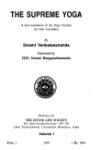
                    THE SUPREME YOGA
A new translation of the Yoga Vasistha
(IN TWO VOLUMES)
By
Swami Venkatesananda
Foreword by
H.H. Swami Ranganathananda
Published By
THE DIVINE LIFE SOCIETY
P.O. SHIVANANDANAGAR—249 192
Distt. Tehri-Garhwal, Uttaranchal, Himalayas, India
Volume II
Price ] 2003 [ Rs. 100/-

First Edition: 1976
The Chiltern Yoga Trust
P.O. Elgin 7180, South Africa
Second Edition: 1991
Thrid Edition: 1995
Fourth Edition: 2003
(3,000 Copies)
©The Divine Life Trust Society
ACKNOWLEDGEMENTS
Grateful thanks are offered:
To H.H. Sri Swami Ranganathanandaji Maharaj, President,
Ramakrishna Mission and Math, for his gracious Foreword.
To the devotees of H.H. Swami Venkatesananda who
assisted in the revision of the artwork.
ISBN 81-7052-087-8
Published by Swami Jivanmuktananda for The Divine Life
Society, Shivanandanagar, and printed by him at the
Yoga-Vedanta Forest Academy Press, P.O. Shivanandanagar,
Distt. Tehri-Garhwal, Uttaranchal, Himalayas, India

VI. 1 l" JANUARY 31
amrtfl 'pi mrts 'smlti viparyastamatir vadhoh
yatha rodityanastaiva nasta 'smlti tathaiva cit (2)
The LORD continued: Consciousness thinks (feels or imagines) falsely 'I am
unhappy' even as a demented woman might think she is miserable. Just as one
who is not dead wails aloud, 'Alas. I am dead': and when she is not lost she
weeps. 'Alas. I am lost' on account of perverse understanding, even so the
consciousness falsely imagines it is miserable or limited. Such imagination is
irrational and unfounded. Due to the false assumption of the egosense the
consciousness thinks that the world-appearance is indeed real. It is the mind
alone that is die root-cause of experiencing the world as if it were real; but it
cannot be truly considered such a cause since there can be no mind other than
pure consciousness. Thus, if it is realised that the perceiving mind itself is
unreal, then it is clear that the perceived world is unreal, too.
Even as there is no oil in a rock, in pure consciousness the diversity of
sight, seer and scene, or of doer, act and action does not exist Similarly, the
distinction between T and 'you' is imaginary. The distinction between the one
and the many is verbal. All these do not exist at all, even as darkness does not
exist in the Sim. Opposites like substantiality and unsubstantiality, void and
non-void, are mere concepts. On enquiry all these disappear, and only the
unmodified pure consciousness remains.
Consciousness does not truly undergo any modification, nor does it
become impure. The impurity itself is imaginary; imagination is the impurity.
When this is realised the imagination is abandoned, and impurity ceases.
However, unless the imagination is firmly rejected, even in those who have
realised this the impurity arises. By self-effort this imagination can be easily
rejected: if one can drop a piece of straw, one can with equal ease also drop the
three worlds! What is it that cannot be achieved by one's self-effort?
This infinite consciousness, which is unmodified and non-dual, can be
realised by one in the single self-luminous inner light. It is pure and eternal, it
is ever-present and devoid of mind, it is unmodified and untainted, it is in all
the objects. In fact it is non-moving consciousness which exists as if a witness
to all, even as light shines but shining is not its action. While pure, this
consciousness appears to be tainted; in inert material it is non-inert energy. It is
omnipresent without being divided by the particulars constituting the all. This
infinite consciousness, which is devoid of concepts and extremely subtle,
knows itself. In self-forgetfulness this consciousness entertains thoughts and
experiences perception, though all this is possible because of the very nature of
the infinite consciousness: even as one who is asleep is also inwardly awake!
383

VI. 1 2na JANUARY 31
yatra pr&no marudyati manas tatraiva tisthati
yatra yatra 'nusarati rathas tatraiva sSratbih (47)
The LORD continued: By identification with its own object, consciousness
seems to reduce itself to the state of thinking or worrying: even as impure gold
looks like copper until it is purified, when it shines like gold. By self-
forgetfulness on the part of the infinite consciousness the notion of the
universe arises, but this unreality ceases when there is self-knowledge. When
consciousness becomes aware of itself within itself, the egosense arises. With
just a little movement though, this egosense (which in truth is nothing other
than consciousness) falls down as a rock rolls down the mountainside.
However, even then it is consciousness alone that is the reality in all forms and
all experiences. The movement of the vital airs brings about vision within and
an object which is apparently outside. But the experiencing of sight (the seeing
itself) is pure consciousness! The apparently inert vital air which is the tactile
sensation comes into contact with its object and there is the sense of touch. But
awareness of the tactile sensation is again pure consciousness. In the same
way, it is the vital air (prana) that enables the nose to smell the scents which
are modifications of the same energy, while the awareness of the smell is pure
consciousness. If the mind is not associated with the sense of hearing, no
hearing is possible. It is pure consciousness that is the experience of hearing.
Action springs from thought, thought is the function of the mind, mind is
conditioned consciousness - but consciousness is unconditioned! The universe
is but a reflection in consciousness (like the scenery reflected in a crystal ball)
but consciousness is not conditioned by such reflection. Jiva is the vehicle of
consciousness, egosense is the vehicle of jiva, intelligence of egosense, mind'
of intelligence, prana of the mind, the senses of prSna, the body of the senses
and motion is the vehicle of the body. Such motion is karma. Because prana is
the vehicle for the mind, where the prana takes it the mind goes; but when the
mind is merged in the spiritual heart, prana does not move; and if the prana
does not move, the mind attains acquiescent state. Where the prana goes the
mind follows it even as the rider goes where the vehicle goes. ■
The reflection of consciousness within itself is known as puryasfaka.
Mind alone is puryastaka, though others have described it more elaborately
(as composed of the five elements, the inner instrument'- mind,buddhi,
egosense and citta - prana, the organs of action, the senses, ignorance, desire,
and karma or action). It is also known as the lihga-sarTra, the subtle body.
Since all these arise in consciousness, exist in consciousness and dissolve in
consciousness, that consciousness alone is the reality.
384

VI. 1 3rd JANUARY 32
vflsanS vimala yesSm hrdaySn ni 'pasarpati
sthiraikarOpajivas te jlvanmukttSS cirayusab (35)
The LORD said:
But for the mind and prana, the body is an inert mass. Just as a piece of
iron moves in the presence of a magnet, even so the jiva moves in the very
presence of consciousness which is infinite and omnipresent. The body is inert
and dependent; it is made to function by the consciousness which believes
itself to be similar to the vital airs (prana). Thus, it is the karma self or the
active self (karmatma) that keeps the body in motion. It is however the
supreme self itself that has ordained both the mind and the prana as the
promoters of life in the body. It is the consciousness itself, assuming inertia,
which rides the mind as the jiva.
Once this limitation is established, other consequences follow. They are the
physical and mental diseases. This is like waves first arising on the surface of
the ocean and then creating ripples, and so forth. The consciousness as jiva
becomes dependent, having abandoned the self-knowledge as consciousness.
Labouring under a thick veil of ignorance, it is foolishly unable to recognise
the harm that it has brought upon itself, even as a drunkard wielding a sword
cuts his own leg. However, even as the drunkard can soon become sober, this
consciousness can soon regain self-knowledge.
When the mind is divested of its support, it remains alone in the self. When
the puryasfaka (the subtle body) is rid of all its supports, it attains a state of
quiescence and falls motionless. When consciousness, on account of object-
ification, becomes deluded, the latent psychological tendencies become active;
identifying with these, consciousness forgets its essential nature.
When the lotus of the heart unfolds, the puryastaka functions; when that
lotus folds the puryastaka ceases to function. As long as the puryasfaka
functions in the body, the body lives; when it ceases to function, the body dies.
This cessation can be caused by some form of inner conflict between the
impurities and inner awakening. If only pure vasanas or tendencies fill one's
heart then all conflicts cease, there are harmony, liberation and longevity.
Otherwise, when the puryasjaka ceases to function, the body dies and the
subtle body chooses another suited to fulfil the hidden vasanas. Due to these
vflsanas, the puryastaka forges new links with the new subtle body,
forgetting its nature as pure consciousness. However, since consciousness is
infinite and omnipresent, the mind riding the puryastaka roams everywhere.
Bodies are taken up and abandoned by the jiva even as trees sprout new leaves
und discard old ones. Wise men do not set any store by these changes.
385

VI. 1 4tn JANUARY 33
pustasankalpamStrena yadidarh duhkham&gatam
tadasankalpamfitrena ksayi ka 'tra kadarthanS (34)
In response to Vasistha's questions: (i) in the infinite consciousness how did
duality arise, and (ii) how does that duality which has been strengthened by
aeons of confirmation, cease, the LORD continued:
Since that omnipresent infinite consciousness alone is present at all times,
diversity (duality) is absurd and impossible. The concept of one arises when
there is a concept of two, and vice versa: when the diversity is realised as of
consciousness, the diversity is also that! The cause and effect are one in their
essence. This essence is indivisible. Consciousness being its own object, is
consciousness at all times; the modifications are but vain thinking.
Consciousness alone is 'mat', 'this' and 'in the middle' (the factor that perceives the
modification). It is the one infinite consciousness that is variously known as
Brahman, truth, god, Siva, void, one and supreme self.
That which is beyond all these forms and states of consciousness, that
which is the supreme self, that which is indicated by the pure T - that is not
for words to describe. That which is perceived here is itself indivisible. When
this consciousness invests itself with a secondary vision (upanayana also
means the sacred thread of vedic learning!) then it perceives duality. It is
bound by its own ignorant imagination. This imagination gives rise to
substantiality, and the experience of objects gives rise to the confirmation of
the reality of that object The egosense gains credence thereafter and is firmly
established, assuming the role of the doer of actions and the experiencer of
other experiences. Thus, what was accidental coincidence to begin with, soon
becomes an established fact
Belief in the existence of the goblin creates it. Belief in the duality
(diversity) establishes it. When the non-dual being is known, the duality
vanishes instantly. Belief (or imagination) gave rise to diversity; when mat
belief is dropped, diversity goes. Thought, imagination or belief gives rise to
sorrow; to abandon such thinking is not painful! It is feeding these thoughts
and beliefs that has brought about this sorrow: and this comes to an end by not
entertaining those thoughts and beliefs: where is the difficulty in this? All
thoughts and beliefs lead to sorrow, whereas no-thought and no-belief are pure
bliss. Therefore, with the help of the fire of wisdom, vaporise the waters of
your beliefs and become peaceful, supremely blissful. Behold the "one infinite
consciousness. It is only as long as the king remains forgetful of the fact 'I
am king' that he is miserable. Once he regains that knowledge, the sorrow
vanishes. The clouds of ignorance are banished forever.
386

VI. 1 5m JANUARY 34
samastam suslvam bantam afftam vflgvilasatah
omityasya ca tanmatra turya sa pafama gatih (30)
The LORD said:
Thus does the universe exist as both real and unreal; the divine - being
free of duality - unites them, transcends them and is therefore both of
them. Manifest consciousness is the universe, and the unmanifest universe
is consciousness. By entertaining the notion 'I am this', consciousness is
bound; by this very knowledge it is freed. Objectification (or
conceptualisation) leads to self-forgetfulness. However, even in the state of diversity
and activity, consciousness is truly undivided. For it is only that supremely
peaceful Brahman that is apparently manifest as the universe through the
instrumentality of the mind and its three modes (satva, rajas and tamas, or
waking, dreaming and sleeping).
However when the mind is destroyed by the mind, the veil is rent
asunder and the truth of the world-jugglery is seen, the notion of world-
appearance and the existence of a jlva are destroyed^ The mind is then
clear, having given up repeatedly reviving the notions of objective
perception. This state is known as paSyantl. Then the mind which is pure
abandons conjuring up images of objects. It attains a state like deep sleep
or the consciousness of homogeneity, thus going beyond the possibility of
birth again. It rests in supreme peace. This is the first state.
Now listen to the second state. Consciousness devoid of mind is all-
light, free from darkness and beautiful like space. The infinite
consciousness frees itself totally from all modification or duality and remains as if in
deep sleep, or as a figure in uncut marble. It abandons even the factors of
time and space and transcends both inertness and motion; it remains as
pure being beyond expression. It transcends the three states of
consciousness and remains as the fourth, or the state of undivided infinite
consciousness. The third state is beyond even what is termed 'Brahman',
'the self, etc. It is sometimes referred to as turlyatlta (beyond the fourth
or turTya state). It is supreme and ultimate. It defies description, for it is
beyond the practices which are described by those who undertake them.
O sage, remain forever in that third state. That is the real worship of
the Lord. Then you will be established in that which is beyond what is and
what is not. Nothing has been created and there is nothing to vanish. It is
beyond the one and the two. It is the eternal, beyond the eternal and the
transient; it is pure mass of consciousness. In it there is no question of
diversity. It is all, it is supreme blessedness and peace, it is beyond
expression. It is purest OM. It is transcendent. It is supreme.
387

VI. 1 6"" JANUARY 35
na tasya ' 'hvanamantradi kincidevopayujyate
nityahutah sa sarvastho labhyate sarvatah svacit (24)
After thus remaimng immersed in himself for some time, the LORD
opened his eyes and continued:
O sage, abandon the habit of apprehending the objects with your mind.
The knowers of that (self) have seen what is worth seeing. What more is
there to be seen or not to be seen? Behold the self. Be a sword which
sunders what is regarded as peace and what is regarded as restlessness. Or,
resorting to just a little extroversion of attention, listen to what I am going
to say to you. Nothing is gained by merely keeping quiet!
This body is kept alive and active by the life-force or prSna. Without
that life-force the body is inert. The energy that moves the body is prana.
The intelligence that experiences through all this is consciousness. This
consciousness is formless and purer than even the sky. When the
relationship between the life-force and body ceases, only the life-force is
separated from the body. Consciousness, which is purer than space, does
not perish. A pure mirror reflects what is in front of it, but the reflection is
not seen if the mirror is dirty. Even so, when the prana has left the body,
though the body is seen, the intelligence does not reflect the objects.
The consciousness though infinite and omnipresent is able to become
aware of the movement of the mind and the body. When this defect of
objectification (conceptualisation) is removed, that itself shines as the
supreme being. It is itself the creator Brahma, Visnu, Siva, Indra, the sun,
the moon and the supreme Lord. Some of these divinities like Brahma,
Visnu and Siva are not deceived by the cosmic illusion. They are indeed
parts of the infinite consciousness sharing its true nature, like red-hot iron
which shares the nature of fire. However, none of these has actually been
created by the infinite consciousness and none of these exists apart from
it. These are no more than notions, some notions being more dense than
others. It is impossible to describe the extent of such notions which have
arisen in ignorance. In a manner of speaking, the supreme being (the
infinite consciousness) is the father of Brahma, Visnu, Siva and others.
That infinite consciousness alone is fit to be adored and worshipped.
However, there is no use inviting it for the worship: no mantras are of any
use in its worship for it is immediate (closest, one's own self) and hence
does not need to be invited. It is the omnipresent self of all. The realisation
of this infinite consciousness, which is totally effortless, is alone the best
form of worship.
388

VI. 1 7th JANUARY 36
tataS cidrupamevaikam sarvasattantarasthitam
svSnubhatimayam Suddham devam rudresVaram viduh (1)
The LORD said:
Thus, they say that lord Rudra is the pure, spontaneous self-experience
which is the one consciousness that dwells in all substances. It is the seed
of all seeds, it is the essence of this world-appearance, it is the greatest of
actions. It is the cause of all causes and it is the essence in all beings,
though in fact it does not cause anything nor is it the concept of being and
therefore cannot be conceived. It is the awareness in all that is sentient, it
knows itself as its own object, it is its own supreme object and it is aware
of infinite diversity within itself.
It is the consciousness in all experiences but it is pure and
unconditioned. It is absolute truth and therefore not truth as a concept. It is not
limited to the definitions of truth or falsehood. It is in fact the very end
(terminus) of the supreme truth or the primordial reality. It is pure,
absolute consciousness, naught else. Yet it itself becomes coloured with
desire or attraction for pleasure. It itself becomes the experiencer of
pleasure, the pleasure-experience and the impurity or taint caused by it.
Though it is like the sky, unconditioned and undivided, soon it becomes
limited and conditioned. In this infinite consciousness there have been
millions of mirages known as world-appearance, and there will also arise
millions more mirages known as world-appearance. Yet nothing really has
come into being independent of the infinite consciousness: light and heat
seem to come out of fire, but they are not independent of fire.
This infinite consciousness can be compared to the ultimate subatomic
particle which yet hides within its bowels the greatest of mountains. It
encompasses the span of countless epochs, but it does not let go of a
moment of time. It is subtler than the tip of a single strand of hair, yet it
pervades the entire universe. No one has seen its limits or boundaries.
It does nothing, yet it has fashioned the universe. Sustaining the entire
universe, it does nothing at all. All substances are non-different from it, yet it is
not a substance; though it is non-substantial it pervades all substances. The
cosmos is its body, yet it has no body. It is the eternal 'now', yet it is the
tomorrow. Often apparently meaningless sounds become meaningful and are
regarded as meaningful while communicating with one another: even so that
infinite consciousness is and is not. It is even what it is not. All these
statements about what is and what is not are based on logic, and the infinite
consciousness goes beyond truth, beyond logic.
389

VI. 1 8th JANUARY 37
niyatir nityamudvegavarjita 'parimflrjitfl
esa nrtyati vai nrtyam jagajjalakanStakam (23)
The LORD continued: <
It is this infinite consciousness that makes the seed sprout with the help of
earth, water, time, etc. and become food. It makes flowers blossom and makes
the nose smell their fragrance. In the same way it is able to create and sustain^
the substances in the world and their corresponding sense-organs, with the
help of suitable means which are also brought into being by the same
consciousness. The energy of this consciousness is able to create the entire
universe and then, entertaining the notion "This is not', reduces everything to a
state of void.
This apparent creation is but a reflection of consciousness within itself,
which has apparentiy acquired a body in course of time. The trinity is the
manifestation, as also is that cosmic power or energy that determines 'So it
shall be, and it shall not be otherwise'. Yet consciousness does not create!
anything; it is like a lamp that illumines the room in which actions take place, i
VASISTHA asked: Lord, what are the energies of this Siva (cons-!
ciousness) and what are their powers and their activities?
The LORD replied: The supreme being is formless, and yet the following
five are its aspects - will, space, time, order (or destiny) and the cosmic,
unmanifest nature. It has countless powers, energies or potencies. Chief among
them are knowledge, dynamics, action and non-action. All these are but pure
consciousness; because they are called the potencies of consciousness, they are
apparently regarded as distinct from consciousness, though in fact they are not.
This entire creation is like a stage on which all these potencies of
consciousness dance to the tune of time. The foremost among these is known
as 'order' (the natural order of things and sequences), action, will to do, time,
etc. It is this potency that ordains that each thing should have a certain
characteristic - from the blade of grass to the creator Brahma. This natural
order is free from excitement but not purifed of its limitation: that (the natural
order) is what dances a dance-drama known as the world-appearance. It
portrays various moods (compassion and anger, etc.), it produces and removes
various seasons and epochs, it is accompanied by celestial music and the
roaring of the oceans, its stage is illumined by the sun, the moon and the stars,
its actors and actresses are the living beings in all the worlds - such is the
dance of the natural order. The Lord who is the infinite consciousness is the
silent but alert witness of this cosmic dance. He is non-different from the
dancer (the cosmic natural order) and the dance (the happenings).
390

VI. 1 9,n JANUARY 38
etadeva pararh dhyanam pQjaisaiva pars smrta
yadanSratamantahstha Suddhacinmatravedanam (25)
The LORD continued: Such is the Lord who is fit to be worshipped
constandy by holy ones. It is he indeed who is worshipped by wise men in
various ways and in various forms such as Siva, Visnu, etc. Now listen to the
ways in which he is to be worshipped.
First of all, one should abandon the body-idea (the notion that T am this
body). Meditation alone is true worship. Hence one should constantly worship
the Lord of the three worlds by means of meditation. How should one
contemplate him? He is pure intelligence, he is as radiant as a hundred thousand
suns risen together, he is the light that illumines all lights, he is the inner light.
The limitless space is his throat, the firmament is his feet, the directions are his
arms, the worlds are the weapons he bears in his hands, the entire universe is
hidden in his heart, the gods are hairs on his body, the cosmic potencies are the
energies in his body; time is his gatekeeper and he has thousands of heads,
eyes, ears and arms. He touches all, he tastes all, he bears all, he thinks through
all though he is beyond thinking. He does everything at all times, he bestows
whatever one thinks of or desires, he dwells in all, he is the all, he alone is to
be sought by all. Thus should one contemplate him.
This Lord is not to be worshipped by material substances but by one's own
consciousness. Not by waving of lamps nor lighting incense, nor by offering
flowers nor even by offering food or sandalpaste. He is attained without the
least effort; he is worshipped by self realisation alone. This is the supreme
meditation, this is the supreme worship: the continuous and unbroken
awareness of the indwelling presence, inner light or consciousness. While doing
whatever one is doing - seeing, hearing, touching, smelling, eating, moving,
sleeping, breathing or talking - one should realise one's essential nature as
pure consciousness. Thus does one attain liberation.
Meditation is the offering, meditation is the water offered to the deity to
wash his hands and feet, self-knowledge gained through meditation is the
flower - indeed all these are directed towards meditation. The self is not
realised by any means other than meditation. If one is able to meditate even for
thirteen seconds, even if one is ignorant one attains the merit of giving away a
cow in charity. If one does so for one hundred and one seconds, the merit is
that of performing a sacred rite. If the duration is twelve minutes, the merit is a
thousandfold. If the duration is of a day, one dwells in the highest realm. This
is the supreme yoga. One who practises this mode of worship is worshipped by
the gods and the demons and all other beings. But this is external worship.
391

VI. 1 10™ JANUARY 39
pSvanam pavanSnam yad yatsarvatamasSm ksayah
tad idanlm pravaksye 'ham antah pQjanam atmanah (1)
The LORD continued: I shall now declare to you the internal worship of the
self which is the greatest among all purifiers and which destroys all darkness
completely. This is of the nature of perpetual meditation whether one is
walking or standing, whether one is awake or asleep, in and through all of
one's actions. One should contemplate this supreme Lord who is seated in the
heart and who brings about, as it were, all the modifications within oneself.
One should worship the 'bodha-lingam (the manifest consciousness or self-
awareness) which sleeps and wakes up, goes about or stands, touches what is
to be touched, abandons what should be abandoned, enjoys and abandons
pleasures, engages in varied external activities, lends value to all actions, and
remains as peace in the vital organs in the body This inner intelligence should
be worshipped with whatever comes to one unsought. Remaining firmly seated
in the stream of life after having bathed in self-knowledge, one should worship
this inner intelligence with the materials of self-realisation.
One should contemplate the Lord in the following manner: he is the light
illumined by the solar force as well as the lunar force, he is the intelligence that
eternally lies hidden in all material substances, he is the extrovert awareness that
flows through the bodily avenues on to the external world, he is the prana that
moves in one's face (nose), he transforms contacts of the senses into meaningful
experiences, he rides the chariot composed of prana and apana, he dwells in
secret in the cave of one's heart He is the knower of the knowable and the doer
of all actions, the experiencer of all experiences, the thinker of all thoughts. It is
he who knows all parts or limbs thoroughly, who is recognised by being and non-
being and who illumines all experiences.
He is without parts but he is the all, he dwells in the body but he is
omnipresent, he enjoys and does not enjoy, he is the intelligence in every limb.
He is the thinking faculty in the mind. He rises in the middle of prana and
apana. He dwells in the heart, in the throat, in the middle of the palate, the
middle of the eyebrows and at the tip of the nose. He is the reality in all the
thirty-six elements (or metaphysical categories), he transcends the internal
states, he is the one that produces the internal sounds, and he brings into being
the bird known as mind. He is the reality in what is described as imagination
and non-imagination. He dwells in all beings as oil dwells in the seed. He
dwells in the heart-lotus and again he dwells throughout the body. He shines as
pure consciousness. He is immediately seen everywhere, for he is the pure
experiencing in all experiences, who apparently polarises himself when
apprehending the objects of such experiences.
392

VI.1 11th JANUARY 39
yathSpraptakramotthena sarvfirthena samarcayet
manSgapi na kartavyo yatno 'tra 'purvavastuni (31)
The LORD continued: One should contemplate that the Lord is the
intelligence in the body. The various functions and faculties in the body serve
that intelligence as consorts serve their lord. The mind is the messenger who
brings and presents to the Lord the knowledge of the three worlds. The two
fundamental energies, viz. the energy of wisdom (jn5na sakti) and the energy
of action (kriyS sakti), are the consorts of the Lord. Diverse aspects of
knowledge are his ornaments. The organs of action are the gates through
which the Lord enters the outside world. 'I am that infinite self which is
indivisible; I remain full and infinite', thus the intelligence dwells in the body.
He who contemplates in this manner is equanimity itself, his behaviour is
equanimous guided by equal vision. He has reached the state of natural
goodness and inner purity and is beautiful in every aspect of his being. He
worships the Lord who is the intelligence that pervades his entire body.
This worship is performed day and night perpetually, with the objects that
are effortlessly obtained, which are offered to the Lord with a mind firmly
established in equanimity and in the right spirit (for the Lord is consciousness
and cares only for the right spirit). The Lord should be worshipped with
everything that is obtained without effort. One should never make the least
effort to attain that which one does not possess. The Lord should be
worshipped by means of all the enjoyments that the body enjoys, through
eating, drinking, being with one's consort and such other pleasures. The Lord
should be worshipped with the illnesses one experiences and with every sort of
unhappiness or suffering one experiences. The Lord should be worshipped
with all of one's activities, including life and death and all of one's dreams.
The Lord should be worshipped with one's poverty and prosperity. The Lord
should be worshipped even with fights and quarrels as well as with sports and
other pastimes, and with the manifestations of the emotions of attraction and
aversion. The Lord should be adored with the noble qualities of a pious heart-
friendship, compassion, joy and indifference.
The Lord should be worshipped with all kinds of pleasures that are granted
to one unsought, whether those pleasures are sanctioned by the scriptures, etc.
or forbidden by them. The Lord should be worshipped with those which are
regarded as desirable and others which are regarded as undesirable, with those
that are considered appropriate and others that are considered inappropriate.
For this worship, one should abandon what is lost and one should accept and
receive what has been obtained without effort.
393

VI. 1 12,ft JANUARY 39
samatakaSavadbhutva yattu syaUlnamanasam
avikaramanayasam tadevS 'rcanamucyate (58)
The LORD continued: One should engage oneself in this worship at all times,
established in supreme equanimity in regard to all the percepts, whether they
be pleasant or unpleasant. One should regard everything as good and
auspicious (or one should regard everything as a mixture of good and evil).
Realising that everything is the one self, one should worship the self in mis
spirit. One should look with equal vision upon that which is pleasant and
beautiful through and through, and that which is unendurably unpleasant.
One should abandon the divisive notions of "This I am' and "This I am not'
and realise that 'All this is indeed Brahman', the one indivisible and infinite
consciousness. In that spirit one should worship the self. At all times, in all
forms and their modifications, one should worship the self in and through all
that one obtains. One should worship the self after having abandoned the
distinction between the desirable and the undesirable, or even while relying on
such a distinction (but using them as the materials for the worship).
Without craving and without rejecting, that which is effortlessly and
naturally obtained may be enjoyed. One should not get excited or depressed
when faced with insignificant or significant objects, just as neither sky nor
space is so affected by the diverse objects that exist and grow in it. One should
worship the self, without psychological perversion, with every object' that is
obtained purely on account of the coincidence of the time, place and activity -
whether they are popularly known as good or as not-good.
In this procedure for the worship of the self, whatever article has been
mentioned as being necessary for the worship is of the same nature as all
others, though the expressions used are different. Equanimity is sweetness
itself and this sweetness is beyond the senses and the mind. Whatever is
touched by that equanimity instantly becomes sweet, whatever its description
or definition may be. That alone is regarded as worship which is performed
when one is in a state of equanimity like that of space, when the mind has
become utterly quiescent without the least movement of thought, when there is
effortless absence of perversity. Established in this state of equanimity, the
wise man should experience infinite expansion within himself while carrying
out his natural actions externally without craving or rejection. Such is the
nature of the worshipper of this intelligence. In his case, delusion, ignorance
and egosense do not arise even in dream. Remain in this state, O sage,
experiencing everything as a child does. Worship the Lord of this body (the
intelligence that pervades it) with all that is brought to you by time,
circumstance and environment, and rest in supreme peace, devoid of desire.
394

VI. 1 13th JANUARY 40-41
deSakalaparicchinno yesSrh syat parameSvarah
asmakam upadeSyfls te na vipa&id vipaScitarii (40/12)
The LORD continued:
Whatever you do and whenever you do it (or refrain from doing it) - all
that is worship of the Lord who is pure consciousness. By regarding all that as
the worship of the self who is the Lord, he is delighted. Likes and dislikes,
attraction and aversion, are not found in the self independent of its essential
nature; they are mere words. Even the concepts indicated by words like
'sovereignty', 'poverty', 'pleasure', 'pain', 'one's own' and 'others', are in fact
worship of the self, for the conceiving intelligence is the self. Knowledge of
the cosmic being alone is the proper worship of the cosmic being.
It is that self or cosmic consciousness alone which is indicated by
expressions like 'this world'. Oh, what a mysterious wonder it is that the self
which is pure consciousness or intelligence somehow seems to forget its own
nature and comes to regard itself as the jlva (the individual). In fact, in that
cosmic being which is the reality in everything, there is not even the division
into worshipper, worship and the worshipped. It is impossible to describe that
cosmic being which supports the entire universe without division; it is
impossible to teach another concerning it. And, we do not consider them
worthy of being taught by us. who consider that god is limited by time and
space. Hence, abandoning all such limited concepts, abandoning even the
division between the worshipper and the worshipped (Lord), worship the self
by the self. Be at peace, pure, free from cravings. Consider that all your
experiences and expressions are the worship of the self.
(In reply to Vasistiia's request for a fuller explanation of Siva, Brahman,
self: why they are called so and how such differences arose, the LORD
continued:)
The reality is beginningless and endless and it is not even reflected in
anything: that is the reality. However, since it is not possible to experience it
through the mind and the senses, it is even regarded as if it were non-being.
(In reply to Vasistha's question: if it is beyond the mind, how is it realised,
the LORD replied:) In the case of the seeker who is eager to attain freedom
from ignorance and who is therefore equipped with what is termed
satvic avidya (subtle ignorance), this satvic avidya, with the help of what are
known as scriptures, removes the ignorance just as a washer-man removes dirt
with the help of another form of dirt (soap). By this catalytic action the
ignorance is removed, the self realises the self, the self sees the self on account
of its own self-luminous nature.
395

VI. 1 14th JANUARY 41
akSranSnyapi prSpta bhr&am karanatam dvija
krama gurupade&adya atmajfianasya siddhaye (13)
The LORD continued: When a child is playing with charcoal his hands
become black. If he washes his hands but immediately plays again with
charcoal, his hands become black again. However if he does not handle
charcoal again after washing, his hands can remain clean. Even so, if one
enquires into the nature of the self and at the same time refrains from those
actions that promote avidya or ignorance, the darkness of ignorance vanishes.
However it is only the self that becomes aware of the self. Do not look upon
this diversity as the self. Do not entertain the feeling that self-knowledge is the
result of the teaching of a preceptor. The guru or the preceptor is endowed
with the mind and the senses; the self or Brahman is beyond the mind and the
senses. That which is attained only after the other ceases, is not attained with
its help while it still exists. However, though the instructions of a preceptor and
all the rest of it are not really the means for the attainment of self-knowledge,
they have come to be regarded as the means for it. The self is not revealed
either by the scriptures or by the instructions of a preceptor, and the self is not
revealed without the instructions of a preceptor and without the help of the
scripture. It is revealed only when all these come together. It is only when the
scriptural knowledge, instructions of a preceptor and true discipleship come
together that self-knowledge is attained.
That which is after all the senses have ceased to function and all notions of
pleasure and pain have vanished is the self or Siva - which is also indicated by
expressions like 'that', 'truth' or 'reality'. However that which is when all
these cease to be exists even when all these are present, like the limitless space.
Out of their compassion for the ignorant deluded ones, in an effort to awaken
them spiritually and to awaken in them a thirst for liberation, the redeemers of
the universe (known as Brahma, Indra, Rudra and others) have composed
scriptures like the vedas and the puranas (the legends). In these scriptures they
have used words like 'consciousness', 'Brahman', 'Siva', 'self, 'Lord',
'supreme self, etc. These words may imply a diversity, but in truth there is no
such diversity. The truth indicated by the words like 'Brahman', etc. is indeed
pure consciousness. In relation to it even the limitless space is as gross and
substantial as a great mountain. That pure consciousness appears to be the
knowable object and gives rise to the concept of intelligence or consciousness,
though it is not an object ofJcnowledge, being the innermost self. On account
of a momentary conceptualisation, this pure consciousness gives rise to the
egosense (T know').
396

VI. 1 15th JANUARY 41
vasanSvasato duhkham vidyamSne ca sa bhavet
avidyamanam ca jagan rnrgatrsnarhbubhangavat (52)
The LORD continued:
This egosense then gives rise to the notions of time and space. Endowed
with the energy of the vital air, it then becomes jrva or the individual. The
individual thenceforward follows the dictates of the notions and slips into
dense ignorance. Thus is the mind bom in conjunction with the egosense and
the different forms of psychological energy. All these together are known as
the 'ativahika' body, the subtle body which moves from one plane to another.
After this the substances (the objects of the world) corresponding to the
subtle energies of the ativahika body were conceived of and thus were the
various senses (sight, touch, hearing, taste and smelling), their corresponding
objects and their connecting experiences brought into being. These together
are known as the puryas{aka and in their subtle state they are also known as
the ativahika body.
Thus were all these substances' created; but nothing was created in fact. All
these are but apparent modifications in the one infinite consciousness. Even as
dream-objects are within oneself, all these are non-different from the infinite
consciousness. Even as when one dreams those objects they seem to become
the objects of one's perception, all these, too, appear to be objective realities.
When the truth concerning them is realised, all these shine as the Lord.
However, even that is untrue, for all these have never become material
substances or objects. On account of one's own notions of their being
substances which one experiences, they appear to have a substantiality. Thus,
conjuring up a substantiality, the consciousness sees the substantiality.
Conditioned by such notions, it seems to suffer. Conditioning is sorrow.
But conditioning is based on thoughts and notions for sensual and
psychological experiences). However the truth is beyond such experience and
the world is an appearance like a mirage! In that case, what is psychological
conditioning and who conditions what and who is conditioned by such
conditioning? Who drinks the water of the mirage? Thus, when all these are
rejected, the reality alone remains in which there is no conditioning, naught
conditioned. It may be styled the being or the non-being, but it alone is. Mental
conditioning is illusory non-being like a ghost; when it is laid the illusion of
creation also vanishes. He who takes this egosense and this mirage known as
creation to be real, he is unfit to be instructed. Preceptors instruct only a man
endowed with wisdom, not foolish men. The latter pin their faith and hope on
the world-appearance, like the ignorant man who bestows his daughter in
marriage to the man seen only in his dream!
397

VI. 1 16th JANUARY 42
sampadyate yatha yo 'sau purusah sarvakarakah
anenaiva krameneha klfah sampadyate ksanat (19)
The LORD continued:
The jlva perceives all these elements as constituting its body in the
void, even as the dreaming person perceives diverse objects within the
inner void. This is true even today; the cosmic consciousness or the
cosmic being perceives the universe of diversity within itself even as the
dreamer perceives diversity within himself.
The jlva thinks of itself as Brahma, Visnu, etc. , but all this is nothing
more than thought-form. However, this thought-form conceives and
perceives other thought-forms and experiences them. The sole reality in all
these percepts is the primary concept known as the egosense, which arises
the very instant consciousness conceives of an object within itself and
thinks it perceives it (obviously as its object). That instant itself is the
epoch and all the multiples and divisions of epochs. In every atom of
existence this drama of self-veiling and self-knowledge is enacted all the
time, all of which is nothing more than thought-form created by cosmic
consciousness. Yet, nothing is created by or in cosmic consciousness for it
remains unchanged and unmodified.
The mountain seen in a dream only appears to exist in time and space.
It does not occupy any space nor does it take time to appear and disappear.
Even so is the case with the world. In whatever manner the omnipotent
deity comes into being, in exactly the same manner a worm also comes
into being within the twinkling of an eve. From lord Rudra down to the
blade of grass all the beings one sees in the universe have come into being
in the same manner, whether they are micro-organisms or colossal
personalities.
If one thus enquires into the nature of this sariisara, the perception of
diversity disappears simultaneously with the dawn of self-knowledge, or
god-realisation. If the real nature of the infinite consciousness is allowed
to slip even for one-half of a hundredth part of a second, then all these
unfortunate illusory creations take place. By the expression 'Brahman' the
wise sages indicate that state in which one remains forever firmly
established in the infinite consciousness. When this is disturbed one
entertains the notion of the world as real, and this gives rise to an endless
sequence of diversity - gods, demons, humans and subhumans, plants and
worms. However, if one does not slip from that state of cosmic
consciousness, one realises that the truth is ever-present everywhere.
398

VI. 1 17m JANUARY 43
grahyagrShakasambandhe samSnye sarvadehinSm
yoginah savadhanatvam yattadarcanam atmanah (8)
VASISTHA continued:
O Rama, the unreal jlva perceives the unreal world on account of the
unreal influence of the unreality. In all this, what can be considered as real
and what as unreal? An imaginary object is imaginatively described by
someone; and one understands in one's own imagination and imagines
that he understands it. Just as liquidity is in liquids, motion in wind and
emptiness in space, even so is omnipresence in the self.
From the time the Lord instructed me I have been performing the
worship of the infinite self. By the grace of such worship, though I am
constantly engaged in various activities, I am free from sorrow. I perform
the worship of the self (who is undivided though apparently divided) with
the flowers of whatever comes to me naturally and whatever actions are
natural to me.
To come into relationship (to possess and to be possessed) is common
to all embodied beings; but the yogis are forever vigilant, and such
vigilance is the worship of the self. Adopting this inner attitude and with a
mind utterly devoid of any attachment, I roam in this dreadful forest of
samsara (world-appearance). If you do so, you will not suffer.
When great sorrow (like the loss of wealth and relatives) befalls you,
enquire into the nature of truth in the manner described. You will not be
affected by joy or sorrow. You now know how all these things arise and
how they cease, and you also know the fate of the man who is deluded by
them, who does not enquire into their real nature. They do not belong to
you, you do not belong to them. Such is the unreal nature of the world. Do
not grieve. Dear Rama, you are pure consciousness which is not affected
by the illusory perception of the diversity of creation. If you see this, how
will notions of the desirable and the undesirable arise in you? Realising
thus, O Rama, remain established in the turlya (transcendental) state of
consciousness.
RAMA said:
Lord, I am free from the dirt of duality. I have realised that all .this is
indeed Brahman. My intelligence has been purified, rid of doubts and
desires and even questions. I do not desire heaven nor do I dread hell. I
remain established in the self. By your grace, O Lord, I have crossed this
ocean of samsara (world-appearance). I have realised the fullness of direct
self-knowledge.
399

VI. 1 18m JANUARY 44
yadi tatpadamSpto 'si kadacit kalaparyayat
tadahambhavanarupe na mankttavyam tvaya punah (5)
VASISTHA continued:
That is not considered action, O Rama, which you perform merely
with the organs of action. The delight derived from sensual experience is
fleeting. A repetition of that experience does not afford a repetition of the
same delight. Who but a fool will entertain desire for such a momentary
joy? Moreover, an object gives you pleasure only when it is desired. So
the pleasure belongs to the desire - hence give up desire or craving.
If in the course of time you attain to the experience of that (the self),
do not store it in your mind as a memory or egosense to be revived as
desire once again. For when you rest on the pinnacle of self-knowlege, it
is unwise to fall into the pit of egosense again. Let hopes cease and
notions vanish, let the mind reach the state of no-mind while you live
unattached. You are bound only when you are ignorant, not if you have
self-knowledge. Hence strive by every means to remain vigilant in self-
knowledge. When you do not engage yourself in sense-experiences and
also when you experience whatever comes to you unsought, you are in a
state of equanimity and purity free from latent tendencies or memories. In
such a state, like the sky you will not be tainted even by a thousand
distractions. When knower, known and knowledge merge in the one self,
the pure experiencer does not once again generate a division within.
With the slightest movement in the mind the samsara arises and
ceases. Make the mind free from movement of thought by the restraint of
the prana and also the latent tendencies (vasana). By the movement of
prana, the samsara arises and ceases; by diligent practice make the prana
free from such movement. By the rise and cessation of foolishness
(ignorance), self-binding action arises and ceases; restrain it by means of
self-discipline and the instructions of the preceptor and the scriptures.
This world-illusion has arisen because of the movement of thought in the
mind; when that ceases, the illusion will cease too, and the mind becomes no-
mind. This can also be achieved by the restraint of prana. That is the supreme
state. The bliss that is experienced in a state of no-mind, that bliss which is
uncaused, is not found even in the highest heaven. In fact, that bliss is
inexpressible and indescribable and should not even be called happiness! The
mind of the knower of the truth is no-mind: it is pure satva. After living with
such no-mind for some time, there arises the state known as turTyatita (the
state beyond the transcendental or the turlya state).
400

VI. 1 19,n JANUARY 45
esaikikaiva vividheva vibh5vyam5na
naikatmika na vividha nanu saiva saiva
satyasthita sakalasantisamaikarQpa
sarvatmika 'timahatl citirupaSakttih (36)
VASISTHA continued:
In this connection, O Rama, there is an instructive parable which I
shall presently narrate to you.
There is a wo.od-apple fruit which is immeasurably large and which
does not decay nor perish, though it has existed for countless aeons. It is
the source and support of the nectar of immortality and indestructibility. It
is the abode of sweetness. Though it is most ancient, it is ever new, like
the new moon. It is the very centre or heart of the universe, it is unmoving
and it is not shaken even by the forces of cosmic dissolution. This
woodapple fruit is the original source of this creation.
Even when it is fully ripe, it does not fall from its place. It is forever
fully ripe but it does not become overripe. Even the creator Brahma,
Rudra and the other gods do not know the origin of this wood-apple fruit.
No one has seen the seed nor the tree on which this fruit grows. The only
thing that can be said about it is that this fruit exists without beginning,
without middle and without end, without change and without
modification. Even within this fruit there is no diversity; it is completely
full without emptiness. It is the fountain-source of all joys and delights,
from the delight of an ordinary man to that of the highest of divinities.
Thus this fruit is none other than the manifestation of the energy of
infinite consciousness. This energy of the infinite consciousness, without
even for a moment abandoning its own true nature, has manifested this
creation, as it were, by merely willing it in its own intelligence. In fact,
even this (i.e., that it willed so) is not really true! The ego-sense that is
implied in such willing is itself unreal; but out of this have proceeded all
the elements and their corresponding subjective senses. In truth, that
energy of the infinite consciousness itself is space, time, natural order,
expansion of thought, attraction and repulsion, I-ness, you-ness and it-
ness, above, below, the other directions, the mountains, the firmament and
the stars, knowledge and ignorance - all, whatever is, was and will ever
be. All that is nothing but the energy of the infinite consciousness.
Though it is one, it is conceived of as diverse beings; it is neither one
nor many. It is not even it! It is established in reality, of the nature of
supreme all-inclusive peace, the one immeasurably great cosmic being or
self. It is (cosmic) energy of the nature of (cosmic) consciousness.
401

VI. 1 2<T JANUARY 46
bljam puspaphalantastham bljantar na 'nyadatmakam
y&drft bljasatta sa bhavantr yatyathottaram (30)
VASISTHA continued:
There is yet another parable, O Rama, to illustrate this further. I shall
now narrate that to you.
There is a great rock which is full of tenderness and affection, which is
obvious and ever clearly perceived, which is soft, which is omnipresent
and eternal. Within it countless lotuses blossom. Their petals sometimes
touch one another, sometimes not; sometimes they are exposed and
sometimes they are hidden from view. Some face downwards, some face
upwards and some have their roots intertwined. Some have no roots at all.
All things exist within it, though they do not.
O Rama, this rock is indeed the cosmic consciousness; it is rocklike in
its homogeneity. Yet within it, all these diverse creatures of this universe
appear to be. Just as one conceives or imagines different forms within the
rock, this universe is also ignorantly imagined to exist in this
consciousness. Even if a sculptor 'creates' different forms in the rock, it is. still rock:
even so in the case of this cosmic consciousness, which is a homogeneous
mass of consciousness. Even as the solid rock contains potentially diverse
figures which can be carved out of it, the diverse names and forms of the
creatures of this universe exist potentially in cosmic consciousness. Even
as rock remains rock, carved or uncarved, consciousness remains
consciousness whether the world appears or not. The world-appearance is but
an empty expression; its substance is naught but consciousness.
In fact even these manifestations and modifications are but Brahman, the
cosmic consciousness, though not in the sense of manifestation or
modification. Even this distinction - modification in the sense of modification
or any other sense - is meaningless in Brahman. When such expressions are
used in relation to Brahman, the meaning is quite different, like water in the
mirage. Since the seed does not contain anything other than the seed, even the
flowers and the fruits are of the same nature as the seed: the substance of the
seed is the substance of subsequent effects, too. Even so the homogeneous
mass of cosmic consciousness does not give rise to anything other than what it
is in essence. When this truth is realised, duality ceases. Consciousness never
becomes unconsciousness. If there is modification, that too is consciousness.
Hence whatever there may be, wherever and in whatever form all is Brahman.
All these exist forever in their potential state in the mass of homogeneous
consciousness.
402

VI. 1 21" JANUARY 47
sa nanato 'pyananSto yatha 'ndarasabarbinah
advaitadvaitasattfitma tatha brahmajagadbhramah (31)
VASI$THA continued:
Time, space and other factors in this so-called creation (which is in
truth another aspect of the same consciousness) are none other than
consciousness. When it is realised that all these are but thoughts and
notions and that the self is one and indivisible, how then are these
regarded as unreal? In the seed there is nothing but the seed, no diversity.
At the same time there is the notion of potential diversity (of flowers,
fruits) supposedly present in the seed. Even so, cosmic consciousness is
one, devoid of diversity; yet the universe of diversity is said to exist only
in notion.
The stone is single; the notion of numerous lotuses arises only in
relation to that single stone. Even so the notion of diversity arises in
consciousness without causing diversity. But just as water in a mirage is
and is not simultaneously, even so is diversity in relation to the infinite
consciousness. All this is indeed Brahman, the infinite consciousness.
Even as the notion of the existence of lotuses in the stone does not destroy
the stone, Brahman is unaffected by world-appearance which exists as the
very nature of Brahman in Brahman. There is no essential difference in
truth between Brahman and the world: they are synonyms. When the
reality is thus seen, Brahman alone is seen.
Even as all that is seen as water in the world is naught but hydrogen
and oxygen gases, even so the world-appearance is but Brahman alone.
The one consciousness appears as the mind, the mountains, etc. even as
the multicoloured feathers and the wings of the peacock are present in the
egg of the peacock. This power or faculty is potentially present in the
infinite consciousness. Whatever is now seen as the diverse objects of the
universe, if it is seen with the eye of wisdom (the eye that is wisdom), then
only Brahman or the infinite consciousness will be seen. For that is non-
dual though apparently diverse, just like the notion of diversity in the fluid
in the peacock's egg. The notion of Brahman and the world is therefore
both dual and non-dual. That which is the substratum for all these notions
of unity and diversity - that is the supreme state.
The infinite consciousness pervades the entire universe, and the
universe exists in the infinite consciousness. The relationship is one of
diversity and non-diversity -just as the numerous parts of the peacock are
in the one egg-substance. Where is the diversity in all this?
403

VI. 1 22n0 JANUARY 48
na drSyarh nopadeSarham na" 'tyasannarh na duragam
kevalanubhavaprapyam cidrQpam §uddham5tmanah (10)
VASISTHA continued:
All these - the egosense and the space, etc. - have acquired the nature
of real substances though they have not been created at all. Where nothing
has arisen (been created) there everything is seen. Even so, the sages, gods
and the perfected ones remain in their transcendental consciousness
tasting the bliss of their own nature. They have abandoned the illusion of
duality of the observer and the object and the consequent movement of
thought. Their gaze is fixed and unwinking. Though these sages are active
here, "they do not entertain the least notion of illusory existence. They are
firmly rooted in the abandonment of the relationship between the knower
and the known (subject and object). Their life-force is not agitated. It is as
if they were painted pictures; their mind does not move, even as the mind
of painted figures does not move. For, they have abandoned the
conceptualising tendency of consciousness.
They engage themselves in appropriate activity by a little movement of
thought in consciousness (even as the Lord does). However, such
movement of thought and the experiencing of the contact of the observer with
the object also produce great joy in them. Their consciousness is
absolutely pure, purified of all images (concepts and notions).
Such a state of purity of the self, the true nature of the infinite
consciousness, is not a vision (an experience of the mind and the senses). It is
incapable of being taught. It is not very easy nor is it far distant or
impossible. It is attained by direct experience alone.
That alone exists, naught else: neither the body nor the senses and life-force,
neither the mind nor the storehouse of memory or latent tendencies, neither the
jlva nor even a movement in consciousness, neither consciousness nor the world.
It is neither real nor unreal nor something in-between, neither void nor non-void,
neither time, space nor substantiality. Free from all these and free from a hundred
veils in the heart, one should experience the self in all that is seen. It is neither the
beginning nor the end. Because it is ever present everywhere, it is taken for
something else. Thousands are bom and thousands die: but the self which is
everywhere, inside and outside, is not affected. It remains in all these bodies, etc.
as if it were just a little different from the infinite. Though radiantly engaged in
diverse activities, remain free from the sense of I-ness and mine-ness, for
whatever is seen in this world is Brahman, free from characteristics and qualities;
it is eternal, pure and utterly quiescent.
404

VI. 1 23ra JANUARY 49
samasya ' 'dyantayor yeyarh drSyate vikrtih ksanat
samvidah sarhbhramam viddhi na 'vikare 'sti vikriya (5)
RAMA asked: If Brahman does not undergo any modification at all, how
does this world-appearance which is and is not real arise in it?
VASISTHA replied: True modification, Rama, is a transformation of a
substance into another; like the curdling of milk, in which case the curd cannot
once again return to its milk-state. Such is not the case with Brahman which
was unmodified before the world-appearance and which regains its
unmodified state after the world-disappearance. Both in the beginning and in
the end, it is unmodified homogeneous consciousness. The momentary and
apparent modific-ation in this is but a mild disturbance of consciousness, not a
modification at all. In that Brahman there is neither a subject nor an object of
consciousness. Whatever a thing is in the beginning and in the end, that alone
it is. If it appears to be something else in the middle, that appearance is
regarded as unreal. Hence the self is the self in the beginning and in the end
and therefore in the middle, too! It never undergoes any transformation.
RAMA asked again: In that self which is pure consciousness, how does
this mild disturbance arise?
VASISTHA replied: I am convinced, O Rama, that that infinite
consciousness alone is real, and that there is no disturbance at all in its nature.
We use words like 'Brahman' just for the sake of communication or
instruction, not to raise notions of one and two. You, I and all these things are
pure Brahman: there is no ignorance at all.
RAMA asked again: But at the end of the previous section, you exhorted
me to enquire into the nature of this ignorance!
VASI5THA replied: Yes, at that time you were still not fully awakened.
Such expressions as 'ignorance', 'jiva', etc. have been invented as aids to
instructing the unawakened. One should use commonsense and suitable aids
(yuktti also commonly means 'trick') to awaken the seeker before imparting the
knowledge of the truth. If one declares, "All this is Brahman" to an unawakened
person, it is like a man petitioning a tree for relief from his suffering. It is by
suitable aids that the unawakened is awakened. The awakened is enlightened by
the truth. Thus, now that you are awakened, I declare the truth to you. You are
Brahman, I am Brahman, the whole universe is Brahman. Realise this truth at all
times. Even as wind and its movement are non-different, consciousness and its
internal movement (energy) which causes all these manifestations are non-
different It is the seed of notion falling on the soil of consciousness that gives rise
to apparent diversity. If it does not so fall, mind does not sprout
405

VI. 1 24* JANUARY 50
pttrnflt purnamidam purnam pflrnSt purnam prasflyate
parpens 'puritarh purnam stbita pflnre ca pflrnata (2)
RAMA said: What is to be known is known, what is to be seen is seen, we
are all filled with the supreme truth, thanks indeed to the nectarine
wisdom of Brahman imparted by you. This fullness is filled with fullness-
Fullness is born from fullness. Fullness fills fullness. In fullness fullness is
ever established. However for the further expansion of awareness I ask
again, pray bear with me. The sense-organs are obviously present in all:
yet how is it that the dead person does not experience sensations though
while living he experienced their objects through those organs?
VASI$THA continued: Apart from the pure consciousness there are
neither the senses, the mind nor even their objects. It is that consciousness
alone which appears as the objects in nature and as the senses in the
person. When that consciousness has apparently become the subtle body
(puryasfaka), it reflects the external objects.
The eternal and infinite consciousness is indeed free of all modifications;
but when there arises the notion of 'I am' in it, that notion is known as the jiva.
It is that jrva that lives and moves in this body. When the notion of T arises
(ahambhavana), it is known as ego-sense (ahamkSra). When there are
thoughts, it is known as mind. When there is awareness, it is intelligence.
When seen by the individual soul it is known as the senses. When the notion of
body prevails it appears to be body; when the notion of object prevails it
appears to be the diverse objects. However, through the persistence of these
notions, the subtle personality condenses into material substantiality. The same
consciousness thereafter thinks 'I am the body', 'I am the tree', etc. Thus self-
deluded it rises and falls, until it attains a pure birth and is spiritually
awakened. Then by being devoted to the truth, it attains self-knowledge.
I shall now tell you how it perceives the objects. I said that on account of
the notion of 'I am', consciousness abides as jiva in the body. When its senses
descend upon similar bodies outside itself, there is contact between the two
and there is. desire to know (to become one with) them. When there is this
contact, the object is reflected within oneself and the jiva perceives this
reflection, though it believes that the reflection is outside! The jiva knows only
this reflection, which means it knows itself. This contact is the cause of the
perception of external objects; hence it is possible only in the case of the
ignorant one whose mind is deluded and not in the case of the liberated sage.
Of course, since the jiva (which is but a notion) and all the rest of it are inert
and insentient, the reflection thus seen and experienced is in fact an optical
illusion or intellectual perversion. The self is all-in-all all the time.
406

VI. 1 25,B JANUARY 51
brahmapuryastakasya' 'davarthasamvidyathodita
puryastakasya sarvasya tathaivodeti sarvada (2)
VASISTHA continued: Just as the cosmic body (composed of the
intelligence-energy and the cosmic elements) or the first puryastaka (cosmic
subtle body) arose in the infinite consciousness as a notion, all the other
bodies (puryastaka) also arise in the same manner. Whatever the jlva
(which is the puryastaka or the subtle body) conceives of while still in the
womb, that it sees as existent. Just as in the macrocosm the cosmic
elements evolve, even so in the microcosm the senses corresponding to
those elements evolve. Of course they are not actually created. These
expressions and descriptions are used merely for the sake of instruction.
These ideas which are used in instruction, are dispelled by the enquiry
which they initially promote and prompt. Even when you observe this
ignorance very carefully and keenly you do not see it: it vanishes. The
unreal is rooted in unreality. We only talk of water in the mirage. The
water in the mirage, being unreal, has never been water at all. In the light
of truth the reality of all things is revealed, and delusion or illusory
perception vanishes. The self is real. Jlva, puryastaka (the subtle body)
and all the rest of it are unreal, and the enquiry into their nature is no
doubt enquiry into their unreality! It is in order to instruct one in the real
nature of the unreality that such expressions as 'jlva', etc. are used.
This infinite consciousness has, as it were, assumed the nature of the jlva
and, oblivious of its true nature, it experiences whatever it thinks of as being.
Even as to the child the unreal ghost it visualises at night is truly real, the jlva
conceives of the five elements which it sees as existing. These are nothing but
notions of the jlva; however the jlva sees them as if they are outside it. It
thinks that some are within and others are outside of it. And so it experiences
them. Knowledge is inherent in consciousness, even as void is in space.
However consciousness now believes knowledge to be its own object. The
diverse objects are limited by time and space which are themselves but the
notional division in consciousness brought about by this division (of
consciousness and knowledge as subject and object) within itself. Such
division does not exist in the self, which transcends time and space. However
the infinite consciousness with the knowledge inherent in it conceives of
diverse creatures. Such is its power, which no one can challenge. The inert
space is unable to reflect itself within itself; but because its nature is infinite
consciousness, Brahman reflects itself within itself and conceives of itself as a
duality, though it is bodiless.
407

VI. 1 26,n JANUARY 51
hematvakatakatve dve satySsatyasvarupinT
hemni bhandagate yadvaccittvScittve tatha ' 'tmani (36)
VASISTHA continued: Whatever this consciousness thinks of, that it sees as
existing; its concepts and notions are never barren. In a golden bracelet, there
are these two - gold and bracelet, one being the reality (gold) and the other
being the appearance. Even so. in the self there are both consciousness and the
notion of material (inert) substantiality. Since consciousness is omnipresent, it
is ever present in the mind in which the notion arises.
The dreamer dreams of a village which occupies his mind and in which he
lives for the time being; then he dreams of another situation and he thinks he
lives there. Even so, the jlva goes from one body to another; the body is but
the reflection of the notion entertained by the jlva. The unreal (body) alone
dies and it is the unreal that is bom again apparently in another body. Just as in
the dream one experiences things seen and unseen, even so in the dream of the
jlva it experiences the world and even sees what is to come in the future,
Even as an error of yesterday can be rectified and turned into a good action
by self-effort today, the habits of the past can be overcome by appropriate self-
effort. However, except by the attainment of liberation, the notion of jiva-hood
and of the existence and functioning of the eyes, etc. cannot be abolished. Till
then they become alternately latent and patent.
A notion entertained by consciousness appears as the body. It has a
corresponding subtle body (ativahika), which is also known as puryasjaka,
composed of mind, intellect, egosense and the five elements. The' self is
formless. But the puryastaka roams in this creation in sentient and insentient
bodies until it purifies itself and lives as if in deep sleep, and attains liberation.
The subtle body exists all the time, during dreams and during sleep. It
continues to exist in insentient 'bodies' (like inanimate objects), as if it were in
deep sleep. All these are also experienced in this (human) body. Its deep sleep
state is inert and insentient, its dream-state is the experience of mis creation, its
waking state is truly the transcendental (turlya) consciousness; and the
realisation of the truth is liberation. The state of liberation-while-living is itself
the turlya consciousness. Beyond that is Brahman which is turiyatlta (beyond
tunya). In every atom of existence there is naught else than the supreme being;
wherever the world is seen, that is but an illusory world-appearance. This
illusion, and therefore bondage, is sustained by psychological conditioning.
Such condition-ing is bondage and its abandonment is freedom. Dense and
heavy conditioning is existence as inert objects, middling conditioning as
animals and thin conditioning as humans. But enough of perception of
division: the whole universe is but the manifestation of consciousness.
408

VI. 1 27th JANUARY 52
na pumsa iva jlvasya svapnah sarhbhavati kvacit
tenaite jagrato bhava jagratsvapnakrto 'tra hi (2)
VASI5THA continued:
What is known as this samsara (world-appearance) is but the original
dream of the jlva (the first person). The dream of the jlva is not like the
dream of a person: the former's dream is experienced as the wakeful state.
Hence it is that the wakeful state is considered a dream. The jiva's long
dream is instantly materialised, though it is unreal and unsubstantial. The
jlva goes from one dream to another within that dream; and as this
misconception of the dream as the reality becomes denser, it is
experienced as if it were real and the real is ignored as unreal. Be wise and live like
Arjuna who will become enlightened through the Lord's instruction.
The entire universe appears in the one ocean of cosmic consciousness;
in that universe dwell fourteen types of beings. This universe has already
had Yama, Candra, Surya and others as its presiding deities, who have
established the tenets of right conduct. However, when the people become
predominantly sinful, Yama the god of death sometimes engages himself
in meditation for some years, during which the population explodes.
The gods, frightened by this population explosion, resort to various
devices to reduce it. All this has happened again and again countless
times. The present ruler Yama, will have to perform meditation for some
time. When on account of that the population of the earth will multiply
very fast, all the gods will appeal to lord Visnu to come to their aid. He
will incarnate as lord Krsna, along with his alter ego named Arjuna. His
elder brother will be Yudhisthira or the son of Dharma, who will be the
embodiment of righteousness. His cousin, Duryodhana will fight a duel
with Bhlma, Arjuna's brother. In this battle 18 divisions of armed forces
will be killed; and thus will Visnu dispose of the burden on the earth.
Krsna and Arjuna will play the roles of simple human beings. When
Arjuna sees that the armies on both sides are composed of his own kinsmen,
he will become despondent and will refuse to fight At that time, lord Krsna
will instruct him in the highest wisdom and bring about a spiritual awakening
in him. He will tell Arjuna: "This (self) is neither bom nor does it die; it is
eternal and is not killed when this body is killed. He who thinks that it kills or
that it is killed, he is ignorant. How, why and by whom is this infinite being
(which is one without a second and which is subtler than space) destroyed?
Arjuna, behold the self which is infinite, unmanifest, eternal and which is of
the nature of pure consciousness and untainted. You are unborn and eternal!"
ACtQ

VI. 1 28th JANUARY 53
api kutsitam apyanyadapyadharmamayakramam
Srestham te svam yatha" karma tatheha 'mrtavfln bhava (14)
The LORD continues to instruct Arjuna:
Arjuna, you are not the killer;, give up this vain egotistic notion. You
are the self which is devoid of old age and death. He who is free from
egosense and whose intelligence is not attached to anything, he does not
kill nor is he bound even if he destroys the whole world. Hence abandon
the wrong notions of "This I am' and "This is mine'. It is only because of
these wrong notions that you think 'I am destroyed' and suffer. It is only
the egotistic and ignorant person who thinks 'I do this', whereas all this is
done by the different aspects of the one self or infinite consciousness.
Let the eyes see, let the ears hear, let the skin feel, let the tongue taste.
Where is the T in all this? Even when the mind continues to entertain
various notions, there is naught which can be identified as T. Whereas all
these factors are involved in an action, the T assumes doership and then
suffers. The yogis perform action merely by their mind and senses, for
self-purification. He who is polluted by the egosense, whether he is a
learned scholar or one superior even to that, he indeed is a wicked man.
On the other hand, he who is free from the egosense and from the sense of
possession and who is equanimous in pleasure and pain, he is not bound
whether he does what is approved or what is forbidden.
Hence, O Arjuna, your duty now as a warrior, though it involves
violence, is proper and noble. The performance of action appropriate to you -
even if it is despicable and unrighteous - is the best. By its due
performance become immortal here. Even a fool's natural action is noble in his
case. How much more is this valid in the case of a good man! Engage
yourself in action, established in the spirit of yoga and unattached to the
action, thus you shall not be bound.
Be at peace, even as Brahman is peace; and make your action of the
nature of Brahman. Thus doing everything as an offering unto Brahman,
you will instantly become Brahman. The Lord dwells in all. By
performing all your actions as an offering unto him, shine as the Lord,
adored by all. Become a true sanyasi (renunciate) by firmly abandoning
all thoughts and notions; thus you shall liberate your consciousness.
The cessation of all thoughts and notions or mental images and the
cessation of heavy psychological conditioning are the supreme self or
Brahman. Striving towards this end is known both as yoga and as wisdom
(jfiana); the conviction that Brahman alone is all, including the world and
the T, is known as 'offering everything to Brahman' (BrahmSpanam).
A\ft

VI. 1 29th JANUARY 53
sSmSnyam paramam caiva dve rOpe viddhi me 'nagha
p&nyadiyukttam samSnyam Sankacakragadadhararh (36)
The LORD instructs Arjuna: Brahman is empty within and empty
without (undifferentiated and homogeneous). It is not an object of
observation, nor is it different from the observer. The world-appearance
arises in it as an infinitesimal part of it. Because the 'world' is in fact only
an appearance, it is in reality emptiness, void and unreal. Mysteriously
there arises in all this a feeling T, which is infinitesimal compared even
to the world-appearance! The infinite is undivided by any of this, yet it
appears to be divided on account of this T-feeling. Even as the T is non-
different from the infinite consciousness, even so material objects, like a
pot, and living beings, like a monkey, are non-different from one another.
Who would like to hang on to this T? Why not cling to the infinite
consciousness which alone appears as all this by its own mysterious
energy? Such an understanding and the consequent absence of craving for
the enjoyment of the fruits of one's natural activities is known as
'renunciation' (sanyasa). Renunciation is renunciation of hopes and
aspirations. When one feels the presence of the Lord in all appearances
and modifications, and when one abandons all delusion of duality that is
regarded as surrender to the Lord, or offering of self and all to the Lord.
I am hope, I am the world, I am action, I am time, I am the one and I
am also the many. Hence saturate your mind with me, be devoted to me,
serve me, salute me. Thus constantly united with me and with me as your
supreme goal, you will reach me. I have two forms. O Arjuna: the
ordinary and the supreme. The ordinary form is that which is endowed
with hands, etc. and with the conch, the discus, the mace, etc. The
supreme form is without beginning and without end, one without a
second. It is known variously as Brahman, self, supreme self, etc. As long
as one is not fully awakened spiritually, one should worship the common
form. By such worship one is spiritually awakened and one will know the
supreme form, knowing which he will not be born again.
I consider that you have been awakened by my instructions,. Behold the
self in all and all in the self, remaining for ever firmly established in yoga.
He who is thus established is not born again, though he may continue to
perform his natural actions here. The concept of unity is used to cancel the
concept of the many; the concept of self (infinite consciousness) is used to
cancel the conceptualisation of unity. The self can neither be conceived of
as existence or non-existence, it is what it is.
411

VI. 1 30™ JANUARY 53
tad Tsat sphuritakaram brahma brahmaiva tisthati
ahantadi jagattadi kramena bhramakarina (54)
The LORD continues to instruct Arjuna:
The pure experience of taste that exists in all substances in the world is
the self. The faculty of experiencing that exists in all creatures is the
omnipresent self. It exists in all even as butter exists in milk.
Even as in a collection of a thousand pots there is space within and
outside of all the pots, undivided and indivisible, even so the self exists,
pervading all beings in the three worlds. Even as in a necklace of pearls
the connecting thread may remain invisible, even so this self connects all
and keeps all together, itself remaining invisible. That truth or reality is
known as the self which pervades all things right from Brahma the creator
to the blade of grass.
In that Brahman there is a little manifestation which is also Brahman:
and that is known here as the I-am-ness and the world, on account of
ignorance and delusion. When all this is but the one self, O Arjuna, what
is the meaning of expressions like 'This is killed' and 'He kills' as also
'good', 'not good', 'unhappiness' etc.? He who knows that the self is the
witness of all these changes and that the self is unchanged and unaffected .
by these changes, he knows the truth.
Though I use expressions suggestive of diversity, the reality is non-
dual. All these comings and goings, creation and dissolution, are non-
different from the self. The self is the very nature of the totality of
existence, even as hardness is the characteristic of a rock and liquid the
nature of waves. He who sees the self in all and all in the self, and he who
sees that the self is non-doer (being non-dual), he sees the truth. Just as
gold is the reality in all the ornaments made of gold, whatever be their
shape and size; just as water is the reality in all the waves and ripples on
the ocean, whatever be their shape or size, even so the supreme self or the
infinite consciousness alone is the reality in what appears to be a world of
diverse creatures.
Why then do you vainly grieve? What is there in all these changing
phenomena that your heart should be devoted to? Thus questioning
themselves, the liberated ones roam this world in total freedom and in perfect
equilibrium. Their desires having turned back on themselves (desires),
their delusion having been shed. Unattached to anything but firmly
established in self-knowledge, freed from all sense of duality known as
happiness and unhappiness, the sages reach the supreme state.
412

VI. 1 31st JANUARY 54
na kincideva dehadi na ca duhkhadi vidyate
fitmano yat prthagbhutam kim ken5 'to 'nubhQyate (12)
The LORD continues to instruct Arjuna:
Hear again what I am going to tell you. I say this to you because you are
dear to me, and for your own good. Endure whatever pleasure and pain, heat
and cold you are subjected to; they come and go. They do not pertain to the
self which is beginningless and endless and which is free from parts. Sense-
experience is born of the delusion of contact with the illusory elements. He
who knows this and is undisturbed is earmarked for liberation. When the self
alone exists, where is room for pleasure and pain to arise? As the supreme self
alone is omnipresent, pleasure and pain do not exist. The unreal has no
existence, the real does not cease to be.
The self does not rejoice in pleasure nor does it grieve in pain! It is the inert
mind that, dwelling in the body, experiences pain. If the body decays, the self
is not affected. There is no such thing as body, etc.. nor is there an entity
known as pain, etc.. independent of the self. Then what is experienced by
whom? Hence, one who is fully awakened is free from such delusion. Even as
the delusion of a snake in the rope vanishes upon right understanding, even so
the delusion of body, etc. and sorrow, etc. vanishes upon spiritual awakening.
Right understanding or spiritual awakening is that the universal Brahman is
neither born nor does it die. Destroy the forces of delusion like pride, sorrow,
fear, desire as also pain and pleasure. Such pairs of opposites are illusory. Be
established in oneness. Pain and pleasure, gain and loss, victory and defeat are
born of ignorance. Hence remain unaffected by them. Whatever you do, eat,
offer in worship and give - all that is the self. Whatever your inner being is,
that you shall certainly attain. Hence in order to attain the realisation of
Brahman, fill your entire being with Brahman.
He who sees action in inaction and inaction in action, he is wise and he
accomplishes all. Be not attached to the fruits of action nor to inaction.
Attachment is real 'doership', it is also 'non-doefship' (one may egotistically
think T do' or 'I do not do'). Both these are aspects of foolishness: hence
abandon foolishness. Abandon the concept of diversity even while being
engaged in diverse actions. You are not the doer of actions. He is regarded as a
wise man whose actions are burnt in the fire of self-knowledge and are
therefore free from desire. He who restrains the physical organs but indulges in
mental experience of pleasure is a hypocrite, but he who, restraining the senses
by the mind works with his physical body, free from attachment, he is a
superior person. He in whose heart the desires that arise are turned upon
themselves as rivers flow into the ocean, is at peace - not the man of desire.
413

VI. 1 1st FEBRUARY 54
sa jfvah pr&namflrtih khe yatra yatra vatisthate
tain tarn svavSsanabhyasSt pagyatyakaramatatam (27)
The LORD continues to instruct Arjuna:
Without renouncing aught and without the egotistic feeling 'I enjoy' or 'I
suffer', one should remain in an equanimous state in all natural situations.
When the body perishes, nothing is lost. The self is never lost! The self is by
definition the indestructible and infinite consciousness. Nerer let even the
thought 'The self is perishable' enter your mind. What perishes, what changes
is naught other than the notions 'This is lost' and 'This has been gained'. The
self, which is eternal and infinite, does not cease to be the reality, and the
unreal has no existence whatsoever. The self that pervades all everywhere is
imperishable. The bodies have an end, but the self (the infinite consciousness)
is eternal. The self or the infinite consciousness is one and non-dual. What
remains when all sense of duality has been abandoned, that is the self, that is
the supreme truth.
ARJUNA asks: Then, O Lord, what is known as death, and what are
known as heaven and hell?
The LORD replies: The jlva or the living soul or personality lives in the net
woven by the elements (earth, water, fire, air and space) and also by the mind
and the intellect And that jlva is dragged by the latent tendencies (past
impressions, memory, etc.), imprisoned as it is in the cage known as the body.
In course of time the body gets old; the jlva gets out of that body even as juice
from a leaf when pressed. Taking with it the senses and the mind it leaves the
body and goes forth, even as scent leaves its source and goes. The jiva's body
is none other than the vasana or the residual impressions gained in the body.
When the jlva has left the body it becomes inert: it is then known as 'dead'.
Wherever it roams in space, the jlva (which is of the nature of prana or
life-force) sees whatever forms are conjured up by its previous vasana or
impressions. These previous impressions are destroyed only by intense self-
effort. Even if the mountains are pulverised and the worlds dissolved, one
should not give up self-effort. Even heaven and hell are but the projection of
these impressions or vasanas.
This vasana arose in ignorance and foolishness, and it ceases only on the
dawn of self-knowledge. What is jlva except vasana or mental conditioning,
which again is vain imagination or thought-form. He who is able to abandon
this vasana while yet living in the body in this world is said to be liberated. He
who has not abandoned vasana is in bondage, even if he is a great scholar.
414

VI. 1 2nd FEBRUARY 56
ksanam kalplkarotyetat tacca" 'lparh kurute bahu
Mat satkurute ksipram itlyam bbrantirutthita (23)
The LORD continues to instruct Arjuna:
Thus abandoning mental conditioning, be a liberated soul. Be calm and
cool within, and give up sorrow caused by relationship. Abandon even the
least doubt concerning old age and death, have a vision as expansive as the
iky, be free from attraction and hence from aversion, too. Whatever action is
natural to you, do that. This is the nature of a liberated sage. It is only the fool
who thinks, 'I shall do this now' and 'I shall abandon this now'.
The senses of a liberated sage are naturally and firmly established in his
own heart. It is the mind (heart) that paints the picture known as the three
worlds on the canvas of the omnipresent being. The mind creates
fragmentation and division. In fact there is no such fragmentation, but the
fragmentation that is observed in this creation is but the mind's own painting.
Space is absolute emptiness, however in the mind the world-appearance rises
and falls in the twinkling of an eye! Since the self (on which the world is
painted by the mind) pervades the whole creation, creation appears to be real.
But on right enquiry it dissolves in the self.
Neither do 'they' exist nor do you exist. Why then do you grieve? In pure
space there is no action or motion, for such motion or action is itself void.
Hence pure space is untainted by such concepts as time, action, etc. All this is
only in the mind whose idea is spread as these images. The pure space is
empty. That space cannot be divided at any time.
Now that fancied creation has been dissolved, O Arjuna. It came into being
by momentary delusion. It is unreal; yet, the mind is capable of creating this
fantasy in a moment. It (the mind") makes a moment appear like an epoch, it
makes a little look like very much, it makes the unreal appear real instantly:
thus has this delusion arisen. It is that momentary delusion that seems to have
remained as the illusion known as the world which, in the eyes of the ignorant,
is an undeniable and solid reality.
However, since this world-appearance is based on the reality of the infinite
consciousness, arguments concerning its real or unreal nature are of little
consequence. It is indeed a great wonder that this world of diversity appears in
the indivisible infinite consciousness. Yet it is no more than the painting of a
dancer, with all the phenomena as the different parts, and the gods and the
demons and other beings as her limbs. All these are indeed nothing but their
substratum which has never undergone any change. It is the infinite, indivisible
consciousness.
415

VI. 1 3rd FEBRUARY 57-58
pratibimbarh yatha' 'darse tathedam brahmani svayarh
agamyam chedabhedaderadharananyatavas^t (57/6)
The LORD continues to instruct Arjuna:
This indeed is a great wonder: first there appears the picture and then there
arises fragmentation. The picture exists only in the mind. Whatever is done is
done by emptiness in emptiness (space); emptiness dissolves in emptiness;
emptiness enjoys emptiness; emptiness pervades emptiness. Whatever appears
to be is pervaded by vasanas (psychological conditioning or mental image).
The world-appearance is illusory. It exists in Brahman as an image exists in a
mirror - intangible and without holes (breaks) and divisions - being non-
different from Brahman. Even what is known as vasana is essentially based on
the infinite consciousness and non-different from it.
He who is not free from the bonds of vasana is firmly bound to its illusion.
Even if one is left with just a trace of this vasana or mental conditioning, it will
soon grow into a mighty forest of sarhsara (world-appearance, or cycle of birth
and death). But if through constant endeavour mis seed of vasana is burnt by
the fire of correct understanding and self-knowledge, then that burnt seed will
not give rise to further bondage. One whose vasanas are thus burnt does not
get lost in pain and pleasure; he lives in this world as a lotus leaf in water.
ARJUNA says: Lord, my delusion is gone. I have attained an awakening of
intelligence through your grace. I am free from all doubts. I shall do thy
bidding.
The LORD concludes his teaching: If the mental modifications are
pacified, then the mind is at peace. Satva arises. Then the consciousness is
freed from the object. There is pure inner consciousness. It is all and it is
omnipresent. It is pure and free from movement of thought. It is
transcendental. It is not attained unless all the vasanas have been purified.
Even as heat melts snow, this pure consciousness dissolves ignorance and
dispels it. That which is everything in the universe, that which is devoid of
every thing in the universe, that which is inexpressible, that which is the
supreme truth - by what name can it be called?!
VASI$THA continued: When the Lord will thus instruct Arjuna, the latter
will remain silent for a few moments and then will say: "Lord, in the light of
the sun of your admonitions, the lotus of the intelligence in my heart has folly
unfolded." Having said this, Arjuna will instantly pick up his weapons and
engage himself in the conduct of the war as if in a play.
(The very essence of the Bhagavad Gita is found in these chapters. - S.V.)
416

VI. 1 ^FEBRUARY 59
ciccamatkrtireveyamjagadityavabhasate
neha styaikyam na ca dvitvam mam&deso 'pi tanmayah (19)
vficyavacakasisyehaguruvakyais camatkrtaih (20)
VASISTHA continued:
Equip yourself with such an attitude, O RSma, and remain unattached,
endowed wilh the spirit of renunciation and with the realisation that whatever
you do or experience is an offering to the omnipresent being, Brahman. Then
you will realise the truth, and that is the end of all doubts.
That is the supreme state, it is the guru of all gurus, it is the self, it is the
light that illumines the world from within. It is the reality in all substances, that
which endows the substances with their essential characteristic. The notion of
'world' arises only when the spirit of enquiry is absent. But T am before the
world was. How then do the notions of world, etc. bind me? He who has thus
realised the truth is free from all beginnings and all ends. He who is thus
equipped with the spirit of non-duality is not disturbed though actively
engaged in life. Such a person is liberated here and now. What appears to be
the world here is truly the magic (the work) of the infinite consciousness.
There is no unity here, nor is there duality. My instructions, too, are of the
game nature! The words, their meaning, the disciple, the wish (or the effort of
the disciple) and the guru's ability in the use of the words - all these are also
the play of the energy of the infinite consciousness! In the peace of one's own
inner being, consciousness vibrates and the world-vision arises. If that
consciousness does not vibrate, there will be no world-vision.
The mind is but the movement in consciousness. The non-realisation of
this truth is world-vision! Non-realisation of this truth intensifies and
aggravates the movement of thought in consciousness. Thus a cycle is formed.
Ignorance and mental activity are perpetuated by each other.
When the inner intelligence is awakened, the craving for pleasure ceases:
this is the nature of the wise. In him this cessation of craving for pleasure is
therefore natural and effortless. He knows that it is the energy of the self that
experiences the experiences. He who refuses to experience what is to be
experienced in order to please the public, he indeed beats the air with a stick!
Desire for liberation interferes with the fullness of the self; absence of such
desire promotes bondage! Hence constant awareness is to be preferred. The
sole cause for bondage and liberation is the movement in consciousness.
Awareness of this ends this movement. The ego-sense ceases the very moment
one observes it, for it has no support any longer. Then who is bound by whom,
or who is liberated by whom?
/in

VI. 1 5th FEBRUARY 60
Ut sarvagatam adyantarahitam sthitamarjtam
Mttflsflmflnyamakhilam vastutattvamihocyate (8)
VASI§THA continued:
Such is the nature of the supreme being which is the infinite consciousness.
They who are endowed with macrocosmic forms like Brahma the creator,
Visnu and Siva are established in that supreme being; and they function here
as the lords or kings of the world. Established in it, the perfected sages roam
the heavens. Having attained it, one does not die nor does one grieve. The sage
who dwells even for the twinkling of an eye in that pure being, which is of the
nature of the illimitable and infinite consciousness and which is also known as
the supreme self, is not again afflicted even though he continues to engage
himself in the activities of this world.
RAMA asked:
When the mind, the intellect and the egosense have all ceased to function,
how does that pure being or infinite consciousness appear here?
VASI$THA continued: Brahman, which dwells in all bodies and
experiences experiences, eats, drinks, speaks, gathers and destroys, but is free
from the division of consciousness and its awareness. That which is
omnipresent and which is without beginning and end and which is pure and
unmodified and undifferentiated being - that is known as existence
(vastu-tattvam) or reality.
That exists as space in space, as sound in sound, as touch in touch, as skin
in skin, in taste as taste, in form as form, in the eyes as sight, in smell as smell,
in the body as strength, in earth as the earth, in milk as milk, in wind as wind,
in fire as fire, in intelligence as intelligence, in mind as mind, in the egosense
as egosense. It rises as citta or mind in the mind. It is the tree in tree. It is
immobility in the immovable and mobility in the moving beings. It is
insentience in the insentient and intelligence in the sentient. It is the divinity of
gods, and humanity in human beings. It is the very essence of time and the
seasons. It is dynamism in action and order in order. It is existence in the
existent and death in the perishable. It is childhood, youth and old age and also
death. It is undivided and indivisible, for it is the very essence of alj things.
Diversity is unreal, though it is real in the above sense (that the diversity is
conceived of and pervaded by the infinite consciousness). Realise: 'All this is
pervaded by me for I am omnipresent and devoid of body and such other
limitation' and dwell in peace and supreme happiness.
(As the sage Vasistha said this, the day came to an end and the assembly
dispersed for their evening prayers.)
418

VI. 1 6th FEBRUARY 61
bhavatyatmani sargadi drdhapratyayameva tat
nimesamatrah pauro 'yam sargasvapnah purah sthitah
tasrninnimesa eva" 'sminkalpata parikalpyate (11)
RAMA asked:
O sage, even as the cities, etc., that we see during our dream are unreal, the
world which is the dream of Brahma, the creator, is in fact unreal and illusory.
But how is it that it has acquired solid firmness in our vision?
VASI$THA replied:
The very first creation of Brahma is observed by us even today as if it were
real! Because consciousness is infinite, the creation of jiva also takes place
everywhere. This creation is no doubt bom of ignorance and the belief in
creation destroys true perception. Though this creation is unreal, yet on
account of the emergence of the egosense, it appears to be solidly real. The
dreamer does not realise the evanescence of the objects seen in the dream;
even so is it in the case of this cosmic dream of the Creator. The dream
partakes of the characteristic of the dreamer. That which is born of the unreal
must be unreal, too. Hence, though this world appears to be real, as it is bom
of the unreal concept (the dream of the Creator), it should be firmly rejected.
In the self which is the infinite consciousness, this creation appears but
momentarily. During that moment itself the illusory notion that it is 6f a very
long duration arises. The creation then appears to be solidly real. Even as this
universe exists as a dream in the consciousness of the creator, it is experienced
as a long period in the consciousness (dream) of all the beings who are the
dream-objects of the Creator.
Whatever is seen in whatever form in that dream, that it becomes. Surely,
when the mind is in a demented or confused state, there is nothing in this
world which that mind cannot experience. For even in this world so many
extraordinary phenomena are seen: fire burns in the middle of water, water
remains suspended in the sky, insentient machines function in different ways.
One can also see what is obviously unreal: even as it is possible for one to
dream one's own death.
There is naught which is real nor is there aught which is unreal; all is made
possible everywhere in this dream known as creation! Just as one who is
immersed in the dream sees the dream as utterly real, one who is immersed in
this creation thinks that it is utterly real. Just as one goes from one dream to
another, one goes from one delusion to another delusion and thus experiences
this world as utterly real.

VI. 1 7* FEBRUARY 62
tiryafico 'pi prapasyanti svapne cittasvabhavatah
dYstanamca§rutan3mcacetahsmaranamaksatam(18)
VASISTHA continued:
O Rama, in this connection I shall narrate to you, a legend to which please
lend your ear.
There once lived a mendicant who was devoted to meditation. His mind,
having been purified by such meditation came to possess the power to
materialise its thoughts.
One day, being tired of continuous meditation but yet having his mind fully
concentrated, he thought of doing something. He fancied birth as one who was
illiterate and of a non-brShmana family. Instantly he had become, as it were, a
tribesman: there arose in him the feeling 'I am Jlvata'. This dream-being
roamed for some time in the city also built of dream-objects. One day he got
drunk and slept. He dreamt that he was a brShmana endowed with knowledge
of the scriptures. While he was living a righteous life, one day this brahmana
dreamt that he was a powerful king. He dreamt that he was a mighty emperor
of unequalled glory. One day he indulged in royal pleasures, and after that
slept and dreamt of a celestial nymph.
Similarly, this nymph one day dreamt that she was a deer. And this deer
dreamt that it was a creeper. Surely, even animals behold dreams, for such is
the nature of the mind which can recollect what has been seen and what has
been heard. The deer became a creeper. The inner intelligence in the creeper
saw, in its own heart, a bee. It became a bee. And the bee began to drink the
nectar in the flowers on the creeper. It became attached to the nectar in one of
those flowers, surely for its own destruction!
At night an elephant approached this creeper and plucked it, along with the
bee, and crushed it in its mouth. However, the bee, having seen the elephant,
contemplated the elephant and became an elephant. The elephant was captured
by a king. One day it saw a hive of bees, and on account of the memory of its
own past birth it became a bee. It began to drink the nectar of the flowers in
wild creepers. It became a creeper. The creeper was destroyed by an elephant,
but because the creeper had seen swans in the nearby lake, it became a swan.
One day this swan was roaming in the company of many other swans.
While the mendicant was meditating upon this swan, he was overcome by
death. His consciousness therefore became embodied in the swan.
Aff\

VI. 1 8th FEBRUARY 63
yadrcchaya sthito jlvo bhuratanmatraranjitabi
kasminscidabhavat sarge bbiksuraksubbito *bhitah (9)
VASISTHA continued: That swan once beheld lord Rudra and in its heart
there arose the conviction that 'I am Rudra'. Instantly it abandoned its body as
swan and became Rudra. However, since Rudra was endowed with true
knowledge, he remembered all that had taken place!
RUDRA recollected thus:
'Behold! How mysterious is this mSya which deludes all the worlds:
though it is unreal it appears to be real. First of all, in that infinite
consciousness which was myself there arose the mind with objective
consciousness, though yet cosmic and omniscient. Then accidentally I
happened to be the ilva which felt attracted to and charmed by the finest part
of the cosmic elements. Therefore during a certain creation-cycle I became the
mendicant who remained totally unagitated. He was able to remain immersed
in the practice of contemplation.
However, every subsequent action is more powerful than a previous act.
The mendicant considered himself Jiva{a and so did he become. After that he
bethought he was a brahmana; surely the more powerful thought-form
overwhelms the weaker one. Then in course of time and on account of
persistent contemplation, he became a king: surely, water imbibed by the plant
becomes its fruit! Associated with royal pleasures are nymphs; contemplating
them, the king became a nymph. Purely on account of infatuation this nymph
became a deer. The deer became a creeper which was obsessed with the idea
that it would be pierced and a hole would be made. Contemplating the bee, it
became a bee which then pierced a hole in the creeper. The bee became an
elephant
I am Rudra who has been a Rudra during the past one hundred creation
cycles, and I roam this world-appearance. In one creation-cycle I was Jivafa, in
another the brahmana, in another the king and in yet another the swan. Thus
have I been revolving in this wheel known as the mind and the body. It is
aeons since I slipped from that supreme self or infinite consciousness. Soon
after that fall I was that mendicant who was still endowed with knowledge of
the truth. Then after passing through very many incarnations, through the grace
of Rudra (whom I happened to behold) Ihave become Rudra. When the jiva
by coincidence comes into contact with an enlightened person, then its impure
vasanSs (tendencies) turn away. This happens to that person who constantly
longs for such contact with an enlightened person. Such constant longing (or
abhyasa) itself materialises and becomes an accomplished fact.
421

VI. 1 9* FEBRUARY 63
yo yo "bhitah sa jTvasya sarhsarah samudeti hi
tatra 'prabuddha jlvaghah paSyanti na parasparam (60)
RUDRA continued to recollect thus:
Surely it is because of one's inner conviction that 'This body is my self
that this unreal perception expands. If one were to enquire into its true nature,
one would find that nothing remained! Enough of even such enquiry. This
world is an optical illusion like the blueness of the sky. It is ignorance. Enough
of even this effort to purify that ignorance! If this world-appearance which is
unreal continues to appear, let it: it can do no harm. I shall retrace the chain of
imaginary transformations and restore their underlying unity.
VASISTHA continued:
Thus having resolved, Rudra went to where the body of the mendicant lay.
He awakened it and inspired it to remember all that had taken place. The
mendicant saw Rudra as his own self and also recollected all that had happened.
They both went to where JTvata lived in the same infinite consciousness. They
revived his body. The three were indeed one. Wonderstruck at this mystery, they
then proceeded to the place of the brahmana, who was asleep, embraced by his-
wife. They awakened his consciousness. Then they went to where the king was
asleep in his royal bedchamber, surrounded by nymphs. They awakened his
intelligence, too. He too was amazed at the realisation of die truth. Thus they
went to where the swan lived, the swan that became Rudra. They roamed the
world of the one hundred Rudras of the past They realised that it was all one
infinite consciousness in which all these diverse illusory events had apparently
taken place. The one form had become many, as it were. These one hundred
Rudras pervaded the entire universe and were omnipresent
On account of the fact that the ilva is surrounded on all sides by the world
that arises from it the unawakened ilvas do not see one another, do not
understand one another. Just as all waves are of the same substance and are therefore
one, the awakened jlvas realise their oneness and thus understand one another.
Each jrva has its own illusory world-appearance. However even as wherever
one digs the ground one finds empty space, when this world-appearance of the
jlvas is enquired into it invariably leads to the same infinite consciousness.
Differentiated.consciousness is bondage: liberation is its absence.Whatever
pleases you, affirm that and be firm in that There is no difference between the
two, for awareness is the same in both. Who will bemoan the loss of what
exists only in ignorance? That which is gained by 'being still', that exists
already and has therefore already been 'gained'!
422

VI. 1 10th FEBRUARY 64
iha vidyadharo 'yam syamaham sy&miha panditah (23)
ityekadhyanasaphalyam drstanto 'syam kriyasthitau
ekatvam ca bahutvam ca maurkhyarh pSndityameva va (24)
VASISTHA continued: All of them attained awakening of their spiritual
consciousness along with lord Rudra. Realising that they were part of Rudra,
they were happy. Rudra saw the play of maya as it arose and he inspired the
others to play their roles in it once again, commanding them to return to him
after such seemingly independent existence and assuring them that at the end
of the world-cycle they would reach the supreme state. Rudra then vanished
mom sight, and Jlvafa and the others returned to their own respective abodes.
RAMA asked: Were Jlvata and the others not mere dream-objects of the
mendicant? How could they become real entities?
VASI$THA replied: Abandon the notion that imagination is something
real! When thus the illusoriness of illusion is abandoned, what exists exists in
the infinite consciousness. What is seen in dream and what is imagined to be
real appear as such at all times, even as to a traveller the temporal and spatial
experiences are real relative to the different places. In the heart of that infinite
consciousness everything exists, and one experiences what one sees in it.
The dream-like nature of thought-form is realised only by the intense
practice of yoga. It is by such practice that lord Siva and others perceive
everything everywhere. That which is in front of you and at the same time
apprehended by your mind is not realised if there is misapprehension in such
perception or existence. Only when such misapprehension does not exist can
that object be known and realised. Whatever one wishes is obtained only when
one's inner being is wholly devoted to it. He who is thus totally devoted to
what is in front of him or to an imaginary object knows it perfectly. If such
one-pointed devotion is not there he destroys that object (is not aware of it). It
was by one-pointed devotion that the mendicant became Rudra, etc. Each of
them had his own world: hence until the Rudra-consciousness was awakened
in them they were unaware of one another. It was in fact by the will of Rudra
that they were thus veiled, that they became of different forms and nature.
It is by one-pointed contemplation of 'May I become a celestial' or 'May I
become a learned man.' and as the fruit of such contemplation, that one is
enabled to become one or many or an ignoramus or a man of knowledge. It is
possible by concentration and meditation to become a divinity or a human
being, and function accordingly.
423

VI. 1 11th FEBRUARY 64-65
sarvasakttyah svarOpatvajjIvasya 'styekas'akttita
anantasca 'ntaprkttasca svabhavo 'sya svabhavatah (64/26)
VASISTHA continued:
The infinite consciousness which is the true self of all is endowed with
omnipotence, but the iiva (which is essentially non-different from the self) is
endowed with one faculty (appropriate to its notion). Hence, depending upon
the nature of the jlva it enjoys endless powers or limited powers. The infinite
consciousness is free from expansion and contraction: it is the jlva that gets
what it seeks. The yogis who have acquired various faculties exist and
manifest such faculties here and also elsewhere. However, since they are
enjoyed here and there and in different places, such experiences appear to be
many and varied, even as the famous KartavTrya generated fear in the hearts
of many, though he remained at home! (A modern example is the radio. -
S. V.) Similarly lord Visnu, without leaving his abode, incarnates as a human
being on earth. Similarly Indra (who presides over sacred rites), without
leaving his heavenly abode, is present in a thousand places where such rites
are performed. In response to the call of the devotees lord Visnu, who is one,
becomes thousands and appears before the devotees. Even so Jlvata and the
others, who were but the creatures of the mendicant's imagination or wish
and who were animated by Rudra-consciousness, went to their abodes and
functioned as if independently, and then returned to the abode of Rudra.
All this was nothing but a momentary delusion which arose in the
consciousness of the mendicant, though it was seen as if it were independent of
the mendicant. Even so the birth and death of countless beings takes place in
the one infinite consciousness, as it were. They imagine diversity in this
world-appearance and then they seek unity in the self. At the time of their
death they imagine another state of existence within themselves which
appears to them as if outside! Until the realisation of liberation the embodied
being undergoes unfathomable sorrow. I told you the story to illustrate this
truth. This is the fate of all beings. That being who forgets his inseparability
from the supreme self imagines his own notions to be independent and
utterly real and substantial. From one such dream he goes on to another
dream until he abandons the false notion 'I am the body'.
RAMA asked: O what a wonderful story! Lord, you said that all things
that are conceived to be real are real and experienced as real. Pray, tell me,
does this mendicant also exist somewhere?
VASISTHA replied: I shall contemplate this question and reply later.
(At this stage the assembly rose for their noon prayers.)
424

VI. 1 11* FEBRUARY 66
pratyekamevamuditah pratibhflsakhandah
khandantaresvapi ca tasya vicitrakhandah
sarve svayam nanu ca te 'pi mitho na mithya
sarvatmani sphurati k&ranak&rane 'smin (28)
VASI$THA continued:
O king, O Rama! With the help of my eye of wisdom, I searched for the
mendicant. I entered into deep meditation wishing to see that mendicant. I
searched for him in this universe, but could not find him. How does one's
imagination appear outside also as if real?
Then I proceeded north to the land of the JTnas. On top of an anthill there
exists a vihara (shrine?) inhabited by people. There in his own cottage was a
mendicant (bik§u) known as Dirghadrsa whose head was yellow in colour.
He was in deep meditation. Even his attendants did not enter his cottage, afraid
to disturb his meditation. It was the twenty-first day of such meditation. It was
destined to be his last day.
Though from one point of view he had been in meditation for only twenty-
one days, from another, thousands of years had passed, for such was the notion
that arose in his mind. I knew that such a mendicant had lived in another
epoch; and even in this epoch he is the second such mendicant. However other
than these two I could not see a third mendicant.
With all me wits at my disposal and all the faculties I could command, I
entered into the very heart of this creation, looking for the third mendicant.
At last I found him, but not in this universe. He was in another universe
which was almost exactly like this universe, though created by another
Brahma. Even so have there been (and there will be in the future) countless
beings. In this very assembly there are sages and holy brShmanas who will
thus entertain notions of other beings who will thereupon appear to be.
Some of these beings will be of natures similar to the one that imagines
them. Others will be quite dissimilar. Yet others will partly resemble them.
Thus is the great maya, which baffles even great men. But it does not exist nor
does it function here - for it is only delusion that causes all these to appear and
disappear! Else where is a short period of twenty-one days and where is a
whole epoch? It is frightening even to think of the play of the mind.
All this is but appearance which unfolds like the lotus in the morning and
reveals diversity like a full-blown lotus. All this arises in the infinite
consciousness which is pure; yet the appearance appears to be tainted by impurity.
Each thing appears as if fragmented, and at the end of that fragmented
existence it undergoes other strange fragmentation: all this is relatively real, not
totally unreal. All of them manifest in the All - the cause is in the cause!
425

VI. 1 ^FEBRUARY 67
esS gunamayl mays durbodhena duratyaya
nityarh satySvabodhena sukhenaiva 'tivahyate (7)
' DASARATHA said: O sage, tell me where that mendicant is meditating.
VASI$THA replied: That mendicant's body has already become lifeless
and it cannot be revived. His jiva has attained enlightenment and liberation: it
cannot be subjected to the experience of this world-appearance any more. His
own attendantsstand outside his cottage waiting to open the door at the end of
one month, as instructed by him. They will find that by that time he has
abandoned his body, and will then install someone else in his place.
This mSya for world-appearance or delusion) is of the nature of limited
and limiting qualities and attributes. It is said to be impossible to cross it by
ignorance, but by the knowledge of truth it is easily crossed over.
It is wrong perception that sees a bracelet in gold. The mere appearance
becomes the cause for such wrong perception. This m5ya (unreal appearance)
is but a figure of speech, the appearance has the same relationship to the
supreme self that a wave has to the ocean. When one sees this truth, the
appearance ceases to be a delusion. It is on account of ignorance that this long
dream world-appearance appears to be real: thus does the jiva come into
being. But when the truth is realised, it is seen that all this is the self.
Whatever notion one entertains it is the self alone that appears as that
notion. This universe is the result of the notions thus entertained by countless
such individuals. The original notion entertained by Brahma has come to be
experienced by the jiva as a solid reality. But when one attains the purity of.
consciousness similar to that of Brahma, one sees all this as a long dream.
It is the notion of the object that becomes the mind, and thus slips from
infinite consciousness. It then undergoes varied experiences. But is this mind
independent of the supreme self, is not the supreme self the mind, too? The
jiva, the body and all the rest of it are but reflections or appearances of the
supreme self! All these movements, etc. happen in the one infinite
consciousness which is for ever infinite and consciousness, naught else:
movement, etc. are imaginary expressions. There is neither motion nor non-
motion, neither one nor many - what is is as it is. Diversity arises in the
unawakened state and it vanishes when one commences one's enquiry. The
enquirer exists, but without any doubt - which indeed is the supreme state.
Peace is known as the world, peace alone is, as this world-appearance.
Ignorance is unreal: there is neither the seer, the seen nor the sight! The mind
imagines a defect in the moon; it is not there as defect. The infinite
consciousness has consciousness alone as its 'body' (or manifestation or
appearance).
426

VI. 1 14th FEBRUARY 68
ahamasmi jagatyasmin svasti sabdarthamatrakam
sattasamanyameveti sausuptam maunamucyate (26)
VASISTHA continued:
O Rama, remain for ever firmly established in that state of utter freedom
fipm movement of thought, resorting to the silence of deep sleep.
\ RAMA said: Sir, I have heard of silence of speech, silence of the eyes and
other senses and I have also heard of the rigid silence of extreme asceticism.
But what is this silence of deep sleep?
IVASISTHA replied: RSma, there are two types of muni (a sage who
observes mouna or silence). One is the rigid ascetic and the other the liberated
sage. The former forcibly restrains his senses and engages himself in dry
(devoid of wisdom) kriyas (activities) with fanaticism. The liberated sage, on
(he other hand, knows what is what (the truth as truth and the unreal as unreal),
he is endowed with self-knowledge and yet he behaves as any ordinary person
here. What is regarded as silence or mouna is based on the nature and the
behaviour of these munis.
Four types of silence have been described: (1) silence of speech, (2) silence
of the senses (eyes, etc.), (3) violent restraint, as also (4) the silence of deep
sleep. There is another known as silence of the mind. However that is possible
only in one who is dead or one who practises the rigid mouna (kastha mouna)
or the silence of deep sleep (susupti mouna). Of these, the first three involve
elements of the rigid mouna (kastha mouna). It is the fourth that is really
conducive to liberation. Hence, even at the risk of incurring the displeasure of
those who resort to the first three types of mouna, I say that there is nothing in
those three which is desirable.
The silence of deep sleep is conducive to liberation. In it the prana or life-
force is neither restrained nor promoted, the senses are neither fed nor starved,
the perception of diversity is neither expressed nor suppressed, the mind is
neither mind nor non-mind. There is no division and hence no effort at
abolishing it; it is called the silence of deep sleep, and one who is established
in it may or may not meditate. There is knowledge of what is as it is and there
is freedom from doubt. It is utter emptiness. It is supportless. It is of the nature
of supreme peace, of which it Can neither be said that it is real nor that it is
unreal. That state in which one knows that there is no T nOr another, no mind
nor anything derived from the mind, in which one knows that T is but an idea
in this universe, and it is really pure existence - that is known as the silence of
deep sleep. In that pure existence, which is infinite consciousness, where is T
or 'another'?
427

VI. 1 15th FEBRUARY 69
ajfiastu ditacittatvat kriyaniyamanam vina"
gaccbarmyayerm matsyena param dubiham prayati hi (9)
RAMA asked: /
How did the one hundred Rudras come into being, O sage? I
VASI§THA replied: The mendicant (bik§U) dreamt all the one hundred
Rudras. Whatever they whose minds are pure and unobscured by impuritips
imagine or will into being, that alone they experience as being real. Whateyer
thought-form thus arises in the one infinite consciousness, appears to be so. I
RAMA asked again: Why is it, O sage, that lord Siva chose to appear as
one unclad, inhabiting the cremation ground, garlanded with human skulls,
smeared with ashes and as one who is easily overcome by lust?
VASI$THA replied: The conduct of the gods, the perfected beings, the
liberated sages is not determined by rules and codes of conduct - these are
invented by ignorant people. Yet since the mind of the ignorant is heavily
conditioned, if they are not governed by such rules of conduct there will then
arise disorder in which the big fish will eat the small fish. The man of wisdom,
on the other hand, does not drown himself in what is desirable and what is
undesirable because he has his senses naturally in control, and because he is
awake and alert. He lives and works without intending to do so, without
reacting to events on a causal basis, his actions being pure and spontaneous (as
the coconut falling, without any causal relation with the alighting of the crow
on it); or he may not do anything at all! Thus have even the members of the
trinity (Brahma, Visnu and Siva) engaged themselves in incarnation. In the
case of the enlightened ones, their actions are beyond praise and reproach,
beyond acceptance and rejection - for they have no notion of "This is mine'
and "This is other'. Their actions are pure like the heat of fire.
I did not wish to elaborate on the other form of mouna, known as the
silence of the disembodied, for you are still embodied. However I shall briefly
describe it now. They who are fully awakened and who are constantly engaged
in samadbi and who are thoroughly enlightened, are known as samkhya yogis.
They who have reached the state of bodiless consciousness through
pranayama, etc. are known as yoga-yogis. Indeed the two are essentially the
same. The cause of this world-appearance and bondage is indeed the mind.
Both these paths lead to the cessation of the mind. Hence by the devoted and
dedicated practice of either the cessation of the movement of prana or the
cessation of thought, liberation is attained. This is the essence of all scriptures
dealing with liberation.
428

VI. 1 16th FEBRUARY 69
cetohivasanamatramtadabhaveparampadam
tattvam sampadyate jaanam jnanamahur vicaranarh (38)
RAMA asked: O sage, if the cessation of the movement of prana is liberation,
men death is liberation! And all people attain liberation at death!
\ VASI$THA replied: O Rama, when prana is about to leave the body it
already makes contact with those elements with which the next one is to be
fashioned. These elements are indeed the crystallisation of the vasanas
(psychological conditioning, memory-store, predisposition, past impressions)
of the jlva, the reason why the jlva clings to those elements. When the prana
leaves the body it takes with it all the vasanas of the jlva.
\ Not indeed until these vasanas have been destroyed will the mind become
no^mind. The mind does not abandon the life-force till self-knowledge arises.
By (self-knowledge the vasanas are destroyed and thus the mind, too; it is then
thai the prana does hot move. That indeed is the supreme peace. It is by self-
knowledge that the unreality of the concepts concerning worldly objects is
realised. This puts an end to vasanas and to the link between the mind and the
life-force. Vasanas constitute mind. Mind is the aggregate of the vasanas and
naught else; if the latter cease, that itself is the supreme state. Knowledge is the
knowledge of the reality. Vicara or enquiry itself is knowledge.
Total dedication to one thing, restraint of prana and the cessation of the
mind - if one of these three is perfected, one attains the supreme state. The
life-force and the mind are closely related like a flower and its fragrance, or
sesame seed and oil. Hence if the movement of thought in the mind ceases, the
movement of prana ceases, too. If the total mind is one-pointedly devoted to a
single truth, the movement of mind (and therefore of life-force) ceases. The
best method is to enquire into the nature of the self, which is infinite. Your
mind will be completely absorbed and then both the mind and the enquiry will
cease. Remain firmly established in what remains after that.
When the mind does not crave for pleasure, it is absorbed into the self
along with the life-force. Ignorance is non-existence, self-knowledge is the
supreme state! Mind alone is ignorance when it appears to be a reality; the
realisation of its non-existence is the supreme state. If the mind remains
absorbed even for a quarter of an hour it undergoes a complete change, for it
tastes the supreme state of self-knowledge and will not abandon it. Nay, even
if the mind has tasted it for a second it does not return to this-worldly state. The
very seeds of samsara (world-appearance or cycle of birth and death) are fried.
With them, ignorance is dispelled and the vasanas are utterly pacified; one
who has reached this is rooted in satva (truth). He beholds the inner light and
rests in supreme peace.
429

VI. 1 17* FEBRUARY 70-71
jlvo 'jlvo bhavatySSu ysti cittamacittatam
vicflrfidityavidyante moksa ityabbidhlyate (70/1)
VASISTHA continued: /
That is known as moksa or liberation when ignorance ceases through self-
enquiry, when the jiva becomes no-jlva instantly and when the mind becomes
no-mind. Since the egosense etc., are but like water in the mirage, they cease
when the light of enquiry is directed to them. In this connection, listen to the
following enlightening questions asked by a vampire. j
There lives a vampire in the Vindhya forests. Once it entered a certain
territory, desirous of appeasing its hunger. However it would not kill anyone
even when it was hungry, unless the victim deserved such treatment. Finding
no such person in the forest, it entered a city and met the king. j
The VAMPIRE said to the king: /
O king, I shall not kill you and eat you unless you deserve it. You are the
ruler and you fulfil the wishes of the needy. I shall ask you a few questions.
Pray, give me the correct answers to them.
What is that sun the particles of whose rays are these universes? In what
mighty wind does this mighty space manifest? One goes from one dream to
another dream ad infinitum, yet one does not abandon the self, though
constantly abandoning the dream-reality. What is the self? The stem of a
banana tree, when it is opened, reveals layer after layer until you reach the pith.
What is that subtle essence when this world-appearance is similarly enquired
into? Of which atom are the universes themselves minuter atoms? In what
formless 'rock' are the three worlds hidden (like an unsculpted figure in a
rock)? Answer these questions. If you do not you certainly deserve to be eaten
by me!
The KING answered:
O vampire! This universe was once enveloped by a series of coverings,
even as a fruit is enveloped by its skin. There was a branch on which there
were thousands of such fruits. There was a tree with thousands of such
branches, a forest with thousands of such trees, a hill with thousands of such
forests, a country with thousands of such hills, a continent with thousands of
such countries, a sphere with thousands of such continents, an ocean with
thousands of such spheres, a being with thousands of such oceans within him
and a supreme person who wears thousands of such beings as a garland. There
is a sun in whose rays thousands of such supreme persons are found: that sun
illumines all. That sun is the sun of consciousness, O vampire! In that light of
the sun these universes are but minutest atomic particles. It is because of the
light of that sun that all these other things enumerated appear to be real.
430

VI. 1 18th FEBRUARY 72-73
kalasatta nabhahsatta spandasatta ca cinmayl
Suddhacetanasatta ca sarvamityadi pSvanarh
paramatmamahavayau rajah sphurati caficalam(72/l)
The KING said:
In the supreme self shine as dust-particles substances (concepts or relative
realities') known as time, space, and motion, which are conscious (movement
in and of consciousness) and pure intelligence.
The self or Brahman, though appearing to migrate from one dream-world
to another, does not in fact abandon its own essential nature nor is it ever
ignorant of itself.
Even as when the stem of a banana is peeled every layer as it is peeled off
reveals another similar layer, when this world-appearance is enquired into it is
seen as none other than Brahman. This Brahman is referred to positively as the
truth, Brahman, etc., and since it is beyond description, it is also negatively
indicated as emptiness and indescribable, etc. Whatever is experienced as real
is the reality. Though its particular form is put together by the experience, it is
naught but pure consciousness, even as the banana stem is nothing but banana
stem and every layer of it is of identical nature.
The self is considered to be of atomic nature because it is extremely subtle
and intangible; yet since the self alone is, it is the infinite and it is the very root
of the entire existence. It is formless though it appears in all forms. This world-
appearance is but the flesh in which the truth, which is pure consciousness, is
clothed.
VASISTHA continued:
Having heard this answer from the lips of the king, the vampire became
silent and deeply contemplative. It forgot its great hunger and entered into
profound meditation.
Thus have I told you, O Rama, the tale of the vampire which illustrates the
truth concerning the subtle infinite consciousness. The universe is but an
envelope or a veil of this consciousness; and it is rent asunder by a diligent
enquiry into its real nature. It is in fact as real as the 'body' of the vampire!
Rama, expand the mind with the mind. Remain at peace within yourself,
seeing the one infinite being in all. Like the king Bhaglratha, you will achieve
the impossible if you are able to remain firm in your knowledge of the truth,
and if you engage yourself in appropriate action in a life characterised by
effortless experiencing of the natural course of events.
431

VI. 1 19th FEBRUARY 74
yena praptena loke 'smin na prapyam avaSisyate
tatkrtam sukjtam manye Sesarh karma visOCika(17)
At Rama's request, VASISTHA narrated the story:
Once upon a time there was a king named Bhaglratha who was devoted to
dharma. He gave liberal gifts to the pious, and he was terror to the evil-doers.
He worked tirelessly to eradicate the very causes of poverty. In the company of
the holy ones his heart melted in devotion.
Bhaglratha brought the holy river Ganga from the heavens down to the
earth. In this he had to encounter great difficulties and propitiate the gods
Brahma and Siva. In all this he suffered frequent frustrations and
disappointments. He, too, was endowed with discrimination and dispassion even at an
early age, O Rama. One day while remaining alone he reflected thus: "This
worldly life is really essenceless and stupid. Day and night chase each other.
People repeat the same meaningless actions again and again. I regard only that
as proper action which leads to the attainment beyond which there is nothing
to be gained: the rest is repeated foul excretion (as in cholera). He approached
his guru, Tritala, and prayed, "Lord, how can one put an end to this sorrow
and to old age, death and delusion which contribute to repeated birth here?"
TRITALA said: Sorrow ceases, all the bondages are rent asunder and
doubts are dispelled when one is fully established in the equanimity of the self
for a long time, when the perception of division has ceased and when there is
the experience of fullness through the knowledge of that which is to be known.
What is to be known? It is the self which is pure and which is of the nature of
pure consciousness which is omnipresent and eternal.
BHAGlRATHA asked: I know that the self alone is real, and the body, etc.
are not real. But how is it that it is not perfectly clear to me?
TRITALA said: Such intellectual knowledge is not knowledge! Un-
attachment to wife, son and house, equanimity in pleasure and pain, love of
solitude, being firmly established in self-knowledge - this is knowledge, all
else is ignorance! Only when the egosense is thinned out does this self-
knowledge arise.
BHAGlRATHA asked: Since this egosense is firmly established in this
body, how can it be uprooted?
TRITALA replied: By self-effort and by resolutely turning away from the
pursuit of pleasure; and by the resolute breaking down of the prison-house of
shame (false dignity), etc. If you abandon all this and remain firm the egosense
will vanish and you will realise that you are the supreme being!
432

VI. 1 20* FEBRUARY 75-76
samah Santamanfl maunl vltarSgo vimatsarah
praptakaryaikakaranah sa tirohitavismayah (76/10)
VASISTHA continued:
Having heard the precepts of the preceptor, Bhaglratha decided to perform
a religious rite as a prelude to total renunciation of the world. In three days he
had given away everything to the priests and relatives, whether they were
endowed with good nature or not. His own kingdom he handed over to his
enemies living across the borders. Clad in a small piece of loin-cloth he left the
kingdom and roamed in countries and forests where he was totally unknown.
Very soon he had attained the state of supreme peace within himself.
Accidentally Bhaglratha entered his own previous kingdom and solicited alms
from the citizens there. They recognised him, worshipped him and prayed that
he should be their king; but he accepted from them nothing but food. They
bewailed, "This is king Bhaglratha. What a sad plight, what an unfortunate
turn of events!" After a few days he left the kingdom again.
Bhaglratha once again met his preceptor, and the two of them roamed the
country, constantly engaged in spiritual dialogue. They were devoid of sorrow
and of rejoicing. Even if the gods and sages offered them wealth and psychic
powers, they spumed them as blades of dry grass.
In a certain kingdom the king had died without an heir and the ministers
were in search of a suitable ruler. Bhaglratha, clad in a loin-cloth, happened to
be in that kingdom. The ministers decided that he was the person fit to ascend
the throne and surrounded him. Bhaglratha mounted the royal elephant. Soon
he was crowned king.
While he was ruling that kingdom the people of his previous kingdom
approached him once again and prayed that he should rule that kingdom also.
Bhaglratha accepted. Thus he became the emperor of the whole world.
Remaining at peace within himself, with his mind silenced, free from desires
and jealousy, he engage himself in doing appropriate action in circumstances
as they arose.
Once he heard that the only way to propitiate the souls of his departed
ancestors was to offer libation with the waters of the Gangs. In order to bring
the heavenly Gangs down to earth he repaired to the forest to perform
austerities, having entrusted the empire to his ministers. There he propitiated
the gods and the sages and achieved the most difficult task of bringing the
Gangs down to earth so that'all the people for all time to come might offer
libations to their ancestors with the waters of the holy Ganga. It is only from
that time that this sacred Ganga, which adorned the crown of lord Siva's head,
began to flow on the earth.
433

VI, 1 21st FEBRUARY 77
yadanyadbahuso bhOtva punarbhavati bhOrisah
abhQtvaiva bhavatyanyab punasca na bhavatyalam
anyatpiSksamnivefiadhyam sadrfyena vivalgati (7)
VASI$THA continued:
Even so, Rama, remain in a state of equanimity like king Bhagiratha. And
like Sikhidhvaja, having renounced everything, remain unmoved. This is the
story of Sikhidhvaja: Once there were two lovers who were re-bom in a later
age on account of their divine love for each other.
RAMA asked:
O sage, how is it possible that the couple who lived together as husband
and wife in one age is bom again to be husband and wife in a later age?
VASI$THA replied:
Such is the subtle nature of the world order, O Rama. Some things appear
in abundance and once again they manifest in abundance. Others are bom
now, having never been before: and having been now they are not born again.
Others which have been before reappear in the same form now.
In the Malva kingdom there was a king named Sikhidhvaja. He was
endowed with every kind of royal excellence. He was righteous and noble,
courageous and courteous. He lost his father very early in life. Though young,
he was able to assert his sovereignty and he ruled the kingdom, assisted by his
able ministers.
The spring season set in. There was romance in the air. The young king
began to dream of a partner. Day and night his heart longed for the beloved.
The clever and wise ministers divined the state of their king's heart. They went
to the Saurastra kingdom and they sought the hand of a princess for their king.
Soon, king Sikhidhvaja married Cfldala.
Sikhidhvaja and Cudala were so greatly devoted to each other that they
were one jiva in two bodies. They shared many common interests and they
played together in the pleasure-gardens. Even as the sun sends down his rays
to make the lotus unfold, the king showered his beloved with his love, and
tried to please her in every way.
They shared their knowledge and their wisdom with each other, so that
both of them became highly learned in all branches of knowledge. Each dwelt
in all radiance in the other's heart. In fact, it appeared as if lord Visnu and his
consort had come down on earth in order to accomplish a special mission!
434

VI. 1 22nd FEBRUARY 78
asatyjadacetyamsacayanac cidvapurjadam
mahajalagato hyagniriva rQpam svamujjhati (26)
VASISTHA continued:
Thus Sikhidhvaja and Cudala enjoyed themselves for a number of years
without a dull moment. No one can arrest the passage of time. Life appears and
disappears like a juggler's trick. Pleasure, when pursued, flies beyond reach,
even as an arrow which has left the bow. Sorrow preys upon the mind even as
vultures prey upon a carcass. "What is there in this world, having attained
which the mind is never again subjected to sorrow?" Reflecting thus, the royal
couple studied spiritual texts.
They came to the conclusion that self-knowledge alone can enable one to
overcome sorrow. They devoted themselves to self-knowledge with their heart
and soul. They resorted to the company of sages of self-knowledge and adored
them. They engaged themselves constantly in discussing self-knowledge and
in promoting self-knowledge in each other. Having thus constantly
contemplated thus, the queen began to reflect:
"Now I see myself and enquire 'Who am I?' How could ignorance of self
and delusion arise? The physical body is surely inert and it is certainly not the
self. It is experienced only on account of the movement of thought in the mind.
The organs of action are but parts of the body and hence they too are inert,
being parts of the body which is inert. The sense-organs are inert, too, for they
depend upon the mind for their functioning. I consider even the mind to be
inert. The mind thinks and entertains notions, but it is prompted to do so by the
intellect, which is the determining agent. Even this intellect (buddhi) is surely
inert, for it is directed by the egosense. Even this egosense is inert, for it is
conjured up by the jTva even as a ghost is conjured up by the ignorant child.
The jiva is but pure consciousness clothed, as it were, by the life-force, and it
dwells in the heart
"Lo and behold! I have realised that it is the self which is pure
consciousness, that dwells as the jiva because the consciousness becomes aware of itself
as its own object. This object is insentient and unreal: and because the self
identifies itself with this object it apparently clothes itself with insentience,
having apparently (but not in truthl abandoned its essential nature as
consciousness. For such is the nature of consciousness: whatever it conceives itself to
be - whether real or imaginary - that it becomes, apparently having abandoned
its own nature. Thus though the self is pure consciousness, it imagines itself to be
insentient and unreal on account of its perception of objects." Contemplating
thus for a long time, CudalS became enlightened.
435

VI. 1 23rd FEBRUARY 78
na tasya janmamarane na tasya sadasadgaff
na nflsah sambhavatyasya cinmStranabhasah kvacit (43)
VASI$THA continued:
Dehghted by this self-discovery, CU1?AT-<A exclaimed: At last I have
attained that which is to be attained (known). Now there is no loss. Even the
mind and the senses are but the reflections of consciousness, though they are
unreal independently of consciousness. This supreme consciousness alone
exists. It is the supreme truth untainted by any impurity, for ever in a state of
perfect equilibrium and devoid of egosense. Once this truth is realised it shines
constantly without setting.
It is this consciousness that is known by various names - Brahman,
supreme self, etc. In it there is no division into subject-object and their relation
(knowledge). Consciousness becomes conscious of its own consciousness; it
cannot be realised otherwise (as an object of consciousness). It is this
consciousness alone that is manifest as the mind, intellect and the senses. This
world-appearance too is but consciousness, apart from which nothing is.
Consciousness does not undergo any change: the only apparent change is the
illusory appearance - which is illusory and therefore not real! In an imaginary
ocean, imaginary waves arise. The mind-stuff itself is the ocean and the waves
are of the mind-stuff, too. Even so the world-appearance arises in
consciousness and is therefore non-different from it. i
I am pure consciousness, devoid of egosense and all-pervading. There is
neither birth nor death for this consciousness. It is not subject to destruction,
for it is like space. It cannot be cut or burnt It is pure light of consciousness,
without defect.
I am free from all delusion. I am at peace. All these gods, demons and j
numerous beings are essentially unmade, for they are non-different from j
consciousness. The appearance is illusory, even as soldiers made of clay are
clay, not soldiers.
The seer (subject) and the seen (object) are in reality the one pure
consciousness. How has this delusion which gives rise to concepts like "This is
oneness' and 'There is duality' come into being? In whom does that delusion
exist? Whose is it? I rest in nirvana (liberation or enlightenment), without the
least mental agitation, having realised that all that is (whether sentient or
insentient) is pure consciousness. There is no 'this' nor T nor 'the other'; there
is no being nor non-being. All this is peace.
Having thus realised, Cfldala" rested in supreme peace.
436

VI. 1 24"'FEBRUARY 79
idam ca" Tiamidam na "ham satyfi ca "ham na capyaharh
sarvamasmi na kincicca tena "ham srfmatl stfaitS (28)
VASISTHA continued:
Day by day, the queen grew more and more introverted, rejoicing more and
more in the bliss of the self. She was utterly free from craving and attachment.
Without abandoning anything or seeking anything, she was natural in her
behaviour and spontaneous in her actions. All her doubts were at rest. She had
crossed the ocean of becoming. She rested in an incomparable state of peace.
Thus within a very short time she had reached the realisation that this
world-appearance will also disappear in the same way in which it came into
being! She shone, radiant in the light of self-knowledge.
Seeing her thus radiant and peaceful, Sikhidhvaja asked hen "You appear
to' have regained your youthfulness and you shine with an extraordinary
radiance, my beloved. You are not distracted by anything at all, and you have
no craving. Yet, you are full of bliss. Tell me: is it that you have quaffed the
nectar of the gods? Surely, you have attained something which is extremely
difficult to attain?"
CtJDALA replied:
I have abandoned this emptiness which has assumed some sort of a form. I
remain rooted in that which is truth, not in the appearance. Hence I am radiant.
I have abandoned all these and I have resorted to something other than these,
which is both real and unreal. Hence I am radiant. That is something and that is
also not-something. I know that as it is. Hence I am radiant. I delight in the
non-enjoyment of pleasures as if I have enjoyed them. I give way neither to joy
nor to anger. Hence I am radiant. I experience the greatest joy in remaining
established in the reality that shines in my heart. I am not distracted by the
royal pleasures. Hence I am radiant. Even when I am in the pleasure-gardens, I
remain firmly established in the self, neither in the enjoyment of pleasure nor
in shyness, etc. Hence I am radiant.
I am the ruler of the universe. I am not the finite being. I delight in the self.
Hence I am radiant. This I am. I am not, in truth I am nor am I: I am the all. I
am naught. Hence I am radiant. I seek not pleasure nor wealth nor poverty nor
any other form of existence. I am happy with whatever is obtained without
effort. Hence I am radiant. I sport with attenuated states of attraction and
repulsion, with the insights gained through the scriptures. Hence I am radiant.
Whatever I see with these eyes, and experience with these senses, whatever I
behold through my mind, I see nothing but the one truth which is seen clearly
by me within myself.
437

VI. 1 25* FEBRUARY 80
jSasyopeksStmakam nama mOdhasya' 'deyatflm gataxh
heyam sphflraviragasya sjnu siddhikramah katharh (24)
Unable to understand the queen's words, SlKHIDHVAJA laughed at them
and said:
You are childish and ignorant, my dear, and surely you are prattling!
Having abandoned something for nothing, having abandoned real substances
and attained the state of nothingness - how does one shine resplendent? Even
as an angry man rejects a bed, if one abandons pleasures boasting, "I delight in
unenjoyed pleasures", it is not conducive to delight! When one abandons
everything (pleasures, etc.) and thinks he delights in emptiness, that does not
make any sense. Nor does it make any sense if one thinks he is happy after
having renounced clothes, food, bed, etc. 'I am not the body', 'Nor am I
anything else', 'Nothing is everything' - what else are these statements but
sheer prattle? 'I do not see what I see', and 'I see something else', these too are
nothing but prattle.
Never mind: enjoy the pleasures that are afforded to you. I shall continue to
sport with you; enjoy yourself.
VASI$THA continued:
Having said this, the king went away from the inner apartments. COpALA
thought, 'It is a pity that the king is unable to understand' and she continued to
go about her work. Thus they continued to live for a considerable time.
Though COdala had no desires, a wish arose in her to move about in space. In
order to acquire this power she sought solitude and there exercised the vital air
which has an upward tendency.
There are three types of attainable goals in this world, O Rama: desirable,
detestable and ignorable. What is desirable is sought with great effort; what is
detestable is abandoned; between these two is that towards which one is
indifferent. Normally one regards that as desirable which promotes happiness,
its opposite is considered undesirable and one is indifferent to those which
bring neither happiness nor unhappiness. However in the case of the
enlightened ones these categories do not exist, for they look upon everything
as a mere play and hence are utterly indifferent to everything.
I shall now describe to you the method of gaining what is attainable (siddhi
or psychic powers) towards which the sage of self-knowledge is indifferent
which the deluded person considers desirable and which one who is intent on
the cultivation of self-knowledge is keen to avoid.
438

VI. 1 26th FEBRUARY 80
sa cokttfl kundattnamna" kupdalakSravahinl
praninam parama sakttxh sarvaSakttijavaprada (42)
VASISTHA continued:
All achievements are dependent upon four factors: time, place, action and
means. Among these, action or effort holds the key because, surely, all
endeavours towards the achievement are based on action or effort. Some
perverse practices also prevail, and they are said to make achievements
possible, but especially in the hands of immature practicants they are
conducive to great harm. To this category belong the magic pill or unguent or
wand, as also the use of gems, drugs, self-mortification and magic formulae.
The belief that the mere dwelling in holy places enables one to attain spiritual
perfection is also defective. Hence in the context of the story of Sikhidhvaja I
shall describe the technique of pranayama, or the exercise of the life-force,
and the achievements it brings about. Kindly listen.
In preparation, one should abandon all habits and tendencies that are
unrelated to what one wishes to achieve. One should learn to close the
apertures in the body and also learn the practice of the different postures. The
diet should be pure. One should contemplate the meaning of holy scriptures.
Right conduct and the company of holy ones are essential. Having renounced
everything, one should sit comfortably. If then one practises pranayama for
some time without allowing anger, greed, etc. to rise within oneself, the life-
force comes under one's perfect control.
From sovereignty over the earth to total liberation, everything is dependent
upon the movement of the life-force. Hence all such achievements are possible
through the practice of pranayama.
Deep within the body there is a nadl known as the antravestika. It rests in
the vitals and it is the source of a hundred other nadls. It exists in all beings -
gods, demons, humans, animals, birds, worms amd fish. It is coiled at its
source. It is in contact with all the avenues in the body, from the waist right up
to the crown of the head.
Within this nadl dwells the supreme power. It is known as kundalini.
because it is coiled in appearance. It is the supreme power in all beings and it is
the prime mover of all power. When the prana or life-force which is in the
heart reaches the abode of the kundalini there arises within oneself an
awareness of the elements of nature. It is when the kundalini unfolds and
begins to move that there is awareness within oneself. All the other
nadls (radiating flow of energy) are tied to the kundalini, as it were. Hence die
kundalini is the very seed of consciousness and understanding (or knowledge).
439

VI. 1 27th FEBRUARY 80
tatpaficadhfl gatarh dvitvam laksase tvam svasamvidam
aoiarbhutavikfirfldi dlpaddrpasatam yatha (56)
RAMA asked: Is not the infinite consciousness forever indivisible? If so, how
does this kundalinl manifest itself, thus revealing this consciousness?
VASISTHA continued: Indeed, there is the infinite consciousness alone
everywhere at all times. However it manifests as the elements here and there.
The sun shines on everything, but it is reflected in a special way when its rays
fall on a mirror. Similarly, the same infinite consciousness appears to be 'lost'
in some, clearly manifest in some, at the height of its glory in yet others. Even
as space is (empty) space everywhere, consciousness is consciousness and
naught else, whatever the appearance may be, It does not undergo any change.
This consciousness itself is the five root-elements. You behold with your
consciousness the same consciousness which is the five root-elements, as if
you were seeing another within yourself, even as with one lamp you see a
hundred lamps.
On account of a slight movement of thought, the same reality which is
consciousness seems to become the fivefold elements and thence the body. In
the same way the same consciousness becomes worms and other creatures,
metals and minerals, earth and what is on it, water and other elements. Thus
the whole world is nothing but the movement of energy in consciousness
which appears as the fivefold elements. Somewhere this energy is sentient and
elsewhere it appears as insentient, even as water when exposed to cool wind
hardens and becomes solid. Thus is nature formed, and all things conform to
nature.
However all this is but a play of words. What else is heat and cold, ice and
fire? Again, these distinctions arise on account of conditioning and thought-
patterns. The wise man therefore enquires into the nature of such conditioning,
whether it is latent or patent, good or evil. Such is fruitful quest; vain
argumentation is like boxing with space. Latent conditioning produces
insentient beings; patent conditioning gives rise to gods, humans, etc. In some
there is dense conditioning conducive to ignorance; in others there is
attenuated conditioning conducive to liberation. Conditioning alone is
responsible for the diversity in creatures. For this cosmic tree known as
creation, the first thought-form is the seed, with the various spheres for various
parts of the tree and the past, present and future as the fruits. The fivefold
elements, of which the tree is formed, arise of flieir own accord and cease of
their own accord. Of their own accord they diversify and in due course they
become unified and tranquil.
440

VI. 1 28th FEBRUARY 81
dehaduhkham vidur vyadhimSdhyakhyam vasanamayam
maurkhyamule hi te vidyattattvajfiane pariksayah (14)
VASISTHA continued:
KundalinI functions in the body composed of the fivefold elements, in the
form of die life-force. It is this same kundalinl which is known variously as
conditioning or limitation, the mind, jlva, movement of thought, intellect or the
determining faculty, and egosense, for it is the supreme life-force in the body.
As the apana it constantly flows downward, as samana it dwells in the solar
plexus and as udana the same life-force rises up. On account of these forces
there is balance in the system. If, however, the downward pull is excessive and
the downward force is not arrested by appropriate effort, death ensues.
Similarly, if the upward pull is excessive and it is not arrested by appropriate
effort, death ensues. If the movement of the life-force is governed in such a
way tiiat it neither goes up nor down, there is an unceasing state of equilibrium
and all diseases are overcome. Otherwise, if there is malfunctioh of ordinary
(secondary) nadls one is subject to minor ailments and if the principal nadls
are involved there is serious ailment.
RAMA asked:
What are vyadhis (illnesses) and what are adhis (psychic disorders) and
what are the degenerative conditions of the body? Pray, enlighten me on these.
VASISTHA continued:
Adhi and vyadhi are sources of sorrow. Their avoidance is happiness.
Their cessation is liberation. Sometimes they arise together, sometimes they
cause each other and sometimes they follow each other. Physical malady is
known as vyadhi, and psychic disturbance caused by psychological
conditioning (neuroses) is known as adhi. Both these are rooted in ignorance
and wickedness. They end when self-knowledge or knowledge of truth is
attained. Ignorance gives rise to absence of self-control and one is constantly
assailed by likes and dislikes and by thoughts like 'I have gained this', 'I have
yet to gain that'. All this intensifies delusion; all these give rise to psychic
disturbances.
Physical ailments are caused by ignorance and its concomitant total
absence of mental restraint, which leads to improper eating and living habits.
Other causes are untimely and irregular activities, unhealthy habits, evil
company and wicked thoughts. They are also caused by the weakening of the
nadls or by their being clogged up, thus preventing the free flow of life-force.
Lastly, they are caused by an unhealthy environment. All these are of course
ultimately determined by the fruits of past actions.
441

VI. 1 29* FEBRUARY 81
Stmajnanarii vina saro na' 'dhirnasyati rSghava
bhOyo rajjvavabodhena rajjusarpo hi nasyati (25)
VASISTHA continued:
All these psychic disturbances and physical ailments arise from the fivefold
elements. Physical ailments are twofold: ordinary and serious. The former arise
from day-to-day causes and the latter are congenital. The former are corrected
by day-to-day remedial measures and by adopting the proper mental attitude.
But the latter (serious) ailments, as also the psychic disturbances, do not cease
until self-knowledge is attained: the snake seen in the rope dies only when the
rope is again seen as rope. Self-knowledge ends all physical and psychic
disturbances. However physical ailments that are not psychosomatic may be
dealt with by medication, prayers and right action, as also by baths. All these
have been described in medical treatises.
RAMA asked: Pray tell me how physical ailment arises from psychic
disturbance and how it can be dealt with by means other than medical.
VASISTHA continued: When there is mental confusion one is unable to
see the path in front of oneself, and one takes a wrong path. The life-forces are
agitated by this confusion and they flow haphazardly along the nadis. As a
result some nadis are depleted of energy and others are clogged. Then there
arises disturbance in the metabolism, indigestion, excessive appetite, as also
improper functioning of the digestive system. The natural movement of food in
and through the body is arrested, giving rise to physical ailments. Thus psychic
disturbance leads to physical ailments.
Just as myrobalan is capable of making the bowels move, even so certain
mantras like ya, ra, la, va, can also remedy these psychosomatic disorders.
Other measures are pure and auspicious actions, service of holy men, etc. By
these the mind becomes pure and there is great joy in the heart. The life-forces
flow along the nadis as they should. Digestion becomes normal, diseases
cease.
By the practice of puraka or inhalation, if the kundalinl at the base of the
spine is 'filled' and made to rest in a state of equilibrium, the body remains
firm. When through the retention of the breath all the nadis are warmed up, the
kundalinl rises up and its energies flood all the nadis of the body, and the
nadis are purified and made light. The yogi is able to travel in space. When the
kundalinl arises through the brahma-nadl and reaches the spot known as
dvada&nta (twelve fingerbreadths from the crown of the head) during the
recaka or exhalation, if the kundalinl can be held there for an hour, the yogi
sees the gods and perfected beings who travel in space.
442

VI. 1 Is' MARCH 81
yadaccham sltalatvarh ca tadasyS ' 'tmendurucyate
itlndorutthitah so 'gniragnisomau hi dehakah (75)
RAMA asked:
How is it possible for these mortal eyes to behold the celestials?
VASISTHA said:
No mortal can behold the celestials with these mortal eyes; but through the
eyes of pure intelligence the celestials are seen, as in a dream. The celestials
are able to fulfil one's desires. Vision of celestials is non-<iifferent from dream,
in fact, the only difference being that the effect of the vision is lasting. Again,
if one is able to hold the life-force in the dvadasanta (twelve finger-breadths
from the body) for a considerable time after exhalation, the life-force is able to
enter other bodies. This power is inherent in the life-force; though by nature
unsteady, it can be steadied. Since the ignorance which envelops everything is
insubstantial, such exceptions are often seen in the movement of energy in this
world. Surely, all this is indeed Brahman, the diversity and diverse functions
are mere figures of speech.
RAMA asked: In order to enter into minute spaces (nadls) and then in
order to fill the inner space with the life-force, one's body has to be made both
atomic and solid at the same time! How is this made?
VASI$THA said: When wood and a saw come together, wood is split; but
when two pieces of wood come together, there is fire! All this is part of nature.
In this physical body, two forces come together in the abdomen. Together they
form a hollow stick. In it rests the kundalinT. This kundalinT stands midway
between heaven and earth, and is ever vibrant with life-force. Dwelling in the
heart it experiences all. It keeps all the psychic centres in a state of constant
vibration or motion. It digests or devours everything. It makes the psychic
centres tremble by movement of prSna. It sustains the fire in the body till all
the essences have been exhausted.
By nature it is cool, but because of it the body becomes warm. It is spread
throughout the body, though it dwells in the heart where it is contemplated by
the yogi. It is of the nature of jnana (knowledge) and in its light a distant
object is seen as if near. Whatever is cool is the moon, the self; from this moon
arises fire. The body is made of this moon and this fire. In fact the entire world
is made of these two, the cool moon and the warm fire. Or, you may consider
that this world is the creation of knowledge and ignorance, the real and the
unreal. In which case consciousness, light and knowledge are considered the
sun or the fire; and inertness, darkness and ignorance are considered the moon.
443

VI. 1 2M MARCH 81
prtvfl 'mrtopamam sitarh pranah somamukhagame
abhragamatpurayati saiTram plnatam gatah (94)
VASISTHA continued:
Fire and the moon exist in a mutual causal relationship (in the body).
In a way, theirs is the relationship of seed and tree, one giving birth to the
other; in a way, it is like light and darkness in which one destroys the
other. (One who questions all this, saying 'Since there is no desire-
motivation, such causality and activity are illogical', should be quickly
dismissed. For such activity is obvious and is the experience of all.)
The (fire) prana drinks the nectarine coolness at the mouth of the cool
moon, filling the entire space within the body. (It is the yogi's theory that
nectar flows from the palate and is consumed by the gastric fire in the
solar plexus; he prescribes the vipantakarapT to prevent this loss of
nectar. - S.V.) Fire dies and becomes the moon, even as day ends and
night arrives. At the junction of the fire and the moon, of light and
darkness, of night and day, there is the revelation of the truth, which
eludes the understanding of even wise men.
Even as a day consists of day and night, the jiva is characterised by
consciousness and inertia. Fire and the sun symbolise consciousness and
the moon symbolises darkness or inertia. Even as darkness vanishes on
earth when the sun is seen in the sky, when the light of consciousness is
seen the darkness of ignorance and the cycle of becoming come to an end.
If the moon (the darkness of ignorance or inertia) is seen for what it is,
consciousness is realised as the only truth. It is the light of consciousness
that reveals the inert body. Consciousness, being non-moving and non-
dual, is not grasped. However it can be realised through its own reflection,
the body.
Consciousness, when it becomes aware of itself, gains the world.
When such objectification is abandoned there is liberation. Praija is heat
(fire), apana is the cool moon, and the two exist like light and shade in the
same body. The light of consciousness and the moon of description
together bring about experience. The phenomena called the sun and the
moon, which have existed from the beginning of world-creation, also exist
in the body. O Rama, remain in that state where the sun has absorbed the
moon into itself. Remain in that state in which the moon has merged with
the sun in the heart. Remain in that state where there is the realisation that
the moon is but the reflection of the sun. Know the junction of the sun and
the moon within yourself.
444

VI. 1 3rd MARCH 82
satyabhavanadr§{o 'yam deho deho bhavatyalam
drstastvasatyabhavena vyomatam yati dehakah (27)
VASISTHA continued:
Now I shall describe to you how the yogis make their bodies atomic, as
also enormous:
There is a spark of fire that burns just above the heart-lotus. This fire is
quickly augmented, but since it is of the nature of consciousness it arises
as the light of knowledge. When it thus grows in magnitude, in a moment
it is able to dissolve the entire body; even the water-element in the body is
evaporated by its heat. Then, having abandoned the two bodies (the
physical and the subtle), it is able to go where it likes. The
kundalinl power rises up like smoke from fire and is merged in space, as it
were. Holding fast the mind, buddhi and the egosense, this kundalinl
shines radiantly as a particle of dust. This spark (or particle) is then able to
enter into anything whatsoever. Then this kundalinl releases the water and
the earth elements that had previously been absorbed into itself, and the
body resumes its original shape. Thus, the jiva is able to become as small
as an atom and as big as a mountain.
I have thus described to you the yogic method, and shall now deal with
the wisdom-approach.
There is but one consciousness which is pure, invisible, the subtlest of
the subtle, tranquil, which is neither the world nor its activities. It is aware
of itself: hence this jiva-hood arises. This jiva perceives this unreal body
as real, but when the jiva perceives it in the light of self-knowledge, this
delusion vanishes. And the body also becomes utterly tranquil. Then the
jiva does not perceive the body. The confusion of the body with the self is
the greatest delusion, which the light of the sun cannot dispel.
When the body is considered real, it becomes a real body. When it is
perceived with the knowledge that it is unreal, it is merged in space-
Whatever notion is firmly held concerning the body, that it becomes.
Another method is the practice of exhalation whereby the jiva is raised
from the abode of the kundalinl and made to abandon the body, which
then becomes inert. Then the jiva can enter into any other body, moving
or non-moving, and undergo the desired experience. After thus having
acquired the experience it can re-enter the previous body or any other
body at its will and pleasure. Or it may remain as the all-pervading
consciousness without entering into any particular body.
445

VI. 1 4,B MARCH 83
upadeiakramo rfima vyavasthamatrapalanam
jflaptestu kfiranam Suddha Sisyaprajfiaiva rflghava (13)
VASISTHA continued:
Thus, the queen Cudala came to be endowed with all the psychic powers
(i.e. ability to make oneself enormous). She traversed the sky, entered into the
deepest oceans and roamed the earth, without ever leaving the company of her
husband. She entered into every type of substance - wood, rock, mountain,
grass, sky, water - without any hindrance. She moved with the celestials and
the liberated sages, and conversed with them. Though she made every
endeavour to enlighten her husband also, he was not only unresponsive but
laughed at her foolishness. He remained ignorant. She felt it unwise to exhibit
her psychic powers before him.
RAMA asked:
If even such a great siddha-yogini as Cudala could not bring about the
spiritual awakening and the enlightenment of king Sikhidhvaja, how does one
attain enlightenment at all?
VASISTHA replied: The instruction of a disciple by a preceptor is but a
tradition: the cause of enlightenment is but the purity of the disciple's
consciousness. Neither by hearing nor by righteous acts is self-knowledge
attained. Only the self knows the self, only the snake knows its feet! Yet,...
There was a wealthy villager in the Vindhya hills. Once when he was
walking in the forest, he lost a copper coin (one cent). He was a miser, and so
he began to search for it in the thick bush. All the time he was calculating,
'With that one cent I shall do some business, it will become four cents and
then eight cents and so on'. For three days he searched, unmindful of the taunts
of spectators. At the end of those three days he suddenly found a precious
stone! (It was a philosopher's stone.) Taking it with him, he returned home and
lived happily.
What was the cause of this miser finding the philosopher's stone? Surely,
his miserliness and his searching the bush for the lost cent! Even so, in the case
of the preceptor's instructions, the disciple looks for something but obtains
something else! Brahman is beyond the mind and the senses; it cannot be
known through someone else's instruction. Yet, without the instruction of the
preceptor it is not known either! The miser would not have found the precious
stone if he had not searched the bush for his one cent. Hence the instruction of
the preceptor is considered the cause of self-knowledge, and yet it is not the
cause! Look at this mystery of maya, O Rama: one seeks something and
obtains something else!
446

VI. 1 5th MARCH 84
praptakalam krtarh karyarh r&jate natha netarat
vasante rajate pusparh phalarh saradi rajate (22)
VASI5THA continued:
Devoid of self-knowledge, king Sikhidhvaja became blinded by
delusion and was sunk in grief. Soon he began to seek solitude, like you, O
Rama, doing just those royal duties which his ministers made him do. He
gave plenty in charity and performed austerities, but there was no change
in the delusion and in the sorrow. After considerable deliberation, one day
SIKHIDHVAJA said to the queen: My dear, I have enjoyed
sovereignty for a long time and have enjoyed all the royal pleasures. Neither
pleasure nor pain, prosperity nor adversity, is able to disturb the mind of
the ascetic. Hence I wish to go to the forest and become an ascetic. The
beloved forest which resembles you in every respect (here he gives a
romantic description of the forest, comparing it to the limbs of the queen -
S.V.) will delight my heart, even as you do. So give me leave to go, for a
good housewife does not obstruct her husband's wishes.
CtJpALA replied: Lord, that action alone shines as appropriate which
is done at the appropriate time: flowers are appropriate to spring and fruits
to the winter. Forest-life is appropriate to old age. At your age the
household life is appropriate. When we grow old both of us shall leave this
household life and go to the forest. Moreover, your subjects will grieve
over your untimely departure from the kingdom.
SIKHIDHVAJA said: My dear, do not place obstacles on my path.
Know that I have already left for the forest. It is not proper that you should
go to the forest. Hence remain here and rule the kingdom.
VASISTHA continued: That night the king left the palace on the
pretext of patrolling the city. He rode for a whole day and reached a dense
forest in the Mandara mountain. There he built a cottage for himself and
equipped it with a stick made of bamboo, an eating utensil (plate), water-
vessel, tray for flowers, kamandalu, rosary, garment to protect him from
the cold and a deer-skin. There he commenced ascetic life. The first part
of the day he spent in meditation and japa (repetition of the holy mantra).
The second part of the day he spent in gathering flowers. This was
followed by a bath and worship of the deity. Thereafter, he took a frugal
meal of fruits and roots. The rest of the time he spent in japa or the
repetition of the mantra. Thus he spent a long time in that cottage without
ever thinking of his kingdom, etc.
447

VI. 1 6th MARCH 85
UVloa ol' 'tminaivl 'ho yavajjivam sMirinfim
U ■vakhlvih lamam yflti mama 'pyutkanthitam manah (29)
VASI$THA continued:
CudSla" awoke with a fright when she discovered that her husband had
left the palace. She felt unhappy and decided that her place was by her
husband's side. Quickly she also left the palace and flew in the sky,
looking for her husband. Soon she found him wandering in the forest.
Before alighting near him, she considered future events through her
psychic vision. She saw everything as it was destined to happen, to the
smallest detail. Bowing to the inevitable, she returned to the palace by the
same aerial route she had taken.
CUpALA announced that the king had left the palace on an important
mission. From then on she herself conducted the affairs of the state. For
eighteen years she dwelt in the palace and he in the forest. He had begun
to show signs of old age. At that time, Codala 'saw' that her husband's
mind had ripened considerably. Having determined that it was time for her
to help him attain enlightenment, she left the palace at night and flew to
where he was. She flew through clouds, inhaling the heavenly perfume,
and looking forward with great eagerness to her reunion with her husband.
She was excited, and her mind was agitated.
Becoming aware of this mental state, she said to herself: "Surely, as
long as there is life in the body, one's nature does not cease to be active.
Even mv mind is agitated so much! Or, perhaps, O mind, you are seeking
your own consort. My husband has surely forgotten all about his kingdom
and me after all these years of asceticism. In that case it is futile on your
part, O mind, to get excited at the prospect of meeting him once again. I
shall restore equilibrium to the heart of my husband in such a way that he
will return to the kingdom and we shall dwell together happily for a long
time. That delight which is had in a state of utter equilibrium is superior to
all other happiness."
Still remaining in the sky she saw her husband as if he were another
person, for the king now appeared as an emaciated ascetic. CQdala was
depressed at the heartbreaking sight of her husband clad in coarse
garment, with matted locks, quiet and lonely. For a moment she thought:
"Only the foolish reach such a condition as the king has reached. It is on
account of his own delusion that he has thus secluded himself in this
hermitage. Here and now I shall enable him to attain enlightenment. I shall
approach him in a dis Tiise."
448

VL1 7th MARCH 85
jlvitam ySti saphalyam svamabhySgatapujayS
devadapyadhikam pujyah satflmabhySgato janah (82)
VASISTHA continued:
Afraid that Sikhidhvaja might once again spurn her teaching, considering
that she was an ignorant girl, CddalS transformed herself into a young
brahmana ascetic and descended right in front of her husband. Sikhidhvaja
saw the young ascetic and was delighted. The two vied with each other in
spiritual radiance. The young ascetic was in fact incomparably radiant, so that
Sikhidhvaja took him to be a celestial. He worshipped the ascetic
appropriately. CudSla accepted the worship and remarked: "I have travelled around
the world, but never have I been worshipped with such devotion! I admire your
tranquillity and austerity. You have chosen to tread the razor's edge in as much
as you have abandoned your kingdom and resorted to the forest-life."
Sikhidhvaja replied: "Surely, you know everything, O son of the gods! By
your very look you are showering nectar upon me. I have a lovely wife who is
just now ruling my kingdom; you resemble her in some ways. And the flowers
I have offered you in worship - may they be blessed. One's life attains its
fruition by the worship of the guest who arrives unsolicited: the worship of
such a guest is superior even to the worship of the gods. Pray, tell me who you
are and to what I owe this blessing of your visit to me?"
THE BRAHMANA (COpALA) said: There is a holy sage in this universe
known as NSrada. Once he was in meditation in a cave on the bank of the holy
river Gangs. At the end of his meditation he heard the sound of bracelets,
apparently belonging to some people engaged in water-sports. Out of curiosity
he looked in that direction and saw a few of the foremost celestial nymphs
sporting in water, naked. They were indescribably beautiful. His heart
experienced pleasure and his mind momentarily lost its equilibrium, overcome by
lust.
SKHEDHVAJA asked: Holy one, though he was a sage of great learning
and a liberated one at that, though he was free from desire and from
attachment and though his consciousness was as limitless as the sky, how was
it that he was overcome by lust?
THE BRAHMANA (COpALA) said: All beings in the three worlds,
including the gods, have a body that is subject to dual forces. Whether one is
ignorant or wise, the body is subject to happiness and unhappiness, pleasure
and pain. By enjoying satisfying objects one experiences pleasure, and by
deprivation one experiences pain. Such is nature.
449

VI. 1 8™ MARCH 85
svarOpe nirmale satye oimisamapi vismrte
drSyamullasamapnoti pravrslva payodharab (111)
THE BRAHMANA (COpALA) continued:
If the self, which is the reality and which is pure, is forgotten even for a
moment, the object of experience attains expansion. If there is unbroken
awareness this does not happen. Even as darkness and light have come to be
firmly associated with night and day, the experience of pleasure and pain has
confirmed the existence of the body in the case of the ignorant. In the wise,
however, even if such an experience is reflected in consciousness, it does not
produce an impression. As in the case of a crystal, the wise man is influenced
only by the object when it is actually and physically present nearby; but the
ignorant person is so heavily influenced that he broods on the object even in its
absence. Such are their characteristics: thinned out vulnerability is liberation,
whereas dense colouring of the mind is bondage.
Pleasure and pain arise even in the absence of the concerned object. The
cause is the impression received by the heart through the senses. Later this
expands by itself. When the heart is agitated, the memory agitates the jrva in
its kundalinl-abode. The nadls, which branch out throughout the body, are
affected. Experiences of pleasure and pain affect the nadls differently. The
nadls expand and blossom in pleasure, not in pain.
When the jlva does not thus enter into the agitated nadls, it is liberated.
Bondage is none other than subjection of the jlva to pleasure and pain: when
such subjection does not exist there is liberation. The jlva gets agitated at the
very 'sight' of pleasure and pain. However, if through self-knowledge it
realises that pain and pleasure do not exist in truth, then it regains its
equlibrium. Or, if it realises that these do not exist in itself nor does it (the jlva)
exist in them, it realises total freedom. If it realises that all this is nothing but
the one infinite consciousness, then again it attains equilibrium. Like a lamp
without fuel, it does not get agitated again. For the jrva itself is then realised as
a non-entity and it is reabsorbed in the consciousness of which it is but the first
thought-emanation.
The jlva agitates the life-force. The movement of the life-force extracts the
vital energy from the entire body. This energy then descends as the seminal
energy, which is discharged naturally. Originally, Brahman alone existed as
Brahman. In it innumerable substances appeared like ripples on the surface of
the ocean. This is known as nature. It is not causally related to Brahman, but it
happened like a coconut accidentally falling when a crow happened to alight
on it.
450

VI. 1 9,h MARCH 86-87
imamakhanditarh sarhyak kriyarh sarhpadayannapi
duhkhad gacchami duhkhaughamamrtarh me visarii sthitarh (87/14)
THE BRAHMANA (CODALA )continued:
It is by such nature of the self that this universe is born. It is sustained
by self-limitation or conditioning on account of alternating order and
disorder. When such self-limitation and such conflict between order and
disorder cease, beings will not be born again.
Continuing the story of Narada, the brahmana said: Soon Narada
regained his self-control. He gathered the seed which had been spilt in a
crystal pot. He filled it with milk produced by his thought-force. In due
course, that pot gave birth to an infant which was perfect in every respect.
Narada christened the baby, and in course of time imparted the highest
wisdom to it. Brahma conferred upon the boy (whose name was Kumbha)
the blessing of the highest wisdom. It is that boy, that Kumbha, that
grandson of Brahma, who is standing before you. I roam the world
playfully, for I have nothing to gain from anyone. When I come into this
world my feet do not touch the earth.
(As Vasistha said this, the seventeenth day came to an end.)
SIKHIDHVAJA said: It is truly by the fruition of the good deeds done
in many past incarnations that I have obtained your company today and
am able to drink the nectar of your wisdom! Nothing in the world gives
that peace which the company of the holy ones bestows on man.
THE BRAHMANA (CUDALA) said: I have told you my life-story.
Pray, now tell me who you are and what you are doing here. How long
have you been here? Tell me everything truthfully, for recluses do not
speak anything but the truth.
SIKHIDHVAJA replied: You know everything as it is. What else shall
I tell you? I dwell in this forest on account of my fear of this samsara (the
cycle of birth and death). Though you know all this, I shall briefly relate
my story to you. I am king Sikhidhvaja. I have abandoned my kingdom. I
dread this samsara in which one repeatedly and alternately experiences
pleasure and pain, birth and death. However, though I have wandered
everywhere, and though I perform intense austerities, I have not found
peace and tranquillity. My mind is not at rest. I do not indulge in activities
nor do I seek to gain anything, I am alone here and unattached to
anything; yet I am dry and devoid of fulfilment. I have practised all the
kriyas (yogic methods) uninterruptedly. But I only progress from sorrow
to greater sorrow: and even nectar turns into poison for me.
451

VI. 1 10tn MARCH 87
anupadeyavSkyasya vaktuh prsfasya lrlayS
vrajantyaphalatam vacastamaslva 'ksasarhvidah (42)
THE BRAHMANA (COpALA) said:
I asked my grandfather, "Which is superior, kriya (action, the practice of a
technique) or jnana (self-knowledge)?"
He said to me: "Indeed, jnana is supreme, for through jnana one realises
the one which alone is. On the other hand, kriya has been described in
colourful terms as a pastime. If one does not have jnana then one clings to
kriya. if one does not have good clothes to wear, he clings to the sack. The
ignorant are trapped by the fruits of their actions on account of their
conditioning (vasana). When the latter is given up, action becomes no-action,
whether it is conventionally regarded as good or evil. In the absence of self-
limitation or volition, actions do not bear fruit. Actions by themselves do not
generate reaction or "fruit'; it is the vasana or tlie volition that makes action
bear fruit. Just as the frightened boy thinks of a ghost and sees a ghost, the
ignorant man entertain:; the notion of sorrow and suffers sorrow. Neither the
va >ana (self-limitation or conditioning) nor the egosense is a real entity! They
arise because of foolisliness. When this foolishness is abandoned there is the
realisation that all tins is Brahman and there is no self-limitation. When there is
vasana, there is m.nd; when the vSsana ceases in the mind, there is self-
knowledge. One who has attair ed self-knowledge is not bom."
Thus even the gx«s, Brahrra and others, have declared that self-knowledge
alone is supreme. Why then dc you remain ignorant? Why do you think, 'This
s the kamandalu' and 'This s a stick' and remain immersed in ignorance?
Why do you not enquire 'Who am 1?', 'How has this world arisen?'? Why do
you not reach the state of the enlightened by enquiring into the nature of
bondage and liberation? Wny are you wasting your life in these futile
austerities and other kriyas? It is by resorting to die company of holy ones that
you will attain sel -knowledge.
SIKHIDHVAJA said: I have truly been awakened by you, O sage. I am
freed of foolishnt ss. You are my guru. I am your disciple. Pray instruct me in
what you know, knowing which one does not grieve.
THE BRAHMANA (COpALA) replied: O royal sage, I shall instruct you
if you are in a receptive mood and cherish my words. If one playfully instructs
another merely in answer to a query, when the latter does not intend to receive,
cherish and assimilate the teaching, it becomes fruitless. Listen attentively: I
shall narrate to you a story which resembles yours.
452

VI. 1 11* MARCH 88
duhkhani maurkhyavibhavena bhavanti yfini
naivS 'pado na ca jar&maranena tSni
sarvSpadam s"irasi tisfhati maurkhyamekam
krsnam janasya vapus&miva kesajalam (27)
THE BRAHMANA (CUpALA) said:
There was a man in whom mere was the almost impossible combination of
wealth and wisdom. He was endowed with all excellences, and clever in his
dealings. He achieved all his ambitions, but was unaware of the self. He began
to engage himself in intense austerities with the desire of acquiring the celestial
jewel known as cintamani (the philosopher's stone which is supposed to be
capable of fulfilling all the desires of its possessor). So very soon this jewel
appeared before him. Indeed, what is impossible for one who strives his
utmost! One who applies himself to die task he has undertaken, unmindful of
the effort and the difficulties, reaches the desired end even if he is poor.
This man saw the jewel in front of him, within easy reach. But he was
unable to reach any certainty concerning it. He began to muse, with a mind
confused by prolonged striving and suffering. 'Is this the cintamani or not?
Shall I touch it or not? Perhaps, it will disappear if I touch it? Surely it cannot
be obtained within so short a period of time! The scriptures say that it can only
be obtained after a whole lifetime of striving. Because I am a poverty-stricken,
greedy man, perhaps I am merely hallucinating. How could I be so lucky to get
it so soon? Some great ones might obtain this jewel within a short time, but I
am an ordinary person with little austerity to my credit. How is it could I get it
so soon?'
Thus confused in his mind, he did not make any effort to takj the jewel. He
was not destined to get it. One gets only what he deserves when he deserves it.
Even if the celestial jewel stands in front of him, the fool ignore; it! The jewel,
thus ignored, disappeared. (Psychic attainments, siddhis, bestow everything on
one whom they seek: after having destroyed his wisdom Ihey go away.) The
man engaged himself further in austerities for the attainment of the cintamani.
The industrious do not abandon their undertaking. After some ime, he saw a
glass-piece thrown playfully in front of him by the celestials. Thinking it was
the cintamani, he greedily picked it up. Confident that he could get whatever
he sought with its help, he gave up all his wealth, family, etc. and went away to
a forest. On account of his foolishness he suffered mere. Great calamities, old
age and death are nothing in comparison to the suffering caused by
foolishness. In fact foolishness adorns the head of all sufferings and
calamities!
453

VI, 1 12^h MARCH 89
BUUfkhytA hi bandhanamavehi pararh mahatman
blddho na baddha iti cetasi tadvimuktyai
ItStodaytlb trijagadStmamayarh samastarh
maurkhye sthitasya sahasa nanu sarvabhOmih (31)
THE BRAHMANA (COpALA) continued:
Listen, O king, to another story which also resembles yours. In the Vindhya
forests there was an elephant which was extremely strong, and equipped with
strong and powerful tusks. The rider of this elephant had, however, imprisoned
it in a cage. By this and by the repeated use by the rider of weapons like the
goad, the elephant was subjected to great pain.
While the rider was away, the elephant struggled to free itself from the
cage. This effort went on for three whole days. Eventually it shattered the cage.
Just at this time the rider saw what the elephant had done. While the elephant
was making good its escape, the rider climbed up a tree from which he
planned to throw himself on its back and thus subdue it once again. However,
he missed the elephant's head as he fell and landed right in front of it. The
elephant saw its enemy (the rider) fallen in front of it: yet it was overcome by
pity and therefore did not harm him. Such compassion is seen even in beasts.
The elephant went away.
The rider got up, not seriously injured. (The evil-doer's body does not
break down easily! Their evil deeds seem to strengthen their body.) The rider,
however, was unhappy at the loss of the elephant. He continued to search the
forest for the lost elephant. After a very long time, he saw it standing in a thick
forest. He gathered other elephant tamers and with their help dug a huge pit
and covered it with foliage, eager to recapture that elephant. Within the next
few days the mighty elephant fell into that pit. Thus recaptured and bound by
the wicked rider, the elephant still stands there!
The elephant had neglected to kill its enemy though he had fallen right in
front of it, and hence it had to undergo fresh suffering. One who does not, on
account of his foolishness, act appropriately when the opportunity offers itself
and thus remove all the obstacles, invites sorrow. By the false feeling 'I am
free' the elephant fell into bondage again: foolishness invites sorrow.
Foolishness is bondage, O holy one! One who is bound thinks he is free in his
foolishness. Though all that exists in all the three worlds is but the self, to one
who is firmly established in foolishness, all that is but the expansion of
foolishness.
454

VI. 1 13"1 MARCH 90
tyagita" syat kutastasya cintamapyavrnoti yah
pavanaspandayukttasya nihspandatvam kutastaroh (14)
SlKHIDHVAJA said: Holy one, explain the significance of these stories!
THE BRAHMANA (CODALA) said:
The wealthy learned man who went in search of the celestial jewel is you,
O king! You have knowledge of the scriptures, yet you are not at rest within
yourself. Cintamani is the total renunciation of everything, which puts an end
to all sorrow. By pure total renunciation everything is gained. What is the
celestial jewel in comparison? In as much as you were able to abandon the
empire, etc., you have experienced such total renunciation.
After renouncing everything you have come to this hermitage. However
one thing still remains to be renounced, your egosense. If the heart abandons
the mind there is realisation of the absolute: but you are overcome by the
thought of the renunciation which your renunciation has created in you. Hence
this is not the bliss that arises from total renunciation. One who has abandoned
everything is not agitated by worry: if wind can sway the branches of a tree, it
cannot be called immovable. Such worries alone are known as mind. Thought
(notion, concept) is another name for the same thing. If thoughts still operate,
how can the mind be considered to have been renounced? When the mind is
agitated by thoughts, the three worlds appear to it instantly. As long as
thoughts are still there, how can there be total renunciation? Hence when such
thoughts arise in your heart, your renunciation leaves your heart (like the
cintamani leaving the man). Because you did not recognise the spirit of
renunciation and cherish it, it left you, taking with it freedom from thoughts
and worries.
When thus you were abandoned by the jewel (spirit of total renunciation),
you picked up the glass-piece (austerities and all the rest of it). You cherished
it on account of your delusion. You have replaced the unconditioned and
unattached infinite consciousness with the futile performance of austerities
which has a beginning and an end, alas, for your own sorrow. One who
abandons infinite joy (which is easily attained) and engages himself in the
acquisition of the impossible is surely a pig-headed fool. You fell into the trap
of this forest-life and did not strive to sustain the spirit of total renunciation.
You abandoned the bondage to kingdom and all the rest of it, but you have
become bound again by the ascetic life. Now you are even more worried than
before by cold, wind, etc. and hence more firmly bound. Foolishly thinking, "I
have obtained the cintamani," you have really gained not even a piece of
crystal! This is the meaning of the first parable.
455

VI. 1 14M MARCH 91
yada vanam prayatastvam tada 'jfianam ksatam tvaya
patitam sanna nihatam manastyagamahasina (14)
THE BRAHMANA (COpALA) continued:
Now listen to the significance of the second parable. What was
described as the elephant in the Vindhya hills, that you are on this earth.
The two powerful tusks are viveka (discrimination, wisdom) and vairagya
(dispassion) which you possess. The rider who inflicted pain on the
elephant is ignorance, which caused you sorrow. Though powerful, the
elephant was overcome by the rider: though excellent in every way, you
are overcome by this ignorance or foolishness.
The elephant's cage is the cage of desires in which you are imprisoned.
The only difference is that the iron cage decays in course of time, but the
cage of desire grows stronger with time. Even as the elephant broke out of
its cage, you abandoned your kingdom and came here. However,
psychological abandonment is not as easy as breaking out of a material cage.
Even as the rider was alerted by the escape, the ignorance and the
foolishness in you tremble wien the spirit of renunciation manifests in
you. When the wise man abandons the pursuit of pleasure, ignorance flees
from him. When you went to the forest vou had seriously wounded this
ignorance, but you had failed to destroy it by the abandonment of the mind
or movement of energy in consciousness, even as the elephant failed to
kill the rider. Therefore, this ignorance has arisen once again and,
remembering the way in which you overpowered the previous desires, it has
trapped you in the pit known as asceticism.
If you had destroyed this ignorance once and for all when you
renounced your kingdom, you would not have been trapped by this
asceticism.
You are the king of the elephants, endowed with the powerful tusk of
viveka or wisdom. However, alas, in this dense forest you have been
trapped by the rider known as ignorance, and you lie imprisoned in the
blind well known as asceticism.
O king, why did you not listen to the wise words of your wife, Cudala,
who is indeed a knower of the truth? She is the foremost among the
knowers of the self and there is no contradiction between her words and
her deeds. Whatever she says is true and is worth putting into practice.
However, even if you did not in the past listen to her words and assimilate
them, why did you not abandon everything in total renunciation?
456

VI. 1 15th MARCH 92
dhanam darS grham rajyam bhOmiSchatram ca bandhav&h
iti sarvam na te raj'an sarvaty&go hi kastava (5)
Sikhidhvaja said:
I have renounced the kingdom, the palace, the countjy and ny wife,
too. How is it then that you think that I hive not renounced everything?
THE BRAHMANA (CODALA) replied:
Wealth, wife, palace, kingdom, the earth and the royal umbrella and
relatives are not yours. O king: renouncing them does not constitute total
renunciation. There is something else which seems to be yours which you
have not renounced, and that is the best part of renunciation. Renounce
that totally and without any residue, and attain freedom from sorrow.
SIKHIDHVAJA said:
If the kingdom and all that was in it are not mine, then I abandon this
forest and all that is in it. (So saying, Sikhidhvaja mentally renounced the
forest, etc.)
(On being told by the brahmana, "All these things are not yours, hence
there is no meaning in renouncing them," Sikhidhvaja said:) Surely, this
hermitage is everything for me right now, it is mine. I shall abandon that,
too. (Thus resolved, Sikhidhvaja cleansed his heart of the very idea that
the hermitage was his:) Surely, now I have completely renounced
everything!
THE BRAHMANA (COpALA) repeated:
Surely, all these too are not yours. How then do you renounce them?
There is something which you have not renounced, and that is the best
part of it. By renouncing that, attain freedom from sorrow.
SIKHIDHVAJA said.
If these, too, are not mine, then I shall abandon my staff, the deer-skin,
etc. and my cottage, too
VASISTHA said:
So saying, he sprang up from his seat. While the brahmana was
passively looking on, Sikhidhvaja collected whatever there was in the
cottage and made a bonfire of it. He threw away his rosary: "I am freed
from the delusion that the repetition of a mantra is holy and so I have no
need for you." He reduced the deer-skin to ashes. He gave away his water-
pot (kamandalu) to a brahmana (or threw it into the fire)
He said to himself, "Whatever is to be renounced must be renounced
all at once and for ever, otherwise it expands once again and is gathered
once again. Hence, I shall burn everything up ouce and for all."
457

VI. 1 16tn MARCH 93
tava 'styeva 'parityakttah sarvasmad bhaga uttamah
yam parityajya nihsesam paramayasya§okatam (13)
VASISTHA continued:
Then Sikhidhvaja set fire to the cottage which he had built,
unnecessarily, guided by his own previous (false) notions. After that,
systematically he burnt or threw away everything that was left - including
his own clothes. Frightened by this bonfire, even the animals ran away
from that place.
SIKHIDHVAJA then said to the brahmana:
Awakened by you, O son of the gods, I have abandoned all the notions
I had entertained for such a long time. I am now established in pure and
blissful knowledge. From whatever proves to be the cause of bondage, the
mind turns away and rests in equilibrium. I have renounced everything. I
am free from all bondage. I am at peace. I am blissful. I am victorious.
Space is my dress; space is my abode and I am like space. Is there
anything beyond this supreme renunciation, O son of the gods?
THE BRAHMANA (COpALA replied:
You have not renounced everything, O king: hence, do not act as if
you are enjoying the bliss of supreme renunciation! You have something,
as it were, which you have not renounced that is the best part of
renunciation. When that is also utterly abandoned without leaving a
residue, then you will attain the supreme state, free from sorrow.
After some thought, SIKHIDHVAJA said: There is only one more
thing left and that is this body, which is the abode of the deadly snakes
known as the senses, and which is composed of blood, flesh, etc. I shall
now abandon that too, destroy it and thus achieve total renunciation.
As he was about to execute his resolve, THE BRAHMANA said:
O king, why do you vainly endeavour to destroy this innocent body?
This ascetic body is inert and dumb. You have nothing to do with it. It is
motivated and made to function by some other power or energy. The body
is not responsible for the experience of pleasure and pain. Further,
destroying the body does not mean total renunciation. On the other hand,
you are throwing away something which is an aid to such renunciation! If
you are able to renounce that which functions through this body and
which agitates this body, then you have truly abandoned all sin and evil
and then you will have become a supreme renouncer. If that is renounced,
everything (including the body) is renounced. Otherwise the sin and evil,
even if they remain submerged temporarily, will arise again.
458

VI. 1 17th MARCH 93
sthitam sarvam parityajya yah Sete 'snehadlpavat
sa rajate prakfiSatma samah sasnehadlpavat (52)
THE BRAHMA^A (CUDALA) said:
That alone is total renunciation which is the renunciation of that which is
all, which is the sole cause of all these and in which all these abide.
SKHIDHVAJA prayed:
Holy sir, please tell me what that is which should be renounced.
THE BRAHMANA (CUpALA) said:
It is the mind or the citta (which is neither inert nor non-inert and is in a
state of confusion) which is the 'all'. It is this citta (mind) which is confusion -
it is the human being, it is the world, it is all. It is the seed for the kingdom, for
the body, wife and all the rest of it. When this seed is abandoned there is total
renunciation of all that is in the present and even in the future!
Good and evil, kingdom and forest, etc. cause distress in the heart of one
who is endowed with the mind, and great joy in one who is mindless. Just as
the tree is agitated by the wind, this body is agitated by the mind. The diverse
experiences of beings (old age, death, birth and so on) and the firmness of the
holy sages are verily the modifications of the mind; hence its abandonment
alone is total renunciation. Once it is abandoned the truth is experienced at
once. All notions of unity and diversity come to an end. There is peace. On the
other hand, by renouncing what you consider not-yours you are creating a
division within yourself.
If one renounces everything, then everything exists within the void of the
one infinite consciousness. When one rests in that state of total renunciation
like the lamp without fuel, he shines with supreme brilliance like a lamp with
fuel. Even after renouncing the kingdom etc., you exist. Similarly, even after
the mind has been renounced, that infinite consciousness will exist. Even when
all these have been burnt, you have not undergone any change; even when you
have totally abandoned the mind, there will be no change. One who has totally
renounced everything is not afflicted by fear of old age, death and such other
events in life. That alone is supreme bliss. All else is terrible sorrow. OM!
Thus assimilate this truth and do what you wish to do. In that total renunciation
does the highest wisdom or self-knowledge exist: the utter emptiness of a pot
is where precious jewels are stored. It is by such total renunciation that the
Sakya Muni (Buddha) reached that state beyond doubt in which he was firmly
established. Hence, O king, having abandoned everything, remain in that form
and in that state in which you find yourself. Abandon even the notion of T
have renounced all,' and remain in a state of supreme peace.
459

VI. 1 1801 MARCH 94
tyagastasya 'tisukarah susadhyah spandanadapi
rajyadapyadhikanandah kusumadapi sundarah (6)
SlKHIDHVAJA said: Pray tell me the exact nature of this citta (mind) and
also how to abandon it so that it does not arise again and again.
KUMBHA (THE BRAHMANA - CUI?ALA) replied: Vasana (memory,
subtle impressions of the past, conditioning) is the nature of this citta (mind).
In fact they are synonyms. Its abandonment or renunciation is easy, easily
accomplished, more delightful than even the sovereignty over a kingdom, and
more beautiful than a flower. It is certainly very difficult for a foolish person to
renounce the mind, even as it is difficult for a simpleton to rule the kingdom.
The utter destruction or extinction of the mind is the extinction of samsara
(the creation-cycle). It is also known as the abandonment of the mind.
Therefore uproot this tree whose seed is the T-idea, with all its branches, fruits
and leaves, and rest in the space in the heart.
What is known as T arises in the absence of the knowledge of the mind
(self-knowledge); this T is the seed of the tree known as mind. It grows in the
field of the supreme self which is also pervaded by the illusory power known
as may5. Thus a division is created in that field and experience arises. With
this, the determining faculty known as the buddhi arises. Of course, it has no
distinct form, as it is but the expanded form of the seed. Its nature is
conceptualisation or notional; and it is also known as the mind, jlva and void.
The trunk of this tree is the body. The movement of energy within it that
results in its growth is the effect of psychological conditioning. Its branches are
long and they reach out to great distances; they are the finite sense-experiences
which are characterised by being and non-being. Its fruits are good and evil
(pleasure and pain, happiness and unhappiness).
This is a vicious tree. Endeavour every moment to cut down its branches
and to uproot it. Its branches, too, are of the nature of conditioning, of concepts
and of percepts. They (the branches) are endowed with the fruits of all these. If
you remain unattached to them, unconcerned about them and without
identifying yourself with them, through the strength of your intelligence
(consciousness), these vSsana are greatly weakened. You will then be able to
uproot the tree altogether. The destruction of the branches is secondary; the
primary thing is to uproot it.
How is the tree to be uprooted? By engaging oneself in the enquiry into the
nature of the self- 'Who am I?' This enquiry is the fire in which the very seed
and the very roots of the tree known as citta (mind) are burnt completely.
460

VI. 1 19th MARCH 94
kfiranam yasya kSryasya bhflmipflla na vidyate
vidyate neha tatkaryam tatsarhvittistu vibhramab (54)
SlKHIDHVAJA said: I know that I am pure consciousness. How this
impurity (ignorance) arose in it, I do not know. I am distressed because I
am unable to get rid of this impurity which is not-self and unreal.
KUMBHA asked: Tell me if that impurity (ignorance) on account of
which you are an ignorant man bound to this samsara, is real or unreal?
SlKHIDHVAJA replied: That impurity is also the egosense and the
seed for this big tree known as citta (mind). I do not know how to get rid
of it. It returns to me even when it is renounced by me!
KUMBHA said: The effect arising from a real cause is self-evident at
all times everywhere. Where the cause is not real, the effect is surely as
unreal as the second moon seen in diplopia. The sprout of samsara has
arisen from the seed of egosense. Enquire into its cause and tell me now.
SlKHIDHVAJA replied: O sage, I see that experience is the cause of
egosense. But, tell me how to get rid of it.
KUMBHA asked again: Ah, you are able to find the causes of effects!
Tell me then the cause of such experience. I shall then tell you how to get
rid of the cause. When consciousness is both the experiencing and the
experience and when there was no cause for the experience as the object
to arise, how did the effect (experience) arise?
SlKHIDHVAJA replied: Surely on account of the objective reality
such as the body? I am unable to see how such objective reality is seen as
false.
KUMBHA said: If experience rests on the reality of objects like the
body, then if the body etc. are proved to be unreal, on what will
experience rest? When the cause is absent or unreal, the effect is
nonexistent and the experience of such an effect is delusion. What, then, is the
cause of objects like the body?
SlKHIDHVAJA asked: The second moon is surely not unreal because
it has a cause which is eye-disease. Why, is not the father the cause for the
existence of the body?
KUMBHA replied: But then that father is unreal: that which is bom of
unreality is unreal, too. If one says that the first Creator is the original
cause of all subsequent bodies, in fact even that is not true! The Creator
himself is non-different from the reality; hence his appearance as other
than the reality (this creation, etc.) is delusion. The realisation of this truth
enables one to get rid of the ignorance and egosense.
461

VL1 2<T MARCH 95
evarh jagadbhramasya 'sya bhavanam tavadatatam
SillbhQtasya sttena salilasyeva rflksats (2)
SIKHIDHVAJA asked:
If all this - from the Creator to the pillar - is unreal, how has this real
sorrow come into being?
KUMBHA replied:
This delusion of the world-existence attains expansion by its repeated
affirmation: when water is frozen into a block it serves as a seat! Only when
ignorance is dispelled does one realise the truth; only then does the original
state manifest itself. When the perception of diversity is attenuated, then this
samsara ceases to be experienced and you shine in your own original glory.
Thus, you are the supreme primordial being. This body, this form, etc. have
come into being on account of ignorance and misunderstanding. All these
notions of a creator, and of a creation of diverse beings, have not been proved
to be real. When the cause is unproven, how can one take the effect to be real?
All these diverse creatures are but appearances like water in the mirage. Such a
deceptive appearance ceases on being enquired into.
SIKHIDHVAJA asked:
Why can it not be said that the supreme self or the infinite consciousness
(Brahman) is the cause whose effect is the Creator?
KUMBHA replied:
Brahman or the supreme self is one without a second, without a cause and
without an effect, for it has no reason (motivation or need) to do anything. It is
therefore not the doer, neither is there any action, instrument nor seed for such
activity. Hence it is not the cause for this creation or the Creator.
Hence, there is no such thing as creation. You are therefore neither the
doer of actions nor the enjoyer of experiences. You are the all, ever at peace,
unborn and perfect. Since there is no cause (reason for creation), there is no
effect known as the world; the world-appearance is but delusion.
When thus the objectivity of the world is seen to be unreal, what is
experience and of what? When there is no experience, there is no experiencer.
Thus, you are pure and liberated. Bondage and liberation are mere words.
SIKHIDHVAJA said:
Lord, by the wise and well-reasoned words which you have uttered I have
been fully awakened. I realise that, since there is no cause, Brahman is not the
doer of anything nor the creator of anything. Hence there is no mind nor an
egosense. Such being the case, I am pure, I am awakened. I salute my self,
there is naught which is the object of my consciousness.
462

VI. 1 21st MARCH 96
tttsfiramekameveha vidyate bhupate tatam
ekamekantacitkantam naikamapyadvitavaSat (24)
VASISTHA continued:
Thus awakened spiritually, Sikhidhvaja entered into deep meditation from
which he was playfully awakened by Kumbha, who said: "O king, you have
been duly awakened and enlightened. What has to be done now has to be
done, regardless of whether this world-vision ceases or does not cease. Once
the light of the self has been seen, you are instantly freed from the undesirable
and from mental modifications and you remain as one liberated while still
living."
Sikhidhvaja, who was now radiant with self-knowledge, asked the
brahmana Kumbha for 'further understanding': "When the reality is one
indivisible, infinite consciousness, how could this apparent division of the seer,
the seen and sight arise in it?"
KUMBHA replied: Well asked, O king. This is all that remains for you to
know. Whatever there is in this universe will cease to be at the end of this
world-cycle, leaving only the essence - which is neither light nor darkness.
That is pure consciousness which is supreme peace and infinite. It is beyond
logic and intellectual comprehension. It is known as Brahman or nirvana. It is
smaller than the smallest, larger than the biggest. In relation to it, what now
appears to be is but an atomic particle!
The universal self which shines as the I-consciousness is what exists as this
universe. There is indeed no real distinction between that universal self and the
universe, as there is no distinction between air and its movement. One may say
that between the waves and the ocean there is a causal relationship in terms of
time and space: but in the universal self or infinite consciousness there is no
such relationship and hence the universe is without a cause. In that infinite
consciousness this universe floats as a particle of dust. In it the word 'world'
comes to be endowed with substantiality or reality.
That (infinite consciousness") alone is the essence here. It pervades all. It is
one. It is consciousness. It holds everything together. Yet, one cannot say it is
one because of the total absence of divisibility or duality. Hence it is sufficient
to know that the self alone is the truth, and not let the notion of duality arise.
That alone is everywhere at all times in all the diverse forms. It is not
experienced through the senses and the mind, nor is it an object to be attained. It is
extremely subtle. It is pure experiencing (neither the experiencer nor the
experience). Though it is thus described, it is beyond description. Hence one
cannot say it is nor that it is not. How then can it be the cause of this creation?
463

VI. 1 22na MARCH 96
kevalam paramevettham paramarh bhflsate sivam
ato jagadahantadi praSna evatra nocitah (41)
KUMBHA said:
That which has no seed (cause) and which is indescribable is therefore not
the cause of another - naught is bom of that. Hence the self is neither the doer
nor the action nor the instrument. It is the truth. It is the eternal absolute
consciousness. It is self-knowledge. There is no creation in the supreme
Brahman. One may theoretically establish the arising and the existence of a
wave in the ocean on the basis of time (of its arising) and space (in which it
seems to exist as a wave); but who has tried to establish such a relationship
between Brahman and the creation? For in Brahman time and space do not
exist. Thus, the world has no basis at all.
SIKHIDHVAJA said:
Surely, one can rationalise the existence of waves in the ocean. But I do not
understand how it is that the world and the egosense are uncaused.
KUMBHA said:
Now you have correctly understood the truth, O king! That is because there
is in fact no reality which corresponds to the words 'world' and 'egosense'.
Just as emptiness (or. the notion of distance) exists non-different from space,
even so this world-appearance exists in infinite consciousness - whether in the
same form or with another form. When thus the reality of this world is well
understood it is realised as the supreme self (Siva). When rightly understood
even poison turns into nectar. When it is not thus rightly understood, it
becomes evil (aSivam), the world of sorrow. For whatever this consciousness
realises itself to be, that it becomes. It is because of a confusion in the self that
this consciousness sees itself as embodied and as the world.
It is that supreme self alone that shines here as the supreme being (Sivam).
Hence the very questions concerning the world and the egosense are
inappropriate. Surely questions are appropriate only concerning those substances that
are real, not with regard to those whose existence is unproved. The world and
the egosense have no existence independent of the supreme self. Since there is
no reason for their existence, the truth is that it is the supreme self alone that
exists. It is the energy of Brahman (mSya) that has created this illusion by the
combination of the five elements. But consciousness remains consciousness
and is realised by consciousness; diversity is perceived by the notion of
diversity. The infinite raises infinity within itself, the infinite creates infinity,
infinite is bom of infinity and infinity remains infinite. Consciousness shines as
consciousness.
464

VI. 1 23rd MARCH 97
upalambhastu yasca* 'yamesa cittacamatkrtib
cittatvamatrasatta 'sti dvitvamaikyam ca n&styalam (15)
KUMBHA said:
In the case of gold, it may be said that at a certain time and at a certain
place it gave rise to an ornament; but from the self (which is absolute peace)
nothing is created and nothing ever returns to it. Brahman rests in itself. Hence
it is neither the seed nor the cause for the creation of the world, which is a
matter of mere experience. Apart from this experience, nothing exists which
could be referred to as the world or the egosense. Therefore the infinite
consciousness alone exists.
SIKHIDHVAJA said:
I realise, O sage, that in the Lord there is neither world nor egosense. But
how do the world and the egosense shine as if they exist?
KUMBHA replied:
Indeed it is the infinite which, beginningless and endless, exists as pure
experiencing consciousness. That alone is this expanded universe which is its
body, as it were. There is no other substance known as the intellect, nor is there
an outside nor void. The essence of existence is pure experiencing, which is
therefore the essence of consciousness. Just as liquidity exists inseparable from
water, consciousness and unconsciousness exist together. There is no rationale
for such existence, for what is, is as it is. Since there is neither a contradiction
nor a division in consciousness, it is self-evident.
If the infinite consciousness is the cause of something else, then how can it
be regarded as indescribable and incomparable? Hence Brahman is neither a
cause nor a seed. What then shall we regard as the effect? It is therefore
inappropriate to associate the creation with Brahman and to associate the inert
with the infinite consciousness. If there appears to be a world or egosense,
these are but empty words meant to entertain.
Consciousness is not destroyed. However if such destruction can be
comprehended, the consciousness that comprehends it is free from destruction
and creation. If such destruction can be comprehended, it is surely the trick of
consciousness. Hence consciousness alone exists, neither one nor many!
Enough of this discussion.
When thus there is no material existence, thinking does not exist and there
is neither a world nor the egosense. Remain well established in peace and
tranquillity, free from mental conditioning, whether you are embodied or
disembodied. When the reality of Brahman is realised there is no room for
worry and anxiety.
465

VI. 1 24tB MARCH 98
yatkincitparamakaSa Isatkacakacayate
cidadarSena jatatvanna cittarh no jagatkriya (IS)
SlKHIDHVAJA said: Holy one, pray instruct me in such a way that it will be
perfectly clear to me that the mind is non-existent.
KUMBHA said: O king indeed there is not, and there has never been, an
entity known as the mind. That which shines here and is known as the mind is
indeed the infinite Brahman (consciousness). It is ignorance of its true nature
that gives rise to the notion of a mind, the world and all the rest of it. When
even these are insubstantial notions, how can T, 'you', etc. be considered
real? Thus, there is no such thing as the 'world' and whatever appears to be is
uncreated. All this is indeed Brahman. How can that be known, and by whom?
Even in the beginning of the present world-cycle this world was not
created. It was described as creation by me only for your comprehension. In
the total absence of any causative factors, all these could not have been created
at all. Therefore whatever there is, is Brahman and naught else. It is not even
logical to say that the Lord, who is nameless and formless, created this world!
When thus the creation of this world is seen to be false, then surely the mind
that entertains the notion of such a creation is false, too. Mind is but a bundle
of such notions which limit the truth. But then, division implies divisibility.
When the infinite consciousness is incapable of division, there is no
divisibility. How can mind, the divider, be real? Whatever appears to be here is
perceived in Brahman, by Brahman, and such perception is by courtesy known
as the mind! It is the infinite consciousness alone that is spread out as the
universe. Why then call it the universe? In this plane or dimension of infinite
consciousness, whatever slight appearance there seems to be is but the
reflection of consciousness in itself: hence there is neither a mind nor the
world. Only in ignorance is this seen as 'the world'. Hence the mind is unreal.
Only creation is negated by this, not what is. The reality that is seen as this
world is beginningless and uncreated. Hence the scriptural declarations and
one's own experiences concerning the appearance and the disappearance of
substances here cannot be considered invalid, except by an ignoramus. One
who denies the validity of such declarations and experiences is fit to be
shunned. The transcendental reality is eternal; the world is not unreal (only the
the mind, is false). Therefore all this is the indivisible, illimitable, nameless and
formless infinite consciousness. It is the self-reflection of Brahman, which is of
infinite forms, that appears to be the universe with its creation-dissolution
cycle. It is this Brahman itself which knows itself for a moment as this
universe, and appears to be such. There is no mind.
466

VI. 1 25th MARCH 99
lhamityeva sankalpo bandhSyS 'tivinasine
ni 'hamityeva sankalpo moks&ya vimalatmane (11)
SlKHIDHVAJA said:
My delusion is gone. Wisdom has been gained by your grace. I remain free
from all doubts. I know what there is to be known. The ocean of illusion has
been crossed. I am at peace, without the notion of T but as pure knowledge.
KUMBHA said:
When the world does not exist as such, where is T or 'you'? Hence,
remaining at peace within yourself, engage yourself in non-volitional actions
as are appropriate from moment to moment. All this is but Brahman which is
peace; T and 'the world' are words without substance. When the insubstant-
iality of such expressions is realised, then what was seen as the world is
realised as Brahman. The creator Brahma is but an idea or notion. Even so is
'self or T. In their right or wrong comprehension lies liberation or bondage!
The notion 'I am' gives rise to bondage and self-destruction. The realisation 'I
am (is") not' leads to freedom and purity. Bondage and liberation are but
notions. That which is aware of these notions is the infinite consciousness. The
notion 'I am' is the source of all distress. The absence of such a feeling is
perfection. Realise 'I am not that egosense' and rest in pure awareness.
When such pure awareness arises, all notions subside. There is perfection.
In the pure awareness, perfection or the Lord, there is neither causality nor the
resultant creation. In the absence of objects, there is no experience nor its
concomitant egosense. When the egosense is non-existent, where is samsSra?
When thus samsara does not exist, the supreme being alone remains. In it the
universe exists as carvings in uncarved stone. He who thus sees the universe
without the intervention of the mind, and therefore without the notion of a
universe, alone sees the truth. Such a vision is known as nirvana.
Even as the ocean alone exists when the word 'wave' is deprived of its
meaning, Brahman alone exists when the word 'creation' is seen as
meaningless. This creation is Brahman; Brahman alone is aware of this creation. When
the word-meaning of 'creation' is dropped, the true meaning of 'creation' is
seen as the eternal Brahman. When one enquires into the word 'Brahman', the
All is comprehended. When one similarly enquires into the word 'creation',
Brahman is comprehended. However that consciousness which is the basis and
the substratum for all such notions and their awareness is known by the word
'Brahman'. When this truth is clearly realised and when the duality of
knowledge and known is discarded, what remains is supreme peace which is
indescribable and inexpressible.
467

VI. 1 26m MARCH 100
cittarh n&sasvabhSvam tadviddhi nSsatmakam nrpa
ksananaso yatah kalpacittagabdena kathyate (11)
SIKHIDHVAJA said: If the supreme being is real and the world is real,
then I assume that the supreme being is the cause and the world the effect!
KUMBHA replied: Only if there is causality can the effect be assumed.
But, where there is no causality, how can the effect arise from it? There is
no causal relationship between Brahman and the universe: whatever there
is here is Brahman. When there is no seed even, then how is something
bom? When Brahman is nameless and formless, there is surely no
causality (seed) in it. Hence Brahman is non-doer in whom causality does
not exist. Therefore there is no effect which can be called the world.
Brahman alone thou art and Brahman alone exists. When that Brahman
is comprehended by unwisdom, it is experienced as this universe. This
universe is, as it were, the body of Brahman. When that infinite
consciousness considers itself as other than it really is, that is said to be self-
destruction or self-experience. That self-destruction is the mind. Its very
nature is the destruction (veiling') of self-knowledge. Even if such self-
destruction is momentary, it is known as the mind that lasts for a world-
cvcle. Such a notional existence ceases only by the dawn of right
knowledge and the cessation of all notions. Since the notional existence is
unreal it ceases naturally when the truth is realised. When the world exists
only as a word but not as a real independent substance, how then can it be
accepted as a real existence? Its independent existence is like water in the
mirage. How can that be real? The confused state in which this unreality
appears to be real is known as the mind. Non-comprehension of the truth
is ignorance or the mind; right comprehension is self-knowledge or self-
realisation. Even as the realisation "This is not water' brings about the
realisation of the mirage as mirage, the realisation that 'This is not pure
consciousness, but kinetic consciousness which is known as the mind'
brings about its destruction.
When thus the non-existence of the mind is realised, it is seen that the
egosense, etc. do not exist: the infinite consciousness alone exists. All
notions cease. The falsity which arose as the mind ceases when notions
cease. I am not, nor is there another, nor do you nor do these exist; there is
neither mind nor senses. One alone is. Nothing in the three worlds is ever
bom or dies. There is neither unity nor diversity, neither confusion nor
delusion. Nothing perishes and nothing flourishes. Everything (even the
energy that manifests as desire and desirelessness) is your own self.
468

VI. 1 IT MARCH 101
vfisanatmasu yatesu malesu vimalam sakhe
yadvaktti gururantastadviSatlsur yatha bise (14)
KUMBHA (COpALA) said: I hope that you have been inwardly
awakened spiritually, and that you know what there is to be known and see what
there is to be seen.
SlKHIDHVAJA replied: Indeed Lord, by your grace I have seen the
supreme state. How was it that it eluded my understanding so far?
KUKlBHA said: Only when the mind is utterly quiet, when one has
completely abandoned all desire for pleasure and when the senses have
also been rid of their colouring or covering, are the words of the preceptor
rightly comprehended. (The previous efforts were not wasted, for) The
various efforts made so far have attained fruition today and the impurities
in the bodies have dropped away. When thus one is freed from
psychological conditioning and the impurities have been removed or
purified, the words of the guru enter directly into the innermost core of
one's being, just as an arrow enters the stalk of the lotus. You have
attained that state of purity and therefore you have been enlightened by my
discourse and your ignorance has been dispelled.
By our satsanga (holy company) your karmas (actions and their
residual impressions) have been destroyed. Till this very forenoon you
were filled with the false notions of T and 'mine' on account of
ignorance. Now that on account of the light of my words the mind has
been abandoned from your heart, you have been awakened fully, for
ignorance lasts only as long as the mind functions in your heart. Now you
are enlightened, liberated. Remain established in the infinite
consciousness, freed from sorrow, from striving and from all attachment.
SlKHIDHVAJA said: Lord, is there a mind even for the liberated
person? How does he live and function here without a mind?
KUMBHA replied: Truly, there is no mind in the liberated ones. What
is the mind? The psychological conditioning or limitation which is dense
and which leads to rebirth is known as mind: this is absent in the liberated
sages. The liberated sages live with the help of the mind which is free
from conditioning and which does not cause rebirth. It is not mind at all
but pure light (satva). The liberated ones live and function here
established in this satva, not in the mind. The ignorant and inert mind is
mind; the enlightened mind is known as satva. The ignorant live in their
mind, the enlightened ones live in satva.
469

VI. 1 28,B MARCH 101-102
brahmacinmfltramamalam sattvamityadi namakam
yadgltam tadidam mOdhah paSyantyanga jagattaya (101/55)
KUMBHA continued:
You have attained to the state of satva (the unconditioned mind) on
account of your supreme renunciation. The conditioned mind has been
totally renounced, of this I am convinced. Your mind has become like
pure infinite space. You have reached the state of complete equilibrium
which is the state of perfection. This is the total renunciation in which
everything is abandoned without residue. What sort of happiness
(destruction of sorrow) does one gain through austerities? Supreme and
unending happiness is attained only through utter equanimity. What soirt
of happiness is that which is gained in heaven? He who has not attained
self-knowledge tries to snatch a little pleasure through the performance of
some rituals. One who does not have gold clings to copper!
O royal sage, you could easily have become wise with the help of
COdala. Why did you have to indulge in this useless and meaningless
austerity? It has a beginning and an end, and in the middle diere is an
appearance of happiness. However, your austerity has in a way led to this
spiritual awakening. Now remain rooted in wisdom. It is in the infinite
consciousness that all these realities - and even the unreal notions - arise,
and into it they dissolve. Even ideas like "This is to be done' and 'This is
not to be done' are 'droplets of this infinite consciousness'. Abandon even
these and rest in the unconditioned. All these (austerity, etc.) are indirect
methods. Why should one not adopt the direct method of self-knowledge?
That which has been described as satva should be renounced by the
satva itself - that is, by total freedom from it or by non-attachment to it.
Whatever sorrow arises in the three worlds, O king, arises only from
mental craving. If you are established in that state of equanimity which
treats of both movement and non-movement of thought as non-different,
you will rest in the eternal.
There is only one infinite consciousness. That Brahman which is pure
consciousness is itself known as satva. The ignorant see it as the world.
Movement (agitation) as also non-movement in that infinite consciousness
are only notions in the mind of the spectator: the totality of the infinite
consciousness is devoid of such notions. Its reality is beyond words!
VASISTHA continued: Having said this, Kumbha vanished from sight.
Reflecting over the words of Kumbha, Sikhidhvaja entered into deep
meditation, completely free from all desires and cravings.
470

m. 1 29th MARCH 103
.prabodhakSranam yasya durlaksyanuvapurhrdi
vidyate satvagesontarblje puspaphalam yatb.3 (24)
VASISTHA continued:
While Sikhidhvaja was thus engaged in deep meditation, utterly free from
the least mental modification or movement in consciousness, Cudala
abandoned her disguise, returned to the palace and in her own female form conducted
the affairs of the state. She returned to where Sikhidhvaja was after three days
and was delighted to see that he was still absorbed in meditation. She thought,
"I should make him return to world-consciousness; why should he abandon the
body now? Let him rule the kingdom for some time and then both of us can
simultaneously abandon the body. Surely, the instructions I have given him
will not be lost. I shall keep him alert and awake through the practice of yoga."
Thereupon she roared like a lion again and again. Still he did not open his
eyes. She pushed the body down. Yet he remained immersed in die self. She
thought, "Alas, he is completely absorbed in the self. How shall I bring him
back to body-consciousness? On the other hand, why should I do so? Let him
reach the disembodied state and I shall also abandon this body!"
While she was getting ready to abandon her body, she again thought,
"Before I abandon my body, let me see if there is the seed of mind (vasana)
somewhere in his body. If there is, he can be awakened and then both of us can
live as liberated beings. If there is not and if he has attained final liberation, I
shall also abandon this body." She examined his body and found that the seed
of individuality was still present in him.
RAMA asked: Lord, when the body of the sage lies like a log of wood,
how can one know that there is still a trace of satva (purified mind) in him?
VASISTHA said: In his heart, unseen and subtle, there is the trace of satva
which is the cause for the revival of body-consciousness. It is like the flower
and the fruit which are potentially present in the seed. In the case of die sage
whose mind is totally free from the movement of thought, who is devoid of the
least notion of duality or unity and whose consciousness is utterly firm and
steady like a mountain, his body is in a state of perfect equilibrium and does
not show signs of pain or pleasure; it does not rise or fall (live or die) but
remains in perfect harmony with nature. It is only as long as there are notions
of duality, or unity that the body undergoes changes as the mind does. It is the
movement of thought that appears as this world. Because of that the mind
experiences pleasure, anger and delusion which thus remain irrepressible. But
when the mind is firmly established in equanimity, such disturbances do not
arise in one. He is like pure space.
471

VI. 1 30th MARCH 103
dehe yasminstu no cittam na 'pi satvam ca vidyate
sa tape himavadrama pancatvena villyate (33)
VASISTHA continued:
When the satva is in a state of total equilibrium, then no physical or
psychological defects are experienced. It is not possible to abandon satva.
it reaches its end in course of time. When there is neither the mind nor
even the satva in the body, then, like snow melting in the heat, the body
dissolves in the elements. Sikhidhvaja's body was free from the mind
(movement of thought) but was endowed with a trace of satva. Therefore
it did not thus dissolve into the elements. Noticing this. Cudafa decided, 'I
shall enter into the pure intelligence which is omnipresent and endeavour
to awaken body-consciousness in him. If 1 do not do so, he will surely
awaken after some time. But why should I remain alone till then?"
CQdala thereupon left her body and entered into the pure mind of
Sikhidhvaja. She agitated that pure mind and quickly re-entered her own
body which she instantly transformed into that of the young ascetic
Kumbha. Kumbha began to gently sing the Sama Vedic hymns. Listening
to this the king returned to body-consciousness. He saw Kumbha once
again in front of him. He was happy. He said to Kumbha: "Luckily, we
have once again arisen in your consciousness, O Lord! And you have
come here again merely to shower your blessings on me!"
KUMBHA said:
Since the time I left you and went away, my mind (heart) has been here
with you. There is no desire to go to heaven but only to be near you. I do
not have a relative, trustworthy person or disciple like you in this world.
SIKHIDHVAJA replied: I consider myself supremely blessed that,
though you are perfectly erlightened and unattached, you wish to be with
me. Pray, do stay with me here in this forest!
KUMBHA asked: Tell me: did you rest in the supreme state for a while?
Have you abandoned notions like This is different'. This is unhappiness'
etc.? Has your craving for pleasure ceased?
SIKHIDHVAJA repl ed: By your grace I have reached the other
shore of this samsara (world appearance). I have gained what there is to
be gained. There is naught but the self- neither the known nor what is yet
to be known (unknown), neither attainment nor what is renounced and
what should be renoun:ed, neither an entity nor the other nor
satva (a pure mind). Like the limitless space, 1 remain in the
unconditioned state.
472

VI. 1 31st MARCH 104
ylvattilam yatha tailam yavaddeharh tatha dasS
yo na dehadasameti sacchinattyasinfl 'mbararh (42)
VASISTHA continued:
After spending an hour at that place, the king and Kumbha went into
(lie forest where they roamed freely for eight days. Kumbha suggested that
they should go to another forest, and the king consented. They observed
the normal rules of life and performed appropriate religious rites to
propitiate ancestors and the gods. False notions like 'This is our home'
und 'This is not' did not arise in their hearts. Sometimes they were clad in
gorgeous robes, at others in rags. Sometimes they were anointed with
sandal-paste, at others with ashes. After a few days the king also shone
with the same radiance as Kumbha.
Seeing the radiance of the king, Kumbha (Cfldala) began to think:
"Here is my husband who is noble and strong. The forest is delightful. We
are in a state in which fatigue is unknown. How then does desire for
pleasure not arise in the heart? The liberated sage welcomes and
experiences whatever comes to him unsought; if he is caught up in conformity
(rigidity) it gives rise to foolishness (ignorance). She whose passions are
not aroused in the proximity of her noble and strong husband when they
dwell surrounded by a garden of flowers, is as good as dead! What does
the knower of the truth or the sage of self-knowledge gain by abandoning
what is obtained without effort? I should make it possible for my husband
to enjoy conjugal pleasures with me." Thus decided, Kumbha said
to Sikhidhvaja: "Today is an auspicious day for me to visit my father. I
shall return this evening." The two friends exchanged flowers. Kumbha
left. Soon COdala abandoned the disguise, went to the palace and
discharged the royal duties. She returned to Sikhidhvaja, again in the
disguise of Kumbha. Noticing a change in Kumbha's facial expression,
the king asked: "O son of the gods, why do you look so unhappy? Holy
ones do not allow any external influence to disturb their equilibrium."
KUKlBHA said: They who, though established in equilibrium, do not
let their organs function naturally are obstinate people. As long as there is
sesame there is oil: as long as there is the body there are the different
moods also. He who rebels against the states that the body is naturally
subject to, cuts space to pieces with a sword. The equilibrium of yoga is
for the mind. While the body lasts one should let the organs of action
perform their proper function, though the intellect and senses remain in a
state of equanimity. Such is the law of nature even the gods are subject to.
473

VI. 1 1st APRIL 105
suhrdyaveditam duhkham paramSySti tSnavam
ghanam jadarh krsijamapi mukttavrstiriva 'rhbudah (3)
KUMBHA continued:
Now, O king, please listen to what misfortune has befallen me. For if one
confides his unhappiness to a friend, it is greatly ameliorated, even as the
heavy and dark cloud becomes light by shedding rain. The mind also becomes
clear and peaceful when a friend listens to one's fate, even as water becomes
clear when a piece of alum is dropped into it.
After I left you I went to heaven and performed my duties there. As
evening approached, I left heaven to return to you. In space en route I saw the
sage Durvasa flying in haste to be in time for his evening prayers. He was clad
(as it were) in the dark clouds, and adorned with lightning. This made him look
like a woman rushing to meet her lover. I saluted him and said so, in fun.
Enraged at my impudence, he cursed me: "For this insolence, you will become
a woman every night." I am grieved at the very thought that every night I shall
become a woman. It is indeed a tragedy that the sons of god who are easily
overcome by lust thus suffer the consequences of insulting holy sages.
However, why should I grieve, for this does not affect my self.
SIKHIDHVAJA said: What is the use of grief? Let come what may, for
the self is not affected by the fate of the body. Whatever be the joy or sorrow
that is allotted to one affects the body, not the indweller. If even you yield to
grief, what about the ignorant people! Or, perhaps, while narrating an
unfortunate incident you are merely using appropriate words and expressions!
VASISTHA continued: Thus they consoled each other, for they were
inseparable friends now. The sun had set and the darkness of the night was
creeping on earth. They performed their evening prayers. Soon Kumbha's
body began to show a creeping change. Fighting back his tears and in a choked
voice, he said to Sikhidhvaja: "Alas, see, I feel as if my body is melting away
and that it is pouring down on earth. My chest is sprouting breasts. My body
undergoes changes appropriate to a women. Look, dress and ornaments
appropriate to a woman spring from the body itself. O what shall I do, how
shall I hide my shame, for I have truly become a woman!"
SlKHIDHVAJA replied: Holy one, you know what there is to be known.
Do not grieve over the inevitable. One's fate affects only the body, not the
embodied one. Kumbha also agreed: "You are right. I do not now feel any
sorrow. Who can defy the world order or nature?"
Thus conversing, they went to bed (slept in the same bed). Thus Cudala
lived with her husband as a young male ascetic during the day and as a woman
at night.
474

VI. 1 2nd APRIL 106
Itrtena 'nena karyena na subham nS 'subham sakhe
pasyami tanmahabuddhe yathecchasi tatha kuru (8)
VASISTHA continued:
After a few days of such companionship, Kumbha (Cudala in disguise)
said to Sikhidhvaja: "O king, listen to my submission. For some time now I
have been a woman by night. I wish to fulfil the role of a woman at night. I feel
that I should live as the wife of a worthy husband. In the three worlds there is
none who is as dear to me as you are. Hence, I wish to marry you and enjoy
conjugal pleasures with you. This is natural, pleasant and possible. What fault
is there in it? We have given up both desire and rejection and we have total
equal vision. Hence, let us do what is natural, without desire and aversion."
SlKHDDHVAJA replied: Q friend, I do not see either good or evil in doing
this. Therefore do what you wish to do. Because the mind rests in perfect
equilibrium, I see only the self everywhere. Hence do what you wish.
KUMBHA replied: If that is how you feel, O king, then today itself is the
most auspicious day. The celestial bodies shall witness our wedding.
Both of them then gathered all the articles necessary for the wedding rite.
They bathed each other with holy water in preparation for the sacred rite. They
offered worship to the ancestors and gods.
By this time, the night-time had arrived. Kumbha became transformed into
a lovely woman. 'He' said to the king: "O dear friend, now I am a woman. My
name is Madanika. I salute you. I am your wife." Sikhidhvaja then adorned
Madanika with garlands, flowers and jewels. Admiring her beauty, the king
said: "O Madanika, you are radiant like goddess Laksml. May we be blessed
to live together like the sun and the shadow, Laksml and Narayana, Siva and
Parvaff. May we be blessed with all auspiciousness."
The couple themselves tended the sacred fire and performed the nuptial
rite, in strict accord with the injunctions of the scriptures. The altar had been
decorated with flowery creepers and with precious and semi-precious stones.
Its four comers were decorated with coconuts and there were also pots full of
holy water of the Ganga. In the centre was the sacred fire. They went round
this fire and offered the prescribed oblations into it with the appropriate sacred
hymns. Even while doing so the king frequently held Madanika's hand, thus
revealing his fondness for her and his joy on that occasion. They then
circumambulated the sacred fire thrice, performing what is known as the
Laja Homa. Then they retired to a cave specially prepared for the occasion.
The moon was showering cool rays. The nuptial bed was made of fragrant
flowers. They ascended this bed and consummated their wedding.
475

VI. 1 3rd APRIL 107
niyatam kincidekatra sthitam svargakamldrSam
Sakra ganturh na janami tvadajfiam na karomyaham (28)
VASI§THA continued:
As the sun rose, Madanika became Kumbha. Thus, this pair lived as
friends during the day and as husband and wife during the night. While
Sikhidhvaja was asleep one night, Kumbha (Cudala in disguise) slipped away
to the palace and discharged the royal duties there and quickly returned to the
king's bedside.
For a month they lived in the caves of the Mahendra mountain. They then
roamed in different forests and migrated from one mountainside to another.
For some time they lived in the garden of the gods known as the Parijata forest
on the southern slopes of the Mainaka mountain. They also roamed the Kuru
territory and the Kosala territory.
After they had enjoyed themselves in this manner for a number of months,
Cudala (disguised as Kumbha) thought: "I should test the maturity of the king
by placing before him the pleasures and the delights of heaven. If he is
unaffected by them, surely he will never again seek pleasure."
Having thus decided, Cudala created by her magic powers the illusion in
which Sikhidhvaja saw the chief of the gods (Indra) accompanied by the
celestials standing right in front of him. Unruffled by their sudden appearance,
the king offered them due worship. Then he asked Indra: "Pray, tell me: what
have I done to deserve this, that you have taken all this trouble to come here
today?"
Indra replied: "Holy one, we have all come here drawn irresistibly to your
presence. We have heard your glories sung in heaven. Come, come to heaven:
having heard of your greatness the celestials long to see you. Pray, accept these
celestial insignia which will enable you to traverse the space even as the
perfected sages do. Surely, O sage, liberated beings like you do not spurn
happiness that seeks them unsought. May your visit purify the heavens."
Sikhidhvaja said: "I know the conditions that prevail in heaven, O Indra!
But to me heaven is everywhere and also nowhere. I am happy wherever I am
because I desire nothing. However, I am unable to go to the kind of heaven
which you describe and which is limited to one place! Hence I am unable to
fulfil your command." "But," said Indra, "I think it is proper that liberated
sages should suffer to experience the pleasures allotted to them." Sikhidhvaja
remained silent. Indra was getting ready to leave. Sikhidhvaja said, "I shall not
come now, for now is not the time." Having blessed the king and Kumbha,
Indra and all his retinue disappeared.
476

VI. 1 4th APRIL 108
lhametena cfl 'rthena nodvegam yami mfinini
yadyadistatamam loke tattadevam vijflnata (22)
VASI5THA continued:
After withdrawing that magical display, Cudala said to herself: "Luckily,
the king is not attracted by temptations of pleasure. Even when Indra visited
him and invited him to heaven the king remained unaffected and pure like
space. I shall now subject him to another test to see if he is swayed by the twin
forces of attraction and repulsion."
That very night Cudala, by her magic powers, created a delightful pleasure
garden and an extraordinarily beautiful bed in it. She created a young man,
physically more attractive than even Sikhidhvaja. There on that bed she
appeared to be seated with her lover in close embrace.
Sikhidhvaja had concluded his evening prayers and he looked for his wife
Madanika. After some search he discovered the secret hiding place of this
couple. He saw them completely immersed in their love-play. Her hair
encircled him. With her hands she held his face. Their mouths were joined to
each other in a fervent kiss. They were obviously very excited with passionate
love for each other. With every movement of their limbs they expressed their
extreme love for each other. The chest of one was beating against the chest of
the other. They were utterly oblivious of their surroundings.
Sikhidhvaja saw all this but was unmoved. He did not wish to disturb them
and so turned to go. But his presence had been noticed by the couple. He said
to them, "Pray, let me not disturb your happiness."
Madanika came out of the garden and met Sikhidhvaja, feeling ashamed
of her own conduct. But the king said: "My dear, why did you come away so
soon? Surely all beings live in order to enjoy happiness. And it is difficult to
find in this world a couple who are in such harmony. I am not agitated on this
account for I know very well what people like very much in this world.
Madanika is but the fruit of DurvSsa's curse!"
Madanika pleaded: "Such is the nature of women, O lord! They are
wavering in their loyalty. They are eight times as passionate as men. They are
weak and so cannot resist lust in the presence of a desirable person. Hence
please forgive me and do not be angry." Sikhidhvaja replied: "I am not at all
angry with you/my dear. But it is appropriate that I should henceforth treat you
as a good friend and not as my wife." CfldalS was delighted with the king's
attitude which conclusively proved that she had gone beyond lust and anger.
She instantly shed her previous form as Madanika and resumed her original
form as Cudala.
477

VI. 1 5th APRIL 109
sakha bhrSta suhrdbhrtyo gurur mitrarh dhanarh sukharh
gastramayatanarh dasah sarvam bhartuh kuianganah (27)
SlKHIDHVAJAsaid:
Who are you, O lovely lady, and how did you come here? How long have
you been here? You look very much like my wife! •
COP ALA replied: Indeed, I am Codala. I myself assumed the form of
Kumbha and others in order to awaken your spirit. I myself also assumed the
form of this small illusory world with all this garden, etc., which you saw just
now. From the very day you unwisely abandoned your kingdom and came
here to perform austerities, I have been endeavouring to bring about your
spiritual awakening. It is I, assuming the form of Kumbha, who instructed you.
The forms you perceived, of Kumbha and others, were not real. And now you
have been fully awakened and you know all that there is to know.
VASI$THA continued: Sikhidhvaja entered into deep meditation and
inwardly saw all that had happened from the time he left the palace. He was
delighted and his affection for his wife increased greatly. Coming back to
body-consciousness he embraced COdalS with such fervour that is impossible
to describe. Their hearts overflowing with love for each other they remained
for some time as if in a superconscious state.
SiKHIDHVAJA then said to COdalS:
Oh, how sweet is the affection of a dear wife which is sweeter than nectar!
To what discomfort and pain you have subjected yourself for my sake! The
way in which you have redeemed me from this dreadful ocean of ignorance
has no comparison whatsoever. Tradition has given us several great women
who have been exemplary wives, but they are nothing compared to you. You
excel them all in all the virtues and noble qualities. You have struggled hard
and brought about my enlightenment. How shall I recompense you for this?
Indeed, loving wives thus strive to liberate their husbands from this ocean of
sarhsara. In this they achieve what even the scriptures, guru and mantra are
unable to achieve, on account of their love for their husbands. The wife is
everything to her husband - friend, brother, well-wisher, servant, guru,
companion, wealth, happiness, scripture, abode (vessel), slave. Hence, such a
wife should at all times and in all ways be adored and worshipped.
My dear Codala, you are indeed supreme among women in this world.
Come, embrace me again.
VASI$THAsaid:
Having said so, Sikhidhvaja again fondly and fervently embraced Cudala.
478

VI. 1 6* APRIL 109
na rajan mama bhogesu vaficha nfl 'pi vibhutisu
svabhavasya vasadeva yathapraptena me sthitih (68)
COPALA said:
Lord, when I saw that you were performing meaningless austerities, my
heart was gready pained. I relieved myself of that pain by coming here and
striving to awaken you. It was indeed for my own joy and delight. I do not
deserve any praise for that!
SlKHIDHVAJA replied: From now on may all wives fulfil their own
selfish ends by awakening their husbands' spirit, as you have done!
CUDALA said: I do not see in you now the petty cravings, thoughts and
feelings that tormented you years ago. Pray, tell me, what are you now, in what
are you established and what do you see.
SlKHEDHVAJA replied: My dear, I rest in that which you, within me,
bring about. I have no attachment. I am like the infinite, indivisible space. I am
peace. I have attained that state which is difficult even for the gods like Visnu
and Siva to reach. I am free from confusion and delusion. I experience no
sorrow nor joy. I cannot say, "This is" nor "The other is". I am freed of all
coverings and I enjoy a state of inner well-being. What I am that I am - it is
difficult to put into words! You are my guru, my dear: I salute you. By your
grace, my beloved, I have crossed this ocean of samsara; I shall not once again
fall into error.
COpALA asked: In that case, what do you wish to do now?
SlKHIDHVAJA answered: I know no prohibitions nor injunctions.
Whatever you do, that I shall know as appropriate. Do what you think appropriate
and I shall follow you.
COpALA said: Lord, we are now established in the state of liberated ones.
To us both desire and its opposite are the same. Of what use is the discipline of
prana or the practice of infinite consciousness? Hence, we should be what we
are in the beginning, in the middle and in the end and abandon the one thing
that remains after this. We are the king and the queen in the beginning, in the
middle and in the end. The one thing to be abandoned is delusion! Hence, let
us return to the kingdom and provide it with a wise ruler.
SlKHIDHVAJA said: Then why should we not accept Indra's invitation?
CtJpALA replied: O king, I do not desire pleasure nor the glamour of a
kingdom. I remain in whatever condition I am placed by my very nature. When
the thought 'This is pleasure' is confronted by the thought 'This is not', they
both perish. I remain in that peace that survives this.
The two liberated ones then spent the night in conjugal delight.
479

VI. 1 7th APRIL 110-111
bhuktva bhogananekan bhuvi sakalamahlpalacOdamanitve
sthitva vai dlrghakalarh paramamrtapadarh praptavSn satvasesah evarh
rama 'gatarii tvarh prakrtamanusaran karyajatarh visokas tisthottistha
svayarh va prasabhamanubhavan bhogamoksadilaksmih (110/30)
VASISTHA continued:
At daybreak the couple arose and performed their morning duties. Cudala
materialised by her thought-power a golden vessel containing the sacred
waters of the seven oceans. With these waters, she bathed the king and
crowned him emperor. She said: "May you be endowed with the lustre of the
eight divine protectors of the universe."
In his turn, the king re-established Cudala as his queen. He suggested to
her that she should create an army by her thought-power. She did so.
Headed by the royal couple mounted on the most stately elephant, the
entire army marched towards their kingdom. On the way, Sikhidhvaja pointed
out to COdala the various places associated with his ascetic life. They soon
reached the outskirts of their city, where they were given a rousing welcome
by the citizens.
Assisted by Cudala, Sikhidhvaja ruled the kingdom for a period of ten
thousand years, after which he attained nirvana (liberation, like a lamp without
oil) from which there is no rebirth. After enjoying the pleasures of the world
because he was the foremost among kings, after having lived for a very long
time, he attained the supreme state because in him there was but a little residue
of satva. Even so. O Rama, engage yourself in spontaneous and natural
activity, without grief. Arise. Enjoy the pleasures of the world and also final
liberation.
Thus have I told you, O Rama, the story of Sikhidhvaja. Pursuing this
path, you will never grieve. Rule as Sikhidhvaja ruled. You will enjoy the
pleasures of this world and attain final liberation too. Even so did Kaca who
was the son of Brhaspati, the preceptor of the gods.
RAMA asked:
Lord, please tell me how Kaca, the son of Brhaspati, attained
enlightenment.
VASISTHA said:
Like Sikhidhvaja, Kaca also attained enlightenment. On day, while he was
still young, he was eager to attain liberation from samsara. He went to his
father Brhaspati, and asked: "Lord, you know everything. Please tell me how
can one free oneself from this cage known as samsara."
480

VI. 1 8* APRIL 111
cittam nijamahankaram viduscittavido janah
antaryo 'yamaharhbhavo jantostaccittamucyate (28)
BRHASPATI said:
Liberation from this prison-house known as samsara is possible only by
total renunciation, my son!
VASISTHA continued: Hearing this, Kaca went away to the forest, having
renounced everything. Brhaspati was unaffected by this turn of events. Wise
ones remain unaffected by union and separation. After eight years of seclusion
and austerity, Kaca met his father once again and asked him: "Father, I have
performed austerities for eight years after renouncing everything; how is it I
have not attained the state of supreme peace?"
Brhaspati merely repeated his previous commandment, "Renounce
everything", and went away. Taking it as a hint, Kaca discarded even the bark with
which he covered his body. Thus he continued his austerities for three years.
Again he sought the presence of his father and after worshipping him, asked:
"Father, I have renounced even the stick and clothes, etc. I have still not gained
self-knowledge!"
Brhaspati thereupon said: "By 'total' is meant only the mind, for mind is
the all. Renunciation of the mind is total renunciation." Having said so,
Brhaspati vanished from sight. Kaca looked within in an effort to find the
mind in order that it might be renounced. However much he searched, he
could not find what could be called the mind! Unable to find the mind, he
began to think: "The physical substances like the body cannot be regarded as
mind. Why, then, do I vainly punish the innocent body? I shall go back to my
father and shall enquire into the whereabouts of the terrible enemy known as
the mind. Knowing it, I shall renounce it."
Having thus resolved, Kaca sought his father's presence and asked,
"Please tell me what the mind is so that I may renounce it." Brhaspati replied:
"Thev who know the mind say that the mind is the T. The egosense that
arises within you is the mind." "But, that is difficult, if not impossible," said
Kaca. Brhaspati responded: "On the other hand, it is easier than crushing a
flower which is in your hand, easier than closing your eyes! For that which
appears to be because of ignorance, perishes at the dawn of knowledge. In
truth egosense seems to exist on account of ignorance and delusion. Where is
this egosense, how did it arise, what is it? In all beings at all times there is but
the one pure consciousness! Hence, this egosense is but a word. Give it up, my
son, and give up self-limitation or psychological conditioning. You are the
unconditioned, never conditioned by time, space, etc."
481

VI. 1 9m APRIL 112-113
ahankSramasadviddhi mainamasraya,ma" tyaja
asatah saSasrhgasya kila tySgagrahau kutah (112/3)
VASISTHA continued: Thus instructed in the highest wisdom, Kaca became
enlightened. He remained free from egosense and possessiveness. Live like
him, O Rama. The egosense is unreal. Do not trust it and do not abandon it.
How can the unreal be grasped or renounced? When the egosense is itself
unreal, what are birth and death? You are that subtle and pure consciousness
which is indivisible, free from ideation but which encompasses all beings. It is
only in the state of ignorance that the world is seen as an illusory appearance;
in the vision of the enlightened, all this is seen as Brahman. Abandon the
concepts of unity and diversity and remain blissful. Do not behave like the
deluded man and suffer!
RAMA said: I derive supreme bliss from your nectarine words. I am now
established in the transcendental state. Yet, there is no satiety. Though I am
satisfied, again I ask you, for no one will be satiated with nectar. Who is the
deluded man you referred to?
VASISTHA said: Listen to this humorous story of the deluded man, O
Rama. There is a man who was fashioned by the machinery of delusion. He
was born in a desert and grew up in the desert. There arose a deluded notion in
him: 'I am born of space, I am space, the space is mine. I should therefore
protect that space.' Having thus decided he built a house to protect space.
Seeing the space safely enclosed in the house, he was happy. But in course of
time, the house crumbled. He wept aloud, "O my space! Where have you
gone? Alas it is lost." Then he dug a well and felt that the space in it was
protected. It, too, was lost in time. One after the other, he built a pot, a pit and
also a small grove with four sal trees. Each of them perished after a short time,
leaving the deluded man unhappy.
Listen to the meaning of this story, O Rama. The man fashioned by
delusion is the egosense. It arises as motion arises in wind. Its reality is
Brahman. Not knowing this, the egosense looks upon space around it as itself
and its possession. Thus it identifies itself with the body, etc., which it desires
to protect. The body, etc., exist and perish after some time. On account of this
delusion the egosense grieves repeatedly, thinking that the self is dead and lost.
When the pot, etc., are lost, the space remains unaffected. Even so, when the
bodies are lost the self remains unaffected. The self is pure consciousness,
subtler than even space, O Rama. It is never destroyed. It is unborn. It does not
perish. And it is the infinite Brahman alone that shines as this world-
appearance. Knowing this, be happy for ever.
482

VI. 1 10m APRIL 114
jantoryatha manorajyam vividharambhabhasuram
brahmam tathedam vitatam manorajyam virajate (21)
VASISTHA continued: From the supreme Brahman, the mind first arose with
its faculty of thinking and imagination. And this mind remains as such in that
Brahman, even as fragrance in a flower, as waves in the ocean and as rays of
light in the sun. Brahman, which is extremely subtle and invisible, was
forgotten, as it were, and thus arose the wrong notion of the real existence of the
world-appearance.
If one thinks that the light rays are different and distinct from the sun, to
him the light rays have a distinct reality. If one thinks that a bracelet made of
gold is a bracelet, to him it is indeed a bracelet and not gold.
But if one realises that the light rays are non-different from the sun, his
understanding is said to be unmodified (nirvikalpa). If one realises that the
waves are non-different from the ocean, his understanding is said to be
unmodified (nirvikalpa). If one realises that the bracelet is non-different from
gold, his understanding is said to be unmodified (nirvikalpa).
He who sees the display of sparks does not realise that it is but fire. His
mind experiences joy and sorrow as these sparks fly up and scatter on the
ground. If he sees that the sparks are but fire and non-different from it, he sees
only fire and his understanding is said to be unmodified (nirvikalpa).
He who is thus established in nirvikalpa is indeed a great one. His
understanding does not diminish. He has attained whatever is worth attaining.
His heart does not get enmeshed in the objects. Hence abandon this perception
of diversity or objectification and remain established in consciousness.
Whatever the self contemplates is materialised on account of the inherent
power in the consciousness. That materialised thought then shines as if
independent! Thus whatever the mind - which is endowed with the faculty of
thought - contemplates, materialises instantly. This is the origin of diversity.
Hence, this world-appearance is neither real nor unreal. Even as sentient
beings, in their own day-dreams, create and experience diverse objects, this
world-appearance is the day-dream of Brahman. When it is realised
as Brahman, then the world-appearance is dissolved - or, from the absolute
point of view, this world is non-existent. Brahman remains as Brahman and it
does not create something which was not already in existence!
O R3ma, whatever you do, know that it is nothing but pure consciousness.
Brahman alone is manifest here as all this, for naught else exists. There is no
scope for 'this' and the 'other'. Therefore, abandon even the concepts of
liberation and bondage. Remain in the pure, egoless state.
481

VI. 1 11* APRIL 115
sarvah sankah parityajya dhairyamalambya sflsvatam
mahabhoktta' mahakarta mahatyagl bhava 'nagha (9)
VASISTHA continued:
Give up all your doubts. Resort to moral courage. Be a supreme doer of
actions, supreme enjoyer of delight and supreme renouncer of all! Such a triple
discipline was taught in days of yore by lord Siva to Bhrriglsa by which the
latter attained total freedom. Bhrnglsa was a man of ordinary or traditional
self-knowledge. He approached lord Siva and asked: "Lord, I am deluded by
this world-appearance. Pray tell me the attitude, equipped with which I shall be
freed from this delusion."
LORD SIVA replied:
Give up all your doubts. Resort to moral courage. Be a mahabhoktta (great
enjoyer of delight), mahakarta (great doer of actions) and mahatyagl perfect
renouncer).
He is a mahakarta (great doer of actions) who is freed of doubts and
performs appropriate actions in natural situations - whether they be regarded
as dharma (right) or adharma (wrong) - without being swayed by likes and
dislikes, success and failure, without egosense or jealousy, remaining with his
mind in a state of silence and purity. He is unattached to anything but remains
as a witness of everything, without selfish desires or motives, excitement or
exultation, but with a mind at peace; indifferent to action and inaction; whose
very nature is peace and equilibrium or equanimity which is sustained in all
situations (in the birth, existence or annihilation of all things).
He is a mahabhoktta (great enjoyer) who does not hate anything nor long
for anything, but enjoys all natural experiences; who does not cling to nor
renounce anything even while engaged in actions; who does not experience
though experiencing; who witnesses the world-play unaffected by it. His heart
is not affected by pleasure and pain that arise in the course of life and the
changes that cause confusion, and he regards with delight old age and death,
sovereignty and poverty and even great calamities and fortunes. His very
nature is non-violent and virtuous, and he enjoys what is sweet and what is
bitter with equal relish, without feeling 'This is enjoyable' and "This is not'.
He is a mahatyagl (great renouncer) who has banished from his mind
concepts like dharma and adharma, pain and pleasure, birth and death, all
desires, doubts and convictions; who sees the falsity in the experience of pain
by his body, mind, etc.; who has realised 'I have no body, no birth, no right
and no wrong'; who has completely abandoned from his heart the notion of
world-appearance. Adopt this attitude, O Rama, and transcend sorrow.
484

VI. 1 12th APRIL 116-117
bhavabhavaviruddho 'pi vicitro 'pi mahanapi
na" ' 'nandaya na khedaya satarh sarhsrtivibhramah (116/10)
RAMA asked:
Lord, you know all the truths. When the egosense is dissolved in the
mind, by what signs does one recognise the nature of satva?
VASISTHA said: Such a mind, O Rama, is untouched by sins like greed
and delusion, even under the worst of provocation. Virtues like delight (in the
prosperity of others) do not leave the person whose egosense has been
dissolved. The knots of mental conditioning and tendencies are cut asunder.
Anger is greatly attenuated and delusion becomes ineffective. Desire becomes
powerless, greed flees. The senses function on an even keel, neither getting
excited nor depressed. Even if pleasure and pain are reflected on his face, they
do not agitate the mind. The heart rests in equanimity.
The enlightened man who is endowed with all these virtues, wears the
body effortlessly and naturally. Being and non-being Pike prosperity and
adversity) when they follow each other, creating diverse and even great
contradictions, do not generate joy and sorrow in the holy ones.
Woe unto him who does not tread this path to self-knowledge which is
within reach if he directs his intelligence properly. The means for crossing this
ocean of sams5ra (world-appearance) and for the attainment of supreme peace
are enquiry into the nature of the self (Who am 1?), of the world (What is this
world?) and of the truth (What is truth?).
Your own ancestor, Dcsvaku, even while he was ruling his kingdom,
reflected within himself one day: "What may be the origin of this world which
is full of diverse sufferings - old age, death, pain and pleasure and delusion?"
He could not arrive at an answer. So, after having duly worshipped his father,
Manu, the son of Brahma, he asked him: "Lord, your own will prompts me to
place a problem before you. What is the origin of this world? How can I be
free from this samsara?"
Manu replied: "What you see here does not exist, my son, none of it! Nor
is there anything which is unseen and which is beyond the mind and the
senses. There is but the self which is eternal and infinite. What is seen as the
universe is but a reflection in that self. On account of the energy inherent in the
cosmic consciousness, that reflection is seen here as the cosmos and elsewhere
as living beings. That is what you call the world. There is neither bondage nor
liberation. The one infinite consciousness alone exists, neither one nor many!
Abandon all thought of bondage and liberation and rest in peace."
485

VI. 1 13m APRIL 118-119-120
sarhsthapya sankalpakalankamukttarh cittarh tvmatmanyupa&ntakalpah
spande 'pyasarhspandamiveha tisfha svasthah sukhT rajyamidarh praSa dhi
(118/18)
MANU continued: It is when pure consciousness gives rise to concepts and ■'
notions within itself that it assumes an individuality (jlva). Such individuals i
wander in this sarhsara (world-appearance). In an eclipse what was unseen
earlier is seen: even so it is possible to perceive through the individual's !
experiences the pure experiencing which is the infinite consciousness. But this !
self-knowledge can only be gained by the self for itself.
Regard your body and senses as instruments for experiencing, not as self.
The notion 'I am the body' is bondage; the seeker should avoid it. 'I am
nothing but pure consciousness' - such understanding, when sustained, is
conducive to liberation. It is only when one does not realise the self which is
free from old age, death, etc., that one wails aloud, "Alas, I am dead" or "I am
helpless". It is by such thoughts that ignorance is fortified. Free your mind
from such impure thoughts and notions. Rest in the self free from such notions.
Though engaged in diverse activities remain established in a state of perfect
equilibrium and rule this kingdom in peace and joy.
The Lord sports in this world-appearance and then withdraws it into
himself. The power or energy that creates and brings about bondage is also the
power or the energy that dissolves creation and liberates. Just as the tree
pervades all its parts and leaves, this infinite consciousness pervades the entire
universe. He who sees that the self alone is all, enjoys bliss.
One should gain this understanding through study of scriptures and
company of holy ones. This is the first step. Reflection or enquiry is the
second. Non-attachment or psychological freedom is the third. The fourth is
snapping of the bonds of vasanSs (conditioning and tendencies). The bliss that
is derived from pure awareness is the fifth; jn it the liberated sage lives as if in
half-sleep. Self-knowledge, in which the sage is immersed in a mass of bliss
and lives as if in deep sleep, is the sixth. The seventh state which is known as
turTya (the transcendental) is itself liberation; in it there is perfect equanimity
and purity. Beyond this (still the seventh state) is the tuffyatlta, which is j
beyond description. The first three states are 'waking' states. The fourth is the !
dream state. The fifth is the deep sleep state because it is full of bliss. The sixth i
is the turiya or the non-dual consciousness. The seventh is indescribable. One I
who has reached this is established in pure being devoid of subject-object
division. He is not eager to die nor to live. He is one with all. He is free from
individuation.
486

VI. 1 14th APRIL 120-121-122
varr^dharmasramacarasastrayanlranayonjhitah
nirgaccfaati jagajjalatpafyaradiva kesatT (122/ 2)
MANU continued:
The liberated sage may be one who has formally renounced the world or he
may live a householder's life. Knowing 'I do nothing', 'I am untouched and
my mind is uncoloured and freed from all conditioning,' he grieves not. Freed
from notions of T and 'the other' he does not grieve. Wherever he is he
knows that all that is is as it is and does not grieve. He knows that all the
directions are filled with the radiance of the self, which is eternal. It is indeed
on account of ignorant self-limitation that one experiences joy and sorrow in
alternating circumstances. When such ignorant self-limitation is either
weakened or destroyed, there is neither excitement nor grief. That action
which proceeds from such weakened vasana or conditioning is non-action
whose seeds do not germinate! He performs his actions merely with the limbs
of the body, but with his mind and heart at rest in supreme peace.
All other faculties that one acquires perish when not repeatedly used. But
this self-knowledge, once acquired, grows day by day.
Individuality (jlvahood) exists only as long as desire for pleasure lasts.
Even this desire is bom of ignorance! When self-knowledge arises, desire
drops away and with it the self abandons the notion of individuality and
realises its infinite nature. They who entertain such notions as 'This is mine'
and 'I am this' fall into the pit of ignorance; they who have abandoned such
notions with their heart and mind ascend higher and higher. Behold the self-
luminous self which pervades everything. The very moment that this
omnipresence of consciousness is realised, one crosses the ocean of samsara.
Know that whatever is done by Brahma, Visnu, etc., is done by you.
Whatever is seen at any time, all that is the self or the infinite consciousness.
You are that infinite consciousness. With what can that be compared? You are
neither the void nor non-void, neither consciousness nor unconsciousness,
neither the self nor another! Rest in this knowledge. There is neither a place
called liberation nor another! When the egosense dies, ignorance perishes and
that is known as liberation. He who has attained this self-knowledge goes
beyond the caste system and the regulations concerning the orders of life and
the scriptural injunctions and prohibitions, even as the lion breaks out of its
cage. His actions are not motivated and are non-volitional: hence he is not
tainted by their merit. He is beyond praise and censure; he does not worship or
receive worship. He is neither agitated by others; nor does he agitate others. He
alone is fit to be worshipped.
487

VI. 1 15m APRIL 123-124
etavadeva khalu lingamalingamurteh sarhSantasamsrticira
bhramanirvrtasya tajjnasya yanmadanakopavisadamoha
lobhapadamanudinam nipunam tanutvam (123/6)
VASISTHA continued:
Thus instructed by Manu, Dcsvaku attained enlightenment. Adopt such an
attitude, O Rama.
RAMA asked:
If such be the nature of the enlightened person, what is so extraordinary
and wonderful in it?
VASISTHA continued:
On the other hand, what is so extraordinary and wonderful about the
attainment of psychic powers like the ability to fly in the air? The nature of the
ignorant is the absence of equanimity. The characteristic of the enlightened
one is purity of mind and absence of craving. The enlightened one is not
characterised by characteristics. He is devoid of confusion and delusion.
Samsara has come to an end. And lust, anger, grief, delusion, greed and such
disastrous qualities are greatly weakened in him.
The Lord assumes individuality Qiva). The elements arise in the cosmos
without any reason whatsoever. The individual which emanated from the Lord
experiences the elements (objects) as if they were created by him. Thus do all
jivas arise and function for no obvious reason. But from then on, their own
individual actions become the causes for their subsequent experience of
pleasure and pain. The limitation of one's own understanding is the cause for
the individual's actions.
One's limited understanding and one's own notions are the cause of
bondage, and liberation is their absence. Hence abandon all notions
(sankalpa). If you are attracted by anything here, you are bound; if you are not
attracted at all, you are free. Whatever you do and whatever you enjoy, you do
not really do nor do you enjoy. Know this and be free.
All these notions exist in the mind. Subdue the mind by the mind. Purify
the mind by the mind. Destroy the mind by the mind. Expert washer-men wash
dirt with dirt and a thorn is removed by another thorn. Poison antidotes poison.
The jlva has three forms, the dense, the subtle and the supreme. The physical
body is the dense form. The mind with its notions and limitations is the subtle
body. Abandon these two and resort to the supreme, which is the reality -
pure, unmodified consciousness. This is the cosmic being. Remain established
in it, having firmly rejected the former two.
488

VI. 1 16°'APRIL 124-125
nirvanavannnirmananah kslnacittah prasantadhih
atmanyeva 'ssva santatma mukandbavadhiropamah (12S/4)
RAMA asked: Pray, describe the state of turiya which runs through the
waking, dream and deep sleep states without being recognised.
VASISTHA continued: That pure and equanimous state which is devoid of
egosense and non-egosense, of the real and the unreal and which is free, is
known as turiya (the fourth state). It is the state of the liberated sage. It is the
unbroken witness consciousness. It is different from the waking and the
dreaming states which are characterised by movement of thought; it is different
from the deep sleep state which is characterised by inertia and ignorance.
When the egosense is abandoned, there arises the state of perfect equilibrium
in which the turiya manifests itself.
I shall narrate a parable, hearing which you will become enlightened, even
if you are already enlightened! In a certain forest there was a great sage. Seeing
this extraordinary sage, a hunter approached him and asked him: "O sage, a
deer which had been wounded by my arrow came this way. Tell me which
way it went." The sage replied: "We are holy men who dwell in the forest and
our nature is peace. We are devoid of egosense. The egosense and the mind
which make the activities of the senses possible, have come to a rest. I do not
know what are known as waking, dream, and deep sleep. I remain established
in the turiya. In it there is no object to be seen." The hunter could not grasp the
meaning of the sage's words. He went his way.
Hence, I tell you, O Rama, there is naught but the tuffya. The turiya is
unmodified consciousness and that alone exists. Waking, dream and sleep are
states of the mind. When they cease, the mind dies. Satva alone remains,
which state the yogis aspire to reach. This is the conclusion of all scriptures:
there is no avidyS (ignorance) and no mSya (illusion) in reality; Brahman
alone exists. Some call it the void, others pure consciousness, others the Lord;
and they argue among themselves. Abandon all these notions. Rest in nirvana
without movement of thought, with the mind greatly 'weakened' and the
intelligence at peace: rest in the self as if vou are deaf, dumb and blind.
Inwardly abandon everything; externally engage yourself in appropriate action.
The existence of the mind alone is happiness, the existence of the mind alone
is unhappiness. By remaining unaware of the mind let all these cease. Remain
unaffected by what is attractive and what is unattractive; by just this much of
self-effort, this samsara is overcome! By remaining unaware of pleasure and
pain and of even that which lies between the two, you rise above sorrow. Just
by this little self-effort you attain the infinite.
489

VI. 1 17™ APRIL 126
yatah kutascidanlya jnanasastranyaveksate
evarn vicaravanyab syat samsarottaranam prati (13)
RAMA asked:
How does one tread the seven states of yoga and what are the
characteristics of these seven states?
VASISTHA continued:
Man is either world-accepting (pravrtta) or world-negating (nivrtta). The
former questions, "What is all this liberation? For me this samsara and life in it
are better," and engages himself in the performance of his worldly duties. After
very many births he gains wisdom. He realises that the activities of the world
are a meaningless repetition and does not wish to waste his life in them. He
thinks, "What is the meaning of all this?" He is considered nivrtta.
"How shall I cultivate dispassion and thus cross this ocean of samsara?"
thus he enquires constantly. Day by day this thought itself generates dispassion
in him and there arise peace and joy in his heart. He is disinterested in the
activities of the marketplace and engages himself in meritorious activities. He
is afraid to sin. His speech is appropriate to the occasion - soft, truthful and
sweet. He has set his foot on the first yoga-bhflmika (state of yoga). He is
devoted to the service of holy ones. He gathers scriptures whenever and
wherever he finds them and studies them. His constant quest is the crossing of
the ocean of samsara. He alone is a see-er.
He then enters the second state of yoga known as vicara, enquiry. He
eagerly resorts to the company of holy ones who are well versed in the
scriptures and in spiritual practices. He knows what is to be done and what is
not to be done. He abandons evils like vanity, jealousy, delusion and greed.
From the preceptors he learns all the secrets of yoga.
Thereafter he easily graduates to the third state of yoga known as
asarh-sanga, non-attachment or freedom. He roams the forests in seclusion and
strives to quieten the mind. Adherence to the scriptures and to virtuous conduct
bestows upon him the faculty of seeing the truth. This non-attachment or
freedom is of two types, the ordinary and the superior. One who practises the
first type of freedom feels, 'I am neither the doer, nor the enjoyer, I neither
afflict others nor am I afflicted by them. All this happens on account of past
karma under the aegis of god. I do nothing whether there is pain or pleasure,
good fortune or calamity. All these as also meeting and parting, psychic
distress and physical illness, are brought about by time alone.' Thus thinking,
he investigates the truth.
490

VI. 1 ' 18™ APRIL 126
samsarambunidheh pare sare paramakarane
fiaharh kartesvarah karta karma va prakkrtarh mama (32)
VASISTHA continued:
By the diligent practice of this yogic method, by resorting to the company
of the holy ones and the avoidance of evil company, the truth is clearly
revealed. When thus one realises the supreme which is the only essence or
truth beyond this ocean of sarhsgra, he realises 'I am not the doer but god
alone is the doer: not even in the past did I do anything.' He abandons vain and
meaningless words and remains inwardly and mentally silent. This is superior
non-attachment or freedom. He has abandoned all dependency above and
below, within and without, tangible and intangible, sentient and insentient. He
shines like supportless and limitless space itself. This is superior freedom. In it
he enjoys peace and contentment, virtue and purity, wisdom and self-enquiry.
The first stage of yoga presents itself to one by accidental coincidence, as it
were, after one has led a pure life full of virtuous deeds. One who sets his foot
on it should cherish it and protect it with great zeal, diligence and effort. Thus
he should proceed to the next state, enquiry. By diligently practising enquiry
he should ascend to the third state, freedom.
RAMA asked: How is it possible for an ignorant person born in a wicked
family and who does not enjoy the company of holy ones, to cross this ocean
of sarhsara? Also, if one dies while yet in the first or the second or the third
state of yoga, what happens to him?
VASISTHA said: After very many lives, the ignorant man is awakened by
accidental coincidence. Till then he experiences this sarhsara. When
dispassion arises in his heart, then sarhsara recedes. Even an imperfect practice
of this yoga destroys the effects of past sins. If one leaves the body during the
practice he ascends to heaven, and is then bom in circumstances favourable to
the pursuit of his practice. Very soon he ascends the ladder of yoga again.
These three states are known as 'waking state' because in them there is
division in consciousness. However, the practitioner becomes an adorable
person. Seeing him, the ignorant are inspired. He who engages himself in
righteous actions and avoids evil is adorable. This adorable holiness is in a
seed state in the first state of yoga, it sprouts in the second and attains fruition
in the third. One who dies after thus having gained the status of an adorable
one and who has obviously cultivated noble thoughts, enjoys the delights of
heaven for a long time and then he is born as a yogi. By the diligent practice of
the first three states of yoga, ignorance is destroyed and the light of wisdom
arises in one's heart.
491

VI. 1 19m APRIL . 126
etSvSneva samsara idamstivati yanmanah
asya tupasamo moksa ityevam jfianasahgrahah (85)
VASISTHA continued:
In the fourth state of yoga the yogis behold the one in all with a mind that is
free from division. Unity is steady and therefore they behold the world as if it
were a dream. In the fifth state, only the undivided reality remains; hence it is
likened to deep sleep. He who has reached this state, though he is engaged in
diverse external activities, rests in himself.
After thus proceeding from one state to another, he reaches the sixth, which
is the turlya. In this he realises, 'I am neither real nor unreal, nor even egoless.
I am beyond duality and unity. All doubts are at rest.' Though he has not
reached nirvana, he remains like a painting of a lamp without fuel. He is void
within and without, like an empty vessel; at the same time he is full within and
full without, like a full vessel immersed in the sea.
They who reach the seventh state are known as 'disembodied liberated
beings'. Their state is not for words to describe.
They who practise these seven states do not come to grief. But there is a
terrible elephant roaming in a forest working havoc. If that elephant is killed,
then man attains success in all these seven states, not otherwise. Desire is that
elephant. It roams in the forest known as the body. It is maddened by
sensuousness; it is restless with conditioning and tendencies (vasanas). This
elephant destroys everybody in this world. It is known by different names -
desire, vasanas, mind, thought, feeling, attachment, etc. It should be slain by
the weapon known as determination born of the realisation of oneness.
Only as long as one believes in objective existence does desire arise! This
alone is samsara: the feeling "This is'. Its cessation is liberation. This is the
essence of jnana or wisdom. Recognition of 'objects' gives rise to desire. Non-
recognition of objects ends desire. When desire ends, the jlva drops its self-
limitation. The great man therefore abandons all thoughts concerning what has
been experienced and what has not been experienced. I declare with uplifted
arms that the thought-free, notion-less state is the best. It is infinitely superior
to the sovereignty of the world. Non-thinking is known as yoga. Remaining in
that state, perform appropriate actions, or do nothing! As long as thoughts of
T and 'mine' persist, sorrow does not cease. When such thoughts cease,
sorrow ceases. Knowing this, do as you please.
{For the words 'thinking' and 'non-thinking' in the last paragraph, the text
uses the words 'samvedanam' and 'asamvedanam' which imply much more than
mere thinking: e.g. cognition, comprehension, experience and knowledge. — S.V.)
492

VI. 1 20* APRIL 127
balSnprau' vivarto 'yam brahmanah sakalam jagat
avivartitamamndamasthitahkrtiriah sada (28)
VALMlKI said to Bharadvaja:
Having heard this quintessence of the highest wisdom, and having been
overwhelmed by sakti-pata, Rama remained immersed in the ocean of bliss.
He had ceased to ask questions, request answers and endeavour to understand
them. He had become established in the highest state of self-knowledge.
BHARADVAJA asked:
It is indeed a delight to hear that thus Rama attained the supreme state. But
how is it possible for us who are foolish, ignorant and of sinful disposition to
attain that state which is difficult even for gods like Brahma to reach?
VALMlKI said:
I have narrated to you in full the dialogue between Rama and Vasistha.
Consider it well. For that is also my instruction to you.
There is no division in consciousness which can be called the world. Rid
yourself of the notion of division by the practice of the secrets revealed to you.
Both waking and sleep states are parts of this creation. Enlightenment is
characterised by the pure inner light. This creation emerges from nothing,
dissolves in nothing; its very nature is void, it does not exist. On account of
beginningless and false self-limitation it appears to exist, creating countless
confusions. You are deluded because you do not recollect repeatedly and
frequently the truth concerning the infinite consciousness, but you partake of
the poison of self-limitation and the consequent psychological conditioning.
This delusion continues till you reach the feet of the enlightened sages and
gain the right knowledge from them. Dear one, that which did not exist in the
beginning and will not exist in the end, does not exist even now. This world-
appearance is like a dream. The sole reality in which it appears and disappears
is the infinite consciousness. In the ocean of sarhsara or ignorance there arises
the notion of T, on account of the beginningless potential of self-limitation.
Then the movement of thought generates other notions like 'mine-ness',
'attraction' and 'repulsion', etc. Once these notions strike root in one's
consciousness, one inevitably falls a prey to endless calamities and sorrow.
Dive deep into the inner peace, not in the sea of diversity. Who lives, who
is dead, who has come - why do you get lost in such false notions? When the
one self alone is the reality, where is room for 'another'? The theory that
Brahman appears as the world (just as rope appears as snake) is meant only for
the entertainment of the childish and ignorant. The enlightened ones rest for
ever in the truth which does not even appear to be different.
493

VI. 1 21st APRIL 127
devadvijagurasraddtabharabandhuracetasam
sadagamapramananam maheSanugraho bhavet (58)
VALMlKI continued:
Ignorant people who dislike seclusion are sunk in sorrow and occasionally
they may smile. The knowers of the truth on the other hand are happy and
smiling at all times. The truth or the self is subtle and hence it appears to be
veiled by ignorance. But even if you believe in the atomic substantiality of the
world, the self does not go away. Why then do you grieve? The unreal does
not come into being at any time, nor does the reality or the self ever cease to
be.
However, on account of various reasons, confusion arises. In order to
overcome this, worship the Lord who is the preceptor of the whole universe.
Your evil karmas have not fallen away from you; but they have become the
noose with which you are bound. Till your mind becomes no-mind (satva),
adopt the adoration of name and form. After that you will be established in the
contemplation of the absolute. Then behold, even for an instant, the inner self
with the self, in the inner light.
The supreme is attained by one who, through self-effort and right actions,
has earned the grace of the Lord. Past habits and tendencies are very strong.
Hence mere self-effort is inadequate. Even the gods are unable to defy the
inevitable (fate). Everyone is subject to this world order (niyati) which is
beyond thought and expression.
But the spiritual hero should firmly believe that, even after several
incarnations, enlightenment is certain. By evil actions one is bound to this sarhsara
and by right actions one is liberated! By the present right action the effects of
past evil actions are weakened. If you surrender all your actions to Brahman,
you will never again whirl on this wheel of sarhsara.
Behold, ignorant people in this world are made to play different roles in
this world by the director, Time! Time creates, preserves and destroys. Why do
you become agitated by the loss of wealth, etc. and why do you yourself begin
to dance? Be still and witness this cosmic dance! They who are devoted to the
gods, to the holy brahmanas and to the guru, and who adhere to the tenets of
the scriptures, earn the grace of the supreme Lord.
BHARADVAJA said:
Lord, I have known all that there is to be known. I know that there is no
greater friend than dispassion and no greater enemy than sarhsara. I wish to
hear from you the very essence of the teachings of the holy sage Vasistha.
VALMlKI replied: O Bharadvaja, listen to what I am going to say. By
merely listening to it you will never again drown in this sarhsara.
494

VI. 1 22nd APRIL 128
narnarQpavinirmukttam yasmin samtistriate jagat
tamahuh prakrtim kecinmayameke pare tvanQn (21)
VALMlKI continued: One should be at peace within, with the mind under
control, having abandoned forbidden and selfish actions, and also pleasures
which arise from sense-contacts. Endow oneself with faith. Sit on a soft seat in
a comfortable posture conducive to equilibrium, then restraining the activities
of the mind and the senses, repeat OM till the mind gains perfect peace.
Then do pranayama for the purification of the mind, etc. Gently and
gradually withdraw the senses from their contact with the external objects.
Investigate that method by which you know the source of the body, senses,
mind and buddhi (intelligence) and let them return to their source. First rest in
the cosmic manifest being (virat); after this, in the unmanifest and then in the
supreme cause of all.
This is how all these factors return to their source. The physical body is
earthy, so returns to the earth. Blood, etc. being liquid return to water-element.
The fire (heat) and the light in the body belong to the fire-element, they return
to it. The air is offered to the cosmic air. Space merges in space.
Similarly, the senses return to their source: the sense of hearing to space,
the sense of touch to air, the sense of sight to the sun, the sense of kaste to
water. The life-breath is returned to air, the power of speech to fire, the hands
to fridra, the power of locomotion to Visnu, the reproductive organ to
Kasyapa, the excretory organ to Mitra, the mind to the moon and the buddhi
to Brahman - for these are the deities presiding over the respective organs
which were not created by oneself (the T). Thus having returned them all to
their source, see yourself as the cosmic being.
In this universe earth, water, fire, air and space are each of them twice the
magnitude of the preceding one. Dissolve the earth in water, water in fire, fire
in air and air in space. Space should be merged in the cosmic space, which is
the cause for all. Remaining there for an instant in his subtle body, the yogi
should feel 'I am the self of all', having abandoned all self-limitation. That in
which this universe rests and which is devoid of name and form is known as
nature by some, as illusion by others and as sub-atom by others. It is also
known as ignorance. All of them are confused by polemics. In this, all things
exist in their unmanifest state, without any relationship among them. They
arise from it and exist as such during the world-cycle. Ether, air, fire, water and
earth: this is the order of creation. Dissolution takes place in the reverse order.
By the abandonment of the three states (waking, dream and sleep), the turlya
is attained. In meditation even the subtle body is merged in the supreme.
495

VI. 1 23rd APRIL 128
yatha tmadikam ksiptam rumaySm lavanam bhavet
acetanam jagannyastam caitanye cetanlbhavet (30)
BHARADVAJA said:
Lord, I am now free from the subtle body and I am swimming in the ocean
of bliss. I am the indivisible self which is the supreme self, and which itself
possesses the two powers of consciousness and unconsciousness. Just as fire
thrown into fire becomes indistinguishably fire, just as straw etc. when thrown
into the sea become salt, this insentient world - when it is offered into the
infinite consciousness - becomes one with it. Just as a salt doll thrown into the
sea abandons its name and form and becomes one with the ocean, just as water
mixes with water and ghee mixes with ghee, everi so have I entered into this
infinite consciousness.
"I am that supreme Brahman which is eternal, omnipresent, pure, peaceful,
indivisible and free from motion; which is devoid of gathering and scattering
but whose thoughts materialise; which is free from merit and demerit, which is
the source of this universe; which is the supreme light, one without a second."
Thus should one contemplate. Thus does the mind cease to be agitated. When
the movement of the mind has ceased, the self shines by its own light. In that
light all sorrow comes to an end and there is the bliss which the self
experiences in itself. There is direct awareness of the truth, 'There is none but
the self.
VALMlKI said: Dear friend, if you wish that this delusion should come to
an end, then give up all actions and become a lover of Brahman.
BHARADVAJA said: O guru, your enlightening discourse has completely
awakened me, my intelligence is pure and the world-appearance does not
stretch out in front of me. I wish to know what the men of self-knowledge do.
Do they have any duties, or none at all?
VALMlKI said: They who desire liberation should engage themselves
only in such actions which are free from defects, and desist from selfish and
sinful actions. When the qualities of the mind are abandoned, it takes on the
qualities of the infinite. The jlva is liberated when one contemplates, 'I am that
which is beyond the body, mind and senses'; when one is free from notions of
'I am the doer' and 'I am the enjoyer' as also from notions of pain and
pleasure; when one realises that all beings are in the self and the self is in all
beings; when one abandons the waking, dream andMeep sleep states and
remains in the transcendental consciousness. That is the state of bliss which is
infinite consciousness. Immerse yourself in that ocean of nectar which is full of
peace; do not drown in diversity. Thus have I narrated to you the discourse of
the sage Vasistha.
496

VI. 1 l<f APRIL 128
darSanatsparSanacchabdatkrpaya Sisyadehake
janayedyah samaveSarh Sambhavarh sa hi deSikah (61)
VALMKI continued:
Seeing that Rama had become totally absorbed in the self, Visvamitra said
to the sage Vasistha: "O son of the Creator, O holy one, you are indeed great.
You have proved that you are the gum by this sakti-pata (direct transmission
of spiritual energy). He is a gum who is able to give rise to god-consciousness
in the disciple by a look, by a touch, by verbal communication or by grace.
However, the intelligence of the disciple is awakened when the disciple has rid
himself of threefold impurities and thereby acquired a keen intellect. But, O
sage, please bring Rama back to body-consciousness, for he has still many
things to do for the welfare of the three worlds and of myself."
All the assembled sages and others bowed to Rama. Then Vasistha said to
Visvamitra: "Pray, tell them who Rama is in truth." Visvamitra said to them:
"Rama is the supreme personality of godhead. He is the creator, protector and
redeemer. He is the Lord and the friend of all. He is manifest variously,
sometimes as a fully enlightened being, sometimes as if ignorant. In truth, he is
the god of gods, and all the gods are but his part-manifestations. Blessed is this
king Dasaratha whose son is lord Rama himself.. O sage Vasistha, kindly
bring him back to body-consciousness."
Vasistha said to Rama: "O Rama, this is not the time to rest! Get up and
bring joy to the world. When people are still in bondage, it is not proper for the
yogi to merge in the self." Rama remained oblivious of these words. Vasistha
thereupon entered the heart of Rama through the latter's susumna nadl: There
was movement of prana in Rama and the mind began to function. That jlva
which is of the form of inner light shed its lustre on all the nadls of the body.
Rama slightly opened his eyes and beheld Vasistha in front of him. Rama said
to Vasistha: "There is nothing I should do or should not do. However, your
words should always be honoured." Saying so, Rama placed his head at the
sage's feet and then proclaimed: "Listen all of you. There is nothing superior
to self-knowledge, nothing superior to the guru."
All the assembled sages and celestials showered flowers on Rama and
blessed him. They departed from the assembly.
Thus have I told you the story of Rama, O Bharadvaja. By the practice of
this yoga, attain supreme bliss. He who constantly listens to this dialogue
between Rama and Vasistha is liberated, whatever be the circumstances of his
life, and attains knowledge of Brahman.
497

SECTION SIX
UPASAMA PRAKARANAM
PART TWO
SECTION DEALING WITH
LIBERATION

VI. 2 25th APRIL 1
gamyadesaikanisthasya yatha" panthasya padayoh
spando vigatasankalpastatha spandasva karmasu (15)
RAMA asked: When one abandons action and the will to perform actions, the
body falls away. How is it possible for a living being to live in such a state?
VASISTHA replied:
The abandonment of mental conditioning and notions is appropriate only to
the living creature, not to one that is dead. What is kalpana (notion or mental
activity)? It is only the egosense. When that is realised to be void, there is
abandonment of the egosense. The notion created within oneself by the
external object is known as kalpana. When that notion takes on the
characteristic of void or space, there is the abandonment of the notion.
Memory is kalpana. Hence the wise say that non-remembering is the best.
Memory encompasses that which has been experienced as well as that which
has not been experienced. Abandon 'remembering' what has been experienced
and what has not been experienced and remain established in the self, like a
baby who is half-awake. Even as the potter's wheel keeps revolving on
account of past momentum, continue to live and act here without entertaining
any notions, without the operation of the mind which has now been
transformed into pure satva. I declare with uplifted arms: "The abandonment
of notions is the supreme good"; why do people not listen? How powerful is
delusion! Under its influence one who holds the precious gem of vicara (self-
enquiry) on his palm does not abandon his delusion. This alone is one's
supreme good: the non-perception of objects and the non-arising of notions.
This should be experienced.
If you rest peacefully in your own self, you will know that in comparison
even the state of an emperor is like a blade of grass. When one has made up
his mind to go to a certain place, his feet function without any mental activity;
function like those feet and perform action here. Act hereafter abandoning
desire for reward or the fruits or actions, without the motivation of pleasure or
profit. Then the objects of the senses will be devoid of attraction but will be
what they are. Even when sensation of pleasure arises on contact with the
objects, let it lead you inward to the self. Do not long for the fruits of action; do
not be inactive either. Or, be devoted to both or neither, as it might happen.
For, it is the will to do or not to do that binds, and its absence is liberation.
There is in fact neither a must nor a must-not: all this is pure being. Let your
intelligence not recognise any of these. Remain forever what you are in truth.
The awareness of T and 'mine' is the root of sorrow; its cessation is
emancipation. Do what appeals to you.
501

VI. 2 26m APRIL 2
prabuddhasya' 'prabuddhasya dehino dehagehake
adeham vidyate cittarh tySgastasya na vidyate (35)
VASISTHA continued:
Just as an army fashioned with clay is nothing but clay figurines, the entire
universe is pure self and non-dual. Since this non-dual self alone exists, what is
object and by whom is it perceived? Apart from that supreme self there is
nouhing which can be referred to as T or as 'mine'.
RAMA said: If that is so, Lord, why should evil action be abandoned and
why should one be devoted to good action?
VASISTHA said: But, first tell me, O Rama, what is action. How does
action arise, what is its root and how is that root to be destroyed?
RAMA said:
Surely, Lord, that which has to be destroyed must be completely uprooted
and its very roots destroyed. As long as the body lasts, there is action. It is
rooted in this sarhsara, world-appearance. In that body, actions spring from the
limbs (organs of action). Vasana or mental habit is the seed for the organs of
action. This mental habit functioning through the senses is capable of
comprehending that which is at a great distance. These senses themselves are
rooted in the mind, the mind is rooted in the jiva (which is conditioned
consciousness) and this in turn is rooted in the unconditioned, which is
therefore the root of all. Brahman is the root of this unconditioned and
Brahman has no roots. Thus all actions are based on consciousness which
objectifies itself and thus generates actions. If this does not happen, that itself
is the supreme state.
VASISTHA said:
In that case, O Rama, what is to be done and what is to be abandoned? The
mind continues to exist as long as the body continues to live, whether the
embodied person is enlightened or ignorant. How can one abandon what is
known as the jlvahood (individuality)? But one should abandon that wrong
notion of '1 do' and be engaged in the performance of appropriate action. On
the awakening of the inner intelligence, the world-perception ceases and there
arises psycho-logical freedom or non-attachment. That is known as
emancipation. When the objective or conditioned perception is abandoned
there is peace which is known as Brahman. Perception or awareness of objects
is known as action which expands into this sarhsara or world-appearance;
cessation of such awareness is known as emancipation. Therefore, O Rama,
abandonment of action is inappropriate as long as the body lives. Such
abandonment gives action a value; that which is valued cannot be abandoned.
502

VI. 2 If APRIL 3
aryagam tySgamiti ye kurvate vyarthabodhinah
sa bhuhktte tan pasunajfian karmatyagapisacika (26)
RAMA asked:
Since that which is cannot cease to be, and since what is not cannot exist,
how can awareness (experience) be made non-awareness or non-experience?
VASISTHA replied: It is true that that which is ceases not, and that which
is not does not exist. Experience and non-experience are also that simple and
easy of accomplishment. For the word 'experience' and what is indicated by it
are born of falsehood or delusion. Hence, they give rise to sorrow. Abandon
this awareness of 'experience' and remain established in the awareness of the
highest wisdom. The latter is nirvana.
Good and evil actions cease when it is realised that they do not exist in
reality. Hence, one should enquire into the root of action till that root is
destroyed. For just as everything that springs from the earth is non-different
from the earth, even so all that arises out of consciousness is non-different
from consciousness. Liquidity is non-different from liquid; in the same way, in
Brahman there is no division even between the mind and consciousness. The
activity known as awareness arises without a cause in that consciousness;
hence it is as good as non-existent, being non-different from consciousness.
Action is rooted in the body, which is rooted in the egosense. If the
apprehension of the egosense is abandoned, it ceases. Thus is the root of action
destroyed. They in whom action has thus ceased are eager neither to renounce
nor to possess. They remain established in what is and their actions are
spontaneous; in fact, they do nothing. As objects borne down by a flood move
non-volitionally, they work merely with their organs of action. When the mind
abandons its conditioning, the objects lose their temptation.
Such an understanding or awakening of intelligence alone is the
abandonment of action. What is the use of 'doing' or of 'desisting'? It is the
cessation of the awareness of action and of experience, the giving up of
conditioning and thus the attainment of peace and the state of equilibrium, that
is known by the expression 'abandonment of action'. When non-abandonment
(or false abandonment) is mistaken for abandonment, the deluded ones, who
are like ignorant animals, are possessed by the goblin of abandonment of
activity. They who have rightly understood the truth concerning abandonment
of action have nothing whatsoever to do with activity or inactivity. They enjoy
supreme peace whether they live in their house or in a forest. To the peaceful a
house is like a forest and to the restless even a forest is like a crowded city. To
one who is at peace, the entire world is peaceful. To one who is restless with a
thousand thoughts, it is an ocean of sorrow.
503

VI. 2 28™ APRIL 4
yo yo bhava udetyantastvayi spanda iva" 'nile
nShamasmlti cidvrttya tamanadharatam naya (20)
VASISTHA continued: O Rama, when the egosense is quieted the world-
appearance vanishes. There is then spontaneous abandonment of objective
perception even as a lamp without fuel goes out. Renunciation is not of
activity. True renunciation is based on understanding. When the lamp of
understanding is not fed with the fuel of the egosense and possessiveness, what
remains is selfknowledge. One who has not thus abandoned the egosense and
mine-ness knows neither renunciation nor wisdom nor peace. One can easily
give up the notion of I-ness by replacing it with the understanding 'The
egosense is not', without any hindrance. Where is the need to doubt this?
All these notions like 'I am this' and 'I am not this' are not independent of
consciousness. Consciousness is like space, a void. How can delusion exist in
it? Hence, there is neither delusion nor the deluded, neither confusion nor the
confused. All these seem to arise because one does not clearly perceive the
truth. See this. Remain at peace in silence. This is nirvana.
The very thing with which you entertain the notion of egosense enables
you in the twinkling of an eye to realise the non-existence of the egosense.
Then you will go beyond this ocean of samsSra. He attains the highest state
who is able thus to conquer his own nature. He is a hero. He who is able to
overcome the six enemies (lust, anger, greed, etc.) is a great man; others are
donkeys in human garb. He who is able to overcome the notions that arise in
the mind is a man (purusa). He is a man of wisdom.
As and when the perception of an object arises within you, meet it with the
understanding. I am not this. Such ignorant perception will immediately cease.
In fact, there is nothing to be known in all this: there is need only to get rid of
confusion or deluded understanding. If this delusion is not repeatedly revived,
it ceases to be. Whatever notion arises in you, even as movement arises in
wind, realise that T am not this' and thus deprive it of support.
He who has not gained a victory over greed, shame, vanity, and delusion
derives no benefit by reading this scripture: it is a useless waste of time.
The egosense arises in the self just as movement arises in wind. Hence it is
non-different from the self. The egosense seems to shine on account of the self
which is the reality or the substratum. The self does not arise at any time nor
does it set. There is nothing other than the self. Hence how can one say that it
is or that it is not? The supreme self is in the supreme self, the infinite in the
infinite, the peace in peace. That is all there is, neither T nor 'the world' nor
'the mind'.
504

VI. 2 29th APRIL 4-5
nirvana eva nirvanarh Santarh Sante give §ivam
nirvanamapyanirvanam sanabhortham na v5pi tat (4/26)
VASISTHA continued:
Nirvana (emancipation) is nirvana. In peace there is peace. In the divine
there is divinity. Nirvana (emancipation) is also anirvana (non-emancipation)
associated with space, and also not so associated. When the right
understanding concerning the unreality of the egosense arises, there is no
difficulty in enduring attacks with weapons or illness, etc. For when the seed
for the world-appearance (egosense) has been destroyed, the world-appearance
goes with it. Even as the mirror gets misted by moisture, the self is veiled by
the unreal egosense which gives rise to all the rest of this world-appearance.
When it goes, then the self shines by its own light, even as the sun shines when
the veiling cloud is blown away. Just as an object thrown into the ocean
dissolves in the ocean, the egosense which enters the self is dissolved in it.
As long as the egosense lasts, the same Brahman or the infinite
consciousness shines as the diverse objects with different names. When the egosense is
quieted, then Brahman shines as the pure infinite consciousness. The egosense
is the seed for this universe. When that is fried, there is no sense in words like
'world', 'bondage' or 'egosense'. When the pot is broken only the clay
remains: when the egosense goes, diversity is dissolved. Just as the objects of
the world are perceived when the sun rises, the diversity of world-appearance
arises with the rising of the egosense. O Rama, I do not see any alternative to
/ self-knowledge which is the realisation of the unreality of the egosense.
Nothing else can ensure your true welfare. Hence, first abandon the
individualised egosense and behold your self as the entire universe. Then
realise that the entire universe is the self or Brahman and naught else. Be free
from all agitation caused by world notions. He who has not conquered this
egosense does not reach the supreme state. However, if his heart is pure then
instruction concerning spiritual understanding is able to penetrate it like a drop
of oil on clean cloth. In this connection I shall narrate to you an ancient legend.
Long, long ago I questioned Bhusunda: "Whom do you regard as ignorant and
deluded in this world?"
BHUSUNPA replied: There was a celestial who was ignorant and devoted
to sense-pleasure, but he had adopted a righteous life-style to ensure a very
long life. After a very long time, the understanding arose in him that he should
attain that state in which there was no birth nor death. Having thus made up his
mind, he asked me: "These senses, O Lord, are constantly agitated with
craving for gratification, and they are the source of endless pain and suffering.
I have realised this and hence I take refuge in your feet."
505

VI. 2 3(T APRIL 6
indriyottarnarogSnam bhogaSavarjanadrte
nausadhani na tlrthani na ca mantraSca SSntaye (45)
THE CELESTIAL continued: Please tell me of that which is limitless and free
from growth and decay and which is pure and beginningless and endless. For
up to this time I have been asleep, as it were, and now by the grace of the self I
have been awakened. Kindly save me from this terrible fire of delusion.
Beings are bom and they die after being worn out here: all this is neither
for dharma nor for emancipation. There does not seem to be an end to this
wandering in delusion. The pleasure-centres in this world only intensify this
delusion and are ever changing. I do not delight in them. I have seen and
enjoyed all the pleasures of the heaven. The desire for such enjoyment has
been reduced to ashes by the fire of discrimination now. I clearly understand
the havoc caused by the senses of sight, hearing, smelling, tasting and touch.
What shall I do with these repetitive enjoyments? Even after a thousand years
of their enjoyment, no one is really satisfied. Even if one enjoys the
sovereignty of the world with all the pleasures that come with it, what is so
extraordinary about it? For all these are subject to destruction and death. Pray,
tell me, what there is to gain from which I shall attain eternal satisfaction.
I have now clearly understood the poisonous nature of these sense-
experiences which only intensify my suffering here. He alone is the real hero
in this world who is determined to give battle to this formidable army known
as one's senses. This army is commanded by the egosense. It is endowed with
horses known as sense-experiences. It has completely encircled the city known
as this body. Even the holy ones have to battle with these senses. Only they
who come out victorious in this are truly great; the others are fleshy
automatons (machines).
There is no remedy for the disease known as sense-craving other than the
firm abandonment of desire for pleasure: no medicines, no pilgrimage, no
mantras are of any use. I have been waylaid by these senses as robbers waylay
a lone traveller in a dense forest. These senses are filthy and they lead to great
misfortune. They generate greed. They are difficult to overcome. They bring
about rebirth. They are the enemies of the men of wisdom and the friends of
the foolish. They are resorted to by the fallen ones and they are shunned by the
noble men. They roam about freely in the darkness of ignorance like goblins.
They are empty and valueless and like dry bamboo, fit only to be burnt.
Lord, you are the sole refuge of the supplicant. You are his redeemer. Pray,
save me from this terrible ocean of sarhsara by your enlightening admonitions.
Devotion to sages like you in this world is the surest destroyer of sorrow.
506

VI. 2 1st MAY 7-8
kimajfiatvajjagajjatam jagato 'tha kimajnata
vicaryaplti no vidma ekatvadalametayoh (7/8)
BHUSUNDA replied:
You are indeed blessed, O celestial, that you are spiritually awake and you
wish to uplift yourself. Your intelligence is fully awakened. Hence I feel that
you will understand my instruction effortlessly. Please listen to what I am
about to say. What I say is born of long experience.
What appears to us as T and 'the other' is in truth not your self. For when
you look for these you cannot see them. The conviction that neither T nor
'you' nor 'the world' exists is conducive to happiness, not to sorrow. The
origin of ignorance cannot be determined. Even after considerable enquiry we
are unable to determine whether the world-appearance arises from ignorance
or ignorance is bom of the world-appearance. The two are in fact two aspects
of the same thing. Whatever exists is the one infinite consciousness or
Brahman; the world-appearance is like a mirage of which it can be said 'It is'
and 'It is not'. The seed for this world-appearance is the egosense, for this tree
of world-appearance grows from the egosense. The senses and their objects,
the various forms of conditioning, heaven and earth with its mountains,
oceans, etc., the divisions of time and all the names and forms are different
parts of this tree of world-appearance.
When that seed is burnt it gives rise to nothing. How is this seed burnt?
When you enquire into the nature of the egosense you realise that it is not to be
seen. This is knowledge. By this fire of knowledge is the egosense burnt. By
entertaining the notion of egosense, it appears to be and to give rise to the
world-appearance. When this false notion is abandoned, the egosense
disappears and self-knowledge arises.
In the very beginning of this world-appearance the egosense did not exist
as a reality. Then how can we believe in the existence of the egosense, in the
reality of T and 'you' and in duality or non-duality? They who seriously and
earnestly strive to realise the truth, after having duly received it from the lips of
a preceptor and having studied it in the scriptures, easily attain this self-
knowledge. What appears to be the world is the expansion of one's own
notions or thoughts (sankalpa). It is based on consciousness. It is an optical
illusion which has consciousness for its substratum. Hence it is regarded as
both real and unreal. In the bracelet, gold is the truth and bracelet is but an idea
or notion. Thus both the appearance and the disappearance of this world
illusion are but the modifications of the idea. He who has realised this is
disinterested in the delights of this world or heaven: this is his last incarnation.
507

VI. 2 2nd MAY 9-10
brahmapya&sas'akttitvadatittvam vidyate tatfaa
aksubdhe vimale toye bhaviphenalavo yatha (10/3)
BHUSUNDA continued:
O celestial, give up thinking of the objects of this world-appearance as
being the manifestation of the infinite consciousness. Remain in the pure self.
Inertia arises in consciousness because of its own manifestation, though such
inertia seems to be dissimilar to consciousness. Just as the same wind that fans
the fire can also put it out, the same consciousness promotes consciousness as
well as inertia. Hence let your consciousness or your awakened intelligence
realise that the egosense (T) is not, and then be what you are. Then your
consciousness merges in absolute consciousness without giving rise to the
object of consciousness: that is Brahman-which is incomparable.
The whole universe is filled with this infinite and undivided consciousness.
Realise this and do as you please. It is only when the eyes are blinded by
ignorance that one perceives the world of diversity. But in truth all these
diverse objects are as real as a tree seen in space by one with defective vision.
This inert universe is non-different from the infinite consciousness, even as
fire reflected in water is non-different from it. Even so there is no real
distinction between knowledge and ignorance. Since Brahman is endowed
with infinite potencies, inertia or unconsciousness manifests in consciousness.
This inertia exists as a potentiality in Brahman, even as future waves and
ripples exist on the calm surface of water. Water has no motivation to throw up
ripples. Nor does Brahman have any motive in 'creating' the world. Hence, it
is right to say that, in the absence of a valid cause, creation has not taken place.
It is but an appearance like the mirage. Brahman alone exists.
O celestial, you are that Brahman which is homogeneous and undivided
and indivisible, like space. You are a knower. Whether you know something
or do not, remain free from doubt. When you realise that you are the unborn,
infinite consciousness, then all ignorance and foolishness cease and this world-
appearance ceases. Wherever the supreme Brahman exists (and it is infinite
and exists everywhere) there arises this world-appearance. In a blade of grass, /
wood, water and in all things in the universe the same Brahman, the infinite ,
consciousness, exists. The nature of Brahman is indescribable and indefinable.
In it there is no other and hence it is incomparable. Hence, it is inappropriate
even to talk of the nature of Brahman. That which is experienced when this
egosense ceases is the same Brahman which is attained by one in whom the
egosense prevails when that one enquires into the nature of the egosense. It
thereupon dissolves in consciousness.
508

VI. 2 3rd MAY 11-12
na kenacitkasyacideva kaSciddoso na caiveha gunah kadacit
sukhena duhkhena bhavabhavena na casti bhoktta" na ca kartrta" ca (11/15)
BHU$UWA continued:
He in whom the contact of sharp weapons and the contact of a naked
woman produce the same experience is established in the supreme state. One
should diligently engage oneself in spiritual practice until one reaches the state
in which one's contact with the objects provokes the same reaction that it
would if one were asleep. The knower of the self is totally unaffected by
mental illness or psychological distress.
Just as poison, when swallowed, produces physical ailment without losing
its identity as poison, the self becomes the jiva without abandoning its nature
as the self or undivided consciousness. Even so, consciousness takes on the
nature of unconsciousness or inertia. Something seems to have arisen in
Brahman though it is in fact non-different from Brahman. Poison, without
ceasing to be poison, becomes poisonous in the body. In the same way the self
is neither bom nor does it die, and from another point of view it comes into
being and dies. Only when one's intelligence does not get drowned in
objective perception is one able to cross this ocean of samsara as if it were the
footprint of a calf - it is not achieved with the help of god or by other means.
In the self, which is omnipresent and which dwells in all, how can the mind or
the egosense arise at all? There is neither good nor evil anywhere to anyone at
any time, there is neither pleasure nor pain, neither adversity nor prosperity, no
one is the doer and no one is the enjoyer of anything.
To say that the egosense has arisen in the self is like saying that space
(distance) has been brought into being in space. The egosense is but a delusion
and unreal. In space there is only spatiality; even so, consciousness alone exists
in consciousness. This consciousness exists like a mountain within every atom
because it is extremely subtle. This extremely subtle consciousness entertains
notions of T and 'this' and these notions appear to exist as the respective
substances. Even as whirlpools, are but notional forms of water, the egosense
and space, etc., are notions that arise in consciousness. The cessation of such
notions is known as cosmic dissolution. Thus all these worlds, etc. come into
being and cease to be as notions and nothing more. Consciousness does not
undergo any change in all these. In consciousness there is no experience of
pleasure or pain, nor does a notion arise in it as "This I am'. Consciousness
does not entertain qualities like courage, pleasure, prosperity, fear, memory,
fame or resplendence. They are not perceived in the self any more than the feet
of a snake are perceived in darkness.
509

VI. 2 4th MAY 12
ardharh sajjanasamparkadavidyayS vinaSyati
caturbhagastu s^strarthaiscaturbhagarh svayatnatah (37)
BHUSUNDA continued:
There is a shower of nectar from Brahman and this is considered creation.
However, since time and space do not exist in reality, such creation is unreal
and what appears to be is non-different from the Lord. Just as smoke seen from
a distance has the appearance of a cloud, even so when consciousness
becomes aware of itself, thus giving rise to a notion (which is inert), between
the two (consciousness and notion) there arises the third factor which is known
as creation. This creation is but an appearance like a plantain tree reflected in a
crystal. But when rightly investigated this notion of reality in the unreal
appearance vanishes. This world-appearance is like an empire painted on a
canvas. Just as the canvas is made attractive by the use of different colours, this
world-appearance seems to be attractive with diverse sense-experiences. This
appearance is dependent upon the seer, which itself is unreal. Hence, it is non-
different from the supreme self, even as liquidity is inseparable from water.
The light of consciousness is the self. It is when the notion of T arises in it
that this creation comes into being. Other than this notion, there is neither a
creation nor a creator. Motion being the inherent nature of water, there is no
flow of water in relation to itself (it is as it is, flowing water). Even so,
consciousness is vast and stable like space and is therefore not aware of a
space within itself. When the same water is seen at a different time and place,
the notion of motion arises. Even so, the awareness that arises in consciousness
in conjunction with the notions of time and space gives rise to" the notion of
creation. (Though in fact, since time and space are unreal, such creation is
impossible and the comparison of consciousness with water is inadequate.)
Know that all that you experience in the name of mind, egosense, intellect, etc.
is nothing but ignorance. This ignorance vanishes through self-effort. Half of
this ignorance is dispelled by the company of the holy ones, one-fourth of it is
destroyed by the study of scriptures and the other one-fourth by self-effort.
(In response to Rama's question,) VASLSTHA explained:
One should resort to the company of the wise, and in their company one
should examine the truth concerning this creation. One should diligently
search for a holy one and adore him. For the very moment such a holy one is
found, half the ignorance ceases in his company. Another one-fourth is
dispelled by the study of scripture and the last part by self-effort. The company
of the holy one puts an end to craving or pleasure; and when it is firmly
rejected by self-effort, ignorance ceases.
510

VI. 2 5* MAY 13
yam pratyudeti sargo 'yam sa evainam hi cetati
padarthah sanniveSarh svamiva svapnam pumaniva (4)
BHU$UNDA continued: A mansion visualised in space does not need the
support of real pillars. Even so, the imaginary or illusory world-appearance
does not dependent upon real time and space. Time, space and world-
appearance are all but notional. This world-appearance is extremely subtle and
it is built merely by mental activity or the movement of thought: it is like scent
in the air. However, unlike such scent in the air this world-appearance is
experienced only by the mind that conceives it, whereas scent can be
experienced by others also. Just as one's dream is experienced only by the
dreamer, this creation is experienced only by the one in whose mind it arises.
In this connection there is an ancient legend which tells how Indra, the king
of the gods, hid himself within the bowels of a subatomic particle.
Once an imaginary wish-fulfilling tree existed. On one of its branches there
appeared a fruit which is this universe. This fruit was unique and completely
different from all other fruits. Like worms within this fruit dwelt all types of
beings - gods, demons, etc. It contained the earth as well as the heaven and the
nether worlds. It was enormous in size because it was a manifestation of the
infinite consciousness, and it was attractive because it contained in itself the
infinite potentialities of diverse experiences. It was radiant with intelligence
and in its core was the egosense. In it were all kinds of beings - from the
dullest and the ignorant to the one that was closest to enlightenment.
Indra, the king of the gods, was also in that fruit. Once, when the lord
Visnu and others had retired, this Indra was assailed by powerful demons.
Pursued by these demons, Indra ran in the ten directions. He was eventually
overcome by the demons. When the attention of the demons was distracted for
a moment Indra, taking advantage of the situation, assumed a subtle and
minute form (by abandoning the notion that he was huge and by entertaining
the notion that he was subtle and minute) and entered into a subatomic particle.
In it he found rest and peace. He forgot the war with the demons. In it he
visualised a palace for himself, then a city, then a whole nation with other
cities and forests. Then he saw in it an entire universe with heaven and hell. He
thought that he was Indra, the king of that heaven. To him was born a son
whom he named Kunda. After sometime this Indra abandoned his body and
attained nirvana like a lamp without fuel. Kunda became Indra and ruled the
three worlds. He too was blessed with a son equal in valour. Thus his progeny
multiplied and even today one of his descendants rules the heaven. Thus in that
subatomic particle there are many such kings ruling their own kingdom.
511

VI. 2 6m MAY 14
iti mayeyamadlrgha prasfta praryayonmukhi
satyavalokamatrativilayaikavilasini (26)
BHUSUNDA continued: In that family was bom one who became the ruler of
heaven but who was determined to put an end to the cycle of birth and death.
He gained wisdom from the instructions of the preceptor of the gods
(Brhaspati). He engaged himself in the performance of appropriate actions in
situations which arose without his seeking. Thus he performed religious rites
and even fought with the demons. In his mind there arose a wish: 'I should
perceive the reality concerning Brahman the absolute.' He entered into deep
meditation. There he saw the supreme self or Brahman who is omnipotent,
who pervades all, who is the all, who is everything everywhere at all times, to
whom all the feet and hands belong, whose eyes and heads and faces are
everything, who is free from the senses and yet who is the very essence of all
the senses, who is totally free (unattached) though upholding everything, who
is free from and endowed with all the qualities at the same time, who is within
and without all creatures (moving and non-moving), who is far and near and
who is unknown because of extreme subtlety, who is the sun and the moon
and who is the earth element everywhere, who is the reality in the mountain
and the ocean and who is the very essence of all, who is of the nature of this
creation and of this world, who is the emancipated self, the primordial
consciousness and who, though he is the all, is yet devoid of all these things.
He saw Brahman in the pot, cloth, tree, monkey, man, sky, mountain,
water, fire and air, manifesting differently and functioning variously. He
realised that that is the reality in this world-appearance. Thus contemplating
Brahman with his own pure and purified consciousness, this Indra became
immersed in meditation. Realising that Brahman was the celestial sovereignty
in Indra, he ruled the universe.
Just as this Indra ruled the whole universe remaining within the subatomic
particle, even so there have been countless Indras and universes. As long as
one experiences the perceived object as something real and substantial, this
world-appearance continues to flow. This maya (world-appearance) will
continue to flow with ever-changing appearance until the truth is realised and
only then will mSva cease to operate. Immediately the truth concerning the
egosense is investigated and understood, this maya vanishes. For the reality or
the infinite consciousness is totally free from the subject-object division, from
the least trace of gross substantiality; it is pure void with the infinite,
unconditioned consciousness alone as its reality.
512

VI. 2 7mMAY 15-16
jagadastyahamarthe'ntarahamastijagaddhrdi
anyonyabhavinl tvete adharadheyavatsthite (15/12)
BHUSUNDA continued: Just as the whole universe came into being in the
very heart of the subatom on account of Indra entertaining the notion of such a
creation, wherever the egosense arises there the world manifests itself. The
egosense is the first cause of this world-illusion which is comparable to the
blueness of the sky. This tree of world-appearance grows in space on the hill
known as Brahman on account of the latent tendencies or notions. Its seed is
the egosense. The stars are its flowers. The rivers are its veins. The mountains
are its leaves. The very essence of notions and limitations is its fruits. This
world is but the expansion of the notion of its existence.
This world-appearance is like the vast expanse of water. The worlds appear
in this ocean like ripples and waves. It expands on account of delusion, which
obstructs self-knowledge and therefore emancipation. It seems to be attractive
and beautiful on account of the constantly changing panorama of beings
coming into existence and perishing in it.
O celestial, this creation can also be compared to the movement of wind.
Egosense is the wind and its movement is the world. Just as such movement is
non-different from the wind, as scent is inseparable from the flower, even so
this egosense is inseparable from the world. The world exists in the very
meaning of 'egosense': and the egosense exists in the very meaning of the
word 'world.'. They are thus interdependent. If one is able to move the
egosense by means of one's awakened intelligence, he cleanses from his
consciousness the impurity known as world-appearance. In fact there is no
such thing as egosense. It has somehow mysteriously arisen without any cause
and without substantiality. Brahman alone pervades everything. The egosense
is false. Since the egosense itself is false, surely the world which appears to be
real to the egosense is unreal too. What is unreal is unreal: what remains is
eternal and peace. You are that.
When I said this to the celestial he entered into deep meditation. He
attained the supreme state. (VASISTHA said to Rama: If the teaching falls on
a qualified heart, it expands in that intelligence. It does not stay in the
unqualified heart. From the egosense arises the notion 'This is mine' and this
expands into the world-appearance.) Thus, O sage, in this manner sometimes
even an ignorant person becomes immortal like this celestial. Immortality is
attained only by the knowledge of the reality. There is no other means.
VASISTHA continued: Since I heard this from the lips of Bhusunda
eleven world-cycles have passed.
513

VI. 2 8th MAY 17-18
khavate 'ntarmrtapranah pr3nanamantare manah
manasa 'ntarjagadviddhi tile tailamiva sthitam (18/10)
VASISTHA continued:
This mighty tree known as creation ceases the moment the egosense is
known to be false. When self-knowledge dispels the ignorant notion of the
egosense, the egosense (which till then was believed to be a solid reality)
disappears and one does not know where it goes. Neither does one know
where the prime mover of the body (which had also been assumed to be a solid
reality) goes. The leaf (body) draws to itself the moisture (egosense) from the
earth, but the sun (self-knowledge in which the egosense is seen to be false)
evaporates it and turns it into subtle water-vapour (Brahman). In the absence
of the self-knowledge, however, the seed of egosense expands into a mighty
tree in the twinkling of an eye, for in the seed is hidden the entire tree with all
its innumerable branches, leaves, flowers and fruits. The men of wisdom
perceive that the entire creation is hidden in the egosense.
Even death does not put an end to all this. When the notion of reality is
transferred from one substance to another, that is known as death. Behold right
in front of you now countless creations of countless beings which exist within
those beings. There is mind within prana or life-force, and the world exists in
the mind. At the time of death this prana leaves the body and enters into space.
It is wafted here and there by the cosmic air.
The air in the entire space is filled with the pranas of the departed ones.
Mind exists in those pranas. And the world exists within the mind like oil in
seeds. Just as the life-force (prana) is wafted in the wind in space, all these
worlds are wafted in the mind, just as the scent of flowers is wafted by air.
These are seen only by the eye of intelligence, not by these physical eyes, O
Rama. These worlds exist everywhere at all times. They are not wafted nor
moved from one place to another, but to each jiva (which is composed of the
prana, mind and notion combined) the notion it entertains of the world of its
own creation is real, for that jiva firmly believes in the substantiality of that
creation. When the objects on the bank of a fast-flowing river are seen
reflected in the water, these objects appear to be agitated too, though in fact
they are not Even so, these worlds within the jlvas may be said to be in
motion or unmoving. But in the self which is infinite consciousness there is no
such movement at all, even as when a pot is moved from one place to another
the space that is in it does not move from one place to another. So this world
only appears to be on account of the deluded belief in its existence: in reality it
is Brahman only and it is neither created nor destroyed.
514

VL 2 9th MAY 18
sacetano 'yah pindo 'ntah ksurasQcyadikarh yatha
buddhyate buddhyate tadvajjlvo 'jnastrijagadbbramam (28)
VASISTHA continued:
Even if it is considered that this world arises in cosmic space, it is not
experienced as such by those who dwell in it. Just as an efficient artist creates
the illusion of distance in his painting or carving, even so within a subatomic
particle the mind entertains the notions of immeasurable distance. Again, there
is perversion of experience in regard to the smallness or largeness of objects.
Similarly, there is the unreal experience of this world and what is known as the
other-world, though all these are false. Out of all this arise false notions, such
as "This is desirable' and "This is undesirable'.
A sentient being experiences the existence of his own limbs within himself
by means of his own inner intelligence; even so, the jiva (the cosmic being in
this case) perceives the existence of the world of diversity within itself. The
infinite consciousness is unborn and undivided like space; all these worlds are
its limbs, as it were. A sentient ball of iron may visualise within itself the
potential existence of a knife and a needle, etc.: even so. the jiva sees or
experiences within itself the existence of the three worlds though this is no
more than a delusion or false perception. Even in the insentient seed there is
the potential tree with all its numerous branches, leaves, flowers and fruits -
though not as such diverse objects; even so, all these worlds exist in Brahman,
though not as such but in an undifferentiated state. In a mirror the city is
reflected (though you may also truthfully say that there is no such reflection in
the mirror) and it is seen and also not seen; such is the relationship between the
three worlds and Brahman. What is known as the world is nothing but time,
space, motion and substantiality, and all these are non-different from the
egosense on account of their mutual interdependence.
What is seen here as the world is but the supreme self, which appears as the
world without undergoing any change in its own true nature. It appears to be
that which one conceives it to be at a particular time and place. All these
apparent appearances arise in the mind as notions; mind itself is nothing but
consciousness. Concepts or notions (sankalpa), latent conditioning (vSsana)
and a living being (jiva) are non-different from the infinite consciousness;
even if they are experienced they are still unreal,except as the one reality which
is the infinite consciousness. Therefore when the unreal notion is done away
with, there is emancipation or moksa. However one cannot truly say that these
worlds are wafted in air here and there, for all these are but false notions with
the infinite consciousness as their substratum and sole reality.
515

V1.2 10th MAY 19
svasankalpena cetyokttam cidityaparanamakam
anantam cetanakasam jlvaSabdena kathyate (2)
RAMA asked: O sage, kindly tell me the form, the nature, the location of the
jiva and its relation to the supreme self.
VASISTHA replied: O Rama, it is the infinite consciousness that is
known as the jiva when it becomes aware of itself as the object on account of
the notion it entertains of itself. It is also known as cit or pure consciousness.
This jiva is neither a subatomic particle, gross and physical, void nor anything
else. The omnipresent pure consciousness is known as jiva when it
experiences its own being. It is minuter than an atom and larger than the
largest. It is all and it is pure consciousness. Whatever object is experienced
here is but its own reflection. Whatever it thinks of from moment to moment,
that it experiences then and there. Such experiencing is the very nature of the
jiva, even as motion is the nature of wind. When such experiencing ceases, the
jiva becomes Brahman. On account of its nature as consciousness, when the
jiva entertains the notion of egosense it builds time, space, motion and
substance,and functions in and through the body. It then perceives all these
unrealities within itself as if they were real, even as a person dreams of his own
death. Forgetting its true nature it then identifies itself with its own false
notions. It assumes an accidental relationship with the five senses and
experiences their function as if such experience were its own. It shines as the
purusa (indwelling presence) and virat (cosmic person), endowed with these
five faculties. This is still the subtle and mental being and this is the first
emanation from the supreme being.
This personality arises of its own accord, grows, decays, expands and
contracts, then ceases to be. It is of the nature of mind (notion or thought) and
being subtle is known as the puryasfaka (the eightfold city). This subtle being
is small and large, manifest and unmanifest, and pervades everything inside
and out. Its limbs are eight - the five senses and mind for the sixth, the
egosense and being-cum-non-being. All the vedas have been sung by him. By
him have the modes or rules of conduct been laid down.
Its head is the highest of all, his feet are the nether world, space is his belly,
all the worlds are his sides, water is his blood, the mountains and the earth are
his flesh, the rivers are his blood vessels, the directions are his arms, the stars
are his hairs, the cosmic winds his prana, his life-spark is the lunar sphere and
his mind is the aggregate of all nations. His self is the supreme self.
From this cosmic person or jiva other jlvas arise and are distributed
throughout the three worlds.
516

VI. 2 llmMAY 21
atra'' harartham karma kuryadanindyam
kuryadaharam pranasamdharanartham
pranah samdharyastattvajijriasanartharii
tattvam jijnasyam yena bhflyo na duhkham (21/10)
VASI$THA continued:
The cosmic person is himself of the nature of a notion (or concept, thought,
etc.). Whatever notion is entertained by him appears to be embodied in the five
elements in the cosmic space. Hence O Rama, whatever appears to have been
created is regarded by the wise as the expansion of notions. The cosmic person
is the original cause for all this world-appearance; the effect is of the same
nature as the cause. However all this takes place in consciousness, not in
unconsciousness. All these diverse creatures (from a worm to the god Rudra)
have arisen from the original notion, just as a mighty tree grows out of a small
seed. Though the universe has thus expanded from a minute subatom, the
expansion or evolution is rooted in intelligence, not inertia. Just as the cosmic
person has come to be manifest as this cosmos, even so have all things come
into being, right down to the minutest atom. But in truth there is nothing large
nor minute. Whatever notion arises in the self is experienced as if it were real.
The wise consider jiva to be the essence in the sperm. In it is hidden the
bliss of the self which it experiences as if independent of itself. There arises in
it its identification with the five elements for no apparent reason. Yet the jiva
continues to be jiva, not really limited by these elements; it is inside and
outside these elements and their composition known as the body. But veiled by
its identification with the elements, it does not see its true nature, even as a
man born blind does not see his way. Emancipation or moksa is the
destruction of this ignorance and the realisation of the independence of the
jiva from these elements and the egosense. One should strive to be a
jfianl (man of wisdom or direct experience) and not a pseudo-jnanl. A
pseudo-jfiani studies the scripture for pleasure or profit like a sculptor studying
art, and does not live up to the teaching. His scriptural knowledge is not
reflected in his daily life. He is more interested in applying scriptural
knowledge to promote his physical welfare and sensual happiness. Hence I
regard an ignorant man as superior to the pseudo-jnanl.
Jiiana or wisdom is selfknowledge; other forms of knowledge are but its
pale reflections. One should work in mis world as much as is needed to earn an
honest living. One should live (eat) in order to sustain the life-force. One
should sustain one's life-force only for the sake of acquiring knowledge. One
should enquire into (and know) that which frees him from sorrow.
517

VI. 2 12th MAY 22
asatah SaSaSrngSdeh karanam margayanti ye
vandhySputrasya pautrasya skandhamasadayanti te (9)
VASISTHA continued:
He is a jfiSni who is oblivious of the consequences of actions, because he
is established in self-knowledge and ignores both the individualised mind and
its objects. He is a jftani whose psychological conditioning has been utterly
removed. His intelligence is free from perversion. His knowledge is such as
does not lead to rebirth. He engages himself in the simple acts of eating and in
appropriate actions which are free from desire and mental activity.
The diverse creatures have no purpose for coming into being or for their
continued existence. They are not real entities, though they appear to be so.
The causal relationship is brought in later on in order to rationalise this unreal
creation. Is there a purpose for the appearance of a mirage? They who try to
find the reason for the appearance of optical illusions are trying to ride on the
shoulders of the grandson of the barren woman's son. The only cause for these
optical illusions or illusory appearances is imperception, for they disappear
when looked into. When rightly investigated and perceived they are found to
be the supreme self; but when they are perceived through the mind, the
conditioned jiva arises. This jiva when correctly investigated and looked into
is in fact the supreme self. When grasped by the mind it appears to be the jiva,
subject to all sorts of change, birth, decay, etc. They who have the direct
experience of the cosmic being do not perceive the diversity, even when their
eyes behold the world. In their mind, even while it functions, there is no
disorderly movement of thought or movement in different directions; their
mind is therefore no-mind in which there is non-movement of thought.
The ignorant fool who is bound to psychological conditioning extols
scripturally-enjoined action because he is not spiritually awakened. His senses
prey upon their objects. The wise one however restrains the senses and
remains centred in the self. There is no formless gold nor Brahman totally
devoid of manifestation. However, emancipation is the removal of the concept
of creation or manifestation. At the conclusion of this cosmic world-cycle there
is one utter darkness covering the entire creation; even so, in the eyes of the
wise ones the whole universe is enveloped by the one reality of Brahman.
There is the world within the egosense and egosense within this creation; the
two are inseparable. The jiva sees this creation within itself, without any cause
or motivation. The bracelet is gold; when the bracelet is not seen as bracelet, it
ceases and gold alone is. Thus, the seers of truth do not live though living, do
not die though dying, do not exist though existing.
518

VI. 2 13mMAY 22
tajjfiajnayoraSesesu bhavSbhavesu karmasu
rte nirv5sanatv5ttu na viSeso 'sti. kascana (53)
VASISTHA continued:
In every body the jiva exists like a snowflake, apparently heavy and large
in heavy and large beings, and light and subtle in small beings. The T enters
into the triangle in its own conception; and because it is aware of itself it
believes itself to be a body, though this is unreal and only appears to be real. In
that triangle which is the sheath of karma, the jiva (which is of the very
essence of the sperm) exists in that body just as fragrance exists in a flower.
Even as the sun's rays spread throughout the earth, this jiva, which is in the
sperm and which has entered the triangle, spreads itself throughout the body.
Though this jiva is everywhere inside and outside, yet it has a special
identification with this vital energy (sperm) which is therefore considered its
special abode. Thus it exists in the very heart of beings; whatever it conceives
of while thus existing in the beings, is the very experience it experiences. But
until it abandons all movement of thought in consciousness and until it
becomes of no-mind, it does not attain peace and it does not cease to entertain
the false notion of 'I am this'. Hence O Rama, though you may still continue to
entertain thoughts and feelings, if the I-ness or egosense ceases in you, you
will remain like the space and there will be peace.
There are sages of self-knowledge who live and function in this world as if
they were sculptured images. Their organs of action function here, though the
world does not produce the least disturbance in their consciousness. He who
lives like space here (which is unaffected by the activity within it) is freed of
all bondage and is liberated.
He who does not abandon his confirmed conviction in the existence of
diversity is not abandoned by sorrow. He who is happy with whatever dress is
put on him, with whatever food he is fed and with whatever resting place is
offered to him shines like an emperor. Though he appears to live a conditioned
life he is really unconditioned, for inwardly he is free and void. Though
appearing to be active he does not strive, but functions like one in deep sleep.
There is really no difference between the ignorant and the wise (the knower of
the truth) except that the latter is free from the conditioned mind. What appears
as the world to the conditioned mind is seen by the unconditioned as
Brahman. Whatever appears to be here exists, perishes and comes into being
again; but you are that, O Rama, that has neither birth nor death. (Once self-
knowledge has arisen in you this world-appearance is powerless to make any
impression in you, even as a burnt seed does not give rise to a plant.) Such a
one rests in the self whether he is active or inactive.
519

VI. 2 14th MAY 23
varamandhaguhahitvam silantah kltata varam
varam marau pangumrgo na grSmyajanasangamah (20)
VASISTHA continued:
0 Rama, devoid of desire or mental colouring and free from mental
conditioning, arise and proceed towards the supreme state, even as Manki did.
Your forbear Aja had invited me to a religious ceremony. As I descended
from the air to attend this ceremony I entered a dense forest which was dusty
and hot. Whilst I was trying to go through that forest I heard a wayfarer wail:
"Alas, just as this sun burns everything, the company of the wicked is
productive only of sorrow and sin. Let me go to that village yonder and find
some relief from fatigue."
As he was thus about to enter the next village, I said to him: "Welcome, O
wanderer, who has not found the right path! You cannot find eternal
satisfaction in this place inhabited by the ignorant any more than you can
quench your thirst by drinking salty water which will only worsen your thirst.
The ignorant wander aimlessly and take to the wrong paths. They do not
engage themselves in self-enquiry nor do they disengage themselves from
wicked action. They function like machines here. It is better to be a snake in a
dark cave; it is better to be a worm in a rock: it is better to be a lame deer in a
desert (mirage) than to remain in the company of ignorant people. Their
company gives rise to momentary pleasure but is destructive of self."
On my saying so, he said to me: "Lord, who are you? You are radiant like
an emperor though you do not have anything. Have you quaffed nectar? You
are devoid of everything and yet you are perfectly full. What is this form of
yours, O sage, which seems to be nothing and yet everything, transcendental
though seeming to rest on the earth? You are free from all desire and hope and
yet you appear to entertain desire and hope. In your consciousness different
concepts or notions arise in accordance with your own wish, and this entire
universe rests in you like a seed in a fruit. I am a pilgrim, by name Mahki. I
have wandered far and I desire to return to my own abode. But I do not have
the energy needed to return home. Lord, the great ones cultivate friendship at
first sight, I feel that I am unable to overcome this world-illusion; pray,
enlighten me."
1 replied to him: "O pilgrim, I am Vasistha. You have reached the door to
emancipation. You have sought the company of Man (who is characterised by
self-enquiry) and therefore you have almost reached the other shore of this
world-appearance. Hence, in your mind dispassion has arisen and there is
peace. When the veils hiding the truth are removed, the truth shines by itself."
520

VI. 2 15"" MAY 24
avaSyam bhaviparyantaduhkhatvatsakalanyapi
sukhanyevatiduhkhani vararh duhkhanyato mune (5)
MANKI said:
Lord, I have searched in the ten directions for one who could remove my
doubts, but till now I have not found such a person. Today by your company I
have obtained the highest blessing that falls to the lot of the most fortunate
among beings.
In this world all things come into being and perish and therefore there is
repeated experience of sorrow. All the pleasures of the world inevitably end in
sorrow. I therefore consider that sorrow is preferable to pleasure which leads to
sorrow. Being subject to the repeated experience of pleasure and pain, my
mind is filled with perverse notions and it does not reflect the inner light of
awakened intelligence. Tied to the latent tendencies bom of such an ignorant
life, the mind only leads me to sinful existence and activity. Thus have I
wasted my days. This craving for pleasure never attains fulfilment, never finds
satisfaction and, though all its aspirations end in failure, it (the craving) itself
does not come to an end. In autumn the leaves dry up and fall away, but the
desire for pleasure does not - nor does the anxiety that arises in the heart and
subjects me to terrible calamities. Even he who is endowed with many
blessings and who enjoys prosperity is reduced to a miserable state of
existence: such prosperity is often seen to be a bait to trap the unwary one in
the pit of sorrow.
Since my heart is thus tainted with sinful tendencies and restlessness, the
wise ones take no notice of me, seeing that I am only interested in sense-
gratification. In spite of all this, my mind still pursues its destructive course,
since it has not been overcome by death. The darkness of my ignorance in
which the egosense thrives has not yet been dispelled by the moonlight of the
study of scriptures and company of enlightened beings. The elephant of
ignorance in me has not yet met with the lion of knowledge. The grass of my
karma has not encountered the fire of its destruction. The sun of self-enquiry
has not risen in me to dispel the darkness of mental conditioning.
O sage, that which I intellectually understand to be nothing still appears to
me to be a real entity or substance. My senses are eating me away. Even the
knowledge of the scriptures seems to form one more veil instead of helping me
destroy the existing veils.
Thus I am besieged by ignorance and confusion. Lord, tell me what is truly
good for me.
521

J
VI. 2 16* MAY 25
vedanStma na so 'styanya iti ya pratibha sthirS
esa 'vidya bhramastvesa sa ca samsara atatah (8)
VASISTHA replied:
Experience, thinking, mental conditioning and imagination are meaningless
and are productive only of psychological distress. All the sorrows and
misfortunes of life are rooted in and rest in sense-experience and thinking. This
path of life or samsara is twisted and tortuous to the one who is ruled by
psychological conditioning or latent tendencies. In the case of the awakened
one, this samsara ceases along with the cessation of his mental conditioning.
There is nothing other than pure consciousness even as there is nothing but
pure void in space. That there is something known as experiencer other than
this pure consciousness is ignorance, whose expansion is this samsara (world
appearance). That which arises in the absence of observation disappears when
the light of observation is directed towards it. Even so this fictitious experienc-
ing-self, which is but the reflection of the true self, vanishes when its true
nature is examined.
The division created by objective consciousness ceases when the
knowledge of the indivisibility of consciousness arises. Pots do not exist
independently of clay, for pots are but modifications of clay. Objects are of
consciousness; they are not different from consciousness as 'objects of
consciousness'. That which is known through knowledge is non-different from
that knowledge; the unknown is not known! Consciousness is the common
factor in the subject, the predicate (knowing) and the object: hence there is
nothing other than knowledge or consciousness. If it were otherwise there
could be no comprehension (i.e., of two totally different substances). Hence
even wood and stone are of the essential nature of consciousness, otherwise
they could not be apprehended. Whatever there is in this world is pure
consciousness. Though the objects (like wood and wax) may appear to be
different, they are non-different from the observer's viewpoint, since it is the
same observer that observes both of them, and the observer is consciousness.
The egosense that perceives the diversity is the creator of the division. The
egosense is bondage and its cessation is liberation. It is so simple. Where is the
difficulty? The division 'has arisen' just as the vision of two moons arises in
diplopia. In that case, how can it be said to have 'arisen'? It is false.
Consciousness and inertness cannot be related to each other. Consciousness
cannot become unconsciousness. It is consciousness alone which somehow
thinks it is inert, and then the limitation bounces down into the conception of
materiality, like a rock from a hill-top.
522

VI. 2 17" MAY 26
apeksaiva ghano bandha upeksaiva vimukttata
sarvasabdanvita tasyarh visrantena kimlpsyate (36)
VASISTHA continued:
When one thus falls into this illusion of world-appearance, he is at once
preyed upon by countless other illusions which arise in the original illusion,
just as insects arise after the rain. The mind is like a forest in spring. It is so
dense with very many notions and concepts, that dense darkness prevails in it.
On account of self-limitation or ignorance, people undergo countless
experiences of pleasure and pain in this world. There is no difference between
the sage and the moon: both of them radiate joy. They are peaceful, cool and
tranquil and they enable one to see. There is no difference between the
ignorant and the child: they are motivated in their lives by whims and fancies,
they do not reflect what was nor what will be, and are devoid of nght conduct.
No one, from the Creator down to the smallest insect, can attain supreme
peace unless he acquires perfect control of the mind. By the mere investigation
of the nature of bondage it ceases to bind, even as the obstacles on the path do
not hinder one who examines them carefully. Ghosts do not haunt one who is
careful and who is awake. If you close your eyes the vision of the external
world is blotted out: if you remove the notion of the world from your
consciousness, pure consciousness alone exists. It alone exists even now; the
world is an unreal appearance brought about by just a little agitation in it. It is
the creation of the cosmic mind, as it were. This cosmic mind merely entertains
the notion of such a creation, for it does not have the material substances
needed for material creation! The world is a painting on Brahman - canvas
without colours and instruments. How then can it be said that this world has
really been created - by whom, how, when and where?!
The notion T am happy' experiences happiness and the notion 'I am
unhappy' experiences unhappiness. All these notions are but pure
consciousness. As notions they are false. Since the self or the infinite consciousness is
unlimited and unconditioned, there is no agitation or movement in it. There are
no desires, no attachment (dependence) and therefore no restlessness or
movement in the self. Dependence alone is bondage: non-dependence is
freedom or emancipation. He who rests in what is indicated by the 'AH',
'Infinite' or 'Fullness', does not desire anything. When the physical body is as
unreal as the body seen in a dream, what will the wise man desire for its sake?
In the spiritually awakened and enlightened state the sage rests in the self;
all his desires reach their fulfilment. O Rama, Mahki heard all this and
entered into deep contemplation, having abandoned his delusion. He lived,
performing spontaneous and appropriate actions.
523

VI. 2 18* MAY 27-29
athava vSsanotsada eva 'sanga id smrtah
yaya kayacidyuktya 'ntah sampadaya tameva hi (28/25)
VASISTHA continued:
In the self is unity and diversity, yet not unity or diversity as opposed to
each other. How can one assert diversity in it? The one self exists, subtle and
omnipresent like space. It is undivided by the birth and deatli of bodies. 'I am
the body' is delusion, not truth. You are the pure self or undivided
consciousness. The subject (observer), the object (observed) and the predicate
(observation) are but the modifications of the mind. The truth or the self is
undivided by this division and hence it is beyond contemplation. All this is one
indivisible Brahman and there is no such thing as the world. How can illusion
arise or exist at all? The deluded feeling that there is a world (either as a reality
or as an illusion) has been dispelled by my instruction: there is no reason now
for you to suffer bondage. In prosperity and adversity be free and live without
egosense and desire.
RAMA said: I wish to hear from you once again the truth concerning
karma or what is known as the divine will (fate).
VASISTHA replied:
Divine will (fate - daivam) and karma are but concepts; the truth is that
they are movements in consciousness. When there is such movement the
world-appearance arises; when the movement ceases, the world-appearance
also ceases. There is not the least distinction between the movement and
consciousness. There is not the least distinction between a person and his
karma (action). A creature is known by its characteristic action and such action
reveals the character of the creature: they are inseparable. Hence the words or
concepts 'divine' (daiva), 'action' (karma) and 'person' (nara) are but
expressions which denote movement in consciousness. This, along with the
self-limitation in consciousness, serves as the seed for everything, but there is
no cause or seed for the movement in consciousness. There is no distinction
between the seed and the sprout: therefore all this (body, etc.) is but movement
in consciousness. This movement is obviously omnipotent and hence is able to
manifest the gods and the demons and other creatures, mobile and immobile,
sentient and insentient. They who assert that a person and his actions (karma)
are different and distinct are animals in human semblance: salutation to them.
The seed which sprouts as the world is the self-limitation or conditioning in
consciousness. Burn that seed by non-attachment or freedom. Nonvolitional
action (non-action in action) is known as non-attachment or freedom. Or, the
uprooting of conditioning (vasana) is known as non-attachment or freedom.
Attain this freedom by any means.
524

VI. 2 19th MAY 29
yathakramam yathadeSarh kuru diihkharnaduhkhitah
baspakrandadiparyantam dvandvayukttasukhani ca (4)
VASISTHA continued:
O Rama, regard all actions everywhere as pure consciousness and live
with your vision introverted. In sorrow and in calamity, in dire distress and in
pain, remain free from sorrow within yourself, but behave as if in sorrow in
accordance with propriety and in accordance with local etiquette, even
shedding tears and wailing and seemingly experiencing pleasure and pain. While
enjoying the company of your wife and participating in festivals, etc. manifest
delight as if you were subject to mental conditioning. Engage yourself in
funeral rites and even in war as one with limited understanding and ignorant.
Acquire wealth and destroy your enemies as ignorant people of limited
understanding do. Be compassionate towards the suffering. Adore the holy
ones. Rejoice in happiness. Grieve in sorrow. Be a hero among heroes. With
your gaze turned inward, swimming in the bliss of the self and with your heart
and mind at peace, what you do you do not do.
When you thus rest in the self, even the sharpest weapon cannot cut you
(the self-knowledge). This self-knowledge is not cut by weapons nor burnt by
fire, neither wetted by rain nor dried by wind. Cling to the pillar of self-
knowledge, knowing the self to be free from old age and death. Thus rooted in
self-knowledge though active externally, you will not once again fall into the
error of self-limitation (vasana). Lead an active life though remaining
inwardly as if in the deep sleep state.
Abandon all notion of division. Rest in self-knowledge with your
awareness extending just a little outside. Thus you are utterly at rest as if in
deep sleep within yourself, whether you are active externally or not so active,
whether you hold on to something or abandon something. You will then be
totally free from all disharmony since you realise the non-distinction between
the waking and the deep sleep states. Thus by the practice of self-awareness
which is beginningless and endless, you will gradually reach that supreme state
of consciousness in which there is no duality and which is beyond all
materiality. In it there is neither unity nor diversity but supreme peace.
RAMA asked: If such be the truth concerning the egosense, O sage, how
do you appear here being called Vasistha? (When Rama said this, Vasistha
became totally silent. The members of the assembly were concerned. Seeing
this, Rama asked again:) Why are you silent, O sage? There is nothing in the
whole world which a holy sage is unable to answer.
VASISTHA replied: I was silent not because I could not answer, but
because silence is the only answer to your question.
525

VI. 2 20* MAY 29
dvividho bhavati prasta" tatrvajno 'jno thav&pi ca
ajnasya 'jfiataya deyo jSasya tu joatayottarah (32)
VASISTHA continued:
There are two types of questioners: the enlightened and the ignorant. One
should answer the ignorant from the point of view of the ignorant and the wise
from the point of view of wisdom. Till now you were ignorant and hence you
deserved only intellectual answers. Now you know the truth and you rest in the
supreme state, hence intellectual and logical answers will no longer do for you.
O Rama, all verbal statements (whether verbose or brief, whether their purport
is subtle or transcendental) are all limited by logic, duality and division.
Such tainted answers are not worthy of you, my dear one: and words are
incapable of forming a pure and untainted statement. To one such as you, one
should transmit the purest truth; and the purest truth is expressed only by
complete silence. That silence which is free from rational enquiry and mental
activity is the supreme state; hence that alone was the appropriate answer to a
question by a wise one like you. Again, all expression is the expression of the
nature of one who expresses it. I am firmly established in the pure non-dual
and indivisible consciousness which is the supreme state. How can I subject
myself to the imperfection of expressing the inexpressible? Hence I did not
attempt to reduce the infinite to words which spring from mental activity.
RAMA said: I realise that all expressions are tainted with duality and
limitation. Making due allowance for this, tell me who you are.
VASISTHA replied:
I am the pure spacelike consciousness devoid of objective experience and
beyond all mental activity or thought. I am the pure and infinite consciousness.
Even so are you. The whole world is that, too. Everything is the pure,
indivisible consciousness. I am pure consciousness and nothing but that. Since
there is nothing apart from that, I do not know how to describe that. It is when
one endeavours to give expression to one's self that the egosense and all the
rest of it arise, even if one's attempt is to attain total freedom. They call it the
supreme state in which one though alive behaves as it he were dead.
It is absurd for the egosense to seek this emancipation, for it can never
comprehend the truth. The infinite consciousness surely stands in no need of
realising the infinite consciousness! Either way, it is like a man blind from
birth endeavouring to see a painting. That is nirvSna (emancipation or
freedom) in which one stands firm like a rock, whether or not there is agitation
or movement in consciousness. He sees no 'other'. He is free from all desires
and cravings. In him there is no T, 'you' or the 'other'. It is alone (all+one).
526

VI. 2 21st MAY 29
jnatvena jflatvamasadya munirbhavati mSnavah
ajnatvadajnatametya prayati paSuvrksatam (66)
VASISTHA continued:
The awareness of the infinite consciousness of itself is the mind. This itself
is sarhsara and bondage which lead to psychic distress. When the infinite
consciousness remains itself as if unaware of itself, that is moksa or liberation.
Mind, intellect, etc. are but modifications of pure consciousness, for they are
mere words. In fact the pure undivided consciousness alone exists. When pure
consciousness alone exists, pervading everything inside and out, how does the
notion of division arise, and where?
Is there.a difference between pure consciousness and utter void? Even if
there is, it is impossible to put it into words. I am the pure (space of)
consciousness if the notion of self-limitation (mental conditioning) ceases. However
since such limitation is but a notion, it cannot limit the infinite. When this
understanding arises in one - though there is self-awareness - even that ceases,
for there is no division between the observer and the observed. It is as if void is
the ultimate truth!
Ignorance points to the hidden wisdom. Wisdom then destroys that
ignorance and eventually that, too, comes to rest. That is the supreme state.
The wise muni (one who is inwardly silent) becomes a manava (Man) by self-
knowledge. (Or. man becomes muni.) Being ignorant, the ignorant become
animals and trees. 'I am Brahman' and "This is the world' are deluded notions.
They are not seen on enquiry or investigation. When light goes in search of
darkness, darkness vanishes. The peaceful man of right understanding
possesses all the senses, but since he is not swayed by false notions he does not subject
himself to their experiences. He lives as if in deep sleep.
All dreams end in deep sleep, similarly deep sleep ends in samadhi; all the
objects of perception merge in knowledge and everything is then seen as the
one self. One who sees that all these objects are experienced only in the
conditioned state of the mind, realises instantly that the self is unconditioned.
Since in the unconditioned there is neither doership nor enjoyership, there is in
reality no sorrow and no pleasure, no virtue, no sin; there is no loss to anyone.
All this is pure void. Even the notion of egosense and mine-ness is void. All
appearance is illusion and it does not exist in us. One who sees this engages
himself in non-volitional action or remains in complete silence (kastha-mauna
or the silence of a log of wood). He is Brahman. For the attainment of supreme
peace the embodied being has no other means.
527

VI. 2 22nd MAY 30
citrasangarayuddhasya sainyasya" 'ksubdhata yatha
tathaiva samatS jnasya vyavahkravato 'pi ca (5)
VASISTHA continued:
The notion of T is utter ignorance; it blocks the path to nirvana or
liberation. Yet the foolish man endeavours with the help of this darkness of
ignorance to find the light of truth! The investigation of the egosense reveals
its limitation and conditioned nature, or its total absence. It is found only in the
ignorant and not in the knower of truth. The knower of truth, on the other
hand, exists in the embodied or disembodied state without the least anxiety or
sorrow, having totally abandoned the notion of the ego. There is no fear of
destruction in the battle painted on a canvas: even so when the knower of truth
is established in inner equanimity, activity does not affect him. In the case of
the liberated sage, even the manifestations of conditioned behaviour are
apparent, not real. As in the case of the mantle of a gas-lamp, which retains its
form and shape though it has really been burnt to ashes, the liberated sage's
personality is no-personality, his mind is no-mind and his conditioning is truly
unconditioned. It is Brahman and naught else. He who rests in total peace
within, though apparently engaged in diverse activities externally, is liberated .
The elephants and chariots which float in the sky are but the cloud
formations which are cloud. The worlds that seem to exist are similarly
nothing but the supreme self or Brahman. The cause of sorrow is therefore the
acceptance of the unreal as the real, which arises from misunderstanding or
deluded understanding of the real. The truth is that on account of the egosense
the ignorant person experiences the existence of the world within it, though in
reality he is the infinite consciousness. Just as a firebrand when whirled around
creates illusory forms in space, whereas the only reality is the single spark of
fire at the end of the stick, even so all these diverse forms are but the apparent
appearances of the one indivisible Brahman or infinite consciousness. Let all
this (the beginning and the end, the rising and the falling, space and time) exist
as it pleases. One should rest in the inner peace.
The inert water is able to sustain the ship that carries a load across the
water and thus overcome the obstacle created by itself (the water); even so, this
inert world itself enables a man to cross this apparent world-appearance. That
which is created by thought can also be destroyed by thought. Hence attain
fearlessness by realising that there is neither T nor 'the other'. For nothing
called T is discovered when one investigates the body, mind, etc. Abandon
the pursuit of pleasure, engage yourself in enquiry and be devoted to self-
effort.
528

VI. 2 23™ MAY 31
vasanaiveha purusah preksita s5 na vidyate
tarn ca na preksate ksacittatah samsSra Sgatah (16)
VASISTHA continued:
The infinite consciousness reflects itself as the infinite and unconditioned
consciousness in all, and that alone is truly experienced in all. But when the
notion of an object arises and when that notion is confirmed by repetition, this
consciousness manifests as the object - like the dream-objects which, though
within oneself, appear in that dream to be objects. When a dream-object
perishes, nothing is lost: when 'the world' or 'the I' is lost nothing is lost.
There is no sense even in condemning this world and the egosense. Who will
extol or condemn an hallucination? Investigation alone is appropriate here.
What remains is the truth. Remain firmly established in it.
This world-appearance is but a notion, and it is utterly dispelled by enquiry.
What remains then is Brahman. To accept the reality of this world appearance
is like trusting the words of the barren woman's son. The individual
personality is vasana or mental conditioning which disappears on
investigation. However, in a state of ignorance when one fails to observe it,
this world-appearance arises.
The body is the result of the permutation and combination of the five
elements, and is inert. Even the mind, the intellect and the egosense are also of
the same elements. When one is able to abandon the inert materiality of the
mind, intellect and egosense, one attains the pure unconditioned being. This is
liberation.
The 'object' arises in the 'subject', but has no independent existence.
Hence even the 'conditioned state or being' is but a notion: it is not real.
Therefore it vanishes when enquired into. It is best to reject the notion and stop
it from arising again by never thinking of it again. There is neither the subject
(seer) nor an experiencer. There is the supreme peace alone. One who is
established in this peace is free from likes and dislikes though engaged in
activity. Or he may not engage himself in activity. When the mind is freed of
all notions that limit the unconditioned consciousness, how does the sage act in
a dualistic way? Free from love, hate and fear, he exists as the immutable self,
firmly established in the supreme peace.
The notion of 'object' which arises in the 'subject' is then experienced by
the latter as different from it. In fact, the two (like the dreamer and the wakeful
person) are indistinguishably one, like milk that is kept in two cups. The
supreme self is free from all notions. Notions give rise to objects, and when the
notions are abandoned the objects cease to be.
529

VI. 2 24m MAY 32
ko Tiam kathamidam drSyam ko £vah kim ca jlvanam
iti tatrvajftesamyogadyavaj^vam vicarayet (18)
VASISTHA continued:
When there is movement in the infinite consciousness, the notions of T
and 'the world' arise. These in themselves are harmless if one realises that in
fact they are non-different from the self or the infinite consciousness. But when
they are considered real in themselves and the world is perceived as real, then
there is great misfortune.
Even this movement in the unconditioned is not a real entity. If it is unreal,
how much more unreal are the notions that arise on account of such
movement! It is as true as the dancing of the barren woman's son. Such
movement arises in ignorance; it is ignorance. In the light of right
understanding it ceases.
In the same way, the egosense arises when its existence is conceived.
When that concept is rejected, the egosense ceases to be. This is known as
dhyana (meditation) and samadhi (superconscious state). It is the
unconditioned consciousness. Pray do not fall into the net of duality and non-
duality, etc. All such controversy and polemics only lead to sorrow and
despair. When one pursues the unreal or impermanent, there is sorrow. When
the conditioning of consciousness drops away there is no sorrow, even as in
sleep there is no sorrow. The consciousness that abandons conditioning
realises its unconditioned nature. That is liberation.
With the help of my instructions if you realise that the T does not exist,
then your understanding is firm and unshakable. The world and the T exist
only as notions, not as fact nor as reality. They cease to be when one enquires
'Who am I?' and 'How has this world arisen?' The realisation of the
nonexistence of the T is nirvana or liberation. The light of this realisation dispels
the darkness of ignorance. Therefore, one should enquire till the end of one's
life: 'Who am I?'. 'How did this world arise?' 'What is ilva or the individual
personality?' and. 'What is life as instructed by knowers of the truth.' When
you betake yourself to the company of the knowers of truth, the light of their
self-knowledge dispels the darkness of ignorance and its retinue, including the
egosense. Hence, keep their company.
Resort to these knowers of truth in privacy, not in public. (For when
different people express different points of view, your understanding may be
stunted or perverted.) The wise man should approach the knower of truth in
privacy, learn the truth and contemplate that truth. This contemplation dispels
the cloud of concepts and notions which cast a shadow on consciousness.
530

VI. 2 25th MAY 33
vacasS manasS cantab sabdarthavavibhavayan
ya aste vardhate tasya kalpanopasamab sanaih (4)
VASISTHA continued:
When one has attained wisdom through self-effort and with the help of the
company of the holy ones, this world-appearance does not expand in his
consciousness. Notions arise in one's consciousness and when a counter
notion is raised, the former undergo radical mutation. The total abandonment
of all ideas is liberation and such an abandonment is possible when the pursuit
of pleasure is abandoned. Notions and ideas gradually cease to arise and to
expand in one who resolutely refrains from associating words with meanings,-
whether these words are uttered by others or they arise in one's own mind.
The abandonment of egosense is the cessation of ignorance; this and
nothing else is liberation. Whether this world exists or does not exist, its
apprehension or recognition by the mind leads to sorrow; its non-recognition is
bliss. For all embodied beings there are two forms of disease: the first relates to
this world and the second relates to the other world. For illnesses which are
related to life in this world, ignorant people try to find a remedy before their
lives come to an end. But there are no such remedies for the problems
connected with the life beyond. One cannot hope to remedy them in the other
world, for such remedies do not exist in the other world. If one is unable to
find a remedy for the dreadful disease known as ignorance here in this world,
one can not find a remedy after leaving this world. Therefore waste not your
time in trying to find futile remedies for the problems connected with your life
in this world. By self-knowledge rid yourself of the problems connected with
the life hereafter. There is no time to lose, for life is ebbing away all the time.
If you do not uplift yourself from the mire of pleasure, you cannot find any
other remedy. The fool who revels in pleasure invites sorrow and misfortune.
Just as the strength of manhood manifests in the energy of childhood, the
fullness of perfection begins with the effectiveness of self-discipline or the
abandonment of the pursuit of pleasure. The life stream of the knower of truth
flows in harmony, while the life stream of the ignorant is full of whirlpools.
Universes arise in the infinite consciousness like bubbles on the surface of
the ocean. But they are non-different from the unconditioned existence.
Brahman is beyond all description and does not even have a 'nature' which
can be conceived of; hence, it is unwise to suggest that the manifestation of the
universes is its nature! Creation, world, movement of consciousness, etc. are
mere words without substance. When such ideas are abandoned, the 'world'
and the T cease to be, and consciousness alone exists, pure and immutable.
531

VI. 2 26mMAY 34
brahmaivS ' ham jagaccStra kuto naSamudbhavau
ato harsavisSdanSrh kintveva kathamaspadam (22)
VASISTHA continued:
That which is annihilated by happiness or unhappiness in life is so
annihilated; but that which is not annihilated is not annihilated. This is the
essence of the scriptural teachings. One who has desires undergoes pleasant
and unpleasant experiences. If one wishes to get rid of the disease of such
experiences, the only thing to do is to get rid of the desires.
There is no delusion in the supreme self that the T and 'the world' exist.
Who has invented these expressions and superimposed them on the pure void
which is supreme peace? There is neither an T, nor the 'world', nor even
'Brahman'. All these are words. The only reality is supreme peace. Since this
is the all, there is no division in it nor a doer nor an experiencer. For the sake of
instruction, definitions are coined. That is the only truth that the self and the
self alone is. But just as the dream experiences of two people sleeping side by
side are not the same and one does not know what the other is dreaming about,
one's understanding and inner experience are personal and unique.
Surely it is consciousness as the self that is aware of everything in the
universe. Hence, I am that consciousness; I, the world and all things in it are
non-different from it. It is the one self that appears as the many, but because of
ignorance and because of the extreme subtlety of the self, this is not seen as
such. It is the self that sees this universe within itself as if the universe had a
form, though in fact it has no form. All distinctions like sentient, insentient,
etc., though they are not real, are intended only for the instruction of seekers.
The notion T arises in Brahman accidentally (like the crow alighting on
the coconut tree and the coconut falling down without causal relationship). In
truth, I am Brahman, the world is Brahman, there is neither a beginning nor a
ceasing. Hence, where is the reason to rejoice or to grieve?
Because the Lord is omnipotent, some things appear to be sentient and
others insentient, but there are no such divisions in Brahman. This creation
appears to be a limb of the Lord and there appears to be a causal relationship;
but this is not true, for in Brahman there does not exist anything which can be
referred to as its nature. Dualistic experience is bondage and liberation is its
abandonment. If such experience is abandoned, all divisions between the seer
and the seen, the observer and the observed cease. Movement in consciousness
is considered creation; and when that movement is seen to be false and
nonexistent, there is nirvana. Brahman is unconditioned and unmodified. The
entire universe is absolute Brahman, without any division whatsoever.
532

VI. 2 IT^MAY 35
udyatsvapi jagatsvesa §5ntameva 'vati§thate
aniccha eva mukurah praubimbasatesviva (38)
VASISTHA continued:
The infinite consciousness O Rama is everywhere and hence it seems to
go from one part of the universe to another in the twinkling of an eye.
Whatever be the activity you are engaged in, remain established in the
unconditioned self. The characteristic of ignorance is that it is not found on
enquiry or investigation; if it can be seen or observed it will become
knowledge. When thus ignorance does not exist, then surely there is no
division in consciousness.
Brahman alone exists as if it were the world, the one as if divided, the pure
as if impure, the fall as if void, the void as if full, movement as if stable and
vice versa; the unmodified as if modified, the tranquil as if restless, the reality
as if non-existent, consciousness as if inert, the self as if the object, the not-self
as if the self, the eternal as if perishable, the unknowable as if knowable, the
obvious as if shrouded in darkness - and though it is all existence, it is difficult
to see it.
The infinite is unconditioned and therefore it does not seem to exist
anywhere in particular. In it there is no division as doer, action, instrument and
cause. It exists as all everywhere at all times. It is invisible but ever in front of
you. There is no distinction in it between consciousness and inertia. I am, and I
am even the notion T am not'; if there is another, that too I am.
All these universes appear to be in the infinite consciousness, though no
such appearance or division is possible in it. It is as if this consciousness
wished to see itself and thus became its own mirror in which it reflected itself
without any such intention. Thus the pure being becomes its own inert
reflection - the universe. The infinite consciousness itself is known as the
world.
All the substances or material creatures arise in it; they shine in it and they
are absorbed into it. The whole world is a painting and this consciousness itself
is the pure and colourless paint with which the world has been painted. The
objects seem to be subject to creation and destruction, but consciousness is
eternal and unconditioned. Though thousands of worlds appear to arise in this
consciousness, it remains at peace, for in it there is no intention to create, even
as a mirror remains unaffected by the many reflections seen in it. This infinite
consciousness is the unintentional and nonvolitional (non) cause of the
appearance of the world now and of the world to come. When it opens its eyes the
worlds arise and when it closes its eyes the worlds disappear.
533

VI. 2 28* MAY 36
SastropadeSaguravafr preksyante kimanarthakarh
kimiccriananusandtanasamadhimadhigamyate (34)
VASISTHA continued: Just as a child's hallucination is not experienced by
me but is real for the child, there is no creation in my consciousness. Since the
forms, vision and intelligence which comprehends them are pure
consciousness, only that exists, not the universe. I do not perceive the
egosense, etc., but I realise the existence of the pure consciousness. Know that
even these words of mine are pure consciousness and that this dialogue exists
in the plane of your own consciousness. That is known as the supreme state in
which no desire arises. The sage who is free from desire functions here as if he
were made of wood. He experiences pure void within, and pure void without;
to him the world is like an empty reed. He who is not enamoured of this world
and whose heart delights in the cosmic being alone is at peace, and he has
overcome this ocean of sarhsara. Having overcome desire and abandoned
latent tendencies or mental conditioning, speak what is to be spoken, touch
what is to be touched, taste diverse flavours, see diverse scenes, smell diverse
scents.
It is only by thus understanding the essencelessness of the objects of
experience that one becomes free from the disease of desire. The arising of
desire is sorrow and the cessation of desire is supreme joy; there is no sorrow
and no joy comparable to them even in hell and in heaven. The mind is desire
and the cessation of desire is moksa (liberation): this is the essence of all
scriptures. If this desire cannot be overcome by self-effort, then surely it is
powerful and no other remedy is of any use! If you cannot overcome desire
completely, then deal with it step by step. The wayfarer does not despair at the
sight of the long road ahead, but takes one step at a time. Desire alone is
sarhsara or the world-appearance which is an extension or projection of one's
desire; its non-cognition is liberation. Hence one should diligently strive to
overcome desire; all else is vain. Why does one vainly study the scriptures and
hear the instructions of the preceptors? There is no samadhi without the
cessation of desire! If one finds that it is impossible to overcome desire by his
own wisdom, then of what use is the study of scriptures or the instruction of
the preceptor? Once this restlessness caused by desire is restrained, then very
little effort is needed to attain self-knowledge. Hence let everyone strive by
every means to overcome desire, which is the seed for birth, old age and death.
With the arising of desire, bondage arises; and with the cessation of desire,
bondage ceases. Let, therefore, the seed of desire be burnt in one's own heart
by the fire of peace, equanimity and self-control.
534

VI. 2 29* MAY 37
grflhyagrahakasambandhah svanistho 'pi na labhyate
tsatastu katham labhah kena labdho 'sitah §a§I (6)
VASISTHA continued:
Yoga is getting rid of the poison of desire. I have already dealt with it and I
shall tell you again so that it may be very clear.
Even if you desire to have something, there is nothing other than the self.
What would you desire? Consciousness is subtle like space and indivisible;
that itself is this world. How do you desire and what? There are no objects
which can be desired. We do not see, either, if there is a distinction and
relationship between gain (of an object) and its possessor. How is an unreal
substance gained? Who has obtained a black moon? When thus the nature of
the gain and its possessor is clearly understood, we do not know where they
disappear!
When the distinction between the seer, sight and the scene is also seen to
be non-existent, the egosense, etc., are merged in the self or consciousness. In
nirvana or liberation there is no seer, nor sight nor scene; when the latter exist
there is no nirvana. The illusory appearance of objects is of no practical use: a
shell that looks like silver has no cash-value. When you affirm the reality of the
illusory appearance you invite unhappiness; when its unreality is realised there
is great happiness.
There is not even a cause-and-effect relationship between any two things
here, because the one infinite consciousness alone is real. 'Cause' and 'effect'
are words which indicate nothing. What is the cause of the liquidity of water o.
movement of air? There is no sorrow, no happiness, since the whole world is
the Lord. There is nothing other than unconditioned consciousness. How then
can desire arise?
RAMA asked:
If all that is is Brahman or the infinite consciousness, then surely desire is
also that! Where is the justification for injunctions and prohibitions?
VASI$THA replied:
Once the truth is realised, then desire is Brahman and nothing else. But, O
Rama, as and when self-knowledge or the knowledge of the truth arises, at
that very moment desire ceases, even as darkness vanishes at the very moment
the sun rises. When the sun of self-knowledge arises, the sense of duality
ceases along with vasanas or mental conditioning. How can desire exist in
that state? In the man of self-knowledge there is neither an aversion to objects
nor attraction nor desire for them; the absence of taste for them is natural.
535

VI. 2 30* MAY 37
pratisedhavidhTnSrh tu tajjfio na visayah kvacit
s^ntasarvaisanecchasyako'syakimvakttikiriikrte (31)
VASI$THA continued:
If the man of self-knowledge entertains any desire at all, it is accidental and
causeless or it is at the request of others. Such desire is Brahman. However
this much is certain: a desire does not arise in the wise man. Injunctions and
prohibitions do not apply to the man of self-knowledge. Who will wish to give
what instruction to one in whom all desires have ceased? In fact these are the
signs by which one recognises the knower of truth: in him desire has been
greatly weakened and he is devoted to the happiness and joy of all.
When the objects are understood to be essenceless and there is no taste for
pleasure, desire does not arise - and that is liberation. When the enlightened
person goes beyond the notions of unity and duality, he treats desire and non-
desire as equal and divine. He is free from agitation, and rests in the Lord in
peace. He is not interested in doing anything, nor is there anything for him to
gain by refraining from doing something. Nothing matters any more: desire or
non-desire, truth or falsehood, self or another, life or death. In such a person no
desire arises; and if a desire does arise, it is Brahman.
He to whom there is neither joy nor sorrow, who rests in peace and who is!
inwardly unagitated is enlightened. He is able to transform even sorrow into;
joy. When one is firmly established in the realisation of the truth, then space
rests in space, peace in peace, auspiciousness in auspiciousness, void in void,
the world in Brahman. The false egosense vanishes.
If the world appears to be, it is surely like the city which appears in the
imagination of someone else. It is an illusory appearance. The egosense is I
unreal though it appears to be real. This world-appearance is neither real nor
unreal: it is indescribable. Hence though it is true that the knower of truth is not;
affected by desire or by non-desire, I think it is preferable that even in his case
the desire does not arise. For the mind is movement in consciousness as it
becomes aware of itself; that itself is sarhsSra and also desire. To be free from
it is liberation. Knowing it thus, let desire be abandoned.
In truth however, whether there is desire or no desire, whether there is
creation or cosmic dissolution, there is no loss of anything to anyone here.
Desire and non-desire, truth and falsehood, existence and non-existence,
happiness and sorrow - all these are but notions which arise in space but
which do not give rise to anything. But he is regarded as a candidate for
liberation in whom desire is weakened day after day. No other remedy in the
world can remove the dreadful pain caused in the heart by desire.
536

VI. 2 31st MAY 37
kfllo jaganti bhuvananyahamaksavarga
stvam tani tatra ca tatheti ca sarvamekam
cidvyoma SantamajamavyayamlsVaratma
rSgadayah khalu na kecana sambhavanti (84)
VASISTHA continued:
No remedy other than self-knowledge or the knowledge of the truth is
effective in getting rid of desire: it is vain to deal with it with the help of
remedies which are themselves based on falsehood (like the egosense, etc.).
Consciousness appears to become inert matter on account of the egosense.
Thus arise the mind and the body. Yet because it is consciousness, it
experiences itself (though now as the body) without abandoning its reality as
consciousness. Hence this creation (of the world, the body, etc.) is neither true nor
false.
The earth is void, the mountains are void, the solid substances are void, the
worlds are void, movement is void and even the experience of this creation is
void. Hence this world-appearance does not arise nor cease. In this ocean of
infinite consciousness worlds are like waves and ripples, non-different though
appearing to be different, arising without any reason or cause whatsoever and
yet not arising in truth nor ever ceasing to be. In the infinite consciousness it is
impossible for an object other than itself to arise at all.
The yogi or the perfected beings can make the whole world a void and also
convert the void into the world in the twinkling of an eye, with the help of the
magic potion known as consciousness. There are countless such worlds
created by these siddhas (perfected beings) in space, countless creations, all of
which are but pure, infinite consciousness. Enlightened yogis even travel from
one such creation to another.
All such creation is non-different from consciousness, like fragrance and
flower, yet they appear to be different. Their appearance in the infinite
consciousness is illusory. Since they are apprehended by the notions that arise
in every observer, they are experienced in accordance with those notions. In
the yogis these notions are greatly weakened and, therefore, they see the truth
and their statements are close to truth. In the case of the others, their
declarations are coloured by their own notions or mental conditioning.
O Rama, time sets the worlds in motion and in them the fictitious T.
'you', 'they', 'there' and 'thus'. All this is one pure infinite consciousness
which is supreme peace, uncreated and undecaying. This is the Lord, the self-
How and in whom do desire and all the rest of it arise?
537

VI. 2 1st JUNE 38
cinmayatvaccitau cetyam jalamapsvive majjati
tenanubhulirbhavati nSnyatha kSsthayoriva (10)
VASISTHA continued:
Consciousness sees in itself its own self as if it were its own object.
Though creation is regarded as twofold - the creation by BrahmS and the
creation by one's mind - they are essentially the same, because both of them
spring from the self or infinite consciousness. It is the awareness inherent in
consciousness that makes this notion of creation appear to be outside of
consciousness. Hence we see no difference between subjective idealism and
absolute idealism.
All these diverse objects arise in the infinite consciousness, exist in it and
are non-different from it. It is because of this truth that experience of these
diverse objects arises. Since both the subject and the object of experience are
consciousness, the object merges in the subject like water with water. Thereby
experience arises. Otherwise if this were not so there could be no experience,
as between two pieces of wood. In the object there exist the various elements
(earth, water, etc.). In the subject there exist life-force, mind, jlva, etc. But
these are not pure consciousness. They are the apparent appearances that arise
in consciousness. Hence they are in fact unreal. Since the unreal can have no
existence, it is clear that the reality (or the infinite consciousness) alone exists.
When the dream-objects of the person sleeping next to you come to an end
on account of the dreamer waking up, you do not lose anything. To the one
who has risen above the egosense the whole universe appears to be worth less
than a blade of grass. Such a person is not tempted by anything in the three
worlds, and to him the status of even the gods is worth less than that of a piece
of hair. To him duality or diversity is unreal and false.
When thus the whole universe is void in the eyes of the wise man, how
does desire arise in his heart? To him even life and death are non-different. On
examination even the body, etc. are seen to be unreal and false. When even the
mind has ceased - with the cessation of notions concerning the body and the
world - the self or the infinite consciousness alone remains.
The egosense seems to arise only in the absence of such investigation into
the nature of truth; when one enquires into it the egosense ceases and there is
pure, infinite consciousness. The mind is freed from objectification. Daily life
is transmuted into divine life. Whatever you do or enjoy becomes divine.
Desireless and free from delusion, remain established in self-knowledge. Since
there are no other motivations, let the scriptures guide your conduct.
538

VI. 2 2nd JUNE 39
taistu yo vyavaharo me tadbrahma brahmani sthitam
te yatpaSyanti paSyantu tattairalamalam mama (29)
VASISTHA continued:
He in whom the veil of ignorance has been rent asunder and in whom there
is no desire, shines with the light of pure intelligence. All his doubts are at rest
and he illumines all around him. He who comes into contact with him who is
free from doubt and who is independent (free from all dependence), is also
purified and illumined.
The notion of the reality of the objects of this world arises only in
ignorance. If it is realised that the objects are unreal, how does desire for them arise?
Even 'creation' and 'liberation' are words without meaning. But this world is
consciousness; if that were not so, neither T nor 'that' could be
comprehended.
Real peace is attained when one does not apprehend egosense and all the
rest of its retinue, including sorrow. In deep sleep there are no dreams; and the
state of deep sleep is not experienced during dreams. Even so the apprehension
of egosense and sorrow (born of the notion of world-appearance) and peace
(bom of nirvana) do not exist at the same time. All these are but notions: in
truth, there is neither creation nor nirvana, neither sleep nor dreams. When
these are rejected, there is real peace.
Confusion or delusion is unreal and the unreal does not exist. That which
is not found on investigation does not exist. What is realised on investigation is
one's true nature, which alone exists. When one moves away from one's real
nature there is great sorrow; when one rests in the self there is great peace and
self-control.
The elements (the senses and mind, etc.) act only with the help of their own
other counterparts (light, space, etc.). The self or the infinite consciousness is
not involved in activities. They who consider this world real do not have self-
knowledge, and to them we are 'unreal'. In me there is pure awareness of the
one cosmic consciousness and even the activities of the world appear non-
different from it, just as movement is non-different from the wind. In their
mind my body seems to be real; but to my illumined intelligence their physical
existence is unreal, as it is to a sleeping person. My relationship with them is
also Brahman which exists in Brahman. Whatever be their vision, let it be so;
that is all right for me. Since all this is pervaded by Brahman, I do not exist as
T. In the heart of such a knower of truth there is neither desire for pleasure nor
desire for liberation. Neither liberation, nor wealth etc. is of any use to him
who is established in the realisation 'I am not, nor is the world.'
539

VI. 2 3rd JUNE 40-41
yajjagrati susuptatvam bodhadarasavasanarh
tarn svabhavam vidustajjna mukttistatparinamita (41/14)
VASISTHA continued:
O Rama, that is called the self which knowfs external forms and internal
psychological states. When the not-self is weakened and self-nature expands,
in the light that then arises, the world is realised as a mere experience. When
one is fully established in the self this world-appearance ceases, like dream
during deep sleep.
Knowing that pleasures are dreaded diseases, that relatives are bondage
and wealth is the source of unhappiness, one should rest in the self. The not-
self is sarhsara, and resting in the self is supreme good. Hence one should be
oneself, as the void of consciousness. I am not the self, the objects nor the
world-appearance; I am Brahman, the supreme peace into which I have
entered. You alone are aware of the 'you'; I see only the supreme peace. The
Brahman-consciousness does not know the creation-consciousness and vice
versa, even as the dreamer does not know the sleep state and one asleep does
not experience the dream-state. The enlightened person sees both Brahman
and me world like the waking and the dreaming states. Hence he knows all
these as they are.
As surely as it is a certainty that where there is sunlight there is
illumination, where there is experience of the essencelessness of the worldly
objects, there occurs spiritual awakening. The only reality here is that the
supreme essence of cosmic consciousness dances in every atom of existence.
This delightful cosmic dance that you see in front of you, O Rama, is but the
play of consciousness. The sleeping person when not in deep sleep becomes
the field for the play of dreams; in the same manner, the self when it is not in
self-knowledge appears to become the seed for this world-appearance.
Contemplate the self and live in the waking state as if asleep, free from
psychological distress.
When one is spiritually awakened and when one lives with his wakeful
state resembling deep sleep, the state in which he is is known as svabhava
(self-nature"), and this state leads one to liberation. One who is established in
Brahman and who does not see a distinction between Brahman and the
'world', lives in this world too, without creating a division between subject,
object and predicate and therefore without a sense of doership. In his eyes
everything appears as it is and there is neither unity nor diversity.
An imaginary city is imagination, not a city. This world-appearance is
appearance, not the world. The reality is infinite consciousness or Brahman.
540

VI. 2 4mJUNE 42
vicarasamasatsangabakpuspaikapQjitah
sadyo moksaphalah sadho svStmaiva paramesVarah (30)
VASISTHA continued:
The world-appearance arises in ignorance, and wisdom puts an end to it.
But all this is meaningless to the reality itself, which neither arises nor ceases.
That reality is the indivisible, infinite consciousness, apart from which nothing
is. That seems to undergo polarisation within itself, thus becoming aware of
itself as its own object - which seems to create a division and partial
knowledge, which is ignorance. Such awareness is inherent in consciousness
but it is non-different from consciousness.
The distinction between the world and its Lord is verbal and false. In the
indivisible, infinite consciousness no such distinction is meaningful. On
account of the illusory notions of time and space, somewhere at some time
gold appears to have become a bracelet; even so does the notion of a creation
arise in consciousness. When thus even duality is non-existent, investigation
into the causal relationship between the Creator and this creation becomes
meaningless.
When what exists is realised as the indivisible consciousness, the world-
appearance ceases. Remain firmly established like a rock in the realisation of
this truth, while functioning as an intelligent being here. Worship the self,
which is the supreme Lord, with all your natural actions and experiences,
including your wisdom. Worshipped with these articles, the self instantly
bestows upon you the boon of spiritual unfoldment; in comparison the worship
of gods like Rudra and Visnu, is worthless. The self which is the Lord
immediately confers moksa or final liberation when worshipped with enquiry
into the nature of the self, with self-control and satsanga (company of the
wise).
Perception of the reality is the best form of worship. Worship of the gods,
austerity, etc. are said to confer their blessings if they are performed with
wisdom. Surely it is this wisdom that is vital in all these. Is it not sufficient then
to worship the self with viveka itself? With this wisdom get rid of body-
consciousness and along with it shame, fear, despair, pleasure and pain.
Wisdom reveals consciousness as the self, but in the absence of objects like
body, etc. this consciousness enters into supreme peace which is indescribable.
To describe it is to destroy it. To rest content with the knowledge gained from
the scriptures, considering oneself to be enlightened, is like the vain
imagination of the born-blind. When the unreality of the objects is understood
and it is realised that consciousness is not the object of knowledge, then there
is enlightenment which is beyond description.
541

VI. 2 5th JUNE 43
ajfiavabuddhah samsarah sa hi nSsti managapi
avaSisfam ca yatsatyam tasya nama na vidyate (21)
VASISTHA continued:
One who is free from the fever of ignorance and whose heart is calm on
account of self-knowledge is not tempted by pleasure. Enough of all this talk
about knowledge and wisdom - which are words and the notions indicated by
those words, without a corresponding truth. Liberation is the non-experience of
egosense. Let this truth be clearly understood.
Just as the man who is awake does not derive any pleasure from the objects
he saw during his dream, we do not derive any pleasure in the objects of this
world-appearance. Just as vampires and goblins arise in a dark forest, all these
fourteen worlds arise in the darkness of ignorance and delusion. When the
truth is investigated, the goblin is seen not to exist; and when the truth
concerning these fourteen worlds is investigated, they are seen to be pure
consciousness. The objects surely do not exist independently and hence they
are unreal; they are pervaded by consciousness which is the subject. But then,
since there is no object in relation to which consciousness can be considered
the subject, the latter too can be said to be non-existent as the subject.
Something which cannot be described exists.
Remain as the pure consciousness. O deluded people, do not run after this
mirage known as hope and desire for happiness in this world. Pleasures are
pain in disguise. Why do you not see that they are the sources of your own
destruction? Do not be deluded by this illusory world-appearance. Behold this
delusion and enquire into it. You will then rest in your own self which is
beginningless and endless.
The ignorant regard this samsara as real. In reality it does not exist at all.
What does exist after this appearance is rejected, is in fact the truth. But it has
no name! Like a lion, break away from this cage of ignorance and rise above
everything. To abandon the notions of T and 'mine' is liberation; nothing else
is liberation. Liberation is peace. Liberation is extinction of all conditioning.
Liberation is freedom from every kind of physical, psychological and psychic
distress.
This world is not seen by the ignorant and by the wise in the same light. To
one who has attained self-knowledge, this world does not appear as samsara
but as the one infinite and indivisible consciousness. The man of self-
knowledge is awake to that which is non-existent to the ignorant. That which is
real to the latter is non-existent to the enlightened.
542

VI. 2 6mJUNE 43
tajjnasyakrstamukttasya samam dhy5narh vin5 sthitih
nimnam vinaiva toyasya na sambhavati kacana (36)
VASISTHA continued:
The knower of truth experiences the world just as the man born blind 'sees'
the world in his dreams and sees nothing in deep sleep. His heart and mind are
cool with the extinction of the fire of desire. Since the mind of the knower of
truth is freed from attraction, it is in a state of perfect equilibrium even when he
is not 'practising meditation', even as the waters of a pool remain undisturbed
when there are no outlets.
The object is (externalised) mental activity, and mental activity is the
impression formed in intelligence by the object. Just as the same water flows in
different streams with different names till it reaches the ocean, the same
consciousness is both the diverse objects and the corresponding mental action.
The object and the mind are thus non-different. When either is not, both of
them cease. Both of them are essenceless. Therefore when they cease there is
peace. The knower of truth abandons them, though by this he loses nothing,
for 'object' and 'mind' are but words without corresponding entities. What is,
is the infinite consciousness.
To the man of self-knowledge, what the ignorant man thinks- real (time,
space, matter, etc.) are non-existent. Just as in the eyes of a brave man there is
no goblin, in the eyes of the wise man there is no world. But to the ignorant
man even the knower of truth is ignorant.
O Rama, rest in your own self. It is consciousness alone which assumes
these apparent 'forms', like the seed which grows into the diverse parts of the
tree. When these objects are dropped, what remains (consciousness) is
indescribable, for to call it 'consciousness' is to limit it.
Matter and mind are identical; and both are false. You are deluded by this
false appearance. Self-knowledge will dispel this delusion. Both
self-knowledge and the cessation of world-appearance are the characteristics of wisdom.
The egosense, which arises in the absence of the extinction of desire, is
conducive to sorrow.
Right from the roots, the entire tree with all its branches, leaves, flowers
and fruits is but one tree and the same tree. In the same way, consciousness
alone is all, indivisible and unmodified. Just as ghee by its very nature hardens
like stone (when frozen), consciousness 'freezes' into matter. However, in the
infinite and unmodified or unconditioned consciousness, such modification is
impossible: the conditioning is but a false notion. Therefore it melts away in
the heart of one who has self-knowledge and who is free from delusion and
egosense.
543

VI. 1 7™ JUNE 44
samadhibljarh samsaranirvedah patati svayam
cittabhOmau vivikttayam vivekijanakSnane (5)
VASISTHA continued:
The tree known as samadhana (equanimity) grows in the forest known as
the heart of the wise. Its seed is a turning away from 'the world'. Mind is a
field. It is ploughed by right action, watered day and night by right feeling and
nourished by the practice of pranayama. On this field known as the mind the
seed known as samadhi (turning away from the world) falls of its own accord
when one is alone in the forest known as wisdom.
One should seek the company of the wise, who are one's own real well-
wishers and who are pure and friendly. Then one should water the seed of
meditation by means of hearing and contemplating the scriptures which bring
about total inner emptiness and which are full of wisdom, pure and cool like
nectar. Being aware of the precious seed of meditation that has fallen in the
field of one's mind, the wise man should carefully cherish and nourish it by
means of austerities, charity, etc.
When this seed begins to sprout, it should be further protected by peace
and contentment. At the same time one should guard it against the birds of
desire, attachment to family, pride, greed, etc. with the help of contentment.
With the broom of right and loving action the dirt of restlessness must be
swept away, whereas the darkness of ignorance must be driven away by the
light of right understanding.
The lightning known as pride of wealth and the thunderstorm known as
pursuit of pleasure strike the field and devastate it. These should be prevented
with the trident of magnanimity, compassion, japa, austerity, self-control and
contemplation of the significance of the pranava (OM).
If it is thus protected, this seed grows into wisdom. With it the entire field
of the mind shines beautifully. The sprout grows two leaves. One is known as
study of scriptures and the other is satsanga (company of the men of wisdom).
Soon it will grow the bark known as contentment with the sap known as
dispassion or uncolouredness of mind. Fed by the rain of scriptural wisdom, it
will soon grow into a tree; then it is not easily swayed even if it is shaken by
the monkeys known as raga-dvesa (attraction and aversion). Then there arise
in it the branches known as pure knowledge which reach out far and wide.
Clarity of vision, truthfulness, courage, unclouded understanding, equanimity,
peace, friendliness, compassion, fame, etc. are its other branches that arise
when one is fully established in dhyana or meditation.
544

VI. 2 8,nJUNE 44
kadScinnirvrtim yati sa samam ca tarau kvacit
manoharinako rajannajlvamiva bhasvati (49)
VASISTHA continued:
The tree of meditation casts a cool shade in which all desires and cravings
come to an end, and all the burning distress ceases. Meditation expands the
shade of self-control, which promotes steadiness of the mind.
A deer known as the mind, which had been wandering in the wilderness of
countless concepts, notions and prejudices and which somehow finds the right
path, takes shelter under this tree. This deer is pursued by its many enemies
who covet its hide or covering. It hides itself in thorny bushes, known as the
body, in an attempt to save itself. All this effort wears out its energies. Running
hither and thither in the forest of sarhsara, harassed by the winds known as
vasanas (latent tendencies) and scorched by the heat of egosense, the deer is
afflicted by interminable distress.
This deer is not easily satisfied with what it gets. Its cravings multiply and
it continues to go out far in search of satisfaction of those cravings. It gets
attached to the many pleasure-centres known as wife, children, etc. and it
wears itself out in looking after them. It is caught in the net of wealth, etc. and
it struggles to free itself, hi this struggle it falls down again and again and
injures itself.
Borne down by the current of craving, it is carried far away. It is haunted
and hunted by innumerable ailments. It is also trapped by the different sense-
experiences. It is bewildered by its alternate rise to the heavenly regions and its
fall into the hell. It is crushed and wounded by the stones and rocks known as
mental modifications and evil qualities. To remedy all these it conjures up - by
its own intellect - various codes of conduct which prove ineffectual. It has no
knowledge of the self or the infinite consciousness.
This deer known as the mind is made insensible by the poisonous
exhalation of the snake known as worldly pleasure and craving for such
pleasure. It is burnt by the fire of anger. It is dried up by worries and anxieties.
It is pursued by the tiger known as poverty. It falls into the pit of attachment.
Its heart is broken by the frustration of its own pride.
At some stage, this deer turns away from all this and seeks the refuge of
some tree already described (the tree of meditation) and there it shines brightly.
Supreme peace or bliss is not attained in any condition other than the
unconditioned state of consciousness, and this is attained only in the shade of
the tree known as samadhi or meditation.
545

VI. 2 ^JUNE 45
iti visrantavSnesa manoharinako 'rihan
tatraiva ratimayati na yati vitapantaram (1)
VASISTHA continued:
Thus having obtained rest, the deer (mind) delights itself there and does not
seek to go elsewhere. After some time the tree known as meditation begins to
yield its fruit, which is the revelation of the supreme self. The mind-deer
beholds that fruit above itself on the tree of meditation. Thereupon it abandons
all other pursuits and climbs that tree to taste its fruits. Having ascended that
tree the mind-deer abandons the worldly thought-patterns and it does not
contemplate the baser life again. Even as the snake abandons its slough, this
mind-deer abandons its previous habits so that it might ascend the tree of
meditation. Whenever memory of its own past arises, it laughs aloud, 'How
was it that I remained such a fool till now!' Having discarded greed, etc. it
rests on that tree like an emperor.
Day by day its cravings decrease. It does not avoid what it gets unsought
nor does it long for what it does not obtain effortlessly. It surrounds itself with
the knowledge of the scriptures that deal with the infinite consciousness or the
unconditioned being. It perceives inwardly its own past states of ignorance,
and laughs. It sees its own wife and children, etc. and laughs at them as if they
were either relatives in a previous life-span or people seen in a dream. All
activities based on attachment and aversion, fear and vanity, pride and
delusion, appear to it as if they were all play-acting. Looking at the momentary
experiences in this world it laughs derisively, knowing that they are like the
experiences of a madman.
Being established in that extraordinary state, it (the mind-deer) does not
entertain any worry or anxiety concerning wife, children, etc. It beholds with
an enlightened vision that which alone is (the reality) in that which alone is
(the infinite). With its vision fully concentrated, it ascends the tree of samadhi.
It engages itself in the necessary activies as if it had just been awakened for
doing just that work, after which it returns to the state of meditation. But
naturally it seeks to be in the state of samadhi all the time. It is totally free from
egosense, though because it is also breathing like others, it appears to be alive
to the egosense. Even in the case of such pleasures that seek it unsought, it
entertains no zest; its heart naturally turns away from all pleasure. It is full. It is
asleep to worldly activities and pursuits. Who knows in what state it exists! It
draws closer and closer to the supreme fruit of moksa or liberation. Lastly, it
abandons even the buddhi or intellect and enters into the unconditioned
consciousness.
546

VI. 2 10th JUNE 45
bhedabuddhirvilTnaitha "bheda ev3va§isyate
SuddhamekamanSdyantam tadbrafamett vidurbudhSh (30)
VASISTHA continued:
The highest attainment is that in which one abandons the notions of the
existence of objects, and rests in one's own pure self. When all divisions are
given up, the indivisible alone remains. It is pure, one, beginningless and
endless. This is known as Brahman. One who has given up desires for wealth,
wife and worldly objects rests' in the supreme self. When even the division
between the mind and the infinite consciousness drops away, then all division
melts into nothingness. After this one exists in the supreme being even as the
unsculpted image exists in the marble slab.
The ignorant person cannot meditate: nor is it desirable for him to do so.
The enlightened person is already established in the self! He is an enlightened
person who is totally disinterested in the objects of perception, but this is not
possible for an ignorant person. When the awareness of the object is seen as
the pure consciousness which is eternal, it is known as the state of equanimity.
Resting in the self implies the disinterestedness of the self in the objects. On
the other hand, ignorance is the movement of the self towards the objects.
Surely such movement takes place only in the ignorant: no one who has tasted
nectar is interested in bitter things. Hence in the case of the wise, meditation
becomes natural and effortless. When there is no craving the self is never
abandoned. Or when the mind expands to include the entire universe, again,
the self is not abandoned. This much is certain: until one attains self-
knowledge, there is need to strive for samadhi. He who is established in
samSdhi is Brahman in human form. Salutations to him.
When there is disinterestedness in the objects, not even the gods can
disturb one's meditation, hence one should cultivate firm meditation. The
means to this are scriptures, company of holy ones and meditation. Ignorance
is not dispelled by half-knowledge, even as there is no relief from cold when
one sits near a painting of fire. The ignorant see the world as a physical reality,
the wise as consciousness. To the wise there is neither egosense nor the world;
his vision of the world is indescribably wonderful. To the ignorant the world is
one of dry wood and stone. One who is enlightened sees the world as one self;
the ignorant does not see it as the one self. The ignorant engages himself in
endless arguments; the enlightened is friendly with all. Turlya or samadhi is
the natural state, which is what exists in and through the wakeful, dream and
sleep states. Conditioning alone is the mind, which ceases when enquired into.
547

VI. 2 11™ JUNE 46
kevalam drsyate yogi gato dhya"naikanisthatam
sthito vajrasamadhiSne vipaksa iva parvatah (9)
VASISTHA continued:
When the fruit of the supreme truth has been gained and it has become
liberation, even awareness becomes non-existent, as it were, since the mind is
absorbed in the supreme truth. The deerness of the deer-mind vanishes, like a
lamp without fuel. The supreme truth alone remains. The mind which has
attained the fruit of meditation - which is self-knowledge - is firm like a
thunderbolt. The characteristic motion or restlessness of the mind goes away,
and illumination alone remains as pure consciousness.
In that state there is effortless dropping away, of all desires, and effortless
meditation alone remains. Unless and until Brahman is realised, one cannot
rest in the self; until then meditation is impossible merely by thinking about the
self, etc. When the supreme truth is realised the mind goes away, who knows
where; and who knows how mental conditioning, karma, and also joy and
despair, disappear. The yogi is then seen to be in a state of continuous and
unbroken meditation, firmly established in adamantine meditation like a
mountain.
When the yogi is disinterested in pleasure, when his senses are utterly
peaceful and controlled, when he rests delighted in the self, when all his
mental modifications have ceased, what else is there to be done in the name of
samadhi? When the yogi is unaware of the world as an object of observation -
on account of the absence of mental conditioning - he cannot help remaining
in vajra-samadhi (adamantine meditation), as if compelled by some other
power. The mind is not distracted from it. When the mind is at peace because
having known the truth, it is disinterested in worldly objects, that is samadhi,
not else. Since this is also the state of perfect knowledge, it is known as
nirvana or the blissful state.
If there is craving for pleasure, what is the use of something called
meditation? If such craving does not exist, what is the use of something called
meditation? When there is perfect knowledge and at the same time
disinterestedness in pleasure, unconditioned consciousness (nirvikalpa samadhi) follows
naturally and effortlessly. Perfect enlightenment arises from complete turning
away from the pursuit of pleasure. He who rests in the self does not experience
craving at all. Desire for pleasure-experience only arises when there is
movement away from the self. At the conclusion of the study of scripture, japa, etc.
one enters into samadhi; after the practice of samadhi one should study, do
japa, etc. O Rama, rest in the state of nirvana at all times.
548

VI. 2 H^JUNE 47
nanvartha vitatanarthah sarhpadah santatapadah
bhoga bhavamaharoga viparltena bhSvitah (39)
VASISTHA continued:
When one is knocked about by the troubles and tribulations of earthly
existence and is 'tired of all this', he seeks refuge from all this. I shall describe
to you the progressive stages by which such a person reaches rest and peace.
Either on account of an immediate cause or without one, he turns away from
worldly pursuits of pleasure and wealth and seeks the shelter of the company
of a wise person. He avoids bad company from a very great distance.
The blessings that flow from the company of holy men are incomparable to
any other blessings. The holy man's nature is cool and peaceful; his behaviour
and actions are pure; therefore his company promotes peace and goodness in
everyone who seeks it. In his company one loses fear, sinfulness comes to an
end and one grows in purity. Even the love and affection that the gods possess
are nothing compared to the limitless love that flows from the holy ones.
When one engages oneself in the performance of right action, his
intelligence rests in peace and reflects the truth like a perfect mirror. It is then
that the meaning of the scriptural declarations becomes abundantly clear. The
wise man radiates wisdom and goodness. Seeking to free himself from the
cage of ignorance, he flies away from pleasure towards unconditioned bliss.
It is a great misfortune to pursue pleasures. Although the wise man rejects
them, they create some uneasiness in his heart. He is supremely happy,
therefore, when he does not find himself in pleasurable situations. The sages or
yogis and perfected ones approach such a wise man; but the wise man does not
value even the gifts of psychic powers or knowledge that they bestow upon
him. He seeks the company of enlightened beings. In their company he dives
into the truths of the scriptures. It is the characteristic of these enlightened ones
to raise others to their own level.
The wise person gradually abandons all selfish actions and the endeavour
to gain wealth or pleasure. He gives everything away in self-sacrificing charity.
O Rama, remember that even hell is not so painful as the suffering caused by
selfish activity. Wealth is the source of endless misfortune, prosperity is
perpetual adversity, enjoyment of pleasure is enduring disease. All these are
misunderstood by the perverse intellect. In this world contentment alone is the
best medicine and the greatest good fortune. The contented heart is ready for
enlightenment. Turn away from worldliness, then resort to satsanga, enquire
into the truth of the scriptures and cultivate disinterestedness in pleasure and
you will attain the supreme truth.
549

VI. 2 13th JUNE 48
purvarh yathabhimatapfljanasuprasanno
datva vivekamiha pavanadutamatma'
jlvam padam nayati. nirmalamekamadyam
satsahgaSastraparamarthaparavabodhaih (40)
VASISTHA continued:
When through the study of the scriptures there is disinterestedness in the
pursuit of pleasure, one does not long for wealth and treats even the wealth that
one has as dry dung. He is not attached to seclusion, gardens, holy places or
his own home, to fun and frolic with friends or scriptural discussions, and he
does not spend too much time in any of these.
He rests in the supreme state - that which is. Division in it is created by
ignorance and this ignorance is false and non-existent! T and 'the world', time
and space, knowledge or void - though they may continue to be - are not
experienced by the knower of truth. One should salute that sun in human form
whose personality is devoid of rajas (restless action), who has transcended
even satya or purity and in whom the darkness of ignorance has no place at all.
The state of one who has transcended all division and whose mind has become
no-mind is beyond description. The Lord bestows upon him the supreme state
ofnirvana.
The Lord is neither far nor inaccessible. One's own illumined self is the
Lord. From him are all things and to him they return. All things here worship
and adore him at all times in their own diverse ways. By thus being adored in
diverse forms by someone, birth after birth, the self is pleased. Thus pleased,
the self sends a messenger for one's inner awakening and enlightenment.
The messenger thus sent by the self is viveka or wisdom. It dwells in the
cave of one's heart. It is this wisdom that brings about the gradual awakening
of one who is conditioned by ignorance. The one that is thus awakened is the
inner self, that is the supreme self whose 'name' is OKI. He is the omnipresent
being. The universe is his body, as it were. All heads, eyes, hands, etc. belong
to him. He is pleased with japa, charity, ritual worship, study and such
practices. When this self awakens with the help of wisdom or viveka, there is
an inner unfoldment, the mind vanishes and the jiva disappears too. In this
terrible ocean of sarhsara, wisdom (viveka) alone is the boat which enables
one to cross it.
The self is highly pleased with the diverse forms of worship one adopted
before. It bestows on one the pure messenger known as viveka (wisdom). By
means of holy company, study of scriptural truth and illumination, it brings the
jiva closer to the pure, primordial state of oneness.
550

VI. 2 14* JUNE 49
ativa"hikadeho 'pi nltvS jlvapadam tatha
drdhena bodhabhyasena netavyo brahmatamapi (37)
VASI5THA continued:
When this viveka or wisdom is strengthened and confirmed and the
impurity of conditioning is washed away, the holy one shines with an
extraordinary radiance. Both the inner notion and the external perception of the
world cease for him. The world is but an appearance: it is neither not-self nor
is it gross and physical. These elements are unreal; neither the world nor the
void is real. Brahman alone is spread out and Brahman alone shines. The
world is not material; the void is not seen. The mind has come to naught. What
remains is the truth, indescribable but not non-being. The intellect is baffled by
conflicting statements, but when the truth is investigated by proper methods it
is realised. He whose intelligence is awakened is known as the knower of
truth. He is established in non-dual consciousness and he does not perceive the
world as 'the world'.
The world-appearance arises only when the infinite consciousness sees
itself as an object. It were better that this did not happen, but once this has
arisen it is externalised and materialised. The awareness of the matter is the
mind, and the mind binds itself to the body. But all these are but notions and
verbal descriptions and these distinctions are notional and imaginary. The self
which is consciousness does not ever become an object or material. When one
is established in self-knowledge even 'consciousness' and 'unconsciousness'
become meaningless words.
The material body arises from the subtle mental body on account of
persistent thinking. Hence matter is unreal. By constantly thinking T am
confused, I am mad' one becomes mad; by realising T am not mad', one
regains his mental balance. When the dream is realised as dream one is not
fooled by it. Just as the subtle body becomes a gross material body by
persistent thinking, the process can be reversed by right knowledge. One
should, by persistent right contemplation, lead even the subtle body to its real
state as the ilva and then to Brahman.
Unless and until both these (matter and mind, the gross and the subtle) are
realised to be the one infinite consciousness, the wise seeker should endeavour
to purify them and to investigate their real nature. He who is established in
self-knowledge is unshaken by the worst calamities - even if the earth
disintegrated and vanished into thin air or the great flood swallowed
everything. One who is endowed with supreme dispassion enjoys the
adamantine samadhi. The inner peace that ensues from such dispassion is
incomparable to that which arises from austerities, etc.
551

VI. 2 15mJUNE 50
sarvajnavat sarvagasya sarvarh sarvatra vidyate
yena svapnavatam tesSm vayam svapnanarSh sthitah (9)
VASISTHA continued:
All these diverse beings seen in the ten directions belong to one or other of
the following categories: the dream-wakeful state, notional wakeful state, pure
wakeful state, long wakeful state, gross wakeful state, state of wakeful-dream
and the decreasing wakeful state.
O Rama, in a certain previous world-cycle, in a certain corner of creation,
some beings remained in a state of deep sleep, though alive. The dreams that
they dream are what appears as this universe. They are in what is known as the
dream-wakeful state. We are all their dream-objects. On account of the fact
that theirs is a very long dream, it appears to be a real and wakeful state to us.
And the dreamers continue to be the jivas in all this. Because the omnipresent
is omniscient consciousness, everything exists everywhere. Therefore we exist
as the dream-objects of the dreams of those original dreamers.
In this dream-world, if one rejects delusion one is liberated; or in
accordance with one's idea of oneself, one considers oneself to be another
body. The world-appearance that arises by such a notion is experienced by
them. In a certain previous world-cycle at some place, some beings lived in the
wakeful state entertaining different notions which gave rise to diverse
creatures. These are in the notional-wakeful state. Because of the perseverance
of the notions that gave rise to them they are firmly established in it. Even
when the notions cease, they continue to exist on account of their own past
notions.
They who arose in the beginning in the expanded consciousness of
Brahma - when there was neither sleep nor dream - are known as those who
exist in the pure wakeful state. They themselves, when they continue to exist in
subsequent embodiments, are in the long or continued wakeful state. When
they are in a dense state of consciousness which is unconsciousness they are
said to be in a gross wakeful state.
After listening to the scriptural expositions, they who look upon the
wakeful state as dream are in the state of wakeful-dream. When they are fully
awakened and they rest in the supreme state, their perception of the world in
the waking state decreases in grossness. They who are in such a decreasing
wakeful state reach the turlya or the fourth state of consciousness.These are
the seven states in which diverse beings exist. In fact, even as the seven oceans
are but one mass of water, all these are but one ocean of consciousness.
552

VI. 2 16th JUNE 51
na kaScideva kurute sarlrSni kadacana
pa mohayati bhutani kafcideva kadacana (6)
RAMA asked: Lord, how does the pure wakeful state arise and how do beings
exist in such a state without any cause or motivation whatsoever?
VASISTRA replied:
\ O Rama, without a cause no effect is produced. Therefore the pure
wakeful state does not happen, nor does all the rest of this apparent creation
come into being at all. Nothing is created and nothing perishes: all these
descriptions are incidental to instruction.
RAMA asked again: Who is it that creates the bodies, the mind, etc. and
who deludes all these beings with bondage known as friendship, likes, etc.?
VASISTHA replied:
O Rama, no one creates these bodies at any time and no one deludes
beings at any time. Consciousness is beginningless and eternal, and it alone
exists as all these diverse beings. Nothing is outside of this consciousness,
though it appears to be outside itselft^This appearance, too, arises within itself,
like a sprout from a seed. This universe exists within consciousness even as a
figure exists in a marble slab. This consciousness which is everywhere, within
and without, spreads itself as the world-appearance on account of time and
space, just as the fragrance of a flower spreads out. 'This' itself is 'the
otherworld'. Let there be an end to the mental conditioning that creates the
other world. When the notion of the other world has been given up, from
where do such notions arise?
The self alone is real, devoid of the concepts of time, space and such other
notions; the self is not a void. This truth is realised only by those who are
established in the supreme state, not by those who rest in the egosense. To one
who has realised the truth, the fourteen worlds are his own limbs. In his vision
the division between dream-state and wakeful state' ceases to exist. When this
world-appearance is seen to be pure consciousness, it becomes similar to a
dream. Just as all that is thrown into the fire becomes one (ash), all the states
and the world-appearance are reduced to oneness by the fire of wisdom.
Consciousness alone appears as this gross universe. When this is realised,
the belief in the existence of matter ceases. With it ceases desire to possess
such matter. Then one remains in one's own inner peace. When the self is
realised as neither the world nor the void, everything remains as it truly is. The
sage of self-realisation has crossed this sarhsara and has reached the end of all
karma.
553

VI. 2 17mJUNE 52
iyam drsyabharabhrantinianvavidyeti cocyate
vastuto vidyate naisa tSpanadySm yatha payah (5)
VASISTHA continued:
The notion of the existence of the world arises in the ignorant just as the
awareness of its various limbs may arise in the 'mind' of a tree! This illusory
apprehension of the objective world, which goes by the name 'avidva' or
'ignorance', does not in fact exist: it is as real as water in the mirage (sound
without substance). However, just for the sake of clear understanding, take this
ignorance as real and listen! Then you will yourself understand that it does not
exist in fact.
Whatever appears to be here perishes at the end of the world-cycle. No one
can avert this total destruction. Brahman alone exists then. This realisation is
not like drug-induced experience: we know with certainty that the body is like
a dream-object and that consciousness alone is real. This world-appearance
perishes again and again. What has perished and how does it come into being
again and again? If it is said that all these objects remained hidden in space,
then one has to admit that they were not destroyed even in the cosmic
dissolution.
There is similarity between cause and effect. Since there is no cause for this
world-appearance, it is not an effect. One alone is. The numerous branches,
leaves, flowers and fruits of a tree are but the expansion of the single seed.
There is no need to invent a causal relationship. The seed alone is the reality.
When the truth is investigated, we realise that the one consciousness alone
remains as the truth.
At the end of the world-cycle all these objects of perception cease to be.
The one self which is consciousness alone remains, and this is indescribable,
being beyond thought and description. Only the sage of self-knowledge
experiences this: others merely read these words. It is neither time nor mind,
neither being nor non-being, neither consciousness nor unconsciousness. I
have described it negatively because the scriptures have done so. In my vision,
it is pure and supreme peace. Thus the supreme self is at the same time diverse
and non-diverse.
The perception of diversity is due to the division that arises in the self.
However the self is devoid of any division. It is the very substratum of time,
space, etc. Hence the reality is undivided and divided, it is and it is not. The
uncut images in the marble may be carved out of it, but it is not possible to
carve the world out of infinite consciousness. Hence divided though
undivided, it merely appears to be different from the totality, though really
non-different from it.
554

VI. 2 ^JUNE 53-54
samudtagirimeghomvisphotamayamapyajam
Wthamaunavadevedam jagadbrahmavatisthate (54/3)
VASISTHA continued:
\ The reality is the infinite, undivided consciousness which, not being an
object of observation, is unknowable. Creation, not having a cause nor a
reason, is non-existent; but one cannot assert that there is non-existence nor
thaf there is something.
\when one's mind rests in perfect tranquillity, what it is, is the reality. In
that reality this world appears to be. The world-appearance does not arise out
of nothing! Hence one has to conclude that Brahman alone is, even in the form
of this creation. Creation is but a word, a name. The reality is Brahman. T,
'you' and 'the world' are names that exist in Brahman.
The ocean, the mountain, the douds. earth, etc.. are all the unborn and
uncreated. This universe exists in Brahman as the Great Silence (kastha'
mauna - silence of a log of wood). The seer exists in the scene as seeing, on
account of his own essential nature. The doer exists as the deed, since there is
no reason for him to do anything. In it there is neither a knower nor a doer,
neither inertness nor experiencer, neither void nor substance. Life and death,
truth and falsity, good and evil - all these are of one substance, like waves in
the ocean. The division between the seer (subject) and the scene (object) is
fanciful.
However much one may try, the cause for this creation is not found: that
which shines without reason or cause is surely non-existent except as an
illusion. It exists as itself and it shines because it is it, without creator-creation
relationship.
RAMA asked:
One sees that the whole tree is hidden in the banyan seed. Why should we
not accept that even so is the world hidden in Brahman?
VASISTHA replied:
Where such a seed exists and where co-operating causes exist too, there is
the possibility of a creation. When all the elements are dissolved during cosmic
dissolution, where is the seed-form and where are the cooperating causes?
When the infinite, indivisible consciousness alone is the truth, there is no scope
for the existence even of the subatomic particle, much less the seed for this
creation. Whatever is the supreme being, that itself is this universe. The one
infinite consciousness conceives of itself as the false in the false and as pure
consciousness in pure consciousness. Just as space (distance) exists in space,
all this exists in Brahman.
555

VI. 2 19™ JUNE 55
adisarge hi citsvapno jagradityabhiSabdyate
adyaratrau citeh svapnah svapna ityapi sabdyate (9) /
VASISTHA continued: ,
Since right in the very beginning there was neither a cause nor a motivation
for creation to arise, there is neither being nor non-being, neither gross matter
nor subtle mind, neither moving objects nor immobile objects. Consciousness
is without form and cannot create this world of name and form, since cajise
and effect are identical and only that Which has form can create or change into
some other form. The self remains the self all the time, fancying all tfyese
diverse objects within the undivided consciousness. Whatever that
consciousness experiences as if within itself, that and that alone is 'called' the
world or this creation.
Before all this happened (that is, when one realises that all this is unreal
and non-existent), know that the one Brahman alone existed, utterly peaceful
and homogeneous. Infinite consciousness is infinite consciousness, water is
water: and since this 'creation' is conjured up by consciousness, it appears to
be so created. Just as the world one dreams of is an illusory appearance in
one's consciousness, even so in the wakeful state this world appears in
consciousness, as consciousness.
In the original creation, the dream of the undivided consciousness is known
as the wakeful state (the world which is experienced in the wakeful state). The
dream that rises in the consciousness of the beings that arise in that ignorance
is known as the dream state. This fanciful dream has 'materialised' into this
world order by constant repetition. The river is but the movement of water;
creation is the fancy of the infinite consciousness.
It is not right to consider that 'death' is a state of bliss on account of the
total destruction of the self. It is a state of void (like space). The vision of
samsara will arise again. If there is fear on account of evil actions, the
consequences are the same here or 'there'. Hence there is no vital distinction
between life and death. Knowing this, one attains peace of mind. When thus
perception of division ceases, the vision of oneness arises. This is known as
liberation. Whether this creation is or is not, there is then both a total
understanding of the absence of objects and the experience of the indivisibility
of the infinite. When thus the object (and therefore the subject) is unrealised,
then there is great peace. In the supreme self, of course, there is neither
bondage nor liberation. One who thus realises the truth attains nirvana. This
very world-appearance, which is but the slight movement in consciousness, is
also realised as nirvtna by him. He realises that this creation is not diversity
but is pure Brahman only.
556

VI. 2 20mJUNE 56
tacchatam tatra varsSnam nimesamiva me gatarh
bahvyo 'pi kalagatayo bhavantyekadhiyo manSk (41)
\VASISTHA continued:
\ The pure void exists everywhere in every way at all times in this space
which is consciousness. Consciousness exists here and there in the form of this
creation; there is no unconsciousness anywhere, because all this is but pure
consciousness. Even that which appears to be matter is but pure consciousness.
In ttiis connection, O Rama, listen to the following story of the rock which was
seen by myself. Once upon a time, I desired to renounce all the activities of the
wor|d, having clearly understood whatever there was to know. I wished to
meditate in total seclusion without ceasing and without interruption. Resorting
to a feecluded spot, I contemplated as follows;
The entire world is devoid of any worth or value. Nothing in this world is
capable of giving me the least happiness. What am I seeing and who am I? In
order to find the right answers, I must go away to that place which is beyond
the reach of even the demons and the gods, and there meditate in total
seclusion without fear of distraction.
Where shall I find such a spot? The forests are full of the noise of flowing
water and of roaming lions. Just as the city full of people is distracting, the
ocean is also full of various sources of distraction. Even the caves are not free
from distraction; they resound with the movement of wind and they are full of
creepers, etc. The lakes are often the sporting grounds for people, as well as
the celestials, and are therefore full of distractions. Having thus examined all
the spots on earth, I decided to go away into outerspace. But even there I found
distractions caused by the clouds, by the celestials and the demons, by the
celestial bodies and the departed souls.
Having abandoned all these, I went to a lonely spot far, far away where
even the natural elements could not reach. In that empty place I fancied the
existence of a hermitage. In my own mind I made it inaccessible to any being. I
sat in the lotus posture. I made my mind tranquil. I resolved that I would sit in
samadhi for a hundred years. In accordance with the rule that one sees what
one contemplates for a long time, my fanciful wishes materialised and were
spread out in front of me. These one hundred years passed as if in the
twinkling of an eye, because when one's mind is perfectly concentrated the
passage of time is not noticed.
When this period came to an end, my mind began to expand and spread
out. All the goblins of T and 'you' reached me slowly with the help of the life-
forces which began to move in me. Immediately desire entered my heart; I do
not know from where it came and how it came into me.
557

VI. 2 21st JUNE 57
aharhbhSvam vina" dehasthitistajjnajrlayoriha
adheyasya nkadhara na sarhsthehopapadyate (2)
RAMA asked:
0 sage, how is it that even in the case of a person who is established in/
nirvana, the egosense could thus arise? /
VASISTHA replied: /
Whether one is a knower of the truth or ignorant of it, without the egosense
the body cannot exist. That which needs to be sustained cannot exist without a
support. But there is a vital difference which I shall presently explain to youj
The little boy known as ignorance has created this goblin known' as
egosense, which seems to exist within oneself unperceived. This ignorance is a
non-entity because it is not seen to exist when investigated; darkness does; not
exist when it is seen with the help of a lamp. When one looks for this goblin
known as ignorance it does not exist; but in the absence of such investigation
when it is taken for granted and when one is under its influence, it expands and
gets established. This world is created by that ignorance which is real only to
the ignorant; it is not real. That which is beyond the mind and the senses
cannot be the cause for the coming into being of that which is the object of the
mind and senses. When there is no seed, how can there be a sprout?
In this infinite consciousness it is a mere fancy that appears to be the
created universe. This consciousness alone is known as Isvara or god and also
as this creation. It is like one's own dream-creation which is everybody's daily
experience. Because the dreamer is a conscious being, the dream-objects
appear to have an intelligence and a mind of their own; even so this non-
creation known as the universe seems to possess independent existence and
intelligence as if it had been created. There is no creation as such: the one
Brahman exists as Brahman. Whatever notion arises in this Brahman is
experienced by Brahman as if it were an object of experience. That Brahman
itself fancies that all this is 'creation'. But then the experiencer, experiencing
and experience are one and indivisible: even so Brahman, the notion of
creation and creation are only Brahman. Such being the case, how can
egosense or the false notion of T arise?
Thus have I told you how to lay this ghost of egosense which vanishes on
being rightly understood. The egosense has thus been clearly understood by
me. Hence even though the egosense seems to arise in me it is inoperative, like
a painting of fire. Thus have I abandoned the egosense. I exist in space as if
outside it, in creation as if out of it. I do not belong to the egosense nor does it
belong to me or exist in me. I am not, nor is there another in my vision; all is
and nothing is.
558

VI. 2 22nd JUNE 58-59
nirvanamevarnakhilarh nabha eva drSyam
tvam cahabhadrinicayaSca surSsuraSca
tadrgjagatsamavalokaya yadrganga
\ svapne 'tha jantumanasi vyavaharajalam (58/23)
VASISTHA continued:
\ In the story of the rock, O Rama, it will become clear that within the core
of the rock there are thousands of creations. In fact, in every element or object
there are countless creatures; but all these exist only in the indivisible infinite
consciousness, not as real substances or entities. Nothing has ever been created
right from the beginning. Brahman alone exists in Brahman, as space, air, fire,
water, earth, mountains, etc. There is no division or duality between Brahman
and creation. Unity and duality are words without meaning. That which creates
these notions of unity and diversity also creates the notions of Brahman and
creation. When these notions have ceased there is great inner peace, even if
one is engaged in activity. Everything is nirvana. The perceived creation is
like the sky (void though appearing to have a form and colour). Behold the
entire universe composed of you, I, mountains, gods and demons, etc. as you
would behold the creations and the happenings of a dream.
After having remained in samadhi for one hundred years, I returned to
body-consciousness and heard a sigh. I listened to it and tried to guess what it
might be. I was far, far in outerspace so how could any person exist so near me
there? I decided to investigate it further. Entering into samadhi again, I
silenced the mind and the senses. I merged in the infinite consciousness. I saw
reflected in that consciousness the image of countless universes. I Was able to
go anywhere and to see everything. I saw countless creations though they did
not know of one another's existence. Some were coming into being, others
were perishing, all of them had different shielding atmospheres (from five to
thirty-six atmospheres). There were different elements in each, they were
inhabited by different types of beings in different stages of evolution with
different natures and cultures. Some had other universes within them, in some
there were creatures you would not believe possible to exist, in some there was
apparent natural order and in others there was utter disorder, in some there was
no light and hence no time-sense. All these are but the fruits of the one
indivisible infinite consciousness. How and when they arose it is impossible to
say; but this much is certain that they are the creations of ignorance. In this
creation there are gods and demons as numerous as mosquitoes. Whether one
regards these universes as the creations of the supreme Creator or as false
notions, it is certain that they are in fact the infinite consciousness, non-
different and not independent of it.
559

VI. 2 23rd JUNE 60
na vicetanti kalpantan sarvSnyeva parasparam
ekamandirasamsuptah svapne ranarayaniva (20)
VASISTHA continued:
Eventually my attention was directed to the source of the sound. I saw &
woman who was radiant and who illumined all the directions of space,
was highly cultured. She approached me gently and said in a sweet voice: 'O
sage, you have truly conquered evils like lust, anger and greed. Your mind/is
totally free and unattached. Hence I salute you from all sides.' Now that I
knew the source of the sound, I decided to move on, considering that I had
nothing to do with this woman.
Then I saw many universes, and their diversity aroused my curiosity. I
wanted to roam more and more to see the magnitude of creation. After some
time I abandoned that idea, knowing that it was delusion, and remained
established in the infinite consciousness. Instantly all this perception of
diversity vanished from my sight. There was pure consciousness, nothing else. This
is the truth: all else is imagination, delusion or illusory perception.
Because the entire creation is enveloped by this ignorance or delusion, the
inhabitants of one creation, or one universe, or one world, do not even know of
the existence of others. These diverse worlds are unaware of the notions or
creations of others, even as people sleeping in the same room are unaware of
the battle cries uttered by one another in their dreams. In these universes I saw
thousands of Brahmas, Visnus and Rudras. All these are in consciousness, all
these are consciousness, and consciousness alone is all this: hence as
consciousness I saw all this.
Rama,, when you look at something and say, 'It is such and such',
consciousness shines there as such and such, though in truth this consciousness
alone exists as itself and no such name and form exist there. This space or
plane of consciousness alone exists everywhere at all times: and that itself is
called the world. The perception of objects here is the only ignorance or
delusion. I saw that the truth, on the other hand, is that the space or plane of
consciousness alone exists. With enlightened intelligence I also experienced
the final truth concerning all this - that all this is pure, indivisible, infinite
consciousness. On account of the persistence of the perception of diversity, I
saw in it coundess Vasisthas, ages and world-cycles and many ages in which
Rama flourished. When there is perception of diversity, all these arise; when
there is realisation of the truth, all these are seen to be pure, indivisible, infinite
consciousness. In the infinite, of course, there are no name and no form which
could be referred to as 'This is the world or creation'. Brahman alone exists as
Brahman.
560

VI. 2 24th JUNE 60-61
esa hi paramarthasarhvidacchedya adahyS Tdedya 'sosya sa hyatadvidama-
drsya tasya yaddhrdayarh tattadeva bhavati yatha 'sau na nasyati tadantar-
vanTjagadadyanubhavo na jayate na nasyatyeveti kevalarh smaranavisma-
ranavaSena svabhavarupenanubhavananubhavaukalpayairva (61/10)
VASISTHA continued:
Brahman is one, and all these are,appearances which the light of Brahman
makes manifest without intending to do so. On account of this there arises
great diversity of experience. For instance, in some universes moonlight is hot
and sunlight cool, there is sight in darkness and blindness in daylight, good is
destructive and evil constructive, poison promotes health and nectar kills in
accordance with the notions that arise in consciousness. In some universes
there are no women and therefore no sexuality and in others people have
pitiless hearts. In some only one or two of the elements exist, though they, too,
are inhabited by living creatures adapted to suit local conditions. All these arise
as consciousness in consciousness through consciousness; and this is known as
the mind.
RAMA asked:
Since everything attains liberation at the end of a world-cycle, during the
cosmic dissolution, how does the notion of the next creation arise?
VASISTHA replied:
O Rama, Brahman is an indescribable mass of cosmic consciousness. The
creation is its very heart and therefore non-different from it. It is apprehended
as creation mysteriously, not really. Since its creation is false, how can one say
that it perishes at some time? Even cosmic dissolution, etc., are the limbs of
Brahman, as it were. Such divisions appear only in ignorance. Therefore
nothing perishes at any time, nor does anything come into being. The supreme
truth or consciousness is indestructible by weapons, fire, wind and water. It is
not realised by those who do not know it. The universe which is the heart of
this truth is also like it: it is neither bom nor does it die. Experience of its
existence and non-existence arises with the rising and cessation of the
appropriate notion. Hence, even words like 'world-cycle', 'cosmic
dissolution', etc. are sound without substance. The ghost exists or disappears
only in the heart of one who thinks of it. What are seen as birth, death, pain,
pleasure, form and formlessness are all limbs of the one being. There is no
division among them, even as there is no division in the several parts of the
one tree. When this truth is not realised, then the apparent divisions seem to
arise. In d3rahman there is neither knowledge nor ignorance; it is beyond
bondage and liberation. Realising this is liberation.
561

VI. 2 25* JUNE 62
naikasthanasthitamayo naham gatimayo "bhavam
tadanena sva evasmin drstametanmayatmani (3)
RAMA asked:
Did you see all this from one spot where you were, or did you roam about
in space?
VASISTHA replied:
I had attained infinite consciousness then. In it there is no coming or going.
I did not remain in one spot nor did I roam about. I witnessed all this within the
self which had assumed the form of what I witnessed. Just as you see your
body from head to foot with even closed eyes, I saw everything with the eye
that is consciousness. This is like the dream: whatever is experienced in the
dream is pure space of consciousness. On account of enlightenment, I behold
all this. I am one with all the enlightened beings; I know them all as my own
self- without division - since the one consciousness alone exists indivisibly.
In answer to the question concerning the lady, VASISTHA said:
She, too, with a space-body stood with me in space. I had not noticed her
earlier. Though she was endowed with a space-body, she was able to
communicate with me (who also had a space-body) in a cultured voice and
diction, even as in dream one speaks to another. What sort of certainty do you
have to assert the existence of the inner senses? We had bodies similar to
them. This is true in my case, yours, hers and everything else. Just as one
experiences warfare in one's dream, even so do people experience the events
in this creation as if they were real. However, all illustrations are inadequate
and truth is beyond words. If one were to ask, 'How do you see a dream?' the
answer would be 'As you see it'. All this is for your understanding. The truth
is that this universe as well as all that you see in your dream is but Brahman.
There is no essential difference between the dream state and this visible
creation. That experience which immediately precedes the waking state is
known as a dream; that experience or knowledge which arose in the beginning
of this world-creation is known as the waking state. The experience of the
existence of the world is a long dream, or it is a void. It is pure consciousness
because it is established in the eternal reality. You are the witness or observer
of your own dream; even so the infinite consciousness is the observer of the
long dream known as creation. Even as the observer and the observed are
consciousness, that which is in the middle (the observation) is also pure,
indivisible and unmodified consciousness. So how can this creation be
considered solid or material? Even the dream of embodied (with form) beings like
you is immaterial. How can the long dream of infinite consciousness which
has no form come to have form? Hence it is uncreated Brahman alone.
562

VI. 2 26™ JUNE 63
tesSmantarjanah santi janam prati punarmanah
punarmanah prati jagajjagatprati punarjanah (33)
RAMA asked: O sage, how could that formless woman utter words?
VASISTHA replied:
They who are endowed with a space-body cannot utter audible sounds. If
that were possible, then your dream conversation could be heard by another
sleeping near you. Hence it is clear that what is seen in a dream is an illusion
based on pure consciousness alone. What is experienced as the waking life is
not entirely different from the dream-experience. It is but the play of
consciousness: the notions that arise in that appear to be clothed in solid reality.
The seeds of past experience are in consciousness and they sprout new
experiences, which are sometimes identical with past experience and
sometimes somewhat different. The worlds that thus sprout from those seeds are not
aware of one another. During the course of life in this dream-world the
demons are killed by the gods, and the demons remain in their dream-state.
Not being enlightened, they do not attain liberation; not being insentient, they
do not become insentient, but retain awareness. Hence they live in a space-
body in a dream-world. Even so is the case with the so-called human beings.
Their world, their life and their mentality are like ours, and vice versa. We
exist as their dream-objects. Their own compatriots, though they are also
dream-objects, are considered to be real entities by them. In the same way, the
objects that appear in every one of my dreams are real to me.
Because of the very nature of the infinite consciousness, these dream
creations seem to exist in the waking state, too. Their reality is, of course, the
sole reality, Brahman. Everything exists everywhere at all times as the
indivisible, pure consciousness, but it is nothing and nothing is therefore destroyed.
In the eternal space (dimension) of infinite consciousness, in the infinite
play of the infinite, there are infinite minds and infinite worlds in them. In
every one of them there are continents and mountains, villages and cities with
houses inhabited by people who have their own time-scale and life span. When
these jlvas reach the end of the life span, if they are not enlightened they
continue to exist in infinite space, creating their own dream-worlds. Within
them are other people within whom are minds: within those minds are worlds
in which there are more people, ad infinitum.
This illusory appearance has no beginning and no end; it is Brahman and
Brahman alone. O Rama, in all these diverse objects there is nothing but pure
consciousness. Consciousness alone is this universe. Then how is it possible to
say that there are worlds which seem to exist in the minds of the ignorant?
563

VI. 2 27tnJUNE 64
drstani kundamandSrakumudani himSni ca
maya kSmSgnidagdhanam bhasmanlva diSam prati (70)
Asked by Vasistha who she was, the CELESTIAL replied:
0 sage, in this vast universe, in a corner, you have the world in which you
live. Beyond the boundaries of this universe are mountains known as the
Lokaloka mountains. That region has every form of climatic and elemental
permutation and combination. {The description in the text is elaborate and
interesting. - S. V.) Somewhere in it only humans dwell, elsewhere gods dwell;
in it there are goblins as also very long-lived beings. In it there are self-
luminous places and others of utter darkness, fertile fields and deserts, densely
populated places and uninhabited areas.
1 dwell within a solid rock which lies on the north-eastern slopes of that
mountain-range. I am bound by destiny to live within the heart of this rock. I
have thus lived in it for countless aeons. My husband, too, is destined to live
here. Till today we have not been able to attain liberation on account of our
intense desire and on account of our intense attachment for each other. Similar
is the fate of our relatives.
My husband, who is thus in bondage, is a brahmana by birth. He is
ancient. He does hot move from his seat though he has been sitting there for
countless centuries. He is a celibate from birth, educated and lazy. He lives in
seclusion as he is not moved by craving for pleasure. Being his wife, I lead a
miserable life, yet I cannot live without him even for a single moment.
I shall tell you how I became his wife. When he was young he was partially
awakened inwardly. He desired to have as his wife one who would help him in
his spiritual quest. I was bom of that wish, a mental creature to be his mental
wife. As such I grew up to be a young woman. I began to delight in hearing
good music and enjoying myself in different ways.
I support not only my husband but all the three worlds which exist in him.
Though I had come of age and my body was bursting with signs of beauty and
youth, my husband remained in the state of deep sleep over long periods of
time, or else was engaged in religious activities. He did not consummate our
marriage, though I crave for such consummation all the time. I am burning
with desire. My attendants do their best to alleviate my suffering, but all such
efforts only add to my anguish. Burning with desire, I shed tears constantly. O
sage, there are lovely flowers and cool snow all around here; but because I am
burnt by the fire of desire. I experience them as useless ashes. Lying in the bed
decked with flowers and garlands which are meant to enhance my delight, I
experience a dryness and an emptiness, and my youth is being wasted.
564

VI. 2 28th JUNE 65
varam vaidhavyamabalyad varam maranameva ca
varam vyadhirathSpadva nahrdyaprakrtir patib. (3)
The CELESTIAL continued:
After a considerable time, the same attachment and affection I had for my
husband became non-attachment and dispassion. My husband had grown old,
he was interested only in seclusion and was devoid of all attachment and taste
for sensual pleasures; he was ever silent Of what use is life itself to me? I
consider child-widowhood, even death or disease, or even the worst calamity
preferable to a husband whose nature is not after one's own heart. Indeed the
greatest blessing and the fruition of the life of a woman are that she obtains a
young husband who enjoys life and whose conduct is sweet and agreeable.
A woman whose husband does not enjoy life is frustrated. The uncultivated
intellect is destructive. Wealth which falls into the hands of wicked people is
misfortune. When one's shame has been extinguished by a prostitute there is
great harm. She is a woman who follows the husband. That is wealth which
seeks the good people. That alone is intelligence which is sweet and not
limited, which is noble and endowed with equal vision. If the husband and
wife are fond of each other, then neither diseases of the body nor those of the
mind, neither calamities nor natural disasters, afflict their minds. To the
woman whose husband is of bad character, or who does not have a husband,
the pleasure-gardens of the world are burning sands. A woman can abandon
everything in this world for one reason or another, but she cannot abandon her
husband.
You yourself see, O sage, what unhappiness I have endured all these years.
But now I have cultivated dispassion. Now I have only one desire: to be
instructed by you so that I may attain nirvana. Death is preferable to life to one
whose desires are frustrated here, whose heart is agitated and who is slowly
proceeding towards death. My husband, too, is desirous of attaining nirvana.
He is endeavouring to control the mind by the mind. Lord, awaken self-
knowledge in both of us with your words of the highest wisdom.
Because my husband had no interest in me, I developed dispassion, and the
mental conditioning became weak. I practised yoga, which conferred on me
control over space so that I can move in space. Then I practised such
concentration as would bring about my meeting with the perfected ones. All
these have borne fruit. When. I flew away from my own world, I saw a rock on
the Lokaloka mountains which I had not seen before. My husband and I now
desire to attain self-knowledge. I beg of you to grant this boon, for holy men
do not decline such a request. I have seen many perfected ones, but none like
you. I take refuge at your feet; do not abandon me.
565

VI. 2 29,1,JUNE 66-67
istavasrvarthinarh tajjfiasflpadistena karmanS
paunahpunyena karana"nnetaraccharanam mune (67/23)
When asked by Vasistha how she lived in the rock, the CELESTIAL said:
O sage, that world of ours within that rock is just like your world out here!
In our world, too, there are heaven and hell, gods and demons, the sun and the
moon, the firmament and the stars, the mobile and the immobile creatures, hills
and oceans, and the particles of dust that are known as living beings. Come,
why don't you bless that rock with a visit: sages are always interested in
wonders. (This earth is also a pebble in the vast space! - S.V.)
VASISTHA continued:
Accompanied by her, I coursed the space and reached the Lokaloka
mountains and saw the rock. I saw it was but a rock and there was no world in
it. I questioned her: where is your world with all its gods and demons,
mountains and oceans, the world which you described so graphically?
The CELESTIAL replied:
O sage, I now see that what I previously saw in the rock is only in me. It
was by repeatedly projecting that vision and experiencing it in the rock that I
thought that I saw it: now that I do not so experience it, that vision has gone. In
you the sense of duality had ceased long ago: hence you do not entertain any
false notions. Even in me the long-standing illusion has been dispelled by right
perception: hence I do not see that world clearly. The present realisation of the
truth being stronger than the past illusory notion, the latter has become dim.
O sage, this is the only path to salvation: one should be totally devoted to
the one desirable cause, one should be instructed in the right effort for its
attainment and one should again and again engage oneself in such right action.
By right effort, ignorance is dispelled; and it is by right effort that even bitter
things are relished. It is by repeated practice that a stranger becomes a friend,
and when a close relative is separated from oneself it is through the absence of
such repeated contemplation that the relationship is lost. It is by repetition that
the subtle body becomes the physical body. By persistent effort, the impossible
becomes possible. False relationships have been forged by persistent effort;
they should also be resolutely abandoned by persistent effort till the end of
one's life. By persistent effort one brings the desired object close to himself.
Only by persistent and determined self-effort and by one's own direct
experience is perfection attained, not by any other means. It is by such abhyasa
that one becomes utterly fearless everywhere in the world. (The description in
chapter 66 of the world-within-the-rock is elaborate and highly interesting. -
S.V)
566

VI. 2 30th JUNE 68
bodhah kaTena bhavati mahamohavatSmapi
yasmSnna kincanapyasu" brahma tattvadrte tsayam (12)
VASI5THA continued:
When the celestial spoke thus, I sat in the lotus-posture and entered into
samadhi or deep contemplation. I abandoned all material and physical
concepts and held on to the vision of the pure consciousness. I had become the
infinite consciousness, as it were, and had attained cosmic vision which is of
the greatest purity.
On account of this realisation of the truth, the delusion concerning the
material or physical ceased in me. In its place there was the great
consciousness which neither rises nor sets. There was awareness in which I
saw neither space nor the rock, but I was aware of only the infinite. Whatever
was seen before was but the one self, and now I.realised the self alone was all
that was seen and experienced. What appeared to be the rock before was
nothing but the (space of) infinite consciousness (cidakasa).
Man is but the dream-object of another and he dreams he is a man.
However jnjM5ursjLoltimeevjMi_tt^
are enlightened (awakened) because there is nothing but the truth or Brahman,
which is eternal. Therefore that which I saw earlier as the rock, I knew now to
be a mass of pure consciousness. There is no such thing as earth or matter.
The self of the elements or beings is the body of Brahman. That concept
alone is now seen as a notion or imagination. The cosmic subtle body appears
to be, on account of the rising of this notion. The first-arising notion or thought
is the body of the jrva. That ignorant thought (the I-thought) now thinks that
the mind is an obvious reality. For no reason or purpose at all, these notions
that the mind is an obvious reality (pratyaksa) arise; consciousness thus
becomes other than itself. What is called obvious reality now (the body, etc.) is
an obvious unreality. Paradoxically, the obvious is unreal and the unreal
becomes obvious. Such is the mysterious power of illusion.
The subtle body is the first among these obvious truths. The truth is
omnipresent and matter is but illusion, even though it may be experienced just
as 'the braceletness' of gold is an illusory appearance of gold, though people
may point to it and proclaim that it is a bracelet. The subtle cosmic body
(ativahika) is not material. It is on account of non-understanding that the jlva
falls under the sway of this illusion: what foolishness! The material or physical
body is not found on enquiry; and the subtle body exists unchanged even in the
two worlds (the here and the hereafter).
567

VI. 2 1st JULY 68
yatra pratyaksamevasadanyat kim tatra sadbhavet
kva tatsatyam bhavedvastu yadasiddhena sadhyate (36)
VASISTHA continued:
The gross physical body exists in the ativahika or the subtle body even as
water exists in a mirage. On account of the erroneous perception of the body,
this physical body comes to be accepted as an entity - even as a piece of wood
is taken to be a man. How mysterious and how powerful is illusion that it
makes the unreal appear real and the real appear unreal! This illusion exists
only because of the non-understanding of the truth.
The activity and the behaviour of beings in this world are governed mainly
by the vision of the yogis, and to a small degree by the perception of the mind.
Hence these two may be accepted as true. But he who abandons the former
and clings to the reality of matter, endeavours to quench his thirst with the
water of the mirage.
Momentary pleasure is pain. Real delight is unmodified, beginningless and
endless. Hence investigate the truth with the help of direct experience; behold
the primordial truth by direct experience. One who abandons this experience
and runs after illusory 'realities' is a fool.
The subtle immaterial body alone is real; in it the perception of the material
or physical body is unreal and illusory. How can the latter be experienced as
real when it is only notional and has never been created? When you know that
what is obviously seen is illusory and unreal, what else can be accepted as
real? How can that be accepted as real, which is established by what is unreal?
When such is the case of the first and foremost proof (pratyaksa or direct
experience) what value can be placed in inference? Hence the existence of the
objective universe said to have been proved by these methods (direct sense-
experience, inference and scientific investigation) is false and unreal. Duality
or diversity is false: the one mass of infinite consciousness alone is real. Just as
an object seen in a dream is unreal, even so what was seen by us as a rock is
unreal; it is pure consciousness only. Realise that this mountain, this space, the
world arid the T are all but the one infinite, indivisible consciousness.
One who is enlightened (awakened) realises this, not the unenlightened. It
is because of the false feeling T am not enlightened' that this ignorance of the
reality has come to be firmly established. He who abandons the realisation of
the direct experience of the Lord - who is of the nature of the indivisible,
infinite consciousness - and clings to other forms of experience, is surely
foolish. What have we to do with such people?
568

VI. 2 l^JULY 69
yadayam tvam mamahante yadidam kathanam mithah
tattarang5staranga"gre ranatlveti me matih (30)
VASISTHA continued: Then that celestial entered into the world within the
rock. I too went with her. She went to where the Creator of that world was
seated, and sat in front of him. She then said to me: "O sage, this is my
husband. He created me in order to have me as his wife, but he did not
consummate that marriage. Now he and I are both aged. I have attained
dispassion. He is not distracted from his meditation. Pray, enlighten both of us
concerning the root-cause of this samsara so that we may be liberated from it."
Having said this, she 'awakened' her husband, the Creator, to ordinary
consciousness and said to him: "Lord, behold the sage who has arrived at our
abode. He is the son of the creator of another world. It is our duty as
householders to honour and worship our guests."
The Creator of the other world (of the rock) opened his eyes. He became
aware of his own 'limbs'. At once there appeared before him different types of
beings - gods, demons, humans, etc. He saw me and also his wife seated in
front of him. He welcomed me and bade me be seated. There was celestial
music and also singing of hymns. We all appropriately greeted one another.
Then I asked the second Brahma: "Lord, this celestial brought me here and
said to me that I should instruct both of you in a way that you may both be
enlightened. Is that right and appropriate? For you yourself are the Lord of all
creatures and the master of the highest wisdom. How is it that you created her
to be your wife; how is it that you did not consummate the marriage?"
THE CREATOR IN THE ROCK replied:
O sage, listen and I shall tell you everything as it happened. There is only
one consciousness, which is unborn and tranquil. There arose in it a little
movement, a vibration or a ripple. That is what I am. I am of the essential
nature of pure space. I rest in the self. Since I arose without any cause or
material, I am known as the self-bom. I have not been created at all and I do
not see anything. What is seen here as you and I. and what is seen as this
dialogue between us, are like two waves colliding in the ocean and making a
sound. We are like the waves of the ocean, non-different from the ocean of
infinite consciousness. We are but notions that spontaneously arise in it. This
lady here who appears to be different from it has never been created, has not
come into being at all: she is but a notion, a concept, a thought-wave or
psychological conditioning. This body is made of the trace of egosense which
existed in me, and she is but the presiding deity, as it were, of this egosense.
She is therefore not my wife, nor was she created as one.
569

VI. 2 3rd JULY 70
deSakSlakriyadravyamanobuddhyadikam tvidarh
cicchilangakamevaikarh viddhyanastamayodayarh (20)
THE OTHER WORLD'S BRAHMA continued:
Now I wish to enter into the plane or space of infinite consciousness; hence
I have manifested this dissolution which signals the cosmic dissolution. Hence,
there is this dispassion in us. When I abandon the cosmic mind and merge in
the infinite consciousness, the destruction of all vasanas (notions, etc.) is
certain. Hence this woman (who is the embodied vasana) has become
dispassionate and follows me.
Now the world-cycle comes to an end and with it the end of the gods. It is
the end of my own conditioning (vasana) and the utter transmutation of the
body into space; therefore this vasana is about to perish. The desire for
liberation arises in the vasana for no apparent reason; that is how vasana finds
its own destruction. She had undertaken the practice of meditation, etc. but
could not realise the self. She then saw the world in which you (the
enlightened sage) lived. She even saw the cornerstone of this, my creation.
This cornerstone of creation can only be perceived when the mind is ready to
abandon perception of diversity, not while it is bound to such perception.
There are countless worlds within worlds within all these objects and elements
at all times, as if in this rock. Its appearance as 'the world' is of course an
illusion, for it is pure consciousness. This illusory vision of 'the world'
vanishes for one who has understood its true nature; but it continues to exist in
the eyes of others. By the previous practice of meditation, etc. she (vasana)
had gained dispassion; then in order to gain self-knowledge, she sought you.
Thus it is the power of the infinite consciousness alone that exists here as
the impassable illusory power or mays. This power is beginningless, endless
and imperishable. Time, space, matter, motion, mind, intellect, etc. are but
parts of the consciousness, like parts of the rock. The infinite consciousness
alone exists as the rock of consciousness; its limbs are the worlds. This mass of
consciousness thinks of itself as the world. Though beginningless and endless,
it thinks it has a beginning and an end; though formless, it assumes the form of
a rock. There is no matter undergoing change and transformation. All these are
but appearances in the space or plane of infinite consciousness. Just as in the
cosmic space there appears to exist the space called house and another called
pot (though surely space is indivisible and the existence of the space within the
house does not diminish the total space), all these 'worlds' seem to exist in the
infinite, which is indivisible and which does not undergo any diminution
thereby.
570

VI. 2 4th JULY 71
yavatsankalpanam tasya viraslbhavati ksanat
tathaiva' 'su tathaivorvyah sSdridvIpapayonidheh (5)
VASISTHA continued:
Having said this, the Creator (of the world-in-the-rock) entered into the
deep and final state of meditation. He uttered OM and contemplated on the last
phase of its intonation. His mind was utterly calm. He remained as if he were a
painted picture. VasanS (the embodiment of the psychological conditioning in
the form of the lady) also followed the Creator and entered into deep
meditation. She attained the form of space. I too entered into deep meditation
and witnessed all these, having become the omnipresent, infinite
consciousness.
As the notions in the cosmic mind of the Creator began to die down, at that
very moment itself the earth, with its mountains, continents and oceans, began
to disappear. The grass and the trees ceased to be. The earth is one of the limbs
of the cosmic person, the Creator. Hence, when the cosmic person withdrew
his awareness from it, the earth ceased to be, even as in a state of paralysis
when our awareness of a limb is withdrawn, it withers away and disintegrates.
The earth was hit at the same time by numerous natural catastrophes. The
evil-doers were burnt by fire. The earth had lost all its charm and its fruitful-
ness. Women had become immoral and men had lost their self-respect. The
people were distressed by the pairs of opposites which in their foolishness they
subjected themselves to. On account of floods and famine, wars and
pestilence, humanity had been decimated. On account of numerous sufferings,
people had become uncivilised and uncultured. Because of the suddenness
with which all these terrible things happened, the noble people of the earth
perished and there was hue and cry everywhere. There was scarcity of water
and people began to dig deep wells. There was indiscriminate mixing between
men and women and the social order broke down. Kings followed the dictum
'might is right'. There was unrighteousness everywhere. The leaders were
devoted to intoxicating drinks. They harassed and tortured the learned and
saintly men. People resorted to other ways of living or other faiths than that
which was natural to them. Learned men became subject to violence and
aggressiveness. Even the holy ones abandoned the performance of the
religious rites on account of laziness. The cities had been burnt down by the
fire that showered from the skies. Seasons became erratic. Thus had the earth-
element reached its destruction, since the Creator had merged himself in the
infinite consciousness.
571

VI. 2 5mJULY 71
yada" viksubhitatmaslttada niyatilanghanat
samutsaryaryamaryadamarnava vivrtarnasah (27)
VASISTHA continued:
Once the earth-element had thus been absorbed in the infinite
consciousness and had transcended its limitation, the water-element turned
towards its own dissolution. When the water got agitated, it exceeded its own
natural bounds and the oceans transgressed their bounds, overflowing in all
directions. Making dreadful sounds, the waves lashed at the forests and began
to destroy them. These mighty waves mingled with the clouds in the space and
it became one mass of water. All the mountains were submerged under water.
The aquatic creatures were in panic and ran helter-skelter in an attempt to
escape from the calamity. When the waves destroyed the mountain caves, lions
ran out of them, destroyed other creatures and were eventually themselves
destroyed. The tumult raised by all this reached even the region of the sun.
It appeared as if the oceans had invaded the regions of the gods themselves,
and had occupied them. On account of the destruction of the forests and
mountains caused by the power of the tidal waves, it looked as if the whole
space were a big forest of trees and mountains. The great mountains were
being dissolved in the waters of the ocean. At one stage it looked as though the
mountains were laughing with their teeth bared, because, washed by the tidal
waters, the precious and semi-precious stones that remained underground had
become exposed on the mountain sides.
It looked as though even the celestial bodies were affected by this. The
earth-mountains fell on some of them making a loud noise. Even the fires of
cosmic destruction appeared to be afraid of being put out by these tidal waves.
At one stage there was terrible warfare between the earth-elephants and sea-
elephants! The single ocean shone with a supernatural radiance at that time
when so many earthly objects were getting drowned in it.
Then it looked as if the space itself were falling into the waters of cosmic
dissolution. The firmament with all its light and its precious jewels, fell into the
flood. Flames of fire spread out in all directions, consuming all that existed in
space. Since the Creator had withdrawn his realisation of the world, the
demons and others were let loose to cause what havoc they pleased. All the
gods (Tndra, etc., who are the deities presiding over the natural elements to
maintain order among them) had been overpowered by the demons. There was
chaos. Even the abodes of Siva, etc. were shaken and disturbed. The stars and
planets collided with one another and there was cosmic destruction.
572

VI. 2 6mJULY 72
athakrstavati pranan svayambhuvi nabhobhavah
viradatmani tatyaja vataskandhasthitahsthitirh (1)
VASISTHA continued:
When the creator Brahma withdrew his prana (the life-forces) the air
which moves in space abandoned its natural function of motion in space. What
else can sustain the elements and other beings? When thus the force that held
all the heavenly bodies had been withdrawn, the stars began to fall away from
their orbits like flowers from trees. The satellites that were coursing the outer
space also disintegrated on account of the time-space continuum being
withdrawn when the life-forces were withdrawn. Even the path of the siddhas
or the perfected ones was obliterated and they began to fall in space. Even
Indra, the chief of the gods, and his heaven began to fall and disintegrate.
RAMA asked: Consciousness is pure and the cosmic person is but a
notion. How does this cosmic person or Brahma come to acquire limbs like
earth, heaven, and the nether world?
VASISTHA continued: In the beginning, O Rama, there was but pure
consciousness which could not be said to be either existence or non-existence.
Within itself it became aware of itself as its object of awareness. Without
abandoning its position as the subject, it seems also to become the object. That
is the jTva from which the mind, etc. arise. However, all these are non-different
from pure consciousness. When the mind thinks 'I am space', it experiences
space, though such space is non-existent. The self or pure consciousness is
void and immaterial. As long as there is the notion of the physical universe,
consciousness experiences it as if it were real; when it so wills it, it winds up
this creation which then comes to an end. Vasana - which gives rise to notions
and to experiences of all kinds - ceases to be when the vision of the truth or
the understanding of the reality arises. There is egolessness and therefore
oneness: liberation or moksa alone remains.
This is the nature of Brahma. This is how the world exists as the body of
Brahma, the cosmic person. The notion that arises in that cosmic person
appears to be this universe. It is pure void; in fact, there is no such thing as the
world nor what can be regarded as 'you' or T. In pure and indivisible
consciousness what is the world, how and by whom is it created and with what
materials or co-operating causes? It appears but it is no more than an illusory
appearance. It is neither one with the infinite consciousness nor different from
it. There is neither unity nor diversity. Infinite, indivisible consciousness alone
is the reality. Hence, live free from all conditioning, acting spontaneously and
appropriately in each situation.
573

VI. 2 7mJULY 73
Sailendrapesaya sflksma yatheme trasarenavah
tatha sOksmataram sthalam brahmarjidam yadapeksaya (9)
RAMA said:
Lord, I have clearly understood whatever you have been telling me so far. It
is like immortalising nectar. Hence, describe the experience of creation again.
VASI$THA continued:
During what is known as the cosmic dissolution, whatever appears to exist
now is dissolved. What remains is the eternal. It is beyond description. In
comparison with a mustard seed, the Meru-mountain is immense; so in
comparison with that eternal infinite consciousness the space is like-a mustard
seed. In comparison with the greatest among mountains, a subatomic particle is
minute: even so are the comparative dimensions of this whole universe and
that eternal infinite consciousness. During the cosmic dissolution, when all
world-appearance has ceased, the eternal infinite consciousness remains aware
of every subatomic particle that exists in the cosmic space. It sees them
(though they are unreal) as if in a dream; then it imagines itself to be Brahman.
It even conceives of itself as the infinite consciousness. Considering itself as
the atomic particle of consciousness, it exists as the subject, apparently seeing
the atomic particle which becomes the object. This is like a man seeing himself
dead in a dream. Thus consciousness apparently polarises itself into the subject
and the object without ever abandoning its own indivisibility.
At that moment the following principles arise spontaneously: time, space,
action, matter, the seer (subject), sight and the scene (object). However the
forces that restrain or obstruct these do not arise. Where the consciousness-
particles shine, space manifests there; when this happens, there is time; and the
way in which it happens becomes action; whatever is experienced as existing
becomes the matter; the experiencer becomes the subject; the experiencing or
the seeing of this matter is the sight; and that which is responsible for this
seeing or experiencing becomes the object. Thus do all these apparently come
into being, though they are all false. Similarly, that material in which this
consciousness shines is known as the body; that by which it sees is known as
the eye. Even so with regard to the other senses, etc. That state in which this
consciousness shines without name and form is known as the tanmatra (pure
element) which is of the nature of space 6r void alone. This radiance of the
atomic particle of consciousness itself becomes gross and comes to be known
as the body; then there arise the five senses in it. That which is aware of all this
is known as buddhi or intelligence. With thinking arises mind, in which the
egosense is rooted.
574

VI. 2 8mJULY 73
evarh sampadyate brahma tatha sampadyate harih
evarh sampadyate rudra evarh sampadyate krmih (37)
VASISTHA continued:
As the particle of consciousness moves in space, it does 'there' what it did
'here' earlier. Thus sequence of time arises, as well as spatial distinctions like
'above', 'below' and the directions. Though it is of the nature of space or void,
it seems to become time, space, action, matter and awareness of the meaning
of words, etc. Thus the ativahika (subtle) body comes into being. This itself,
by continued awareness of itself, seems to condense into the material body.
Consciousness becomes embodied though it is truly like space, incapable
' of being contained. In it there arise the ideas of 'head' and of 'feet', and it sees
these as existing organs. Even so with the other limbs of the physical body.
The same consciousness considers itself to be being and non-being, taking and
rejecting, order and all the rest of it. It sees these notions as if they were real.
Even so does it become Brahma the creator; even so does it attain (to the state)
of Hari or Visnu; even so does it attain (or seemingly become) Rudra or Siva;
even so does it seemingly become a worm. In truth, however, it has not
become any of these; it is as it is, pure consciousness in consciousness.
That is the seed of all bodies in the three worlds. It is the seed of even the
sarhsara (world-illusion) which bars the gate to liberation. It is the cause of all,
and it is the leader of time and action. It is the first person who, though unborn,
seems to be born. It does not have a material or physical body; hence it cannot
be caught. Just as a man who is fighting with a lion in a dream shouts in that
dream (though in truth he is silent and asleep) the infinite consciousness,
which entertains all these notions, is at peace and silent within itself. The
universe which extends to millions of miles in all directions exists in the
minutest subatomic particle, and the three worlds exist within one strand of
hair (in comparison to the infinite consciousness).
Even Brahma the creator, though he presides over the universe which is
unimaginably vast and which is his body, exists in an atom; in fact he does not
occupy any space at all. The cosmic person has been called svayambhu
Brahma (the self-bom creator) also as virat (cosmic person); but in truth, O
Rama, he is but pure consciousness. Because this consciousness becomes
aware of motion, it experiences such motion or life-force. This is the prana and
the apana whose whirling motion comes to be known as wind in that universe,
which is the very heart of the universe. The exudations, as it were, of prana are
known as vata (wind), pitta (heat) and slesma (moisture) - the three humours
of the body- and their cosmic counterparts, wind, sun and the moon.
575

VI. 2 STJULY 74
jagadbrahma virat ceti sabdah paryayavacakah
sankalpamatramevaite SiiddhacidvyomarOpinah (25)
VASISTHA continued:
The cosmic person (virat) has two bodies: the superior body is pure
consciousness which is without beginning, end or 'middle', and the other body
is this world. Hence he is able to view the world (like an egg) from outside it
(as a hen does). He divided the egg into two: the upper part he called the sky or
the heaven, and the lower part he called the earth. The upper part is known as
the head of the viraf, the lower part is his feet and the middle (atmosphere) is
his back or buttocks. The upper part, because it is so far away, is seen as the
blue and empty sky.
The firmament is the palate of the virat, and the stars are drops of blood.
The 'particles of air' that course the body are gods, demons and humans. The
germs and viruses in the body are the ghosts and goblins. The holes in the
body are other worlds. His loins are the oceans. The nadls are rivers and the
continent known as Jambudvipa is his heart. The empty space is his stomach.
The mountains are his liver and spleen. The clouds are his flesh. The sun and
the moon are his eyes. The world of Brahma is his face. Soma is his energy.
The snow-bound mountains are his phlegm, the subterranean fire is his bile,
the winds are his prana and apana. All the trees, as also snakes, are his hairs.
Since he is himself the cosmic mind, he has no mind. Since the infinite self
alone apparently becomes the experience which is but pure consciousness,
there is no experiencer apart from it. In the same way, since he is the
experienaer in all the senses, there are no indriyas or senses in him. Therefore
the distinctions among the senses are but notions. The concept that indriyas
(senses) stand in relation to the mind as the limbs to the body, is erroneous:
there is no such distinction - even as the body and the limbs are one unit.
Whatever actions take place in this world originate in him. On account of
him the world is seen to be real; if he ceases to be, the world ceases to be. The
world (creation). Brahma the creator and virat (the cosmic person) are figures
of speech: they are but notions that arise in the pure, infinite consciousness.
RAMAasked:
When this cosmic person is a mere notion, how does he exist in that body?
VASISTHA replied:
In exactly the same way as you exist in your heart when you are in
meditation. Just as the jiva exists in the bodies of all beings and just as a
reflection exists in the mirror, this cosmic person exists in his own cosmic
body.
576

VI. 2 lO^JULY 75
a1a^ndaiodara§rantamurdhanihsaranamaram
nakalokajvalajjalapatalottaptabhQtalam (24)
VASISTHA continued:
When Brahma the creator was thus meditating, I looked around. I saw a
sun rising in every direction. Then a sun arose right from the bowels of the
earth, like a subterranean fire. There were eleven in all, with three more
satellite-suns like the three eyes of lord Siva, which together formed the
twelfth sun. It was getting too hot there, so I left that place and went away to a
far-off place. The entire firmament was ablaze with the light of these suns.
There was 'kat kat' and 'chat chat' sound everywhere.
Living beings were everywhere, being scorched by the heat. Even the
aquatic creatures were not exempt. The destruction was complete. Mountains
fell on burning cities, grinding them into a paste. At that time people were
weeping and wailing aloud. Others (yogis) who were able to make their life-
force depart through the crown of their head, attained immortality. The earth
was scorched by the fire that arose from above and below.
The entire world with all the beings in it was set ablaze by the fire that
emanated from the eyes of Rudra. There was the sound 'bhum bhum bhum'
everywhere and it looked as if the demonesses were playing by throwing
streams of fire at one another. Meteors began to fall on the mountain tops and
began to 'dance' the dance of death and destruction. The fire that arose in the
earth seemed to link the earth with the heaven or the entire universe. Even the
Sumeru mountain (which was made of solid gold) began to melt. The
snowbound mountain (Himalaya) melted away. Only the Malaya mountain
remained unharmed. Like the heart of a noble man who even in his own
suffering seeks to promote the happiness of others, that mountain stood
spreading joy and peace.
Only two objects remained unaffected: space (being all-pervading) and
gold (being pure) could not be destroyed. Hence I believe that only
satva (purity) is good and desirable, not rajas (activity or impurity) or tamas
(inertia, stupidity). When thus everything else had been destroyed, not even the
ashes were seen, even as when ignorance and its consequences are destroyed
by the fire of the sage's wisdom, only the absolute purity remains without even
the 'ashes' of past ignorance. For some time these fires could not reach
Kailasa, the abode of lord Rudra, but then he turned his fiery gaze on it and it
began to burn. Nothing was left. Future generations could only wonder,
"Perhaps there was a world, a universe, a creation before."
577

VI. 2 11™ JULY 76
udyadbrhaccatacataravapuntasb
bhrmo 'bhavatsaliladanalasannipStah
durvSravairivisamo mahatSm balanSm
sangrama ugra iva hetihatograhetuj (39)
VASISTHA continued:
Then there arose the terrible winds of dissolution, which blew so violently
that the mountains and the oceans became exceedingly agitated and lost their
natural behaviour and even the nether world seemed to fall into something far
below it. The entire creation became dried and essenceless.
After this there arose, like an irate demon, an enormous cloud which
produced dreadful noise. It was like the sound that was made when Brahma
the creator broke the golden egg which gave rise to the created universe. The
sound struck terror in everyone's heart because of the added sound of the
disintegrating worlds and the oceans. It filled the entire created universe and
united the earth with the heaven and the nether world. It was unmistakably the
sound of cosmic dissolution.
I heard that sound of the cloud. I wondered, "How could this cloud coexist
with the fires of cosmic dissolution?" I looked in all directions. I saw all round
me showers of adamant and thunderbolt. In a moment I experienced the
sensation of something cold above and something very hot and burning below.
The cloud was so high above that it could neither be seen nor could the fire
reach it.
After consuming the worlds, the fires had become pure sparks and shone
with an extraordinary radiance. When the cloud of dissolution descended it
appeared to be made of the most brilliant lightning. The waters of the seven
oceans equalled only a very small part of a comer of that cloud. It appeared as
though these very oceans had risen into the sky. The twelve suns were
whirlpools in that cloud, and the aquatic creatures were the lightning flashes that
moved in it.
The rains came. Every drop of that rain was like a thunderbolt. These
raindrops filled the entire space. They fell with such force that they destroyed
whatever was left of the universe. The whole sky was one mass of water. The
rain put out the fires and reached the earth-plane.
The waters of this extraordinary and supernatural rain mixed with the fires
that were still burning. The two could not defeat or conquer each other, and
hence they were ill-matched enemies (because their equal prowess made the
conflict interminable and inconclusive). They were of great strength and power
therefore their collision was extremely fearsome to witness.
578

VI. 2 12m JULY 77
puramandaladaityagnisuranagavivasvatam
nikurambam dadhadvyomni maSakanamivoccayam (24)
VASISTHA continued:
At that time the entire space was clothed in the ashes of destruction. These
ashes were churned by terrible winds. Falling rain was making more dreadful
noise everywhere, which sounded like the victory cries of the demons of
dissolution. The winds were carrying away the burnt remains of the cities of
Indra (the god of heaven) and other deities.
Thus the three elements - water, fire and wind - were completely out of
control, alignment or harmony; and it looked as though they were fighting with
each other. The tumult and the sound of this chaos were deafening. The
torrential rain put out the fires, producing the sound 'cham cham cham'. The
mighty rivers that flowed down the mountains carried away other mountains,
continents and cities. The planets and stars in the heavens were also falling out
of their orbits. The great tidal waves were everywhere, breaking down
mountains; and the wind was blowing these mountains away. There was utter
darkness everywhere as the rays of the sun were veiled by the rain and the
clouds, which were of dark blue colour. The very support of the earth had
completely disintegrated and therefore the mountains were disintegrating, too.
The tidal waves were picking up these mountains and were hurling them at the
clouds. It appeared as if the three worlds were weeping and wailing aloud.
The gods and the demons were all subject to these dreadful calamities, and
yet they were still flying at one another's throats in interminable enmity.
Only the vital air or prana, which presides over the disintegration of
material or physical bodies, sustained these disintegrating objects and wafted
them here and there. At that time the entire space was filled with flying cities,
demons, fire, serpents and suns, which looked like so many flies and
mosquitoes.
Even the deities presiding over the different directions were approaching
destruction, and there was confusion in those directions. The dust of destroyed
creation was everywhere. The entire universe was filled with the debris of
'temples' made of different precious stones and metals of different colours. It
was difficult to see the universe. Devoid of the veil of creation, that (truth or
god) which remains after the total destruction of what is known as creation,
alone existed. Once again there was fullness, the fullness that becomes
apparent when the diverse creatures are destroyed, the fullness that was there
all the time. By this time, of course, the cosmic fires of destruction had been
completely put out by the torrential rains from the cosmic clouds.
579

VI. 2 13mJULY 78-79
tasmatsvabhavah prathamam prasphuranvetti samvidam
vasanSkaranam pascadbuddhva sampasyati bhramam (33)
VASI$THA continued:
There was no space, no directions; there was neither 'below' nor 'above';
there were neither elements nor a creation. There was but one limitless ocean.
Meanwhile, I saw Brahmaloka as the sun beholds the earth at sunrise.
There Brahma the creator was seated in samadhi or meditation as if he were
an unshakeable mountain, surrounded by the gods and the sages, the celestials
and the siddhas - who were also seated in the meditation-posture, deeply
engrossed in meditation. The twelve suns arrived and entered into meditation.
After a brief period I saw Brahma and the others as one sees one's dream-
objects on waking up. I saw them as so many manifestations of mental
conditioning, "not as the materialisation of the dream-objects.
I then realised that all these gods, etc. were also pure void. Without leaving
that place they had vanished from sight. I realised that they, too, had attained
nirvana after having abandoned name and form. When the vasana or self-
limiting conditioning had ceased in them, they had become invisible. This
body is but pure void, it seems to exist on account of the vasana or mental
conditioning. When the latter ceases, the body ceases to be seen or
experienced, just as the dream-object is not experienced on waking up. Even
so, neither the subtle (ativahika) body nor the gross (adhibhautika) body is
seen even in the waking state when the mental conditioning ceases. The
example of the dream-state is given here because that is something everybody
experiences. If it is argued that when the body which causes dream ceases to
be, dream ceases, then in the absence of the body there is no life in the other-
world. Then surely there is no creation! If it is said that the world has never
been what it is not, then it does riot exist even now. If it is said that
consciousness is an exudation of the body, etc., then the teachings of the
scriptures become utterly useless. If you decide against their authority, why
have any authority at all? If you accept that delusion exists as long as the body
exists, then delusion becomes a reality. If consciousness arises in the body
accidentally, why should not that consciousness realise its infinite nature?
Anyhow, consciousness experiences whatever it becomes aware of within
itself, (whether one calls it real or unreal). Therefore, in the first instance, the
self-nature knows itself as consciousness on account of its own inherent
movement. Then on account of mental conditioning (vasana) it experiences
deluded perception. Conditioned awareness is bondage; when there is no
awareness of conditioning (conditioned awareness) there is nirvana.
580

VI. 2 l^JULY 80
kakutstharudranamasavahankaratayotthitah
visamaikabhimSnatma mOrtirasyamalam nabhah (19)
VASISTHA continued:
When thus all the gods and also the twelve suns had become one with
BrahmS, these suns began to bum away even the world of the Creator, as they
had done with the earth. After this, entering into deep meditation they entered
into nirvana. Everything was then enveloped in dense darkness.
Meanwhile, I saw there a fearsome form. He was like embodied dissolution
of the universe, like embodied darkness; however he shone by his own
radiance. He had five faces, ten arms and three eyes. He had a trident in his
hand. He was dark like the rain-bearing cloud. It was as if he rose out of the
cosmic ocean and as if he himself were the embodiment of that cosmic ocean.
He looked like a winged mountain. From his trident and three eyes I thought
"This is Rudra" and I bowed to him from a great distance.
RAMA asked: Who is Rudra and what are his five faces, ten hands, etc.?
VASISTHA continued: O Rama, he is known as Rudra and he is the
egosense. He is devoted to the disturbance of the equilibrium. His form is pure
space or void. He is of the form of space and his colour is like that of space.
Since he is pure, indivisible (like space) consciousness, he is known as the
space-self (akasa-atma). Since he is the self of all and is omnipresent, he is
known as the great self or the supreme self. The five senses (of knowledge) are
his faces. The five organs of action and their five fields are his ten arms.
Only when the infinite consciousness becomes aware of itself does this
form become manifest. Again, this form as Rudra is but a small particle, as it
were, of the infinite consciousness and hence does not exist as such in reality.
The form is but an illusory perception.
He exists as the unfoldment or movement in cid akSsa (infinite
consciousness) and as air in both the space in creation and in living beings (as the life-
breath). In course of time, when all his movements come to an end, he attains
supreme equilibrium. The three gunas (satva, rajas and tamas), the three
periods of time (past, present and future), the three inner instruments (citta,
buddhi and ahariikara), the three aspects of AUM and the three vedas are the
three eyes of Rudra. The trident implies that he holds the three worlds in his
hands. Since he is attained by satva or goodness and his very existence is for
the good of all, he is known as Siva. He then attains to the state of supreme
peace and is therefore known as Krsna. He himself creates (as kalpana,
imagination) the whole universe, and he drinks the one ocean of cosmic being
and attains to that supreme peace.
581

Yb% 15th JULY 80
sa eva vadavo bhutva vahnirakalpamarnave
ahankSrah pibatyarhbu rudrah sarvam tu tattada (35)
VASISTHA continued:
I then saw that this Rudra began to drink the cosmic ocean with the speed
of the life-force or prana. The waters of the cosmic ocean entered into his
mouth in which a great fire was burning fiercely. That Rudra or ego-sense
exists as the fire in the bowels of the ocean ("or earth) and then at the end of the
world-cycle he drinks the ocean. Indeed, this egosense is the all at all times .
At that time there were only four things in that pure and limitless space: (1)
the black-coloured Rudra who stood without any support and without any
motion, (2) the earth which was rather muddy and which was the abode of all
the worlds, from the nether world to the heaven, (3) the upper part of the
creation - which being far, far away was beyond sight and (4) among all these,
everywhere, there was the pure Brahman or the infinite consciousness
pervading the different parts of the creation. Nothing else existed.
RAMA asked: What is the abode of Brahma the creator, what are its veils
and how does it exist?
VASISTHA replied:
The abode of Brahma (the centre of the earth-plane) is enveloped by water
which is ten times the extent of the earth-plane. Even so the region of fire is ten
times the extent of the water-plane. The region of air beyond it is ten times the
extent of the fire-plane. Lastly, the space-plane is ten times the extent of the
air-plane. Beyond that is the limitless space of Brahma-akasa.
RAMA asked: O sage, who holds this creation from above and from
below?
VASISTHA continued: The earth, etc. are held in their position by the
great body of the brahma-anda (the golden egg or the cosmic person).
RAMA asked again: O Lord, tell me by whom is the brahma-anda
sustained?
VASISTHA replied: O Rama, it is not supported by anyone at all, whether
you regard it as falling or not-falling, for this universe has no form, no body,
no materiality, though it seems to have a form. What exactly do we mean by 'it
falls' and by 'holding it'? Whatever be the notion in the infinite consciousness,
it remains in that manner. This creation is but the dream-city of the infinite
consciousness. When it is thought of as 'felling', it seems to fall all the time;
when it is thought of as existing in space, it stands and moves in space, when it
is thought of as unmoving, it remains motionless; when it is thought to have
been destroyed, it appears to have been destroyed.
582

VI. 2 16th JULY 81
kalaratririyam seti maya 'numitadehaka
kali bhagavaff seyamiti nirnltasajjana (24)
VASISTHA continued:
Then I saw that Rudra begin to dance in space, as if he were intoxicated. It
was as if the waters of the cosmic dissolution had assumed a form and were
dancing in that form. Lo and behold! Even as I was watching the dance of
Rudra, I saw a shadow behind him. How could shadow exist without sun, I
asked myself. As I was reflecting over this phenomenon, that shadow (female)
stepped in front of Rudra, and she was also dancing.
She had three eyes. She was of dark colour. She was thin, but she was
huge. Her mouth emitted fire. She looked like the dark night or the limitless
space embodied as a female. Her arms extended to the farthest reach of space.
She was so thin that her nerves were visible, and it appeared that since she was
thin and tall someone had bound her with those nerves so that she might not
collapse. She wore a garland made of the heads of gods, suns and demons.
Now she had one arm, a moment later she had many arms and a moment
later she hurled her arms on the dance-floor. Now she had one mouth, a
moment later she had many mouths and a moment later still she had no mouth
at all. Now she had one foot, a moment later she had many feet and a moment
later still she was without feet. I concluded from all this that she was
Kalaratri (the Night of Death). Holy men call her Kali or Bhagavatl.
She had three eyes which were pits of fire. She had high cheek bones and a
chin. She had a necklace of stars strung on air. With her mighty arms, which
had sparkling and radiant nails, she filled the directions. Her breathing was so
powerful that the biggest mountains could be blown away by it.
Her body seemed to swell enormously when she was dancing. While I was
witnessing this dance, she playfully strung the mountains into a garland for
herself. The three worlds became mirrors in the three (upper, middle and
lower) parts of her body.
In her limbs were cities and towns, the seasons, the three worlds, the
months and the day and night. Dharma and adharma became her earrings.
Vedas were her breasts filled with the milk of the highest knowledge. She held
many different weapons in her hands. The fourteen types of beings, like the
gods and all the rest of them, were hairs on her body. All these beings with
their cities and villages were dancing with her, delighted at the thought of
being born again. The entire universe was in constant motion because she was
dancing: from another point of view, of course, they were firmly established
(in her). The whole universe was reflected on her body as if in a mirror. Even
as I was looking they appeared, disappeared and reappeared.
583

VI. 2 17th JULY 81
dirhbarhdimbarh sudirhbarh pacapaca sahasS jhamyajhamyarh prajhamyarh
nrtyanff £abdavadyaih srajamurasi SiratiSekharam tarksyapaksaih pUrnarh
rakttasavanarh yamamahi$arnahaSrfigamadaya pSijau
p&yadvo vandyamanah pralayamuditaya bhairavalj kalaratrya (102)
VASISTHA continued:
The stellar firmament and the mountains were revolving and the gods and
the demons were also revolving like mosquitoes. The revolving firmament
looked like her flowing garment. It was delightful to watch the very big trees -
which were but hairs on her body - revolve while she danced.
The sun and the moon, and the day and the night were reflected on her
fingernails, as it were, when she danced. The big mountains like the
Hima-layas, the Meru, etc., were also dancing with delight. It looked as though
another cosmic dissolution was about to take place.
Though it appeared that everything was revolving, nothing really
happened. The air that flowed in and out of her nostrils was making great
sounds. On account of the movement of the countless arms of the goddess, the
air in the entire space was being churned. By merely watching all this, even my
eyes (and mind, too) began to get fatigued and confused. When the mirrors on
her body were agitated by the dancing, then the mountains began to fall, the
gods and celestials began to fall and their palaces to collapse.
In her body all the immovable objects became movable. Still more
astonishing, oceans danced on mountain peaks and the mountain was dancing in
empty space. The space danced beneath the earth-plane, and continents with
flowering gardens and cities were dancing in the orb of the sun. All these were
floating around like straw within the mirror of the goddess, as it were. Fish
were swimming in the mirage, and cities were seen in space. The sky and the
clouds of cosmic dissolution were resting on the mountains which had fallen.
In the body of Kalaratri were found night and day, creation and
dissolution, purity and impurity. Though all the gods, etc. were tumbled by her dance,
they were apparently steady because of the steadiness of the infinite
consciousness. In her consciousness there was natural knowledge. By her dance she
created and dissolved the universes moment after moment, just as a small boy
shifts his attention from moment to moment. Now she is near, now she is far,
now she is infinitesimal and now she is cosmic. Such is the manifestation of
her cosmic creative power. She dances, holding the horns of the buffalo -
which is the vehicle of the god of death - to the accompaniment of sounds like
'dimbam dimbam paca paca jhamya'. She wears a garland of skulls, and on
her head is a peacock feather. She bows to Rudra, the god of dissolution. May
he protect you.
584

VI. 2 18™ JULY 82
cetanatvattathabhutasvabhavavibhavadrte
sthatum na yujyate tasya yatha hemna nirakrti (6)
RAMA asked:
Lord, when everything had been destroyed, how does she dance and with
whom? And how could she have all those garlands and all the rest of it?
VASISTHA replied:
O Rama, this was neither a male nor a female, nor did they dance. They
were not of any such nature nor did they have any such form. Only the eternal,
infinite consciousness, which is the first cause and the cause of all causes,
existed - as infinite, as peace and as pervading everything by its mere
appearance. The Lord (Sivam) is that. The Lord himself took on the
appearance or form of Bhairava when the entire universe had ceased to exist; but in
fact he was as formless as the infinite space. It is not appropriate even to
assume that the infinite consciousness, which had become manifest in all its
glory on account of its inherent nature, would suddenly be without it: just as
gold cannot be without any form whatsoever.
How can consciousness remain without being conscious? Can you see
gold without any form? How can anything remain without expressing its
nature? How can sugar cane lose its sweetness? If it has lost its sweetness it is
no longer sugar cane, and its juice is not sweet.
When consciousness loses consciousness, it is no longer consciousness.
Everything has to be what it is and it is impossible to have it any other way.
Hence that infinite consciousness is pure existence at all times and it does not
undergo any diminution. It shines by its own light, it has neither beginning nor
middle nor end, and it is omnipotent. That itself at the end of a world-cycle
appears as the space and the earth-plane, etc., and seems to undergo natural
calamities and wholesale destruction; Though there is no reality in all these.
Birth, death, maya, delusion, blindness, non-substantiality, substantiality,
wisdom, bondage, liberation, good and evil, knowledge and ignorance,
embodied and disembodied states, a moment and eternity, unsteadiness and
firmness, you and I and the other, truth and falsehood, cleverness and
foolishness; notions concerning time, space, action and matter; form, sight and related
thought; action springing from the intellect and the senses, and all the five
elements by which everything is pervaded - all these are pure consciousness
which, without abandoning its nature, appears to be all these. This infinite
consciousness alone is known as Lord Siva, Hari, Brahma, the moon and the
sun, Indra and Varuna, Yama, Kubera and fire. He who is enlightened
however sees not the diversity, but the one infinite consciousness.
585

VI. 2 19™ JULY 83
mays drsta tadakaSameva Santarh tadakrtih
mayaiva tatparijflatam nanyah pa&yati tattattha (3)
VASISTHA continued:
The cosmic form that I described to you as lord Siva was pure
consciousness; that itself was Rudra the dancer. There was no such form nor was there
formlessness. In the mass of consciousness, all this was felt to have been
experienced. I saw only that space ("plane") which was supreme peace, and
experienced it in the form which I described. No one else saw it that way.
What was described as the end of a world-cycle was but an illusory
appearance; they were experienced in those forms only by me. The mass of
consciousness alone exists. When it is perceived as a certain form it is seen in
that form and it seems to assume such a form. The comprehension of a word
and its meaning (object) is not possible without consciousness. It is because of
persistent use of such comprehension that you begin to feel that the object
denoted by the expression is absolutely real. There was neither a Bhairavi nor
a Bhairava (Kalaratri and Rudra) nor even the cosmic dissolution; all these
were illusory appearances. The only reality is the infinite consciousness. Thus I
have described to you the significance of the form and the formlessness of
Rudra. I shall now explain to you the significance of the dance.
Consciousness is never without some movement within itself. Without this
movement it might become 'unreal'. Thus consciousness appeared to be Rudra
on account of this movement within itself. Movement is the very nature of
consciousness, and therefore inseparable from it. This movement of
consciousness within itself is what was experienced as the dance of lord Rudra. That
movement was but pure movement. It was experienced by me as the dance of
the Lord on account of my own psychological conditioning. Thus, the dance of
the Lord was the movement within pure consciousness.
RAMA asked: When all that is unreal is dissolved during the cosmic
dissolution, how does consciousness become aware, and of what?
VASI$THA continued: Of course consciousness does not become aware
of another. What is said to be the object of observation here is only a reference
to the very nature of that consciousness. Just as in a dream the cities, etc. are all
within the consciousness of the dreamer, consciousness becomes aware of its
own movement within itself right from the moment this movement arises.
Thus arise in it notions of a moment, an age, a world-cycle, etc., as also
notions of T and 'you', etc. Thus there is neither a duality, unity or void,
neither consciousness (as the subject), nor unconsciousness. There is pure
silence, or not even that. The infinite consciousness alone exists.
586

VL2 20th JULY 84
sa bhairavaScidakaSah §iva ityabhidhlyate
ananyam tasya tarn viddhi spandaSaknTm manomaylm (2)
VASISTHA continued:
The plane (space) of consciousness itself is known as Bhairava or Siva.
Inseparable and non-different from him is his dynamic energy which is of the
nature of the mind. Air is seen (experienced) in its motion; fire is known by its
heat; the pure consciousness is pure and tranquil and it is known as Siva. This
Siva is beyond description. It is the dynamic energy of the Lord which
executes all his wishes, as it were, and makes the wishes appear as visions.
This energy or power or maya is consciousness. 'She' is a living force, and
therefore she is called the jlva. Since this creation-manifestation is natural to
the infinite consciousness, she is known as prakrti or nature. Since she is the
cause of all things being seen and experienced, she is known as kriya or
action.
Since she manifests great anger towards evil she is known as Candika.
Since she is of the colour of the blue-lotus, she is known as utpala. She is
known as Jaya because she is always victorious. She is known as Siddha"
because perfection rests in her. She is known as DurgS since her form or real
nature is beyond our grasp. She is known as Uma because she is the very
essence of the sacred monosyllable OM. She is called Gayatrl because her
names are sung by all and also SavitrT because she is the creatrix of all. She is
the expansion of one's vision of all things and hence she is known as
Sarasvatr. Since she is of white (yellow or red) colour she is known as Gaurl.
Since she exists as a ray of light in one who sleeps, and in one who has been
awakened by the contemplation of the subtle inner vibrations produced by the
sound of OM, she is known as Indukala (ray of the moon).
Since she and Siva have space as their real form, their bodies have a blue
colour. Space is their flesh, bones, everything. They exist in space as space.
Her dance symbolises the creation, decay and death of all beings. She is
conceived of as having limbs, because she creates the worlds by the movement
of her energy. This Kali invests all things with their characteristics by the
power inherent in her own limbs. But one cannot by any means apprehend her
limbs nor can her real nature be described. Just as a motion within space is
experienced by us as air, even so the dynamic energy of consciousness is
experienced by the motion that takes place in that consciousness. However,
motion or action cannot be regarded as the quality of consciousness because it
has no qualities or characteristics: consciousness is pure and utterly tranquil,
beyond all description. The notion of motion in consciousness is ignorance.
587

VI. 2 21" JULY $4
yad yathabhQtasarvarthakriyakari pradrSyate
tatsatyamatmano 'nyasya naiva 'tattamupeyusah (40)
VASISTHA continued:
When this dynamic energy of consciousness rests at each place as it is
(without becoming something else), that itself is known as Siva the Lord. That
is, the thing in itself is the Lord. The following are the limbs of this dynamic
energy of consciousness which have been created as notions in her: all these
created worlds, the earth with all the continents and oceans, the forests and the
mountains, the scriptures, the different forms of sacred rites, wars in which
various forms of weapons are used and all the fourteen worlds.
RAMA said: O sage are these things, which are said to be the limbs in the
body of this dynamic energy, real or false?
VASISTHA replied:
O Rama, all these are indeed real, for they have all been brought about by
the operation of this dynamic energy of consciousness, and they are all
experienced by consciousness. Just as the mirror reflects a real object that exists
outside, this consciousness reflects within itself that which is within itself -
hence it is real. Even the imaginary city or the illusory appearance of the city
arises only in consciousness, whether the appearance arises because of
persistent contemplation or because of the purity of consciousness. This creation is
real whether it is regarded as a reflection or a dream-object or a fancy, because
it is based on the truth which is the self- this is my opinion. If you object: "But
these fanciful creations are of no practical use to me," consider of what use are
they who have gone to a distant country. They are of use to the inhabitants of
the village to which they have gone. Even so with everything.
Whatever there is here which exists and functions here is real to the self
and not to another who does not perceive it and is unaware of it. Therefore, all
these creations and creatures that exist within the field of the energy of cons
ciousness are true to the perceiving self and are unreal to the non-perceiver.
All the notions and the dreams that exist in the present, past or the future are all
real, because the self which is the self of all is real. They are all experienced by
those who have reached the appropriate state of consciousness, just as he who
goes to a distant land sees the sights there. However, motion of the energy of
consciousness does not alter the truth, even as a dreamer transported to another
place without his sleep being disturbed does not have his dream interrupted.
When it is realised that the perception of the three worlds is but an unreal
fancy, there is no question of its interruption.
588

Vl.2 22nd JULY 85
sadhurvasati coraughe tavadySvadasau na tarn
parijanSti vijfiSya na tatra ramate punah (24)
VASISTHA continued:
An imaginary city is imagination, not city. Even so, the creation is but the
notion that arises in the energy of the infinite consciousness; or, the notion that
so arises is the creation.
Kalaratri is to the Lord what movement is to air. Just as in empty space air
moves as if it has form, she moves in the infinite consciousness executing the
will or the wish of the Lord, as it were. When there is no such movement of the
energy, then the Lord alone exists.
While she continues to dance in this fashion in space, then by accidental
coincidence (the crow and the coconut) she comes into contact with the Lord.
The moment this contact is made she is weakened and made thin and
transparent. She abandons her cosmic form and becomes a mountain, then she
becomes a small town and then a beautiful tree. Then she becomes like space
and lastly she becomes of the form of the Lord himself, like the river entering
the ocean. Then the Lord shines as one without a second.
RAMA asked:
But, holy sir, tell me why the divine mother thus becomes tranquil?
VASISTHA replied:
O R3ma, it is the dynamic energy of consciousness. She is unperverted.
That which is superior to this energy is consciousness itself, which is the very
self of consciousness, supreme peace. This dynamic energy functions and
moves as long as there is the momentum of the Lord's wish. In a way, she
dances as long as she does not see the Lord.
Since consciousness and energy are inseparably one, the energy becomes
aware of the Lord and becomes the Lord himself. When the prakrti touches the
Lord she abandons the prakrti-hood (the state of being movement). She
merges in the Lord even as the river merges in the ocean. The movement of
energy is but the result of a notion arising in consciousness and the energy
naturally returns to consciousness, just as the shadow may be said to enter a
person when the shadow ceases to be. A holy man may live in the company of
thieves till he discovers the truth; afterwards he does not relish such company.
Consciousness revels in duality till it sees its own self. The energy of
consciousness dances until it beholds the glory of nirvana. When it beholds
consciousness, it becomes pure consciousness. One roams this samsara with
its birth and death only till one beholds the supreme. Having seen it, he is
immediately immersed in the supreme.
589

VI. 2 23rd JULY 86,
dOravatpreksyate mamsadrsa yadyeva si §ila /
drsyate tacchilaivaika na tu sargadi kincana (15)
VASISTHA continued:
I shall now tell you, O Rama, how lord Rudra, who was standing in the
cosmic space with an apparent form, cast it off and attained total tranquillity.
That Rudra stood observing the division in consciousness known as the
creation. In a moment he 'swallowed the division' as it were. Then Rudra
stood alone, one with the space as if he himself were space. In a few minutes,
he became as light as cloud and his size was fast shrinking. I saw through my
own divine vision that he had become smaller than an atom. In a moment he
. had become invisible. He had become supreme peace. He had become one
with the absolute Brahman or pure consciousness.
Thus, O Rama, I saw within that rock the creation, sustenance and the
dissolution of the universe. I was amazed at all this illusory perception.
Again I looked at the rock and I saw all sorts of creations and creatures in it,
like the limbs of Kalaratri. All this is seen only with the eyes of awakened
intelligence or by the divine eye which sees everything everywhere at all times
as every-thing is. If one sees the rock with the physical eyes as if it lies at a
distance, only the rock is seen, but no creation, etc.
After all this I turned my inner eye to another part of the same rock. Once
again I saw a whole creation come into being and all the rest of it. In every part
of that rock I saw a whole creation.
In some of these creations Brahma had just begun his work of creation, in
others the gods were springing from the mind of the Creator, some were
populated by human beings, in some there were no gods and in some no
demons, in some the satyayuga (golden age) reigned and in others the
kaliyuga (iron age), in some the people had conquered old age and death, in
some the people were all enlightened because they encountered no obstruction
to their righteousness. Thus I saw the state of the universe in the past, present
and future. In some I saw dense darkness and ignorance, in some I saw Rama
fighting Ravana and in some Ravana abducting Slta. Some were ruled by the
gods and some by demons.
RAMA asked: Lord, tell me, did I exist as Rama before this incarnation?
VASISTHA replied: You and I have been born here again and again, O
Rama. Of course from the point of view of the absolute reality, neither you nor
I nor this world has ever come into being. All these are like ripples on the
surface of water. Their particular appearance and disappearance are due to
illusory perception and deluded understanding.
590

VI. 2 24™ JULY 87
gatam svabhSvam cidvyoma yatha tvarh rama nidraya
jagradva svapnalokarh va viSanvetsi samam ghanarh (10)
VASISTHA continued:
After thus contemplating the infinite consciousness for some time I
suddenly realised that all this creation was within myself, my own body, just as
the tree is in the seed. When one closes his eyes to sleep he enters into an inner
world created by his inner vision; when sleep comes to an end, one wakes up
and his vision enters the world of the waking state. In the same way creation is
experienced by one's entering into it within his own heart.
Having seen the appearance of this creation in pure space, I entered into
other parts of myself eager to see other aspects of creation. When thus the light
of my inner intelligence was directed to that 'space', there arose in it an
experience of that space. O Rama, when you enter into the consciousness of
your own self, whether in sleep or in the waking state, you know that it is
equally a mass of consciousness. To begin with there is only this pure space or
emptiness. In it there arises the notion 'I am'. The condensation of that is
known as buddlii or intellect, and the condensation of that is known as the
mind. That knows or experiences the pure element of sound and also the other
elements, the tanmatras. From these experiences arise the various senses.
Some say that there is some order in this creation, others declare that there
is no such order. However it is not possible to alter the nature and
characteristics of created objects which have acquired those characteristics
through the appropriate notion that arose in the infinite consciousness in the
beginning. As I was thus observing creation, I had become atomic. I realised
myself as a ray of light. Contemplating that alone, I had become gross, hi this
grossness there were the potentialities of sense-experiences. I began to see.
The organs through which I saw became the eyes, that which I saw became the
scene (object), the fruit of this experience was sight, 'when' I saw all this
became time (duration), the manner in which I saw became the method or
order, 'wherever' I saw became space. By conviction these became the order
of creation.
When thus consciousness 'opened its eyes', as it were, or became aware of
its own inherent potentialities, the tanmatras (pure elements) arose, and all the
senses - which are in fact and in truth pure void or space - came into being.
Even so, I thought 'Let me hear something'. From this sound arose, as also
the organ of hearing. Then there arose the sense of touch, the sense of taste,
and the sense of smell, etc. Even though all these seem to have arisen in me, in
fact nothing has ever happened.
591

VI. 2 250,JULY 87
evamrupamaham jalam bhSvayan yattada"sthitah
tadahahkSra ityadya kathyate tvSdrgairjanaih (35)
VASI$THA continued:
When thus the five elements and the five senses came into being, their
corresponding knowledge and experience arose in me irresistibly. They were
without 'form' (substantiality) and they were illusory. When I thus stood
contemplating these notions and experiences, that state of my being is known
by people like you as I-ness or egosense. When this notion of egosense
becomes more gross, it is known as buddhi or intellect; when that becomes
gross, it is known as the mind. Thus, though I am pure consciousness, I seem
to have acquired a subtle body (ativahika) and an antahkarana (inner
instrument consisting of mind, intellect, etc.)
I am subtler and more empty than even the air. Hence I do not obstruct the
coming into being of anything. But since I continue to be in this notional
existence for a considerable period of time, you imagine that I have a body. It
is on account of this notion existing in you that I produce this sound known as
speech. You hear it as a sleeping person hears sounds in his dream. After that,
whatever I have been saying as if in dream, appears to you to be my speech.
I am the absolute Brahman. I am self-contained, the creator of this creation
and the preceptor of all. I have created all this through my own thoughts and
notions. Thus do I exist, but I am unborn. I have seen the universe, beyond that
I have seen nothing. But all this that I have seen is but pure void. All this is but
pure experiencing. Nothing (the earth, etc.) exists, nor has anything ever come
into being. Nothing exists outside. Everything is in consciousness; everything
is consciousness. There is no world in Brahman but Brahman sees or
experiences a world. This perception is not a fact or reality but just a notion.
This truth cannot be seen by physical eyes, which can only see material
objects. When you see with your subtle (ativahika) eyes you will behold the
creation as it is, as the truth, as pure Brahman-nirvana.
When I experienced space, I knew what earth was. I became earth. In that
earth I experienced the existence of countless universes, without ever
abandoning the awareness that I am the infinite consciousness. I saw the most amazing
earthly phenomena and events within that earth (within me). In fact, I
experienced even the farmer ploughing 'me' (the earth), and I experienced the
burning heat of the sun and the cool flow of rainwater. I experienced the
actions and the movements of countless beings. Countless beings of different
types - gods, demons, humans, animals and worms - filled me. I was filled
with mountains, forests, etc. which exist on earth.
592

VI. 2 26tnJULY 88-89
idarh ca manasam ca 'ham sampannah prthubhutalam
nedam na manasam naiva sampanno vastutastvaham (89/2)
VASISTHA continued:
While I remained in the earth-consciousness I experienced the experiences
of the earth, with all its rivers, etc. Here I experienced the weeping and wailing
of those who had lost their near and dear ones, here I experienced the joy of
dancing girls; there were the cries of the hungry, the joy of the affluent,
drought and earth-quake, war and destruction, beautiful birds and lakes,
suffering worms, flourishing forests, meditating sages. O Rama, in this earth-
body of mine all these took place.
RAMA asked: When you were thus engaged in the contemplation of the
earth, was that earth real or only mental?
VASISTHA replied:
Truly, this was mental and I had myself become the earth; equally true, this
was not mental nor did I actually become the earth. Apart from the mind, there
is no earth. Whether you consider something as real or unreal, it is but mental
action. I am but the pure infinite consciousness; that notion which arises in it is
known as sahkalpa or thought or imagination. That notion is the mind, it is the
earth, it is the world, it is the creator; this world appears in space on account of
that notion, just as a fancied city exists in the sky.
What I experienced as the earth was but a simple notion and therefore
mental. It is pervaded by the mind; on account of the persistent contemplation
it remains as if it is the earth. The earth-plane is mental; it is the notion that
arises in consciousness and it is otherwise void. When this notion remains
constant for some time, it apparently abandons its mental state and it seems to
become this solid, material, hard and firm earth.
From this point of view the earth does not exist. But it has come to be
regarded as solid material existence from the beginning of creation. Just as the
dream-object is nothing but the consciousness of the dreamer, this world-
appearance is nothing but pure consciousness. The notion that arises in
consciousness is pure consciousness and nothing else. Hence there is no notion as
such, neither a self nor a world. When it is thus seen, the world does not exist;
when it is not observed carefully, it seems to come into being.
Just as a crystal reflects colours Without intending to do so, the infinite
consciousness reflects in it the entire universe. Hence the world is neither
mental nor material. It is pure consciousness alone that appears as this earth. It
is the false notion entertained by countless beings in the three worlds that has
attained relative or existential reality known as the earth.
593

VI. 2 27* JULY 90
sarvatraiva 'sti prthvyadi stholam tacca na kincana
cidvyomaiva yatha svapnapuram paramajatavat (5)
VASISTHA continued:
Thus in my own heart I experienced the earth-plane. Whatever was-seen
and experienced was there, in my heart; but it looked as though it were
different from me, in a subject-object relationship. That was because there is
the universe everywhere, there is Brahman everywhere and there is a void
everywhere. The earth-plane exists everywhere Tit is of course nothing in
truth); but it is pure consciousness. Like a dream-city it has never been truly
created in fact. There is neither a diversity nor a non-diversity. There is neither
being nor non-being. There is no ' I' . How can one say mat there is
something? Though this creation is experienced, it does not exist in truth; or, if
it is said to exist, it is Brahman alone that exists. When it is like a dream-city,
how can one affirm or deny its existence?
Just as I experienced the earth-plane by the earth-contemplation, I also
experienced the water-plane by the water-contemplation. By contemplation of
water, I became water; though not-inert I became inert. I dwelt in the bowels of
the ocean for a long, long time, making the appropriate sounds. I dwelt in the
body of plants and creepers and made my own channels within them. I entered
into the mouths of living beings and mingled with the vital organs in their
bodies. I flowed restlessly along river beds and I took rest at the dams en route.
Rising as vapour I entered into the heavens as cloud. There I rested for some
time with my friend the lightning.
I dwelt in all beings as the water-element, even as the infinite
consciousness dwells in all beings. Coming into contact with the taste-buds in
the tongue, I experienced different tastes; surely that experience is pure
knowledge. The taste was not experienced by me nor by the body. The
experience happened within as the object of experiencing - and as such it is
false.
When the flowers blossomed I descended upon them as dew and tasted
whatever sweetness was left in them after the bees had had their share. I dwelt
in the fourteen classes of beings as awareness of taste - consciousness, though
appearing to be unconsciousness. Assuming the form of droplets of water or
spray, I enjoyed riding on wind and travelling from one place to another. Thus j
in that state as water I had varied and interesting experiences. I saw hundreds i
of worlds come into being and vanish. Whether this world has form or no 1
form, it is pure consciousness and immaterial void. O Rama, you are nothing, \
but you are not non-existent. You are pure and supreme consciousness. j
594

VI. 2 28th JULY 91
hemadisu suvarnatvarh narSdisu parakramah
kScakacyam ca ratnSdau varsSdisvavabhasanam (17)
VASISTHA continued:
Then I became the fire-element through the contemplation of that element.
Fire or light is predominantly satva, and therefore it is always luminous and it
dispels darkness even as a king makes thieves flee his presence. I realised the
misery of darkness which destroys all good qualities, because I became the
light in which everything is seen. Light bestows form on everything even as a
father bestows form on his offspring. In the nether world light shines at a
minimum level and there is greater darkness. In heaven there is light alone -
and always. Light is the sun that makes the lotus of action blossom.
I became the good colour in gold, etc., I became vitality and valour in men,
in jewels I sparkled as their fire, in rainclouds I became the lightning, in
passionate women 1 became the twinkle in tlieir eyes, I became the strength of
the lion. I was myself the hatred of the demons in the gods and the hatred of
the gods in the demons. I became the vital essence of all beings. I experienced
being the sun, the moon, the stars, precious stones, fire (including the fire of
cosmic destruction), lightning, lamp. When I became fire, the burning cinders
became my teeth, the smoke my hair and fue\ was my food. In the blacksmith's
workshop I became the fire that made the iron red-hot, and when it was beaten
I flew out as sparks.
RAMA asked:
When you had thus become the fire-element, were you happy or unhappy?
VASI$THA replied:
Just as when a person sleeps he becomes temporarily insentient though he
is a sentient being, consciousness becomes an inert object. When it thinks of
itself as the elements (earth, etc.) it thinks of itself as being inert. In fact
however, there is no such division of consciousness into subject and object.
Hence whatever I experienced in the states of earth, water and fire, I
experienced only as Brahman. If I had in fact become inert, how could I
experience what it is to be earth, etc.? The sentient person thinks 'I am asleep'
and he appears to be insentient. If one wakes up to the truth concerning
oneself, then the materiality of the body vanishes. With the subtle body he is
then able to enter anything anywhere. This subtle body is nothing but pure
intelligence. When one enters another state with this intelligence, out of his
own wish, then obviously one does not experience unhappiness or sorrow.
Just as the world seen and experienced in a dream is enveloped by the
darkness of ignorance and is therefore unreal, even so are the other elements
that one experiences.
595

VI. 2 29™ JULY 92
sarvapatSlapadena bhutalodaradharina
khamurdhna 'pi tada rama na tyaktta" 'tha paranuta (SO)
VASISTHA continued:
Then I became the air-element by Vayu dharana (contemplation of
oneself as wind). I taught the grass, leaves, creepers and straw the art of
dancing. Wafting cool breeze, I became the dear friend of young ladies. At the
same time I was dreaded for my heat wave, hurricane and tornadoes. In
pleasure-gardens I carried sweet scent; in hell I carried sparks of fire. My
motion was so fast that people considered mind and wind as brothers. I flowed
with the waters of the holy Gahga. It would have been tiresome, but I was
happy that we were able to relieve the tiresomeness and fatigue of
others. I assisted space by carrying sound-waves; and therefore I came to be
known as the dear friend of space. I dwelt in the vital organs of all beings. I
knew the secrets of fire and I was also known as the friend of the fire. I was
operating the body-machine of all embodied (living) beings by being their life-
breath. Hence I became their friend and their enemy at the same time.
Though I stood in front of all, I could not be perceived by any. During the
cosmic dissolution I could lift huge mountains and hurl them as I pleased. As
air, I performed six functions: gathering into a mass, drying up, upholding or
supporting, vibrating or causing motion, conveying scent, and cooling. I was
dedicated to the task of building and destroying bodies. Being the element air,
I perceived, within each molecule of air, a whole universe. In each of those
universes I again saw all the elements, etc. as in this universe. They were not
real existences; they were but notions that arise in the cosmic void or space.
In those worlds, too, there were the gods and the planets, mountains and
oceans, and the illusory notions of birth, old age and death. I roamed all those
realms to my heart's content. Countless types of beings - like the celestials and
the sages - rested on my body like so many flies and mosquitoes. By my leave
they obtained their various forms and colours. They derived immense pleasure
when I touched them, but they could not see me.
Though the nether worlds were my feet, the earth my abdomen and the
heavens my head, even then I did not abandon my subatomic nature. I was
spread in all directions everywhere at all times, and I did everything. I was the
self of all. I was all. Yet I was pure void. I experienced being something and
being nothing, the formless state as also form, while retaining awareness of all
this, as well as being unaware of these. There are countless such universes as
the one that I experienced. Just as a man dreams that he dreams countless
objects, I experienced universes within every atom; and though I was the self
of all and I pervaded all these, I did not so envelop all these.
596

VI. 2 30™ JULY 93
svapnasahkalpasarMSntau svapnasankalpapattanarh
yada s5 sukutl nasta matsankalpopaSantitah (IS)
VASISTHA continued:
After all this I re-entered my cottage or hermitage in outer space. I looked
for my physical body. It was not there; but I found an aged sage sitting in that
hermitage. He was in deep meditation, seated in the lotus-posture. His face
was radiant and beautiful on account of the peace and bliss that filled him. His
lotus-like hands had been placed in front of his navel, and they shone with an
extraordinary brilliance. His eyes were closed and he was obviously beyond
body-consciousness. Not seeing my own body, but observing the sage sitting
in meditation, I began to think as follows:
Surely, this is a great and perfected sage. Like me, he must have arrived
here seeking total seclusion. Since he sought seclusion he must have seen this
hermitage in space. Perhaps he expected me to return and, seeing that I had not
returned for a long time, he must have thrown that body out and himself
occupied the hermitage. Let me return to my own realm.
When my desire to stay in that hermitage ceased, that hermitage
disappeared - and with it that sage disappeared. When one's thoughts ("notions
or concepts) cease, that which those thoughts brought into being also ceases.
When my wish for the hermitage ceased, it disappeared. Like a spacecraft, that
hermitage fell. The sage fell, landing in the same state and posture. I descended
along with him on to the earth-plane. This was because, through the union of
prana and apana, he had overcome the force of gravity. He did not even wake
up from his meditation. His body was strong as a rock and light as cotton.
In order to bring him back to normal body-consciousness, I assumed the
form of a big cloud which rained and thundered. Then he regained body
consciousness. I enquired of him: 'O sage, what are you doing? Who are you?
Though you fell from such height, you are oblivious of it. How is that?'
The SAGE said: "I have now recognised you, O holy one. Kindly pardon
me for not having saluted you earlier. It is indeed the nature of sages to be
forgiving. I have wandered in the realms of the gods for a considerable time. I
am tired of this samsara. When all this is pure consciousness, what is it that
we call pleasure? Hence I reside in space, free from mental distractions. None
of these sense-experiences is real, independent of consciousness. Objects of
pleasure are sources of poison, sexual delights are delusions, sweetness robs
the enjoyer of sweetness: he who is overcome by them is surely destroyed.
This life is short. It is full of distractions. By sheer accident sometimes one gets
a little happiness here. Nothing is permanent or stable here.
597

VI. 2 31st JULY 93
jfiyante juyatah keSa" danta" jttyanti jKyatah
kslyate jlryate sarvam trsnaivaika na jDyate (86)
THE SAGE continued:
'This has happened today', "This is mine', 'This is his' - occupied with
such thoughts, people do not realise the passing of time. We have eaten and
drunk a lot, we have roamed a lot, and we have experienced pain and pleasure.
What is left to be done? How shall we gain supreme peace? All trees are
wood, all beings are flesh, all earth is clay, everything is tainted by pain and
impermanence. In what shall I repose confidence?
Who is my protector here? Wealth, friends, relatives and acquaintances (or
pleasures) are themselves victims of time. Whom shall I trust when I realise
that everyone is bound to die today or tomorrow? Even the religious rites
which are governed by injunctions and prohibitions make a man fall into this
samsara, even as water flows from a higher place to a lower one. They
bewilder and confuse a person. The unreal, by persistent apprehension, seems
to be real; hence since essentially the unreal is unreal it is unreal, though it may
appear to be real. But people are deluded and they run after the objects of
sense-pleasure even as a river runs fast to reach self-destruction in the ocean.
They are not interested in goodness.
Pleasure is dreadful pain, prosperity is adversity, sensual enjoyment is the
worst disease and pursuit of pleasure is disgusting. Adversity is a great
blessing. Happiness is followed by unhappiness. Life ends in death. Aha, the power
of mays! Sensual pleasure is worse than the most poisonous snake: the former
kills instantly, by the merest contact. Since wealth, etc. cause delusion, they are
worse than poison. It is true that pleasure is enjoyable and affluence is
beautiful, but life is fleeting and hence they are rendered meaningless. Pleasure
and wealth are pleasing on the surface, but the end is unhappiness and sorrow.
With the advancing of age the hairs turn grey and the teeth and everything
else (faculties and vitality etc.) decrease: only craving does not decrease. There
is a similarity between childhood and youth - both pass away quickly. Life
ebbs away like a flowing river, and the past can never be recovered.
After a long time I have attained egolessness. I am not interested in
heavenly pleasures. Like you, O sage, I too longed to resort to a secluded
place. Hence I saw that hermitage in space. I did not realise that it was your
hermitage and that you would one day return to it. I did not pay attention to it.
Only when one's attention is directed to these facts does one perceive them
with one's inner eye of intelligence. Then one knows the past, present and
future - not until then. Such is the nature of the mind even of the gods .
598

VI. 2 f AUGUST 94
jano jarathabhedatvanna sankalpSrthabhajanarh
sa esa jirnabhedatvat satyakarnatvabhajanam (22)
VASISTHA continued:
I said to the sage: "Having heard your story, I think that you should
continue to live in that hermitage in outer space. Get up and let us live in the
world of the perfected beings (siddhas). It is good for each one to live in his
own environment which does not cause mental distraction." Both of us rose
into space. We saluted each other and took leave of each other. He went where
he thought fit, and I parted from him and went my own way.
RAMA asked: Lord, as your body had disintegrated on this earth, with
what sort of body did you roam the world of the siddhas?
VASISTHA replied:
When I went to the city of hidra, the king of the gods, I had a spatial body
and therefore nobody there recognised me. I could not be touched or held by
anyone. I was like a thought, devoid of matter but endowed with a form made
of pure wish (sankalpa). This is comparable to the dream-experience in which
dream bodies are produced of non-material substance. One who considers this
impossible ignores the experience of dream, and one who thus ignores the
obvious experience is fit to be ignored. I was able to see others, especially
those endowed with a material body, but they could not see me.
RAMA asked again:
But then how was it possible for that sage to see you?
VASISTHA replied:
O Rama, people like us have the power to materialise and realise our wish.
Nothing ever happens to us that we do not so wish. Only people who are
drowned in worldly activities forget in a moment the fact that they have a
subtle (ativahika) body. When I decided 'May this sage see me', then that
sage saw me. People in whom the perception of division has been deep-rooted
do not have the power to realise their wish; when one like the sage has
weakened the perception of division, it is possible for him to realise his wish.
Even among siddhas or perfected ones he who has more psychic transparency
is able to succeed in his efforts.
To return to the story, I roamed the celestial regions like a ghost.
RAMA asked: Lord, do ghosts exist? What do they look like and what do
they do?
VASISTHA replied: O Rama, ghosts do exist in this world. I shall now
tell you what they are and what they do. Surely he who does not deal with a
subject when requested to do so is not a worthy teacher.
599

VI. 2 2na AUGUST 94
sattvavastambhayantrenamantrena' 'radhitena va"
drsyante 'pi ca grhyante kadacit kenacit kvacit (39)
VASISTHA continued:
Some ghosts (pisaca) have an ethereal body. Others have fearful shadowy
fonns; they overwhelm the bodies of human beings and influence their minds.
Some of them kill or harm people. Some are like fog, others have dreamlike
bodies, some have bodies made of air alone. They cannot be grasped, nor can
they grasp others. They experience heat and cold, pleasure and pain, but
cannot eat, drink or take anything. They have desire, hate, fear, anger, greed
and delusion. They are charmed and brought under control by mantras, drugs,
penance, charity, courage and righteousness. They are seen and also grasped if
one rests on satva. Also, this can happen by the use of magical symbols
(mandalas) and formulas (mantras) and by worship performed by someone, at
sometime and somewhere. Some ghosts are of a divine nature and appear to be
gods. Some are like humans and others like serpents. Some are like dogs and
jackals and live in villages and forests, or in blind wells, roadsides and other
impure places. I shall tell you about their origin.
In the one infinite consciousness there arises a notion which becomes the
jlva, then by becoming more and more dense it becomes the egosense, mind
(which is later called Brahma the creator). All these and the whole world arise
and exist in a notion: hence they are unreal. It is experienced as real. In that
sense all these gods and other creatures are real, hi truth, however, there is
neither a field here, nor a seed nor a farmer nor the tree (known as creation or
the world). However, in that notion of the field of creation mere exist all these
beings. The resplendent ones among them are the gods; the half-baked ones
are humans; they in whom there is a thick veil of impurity are the worms and
such creatures, they who are devoid of any fruitfulness, who are empty and
bodiless (asarlra) are known as ghosts or pisacas. The differentiation is due
not to the whim or fancy of the creator Brahma, but to their own choice. They
became whatever they wished to become. However, in fact they are all but
consciousness appearing to be subtle (ativahika) bodies. It is on account of
persistent self-deception that they seem to have physical or material forms.
The ghosts, too, exist in their own forms, doing what they have to do
according to their own nature and experiencing various experiences. They see
and communicate with one another. Some of them do not communicate, like
the dream-objects in a person's dream. Like the ghosts, mere are also the
goblins and disembodied beings. The ghosts create their own circle of
darkness of ignorance which even the sun's rays cannot penetrate. They thrive
in the darkness of ignorance. The light of knowledge is their enemy.
600

VI. 2 3rd AUGUST 95
moksah sttalacittatvarh bandhah santaptacittata
etasminnapi na" 'rthitvam aho lokasya mudhata (29)
VASISTHA continued:
As I said, I was roaming the heaven like a ghost. No one could see me.
Though they were under my control, they could not control me. One day I
thought, 'I can realise my wish; may I be seen henceforth by these gods.'
Immediately my wish became real. They saw me. The gods had different
notions concerning my appearance in their midst. They who did not know my
identity thought that I had risen from the earth. Some thought I had descended
through the rays of the sun. Some thought I had wafted in with the wind, while
others thought that I had risen from the waters.
In due course of time I came to have a physical or material body. To me
there was no difference between the subtle and the physical bodies: they were
both pure consciousness in reality. Even here I appear to function in and
through this body because of this discourse . A jlvanmukta (a sage liberated
while living) is indeed Brahman and he has an ethereal body; even so one who
is a bodiless sage is also Brahman. There is no notion in me other than of
Brahman. Hence even when I am engaged in diverse activities, this realisation
of Brahman does not cease. To a dreamer the unborn and bodiless dream-
object is real, even so this world is real and material to me. All these creations
and worlds shine as if real and material, but they have never been created.
Because of the recurrent feeling of the ethereal Vasistha that arises in the
minds of all of you and also in me, I appear to be seated here. In truth,
however, all this is pure void and all these are only notions that arise in the
mind of the Creator. Notions like T and 'you' have become firmly established
in your consciousness, because you have not cared to investigate them. If they
are investigated and their true nature is understood they vanish very soon.
When the truth is realised, all these scenes j?f so-called creations vanish even
as a mirage ceases to be seen as water when its true nature is understood.
By the study of this Maharamayana (Yoga Vasistha) the reality is
realised; there is no difficulty in it whatsoever. But he who is not interested in
liberation is a worm, not human. One should carefully investigate the bliss of
liberation and the sorrow inevitable to ignorance. By the study of the
Maharamayana one attains to supreme peace. Liberation confers 'inner
coolness' (peace) on the mind; bondage promotes psychological distress
(psychological scorching fire). Even after realising this, one does not strive for
liberation. How foolish are the people! Such people are overcome by desire for
sense-gratification, but even they can cultivate a desire for liberation by a study
of this scripture. (The assembly dispersed: end of seventeenth day.)
601

VI. 2 4™ AUGUST 96
na ca 'dyapi mjtam rSma cinmatram kasyacitkvacit
na ca sQnya sthita bhDmistasmaccitpuruso Tcsayash (16)
VASISTHA continued: I have narrated the story of the rock which enables you
to realise the truth quite clearly. Nothing exists anywhere at any time; Brahman
alone exists as a mass of Brahman without any division whatsoever. Brahman is
a mass of consciousness. It does not undergo any change. The cosmic being is
but a dream-object in that consciousness, whether that being is subtle or gross.
Hence there is neither a Brahma the creator nor the creation, nothing but the
indivisible consciousness. The diversity perceived in a dream does not create a
diversity in the dreamer; even so the notion of a creation does not create a
division in consciousness. Consciousness alone is; the dream-mountain is the
dreamer, not a mountain. The infinite consciousness (cidakasa) is I, it is the
three worlds, it is the purusa (cosmic being) and it is you. Minus this cidakasa,
the body is a corpse. This infinite consciousness cannot be cut nor burnt and
hence it never ceases. Therefore no one ever dies, nor is anyone bom.
Consciousness is the person; if it is said that that person dies and therefore
consciousness dies, it is like saying that when a son dies his father dies too. If
consciousness dies, then everything dies and the world becomes empty. O Rama,
this consciousness is not dead till now anywhere in anyone; nor has this creation
stood as a void; hence it is clear that the innermost being of everyone - which is
pure consciousness - is unchanging. Then, where is birth and death?
When one realises 'I am pure consciousness', he is unconcerned with life or
death, pleasure or pain. Fie on that wretch in whom this realisation has not arisen
(or has ceased). One who realises 'I am pure experiencing' is unaffected by any
calamity. He is not affected by mental distress or psychological illness. When one
feels 'I am the body' he forfeits strength and wisdom; he who realises 'I am pure
consciousness' gains them. The latter is not subjected to greed, delusion or
vanity. When.one rests in the knowledge 'I am consciousness' he feels a blow
from the most powerful weapon as if it were the touch of a flower.
If consciousness can die, then people die all the time. Please tell me how is it
that you have not died already? Nothing dies. Consciousness alone entertains the
twin notions 'I am alive' and 'I am dead'. Consciousness sees or becomes aware
of samsara, and consciousness becomes aware of liberation. It becomes aware of
pleasure and pain without abandoning its true nature. In a state of self-ignorance
it gets involved in delusion; in a state of self-knowledge it frees itself from
delusion. But consciousness itself never rises and it never sets. There is no such
thing as the reality and there is nothing called ignorance or falsehood. Whatever
is conceived of by one, that exists in that manner.
602

VI. 2 5m AUGUST 97
tasmatsvaniScaye yasmin yah sthitah sa tatha tatah
avaSyam phalamapnoti na cedbalyannivartate (8)
VASI$THA continued:
Since the world is the dream of the supreme self and since everything is
pervaded by Brahman, it is experienced as Brahman. The world-appearance or
illusion is perceived; the supreme consciousness remains unseen. Hence the
illusion may be regarded as the real imagination of the self. From another point of
view, this world-appearance is an illusion, though the reality of infinite
consciousness remains incomprehensible. Hence there arises the notion of a
complete void or sunya; this, too, is real. The infinite consciousness is not
involved in activity; the world springs from the unmanifest cause (nature). This
view is also tenable since it is experienced as such. Others hold that Brahman
appears to be the world in a state of ignorance (just as a rope appears as a snake
in darkness). This, too, is based on direct experience and hence real. The theory
that the entire universe is the conglomeration of atoms is also acceptable; by
proper investigation this understanding has been arrived at.
There are some who say that the world is what one sees it to be and that this
principle applies to 'the other world', too, and that therefore this world is neither
real nor unreal but the reality is purely subjective. There are others who declare
that the external world alone is real and there is no other reality. They also
express the truth in as much as they do not reach whatever may be beyond the
experience of their own and others' senses. They are also right who declare that
everything is changing all the time, for the power that thus engineers constant
change is omnipotent. The belief that the jiva dwells in the body like a sparrow
imprisoned in a pot, and at death flies away from it to another realm - and also a
similar belief held by foreigners - are also acceptable since they are accepted in
their own countries and communities.
There are those who assert that nature manifests itself naturally, without an
intelligent creator, for one sees that in nature there are many undesired and
unintelligent happenings - such a view is also reasonable. On the other hand,
they who assert the existence of the one universal doer of everything are also
right; their mind is saturated with this universal power. They who say that this
world exists as also 'the other world' are right, too. In their eyes pilgrimage,
rituals, etc. are meaningful. The notion that everything is void or sunya is right,
for it is the result of much investigation. The knowers of the truth have realised
that this infinite consciousness is neither a void nor a non-void; it is omnipotent
but not that which is seen or known. Whatever one's conviction, if one adheres to
that conviction one surely reaches the same goal (attains the same fruit) as long as
he does not toy with these notions or realisations in a childish manner.
603

VI. 2 6m AUGUST 97
sarva eva 'nisarh Sreyo dhavanti prSnino balat
parinimnam paySmsiva tadvicSrya sarngSrayet (22)
VASISTHA continued:
There are wise people here and there, who are wise in terms of the
knowledge of the scriptures, as also in terms of their conduct. One should seek
their company. There may be many who talk a lot about the scriptures, but he
among them who promotes the joy and delight of all and whose conduct is
unimpeachable is the best among them. All people at all times seek their own
good as if under compulsion, just as water flows downwards. One should
understand this and resort to the company of the wise.
RAMA asked:
This world rests like a creeper on the tree of the supreme being. In it who
are the ones who see the ultimate truth after having duly investigated the past
and the future?
VASISTHA replied:
In every community there are a number of wise men by whose light (or
grace) there is light in this world. All the people run up and down like dry
blades of grass floating on this ocean of samsara. Forgetful of the self the
dwellers in heaven are burnt in the fire of pleasure. The deluded demons are
destroyed by their enemies, the gods, and hurled into a pit (hell) by Narayana.
The celestial musicians (gandharvas) do not inhale even a bit of the scent
(gandha) of wisdom. They are lost in the enjoyment of their own music,' etc.
The celestials known as vidyadharas do not respect sages; being the
supporters (adhara) of learning (vidya), they are full of vanity. The demi-gods
known as yaksas consider themselves immortals and they display their
dexterity before aged and infirm people. The demons known as rSksasas live
in delusion. The ghosts (pisScas) are forever interested in harassing people.
The dwellers of the nether world known as the nagas are inert and
unintelligent. The demons known as asuras are more like worms which dwell
in holes in the ground. How can they acquire any wisdom at all?
Even human beings are narrow-minded and petty minded, interested in the
trivia of life. They spend most of their time in the pursuit of evil desires. They
do not come into contact with anything that is good or wise at all. They are
tempted away from the path of order and wisdom by their own vanities and
desires. There are some liberated beings among the gods, among the leaders,
demons, raksasas, nagas and other liberated ones in other planes. Even
among human beings there are liberated ones, but they are extremely rare.
There are millions of beings; but a liberated one is rare.
604

VI. 2 7" AUGUST 98
na nastikySnna castikyatkastanusthanavaidikah
manojnamadhuracarah priyapeSalavadinah (3) .
VASISTHA continued:
The enemies of holiness, which are greed, delusion, etc., are greatly
weakened in the case of the wise men who are full of dispassion and who rest
in the supreme state. They do not give way to exhilaration nor to anger; they
do not get involved in anything nor take anything. They do not agitate people
nor are they agitated by them. They are neither atheists nor are they confined to
a traditional belief. They do not engage themselves in torturous practices even
if they are ordained by the scriptures. Their actions and behaviour are full of
common-sense and sweetness, soft (gentle) and affectionate. They gladden the
hearts of all. They point out the wise path and spontaneously they decide what
is best. They engage themselves in all kinds of activity externally; but inwardly
they are cool and tranquil.. They love investigating the meanings of the
scriptures. They know who is mature and who is immature. They know what
to accept and what to reject. Their actions are appropriate to the occasion.
They avoid forbidden actions, but enjoy good company. They worship with
the flowers of wisdom everyone who seeks their teaching. They rob the people
of their sorrow and grief. They are kind and gentle; but when the rulers of the
earth become unrighteous and oppressive, they shake them up, even as an
earthquake shakes a mountain. They encourage people in distress and enhance
the joy of the happy ones. They restrain the ignorant and foolish behaviour of
people. When one is afflicted by calamities and mental confusion, trials and
tribulations, the saints alone are one's refuge. Recognising them by the
characteristics given above one should resort to them for peace. This ocean of
sarhsara is impassable except with the help of the saints. One should not
become passive, fatalistically accepting whatever happens. If even one of these
qualities is present in a person, one should resort to such a holy man, ignoring
all the other defects that may be found in him. One should learn to recognise
the good in others as well as the defects; and then one should strive to resort to
the company of the good and the wise. Even if a good person has some defect,
one should serve him, avoiding major evil tendencies. If one does not
overcome evil tendencies, even a good man becomes wicked. This is what I
have observed. It is indeed a great misfortune and a calamity to the entire
society when a good man turns wicked on account of circumstances.
Hence one should abandon all other activity and be devoted to the saintly
ones. This alone is capable of bestowing on one the best of both the worlds.
One should never be far away from the saints, for by their very proximity the
saints promote goodness everywhere.
605

VI. 2 8m AUGUST %
ayam so Tiamidam tanma itySkalpitakalpanam
jagadyatha nrnam sphSram tathaivoccairgunaih krmeh (9)
RAMA asked: We human beings have diverse means of overcoming sorrow.
What about the worms and flies, as also the trees?
VASISTHA said:
All these beings rest in consciousness appropriate to their nature. They,
too, have their own cravings and desires. In our case there are minor
obstructions to the fulfilment of our desires, and in their case the difficulties are
enormous. Just as the cosmic person (virat) strives, even so do worms and
flies. Birds are born and die in empty space. Even an ant has to eat and look
after the family needs. The little fly flitting across a room is equal in dignity to
the Garuda flying aloft. Notions like T am this', "This is mine' are common to
both human beings and wonns, with all the lofty implications of such notions.
Even as we strive to gain means of livelihood the worms strive for it. They,
too, love life. Cows and other animals, too, have pleasure and pain, but they
are free from a sense of 'mine' and 'thine'. A seed experiences some pain (or
awareness) when bitten by a worm, even as a sleeping man experiences the
annoyance of a flea. Both Indra (the king of gods) and a worm experience the
same attraction, aversion, fear, desire for food and sex, pain and pleasure, and
the distress caused by birth and death. The only difference exists in
understanding the meaning of words and the nature of the elements, and the
anticipation of the future events.
Trees which are asleep, as it were, and also immovable objects like rocks
exist in the unbroken experience of infinite consciousness. All this is but pure,
infinite consciousness which thinks it is asleep in the rocks, as it was in the
previous creation. There is no pleasure or pain in the supreme self or
consciousness. Ignorance alone is the cause for all delusion; but when the
ignorance is dispelled by understanding, then what is seen is nothing. When
the truth concerning this world-dream is understood, it ceases. What then is
desirable here, and what is fit to be gained? When the wave subsides, water is
not destroyed. When the body is destroyed the consciousness remains
unchanged. Only an ignorant person persists in his notion concerning the
world, and he experiences it as if real. The right understanding of this truth
opens the door to self-knowledge. Just as an object is reflected in a mirror, so
does this world appear in Brahman. Though the reflection seems to be in the
mirror, it is not there: even so, though the world appears to be, it is not there. It
seems to produce an effect though it itself is unreal. However, only an ignorant
man knows why he considers the world to be real!
606

VI. 2 9th AUGUST 100
sarhvit satya 'stvasatya va" tavanmatrah smrtah pumSn
sa yathaniScayo nunarh tat satyamiti niScayah (IS)
RAMA asked:
Others hold that since death is inevitable, one should live happily as long as
one lives, and that once the body is reduced to ashes there is nothing which
survives. What is their way out of the sorrow inherent in sarhsSra?
VASI$THA replied: Whatever the inner intelligence firmly believes in,
that alone is experienced by it, as if it is obvious. This consciousness is
universal and indivisible: that is one and that alone is diverse. Nothing else
existed before the concept of creation arose; hence, nothing else is really true.
They are surely ignorant who do not see the reality that is expounded in the
scripture; for us they are as good as dead. They who have realised that all this
is pure consciousness (Brahman) do not need our instruction either.
Whatever arises as real in the 'body' of consciousness is experienced as
real; everyone is made of that, whether there is a real physical body or not. If it
is contended that (sense-)experience alone is consciousness, then one is bound
to suffer, for as long as one lives there are bound to be contradictory
experiences. On the other hand, if one realises that this world is but a notion
that arises in consciousness, the division or the contradiction ceases and
therefore there is no contradictory experience, either. Even as floating dust-
particles do not affect space, pleasure and pain do not touch one who is
established in the realisation of the one indivisible, infinite consciousness.
We do not apprehend a body nor a personality nor even a jlva: all this is
pure consciousness and whatever notion arises in it is experienced as such.
Whether it is real or unreal, it is that which experiences the existence of the
body. Whether consciousness is regarded as real or unreal, the person is that
alone: what that consciousness considers real is surely real (or consciousness is
real as the- person or self). (That is, even the materialist does not deny the
existence of the person and hence he cannot deny the existence of
consciousness). This doctrine confirms the teaching of all scriptures.
When this understanding is clouded, perverse doctrines arise; when that
misunderstanding is removed, it yields the highest fruit. But even when it is not
rightly understood, it does not cease to be. If it is said that even after self-
knowledge this right understanding can once again be clouded, then there is no
hope of getting rid of sorrow. If consciousness is realised as real, it is resorted
to by the wise. If it is considered unreal, then one becomes inert like a rock. It
is when this infinite consciousness 'sleeps', as it were, that the experience of
objects arises and this world comes into being. Thus he who considers this
world and the sense-experience alone as real, is inert and 'asleep'.
607

VI. 2 Iff AUGUST 100
mrtah sa sarhvidatmatvadbhuyo no vetti samsrtirh
jflSnadhauta na ya samvinna sa tisthatyasamsrtih (30)
RAMA asked:
There are they, O sage, who think that this limitless universe exists on all
sides. They do not see that it is a mass of consciousness. They see it as it is
ordinarily seen; but they do not see that it is changing and is moving towards
destruction. In the case of such persons, what method is there to overcome
mental distress?
VASI5THA replied:
Before answering that question, one should pose another. Does that person
feel that matter is indestructible as matter and that the body is immortal? Then,
where is sorrow? But if this body is made of its various parts, then surely it will
perish. If one knows that the self is pure consciousness (and not the physical
body') then when he dies there is no sarfasara (world-appearance) in his
consciousness. If one's understanding is not thus purified by right understanding or
wisdom, it does not remain without the support of sarfasara. If, however, he
thinks that there is no such thing as consciousness, then he experiences such a
state which is inertness. One may think that the experiences in the embodied
state alone are real. Being firmly established in this conviction, he thinks that
death is the final end to sorrow. But this is only because of imperfect
experience. They who believe in the non-existence of consciousness become
inert substances when the body is abandoned, and thus they sink into the
impenetrable darkness of ignorance. They, on the other hand, who believe that
the world exists as a relative reality (as in a dream), continue to experience this
world-illusion.
Whether one considers this world to be a permanent reality or a changing
phenomenon, there is the experience of pain and pleasure all the same. They
who think that the world is a changing but purely material substance (devoid of
consciousness) are childish. Have nothing to do with them. They who realise
that bodies exist in consciousness are wise; salutations to them. It is pure
consciousness, with the jiva as its body, that keeps going up and down in this
cosmic space. Whatever that jiva contemplates within itself, that it
experiences. Just as clouds make different patterns in the sky and just as waves
arise on the surface of the ocean, even so do these worlds appear in the infinite
consciousness. The dream-city is only the dreamer's mind; it did not even need
the co-operating causes (like the building materials) to build it. Even so is the
universe; it is pure consciousness and nothing else. They who realise this are
free from delusion, from attachment (dependency) and from mental distress.
608

VI. 2 11™ AUGUST 101
cQrnatSm ySntu me 'ngSni santu merupamani ca
ka ksatih ka ca va vrddhiscidrupavapuso mama (14)
VASISTHA continued:
Everyone is pure consciousness alone. What else can there b€ except this
consciousness? When consciousness alone exists, what.is there to gain and
what to reject? When there is no other, raga (attraction) and dvesa (aversion)
become meaningless: Consciousness alone is the human being, god, nqga,
(inhabitants of the nether world), mountains and moving objects. I am pure
consciousness and so are you. We shall die some time or the other, but
consciousness does not perish. Consciousness does not have an object for it to
become aware of: hence alkalk of unity and diversity is meaningless.
Even the materialists (they who believe in the reality of the physical world)
allude only to this consciousness because they do not deny the self - flie
intelligence or consciousness - that makes them think and say what they say.
This consciousness is called Brahman by some, jfianam (self-knowledge),
sunya (void), the power of delusion, purusa (the self), cidakasa (space), Siva,
self (atma'n), etc.,-by others. All these descriptions are consciousness because
it is consciousness alone that considers itself thus.
May my limbs be pulverised or may they become as powerful as°the Meru-
mountain. What is lost, and what is gained (increased) when it is realised that I
am pure consciousness? My grandfather and others are dead, but
consciousness is not dead. Consciousness is unborn and undying. It is like
space. How can sky die? Just as the world is unseen (is destroyed) by the
darlmess of the night, and just as the world is seen (created) again at dawn,
even so is birth and death. One should therefore regard death as a joyful event
for one goes from one body to another: only fools grieve on such joyful
occasions. Or, if you think that one is not bom again in another body, even
then there is no cause for grief, for then death puts an end to the disease^of
birth and death. Hence, the wise man does not grieve nor rejoice in life or in
death. If one who is conscious of his own evil-doings fears death, even that'is
meaningless since such a person suffers here as well as in the other world:
Hence why do you wail, "Oh, I die, I die, I die", instead of exclaiming in joy,
"I shall be, I shall be, I shall be." Even these are meaningless words when you
realise that the infinite consciousness alone exists. What is the meaning of
words like 'birth' and 'death'? Knowing that you are pure consciousness, eat,
drink and live without the sense of T and 'mine'. You are like the sky. How
can desires arise in you? The wise man enjoys what is pure if it comes to him
unsought, borne down by the river of life.'
609

VI. 2 12th AUGUST 102
upala api mitrSni bandhavo vanapSdapah
vanamadhye sthitasya" 'pi svajana" mrgapotakah (3)
RAMA asked:
When one has realised the supreme truth, what does he become?
VASISTHA replied: To such a one even the rocks become friends and the
trees in the forest are relations: even when he lives in the middle of a forest the
very animals become his kith and kin. A kingdom appears to be void in his
eyes, calamities become great good fortune; even when he lives in a kingdom,
he celebrates his misfortunes. Disharmony becomes harmony, sorrow is great
joy, and even when engaged in intense activity he experiences deep silence.
He sees utter non-action in action. Awake, he is in deep sleep. He does
everything but nothing. He enjoys without tasting the pleasure. He is a very
dear friend of all. He is free from pity for others, but full of compassion. He is
only interested in the proper performance of his actions. He appears to be
happy and unhappy in the respective situation. He does not abandon what is
natural and plays his appropriate role in this drama of life. He sympathises with
the sorrowful and rejoices with the happy ones, without being tainted at heart.
RAMA asked: But some clever though ignorant people can also pretend to
be in that state. How does one distinguish the true from the false?
VASISTHA replied: Whether it is true or false, such a nature is
praiseworthy. The truly wise ones live as if they had various desires and they laugh
with the fools, though they themselves are wise. No one knows their inner
peace and illumined state. Only wise ones know other wise men. The true men
of wisdom do not expose their wisdom nor parade it to win the admiration of
the masses. 'I wish everyone to know how good I am so that they may worship
me' - such thoughts arise in the mind of the vain man, not of the wise one.
Powers like levitation are gained by mantras, drugs, etc. even by ignorant
people. He who is prepared to make the necessary effort can gain these,
whether enlightened or not. It is the ego that makes the effort and gains the
powers. These powers intensify the mental conditioning, but the enlightened
man is not interested in these. He lives a non-volitional life engaging himself in
appropriate action. Even celestial pleasure-gardens do not make one as happy
as the wisdom of the enlightened man who sees, when his own body is
subjected to heat and cold, as if it happened to someone else. He lives for the
sake of others, with a heart full of compassion for all beings. He may live in a
cave, hermitage or house, or be wandering constantly. He may be a teacher or
a student. He may have psychic powers or he may be forever in samadhi.
610

VI. 2 13th AUGUST 103
asmacchastradrte Sreyo na bhOtam na bhavisyati
tatah paramabodharthamidameva vicaryatarh (25)
VASISTHA continued:
The infinite consciousness alone shines as this world-appearance. There is
no possibility for the existence of another other than consciousness. When the
body perishes, consciousness does not perish. If it is said that consciousness
ceases when the body perishes, then it is a matter for rejoicing as there is
cessation of sarhsara and sorrow! If it is said that consciousness exists as long
as the body exists, how is it that the dead body is not conscious? All these
arguments are not valid. The infinite consciousness alone is real and whatever
it wishes to experience it does experience as existence because there is no
obstruction to the realisation of its notions. The world has never been created:
what is, is the infinite consciousness. This consciousness itself wishes to
experience its infinite potencies. It knows itself when it is aware of itself and it
is ignorant of itself when it is unaware of itself. Therefore, even knowledge
and ignorance are pure consciousness and there is no such division, in truth.
Hence one should engage oneself seriously in the realisation of the self; self-
knowledge bestows on one the best of both the worlds.
Abandon every kind of mental agitation and devote every moment of your
life to the study and investigation of this scripture. The mind flows along the
course of wisdom or of ignorance, in whichever direction you make it flow.
Except through this scripture, one cannot gain what is good, now or at any
time. Therefore for perfect realisation of the supreme truth, one should
fervently investigate this scripture alone. This scripture does more good to you
than your father and mother and all your friends put together.
The dreadful illness known as sarhsara or bondage to worldly existence is
not cured by any remedy other than self-knowledge. It is- a great pity that you
waste your time and await the hour of death. Foolish people who run after
wealth and fame pawn their very lives in gaining and preserving them. Why do
they not spend their life and their time in the investigation of the scripture and
the attainment of immortality? It is through self-knowledge that one can
destroy misfortunes and calamities by their very roots.
It is for your good that I cry aloud day and night and declare the truth.
Listen to this and realise the self by the self. If you do not rid yourself now of
this dire illness, what will you do after death? Let this scripture shine like a
lamp, let it awaken and instruct you like a father and let it bring you joy like a
wife. In mis scripture mere is nothing new; but the truth has been presented in
a pleasant fashion with a number of stories. It is the truth that is proclaimed in
this scripture that is important; not the one who has composed the scripture.
611

VL 2 14™ AUGUST 103
na 'buddhipurvarh tatkarma sambhavatyanga kasyacit
buddhipQrvam tu yad vyartham kuryadunmattako hi kab. (69)
VASISTHA continued:
One should not associate with one who derides and belittles this scripture. I
know what I am. I am but your own consciousness, seated here in order to
instruct you: I am here as the fruit of your merit.
One should find here in this world the appropriate remedy for the illness
known as sarhsara (world-illusion). Unless one cultivates a disinterest in the
objective and material existence of this world, the belief or the notion of its
existence cannot be weakened. There is no other means to rid the self of its
impurity of self-limitation. The only way is to weaken the vasana (self-
limitation or conditioning, or the notion that the world exists).
The apparent world-existence has no real cause; how can the effect of an
unreality be otherwise than unreal? How can a non-material (spiritual) cause
bring about a material effect? How can matter arise in pure consciousness, any
more than a shadow exist in the sun? It is not correct to say that the world is a
pure and accidental combination of atoms: they are inert substances. The
world-creation is not the action of ignorance but, on the other hand, if it is the
action of intelligence, why will an intelligent being indulge in such futile
action like a madman? Hence, it is clear that the world is an appearance and
not existence. We appear to exist in pure void, like objects in a dream. The
world is but pure consciousness and there is no difference between the two; the
one is expressed in two ways like 'air' and 'motion in space'. The infinite
consciousness plus the appearance is known as the world; the world minus its
form (appearance) is the infinite consciousness (appearance is illusory and
illusion does not exist). Just as consciousness creates dreams in a dreamer, it
creates the world in .the waking state; the two are constituted of the same
substance. Where then is the reality of the body even of Brahma the creator? It
arose as the first dream-object in consciousness.
Brahman alone exists. But all these are experienced as if they were real.
Yet what is unreal is unreal, even if it has been experienced for a long period
of time and by all. From the creator Brahma right down to the pillar, all
appearance of materiality is unreal. These objects appear to have a form even
as the objects seen in a dream seem to have a form during the dream.
Therefore, what is material existence and what are the objects of this world-
appearance? Where are they? What is unity? What is diversity? What am I?
What are notions, vasanas or psychological conditioning which perpetuate the
notion of world-existence? Where are they? They are not!
Realise this and rest in a state of nirvana.
612

VI. 2 15th AUGUST 104-105
mrnmayarh tu yatha" bhandarh mrcchunyam nopalabhyate
cinmayarh tu tatha cetyarh cicchQnyam nopalabhyate (105/38)
VASISTHA continued:
The subtle sound-vibration constitutes space and the subtle touch-vibration
constitutes air. Their friction causes heat or the fire-element. When the fire
subsides there is water. When all these get together, earth arises from it. But all
these are a play of simple vibrations which are formless. How does form arise?
After considering all this for a considerable time, one comes to the
understanding that it is consciousness that gives rise to form. Why not understand this
truth right in the beginning? Neither the gross elements nor the forms exist in
truth: they arise as they arise in a dream. As forms arise in dreams, so do they
arise in the waking state, too. If this is realised, there is liberation. Whether the
body continues to exist or ceases to exist, there is no sorrow.
Neither in the waking state nor in dream is there a real world.
Consciousness experiences itself as such, and that experience is known as the world. Just
as the world seen in a dream is 'nothing', even so is the world seen in the
waking state. Just as one man's dreams are unknown to the person sleeping
next to him, one man's experiences in this world are unknown to another.
In dream, the barren woman seems to have a son: in the waking state the
impossible seems to have happened. The unreal appears to be real. Something
which has not really been experienced appears to be real experience, even as
one experiences one's own funeral in a dream. When one dreams of falling
into a pit, his bed becomes that pit. In dream the dreamer dies, abandoning his
dream-relations; but then he wakes up, freed from that dream-life and death.
Even so, after experiencing joy and sorrow here for a long time, one dies. The
dreamer wakes to experience another dream known as the world. Even so,
after experiencing this world he goes on to yet another. While dreaming, the
dreamer does not realise that a previous dream was unreal; even so, one does
not remember the past life but considers the present life alone to be real. The
dreamer is said to 'wake up' when his sleep comes to an end; even so, the
person who lives in this world and dies, wakes up elsewhere. The distinction
between dream and waking is, therefore, purely arbitrary and academic. Both
are based on the sole reality of the infinite consciousness. All moving and
unmoving things are but pure consciousness. When an illusory notion of
division arises in it, consciousness comes to be known as the world. A pot is
but clay; in the absence of clay there is no pot. All objects are pure
consciousness and if consciousness is not, nothing is seen. Water is liquid; minus
its liquidity it is not water (what is dehydrated water?). Even so is
consciousness. Minus pure consciousness, nothing is.
613

VI. 2 16th AUGUST 106
trnagulmalatadiMm vrddnimSgacchatamrtau
yah syadunmamato bhavah sa cidakasa ucyate (8)
VASISTHA continued: That which is common to waking and dreaming, which
is their common substratum, is pure consciousness. When one's desires have
turned away and when the mind is at perfect peace, then there is pure
consciousness. In the case of a healthy man, when his mind is free from objective
notions and sleep has not yet come, there is pure consciousness. That nature
which exists in grass and creepers growing in their proper seasons without the
feeling of mine-ness, is pure consciousness. The nature of one who is free from
percepts and concepts but is not dead, and whose being is clear and pure like the
winter sky, is pure consciousness. The pure being of wood and rock which are as
they were created, as also the mind of pure beings, is pure consciousness. That is
pure consciousness (cidakasa) in which all things exist, from which they emerge,
which is everything, and which is all in all.
When sleep has ceased, the world-appearance rises; when that ceases there is
pure consciousness. That 'nothing' which remains after everything has been
negated as 'not this, not this' is pure consciousness. The entire universe is but
pure consciousness as it was and as it is. Even when there is perception of forms
and apprehension of notions and concepts, that consciousness alone exists.
Knowing this, be free from conditioning even while perceiving the objects of
the senses, just as a man who sleeps is yet inwardly 'awake'. Remaining
inwardly silent like a rock, talk, walk, drink and take. This world has not been
created at all for it has no cause; no effect arises without a cause. Hence
consciousness remains as consciousness, without change. When its experience of
its own inherent potentialities is continued, it appears as this world. Thus this
objective world has not been created at all, does not exist and will not come into
being; it will not perish either, for how can non-existence perish? What appears
to be is the reflection of consciousness within itself. However since there is no
duality, there is neither a reflection nor an appearance. Who knows whetlier
'what is' is real or unreal?! Who knows why and how a man dreams or what the
dreams are, except that they are his own consciousness? The Creator and all
things are but pure consciousness. When this is realised, it is known as Brahman;
when it is not realised, it is known as illusion, maya, ignorance and the world. It
is that consciousness alone that knows itself as T am mountain', 'I am Rudra', 'I
am the ocean' and T am the cosmic person' just as a person while dreaming
thinks that all these exist in his dream. All external objects are reflected in the
mirror of one's consciousness, which when enquired into is seen immediately.
When thus investigated, their true nature as pure consciousness is realised.
614

VI. 2 17m AUGUST 107-108
ato jlvannapi mrta" iva sarvo 'vatisthate
asSvaham ca tvam ceti jlvanto 'pi mrta iva (107/2)
VASI$THA continued: The whole universe is pure consciousness but as an
object it is inert appearance. Hence, though alive, everything is as if dead; even
so I and you are as if dead though alive. Abandoning the world-idea in the
world and the I-you-idea in ourselves, engage yourself in appropriate action.
Why? Why does this world-appearance arise at all? There is no reason, even
as in the play of a' young child there is no reason or motivation. Hence one
should not waste one's life-time in useless pursuit of knowledge concerning
matter and mind: if one seeks gold one does not clean the sky!
Listen to the following story: In this universe, in this continent known as
Jambfldvipa, there was a famous city by name Tatam which was ruled by a
king known as Vipascit. His glory was indescribable. Even the court poets had
exhausted all their talents without exhausting a description of his virtues. But
they loved and enjoyed his company. He was fond of them and gave them
lavish gifts every day. He was devoted to the brShmanas (priests) and also to
the fire, which he devoutly worshipped every day.
He had four ministers who were zealously guarding his kingdom at its four
boundaries. On account of their wisdom and valour, the king was victorious
and unassailable. One day he was visited by a wise man from the east. He had
harsh and unpleasant words for the king.
He said: "O king, listen to what I have to say and decide what to do. Your
minister who was guarding the eastern side of your city is dead. The one
guarding the south endeavoured to cover the eastern side, too, but he was
overcome by the enemy. He, too, is dead. When the minister guarding the west
rushed to the southern side, he was intercepted by the enemy and killed."
As he was saying this, another man rushed into the court and announced
that the minister guarding the north was at the palace gate. The king asked that
the minister be brought in. The minister was weak and his breathing was
laboured. He had been overpowered by the enemy. He said to the king: "Lord,
all the other three ministers have gone to the world of death to win that realm
for you. Only you have the power to quell the enemy."
In the meantime, yet another man entered the royal presence arid reported:
"Lord, the city has been completely surrounded by the enemy. Their weapons
are seen everywhere. They are extremely powerful like demons. Their armies
are in excellent array. They are angry and their battle cries are fierce. The lord
of that army sent me to convey this news to you. Now do what is appropriate."
Everyone in the king's army got ready for the battle with weapons uplifted.
615

VI. 2 18th AUGUST 109-110
papa mleccha dhanadhyas' ca nanadegyah susamhatah
bahavo labdharandhrasca samaderna' 'spadam dvisab. (109/4)
VASISTHA continued:
In the meantime, all the ministers had assembled around the king. They
counselled him thus: "Lord, we have duly considered the situation concerning
our enemy. We have come to the conclusion that the three peaceful courses of
dealing with the enemy are inappropriate in this case and that only the fourth -
punishment or violence - is adequate. In fact, we have not shown friendship or
alliance with these enemies at any time before; hence it is of no use now.
Enemies who come under the following classification are not amenable to
peaceful negotiation: sinners, barbarians, foreigners, they who are firmly
united among themselves, as well as they who know our weakness very well.
Let there be no delay. Order mobilisation and preparation for a full-scale war."
The king issued the necessary orders and sent the ministers to the
battlefield, saying that he would soon join them after his customary worship of the
sacred fire. He then bathed and approached the sacred fire for worship. He
prayed: "Lord, I have effortlessly overcome all my enemies so far and ruled
this far-flung empire, exercising my sovereignty over many islands and
continents. I held sway over many peoples, including demons. But now
perhaps I have grown old. Therefore, these my enemies have thought fit to
invade my territory. Lord, just as till now I have made different oblations to
this sacred fire, today I shall offer my own head as oblation. I pray that out of
this fire, four powerful beings may emerge like the four arms of lord
Narayana." So saying, the king cut off his head with the greatest ease and the
next instant his body fell into the fire along with the severed head. Out of that
fire the king re-emerged as four radiant warriors of extraordinary radiance and
vitality and equipped with the very best of weapons of every description. It was
obvious that they could not be overcome by any warlike device that the enemy
might adopt, whether it be missiles or mantras, drugs, etc.
The enemy forces were advancing at the same time. There was a terrible
battle. The sky was covered with smoke and also with missiles. Swords
gleamed, revolvers emitted fire continuously; it was terrible to look at. There was a
river of blood in which even elephants were borne down. Here and there two
missiles collided in the sky, which was illumined by the light emitted by them.
In the mind and the heart of every warrior there was only one thought, "I
should kill the enemy or be killed by him." The war was also bringing out the
good and noble qualities in the people, qualities which were dormant till then.
On the other hand there was also extremely cruel behaviour. Here and there
warriors killed even refugees and looted whatever they could.
616

VI. 2 19m AUGUST 111-112
pravisfa yScanam sahye labdhah surabilad dvayam
anarthena 'rtha ayati kakatallyatah kvacit (112/30)
VASISTHA continued:
The king in his four forms proceeded in the four directions on the
battlefield. He saw that his army was much weaker than the enemy's well-
prepared and well-equipped army. He contemplated, 'The sage Agastya drank
the ocean; I should become another Agastya now and dry up this ocean of the
enemy forces'. He thought of the wind-missile, which instantly reached him.
He once again saluted and offered a prayer on behalf of his subjects and
directed the missile at the enemy forces. Instantly there were rivers of missiles
and weapons everywhere. The gale that blew resembled the winds of cosmic
dissolution. Sure enough, by the power of the missile the enemy forces were
reduced to nothing very soon. The wind-missile also caused torrential rains,
gale-force winds and dense dark clouds.
The different units of the enemy army fled in different directions. The
Cedi-army (from the land of pearls and snakes) fled in a southerly direction.
The Parsis perished in the forest known as Vanjula. The Darada soldiers hid
themselves in caves. The Dasarna warriors who went into the nearby forests
were killed by the lions there. The warriors from Saka territory could not bear
the missiles made of iron and they ran trembling in fear. The forces of
Tungana were robbed of their clothes by robbers, and then eaten by demons.
The survivors in the enemy army hid themselves in the mountain known as
Sahya-adri and rested for a period of seven days. Their wounds were attended
to by the celestials who were from the territory known as Gandhara. Even the
trees were frightened of the king's power, and stood still for a very long time
even after the war. The air force of Vidura territory was caught up in the winds
and crashed into the lakes. The infantry could not even run on account of the
blinding rain that fell. The Hunas who fled to the north were caught up in the
quicksands and perished. The Sakas who fled to the east were caught and
imprisoned by the king for one day, and then released.
The soldiers from the Mandra territory climbed up the Mahendra mountain
to seek a refuge. They literally dragged themselves up little by little and then
fell near the hermitage of sages who served them with food, drink, etc. They
climbed the hill for the purpose of avoiding death on the battlefield and of
begging for food; but they got from the cave of the gods two things -
immediate safety and trie company of sages which ensures permanent peace.
Good follows evil sometimes, by accidental coincidence. The Dasarna soldiers
accidentally ate poison and died. The Haihaya soldiers accidentally ate a
healing herb which turned them into celestials with ability to fly in the air.
617

VI. 2 20th AUGUST 113-114-115
itah svapiti kesavah kulamitastadlyadvisS
mito 'pi saranSrthinab §ikharipatrinah derate
ito 'pi vadavanalah saha samastasamvartakai
raho vitatamurjitam bharasaham ca sindhorvapuh (115/6)
VASISTHA continued:
Thus pursuing their fleeing enemies, the four kings which were Vipascit
had traversed a long, long distance. Impelled by the indwelling consciousness
which is omnipotent, they had embarked on a campaign for the conquest of the
world known as digvijaya. For a considerable distance they were accompanied
by their own forces. As they were marching without rest or respite, these
forces and their equipment - as also the forces of the enemy - which they
pursued, weakened and perished. The missiles that the kings had had also
ceased to be effective, just as fire is quenched after burning all its fuel.
The four kings going in the four different directions were met by huge
oceans. The remaining missiles that they had fell into mud created by the
terrible rain that fell, and they disintegrated. The four brothers beheld that
limitless ocean with great wonder. (There follows a highly poetic description
of the ocean. - S.V.)
The kings' ministers who had followed them on this expedition pointed out
to the kings the various beautiful sights - the forests, trees, oceans, mountains,
clouds and also the hill tribes. Just as Brahman, though one, appears to be
divided into diversity and, though infinite, appears to have created this finite
and perishable world, even so this ocean, though one, appears to be divided
into several oceans, and it appears to be both eternal and the transient waves.
The ministers pointed to more oceans and said: "Lord, here on this ocean,
lord Ngrayana rests. Here in the other ocean his enemies, the demons, lie
hidden. In that other ocean, mountains lie hidden. Beneath this ocean there is
the cosmic fire of unimaginable heat, along with the clouds of cosmic
dissolution. How wonderful it is that this ocean is so vast, so firmly established
and able to support so much of burden. Look at the moon. As it rises on the
eastern horizon, it spreads its soft light everywhere and thus brings
auspiciousness to all, ridding all of their fear of darkness and night. But even
this moon is tainted with dark spots. When such is the case with these celestial
bodies, what can we call an untainted object in this world, what shall we call
good and excellent in this world, which time or fate will not tarnish in the
twinkling of an eye? Surely, there is no such thing on earth."
618

VI. 2 21st AUGUST 116
ahni prakasamasi rakttavapurdinante
ySmSsu krsnamatha cK Tchilavasturikttam
nityarh na kincidapi sadvahaslti mSyam
na vyoma vetti viduso 'pi vicestitam te (17)
THE MINISTERS AND OTHERS said:
Behold O king, the rulers of the boundaries of the earth engaged in battle.
The celestial nymphs are driving the space vehicles carrying away those noble
ones who are slain in battle. This is considered as the best of all fruits of living:
that one should live a life of prosperity, health and wealth which does not incur
the displeasure of society, and should engage oneself in righteous warfare for
the sake of others. He who kills another, when the latter comes to fight with
him, without transgressing the moral code that applies to warfare is a hero and
he goes to heaven.
Behold the sky, O king, where the mighty gods and demons appear in the
form of stars, which is also the field for the movement of mighty planets and
stars like the sun and the moon. Fools regard it as empty void even now*» In
spite of the movement of all these stars and planets, in spite of the battle
between gods (light) and demons (darkness), this space is neither polluted nor
tainted or altered in any way.
O space! Though you bear the sun on your lap, and even lord Narayana
and all his divine retinue, yet you have not abandoned the darkness that resides
in you. This is indeed a great mystery. Yet we consider the space wise and
enlightened, as it is unaffected by the defects and shortcomings of the worlds
which abide in it (the space).
O space! During the day you are bright. At dawn and dusk you are
crimson. At night you are dark. You are devoid of materiality. You do not hold
or bear the burden of any substance. Hence you are regarded as m5ya. No one
- not even the learned and the wise - can truly understand you and your
function. O space, he who owns nothing achieves everything. You are pure
void within yourself and yet you cause everything to grow and to be exalted.._
In space there are no cities or villages, no forests or parks, no trees or
shade, yet the sun courses through space every day. Truly the noble ones do
their duty without fail, however difficult and irksome it may be.
Though apparently doing nothing, space regulates the growth of plants and
trees by preventing them from excessive growth. That in which infinite
universes are bom and into which they dissolve - how can that space be
considered devoid of everything? There is something wrong with the scholars.
619

VI. 2 22"° AUGUST 117-121
sphuran' ca ghanarh smrtva smrtva" na ca 'pi vipadyate
gunavati jane baddhaSSnam Sramo 'pi sukhSvahah (118/26)
THE MINISTERS AND OTHERS continued:
{The next few chapters are also full of highly poetic and artistic
descriptions of natural phenomena, flora and fauna, with interesting spiritual
parallels from which the following two are but samples. - S. V.)
O lord, behold the crane. How diligent and efficient it is in capturing and
^ consuming the fish. Wicked people see in the natural behaviour of the crane
the justification for their own vicious doctrine - that even so one should
destroy others for the attainment of one's own selfish ends.
Look at the peacock. It quenches its thirst from the purest rainwater. It does
not drink of the polluted waters of the drains and the canals. However, it
continuously remembers the clouds and the rain that falls from them and
derives satisfaction. When one's heart is fixed in devotion to the holy ones, even
unpleasant experiences become pleasant.
O king, behold that young couple talking to each other and refreshing
themselves over there. The young man, smitten with love for his beloved, met
her just now after a very long separation. This is what he said to her:
"Beloved, listen to what happened to me one day during our separation. I
looked at the cloud and prayed to the cloud to convey a message to you. I was
so greatly overcome by longing for you that I fainted. My breathing stopped.
My memory failed. My body became cold and rigid. Who can ever describe
adequately the unhappiness caused by separation from a beloved one?
"Travellers who witnessed this thought I was dead and made preparations
for a cremation. They laid me on the pyre and set it alight. In a few moments I
experienced all kinds of strange feelings, sensations and visions. I felt that I
was falling into a hole in the ground. I was protected by the armour of your
love and of contemplation of your form. I enjoyed your company in my own
heart. I remember even now the smallest detail of the amorous dalliance in
which we self-forgetfully enjoyed each other. In the meantime I saw flames
around me. At once I shouted 'Fire, fire' and woke up. The people thought that
I had returned from the dead and they were thrilled. We all returned home."
VASISTHA continued:
After listening to all this, the fourfold Vipascit worshipped the fire. The
fire-god appeared. They prayed to him: "We wish to behold the universe
composed of the five elements in its totality. Grant that we may do so and that
we may not die till we have seen all - as much as possible with the physical
body and beyond that through the mind." The fire-god granted this boon and
vanished.
620

VI. 2 23rd AUGUST 124
ekadeSagata visvagvySpya karmSni kurvate
yoginastrisu kalesu sarvanyanubhavantyapi (8)
RAMA asked:
Lord, how was it that though the fourfold Vipascit was but one person
with a single consciousness, the four of them entertained different desires?
VASISTHA replied:
Though consciousness is one, non-dual and omnipresent, it seems to
become diverse, like the mind of the dreaming person. Even as the mirror
reflects within itself diverse objects because it is pure, even so consciousness,
being absolutely pure, reflects everything within itself. Though mirrors may be
made of the same metal they reflect diverse objects in one another ad
infinitum. Similarly, consciousness reflects within itself whatever is placed
before it. Thus the diverse appears to be one, but it is both diverse and non-
diverse (one); because it is neither diverse nor non-diverse, it is both diverse
and one. Therefore, whatever appeared before each of the four Vipascits
reflected in his consciousness and was experienced by him. Yogis can perform
actions everywhere and experience all things in all the three periods of time,
though apparently remaining in one place. Water which is one and all-
pervasive does several things at the same time and seems to undergo diverse
experiences. The one Visnu with his four arms or four bodies performs diverse
functions in protecting the world. A being (animal) with many arms holds
something with two arms, and with the others kills that thing. It was in that
manner that the kings Vipascit engaged themselves in diverse activities.
They diversely slept on the grassy beds on earth. They sported in different
forests. They roamed the deserts. They dwelt on the peaks of mountains and in
the bowels of the oceans. They sometimes hid themselves in mountain-caves.
They sported on the oceans and in the wind, on seashore and in the cities.
The Vipascit who went east slept for seven years on the slopes of the
sunrise mountain on the continent known as Saka, for he had been charmed
by the celestials there; having drunk of the water that was in the rock, he had
become like stone. The Vipascit who went west to the sunset mountain on the
same continent fell a victim to the charms of a nymph who enjoyed him for a
whole month. The Vipascit who went east remained incognito in the turmeric
forest for some time. On account of the charm of a celestial, he lived as a lion
for ten days, then lived as a frog for ten years. The Vipascit who went north
dwelt for a hundred years in a blind well in the Nllagiri (blue mountain) in the
Saka continent The one who went west learnt the method of becoming a
celestial, and lived as a celestial for fourteen years.
621

VI. 2 24th AUGUST 125
prabodhamanugacchantya" aprSptayah param padam
ekasya apyanekasyah sarvam sarvatra yujyate (18)
VASISTHA continued:
When the king that went east was under the spell of the water he had
drunk, it was the one that went west that rescued him. When the king that went
west became a rock, it was the one that went south who rescued him. When
the king that went west had been transformed into a bull by a female goblin, it
was the one that went south that rescued him again. When the king that went
south was turned into a celestial, he was rescued by another celestial at the
intercession of the one that went west. When the king that went east was
turned into a lion, it was the one that went west that rescued him.
RAMA asked: But how do these yogis perform such varied actions in the
three periods of time? Pray tell me this.
VASISTHA replied: Whatever be the explanation that the unenlightened
people may give for this, let them: but listen to the enlightened explanation.
In the vision of the knowers of the truth, there is nothing other than the
pure and infinite consciousness, and the objective universe is completely and
totally non-existent. There is neither a creation nor its opposite. He who rests
for ever in this pure and infinite consciousness is the omnipresent and
omnipotent Lord; he is the all and he is the self of all at all times. Tell me who
can restrain him, how, where and when? The omnipresent shines as and when
he likes, for he is the self of all. What is not present in the self of all? Hence, he
shines how, when and where he likes, whether it is the past or the future or the
present, and whether it is the gross or subtle field in which such action takes
place. Without ever abandoning his reality as pure consciousness, he functions
at a distance and near, creating an epoch or the twinkling of an eye. (All this is
in the self but the appearance is illusory); he is unborn and uncreated, nor has
he been restrained or inhibited. What is, is as it is. Whatever is, is a mass of
consciousness; and that itself is the three worlds. It is the self of the world, it is
the form of the world which has arisen on account of the polarisation of
consciousness into the subject and the object. Who has created this seer of all,
the subject of all, how and when?
Nothing is impossible for this consciousness. The consciousness of
Vipascit had become awakened but it had not attained the supreme state.
Hence though it is one, it manifests as the all everywhere. In a state in which
there is both awakening and non-awakening, all these things are possible;
when the supreme truth has not been attained, such materialisation is possible.
It is when there is such partial awakening that one enjoys psychic powers.
Thus the four Vipascits experienced the states that the others had.
622

VI. 2 25* AUGUST 125
dharanayogino hyete varena pr&ptasiddhayah
avidya" vidyate tesSm tena te 'tadvicarinah (28)
RAMA asked:
If Vipascit was an enlightened person, how could he consider himself a
lion, etc.?
VASISTHA replied:
My description of these kings as awakened or enlightened was only a
figure of speech: in fact Vipascit was not enlightened. The four Vipascits were
neither enlightened nor were they ignorant: they were swinging in-between. In
such people the signs of enlightenment or liberation are seen, as also the signs
of ignorance and bondage. Whatever Vipascit had attained had been attained
through contemplation, not because he had reached the supreme state. All
these siddhis or psychic powers are had by such contemplation.
In them who have reached the supreme state, there is no ignorance or
delusion. How can they have a deluded vision and how can they see
falsehood? The yogis who practise contemplation and who attain various psychic
powers through grace or boons are subject to ignorance which is noticed in
them. Hence they contemplate not the truth, but something which is other than
the real.
Even in the case of liberated sages, there is comprehension of materiality
while they are engaged in day-to-day activity. Moksa or liberation is also a
state of the mind. The natural function of the body adheres to it and does not
cease. One who is freed from ignorance is never again bound by the mind;
even as once the fruit has fallen from the tree no amount of effort can connect
it again. The body functions naturally even in the case of a liberated person;
but his consciousness is not affected by the states of the physical body.
The powers gained through contemplation, etc. can be seen by others; but
not so the state of liberation that one attains -just as the taste of honey is tasted
only by oneself. When one who has experienced the state of bondage, and also
pain and pleasure, is liberated from all these, he is said to be liberated. He is
considered a liberated person whose inner consciousness is cool and peaceful;
he is in bondage whose mind and heart are disturbed and distracted. Bondage
and liberation are not noticed in physical functions.
Whether his body is cut into thousand pieces or he is crowned an emperor,
the liberated one is liberated even if he apparently weeps and laughs. Within
himself he is neither elated nor depressed. He experiences neither happiness
nor unhappiness, even while receiving all these experiences. He is not dead
even when he is dead, he does not weep though he weeps, he does not laugh
though he laughs - such is a liberated one.
623

VI. 2 26tn AUGUST 125
naiva tasya krtena 'rtho na Tqteneha kaScana
yadyatha nama sampannam tattatha 'stvitarena kirn (46)
VASISTHA continued:
The notions 'This is happiness' and 'This is unhappiness' do not arise in
the liberated ones. When they have realised the truth that there is neither 'the
world' nor 'the self and that the one is the all, 'happiness' and 'unhappiness'
are seen as meaningless words. Their grief is superficial, for they are free from
sorrow.
It is said that lord Siva plucked off one of the five heads of lord Brahma.
The latter was surely capable of growing one more to replace it; but he did not,
for he knew, 'When all this creation is illusory, what shall I do with one more
head?' He had nothing to gain from doing something or from refraining from
doing something. Whatever happens, let it happen even so; why should it be
otherwise?
Lord Siva has his consort in one half of his body, though he has the power
to bum up even the god of love. He has the power to abandon all attachment or
affection, but he behaves as if he is attached to his consort. He has nothing to
gain by remaining so attached, nor does he gain anything by non-attachment.
Let it be as it is. Even so lord Visnu engages himself in various activities and
inspires others to engage in such activities, too; he 'dies' and he kills others; he
is bom and he grows - though all the time he is totally free from all this. He
could easily refrain from all this. But what is to be gained from such restraint?
Let all these be as they are. Such is the attitude of one who is established in the
realisation of the infinite consciousness.
Even so do the sun, the moon and the fire perform their natural functions,
though they are all liberated beings. The preceptors of the gods and of the
demons are also liberated, though they play the roles of the leaders of opposing
forces, fighting each other like ignorant men. There were also several royal
sages who engaged themselves in royal duties while inwardly remaining free
from bondage. While discharging his worldly duties, the enlightened person
behaves in the same way as the ignorant person does. The distinction between
bondage and liberation lies in the state of one's consciousness, which is
conditioned in bondage and unconditioned in liberation. Even several demons
had attained liberation. The enlightened consciousness is unaffected by the
rising and setting of likes and dislikes, mental action and supramental
consciousness. When one is firmly established in the infinite and
unconditioned consciousness, even these distinctions vanish. The diversity
which people experience in this creation is but an appearance, like the colours
of a rainbow.
624

VI. 2 IT AUGUST 126
ativahikasamvitteste 'vyomni vyomatatmakah
adhibhautikadehatvabhavan dadrSuragratah (12)
VASISTHA continued:
One of the four Vipascits was killed by an elephant. The second was taken
away by some celestials who dropped him into blazing fire, and he perished.
The third one was taken up to heaven by celestials; there, that Vipascit did not
bow to the king (Indra), who cursed him and reduced him to ashes. The fourth
was killed by a crocodile.
Remaining in their subtle bodies, these four saw their own previous history
in their own minds where they had created subtle impressions. In the space of
their own consciousness they saw the whole universe with all its oceans and
mountains, towns and cities, etc. They even saw their own bodies as before.
Endowed with the subtle bodies they saw, in the space before them, their own
physical bodies. On account of their past-life impressions, they saw themselves
as being clothed in physical bodies in order to witness the magnitude of the
world. To do this, they roamed other realms. The western Vipascit crossed
seven continents and seas and had the good fortune to meet lord Visnu. From
him Vipascit received the highest wisdom and remained in samadhi for five
years. After that he abandoned the physical body and attained nirvana.
The oriental Vipascit remained close to the rays of the moon, and he
contemplated the moon constantly; hence he attained the realm of the moon.
The southern Vipascit destroyed all his enemies and even now he rules the
country, because he did not lose his memory or his convictions.
The northern Vipascit was eaten by a crocodile in whose body he lived for
a thousand and one years. When that crocodile died, he emerged from its body
as another crocodile. Then he crossed oceans and ice-packs of unimaginable
distance and reached the lake of the gods known as Suvarna. There he died.
Because he died in that realm of the gods, this Vipascit became a god, even as
a piece of wood lying in the midst of coals of fire instantly becomes fire.
This last Vipascit reached the boundaries of the earth-plane known as the
Lokaloka mountains, which he remembered from his past-birth experiences.
These mountains are several thousand miles in height; one side is illumined
whereas the other is not. From there he saw the earth, etc. as if they were
distant stars. Then he went to that side of these mountains which was forever
shrouded in darkness. Beyond that is the great void in which there is no earth,
no beings and nothing mobile nor immobile. In it even the potentiality of
creation does not exist.
625

VI. 2 28th AUGUST 127
sarvadikkarji mahagole nabhasi svarkatarakam
kjmatrordhvamadhah kirn syatsarvamOrdhvamadhaSca va (22)
RAMA asked:
Lord, pray tell me: how does this earth exist, how does the stellar sphere
revolve and how do the Lokaloka mountains exist.
VASI3THA replied:
Just as a little child imagines a plaything in the empty space and thinks it is
there, the notion of the existence of this earth arises in the infinite
consciousness. He whose vision is defective sees little balls of 'hair' in space, where no
such balls exist. Even so, such notions as the existence of the earth arose in the
infinite consciousness at the moment which has come to be known as creation.
This world is supported only by the experiencing of the infinite consciousness.
Whatever appears in the consciousness and however it appears to be and
for whatever duration, that seems to exist in that consciousness in that manner
for that duration, on account of the inherent power in consciousness.
Therefore, just as in the eyes of one with eye-defect, the 'ball of hair' does
float in space, this earth, etc. does exist in consciousness. If consciousness had
'seen' water flowing up and fire burning down in the very beginning, such
would have been the nature of these elements even now; but it is because that
consciousness 'saw' the earth as falling in space that it seems to fall even now,
and consciousness correspondingly seems to 'rise' in relation to the earth.
Thus duality or diverse motion arises.
The Lokaloka mountains are the boundary of the earth-plane. Beyond that
is the great spatial pit, filled with total darkness, though something exists in it
here and there. Because the stellar sphere is at a great distance, there seems to
be some light somewhere and some darkness elsewhere. These stars are at a
very great distance from the Lokaloka mountains. The entire stellar sphere -
with the exception of the pole star - constantly revolves around its own axis.
But all this is non-different from the notion that arises in pure consciousness.
Beyond the worlds or the earth-plane whose boundaries are the Lokaloka
mountains, the stellar sphere appears something like the skin of a fruit.
However, all this is but the firm notion that arises in the infinite consciousness;
it should not be taken that these worlds exist as reality. Beyond even this stellar
sphere, there is another sphere twice its size; that, too, is illumined in part and
is sunk in darkness elsewhere. All this is enclosed in two skull-caps, as it were:
one is above and the other is below and between them is space. This universe,
which is a cosmic circle, is illumined by the sun and stars. What is 'above' and
what is 'below' in all this? Rising, falling, moving or remaining steady - all
these are notions that arise in consciousness. None of these exist in truth.
i
626

VI. 2 29th AUGUST 128
jagatsvapnesu ca 'nyesu samsthanakathanena kim
nahyopayogikadanya katha bhavati dhlmatam (3)
VASISTHA continued: The description of the universe I have given you is the
fruit of direct experience, not inferential guesswork. Besides this there are
other universes of which I have not told you. For of what use is investigation
into the nature of the world and others, which are but of the nature of a dream;
wise men do not waste their time talking about useless things. The
northernmost extremity is the Mem mountain; and the southernmost extremity
is the Lokaloka mountain-range. The inhabitants of the various planes of
consciousness and the different worlds experience the materialisation of those
worlds, not others.
I told you of the skull-caps of the universe. Beyond them the whole
universe is enveloped by water which is tenfold in extent. Beyond that there is
fire which is tenfold the previous one. Beyond that is the wind-envelope and
then space, which are each ten times the extent of the previous one. Beyond
even that is the infinite space; this is neither illumined nor dark. It is full of
pure consciousness, beginningless, middleless and endless. In that, countless
millions of universes arise again and again, and again and again they are
dissolved in it. There is no being in this infinite space to entertain a notion of
these universes, but they exist in whatever form and manner they exist.
After king Vipascit (who was on top of the Lokaloka mountains) died, he
saw his body being eaten by a huge vulture. In his consciousness the notion of
another physical body did not arise, nor did he reach enlightenment. Hence he
wished to engage himself in further activity. For pure mental activity a physical
body is unnecessary. In the case of illusion, dream, daydreaming and
hallucination, the mind creates its own field, which is known as the subtle body.
Only when that is forgotten or abandoned does the physical body arise. When
one realises the unreality of the physical body through proper investigation,
once again the subtle body arises. Hence investigate the nature of the subtle
body till the knowledge that the infinite consciousness alone is the truth, arises.
The realisation 'Where is duality, hate or affection? All this is pure
Siva, beginningless and endless' is enlightenment.
Vipascit was still in the subtle body, unenlightened. He was enveloped by
darkness as if in a foetus. He then experienced the earth-plane, waterplane,
fire-plane, and space-plane. Then he began to investigate the nature of his own
subtle body and wondered: 'What sustains me who am pure consciousness?'
He entered the infinite space of Brahma and saw everything there. But not
having investigated the illusory nature of ignorance, he rests in it even now,
though in feet there is no ignorance and Brahman alone exists.
627

VI. 2 30th AUGUST 129
desakalakriySdyetadekata" vSsanaikata"
tayoryadeva balavattadeva jayati ksanat (7)
VASISTHA continued:
Another of the Vipascit also attained the same state after wandering from
continent to continent for a long time and after reaching the infinite space of
Brahma in which he saw millions of universes. There he exists even now. Yet
another of the Vipascits fell a victim to his own mental conditioning and, after
renouncing his body, became a deer and lives on a mountain.
RAMA asked: Lord, when the vasana (mental conditioning) of the king
Vipascit was but one, how did it become diverse, producing diverse results in
the four Vipascits?
VASISTHA replied: The vasana" of beings becomes either dense or light
by repeated exercise and repetition of its effects. It is also subject to the
influence of time, place and activity. If it becomes 'light', it undergoes change
into something else; if it is deep-rooted it does not change. On the one hand are
the time, place, and activity (repetition of the habit bom of the vasana); on the
other is the vasana (mental conditioning) itself. The two (circumstances and
vasana") act upon each other. Whichever be the stronger wins instantly. Thus
these four Vipascits were drawn in different directions, though they had the
same vasana to start with.
Even now the two who were caught up in the net of ignorance have been
unable to find a way out. Ignorance is also infinite in a manner of speaking,
because it has no real existence. However if one develops the inner light and
begins to examine it in that light, ignorance vanishes in the twinkling of an eye.
The Vipascit who went from one country to another, from one world to
another, saw an illusory creation. He saw an illusory world which in fact was
Brahman only. He somehow came into contact with a holy man. With his help,
Vipascit realised the truth concerning the illusory perception of the world, and
instantly realised the infinite consciousness or Brahman. At that very instant
his ignorance, as also his body, ceased to be.
This is the story of Vipascit. This ignorance, too, is infinite even as
Brahman is infinite, because the ignorance has no independent existence apart from
Brahman. It is the infinite consciousness alone that sees countless universes
and worlds here and there, now and then. When this truth is not realised, it is
known as ignorance; when this truth is realised, the very same consciousness is
known as Brahman. There is no division between the two, for the division is
unreal ignorance, which in reality is Brahman. The division seems to arise in
consciousness and is, therefore, non-different from consciousness. Thus
Brahman alone is the world-appearance; and the division is consciousness.
628

VI. 2 31st AUGUST 129
avayavanavayavl nityam vetti yatha 'khilSn
tatha sarvanaham vedmi brahmaijyatmanyavasthitan (38)
RAMA asked:
How was it that the Vipascit could not reach the skull-cap of the universe
which Brahma the creator had created?
VASISTHA replied:
At the very moment he came into being, Brahma the creator pushed space
apart with his two arms. That which was above was pushed far far above and
that which was below went far, far below. All the created elements rest in it,
being supported by these two extremities. That which is between these two
extremities is known as space, which appears to be limitless and of a blue-
colour. Water and such other elements do not taint this space; in fact they are
not in it. These elements are but the notions that arise in others.
Vipascit took that path in order to examine the extent of ignorance, and he
began to investigate the stellar sphere. Brahman is infinite; and therefore
ignorance of Brahman is also infinite. Ignorance exists when Brahman is not
realised; and when Brahman is realised, ignorance is seen not to exist.
However far Vipascit went, he was still wandering in the realm of this
ignorance.
Of the others, one attained liberation, another became a deer and another is
also wandering in ignorance. The two who thus wander in distant worlds are
not seen in our consciousness; but the one that became a deer is within the
field of our understanding. That world in which that Vipascittfves as the deer,
after having wandered in distant worlds, is this very world which is in one
distant corner of the infinite space of consciousness.
RAMA asked: Lord, Vipascit lived in this world itself and went away
from here. How is it that he has become a deer in this world?
VASISTHA replied: Even as one who is endowed with limbs knows them,
even so I know everything which may exist in Brahman as Brahman is my
own self. The past does not know the future and vice versa; but consciousness
which is not divided by time is aware of all this. In that consciousness
everything is 'here' though to ordinary perception something may be far away.
Thus I see the worlds in which Vipascit wandered and how he became a deer
in this very world. In fact I know where that deer is right now, O Rama It is
the deer that was presented to you as a gift by the king of the Trigartha.
VALMlKI said: When the sage Vasistha said this, Rama and the
assembled sages and others were wonder-struck. Rama despatched a few boys
to go and fetch the deer. Seeing it, the assembly was amazed and everyone
exclaimed: "Truly, m3ya (illusion) is limitless and infinite."
629

VI. 2 1st SEPTEMBER 130
yenaiva" 'bhyudita yasya tasya tena vina" gatih
na Sobhate na sukhada" na hitaya na satphala (2)
RAMA asked:
O sage, how, by whom and by what means will this deer be freed from its
unfortunate state of existence?
VASISJHA replied:
The way out of this misfortune is that which was its original cause. Any
other path is not the right one and it will not be productive of happiness,
welfare or fruition. The king Vipascit adored the fire; and by entering into the
fire this deer will regain its former state, just as gold regains its lustre by being
purified in the fire. Behold, I shall make this deer enter into the fire.
VALMIKI said:
So saying, the sage Vasistha sipped water from his sacred water-pot and
created a fire in the middle of the hall without any fuel. It burned brightly
without any sparks and without any smoke. The people in the assembly movecl
away from the centre of the hall. The deer was delighted to see that fire. It
began to frisk about in delight. Vasisfha was in a deep state of contemplation
and blessed the deer that it should be freed from its past sinful tendencies. He
further prayed to the fire-god: "Remembering his previous existence, O fire,
please restore to this deer his old form as king Vipascit." The moment the sage
uttered these words, the deer rushed with great joy into the fire. It rested for a
few minutes in the fire while everyone was looking; gradually its form
changed into that of a human being. He was radiant and handsome. As soon as
he arose in the fire, the fire vanished from sight. All the assembled sages with
one voice exclaimed "Ah, what radiance (bha) does this? person possess! He
shines (bhasa) like the sun." Hence he came to be known as Bhasa.
Bhasa realised in a moment, by deep contemplation, all that had happened
in his previous incarnations. In the meantime the excitement in the assembly
had subsided. Bhasa arose and bowed to sage Vasistha, who blessed him
saying, "May the ignorance under which you have been labouring for so long
leave you." Then Bhasa saluted Rama and hailed him.
After this king Dasaratha welcomed Bhasa: "Welcome, O king. Be seated
here. You have wandered far and wide and for a very long time in this
samsara. Now rest here." King Dasaratha continued: "Alas, like a tethered
elephant, this king VipaScit had to undergo countless trials and tribulations.
What a great calamity follows imperfect vision of the reality and the perverse
understanding of the truth. Though essentially unreal and non-existent, it is
amazing what power this illusion has, that it can seemingly create such diverse
worlds in the infinite consciousness, and such varied experiences."
630

VI. 2 2nd SEPTEMBER 131
kalpanam tatparam brahma param brahmaiva kalpanam
cidrupam na" 'nayorbhedah SOnyatvakasayoriva (20)
VISVAMITRA said:
Even so, O king, there are very many people who wander in this sariisara
because they have not gained the best knowledge or enlightenment. (There is a
king who has wandered in this sariisara for the past one million years.) These
ignorant people are interested in investigating the nature of worldly objects;
and they continually flow in this sariisara without ever turning away from it.
This creation exists in the infinite space as a mere notion in the mind of the
creator Brahma. Just as little ants move here and there on the surface of a ball,
people move about on the surface of this earth. In space there is no 'below'
and there is no 'above'. The direction in which an object falls is known as
'below', and the direction in which birds rise to fly is called 'above'.
hi the kingdom of Vatadhana there were three princes. They resolved to
go to the very limits of this world to investigate all that it contains. For some
time they examined the objects of the earth, and then the objects in the oceans.
They took birth after birth and continued to pursue their goal of gaining a
complete knowledge of this earth. They could not go to the 'ends' of the earth
because, like ants moving on a ball, they were only going from one part of the
earth to another all the time. They are thus wandering on the earth even today.
Thus there is no end to illusion in this sariisara. Since this illusion arises as
a notion in the infinite consciousness, it also seems to be infinite. The essence
(reality or substance) of the notion is the supreme Brahman and vice versa.
They are both pure consciousness; and there is no difference or division in
consciousness, just as there is no distinction between space and emptiness. The
currents and whirlpools that appear on the surface of water are only water. The
infinite consciousness alone shines of its own accord as this world without
even intending to do so. Wherever the infinite consciousness wishes to appear
in whatever form it does so, and experiences its own nature in that form for as
long as it pleases.
Within the smallest atom of the infinite consciousness exists the
potentiality of all experiences, just as there are stones and rocks within the mountain.
All these experiences exist, constantly experiencing their own particular modes
of experience everywhere. In reality, of course, they do not exist as
experiences but only as the infinite consciousness. These manifold experiences
are collectively known as the world which is the shining appearance of
Brahman. But it is indeed a great wonder that this infinite consciousness,
without ever abandoning its reality, thinks of itself "I am a jlva".
631

VI. 2 3rd SEPTEMBER 131
bahu drstam maya" drSySm bahu bbrantamakhedina
bahveva bahudha" nOnamanubhQtam smaramyaham (30)
BHASA said:
I saw many things and I wandered a lot without experiencing fatigue. I
experienced many things in many different ways. All this I remember. I
experienced many pleasures and much sorrow in many bodies over a long
period of time and in distant places in this limitless space. I attained various
bodies on account of boons and curses, and in those embodiments I saw
countless objects and scenes. I was also determined to see and experience
everything. This was the original boon that I obtained from the fire-god.
Therefore even though I had different bodies on different planes, I still pursued
the original intention of gaining a thorough knowledge of this world.
For a thousand years I lived as a tree. I had to endure many sufferings
during that period. My mind was totally centred within myself, and without
mental activity I produced flowers and fruits. For a hundred years I was a deer
on mount Meru. I had a golden colour. I lived on grass and I loved music. I
was very small and therefore non-violent. After that I became a celestial. Then
I became the son of the swan which is the vehicle of the creator Brahma. I
lived as a swan for fifteen hundred years. For a hundred years I listened to the
divine music of the celestial attendants of lord Visnu. Then I became a jackal
and lived in a forest. A huge elephant ravaged the bush in which I lived. While
I was dying on account of this, I saw that elephant killed by a lion. After this I
became a nymph in another world and lived alone for half an epoch, on
account of the curse of a sage. After this I lived for a hundred years as a
valmika bird. When our nest was destroyed along with the tree on which we
lived, I lost my partner and then lived the rest of my life alone in a far-off
place. Then I became an ascetic, having gained a certain amount of dispassion.
I saw many amazing things. I saw a world which was made entirely of
water. Elsewhere I saw a woman in whose body the three worlds were
reflected as in a mirror. When I asked her who she was, she replied: "I am pure
consciousness and all the worlds are my limbs. Even as I create such
bewilderment in you, even so are all things. Till you see everything with the
same bewilderment and wonder, you cannot know their real nature. All the
worlds are one's own limbs. I hear them all as one hears sounds and
expressions during one's dream." I saw countless beings emerge and then dissolve in
her. I saw another wonder: the whole earth was covered in darkness and whole
villages were flying away to a distant world. I saw your village in another
world. I saw a world without a sun, moon and stars, and there was no
darkness: all its inhabitants were radiant and illumined.
632

VI. 2 4th SEPTEMBER 132
nedam nedarh sadityeva vicSranubhave sthitam
Utha 'pidamidarh ceti durdrstirna nivartate (17)
BHASA continued:
Once I was asleep with a celestial nymph in a garden. Suddenly I woke up
to find myself floating downstream like a blade of grass. Surprised, I asked the
nymph: "What is this?" She explained to me: "There is a moonstone mountain
nearby. When the moon rises, the springs that issue from that mountain swell
and there is a sudden flood. In the supreme delight I experienced in your
company I forgot to warn you of this."
Having said this, the nymph took me with her and flew into space without
any difficulty. For a period of seven years from then I lived with her on the top
of the mount Mandara.
After this I roamed other worlds in which the people were self-luminous. I
saw a world in which there were no directions like east and west, no days and
nights, no scriptures and no polemics, no distinctions between gods and
demons. Then I became a celestial, by name Amarasoma, and lived for
fourteen years as an ascetic.
Endowed with the boon granted to me by the fire-god, I moved in space
with extraordinary speed. Somewhere I fell into a great ocean and somewhere
I experienced the sensation of falling through space. Moving about in space
was my only occupation. I became fatigued and I slept for a considerable time.
While asleep I entered into the world of dreams. There again I experienced
various worlds and various objects, and there was great restlessness in me.
Whatever my eyes saw, I was there in a moment. From there I saw something
else, and there I was again in an instant, regardless of the distance.
Thus wandering from one world to another with great speed, I spent many
years; but I had not seen the end of the manifestation of ignorance known as
'the objective universe', for it was an illusion which had somehow got itself
firmly rooted in my heart, just as the fear of a ghost gets hold of the heart of a
child. However well I realise 'This is not real', "This is not real' after intense
enquiry, the feeling 'This is' does not cease. From moment to moment, new
experiences of pleasure and pain arise and cease, like the flowing stream of a
river.
I also remember a great mountain peak which shone by its own light
though there was neither the sun nor the moon there. It was so beautiful that it
charmed the heart of those sages who love to live in solitude.
633

VI. 2 5th SEPTEMBER 133
baddhva khatvangaSrnge kapikmurujatamandalam padmayoneh
krtva daityottamangaih srajamurasi Sirabiekharam tarksyapaksaih
yi devT bhukttaviSva pibati jagadidam sadribhOpItbabhOtam
sa devT niskalanka kalitatanulata patu nab. palanlyan (30)
VIPASCIT (BHASA) continued:
There is a shining world in the great space, which is beyond your reach.
That world is as different from this as the dream-world is different from the
world of the waking state experience. Roaming that world in order to find the
extent of the objective universe, I noticed a gigantic shadow enveloping the
whole of that earth. As I lifted my eyes to the sky I saw an enormous thing
looking like a person falling in space and descending upon the world I was in.
It even hid the sun so that the world was totally enveloped in darkness.
It fell on the earth, even as I was thus gazing at it with awe and wonder. I
felt that my end was near and, overcome by fear, I quickly entered into fire. I
had worshipped the fire-god in very many incarnations; hence, the firegod
reassured me "Do not be afraid". The fire-god commanded me to ascend his
own vehicle and said, "Let us both go to the world of fire". He made a small
hole in that huge body that had fallen on the earth, and both of us escaped into
outer space. It was only from there that we could realise the colossal nature of
that body. By its fall it had agitated all the oceans and destroyed all the cities,
towns and forests. It had stopped the flow of the rivers. There was weeping
and wailing everywhere. The earth itself was groaning under its weight. Gale-
force winds and torrential rains reminded one of the cosmic dissolution. The
sun fell on the earth. The entire earth had been shattered. The celestials who
were coursing the heavens saw this enormous body and thought that it was
another newly-created earth or another half of the universe, or perhaps a
portion of space which had fallen from its place! ^
But when I saw it with great attention, I saw that it was made of flesh, and
that the entire earth could not even cover a limb in that body. Having seen this,
I turned to my tutelary deity, the fire-god, and asked him "Lord, what is this?"
The fire-god replied: "Child, wait till the disturbances caused by the fall of
this corpse subside. I shall then tell you all about it."
Then the space around the earth was filled with sages, siddhas and
celestials, the manes and gods - all of whom had etheric bodies. They bowed
their heads and offered a prayer to the divine mother Kalaratri: "May the
divine mother - who is endowed with a black body, who consumes the entire
universe, holds the head of Brahma at the tip of her sword and wears the
garland of the heads of the demons, and who is yet absolutely pure - protect
us,"
634

VL 2 6th SEPTEMBER 134
deva" ucurayam devi upaharlkrto 'mbike
s&rdham svaparivarena SlghramahriyatamitL (14)
VIPASCIT (BHASA) continued:
In response to the prayers of the sages and the siddhas, the divine mother
appeared in the sky. She was 'dry' and bloodless. She was accompanied by
countless goblins and other spirits. She was several thousand miles tall. She
was established in the supreme being. She was seated on the corpse.
The gods said to her: "O divine mother, this is our offering to you. We
pray that you may consume it quickly, along with your attendant hosts." As
soon as the gods said this, the divine mother began sucking the life-blood of
the dead body with the help of her own prana sakti (life-force). As this blood
flowed into her mouth, her own lean body filled and her belly became
distended. She began to dance. The gods, seated on the Lokaloka mountains
(the boundaries of the earth-plane), witnessed this dance. The goblins began to
eat the corpse. The state of the world at that time was indeed pitiable.
The mountains of the earth had disappeared. The firmament appeared to be
dressed in a red cloth. As the mother danced, swirling her divine weapons in
all directions, whatever remained of the towns and cities of the earth was
destroyed; only their memory remained. The whole world was populated now
only by the goblins and the ghosts that formed the retinue of the divine mother.
Seeing all this utter destruction, the gods seated on the Lokaloka mountains
were distressed.
RAMA asked Vasistha: When it was said that the corpse covered the
whole earth-plane, how is it that the Lokaloka mountains were still visible?
VASISTHA said:
Those mountains were visible over the shoulders of the corpse. The
distressed gods reflected thus: "Alas, alas, where have the earth and the oceans
gone, what happened to the people and to the mountains? Where has the
Malaya mountain gone with all its sandalwood forests and various fragrant
flower-gardens? Alas, the pure white snow of the Himalaya mountains
appears to be muddy now; and the ocean of milk (the abode of lord Visnu), the
wish-fulfilling tree, all other oceans (those full of curd, wine or honey) and the
mountains full of coconut palms, have vanished. The Puskara continent (in
whose mountain-caves the celestials used to enjoy themselves) and the
Gomedha continent surrounded by fresh-water ocean, have been destroyed.
All the gardens and forests have vanished. Where will the people who are tired
and fatigued take rest now? When shall we again taste the sweetness of sugar
and the little figurines made of sugar, since all the sugar cane fields have been
destroyed? Alas, where has the good earth disappeared?"
635

VI. 2 7th SEPTEMBER 135-136
brahmadlnam trnantanam dvidha" bhavati sambhavah
eko brahmamayo 'nyastu bhrantijastavimau Srunu (136/22)
VASISTHA continued:
The gods continued to say thus among themselves: "The goblins have now
eaten the flesh and drunk the blood of this corpse; hence one can see the earth
again. The very bones of that body form the new mountains." As the gods
were saying so, the satisfied goblins began to dance in space; even now they
do so. This earth was made out of the flesh (meda) of the corpse. Thus the
earth and its inhabitants were again brought into being.
(BHASA said:) Then I asked the fire-god: Who was this person before he
died? The FIRE-GOD narrated to me the following story:
There is infinite space full of pure consciousness. In it are countless worlds
floating like so many atoms. In that there arose a cosmic person endowed with
self-awareness. That person experiences his own light as you see an object in a
dream. From those experiences arise the various senses and their respective
organs which together fonn the body. These senses perceive their own
respective objects which become the world.
In that world there arose a person named Asura (demon). He was proud of
his might. Once he destroyed the hermitage of a sage, who cursed him thus:
"You have done this because you are proud of your gigantic body. You will
die and become a mosquito." The fire of that curse burnt Asura to ashes. He
became a disembodied personality, which became one with the physical space.
It then became united with the wind (prana - life-force) in that space. Asura
now awoke as a living being and acquired energy, water, etc. Once again
endowed with the five elements (the tanmatras) and a particle of the infinite
consciousness, he began to vibrate as an individual. There arose in him self-
awareness. In that self-awareness lay the sage's curse, and therefore the notion
of a mosquito. Therefore he became a mosquito.
(In answer to Rama's question, Vasistha said: Right from Brahma down
to the blade of grass all beings are subject to two forms of birth: the first is
Brahma's creation and the other is illusory creation. The creation that arises
spontaneously in the mind of the Creator is the creation of Brahma, not 'birth
through the womb'. That which arises on account of latent delusion is the
illusory birth, bom of subject-object relationship.)
The mosquito dwelt happily on a blade of grass. This grass was eaten by a
deer. Because he died looking at the deer, he became a deer. The deer was
killed by a hunter: hence the deer was bom as a hunter in the next birth. While
the hunter was roaming the forest, he had the-good fortune to meet a holy sage
who awakened him.
636

VI. 2 8th SEPTEMBER 137
vivesa manasa maunl tatah Sastravivekitam
dinaireva yatha puspamamodena narSSayam (4)
THE HUNTER asked: O sage, tell me how one can overcome sorrow without
engaging oneself in 'hard' or 'soft' practices.
THE SAGE replied: Abandon the bow and the arrows this very moment.
Remain here resorting to a life of silence, free from sorrow.
VASISTHA continued: The hunter did so without hesitation, hi a matter of
days he entered into the wisdom of the scriptures, just as a flower enters u
man's body as its fragrance. One day he asked the sage: "How is it, 0 sage,
that the dream which takes place within appears to be outside?"
THE SAGE replied:
This question arose in my mind, too, in the very beginning. In order to find
an answer to this question I practised concentration. I sat in the lotus-posture
and remained as pure consciousness. I gathered all the rays of the mind which
were dissipated over a thousand things and focussed them on my own heart.
Along with the life^fofce I 'exhaled' the mind outside the body. That prima
entered into a living being which appeared in front of me. That being 'inhaled'
that prana and received it in its own heart.
Then I entered into the very heart of that being. Bound by my own intellect,
I followed it into that being. I saw that the inside of that person was fiill of
countless channels, as if they were all outside. It was also filled with various
organs and viscera - like the liver, spleen, etc. - just as a house is full of
furniture. It was warm inside. The cool breeze that flowed into that body from
outside kept it alive and conscious. The channels bore the essence of food. It
was very dark inside, like hell. The flow of the life force along these channels
gave ample indications of the physical disturbances that followed the irregular
flow of the life-force. In a channel which resembled the lotus stalk, there
flowed a radiant and fiery force making a distant noise of a wind flowing
through a narrow tube. It was filled with all sorts of objects. It was bound
together by the movement of air. It was pleasant in places and agitated in
others. It appeared as if the celestial musicians were singing somewhere below
the tongue-area and elsewhere it was as if there were fine music. I entered the
heart of that being. In that heart I attained the principle of light. In it are the
three worlds reflected. It is the light of the three worlds. It is the very essence
of all tilings. The jlva is there in it. The jiva pervades the entire body, but this
'ojas' (inner light) is its special seat. It is protected on all sides by the life-force.
I entered it, as water permeates an earthen pot. Remaining there I saw the
entire universe, as if I were seeing it from my own 'ojas'.
637

VI. 2 9th SEPTEMBER 137
svapnah svapno jagarSyamesa svapne tu jagarS
svapnastu jagaraiveti jSgaraiva stints dvidha (38)
THE SAGE continued:
In that dream-world, too, there were the sun, mountains and oceans, as also
gods and demons and human beings; there were cities and forests, time-scales
and directions. That dream-vision appeared to be permanent; it was as if it
arose after the termination of my sleep. I asked myself: "How is that I see this
dream though I am not asleep?" After considerable enquiry I realised: "This
surely is the divine form of the truth concerning consciousness. Whatever that
consciousness manifests in itself is known as the world." Wherever this seed
of consciousness sees its own fomi, as it were, there and then it sees the world,
without ever abandoning its own reality as the infinite consciousness.
I have realised now that this world, which is said to be the dream-object, is
the perception of this infinite consciousness. The manifestation (shining) of
this consciousness is called the waking-world and also the dream-world. It is
one consciousness; there is no division in it. Dream is dream in relation to the
waking state, but a dream is waking state in relation to the dream itself Dream
is non-different from the waking state: waking state itself is twofold.
A person is but consciousness. Even if a hundred bodies perish,
consciousness does not perish. Consciousness is like space, but it exists as if it is the
body. This is because countless particles of experiences shine within the
infinite consciousness. When the jlva turns away frotrHhe experiencing of the
external world and towards the inner world in the heart, then dream arises.
When the jlva has externalised consciousness, there is the waking state. When
it turns its gaze upon itself, dream arises. The jlva itself is spread out as space,
earth, wind, mountains and oceans, whether they are seen outside or inside.
When this truth is realised, one is freed from vSsana or mental conditioning.
I then asked myself, "What is sleep?" I began to investigate sleep. When
one thinks, "What have I got to do with these objects of the world? Let me rest
in utter peace for some time," sleep arises. Just as in the same body there are
sentient and also insentient (nails, hair) parts, sleep is characterised by both
sentience and insentience. 'Let me rest in peace'. When this one notion
prevails in the mind, there is sleep. This can arise even in the waking state.
I began to investigate the state of turlya (the fourth state). If one is
established in turlya the world-appearance ceases on account of perfect
illumination, then the world exists as it is, nothing ceases to be. It is because of the
existence of this turlya that waking, dream and sleep exist as they do. The
realisation that 'The world has not been created at all since there is no cause
for it to arise, and that it is Brahman alone that shines as this world', is turlya.
638

VI. 2 10* SEPTEMBER 138
yada tadatmakatmaikaparo fardi sahasthitarh
apradhanlkarotyetaccittam svartnasvabhavatab (21)
THE SAGE continued:
Then I desired to become one with the consciousness of that being. When I
left that being's 'qjas' in order to enter into the consciousness, my own senses
were immediately awakened. However I restrained them at once and entered
into the consciousness. As I did so, I experienced two worlds at the same time.
Everything appeared double. But since the two perceiving intelligences were
similar, the duality appeared to be similar, and mixed well like water and milk.
In a moment, with the help of my consciousness, I drew into myself the
consciousness of that other being. At once the 'two worlds' merged into one,
just as for one who is suffering from diplopia, the perception of two moons
gives way to the perception of a single moon when he is cured. I had not
abandoned my own wisdom, but my own thought-form had greatly weakened
and taken on the thought-form of the other being. Hence I began to experience
the world as he did.
After some time he retired to sleep. He collected the rays of his mind. Even
as a tortoise draws its limbs into itself, his senses were drawn into his heart
along with their functions. His sense-organs became as if they were dead or as
if they were but painted images. I was within him and I followed the course of
his mind and entered into his heart. (For a moment I enjoyed the happiness of
sleep, having abandoned the experience of external objects and having entered
into the 'ojas'.) All the channels within him were congested on account of
fatigue; and on account of food, drink, etc. the life-breath flowed slowly
through the nostrils. The life-force turns upon its own source within the heart
and relieves the mind of materiality (or. makes the mind unimportant), because
naturally it is its own object. The self is its own object now, and there is no
other externalising activity. Hence it shines in itself as itself.
RAMA asked: The mind is able to think only on account of the life-force,
and it has no existence in itself. Then what is it in itself?
VASISTHA replied: Though the body is experienced to be real, it does not
exist in truth. Mind is as real as the mountain seen in a dream. All this is
Brahman, and since Brahman is everything, this world exists as it is. Even the
body, the mind, etc. are Brahman only: but how the knowers of truth see this is
not for us to describe. The one indivisible, infinite consciousness perceived
itself as its own object, and that is said to be the mind. When there arose the
notion of motion, that notion manifested as prana or life-force. Prana gives
rise to the experience through the senses, and thus arises the world.
639
i

VI. 2 ll"1 SEPTEMBER 139
yada svakarmani spande vyagrah piano bhrSam bhavet
tada tadlhita vyagrah prSno na' 'tmodyaml bhavet (12)
VASISTHA continued:
The mind (citta) is the creator of the world with all that is real, unreal or
mixed which is in it. Prana (life-force)lvas brought into being by the mind
with the idea: 'Prana is any movement and\l shall not be without prana or life-
force. Hence it shall be my goal. Even if I am without prana for some time, I
shall immediately be with prana again.' The moment this prana gets united
with the mind, it sees the illusory world. Because of the firm notion 'I shall
never again be without the life-force and the body', it does not regain its true
nature as pure consciousness.
It experiences sorrow since it swings from one extreme to the other on
account of doubtT"This sorrow cannot cease except when self-knowledge
arises. Nothing other than self-knowledge can remove the wrong notion 'I am
this'. Self-knowledge does not arise except through the investigation of the
means for liberation, hence by every means one should investigate the means
for liberation.
The mind constantly entertains the notion, 'The life-force is my own life,'
and therefore the mind rests in prana. When the body is in a state of well-
being the mind functions well, but when the body does not enjoy a state of
well-being the mind does not see anything other than the physical disturbance.
When the prana (life-force) is busily engaged in its own vigorous movement,
then it is absorbed in its own movement and is unable to exert in self-
knowledge.
Thus the relationship between the mind and the prana is that of a rider and
the vehicle. Such was the notion entertained by the infinite consciousness right
in the beginning; and therefore this relationship prevails even today. One who
is not enlightened is unable to transcend it. The ignorant person continues to
entertain unshakeable notions concerning time, space, matter, mind, prana and
body. When the mind and the prana function in harmony, the person engages
himself in various activities. When there is disturbance there is disharmony.
When both are at peace, there is sleep. When the nadis are clogged by food,
etc. and there is inertia, the movement of prana becomes dull and there is
sleep. Again, even when the nadis are not clogged by food, etc., but when
there is weakness or fatigue the prana is unable to move properly, and one
sleeps. When the nadis themselves become soft and weak for whatever
reason, when they are loaded with all sorts of impurities and when the prana is
thus engaged in some extraordinary activity then, too, sleep arises.
640

VI. 2 12th SEPTEMBER 139
susupte tanutam ySte hrdayadiva nirgatarh
apasyamahatraiva bhuvanam bhaskarSdimat (23)
THE SAGE continued:
When thus sleep had been weakened, I saw the world with its sun, etc. as if
it arose in the heart. I saw all this where I was. But this world was being
overwhelmed by the flood of cosmic dissolution. I saw myself seated with my
bride in a house. The flood was carrying us all away, with the whole house,
which was floating as4f to try to fight the flood and stay alive. Soon the house
in which I was seated, which was being carried down by the flood, broke into
pieces. I jumped into the water. I had abandoned the family and friends, being
solely interested in the preservation of my life. Sometimes I went down under
and sometimes I rose to the surface. When I obtained a foothold on a rock and
tried to rest a while, a huge wave came and knocked me into the flood again.
There was not a single form of suffering that I did not experience during this
period, and I was subjected to every type of painful experience.
In the meantime, because I was in a state of utter despair - though quite
conscious -1 recollected a previous lifetime experience in a state of samadhi.
Then I was an ascetic. I had entered another person, eager to witness the
dream-state. I knew that I was perceiving an illusion. At the same time I also
perceived the present experience: though I was being carried away by the
flood, I experienced joy.
While observing the flood and the destruction caused by it, I reflected thus:
"What cannot fate do? Even the three-eyed god is being crushed by this flood.
In this flood all the gods and the demons are being whirled around. These
mountainous waves rise right up to the seat of Brahma the creator. These
waves look like elephants, they are as powerful as lions and they seem to float
in the sky like clouds. Even the protectors of this earth, along with their palaces
and vehicles, fall into this flood and get drowned. The gods and the demons
float in this flood together and hold on to one another. Because of the falling
cities and the floating palaces, the waters of the flood appear to be solid walls.
Even the sun has been overcome by this flood and is being led into the nether
world. Only the knowers of the truth (the sages of self-knowledge) experience
no sorrow at all: they see their bodies being borne down the stream but without
the false notion 'I am that body'. Helpless women are drowning. In this flood
of cosmic dissolution, where all are being chewed by death, who can save
whom? The entire universe now seems only to be an infinite ocean. Where are
all the gods headed by Indra?"
641

VI. 2 13™ SEPTEMBER 140
balam buddhisca teja£ca ksayakala upastnite
viparyasyau' sarvatra sarvatha mahatamapi (6)
THE HUNTER asked: Do such hallucinations arise even in such great ones
like you, O sage? Does not the practice of meditation put an end to them?
THE SAGE replied: Everything ceases at die end of a world-cycle. Some
things come to an end gradually, while others end abruptly. What has to
happen will happen inevitably. Moreover, with the advent of adversity,
strength, intelligence and vitality are all adversely affected everywhere at all
times, even in the case of the great ones. Lastly, what I described so far was
but a dream. What is impossible with a dream? Yet it is important that I should
narrate this dream-experience to you. Now I shall tell you the truth.
While I was thus witnessing this great flood of cosmic dissolution, I came
upon the peak of a mountain. I got on top of it. The very next instant the entire
scene changed. I do not even know how the flood-waters disappeared. The
whole earth was a mass of mud in which gods like Indra and animals like
elephants were all sunk neck-deep. Soon I was overcome by fatigue and sleep.
After this, though I remained in my own 'ojas' I still carried the
psychological conditioning of the previous experience. After thus experiencing a sort
of double-consciousness, I saw the mountain-peak in the other person's heart.
Next day I saw the sunrise there, then all other objects of the world.
I tried to forget everything else and to engage myself in my usual activity in
that world. I said to myself, "I am sixteen years of age, these are my parents,
etc." Then I saw a village and in it a hermitage. I began to live in that
hermitage, which became real to me, and-the memory of the previous
experience began to fade. I considered the body to be my only hope. Wisdom
was far from me. Vasana or mental conditioning was the very essence of my
being, and I was devoted to wealth. I observed all my social and religious
duties. I knew what to do and what not to do.
One day a sage came to me as my guest. At night he described the limitless
universe in detail, and concluded by saying that all that was the infinite
consciousness. My own intelligence was awakened. At once I remembered all the
past, how I entered into another's body, etc. I thought that the other person was
fee cosmic person and tried to get out of it. I entered into that person's prana.
Becoming one with it I came out. Then I saw, immediately in front of me, my
own body seated in the lotus-posture, attended to by disciple^. According to
these disciples only an hour had passed after I entered into samadhi. The
person into whose heart I had entered was another traveller who was asleep. I
did not tell all this to anyone, but quickly re-entered the heart of the sleeping
person. In his heart the cosmic dissolution had been completed.
642

VI. 2 14* SEPTEMBER 141-142
tatra darhdahyamano 'pi nfi t>ha vara duhkhabhflgaham
svapne svapno 'yamityesa jfinannagnflvapi cyutah (141/1)
THE SAGE continued:
Though I was surrounded by that terrible fire there. I was not unhappy at
all. When you know while dreaming that it is dream only, you are freed from
even fire. While I was investigating the nature of the fire, unaffected by it
because I knew the truth that it was dream, a dreadful heat-wave arose. In that
gale everything began to fly around and to get totally burnt. It was like the
dance of destruction. I began to wonder: After all, all this is only a dream
dreamt by me while I am living in someone else's heart. Why should I not get
out of all this, instead of witnessing this suffering?
THE HUNTER asked: You had entered that person's heart in order to
know what dream was. Why did you decide to pull out?
THE SAGE replied: To begin with, the creation has no cause for coming
into being. Hence, neither the word 'creation' nor the object 'creation' are real.
But this unreality is also a notion which arises in consciousness or reality, and
in consciousness or reality what exists (as 'creation') is obvious. I can only tell
you the truth from the point of view of one in whom ignorance has ceased:
what is true from the point of view of the ignorant and the foolish, I do not
know. The truth is: all this is pure consciousness which pervades everything.
Where is body, where is the heart, what is dream, where is flood, etc.,
where is awakening and the cessation of awakening, where is birth and where
is death? There is only pure consciousness, hi the presence of mis
consciousness even the smallest and the subtlest of space appears
macrocosmic. Spontaneously this consciousness 'thinks' for a moment and the
notion of the world arises, though it is still pure space. Just as in dream only
consciousness puts on various guises and mere are no cities, etc., the world is
pure consciousness only. For us there is no appearance, nothing unreal or real,
no space: there is only one formless, beginningless, endless, non-dual infinite
consciousness. Dream arises without any cause, and there is only the pure
consciousness of the perceiver (without an independent object). Here, too,
there is no cause and therefore neither a subject nor an object; what exists is
the pure consciousness or whatever it is, but.it is pure experiencing which is
beyond description.
Time is both existence and destruction; the seed is itself all that emerges
out of it right up to the flowers and the fruits. Even so Brahman is all this. Just
as during dreaming the dream has the quality of wakefulness, even so
wakefulness is also of the nature of dream only. When all mental activity
ceases, you are that which is.
643

VI. 2 15* SEPTEMBER 142
yathl svapnesu drstSn&m na prflkkarma nrnam bhavet
Sdisargesu jTV&n&m tatha tinmfltrarQpinam (40)
THE HUNTER asked:
Lord, who are affected by past karma and who are not?
THE SAGE replied:
They who come into being at the very commencement of creation - like
Brahma the creator - have no birth and no karma. To them there is no notion
of duality, no sarhsara and no notions: their consciousness is pure. Surely, at
the very beginning of creation no one has any karma, for before that only the
infinite and absolute Brahman existed. Just as Brahma the creator and the
others manifested at the beginning of creation, even so did countless jlvas
manifest then. But they who consider themselves other than Brahman consider
themselves ignorant and perceive duality. In their case birth and karma arise of
their own accord, because these beings lean on the unreality; but in the case of
those who do not thus consider themselves different from Brahman (like
Brahma, Visnu, Siva, etc.) they are unaffected by karma.
The infinite consciousness is absolutely pure. Brahman rests in himself.
However, in it there arises just a little notion of the jiva. Where this notion of
jiva arises, there ignorance arises: that itself is considered as creation by the
same consciousness. Of its own accord, consciousness awakens itself to its
own true nature and realises that it is (and has always been) Brahman.
Water itself takes on the appearance of a whirlpool: Brahman itself takes
on the appearance of mis creation. This creation is manifest Brahman; it is
neither a dream nor a waking state reality. In mat case what is karma, to whom
is it and of how many types is it? In truth there is no karma, no ignorance, no
creation. Brahman alone shines as creation, individual selves, karma, birth and
such notions. Because it is the Lord, it experiences these notions as if they
were true. In the beginning of creation the jiva is not subject to any karma;
after mis, however, it gets involved in karma on account of the notions it
entertains. What is the body or personality of a whirlpool and what is its
karma? It is water, and even so is everything Brahman.
The persons seen in a dream have no past karma. Even so. the jlvas mat
arose in the beginning of creation have no karma because they are pure
consciousness. It is only when one becomes firmly rooted in the notion of this
world appearance as the reality, that the notion of karma arises. Then the jlvas
roam here bound by their karma. If it is realised that this creation itself is no-
creation and that Brahman alone exists, then where is karma, whose is karma
and who belongs to that karma? Karma exists only in ignorance; the moment
right knowledge arises, karma ceases to bind.
ft.
644

VI. 2 16* SEPTEMBER 143
sargadSvatha dehante bhatam yadvedanam yarns
tattatha' 'moksameva' 'ste tadidam saiga ucyate (17)
THE SAGE continued:
One who has self-knowledge is like the sun which makes the lotus of all
dharma, karma and knowledge blossom. Compared to the wisdom of the sage
of self-knowledge, even the status of the king of the gods is like a worthless
straw. When self-knowledge arises, the illusory notion of a world-existence
vanishes and the realisation of Brahman as the only truth arises; just as when
light dispels darkness, the garland which had been mistaken for a snake shines
as a garland.
The people seen in a dream have no previous karma to cause their present
birth. The apparently real people in this dream-world do not have a previous
karma either. Even as the jlva perceives and experiences dreams here, even so
it fancies and experiences, as if real, a previous existence and karma, in
accordance with its own mental conditioning (vasana).
In the beginning of creation and at the end of the existence of the body, the
jlva experiences a dreamlike state. Whatever it experiences seems to be - and
that is both real and unreal. In a dream there is contact with 'other' objects
though no such exist. Even so, the perception of the other objects in the
waking state is possible, though they are unreal. 'Waking' and 'dreaming' are
two words used to denote the movement in consciousness which brings about
awareness. That awareness or experience which arises in the beginning of
creation (sargadi-) and at the end of the life-span of the body dehanta). that
awareness or experience continues to exist till it ceases to be (or till liberation
is attained), and that is known as creation.
There is no distinction between consciousness and awareness of objects
seen either in the waking state or in a dream, just as there is no distinction
between wind and movement. Brahman alone appears to arise and to perish or
to die and to experience objects, but it is pure consciousness alone, which does
not undergo any change and which is for ever at peace and pure. Whatever mat
infinite consciousness or cosmic person becomes aware of within itself,
becomes both cause and effect. This creation is in the heart of that infinite
consciousness, even as the dream is in your heart, both as the cause and effect
In whatever manner it appeared in the beginning, that has continued to be
its natural order, time, space, etc. Whatever characteristic the creation acquired
then has continued to exist since then. First there arises a notion or feeling in
the consciousness and then follows what is known as creation: but all this is
but the amazing work of consciousness. Immeasurable space appears to have a
blue colour, immeasurable consciousness appears to exist as this creation.
645

VI. 2 17th SEPTEMBER 143
mrtau na jgyate tasm&ccetasaiva sa kevalam
iha 'yarnitthamityeva vetti khe vasanfitmakam (42)
THE HUNTER asked:
After leaving this body, how does one get another body for the purpose of
experiencing pleasure and pain: what is the causal factor and what are the
cooperating causes?
THE SAGE replied: Virtue, sin, latent tendency or mental conditioning,
the active self and jlva are all synonyms, which are notions with no
corresponding reality. Consciousness entertains these notions in the space of
consciousness. The self experiences the body-notion because it is pure
consciousness, totally independent of the body. Though the body-notion is
unreal it is experienced as if it were real, just like the dream-object. To the
dead person the 'other world' shines for some time as a notion in his own
consciousness, so it is assumed to be real.
If it is contended that someone else gives birth to the dead person, how
does the latter remember the past in the present incarnation? The dead one is
not bom again, but he experiences the notion 'I am here in this manner' etc. on
account of his own mental conditioning, within his own consciousness. When
this experience is sustained and takes deep root, it takes on the quality of
reality. The self (which is but pure space) sees a dream in that space itself; it re-
remembers that dream and thereby arises rebirth in another world. It believes
that world birth to be real and begins to function in that world as that jlva.
In this way, there are millions upon millions of worlds; when their truth is
clearly understood they are but pure consciousness or Brahman, otherwise they
appear to be the world-creation. They are nothing and they belong to none.
They have never been really created. Each jlva experiences each one of those
worlds as 'this is the world'. It is this mutual relationship that confers reality
upon this illusion: when their truth is realised, they are known to be the
uncreated reality. What is real to the sage is impenetrable illusion to the
ignorant; what is unreal to die sage is the most obvious truth to the ignorant
Whatever the infinite consciousness experiences, that appears to be then
and there: hence those experiences are real in relation to that experiencer. But
then, since jail these are pure consciousness, there is nothing to be spoken of as
'the other' or as duality. In the infinite consciousness when the notion 'This is
mis' arises, it shines as 'This is this': but when it is seen as 'This is this', then
of course it becomes unreal! If it is the experience of consciousness, then it is
non-different from consciousness; only in the non-existent state of ignorance is
the experience experienced independently. Thus self-knowledge has no object
to be known. When the knowledge is the known, then the self knows itself.
646

VI. 2 18th SEPTEMBER 143
ekamtathfica(±irnatramsvapnelaksatmatisthati
punarlaksatma tat svapnadekamSste susuptake (58)
THE SAGE continued:
However carefully we investigate, we do not see anything other than the
reality. In the enlightened vision of the sage all this is the pure, indivisible
consciousness; that itself appears to be countless separate objects (both sentient
and insentient) in the eyes of the ignorant. The one pure consciousness appears
as the diverse dream-objects in a dream. All these millions of objects which
appear in the dream become one again in deep sleep. Similarly, when there
appears this dream-world in the infinite consciousness, that itself is called
creation; when this itself enters into the equivalent of the deep sleep state it is
known as the cosmic dissolution. This is pure common-sense.
The one indivisible consciousness becomes both the diverse objects and
also the infinite individuals. All this diversity is just experiencing. It is pure. It
shines in the manner in which it is conceived of. It cannot be removed. This
consciousness alone becomes fire, etc. in the beginning of creation for the
purpose of constituting this dream-world, though in truth it is nothing but
space or void. This awareness or experiencing appears to be impossible to
overcome at times, and at times it seems to be capable of being put to an end;
in fact it is not possible to put an end to it, because pure experiencing remains
even after all the other things have been put to an end. It is like your going
from the east to the west. Now you know the east and now you know the west;
but the experience of knowing remains the same. Whatever you think of
intently for a considerable time, that you experience: or you rest in peace, and
experience that peace. You go from the east to the west and know these.
Another does not go but stays in one place and still knows these. The infinite
consciousness, being non-moving, remains the same whether it is thus
experienced or thought of. When the wish arises in one 'I shall go from the
south to the north' both these arise in the non-moving consciousness; but when
such a wish does not arise, the directions 'north' and 'south' do not exist
When the consciousness thinks, "May I become a city in the sky," this comes
into being; when that notion is not there it ceases.
Whether the body is mortal or immortal, the truth is that this saihsSra and
the jlva are like dream. Thus the infinite consciousness, which alone appears
as all this, is undying and unchanging The unmoving consciousness remains,
appearing to be whatever notion arises in it. What is true and what is false? So,
let one experience bodies, actions, sorrow or pleasure as and when they arise:
or let them all go. There is no meaning in all this. Let it be 'this' way or 'that'
way, let it be or not bs: give up this delusion and remain enlightened.
f.di

VI. 2 19* SEPTEMBER 144
svapne tu jSgratsamskaro yastajjagratkrtam navam
ajagrajjagrada' *bhasamkrtamityeva tadvidah (19)
THE SAGE continued:
All mat exists and all that does not exist are like dream-experiences. The
cloud-formations in the sky throw up ever-changing forms and patterns. Even
so is the world-appearance ever changing. It seems to be stable and
unchanging on account of ignorance. In this infinite space there are countless
worlds even as we have our own world: one man's world is not experienced
by another person. People sleeping in one house have different dreams in
which they experience life in different worlds, as it were: even so, some people
have different worlds in the same space, while some may not have. All this is
but the mysterious and efficient work of the infinite consciousness.
Consciousness has the faculty of holding on to something; a notion so held
is known as sarhskSra. But when it is realised that the notion is only reflected
in consciousness, it is seen that there is no sarhskara independent of
consciousness. In dream there is no previous memory, only the experience of the
objects that are experienced for the time being. One may experience one's own
death in a dream, as also objects that appear like those seen before.
This creation was but a mirror-reflection in the indivisible consciousness in
the beginning, and hence it was non-different from that consciousness.
Brahman (the infinite consciousness) alone shines as this world. The cause alone is
the effect. The cause was there before the effect and will remain even after the
effect ceases to be. Because the cause 'acts efficiendy' in bringing about the
effect, it itself is known as sarhskara.
That which existed before the arising of the dream, but which shines as that
which was seen before, is known as sarhskara. There is no other external
factor known as sarhskara. Things seen and unseen exist in the consciousness
which shines in its own light and experiences all those things as if already
seen. In dream the samskaras created in the waking state arise; but in the
waking state itself they are created anew. But they who know the truth declare
that thev were in fact created in a state that appeared to be the waking state, but
which in fact it is not. Just as movement arises in air spontaneously, even so
notions arise in consciousness: where is the need for sarhskara to create them?
When the experience of a thousand things arises in consciousness, it is known
as creation; and when the experience of the thousand things ceases in
consciousness, that is known as the cosmic dissolution. Thus the pure
consciousness (cidakasa) brings into being this diversity with all its names
and forms, without ever abandoning its indivisibility, just as you create a world
in your dream.
i
648

VI. 2 20* SEPTEMBER 144
bhatyakSranakam brahma sargatmfi 'pyabudham prati
tarn pratyeva ca bhfityesa kflryakflranadrgbhramah (49)
THE SAGE continued:
The perception or the experience of 'the world' exists within the atomic
particle of infinite consciousness. This infinite consciousness is begirmingless
and endless; that itself is called creation. You and I are consciousness, the
entire world is consciousness: by this realisation, the creation is seen as an
integral part of consciousness and therefore uncreated. Hence I am that atomic
particle of consciousness and as such I am infinite and omnipresent. Therefore
wherever I am, I see everything from there itself. I am a particle of
consciousness but I am one with the infinite consciousness on account of the
realisation of this truth, even as water is the same as water. By entering into the
'ojas' I experienced the three worlds. All this happened within it and within it I
saw the three worlds, not outside. Whether it is called dream or waking, inside
or outside, all this is within the infinite consciousness.
THE HUNTER asked: If this creation is causeless, how does it come into
being? If it has a cause, what is the cause of the dream-creation?
THE SAGE replied: In the beginning, creation had no cause whatsoever.
Since the objects of this creation had no cause whatsoever, conflicting
diversity of objects opposed to one another does not arise. The one absolute
Brahman alone shines as all this. Thus this causeless creation is Brahman, but
it appears to be part of that which has no parts, to be diverse in the indivisible,
to have a form in the formless. Because it is pure consciousness it appears to
assume various forms, like mobile and immobile objects; and as tie gods and
the sages it creates and sustains a world order with all the injunctions and
prohibitions. Existence, non-existence, the gross and the subtle, etc. do not in
any way affect the omnipresent consciousness.
However, from there on effects do not arise without a cause. The world
order and its lord (Brahman) act on one another just as one arm restrains die
other, though both belong to the same person. Thus this creation arises without
desire and psychological causation. The world order (niyati) exists within
Brahman; Brahman does not exist without niyati. Thus mis creation has a
cause, but only in relation to the one whose creation it is and as long as mat
creation lasts in relation to him. The ignorant think that Brahman shines or
appears as this creation without a cause: and it is again the ignorant mat are
caught up in this cause-and-effect tangle or deluded notion that causality is
inviolably real. The creation takes place as a coincidence - the ripe coconut
falls accidentally just when a crow alights on it. Then niyati determines "This is
this'and "That is that'.
649

VI. 2 21" SEPTEMBER 145
yadendriyani tisfbanti bfihyatasca samlkularh
tads mlfinSubhavanah sarhkalpflitho 'nubhOyate (2)
THE SAGE continued:
The jiva knows and experiences the external world with the externalised
senses, and the inner dream-world with the inner senses. When the senses are
engaged in the experience of the external world, then the field of internal
notions is vague and unclear. But when the senses are turned within, then the
jiva experiences the world within himself with the greatest clarity. There is no
contradiction whatsoever in this world-appearance at any time; it is as one sees
it is. Therefore when the eyes are extroverted, the jiva experiences the world
as if it were outside in the infinite consciousness. The aggregate of the senses
of hearing (ears), touch (skin), sight (eyes), smell (nose), taste (tongue), and
desire is known as the jiva, which is of the nature of pure consciousness
endowed with life-force. This jiva exists therefore in everything everywhere as
everything, and hence he experiences everything everywhere.
When the jiva (the 'ojas' or the vital essence) is filled with 'phlegm'
(Slesma or kapha, one of the three humours that constitute the vital essence of
the body), he sees its effects there and then. He 'sees' himself rising from the
ocean of milk; he sees the moon floating in the sky; he sees lakes and lotuses,
gardens and flowers, rejoicing and festivals in which women sing and dance,
feasts with a lot of food and drink, rivers flowing into the ocean, huge palaces
painted white, fields covered with fresh snow, parks with deer resting in them
and mountain ranges.
When the jiva is filled with 'bile' (pitta, which is another humour) he
experiences its effects there and then. He 'sees' flames which are beautiful and
which produce sweating of the nerves and which throw up black smoke which
darkens the sky, suns which are dazzling in their brilliance and scorching in
their heat, oceans and mist rising from them, impassable forests, mirages with
swans swimming in them; he sees himself running along the road in fear and
covered with hot dust, he sees the earth scorched dry and hot. Wherever the
eyes see anything, everything is on fire, even the clouds rain fire; and because
of mis pervasive fire, everything looks brilliant.
When the jiva is filled with 'wind' (vata which is another humour) he
experiences the following effects. He sees the world as if it is new. He sees
himself and even rocks and mountains flying, flying angels and celestials. The
earth and all that is in it quakes and everything revolves and rotates. He sees
himself as having fallen into a blind well or into dreadful calamity, or as
standing perilously on top of a tree of great height or a mountain peak. ,
650

VL2 22nd SEPTEMBER 145
ksubdhairantarbahiscaiva svalpaih svalpam prapasyati.
samaih samamidarh dr§yam vatapittakaphadina (59)
THE SAGE continued:
When the jiva is filled with vata, pitta' and slesma (wind, bile and
phlegm), he comes under the influence of the wind and experiences distress.
He sees a shower of mountains and of rocks, he hears dreadful sounds with
which trees revolve in the bowels of the earth. Whole forests whirl around with
all the animals in the forests. All the trees are on fire and mere is the sound of
burning issuing from all the caves. He sees the collision of mountains. He sees
the oceans rising to fill the entire sky and carrying away whole forests. The
whole sky seems to be clear and clean because of all this friction within it The
three worlds appear to be filled with the battle cries of soldiers and warriors.
When thus the jiva is agitated and distressed by this dreadful vision, he
becomes unconscious. Like a worm which lies buried in the earth, like a frog
hidden in a rock, like a foetus in the womb, like the seed within the fruit, like
the unborn sprout in a seed, like an atom in a molecule, like an uncut figure in
a rock he rests within himself, undisturbed by the movement of prSna because
in his resting place there are no 'holes' or outlets. He enters into deep sleep.
When mental effort makes a hole in that resting place he knows the world
of dreams, having been made aware of it by the movement of the life-force or
prana. When this life-force falls from one nadl (nerve-channel) onto another,
there is vision of a shower of mountains. If there is too much of such
movement caused by vata, pitta, and Slesma then there is a lot of such
experience; if it is less, the experience is less.
Whatever the jrva experiences within (in dream, etc.) on account of die
vata, pitta, and Slesma, that he experiences outside, too, and in that field his
own organs of action function appropriately. When agitated or disturbed inside
and outside, he (the irva) experiences a little disturbance if the disturbance of
the vata. pitta and slesma is slight, and he experiences equanimity if they are
in a state of balance or equilibrium. When the three humours are agitated or
disturbed, the jiva experiences all these outside: burning, drowning, moving in
air, resting on rocks and mountains, hell, rising and falling from the sky,
hallucinations like drowning in a playground, sunshine at midnight, perversion
of intelligence in which one's own appear to be strangers and enemies appear
like friends. With closed eyes these are all seen within oneself, and with open
eyes these are seen outside: but all these delusions are brought about by .the
disturbed equilibrium of the three humours. When they are in a state of
equilibrium, the jiva residing within them sees the whole world as it really is,
non-different from Brahman.
651

VL 2 23rd SEPTEMBER 14*
jSgratsvapnasusuptadi paramSrthavid&m vidfim
na vidyate kincidapi yathflsthitamavasthitam (21)
THE SAGE continued:
While I was within the 'ojas' of that other person, there arose symptoms of
the cosmic dissolution. Mountains began to rain from the sky. I saw it while I
was sitting within the 'ojas' of the other person: in fact, it was particles of food
that were coursing in the channels of his body that created this illusion of
mountains being showered from the dark sky, and this darkness was the
darkness of his own deep sleep. I also entered into deep sleep. After some time I
experienced the dawn of awakening consciousness.
As I was waking up from sleep I experienced the dream state. Within the
same 'ojas' I saw a mighty ocean which appeared to be like me. Whatever
appeared in that 'ojas' - which was the field of experience -1 saw without any
distortion or perversion because my consciousness was non-moving and
steady. Consciousness is spread all round and in it this world-appearance
arises; this world-appearance issues from the deep sleep state even as a baby is
born of the mother.
THE HUNTER asked:
You say that the world-appearance issues from the deep sleep state: pray
tell me what one experiences in deep sleep.
THE SAGE continued:
'Is bom', 'appears', 'arises as the world', and such other dualistic
expressions are but mere words, utterly meaningless. I shall tell you what 'is bom'
(jata) means. The essence of that expression is 'to come into being' and that
'being' alludes to the eternally existent reality.
To us who are enlightened there is no creation, no death or cessation; all is
for ever unborn and peaceful. Brahman is pure existence. The world is pure
existence, too. Whom do injunctions and prohibitions affect? The illusory
power known as mSya alone is the subject of discussion and argumentation -
'it is' and 'it is not'. Therefore, such disputation is extended by ignorant people
to Brahman or the infinite consciousness.
To those who know the truth or the supreme state, the states of waking,
dream and sleep do not exist at all. Whatever is, is as it is. The dreamworld -
as also the world which one sees in his own imagination - are not real, even
though they are experienced to be so for the time being. Even so, in the
beginning of this world-creation it did not exist or come into being. When thus
the world is realised as pure consciousness, then it is not an object of
perception; therefore there is no subject or observer either, there is no
experience or experiencer.
652

Wl. 2 24* SEPTEMBER 147
yastu cinmatragaganam sarvamityeva bodhavan
dvaitena bodhyate neha so 'nga tisthati kevalah (21)
THE SAGE continued:
When I had emerged from deep sleep, this world arose in my dream as
from an ocean, as a statue emerges from a stone, as flowers emerge from the
tree, as memory emerges from the mind, as waves emerge from the ocean. It
was as if they dropped from the sky, as if they arose from the earth, as if they
arose in the heart, as if they were food grains that sprang from the earth, as if
the curtain that hid them had been lifted, as if they emerged from a temple.
From where did the world arrive? One does not know. It is surely the figure
fashioned in the stone called the infinite consciousness. It is an imaginary city
made of walls which are pure space or void. It is the trick of the juggler known
as ignorance. Though it seems to be a firm reality, it is essentially devoid of
space and time. Though it seems to be diverse, yet it is non-dual, diverse and
nothing, at the same time. Surely, it can only be compared to a castle in the air:
for it is seen and experienced even in the waking state.
Though it has never been created, it exists as if it had been created. It is
pure consciousness. It seems to be endowed with time, space, matter, activity,
creation and destruction. It has gods, demons, human beings and various other
forms of creatures. In it are the rivers, mountains, forests, the sky and the stars.
I saw this 'field of observation'. At the same time I saw there the house I
had seen before, along with all my relatives, buildings, and everything as they
were before. All these had been dragged into the field of observation by the
latent vasana or psychological tendency. On account of the vasana, I
immediately engaged myself in greeting and embracing my relatives, etc.,
having temporarily lost the knowledge that it was illusory.
Just as a mirror reflects whatever object is placed in front of it, even so
consciousness takes on the form of whatever is presented to it. However, one
who has realised that everything is the pure, infinite consciousness is not
affected by the apparent duality. He remains free, alone and unaffected. One
who never loses the knowledge of oneness is not troubled by this goblin
known as perception of difference or division. They in whom this knowledge
has arisen, due to the company of the holy ones and the study of this scripture,
do not lose it again. At that time, however, my own understanding had not
become clear and firm; hence even I was swayed by the notions of
relationship. But now nothing in the world can shake my understanding or
cloud my realisation. Your mind, too, is not steady now, O hunter, because you
have not had satsanga (company of the holy ones).
653

VI. 2 25th SEPTEMBER 14^
atah svapnah kvacitsatyah kvaciccS 'satya eva va
abuddhanam prabuddhanSm na 'sadrQpo na sanmayah (14)
THE HUNTER asked:
I have a great doubt, O sage: how can the dream-objects be regarded both
as real and unreal?
THE SAGE replied: In a dream there is the appearance of time, space,
action and materiality. This appearance arises because of the notion that arises
in consciousness, by sheer coincidence. Therefore that appearance shines as
reality in the dream. In the case of hallucinations produced with the help of
precious stones, mantras and drugs, they are sometimes real and at others
totally illusory, but when one experiences real substantiality in a dream, it is
only due to coincidence. Whenever a firm notion arises in consciousness, it
materialises in that manner because consciousness is endowed with such
power to materialise. If this materialisation can be altered by another force,
how can we affirm that the notion that arises in consciousness is firm?
There is no materiality either inside or outside, except the materialisation of
the 'wish' or the notion of the infinite consciousness. When the notion "This is
dream' arises, that dream becomes real; but if there is the notion of doubt, the
dream also takes on the characteristic of the doubt, and becomes unreal. It is
possible that simultaneously with the dreaming the dreamer may undergo
experiences unrelated to the dream; but he attributes them to the dream itself.
Thus by sheer coincidence, the world-appearance - which arises in
consciousness - undergoes some change sooner or later.
This notion of creation arises in consciousness in the very beginning and it
materialises; this materialisation is pure consciousness. Barring this, all else is
both real and unreal, orderly and disorderly. Therefore, in the eves of the
ignorant, dreams appear to be true sometimes and untrue sometimes, but in the
eves of the enlightened thev are neither real nor unreal. The world-appearance
is an appearance that arises in consciousness: the very word 'appearance' rules
out any positive investigation concerning it.
After dream, one sleeps; and after the waking state, one sleeps. The inert
'object' of consciousness alone is regarded as waking, dream and sleep states -
words which have no real meaning. Whatever arises in dream, mat alone is -
like the movement that arises in air. In the absence of definite causation, order
is irrelevant; even so is the entire creation devoid of definite causation;
whatever an object appears to be, that it is - and this is the world order. The
vision that arises on account of magic, mantra or drugs, also exists in the
waking state. Hence that which is not conditioned by the waking, dream and
deep sleep states - the unconditioned pure consciousness - alone is real.
654

VL2 26* SEPTEMBER 149
karmakalpanaya samvitsvakarmaphalabh&ginl
karmakalpanayonmuktg na karmaphalabhaginl (23)
THE SAGE continued:
When, while still in the heart of the other person, I saw my own relatives,
etc. I forgot momentarily that they were the products of my own notions, and I
lived with them for a period of sixteen years. Then one day a great ascetic
came to my house. I served him.with devotion. I took this opportunity of
asking him the following question: "In this world people are said to experience
the good and evil results of their own good and evil actions. Is this true in all
cases?"
The ASCETIC looked surprised at this question, and replied:
Pray tell me: what is it in you that distinguishes good from evil. Who are
you, where are you, who am I, what is this world? All this is but a dream. I am
your dream-object and you are my dream-object The object has no form in
truth; but when consciousness considers this to have this form, it takes on that
form. The notion that 'All this has a cause' gives rise to a causal relationship;
the notion that 'There is no cause' sees no causality.
All of us are in the heart of a macrocosmic being who is regarded as such
by all of us. This macrocosmic being is the cause for the experiences of
pleasure and pain and for the diverse types of actions. When the 'ojas' of this
macrocosmic being is disturbed it is agitated, and that effect is experienced by
all of us who are in his heart We are affected by natural calamities, which
cease when his heart regains equanimity. Therefore this macrocosmic being is
the reality of this particular creation. By coincidence, when some people
engage themselves in evil actions the resultant unhappiness befalls all.
Consciousness bestows reward on one when the actions arise from one
own personal notion ('I do this'): when the consciousness is freed from such a
notion, such action is not followed by its fruits. Whatever notion arises
wherever and of whatever magnitude, that bears fruits whether there was a
corresponding cause or not, just as in a dream all this is not governed by a
definite cause. The dream-experience has a cause at times and at other times it
has no cause. Hence it is pure coincidence. The waking state experience seems
to have a definite, causality: but that notion itself is a dream. For all this is a
mere appearance of the infinite consciousness.
What is the cause of ignorance, of the creation of Brahma; what is the
original cause for air, fire, water or space; why do people die and get into a
subtle body? These have no cause at all: they have happened like this from the
beginning. With time, these notions, (or appearances) have attained materiality.
655

VI. 2 27* SEPTEMBER /150
flstametadavidyaisa vyartharQpa kimetaya
bhrantya bhrantirasadrQpa tyaktaivaisa maya 'dhuna (20)
THE SAGE continued: Thus instructed by the ascetic I was instantly
enlightened. I could not leave him. At my request he lived with me. That very
ascetic is sitting right next to you.
THE HUNTER was surprised and he said: It is wonderful and strange, 0
sage, that that which was considered dream appears to have materialised in the
waking state. How is it that this holy man who appeared in your dream has
become a reality even in the waking state?
THE SAGE continued: Do not be in a hurry. I shall explain everything to
you. When I had heard the admonitions of this holy man, I began to reflect:
"Alas, on account of my desire for the objects of pleasure I have slipped away
from my path, though I have been a wise man. What must I do how? I see the
seed of division in me: I shall instantly renounce that. Let this illusion or
ignorance remain: it is a vain appearance, what can I do? I have now given up
delusion. Even the sage who instructed me is but an illusion. I am the infinite
and absolute Brahman and so is he; the relative form is but a passing cloud."
Having arrived at this knowledge, I said to the ascetic: "O sage, I am going,
in order to see my own body as well as the body which I had begun to
investigate." When he heard this he began to smile: "Where are those bodies?
They have gone far, far away. If, however, you wish to verify this for yourself,
please go." I requested him, "Please stay here till I return." After this I
ascended an aerial vehicle and flew for a very long time. Yet I could not find
an exit from the heart of the person where I was. I was dejected. I realised that
I was bound to that house. I returned there and asked the ascetic: "Pray tell me
what is all this. The body into which I had entered and that which was mine -
where are they? How is it that I could not find an exit?"
The ascetic replied: "Surely you will know everything if you see it with
your inner vision. You are not this little personality; you are the macrocosmic
person himself. Once you desired to enter into the heart of a being in order to
experience a dream. That into which you entered is this creation. While you
continued to dream in that body, a great fire arose and it began to consume the
forest in the body into which you had entered. That fire had destroyed your
body as well as the body of the person into whose heart you had entered."
(In answer to the Hunter's question, the sage replied: The cause of the fire
is but the movement of thought in consciousness, just as the cause for the
appearance of the world is the movement of thought in the infinite
consciousness and the movement of thought in the consciousness of Brahma the
creator.)
i
656

VI. 2 28* SEPTEMBER 151-152
tadevam svapna eva" 'yam jagradbhavamupSgatah
sarve vayamiha svapnapurusastava suvrata (151/9)
THE ASCETIC continued:
When thus the two bodies had been destroyed by the great fire while both
of you were asleep, you continued to vibrate as just consciousness. Since the
body belongs to the 'ojas' and the two bodies had been destroyed with the
'ojas', you could not find an exit Not finding the two bodies, you exist in this
'world'. Thus, your dream has materialised into the waking state reality. All of
us here are your own dream-objects. Similarly, you are our dream-objects.
That in which all this happens is the pure consciousness (cidakasa) which
exists everywhere at all times. You were a dream object before; but since you
assumed that this is the world of the waking state, you became a householder
with a family and relatives, etc. Thus have I told you all that has happened.
THE SAGE said: If this is the nature of dream, I consider all this real.
THE ASCETIC replied: If the real can come into being, then it is possible
to consider something else as real, too. When the reality of the former itself is
doubtful, how can one affirm the reality of the latter? On the other hand, even
the original creation is like a dream. It is but an illusory appearance. Though
devoid of earth, and all the rest of it, it appears to have earth, etc., O teacher of
the hunter! The original dream-like creation of the world and also the dream
that we experience now, are bom unreal. The present dream has the objects
seen already as its material; the dream-like creation appears in the space as if it
had been seen before. Why do you hesitantly say, as if in doubt: "I think the
dream is real"? When you experience this world as if it were real, how does a
doubt concerning its real nature arise?
THE SAGE said (to the Hunter): I interrupted the ascetic's speech and
asked him: "How and why did you refer to me as the teacher of the hunter?"
THE ASCETIC replied:
listen, I shall tell you what is going to happen in the future. I am an ascetic
with long-standing asceticism. You are a righteous person, therefore when you
listen to this truth, you will be happy. You and I will continue to remain here. I
shall not leave you. After some years there will arise a great famine here. In
that all your relatives will perish. The vicious kings will then wage war with
one another and destroy all the rest. We shall, however, know no sorrow since
we are knowers of the truth and since we are unattached to (free from) all. We
shall continue to live here at the foot of a tree. In course of time a nice forest
will grow here. That forest will resemble the pleasure-gardens that abound in
heaven itself.
631

VI. 2 29* SEPTEMBER 153-154
na 'bhivafichami maranam na "bhivafichami jlvitarh
yatha sthito 'smi tisthami tathaiva vigatajvaram (154/11)
THE SAGE continued: The ascetic said: "Both of us will be engaged in
austerities there in that forest for a considerable time. One day a hunter will
come to you in pursuit of game. You will enlighten him with your stories. He,
too, shall renounce the world and engage himself in austerities. He will
question you concerning dreams, and you will discourse upon self-knowledge.
Thus you will become his gum; hence I called you the guru of the hunter. I
have told you all about myself and you, and what is going to happen."
I was astonished to hear all this. The ascetic continued to stay in the same
house and I devoutly worshipped him and served him. I remain here like a
mountain, undergoing varied experiences. I do not desire death nor do I wish
to live. I am what I am. free from mental agitation.
Then I began to enquire into the nature of the objective world: what is the
cause of this world, what is it, and who is aware of it? Surely the one infinite
consciousness alone exists. The firmament, earth, air, space, mountains, rivers
and the directions are all but the same indivisible (space-like) consciousness.
They exist as notions in that consciousness. As such, there is no division or
contradiction in it. These are not mountains, nor is this the earth or space. This
is not T either. All these are mere appearances that arise in pure
consciousness.
What is the cause for the appearance of this body, as nothing can arise
without a cause? If it is said that it is delusion, then what is the cause for this
delusion? Who is it that sees this delusion and who thinks about it? Both he in
whose heart I lived as the experiencer and I, have been reduced to ashes;
therefore I exist in pure consciousness which is devoid of action, the doer and
the instruments. What exists is not even the appearance of the infinite
consciousness, but pure consciousness. How can it become an appearance?
Who is the seer of this appearance?
Thus I continue to live in this objective world without any mental agitation,
without support or dependence and without vanity. I do what has to be done at
the appropriate moment, but I do nothing. What happens, happens. I am at
peace, free from injunctions and prohibitions, without even the division
between inside and outside. Thus have I told you all about dreams, about us
and about this creation. Knowing this, be at peace. Nirvana will arise by itself,
or nothing may happen.
You have heard all this, but you do not rest in the truth. Only by constant
practice does this truth become fully established.

VI. 2 30* SEPTEMBER 155
jfifinam tadupadistam te ^inadarvarpakagnivat
sarnsthitam hrdaye kintu dahyamakramya nocitarh (12)
THE FIRE-GOD said: Having heard the sage's instructions, the hunter
remained seated like a painted image there in that forest itself. However, since
he had not engaged himself in the persistent practice of the teachings, his heart
was not fully established in the supreme state. Instead he was being tossed
about as on the crest of waves or on a revolving mechanism. He felt helpless as
if he were being attacked by a crocodile and unable to defend himself. He was
full of doubts. He was constantly asking himself, 'Is this nirvana' or 'Maybe
this is not nirvana and something else is nirvana'. He thought, 'Because this
world-appearance has arisen in ignorance, the sage's teachings are not firmly
rooted in my heart. Attaining a subtle body through the performance of
austerities, I should go far, far away to where even space does not exist' Thus
he proved that he was still utterly ignorant and that the teaching of the sage had
not been assimilated and had not become active.
Accompanied by the sage, he practised intense penance for many
thousands of years. One day, he again asked the sage the following question:
"How shall I ever rest in the self?"
THE SAGE replied: The wisdom that I imparted to vou has remained
weak in your heart like a dull fire which lies dormant in an old tree trunk. It has
not been able to bum and destroy ignorance. You are not established in the
Lord because you have not assimilated the teaching and it has not become
active; when you thus assimilate the teaching and it becomes active, surely you
will be established in the Lord. I shall describe to you the future events. Listen.
You have no doubt set out to attain self-knowledge, but you have not found
your foothold on sound wisdom. Hence you are swinging like a pendulum.
You wish to get out of this world-appearance, and with this end in view you
wish to know its extent. In order to ascertain this you are engaged in penance.
You will continue to perform such penance for several world-cycles. Then the
Lord will appear before you, pleased with your penance. You will then ask
him the following: "Lord, I understand that this whole universe arises in
ignorance. In it I cannot experience the pure and transparent knowledge of the
self. Where is the end to this world-appearance and what is beyond this? In
order to find the answer to this question, I beg of you to grant me the following
boon: Ordain that I shall die only when I wish to. May my body be free from
all ailments. May I be able to course in space with speed and without
hindrance. May my body grow a mile an hour, so that soon I will grow larger
than the world. Thus will I realise the extent of this creation."
The Lord will grant the boon and vanish from sight
659

VI. 2 f OCTOBER 155
avaSyam bhavitavyo 'rtho na kadScana kenacit
vidhatumanyatha Sakyastanna ksarati yamatah (S3)
THE SAGE continued:
After the departure of the Lord you will continue your penance. Your body
would have been reduced to a skeleton by this time; but now it will acquire a
radiance on account of the boon. You will bow down to me and soon your
body will become divine. It will 'fly around' faster than Garuda, progressively
expanding and including the celestial bodies within it. In that expanding body
you will see the countless universes as so many waves in the ocean. Just as in
the beginning all these universes arose in the infinite consciousness, even so at
that time these universes will come within the sphere of your vision. You will
then realise that just as all this is unreal and diverse in the vision of the
ignorant, they are real and indivisible to the enlightened.
Thus seeing the alternate arising and subsiding of these countless
universes, you will spend a long, long time. You will then be filled with
admiration for this infinite intelligence. You will become aware of your own
body and say to yourself: "What is this wretched body which is huge and
heavy? It has become of incomparable dimensions, since with it I have filled
the entire space. What shall I do after this I myself do not know. It seems to me
that this ignorance (and the world-appearance) is immeasurable. It cannot be
measured at all without a direct knowledge of Brahman. I shall discard this
body, for nothing can be attained with it. This body of mine is huge and
supportless, but it is not possible for me to have the company of enlightened
sages with its help."
Having thus decided, you will abandon your body. Your jiva, endowed
with just the life-force (prSna), will become even subtler than air. Abandoned
by the jiva, the body will fall (reduced in size) crushing the earth, etc. by its
sheer size and weight. The goddess known as 'Dryness' will consume that
body and thus purify the earth. Thus have I told you what the future holds.
THE HUNTER asked: Is there a means by which this fate can be averted?
THE SAGE replied: That which is inevitable cannot be averted by anyone
at any time. It is not altered by any amount of effort. The right arm is the right
arm and left arm is the left arm; no one can alter that fact. The head and the
feet cannot be exchanged for one another. Whatever is, is. Even the science of
astrology can only foretell what is to come, it cannot avert what is inevitably
bound to happen. However, the sages of self-knowledge live in this world as if
in deep sleep. They experience the result of past actions without allowing the
inner consciousness ever to become perverted, even if the body is to be burnt.
They overcome all karmas.
660

VI. 2 2nd OCTOBER 156
yena yena yatha''trnlya prarthyate svayameva s&
prayacchati tathaivfl' 'Su tasmaccidanubhuyate (26)
THE HUNTER asked: Lord, tell me what will happen to me after that.
THE SAGE replied: Your jTva will then behold the entire world as you see
the world in your dream. It will then regard itself as the king. It will think, "I
am the king named Sindhu who is respected widely. My father having retired
to the forest, I became king when I was only eight years of age. Beyond the
borders of my kingdom there is another ruled over by a mighty king Viduratha
who is hard to conquer. Till now I have ruled this kingdom for over a hundred
years, enjoying all the royal pleasures. Alas, now my kingdom is invaded by
king Viduratha." On account of this thought there will ensue a fierce battle
between you and king Viduratha. You will kill Viduratha. You will then
become the king of the whole world. Surrounded by the ministers you will
engage yourself in the following dialogue:
The MINISTER will say to you: It is a wonder, O king, that you have been
able to conquer this king. YOU will respond: I am indeed wealthy and
powerful; why then do you regard it as a wonder that I was able to conquer him?
The MINISTER will say: He has a wife named Lila who had by her
austerity and devotion propitiated goddess Sarasvati, who had adopted Lila as
her daughter and fulfilled all her prayers; it would not have been difficult for
her to destroy you. YOU will say: If that is the case, it was certainly a great
wonder that I was able to vanquish Viduratha. Tell me, why did not Viduratha
seek to defeat me with the help of the goddess?
The MINISTER will say: He had prayed for liberation from bondage and
therefore he had actually sought to be killed by you. YOU will say: If such is
the case, why should I not worship the goddess and pray for liberation?
The MINISTER will say: She is the wisdom that shines in the hearts of all.
Since she is the essence of intelligence in all, she is known as Sarasvati. She
bestows immediately on all whatever is prayed for, for she is the self of ail-
Hence one experiences the fruits of one's own prayers. You have not asked for
liberation, but prayed for the destruction of enemies.
YOU will say: Why have I not prayed for liberation? If *h» dwells in my
own heart, why has she not inspired me to pray for liberation? The MINISTER
will say: It is because in your heart there was the impure habit of wishing for
the destruction of enemies. Therefore you did not pray for liberation, but you
did pray for the destruction of enemies. Whatever be the citta (mind, heart) that
a being is. This is the experience of even a child. Whatever one knows and
whatever one experiences again and again in his own heart so that it becomes a
habit, it materialises wnether it be good or not go d.
661

VL2 3rd OCTOBER 157
hyastanl duskriyS "bhyeti sobharh satkriyaya yathfi
adyaiva pr&kttanlrh tasmfldyatnatsatkflryavan bhava (29)
THE SAGE continued:
YOU will say: What did I do in the past birth that I was subjected to such
an evil habit of thought? The MINISTER will reply: I shall reveal the secret to
you. There is something which exists without beginning and without end, as T
and 'you', etc., but which is known as Brahman. That Brahman became its
own object of awareness and therefore it became the jlva and then the mind.
This subtle psychological or ethereal body condensed into physical body. It is
but the mind which has no form, but which exists as if it has a form (the body).
The mind alone is this world; there is no distinction between the two. Satva
(the purest form of mind) alone arose in Brahman originally; and it has now
become extremely dense and dull (tamasa-tamasa).
Living beings here have various limbs, even so the subtle self or
consciousness has, so to say, the subtle ethereal body as its limb. That itself thinks of
itself as the gross body with the physical elements like earth. That itself
functions with the help of its own notions in this world-appearance, which
arises in the same consciousness as in a dream. You entertain the notion in
your own ethereal body, 'This is the densest darkness' and thus that notion is
born. All these diversities exist in Brahman, though it is absolutely pure.
The first notion that arises in Brahman when it becomes a jlva, as it were,
is experienced by the buddhi (intelligence) as perfect purity (satvika-satvika).
When it enters into the stream of life, if it is endowed with all the noble
qualities, it is known as mere sStvika birth. The birth which arises in the
stream of life and which is subjected to diverse pleasures, but directed towards
liberation, is called rajasa-rSjasa. When birth arises in the stream of life and is
devoid of noble qualities, it is known as simple rajasa. When the being has
been in the stream of life for a long time and has just turned towards liberation,
it is known as tamasa-tamasa. But the ordinary birth, which is one in the
sequence of several oriented towards liberation, is known as simple tamasa.
You were born in the tamasa-tamasa class. You have had many births and
so have I. Wandering in all these you have wasted a lot of time. But there is
nothing that one who strives without agitation cannot achieve. Yesterday's evil
action is transformed into good action by today's noble deeds. Therefore strive
to be good and do good now. One stives to attain what one wishes to attain;
and surely one shall attain it Being thus advised king Sindhu will at once
renounce the kingdom and resort to a forest. He will take refuge at the feet of
the holy ones. By their association he will gain the highest wisdom.
662

VI. 2 ^OCTOBER 158-159
tadaivaitanmahamedo mrddhatutvamup&gatam
kilena vasudha bhOyo bhutvS mrnmayatflm gatfi (158/19)
THE FIRE-GOD continued:
The hunter heard all this from the sage and was filled with wonder. The
hunter and the sage continued to perform austerities. A little later, the sage
attained nirvana and abandoned his body. After a very long time, Brahma the
creator appeared before the hunter to grant him boons. The hunter was unable
to avert the natural force of his own mental conditioning, though he
remembered the sage's prophecy. Therefore, he asked for the very boons that
he had been conditioned to request.
As a result of the boon, the hunter's body began to expand to cosmic
proportions. When, in spite of all this, he discovered that he could not find the
limits of ignorance, he became both astonished and agitated. By the mystic
process of giving up prana, he abandoned the body - which thereupon fell in
space. He himself remained in space and began to consider himself King
Sindhu. The body appeared above a certain world-appearance in this universe
and it had the shape of a ball of hair. It looked big enough to cover the whole
of the earth.
O VipaScit, thus have I described to you the identity of that body. That
world-appearance on which the body fell appears to us as the world. It was
after consuming the blood of that body that the dried-up body of the goddess
began to be filled and she came to be known as Candika. The flesh of that
corpse became the earth-element, hi course of time, the world acquired its
present nature as the earth. Once again, the earth was endowed with living
beings and forests, villages and cities.
The earth is once again firm and substantial. O good man, go where you
wish to go. I have been invited to the kingdom of heaven by Indra, the chief of
the gods, who wishes to perform a sacred rite with my help. I shall go there.
VIPASCrr said: Having said this, the fire-god vanished from sight With
all the psychological conditioning in my mind, I went my way to do what I had
to do.
Once again I saw, in the infinite space, countless worlds and universes.
Some of them were like umbrellas, some were full of trees, others were full of
rocks, but I had not arrived at the limits of ignorance; hence I was depressed
and dejected. Thereupon I decided to engage myself in penance. Seeing this,
Indra said to me: "O VipaScit, in space you and I have bodies of deer. On
account of the deluded notion of a heaven which was in me before, I am
wandering in heaven." Hearing this, I said to Indra: "O king of heaven. I am
tired of this sarhslra. Kindly release me from this samsara quickly."
663

VI. 2 5* OCTOBER 159
aho nu visama mSya" manomohavidhayinl
vidhayah pratisedhasca yadekatra sthitim gatah (41)
INDRA said to Vipascit:
Your consciousness is moving in the deer-species. Hence, I see that birth as
a deer is inevitable. As a deer you will reach that great assembly where you
will be awakened after listening to your own story. When you enter into the
fire of wisdom you will gain a human form, and also spiritual unfoldment in
your heart. Then you will abandon your ignorance and regain utter peace like
wind devoid of movement.
VIPASCIT (BHASA) continued: When Indra said so, the awareness
arose in me that I am a deer. From that time I have been roaming the forests as
a deer. Once when a hunter pursued me I began to run. But he overpowered
me and took me home. Thus have I told you my story, O Rama, which clearly
illustrates the illusory nature of this samsara.
RAMA asked: How was it possible for you to be seen by others when your
form arose in your sankalpa?
VIPASCIT continued: Once while Indra was passing through the sky, full
of vanity at having successfully completed a sacred rite, he kicked the body of
the sage Durvasa who was in meditation. The sage cursed him: "O Indra, that
earth to which you are going will soon be reduced to nothing. Because you
kicked me thinking I was dead, you will soon go to that very earth and live as a
deer as long as Vipascit lives there as a deer." Therefore we became deer
which could be seen by others. Of course, an object that arises in one's own
mind is as unreal as an object that arises in another's. On the basis of the
omnipotence of the infinite consciousness, it is possible for two imaginary
objects to become aware of one another or to be unaware of one another.
Where there is shadow there is also light, and the shadow arises because of the
light. In the infinite consciousness there is limitless ignorance; hence anything
is possible in it. Strange and wonderful is this mgya which is perplexing,
which gives rise to delusion in the mind and in which thesis and antithesis exist
together without conflict or contradiction. Such is the truth concerning
Brahman that experiences this ignorance within itself, both as something
which has had a beginning and as something which has had no beginning at
all. If the three worlds are not just the materialisation of the notions that arise in
the infinite consciousness, how is it possible for that consciousness to re-create
the three worlds after the periodic cosmic dissolution? Hence it is clear that
this creation is nothing more than movement in the infinite consciousness and
the consequent arising of the appearance latent in it.
664

VI. 2 6th OCTOBER 159
sargadya mrtajivanam sarvatraiva 'ngule 'ngule
asamkhyah santyasankhyanamadrsyapratigha milhah (63)
VIPASCIT (BHAS A) continued:
The wise ones know that everything is immediately understood aright from
the point of view of pure wisdom; there is no other way. This world
appearance is the result of the infinite consciousness entertaining the notion 'I
am ignorant'. (Even ignorance arises because of the infinite consciousness.)
No one dies here nor is anyone born: these two notions arise in
consciousness and it appears as though death and birth are real. If there is death as the
final end in fact and truth, then it is indeed a most welcome and happy event!
But if one who dies is capable of being seen again, then surely he was alive all
the time. Thus, there is no death, and by the same token there is no birth either.
The two events appear to be real because of the movement in consciousness;
they are otherwise unreal. If they are thought of as real, they are real; if they are
known to be unreal, they are unreal. This means thought alone is real. Tell me
if there is any life at all devoid of consciousness. In that pure consciousness
there is no sorrow nor death: then, who experiences sorrow and who dies? The
appearance is pervaded by the reality, and the appearance is but an appearance
without a substantiality of its own. There is no division, distinction or
contradiction between the two. Yet the infinite consciousness appears to be this
creation full of contradictions - this indeed is a great wonder.
Realise that this world-appearance, with all its contradictions, is nothing
more than appearance - which is non-existent. That infinite and indivisible
consciousness alone exists as one thing here and as another thing there;
therefore there is neither diversity nor even unity. There is no contradiction nor
is there a non-contradiction. They who know the truth realise that it is neither
real nor unreal, hence they realise the truth as utter silence. What is seen here
as the objective universe is in truth the supreme Brahman. That Brahman alone
entertains various notions which are manifest here as these diverse objects; but
in that which entertains these notions there is no division, and therefore such
division is not real.
Every inch of space is filled with the creations of 'dead' jivas. Such worlds
are countless. They are unseen. They exist all together, without any
contradiction or conflict among them. They do not see one another. All these objects
of perception are but pure space. Consciousness alone is the perceiver or
observer of all, and consciousness perceives these objects in space as one sees
an object in a dream. Whether the world-appearance is real or unreal, when the
truth is realised there is great peace.
665

VI. 2 7* OCTOBER 160
avidyeti dhrtfi sam vid brahmanfl' tmani sattaya
tadbhramena 'sadapyasy&h sadrqpamiva laksyate (11)
THE SAGE continued: Surely that which is seen here is not ignorance. It
remains ignorance only as long as it is not rightly understood. When its reality
is seen, it is realised that there was never ever any 'water in the mirage'. You
have yourself seen all mis with your own eyes. Vipascit, too, will be
enlightened like all of you when he listens to our discourse.
When Brahman holds on to the awareness of ignorance, this ignorance
seems to be real. On account of this delusion the unreal appears to be real.
When it is realised that this ignorance is Brahman, it is realised to be non-
different from Brahman, and that division disappears.
This ignorance gives rise to the most fascinating objects, though it itself is
nothing. One who sets out to investigate the extent of dreams soon discovers
that they have no limit; one who investigates the extent of the world-
appearance arising in this ignorance soon discovers that it has none either. The
objects - which have materialised on account of notions that arise in
consciousness and which are abandoned by the perceiver of those notions, who
thereupon goes on to entertain other notions - exist in space as the worlds of
the siddhas, unaware of one another's existence. These worlds are of diverse
natures and they are inhabited by diverse creatures. However, since there is
nothing other than Brahman, all these are also full of Brahman only. Right in
die beginning of creation there was no cause and hence there was no creation
at all. The infinite consciousness conceives of infinite notions and these
materialise where those notions arise. What is strange about this? Even now
you and all the others are the appearances created by the existence of intense
notions which are endowed with the extraordinary force of concentration.
He who considers two things (like this world and heaven) to be real,
obtains both these. Some siddhas consider hell to be real too, and it appears to
be real. That which is firmly believed to exist is experienced by that person
physically, for the body is only mind. The jrva abandons a particular state
when it leaves one body and then there itself entertains the notion of another
state. If the notion is good it experiences a good world, and if it is evil it
experiences an evil world. If it thinks of the world of the siddhas, it
experiences it; if its thoughts are impure it experiences hell then and there.
hi hell, the jrva experiences diverse sufferings and calamities - like being
pierced by arrows, having the chest hammered by rocks, embracing a red-hot
pillar, being burnt alive, eating each other's bodies in hunger, feeling 'That evil
action has led to this evil experience'.
666

VI. 2 8* OCTOBER 161
tanmaivarh kriyatametadabandhasyaiva bandhanam
ka 'nyata amalavyomnaScinmayasya nirakrteh (35)
RAMA asked:
In the story that we just heard we saw how the sage and the hunter passed
through diverse experiences. Is it tiie very nature of things that determines such
experiences, or is there another reason for it?
VASISTHA replied:
Such whirlpools of appearances keep occurring of their own accord in the
ocean of infinite consciousness all the time. One set of whirlpool-like
appearances remains steady till another arises and supersedes it. Just as movement
however slight is inevitable to air, even so this appearance exists always in the
infinite consciousness. The enlightened ones call it pure consciousness; the
ignorant call it the world. It is neither real nor unreal. This universe is
movement of awareness in the infinite consciousness, or the Lord. Hence both hope
and hopelessness are irrelevant to it O wise men, be what you are.
When that infinite consciousness alone exists, what is there to come to an
end? Just as the world experienced in a dream does not exist, this world does
not exist as a material entity, though it is seen. Just as it is one's own
consciousness only that shines as the dream, it is the same consciousness that
shines as the objective world in the waking state. Hence there is-no difference
between the dream and the waking state. One who wakes up from a dream
thinks, "It is like this and not like that which I saw in the dream"; after death,
too, one thinks, "It is like this-and not like mat which I saw before death". The
dream may be brief and the life may be long, but the experience of the moment
is the same in both. Just as in one lifetime one experiences hundreds of
dreams, till one attains nirvana one experiences hundreds of waking states.
Just as some people remember their dreams, some people also remember their
past existences.
When thus there is no difference between the two, what is known as the
world and what is ignorance? When ignorance does not exist, what is
bondage? Pray.-do not bind one who is ever free! There does not exist
'another' except the one pure, formless consciousness. Even when this world-
appearance arises in that consciousness, it does not get bound to it; and
therefore there is no liberation either. There is no ignorance in consciousness;
there is no notion in pure consciousness. Space alone is space. That which is
'aware' even in deep sleep, that alone is aware in dreams as well as in the
waking state: that is pure consciousness. It is that consciousness alone that is
responsible for even the awareness of diversity. Creation itself is the supreme
Brahman, both the unity and the diversity.
667

VI. 2 9* OCTOBER 162
atmaiva byatmano bandhuratmaiva ripuratmanah
atma ' 'tmana na cet tratastadupayo 'sti netarah (18)
VASISTHA continued:
This world exists with all its objects as the very meaning of materialisation
of the infinite consciousness: hence even the form, its seeing and the thought
concerning it, are all the same pure consciousness and nothing else. The
diversity of dream-objects is a dream, not diversity; even so, the diversity that
is seen during the waking state in the infinite space is the infinite space
(consciousness) and there is no diversity. It is the indivisible consciousness that
has the appearance of diversity.
This reality of consciousness is experienced differendy by the wise and by
the ignorant. Hence this creation is said to be both unreal and real. Since their
viewpoints are diametrically opposite, it becomes impossible for one to see
what the other sees, and they cannot make one another understand what they
see. Creation is what one sees and is aware of, and this is within oneself. When
this inner experience is lasting the creation is said to be lasting, and when it is
changing the creation is said to be changing, too.
In dream, the objects are really immaterial and subtle, yet they are seen to
be substantial; even so, the objects in this creation are truly subtle and unseen,
yet they appear to be solid and perceptible. This is true even of the body: it is a
delusion and non-existent as such, but like a ghost it is conjured up as a reality.
Even psychological or physical conditioning is an appearance, like the sound
that is heard when the wind blows (which is heard, though it is not there at all).
Whatever is seen here or thought of to exist, all that is pure consciousness
alone. There has never been a reason why something else should have come
into being. Hence realise 'I am at peace, I am like the infinite space': abandon
the notion that you are the jiva. If one cannot thus redeem oneself, there are no
other means: for one is one's own friend and one is one's own enemy. Strive to
liberate yourself while you are yet young with the help of pure and right
understanding or buddhi. Do it now. What will you do when you are old and
senile? Old age itself is a burden; you cannot carry anything more. Bom
childhood and old age are useless; youth alone is the right time, if you are a
wise one, to live wisely. Having come into mis sarhsSra where life is so
impermanent, one should, through association with holy scriptures and holy
men, endeavour to uplift oneself.
When the truth is realised mis objective universe ceases to bother you even
if it continues to be seen and even if it is mil of restlessness.
668

VI. 2 10* OCTOBER 163
cittamindriyasenaya nSyakam tajjayajjayah
upanadgOdhapadasya nanu caimSvrtaiva bhoh (6)
RAMA asked: Ignorance does not cease without the full control of the senses:
pray tell me, how one controls the senses?
VASISTHAsaid:
I shall now describe to you how one gains control over the senses easily by
one's own effort. The self (or the personality) is indeed pure consciousness
only: on account of its self-awareness it comes to be known as the jlva.
Whatever that jlva thinks, it becomes that instantly. Hence the attempt to gain
control over the self or senses should be directed to that self-awareness. The
mind (citta) is the commander-in-chief and the senses are the armed forces.
Hence, control of the mind is control for victory) over the senses. If one's feet
are covered with leather shoes, the entire world is covered with leather!
When one's awareness is raised to one's heart and firmly set in the pure
consciousness, the mind naturally and effortlessly becomes tranquil. It does not
become tranquil by other means like austerities, pilgrimage and rituals. When
thus the awareness of the self becomes aware of the experience, then the
experience does not leave an impression or memory on consciousness and is
immediately 'forgotten', as it were. Even an attempt to do this takes one closer
to the supreme state of self-knowledge.
Be firmly rooted in the contented state in which you know only that to be
yours which is obtained in the course of the due performance of your own
appropriate action. He is a man of self-conquest who rests in peace and
contentment, performing whatever has to be performed and avoiding what
should be avoided. His mind is at rest who enjoys observing or watching
himself and is disinterested in external events and observations. When one's
awareness is thus firmly held within oneself, the mind abandons its usual
restlessness and flows towards wisdom. The wise man attains victory over the
senses and does not drown in the waves of vasanas or mental conditioning.
He sees the world as it is. Then the illusion of samsara or world-appearance
ceases and with it all sorrow comes to an end.
When one realises that it is the pure consciousness alone (which is beyond
thought and which therefore never becomes the object of perception or
experience) which appears as this world, what is bondage and what is
liberation? Dehydrated water does not flow; uncaused experience does not
create a psychological division. Experience is like space which puts on the
different forms of T and 'you' etc., and which seems to create a diversity
where none can arise. That which fills this space is pure consciousness.
669

VI. 2 11* OCTOBER 163
j&grat svapnah susuptam ca sarvam turyam prabodhinah
na 'vidya vidyate tasya dvayastho 'pyeva so 'dvayah (35)
VASISJHA continued:
When there is direct experience of the truth that 'I am neither the doer, the
action nor the instrument, but I am the pure consciousness and the world is
indefinable', then it is known that there is self-awareness. The world appears to
be what it is not: hence the self-knowledge that reveals the world is the
supreme truth.
In the case of a being with several limbs, it is one being with several limbs;
even so Brahman is one being with countless limbs known as jlva, etc. The
object is but an appearance; consciousness is infinite peace which exists
forever unmodified. It is useless to investigate these as if they are different. In
the infinite there are infinite notions; the latter are called 'ignorance'; there is
no other ignorance here.
The jiva alternately passes from the waking to the dreaming and from the
dreaming to the waking states; but he is constant whether he is awake or
asleep. The two states of deep sleep and turlya (the fourth state) are the reality
underlying both the waking and the dream states; the latter two are identical
and in fact it is the turlya that knows all the others. To the enlightened the
waking, dreaming and deep sleep states are only the turlva, for in the tuixya
there is no ignorance. Therefore, though there appears to be a diversity in
it. it is non-dual. It is only the childish and ignorant people who talk of
duality and non-duality; the enlightened ones laugh at all this. However,
without such discussion based on duality and non-duality, it is not possible to
clean one's consciousness of ignorance. It is only in that spirit that I have dealt
with all this, as your dear friend.
The wise ones do constantly talk about this truth, thus enlightening one
another. When they thus contemplate this truth constantly, they gain
enlightenment (buddhi-yoga), by which they attain the highest state. {These two verses
also resemble the Gita, but with the significant alteration in the second which
makes it seem that when the student is ready enlightenment happens. - S. V.)
The supreme state is not attained without effort. Thus in order to help you
get a clear grasp of the truth I have explained it repeatedly, using different
illustrations.Tf even an ignorant person tastes this truth thus expounded again
and again, he will attain enlightenment. He is surely a fool who thinks 'I know
this and I have nothing more to know' after once reading this. The knowledge
that is gained by study of this scripture is not gained by the study of any other.
670

VI. 2 12th OCTOBER 164-165
sarvarh prSpya pararh bodham vastu svam rupamujjhati
punastadekavakyatvanna kimcidva 'pararh bhavet (164/2)
VASISTHA continued:
In the infinite consciousness (which may be compared to the orb of the sun)
there are countless particles of light called jlvas. When one says, "They are in
it," they are considered its parts, but in fact it has no such parts. The many
abandons its diversity when it attains enlightenment. However, when it (the
many) is described as the one, it has not become something other than it was
before. It is the same in all conditions and states. It is the content of the
consciousness or awareness of the sage of wisdom. That alone is; nothing else
has ever existed. It is with the help of that consciousness alone that the ignorant
apprehend the object of their own ignorance. We do not know the T nor the
'you' nor even the object that the ignorant perceive in their ignorance. The
feeling 'I am enlightened' and 'He is ignorant' and 'This is the truth' does not
arise in the enlightened. This that is known as the creation has never been
created nor has it ever come into being. This world is Brahman which is as it is
here. Therefore there do not exist any ignorant people or beings here. There is
only the infinite space in which such notions as 'This is Brahma the creator',
etc. float around.
The consciousness that exists in the waking state enters the dream state and
becomes dream. The dream-consciousness being awake in the dream attains the
status of wakefulness in dream. The dream state enters the waking state; and the
waking state abandons the dream and wakes up. When the waiting state enters
into the dream state, the dreamer wakes up, as it were. The dreamer regards the
waking state as a dream; to him the consciousness of the dream is the real
waking state. Surely to the dreamer the true waking state is the dream, not the
other waking state.
In relation to the waking state, the dream seems to be short-lived. Even so the
dreamer regards the waking state to be brief There is no difference whatsoever
between the two, and neither of them is real. When awareness ceases, both
waking and dreaming cease. There is void. The living person does not
experience 'the other world' either in dream or in waking, not till the
consciousness of death arises. Just as dreams arise in consciousness and create
the three worlds, even so the world appears in the waking state. Just as the
dream-creation is pure void, even so the world of the waking state is void -
except for the infinite consciousness in which alone the appearance arises. The
world is the illusion that appears in consciousness on account of its inherent
power. Consciousness alone shines as the water, earth, space and walls. There is
nothing in it which can be grasped or held.
671

VI. 2 13m OCTOBER 166
atmakhyatirasatkhyatirakhyatih khyatiranyatha
ityetasciccamatkrtya atmakhyatervibhutayah (9)
VASISTHA continued:
The self or the infinite consciousness is the most obvious truth which does
not stand in need of and is independent of, words like 'self or 'knowledge'.
Right from the beginning of the original creation this infinite consciousness
alone exists, with this notion of creation. Wise men and scholars have declared
that self-knowledge is devoid of notions and of knowledge of material objects.
But all this is the self alone. No knowledge (category) called non-knowledge
has ever been known here. Knowledge and non-knowledge (ignorance) are
two concepts which do not have corresponding realities. What is there to know
or not to know? Knowledge of what is, knowledge that this is this, and
knowledge that it is unreal - all these arise in consciousness. Knowledge of the
self knowledge of the unreal, absence of knowledge, knowledge that the truth
is other than the appearance - all these are but the play of the infinite
consciousness and they are the manifestations or expansions of self-knowledge.
The fact of self-knowledge exists even when the term 'self-knowledge' has
been discarded. Self-knowledge alone is. Let me illustrate it. There is a mighty
rock which is vast and whose sides are the blue sky. It has no joints because it
has no divisions. It is absolutely solid and undivided. It is imperishable. It is
incomparable and unique. Its origin is unknown. Its content is non-material but
solid. Within it are countless impressions or images, known to itself as
the jlva. It is sentient and insentient.
No one is able to break it. However in it are these impressions known as
gods, demons and humans, with forms and without forms. I have seen these
impressions that exist within the rock. If you wish, you can also see them.
RAMA asked:
If that rock was indivisible, how could you see inside it?
VASISTHA said:
Indeed no one can break it; but since I am within that rock as an impression
in it, I am able to see all the rest.
It is the supreme reality or the self that I have thus described to you. We are
integral parts of that indivisible, infinite consciousness. This space, wind and
other elements, all these actions and activities, all these conditionings and the
time-sense, are all limbs of that being. Earth, water, fire, air, space, mind,
buddhi and the egosense are limbs of that supreme self. What else is there
other than this infinite consciousness? The objects of this world are but pure
awareness or experiencing, which is a mass of pure consciousness.
672

VI. 2 14th OCTOBER 167
ayamatma" tviyam khyatjrityantahkalanabhramah
na sarhbhavatyatascainam sabdarh tyaktva bhava 'rthabhak (4)
VASISTHA continued: Self-knowledge, non-knowledge or knowledge of the
unreal, etc. are words and viewpoints. They are totally unreal in the eyes of the
knower of truth. All these arise in the pure consciousness which is clearly seen
in me. 'This is the self and "This is knowledge' - these are surely false notions
that arise within, but they are not real. Abandon the words, but remain
established in the experience of the truth they indicate. Though countless
activities go on within it, it is utterly silent and tranquil. Though it is described
in countless superlatives, it remains undisturbed. Though it is constantly in
motion, it remains stable like a rock. Though it is the very substance in the five
elements, it is unaffected by them, like space. Though it is the abode of all
objects, it remains pure consciousness. Though it is seen like a dream-city, it
remains unseen consciousness.
RAMA said: Just as memory is at the root of the perception in both the
waking and the dream states, it is memory alone that gives rise to the feeling
that the external objects are real.
VASI$THA continued:
The appearance of diverse objects in the universe arises in the infinite
consciousness when it becomes aware of itself - coincidentally (like a ripe
coconut falling when a crow alights on it). Whenever and wherever this
consciousness contemplates itself in whatever manner, then and there it
appears so, without any cause. The notions 'This is waking', 'This is dream',
"This is sleep,' and 'This is turiya,' arise in consciousness because they are
consciousness. In fact there is neither dream nor waking state nor sleep nor
turiya nor something beyond: everything is pure tranquillity and silence. Or
one may say that all this is waking at all times, or dream or deep sleep or
tuffya. Or we do not know what it is, for everything is experienced to be what
it is thought of. Its manifestation and unmanifestation (knowledge or ignorance)
are two inherent states - like the movement or non-movement of air. Therefore
there is no distinction in the states of waking, etc., nor is there anything known as
memory or desire. All these are limited vision. When it is only inner experience
that shines as external object, where is objectivity or memory? Memory can arise
only from experience, and experience is possible only if the object is real. Let this
consciousness shine as it will: it is neither real nor unreal, neither something nor
nothing. That itself dwells in the heart as the notion of an object which is
conceived to be outside. What is inside or outside? Consider it OM and rest in
peace.
673

VI. 2 15* OCTOBER 168
abuddhipOrvameva 'go yatha &khavicitratam
karotyevamajascitrah sargabhasah kha eva kham (1)
VASISTHA continued:
Just as a tree brings forth diverse beautiful branches without mental activity
or volition (intention), even so the unborn and uncreated infinite consciousness
gives rise to diverse and colourful world-appearance (creation). It is like space
giving rise to space. Just as the ocean gives rise to whirlpools without mental
activity or intention, ^even so consciousness gives rise to every kind of
experience, because it is the lord of all. To those very experiences the same
consciousness gives various 'names' like 'mind', 'buddhi', 'egosense', etc.
Again, without mental activity and intention, the infinite consciousness has
given rise to the notion of an object with all the sequence of buddhi, etc. Even
the world order, which includes the fundamental characteristic of the objects,
arises in the infinite consciousness without any intention or mental activity
whatsoever. Moreover, it is all one: the tree includes the trunk, branches,
leaves and flowers - the distinction being verbal. Even so the infinite
consciousness includes everything. If you still ask, "Why then this futile
experience of the objects?", remind yourself that all this is a long dream. Who
will resort to the nonexistent or hidden thing? Just as we have formed in our
mind an image 'This is a tree', in the infinite consciousness there exist images
of space, etc. Just as space is indistinguishably one with space, and movement
with air, even so the intelligence is one with the supreme being or infinite
consciousness.
This creation appears right from the beginning in the infinite consciousness
as if in a dream. This appearance, moreover, has no cause. How then can it be
other than the infinite consciousness? It is analogous to the dream which is a
daily universal experience: hence one should investigate it. What is the essence
or the reality in the dream except the pure intelligence or consciousness which
creates it and in which it exists?
This creation does not arise as a 'memory' in the infinite consciousness. It
arises in the consciousness without any reason or cause whatsoever; dreaming,
conceptualisation, etc. follow later. Once this creation has arisen without any
cause, its 'existence' follows later. Therefore, even though this creation seems
to have been created, it has not been created; when thus it has not been created
at all, surely it does not exist. In the pure space of the irifinite consciousness
these countless world appearances exist. They come into being and they
dissolve, they react upon one another and thus create this world-appearance,
though they are essentially void. This creation is void, and the void grows and
the void alone ceases to be (because it is devoid of the notion of a 'self).
674

VI. 2 16th OCTOBER 168
stambhe jade na s3 vyakttimanutklmeha gacchati
citi tvantargata" cittvadeva' 'tmanyeva bhatyalarh (42)
VASISTHA continued:
Creation of the universe and its dissolution are only deluded notions that
arise in consciousness; when the notion of creation remains sustained for a
long time, it is taken to be real. The objective appearance of the universe
appears spontaneously in the cosmic being, just as a dream arises after a period
of deep sleep. Consciousness alone shines as this universe, which therefore is
its body. After this, consciousness itself gives rise within itself to the notions of
memory and psychological categories, earth and the other elements.
RAMA asked: Lord, memories are the impressions that are left on the
buddhi. If such impressions, and therefore memories, are absent, how can
anything come into being, or even notions arise?
VASISTHA replied: I shall presently dispel your doubt, O Rama, and
establish non-duality. This world-appearance is like a figure that has not been
carved out of the tree. Only when a figure is actually carved out of the tree
does it become a figure: but since the infinite consciousness is non-dual, such a
thing does not happen. In the inert and insentient wood the figure does not
emerge until it is actually carved. But, since consciousness is full of
consciousness, the world-appearance shines within itself. In fact,
consciousness never ceases to be consciousness, nor is the world carved out of
it: yet it shines as this world.
Being full of potential notions, consciousness manifests them in the
beginning of creation. Since those notions are also endowed with
consciousness, they appear to be real. Within the space of the heart itself, consciousness
gives rise to various notions: 'This is the notion of Brahman, this itself is the
notion of pure consciousness.' "This is the notion of jlva', and "This is the
egosense, buddhi, mind, time and space'. T am so and so.' 'This is activity.'
"These are the senses.' 'This is the subtle body and that is the gross physical
body.' 'This is inside and that is outside.' Such notions arise in consciousness
itself. There are neither physical or material substances, nor memory or duality.
Without cause this world-appearance arises in consciousness. It is
experienced by the consciousness within itself. It is consciousness which
considers itself the world and experiences the world. There is therefore no
memory, dream or time, etc. involved in this. That which is a mass of
consciousness within, appears to be the world outside; however, there is
neither an outside nor an inside, nothing whatsoever except the supreme
reality. Therefore, just as the infinite Brahman is real, in the same way this
observed objective universe is also real.
675

VI. 2 17* OCTOBER 169
animllitanetrasya yasya visVam prallyate
sa kslbah paramarthena ha sete sukhamatmavSn (29)
VASISTHA continued: He to whom joy is no joy and sorrow is no sorrow,
whose heart is not agitated even while being engaged in pleasure, is a liberated
one. He is a liberated one who rejoices in pure consciousness itself, as well as
in the objective world.
RAMA asked: If the liberated one does not find pleasure in pleasure and
sorrow in sorrow, then surely he is insentient and insensitive.
VASISTHA continued: Because his awareness is totally absorbed in
consciousness he does not experience pleasure unless he makes an effort to do so.
He is said to rest in consciousness. His doubts have been dissolved and his
contact with all the objects of the world is flavoured by wisdom. The world has
lost its 'taste' for him though he is still active in it, doing what needs to be done
from moment to moment.
On account of the fact that the liberated ones thus rest in the self or
consciousness, they appear to be asleep though they are engaged in activity. In
fact they are not insentient nor insensitive. They are considered to be 'asleep'
because they treat this world-appearance as if it were a long dream, not
because they are insentient. They rest in that truth or supreme peace which is
utterly dark as night to the ignorant: therefore they are considered to be asleep,
but they are not insentient. Since they are disinterested in the world of the
ignorant, they are considered to be asleep in the world. They rejoice in the self
at all times; hence they are not insentient. They have risen above sorrow.
Having roamed this samsara and experienced all kinds of pleasure and
pain, the jiva has the good fortune to come into contact with a holy man and
cross this ocean of samsara. Though he is engaged in intense activity here, he
enjoys the peace of deep sleep. This is a great wonder. This 'sleep' cannot be
disturbed by anything. He is truly intoxicated who does not see 'the world'
even though his eves are wide open. He enjoys the bliss of deep sleep. He has
dispelled the notion of the world from his heart and he has reached fullness.
He has .quaffed nectar and he is at peace. His delight is independent of
pleasure. He has turned away from greed. He knows that in every atom there is
a universe. He is engaged in diverse and intense activity, though he does
nothing. He is aware that this world-appearance has the same reality as a
dream, thus he has entered into the peace and the bliss of deep sleep. His
consciousness is more expansive than even space. By a supreme self-effort he
has realised self-knowledge and he lives as if he were seeing a long dream in
pure space. He is fully awake and enlightened and he enjoys the greatest
delight, though he appears to be asleep. He has reached the highest state.
676

VI. 2 18* OCTOBER 170
IdrSena"' 'tmamitrena sakalatrena samyutah
svakarmanamna ramate svabhfivenaiva neritah (20)
RAMA asked: Lord, who is the wise man's friend, with whom does he enjoy,
and in what manner does he enjoy those pleasures?
VASISTHA replied: The wise man's friend, O Rama, is his own action
which arises spontaneously in him and in which there is no division or conflict.
Like a father, it encourages him and provides him with enthusiasm. Like a
wife, it checks him, restrains him and guides him. It does not abandon him
even in the worst calamities. It is free from doubt. It promotes the spirit of
renunciation. Because it turns anger and hate upon themselves it is like
quaffing nectar. It is his friend and helper even in the densest forest of troubles
and difficulties. It is the treasure chest which contains the precious gems of
faith. It saves him from evil and, like a father it is ever intent on protecting him.
It brings him every type of delight. In all kinds of situations and conditions
it promotes the health of his body. It reveals to him 'This is to be done or not to
be done'. It is intent on bringing desirable objects and experiences and
warding off undesirable objects and experiences. It causes one's speech and
behaviour to be soft and sweet, free from selfish desires or passions and
conducive to the supreme attainment of self knowledge. It is devoted to the
protection of the good and the community as a whole. It promotes the
happiness of learned men by engaging in healthy discussions with them.
Whatever may be one's station in life, it is devoted to self-sacrifice, charity and
pilgrimage. It establishes a healthy relationship with the son, wife, brahmanas,
servants and relatives by means of the sharing of food and drink. The wise
man, by his very nature, enjoys the company of such a bosom-friend along
with the latter's consort. That friend is known as one's own action.
This friend (one's own actions) has sons who are known as bathing (purity
of body), charity, austerity and meditation who promote the welfare and
happiness of all beings. The spirit of happiness is its wife who showers happiness on
all naturally and effortlessly. Her name is samata (equanimity). She
encourages her husband (natural action) in the performance of righteous or
appropriate action. She has a constant companion known as maitri (friendliness).
The wise man who enjoys the company of this best of all friends, with its wife
and other companions, has no need to rejoice when he is in joy or pleasure, or
grieve when in unpleasant situations. He does not hate nor become angered.
He enjoys the state of nirvana though constantly engaged in the activities of
the world. He is silent in useless arguments, deaf to useless talk, a corpse in
relation to unrighteous actions, very much alive in righteous actions, and in a
moment he reveals the greatest truth. All this is natural to the wise man.
677

VI. 2 19th OCTOBER 171
prabuddhanam pararh brahma nirvibhagamidarh'jagat
dhlmanto 'pi na tadvidmo yadidam tvaprabodhanarh (IS)
VASI$THA continued: It is the infinite consciousness alone that shines as the
world here; but in reality it is neither world nor void nor even consciousness.
Only this much can be said, "That which is called world is not that." Because it
is subtler than even space, it appears to be other than what it is.
Between 'this' and 'that' is the body of consciousness, and that body is
experienced as an object of perception. However, such a creation has no cause,
hence how then can it be said to exist now? Therefore there is no justification
to assume the existence of the external universe - not even an atom of it. If
something is seen as the external universe here, surely that is the infinite
consciousness. Just as the same person who is fast asleep goes on to dream
without abandoning his sleep, even so this consciousness, which is pure and
indivisible, gives rise within itself to the notions of the objective universe
without ever abandoning its own essential nature as consciousness. Therefore
there is no materiality known as earth, etc., but whether one feels that what one
sees are forms or not forms, the final truth is that all this is the one infinite
Brahman which alone shines as all these. Just as the dream mountain is
realised as pure void when the dreamer wakes up, even so are all these forms
realised to be non-existent when one is enlightened.
This world is the indivisible and supreme Brahman to those who are
enlightened. Though we are highly intelligent, we do not know what non-
enlightenment (ignorance) is. Between 'this' and 'that' is the mass of
consciousness which is the essential nature of all beings. That is the supreme state
of the self. Between 'this' and 'that' is that infinite space which is the mass of
consciousness in which everything is firmly established. Whatever is that mass
of consciousness, that alone is all this - real and unreal at the same time. Form,
perception and also the corresponding concepts that arise in the mind are all
pure consciousness, even as whirlpools are in the ocean. When that is realised
without any modification or subtraction whatsoever, it is seen that it alone is
and that there is no world. Then even attraction and aversion, existence and
non-existence become its own limbs, without in any way affecting the true
nature of the consciousness. Between the two 'ends' is the pure consciousness;
the 'ends' are but concepts and do not exist independent of the reality which is
the middle - that is the essential nature of the infinite self or consciousness. For
that consciousness which exists between 'this' and 'that' another name is
'world'. Right from the very beginning, the creation has not come into being at
all. To say that this world exists as such is pure fiction. It is a pity and a tragedy
that people say this world exists though it does not.
678

VI. 2 20* OCTOBER 171
abrahmanyaih kva gacchfimi viparTtamato jagat
asaddrSyarh sadityukttarii brahmaivam nHma gamyate (26)
VASISTHA continued:
Where shall I go for that which is not Brahman or the infinite
consciousness? Alas, the world is a strange place where people regard the unreal world
(the object of perception') to be real. Yet thev do not reach the same Brahman.
The radiance of a precious gem is not its creation nor is it independent of
the gem; even so, the world-appearance is non-different from the self which is
pure consciousness. The sun shines in that supreme state of consciousness; the
sun is non-different from that self. However, neither the sun nor the moon can
illumine or reveal the self. It is because of the inherent power of that
consciousness that the sun and the moon themselves shine and thus illumine
and reveal the objects of perception. That consciousness is with form and it is
without form - all these are words and meaningless concepts. Particles of light
that constitute the rays of the sun are the rays of the sun, non-different from it.
So it is right to say that they shine and also that they do not shine; even so, it is
right to say that the sun and the moon shine and also mat they do not. Since the
sun and all the other luminous bodies shine because of the infinite
consciousness, how can it be said that they do not shine or it does not shine?
That supreme state is beyond all concepts, even those of 'mass of
consciousness' and 'void'; it is devoid of everything, but it is also full of
everything. Hence the earth etc., do exist; on the other hand, nothing exists in
it. Though there are infinite jlvas in it, yet they do not exist as jlvas
independent of the consciousness. 'Something', 'nothing', etc., are concepts
which are far from the reality or the infinite consciousness.
The pure consciousness, which is non-dual, eternal and all-pervading,
exists and is known as 'world'. When merely the objectivity of all this is
removed, what remains of the world of diversity is the truth. It is that
consciousness itself which is manifest as the infinite experiences. The waking
state of consciousness stands in exactly the same relation to the turtya
(transcendental) state as the dream state stands in relation to the deep sleep
state. To the enlightened person, however, all these states are but one turtya
state of consciousness. The enlightened sage lives in a state of realisation of
the truth even while he engages himself in diverse activities. In diversity he
experiences unity; he rejoices even in unpleasant situations. Though he lives in
the world he is really not in it. What more does an enlightened person have to
gain? Just as ice is ever cool, the sage lives a natural life doing what is natural
to him without aspiring for or abandoning anything. The characteristic of the
ignorant man is that he strives to be other than what he is.
679

VI. 2 21s' OCTOBER 172
kakatallyavadbhanti sarvatmani susamvidah
svSngabhutSh svatah svasthastS eva smrtayah krtah (24)
VASISTHA continued:
The Creator is only the mind, devoid of any trace of materiality. Hence, he
has no body or the senses or vasana or mental conditioning. Since he had
attained liberation at the end of the previous world-cycle, there is no memory
in him. When there is no memory at all, there is no cause for embodiment.
Even if such memory were possible in the Creator, even that would be devoid
of matter, like a dream-city. However this is said for the sake of argument:
memory is impossible in the liberated ones.
RAMA asked: Lord, tell me why is there no memory in them and how the
gunas (the building blocks of creation) arise in the absence of memory.
VASISTHA replied:
Memory arises only in relation to the objective universe, thus providing the
cause-and-effect sequence. When such an object of perception itself is
nonexistent, how and where does memory arise or exist? When the truth is that all
this is indeed the infinite consciousness, there is no room for memory.
The contemplation of objects that arises in living beings is considered
smrti (remembrance). Of course such objects are non-existent. How can smrti
exist then? However, since the infinite consciousness is the reality in all
beings, such contemplation of objects is, in a manner of speaking, inherent in
consciousness - hence I referred to smrti. However it is only from the point of
view of the common ignorant men. Enough of it. The natural movement that
arises in consciousness is also known as smrti- When that movement occurs
repeatedly it is seen externally as matter. Whatever the consciousness
experiences by its own nature, that is said to be smrti- All these experiences
arise in the infinite consciousness of their own accord, as the very limbs of
consciousness, without any causal connection (just as a ripe coconut falls
coincidentally when a crow happens to alight on it.) They are called memory.
This is true of all happenings, even when there appears to be coincidental
cause. Why should we investigate memory, which is thus accidental, when we
realise that the objects of perception to which it is related themselves are
nonexistent? They exist only in the eyes of the ignorant. I am not expounding the
means of liberation for the benefit of such ignorant people. It is only meant for
those who have been awakened, but who have some doubts concerning it. One
should never associate with ignorant people who cannot recognise the truth.
When a thing is experienced by the consciousness even a little, and when that
experience is repeated, a mental impression is created. Thus is the world-
appearance created.
680

VI. 2 22M OCTOBER 173
sarlrasya yatha keSanakhadisu yatha grahah
sarvatmanastatha kasfadrsadadau tatha grahah (8)
RAMA asked: How does the omnipresent consciousness identify itself with
the body, rocks and wood?
VASISTHA replied: Even as the embodied being identifies itself with the
hand, so the infinite consciousness identifies itself with the body. In the same
way as the body identifies itself with the nails and hair, the omnipresent self
identifies itself with rocks and wood, etc. Just as it is pure consciousness alone
that becomes rocks and wood in a dream, these notions arose in the infinite
consciousness right in the beginning of creation. Just as in an individual's body
there are sentient and insentient parts, even so in the cosmic body of the
infinite consciousness there are apparently sentient and insentient objects,
whereas in truth there are no such forms. When all this is clearly seen they
cease to appear, just as a dream vanishes the moment the dreamer awakes. All
this is pure consciousness; there is neither a seer nor an object of perception.
Thousands of world-cycles may arise and cease in the infinite
consciousness, yet they are non-different from the infinite consciousness, even as waves
are non-different from the ocean. 'I am not a wave, I am the ocean' - when
thus the truth is realised, the wave-ness ceases. The world-appearance is like
the wave in relation to Brahman which is the ocean. The existence and the
non-existence of this world-appearance are the two ways in which the energy
inherent in Brahman manifests.
The experience that arises in consciousness, as in a dream, is known as
mind, Brahma the creator. This being is nameless, formless and immutable. In
that, the notions of T and 'you', etc., arise. Even they are non-different from
the Creator. The pure consciousness in which all these notions arise is the
great-grandfather of all creatures. Just as the waves which rise and fall on the
ocean are only the ocean and non-different from it, all these creations and
dissolutions are non-different from the infinite consciousness.
The movement of energy that occurs in the infinite consciousness is known
as the cosmic person, who is endowed with a magnetic field and gravitational
force. This creation arises in him like a dream. Creation is a dream, waking
state is a dream. Even though this creation or world-appearance is apparently
seen and experienced, it is in reality the realisation of the notions that arise in
us, and they alone exist as the cosmic personality. It is that cosmic person who
is permeated by consciousness that appears as all the dream-objects. Just as an
actor who dreams that he is acting sees himself acting on a stage entertaining
an audience, this consciousness becomes aware of its own experience of this
world-appearance.
681

VI. 2 23rd OCTOBER 174
sargSstaranga brahmabdhestesu samvedanam dravah
sargantaram sukhadyatma dvaitaikyadltaratkutah (2)
VASISTHA continued:
It is consciousness alone that shines as this universe right in the very
beginning of creation. Therefore, the three worlds are non-different from
Brahman. Brahman is like the ocean: in it the creations are like the waves and
experiencing is the water. Even after this (creation), there is pure
unconditioned bliss. Where are duality, non-duality or anything else? Both deep
sleep and dreaming are alternating states that arise during sleep; even so,
appearance and disappearance of this creation are alternating events in the
infinite consciousness.
When the wise one realises that this world is like a dream-city, his hopes
are not centred in it. The day-dreamer dreams of a great diversity of visions
and hopes. Though there seems to be some reality in such daydreams, they are
in fact non-existent. If, however, you are looking for some other explanation
for this world-appearance, why do you not accept the possibility of delusion or
delirious notions and hallucination?
The practice of contemplation in which the mind is restrained from
undergoing any modification is as good as supreme inertia; on the other hand,
when such modifications exist in the mind, it is the seat of diversity or
sarhsara. By such contemplation a state of equanimity is not attained. If it is
claimed that liberation is attained when the wind is forcibly restrained from ail
modifications, then why is it not attained in sleep? Therefore, only when it is
realised that there is no creation at all does real self-knowledge arise, whicli
leads to liberation. Such liberation is unending, infinite and unconditioned. In
it one remains firmly rooted in self-knowledge, without the least agitation. It is
also known as nirvikalpa samadhi, turlya, nirvana and moksa.
Dhyana or contemplation or meditation is perfect awakening or
enlightenment. The realisation that the objective universe does not exist is perfect
awakening. It does not resemble a state of inertia, deep sleep, or nirvikalpa or
savikalpa samadhi, nor is it an unreal imaginary state. In it the universe exists
as it is but it is dissolved at the same time. In it there are no concepts of unity,
diversity, their mixture and their nonexistence. In it there is supreme peace.
That perfect awakening is attained by a careful investigation of this
scripture constantly, day and night - not by pilgrimage, charity, acquiring
knowledge, the practice of meditation, yoga or austerity, nor by religious rites.
By none of these methods does illusion come to an end; they only lead to
heaven and such other rewards. Delusion ends only when self-knowledge
arises in one who has carefully studied and investigated this scripture.
682

VI. 2 24th OCTOBER 175
yato vflco nivartante tQsnlmbha vo 'vasisyate
vyavahSryapi khatmaiva tadvattistthati mokavat (24)
VASI$THA continued:
In the beginning neither this world nor the other world came into being in
the infinite consciousness. An unreal, imaginary experience arose in
consciousness, just like the experience of embracing a woman in dream. Only
the dreamer exists in the dream; only the infinite consciousness exists in the
unreal experience. What appears to be the world thus arises in that
consciousness which is ever pure. How can impurity arise in the pure
consciousness? This experience is also pure. That itself is the dream-city or the
dream-creation. That is the world, for in the very beginning of creation there
was no earth, etc. It was the movement of energy in the infinite consciousness
that subsequently created earth and the physical elements, mind and other
psychological categories, which were nothing but notions in consciousness.
This movement of energy is like the inherent motion in air which takes place
without mental activity or intention.
Consciousness appears in consciousness as its own body or materialisation.
The mind itself appears to be the objects of perception, just as in dream. There
is no other cause possible. Hence there is no duality and there is no division in
consciousness. The supreme Brahman is free from all forms; that itself, when
it appears to have a form, is this world-appearance. This exists eternally. Just
as diversity arises in the one during a dream, this world-appearance of diversity
seems to arise in the one infinite Brahman.
The mind itself is Brahma the creator. It is in the very heart of this creation
and it alone does everything and destroys everything. When one thoroughly
investigates all this it is clearly seen that the pure consciousness alone exists
and nothing else. It is beyond description. At the end of the investigation, utter
silence alone remains. Though engaged in all activities, it remains unaffected
likes space, as if it were dumb. The enlightened one, therefore, attains a
knowledge of the infinite and remains utterly silent. He is the best among men.
Brahma the creator brings about this world-appearance without intending
to do so. The infinite consciousness with its 'eyes closed' is itself; and with its
'eyes opened' it is the world. But the infinite consciousness remains itself in
both these states. Hence, it is both 'is' and 'is-not', real and unreal. These two
states constantly alternate; one is never without the other. Therefore know the
truth as it is, as supreme peace, and know that it is unborn and undying space.
The objective universe has never arisen, nor does it cease, though it is
apparently experienced now. It is a mysterious product of the energy or the
power of the infinite consciousness.
683

VI. 2 25th OCTOBER 175
paruseyamidamiti pramadaccenna rocate
tadanyadatmavijfianaSastram kimcidvicarayet (76)
VASI$THA continued:
Whatever constantly occupies one's mind and to whatever one is devoted
with all his life, that he knows to be real and obvious. When the mind is
saturated with consciousness of Brahman it becomes that; whatever the mind
loves most, it becomes that.
When one cannot affirm or deny the existence of this objective universe, it
is not possible to determine who is the doer of actions and the enjoyer of
experiences. What is commonly known as Brahma the creator (or buddhi the
awakened intelligence) is itself the infinite consciousness which is absolutely
pure. The appearance of duality in all these is non-existent. Therefore, diversity
is a meaningless concept. Just as one enters into the dream state after the deep
sleep state, the infinite consciousness moves to the creation state from the state
of absolute quiescence; in it there is no duality or unity. The infinite
consciousness perceives this creation within the space of its own consciousness.
Just as there is no definite sequence, order or causal connection in dreams,
in this world-appearance there is no definite causal connection, though it
appears to have one. There is no division in dream; nor is there a division in
the objects of perception. It is the same Brahman or infinite consciousness that
appears in front of you as this universe or creation. In dream there is no
recognition of the objects seen in the dream, because the dreamer does not
think, 'I have seen this before'. Similarly in the waking state, too, when these
three considerations are removed there is the infinite consciousness alone,
which the ignorant man identifies with memory.
Even when one knows that the objective universe is delusion or illusion, it
does not disappear except through persistent practice. Hence this illusion
ceases only through the devout study of this scripture - there is no other way.
It is by self-knowledge or enlightenment alone that the mind, the objects of
perception and the body will reach a quiescent state of equanimity, for these
three arise from ignorance. By a mere study of this scripture, ignorance is
dispelled. The beauty of this scripture is that its student is not abandoned to his
despair; if something is not clear in the first instance, a further study of the
scripture makes it clear. This scripture dispels delusion and enables you to
realise that the ordinary life itself is the supreme state. Therefore one should
study at least a small part of this scripture daily. If. however, one thinks it is not
authoritative because it is of human origin, one can resort to the study of any
other scripture dealing with self-knowledge and final liberation. But one
should not waste one's lifetime.
684

VI. 2 26th OCTOBER 176
avidyeyamananteyamavidyatvena cetita
brahmatvena parijfiata bhavati brahma nirmalam (22)
RAMA asked: When thus there are countless universes arising and dissolving
in the infinite consciousness, why do you teach me of their nature?
VASISTHA replied:
That way you have gained the understanding that the world is a long
dream, and the knowledge of the relationship between a word and the object it
denotes. Hence, all this discussion has not been in vain. It brings home a
spiritual truth which enables one to understand the word and its corresponding
concept; and only that becomes a living truth to guide one in one's daily living.
When, having known all that there is to be known, you attain knowledge of the
three periods of time (past, present and future), you will see all this to be true.
In every atom of this existence there are countless universes - who has the
power even to count them? In this connection I asked my father Brahma, the
creator, "What is this world-appearance and where does it exist?"
BRAHMA said: All this that appears as this universe, O sage, is nothing
but the infinite consciousness, Brahman. The wise know this to be the
unconditioned intelligence which is infinite; and the ignorant see it as the material
universe. I shall illustrate this truth with the following narrative:
In this limitless space there is the infinite self which is non-different from
that space. That self perceived itself within itself as a jlva, a conditioned and
living entity. Without at any time abandoning its own essential nature as the
infinite space, it considered itself as 'I am' or the egosense, though still with
space for its body. This T am' expanded into T am buddhi or the intellect'. It
then saw itself as the buddhi which determines what is 'this' and what is 'that',
but which follows the basic illusion of conditioned perception. After this, that
itself entertained the notion T am mind' and became involved in notions or
diverse and perverse thinking. That mind thereupon conceived the notion of
the existence of the five senses which, though they are formless, appear to be
gross and material. The mind assumed that it had a body composed of the three
worlds, with a variety of creatures with all sorts of relationships which were
assumed to exist between them, all these subject to time.
Thus it saw everything as one sees diverse objects in a mirror. What it saw
was enchanting and colourful. In every subatomic particle there exist such
universes. Ignorance thinks of all this as ignorance and as limitless creation:
but when it is realised as Brahman it itself becomes the pure Brahman. Even if
all this is actually seen, nothing is seen because all this is but a dream. Who is
the perceiver here, what is perceived, how can there be duality in the infinite
being?
685

VI. 2 27th OCTOBER 177
svabhavasya svabhavo 'sau kila karanamityapi
yaducyate svabhavasya s5 parySyokttikalpana (29)
RAMA asked:
The world-appearance arises in the infinite consciousness without any
cause at all. Why do not such uncaused events continue to happen even now?
VASISTHA replied: Whatever notion one entertains, one perceives that to
be true. In Brahman both causation and causelessness exist. Even so in the
case of a living being, the intelligent body has also inert hair and nails. If
something other than Brahman is experienced, then surely there is perverse
causation which is responsible for that; but when only the one infinite
consciousness shines everywhere, in that what is the cause and what the result?
RAMA asked: In the case of the ignorant, however, there is causal
sequence. What is uncaused in him and how does it exist?
VASISTHA replied:
To the enlightened one, there is none who is ignorant. Why should we
waste our time discussing what is non-existent? There are some things which
are caused and there are others which do not have a cause. It depends upon
one's point of view; what one regards as valid, that alone he accepts as valid.
This creation has no cause at all. The belief that the world was created by god,
etc. is a play of words. There is nothing that illustrates this truth as the
experience of dream does.
If the creation as a dream is not clearly understood, there is great delusion.
If it is rightly understood, delusion vanishes. Speculative reasoning advanced
in connection with this creation is ignorance. Is fire the 'cause' of the heat
which is natural to it? The constituents of the body are in fact formless,
ethereal substances; hence the physical body has no real cause. Also, what can
be the cause of the body which experiences the non-existent universe?
All this is natural to nature (whatever it may be) even if a cause may be
assumed. Even the word 'nature' that is used here is a figure of speech.
Therefore, all these objects and their assumed causes are but delusions that
arise in the mind of the ignorant. The wise ones know that all effects proceed
from causes. When one dreams of being robbed, and when one knows that it
was but a dream, there is no sorrow: even so when the truth is realised, life is
freed from sorrow. The truth certainly is that this universe has never been
created, as creation had no cause in the first place. It came into being and it
exists as a dream-object exists in the infinite consciousness. It is Brahman
alone and it shines in Brahman. Just as both sleep and dream are aspects of one
sleep, even so this creation and dissolution of the universe are two aspects of
the one indivisible, infinite consciousness.
686

VI. 2 28th OCTOBER 17*-
antah sarhvedanam nSma calayatyantravestanarh
bahirbhastramayaskara iva loke 'nucestanam (14)
RAMA said:
Lord, there are substances in this world which are divisible and which are
indivisible. The divisible ones collide with one another and the indivisible ones
do not so collide with one another. For instance one sees the moon and, in a
manner of speaking, the eyesight strikes the moon without dividing it or
touching it. I am asking this question from the point of view of the
unawakened person. Who is it that governs the inhalation and the exhalation of
the life-breath in the body? The body is solid and it offers resistance; what is
that force which is subtle and which has no resistance in itself, yet which is
able to move the body? If that which is subtle and non-resistant can act on the
solid and resistant substance, then why can one not move a mountain by the
power of thought alone?
VASISTHA said: The life-breath enters the body and leaves it during
inhalation and exhalation when the subtle nerve-force, which rests in the heart,
expands and contracts like the bellows of the blacksmith.
RAMA said: In the case of the bellows of the blacksmith, it is the
blacksmith who operates them. What is it that makes the nadTs in the heart
thus expand and contract?
VASISTHA said:
Just as the blacksmith makes the bellows expand and contract in this world
there is an inner consciousness which makes all the inner organs function in
the body. It is on account of this that everyone lives and functions in this
world.
RAMA asked again: But the body and all its constituents are solid; how
does the subtle consciousness move them? For there is no contact between the
solid and the subtle.
VASISTHA said:
Listen to this teaching, which uproots the whole tree of doubt. There is
nothing solid and resistant in this world. All things everywhere are for ever
subtle and non-resistant. All this is pure consciousness, which experiences
these apparent solid substances as one experiences dream-objects. Earth,
water, wind, space, the mountains and the oceans, etc. are all subtle
consciousness only. Even so are the mind and all the rest of the inner
instruments. In this connection I shall narrate to you an ancient legend. I have
already narrated the same story to you in another context. Listening to it, you
will realise that all that you see here is pure consciousness and nothing else.
687

VI. 2 29,ft OCTOBER 178
neha ' 'krtirna ca bhavabhavajanmanaSah
satta na caiva na ca nSma tatha 'styasatta
santam param kacati kevalamatmanlttham
brahma 'thava kacanamapyalamatra nasti (62)
VASISTHA continued:
There once lived a brahmana named Indu. In course of time, Indu passed
away and his wife followed him to the other world. The sons performed the
funeral. Their ten sons were not interested in the affairs of the world, but began
to consider what might be the best form of contemplation that would enable
them to live like gods.
In pursuit of their aspiration, they went away to the forest and engaged
themselves in intense contemplation and penance. They remained like
statues. Their bodies withered away and what remained was consumed by
carnivores. They were immersed in contemplation: T am Brahma the creator',
T am the world', and T am the entire creation'. Now that the minds of these
ten were devoid of embodiment, but were saturated with such contemplation,
those very minds became what they contemplated. Thus it is their thought that
exists as this creation. This universe is pure consciousness. Even the earth, the
mountains, etc. are pure consciousness. What else is it? Just as the minds of
the sons of Indu manifested here as the universe, even so the notion of the
universe or creation that arises in Brahma the creator itself appears as this
creation. Hence all the elements, the earth and the seas are all nothing but pure
consciousness.
The potter known as consciousness, with the help of the wheel of his own
body (consciousness) and of clay (which is also his own body), fashions this
creation. If all these creatures and substances are not consciousness, what are
they? This creation stands in the same relation to consciousness that radiance
has to a jewel. All this is indeed Brahman.
As and when this truth is clearly seen, immediately there is an end to
sorrow. If .this truth is not seen, then sorrow becomes firmly and solidly
established. The wicked and the ignorant do not see this truth. In their eyes this
samsara is a solid reality and they do not perceive this truth at all. There are no
forms. There is no existence nor non-existence, no birth nor death. There is
nothing known as reality, nor something which can be called unreal. The
supreme which is absolute peace perceives this creation within itself- it is not
independent of Brahman the infinite consciousness, so why create the false
notion of an independent manifestation? In its unliberated form it has
thousands of eyes and other limbs; in its liberated state it is all, peace,
tranquillity- enough of such descriptions!
688

VI. 2 SO™ OCTOBER 179
eka eva bhavatyabdhih sravantiMrh Satairapi
eka eva bhavetkala rtusamvatsarotkaraih (14)
VASISTHA continued:
All the three worlds are but pure consciousness; they are the unconditioned
mind (satva). The elements and the creatures which the ignorant visualise in
these worlds do not exist at all. Such being the truth, where is a solid body,
etc.? Whatever is perceived here is truly non-solid and extremely subtle
consciousness. Consciousness alone exists in consciousness; peace rests in peace;
space exists in space, wisdom alone exists in wisdom.
Where is the body and where are the limbs, where are the internal organs
and the skeleton? Know that this body is pure consciousness which is like
space - subtle, though it looks solid. The arms are consciousness, so are the
head and all the senses. All these are subtle and there is nothing which is
solid. This world seems to arise in the infinite space, or Brahman, like a
dream. Because of the very nature of the infinite consciousness, it seems to
exist as this creation. Therefore it is both caused and uncaused. Of course
without a cause there is no effect. Whatever one constructs in one's own
consciousness is also seen by oneself. Just as in dream all things appear
everywhere in every manner, even so in the waking state the world appears in
all manner everywhere.
One becomes many, just as the sons of Indu became the universe by the
power of their contemplation. The many become one, just as devotees of lord
Visnu become one with him. Rivers are many, die ocean is one. Time is one
though the seasons and the years may be called by different names. This body
is also pure consciousness and it exists in consciousness like a dream-
object. Like a dream-object again it is formless, though its form seems to be
obviously experienced as a reality.
The one sleep is regarded as dream-experience at one time and as deep,
drearnless sleep at another: but sleep is one and indivisible. Even so, cons'
ciousness is one, whether in it there is awareness of objects or not. Therefore
what is experienced as the world is nothing but pure consciousness. The seer
(experiencer) the object (experience) and the act of seeing (experiencing) are
all the one consciousness which is truly indivisible.
The appearance of the world in this consciousness, as something other than
consciousness, is an illusion: it ceases when its truth is realised, even as when
the truth of a nightmare is realised it ceases to haunt one. It is the infinite
potencies of the one infinite consciousness that appear here as the infinite
objects of creation.
689

VI. 2 31st OCTOBER 180
atfaa tenokttamarthaste ka iva" 'nena tapasa
arthena 'tivicitra hi bhavanffccSh. §arlrinam (20)
RAMA said:
Lord, once when I was in my teacher's house, someone came in. He was
extremely radiant. He had come from the court of the king of Videha. He
saluted the assembled holy ones; we students also greeted him appropriately. When
he had settled down in his seat and had rested a little, I asked him: "Holy one,
you seem to be fatigued from a long journey. Where do you come from?"
THE BRAHMANA replied: Yes, you are right: I am seeking for
something and I am fatigued on account of intense exertion to attain it. I shall tell
you why I am here. I am a brahmana from the country of Videha. I am known
as Kundadanta. I became disinterested in the affairs of the world and I sought
the company of holy men and ascetics. On the Sri mountain I lived for a
considerable time practising penance. On that mountain one day I saw a
strange sight. An ascetic dangled from the branch of a tree with his feet tied to
the branch. I saluted him and drew near to him. I thought, "This ascetic is
surely alive, for his body responds to the changes in the climatic
conditions." I stayed there for a few days and served him and won his
confidence. One day I asked him: "With what aim are you engaged in this
penance?" The ascetic replied: "Embodied beings have many interesting goals
in life." THE ASCETIC said: I was bom in the city of MathurS and was
brought up there. I had acquired knowledge of the scriptures. I heard that the
king enjoys all kinds of pleasures. I was inspired by that goal. I decided to
become the emperor of the entire world. Hence I came here, and have been
engaged in this penance for the past twelve years. I have answered your
question. You had better go your way. I shall continue my penance.
THE BRAHMANA continued: I requested him to accept my service as
long as he carried on his penance. The moment I said this he closed his eyes
and became as if dead. For six months from that day I remained in that place
and served him. One day there appeared on that scene a being as radiant as the
sun. I offered him due worship, and the ascetic worshipped him mentally. That
radiant being said to the ascetic: "O ascetic, let this asceticism cease and I shall
grant you the boon of your choice. You will become the emperor of the whole
earth and rule for seven thousand years, remaining in this very body of yours."
After bestowing this boon, the radiant being vanished from sight. When he had
gone, I said to the ascetic: "Now that you have obtained the boon of your
choice, terminate this penance and return to your normal duties." He
accepted. I snapped the rope with which his feet were bound to the tree. Both
of us then went to Mathura.
690

VI. 2 1st NOVEMBER 181
bhrataio 'stau vayamime jatanekataya tayS
ekasarhvinmaya jata ekasamkalpaniScayah (11)
THE BRAHMANA KUNDADANTA continued:
En route to Mathura we spent some time in a village known as Rodha and
two days in a city known as Salim. On the third day we reached a forest. There
the ascetic abandoned the popular route and said to me: "Let us go to the Gauri
Asramam which is near here. There my seven brothers live. We are eight
brothers. Though we were bom as separate individuals, we were all united in
the one consciousness and we all had the same goal which we determined to
reach. On account of that, they too are engaged in the performance of
penance. I came here along with them and in the beginning I saw this forest in
which there was the Gauri Asramam. Come, let us go to the Asramam which
purifies one of all sins. The minds and the hearts of even scholars and knowers
of the truth are filled with eagerness to visit holy men: surely, we should
consider it a great blessing to have the opportunity of visiting this hermitage."
When we approached the area of the Asramam we saw only barren ground
as if a deluge had washed the hermitage away. There was not a tree, no
hermitage, no human being, no sage - nothing. Both of us simultaneously
exclaimed: "Alas, what has happened to this place?" Then we roamed that
area and saw a solitary tree. When we approached this tree, we saw seated
under it an aged ascetic who was deeply engrossed in samadhi. We sat near
him and waited for a considerable time. But he did not get up from his
meditation. I then went near him and shouted at the top of my voice, "O sage,
get up from meditation". When I said this, the sage opened his eyes and uttered
these words in a voice resembling the roaring of a lion: "Holy ones, who are
you? What happened to the Gauri Asramam that stood here? Or who has
brought me to this desolate place? What epoch is the present?" We were
puzzled. I said to him, "Surely, O sage, you know everything. Therefore only
you can answer your own questions. Why do you not see all that has happened
through your own yogic vision?"
When I said this the sage once again went into deep meditation, and
through his inner psychic vision he learned everything that had happened. He
remained silent for a while and then said to us: "Because of my presence here,
this tree blossomed profusely. For some unknown reason, the goddess of
learning and speech dwelt here for ten years, being adored by all the different
seasons of the year. This place became a dense forest and it became known as
Gauri forest. In this forest even the goddesses and the women folk of the
siddhas or the perfected ones played. Even the gods came here to pay their
homage at the feet of the goddess."
691

VI. 2 2nd NOVEMBER 182
tadbharyastakametesu yStesu tapase cirarh
babhOva duhkhitarh sttTnam yadviyogo hi duhsahah (29)
THE SAGE continued:
After spending a period of ten years there, Gauri returned to her place on
the left side of lord Siva. On account of her touch this tree never grew
old. After some time the forest became an ordinary forest which the people of
the area made use of. At that time I was the king of Ma lava. I renounced the
kingdom and came here to practise penance. I entered into deep meditation
here. After some time, you eight brothers also came here. After spending some
time here, you went away to Sri mountain, another went to Kraunca
mountain, another to Kasi and another to the Himalaya. The remaining four
continued their penance here. All of them wanted to be rulers of the whole
earth. They all obtained appropriate boons from the gods. After enjoying the
fruits of their penance all returned home except you. I did not leave this
place. The people held me and this tree in great esteem. I have been here for a
long time. All this I have seen by my yogic vision. Now you too return home
and rejoin your family.
(In reply to Kundadanta's question: "The earth is one, how can eight
people rule it at the same time?" the sage said:) This is not the only puzzling
feature. All these eight brothers will rule the earth within their own house, after
they give up their physical bodies. They will also have their wives remain
constantly with them as stars; for these wives of theirs were sunk in
inconsolable grief when their husbands left their home for doing penance:
women cannot bear separation from their husbands. These women performed
intense penance. Goddess Parvati was pleased with them and asked them to
choose a boon. They said, "Just as you love your lord, we love our husbands:
pray grant that they shall be immortal!" But the goddess pointed out that that
was contrary to natural order and asked them to choose another boon. They
asked, "Even when our husbands die and cast off their bodies, may they not
leave the home even for a moment." The goddess granted the boon and also
granted that their husbands would rule the earth.
When the eight boys had gone away to the forest to perform penance, the
grieving parents, accompanied by the wives of the eight brothers, set out on a
pilgrimage. On the way they came across an ash-besmeared ascetic. They
treated him with suspicion. The ascetic, who was Durvasa, was annoyed and
cursed them: "Though your sons and your daughters-in-law will earn boons
from the gods, those boons will produce contrary results." They saw their error
and rushed forward to beg the ascetic's pardon, but he vanished from sight.
692

VI. 2 3rd NOVEMBER 183
vayam kileme bhagavan varSh gapasca sarvada
nanu samvinmaya eva deho 'nyo 'smakamasti no (29)
KUNDADANTAsaid:
O sage, the earth is one; how can there be seven rulers of the earth
simultaneously? How does one who does not leave his own house become the
emperor of the earth? When a person has earned both blessings (boons) and
curses which contradict each other, what is his fate?
THE SAGE said to the ascetic:
You will see how all these are made possible! You will soon return home
and be reunited with the family. In due course of time, you will all die. Your
bodies will all be cremated by your relatives. All of you will remain separately
in the space of consciousness for a brief while, as if in deep sleep. In the
meantime, all your karmas (the boons and the curses) will gather around
you. The boons will assume their own forms and the curses will assume their
forms. The boons will have a pleasant countenance and lotus-like palms, four
arms and a mace. The curses will be fierce-looking, dark, two armed, three
eyed and will hold a trident.
The boons will say to the curses: "Go away, you curses: our time has
arrived and you cannot transgress it." The curses will say to the boons: "Go
away, you boons: it is our time and no one can transgress it."
The boons will say: "You have been made by the sage, but we have been
created by the sun." But the curses will reply: "You have indeed been created
by the sun, but we are bom of a part of lord Rudra himself who is superior
even to the devas or gods; the sage is a part or limb of lord Rudra." Saying this,
the curses will lift up their trident ready to strike.
The boons will thereupon say: "O curses, consider what evil flows from
our quarrel here. Abandon your aggressive attitude and let us decide what is
the best course of action. We have eventually to go to Brahma the creator for
a decision. Why not go there now?" The curses will agree: surely, even a fool
agrees to wise counsel. They will all go to BrahmS and inform him of the
dispute. Brahma will say to them: "Whichever of you has truth within will win
the dispute. Therefore, look within and see what the inner contents are."
The curses thereupon will say: "We are defeated, O Lord, for there is
nothing worthy in us. All of us, O Lord, both the boons and the curses, are in
fact pure consciousness: and we do not even possess a body."
693

VI. 2 4th NOVEMBER 183
varapradanam varadairvaradanam vararthibhih
yada suciramabhyastam varanarh sSrata tada (33)
THE SAGE continued:
The curses will further say: "The consciousness which grants the boon
through the giver of the boon considers in the receiver of the boon that T have
received the boon.' The same consciousness experiences suitable embodiment
and the fruits of the boons. Therefore, the granting of the boon by those who
grant the boons and the receiving of the boon by those who sought the boons
are firmly grounded in their consciousness and therefore form part of their
essence. Hence they are invincible to us. The pure conquer the impure at all
times. Only if the boons and the curses are of equal force do they yield mixed
results like milk mixed with water. These results are experienced by the person
as if in a dream. Lord, give us leave to go." The curses will withdraw.
Another situation will arise. Here the very boon that the jivas of the
brothers would not leave the house turns into a curse and challenges the boon
that they would rule the whole earth. The former will appeal to Brahma the
creator for a ruling. Brahma will say: "Though the two boons seem to be
conflicting on the surface, indeed both of them have already been fulfilled. For
the eight brothers exist within their own house, yet they also exist as the rulers
of the whole world since their physical bodies have been shed."
All the boons will now question Brahma: "We have heard that there is
only one earth. How is it possible for all the eight brothers to rule the earth and
yet remain in their own house?" Brahma will say: "Your world and our world
are all pure void and they exist within a subatomic particle, as a dream-object
is experienced within oneself. What is then so astonishing about the eight
brothers experiencing the existence of several worlds in their own house?
"Immediately after death, this world is realised exactly as it is - as a dense
void - within one's own mind. Even in an atom theentire earth shines, not to
speak of the house. Whatever is is the infinite consciousness; there is naught
known as the earth."
When Brahma says this, the boons will bow to him and, having
abandoned their false notion of a physical existence, they will resume their
subtle existence.
Then and there the eight brothers, unknown to one another, will become
the rulers of the earth. One will rule from Ujjaini. Another will rule over
Sakadvlpa. Another will rule over Kusadvipa. Another will rule over
Salmalidvlpa, sporting in water with celestials. Another will rule Kraucad-
vTpa and another Gomedadvlpa, and the last will rule Puskaradvlpa. Thus
both the boons will duly be fulfilled.
694

VI. 2 5* NOVEMBER 184
samkalpasya vapurbrahma samkalpakacidakrteh
tadeva jagato rupam tasmad brabmatmakam jagat (19)
KUNDADANTA asked: How can eight earths exist in one house?
THE SAGE replied:
The infinite consciousness, being omnipresent, shines everywhere in every
way. The self perceives the worlds within itself.
KUNDADANTA asked again: In one Lord, who is the infinite
consciousness, how does diversity exist as if real?
THE SAGE said:
There is only one infinite consciousness which is supreme peace; there is no
diversity at all, though such diversity may be experienced. The diversity that
appears to exist is apparent and false, like dreams and deep sleep. Though
there seems to be movement, there is no movement; mountains are not
mountains. Even as in a dream, the nature of the self alone exists as all
this. But even that nature does not exist, and hence diverse objects do not exist
either. Whatever was fancied by the infinite consciousness in the beginning
that alone exists as it was. Even that fancy is not real: the infinite
consciousness exists as it always exists.
In flowers, leaves, fruits, pillars and trees and in everything, as everything
and everywhere, the supreme being alone exists as 'the other'. The two
expressions, viz., 'the supreme being' and 'the universe' are
synonymous. When through the study of the scriptures dealing with self-
knowledge this truth is realised, there is liberation. The content or the reality of
notions and thoughts is Brahman or the infinite consciousness, and that itself is
the content or the reality of the world-appearance, too. Hence, the world is
Brahman. Descriptions and that which is beyond description, injunctions and
prohibitions, existence and non-existence, silence and non-silence, jiva and
the self - all this is Brahman; the reality alone appears to be the unreal
appearance. When all this is Brahman alone, what is activity and what is
renunciation and all the rest of it? In one sleep there arise both sleep and a
thousand dreams; even so in the one indivisible consciousness countless
appearances arise. All these are essentially pure consciousness which is
extremely subtle. They are really invisible though they appear to be
visible. The whole universe (including Rudra, Visnu and Brahma) is like a
dream. In that single ocean of consciousness, this diversity with all its joys and
sorrows arises. Just as one with a defective vision sees strange objects in space,
even so the ignorant perceive the world. The notion that arises in Brahma the
creator (known as the world order) brings about all these and sustains them.
695

VI. 2 6th NOVEMBER 184-185
apQrvam drgyate sarvarh svapne svamaranam yatha
pragdrstam drstamityeva tatraiva 'bhySsatah smrtih (184/40)
KUNDADANTA said:
Memory arises when a past experience is revived in one's consciousness. In
the beginning of creation, whose memory expands as this creation?
THE SAGE replied:
Everything is seen and experienced even though all this had not been seen
or experienced before - even as one may dream of one's own death. The very
notion 'This I have seen before' when repeatedly entertained becomes a
memory. In the space of one's own consciousness the imaginary object
appears: it cannot be said that it is real or unreal. It is only by the grace (or the
power) of consciousness that even dreams and the like are experienced: how
then is it impossible for this pure consciousness to bring about the world-
appearance as if it were revived memory? Just as at the end of deep sleep one
dreams, even so in the infinite consciousness the three worlds appear. That
which is called the world is pure void. What is, and in what it is and from what
it is, that which is all, exists everywhere at all times.
Now, arise and do what has to be done. I shall resume my contemplation;
for without such contemplation there is possibility of contact with sorrow.
KUNDADANTA said:
The sage immediately closed his eyes and entered into deep
contemplation. His life-breath and his mind had ceased to move and therefore he sat
there like a painted picture. We tried to speak to him, but he did not even hear
us. We were sorry to lose him.
In course of time all the seven brothers passed away. Only my friend, the
eighth brother, lived. Later he too passed away. I was overcome by
grief. Therefore once again I went to that sage at the foot of the Kadamba
tree. I waited upon him. After three months he opened his eyes. In answer to
my prayer, he said to me: "I am devoted to contemplation or samadhi. I cannot
stay away from it even for a moment. The truth does not become clear in you
until it is heard again and again and meditated upon again and again. I shall
therefore tell you what to do. Go to Ayodhya. There is a king there known as
Dasaratha. His son is Rama. His guru Vasistha is discoursing upon the
means to liberation. Listen to this. By that means you will attain supreme
peace." Having said this, he once again entered into samadhi. I came here.
RAMA said: That Kundadanta is sitting next to me and has devoutly heard
this discourse on the means to liberation. Today he is free from all doubts.
696

VI. 2 7th NOVEMBER 185-186
kiledam bhrantimatra" tma visvarh brahmeti bhatyajam
bhrantirbrahmaiva ca brahma §antamekamana"mayam (186/3)
VASI$THA asked Kundadanta:
Tell us what you have learnt during the course of this discourse.
KUNDADANTA replied:
Conquest of the mind alone is the destruction of all doubts. I have
knowledge in which there is no contradiction. All my doubts are at rest. I am
firmly established in the supreme state. I have leamt this from you: the infinite
self or consciousness alone exists in the infinite space as this world. Everything
exists in everything as everything everywhere for ever. The whole universe
exists in a mustard seed; but when the reality is known the universe does not
exist in a mustard seed. The universe exists in a house; but the house itself is
pure void. It is Brahman or the infinite consciousness ajpne that appears as all
this and is experienced as all this.
VASISTHA continued:
It is wonderful that this great man has attained enlightenment. He has
realised perfectly that the whole universe is Brahman.
It is only through delusion that Brahman is seen as the world. But that
delusion also is Brahman which is supreme and infinite peace. Whatever is -
wherever, whenever and in whatever manner - that is there and then, and in
that manner. Whatever the irifinite consciousness considers itself to be, that it
appears to be. The entire universe exists in an atom of the infinite
consciousness; hence an atom itself is the universe. The infinite consciousness is
indivisible. When this is realised there is cessation of the bondage of birth, etc.,
and that is liberation. Be as you are, free from distress.
You are the object of perception, you are the seer. You are consciousness
and you are inertia. You are something and you are nothing. Because Brahman
rests in itself. There are no two things known as Brahman and the objective
universe: they are one like space and void. An intelligent, conscious man
appears to be an insentient and inert person while he sleeps; even so does the
infinite consciousness appear to be the insentient objects in this creation. It
later becomes the sentient objects just as the sleeping man begins to
dream. This continues till the person attains liberation and realises that this
world-appearance has been a long dream. It is on account of the infinite cons-
ciousness's inherent awareness that it considers itself an insentient and
immobile being; and it is on account of the same awareness that elsewhere it
considers itself sentient and mobile. Just as the same person has sentient and
apparently insentient limbs, all the sentient and insentient objects of this
creation put together form the body of the infinite consciousness.
697

VI. 2 8th NOVEMBER 186
cinnidrayah svapnamayo bhagaScittamudahrtam
tadeva mucyate bhutam jlvo devasurSdidrk (28)
VASISTHA continued:
In the very beginning of creation, whatever dream-like appearance arose in
the infinite consciousness has remained as this creation till now. However
consciousness is indivisible and extremely subtle and therefore in it there is no
diversity even now. Creation, existence and dissolution are non-existent in the
vision of the enlightened ones like us. Though the infinite consciousness is
indivisible, it experiences within itself the two states of bondage and liberation:
the dream-like experience of diversity is known as bondage and the sleep-like
state is liberation. It is the infinite consciousness alone which sees "This is
creation', 'This is dissolution', 'This is waking' and 'This is dreaming'. If the
infinite consciousnesses compared to the homogeneous deep sleep state, that
part of it which is comparable to a dream is known as the mind. It is this mind
that, as the jiva. sees itself as god, demon, etc., and also liberates all beings
from such diversity. When this is realised, the homogeneity of dreamless sleep
state is reached: that is considered liberation by those who aspire for liberation.
The mind alone is all this: man, god, demon, trees and mountains, goblins,
birds and worms. It alone becomes the infinite diversity that is seen here -
from Brahma the creator to the pillar. It is the mind that sees the Space
above. The mind is the dynamic and aggressive form of the infinite
consciousness. Thus when the notion of the universe arises in the infinite
consciousness, we think that it is the mind that brought about all this. The mind
alone is jiva. It is without beginning and without end. It is like space which
seems to occupy pots and jars without being limited by them. It takes on and
abandons bodies. But when it realises its own true nature, the deluded notion
of physical embodiment ceases.
The mind is like the smallest particle of an atom. The mind is the
personality or the jiva. Hence the world or this creation exists in the person or
the jiva. Whatever objects are perceived in this world are the mind only, even
as the dream-objects are the mind only; again, the person or the jiva is also
nothing other than the mind. Therefore it is clear that the world-appearance
and the self are non-different.
All these substances that are seen in this universe are in fact pure
consciousness: apart from consciousness what is seen is like a dream - just a
notion or an idea, like the bracelet-ness of gold.
Such a notion of creation, when it arises in the infinite consciousness, is
known as the universe. This phenomenon has been variously described as
sankalpa (thought or idea), etc.
698

VI. 2 9* NOVEMBER 186
Silanrttarh yatha satyam sankalpanagare tatha
jagatsankalpanagaram satyam brabmana ipsitam (72)
VASI$THA continued:
In course of time, by the constant practice of vicara and of equanimity (or
by being endowed with purity at birth), perfect knowledge arises in the wise
man who sees the reality in everything. Then his awakened intelligence regains
its nature as pure consciousness, devoid of duality. The infinite consciousness
is devoid of body. Its only body is its faculty of awareness and its ability to
illumine all things. It is through these that consciousness perceives everything
that it considers to exist as a result of the notions that arise in it. This entire
universe is an idea that arises in the infinite consciousness. Even so the self is
also able to give rise to different notions within itself and experience the
materialisation of these notions. Thus boons and curses are also realised as
notions that arise in consciousness, but they are non-different from it. But if the
veil of ignorance has not been removed and if one still entertains notions of
diversity, the boons granted by such a one are ineffective.
RAMA asked:
How does an unenlightened but righteous person confer boons?
VASISTHA continued.
Whatever Brahma the creator ordained in the beginning of this creation
prevails even now. He brought into being - through his own thought-force -
the standard of righteousness, charity, austerity, good qualities and the vedas,
etc. He also ordained that the utterances (boons, etc.) of the knowers of the
vedas should come true. It was Brahma who also ordained the nature of all
substances here. Just as we become our own dream-objects while dreaming,
consciousness, though it is real and conscious, becomes even the unreal world-
appearance, which itself is later regarded as real on account of constantly
repeated affirmation and conviction of its reality. When one indulges in
daydreaming he can even see stone images dance as if they were real: even so
this world-appearance which appears in Brahman is thought to be real.
The seer and the seen are non-different, consciousness is conscious of itself
as consciousness; therefore it sees whatever it wishes to see. I am the infinite
Brahman who is the cosmic person whose body is the world: hence the world
and Brahman are non-different. Just as a conscious being may sometimes be in
an unconscious state, even so the supreme being or the infinite consciousness
itself exists as the apparently inert world. In dream there is 'light', in deep
sleep there is darkness, though both these are in sleep: even so both light and
darkness seem to exist in the one infinite consciousness.
699

VI. 2 10th NOVEMBER 187
sargo 'yamiu' tad buddham ksanam yatkacanam citab.
kalpo 'yamiti tad buddham ksanam tatkacanam citab (10)
RAMA said:
In this world-appearance with all its bewildering diversity, how does the
cosmic order (niyati) function? How is it that the sun of all the celestial bodies
is so hot, and who ordained that the days be long sometimes and short at other
times?
VASISTHA replied:
The cosmic order arises and exists in the supreme being or the infinite
consciousness by sheer coincidence (as the ripe coconut falls when a crow
coincidentally alights on it). The manner in which it is, is known as the
universe. Because of the infinity and the omnipotence of consciousness, this
cosmic order is seen to be endowed with intelligence. What thus exists is
known as the cosmic order, niyati.
A momentary movement in consciousness is understood by it as "This is
creation'; when there is a momentary movement of energy in consciousness, it
knows it as "This is an epoch'. Similar movement of energy in consciousness
alone is known as time, action, space, substance, etc. Even form, sight and the
thought concerning these are but movement of energy, which arises of its own
accord in consciousness which is formless. Whatever arises in this manner is
known as the character of the respective substance: this has come to be known
as the cosmic order.
Essentially, a moment and an epoch are similar movements of energy in the
infinite consciousness. They both arise naturally in consciousness and are
therefore regarded as nature or the cosmic order. In this manner, in the one
consciousness, countless substances arise with their own characteristics. Thus,
for instance, the earth is endowed with solidity and firmness and is able to
support living beings - that is its characteristic in the cosmic order. Even so, it
is the same in the case of the five elements, etc., including the sun. Their
characteristics arise in the infinite consciousness as a corresponding movement
of energy, and they come to be known as the cosmic order. The stellar sphere
revolves like a wheel, again on account of the movement of energy that arises
in consciousness. In that, some are brilliant and some less brilliant and some do
not shine at all. Diverse are the characteristics of these diverse objects in this
world-appearance. In reality, however, these have not really been created as
objects. It is the infinite consciousness alone that appears as all these. The
manner in which they appear to exist as long as they do exist, is known as
nature or the cosmic order, niyati.
700

VI. 2 11th NOVEMBER 187
yatha 'vayavino na" 'ntah sadaiva ' 'vayavanavah
na 'stam yanti na codyanti jagantyatmapade tatha (33)
VASISTHA continued:
Within the infinite space is the root-element of sound hidden like a sprout
in a seed. From this, foolish people have spun theories concerning a material
creation for the entertainment of other fools. Nothing ever comes intp being
nor does anything cease to be; what is exists firmly established in the supreme
peace. Just as in the case of one who has limbs and organs, there is constant
renewal of the cells (atoms) constituting those organs endlessly, even so there
is no end to the existence of universes in the supreme being.
The infinite consciousness becomes aware of a part of its own being and
thus awareness arises in it. This is followed by the notion of relationship, the
word and its corresponding object. Since this awareness is endowed with the
faculty to observe and examine what it observes, it is recognised as
consciousness. Out of this mass of consciousness arise jlva and all the rest of it.
However, at this stage it is still not individualised, for want of ignorance. But when
ignorance arises in it, then it is turned towards sarhsara. It is filled with the
unborn elements. At this stage, the egosense or individualisation arises along
with the sense of time. This is the vital factor in the existence of the world.
It is the consciousness itself that thus becomes individualised. In it arises
the notion of the root-element of space. With it also appear its relationship, the
word (its name) and the meaning (the object). From this arise later all the other
elements and the fourteen worlds.
The consciousness then entertains the notion of motion. This motion is air,
with its corresponding action as the sense of touch and the life of all
beings. Similarly, the light that shines in consciousness is the root-element of
form which bestows form on all beings. The experience of seeing is light, the
experience of touch is the sense of touch, the experience of hearing is the sense
of hearing. Even so the root-elements responsible for taste and smell
arise. Though unreal as independent substances they appear to be real as in a
dream. All these later compound with one another and create gross forms, etc.
That by which form is seen is known as eye, that by which sound is heard
is known as ear, that by which touch is experienced is known as skin, that by
which taste is experienced is known as the tongue, that by which smell is
experienced is known as nose (or their corresponding inner sense, rather than
the organ). On account of spatial and temporal limitations, the jTva gets
involved in the cosmic order and is unable to experience everything.
701

VI. 2 12™ NOVEMBER 188
evamatyantavitate sampanne drSyavibhrame
na kincidapi sarhpannam sarvaSunyam tatam yatab. (20)
VASISTHA continued: The expression 'in the beginning' - used as if there
were such a beginning of such a creation of even a notion - is meant only for
the purpose of instruction: it is not true. The notion which arises in
consciousness (but which is non-different from consciousness itself) is known
as jlva when it is outgoing to perceive the 'object'.
This notion or concept has several names and descriptions. Because
through it consciousness becomes a living entity, it is known as jlva. Because
it is conscious of the object, it is known as consciousness (cit). Because it
designates all things as 'This is this', it is known as buddhi (designating
intelligence). Because it thinks of concepts and percepts, it is known as the
mind (manas). Because it considers itself 'I am', it is known as egosense
(aharhkara). Because it is rich in consciousness, it is known as citta
(psyche). Because it forms a network of firm notions, it is known as the
puryastaka. Because it arises in the beginning of creation, it is known as
prakrti (nature). Because it is not known (i.e. it ceases) when one attains
enlightenment, it is known as ignorance (avidya). All these descriptions are
based on the existence of the subtle (Stivahika) body. Though this illusory
world-appearance has thus been described, it does not exist.
The ativahika body is but a subtle void; yet in the field known as the
infinite consciousness, countless universes will continue to appear. The subtle
mental body reflects the universe as a mirror reflects an object placed in front
of it. At the end of the period following the cosmic dissolution, the supreme
being thinks of the subtle body which arises in the infinite consciousness. This
subtle body thinks of itself as Brahma, virat, Visnu, etc. Whatever the subtle
body identifies itself with, that it appears to be. Though all these diverse
entities seem to have been created, it is only an optical illusion. For nothing is
created. Everything is but pure void which pervades all. The beginningless
Brahman alone exists. However, on account of the fact that this cosmic subtle
body entertains the notion that it experiences this diversity, such diversity
seems to be uncontradicted truth.
In this subtle body there arise the concepts of physical bodies and their
component parts, concepts of birth, activity, etc., concepts of time, space and
sequence as also concepts of old age, death, virtue and defect, knowledge,
etc. Having conjured up these concepts, the subtle body itself experiences the
objective universe composed of the five elements as if it existed in reality. But
all this is surely illusory, like dream-objects and dream-experiences.
702

VI. 2 13th NOVEMBER 189
asatye satyabuddhyaiva baddho bhavati bhavanSt
bahuSo bhavayatyantarnanatvamanudhavati (13)
VASISTHA continued:
The cosmic subtle body (ativahika) that arose as the creator Brahma by
sheer coincidence (just as a ripe coconut falls when a crow alights on it),
continues to exist on account of the inherent nature of consciousness. It itself is
the universe. The seer, the seen and the act of seeing are all unreal. Or if they
are all considered real, even then they are all Brahman, and Brahman alone is
real. The cosmic subtle body arises of its own accord and that itself becomes a
solid substance by being constantly thought of as such, even as a dream may
appear to be real when it is prolonged. Thus even materiality or substantiality
arises of its own accord from the subtle body. T am this', T am that' - thus the
notions that arise in that body appear as mountains and the various directions;
but all this is mere delusion, appearance or optical illusion. When the
ativahika body is thought of as material or physical substance by the creator
Brahma, such materiality arises.
Consciousness considers itself as Brahma the creator; it considers, "This is
body' and "This is the support for the body' and thus creates a relationship
between the body and the support - which thereafter becomes a
bondage. When there is the notion of reality in unreal phenomena, there is
bondage. When many such notions arise, then diversity is brought into being.
That person then utters sounds, makes gestures and indicates whatever he
wishes to convey. He sings the mantras of the veda after uttering OM. Soon he
engages himself in diverse activities with the help of all these. He is of the
nature of the mind, and whatever he thinks, that he experiences. It cannot be
difficult for one to see his own nature, and that which has arisen in him on
account of his own nature. However when he thus perceived the notion of the
world within himself, soon it became a solid reality. Though tliis physical and
material universe is but a long dream or magic product, it shines as if it is true
in the subtle body or Brahma the creator.
Hence it is clear that the physical or material universe does not exist at any
time, anywhere. The subtle body itself appears to be the solid body on account
of the notion of such solidity arising in it repeatedly. Its very source is
unreal. The sole reality in all this is Brahman. There is naught here but
Brahman.
703

VI. 2 14m NOVEMBER 190
jflanasya jneyata nSsti kevalam jfianamavyayam
avacyamiti bodho 'ntah samyajflanamiti smrtarh (5)
VASISTHA continued:
When knowledge becomes the object of knowing it is known as
bondage. Liberation is when knowledge ceases to be such an object of
knowing.
RAMA asked: How does the firm conviction that knowledge is the object
of knowing come to an end?
VASISTHA said: When there is full awakening, the dullness of
intelligence comes to an end. Then liberation which is formless, peaceful and real
comes into being.
RAMA said: What is that perfect awakening which is perfect knowledge
and by which a living being here is freed from bondage?
VASISTHA said: Knowledge does not have an object to know.
Knowledge is independent and eternal; it is beyond description and definition.
When this truth is directly realised there is perfect knowledge.
RAMA said: What is the division that arises between knowledge and the
object of knowing? In what sense do we use the word 'knowledge'?
VASISTHA said: Full awakening or enlightenment is jiiana or
knowledge. Its contemplation is the means to such awakening. There is in reality no
division between knowledge and the object of knowing.
RAMA said: It that is so, how has this deluded vision of knowledge and
the object of knowing arisen in the first place, and become firmly rooted?
VASISTHA said: It is on account of the deluded belief that there is
something other than knowledge, something outside of itself, that the division has
arisen. In fact, there is nothing either inside or outside.
RAMA said: All this that seems to be obvious -1, you, etc., and all these
elements and the diverse beings that we surely experience - how can it be
accepted that they do not exist?
VASISTHA said: The cosmic person or virat and the cosmos, etc., did not
in fact come into being at the very beginning of creation. Hence there has
never been an 'object of seeing' at any time whatsoever.
704

VI. 2 15th NOVEMBER 190
evarh cettanmahabaho jfiaptireva jagattrayarh
viSuddhajfianadehasya kuto maranajanmanl (21)
RAMA asked:
This world was, is and will be, and it is experienced every day. How can it
be said that it was never created?
VASISTHA replied: This world-appearance is unreal even as the
following are unreal, though they appear to be real: the dream-objects, water in
the mirage, the second moon when one is suffering from diplopia and castles
in the air.
RAMA asked: How can it be said that T, 'y°u'' etc., did not arise at all
even in the very beginning of creation?
VASI$THA replied: An effect arises from a cause, not otherwise. During
the state of cosmic dissolution preceding the assumed creation, there is
supreme peace in which there is no cause for the creation of a universe.
RAMA said: Even during the state of cosmic dissolution, surely the
unborn and eternal being remains. Why can it not be regarded as the cause for
this creation?
VASISTHA replied: Whatever is in the cause that alone is found in the
effect. Something which is unreal does not arise in the real. A piece of cloth is
not produced with the help of a pot.
RAMA said: Perhaps this whole creation exists in a subtle state in
Brahman the infinite consciousness during the cosmic dissolution, and perhaps
that alone manifests itself during the next creation.
VASI$THA replied: Who has experienced the truth of that assumption?
And so why repose faith in such a speculation?
RAMA said: Surely the knowers of the truth have experienced in that state
that there is pure and infinite consciousness. Of course space was non-existent
then. The 'real' and material world can obviously not spring from void.
VASI$THA said: If that is so. then surely the three worlds are nothing but
pure consciousness. To one whose body is of pure consciousness there is
neither birth nor death.
RAMA asked: Then, pray, tell me how this world-illusion has arisen at all.
VASISTHA replied: In the absence of cause and effect, there is neither
being nor non-being. How does this 'object of perception' arise then? It does
not: the self itself thinks of itself and experiences itself as the object of
perception. All this is but consciousness, and naught else.
705

VI. 2 16m NOVEMBER 190
karanabhavato rama nSstyeva khalu vibhramah
sarvam tvamahamityadi Santamekamanamayam (31)
RAMA asked: The inert 'object of perception' thinks! The Lord who is the
seer of all becomes the object. How is all this possible? Is it possible for wood
to burn fire?
VASISTHA replied: The seer does not become the object of perception
because the latter does not exist. The seer alone is all this - the one mass of
consciousness.
RAMA asked: The infinite consciousness becomes aware of consciousness
as its object within itself and thus does this world-appearance come into
being. How does the object arise?
VASISTHA replied: For want of a cause, the object does not arise at
all. Therefore, consciousness is ever free and ever indescribable and
indefinable.
RAM A asked: If that is so, how do the egosense and such other categories
arise? How does one experience the world?
VASISTHA replied: For want of a cause, none of these things ever
arises. Where is the object of perception? All the so-called created objects are
but illusions of perception.
RAMA asked: In this pure consciousness, which is free from movement
and therefore free from the awareness of an object, how does illusion arise?
VASISTHA replied: O Rama, for want of a cause, there is no illusion
either. All this (I, you and all the rest of it) is the one infinite peace.
RAMA asked: Lord, I am bewildered and I do not know what to ask now. I
am totally awakened or enlightened: what shall I ask now?
VASI$THA replied: In the absence of a cause for any of this, do not
enquire into the cause ('why'). Then you will easily rest in the supreme,
indescribable reality.
RAMA said: I accept that for want of a cause there has never been a
creation. But to whom does this confusion concerning knowledge and its
object arise?
VASISTHA replied: For want of a cause and also because the one infinite
peace alone exists, there is no illusion either. You do not rest in that peace
because you have not repeatedly contemplated this truth.
RAMA asked: How does contemplation arise and what is
non-contemplation? Again, we are caught in the same trap. VASISTHA replied: In fact
there is no illusion in the infinite. However, because consciousness is infinite
and undiminishable, the concept of repeated contemplation of this truth arises
in it.
706

VI. 2 17th NOVEMBER 190
bodhena bodhatameti bodhasabdastu bodhyatam
bhavadvisayamevS 'yamucito na 'smadadisu (43)
RAMA asked: If all this is the one infinite peace, what is the meaning of the
words 'teacher' and 'student', and how does this duality arise?
VASISTHA replied: The 'teacher' and the 'student' are all Brahman
existing in Brahman. To the enlightened there is neither bondage nor
liberation.
RAM A asked: If the diversity of time, space, matter, energy and all the rest
of it do not exist, then how has the concept of the oneness of this diversity
come into being?
VASISTHA replied: The diversity of time, space, matter, energy (action)
and experiencing exist only in non-existent ignorance. There is no concept
independent of this.
RAMA asked: If the duality of 'teacher' and 'student' is false, then what is
awakening or enlightenment?
VASISTHA replied: By awakening, awakening is attained; and the
concept of 'awakening' is clearly understood. (Of course, all this is
comprehensible only to people like you, not to us.)
RAMA asked: When thus enlightenment itself is related to the egosense,
then it itself becomes other than enlightenment. How can such division exist in
the pure, indivisible consciousness?
VASI$THA replied: The light of the enlightened itself is self-
awareness. The apparent division or duality is like the wind and its movement.
RAMA said: If that is the truth, then is it not possible to accept the
existence of diversity (the knower, the knowledge and the object of
knowledge) on the basis of the analogy that the ocean and the waves are non-
different?
VASISTHA replied: If that is accepted, then there is no defect in division,
though the truth is that the reality is one indivisible consciousness.
RAMA said: Lord, in whom does egosense arise and who experiences this
world-appearance or illusion?
VASISTHA replied: The conviction in the reality of the object of
experience alone is bondage. It is enough to know that the object does not
exist. Since consciousness is all, there is neither bondage nor liberation.
RAMA said: A lamp illumines objects which are seen. Even so,
consciousness illumines the objects outside which are real.
VASISTHA replied: The external world has no cause for its creation. An
effect does not arise without a cause. Hence it is illusory perception.
707

VI. 2 18* NOVEMBER 190
yathabhQtarthavij&anad bhrantimatratmani sthite
piadagrahavimuktte 'srnindrsyacakre kramatksayah (61)
RAMA said: Whether it is considered real or unreal, a nightmare causes
sorrow while it lasts. Even so is the world-appearance. By what means can we
overcome it?
VASISTHA replied: Just as the nightmare and the sorrow caused by it
cease when one wakes up, the sorrow caused by the perception of the world-
illusion ceases when one wakes up from that illusion and consequently refrains
from acquiring and clinging to the objects of the world.
RAMA asked: How does one attain the object of one's happiness? Also,
how does the solidity of the objects of this world-dream come to an end?
VASISTHA replied: By examining the 'before' and the 'after' the solidity
of substances ceases. By the contemplation of the truth that it is even so in
dream, the belief in the grossness of these substances ceases.
RAM A asked: When such belief has weakened; what does one see? How
does this world-illusion cease in his vision?
VASI$THA replied: In his vision the unreal world-appearance has the
character of a castle in the air, or a painting which has been washed by rain -
his mind is free from vasana or psychological conditioning.
RAMA asked: What happens to him after that?
VASISTHA replied: The world-appearance which exists as a mere notion
fades away. Soon he is totally free from limitations and conditioning.
RAMA asked: Surely this conditioning has gained deep roots on account
of being revived in very many lifetimes: how does it cease?
VASISTHA replied: By the realisation of the truth that all objects and
substances exist in the self or the infinite consciousness as perverted notions,
his hold on those substances (and vice versa) comes to an end. The wheel of
sarhsara stops by and by.
RAMA asked: What happens then, and how does he attain peace?
VASISTHA replied: When thus the illusion of solidity of the objects has
ceased and even the effort at restraining that illusion has ceased, all reliance on
the world comes to an end.
RAMA asked: When this world-appearance exists as an idea in a child's
mind, why does its cessation not cause sorrow?
VASISTHA replied: How does sorrow arise when an imaginary object is
lost? Hence as long as there are thoughts, notions, concepts and percepts in the
mind, one should be engaged in enquiry into their nature.
708

VI. 2 19* NOVEMBER 190
citaScetyonmukhatvarh yattaccittamiti kathyate
vicfira esa evfl 'sya vasana 'nena Samyati (67)
RAMA asked: What is the mind (cittam) and how does one enquire into its
nature and, what is the fruit of such enquiry?
VASISTHA replied: Consciousness becoming aware of itself as an object
is known as cittam (mind). Enquiry is what you are doing now. By this, mental
conditioning comes to an end.
RAMA asked: How is it possible for this cittam to be unconditioned so
mat nirvana may be attained?
VASISTHA replied: Surely an pbject or mental conditioning is not a
reality. Hence, the cittam too is not a real entity.
RAMA said: But we do experience its existence!
VASISTHA replied: The world is not what it appears in the eyes of the
ignorant: what is real in the eyes of the enlightened is indescribable.
RAMA said: What is the vision of the ignorant? And why is it
indescribable in the eyes of flie enlightened?
VASISTHA replied: The ignorant perceive the world as having a
beginning and an end. The enlightened do not see it at all, for it has not been created
at all and hence does not exist.
RAMA said: But how is it that we experience its existence?
VASISTHA replied: It is experienced as an object is experienced in a
dream when it does not exist in truth.
RAMA said: Of course, the waking state reality is not real during
dream. What appears then is consciousness (Brahman). But how does that
which had not been before come into being?
VASI$THA replied: It is pure consciousness that shines at all times as if all
this had been experienced before, whether or not this is the case.
RAMA asked: Lord, how is this illusion got rid of?
VASISTHA replied: Enquire, 'How can this sarhsara appear to exist,
when it has no cause to come into being?'
RAMA said: The mind is the support for the dream-objects and hence they
are mind only. Even so is the world.
VASISTHA said: The mind is non-different from the mass of pure
consciousness. There is naught else.
RAMA said: Just as the body is not different from the limbs it is composed
of, even so the universe is non-different from Brahman.
VASISTHA said: Hence the world has not been created at all. It is the
eternal Brahman.
709

VI. 2 20,n NOVEMBER 191
ekaiva cit trayam bhotva sargadau bhati sargavat
esa eva svabhavo 'sya yadevam bhati bhSsura (10)
RAMA said: Lord, this world is filled with the supreme reality at all times
and in all ways: hence it does not arise nor does it cease. The world-
appearance is an illusion; but whether it is regarded as an illusion or not, it
is in reality Brahman only.
VASI§THA said: Brahman shines in itself as itself coincidentally (just
as a ripe coconut falls when a crow happens to alight on it); and that is
known by itself, and in itself, as this creation.
RAMA said: Lord, tell me how the light of the infinite consciousness
shines before the creation commences and after the creation has been
dissolved, and how does it shine with a division.
VASISTHA said: Behold the light of consciousness within yourself by
your self. Light is experienced only in relation to another. Since in the
beginning there was no such division or duality, let this light be
experienced within yourself. This light itself is the seer, sight and the seen
(object), just like the dream-experience. That light of conscious-ness itself
shines in the beginning of creation as that creation. The one consciousness
shines as the three (the subject, the object and the experience) and in the
beginning of creation it appears to be creation. Such is its very nature that
it shines as it shines.
Such is the experience also of dreams and daydreams or
hallucinations: the light of consciousness thus shines in these also. What shines
as the world in space, without beginning and without end, is this light of
consciousness. The emanation of its light shines as these universes.
This light of consciousness shines naturally in us (the enlightened
ones) without the division of the subject and the object. In the beginning
of creation, however, there was no subject and there was no object:
somehow this1 ignorant division has arisen like the false appearance of a
man in a tree trunk. On account of this perception of division in the
beginning, such a division has continued to be experienced. But since
there is no cause for such a division, it is clear that even now only the light
of consciousness shines as all this.
There is neither a waking state, nor a dream state nor even a deep sleep
state. Throughout it is only Brahman that shines from the very beginning
of creation. That Brahman considers this universe as its own body; what is
known as the world is non-different from Brahman.
710

VI. 2 21st NOVEMBER 192
kuta aslditi mune na 'tra prasno virajate
sata eva vicarena labho bhavati na 'satah (15)
RAMA said: Alas, for a long time we have roamed this infinite space
without knowing the reality, and deluded. This illusion of world-
appearance vanishes when one is awakened and enlightened. Then one
realises that it has never been, it is not and it will never be. All this is pure
consciousness and supreme peace; it exists as the infinite.
All this is indeed the supreme consciousness, which appeared to us to
be sarhsara because we had not rightly understood its nature. It is the
supreme being itself that appears as the object of such statements as 'This
is different', 'It shines like this' and 'These are worlds'.
In the beginning of creation, at the commencement of one's life in the
other world and at the beginning of a dream or of a reverie, it is
consciousness alone that arises as its own object: how could there be
another? When there is the notion, 'I am in heaven or I am in hell', one
experiences that as a fact.
There is no seer, no object, no creation, no world and not even
consciousness; no waking, dreaming, nor sleep. What seems to be is also
unreal. If one enquires, "How has this illusory perception of unreality
come into being," such an enquiry is inappropriate: an illusion is not a
reality. Illusion does not arise in consciousness, which is incorruptible.
Hence what appears to be illusion is also consciousness.
Illusory perception arises on account of non-understanding, like one's
own death in a dream; when one enquires into the nature of the reality, the
illusion vanishes. It is like the fear of ghosts that exists in the mind of a
young boy: it becomes deep-rooted when there is no enquiry, but on
enquiry it ceases.
Hence, the question, 'How has the unreal come into being' is
improper: there is meaning only in enquiry concerning the reality, not the
unreal. That which is not realised when enquired into is unreal; and if it is
experienced to be real, such experience is delusion. When a certain thing
is not to be found after intense and protracted enquiry, it is surely unreal
like the barren woman's son. But then the unreal does not exist at all at
any time. Therefore all this is pervaded and permeated by the mass of
consciousness without any veils. What shines as the world is but the
supreme being; and the supreme being alone exists in the supreme being.
There is no light and there is no darkness. The supreme being alone exists.
711

VI. 2 22nd NOVEMBER 193-194
na buddhya buddhyate bodho bodhabuddherna bodhyate
na buddhyate vS tena 'pi bodhyo bodhah katharh bhavet (194/11)
RAMA said:
That reality which is beginningless and endless and which even the gods
and the sages do not know, that reality alone shines. Just as there is space
(distance) in space, there is this creation in Brahman, the infinite
consciousness. When this realisation arises in the jlva this goblin known as
saihsara is set at rest, though it may still appear to be. When the sun of
ignorance sets, then the heat of sorrow ceases and the daylight known as
conviction in the reality of saihsara comes to an end. Freed from ignorance,
the knower of the truth engages himself in all kinds of activity as part of this
partem of birth, death and old age etc., and continues to be; though in truth he
is not.
There is no ignorance here, no delusion, no sorrow nor pleasure.
Knowledge and ignorance, pleasure and pain are all Brahman alone. In the
light of knowledge it is realised as Brahman; in the absence of knowledge,
there is nothing which can be designated as non-Brahman. I am enlightened
and all my perverse thoughts have been set at rest. I am at peace and
equanimous. I am that, and I see this world as pure void. Prior to
enlightenment, Brahman was, but as self-ignorance; now the same Brahman is
as self-knowledge. As knowledge or as ignorance, as known or as unknown,
Brahman alone is at all times, just as the sky is one though it is void, it is
undivided and it is blue.
I am nirvana. I am free from doubt. I am free, I am blissful. I am as I am as
the infinite. I am the all at all times. I am the one reality and I am not.
Wonderful is this supreme peace. What is to be gained has been gained. The
perception of the objects has been abandoned. True enlightenment has dawned
and it shall never set again.
The enlightened intelligence experiences whatever there is as it is.
Countless universes arise and disappear in the infinite consciousness all the
time. Some are seen by some and others are not. Who can count their number?
The distinction between the organs and the organism is arbitrary and verbal:
even so is that between Brahman and the universe. The former alone is; the
latter is not. When this is realised there is cessation of cravings and supreme
peace, which is nirvana.
This enlightenment is not brought about by buddhi or intellect. Nor is it
attained by the suppression of the intellect. Enlightenment is not aware of
itself, for it is not an object of awareness.
712

VI. 2 23rd NOVEMBER 194
etavadeva bodhasya bodhatvarh yadvitrsnata
pandityam nama tanmaurkhyam yatra nasti vitrsnata (34)
RAMA continued:
The awakening or the enlightenment happens by itself, just like the
sun's brilliance at noon. All cravings and desires come to an end in the
awakened person; therefore nirvana arises in him without his desiring it.
He is forever engaged in meditation, he is always established in his own
real nature: therefore he does not seek anything nor reject anything. Like a
lamp in whose light all actions take place and in which the lamp itself is
not interested, he lives and acts but is free from volition.
The infinite consciousness alone is: it is manifest as creation and it is
otherwise known as Brahma. He who sees this is at peace. All objects in
this universe are in fact non-different from this infinite consciousness.
Beyond this, the knowers of truth rest in the infinite consciousness alone:
but that is indescribable and indefinable. Even expressions like 'That
alone is' are inadequate and misleading.
This sarhsara is full of sorrow; nirvana is absolute coolness. The latter
alone is the reality; the former is not. Like the uncarved figures that exist
in a piece of wood, this sarhsara exists in the infinite consciousness which
is indivisible but is experienced diversely by diverse beings, each of whom
carves out of it, as it were, what he desires - whether it is pleasure or
liberation. However, all these are in essence the reality itself, even as the
carved figures are in essence non-different from the wood. The life or
death of relatives seen in a dream has no effect on oneself after awakening
from sleep; even so the enlightened ones are unaffected by the world
appearance.
When all this is seen as the one infinite consciousness, there is no
room for delusion. There is cessation of craving. Cessation of craving
intensifies awakening or enlightenment; and the latter intensifies the
cessation of craving. The hall-mark of enlightenment is this cessation of
craving. When the latter is absent, there is no enlightenment but
scftolasticity. which is in fact ignorance or viciousness. If these two do not
promote each other, then they are obviously unreal and absent. The perfect
cessation of craving born of the perfect enlightenment, itself is known as
liberation. When this is attained one does not grieve even though
continuing to live. For one who rests in his own self and rejoices in the
self, in whom cravings have ceased and egosense is absent, life becomes
non-volitional and there is perfect purity. One in millions, however, is able
to reach this unconditioned state of pure being.
713

VI. 2 24tl1 NOVEMBER 195
prabuddhasyaiva ya" pumsah Silajatharavatsthitih
fiantau vyavahrtau va 'pi sa 'mala muktatocyate (4)
VASISTHA said:
Bravo, O Rama, you have attained enlightenment. Your words have
the power of enlightenment. The unreality which seems to exist here
disappears when it is not conceived or thought of. This supreme peace is
nirvana and this is the supreme truth. That state in which the enlightened
one exists as if he lives in the very centre of a rock, whether he is alone
and at rest or engaged in diverse activities - that is the state of purity and
that is liberation. We live in that state, though we are constantly engaged
in diverse activity. O Rama, rest in that state and carry on your work.
Now, O Rama, please tell me how you realise that this world, though it
seems to be so real, is non-existent.
RAMA replied:
This world has not been created even at the very beginning. How then
can be it considered to exist now? It has no cause: how can an effect be
without a cause? Change implies the cessation of one state and the arising
of the subsequent state. This is impossible in the changeless reality. If this
world is an illusory appearance that is imagined to exist in Brahman, then
it is only an illusion. In a dream a moment is experienced as a lifetime:
even so in this world-appearance time is experienced along with the sun
and the moon on which time is based. In the infinite consciousness there is
this notion of creation with all its corollaries - time, space, etc. This
nonentity appears to function and that, too, is false. The accidental arising of
this notion appears to persist and become deep-rooted. Or, it has to be
considered real. How can the false ever even appear to exist? Or perhaps
there is no such thing as the real and nothing as unreal.
Whatever is, is. That which is, is clear as the sky, full as the centre of a
rock, silent and peaceful as the stone, and infinite. Such is the creation.
For this creation exists in the pure, infinite consciousness which is the
reality of all thoughts and concepts - which together form the subtle body
- of the infinite consciousness. The pure experiencing or awareness that
arises in that 'body' is known as this creation, which itself is Brahman.
In the supreme being itself does the 'other' (creation) exist; the latter
belongs to the former and is non-different from it. It is therefore supreme
peace itself. There is neither a creation, nor movement, nor activity. When
dream is realised as dream, the false notion vanishes. Awareness drops its
object (the world) and rests in the infinite consciousness.
714

VI. 2 25tn NOVEMBER 195
brahmano 'ntarjagattaivam jagattaivopalabhyate
asti cettad bhavennityam sa brahmaiva 'vikari tat (35)
VASISTHA asked: Why should we not assume that just as the seed is the
cause for the sprout, Brahman is the cause for the creation?
RAMA replied:
The sprout in the seed is not seen as sprout, but only as seed. Hence it
is only seed. In the same way, if this world exists in Brahman, it is only
Brahman and not the world: and Brahman undergoes no change. Since
Brahman is unchanging and formless, it is impossible to accept that it
gives rise to the world which is changing and which is endowed with
form. To say that this creation exists in the indivisible Brahman just as a
gem lies in the box, is meaningless prattle. The theory that the supreme
Brahman is the support for the universe which has a form is also
unacceptable: for that which has a form must perish. The concept that this
world is but the dream-object that has thus materialised is unacceptable,
for the dream-objects are those which have been experienced by oneself.
However the waking and the dream realities belong to two different
planes: for the person whose death was dreamed of is seen on waking up
from dream. Thus the world has not been created even as a dream-object;
but just as the dream-object is only consciousness, even so all that is seen
as the world is only the infinite consciousness.
There is naught known as 'real', 'unreal', 'experiencer' nor
'experience', nor are these experienced. Whatever is, is indescribable. In the
infinite consciousness all distinctions between 'being' and 'non-being'
vanish. Brahman exists as Brahman in Brahman, just as space exists as
space in space. This that is known as creation is the indivisible Brahman
only. Just as the seed that has been sown begins to sprout, the movement
in Brahman becomes capable of being described. All beings in the
universe appear to me to be enlightened. To those who consider it real,
this world appears to be real; to those who are endowed with self-
knowledge, it is a false appearance. In fact it is Brahman only.
In the vision of the knowers of the reality all that exists is pure void. I,
you and the universe are pure void. I salute the best of all beings who is
like the limitless space with the knowledge that is like the limitless space
and which is free from subject-object (knower and knowable) relationship.
You have transcended all the states described in the scriptures and you
remain established in the supreme non-dual consciousness.
This supreme truth is established only in total silence, not by logic,
discussion and argumentation.
715

VI. 2 26tn NOVEMBER 196-197
darvarthamudyato bhSvI yatha samprSptavanmanim
bhogarthamattasSstro 'yam tatha ' 'pnoti janah padam (197/6)
RAMA said:
Thus O sage, it is clear that self-knowledge is beyond the reach of the
jugglery of words. How is it attained by the conflicting statements of
scriptures? If it is not so attained, what is the use of these scriptures? Pray
tell me whether self-knowledge follows the instruction of the preceptor
and the study of scriptures.
VASISTHA said:
It is true, O Rama, that the study of the scriptures is not the cause for
the attainment of self-knowledge. Scriptures are composed of diverse
expressions; the supreme being is indescribable. However I shall explain
to you how the study of scriptures has come to be associated with self-
knowledge.
The people of a certain village had been subjected to continued
misfortune. They were starving and dying. Oppressed by poverty and misery,
they began to consider ways and means of earning their livelihood. They
decided that they would go into a nearby forest, gather firewood, sell it
and earn a living. Thus they earned their living from day to day. In that
forest they found also precious stones, which lay sometimes hidden and
sometimes in the open. Of the people who went to the forest for firewood,
some found these precious stones, others had excellent sandalwood, others
found fruits, and yet others were unfortunate even there, and found only
useless firewood. Of them, they who obtained the precious stones were
freed from poverty and sorrow immediately. As they were thus engaged in
gathering firewood, one day diey found the philosopher's stone (which
fulfils everyone's wishes). They obtained with its help all that they needed
and desired, and lived happily for ever after. They were looking for
firewood, but they obtained the most precious philosopher's stone.
The villagers in this parable are the people of the earth. Their poverty
is the worst of all poverty - ignorance which is the cause of all sorrow.
The forest is the spiritual preceptor and the scripture. They went to the
forest for the fulfilment of their needs; people resort to the preceptor and
the scripture for the fulfilment of their needs. However in course of time,
by the practice of the precepts of the preceptor and the scripture, they
attain something more precious. They who went to the forest to gather
firewood got the philosopher's stone. People who resort to the scriptures
for the fulfilment of their desires attain the supreme truth.
716

VI. 2 27th NOVEMBER 197
vSrgatrayopadego hi Sastradisvasti raghava
brahmapraptistvavacyatvannasti tacchasanesvapi (15)
VASISTHA continued:
Some people are impelled by curiosity or by doubt to study the
scriptures; others seek to find the key to prosperity and pleasure in them;
yet others study the scriptures motivated by other considerations - and just
as the villagers who went to the forest to gather firewood obtained the
philosopher's stone, they who study the scriptures for various reasons
obtain the supreme truth. In all this the people are guided by the conduct
of the saintly ones who are devoted to the welfare of humanity. The
people see that these saints do not use the scriptures for other than the
highest spiritual gain. Inspired by them, people study the scriptures.
Just as some of the villagers obtained sandalwood, etc., in the forest,
even so among those who study scriptures some attain pleasure, others
wealth and others guidance in right conduct. Only these three are
expounded in the scriptures. The attainment of the realisation of Brahman
is beyond description and it is not found in the teachings of the scriptures.
Not by the study of the scriptures, nor by the instructions of a
preceptor, nor by charity nor even by the worship of god is the direct
realisation of the supreme truth attained. However I shall tell you how
these, though not the actual means, have come to be regarded as the means
to self-realisation. By the practice of the precepts of the scriptures, the
mind becomes pure and transparent; then without even wishing for it one
sees the supreme truth. The scripture promotes the satvika part of
ignorance, which is purity of mind. This purity destroys the tamasa part of
ignorance. By its very appearance in the sky, the sun is reflected in the
ocean, without either of them desiring this. Even so by the simple coming
together of the scripture and the seeker, the truth is reflected in the latter.
A child w,ith muddy hand picks up more mud and rubs the hands together
and washes them; the hands are clean now. Even so the scripture purifies
the mind, and the clean mind reflects the truth.
There is light everywhere in the sky, but it is only when light meets
with an obstruction that it is able to illumine: even so when the scripture
(or the guru) meets the seeker there is illumination. Hence the supreme
truth is realised when one contemplates the real meaning of the scriptures
with the aid of the words of the preceptor, satsanga (holy company), self-
discipline and control of the mind.
717

VI. 2 28"1 NOVEMBER 198
yadyatha tattatha yena kriyate dr&yate taya
anandodvegamukttena kastarh tolayitum ksamah (19)
VASISTHA continued:
Once again I shall tell you something, to which please lend your ear.
By repeatedly listening to the truth even an ignorant person is awakened.
To begin with I expounded the sthiti prakaranarh in which the truth
concerning the creation of this universe was revealed. After that I
expounded, in the upasanti prakaranarh, the means by which this world-
illusion might be dispelled. After thus getting rid of this world-illusion,
one should live here free from all mental agitation and distress, fully
established in the state of equanimity which confers all the blessings and
bestows the highest consolation, which is the greatest wealth and which
enhances one's good fortune. Equanimity enables purity to grow. All
other noble virtues follow this one. None of the blessings and wealth in
the world is comparable to equanimity. It puts an end to all sorrow. Rare
are those souls who are established in equanimity to whom all are friends.
To one who is established in equanimity, sorrow is happiness and
death is new life. Who can measure the greatness of one who is free from
exultation and depression, who does what has to be done when and how it
is to be done and who sees what is to be seen as it is. Friends and relatives,
enemies and kings, have the greatest trust in one who lives a natural life.
In the course of such natural living, even if he should become angry it
does not hurt anyone. The people applaud whatever he does, whatever he
eats, even if he overpowers another or reprimands another: for he is
established in equanimity. They applaud whatever he does now or
whatever he did long ago, whether good or not so good.
They who are established in equanimity do not experience despair
whether they are subjected to happiness or to great unhappiness.
(There follow brief references to some great men who gladly sacrificed
themselves for the good of others and who were totally unaffected by the
worst calamities: the king Sibi, the king whose wife was insulted in his
presence, Yudhisthira, the king Janaka, the king of SSlva, the demon of
Kadamba forest, Jada Bharata, the sage Kapardana. Two factors are
important: (1) these exemplars of equanimity come from different walks
of life and (2) historically, many of them came after the period of Rama.)
All of them had attained equanimity and therefore they came to be
adored even by the gods, though they were kings as well as ordinary men.
Hence one should attain equanimity in all conditions of life.
718

VI. 2 29w NOVEMBER 199
heyopadeyadrstl dve yasya kslne hi tasya vai
kriyatyagena ko 'rthah syatkriyasamsrayanena va (2)
RAMA asked: When these sages are constantly immersed in the bliss of
self-knowledge, why do they not abandon all activities?
VASISTHA replied: They have abandoned all notions of 'This is
desirable' and 'This is undesirable'. In their case, therefore, both the
abandonment of action and the performance of action are meaningless.
Therefore they do what has to be done, how it has to be done.
Rama, as long as there is life, so long the body lives and moves and
functions. Let this continue: why should one desire otherwise? When
somehow something has to be done at all times, why not do what is right?
Whatever one does with a pure and clear mind which rests in equanimity
is right and appropriate, never defective. Amongst us, O Rama, there are
many who are involved in defective action, but they are wise and
clearsighted.
There are some liberated ones who live the householder's life, but
without attachment. There are some who are royal sages like you who
perform their royal duties without attachment and without agitation. There
are some who perform the scriptural duties and rites. There are some who
are devoted to god and meditation and to their own duties. There are some
who have abandoned everything inwardly, but who live as if they were
ignorant, engaged in all kinds of activities. There are some who dwell in
dense forests totally immersed in meditation. There are some who dwell in
holy places, and some who roam in distant foreign lands in order to
overcome all likes and dislikes. Some have abandoned their natural duties and
others are devoted to them. Some behave like wise men and others like
mad men. Some are human, some are gods and others are demons.
In this world there are the fully enlightened ones, unenlightened ones
and semi-enlightened ones who abandon right actions, too, and are thus
neither here nor there. The forest-life is not essential for liberation, nor
living in one's own country, nor an ascetic life, nor the abandonment of
activity. Liberation is attained by one whose very nature is totally free and
unattached. He whose mind is free and unattached does not get involved
once again in this sarhsara. O Rama, you are the supreme state. Remain
what you are, free from likes and dislikes, established in the supreme
truth. In that Brahman there are no impurities, changes, veils, cravings and
aversions. There is nothing more to say.
719

/
VI. 2 3(T NOVEMBER 200
akalpam siddhasanghesu moksopayah sahastraSah
vyakhyataS ca SrutSsca lamldrSastu na kecana (18)
VALMlKI said:
Having concluded his discourse on nirvana, Vasistha remained silent.
All the members of the assembly were deeply immersed in the highest
samadhi or contemplation. The heavens resounded with the cheers of the
assembled sages. There was a shower of flowers and the sound of drums.
The SIDDHAS (perfected ones) said:
From the beginning of this epoch we have given and heard numerous
discourses on the means to liberation, but none like this. Even animals and
children will attain enlightenment by listening to the sage's words.
THE KING DASARATHA said:
Lord, there is nothing in the world with which you could be
appropriately worshipped. However listen to my prayer and be not offended. I
adore you and worship you with myself, my family and the merits that I
have acquired and all the good works I have performed here and in the
other world. All these are thine, Lord. It is for you to command us.
VASISTHA said: We are satisfied with salutations, O king. And that is
enough for me. You alone know how to rule the world.
RAMA said: Lord, what shall I offer you? I fall at your feet.
After him, his brothers saluted the sage. Then the kings and the others
who had come from great distance to listen to the sage offered flowers of
worship. Vasistha was literally covered with flowers.
When all this had been completed, VASISTHA said: O sages, pray tell
me if there were any defects or shortcomings or perverse teaching during
the discourse.
The ASSEMBLED SAGES replied:
In your discourse, O Lord, there was not a single inappropriate note. It
was characterised uniformly by the highest truth. You have instantly
dispelled the veil of sin that had covered our minds and hearts. Our heart-
lotus has fully unfolded. We salute you; you are our guru.
So saying, all of them with one voice exclaimed: "Salutations to you".
Again they showered flowers on him. The assembled sages then glorified
the king Dasaratha who had convened that assembly. They glorified
RSma. They saluted Rama and his three brothers. They worshipped and
glorified the sages Vasistha and Visvamitra: for it is only due to the grace
of all of them that they were able to listen to the supreme discourse of
Vasistha, which instantly dispels delusion.
720

VI. 2 Is'DECEMBER 201-202
balo lllSmiva tyaktta&ankam samsarasamsthitim
yavaddehamimarh sadho palaySmyamalaikadrk (201/29)
Then VASISTHA asked Rama:
0 Rama, what else do you want to hear from me? How do you perceive
the world-appearance now? What is your inner experience?
RAMA replied:
By your grace I have attained supreme purity; all the impurities have
cleared away. All my misunderstandings and delusions have been dispelled.
My bondage has been cut. My intelligence is pure like a crystal. My mind does
not crave for more instruction.
1 have nothing to do with anything - neither instructions nor any objects,
neither relatives nor scriptures, nor even renunciation. I behold the world as the
pure, infinite, indivisible consciousness. The world is otherwise a void which
disappears the moment the illusion vanishes.
I shall do whatever you wish that I should do, and I shall live doing
whatever I have to do or wish to do, without exultation or depression, for my
delusion has been dispelled. Whether this creation becomes something else,
whether the winds of cosmic dissolution blow or whether this country be
prosperous, I am established in self-knowledge. I am at peace. My vision is
clear. It is difficult for my real state to be seen and understood. I am free from
hopes and desires. I shall live and rule like the other kings, whether they are
enlightened or ignorant, but without mental agitation and endowed with equal
vision. As long as this body lasts I shall rule this kingdom, endowed with a
pure vision and freed from all doubts concerning the nature of this sarhsara.
just as a child engages itself in play.
VASISTHA said:
Bravo, O Rama, you have truly reached the supreme state beyond joy and
sorrow, and you have transcended all that is found in this world and in the
next. You will now fulfil the wishes of the sage Visvamitra and rule the
kingdom.
After the assembly once again cheered, RAMA said:
Lord, just as fire purifies gold, you have purified our hearts. They who
considered their body as the all now see the entire universe as the self.
I have attained the plenum of existence. I am free from all doubts. I am full
of bliss which is eternal and undiluted. I rejoice in my own heart which has
been purified by the nectarine words of supreme wisdom. By your grace I have
attained the state in which the whole world itself appears to be the eternal,
immortal and infinite reality.
721

VI. 2 2M DECEMBER 203-204
yatha mayopadisfo 'si yatha" paSyasi §Sstratah
yatha 'nubhavasi sresthamekavakyarh tathS kuru (203/21)
VASI$THA said to Rama:
O Rama, you have heard all that is worth hearing and you know all that is
worth knowing. What I have said to you and what you have studied in the
scripture, now bring into harmony with your own direct experience.
However, once again I declare the supreme truth to you. The mirror shines
with greater clarity the more it is cleaned and polished. All the objects here are
the measure of one's own experience or awareness. All sounds are like the
sound produced by running water. AH that is seen here is the illusory
appearance of the infinite consciousness. This world has arisen like a dream. What is
known as the waking state reality is a dream; it is non-different from the
consciousness, which is the sole reality. Hence the world is truly without form.
Tell me, O Rama, how do the earth and all the rest of it appear in this
dream-city? By whom has all this been fashioned, what is their real nature and
what is their function?
RAMA said:
The self or the infinite consciousness alone is the reality of all this - the
earth, the mountains, etc. - and the self is like space, formless and supportless.
All these have not been created at all. This notion that arises in consciousness
is known as the mind, and it is the mind alone that exists as all this.
Time, space and all the rest of it are the appearance of the consciousness.
Even so the mountains are nothing but consciousness. And the elements are
consciousness, too. It is consciousness alone that is the essence of the
characteristic of the elements - like solidity of the earth, fluidity of water, etc.
In fact, however, the earth and the other elements do not exist: the infinite
consciousness alone exists. It is because of the liquidity of water that the one
ocean is able to give rise to waves and currents; it is because of the infinite
potentiality of consciousness that it is similarly able to appear to be diverse.
When the notion of solidity and hardness arises in it, it becomes a mountain:
even so with all the other objects. Consciousness itself does not undergo any
change in all this. The notions of T, 'you', etc. arise in it without any reason or
cause, and they are non-different from consciousness.
The mind, buddhi, egosense, the five elements and all this world-
appearance exist in the infinite consciousness, non-different from it Nothing
has been created, nothing is lost.
722

VL 2 3rd DECEMBER 205
yadapOrvamadrstam va" na 'nubhotam na vS srutam
tadvarnyate sudrstamairgrhyate ca taduhyate (18)
RAMA asked:
So when it is the infinite consciousness that is all this and the world is but a
dream, how does this consciousness appear to be embodied in the wakeful
dream state?
VASISTHA said:
Whatever is seen, either in a dream or in the waking state, has space alone
as support. It is bom of space and it is of the nature of space (void). This space
is not other than the supreme, infinite consciousness. Nothing, not even this
body, has ever been created; hence nothing exists. The infinite consciousness
experiences the existence of all this as if in a dream. This experience exists in
consciousness as if it is the solid creation. The diversity that arises in
consciousness, on account of the limitlessness of its potentiality, appears to give
rise to diversity of creatures.
RAMA asked:
You described that there were countless creations. You said that they were
inhabited by diverse beings with very different natures and functions. Pray tell
me how, among all of them, this creation exists.
VASISTHA replied:
While expounding whatever has not been experienced before, nor seen nor
even heard of before, the teacher resorts to appropriate illustrations with the aid
of which the truth is grasped and inferred. However, you know the nature of
this universe.
The one infinite Brahman alone exists, without beginning and end, without
form and without change. In the infinite space which is permeated by
Brahman, this universe exists non-different from Brahman. The universe too,
is beginningless and endless. This universe is what the infinite consciousness
considers it to be within itself, whatever it experiences within itself: and the
infinite consciousness itself considers that experience to be the universe; hence
it is illusory, like the dream-object of one who is dreaming.
The mountains are not hard nor are waters fluid. Whatever the infinite
consciousness considers itself to be, and wherever, that appears to be so there.
A mountain arises in a dream and exists in nothing and as nothing: even so is
this universe, for it is the dream of the infinite consciousness. Brahman alone
exists as Brahman at all times; nothing is created nor is anything destroyed.
There is no diversity in Brahman, nor is there non-diversity in it. All concepts
like unity, diversity, truth, falsehood, etc. are irrelevant to it.
723

VI. 2 4* DECEMBER 206
yadakSranakam bhati bhSnam tanmaiva kiricana
tattatha" paramarthena paramarthah sthito 'nagha (1)
VASISTHA said:
That which appears to be without any cause, that is not: therefore that (the
reality) which is, alone is.
For your clear understanding, I shall narrate to you an interesting question I
was once asked. There is an island known as Kusadvipa. On it was a city
named Ilavatl. It was ruled by king Prajnapti. Once I happened to meet him.
After offering me due worship, he asked me the following questibn:
"After the entire visible universe had been dissolved, what were the
reason and the cause for the creation of the universe? What is this universe?
Some part of it is always veiled by darkness, somewhere it is inhabited by
worms. How did these elements that constitute the world arise, and how were
the mind, buddhi, etc. created? Who is the creator of all this and who perceives
it? Who is its support?
"There is obviously no final dissolution of the universe. Whatever every
living being becomes aware of, that alone it experiences. What then is
indestructible and what is real? When a person dies here and his body is
cremated, who creates a body for him in hell to undergo the necessary
experiences there? Surely not virtue (dharma) or vice (adharma), for they are
themselves subtle and formless. To say that 'the other world' does not exist
seems to be equally fallacious, for it contradicts the statements of the
scriptures.
"It is absurd to suggest that one who is formless can undergo experiences
like punishment. Tell me also how substances undergo change here. What is
the use of scriptures that deal with injunctions and prohibitions? What is meant
by the scriptural declaration that the unreal alone existed at first and that it
became real later on? If Brahma the creator springs from void, why does that
void not create very many creators everywhere? How have the herbs, etc.
acquired their characteristics and their nature? In a holy place at the same time
two people live, one's friend and one's enemy. The friend prays for one's long
life and the enemy prays for one's death: whose prayer will be" fulfilled? If
thousands of people wished, 'May I be a moon in the sky', why can there not
be thousands of moons shining at the same time? If thousands of men meditate
and pray that they may all attain a particular woman as their wife, and if at the
same time she meditates and prays that she might remain a virgin, what is the
result? How are the fruits of funeral and subsequent rites experienced by the
departed ones in the absence of embodiment?"
724

VI. 2 5™ DECEMBER 207
vartamananubhavanamatramohapramaijakah
sarlrakaraija samviditi mohamupagatah (10)
VASISTHA said:
O king, listen: I shall answer your questions in such a way that all your
doubts are at rest.
All things in this world are for ever unreal, but they are also real because of
the consciousness that is the sole reality and their content. Whatever that
consciousness decides 'This is such and such' that it becomes, whether it is
real or unreal. Such is the nature of consciousness.
This consciousness conceived of a body and it becomes aware of the body.
It is self-awareness that becomes aware of the body, not the other way round.
At the beginning of creation there was nothing else and only consciousness
was: and therefore the world-appearance arose in that consciousness like a
dream. In whatever manner consciousness conceived the world to be, that
alone it became. What else is this world? Since the world is nothing other than
consciousness or Brahman, it is declared to be so by the scriptures.
Yet, like a frog in the blind well, foolish and ignorant people base their
understanding on the experience of the moment and, on account of their
perverse understanding, they are deluded into thinking that the body alone is
the source of experience or awareness. But we have nothing to do with them.
However intelligent a person may be, if he is unable to dispel one's doubts,
such a person is ignorant. If self-awareness is one of the characteristics of the
physical body, then why does a corpse not experience anything?
The truth is the other way round. It is the consciousness of Brahman, the
infinite consciousness, that appears as this universe -just as the dream-objects
appear in your consciousness. Brahman is the infinite consciousness; he
conceives of this dream-city which is the virat or the cosmic person. This
cosmic person is the creator Brahma and is also of pure consciousness,
although it is known as this universe.
Whatever was conceived of in the dream-creation of Brahma the creator
alone is experienced here in that same manner. Thus the body has two states -
the living and the dead. Even so this creation appears and disappears. It has no
cause other than Brahman, hence it is none other than Brahman. Whether the
body exists or not, this consciousness experiences what it is aware of anywhere
at any time, before and after 'death'! It is consciousness alone which conceives
of 'the other world' and experiences it as such. Such deluded experience does
not cease until one resorts to the right means of liberation when the mental
conditioning ceases and the consciousness becomes unconditioned.
725

VI. 2 6th DECEMBER 208
vidhln&m pratisedhanarh lokasarhsthaprayojanarh
saiva samvidirudhatvStpretyapiphalada sthita (19)
VASISTHA said:
Whatever the infinite consciousness conceived of and whenever, that it
then experienced. Even so, boons and curses derive their power also from the
infinite consciousness. It is because of the appropriate conception arising in
consciousness, that injunctions and prohibitions acquire their authority and
their power.
It is because the embodied being here in this world could not comprehend
what existed before the beginning of this creation that it was said that
nonexistence alone was prior to that. However, existence and non-existence,
creation and dissolution are like the opening and closing of the eyes of the
infinite consciousness. Sue ft is the very nature of the infinite consciousness
that creation arises and ces'-es constantly, just as when you indulge in
daydreaming you build and dissolve your mental images in the twinkling of an
eye. However, all these are tut images that arise in the infinite consciousness.
It does nothing at all.
Since the infinite consciousness is everywhere at all times, there are no
barriers in it and it can give rise to any image anywhere at any time.
Injunctions and prohibitions exist only for the preservation of the social
structure here. But since these are all established in consciousness, they are
capable of yielding their fruits even after one departs from this world.
Brahman neither comes into being nor ceases to be. But when the subject-
object relationship arises in it, then it is said to come into being: and the object
is known as creation. When Brahman withdraws that relationship and exists in
itself as itself, then it is said that Brahman exists as infinite space and supreme
peace. These two (the existence and the non-existence of relationship) are
natural to Brahman, just as movement and non-movement are natural to wind.
Old age, death, etc. as also the divisions of time, arise in the infinite
consciousness again and again, even as images rise in your day-dream again
and again. Even so have the herbs and the medicinal plants - as also the
diverse objects - come into being in the three worlds.
The one infinite consciousness alone appears as this infinite diversity on
account of the infinite (conscious) images that arise in it. However in and as all
this, it is the one Brahman alone that shines.
726

VI. 2 7th DECEMBER 209
idamapratighararhbham bhrantimatram jagattrayam
na sarhbhavati ko nama bhrantau bhrantiviparyayah (18)
VASISTHA said:
You mentioned the case of one's friend and one's enemy praying for
contrary results in a holy place. All these are determined by the infinite
consciousness in the very beginning. The holiness of places and the conduct
that earns merit enable one to acquire that merit in those places. Even if he has
been a sinner, the load of his sin is either lightened or eliminated by the merit
of the holy places. If, however, the weight of the sin is much less than the
strength of the merit, then surely the sin is completely wiped out. If they are of
equal strength, it is possible for two bodies to appear in the consciousness to
work out both the merit and the demerit. Whatever notions arose in the infinite
consciousness and which exist in it determine the effects of merit and demerit.
I, you and all this are all governed by the images that exist in the infinite
consciousness, whether these images concern merit or otherwise.
The dying man thinks that he is dying and others are weeping for him.
Even so do ideas of death and cremation, etc., arise in the others who are
weeping for the dead relative. The dying man sees the world as it appears to
him; but the others (the enemy who prayed for his death) think he is dead, and
yet others (the friend who prayed for his welfare) consider that he has attained
immortality. Thus both the prayers are satisfied. The three worlds are illusory
products of delusion, but in it there are no divisions or contradictions. What is
impossible in an illusion?
This universe is Brahman's dream-city: what is impossible in it? In a dream
or while day-dreaming, one becomes a millionaire; even so when the infinite
consciousness begins to 'dream', one becomes a thousand (an army). Also, a
thousand becomes one as in deep sleep. Hence it is not possible to say that
something is impossible here, or to say that something happens here. Whatever
is experienced is how it is experienced; hence the knowers of truth see no
contradictions or impossibilities in any of this. Such discussions concerning
what is possible and what is impossible are meaningful only if they relate to a
reality; but when even the world-appearance is only an illusion or a long
dream, such discussions are meaningless. In a dream-like reality, the only
touchstone is 'experience'; whatever, is experienced is experienced as real.
What exists here is in accordance with the image that arises in the infinite
consciousness.
727

VI. 2 8th DECEMBER 210
cidvyoma ca 'sti sarvatra sarvam caitajjaganmayam
sarvam brahmamayam bantam jagadityapi gabditam (31)
VASISTHA continued:
I shall now tell you why a hundred moons do not appear in the sky when a
hundred people contemplate and pray, 'May I be a moon'. All of them do not
appear in this particular sky nor do they enter one particular moon. One person
cannot enter the dream-city of another. Each one has his own dream-world and
in that dream-world he becomes the moon. Even so it is with many men
praying that they may all have a particular woman as wife. The fruit of such
prayer is reflected in each one's consciousness, which each one experiences as
if it were real. Surely all this is purely imaginary, and what is not possible for
imagination?
Even so does one experience the fruits of one's charity, etc. in the other
world. Such charity etc. have formed an image in one's consciousness, and
consciousness itself imagines that in the other world it is experiencing the
fruits of such charity. This is also the view of the wise men.
THE KING asked: Lord, how does this body appear in the first place?
VASISTHA replied: What you have called the body does not exist in the
eyes of the sage. It is only Brahman; even so is the word 'dream' used to
illustrate the truth of the illusoriness of the world-appearance: there is no
'dream' in the infinite consciousness. There is neither a body nor a dream in it.
There is neither a waking state, nor dream nor sleep. Whatever is is; it is void,
it is OM. Enough of even such descriptions.
Between 'this' and 'that' is the body of consciousness: it is unity and
diversity. Fullness (infinity) expands in infinity; and then the infinite alone
exists as the world. It appears to be, but it is not what it appears to be. Where
consciousness conceives of creation, there creation seems to exist. The
indivisible consciousness exists everywhere, and all that is also this creation.
All this is the ever peaceful Brahman or infinite consciousness, which is also
known as creation.
It cannot be otherwise. All else is ignorance and perversion. This is the
experience of all in the world, this is the declaration of the scriptures and the
vedas. When this truth is realised that realisation itself becomes Brahman, and
this whole universe is realised as non-different from Brahman. Thus my view
is in conformity with experience and scriptural declaration. It is conducive to
liberation here and now, and hence it is the most appropriate one. When the
truth concerning this tree of sarhsara is clearly perceived, the realisation arises
that 'I am the three worlds', and there is liberation.
728

VI. 2 9m DECEMBER 211
itthamastu yadi va 'nyata'stu va maiva bhodbhavatu ko'tra sarhbhramah
munca phalguni phale phalagraharh buddha vanasi krtarh parisramairji (30)
RAMA asked:
What are these siddhas (the perfected ones), sadhyas (celestials),
yama (death), brahma (creator), vidySdharas and divaukasas (celestials) and
their own worlds?
VASISTHA said:
Every night and every day, in front of you, behind you and above you, you
see the worlds of these siddhas and others. You see them if you wish to see
Ihem, and you do not see them otherwise. If one does not practise the art of
seeing them, they appear to be far away. These worlds, too, are subtle and
super-sensual (supernatural) and the whole space is full of them.
Just as this world is illusory and imaginary, even so are the worlds of the
siddhas and celestials. By their psychic power, these worlds have been
stabilised; even so you can make the world of your own imagination or fancy
stable by intense contemplation. The siddhas or perfected ones have thus made
their worlds stable; others find this difficult. This universe is filled with the
infinite consciousness and the universe is whatever image the consciousness
entertains within itself.
The universe has not been created by or out of something else: no such
cause existed at the beginning of creation. It is whatever notion or image arises
in consciousness. In one's own imagination a mountain arises, though in truth
there is no such mountain. Such is the nature of the world-appearance, too.
Therefore, the knowers of this truth live here as if they were walking trees.
All these universes that appear in Brahman exist in it as non-different from
it, just as the waves exist in the ocean non-different from it. Though this
universe seems to have existed for a long time and though it seems to be a
functional reality, still it is pure void and it is no more real than an imaginary
city. Though people have experienced its existence, it does not exist: even as
one sees one's own death in a dream. The unreal appears to be real. The reality
and the unreality of the world are two aspects of the supreme being. Even the
concept of supreme being is only a concept, not the truth. Let it all be this way
or let the truth be different from all this. Where is the need to be confused and
confounded? Abandon the pursuit of the fruits of actions. You are enlightened.
Do not exert yourself in vain pursuit.
729

VI. 2 10™ DECEMBER 212
kevalam tvamabuddhatvacchabdasravanabodbitah
advaye brahmabodhe 'smindvitamabhyupagacchasi (13)
VASISTHA continued:
Brahman considers itself as the infinite space, because Brahman is infinite
consciousness. That infinite space itself is the cosmic person in whom this
world exists; but all this is non-different from Brahman and hence all this is
Brahman. This world-appearance is otherwise an illusion, though it is seen as a
reality, even as water in the mirage is unreal and illusory though it seems to
exist.
RAMA asked: Pray, tell me, when does Brahman not consider itself thus.
VASISTHA said:
In Brahman, the infinite consciousness, the image of creation exists even
now. However, though it is true that creation and non-creation exist in
Brahman everywhere at all times, they do not exist independently of him and
hence from another point of view, they do not exist. Since this creation is (like
movement and wind) non-different from Brahman, Brahman does not know it
as an object. Therefore, creation is without beginning and without end; and
that is Brahman.
When you are not enlightened and when you experience an awakening by
merely listening to these words, you experience an apparent duality or diversity
in what is in fact non-dual Brahman. Nothing exists here and therefore there
are no concepts of objects; there is nothing other than the self, and the self does
not conceive of an object. What appears to be the three worlds appears to be at
all times, but it is the supremely peaceful Brahman in which there is no
diversity at all. It is only as long as you are not fully enlightened that you
experience apparent diversity. When you are fully enlightened, you will need
neither scriptures nor instructions and you will not experience duality or
diversity based on the notion of T.
RAMA asked: What happens when die notion of T arises in the supreme?
VASISTHA replied:
When the T'-notion arises in the consciousness, the concept of infinite
space arises with it, from this the time-space continuum arises and from this,
division and diversity. Hence, there arise notions like T am here' (which
means T am not there'). When all these have arisen, the T becomes aware of
the subtle root-elements from which the world-appearance arises, as also the
world-experience. Thus from Brahman the infinite consciousness that which is
not-Brahman apparently comes into being. However, this is only apparent and
not real; in reality the infinite Brahman alone exists.
730

VI. 2 ll01 DECEMBER 213
na vinasyata etedarh tatah putra na vidyate
nS 'sato vidyate bhavo na "bhavo vidyate satah (11)
VASISTHA continued:
Just as you questioned me just now, O Rama, you did question me once
before in a previous epoch. At that time, too, you were my disciple and I was
your guru. I remember that dialogue clearly and I shall repeat it for you.
The DISCIPLE asked: Pray tell me, Lord, at the end of the world-cycle,
what is it that perishes and what is it that endures and does not so perish.
The PRECEPTOR said: My son, whatever is seen (the objects of
perception) perishes, just as when you enter the deep sleep state, the
dreamworld perishes. All these worlds with their mountains and their directions
perish utterly; even time and the activity as also the world order perish. All
beings perish and even the space disappears, because there is none that thinks
of space or thinks in space. Even the gods like Brahma the creator, Visnu the
protector and Rudra the redeemer, cease to be; they do not exist even in name.
What remains? Only the infinite consciousness, but even this is an inference
based on the present experience.
The DISCIPLE asked: It has been said that the unreal does not come into
being and that the real has no non-being: how does this happen and how does
what is seen perish?
The PRECEPTOR said: My son, this does not perish and hence it is said
that 'It is not seen'. It is said that the unreal has no being and the real has no
non-being. That which does not exist at any time anywhere, it is already non-
being. How does it perish? What is permanent in the water seen in the mirage
and what is permanent in illusion? Whatever is seen in this universe is an
illusion; why should not the illusion cease to be? Just as a dream comes to an
end on waking up and the waking state comes to an end on going to sleep, all
this world-appearance comes to an end. When one wakes up, where does the
dream-city go? Thus one does not know where the world-appearance goes.
The DISCIPLE asked: Why does all this appear to be, and why does that
appearance cease to be?
The PRECEPTOR replied: It is the infinite consciousness alone that
appears as all this; independent of it there is no world. Even while appearing to
be all this, the infinite consciousness does not lose its own true nature or
identity. Both appearance and non-appearance are aspects of consciousness,
just as when your form is reflected in water for instance, the reflection is
temporary and your own form is not. Dreaming and dreamless sleep are
aspects of one sleep; even so creation and dissolution are aspects of Brahman.
731

VI. 2 12m DECEMBER 213
pratyekam sarvavastunSm kartS bhokttS paratparah
anadinidhano dhata sarvarh brahmStmakarh yatah (41)
The DISCIPLE said: In a dream there is someone other than the dreamer (viz.,
pure consciousness which is not divided into the dreamer and the dream).
Even so, is it possible that there is someone other than the perceiver of the
world-illusion?
The PRECEPTOR said: That is so. Therefore, its real nature or form is not
the world-appearance. Consciousness alone is and it illumines whatever is, but
the appearance is experienced by another. Hence, it is the synthesis of
contradictions. It does not illumine anything and it cannot even be said to be
existence. It is the appearance in the infinite consciousness. How can there be
'real' and 'unreal' in the observer?
If it is said to be seen everywhere as all at all times, it can also be said that
it is not seen as all everywhere at all times. It is the reality and it is the unreality
at all times. It is the infinite consciousness. It does not perish and the other (the
world-appearance) does not perish either. There is great sorrow only when the
reality of the infinite consciousness with its two aspects of creation and
dissolution is not realised: when it is thus realised there is great peace.
The Lord or the infinite consciousness alone is the pot, mountain, cloth,
tree, grass, fire, the movable and the immovable - everything. The Lord is
x what is and what is not, the void, action, time, space and earth, existence and
destruction, good and evil. There is nothing which the infinite consciousness is
not. It is everything everywhere at all times; it is not anything anywhere at any
time.
A blade of grass is the doer and the enjoyer; a pot is both the doer and the
enjoyer; a piece of cloth is the doer and the enjoyer; sight is both the doer and
the enjoyer; the mountain is both the doer and the enjoyer; man is the doer and
the enjoyer- each one is the supreme Lord himself. In each of all these things,
the Lord himself is the doer and the enjoyer, or experiencer. For everything is
Brahman who is beginningless and endless and the ordainer of everything.
Hence, even creation and destruction are aspects of the one Lord or the infinite
consciousness. Consciousness alone is both the doer and the experiencer of
everything in everything. Hence, none here is the doer and the experiencer of
anything, or the Lord is the doer and the experiencer of everything. Thus it is
possible for everything (injunctions and prohibitions) to exist in the Lord and
not to exist so in truth. All this is as all this is experienced by each one. Thus
did I instruct you, O Rama. And thus have I told you all that is worth
knowing. Remain established in the reality, in the state of enlightenment.
732

VI. 2 13"" DECEMBER 214
nasto moriah padam praptam tvatprasadanmunlsvara
sarhpanno Tiamaham satyamatyantamavadatadhlh (14)
sthitosmi gatasamdehah svabhave brahmarupinl
riiravaranavijfianah karisye vacanam tava (15)
VALMIKI said:
When the sage Vasistha thus concluded his teaching there was celestial
music in the sky and a rain of flowers. Everyone in the assembly worshipped
the sage with flowers.
Then king DAS ARATHA said:
We have gained perfect knowledge. We rest in the supreme state. Our
minds and our hearts have been utterly purified of all delusions and illusions,
notions and perversions, by the illuminating teachings of the sage.
RAMA said: By your grace, O lord among sages, my delusion has gone
and I have attained the supreme state. I am now fully accomplished with my
intelligence perfectly clear. I am freed of doubts. I rest in my own natural state
as Brahman or in the knowledge of nirvana. I shall do as you have said. There
is nothing for me to gain by doing or by not doing anything. I have no friend
nor enemy. How can one realise all this except through your grace; how can a
little boy cross the ocean without the help of a bridge or boat?
LAKSMANA said: By the merit acquired by past births, we have heard
the sage, and are now rid of all doubts.
NARADA said: We have heard what we have not heard either in heaven
or on earth. Hence we have been completely purified.
S ATRUGHNA said: I have gained supreme peace and bliss.
After they had all spoken, the sage Vasistha said to the king: "At the
conclusion of the recitation of a scripture, the holy ones should be worshipped.
Hence, fulfil all the wishes of the brShmanas. You will attain the fruits of this
sacred undertaking." Then the king invited ten thousand brahmanas from all
over the country. He worshipped them. He fed them. He lavished gifts on
them. Later, he adored the citizens, the servants, the poor and the crippled.
After that there was a great celebration in the capital, which included music
concerts and dance performances, recitation of the vedas and other scriptures.
Then all these artistes were entertained with food and drinks, and lavish gifts
of clothes and jewels were bestowed upon them.
The enlightened king Dasaratha celebrated the successful completion of
sage Vasistha's teaching for a whole week with a variety of entertainments
and religious rites.
733

VI. 2 14th DECEMBER 215-216
trsnavaratradrdhandhabaddha ye granthayo 'j&asya fardi piarQdhah
sarve hi te moksakSvicarad bala hybala iva ySntyabhedam (215/9)
VALMIKI said: O Bharadvaja, thus did Rama and others attain supreme
knowledge and the state beyond sorrow. Even so, acquire this attitude and live
as a liberated sage, free from doubt. Truly, by listening to this scripture you are
already liberated; you are a jivanmukta. Even a young boy listening to this
attains self-knowledge. Even the ignorant ones, in whose hearts the bondage
caused by craving is strong and persistent, rise beyond the state of division by
a study of this scripture that deals with liberation, even as young boys become
mature men (non-boys). They will never again be involved in sarhsSra.
Even they who recite this scripture without understanding the meaning,
they who write this (copy this) in a book, they who make someone read it or
comment upon it, attain great merit and enjoy life in heaven, and in the third
birth attain liberation.
VALMIKI said to king Aristanemi: Thus have I told you what Vasistha
taught Rama. By this path you will attain the truth. The KING said: Lord, by
your grace I have crossed this samsara. (To the messenger of the gods, the
KING said:) You have been a true friend to me. You may now go. I shall
contemplate the truth that I have thus heard.
The MESSENGER said to the celestial: I was supremely thrilled to hear all
this. I shall now go to the abode of Indra.
The CELESTIAL said: I am truly blessed to hear all this from you, O
messenger of the gods. Now you can go to Indra.
AGNIVESYA said to Karunya: Thus the celestial remained immersed in
contemplation. Have you heard all this well? KARUNYA replied: Surely. My
delusion is gone. I shall now live a life of spontaneous non-volitional activity.
AGASTI said to Sutrksna: Thus did Agnivesya instruct his son Karunya.
Do not doubt this teaching, for he who doubts this perishes. SUTIKSNA said:
My ignorance has been dispelled and the lamp of knowledge has been kindled.
I realise mat all these objects of the world exist in the infinite consciousness
like waves in the ocean. Hence I shall live a life of spontaneous non-volitional
activity. I am truly blessed. I salute you, for a disciple should adore and serve
his guru by thought, word and deed. Lord, by your grace I have crossed this
ocean of sarhsSra. I salute the supreme being contemplating whom one
realises that all this is indeed Brahman, the infinite consciousness. Salutations
to the divine preceptor Vasistha.
OM TAT SAT - THE END
734

THE LAGHU YOGA VASISTHA
(Compiled by Abhinanda of Kashmir)
gives a condensed version of the text. Within
the Laghu Yoga Vasistha itself are found
summaries of each section or prakaranarh. In
the following seventeen pages is given a
translation of tliese summaries which effectively
sum up the teaching uf the sage Vasistha.
The Vairagya and Mumuksu Prakarariams do
not have summaries.

Utpatti 1501 DECEMBER Prakaranam
yatkrtam manasa nSma tatkrtam viddhi raghava
yattyakttam manasa tavattattyakttam viddhi rSghava (1)
VASISTHA said:
0 Rama, what is done by the mind alone is action: and what is abandoned
or renounced by the mind alone is renunciation. The mind that has been
relieved of its object becomes steady, then by deep meditation it attains the
supreme state. When the mind is properly and effectively disciplined, the
world-illusion vanishes. The seeds of experiences that fall on the soil of the
mind sprout and grow into the gigantic tree of samsara.
1 shall tell you the very best treatment for this dreadful disease known as
samsara or the perception of world-illusion: he who abandons the pursuit of
pleasure conquers the mind and is free from the illness of samsara. He who is
unable to do this is a worm in human form.
With the aid of the study of the scriptures and the company of the wise
ones, crush the mind with the mind itself. You cannot attain the desirable goal
except through self-effort, the abandonment of the pursuit of pleasure and the
tranquillity of the mind. When the mind has been shattered by the weapon
known as the non-arising of concepts and percepts, then one attains the
realisation of the omnipresent Brahman which is supreme peace. Let the mind
merge in the mind, rise above the mind itself and remain in the supreme state.
Be freed from all conceptualisation. Remain steady and unagitated with
your intelligence fully awakened. You will bring your mind under your
absolute control. By a supreme effort divest the mind of its characteristic
objective awareness. Attain the supreme state where you do not exist nor does
another exist. It is by non-agitation that peace of mind is intensified; the
conquest of the three worlds is nothing compared to the conquest of the mind.
By fixing your attention in the 'space in the heart' you will doubtless
destroy the. mind; then you will not be subject to psychological distress. If the
sense-objects lose their attraction for you, then surely the mind's sting has been
cut. The mind is nothing more than the concepts 'I am this' and 'This is mine';
when these concepts do not arise, the mind vanishes. The non-arising of these
concepts purifies the mind - the greatest calamity is not experienced as a loss.
Therefore, in the non-arising of concepts lies perfection. You are conquered by
the mind when a concept arises in it and illumines diverse objects. You will
conquer the mind if you rest content in the self, undistracted by the concepts.
The characteristic of the mind is restlessness; mind devoid of restlessness is
like dehydrated water. It is the-restlessness of the mind that creates this world-
illusion. The mind that is freed of restlessness is itself known as liberation.
737

Utpatti 16* DECEMBER Prakaranam
tasya cancalata yaisS tvavidya r3ma socyate
vasanaparanamnlm tarn vicSrena vinaSaya (26)
VASISTHA continued:
The restlessness of the mind itself is known as ignorance; vasana (mental
conditioning) is vet another name for it. Destroy it by vicara (enquiry). When
this restless mind is made quiescent by true renunciation, then the supreme
good is attained.
The mind swings between the real and the unreal, the sentient and the
insentient. By the constant contemplation of the unreal and the inert substance,
the mind itself becomes dull and ignorant. Similarly, by the constant practice
of enlightened understanding, the mind attains consciousness of the one
indivisible reality. Hence, when the mind is trained to contemplate the truth by
meaningful effort, it realises the truth. Therefore control the mind by the mind.
The mind alone is capable of controlling the mind. The mind alone is the
safe boat for those who are threatened by the crocodiles of craving in the ocean
of samsara. By the mind alone is the mind to be conquered; there are no other
means. As and when a movement arises in the mind on account of past mental
habit or conditioning, the wise man should restrain it then and there; by this
alone does ignorance come to an end. First abandon the pursuit of pleasure,
then give up the vision of division and then go beyond even being and non-
being and remain in the bliss of non-movement in consciousness. This is the
destruction of the mind and of ignorance. The total abandonment of hope and
desire alone is nirvana; clinging to hopes and desires is sorrow. By the
abandonment of hope and desire, Brahman is attained in the twinkling of an
eye. For ignorance does not exist as a real entity. Only they who have lost their
wisdom have accepted the concept of ignorance as if it were real.
As long as the desire for self-realisation does not arise in one who is being
tormented in this thorny bush of embodied existence, so long the destructive
self-ignorance will continue to exist. When in this ignorant state there arises
the desire to know itself, then ignorance ceases to be. Desire or craving alone
is ignorance, and its cessation is liberation - which is attained by
non-conceptualisation (psychological images). When the sun of self-knowledge arises, the
cloud of ignorance or mental conditioning is at once dispelled.
The self is the supreme Lord who is also known as pure consciousness
devoid of objectification. All this is indeed Brahman, eternal and an indivisible
mass of consciousness. There is indeed nothing known as mind except for the
concept of 'mind'. Nothing is ever created, nothing is ever destroyed in the
three worlds, and nothing ever undergoes any change at all.
738

Utpatti 17th DECEMBER Prakaranam
atah sankalpasiddheyam sankalpenaiva na&yati
yenaiva jat3 tenaiva vahnijvSleva vayunS (55)
VASI$THA continued:
In that infinite consciousness which is pure and of the nature of perfect
peace, there arises the concept of the object of its own accord; consciousness
aware of this concept is known as the mind. The infinite consciousness is
omnipresent and omnipotent; hence this activity of the mind expands in
concentric circles, throwing up countless concepts at the same time. However,
since the mind was created by a concept it is destroyed by a concept, just as
fire generated by wind is also quelled by it. The mind is bound by the notion 'I
am not Brahman', and when the firm notion or conviction arises in it that 'All
this is Brahman' it is freed. One is bound by the thought 'I am a puny
miserable creature'; one is liberated by the thought: 'I am not miserable, I am
not the body; what binds whom?' The firm conviction T am different from the
body, I am the supreme being' destroys ignorance, and one is freed. It is only
the unenlightened who entertain notions of ignorance, not the enlightened.
Whatever the mind contemplates, that the senses pursue. Hence one should
destroy pursuit of pleasure with all one's might. It is only on account of mental
conditioning that one feels 'These are my sons, my wealth, and I am so and
so'. Be not deluded. Be wise and abandon such mental conditioning. Why do
you cry as if you were ignorant, thinking that the non-self is the self? How can
this inert and dumb body be yours, O Rama? It is because of this confusion
that you think you experience pleasure and pain! It is indeed a great wonder
that the reality or Brahman is completely forgotten by those who cling to the
unreal. Remain engaged in your activity, O Rama, without infatuation or
aversion, even as a crystal non-volitionally reflects objects.
The mind alone, being the doer of actions, experiences the fruits of such
actions, not the body. I shall give you an illustration: A descendant of
Hariscandra known as Lavana reflected thus: 'My grandfather performed a
religious rite. Let me perform the same rite mentally.' He gathered all the
requisite articles, visualised the gods in front of him and mentally kindled the
sacred fire. He concluded this rite in a year. Mentally he performed the rite and
mentally he experienced its fruits. Later, a magician appeared in the royal
court. He spread his magic over the king, as a result of which he suffered
mentally for a considerable mental-time. I myself witnessed this. When I
contemplated its true cause, I discovered that the performer of the religious rite
had to undergo some tests and tribulations, and since Lavana had performed
the rite mentally, he had to undergo these tribulations also mentally.
739

Utpatti 18m DECEMBER Prakaranam
atah param pravaksySmi §rnu rSma yathatarham
ajMnabhah saptapada jfiabuh saptapadaiva hi (89)
VASISTHA continued:
I shall now describe to you the seven states of ignorance as well as the
seven states of knowledge or wisdom. All these act upon one another, and
their mutations and combinations are coundess.
To remain established in one's own unconditioned nature is liberation; this
is attained through self-knowledge. When one loses sight of one's own
unconditioned nature, there is awareness of 'the other'; this is delusion and none
other. Thus the mind goes from one object to another, whereas the true or
unconditioned intelligence is between 'this' and 'that'. That state in which there
is absence of all concepts and when the consciousness remains motionless like
a rock but in which there is neither dullness nor inertia, that is the
unconditioned state. In that the T notion as well as the vision of division cease
to be.
Delusion or ignorance is sevenfold, though the permutations and
combinations are countless. I shall describe them to you: (1) blja-jagrat, (2)
jagrat, (3) mahajagrat, (4) jagrat-svapna, (5) svapna, (6) svapna-jagrat and
(7) susuptarh. The first is the consciousness which is nameless and pure but in
which the jiva, etc., exist potentially associated with their corresponding
concepts and names. Because all these exist in their seed-state, this is known as
the 'seed of wakefulness'. The second: in the consciousness the pure, natural
and unperverted notions of T and 'mine' arise for the first time and it is
known as the 'waking' (jagrat) state. When this expands to include 'the other'
and when such notions as 'I am so and so' and 'This is mine' arise, however
feebly, it is known as 'the great wakefulness' (mahajagrat).
When the mind is totally occupied by the objects of perception, whether
they are gross or subtle, and when this mind is constandy busy creating images
in itself which it believes to be real, that is known as 'the waking dream' state
(jagrat-svapna). This is also characterised by the experience of division and
diversity which, though illusory, appear to be reality on account of repeated
indulgence. That is the dream (svapna) state in which for a short time one
experiences various objects which are later remembered in the waking state as
having been seen in the dream. That is known as 'svapna-jagrat' (the dream
wakefulness) in which the memories of the distant past are revived and
experienced as if 'now'. When one abandons these six and when there is total
inertia in which the seeds of sorrow are still present, that state is known as
deep sleep (susuptam). In that state the world vanishes into dense darkness.
740

Utpatti 19th DECEMBER Prakaranam
imam saptapadarh jnariabhumimfikamayanagha
nSnaya jfiataya bhOyo mohapanke nimajjati. (110)
VASI$THA continued:
Now listen to these seven steps of jnana or wisdom; one who has ascended
them does not once again get caught in the mire of delusion. Very many such
states of yoga have been described, but I feel that these seven are the bestowers
of bliss. Awakening or enlightenment is known as jnana which is sevenfold:
(1) subheccha, (2) vicSranS, (3) tanumanasa, (4) satvapatti, (5) asamsaktti,
(6) padarthabhavanl and (7) tuny a.
Subheccha is the noble wish or desire which arises in the heart of one who
reflects thus: 'Why do I live like a fool? Let me look into the scriptures and
listen to the wise men', when such a wish is preceded by the absence of
craving for pleasure. When one endowed with all this undertakes enquiry into
the nature of the reality, it is vicarana (enquiry). With all this there arises a
disinterestedness in the pleasure of the senses and the mind is therefore
'weakened' (tanumanasa). As a result of all this, there is purity (satva) at
heart which is satvapatti. Thereupon there is non-attachment or freedom
(asamsaktti) which naturally flows from the previous four states of discipline.
In mis state there is great inner peace and joy which is independent of the
external objects and the internal mental states. These states are therefore seen
to be non-existent as reality. This absence of awareness of objects
(padartha-bhavanl) is the sixth state in which the man of wisdom is aware of
objects only if he is compelled by others to be so. By the persistent practice of
all these when the vision of division ceases and when one is fully established
in one's own unconditioned being, that state is known as turlya. This last is
the transcendental state in which they who are liberated live even in
embodiment. There is a state beyond even this in which are they who have
risen above body-consciousness.
Those great sages who have attained the seventh state of consciousness are
liberated and they do not drown in this ocean of samsara, with all its pleasure
and pain. They may do what comes natural to them or they may do nothing at
all. These seven states of consciousness can only be recognised by men of
wisdom. They who have attained these states are liberated whether they are
animals, embodied or disembodied. Self-knowledge is the cutting asunder of
the knots of bondage. Only if the latter are recognised to exist is there
liberation. If one realises that the universe is as real as water in the mirage, then
there is immediate peace. They who have risen above delusion rest in the
supreme state. They are the holy men who have conquered their senses.
741

Utpatti 20* DECEMBER Prakaranam
etasSrh bhumikan&m tu gamyarh brahmabhidham param
tvattff hantatmata yatra paratfi nSsti kScana
na kvacidbhedakalana na bbavabhavaranjana (33)
VASI$THA continued:
The means adopted to bring about utter tranquillity of the mind are known
as yoga. This consists of these seven states. The goal of all these states is
known as Brahman in which there is no T or 'soul' or 'the other', no vision of
division, or notions of being and non-being. It is absolute peace, eternal and
all-good. It cannot be described as real nor as unreal, the all nor not-all - it is
beyond description. When one is aware of it, it is said to pervade all; when this
awareness is transcended there is pure peace:
I shall tell you something more about this ignorance. The king Lavana had
the terrifying experience induced by the magic of the magician who came to
his court. The very next day he went with the royal retinue to the same forest
where he had lived a wretched life. After roaming for a while he saw a tribal
woman weeping inconsolably. The king dismissed his retinue for a while,
approached the weeping woman and questioned her. She related all that the
king had experienced in his magic vision the previous day which, according to
her, was absolutely true.
(In answer to Rama's question: 'How could what the king experienced
under the spell of the magician within a few minutes be the real-life experience
of the tribal woman?' Vasisfha replied:) All this is possible in ignorance, O
Rama. All these concepts and notions even of experiences arise in one's
consciousness accidentally, and they are also reflected in the consciousness of
others. What the king saw in his vision, on account of the spell cast on him by
the magician, was experienced by the tribal woman as if true. What happened
in the village of these tribes people was reflected in the consciousness of the
king and he took it to have happened to him. After all, what is the criterion for
the substantiality of objects and the reality of experiences, except the
experience itself? Between the seer and the object is the experience which
alone is the truth. Between 'this' and 'that' is the truth which is the infinite and
indivisible consciousness. Remain as that for ever. You are the eternal
consciousness which is undivided into waking, dream and deep sleep. Remain
as such for ever. That consciousness is like the core of a rock minus its
inertness; it is devoid of a conditioned mind. Remain as such for ever. You are
that which remains when the conditioned mind is abandoned. Cut asunder the
bondage of conditioning, O Rama. Then the unconditioned being alone will
shine as the truth.
742

Sthiti 21st DECEMBER Prakaranam
pravicaryam prayatnena prajfiena saha sadhuna
nakarmasu nimanktavyam nSnSryena sahavaset (47)
VASISTHA said:
O Rama, they who are born with a preponderance of satva (purity) in
them, shine radiantly all the time like the full moon, gladdening the hearts of
all. They do not grieve nor despair in calamities, just as the lotus-flower made
of gold does not fold its petals with the onset of night. They do not wish for
other than what is present and what is natural.
They rejoice in doing what is right and appropriate. They experience the
fullness of bliss and satisfaction within their heart at all times, and they do not
abandon this even in times of the worst calamities, even as the moon never
abandons its coolness.
They are radiant with the noble qualities of friendliness, etc. They are ever
in a state of equanimity. Their conduct is always good and noble. They
conform to the world order or the code of appropriate behaviour even as the
ocean abides by the world order and does not transgress its bounds.
They must be followed at all times.
One should enquire into the nature of this universe - 'Who am I?' and
'How has this universe arisen?' - and remain indifferent to it.
The wise man should engage himself in the enquiry into the nature of the
reality in the company of holy ones. He should not be involved in unworthy
company or conduct, nor in inactivity. He should not forget the all-devouring
death. He should abandon the identification of the self or the infinite
consciousness with the body composed of flesh and bones. He should
inwardly behold the consciousness that knits together all the beings that exist
in the universe. The light that shines in the sun is the same that exists and
illumines the smallest of insects, and that is the light of the infinite
consciousness.
By this means, even they who are of a tamasic (inert or dull) temperament
or of rajasic (dynamic and impure) temperament, and even they who are bom
in other species, can attain the characteristics of one born with a satvic (pure)
temperament by diligent self-effort.
743

UpaSama 22nd DECEMBER Prakaranam
anatmavidamuktto 'pi nabhoviharanadikam
dravyamantrakriyakalasakttyapnotyeva raghava (2)
RAMA asked:
How is it, Lord, that such powers as levitation are not often seen in the
sages who have attained liberation?
VASISTHA replied:
One who is ignorant of the self and who is not liberated can, with the help
of certain substances, spells, (mantras), practices and course of time, attain
powers such as levitation. The man of self-knowledge is not interested in them,
he is interested in self-knowledge. His heart does not concern itself with any
external phenomenon, but it rests content in the self. He is free from all
cravings and therefore he neither strives for any achievement nor does he
desire it. Whatever exists in this world is polluted by ignorance; how, then,
does one who seeks liberation strive for it? Of course, if a sage of self-
knowledge accidentally entertains a wish for such powers, he attains them with
the appropriate aids. The substances, spells and other practices - as also the
energy latent in time - which were mentioned above, are capable of giving rise
to psychic powers, not to self-knowledge. But one who has attained self-
knowledge does not desire them. It is only when the network of desire has
been destroyed that self-knowledge arises.
RAMA asked: Lord, how do some people attain great longevity?
VASI5THA replied:
Life ebbs away on account of the movement of prana or the life-force. If
the movement of prana can be arrested, longevity is gained. If one is able to
banish movement of thought or movement of prana, he is also able to banish
decay and death to a great extent. Then the vital essences of the body do not
abandon the body at any time. Such yogis as are able to cut asunder the subtle
bonds with which their bodies are tied to the wheel of time, who know the
truth and who are therefore desireless, are of great understanding, and they live
as freed sages.
RAMA said: When self-knowledge arises, the activity of the mind
subsides: in the case of the yogis, where do qualities like friendship abide?
VASISTHA replied: The destruction of the mind is of two types: the
destruction of its form and the destruction of its substance or core. The former
leads to jlvanmukti and the latter is the nature of disembodied liberation. The
activity of the mind causes sorrow, and its cessation brings bliss. Hence, strive
for the destruction of the mind. The person who is ignorant is caught in the net
of his own possessiveness ('This is mine') and is miserable.
744

Upasama 23rd DECEMBER Prakaranam
sukhaduhkhadaSa dhlrarh sSmyanna proddharanti yam
nihsVasa iva sailendram cittam tasya mrtarh viduh (21)
VASISTHA continued:
That mind which is tied to the egosense and the notions of pleasure and
pain is the seed for this sarhsSra or world-illusion. The mind of a hero is not
swayed in the least from its utter equanimity by any kind of pleasure or pain,
any more than a great mountain is blown away by someone blowing it with his
breath: that mind is considered dead. Such a mind is totally unaffected in great
honour and in great calamity. The destruction of ignorance or foolishness is the
destruction of the mind. Then satva arises, along with noble qualities like
friendship. That is the mind of the sage of 'embodied liberation' and it does
not lead to birth again. This is the destruction of the form of the mind.
The destruction of the very core of the mind is something which only exists
in disembodied liberation or in those who have completely transcended body-
consciousness, when the pure mind which generated the noble qualities (like
friendship) also ceases. Such a state is beyond description. In it there are no
characteristics, nor is it a state of no-characteristics. In it nothing arises and
nothing sets, no light and no darkness, neither existence, non-existence nor
even the middle. They who have transcended everything here rest in that state,
in their extremely subtle and ethereal bodies, freed from all sorrow, ignorance
and inertia, and full of infinite bliss.
RAMA asked: Lord, what is the seed of this world-illusion?
VASISTHA replied: The seed for this sarhsSra or world-appearance is the
body, O RSma, in which are hidden the sprouts of the experiences of pleasure
and pain, etc. The seed for this body is the mind which is dominated by hopes
and desires and which holds within it the precious gems of sorrow and the
fruits of the past. The bodies (and therefore this sarhsSra) arise on account of
the mind, even as a dream arises in the dreamer.
There are two seeds for the mind: one, the movement of the prSna or life-
force, and two, mental conditioning which is deep-rooted. When the life-force
moves along the subtle channels of the psychic force, then awareness and
experience arise and the mental activity commences. Though this awareness
exists everywhere, it is activated by the movement of the life-force. It is the
extension of experience that leads to countless experiences and to great
sorrow. If this awareness rests in itself as if asleep, one attains the supreme
state. Therefore if you restrain the movement of prSna and prevent the
expansion of the field of objective experience - which results from the
movement of the mental conditioning - you will go beyond samsara.
745

Upasama 24"1 DECEMBER Prakaranam
cittopasantiphaladarh paramam sSmyakaranam
subhagam samvidah svasthyarh pranasarhrodhanam viduh (46)
VASISTHA continued:
The yogis practise pranayama in order to attain peace of mind. Pranayama
confers upon one peace of mind, supreme equanimity, happiness or
blessedness, and healthy experience or awareness.
This is how the mind arises from the seed of vasana or mental
conditioning, in which one perceives an object on the basis of his own
conviction, without enquiring into it at all. It is the firmness of the notion,
when it is held in one's consciousness with the greatest intensity, that gives it
reality. Thus the person sees it as the reality and gets deluded. He abandons his
own unconditioned nature, he is deluded, his vision is perverted. That is
known as the mind (cittam) in which such perverse vision creates a confusion
between what is and what appears to be. When thus such perverse vision gains
firm ground, the restless mind comes into being, bringing in its train the cycle
of birth and death.
When, however, all notions of "This is desirable' and "This is undesirable'
are given up, the mind does not arise. In the absence of mental conditioning,
the intelligence functions in an unconditioned manner. This is a state of
supreme quiescence. The mind does not arise in that pure heart which does not
give rise to notions of worldly objects. Vasana alone is the form of the mind,
O Rama, and that is the state of the mind when it thinks of objects on account
of its taste for such objects. When such taste ceases to exist and when the heart
is as clean and clear as the sky, the mind does not come into being.
It is known as no-mind in which there are no notions and there is
consciousness of pure consciousness alone, which perceives what-is as what-
is, not according to a pre-existing notion or mental conditioning, even if there
are thoughts and ideas in such a mind. The sage of 'embodied liberation' lives
and functions as a wheel revolves by past momentum. In his case, the mental
conditioning is like a burnt seed, a form without content. Then the mind
becomes pure. It is really no-mind, and once the body falls it becomes totally
unconditioned and limitless. Of the two seeds of the mind (movement of the
life-force and mental conditioning) even if one is destroyed both are destroyed
because they depend upon each other. Both arise from the objects of the world
which are therefore the seed of both prana and vasana. When the notion of the
object of the world is abandoned both the movement of prana and vasana are
destroyed by their roots. Consciousness alone is the seed for the objects of
experience. Without consciousness, no objects of experience can ever arise.
746

* Upasama 25th DECEMBER Prakaranam
na bahir nSntare kimcksamvedyam vidyate prthak
saihvitsphurati samkalpya samvedyam pasyati svatah (69)
VASI$THA continued: There is nothing either within or without which is
distinct from consciousness, known as the object of consciousness. There is a
Motion or a movement in consciousness itself, which is known as the obiect of
that very consciousness. Just as one dreams of one's own death or one's travel
abroad, even so consciousness looks upon itself as its own object. Only as long
as this is not understood does the object seem to be endowed with its own
reality which constitutes sarhsSra. The removal of this misunderstanding is
liberation. Contact with and experience of 'objects' is sorrow: non-contact
while remaining fully aware and active, promotes happiness. That which
remains when there is no experience of objects and when there is no inertia, is
"yourself.
That which is in constant motion and is therefore not fixed to any one
place, that jTva does not experience anything, hence it is the ndn-experiencer
and also non-inert. When one's consciousness, does not get fixed onto
something, he is non-experieneer and non-inert though he does many things.
The pure consciousness in the heart is untainted by the object of
experience; hence, he who is inwardly free from contact is liberated. When
one who has removed mental conditioning does not entertain thoughts of
objects but remains firmly in pure consciousness, although externally active
like a dumb child, he is rid of dullness and objective experience. He is
unpolluted, though engaged in actions. He is bliss.
The reality is the seed for consciousness. For consciousness arises in pure
existence like rays from a lamp. This pure existence has two 'forms', as it
were; one is diversity and the other is unity. The diverse objects which are seen
here are all diverse appearances of the one indivisible unity. But when this
diversity is abandoned by the consciousness, it rests in unity. Therefore
abandon all these apparent divisions of pure existence into time, different
aspects and diverse substances and be devoted to the one pure existence.
Though the time-factor and one's own existence may be freedom-oriented and
therefore appear to be desirable categories, yet they are not real. All such
divisions create conflict and confusion in one's vision. How then can they be
regarded as good and desirable? Hence, contemplate the one pure existence
alone; your entire being will be filled with bliss. It is only a small particle of
that pure existence that has apparently become the seed for this world-
appearance; everything has evolved from that. However, if the notion of this
world-appearance is abandoned, that seed is destroyed.
747

Upasama 26th DECEMBER Prakaranam
taddhetuh sarvahetQnarh tasya hetuma vidyate
sa sfirah sarvasfiranfim tasmfitsaro na vidyate (96)
VASI§THA continued:
One who has reached the state of pure being does not experience sorrow
again. That is the cause of all but that itself has no cause. It is the essence of
all: other than that there is no essence at all. In that is everything reflected, just
as objects are reflected in a mirror. That is the pure state. In it the mind attains
perfect peace. Reach that state and be free from fear.
RAMA asked: How does one attain that state quickly?
VASI§THA replied:
Each of the seeds that I have described has to be appropriately dealt with so
that it does not sprout. If you abandon, with a mighty effort, all the mental
conditioning while remaining in the state of pure being even for a moment, as
it were, you will remain established in that state. Even by strivingto remain in
the state 6f pure being you will reach this state. Even so, if you remain in the
state of consciousness you will attain the supreme state, but with a little more
effort. However, contemplation or meditation should not be based on objects
of awareness; it is more difficult to uproot mental conditioning by this means
than to uproot a mountain. Until the mind becomes quiescent, the conditioning
is not overcome; unless the conditioning is overcome, there is no meditation. If
the conditioning is abandoned, all physical and mental disturbances cease.
As long as the mind is not quiet the conditioning does not cease; unless the
conditioning ceases the mind is not quiet. In the same way, knowledge of truth
and quiescence of mind are interdependent; even so are cessation of mental
conditioning and the realisation of truth interdependent. These three
(knowledge of truth, quiescence of the mind and eradication of mental
conditioning) are hard to gain. Therefore one should resolutely abandon the
pursuit of pleasure with a mighty self-effort accompanied by right
understanding, and thereby accomplish all the three. Unless all three are
simultaneously accomplished the truth is not realised, even in a hundred years.
They have to be practised simultaneously, not one after the other. When
practised simultaneously for some time, the knots of ignorance are surely rent
asunder. This world-illusion in which one has indulged for many lifetimes
does not vanish without persistent effort for a long time. The restraint of prSna
or life-force is of equal value with the destruction of vasana or conditioning:
hence the wise man should practise pranayama also. Both these practices lead
to the transmutation of the mind into no-mind. PrSna is controlled by
pranayama, the practice of yoga asana, disciplined eating, and other methods.
748

Upasama 27th DECEMBER Prakaranam
adhyfitmavidyfidlugamah sadhusarhgama eva ca
vasanasamparityagah pr&naspandanirodhanam (128)
VASISTHA continued:
If one works without any attachment and without any thought for the
future, and if one is constantly aware that the life of the body is short, the
mental conditioning does not arise. Then the mind is not activated. Control of
the prSna is also control of the mind, and therefore an intelligent person
should practise pranSyama. It is not possible to master the mind without
adopting intelligent methods. Study of scriptures dealing with self-knowledge.
company of holy ones, the abandonment of mental conditioning and also the
control of prana - these are the methods for the control of the mind. Only
ignorant people resort to violent (hatha) practices, neglecting these intelligent
methods of controlling the mind. The ignorant are weak and do not have
enough faith even to investigate the truth. They waste their time in useless
conventional pursuits like religious rites, austerities, charity, pilgrimage, etc.
Give up all these, O Rama, and resort to pure intelligence. Remain free from
attraction and repulsion by the removal from your heart of the notion of the
existence of objects of experience. Rest in your heart in the unchanging and
indivisible consciousness. Live an active life, free from the false notion that 'I
am the doer.' He who engages himself in enquiry into the nature of truth
attains the fruit of his birth. A thought arising in the heart soon multiplies into a
thousand, but if one is firmly established in self-enquiry, he is unshaken by
even violent distractions. He who is not ever engaged in self-enquiry though
walking, eating and engaged in various activities, is a walking corpse. One
should, alone or in holy company, enquire: 'What is this world? Who am I?'
Such enquiry is the essence of the science of self-knowledge, and the answer is
in the question itself.
He who engages himself in self-enquiry is fearless, for he knows that the
infinite consciousness is pure and is the only truth. He looks upon his
benefactor and his prospective murderer with equal love. The wise restrain their
senses from apprehending the unreal world-appearance whereas the ignorant,
who are unable to rest in the self, are a prey to their own senses.
Contact is the cause of all objects, of samsara (world-appearance), and of
hopes and desires, and therefore of sorrow. The abandonment of contact is
liberation. Hence refrain from contact with the world-appearance and be free.
'Contact' (sanga) is the polluted mental conditioning in which likes and
dislikes arise in the mind towards the objects of the world. When these likes
and dislikes are abandoned the heart is purified and one becomes liberated. He
is no longer affected by pain and pleasure, good fortune or misfortune.
749

Nirvana 28* DECEMBER Prakaranam
siddhanto 'dhyatmafiastranam sarvapahnava eva hi
navidyasffha no mays bantam brahmedamagrimam (1)
VASISTHAsaid:
This is the conclusion of all scriptures dealing with self-knowledge: that
there is no such thing as ignorance or mava. Whatever is seen in front of Vou
is the pure ever-peaceful Brahman which is endowed with all the powers or
energies. Some call it 'the void', others 'pure knowledge', others 'god'.
Abandon all this, O R3ma, and remain silent, without thinking but established in
nirvana. Remain at peace in the self, but outwardly as if you are deaf, dumb
and blind. Live an active life, but remain as if in deep sleep. Inwardly renounce
everything; outwardly do what is necessary. The existence of the mind is
sorrow; the absence of mental activity is bliss. Withdraw yourself from
objective experience. Remain rock-like, unmoved by pleasant and unpleasant sights.
By this self-effort one overcomes samsSra (world-appearance) and sorrow.
RAMA asked: How does one ascend the seven states of yoga?
VASI$THA replied:
There are two classes of human beings: the outgoing and the renunciate.
The former thinks, 'What is this nirvana? I prefer to live and enjoy in mis
world' After many lifetimes one is spiritually awakened. Then one begins to
mink, 'Enough of life in this sarhsara which is devoid of any essence. All
actions are useless. I should now withdraw from them.' He is known as a
renunciate. Then he asks himself, 'What should I do in order to cultivate
dispassion and cross this mire of sarhsara?' He rejoices in renunciation. He
avoids the snare of his own mental conditioning. He delights in beneficial
actions. In secret he performs auspicious actions. His actions are non-violent
and they do not excite others. He refrains from sin and from the pursuit of
pleasure. His speech is friendly and appropriate to the occasion. Then he is in
the first stage of yoga. He serves holy ones with thought, word and deed. He
diligently searches for the scriptures of self-knowledge and studies them. If
such a person enquires into the nature of sarhsara and the means of crossing it,
he is established in the state of yoga.
The second stage is known as vicara (self-enquiry). One who is in this
stage engages himself in the study of scriptures, in right conduct and in the
practice of concentration and meditation. He resorts to the company of learned
men. He knows what is good and what is evil, what is right and what is wrong.
He resolutely gives up all evil qualities like pride, envy, vanity, desires,
delusion, etc. By the study of scriptures and the devout service of the
preceptors, he gains a knowledge of the secrets of the scriptures.
750

Nirvana 29th DECEMBER Prakaranain
abhyasatsadhuSastranam karanatpunyakarmanarh
jantorayathavadeveyam vastudr§tik prasldati (32)
VASI$THA continued:
Then he goes to the third stage, which is non-attachment, freedom. He
assimilates the teaching of the scriptures and he lives with sages and listens to
their teachings. Being indifferent to this world, he sleeps on slabs of stone and
lives in the forest completely free from all contacts. By the practice of the
teachings of holy ones and scriptures and by doing good actions, he attains
right perception of what is. This non-attachment is of two types: the ordinary
and the superior. One who is endowed with ordinary non-attachment feels, T
am not the experiencer nor the doer; I have nothing to do with anyone, nor has
anyone anything to do with me. Whether what happens is because of past
karma or because of divine will, whether it is pleasure or pain, what have I to
do? Pursuit of pleasure is a dire disease, prosperity is calamity, meetings are
only for parting, time is all-devouring.' By this means - by the company of
holy ones, by avoiding the contact of evil, by the proper direction of self-
awareness and by intense self-effort - he gains correct understanding of the
truth concerning everything. When thus he has directly realised the truth, T am
not the doer; the doer is either past karma or the divine will', and when he has
crossed this ocean of samsSra and rests in peace and silence, that is known as
superior non-attachment or freedom. In it there is no division between inside
and out-side, above and below, substantiality and insubstantiality, inertia and
consciousness, appearance and non-appearance. Then there arises in the heart
the lotus known as wisdom that is characterised by contentment and right
action and which yields the fruit of total freedom, which is the third stage.
The first stage (right resolve) arises almost accidentally (like the ripe
coconut falling when the crow alights on it) through righteous action. This should
be carefully protected. The second stage (self-enquiry) arises. This should be
well cultivated. By intense effort it is possible to enter into the third stage.
When one is established there he is freed from concepts or mental images.
The ignorant man, in whom evil is firmly rooted, takes birth repeatedly till
the first stage (right resolve) arises in him. Or he will accidentally find holy
company (like the coconut falling when the crow alights on it) or dispassion
might arise in him by the very experiences he undergoes in his life. When
disinterestedness in the pursuit of pleasure arises in one's heart, then the first
stage (right resolve) is reached and by stages he crosses this ocean of samsara.
Such is the firm declaration of the scriptures. While ascending these seven
stages of yoga all his sins and sinful tendencies are destroyed.
751

Nirvana 30th DECEMBER Prakaranarh
udeti yogayukttanam atra kevalamaryata
yam drstva mQdhabuddtanamapyudetimumuksuta (63)
VASISTHA continued:
(Should the yogi die at the third stage) He goes to heaven and rejoices with
the gods there. Then he is bom in the house of prosperous and noble parents
and pursues the practice of yoga.
The first three stages of yoga are like the waking state, since they recognise
the existence of the objects of the waking state. In one who practises these,
there arises a nobility of being, seeing which even ignorant and foolish people
wish to attain liberation. He is a noble person (arya) who does what should be
done, who refrains from doing what should not be done and who lives a simple
and natural life. He is a noble person who accepts whatever happens, but lives
in accordance with the scriptures, engaging himself in appropriate activity.
This nobility sprouts even in the first stage, grows in the second and in the
third stage it yields its fruits. One who dies in any of these is reborn as a yogi.
They who practise these three overcome ignorance. True wisdom or right
perception arises in them. The vision of division ceases. Such yogis reach the
fourth stage. They perceive the world as if they were seeing a dream, because
they have overcome diversity and are firmly established in unity. Hence the
fourth stage is compared to the dream state. Beyond this only the 'being' exists
in the fifth stage. The perverse perception of the world disappears. The fifth
stage is therefore compared to deep sleep. There is supreme peace and all other
special characteristics cease and there is non-duality. Though he seems to be
engaged in worldly activities, apparently thinking, etc., his vision is fillip
introverted. Hence he is at peace, and he appears to be asleep. His practice of
yoga continues here and his mind is unconditioned. In due course, he rises to
the sixth stage known as turlya. In that state he rises beyond the T and the
'not-F, the real and the unreal. Mental activity has been greatly decreased and
there do not arise in him even the concepts of unity and diversity. All his bonds
have been severed and all his doubts dispelled. He is a jTvanmukta. He lives
like the painting of a lamp, empty within and without; but at the same time full
within and without, like a full pot held in the ocean. He has attained
something, but truly nothing. Remaining firmly established in this stage one
should reach the seventh stage, which is known as the stage beyond body
consciousness, beyond description. That is the boundary of becoming. That is
known as Siva, BrahmS, Visnu, void, truth, time and in various ways by
different people. Though indescribable, it is described by different people in
various ways. When you reach this stage, you go beyond sorrow, O Rama.
752

Nirvana 31st DECEMBER Prakaranaih
rameccha nama karinl sedarh me 'stviti rtlpinl
Sarlrakanane matta vividhollasakarinl (90)
VASI$THA said:
There is a dreadful elephant in the forest of sarhsara, which is terribly
destructive. If this elephant has not been conquered there is no hope of self-
knowledge. The elephant is desire and her form is the wish 'May I attain this'.
It roams in the forest known as this body, playing havoc in various ways. Its
young ones are the agitated senses, especially the sense of taste; actions are its
tusks; mental conditioning is its rut. This elephant destroys everyone who is
ignorant and conditioned. Sarhsara is the battlefield in which it operates. Its
other names are vasana (mental conditioning), mind, cittarh, sahkalpa
(concepts or mental images), bha vanarh (mental attitude) and attachment. One
should destroy this deadly elephant with the help of the supreme weapon
known as courage (persistence, endurance, etc.). Only as long as this elephant
roams in the forest of the body does this sarhsara or world-appearance persist.
Sarhsara is just this much - the feeling 'This exists'. When this feeling or
wrong notion ceases there is liberation. This is the essence of all wisdom.
When the heart has been cleansed of desire, the instructions of the preceptor
are reflected perfectly in it. Whenever desire arises in one's heart, knowing
that it is extremely destructive, one should destroy it with the weapon of non-
awareness of the object of that desire. Rid of desire, the jlva abandons its
conditioning, limitedness or finitude. When the object is not held in the mind,
desire for it does not arise. The mind is quiescent and this is known as
pratyahara. By this all desires are destroyed.
'May this object be mine', such a thought is known as a concept; when the
mind does not hold that object, the corresponding concept is abandoned.
Thinking is conceptualisation. He who exists, having completely abandoned
the thought of what has or has not been experienced, is a wise person. I declare
with uplifted arms that such a state alone is the best. One who has reached mat
state functions as one's feet function, without volition or desire.
All this creation is peace, infinite and eternal. Behold all this as the infinite
consciousness and rest in peace. Yoga is the cessation of experience of objects.
Rest in yoga and do what has to be done. Rest in yoga and live. Then you will
be free from the painful feelings of T and 'mine'. Be freed from the
experience of objects and do what you wish to do. Constant awareness that,
'All this is the Lord who is omnipresent, unborn and infinite consciousness', is
itself known as the abandonment of all actions.
OM TAT SAT
753

INDEX
abyasa: 66
adharma: 281,484
adhi: 441,
action: 501-03
Adhisthana: 180
Agastaya: 3
Agasti: 734
Agnivesya: 3, 734
Ahalya: 118
ahaihbhavana: 406
ahamkara: 202,406
Aja: 520
ajnana: 532
akate: 379
AkaSaja: 44,379
Alambusa: 360,361
alaya-consciousness: 100
antravestika: 439
apana: 263, 289,313, 367-70,392,
441, 575
Arisfanemi: 3, 734
Arjuna: 409-16
artha: 345
Anmdhati: 63
arya: 4»1
asaj isaktti: 741
asamvedanam: 492
asana: 332, 748
ascetic: 102,199,655-58
Ascetic, The: 690,691
aSivam: 464
asura: 636
ativahika body: 408, 568, 580,595,
627, 702,703
Atma: 47,
Atman: 142, 324,
atma-Sakti:351,
Atri: 300,
attachment: 333,
attitude conducive to liberation: 308
attitude not conducive to liberation:
308
austerity: 47, 60, 79, 104, 131,164,
277-79, 2*97, 300,447
avidya: 349-52, 489
Ayodhya: 6
Bali: 241-243, 246-49, 311
BhagavadGita:416
Bhagavatam: 67
Bhagiratha: 431-33
Bhairava: 585-87
Bharadvaja: 4, 358,493, 494,496,
734
Bharata: 119
Bhasa: 184,300,630-36,663-66
bhiksu: 425-6,428
Bhima: 184
Bhrgu: 157-61,163-67,
Bhrnglsa: 484
Bhiisunda: 358-71,505-13
BhDtamandalam: 274-78
bija-jagrat: 740
birth; 85-87
bodha-lingam: 392,
body: 13
bondage: 26, 46, 125, 129, 145, 165,
172, 185, 205, 225, 232, 235-6, 248,
301, 308-9, 312, 320, 332, 340, 454,
534, 624
boons: 693-4, 726
Brahma: 4, 17, 20, 26-7, 31-33, 38, 49,
55-6, 65, 91, 96, 99, 104, 109, 11:1.
115-6, 119, 120-22, 157, 163, 170,
172, 177,179, 191, 195, 198-9, 207,
250, 253, 255, 262, 290, 296, 338,
347, 352, 358, 364, 365, 379, 381-2,
388, 390, 396, 398, 401, 418-9,
425-6, 428, 432, 485, 487, 493, 516,
560, 573, 575, 580-1, 629, 644, 685,
693-4,699,
BrahmS (the Other World): 570, 573,
577
brahmacarya: 209
brahmakasam: 379, 582
brahma-ananda: 582
Brahman: 17, 50, 52, 56, 65, 68, 83,
94-5, 97, 110, 114, 120, 123-4, 129,
131,138,142-3, 147, 151, 155,
162-3, 169-70, 174, 188, 190-2, 198,
216, 227, 258, 286-7, 296, 307, 312,
326, 339, 340, 342, 347, 350-55,
366, 386-7, 394-6, 399, 402-3 405-7,
410, 412-3, 418, 431, 462-70, 482-3,
489, 493-4, 496-7, 505, 508-12,
514-5, 518, 528-9, 532-3, 535-6,
539-40, 545-5, 558-60, 561-3, 592,
601-3, 629, 639, 644, 649, 699, 730
Brahmana (Cudala): 449-60
brahmana, The: 420-1
brahma-nadi: 442
Brahma-Rsi: 29:
755

Brahmi: 361
Brhaspati: 300, 480-1, 512
buddhi: 406,495,592
Buddhist: 100,164
Canda: 361
CandikS: 663
categories of departed souls: 85
Celestial, The: 564-66, 569
charity: 47, 48
childhood: 14-5, 382
cid-akasa: 126,379, 540,567, 581,
602
cid-atma: 223
cid-sakti: 95, 129,191, 223, 227, 296,
351
cintamani: 453,455
cit: 46
Citragupta: 86
citta: 459, 460
conditioning: 177-8, 184, 302, 397,
522, 547
adorable: 302-3
barren: 302-3
impure: 5
pure: 5
consciousness: 58, 111, 197, 227, 356,
387, 382, 509, 522, 523, 532-34,
537, 538, 541, 556, 560, 570, 573,
574, 575, 586, 589,602, 609,
613-15, 638, 639, 747
contentment: 32,36
corpse: 634-6
cosmic dissolution: 55, 83, 155-6, 187,
266-268, 570-72, 574, 578-9, 586,
641,642
craving: 12, 233, 235, 240, 521, 548
creation: 43, 53-4, 62, 208, 466, 493,
510-1, 513-4, 516, 537, 541, 555,
556, 560-2, 582, 590-1, 636, 644,
674
Creator, The: 4, 31-2, 44-5, 207,
461-2, 523, 581
Creators: 117-18
Creator in the Rock: 569, 571-2
Cudala: 434-60
curse: 693-4, 726
daiva: 524
darvam: 29-31, 524
Dama: 176-80,183
Dasaratha: 6,7, 22, 214, 497, 630,
666, 720, 733
Disura: 199-203
death: 84-6,414
deer (Vipascit) 629, 630
deep sleep in wakefulness: 304-5
deha-lingam: 392
delusion: 239,240, 281, 282,286,
288,345,482, 493
desire: 196
dharana: 593,
dharma: 273, 281,484
dhyana: 530
diplopia: 372,375,461, 522
Dbghadrsa: 425
Dirghatapa: 121,238
disciple: 731-2
disease: 531
dispassion: 32,215, 241-45, 297, 338,
491
dissolution: 110, 116, 174, 182, 198
division of beings: 123
Drdha:184
deep sleep: 740
dream: 76,171,202,419-20, 728
dream state: 740
dream wakefulness: 740
Durvisa: 692
Dusana: 7,
dvadasanta: 368-9,442-3
dve?a: 340, 366, 374, 544
ego: 284,286
ego-sense: 177-79,284-5, 287, 376-7,
396-7, 504-5, 509, 514, 522, 525,
527, 530-1, 558, 581
egotism: 11, 18, 54, 57, 66, 96, 98,
125, 131, 138, 145, 147, 267
elephant: 274,454,456
Eight Brothers, The: 692,696
enlightenment: 163,175, 217,249,
250, 271, 292, 293, 298, 609,
712-14 .
enquiry: 35, 36,315-20, 528
equanimity: 226, 293, 297, 310, 311,
544, 547, 718
existence: 418
fate: 27-31
Fire: 199
Fire-god: 620, 636,636
756

Four Gatekeepers: 32
funeral rites: 88,199
Gadhi: 273-278
Gandhamadana: 283
Gariga: 59,433
Garuda: 151-2,
Gavala: 274-5
Gauri: 692
ghost: 599,600
good company: 32
Goloka: 71
Gomedakdvipa: 67
Great Forest, The: 127-8
guru: 244, 396, 496, 497
hallucination: 276-78,287
Hara: 360-61
Hari: 181,241,250
Hariscandra; 132,144, 739
HatakeSvara: 250,266
Haiha Yoga: 289, 331, 749
Hiranyagarbha: 53
Hiraiiyakasipu: 250, 266
Hunter, The: 274, 636-7, 642,644,
646, 652-54, 656, 658, 660-1, 663,
667
ida: 367
ignorance: 344, 348-9,456, 461, 510,
521,527-8,531,558,601,742
Iksvaku: 75, 485, 488
Indra: 396, 424, 476, 479, 495,
511-13,625,664
Indra (Ahalya story): 118,121
Indradyumna: 118
indriya: 406
Indu: 116,688-9
intelligence: 87, 93
Isvara: 558
Jahnu:432
jagrat: 740
jagrat-svapna: 740
Jainas: 172
Jambudvipa: 67, 99, 104, 238
Janaka: 25, 218-23, 225, 234, 311,352
japa:92,113, 550
jiva: 48, 53, 55-7, 74,85-6,96, 98,
120, 122, 124,170-1,185-6,306,
398-9, 406-09, 414, 422, 424,426,
444, 450, 486, 488, 497, 514-19,
637, 638, 65-1
jiva-sucika: 101
jiva-cetana: 171
jivanmukta: 49.223,349,601,624,
752
jivafa: 420-24
jflana: 452,492
jfiana-sakti: 393
jftanabandhu:517
jnani: 517
Juggler, The: 132-3,135
Kaca: 206,480-82
Kadamba-dMQn: 200
Kailasa: 116, 295, 320, 378
kaivalya: 350
Kalaratri: 583-4,686, 589, 634
Kail: 347, 583
Kapila: 172,241
Karkati: 99,102-3,105-6,110, 113-4
karma: 44-5, 96, 125,490,494, 521,
524, 644-5
karma-atma: 385
Kartavirya: 424
Karunya: 3, 734
Kashmir: 179-80
kasfha-mouna: 427, 527, 555
Kasyapa: 116,495
Kata: 176-80, 183
Katanja: 275,278
Khara: 7
Khottha: 201-2
kingly science: 32,
King, The: 430-1
King, The (and his ministers): 106,
110-13
KingofSindhu:661
King of Trigartha: 629
Kira: 274,276-78
Kosala: 273
Krauncadvipa: 67
kriya: 391,451-2
kriya-sakti: 393
Krsna: 365,409
Krta Age: 372
krtanta: 18
Kubera: 17
Kumbha: 451
kumbhaka: 368-70
Kunda: 511
kundalini: 289,439,440-43,445,450
Kundadanta: 690-2, 695-7
757

Kusadvipa: 67
Laja Homa: 475
Laksmana: 4, 338
Laksmi: 59, 253, 379
latent tendencies: 30,177
Lavana(Klng): 132-37, 141, 144-5,
148-9, 157, 739, 742
levitation: 744
liberation: 5, 285, 308, 530-1, 534,
546,624
Lila: 59-91, 661
linga sarira: 384
lingam: 392
Loka-loka mountain: 67, 564-6, 592,
625-27, 635
longevity: 744
lovers: 620
Madanika: 475
Magadha: 118, 199
mahabhoktta. 484
Mahaciti: 95
Mahadrsti: 95
mahajagrat: 740
Mahajiva: 56, 57
mahakarta: 484
Mahakriya: 95
MahaSakti: 95
Mahasatta: 95
Mahaspanda: 95
mahatyagi: 484
Mahodbhava: 95
manana: 406
manas: 406
Mandapa: 59, 297
Mandaya: 295-6
Mariki: 520-1, 523
mantra: 99,113, 138,273
Manu: 91, 311, 485,485-8
Maya: 192, 201, 425-6, 446, 489, 495,
512, 622, 629
medini: 636
meditation: 289, 292, 322, 425, 530,
544-5 547-8,629-30
Mendicant: 421-6,
mental conditioning: 5, 140-1,176,
746
mind: 9, 11, 12, 7, 120, 121, 124-9,
131-2,136-9,142-3,157,162,167,
185, 187, 226, 229-32, 279, 282-5,
288, 290-1, 304, 315, 326, 328, 339,
377, 429, 466, 468, 469, 545-6, 548,
550, 639-40, 737-9,
Minister, The (and the King): 106,
108,242-44
Minister, The: 618-20, 661-2
miser: 446
missiles: 7, 77, 79
moksa: 32, 350, 515, 534
mouna: 427,
kSspia: 427, 527, 555
susupti: 427
muni: 527
myna: 180
myrobalan: 442
Nabhoratha: 75
nadi: 267, 358, 439, 442-3, 450, 640,
687
Narada: 102-3, 311, 358, 449-51
Narasiihha: 180, 250-1
Narayana: 59, 80, 198, 618-9
nirvana: 180,314, 480,489,492,503,
505, 526, 528, 530, 535, 559, 580-1
nirvikalpa: 43, 61, 483
nirvikalpa samadhi: 25, 66
nivrtta: 490
niyati: 18, 31, 83, 95, 244, 494, 701
nymph: 3, 69, 157-8, 166, 171, 200
ojas: 637, 639, 642, 649, 652
old age: 16, 382
OM: 98, 206, 247, 259, 289, 316,
323-4, 387, 495, 544, 592
padartha bhavani: 741
Padma: 59, 60, 75, 81-2, 87-90
paramakasam: 379
Parigha: 297-99
Parnada: 297
Parvati: 291, 378, 281, 398
parvati-dharana: 363, 593
Patala: 241
Pavana: 238-40
peacock egg: 403
penance: 102-4, 199, 297,
philosopher's stone: 446
physical ailments: 442
physical disturbances: 442
pilgrimage: 8, 9, 34
pingala: 321, 367
758

pitta: 575, 650-1
planes of existence: 53
practice: 243
pradhana: 74
Pradyumna: 180
Prahlada: 250-71, 311
prakrti: 349, 495
prana: 168, 195, 228, 263, 289, 291,
313-4, 320, 323, 327-9, 331, 357,
367-71, 377, 384-5, 392, 400, 429,
439, 443-4, 497, 514, 516, 573, 575,
579, 582, 637, 639, 640, 745, 748-9
pranayama: 439, 495, 544, 746, 748-9
pratvrtta: 490
preceptor: 731-2
preta: 85
prthvi-dharana: 594
psychological conditioning: 177,185,
189, 328, 346, 351, 357, 416, 442,
522
psychic distress: 36, 527, 540
psychic disturbances: 442
psychic powers: 438
psychological distress: 601
psychological illness: 35, 442
psychological limitation: 351
psychological perversions: 300
psychological predispositions: 357
psychological limitation: 351
psychological states: 348
psychological tendencies: 306
psychosomatic disorders: 441
psychosomatic illness: 157,242,287
Punya: 238-9
puraka: 369, 442
purana: 396
Purusa: 324
puryastaka: 384-5, 406-7, 516
Puskaradvipa; 67
raga: 340, 366, 374, 544, 743
rajas: 123, 208-9, 215, 217, 349, 387
RSja-vidya: 32
Ramayana: 365
Ravana:497
recaka: 369
renunciation: 457-9
Rudra: 17, 20, 49, 347, 360, 389, 398,
402, 421-4, 428, 516, 560, 577,
581-3, 586, 590
rock: 402
Sage from Outer Space: 597-9,
Sage, The: 235-6, 642-62, 667
Sakadvipa: 67
sakti-pata: 493,497
Salmalidvipa: 67
samadhana: 292, 544, 547
samadhi: 43, 113, 292, 298, 318, 320,
323, 371, 428, 527, 530, 544, 546,
548, 641
samana: 367, 441
Sambara: 176-79,183, 311,316
samkhya yoga: 428
samsaktti: 302
samsangam: 303
samsara: 13, 16, 33-5, 46, 48, 57, 69,
89, 94, 97, 110, 114, 398, 400, 429,
451, 480,485,488,490-2,494,496,
502, 506, 509, 527, 534,542, 556,
598, 604, 631, 745, 750
sarhskara: 648
Samvarta: 316
samvedanam: 492
samyak karoti: 648
sankalpa: 203, 488
Sardchya: 324
Saraloma: 199,
Sarasvati: 60-91, 116, 661,
Satatapa: 358
satsaiiga: 36, 544, 549, 653, 717
satta: 326
satva: 208-9, 469-72, 485, 489, 550,
743
satvapatti: 741: 741
scriptures: 28-29, 33, 38, 124, 396,
486, 510, 538, 544, 611. 716-7,
749-50
seed of wakefulness: 740
self: 108-10, 189, 263, 285-6, 307-8,
342
self-control: 32, 34, 36
self-effort: 27-30, 510, 524, 530, 750
self-enquiry: 749-50
self-knowledge: 25, 295, 308, 352,
487, 517-9, 525, 528, 530,536-7,
542
senses: 175
seven ascending steps: 145-6
seven descending steps: 145
seven states: 552
seven states of ignorance: 740
seven states of wisdom: 146, 552,
741,750

seven states of yoga: 750-2
siddha: 157,167, 537, 599,691,729
siddhi: 438, 453,623
Sikhidvaja: 434-5,439, 447,449-452,
471-80,
silence: 525
Sindhu, King of: 72,80,81
&va: 396, 398, 418, 428, 432, 464,
479, 484,575, 581, 586, 587,588,
624
Sivam: 464, 585,
slesma: 575, 650-1
states of delusion: 145
stone: 403
subheccha: 741
Sucika: 99-104
Suka: 25, 26
Sukra: 157-59,164-67, 171,246-48
Sun, The: 115-19,198
Sunya: 603,674
Suraghu: 295-99
Suruci: 3
susumna: 205, 358
susumna nadi: 100
suSuptam: 740
Sutiksna: 3, 734
Suvarnajata: 116
svapna: 740
svapna-jagrat: 740
tamas: 123,208-9,215,349, 381,387,
743
tanmatra: 574, 636
tanumanasa: 741
tapas: 139
teja-dharana: 595
tendencies: 30
Ten Young Men: 116, 121,157
Three Attainable Goals: 438
Three Non-existent Princes: 130
Time: 11, 132
(as Death): 13,18, 159-66
(as Yama): 161
Treta-Age: 372,
Tritala: 432
truth: 39,174
Tumburu: 360
turiya: 304-5,307,324, 387,400,408,
486, 489,492,495,547,638, 741
turiyatita: 146, 387,400,408,486
udSna: 441
Uddalaka: 383-91
Uma:360
Uttarapandava: 132
vairagya: 456, 494
Vaivasvata: 409
Valmiki: 3, 4, 7, 46, 365, 493-7, 733-4
Vampire, The: 430-1
Varuna: 363
varuiif-dharana: 363
vasaiia: 5,351,361, 385,400,414,
416,429,452, 460,486-7,492, 502,
515, 524-5, 529, 535, 571, 573, 580,
628, 653, 746, 748
Vasistha(Lila Story): 63, 65, 70, 75,
81
vastu-tattvam: 418
Vasudeva: 165, 166
vata: 575,650-1
Vayu: 103,105,296
vayu-dharana: 363, 594, 596
Veda: 63,61, 200
vedantin: 172
Vedavyfisa: 25, 26
vicSra: 35,126,348, 429,490, 501
vicarana: 741
Videha: 218
videhamukta: 49
Viduratha: 70, 75, 76, 79-81, 87,90,
92,661
vidya: 349
vihara: 425
vynanavadins: 172
Vikram: 105
Vilasa: 300
viparitakarani: 444
Vipascit: 615-23,663-6
Vira^: 56, 575-6, 704
Virocana: 241-45
Visnu: 398,401,418,424, 428,474,
487,495, 511, 516, 560, 575, 624
Visucika: 99
Visvamitra: 6, 7, 22, 25,26, 29, 311,
487
Vitahavya: 317,318, 321-26
viveka: 456, 550-1
vrtti: 240
vyadhi: 441
Vyala: 176-80, 183
Vytoa: 365
760

wakefulness, great: 740
waking dream state: 740
waking state: 171, 202, 740
water-dharana: 594
wealth: 10, 245, 549
wife: 478
wisdom: 224-5, 257, 386, 550-1
witness-consciousness: 193
wood-apple: 401
world appearance: 155, 157
worship: 79, 271-2, 379, 380, 388,
390-95,399,487,541,550
Yama: 44,161, 163,178, 296
Yasaskar: 180
yoga: 70,145,189,299, 314,331,
357-8,391, 410-1,423,471,490-2,
496,535
yoga-bhumika: 490
yoga-yogi: 428
yogi: 89, 92, 227, 324, 358, 492, 537,
548,621-2
youth: 15, 16,345, 382
Yuddhisthira: 409
761