/





Текст
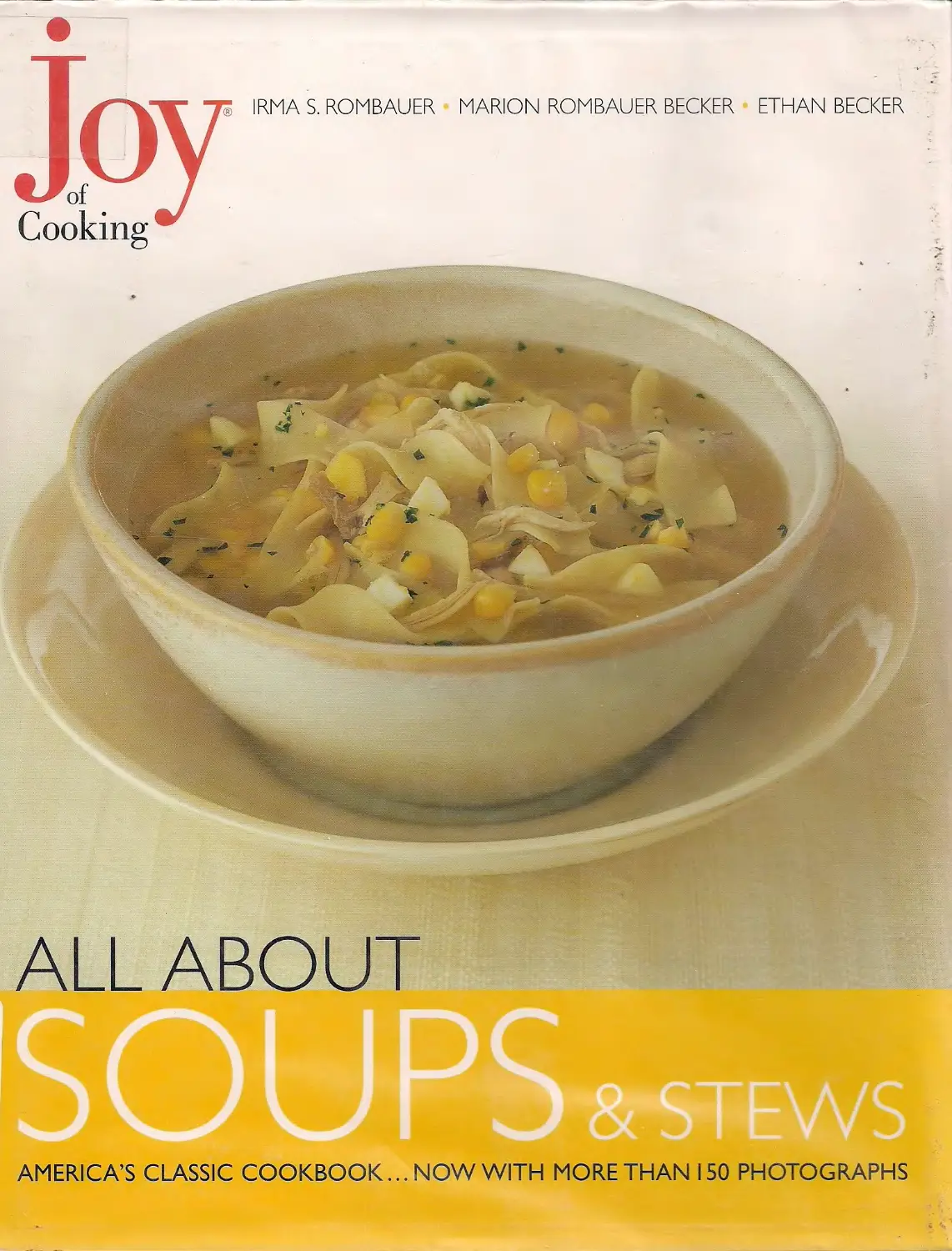
                    ALL ABOUT
AMERICA’S CLASSIC COOKBOOK... NOW WITH MORE THAN 150 PHOTOGRAPHS
ALL ABOUT
SOUPS & STEWS
http ://kuharka.ru/
Joy
Cooking*'
ALL ABOUT
SOUPS & STEWS
IRMA S. FpMBAUER
MARION ROMBAUER BECKER ETHAN BECKER
PHOTOGRAPHY BYTUCKER & HOSSLER
http ://kuharka.ru/
SCRIBNER
NEWYORK • LONDON • TORONTO . SYDNEY . SINGAPORE
Scribner
1230 Avenue of the Americas
New York, NY 10020
Copyright © 2000 by Simon & Schuster Inc., The Joy of Cooking Trust and The MRB Revocable Trust
All rights reserved, including the right of reproduction in whole or in part in any form.
Scribner and design are trademarks of Macmillan Library Reference USA, Inc., used under license by Simon & Schuster, the publisher of this work.
Jor of Cooking is a registered trademark of The Joy of Cooking Trust and The MRB Revocable Trust.
WELDON OWEN INC.
Chief Executive Officer: John Owen
President: Terry Newell
Chief Operating Officer: Larry Partington
Vice President, International Sales: Stuart Laurence
Publisher: Roger Shaw
Creative Director: Gaye Allen
Associate Publisher: Vai Cipollone
Art Director: Jamie Leighton
Production Director: Stephanie Sherman
Consulting Editors: Judith Dunham, Norman Kolpas Assistant Editor: Anna Mantzaris
Studio Manager: Brynn Breuner
Pre-press Coordinator: Mario Amador
Production Manager: Chris Hemesath
Food Stylist: JeffTucker
Prop Stylist: Sara Slavin
Food Styling Assistants: Rebecca Broder, Angela Kearney Step-by-Step Photographer: Chris Shorten Step-by-Step Food Stylist: Kim Brent
Joy of Cooking All About series was designed and produced by Weldon Owen Inc., 814 Montgomery Street, San Francisco, California 94133
Set in Joanna MT and Gill Sans
Separations by Bright Arts Singapore
Printed in Singapore by Tien Wah Press (Pte.) Ltd.
10987654321
Library of Congress Cataloging-in-Publication Data is available.
ISBN 0-7432-0210-4
Recipe shown on half-title page: New York Deli Borscht, 48
Recipe shown on title page: Fresh Tomato Soup, 51
http ://www.kuharka.ru/
CONTENTS
6 FOREWORD
8 ABOUT SOUPS & STEWS
I 3 ABOUT STOCKS & BROTHS
3 I ABOUT CLEAR STOCKS WITH ADDITIONS
4 I ABOUT VEGETABLE SOUPS & STEWS
65 ABOUT LEGUME SOUPS & STEWS
75 ABOUT CHOWDERS
8 3 ABOUT FISH AND SEAFOOD SOUPS & STEWS
95 ABOUT MEAT AND POULTRY SOUPS & STEWS
I I 3 ABOUT FRUIT SOUPS
I I 7 ABOUT CONDIMENTS & QUICK BREADS
I 26 INDEX
I 28 ACKNOWLEDGMENTS
FOREWORD
“Making the pot smile.” My Granny Rom and my mother enjoyed quoting the English translation of the French phrase in early editions of the Joy of Cooking to describe the gentle simmering required for soups and stews. Soups and stews have the power to bring smiles not just to the pot but also to the people who eat them.
That’s why an entire volume of the new All About series is devoted to soups and stews. All About Soups & Stews offers information on key ingredients, along with recipes for a wide variety of stocks, embellishments, and accompanying breads—everything you need whether you're just starting dinner with soup or making a robust stew the centerpiece of your meal.
You might notice that this collection of kitchen-tested recipes is adapted from the latest edition of the Joy of Cooking, just as our family has done for generations, we have worked to make this version of Joy a little bit better than the last. As a result, you’ll find that some notes, recipes, and techniques have been changed to improve their clarity and usefulness. Since 1931, the Joy of Cooking has constantly evolved. And now, the All About series has taken Joy to a whole new stage, as you will see from the beautiful color photographs of finished dishes and clearly illustrated instructions for preparing and serving them. Granny Rom and Mother would have been delighted.
I'm sure you'll find All About Soups & Stews to be both a useful and an enduring companion in your kitchen.
6 sours S, STEWS
THE JOY OF
liMAS iOMBAOt?
by IRMA S. ROMBAUER and MARION ROMBAUER BECKER
THE ALL-PURPOSE COOKBOOK
JOY
.COOKING
by
IRMA S. ROMBAUER
ord MARION ROMBAUER BECKER
by IRMA S. ROMBAUER and MARION ROMBAUER BECKER
Ethan Becker pictured with his grandmother, Irma von Starkloff Rombauer (left), and his mother, Marion Rombauer Becker (right). Irma Rombauer published the first Joy of Cooking at her own expense in 1931. Marion Rombauer Becker became coauthor in 1951. Joy as it has progressed through the decades (from top left to bottom right): the 1931 edition with Marion’s depiction of St. Martha of Bethany, said to be the patron saint of cooking, "slaying the dragon of kitchen drudgery”; the 1943 edition; the 1951 edition; the 1962 edition; the 1975 edition; and the 1997 edition.
FOREWORD 7
About Soups & Stews
If any foods seem inherently calming, and even consoling, they are soup and stew. Soups and stews feel good when the weather gets cold. They restore our spirit and our vigor. (The first “restaurants” were eighteenth
century Parisian establishments that served rich soups to restore, or restaurer, the hungry citizenry.) In the old days, when a “soup bunch” of vegetables and herbs cost a nickel and bones were free from the local
butcher, American home cooks routinely made soups from scratch. Today, the smell of a wonderful soup or a hearty stew simmering on the stove in the kitchen still symbolizes home cooking.
Tools for Making Stocks, Soups, and Stews
The basic tools for making stocks, soups, and stews are a wooden spoon, a ladle, and, of course, a pot. An 8- to 10-quart pot (I) is required for making stock (see About Stocks & Broths, 13) or large batches of soup or stew. A 4-quart pot is about right for everyday use.
The best type is narrow, tall, and heavy-bottomed, to allow the stock, soup, or stew to simmer gently without too much evaporation and to facilitate skimming.
For making stock, just be sure the pot is large enough to accommodate all of the solids (bones, shells, or
vegetables) with room to cover them with 2 inches of water. Dutch ovens (2) or wide soup pots also work, as long as you monitor the simmering stock and add more water whenever the level drops below the solids. Using an 8- to 10-quart stockpot will yield 2- to 4-quart batches of stock. Avoid aluminum pots, which may react with the ingredients and affect the flavor. A second large pot is handy for cooling strained stock; plastic containers work, but they insulate, and so the stock will not cool as quickly.
For making brown stocks, it is
also essential to have a large roasting pan, preferably with handles. Sieves are another must—ideally two of them, one coarse and one fine. The long-handled conical kind, called a chinois or China cap (3), is ideal, but you can improvise a fine-mesh sieve by lining a colander with a double layer of cheesecloth, a dampened layer of paper towels, or a coffee filter. Gravy separators, also called fat separators, are a convenient way to remove excess fat from stock when there is no time to chill the stock and let the fat solidify.
8 SOUPS & STEWS
Equipment for Making Soups
Some soups in this book are pureed to make them smooth; others are partially pureed to give them a “creamier” texture. Here are the pros and cons to using commonly available kitchen equipment to adjust the texture of a soup.
Food Processor: This tool is especially good for thick soups. Beware of overloading, as liquids can leak out the bottom or overflow. Depending on the size of your food processor, it may be best to puree soups in two batches. Or you can puree the solid ingredients with just enough
liquid to keep the blade from clogging; return the puree to the pot, and stir or whisk to blend.
Blender (I): A blender works well for pureeing thinner soups. When blending hot soup, do not fill the blender more than one-third full. Wrap a dish towel around the lid and start on a low speed, then gradually increase the speed.
Hand-Held Immersion Blender (2): This tool is exceptionally convenient, because it is portable and easy to clean. Just immerse the blade end in the soup and turn it on, moving it
around the soup until you achieve the desired texture. The solid ingredients must be very soft for the blender to work, and it can never create a completely silken texture. But the immersion blender is still an excellent tool for soups that are only partially pureed, such as some bean soups. Food Mill (3): Once a soup is cooked until the ingredients are quite soft, the food mill purees and strains simultaneously. Interchangeable disks help the cook control the final texture of the soup. A food mill also strains out tomato seeds.
ABOUT SOUPS & STEWS 9
Making Substitutions
Soups and stews that begin by sauteing vegetables in oil or butter can be adapted by cutting the fat in half and adding !4 cup water or stock, which sweats the vegetables rather than sautes them. The same vegetables can also be cooked directly in the soup or stew liquid with no previous sauteing at all. Even if you are not concerned about fat, stock should always be degreased before
use (see About Stocks & Broths, 13) for purely aesthetic reasons. If meat is cooked in a soup or stew, trim it thoroughly; after it has cooked, carefully ladle the fat from the surface— or refrigerate the soup or stew overnight so the fat rises to the top and solidifies, then carefully remove it from the surface.
Most recipes calling for cream can be made with less cream than
specified or with none at all, but before you decide against a recipe calling for cream, divide the total amount of cream by the number of servings. Most of the time, a cup of the soup or stew will contain only a few tablespoons of cream. If the soup is not boiled, you can often substitute low-fat milk, yogurt, or a touch of sour cream (which has half the fat of regular cream).
Using Pasta in Soups
Italy’s pasta soups fall into two major categories: filled or other pastas cooked in stock and garnished only with grated cheese, and brothy home-style soups with tiny or broken pasta, vegetables, or other flavorful ingredients.
Italian home cooks use whatever is at hand, boiling up broth and dropping into it whatever pasta is handy; by the time the pasta is tender, die
vegetables are just right. For more substance, diey beat togedier an egg or two widi grated cheese and stir it into the soup about a minute before taking it off the stove.
Tiny pastas are used in several styles of soups: Cook them in the stock and finish the soup with minced fresh herbs and/or grated cheese and/or beaten egg stirred in at the last moment. Add pasta with
vegetables or other ingredients for brothy soups.
® Small shapes: meloni, orzo, pastine, tubetti, ditalini, anellini (little rings), stelline, avene (oats), tempestine, and quadrettini.
® Break these long strands into clear soups to whatever size you need: pappardelle, lasagnette, maltagliati, lasagne, bucatini, capellini, vermicelli, spaghetti, and linguine.
STORING SOUPS AND STEWS
Soups and stews keep well, tightly covered in the refrigerator, improving in flavor. The exception is a recipe made with fish and seafood. The delicate flavors of the fish are best as soon as they are cooked. Fruit soups and soups and stews made with meat, poultry, milk, cream, or eggs keep for up to 3 days. Those made of vegetables and legumes keep for up to 4 days.
Refrigerate soup or stew when it has completely cooled and cover tighdy. Always store in a container that it completely fills—air is the
enemy. For the same reason, be sure to leave any fat on top until serving time, as the layer seals the soup or stew beneath.
All soups and stews can be frozen. Soups that contain chunks of vegetables that do not freeze well—root vegetables, for example—can be pureed after thawing, then heated with enough stock or milk to loosen. Pureed soups hold their quality for up to 3 months in. the freezer. Stews and other soups are best served within 1 month of freezing.
B© SOUPS & STEWS
SERVING SOUPSAND STEWS
YoiHcan serve soup or stew in anything that will hold it, but over the centuries certain bowls have become traditional for certain soups and stews.
First-course soups are usually presented in smaller bowls (I) than hearty main-course stews.
Cream soups and consommes, which cool quickly, are traditionally served in comparatively deep bowls (2). Occasionally an elegant broth is served in actual demitasse cups and sipped like espresso.The bowls of cream-soup spoons are deep and nearly rounded so that they can hold a reasonable quantity of liquid.
Stews, chowders, fish soups, and other soups with numerous ingredients, which are slower to cool, are usually served in shallow, broadrimmed dishes (3) or in underplates; the appropriate spoons are longhandled and have shallow ovalshaped bowls (4) that can hold plenty of chunks.
Use ovenproof bowls or crocks (5) for a soup such as French onion, which requires time in the oven.
If you can, serve Asian soups in Chinese or Japanese lacquer or ceramic bowls with those distinctive open-handled ceramic Asian soup spoons (6).
As for serving size, consider I cup of soup an appetizer; and I Yi to 2 cups of soup or stew a main course.
ABOUT SOUPS & STEWS I I
ABOUT
STOCKS
& BROTHS
Stocks and broths are a vital ingredient in many soups and stews, and no store-bought variety can compare with a well-tended homemade version. Stock making is different from other kinds of cooking. Instead of calling for tender, young ingredients, stocks are best made with meat from older animals and mature vegetables, cooked slowly for a long time to extract every vestige of flavor. Purists may insist on using only fish stock in a fish soup or beef stock in a beef stew, but today’s household rarely has the luxury of such precision. Since chicken and vegetable stocks are the mildest in flavor and the easiest to prepare, they have become our most popular—and can be used for, among other things, both fish soup and beef stew if necessary. Certainly, full-flavored beef stock or savory white veal stock is still worth making if you have the time.
Clockwise from top: Vegetable Stock, 20; Chicken Stock, 22;
Brown Beef Stock, 24
13
Making Stocks and Broths
The characteristics of any good stock are flavor, body, and clarity. Of the three, flavor is paramount, and the way to get it is by using a high proportion of ingredients to water. The most flavorful stocks are made with only enough water to cover the bones, shells, or vegetables. Additional water is needed only when it evaporates below the level of the ingredients before the stock is fully cooked. Follow the recipes for ideal ratios of liquid to solids, but the principle is simple: Keep the solids covered while cooking.
Cooking times for stocks depend on how long it takes to extract all the flavor from the ingredients. While it takes at least 8 hours for raw beef bones to give up all their richness and flavor, chicken bones only need to be boiled for half that time. Vegetable and fish stocks rarely require more than an hour to cook. In fact, their delicate flavors will deteriorate if overcooked. When preparing ingredients for stock making, it is important to chop vegetables and bones to size according to their cooking times—large for long cooking and small for quick cooking—to allow their flavors to be fully extracted.
Simmering the stock past the recipe’s recommended cooking time can produce an unpleasant bitter taste. A stock should be strained when all the flavors and goodness have been fully extracted from the meat, bones, and vegetables. If in doubt, retrieve a meaty bone from th-' simmering stock. If the meat still has some flavor, allow the stock to simmer for longer. If the meat is entirely tasteless and the bone joints
are falling apart, it is time to strain the stock.
If a stock tastes weak after straining, remove and discard the fat, then simmer the stock briskly to reduce the water content and concentrate the flavor. This technique, known as reduction and used extensively in sauce making, does produce a more deeply flavored stock, but in the process much of the aromatic, fresh taste of the vegetables is lost. For this reason, we do not recommend reducing vegetable stock. In addition, not all dishes require a deep, concentrated flavor. A light stock is sometimes more appropriate for its subdety. In instances when you want a hearty stock, first roast the bones and vegetables in a hot oven. Then transfer the bones and vegetables to the stockpot, pour off any excess grease, and add water or wine to the hot roasting pan to release the intensely flavored caramelized cooking juices—a step known as deglazing. Add the liquid to the stockpot. The resulting brown stock is darker and richer than a stock made by straight simmering, which is referred to as a white stock. This technique can be used for meat, poultry, fish, or vegetable stocks.
When choosing meat or bones for the stockpot, understand that meat adds flavor, while bones contribute body. Bones, especially those from the joints (knuckles and shoulders) of young animals, contain gelatin, which gives a stock body and a rich, smooth texture. Always use a combination of bones and meat, or look for particularly meaty bones. By definition, a stock is made with more bones than meat, while a broth is
14 soups & STEWS
Making Stocks and Broths
The characteristics of any good stock are flavor, body, and clarity. Of the three, flavor is paramount, and the way to get it is by using a high proportion of ingredients to water. The most flavorful stocks are made with only enough water to cover the bones, shells, or vegetables. Additional water is needed only when it evaporates below the level of the ingredients before the stock is fully cooked. Follow the recipes for ideal ratios of liquid to solids, but the principle is simple: Keep the solids covered while cooking.
Cooking times for stocks depend on how long it takes to extract all the flavor from the ingredients. While it takes at least 8 hours for raw beef bones to give up all their richness and flavor, chicken bones only need to be boiled for half that time. Vegetable and fish stocks rarely require more than an hour to cook. In fact, their delicate flavors will deteriorate if overcooked. When preparing ingredients for stock making, it is important to chop vegetables and bones to size according to their cooking times—large for long cooking and small for quick cooking—to allow their flavors to be fully extracted.
Simmering the stock past the recipe’s recommended cooking time can produce an unpleasant bitter taste. A stock should be strained when all the flavors and goodness have been fully extracted from the meat, bones, and vegetables. If in doubt, retrieve a meaty bone from th~ simmering stock. If the meat still has some flavor, allow the stock to simmer for longer. If the meat is entirely tasteless and the bone joints
1 4 SOUPS & STEWS
are falling apart, it is time to strain the stock.
If a stock tastes weak after straining, remove and discard the fat, then simmer the stock briskly to reduce the water content and concentrate the flavor. This technique, known as reduction and used extensively in sauce making, does produce a more deeply flavored stock, but in the process much of the aromatic, fresh taste of the vegetables is lost. For this reason, we do not recommend reducing vegetable stock. In addition, not all dishes require a deep, concentrated flavor. A light stock is sometimes more appropriate for its subtlety. In instances when you want a hearty stock, first roast the bones and vegetables in a hot oven. Then transfer the bones and vegetables to the stockpot, pour off any excess grease, and add water or wine to the hot roasting pan to release the intensely flavored caramelized cooking juices—a step known as deglazing. Add the liquid to the stockpot. The resulting brown stock is darker and richer than a stock made by straight simmering, which is referred to as a white stock. This technique can be used for meat, poultry, fish, or vegetable stocks.
When choosing meat or bones for the stockpot, understand that meat adds flavor, while bones contribute body. Bones, especially those from the joints (knuckles and shoulders) of young animals, contain gelatin, which gives a stock body and a rich, smooth texture. Always use a combination of bones and meat, or look for particularly meaty bones. By definition, a stock is made with more bones than meat, while a broth is
made from meat. Бог economy’s sake, meat or poultry used for stock making can be removed from the pot before the stock is ready (while the meat still has flavor) and reserved for another meal; see Express Chicken Broth, 29. The resulting light stock can be used as is, or the bones can be returned to the pot and the stock cooked further. Raw ingredients produce the best stock, but in a pinch, leftover meat or vegetables will do. Leftover carcasses, such as turkey, broken up and pushed under the water, make a fine stock.
The clarity of a stock is more than an aesthetic concern. A clear stock tastes clean and fresh, while a cloudy one will often seem greasy and muddled. The secret to a clear stock is to start with cold water,
allow it to come slowly to a boil, then immediately lower the temperature to the slightest simmer while you carefully skim any impurities, froth, or fat that rises to the surface. This technique not only brings the most flavor out of the ingredients but also draws out impurities in the meat and bones that would otherwise cloud your stock. If a stock is permitted to boil, these impurities, in tire form of the scum that forms on the surface of the stock, will be incorporated into the liquid instead. If you do not have enough time to simmer a stock gently, consider preparing one of the express broth recipes in this section. Some are made from scratch, and some call for doctoring already-prepared ingredients. All are time savers.
ADAPTING FLAVOR
If you prefer a lighter soup or a vegetarian soup, any of the allvegetable stocks, 20, or Vegetable Broth, 29, can replace a meat, poultry, fish, or seafood stock in soups and stews. When you need a substitute for beef stock, it is worth your time to prepare RoastedVegetable Stock, 20, which has a similar depth of flavor. Remember that no matter what the soup, a small quantity of salt pork, a ham hock, or a few slices of bacon will add depth in a short time. Use these and other robustly flavored ingredients sparingly. It takes just a little to flavor the pot. Ingredients such as these should not overwhelm the other ingredients, but should be used to enrich flavor.
ABOUT STOCKS & BROTHS I 5
RULES FOR MAKING STOCKSAND BROTHS
® Cut the ingredients into small pieces for quick-cooking stocks and broths, and larger pieces for long-cooking stocks (I). Express broths use the smallest-cut ingredients, followed by fish stock, then vegetable stock, then poultry, and lastly meat.
® The higher the ratio of solids to water, the more flavorful the stock or broth.The water should just barely cover the ingredients (2). Add water during cooking if necessary.
® Start with cold water and bring it slowly to a simmer. Never rush a stock. Simmer gently so bubbles just barely break on the surface.
® Never allow a stock to boil.
® Skim the impurities that rise to the surface as the stock or broth simmers—often during the first 30 minutes, and then once an hour or so (3). Have two bowls nearby, one filled with water to set the skimmer in so that it does not get covered with congealed fat and impurities, and a second bowl to collect what you skim off.
® Adjust the flavor. If the stock tastes too thin, simmer it until it is flavorful. As the water evaporates, the stock reduces in volume and its flavor is concentrated.Vegetable stock becomes bitter when over-reduced.
® Stop cooking the stock when there is no flavor left in the ingredients.
® A well-made stock or broth contains very little fat. Begin by trimming
all meat and bones of visible fat, and finish by either skimming the stock or broth carefully while still warm or chilling it so the fat forms a solid | layer and is easily removed (4).	,Л
Alternatively, and easiest yet, use an inexpensive gravy separator (5).
® Many variables affect the yield of 1 a stock or broth recipe, such as the Ц size of the pot and the kind of meat Ц or bones used. Ultimately, a good fla-vor is more important than achieving the exact yield.
i 6 SOUPS & STEWS
Seasoning Stocks and Broths
Stocks and broths are usually meant to be comparatively unassertive in flavor, so that they can be used for a number of purposes. Onions, carrots, and celery, the traditional mixture of aromatic vegetables for stocks and broths, known as a mirepoix in French, should be added sparingly about 30 minutes after the stock has begun to simmer and the impurities have been removed.
Different styles of cooking alter this classic mixture; in Louisiana, for instance, the standard vegetable mixture includes onions, green peppers, and celery. Mushrooms and leeks are also common. The discreet use of either fresh or dried seasonings, including parsley, thyme, bay
Court Bouillon
4 cups
Court bouillon is a seasoned liquid cooked for only a short time (court is French for short) and is especially useful when you haven’t the time to make an actual stock or when a recipe for soup or stew requires only a lightly flavored broth. The composition of a court bouillon can vary, but most contain some type of acid (lemon juice or wine vinegar) and an assortment of aromatic vegetables and herbs such as parsley thyme, and bay leaves. Court bouillon and Vegetable Stock, 20, are generally interchangeable, but vegetable stock has no lemon Juice or vinegar. Combine in a stockpot over medium heat:
6 cups cold water Уг cup chopped onions Vi cup chopped celery
leaves, and peppercorns, in the form of a bouquet garni is equally important.
For express broth or quickcooking stocks, there is no need to tie the seasonings in a bundle—they can simply be tossed in with the vegetables. Salt is almost never added to stocks and broths. The reduction process, during both the original simmering and any subsequent cooking, would concentrate the salt and ruin the results. Vegetable stocks are an exception to the rule. Because they are lighter in flavor and are rarely reduced, some cooks add a small amount of salt during cooking to bring out the flavors.
54 cup chopped leeks, tender white part only, washed thoroughly
% cup chopped carrots
1 Bouquet Garni, right
Bring to a boil, reduce the heat, and let simmer gently, uncovered, until the vegetables are tender, about 20 minutes. Add:
3 tablespoons lemon juice or white wine vinegar
Simmer for another 10 minutes.
Strain into a clean pot or heatproof plastic container. If desired, season with:
Salt and ground black pepper to taste
Use immediately to make soups or stews or let cool, uncovered, then refrigerate until ready to use.
Bouquet Garni
Since herbs tend to float and get in the way as you skim the surface of a stock we recommend tying them together in a little packet, known as a bouquet garni. Vary the contents to suit your dish, with additions such as whole cloves, dill, lemon zest, or garlic. For express broth or quick-cooking stocks, simply toss the seasonings in with the vegetables.
Wrap in a 4 x 4-inch piece of cheesecloth:
Small bunch of parsley or parsley stems
8 sprigs fresh thyme, or
I teaspoon dried
I bay leaf
2 or 3 celery leaves (optional)
Tie the cheesecloth securely with a piece of kitchen string or omit the cheesecloth and simply tie the herbs together at their stems.
Refrigerate in a tightly covered container until ready to use.
ABOUT STOCKS & BROTHS I 7
Reducing Stock to a Glaze
Meat, poultry, and fish (but not veg-  etable) stocks can be cooked down, or • reduced, until they become a thick, • syrupy glaze that is both potent and • delectable. Although the lengthy reduc- • tion takes patience and care, the end • product becomes a wonderfully conven- • ient “secret ingredient" for seasoning • and finishing all manner of soups and : stews. When it is fully reduced, a glaze is • just 10 to 15 percent of the volume of * original stock and will last for months ; tightly covered in the refrigerator.  Reduced fish stock tends to be too	:
strong for most tastes.	:
Prepare:	;
4 cups Brown Beef Stock, 24, Brown	:
Veal Stock, 25, or Brown Chicken
Stock, 22	i
Degrease the stock well and place it :
IS STOCK NECESSARY?
It depends on the soup or stew.
Some need stock for taste and body. French Onion Soup, S3, derives its rich color and deep flavor from beef stock. Similarly, most single-vegetable soups need the depth of flavor that a savory liquid brings. In some cases, stock is the very soul of the soup: Matzo Ball Soup, 33, is really chicken stock with matzo balls in it.
But when the main ingredients of
a soup or stew are full of character, you may not want to mask their flavors by adding stock. The beets in New York Deli Borscht, 48, the vegetables in Provencal Vegetable Soup, 59, the meat in Oxtail Soup, 104, need nothing more than water to carry their powerful flavors. Likewise, most soups and
in a large pot over medium-high heat. Allow the stock to simmer vigorously. Skim any foam that rises to the surface and transfer the stock to gradually smaller pots as it reduces in volume. Lower the heat when the stock begins to get noticeably thicker and more concentrated to avoid burning. The glaze is ready when it coats the back of a spoon and only about I cup remains, anywhere from 2 to 4 hours depending on the shape of the pan.
Remove from the heat and let coo I. The glaze will solidify and feel rubbery to the touch. Cover and refrigerate, or cut into small squares equivalent to I tablespoon or more and freeze for use in preparing soups or stews.
stews based on beans and legumes, 65 to 72, do not require stock, their main ingredients being rich and earthy. Keep in mind that a few soups and stews can be prepared either with stock or without. Minestrone, 46, may have a warmer flavor with chicken stock, but it is also fine with water.
A classic stock—composed of many ingredients, simmered for hours, strained, and reduced—is essential
only for soups and stews where the broth is the main component. For most other recipes, an express broth, 28 to 29, will work perfectly well. So will a canned stock. Low-sodium canned stocks are preferable, because the lack of salt leaves the cook freer to adjust the seasonings.
I 8 SOUPS & STEWS
HOWTO STRAIN AND STORE STOCK
I When the stock has finished cooking, strain it through a fine-mesh sieve (or a colander lined with a double layer of cheesecloth or a coffee filter) into another pot or a large heatproof container and discard the solids.
2	Pressing heavily on the solids while straining may cloud the stock. We have recommended it for the vegetable stock recipes, where the extra flavor from the cooked vegetables is needed.
3	Do not let the stock sit out at room temperature for long as it is a good breeding ground for bacteria. Speed up the cooling process by placing the hot bowl, uncovered, in another bowl of ice water and stirring it a few times.
4	Once the stock cools enough so that it will not raise the temperature of your refrigerator; cover it tightly and chill it. When the stock is chilled, any fat will rise in a solid mass that must be removed before reheating. While cold, this fat layer (shown on chicken stock) actually protects the stock.
5	Stock will keep for 3 to 5 days in the refrigerator If refrigerated for longer, after 3 days skim the solidified fat from the surface and boil the stock for 10 minutes, then refrigerate it for another 3 to 5 days.
6	For prolonged storage, transfer stock to pint or quart plastic containers or plastic freezer bags and freeze it. Small amounts of stock can also be frozen in ice cube trays. See also Reducing Stock to a Glaze, opposite, for other storage possibilities.
ABOUT STOCKS & BROTHS I 9
Vegetable Stock
About 4 cups
Vegetable stocks allow for much improvisation. Good additions include onions, carrots, potatoes, corncobs, fennel, fresh herbs, ginger, garlic, washed organic vegetable skins, and even a few tablespoons of lentils. Vegetables to avoid include those in the cabbage family (except when used deliberately and with discretion), eggplant, and most strong greens (with the exception of kale); too many carrots or parsnips will turn the stock overly sweet. When
possible, tailor the ingredients to suit the recipe the stock will be used in. For example, a stock accented with ginger and garlic would be good In many Asian recipes.
Combine in a stockpot:
1 medium onion, sliced
1 leek, white part only, cleaned thoroughly and sliced
1 carrot, peeled and sliced
1 small turnip, peeled and sliced
6 cloves garlic, peeled and smashed
6 cups cold water 1 Bouquet Garni, 17
Simmer gently, partially covered, until the vegetables are completely softened, 45 to 60 minutes. Strain into a clean pot or heatproof plastic container, pressing down on the vegetables to extract the juices. Season with: Salt and ground black pepper to taste (optional)
Let cool, uncovered, then refrigerate until ready to use.
Roasted Vegetable Stock
About 4 cups
Preheat the oven to 400°F. Lightly grease a roasting pan.
Toss together in the prepared pan and roast, stirring occasionally, until well browned, about 1 hour: 8 ounces mushrooms or mushroom stems, wiped clean
1	onion, quartered
2	carrots, peeled and cut into 2-inch pieces
8 cloves garlic, peeled and smashed
1 small turnip, peeled and cut into 2-inch pieces
Remove the vegetables to a stockpot, then deglaze the hot roasting pan by adding:
1 cup cold water
Scrape up any browned bits, then add the liquid to the pot along with:
6 cups cold water
1	Bouquet Garni, 17, including a pinch of red pepper flakes
Simmer gently, uncovered, until the vegetables are completely softened, 45 to 60 minutes. Strain into a clean pot or heatproof plastic container, pressing down on the vegetables to extract the juices. Season with: Salt to taste
Let cool, uncovered, then refrigerate until ready to use.
20 soups & STEWS
Shrimp Stock
About 3 cups
For a clear stock, omit the tomato paste.
Heat in a stockpot over medium-high heat:
2	tablespoons vegetable oil
Add and cook, stirring occasionally, until the shells are bright pink and aromatic, about 15 minutes:
3	cups uncooked shrimp shells, well rinsed and drained (from about 2 pounds shrimp)
2 small onions, diced
2 small carrots, peeled and diced
2 celery stalks, diced
Stir in:
2 tablespoons tomato paste (optional)
Add:
6 cups cold water
1 bay leaf
1	14 teaspoons lightly crushed black peppercorns
Splash of Pernod or !4 teaspoon fennel seeds (optional)
Bring almost to a boil, reduce the heat, and simmer gently, partially covered, for 20 minutes. Strain into a clean pot or heatproof plastic container, pressing down on the shells to extract all the liquid. Let cool, uncovered, then refrigerate until ready to use.
Fish Stock
About 6 cups
If fish bones are unavailable, use inexpensive whole fish. For a mild-tasting, all-purpose fish stock, avoid oily fish. Combine in a stockpot over medium heat:
2	pounds fish heads and bones, or whole fish, scaled, gutted, gills and viscera removed, rinsed well and drained
1 small onion, sliced
1 large leek, white and tender green parts, cleaned thoroughly and sliced
54 fennel bulb, sliced (optional)
1 to 2 cloves garlic (optional) 1 cup dry white wine (optional) 6 cups cold water (or just enough to cover)
1 Bouquet Garni, 17
Bring to a boil, reduce the heat, and simmer gently Cook, uncovered, skimming often, for 30 to 40 minutes. Strain into a clean pot or heatproof plastic container. Let cool, uncovered, then refrigerate until ready to use.
FISH FUMET
Prepare Fish Stock, left first cooking the vegetables over medium-low heat in 2 tablespoons butter until they begin to soften, about 5 minutes. Add the fish heads and bones and cook, stirring once or twice, until they begin to turn opaque, 5 minutes more. Be sure not to let the vegetables or fish brown. Add the wine, cold water and bouquet garni and continue as directed.
BAY LAUREL LEAVES AND PEPPERCORNS
From a graceful evergreen tree, bay laurel leaves are long, narrow, pointed, dark, and leathery. Their flavor is pungent and complex—something between eucalyptus, mint, lemon, and fresh-cut grass. Do not confuse them with the far commoner California bay, which is what is sold in this country as “bay leaves.” European bay laurel leaves are labeled as imported.
Pepper berries are the fruit of a leafy green vine that has spikes of white flowers; the flowers become clusters of green berries. These green peppercorns have a mild fresh flavor. Black peppercorns are green berries that are piled up and fermented for a few days, then dried in the sun, to become hard, wrinkled, and dark brown to black. Their flavor is rich and spicy, especially if the
berries are Malabar peppercorns. Used whole to flavor soups and stews, the flavor of peppercorns is discreet; tie the whole berries in a piece of cheesecloth, then remove them before serving. When peppercorns are freshly crushed with a mortar and pestle, most of their oils are retained and the flavor is enormously pungent.
ABOUT STOCKS & BROTHS 2 I
Chicken Stock
About 8 cups
Using the lesser amount of chicken suggested here, will result in a lighter stock (opposite), which will reinforce the flavor in many dishes without adding a pronounced chicken taste; the greater amount will yield a richer one. Combine in a stockpot over medium heat:
4 to 5 ¥2 pounds chicken parts (backs, necks, wings, legs, or thighs), or 1 whole 4- to 5 U-pound roasting chicken, well rinsed
16 cups cold water (or just enough to cover)
BROWN (OR ROASTED) CHICKEN This chicken stock variation has a richer flavor than "white" chicken stock. It can be used for hearty chicken soups and stews or in place of beef stock. Preheat the oven to 425°F. Prepare Chicken Stock, above, first combining the chicken parts and vegetables, without the bouquet garni, in a heavy roasting pan and roasting, stirring
Bring to a boil, reduce the heat, and simmer gently. Skim often until impurities no longer appear, about 30 minutes. Add:
1 onion, coarsely chopped
1 carrot, peeled and coarsely chopped
1 celery stalk, coarsely chopped
1 Bouquet Garni, 17
Simmer, uncovered, for 3 hours, adding water as needed to cover. Strain into a clean pot or heatproof plastic container. Let cool, uncovered, then refrigerate. Remove the fat when ready to use.
STOCK
occasionally, until well browned, about I hour Remove the chicken and vegetables to a stockpot and deglaze the hot roasting pan by adding I cup water and scraping up any browned bits. Add thediquid to the pot along with water to cover about 16 cups, and the bouquet garni. Continue as directed.
COOKING ONIONS
Cooking onions are the common medium to large yellow, red, and white onions that never fail us at the market. Skin color has less to do with the flavor of a cooking onion than its variety and where it was grown. Generally, yellow onions are richly flavored but on the sharp side when raw. Most sweeten when carefully cooked. White onions are often pungent when raw, but there are mild varieties like White Sweet Spanish. In some parts of the country, Spanish is understood to mean a very large, mild, yellow onion. Breeders can attach the word Spanish to mild onions of every size and color. Red onions are usually on the sweet side and can be cooked the same way but do not store as well as most yellow and white onions. Cooking onions of all kinds should be tighdy closed and very firm, without soft spots or black, powdery patches of mold. To store dried onions, spread them out—do not heap—in a cool, dry place. Wrap cut onions tightly in plastic wrap and refrigerate in the vegetable crisper.
Turkey Stock
12 to 20 cups
This stock is the perfect use for a leftover Thanksgiving turkey carcass and the accompanying bits of meat. If the carcass is very large, break it into pieces before adding it to the pot. Turkey stock can be substituted in any dish calling for chicken stock.
Barely cover with cold water in a large stockpot over medium heat:
1 meaty turkey carcass, from a 12-to 2 5-pound turkey, broken up
Bring to a boil, reduce the heat, and simmer gendy. Skim often until impurities no longer appear, about 3 0 minutes. Add:
1 onion, quartered
1 carrot, peeled and cut into
1 -inch pieces
1 celery stalk, cut into 1 -inch pieces
1 Bouquet Garni, 17
Simmer, uncovered, for 3 hours. Skim any impurities that rise and add water as needed to cover. Strain into a clean pot or heatproof plastic container. Let cool, uncovered, then refrigerate. Remove the fat when ready to use.
22 SOUPS & STEWS
ABOUT STOCKS & BROTHS 23
Brown Beef Stock
About 10 cups
The combination of beef shanks and chicken bones produces a hearty stock in half the time it takes to make Classic Beef Stock, right.
Preheat the oven to 425°F. Lightly oil a roasting pan. Place in the prepared pan and roast for 15 minutes: 3 pounds meaty beef shanks, cut into 2-inch pieces, or oxtails, split into chunks, or a combination
Add:
1	pound chicken parts (backs, necks, wings, legs, or thighs), well rinsed
2	medium onions, quartered
2 carrots, peeled and thickly sliced
2 celery stalks, cut into 2-inch pieces
Roast, stirring occasionally to prevent the vegetables from burning, until the bones are well browned, about 40 minutes. Transfer the meat and vegetables to a stockpot, carefully pour off any excess grease
Game Stock
About 8 cups
This stock can be made with rabbit or with duck, guinea hen, or other small game birds.
Combine in a stockpot over medium heat:
One 3-pound rabbit or fowl, or 3 pounds meaty game bones, rinsed and drained
16 cups cold water
Bring to a boil, reduce the heat, and simmer gently. Skim often until impurities no longer appear, about 30 minutes.
without discarding the caramelized cooking juices, and add to the hot roasting pan:
2 cups cold water
Scrape up any browned bits, then add the liquid to the pot along with: 14 cups cold water (or just enough to cover)
Bring to a boil over medium heat, skim off the impurities, reduce the heat, and simmer gently. Skim often until impurities no longer appear, about 30 minutes. Add:
1 leek, split lengthwise, cleaned thoroughly, and cut into 2-inch pieces
1 Bouquet Garni, 17, including
1 whole clove
Simmer, uncovered, for 4 hours, skimming as necessary and adding water as needed to cover. Strain into a clean pot or heatproof plastic container. Let cool, uncovered, then refrigerate. Remove the fat when ready to use.
CLASSIC BEEF STOCK
Prepare Brown Beef Stock left, substituting 5 pounds beef bones, preferably knucklebones, for the beef shanks and chicken. Cut the vegetables into larger pieces and simmer the stock for 8 hours.
LAMB STOCK
About 7 cups
Lamb Stock (below) boosts the flavor of lamb soups and stews. Do not use it in recipes calling for fowl or other kinds of meat its flavor can be assertive and could easily overpower more delicate foods. Prepare Brown Beef Stock, left, substituting 2 pounds lamb shoulder chops, well trimmed, for the beef and chicken and decreasing the onions, carrots, celery, and water by one-half. Omit the leek. Simmer for 3 hours.
Add:
1 medium onion, coarsely chopped 1 carrot, peeled and cut into
1 -inch pieces
1 celery stalk, cut into 1 -inch pieces
1 Bouquet Garni, 17
Simmer, uncovered, for 2’/z hours, adding water as needed to cover. Strain into a clean pot or heatproof plastic container. Let cool, uncovered, then refrigerate. Remove the fat when ready to use.
24 SOUPS & STEWS
White Veal Stock
About 8 cups
The comparatively mild flavor of this stock makes it highly versatile. Blanching the veal breast and bones by briefly boiling them and discarding the water helps create a clear stock. Ask your butcher to split the veal bones. Cover with cold water in a stockpot over high heat:
1У pounds veal breast
1 % pounds veal knucklebones, split Bring to a boil. Immediately drain and rinse the veal, the bones, and the pot. Return the veal breast and bones to the pot along with:
12 ounces chicken parts (backs, necks, wings, legs, or thighs), well rinsed
12 cups cold water (or just enough to cover)
Bring to a boil, skim off the impurities, and reduce the heat. Simmer gently for about 20 minutes. Add: 2 large onions, coarsely chopped 2 medium leeks, white and tender green parts, cleaned thoroughly and chopped
2 carrots, peeled and coarsely chopped
1 celery stalk, coarsely chopped
1 Bouquet Garni, 17
Simmer, uncovered, for 3 to 4 hours, adding water as needed to cover. Strain into a clean pot or heatproof plastic container. Let cool, uncovered, then refrigerate. Remove the fat when ready to use.
BROWN VEAL STOCK
Preheat the oven to 425°F. Lightly grease a roasting pan. Proceed as for White Veal Stock, left, but first roast the veal breast and bones in the prepared pan for 15 minutes; add the chicken and vegetables and roast until well browned, about I hour Remove the meat and vegetables to a stockpot, carefully pour off any excess grease without discarding the caramelized cooking juices, and add I cup cold water or wine (red or white) to the hot roasting pan. Scrape up any browned bits, then add the liquid to the pot along with cold water to cover Bring to a boil, reduce the heat, and simmer gently, skimming often for the first 30 minutes. Add the bouquet garni and continue as directed.
ABOUT STOCKS & BROTHS 25
26 SOUPS & STEWS
Dashi
About 4 cups
One of the bases of traditional Japanese cuisine, this stock is made quickly, from just two ingredients— kombu, or kelp, and katsuobushi, or dried bonito flakes, also referred to as smoky fish flakes—both of which can be found in Asian markets or health food stores. Dashi should be used within 4 to 5 days of preparation.
It should not be boiled or cooked for too long, and it does not freeze well. When reheating, do not boil.
Combine in a stockpot over high heat:
One 5 x 4-inch piece kombu
(kelp)
4/2 cups cold water
Bring almost to a boil. Immediately remove from the heat and stir in:
Уз cup loosely packed katsuobushi (dried bonito flakes)
Let stand until the flakes begin to sink, 2 to 3 minutes (opposite). Remove the kombu with tongs. Strain the stock at once into a clean pot or heatproof plastic container. Let cool, uncovered, then refrigerate until ready to use.
Chicken-Enriched Dashi (Tori-Gara Dashi)
About 4 cups
Cover with cold water in a stockpot over high heat:
1 pound chicken parts (backs, necks, wings, legs, or thighs), well rinsed
Bring to a boil. Immediately drain and rinse the chicken parts and the pot. Return the chicken to the pot along with:
One 5 x 4-inch piece kombu (kelp)
6 cups cold water
Bring to a boil, reduce the heat, and
simmer gently. Cook, uncovered, skimming often, for 20 to 25 minutes. Season with:
1 tablespoon light or dark soy sauce Remove from the heat and stir in:
Уз cup loosely packed katsuobushi
(dried bonito flakes)
Let stand until the flakes begin to sink, 2 to 3 minutes. Remove the kombu with tongs. Strain the stock into a clean pot or heatproof plastic container. Let cool, uncovered, then refrigerate until ready to use.
KELP AND BONITO FLAKES
Sold as “Dashi Kombu,” a 6-ounce package of kelp is enough to make six batches of broth for 4 to 6 people. The whitish coating on kelp is natural. Kelp should never be washed, or it will lose flavor. Kelp keeps indefinitely if it is stored tightly sealed.
Bonito flakes are dried, salted, fermented fish flakes. Bonito flakes will keep indefinitely on a cool, dark shelf in the pantry.
ABOUT STOCKS & BROTHS 27
About Broths
CHIPOTLE PEPPER
Chipode peppers (dried smoked jalapenos) have made great gains in popularity in this country for their intense, rich, smoky flavor. These days they show up everywhere, from canned tomato sauce (adobo) to stews, soups, salsas, sauces, pickles, and more. There are two types of chipodes, both made from different cultivars of the jalapeno. The first is the black-red chili chipode (also known as the chipode Colorado, mora, or morita); this small chipode (1 to 154 inches long and ‘/z inch wide) is prized for its sweet, smoked flavor and its dark, rosewood red color. The second type, usually called chipode meco, is larger (3 to 4 inches long by 1 inch wide) and pale brown in color, with a more tobacco-like taste and usually less heat.
Unlike stocks, which are made primarily from bones, broths are made from meat (except for vegetable broth), and they cook for shorter periods of time. The resulting liquid has a fresher, more definable flavor but less body than a stock. For this
Express Fish Broth
About 4 cups
When you haven’t the time or inclination to procure fish bones for fish stock, the combination of bottled clam juice and canned chicken broth or stock provides a decent substitute. If you have any fish trimmings on hand, throw them in as well. Heat in a medium, heavy skillet: 114 teaspoons olive oil
Add:
1 carrot, peeled and finely chopped 1 small onion or large leek, finely chopped
1	clove garlic, finely chopped
Cook, stirring, over medium-high
Express Shellfish Chipotle Broth
About 2/2 cups
This light but highly flavorful broth is good enough to be used as a sauce. Ladle an ounce or two over vegetables, legumes, or seafood immediately before serving.
Combine in a large saucepan over medium heat:
154 cups uncooked shrimp shells, well rinsed and drained (from about 1 pound shrimp)
2	teaspoons tomato paste
54	teaspoon chopped chipotle peppers in adobo sauce, or to taste
Large pinch of saffron
reason, broths are ideal for soups. Most of the canned stocks sold today are closer to broths and are best used in soups, not sauces, since they are often seasoned with salt and other seasonings, which makes it inadvisable to boil them down.
heat until soft. Add: 54 cup dry vermouth Stir for about 1 minute, then blend in: Four 8-ounce bottles clam juice 1 54 cups mild chicken broth Any fish trimmings on hand (optional)
54 small lemon (optional)
Simmer for 20 minutes, skimming and stirring occasionally. Strain into a clean pot or heatproof plastic container. Let cool, uncovered, then refrigerate until ready to use.
54 cup dry white wine
Bring almost to a boil, reduce the heat, and simmer gently, partially covered, for 5 to 10 minutes. Add: 254 cups Chicken Stock, 22
Simmer for 10 minutes more. Strain through a fine-mesh sieve and let the stock rest for a few minutes to allow any solids to settle. Carefully transfer to a clean saucepan or heatproof plastic container, leaving the solids behind. Use immediately or let cool, uncovered, then refrigerate until ready to use.
28 SOUPS & STEWS
Chicken Broth
About 12 cups
Once this broth is made, the chicken can be removed and used in soup or other dishes calling for cooked chicken. Combine in a stockpot over medium heat:
1 whole ЗУ2- to 4-pound chicken, well rinsed
12 cups cold water
Bring almost to a boil, reduce the
heat, and simmer gently, skimming often until impurities no longer appear. Meanwhile, pulse in a food processor until finely chopped:
1 medium onion, cut into eighths
1 carrot, peeled and cut into 2-inch pieces
1 celery stalk, cut into 2-inch pieces
Add the chopped vegetables to the pot. Simmer, uncovered, until the chicken is cooked, about 40 minutes. Remove the chicken and reserve. Strain the broth into a clean pot or heatproof plastic container. Let cool, uncovered, then refrigerate. Remove the fat when ready to use.
Express Chicken Broth
About 4 cups
This broth can also be made with canned beef broth or consomme; just omit the giblets.
Combine in a heavy saucepan:
Three 14H-ounce cans ready-to-serve reduced-sodium chicken broth
Any chicken giblets, trimmings, or bones on hand (optional)
Contents of 1 Bouquet Garni, 17 (no need to wrap)
Cut into 1 -inch pieces and pulse in a food processor until finely chopped: 1 small onion
1 small carrot
1 small celery stalk, with leaves
1 leek, white part only, cleaned thoroughly, or 3 whole scallions
1 small clove garlic (optional)
Bring almost to a boil over medium-high heat, reduce the heat, and simmer gently for about 30 minutes. Strain into a clean pot or heatproof plastic container. Let cool, uncovered, then refrigerate. Remove the fat when ready to use.
Express Beef Broth
About 4 cups
This broth has a good, beefy flavor. Combine in a stockpot over medium heat:
1 ’A pounds boneless beef chuck, cut into 1-inch cubes and pulsed in a food processor until coarsely chopped
5 cups cold water
Bring almost to a boil, reduce the heat, and simmer gently, skimming often until impurities no longer appear. Add:
1 onion, cut into 1 -inch pieces
1 large leek, white and tender green parts, cleaned thoroughly and chopped
1 carrot, peeled and sliced
1 tablespoon tomato paste
5 parsley stems
/2 teaspoon dried thyme
3 black peppercorns, lightly crushed
1 whole clove
Simmer, uncovered, for 1 hour.
Strain into a clean pot or heatproof plastic container. Let cool, uncovered, then refrigerate. Remove the fat when ready to use. The stock will separate, so whisk before using.
VEGETABLE BROTH
Use this method to extract the most flavor from the vegetables. Cooking the vegetables before adding them to the stockpot helps to express their flavor. This broth may not need to simmer as long as Vegetable Stock Prepare Vegetable Stock, 20, first cooking the vegetables over medium heat in 2 tablespoons unsalted butter or oil, stirring occasionally, until they are wilted, about 15 minutes. Add the water and seasonings and continue as directed.
ABOUT STOCKS & BROTHS 29
ABOUT
CLEAR STOCKS
WITH ADDITIONS
This is one category of soups for which a tasty, full-bodied homemade stock is strongly recommended. You can intensify the flavor of a light stock by simmering it to evaporate some of the water. Or simmer it with chopped vegetables—finely diced carrots, celery, and onions—and perhaps fresh herbs, then strain out the vegetables. The ultimate broth is consomme, 32, enriched with both meat and vegetables and clarified with egg whites.
Many of the recipes in this section call for chicken stock, because it is easy to prepare and seems to have the most universal appeal. Feel free to substitute any of the stocks provided in About Stocks & Broths, 13.
Chicken Noodle Soup, 33
Chicken or Beef Consomme
About 6/2 cups
Clear, intensely flavorful consomme, one of the glories of classical French cooking, makes an elegant start to a formal dinner party. For a dear consomme, the stock must be completely free of grease. For particularly strong consomme, simmer 16 cups (4 quarts) of degreased stock until reduced by half before clarifying it. Combine in a food processor:
1 small onion, quartered
1 small carrot, peeled and cut into 2-inch pieces
1 small celery stalk, cut into 2-inch pieces
2 tablespoons packed fresh parsley leaves
14 teaspoon fresh thyme leaves Pulse until coarsely chopped. Add: 1 pound boneless, skinless chicken breasts, fat trimmed, cut into 2-inch pieces, or 114 pounds beef round or rump steak, fat trimmed, cut into 1 -inch pieces
Pulse until chopped but not pureed.
Remove to a medium bowl. Add: 3 large egg whites
Stir together well. Warm in a soup pot, over low heat:
8 cups Chicken Stock, 22, Classic Beef Stock, 24, or Brown Beef Stock, 24, thoroughly degreased
Whisk in the vegetable mixture. Very slowly bring to a simmer without boiling, occasionally stirring and scraping the bottom of the pot to prevent burning until the egg foam rises to the surface, about 30 minutes. (Be careful not to stir after the broth reaches a simmer.) When the egg foam starts to solidify, make a small hole in the center with the end of a wooden spoon. Continue to simmer very gendy until the egg foam mixture is solid, about 30 minutes more. Remove the pot from the heat. Line a sieve with a slightly dampened cheesecloth or dish towel. Gently move the foam to the side of the pot
and ladle out the consomme. Strain the consomme through the sieve into a large saucepan. Season with:
1 teaspoon salt, or to taste
Heat through, then ladle into warmed bowls.
CONSOMME BRUNOISE
In classical French cooking, a brunoise is a mixture of finely diced vegetables. This recipe uses three vegetables most basic to the French kitchen. Prepare Chicken or Beef Consomme, above, adding with the salt: 2 tablespoons very finely diced leeks (white part only), 2 tablespoons very finely diced carrots, and 2 tablespoons very finely diced celery. Simmer gently until the vegetables are tender; about 5 minutes. Ladle into warmed bowls.
32 SOUPS & STEWS
Chicken Noodle Soup
About 4 cups
Using homemade stock in this recipe makes all the difference, transforming a dependable standard into a great soup. If you do make your own stock, remove some of the chicken meat from the bones when the stock is done and return it to the soup. For variety, try stirring in a peeled, seeded, and diced tomato and a teaspoon of chopped fresh herb, such as tarragon, parsley, dill, or basil, just before serving the soup.
Chicken Rice or Barley Soup
About 4 cups
With simple additions, flavorful homemade chicken stock can be transformed into a multitude of other soups. (Vegetarians can substitute Vegetable Stock, 20.) If you are adding grains and vegetables, add the vegetables when the grains are almost cooked.
Bring to a simmer in a medium saucepan:
Matzo Ball Soup
About 6 cups; 12 to 14 large balls
This simple classic is wonderful with or without the optional additions.
Beat on medium speed for
1 minute:
4 large eggs
1 teaspoon salt
If desired, stir in:
54 cup finely diced fennel; 2 tablespoons snipped fresh dill and 4 teaspoons snipped fresh or dried chives; or 2 tablespoons chopped fresh parsley and 2 tablespoons snipped fresh dill (optional)
Bring to a boil in a medium saucepan: 4 cups Chicken Stock, 22, or Brown
Chicken Stock, 22
Stir in:
1 cup fine egg noodles or 2 ounces thin fresh or dried pasta
Cook until the pasta is tender but firm, 4 to 5 minutes. Season with: 2 tablespoons chopped fresh parsley Salt to taste
Pinch of ground black pepper
Ladle into warmed bowls.
4 cups Chicken Stock, 22, or Brown Chicken Stock, 22
54 teaspoon salt
Stir in:
3 tablespoons long-grain rice or
2 tablespoons pearl barley Simmer until tender, about 15 minutes for rice, 30 to 45 minutes for barley.
Stir in:
54 cup plus 1 tablespoon soda water Fold in until well blended:
1 cup matzo meal
54 teaspoon ground black pepper 1 teaspoon curry powder (optional)
1 to 2 teaspoons finely chopped peeled fresh ginger, or
1 teaspoon ground (optional) Cover and refrigerate for 1 to 4 hours. With wet hands, form the matzo balls. Drop the balls into a large pot of boiling salted water, cover, reduce
Chicken Soup with Ravioli orTortellini
Prepare Chicken Rice or Barley
| Soup, left, substituting ravioli or tortel-
1 Uni (quantity to taste) for the rice or
I barley. Simmer until tender but firm, 5 to 10 minutes. Any of the following can be added to or substituted for the additions above:
Stir in 5 minutes before the soup is fully cooked:
j I /г cups sliced mixed vegetables, such as carrots, celery, tomatoes, and/or onions
I Stir in I to 2 minutes before the
I soup is fully cooked:
I cup thinly sliced greens (such as escarole, kale, or spinach), trimmed, washed, and dried
Stir in any of the following just
| before serving:
I tablespoon dry sherry Chopped basil or parsley Pinch of ground black pepper
the heat, and simmer for 20 minutes. When the matzo balls are almost finished, heat in a soup pot: 6 cups Chicken Stock, 22 Season with:
154 teaspoons salt
54 teaspoon ground black pepper (optional)
When the matzo balls are finished, add them to the stock. Ladle the stock into warmed bowls and add 2 matzo balls to each serving.
ABOUT CLEAR STOCKS WITH ADDITIONS 3 3
Chinese Egg Drop Soup
About 4 cups
A simple, delicate soup.
Combine in a large saucepan and simmer, partially covered, for 15 minutes:
4 cups Chicken Stock, 22
2 large slices fresh ginger
2 large cloves garlic, smashed and peeled
Discard the ginger and garlic. Stir together in a small bowl:
1 tablespoon cornstarch
3 tablespoons water
Bring the soup to a low simmer and add the cornstarch mixture. Stir until the soup is slightly thickened. Stir in: 1 teaspoon salt
% teaspoon ground black pepper Whisk together thoroughly in a small bowl:
1 large egg
1 teaspoon vegetable oil
Bring the soup to a very low simmer and pour the egg mixture in a large, circle on the surface of the soup. Once the egg sets, stir gently. Stir in: 2 scallions, diagonally sliced 2 tablespoons chopped fresh cilantro
Ladle into warmed bowls.
34 soups & STEWS
Italian Parmesan and Egg Soup (Stracciatella)
About 3 cups
A Roman specialty, stracciatella derives its name from the word straccetti, little rags—describing the strands of cooked egg that float in the broth.
Bring to a simmer in a medium saucepan:
3 cups Chicken Stock, 22
Meanwhile, whisk together in a
small bowl until well blended:
1 large egg
114 tablespoons grated Parmesan cheese
1	tablespoon dry unseasoned breadcrumbs
2	tablespoons chopped fresh parsley
1 small clove garlic, finely minced Stir this mixture rapidly into the simmering stock and stir until the egg is set, 30 to 60 seconds.
Garnish with:
Freshly grated or ground nutmeg or grated lemon zest
Ladle into warmed bowls.
Greek Lemon Soup
About 4 cups
Unlike stracciatella, where the eggs are supposed to separate, here the eggs are blended to create a smooth, creamy texture. This is done by adding a little of the hot stock to the eggs before they are added to the soup to prevent them from curdling.
Bring to a rolling boil in a medium saucepan:
3 cups Chicken Stock, 22 % cup long-grain rice
Reduce the heat, cover, and simmer until the rice is tender, about 20 minutes. In a medium bowl, whisk just enough to combine and be uniform in color: -
2 large eggs
*4 cup fresh lemon juice
Stir 2 tablespoons of the hot stock into the egg mixture. To prevent curdling, gradually pour the egg mixture into the hot, not boiling,
soup while stirring constantly.
Season with:
1 to 2 tablespoons fresh lemon juice (optional)
Salt and ground black pepper
to taste
Ladle into warmed bowls.
Garnish with:
Chopped fresh parsley or snipped fresh dill
ABOUT CLEAR STOCKS WITH ADDITIONS 3 5
Miso and Miso Soups
Miso, a fermented paste made from soybeans, comes in a variety of colors (from white to yellow to red) and textures (smooth or chunky), depending on the length of fermentation and the addition of grains such as barley or rice. As a general rule, the darker the miso, the longer it has been fermented and the
stronger and saltier it will taste.
Lighter miso, fermented for a shorter period, is sweeter. Barley miso is earthy and well aged. Although miso rarely spoils, it loses its flavor after a few months. Keep opened containers in the refrigerator.
Miso soups are an essential part of the traditional Japanese breakfast,
though soups thickened widi miso also appear at lunch and dinner. In Japan, there are many varieties of miso. Here are two basic miso soups, one based on the lightcolored, mellow miso that is popular in Kyoto and Osaka, and the other a dark-colored, pungent red miso that is favored in the region of Tokyo.
Dark-Colored Miso Soup with Sautded Vegetables
About 4/2 cups
This is a rich and flavorful miso soup. Soak in cold water for 10 minutes:
1 */z teaspoons dried wakame bits (optional)
Drain, squeeze out the excess liquid, and divide the wakame among 4 soup bowls. Heat in a medium saucepan over high heat:
1	teaspoon vegetable oil
Add and cook, stirring, until slightly browned, about 1 minute:
2	to 3 fresh shiitake mushroom caps, thinly sliced
1 small leek (white part only), cleaned thoroughly and thinly sliced on a diagonal
Add;
Pinch of salt
/2 teaspoon sake (optional)
Cook, stirring, until the leeks are wilted, about another minute. Stir in:
4 cups Dashi, 27
1 teaspoon light or dark soy sauce Cook over medium-low heat until warm. Place in a small bowl:
3 to ЗУ2 tablespoons red miso Add about !4 cup of the warm dashi and whisk to dissolve the miso; then whisk this mixture back into the soup. Ladle the hot miso-thickened broth and vegetables over the wakame.
Serve immediately.
WAKAME
Wakame is an edible seaweed. After the leaves of the plant have been soaked, they are briefly cooked in soups or can be used to make a salad. Wakame makes a nice addition to miso soups. Wakame is sold dried and packaged, sometimes labeled ito-wakame. To reconstitute dried wakame, simply soak it in tepid water for 20 minutes, to maintain its flavor and the seaweed’s high nutritional value. If the stem of the seaweed is present, it should be discarded.
36 SOUPS & STEWS
Light-Colored Miso Soup with Simmered Vegetables
About 4/2 cups
Autumn brings enormous (foot-long) pure white, carrot-shaped, juicy radishes called daikon in Japan. These radishes are mild in flavor and often added to soups.
Bring to a simmer in a medium saucepan:
4 cups Dashi, 27
Season with:
1 teaspoon light or dark soy sauce Splash of sake (optional)
Stir in and simmer until barely tender, 2 to 3 minutes:
1 small carrot, peeled, halved lengthwise, and thinly sliced One 2-inch piece daikon radish, peeled, halved lengthwise, and thinly sliced
Place in a small bowl:
3 tablespoons light-colored miso, such as shiro mugi miso (barley-enriched miso)
Add about !4 cup of the warm dashi and whisk to dissolve the miso; then whisk this mixture back into the soup. Divide among 4 bowls: 1 small scallion, chopped 2 ounces firm tofu, cut into small cubes
Ladle the hot miso-thickened broth and vegetables into the bowls. Serve immediately.
ABOUT CLEAR STOCKS WITH ADDITIONS 37
-it
Mongolian Hot Pot
About 8 cups; 6 to 8 servings
A hot pot is a round basin with a sort of chimney in the middle containing smoldering coals to heat stock, shown below. This device can be found in Asian shops or specialty cookware stores, but a fondue pot or electric skillet, while not as dramatic, can easily be substituted. In China, diners cook their own meat and vegetables in the sizzlingly hot stock, then dip them into a sauce they assemble from a selection of seasonings set out on the table. When all the meat and vegetables have been eaten, the guests sip the remaining soup. This is a wonderful party dish. The meat is easier to slice thinly if frozen for 20 minutes first.
For the dipping sauce, puree in a blender:
Vz cup rice vinegar
Уз cup sugar or !4 cup honey
Уъ cup light or dark soy sauce
Уз cup red miso or rinsed fermented black beans
14 cup toasted sesame oil
1	tablespoon minced peeled fresh ginger
2	teaspoons chili oil, or more to taste
3	cloves garlic, chopped
Pour the sauce into individual serving bowls and garnish with: Chopped scallions (about
3 scallions)
Chopped fresh cilantro
Snipped fresh chives
Arrange decoratively on a platter:
2 pounds beef sirloin steak or lamb loin, fat trimmed, thinly sliced
3 cups sliced Napa cabbage
8 ounces firm tofu, cut into
16 pieces
8 ounces spinach, trimmed, washed, and dried
To serve, bring the sauce and platter to the table. Bring to a boil:
8 to 10 cups Brown Beef Stock, 24 Pour the hot stock into a hot pot, fondue pot, or electric skillet at the table and keep at a simmer. With chopsticks or forks, diners hold the meat or vegetables in the simmering stock until done, then dip it into the sauce and eat. When the ingredients on the platter are finished, combine and let stand for 10 minutes:
4 ounces rice stick noodles, broken into small pieces
6 cups hot water
Drain and add the noodles to the stock. Ladle the stock and noodles into each bowl over the remaining sauce.
ABOUT CLEAR STOCKS WITH ADDITIONS 3 9
ABOUT VEGETABLE SOUPS & STEWS
/f you live near a farmers’ market and have the time, shop there for the best seasonal produce from your area. As a general seasonal guide, prepare soups and stews using root vegetables and hearty vegetables, such as winter squash, during the cold months; soups and stews using more perishable produce, such as tomatoes and corn, are best cooked during the warm months.
Cut vegetables are often an integral part of a mixed-vegetable soup or stew. Cut them . uniformly, to help ensure even cooking. When improvising a soup or stew using cut vegetables, bear in mind that some vegetables take longer than others to cook. Long-cooking vegetables, such as potatoes, should be added first, followed by vegetables such as carrots and green beans, leaving quick-cooking greens, such as spinach and chard, for last To retain the color in green vegetables, be careful not to cover or overcook the soup. Pureed green-vegetable soups should not cook long or they will turn gray.
Old-Fashioned Vegetable Soup, 43
41
Butternut Squash Soup
About 9 cups
Almost any winter squash can be used. For an unusual garnish, rinse and dry the squash seeds, toss them in I A teaspoons oil to lightly coat, and bake them along with the squash until browned, then sprinkle them on the soup just before serving.
Preheat the oven to 400°F.
Place cut side down on an oiled baking sheet:
1 medium to large butternut squash (about 354 pounds), halved and seeded
Bake until the squash can easily be pierced with a fork, about 1 hour. Let cool, then scoop the pulp from the squash skin and discard the skin. Melt or heat in a soup
pot, over medium-low heat:
3 tablespoons unsalted butter or vegetable oil
Add and cook, stirring, until tender but not browned, 5 to 10 minutes: 2 large leeks (white part only), cleaned thoroughly and chopped
4 teaspoons minced peeled fresh ginger
Stir in the squash along with:
4 cups Chicken Stock, 22, or any vegetable stock, 20
Bring to a simmer and cook, stirring and breaking up the squash with a spoon, for 20 minutes. Puree until smooth. Return to the pot and stir in:
2 cups chicken or vegetable stock
154 teaspoons salt
Heat through. Ladle into warmed bowls. Garnish with:
Chopped fresh parsley or cilantro
Croutons, 124
Toasted squash seeds (optional)
BUTTERNUT SQUASH Butternut squash is tan and long necked with a bulb at one end. Inside the squash, tire orange flesh is rich, sweet, dry, and superb. These 4- to 6-pound squash have the least waste of any winter squash, since the neck is solid and just the bulb contains seeds.
42 SOUPS & STEWS
Cream of Cauliflower Soup
About 6 cups
This recipe is a blueprint for a multitude of vegetable soups, all delicious. To retain the color in green vegetables, such as broccoli, do not cover or overcook the soup.
Heat in a soup pot over medium-low heat until the butter is melted:
% cup water or stock
1 tablespoon unsalted butter (optional)
Add and cook, covered, stirring occasionally, until tender but not browned, 5 to 10 minutes:
1 medium onion, coarsely chopped 2 cloves garlic, sliced
54 teaspoon ground nutmeg (optional)
Stir in:
454 cups Chicken Stock, 22, or any vegetable stock, 20
Old-Fashioned Vegetable Soup
About 4 cups
Feel free to vary the vegetables in this soup. For the 3 cups of stock in the recipe, use 2 cups diced vegetables.
You could feature the finest vegetables from any one season, changing this soup all the year around. Remember that vegetables cook at varying rates. Start with the heartiest and finish with the most tender.
Bring to a boil over high heat, in a soup pot:
3 cups Classic Beef Stock, 24, Brown Beef Stock, 24, Chicken Stock, 22, or Vegetable Stock, 20
54 cup diced onions
54 cup diced carrots
54 cup sliced celery
54 cup diced potatoes
54 cup white wine (optional) 154 pounds trimmed cauliflower, coarsely chopped
Bring to a boil, reduce the heat, and simmer until the cauliflower is tender, 15 to 20 minutes. Puree until smooth. Return to the pot and stir in:
54 to 54 cup heavy cream, half-and-half, or milk
54 to 1 teaspoon salt
54 teaspoon ground white or black pepper
Simmer briefly and ladle into warmed bowls. Garnish with: Chopped fresh parsley or snipped fresh dill or chives
Serve with:
Croutons, 124, or crackers
54 cup 1 -inch pieces green beans
54 cup corn kernels
54 cup baby peas
54 cup baby lima beans
54 cup chopped green cabbage (optional)
1 clove garlic, minced
154 teaspoons tomato paste or
54 cup chopped drained canned or stewed tomatoes
Reduce the heat to low and simmer
for 10 minutes. Stir in:
2 tablespoons chopped fresh parsley
Salt and ground black pepper
to taste
Ladle into warmed bowls and serve.
CREAM OF ASPARAGUS SOUP
Follow the recipe for Cream of Cauliflower Soup, left, omitting the nutmeg and using 4 cups chicken stock and /4 cup dry vermouth ! or white wine (optional).Trim
I Yi pounds asparagus, discarding the tough ends and reserving the i tips. Chop the stalks and add to the stock. Simmer for 5 minutes. Puree the soup, adding % to /2 cup heavy cream or half-and-half, salt to taste, % teaspoon ground black pepper; and the reserved asparagus tips. Simmer for 3 to 5 minutes and serve.
CREAM OF BROCCOLI SOUP
Follow the recipe for Cream of : Caulifower Soup, above left, substituting broccoli for the cauliflower i Simmer the broccoli until tender but still brightly colored, 5 to 8 minutes. Proceed with the basic I recipe, using ground black, not I white, pepper
CREAM OF CARROT SOUP
Follow the recipe for Cream of Cauliflower Soup, left, substituting i carrots for the cauliflower; I table-I spoon minced peeled fresh ginger I for the garlic, and A teaspoon I curry powder for the nutmeg;
I using 4 cups stock and I cup I fresh orange juice; and omitting I the wine. Simmer for 15 minutes.
I Puree the soup, adding !4 to I Ут. cup heavy cream or half-and-3 half, salt to taste, and 54 teaspoon I ground black pepper Simmer •I briefly and serve.
ABOUT VEGETABLE SOUPS & STEWS 43
Mushroom Barley Soup
About 4 cups
Combine and let stand until the mushrooms are softened, about 20 minutes:
% ounce dried mushrooms, such as porcini or shiitake (about 3)
1 cup hot water
Remove the mushrooms and squeeze dry with paper towels. Reserve the soaking liquid. Dice the mushrooms finely and reserve. Heat in a soup pot over medium-low heat until the butter is melted: 1 tablespoon unsalted butter 1 tablespoon vegetable oil Add and cook, stirring, until tender
but not browned, 5 to 10 minutes:
5 ounces mushrooms, wiped clean and tough stems removed, coarsely chopped
1 small leek (white part only), cleaned thoroughly and diced
1 small onion, diced
1 medium celery stalk, diced
1 small carrot, diced
2 cloves garlic, minced
Increase the heat slightly and add:
Уз cup pearl barley
Cook, stirring, until lightly toasted, about 5 minutes. Stir in the reserved diced mushrooms. Strain the soaking
liquid through a fine-mesh sieve lined with a dampened paper towel and stir it into the vegetable mixture along with:
4 cups Brown Beef Stock, 24, or Roasted Vegetable Stock, 20
Bring to a boil, reduce the heat, and simmer, partially covered, until the barley is tender, about 40 minutes. Season with:
1 tablespoon snipped fresh dill
Уг teaspoon salt
Уг teaspoon ground black pepper
Ladle into warmed bowls (opposite) and serve immediately.
Scallion and Mushroom Soup
About 7 cups
This soup uses the whole scallion with stunning results. Select scallions with the crispest leaves with no yellowing or tears, and shiny, bright, stalks. Use your favorite variety of mushroom or a combination of types.
Beat with a wooden spoon until light and fluffy:
4 tablespoons (’/z stick) unsalted butter, softened
Add and stir together well:
5 bunches scallions, very finely chopped
Remove to a soup pot and season with:
1	teaspoon salt
Уг teaspoon ground white pepper Cook, covered, over low heat for about 10 minutes. Do not brown the scallions. Remove the pot from the heat. Stir in:
2	tablespoons all-purpose flour
Cook for 1 minute. Whisk in:
4 cups Chicken Stock, 22
Bring to a boil, whisking, over medium heat.’Reduce the heat and simmer for 10 minutes. Meanwhile, wipe clean, remove the tough ends of the stems only, and very thinly slice:
12 ounces mushrooms with stems
Remove the soup from the heat and stir in two-thirds of the mushrooms. Immediately push through a sieve or food mill. Stir in:
*4 to Уг cup half-and-half
Gently heat the soup until hot, then stir in the remaining mushrooms. Ladle into warmed bowls. Top each serving with:
Sprinkle of ground red pepper Dollop of sour cream
PREPARING MUSHROOMS
Clean mushrooms with a soft brush or wipe with a damp cloth. If the mushrooms are truly grimy, rinse them quickly under cold running water and pat dry. Never soak mushrooms—their delicate tissues will absorb water. If desired, slice *4 inch off the bottom of the stems to refresh them but do not discard the flavorful stems. If only caps are called for in a recipe, cut the stem flush with, the cap. Either chop the stems fairly fine, toss them until lightly browned in a little butter, and add them to the dish or use within a day to flavor something else. Use intense heat when cooking mushrooms, and cook just enough to lightly brown and heat them through.
44 SOUPS & STEWS
Minestrone
About 10 cups
Minestrone embraces a legion of hearty vegetable and bean soups from Italy. This one is a melding of styles and is equally good served hot or warm. It uses pancetta, the Italian version of bacon from the pork belly (pancia). Pancetta is not smoked, so it is moister and has a mellower flavor than bacon. Heat over medium heat in a large soup pot, until the pancetta or bacon has released its fat, 2 to 3 minutes: 2 tablespoons extra-virgin olive oil 1 ounce pancetta or 2 slices bacon, chopped (optional)
Add and cook, stirring, until the greens are beginning to wilt, 5 to 10 minutes:
1 medium onion, chopped
1	large carrot, peeled and chopped
2	medium celery stalks with leaves, minced
One 4-inch sprig fresh rosemary, or 1 teaspoon dried
’4 cup tightly packed fresh basil leaves, chopped
*4 cup tightly packed fresh parsley leaves, chopped
2 cloves garlic, minced
*4 small head green cabbage, chopped
3 Swiss chard leaves, washed, dried, and chopped
Cover, and cook until the vegetables
are tender, about 10 minutes. Stir in:
One 14-ounce can whole tomatoes, drained and broken into pieces
Cook, stirring, over medium-high heat for 3 to 5 minutes. Stir in:
One 16-ounce can borlotti or pinto beans, rinsed and drained, half of them mashed
10 cups Chicken Stock, 22, or water
2 teaspoons salt
Bring to a boil, reduce heat, and simmer, partially covered, 30 minutes. Remove the rosemary sprig. Stir in: 4 ounces orzo
Continue to simmer for 15 minutes.
Ladle into warmed bowls and drizzle over each serving:
Extra-virgin olive oil
Sprinkle with:
Ground black pepper to taste
Smooth Potato Leek Soup (Potage Parmentier)
About 8 cups
Potatoes and leeks 'make magic together. This divine synergy is reflected in two soups. The one here is a simple stock- or water-based soup.
Vichyssoise, right is a smooth, cream-enriched version. Thin the Smooth Potato Leek Soup, if necessary, with a bit more water or stock. For extra smoothness, push through a sieve after it has been pureed in a food processor. Melt in a soup pot, over low heat: 3 tablespoons unsalted butter, or 1 tablespoon butter and *4 cup water
Add and cook, stirring, until tender but not browned, about 20 minutes: 8 large leeks (white part only), cleaned thoroughly and chopped
Stir in:
3 medium or 2 large baking potatoes, peeled and thinly sliced
5 cups Chicken Stock, 2 2, Vegetable Stock, 20, or water
Bring to a boil, reduce the heat, and simmer until the potatoes are soft, about 30 minutes. Puree until smooth. Season with:
Salt to taste
teaspoon ground white or black pepper
Thin, if necessary, with additional: Stock or water.
Reheat gently, then ladle into warmed bowls.
VICHYSSOISE
The "classic French" soup was invented by French chef Louis Diat around 1910. During the Second World War, when the French spa town of Vichy became the capital of the collaborationist government, this soup was served under a variety of names.
Prepare Smooth Potato Leek Soup, left, adding to I cup heavy cream, or a combination of milk and cream. Season with salt and ground black pepper to taste and thin if necessary. Garnish with snipped fresh chives, if desired. Serve hot or cold.
PREPARING LEEKS
To julienne or slice leeks, trim off the root and the dark green leaves; if the pale green part is tender; leave about I inch attached to the white part. For julienne, cut the leek lengthwise in half, then cut the halves into 2-inch lengths and slice lengthwise. For slices, cut the halves crosswise into half slices.
The layers of a leek can contain dirt, since the white stalks are “blanched," buried in earth to keep them pale, so washing them thoroughly and properly is important Swish chopped, julienned, or sliced leeks in a large bowl of cool water Let them stand a few minutes while the dirt falls to the bottom (I).
Lift them out with a strainer Repeat if there is a lot of dirt left in the bowl (2).
If you are using leeks that are simply halved lengthwise, soak them in water for 15 minutes to loosen the dirt, gently swish them around, and rinse under cool water fanning the leaves open as you rinse if they are especially dirty.
Slender leeks are especially nice sliced into salads, grilled and served hot, or steamed and served at room temperature.Thicker leeks are wonderful braised or in soups and stews. Be careful not to overcook leeks, as the layers are very thin.
ABOUT VEGETABLE SOUPS & STEWS 47
Cabbage Soup
About 8 cups
We sampled this soup in a Paris bistro, where we discovered that a garnish of Roquefort adds just the right finish. Serve thick slices of baguette that have been toasted alongside—the toasted bread is good for dunking and for soaking up the soup.
Heat in a soup pot over medium-low heat:
2 tablespoons olive or other vegetable oil
Add and cook, stirring, until tender but not browned, 5 to 10 minutes:
2 small leeks (white part only), cleaned thoroughly and chopped
2 medium onions, diced
2 tablespoons chopped garlic
Stir in:
4 cups Chicken Stock, 22
2 cups water
2 large carrots, sliced
%, teaspoon caraway seeds, or
1	teaspoon if garnishing with Roquefort cheese
Bring to a boil and stir in:
2	small potatoes, peeled and diced Reduce the heat and simmer until the potatoes are cooked, about
15 minutes. Stir in:
4 cups shredded green cabbage Continue to simmer until the cabbage is wilted, about 15 minutes, adding a little water to cover, if necessary. Stir in:
1 teaspoon salt
%. teaspoon ground black pepper, or to taste
% cup chopped fresh parsley
Ladle into warmed bowls. Sprinkle each serving with:
1 tablespoon crumbled Roquefort or other blue cheese (optional)
New York Deli Borscht
About 5 cups
About the only thing deli borscht has in common with traditional Russian Borscht, 97, is the presence of beets. This version is light and contains no fat. It is usually served cold but is also satisfying hot. For a more substantial dish, add warm, quartered new potatoes. Though many types of beets are available at market these days, use a red beet for this soup. If you find unwilted greens attached to your beets, wash and dry them, then chop and stir them in at the last minute for an untraditional touch. This borscht can be pureed if a smooth soup is desired.
Combine in a soup pot:
3 cups water
1 pound beets, peeled and cut into thin strips
1 large carrot, peeled and cut into thin strips (optional)
1 clove garlic, minced
Bring to a boil, reduce the heat, and simmer until the beets are tender, 5 to 10 minutes. Stir in:
2 tablespoons fresh lemon juice
1	Yz teaspoons salt
Ye teaspoon ground black pepper
Serve hot or cold, garnished with:
Sour cream
Snipped fresh dill
48 SOUPS & STEWS
Fresh Tomato Soup
About 4 cups
A simple, clean-tasting soup (opposite). Heat in a soup pot, over medium-low heat:
2	tablespoons olive oil, preferably extra virgin
Add and cook, stirring, until tender but not browned, 5 to 10 minutes:
1 medium onion, coarsely chopped
Stir in:
3 pounds ripe tomatoes, peeled, seeded, and chopped, with juices
Simmer until the tomatoes are covered in their own liquid, about 25 minutes. Puree until smooth.
Return to the pot and stir in:
% teaspoon salt
% teaspoon ground black pepper
Serve hot or cold.
CREAM OF TOMATO SOUP
Prepare Fresh Tomato Soup, above.
Stir in !4 cup heavy cream. Gently heat through. Serve immediately.
Mushroom Soup
About 6 cups
Slice rather than chop the mushrooms for a meaty texture and a handsome look Heat in a soup pot over high heat until the butter is melted:
ЗУ2 tablespoons extra-virgin olive oil 1 tablespoon unsalted butter or additional olive oil
Add:
1У2 pounds mushrooms (preferably at least 12 ounces wild), wiped clean and tough stems removed, sliced
У2 cup chopped shallots
Cook, stirring often, until the mushrooms are wilted, about 5 minutes. Add:
3 tablespoons dry sherry or Madeira
5 tablespoons all-purpose flour
1 teaspoon dried thyme, or 1 tablespoon chopped fresh thyme
Reduce the heat to low and cook, stirring constantly and scraping the bot-
http://www.kuharka.ru/
tom of the pan, for 5 minutes. Stir in: 4Уг cups Brown Chicken Stock, 22, or any vegetable stock, 20
У2 to 1 teaspoon salt
% teaspoon ground black pepper Bring to a boil, reduce the heat to medium, and simmer until slightly thickened, about 20 minutes. Ladle into warmed bowls. Garnish with: Chopped fresh parsley or fresh thyme leaves
ABOUTVEGETABLE SOUPS & STEWS 51
Tuscan Bread and Tomato Soup (Pappa al Pomodoro)
About 4 cups
Make this favorite country soup from Tuscany with fresh tomatoes in high summer and eat it at room temperature, or prepare it with canned tomatoes in winter and serve hot. To stay true to the goodness of the soup, use a bread made without sugar. Preheat the oven to 200°F.
Dry in the oven for 15 to 20 minutes: 2 or 3 thick slices country bread Alternatively, use stale bread. Heat in a soup pot, over medium heat: 3 tablespoons extra-virgin olive oil Add and cook, stirring, until beginning to color, about 10 minutes: 1 medium red onion, coarsely chopped
Salt and ground black pepper to taste
Meanwhile, rub the bread on both sides with:
1 clove garlic, halved
Coarsely chop together:
4 large cloves garlic, peeled
Уз cup tightly packed fresh basil leaves
Reduce the heat to medium-low, stir in the garlic mixture, and cook until the garlic barely colors, 2 to 3 minutes. Add:
1	Уг pounds ripe tomatoes, peeled, seeded, and coarsely chopped, or one 2 8-ounce can whole tomatoes, drained and chopped
Pinch of red pepper flakes
Cook, stirring, over medium-high heat until thick and fragrant, about 5 minutes. Stir in:
2	cups Chicken Stock, 22, or Vegetable Stock, 20
Boil for 2 minutes. Taste and adjust the seasonings. Break up the bread in the bottom of soup bowls. Ladle in the hot soup and top each serving with:
4 fresh basil leaves, torn
Drizzle of extra-virgin olive oil Parmesan cheese shavings
Serve hot or at room temperature.
Cheddar Cheese Soup
About 6 cups
Serve this soup as a main course.
Melt in a soup: pot, over medium heat:
6 tablespoons (% stick) unsalted butter
Add and cook until tender, but not browned, 5 to 10 minutes:
1 cup diced onions
1 cup diced celery % cup diced carrots Sprinkle with:
% cup all-purpose flour
Cook, stirring, for 3 to 4 minutes more. Slowly whisk in:
4 cups Chicken Stock, 22
Bring the soup to a boil, whisking constantly. Reduce the heat to a simmer and cook until thickened, about 45 minutes. Puree until smooth.
Return to the pot, bring to a simmer, and stir in:
1 cup heavy cream or half-and-half 8 ounces Cheddar cheese, grated 1 teaspoon dry mustard
Reduce the heat to low and stir until the cheese is melted. (Do not let the soup boil: if the soup is too hot, the cheese will break down.) Season with:
Hot red pepper sauce to taste (optional)
Worcestershire sauce to taste (optional)
Salt and ground black pepper to taste
If you prefer a thinner soup, thin with additional:
Stock or cream
Garnish with:
Croutons, 124
Finely chopped smoked ham Chopped cooked broccoli
French Onion Soup
About 8 cups
The secret to this beloved classic is long, slow cooking of the onions to allow their natural sugars to caramelize; this gives the soup its characteristic depth of flavor and rich mahogany color. Heat in a soup pot over medium-low heat until the butter is melted: 2 tablespoons unsalted butter 2 tablespoons olive oil Add and stir to coat:
5 medium onions, thinly sliced Pinch of dried thyme Cook, stirring occasionally, and keeping a vigilant eye on the onions so they do not scorch, over medium heat. As soon as they start to brown,
after about 15 minutes, reduce the heat to medium-low and continue to cook, covered, stirring more often, until the onions are a rich brown color, about 40 minutes. Stir in:
2 tablespoons dry sherry or cognac Increase the heat to high and cook, stirring constantly, until all the sherry has cooked off. Stir in: ЗУ2 cups Brown Beef Stock, 24, Roasted
Vegetable Stock, 20, or Brown Chicken Stock, 22
Bring to a boil, reduce the heat, and simmer, partially covered, for 20 minutes.
Season with:
1 to 1 Уг teaspoons salt to */i teaspoon ground black pepper
Place 8 ovenproof soup bowls or crocks on a baking sheet. Ladle the hot soup into the bowls and top each serving with:
1 to 3 slices French bread, toasted if fresh
Sprinkle each bowl with:
3 tablespoons grated Gruyere cheese
Broil or bake in a 450°F oven until the cheese is melted and starting to brown. Serve immediately.
ABOUT VEGETABLE SOUPS & STEWS 53
Gazpacho
About 6 cups
There are numerous varieties of gazpacho in Spain—a white one from Malaga, made with garlic, bread, and almonds and garnished with green grapes; a cumin-scented one from Granada; even a stewlike game-filled version (called gaspatxos) from Alicante. The familiar version is this one—an Andalusian "pureed salad" of summery vegetables (opposite). Classic gazpachos are thickened with bread, although many contemporary recipes, like this one, omit it. We have added a nontraditional jalapeno pepper for more bite. Gazpacho is better served the day it is made, but if preparing it for the next day, use half the jalapeno, as the heat increases with time. Finely chop, but do not puree, in a food processor or blender: 1 medium cucumber, peeled,
seeded, and coarsely chopped
1 medium green bell pepper, coarsely chopped
Remove to a large bowl. Finely chop in the processor:
1 small onion, coarsely chopped % cup packed fresh parsley leaves Remove to the bowl. Add to the processor and finely chop: 254 pounds ripe tomatoes, peeled, seeded, and coarsely chopped
Remove to the bowl. Add:
1 cup tomato juice
54 cup red wine vinegar
3 tablespoons extra-virgin olive oil 2 cloves garlic, minced
1	fresh jalapeno pepper, seeded and minced, or a dash of hot red pepper sauce (optional)
2	teaspoons salt
Stir well. Refrigerate for at least
2	hours. Serve in chilled bowls.
CUCUMBERS
These quenching vegetables—about 96 percent water—are cucurbitas, part of a huge family that includes squashes. They may be field or hothouse grown, long and slender or stubby or round, and nearly seedless or filled with seeds. We eat them when they are green and immature. The round lemon cucumber, however, we eat when mature and pale yellow. Cucumbers’ season is summer and early autumn, although they are nearly always in the market. Select cucumbers that are a rich green and sound and firm—no soft spots, bruises, or cuts. Usually the smallest cucumbers are the least mature and therefore have the smallest seeds. Store in perforated plastic bags in the refrigerator.
Grilled Tomato Soup
About 4 cups
An intensely flavored soup that is delicious hot or cold. The grilling brings out the sweetness of the tomato and adds smoky flavor. If you cannot grill the tomatoes, broil them as close as you can to the heating element. The soup may thicken more when it is cold than when it is hot. To thin, add a little more stock or a bit of water.
Preheat the grill or broiler.
Halve through the circumference and seed:
3	pounds ripe tomatoes
Brush both sides with:
Olive oil, preferably extra virgin
If grilling, simply place on the grill. If broiling, arrange skin side up in a
roasting pan. Grill or broil the tomatoes on both sides until golden and slightly charred. Remove to a platter or leave in the roasting pan. Heat in a soup pot, over medium-low heat: 2 tablespoons olive oil, preferably
extra virgin
Add and cook, stirring often, until tender but not brown, 5 to 10 minutes: 1 medium onion, coarsely chopped Add the tomatoes and stir, breaking up the tomatoes with the spoon.
Stir in:
1 cup Chicken Stock, 22
1 tablespoon dry white wine
1 clove garlic, minced
Simmer until the tomatoes are
softened and have released their juices, 25 to 30 minutes. Puree until smooth. Strain, if you wish, to remove the skin. Stir in:
54 teaspoon salt
54 teaspoon ground black pepper
Let cool to room temperature and refrigerate until cold. Just before serving, stir in:
2 tablespoons fresh lemon juice
1	teaspoon balsamic vinegar
2	tablespoons chopped fresh basil
Adjust the seasonings, ladle into bowls, and garnish each with: 1 sprig fresh basil
1 thin slice lemon, seeded (optional)
54 SOUPS & STEWS

Tomato Jalapeno Chilaquiles
About 4 cups
Heat a medium, heavy skillet or griddle (preferably cast iron) over medium heat until hot. Place in the skillet:
1 to 2 fresh jalapeno peppers 2 large cloves garlic, unpeeled Roast, turning occasionally, until the chili peppers are blistered and blackened on all sides and die garlic is soft to the touch, 10 to 15 minutes. When cool enough to handle, peel the garlic. Place in a food processor or blender with the chili peppers. Coarsely chop-using on-off pulses. Add:
One 2 8-ounce can whole tomatoes, drained
Process until the mixture is coarsely pureed. Heat in a soup pot over medium heat:
1 /2 teaspoons vegetable oil Add and cook until nicely browned,
about 8 to 10 minutes:
Vz small onion, thinly sliced Increase the heat to medium-high and add the tomato mixture. Cook, stirring, until the mixture is darkened and slighdy thickened, about 5 minutes. Reduce the heat to medium-low and stir in:
3 cups Chicken Stock, 22, Chicken Broth, 29,Vegetable Stock, 20, or Vegetable Broth, 29
Simmer, stirring occasionally, for 15 minutes. Season with:
’/2 to 1 teaspoon salt (depending on the saltiness of the broth)
Just before serving, bring the mixture to a boil and add:
8 ounces thick homemade-style tortilla chips
Stir to coat the chips well, then
increase the heat to medium-high and boil rapidly, stirring gently and often, until the chips are softened (but are still a little chewy) and the sauce is reduced to a medium-thick consistency, 2 to 3 minutes for thinner chips, 4 to 5 minutes for thicker chips. Immediately spoon the chilaquiles onto a warm deep platter. Serve garnished with:
’A cup finely crumbled queso fresco or grated Monterey Jack cheese
2 tablespoons chopped fresh cilantro (optional)
2 tablespoons sour cream thinned with a little milk (optional)
Okra Stew
4 to 6 servings
In this recipe, okra is kept whole to reduce its thickening effect. Soaking okra in vinegar helps reduce its sticky juices even further. Do not cook this stew in an aluminum, iron, or unlined copper pot—these metals react with okra. This stew is delicious served over grits.
Combine in a bowl and marinate for 30 minutes:
1 pound fresh or thawed frozen whole okra, stems trimmed
’/2 cup red wine vinegar 2 tablespoons salt
Drain and rinse under cold running water. Heat in a large skillet over medium heat:
3 tablespoons olive or vegetable oil Add:
2 onions, chopped
2 cloves garlic, minced
Cook until lightly colored around the edges, 4 to 5 minutes. Add: 1 pound fresh or canned tomatoes, peeled, seeded, and diced
1	teaspoon sugar
Cook over medium-low heat until thick, about 3 0 minutes. Add the okra and season with:
Salt and ground black pepper to taste
Cook until the okra is tender, about 10 minutes more. Serve in bowls.
OKRA
Okra pods are the young seedpods of a beautiful plant related to hollyhocks and hibiscus. Whole pods, untouched by a knife, are steamed or sauteed for just 3 to 5 minutes. The pods emerge tender but still crisp. The pods are not gummy. When desired, the pods can be cut into thick slices so they can release their sweet mucilaginous ingredient for a natural thickening. The secret to superb eating is to choose pods no longer than your little finger. Pods should be heavy for their size, moist and plump, blemish free, with stems intact.
56 SOUPS & STEWS
Cold Avocado Soup
About 4 cups
Flavorful ripe Haas avocados, the kind with the bumpy skins, are best for this colorful summer soup.
Puree in a food processor or food mill until smooth:
2	ripe Haas avocados (about
1 pound), peeled and pitted
1	small clove garlic, chopped
Stir in:
2	cups buttermilk
4	teaspoons fresh lime juice ’4 teaspoon salt
Pinch of ground red pepper
Remove to a bowl and refrigerate until cold. Thin, if necessary, with: ’4 to Уг cup buttermilk or water Taste and adjust the seasonings. Ladle the soup into chilled bowls and garnish with:
1 Уг cups Salsa Fresco, 118
2 tablespoons sour cream or yogurt (optional)
Уг pound fresh lump crabmeat, picked over, or cooked shrimp (optional)
AVOCADOS
Grown in southern California and Florida, avocados are available year-round. California specializes in die Haas, a purplish black, pebbly skinned avocado of the Guatemalan type. Haas avocados weigh about 8 ounces and have superior flavor. Their flesh is so rich and buttery because it contains twice as much fat as the smaller, smooth-skinned, green Mexican type of avocados that are grown in Florida. (California’s other avocado, smooth green Fuerte, is probably a Guatemalan-Mexican hybrid.) Although fat means calories, most fat in avocados is monounsaturated, the friendly sort found in olives. From southern Florida and Hawaii also comes the yellow-skinned West Indian avocado. Should you find 1 - to 2-ounce cocktail avocados (they are Fuertes or Mexican fruits with no seed, remnants of dropped pollinated flowers), prepare as usual.
Choose an unblemished fruit that is heavy for its size, ideally one that is tender when gently pressed between your hands. Ripe avocados are rare at the market, so plan to buy them about 3 days before you will need them. Until it is cut, a stone-hard avocado will ripen in a brown paper bag kept at room temperature out of the sun in about that much time. Slightly overripe fruit can be used for mashing but not slicing. Refrigerate ripe fruits for up to 2 days. Avocado flesh quickly darkens when exposed to air. This does not affect quality or flavor but mars the beauty of the fruit. To prevent avocados from darkening, immediately rub cut surfaces with a slice of citrus—the more the better. Avocados turn bitter when cooked, so enjoy them raw. When adding avocado to cooked dishes, do it at the last minute, off tire heat.
ABOUT VEGETABLE SOUPS & STEWS 57
Provencal Vegetable Soup (Soupe au Pistou)
About 10 cups
This signature dish of the south of France is a light and flavorful vegetable soup (opposite). Heat in a large soup pot, over medium-low heat:
2 tablespoons olive oil, preferably extra virgin
Add and cook, stirring, until tender but not browned, 5 to 1 O'minutes: 1 medium onion, chopped 1 small leek (white and tender green parts), cleaned thoroughly and chopped
1 medium carrot, peeled and chopped
1	large celery stalk, chopped
Stir in:
2	medium, ripe tomatoes, peeled, seeded, and chopped
1	small potato, peeled and chopped 8 cups water
2	teaspoons salt
Pinch of saffron threads (optional)
Bring to a boil, reduce the heat, and simmer until the potatoes are tender, about 30 minutes. Stir in:
One IS'/i- or 19-ounce can cannel-lini or great Northern beans, rinsed and drained, or 1 to 2 cups cooked (Уз to % cup dried), 67
Small handful of thin spaghetti, broken up, or short macaroni
1 small zucchini, quartered lengthwise and sliced
4 ounces green beans, cut into
1 -inch pieces
Simmer just until the pasta is tender. Meanwhile, make the pistou. Puree in a blender, until smooth:
2 cups fresh basil leaves
2 cloves garlic, chopped ’A cup extra-virgin olive oil Remove the soup from the heat. Immediately stir in the pistou along with:
% cup coarsely grated Parmesan cheese
1 teaspoon ground black pepper Ladle into warmed bowls to serve hot, or serve at room temperature or cold.
Roasted Red Pepper Soup
About 8 cups
This is a rustic-style soup that is full of texture and sweet red pepper flavor. If fresh fennel is not available, use an equal amount of chopped celery and increase the fennel seeds to I 'A teaspoons. Serve either hot or cold with grilleci garlic toasts.
Preheat the broiler.
Arrange skin side up in a roasting pan:
6 large red bell peppers, quartered and seeded
Trim if necessary so the peppers lay flat and brush them lightly with: Olive oil
Place under the broiler and cook until the skins are thoroughly blistered and blackened. Remove the pan to a rack. When cool enough to handle, peel the peppers, discarding the skins, and cut into long strips. Heat in a soup pot over medium-low heat:
3 tablespoons olive oil
Add and cook, stirring, until tender but not browned, 10 to 15 minutes:
2 cups chopped onions
1 cup diced carrots
1 cup chopped fennel bulb
Stir in:
5 cups Chicken Stock, 22, or Vegetable Stock, 20
1 cup dry white wine
3 tablespoons medium-grain rice, preferably Arborio
2 tablespoons chopped fresh basil, or 2 teaspoons dried
1 tablespoon chopped fresh rosemary, or 1 teaspoon dried
1 teaspoon fennel seeds
% teaspoon red pepper flakes
Bring to a boil, reduce the heat, and simmer partially covered, until the peppers and rice are very tender, about 30 minutes. Meanwhile, make
the garlic toasts. Preheat the grill or broiler.
Arrange on a baking sheet:
8 slices Italian bread or 16 slices French bread
Lightly brush the slices on both sides with:
Olive oil, preferably extra virgin
Rub on both sides with:
1 to 2 cloves garlic, halved
Grill or broil the bread on both sides until golden. When the soup is done, puree until smooth. Return the soup to the pot and season with: Salt and ground black pepper to taste
2 to 3 drops balsamic vinegar
Ladle into bowls or let cool to room temperature and refrigerate. Serve with the garlic toasts. If serving chilled, taste cold and adjust the seasonings.
ABOUT VEGETABLE SOUPS & STEWS 59
Portuguese Greens Soup (Caldo Verde)
About 10 cups
This hearty soup is from the province of Minho, Portugal, which is famous for its cooking. Caldo verde was brought to us by the Portuguese communities in Cape Cod, Rhode Island, and other parts of the eastern seaboard.
Heat in a large soup pot, over medium-low heat:
1 Уг tablespoons olive or other vegetable oil
Add and cook, stirring, until tender but not browned, 5 to 10 minutes: 1 medium onion, chopped 2 cloves garlic, minced
Stir in:
8 cups water, or 6 cups water and
2 cups Chicken Stock, 22
4 medium potatoes, peeled and thinly sliced
1 Уг teaspoons salt
Уг teaspoon ground black pepper Bring to a boil, reduce the heat, and simmer until the potatoes are soft,
about 20 minutes. Remove the pot from the heat. Using a potato masher, lightly mash the potatoes right in the pot. (This will give the soup a chunky texture.) Heat in a medium skillet, over medium-high heat:
Уг teaspoon vegetable oil (optional) Add and cook, stirring, until browned:
6 ounces Portuguese linguifa or chorizo sausage, thinly sliced
Add to the soup pot. Pour 1 cup of the soup into the skillet. Scrape up the browned bits and return the liquid and browned bits to the soup. Simmer for 5 minutes. Stir in:
4 cups shredded kale, Swiss chard, or collard leaves (from a 6- to 8-ounce bunch), washed and dried
Simmer for 5 minutes. Stir in: 2 tablespoons fresh lemon juice Ladle into warmed bowls.
KALE, SWISS CHARD, AND COLLARD GREENS
Kale (left) deserves to be appreciated as much as spinach. Most culinary kales have blue, magenta, or grayish leaves that are curled, crinkly, or deeply cut. Their leaves have a delicate cabbage taste and are sweetest when grown in cold climates and picked after a frost.
When you see die large, ruffled, rich green leaves of Swiss chard at die market, you might imagine they have a flamboyant flavor to match, hi fact, chard has a more delicate taste than spinach, and very young chard leaves are as mild as lettuce. The Swiss is a puzzlement; there is nothing Swiss about this dose relative of beets. Chard leaves may be green with white ribs or burgundy with crimson ribs. (Burgundy-colored chard is also known as rhubarb chard.) But there is more to this vegetable than leaves. The fleshy ribs can be prepared separately; they taste like earthy celery.
Collard’s large, smooth, dark green leaves have a flavor somewhere between cabbage or kale and turnip greens, fellow mem-. bers of the mustard family. Depending on their size and age, they can be mild and sweet or mustardy. Collards do not form a head but grow on stalks that are too tough to eat. The leaves cook fairly quickly.
Select bunches of kale, Swiss chard, and collard greens with the crispest, brightest leaves and no yellowing, tears, dr holes. Store in perforated plastic vegetable bags in the refrigerator crisper.
60 SOUPS & STEWS
Southeast Asian Curried Vegetable Stew
6 servings
Heat in a wok or large saucepan over medium heat:
1 tablespoon vegetable oil
Add:
1 % teaspoons cumin seeds
Cook, stirring, for 1 to 2 minutes. Process in a food processor to a smooth paste:
!4 medium onion, coarsely chopped
One 1-inch piece fresh ginger, peeled and quartered
4 cloves garlic, peeled
1 to 2 medium fresh jalapeno peppers, seeded
1	teaspoon ground turmeric
2	tablespoons water
Add the paste to the cumin seeds and cook, stirring often, over medium-low
heat for 3 to 5 minutes. Stir in:
One 14-ounce can unsweetened coconut milk
Vz cup chicken or vegetable stock
1 pound sweet potatoes, peeled and cut into %-inch cubes
Bring to a boil. Reduce the heat and simmer, covered, for 8 minutes.
Stir in:
3 cups broccoli florets and cut stems
One 1O’Z>-ounce package firm tofu, or 8 ounces tempeh, cut into %-inch cubes
Simmer, covered, until the broccoli is tender, about 10 minutes. Add and bring to a boil:
1 large tomato, coarsely chopped
Combine and stir in:
3 tablespoons fresh lime juice
2 tablespoons water
2 tablespoons all-purpose flour
Boil, stirring, until thickened, about
1 minute. Stir in:
*/z to 1 teaspoon chili paste
Salt and ground black pepper
to taste
Arrange on a serving platter:
6 cups hot cooked brown or white rice
Spoon the vegetable curry over the rice and sprinkle generously with:
Finely chopped fresh cilantro Chopped cashews (optional)
62 SOUPS & STEWS
Root Vegetable and Seitan Stew
8 servings
Vary the vegetables for the stew depending upon availability and preference. Turnips, rutabagas, sweet potatoes, kohlrabi, and fennel are other delicious choices.
Heat in- a large Dutch oven or heavy pot over low heat:
2 tablespoons vegetable oil
Add:
1 cup sliced onions
1 cup sliced leeks (white part only) 1 cup sliced peeled carrots
5 cloves garlic, minced
Cook, covered, stirring occasionally, until very soft, about 20 minutes. Stir in:
1 tablespoon sugar
Cook, uncovered, stirring occasionally, over medium to medium-low
heat until the onions are caramelized, 10 to 15 minutes. Stir in: 4 cups chopped mixed mushrooms, such as portobello, shiitake, and/or oyster mushrooms
Cook for 3 to 4 minutes, then stir in: 3 tablespoons all-purpose flour Cook for 1 minute. Cut into 34- to 1 -inch cubes and add:
1 medium baking potato
1 medium parsnip, peeled
1 small butternut squash, peeled and seeded
Stir in:
2’/z cups Vegetable Stock, 20
’/z cup dry white wine or vegetable stock
54 teaspoon dried rosemary
54 teaspoon dried thyme
2 or 3 pinches of freshly grated or ground nutmeg
Bring to a boil. Reduce the heat and simmer, covered, for 20 minutes.
Stir in:
1 Vi cups halved small Brussels sprouts
154 cups chopped plum tomatoes
1 54 cups chopped unpeeled Jerusalem artichokes
1 pound seitan, cut into 1 -inch cubes
Simmer, covered, for 20 minutes
more. Season with:
Salt and ground black pepper
to taste
If desired, serve over:
Hot cooked bulgur or brown rice
SEITAN
Also called wheat gluten or wheat meat, seitan is a protein-rich Asian meat substitute, but one that uses wheat instead of soy (as tofu does). It was invented by Buddhist monks centuries ago to bring the texture and protein of meat to their vegetarian diet. Seitan is made by kneading and washing a dough of very high protein flour to develop the wheat’s gluten and remove its starch and bran.
Shaped into chunks, balls, cutlets, or a large sausage, the grayish gluten is then simmered gently in stock for several hours. It swells, absorbs flavor, and becomes firm with cooking.
You can shortcut the iffy process of making seitan at home by starting with a packaged mix or buying ready-to-use seitan in jars or refrigerated tubs or packages. Check the
expiration date on refrigerated seitan; refrigerate for no longer than a week after opening or freeze it for 3 to 4 weeks. Ready-made seitan is sold in the stock it was cooked in, which may be flavored with soy sauce and ginger or with Mexican, Italian, Thai, or other seasonings.
Seitan can be prepared in any way that will disguise its grayness but should not be cooked much longer than necessary to heat and sauce it thoroughly, as lengthy cooking brings out a bitter taste. It is a nice addition to quick-cooking stews.
Seitan provides 16 grams protein per 4-ounce serving, has no fat, and is rich in iron. Keep in mind that seitan should be avoided by anyone sensitive to gluten, especially those with celiac disease.
ABOUTVEGETABLE SOUPS & STEWS 63

ABOUT
LEGUME
SOUPS & STEWS
For the contemporary cook, legume soups and stews have many advantages, besides their great nutrition: they are easy to prepare in large batches, they freeze well, the raw materials are easily kept on hand, and they require little attention while cooking.
Pureed bean soups can be passed through a sieve or food mill to eliminate the skins. If a legume soup or stew becomes too thick during long simmering simply thin it with a bit of water or stock. Do not puree for a chunkier-goup.
Cuban Black Bean Soup (Sopa de Frijol Negro), 70
65
Soaking Beans
Whether or not to soak beans before cooking is a hot topic today. Many noted food professionals, whose opinions we hold in high regard, argue that fresh dried beans do not benefit from presoaking before cooking. Heating the legumes to boiling and then simmering them until diey swell with water and soften can be done in one continuous process. In order to ensure success with this method, the beans must be of high quality and fresh. Given the limited availability of high-quality fresh dried beans, presoaking the beans first is kinder, both to the bean and to the cook. Not only does it save anywhere from 30 minutes to over an hour on the stove, but it also treats the seed coat more gently than steady simmering, so that the shape of the bean holds without breaking. At high elevations, where simmering times will be extended by the lower
temperature of the boiling water, soaking for up to 24 hours is good time-saving insurance.
Before you prepare any legumes, spread them in a pan or large colander and remove any tiny stones that may have accompanied them out of the field. Then rinse the beans very well under cold water, raking them with your fingers to get rid of any clumps of dirt.
Our preferred soaking method is to heat the soaking water, which hastens the swelling of the beans. Бог a gentle quick-soak, pour boiling water over the beans to cover by 2 inches, cover, let stand until the beans have swelled to at least twice their size and have absorbed most of the water, and then drain, discarding the soaking liquid. This will take at least an hour and possibly longer, but the beans will remain firm and keep their shape when cooked.
Another way to soak beans is to place them in a large bowl or pot and add water to cover by at least 2 inches. Cover and let stand for up to 24 hours; refrigerate to prevent fermentation if the kitchen is very warm. The beans will swell to triple their dried size. Drain well and discard the soaking liquid.
A third method, which risks breaking some bean skins, is to place the beans in a saucepan, add water to cover by 2 inches, and heat to boiling; then reduce the heat and simmer for 2 minutes. Let stand, covered, for 1 hour. Or microwave 1 pound beans and 4 cups water in a covered 3- to 4-quart casserole on high to boiling, 12 to 17 minutes, and then on medium for 2 minutes. Stir and let stand, covered, for 1 hour. With all three soaking methods, be sure to rinse and drain the beans before the final cooking.
66 soups & STEWS
Cooking Beans
To cook beans, place them in a large pot and add cold water to cover by 2 inches. Bring to a boil over high heat; skim off the foam that rises to the surface. Reduce the heat to low and cover; simmer, stirring and skimming occasionally, until the beans are tender. Do not boil rapidly or the abrasion will loosen the bean skins. If the pot threatens to boil over, partially remove the cover. Cook beans uncovered if you have seasoned the liquid and want some of it to evaporate to concentrate the flavor or to thicken the dish. Baking is an alternative to boiling, especially with black, red, and white beans; the benefits are better shape and creamier texture.
Beans readily absorb seasonings from water. A classic way to add flavor is to bury one or two smoked ham hocks or a ham bone in the beans; smoked turkey can be substituted. Add a couple of bay leaves and an onion studded with a half-dozen cloves to the ham or turkey, and the beans will taste smoky and slightly spicy. Simmer beans with chopped onions and carrots to sweeten them; use at least a cup of each with a pound of beans, because the water will dilute their impact. Whole allspice and a piece of cinnamon stick are especially good with black or red beans; wrap spices in cheesecloth or place in a tea ball for easy removal. Whole bay leaves and dried thyme or rosemary bring nice herbal notes to white and lima beans. The possibilities are infinite and come with only a few caveats. First, expect that any salty ingredients, such as smoked meats, will slow the cooking a little; do not add plain salt
until near the end, when the beans have already softened. Do not add tomatoes, citrus, vinegar, molasses, or any other acidic ingredients until near the end, after the beans are tender; acid, like salt, prevents the beans from softening. This principle is conveniently applied in reverse when you make Boston baked beans: the precooked beans do not turn mushy when baked for hours because the added molasses and tomatoes keep the skins firm.
If you want relatively firm beans to use in recipes that call for further cooking without acidic ingredients, remove a few beans and pinch them for tenderness at the low end of the cooking time range. If you want very soft beans for a soup or stew, you may decide to cook them longer than suggested. If so, be sure there is enough water in the pot to keep the beans from drying out. Add more as needed, for the beans will not continue to soften without more water to absorb.
Canned beans can be substituted cup for cup in recipes that call for cooked beans, but they are almost always softer and less flavorful. Since brands vary in quality, it is worth trying different ones. Rinsing canned beans improves the taste a little and removes excess salt. To rinse well, put the beans in a large sieve set in a pot or bowl and let cold water run over the beans until the pot is filled, raking the beans with your fingers, and drain, repeat, and then drain well. For a full 2 cups cooked beans, you will need a large can, 19 or 20 ounces. The smaller 15- or 16-ounce can holds only 1 x/i to 1 % cups.
ABOUT LEGUME SOUPS & STEWS 67
Lentil Soup
About 10 cups
Heat in a large soup pot, over medium-low heat:
3 tablespoons olive oil
Add and cook, stirring, until tender but not browned, 5 to 10 minutes:
3 medium carrots, peeled and diced
3 medium celery stalks, diced
1 large onion, diced
3 cloves garlic, minced
2 ounces prosciutto or pancetta, or
4 slices bacon, diced (optional)
Stir in:
8 cups water
2 cups lentils, picked over and rinsed
One 14*A-ounce can diced tomatoes, drained
1 teaspoon dried thyme
Bring to a boil, reduce the heat, and simmer until the lentils are tender, 30 to 45 minutes. Stir in:
1	Yi teaspoons balsamic vinegar
2	teaspoons salt (1 teaspoon if using the meat)
1 teaspoon ground black pepper
Ladle into warmed bowls.
Split Pea Soup
About 6 cups
Try this soup on a cold winter day, seasoned with plenty of freshly ground black pepper.
Combine in a soup pot:
8 cups cold water
1 small ham hock
1 pound split green peas (about 2 cups)
Bring to a boil, reduce the heat, and simmer for 1 hour.
Stir in:
1 large carrot, peeled and diced
1 large celery stalk, diced
1 medium onion, diced
2 cloves garlic, minced
1 Bouquet Garni, 17
Simmer until the ham hock and peas are tender, about 1 hour more.
Season with:
Salt and lots of ground black pepper to taste
Remove the ham hock. Discard the bone, skin, and fat; dice the meat. Return it to the soup. For a thicker soup, simmer to the desired consistency. Stir to blend before serving. Ladle into warmed bowls.
Garnish with:
Croutons, 124
SPLIT PEAS
Green split peas remind us how good peas taste, with a flavor more intense than that of young green peas and a much denser texture. Yellow split peas are similar but blander, providing a more neutral backdrop for all kinds of seasonings. Both green and yellow split peas cook to a thick, creamy texture that is perfect for soups such as classic split pea. The technique of steaming dried peas to loosen their skins, then peeling and splitting them to hasten cooking, has been practiced in India
for thousands of years. The resulting products, shiny green and yellow split peas, are so convenient to use that they have largely displaced dried whole peas, with their gray-green skins, on supermarket shelves. There are other advantages to using split peas. Whole dried peas need soaking; split peas do not. Because they have no skins, split peas lose their shape in the pot; for the same reason, they can be cooked with salt, for there are no skins to toughen.
68 SOUPS & STEWS
Caribbean Red Bean Stew with Pork
4 to 6 servings
This stew makes a hearty meal.
Pick over, rinse, and soak, 66:
1У2 cups dried red kidney, pinto, or small red beans
Drain. Combine the beans in a large saucepan with:
8 cups water
1 small onion
1 leafy celery top
1 bay leaf
1 clove garlic, peeled
One 3-inch cinnamon stick
Bring to a boil. Reduce the heat and simmer, covered, until the beans are
tender, about 1 hour. Drain, reserving 4 cups of the cooking liquid. Discard the vegetables and seasonings. Heat in a large saucepan over medium heat:
1 tablespoon olive oil
Add and brown on all sides:
1 pound trimmed boneless pork, cut into 1 -inch cubes
Add:
1 large onion, cut into C-inch cubes
1 green bell pepper, cut into
1	-inch pieces
2	cups 1 -inch cubes peeled sweet potato
1 tablespoon coarsely chopped garlic
1 teaspoon salt
Cook, stirring, until the onions are golden, 12 to 15 minutes. Add: 2 teaspoons hot paprika
Stir to blend. Add the cooked beans and the reserved cooking liquid. Bring to a boil. Reduce the heat and simmer, uncovered, until the pork is tender and the stew is thick, about 1 hour. Serve hot.
ABOUT LEGUME SOUPS & STEWS 69
U.S. Senate Bean Soup
About 6 cups
This soup has been on the U.S. Senate restaurant menu since 1901.
Pick over, rinse, and soak, 66:
1 !4 cups small dried white beans, such as pea or navy
Drain and place in a soup pot along with:
7 cups cold water
1 small ham hock
Bring to a boil, reduce the heat, and
simmer until the beans are tender, about 1 % hours. Remove the ham hock. Discard the bone, skin, and fat; dice the meat. Return it to the pot along with:
1 large onion, diced
3 medium celery stalks with leaves, chopped
1	large potato, peeled and finely diced
2	cloves garlic, minced
1	’A teaspoons salt
Vi teaspoon ground black pepper Simmer until the potatoes are quite soft, 20 to 30 minutes. Remove from the heat and mash with a potato masher until the soup is a bit creamy. Stir in:
2	tablespoons chopped fresh parsley Ladle into warmed bowls.
Cuban Black Bean Soup (Sopa de Frijol Negro)
About 8 cups
Pick over, rinse, and soak, 66:
1	pound dried black beans (about 2*/z cups)
Heat in a large soup pot over medium-low heat:
2	tablespoons vegetable oil
Add and cook, stirring, until tender but not browned, 5 to 10 minutes:
2	medium onions, chopped
3	medium celery stalks, diced
4	cloves garlic, minced
Scotch bonnet pepper or 2 to
3 fresh jalapeno peppers, seeded and diced
Drain and add the black beans along with:
11 cups water
1	large ham hock (optional)
Bring to a boil, reduce the heat, and simmer until the beans are tender, about 2 hours. Remove the ham hock if using. Discard the bone, skin, and fat; dice the meat. Puree the beans in a food processor or by passing them through a food mill. Return to the pot. Stir in the meat along with:
% to ’A cup dry sherry or nun
2	teaspoons salt (less if using the ham hock)
Simmer for several minutes to heat through. Thin with additional water if necessary. Stir in:
2	tablespoons fresh lemon juice (optional)
Garnish at the table with any or all of the following:
Lemon wedges
Chopped onions
Steamed white rice
Chopped hard-boiled eggs Chopped scallions
Wild Caribbean Black Bean Chili
8 to 10 servings
To the traditional chili seasonings of cumin and chili powder, this Caribbean-inspired black bean version adds the tang of citrus and the blistering floral heat of the habanero pepper. Jalapeno peppers, which can be substituted, vary considerably in their heat from totally mild to quite hot varieties found in farmers’ markets.
Pick over and rinse:
4 cups dried black beans
Drain. Combine the beans in a large pot with water to cover by 2 inches. Bring to a boil. Reduce the heat to low and simmer, partially covered, until almost tender, about 1 hour. Drain. Heat in the same large pot over medium heat until hot but not smoking:
’A cup vegetable oil
Add:
4 medium onions, finely diced Cook, stirring occasionally, until just starting to brown, 8 to 10 minutes. Add:
14 cup minced garlic
1 to 2 tablespoons minced habanero peppers or 6 to 8 tablespoons minced fresh jalapeno peppers
Cook, stirring, for 1 minute. Add, stir together well, and bring to a simmer:
14 cup chili powder '4 cup ground cumin 2 tablespoons sugar 2 teaspoons salt
2 teaspoons ground black pepper 3 teaspoons grated orange zest 1 14 cups fresh orange juice
2 teaspoons grated lime zest % cup fresh lime juice
One 2 8-ounce can crushed tomatoes
6 cups water
Stir in the reserved black beans. Return to a simmer, cover, and reduce the heat to low -Cook, partially covered, checking occasionally and adding more water as needed, until the beans are just soft to the bite, 114 to 2 hours. Adjust the seasonings and serve, garnished, if desired, with:
Sour cream
Chopped fresh cilantro Minced scallions
Lime wedges for squeezing
HABANERO PEPPER
The habanero pepper is reputed to be the hottest pepper of all chilies. These lantern-shaped peppers pack tremendous fruity and floral flavors and aromas, along with an incredible punch. Usually found in markets colored green, yellow-orange, or bright orange, habaneros are sometimes mislabeled as the equally hot but less floral Scotch bonnet. Used extensively in die Yucatan, they have become increasingly popular in this country in salsas, sauces, and condiments. They measure about 1 14 inches long and 1 14 inches wide at the stem end.
Mediterranean White Bean Soup
About 6 cups
Simple and aromatic, this is what used to be called a "pantry soup," because it uses household staples. Feel free to add a touch of extra chopped fresh herbs such as thyme, fennel leaves, or sage. Pick over, rinse, and soak, 66:
1 cup large dried white beans, such as cannellini or great Northern
Drain and place in a soup pot along with:
7 cups water
% teaspoon dried rosemary
8 cloves garlic, chopped or sliced Bring to a boil, reduce the heat, and simmer until the beans are tender, 1 to 114 hours. Stir in:
14 cup chopped ripe tomatoes ’4 cup chopped fresh parsley
14 cup extra-virgin olive oil
4 teaspoons red wine vinegar
2 teaspoons salt
14 teaspoon ground black pepper
Ladle into warmed bowls.
ABOUT LEGUME SOUPS & STEWS 71
Georgia Peanut Soup
About 4 cups
Peanuts are among the many culinary treasures brought to the United States by slaves from Africa. If you are preparing this dish a day or so ahead, use less ground red pepper and hot red pepper sauce, as the heat intensifies over time. Heat in a soup pot, over medium-low heat until the butter is melted:
2 tablespoons unsalted butter
1	tablespoon vegetable oil
Add and cook, stirring, until tender but not browned, about 5 to 10 minutes:
1	small onion, chopped
2	medium celery stalks, chopped Stir in:
2 tablespoons all-purpose flour Reduce the heat to low and cook, stirring, for 5 minutes. Stir in:
4 cups Chicken Stock, 22, or Brown Chicken Stock, 22
Simmer, stirring often, until the soup begins to thicken, about 5 minutes. Stir in:
1 cup unsalted smooth peanut butter 14 cup heavy cream or half-and-half
1 14 teaspoons salt
1	teaspoon ground red pepper
1	teaspoon hot red pepper sauce Heat through but do not boil.
Stir in:
2	teaspoons fresh lemon juice
Ladle into warmed bowls. Garnish with:
3	tablespoons chopped dry-roasted peanuts
'4 cup chopped scallion greens
Sweet Potato and Peanut Stew
6 servings
Omit the ground beef or turkey for a vegetarian version.
Heat in a large, heavy saucepan over medium-low heat:
14 cup peanut oil
Add:
1 onion, chopped
1 red or green bell pepper, chopped
1 fresh jalapeno or serrano pepper, seeded and minced
Cook until the vegetables are tender but not brown, 7 to 10 minutes.
Add:
4 cloves garlic, minced
1 packed tablespoon minced peeled fresh ginger
Cook for another 2 to 3 minutes and stir in:
1 tablespoon chili powder
1 teaspoon ground cumin
14 teaspoon red pepper flakes
Cook for 1 minute and add:
2 sweet potatoes, peeled and cut into 114-inch pieces
14 cup tomato paste
Salt and ground black pepper to taste
Add enough water to barely cover the vegetables and mix well. Bring to a boil, lower the heat, cover, and simmer for 45 minutes, stirring occasionally. While the stew cooks, heat in a medium skillet over.high heat: 1 teaspoon peanut oil
Add:
12 ounces ground beef or turkey Saute, turning often, until browned. Transfer to a plate with a slotted spoon and set aside until the stew has cooked for 45 minutes. When ready, add the meat to the stew along with:
2 small zucchini (1 inch in diameter), trimmed and sliced
Cook for another 15 minutes. Place in a small bowl:
14 cup peanut butter (chunky or smooth), preferably unsalted
Stir in 1 cup of the stewing liquid until smooth and add the peanut
butter mixture to the pot. Mix well and cook another 15 minutes.
Season with:
Salt and ground black pepper
to taste
Serve plain (opposite) or with:
Hot cooked rice or couscous
SWEET POTATOES
When we say “sweet potatoes,” we mean the ones with yellow-gray to brown skin and yellowish to white, dry, mealy flesh. Shape is not an indication of quality. All can be round or torpedo shaped, knobby or sleek. Select firm tubers with bright skin, heavy for their size, free of soft spots, dark spots, and mold. Although available year-round, the potatoes are harvested fresh fall through winter. Store sweet potatoes in a cool, dark, dry place.
72 SOUPS & STEWS
ABOUT
CHOWDERS
The word chowder usually conjures up images of a steaming bowl of New England dam chowder. In nineteenth-century New England, “chowder masters,” as well as home cooks, prepared versions of the soup for gatherings on the beach or at home.
The word derives from the French chaudiere, a type of cauldron, but regional chowders have become an American culinary tradition. Early settlers made chowder from household staples: rendered salt pork was simmered in water with local fish or seafood, then thickened with sea biscuits or bread. In the nineteenth century, potatoes replaced the crackers, and milk and cream came to be added to chowder. Other milk chowders then evolved, including corn chowder. Some chowders omit the milk entirely and are tomato-based.
New England Clam Chowder, 80
Fresh Com Chowder
About 6 cups
Place in a soup pot and cook, stirring, over medium-low heat until it releases all of its fat and is beginning to crisp, 10 to 15 minutes: 4 slices bacon, chopped
Leaving the bacon in the pan, spoon off all but 2 tablespoons of fat. Add and cook, stirring, until tender and slightly browned, 10 to 15 minutes: 1 small onion, chopped 2 medium celery stalks, diced Remove the kernels from:
6 small ears corn
Reserve the kernels and add the cobs to the soup pot along with: 4У1 cups milk
2 medium potatoes, peeled and diced
76 SOUPS & STEWS
Push the corn cobs into the milk to fully submerge them. Bring the milk to a boil. Reduce the heat and simmer, covered, until the potatoes are tender, 10 to 15 minutes. Remove the cobs. Stir in the reserved corn kernels along with:
1 ‘A teaspoons salt
Vz teaspoon ground white or black pepper
Simmer gently until the corn is tender, about 5 minutes. With a slotted spoon, remove 1 Yi cups solids from the soup and puree until smooth. Return to the soup and add: 1 tablespoon unsalted butter Let stand until the butter is melted, then stir. Ladle into warmed bowls.

Com Chowder with Chili Peppers
About 5 cups
A spicy, meatless com chowder.
Heat in a soup pot, over medium-low heat until the butter is melted:
1 tablespoon unsalted butter
1 tablespoon vegetable oil
Add and cook, stirring, until tender but not browned, 5 to 10 minutes:
1 medium onion, diced
1 medium poblano pepper, seeded and diced
2 cloves garlic, minced
14 fresh jalapeno pepper, seeded and diced
Stir in:
3 cups milk
2 cups fresh corn kernels (from
2 to 3 ears)
1 teaspoon salt
Bring to a boil, reduce the heat, and simmer gently until the corn is tender, about 3 minutes. Stir in:
1 large ripe tomato, peeled, seeded, and coarsely chopped
Simmer gendy for about 2 minutes to marry the flavors. With a slotted spoon, remove 114 cups solids from the soup and puree until smooth. Return to the soup. Heat gently just to warm through. Stir in: 1 tablespoon chopped fresh cilantro
Ladle into warmed bowls. If you like, pass at the table:
Lime wedges
POBLANO PEPPER
Dark green, rich-tasting poblanos (also called pasillas) are used extensively throughout Mexico and are gaining in popularity in this country. The pepper’s flesh has a compact texture with a good (but varying) amount of heat. Use them roasted and peeled in soups, sauces, and stews or whole as an edible vessel. When dried, they usually are known as ancho chilies. Poblanos measure 4 to 5 inches long and about 214 inches wide at the stem end, tapering to a sharp point.
ABOUT CHOWDERS 77

Manhattan Clam Chowder
About 10 cups
Salt pork, onions, seafood, potatoes, and, most of the time, milk make a traditional chowder. Manhattan clam chowder substitutes tomatoes for the milk. Some consider this blasphemy, others say it simply is not chowder, others want nothing else, Scrub individually with a vegetable brush:
10 to 12 pounds quahogs or other hard-shell clams, preferably 2 to 3 inches across
Place in a sink or large soup pot, cover with cold water, and stir in:
*4 cup salt
Let stand for 30 minutes to rid the clams of sand. Rinse and drain in a colander. Place the clams in a large soup pot and add:
2 cups water
Cover and steam over high heat until the clams are completely open, 10 to 15 minutes. Discard any that do not open. Pour the cooking liquid through a fine-mesh sieve and set aside. When the clams are cool enough to handle, remove from the shell and chop finely. Heat in a
large skillet, over medium heat:
1 tablespoon vegetable oil
Add and cook, stirring occasionally, until browned:
3 slices bacon, finely chopped
Add and cook, stirring, until tender but not browned, 5 to 10 minutes:
2 medium onions, chopped
*4 green bell pepper, diced
1 large celery stalk, diced
Stir in the reserved cooking liquid along with:
One 2 8-ounce can whole plum tomatoes, with juice, chopped
3 cups Fish Fumet, 21, or Express Fish
Broth, 28
Bring to a boil. Stir in:
1	pound potatoes, peeled and cut into 1 -inch dice
Reduce the heat to medium-low and simmer until the potatoes are tender, about 20 minutes. Stir in die chopped clams and season with:
‘4 teaspoon ground black pepper
2	tablespoons chopped fresh parsley
Simmer briefly, then ladle into warmed bowls.
HARD-SHELL CLAMS
There are dozens of types of clams. Hard-shell clams vary more in size and color than in shape or form. All have firm, sometimes tough, meat with excellent, briny flavor. And all have the distinct advantage of being essentially free of grit. There is some confusion about nomenclature of hard-shell clams, but the common names relate primarily to size. In some areas, quahog is a generic name for hard-shells, but in others, it refers to those clams over 3 to 4 inches across. They are too tough for raw eating and too big for eating whole. Littlenecks, the smallest hard-shell, are under 2 inches across (preferably considerably under). Manila clams are about the same size. Cherrystones in some areas are 2 to 3 inches across, in others up to 4 inches. They are excellent for cooking. Mahogany clams are the same size. There are some excellent varieties that are steely gray in color.
RHODE ISLAND (PORTUGUESE-STYLE) CLAM CHOWDER
As unconventional as Manhattan clam chowder, but very tasty. Prepare Manhattan Clam Chowder, above, substituting 2 tablespoons olive oil for the bacon and adding along with the clams 6 ounces thinly sliced Portuguese linguipa or chorizo- and % to J4 teaspoon red pepper flakes (left). Simmer over low heat for 10 minutes. Ladle into warmed bowls.
ABOUT CHOWDERS 79
Landlubber’s Fish Chowder
12 to 14 cups; 8 to 10 servings
Use salmon, monkfish, blackfish, cod, or wolffish in this fish chowder. Flaky fish, such as flounder, mackerel, or sea bass, tend to fall apart too easily. Serve as a main course for lunch or dinner. For a reduced-fat fish chowder, omit the cream. Cream biscuits are perfect for soaking up the soup.
Remove any excess skin and, using tweezers, pick out any bones from: ЗУ2 pounds boneless, skinless fish fillets
If you have to use a knife to cut out the bones, be sure to leave the fillets in pieces as large as possible. Place in a large soup pot and cook, stirring, over low heat until it is beginning to crisp, 10 to 15 minutes:
4 ounces meaty salt pork or 4 slices bacon, cut into %- to /2-inch dice
Add and cook, stirring, until the onions are tender but not browned, 10 to 15 minutes:
4 tablespoons (Уг stick) unsalted butter
2 large onions, cut into 1-inch dice 3 bay leaves
1 tablespoon chopped fresh thyme
Stir in:
3 large Maine or other boiling potatoes, peeled, halved lengthwise, and cut into ’4-inch-thick slices
3 cups Fish Stock, 21, Fish Fumet, 21, or Express Fish Broth, 28
Bring to a boil, reduce the heat, and
simmer until the potatoes are tender, about 20 minutes. Remove the bay leaves and stir in the fish fillets along with:
2 cups heavy cream
Simmer until the fish is cooked through and beginning to flake, 8 to 10 minutes. Season with:
Salt and ground black pepper to taste
2 tablespoons chopped fresh parsley and/or chervil
Remove from the heat. Ladle into soup dishes. Top each serving with: Dollop of butter Serve with:
Cream Biscuits, 123, or common crackers
New England Clam Chowder
About 4 cups
This New England dam chowder gets its creamy thickness from heavy cream and the starch in the potatoes.
Scrub individually with a vegetable brush:
5 pounds quahogs or other hardshell clams
Place in a sink or large soup pot, cover with cold water, and stir in:
*4 cup salt
Let stand for 3 0 minutes to rid the clams of sand. Rinse and drain in a colander. Place the clams in a large soup pot and add:
1	cup water
Any scraps of onion, celery, thyme, or bay leaf (optional)
Cover and steam over high heat until
the clams are completely open, 10 to 15 minutes. Discard any that do not open. Pour the cooking liquid through a fine-mesh sieve and set aside. When the clams are cool enough to handle, remove from their shells and coarsely chop into 3/s-inch pieces.
Place in a soup pot and cook, stirring, over medium heat until slightly crisp:
2	slices bacon or 2 ounces salt pork, diced
Stir in:
1 medium onion, cut into ’/z-inch dice
1 bay leaf
1 Уг teaspoons chopped fresh thyme
1 tablespoon unsalted butter
When the onions are translucent, add the reserved cooking liquid along with:
3 red or white new potatoes, cut into */2-inch dice
Bring to a boil, reduce the heat, and simmer until the potatoes are tender, about 12 minutes. Stir in the chopped clams along with:
1 cup heavy cream
Simmer for 5 minutes. Season with:
Ground black pepper to taste 1 tablespoon chopped fresh parsley
Ladle into soup dishes or cups.
Serve with:
Cream Biscuits, 123, or common crackers
80 SOUPS & STEWS
Pacific Northwest Salmon Chowder
About 5 cups
In a small saucepan, simmer, whisking occasionally, until reduced to 2A cup:
1 cup heavy cream
Meanwhile, melt in a soup pot over medium heat:
1	tablespoon unsalted butter Add and cook, stirring, until the leeks are tender but not browned, 5 to 10 minutes:
2	medium leeks (white part only), cleaned and chopped
’4 cup dry vermouth 1 clove garlic, minced Stir in:
3	cups Fish Stock, 21, Fish Fumet, 21, or Express Fish Broth, 28
2	red or white new potatoes, diced У2 teaspoon salt
Bring to a boil, reduce the heat, and simmer until the potatoes are cooked, 10 to 15 minutes. Reduce the heat to low. Add the reduced cream along with:
1 salmon fillet (about 12 ounces) 54 teaspoon ground black or white
pepper
Simmer just until the salmon is cooked, 8 to 10 minutes, depending on the thickness of the fish. Gently break apart the fillet with a wooden spoon. Serve immediately, garnished with:
Small dill sprigs
ABOUT CHOWDERS 8 I
ABOUT
FISH AND SEAFOOD
SOUPS & STEWS
Fish and seafood lend themselves to soups and stews, because they stay moist and tender when cooked at a low temperature and closely watched. But they are easy to overcook, so serve or remove from the heat as soon as the fish is cooked. A light chicken stock is often a better substitute for fish fumet than many commercial fish or clam broths, which may add a fishy taste to the soup. With the exception of most chowders, which tend to sit well overnight generally fish soups are best eaten as soon as they are cooked.
Bouillabaisse, 86
83
Cream of Mussel Soup (Bill! Bi)
About 4 cups
This is a French mussel soup made with cream and white wine. The secret to this soup is to strain the mussel cooking liquid through several layers of cheesecloth to make sure you trap every possible grain of sand. You will find the optional curry powder at the end to be a perfect accent against the creamy broth.
Scrub individually with a vegetable brush:
3 pounds small mussels
Remove the beards. Discard any damaged mussels or those that do not close with a sharp tap on the counter. Place the mussels in a large
soup pot along with:
1	% cups dry white wine Уз cup chopped shallots 5 sprigs fresh parsley 3 sprigs fresh thyme
Cover and steam over medium heat until the mussels are completely open. Discard any that do not open. Pour the cooking liquid through a sieve lined with several layers of dampened cheesecloth or paper towels into a medium saucepan. Bring to a low simmer. When the mussels are cool enough to handle, remove from their shells. Whisk together in a small bowl:
1	cup heavy cream or half-and-half 1 large egg yolk
Gradually whisk about 1 cup of the cooking liquid into the egg mixture, then whisk back into the saucepan. Heat gently, but do not boil.
Season with:
Salt to taste
Pinch of ground red or white pepper
Уг teaspoon curry powder (optional)
Ladle into warmed bowls. Garnish with the reserved mussels and sprinkle with:
Snipped fresh chives
MUSSELS
Blue mussels are the most common variety. New Zealand green-lipped mussels are also good and can be used interchangeably. The quality of mussels is difficult to judge in die store, and their meat is firm, plump, large, sweet, and clean at its best. You can be certain you are buying live mussels, but you cannot be certain you are buying delicious ones. A wise policy is to identify the source when you have good mussels and try to stay with it. Many retailers buy their mussels from the same source over and over, and they can be consistently fine. Some mussels are farm-raised, and their advocates claim that these are more consistent than wild mussels. Some mussel shells are beautifully clean and shiny; odiers are encrusted with barnacles and other evidence of life at sea. Neidier is an indication of quality. Like clams and oysters, mussels must be alive (or cooked) at die time of purchase. The smell should be
appealing and the shell intact. Reject any with broken shells or those that seem unusually light or heavy (they may be empty or filled with mud). Gaping is okay, but five mussels will close—slowly but surely—when you squeeze or tap the shell.
To clean mussels, remove the “beard,” the hairy vegetative growth attached to the shell. You can usually just tug it off or cut it with a knife. Wash the mussels in several changes of cold water (if time allows, place them in a pot and run a slow stream of cold water over them for an hour, no longer). Keep washing until the water runs clear. Sort through the mussels and discard any with damaged shells. Be sure not to store mussels in a sealed plastic bag. They will suffocate. Store preferably in a bowl or mesh bag, in the refrigerator, covered lighdy with a damp towel. Ice is not necessary; mollusks will stay alive for days at 40°E
84 SOUPS & STEWS
Oyster Stew
About 4 cups
This dish comes together quickly.
A double boiler prevents overcooking of the oysters. In many New England homes, this is often served before the turkey at Thanksgiving, but there is no need to wait for a holiday to enjoy this stew.
Combine in the top of a double boiler set directly over medium-low heat:
2	to 4 tablespoons unsalted butter 1 tablespoon or more grated onions or leeks, a sliver of garlic, or ¥z cup minced celery
Cook, stirring, until die butter is melted and the onions are tender but not
browned, about 5 minutes. Stir in:
1 to 1 % pints shucked oysters, with their liquor
1	cups milk
Vz cup light cream
Vz teaspoon salt
*/g teaspoon ground white pepper or sweet or hot paprika
Place the top of the double boiler over, not in, boiling water. When the milk is hot and the oysters are floating, stir in:
2	tablespoons chopped fresh parsley
Ladle into warmed bowls.
OYSTER BISQUE
This is a delicious bisque for oyster lovers. Temper the egg yolks to prevent them from scrambling with a small amount of the stew before adding them to the pot Prepare Oyster Stew, left, but before adding the parsley, remove the stew from the heat and pour a small quantity over 2 beaten egg yolks. After mixing, add them slowly to the hot stew. Heat over low heat for I minute, but do not allow to boil. Serve immediately
HOWTO CLEAN AND SHUCK OYSTERS
I To clean oysters, use a stiff brush and scrub the shells thoroughly, in particular the often-encrusted Eastern and European oysters (Pacific oysters tend to be cleaner).
2	To shuck oysters, hold the oyster; deep shell down, firmly in a folded kitchen towel over a bowl. Insert the
point of an oyster knife, which has a strong pointed blade and protective shield, into the hinge between the shells at the pointed end of the oyster Turn the knife to pry open the oyster and lift the upper shell enough to cut through the hinge muscle. Run the knife point between the shells to open the oyster
3	Once open, scrape the oyster from its shell, but do not remove it. To serve the oysters raw, nestle the shells in some ice or rock salt. Strain any liquor (oyster liquid) in the bowl and pour it over the oysters.To cook the oysters, remove them to a measuring cup or bowl. Strain the liquor and reserve it for cooking.
ABOUT FISH AND SEAFOOD SOUPS & STEWS 85
Bouillabaisse
About 8 cups; 4 to 6 servings
In this classic Provencal fisherman's stew, the only rule is that it should be a mix of different kinds of fish and shellfish paired with a combination of garlic, tomato, saffron, and fennel. The seafood suggestions in this recipe are only a guide. Well-scrubbed clams, mussels, shrimp, all in the shell, can be added, as can a number of fish types: snapper, halibut, and perch, to name a few. Remember that bouillabaisse should capture the flavor of the freshest catch of the day, and need not adhere to strict rules.
Heat in a large saucepan, over medium heat until the butter is melted: 1 tablespoon olive oil 1 tablespoon unsalted butter Add and cook, stirring occasionally, until the vegetables are tender but not browned, 5 to 10 minutes: 1 medium leek (white and green parts), cleaned thoroughly, halved lengthwise, and cut into !4-inch pieces
1 small fennel bulb, quartered, cored, and thinly sliced
1 medium celery stalk, cut into thin diagonal slices
1 bay leaf
1 star anise, or ’A teaspoon anise seeds or fennel seeds (optional)
Peel of ’/z orange (optional) ’4 teaspoon saffron threads % teaspoon salt
Add:
3 cloves garlic, minced
Cook, stirring, for 2 minutes more. Reduce the heat if the bottom begins to scorch. Add:
1 tablespoon tomato paste
Cook, stirring, for 1 minute. Stir in:
Уг cup dry white wine
Bring to a gentle boil and cook for 3 minutes. Stir in:
1 Уг cups canned whole tomatoes, with juice, broken into pieces
2 cups Fish Stock, 21, Fish Fumet, 21, or Express Fish Broth, 28
Уг teaspoon ground red pepper
% teaspoon salt
Bring to a boil, reduce the heat, cover, and simmer for 20 minutes. The bouillabaisse broth can be
made a day in advance.
Bring to the smoking point in a large soup pot over high heat: 2 tablespoons olive oil
Add:
12 littleneck or other small clams, well scrubbed
Cook, stirring, for 2 to 3 minutes. Keep the oil from smoking. Remove the star anise and orange peel if using, and add the reserved broth. Bring to a boil, reduce the heat, and simmer for 3 minutes. Stir in: % pound monkfish, sea bass, red snapper, or halibut fillets, or a combination, cut into 1 ^-inch pieces
Continue to cook, covered, for
1 minute. Stir in:
12 sea scallops (about Уг pound) Cook just until the seafood is done, 2 to 3 minutes more. Discard any clams that are not open. Stir in: 2 tablespoons Pernod (optional) Serve with:
Croutons, 124
Saffron Garlic Mayonnaise, 119
86 SOUPS & STEWS
Bourride of Monkfish and Clams
About 8 cups
This is a modem take on the classic fish soup from Provence. In honoring the dish’s origins, we have stirred the local mayonnaise (aioli) right into the fish broth. This is an easy dish to prepare and a great dish for company. Shell the clams for a more elegant presentation or arrange them in their shells over the top of the bourride. Heat in a large nonreactive skillet over medium-high heat:
'A cup olive oil
Have ready:
2 pounds monkfish fillets, cut into 2x1 -inch pieces
Sprinkle with:
Ground black pepper to taste
Place the fish in the skillet in an even layer and cook until browned
on one side, 5 to 7 minutes. Turn the monkfish over and stir in: 24 littleneck or other small clams, well scrubbed
3 medium leeks (white and tender green parts), cleaned thoroughly and cut crosswise into Vi-inch-thick slices
1 teaspoon chopped fresh thyme lA teaspoon saffron threads Pinch of red pepper flakes 1% cups dry white wine
Cover the skillet, reduce the heat to medium, and cook until the clams are completely open, 8 to 15 minutes. Discard any that do not open. Remove from the heat and remove the clams from the skillet. Shell the clams and return them to the skillet.
If leaving clams in the shell, add them. Add:
1 cup Garlic Mayonnaise (Aioli), 118, using the larger amount of garlic
Gently shake the skillet and stir the sauce with a wooden spoon until it is thickened and coats the fish and clams. Stir in:
1 teaspoon fresh lemon juice
Season with:
Ground black pepper to taste
Ladle into warmed shallow bowls and sprinkle with:
1 tablespoon chopped fresh parsley
Pass separately to float atop the soup:
Garlic croutons
ABOUT FISH AND SEAFOOD SOUPS & STEWS 87
Louisiana Court Bouillon
About 7 cups
A court bouillon is a light-flavored broth	‘A cup diced green bell peppers	12	all shrimp (about % pound),
used for cooking food, primarily fish, but	*/z cup diced celery		d and deveined
also vegetables and meat. This is not a	У2 cup diced onions	(	cook .until the fish is
classic court bouillon but a spicy Cajun	2 cloves garlic, minced	c	;r, about 3 min-
fish and tomato stew. Redfish or snap-	У2 teaspoon dried thyme	u	Л '
per is often used ' this dish, but you	Stir in:	2	stershire sauce
can use с у white flaky fish. We have	One 28-ounce can whole plum	1 1
added shrimp, but feel free to omit or to add your favorite shellfish.	tomatoes, drained and coarsely chopped	%	hot red pepper
Heat in a large skillet over	2 cups Fish Stock, 21, Fish Fumet, 21,	Sth
medium heat:	or Express Fish Broth, 28	У2 к	long-grain rice
3 tablespoons vegetable oil	Bring to a boil, reduce the heat to	Ta.-	. z seasonings,
Add and cook, stirring, until lightly	medium-low, and simmer for	addi	. ;estershire and hot
browned, about 5 minutes:	10 minutes. Stir in:	red p	. as desired. Ladle
3 tablespoons all-purpose flour Add and cook, stirring, just until softened, about 3 minutes:	1 pound flaky white fish fillets (such as haddock or snapper), cut into 2-inch pieces	into	is.
Charleston Crab Soup
About 4 cups
Whole blue crabs are sold in markets. They are a nuisance to clean and pick yourself; the yield is somewhere between 10 and 15 percent (you would have to pick 7 to 10 crabs to obtain I pound of meat) and, unless you are highly skilled, each crab will take you about 10 minutes to clean. So if you want meat for recipes, buy prepicked, fresh—not pasteurized— lump crabmeat. This elegant soup is called she-crab soup when made with female crabs and their roe.
Melt in a large saucepan, over low heat:
3 tablespoons unsalted butter Whisk in:
3 tablespoons all-purpose flour Cook, whisking, until the flour
smells toasted but is not browned, about 3 minutes. Gradually whisk in: 3 cups milk
1 teaspoon Worcestershire sauce % teaspoon hot red pepper sauce Bring to a boil, whisking, reduce the heat, and simmer for about 5 minutes. Reduce the heat to low and stir in: 1 pound lump crabmeat, picked over for shells and cartilage, with roe if available
1 to 2 tablespoons dry sherry % teaspoon salt
Taste and adjust the seasonings, adding more hot red pepper sauce if desired. Heat gently just until the crab is warmed through. Ladle into warmed bowls. Garnish with: Thinly sliced scallion greens
HANDLING FISH AT HOME
Refrigerators are not cold enough to store fish, which keeps almost twice as well at 32° or 33 °F as it does at 40°F, the temperature of most refrigerators. Fill the vegetable bin or a baking pan with ice (or ice packs) and bury your wrapped fish in there. Although some fish will retain their quality for as long as ten days, many of those days are spent in getting the fish from the water to your home. Even a farm-raised fish is probably at least three days old by the time it reaches your supermarket counter. So it makes the most sense to buy fish the day you are going to eat it, or at most the day before.
88 SOUPS & STEWS
Caribbea'
About 12 cup$“\
Callaloo is the name of plants favored in me Can their tart green leaves. Calle are occasionally foa Caribbean markets. % r and Swiss chard ar /4 Canned callaloo le quickly than fresh. 1 okra, which should । aluminum, iron, or i This saup can also as a hearty main c Place in a soup pot over medrum heat i • 3 slices ba con, thii
crosswise
Leaving the bacon’ ip
loo

hng, risp:
or off
all but 1 teaspoon of the fat and add: 8 ounces ham, cubed
1 medium onion, chopped
1 clove garlic, minced
3 scallions, thinly sliced
Cook, stirring, until the onions are tender but not browned, 5 to 10 minutes.
Stir in:
1 pound callaloo, spinach, or Swiss chard, trimmed, washed, dried, and coarsely chopped
5 cups Chicken Stock, 22 14 teaspoon dried thyme Cover, bring to a boil, and simmer for 5 minutes.-Reduce the heat, remove the cover, and add:
8 ounces lump crabmeat, picked over for shells and cartilage, or sliced raw shrimp
8 ounces white fish fillets (such as tilefish, cod, grouper, or sea bass), cooked c -aw
14 teaspoon salt
8 ounces fresh okra, sliced, or frozen sliced okra
1 cup unsweetened coconut milk Ground black pepper to taste Simmer until the okra and fish are cooked, about 10 minutes. The fillets will break up as they cook.
Serve immediately.
Thai Clam Pot
4 to 6 servings
Here are clams at their spiciest and most delicious.
Have ready:
8 cloves garlic, thinly slivered
8 scallions, cut into 2-inch lengths, then lengthwise in half
1 teaspoon red pepper flakes
1 cup rice wine mixed with 1 cup water
3 pounds small littleneck clams, well washed and drained
1	cup fresh basil leaves, cut into thin strips
2	tablespoons fish sauce
When ready to cook, bring to a
rolling boil in a large pot:
12 to 16 cups water
Add and cook until done, 2 to
3 minutes:
4 ounces thin somen noodles or angel-hair pasta
Drain immediately in a sieve and rinse lightly to remove starch. While the noodles are cooking, heat a heavy pot large enough to hold the clams over high heat until hot. Add: 2 tablespoons peanut oil Heat, swirling, until very hot but not smoking. Add die garlic, scallions, and red pepper flakes. Stir for about
15 seconds. Standing back, add the wine mixture, cover, and bring to a boil. Add the clams, cover, and return die Equid to a boil. Immediately reduce the heat to medium and cook until the clams have just opened, 7 to 8 minutes, shaking the pot 3 or 4 times to ensure that the dams cook evenly.
Add the basil and stir it thoroughly into the liquid. Cover and cook for 30 to 45 seconds. Add the fish sauce and stir thoroughly. Divide the noodles among individual bowls, add the dams, and pour the broth over them. Serve immediately.
90 soups & STEWS
Sardii лап afood Stew (Cassola)
About 8 cups; 4 to 6 s<.
Soak in a small amoun hot water to cover for 30 minutes:
5 sun-dried tomato halves, preferably packed in oil
Drain and reserve the soaking liquid. Chop the tomatoes and reserve.
Scrub individually with a vegetable brush:
1 pound small mussels
Remove the beards. Discard any damaged mussels or those that do not close with a sharp tap on the counter. Place the mussels in a large soup pot, along with:
1 cup dry white wine
Cover the pot, place it over high heat, and cook, shaking the pot occasionally, until most of the mussels are opened, about 10 minutes. Discard any mussels that have not opened. Lift the mussels from the pot and remove most of them from their shells, but reserve a few in the shells for garnish. Continue to cook the cooking liquid until reduced to about 1 cup. Pour through a sieve
lined with several layers of dampened cheesecloth or paper towels, and set aside. Place in a large saucepan along with the drained sun-dried tomatoes:
1 tablespoon olive oil
1 medium onion, chopped
54 cup chopped fresh basil
Cook, stirring, over medium heat until the onions are golden, 10 to 15 minutes. Add:
Vi pound squid, cleaned and cut into bite-sized pieces
Increase the heat to high and cook, stirring almost constantly, until the squid begins to brown, 3 to 4 minutes. Add the reserved tomato soaking liquid along with:
1 teaspoon minced garlic
1 dried red chili pepper
Cook, stirring, until the liquid is evaporated, about 2 minutes. Stir in the reserved mussel cooking liquid along with:
3 cups chopped, seeded, peeled tomatoes, fresh or canned
2 cups Fish. Stock, 21, Fish Fumet, 21, Express Fish Broth, 28, or water
Bring to a boil, reduce the heat to medium-low, and simmer, stirring occasionally, until the squid is tender, about 1 hour. Remove the chili pepper and stir in:
2 tablespoons red wine vinegar Add:
1 pound shrimp, peeled, deveined, if desired
1 pound firm white-fleshed fish fillets or steaks, such as snapper, halibut, grouper, or monkfish
Cover and cook until the fish is tender, 5 to 10 minutes. The fish fillets will break up as they cook. Add the shelled mussels to the pot and cook just until heated through. Season with: Salt and ground black pepper
to taste
Garnish with the reserved mussels in their shells and sprinkle with: Minced fresh parsley
Serve with:
Crusty French bread
ABOUT FISH AND SEAFOOD SOUPS & STEWS 9 I
Lobster Bisque
About 8 cups
A classic lobster bisque derives its deep flavor and dusky-pink color from beef stock and its distinctive, velvety body from rice. The soup should be thick but not too thick, so thin it as necessary before serving.
Combine in a wide, deep pot or Dutch oven and bring to a boil over high heat:
5 cups water
2 cups dry white wine
2 cups Fish Stock, 21, or Fish Fumet, 21 1 cup Classic Beef Stock, 24, or Brown
Beef Stock, 24
Place in the pot back side down:
2 live lobsters (134 to 134 pounds each)
Cover the pot tightly, return the liquid to a boil, and cook for 6 minutes. Turn the lobsters with tongs, cover the pot, and cook for 6 minutes more. Remove from the heat. Remove the lobsters from the broth. When cool enough to handle,
remove the meat from the shells and discard the coral and green matter (tomalley). Cover and refrigerate the meat. Chop the shells and bodies, return to the broth, and simmer, uncovered, for 45 minutes. Strain through a fine-mesh sieve and discard the sohds.You need 6 cups of broth. If you have more, boil it over high heat until reduced to 6 cups. If you have less, add water to make 6 cups. Melt in a large saucepan over medium heat:
3 to 4 tablespoons unsalted butter Add and cook, stirring, until tender but not browned, 5 to 10 minutes: 1 cup finely chopped onions 34 cup finely chopped carrots 34 cup finely chopped celery Stir in the 6 cups of broth along with:
1 34 cups chopped, seeded, peeled tomatoes, fresh or canned
34 cup long-grain rice
1 bay leaf
134 teaspoons minced fresh tarragon, or 34 teaspoon dried
1 teaspoon sweet or hot paprika 34 teaspoon minced garlic
34 teaspoon salt
34 teaspoon dried thyme
34 teaspoon ground red pepper Bring to a boil, reduce the heat, and simmer, partially covered, for 40 minutes. Meanwhile, cut the lobster meat into 34-inch dice. Melt in a medium skillet over medium heat: 2 to 4 tablespoons unsalted butter Add the lobster meat and cook, stirring, until heated through. Stir in: 34 cup Cognac or brandy 34 teaspoon salt
34 teaspoon ground white pepper, preferably freshly ground
Cook, stirring, until nearly all of the liquid is evaporated. Set aside 34 cup of the meat for garnish. Add the rest of the meat and any juices to the soup mixture. Remove the bay leaf. In a food processor or, preferably,, a blender, puree the soup in small batches until smooth. Return the soup to the saucepan and stir in the reserved lobster meat along with: 34 to 1 cup heavy cream Heat the bisque through over low heat. Thin, if necessary, with: Clam broth or milk
Remove from the heat and season with:
Drops of fresh lemon juice to taste Salt and ground white pepper
to taste
Ground red pepper to taste If you wish, garnish each serving with:
2 tablespoons minced fresh tarragon or parsley
LOBSTERS
Lobsters fall neatly into two groups: those with claws and those without. Those with claws—on this continent commonly called Maine lobster even when taken from Canada or elsewhere on the North Atlantic coast—are generally agreed to be superior and are, in fact, true lobsters. Those without, which have excellent tail meat, most
often are seen locally (in Florida, the Gulf States, and southern California) or in the form of frozen lobster tails.
European lobsters never make it to this side of the Atlantic. All lobsters can be used interchangeably in recipes, although those without claws obviously have less meat than those with claws.
SHRIMP BISQUE
This bisque is a delightful treat Prepare Lobster Bisque, opposite, substituting I pound shell-on shrimp for the lobsters. Steam the shrimp until the shells turn pink and curl, about 2 minutes, and simmer the shells for only 30 minutes.
ABOUT FISH AND SEAFOOD SOUPS & STEWS 93
ABOUT
MEAT AND POULTRY
SOUPS & STEWS
A A any of these robust soups and stews can be served as a full I V I meal. All the meat soups here require long simmering. This allows economical cuts of meat to become tender and impart their full flavor to tire soup or stew.
Tough but flavorfill stewing hens are difficult to find, so the poultry soups and stews rrf this section are made with chicken. Because chicken cooks fast, it is easy to prepare substantial soup or stew quickly. All chicken, especially white meat, becomes dry and stringy with overcooking. So reheat the soup or stew gently, just until hot Improvise your own versions with seasonal ingredients on hand.
Chicken Gumbo, 99
Beef Stew
6 to 8 servings
Pat dry:
2 pounds boneless stewing beef, such as chuck, short-rib meat, or bottom round, cut into 2-inch cubes
Season the meat with:
54 to 1 teaspoon dried herbs (thyme, marjoram, savory, oregano, and/or basil)
54 teaspoon salt
14 teaspoon ground black pepper Dredge the meat with:
14 cup all-purpose flour
Shake off any excess flour. Heat in a Dutch oven over medium-high heat: 2 tablespoons olive or vegetable oil, bacon fat, beef drippings, or other fat
Add the meat in batches and brown on all sides, being careful not to crowd the pan or scorch the meat. Remove with a slotted spoon. Pour off all but 2 tablespoons of fat from the pan (add more if needed). Add: Vi cup chopped onions 14 cup chopped carrots 54 cup chopped celery 14 cup chopped leeks (optional) 2 tablespoons chopped garlic
(optional)
Cover and cook, stirring often, over medium heat until the onions are softened, about S minutes. Add: 2 bay leaves
Уг to 1 teaspoon of the same herbs used to season the meat
Уг teaspoon salt
Уг teaspoon ground black pepper Add enough to cover the meat at least halfway:
2 to 3 cups Beef Stock, 24, or Chicken Stock, 22, dry red or white wine, or beer
Bring to a boil. Reduce the heat,
cover, and simmer over low heat until the meat is fork-tender, 114 to 2 hours. Add:
2 to 3 carrots, peeled and cut into
1 -inch chunks
3 or 4 boiling potatoes, peeled and cut into 1 -inch chunks
2 turnips, peeled and cut into
1 -inch chunks
2 parsnips, peeled and cut into 1-inch chunks
Cover and cook until the vegetables
Kneaded Butter
About 2 tablespoons
Known as beurre manie in French, kneaded butter is a convenient last-minute thickener, added to a cooked liquid just before serving. Kneaded butter is sim-j ply softened butter mixed with an equal proportion of flour and kneaded by hand or with a fork. It is shaped into balls the size of a pea that can be whisked into a simmering liquid. Once you have
are tender, 35 to 40 minutes. Remove the pan from the heat and skim off any fat from the surface. Taste and adjust the seasonings. If you wish, thicken the sauce by stirring together and whisking into the stew:
1 to 154 tablespoons Kneaded Butter, below
Simmer, stirring, until thickened. Garnish with:
Chopped fresh parsley
added the butter, bring the liquid back to a simmer and remove the pan from the heat; extended cooking or boiling may cause the liquid to separate. Since the flour is not cooked, it can leave a raw flour taste, so use kneaded butter sparingly. Knead together by hand or with a fork: I tablespoon softened butter
I tablespoon flour
96 SOUPS & STEWS
Borscht
About 8 cups
This is the original Russian borscht, meaty and brimming with tomatoes and cabbage. The beets are roasted instead of boiled, for added flavor. Preheat the oven to 400°F.
Scrub:
12 ounces beets
Wrap the beets together in aluminum foil and roast on a- baking sheet until they can easily be pierced with a fork, about 1 hour. Let cool, peel, then slice and cut into thin strips.
While the beets are roasting, prepare:
1	pound boneless beef chuck, cubed, or 114 pounds pork spareribs, cut into single ribs
Lightly dredge with:
All-purpose flour
Heat in a soup pot, over medium-high heat:
2	tablespoons vegetable oil
Add the meat and brown on all sides. Stir in:
414 cups Brown Beef Stock, 24, or water
One 2 8-ounce can whole plum tomatoes, drained and chopped
Bring to a boil, reduce the heat, and simmer, partially covered, until the meat is almost tender, about 30 minutes. Stir in:
2	cups shredded green or red cabbage
1	medium onion, chopped
2	medium carrots, peeled and sliced
2 medium celery stalks, sliced 114 teaspoons tomato paste Simmer, partially covered, until the vegetables and meat are tender, about 30 minutes. Stir in the beets along with:
2 tablespoons red wine vinegar
2 teaspoons fresh lemon juice
2 cloves garlic, minced
14 teaspoon salt, or to taste % teaspoon ground black pepper 114 teaspoons sugar (optional) Simmer, partially covered, for 15 minutes. Thin the soup with water if necessary. Ladle into warmed bowls. Garnish with:
Sour cream
Snipped fresh dill
Scotch Broth
About. 6 cups
Funny how barley, a crop traced back to 7000 B.C., continues to surprise and delight today, as if every dish it appears in reinvents its roasted-nut taste. The off-white oval kernels most commonly sold as pearl barley have had the tough husk, bran, and germ ground away, yielding the endosperm, a kernel that cooks much faster than hulled, or whole, barley. This Scottish classic is hundreds of years old in origin and is known for its use of barley and lamb. Bring to a boil in a soup pot: 6 cups water
114 pounds lamb shoulder, trimmed of fat and cut into ‘/г-inch pieces
Reduce the heat, and simmer for
10 minutes. Skim the impurities from the surface. Stir in:
14 cup pearl barley
3 medium leeks (white part only), cleaned thoroughly and chopped
1 large carrot, peeled and diced
1	large celery stalk, diced 14 teaspoon salt
Bring to a boil, reduce the heat, and simmer, partially covered, until the meat is tender, about 114 hours. Replenish the water as needed.
Spoon off the fat from the surface and season with:
Salt and ground black pepper to taste
2	tablespoons chopped fresh parsley
ABOUT MEAT AND POULTRY SOUPS & STEWS 97
Pennsylvania Dutch Chicken Com Soup
About 6 cups
Use any type of wide egg noodle you like in this chicken com soup. Some recipes call for a garnish of popcorn to reinforce the corn flavor and to add some crunch to the soup.
Bring to a boil in a soup pot:
6 cups water, or 3 cups water and 3 cups Chicken Stock, 22
1 /г to 2 pounds chicken parts, or Vz whole chicken, cut into serving pieces
1 teaspoon salt (*A teaspoon if using chicken stock)
У» teaspoon ground black pepper Skim the impurities from the surface. Reduce the heat and simmer, covered, until the chicken is well cooked, about 1 hour. Remove the chicken, discard the skin and bones, shred the meat, and set aside. (At this point you can remove the surface fat with a small ladle.)
Bring the stock to a boil. Stir in:
1 % cups short, wide egg noodles
1 cup fresh or frozen corn kernels Cook, stirring occasionally, until the noodles are tender but firm. Stir in the shredded chicken along with:
1 hard-boiled egg, chopped
1	Vz tablespoons chopped fresh parsley
Ladle into warmed bowls.
98 SOUPS & STEWS
Chicken Gumbo
About 10 cups
Quingombo, an African Congo word for okra, became “gumbo" in Louisiana and came to be known as a thick soup/stew thickened either with okra or with file powder (ground sassafras root). This version of chicken gumbo gets its distinctive taste from a wonderful dark roux of oil and flour and a mix of dried spices. Make this recipe a day or two ahead if you can, for it only improves with time.
Combine in a small bowl and reserve:
Уг cup chopped celery % cup chopped onions
Уг cup chopped green bell peppers Combine in a large plastic or paper bag:
2	teaspoons ground red pepper
1 Уг teaspoons salt
1 teaspoon ground black pepper 1 teaspoon garlic powder
Add and shake until completely covered:
1 whole chicken (about 3 pounds), cut into serving pieces
Add and shake again:
Уг cup all-purpose flour
Heat in a large cast-iron or other skillet over medium heat:
2 to 4 tablespoons vegetable oil Add and brown the chicken pieces on all sides, 5 to 10 minutes. Remove and set aside. Add to the skillet, scraping up the browned bits:
Уг cup vegetable oil
Whisk in:
Уг cup all-purpose flour
Cook, stirring often, over medium-low heat until the roux turns reddish brown, 5 to 6 minutes. Gently stir with a long-handled wooden spoon, using caution, because the roux is extremely hot and sticks to the skin. (If black specks appear, the roux is burned—so begin again in a clean pot.) Remove from the heat, add the reserved vegetables, and stir until the roux stops bubbling, 1 to 2 minutes. Carefully add the roux and vegetable mixture to a soup pot.
Whisk in:
8 cups Chicken Stock, 22, or Brown
Chicken Stock, 22
Bring to a boil, whisking. Reduce the heat and add the chicken.
Simmer until the chicken is cooked through, about 30 to 45 minutes. Remove the chicken from the pot and discard the skin and bones, shred the meat, and reserve. Stir into the soup pot:
12 ounces andouille or chorizo sausage, cut into thin slices or small cubes
1 tablespoon chopped garlic
Simmer until the sausage is cooked through, about 10 minutes. Stir in the reserved chicken meat along with:
Уг cup chopped scallions
Salt to taste
Hot red pepper sauce to taste
Ladle into warmed bowls. Garnish with:
Sliced scallion greens
ABOUT MEAT AND POULTRY SOUPS & STEWS 99
Puerto Rican Chicken Rice Soup (Asopao de Polio)
About 9 cups
This dish is traditionally made with annatto seeds, which give the soup its characteristically yellow color; this recipe uses ground annatto, but it can be omitted. Serve this soup/stew as soon as it cooks, before the rice absorbs the broth. Combine:
1% teaspoons garlic powder
1 % teaspoons onion powder
1У2 teaspoons dried oregano % teaspoon salt
% teaspoon ground black pepper Rub the spice mixture, known as adobo seasoning, into the skin of: 1 whole chicken (about 3 pounds), cut into serving pieces
Heat in a soup pot, over medium-low heat:
3 tablespoons vegetable oil
Add and cook, stirring, until tender but not browned, S to 10 minutes:
1	medium onion, diced
1	medium green bell pepper, diced ’A cup diced ham
1	Scotch bonnet pepper or 2 fresh jalapeno peppers, seeded and diced
2	cloves garlic, minced
Stir in the chicken along with:
6	cups water
One 14‘/2-ounce can diced tomatoes, drained
2 teaspoons ground annatto seeds (optional)
Bring to a boil, reduce the heat, and simmer, partially covered, for
25 minutes. Stir in:
‘A cup long-grain rice
Continue to simmer until the chicken and rice are cooked, about 20 minutes. Remove the chicken, discard the skin and bones, and shred the meat. Return it to the soup and stir in: 1 cup fresh or frozen peas *A cup chopped fresh cilantro У2 cup pimiento strips or sliced green olives stuffed with pimientos
Salt to taste
Simmer gently until the peas are just cooked through, 2 to 3 minutes. Ladle into warmed bowls.
Thai Chicken and Coconut Soup
About 6 cups
Coconut milk is an infusion of grated coconut and boiling water or milk and is easily made from scratch. Pour I cup boiling water or milk over I packed cup fresh coconut shreds. Stir well, cover, and let steep for 30 minutes. Process the mixture (no more than 3 cups at a time) in a blender or food processor for I minute. Pour all the shreds and milk into a damp clean cloth and press the liquid into a bowl, squeezing until the shreds are dry. The first pressing is referred to as thick coconut milk, and the yield is about I cup. Cover, refrigerate, and use within 3 days. Simmer kaffir lime leaves or lemon grass in the coconut milk first for a delicate citrus flavor.
Bring to a boil in a soup pot: 3 cups Chicken Stock, 22
2Уз cups unsweetened coconut milk
Reduce the heat and-stir in:
2 small Thai peppers or 3 fresh jalapeno peppers, seeded and sliced
3 tablespoons Thai fish sauce (nom pla) or soy sauce
1 teaspoon minced peeled fresh ginger
% teaspoon salt
Simmer for 10 minutes, then stir in:
1	pound boneless, skinless chicken breasts, thinly sliced
2	tablespoons fresh lime juice
Simmer, stirring occasionally, until the chicken is no longer pink, about 5 minutes. Ladle into warmed bowls. Garnish with:
Chopped fresh cilantro
FISH SAUCE
Called nu’o’c ma’m in Vietnam and nom pla in Thailand, fish, sauce is made by packing fish, usually anchovies, in crocks or barrels, covering them with brine, and allowing them to ferment in the tropical sun over a period of months. The resulting brown liquid is drained off and used. The first siphoning is. most highly prized and is usually reserved for dipping sauces. Fish sauce keeps indefinitely on the shelf.
100 SOUPS & STEWS
Chicken Soup Cockaigne
About 10 cups
This soup has a few surprises. The sweet taste of parsnips adds a wonderful note, as does the ground mace. Vary the vegetables and substitute 'A cup rice or 2 ounces egg noodles for the potatoes, if desired.
Bring to a boil in a soup pot:
8 cups Chicken Stock, 22
1 whole chicken (about 3 pounds), cut into serving pieces, or 3 pounds chicken parts
3 large carrots, diced
3 parsnips or 2 small purple-top turnips, peeled and diced (optional)
3 large celery stalks, diced
3 medium onions, coarsely chopped
2 medium leeks (white part only), cleaned thoroughly and sliced
2 large garlic cloves, minced
1 Bouquet Garni, 17
*4 teaspoon ground black pepper
*4 teaspoon ground mace (optional)
Reduce the heat and simmer until the chicken is well cooked, about 1 hour. Remove the chicken to a plate and let cool. Meanwhile, add to the soup pot:
2 medium Maine or new potatoes, diced
Simmer until tender, 15 to 20 minutes. Discard the bouquet garni and turn off the heat. When the chicken is cool enough to handle, remove and discard the skin and bones. Shred the meat and add to the soup. Reheat over medium heat and season with:
4 cup chopped fresh parsley Salt and ground black pepper to taste
Ladle into warmed bowls.
Vietnamese Beef Noodle Soup (Pho Bo)
About 12 cups; 4 to 6 servings
In Vietnam, this light, flavorful, visually exciting soup is a favorite for breakfast, lunch, and dinner. It has given rise to numerous pho restaurants all over the United States.
BEFORE COOKING:
Have ready:
% cup thinly sliced peeled fresh ginger
1 medium onion, sliced
3% pounds oxtail, cut into 2-inch pieces (have your butcher do this)
One 3-inch cinnamon stick
6 star anise
1 tablespoon salt
1 teaspoon light or dark soy sauce One 1 -inch piece Chinese yellow rock sugar (optional)
Place on a plate:
12 ounces round steak, sliced as thinly as possible (more easily done if partially frozen)
Place on a second plate:
2 serrano peppers, thinly sliced 24 fresh basil leaves, halved
4 cup 2-inch pieces scallion, halved lengthwise
Place on a third plate:
2 cups bean sprouts
3 tablespoons coarsely chopped fresh basil
Lime wedges
3 fresh chili peppers, coarsely chopped
TO COOK:
Heat a large soup pot over medium-high heat. When fairly hot, turn in the ginger and onion slices. Cook, stirring, until fragrant.
Add the oxtail and cook, stirring, briefly. Stir in:
ЗУ2 quarts cold water
Bring to a boil. Skim off the impurities that rise to the surface.
Stir in the cinnamon, star anise, salt, soy sauce, and rock sugar if using. Reduce the heat and simmer the soup for 2’/z to 3 hours, skimming as needed. Strain and reserve.
About 3 0 minutes before the broth is done, soak in cold water to cover:
12 ounces dried flat rice stick noodles (banh pho)
Bring to a boil in a large pot: 4 quarts water
Add the rice stick noodles. Cook for about 1 minute. Drain.
TO SERVE:
Divide the noodles among individual soup bowls.
Add the slices of raw beef to each bowl, arranging them attractively. Divide the serrano peppers, basil leaves, and scallions among the bowls.
While arranging the individual soup bowls, bring the beef broth to a boil over high heat. Immediately fill each bowl with the boiling broth and serve. If the broth is added at the table, diners have the pleasure of watching it cook the beef and noodles.
Place the plate of bean sprouts, basil, lime, and chili peppers on the table, allowing diners to help themselves.
RICE STICK NOODLES
These thin, flat, translucent rice noodles should be soaked for 30 minutes in cold water, then boiled for 4 to 7 minutes before being added to any dish. They are most commonly used in pad thai and other stir-fried dishes and soups. Rice sticks are known as btmh pho in Vietnam and jontabon in Thailand. Asian noodles are best understood by the type of flour or starch with which they are made. When looking for substitutes, choose noodles in the same starch family.
ABOUT MEAT AND POULTRY SOUPS & STEWS I 03
Oxtail Soup
About 5 cups
One story claims this rich meaty soup was born of necessity during the French Reign of Terror in 1793. Historically, hides were delivered to the tanneries complete with tails.These were commonly thrown away, until one day a hungry nobleman pleaded for a tail and made it into soup.
Heat in a soup pot over medium-high heat:
1	/2 tablespoons extra-virgin olive oil
Add and brown on all sides:
2	pounds oxtail (about 1 disjointed oxtail)
Stir in:
6 cups water
1 large carrot, peeled and diced 1 large celery stalk, diced
1 large onion, diced 2 cloves garlic, peeled 4 black peppercorns
Bring to a boil, reduce the heat, and simmer, partially covered, until the meat comes effortlessly from the bone, 3 to 4 hours. As the water evaporates during cooking, add only enough water to keep the meat submerged. Remove the oxtail from the soup. Discard the fat and bones and reserve the meat. Refrigerate the soup until cold, then remove the fat.When ready to serve, return the meat to the soup. Heat and season with:
14 teaspoon salt
Ladle into warmed bowls.
Garnish with:
•	Chopped fresh parsley
: Pass at the table:
•	Ground blade pepper
OXTAIL SOUP WITH VEGETABLES
I The rich flavor of oxtail goes well with the tender vegetables in this soup. Prepare Oxtail Soup, left, adding with the salt I medium leek (white part only), cut into thin strips;
I small carrot, cut into thin strips;
I small celery stalk, cut into thin strips; % teaspoon additional salt. Simmer until the vegetables are
I tender; about 15 minutes. Add the
§ meat and complete as directed.
French Simmered
About 10 cups broth; 4 to 6 servings
This hearty French boiled dinner features a variety of meats, mostly beef and vegetables. The cooking broth is strained, seasoned, and served first in warmed bowls, then the meat and marrowbones are presented on a serving platter, accompanied by mustard and cornichons (French pickles), and toast on which to spread the succulent marrow.
Combine in a large soup pot, and cover with cold water:
4 beef short ribs (about
2% pounds)
4 beef marrowbones, wrapped in cheesecloth
2 pounds beef shank, cut into 2-inch-thick slices
Bring to a boil, reduce the heat to
Beef and Vegetables (Pot-au-Feu)
low, and simmer, partially covered, for 2 hours. Stir in:
4 chicken thighs, skin removed
12 ounces whole sausage
4 medium carrots, cut into 1 -inch pieces
4 medium leeks (white and tender green parts), cleaned thoroughly, halved lengthwise, and cut into 1 -inch pieces
2 medium turnips, peeled and cut into 1 -inch pieces
3 medium celery stalks, cut into
1 -inch pieces
Simmer, partially covered, until the chicken is cooked, 30 to 40 minutes. Remove and reserve the meat and vegetables. Strain the broth and return it to the pot. Reduce to
10 cups over high heat. Slice the beef shank and sausage, then arrange the meat, vegetables, and marrowbones on a platter. Cover with aluminum foil and keep warm in a 200°F oven. Skim the fat off the surface of the broth with a ladle.
Season with:
1 teaspoons salt
Ground black pepper to taste Heat the broth and ladle into warmed bowls. Serve the meat platter accompanied with: Dijon or whole-grain mustard Coarse salt
Cornichons
Toasted sliced French bread
104 SOUPS & STEWS
Irish Stew
4 to 6 servings
The potatoes in this recipe are cut in two different ways because they serve different purposes. Those that are sliced break down during the long cooking and thicken the stew without the addition of flour.
The halved potatoes cook to tender and add soft bite to the stew. As in a French blanquette, the meat is not browned. Preheat the oven to 325°F.
Heat in a Dutch oven over medium heat:
2 tablespoons vegetable oil or unsalted butter
Add and cook without browning, until softened:
2 medium onions, chopped
Stir in:
3 pounds boneless lamb stew meat, cut into 1 -inch cubes, or
3 pounds lamb shoulder chops
2 teaspoons fresh thyme leaves, or % teaspoon dried
Salt and ground black pepper
to taste
Mix in:
2	medium boiling potatoes, peeled and sliced
3	cups Chicken Stock, 22, or water !4 teaspoon Worcestershire sauce Add:
4	medium potatoes, peeled and halved
Cover tightly and bake for 1 hour.
Remove from the oven and add, stirring:
8 medium carrots, peeled and cut diagonally into J4-inch slices
’A cup pearl barley
’A cup heavy cream
Cover and return to the oven. Bake until the meat is fork-tender and barley is softened, 45 to 60 minutes more.
Season with:
Salt and ground black pepper to taste
Serve sprinkled with:
Chopped fresh parsley
ABOUT MEAT AND POULTRY SOUPS & STEWS I 05
Mulligatawny Soup
About 5 cups
The predecessors of this version were created by local cooks in southern India. The countless variations are all curried and then smoothed with coconut milk or cream.
Skin, bone, and cut into bite-sized pieces:
2 pounds chicken thighs
Heat over medium-high heat in a soup pot:
3 tablespoons vegetable oil
Add and cook, stirring, until golden brown, 7 to 8 minutes:
1 medium onion, thinly sliced
Add and cook, stirring, for
30 seconds:
2 cloves garlic, finely minced One 1 -inch piece fresh ginger, peeled and finely minced
1	tablespoon curry powder
Add the chicken along with:
2	tablespoons water
Cook, stirring, until the chicken loses its raw color and the oil sizzles and pools around the meat, 3 to 4 minutes.
Stir in:
4 cups Chicken Stock, 22
Уг teaspoon salt
Bring to a boil, reduce the heat to medium, and simmer until the chicken is cooked through, 20 to 30 minutes. Stir in:
1 cup unsweetened coconut milk (optional)
Madras Curry Powder
About I Уз cups
Curry (orkari) leaves are the leaves of the kari plant used to flavor the cooking of southern and southwestern India. Fresh leaves are sold at Indian specialty stores. You may substitute dried leaves, but their flavor is much less pungent.
Toast in a heated skillet over medium heat until a shade darker and fragrant, about 4 minutes:
6 tablespoons whole coriander seeds 4 tablespoons whole cumin seeds 3 tablespoons chana dal or yellow split peas
Simmer for 5 minutes more.
Divide among 4 bowls: /г cup hot cooked rice Ladle the soup on top and garnish with:
Fresh coriander leaves
Lemon wedges
Chopped apples
I tablespoon black peppercorns I tablespoon black mustard seeds 5 dried red chili peppers 10 fresh or dried curry leaves (optional)
Combine the toasted spices with: 2 tablespoons fenugreek seeds Grind the mixture to a powder in batches in a spice mill or electric coffee grinder Mix well with: 3 tablespoons turmeric Store in an airtight container in a cool place.
I 06 SOUPS & STEWS
Barley Soup with Sausages (Minestra d'Orzo)
About 16 cups (4 quarts)
This soup is inspired by the foods of Italy's mountainous Tyrol at Austria’s border. On its native turf it would be flavored with "speck,” meaty chunks of pork deeply smoked and cured with salt, juniper, garlic, and spices. Smoked kielbasa or bratwurst can be substituted. Serve with thick slices of country bread.
Cook in a medium skillet, or on а medium-hot outdoor or stovetop grill, until browned on all sides and heated through:
6 ounces deeply smoked sausages Slice the sausages thinly and place in a large soup pot along with:
16 cups (4 quarts) Vegetable Stock, 20, or Chicken Stock, 22
114 cups pearl barley
2 large bay leaves, crumbled
Bring to a boil, reduce the heat, and simmer, partially covered, for 3 0 minutes. Meanwhile, heat in a
large skillet over medium heat:
2 tablespoons extra-virgin olive oil Add:
Уг large head green cabbage, chopped
Cook, stirring, until the cabbage begins to color, 5 to 10 minutes. Add:
2 medium onions, finely chopped 1 large carrot, peeled and finely chopped
1 large celery stalk with leaves, finely chopped
3 tablespoons tightly packed fresh parsley leaves, minced
Two 3-inch sprigs fresh rosemary, or 2 teaspoons dried
Cook, stirring often, until the onions are browned, 10 to 15 minutes.
Stir in:
3 tablespoons tightly packed fresh marjoram leaves, minced, or 1 tablespoon dried
1	large clove garlic, minced
Add 1 cup liquid from the soup pot and scrape the bottom of the skillet to loosen any browned bits. Stir the contents of the skillet into the soup pot along with:
2	red or white new potatoes, peeled and diced
Cover and simmer gently until the barley is tender but not mushy and the potatoes are cooked but firm, about 3 0 minutes more. If the soup is too thick, thin with water as needed. Season with:
1Уг teaspoons salt
1 teaspoon ground black pepper Ladle into warmed bowls. Sprinkle each serving with:
1 to 2 tablespoons shredded aged Montasio or imported provolone cheese
ABOUT MEAT AND POULTRY SOUPS & STEWS I 07
Beef Chili (Chili con Came)
6 to 8 servings
For more flavor in this dish (opposite), make your own chili powder. As a rule of thumb, use smaller amounts of hotter peppers, such as arbol or serrano, and larger amounts of the mild and midrange varieties, such as ancho, mild New Mexico (red Anaheim), and gua-jillo. The steamed rice and sour cream help cool the heat of this dish. Bear in mind that any leftovers will become hotter from the heat of the chili powder and peppers the longer they are kept. Toast in a skillet over medium heat for 1 to 2 minutes:
1 recipe New Mexican Chili Powder, right, or 1 cup store-bought chili powder
Set aside. Pat dry:
3 pounds beef chuck, trimmed and cut into H-inch cubes
Season with:
1 to 2 teaspoons salt
Heat in a cast-iron skillet over medium-high heat: 1 tablespoon olive oil Brown the meat in batches, adding more oil if needed. Remove the browned meat to a Dutch oven.
Add to the cast-iron skillet:
1	tablespoon olive oil
2	large onions, minced
10 cloves garlic, minced
7 fresh jalapeno peppers, stemmed, seeded, and minced
% teaspoon salt
Cook, stirring often, over medium-high heat until the vegetables are softened, 6 to 8 minutes. Remove to the Dutch oven with the meat. Stir the toasted spices into the meat mixture and cook for 2 minutes over
New Mexican Chili Powder
About /2 cup
Based on ground dried chilies, this chili powder is a blend created to flavor Southwestern dishes. It is as individual as the person who prepares it. Sometimes it is very dark, sometimes a rusty red. This chili pov/der is best toasted before use. Stir it in a medium skillet over the lowest heat until you can smell the spices.
medium-high heat. Add:
One 2 8-ounce can plum tomatoes, with juice
1 tablespoon red wine vinegar
6 cups water
Season with:
Salt to taste
Simmer, uncovered, until the meat is tender and the sauce is reduced and thickened, about 1 ¥z hours.
Serve with:
Hot cooked rice
Sour cream
Combine in a small bowl:
5 tablespoons ground mild chili peppers, such as New Mexico, pasilla, or ancho
2 tablespoons dried oregano
I /2 tablespoons ground cumin
/2 teaspoon ground red pepper, or to taste
Ohio Farmhouse Sausage Chili
4 to 6 servings
A delicious "warmer-upper” after a fine tramp in the woods on a chilly day. Loose pork sausage meat is used instead of ground beef Look for some that is not heavily spiced. Corn bread is perfect served alongside.
Brown in a large skillet:
1 pound pork sausage
1 large onion, chopped
Toward the end of the browning, add:
1	celery stalk, diced
When the celery is softened, add:
One 28-ounce can (ЗУ2 cups) whole tomatoes, chopped
2	cups tomato juice or Chicken Broth, 29, or a mixture of the two
1	to 2 tablespoons maple syrup or molasses
2	teaspoons ground cumin
1 /2 teaspoons powdered sage
У2 teaspoon ground black pepper
Simmer for 20 minutes. Add:
ЗУ2 to 4 cups cooked red kidney beans, drained and rinsed
Simmer for 15 minutes more.
Serve with:
Sharp Cheddar cheese, cubed
Northern Corn Bread, 124
108 SOUPS & STEWS
Brunswick Stew
6 to 8 servings
This Southern specialty is commonly served as a side dish with barbecue but can easily stand on its own as a main course. Chicken, lima beans, and corn are the main ingredients, with such meats as rabbit, pork, or even squirrel sometimes added to the pot as well. This version includes barbecue sauce, which makes it especially rich and thick.
Rinse and pat dry:
5 pounds chicken parts
Season with:
Salt and ground black pepper to taste
*/z teaspoon ground red pepper (optional)
Heat in a large, heavy Dutch oven over medium-high heat until shimmery:
2 tablespoons bacon fat or vegetable oil
Add the chicken pieces in small batches and brown on all sides;
remove them to a plate as they are done. Remove all but 2 tablespoons of the fat in the pan. Reduce the heat to medium and add:
1 cup chopped onions
1 cup chopped celery
Cook, stirring occasionally, until the vegetables are just tender, 5 to 7 minutes. Return the chicken with the accumulated juices to the pan. Add:
3 cups lima beans, fresh or frozen 2 cups barbecued pork or
smoked ham, cut into ‘/z-inch chunks (optional)
1 to 2 cups chopped seeded peeled tomatoes, fresh or canned
1 cup barbecue sauce
1 cup tomato puree
1 cup Chicken Stock, 22, or water
1	tablespoon minced garlic (optional)
2	bay leaves
Salt and ground black pepper to taste
Ground red pepper to taste
Bring the stew to a boil over high heat. Reduce the heat to low, cover the pan, and simmer gently until the chicken is nearly tender, 35 to 45 minutes. Add:
3	cups corn kernels, fresh or frozen
Simmer, uncovered, for 10 minutes more. Skim any fat from the gravy with a spoon. Season the stew to taste with:
Salt and ground black pepper Several drops of Worcestershire sauce
Several drops of hot red pepper sauce
If you wish, sprinkle the top with:
Minced fresh parsley
Fresh breadcrumbs, toasted
MAKING BREADCRUMBS
Place slices of good, scale bread on a baking sheet in a 200°F oven for 1 to 2 hours; do not let them brown. Grind the dry bread into crumbs with the grating blade of a food processor or a hand grater. Spread on a baking sheet in a 375°F oven for 10 to 15 minutes. For seasoned breadcrumbs, add */z teaspoon salt to every 1 cup dry breadcrumbs; melt Уз cup butter per 1 cup crumbs in a skillet and toss the crumbs in the butter until browned. Spices, herbs, or grated hard cheese can be added while toasting the breadcrumbs. Cook until the butter is absorbed and the crumbs are golden brown.
I 1 0 SOUPS & STEWS
MacLeid’s Rockcastle Chili
8 to 10 servings
This is camp chef extraordinaire and good friend Matt MacLeid’s Saturday-night staple on our camping trips to the Rockcastle River Gorge.
Saute in a large skillet until cracklings are golden brown:
"A pound bacon, diced
Remove the bacon using a slotted spoon. In the drippings, saute briefly:
1 Yz pounds round steak, coarsely ground or chopped in a food processor
6 to 12 large cloves garlic, coarsely chopped
2 large onions, coarsely chopped
Deglaze the skillet until foam disappears, with:
One 12-ounce bottle dark beer
Remove all to a large pot or Dutch oven. Stir in:
One 32-ounce can tomatoes, with juice
One 16-ounce can kidney beans, with juice
One 16-ounce can great Northern beans, with juice
One 16-ounce can pinto beans, with juice
6 tablespoons ancho chili powder
2 tablespoons ground cumin
1 tablespoon ground black pepper
1 Yz cups water or one 12-ounce bottle dark beer
Simmer for about 3 hours, covered, stirring occasionally to prevent sticking. Season to taste with;
Salt and ground black pepper
Red pepper sauce
Serve with:
Southern Corn Bread, 123
Diced sharp Cheddar cheese
GRINDING MEAT
Now that the food processor is a fundamental tool in most kitchens, it is very easy to grind your own meat. By chopping your own meat, you have a better guarantee of freshness and fat content. The best cuts to use are chuck or shoulder. Trim away visible fat and cut tire meat into 1 -inch cubes. Keep the meat thoroughly refrigerated before and after chopping. Place enough meat in the bowl of die processor to cover the blade by 1 inch, no more. Pulse the processor until the pieces of meat are uniformly small (about Ys inch). Remove the chopped meat from the bowl and repeat the process until all the meat is done.
Cincinnati Chili Cockaigne
6 servings
There are hundreds of so-called original recipes for John Kiradjieff's Cincinnati Chili that he served for the first time in Cincinnati's first chili parlor, The Empress. We particularly like this version of our hometown obsession, and we can guarantee without question that it is not the one of myth.
In а 4- to 6-quart pot, bring to a boil:
1	quart water
Add:
2	pounds ground chuck
Stir until separated and reduce heat to a simmer. Add:
2	medium onions, finely chopped 5 to 6 cloves garlic, crushed
One 15-ounce can tomato sauce 2 tablespoons cider vinegar 1 tablespoon Worcestershire sauce
Stir and add:
10 peppercorns, ground
8 whole allspice, ground
8 whole cloves, ground
1	large bay leaf
2	teaspoons salt
2 teaspoons ground cinnamon
1 *A teaspoons ground red pepper
1 teaspoon ground cumin
*A ounce unsweetened chocolate, grated
Return to a boil, then reduce the heat to a simmer, for 2Yz hours cooking time in all. Cool uncovered
and refrigerate overnight. Before serving, skim off all or most of the fat and discard. Reheat the chib for a 2-Way, and serve over:
Cooked spaghetti
For a 3-Way, add:
Grated Cheddar cheese
For a 4-Way, sprinkle on:
Chopped onions
For a 5-Way, top each serving with:
*4 cup cooked red kidney beans
Traditional sides also include:
Oyster crackers
Hot red pepper sauce
ABOUT MEAT AND POULTRY SOUPS & STEWS I I I
ABOUT
FRUIT
SOUPS
We include recipes for fruit soups that are traditionally served as first courses. Feel free to present them as desserts, however. Whichever place they occupy on your menu, they are easy to make, and they cleanse the palate. For fresh fruit the best advice is to eat fruit that is local, in season, and perfectly ripe.
Melon Soup, 115
из
Cherry Soup
About 6 cups
We make this fruit soup in the summer with fresh cherries and serve it cold before the main course, in the winter, we use canned or bottled cherries and serve it heated.
Have ready:
2 pounds cherries, stemmed and pitted, or 4 cups stemmed and pitted canned cherries, drained
Place half of the cherries in a soup pot, along with:
2 cups water
2 cups Gewurztraminer or medium-dry white wine
Bring to a boil, reduce the heat, and simmer until the cherries are soft, about 15 minutes. Puree until smooth. Stir together in a small bowl:
% cup sugar
4 teaspoons cornstarch
Add 3 tablespoons of the cherry mixture to the cornstarch and sugar and stir well. Return the cherry puree and the cherry paste to the pot and cook over high heat, whisking until thickened, about 5 minutes. Reduce the heat and stir in the
reserved cherries along with:
1	tablespoon fresh orange juice
1	tablespoon fresh lemon juice
1	teaspoon grated orange zest Simmer until warmed through. Taste for sweetness; if not sweet enough, add additional:
Sugar
If too sweet, add additional:
Lemon juice
Serve warm or cold, garnished with: Dollop of sour cream or yogurt Fresh mint sprigs
CHERRIES
Pitted raw sweet cherries are incomparable in cold soups. Bings are the favorite of commercial growers because they grow easily, taste good, and travel well. Fresh light-skinned Royal Anns and Rainiers are more fragile than Bings and are seen outside of cherry country only for short periods. Sweet cherries are available late May through July; August fruits are from cold storage or of inferior quality.
Sour cherries, another variety, are tastier after cooking, since they are very acid and heat helps them absorb sweetening. Although most commercial sour cherries are canned, you may find fresh morellos, delightful with their red juice, or amarelles, with their clear juice, close to where they are grown. Sour cherries ripen a couple of weeks after sweet cherries, Montmorency, a morello, is the principal sour cherry in this country. It is predominantly grown in New England,
around the Great Lakes, and on the Great Plains. Heart-shaped Duke cherries are a sweet-and-sour cross.
All cherries are sent to market ripe. Choose them individually (never prepackaged) after tasting one for flavor. Select the largest, glossiest, plumpest, and firmest with the greenest stems. For sweet cherries, choose the darkest; for sour cherries, the brightest. Avoid stemless cherries— the wound is an invitation to bacteria, as evidenced when there is brown around the stem scan If there are soft or spoiling cherries in a bin, do not buy any.The taste of mold can permeate surrounding fruit.
To prepare cherries, rinse and stem them (I). Pit them with a cherry pit-ter by pushing the plunger of the cherry pitter through the stem scar; pitting one by one into a small empty bowl (2).
I I 4 SOUPS & STEWS
Melon Soup
About 8 cups
Ripe cantaloupe and freshly squeezed juices are essential to this soup.
Puree in a food processor until smooth:
2	medium very ripe and sweet cantaloupes or other orange-fleshed melons, peeled, seeded, and cut into chunks
Fruit Soup
About 6 cups
In many Scandinavian homes in the Midwest, this soup is set out on the buffet table. It is good hot or cold. Combine in a large saucepan and let stand for 45 minutes:
% cup dried apricots or peaches, quartered
% cup dried prunes, pitted and quartered
3	tablespoons raisins
2 tablespoons dried currants
Pour into a large bowl and stir in:
1	cup fresh orange juice
!4 cup fresh lime juice
2	tablespoons fresh lemon juice
Refrigerate until cold, about 2 hours.
When ready to serve, prepare:
% cup freshly grated peeled ginger
Using a cheesecloth or your hands,
Two 3-inch cinnamon sticks
Grated zest of 1 orange
3	tablespoons quick-cooking tapioca
4	cups apple juice, cranberry juice, or water
Stir in:
Up to % cup of sugar
Bring to a boil, reduce the heat to low, and simmer, stirring occasionally, until the fruit is softened and
squeeze out the ginger juice into a small bowl. Stir 4 teaspoons of the juice into the soup. Serve in chilled bowls, garnished with:
Thinly sliced kiwi fruit or strawberries
Fresh mint sprigs
the soup is thickened, about
30 minutes. Stir in:
2 red apples, peeled, cored, and cut into 1 -inch pieces
Cook until the apples are tender, about 8 minutes. Let cool and remove the cinnamon sticks. Serve warm or cold, garnished with: Creme fraiche, sour cream, or heavy cream
DRIED FRUITS
The high caloric and nutritive values of dried fruits can be readily grasped if you consider that it takes 5 */z pounds fresh apricots to yield 1 pound dried. The fruits are suddenly not so expensive when you realize that there is no waste except the pits and that you are getting concentrated food value. When selecting dried fruits, look for the biggest and brightest, the plumpest, and those with uniform color. Avoid fruits with blemishes and packages containing pieces of stalks or damaged fruits. Check for unnecessary additives. When a new box or package is opened, do not store the fruits in the
opened container. Dried fruits should be stored in tightly covered glass containers in a cool (45° to 50°F), dark, dry place or the refrigerator. Glass is good because you can see if any moisture is collecting inside—moisture will cause dry foods to spoil. All varieties must be watched for insects. Store far from foods like onions and garlic, because the fruits readily absorb other odors. Should sugaring develop—crystals of sugar forming on the surface of the skin—you can dip the fruit in boiling water, drain, and dry at once.
A cool, dry atmosphere will keep it from happening.
ABOUT FRUIT SOUPS I I 5
ABOUT
CONDIMENTS
& QUICK BREADS
Whereas condiments differ widely in what they contain and how they are used, each occupies the same location in the culinary firmament, somewhere between a single spice and a side dish to be eaten on its own. Condiments can spice up, cool down, or add richness to soups and stews. Every cook should have a few good recipes for salsas, sauces, and flavored mayonnaises in their repertoire. Bringing them1 to table can make an ordinary soup or stew special.
Quick breads are easy to make and a busy person's “rabbit from a hat” Homemade hot biscuits, for instance, can transform the simplest soup or stew into a satisfying meal.
Clockwise from top: Basic Rolled Biscuits, 122; Salsa Fresco, 118; Pistou, 120
117
Condiments for Soups and Stews
The characteristics of condiments tend to shift over time, but they do share a few attributes. All are used to provide flavor for food; all contain more than a single ingredient; all can be made in advance and most can be stored for at least a day or two, often much longer; and all stand alone, created independently and therefore able to add their distinctive flavors to a range of differ
ent dishes. (This last characteristic distinguishes them from pan sauces, which draw much of their flavor from the browned bits left in the pan after cooking poultry or meat.)
Condiments possess qualities that make them particularly useful for today’s cooks. Most of them are quick and easy to prepare, and their intense flavors can make even a plain soup or stew an interesting meal.
Also, since the recipes for condiments are flexible, a cook can adjust the flavor by adding more or less garlic, chili pepper, vinegar, spices, lime juice, and so on, depending on personal preference and on what the condiment will accompany.
Serve these condiments as a garnish for soups or stews, or put them out on the table so your guests can help themselves.
Salsa Fresca
About 2 cups
This recipe for Mexican salsa is easily doubled or tripled, but make only as much as you will use immediately, as it loses its texture on standing and the chili peppers increase in heat. Regional variations of salsa fresca include using scallions or white or red onions, water instead of lime juice, and in Yucatan, sour-orange juice instead of lime juice. Precise amounts are less important than the happy marriage of flavors, so taste as you go.
Combine in a medium bowl:
% small white or red onion or
8 slender scallions, finely chopped, rinsed, and drained
2 tablespoons fresh lime juice or cold water
Prepare the following ingredients, setting them aside, then add all together to the onion mixture:
2 large ripe tomatoes, or 3 to
5 ripe plum tomatoes, seeded, if desired, and finely diced
% to !4 cup chopped fresh cilantro (leaves and tender stems)
3 to 5 serrano or fresh jalapeno peppers, or *4 to 1 habanero pepper, or to taste, seeded and minced
6 radishes, finely diced (optional)
1	medium clove garlic, minced (optional)
Stir together well. Season with:
% teaspoon salt, or to taste
Serve immediately.
Garlic Mayonnaise (Aioli)
About I cup
Sometimes called beurre de Provence—the butter of Provence— aioli is traditionally served slightly chilled as a sauce for cold poached fish, vegetables, meat, or eggs. It also makes a luxurious garnish for hot and cold soups. Aioli is a contraction of the Provencal words for garlic and oil. Whisk together in a medium bowl until smooth and light:
2	large egg yolks
4 to 6 cloves garlic, finely minced
Salt and ground white pepper
to taste
Whisk in by drops until the mixture starts to thicken and stiffen:
1 cup olive oil, or part olive and part safflower or peanut oil, at room temperature
As the sauce begins to thicken,
whisk in the oil more steadily, making sure each addition is thoroughly blended before adding the next.
Gradually whisk in:
1	teaspoon fresh lemon juice, or to taste
’/z teaspoon cold water
Taste and adjust the seasonings.
Serve immediately or refrigerate in a jar for 1 to 2 days.
I I 8 SOUPS & STEWS
Roasted Tomato-Jalapeno Salsa
About 2 cups
Heat the broiler. Arrange on a rimmed baking sheet: 1 pound red, ripe tomatoes Broil 4 inches from the heat until they blister, darken, and soften on one side, about 4 minutes; turn them over and broil the other side until blistered and darkened, 5 to 6 minutes. Meanwhile, heat a dry cast-iron griddle or skillet over high heat, and add:
2	large fresh jalapeno peppers 3 cloves garlic, unpeeled
Shake them in the pan until their skins are soft and charred here and there, 5 to 10 minutes for the jalapenos, about 15 minutes for the garlic. Let cool, then peel the tomatoes, reserving the juices, pull the stems off the jalapenos, and peel the garlic.
Place the jalapenos and garlic in a food processor or blender with: !4 teaspoon salt
Process to a coarse paste. Add the tomatoes and process a few times until you have a coarse-textured puree. Stir in:
Vz small white onion, finely chopped, rinsed, and drained
Generous Уз cup loosely packed chopped fresh cilantro
About 1 Уг teaspoons cider vinegar (optional)
Add 2 to 4 tablespoons water, if necessary, to give the salsa a fairly thick but easily spoonable consistency.
Taste and season with:
Salt
Serve immediately.
JALAPENO PEPPER
These stubby green to red chilies are widely available and can vary considerably in their heat from totally mild (a new headess jalapeno is now being grown for use in commercial American salsa) to quite hot varieties found in farmers’ markets and their homeland of Veracruz, Mexico. Tire jalapeno peppers bright green, juicy, grassy taste works well in many dishes, from raw salsas to soups and stews. This pepper is also good stuffed and fried. When mature jalapenos are smoked and dried, diey are known as chipodes. Fresh jalapenos measure about 2/2 inches in length and % inch wide at the stem end and taper a little before coming to a rather blunt tip.
Saffron Garlic Mayonnaise (Rouille)
About I cup
This thick, garlicky, bright-gold sauce is the essential finish for Bouillabaisse, 86, and other Provencal fish soups and stews. It is also wonderful with fish, seafood, meats, poultry, and vegetables from the oven or grill. All rouilles are brilliant in color. Some cooks use pureed roasted red peppers, but we vote for saffron.
Stir together in a small bowl, cover, and let stand for 10 minutes:
% teaspoon saffron threads, or
Vs teaspoon powdered saffron 2 tablespoons hot stock from the soup to be garnished, or water
Process in a food processor to fine crumbs:
1 fresh French roll (not sourdough), crust trimmed
Add % cup of the breadcrumbs to the saffron infusion. Mash with a fork to a loose paste, stirring in, if necessary:
Up to 1 tablespoon hot stock or water
Place in a mortar or small bowl:
1 large dried red chili pepper, seeded
Vigorously pound to a powder with a pestle or sturdy wooden spoon. Add and pound until the garlic is pureed:
3 small cloves garlic, peeled
Vs teaspoon coarse salt
Stir in:
1 large egg yolk
Stir in the bread paste bit by bit, then
work vigorously until blended and smooth. Whisk in by drops until the mixture starts to thicken and stiffen: About % cup olive oil, or part
olive and part safflower oil, at room temperature
Let the oil fall to one side of the mortar or bowl, very slowly at first, while you stir it in without stopping. (If the sauce should start to curdle, simply stir in a little hot stock or water.) When the mixture has absorbed all the oil it can, season with:
Salt to taste
Cover and refrigerate. Use the same day.
ABOUT CONDIMENTS & QUICK BREADS 1 I 9
Pistou
About I cup
The Provencal version of Italy’s pesto, made without nuts, makes a great addition to soups and stews.
Vigorously pound to a paste with a mortar and pestle, or process in a food processor or blender until the garlic is minced:
4 to 6 large cloves garlic, peeled Pinch of coarse salt
Gradually add and pound, or process, to a dark green paste:
2 cups packed fresh basil leaves
Add in 4 batches and pound, or pulse, to the consistency of soft butter:
*/z cup grated Parmesan or Gruyere cheese
Gradually add and pound, or with the machine running, pour through the feed tube in a slow, steady stream, until the sauce has the consistency of coarse mayonnaise:
Уз cup olive oil, preferably extra virgin
Season with:
Salt and ground black pepper to taste
Serve at room temperature or store, covered and refrigerated, for up to 2 days.
Avgolemono
About I !4 cups
This favorite Greek sauce is good with soups and stews—anything, say the Greeks, that is not made with garlic or tomatoes.
Stir together in a small bowl:
1 tablespoon cold water
1 teaspoon cornstarch
Whisk together in a small, heavy stainless-steel saucepan over low heat just until warm:
3 large egg yolks
3 to 4 tablespoons fresh lemon juice
Pour the cornstarch mixture into the egg mixture. Gradually add, stirring or whisking constantly:
1 cup Vegetable Stock, 20, or Express
Chicken Broth, 29
Cook, stirring constantly, over medium-low heat until thick and
creamy and the sauce coats the back of a spoon; do not let the sauce get too hot, or the eggs will curdle. Remove the sauce from the heat and stir in:
Salt and ground black pepper to taste
Serve immediately.
120 soups & STEWS
Nam Prik (Thai Hot Sauce)
About 2/з cup
Nam prik, which translates as “pepper water," is the traditional table sauce of Thailand. It is stirred into soups, as well as used to season rice, noodles, or vegetables. The sauce is best a day or two after making, and keeps well in the refrigerator. If dried shrimp and fish sauce are not available, add more fresh or dried chili peppers and lime juice.
Pound to a paste with a mortar and pestle or process in a small food processor or blender:
18 tiny dried shrimp, chopped
4 small dried red chili peppers, seeded, if desired, and crumbled
4 cloves garlic, chopped
2 tablespoons fresh lime juice
1 tablespoon fish sauce
Stir in:
3 small red or green serrano peppers, seeded, if desired, and finely chopped
Chopped fresh cilantro to taste A little brown sugar (optional) Cover and refrigerate for at least 1 day before serving.
Chili Oil
About % cup
This oil is exceedingly hot—use sparingly. A few drops are superb in Asian soups. Although there are many different peppers in Asian markets labeled “Thai peppers," perhaps the most common in this country are the small, elongated, pointy green to red peppers sold with their stems attached. These intensely hot peppers measure about
I /2 inches long- and only % inch wide. Other names are bird and bird’s-eye. Coarsely chop in a blender or spice grinder:
1 cup dried chili peppers, preferably Thai
Transfer to a stainless-steel saucepan and add:
% cup peanut oil
Cook over medium heat until the peppers begin to foam. Remove from the heat when some of the smallest flecks on the side of the pan blacken. Cover, and let sit for 4 to 6 hours. Strain through a dampened paper coffee filter into a scrupulously clean jar or bottle. This keeps, covered and refrigerated, for up to 1 month.
Harissa
About /3 cup
In North Africa, this fiery pepper paste is stirred into soups and seafood stews. Combine in a small dry skillet over medium heat and toast, shaking the pan often to prevent burning, until very aromatic, 2 to 3 minutes:
1 teaspoon caraway seeds
1 teaspoon coriander seeds
54 teaspoon cumin seeds
Remove from the heat, let cool to room temperature, and grind to a fine powder in a spice grinder, coffee grinder, blender, or with a mortar and pestle. Add and grind again until smooth:
2 cloves garlic, quartered
Salt to taste
Add and grind until all the ingredients are well combined:
3 tablespoons sweet paprika
1	tablespoon red pepper flakes
1	tablespoon olive oil
The harissa will be very thick and dry. Transfer the paste to a small jar and cover with:
Olive oil
Store, covered, in the refrigerator;
it will keep for 6 months.
PAPRIKA
Finely ground dried ripe peppers constitute this spice. Depending on die pepper used, the color varies from light orange to deep red, the flavor from bland to rich but mild. Sweet paprika is ground from the flesh of particularly sweet peppers with most, if not all, of their seeds and ribs removed—these parts can be sharp tasting. The best paprika has long come from Hungary, where paprika making is an important culinary tradition.
ABOUT CONDIMENTS & QUICK BREADS I 2 I
Breads for Serving with Soups and Stews
Quick breads are so called because they are quickly mixed and, with the absence of yeast, need no lengthy rising time before baking. Thus gratification is never delayed. These breads encompass biscuits, corn breads, and savory loaves to serve with soups and stews.
Biscuits are commonly served alongside stews. A survey of good biscuit recipes proves that they are quite forgiving. Some cooks use twice the amount of baking powder. Some use four times the amount of butter.
Even the size of the fat pieces cut into the flour varies. Nor is there a precise proportion of liquid to flour, for good rolled biscuits seem to be made from both fairly stiff and soft doughs. For novice cooks, it is worth noting that the easiest biscuit of all to make is the drop biscuit, which requires no rolling or cutting—and less cleanup afterward.
Corn bread, a hearty quick bread made with coarse meal, is well suited to serving with soups and stews. Anyone who grew up on southern
corn bread knows the hankering for its rich brown crust, crunchy edges, and slightly gritty bite. The ultimate southern experience demands both stone-ground meal and a preheated heavy pan to supply the required crustiness. The cakier northern corn bread also reaches its pinnacle with stone-ground meal.
Like corn bread, other savory quick breads are made from simple batters that can be studded with all kinds of ingredients—from olives and nuts to bacon and cheese.
Basic Rolled Biscuits
Twenty 2-inch biscuits
You can shape and cut essentially any shape you like with this dough. These biscuits go nicely alongside a hearty stew or flavorful soup.
Position a rack in the center of the oven. Preheat the oven to 450°F. Have ready a large ungreased baking sheet.
Whisk together thoroughly in a large bowl:
2	cups all-purpose flour 2% teaspoons baking powder Vl to % teaspoon salt
Drop in:
5 to 6 tablespoons cold unsalted butter, cut into pieces
Cut in the butter with 2 knives or a pastry blender, tossing the pieces with the flour mixture to coat and separate them as you work. For biscuits with crunchy edges and a flaky, layered structure, continue to cut in the butter until the largest pieces are the size of peas and the rest resemble breadcrumbs. For
classic fluffy biscuits, continue to cut in the butter until the mixture resembles coarse breadcrumbs. Do not allow the butter to melt or form a paste with the flour.
Add all at once:
% cup milk
Mix with a rubber spatula, wooden spoon, or fork just until most of the dry ingredients are moistened. With a lightly floured hand, gather the dough into a ball and knead it gently against the sides and bottom of the bowl 5 to 10 times, turning and pressing any loose pieces into the dough each time until they adhere and the bowl is fairly clean.
To shape round biscuits: Transfer the dough to a lightly floured surface. With a lightly floured rolling pin or your fingers, roll out or pat the dough l/z inch thick. Cut out 134- to 2-inch rounds with a drinking glass or biscuit cutter dipped in flour; push the cutter straight down into
the dough and pull it out without twisting for biscuits that will rise evenly. You can reroll the scraps and cut additional biscuits (they are never as tender as the first-cut). To shape square biscuits (with virtually no scraps): Roll out the dough Vz inch thick (У* to 3/s inch if cooking on a griddle) into a square or rectangle. Trim a fraction of an inch from the edges of the dough with a sharp knife before cutting into 2-inch squares.
For browner tops, you can brush the biscuit tops with:
Milk or melted butter
Place the biscuits on a baking sheet at least 1 inch apart for biscuits with crusty sides or close together for biscuits that are joined and remain soft on the sides. Bake until the biscuits are golden brown on the top and a deeper golden brown on the bottom, 10 to 12 minutes. Serve hot.
I 22 SOUPS & STEWS
Cream Biscuits
Twenty 2-inch biscuits
Position a rack in the center of the oven. Preheat the oven to 450°F. Have ready a large ungreased baking sheet.
Whisk together thoroughly in a large bowl:
2 cups all-purpose flour 2% teaspoons baking powder
У2 to % teaspoon salt
Southern Corn Bread
8 servings
Real southern corn bread is made only with stone-ground cornmeal (tradition dictates white), buttermilk, eggs, leavening, and salt—no flour and no sugar. Some southern cooks stir in a tablespoon of bacon fat. The bread is moist and crusty.
Position a rack in the upper third of the oven. Preheat the oven to 450°F. Place in a heavy 9-inch skillet, preferably cast-iron, or less desirably, an 8 x 8-inch glass baking pan: 1 tablespoon bacon fat, lard, or vegetable shortening
Whisk together thoroughly in a large bowl:
1 % cups stone-ground cornmeal, preferably white
1 tablespoon sugar (optional)
1 teaspoon baiting powder
1 teaspoon baiting soda
1	teaspoon salt (% teaspoon if using buttermilk with salt)
Whisk until foamy in another bowl: 2 large eggs Whisk in:
2	cups buttermilk
Add the wet ingredients to the dry ingredients and whisk just until blended. Place the skillet or pan in
Add all at once:
1 *4 cups heavy cream
Mix with a rubber spatula, wooden spoon, or fork just until most of the dry ingredients are moistened. Knead, shape, and bake as directed for Basic Rolled Biscuits, opposite.
Serve hot.
the oven and heat until the fat smokes. Pour in the batter all at once. Bake until the top is browned and the center feels firm when pressed, 20 to 25 minutes. Serve immediately from the pan, cut in wedges or squares, with: Butter
Leftovers, though dry, are nice enough if wrapped in foil and rewarmed in a low oven.
CORN STICKS
Quick breads can be baked in any size pan with small adjustments to baking time. Use a corn stick pan for these favorites.
Prepare Southern Corn Bread, left Generously brush a corn stick pan with oil or melted shortening and heat in a preheated 450°F oven until the fat smokes. Fill the cups two-thirds full. Bake for 10 to 15 minutes. Pry out onto a rack with a knife or fork. Brush out any crumbs, regrease, and continue with the rest of the batter The yield will vary depending on the pan you use.
ABOUT CONDIMENTS & QUICK BREADS I 23
Northern Corn Bread
10 to 12 servings
Here a mixture of cornmeal and flour and a combination of milk and buttermilk yield a lighter com bread with a more cakey texture than Southern Corn Bread, 123.
Position a rack in the center of the oven. Preheat the oven to 425°F. Grease a 9 x 9-inch pan or a standard 12-muffin pan or line the muffin pan with paper cups. Whisk together thoroughly in a large bowl:
1 *4 cups stone-ground cornmeal
% cup all-purpose flour
1	to 4 tablespoons sugar
2	teaspoons baking powder
7z teaspoon baking soda
7z teaspoon salt
Whisk together in another bowl:
2 large eggs
% cup milk
% cup buttermilk
Add the wet ingredients to the dry
ingredients and stir just until moistened. Fold in:
2 to 3 tablespoons warm melted unsalted butter or vegetable oil
Scrape the batter into the pan and tilt (if using a square pan) to spread evenly. Bake until a toothpick inserted in the center comes out clean, 10 to 12 minutes in a muffin pan, 20 to 25 minutes in a square pan. Serve hot.
Smoky Bacon, Cheese, and Roasted Hot Pepper Com Bread
Very spicy robust, and satisfying— possibly the best hot and spicy corn bread of them all.
Prepare and let cool:
2 fresh jalapeno peppers, roasted until the skins are blackened, skinned, seeded, and diced
1 red bell pepper, roasted until the skin is blackened, skinned, seeded, and diced
6 slices bacon, diced, fried until crisp, drained, and blotted
Combine in a medium bowl and toss with:
% cup shredded sharp Cheddar cheese
Prepare Southern Corn Bread, 123, using 1 tablespoon sugar and adding to the dry ingredients:
1 tablespoon chili powder
Fold the prepared pepper mixture into the completed batter.
MAKING CROUTONS
These dried or fried seasoned fresh bread, morsels come in all sizes and are perfect for garnishing soups and stews. Croutons are made by cutting bread, preferably simple French bread, into small or large dice or square slices, buttering them or rubbing them with olive oil, and toasting in a 375°F oven until crisp, 10 to 15 minutes.
Mediterranean Olive Bread
8 to 10 servings
Position a rack in the lower third of the oven. Preheat the oven to 350°F. Grease an 87z x 47z-inch (6-cup) loaf pan. Whisk together thoroughly: 1 7z cups all-purpose flour % cup whole-wheat flour 27z teaspoons baking powder % teaspoon dried rosemary, or
1 teaspoon chopped fresh 7z teaspoon salt
Whisk together in a large bowl:
2 large eggs
1 cup milk
*4 cup olive oil
Add the flour mixture and fold until about three-quarters of the dry ingredients are moistened. Add:
7з cup finely chopped walnuts
*4 cup chopped pitted imported olives
Fold just until the pieces are distributed and the dry ingredients are moistened; the batter will be stiff. Scrape the batter into the pan and spread evenly. Bake until a toothpick inserted in the center comes out clean, 40 to 45 minutes. Let cool in the pan on a rack for 5 to 10 minutes before unmolding to cool completely on the rack.
124 SOUPS & STEWS
Quick Beer Bread
8 servings
Serve with hearty soups or stews and cheeses. Slices are good toasted, or you can rewarm the whole loaf in the oven. Position a rack in the lower third of the oven. Preheat the oven to 400°F. Grease an 8У2 x 4,/z-inch (6-cup) loaf pan.
Whisk together thoroughly in a large bowl:
1 cup whole-wheat flour
1	cup all-purpose flour
Vz cup old-fashioned rolled oats
2	tablespoons sugar
2 teaspoons baking powder
У2 teaspoon baking soda
Vz teaspoon salt
Add:
1 !4 cups light or dark beer (but not stout), cold or at room temperature but not flat
Fold just until the dry ingredients are moistened. Scrape the batter into the pan and spread evenly. Bake until a toothpick inserted in the center and all the way to the bottom of the pan comes out clean, 35 to 40 minutes. Let cool in the pan on a rack for 5 to 10 minutes before unmolding to cool completely on the rack.
Zucchini Cheddar Bread
10 to 12 servings
We make this whether or not the garden runneth over! Serve with soup for lunch or with a hearty stew for dinner. This is lovely toasted the next day. Position a rack in the center of the oven. Preheat the oven to 350°F. Grease a 9 x 5-inch (8-cup) loaf pan. Whisk together thoroughly in a large bowl:
3 cups all-purpose flour 4 teaspoons baking powder 1 teaspoon salt
Vz teaspoon baiting soda
Add and toss to separate and coat with flour:
1 cup coarsely shredded zucchini % cup shredded sharp Cheddar cheese
lA cup chopped scallions
3 tablespoons chopped fresh parsley
1	tablespoon snipped fresh dill, or 2 teaspoons dried
Whisk togedier in another bowl:
2	large eggs
1 cup buttermilk
4 tablespoons (% stick) warm melted unsalted butter or vegetable oil
Add to the flour mixture and mix with a few light strokes just until the dry ingredients are moistened. Do not overmix; the batter should not be smooth. Bake until a toothpick inserted in the center comes out clean, 55 to 60 minutes. Let cool in the pan on a rack for 5 to 10 minutes before unmolding to cool completely on the rack.
ZUCCHINI
Zucchini, perhaps the best known summer squash, are thin, dark green, and 6 to 8 inches long. Select the smallest, firmest, glossiest squash, heaviest for their size, without soft spots or other blemishes. Store in perforated plastic vegetable bags in the refrigerator crisper. With their mild, sweet flesh, zucchini are excellent with most of summer’s harvest, especially tomatoes, onions, peppers
(both sweet and chili), garlic, oregano, marjoram, basil, parsley, dill, rosemary, olive oil, and capers. Sometimes, you will find zucchini with blossoms still attached. They are delightful stuffed and baked, and they make lovely sweet or savory fritters. Squash blossoms are delicate and should be prepared on the same day as purchase. Keep diem in the refrigerator crisper until ready to use.
ABOUT CONDIMENTS & QUICK BREADS 125
Index
Bold type indicates that a recipe has an accompanying photograph.
Aioli, 118
Asparagus Soup, Cream of, 43
Avgolemono, 120
Avocado Soup, Cold, 57
Barley
Chicken Soup, 33
Mushroom Soup, 44—45
Soup with Sausages, 107
Bay laurel, 21
Beans, 66—67
Caribbean Stew with Pork, 69
Cuban Soup, 64—65,70
Mediterranean Soup, 71
U.S. Senate Soup, 70
Wild Caribbean Chili, 71
Beef
Borscht, 97
Broth, 29
Chili, 108-9
Cincinnati Chili Cockaigne, 111
French Vegetables and (Pot-au-Feu), 104
MacLeid’s Rockcastle Chili, 111
Noodle Soup (Pho Bo), 102—3
Oxtail Soup, 104
Stew, 96
Stock, 12-13,24
Beer Bread, Quick, 125
Beets, 48
Borscht, 97
New York Deli Borscht, 48-49
Biscuits, 116-17,122,123
Bisques, 85,92-93
Bonito flakes, 27
Borscht, see Beets
Bouillabaisse, 82-83,86
Bouquet Garni, 17
Breadcrumbs, 110
Breads, 117, 122-25
Biscuits, 116—17,122,123
Corn, 123, 124
Olive, 124
Quick Beer, 125
and Tomato Soup, Tuscan, 52
Zucchini Cheddar, 125
Broccoli Soup, Cream of, 43
Broths, 13-17,28-29
Beef, 29
Chicken, 29
Fish, 28
Shellfish Chipotle, 28
Vegetable, 29
Brunswick Stew, 110
Butter, Kneaded, 96
Cabbage Soup, 48
Caldo Verde, 60-61
Callaloo, Caribbean, 89
Carrot Soup, Cream of, 43
Cauliflower Soup, Cream of, 43
Cheese
Cheddar Soup, 52
Zucchini Cheddar Bread, 125
Cherry Soup, 114
Chicken, 95
Barley Soup, 33
Broth, 29
Brunswick Stew, 110
and Coconut Soup, 100
Corn Soup, 98
-Enriched Dashi, 27
Gumbo, 94-9 5,99
Mulligatawny Soup, 106
Noodle Soup, 30—31,33
Rice Soup, 33,100
Soup Cockaigne, 101
Soup with Ravioli or Tortellini, 33
Stock, 12—13,22
Chili
Beef (Chili con Carne), 108-9
Cincinnati Cockaigne, 111
MacLeid’s Rockcastle, 111
Ohio Farmhouse Sausage, 108
Wild Caribbean Black Bean, 71
Chili Oil, 121
Chili powder, New Mexican, 108
Chipotle pepper, 28
Chowders, 75-81
Corn, 7 6
Corn, with Chili Peppers, 7 7
Fish, 80
Manhattan Clam, 78-79
New England Clam, 74-75,80
Rhode Island Clam, 79
Salmon, 81
Clams, 79
Bourride of Monkfish and, 87
Manhattan Chowder, 78-79
New England Chowder, 74-75,80
Rhode Island Chowder, 79
Thai Pot, 90
Condiments, 117-21
Avgolemono, 120
Chili Oil, 121
Garlic Mayonnaise, 118
Harissa, 121
NamPrik, 121
Pistou, 116-17,120
Roasted Tomato-Jalapeno Salsa, 119
Saffron Garlic Mayonnaise, 119
Salsa Fresca, 116-17,118
Consommes, 32
Corn, 76
Chicken Soup, 98
Chowder, 7 6
Chowder with Chili Peppers, 77
Corn Breads, 123, 124
Court Bouillon, 17, 88
Crab Soup, Charleston, 88
Croutons, 124
Cucumbers, 54
Curry Powder, Madras, 106
Dashi, 26-27
Eggs
Drop Soup, Chinese, 34
and Parmesan Soup, 35
Equipment and tools, 8—9
Fish, 83, 88
Bourride of Monkfish and Clams, 8 7
Broth, 28
Court Bouillon, Louisiana, 88
Fumet, 21
Landlubber’s Chowder, 80
Salmon Chowder, 81
Stock, 21
see also Seafood
Fish sauce, 100
Fruit Soup, 115
see also specific fruits
Game Stock, 24
Gazpacho, 54—5 5
Greens Soup, Portuguese, 60—61
Gumbo, Chicken, 94—95,99
Habanero pepper, 71
Harissa, 121
Irish Stew, 105
126 SOUPS
Jalapeno, 56,119
Kelp, 27
Lamb
Irish Stew, 105
Scotch Broth, 97
Stock, 24
Leeks, 47
Lemon Soup, Greek, 35
lentil Soup, 68
Lobster Bisque, 92-93
Matzo Ball Soup, 33
Mayonnaise, see Condiments
Meat, grinding, 111
Melon Soup, 112-13,115
Minestrone, 46
Miso Soups, 36-37
Mongolian Hot Pot, 38-39
Mulligatawny Soup, 106
Mushrooms, 44
Barley Soup, 44-45
and Scallion Soup, 44
Soup, 51
Mussel Soup, Cream of (Billi Bi), 84
Nam Prik, 121
Noodles
Chicken Soup, 3 0-31,33
rice stick, 103
Vietnamese Beef Soup, 102-3
Okra Stew, 56
Olive Bread, Mediterranean, 124
Onions, 22
French Soup, 53
Oysters, 85
Bisque, 85
Stew, 85
Paprika, 121
Pasta, 10
Chicken Soup with Ravioli or
Tortellini, 33
see also Noodles
Peanuts
and Sweet Potato Stew, 72-73
Soup, 72
Pea Soup, Split, 68
Peppercorns, 21
Peppers
Corn Chowder with, 77
Soup, Roasted Red, 59 see also specific types
Pistou, 116-17,120
Poblano pepper, 77
Pork, Caribbean Red Bean Stew with, 69
Potatoes
Potage Parmentier, 47
Vichyssoise, 47
Pot-au-Feu, 104
Rice Soup, Chicken, 33, 100
Rouille, 119
Sauces and salsas, see Condiments
Sausages
Barley Soup with, 107
Ohio Farmhouse Chili, 108
Scotch Broth, 97
Seafood, 83
Bouillabaisse, 82-83,86
Caribbean Callaloo, 89
Sardinian Stew (Cassola), 91
see also Fish;specific types
Seitan and Root Vegetable Stew, 63
Serving sizes, 11
Shrimp
Bisque, 93
Chipotle Broth, 28
Stock, 21
Squash, 42, 125
Butternut Squash Soup, 42
Zucchini Cheddar Bread, 125
Stocks, 13—27
Beef, 12-13,24
Chicken, 12-13,22
Court Bouillon, 17
Dashi, 26—27
Fish, 21
Game, 24
Lamb, 24
Shrimp, 21
Turkey, 22
Veal, 25
Vegetable, 12-13,20
Storing, 10, 19
Stracciatella, 3 5
Substitutions, 10
Sweet Potato and Peanut Stew, 72-73
Tomatoes, 51
and Bread Soup, Tuscan, 52
Cream Soup, 51
Jalapeno Chilaquiles, 56
-Jalapeno Salsa, Roasted, 119
Soup, Fresh, 5 0-51
Soup, Grilled, 54
Turkey Stock, 22
Veal Stock, 25
Vegetables, 41
Broth, 29
Consomme Brunoise, 3 2
French Simmered Beef and
(Pot-au-Feu), 104
Gazpacho, 54—55
Minestrone, 46
Miso Soups with, 36-37
Old-Fashioned Soup, 40-41,43
Oxtail Soup with, 104
Provencal Soup, 5 8-5 9
Root, and Seitan Stew, 63
Southeast Asian Curried Stew, 62
Stock, 12-13,20 see also specific vegetables
Vichyssoise, 47
Wakame, 36
Zucchini Cheddar Bread, 12 5
INDEX 127
ACKNOWLEDGMENTS
Special thanks to my wife and editor in residence, Susan; our indispensable assistant and comrade, Mary Gilbert; and our friends and agents, Gene Winick and Sam Pinkus. Much appreciation also goes to Simon & Schuster, Scribner, and Weldon Owen for their devotion to this project. Thank you Carolyn, Susan, Bill, Marah, John, Terry, Roger, Gaye, Vai, Norman, and all the other capable and talented folks who gave a part of themselves to the Joy of Cooking All About series.
My eternal appreciation goes to the food experts, writers, and editors whose contributions and collaborations are at the heart of Joy—especially Stephen Schmidt. He was to the 1997 edition what Chef Pierre Adrian was to Mom's final editions of Joy. Thank you one and all.
Ethan Becker
FOOD EXPERTS, WRITERS, AND EDITORS
Selma Abrams, Jody Adams, Sarnia Ahad, Bruce Aidells, Katherine Alford, Deirdre Allen, Pam Anderson, Elizabeth Andoh, Phillip Andres, Alice Arndt, John Ash, Nancy Baggett, Rick and Deann Bayless, Lee E. Benning, Rose Levy Beranbaum, Brigit Legere Binns, Jack Bishop, Carole Bloom, Arthur Boehm, Ed Brown, JeanMarie Brownson, Larry Catanzaro, Vai Cipollone, Polly Clingerman, Elaine Corn, Bruce Cost, Amy Cotier, Brian Crawley, Gail Damerow, Linda Dann, Deirdre Davis, Jane Spencer Davis, Erica De Mane, Susan Derecskey Abigail Johnson Dodge, Jim Dodge, Aurora Esther, Michele Fagerroos, Eva Forson, Margaret Fox, Betty Fussell, Mary Gilbert, Darra Goldstein, Elaine Gonzalez, Dorie Greenspan, Maria Guarnaschelli, Helen Gustafson, Pat Haley, Gordon Hamersley, Melissa Hamilton, Jessica Harris, Hallie Harron, Nao Hauser, William Hay, Larry Hayden,-:Kate Hays, Marcella Hazan, Tim Healea, Janie Hibler, Lee Hofstetter, Paula Hogan, Rosemary Howe, Mike Hughes, Jennifer Humphries, Dana Jacobi, Stephen Johnson, Lynne Rossetto Kasper, Denis Kelly, Fran Kennedy, Johanne Killeen and George German, Shirley King, Maya Klein, Diane M. Kochilas, Phyllis Kohn.Aglaia Kremezi, Mildred Kroll, Loni Kuhn, Corby Kummer, Virginia Lawrence, Jill Leigh, Karen Levin, Lori Longbotham, Susan Hermann Loomis, Emily Luchetti, Stephanie Lyness, Karen MacNeil, Deborah Madison, Linda Marino, Kathleen McAndrews, Alice Medrich, Anne Mendelson, Lisa Montenegro, Cindy Mushet, Marion Nestle, Toby Oksman, Joyce O’Neill, Suzen O'Rourke, Russ Parsons, Holly Pearson, James Peterson, Marina Petrakos, Mary Placek Maricel Presilla, Marion К Pruitt, Adam Rapoport, Mardee Haidin Regan, Peter Reinhart, Sarah Anne Reynolds, Madge Rosenberg, Nicole Routhier, Jon Rowley, Nancy Ross Ryan, Chris Schlesinger, Stephen Schmidt, Lisa Schumacher, Marie Simmons, Nina Simonds, A. Cort Sinnes, Sue Spitler, Marah Stets, Molly Stevens, Christopher Stoye, Susan Stuck, Sylvia Thompson, Jean and Pierre Troisgros, Jill Van Cleave, Patricia Wells, Laurie Wenk, Caroline Wheaton, JasperWhite, Jonathan White, Marilyn Wilkenson, Carla Williams, Virginia Willis, John Willoughby, Deborah Winson, Lisa Yockelson.
Weldon Owen wishes to thank the following people for their generous assistance and support in producing this book: Desne Border, Ken DellaPenta, and Joan Olson.
128 soups & STEWS
The book that taught America how to cook, now illustrated with glorious color photography
ALL ABOUT
A fresh and original way to put the classic advice of joy of Cooking to work—illustrated and designed in a beautiful and easy-to-use new book.
Chapters covering vegetable soups and stews, legume soups and stews, chowders, meat and poultry soups and stews, fruit soups, and more
More than 130 of Joy’s most popular recipes—from Fresh Tomato Soup to Mulligatawny Soup to Brunswick Stew—plus recipes for 14 different stocks
Easy-to-follow tips and techniques for effective storage, serving, and ingredient substitutions
Joy
Cooking *
HAS NEVER BEEN MORE BEAUTIFUL
10001945