/





Текст
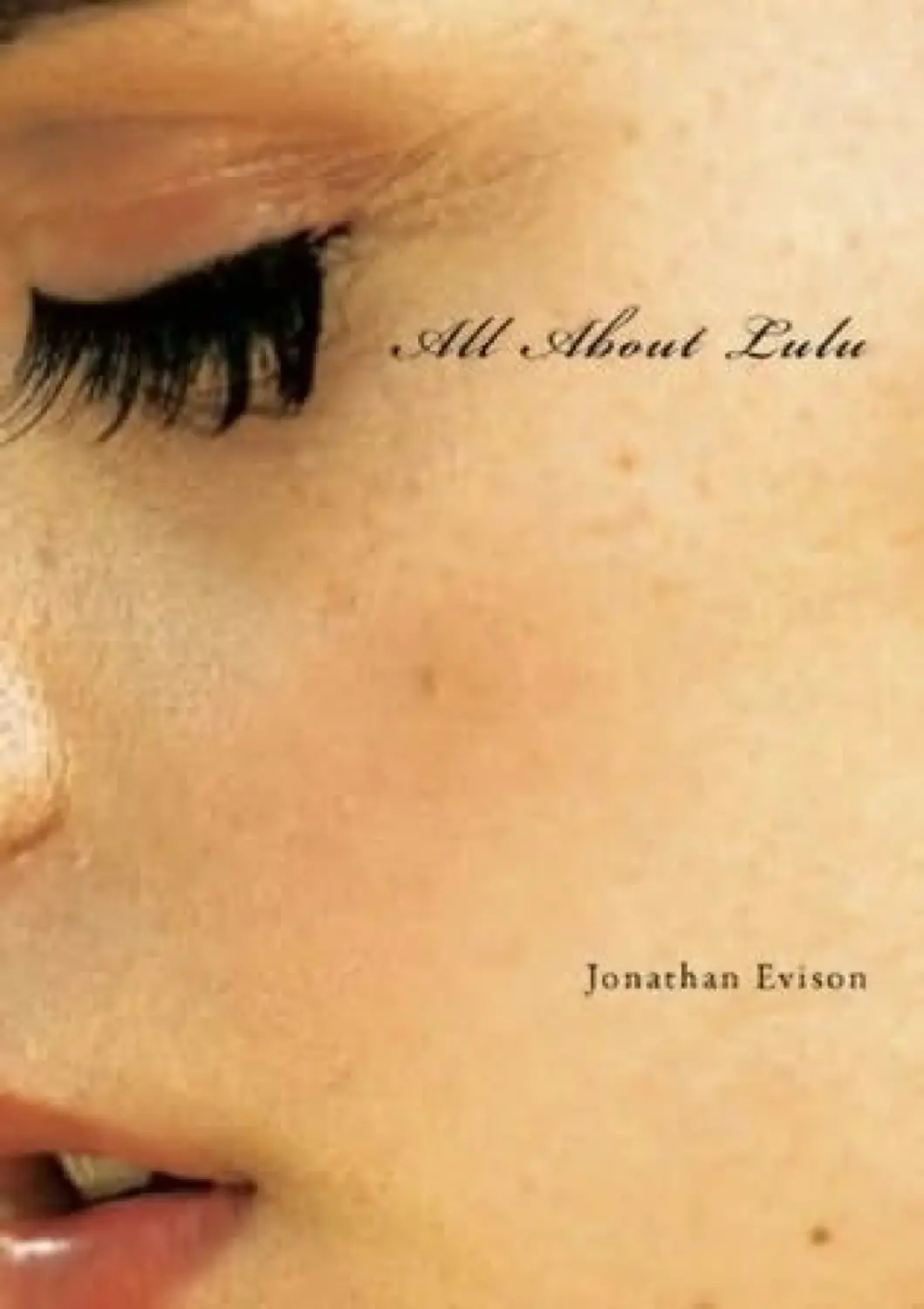
                    Jonathan Evison
All About Lulu
2008

PART 1: KEEPING THE PEACE

The World Is Made of Meat

First, I’m going to give you all the Copperfield crap, and
I’m not going to apologize for any of it, not one paragraph, so
if you’re not interested in how I came to see the future, or how
I came to understand that the biggest truth in my life was a lie,
or, for that matter, how I parlayed my distaste for hot dogs into
an ’84 RX-7 and a new self-concept, do us both a favor, and
just stop now.
My name is William Miller Jr., and my father is Big Bill
Miller, the bodybuilder. Suffice it to say, I was never called
Little Bill or even Little Big Bill. I was always called William,
or Will. I bear my old man no grudge for this. Sometimes the
fruit does fall far from the tree, and sometimes it rolls down
the hill and into the brook, and sometimes it’s washed
downstream, or gets caught in an eddy.
My younger brothers, Doug and Ross, are identical twins.
Moreover, they stuck close to the tree. They are the image of
Big Bill: the aquiline nose, the blue eyes, the turgid smile.
And, like their father, they are bodybuilders—tireless selfimprovers striving for physical perfection. Not me. If I look
like anybody, I look like my mother.
In spite of my status as a ninety-eight-pound weakling
and my total lack of athleticism, I’m nothing short of an expert
on the subject of bodybuilding. I grew up in gyms, primarily
the original Gold’s Gym in Venice and World Gym in Santa
Monica, just minutes from the Muscle Beach of my father’s
youth. I know the muscle groups, the training regimens, the
language, the poses. I can even tell you who won the 1979 Mr.
Olympia or the 1983 Mr. Universe, because I was there. I
know a great set of abs when I see them (Frank Zane), or
calves (Chris Dickerson), or traps, or pecs, or deltoids. I know

the acrid odor of sweat-soaked rubber mats, the iron clang of
clashing weights, the tingle of sweaty back skin ripped from
vinyl, the heaving and grunting and chest pounding. And none
of it holds any romance for me.
My earliest memories are of meat. Enormous lamb shanks
mired in beds of hardened grease. Giant carbuncled sausages,
reconstituted from the vaguest of mammalian origins, glowing
garish orange in the light of the refrigerator. My infant
brothers were consuming meat before their teeth broke. It was
not uncommon to see them padding about the house in
disposable diapers, dirty-faced and slack-jawed, gnawing on
drumsticks or cold hot dogs the way other kids gnawed on
binkys.
I became a vegetarian in 1974, at the age of seven. My
father was outraged.
“How can you not eat meat? The whole world is made of
meat!
Birds, cows, dogs, cats, they’re all made of meat! Even
fish are made of meat!”
“Well, then,” my mother said. “You’ll have no objection
to cat for dinner.”
Big Bill. It’s not that she outsmarted him—I could’ve
done that—it’s the way she outsmarted him, the way she did
everything, like she was dancing with life and let life lead,
doing everything life did, only backwards and in heels.
Nothing seemed to disrupt her balance or upset her
equilibrium. She absorbed whatever came at her.
For weeks after my avowed vegetarianism, Big Bill
insisted on heaping meat on my plate.
“It’s not meat, it’s sausage.”
He’d plop it on my mashed potatoes, park it on top of my
Jell-O, but I never touched it. If I’d inherited one trait from
Big Bill, it was his willfulness. And so I grew up on a steady
diet of powdered mashed potatoes. Once Big Bill forgave me
this eccentricity, he began to chide me about it, taunting me

with pork chops, bonking me on the head with bratwurst at the
dinner table.
“You are what you eat.”
“I see, Bill,” my mother said, with a wink for me. “You’d
rather your son be a bratwurst?”
My father wasn’t a bad guy, he just had a low threshold
for weakness. Once, in the driveway in front of the Pico house,
Big Bill and I watched a swallow with an injured wing mince
and flutter in semicircles, flapping its good wing to no effect.
“What’s the matter with it?”
“Hard to say. Something with the wing, I guess.”
Watching the little thing labor stupidly with no possibility
of success moved me for the first time to a desperation
separate and distinct from my own. Couldn’t it see it was
condemned to futility? Couldn’t it resolve itself to the cold,
hard fact that it had no future, that it was doomed, grounded,
finished? The answer was apparently yes. Eventually, the bird
gave up, spent and bewildered. Its little eyes went black as
obsidians, as though the light no longer penetrated them.
“What happened?”
“Cutting her losses, I guess. She’s beat.”
“How do you know it’s a she?”
“I don’t.”
She hardly moved at all after that. She just stood there
dazed minute after minute like she was asleep standing, or
she’d made up her mind never to move again. But I knew there
was life beneath those shiny black eyes, because I could feel
her little pulse beating inside me as if it were my own, and I
could see her tiny breast beneath her keel feathers puff out
convulsively now and again like she wanted to throw up. I’m
telling you, I knew that bird’s helplessness.
“What can we do?”

Big Bill gave the bird a little nudge with the toe of his
sneaker. It didn’t budge. “Not a whole lot.”
The last thing that bird saw, or maybe she didn’t see it
coming at all, was the business end of Big Bill’s shovel. There
wasn’t much blood. There wasn’t much of anything. She was
just flatter, and kind of twisted, and there was definitely no life
left behind those black eyes. Big Bill scraped up the remains
and tossed them to the curb.
Life seemed at once fragile and inconsequential when you
pulverized it with a shovel.
But cancer doesn’t hit like a shovel. And while Big Bill
continued to build his carcass up to world-class proportions,
cancer began carving up my mother. It arrived in a terrible
flash one rainy afternoon.
She came home from the doctor’s office and stood by the
window deep into the night. Big Bill burnt frozen fried
chicken for dinner.
In the night I padded down the stairs to the living room,
where she was still at her post by the window. Tentatively, I
approached her in the terrible silence, and she pulled me fast
against her. I clutched her about the waist, and she ran her
fingers through my hair as she gazed through the window into
the night.
A month later she took to wearing a blue knit stocking
cap.
For almost two years she fought without ever remitting.
Cancer wasn’t content to take her all at once; it wanted her in
pieces. It took her left breast, then her right. It turned her skin
to parchment. She grew so frail and reedy that I was afraid to
squeeze her. And yet, if it were possible to die gracefully of
cancer, my mother achieved that.
It could cut her to ribbons and take her hair, but it
couldn’t make her ugly.
Her final months were an exercise in endurance. She
spent untold hours in the fog with Barney Miller and Fred

Sanford. The sandman was never more than a slow drip away.
But I remember her voice in those lucid moments when the
fog burned off, and how it didn’t seem to come out of her
body, but out of the past. And I remember a certain pride in
being spoken to like an adult.
“Do you remember when you were just a baby, William?”
“Not really.”
She smiled. “I suppose not. But somehow I thought you
might, somehow you were different. Like you already knew
something, William, like you brought something into this
world with you. Do you ever feel that?”
“I don’t think so. I don’t know what it means.”
“You never acted much like a baby. Not like Ross and
Doug.”
In my seven-and-three-quarter-year-old mind, there was
something inherently ignoble about the condition of infancy,
thus I took my mother’s observation as high praise. I see it
differently, now.
“You were a very serious baby. You hardly fussed.
Sometimes I’d wake in the middle of the night to check on
you, and I’d find you lying awake in your crib, quite content,
staring up at the colored fish.”
How well I remember the colored fish, and the promise of
a material world moving slowly counterclockwise with no
surprises.
“You were not a needy baby, William. Although I’m
afraid I was a needy mother. Because I couldn’t let you lie
there on your back being content, I just couldn’t. I had to pick
you up and hold you, every time. You were so holdable,
William. And you never fussed, bless you.”
My jaw aches when I think what that must have felt like,
to be coddled like something precious, to be absorbed finally
and completely by another’s affection. But for whatever
reason, that feeling is not built to travel.

“Why do we forget?” I asked her.
“I don’t think we ever forget, darling. I think we just have
a hard time remembering.”
Not me. I remember it all. Every detail has been
preserved with cruel fidelity. So if there’s anything I like less
than gyms, anything I find more abhorrent than paining and
gaining, it’s hospitals, and those big colored Legos in the
waiting room, and the pop-up books, and the fish tanks, and
the cafeteria food, and the clipboards and the smocks and the
chemical smell that hangs in the dead air. These things I carry
with me always.
My mother’s death was more of a coronation, really. A
parade of cards and flowers and casseroles followed. The
cards piled higher, the flowers wilted, and the four of us sat
goggle-eyed around the kitchen table night after night, the
only sound the sickly buzz of the overhead light.
“When are we going to have something besides stupid
casserole?”
“Yeah, other people’s food is gross. Everything’s got
mushroomy gunk inside. When are we going to have our own
food again?”
“Shut up,” I said.
“Why aren’t we having juice? We used to always have
juice.”
“We’re out,” I said. “So just be quiet and drink milk.”
Big Bill didn’t say much during those first weeks. He was
like a wounded elephant. You got the feeling he wished he
could be small, but he was just too damn big, and too damn
clumsy in his grief. All he could do to fight it was to make
himself even bigger.
Six days a week we were all packed off to the gym, where
Big Bill pained and gained until you could see the blood
pumping through his ropy veins. The twins fell all over each
other like puppies, lifting and flexing and posing in front of

the mirrored walls, always under the watchful gaze of one
hulking “uncle” or another—whoever happened to be between
sets. I was less like a puppy and more like a lamp. I stuck to
the corner and waited out the interminable hours, thankful on
those occasions that I had homework to occupy myself.
On the seventh day, Big Bill rested. And that was the
hardest day for all of us, because Big Bill’s grief set him to
wandering absentmindedly all over the house, looking for
things until he forgot what he was looking for, turning on
every television, burning toast, vacuuming in unlikely places.
Then, one night, the geography of our family abruptly began
to shift, and never stopped. I awoke in the middle of the night
to find the twins standing in the hallway in matching footed
jammies, rubbing their eyes and looking a little bewildered.
All the lights were on. I could hear Big Bill bumping
about in the twins’ room, dragging something across the
carpeted floor. Peeking in, I found him dismantling the bunk
bed.
“What are you doing?”
He looked back over his shoulder, grinning like a wax
statue.
“Changing things up a little, Tiger. You wanna give me a
hand with that corner post there?”
“Now? Can’t you do it in the morning?”
“Why wait?”
Within forty minutes, Big Bill had moved out of the
bedroom and into the twins’ room. The twins moved into the
office across the hall. And by three in the morning everybody
was settled. But within a week, Big Bill relocated again, this
time downstairs to the couch, where he slept in the flickering
light of the television. The twins seized the opportunity to
move back into their old room, vacating the office, which Big
Bill soon claimed for himself, though he still spent most nights
on the couch. When the twins reinhabited their original room,

they switched bunks, so that Doug slept on the top bunk, and
Ross slept on the bottom bunk.
As for yours truly, I stayed in the only room I’d ever
stayed in, and I stayed there more than ever. And only once do
I remember Big Bill coming to me there, though I know that
he came more often—he must have. I was on my bed, lying on
my back, watching the shadows of the lemon tree play across
the foot of the bed. He came in and, not knowing what to do
with his wounded-elephant self, stood at the foot of the bed,
where the lemon tree shadows played across his legs.
“You all right, Tiger?”
“Yeah.”
“That’s good. That’s real good.” His gaze wandered about
the room. Even his vision didn’t seem to know what to do with
itself anymore. He picked up a Hot Wheels car from the
dresser and spun it between his fingers, then set it down again.
“You’re sure?”
“Yeah.”
“You don’t feel like maybe you want to talk to someone?”
“We are talking.”
“I mean somebody besides me. I have a friend, a
counselor. She’s nice. You might like talking to her.”
“No, thanks.”
He looked like he wanted to sit down, but couldn’t make
up his mind where. Finally, he squatted where he stood. “Well,
if you ever change your mind …”
“Yeah, okay.”
Now that he was squatting, he seemed more restless than
ever, like he wanted to stand again.
“Are you okay, Dad?”
“Of course, Tiger. Don’t you worry about me. I can take
care of myself.” Then, I swear, my father flexed his right

bicep, as though the strength to endure grief actually resided
somewhere in there. “Don’t you worry about your old dad.”
There is a family picture that was taken at Christmas,
about nine months after my mother died. Big Bill bought
everybody matching blue poly-fiber sweat suits with three
white stripes running down the arms and legs, and little white
zippers on the pant legs. He bought us matching tennis shoes,
like Adidas but with four stripes. We’re all wearing our new
uniforms in the picture. Big Bill is doing a front double bicep
pose with a twin dangling from each bicep. He’s got a fake tan
and he’s flexing his smile, so that he looks slightly adenoidal.
The twins are grinning like chimps as they swing on Big
Bill’s arms, impervious, it appears, to any imbalance in the
universe. As for me, I’m standing off to the side; at least, I
think it’s me—a cheerless spectator with bad posture.
I’m not saying that Big Bill rejected me; it might have
been that I rejected him. I’m just saying we didn’t have much
in common.
He was a lamb shank, and I was fashioned of an entirely
different stuff: powdered mashed potatoes. The twins, on the
other hand, were carved from the very same meat as Big Bill,
and in this way they managed to remain within his sphere of
influence. But while Doug and Ross were playing with
dumbbells and posing in their
underwear in front of mirrors, I was living inside of
myself; that is, my world was inside out. I had senses, but they
were all on the inside.
The sense that something was missing. The sense that this
missing thing would forever elude me. The sense that forever
as a measure of time no longer existed. The sense that I was
not being watched, and not being followed. And finally, a
sense that the universe had forsaken me, not out of malice, but
as an oversight. And so I built my own universe, and I
populated it with things remembered and things that never
happened, like the smell of my mother’s bathrobe, and the
twin brother I didn’t have.

And something strange happened to my voice. It became
scratchy and frayed at the edges, like a prayer flag. I was a
roaring mouse, afraid to open my mouth lest my big scratchy
voice bring the world to its knees trembling. Or worse,
laughing. My third grade teacher found my voice so
disconcerting that she recommended to Big Bill that I have my
throat looked into, to see if there was not some treat-able
abnormality: an obstruction, a lymphoma, a hole in the lung.
Maybe I was possessed; maybe I’d swallowed Billy
Barty.
And so it transpired that a swarthy man with an
unpronounceable name who smelled of alfalfa and hot apple
cider poked and prodded and generally violated my cranial
orifices with lights and swabs and mirrors and tongue
depressors, prattling on all the while about great big trucks,
and tractors as big as dinosaurs, small talk fit for a boy half
my age.
When the ordeal was over three days later, after the
cultures were cultured and the X-rays inspected, the copperfaced doctor called us back into his office and explained to my
father that he could find no abnormalities.
“The boy is unique. This is a blessing. With a little luck,
he might one day grow into this big scratchy voice of his.”
Big Bill wanted to know if meat would help.
“I’m not sure I understand your meaning.”
“Tell him,” demanded Big Bill. “Explain to my son, the
eight-year-old vegetarian, that meat is good for you, that you
have to eat meat to grow. How do you think cows got so big?”
The doctor explained that, while he was not a nutritionist,
he himself was a vegetarian and what amounted to a weekend
Hindu, and that cows, too, were vegetarians, a fact that seemed
to impress Big Bill. He proceeded to enlighten my father
regarding some cutting-edge research, which suggested that
meat was very high in cholesterol and saturated fat, and might
in fact increase the risk of thrombosis and heart disease. Big

Bill was stymied. But how can that be, when the heart is made
of meat?
And as ridiculous as it all sounds, Big Bill may have been
right about meat. I wore the same school pants for nearly a
year and a half after my mother died, and they never became
high waters. Even my hair stopped growing. If my voice had
changed again, I wouldn’t have known it, because I kept it
locked tight inside my chest. And I wouldn’t have known what
to say, anyway. I wanted only to grow backwards into
something I used to be.
The twins’ progress was unimpeded; they grew like prize
zucchinis. Nearly three years my junior, they had already
outsized me by my ninth birthday. They were giants, a full
head taller than anyone else in kindergarten. Their brains
couldn’t keep up. I’m not going to say they were dull, maybe
just unconcerned. They barreled through the buffet of life
grabbing drumsticks and fistfuls of Jell-O, shouting and
laughing and making friends without even trying to.
We commemorated my ninth birthday with a family
dinner party at The Captain’s Table, a queasily lit buffet of
Homeric proportions across the street from the Howard
Johnson’s. Despite the nautical theme, there was plenty of real
meat at The Captain’s Table: impossibly big meat—mutant
drumsticks, sausages as thick as beer cans, roasts as big as
camels.
To see Big Bill carrying on in a party hat, waving a
drumstick about like a ping-pong paddle, even if it was for my
benefit, was an indignity to my mother’s memory. Thus, I was
snake-eyed and sullen on my ninth birthday, and I did my best
to make the party a joyless occasion. And that’s how I
remember it: just the four of us and my dad’s old training
partner Uncle Cliff, a few months before he drove his car off
an overpass. He wasn’t really my uncle, of course, more of a
stranger, really. According to Big Bill he’d once had the
biggest chest in the world. But something was wrong with
him. His cheeks were hollow. He looked small inside his
hooded sweatshirt.

Cliff never went to the buffet, not even for firsts, which
left the two of us alone at the table for most of my ninth
birthday party—he with his empty coffee cup and me with my
watermelon rinds—while Big Bill and the twins made
continuous trips to the meat bar, the salad bar, and the potato
bar, in addition to trips to the bathroom between feedings.
Cliff wasn’t much of a talker either, which was fine by
me. We were kindred spirits that way. He nodded knowingly
now and again throughout the evening, as if to say: Pfff.
Birthday parties. Tell me about it. I hate buffets. The cluster of
colored balloons tied to the post nearest his seat kept hectoring
him. He’d push them away, but as soon as somebody passed
down the aisle, they’d drift back over and bonk him on the
head, and cling to the side of his face.
“Balls,” he said, at one point. And I’m pretty sure that’s
the last thing, and maybe the only thing, I ever heard him say.
Among the gifts I received upon the occasion of my ninth
birthday were a set of dumbbells, a Joe Weider powdered
vitamin supplement, an obscenely large vacuum-packed
summer sausage from Vienna, and, from Uncle Cliff, a World
Gym shirt with a cartoon gorilla holding the world above his
head like he wanted to throw it.

Mostly About Lulu

My life began again the moment I met Louisa Trudeau.
Without Lulu, I might never have existed again, might never
have known the smell of a gauze bandage or felt the delicate
winking of an eyelash against my cheek.
Arriving home slump-shouldered beneath the weight of
my book bag one afternoon in February, I discovered her
roosting in the breakfast nook in a swath of golden sunlight, as
though she’d been delivered to me.
“Your dad’s in the garage with my mom,” she observed.
There were a half dozen books spread out in front of her. “I’m
Lulu. But don’t call me Louisa. My grammy in Vermont calls
me that, and I absolutely despise it. When’s your birthday,
anyway?”
I was afraid to unleash the voice. All I wanted to do was
look at her. She was Mr. Potato Head beautiful. Nothing fit
right. But somehow this girl in the yellow socks, with the
small nose and the big ears and the gap-toothed smile,
achieved a certain harmony, a beauty greater than the sum of
its parts.
“It’s all right,” she said. “Your dad already told me. That
you’re shy, I mean. He said that you say about twelve words a
day. Is that true?”
I nodded.
“That must be hard,” she said. “I say at least twelve words
every thirty seconds, I’ll bet. Maybe even more. Sometimes
my mom tells me, honey, you don’t have to say every single
thing that comes into your head. But I don’t, really. I mean,
say everything that comes into my head. Not even close.”

She fell silent and turned her attention back to the book
directly in front of her. “Don’t you think unicorns are stupid?”
she said.
I shrugged.
“Well, I sure do. They don’t even make sense. And
besides, there are so many incredibly diverse kinds of animals,
why would you want to make one up?”
I could understand quite easily wanting to make things
up, but I didn’t say as much.
“Sandhill cranes are my favorite animal,” she pursued.
“Do you know about sandhill cranes?”
I shook my head.
“That’s okay, not everybody does. In fact, most people
don’t, actually.
They’re very large birds with very long necks. They do
beautiful dances and sing beautiful songs to each other. I might
be an ornithologist when I grow up. That’s a bird studier. I’m
not going to get married until I’m at least thirty-two. And first
I’m going to travel around the world at least three times.” She
went back to her book for a fleeting moment. “If you could go
anywhere right now, where would you go?”
All I could think to say was “back.” So I didn’t say
anything.
She looked at me kindly. “It’s okay if you don’t talk. I
don’t mind.
Actually, I kind of like it. That’s what my mom does for a
job, doesn’t talk. She’s a grief counselor. People come to her
office and talk about the horrible things that happen to them.
Like when their wife dies or their daughter d—” Stopping
herself, Lulu cast her eyes down and retreated into a very real
silence for the first time. “I’m sorry,”
she said, unable to look at me. “I wasn’t thinking about…
I forgot that …”

“That’s okay,” I said. “Really, I mean it, it’s okay.”
When she heard my voice she looked me right in the eye,
and I was frozen in the power of her gaze. “I’m sorry about
what happened to your mom.”
“That’s okay.”
“Do you want to sit down and I’ll figure out your
astrological chart?”
I swung my book bag onto the counter and took a seat
across from her, a little jelly-legged. I stared unabashedly at
her wild blue eyes as they scanned the pages, and her fast little
fingers as they rifled through her astrology books. Never had I
been so completely and unexpectedly disarmed by a stranger.
And soon I was talking. Talking like never before.
Liberating my beastly voice without fear of humiliation,
revealing my foibles without fear of judgment, and allowing
this miracle of a girl to tickle the edges of my despair simply
by listening to the sound of my voice, and something opened
in my chest and tingled like a frostbitten hand regaining its
warmth.
The more information she volunteered, the more her little
sing-song voice washed over me, the more I wanted to hear.
“I used to want to live above a gas station,” she told me.
“But not anymore. I still like the smell of gas, though. Just not
on my clothes.
What do you want to do?”
“I never really thought about it.” And that was true, up
until that
very afternoon. But then it became crystal clear to me that
I wanted to spend the rest of my days with her.
“Really? You never thought about it?”
“Not really. Maybe sometime I’d like to build
something.”
“Like what? Like a house?”

“Maybe. Or maybe just drive a car.”
“You mean like a taxi cab?”
“No. More like maybe my own car.”
“Like a race car driver?”
“Maybe. But maybe not so fast.”
“Hmm. Well, you’re a Libra like me, except that you’re
on the cusp. Libras make good lawyers, but I don’t want to be
a lawyer.
We’re supposed to be optimistic, too. Are you
optimistic?”
“I doubt it.”
“It says we can be indecisive, but I’m not indecisive. My
mom says, honey, you don’t always have to know what you
want right away, you can change your mind, you know. But I
don’t like to change my mind. Are you indecisive?”
“I’m not sure.”
“That’s okay. My mom says, Lu, sometimes it’s better not
to know the answer, because sometimes we’re wrong when we
know the answer.
But that doesn’t make any sense to me, because if you
know the answer that means you’re right.”
“Maybe she’s talking about wrong answers.”
“But wrong answers aren’t really answers.”
“I guess maybe if people think they’re the right answers
it’s the same thing,” I said. “My dad thinks the world is made
of meat.”
“Eww.”
“But I don’t. I’m a vegetarian. Not that I think the world
is made out of celery or anything. I just think it’s the world. I
don’t know what it’s made out of. A whole bunch of stuff, I
guess.”

“We should find out,” Lulu said, not knowing that the
invitation was the single most welcome invitation I would ever
receive, and that the mere gesture meant so much that the dead
spot inside of me started to ache in a good way.
Over the next few months Lulu and her mother drove
down from San Francisco almost every weekend, booking a
room in the same hotel off Santa Monica. They hardly ever set
foot in the room. Even their bags found their way to the Pico
house. Lulu staged her things in my room, and Lulu’s mom
carved out a spot in the office across the hall.
Lulu’s mom was Willow, a hatchet-faced but relentlessly
kind woman who reached out to me continually, though I
offered her little access. She seemed genuinely to want to
engage me, which made me respect her even less. She came
bearing thoughtful little gifts—gobstoppers and gliders—
which I accepted begrudgingly. The twins accepted her
without reservation, and I hated them for it.
Willow exhibited a strange influence over my father. He
stopped shaving and grew his hair and started listening to
Willie Nelson.
She even persuaded him to pick up an acoustic guitar on
occasion, something he apparently had not done since the year
I was born, 1968. The guitar looked small and silly, like a
ukulele perched on his massive leg. He didn’t sing, but
sometimes he moved his lips, and he always kept his eyes on
the fret board, looking a little awkward and confused, as
though he wasn’t quite sure from which angle to approach the
instrument. It seemed impossible to me that Big Bill ever
knew how to play the guitar in the first place, that he ever had
long hair or sat around beach fires wooing women, or that he
burned his draft card, or ate LSD. But then there were a lot of
things I didn’t know about Big Bill.
We began to take weekend outings like a real family. And
really, weren’t we America’s poster family for 1978? The
widowed bodybuilder and his three motherless sons. The
professional woman and her child prodigy. All of us piling into

the silver-striped van with its orange-carpeted catacombs and
tinted windows and Yosemite Sam mud flaps. Setting off for
the tar pits, Laguna Beach, or Knott’s Berry Farm. Carting
coolers of Craigmont soda and enormous Tupperware vats of
Big Bill’s famous macaroni salad, which even the twins found
inedible.
I’m not proud of my cruelty when I think of poor Willow
forever craning her neck in the passenger seat, trying
desperately to elicit some small familiarity or acceptance from
me, with offerings like, You know my real name isn’t Willow,
it’s Mary Margaret, or When I was a girl, we used to go to
Niagara Falls. Why did I punish her with aloofness?
My favorite destination was Cabazon, out near the
Morongo Indian Reservation on the 10, where a man named
Claude Bell—at the expense of a small fortune he’d amassed
over the better part of a frugal lifetime—realized his dream of
erecting a giant concrete brontosaurus in the arid flats of the
San Bernardino Valley. He opened a gift shop in its belly, and
immediately started amassing another small fortune to
bankroll a tyrannosaurus rex.
Cabazon was my favorite not because it captured my
imagination, but because it captured Lulu’s. The way she put it
was, “It’s a lovely dream, because it’s nobody else’s.” And
that’s how she saw the thing, not as a brontosaurus, but as a
dream.
While the twins ran amuck in the gift shop under
Willow’s supervision, Lulu, Big Bill, and I stood in the gravel
lot, with a half dozen other people, gawking at Bell’s
brontosaurus.
“That’s one big sonofabit—er, gun,” observed my father,
admiring the musculature of the beast’s foreleg. “Can you
imagine being eaten by one of these suckers?”
“The brontosaurus was a herbivore, Mr. Miller. That
means he only ate plants.”
“Plants?”

“Yes. Leaves and foliage and stuff.”
My father was incredulous. “No wonder they’re extinct.”
“That was because of the ice age, Mr. Miller. Not because
of what they ate.”
Big Bill set a hand on her shoulder and bent down to eye
level.
“I’ll let you in on a little secret, young lady: You are what
you eat.”
“That’s just a figure of speech, Mr. Miller. If we were
what we ate then we’d be cannibals.”
Lulu had a way with Big Bill, and though it didn’t occur
to me then, her way was a lot like my mother’s.
By the time Lulu became my stepsister in June, it seemed
impossible that I had ever lived without her. And the closer I
got to her, the more I knew that she was the only person I ever
cared to know.
Lulu was an entire population. You could string adjectives
together like daisy chains and not describe Lulu. Verbs came
closer: soaring, crashing, yearning, laughing, dreaming,
kissing. But metaphors came closest: Lulu was a white-hearted
starburst, a silver-crested wave.
Lulu was the sound electricity makes.
With the addition of Willow and Lulu, our family
geography was in flux again. The old house on Pico was a
patient and tolerant host.
No matter how we shuffled and displaced ourselves,
whatever arrangement we wound up in, the Pico house always
felt like the same old house at the end of the day. Willow and
Big Bill moved into the master bedroom, while Lulu took
residence directly across the hall from me, in what used to be
the office. My heart thrilled watching Big Bill heft her daisydappled yellow footlocker out of the van and carry it up the
stairs on his shoulder. The original trophy room became a
storage room for everything that used to be in the master

bedroom and the office. And in the spirit of migration, Doug
and Ross switched bunks again.
I, of course, stayed in the same room as always. But it
was different. The whole world changed. My universe was
right-side-out, and my regular senses returned with a sharpness
like never before. A new sense developed down in the very
center of me—possibility. And, miraculously, even my voice
changed. I no longer sounded like an emphysemic blackjack
dealer from Sparks. The sound that came out of my throat was
like velvet thunder riding on Caribbean breezes.
My words came from a different place. They weren’t
words anymore; they were positively charged ions crackling
out of my mouth like fairy dust. And I was a poet every time I
spoke the name Lulu.

The Book of Lulu

At ten years and eleven months, I began the Book of
Lulu, and the Book of Lulu was all about Lulu, nothing less
than a catalogue of everything even remotely Lulu: what she
wore, things she said, things she liked, things she hated—a
Farmer’s Almanac of Lulu.
August 29, 1979
She wore her yellow socks again. She’s getting a hole in
one of them. I smelled her pajamas in the laundry room today,
and I’m pretty sure that’s weird. They smelled like frozen
waffles.
September 3, 1979
When I ask her about her dad, she says she doesn’t have
one. She says it doesn’t matter, but I think it does. I think
everybody should have a father, even if it’s just Big Bill.
September 12, 1979
Big Bill was polishing the fender on the van today with a
yellow sock. I didn’t say anything.
By Thanksgiving, the Book of Lulu had grown to two
volumes. I kept them rubber-banded together in the big drawer
of my desk. But the truth is, Lulu’s discovery of my secret
would likely have come as a relief at that point, because if I
got any fuller of Lulu I was sure to explode. And the only way
to stand it was to grant myself the luxury of imagining that

Lulu actually had a Book of William: an everything-for-andabout-me book. But I doubt it. I really don’t think Lulu had the
patience for a book about anybody.
Christmas of 1979 saw my new family in full blossom. It
was the first holiday in three years not eclipsed by the shadow
of my mother. No chestnuts, no sleigh bells, no snow, but a
six-foot silver electric tree festooned with popcorn chains, a
variegated mountain of wrapping paper, and enough meat to
feed a small battalion: turkeys (yes, plural), hams, meatballs,
shepherd’s pie, mincemeat (the real deal), you name it. Three
days before Christmas, even as the feast was being cured,
soaked, thawed, and generally prepared, Lulu proclaimed
herself a vegetarian, and for once in my life I had an ally in the
meat resistance. While the Millers gorged themselves on all
manner of fauna, hoofed, winged, or otherwise, Lulu and I ate
baked beans and banana pudding for Christmas dinner.
As was the custom, Doug and Ross received identical
gifts, but fought over them anyway. Big Bill got them football
helmets in the largest size. They still didn’t fit. Providence had
blessed my brothers with enormous heads—one might even
say presidential—though nothing to fill them but glands.
Christmas of ’79 marked another milestone of sorts in that
it was the first Christmas I ever looked forward to giving a gift
more than receiving one—that is, the first year I understood
“the true spirit of Christmas.” The gift, of course, was for
Lulu, and was not one gift, but two: a small, trim, leatherbound diary (which I prayed she would fill with private
thoughts of me), and a new pair of yellow socks.
We did a covert exchange after breakfast in the trophy
room, a small wainscoted den cluttered with little bronzed men
in bronzed Speedos striking various poses. The walls were
adorned with framed posters of Big Bill Miller’s rippling
personage in various states of contortion, but smiling, always
smiling, the smile of a man rushing to deliver a painful bowel
movement at the frantic behest of Turk-ish customs agents.
And for whatever reason, the posters were autographed,

though it never occurred to me then to ask who autographs a
picture to themselves?
We sat Indian style in the middle of the room, a circle of
two.
“You first,” I said.
“No, you.”
“Please.”
She unwrapped the diary first. Her blue eyes smiled as
she caressed the leather and turned the book over in her hands.
“Oh, William, thank you, thank you. It’s lovely. I can use it for
my birds.”
She leaned over and kissed me on the cheek. My face
went hot in a flash. I could’ve given her gifts forever, could’ve
made it my life’s work, if only to look upon those smiling
eyes.
“Open the other one,” I said.
Deliberately, careful not to tear the already hopelessly
maligned wrapping paper, she finally reached the socks, and
her eyes were a circus of light.
“Yay, they have toes!” she said. “I’ve always wanted
socks with toes!”
“I know.”
“You’re so sweet, William Miller.” And she leaned over
and gave me a second kiss, which loosed a cloud of butterflies
in my chest.
“Now you,” she said.
Lulu presented me with a flawlessly wrapped package the
size of a Happy Meal. All I could do was look at it: the crisp
folds, the carefully taped edges, the way the paper was pulled
tight and shiny as a skin around the box. I felt unworthy of
such fastidious wrapping, as though such delicacy were wasted
on a boy made of mashed potatoes. It didn’t matter what was
in the box.

“Open it!”
I began to unwrap it carefully with clumsy fingers.
“Oh, just open it!”
The box said Tandy, so I knew it was from Radio Shack. I
tore the flap open and liberated two squeaky Styrofoam
bookends and pulled them apart to reveal a transistor radio.
“I already put the batteries in,” she said. “It’s AM and
FM.” Then, with a slight air of disappointment, she added: “I
wanted to get you Bone Phones but they cost sixty-four
dollars.”
I flipped the radio on and it hissed like a theremin in hot
oil.
“I like radio better than TV,” she announced.
“Everything’s too planned out on TV. In radio, everything is
floating in space and you get to choose. A radio is like a
spaceship and you can land it in whatever world you want.”
Navigating around the FM band, I grabbed little fits and
blossoms of music and patter.
“See what I mean? On TV everything would have straight
lines.
On TV you don’t do any work, you just watch. Radio is
different.”
I was soon in orbit around a voice on the low end of the
AM band. I finely tuned the static out and narrowed in until
the voice surrounded me with the warm deep clarity of
bathwater. And the voice (which I would later learn belonged
to Gary Owens), struck me as an awfully big voice to be
coming out of such a little box, and awakened a possibility in
me that would one day be the instrument of my destiny.
“I hope you like it,” she said.
Can you fathom my fullness? Can you understand my
gratitude?
Can you see all that Lulu gave me?

Shortly after the main event—the general gift exchange,
which saw the twins wrestling in a wilderness of wrapping
paper while Big Bill continually bellowed “settle down”—we
were instructed by Big Bill (who I can only assume was
instructed by Willow) to select three of our own gifts to give to
Friends Outside.
“Well, if they’re our friends why don’t we let ’em inside,”
said Doug. “That’ll be my gift.”
In the car, Doug cried at the prospect of giving up his
Super Jock.
He threatened to break the kicking leg so they wouldn’t
want it.
“Don’t you dare,” said Big Bill.
But within five minutes the leg was broken anyway when
Ross tried to wrest the helmeted hero out of Doug’s grip.
Friends Outside was not far from the airport. It was a big
two-story wood house in a stucco neighborhood, with chipping
paint and a sagging porch. Every three minutes or so the
shutters rattled on their hinges as airliners thundered overhead.
There was a sick willow tree out front, a giant, long past the
weeping stage, which only served to make the house darker.
A hard little woman who looked nothing like Mother
Hubbard greeted us on the porch. She led us inside through the
foyer to a huge living room, where eight or nine kids of
various ages and colors were lounging on ancient sofas or
seated on the floor around a game of
Monopoly. A huge old television was on in the corner.
The picture was squiggly. A few of the older kids looked up
when we entered.
“These people have been thoughtful enough to bring
gifts,” the woman announced.
I’ll never forget the terrible awkwardness of my new
family bunched together in the middle of that living room like
a wagon train, dispensing gifts. How desperately I wanted to

run from that place: the sad crepe paper ornamentation, the
joyless light, those old dusty couches. Everything about the
place spoke of strained circumstances, of our casserole days.
Lulu surrendered every gift she received, including the
yellow toe socks. I’m not proud of the fact that this gesture
wounded me, that behind my lame smile I was gritting my
teeth as she presented my socks to a black girl in pink barrettes
roughly her own age. I knew better, but I couldn’t help myself,
because no conceivable circumstance, not even the threat of
physical violence, could have compelled me to part with my
transistor radio.
On the drive back home, Lulu pressed her face to the
tinted window. She didn’t say a word about it, nor should she
have. I should have known how hard it was for her to give up
those things. But in spite of all I’d lost in my short life, I still
knew nothing of sacrifice.

Big Bill Down Under

My father was no emissary of American sophistication, a
fact that became painfully clear within eight minutes of our
arrival in Sydney, Australia, for the 1980 Mr. Olympia. I
realize it’s not a unique or un-usual condition to be
embarrassed by your father, but when, at every photo op, your
father persists in peeling off his T-shirt and setting his hairless
pectorals to dancing like a chorus line for gathering crowds,
embarrassment threatens to become a lingering condition.
Big Bill was optimistic going into Sydney, and he had
every reason to be. His back was ripped. His lower-body
definition was better than ever, and while his proportions may
have been slightly off (maybe a little top-heavy, though that’s
debatable), he looked better than in ’79, when he finished
fourth. His biggest improvement had nothing to do with
musculature, but with his posing, which had come light-years
under the tutelage of Willow. Having endured seven strictly
enforced years of ballet growing up in Vermont, Willow
managed to thoroughly transform Big Bill. In the past, he had
simply lumbered onto the stage and bungled through a rapid
succession of herky-jerky contortions, beaming like a jack-o’lantern in heat.
But Willow infused Big Bill with a sort of poetry, perhaps
the same poetry that inspired her at seventeen to leave behind
Mary Margaret and the pleated skirts of prep school in
Vermont and head west for Big Sur with the wind in her hair.
I think I was more nervous than Big Bill. I knew the
Olympia had become a five hundred–pound gorilla on my
father’s back, and I desperately wanted him to win it. Along
with Mentzer, he was probably the favorite up until Arnold’s
controversial late entry.

After a five-year absence, with a movie deal pending,
Arnold returned to Sydney in search of his seventh Olympia.
His appearance made everybody uneasy, and even before the
competition began there were whispers of conspiracy, fears
that the Olympia might be compromised in the name of
boosting the sport’s popularity. But Big Bill kept his eyes on
the prize. He didn’t let the Arnold circus distract him.
In what I can only view as a rite of passage, my father
asked me to oil him up before prejudging. I’d oiled up Big Bill
before: at Mr. South-west, Mr. Natural California, a couple of
promotional appearances at Lee Dobbs Chevrolet. But this was
Olympia, and even the ninety-eight-pound weakling in me was
wowed by such dizzying heights.
In my hotel room, hours before weigh-in, I was presented
with a blue poly-fiber sweat suit to match Big Bill’s. I would
be lying if I told you I was not proud of that sweat suit. That
sweat suit distinguished me.
Upon our arrival at the Opera House, Big Bill and I left
Willow with Lulu and the twins in the lobby, and the two of us
alone padded down a long carpeted corridor in our matching
sweat suits. And I knew their eyes were on my back—the
twins, Willow, and especially Lulu—and I felt
uncharacteristically significant carrying my father’s bag down
that corridor.
The green room smelled strongly of coconut and armpits.
Nearly every mirror was occupied. We walked the length of
the humid room, and my father nodded at familiar faces. Frank
Zane, Casey Viator, Danny Padilla. Kenny Waller patted my
head as we passed the pit.
My father took a place in the corner and solemnly began
shedding his poly-fiber skin. When he was free of it, he stood
before the mirror like a golden god, naked to the world but for
a shiny blue Speedo full of giblets.
And it was good. Soon he began to stretch and pump his
arms and legs until the blood began to engorge the muscles. I
stood close by, watching as though it were my job, ever ready

with the gym bag, now and again inspecting its contents,
folding my father’s sweat suit, rolling up his towel.
When he was done stretching, he gravitated toward the
pit, exchanging a little friendly banter with Boyer Coe and
Tom Platz on his way. I followed him at a short distance and
took my post, purposefully off to the side, and wore my game
face as I watched Big Bill do a set of curls, and a set of bentarm pullovers, and another set of curls. I told him one more
rep. I reminded him no pain, no gain.
At last, he toweled himself off and said: “Let’s do this
thing.”
As I began to oil him up, Big Bill set his attention to
sizing up the competition. Mentzer looked impressive in his
black banana ham-mock. Waller looked pale, but ripped.
Dickerson was a monster. But Arnold cast the longest shadow.
It was impossible to ignore Arnold—
he wouldn’t let you. He made a grand entrance and
proceeded like a peacock to strut his plumage all over the
green room, trying to throw everybody off of their game. As
he made his rounds, mugging while the others prepared,
Arnold kept his body covered with a cropped sweatshirt and
sweatpants, leaving all but his patented biceps and forearms to
the imagination.
“So, I see Big Bill is Bigger Bill for 1980. Zis is a lot of
weight you’re carrying, Bill. I hope you haff definition to
match.”
Big Bill looked straight ahead at the mirror as Arnold
circled him, and I was proud of him for that. He acted like
Arnold wasn’t even there, like it was just the two of us. “Don’t
forget my delts, Tiger.”
But Arnold was never good at invisibility. “And vut is zis
I hear you haff new wife? Congratulations.”
One thing I was learning about my new voice was that I
didn’t have much control over it. “Hey Arnold,” I said,
surprising myself.

“Beat it.”
Arnold broke into a wide grin, and set his hand atop my
head.
“Junior haff big voice. Maybe someday he haff—”
“Just leave!” I shouted, loud enough that Mentzer,
Padilla, and a few others turned to see what the fuss was.
To my astonishment, Arnold lumbered off with a wilting
smile and, for once, I didn’t have sand in my face.
Big Bill couldn’t suppress a grin. “Easy, Tiger.”
A half minute later I heard Liam Halstead tell Arnold to
bugger off, and I couldn’t help but feel that I’d given him the
strength.
“How are the lats?” asked Big Bill, spreading them like
wings.
“Looking good,” I said. “Remember to stay open when
you make your turn. Don’t close up too much, or your elbows
will get in the way. And don’t smile so hard. Breathe through
your nose. Turn around, so I can get your abs.”
He turned around.
“Flex,” I said.
He flexed. His abs looked great. Six distinct pillows
tapering into a perfect V at the waistline. I oiled between the
furrows. “Turn,” I said, with an edge of impatience. “Other
way.”
My father complied with a very content look on his face.
He winked at me. “Who’s gonna win this thing, Tiger?”
“We are,” I said.
And oiling him up, tracing the horseshoe musculature of a
tricep, the dimpled crown of an immense bicep, running my
small hands over the impossibly hard rubber girth of his upper
arms and shoulders, I thought he felt superhuman. His body

was impenetrable. For the first time I could almost fathom my
father’s unwavering faith in meat.
I stayed backstage beside Big Bill until the moment he
was announced. As the applause set in, he straightened up and
drew a shallow breath.
“Here goes nothing,” he said.
I patted his backside like Waller might have. “Remember.
Stay within yourself.”
He smiled. “Gotcha, Tiger.”
The new and improved Big Bill Miller glided onto the
stage as if he were skating on Vaseline. At center stage, he
spun around ninety degrees, faced the audience, and stood at
ease for the briefest of moments. Really at ease. Grinning like
Ronald Reagan on Thai Stick.
Though his skin was stretched beyond all capacity, like a
mutant blood sausage, he looked comfortable in it for the first
time ever.
Then the music began: something from Bach. Big Bill
didn’t hurry, he didn’t force anything. He bowed his head and
slowly exhaled, then rose up again like a sunflower to face the
sea of flashbulbs. He stretched his arms out to embrace
eternity, then eased them back in like he was gathering up the
universe, and when he had the universe in his grasp, he closed
his fists upon it and sent it crackling down his forearms to his
biceps, which swelled until it seemed they would burst like
supernovas. His transitions were seamless. Front double bicep
melted into side chest melted into back lat spread. He made his
mandatory poses look like tai chi. What’s more, he invented
poses, or I should say Willow invented poses, poses that didn’t
have names like “front double bicep” or “back lat spread,” that
had names like “starry bowl of night” and “valley brimming
yellow with mountain lilies,”
and that looked just like they sounded. When Big Bill left
the stage, both at the prejudging and the main event, he got a
bigger ovation, more oohs and aahs than anyone, even Arnold.

Backstage, Big Bill was ramped up, couldn’t sit still long
enough to watch Corney or Platz follow on his heels.
“Relax. We got ’em,” I said.
“You sure?”
“Sure. You heard them.”
Big Bill leaned into my assurance like it was a campfire.
“I think you’re right, Tiger. I think we got ’em this time.”
Had I been picking them, I would’ve picked Big Bill first,
Mentzer second, Dickerson third, and Zane fourth. Arnold
would’ve finished sixth behind Boyer Coe, maybe even
seventh behind Roger Walker.
When Zane was announced at third, I quickly made the
adjustments. Mentzer second, Miller first.
Big Bill gave me a wink, then held his chin up to greet the
news.
I prayed that I would not hear his name next. I grabbed
his hand and squeezed. It was Chris Dickerson, another
surprise at second.
Big Bill gave my hand a squeeze, and looked impressed,
and avoided looking at Mentzer as he rocked back and forth on
his heels.
Tough luck for Mentzer, I thought. It was his last shot,
and he finished out of the money. Though watching his
reaction from twenty feet away, I could see, unmistakably, that
he still thought he’d won it all.
But I knew differently.
There are moments when realities collide, when
expectations become so real that there’s no telling them apart
from the future. Always in that terrible instant of contact,
there’s a chill that shoots through you, almost like a shiver, or
a bolt of electricity, and something is lost irretrievably in that
moment. For Mike Mentzer, it was his shot at ever claiming an
Olympia. For Big Bill Miller, it was something else entirely. I

wish I knew what. But when Arnold was announced as the
winner in the Masters Division, something was inexplicably
lost between my father and me. We would never again capture
the intimacy we shared in those hours before the ’80 Olympia.
Big Bill was irritable for the rest of our stay in Sydney,
spitting vegemite into napkins, complaining about portions,
refusing to walk through the Royal Botanic Gardens. Willow
tried to finesse his ego-bone back into place for the next two
days, but her patience had worn thin by the afternoon of our
departure, and when he started grumbling about the length of
the check-in line at the Sydney airport, she let him have it in
front of all of us.
“Damnit, Bill, since when did you ever have any trouble
moving on? Tell me that.” She blew a few frizzy strands of
hair out of her face, dragged her suitcase forward a foot or so,
and growled in frustration. “You’re so damn quick to just forge
ahead at every juncture, until the minute your damn ego gets
involved, and suddenly you’re incapable of forward
propulsion, Bill, you’re spinning your wheels in the mud. And
the rest of us are tired of getting spattered.”
But it didn’t stop. Something had burrowed its way under
my father’s thick skin. It soon penetrated the muscle and
began to fester there. I’d always assumed it was failure in
some shape. With hindsight, I see it probably had nothing to
do with his disappointment at the results of the 1980 Olympia.
It was probably just guilt.

Forever

For all his improved posing and posturing, I don’t think
the discomfort of living was ever any less acute for Big Bill.
Willow taught him poise, but she could not teach him finesse.
Because, more than anything else, he liked short endings.
Whether they were happy or sad, he liked them abrupt. He
liked to avoid confusion. And nowhere was this more apparent
than in his relationship with Lulu, where everything ended in
yes.
“I’m asking you, because I already know what Mother
will say.
Can I?”
“Yes.”
“Will you?”
“Yes.”
“Tomorrow?”
“Yes.”
“Can William?”
“Yes.”
Yes, Lulu, yes. Yes, yes, yes. Not because it’s a good idea,
not because you earned it, but because, well, it’s short.
Nobody argues with yes. In this way my father failed Lulu as a
stepfather. He assumed no jurisdiction over her beyond the
word yes. What did he deny her by never saying no?
Suspense? Dialogue? I can’t say for certain. Maybe just the
knowledge that her life was somehow conditional.
But then, maybe that’s not fair. Maybe I’m not qualified
to make that judgment, having asked Big Bill for so little, and

having accepted no so readily my whole life. Probably I
should be thanking him, because if he’d been any more of a
father to Lulu, she would have only been more of a sister to
me, and as it stood, she was so much more. Without her, I may
just as well have been silent, because most people could not
seem to hear my voice. Often when I spoke to the twins, they
looked at me like Saint Bernards. I’ll admit there was a
genuine eagerness to connect in those big, dull eyes—a light
of recognition that flashed now and again, causing them to tilt
their heads in wonder—but no matter how hard I tried, I just
couldn’t speak Saint Bernard. I couldn’t speak Big Bill, or
even Willow. Couldn’t speak gym teacher, or math teacher
either. I could only speak Lulu, and through Lulu I could speak
to the world.
I was willing to share anything with Lulu without fear of
shame or betrayal. There was no secret that I could possibly
keep from her, nor she from me. And finally, one evening in
the trophy room, where we congregated under the pretense of
Scrabble, beneath the waning light of dusk coming through the
window, Lulu showed me everything without embarrassment.
Lifting her blouse over her head and deftly unclasping her bra,
she revealed to me the milky-white protuberances budding
beneath her blouse. She let me run my hands once over them,
let me heft the plumpness in the palm of my hand and run my
thumb over the impossibly soft pink skin of her areolas until
the nipples began to rise. Nothing that came before had ever
prepared me for such a thrill. And more thrilling still was the
promise of more—a lifetime of more.
Before I knew it, it was over, and she was fastening her
bra. “You still haven’t showed me yours,” she said.
“It’s not the same,” I pleaded. For, indeed, there remained
one diminutive hairless secret, which I was loathe to reveal,
the same secret that inspired my tardiness to swim meets,
which found me straggling into the locker room three minutes
after the bell so that I could undress in solitude.
“It’s easy just showing me your boobs,” I observed. “It’s
different with mine.”

“I’ll show you more, then.”
And so my fate was sealed. Lulu kept one eye on the
doorknob as she unzipped her jeans and leaned back against
the dresser. She slid the dark denim down with her
underthings, over her knobby knees, until the cloth was
gathered about her ankles and I could see a little spotting on
her underpants, which I knew to be period blood. Numb with
expectation, my eyes sought hers for approval, and when it
was granted, I got down on my knees and gazed upon the
downy hair of her lap. It formed a lovely letter V, cleft down
the middle by a fleshy delicate thing, an exotic fruit I’d only
dreamed of. I was so close to her lap that I could actually
inhale the odor of it, the faint muskiness of a perfumed neck
on a hot afternoon. I knew its softness without touching it. I
did not even attempt to touch her, though I suspect that Lulu
would have allowed me. I wanted to savor that for later.
And that, my friends, is the mark of innocence. I could’ve
kneeled there the rest of my days looking and smelling, and
probably would have, had Lulu not prompted me otherwise.
“Get up,” she said, pulling her pants up, her gaze still split
between the door and her jeans.
And when the time came for me to hold up my end of the
bargain, the blood went out of me, and I wanted for the life of
me to disappear.
“You don’t have to, if you don’t want to,” she said.
“But I do. It’s just that …” Ever so deliberately, as though
I were undressing for the gallows, I unfastened my jeans. “It’s
really small,”
I cautioned.
“So?”
“I mean, really small.”
“Just show me.”
When at last I exposed my willy to the cold air, I clamped
my eyes shut, and when Lulu did not laugh, or gasp at my

abnormality, I unclamped my lids to find her kneeling before
me, gazing in wonder at my boyhood, which began to swell
under the force of her gaze until it stood at attention like a link
sausage. I flushed in an instant.
Lulu tilted her head and inspected it from different
vantages, but she didn’t touch it.
“I think it’s pretty,” she said, with a smile.
Is it any wonder that Lulu earned my undying devotion?
She had only to read my goose pimples, or the furrow of my
brow, to know precisely what I was hoping or dreading. We sat
side by side on the school bus, we ate lunch together, we made
covert trips to the bathroom for the purpose of exchanging
intelligence, and when we arrived home from school we
passed the afternoons together in the trophy room, or in the
backyard where the wind stirred the pampas grass.
Did our friends think we were odd? We didn’t have any
friends. I was friendless by definition, and Lulu was friendless
by choice. Don’t you see? She chose me. And for that, I was
forever grateful.
Even as the fabric of my new family began to show signs
of wear— even as Willow and Big Bill began to fight over
everything from
Reaganomics to Ragú, as the twins learned by painful
degrees to covet their precious autonomy—Lulu and I grew
together like two stalks into one plant. We invented our own
language, in which every word was spelled out so that only we
could understand it, and when spoken aloud the vowels were
represented by a succession of exaggerated blinks, or squints
—one blink for A, two blinks for E, and so on through I-O-U,
and the consonants were symbolized by the first letter of the
most beautiful words we could think to begin sentences with,
sentences that sounded like spells or incantations, made up of
English words and Spanish words and French words we didn’t
even know the meaning of, and it didn’t matter, so long as they
rolled off our tongues. If ever I were to summon the courage to
tell Lulu I loved her, I would tell her like this: Blink squint

blink, lullabies from the womb, blink squint blink squint,
velvet throne of the goddess Inana, squint blink, Yoruba’s
black as night. Blink, squint squint blink. Blink squint blink
blink blink.
The twins thought we were insane. Willow had our eyes
examined, and as it turned out I was badly in need of glasses.
Big Bill wasn’t surprised in the least. “Meat needs meat,”
he observed. “Why should the eyes be any exception?”
Soon I was outfitted with a pair of thick black safety
frames—the only frames substantial enough to accommodate
the telescopic lenses I required. The frames were hopelessly
outdated, a relic from the mid-’60s. Not even Devo could save
me. They had a fishbowl effect, so that my eyeballs looked
huge, Martian-like. The sheer weight of the things caused my
neck to ache.
The upside, of course, was that I could see Lulu better.
“Tell me again about sandhill cranes,” I said, one gray
Saturday in the pampas grass.
Lulu lay stretched out upon her back, staring up at the low
sky.
Moments before, she’d permitted me to cup my hands
once more over her breasts through her cotton blouse, and with
the blood pounding in my temples I had discovered, as per the
foretelling of my vivid imagination, that they were now more
than a handful. She had a dreamy cast about her now, as she
did whenever she talked about birds, a faraway look, as though
she herself had once tasted the thrill of flight. “Every year they
gather on the banks of the North Platte River. They nest in the
same spot.” She plucked a foxtail and placed the stem between
her teeth. “And when they meet their mate, they mate for life.
And they do the most incredible mating dances. Leaping and
jumping and craning their necks. And they do this thing where
they stretch their wings way out like they’re doing tai chi. The
mates do these things called unison calls, which are different
from all the other calls they make. I saw them on KCET.

They’re long and lovely and heartbreaking. Someday I want to
go there,” she said.
“Before the cranes are all gone.”
In time, our language evolved into a written form, and the
vowels were symbolized by pictures of cumulous clouds, and
planets with glowing rings like Venus, and spotted
mushrooms, and fields of rippling wheat, and cows jumping
over moons. There existed no word in our language for
suffering, or cancer, and there was no word to symbolize the
number one, although there existed a word for zero and a word
for two, in fact there were a 118 words for two. And there was
no word for apart, but there was a word for together, and when
you saw it written down it was the most beautiful word you
ever saw, and to hear it aloud was to hear a chorus of angels
singing. And it didn’t matter that I was motherless and
forsaken and wore oversized glasses, or that nuclear holocaust
seemed imminent. None of that mattered so long as there was
Lulu to keep me warm through the nuclear winter.
“Even though I’m not going to get married until I’m at
least thirty-two,” she told me in the pampas grass, “that
doesn’t mean I’m not ever going to get married, you know.
And it doesn’t mean you can’t always be my boyfriend until
then, as long as you don’t mind traveling around the world at
least three times. My mom says that’s the test. Traveling
around the world with someone. She says that you can always
see a person’s true colors that way. But I doubt it would make
any difference for us. Besides, we’ve already been to
Australia, and that’s halfway around the world. It’s just a
matter of whether you want to travel around the world three
times. If you don’t, that’s okay.”
“Don’t worry, I do. At least three times.”
“That’s good. I figured you would. I think it would be
better that way, with both of us. That way we’ll always have
four eyes.”
“Six,” I reminded her, tilting my glasses.

And the truth is, I doubt whether I would ever have seen
much of anything if it weren’t for Lulu, because, no matter
how corny it sounds, she really taught me how to see. She
taught me not to look past things, not to take them for granted.
She taught me to look at things until I saw them differently.
“Things are changing all the time,” she told me. “If you
look hard enough, you can see it happening.”

The Hot Dog of Despair

Lulu went to cheerleading camp in Vermont the summer
after sophomore year, which was perhaps the most un-Lulu
thing she ever did, and, I suppose, in that respect, the most
quintessentially Lulu thing she ever did. She was going to stay
with her grandparents in Burling-ton for the better part of the
summer.
“It’s not like I’m never coming back,” she told me in her
bedroom the afternoon she found out. “It’s just summer.”
“I know. But what am I supposed to do? It’s not fair.” I
was alluding to the fact that while Willow was planning to fly
out and join her for a month, I was being forced to stay behind
without any good reason.
“Sit down,” she said.
“Look at me.”
I looked at her.
“Quit moping and think of the adventures we’ll have to
talk about later.”
“I don’t want to have my own adventures.”
“Then we can talk about mine.”
“But I want to be there for them.”
She smiled, a little sadly, I thought. She brushed my
greasy bangs off my forehead and gazed into my Martian eyes.
“Don’t worry, you will be.”
I was sentenced to six interminable weeks at the gym that
summer watching Big Bill take yet another run at the Olympia.
The fallout from the ’80 contest had soured me forever to the
charms of bodybuilding. Even if the summer of ’84 had

promised some form of rekindled intimacy with my father, I
probably wouldn’t have wanted it. I argued that at fifteen I was
old enough to stay at home alone, but he made me go to the
gym anyway.
A lot of the old faces had disappeared from Gold’s.
Waller was gone. Corney and Padilla were gone. Platz was still
holding on, but something was happening to his face—it
looked rubbery, like something stretched too far. Boyer Coe
was still around, though I’m pretty sure he was dyeing his hair.
There were a lot of new faces, young serious guys. The gym
was different, too. Cleaner. Quieter. Softer around the edges.
Guys weren’t cranking Sammy Hagar like they used to, they
weren’t jumping around and hooting like sex-crazed baboons.
The place even smelled different. Less like armpit.
By then the twins were already old standbys at Gold’s.
They’d reached puberty years prematurely, and were well on
their way to muscle-bound by the summer of ’84. Doug wore a
mustache before his thirteenth birthday. Ross opted to shave
his. Their lats were so overdeveloped that their arms would not
hang at their sides—they jutted out a good foot and a half from
their torsos. They walked through life like gingerbread men,
trumpeting farts and grinning broadly at their own fetid
bouquet. Their Adam’s apples had outsized their brains. If ever
I wished to turn my universe inside out again, it was that
summer. But my outside senses were achingly clear.
I remembered every clang and every belch and every
sweaty fart that smelled like lasagna. I remembered every
grunt, every wallow in sexual retardation, every pussy hair
band the radio blared that summer.
To this day I can hear every battle cry of no pain, no gain
as though somebody were still shouting it in my ear.
My lone occupation during those interminable hours at
Gold’s was the Book of Lulu, which, in its fifth year of
existence, had grown far beyond the earmarks of a healthy
compulsion. It numbered seven volumes by midsummer.

July 12, 1984
Actual conversation between Doug and Ross today at the
gym:
Doug: Knock it off, faggot!
Ross: You’re a faggot.
Doug: No, you are.
Ross trumpets a fart.
Doug: Chew your food, ass-wipe.
Ross: You’re an ass-wipe.
Doug: No, you are.
I thought life without Lulu would be like drowning. But
drowning sounds peaceful. I slept in her bed again last night.
Her pillow still smells like her.
It soon became apparent that something was amiss in
Vermont.
There were nightly phone calls from Willow, which Big
Bill always took in the master bedroom, talking mostly in low
tones. I eaves-dropped as best I could.
“You’re the one who—now, just hold on a minute, here…
Well, that doesn’t mean that—of course, I don’t blame her, and
I don’t blame you for—let’s not blow this thing out of
proportion …”
But the proportion apparently had been blown. The calls
got longer, the tones lower as the summer progressed.
“How do you know? She said that? Jesus. Yes, of
course…
of course! No, I don’t think that’s a good idea. I’ve told
you why.
This doesn’t concern—well, it doesn’t have to, then.
You’re the grief counselor …”

I grilled Big Bill for information, but he refused to
disclose anything.
“It’s nothing.”
“Is everything all right? Is Lulu okay?”
“She’s fine. Just growing pains. It’ll pass.”
The more I pressed him, the less patient he became.
“Everything is fine. Now, drop it. Pass the macaroni.”
But everything wasn’t fine. The calls continued, the tones
remained hushed. Once, I stood outside Big Bill’s room in the
darkened hallway, with my ear pressed into the slight opening
of the doorway.
“That’s ridiculous,” he said. “What makes you think the
incident has anything to do with it? Of course I haven’t told
them.
We’ve already discussed that. Well, that conversation is
just going to have to wait. No…no, I don’t expect I’ll be
changing my mind.
Yes, of course I am, of course I do. Damnit, you were
complicit too, Mary Margaret, you can’t put this squarely on
my shoulders.
Of course I do…yes…of course…I understand that. Put
her on.”
I heard the bed creak. Big Bill heaved a heavy sigh. When
he started speaking again his voice sounded weary. “Lulu,
honey, I know you don’t want to talk about it, but—I’m sorry
about that, honey…Yes, I know, please don’t—I understand
you’re angry, sweetheart. There’s just so much to expl—just
let me expl—I understand…Yes, I’d feel the same way, I don’t
blame you. I blame myself. But there’s a lot more to this
than…Oh, sweetheart, please try to understand.
I know this sounds—I know it sounds like—I will make
this up to you, but you’ve got to let me, honey, you’ve got to

under—Lulu, honey, stop. Please just tell me what happened
…”
The bed creaked again as Big Bill got to his feet. I could
hear him pacing the floor. “It is a big deal,” he said. When his
pacing brought him closer to the door, I pulled back a half foot
and swiveled my shoulders around to avoid detection.
“You’re damn right it’s a—Well, that’s not what your
mother said.
Now, damnit, I want the straight stuff here, I wanna know
just what exactly …” Then he closed the door, and his voice
went muffled, and his pacing carried him toward the farthest
corner of the room.
In the morning I confronted him again in the breakfast
nook.
“Nothing’s the matter. You’re blowing this out of
proportion. Lulu quit cheerleading camp, that’s all. Just some
growing pains, teenage girl stuff,” he assured me.
I had no choice, really, but to toe the Miller party line—
that is, to act like a traffic cop at the scene of a grizzly
accident. But just because I toed the line didn’t mean I
believed it for a minute—not when words like blame and
complicit were being whispered behind closed doors. I
rounded up the usual teenage suspects—shoplifting, drugs,
alcohol, sex, vandalism. But none of them quite suited Lulu.
Maybe she really did quit cheerleading camp. Maybe she
lied about it. Maybe she was skipping out on camp and Willow
found out.
Whatever it was, it would pass. Lulu would probably get
grounded
when she returned. Big Bill would go soft on her.
Everything would return to normal. The important thing was
just getting Lulu back to Santa Monica before I went out of
my mind.

The longer Lulu was away, the harder it became to
summon her face, her smell, her touch. At night I dreamed of
her, or fell asleep trying. I pursued her down dark corridors,
through vast labyrinthine cities of my own invention. But I
could no sooner catch her than I could roll over and touch her.
In the waking hours I summoned her image with the help
of photographs. I sat on her bed and buried my face in her
bras, inhaling her scent and leaving spots of drool on the cloth.
I lay belly down on her bedspread straddling her pillow with
my loins on fire, caressing her breasts, sucking her nipples.
And when I took my relief from the unbearable pressure of
Lulu, it felt altogether different than when I thought of anyone
else, and the fruit of my labors sprang from some deeper well.
July 16, 1984
She still hasn’t written. I felt so bad today that I ate a hot
dog. Then I puked in the van. The twins called me a wuss. I
called them faggots. They said no, you’re a faggot. I said no,
you are. Something’s happening to me.
Something was indeed happening to me. After three
weeks without Lulu, without so much as a phone call or a
postcard, I’d lost my voice.
My beautiful velvet thunder, like everything else, had
forsaken me, and nobody seemed to notice. When I opened my
mouth to speak, the positively charged ions did not crackle out
like fairy dust. Instead, negative space streamed out of my
mouth, swallowing anything in its path, and then it collapsed
back inside itself and filled me with nothingness.
For two weeks my hair stopped growing, my nails
stopped growing.
My dream cities disappeared without a trace. No thought,
no smell, no image could arouse my erotic life force. My
young manhood wilted, and the seeds of my possibilities dried
up before I could ever sow them.

Then the postcard came. I gazed upon its beauty without
ever looking at the front of it. Every inch of the card was filled
with tiny writing. Participles dangled into margins, sentences
curled around stamps. It must have been five hundred words. I
began reading it as I mounted the stairs.
Right away I could tell something was wrong. The tiny
words ran their circuitous route down the card, forming
sentences, then paragraphs, but there were no cumulus clouds,
no fields of wheat, no lovely incantations. This was not our
language. These were only words. Regular words.

Electives

Lulu was not the same when she returned from
cheerleading camp in Vermont. She spoke without blinking
and squinting, and her words were antimatter. She was distant
and cheerless and she’d started smoking cigarettes.
September 1, 1984
Yesterday was the worst day of my life until today. Today
Lulu acted like I was a total stranger. She wouldn’t tell me
about Vermont. She wouldn’t tell me about anything. She
won’t even look at me. Maybe she knows about the bras, or
about me humping her pillow. Maybe she even knows about
me sucking her nipples.
I was determined not to annoy Lulu. But in the end I was
weak.
One evening when Lulu snuck out for a smoke, I followed
her, and fell into stride with her along the shadow-dappled
sidewalk in the direction of Joslyn Park.
“Do you hate me?” I said.
“Of course not. I could never hate you. I’m just not
myself anymore.”
“Why not?”
“It’s not a matter of why. It’s just a bad case of the way it
is. It’s nothing personal, William. It’s just that if I were you, I
wouldn’t count on me anymore. Not like you used to.”
“What do you mean?”
Lulu puffed on her cigarette. I could tell she felt my eyes
staring holes into her. She looked off in the other direction. “I

mean, I don’t think I can be the same kind of friend to you
anymore.”
“And what kind of friend is that?”
“I just want to be more like, I don’t know, I guess, like a
sister, you know?”
I was eerily silent.
She stopped along the sidewalk. “What’s so wrong with
that?”
I kept walking.
Lulu hurried to catch up, and threw her cigarette into the
gutter. “Well?”
“Well, what? What am I supposed to say to that? I don’t
even know what it means.” I was practically foaming at the
mouth. “You’re acting all weird and distant and you won’t tell
me why,” I growled.
“It’s like you’re trying to give me this whole breakup
speech, and you won’t even tell me what I did.”
“You didn’t do anything.”
“Then what’s so wrong with me?” I picked up my pace
and focused my sullen gaze straight ahead.
Lulu stopped again. “Nothing,” she
“Nothing’s wrong with you. It’s me, William.”

said

softly.

Some dark cloud had settled on our household. There was
a palpable tension between Big Bill and Willow, and Lulu and
Big Bill, and Lulu and Willow. In short, between Lulu and
everybody. It filled the dining room like bats. It hovered about
the kitchen like a cloud of mosquitoes. Even meat could not
appease it. It was a force of gravity that compacted words
before they were ever uttered, a force so strong not even the
twins were impervious to it. There was no farting at the dinner
table. No wrestling in the stairwell.
I was so full of dread, so helpless and uninformed, that I
actually looked to Big Bill for guidance. I caught him as he

was packing his gym bag, a strapped canvas sausage that lay
on the bed.
“Dad, what happened?”
“What do you mean, Tiger?”
“To Lulu.”
He started rummaging through his sausage bag. “Oh, just
girl stuff. We’ve been over this already at least three times.
You know how they are. Probably jilted by some polo player.”
“It’s not that. Something’s wrong.”
“Look, Tiger, teenage girls are moody. I wouldn’t read too
much into any of this.”
“What should I do?”
“Nothing,” he snapped, but softened immediately.
“Nothing.”
He set his massive hand on my shoulder. “Give her a
week and she’ll be back to her old self.”
I think Big Bill really believed that. There was no use
pushing him further. I’d only run into a short ending. I ducked
his massive hand and turned to leave.
“Will?”
“What?”
“Well, son …”
“What already?
“Look…you’re fifteen years old.”
“Uh, yeah?”
“I’m not exactly sure how to put this, but…Don’t you
think it’s time to start…well, you know, spreading your wings
a little?”
I was determined to make this hard on my father, though
it was plenty hard for him already. “My wings?”

“Well, I mean…socially? Don’t you think that maybe
you’re just a little too…attached to your sister?”
“She’s not my sister.”
“Well, it amounts to the same thing. You should make
some friends, branch out, join a club or something.”
“A club?”
“Well, yeah, sure. An after-school thing. Chess club, or
something. Debate club. Don’t they have a support group for
vegetarians?
The point is, branch out. Give your sister a little—”
“She’s not my sister.”
“—give her a little space. Let her work through this stuff.
How’d you like to start lifting?”
“You’ve got to be kidding.”
“Why not?”
“Why?”
“Okay, then. Fair enough. Just tossing that out there.” He
zipped up his sausage bag. “But you better do something, Will.
It’s time. You need to give her some breathing room from here
on out. Otherwise, you’re going to suffocate her.”
He slung his sausage over his shoulder and patted me on
the back on his way out of the room.
Come September, Lulu and I wound up with one elective
together—
Sociology, with Kimball. Though there were empty seats
both directly in front of and behind me, Lulu sat all the way
across the room in the back corner. I must have craned my
neck at least two dozen times per period to look back at her.
Surely she felt my Martian eyes upon her, but she never let on.
Then, craning my neck one afternoon, I caught her looking at
me, just once, just for an instant, and I felt the tickle of a flame
in my sternum, a dry lump in my throat.

The next day she wasn’t in class. I waited for her at her
locker between third and fourth periods.
“Where were you?”
“I switched to Current Events.”
“Why?”
“Gaskil’s easy,” she said, opening her locker. “I had her
for Civics last year. Besides, Mr. Kimball weirds me out.”
“You’re lying.”
Her face was hidden in the locker, where she rummaged
about mechanically.
“What’s wrong with you, Lu? What did I do?”
“Just stop! You didn’t do anything, okay?” She shut her
locker and turned to face me, but avoided my eyes. “Excuse
me,” she said, pushing past me. “I need to get to Lit.
Berringer’s on the rag.”
At home, sheer repetition managed to cut through some of
the tension around the dinner table, but the dark cloud
lingered. Lulu wore the same clothes three and four days in a
row. She was forever locked away in her bedroom, often so
quiet that Willow would tap on the door. “Lu, honey, are you
in there?”
“Yeah.”
Two weeks before homecoming, she quit the cheerleading
squad.
“Please,” she said. “Those girls are cheerful like sharks.”
She showed no interest in boys, or other girls, or dancing,
or flying, or learning to drive.
“Drive where?” she said. “There’s nowhere to go.”
Even a Sunday trip to Cabazon could not awaken her
appetites.
We had to coax her out of the van.

“Please, can we go now?”
And the farther Lulu drifted from all of us, the farther we
all seemed to drift from each other.
Yet, through it all, her grades never slipped. She made
honor roll junior year.
As for me, I may have looked studious in my twelvepound glasses, but I couldn’t bring myself to study. I’d sit on
my bed, a fifteen-year-old atop Tony the Tiger sheets,
surrounded by other childhood relics—action figures and
View-Masters and dented cylinders of Tinkertoys—and I
would gaze across the hall at the band of light leaking out
from beneath Lulu’s door, and I wished I could go sit closer to
it, wished I could set up camp in the hallway and warm my
fingers in that stripe of light.
For the first time since I’d known her, Lulu’s life was a
complete mystery to me, and I was a complete outsider, and
the more I accepted that fact, the more all of life seemed like a
cruel mystery to me. And the more I sat looking at that closed
door, the more it seemed that doors were closing all around
me.
When my grades started falling, the guidance counselor
called me into his office for a visit. His name was Mr. Pitts,
Larry Pitts. The kids called him Harry Pitts. Not everyone was
assigned to Harry Pitts; there were also two other counselors. I
think Lulu was assigned Ms. Huson. Harry Pitts wasn’t a bad
guy, really. At least he didn’t try to act like an expert on
teenagers, he didn’t say things like awesome, or talk about
when he was sixteen, back in the Bronze Age. When he talked
to you, he seemed interested. Not concerned, like everything
was a big deal, just sort of interested, like he’d never heard
your story before, like you were a puzzle and he wanted to
figure you out, even if it meant skipping lunch. He had
thinning red hair, slightly wavy, which he swirled atop his bald
spot like soft-serve ice cream. He wore flannel dress shirts,
even when it was ninety degrees out, and those desert boots
everyone else stopped wearing in the ’70s. He was always

kicking his desert boots up on the desk, and folding his arms,
and looking at you as though the real answer to his question
were written on the bridge of your nose.
“Everything okay at home?”
“Yeah. Everything’s fine.”
“Any changes around the house? Anything different
between your folks?”
“No, nothing like that.”
“Any recent transitions in your life? New house, new
friends?”
“No.”
“Have you got a lot of friends?”
“Some,” I lied.
One of the things I liked about talking to Harry Pitts more
than to most adults was that he seemed satisfied with short
answers. He didn’t overextend a subject. He tried to draw you
out in little yes-no increments. He was interested in hard data.
He wasn’t one of those guys who was going to hand you a
pillow and tell you to pretend it was something else.
“Why don’t you tell me about your F in history.”
“It’s boring.”
“How’s that?”
“It’s already over. What’s the use?”
“Hmm. Okay. I guess I can see that. What about the D in
gym?”
“I hate gyms.”
“Yeah, me too. So then, what do you like?”
“Not much.”
“Girls?”
“Not really. Not in general, anyway.”

“A specific girl, maybe?”
“Maybe.”
“Do you want to tell me about this person?”
“Not really.”
“Fair enough. You’re sure?”
Just how big a loser was I? The school guidance
counselor became my friend. I talked with him three times a
week. I ate lunch in his office sometimes. I was his favorite
puzzle. He started figuring me out after a few sessions.
“Any progress with the girl?”
“No.”
“Have you been giving her some space like we talked
about?”
“Yeah,” I lied.
“That’s good.”
“What about History? How’s that coming?”
“The same. Maybe a little better.”
“How’s it working with Health instead of Gym?”
“Better.”
“Good. Still thinking about the girl a lot?”
“Yeah.”
“Do you think she’s thinking about you?”
“How should I know?”
“Yeah, hard to know something like that, I suppose.”
“Okay, yeah, I think she’s thinking about me,” I said.
“She has to be.”
“What makes you so sure?”
“I don’t know, the past.”
“You mean like your history?”

“Nice try, Mr. Pitts. It’s not old enough to be history. It
was just this summer. And besides, it isn’t over.”
“So, why don’t you tell me how things are different
now?”
“Uh, you mean, like she barely talks to me?”
“What is it you want to say to her?”
“I don’t know. I mean, I guess I’d like to know what
happened, but I wouldn’t even ask her. I don’t want to have
some big talk. I just want to talk like we used to talk.”
But there was nothing I could do to win Lulu’s favor
back. No song or dance would arouse her slightest curiosity. I
invented whole systems of logic to help explain what
happened to us. How can I explain my compulsion, except to
say that it was the most natural thing in the world, as
involuntary as an itch. I checked the mail diligently. Lulu
received nothing. No phone calls, either. I followed her at
school, lurking around corners, staking out her locker between
periods. I watched her eat her lunch from across the cafeteria
—that is, when I wasn’t eating lunch with Harry Pitts.
One day I tailed Lulu from Current Events to Lit, then
from the AV room to the portable behind the gym, where fifth
period she T.A.’ed for Mrs. Melendez in Special Ed. I pressed
my face to the narrow rectangular window and watched Lulu
drift around the room in her baggy sweatshirt, dispensing
charcoal pencils, passing the math ball around the circle.
While I was watching, Anna Burke, the big fat retarded girl
who always smelled like papier-mâché and wore one of those
furry-collared coats no matter what kind of weather it was,
stood up from her seat and started blubbering. There was milk
all over her face, and dried boogers all around her nose, and
she was really going nuts about something.
Mrs. Melendez went over and tried to calm her down, but
that only made her worse. She began stomping her feet and
plugging her ears. She was screaming so loud that I could hear
her clearly through the walls of the portable.

“Nooooo,” she was yelling. “Nooooo.” She was saying
other stuff, but I couldn’t decipher it through all the snot and
the screaming and the excitement.
Then, for a second while Anna Burke was freaking out, I
thought Lulu saw me at the window, because she walked right
toward me, until her face was only four or five feet from my
own. But all she did was turn off the light, and the room went
gray, and Anna Burke calmed down immediately. Lulu went
over and began stroking her big broad jacketed shoulders, and
talking to her softly, so that I couldn’t hear what she was
saying, but whatever it was, it had a soothing effect on Anna
Burke. Within fifteen seconds she was smiling. Lulu pulled
An-na’s handkerchief out of her coat pocket, and I remember
thinking it was probably crusty. And she wiped the boogers
and the milk from around Anna’s face, and she kept talking
softly to her the whole time.
Finally, Lulu gently coaxed Anna to sit back down, and
then pulled a chair up next to her. Together they looked at
Anna’s workbook.
I stood there for ten minutes fogging up the window,
wishing I were retarded, and I sensed that the terrible day had
finally arrived when Lulu could no longer feel my eyes upon
her.
In the mad jumble of the corridor between classes, Lulu
was always alone. She convened with no one at her locker. She
ate her lunch alone. She walked to the bus alone. And I knew
she was alone in her room. Clearly, it wasn’t somebody else
that stood between us.
The conclusion was inescapable: It was me. She had
outgrown me and all of my flaws—my cowardice, my
clinginess, my general lack of grace. Somehow she had
managed to see past my veneer, straight through to my black
little heart. The bigger world of Vermont had revealed
something to Lulu. She had crossed some threshold and left
childish things behind. And while she was away, she saw me
for what I truly was: a toad.

“Have you ever considered that it’s not you?” Harry Pitts
wanted to know.
“Yeah, I have.”
“And?”
“And I don’t know. What else am I supposed to think?”
“Well, have you ever thought that this girl is going
through some uncomfortable changes of her own, and maybe
she’s confused, or frightened?”
“Of course I have.”
“And?”
“And, if that’s the deal, I want to be there for her, because
she needs me.”
To this day, I can’t see why Harry Pitts indulged my
obsession. He must have believed me, or just been intensely
curious. Or maybe he had an obsession of his own. He must
have felt that there was something there to be recaptured, or
rekindled, something worth saving, because he never went out
of his way to discourage me, he never told me to wave any
white flag.

Nothing

I’ll admit that I never gave the twins much credit. I
always regarded them as one person. The notion that Doug and
Ross somehow shared a brain between them, or at least the
better part of one, helped account for the fact that they were
largely controlled by their ids. There wasn’t enough brain to
go around. Something had to move all that flesh. The notion
that their brain was spread thin also made it easier to forgive
the twins for their Neanderthal ways. Who could blame them
for wrestling in stairwells and farting in libraries, when they
had only half a brain?
As I saw it, not only did Doug and Ross share a brain, but
they shared a will and a common destiny. I always imagined
them at fifty, still living together in a one-bedroom apartment
with bunk beds in Glendale or Cerritos. Maybe they’d own a
gym together, or a carpet cleaning business. They’d still punch
each other and call each other faggots. But they would always
exist as one. Ross was no more separable from Doug, in my
mind, than the holes were separable from a block of Swiss
cheese, or the skin was separable from a hot dog. Even if
Doug stood alone in front of me, Ross was there like a
phantom appendage.
Among the 118 words Lulu and I invented for the number
two, we assigned a specific word to describe the oneness that
is two, or the twoness that is one—that is, the particular
togetherness that characterizes identical twins and, in rare
instances, lovers. Loosely translated, the word was: it. And
Doug and Ross had it, which meant they were never alone.
Maybe it was impossible for me to conceive of separating it,
because I’d always wanted it, as long as I could remember,
and when I found Lulu, I wanted to be absorbed by her,
whether to free myself from the responsibility of being myself,

or just to bask snuggly inside her Luluness. Being driven from
that garden was hell.
To walk away from such a state, I reasoned, would be
insanity.
One afternoon I came home and found Ross in the living
room, alone, just sitting. No television, no Atari, no steak
sandwich.
“What are you doing home? Aren’t you supposed to be at
the gym?”
“I don’t feel good.”
“No pain, no gain,” I observed dryly.
“Screw you. Why don’t you go have some alone time
with your notebook?”
Ross had me there. That’s when I first knew there was
hope for him. But I was determined to thwart him anyway.
He had quit doing his lower-body work on Tuesdays and
Saturdays. “Better be careful,” I warned. “If you let your legs
get too skinny, you’re gonna have a hard time lugging that
head around.”
“It’s not as big as it looks. It’s just those binoculars you’re
wearing.”
Who was this guy? Certainly not Doug’s better half. Doug
could never have conjured something so original. Doug would
have called me ass-bait, and left it at that. Was it possible that
Ross’s brain was suddenly developing after years of atrophy?
By the time he cut Thursday’s ab session out of his regimen,
he had even resorted to reading, for lack of occupation.
“Givin’ the old lips a workout, eh?”
“Very funny. Shouldn’t you be jerkin’ your gherkin?”
“Do you even know what a gherkin is?” I said.
“Duh.”
“Well, what is it, then?”

“Screw you. I don’t have to tell you crap.”
Eventually, Ross abandoned the gym altogether, and in
doing so cut himself off not only from Doug, but from Big
Bill. The remarkable part was that neither of them chastised
Ross for quitting. Doug seemed a little afraid of Ross. At the
very least, he was a little suspicious.
“What’s the deal with Ross, do you think?” he asked me
one day in the kitchen.
“Got me.”
“You don’t think…?”
“What?”
“You don’t think he’s, you know…?”
“Depressed?”
“No. I mean…you don’t think he’s an ass clown, do
you?”
Was I wrong to despise my brother Doug? Can you blame
me?
Have you any idea what it’s like to look at your own flesh
and blood and wonder what happened? How you awoke in the
lair of your mortal enemy?
After Ross quit pumping iron completely, he moped
around the house for a few weeks, a little dazedly, not really
knowing which direction to turn. More often than not he
parked himself on the couch and gazed at the television set, or
turned toward the kitchen and the curative powers of meat,
devouring entire hams in a sitting, picking at cold chickens
until nothing remained but a greasy cage. And when the
miracle of meat failed Ross, and he had nowhere else to turn,
he turned to me.
“What are you doing?” he said, from the doorway.
“Sitting on the bed.”
“Oh,” he said. “You care if—?”

“Whatever.”
He sat down on the foot of my bed and started gazing,
like me, in the general direction of Lulu’s door.
“What are we staring at?” he said.
“Nothing,” I told him. “Or what’s left of something.”
“Oh,” he said again, and kept staring at nothing.
We stared at nothing for a long time.
“Where’s Doug?” I said, just to be cruel.
“At the gym.”
“So, why aren’t you?”
“Didn’t feel like it.”
There was a hard little lump inside my chest. I wanted to
laugh at him. I wanted to hate Ross for walking away from
Doug like Lulu had walked away from me. Nobody should
ever walk away from anyone.
“Remember when we used to go to World Gym?” I said.
“When Mom was still alive?”
“I remember. Of course I remember.”
“You were only five.”
“I know,” he said defensively. “But I still remember it.”
“You guys were working out even then.”
“Yeah, I know.”
“Big Bill was proud of you. He used to tell Kenny Waller
that you guys would win the Olympia before him.”
“Waller,” said Ross. “Yeah, I remember.”
“He used to make you pose for Arnold and Franco. ‘Show
them the triceps! Let’s see the crab, show Uncle Arnie the
crab.’ And you guys would perform like little monkeys.”
Ross smiled faintly, as though it were his duty to smile.

“Goddamn, I hated it,” I told him. “The gym, I mean. I
hated every last second of it. I would’ve rather been at the
hospital, that’s how much I hated it.”
“So you quit. So what?”
“I just couldn’t give two shits. Big Bill knew it, and it
really bugged him. It bugged him that I sat outside in the car
and read comic books.
Especially because they weren’t even the superhero kind.
They were just Archies.”
“I can’t remember,” said Ross.
“He never really had much to do with me.”
“I don’t know,” he said. “Dad’s weird sometimes.”
“Why did you come in, anyway?” I said.
“No reason. I just saw you sitting there, so…I don’t
know.”
“So, what is it?”
“It’s nothing.” Then, after a pause, Ross said, “You want
to know something?”
“What’s that?”
“Don’t ever tell Doug, and especially don’t tell Big Bill.”
“I won’t.”
He still wasn’t sure if he wanted to tell me.
“I promise,” I said.
“I hated it, too. I’ve always hated it, from then until now,
I’ve hated it. I would’ve been happier if Dad were a
professional roller skater or a fucking dentist.”
For the first time in my life I wanted to hug Ross, I
suppose for having endured something I never gave him credit
for. “Why did you do it?” I said.
He paused to wonder at this himself, and shrugged. “No
pain, no gain, I guess. Or maybe I was just scared.”

Ross stared out into the hallway. I started picking fuzz
balls off my bedspread.
“I miss her,” I said.
“Yeah.”
A dense silence settled in, the kind that makes your ears
ring.
“Well,” I said, finally. “I guess I better get busy on my—”
“Yeah,” said Ross, and he stood to leave.
“You okay?”
“Sure, I’m okay. But you won’t tell, right?”
“Why would I?”
“That’s cool.” He turned to leave, but then he turned back
again. “So, I’m just wondering, what do you write in all those
books, anyway?”
I almost wanted to tell him. It might have been a relief.
“Nothing,” I said.
“Can I read some?”
“Nah. It’s just stuff.”
“That’s cool. I draw stuff sometimes. Doug thinks it’s
gay.”
“Screw Doug,” I said.
“Yeah, I guess you’re right. So, I guess I’ll see you.”
“Yeah.”
He turned and left.
Within a few months, Ross discovered his new self, and it
couldn’t have been newer or more unexpected. While Doug
and Big Bill spent their afternoons paining and gaining, Ross
started smoking clove cigarettes and hanging out with a kid
named Regan and listening to Duran Duran. Regan became his
mentor: oft quoted, perpetually emulated, but always shrouded
in mystery.

“Where’s your imaginary friend Regan?” I’d ask.
“Why don’t you look in your little notebook?”
He grew his hair out and fashioned it after the lead singer
of Flock of Seagulls.
“Looks like somebody parked the Batmobile on top of
your head,” I observed.
“Looks like they parked it on your face and left in a
hurry.”
There was hope for the kid.
Much to the chagrin of Big Bill, Ross soon started
wearing eyeliner.
“For Pete’s sake, you look like a raccoon. Take that off !
Why do you wanna go around looking like Boy Georgie?”
“You look like a dill-hole,” said Doug.
We were hard on him, it was the Miller way, but I envied
Ross for finding his new self. I wished I could find a new self,
or even an old self, or any self that didn’t require Lulu as the
main ingredient. I wished I had the guts to wear eyeliner, or
swagger around with overgrown muscles. I wished I had some
goal, some thing or ideal besides Lulu to drive me forward all
of my days. I wished I had the desire or passion or vision to
build something, anything—a rippling body, a body of
knowledge, a goddamn brontosaurus in the middle of the
desert.
Something bigger than myself. But I had only one
crippling desire.
The ripples of change brought about by Ross’s
transformation soon set the geography of our household in
motion again. Ross moved into the trophy room, and
everything from the trophy room—that is, everything from our
former lives—was moved into a corner of the garage, where it
soon hosted black widows. Doug, haunted perhaps by a
phantom top bunk, yearned for new surroundings, and soon
traded rooms with Lulu, who could never resist change.

Thus deprived of my precious swath of light, I turned
instead to my radio, always mindful of the fact that it had once
been a gift from Lulu. The radio became my bridge to the
outside world. I lay on my bed, gazing at the walls of my
prison, while Ken Minyard on KABC spoke to me like a best
friend about life, the universe, and Mexican food. About
history, politics, and current events. And like a best friend, I
listened. That was my role in the relationship, to listen.
I had other radio friends: Casey Kasem, Rick Dees,
Shadoe Stevens.
The radio was never about the music for me, it was
always about the voices, the power of those invisible
supercharged voices to lift me out of the morass, to open
windows of possibility and understanding, to conjure by the
force of incantation and verbal charm any image, idea, or
opinion, and also their amazing power to persuade. Ken
Minyard made a Bobby Kennedy liberal out of me and I didn’t
even know who Bobby Kennedy was. Casey Kasem taught me
the fine line between sincerity and schmaltz, by dancing that
line with the cascading polyrhythms of his voice. But more
than anything else, it was the companionship these voices
afforded me in my solitude that kept me tuning in.
While I had many friends, I had but one god, and that was
Vin Scully. His voice rode crackling upon invisible
wavelengths from St. Louis and Chicago and New York,
arriving in Santa Monica to transform my bedroom into
someplace altogether grander. And when Vin’s voice streamed
out of my radio, the words were no longer weightless and
invisible; they expanded like paper flowers until they had form
and weight and color, and they smelled like pretzels and green
grass and some place far away. Vin Scully spoke to me like a
father. Sometimes I wished he were my father. I know that
sounds weird. But I’m just telling you how it was.

Everything Is a Crock

Willow in the mirror: eyes like eight balls, crow’s-feet, a
slackening of skin. She uses her reflection as an instrument for
self-improvement, creating shadows and highlights, employing
various implements.
Plucking. Dusting. Applying. Sighing, stopping, looking
hard at the mirror. Where? Past her reflection? Inside herself ?
Into the future?
Perhaps more than anyone, Willow tried to make me
comfortable throughout adolescence. She reached out to me
unfailingly, without ever crossing the line. She was kind and
considerate. She yearned for me to confide in her, she longed
to gather me up in her arms and squeeze me reassuringly, I’m
sure of it. Yet, I never allowed her access.
I could have made things easier on her by accepting her
love unconditionally, like the twins did, and certainly she
deserved as much, but I punished her instead with aloofness,
and with silence.
Meanwhile, the dinner table became a nightly theater of
contention between Lulu and Big Bill.
“Reagan’s a senile boob,” she’d say. “He’s got a head full
of stale jelly beans.”
“You’re wrong about that,” Big Bill would say, with a
mouthful of turkey sausage. “He’s decisive. Something that
peanut farmer your mother voted for wouldn’t know anything
about. Reagan works fast.”
“So does Maalox.”
One benefit of all this antagonism was that it was
contagious.

“Cherry Coke sucks ass,” Doug would say. “It’s for butt
pirates and Girl Scouts.”
“Yeah, well, it’s way better than Coke Classic. Coke
Classic tastes like Tidy Bowl.”
“Does not!”
“So then, you know what Tidy Bowl tastes like?”
Doug was powerless against such guile. He walked into
every trap, he seemed to have a genius for it. And as he
strained to formulate his comeback, he was like an overtaxed
robot. You kept expecting to see smoke come out of his ears.
“You’re the one that drinks Tidy Bowl, ass-munch.”
It was nice to see the twins fighting again, even if it was a
massacre now that Ross had grown a brain.
Willow rarely jumped into the fray. She ate with her eyes
down, not so much like she had given up the fight, rather like
she was silently nursing some grudge, letting it build up
strength. You got the feeling she was a ticking time bomb at
the far end of the table.
It was hard to believe that our family dinners even
endured this rough period, that we all didn’t take our plates
and go our separate ways. It would have been so much easier
than watching Willow simmer, and Big Bill bluster, and Lulu,
the bright little girl who once lit up our lives, express her new
disgust for the world.
“It’s no wonder we have AIDS and acid rain and a giant
hole in the ozone,” she said. “The whole world is lying to
itself. Especially us.”
Nor was Lulu’s disgust limited to the present—it
extended well into the past.
“The Summer of Love was a crock.”
“Now, wait a minute, here—”
“Oh, give me a break. Only two percent of the young
people were actually doing anything. The rest of them were

just posers—getting stoned and pregnant and living a complete
lie.”
“I was there, young lady. And let me tell you something
—”
“Tell me this: Where are your hippies, now? Where are all
your enlightened revolutionaries? Selling tennis shoes on
television and driving Beamers, that’s where!”
“I don’t drive a Beamer!”
“You don’t make enough money!”
And always after dinner, after the arrows had been slung
and the pot roast had been whittled down to a pool of blood
and gristle and some greasy string, after the vegetarian
contingent had finished picking at their lemon Jell-O and
baked beans, we invariably did go our separate ways, and that
was the most heartbreaking part of all.
I suppose it’s ironic that in a household where closed
doors were rapidly becoming the standard, mine alone stayed
open the last years of high school. Nobody wished more than I
did to isolate himself from the supreme disappointment that
lay just outside the doorway.
The only reason my door stayed open was the possibility
of glimpsing Lulu on her way to the bathroom, or the
increasingly improbable prospect of some reconciliation
between us.
Willow and Big Bill were less discreet than ever.
Occasionally their discord rattled the rafters. I could hear it
over the play-by-play of Vin Scully or Ross Porter, and at such
times I thought of Lulu sitting in her room in her puddle of
light, pondering God only knew what, and Doug, still ducking
when he sat on his disjoined bunk bed out of habit, and Ross
out somewhere smoking clove cigarettes and wondering how
any of us fit together, wondering whether we were ever
intended to be together in the first place.
One night Big Bill and Willow spilled out into the
hallway. Big Bill was trying for one of his patented short

endings.
“Just drop it!” he shouted.
“I’m tired of dropping it! We’ve been dropping it for
years.”
“That’s enough!”
Tudor is ahead in the count one and two. Pedro singled
sharply to center in the first. St. Louis playing Guerrero to
pull.
“Some things you can’t put behind you, Bill. That’s a
truth. Sometimes the best thing you can do is put them beside
you.”
“Don’t play grief counselor with me. I’m not your client
anymore.”
Tudor peers in for the sign.
“It doesn’t make sense not to,” she said. “You admitted it
yourself.
There’s no ‘too late,’ Bill.”
“Well, it used to make sense! It made good goddamn
sense, until you decided to—”
“I didn’t decide it, my conscience decided it for me! My
daughter decided it! And it’s about time that—”
“Stop right there!”
Guerrero calls time, steps out of the box. LaValliere wants
to have a word with Tudor.
“I’ll never understand you,” said Willow bitterly.
Tudor does not have his good change-up tonight, but he’s
been spotting his fastball well, and making good pitches when
he needs to.
“Stop, right now,” ordered Big Bill. “I’m dead serious
about this.”

“That’s pretty serious, Bill. You ought to take a look at
that.”
“Don’t psychoanalyze me, Mary Margaret.”
“Quit making me, then.”
Denkinger out to the mound to break up the conversation.
Nothing stirring in the St. Louis bullpen.
“I’m done with this,” said Big Bill. “I’ve been done with
it for years.”
“You never started.”
“It’s done. I’ve moved on, damnit!”
And with that, Big Bill stormed down the hallway to the
stairs.
Now Guerrero steps back in the box and LaValliere is
ready with the sign.
“You moved to Santa Monica, Bill!” she called after him.
“That’s not the same thing!”

The Governing Laws of Lulu

Thanks to the miracle of contact lenses, Clearasil wipes,
and a growth spurt the summer of ’85, my seventeenth
birthday found me less ugly than my sixteenth, fifteenth, and
fourteenth birthdays. I was neither toad nor prince. My nose
was flat. The walls of my nostrils were too thick. I was kind of
oily. But I had good teeth and cowish brown eyes (no longer
three times their natural size), and my velveteen voice was
dreamy to anyone who could hear it. I was in the
neighborhood of happy and well adjusted for the first time
since freshman year. I even stopped eating lunch with Harry
Pitts. I could not put Lulu behind me, so I put her beside me.
Big Bill bought me a banana-yellow Plymouth Duster
with spring-loaded seats, an ocean of black dashboard, and an
AM/FM stereo.
I took scrupulous care of that car, washing and waxing its
yellow shell until it glistened like a mango, buffing the
hubcaps, shining the nylon interior, vacuuming the black
carpet, tweezing snags and loose fibers out like a surgeon. My
credibility, real or imagined, depended on that car. Moreover,
my psychic and emotional mobility depended on it. I drove the
Duster aimlessly around the basin at night, listening to my
beloved voices on KABC and KNX and KFI. Burbank,
Glendale, Arcadia, it didn’t matter. As long as I was moving, I
was at peace.
That year, I kissed a girl for the first time. Her name was
Shelly Beach, and I’m not making that up. Yes, she had an
older sister, and yes, her sister’s name was Sandy Beach. She
had a brother named Rocky.
Sometimes there’s a very fine line between adoration and
cruelty.

Shelly Beach was two-and-a-half years my senior. After
she graduated in Yelm, Washington, the previous year, Shelly
had moved to Alhambra to live with her aunt and earn resident
status. She wanted to go to Cal State Northridge and study
Consumer Sciences. In the meantime, she worked at a Red
Lobster near Pasadena. That’s where I met her, on one of my
aimless sojourns into the night. Hungry from my travels, I
stopped at Red Lobster and discovered Shelly Beach at the
podium in front, clutching an oversized crab-shaped menu to
her chest. She had poodle hair, and, arbitrary as it may seem, it
was an observable fact that girls with poodle hair liked me.
Especially larger ones. Shelly fit both descriptions. She was in
fact quite big boned in all the wrong places, but then, look at
me. I don’t know why Shelly Beach decided to like me,
whether her poodle hair was on too tight or she just felt sorry
for me, but it wasn’t the voice that attracted her, because I
could feel the force of her infatuation before I even spoke.
Maybe she liked oily skin. Maybe I smelled like Big
Macs.
“Can I get you a Coke or something while you wait?”
“Uh, no, thanks.” Had I known the Coke was free, believe
me, I would have taken it in a heartbeat.
“Are you sure?”
“Uh, yeah. I’m good for now.”
She smiled. “Okay, well, let me know if you change your
mind.
Sorry about the wait.”
After that first steamy exchange, I started making Red
Lobster a destination. I drove forty-five minutes across the
southland to drink Cokes and coffee and order baked potatoes
and side salads. I came at busy times, so that people were
backed up in the foyer waiting to be seated. It didn’t occur to
me that the waitresses probably groaned at the sight of me:
prince of the eight dollar check, the bottomless refill.
The guy who tipped in silver stacks.

One night the place was crawling with Little Leaguers,
and there was a line all the way to the door. I sat in the foyer,
catching glimpses of Shelly Beach’s ample figure as she came
and went, clutching her oversized menus, seating families of
five. Around minute six, Shelly Beach brought me a Coke.
“I insist,” she said.
Three hours (and about fourteen Cokes) later, I kissed her
in the parking lot. And it was not inexperience that bridled my
passion, nor the wealth of her figure, but something else. Lulu,
I guess.
“What’s wrong?” Shelly wanted to know.
“There’s nothing wrong. It’s just that…something isn’t
right.”
“Yeah,” she said. “I know what you mean.”
But perfection is rare, so we forged ahead anyway, going
through the motions in the front seat of the Duster until our
teeth hurt, and Vin Scully and Ross Porter wrapped up the
post-game show.
And after that, there was silence and no more pretending.
We made vague plans. Nobody had a pen, but I knew where to
find her. We kissed one last time before Shelly Beach drove
off in her Toyota Tercel, bound for Alhambra, and I drove off
in the Duster, bound for nowhere.
After fogging up the windows with Shelly Beach, it was
impossible to set Lulu aside. Without her, there would be only
more Shelly Beaches, a lifetime of Shelly Beaches. And there
was nothing wrong with Shelly Beach, after all—poodle hair
and forty pounds notwith-standing—she only shared the
common flaw of all other women in that she was not Lulu.
Lulu was not like anybody else; nobody else was young and
weary, nobody else wore pajamas to school, nobody else
inspired such fantastic speculation as Lulu. A mythology was
created to explain Lulu’s inaccessibility. She dates Jose
Gonzalez from the Dodgers. She only dates black guys. She’s a
lesbian.

Had I myself been capable of accounting for the
tantalizing and dangerous singularity known as Luluness, I
would’ve found myself possessing large sums of social
currency at Santa Monica High School, though certainly I
would’ve hoarded such a bounty.
September 8, 1985
I saw her four times today at school. All four times her
hair was down. It used to be that if I saw her four times, twice
her hair would be up, and twice it would be down, or at least
three times up, and one time down. I like it better up, but the
point is it’s like she doesn’t even care anymore. It seems like
she could be anything she wants, but she doesn’t want to be
anything.
September 12, 1985
I’m starting to like her hair down, sorta. And the really
sick part is that she looks so damn pretty when she’s sad, like
she’s smaller, or something, like this little delicate thing.
That sounds totally gay, I know. But she does. Even if she
were happy again, I wouldn’t mind if she looked sad.
Then Lulu found somebody to confide in. Namely, Scott
Copeland, the “young drama teacher” who let his students call
him Scott.
I watched helplessly from afar as he lured Lulu in with
the promise of maturity and understanding, leaning casually in
the doorway in his pink sneakers and his skinny black tie, like
some new-wave refugee, not saying anything, really, just
listening, nodding his head, fingering his mustache, and
smiling sagely.
As a rule, I’ve never trusted guys named Scott. I can’t say
why, exactly. Scotts have done nothing personal to earn my
distrust or arouse my suspicions. It’s just a hunch. I’ve never

trusted forty-year-old men in sneakers, either, so I had every
reason to distrust Scott Copeland.
One day I passed him in the hallway, and he patted me on
the back.
“You’re Lulu’s brother aren’t you?”
“Stepbrother,” I mumbled.
I kept walking, and he fell into stride with me, like we
were old buddies.
“She’s a neat girl,” said Scott.
“Neat?”
“Yeah. Talented. Smart.”
I was determined not to have this conversation. No way
was I going to empower old Scott by letting him get chummy
with me. But he just kept at it.
“She says you’re the smart one. She says you’ve got this
amazing voice. Let’s hear it.”
“Fat chance,” I said.
“You ever think about coming out for drama?”
“Never.”
“Why’s that?”
I stopped in my tracks. “Well, frankly, Mr. Copeland,
Scott, because of guys like you: old pervs with sneakers and
ponytails trying to get into everyone’s pants all the time.”
He just smiled at me, cool as a cucumber, and nodded in
appreciation. “You’re funny,” he said.
The guy had balls, I had to give him that.
“I’m serious, Scott. I’ve got my eye on you.”
His mustache twitched. He may have been suppressing a
laugh.

I looked him right in the bridge of the nose. “I don’t know
if Lulu has told you anything about our dad, Scott, but the guy
could eat the Hulk for breakfast, okay? And you don’t look
much like the Hulk, get it?”
That one made him smile. The hot seat was like a butt
massage for this guy. He was perfectly relaxed, calm like a
cobra. And what he said in response to my veiled threat defied
all explanation. In fact, I simply had to write it off as bizarre
coincidence, or else the implica-tions were just too staggering
to ponder.
Patting me on the back, he said: “Easy, Tiger.”
I had thoroughly underestimated Scott. His audacity flew
in the face of all logic and convention. His flirtation with Lulu
remained overt.
He seemed almost to be taunting me: having her stay after
class to work on monologues, walking her down hallways,
sharing laughs, giving her books, all the while knowing that
my eyes were upon him.
Once, he even winked at me. To this day I don’t see how
he got away with it. It was like he wanted to get caught.
One afternoon he gave Lulu a ride home on his chopper.
Clearly, that was crossing the line. If only Big Bill had been
home. I watched Lulu dismount the bike at the curb, take her
helmet off, and shake her hair out with a smile. That was the
worst of it, the smile. He made her smile. When was the last
time I’d inspired such a wonder?
If I’d been a bigger person, if my love for Lulu had been
true and unsullied, generous, expansive, unconditional, I
would’ve been happy for her, I would’ve been grateful for this
sensitive Prince Charming in pink tennis shoes who managed
to draw Lulu out from under her rock. But show me love
without conditions. And besides, I would have been giving
that dirtbag Copeland way too much credit.
I intercepted Lulu in the stairwell, and blocked her way
like a sentry. The smile was long gone. “Where’ve you been?

It’s quarter to five.”
“Move,” she sighed.
“I wonder what Big Bill is gonna think about you getting
rides home on Copeland’s chopper?”
“He isn’t here, so I guess we’ll never know. Can I please
get by?”
I stood my ground, a hand on each banister. “Maybe I
should tell him,” I said.
I’d be lying if I told you I wasn’t drunk on power
blocking her path, dangling the key to her fate in front of her
like some cruel medieval jailer.
“Go ahead,” she said, pushing right through my
outstretched arm and up the stairs without looking back.
“Don’t worry,” I called after her. “I wouldn’t.”
September 21, 1985
Today she painted her toenails. I saw her laughing by the
tennis courts, and I wanted to throw a rock at her, or a bouquet
of wilted flowers. Does that sound psycho? She was talking to
Kathleen Topping, only the biggest slut at Santa Monica.
Popular, though. The Dodgers lost again. Valenzuela walked
six. At least someone’s happy.
September 27, 1985
My birthday. We went to Arby’s. I had the beef and
cheese with no beef. Then we went to Doug’s wrestling meet.
Doug pinned a kid with really bad acne. Lulu got me some
headphones. I thought about hugging her, but I didn’t hug
anyone else. She looked beautiful eating her Big Montana. I
made her laugh once.
October 1, 1985

Saw her today talking to Scott in the hallway. But it
looked to me like Scott was trying to brush her off. He wasn’t
really looking at her. I know it makes me a jerk, but I felt
really good when I saw that. I wanted Lulu to feel bad, and I
know that’s wrong, even though Scott’s a perv and everything.
October 3, 1985
Lulu has been really bummed the last few days, and I’m
sure it’s because of the whole Scott thing. She hasn’t been
staying after class, or even practicing her lines. I know it
seems like I should be happy about that, but it makes me sad at
the same time, not only for Lulu, but for myself. It sorta feels
like I’m giving up by not being happy.
My notebook was at my side always, a trusty old
companion, a confessor, a dog to kick. It was not a body of
work, it was a vessel, a heart, the place I stored all the
emotions I didn’t know what to do with—a gathering place for
all of my unshaven affections and battle-weary defenses. I
took it with me on my nightly sojourns in the Duster, up to
Mulholland, or south to Redondo Beach, where I parked
somewhere secluded and scribbled like a mad genius under the
dome light. I filled volumes, and ferreted them away with the
others under lock and key. My notebooks went to the
bathroom with me, followed me from room to room. I fell
asleep with them in my clutches. And I was ever scrupulous in
protecting their secrets. As a rule, I never left them lying about
—if they were not in my possession, they were securely
locked away.
October 9, 1985
It happened. I left my notebook by the bathtub upstairs,
just for a minute, and when I went back to get it, the door was
locked and someone was in there. The shower was running. I
knocked, and Lulu said, I’m in here. But it didn’t really sound

like she was in the shower. I just about shit myself. My heart
was pounding like cannibals were beating it around a fire. I
had that feeling of terror and delight I used to get whenever I
knew I was going to get in trouble by Mom. That sounds
pathetic, I know. But that’s kind of the feeling I got. This flood
of opposite emotions, like when a cold front hits a warm front.
When Lulu came out she had a towel around her head and her
big fuzzy bathrobe on, and her big fuzzy slippers with the
plastic googly eyes. She smelled like the Garden of Eden. She
looked pale. Beautiful, but really pale, like my love had
drained all the blood out of her. There was something sort of
soft about her expression, except her eyes were stiff and she
couldn’t look at me when she passed. She passed so close that
the sweet smell of her wafted right up into my lungs, and I
swear to God I just wanted to fall down on my knees and beg
for something, mercy maybe, or forgiveness, or maybe just for
the chance to smell her again.

The Bend of Break
The first time Lulu cut herself was two days after the
discovery of my yellow notebook. It was an accident, she told
everybody, a collision between the side of her face and the
sharp edge of a locker door, and nobody but me had any
reason to doubt her. The cut left a scar: a fleshy, pink
promontory about two inches long, starting below her left
earlobe and running a jagged, diagonal course toward the
middle of her face. Though visible at a considerable distance,
Lulu made no attempt to hide her disfigurement; in fact, she
began to wear her hair pulled back behind her ears, off her
face. But the scar only enhanced her beauty in my eyes. Her
perfection was now held in balance by a thin pink line.
A week or so after the first incident, as the story goes,
somebody launched a lit cigarette in the pool parking lot, and
the cherry end struck Lulu like a missile under the right eye, so
that when the burn healed it left a raised semicircle. But this
deformity didn’t deter me either, for now I could read the
suffering and turmoil like hieroglyphs on Lulu’s face, and they
fascinated me, even if I couldn’t make sense of them. I
understood implicitly that I was the cause of Lulu’s suffering,
but I couldn’t decipher how I’d caused it. I can’t deny that I
felt somewhat redeemed by her anguish, and empowered by
my ability to inspire it, and I’m not proud of that. Nor am I
proud of the fact that I didn’t contrive some form of
intervention.
It’s no great wonder that Lulu’s suffering managed to
escape Big Bill’s notice, but the fact that Willow (a grief
counselor, no less) could not intuit Lulu’s emotional distress,
could not read it on her face and arms, or at any rate did not
act upon it, still mystifies me. Or if she did see it, why didn’t
she react? Or was she so deep into Big Bill she couldn’t see
anything else?

Lulu stopped coming home at night. She spent a lot of
nights at Kathleen Topping’s, or Shannon Stovel’s. She began
hanging around with snotty Westwood kids who played tennis,
friends of Kathleen’s.
Boys named Daryl and Troy and Chad who drove Jags
and Porsches.
Sons of doctors and prominent entertainment lawyers.
They were known collectively as “the Benders,” a selfappointed moniker be-speaking their proclivity to “party
hardy,” even on weeknights, for days on end, with cases of
Heineken and eight balls of cocaine. I don’t know how Lulu,
of all people, endured their shallowness, any more than I
understand how she gained their acceptance.
Lulu could have possessed any of them, could probably
have possessed their fathers and their uncles, for that matter,
but Troy was the one she dated, by far the ugliest Bender, and
probably the richest. He was stooping and acne-riddled, but
the world was his oyster and he’d probably end up eking out
Cs at Princeton and driving convertibles for the rest of his life.
I met Troy one afternoon in the jaws of our downstairs
hallway, where a half dozen family portraits hung in a cluster
near the base of the stairs. I could hear Lulu rummaging
around in the kitchen, while Troy viewed the photographs with
what appeared to be something less than mild interest. He
seemed perfectly comfortable, a little bored, but not impatient.
“Who are you?” I said.
“Troy,” he said, extending a hand.
I left him hanging. He played it off pretty gracefully, just
letting his hand wilt. “So, you must be Will.”
“Must be.”
“Lulu’s in the kitchen packing sandwiches. We’re gonna
jet up to the observatory and have a picnic.”
“Jet?”
“Just an expression. It means we’re—”

“Yeah, I think I got it. That your car in the driveway?”
“Sort of. My dad’s, actually. But he never drives it. You
can jet around the block a few times if you want.” He threw
me the keys.
I didn’t even try to catch them. They caromed off the
banister and landed near the foot of the sofa. “No, thanks,” I
said. “The Duster might get jealous.”
Once again, Troy played off my rudeness pretty well. He
noted the position of the keys for future reference, but didn’t
go pick them up right then. Instead, he turned his attention
back to the family photographs. I had to admit, for a stooping
guy with acne, he was kind of a player. Lulu liked them
decisive. At least he wasn’t forty and wearing sneakers.
“Your sister’s hot,” he observed.
“Excuse me?”
“Lulu, I mean. I guess since she’s your sister it probably
doesn’t count.”
“She’s not my real sister, and she looks like Mr. Potato
Head.”
“Yeah, she kinda does. She’s got a great body, though.”
Just then Doug walked in the front door, left it open, and
farted to dramatic acoustical effect in the foyer. “What’s up,
knob-gobbler?” he said to me.
“The water level in your brain,” I said.
“Good one, ass-bag. It doesn’t even make sense.”
“I’m Troy,” said Troy, extending a hand.
Doug farted again. “So?”
Ross straggled through the open door in Doug’s wake,
piloting his Batmobile hair safely under the threshold. “Ach,
what stinks?”
“Maybe it’s your upper lip,” said Doug.
“Yeah,” I said. “Or your imaginary friend Regan.”

“Go die,” said Ross. “At least I don’t talk to my radio.”
Troy followed the volley around the room like a pinball. I
had to wonder how it all measured up to life in Westwood.
Lulu emerged from the kitchen with a grocery bag. “Let’s
jet,” she said, without breaking stride.
Troy scooped up the car keys on his way out.
If, by dating Troy and cavorting around west L.A. with
preppy he-donists, and by mutilating herself, and by not
coming home, Lulu’s intention was to deter my adoration, she
succeeded only in torturing and embittering me. The more
unworthy her consorts, the more I esteemed her. The uglier she
made herself, the more beautiful she appeared. Because the
power of Lulu’s beauty radiated from some unseen center,
some hot, magnetic core. And that very same gravitational pull
that sucked me into its orbit like a rogue meteor threatened to
destroy both of us.
The day Lulu was accepted at the University of
Washington marked the end of our Cold War and the
beginning of my active hostility toward her. On her way out to
celebrate that night, I intercepted her in the foyer.
“I am skanky. Now get out of my way.”
“Where are you staying?”
“Shannon’s.”
“You’re going to Westwood with Troy, liar.”
“We live in dishonest times,” she said, pushing past and
slamming the front door in her wake.
“Whore,” I called her. “Bitch! Cunt! Freak!”
I was at war with the world. And I was at war with
myself.
I formed an alliance with Troy, to whom I was equally
cruel.

When Lulu’s erratic ways set his head to spinning, I let
him utilize me as a confidant.
“Oh, I don’t know. One minute she’s fine and the next it’s
like, I don’t know, like she’s off the hook or something …”
I listened.
“She won’t open up. I know that sounds wussy, but I’d
just like to know what she’s thinking sometimes …”
And listened.
“And it’s like she doesn’t even really like me, you know?
Like she just sort of tolerates me most of the time …”
Like a grief counselor, I listened, though I never went so
far as to offer Troy solace. In return, I got to treat him like shit.
My voice had become a formidable weapon. I launched my
invective at his insecurities: his acne, his stooping, and,
cruelest of all, his inability to ever truly hold the deed to
Lulu’s heart, to ever be anything but a well-heeled diversion, a
sugar daddy, a ride somewhere, a nothing. But these insults
were always delivered covertly and with great tact, so that
Lulu couldn’t help defend against them, and so that Troy was
forced to expose his insecurities to Lulu, and in doing so,
remain always in a position of need, and need and weakness
were one and the same thing for Lulu, just as they were for
Big Bill. In this manner, I ensured that Troy would always be
whatever I told him he was.
The Benders’ big senior blowout was a costume party at
Morgan Irving’s older brother’s house near the UCLA campus.
I wasn’t invited. Lulu was going as a dead prom queen. She
painted herself zombie white with dark circles under her eyes,
and painted scars and lesions on her face and neck, and wore a
white taffeta dress with painted bloodstains down the front.
Troy showed up at the house dressed as Julius Caesar, but
he looked more like Flavius Victor or Magnus Maximus.
“You look like a total fag,” I told him quietly.
“Serious?”

“Totally.”
Lulu descended the stairs. “C’mon, let’s go.”
“See ya,” Troy said.
As they walked out the door I heard Troy ask her, “Hey,
so I don’t look like a total fag do I?”
I went to the stoner version of the senior blowout, even
though I wasn’t a stoner. The fact is, I defied all classification.
I was a mystery. I doubt whether anyone had an opinion of me,
unless they had poodle hair.
At the party, I stood around a dirt parking lot watching
kids drink keg beer and smoke pot. I probably could have
scored with Rachel Kinslow (poodle hair), but she puked on
my Stan Smiths while I was talking to her.
“Oh, shit,” she said. “I’m so sorry, Walter.”
“That’s okay,” I said. “It’s Will.”
I scraped off the vomit on a broken cinder block and, for
lack of any other purpose, gravitated toward the keg.
Somebody had made off with the tap. They passed the hat.
Somebody went after another.
I talked for a while with a kid named Chett who didn’t
even go to Santa Monica. He went to Western in Anaheim.
So-and-so was his cousin, he told me.
I didn’t know so-and-so, I told him. But that’s cool.
That proved to be the extent of our common ground.
Chett wore a yellow Spuds MacKenzie tank top, and even
though it was night, he wore Oakley wraparound sunglasses.
He wanted to know if I liked NASCAR.
I told him I liked to drive more than I liked to watch other
people do it.
What about Formula One, didn’t I like Formula One?
Yeah, I lied. It was okay.

NASCAR, that was the shit, he said. Dale Earnhardt was
his boy.
Cale Yarborough was a pussy. So was Elliot. Didn’t I
think?
I concurred that anyone with a name like Cale
Yarborough was probably a pussy. He added Foyt to the list of
pussies, and Waltrip.
Other than that, the only thing Chett seemed to want to
impart to me in the way of information was that he was Chett
with two Ts, not one.
“It sounds the same, but it ain’t.”
Chett kept offering me a bong rip, and I kept saying no,
and he kept reminding me about the T distinction at the end of
his name.
“Remember—two Ts,” he’d say, and offer me another
bong toke.
“That’s how you can remember me, two Ts.”
“Got it,” I’d say.
I finally relented and took a toke from his green bong,
which smelled more than a little like Doug’s ass.
“Clear the carb, bro. Clear the freakin’ carb.”
I cleared the carb, and I could feel the dumbness washing
over me even before I exhaled.
After that, it seemed like a bad idea to keep talking to
Chett-with-two-Ts. In fact, I was ready to effect my retreat
altogether, ready to go walking somewhere dark, when Troy
showed up in full costume, wringing his hands like Pontius
Pilate.

After Dark
She’d been acting weird for weeks, Troy explained as we
tore down Santa Monica in Troy’s dad’s convertible. The top
was up. Troy was a little freaked out, and a little drunk, but
more freaked out than drunk. Moreover, his concern was very
genuine. I was beginning to think Troy might take the world
more personally than I ever gave him credit for. But that didn’t
mean I had to cut him any slack. He was still a sworn enemy,
so the air I projected as we hurtled toward the Bender blowout
was put-upon and a little annoyed at being torn away from…
well, Chett. But inwardly I was terrified that something might
happen to Lulu, and that I would be to blame.
According to Troy, the night had gotten off to a bad start.
Lulu was nasty right off the bat.
“She was doing vodka and cranberry machines. And some
bumps with Chad and Kathleen in the bathroom. Things
started getting pretty wild. She and Kathleen started making
out—just as a joke, for Chad’s sake—but Kathleen wanted to
stop and Lulu wouldn’t let her.
Kathleen kept trying to pull herself away, and Lulu had
her by the hair. Chad got between them and tried to separate
them, and Kathleen finally had to scratch Lulu’s face so Lulu
would let her go.”
“So?”
“That’s just the beginning. I spent the next hour alone in
the bathroom with her, and dude, she went completely
Chernobyl on my ass! You should have heard her. She told me
I was a phony and a poser and I made her want to puke.”
“You have that effect.”
“You’re a riot.” The car lighter popped and Troy fished a
cigarette off the dash. “You have no idea,” he said. “It was like
she was possessed. She just kept yelling horrible stuff at me.”

“Like what?”
“I don’t even want to get into it.”
“C’mon, like what?”
“She told me I had no poetry in me. What does that mean,
no poetry in me? She wants me to write poetry? What is that
all about?
I hate poetry.”
“Beats me,” I lied.
“She told me she could never love me, not in a million
years. She says the best she could do was not hate me.” Troy
puffed his cigarette and sighed as he exhaled. “Your sister’s a
psycho.”
“She’s not my sister.”
“Then she started going off on Kathleen and Shannon and
Chad and Morgan, and Santa Monica and California and
Ronald Reagan and everybody you could possibly think of.
Who’s Ed Meese?”
“Beats me.”
“Well, she went off on him, too. And then, finally, she
started to settle down a little, and I got her to sit down on the
toilet. She started to cry, and I tried to comfort her and all that,
and then…God, I don’t even know exactly what happened. I
turned my back, just for a second, and the next thing I know
she’s got one of those nail file things, and she’s carving up her
cheek with it, and she’s bleeding pretty hard. And I go for the
towel, and she runs out in the hallway, and she won’t let
anybody stop the bleeding. Finally, I got her to take the towel
from me and hold it over the cut.”
“Why didn’t you take her to the hospital?”
“She wouldn’t go! She wouldn’t even let me get near her.
She ran down the stairs and through the kitchen and locked
herself in the garage.”
“Is she okay?”

“I don’t know, but yeah, I think. She wouldn’t talk to me.
Chad got her to sit down for a while, but all she kept saying
was William.
I want to talk to William. Only William. And that’s when I
came for you. I knew you’d be at that lame party.”
“Gun it,” I said, at the next yellow light.
Chad had managed to forcibly gain entrance to the
garage. Having exhausted all attempts at communication, he
sat silent watch over Lulu from across the garage. He was still
sitting there silently when Troy and I arrived.
Lulu was balled up in the far corner, in the shadow of a
storage freezer, where the sickly light of the overhead fixture
could not quite reach her. She sat motionless, back to the wall,
head bowed, arms wrapped around her knees. There was a
bloody towel crumpled at her feet. Troy gave my shoulder a
little squeeze, and Chad patted my back, and when they
opened the door to take leave, the cacophony of the party
flooded into the garage, but only for an instant.
Skirting a stack of boxes, two bicycles, and a surfboard, I
crept carefully over to Lulu and sat beside her, not quite
shoulder to shoulder.
She didn’t lift her head. Her body convulsed with tiny
sobs. I reached out to set an awkward hand on the back of her
neck, and when she didn’t recoil, I began to run my fingers
soothingly through her mess of hair. When she didn’t object to
that, I sidled closer until our shoulders were touching, just
barely, and there was no sound except her muffled sobs, and
the hum of the refrigerator, and the faint echoes of a party. In
this manner we sat for a minute, or an hour. I could’ve sat
there forever, grazing shoulders, touching her hair, getting
drunk on her anguish. When she finally leaned into me, I felt
like a giant, a benevolent God.
Eventually Lulu lifted her head just a little, and I placed
two fingers beneath her chin and tilted her face up into the
sickly light. I saw the gash on her face, running from her

nostril to her cheekbone like a bloody zipper, and I could have
kissed it.
Lulu turned her face away. “Don’t.”
I tried to turn her face back, but she wouldn’t let me. I
tried to touch her hair again.
“Stop.”
But I persisted.
Lulu pulled away and slid over, so that our shoulders
were no longer touching.
A cold hand gripped my heart. “I’m trying to help, you
crazy bitch,” I said.
She didn’t say anything. Neither of us said anything for a
while.
She crossed and uncrossed her arms, and wouldn’t look at
me.
“You’ve got the wrong idea about me,” Lulu said, at last.
“Is this about kissing Kathleen? Because if this is about
kissing Kathleen, seriously, I couldn’t—”
“No. It’s not. It doesn’t matter what it’s about. That’s not
why I—I just wanted to see you.”
I slid over, bit by infinitesimal bit, until our shoulders
were grazing once more. “Are you okay?”
Lulu smiled faintly. “Am I ever okay?”
“You used to be okay, Lu.”
“Don’t,” she said.
“But, what about—?”
“Stop,” she said, placing a finger on my lips. “Let’s not.”
I knew I had to let it go or I risked losing the delicious
graze of her shoulder, the ecstasy of being wanted.
“So, are you okay?”

“I’ve behaved badly, William. Very badly.”
“It’s all right.”
“It’s not. I was awful to Troy. I was awful to all of them.
You’re right, I’m a crazy bitch.”
“Why do you do it to yourself, Lu?”
She turned from me. “Because I get angry.”
“At yourself ?”
“Yes. No. I don’t know.” Absently, she traced a sideways
figure eight in the oily dust on the side of the cooler, and
promptly obliterated it with the sleeve of her dress. “At
everything, I guess. At the way everything works. At all the
things I can’t control, all the things I wish I could make
different, all the things that are gone forever that I can’t bring
back.”
“I know how that feels.”
“Maybe you do.”
But Lulu didn’t believe me, and I resented it.
“You know what Harry Pitts would say?”
“Of course I know what he’d say, he’d say the same thing
my mom would say. He’d say that I do it to get attention, that
it’s some kind of stupid cry for help.”
“Well?”
“Well, it’s not true. I don’t want attention. I’d rather be
invisible.”
“I’m sure glad you’re not,” I said.
Lulu turned away from me again, toward the dusty cooler
with her scratched-out figure eight.
“We should clean that cut up, Lu. It’s probably not so bad,
really.”
“It’s not.”

I took her hand in mine, and she didn’t pull it away. I
gave it a little squeeze, and my blood went all bubbly like
champagne.
“Thanks for coming,” she said.
“Of course.”
Ever so gently, with the pad of my thumb, I traced the
incision on her cheek until Lulu said it tickled. Then she rested
her head on my shoulder, and my heart beat triplets, and the
smell of her hair filled my lungs like alder smoke and lilies
and newly mown grass.
When I nestled my nose into the crook of her neck and
gave her a little nibble, she let go a sigh that turned into a
groan, like she’d been holding it in her whole life.
“What’s going to happen to me when you go away?” I
said.
“Good things, William Miller. The things you deserve.”
“What about you? What’s going to happen to you?”
“I don’t know. I guess we’ll find out.”
I leaned into the crook of her neck once more, but this
time she pulled away, and released my hand, and rose to her
feet.
“Let’s go,” she said.
“What’re you gonna tell Big Bill and Willow?”
“The truth.”
But Lulu never told Big Bill and Willow the truth about
her cheek.
And knowing what I know now, I don’t see why she
would have, or should have. She showed them the truth, again
and again. She was the truth. That should have been enough.

The Big Fat Deal

The day Lulu left for college, we all helped her load up
the old van, cramming its fuzzy orange confines full of
beanbags and boxes of books, baskets of paper, Hefty bags
bursting with clothing, and, of course, her yellow, daisydappled footlocker, a little dented but otherwise none the
worse for wear than the day that Big Bill first carried it up the
stairs of the Pico house.
“Watch your speed,” cautioned Big Bill. “I don’t know
how much that old van can take.”
“I will.”
“Honey, call when you get there, promise?”
“I will.”
“If you get tired on the road, pull over,” instructed Big
Bill.
“Okay, I will.”
“And don’t you dare drive straight through.”
“I won’t.”
“Stop in Redding,” said Big Bill.
“Okay,” said Lulu.
“Redding sucks,” said Doug.
“You suck,” said Ross.
“Shut up, ass-face.”
“You shut up, you musclehead!”
“Faggot.”
“Throwback.”

“You two, enough!” said Big Bill.
“We love you, Sweetie. Please be careful,” said Willow.
“I love you guys, too.”
And then everybody stood around a little awkwardly for a
half minute or so, until Big Bill, sensing my need, it seemed,
for the first time in his life, mobilized the troops.
“Well, let’s let these two say their good-byes.”
And so they dispersed. Ross headed straight for Santa
Monica Boulevard, presumably to smoke cloves and fraternize
with his invisible friend. Doug headed for the backyard, where
two days prior he’d dangled a forty-pound punching bag from
the limb of a lemon tree.
When he hit the bag with any force, lemons rained down,
bonking him on the head. But he never moved it. Willow and
Big Bill made their way slowly to the house, Willow walking
backward with a pout on her face. Glancing back over his
shoulder on his way in, Big Bill looked a little worried. Once
inside, Willow lingered before the kitchen window, as though
she were doing dishes, watching our proceedings at the curb.
“Here,” said Lulu, producing a Polaroid from the glove
compartment and presenting me with it. “I found this going
through my stuff.”
It was a photograph of Lulu and me at Cabazon, standing
before Dinny the brontosaurus. I could intimate the
photographer, just barely, in the form of Big Bill’s ghostly
reflection in the gift shop window. Lulu and I were ten years
old. Lulu had the red ring from a cherry popsicle around her
mouth, and was wearing oversized sunglasses. I was squinting,
pre–Martian glasses, but smiling ear to ear in my World Gym
shirt from Uncle Cliff, the one with the gorilla holding up the
world. On that particular afternoon, Ross had puked in the van
on the drive out, and blamed it on Big Bill’s macaroni salad.
Doug had dropped a nickel down the heating vent. And Lulu
had let me hold her hand in the very back seat, and patiently

explained to me how sometimes Neptune’s orbit, because it
was shaped funny, was actually outside of Pluto’s.
“I think that’s about the happiest I ever was,” she said,
and wiped her eyes. She smiled sweetly. “Please take care of
yourself, William Miller.” She reached out and held my hand
once more, and gave it a little squeeze.
Without another word she circled the van, climbed in,
fired it up, and as she pulled away from the curb she did not
recede, but only loomed larger.
An hour later I went to work at Fatburger. Lulu was gone,
and I was consigned to wearing a paper visor and asking some
guy with a cold sore whether he wanted fat fries or skinny
fries with his Big Fat Deal. The future seemed unachievable.
Willow once told me that as long as a person knew they were
in despair, they weren’t really in despair. I didn’t see what
difference it made, but it was something I kept in mind over
the course of the next couple months, as I battered onion rings
and bagged fistfuls of napkins. I knew I was in despair, so I
must not be.
August 2, 1987
Lulu called today. She got a job already at Starbucks,
wherever that is. Some café, I guess. Lulu doesn’t even drink
coffee. She’s not going to declare a major because she can’t
think of anything she wants to be. I asked her if she
remembered how she wanted to be an airplane pilot a long
time ago, and she said no, she couldn’t remember. She doubts
she’ll ever want to be something. Seattle’s okay, she said.
Babybusters (that’s what she calls people our age) are moving
there from all over the place. I said it sounds like the Summer
of Love, and she said she hopes not.
Big Bill and Doug made a habit of coming straight from
the gym into Fatburger on the days I worked. They’d lumber
in wearing their ass-hugging neoprene shorts, tank tops
bursting at the seams. And every single time they lumbered in,

my manager, Acne Scar Joe, would size them up, and without
fail he’d say:
“Hey, Miller, what happened to you?”
It got funnier every time.
Big Bill and Doug would order Double Fatburgers with
bacon and Swiss, and fat fries and skinny fries and cheese
fries. And after they’d demolished those, they’d come back up
and order Baby Fats and Kingburgers and chili cups.
Doug always made a point of being a pain in my ass, just
to see me sweat it out.
“This is grilled, ass-bag. I wanted charbroiled.”
“These fries are skinny. I wanted fat.”
“So, did you have to go to Hamburger University, or
what?”
God, I hated my brother Doug. What an ass-bag.
As for Ross, we hardly saw him anymore. He and his
imaginary buddy Regan had outgrown clove cigarettes and
Simon Le Bon, and moved on to the greener pastures of Light
100s and black trench coats and knee-high combat boots. For
no apparent reason, Ross began calling himself Alistair. He
spent untold hours locked in his bedroom listening to the worst
music I’d ever heard. It sounded like meat grinders and
wailing infants.
“Turn that shit down, Ross!”
“It’s Alistair!”
On the fronts and insides of all his school PeeChees,
Alistair drafted elaborate portraits of bazooka-wielding
Minotaurs with forked tongues, and gut-spewing she-devils
with studded garters and impossibly large tits. It was official:
Ross was weird. But not as weird as I thought, because I
finally met his imaginary friend Regan one night at the
promenade, outside the movie theater, and the guy actually
existed.

He was about four feet tall, with a cherubic face and
quick little ferret eyes that I didn’t quite trust. His trench coat
was hopelessly big, and the hem was tattered from dragging on
the ground.
“You wanna buy a half gram?” he said.
“I don’t do coke, you little runt. And Ross better not,
either, or I’ll—”
“Noooo, of weed.”
“A half gram? Do they even sell weed in half grams?”
“I do.”
“He pinches,” explained Ross. “He buys a gram, then he
splits it in half. But not before—”
“Shut up!” said Regan.
“It’s true,” said Ross.
“Well, it’s not like I’m making a profit,” complained
Regan.
“All right, what the hell, I’ll buy one,” I said. “How
much?”
“Six bucks,” said Regan.
“But I thought a gram was only ten?”
“Overhead,” he said.
Six-dollar half grams became something of a mainstay.
I’d steal away to my bedroom closet and smoke them in one
sitting out of a 7Up can, and squeeze back out the closet door,
trapping the smoke inside, and sprawl out on my bed with my
headphones on and listen to the voices on the radio as I stared
at the ceiling.
The only real friend I had that summer was Troy. He
wasn’t so bad. I didn’t go in for the whole Benders affiliation,
just Troy, who, having fallen well short of Princeton, had
registered at Santa Monica City College for the fall. It seemed
like he was the only person I had anything in common with.

We’d go to Dodgers games and talk about Lulu, walk around
Venice and talk about Lulu, drive up to Malibu and talk about
Lulu. Troy did most of the talking. I still didn’t have the
courage to reveal my true feelings for Lulu to anyone else. My
secret was safe with Pitts.
“I think I’m starting to get it,” he said one morning at
breakfast.
“Lulu isn’t fickle, she’s just never the same person twice.”
“I’m afraid you lost me.”
“Like she keeps trying to reinvent herself every second so
that she won’t have to be who she really is.”
“And who’s that?”
“I don’t know. I haven’t figured that out.”
But it wasn’t for lack of effort. I had to give Troy that. He
tried to get his brain and heart around Lulu like nobody other
than me. Poor guy. Pining away like that with no possibility of
ever reaching her.
She hadn’t written him, hadn’t called, had barely said
good-bye. The more I commiserated with Troy, the lousier I
felt.
I found comfort in the voices, particularly in the voice of
my god, Vin Scully. The Dodgers had a miserable season.
Fernandomania hit the skids. Guerrero bounced back, but it
wasn’t enough to pick up Heep and Landreaux. They lost
eighty-nine games. But to hear Vin Scully, it didn’t matter. Vin
Scully was bigger than winning; in fact, he was at his best
when they were losing badly—eight–zero, twelve–two, nine–
one—because he’d settle back into his psychic rocking chair
and talk to me about life, and the smell of salami in the
Carnegie Deli, and the weather somewhere else, and about
Ebbets Field and Forbes Field and the Polo Grounds, and other
places that no longer existed outside the imagination. Baseball
was more than just numbers for Vin Scully. It was more than
just a metaphor for life—it was life. It was a sensual

experience, something to be smelled and tasted. Vin Scully ate
baseball, drank baseball, and slept baseball.
He probably fucked baseball, too.
And one fine day, of all the burger joints in all the world,
the great one himself came into Fatburger unbeknownst to
everybody but me.
“Hey, you’re Vin Scully, the voice of the Dodgers,” I
observed.
“That’s right,” he said. “I’ll have a Baby Fat with no
pickles.” And the way he said it sounded just like he was
calling a game.
“I’ve probably listened to you a thousand times.”
“Thanks. I’ll have a side of onion rings.”
“I used to wish you were my father.”
He looked at me strangely, like I was speaking Lebanese,
and he bobbed his eyebrows a few times. “I’ll have a Diet
Coke with that too, please.” This time he didn’t sound like he
was calling a game.
And with my own two hands I made the great Vin Scully
his Baby Fat without pickles, and his onion rings and his Diet
Coke (which I upped from a medium to a large at no extra
charge), and instead of just calling his number, I took the tray
right to his table, where I paused and faltered.
And finally, I said: “Sir, have you got any advice for a
guy who can’t see the future?”
“Try looking harder.”
“Thanks. I will.”
“You’re welcome.”
And then he unwrapped his burger as I stood there, and
was about to take a bite when he gave me a sidelong glance
and hoisted a brow.
“One more thing, sir,” I said.

He lowered his burger halfway. “What’s that, son?”
“Well, I…you see …” But then I couldn’t find my
velveteen voice, my crackling words.
His Baby Fat was still poised halfway. “Well, what is it,
son?”
And when I still couldn’t find my voice after a moment,
Vin Scully kind of squinted at me and shook his head in
wonder, like I was a mirage in the desert—a juggling cactus,
or a two-headed rattlesnake, maybe—until I finally came into
focus, and then his upper lip curled and he raised his burger
and took a bite, and he never looked back at me.
I stood there for a moment in a kind of daze. I was numb
as I made my way back toward the grill. Gradually I began to
regain sensations: the sensation that I was impotent,
ineffectual, a loser; and the sensation that it had always been
thus, and was destined to remain thus; and finally, the
sensation that I didn’t want Vin Scully to be my father any
more than I wanted Big Bill to be my father.
“What are you looking so pale about?” Acne Scar Joe
wanted to know. “Hey, flip those Baby Fats, already! Wake up,
Miller.”
I looked at Acne Scar Joe with his thinning hair, and I
thought for a moment I might have seen my future there, and it
was too bleak to contemplate. I reminded myself that so long
as I knew I was in despair, I wasn’t in despair.
“What?” said Joe. “What the hell are you looking at?
Jesus, Miller, what gives?”
“I’ve gotta go,” I said, untying my apron.
“What the hell does that mean?”
“It means I have to go.”
“What, to the bathroom? Jesus, Miller, could you do it
between orders?”
“That’s not what I mean. I just have to leave.”

Acne Scar Joe was starting to give me that same juggling
cactus look Vin Scully gave me. “Go where, for chrisssakes?
It’s the middle of the lunch rush!”
“Somewhere else,” I said. “I don’t know.”

The Day Before Thanksgiving

Willow soon set our family geography in motion once
more, migrating to Lulu’s vacant room. By that time, active
aggression had ceased between Big Bill and Willow. They
stayed for the most part in neutral corners. But it wasn’t
exactly an armistice—more like Willow retreated, just walked
off the battlefield and put it all behind her. With Lulu out of
the house, there was nothing left to fight for.
Willow delivered no speeches, flew no white flag. She
just turned her back and started walking, over craters and
around cadavers, toward the wooded fringes.
The Pico house was growing conspicuously quiet. Even
Lulu’s signature was beginning to fade. Ross was running all
over the basin with that little ferret Regan, peddling half grams
at a twenty-percent markup. Big Bill and Doug were at the
gym most evenings. This left Willow and me alone, though
our paths rarely crossed as we stole from station to station, me
with my notebooks and my dark little heart, she like a soldier
getting over the war.
Family dinners were a rarity those days. It got to the point
where I became a bit nostalgic for those gatherings: the
grunting and evading, the rank-and-file procession, the mess
hall efficiency of it all.
And more than anything else, I missed the repetition of it.
It seemed there were no more fixed places in the universe, no
reliable signposts to mark my way. All of this coming and
going, all of these different directions. Where was
convergence when I needed it most? The universe really was
expanding. I could feel it for the first time: heavenly bodies
hurtling through space, drifting farther and farther apart.

The day before Thanksgiving I found Willow seated at
the dining room table with two suitcases beside her.
“What’s this?” I said.
“I’m going to San Francisco.”
“Does anybody know?”
“You do.”
I looked again at the suitcases. They were big. “For how
long?”
“For a while, anyway.”
“But, what about Thanksgiving?”
“You can still have it. The turkey is soaking. Cook it at
three twenty-five for about five hours. Cover it with foil—”
“Why are you—?”
“Listen to me. Then take the foil off for the last forty-five
minutes or so. Are you getting this?”
“No.”
“Let it sit for a half hour before you carve it. The
dressing’s in the casserole dish on the top—”
“Why are you doing this?”
“It’s complex, William. It would be awfully hard to
explain to you.”
“You could at least try.”
“Yes, I suppose I owe you that.”
“You don’t owe me anything.”
She reached out and gave my hand a little squeeze.
“You’re a good boy, William Miller. Don’t think I don’t see
that. Sit down,” she said.
I sat down across from her.
Willow looked both younger and older at the same time as
she piled her hands in her lap. “I only wish I could have been

more for you,” she said. “Not a mother, of course, I don’t
mean that. Just more. A resource, a friend. Oh, I don’t know,
just more.”
“You tried,” I said.
“Maybe I should have forced the issue a little.”
“I always appreciated that you didn’t. But what’s this got
to do with me, anyway? Why are you leaving? What is this
about?”
“People change,” she said.
“I thought that was a good thing.”
“Some of the time,” she said.
“But Big Bill’s always been …”
“I’m not just talking about your father, I’m talking about
me, too.
Some people change quicker than others. Sometimes
people don’t change at all, but their context changes, and just
by being the same they change.”
It occurred to me that I’d never honestly believed people
could change, I mean really change, until Lulu went away to
cheerleading camp. And after that everybody started changing,
and never stopped.
“So you’ve grown apart, is that what you’re saying?”
“A great distance apart.” Willow left a silence long
enough to fill the great distance, or at least ponder it. She
massaged the joints of her fingers like an arthritic. “Oh, so
much is different, William. I was in college when I met your
father.”
“Big Bill went to college?”
“No. But he went to parties.” A distant smile played at the
corners of her mouth. “Humph,” she said. “San Francisco. It
seems like a lifetime ago.”
“So what happened? How did things get so different?”

“I guess what’s changed the most between your father and
me over the years are the things that haven’t changed.”
“You mean like taking a backseat all the time?”
Willow shot me a searching look. “That’s part of it. But
only part of it.”
She turned her attention back to her finger joints, which
she continued to massage as she pondered the other parts.
“You can’t resist change,” she observed. “You can effect
change, I still honestly believe that. You can fight for it, you
can even speed it up, but you can’t resist it, because it’s going
to happen. It’s like gravity. It doesn’t matter how strong you
are, or how stubborn you are, or how determined you are.
The best you can do is accept it. Things happen. Bad
things, good things. You have to adapt, you have to. It’s not
wrong to change your approach.”
“Sounds a little like a political speech,” I said.
That same distant smile returned to Willow’s face. “I
suppose it does.”
I looked across the table at her, silently and unabashedly,
and I felt pity for her. She’d given her best years to the Millers.
She’d walked forever in the shadow of my mother, fighting for
us, feeding us, trying desperately to draw us out of ourselves,
to expand our horizons, and for what? What was she fighting
for? The unattainable affections of her eldest stepson? A man
who believed there was a necessary correlative between pain
and gain? What was Willow’s stake in all of this? A father
figure for Lulu? Ha! A breadwinner? That’s a laugh. Do you
have any idea what second place in the Mr. Cal/Neva pays? A
personal appearance at the Cerritos Athletic Club? Willow not
only raised us, she paid more than her share of the bills. I’m
guessing a lot more. And here she was, all these years later,
two hundred hams and a thousand small rejections later, sitting
across from me like a wilting flower. It was disgraceful.
“Willow,” I said. “I’ve never really told you thank you for
anything. I mean, you know, for everything. I’m sorry I was a

pain—I mean, I still am.”
“You were never a pain, William. Just distant.”
“I’m sorry for that.”
“It’s not your fault.”
There came a honk from the driveway.
“I’ve got to go,” she said. “I’ll miss my flight.”
Then I knew I had to say it. I had to tell somebody before
it ate me alive. “I love Lulu,” I said. “And I can’t imagine that
ever changing.”
“Of course you can’t.” Willow stood up and took a few
steps to the window, and turned her back to me. “William, I’m
going to tell you something. But first I’m going to tell you that
sometimes you’ve just got to know when enough is enough
and walk away without asking questions. And for you, this is
one of those times. I may not have the right to dispense that
advice, but I hope you’ll take it. For Louisa’s sake and your
own.”
“What are you going to tell me?”
“Only that your sister loves you dearly and truly, and that
she is proud of you, and she looks up to you. More than you
may ever know.”
“She’s not my sister.”
Willow turned from the window. “Walk away, William.”
There came another honk from the driveway.
She picked up her bags. “I’ve got to go.” She leaned
down and kissed me on the cheek. “Good-bye, William. I’ll
call.”

Dear Will
December 27, 1987
Dear Will,
Merry x-mas (a little late), sorry I didn’t come home, and
sorry I didn’t send gifts. Sorry I’ve taken so long to write.
Sorry you’re disillusioned, and sorry about my mom. In short,
I’m sorry about a lot of things. On the bright side,
congratulations on quitting Fatburger!
And yes, yes, yes, I think you’d make a wonderfully
stupendous radio announcer, you have a beautiful voice, and
the world needs to hear it, whether or not they deserve it. I
dropped out of the U, but don’t tell anybody. I’m going to
register again in spring, maybe.
I just don’t have it in me right now. I might register at
SCC instead.
I don’t know. There are so many things I’m unsure of. I’m
not even sure if life is a comedy or a tragedy, but I wish I
laughed more, because I probably would make better
decisions, and I probably wouldn’t mind the rain so much. I
quit Starbucks. I may get a job at a bookstore, or maybe not. I
left the dorm (don’t tell anybody that either!), and I’m renting
a studio on First and Bell for $300 a month. I’ve still got
student loan money, but it’s sort of dwindling. I may get a
warehouse space with my friend Dan in Georgetown.
Troy keeps writing and calling me, and I’m sorry to be
cruel, but please tell him I met a boy. I know that’s awful, and
I know it’s immature, and I know I should tell him myself, but
I just don’t have it in me right now, and I don’t want him to
suffer. Troy deserves better than me. I really did meet a boy,
Will. His name is Dan and he plays the bass and works at the
Comet Tavern. I don’t know what I’m doing, and I don’t know
why anybody would ever want to be with me in the first place.

I’ve been painting a little bit. Dan says they’re good, but really
they’re ugly. Please don’t hate me or be disappointed in me,
Will. You’re a better person than me. I’m sorry about all the
trouble I’ve caused everybody with all of my drama.
I’m working on it, I really am.
Probably the reason Ross is calling himself Alistair is
because of Alistair Crowley, who people think was a devil
worshipper, but really he was just some kind of mystic. I
wouldn’t worry about him being weird. It’s just a phase. If you
ask me, Doug is the one who could use a phase. Usually the
people trying to be weird aren’t the weird ones, and I have a
feeling Ross is trying.
I hope that Dad is holding up okay since my mom left.
Before you resent him too much, remember that he’s been
through a lot, and I’m not just talking about your mom. Don’t
forget his dad died when he was four years old, and I’m not
making excuses, I just know what it’s like not to have a dad,
even if I call Dad Dad. I know that you’re probably thinking
that you didn’t have a mother, and that’s even worse, but some
people (like you) are naturally well- adjusted, I think. I think
Dad and I are young souls, and I think that you’re an old soul.
Dan is an old soul too. Or maybe not. Maybe he’s just lazy.
So now I’ve come to the question that is on both of our
minds.
You have to believe me, William Miller Jr., that I haven’t
stopped thinking it. Sometimes I feel like it’s thinking me. Of
course I’m talking about the night in Westwood in the garage.
I’ve been over it and over it, Will, and probably it’s why it’s
taken me so long to write.
Trust and forgive that I’m not being careful with my
words here.
What I mean is, I’m saying everything just as I thought it
and felt it.
You have to promise me you won’t hate me. You just
have to, Will.

That night of the blowout when I came undone, you were
the only person in the world I wanted to talk to. And if it
happened again tomorrow, probably you’d still be the only
person. And it wasn’t because you are my brother, but
probably that was part of it. If you weren’t my brother, I
couldn’t possibly see you as I do, because I probably wouldn’t
ever have gotten close to you at all (don’t take that the wrong
way). I know you think it makes a difference not really being
related. But the bottom line is, to me there is no difference. I
can’t be any more honest than that. You said things that night
that nobody else in the world will ever say to me again, ever. I
know that. I’ll live the rest of my life knowing that. Troy could
never say those things to me. Dan will never be able to say
those things to me, I can see that already. I will always settle
for less than you, I’m sure of it. If you mean all the things you
said in your notebook, and all the things you said to me the
night in Morgan’s brother’s garage, then you have no choice
but to not hate me for feeling the way I do about this, and
especially not hate me for meeting Dan, because Dan and
every other boy in the world is just to try to make up for you.
You have to believe that, Will. It’s not fair if you don’t. If I
don’t hear back from you in a month, I will assume you can’t
forgive me, and if that’s the case, I guess I can’t blame you,
but I still think it’s unfair. Or maybe not. Maybe I’m just being
selfish again.
Love,
Lulu
P.S. Happy New Year! I know this is going to be a big
year for you, Will! It won’t be long before your voice speaks
to the whole world!

Dear Lulu

January 12, 1988
Dear Lulu,
I’ve written this letter a dozen times, so I am choosing my
words carefully, every last one of them. First of all, I don’t
know what ever gave you the idea I was “well-adjusted.” Jesus
Christ, look at my handwriting! Well-adjusted people don’t
write like this! Well-adjusted people don’t call their fathers
Big Bill! Well-adjusted people don’t hate their own brothers!
Well-adjusted people don’t fill notebooks full of fantasies
about their stepsister! What you read in the bathroom was the
very tip of the iceberg. So don’t think you’ve cornered the
market on not being “well-adjusted,” Louisa Trudeau-Miller.
And don’t think you’re doing me any favors by being
“honest,” either. It’s a little late for honesty, when you’ve been
pretending to hate me for three years, only so you could admit
you loved me one night when you got drunk and carved
yourself up. Your honesty hurts even worse than your lying. It
really helps me a lot to know about Dan the bass-playing
bartender, it helps me to picture him slack-jawed and skinny
and tattooed and about to kiss you. Especially since you
yourself say he’s not as good as me. Thanks for the honesty!
Oh, and by the way, I’m not going to break Troy’s heart for
you, either. Troy’s about the only friend I’ve got. Sorry, but
you’ll have to tell him about Dreamy Dan the Bass Playing
Man yourself !
You’ll have to tell Troy you think he’s worthless and
shallow yourself, just like you did that night in the bathroom,
only this time really sock it to him, Lulu. Don’t leave him any
hope.

I wish Big Bill had never met Willow, and that I never
met you, or touched you, or kissed you, or dreamed of kissing
you, or clutched your pillow to my face and smelled you every
chance I got, or jotted down every lovely thing you ever said,
or every lovely thing you ever did, or wore, or didn’t do, or
dropped on the floor, and I wish I never cried knowing that I
caused you suffering, or that I never made a deal with the devil
for half my life just to be with you for a night, and I wish to
God you weren’t my stepsister, so you couldn’t use it as an
excuse to not love me back!
I hate you, Lulu, and I wish I could say it right to your
scar face!
Will
P.S. Happy New Year (a little late)! Say hi to Dan!
And so after nearly three weeks of waffling and agonizing
over my approach, after a dozen misfires, and a dozen restless
nights, this was the letter I finally sent off to Lulu by way of a
reply, and for five seconds afterward, it was exhilarating to
think how deeply my words would cut her, and for five
seconds I basked in the genius of my own cruelty, and
congratulated myself for not having pulled any punches, and
not having tempered my hatred with a single kind or
conciliatory word, and for five seconds I felt that I had finally
conquered Lulu.

The Modern Game

It should be noted that no member of the Miller
bodybuilding contingent could ever resist a mirror, or any
other reflective surface.
When passing a mirror or a shop window, my father and
Doug, and in earlier days Ross, would often pause for a full
knee-to-shoulder inspection of their rippling personage. At the
very least, they snuck a sidelong glance at their own visages as
they lumbered by with their shoulders straight, their elbows
back, and their Adam’s apples jutting out their necks like
dorsal fins. This phenomenon is not unique to the Miller men
—I’ve observed it to some degree in nearly all bodybuilders—
but in the Millers it seemed to be pronounced. The closer it got
to competition time, the more time Big Bill spent before the
mirror. This was especially true of the Olympia, and especially
in ’88.
As early as February, he spent upward of an hour a day in
front of the full-length mirror in the master bedroom, polishing
his poses, looking for chinks in his own fleshy armor. And
that’s where I found him on Valentines Day, not three days
after Willow had made it official that she was not returning to
Santa Monica.
I was never a big proponent of Hallmark holidays, but I’d
be lying if I said I wasn’t a little blue that particular Valentines
Day. Lulu had been gone for six months, and I was living at
home with absolutely zero romantic prospects, zero financial
prospects, and very little desire or energy to create either.
School was still seven months off, Troy was living in Venice (I
scarcely saw him anymore), and Acne Scar Joe was hounding
me daily to come back to work at Fatburger. Somehow,
Valentines Day just magnified all of it.

As I stood in the doorway and watched Big Bill before the
mirror, running through the very poses Willow had taught him
as though it were the most normal thing in the world, I
couldn’t help but wonder what was wrong with my father.
How could he move on like that?
When he registered my presence in the mirror, he winked.
“How can you act so casual about it?” I said.
He did a front lat spread, smiling as though from the
inside of a casket. “About what, Tiger?”
“What do you mean, about what? About losing Willow.”
Big Bill did a quarter turn with his upper body, and eased
smoothly into a right bicep, trailing his left arm out behind
him in a rooster tail so his upper body formed a backward S in
profile. “Who says I lost her?”
“Dad, what is your problem? Your wife left you. How can
you just stand there flexing your muscles? Aren’t you even
going to fight for her?”
“I’m through with fighting, Tiger. From here on out, I’m
just rolling with the punches.”
My father remained a mystery to me. Where was the
wounded elephant? Where was the guy who didn’t know what
to do with himself ? Had he finally arrived at a method by
which grief could be converted into muscle mass like carbs?
Was it as simple as consuming seven years of one’s life at a
single sitting, and then adding two sets of incline presses, and
maybe some crunches? Whatever the case, Willow’s departure
seemed only to sharpen Big Bill’s focus.
Seven years had passed since he finished as high as fourth
in the Olympia. At forty, the window was closing on his
career, and with or without Willow, Big Bill was determined to
take a final summit run at Olympus in ’88. Though he’d failed
even to qualify for Gothenburg in ’87, where an impossibly
ripped Lee Haney won his seventh, Big Bill remained
steadfast in the belief (some might even argue delusion) that
’88 was his year to win the Olympia.

I had no expectation or any wish for the distinction of a
matching sweat suit on this occasion, nor did I harbor any
secret hope that I would get the nod come oiling time. But I
did watch Big Bill’s ’88 run from a distance, with the nagging
interest of a retired coach, nursing some bitter misgivings for
the modern game.
This time Big Bill altered his entire approach to
conditioning. He began sculpting an entirely more subtle
figure. Despite his rippling girth, and his artistry in the realm
of posing, proportion had ever remained his Achilles’ heel.
Big Bill was top-heavy. His biceps, pecs, and shoulders were
as formidable as any the IFBB had ever seen, but his legs were
puny by comparison. He was shaped like a drumstick standing
on end, a fact that might well have cost him a dozen bids at
Mr. Olympia.
In ’88 Big Bill was determined to change all of that.
Sundays, formerly a domestic benchmark in our restless
household deemed “at home day” (usually occasioned by Big
Bill eating an entire ham in front of the television set as his
children came and went), were now devoted exclusively to
lower-body work at Gold’s, with an emphasis on quads and
calves. So, if Big Bill was suffering in the months after
Willow’s flight, I didn’t see it, and that’s the truth, because he
practically lived at Gold’s Gym.
Acne Scar Joe finally succeeded in luring me back to
Fatburger. I was officially moving backwards.
“We need you, Miller,” he told me in the parking lot one
afternoon after he’d called me in to plead his case once and for
all. “You may be a pussy, but nobody handles the lunch rush
like you. These high school kids are always fucking up. Or
their parents are calling in to say they can’t come to work
because they’ve got a fucking track meet, or some shit. We
need somebody older, more responsible. We need you, Miller.”
Somehow, I was unmoved by this plea.
“Look,” he said. “Let’s be honest here. I know what
you’re thinking. It’s a nowhere job, right? Flipping burgers. It

doesn’t exactly make the world go round, right? But just
remember, Miller: In the Soviet Union, college professors and
aerospace engineers are quitting their jobs to work at
McDonald’s. Doesn’t that mean anything to you, Miller?”
“That they don’t pay professors much in the Soviet
Union?”
“Besides that! Look, there’s a whole goddamn world of
people to feed out there—be they Russian, or Japs, or
Greasers, or all these fags and yuppies right here in West
Hollywood. They’re all people. Even the fags. They all gotta
eat. You think you can’t make a difference, Miller? Let me tell
you a little story. You ever hear of honey mustard dressing? Of
course you have. Did you know that this Fatburger, right here,
was the first restaurant on Santa Monica between Martel and
Fairfax to serve honey mustard? Yeah. And you know what
else?
We were the first ones to serve it on the side. That’s right.
Now every bitch from Rodeo Drive to Los Feliz with a stick
up her ass, in every yuppie bistro in town, is ordering honey
mustard on the side. Goddamn Salt-N-Pepa are ordering it that
way. Gorbachev’s ordering it that way! Fatburger needs you,
Miller. Are you gonna turn your back on that?”
Acne Scar Joe should have been a recruiter. He had
managed to work me up into a patriotic frenzy over
hamburgers. I was practically ready to go to war for
hamburgers if necessary. But mostly I needed the money, and
Fatburger must have been serious about needing me, because
they bumped me up to $6.15 an hour, a wage that might have
afforded me a rented closet in Moscow. Ever the pragmatist, I
opted to stay at home. The rent was only $150, a nominal fee,
roughly enough to keep Big Bill in short supply of protein
powder for about a week, but a fee nonetheless. I wasn’t living
at home, I was renting at home, a distinction that afforded me
a shred of dignity.
The high point of spring was breaking Troy’s heart. How
I managed to wait that long, I don’t know.

We were bumming around the beach south of Venice one
foggy morning in May. Troy was already a little mopey about
something, so the timing couldn’t have been better.
“His name’s Dan,” I said. “He’s a great guy from what
she told me.”
Troy dug some sand up with the toe of his shoe and shook
it off, and looked out toward the surf, but didn’t say anything.
“Lulu says he’s hot,” I said. “I guess he’s in some band
that just got signed. All I know is, she seems pretty serious
about him.”
For all I really knew, Lulu had dumped Dan months ago,
but it was a moot point anyway, because goddamn Troy took it
like a prince. I almost felt bad for rubbing it in.
“Good for her,” he said, tracing a little squiggly in the
sand with his toe. “That’s great. I’m glad she found someone.”
“You’re serious? That’s it? You’re glad she found
someone?”
“Well, yeah. I am, actually. She deserves it, don’t you
think?”
“I guess so. I don’t know, does she?”
“Yeah, I think she does.”
I drew my own squiggly in the sand with the toe of my
shoe. “But what about you guys?”
Troy reached down, picked up a bottle cap, and winged it
sidearm toward the surf. It caught some wind and sailed nearly
straight up in a steep arc and then died in midair, and floated
back to earth not fifteen feet from him. “Pfff. What about us?”
“Yeah, I guess so.”
I suppose Troy was a bigger man than me for knowing
when to concede, but that’s not really saying much, is it? After
all, what kind of measure is giving up?

Pepperoni Sticks
I knew I’d reached an all-time low once I started
fraternizing with Acne Scar Joe outside of Fatburger. It wasn’t
that Acne Scar Joe was a terrible guy, though he was. He was
the kind of guy that collected beer money from high school
kids in the Circle K parking lot, then bought lotto tickets with
their money and told them “tough shit” when he came out
empty-handed, and then bragged about it the next day at work.
It wasn’t that Joe was a bigot, though he was that, too. He
said things like, “Hey, I got nothin’ against wetbacks. Shit, my
neighbor’s a wetback. They’re better than gooks.” It wasn’t
that we didn’t have anything in common, though we didn’t. I
liked to hole up in my bedroom and stare at the ceiling and
listen to Ken Minyard on my headphones. Joe liked to drink a
few and go to the firing range with his Glock. So, we did have
one big thing in common: We were both losers.
Our initial foray into the social arena consisted of a movie
at the Beverly Center one night after work. Some bad people
seized an armored car. Lives were at stake. A gritty Secret
Service dude kicked their asses. Pretty stirring stuff. Just the
kind of human drama that roused Joe’s slumbering moral
imperative and sent his testosterone level through the roof. He
was noticeably agitated afterward, like he was itching for the
firing range. Joe’s moral ceiling collapsed again within ten
minutes. He bought us some beer at a convenience store near
the high school, where he collected money from the usual
suspects, two kids with identical Misfits T-shirts, driving a
Honda Civic.
Probably sophomores, maybe juniors.
One of the kids confronted Joe afterward outside the
store. “Hey, we wanted bottles.”

“Well, it just so happens that this beer ain’t for you,
dumbshit. It’s for me and my buddy.”
The kid looked to me for confirmation, and I shrugged
sheepishly from the passenger seat.
“Give us the money back then.”
“Pfff, right.”
The kid looked more wounded than angry. “You can’t do
that.
C’mon, dude. That’s fucked.”
“So, call the fucking cops, why don’t you? Oh, wait,
you’re a mi-nor. Ha! Nice try, Skippy.”
Joe climbed into the car and handed me the beer. The kid
gave me one more pleading look. C’mon, he seemed to say,
isn’t there something you can do? But all I could do was shrug
sheepishly again.
We drank the beer by the empty pool at Joe’s apartment
complex, where we sat in plastic chairs. The night was warm
and windless, and a gritty residue of exhaust from the nearby
10 hung in the air.
Indeed, the freeway was so close that you could spot the
make of the cars. Whenever the flow of traffic subsided
momentarily, you could hear the buzzing of the purplish patio
lights. They sounded almost like crickets. The empty pool was
littered with dead palm fronds and beer cans and an old
bicycle with no wheels.
Joe kept throwing rocks at his neighbor’s cat every time
the poor beast slunk out onto the balcony. “Climbs all over the
hood of my car, the fucking rat.”
We talked about work a little, about the nuances of
charbroiling and the dipshit delivery driver from Rykoff.
“That dude’s been at Jackoff longer than I’ve been at
Fats,” he noted.

“What’s wrong with his teeth, anyway? How come he
never opens his mouth?”
“It ain’t pretty, dude. He’s got a gnarly-ass grill. Looks
like lava rocks and shit.”
After about a half hour of this, Joe finally cut to the chase.
“Look, Miller, there’s a reason why I had you over tonight.”
Terrified by the possibilities, I braced myself for the
worst.
“I’ve got a proposition for you,” he pursued.
My ass tightened.
“My girlfriend’s cousin is coming to town,” he said. “And
I need somebody to go out with her. You know, like a double
date or whatever.”
“You don’t have a girlfriend.”
“We’ve gone out twice, Miller, so whaddaya call that?”
I took a long hit of my stale beer. “What does she look
like?”
“She’s a hottie.”
“No, the cousin.”
Joe didn’t answer right off. He plucked a stone out of the
empty planter by his lawn chair, and winged it toward the
balcony. It ricocheted off the rail and narrowly missed a
window. “She’s okay, I guess.”
“Well, that doesn’t sound too promising.”
“She’s fine, dude. From her picture it looks like she’s got
big tits.”
“I don’t know, Joe.”
“Look, dude, she’ll probably suck your chode if you get
her drunk enough. And believe me, we’ll get them drunk.”
“Let me think about it.”

“Miller, what’s there to think about? When’s the last time
you got any pussy?”
“Couple months,” I lied.
“Ha! Try never. Miller, you’re gonna get your knob
polished. Trust me on this one.”
God knows why, but I trusted Acne Scar Joe on that one. I
figured a good knob polishing (or any knob polishing, for that
matter) would only strengthen my resolve to forget Lulu. And
so the four of us were to convene at Joe’s apartment the
following Friday night.
I was a wreck for three days beforehand. It took me
twenty minutes to scrub the smell of Fatburger off of me after
work that afternoon. I doused myself liberally with Big Bill’s
cologne, then promptly decided that I smelled like a freezerburned ham. It took another twenty minutes to scrub that off,
and I wasn’t altogether successful.
I got rid of the freezer-burned part, but the ham lingered. I
wore a shirt I thought was cool.
Ironically, the prospect of failure was not the source of
my anxiety that Friday night so much as the prospect of
success was—that is, the possibility of revealing my little
breakfast link to a perfect stranger. Though my Netherlands
were no longer hairless, my willy was hardly bigger than it
had been when Lulu inspected it in the trophy room at thirteen.
I arrived at Joe’s casually late, having spent fifteen casual
minutes in my car outside his apartment complex, gazing at
my watch and listening to KMPC.
The three of them were in the kitchen when I got there,
huddled around the blender, laughing. Joe was making
strawberry daiquiris.
“For the ladies,” he explained. “There’s beer in the
fridge.”
I grabbed a beer from the fridge.

Joe draped a proprietary arm around his lady right off the
bat, lest there be any confusion. “This is Nicole,” he said, just
as Nicole was wriggling out from under his arm. “And this is
her cousin Cheryl.”
My first thought was that there’s no accounting for taste,
because Cheryl, whom Joe had deemed “Okay, I guess,” was
pretty damn hot when you looked past the makeup and the fog
of perfume. Joe’s date Nicole, on the other hand, looked like
an anteater in tight pants and a halter top.
One look at me and Cheryl started inhaling her daiquiri.
Who could blame her? When I excused myself to take a leak
in Joe’s hair-encrusted toilet, I could hear that Joe wasn’t
exactly helping my odds.
“Yeah, Miller’s kind of a wuss,” I heard him say. “But
he’s not a fag or anything.”
I might have been a solar flare for all the eye contact
Cheryl bestowed upon me that evening, although she did
exhibit a refreshing candor on the subject of her boyfriend
back in Muskegon, a certain red-shirt freshman on the
Michigan State offensive line named Bubby, who hailed from
Arkansas.
“His name is Bubby?” I chortled. “C’mon, what’s his real
name?”
She looked me in the eye for the first time and pinched up
her face. “Bubby is his real name.”
I was the romantic equivalent of mustard gas. Where was
my beautiful voice when the lights were low and the music
was soft, and some lovesick middle-American girl gooned on
strawberry daiquiris presented herself ? My voice had forsaken
me—it seemed I was incapable of saying the right thing. And
as a result, Bubby seemed only to draw nearer with each
daiquiri.
Joe, meanwhile, was making headway, relatively
speaking. Nicole was fighting him off, but he was still
managing an occasional grope.

Two more daiquiris and he might’ve been in business.
After a covert conference in Joe’s bathroom, during which
Joe released a wide stream of urine in and around the toilet, it
was decided that we should take the Duster, as it was roomier,
and things were liable to get horizontal up at Mulholland. It
was also mutually decided (by Joe) that we should switch the
gals to beer.
“We just want them to lower their standards,” he
explained. “Not lose their motor skills and shit.”
But it was too late for Cheryl. By the time we set out for
Circle K for snacks and more beer, she was already a mess.
And hungry.
When Joe went in to fetch the beer, Cheryl joined him,
wobbling on high heels.
“Is Joe always such a horn dog?” Nicole wanted to know.
“I’m not sure.”
Nicole was leaning over the front seat reapplying her
lipstick in the rearview mirror. Her face was about four inches
from mine. I could smell the daiquiri on her breath. “He
wasn’t like this the first two times we went out.”
“He’s probably just buzzed,” I assured her.
Cheryl reemerged from the brilliant light of Circle K
clutching a handful of pepperoni sticks, even as she gnawed on
one. She offered them around once she got in the car, but
ended up eating them all herself.
Snaking our way up the canyon was a dizzying affair.
Switchback after switchback, Cheryl swooned wordlessly in
the passenger seat.
Nicole did most of the talking, as I was intent on the
spears of my headlights around each corner, and Joe was busy
trying to cop a feel. For a girl who looked like an anteater,
Nicole was blessed with confidence, and I admired that,
although she was irritating as hell.

Where did self-confidence reside in people like us—the
unattractive ones, the awkward ones? Mine had only
flourished in the borrowed light of Lulu, and perhaps in
comparison to my idiotic brothers. But Nicole seemed to have
arrived at some equation by which she was impervious to the
reality that she was unattractive and profoundly aggravating.
Cheryl, who continued to sway to and fro with each
corner, looked peaked by the halfway mark.
“You want me to stop the car so you can get some air?” I
offered on more than one occasion.
“No— hic—thanks,” she said. Or, “I’m all right.”
By the time she uttered, “I think— hic—you better pull
—” it was too late. Up came the daiquiris and the pepperoni
sticks, all over my wide, black dashboard. Immediately the car
smelled like hot daiquiris and pepperoni sticks. The windows
came down in a flash. It was another quarter mile—with
everyone but Cheryl hanging out the windows—before I could
find a place to pull over. Cheryl spilled out of the car and
staggered to the ditch. Nicole attended to her.
In an act of chivalry, or more likely convenience, Joe
volunteered his Husqvarna T-shirt to clean up the mess,
leaving him shirtless beneath his jean vest. Were it not for the
jug of water I kept in the trunk for the radiator, it’s doubtful
whether I could’ve cleaned that muck off the dashboard at all.
Even as I swabbed it up, I knew I’d be finding little dried
flakes in the speaker grill for months. Needless to say, Joe’s Tshirt was a total loss.
We crested the hill without further incident, and parked in
a little clearing off the west side of the road surrounded by
long grass. After about ten minutes of this stunning vista, Joe
finally wore Nicole down in the backseat. The guy was
tenacious; you had to give him that. She seemed like she was
pretty into it, actually. And about ten minutes later, my
opportunity arrived, when Cheryl, who suddenly thought I was
sweet for mopping up her vomit (I guess that’s one way of
developing intimacy), threw caution to the wind, forgot about

Bubby, and locked onto me like a succubus. Her tongue was
doing unnatural things in my mouth. She tasted of vomit.
There was grit on her teeth. My eyes watered under the strain.
Finally, I pulled her off of me and tried to appear as though I
were not gasping for breath.
“Wh— hic—what’s wrong?” she said.
“I just keep thinking of Bubby,” I said.
That seemed to stun Cheryl into sobriety, if only for an
instant. I couldn’t tell what emotions were at work in her. Her
eyes started loll-ing around in her head again almost
immediately, as she did her best to stare me down. “You’re—
hic—sweet,” she said at last. And then she came at me again
with renewed vigor, and this time her tongue wasn’t quite so
unnatural, but she still tasted like rotting fruit. On this
occasion, when I pried her off of me, it was my crippling fear
of success that got the best of me. There I was in spades,
unable and unwilling to close the deal, hiding inside my
sweetness like it was a foxhole, so that I didn’t have to put my
ass on the line.
“But Bubby,” I said. “Don’t forget about Bubby.”
This did not produce the desired effect. “Bubby’s an
asshole,” she said, and forced herself upon me once again.
“I can’t,” I said. And this time maybe I grabbed her wrist
a little too hard. When I released my grip, she pulled away and
sulked in the corner, gazing drunkenly out the window.
Joe popped his head up from the backseat. “For fuck’s
sake, Miller, what’s wrong with you? You are a fag, aren’t
you?”
“Just shut up,” I told him.
“Whatever,” he said, and popped his head back down. But
this time Nicole pushed him away, and popped her own head
up. “Are you all right, Cher?”
“F— hic—fine,” she said.

Joe was giving me some heavy-duty stink eye. I could see
his thoughts. Great. Nice fucking work, Miller. Not only do
you screw things up for your own faggot self, you screw
things up for everybody.
“Maybe we should go,” said Nicole.
I was actually concerned Joe might kick my ass later. But
he didn’t.
Nicole apparently warmed back up to him as we wended
our way down the canyon. I heard some slurping and bumping
in the backseat. Later he told me he “cooter-banged” her back
there.

The Incredible Shrinking Man
As the Olympia drew nearer, Big Bill began cutting and
defining his physique. He tailored his sets from low reps at
high weights to high reps at low weights, and in this manner
molded his muscles from the inside out. He was ripped by late
spring; his lats and pecs and delts were scored with fingers. He
was a monster, a behemoth, the Samson of biblical lore—
something Rodin might have sculpted in the feverish throes of
a laudanum binge. To see him lumbering around the house in
his underwear—navigating tight corners, ducking light
fixtures, drinking milk straight from the carton, and crushing
the empty half-gallon container effortlessly in his mighty
clutches—was to witness a true freak of nature. Everything
looked small next to him; a fatburger looked like a novel
appetizer between his fingers, a table setting like a child’s tea
set. He looked better than in ’80, altogether more massive and
deeply pocketed. He could scarcely wink without triggering
some muscular response. The mere act of chewing set his traps
to rippling from his neck to his shoulders. His right pec
swelled like a pig bladder every time he raised his tiny fork. I
was beginning to think Big Bill might be destined for
Olympus at last.
In July he started complaining of fatigue and reduced
endurance during workouts. His right leg began swelling, so
he worked that much harder on the left. For two weeks he
forged onward in spite of the ailments. No pain, no gain. But
one afternoon at Gold’s in the middle of an incline press, a
tightening in the chest simply could not be ignored, and Doug
was forced to spot him. Big Bill was so lightheaded that he
nearly tumbled getting to his feet. Doug rushed him to CedarsSinai.
On the phone Doug was uncharacteristically calm and
serious.
“You gotta get down here,” he said.

“You know I can’t do that.”
“You gotta.”
“I can’t.”
He was silent on the other end. I could hear him breathing
out of his mouth. “You need to grow up,” he said, finally. “You
need to put that shit behind you.”
I insisted that Doug meet me in the parking lot at Cedars.
I found him leaning on the hood of the Malibu next to a
laundry truck. He was still in his neoprene short-sleeved
bodysuit. The nubby protuberances in his breadbasket left very
little to the imagination.
“Why don’t you put some pants on?” I said.
“What for?”
“Because maybe the whole world doesn’t want to look at
your nut sack.”
“Who cares? Anyways, I don’t have any pants. They’re at
the gym. Now, c’mon, hurry up, we gotta see the doctor now.
Then we can see Dad.”
I sat down on the bumper of the laundry van.
“What’re you doing? Let’s go.”
I gazed across the lot, away from the hospital. A Mexican
guy in coveralls was pruning shrubs nearby. “Just give me a
sec,” I said.
Doug shifted his weight restlessly from one massive leg
to the other, and gave a little tug at his breadbasket to let his
nuts breathe.
Listening to the steely precision of the Mexican’s shears
at work, I couldn’t summon the will to get up off that bumper.
“I can’t do it,” I said.
“Oh, please,” he sighed. “Get over it.”
“You don’t understand. You were too young. You don’t
remember.”

“Don’t fraternize me, ass-lick. Dad’s in there and there’s
something wrong with him. He might be fucking dying, for all
we know.
So quit being such a baby and suck it up. Why are you
always such a little wuss about everything? What are you
afraid of ?”
Somebody said that the things we fear the most have
already happened to us. I think they were right.
When Doug saw that there were tears in my eyes, he
softened a bit, and sat down beside me and rested a heavy arm
on my back. I could smell his armpit. “It’s not even the same
hospital,” he observed gently.
“I know. You’re right. I’m being a baby, I know I am. It’s
just that …”
But I choked on the words. My stomach tightened in an
instant, and my insides set to trembling in a paroxysm of
yearning like nothing I had ever felt before, not even for Lulu.
“It’s okay,” said Doug, squeezing my shoulder with his
massive hand. “Get it out of your system.”
For nearly a decade I had been in despair, really and truly
in despair, not even knowing I was in despair. Of all the
unlikely guides to hold my hand through the haunted halls of
this darkest place, fate had chosen my brother Doug, with his
overactive pituitary and his Neanderthal delicacy.
“C’mon, ass-munch,” he said, giving my shoulder an
impatient squeeze. “Get it together. We gotta talk to the
doctor.”
I walked right through those double glass doors just as
naturally as if I’d been walking into Ralphs. The hospital was
everything I remembered: the big colored Legos, the dead
chemical air. The light made me queasy, but none of it was as
bad as I anticipated.
The doctor was Asian. His name was a verb—Chew, I
think. He had a facial tic that caused his left eye to wink

intermittently, so that you didn’t want to look him in the eye
when he talked to you, because you were afraid he might think
you were staring at his tic. But then when he wasn’t looking at
you, you wanted to look at his tic.
“Your
father
is
experiencing
what’s
called
cardiomyopathy. That means the walls of his heart have
thickened.” Dr. Chew clipped an X-ray to the light box. “As a
result, his cardiac functions have been significantly
compromised. That’s what caused the swelling and the
dizziness. His blood has thickened.”
“How did it happen? Is it from working out?”
His left eye twitched. “Not exactly,” he said. He turned
his attention toward the X-rays. “You see this shaded area
around the heart, here? That’s the thickening. Normally this
shaded area would be considerably thinner.”
“What caused it?” I said.
“It could have been a number of things.” Chew fidgeted
distractedly with the corner of an X-ray. His eye twitched
again. “But I strongly suspect steroid use.”
I was absolutely dumbstruck. I looked to Doug, with his
jaw hanging agape like a steam shovel, and I knew he was as
shocked as me. Big Bill juiced? How could this possibly be?
Big Bill had always remained above suspicion, perhaps
because his gonzo work ethic and uncompromising veneer
were so easily confused with moral fortitude.
Where were the indicators: the hypodermics, the tracks,
the volatility, the unchecked aggression?
The very idea was unthinkable: gain without pain. Big
Bill would never accept such a proposition. And yet it was
true. The proof was in the massive arms and shoulders. But
most of all, it was in the thickening walls of the heart.
“Is he gonna die?” said Doug.
“No. Probably not anytime soon. Your father’s condition
is manageable. He’s going to be facing some lifestyle changes,

however.”
I remember looking at the X-ray and thinking it strange to
see Big Bill’s superhuman physique photographed from the
inside out—how fragile and human it looked without all that
muscle buffering it.
Big Bill was upbeat in his hospital bed, grinning less with
relief, it seemed, than with forced levity. As in all varieties of
clothing, Big Bill looked ridiculous in his hospital gown. The
nurse had been forced to slit it up the side to get it to fit over
his massive trunk.
“I smell hamburgers,” he said. “I’m ready to strap on a
feed bag.”
“I’ll bet,” I said.
Doug stood at a distance, tight-lipped and sullen. I think
he felt betrayed. I’d never put Big Bill on a pedestal in the first
place—he’d proved himself to be unfailingly human long ago
—so I was not outraged by his breach of moral conduct so
much as genuinely surprised. I still couldn’t see how he’d
managed to hide such a big thing. But for Doug, the discovery
was nothing less than a loss of innocence. I don’t think he ever
forgave Big Bill for the juice.
“You should have seen your little brother at the wheel,”
said Big Bill.
“You’d have been proud. We must have run five reds, eh
Champ?”
Doug grunted.
“That ice cream truck darn near T-boned us on Slauson.
But your brother here just swung around him like old Steve
McQueen.”
“Shut up, Dad,” he said. “You’re not fooling anyone.”
Big Bill knew a short ending when he heard one. His face
colored, and he turned his attention toward the window, away
from Doug and me. I felt sort of bad for him.

“You want me to bring you some books from home or
anything?
Magazines?”
“No thanks, Tiger. I’m sure they’ve got plenty of stuff
here.”
Big Bill stayed at Cedars for the better part of a week. Dr.
Chew assigned him a strict regimen of anticoagulants and
fibrinolysis and thrombolytics and lots of other voodoo
intended to thin his blood.
As for the thickening heart, time would tell.
When word got around about Big Bill’s condition, cards
arrived from Joe Wieder and the Mentzer brothers and Tom
Platz and Lee Haney himself, and I can’t help but think that a
collective shiver ran down the spine of professional
bodybuilding. How many of these guys were really juiced?
When I started running through my father’s rippling associates
one by one, very few of them managed to elude my suspicions.
The body had limits, limits to how fast it could convert
protein, limits to the amount of muscle mass it could pile onto
a lean frame, limits to how far one could push the conditioning
envelope without allowing the body to recover. Every one of
these guys tested those limits around the clock, looking for an
edge, maybe even a shortcut to that ten thousand–dollar take at
the Mr. Biggest Little City in the World competition at the
Silver Legacy in Reno, or perhaps a share in something bigger
—a Universe, or an Olympia—so you could convert those
winnings into mortgage payments and hams and twelve-pound
glasses for your oily-faced kid. What choice did a guy have
but to look for an edge?
What were the options? Squeezing yourself into a
forklift? Selling women’s shoes?
The days crept by through March and April and into May
without any word from Lulu. My bold offensive had been a
complete flop. I must have started a hundred letters begging
her forgiveness, begging her to forget what I said and let me

accept her terms. I’d gladly be her brother and nothing more, if
only to be near her. But I could never send them, I suppose
because I knew deep down that such an enterprise would only
drive me crazy with frustration, and that anything short of
possessing Lulu would be a profound disappointment anyway,
so I was better off trying to forget her altogether.
I didn’t give two shits about having a sister.
Big Bill formally announced his retirement in the
September issue of Muscle magazine, which ran a four-page
spread entitled “Big Bad Bill is Sweet William Now.” The
article was not your standard musclehead fare. The piece was
actually quite bizarre by any measure, written by somebody
named Scot Menninger (note, as I did, that it was Scot with
one T), who infused the tribute with a certain epic, if not gay,
poetry, not unlike Big Bill’s posing.
“And yet Miller, when we hold him up to the light,
glistens like some Grecian god come down from Olympus …”
This particular line struck a chord with Doug, and
threatened to become a mantra.
“And yet,” he would say, philosophically, applying his
deodorant in vain, “Miller, when we hold him up to the light,
glistens like some caramel-coated turd coming down the pipe
…”
There was hope even for Doug, I decided.
Health and Fitness also ran a piece on Big Bill. The
author, Dale Munger, opted for a more prosaic approach in his
tribute, chronicling, in twenty-five hundred words, Big Bill’s
harrowing chase for that ever-elusive Mr. Olympia. Munger
made Big Bill sound courageous, compulsive, tireless in his
pursuit, like some silver-eyed Ahab on an impossible quest.
Big Bill, of course, much preferred this second treatment.
The gay poetry thing was an embarrassment. He was
convinced that the gay army was taking over bodybuilding and
using it as a recruiting device in their conspiracy to thwart the

propagation of the species and turn everybody into
vegetarians. He may have been right.
Big Bill’s illness succeeded, where any attempt at
reconciliation probably would have failed, in luring Willow
back to the nest.
Though she swore she was through with my father,
Willow, who had already moved her practice back to Sausalito,
closed her doors indefinitely the week of his release from
Cedars and came back to Santa Monica for the end of summer,
where she took up residence in the trophy room.
Just when it seemed the Millers were scattered for good, a
thing of the past, here came the thickening walls of Big Bill’s
heart. His illness had a magnetic effect on our scattered brood.
Not only was Willow drawn back into the fold, but Ross
started spending more time at home during Big Bill’s
convalescence. He remained Alistair, and had discovered Guns
N’ Roses just as the rest of America’s Appetite for Destruction
began to wane. He spent a half hour in the bathroom every
morning amidst a cloud of Aqua Net, teasing his scraggly hair
into a rat’s nest. He started tearing his T-shirts on purpose, and
began pegging his pants so straight that they fit like leotards.
All of this was an improvement, to my way of thinking. Even
his little friend Regan made a cameo in the Miller abode on
occasion, dragging the tattered hem of his trench coat up the
stairs to Ross’s room, though he never settled in much, and
kept one eye at all times on the open door, like a cornered fox.
The Pico house was buzzing again. There were rumors
that even Lulu would be home to roost before the end of
summer, and this knowledge heartened me to such an extent
that I actually began releasing her to a degree, or so I believed.
On Willow’s fourth or fifth night back, I came home late
from Fatburger after a double and found her seated alone in
the half-light of the kitchen, sipping herbal tea in her bathrobe.
Immediately she noticed the disheveled gauze bandage
mummifying my right wrist and palm.
“What happened?”

“Burned it on the stupid grill trying to stop a Baby Fat
from falling in the grease trap. I was slammed.”
She stood up and turned on the overhead light. “Let me
have a look at that.” She shepherded me to the sink, where she
began unwrapping the gauze.
“My God, who wrapped this?”
“Acne Scar Joe did.”
“Gracious, what a mess. Stay put.”
She left the kitchen.
Inspecting the damage, I found that it was not so bad,
really. An oval blister had burst on my wrist and palm. It was
big and fleshy and pink at the edges, but it was mostly bark
and not a lot of bite.
Willow returned with Neosporin and fresh gauze and
some athletic tape. She cleaned and began patting dry the
edges of the wound.
“This might sting,” she warned, squeezing a little curlicue
of ointment onto the raw oval.
“So, is this just temporary?” I said.
“We’ll re-dress it tomorrow.”
“No, I mean you coming back here.”
“I don’t know what it is. Hold this tight with your other
hand,” she instructed me. “Your father and I can’t agree on
anything, William, but it doesn’t stop me from loving him.”
She tore off a strip of tape with her teeth, and fastened the
gauze wrap tight against my wrist. “All that talk about change,
I don’t know anymore. I get less and less sure every day.
Sometimes there are forces beyond our control. Sometimes
even human forces. I’m still trying to accept these things.”
She closed the fingers of my open hand and gave them a
little pat.
“You’re ready to go, soldier.”

One way or another, life makes you smaller. It whittled
my mother down to nothing, and now my father was shrinking
like a snowman before my eyes. He lost nearly twenty pounds
in just over five weeks without the juice. His chest and arms
deflated, even his head shrank.
And the shrinkage was not limited to his physique. His
whole manner was shrinking. He passed mirrors without
pausing. His turgid smile went into hiding. The bronzed
temple of his body had forsaken him, and having nowhere else
to focus his self-consciousness, Big Bill turned it inward as
never before. The results were disheartening.
A softness was born in him, or perhaps rediscovered—a
neediness, a nostalgia, an eagerness to appease.
Big Bad Bill was indeed Sweet William now. Moreover,
he had a lot of time on his hands. He circled want ads, played
the guitar, dusted his trophies, and pondered the future with a
big thorny question mark written upon his forehead. He had
spent the better part of the ’80s building himself into a rippling
giant, gobbling up trophies and vitamin supplements and entire
hams faster than he could pay for them. Now his body was
shrinking, his debt continued to mount, and he was becoming
clownish.
“Sit on down with your old dad and watch some boob
tube, Tiger.”
“I gotta work, sorry.”
“Say, why don’t we all play Monopoly tonight?”
“You mean Monotony?” said Ross. “How about we all
just drill a hole in our skull instead?”
“Well, maybe Scrabble, then.”
“No offense, Dad, but playing Scrabble with you and
Doug is like wrestling a pair of quadriplegics.”
“I heard that, ass-bait!”
Sometimes Big Bill would coral Willow onto his lap and
try to nibble her ears until she writhed free of his clutches, or

he’d sneak up behind her and give her a bear hug while she
was doing the dishes.
And when that failed to yield sufficient results, he looked
elsewhere for hugs. We should have got him a dog.
The most pathetic part of all may have been watching him
eat. Not only had his appetite shrunk along with the rest of
him, but there were also the dietary restraints placed on him by
his condition. To see Big Bill with a wee slice of lean turkey
breast and some blanched snow peas on his plate was painful
enough. But to watch him savor those few sad bites of stringy
white meat, working them between his mandibles as though it
were his life’s work, caressing the moisture out, puckering his
lips like some French gourmand, as though the meat were
unbearably succulent, was just too much to take.
Eventually he managed to arouse my outright contempt. I
knew it was irrational, I knew it wasn’t fair, but I just couldn’t
stand to see him go soft. Sensitivity fit him like a tuxedo: tight
in all the wrong places. There was something unseemly about
it. Big Bill was supposed to have a low threshold for
weakness. He was supposed to be Darwinian in his strength.
He was born to eradicate weakness, to snuff it out, to negate it
with the business end of a shovel. What was his unique
specialization, if not strength? If anything, the walls of his
heart seemed thinner now. And every time he said please or
thank you or anything else agreeable, every time he played his
stupid guitar or said something gooey about Haight-Ashbury
or Willow or my mother, I wanted to throttle him, because
every kind gesture, every tolerant word, every mushy song
sounded like a surrender.

The Prodigal Son Is a Daughter

It’s safe to say that I wasn’t the only one nervously
anticipating Lulu’s homecoming. The night before her arrival,
she was the lone topic of conversation around the dinner table.
“She’s an adult,” said Big Bill.
“Well, she’s not acting like one,” said Willow.
“So, she’s a little mixed up,” he proceeded. “We can’t
push her into the right decision. Let her get her feet on the
ground, she’s got plenty of time to find her path. She’s just a
kid.”
“But you just got through saying she’s an adult,” I
observed.
“She’s both,” he said. “You, of all people, ought to know
that.”
He was right, I should have. Why else was I paying rent
at home?
“Well, Jesus, Bill, we spent over—”
“It’s not about money.”
“Well, then, how do you propose to pay her tuition, now
that—”
“We’ll cross that bridge when we come to it.”
I was beginning to wonder how long before Big Bill ran
out of clichés.
“How is she going to pay off those loans?” said Willow.
“You know, she’ll have to start paying those off if she doesn’t
register next semester.”
“She’s a smart kid,” said Bill. “She’ll work it out.”

“She’ll register,” I said, I have no idea why. I fully
expected Lulu to quit school altogether.
“What makes you so sure she’ll register?” Willow asked
me.
I shrugged. “Just a hunch.”
“Can I go now?” said Ross.
“Where to?” said Big Bill, who had shortened the leash
on Ross in recent days.
“Out.”
“Where?”
“Movies.”
“With who?”
“Regan and some guys.”
“Pfff,” said Doug.
“You do your homework?”
“It’s summer, Dad.”
Big Bill grinned. Ross grinned back dutifully. It was
becoming a ritual. It made me want to puke. “Be back by
eleven.”
“Yeah, yeah,” said Ross, or Alistair, as he excused
himself and took flight into the Santa Monica night, dressed
like a confused vampire.
“I think we need to move her along slowly,” said Big Bill.
“Let her figure some things out.”
“Maybe somebody should light a fire under her ass,” I
said.
“I don’t think so,” said Big Bill. “Your sister’s a little
combustible for that. She’s going to have to do some
searching, maybe a lot of searching.”
“What on earth makes everyone think she’s going to
discover herself by dropping out of school and working at a

bookstore and dating some guitar player?” Willow wanted to
know.
“Bass player,” I said.
“Bass player, then. The point is, whether or not—”
“Hey, what’s wrong with guitar players?” said Big Bill.
“The point is, Bill, I’m worried about her lack of
direction. She has no idea where she’s headed. Ask her, and
she’ll tell you as much. The last time I spoke with her she
spent twenty minutes talking about everything she didn’t want
to be, all the things she didn’t want to do.”
Big Bill smiled knowingly.
“Oh, no you don’t,” said Willow. “This is different, Bill,
so you can stop grinning. Times are different. This isn’t 1967.
Seattle’s not San Francisco.”
Big Bill continued to smile knowingly.
“I may have ‘dropped out,’” she said. “But only
figuratively, Bill. I stayed in college. I went to class.”
“What was your first major?” said Big Bill.
“Political Science.”
“What about your second?”
“I don’t remember. Look, I see what you’re getting at. But
Lulu’s not me. Lulu has nothing to rebel against, not like I did.
Lulu didn’t endure Catholicism and ballet and charm school.
Nobody tried to mold Lulu. Lulu’s lost because …”
“Because she wants to be,” I said.
Willow looked at me hopefully, like she was hungry for
my insight.
I was trying to remember how Troy had put it. “She’s
never the same person twice,” I explained. “She’s always
trying to reinvent herself so she doesn’t have to be who she
really is.”
“Who’s that?” said Willow and Big Bill simultaneously.

“Uh, well, that’s where the cul-de-sac begins,” I
explained.
Doug ate through the entire dialogue, gobs of mashed
potatoes and canned corn. His head followed the conversation
like a ping-pong match, but the action was always secondary
to the food on his plate. On this occasion, the hiatus in the
conversation prompted him to look up from his Sloppy Joe,
momentarily.
“What about this boyfriend?” said Big Bill. “What do we
know about him? Wasn’t he encouraging her to express
herself, to paint or something? That’s a start.”
Doug rolled his eyes and took a bite of Sloppy Joe.
“He’s a bartender, Bill. He’s twenty-three.”
“You sound like your mother.”
Willow didn’t deny it. “I just don’t see how a bassplaying bartender makes for any sort of substantive support
system, Bill, even if he is encouraging her to express herself.
What else is he encouraging her to do? Have unprotected sex?
Pay his rent with her student loans?”
I couldn’t help but crack a smile.
Willow shot me a look.
“At least she’s not working at Fatburger,” I said, half
ironically.
Doug guffawed and took a big gulp of milk.
“You’re different,” said Willow. “You’ve got a plan for
the future, William. And I suspect you’ll stick by it.”
“And I think it’s a great plan,” said Big Bill. “I think more
kids ought to take that route—take a year and do some real
thinking, figure some things out.”
“Yeah,” said Doug. “Like how to make onion rings.”
“That’s enough,” said Big Bill.

As much as I hate to admit it, I could feel pride coloring
my cheeks. I didn’t know Big Bill’s approval could still do
that to me.
“And if you’d just give Lulu a chance,” pursued Big Bill,
“I think she’ll find her way.”
“Oh, I don’t know,” sighed Willow. “I just think…I think
we should encourage Lulu to be closer to…to home.”
“Leave her be. If she wants to come home, she’ll come
home. Let her figure it out herself.”
Willow narrowed her gaze at Big Bill. “Hasn’t she
already figured enough out by herself ? Jesus, Bill, you’d think
you’d have learned by now.”

Home

I picked Lulu up at the airport in the Duster. The car was
clean. I even waxed it. I wore jeans and a white T-shirt and my
hair was falling just right. I was a little unshaven, which made
me look older, wiser, maybe a little tougher, I reckoned. I was
sporting a stash, too, a peach fuzzy little thing you might
expect to see on a child molester.
Driving down La Tierra, I rehearsed my air of casual selfpossession. I checked my hair in the mirror at every light. The
stash was looking a little sad, a little wilted, but nothing a bit
of attitude couldn’t fix. And I had the recipe for attitude: two
cups of aloof, a dash of dry wit, and a sprinkling of cruelty to
taste.
Hard as I’d tried to convince myself that I’d finally
escaped Lulu’s gravitational pull, the minute I saw her
standing at the curb next to her duffel bag, with her mess of
hair piled on top of her head, and her bright lovely face, and
her knees poking out of her ladybug skirt, I knew I was still
hopelessly captivated by her. Just the way her little white
fingers clutched a cigarette, the way her pouty little lips puffed
on it. She looked bored standing at the curb, but I knew she
had plenty of things occupying her. By the time she spotted the
Duster, I was already grinning ear to ear. Just as I honked my
greeting, a tall guy with a goatee and a plaid flannel shirt
strode out of the terminal carrying a guitar case and stationed
himself right beside Lulu, with a little pat on the rump.
The blood rushed out of me so fast that I was dizzy as I
pulled to the curb. Before I could pop the trunk, the guy with
the goatee opened the passenger door and stuffed his guitar
case and bags up front with me, and he and Lulu both climbed
into the backseat.

I laid some rubber pulling into traffic.
When I finally spoke, my voice came from somewhere
else, down a well, or at the end of a tunnel. “So…this is, like, a
surprise, then?”
“I invited him,” said Lulu.
“My mom works for United,” said the guy. “I get tickets
mass cheap.”
“No smoking in the car,” I said.
Lulu cracked her window and tossed her cigarette. “This
is Dan,”
she said. “And this is my brother—”
“Will,” said Dan. “I’ve heard a lot about—”
“Stepbrother,” I said. “Did you get rid of that cigarette ? ”
“Yes!” she said.
“I’m sorry, were you saying something, Pat?”
“Dan,” smoldered Lulu.
I turned on the radio. Jaime Jarrin was doing play-by-play
in Spanish on KWKW. Vin Scully had lost his luster for me
the afternoon he’d forsaken me in Fatburger. Jaime Jarrin was
my man now.
I couldn’t understand what the hell he was saying most of
the time, but I liked the way syllables popped out of his mouth
like jumping beans and his sentences built up steam until they
couldn’t possibly come out any faster, and old Jaime would
slam on the brakes, turn on a dime, and start a new sentence,
just as Griffin rounded third with a head full of steam, or Sax
threw the ball into the right field bleachers. On this occasion,
however, I wasn’t so much listening to Jaime Jarrin as just
hearing him.
“That’s killer,” said Dan. “Mexican radio. Dude, it’s like
ninety degrees here. That’s so killer. Hey, check out that dude
with the shopping cart.”

Nobody checked out the dude with the shopping cart.
“Sweet,” observed Dan. “Hey, man, thanks for picking us
up.”
“Yeah, it’s cool,” I mumbled. I snuck a peek at Lulu in the
backseat, the side of her face squashed up against the window.
I could only see one of her clear blue eyes, and it was looking
about two feet out the window, like it couldn’t see anything
beyond that.
Dan saw everything. And it was all killer. I’m still not
certain if he was just oblivious to the tension, or if he was
painfully aware of it and trying desperately to compensate.
“Dude, check out the fat guy with the oranges! That guy’s
killer!
How far is Santa Monica? Whoa, check out that Pontiac!
Hey, so, these friends of ours from Seattle are playing at the
Whiskey on Friday. They rock. We should totally check them
out.”
“Tacoma,” mumbled Lulu.
“Same dif,” said Dan. “Anyway, we should see them.
They’re killer.
I can get us on the list, no prob.”
“I’m busy,” I said.
“Oh,” said Lulu. “Are you working the line or the register
that night?”
“Ouch,” said Dan. “Roastola.”
I couldn’t have summed it up better.
“Neither,” I said. “Actually, I’m hanging out with a
friend. You remember Troy.”
A glance in the rearview mirror revealed Lulu glowering
at me.
I got butterflies and chills at the same time. “He’d love to
see you,”

I said. “He never stops talking about you, and all the great
times you had together.”
“Who’s Troy?” said Dan.
“Troy’s nobody,” said Lulu.
“Troy’s Lulu’s boyfriend,” I explained. “Well, officially
he’s her boyfriend, anyway. She never actually gave him the
courtesy of breaking up.”
Dan looked to Lulu.
Lulu looked two feet out the window. “I thought I made it
pretty clear,” she said. “I’m done with that.”
It was an ending worthy of Big Bill. The old Big Bill, that
is.
“Well, anyhow,” I said, “I’ll be sure and tell him you said
hello, Lu.”
“I’m sure you will, Will.”
“You guys want to stop and get a beer someplace?” said
Dan. “Play some pool, or something?”
“Sure,” I said.
“No,” said Lulu. “You’re the only one who could get in,
remember?”
“Oh yeah,” intoned Dan. “Bummer. But I thought nobody
cards in L.A.?” he added hopefully.
“I know where we can get in,” I said. “That place in
Venice by Troy’s new apartment. We could call him.”
“Oh, shut up.”
“I’m sure he’d be happy to pop down for a beer.”
“Go to hell.”
“Maybe you could take the opportunity to finally dump
him.”
“Quit it.”

“Dude,” said Dan forcefully, but diplomatically. “She
doesn’t want to go. Drop the whole Troy thing. Know any
other places?”
“Not really.”
“Forget it,” said Lulu. “I’m tired. Please, let’s go home.”
After the initial surprise, Willow and Big Bill both
seemed to relish Dan’s presence, hopeful, perhaps, that Dan
might lend some insight into the current state of Lulu, or
maybe even offer himself up as a tool for Lulu’s persuasion.
He seemed malleable enough. If nothing else, Dan took some
of the focus off of Lulu, a function beneficial to everyone
involved.
Willow was putting out a meat and potato spread for
dinner to commemorate Lulu’s homecoming. Even Big Bill
was to be granted a little leniency with regard to his dietary
restraints. Willow wanted it to be perfect. We were already
sitting around the table when the doorbell rang.
“Oh, that must be Troy,” I said. “Shoot, I forgot. Can he
stay for dinner? I sort of invited him.”
The air was brittle. Even Doug stopped chewing.
“What?” I said, innocently. “I can’t invite my best friend
to dinner anymore?”
I got up and answered the door. When Troy brushed by
me into the foyer, I could smell his aftershave. He was pickled
in it.
Willow hurriedly set him a place.
Troy couldn’t even look at Lulu when we walked into the
dining room.
Willow set Troy a place strategically across from me, and
between the twins. Lulu was on the other side of Ross—that is,
Alistair—who was on the far side of Doug. If Troy ever did
summon the moxie to venture a glance at Lulu, he’d have to
lean way back or way forward in his chair.

Doug wrinkled his nose when Troy sat down. “What
smells like Listerine?”
“Pipe down,” said Ross. “You smell like the inside of a
dead raccoon.”
“Whatever, Alistair. Isn’t that a girl’s name?”
Big Bill cleared his throat. “So, how goes things, young
man?” he said heartily.
“Great,” said Troy. “Thanks. And thanks for dinner, too. I
don’t get much home cooking these days.”
“He’s a bachelor,” I observed.
“Going to Santa Monica, are you?” inquired Big Bill.
“Yeah,” he said. “Transferring to UCLA probably. Or
maybe UW, I’m not sure.”
“Will went to Hamburger University,” said Doug.
“Yeah, well, where do you think you’re gonna go?” said
Alistair.
“Meathead University?”
Doug didn’t have a comeback for that. He started chewing
harder.
“What’re you studying?” inquired Willow.
“Uh, I’m not really sure as far as majoring,” said Troy. “I
kind of like astronomy.”
“That stuff ’s all fake,” said Doug. “Those horoscopes and
all that mumbo jumbo. That stuff ’s made up.”
“That’s astrology, you Cro-Magnon,” said Alistair.
“That’s what he said, ass-lips !”
“He said astronomy !”
“Did not.”
“Did too.”
It was like old times again.

Poor Dan, I was thinking.
“What about you, Dan?” said Willow. “What are you up
to?”
“I’m in a band,” he said. “Well, I do other stuff, too. I
paint some—not like Lulu or anything—just sort of fooling
around, mostly. Latex on beaverboard, stuff like that. I also
manage the Comet.”
“The Comet?”
“It’s a tavern. It’s like the most famous bar in town. It’s
okay. But being a musician is who I really am. I mean, pretty
much. I guess.”
“Is that why you hauled your bass along, even though
you’re only going to be here thirty-six hours?” I inquired.
“Pretty much. It gets depressing, otherwise. I can’t live
without music.”
“Heavy,” I said.
“It just so happens that I strum a little six string myself,”
said Big Bill.
Suddenly, the image of Big Bill and Dan “jamming” in
the living room after dinner flashed in front of me, and I
wanted to puke.
“What kind of stuff?” said Dan.
“Oh, you know,” said Big Bill. “Greasy kid stuff.”
Dan guffawed. I wanted to puke again.
“Will plays the spatula,” said Doug.
“Yeah, well, you play the sausage,” said Alistair.
“Do not.”
“Do too. Don’t forget, I live downstairs. I can hear you
shining your sausage up there.”
“Hey,” said Big Bill. “Cool out.”
“Ass-bag,” said Doug.

“Troglodyte,” said Alistair.
“So, Dan,” I said. “How does it feel to be in the bosom of
the Miller family?”
“It’s cool. You should see my family.”
Lulu wouldn’t look at anybody. She wasn’t eating, just
fiddling with the food on her plate like a kid, rolling a pea up a
mountain of mashed potatoes.
“Glad to see that you’re up and around, Mr. Miller,” said
Troy.
“How sweet,” said Willow.
“Thanks, Tony,” said Big Bill.
“It’s Troy,” said Lulu.
“Oh, right,” said Big Bill. “Thanks, Troy. I feel great. I’ve
been getting some much-needed rest.” Then, turning his
attention back to Dan: “Now, Dan, tell us about the band.
Have you got a name?”
“Um, yeah.”
Still chewing, Big Bill encouraged Dan to divulge said
information, waving a forkful of turkey meatball around like a
traffic baton.
“Well? What is it? Inquiring minds want to know.”
Dan desperately sought Lulu’s eyes, but she was still
looking down at her plate.
“Uh, Cum Dumpster,” he said finally.
Willow dropped her fork.
“B-but we’re changing our name,” he hastened to add.
“Good move,” said Big Bill. “Don’t want to send the
wrong message.”
“We’re gonna call ourselves My Mother’s Machine.”
“What a stupid name,” said Doug.

“Shut up,” said Alistair. “You don’t even know what it
means.”
“Do too.”
“Do not.”
“What does it mean?” inquired Willow.
“Uh,” said Dan. “Nothing, really.”
“It means his mother’s dildo,” I said.
Doug chortled.
“Oh,” said Willow. “I see. Cute.”
Dan smiled sheepishly. “Brett made it up. He’s the singer.
I just play the bass.”
“What kind of groove?” said Big Bill.
“Groove ?” I blurted. “Did you just say groove ?”
“Well, yeah,” said Big Bill. “You know, like, what’s your
thing ?” he clarified. “What’s your bag ?”
The steroids had gone to his brain. Or was it the LSD?
“Greasy kid stuff,” quipped Dan.
Big Bill and Dan shared a chuckle. I almost puked.
“We’re pretty much hard rock,” explained Dan. “With
kind of a post-punk infusion. Like Zeppelin meets the Dead
Boys, but faster.
Brett knows one of the guys from Sub Pop. We’re talking
to them about releasing an EP or something. Which would be
killer.”
Big Bill looked mildly impressed. “Mmm.”
“Congratulations,” said Willow. “Is that like an L P? What
does the E stand for?”
“Uh, extended, I think. Like extended play or something
like that.

I’m not sure. It’s like a record, but shorter. Longer than a
single, but shorter than an album. Smaller, too, I think. I mean,
size-wise, smaller. Like a single. Sort of like an album on a
single, I think. Brett mostly handles that stuff.”
“Interesting. So, when do we get to see these paintings,
Lulu?”
said Willow.
“They’re really good,” said Dan. “I mean, really good.”
“I don’t save them,” sighed Lulu. “I get rid of them.”
“She gives them away,” explained Dan. “There’s one
hanging in the office at my work.”
“Well, how about snapping a picture sometime?” said Big
Bill.
“Yeah, okay,” said Lulu. “Once I get better.”
“I’ll bet you’re really good,” said Troy, who flushed
immediately.
God, what a wuss.
“I keep telling her that,” said Dan. “She did this one, you
should see it. It’s of these amazing cloud stacks, like all purple
and silver, and it looks like the clouds are actually churning
and tumbling over each other in the painting, like these big
thunderheads rolling in, or something. It’s like they’re really
rolling, though. And the colors are really ominous, really
amazing.”
“Really,” I said.
“It’s ugly,” said Lulu. “It looks like dog vomit.”
Doug guffawed. “You should call your band that.”
“Well, anyway, send us a picture,” I said. “I mean, if you
ever get halfway decent.”
“I’ll bet she’s great,” said Troy.
“Totally,” concurred Dan. “She’s really, really good.”

“Really ?” I said. I was at the end of my rope. I suppose I
could have tied it around my neck, but that wasn’t my instinct.
“Well, isn’t that supportive,” I said. “That’s just killer. You
rock. So, what’s next for Mr. and Mrs. Going Nowhere Fast?
Are you moving in together?
Consolidating Lulu’s assets? Any two-car garages and
white picket fences on the horizon? Or is it food stamps and
flannel diapers?”
Lulu dropped her fork with a clank, piloted her chair back
with a squeak, stood up, and left the table without a word. We
could hear her footfalls retreating up the stairs.
The air went brittle again. All eyes were on me.
“What?” I said.

The Sound Electricity Makes

I found Lulu sprawled on her old bed with her face buried
in a pillow. The radio was on. The Mattress Warehouse was
having a liquidation sale. Kings, queens, twins. Three days
only.
“Don’t,” she said, before I could say anything.
“You don’t even know what I’m gonna say.”
She bolted upright into a sitting position, and I could see
she’d been crying. “Don’t do anything, for once. Don’t say
anything, don’t write anything down, don’t even think
anything. Just go away.”
“I’m sorry, Lu. I swear, I can’t help it. I just—”
“Don’t ask me to forgive you. You haven’t exactly been
very forgiving, you know. You don’t even know what you’re
saying anymore, you just open your mouth, and hateful things
come out.”
“Yeah, well, you made me this way.”
“No, Will. Stop blaming me. Nobody made you this way.
You made you this way. So you can stop punishing me now!
And you can stop punishing Dan and Troy and the rest of the
world.”
“Okay, okay, I’m sorry.” I sat beside her on the bed.
Lulu recoiled slightly and wouldn’t look at me. “You’re a
real asshole, you know that?” She leaned over and cracked the
window open.
“I know that.”
She fished a pack of Camels and a book of matches out of
her leather jacket on the back of the chair. She lit a cigarette

and plopped the matchbook on the dresser. The matchbook
said Deja Vu, Show-girls, Fifty Beautiful Women and Three
Ugly Ones. I listened to her smoke for a while. I watched her.
Her hands were shaking. Her mascara was running.
“I needed you, goddamnit,” said Lulu. “But I knew you
wouldn’t be there. I needed you like I needed you the night in
the garage, as a… damnit, I don’t even know. I just needed
you. Why can’t that be enough?
If you love me so goddamn much, why couldn’t you be
there?”
“What are you talking about?”
“Why can’t I just be your sister? Why do I have to be
everything?”
“I don’t understand.”
She bit at a cuticle. “I got pregnant.”
My ears started ringing. I didn’t know what to say.
Lulu puffed her cigarette with bloodless lips and sighed
upon exhaling. “About three months ago.”
“So, you what? You had an abortion?”
“No.”
“Then, you’re still—”
“No.” She tapped a cigarette ash into her cupped palm. “I
don’t want to talk about it.”
Neither did I. My ears were still ringing, and there was a
bitter lump in my throat. I tried to swallow it, but it wouldn’t
go down.
“Does Dan know?”
“No. None of it.”
“Jesus.”
“And he won’t know,” she said. “There’s no use in telling
him, now. There never really was.”

“What does that mean?”
“It doesn’t mean anything.”
“Wasn’t it his ?”
“Of course it was his. Just drop it.”
The short endings, the brick walls; she was sounding
more like Big Bill by the minute. The old Big Bill, that is.
“I’m sorry, Lu.”
She didn’t say anything. She tapped another ash into her
cupped palm.
“I’m sorry about the letter,” I said. “I’m sorry about not
being there, or whatever.”
Lulu leaned over and snubbed her cigarette out on the
windowsill.
She scattered the ashes out the window, blew on the
windowsill, and stuffed the butt and the matches in the pocket
of her coat. “Whatever,” she said.
“You’re right. Okay? I don’t know why you have to be my
everything, Lu. You just do. You are. You always have been.
And I don’t know what happened. Because it used to be that I
was everything to you, for a long time, and you can’t tell me
that I wasn’t everything to you, Lu, you can’t tell me that.”
She looked toward the window. “You were,” she said
softly.
“Well, then, what’s wrong with me? What did I do to
you? Am I ugly? Am I stupid? Did I smother you? Was it my
acne? Wasn’t I cool enough? Wasn’t I—”
“No. Stop.” Exasperated, she ran her hands over her face.
“It’s not about you.”
“You mean, it’s about you.”
“No. It’s not. Goddamnit, it’s not. What do you want me
to say? I love you? Okay, I love you! Now fuck off !”

My ears were ringing again. But this time it was a good
ringing.
My mind was racing. I was measuring, figuring: Okay,
okay, TWO I love yous, and ONE fuck off, not bad, not bad. I
can work with this.
“Well, goddamnit, say something!” said Lulu.
“I love you, too.”
“No duh, you jerk!”
“Jesus, Lu, am I supposed to thank you for loving me? Is
that it?
Because I am grateful, believe me. But don’t you get it?
You don’t love me like you used to, you just love me because
you have to. You love me because—”
“It’s not true.”
“Yeah, well, I just don’t see it,” I said, looking away. “I
don’t believe it for a second.”
“Well, you don’t see the stupid stars every night, and you
still believe in them, don’t you? Sometimes you have to have
faith,” she said.
“You should be a politician.”
“What’s that supposed to mean?”
“It means I can’t even tell what the hell you’re talking
about. You’re not saying anything. You object, you stall, you
evade.”
“I said I love you. That’s not a filibuster.”
“Everything’s some fucking metaphor with you,” I said.
“I’m talking about you and me, and you’re talking about the
Milky Way! Why can’t you just admit it: You either love me or
you don’t.”
“It’s not as simple as that.”
“See, there you go!”

“Well, it’s not. And don’t start getting nasty again, either.
Because I’ll walk right out of this room, and this conversation
will be closed.
Forever.”
“What kind of threat is that? This conversation never goes
anywhere!”
“So, let’s not have it,” she cried. “Let’s go back to the
beginning.
Back to the part where you came to apologize for being
an asshole.”
“I’m sorry.”
She sniffled, and put a hand on my knee. “Apology
accepted,” she said. “But don’t start, because you’ll just find
yourself apologizing again in five minutes.”
Lulu took a couple swipes at her running mascara with
the sleeve of her blouse. She sniffled and started to sigh, but
instead a little laugh escaped her. She finally surrendered to a
smile. I wasn’t sure what all was written in that smile, but I
thought I read an invitation.
Before Lulu knew what hit her, I was smothering her with
kisses, and her hair was in my fingers, and my tongue was in
her mouth, and even though she was a little stiff, she wasn’t
pulling away from me.
She tasted like hot chocolate and cold cigarettes, and it
was as though I could feel electricity surging down her spine
as I ran my open hand firmly down the contour of her back.
And I touched her with the strongest, most delicate touch in
the world—like the thumb of God running down the spine of a
baby bird, and Lulu arched her back and tilted her head back
and gave a breathy, achy little moan, which in all my life I’ll
never forget, because I could feel the force of that breath all
through me like a tropical wind.
That’s when Dan poked his head into the room.

Lulu pushed me away and recoiled so fast that she rapped
her knuckles on the nightstand and set the lamp to wobbling
with her elbow. I’m not sure what Dan actually saw, but
certainly he felt the urgent discomfort of poking his head into
something unexpected, because he pulled it out again instantly.
“Oh God,” groaned Lulu, as Dan creaked down the stairs.
“Fuck.”
“Shhh,” I said. “It’s okay.” And indeed, it was okay.
Everything was okay. Because all I could feel was Lulu
coursing through me, throbbing and tickling and making my
heart beat like a bunch of hippies around a drum circle.
“It’s not okay.”
“It is.”
“No,” she said, turning away toward the window.
“He didn’t see anything.”
“It’s still not okay.”
“Get over it,” I said.
She spun around and shot me a look. “You don’t even
know what you’re talking about.”
“I know exactly what I’m talking about. I don’t care who
sees.
What does it matter? You’re not even my—”
“Stop it,” she said. “Just stop talking.”
It was hard, but I stopped talking. The only problem was
that about two seconds later, I was all over Lulu again, kissing
and nibbling and sniffing my way closer to her mouth, which
she scrunched up as she fought spiritedly to elude my
advances. But I had her wrapped up so tightly that the best
Lulu could do was wriggle and contort and bury her chin in
her chest. Finally, she relented. At last I’d overcome her with
sheer brute force. And for one miraculous, unfathomably huge,
kaleidoscopic, sparkling, iridescent, rainbow-colored instant,
Lulu stopped fighting me and permitted our tongues to loll

around like a ball of serpents inside one another’s mouths, and
that was one of the great moments of my life. It ended
abruptly, however. Suddenly everything flashed red and my
tongue was throbbing, and Lulu broke free of my hold and
stood up. She straightened her ladybug skirt and took another
swipe at her mascara. “You’re still an asshole,” she said flatly.
And she went downstairs.

The Land of the Lost

Somewhere between calling me an asshole and sitting
back down at the dinner table, Lulu reinvented herself again.
There was danger in her eyes. I could see it immediately upon
resuming my own seat.
Troy must have seen it, too. God knows he’d had enough
practice.
I don’t know whether Dan could see danger in Lulu’s
eyes or not, probably his mind was still in the bedroom
upstairs.
Aside from the spark in her eyes, Lulu betrayed no
outward sign of the impending storm, or the disturbance that
had preceded it.
The runny mascara was gone. She was a portrait of
composure. She ate her cold dinner matter-of-factly, like she
was filling up a gas tank.
She didn’t say anything.
Big Bill turned the conversation toward the Dodgers.
Troy said something about the bullpen, and I said something
about the Guerrero trade, and somebody said something about
Tudor’s first outing as a Dodger, and Doug said that the
Dodgers sucked, and how even when they were good nobody
in L.A. gave a rat’s ass, and for once he had a point.
Finally, Lulu said something and everybody listened.
“We should go out tonight,” she said. “I mean out. Drive
to Malibu, or Canyon Country, or the desert. Or go see a
movie, or…oh, I don’t know, do something.”
“You can borrow the Duster,” I said, so as not to look like
a total asshole.

“No,” said Lulu. “You have to come. And Troy, too.”
Troy and I looked at each other uneasily.
“Can I come?” said Doug, looking up from his third
helping of mashed potatoes.
“No,” said Lulu and I, in unison.
“Go where?” Big Bill wanted to know.
“I don’t know,” said Lulu. “Somewhere.”
After chewing on this offering for a moment, Big Bill
rolled it around in his mouth, and ultimately swallowed it.
Apparently the information sated his curiosity. “Mmm,” he
said.
Troy and Dan and I would gladly have consented to go
anywhere Lulu decided to lead us. No matter how she tortured,
abused, teased, or tormented us along the way, we would have
followed her to the edge of the earth.
“So, where am I going?” I said, pulling away from the
curb. Troy was consigned to the front seat with me, buckled in
tightly. Lulu and Dan sat in the backseat, but they weren’t
exactly cuddling; they were separated by Dan’s guitar case.
“Let’s get a bottle of something,” Lulu said, looking out
the window.
“Aye, aye, Captain.”
I piloted us to the Circle K parking lot, where we all
fished around in our pockets for money. Dan climbed out of
the Duster clutching a wad of rumpled bills, and soon returned
with a half gallon of rum and a handful of change.
“Where to?” I said.
“Just drive,” said Lulu.
“Drive where?”
“Just start driving.”
“What, are you carjacking me? What does that mean?
Where?

This was your idea.”
“Oh, I don’t know,” she sighed. “Somewhere. Get on the
10 and drive east.”
“To where?”
“East.”
I got on the 10, and started east. By the time we skirted
downtown, Lulu had already hit the bottle two or three times,
with Dan matching her slug for slug. I wasn’t drinking, just
listening to the Dodgers on KWKW. Troy wasn’t drinking
either, not yet. Nobody talked much, especially not Dan, who
was morose in spite of a killer view of the skyline, though
even in this state he was a bit fidgety. The Dodgers were
playing Houston. It was the bottom of the fourth, one–zero
Astros. Jaime Jarrin was bantering about something, I’m not
sure what, something about Gibson’s hands, or maybe his
mother’s hands, when the jumping beans came leaping out of
Jarrin’s mouth with the name Gibson right in the middle of
them.
“What happened?” said Troy.
“Gibson homered, I think.”
“You think?” he said. “Jesus, why don’t we listen on
KABC, so we can understand what’s happening?”
“It’s better this way,” I said, turning the volume up.
“I agree,” said Lulu, from the back, a sentiment she
punctuated with yet another splash of spiced rum.
“Whatever,” said Troy, folding his arms and gazing out
the side window.
As per Lulu’s instructions, we forged east through the
basin and into the desert until the lights thinned out, and the
stars burned brighter, and as far as I could decipher, Davis
scored on Bell’s single, or maybe it was a double, or maybe a
giant carnivorous rabbit chased Davis around third, but
somehow Davis scored in Houston’s half of the seventh, and
Lulu opened her window, and I opened mine, and hot air

thundered through the car like a stampede of buffalo, and the
desert seemed wild with possibilities.
The bottle pacified Lulu, or maybe it was the desert air.
She no longer gave any indication that a storm was imminent.
Dan, too, seemed to be coming around with each slug of rum.
He popped his window open and stuck his nose out into the
hot wind, and when he pulled it back in, I could see, even in
the dark, that he was smiling like a kid on a roller coaster.
Indeed, he was on a roller coaster, the only question was how
long until he chose to get off.
About twenty miles west of Palm Springs, our destination
revealed itself on the horizon. A half mile ahead, two rather
ominous concrete giants sprouted out of the arid plain against
a backdrop of mountains.
“Whoa,” said Dan. “No way. Killer! Remember, from Pee
Wee’s—?”
“Shhh,” said Lulu, as though Dan’s voice might startle the
giants.
“Killer,” Dan repeated, in his indoor voice.
The Wheel Inn was closed, as was the gift shop in the
belly of the brontosaurus. The parking lot lights, the footlights,
the entire complex lay in darkness but for the beams of our
headlights and a few queasy lights out back of the restaurant,
illuminating a blue dump-ster. When I killed the engine, the
silence of the desert enveloped us.
Only the distant guttural progress of a diesel truck
somewhere on the interstate, and the drone of a billion
chirping crickets, reached our ears. When we climbed out of
the car, the stars flickered brighter and the crickets chirped
louder, and the crickets seemed to give voice to the blinking
stars.
We shuffled across the gravel parking lot toward the
concrete dinosaurs. Lulu, still clutching the bottle, shuffled
more than the rest of us. We paused beneath the brontosaurus
to ponder its dimensions. Dan pressed his face to the glass and

peered into the darkened gift shop. I surveyed the impressive
length of the herbivore’s neck and gazed up into its face,
which looked a bit like Michael Dukakis.
“Whoever built these was a total genius,” said Dan, with
only a hint of sarcasm. “How awesome is this?”
“He died a few months ago,” said Troy. “I saw a thing on
the news.”
“No,” said Lulu.
“Yeah,” said Troy. “I guess he was planning a woolly
mammoth, too. And some other ones.”
“Awesome,” said Dan.
“He’s dead,” said Lulu, as though she couldn’t quite
believe it.
“Lulu and I met him when we were kids,” I said. “His
name was Clyde, I think.”
“Claude,” said Lulu.
“That was years before the tyrannosaurus was built,” I
pursued.
“He was just planning it then. He had sketches and
models.”
“They said on the news it cost him something like a half
million dollars to build just the tyrannosaurus,” observed Troy.
“What a nut job,” said Dan.
“What’s wrong with that?” Lulu wanted to know.
“Well, if you had a million dollars, would you build two
fucking cement dinosaurs in the middle of Bumfuck, Egypt?”
“I know you wouldn’t,” Lulu said. “You’d do something
obvious. I suppose you’d buy some cool car and some cool
house.”
“I’d save it,” Troy chimed in.

“Of course you would,” said Lulu. Gale warnings were
officially in effect. Lulu had another slug of rum.
Dan started battening down the hatches. “I didn’t say
there was anything wrong with—”
But it was already too late.
“Have some respect,” said Lulu. “Just because somebody
builds something doesn’t mean you have to tear it down. What
have you ever built? Who here even has a woolly mammoth?
Something we’ve charted out, worked for, something that if
we died tomorrow, we couldn’t finish? If we had any guts,
we’d be builders, not tearer-downers.”
“We all die with unfinished business,” I said.
“That’s not what I mean. That’s not even close to what I
mean! I’m not talking about business ! I’m talking about
actually doing something! Building something. Everything
else is just pretending. We’re all just pretenders.”
“What about your painting?” said Troy.
“Pfff,” said Lulu. “That’s garbage. I don’t even like to
paint. I’d rather clean houseboats. My paintings are terrible.
Anyone who can’t see that is hopeless.”
With that, Lulu stumbled off toward the tyrannosaurus,
crunch-ing gravel along the way. We followed her, as though
she were towing us. Her muscular ass was amazing underneath
that ladybug skirt. Her boobs had grown, so that you could
almost see them from behind when they bounced. She was
wearing boots that stopped just below the knee. Her legs had
grown shapely. But that’s not why I followed her. I followed
her because she was the spark, the catalyst, the animator, the
big bang. Because she was dangerous, and unpredictable, and
passionate. Doubtless, Troy and Dan had their own reasons for
following Lulu, and doubtless they were as compelling as my
own. I suspect Dan followed her because she was brooding
and mysterious and red hot, and because she looked good on
his arm. I’m almost certain Troy followed Lulu because she
was one of the few things in the world not within his grasp.

When Lulu reached the giant, she seated herself on its
tail, which had a groove running down its length, so that if you
let your butt slide back too far, you risked losing your balance.
Inexplicably, there was cool jazz emanating faintly from the
belly of the tyrannosaurus.
“Maybe he swallowed Kenny G,” I suggested.
Lulu laughed in spite of herself. So did Dan.
“You know,” I said. “It’s times like these that I’m
absolutely certain God exists. The stars. The crickets. This
fucking cement dinosaur playing cool jazz in the middle of the
desert. That’s poetry.”
“Right on,” said Dan. “You’re funny, dude.”
I was starting to like Dan, just as I’d started liking Troy.
That was my problem—that’s why I was destined to be a loser.
Because I always liked the opponent.
“Screw the news,” said Lulu. “Screw anyone who thinks
it’s silly. It was a sweet story, and you can’t ruin it.” Lulu
straightened her skirt over her lap and looked away from the
rest of us, out into the darkened flats. “When Claude Bell was
just a little boy,” she said, “his father took him one Sunday to
see a giant elephant statue in New Jersey. They drove halfway
across the state in the rain to see the giant elephant, because
the little boy wanted to see the giant elephant. You might think
that’s stupid, a father taking his boy to see a big concrete
elephant in the rain. But you’d be wrong, because there’s
nothing stupid about it. And the whole time driving toward
that elephant, the little boy imagined what it would be like—
how big would it be compared to himself ? Was it bigger than
a real elephant? Was it as tall as a building? He imagined and
imagined, and he built up all these expectations. And when
they finally got to the elephant, it wasn’t as big as little Claude
imagined it might be, but it was still bigger than what he
imagined a real elephant would be, or at least as big, and it
was every bit as grand and exciting as all of the expectations
he’d built up for it. So, in this way, little Claude built his
dream before he ever started constructing it, before he’d ever

realized it, in fact. He built it on expectations.” Lulu swiveled
still farther away from us, until she was talking out into the
desert, and we were looking squarely at her shoulder blades.
“The little boy and his father circled that elephant in the
rain for almost an hour. They viewed it from every angle. The
boy asked questions—how did they make it? Is there a real
elephant inside?
The father hoisted the boy up on his shoulders so Claude
could see into the eyes of the elephant. And the eyes of the
elephant had little cement wrinkles around them. And the ears
had little cement folds.
And Claude thought it was quite an amazing and
unexpected thing, that something so big should have such little
details. What the little boy felt was more than just awe, it was
something else; he was inspired by what he saw. Looking at it,
he dreamed his own dream—he imagined something even
bigger than that elephant. He imagined a dinosaur. He
imagined it with such force that he could see it. All the tiny
wrinkled details. But that wasn’t enough. He needed to touch
it, to climb up the neck, to peer into the belly of this thing he’d
conceived. And there was only one way to do that, and that
was to build it.” Lulu took a slug from the rum bottle. She
fished a cigarette from her pocket. When she fired it up, there
was a halo of light around her head.
“But little boys don’t build giant dinosaurs,” Lulu
observed. “At least not out of concrete and steel. So Claude
had no choice but to hold on to that dream for a lot of years.
He held on to it with the greatest strength of all, and that is the
strength of holding on to something without being able to
touch it.”
Lulu fell silent and puffed her cigarette. I thought she was
finished with her story. But she resumed.
“Even before Claude became a man, he realized that men
didn’t build giant dinosaurs either, not without a lot of money.
And the young man had no money at all. So he did some
figuring, and what he figured was that it would take a young

fellow of his prospects an awfully long time—and maybe a
little luck—to ever amass the resources to make his dream
happen. And Claude was discouraged, but not disheartened.
He figured he could do it in ten years. So he got a job at
Knott’s Berry Farm. And he saved every penny he could.”
Lulu dropped her cigarette and snuffed it out with her
heel. “But Claude was all wrong. After ten years he was
nowhere close. Building his dream just seemed to get more
expensive as time went by. He was finally disheartened. He
began to think that maybe his dream was a joke. Maybe he
was wasting his time. Maybe he should buy a house with all
the money he’d saved. But then he remembered the thing he’d
been holding on to so long, he remembered all the wrinkled
details, and the awe-inspiring size. And so he went back to
work, and saving, and imagining. It took him twenty more
years working at Knott’s Berry Farm to save the money to buy
the gas station and the adjoining land. Thirty years total! And
it took him five more years to build his dream out of steel and
concrete. Right here, in Bumfuck, Egypt.”
I remember thinking that Dan must have felt pretty stupid.
I know I did. Because even the cool jazz seemed noble
suddenly.
“And not only did he actually build his dream at last,”
pursued Lulu. “Old Claude began building another. And when
he finished that one, another. And the coolest part is that after
all the work Claude put into them, and all the money he spent,
all the time and the energy he invested, they aren’t even
monuments to himself.” She took a slug of rum, and passed
the bottle toward Dan’s outstretched hand, then fished in the
pocket of her blouse for another cigarette. “It doesn’t matter
who thinks they’re silly,” she said.
“Little kids love them.”
God, I would’ve given anything to be Claude Bell at that
moment—if not to watch my dream rise out of the dust, then
simply to have inspired Lulu Trudeau.

Dan toasted Claude Bell and his heroic dinosaurs. We
passed the bottle, mostly in silence, as we sat on the tail of the
tyrannosaurus under the stars, listening to cool jazz from the
belly of the beast. Lulu sat on the end and I secured the space
next to her, as close as I could get to her so that on those
occasions when her balance faltered, she jostled me
inadvertently. Troy occupied the space next to me, though only
physically. Mentally, he was somewhere far out into the ether,
or maybe deep down into himself. He’d given up on Lulu, that
much was clear. He looked like a big white flag sitting there.
Dan the Man was restless, never sitting, forever climbing
all over the dinosaur or hanging off the scaffold, always
stirring gravel with his agitated feet, or vocalizing some bass
line until, finally, he surrendered to the muse and went back to
the Duster to fetch his bass.
I had to touch Lulu. It was not a matter of choice. And so
I tried to put my arm around her waist, but she shrank from it.
I tried to rest my hand on her knee, but she brushed it off. Troy
bore silent witness to my rejection, while pretending not to
notice. He sucked on the bottle with a gusto I hadn’t seen since
his Bender days. He must have felt something coming as I
persisted in my groping, because just as Lulu was about to
unleash her thunder, he rose mechanically to his feet and
ambled off toward the brontosaurus.
She seized my wrist fiercely and clambered to her feet.
She yanked me to my feet, and began dragging me out into the
desert, gouging my wrist with her painted nails. I had no idea
what was going to happen to me.
After about fifty yards she stopped. She let go of my
wrist, and stood at a distance of three or four feet, and looked
me dead in the eye. It was the eye of the storm. She
unbuttoned her blouse and tore it off and fired it into a nearby
creosote bush. Unclasping her bra, she ripped it free of her
arms and flung it to the ground. Then she just stood there, tall
and straight as a redwood, naked from the waist up, glaring at
me with X-ray eyes. I tried with all my might not to look at her
full breasts and her flat tummy and the graceful curve of her

hip, but I couldn’t stop myself. This was no gangly-legged
teen with budding breasts, but a woman.
She all but threw herself on the ground. She rolled over
on her back, and hiked her skirt up. She wasn’t wearing any
underwear, and to my astonishment, her letter V was shorn.
“Here I am,” she hissed.
“Fuck me! That’s what you want, so just get it over with!
Go on, I won’t fight you. I won’t scratch you, I won’t bite you.
Just fuck me and get it over with. Fuck me however you want
to fuck me. Pretend I’m whoever you want me to be, whoever
you think I am. Just get it over with.”
“Get up.”
“Fuck me. That’s what you want.”
“Get up, Lu!”
“C’mon, William. Show me how much you love me. Fuck
me like I’m your sister!”
Finally, I turned and stomped away from her in the
direction we’d come. I could hear Lulu scramble to her feet
behind me, and for one instant I was fed up, sick of it all, Lulu,
I mean, and I just wanted to climb in the Duster without her,
without anyone, and keep heading east, and never look back,
get a job in Albuquerque, marry a fat girl, die in the sun. But
no sooner did I hear the crunch of Lulu’s footsteps in my wake
than I longed to feel her nails gouging me again, and her
words cutting me to the bone.
Lulu stormed right past me, clutching her blouse closed in
front.
Up ahead I could just barely intimate the unsuspecting
figure of Dan seated on the tail of the beast, plinging his bass
guitar in concert with the cool jazz, as Lulu grabbed his arm
and jerked him up, bass and all, and began dragging him out
into the desert.
They were gone forever. Now and again I could hear the
low drone of Dan’s voice, but not his words, and once I heard

Lulu cackle, but whatever she was cackling about didn’t sound
funny.
I wandered across the flat until I came upon Troy, leaning
against a back leg of the brontosaurus, staring out into the
firmament. He didn’t acknowledge my arrival. He was drunk,
and every time his weight shifted itself, he recovered with a
start, like someone falling asleep at the wheel.
“What the fffffffuck am I doing here?” he said.
I didn’t venture to guess, because I felt certain that he
wasn’t asking me, and even if he had been, I didn’t have an
answer for him.
I left Troy to himself and ambled over to the Duster,
where I lay down on the hood and listened to the crickets, and
watched the stars, and tried to keep from asking myself the
same question as Troy.
Time passed, but I had no measure by which to gauge it
other than the timepiece my forebearers had been using for
seventy thousand years or more, the stars, and I couldn’t even
do that. But I’m guessing an hour or more passed, maybe even
two, before Dan and Lulu returned, Dan looking a little
sheepish, and Lulu looking a little less determined than usual.
Troy straggled in not far behind them, still toting the bottle.
The bottle was empty.
We piled into the car. Only Dan buckled up. Soon the
dinosaurs of Cabazon were behind us, and the mountains lay
ahead of us, and no sooner did we begin our ascent than
everybody passed out: Troy with his face to the window, Dan,
sitting erect as though he were still awake, and Lulu with her
head on Dan’s shoulder. And as I guided the Duster west on
the interstate toward home, I was bleary-eyed and unshaven,
and the desert air, now cool, whistled through the window, and
for the first time in years, I truly didn’t care which way my
hair fell.

PART 2: INTO THE FRAY

Almost Twenty

Two months into fall semester, I finally moved out of the
only room I’d ever known and into the real world, a onebedroom apartment four and a half blocks from the Pico
house.
I took three classes at SMCC that fall, one in Marine
Ecology and two in Philosophy. Philosophy, I learned from
Gerard Smith—a slight, bespectacled fellow who owned a pair
of clogs and a billowy shirt for every day of the week—was an
activity, not a doctrine. Of-tentimes class convened outdoors
on a patch of brown grass punctuated by a few smog-choked
palms, below a blue sky buzzing incessantly with air traffic.
Here, Smith arranged his pupils in a circle and indoctrinated us
with impassioned lectures on Plato’s ethical solutions,
Aristotle’s foundations of logic, and Bacon’s utopia of science.
It was hard to fathom what Gerard Smith was so
impassioned about, but there he was, pacing madly about in
his clogs, center circle, his billowy shirtsleeves gathering wind
with each grand gesture. He had hair like Richard Simmons’s,
which, unlike his sleeves, was impervious to wind.
As for the texts, I slogged through Plato wondering why,
and limped through Aristotle asking the same question, before
I caught my head in the spokes of Spinoza, which I felt was
his fault, not mine, because it seemed pretty clear to me that
quotidian reality had very little to do with mathematics—at
least not my quotidian reality, in which one plus one didn’t
even equal two. Now Wittgenstein, there was a guy who made
sense. Old Ludwig believed in the power of words and,
paradoxically, the complete unreliability of words, or at least
that’s how I understood it.

It was silly and fascinating, this doctrine that was not a
doctrine, these analogies about shadows and caves that sought
to explain the nature of understanding. Each great thinker
borrowed from the last, spinning the former’s hypothesis into
some new and logical conclusion, until every so often some
nut like Hume came along and said, Whoa, whoa, whoa, slow
down here, let’s go back to where we started.
I liked Hume. He was skeptical. He made goofy
connections, then denied they were connections. He took
cause and effect and bound and gagged them in a broom
closet. Hume proposed that one could not assume the
conformity of the future with the past, a lesson I had already
learned twice, once when my mother died, and once the day I
met Lulu. Just because the sun had risen every morning since
the beginning of recorded time, Hume reasoned, didn’t
necessarily mean it would rise tomorrow or the next day.
I bluffed my way through Kant, stumbled through Hegel,
and arrived senseless at the feet of Schopenhauer. According
to Schopenhauer, the world was his idea. According to
Schopenhauer, everybody and everything had a will of its own
that enslaved intelligence.
A rock had a will of its own. A flea, a fire hydrant, a
bicycle pump, they all had wills of their own. The blood had a
will to flow through the veins. The veins had a will to carry
the blood. The bowels had a will to empty themselves. And the
will, according to Schopenhauer, was inexhaustible.
And if, like the flea, the fire hydrant, the bicycle pump, I
had a will that enslaved my consciousness and my intellect,
that will was only to possess the one thing that made me feel
full, the one caress that set my whole being to vibrating like a
tuning fork.
I kept on at Fatburger under the mentorship of Acne Scar
Joe, who was once again hopelessly single. These days I was
bringing in a cool eight hundred a month after taxes. The one
bedroom I rented for three seventy-five was in the Tidal View
apartment complex, which offered me no such view, though it

did offer close proximity to several strip malls and an adult
bookstore.
My apartment was directly upstairs from the laundry
room. Anytime two or more washers were on spin cycle my
living room rocked like Jericho; glasses vibrated off of tables,
pictures fell from the wall.
The vents for the dryer ducts were right below my
window, and the smell was inescapable, like clean warm
diapers. It penetrated the glass, leached its way through the
stucco walls. The plumbing was temperamental, too. When
those washers drained, they hissed and sucked and belched
and rattled until you felt as though you were sleeping in the
bowels of the USS Nimitz.
It wasn’t the Ritz-Carlton, but it wasn’t the Pico house,
either.
That four and a half blocks was a lot farther than it
sounds. Freedom is all what you make of it. My emancipation
consisted mainly of a fourteen-inch Toshiba, my own
bathroom, a few issues of Juggs, some textbooks, and a lot of
udon noodles. I split my evenings between Schopenhauer and
Adara’s Dirty Diaries. I bought a futon and a desk and a phone
that never rang. Sometimes Troy came over with rum or a sixpack. I didn’t drink much, though I did buy my share of sixdollar half grams. Troy and I would sit at my kitchen table and
smoke herb out of a tinfoil pipe. We’d talk about the Dodgers
or school or Lulu, but more often than not, we’d end up
talking about how we could get rid of that diaper smell.
I soon discovered that the apartment was haunted by a cat.
I saw its shining eyes a couple of times in the dark, glimpsed
its gray form slinking across the room in my peripheral vision,
heard it gagging on hairballs and padding across counters. It
seemed to go about its business just like a regular cat, except
you didn’t have to feed it. I called the cat Frank. It never came
when I called it. Maybe it was a girl.
My apartment manager was a little potato of a guy named
Eugene Gobernecki, with a gold tooth and a Super Mario

Bros. mustache.
Eugene was a Soviet defector, once an Olympic hopeful
in Greco-Roman wrestling. Eugene jumped ship in ’84 at the
summer games, whereupon he soon discovered the job market
for Roman-Greco wrestlers to be even smaller in the United
States than it was in the Soviet Union. So he started mowing
lawns, washing windows, stealing grapefruit. He rented a one
bedroom at the Tidal View. Within six months he was the
manager.
For whatever reason, Eugene Gobernecki wanted
desperately to be my friend, which probably said more about
Eugene Gobernecki than about me.
“Come to my house,” he’d say. “We cook a duck.”
Thus he propositioned me for weeks every time I came
upon him sweeping the parking lot, pruning the hedges, or
cleaning the gutters. And it was always the same, always “we
cook a duck.” Never
“we watch a game,” or “we drink vodka.” The duck was
always part of the deal, as if the act were somehow symbolic.
Eugene wanted to cook a duck with me—nay, he was
determined to cook a duck with me, and I had no idea what
that meant.
Eventually he began to extrapolate on the evening’s
events as he envisioned them.
“I buy vodka. You bring chicks. Friends, whoever you
want. You come to my house. We cook a duck.”
The truth is, whenever I encountered Eugene, I always
wanted to say something about the cat haunting my apartment
—file an official complaint, so to speak. But I didn’t want to
encourage Eugene. And besides, Frank was kind of growing
on me.
“Sure, sure, one of these nights,” I’d say. “After
midterms, maybe.
Or maybe after the holidays or something.”

“Okay, fine. You have girlfriend? You have sister? You
bring sister.
Maybe she have friends. I buy vodka. We play music.
Footloose. All zat shit. Make sure you bring friends and
chicks. We make a party. I even cook two ducks, maybe. And I
know a bar—maybe later we go out.”
“Sure, sounds good. Let’s plan something. Yeah, listen, so
I gotta run, I’ve got an ecology lab, let’s talk.”
Finally, one evening, Eugene cornered me in the laundry
room.
“How come all the time you saying, okay, sure, we cook a
duck, we make a party, zen you never make party. This Friday,
we make party.
You bring friends, chicks, whoever. Already I buy vodka.
I rent pornographic movie. I rent other movie, too. You know
who is Rowdy Roddy Piper? Okay, so I take care of
everything, you take care of chicks and friends.”
I took care of the chicks and friends. That is, I brought the
only person I could get, which was Acne Scar Joe. Troy was in
Malibu, and even Ross (Alistair, that is) didn’t want to come.
Eugene met us at the door in his apron.
“Will! How you doing, Will? All day I been cooking
ducks. Hello, yes, Joe, glad to be meeting you, come, come, sit
down. We drink vodka, wait for others to come.”
We sat on plastic chairs around a Formica table. Eugene
had the immigrant’s love of plastic. We drank vodka. Eugene’s
pad was extravagantly furnished in early flea market. The
couch looked like something Leif Eriksen might have rowed
over in. The floor lamp belonged in a brothel. The coffee table
was a wagon wheel. A Rowdy Roddy Piper poster hung
slightly askew next to a Mexican beer poster depicting four
balloon-breasted brunettes in a red sports car. We drank from
plastic tumblers.
“Yes, okay, finally now we make a party.”

We waited for the others to show up. And waited. And
drank vodka. Eugene continued his preparations restlessly
between shots of vodka. He changed the cat litter. He kept
changing the music.
He played John Cougar Mellencamp and Wang Chung
and Andrew Lloyd Webber and Glenn Campbell and
something with a zither and a trumpet.
“So, who else is coming?” he said. “Who else you are
inviting to our party?”
I shrugged. “Uh, you know, a few people. What about
you?”
“Not so many,” he said. “I invite Derrick from 309, but he
say he’s working.”
“Cleaning pools at night?”
“Crazy, I know, zat’s what I say. What about you, Joe?
You have sister, friends, you know chicks?”
“Some,” lied Joe.
“You call up on phone, invite. Friends, chicks, no
problem, we make big party at my house.”
“They’re out of town,” said Joe.
“Shit motherfuck. Oh, well, we drink vodka. Eat a duck. I
know Russian hooker maybe I call. You ever been with
Russian woman?
Oh shit. Zey fuck like forty-foot Amazon woman.”
“Let’s just eat some duck,” I said.
The ducks were kind of small for ducks. They looked
more like pigeons to me. They were greasy as hell and
threatened to squirt off the cutting board every time Eugene
tried to carve them. He’d also prepared a beet salad, and tuna
fish on crackers. While I had no intention whatsoever of eating
duck, I didn’t want to risk offending Eugene, and so I did a
serviceable job of pretending to eat duck, aided by sleight of
hand and a half dozen felines mulling about under the table.

We talked about chicks and money and hot cars. All the things
we didn’t know squat about. Then we talked about cleaning
gutters and making French fries and drinking vodka, and all
the things we did know about.
Here, at last, was my suburban Bohemia, all the parlor
talk and camaraderie I’d always yearned for without knowing
it. Within the murky confines of this shag-carpeted apartment
reeking of cool menthols, cats, and vodka, eight long blocks
from the Pacific Ocean and two short blocks from Thrifty,
home of the ten-cent ice cream cone, I, William Miller Jr.,
bore witness to a summit meeting between two of the great
minds of my generation: Eugene Gobernecki, a poultryobsessed Russian free-market capitalist, and Acne Scar Joe, a
rabid patriot and confirmed homophobe somewhere to the
right of Jerry Falwell.
“Chinese, Japanese, whatever. They’re all a bunch of
kung fu fighting commies. We should’ve blown their slanteyed asses up in Vietnam.”
“Joe, you cannot stop democracy. These people are dying
for democracy, Joe. They yearn for free-market system. Think
of the hamburgers you will sell.”
“Dude, they don’t eat hamburgers. They eat cats.”
“Look, Joe, all I am saying is, Joe, communism doesn’t
work.”
“No shit, Sherlock.”
“Yes, but what you are suggesting is not making sense.
Zen why let the world’s biggest market toil in rice bogs, when
you could be selling zem hamburgers!”
“They don’t eat burgers, dude. Don’t talk to me about
markets. I sell thousands of burgers a month and I don’t sell
more than a dozen to Orientals. And we’re talking about the
ones living right here in friggin’ hamburger heaven. They’ve
never even seen a hamburger over there! They don’t know a
hamburger from a goddamn Frisbee!”

“You sell one in one thousand, you sell two million
hamburgers. Zat’s what I’m talking about. You’ll see. Just you
wait. I’ve seen zis all before in Soviet Union. If you smart, you
see differently. Do you want to know what is great thing about
capitalism? I will tell you great thing. Opportunity. Zat is great
thing. You see opportunity, you make opportunity. Opportunity
plus hard work equals big bucks, big success.”
In my lone contribution to the proceedings, I humbly
pointed out the necessity of capital in such an equation.
“Yes, there is that. This one I am working on. Free rent,
you see, zat’s a start. Apartment manager gets free rent. Soon I
get other job painting houses, or maybe Joe, you get me job at
Fatburger, where I learn business. One day I build hamburger
house in China, and I hire you Will, and you Joe, to run
Chinese hamburger house. I give you benefits, stock options,
big bucks.”
“You’re dreaming,” said Joe.
“Zat’s right, Joe. I am dreaming.”

Twenty-Nothing
April 23, 1990
Dear Will,
It doesn’t feel like spring in Seattle, doesn’t smell like
lilacs or rosebuds, although my days do seem longer. I’m not
in love with Dan—at least not the crocus and nightingale kind
of love, but maybe a different kind. I was never really big on
spring, anyway. We’re autumn people, you and I. I’m not sure
if Seattle is the center of the universe, or the bottom of the
vortex. Dan just joined a different band—one you may have
heard of. He seems to think Seattle’s the center. It’s like our
Summer of Love, he says. I fucking hope not. To be honest I
don’t really care if it’s the center or the bottom, it’s the middle
I’m afraid of, and if my life doesn’t begin soon, I fear I’ll wind
up there.
Yet, I can’t seem to get started. What’s holding me back?
Who am I?
What am I afraid of ? Why do I feel that I’m all these
different things to all these different people, and yet at the end
of the day I feel I’m nobody, nothing.
Is it because we spend every night in the same five
taverns, talking, talking, talking? Because we wear our angst
like badges? Because we regret things we haven’t even done
yet? Because we’re afraid of building a new world out of the
same crappy materials? It’s not fair of me to say “we,” because
Dan is actually doing something, or believes he is, which may
or may not amount to the same thing.
This is really about me, whoever that is.
Enough about whoever I am. How are you? Dad says he
doesn’t hear much from you. He talks in a way he didn’t used
to. I’m proud of him, and scared for him, and trying to forgive
him for his short-comings. We should all forgive each other,

don’t you think? I understand him now more than I used to,
maybe. And I understand that people deal with their shit in
their own way.
Dan is on tour for five weeks and will be in L.A. the
second week of May. I told him he should call you. He likes
you, though you got off to a rough start. I know you probably
think he’s stupid, but really he’s just honest. There’s a
difference.
I do miss you, Will, I hope you believe that, and again
I’m sorry about the night in Cabazon. I was drunk, but also I
was crazy for a number of reasons, which someday maybe I
can explain, or begin to. I’m proud of you, William Miller,
you’re one of the smartest people I know. Please say hello to
Troy. I’ll try to write again soon.
Love,
Lulu
Dan called the second week of May, from the Sky Bar, no
less, where he was drinking with an A&R guy from Geffen. I
was not in the least surprised to learn that Dan was doing
killer. Lulu was also doing killer, in Dan’s estimation. The
Chateau Marmont, the band, the tour, life in Seattle, they were
all killer. I told him I might show up at the Whiskey, where his
band was headlining.
“That would be killer,” he said.
He put me on the list. I didn’t go. I think I watched Alf
instead, or maybe The Wizard of Ass.

On the Soul, the Self, the Mind, and God

Hume: An Overview By Will Miller
(with a ton of help from Albert Hakim)
David Hume was born in Edinburgh in 1711 (arguably the
effect of his mother’s pregnancy). He formed syllables,
learned to walk, talk, dress himself, say please and thank you,
mastered his changing voice, and matriculated. His family
wanted him to be a lawyer. He tried halfheartedly, gave up,
and began a program of “private study” in literature and
philosophy.
Impressions and Ideas
Hume believed that experience provides the first access to
knowledge. Whatever came to us via direct experience, Hume
called “perception.” He divided perceptions into two
categories: “impressions” and “ideas.” Impressions were the
immediate data of experience: sensations, passions, emotions.
Ideas were “faint copies,” mere abstractions of our
impressions.
Hume said: “Every simple idea has a simple impression
which resembles it.” A sensation, an emotion, a direct and
immediate response. Not so with complex ideas, which were
extrapolations. If, therefore, impressions are the direct
consequence of experience, they are the main vehicle for our
knowledge of objects. The more closely our ideas correspond
to our impressions, the more reliable they are.
On the Supposed Necessity of Causality
Hume noted that there was no correlating sensation for
the idea of cause and effect. We merely associated in our
minds those objects that are constantly associated outside

them, as we merely associated flame with heat, and without
further ceremony we call one cause and the other effect.
Since there was no impression for cause, since we could
not “know it,” only “believe it,” to believe in effect was little
more than a leap of faith.
On the Self, and God
Hume observed that there is no sensation, no single
experience in which the unity of the self is perceived. The self
is merely a collection of qualities, perceptions, conjunctions,
and beliefs: “When I turn my reflection on ‘myself,’ I can
never perceive this ‘self’ without some one or more
perceptions; nor can I ever perceive anything but the
perceptions.”
As for God, he was just another cause, the ultimate cause,
another perceptual conglomeration that had no specific
corollary in the realm of sensations. God wasn’t demonstrable.
Hume died in Edinburgh in 1776.
Nice job, Will! Clearly stated. You seem to have a firm
grasp on Hume’s brand of skepticism. Interestingly, toward the
end of his life, Hume granted God a few concessions.
—G.S.

Why Anyone Would Want to Live Here

In June of 1990, two weeks shy of the twins’ high school
graduation, I got a call from Big Bill. He said he was driving
out to Lucerne Valley to some old turkey ranch on the
following Saturday and wanted to know if I’d like to come
along. I wanted to know why. He didn’t know why, exactly.
He thought it might be fun. I doubted it, but I didn’t tell him
so.
My first thought was that Big Bill, under mounting
financial pressure and the further duress of a severe identity
crisis, was about to do something rash—that he was
contemplating or possibly even intent upon buying a turkey
ranch in the middle of the Mojave, and that it was my duty and
responsibility to persuade him at all costs against undertaking
such an enterprise.
Things were worse than I thought. Big Bill was driving a
minivan.
It was the color of Carlo Rossi sangria, the only alcoholic
beverage I can remember Big Bill condescending to drink
upon occasion, usually with ice cubes and a splash of 7Up,
frequently gulped in concert with a beef burrito the size of a
football.
The van still smelled of new vinyl. Even in his present
state of shrunkenness, Big Bill looked hulking and ridiculous
at the wheel.
“Where did this come from?” I said, dumping my book
bag between the seats and settling in.
“Willow bought it up north,” he said.
“How’s the mileage?”
“So far so good. Better than the old Dodge.”

Through Hollywood and Sherman Oaks and Burbank we
engaged in small talk. News from the gym (where Big Bill
was still relegated to spectating), some talk about baseball, and
a little talk about my up-coming finals—but not much. I
couldn’t see discussing Spinoza with Big Bill any more than I
could see discussing the French Enlightenment with Yogi
Bear. Thus, we opted for the greener pastures of chit-chat
until, somewhere around Newhall, Big Bill switched gears.
“Lot of changes coming, Will. Lot of changes. Especially
for your brothers. Have you talked to them lately?”
“Not like lately lately, a couple months.”
“Well, Ross is getting an apartment with that friend of his,
the one with the red leather pants, Regis, Regan, Reagan, you
know the one. He’s lined Ross—er, uh, I mean Alistair up with
a job selling women’s shoes downtown somewhere, one of the
department stores.
Apparently the commissions are pretty good.”
“That’s cool,” I said.
“Of course, he’ll have to stop dressing like Ronald
McDonald,”
said Big Bill. “And comb that hair of his. I can’t even
light a match in that upstairs bathroom anymore. I’m afraid I’ll
blow up the house with all those hairspray fumes.”
I couldn’t help but grin. Big Bill grinned back.
“He’s something else, isn’t he? He and Lulu. Every time
you turn around there’s something new. A cape, a nose ring, a
crazy haircut.
Have you seen the T-shirts he’s wearing lately? They
hang like ribbons on him. But darnit, I’ve got a good feeling
about him. He’s going to grow into himself one of these days.
It’s his brother I’m worried about.”
“Doug?”

“Of course, Doug. I never worried about you, Will. Never
had to.
Somehow, I always knew you’d be okay.”
I felt a twinge of resentment.
“You’re made of strong stuff,” he pursued. “Your mother
was made of strong stuff, you know. She was a fighter. You’ve
got her determination.”
“Hopefully not her endurance,” I said.
“You’d have made a hell of a bodybuilder, you know
that? All that determination and compact musculature.”
“Thanks, but no thanks.”
“Oh well. To each his own, I guess. You’ll find a way to
use it.
There’s a big market for determination.”
Whatever gave Big Bill the idea that I was strong and
determined?
Was it my tireless and unyielding pursuit of…nothing?
Why were people forever overestimating me? I almost said
something to that effect, but Big Bill, in his silence, had begun
to furrow his brow, like something was weighing upon him.
“What’s wrong?” I said.
“Doug’s got it in his head to join the air force.” He shook
his head and frowned. “I should have seen this coming. He
watched that darn Top Gun every day for two years.”
“Why don’t you stop him?”
“There’s no talking him out of it.”
“You could say no.”
“He’s eighteen,” observed Big Bill. “And even if he
weren’t, I can’t see the advantage of forbidding things.
Everybody has a will of their own, everybody makes the same
mistakes in different ways. You can’t stand in anyone’s way.”

“Well, at least they’ll pay his way through college, right?
It’s not like he’ll be marching off to war. He’ll be vacuuming
cockpits in Arkansas, or something.”
“I suppose you’re right. But something about it still
troubles me.”
We rolled down Soledad Pass and into the high desert. I
could smell deep-fried fat on the desert wind. Victorville was
no longer a quaint desert outpost, it was a sprawl of lowdensity development, gray modular homes, fast food joints,
gas stations.
“It wasn’t always like this,” observed Big Bill. “Heck, I
remember when there was nothing here. It’s sad.” Indeed, he
was wistful for a moment, but then he wrinkled his nose a
little. “You hungry?”
“No.”
“Me neither.”
The development spread through Hesperia into Apple
Valley, an undeterred rash of deli-marts and affordable
housing. It didn’t matter that the landscape was Venutian, that
there wasn’t a museum for a hundred miles. There existed no
place too inhospitable for a Gulf station or an Arby’s. Build it
and they will come. Lucerne Valley would be next, maybe a
year, maybe five, but eventually Colonel Sanders would come
knocking.
By the time Big Bill and I hit Highway 247, we’d finally
left the development behind us, and soon there existed hardly a
trace of anything at all—an occasional homestead, a crooked
row of fence posts, a blown-out retread.
Big Bill guided us off the highway and down a dirt road
that headed east into a wasteland of greasewood and sand.
“Maybe we’ll run into Moses out here,” I said, but I don’t
think Big Bill got the joke.
The road got worse the farther we bumped along. Two or
three miles in, Big Bill veered off down a second unmarked

dirt road, this one heading southeast into obscurity. Here and
there a rusty barrel or an engine block jutted out of the earth.
After a quarter mile, the road ended abruptly in a pile of
railroad ties. Big Bill stopped the van and killed the motor. He
unbuckled his seat belt and climbed out of the car. I got out,
too. We trudged a ways out into the desert, stopped in our
tracks, and just stood there. The air was dry and heavy with
the smell of sage.
“Well,” said Big Bill. “Here we are.”
Here: scorched earth as far as the eye could see, a few
crumbling foundations, a giant ditch with a bunch of old tires
piled up in it.
“Where are the turkeys?” I said.
“Oh, they’re long gone. Haven’t been any turkeys here for
at least fifty years, I’d guess.”
It wasn’t hard to believe. In fact, it was somewhat more
difficult to comprehend why there were ever turkeys here in
the first place, why there was ever anything in this place.
“Why are we here?” I said.
Big Bill didn’t answer right off. I wasn’t even sure he
heard me. He stood perfectly still in a sort of reverie. “I
dreamed it,” he said.
“Dreamed what?”
“Dreamed this place.” Big Bill squatted down and sifted
some sand through his fingers like he was panning for gold.
When all the sand had slipped through, he scooped up another
handful and began sifting again, this time without looking.
“Your mother wanted to buy this land. She wanted to start
a commune before it was too late.”
“Too late for what?”
“Too late for such a thing to work.” All my father’s sifting
had yielded a tiny rusting hinge. He turned the relic over in his
hand before lobbing it back out into the sand. “It was already

too late by the Summer of Love,” he said. “Haight-Ashbury
was nothing.
Squatters, dope fiends, dropouts. The dream was over. All
that flower power smelled rotten by the Summer of Love.
There was just enough time for the ad stooges and the soda
companies to cash in on it. Your mother wanted to start
something out here, preserve something, away from all that.
She wrote a charter, drew up plans. Housing. Irrigation. A
Garden of Eden right here in the Mojave.” Absently, Big Bill
drew shapes in the sand with his index finger. “Humph,” he
said, scratching them out. “By God, we almost did it.”
“And what? The Manson Family beat you to the punch?”
I don’t think Big Bill heard me. He was far away—in
1967, I guess. He surveyed the landscape, west from the San
Bernardino Mountains, north across the dusty flats, and east to
the Bullions.
Finally his eyes settled on the ditch with the pile of tires.
“That used to be an irrigation pond,” he said.
“So, what happened?”
“It dried up.”
“No, with the commune, what happened?”
“You happened,” he said, sifting some more sand through
his fingers. “Your mother got pregnant. That changed her
thinking. She finished school. We moved to Santa Monica.”
He sounded a little disappointed by it all. He tossed his
handful of sand out into the void before he’d finished sifting it.
“I dreamed it all again last week,”
he said.
I scanned the horizon. Here and there a little compound
sprouted up out of the desert: a house, a few aluminum
outbuildings, the rusting carcass of an old Chevy. Other than
that, nothing. I tried to envision Big Bill and my mother and a
dozen half-naked hippies making a go of it out here in the
middle of nowhere. All I could think was why ? Why here?

There wasn’t any shade. What the hell would they eat? Where
would they go to the bathroom?
“Why would anyone ever want to live here?” I wondered
aloud.
He looked genuinely surprised. “You don’t like it?”
“What’s to like? Some sand, a few rocks.”
“Shhh,” he said. “Listen.”
I listened. I heard the faint but incessant buzzing of a
single-prop aircraft on the horizon, but I think I was supposed
to be listening to the silence. And the more I tried to hear the
silence, the more I heard the buzzing.
That’s when the inconceivable came to pass. Squatting
there, Big Bill reached in his shirt pocket and fished out what
appeared to be a crooked joint, then a book of matches. He
was very matter-of-fact about it all. He never even looked at
me. He just straightened the joint out between expert fingers,
popped it in his mouth, lit it, hit it, and passed it up my way, a
tendril of smoke curling between us. I tried to be equally
matter-of-fact.
We smoked. We stopped talking. We stared out into the
nothing.
Pretty soon I heard the silence, and it occurred to me that
the desert landscape all around me was just visual silence, and
I thought that was a pretty cool idea, because it made me see
emptiness in a whole new light. The beauty of emptiness
wasn’t in the emptiness itself, it was in the fact that you could
make emptiness into whatever you wanted. You could build
absolutely anything—a turkey ranch, a commune, a cement
brontosaurus—and it would define the emptiness. Now I
envisioned the commune through my mother’s eyes, and it
made a little more sense: the garden, the pond, the rows of
vegetables, the kids running around in moccasins with stardust
blowing through their hair, the half-naked hippies dancing
around a drum circle, the light of the campfire reflected in
their eyes. All of it made sense except the taking-a-shit part.

There wasn’t any plumbing for miles. Suddenly, I had to take a
dump. I remembered my backpack.
I left Big Bill squatting there and walked a couple
hundred yards to the west, where I dug a hole behind a
creosote bush and did some squatting of my own, utilizing
several pages of Schopenhauer’s great anthology of woe to a
purpose that would have surely pleased its critics.
When I rejoined Big Bill, he was lying on his back with
his eyes closed, and for a moment I watched the slow, steady
rise and fall of his breathing. I lay down beside him. He
opened his eyes for an instant, smiled, and shut his eyes again.
The smile stayed there for a few minutes. The sand was warm
through my T-shirt. The breeze all but disappeared that close
to the earth. I rested my head in the butterfly wings of my
arms, like a guy in love lying in the grass watching clouds roll
by. Except there was no grass, and no clouds, and the love was
unrequited, and something was poking me in the small of my
back, which my probing hand soon discovered to be the rusty
hinge Big Bill had cast off.
I tried reading a little Schopenhauer, but I had no use for
the world of ideas at that moment. So I closed my eyes, and
emptied my mind, until nothing was left but images of Lulu
and me alone in the desert, with our very own pond and our
very own vegetable garden, and the light of our very own
campfire reflected in our eyes.
And it didn’t occur to me then to guess what Big Bill was
imagining as he lay there on his back with a smile stuck to his
face.

A Normal Life
September 27, 1990
Dear Will,
Today is your birthday, so this is late. I usually begin with
an apology of some sort, so here goes…I’m sorry…And I’m
sorry I couldn’t make it down for the twins’ graduation, or this
summer, like I’d planned to. My life here is chaos. Summer is
a blur already.
I’ve tried everything, Will: I’ve tried acid, I’ve tried
poetry, I’ve tried drinking, I’ve tried AA, the Bible, skydiving.
I’ve tried being a waitress, a messenger, a stripper. I’ve tried
being cool, I’ve even contemplated lesbianism, which I was
accused of on more than one occasion by Dan, but I’ve yet to
feel satisfied. So I’m putting the search on hold, at least for a
while.
I’m digging a trench. I’m putting my shoulder to the
wheel. I’m back in school, this time in earnest. I’m declaring a
major once and for all. I haven’t decided what, yet. Maybe
accounting. Numbers are manageable. Or maybe even
sociology. I’m starting therapy. I want a normal life, or at least
I think I need a normal life. And so I’m equipping myself with
normal things—a normal education, and a normal lifestyle—
and willfully ignoring my responsibility to try and define my
culture by drinking microbrews and wearing lumberjack shirts
and puking my inner turmoil out onto canvas and selling it as
art (not that anyone was ever buying). I’ve decided to let other
people build biospheres and write anthems and protest the
inequities of the world. I don’t want to change the world, or
conquer it, or seize the day, or skydive, or snowboard, or hang
glide, or climb Mt. Everest. I don’t want all that thrill of
victory and agony of defeat.

My goal is no longer to find a goal, but to pursue the
standard goals that have been set before me. Maybe I’ll start
calling myself Louisa.
Maybe I’ll join a sorority.
I wonder whether I’m making sense, or if I sound like I’m
whining? You once said that dreams, or maybe it was
aspirations, were the car keys of life, and that they were easily
misplaced, and hard to find. That may be bullshit, I’m not
sure. But I do know that the finding part is hard. And frankly,
I’m sick of looking under dressers and couch cushions and
every pocket of every pair of pants I ever owned.
I broke up with Dan. We got back together for one night,
but then we broke up for good. He took it kind of hard. Dan
was sweet, or I should say, he is sweet. He’ll find a new girl.
He’ll find a whole string of them. In clubs. In Portland or
Chicago or Minneapolis. Dan is eager and optimistic and
dreamy and idealistic, and all the things I’m not. Most of all,
Dan is spreading his wings, and he doesn’t need a lead weight
around his neck, and I would always be pulling him back to
earth. I don’t want that responsibility. I have a hard enough
time living with myself already. Sooner or later he’ll
understand that. I’m getting better at breaking people’s hearts
cleanly.
I hope you are well. I’m sorry I’m so flaky about
returning calls.
Dad says that you’ve got some radio classes—or
communications classes or whatever—this fall. I hope you’ll
tell me all about them sometime. Call me! I’m out a lot, but
keep trying. Can you believe Doug joined the air force? What
a blockhead. Then again, who am I to talk?
Well, I’ve got a biology lab and I’m working tonight.
Take care of yourself, brother. I hope you know where your
car keys are…
Love, as always,
Lulu (or maybe Louisa)

P.S. Remember how I used to want to live above a gas
station? I’m getting closer. My new apartment on 45th is a half
block from an Exxon station.

Kierkegaard: Now You See Him, Now You
Don’t
Soren Kierkegaard: An Overview By Will Miller
Kierkegaard was the son of a gloomy religious zealot. It
stuck. His commitment to Christianity was undying, though he
proposed that group congregations were meaningless, and that
in the hands of “the crowd,” Christianity became an empty
religion.
As I understand it, Kierkegaard believed that philosophers
ought to be judged by the sum of their lives, rather than the
sum of their intellectual artifacts. So he distanced himself from
his own works by all manner of subversive techniques, such as
employing multiple (and quite often contradictory)
pseudonyms in the same text, appending authorship,
sometimes editorship, publishing two ideologically opposed
books at the same time, all in a grand design to undermine his
own credibility. At first I thought this made him a loser. But
now I see that he was forcing readers to take responsibility for
their own beliefs, instead of trumpeting his own. Only then
could the individual arrive at truth.
It may be overstating the case to say that what old Søren
was proposing (in opposition to his nemesis Hegel) was that
what we call objectivity is not objective at all, that it is, in fact,
totally subjective. This is consistent with his belief that the
individual must take responsibility for his own existential
choices. The individual must question the very impetus of his
existence. Doubt, he supposed, was a fundamental tenet of
faith. Without doubt, one could not possibly know
Enlightenment.
Good work, Will! Kierkegaard’s approach seems to
suggest that his audience suffered from too much knowledge,

rather than not enough. I read somewhere that he was
considered something of a gadfly by his contemporaries.
—G.S.

Where the Alamo Was

December ? 21st or 22nd, I think, 1990
Dear Everybody,
Sorry, not too much time to write. I have fire watch
tonight from 22:00 to 04:00 which is 3:00 in the morning until
4:00 in the morning and its 21:30 now. Im using a flashlight to
see what Im writing, and all I could find was a pencil and the
tip sucks, so sorry if this is sloppy, but I dont think it really is.
I hope you all have a merry Christmas and a happy new year,
and I wish I could be there, but oh well. I got issued my rifle
today, an M-16 three shot burst. We start ground combat
training soon, which sounds weird, I know, with this being the
AIR-force and all. The food is good at Lackland, and the drill
sergeants arent that bad, really. Ive only been dropped once.
Lackland is near San Antonio where the Alamo was but you
wouldnt know it. Its its own world. Theres a lot of talk about
Kuwait.
The armys deploying VII corps to Saudi Arabia, and
theyve already doubled ground forces there. Some of the guys
here are gung-ho for active duty. Im not so sure how I feel. I
wasnt expecting this to be an issue, oh well. Im staying in
good shape, but losing weight.
My biceps arent as big. Some of these guys are in crappy
shape, I feel bad for them, but oh well. I have to go, but Ill
write again soon and let you know how things are.
Doug

Monument Valley
The only time I ever saw Big Bill cry was January 15,
1991, the UN deadline for Iraqi withdrawal in Kuwait, also the
day Doug left Lackland Air Force Base for tech school in
Illinois, as well as the day escrow closed on the Pico house.
Big Bill had been purging the old house for weeks, with little
help from anybody—hauling furniture to the curb, driving
rented vanloads up the coast to Sausalito, where he was set to
join Willow in her empty nest. But in spite of his efforts, he’d
hardly managed to dent the accumulated mass that twenty
years of family life had created.
When I dropped by late in the evening to pick up a
beanbag and some other relics, I discovered that I no longer
recognized the geography of the Miller household. I
discovered curio cabinets and nightstands and dressers I hadn’t
seen in over a decade, staged in the foyer at the foot of the
stairs, draped with moving blankets. I discovered an empty
living room with shaggy geometric patches that didn’t match
the rest of the piebald carpet. And I discovered Big Bill sitting
at the dining room table, surrounded by cardboard boxes fit to
burst with every conceivable form of printed matter, from
dental receipts to vacuum cleaner instruction manuals to
muscle magazines. The boxes were stacked to precarious
heights, and out of the uppermost boxes poked picture frames
and trophy tops, so that the overall effect was a Monument
Valley of boxes, constructed over decades by the collective
forces of our family. And there was Big Bill, sitting alone in
the middle of it, with mounds of photographs covering the
tabletop in front of him, and a few empty boxes. Some of the
photos were black-and-white, some of them color, some of
them Polaroids.
“Hey, kiddo,” he said hoarsely.
“What’s up?” I said.

Big Bill laid the picture of my mother on one of the
mounds and straightened his posture a bit.
“You all right?” I said.
“Yeah, I’m okay. Sit down.”
He didn’t look okay. He looked haggard and drawn and a
little bit gray.
“What’re you doing?”
“I was just sorting through some old stuff,” he said. “A lot
of old stuff, actually.”
I felt bad for him. All that history there in front of him—
and all that unfinished business surrounding him—none of it
was conducive to a short ending.
“Funny,” he said. “How it takes the future sometimes to
look at the past. I guess I’m the kind of guy that needs to see it
all in boxes before it starts to sink in. Humph. What a mess.”
Looking around at the valley of boxes, he sighed. “The truck
will be here tomorrow.”
“What time? I can get Joe to cover me in the afternoon
and skip my—”
“No, no,” he said. “I’ve got hired hands. Thanks, though.
Ross and that little Regis are helping, as well.”
“You mean Alistair and Regan.”
“Yes, Regan, that’s right. Ross is back to Ross, though, or
Alistair is back to Ross, however you look at it. He cut that
swifter off the top of his head, too, thank heavens. Do you
know, he pulled down nearly two grand in extra commissions
over the holidays?”
“Oh,” I said, and started thumbing through a mound of
photos.
“Sangria?” he said.
“No thanks,” I said.

“That’s Quicksilver Messenger Service,” he said of the
photo I was holding, which pictured a vast and colorful throng
of young people in various stages of dishevelment strewn
around an outdoor stage.
“One of the free concerts. I knew the drummer.”
I wanted to indulge him, but I couldn’t, somehow.
“Mmm,” I said, flipping to the next photo.
Big Bill piloted his chair around the corner of the table
and hunched over my shoulder. “That was taken in Park
Merced, out front of your mother’s apartment.”
“Nice hair,” I said.
“Thanks,” he said.
“You look skinny.”
“I quit pumping iron in those days,” he explained. “Up
until you came along.”
I supposed that bodybuilding must have been square,
unmellow—
an act of aggression. Brute strength was hard to reconcile
with flower power. Big Bill may not have been training, but he
was still posing, decked out in full hippie regalia bordering on
cartoonish: barefoot in bell-bottom jeans, a billowy shirt with
leather drawstrings worthy of
Gerard Smith, a mustache like Wild Bill Hickok’s
mantling a defiant grin, flying a peace sign in the face of them,
the enemy, the establishment, whoever or whatever they were,
a guitar at his side for strumming out anthems, teaching the
world how to sing in perfect harmony, whatever that was.
“That’s more like it,” I said, flipping to a photo of Big
Bill shirtless on the beach somewhere, striking a front double
bicep, grimacing like a man with a hot curling iron up his ass.
“I wasn’t exactly cut yet,” he observed. “But the arms and
chest were starting to look decent, especially the pecs. The lats

don’t look half bad, but the abs are weak, that’s for sure. I still
had legs like a chicken, too. That must have been ’71 or ’72.”
I wondered if it were ever possible for Big Bill to turn this
critical eye for self-improvement inward, and if so, what was
the scouting report on his patience, his tolerance, or his
honesty? How would he appraise his stubbornness, or his
refusal to have certain conversations? In all those years of
building muscle mass, all those years of crafting lines and
curves and finely fingered muscles, had it ever occurred to him
to build up his insides? To define his temperament, his faith,
his emotions?
“Who’s this?” I said, indicating a black-and-white portrait
of a guy with dark circles under his eyes, who I was guessing
was the grand-father I never met—the guy who was married to
the grandmother I never met. He looked like an encyclopedia
salesman, gimlet-eyed and determined, wearing a crisp gray
fedora. He wasn’t smiling. In fact, he looked rather determined
not to smile, as though nobody had told him the war was over,
that America was enjoying unprecedented wealth and
abundance. Despite his rigidity, he was a little rumpled about
the lapels. He looked like a guy who might conceal a flask in
his coat pocket.
“That was my father. He died the next year.” The
personage bore no resemblance to Big Bill, less, in fact, than I
bore any resemblance to Big Bill.
“Do you remember him?”
“Sometimes, but I’m not sure. Sometimes I think I’m just
remembering pictures.”
“I know what you mean,” I said.
“Do you remember this?” said Big Bill, fishing another
photo off the pile. “This was at Big Bear Lake, just before
your mother died.
Ross had a terrible fever. Remember? Your mother ran the
twins back to Redlands and they took Ross to the doctor and
stayed in a hotel. You and I camped. Don’t you remember? A

black bear ran right through our campsite in the middle of the
night. He was splashing around in the lake after something.
Hey, what about this one?”
A quick glance at the photo in question revealed the story
of my life after my mother and before Lulu. There were the
matching blue sweat suits, the twins dangling from Big Bill’s
biceps, and me standing off to the side.
“Who took this picture?” I said.
“Nobody. Don’t you remember? You set the timer, but
you could hardly reach the top of the tripod, so you stood on
the coffee table.
You thought you didn’t get back in frame for the picture.
That’s probably why you’re sulking. Ha! Look at this one!” It
was a Polaroid of my mother, very pregnant in a blue
bathrobe, shielding her face as though from the paparazzi.
“Right before we bought this house, your mother and I lived in
a one bedroom on Centinela, by the municipal airport. She was
pregnant with you. There was a teenage kid a few doors down.
His name was Tony, I think. He was…I guess you’d say he
was retarded. Downs, maybe. He was a great big kid, and
good-natured. Someone bought him an Instamatic camera and
he’d knock on your door at six in the morning, and when you
answered the door, he’d snap your picture, which of course
was always terrible. Then he’d sell you the picture for fifty
cents. Sort of like blackmail. Your mother refused to pay it the
first half dozen times.”
“Why did you leave San Francisco?” I said.
“It was over. I was done with it. We were starting a
family, we had to get out.”
“Why Santa Monica?”
“Because it was home. For me, at least. I’ve spent all but
three and a half years of my life here.”
“Think you’ll ever come back? I mean, to live?”

“No, I think it’s over, Will. It could never be the same, it
never was the same after your mother died. Different place.
Different time.” Big Bill looked at the clock face and his
wistfulness wore off instantly. He straightened up and patted
the tabletop with both hands. “Well, better get moving on this
mess.” And he stood up.
When I left Big Bill that night he was packing and
stacking like a madman in the open garage. As I loaded up the
Duster, he paused in his duties momentarily at the head of the
driveway, under cover of the garage door, bathed in a rectangle
of stale light.
“Still running, eh?” he said, indicating the car he’d bought
me the summer of my junior year of high school.
“Still running,” I said.
“I’ll be darned.”
“Yep.”
“I wouldn’t take her too far.”
“Me neither,” I lied.
I told him goodbye, and left him to his work.
Among the relics I hauled back to the apartment with me
that evening were my old radio, a leaky beanbag, and the
cardboard box my fourteen-inch Toshiba black-and-white
television came in, the television itself having long since given
up the ghost when Doug, during the course of borrowing it,
dropped it down the stairs. The box now contained eight and a
half unmarked volumes of The Book of Lulu, rubber-banded
in stacks of three.

Res Cogitans Rehashed Zoroastrian

Cartesian Dualism: A Short Overview By Will Miller
Descartes was distinct among his peers and predecessors
in being the first one to distinguish the mind from the brain as
the center of mental activity. This may seem like a no-brainer
now, but consider that in 1630 Galileo still hadn’t figured out
that the earth moves. They couldn’t even make ice, for
godsakes. Barbers were treating gangrene. Frankly, I’m
surprised they even knew what a brain was.
But it was the mind, not the brain, Descartes reasoned,
that was the res cogitans, the thinking thing. The mind was the
essence of self: the doubter and the believer, the hoper, and the
dreamer. The brain was just a place to sit. So convinced was
Descartes of the noncorporeal properties of the mind that,
among his considerable inventory of doubts (indeed, he built a
whole methodology on the basis of doubt), he discovered that
he could easily doubt whether he really had a body—after all,
he might well be imagining his body, dreaming it,
hallucinating it—and yet he could not doubt for a single
instant whether he had a mind. The mind was inescapable.
Ponder that one too long over some doobage, and I guarantee
you’ll start feeling a little cagey. I did.
It could be that Descartes never really overcame his doubt
of the body being a distinct substance, because even his
mustache looked a little dubious to me. At any rate, he stuck to
the dualism model, staking his very reputation on it. Mind and
body—two ontologically distinct substances, one of them
immaterial. Where things got sticky was the causal interaction
between the two. How can an immaterial mind cause anything
in a material body? Beats the hell out of me. Descartes never
had an answer, either. Poor guy.

Maybe what I like best about Descartes is that in Franz
Hals’s famous portrait, he looks like one of the villains from
Scooby Doo. Something about the black robe and tousled hair
—as though he’d just been unmasked in the linen closet. You
can almost see Velma, just out of frame. Her glasses are
fogged up. Fred, Daphne, the whole gang’s there.
And there’s old Descartes—with his doubting mustache
and tousled hair—unmasked, exposed.
“And if it weren’t for you meddling Newtonians,”
Descartes seems to be saying, “I would’ve got away with it.”
Sounds like you’ve gleaned a basic understanding of the
mind/body distinction, Will, although I think this one bears
further investigation on your part. Also, I must say that I’m a
little dubious about the Scooby Doo reenactment. Not sure
Descartes would’ve approved of this type of grandstanding.
You should really watch your reefer intake.
—G.S

The Pitts

Near the end of February, I found myself browsing in the
adult bookstore around the corner when I spotted Mr. Pitts in
the used aisle. He didn’t see me—or at least if he did, he didn’t
let on. He was a little scruffy, still wearing a flannel dress
shirt, still wearing those desert boots. His ice cream hair had
melted, and his bald patch was visible. He had a bag of donuts
by his feet.
Had I spotted just about anybody else, I would have
ducked out before he made me, but somehow it wasn’t that big
of a deal running into Mr. Pitts. After all, I’d already laid my
heart bare for the guy at least ten times over the course of a
half-million lunch-hour Cheetos junior year. What did I care if
he read Barely Legal ?
“Hey, Mr. Pitts.”
He recognized me instantly, and didn’t look embarrassed.
In fact, he hardly looked up from his magazine.
“How goes it, Miller?”
I thought he smelled a little like gin. But it could’ve been
his aftershave.
“Good, Mr. Pitts, real good.”
“Call me Larry. Christ, even Harry, I don’t care. Anything
but Mr. Pitts.”
“So are you still a counselor at Santa Monica, or what?”
“Yep, still at it, for better or worse. A thankless racket,
but it pays the bills.” He tapped his Barely Legal. “And of
course it keeps me in a good supply of smut. What’s your
poison, Miller? Let me guess, older women?”
Old Pitts hadn’t lost a step. “How’d you know?”

“Just a hunch. Twenty years ago, that was my thing, too.
Funny how that works. And I’ll bet you like big natural
gazongas, too, with a little bit of hang time.” He demonstrated
as per size and hang time.
“Am I right, Miller?”
“You’re good, Mr. Pitts. Maybe not that big, though.”
“Larry, call me Larry. Let me ask you something, Miller.
You ever get over that girl?”
“No.”
“Good for you.”
“I never got her back. How is that good?”
“Maybe you never got her back, Miller, but you had her
once.
And if you had her once, you can have her always. Even
if it does drive you bonkers. Nothing wrong with a healthy
obsession, Miller.
Madness is always worth it. Trust me.”
I must say, I was a bit surprised. I’d never pegged Pitts for
an agent of chaos. But looking at him now, with his melted ice
cream hair and his issue of Barely Legal, I wasn’t sure what to
think. There was a glimmer in his eye that I didn’t recognize
from our former noontime association in his cramped office. I
wasn’t sure I trusted his logic. I was even less sure just what
course of action he was recommending I take, indeed, if he
was recommending I take one at all. I guess I just wasn’t quite
sure about Mr.
Pitts in general, anymore, but I still liked him.
He put his issue of Barely Legal back on the rack and
started leaf-ing through another. “I know a thing or two about
wanting, Miller.
Do you know where she lives? Have you kept in touch
with her?

Or is she just a little hole in your heart, forever sixteen,
that kind of thing? Which is it?”
“We keep in touch a little. She lives in Seattle.”
“Any restraining orders?”
“Oh, no, nothing like that.”
“Well, you’ve got that going for you. I was married once,
Miller.
Very much in love.”
“I didn’t know.”
“She died in a roller coaster accident in Orlando. Eight
years ago.
Struck by lightning.”
I thought he was joking.
“On our anniversary,” he said.
He had to be joking.
“The universe is a perverse place, Miller.”
“You’re serious?”
“As a heart attack.”
“Geez, Mr. Pitts, I’m sorry. Nobody ever told me.”
“Shit happens,” he said. “Nobody knew. We were living
in Chevy Chase then. I moved out west a year and a half after
it happened. I never told a soul here, not even my colleagues
know. So keep that one under your hat, eh Miller? That gets
out and I’m forever stamped as the guy whose wife got struck
by lightning on a roller coaster on their fifth anniversary. And
I’m not sure I could handle that.”
Poor Pitts. How do you even attempt to order the universe
in the wake of such a thing? And on top of all that, how do
you keep it a secret?
“My mom died when I was little,” I told him. “Cancer.”

“I know. It was in your file.”
“So, then, if you knew, how come we never talked about
it?”
He shrugged, and turned the page. “You never brought it
up.”
“I guess I didn’t know any better.”
“Apparently I didn’t either. Sorry, kid.”
“No big deal.”
“I figure everybody has a few secrets,” he said.
“Yeah, I guess so.”
“Say, Miller, you ever get yourself into anything like
this?” He tilted his magazine to reveal the visage of a young,
doe-eyed brunette woman in a prom queen tiara performing
fellatio on a hairy fat guy.
“Not yet,” I said.
“Me neither.”
That was the last time I saw Pitts. I kept an eye out for
him whenever I went to the bookstore, but he never
resurfaced. I should have got a phone number. I should’ve
dropped by the high school and paid him a visit. Maybe I
could have comforted the guy, as he once comforted me. I
guess I’ll just add that to my list of should haves.
Years later, I heard Pitts offed himself with a rifle one
morning in his apartment. Poor guy. Maybe his secret finally
caught up with him.

The Biggest Reason

March 6, 1991
Dear Will,
I feel better since I gave up being a flighty soul-searcher
and gave in to life. The highs are not as high, but the lows
aren’t as low, and I think that’s a healthy trade-off for me. I
don’t really miss flying high. Being a bird isn’t all sunshine
and shitting from high places.
I work at a florist now after school and weekends. I like
the flowers. They’re beautiful. They don’t have to mean
anything. I wrote a story in English Comp about a girl who
works at a florist, and she’s very lonely, and all day long she
takes FTD orders from boyfriends to their girlfriends, and sells
flowers to husbands, and talks to women about bridal
bouquets, and at night she goes home and eats chicken pot pies
and watches the news, and practicall cries herself to sleep
wishing she had somebody to watch the news and eat chicken
pot pies with, and fall asleep with. She can’t even have a dog
in her apartment. The story wasn’t about me, though.
Because in the story, a lonely guy starts bringing her
flowers picked from his own garden, which he arranges
himself, and the girl and the guy fall in love, and they live
happily ever after. If the story were about me, the girl wouldn’t
accept the flowers, or she’d throw them away. Anyway, I got
an A for the happy ending.
I haven’t seen Dan, and I hardly ever go to the Saloon
anymore, or the Frontier Room or the Vogue, and never the
Comet, because Dan still hangs out there sometimes. That
whole scene is done with, anyway. It’s all hype now. A lot of
the kids are just bored rich kids and European tourist kids
looking for the heart of “the Seattle scene,” hoping to catch a

glimpse of Mark Arm or Chris Cornell, hoping to touch the
hem of Kurt Cobain’s flannel shirt. The rest of them are just
drinking beer.
I hardly drink anymore. I stopped drinking coffee. It
makes me restless. I drink this herbal tea that smells like poop,
I forget what it’s called. It looks like homegrown pot. I buy it
in big bags at Tenzing Momo. It has a calming effect.
Mom said something about you working at a radio
station? Is that true? Why didn’t you tell me that? Why are
you always so modest? What are you doing there? Are you a
DJ or something? I hope! I hope someday you have your own
show where all you do is talk. Or I hope you call the Dodgers
games like Vin Scully, like you did when we were kids.
Whatever you do, I know it will be special, it will be good. I
hope you get everything you ever wanted.
So does this mean you quit Fatburger again? If so, good
for you.
If not, oh well. A job’s a job, right? Did Troy decide
where he’s going to transfer? Am I asking too many
questions? It’s just that I DO miss you, and your sad funny
insights, which makes it even harder to tell you what I have to
tell you:
I don’t think it’s a good idea that you visit me spring
break, for a number of reasons. And hear me out, before you
get mad. For one, I’ll be extremely busy with work, also I’m
starting an internship around then, so I wouldn’t get to see you
hardly, anyway. And the biggest reason is, even though my life
is starting to have the appearance of a normal life, I’m still not
on terra firma. I’m not sure I could handle all the feelings your
visit would stir up. And when I say I’m not sure, I’m even less
sure what the consequences of not being able to handle it
might be. So, let’s plan something for summer. I’ll come
down. Or better yet, we can meet in San Francisco.
Love,
Lulu

P.S. It’s called valerian tea.

The Second Loneliest Number

It was drizzling, and my duffel bag was heavy, and I was
tired, and full of bad coffee, and my eyes were playing tricks
on me, and my ass was asleep, and the daisies I’d bought
twenty-two hours earlier were already wilting by the time I
reached Lulu’s doorstep. But nothing could deter my giddiness
as I anticipated the sight of her.
She answered the door in baggy pants and a gray T-shirt.
She wasn’t wearing any makeup, and her crazy hair was tamed
into an uneven bun atop her head. Her heart was not singing,
that much was clear, and she wasn’t even smiling; in fact, she
was frowning, but she was still more beautiful than Helen of
Troy.
“Oh, William, William, William, why ? How could you
just show up like this? How could you not tell me? You
promised.”
“Great to see you, too,” I said. “Here, I brought you
these.”
I handed her the daisies, and stepped around her into the
apartment. I hadn’t even set my bag down when I heard the
toilet flush down the hall. A moment later, Troy emerged. All
the spring went out of his step the instant he saw me.
“Oh, hey,” he said.
I didn’t say anything. I didn’t need to. So, here we were,
the familiar crowd of three. Someone had some explaining to
do. Troy must have been thinking the same thing.
“I’m maybe transferring here for fall,” he explained. “I
just came to—”
“I invited him,” said Lulu.

“I thought you were busy.”
She was still frowning. “I am,” she said.
Disoriented, and stupid with surprise, all I could do was
look at them for a moment. “Why the hell didn’t you tell me?”
I demanded of Troy.
“Why didn’t you tell me?” was his reply.
“Well, one of you ought to have told me,” said Lulu.
“Somebody ought to have.”
“I wanted to surprise you,” I said. “I’m sorry.”
“Well, you’ve done that,” she said. Then she looked at
me, disheveled, miserable, and a little wet, still clutching my
duffel bag, which was getting heavy. She softened. “Here,” she
said, taking the bag. “Sit down. And don’t be sorry, I’m sorry,
that was awful of me, I’m awful.
You came all this way, and all I can do to welcome you is
—I’m sorry.
Make yourself cozy.”
As Lulu turned her back to me, setting my bag in a corner,
I gave Troy the stink eye. He looked a little hurt and confused,
but mostly guilty.
Lulu’s apartment was sparse. There was very little to
define the space: a pair of straw mats, a paper lantern, some
white walls. The wood floors were warped, gouged, and
painted gray. Her old yellow footlocker was draped with a
black silk scarf and served as a coffee table.
Beyond that, the lone piece of furniture was a queen-size
futon, an amorphous blob with a gray slipcover, coaxed and
cajoled onto a wooden frame, where it perpetrated a sofa, upon
which Troy and I presently sat, shoulder to shoulder. There
were two plants, one on either side of the Blob; they could not
have been farther from the window nor could their placement
have made them any less accessible to the eye from our
vantage. As for Lulu’s bedroom, I could not see into its
darkness through the partially opened door.

Lulu stood in the adjoining kitchen clutching a freezer
bag of valerian tea as she watched the kettle, which had
uttered its first groans of expansion atop the glowing burner.
“It kind of stinks like poop,” she said, unsealing the
ziplock and taking a whiff of its contents. “But it’s incredibly
relaxing.”
Indeed, the stink was inescapable, as though a Great Dane
had parked his Alpo on the coffee table. While Lulu fidgeted
with the tea preparations, I began to notice something else
about her apartment.
For all its straw-mat simplicity, the space could not belie a
certain clutter. Papers were wedged beneath the Blob in stacks,
candlesticks and umbrellas were stuffed inside baskets along
with magazines and books. Everything was tucked away,
compartmentalized, hidden from view, but if a big enough
wind were to blow through the apartment, it might look like
her old room.
A white cat emerged from the bedroom, unfurling its tail
and lick-ing its chops. It had green eyes and spots of brown
and orange on its face, and one spot of brown at the end of its
tail.
“That’s Esmeralda,” Lulu said. “Esmeralda’s my absolute
darling, the answer to all of my prayers.”
The cat vaulted onto the kitchen counter and sniffed
around a bit before it began the business of circling and
circling, finally settling into the shape of a cinnamon roll upon
the countertop, where it closed its eyes.
“Since when did you start praying?” I said.
“Since a long time ago,” she said. “Anyway, I just adore
Esmeralda. I aspire to be like her. She teaches me absolutely
everything.”
“How long before you’re shitting in a box?” I said.
“Very funny,” she said, but she wasn’t laughing, she
wasn’t anything, really. “Go ahead, you guys can tease me all

you want.”
“I’m not teasing,” said Troy.
“I’m not teasing,” I mimicked in a whiny falsetto.
“Well, it’s true,” said Lulu. “Esmeralda is my best friend.
She’s patient, she’s sweet, and most of all, she never lies. I
know what to expect from her. She’s straightforward and true.”
“Animals can’t lie,” said Troy. “That’s what the Garden of
Eden was all about. The forbidden fruit was self-knowledge,
you know, like self-consciousness. That’s the original sin.”
“Thank you, Joseph Campbell,” I said. “And what the
hell’s a snake? A fucking vegetable?”
“It’s a myth,” said Troy. “I’m just saying—”
“You’re just talking,” I said.
He stopped talking. He shifted slightly away from me
atop the Blob.
“Oh, let’s not talk about religion,” said Lulu. “I’ve tried
just about all of them, and they’re none of them worth arguing
over.”
“I’m not arguing,” said Troy.
When the tea was finished, Lulu brought it steaming on a
tray and set it on the coffee table. It stunk like a bedpan. Lulu
sat on her knees on the wood floor across from Troy and me.
As the tea steeped, Lulu spoke at length on the subject of
Esmeralda and her many charms and fascinating
idiosyncrasies. Troy and I listened and listened. We watched
Esmeralda, though there was really nothing to see—she was
conked out on the counter, inert as a paving stone, probably
dreaming of tuna fish or a clean litter box.
Lulu stood up at one point and put on some New Agey
music that I didn’t recognize: a potpourri of cellos and chimes
and didgeridoos, the musical equivalent of frankincense. Then
she sat back down on her knees across from us, and she poured
the tea into three cups.

Lulu raised her cup to her lips and blew softly upon it, so
that a ghostly curl of steam crawled upward over her face, and
when she sipped, she looked at Esmeralda on the counter, and
her eyes smiled lovingly over the rim of her cup. I used to
know that smile, and what it was to have those crinkly eyes
bestow their unreserved approval upon me.
“Here kittykittykitty,” I said.
Esmeralda opened her eyes and unfurled her tail. I
encouraged her further with little smooching sounds, and the
cat waved her tail about playfully by way of reply. I held out
my fingers as though I were dangling a herring, and Esmeralda
hopped off the counter and padded toward me across the
wooden floor. But before she got to me, Troy scooped her up
and set her in his lap, whereupon she circled, circled, and
settled to rest.
“She likes you,” said Lulu.
“Troy always had a knack for pussy,” I said.
“Oh, stop it,” she said. “Why do you always have to be so
disgusting?”
“It was a compliment,” I said.
“You’re just jealous,” she said.
I could feel my face color.
“She’s soft,” said Troy, petting her.
Lulu leaned over and they both pet her. “She’s the softest.
The softest and the sweetest and the wisest.”
Oh brother, I thought.
“Isn’t this tea nice?” she said.
“I really like it,” I lied.
“Me too,” said Troy. “It makes you feel…in the moment.”
I nearly choked. In the moment. Please. Ha! The tea tasted
like boiled shit, which of course I would eagerly have partaken

of, had Lulu set it in front of me. “I see what you mean about
the calming effect,” I said.
“Yeah, it’s really nice,” she said. “It’s one of my simple
pleasures.
I’m finally starting to enjoy the little things. I’m tired of
thinking big.
It gives me a headache. I’m tired of being smart.” Then
she turned her attention back to Esmeralda. “Ith wittow kitty
gittin watts of wuv from mummy and Twoy? Duth wittow
kitty wike wuv? Mummy wuvs wittow kitty thooo much.
Wittow kitty make mummy thooo happy.”
I never thought I’d want to kill a cat. I love animals. Or
maybe it was Troy I wanted to kill. I wanted to kill something,
or stop something, or communicate something, before Lulu
lost her mind completely. But maybe Lulu was right. Maybe I
was just jealous. Maybe Lulu was truly content in her little
daily things, maybe normalcy was the answer: cats and
nowhere jobs and sparsely furnished apartments.
Maybe valerian tea was the doorway to enlightenment.
Maybe stable, reliable Troy was the man to carry her across
that threshold, but I doubted it. It seemed to me that Lulu was
even, too even. Like she didn’t even know she was in despair.
I longed for that strong wind to blow through the room and
scatter Lulu everywhere in all her swirl-ing, eddying
complexity, and though I knew that it was within my power to
stir those winds, the very rules of engagement had changed.
To win Lulu, I had to disarm her. And the best way to do
that, I reasoned, was to stop talking. And so I did.
We spent the remainder of the evening sipping tea and
engaging in normal conversation, a ritual of mediocrity at
which Troy proved proficient and quite eloquent. He talked
about job markets and IPOs and 401(k)s and wouldn’t stop
talking about the World Wide Web.
Now and again the phone rang, but Lulu never answered
it. She kept listening to Troy paint a picture of a world that

could be quite easily finessed and persuaded and in most cases
predicted (I wished Hume were there to set him straight on
that account), a world where morality and fiscal responsibility
could coexist, a world where every fruit you ever wished for
was ripe for the picking, where free will was its own kind of
destiny. Opportunity and capital were the tools to achieve
whatever end you could possibly wish for. It was really quite
simple: Ask for little, and little you shall receive; expect
opulence, and the universe would surrender its bounty. By this
measure, gratitude seemed like a dangerous proposition.
As Troy painted this picture of reality, I realized for the
first time that I was raised by peasants. I recognized that the
world in which Troy lived was the world into which wealthy
people brought their children—a world that engendered
possibilities and was easily navigable given a philosophy that
instilled confidence, a mythology in which destiny was a
ladder and all you had to do was climb it, a world where
morality was simply a matter of good taste. I, however, was
taught (and so, mind you, was Lulu) that the world was made
of meat, that everything had a short ending, that without pain,
one could not possibly expect gain. All the opportunity and
capital in the world didn’t matter, damnit, it had to hurt! And I
was supposed to be well-adjusted?
Not only was I raised by peasants, but I was a peasant,
too, because Troy’s ideal seemed colorless to me—safe,
predictable, virtually without struggle. And that’s why Lulu
nodded and nodded and smiled occasionally, but not like she
smiled for Esmeralda, not like she smiled for me in the
pampas grass, when we spoke in blinks and squints and lovely
incantations. When Lulu smiled at Troy, she smiled like a
straw mat, or a paper lantern, or a black scarf draped over a
yellow footlocker.
Normal conversation lasted until about midnight, at which
point Lulu decided it was time for bed. She gathered up
Esmeralda, and they retreated to the bedroom. She reemerged
moments later in a nightgown with blankets and pillows for
Troy and me, which she set in a big pile next to the Blob.

“Goodnight,” she cooed.
“Goodnight,” said Troy.
Lulu pulled the string for the overhead light, and the room
went dark, but you could still see the Chinese lantern bobbing
in the darkness as she disappeared into the bedroom. Lulu shut
the door behind her, and when she did, most of the universe
went dark, leaving only a puddle of bleak light, which filtered
through the hedges and into the window from the street. In this
bleak light, Troy and I groped and wrestled the Blob until it
was almost flat. In silence, we kicked our shoes off and lay
down side by side on our backs, and dispersed the blankets
and pillows equitably. We stared at the ceiling for a few
minutes without comment before turning our backs to one
another.
As I lay there with my best friend, I looked out the
window and over the hedges and tried to forget him
completely, and hoped that the sun would not rise on one of us
—preferably him.

Alternate States of Formlessness

When I awoke, I was alone on the Blob, and daylight
spilled dull gray over the hedges into the living room. It was
spitting rain and the windows were fogged up around the
edges. It could’ve been 5:30
AM, or it could’ve been noon. It could have been fall, it
could have been winter. The clock on the stove read 10:09. At
some point during the night Troy had found his way to Lulu’s
bedroom, for that’s where I discovered him, on his back, under
the covers, gazing out the window.
“Morning,” he said.
“Hadn’t noticed,” I said, looking around. “Where’s
Lulu?”
“Work, until five-thirty. Then she’s got something
downtown.”
The inner sanctum of Lulu’s bedroom was more chaotic
than the rest of the apartment. Keys and bracelets and pocket
change gathered on flat surfaces everywhere. The dresser top
was littered with miscellany. Panties lay strewn about. A
wicker chair in the corner lay buried beneath an avalanche of
sweaters and coats and jeans. Photographs were affixed willynilly to the edges of her vanity. I noted with satisfaction that
no less than three of the pictures featured myself, and only one
featured Troy, and even in that one his face was partially
obscured by somebody’s shoulder.
Troy climbed out from under the covers, naked from the
waist up. He scratched his ass and ambled across the hallway
to the bathroom. The shower nozzle sputtered to life. I
continued my appraisal of Lulu’s room, particularly the chaos
atop her dresser, where I found ticket stubs and bus transfers
and an old paycheck and a pack of American Spirits and two

books of matches and some Nag Champa incense, and I’m
guessing about eight bucks in change.
I sat on the edge of the bed, on the opposite side where
Troy had lain. I picked up Lulu’s pillow and buried my face in
it and smelled it, I mean really smelled it, like I’d been under
water for eleven minutes and it was my first breath of air, and
it smelled like that song
“Back Home in Indiana,” like hay and candles and the
Wabash River, and something else, maybe Lulu’s scalp, or my
mother’s bathrobe, or sweaty feet soaked in rose water.
Whatever it was, it was good.
In a Mexican cigar box on the nightstand, among the
aspirin bottles and Carmex and hair clips, I discovered the
cause of Lulu’s evenness, or at least one of its harbingers, in
the form of a prescrip-tion bottle of Prozac. I pocketed the
Prozac so swiftly and without reservation that I can’t honestly
say what impulse prompted me. But in my heart I felt that
Lulu’s wilderness must never be tamed.
The shower nozzle stopped sputtering, and I heard the
little rings clink together as Troy drew back the shower
curtain. I retreated to the living room and began folding
blankets and wrestling the Blob back into its alternate state of
formlessness.
Later, Troy and I walked down the hill through the rain
and ate breakfast at Stella’s. We agreed it was overpriced, and
Troy insisted on paying. Then we saw a matinee, a celluloid
disaster called Problem Child 2. We walked out midway, and
poked around record stores on the Ave for a few hours, all the
while scrupulously avoiding the subject of Lulu. Troy bought a
CD, a T-shirt, and a smoked-glass Jimi Hendrix mirror. He
also bought a hat that said Loser, which I thought suited him
perfectly. I bought Lulu a record for a buck called Take
Another Lap for Jesus, with an old guy on the cover in the
most vivid yellow poly-fiber sweat suit I’d ever laid eyes on.
He looked just like Jimmy Johnson, the Dallas Cowboys
coach, and he was jogging down the street, presumably for

Jesus, with a smile on his face like something Big Bill
might’ve crafted midway through a front double bicep. The
artist’s name was Norman something, and not only could he
croon, according to the liner notes, like David, the sweet singer
of Israel, he was also an evangelist for something called the
Overseas Crusade Ministry, whose stated endeavor was
something to the effect of stimulating and mobilizing the Body
of Christ to continuous, effective evangelism and church
multiplication on a nationwide basis, so millions will be
transformed into victorious Christians.
Troy wanted to walk around campus, so we walked
around campus. The place was deserted. As we crossed Red
Square past Meany Hall, Troy finally broached the subject of
Lulu.
“I wasn’t trying to be sneaky, you know. I mean, by not
telling you.”
“Weren’t you?”
“No. That’s what I’m trying to explain. I would’ve told
you, I wanted to tell you, it’s just Lulu was worried that—”
“It’s none of my business,” I said. “You don’t owe me an
explanation. And I don’t want one. What happens between you
and Lulu is between you and Lulu. What do I care? I’m her
brother.”
“Stepbrother,” he said.
“Whatever.”
“There’s a big difference.”
“Not to her way of thinking,” I said.
“Maybe not,” he conceded. “But …” He waved it off.
“But what?”
“Well…sometimes it seems like, I don’t know, like…do
you remember when Lulu and I were going out, and she
wasn’t always very nice to me?”
“You mean, like always?”

“Okay, sure, like always. I always felt like that was
because of you, because I wasn’t you. I wasn’t funny like you,
I didn’t make weird analogies like you, I didn’t describe things
the way you described them.”
“Whatever gave you that idea?”
“Because all those nights in Ventura, we ended up talking
about you.”
“Don’t blame me.”
“I’m not blaming. I just don’t know what I am to Lulu,
that’s all.
I never did know.”
“So welcome to the club.”
“You used to tell me that I was nothing to her, and I
believed you.”
“That was wrong of me. I was just jealous.”
“But now I think maybe I am something to her, but I don’t
know what. It’s different now, a lot different, except really,
when it comes down to it, maybe it’s the same. Maybe it will
always be the same.”
“I wouldn’t bank on it.”
“All I know is, is that she genuinely cares about me now.
She begged me to come, Will. And believe me, after that night
at Cabazon, I needed some convincing. She made me feel like
I was never born that night.”
“That one was my fault,” I said. “I’m sorry. It was a dirty
trick. I should’ve never—”
“Forget it. She was crazy that night, and we were drunk.”
Troy stopped at the ledge in front of a sculpture that looked
something like a rusty pencil poised vertically atop a rusty
pyramid. He turned his back to it and leaned against the ledge,
and I did the same. Together we gazed out across the empty
square, which wasn’t square.

“But then the first night I got here, Will, she almost
convinced me. She said things about the future, and I’ve never
known Lulu to be a forward thinker, at least not where she and
I are concerned. I’m telling you, she was different, Will. She
was calm, and focused, and she seemed to know who she was,
or who she wanted to be. Then yesterday you got here, and…I
wasn’t convinced anymore. This morning, she tried to
convince me again. She apologized over and over, but she
never said for what.” He threw his arms up. “I don’t even
know what I’m trying to say. Convince me of what? That I’m
what ?”
“Ask her.”
“I can’t.”
“Why?”
“Because even if she does have an answer, I’m afraid I
won’t like it.”
The statement had the ring of truth. The kind you don’t
want to ponder. “Well,” I said. “Then just ask her again in five
minutes.”
Somehow this truth was less unsettling, I suppose because
it afforded us both a degree of hope. Troy and I shared a little
grin. Troy pushed off from the ledge and started slowly back
across the square.
After about five steps, he broke into a sprint toward the
center of the square, then slammed on the brakes and skated
across the wet bricks in his tennis shoes for about ten feet, and
waved me on.
When we returned to Lulu’s apartment, I put the Prozac
back in the cigar box. The first step in disarming Lulu, I
reasoned, was to quit exerting my will, to quit pushing and
pulling at her fate and let it decide itself. I would concede
victory to Troy and the rest of the normal world. Then, under
the guise of normalcy, I’d infiltrate this world. I’d woo Lulu
with my evenness. And so when Troy and Lulu wanted
Chinese food, I acquiesced. When they wanted to see a movie,

I acquiesced. Every time Troy wanted to sit next to Lulu, I
acquiesced. I said only positive things, and thus I hardly
spoke.
And bit by bit, as the week wore on, Lulu began to let her
defenses down. On occasion, she even went out of her way,
circling the table at The Moon Temple, or stepping over Troy’s
knees at the Guild, to sit next to me. One night she clutched
my hand while we were walking down the Ave toward
Dante’s, where Dan and Lulu used to get drunk with the guy
who played Mike Brady on TV. And not only did she hold my
hand, but on our way up the stairs she even spanked my
bottom.
And once Lulu was defenseless, I began to speak again,
and I spoke in lovely metaphors and similes about sparrows
and sandbags and hulking brute machine works rusting behind
trapezoidal chain-link fences. I spun metaphors about
snowflakes and wormwood and just about everything you
could think of that wasn’t the thing itself, because Lulu, like
myself, understood the world only as metaphor.

But Not Forgotten
Troy flew out on a Friday morning while Lulu was at
work. I gave him a lift to the airport. The day was glorious,
brimming with brilliant light. The colors were popping,
especially the blues and yellows.
Everything looked crisp and defined, separate from
everything else.
Troy kept thanking me for the ride.
“Really, man. Thanks for the ride. I owe you big time.”
“You don’t owe me anything,” I said.
“You’re a pal, Will. You always pull through.”
I felt a little pang of guilt. “It’s cool,” I said.
“Seriously, I appreciate it.”
“Okay, okay, I know you do.”
After the third such outpouring, I distinctly began to feel
as though Troy were thanking me for something other than the
ride.
Like maybe he was apologizing for something.
Something like fucking Lulu four nights in a row while I lay
pining on the Blob. Or possibly he was entreating me to
undertake some course of action on his behalf, like giving up
on Lulu.
“Well, cool man, thanks again, really. So, I’ll see you in a
couple days, right?”
“Right,” I said.
“Remind Lulu to call me tomorrow.”
“Will do.”
“About the apartments.”

“Yeah.”
“Thanks,” he said. “And tell her good-bye for me. And
thank her.”
“Right.”
The moment I dropped Troy at the curb in front of the
United terminal, I began planning a celebration for that very
evening: a grand feast for two, designed to thrill the ten-yearold heart of Lulu, because that, I decided, was the key to
possessing her. That was where her will lay, unencumbered by
the intellect. For five years I’d been trying to get Lulu back in
that Westwood garage, when all the time I should’ve been
aiming at her ten-year-old heart, simple and true.
I bought canned cranberries at Food Giant, the jellied
kind, and I bought marshmallows and lemon Jell-O and baked
beans and powdered mashed potatoes. I bought mac and
cheese and ice cream and Fritos and old-fashioned rolls, like
the kind that came with our school lunches, and bread stuffing,
and pudding—in short, every high-fructose, artificially
colored, culinary comfort that ever nourished us in our youth. I
almost bought wine, but thought better of it, and bought
chocolate milk instead. And I bought two bunches of gerbera
daisies—one pink and one yellow.
Like a mad scientist, I ransacked the cupboards for
skillets and pots and casserole plates, and for two hours I
mixed and stirred and whipped, and heated and covered and
cooled, and washed the dishes and cleaned the kitchen, and
spread it all out banquet-style on the table, until it looked like
an Appalachian wed-ding reception, with garish mounds of
food, red and orange and yellow food. I made a Matterhorn of
mashed potatoes, a caldron of baked beans, a quivering brick
of lemon Jell-O. It was beautiful and horrendous.
When Lulu came home from work and gazed upon the
Technicolor feast spread out before her, she was awed, and I
could almost hear her ten-year-old heart singing.

“Nooo way,” she said. “This is amazing. Oh, this is
perfectly amazing. I can’t believe you did this. Of course you
did this! An authentic Miller buffet.”
“Minus the lamb shanks,” I noted. “Everything here
requires silverware.”
“Oh, Will. This is so perfect. This is everything we ever
—”
“I know. All for twenty-three bucks.”
She gave me a big hug, and her hair smelled like the
flower shop, like lilacs and roses, and hugging her, I felt for
once that I, William Miller Jr., weak-eyed vegetarian, might
actually be nice to come home to.
When Lulu sat down at the table, she tucked her napkin in
her lap like a big girl, and held her knife like a lady as she
dissected her lemon Jell-O into even squares. She dug a deep
crater in her mashed potatoes and filled it with baked beans
until they were bubbling out like lava. She sliced off even
rounds of jellied cranberries and halved them and cut open her
roll, and placed a wedge of jellied fruit inside, and parked the
roll on her plate. Then she took a handful of Fritos and did a
most amazing thing. She set them end to end and fashioned a
roller coaster around the perimeter of her plate, until her
dinner looked like an amusement park, and she smiled. Then
she moved her mouth in ten different directions at once, and
she said, almost like a ventriloquist:
“Rook! Itsa Gord-zira!” Then she began to trample the
amusement park beneath her walking fingers like Godzilla.
The roller coaster buckled and the Jell-O squares quivered as
Godzilla marched right up the side of the mountain and into
the bubbling caldera, where he sank with a chorus of agonized
wails into the steaming beans. Then Lulu wiped her hands off
and ate a bite of lemon Jell-O and smiled.
“This is lovely,” she said.
“I’m glad.”

We ate together mostly in silence. Once Lulu giggled with
her mouth full of beans, and once, while her mouth was full of
lemon Jell-O, she smiled, and a little yellow blob squirted out
of her mouth and stuck to the table. That started her laughing.
And soon she couldn’t stop herself from laughing, until
she actually shot a little blob of Jell-O out her nose onto my
plate, and that made her laugh so hard that she started gagging,
but even while she was gagging she was laughing. Finally, she
managed to put the brakes on her laughing, and after a few
staggering breaths she swallowed and heaved a sigh, and tears
filled her eyes, and just as she was catching her breath, she
began to sob, and she was out of breath again. After she
stopped sobbing, she giggled a few times, and some yellow
phlegm oozed out of her left nostril, and that stopped her from
giggling. She blew her nose into her napkin and smiled. “So
much for mood stabilizers,” she said.
“Mood stabilizers? You mean, you’re—”
“Was,” she sniffled. Then suddenly she brightened. “But
things are so much clearer now. Tonight I feel normal again,
not normal normal, but for me normal, I mean. Tonight is
really lovely, William.
I’m glad there’s tonight.” She wiped the leftover tears
from her eyes.
“Pass the stuffing,” she said.
And after we stuffed ourselves, we sprawled out gurgling
on the Blob and drank valerian tea, and watched Murder, She
Wrote with the sound off, and made up our own dialogue for
Angela Lansbury. Then we played Crazy Eights atop the
yellow footlocker, and Lulu won every time, and I was glad. I
petted Esmeralda, and she purred and circled and finally
curled up in my lap, and Lulu said, “Duth wittow kitty wuv
William? Duth wittow kitty sweep in William’s wap? ” And I
continued to pet Esmeralda until she purred like an air
compressor, and I said, “William wuvs wittow kitty thooo
much.”

Lulu leaned in and kissed Esmeralda behind her ear.
“Sometimes I think I’d like to be a mother.”
“I know what you mean.”
“I’m not saying I think it would be easy, but I think it
would make the rest of life easier. Family dinners, all that
stuff. The ritualism. I guess that’s what home is. How can you
have that without kids?”
“Pets, I guess.”
“It’s not the same. Pets don’t grow up, they just get older.
Sometimes I wish Dad didn’t sell the house, you know?
Because even with everyone gone it was—oh, but let’s not talk
about that,” she sighed.
So I told her about Eugene Gobernecki, instead, and his
obsession with cooking ducks, and I aped his dialect to comic
effect: Come to my house, we cook a duck, we make party!
Lulu nearly peed her pants laughing, and I told her about
Eugene’s dream of building an American hot dog house in
China, and how I was starting to believe that he would
someday make it happen, because he was already managing a
Fatburger and an apartment complex. Lulu told me that in high
school Shannon Stovel said she wanted to either be surgeon
general or the wife of somebody very rich, and how she’d
heard from Troy that Shannon had married the son of the CEO
of some big pharmaceutical company, and she told me how
Kathleen Topping, who always wanted to start her own
cosmetics line, was married too, except she hadn’t married
anybody rich, she married a tattoo artist from Long Beach, and
she was a junkie. I told Lulu I’d probably never get married,
and Lulu told me she wouldn’t either.
“Oh, but let’s talk about something nice,” she said.
And so we talked about Bigfoot and cherry Popsicles and
Saint Thomas Aquinas. We talked about heirloom tomatoes
and morphic resonance, about lemurs and glaciers and strange
lights in the night sky. We talked about everything that
happened before the big bang, and everything that happened

after we closed our eyes at night. When I talked to Lulu, she
listened, and when I knew she was listening with her heart, I
said:
“Blink squint. Logarithmically speaking, squint. We are
not exponents, nor even real numbers, squint. Blink. You are a
stop sign, and I am a dog chasing its tail, squint. Suppose you
and I were to invent a new math? Squint.”
“Do it again, slower,” she said.
I said it again, slower. And I watched Lulu’s face as she
figured the blinks and the vowels and the consonants and the
periods according to our ancient custom, and like a kiss, the
word began to take shape on her lips.
And the word was always, because always is the shortest
way to say I love you, and also the longest.
And after that, a kiss. Just one. Like just one Temple of
Artemis, or just one moon, or just one dying moment. And
when our lips separated, our phantom kiss remained, and Lulu
took me by the hand, and we rose to our feet. And Lulu pulled
the overhead string, and the Chinese lantern bobbed in the
dark behind us as we headed for the crack of light that
signaled Lulu’s bedroom door.
Everything had a supernatural glow about it. The room
was illuminated by strings of soft blue Christmas lights
festooned between ledges and windowsills and door frames. It
was not the same room. Everything in it had been transformed,
everything had a new significance. If ever old Hume rang true,
it was this night. The future simply wasn’t conforming to the
past. At one point I was completely outside my body and I
observed myself belly down on the bed with my face in Lulu’s
lap. But even as I was outside my body, I was still inside my
senses, because I could smell her, and the smell of her lap was
the fertile smell of wet earth.
Ever so softly, as softly as if I’d been whispering a prayer,
I blew on the lovely folds of her blossom, until goose flesh
began to rise along her inner thigh, and Lulu writhed and

groaned and arched her back until she could no longer contain
herself, and forcefully she took hold of me behind the ears and
pulled my face into her, and I began to kiss and nibble her
there, and soon her breathing was frayed at the edges, and
when I came up for air, she pulled me right back into her
before I could draw a breath, and I submitted. The taste of her
was like mushrooms and cucumbers and sweat. And the
slickness of her was like nothing I’d ever known, or even
imagined.
As she received me, as I sunk into her, it felt as though
she were trying to suck me up inside of her, all of me, and
when I boiled over and exploded inside of her, after five
minutes or an hour, I saw white light, inside and out, then I
saw spots, and bursting bubbles full of something orange and
effervescent.
Afterward, Lulu cried into my armpit, and told me not to
take it personally. And I stroked her hair and told her I
wouldn’t.

Nothing Like Gold’s

April 30, 1991
Dear Tiger,
I thought of you on Sunday when the Dodgers beat the
Giants.
Gross pitched a helluva ballgame. I didn’t think I’d miss
Santa Monica but I do. I miss the old house sometimes like an
old pair of slippers. I miss you kids (now that you’re gone).
And I miss Gold’s. Sausalito is nice, though. The health spa
I’m working at is nothing like Gold’s. But even Gold’s is
nothing like Gold’s, anymore.
Nothing’s the way it used to be.
Doug is being transferred to Travis to work as a jet engine
mechanic. Ross is still selling shoes and started taking night
classes to get his real estate license. He’s also working out
again, at a spa downtown. He looks good. A little scrawny
still, but good muscle tone. I don’t hear much from Lulu or
you. Are you a big radio star yet? I hope you won’t forget the
little people (actually, I’m back up to 190 with about four
percent body fat). Got any girlfriends I should know about?
I’ll bet you do now that you’re a big time disc jockey. I’m
proud of you, kiddo. Maybe you could record one of your
shows for me. Sometime maybe I could call in and make a
request. Maybe I could drive down and we could catch an
afternoon game out at Chavez Ravine. I never could stand the
Stick, too windy.
Imagine the numbers McCovey could have put up without
that wind!
Let me know (Saturdays and Sundays work good for me).

I’ve been trying new things (like last week I rode a
skateboard, if you can believe it. The kids at the end of the
street have a ramp. I skinned my hands up pretty good, but oh
well, you know what they say, “no pain, no gain.”). I’ve been
learning to play the mandolin also. Different from the guitar.
But the same. I’m getting calluses on my fingers for the first
time in years. I’m eyeing a couple of competitions for this fall
sanctioned by the NANB (National Association of Natural
Bodybuilders), which means they’re steroid-free contests.
They’ve asked me for an endorsement, but I’d rather
compete than endorse. Maybe I’m not as washed-up as I
thought.
The pictures were taken in Sacramento. The girl is
Willow’s niece, Sarah (you met her when you were little). She
goes to UC Davis. Pretty cute, huh? She’s single! Well, I love
you, kiddo. Let me know about the ballgame. I’m home in the
evenings if you ever get the urge to call. Willow sends her
love.
Dad
The first thing I noticed about the pictures was that Sarah
was not cute. She looked like a guppy. And why was Big Bill
trying to set me up, anyway? Why did he keep mentioning
girlfriends? Did he think I was gay? Lonely? Did he know I
was in love with Lulu? Did he mind?
The second thing I noticed about the photographs was Big
Bill’s new look. He was wearing a ponytail and a soft leather
hat, a wilted, wide-brim thing that would’ve looked right at
home on Duane All-man, or the father from Hillbilly Bears.
But nothing personified the sad state of Big Bill’s nostalgia
quite as vividly as his blue and orange tie-dyed T-shirt that
probably came from the Gap. As for Willow, she must have
been the photographer, because she didn’t appear in any of the
pictures.

The image that sticks with me more than any of the
photographs is the image of Big Bill on a skateboard. More
specifically, that very instant in which Big Bill ceases to be on
the skateboard, the instant in which the skateboard is shooting
off down the street, and Big Bill, all two hundred rippling
pounds of him, is about to fall on his ass, which is tightly
packed into neoprene shorts. Most vivid of all are the
expressions on the skater kids’ faces as they stand around in a
group watching in their baggy shirts, baked out of their minds,
with their braces glistening in the sun, as they laugh their asses
off at Big Bill’s folly.

Hot Dog Heaven

One Sunday morning in late May, 1991, when I hadn’t
heard from Lulu in two weeks, and I was flat broke, Eugene
Gobernecki knocked on the door of my apartment. My blinds
were closed. I was still in my bathrobe.
He was wearing coveralls and holding a wrench. “Will,
how you doing, Will! Can I come in?” He pushed past me
through the door.
He was nervous and excited, a little twitchy. He sat down
at the kitchen table. “Sit down,” he said. “You have cup of
coffee?”
“No.”
“Shit motherfuck. Oh, well. Sit down anyway.”
I sat down.
Eugene smiled. A slant of light through the blinds caught
his gold tooth just right. “Now that you big radio guy, I have
business proposition,” he said.
“Eugene, I produce overnights at the college station. Do
you know what that means? I’m not even on the air. I answer
telephones.
I stack pastries. I don’t even get paid! So if this is about
venture capital or something, I—”
“Okay, okay,” he said, fashioning a yield gesture. He
rubbed his Super Mario mustache thoughtfully for a moment
and furrowed his brow. “Okay, okay. You know what is sweat
equity?”
“Uhhh, sort of. I think.”
“It means you work for ownership of somesing.”

“Of what?”
“Zat’s what I’m getting to. But first I say zis before I offer
you great business opportunity: When I do wrestling, I always
win. When I do business, the same. So. Now you know. You
know where is Venice Beach?”
“Of course.”
“You know where is hot dog stand?”
“Maybe.”
“I have opportunity. Lease to own. No start-up cost.
Steam table, cash box, coolers, napkin dispenser, all zose
things it has already.
Permits, credit accounts, all zat. Some money we need to
buy inventory, but not so much. I have money. Maybe not
enough, maybe I sell bronze medal, or maybe Joe have money.
Somehow we get. We start in June, second week. Tomorrow I
quit Fatburger, Tuesday I sign lease.”
“So what are you asking me?”
“You work. Me, you, Joe, we work. We sell hot dogs,
lease to own.
No down payment, no loan, low overhead. Zis makes
great opportunity, Will! We make Hot Dog Heaven in Venice
Beach! Some profits we split sree ways. You buy new car, not
piece of shit Plymouth the color of old man’s pants. Other
profit we pay toward principal, until we own free and clear.
You still have radio show, maybe you say, “Come on down
young people, come to Venice Beach and eat hot dog at Hot
Dog Heaven! ”
“I told you, I don’t talk.”
He waved it off. “Bah. Radio advertising is not so good,
anyway.
Nobody really listening. Word of mouth is best. All day
long in summer, we get walks-ins, tourist, young people. We
have markup of five hundred percent! You know what is zat?

Zat five dollar for one dollar. Big margin. We keep simple, no
bells, no whistles. Create cash flow, that is the key, generate
revenue stream, branch out, you understand?”
“Yeah,” I lied, but if nothing else, the river-of-money
metaphor was coming through loud and clear.
Having given voice to his excitement, Eugene settled
back in his chair and kicked his feet up on the table.
“Zis is gonna be good, Will. You wait and see.”
He clasped his arms behind his head as though he were
fashioning an abs-and-thighs pose and reclined even further.
But before Eugene could meditate too long on Hot Dog
Heaven, he lurched suddenly forward in his chair.
“Shit motherfuck. I forget to turn water on in 219!”
He was out the door in a matter of seconds.
Consummate professionals to the bitter end, Eugene and
Acne Scar Joe issued Fatburger their two weeks’ notice the
following day. I, in true Miller fashion, opted for the short
ending. I didn’t show up for my Monday afternoon shift,
leaving hamburgers behind forever. My destiny lay in hot
dogs.
Still, there remained the question of short-term
sustenance. And the matter of capital. I couldn’t bear to see
Eugene sell his bronze medal, which, for the record, I’d never
actually seen. So I wrote Big Bill and put the touch on him for
five hundred bucks. He sent a thousand. In the letter that came
with the check, he said that he was proud of my initiative and
took the opportunity to remind me that not only was I a radio
star, I was soon to be a restaurateur. By the way, had I heard
anything from Lulu?
I had not. A half dozen times I had phoned Lulu in
Seattle, but she never answered the phone. I left messages on
her machine.
“What’s the deal, Lu? What happened? I know you’re
there, pick up. What’s wrong? Are you all right? Is this about

what happened? Is this about Troy? Talk to me, Lu.”
But she never called. And so I called Troy and left
messages.
“What’s up? Have you heard from Lulu? What’s the deal,
why won’t you call me back?”
And when Troy never called me back either, I cursed
them both as conspirators. My vexation was such that it
threatened to become an affliction. I conjured a thousand
scenarios, ranging from the improbably hopeful to the
infinitely bleak, that might account for Lulu’s silence, and I
believed every last one of them. I was lost. It was as though
Lulu had gone to cheerleading camp all over again.
Mercifully, as the weeks progressed, the whirlwind of
activity surrounding me kept Lulu off my mind, at least some
of the time.
Mornings I went to classes.
None of my other instructors could match the billowy
sleeves of Gerard Smith for pure passion, but some of it was
pretty interesting.
I read Swift and Fielding, and they were both funny, but
not as funny as that crazy Frog Rabelais, and not as funny as
Voltaire. Nobody was as funny as Voltaire. In anthropology, I
learned such useful methodological concepts as cultural
relativism, an idea I liked because it was all about context, it
was wide open, it made all the other ideas it came into contact
with more complex. I also learned that every female
anthropology major in Santa Monica in 1991 had the same
hair—lusterless brown, awkward in length, willful, confused,
neglected, didn’t know whether it wanted to be long or short. I
thought of it as anthro hair—and like its distant cousin poodle
hair, the women who wore it were inexplicably attracted to
me. This was definitely the case with Elaine Niemeyer.
Though Elaine was an anthropology major, I met her in a
sociology class. Her hair was completely conflicted. One side
of it would be tucked neatly behind an ear, while the other side

would be hanging in frazzled disarray over her face.
Sometimes she pulled the back up, and the front back. Other
times she wore uneven ponytails.
Her hair seemed to set the tone for her whole personality.
Elaine never engaged in class discussions directly, but she
always reacted to them—usually by furrowing her brow, or
muttering bullshit under her breath. Sometimes she laughed
out loud like a crazy person at nothing discernible, then, an
instant later, retreated into frowning silence. There was
something hard about Elaine Niemeyer, that much was clear—
not hard in a cold way, but in a world-weary way—or at least
that’s what her scowling manner projected. I caught Elaine
stealing glances at me one afternoon during a lecture on
symbolic interaction. The first time I registered her gaze, I was
certain she was looking at someone behind me, but soon
realized I was sitting in a corner. After about twenty minutes,
there ceased to be anything furtive about her glances. She was
staring at me. There was nothing come-hither in her gaze—
curious, perhaps, maybe even slightly annoyed. It was the gaze
of an anthropologist—an unstable one. And I suppose it was
this instability that I found attractive about Elaine Niemeyer.
Between her instability, and her confused hair, and her gently
sloping forehead with the little pockmark scars, there was just
enough about Elaine Niemeyer to remind me dimly of Lulu
Trudeau.
I started stealing glances back at Elaine. But I did nothing
to actively pursue her. I was still stifled by the awkward
silence of my waning moments with Shelly Beach, still trying
to get the daiquiri and pepperoni taste of Cheryl off my tongue
—and, not least, still terrified of exposing my wee soldier to
the theater of battle.
One day as we filed out of class, she fell into stride with
me.
“What a load of bullshit,” she said. “I’m so fucking sick
of the bullshit. Everywhere I look is bullshit. Every stinking
text I read is just oozing the stuff. Don’t you just hate it?”

“Yeah.”
“Bullshit. You love it. I watch your face during lectures,
you’re all lit up. You’re like the rest of them. But whatever—I
don’t care. If that’s what floats your boat, more power to you.”
Elaine swept one side of her hair back, and released the other.
“I guess I just have a low bullshit threshold, that’s all. You
wanna hang out sometime? You could buy me dinner or
something.”
How could I refuse such an offer? I’d be lying if I said
that ions didn’t prickle on the back of my neck, that a few
slumbering possibilities weren’t awakened by Elaine’s
invitation. But those stolen glances before we ever exchanged
a word were as close as Elaine and I would ever come to
romance. It wasn’t long before I was back on familiar turf. I
can’t say whether Elaine’s erratic disposition was to blame, or
whether my own bullshit quotient simply proved beyond her
threshold. Whatever the case, Elaine got drunk at TGIF’s and
started yelling about Catholics, espousing a theory of religious
code-pendency between bitter exclamations of “bullshit!” I
didn’t mind so much, I wasn’t Catholic, and my own bullshit
threshold was apparently relatively high. At least she wasn’t
dull. In fact, things seemed to be moving in the right direction.
Elaine invited me back to her apartment, where she fumbled
with her CD collection, and started making some gin and
tonics. After about five minutes, she forgot about the drinks
and stretched out on the sofa with her bare feet in my lap. Her
big toes were misshapen by knobby yellow calluses.
Had they been Lulu’s toes, I would have loved them.
Instead, I didn’t know what to do with them. What kind of girl
put her sweaty feet in your lap? Was I supposed to touch
them? Before I could formulate any kind of conclusion, Elaine
passed out with her face pressed against the arm of the sofa.
She was soon sawing logs. What was it about me that inspired
drunkenness in women? Not bubbly, effervescent drunkenness,
or even sloppy, willing drunkenness, but the kind of
drunkenness that drove women to vomit on dashboards, or
lose consciousness.

I sat pinned to the sofa beneath the dead weight of
Elaine’s feet for a while. I don’t know why I lingered. I guess
because it made me feel like a stranger to myself, being in
someone else’s space, and there was a certain comfort in such
an estrangement. But also there was desola-tion and sadness—
for her, for me, for all but the fortunate in love.
When I finally excavated myself from beneath Elaine’s
feet, she did not awaken. I covered her with a dusty afghan,
and still she did not stir. In spite of her snoring, Elaine looked
softer and sweeter lying there than I’d ever seen her. Gravity
had arranged her hair into some semblance of order. There was
no scowl on her face, or any sign of the word bullshit on her
lips. I wished that I could be whatever it was Elaine Niemeyer
needed me to be, but at the same time knew that I could never
be that thing. If only I had pursued that line of thought a little
further—and seen that nobody could ever be that thing for
anybody—I might have spared Lulu a lot of suffering.
After that night, Elaine and I stopped exchanging glances
in class.
There was no unpleasantness between us—only a slight
lingering discomfort born of embarrassment. Elaine cut her
hair off and changed majors at the end of the semester. But I
doubt that had anything to do with me.

The Nature of Illusion

In Radio Programming and Management, I learned about
focus groups and groupthink and leadership skills and the
whole cluster-fuck of middle management. I learned about
money demos and TSL and cume. I learned about market
research. Units. Trends. Quarterlies.
Above all, I learned to abhor the entire concept of
management. Didn’t they know that no amount of formulating
could ever create the magic of Vin Scully or Jaime Jarrin or
Bill Balance? Didn’t they see the futility of all their research
and marketing? Were they trying to kill the poetry?
Were they trying to silence the beautiful voices? You
couldn’t teach radio any more than you could teach
philosophy. It wasn’t a doctrine, it was an act. Thank heavens
for Gerard Smith for understanding that.
Gerard didn’t teach philosophy, he inspired it. His clogs
walked on air, high above the vagaries of day-to-day life. Even
Sartre could not
deflate his billowy sleeves. Never mind that humanity
was condemned to futility, that life was irrational, and being
absurd. Never mind that suicide was the only question. To hear
Gerard Smith contemplate the tenets of existentialism, to see
him spinning circles in the dead grass under a slate-gray sky,
waving his arms about like semaphore flags, you’d have
thought he was contemplating the Nutcracker, not suicide.
To Gerard Smith, the turgid prose of Bergson rang like a
boys’ choir.
Croce’s Filosofia dello Spirito was to be sucked on like a
Lifesaver until the tongue cleaved it into two even crescents
and it disintegrated in the heat of your mouth. Philosophy
really floated his boat. And why not?

Why not occupy your mind every waking moment with
loftier questions than Which way is the bathroom ? and What
the hell’s buried in Al Capone’s vault? Why not celebrate the
fact that we’re not condemned to the mental life of a saltine
cracker? Gerard Smith made a philosopher out of me.
In the afternoons, as Eugene and Joe served out the last of
their tenure at Fatburger, I prepared for the grand opening of
Hot Dog Heaven: I scrubbed and shined and organized. I
phoned distributors, hung junk-store prints of Coney Island
behind the counter for atmosphere, painted a sandwich board,
repainted the menu board.
And this work was altogether different from my toils at
Fatburger. I was building something in the emptiness, defining
it, giving it context. In the evenings I came home tired, but
deliciously so. I ate udon noodles. I slept. If I dreamt at all, it
was only in those moments right before sleep, when I willfully
dreamt of Lulu. I woke up shortly before midnight, drove
groggily to the station, and worked as the overnight producer
until 6:00 AM, where I answered phones, screened requests,
drank coffee with nondairy creamer, catalogued music,
organized the refrigerator, and tended to all the other
glamorous enterprises that populate the life of a radio
producer. Sometimes I studied Anthropology or English Lit.
Sometimes I fell asleep with my face in a book in my
wainscoted cubicle, which, being in the basement with the rest
of the station, was really more of a catacomb, windowless to
the outside world.
A shaggy-haired kid named Nate Obergottsberger was the
overnight host to whom my production expertise was assigned.
I spent countless hours at my post by the board, watching Nate
through the glass. His head was gigantic, like the moais of
Easter Island. He could barely get his cans on, distending the
headset so far beyond capacity that the phones never sat flush
on his ears. His forehead was greasy, greasier than mine. You
could almost see your reflection in it. Night after night I
watched him in his little terrarium, punching carts and leafing
through stacks of CDs and records.

Four times an hour Nate did spot sets and station IDs.
This he managed, just barely. But once every hour he was
forced to read the events calendar, an endeavor that accounted
in large part for his greasy forehead. The task was a source of
great anxiety to him—the very thought of it set him to pacing
in his terrarium. It was unsettling to behold. And even if he
read the calendar every hour for the rest of his life, it seemed
the chore would never get easier. He had no gift for gab.
Worse, he seemed to have no aptitude. He lacked radio
instincts almost as much as he lacked good pipes. His voice
neither resonated nor cut. It was wholly without texture. His
cadence varied between faltering and spasmodic; at times
words tripped out of his mouth and tumbled down stairwells,
while at others they didn’t come out at all—they just froze
trembling at the top of the stairs. His chair was always
squeaking in the background.
Nate constantly repeated himself, ending sentences with
the same word or phrase with which he began them.
“Sub Pop Records released the EP last November on Sub
Pop Records.”
“Thursday marks the third consecutive week of our
tribute Thursday.”
“We began our set with a release from The Melvins, who
began our set.”
Nate’s saving graces were two: One, his speech
impediment, a slighty lazy S, lent him a degree of pathos (or as
he himself would say, pathoth), and two, he loved the music—
he had an encyclopedic knowledge of it, and a genuine
appreciation for those who created it.
Nate simply didn’t understand the concept of projection.
He lacked the ability or desire to voice his enthusiasm,
assuming, perhaps, that the music would do it for him. More
importantly, he did not grasp the concept of illusion, the ability
to generate enthusiasm about anything at will—music, carpet
cleaner, boiled eggs. Creating this illusion was an
indispensable skill to the broadcaster, whose livelihood

demanded that he make Grunt Truck sound like Stravinsky,
and the campus blood drive sound like Mardi Gras. Nate made
Grunt Truck sound like Grunt Truck. He made the campus
blood drive sound like the campus blood drive.
Lastly, there remained the problem of Nate’s brand. The
brand was all-important. A catchy handle went a long way.
Nobody named Kemal Amin Kasem ever hosted American
Top 40. And Shadoe Stevens commanded a whole lot more
attention than Ted Pritchard. For months, as his friend and
producer, I beseeched Nate to change his last name.
“Obergottsberger doesn’t exactly roll off the tongue,” I
observed.
“It sounds like a neurological disorder. Obergottsberger’s
Disease.
What about Nate Mars, or Nate at Night? Something sexy,
something mysterious.”
But Nate wouldn’t budge. Obergottsberger was the name
God gave him. And besides, with a name like Obergottsberger,
he’d never have to worry about making a big name for
himself.

A Solid Mass of Probabilities
A one-celled organism changed my life. Lulu would say
that was a metaphor. I’d say it was an accident. But it
happened. It was presumably a one-celled dinoflagellate that
infected the habitat of the razor clams Nate Obergottsberger
ate at a restaurant in Pismo Beach on a Monday afternoon in
early June, 1991, that changed my life irrevocably. By the time
Nate arrived at the studio, minutes before airtime, he was
feverish, sweating, clutching his gut. He went straight for the
altar and spent the better part of his shift there—passing clams
out one end or the other. Goggle-eyed, pea-green, and
stammering, with puke on his shirttail and toilet paper stuck to
his shoe, Nate managed to plod and falter his way through all
of his spot sets. It was a heroic performance. He didn’t sound
any worse than usual. But the top of the five o’clock hour
caught him off his guard.
“You gotta do the calendar, man, you gotta. I’m gonna
bust, man, I’m gonna bust,” he groaned. His forehead was
filmy, even by Nate standards. Sweat was beading on the end
of his nose. His eyes were like squashed beetles.
“Okay, I’ve got it,” I said.
Fifteen seconds to airtime. A cold hand gripped my heart.
I’d spoken once before on the air. Once! Nate had asked me
during the calendar to confirm a date, and over the talk-back
from the control booth, I’d said: “Yeah, April 10th.” That was
it, the sum total of my on-air experience, Yeah, April 10th.
Five seconds to airtime. I wanted to disappear. But
something happened when I sat behind the mic: My fear went
away. My throat opened up like it had a will of its own, and
my voice streamed out like the Blue Danube Waltz. My
diction was flawless, my cadence was harmonic perfection,
and the words danced and pirouetted off my tongue and into
the mic. And it didn’t even matter that Tad was playing at The

Cat Club, or The Roxy was giving a benefit show on May 23rd
—I might as well have been talking about the flight of the
albatross, or the splendor of the Leonids—because it was all
about the voice, the dazzling, hypnotic voice.
When it was over, the last item recited, I punched a cart
and sat back in my squeaky chair—which hadn’t squeaked
once during my performance. I relived the experience three
times over. With a welling of blood in my chest, I reveled in
the potency of this miracle.
It wasn’t pride thumping like a herd of elephants in my
chest, but gratitude, as though I’d been granted a gift. Maybe it
was my destiny to speak to the disenfranchised masses—all
the hopeless ineffectual dweebs like me, sitting alone in their
darkened rooms, pining for a fate grander than acne—maybe
I’d pull them together by the force of my hypnotic mintsmelling rhetoric, inspire them from my electric pulpit, like
some secular Elmer Gantry for the new millennium. Or maybe
it was just my destiny to do overnights at a college radio
station. Either way, I was grateful.
When I played the air-check the next day for Eugene
Gobernecki, he was in awe of my radio persona.
“Shit motherfuck. How come all the time zey not having
you talk? Zey have guy talking he sound like Donald Duck!
But you, you good. You sound like pro. Zey gonna get rid of
him, give talking job to you.”
When Nate heard the air-check, he said, “That wuth good,
man, really, that wuth good, but …” Then he mopped his
greasy forehead with a shirtsleeve and mumbled a few
halfhearted suggestions about hitting the post on the muthic
bed and thlowing down a bit before suggesting that I do the
calendar every night.
The next night I did the calendar every hour, and by the
third hour I started adding little flourishes and personal
touches, and once I even made a joke. And the morning after I
made the joke, Eugene Gobernecki knocked on my door in his
coveralls again, this time clutching a manila folder, and he

walked past me into the kitchen like it was his own kitchen
and sat down at the table and flashed his gold tooth.
“Oh shit. Zat was funny what you say about band from
Milwau-kee. And when you screw up the date and you make
choking sound, zat’s good stuff.”
“What were you doing awake at four in the morning?”
“Zis,” he said, slapping the folder down on the table. He
opened it to reveal a stack of clumsily handwritten pages.
“What’s this?”
“Business plan for Hot Dog Heaven,” he announced.
“Wow. Geez, Eugene, I …”
“What?”
“Well, I don’t know if I’m ready to commit the next three
—”
“I know, I know,” he said. “You big radio star now. Not to
worry.
You give me three months. After that, I buy you out
anytime. We set fair price.”
“Deal.”
“Good. Now I fix sink in 117.” Eugene closed the folder,
swept it up, and hopped to his feet in one fluid motion. He was
gone in a flash.
After a week, the events calendar served only as a rough
guide, like directions scrawled hastily on a cocktail napkin. I
began spinning my own verbiage, and it was good: fast, funny,
succinct. The words simply aligned themselves on my tongue
in endless streams. My inflection improved daily. My voice
got smarter, it knew instinctively just how to wrap around
syllables—just which syllables to wrap tightest about, which
ones to let glide, and which ones to balance precariously on
the tip of my tongue for the briefest of moments before
releasing them like tiny dirigibles into the atmosphere. And
interestingly, I found that when I flexed my voice, I always

smiled, so that the words sounded happy. And I don’t mean
that Feelin’-Groovy-Hello-Lamppost-Whatcha-Knowin smile,
but
a
Beaming-Like-Big-Bill-in-the-Middle-of-a-FrontDouble-Bicep smile. A turgid smile. The smile of a pro. The
smile of a champion. Smiling from the outside in, not because
I was happy—though certainly I was happy—but smiling
because it was impossible to create the illusion that I was
happy without smiling. Smiling because it was impossible to
sound enthusiastic with a straight face. And people don’t listen
to radio to hear straight faces. I never hurried. I was cool. I
was suddenly infused—as though by magic—with the
confidence of a Chad or a Daryl or a Troy. And for once in my
life I had reason to be confident, because on the radio I looked
like Matt Dillon. I sounded like Casey Kasem. I pulled words
out of thin air like David Copperfield.
Nate did not object to my progress. Good old Nate. It
wasn’t in his nature to feel threatened. If anything, he was
relieved, content to punch carts, leaf through records, sweat
through spot sets, content to leave all that yakking to me. And
maybe it was just my imagination, but his own performance
seemed to be improving as the days progressed, as if by
osmosis, or perhaps by scholarship. His pauses were becoming
measured, he was breathing, I could see his teeth more when
he spoke. He was still terrible, but at least now he was selfconscious about it.
I soon found that I had influence. Eugene Gobernecki was
not the only lonesome schlub in the greater Los Angeles night
who found fellowship in my voice as it surfed the crest of
those twenty-thousand-watt radio waves. The very Saturday
that Hot Dog Heaven was set to open its doors (or its hatch, as
it were), just two scant weeks after the debut of “the voice,”
Phil Spencer, the program director himself—apparently an
insomniac or a baker—called me personally at five-thirty in
the morning and told me that he’d been tuning in and that he
really liked what he was hearing.
“That choking thing was a gas. Did you plan that?”
“Why would I do that?”

“I guess not. So you write the jokes? Like the one about
Tad eating the left side of the menu at Barney’s?”
“I just open my mouth and they come out.”
“Yeah? What about the cat haunting your house? Frank
the cat?
That’s yours? You made that up?”
I was tempted to tell him it was true, but somehow that
seemed like the wrong thing to do. “Yeah, I just made it up.”
“It sounds true. Funny stuff.”
“Thanks.”
“Have you got any prior on-air experience?”
“No.”
“So, you’re just a natural?”
“Yeah, I guess so.”
“Big family?”
“Kind of, I guess.” I had wanted to ask him how he knew,
but before I could get the first word on my tongue, he was on
to the next question. He was sort of like old Pitts that way,
always one step ahead.
“You the baby?”
“The oldest.”
“Humph. I’m surprised.”
“Why?”
“Just surprised. Had you pegged as the baby. So, off the
record, what do you think of Nate?”
“Well, I think Nate really loves the music.” Of course that
was like putting a sunbonnet and perfume on a gorilla.
“How would you like his shift?”
I paused. “His shift ? Well, what do you mean? Is he
leaving or something?”

“Depends. I’m just asking you how you’d like his shift.”
“I just think…well, Nate really loves the music.”
“You afraid of success?”
I knew why he asked, because once again I’d formed an
attach-ment to the competition. I’d come out shaking hands
after the bell had rung. I hadn’t the strength to capitalize on
anyone’s weakness unless the stakes were personal.
Waxing philosophical, as had become my habit anytime I
didn’t know the answer, I told Phil in so many words that I
wasn’t sure whether I was afraid of success, or if I just didn’t
believe in success, having no correlating impression of
success. Lacking any immediate data from experience, the
idea of success was patently not demonstrable in my case.
Phil laughed at that, and there was something about the
way he laughed—benevolent, but patronizing—that suggested
he understood everything about me; that my psyche, my will,
and possibly even my future were visible to him.
“Okay, I see,” he said. “Well then, how does weekend
overnights sound?”
“Uh, yeah, sure, I guess. I mean, of course, Mr. Spencer.”
“Spence. Call me Spence. And just one thing.”
“What?”
“Keep doing what you’re doing, but don’t get too
personal. Familiar, yes, but not personal, not self-indulgent.
Keep the reins on the personal stuff.”
“Got it.”
“You wanna get better, listen to Balance, listen to Owens,
the guys with substance. Don’t try to be Rick Dees, don’t try
to be Mark and Brian, be yourself, but don’t rely too much on
one part of yourself. Be a whole person. If you want to be
persuasive, listen to your callers. Don’t get wrapped up in
what you want to say before they’ve spoken.”
“Yeah, okay.”

“And always, always listen to your air-checks. Sit down
with them and take notes. See what works, where there’s room
for improvement—and trust me, there’s always room for
improvement—read books, educate yourself, books about
everything, practice framing your thoughts and subjects,
practice seeing all sides of an issue, hearing all aspects of a
song, and laugh with yourself, don’t depend on the listener.
You’re a good talker. Spin words like Nate spins records.”
That was, and remains, the longest one thing anyone had
ever told me. And the moment Spence bestowed those
confidences upon me, something happened. I ceased being
William Miller Jr., a blob of mashed potatoes, and I became
somebody bigger and brasher and altogether grander. I became
Will “The Thrill” Miller, a solid mass of probabilities.

Blueprint for Heaven

Mission Statement for Hot Dog Heaven
Selling hot dogs of highest quality making perfect for
consuming on Venice Beach boardwalk for young people and
others. Also tourists consuming with families. Offer good deal
for setting price and making good customer relations for return
customer. Friendly service for wanting to come and eat best
hot dog. Building franchise for serving hot dog using same
idea for success everywhere. Spreading hot dog throughout
China and other free markets once they are free from
communism and other non-free market systems.
Description for Company of Hot Dog Heaven
Company will have three equal partners that are Will
Miller and Joe Tuttle and me Eugene Gobernecki. Maybe we
incorporate for tax purpose. For gross revenue we split in half
and put first half for overhead and for paying principal for
leasing to ownership. Part of overhead equals hourly wage of
six dollars in one hour. Net revenue we split equal three times
for Will and Joe and Eugene. For Will he pay part extra from
profit or have sweat equity by subtracting for hours at six
dollars for one hour. All decisions about Hot Dog Heaven
made like democracy for making fair.
Strategy for Growing Hot Dog Heaven
First comes high quality and friendly service and from
here we grow. Not to overextend when coming time for
franchise. Making choices prudent with questions of
expansion of Hot Dog Heaven. But also taking risk which is
calculated. Always making sure for friendly employee. Not to
make expanded menu but keep simple with hot dogs and chili.
Also extras for making it your way like from Burger King.
Also promoting healthy hot dog of highest all natural quality

for consuming. Makes good not only for health but for
business also. Hot dog with chili is balanced meal for feeding
nations. Having strong brand for global franchise to boost
image. Making same everywhere. Hot dog is international
language.
Cost Analysis for Hot Dog Heaven
For startup cost needing approximately one thousand
dollars for improvements to current Hot Dog Heaven now
called Hanks Hot Diggity.
With this we make new sign and menu and buy uniforms
and make promotion for new Hot Dog Heaven with balloons
and free soda. Also for startup cost needing $402 toward
vending license and some money extra for buns mustard relish
chili and cleaning supplies.
Sales projections for first year Hot Dog Heaven
We selling maybe one hundred hot dogs in one day.
Bottom line for operating costs equals one day and thirty to
forty hot dogs depending on extras making for sixty to seventy
hot dog profit for one day or three hundred to three hundred
fifty dollars. At seven days makes for seven times. For whole
year makes for one hundred nine thousand to one hundred
forty thousand depending on extras.

Out of This World

Opening day at Hot Dog Heaven began at 8:00 AM in a
blaze of expectation, with Eugene, Joe, and I dicing onions,
loading napkin dispensers, and filling relish and ketchup tubs
as though our lives depended on it. At any moment the flash
flood of revenue was sure to crash upon us. By ten o’clock we
were prepped and poised in starchy white aprons, tongs and
buns at the ready. Eugene insisted on caps.
White mesh adjustable baseball caps. Hot Dog Heaven,
Out of This World emblazoned upon them in a red and yellow
script suggestive of ketchup and mustard. Joe wore his cap
backwards. I wore mine tilted rakishly off-center. Eugene wore
his straight ahead.
For two and a half hours we stood expectantly behind the
counter, monitoring the steam table, turning the onions
occasionally, giving the relish a stir. We clicked our tongs and
scratched and peered miserably out from beneath our wooden
hatch into a thick fog. The boardwalk was deserted; even the
seagulls weren’t interested.
“It look like fucking Bering Sea in middle of winter,”
observed Eugene bleakly. “Maybe we need foghorn or some
bullshit. Motherfuck.” Indeed, a foghorn might have come in
handy—you could barely see the surf. Not hot dog weather.
But the optimism of Eugene Gobernecki was indefatigable.
“Oh well. Zis probably burn off.”
At one o’clock we were still socked in. A few people
were walking their dogs. A speeding bicyclist passed now and
again; twice it was the same guy. Somebody was bouncing a
basketball somewhere in the distance. Occasionally the rim
thrummed, and the chain net rattled. A guy in a fleece
Patagonia stopped at the counter and asked for directions to

Windward Plaza. He didn’t order anything. But Eugene’s faith
was unwavering.
“Sings starting to pick up,” he said. “Put on cassette of
Springteen with ‘Born Running.’”
Around one-thirty the fog finally burned off. The
basketball courts began brimming with chatter. The foot traffic
began flowing in broken streams, and Venice began to swell
with color. And though it was a far cry from the Muscle Beach
of the early ’50s—a Muscle Beach buzzing with acrobats and
strongmen and human towers and teen spirit that wasn’t
canned but rather trumpeted by the wholesome likes of Joe
Gold and Bill Trumbo and Jack LaLanne and Big Bill Miller
—though it was a far cry from all that, still, if I listened
carefully, I could intimate the clanging and grunting of Muscle
Beach in its modern incarnation from my post in Hot Dog
Heaven. I could envision the new generation of bodies
assembled there, rippling personages in neoprene shorts and
torn T-shirts, heaving and pounding their chests, paining and
gaining, paining and gaining, until their hearts beat in their
biceps and their jaws hung agape. Nike swoops everywhere.
Bottled water. Women with fourteen-inch biceps. A different
kind of prosperity.
By two o’clock boom boxes were competing up and down
the boardwalk. The current had started to eddy in places. The
henna tattoo lady was out. The qigong massage guy, even the
shaved ice guy was out. A few tentative souls began
contemplating hot dogs, but only at a distance. Finally, a
homeless guy with dreads and a shopping cart purchased an
all-beef dog. Eugene waited patiently as the full balance was
paid in nickels and dimes. The dready guy heaped inordinate
amounts of sauerkraut and relish on his dog, and though
Eugene smiled politely through the ordeal, he could not belie a
wince when the guy went back for his third helping of relish.
Fifteen minutes passed before a few Korean gang
members bought foot-longs, and a few teenage girls lined up,
along with a black guy in a cowboy hat. And suddenly, we
were slammed. The torrent of revenue crashed upon us at last,

the steam table lid rang like a cymbal, and the ketchup bottles
splurted and belched. Orders arrived three and four at a time.
An hour elapsed in an instant, then two.
America was alive and well. The beleaguered masses
were ravenous for hot dogs, and Hot Dog Heaven provided
them. By four o’clock we were exhausted, disheveled,
spattered with ketchup. The coolers were empty. The garbage
can was heaping with soiled napkins and foil wrappers. And
Hot Dog Heaven grossed three hundred and eighty bucks.
We rang four hundred and sixty the following day. The
third day we broke five hundred, which soon became the
standard. Within three weeks Eugene had his bronze medal out
of hock. Success was empowering. One afternoon a sun-kissed
goddess arrived on roller blades, with pale blue eyes and a
cleft chin and a chest that may or may not have been real—I
didn’t care. She ordered a foot-long and ate it at the counter.
She talked with her mouth full. She said she was an actress. I
said, Aren’t they just calling everyone “actors” now? She said
that she still preferred actress. Then she dribbled mustard
down her cleavage, and I boldly wiped it off with a napkin,
and gazing down into the golden valley, I felt a lump in my
throat and a slight arrhythmia in my chest, and for a few
precious moments there existed another woman in the world
besides Lulu. The actress didn’t object to any of it. In fact, it
seemed to amuse her. When I recovered sufficiently, I told her
that being a restaurateur was just one of my business ventures
(this, as orders were backing up and Joe was shouting C’mon,
ass-munch). I explained to her that I was a radio personality (
C’mon, man, who’s got my back? I need three foot-longs and a
medium Coke! ), in fact, I told her, she could tune in that very
night and hear my voice surfing the radio waves anywhere in
the L.A. basin, a fact that seemed to impress her somewhat,
but not enough to make me good-looking. I didn’t get a
number, or even a name. But I was making progress. I’d had a
chance with her. There was a palpable moment, a brief
window of opportunity when it could’ve gone the other way,

when the future might have ceased conforming with the past.
Perhaps if I’d let my radio voice do the talking.
My whole orientation to American culture was changing.
I was assigning myself a new caste. I finally learned the
difference between coveting success and simply pining for it.
The difference resided in action.
To watch Eugene Gobernecki handle a hot dog was truly
inspiring. The way he nestled each sausage lovingly into its
bun, wrapped it fastidiously in gold foil ( Gold! he insisted.
Everybody doing silver! ), the way he tucked it snuggly into its
paperboard cradle and passed it over the counter like a
newborn, like every hot dog was his god-daughter. Hot dog
vending was Eugene’s love story. He handled the money just
as lovingly as he handled the sausage, smoothing out the
wrinkles, scrupulously laying all the bills in the cash box face
up in the same direction, wincing every time Joe and I refused
to do the same. Eugene did it all with panache. He didn’t serve
customers, he seduced them. The guy just looked good with a
hot dog in his hand.
Some guys were born to hold a hot dog, I guess. Eugene
knew how to woo the hungry masses. Like a siren, he crooned
to would-be customers as they passed.
“Come, join us at Hot Dog Heaven. See what is our secret
sauce.”
His gold tooth glinted in the sunlight, his hat brim pointed
straight at the world.
Strangely, the longer Eugene spoke English, the more
problems he encountered with idioms. But he made it work.
People loved it.
He was a poet when he talked about Hot Dog Heaven.
“Come, fresh yourself at Hot Dog Heaven. We have secret
sauce for making perfect. Hot Dog Heaven make you out of
this world.” Eugene made hot dogs sound like a transcendental
experience. That’s conviction.
And you can’t fake it.

“First time I’m having hot dog, I say, Shit motherfuck,
why I’m eating cabbage and beets all my life? ”
Over and over he shared this sentiment with patrons, and
over and over they ate it up.
Hot dogs were not, however, a transcendental experience
for Acne Scar Joe, who was a klutz when it came to hot dogs
because he didn’t much care for them. He was still a
hamburger man. Hot dogs were tubular; they had a way of
getting away from you. They were messy.
The buns were always blowing out at the seam. But what
Joe lacked in grace, he made up for with effort. He worked
hard because he liked the money. Joe was flashy with his
hundred bucks a day. The first week alone he bought a red
suede jacket, two pairs of Air Jordans, and four new rims for
his purple Honda. He wasn’t thrilled with the whole payingoff-the-principal arrangement. He didn’t seem to care about
equity, he wanted a spoiler, and a subwoofer, and some fuzzy
dice.

Plenty of Room in Heaven

On the afternoon of June 11, 1991, shortly after I
graduated from Santa Monica City College two years behind
schedule, I ran into my old mentor Gerard Smith on the
promenade, and I couldn’t help but notice that his sleeves had
lost some of their billow. His clogs were mired at last in the
vagaries of day-to-day life. He’d lost his teaching job, I soon
learned. His partner of ten years, Randall, had left him for a
surfing Buddhist. His dog died of pancreatic cancer. His
glasses were fastened together with tape. I hated to see him
that way.
I spotted him a bagel and a cup of coffee and we
wandered in the direction of the pier, where we leaned against
the rail. Gerard was schlumpy. Even in a stiff breeze, the best
his sleeves could do was flap around like wind socks.
“I feel like a bagel,” he said. “Like there’s a hole in the
center of me.”
I lived that feeling for most of my life, but I didn’t say so.
There were times when I felt like the hole and not the bagel,
but I didn’t tell him that either. “Well, you know what old
Locke would say. He’d say that just because your bagel has a
hole in it doesn’t mean it will always have a hole in it.
Observe.”
Using my index fingers as a putty knife, I mortared over
the hole in my open-faced bagel with cream cheese, until the
surface was smooth and seamless.
“Voilà!”
“It’s not the same,” he intoned.
Gerard proceeded to explain that upon losing his post,
he’d turned to his old pal Aristotle for comfort, ransacking The

Organon at length for some logical solution to the hole, trying
to devise a syllogism that concluded in happiness, and when
that failed, he turned to the rigid determinism of Hobbes and
the haughty empiricism of Locke for answers, and when all
else failed, to his old friends Kierkegaard and Nietzsche, but
neither the Lutheran piety of Kierkegaard, nor the syphilitic
rantings of Nietzsche, could fill the hole.
Finally, Gerard said, he turned to hedonism. For two full
months he loafed around his apartment trying to fill his hole
with pinot noir and donuts, neglecting his existential anxiety
altogether, surrender-ing completely to his Epicurean appetites
without guilt or modera-tion. He completely redefined success
by developing a whole new paradigm for it. He took money
out of the equation (though it probably cost him Randall), he
cut bait on the adoration of his fellow man, awards dinners,
professorships, reliable cars, you name it. He managed to
whittle success down pretty good. He even went so far as to
devise what he called the Sweats to Pants Ratio (SPR), by
which success was measured relative to the number of days a
week he spent in casual versus formal attire, formal being
anything with pockets. By this measure, seven days a week in
sweats was the pinnacle of success.
Gerard managed to achieve a ratio of four to three within
a month of losing his job. He was at six-to-one when Randall
left him. Pretty damn successful.
Gerard tossed the remainder of his bagel to a frenzy of
gulls, and talked about the future, specifically his own murky
future. There might be an adjunct position up north in San
Mateo in the fall, he explained, but nothing for sure. He
confessed that he was uncertain whether or not he still
believed in the future. The idea was elusive.
What did I think?
I told him I already saw my future (which was a lie), and
it wasn’t all sunshine and shitting from high places (which was
probably the truth).

“But all in all,” I concluded, “it looks better than the
inside of a coffin.”
I decided at that point that what Gerard Smith needed was
not knowledge, or allegory, or even a rope, but inspiration,
pure unmitigated old-fashioned American inspiration. So I told
him about Hot Dog Heaven, in particular about my poultryobsessed Greco-Roman wrestler slash Soviet-defector freemarket-capitalist business partner from Rostov, and the
formidable body of knowledge he’d amassed regarding all
things hot dog. Gerard listened with a furrowed brow until I
finished, whereupon I asked him whether he thought hot dogs
could ever be a transcendental experience for him.
“I doubt it.”
“What about a hundred bucks a day?”
“I doubt that, too. But it would put me in some new clogs
and some new glasses.”
So, without conferring with my business partners, I
offered my old mentor a job at Hot Dog Heaven right on the
spot. We drove down to Venice that very afternoon in my
Bondo-dappled ’84 RX-7, which I bought from an ex-cop in
Riverside, whose satisfied patron-age of Hot Dog Heaven had
in fact helped pay for it, and which Eugene had promptly
christened “Za Srill Mobile.” It was a little rough around the
edges, but it wasn’t gutless, and the driver’s side was pretty
clean. It had a decent stereo and sheepskin seat covers. I
always sat real low in the seat. I didn’t have a choice—it was
stuck in the back position. My feet barely reached the pedals. I
had some cop glasses I found in the glove box, the reflective
kind with the wire frames, which I usually wore when piloting
Za Srill Mobile.
Cruising our way down Ocean Boulevard toward Hot
Dog Heaven, I missed as many lights as possible for the
purpose of revving the twin turbos, even though the timing
was off and the fan belt was slipping. I sat really low in my
seat, like a guy with so much self-confidence he didn’t need to
sit up straight. I was a city-college graduate, a restaurateur, my

hair was falling just right. I tingled with a sense of my own
nobility.
Gerard (who didn’t seem to notice he was in an RX-7, or
that it growled like a mythological beast) looked like a big
white flag in the passenger seat. He turned the crosshairs of his
anxiety outward, aiming his uneasiness at the state of the
civilized world, at Rodney King and Jack Kevorkian and the
Church of the Creator. The world had gone mad, he concluded.
We were building smart bombs and stupid people!
Electroshock was back! The drug war was a fraud! Ronald
Reagan was a confirmed rapist! All signs pointed toward the
end: Tornados in Kansas! Cyclones in Bangladesh! A guy was
killed by lightning at the US Open!
But what about Lithuanian independence, the end of
apartheid, the nuclear nonproliferation treaty, I beseeched him,
to which Gerard countered with cholera in South America and
the death of Frank Capra.
Poor Gerard. It didn’t matter which way he turned, his
disillusion was complete.
I reminded him, in the rare spirit of Danish optimism, that
as long as he knew he was in despair, he wasn’t actually in
despair, and giving the twin turbos a rev, I observed that a
hundred bucks a day could buy a lot more than clogs and new
glasses. This seemed to comfort him somewhat. By the time
we reached Speedway, Gerard had rolled his window down
and rested his arm out the window, and his sleeve began to
billow slightly.
We arrived at Hot Dog Heaven shortly before closing.
There were no customers about, though a wealth of evidence
pointed to a late-afternoon rush: overflowing garbage,
disheveled napkin dispensers, swampy sauerkraut.
Acne Scar Joe was red and blotchy. He had a black eye.
“What happened?” I said.
“Fucking high school punks.”

Eugene was whistling as he wiped down the nozzle of a
mustard dispenser—not in itself a trustworthy indicator—but
whistling Rampal, which invariably meant a twelve hundred–
dollar day.
Leaning tentatively against the steam table, Gerard Smith
appraised Hot Dog Heaven through broken glasses, and in
greeting his deliverance, seemed somewhat less than awed.
His handshake was as limp as his sleeves when I made the
introductions.
But Eugene soon wooed him. “Zis is great honor meeting
professor,” he said, flashing his gold tooth.
Gerard blushed. “Well, actually, I’m not a—”
“I have philosophy for selling hot dog in China. Business
plan.
Maybe sometime I show you, and you help me expand.
You come to my house, we cook a duck.”
Gerard consented to this arrangement with a nod. His
glasses were starting to fog up. “Of course, business isn’t
technically my area of scholarship, you understand. But I do
like duck.”
Acne Scar Joe, for his part, was skeptical. He was always
skeptical, in particular where business arrangements were
concerned. Joe thought my old mentor was a fag, I could see it
in his eyes, which made me a fag by association. But deep
down Joe was an egalitarian.
“I don’t give a shit,” he told me later. “As long as he
shows up on time and he can find his way around a hot dog.”
Gerard quickly proved that he not only knew his way
around a hot dog, he handled them expertly and passionately.
In the heat of the lunch rush, he was Baryshnikov in clogs,
spinning like a whirligig, with a hot dog in one hand and five
bucks in the other. His billowy sleeves grazed the relish boat
without ever getting soiled. Moreover, he brought a
philosophical flair to Hot Dog Heaven. “A hot dog,”

he mused, “is the noblest of all dogs, for, is it not true that
it feeds the hand that bites it?” He likened Oscar Mayer to an
alchemist, turning lips and assholes into delicacies, like base
metals into gold. The hot dog was not only an American
treasure, according to Gerard Smith, it was practically a tenet
of democracy!
“For the hot dog, like the great democracy out of which it
was born, owes its unique flavor and hearty spirit to the
diversity of its origins! A tube of the finest steak does not a hot
dog make!”
But Joe Tuttle was still a hamburger man. “The hot dog
was invented in Germany, dumb ass! In Frank furter,
Germany. Same as the hamburger was invented in Ham
burger, Germany!”
“Oh, Gerry, do not listen to Joe. Hot dog is not
frankfurter. Zat was genius. Zat was pledge of allegiance for
Hot Dog Heaven, Gerry!
Zat was marvelous. You write for me book about hot dog
philosophy, I make for you big seller!”
“Well, I suppose I could …”
“Zat would be book for everybody. Everybody like hot
dog, Gerry.
In former Soviet Republic, too, they liking hot dog. You
think they having coup if hot dog was invented in Russia? I
sink, Gerry, zis is brilliant idea you have.”
And with each gust of admiration from Eugene
Gobernecki, Gerard’s sleeves billowed anew, and his clogs
took flight like rockets into the ether. And it was official—I,
Will Za Srill, had saved my first soul in the name of Hot Dog
Heaven. And it was good. At least for a while, it was good.
Gerard wound up taking that adjunct position up north in the
fall. And from there, I heard he got a teaching gig at De Anza.
He sent me a postcard once when he was living in Los
Gatos. It was a picture of a mummy from the Rosicrucian
museum in San Jose.

Dear Will,
Philosophical traffic report: Still stuck in the intersection
of free will and determinism, but I’ve put eternal recurrence in
the rearview mirror, at least this time around. I’ve been trying
to reduce life to arithmetic, but the equations are too often
illogical. I find myself adding and subtracting and multiplying,
but I never get to the sum.
The one thing I know for sure, and you showed me this
truth, is that anything, even hot dogs, can be a transcendental
experience. Say hello to Eugene and the crew!
Semper experimentum,
G.S.
But that was the last I heard of my old mentor Gerard.
People just slip away if you’re not careful. Big people.
Everything is smaller in the end.

Brothers Against Brothers

One Friday morning when I was in the bathtub reading
Forum (a little yarn about a sorority initiation involving dog
collars and sodomy), I thought I heard a knock on the door, but
I couldn’t be sure because there were at least three washers in
spin cycle downstairs, and the apartment was quaking at a
seven-point clip.
As the knock persisted, my manhood wilted, and I finally
wrapped myself in a towel and went for the door, certain that I
would discover Eugene on the other side in coveralls and a
Hot Dog Heaven hat, holding a pipe wrench or a rake, or a
new brand of mustard from the former Czech Republic that
was forty percent cheaper even with shipping. He would be
impatient about something. Something would need to be done.
Something would need fixing, or preparing, or replacing. Or
just moving around. Whether here or in Venice, something
would need to happen, somewhere, as soon as possible.
Making dreams happen is not about sitting around on
your ass, it’s about the tireless pursuit that never drains you.
“Zis is what make American world go around.”
Eugene was undrainable. He was Ragged Dick on
steroids.
A week earlier Eugene had caught me in a similar towelclad, semi-erect disposition when he came to my door before
work to tell me that Frank was haunting, among other people,
the Ramirez family in 214.
“You need keep an eye on for that cat. Now he bugging
people in other building, even. Miss Boswell saying she
hearing bumping in her closet at night. I telling her maybe
mice. But I know zis is Frank bumping around.”

“What am I supposed to do?”
“Maybe you not let him out so much at night.”
“He’s a ghost, Eugene.”
“Zis is no matter. He your cat. You better keep an eye on
for.”
My last thought before I opened the door was that I hoped
Frank wasn’t in trouble again. Instead, when I swung the door
open, I discovered my brother Doug standing in the causeway
in clean pressed military attire, hefting a giant green duffel
bag.
Before I could ask him what he was doing there, he was
bear-hugging me, even though I was wet and practically
naked. He didn’t smell like armpit. He smelled like lavender
and leather. I felt tiny in his embrace.
“What’s happening, big brother?” he said, releasing me.
“What are you doing here?”
“I’m on leave. Four days. Got the hell out of Dodge.”
“So you came here?”
“Where else would I go?”
I had about five answers off the top of my head, but the
more I thought about each one, the more sense his answer
made. “Well, come on in,” I said, stepping aside. “Let me
throw some clothes on.”
Doug stepped in with his duffel bag and took a long look
around my dark hovel. The apartment had stopped shaking for
the time being, but the dryer vents under the window were
working overtime.
There were dishes in the sink, laundry scattered on the
floor. Frank had knocked over a lamp during the night.
“Not bad,” he observed.
I must admit that Doug cut a handsome figure standing
there in the living room. He was all grown up—and I don’t

mean in terms of size, but overall carriage. He stood straight.
His mouth wasn’t hanging open. His skin was unblemished.
But I was most impressed by the fit he’d managed to achieve
with his military wardrobe, in spite of his hulkish build. Big
Bill could never have pulled such a thing off. He would have
looked clownish—the cuff of his pant legs would have been
halfway up his shin, the material would have been stretched
tight over his massive quads, the shoulders of the coat
would’ve been cinched up around his neck. But Doug’s
uniform hung like it was tailored. His hair was cropped short
and neat, but not too short. He looked pretty sharp.
“What smells like diapers?” he said.
As if on cue, the washers began their gurgling drainage.
“It’s the laundry room,” I explained.
“Jesus. How can you stand it?”
“Somebody has to.”
I retired to the bedroom to put some boxers on, and when
I came out, Doug was sitting on the sofa, an ancient kelly
green castoff from the Pico house, perusing Hegel’s
Phenomenology of Spirit. His lips weren’t moving. The book
looked small in his clutches.
“I gotta hand it to you, Will. You’re a pretty smart cookie
if you can make any sense out of this crap.”
“I can’t.”
“You hungry? Sizzler’s got an all-you-can-eat buffet
going for $6.99. I saw it on TV.”
“It’s 9:00 AM. You wanna eat at Sizzler?”
“Why not? You gotta work or something?”
“Actually, no, but I don’t even think Sizzler is open for
breakfast, are they?”
“Yeah, maybe not. Hey, let’s call Ross and go play some
pickup down in Venice. Like old times.”

“What old times? When did we ever play pickup at
Venice?”
“Well, I did a few times, anyway.”
The thing about sports was that I listened to them, I knew
the language, I could talk about them fluently, from baseball to
bodybuilding. But the stars were never Magic Johnson or Kirk
Gibson, the stars were always Vin Scully and Chick Hearn, the
beautiful storytelling voices. I deplored basketball, begrudged
it, actually, for being, like everything in the athletic realm, so
far removed from my skill sets.
Yet, Doug’s plan sounded agreeable to me, if only
because it would allow me to demonstrate my prosperity and
financial independence.
And besides, I had a case of napkins and three gallons of
sweet relish from the commissary in the back of the RX-7 that
Joe and Eugene would be needing for the lunch rush.
Ross called in sick at the shoe store. He met us at the
apartment.
Knocking once, he walked through the door with his
black gym bag and was immediately tackled by Doug. They
crashed to the floor like a couple of elephants, and wrestled
around madly, scrambling for leverage, upending the coffee
table, huffing and grunting and trailing strings of saliva in their
wake.
They were evenly matched. Surprisingly, Ross had a
slight size advantage in terms of muscle mass, but Doug was
more agile.
In the end, it was Ross who gasped “Uncle.”
Doug lent him a hand up, and they both brushed
themselves off.
It was all rather gentlemanly in its way. No one farted, or
called each other “ass-clown” or “knuckle-dragger.”
“You got me when my weight was up high.”

“Yeah,” said Doug. “But it wasn’t really fair. I caught you
napping.
Plus I had you pinned in a defensive posture up against
the couch. I think you might have had me, otherwise.”
“Yeah, maybe,” said Ross, untangling his long wavy hair.
Doug looked him up and down. “Dad said you were
training again, but I wasn’t expecting this. What are you
benching?”
“Two ninety.”
“Ten reps?”
“Sometimes twelve.”
“Wow, not bad.”
“What about you?”
“About the same. But never twelve reps, usually eight to
ten. And I usually need a spot near the end.”
After a little catch-up—talk of jet engines and women’s
shoes and more iron pumping—we outfitted ourselves for
Venice. Doug wore some military cargo shorts, an olive drab
T-shirt, and lace-up boots.
Ross wore a Slayer shirt cut into a muscle tee and some
neoprene shorts worthy of…well, Doug. A dearth of athletic
wear left me in Levi’s, Docs, and a white T-shirt.
The three of us squeezed into the RX-7. Doug, upon his
own insistence, wound up crammed in back with the napkins
and the relish, his chin wedged firmly between his knees. But
unlike the Doug of even the most recent past, he was not
whining about it. Ross kept asking him if he had enough leg
room. Doug kept saying he was okay, but thanks for asking.
Maybe it’s true that we grow more cautious with age, but we
also grow more considerate.
I’m proud to say that the Thrill Mobile was roaring like a
tiger that morning. I’d just had her lubed, plugged, and timed.

Even Doug was moved to comment, and being a jet-engine
mechanic for the United States Air Force, he ought to know.
“Rings sound tight,” he said. “I’m starving.”
The hatch was open and Eugene was prepping onions
when we got there with the napkins and the relish. I always
tingled with the pride of a father when I approached Hot Dog
Heaven. Just as I had hoped, Doug was impressed by my
heavenly domain.
“Great location,” he said, casting a vague look around.
“But somehow I don’t see you selling hot dogs your whole
life. Let’s eat.”
The twins each devoured a cold foot-long while I tended
to some unfinished business with Eugene—namely, trying in
vain to resolve the ongoing debate about lemonade.
“I can get concentrate for next to nothing at the
commissary,” I insisted.
“Lemons cost nothing, too. I get almost two cases from
tree behind complex. You give fresh for same price.”
“I’m telling you, there’s the labor to consider.”
He waved it off. “Bah! Cheaper not always better. Most
times, yes, I admit. But not for freshness. You not worry about
squeezing lemon. I squeeze lemon.”
The pride that Eugene must have tingled with made me
sad for the rest of us.
They were running full court five on five on the near
court. A father and toddler were taking up one of the back
courts, rolling a Nerf football around in wobbly circles. Back
in the far corner, three black guys were playing twenty-one.
They didn’t seem to notice our approach, but after a
while, the fat one pulled a rebound, wheeled around to clear it,
and happened to notice two muscle-bound behemoths and a
little dweeb in dress shoes standing on the sideline. He nodded
at us.

“You guys up for some threes?” said Doug.
“That’s cool,” said the tallest guy. He was wearing a
Payton jersey.
“Mind if we shoot around a little first?”
“Go for it,” said the fat one, delivering Doug a firm chest
pass.
Doug dribbled twice and threw up a knuckleball that left
the chain net ringing for a few seconds after it hit the rim. The
ball careened off the rim right to me.
Here began phase one of the awkward dance. The sizingup phase, in which Will the Thrill distinguished himself as a
complete athletic poser—though not without a certain
sprightly grace—hoisting a pair of scissor-legged air balls, and
a confused layup attempt. The big dude tried to dunk my putback, missed, and hung on the rim long enough for me to
scurry out from under him like a hamster.
To my surprise, Ross had a pretty decent stroke. But he
navigated the court like that big red Kool-Aid pitcher who
crashes through walls. At one point, he went for his own
rebound and came over the back of the short guy with the big
shorts.
“Chill, homey. We just shootin’ around. Damn.”
After a few minutes, the fat guy suggested we shoot for
teams.
“Eleven by ones. Winners after three.”
The fat guy passed the ball to Ross. “Shoot for outs.”
Ross missed.
The other guys jumped off to an early three–nothing lead
before Ross lumbered into the lane with a hippity-hop dribble
and nailed an awkward running jumper to put us on the board.
They called the tall guy “Big Smooth,” but it was his
rotund team-mate, the obligatory “Tiny,” who accounted for

all three of their early points. Tiny was light on his toes for a
guy the size of a hippopotamus.
His footwork was precise. And he was a monster in the
low post. Even Ross, of the 290 bench press, was no match for
Tiny down low. Once Doug was pressed into double-teaming
him, Tiny would kick the rock out to Big Smooth on the
perimeter. Pretty soon they had a six–one lead.
I was assigned to the little guy who jabbered a lot and by
all rights should’ve been wearing the Payton jersey. He was
quick, and invariably eluded my coverage, but he couldn’t
finish for squat.
Doug grabbed an offensive board at six–one and muscled
it back up over Big Smooth for six–two.
The little guy clunked a wide-open jumper on their next
possession. Ross cleared the rebound to me, and by some
divine intervention, I slung one from the hip like Bob Cousy
and sunk it from the top of the key.
“Pfff. Happy birthday,” said the little guy, tossing me the
rock.
“Thanks, but my birthday’s in September.”
Just after I checked the ball, Doug rolled off a Ross pick,
and I hit him in the lane for an easy layup, which brought us to
within two.
We high-fived, mid-circle.
“That’s what I’m talkin’ about,” said Doug. “That’s some
chemistry.”
“That’s some ugly,” said the little guy.
“Four–six,” I said, checking it in.
Ross missed a jumper, but Doug hauled in the board and
cleared it to me in the corner, where I was essentially hiding.
“That’s you!” he yelled.
“Shoot!” said Ross, muscling for position on Tiny.

I let one fly from the hip again. It hit the corner of the
backboard but ricocheted right to Doug, who banked it in over
Big Smooth, for five–six.
“Pfff. Nice pass,” said the little guy.
This time Ross rolled off a Doug pick on the baseline, and
a crisp feed from Will the Thrill completed the patented Miller
pick-and-roll. All of a sudden we were tied—a fact that was
not lost on the other guys, who began to bicker amongst
themselves.
“C’mon, Tiny, you gotta stuff that weak shit!”
“That’s your man, Smooth! I got Captain America to deal
with!”
Ross checked it to Tiny, and with a quick first step
rumbled right past him into the lane for a scoop shot that
bounced around the rim and fell in. Seven–six Millers.
“Shit,” said the little guy. “This ain’t happening.”
I’m almost embarrassed to admit it, but all of that
sweating, ass-slapping, high-fiving camaraderie felt damn
good to me. I felt connected, as though I were speaking Saint
Bernard at long last. I felt like a Miller. I felt like an American.
I was engaging the world with my appetite for victory, body
first, charging through the buffet of life like my brethren, with
my chin stuck out, grabbing fistfuls of meat.
We were outmatched to the man; they were quicker, more
adept in almost every way, better shooters, better passers,
better ball handlers, but we were connected, we were Millers.
As corny as it sounds, I wished Big Bill were there to see us,
or Lulu, or my mother. I wished they were all there to see it.
“Let’s see what you got, Poindexter,” the little guy said,
facing me off at the in line.
I looked him up and down, all four foot six of him,
waiting to produce the definitive comeback to Poindexter. I
couldn’t bench press 290, I couldn’t eat four game hens in a

single sitting—technically, I couldn’t even play basketball. But
I could spin comebacks.
“Whatchutalkinabout?” I said.
The little guy let his guard down. “Say what?”
I drove right past him into the open lane, and I’m telling
you, I was grace incarnate. The ball was cooperating; it felt
tiny in my clutches. There was nothing between me and the
basket. I could already see the ball nestling into the net,
already hear the chain singing, already feel the sting of Doug’s
high five in my fingers when I lifted off like Air Jordan from
the top of the key. Eight–six Millers, I could already see it in
lights.
Suddenly, a shadow descended. The earth rocked. The sky
opened up, and I saw stars. I heard a voice from above, and
even in my dis-oriented state, I was pretty sure it wasn’t the
voice of God.
“Not in my house,” the voice said.
Apparently they tied it at sevens. I heard the chain
ringing.
“You good to go?” Tiny wanted to know.
“Yeah,” I said.
He offered me a fat hand up.
“Shake it off,” said Doug.
I was face-to-face at the in line with the little guy again.
“Okay, Ricky Schroder,” he said. “This is lights-out
time.”
He threw a crossover, and I bit. Ross and Doug collapsed
on him in the paint, but he managed to kick the ball out to
Tiny on the baseline. Tiny rose like a brick shithouse on
butterfly wings and nestled the ball home. Eight–seven them.
My bell was still ringing. I shook off the cobwebs and
faced up with the little guy again. I still felt in my bones that

we had them.
“You ready to throw the towel in yet, Donnie Wahlberg?”
I smiled.
Nine times out of ten, victory happens quietly, just like
defeat.
More often than not, momentum shifts in some
unremarkable way.
It’s not always a turnover, a fumble, a botched coverage.
Sometimes it’s just a little face-up jumper from fifteen feet,
without so much as a hand in the face, like the one the little
guy hit while I was trying to think of a clever comeback for
Donnie Wahlberg.
“My bad,” I said.
“Pick it up,” said Ross.
I had every intention of picking it up. In fact, I was right
in his face this time, like a mirror image, toe-to-toe, twitch for
twitch, head fake for head fake. He couldn’t see the light of
day to pass or dribble.
Then he threw that damn crossover again and I bit, and he
flew by me like a bat out of hell and dished it to Big Smooth
for a layup, and all of a sudden it was game time.
“My bad,” I said.
“Pick it up,” said Ross.
Ross intercepted the inbound pass, and cleared it to Doug
for an open J.
Nothing but net.
Eight–ten, and we had the rock.
“Win by two?” said Doug.
“That’s right,” said Smooth.
“Don’t get ahead of yourself
Schwarzkopf,” said the little guy.

there,

General

“Is that a mosquito I hear?” said Ross.
We were in our element. We still had a chance.
I’m not usually competitive. This wasn’t personal. But
somehow there was a lot riding on this game. Not pride
exactly, not redemption, none of the usual spoils of victory.
Something strange and unexpected was at stake in this pickup
game—forgiveness, maybe, or acceptance.
For a split second, the world was my idea. It was as
though I willed Doug to cut across the baseline and into the
open lane, where my pass was already waiting for him.
High fives all around.
“Ten–nine,” I said.
“Nine–ten,” said the little guy.
Don’t ever assume the conformity of the future with the
past.
But if you see the same window open twice, there’s no
reason you shouldn’t go through it again. Doug broke baseline
and met my pass in almost the identical spot.
Tens.
If the window opens three times, you might want to
rethink things. I should have. Big Smooth closed the lane and
picked off my inbound pass. Without breaking stride, he
cleared it, swung around, and fired a bullet to Tiny in the low
post. Ten–eleven.
“Point,” said the little guy.
Just about everything short of a natural catastrophe comes
down to a decision if you unravel it to the source. In a perfect
world, you weigh the odds, consider the scenarios, try and
figure the probabilities, and make an informed choice. Like
whether or not to slacken up on the perimeter and guard
against the penetration by a guy who’s way quicker than you,
has a wicked crossover, and is one for seven from the field.

Sometimes the right decisions are the wrong ones. I gave him
the open look from twenty feet.
The minute he let it go, I knew he nailed it. The chain
sang like the Mormon Tabernacle Choir.
“Don’t nobody call Daryl’s bluff,” said the little guy.
“Daryl sting you like a scorpion.”
But the loss didn’t really sting after all. It wasn’t as bad as
I thought it would be. The stakes weren’t as high as I thought.
Despite the spoils of victory, maybe sometimes we gain more
by losing. If you believe that, then I’ve got news for you:
You’re an even bigger loser than me.
“Good game,” said Tiny.
We shook hands all around, even the little guy and me.
“Good game,” he said.
“Good game.”
Then the Millers took our ball and went home. Well,
almost home. We went to Sizzler.

Sizzler

Let me tell you about the $6.99 all-you-can-eat buffet, the
one they were running at the Sizzler on Highland in June of
1991. For sheer breadth and gastronomic complexity, it was no
match for The Captain’s Table, but it was tough to beat the
Hollywood Sizzler for atmosphere: the platinum-blonde
hookers and blue-haired waitresses, the toothless crazies.
These are the things I think of when I think of Hollywood. Not
Brad Pitt. Not Army Archerd. Not Mann’s Chinese Theater. I
think of a guy in a filthy coat stuffing a lamb chop in his
pocket, some sixty-year-old hooker with six-inch heels
hoisting her ancient fun bags up in the reflection of the
window, some guy with a bad rug and a checkered coat and a
broken sewing machine by his feet. In short, when I think of
Hollywood, I think of the Sizzler on Highland.
But even the Hollywood Sizzler had never seen anything
the likes of my twin brothers lumbering in after a hard-fought
battle. Had the management seen them coming, I’m certain
they would have shut their doors and run for the hills, or at the
very least, slapped an asterisk after “all-you-can-eat” and
called the legal team.
The host looked uneasy right from the start when he
learned we wouldn’t be needing menus. He didn’t pay me any
notice, but he sized up the twins over his shoulder as he
escorted us to the booth, and he looked nervous. As we were
rounding up our trays and plat-ters, I saw him whispering
earnestly with a few of the kitchen staff.
His brow was deeply furrowed. He kept checking his
watch. He must have been trained to profile for such things.
Maybe he was mulling over protocol for buffet disasters.

The twins hit like the atom bomb. They decimated the
buffet. Sir-loin tips and T-bone and skirt steak and jumbo
shrimp, and baked potatoes and coleslaw, and three different
kinds of corn. Big fat doughy rolls, and little skinny short ribs,
farfalle with grilled zucchini, and meatballs the size of casaba
melons. The twins were a two-headed hydra eating everything
in their path. The beleaguered busboy couldn’t keep up. The
cook staff was frantic. Somebody called the manager at home.
By the time the second round was over, there was only
smoldering rubble—a smattering of grease, a lone shriveled
baked potato.
There was a brief gurgling interlude, during which the
harried cook staff ran about madly restocking the steam tables
and bread bar.
“My ass opens like a trapdoor every time I eat here,” Ross
said.
“It’s like there’s a bypass right past my intesti—”
“Okay, I get it,” I said. “Go.”
Ross lumbered off toward the bathroom, patting his sixpack.
“So, basically,” I said to Doug. “It’s not that I don’t have
opportunities, I just haven’t really met anyone.”
“Do you get laid at all?”
“Some,” I lied.
He cocked a brow.
“Well, okay, once,” I conceded.
“Once?”
“Yeah, once, so what? It’s not a numbers game. At least it
was fucking amazing.”
“Who with?”
“Just a girl from school.”

“Just a girl from school? And it was fucking amazing?
C’mon, who with?”
“Nobody.”
“Do I know her?”
I began to blush.
“What?” he said. “I know her? C’mon, who is it?”
“It’s nobody!”
“C’mon!”
Then I saw the realization creep into his face, and he
almost looked a little frightened by it, but I never felt that he
was judging me, and I’ve got to say that I love him for that.
“Whoa,” he said, shaking his head. “That’s…whoa, that’s
a trip.”
I always thought “that’s a trip” was letting me off easy,
and I guess that speaks to my own guilt more than anything
else. But then, how could Doug know the unnatural depths of
my longing, or guess at the torture I caused Lulu? The simple
fact that she was my stepsister was nothing beside that. Still, I
can’t tell you my profound gratitude and relief at having
confessed my knobby old secret and not suffered for it. It
made me want to shout it to the world.
“So, what about you?” I said, spearing a cold new potato.
“It’s not like you’ve ever had a girlfriend. What’s your
excuse?”
Doug burped, but not like he used to burp; he didn’t
broadcast it, he just let it die on his lips and blew it out the side
of his mouth.
“I’m gay,” he said.
I dropped my new potato. For a second I thought he was
joking.
But after a long hard look in his silver eyes, I knew that
he wasn’t.

And when he knew that I knew that he wasn’t joking, he
smiled.
“You? ” I said.
“Yup.”
How was it possible that people eluded my expectations
without fail? Ross I would’ve believed, I’d had suspicions all
along, but Doug?
Never.
“And Ross too?”
Doug waved it off. “Nah. He’s not gay. Believe me, I’d
know. Ross is just…free-spirited. A little insecure.”
Ross soon returned, a confirmed heterosexual, patting his
belly and smiling.
“Wow,” he said, plopping down in the booth. “Can
anyone say mudslide ? Lordy. You guys ready to load up
again?” When nobody answered, Ross knew something was
wrong. “What’s up?”
Doug and I exchanged blank looks.
“Not much,” I said. “Doug’s gay and I had sex with
Lulu.”
Ross looked at us both in disbelief. We looked back at
him, eager for acceptance. He began to shake his head.
“Duh,” he said finally. “Was I born yesterday, or
something?”
“You knew?” said Doug.
“How could you know?” I demanded.
“I’m not fucking stupid,” he said.
Doug was suddenly tense. It didn’t occur to me that it was
a very different thing for him to divulge his secret to me than it
was to divulge it to Ross. I see now that by blurting it out like
that, I stole something from him, but I can’t say what.

“Does Dad know?” said Doug.
“Hell no. He’s clueless.”
“What about me? Does he know about Lu?”
“I don’t know. I doubt it. It’s not that big of a deal, right?
It’s not like it’s incest or anything. She may as well be
anybody, as far as that goes.”
“Does Willow know about me?” Doug wanted to know.
“Doug, the cable guy knows, okay? You weren’t fooling
anyone with all that homophobic bullshit. Well, apparently you
were fooling somebody.” He looked at me like I was a
knucklehead. I never had a twin look at me that way before. “I
mean, c’mon, Doug,” he pursued. “That kinda stuff is just as
obvious as walking around in a feather boa and humming
show tunes.”
Poor Doug must have felt pretty transparent. I know,
because Ross turned his gaze on me, and I felt like a fishbowl.
“And what about you?” he said. “Following Lulu around
like a puppy dog, worshipping the ground she walked on. All
your little talks, and spats, and lovers’ quarrels. I don’t know
why you guys couldn’t just figure that stuff out. You might
have had something good.”
At what point did my nineteen-year-old brother surpass
me in wisdom? He, who so recently, it seemed, had been
padding around in diapers gnawing on frozen corn dogs,
whose hair had measured a staggering twenty-one inches in
height his junior year. He, who had not studied philosophy but
real estate, and women’s footwear. At what point in time did
he fill that gigantic melon of his with wisdom and insight?
“So, are you guys ready to load up again, or what?” he
wanted to know.
Doug and I looked at each other.
“Yeah, I guess,” I said.
“Yeah, sure,” said Doug.

And that was the last anyone said on either subject.
Everyone had bigger things on their plates.

The Past, the Present, the Future (in no
particular order)

Troy finally called me near the end of June. He was
apologetic and a little nervous, like he’d been putting me off
as long as possible, and we both knew it. He’d been busy
preparing for his move to Seattle, he explained, tying up loose
ends, making arrangements up north, and so forth. He
sounded rather unsure about it all. I wondered whether I was a
loose end. And if I was, did I even deserve that much?
We met for breakfast at Norm’s on a Sunday morning
after my show. I was eight minutes early. I took a window
booth by myself and waited, sipping burnt coffee and
watching the lights change on La Cienega. Troy was twenty
minutes late. I ordered without him. I was already at work on
my omelet by the time he arrived, listless and a little blotchy
about the face.
“Sorry,” I said, indicating my plate. “I thought you
spaced.”
He plopped down on the bench with a poof of forced air.
“My bad,”
he said. “My alarm didn’t go off.” He flagged the
waitress. “Better late than never, I guess. Good to see you. I
keep meaning to listen to your show. Lulu told me you’re on
the air now, in the middle of the night or something. I quit
drinking, so I hit the sack pretty early these days.”
It looked to me like he hadn’t been hitting the sack much
at all in recent days. He looked drawn. There were dark circles
under his eyes. But maybe it was just early.
“That’s overnights for you,” I said.

“Yeah, I guess so. Oh well, you gotta start somewhere.”
Then he turned to the passing waitress. “Whatever he’s having,
and coffee, thanks.” He turned back. “So how’s the hot dog
biz?”
“Really good, actually. I’m clearing over a hundred a
day.”
“Hmm,” he said. He didn’t hoist an eyebrow, didn’t even
flinch.
“How many days?”
“Six, sometimes seven.”
“Ooof. Ouch.”
I felt my face color. First my beautiful show had been
dismissed as a starting point, now my hundred bucks a day had
been disregarded completely, as though it were fifty a day, or
thirty-eight. I was a peasant all over again: still working too
hard, still greasing the wheel, still eight minutes early. And
here was Troy, princely in spite of his blotchy complexion,
twenty minutes late, unconcerned, tying up loose ends before
moving on to something bigger and better.
Something bitter began rising in my throat.
“You look terrible,” I said.
“Do I?”
“Yeah.”
He slouched a little in his orange seat and issued a sigh. “I
feel terrible, Will. Awful.” The edges of his voice were ragged.
He was trying hard to elicit my sympathy. He wanted to talk
about it, wanted me to commiserate like always. But how
could I commiserate when we weren’t in the same boat? His
boat was destined for Seattle, and the most exotic locale of all,
Lulu’s embrace.
“When are you leaving?” I said.
He diverted his attention to the empty creamer.
“Tomorrow morning, I guess.” It was almost an apology.

“Good for you. Wow.” I couldn’t look at him. I gazed
instead across the dining room past the register toward the
waitress station, where a line cook snatched an order off the
chrome carousel.
“It’s not what you think,” he said plaintively. “Really. I
wish it were. God, I wish it were.”
“I don’t think anything,” I said. At the register, our
waitress was scratching the small of her fat back.
“I don’t believe it,” he said.
“Believe what?”
“That you don’t have the wrong idea about—”
“Believe it.” I pinched the phrase into a sharp little bullet.
I don’t know what I wanted from Troy. An unconditional
surrender, I suppose. In the deepest part of my heart, in the
pampas grass and mashed potatoes part, I knew that Troy had
no claim to Lulu’s heart, and therefore nothing to forfeit. Still,
he was one more obstacle between us. What was my
friendship with Troy in proportion to Lulu?
“I suppose you’ll be fucking my sister some more,” I said.
“She’s not your sister.”
“Whatever.”
“Anyway, I doubt we’ll be sleeping together.”
“Fuck her. See what I care.”
“Doubtful.”
“Doubtful that I won’t care? Or that you’ll fuck her?”
“Both.” Troy produced a folded letter from his jean jacket
and passed it to me. “Go ahead, read it.”
I tried to pass it back.
He wouldn’t take it. “I’m asking you, read it for yourself,
Will.

What does it mean? Help me understand. I’m so fucking
tired of secrets, so tired of trying to fit life together like a
puzzle when there’s all these missing pieces. Why do I bother?
Why do you?”
“Okay, okay, spare me the soliloquy. I’ll read it.”
The letter was indeed well-worn with Troy’s anxiety.
June 25, 1991
Troy,
Sorry I hung up on you last night, I was confused and
exasperated. Forgive me for being such an arbitrary and
ungrateful excuse for a friend. You don’t deserve me, and I
certainly don’t deserve you. I know I must seem like a
complete basket case most of the time. I feel like one. I’d tell
you all of this over the phone, but I’d only start not making
sense again or hang up. I’ve been acting erratic for years, as
you well know, but lately more than usual. Sorry about all the
crying and the shouting. As for the crying after sex, you must
not take it personally. Certain things happened to me. If I were
made of stronger stuff, if I were a better healer, if I were
someone else, if I were who I wish I was, these things would
probably be resolved already. I’m not angry, exactly. Sad,
maybe. Regretful. Maybe even a little guilty.
Also, there are other unresolved things I can’t explain,
which aren’t your fault either. They are complex and unfair
and hopelessly entangled with other people’s lives and
decisions. They are lies, and I hate them, but there’s nothing I
can do to change anything.
These lies are part of my very fabric, like scabs that have
grown through the cloth. Don’t ask me to pick them, or
explain them, because I won’t—not now, maybe not ever. Just
know that I’ve been conflicted about a number of very basic
things since the time I was fifteen, and that I’ve struggled
every single day to do what I was led to believe was the right
thing, suspecting all along that it was the wrong thing. And

trust me when I tell you that there’s no chance for my
redemption.
What’s done is done. That’s what my dad would say. But
like my mom always said to my dad, there are some things you
can’t put behind you, the best you can do is to put them beside
you. And with these things beside me, I find that I can’t take
comfort in nostalgia, I can’t seize the moment. Whatever
consolation the future might offer, it will only be that, a
consolation.
So here I am: the daughter of a grief counselor and a
muscleman, unequipped to move forward, and too weak to
carry my own burden. I’m not sure which one I want to run
from most: the past, the present, or the future. Maybe the
present, as I’m facing some of the toughest decisions of my
life, and I can’t run from them, they’re too fast. I’ve been
running a long time and you’ve been trying to catch me, and
I’m very tired. I don’t mean to sound hunted. I don’t mean to
discourage you. I know you’re excited about this move. I
know you have a picture in your head of what the future is
going to look like—in fact I know you have many pictures of
the future— and I know I’m probably in all of them, and that’s
a lot of pressure.
Please don’t count on me, Troy. I can’t be counted on.
Please, let’s take things one day at a time. The apartment is a
bad idea. I need space. It wouldn’t be fair to you. I’m sorry. I
can still give you the money if you need it, the deposit and
first and last and the rest of it, and I promise we’ll see each
other and go out to dinner and hang out like always. But that’s
all I can promise, and I’m not even sure how good my word is.
I know you feel a need for definition. I don’t blame you.
You’ve asked me time and again what you are to me, and what
you are to me is somebody I’ve loved. Somebody I still love.
There’s continuity there. I know that’s not enough. Maybe my
heart is missing some specialized faculty to arrange or
categorize, but I can’t define you any better than that. I’m
sorry. I hope someday you’re okay with that. Call me about the

money when you get to town, or if you need help moving into
your apartment.
Love,
Louisa
I folded the letter and handed it back to Troy, who was
straining to read my thoughts. I was poker-faced, though
behind my facade a riot of fragmentary thoughts were at work,
spinning and refracting and fanning out in kaleidoscopic
fashion.
“What is she talking about?” pleaded Troy. “What
happened?”
“It’s none of my business,” I said.
“She was raped or something?”
“It’s none of my business.”
“What’s all this unresolved stuff ? What are these lies?
What is she talking about? What is part of her fabric? Is she
dumping me?”
“Really, it’s none of my business.”
“I’m worried about her.”
“Maybe you should worry about yourself.”
“Jesus, what’s wrong with you? This is Lulu we’re talking
about.”
I took a bite of my omelet, though I could feel the rest of
it wanting to creep back up my throat. “Exactly,” I said. “I’m
done with all of it.”
Troy slumped. He looked miserably out the window. I felt
his anguish. It was my anguish. After Vermont, once I could
no longer inhabit Lulu, or even gain access to her, I built my
life like a scaffold around her and circled her endlessly,
peering through her windows into darkened rooms. And yet at
the end of the day I knew nothing about her—nothing of the
immutable events that shaped her past, her present, and

ultimately determined her future in a single terrible flash of
inspiration. Had I even guessed at Lulu’s immediate future,
had I possessed the slightest intimation of how sudden that
future would play out, you can bet I would’ve done something
differently.
But how could I, when I knew nothing of her fabric, or of
the forces that caused it to wear so thin?

Independence Day
On the Fourth of July, 1991, Lulu broke Troy’s heart one
more time.
He phoned me the following evening, not two hours after
Willow had called with the news about Lulu.
“Just calm down,” I told him. “Start from the beginning.”
According to Troy, his tireless will to understand Lulu
had finally overexerted itself. It happened over a late dinner in
Lulu’s kitchen—a menu that included frozen raviolis, bagged
salad, and cheap merlot—as Troy pressed her for answers
regarding her enigmatic past.
“She just kept evading me,” he explained. “She started
growing impatient, and finally she stopped responding at all.
But I kept pushing her, Will. I kept pushing and pushing her! I
was just so sick of all the mystery—sick of feeling like there
was all this stuff going on that I didn’t know about, all this
stuff she wouldn’t tell me. Jesus, Will, this is all my fault.”
“It’s not your fault,” I said.
“It is. I know it is. I promised I’d let it go. And I meant to,
I swear.
But I just kept pushing her. It’s like it all welled up in me
for so long that I finally just burst.”
“And what happened?”
“Nothing. She just sort of glazed over. It was like she no
longer saw me. Like I’d completely disappeared off the face of
the earth. She cleared the table, and talked to the cat, and just
went about doing stuff like I wasn’t even there. I’m telling
you, I actually started to feel invisible.”
Finally, without so much as a word, a gesture, or a glance
in his general direction, Lulu scooped up Esmeralda and

retired to the bedroom with an Utne Reader and an issue of
Cosmo. Troy heard the box spring protest as she plopped down
on the bed and clicked on the lamp.
Troy sat at the table for half an hour listening to Lulu’s
fingers leaf through the pages. Eventually, the flow of his
thoughts slowed to a trickle. He felt his heart beating in his
brain. Around ten o’clock he began to hear the distant mortar
blasts of fireworks from Lake Union.
When he finally summoned the will to leave, he found
that his legs had fallen asleep. He left gradually, like a sunset,
pausing one final instant before closing the door. Troy returned
to his desolate new apartment on Eastlake where, surrounded
by cardboard boxes and disembodied dresser drawers, he spent
the remainder of the night on his back in the living room,
searching for answers in the nubby constellations of his plaster
ceiling. He dreamt of empty boxes and disembodied drawers.
In the morning, Troy returned to Lulu’s place, determined
to re-write their ending. This time there would be no dialogue,
only action. Clutching two vanilla lattes, he knocked on the
door, but Lulu didn’t answer. He knocked some more.
Nothing. He rang the bell. It gave a death rattle. He rang it
again. Still, she didn’t answer. Troy set the coffees down and
checked the door. It was locked, but he knew she was in there,
avoiding him. He leaned out over the handrail and peered
between the slats of the Levolors, where, through his own
ghostly reflection, he spotted Lulu instantly. She was balled up
in the mouth of the hallway in a slant of dusty light. She
wasn’t moving. He could see little paw prints all around her,
like they’d been stamped in ink upon the gray wood floor. The
cat was nowhere to be seen. Troy said he got a sinking feeling
right away. Pressing his face still closer to the pane, he tapped
on it, but she didn’t stir. He rapped his knuckles on it to no
effect. He hollered. His appeals only fogged up the glass.
“When I jumped off the porch, I kicked over one of the
lattes,”
he said.

Troy twisted his ankle on a rut and skinned his hand on
the walkway. He scrambled to his feet and circled the duplex.
He fought his way through the hedges and wedged his fingers
under the bedroom window, prying the bloated wood frame
open as far as it would allow.
He wiggled his way through the window onto the unmade
bed, and darted down the hallway. What he remembered best
later—indeed, what he would never forget—was the prostrate
figure of Lulu illuminated in a shaft of light, naked and coiled
like a fetus in her own bloody slough. Her mouth was agape.
Her eyes were closed. There was vomit in her hair.
“It was all so fucking unreal,” Troy recalled. He began to
sob into the receiver. “There wasn’t any fucking dignity in her
lying there like that, Will.” His grief picked up momentum
until his voice gave out.
And when he spoke again, he choked on the words. “She
just tossed herself aside like garbage.”
“Shhh,” I said. “What happened next?”
As far as Troy could tell, Lulu was unconscious, but still
breathing.
He said he was afraid to touch her and he didn’t know
why.
He remembered making the call, and how his voice
sounded as though it came from outside himself when he
spoke to the dispatcher.
“And after I hung up, I wanted to say something to Lulu
as she was lying there. I wanted to go over to her and hold her
hand, and tell her everything was going to be all right. But I
was frozen. My teeth were clattering together like hell.”
Though Lulu had carved both arms lengthwise from the
wrist halfway to the elbow, leaving no hesitation marks, she
had missed the arteries. The blood had stopped flowing to her
extremities. And so Lulu was condemned to another day.

Troy was as devastated as if he’d lost her. “It’s my fault,”
he kept saying.
“How? How is it your fault?”
He began to choke on his grief again. “I didn’t know,
Will. I swear, I didn’t know. Not until the doctor asked me if I
knew anything about it, and I told him I didn’t.”
“What? You didn’t know what?”
“About Lulu being pregnant.”
“Jesus,” I said. And I actually had to sit down.
Troy groaned. “It’s all my fault,” he said miserably.
I knew I’d been there for that child’s conception, just as
sure as I’d emptied myself into Lulu amidst the supernatural
light of her bedroom, and just as sure as Lulu had cried into
my armpit afterward.
And yet I let Troy suffer the belief—then and always—
that it was his own loss, that he was the complicit party in
pushing Lulu to the edge of the precipice.
I’m not proud of that.
Willow and Big Bill flew immediately to Seattle, where
Troy picked them up at the airport. Nobody blamed Troy for
getting Lulu pregnant, but it had to be uncomfortable. For
three weeks Willow and my father roosted in Lulu’s apartment
with Esmeralda. I was gently persuaded, overtly discouraged,
and finally forbidden to make the trip to Seattle.
“You’ve done enough,” Big Bill reassured me.
Remanded to a clinic near the university, Lulu remained
for two weeks under supervision, undergoing psychiatric
evaluation and counseling. There she sat in circles, clutching a
bear with button eyes to her chest. There she drew pictures of
her emotions—trees like skeletons wrapped in barbed wire,
faces without mouths.
Powerless during Lulu’s convalescence, restlessness
moved me about in the world without purpose. All that was

formerly meaningful and right in my world had been
mysteriously altered. Hot dogs ceased to be a transcendental
experience. Nothing, in fact, was transcendental. I was
distracted behind the mic, never more than a few words ahead
of the voice. My beloved events calendar, once the
springboard for my wry witticisms and clever asides, was no
longer imbued with a magical significance. My jokes weren’t
funny. The blood drive sounded like a blood drive. The voice
did not belong to me; it was alien and disembodied, floating
unheeded through the Los Angeles basin, touching no one.
And like the amateur I had become overnight, I could not even
bear to listen to my air-checks.
The all-knowing Phil Spencer was quick to note the
turnabout in my performance, and was even moved to pay me
an unexpected visit at Hot Dog Heaven one afternoon during
the tail end of the lunch rush. Spence ordered a chili-cheese
foot-long, mounded it with onions and relish, and asked me if I
could take a break.
I appealed to Joe with a glance. He nodded his assent,
then grabbed his nuts when he thought my back was turned.
Even though it was my hot dog stand, Phil led me to the
farthest plastic table, the one that always wobbled because of a
lip in the concrete.
“Take a load off,” he said.
I should have taken my apron off, is what I should’ve
done. A pro would have taken his apron off. Look at Phil.
Even though it was a Saturday, Phil was still dressed for the
office. He was always dressed for the office. That’s because
Phil was a pro. Although, I must say, he had one chink in his
armor in this respect. He always wore the same suit. And I
think he just refastened the same tie knot over and over. Every
Monday Phil was pressed and clean; he cut the buttoned-down
figure of a hale and hearty radio exec. On Tuesday, he was still
pretty sharp—good crisp lines and sharp pleats. By
Wednesday, the fabric started to wilt a bit, and his tie knot
started to go a little catawampus. Thursday lunch, maybe he

got a spot of mustard on the lapel, and his pockets began to
sag. By the end of the week, Phil looked like he’d just rolled
off a couch and washed three aspirin down with some warm
club soda. And by Saturday, all bets were off. Life wears you
down, I guess. What I never figured out was— when did he
dry-clean the suit? How was it possible?
It was Saturday when Phil sat me down at Hot Dog
Heaven, so he was pretty rumpled. We sat quietly. A cloud of
seagulls caused a fuss nearby. The tide was receding and the
wind was kicking up, and you could really smell the ocean in
the air, even over the myriad scents of Venice Beach: patchouli
and sunscreen, hot dog gristle and barbecue smoke—the smell
of my wayward adolescence. There was a steady flow of foot
traffic along the boardwalk.
I kept expecting Spence to launch into one of his sage
radio lectures, but he didn’t say anything for a while. He set to
work on his foot-long, a little distractedly, I thought.
“You’re getting mental,” he said finally. “Losing your
focus.”
“But I—”
“Tut tut,” he said, raising a finger. “Hear me out. See,
what happens is you’re not distilling anything—you’re just
opening your mouth and—”
“But, Phil, that’s all I ever did in the—”
He silenced me with the finger. “Listen.”
I listened.
“You hear that?”
“What, the seagulls?”
“No, your thoughts. Shush.”
“Whaddaya mean?”
“I mean, when you sit still and shut your mouth, can you
hear your thoughts?”

“Well, yeah, of course.”
“That’s your problem.” He nodded, as if to say, yep, just
as I expected, and took a big bite of his foot-long, which he
seemed to enjoy for the first time. “Ev fif fing feef ?” he
asked.
“Huh?”
He rolled the big bite over into one cheek so that he
looked like Sparky Lyle. “Is this thing beef ?”
“It’s everything,” I said, not realizing the philosophical
implications of the statement.
He chewed a little more, nodding his head, and finally
swallowed.
“Hmm. Not bad. See, now, your thoughts should be quiet,
Miller—
as quiet when you open your mouth as when you close it.
The brain is not so good at distilling—fucking thing spins in
circles. You wind up with more in the end, not less.” He tore
into his foot-long again.
He was really beginning to like it. “Vif fing if big,” he
observed, wide-eyed and masticating contentedly.
He then raised the finger to buy a few chews. When he
finally choked down the bite, he wiped his mouth with the
sleeve of his jacket and looked me in the eye.
“It doesn’t come from up here,” he said, aiming the finger
at his head. “It comes from in here.”
I’m still not exactly sure if he meant to say it comes from
the heart or the gut, or even the rumpled shirtfront, because
Spence was pointing just a hair below his solar plexus, but I
definitely caught his drift.
“So how do I turn my thoughts off ?”
“Beats me. How did you do it before?”
“I don’t know.”

Phil went thoughtfully back to work on his foot-long. He
turned it around in his hands, inspecting it between bites. “Let
me tell you a story, Miller,” he said, with his mouth full.
A momentary calm washed over me. Finally, I thought,
the answer. Straight from the oracle. I leaned forward
attentively in my plastic chair.
But he waved the idea off. “On second thought, forget
about it.”
I was a bit crestfallen, and I’m sure Spence could see it,
because I could see real empathy in the folds of his crow’s
feet. “Look, Miller, I’m just guessing here, but I’d say you’re
having doubts. I’ve seen this kind of thing before—and
understand, it doesn’t matter the nature of the doubt—maybe
you think you’ve got genital warts, maybe you think the world
is poised on the brink of nuclear holocaust, hell, maybe you’ve
fallen out of love with radio.”
“No,” I assured him.
He gave me a searching look. Spence was the master of
pause. He understood pause like Gary Owens understood
pause, like Balance understood pause, like Billy Graham
understood pause; he understood that the effective pause was
not all about the pause itself, or even the act of pausing, but
about where you left the pause, what kind of English you put
on it. In its rudimentary form, pause was punctuation, slightly
evolved it became a question, but suspended just right, left out
there long enough, it became a turning point for the listener.
I’ll bet you that back in the day Spence could give his listeners
a searching look right through the radio dial—he’d done it to
me on the telephone.
“You just gotta look doubt in the eye, Miller. On second
thought, don’t look at it at all. Just lower your head and charge
at it. You need to find your center again, that’s all I know.
That, or discover a new one.”
“How am I supposed to—”

“Shh.” He stopped me in my tracks with the finger.
“Whaddaya hear?”
“Nothing.”
“Bullshit.”
I listened distractedly. “Questions, all right, I hear
questions. A lot of them. And, yeah, okay, doubts. Nagging
ones.”
Spence nodded gravely. “Miller, you’re depressed, okay.
It’s pretty simple. Here’s what I want you to do. Here’s what
you need to do.”
“I’m not depressed, I’m just …”
“I want you to take some time off.”
“But I don’t think I need to take—”
“Tut tut. Shh. I insist. Just a week or two—however long
it takes for you to stop thinking.” Phil set the last three inches
of his foot-long down and patted his belly. I noticed a little
chunk of pickled relish poised on the lip of his shirt pocket.
“We don’t think our way out of corners, kid. We act.”
Upon Lulu’s discharge at the beginning of August, she
accompanied Willow and Big Bill back to Sausalito, where she
agreed to remain indefinitely—or at least until the beginning
of fall semester. According to Willow and Big Bill (only one
of whom I had reason to doubt), a critical bargaining point in
negotiating Lulu’s extradition was her stipulation that she
receive no contact from either Troy or myself during her
convalescence. Not until she was ready to initiate the
interaction herself.
“She’s healing,” Willow explained over the phone.
“Women feel their way through grief, Will. You have to
respect that.”
“But when can I see her?”
“That’s not for me to say. Whenever she’s felt her way to
that point.”

Thus, Willow and Big Bill withheld my letters and
disregarded my Trojan horses, all for the sake of defending the
sanctity of Lulu’s grief. I could forgive them a lot of things—
their judgment, their hypocrisy, their deceit—but I couldn’t
forgive them for shutting me out when I scratched on the door.

Ch-ch-ch-changes

I suppose before all of this is over, you’re going to want
some type of accounting for my decision to drop everything—
including what was shaping up to be a burgeoning, if not
vaguely dissatisfying, future for Will the Thrill—and set out
for Sausalito. You’ll probably want to know what I expected to
gain by any of it, and if I don’t tell you, then you’ll probably
just assume the answer is Lulu. But you’d be wrong, because I
can’t honestly say that I allowed myself to believe for even
one minute that I was actually going to claim Lulu’s heart. I
was simply driven as a moth to flame. I could no more resist
seeing Lulu than I could operate a hydraulic scissor lift
blindfolded, or cure Klinefelter’s syndrome with a croquet
mallet.
In my heart, I knew that the real question was not what
did I expect to gain by going to Sausalito, but rather what did I
stand to lose by not going to Sausalito. And the answer, of
course—though I didn’t know it yet—was clarity.
Joe wasn’t too thrilled about the idea of covering my ass
indefinitely, especially on such short notice. The very evening
of my departure he was scheduled to party with a chick in
Cerritos who worked at Stereo Lab.
“Dude, she looks like Kim Basinger. Except she’s got
braces.”
Indeed, it was a big night for Joe—preparations were in
order.
And I was really gumming up the works. He wanted to
polish his rims first. He had to square off his sideburns and gel
his thinning hair. He wanted to stop by Sam Goody and pick
up the new Whitney Houston.

“Chicks dig Whitney Houston, dude. I’m gonna bang this
chick, for sure. No way, I’m closing.”
“I tell you what, guys,” Eugene interjected, stocking the
napkin dispenser. “I close.” He clicked the chrome cover shut.
“Joe, you go have party wis chick, and Will, it’s not to worry
about. Is no problem. It freshes me to stay late. I am winding
down when I am closing.” He gave the chrome surface one
final wipe for good measure, checked his reflection in it, and
replaced it on the counter. “I cover for you tomorrow, too. As
many days as you need. Sree Muskateers stick together. You
want also I feed your cat?”
“He’s dead, Eugene. He doesn’t eat.”
“I leave bowl of milk, anyway.”
“Look, Eugene, the thing is, I don’t know how long I’ll be
gone. I mean, I don’t know what’s going to happen, I don’t
even know why I’m going, really, or how long I’m staying. I
guess what I’m trying to say is, I may need a lot of covering
for a while. I just don’t know.”
He waved it off. “Bah! For however long you are talking,
is no problem. We build Hot Dog Heaven so we can make for
this kind of freedom.”
Good old Eugene. I think he knew all along I was in love
with my stepsister. All those hours he spent listening to me as
we diced onions side by side, all that talk about Lulu, surely he
intuited it. Somewhere in his Russian soul, he understood the
complexities without knowing them, I’m almost sure of it. I
really loved that guy. I loved it when he called me Will Za
Srill. It was never the least bit ironic—it was always genuine.
It made me feel like somebody. I’m not sure that anyone ever
believed in me more, or ever expected more of me, than
Eugene Gobernecki. So how do you thank a person like that?
How do you thank a person who never asks for anything more
than a little solidarity in return, a little companionship, a guy
who would walk to the end of the earth for you—and then
cook you a duck once he got there? Maybe you never thank
him, maybe you just mean to. That’s all I ever did. And I’m

just guessing, but I’ll bet at the end of the road, when I’m
cashing in my regrets, I’m going to wish I thanked Eugene
Gobernecki for being the first real friend I ever had.
“And whatever you do,” he shouted from behind the
counter as I was leaving, “don’t crash za Srill Mobile.”
Maybe I should have stuck by Eugene, maybe I owed him
that.
Maybe together we could’ve taken China by storm, or
maybe just gone bankrupt trying, like he did. But that was not
my destiny. I’ve always suspected that Eugene had an inkling
my journey north was the first step in my incremental
disassociation with Hot Dog Heaven.
I can’t really say that I had an inkling myself. Certainly I
had no inkling that I would allow Eugene Gobernecki to slip
away for good—not by design, or by any act of agency, but
simply by the force of changing winds.
Last I heard, in the wake of the Chinese hot dog debacle,
Eugene had moved up near Torrance and started a hugely
successful lawn maintenance service with none other than Joe
Tuttle. Two musketeers. I saw a TV commercial for Heavenly
Gardens late one night during a Clippers rebroadcast. It was
one of those shoestring budget commercials, where the colors
are all blown out, and the audio sucks, and the graphics leave
ghostly tracers in their wake. Despite his thinning hair and
some new wrinkles, he was the same little potato of a guy; his
gold tooth was still gleaming, the light of optimism still
showing in his silvery eyes. And, by God, he still knew how to
sell it—whether it was hot dogs or hedge trimming—that is to
say, Eugene knew how to believe.
“So, why you waiting for, then?” he asked. “Why you not
calling Heavenly Gardens right now? Heavenly Gardens
making your garden out of this world!”
At the end of the commercial, they left the camera trained
on Eugene at least two beats too long. But his smile never
wilted. His tooth kept gleaming.

Revisionist History

On that Wednesday in August when I left Hot Dog
Heaven, I was inside of myself, knowing and forgetful at the
same time. I shot like a gray bullet through the basin and over
the grapevine and right up the gut of the Central Valley with
the hot gritty wind in my face. The Dodgers were in
Cincinnati, I remember, still three and a half games up on
Atlanta in the West. I lost Jaime Jarrin in the third somewhere
north of Bakersfield, and I was forced to listen to Vin Scully,
my old god, on KNBC. I had to admit it was comforting to
hear his voice again, warm and steady with a touch of the
nasal. A voice to lean into, whose calm authority and
unwavering confidence called down out of the ether, inspiring
a sense of well-being in an increasingly chaotic universe.
The Dodgers were up two–zip when I lost Scully around
Kettle-man City. After that I just listened to my thoughts and
the riotous wind rocketing past my ears. And crossing the
Golden Gate into Sausalito I tried harder than ever to see the
future. All I saw was a tollbooth.
The sun had already set when I reached Willow’s condo,
which looked identical to the condo next to it, with the lone
exception of a lighted walkway.
Big Bill’s girth soon filled the doorway, a nimbus of light
from the foyer wrapped around his head. He wore a beard,
with little flecks of gray. The ponytail was gone. His hair was
lopped off in an even line in back, like he cut it with a buck
knife. He wore his bangs like Ray Conniff. My people are
shape-shifters, I guess. You never really get used to it. I could
hear the television in the living room, and something smelled
like onions.

He looked down at me and shook his head grimly.
“Darnit, Tiger, you driving up here doesn’t change a thing.”
“I want to see Lu.”
“She needs rest. We’ve been through this for weeks. Now
I’m sorry, I really am. I wish I—look, let me give you some
money for a ho—better yet, let’s go to dinner first, you and
me.”
“I’m not hungry. Let me in, Dad, I have to see her. You
have to let me see her.”
“I can’t do that, Will. I promised your sister. C’mon, we’ll
talk about it at dinner.”
I tried to push my way past him into the house, but he
blocked my way, clutching one of my wrists. Breaking free of
his grip, I took a step back, and no sooner did I step back than
I rushed him again.
But he caught my head under his arm and held it there in
a rather gentle headlock, as if my head were an Egyptian vase,
until I stopped squirming. He released me slowly and stood me
up straight, holding me at arm’s length. He smiled
sympathetically.
“Not now,” he said. “Give it some time, Tiger. Give your
sister a couple of weeks to recover. You’re not helping her by
being here. I know that may sound harsh, but that’s the truth.”
“You can’t do this.”
“I’ve got no choice. Now c’mon, we’ll grab a bite and get
you a hotel.”
I tried to rush past him again, and he restrained me in a
bear hug. He lifted me, effortlessly, it seemed, and carried me
kicking and squirming outside to the driveway, where he set
me down like a mannequin. His patience was wearing thin.
“It’s over,” he said. His shortest ending yet.
I darted past him for the door. He clotheslined me from
behind and tackled me. We tumbled across the walkway,

flattening the low hedges on our way to the grass, where the
sprinkler was making its rounds. I was no match for Big Bill.
Despite his girth, he was quick. I tried to roll away through the
soggy grass, but he had me covered. He sat on my stomach
and pinned my arms to the ground and looked down into my
face. I struggled halfheartedly to free myself. We were both
breathing heavily. I could smell his aftershave. He had onions
on his breath.
“We need to talk,” he said.
We crossed the bridge silently until about midspan. After
a year, the minivan still smelled new. Big Bill looked more
hulking than ever behind the wheel. My back was wet, my
pride smarted. I was an incorrigible prisoner, beaten but not
defeated.
“Where are we going?”
“The city,” he said.
“Where in the city?”
“I don’t know. I haven’t got that far. The Haight, I guess.”
“Goodie. What for?”
“To talk.”
“Why do we have to go to Haight-Ashbury to talk? Why
not the living room?”
What did it say about the Millers that we were forever
driving off somewhere to talk? Anxiety drove us to the open
road. At the first sign of crisis we were off and running, over
bridges, into deserts, always into our past.
No sooner had I asked than Big Bill provided the answer.
“I don’t know. Just because.”
I gazed sullenly out the passenger window, away from the
twin-kling city and out over the mutinous Pacific toward the
horizon.

Big Bill released the breath he’d been holding. “Will…
sometimes life comes at you pretty fast. Things happen.
Sometimes a lot of things at once. You’ve got to manage it all
somehow so that you don’t lose everything. You try to do the
right thing, but sometimes there’s not a right thing. Sometimes
just a less-wrong thing.” He cast a sidelong glance at me.
There was something hopeful in it.
“Keep talking,” I said.
“Okay. Good,” he said. “Good.” He was gripping the
wheel tightly.
His knuckles looked old. There were blue spots on his
hand. The muscles of his forearm had grown sinewy. “I just
need you to understand that…I thought I was…I didn’t know
that— Oh, Christ, Will, all of this is my fault. It was a big
mistake, all of it. Not telling you, letting things go on so long
like they did.”
“What are you talking about?”
“I’m talking about Lulu. I’m talking about …”
“What about her?”
“Oh, Will, damnit, all about her,” he groaned.
“Such as what?”
“Such as …” He broke off to sigh, and when he did his
throat rattled. “Such as you’ve got to let go of her, son. You’ve
just got to. It’s just not healthy. It’s not…right.”
“What’s not right?”
“The letters, the notebooks, the rest of it. Yes, I’ve read
them, Will. I know. I’ve known. I should’ve put a stop to it
years ago.”
“Years? You’ve known for years?”
“I thought it would pass. It didn’t. Now it has to. You’ve
got to stop loving your sister the way you do.”
“She’s not my sister.”

“She’s your half sister.”
“So what?”
“No, Will,” he said, leveling a meaningful gaze at me.
“Listen to me: half sister.” He gave the statement a moment to
sink in. His eyes were drooping like a bloodhound. “I’m her
father.”
Abruptly, the green of the Presidio closed in on both sides
of us.
My ears started ringing. You really can’t assume the
conformity of the future with the past. Sometimes there’s an
invisible line between cause and effect.
“I did it to protect your mother,” he said. “She never
knew.”
“What are you saying? You did what?”
“I was going to…I intended…we intended, Willow and I,
as soon as you were old enough, to…explain it all.”
“So what happened to that plan?”
“You’ve got to understand, Tiger, when your mother
died…
you lost so much. I couldn’t see depriving you of
something you never knew you had in the first place. What
good would it have done? All this explaining about the past? It
would only create more confusion. And there was confusion,
Will. Chaos. And if it hadn’t been for Willow—”
“And what’s her excuse?”
“She doesn’t need one. She wanted you to know all along,
ever since Annie died, anyway. She wanted Lulu to know.”
“So she told her.”
“No. Yes. It was Vanessa, Grammy. She let something
slip. Lulu started asking questions.”
“Vermont.”
“Yes.”

“Jesus. Well, what—how come—at that point, why the
hell—”
“You were your mother’s son, Will. You were her pride
and joy.
Her little man.”
“Forget about me! Forget about Mom! What about Lulu?
She didn’t deserve to know who her father was?”
“It was the only way.”
“How? How was it the only way? How was it that I got
the honor of having you as a father, while Lulu got to find out
when she was fifteen years old that the guy she thought was
her new stepdad is the father who never claimed her in the first
place! How is that the only way?”
“There’s more to it than you understand. It was more
complex.
I just didn’t ever want you to think …” He trailed off into
a dense silence.
We hit the tunnel in a rush of sickly light. Everything I
never understood about Lulu was illuminated in an instant—
her eternal ambivalence and her maddening evasion, all of it
had a context at last. The little girl in the yellow socks had
died in Vermont, and poor Lulu had been changing ever since.
People really do change. Don’t let anyone tell you differently.
That the future does not conform to the past is not the
exception, but the rule.
By the time we emerged at the far end of the tunnel, I
understood for the first time, with excruciating clarity,
everything that Lulu endured, all that she owned in the name
of illusion. I understood why she mutilated herself and
disfigured herself, and why she ultimately tried to destroy
herself. She did it all to push me away. To make herself ugly
so I wouldn’t want her. That’s how much she loved me.
And I thanked her by never relenting, no matter how hard
she tried to repel me.

Neither Big Bill nor I ventured to speak again until we
were skirt-ing the park on Fulton.
“To think what?” I said. “What didn’t you want us to
think?”
“That I was unfaithful to your mother. That I ever loved
anyone else, that I ever loved any of you less than
completely.”
“Were you unfaithful?”
He didn’t answer right off. He swung a right on Stanyan
and continued down the hill. “No,” he said. “Yes. Technically,
once. It was…
there was more to it than—it was an ending with Willow.
It wasn’t a fling.”
“What does that mean?”
“It means I dated Willow before your mother. It means
she introduced me to your mother at a party on Oak Street, not
four blocks from here. They were good friends, best friends at
the time. That was 1967, the beginning of the end. It was
awkward, Will. We were all friends for a while, and…damnit,
I don’t know, it’s all so complex, and so far in the past.” Big
Bill squinted, as though trying to intimate the past. “You’ve
just got to understand,” he continued. “Willow and I were on
different paths at the time. We were broken up. It just…
happened one night. It shouldn’t have. I loved your mother so
much, and Willow knew that, she loved her too. She was okay
with raising Lulu by herself. She was. She told me that. She
wanted a child, not a husband.”
He hung a left at the golden arches. “I always sent support
for Lulu, every month for ten years. Your mother never knew
that, either.”
“If you loved Mom so much, why didn’t you tell her
anything?”
“I couldn’t tell her.”
“Why not? Why couldn’t you tell her?”

“She was pregnant with you, and we were getting
married, and it just seemed …”
I turned away, looked out the window. “It wasn’t fair to
Lulu. It was a dirty trick.”
“I only meant to…I thought I was doing the right thing,
Will.
I thought it would work.”
“Work? What does that mean, work? That you’d get away
with it?”
“No. Not…I don’t know. I didn’t want to muddle things. I
loved your mother more than I ever—look, I didn’t want to
screw it up.”
“If you didn’t want to muddle things, you should have
kept your dick in your pants in the first place!”
He stopped the car in the middle of Haight Street and
looked out his side window at nothing. “Okay,” he said calmly.
“I deserved that.”
“Of course you did! And why didn’t you tell me Lulu was
pregnant? Why did I have to hear it from Troy?”
Big Bill piloted the van slowly forward, then stopped
again and looked me dead in the eye. “Because that was Lulu
and Troy’s business, now, wasn’t it?”
And what could I say to that without laying bare my own
shameful secret?
We parked on Cole Street and sat in the darkened car
without speaking. Silence is the sound that gravity makes. I
was comfortably numb, strangely peaceful and accepting, like
a guy who’s fallen off a cliff and broken his neck and lies in
the dust watching the buzzards pinwheel above him. I was
outside myself again in the silence.
After a moment Big Bill started drumming incessant little
rhythms on the steering wheel with his fingers.
“Stop,” I said.

He stopped. But the silence had fled.
“I’m sorry,” he said.
Of course he was sorry. What else could he be but sorry? I
was ready to give short endings a try. Why not? What the hell
did long endings ever do for anybody? Big Bill was right. I felt
his giant hand on my shoulder. I wouldn’t look at him. I
looked instead at the sloping black dashboard, the tape deck,
the missing cigarette lighter.
“I know you are,” I said. “It’s over. Now drop it.”
“You’re okay with this? You understand?”
“No and no. Of course not. It’s just too much, right now,
all of it.
It’s stupid. I should’ve known it all already, whether or
not you ever explained it. Somewhere in me I did know, and
just didn’t want to.”
“I should have told you,” he said.
“Yes, you should have. But you didn’t, and it doesn’t
matter anymore. So now what?” I said.
“Let’s walk.”
We walked down Cole, then west on Haight with a gentle
breeze at our backs. Big Bill remained silent for the first half
block, but then he began making little peace offerings along
the way.
“That used to be the Straight Theater…That used to be
the Trib…That used to be I/Thou.”
To these offerings I only grunted, which was
encouragement enough for Big Bill. “Jesus, the way times
change. I still can’t believe there’s a McDonald’s right here.
Boy, I should’ve seen that one coming a mile away. It’s a
damn shame. Humph. You hungry? I’m kind of hungry.”
If crises drove the Millers to the open road, resolution
made us hungry. And food always inspired in my family a

spirit of philosophic inquiry, as was the case with Big Bill at
the McDonald’s on Haight and Stanyan.
“Is it my imagination,” he wondered aloud, midway
through his third Big Mac, “or have Big Macs shrunk? It
seems to me they’re smaller. I can hold two in one hand—see,
look at that. I didn’t used to be able to do that. Also, is it just
me, or does everything taste like French fries now?
Everything. The milkshakes, the pies, even the ice water tastes
like French fries. Have you noticed that? So, do you guys have
a special sauce? I mean, for your hot dogs? How does that
work?”
After McDonald’s we went across the street to the
grocery, where Big Bill bought a jug of Carlo Rossi sangria.
We crossed Stanyan into the park and walked up Hippie Hill.
At the top of the slope we sat in the grass and Big Bill
unscrewed the jug and immediately took a long pull and
passed it my way.
“Good stuff,” he said.
“I’ll take your word for it.”
“Suit yourself,” he said, and took another slug.
“Oh, okay. Give it here.” I took the jug and drew a small
sip. It tasted like diabetic grape candy.
“See? What’d I tell you? Annie and I used to drink this
stuff back in ’67.”
He patted me on the back, and scratched the scruff of my
neck, and finally mussed up my hair. “You’re a good man,
Tiger. I’m proud of you. I’m really glad we’re doing this.”
“Yeah, this is great, Dad. The park, the wine. Maybe we
can hop a freight afterward.”
Big Bill smiled. “You got that from your mother, too. The
quick wit. Annie had a nimble mind. She was funny right up
until the end.”
“I guess I missed that part.”

He kept calling her Annie, which I’d never known him to
call her in life; it was always Ann, but then, that was 1967,
Starship was Airplane, and the moon was still the final
frontier.
I listened without comment as my father began
meandering somewhere between regret and nostalgia, recalling
his Lower Haight days some more—before the fall of love,
before Grace Slick was giving drunken blowjobs to
microphones and puking onstage, before the Hells Angels
were working security, before the junkies were epidemic,
before the ad moguls cashed in with their VW buses and CocaCola, and suddenly love was not free anymore, and hippies
were a demographic. He explained how Willow met Annie,
and how Annie met Not-So-Big Bill, and how soon everything
was a little more complex. Annie got pregnant with William,
and Willow got pregnant with Lulu. Yet in spite of all its
complexities, life was simple because it seemed you had
forever to sort it out, or a while, anyway.
And even as darkness set in, and the whole world—from
Vietnam to Buena Vista Park—seemed like a great big maybe,
and the word we suddenly meant a lot of different things, and
the word me started popping up a lot more in everybody’s
vocabulary, even then Annie and Willow perused maternity
magazines together, exchanged paint swatches and childcare
books. And when the babies were born there were outings to
zoos and planetariums and Half Moon Bay, afternoons of
peanut butter sandwiches cut into tiny squares, plastic bags of
green beans, sticky strollers, baggy dresses, skinned knees,
throw-up, hard-to-find public restrooms, Kodak moments
involving carousels and duck ponds and Pier 39.
But nothing lasts. Indecision is not a fate in itself. Just ask
the Prince of Denmark. Eventually you choose. You act. You
define your life. You, Big Bill, touched down in Santa Monica
with Annie (or was she Ann by the time of your departure?)
and eighteen-month-old William (destined never to be Little
Big Bill), and in doing so, turned your back on Lulu. You
chose to call Santa Monica home, 436 miles from Willow and

Lulu, because, you reasoned, it had been home all along. You
know how distance is, you know how jealousy works, you
know how time erodes everything in this world, including
memory, which is not made of meat, though it may as well be.
Everything may as well be. And you learned, finally, that
it doesn’t matter how big you build yourself up, what you
mold yourself into, how strong you think you’ve made
yourself, love will kick your ass anyway if you give it the
chance.
You made a great big mess of love, Big Bill, but who
didn’t?
Big Bill had forgotten short endings altogether. He’d
found his voice, at last, and the more he used it, the better he
seemed to feel.
That’s the power of voices. I let his words wash over me,
listened without listening, and thought about how the biggest
truth in my life was a lie, but that didn’t make it any less real,
especially not for Lulu, who’d been forced to live it all these
years.
At some point I noticed Big Bill was slurring, and chutes
and eddies began wending their way through his longer
phrases, and his voice was starting to carry, but in a warm,
gregarious kind of way, somewhere between the don’t-youfeel-good-about-7Up guy and Yogi Bear. And how do you not
forgive that guy? It’s impossible not to forgive that guy.
Finally, Big Bill wobbled to his feet and brushed off his ass.
He took a deep breath and held it in, and when he let it out, he
seemed to watch it rise invisibly into the ether.
“Good talk,” he said. “Good talk.”
With that he stumbled off toward the tree line,
presumably to take a leak. About halfway there he lost his
footing on the sloping grass and fell on his ass. He laughed as
he bumbled to his feet, and I heard keys and change rattling in
his sweatpants pockets. Resuming his journey, he began to
sing, at least I think it was singing. After a minute or so, I’m

pretty sure he fell into the bushes, because I heard him
thrashing around in the brush and then the don’t-you-feelgood-about-7Up-guy laugh.
Upon returning from his adventure, Big Bill took one last
epic pull on the Carlo Rossi, managed to swallow most of it,
smacked his lips, and looked thoughtful.
“You know,” he said, wiping his mouth with a bare wrist.
“It’s funny the distance between looking forward and looking
back.”
That was his closer. I’m not sure what all he meant by it,
but it must have been a good summation as far as he was
concerned, because it was the last thing he said. He lay on his
back with his arms behind his head and looked up at the sky.
He had a smile on his face.
There were twigs in his hair. He was humming under his
breath.
Thank God he didn’t have a guitar.
My mind sought corners for refuge. I sat there beside him
for a while, percolating, knowing I was poised on the edge of
decisive action, but not rushing it.
Eventually Big Bill stopped humming, and within fifteen
minutes he started mumbling inaudibly. Soon he was snoring
in apneic fits.
Looking down on him, I forgave him all over again. He
seemed kind of childlike there in the grass. He had a red ring
around his mouth from the Carlo Rossi jug. His Ray Conniff
bangs were pasted crookedly to his forehead. I had to forgive
him, because the truth is, I wouldn’t have had it any other way.
Without the lie, the whole balance might have been disrupted.
Lulu might never have been Lulu, I might never have been
Will, and without all that pain, all the grunting, gas-inducing
anguish of love and loss, what was left to gain?
It was a little nippy on the hill. If I’d had a coat, I
would’ve covered Big Bill with it. But I didn’t have a coat.
Besides, with all that rippling girth, he had to be warm. If I’d

had a pen and paper, I might have left a note. Or if I’d had
anything smaller than a twenty, I might have left him some
extra cash. But I didn’t have any of that, and who was I
kidding, anyway? Of course Big Bill would be okay. He’d
navigated himself that far, he’d find his way back to Sausalito.
He might get a little cold, but nobody would fuck with him.
Who was gonna fuck with the Incredible Hulk, even if he was
sleeping? I did what I had to, and I’d do it again. I fished the
keys from the pocket of Big Bill’s sweats and left him
sprawled in the grass on Hippie Hill in the middle of the night.
I could hear him snoring halfway to Stanyan. I’ll bet he had
good dreams that night.

The World’s Longest Short Ending

This time I didn’t knock. I stole quietly through the
unlocked door.
Lulu was asleep on the hide-a-bed in the living room,
bathed in the flickering blue light of the muted television. I
kneeled beside her and watched the rise and fall of her
breathing. I reached out to touch her hair when suddenly her
eyes popped open.
“Shhh,” I said.
“What are you doing here?”
“Shhh.”
She sat up on her elbows. “You’re drunk.”
“Not so much. Shhh.”
But it was too late. Footsteps padded down the stairs. The
light in the foyer snapped on. Willow walked in. She was in a
robe, still in the process of wrapping it about herself.
“William, what on earth—where’s your father? What are
you doing here at this hour?”
“It’s okay, Mom,” said Lulu. “Go.”
Poor Willow looked helpless and bewildered standing
there in her bathrobe. “But what—where’s your—William, I
—”
“It’s okay,” I said. “Everything’s okay.”
“But, darling, I—”
“Mom,” said Lulu. “Go. Please.”
Willow retreated, but not without hesitation, through the
foyer and up the stairs.

I never took my eyes off Lulu. I kneeled there watching
her glow in the blue light. I was looking for changes, looking
to see her as though for the first time in my life, expecting
something or somebody new to be revealed in her place. I’m
sad to report that Lulu was just as beautiful as ever, and that
underneath her nightgown sleeves her scars were beautiful,
too. These things I know to be true, because I longed for Lulu
Trudeau, Lulu Miller, as achingly as ever. And the force that
drew me toward Lulu, whatever you chose to call it, was the
same force that moved planets.
“He told you,” she said groggily.
“Yeah.”
She searched me for answers. “Everything?”
“More than enough. Why didn’t you just tell me, Lu—
about the baby—about all of it? Why did you let me torture
you?”
She turned her face away so that I could see the little
raised half circle on her cheekbone, faded pink and smooth
with age. “I didn’t want you to have to lose what I lost,” she
said. “Believe me, Will, it was better not to have known.”
“Either way, I lost you, Lu.”
“But you never lost hope.”
“I never had any,” I said.
Lulu cast her eyes down and faced the blue glow of the
television screen. She looked so sad and beautiful with that
light on her face that I couldn’t help but reach out and touch
her. I ran my thumb gently across her scarred cheek, and I
swept the dark hair out of her face so I could look down into
those bottomless blue eyes—the only other eyes through
which I ever saw the world.
“So now you see,” she said.
I cast my own eyes down, and they were burning. I closed
them and they burned a hole straight to my heart. “Yes,” I said.
“Now I see.”

And what I saw on the back of my burning eyelids was a
future stretching out before me, and Lulu wasn’t in it, and
quite suddenly the future seemed vaster than ever before.

P.S.
And what about now? After all of this talk about the
future and the past, what can I tell you now, with the benefit of
hindsight, that could possibly illuminate anything? What can I
tell you about the nature of love, the thickness of blood, or the
delicate shades of truth?
I could tell you that my father hums to himself now as he
walks around Sausalito in a sweat suit, with a shock of grey
hair atop his narrowing shoulders. But what would that tell
you? I could tell you that Willow treasures the cards I buy her
on Mother’s Day each year, but then, she’s had those coming
for a long time. I could tell you that Lulu is the mother of two
children, and that one of them is named William, but that
might be giving you the wrong idea. I could tell you that I’m
very successful and very happy, but then I’d be lying about
one of those things.
So which among all of these philosophies, among all of
those plati-tudes, is the one kernel of truth that has left its
signature on my life?
That we are all a mystery to each other at the end of the
day?
That you should never assume the conformity of the
future with the past?
That despair does not know it is despair?
That the world is your idea?
Sorry, but I’ve got to go with the meatheads on this one:
No pain, no gain.

Acknowledgments

Thanks to my patient, loving, and endlessly supportive
wife, Lauren; my friends and tireless advocates, Mollie Glick
and Jessica Regal; my wise and witty editor, Richard Nash,
along with everybody at Soft Skull, top to bottom; my entire
family (whom I love very much and to whom I apologize for
any small similarities to the Miller clan); my friend and trusty
reader, Michael Meachen; some of my favorite writers, who
consented to reading my little opus and even went further in
praising it: Keith Dixon, Brad Listi, Adam Langer, Josh
Emmons, Greg Downs, and Natalia Rachel Singer; my
writers’ group (Carol, Dennis, Suzanne) for supporting and
believing in me; my old friend and fountain of book
knowledge, Jan Healy (and everybody at Eagle Harbor
Books); my friend and editing mentor, Mary Ri beski, at
University of Washington Press; Harriet Wasserman for
always reminding me that the word comes first; my best
friend, Tup; Carl and Lydia, Matt Comito, Paul Miller at
Crossroads Films, Roxy Aliaga at Counterpoint, Bryan
Tomasovich and all my friends and kindred spirits in the
fiction files (you know who you are!).