/
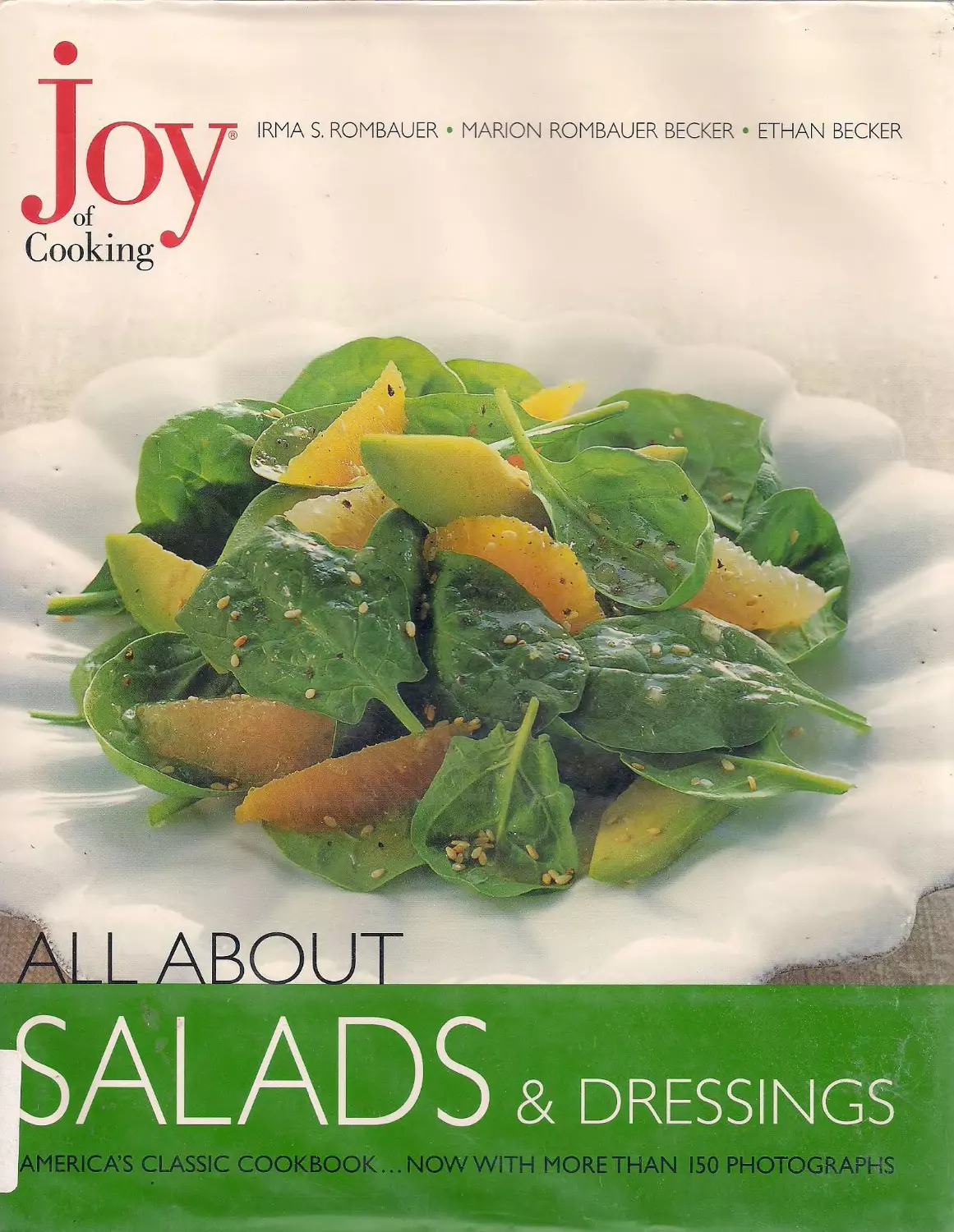


Автор: Rombauer I.S. Becker M.R. Becker E.
Теги: cooking culinary recipes culinary art recipes for dishes
ISBN: 0-7432-0204-X
Год: 2001



Текст
                    IRMA S. ROMBAUER
MARION ROMBAUER BECKER • ETHAN BECKER
Joy
Cooking
U.S. $19.95
Can. $29.50
Sixty years after Irma Rombauer advised new
cooks to “Stand facing the stove,” America's love
affair with Joy of Cooking continues unabated. And
why not? Joy in hand, tens of millions of people—
from novices to professionals—have learned to do
everything from make a meat loaf to clean a squid to
frost a wedding cake. For decades Joy of Cooking has
taught America how to cook, serving as the standard
against which all other cookbooks are judged.
ALL ABOUT SALADS & DRESSINGS upholds
that standard. While keeping the conversational and
instructional manner of the flagship book, All About
Salads & Dressings is organized by salad type including
green; vegetable and savory fruit; bean and grain; fish
and shellfish; meat and poultry—with such delicious
classics and exciting innovations as Caesar Salad;Thai
Beef Salad; Grilled Swordfish.Tangerine, and Jicama
SaladjTomato and Mozzarella Salad; Hot Apple Slaw;
andThree-Bean Salad. And don’t forget the dressings:
everything from Basic Vinaigrette to creamy Green
Goddess Dressing is covered. With a full primer on
varieties of lettuce and suggestions for garnishing,
All About Salads &. Dressings illustrates how much
more there is to salad than just lettuce.
Whether you belong to one of the millions of
American households that already own a copy (or
two) of Joy, or you have never cracked the spine
of a cookbook before Joy of Cooking: All About
Salads & Dressings is for you. It is a spectacular
achievement, worthy of its name Joy has never
been more beautiful.
The Indispensable Kitchen Resource...
All-New, All-Purpose, and now All-in-Color
ALL ABOUT
SALADS
& DRESSINGS

Joy
Cooking
ALL ABOUT
SALADS
& DRESSINGS
IRMA S. ROMBAUER
MARION ROMBAUER BECKER
ETHAN BECKER
PHOTOGRAPHY BY TUCKER & HOSSLER
SCRIBNER
NEWYORK • LONDON • TORONTO . SYDNEY • SINGAPORE
Scribner
123 0 Avenue of the Americas
New York, NY 10020
Copyright © 2001 by Simon & Schuster Inc.,
The Joy of Cooking Trust and
The MRB Revocable Trust
All rights reserved, including the right of
reproduction in whole or in part in any form.
Scribner and design are trademarks of
Macmillan Library Reference USA, Inc.,
used under license by Simon & Schuster,
the publisher of this work.
Joy of Cooking is a registered trademark
of The Joy of Cooking Trust and
The MRB Revocable Trust.
WELDON OWEN INC.
Chief Executive Officer: John Owen
President: Terry Newell
Chief Operating Officer: Larry Partington
Vice President, International Sales: Stuart Laurence
Publisher: Roger Shaw
Creative Director: Gaye Allen
Associate Publisher: Vai Cipollone
Associate Editor: Anna Mantzaris
Consulting Editors: Barbara Ottenhoff,
Judith Dunham, Norman Kolpas
Designers: Sarah Gifford, Lisa Schulz
Photo Editor: Lisa Lee
Production Director: Stephanie Sherman
Production Manager: Chris Hemesath
Production Assistant: Donita Boles
Studio Manager: Brynn Brenner
Food Stylist: Dan Becker
Step-by-Step Photographer: Mike Falconer
Step-by-Step Food Stylist: Andrea Lucich
Joy of Cooking All About series was designed
and produced by Weldon Owen Inc.,
814 Montgomery Street, San Francisco,
California 94133
Set in Joanna MT and Gill Sans
Separations by Bright Arts Singapore
Printed in Singapore by Tien Wah Press (Pte.) Ltd.
10 98765432 1
Library of Congress Cataloging-in-Publication Data
is available.
http ://www.kuharka.ru/
Recipe shown on half-title page: Tart Green Salad, 18
Recipe shown on title page: Tunisian-Style Carrot Salad, 35

CONTENTS
6 FOREWORD
8 ABOUT SALADS
I 7 ABOUT GREEN SALADS
3 I ABOUT VEGETABLE & SAVORY FRUIT SALADS
55 ABOUT FRUIT & MOLDED SALADS
63 ABOUT BEAN & GRAIN SALADS
83 ABOUT FISH & SHELLFISH SALADS
9 I ABOUT MEAT & POULTRY SALADS
I 05 ABOUT SALAD DRESSINGS
I 26 INDEX
I 28 ACKNOWLEDGMENTS
FOREWORD
"There is an ever-increasing demand for salads of all kinds, and a greater and
greater appreciation of their contribution to our gastronomical enjoyment and
our improved health."Those words, written several decades ago by my mom and
Granny Rom in an early edition of the Joy of Cooking seem prophetic today,
as salads of all kinds form such a vital part of our cooking and our eating.
Recognizing the ongoing popularity of salads, this volume of the All About
series offers recipes for salads in all their vast variety, from simple mixtures of
greens or fruits to composed and molded salads to main-course creations fea-
turing meat, poultry, or seafood. Informative text throughout the book tells you
everything you need to know about such topics as choosing greens and making
dressings.
You might notice that this collection of kitchen-tested recipes is adapted from
the latest edition of the Joy of Cooking. Just as our family has done for gener-
ations, we have worked to make this version of Joy a little bit better than the
last. As a result, you’ll find that some notes, recipes, and techniques have been
changed to improve their clarity and usefulness. Since 1931, the joy of Cooking
has constantly evolved. And now, the All About series has taken Joy to a whole
new stage, as you will see from the beautiful color photographs of finished dish-
es and clearly illustrated instructions for preparing and serving them. Granny
Rom and Mom would have been delighted.
I'm sure you’ll find All About Salads & Dressings to be both a useful and an
enduring companion in your kitchen.
6 SALADS & DRESSINGS
THE ALL PURPOSE COOKBOOK
ЦРУ
lCOOKINGI
IRMA S. ROMBAUER
and MARION ROMBAUER BECKER
THE ALL* PURPOSE
Г<*МС4&Ы!
JIY
by IRMA S. ROMBAUER and
MARION ROMBAUER BECKER
Ethan Becker pictured with his grandmother, Irma
von Starkloff Rombauer (left), and his mother, Marion
Rombauer Becker (right). Irma Rombauer published the
first Joy of Cooking at her own expense in 1931.
Marion Rombauer Becker became coauthor in 1951.
Joy as it has progressed through the decades (from top
left to bottom right): the 1931 edition with Marion's
depiction of St. Martha of Bethany, said to be the
patron saint of cooking, "slaying the dragon of kitchen
drudgery": the 1943 edition; the 1951 edition; the
1962 edition; the 1975 edition; and the 1997 edition.
FOREWORD 7
About Salads
Although the term salad once meant
nothing more than greens and herbs
seasoned with salt, today’s salads are
made from almost every sort of veg-
etable, meat, poultry, fish, pasta,
grain, or legume, raw or cooked,
cold or warm, tied together by a
flavorful dressing. Every step in
creating a salad, from selecting
ingredients to serving it, allows for
the cook’s imagination.
A plate of marinated vegetables
will spark the appetite before
the main course. Salads can also
replace vegetable side dishes. Tangy
cole slaw and creamy potato salad
make perfect partners to barbecued
foods. And finally, a simple green
salad is an excellent way to refresh
the palate after the main course of a
large dinner and a perfect prepara-
tion for the dessert to come.
Innovative combinations of salad
greens paired with grilled or roasted
meat, fish, or shellfish are gaining
ground as full-fledged entrees in our
quest for healthful and lighter ways
of eating.
All this freedom can be seen as a
tribute to American creativity as well
as to the variety of foods available
to us.
However, it is at its best practiced
with some restraint. Care should be
taken not to pack too many diverse
ingredients into one salad. Each
element should be chosen for its
unique contribution of flavor, tex-
ture, and appearance. Too many
tastes combined without thought
results in a clamor of flavors and
textures that no one will enjoy.
Tossed Salads
The relatively simple effort required
to produce an outstanding salad is
nowhere more evident than in the
mother of all salads—the tossed
salad. Tossed salads are often referred
to as green salads, garden salads, or
mixed salads, and while there may
be other additions—croutons, herbs,
cheese—the greens are paramount.
All too often we are served limp
greens topped with a dollop or two
of bottled dressing, a few croutons,
and a wedge of tomato, all crowded
onto an undersized plate. Anyone
who has ever enjoyed a garden-fresh
mix of cool, crisp greens dressed
with a light coat of a well-balanced
vinaigrette understands the distinc-
tion. A well-made tossed salad is
never an afterthought but rather a
carefully orchestrated part of the
entire meal.
In its simplest form, a green salad
is composed of one kind of fresh
lettuce dressed with the best-quality
oil and vinegar you can manage. In a
more complex presentation, it is a
mix of carefully selected greens gar-
nished with seasonings, vegetables,
meat, or fish and tossed with a spe-
cially tailored dressing. Whatever the
case, keep in mind that the type of
tossed salad you prepare should
depend on what role it plays in
your menu.
8 SALADS & DRESSINGS
Greens
ARUGULA
Also called Italian cress and found
across the United States, arugula is
a member of the mustard family.
(The Italians call it rucola, the French
roquette, and the English rocket.) It
has a tender leaf, a pungent peppery
bite, and the scent of pine. Some
varieties have smooth-edged leaves,
and others have serrated leaves. The
spiciness of arugula intensifies as it
ages and also varies considerably
from bunch to bunch. Dark green in
color, arugula is delicious alone or
as an accent in mixed green salads.
It also combines well with legumes,
especially white beans, and other
vegetables. Tiny arugula blossoms
are gorgeous, white or yellow with
brown markings, and are not to be
missed. They make a handsome,
pungent addition to salads.
BABY GREENS
While many leafy green vegetables
are served in cooked form when
they attain maturity, they are also
sold in their infant stage, when they
are delicate in texture and flavor.
They can then be eaten raw in sal-
ads. Try some of the following.
Amaranth: Young green-leaf ama-
ranth is tender, with an intense
spinachy taste (another name for it
is Chinese spinach).The red varieties
have the same flavor and brighten a
salad nicely. Beet Greens: Only the
tiniest of these can be eaten raw, for
they soon become too tough to be
palatable. If you have a garden, trim
them when you thin the beets and
add them to salads. They provide a
fresh taste and a faint echo of the
flavor of beets. Bok Choy: Also
called pak choi, this is a member
of the mustard cabbage family; it
comes in loose heads of fleshy stalks
and broad leaves, with stalks that are
white or green, thin or broad. Leaves
may be light to dark green, thick or
thin, cupped or flat. Baby bok choy
is a miniature, delicately flavored
bunch of leaves with small stalks,
about 4 inches long. Collards: These
flat, blue-green, cabbage-flavored
leaves are sweetest when grown in
cold climates and picked after a
frost. Kale: Most culinary kales have
ragged or frilled blue, magenta, or
grayish leaves. Kales have a delicate
cabbage taste and, like collards, are
G'ocfcwiie from tenter bohy bok ftioy f wcor-s. tWctr-i wee-' z ••'r?
sweetest after a frost. Kale makes a
beautiful garnish when mature and
can be used as a green when very
young. Komatsuna: Also known as
mustard spinach, this Japanese green
has thick dark green leaves. Its flavor
combines the blandness of cabbage
and the bite of mustard. The young
stalks are also delicious. Mustard
Greens: This term is a catchall for
any leafy green in the mustard fam-
ily not otherwise identified by
name. They may be broad and
smooth or fringed and curled, dark
green or light green or purple, hot
and pungent or mild and sweet.
ABOUT SALADS 9
Mustards can be eaten raw only
when very small. They add a strong
peppery flavor to a salad. Swiss
Chard: This green has long, flat,
celery-like stalks with large, coarse
leaves at the top. Red Swiss chard,
also known as rhubarb chard, has
ruby-colored stalks. The stems have
a delicate, celery-like taste, and the
leaves have a hearty, spinachlike fla-
vor. Chard has an affinity with citrus,
so use a lemon dressing or add seg-
ments of orange or grapefruit to the
salad. Turnip Greens and Broccoli
Rabe (Rapini, Broccoli Rape,
Broccoli Raab, Broccoli di Rape):
These are forms of turnip leaves (rapa
means turnip in Italian) and, when
young, can be used like arugula.
They have a mustardy bite, some-
times with a touch of sweetness.
BELGIAN ENDIVE
This green is the blanched head of a
variety of chicory known as witloof
(Dutch for “white leaf”), which is
grown in darkness to preserve its
very light color and mild flavor. The
heads resemble young unshucked
corncobs, creamy white with pale
yellow tips. The leaves are both ten-
der and crisp and have a distinctly
clean, mildly bitter flavor. Belgian
endive blends well with tart greens,
such as radicchio and arugula and
contrasts equally well with soft, deli-
cate lettuces, such as Boston or Bibb.
CABBAGE
Because green cabbages tend to be
bitter in spring and summer, care
should be exercised in mixing them
with other tart greens. Winter
cabbages, especially Savoy cabbage,
are sweeter. Finely shredded red
cabbage is a salad basic, used for
color and texture for years before
radicchio and other exotic greens
appeared in our markets. Varieties
of Chinese cabbage suitable for sal-
ads are michihili, whose crisp,
mild, dark green leaves grow in a
cylinder like a tall, slender head
of romaine lettuce, and Napa or
Nappa, whose pale ruffled leaves
and crunchy ribs have a mild,
slightly nutty flavor.
CELERY LEAVES
Chopped celery stalks appear in
many kinds of salads, but the leaves
are also good-tasting and leave a
hint of pepper. The pale whitish
green ones at the heart are best.
CELTUCE
Also known as stem or asparagus let-
tuce, this is an Asian lettuce grown
for its thick, succulent stalk. It tastes
a bit like water chestnuts. Very
young leaves can be used in salads.
CHICORY
A group of bitter greens in the sun-
flower family. See Belgian Endive,
Curly Endive, Escarole, and Radicchio.
CRESSES
Common cresses, which belong to
the mustard family, have leaves rang-
ing Irom faintly peppery to searing
hot in character. Watercress, the
mildest and most familiar form, has
crisp stems and glossy, dime-sized,
dark green leaves. The stems as well
as the leaves are edible. Garden cress
is softer in texture but similar to
watercress in taste. Curly cress leaves
are lacy, like those of flat-leaf parsley,
but extremely pungent. Upland cress
is similar to watercress, but if grown
in hot weather, it becomes so strong
as to be nearly inedible.
CURLY ENDIVE
A variety of chicory, this has coarse,
prickly, dark green leaves with a
pleasant tang. The terms curly endive
and frisee are used interchangeably,
though most often what is labeled
“frisee” has small, tender, lacy, pale
green leaves with white centers and
has a mild tartness and a more deli-
cate taste than other chicories.
DANDELION GREENS
A very tart green with jagged-edged
leaves that look like arrows. Young,
tender leaves less than 6 inches long
are the least tart and are ideal in
salads. Both raw and cooked, dande-
lion greens have a rich, bracing fla-
vor and are worth buying when they
appear in the market.
ESCAROLE
Eaten both raw and cooked, this
member of the chicory family has
broad, irregularly shaped flat leaves
with slightly curled edges, like the
leaves of butterhead lettuce. The
leaves are dark green at the top and
grow paler as they approach the
stem. The leaves have a pronounced
tartness and a firm, chewy texture.
GOOD KING HENRY
Also called allgood or wild spinach,
these spade-shaped leaves, often the
first greens of spring, have a faint
spinachlike flavor but are not related
to spinach. Good King Henry mixes
nicely with tender red-leaf lettuces.
HERBS AND FLOWERS
Add leaves or blossoms whole, tear
them into bite-sized pieces, or cut
them into ribbons. To add in quantity
as a salad green: angelica, any basil,
chervil, cilantro, dill, Florence fennel
leaves, lemon balm, lovage, marjo-
ram, any mint, any parsley, any sage,
salad burnet, sweet cicely, tarragon.
To use sparingly as an accent:
ambrosia, anise, anise hyssop, car-
away, epazote, garlic, garlic chives,
Greek oregano, hyssop, Mexican
oregano, mitsuba, perilla or shiso,
rosemary, any savory, any thyme,
Vietnamese coriander. These flowers
add flavor: clove pinks, elderberry,
lavender (sparingly), lemon, mus-
tard, nasturtium, rose, rosemary,
scented geranium, society garlic,
sweet woodruff, violets.
LETTUCES
There are hundreds of individual
varieties of lettuce—all from one of
four general categories, classified by
the shape and growth habit of the
lettuce. Butterhead: Tender and deli-
cately flavored, with soft ruffled
leaves gathered together into small,
round, rather loose heads. Familiar
varieties include Bibb, Boston, but-
ter, limestone, and red tip. Bibb is
more delicate-tasting than the larger
Boston. The subtly sweet, buttery
flavor of these lettuces combines
well with stronger-flavored greens
and is also lovely on its own.
Iceberg: Also known as crisphead,
iceberg lettuce has a compact,
smooth round head that varies from
pale green in the center to medium
green on the outside and is depend-
ably crisp, crunchy, very heavy in the
hand, tightly packed, and compact.
This lettuce has a distinct and attrac-
tive flavor, ships well, and can be
torn, shredded, or sliced like cab-
bage. It is also available year-round.
Looseleaf: Tender, mild, mellow, and
soft, these lettuces are also known as
“bunching” or “cutting” lettuces.
They have sprawling, crisp yet ten-
der leaves with sweet and refined
flavors and are at their best in the
spring. The leaves grow loosely
bunched and may have ruffled edges
and/or red tips. The many varieties
of looseleaf lettuces include green
leaf, red leaf, and oakleaf. These let-
tuces are wonderful to eat on their
own and also blend well with
stronger-tasting greens. Romaine or
Cos: This is a cylindrical, upright let-
tuce with stiff, elongated leaves, crisp
center ribs, a rather juicy but rela-
tively coarse texture, and a pleasantly
Clockwise from top center: chord, Savoy cabbage, Belgian endive, red butter lettuce, butter lettuce, broccoli rabe, radicchio, frisee
ABOUT SALADS I I
Clockwise from top left: bok choy, orache, mdche, pea shoots, tatsoi
assertive taste. The outer leaves are
usually darker in color than the
inner leaves and have a stronger fla-
vor. It is also available in red.
MACHE
A member of the chicory family, this
exceptional green is also called
rapunzel, feldsalat, lamb’s lettuce,
and corn salad because it often
grows in cornfields. Very delicate,
sweet, and nutty, it is also very
expensive because it is highly per-
ishable. The clusters are small, made
up of smooth, velvety, tongue-
shaped green leaves. It is marvelous
served alone or in combination with
other delicate greens and herbs.
MESCLUN
This is not a type of green, but the
name given to a mixture of salad
greens that has recently become very
popular. The term comes from the
Provencal word for “mixture,” and
the idea comes from the practice
common throughout Europe of
gathering a variety of young field
greens and mixing them in a salad.
In the United States, mesclun has
become a catchall term, meaning
any assortment of edible greens that
are delicate and mild enough to be
eaten raw. The idea is to create a bal-
ance between strong-flavored greens
like arugula or mizuna, and subtle
greens like baby lettuces.
MINER’S LETTUCE
Also called claytonia, these are small,
slightly cupped, triangular-shaped
leaves with tiny flowers in their cen-
ters. Their flavor is fresh, rather like
mild spinach.
MIZUNA
Of Asian origin, and one of the
most delicately flavored of the
mustards, mizuna has dark green,
feathery leaves that are delightful
tossed with flowers and a light
dressing flavored with sesame oil.
Baby mizuna is an essential ingre-
dient in mesclun.
ORACHE
These arrow-shaped leaves, some-
times called mountain spinach, have
a mild spinach flavor.
PEA SHOOTS
The first 3 to 5 inches of a snow pea
vine, including the vine itself, ten-
drils, leaves, pods, and sometimes
flowers, are considered the pea
shoot. They are popular in the cook-
ing of Shanghai and Vietnam and
now appear in our markets. Freshly
picked, these are crisp, with a light
pea flavor. They are exquisite in sal-
ads and, though delicate, hold their
own with stronger flavors.
12 SALADS & DRESSINGS
PURSLANE
Although considered a weed in most
of the United States, this green has
been eaten for centuries throughout
India, Turkey, and parts of the Middle
East. It resembles a small creeping
jade plant. Leaves of the Goldgelber
variety are large and golden. Purslane
has juicy stalks and small oval leaves
with a tart lemony flavor.
RADICCHIO
There are two varieties of this Italian
chicory, one with a round head that
resembles a small tender cabbage,
the other with elongated leaves. Both
are a beautiful magenta-mauve color
with ivory streaks, and both have a
pleasantly bitter, slightly peppery
flavor. Radicchio combines well with
both mild and assertive greens and
adds stunning color to any salad.
SHUNGIKU
Also known as chrysanthemum
leaves or garland chrysanthemum,
these are the uniquely tasty, almost
perfumed leaves of a type of
chrysanthemum.
SORREL
Garden sorrel comes up early in
spring and lasts until snow crushes
its stalks; where winters are mild,
sorrel is green all year long. The
leaves and stalks look like bright
green spinach, but that is where the
resemblance ends. Sorrel’s flavor is
its own—intensely lemony and
exhilarating on the tongue. It is
wonderful in salads, but use it dis-
creetly because its flavor can over-
whelm. Sorrel is in season spring,
summer, and fall, but its leaves are
most tender in spring.
SPINACH
With its clean, astringent freshness,
the flavor of spinach is the reference
point for many green leaves. Whether
crinkled or flat (the latter are more
delicate in flavor), spinach leaves are
a versatile, valuable salad green.
Include the stems, chopping them
neatly, and if the pink roots are still
attached, drop them in too for their
crunch. Spinach is available all year
at the market, but its peak season is
the cool of spring and fall.
TATSOI
A ground-hugging member of the
mustard family, this is also known as
rosette bok choy because its leaves
grow like rose petals. The rounded
leaves are thick and very dark green
and have an assertive mustard flavor
esteemed by the Chinese.
GREENS SUBSTITUTION CHART
If you cannot locate a particular green called for in the salad recipes, you can almost always find a substitute.
Mild Greens
Butter head Lettuces
Crisphead Lettuces
Looseleaf Lettuces
Romaine Lettuces
Celery Leaves
Celtuce
Mache, or Corn Salad
Slightly Tart Greens
Arugula
Belgian Endive
Collards
Curly Endive
Dandelion Greens
Escarole
Kale
Mizuna
Watercress
Young Romaine Lettuce Hearts
Tart Greens
Arugula
Broccoli Rabe
Curly Cress
Curly Endive
Escarole
Mustard Greens
Radicchio
Radish Leaves
Turnip Greens
Upland Cress
Mild Cabbages
Bok Choy
Collards
Kale
Komatsu na
Spinach
Amaranth
Beet Greens
Chard
Good King Henry
Ko matsun a
Miner’s Lettuce
Crisp Greens
Cabbages
Iceberg Lettuce
Pea Shoots
Purslane
ABOUT SALADS I 3
RULES FOR PREPARING GREENS FORA SALAD
® To begin with, buy the freshest
greens with crisp leaves, free of
brown spots on leaves or stems.
When available, greens still attached
to their roots are usually more
intense in flavor than those severed
at the stem.
® Use greens as soon as possible
after buying them. If you have to
store them, remove any leaves that
are wilted or show signs of decay
and take off any rubber or metal
bands holding greens together.
Unwashed greens will keep for 3 to
4 days at most. (If the greens wilt
slightly, they can often be revived by
soaking them in ice-cold water for 3
to 5 minutes, drying them well, then
placing them in the refrigerator for
30 minutes or so.) Store greens in
the vegetable bin of your refrigerator
in a plastic bag with holes poked in it.
® Properly washing, drying, and chill-
ing salad greens is the indispensable
first step in any salad. No marvel of
ingredients or perfection of dressing
can mask or make up for sand or
dirt on salad greens. Likewise, inade-
quately dried greens, left full of water,
will render the entire salad soggy and
flavorless, since dressing can cling only
to dry leaves. Unchilled greens rapidly
become limp and lose their flavor.
Always handle greens carefully, so as
not to bruise them.The easiest way to
wash them is to separate the leaves
and place them in a large bowl or sink
full of cold water, swish them around
for 30 seconds or so (I), then lift
them from the water gently so that
the dirt and grit remain in the water.
Repeat the process until the water is
clear; one dunking may do for rela-
tively clean greens such as red-leaf
lettuce, while spinach, which is notori-
ously sandy, may take three or four.
If you are in doubt, the surest way to
remove sand and grit is to expose the
entire surface of each leaf to cold run-
ning water for a brief time.This takes
a bit longer but yields the reward of
an entirely sand-free salad.
® For drying, salad spinners are a
wonderful convenience. Overcrowd-
ing a salad spinner, however, will both
bruise the greens and hinder the
device’s ability to dry them adequately.
A spinner about one-half to two-
thirds full will work perfectly every
time (2). Alternatively, dry greens by
tossing lightly in a colander. In either
case, it will probably be necessary to
wrap them in paper towels for the
final drying. Whatever the method,
once dried, the greens should be well
chilled to render them crisp.
- Once they are washed and dried,
store greens in whole form, tearing
or cutting them only when you are
about to make the salad.They should
be placed in the coolest part of the
refrigerator, which is usually one of
the vegetable storage bins, where
they will keep well for 2 but not
more than 3 days. If you are serving
the salad the same day, the ideal con-
tainer for washed and dried greens is
your salad bowl. Line it with paper
towels, add the greens (3), cover with
two layers of moistened paper tow-
els, and seal the bowl tightly with
plastic wrap or aluminum foil.
Otherwise, put them into a plastic
bag with holes poked in it.
To assemble the salad, sort through
the greens, discarding any tough
stems or wilted spots, and gently tear
them by hand into small uniform
pieces. Especially crisp greens can be
sliced or shredded with a knife.
I 4 SALADS & DRESSINGS
Dressing Salads
The time to dress green salads is
always at the very last minute. Once
dressed, greens lose their charm by
becoming limp if they sit too long.
To dress a salad, place the greens
in a bowl large enough to hold
them spaciously. Whether combined
beforehand or actually mixed in the
bowl, pour the dressing or its ingre-
dients down the side of the bowl so
that it forms a puddle at the bottom.
The tossing can now be done with
clean hands, a pair of tongs, a couple
of ordinary wooden kitchen spoons,
or the oversized fork and spoon
known as a salad set.
Whatever implements you
choose, the tossing action is always
Serving
Tossed Salads
Simple salads belong after the main
course or as a side dish, while more
complex salads come first as an
appetizer or stand on their own as
a main course. Some type of bread,
breadstick, or cracker complements
most salads. In all except the most
informal settings, serve separate
salad plates or bowls to keep the
dressing from running into other
flavors in the meal and vice versa.
Chilling the plates or bowls helps
maintain the desired crisp, cool
character of the greens. Generally,
serve all salads on large plates or in
bowls so that one’s salad does not
tumble onto the table or one’s lap.
Cutting or tearing all salad ingredi-
ents into pieces no larger than bite-
sized will make for gracious dining
as well.
the same. In all cases, reach into the
bottom of the bowl and gently lift
the greens upward so that the top-
most greens fall to the bottom.
Gently repeat this action until all the
leaves have had their turn moving
across the bottom of the bowl and
all the dressing is distributed. If salt,
pepper, or any other dry condiments
are to be added, sprinkle them
lightly over the greens as you toss.
Each leaf should glisten with just
enough dressing to enhance its fla-
vor. Too much dressing will destroy
the bright freshness that is a hall-
mark of a good salad. It is always
best to start with too little dressing
and add more if necessary.
Caring for
Salad Bowls
Well-seasoned wooden salad bowls
are sometimes ascribed a sacred
inviolability by salad fanciers. Soap
and a sponge supposedly must never
touch them. We think this idea is
mistaken. The residue left after wip-
ing the bowl with only a damp cloth
tends to become rancid and can mar
the flavor of subsequent salads, espe-
cially if assertive oils, such as walnut
and hazelnut oils, are used. We rec-
ommend a bowl made of glass or
pottery with a glazed surface. A
wooden bowl that is sealed with a
food-grade varnish will also work
well. All should be scrupulously
cleaned after each use. Whether the
bowl is glass, ceramic, or wood, it
should be large and wide enough to
toss at least a quart of salad greens
with ease.
Specialty dressings are included
with some of the salad recipes in
this book, but see About Salad Dressings,
1 OS, for others. As a general rule,
thick, creamy dressings work better
with sturdy greens, and simple
dressings often match up best with
complex salads with many ingredi-
ents. Allow 1У2 to 2 cups loosely
packed washed and dried greens and
2 to 3 tablespoons dressing per per-
son (less for vinaigrettes and more
for creamy dressings). Since we
often prepare salads for more than
one, figure *A cup vinaigrette (or
% cup creamy style) for 4 servings.
PACKING SALADS FOR
A PICNIC
For a picnic or a camping trip,
wash and dry the greens (iceberg
lettuce will stay crispest the
longest), then chill them in a large
plastic bag.Take the dressing along
in a separate container
ABOUT SALADS I 5

ABOUT
GREEN
SALADS
Др/ate of fresh greens captures the very essence of the salad-
making art. The elements are simple: crisp leaves, torn or cut
into bite-sized pieces or left whole if small, plus fresh herbs, sea-
sonal vegetables or fruits, and such additions as olives or cheese.
The all-important dressing marries the ingredients with its smooth
consistency and complementary flavors.
When a salad is prepared with attention to detail, the results can be
profoundly good. A green salad makes a fine impression when served
at the start of a meal or, as some Europeans do, when offered as a
palate refresher after the main course. Accompanied by good bread
and a bowl of soup, it is a satisfying light meal in its own right.
The best green salads start with good ingredients. The guide on pages
9-14 surveys the many options for salad leaves and provides instruc-
tions on how to prepare them for the best results.
Spinach Salad with Grapefruit, Orange, and Avocado, 27
Tart Green Salad
4 to 6 servings
Follow the advice in Dressing Salads,
15, allowing about 2 cups assorted
greens per person. Toss the salad
(opposite) with just enough vinaigrette
to coat the leaves lightly but thoroughly
(/2 to % cup for 4 servings).
Combine in a salad bowl:
2 bunches arugula, tough stems
trimmed, washed, dried, and
torn into bite-sized pieces
Green Salad
4 to 6 servings
The ultimate after-dinner salad. Many
markets sell premixed greens, but for
a more personalized salad, select an
assortment of the freshest salad greens
available. Combine greens v/ith con-
trasting pungencies, textures, and
appearances for the most interest.
Combine in a salad bowl:
2 large heads Boston or Bibb
lettuce, washed, dried, and torn
into bite-sized pieces
Field Salad with Fresh Herbs
4 to 6 servings
The idea of using whole herbs as salad
greens seems rather novel to us today,
but it has a long and noble history.
Combine in a salad bowl:
1 cup fresh herb leaves (any
combination of chervil, sage,
tarragon, dill, basil, marjoram,
flat-leaf parsley, and mint)
3 Belgian endives, washed, dried,
cores removed, cut crosswise
into 1 ^-inch-thick slices
1 small head radicchio, washed,
dried, and torn into bite-sized
pieces
Toss well to coat with:
‘Л to % cup Fresh Herb Vinaigrette, 108
Serve immediately.
1 tablespoon chopped fresh parsley
(optional)
1 tablespoon snipped fresh chives
(optional)
Toss well to coat with:
У2 to 34 cup Basic Vinaigrette, 108, or
one of the variations
Serve immediately.
4 cups bite-sized pieces salad
greens (any combination of
curly endive, radicchio, water-
cress, mache, dandelion greens,
and arugula), washed and dried
Toss well to coat with:
Уз to % cup Basic Vinaigrette, 108
Serve immediately.

Garnished Green Salads
A green salad is easily transformed
into an enticing appetizer or even a
main course with the addition of a
few ingredients chosen for texture,
taste, and visual appeal. The greens
remain dominant in these salads, so
avoid the temptation to overwhelm
them with too many bits of this and
that. Think in terms of balance and
harmony. Too many assertive gar-
nishes, such as olives, garlic, and
crumbled bacon, will cancel each
other out. On the other hand, too
many sweet flavors—fruit, soft
cheese, carrots, and tomatoes—may
become cloying. Begin by tasting the
greens. If they are strong and pun-
gent, they can support more flavor;
mild and tender greens tolerate less.
The simplest way to enhance a
green salad is to add condiments or
seasonings to the salad while or
after you toss it with the dressing.
Be sure to give the greens a few
extra tosses to integrate the addi-
tions well. With a light coat of
dressing on the greens, small accents
such as croutons, nuts, cheese, and
olives will cling to the salad and are
less apt to fall to the bottom of the
bowl. For more substantial additions
like grilled chicken, sliced beef,
or the multiple ingredients of a
Greek salad, everything gets tossed
together at once. Following are
some popular additions:
Tomatoes: There are those who say
that it is unwise to add cut-up toma-
toes to a tossed salad, as their juices
will thin the dressing. If this possi-
bility concerns you, prepare them
separately and use them to garnish
the salad bowl or cut the tomatoes
into vertical slices instead of hori-
zontal rounds, since they bleed less
this way. Cherry tomatoes can be left
whole. Even cut in half, they release
little juice.
Croutons: Croutons are valued as
much for their crunchy texture as
for their flavor. Add these at the very
last minute to prevent them from
becoming soggy and leave them out
if the salad is served alongside a
starchy meal, such as pasta or rice.
Nuts and Seeds: Nuts and seeds add
crunch and can complement the
greens and the dressing. Simply
place them in a dry skillet over
medium heat and cook, stirring or
shaking the pan often to prevent
burning, until they begin to release
their fragrance, about 4 minutes.
Vegetables: Thinly slice, shred, grate,
or julienne raw vegetables such as
carrots, cabbage, celery, cucumbers,
bell peppers, fennel, and mush-
rooms so that they mix with the
greens and do not fall like dead
weight to the bottom of the bowl.
Garlic: Garlic is perhaps the most
influential seasoning. There are two
ways of giving a salad a delicate
touch of this pungent flavor. Halve a
clove of garlic, rub the inside of a
salad bowl with the cut sides, then
discard the clove. Or rub a rather
dry crust of bread on all sides with a
halved clove of garlic (this is called a
chapon) and place it in the salad bowl
under the greens. Add the dressing
and toss the salad lightly to distrib-
ute the flavor; remove the chapon and
serve the salad at once. The chapon
itself can be served to a garlic enthu-
siast. For a slightly stronger flavor,
mash a clove of garlic at the bottom
of the salad bowl with the other sea-
sonings and add the dressing to the
bowl before the greens.
IDEAS FOR SALAD GARNISHES
Avocados, sliced
Bacon, crumbled
Cheese, sliced or crumbled
Chickpeas, kidney beans, or other
cooked legumes
Fresh herbs
Hard-boiled eggs, chopped
Ham or other cured meats, thinly
sliced
Smoked or cured fish (salmon,
trout, mackerel), flaked
Marinated artichoke hearts, whole
or sliced
Olives, pitted
Orange or grapefruit slices, peel
and pith removed
Dried fruit (raisins, currants,
cranberries, cherries)
Apples, sliced
Mangoes, sliced
Pears, sliced
20 SALADS & DRESSINGS
Mixed Greens with Cheese Crisp
4 servings
Toss together in a small bowl:
*/i cup grated Gruyere
cheese
1 tablespoon grated Parmesan
cheese
Sprinkle in an even layer in a large
nonstick skillet to form an 8-inch
disk. Cook over medium heat,
spooning off the fat, until lightly
browned, about 4 minutes. Using a
spatula, carefully lift the pancake
onto a paper—towel—lined baking
sheet and blot dry.
Place in a salad bowl:
6 cups bite-sized pieces greens
(romaine or Boston lettuce, or
escarole), washed and dried
Toss the greens well to coat with:
% to 14 cup Basic Vinaigrette, 108
Divide among 4 salad plates and
crumble the cheese crisp on top.
Baby Asian Greens and Whole Herbs
4 to 6 servings
Most Asian greens have a pleasant
edge that makes them a perfect
accompaniment to rich meats (like
lamb and beef) and fish (tuna, mack-
erel). Here we follow the Southeast
Asian practice of combining greens with
whole leaves of the herb trio of cilantro,
mint, and basil. The herbs not only lend
the salad additional flavor intensity but
also add a kind of sweetness to bal-
ance the slightly bitter greens.
Bring to a boil in a small saucepan
over high heat:
2 stalks lemongrass, coarsely
chopped
2 tablespoons minced peeled
fresh ginger
% cup white vinegar
% cup water
3 tablespoons sugar
Reduce the heat to low and simmer,
uncovered, for 20 minutes, stirring
occasionally. Strain and discard the
solids. Add and whisk together:
2 tablespoons toasted sesame oil
2 tablespoons vegetable oil
2 tablespoons soy sauce
2 tablespoons fish sauce or
vegetable oil
Combine in a salad bowl:
10 to 12 cups bite-sized pieces
baby Asian greens (any combi-
nation of mizuna, tatsoi, baby
mustard greens, komatsuna,
baby bok choy, pea shoots, and
baby shungiku), washed and
dried
2 red bell peppers, cut into thin
strips
Vi cup cilantro leaves
!4 cup mint leaves
cup basil leaves
Stir the dressing well, add just
enough to moisten the salad, toss
gently to coat, and serve.
ABOUT GREEN SALADS 2 I
Caesar Salad
6 servings
Whether to include anchovies in the
salad was once the main -point of dis-
cussion. Today the question is whether
to top the Caesar with chicken breast,
shrimp, or sliced beef Any of these
makes a fine addition, turning a first
course into an entree, but we retain
an affection for the pure and genuine
article. First coddling, or gently boiling,
the egg helps to thicken the dressing.
Preheat the oven to 350°F.
Heat in a small saucepan over
medium heat until the butter is
melted:
2 tablespoons butter
2 tablespoons extra-virgin olive oil
2 cloves garlic, halved lengthwise
Salt and ground black pepper
to taste
Remove from the heat and let stand
for 10 minutes. Discard the garlic.
Toss with the butter mixture:
3 cups ‘/z-inch cubes French or
Italian bread
Spread on a baking sheet and bake,
shaking the pan once or twice, until
golden brown, 12 to 15 minutes.
Mash together in a small bowl until
a paste is formed:
4 cloves garlic, peeled
’/2 teaspoon salt
Whisk in:
2 teaspoons fresh lemon juice
1 teaspoon Worcestershire sauce
Salt and ground black pepper
to taste
2 to 4 anchovy fillets, rinsed,
patted dry, and mashed to a
paste (optional)
Add in a slow, steady stream, whisk-
ing constantly:
!4 cup extra-virgin olive oil
In a salad bowl, toss the croutons
and dressing with:
2 small heads romaine lettuce
(preferably young or inner pale
green leaves), washed, dried, and
torn into bite-sized pieces
2 large eggs, boiled gently for
2 minutes, or added raw (see Egg
Safety, opposite)
Sprinkle with:
!4 cup Parmesan cheese shavings
Serve immediately.
WESTERN SALAD
Prepare Caesar Salad, left, adding
about Vi cup crumbled blue
cheese, and omitting the
anchovies.
22 SALADS & DRESSINGS
Reduced-Fat Caesar Salad
6 servings
This is a reasonable stand-in for the
classic Caesar for those who are con-
cerned about fat intake.
Preheat the oven to 350°F.
Toss to combine well:
3 cups ’/z-inch cubes sourdough
bread
5 spritzes olive oil spray
2 cloves garlic, finely minced
Salt and ground black pepper
to taste
Spread on a baking sheet and bake,
shaking the pan once or twice, until
golden brown, about 10 minutes.
Let cool.
Mash together in a small bowl until
a paste is formed:
1	clove garlic, peeled
Pinch of salt
Whisk in:
2	tablespoons chicken stock
1 tablespoon grated Parmesan
cheese
1	tablespoon minced fresh parsley
2	teaspoons sherry vinegar
1 teaspoon Dijon mustard
1	teaspoon fresh thyme leaves
2	anchovy fillets, rinsed, patted
dry, and mashed to a paste
(optional)
Add in a slow, steady stream, whisk-
ing constantly:
2 tablespoons extra-virgin olive oil
In a salad bowl, toss the croutons
and dressing with:
2 small heads romaine lettuce
(preferably young or inner pale
green leaves), washed, dried, and
torn into bite-sized pieces
3 tablespoons grated Parmesan
cheese
Salt and ground black pepper
to taste
Sprinkle with:
1	tablespoon grated Parmesan
cheese
Serve immediately.
EGG SAFETY
The bacteria Salmonella enteritidis, which
can cause illness and even death, is
occasionally found in raw eggs, even
uncracked eggs. Of great concern to
some are a number of classic recipes
that depend on raw or only lightly
cooked eggs—among them Caesar
salad and mayonnaise. Some cooks
now substitute pasteurized liquid eggs
(available both whole and separated).
The liquid eggs most closely resemble
fresh eggs and are only slightly less
efficient than fresh eggs for emulsify-
ing or whipping purposes. Some
cooks refuse to compromise and con-
(iniie using fresh eggs, raw or lightly
cooked, v. nil- a: incident If you are
ot this scb >ol. rnin.mize risk by using
the freshes: eggs possible anti storing
them at temperatures below 40'
You can also gently noil eggs m their
shells for 2 minutes .before using
them in salads and dressings. Serve
egg dishes immediately or refrigerate.
ABOUT GREEN SALADS 23

Greek Salad
4 to 6 servings
A good Greek salad should be more of
a spontaneous event than an ironclad
recipe. Feel free to add, omit, and sub-
stitute ingredients as whim or necessity
dictates.
Combine in a salad bowl:
2	large or 3 small heads Boston,
romaine, or iceberg lettuce,
washed, dried, and torn into
bite-sized pieces
8 cherry tomatoes or tomato
wedges
’/z cup coarsely crumbled feta
cheese
6 thin slices red onion
l/z cucumber, peeled and sliced
8 Kalamata olives, pitted
% cup diagonally sliced celery
hearts
4 scallions, cut into 1 -inch pieces
8 firm radishes, sliced
One 2-ounce can anchovy fillets,
rinsed, patted dry, and halved
lengthwise
Whisk together:
6 to 7 tablespoons olive oil
2 tablespoons fresh lemon juice or
red wine vinegar
1 teaspoon finely minced garlic
1 teaspoon dried oregano
Salt and ground black pepper
to taste
Pour the dressing over the salad and
toss well. Serve immediately on
chilled large plates.
ANCHOVIES
Anchovies, available worldwide,
have a soft, delicate texture, a rather
strong flavor, and dark-colored
flesh. They are sold fresh (often
confused with sardines and her-
ring) , packed in salt, and packed in
oil. When fresh, anchovies need to
be deboned like sardines. When
they are packed in salt, you’ll need
to rinse and pick over them; when
they are in oil, rinse if you wish
and reserve the oil for use in cook-
ing. Salted or canned anchovies are
used as flavoring in salads; fresh
anchovies can be grilled with
excellent results. Despite their
strong flavor, fresh anchovies are
moderate to low in fat.
OLIVES
In the Mediterranean region, where
most olives are grown, as much care
is put into olive growing as into
wine or cheese making. There is a
wealth of piquant, nutty, sweet, and
fruity olives available. From Greece,
the famous Kalamata olives (oppo-
site) are purple-black or maroon
with a slender oval shape, soft tex-
ture, and rich flavor. California also
produces some fine olives. Try bottled
Californian Greek-style black or
green olives and dry-cured black
olives, which are quite meaty and
tender. Buy olives diat are uniform in
color and free of surface blemishes.
Keep loose olives in the refrigerator
for several weeks; canned or bottled
olives can be kept unopened on the
shelf for up to two years and when
opened should be refrigerated.
ABOUT GREEN SALADS 25
Spinach Salad
4 servings
Tender young spinach leaves are ideal
for this classic salad. Young mustard
greens or young dandelion leaves make
delicious substitutes.
Cook in a skillet over medium-high
heat until crisp:
4 slices bacon
Drain on paper towels and crumble.
Combine well:
'4 cup cider vinegar or vinegar of
your choice
2 tablespoons olive or vegetable oil
2 teaspoons yellow mustard seeds
(optional)
2 teaspoons minced fresh parsley,
or a combination of other fresh
herbs
1 teaspoon grated onion
1 teaspoon sugar
Place in a salad bowl:
1 large bunch young spinach,
trimmed, washed, and dried
Pour the dressing over the spinach
and toss well. Sprinkle with the
crumbled bacon and garnish with:
2 or 3 Hard-Boiled Eggs, 84, sliced
into rounds
Serve immediately.
WARM SPINACH SALAD
Hard-boiled eggs take 12 to 15 min-
utes to become firm throughout, with
a yolk that remains bright yellow.
Prepare Spinach Salad, left, substi-
tuting 2 tablespoons of the bacon
drippings for the oil if desired.
Heat the dressing until just before
it begins to boil and pour over the
spinach greens. Garnish with the
crumbled bacon and sliced hard-
boiled eggs and serve immediately.
26 SALADS & DRESSINGS
Baked Goat Cheese and Baby Greens
4 servings
In Provence, France, where this salad is
popular, mesclun includes many differ-
ent salad greens and herbs, each vary-
ing in flavor, texture, and color. A mix
might contain red- and green-tipped
oakleaf lettuce, arugula, romaine let-
tuce, chervil, colorful red radicchio, and
curly white as well as green endive,
escarole, and bitter dandelion greens.
Add fresh herbs to this mixture (sage,
dill, and tarragon are our favorites), top
with baked goat cheese, and you have
a delicious lunch or supper dish.
Preheat the oven to 400°F. Grease a
small baking dish.
Refrigerate in a salad bowl:
6 cups mixed baby greens or
mesclun, washed and dried
Stir together in a shallow bowl:
1 cup fine dry unseasoned
breadcrumbs
1 teaspoon dried thyme
Pour into another shallow bowl:
!4 cup extra-virgin olive oil
Coat first with the olive oil and then
with the breadcrumbs:
4 rounds fresh goat cheese, each
about 2'/z inches in diameter and
‘/z inch thick
Place the cheese on the baking dish
and bake until golden brown and
lightly bubbling, about 6 minutes.
Meanwhile, prepare:
Basic Vinaigrette, 108
Toss the greens with just enough
vinaigrette to coat and divide among
4 salad plates. Place a round of
baked cheese in the center of each
salad and serve at once.
Spinach Salad with Grapefruit, Orange, and Avocado
2 to 4 servings
Toast briefly in a small skillet over
medium heat:
3 tablespoons sesame seeds
Toss together in a salad bowl:
3 generous handfuls (about
6 cups) baby spinach leaves,
washed and dried
2 to 3 pinches of salt
3 to 4 tablespoons Tangerine Shallot
Dressing, 113
Divide the spinach among chilled
salad plates and arrange evenly over
the greens:
1 grapefruit, peeled and sectioned
1 navel orange, peeled and
sectioned
1 ripe avocado, peeled and sliced
Sprinkle with the sesame seeds and
season with:
Ground black pepper to taste
Serve immediately.
WARM OR WILTED SALADS
In die classic Warm Spinach Salad, oppo-
site, a hot dressing partially cooks the
greens, rendering them succulent
and tender. In others, a warm gar-
nish, such as baked goat cheese or
fresh tuna hot off the grill, is placed
on a bed of cool, crisp greens, pro-
ducing a dramatic contrast of tem-
perature and texture. These salads
make an impressive first course or a
memorable entree. Keep in mind that
whatever your choice, you should
always serve warm salads immedi-
ately, because they lose their appeal
as the greens become soggy.
ABOUT GREEN SALADS 27
Endive and Walnut Salad
4 servings
Whisk together in a salad bowl:
1	tablespoon red wine vinegar
1 tablespoon minced shallots
J/z teaspoon Dijon mustard
Salt and ground black pepper
to taste
Add in a slow, steady stream, whisk-
ing constantly:
2	tablespoons walnut oil
Romaine and Red Onion Salad
with Corn Bread Croutons
4 servings
Croutons made from good rye or
whole-wheat herb bread can be substi-
tuted for ones made with corn bread.
Cut /г-inch-thick slices from a whole
loaf then cut into /2-inch cubes.
Preheat the oven to 350°F.
Toss together on a baking sheet:
2	cups '/z-inch cubes corn bread
(about 2 large pieces)
2 tablespoons extra-virgin olive oil
Bake, shaking the pan once or twice,
until golden, about 10 minutes.
Transfer to a salad bowl and let cool.
Whisk together in a small bowl:
2 cloves garlic, minced
2 tablespoons grated Parmesan
cheese
2 tablespoons balsamic vinegar
2 tablespoons chicken stock
1 teaspoon chopped fresh basil or
parsley, or to taste
Salt and ground black pepper
to taste
Add in a slow, steady stream, whisk-
ing constantly:
!4 cup olive oil
In a salad bowl, combine:
2 tablespoons vegetable oil
Add:
8 Belgian endives, washed, dried,
cores removed, cut crosswise
into У>-inch-thick slices
Vi cup walnut halves, toasted
*4 cup crumbled Gorgonzola or
other blue cheese (optional)
Toss well to coat. Serve immediately.
2 small heads romaine lettuce,
washed, dried, and torn into
bite-sized pieces
1 small red onion, thinly sliced
Add the dressing and toss to coat
the greens. Add the croutons and
combine. Sprinkle with:
Parmesan cheese shavings
Serve immediately.
CROUTONS
These dried or fried seasoned fresh
bread morsels come in all sizes.
These are made by cutting bread,
preferably simple French bread,
into small or large dice or square
slices, buttering them or rubbing
them with olive oil, and toasting
in a 375°F oven until crisp, 10 to
15 minutes. Oil-free croutons can
be made by cutting up bread into
small cubes and slowly drying
them at 200°F.These are perfect
for stuffings and poultry dressings.
28 SALADS & DRESSINGS
Arugula with Summer Vegetables
4 to 6 servings
Use this recipe as a rough guideline,
substituting whatever summer vege-
tables are most plentiful in the market.
Baby turnip or beet greens or Swiss
chard leaves can be substituted for the
mache and/or arugula.
Prepare:
Basic Vinaigrette, 108, or one of the
variations
Cook in a large pot of boiling water
for about 1 minute:
1	small summer squash, cut into
Vz-inch cubes, or 6 pattypan
squash, cut in half
Remove with a large slotted spoon,
refresh in ice water, and drain well.
Add to the boiling water:
8 ounces thin green beans,
trimmed
Cook just until crisp-tender, about
1	minute. Remove with a large slot-
ted spoon, refresh in ice water, and
drain well. Combine the squash and
green beans in a salad bowl along
with:
2	cups cherry tomatoes, halved
1 small red onion, halved and very
thinly sliced
% cup minced fresh basil
Toss well with enough of the vinai-
grette to coat. Taste and adjust the
seasonings. Divide among salad
plates:
4 cups bite-sized pieces arugula
and romaine lettuce, washed
and dried
Spoon the vegetables on top. Drizzle
more dressing over the salads and
garnish with:
Fresh basil leaves (optional)
Serve immediately.
ABOUT GREEN SALADS 29

ABOUT
VEGETABLE &
SAVORY FRUIT
SALADS
Nowadays vegetable salads and savory fruit salads attractively
arranged and dressed are a much-appreciated alternative to
green salads. The variety of textures and tastes in vegetables and
fruits gives these salads a greater range of possibilities than their leafy
cousins. Whatever the recipe, select produce at the peak of freshness,
for there is no hiding inferior ingredients in these pure and simple cre-
ations. Vegetable salads are made from raw or cooked vegetables,
solo or combined with others. Fruits are left uncooked and sometimes
mixed with other fruits and vegetables. Do not limit yourself to just
the recipes on these pages, delicious though they may be. Almost
any vegetable makes an interesting and often elegant salad when
steamed or blanched and paired with a dressing. Try combining green
beans, snap peas, artichokes, asparagus, or leeks with Spicy Walnut
Vinaigrette, I 10, or Tangerine Shallot Dressing, I I 3, or any of the
vinaigrettes on pages 108-111. Serve these salads to spark the appe-
tite before a meal, as a refreshing side dish, or include several on a
buffet table.
Classic Cole Slaw, 48
3 I
Avocados
Grown in southern California and
Florida, avocados are available year-
round. California specializes in the
Hass, a purplish black, pebbly skinned
avocado of the Guatemalan type. Hass
avocados weigh about 8 ounces. Their
flesh is so rich and buttery because it
contains twice as much fat as the
smaller, smooth-skinned, green
Mexican type of avocados that are
grown in Florida. (California’s other
avocado, smooth green Fuerte, is
probably a Guatemalan-Mexican
hybrid.) Although fat means calories,
most fat in avocados is mono-
unsaturated, the friendly sort found
in olives. From southern Florida
and Hawaii also comes the yellow-
skinned West Indian avocado. Should
you find 1- to 2-ounce cocktail avo-
cados (they are Fuertes or Mexican
fruits with no seed, remnants of
dropped pollinated flowers), prepare
as usual.
Choose an unblemished fruit that
is heavy for its size, ideally one that
is tender when gently pressed be-
tween your hands. Ripe avocados are
rare at the market, so plan to buy
them about 3 days before you will
need them. Until it is cut, a stone-
hard avocado wall ripen by the paper
bag method. Place underripe avoca-
dos in a brown paper bag, making
sure not to crowd them. Place the
bag at room temperature out of the
sun. Turn the bag over every day so
the avocados ripen evenly. Adding an
apple or banana will speed the
process because these fruits emit a
harmless gas that enhances ripening.
Slightly overripe fruit can be used
for mashing but not slicing. Refrig-
erate ripe fruits for up to 2 days.
Avocado flesh quickly darkens
when exposed to air. This does not
affect quality or flavor but mars the
beauty of the fruit. To prevent dark-
ening, immediately rub cut surfaces
with a slice of citrus.
HOWTO PIT AND PEEL AVOCADOS
Pitting and peeling an avocado requires
nothing more than a sharp heavy knife
and a little attention. While a perfectly
ripe avocado practically pits and peels
itself an unripe avocado will cling to its
pit (and makes for unrewarding eating)
and an overripe avocado will disintegrate
into mush rather than be neatly sliced.
See above for ripening avocados using
the paper bag method.
I With a sharp heavy knife, cut a ripe
avocado lengthwise in half (through the
stem end) by drawing the blade of the
knife around the large central pit.
2 Gently twist the halves apart. If the
avocado is ripe, the two halves will come
apart easily. If not fully ripe, some flesh
might stick to the pit. The pit will be
lodged in one of the halves.
3 Tap the large pit with the blade
of the knife with enough force to
imbed the knife in the pit. Give the
handle of the knife a twist to free
the pit, then lift it out. Grasp the pit
with a paper towel in one hand and
carefully pull the knife free from the
pit with the other hand. You can
scoop out the flesh, or peel the
skin away.
32 SALADS & DRESSINGS
Avocado Slices
4 to 6 servings
The soft buttery texture and taste of
avocados combine beautifully with the
sharp, tangy flavors of citrus and vinai-
grettes. Serve lightly dressed avocado
slices as a garnish for grilled meats and
fish or arrange them on a bed of crisp
lettuce as a sprightly first course. Select
only ripe fruit.
Cut crosswise on a slight angle into
'A-inch-thick slices:
2 ripe avocados, chilled and peeled
Marinate for 5 minutes in:
’A to % cup Basic Vinaigrette, 108, or
one of the variations
Arrange the slices in an overlapping
fan shape on a bed of lettuce.
Sprinkle with:
Chopped fresh parsley, chives,
or mint
Serve immediately.
AVOCADO AND CITRUS SALAD
For this salad, choose citrus fruits
that are heavy for their size (above).
Prepare Avocado Slices, left, alter-
nating the avocados with sections
of grapefruit and orange that have
been trimmed of peel, pith, and
membrane.
ABOUT VEGETABLE & SAVORY FRUIT SALADS 33

Tunisian-Style Carrot Salad
4 appetizer servings
To add extra bite to this salad (oppo-
site), stir in 2 diced radishes just before
serving.
Peel and coarsely grate into a large
bowl:
4 medium carrots
Add:
2 red bell peppers, cut into thin
matchsticks
12 Kalamata or other olives, pitted
and quartered
Mix well:
*/z cup orange juice
2 tablespoons olive oil
1 tablespoon fresh lemon juice
1 teaspoon ground coriander
1 teaspoon ground cumin
14 teaspoon ground cinnamon
14 teaspoon red pepper flakes, or
to taste
Salt and ground black pepper
to taste
Add to the carrot mixture, toss well,
and serve, accompanied, if desired,
with:
Grilled pita wedges
Carrot and Raisin Salad
4 servings
If you have the time, crisp the peeled
carrots on ice for an hour before
grating.
Combine in a medium bowl:
4 large carrots, peeled and coarsely
grated
14 cup raisins
14 cup coarsely chopped pecans or
unsalted roasted peanuts
Carrot, Apple, and Horseradish Salad
4 to 6 servings
To convert this into a reduced-fat salad,
use low-fat or fat-free yogurt in place of
the sour cream.
Stir together well in a bowl:
2 cups coarsely grated peeled
carrots
2 large Granny Smith or other tart
apples, peeled, cored, and
coarsely grated
14 cup sour cream or low-fat or
fat-free yogurt
2 teaspoons grated lemon zest
1 tablespoon fresh lemon juice
% teaspoon salt
Ground black pepper to taste
Pour over:
1 cup sour cream, or 14 cup sour
cream and 14 cup mayonnaise
Toss well and serve.
2 to 3 tablespoons finely grated
peeled fresh horseradish or
drained bottled horseradish
2 tablespoons chopped fresh
parsley
2 tablespoons snipped fresh chives
1 teaspoon fresh lemon juice
1 teaspoon sugar
Cover and refrigerate until the salad
is cold, about 1 hour. Serve.
Tomato Salad
6 to 8 servings
It is hard to beat a salad of freshly har-
vested, juicy ripe summer tomatoes
dressed with a bit of good olive oil and
vinegar and some parsley. Choose the
best tomatoes you can find—fully ripe
but not too soft Combine red and yel-
low tomatoes for a colorful effect
Arrange so that they overlap around
or across a chilled platter:
6 large ripe tomatoes (preferably
vine ripened), cut into ^-inch-
thick slices or wedges
Drizzle over the tomatoes:
’A cup extra-virgin olive oil, or
more to taste
Splash of balsamic vinegar
Sprinkle with:
’A cup minced fresh parsley
Salt and ground black pepper
to taste
Do not refrigerate. Serve immediately.
TOMATO SALAD VINAIGRETTE
Prepare Tomato Salad, left, substi-
tuting Basic Vinaigrette, 108, or any
of the variations for the oil, vinegar
parsley, and seasonings.
TOMATO AND ONION SALAD
Prepare Tomato Salad, left, alternat-
ing thin slices of red onion with
the tomato slices.
Tomato and Mozzarella Salad
(Insalata Caprese)
4 to 6 servings
Named for the island of Capri, where it
was perhaps first made, this gloriously
simple salad is popular all over Italy
and is increasingly so in the United
States.
Arrange, alternating slices, on a
platter:
4 large ripe tomatoes, cut into
’A-inch-thick slices
12 ounces mozzarella cheese, cut
into ’A-inch-thick slices
Sprinkle with:
1’A cups fresh basil leaves
Drizzle over the salad:
’A cup olive oil, preferably extra
virgin
Salt to taste
Serve at once or let stand at room
temperature for up to 1 hour before
serving. In either case, do not refrig-
erate the salad.
TOMATO, GOAT CHEESE, AND
BASIL SALAD
A light goat cheese works best in
this tomato salad. We suggest a
young Montrachet or a Bucheron.
Prepare Tomato and Mozzarella
Salad, left, substituting 3 ounces
fresh goat cheese, sliced % inch
thick, for the mozzarella.
Dee’s Com and Tomato Salad
4 servings
We were first served this wonderful
expression of seasonal tastes by our
friend Dee Schmid.
Cut the kernels from:
6 ears sweet white corn, briefly
blanched and cooled
Combine in a bowl with:
1 large tomato, diced
’A red onion, diced
1 to 2 tablespoons chopped fresh
basil
Barely moisten with:
Basic Vinaigrette, 108
Serve chilled or at room temperature
within 2 to 3 hours, garnished with:
Fresh basil leaves
TOMATOES
Tomatoes come in many sizes but
only two basic shapes: round and
oval. Cherry tomatoes are usually the
first round tomatoes in season. Their
skins are relatively tough, but their
flesh is sweet and juicy. They may be
red, gold, orange, or yellow-green.
South American currant tomatoes,
the size and shape of currants, are
the closest things to wild tomatoes
that most of us will ever taste. Their
flavor is ultrasweet, especially the
yellow ones. Keep an eye out, too,
for little grape tomatoes. These
miniatures, no bigger than the fruit
after which they are named, may be
cosdier than cherry tomatoes; but
their consistently sweet and tangy
flavor more than merits die expense.
Most standard-sized round toma-
toes are as juicy as cherry tomatoes.
Several sizes found in most farmers’
markets offer an even greater variety,
and home gardens can provide the
best selection of all. Salad tomatoes
are small to medium in size and tend
to be moderately juicy. Large beefsteak
tomatoes (one of the largest varieties)
are usually served sliced. In season,
they are meaty, rich, and juicy, not to
mention dark and deep in color. Also
look for so-called heritage or heirloom
varieties of tomatoes, seasonal treats
that come in a rainbow of colors and
even patterns, with delightfully dis-
tinctive flavors to match.
Most tomatoes raised for mass
commerce are picked green and con-
tinue to develop their red color off the
vine. But since sugars cannot increase
in a fruit after picking, their flavor will
not improve with ripening. The finest
commercial tomatoes will be labeled
“vine-ripened.” Although usually har-
vested not fully matured, diey will
have spent more time on the vine and
will have begun to show their color at
the time of picking.
Out of season, commercially raised
tomatoes typically look like tomatoes
and slice like tomatoes, but they lack
the true taste of a garden-grown sum-
mer tomato, and with good reason.
Most of them will have been grown
in greenhouses or hydroponically—
that is, in water rather than in soil.
Select firm, bright specimens that
feel heavy for their size. Scarring
around the stem end is harmless. Any
stems or leaves still attached should
look moist and fresh. If the tomato
smells like a tomato, grab it. Home-
grown tomatoes should be picked
when they are fragrant. Whether you
grow tomatoes in season yourself or
buy peak-of-season tomatoes from
local growers, eat them the same day
they are picked if possible. If not,
remember to store underripe to firm
ripe tomatoes at room temperature,
unwrapped. Store ripe tomatoes,
those that yield to the touch, un-
wrapped on a refrigerator shelf,
rather than in the moister environ-
ment of a vegetable crisper.
ABOUT VEGETABLE & SAVORY FRUIT SALADS 37

Pita Salad (Fattoush)
4 servings
This is a refreshing Syrian salad (oppo-
site). If you are in a hurry, replace the
cucumber with pieces of washed and
dried romaine or cos lettuce.
Toss together in a colander:
1 small cucumber, peeled, seeded,
and cut into Vi-inch cubes
1 teaspoon salt
Let stand to drain for 30 minutes.
Preheat the oven to 350°F.
Open on a baking sheet and bake
until crisp and lightly browned,
about 10 minutes:
Two 7-inch pita breads
Break into bite-sized pieces. Press
the excess water out of the cucum-
bers, rinse quickly, and blot dry.
Combine the cucumbers in a me-
dium bowl with:
3 medium ripe tomatoes, chopped
1 small green bell pepper, diced
(optional)
6 scallions, white and tender green
parts, finely chopped
2 tablespoons chopped fresh
cilantro
‘A cup chopped fresh parsley
1 tablespoon finely chopped
fresh mint
Whisk together in a small bowl:
Уз cup olive oil, preferably
extra virgin
Juice of 1 large lemon (about
Vi cup)
1 clove garlic, crushed
14 teaspoon salt
Pour the dressing over the vegetables
and toss well. Add the pita toasts,
toss again, and serve immediately.
Bread and Tomato Salad (Panzanella)
8 to 10 servings
Traditionally, stale bread in Italy (and in
many homes throughout the world) was
never thrown away. It was grated into
breadcrumbs and added to savory fill-
ings or used as the basis for salads like
this one. Here country-style Italian or
French bread is lightly toasted to make
it dry enough to soak up the dressing.
Preheat the oven to 350°F.
Spread on a baking sheet:
5 cups 1 -inch bread cubes
Bake, shaking the pan once or twice,
until browned, 10 to IS minutes.
Whisk together in a small bowl
until blended:
Vi cup extra-virgin olive oil
‘Л cup red wine vinegar
Vi cup fresh lemon juice
!4 cup minced fresh parsley
1 teaspoon minced garlic
Salt and cracked black peppercorns
to taste
In a salad bowl, toss the croutons
and dressing with:
3 cucumbers, peeled, seeded, and
cut into 14-inch cubes
3 large ripe tomatoes, cut into
‘Л-inch cubes
1 large red onion, cut into Vi-inch
cubes
Vi cup pitted Kalamata or other
brine-cured black olives
Vi cup fresh basil leaves
Add the dressing, toss well, and
remove to a large platter. Sprinkle
with:
Vi cup Parmesan cheese shavings
Serve at once.
Cucumber and Yogurt Salad
4 to 6 servings
This salad is based on tzatziki, the
Greek cucumber and yogurt sauce.
Set a very fine mesh sieve or a colan-
der lined with a coffee filter or sev-
eral layers of cheesecloth over a
bowl. Add and let drain at room
temperature for at least 2 hours or in
the refrigerator for up to 24 hours:
2 cups yogurt
Toss together in a colander:
1 large cucumber, peeled, seeded,
and diced
1 teaspoon salt
Let stand to drain for 30 minutes.
Press the excess water out of the
cucumbers, rinse quickly, and blot
Cucumber Salad
4 servings
Combine in a small bowl:
'A cup rice vinegar
4 teaspoons sesame seeds,
toasted
2 teaspoons superfine sugar
Add and toss to coat:
CUCUMBERS
These quenching vegetables—about
96 percent water—are cucurbitas, part
of a huge family that includes squashes.
They may be field or hothouse grown,
long and slender or stubby or round,
and nearly seedless or filled with
seeds. We eat them when they are
green and immature. Be sure to select
firm, hard cucumbers. Unless you are
dealing with the roundish “apple”
cucumber, yellowness is an undesir-
able trait, as is flabbiness. Both signify
dry. Mash together until a paste
is formed:
2 cloves garlic, peeled
2 to 3 pinches of salt
Combine the yogurt, cucumbers,
and garlic in a medium bowl
along with:
2 to 3 teaspoons white wine
vinegar
2 teaspoons chopped fresh mint
2 teaspoons snipped fresh dill
Salt and ground white pepper
to taste
Drizzle over the salad (opposite):
1 tablespoon olive oil, preferably
extra virgin
1 large cucumber, scrubbed or
peeled if waxed, halved cross-
wise, and cut into thin strips or
thinly sliced crosswise
Cover and refrigerate until the salad
is cold, about 1 hour. Serve.
age, a pithy interior, and a tough skin.
Otherwise, the skin is edible, some-
times even by allergic people who
cannot tolerate the pulp alone. The
skin should have a slight sheen; if
highly polished, however, keep in
mind that the cucumber has probably
been waxed and should then be
peeled. If you wish to make the
cucumbers more decorative, you can
leave them unpeeled and score them
with a fork before slicing.
40 SALADS & DRESSINGS

Potato Salad
The best potatoes for any salad are
waxy, or low-starch, potatoes, as
opposed to the starchy tubers
known as russet, or baking, pota-
toes. Waxy potatoes hold their shape
once cooked and will not crumble
when sliced or diced. Red Bliss and
Yellow Finn are popular varieties
for salads. New potatoes are also
favored because their thin skins do
not need peeling.
Potato salad is best prepared from
scrubbed potatoes cooked in their
jackets just until soft enough to be
easily pierced with a fork. Over-
cooking destroys the potato’s tex-
ture, while undercooking dampens
the potato’s flavor. The skins are eas-
ily removed after cooking if desired.
Cut potatoes for salad into either
large dice or thick slices as soon as
they are cool enough to handle.
Potatoes absorb the maximum flavor
from a dressing when still warm; so
with the exception of mayonnaise-
or cream-based dressings, which can
separate or spoil, toss just-cooked
potatoes with the dressing and serve
the salad either warm or after it has
cooled to room temperature. For
mayonnaise- and cream-based
salads, allow the potatoes to cool
slightly but do not refrigerate them before
you put the dressing on, as they will lose
much of their down-to-earth savor.
In either case, toss potatoes gently
to keep them intact.
HOWTO BOIL POTATOES
Potatoes containing relatively high mois-
ture and low starch are described as
waxy and are called boilers. These are
the potatoes that hold their shape as
cubes and slices in potato salads.
Select potatoes that are firm and
heavy for their size> with taut skin and
no cuts, dark spots, cracks, mold, or
other sign of spoilage. If there is a
greenish cast to the potato or a green
patch on it, avoid it—the green part
was exposed to the sun and will be bit-
ter (even mildly toxic). Avoid those
potatoes that have sprouted.
Leave skins on whenever possible—
the skin is valuable nutritionally and
packs a great amount of a potato's
earthy flavor. Scrub the potatoes with
a fairly stiff vegetable brush. If it is
essential to peel, use a swivel peeler.
Flesh exposed to air will darken if not
cooked soon, so work quickly or drop
pieces in a bowl of cold water mixed
with a few drops of lemon juice or
vinegar. It is best not to keep vege-
tables in water for more than
20 minutes, lest nutrients and flavor
start leaching out.
I Place I or 2 pounds potatoes in
a large pot and add enough cold
water to cover by I inch. Add I tea-
spoon salt for each quart of water
2 Bring the potatoes to a boil and
cook until tender when pierced with
a thin skewer. You can also use the
tip of a knife. Allow 10 to 15 min-
utes for whole small or baby pota-
toes, 20 to 25 minutes for medium,
and 35 to 45 minutes for whole
large potatoes. Slices 'A inch thick
will cook in 5 to 7 minutes.
42 SALADS & DRESSINGS
American Potato Salad
6 to 8 servings
Many cooks customize their potato
salad with such additions as hard-
boiled eggs, sweet pickle relish, black
olives, crumbled crisp cooked bacon,
mint, pimientos, whole-grain mustard, or
halved cherry tomatoes—not all of
these at once, of course.
Bring to a boil in a large pot with
enough salted cold water to cover
by 1 inch:
2 pounds red or other waxy
potatoes
Reduce the heat and simmer, uncov-
ered, until the potatoes are tender
when pierced with a fork, 20 to
25 minutes. Drain, peel if desired,
and cut into bite-sized pieces. In a
medium bowl, toss the still-warm
potatoes with:
1	medium celery stalk, diced
2	tablespoons finely snipped fresh
chives, or 2 scallions, minced, or
2 tablespoons minced red onion
% cup minced fresh parsley
Stir together:
% to 1 cup mayonnaise
2	tablespoons milk or red wine
vinegar
Add the mayonnaise mixture to the
warm potato mixture and toss gen-
tly to coat. Season with:
Salt and ground black pepper
to taste
Serve at room temperature or
chilled.
ABOUT VEGETABLE & SAVORY FRUIT SALADS 43
German Potato Salad
6 servings
German potato salad is traditionally
served warm or even hot, but leftovers
are good cold as well.
Place in a medium bowl while still
warm:
2 pounds red or other waxy
potatoes, prepared as directed
for American Potato Salad, 43
Cook in a skillet over medium heat
until crisp, 6 to 8 minutes:
4 slices bacon
Place the bacon on paper towels to
drain, crumble it, and add it to the
potatoes. Pour all but 2 tablespoons
of the bacon fat out of the pan.
Cook in the remaining fat over
medium heat until golden, about
4 minutes:
1 small onion, diced
1 cup chopped celery with leaves
(optional)
Add:
1 dill pickle, chopped (optional)
Add and bring just to a boil:
Yz cup chicken stock, beef stock,
or water
14 cup white wine vinegar or
cider vinegar
1 teaspoon sugar
1 teaspoon sweet paprika
1 teaspoon dry mustard (optional)
Salt and ground black pepper
to taste
Pour the dressing over the potatoes,
toss gently to coat, and garnish
with:
Chopped fresh parsley and/or
snipped fresh chives
Serve immediately.
French Potato Salad
6 to 8 servings
Place in a medium bowl while still
warm:
2 pounds red or other waxy pota-
toes, prepared as directed for
American Potato Salad, 43
Whisk together in a small bowl:
6 tablespoons red or white wine
vinegar, or 14 cup white wine
vinegar and 2 tablespoons dry
white wine
1	shallot, minced, or Yz red onion,
minced, or 3 tablespoons finely
snipped fresh chives
2	tablespoons minced fresh parsley
2	tablespoons drained capers
(optional)
1 tablespoon whole-grain mustard
1 tablespoon minced fresh
tarragon, mint, dill, or
thyme (optional)
Salt and ground black pepper
to taste
Add in a slow, steady stream, whisk-
ing constantly:
6 tablespoons olive oil
Pour the dressing over the potatoes,
toss gently to combine, and serve
warm, at room temperature, or
chilled.
CAPERS
These are the preserved buds of a
white flower on a spiny Mediter-
ranean shrub. Freshly picked, the
buds are startlingly bitter, reminis-
cent of raw artichoke hearts. The
smallest capers are called non-
pareil. Capers are far better packed
under salt but are usually found in
brine. Always drain and rinse capers
before using, however they are
packed. Chopped gherkins can be
used in place of capers.
44 SALADS & DRESSINGS
Tzatziki Potato Salad
6 servings
Tzatziki, a Greek yogurt sauce, makes a
superb and unexpected dressing, low in
fat but high in flavor.
Set a very fine mesh sieve or a colan-
der lined with a coffee filter or
several layers of cheesecloth over a
bowl. Add and let drain at room
temperature for at least 2 hours or,
covered, in the refrigerator for up
to 24 hours:
2 cups low-fat yogurt
Meanwhile, toss together in a colan-
der set over a bowl and let drain at
room temperature for at least 1 hour
or, covered, in the refrigerator for
up to 24 hours:
1 cucumber, scrubbed or peeled if
waxed, seeded, and finely diced
1	teaspoon salt
Squeeze the cucumber in a dish
towel to remove as much liquid as
possible, then dry completely on
paper towels. Combine the yogurt
and cucumber in a large bowl along
with:
2	tablespoons extra-virgin olive oil
1 tablespoon finely snipped fresh
dill
1 tablespoon minced fresh mint
1 tablespoon red wine vinegar, or
more to taste
Ground black pepper to taste
Mash together until a paste is
formed:
2 cloves garlic, peeled
’/z teaspoon salt
Stir into the yogurt mixture. Let
stand for 1 hour or refrigerate, cov-
ered, for up to 24 hours. Mean-
while, place in a medium bowl
while still warm and let cool to
room temperature:
2 pounds red or other waxy
potatoes, prepared as directed
for American Potato Salad, 43
Salt and ground black pepper
to taste
Add the tzatziki and toss gently to
coat evenly. Cover and refrigerate.
Serve chilled or at cool room tem-
perature, garnished with:
Thin cucumber slices
Fresh dill sprigs
Fresh mint sprigs
ABOUT VEGETABLE & SAVORY FRUIT SALADS 45
Creamy Beet Salad
4 to 6 servings
' Toss the salad while the beets are still
warm so that they thoroughly absorb
the dressing. The recipe can be pre-
pared 3 to 4 hours in advance.
Cut into %-inch cubes and place in
a medium bowl:
4 medium beets (about 1 */2
pounds), cooked and peeled
Whisk together in a small bowl:
2 teaspoons red wine vinegar
Salt to taste
Gradually whisk in until well
blended:
2 tablespoons olive oil
1	tablespoon vegetable oil
Stir in:
2	tablespoons heavy cream
1 tablespoon drained horseradish
Ground white pepper to taste
Pour the dressing over the beets and
toss to coat evenly. Garnish with:
Snipped fresh dill (optional)
BEETS
A source of sugar, beets are an
intensely sweet vegetable, but a trace
of sharpness keeps their flavor from
being cloying. Once there was just
the crimson beet, but now beets are
also gold, orange, white, and candy
striped; they can be perfectly round
or long and slender, no bigger than
the tip of your thumb or as big as
your fist. Beets are available most of
the year but are best from summer
through early winter. When selecting
a bunch of beets, if all the roots are
equally fine, choose the bunch with
the smallest leaves that are in the best
condition (not yellowing or tattered).
The greens are an indication of fresh-
ness for the roots; if they look moist
and fresh, the roots will be too. If you
are buying beets without leaves, be
sure to avoid any that look dry,
cracked, or shriveled.
Beets go especially well with lemon
and orange, vinegar, any form of
cream, onions, walnuts, parsley, car-
away seeds, dill, tarragon, and mus-
tard. Allow about S ounces of beets
per serving.
In cooking, both roots and leaves
bleed their colors into any dish they
are in—except for golden beets,
which hold their color. When han-
dling cooked red beets, you may
want to wear rubber gloves, as
red beet juice can stain the hands for
hours. Cooked beets are wonderful
hot or cold. Serve small beets whole;
slice larger ones into sections or
rounds. Young, tender beets are
delightful grated raw into a salad.
Beets of any size are delicious
steamed, baked, and microwaved.
46 SALADS & DRESSINGS
covered, until tender when pierced
through with a thin skewer Allow about
20 minutes for small and baby beets,
30 to 35 minutes for medium, and
45 to 60 minutes for large beets. Drain,
then plunge into cold water to cool.
To Steam: Arrange the prepared beets in
a single layer in a steaming basket over
I to 2 inches boiling water Cover and
steam until tender when pierced through
with a thin skewer 25 to 30 minutes for
small and baby beets, 35 to 40 minutes
for medium, and up to 60 minutes for
HOWTO COOK AND PEEL BEETS
I Cut off the leaves, leaving I to
2 inches of the stem, and keep the
rootlets, or tails, in place.
2 Scrub beets well just before cook-
ing but do not remove the skin.
Cook by one of the following meth-
ods, To Boil: For every I pound pre-
pared beets, bring 12 cups water and
I 'A tablespoons salt to a boil in a
stockpot. Add the beets, rapidly
return the water to a boil, then cook,
large beets. Add boiling water to the
steamer as needed. To Microwave:
Place 5 medium unpeeled beets in
a 2-quart baking dish. Add 'A cup
stock or lightly salted water Cover
and cook on high until tender when
pierced with a thin skewer 12 to
18 minutes, stirring every 5 minutes.
Let stand, still covered, for 3 minutes.
3 When cool enough to handle, slice
off the stems and rootlets and slip off
the skins.
Roasted Potatoes, Beets, and Onions Vinaigrette
6 servings
Preheat the oven to 375°F.Toss
together and arrange in a single
layer in a roasting pan:
12 fingerling or creamer potatoes,
halved or quartered lengthwise
12 cloves garlic
2 tablespoons olive oil
Fresh rosemary or thyme sprigs
Salt and ground black pepper
Toss together and arrange in another
roasting pan:
8 ounces cipolline or pearl onions,
peeled
1 tablespoon olive oil
Salt and ground black pepper
Toss together and arrange in a third
roasting pan:
% pound baby red, chiogga, or
golden beets, stemmed and
scrubbed
1 tablespoon olive oil
Salt and ground black pepper
Tightly cover each pan with foil and
roast the vegetables until tender,
35 to 40 minutes; uncover potatoes
and garlic after 20 minutes to allow
them to brown and crisp slightly.
Reserve any juices from the beets
and onions and stir into:
BosicVinaigrette, 108, preferably made
with balsamic vinegar
While the beets are still warm,
gently rub their skins off using
paper towels. Arrange the roasted
vegetables around a mound of:
1 cup loosely packed mixed fresh
herb leaves
Drizzle the vinaigrette over the salad.
Serve at room temperature.
ABOUT VEGETABLE & SAVORY FRUIT SALADS 47
Cole Slaw
There are probably as many versions
of cole slaw as there are people who
make it. The one constant is raw cab-
bage (the name itself comes from
the Dutch koolsla, meaning “cabbage
salad”). After that, all bets are off.
The cabbage may be red, white, or
green; the dressing may be vinai-
grette or have a base of mayonnaise
or sour cream; and the salad may
contain a vast array of other ingredi-
ents, among them bacon, carrots,
bell peppers, pineapple, pickles,
onions, and herbs.
To prepare the cabbage, remove
any wilted leaves, then rinse. To cut,
use a large, heavy knife to halve or
quarter the cabbage through the
stem. Cut around the core and
remove it. Slice the halves or quar-
ters into thin shreds. Soaking the
shredded cabbage in ice-cold water
for an hour before draining and
dressing renders it refreshingly crisp.
Classic Cole Slaw
6 servings
For creamy slaw, stir together until
well blended:
% cup Traditional Mayonnaise, 116, or
Blender Mayonnaise, 118
54 cup white vinegar
1 tablespoon sugar
For tart slaw, prepare:
54 to 1 cup BasicVinaigrette, 108,
other vinaigrette of your choice,
108 to 111, or Sour Cream Dressing
for Vegetable Salads, 115
Asian Cole Slaw
4 to 6 servings
This is о cross between cole slaw and
the Korean pickled, fermented cabbage
staple called kimchee. Letting the
cabbage stand with salt draws out
some of its moisture so that the salad
remains crunchy.
Toss together in a colander:
54 head green or red cabbage, cored
and outer leaves removed, finely
shredded
1 tablespoon salt
Finely shred or chop:
1 small head chilled green or red
cabbage, cored and outer leaves
removed
Stir in just enough of the dressing of
your choice, creamy or tart, to mois-
ten the cabbage. Season with:
Salt and ground black pepper
to taste
If desired, add any of the following:
Crumbled crisp bacon
Place a plate on top of the cabbage
and weight it with heavy cans or a
bag of sugar or flour. Let the cab-
bage drain at room temperature for
3 hours.
Whisk together in a large bowl until
the sugar is dissolved:
1	cup rice vinegar
1	cup sugar
2	tablespoons minced peeled
fresh ginger
Dill, caraway, or celery seeds, or a
combination
Chopped fresh parsley, chives, or
other herb
Pineapple chunks
Grated peeled carrots
Coarsely chopped onions, bell
peppers, or pickles
Stir again and serve immediately.
1 teaspoon red pepper flakes, or
to taste
Rinse and drain the cabbage and dry
it well. Add it to the vinegar mixture
along with:
1 cup finely shredded peeled
carrots
Toss well. Cover and refrigerate for
at least 8 hours or up to 24 hours.
Serve cold, garnished with:
Fresh cilantro leaves
48 SALADS & DRESSINGS
Tangy Reduced-Fat Cole Slaw
4 servings
This cole slaw has less than 75 calories
per serving and excellent flavor.
Drained yogurt can be substituted for
sour cream in almost any recipe.
Set a very fine mesh sieve or a colan-
der lined with a coffee filter or sev-
eral layers of cheesecloth over a
bowl. Add and let drain at room
temperature for at least 2 hours dr,
covered, in the refrigerator for up to
24 hours:
/г cup nonfat yogurt
Transfer the yogurt to a bowl. Add
and whisk together until smooth:
1 Yz tablespoons cider vinegar
1 tablespoon sugar
1 tablespoon snipped fresh dill
1 teaspoon drained prepared
horseradish
H teaspoon dry mustard
Salt and ground black pepper
to taste
Combine in a large bowl:
4 cups finely shredded green or red
cabbage
1 cup grated peeled carrots
Add the dressing to the cabbage
mixture and toss to coat evenly.
Refrigerate, covered, for at least
1 hour. Serve chilled.
HORSERADISH
This long, cream-colored, tapering root
is grated to make horseradish, whose fla-
vor is that of radishes to the umpteenth
power. Stirred into a paste with cider
vinegar, finely grated horseradish adds a
wonderful flavor to cole slaws and is an
incomparable finish for boiled beef,
poached chicken, fish, shellfish, gefilte
fish, potatoes, beets, and seafood cocktail
sauce. (Place about 1 pound diced
peeled root in a food processor. Process
until finely chopped, then pour in cider
vinegar until the mixture is of a
spreadable consistency. Add salt and a
few tablespoons sugar to taste. This
keeps several months in the refrigera-
tor.) When the root is not in season
(early spring), prepared horseradish
sauce can be found in the grocery
deli case. If using prepared horserad-
ish, be sure to measure the amount
the recipe calls for and drain the
horseradish well before adding it to
the rest of the ingredients.
Hot Apple Slaw
4 to 6 servings
This is a fine autumn salad. Granny
Smith and other similarly tart apples
work especially well here, though any
cooking apple will do.
Cook in a large skillet over low heat
until crisp:
6 slices thick-cut bacon
Drain the bacon on paper towels and
crumble. Add to the fat in the skillet:
3 tablespoons cider vinegar
2 tablespoons water
1 tablespoon light or dark brown
sugar
1 teaspoon caraway seeds, lightly
crushed
Salt to taste
Bring to a boil, reduce the heat to
a simmer, and stir in:
3 cups finely shredded red or green
cabbage
1 large cooking apple, peeled,
cored, and grated
Simmer for 2 minutes. Garnish with
the crumbled bacon and serve hot.
ABOUT VEG ETABLE & SAVORY FRUIT SALADS 49
Fennel and Mushroom Salad
6 to 8 servings
If you have a mandoline with which to
slice the mushrooms and fennel, this
salad comes together quickly (opposite).
Whisk together in a small bowl:
3 tablespoons extra-virgin olive oil
1 clove garlic, finely minced
J/z to 1 tablespoon chopped fresh
tarragon (optional)
Salt and ground black pepper
to taste
Stir together in a medium bowl
Celery Root Remoulade
4 to 6 servings
More or less round in shape, celery root
has a daunting appearance—knobby,
grimy and perhaps tangled at the
roots. Ah, but beneath the skin is tender,
cream-colored flesh with an exquisite
nutty taste.
Wash well, peel, and cut into
14-inch-thick rounds:
2 medium celery roots
Jicama Salad
8 servings
The lime and ground chili peppers in
this recipe are the perfect, comple-
ments to jicama’s slightly sweet flavor.
Its juicy porous texture is reminiscent of
on apple, though it is never mealy.
Peel and halve lengthwise:
1 medium jicama (about 1 pound)
Lay each half on its cut side, slice
!4 inch thick, and cut the slices diag-
onally in half. Cut diagonally into
‘4-inch-thick slices:
2 small cucumbers, halved length-
wise and seeded
until the salt is dissolved:
% cup fresh lemon juice
Salt to taste
Add and toss to combine:
8 ounces mushrooms, wiped clean
and thinly sliced
1 fennel bulb, thinly sliced
Pour the dressing over the vegetables
and toss to coat evenly. Sprinkle
with:
’/z cup Parmesan cheese shavings
Boil in salted water to cover for 3 co
4 minutes. Drain and let cool. Cut
into very thin strips. Cover with:
Sauce Remoulade, 119
allowing about !4 cup of sauce for
every 2 cups celery root. Chill well
and serve on a bed of:
Watercress, tough stems trimmed,
washed and dried
Cut a slice off the stem and blossom
ends of:
3 medium navel oranges
Stand the oranges on a cutting board
and cut away the peel and all the
white pith. Halve lengthwise, then
cut crosswise into !4-inch-thick
slices. In a large bowl, toss the
jicama, cucumbers, and oranges
along with:
6 radishes, thinly sliced
1 small red onion, thinly sliced
Juice of 2 limes (about Уз cup)
FENNEL
A bulb of fennel looks like a bunch
of celery with a wide, round base.
The individual stalks, which are
beautifully plaited, are broad and
thin, while the tops are round and
fleshy. Fennel leaves are ferny, and
the flavor of the whole plant is like
licorice. (Some markets label it
anise, which it is not.) Fennel is a
rare cool-weather vegetable—it is
harvested from midautumn through
midspring. When shopping for fen-
nel, select white bulbs with crisp,
bright greens—no cuts, dark
patches, or bruises. The rounder
bulbs seem to be more tender than
those that are really flat. Store in a
perforated plastic bag in the refrig-
erator crisper. To prepare fennel, cut
off the stalks and trim the base,
discarding bruised or damaged
outer layers. Fennel’s feathery
leaves make a nice garnish or can
be chopped and used as an herb.
Let stand for 20 minutes, then
season with:
Salt to taste
To serve, spoon the salad onto a
platter and drizzle the accumulated
juices on top. Sprinkle with:
About 2 teaspoons ground chili
pepper, preferably audio or
guajillo
About Уз cup coarsely chopped
fresh cilantro
SO SALADS & DRESSINGS
http: //www .kuharka .ru/
Vegetable and Fruit Salad Cups
The bright, fresh, colorful nature of
salads makes them feasts for the eyes
as well as the palate. One of our
favorite ways to present vegetable,
grain, rice, bean, meat, poultry, and
seafood salads is in hollowed-out
cases made from vegetables and
fruits.
On these pages, you’ll find easy
instructions for making five differ-
ent types of vegetable and fruit
serving cups. Page 58 offers details
for an even more elaborate vessel,
the Watermelon Basket. As widely
varied as these are, they all rely on
starting with fresh produce in the
best possible condition. Make the
extra effort to go to the best source
you can find and then to select the
best-formed, best-colored, most
blemish-free specimens.
Although you can prepare these
cups in advance, fill them as close to
serving time as possible.
Cold Stuffed Tomatoes
Tomatoes can be cut and stuffed in a
variety of ways to add a splash of
color to any salad buffet. Almost any
vegetable, grain, or combination
salad goes well in tomatoes, but the
best begin with ripe, good-tasting
tomatoes. Whether or not to peel the
tomatoes before stuffing is a per-
sonal choice. Keep in mind, however,
that peeled tomatoes (particularly
vine-ripened beauties) are especially
delicate and best used to hold loosely
packed vegetable salads such as
Cucumber Salad, 40, and cold Celery Root
Remoulade, 50. Other good choices for
filling tomatoes are a rice salad,
72 to 75; Couscous Salad, 71; a cole
slaw, 48-49; Tabbouleh, 69; Seafood Salad,
86; Lobster Salad, 88; Egg Salad, 102;
Chicken Salad, 96;Tuna Salad, 102, and
cottage cheese flavored with fresh
herbs.
To prepare tomato cases, first peel
the tomatoes if you wish. Slice off
the round top of the tomato and,
using a small serrated knife, cut
around the inside to remove the
core, pulp, and seeds, being careful
to leave a thick-enough wall to sup-
port the case. The chopped tomato
pulp can be mixed right into many
salad recipes. You can also cut the
tomatoes crosswise in half in a
zigzag fashion and fill them, or fill
hollowed-out halves separately.
Before filling, salt the hollows lightly,
invert the tomatoes, and let drain for
20 minutes. Chill and fill, allowing
1 stuffed tomato per person.
52 SALADS & DRESSINGS
Avocado Salad Cups
Avocados have an unexpected affin-
ity with shrimp, crab, and lobster,
making them the perfect vehicle for
serving these salads.
To prepare avocado cups, chill the
avocados, then cut lengthwise in
Lettuce and Cabbage Cups
A bit more formal than serving a
combination salad on a bed of
greens, lettuce cups make an elegant
display. The small, round, rather
loosely bunched butterhead lettuces
are ideal for salad cups. We also like
the deep color of radicchio and red
cabbage. Separate the leaves from the
head carefully without tearing; wash
Cucumber Cups
Cucumber cups are refreshing on
a luncheon plate or as an hors
d’oeuvre, and their smaller size
makes them more appropriate as
a garnish than as a main course.
Suitable fillings include Chicken Salad,
96, any seafood salad, 86 to 88, and
any rice salad, 72 to 75, or other
salad of small grains.
To prepare cucumber cups, first
refrigerate small, shapely cucumbers
Melon Cups
Ideal for a light luncheon, stuffed
melon offers the cool refreshment of
fruit combined with the savory sub-
stance of a meat or poultry salad.
To prepare melon cups, cut a can-
taloupe or other melon in half.
half. Remove the pit, shown 32.To
prevent the fruit from darkening
after cutting, sprinkle it with lemon
juice. Mound the salad of your
choice in the hollows left by the
pits. Serve at room temperature.
and dry the leaves, sorting through
to find enough evenly shaped ones
for stuffing. Any imperfect leaves can
go into the salad bowl. Just before
serving, fill the leaves with any suit-
able salad you can think of, such as
Chicken Salad, 96, Lobster Salad, 88, or
any of the grain or bean salads,
64 to 71.
until cold. Either peel the cucumbers
or score the peel with a fork, shown
40. Waxed cucumbers should be
peeled. Cut the cucumbers length-
wise in half, scoop out the seeds,
and fill the halves. Alternatively, slice
whole cucumbers crosswise into
2- to 3-inch pieces and hollow the
pieces from one end, leaving
enough on the bottom to prevent
the filling from falling out.
Remove the seeds and scallop the
edges, if desired, for a more decora-
tive effect. Refrigerate until cold. Just
before serving, fill the melon with
Chicken Salad, 96, Turkey Salad with Chutney
and Cashews, 98, or a fruit salad.
ABOUT VEGETABLE & SAVORY FRUIT SALADS 53
-
ABOUT
FRUIT
& MOLDED
SALADS
Fresh fruit provides us with some of the simplest salads, well
suited to serve for breakfast, brunch, or lunch, as part of a buffet,
or for dessert. When fruits are cut up and combined, they often make
their own dressing, too: a mingling of sweet juices that can be
accented with fresh lemon or lime. Fruit salads also welcome embel-
lishments, from nuts or sweet herbs; to the marshmallows and liqueur
that sometimes enhance Ambrosia, 57; to the mayonnaise and diced
celery that help define a classic Waldorf Salad', 57.
One delightful bonus of fruit salads is that a featured ingredient
sometimes provides a serving vessel. Melon Cups, 53, are popular
edible containers. A whole watermelon can make one of the most
spectacular presentations of all, described in the recipe for
Watermelon Fruit Basket, 58.
Fruits often star in a related salad category: molded salads, 61. Held
in Suspension by gelatin, their colorful shapes become almost
jewellike, contributing to beautiful centerpieces for luncheon or
dinner tables.
Waldorf Salad, 57
55
Fruit Salads
You can be sure a mix of fresh fruits
will be pleasing when you base it on
year-round favorites, then add bright
colors and flavors from fruits of the
season (good proportions are about
Fresh Fruit Salad
10 to 12 servings
Although it should be served to guests
within a few hours, you con enjoy the
salad for a day or two—citrus juices
and honey keep the fruit from darkening.
Add the following fruits and ingre-
dients in the order given to a large
mixing bowl, stirring gently every
once in a while:
2 sweet oranges, peeled, seeded,
and cut into bite-sized chunks
Juice of 1 large lemon
Уз cup mild honey, preferably
orange blossom, or sugar
2 green eating apples, cored and
cut into medium dice
1	large banana, thinly sliced
Summer Fruit Cup
2	servings
Halve and seed:
1 perfectly ripe small cantaloupe
Using the small end of a melon
bailer, make round balls of the can-
taloupe by pressing the bailer deep
into the flesh until juice comes out
of the hole in the bottom of the
bailer. Twist the melon bailer to cut
a whole ball and remove it to a
bowl. Combine the melon balls
with:
*/z cup fresh sweet cherries, pitted
1 tablespoon orange juice
2 pounds foundation fruits and
1 ’A to 2 pounds seasonal fruits). To
keep the mixture from looking like
a hash, cut pieces in a variety of
shapes, none smaller than bite-sized.
1 large ripe pear, cored and cut
into bite-sized chunks
Add 3 or 4 seasonal fruits, about
8 ounces each. Choose from:
Kiwis, peeled, cut lengthwise in
half, and sliced
Strawberries, hulled and quartered
lengthwise
Whole raspberries, blueberries, or
blackberries
Pitted sweet cherries
Melon or watermelon balls
Peaches, nectarines, apricots, or
plums, pitted and sliced
Seedless red grapes, stemmed
1 tablespoon creme de cassis or
orange liqueur
Scoop out the remaining craters of
flesh from the cantaloupe halves to
make a smooth container (save the
flesh for another use). Just before
serving, gently toss the melon mix-
ture with:
Уг cup fresh raspberries, black-
berries, or blueberries
Divide the fruit between the melon
shells. Garnish with:
Fresh mint sprigs
56 SALADS & DRESSINGS
Ambrosia
6 servings
Peel and section, right, into a bowl,
adding all the juices:
6 navel oranges
Add and gently combine:
3 bananas, sliced
’/z cup miniature marshmallows
(optional)
Winter Fruit Salad
3 or 4 servings
Peel and section, right, into a bowl,
adding all the juices:
1 grapefruit
1 orange
Refrigerate until cold. Not long
before serving, add:
1 apple, quartered, cored, and
thinly sliced
pineapple, cut into ‘/z-inch cubes
*/z cup shredded sweetened dried
coconut
3 tablespoons orange liqueur
(optional)
Cover and refrigerate until ready
to serve.
1 banana, sliced
Stir to coat the flesh with citrus juice
to prevent discoloration. Stir in:
1 small bunch seedless red grapes,
stemmed and halved
Spoon the fruit salad into serving
bowls.
PEELING AND SECTIONING
CITRUS FRUITS
Segmenting the fruit for a salad or
dessert takes a little time—and is
worth it. Slice off the top and bot-
tom of the round fruit, down to
the flesh. Stand the fruit on a cut-
ting board and use a serrated knife
to cut off the rind in even slices.
Trim away any remaining white
membrane. Free each segment by
cutting down against the mem-
brane on either side. Lift out the
segment and remove any seeds.
Squeeze all the juice from the
membranes into a bowl. The best
way to slice citrus very thin is to
have the fruit drilled and use a
thin, sharp knife.
Texas-Style Watermelon Salad
4 to 6 servings
We knew an old-time Texan who liked
his watermelon dusted with salt and
pepper; this recipe takes that strange-
sounding but delicious notion a little
further with the addition of chili
peppers.
Stir together in a small bowl:
У2 teaspoon chili powder
Waldorf Salad
4 to 6 servings
Created by Chef Oscar Tschirky of the
Waldorf-Astoria Hotel in New York in
the late 1890s, this salad was consid-
ered the height of sophistication in the
early years of this century. Originally it
contained nothing more than apples,
celery, and mayonnaise. Chopped wal-
У2 teaspoon salt, or to taste
’/»teaspoon ground red pepper, or
to taste
Toss together in a serving bowl:
2 pounds watermelon, seeds and
rind discarded, flesh cut into
’/z-inch pieces (about 4 cups)
У2 red onion, diced
nuts and seeded grape halves came
later. A version popular with children
(and some adults) includes miniature
marshmallows.
Combine in a medium bowl:
1 cup diced celery
1 cup diced firm apples
1 small jalapeno pepper, seeded
and diced
3 tablespoons fresh lime juice, or
to taste
2 tablespoons minced fresh
cilantro or fresh parsley
Sprinkle with the spice mixture and
toss well. Serve immediately.
’/z cup coarsely chopped walnuts
(optional)
’/z cup seedless red grapes, halved
(optional)
Stir in:
’/z to % cup mayonnaise
Serve at room temperature or cold.
ABOUT FRUIT & MOLDED SALADS 57
Watermelon Fruit Basket
About 14 servings
This is always a thrill to serve.
Everything can be prepared 3 to
4 hours in advance for combining at
serving time. An icebox watermelon can
be prepared the same way, using a
proportionately smaller amount of fruit.
Rinse and wipe dry:
1	ripe 12- to 14-pound
watermelon
With a long, sharp serrated knife,
cut a thin, flat slice off one long side
of the melon (I) to keep it from
wobbling. Slice the melon length-
wise in two (2), cutting about
1 inch above the center. Lift off the
top. Remove the flesh in the heart of
the melon with a melon bailer (3),
or use a teaspoon to scoop out egg
shapes. Cover and refrigerate 4 cups
watermelon balls. Scoop out the rest
of the flesh (save it for another pur-
pose) , leaving about ’A inch of red
flesh lining the shell. Stand the shell
upside down in a cool place to
drain. Pour into a large mixing
bowl:
2	cups fresh orange juice
You will need about 10 cups fruit in
addition to the watermelon to fill
the basket. For the most refreshing
mix, use unpeeled summer fruits
and berries, cut up no smaller than
bite-sized. With the watermelon
balls, we like richly colored, firm
ripe fruits such as:
Whole small strawberries, hulled
Blackberries
Blueberries
Cantaloupe or honeydew melon
balls
Sliced nectarines
Sliced plums of any color
Sliced kiwis or seedless green
grapes
Cut up the fruits and toss with the
orange juice to keep them from
darkening. Cover and refrigerate.
Sugar should not be necessary. Just
before serving, add the watermelon
to the other fruit along with:
3	tablespoons chopped fresh mint
Toss gently together with your
hands and fill the melon shell (save
the juices in the bowl to drink). If
desired, top with:
14 scoops (about 3 pints)
best-quality sorbet or sherbet
Serve at once, ladling into dessert
bowls.
WATERMELONS
Indicative of their name, water-
melons are composed of 90-95
percent water. This favorite sum-
mertime fruit falls into four main
groups: icebox, Crimson sweet,
jubilee, and allsweet. Within these
categories, characteristics such as
fruit shape, rind pattern, flesh
color, and presence or absence of
seeds vary, but all are wonderfully
low in calories and contain no
cholesterol. Although traditionally
watermelon flesh is red, there is no
major difference in taste whether
the flesh is red or yellow.
58 SALADS & DRESSINGS


Golden Glow Gelatin Salad
8 servings
The pineapple and carrots virtually
vibrate with color (opposite).
Drain, reserving the juice:
One 20-ounce can crushed
pineapple
Add enough water to the reserved
juice to make 2 cups total and bring
to a boil in a small saucepan. Place
in a medium bow]:
One 3-ounce package orange -
flavored gelatin
One 3-ounce package pineapple-
flavored gelatin
Add the hot liquid and stir until the
gelatin is dissolved. Stir in:
2 cups cold water
Refrigerate until the gelatin is
as thick as raw egg whites, 1 to
1 !A hours. Fold in the reserved
pineapple along with:
4 cups grated carrots
Rinse an 8-cup mold or bowl, then
shake out the excess water. Pour in
the gelatin mixture, cover, and
refrigerate until set, about 3 hours.
Unmold, below, or serve from
the bowl.
Creamy Cucumber Gelatin Salad
6 to 8 servings
This is one of the most sophisticated
gelatin molds we have come across
and makes a stunning first course.
Combine in a medium bowl and let
stand for 10 minutes:
1 medium cucumber, peeled,
seeded, and diced
4 cups water
2 teaspoons salt
Drain the cucumbers, then toss
with:
1	tablespoon lemon juice
Let stand in a small bowl for
5 minutes to soften:
2!4 teaspoons (1 envelope)
unflavored gelatin
2	tablespoons cold water
Add and stir until the gelatin is
dissolved:
A cup scalded milk
Add the gelatin mixture to the
cucumbers along with:
1 teaspoon white wine tarragon
vinegar
*/z teaspoon salt
Whip until stiff peaks form and fold
into the cucumbers in 2 additions:
1 cup heavy cream
Rinse a 4-cup ring mold or bowl,
then shake out the excess water.
Spoon in the cucumber mixture and
smooth the top. Refrigerate for
12 hours.
Combine in a medium bowl 1 hour
before serving:
1 pound cooked medium shrimp,
peeled and deveined
3 tablespoons minced fresh parsley
% cup Basic Vinaigrette, 108
Unmold, below, top with the cooked
shrimp, and serve.
Apple-Currant Gelatin Salad
4 to 6 servings
Apple juice and ginger ale give this
salad a wonderful fall flavor.
Whisk together in a medium bowl
until the gelatin is dissolved:
One 3-ounce package orange-
flavored gelatin
1 cup boiling apple juice
Stir in:
1 cup ginger ale
Refrigerate until the gelatin is as
thick as raw egg whites, 1 to
I'A hours. Fold in:
% cup grated peeled apples
!4 cup currants
Rinse a 3- to 4-cup bowl or mold
with cold water, then shake the
excess water out. Pour in the gelatin
mixture and refrigerate until set,
about 3 hours. Unmold, right, or
serve from the bowl.
UNMOLDING GELATIN
Dip the mold into a sink filled with
very hot tap water. Metal molds
should be dipped for no longer
than a couple of seconds, but thick
molds of glass or ceramic may
need to be warmed for as long as
10 seconds before they will release.
Invert the gelatin onto a plate.
ABOUT FRUIT & MOLDED SALADS б I

ABOUT
BEAN &
GRAIN
SALADS
The mild flavors and chewy textures of beans, rice, pasta, and
other grains are a perfect backdrop for a variety of salads. Fresh
vegetables, seasonings, meat and poultry are added for contrast and
flavor, making these versatile side dishes or healthy meals unto them-
selves. These salads take a bit of advance preparation, since the
beans, rice, pasta, and grains must first be cooked, but once made,
they hold up well. If the salad has been refrigerated, let it stand at
room temperature for a bit before serving, taste and adjust the sea-
sonings (starches tend to absorb seasonings over time), and serve at
room temperature.
The salads that follow are best made from beans, rice, pasta, and
grains that are cooked to firm-tender. Boost the flavor of rice, grains,
and beans by cooking in stock or broth with a few aromatic vege-
tables. Pastas should be cooked until tender but firm. Canned beans
can easily be substituted for dried. Whatever the base, be sure every-
thing is well drained, lest it dilute the dressing, and, as with potatoes,
toss these salads while still warm to absorb the most flavor from
the dressing.
White Bean Salad with Green Olives, 66
63
Black Bean Salad
4 to 6 servings
This Southwestern salad is better the
day after it’s made.
Combine in a large bowl and
mix well:
4 cups cooked black beans (about
114 cups dried), opposite, rinsed
and drained if canned
14 red onion, diced
14 red bell pepper, diced
14 cup fresh lime juice
3 tablespoons coarsely chopped
fresh cilantro or fresh parsley
1 scallion, white part only, minced
1 tablespoon ground cumin
Generous dash of ground red
pepper
Salt and ground black pepper
to taste
Serve at room temperature or
slightly chilled.
Chickpea Salad
4 servings
Chickpeas are rich in vitamins A and C,
high in fiber, and a good source of
calcium and iron.
Combine in a medium bowl:
2 cups canned chickpeas, rinsed
and drained
14 small red onion, minced
3 tablespoons minced fresh parsley
214 tablespoons fresh lemon juice
2 tablespoons extra-virgin olive oil
1 teaspoon Dijon mustard
1 to 2 cloves garlic, minced
Salt and ground black pepper
to taste
On a platter, make a bed of:
4 cups shredded chicory, escarole,
or romaine lettuce, washed and
dried
Spoon the chickpea salad on top and
serve at room temperature.
to cover by 2 inches. Cover; let stand
until the beans have swelled to at
least twice their size and have
absorbed most of the water; and then
drain.This will take at least an hour;
but the beans will remain firm and
keep their shape when cooked.
64 SALADS & DRESSINGS
HOWTO COOK BEANS
I To cook beans, place them in a
large pot and add cold water to
cover by 2 inches.
2 Bring to a boil over high heat; skim
off the foam that rises to the surface.
3 Reduce the heat to low and cover;-
simmer; stirring and skimming occa-
sionally, until the beans are tender Do
not boil rapidly or the abrasion will
loosen the bean skins. If the pot threat-
ens to boil over, partially remove the
cover. Cook beans uncovered if you have
seasoned the liquid and want some of it
to evaporate to concentrate the flavor
or to thicken the dish. You can simmer
beans with chopped onions and carrots
to sweeten them. For relatively firm
beans, remove a few beans and pinch
them for tenderness at the low end
of the cooking time range. If soaked
first, most beans will cook in I to
I /2 hours.The exceptions are small
beans, such as lentils and flageolets,
which generally cook in 20 to 30
minutes even without presoaking.
Warm Black-Eyed Pea Salad
4 servings
This salad is "warm" in two ways.
Earthy black-eyed peas are a good foil
for other earthy flavors, such as sage,
and also for heat. We recommend
that you use at least 10 dashes of
the hot red pepper sauce of your
choice in this recipe.
Heat in a medium nonstick saucepan
or skillet over medium heat:
’4 cup chicken stock
1У2 tablespoons olive oil
Add:
1 large sweet red onion, diced
2 cloves garlic, minced
Cook, stirring occasionally, until the
onion is softened, 4 to 5 minutes.
Add:
4 cups cooked black-eyed peas
(about 1% cups dried), above
1 tablespoon minced fresh sage
Salt to taste
10 dashes hot red pepper sauce,
or to taste
Cook, stirring occasionally, about
3 minutes. Remove from the heat
and stir in:
2 tablespoons sherry or red wine
vinegar, or to taste
Serve warm or at room temperature,
garnished with:
Small sprigs fresh sage
ABOUT BEAN & GRAIN SALADS 65
Georgian Kidney Bean Salad
6 to 8 appetizer servings
The cooking of Georgia is the spiciest—
and many say the best—in all of the
former Soviet Union. It is said that
Georgians measure a stranger by the
gusto (and capacity) with which he or
she eats. You can replace the cooked
beans with one 19-ounce can kidney
beans, rinsed and drained.
Pick over, rinse, and soak, 64:
8 ounces dried red kidney beans
Drain and place the beans in a
saucepan. Add water to cover by
2 inches along with:
1 small onion, peeled and halved
1 clove garlic, peeled but left
whole
1	bay leaf
Bring to a boil over high heat,
reduce the heat to low, and simmer,
covered, until the beans are tender
but not mushy, about 1 hour. Drain
and discard the onion, garlic, and
bay leaf. Remove the beans to a
medium bowl. Stir in:
Уз cup plum jam
2	tablespoons red wine vinegar
1 to 2 tablespoons minced fresh
cilantro
1 tablespoon fresh lemon juice
14 small fresh jalapeno or other
small chili pepper, seeded and
minced
1 clove garlic, minced
14 teaspoon salt
14 teaspoon ground coriander
Ground black pepper to taste
Taste and adjust the seasonings and
serve at room temperature.
White Bean Salad with Green Olives
4 to 6 servings
Add a drained can of tuna to this salad
and you can transform it into a lunch .
or dinner entree.
Combine in a medium bowl:
3 cups cooked white kidney beans
(about 1 cup dried), 65, or
other white beans, rinsed and
drained if canned
2 small celery stalks, thinly sliced
15 Spanish olives, pitted and sliced
2 tablespoons chopped fresh
tarragon or parsley
Whisk together:
1 tablespoon red wine vinegar
1 clove garlic, minced
l/z teaspoon sweet paprika
14 teaspoon salt
Whisk in:
3 to 4 tablespoons olive oil,
preferably extra virgin
Pour the dressing over the bean
mixture and toss gently to coat.
Season with:
Ground black pepper to taste
Serve at room temperature.
Lentil and Red Potato Salad with Warm
Sherry Vinaigrette
4 servings
Make this close to serving time so that
it can be consumed while still warm.
It goes well with grilled sausages and
braised escarole or other greens.
Cook in boiling water until tender,
about 15 minutes:
12 ounces small red potatoes,
halved if larger than 1 inch in
diameter
Drain and cut into small cubes when
cool enough to handle. Combine in
a large bowl:
14 cup thinly sliced scallions
14 cup chopped fresh parsley
Add the potato cubes along with:
414 cups warm cooked green or
brown lentils (about 114 cups
dried), 65
Whisk together in a small saucepan:
14 cup extra-virgin olive oil
3 tablespoons sherry vinegar
1 clove garlic, very finely minced
14 teaspoon salt
% teaspoon ground black pepper
Heat, stirring, until warm. Pour over
the lentil mixture and serve.
66 SALADS & DRESSINGS
Three-Bean Salad
4 to 6 servings
This American salad-bar classic actually
tastes better the next day.
Boil in salted water to cover until
tender but still slightly crunchy,
about 2 minutes:
1 cup Yz-inch pieces green beans
1 cup Yz-inch pieces yellow wax
beans
Drain and place in a large bowl. Add
and stir to combine:
One 16-ounce can kidney beans,
rinsed and drained
Yz cup chopped green bell pepper
Yz cup chopped onion
Whisk together in a small bowl or
shake in a small covered jar:
Yz cup vegetable oil
Yz cup tarragon vinegar or red
wine vinegar
% cup sugar
1 teaspoon minced fresh tarragon,
or Yz teaspoon dried
1 teaspoon salt
Yz teaspoon ground black pepper
Pour the dressing over the bean
mixture and toss well to coat. Cover
and refrigerate for at least 6 hours or
overnight. Serve cold. If desired,
serve in:
Lettuce cups, S3
CANNED BEANS
Canned beans can be substituted
cup for cup in recipes that call for
cooked beans, but they are almost
always softer and less flavorful.
Since brands vary in quality, it is
worth trying different ones.
Rinsing canned beans improves the
taste and removes excess salt. To
rinse, put the beans in a large sieve
set in a bowl and let cold water run
over them until the bowl is filled,
raking the beans with your fingers;
drain, repeat, and then drain well.
ABOUT BEAN & GRAIN SALADS 67
: .3 3
Tabbouleh
4 to 6 servings
Tabbouleh (opposite) is a popular
Middle Eastern salad and makes a par-
ticularly refreshing summer dish. The fol-
lowing recipe is fairly standard, but there
are many variations using chopped
cucumbers, red onions, dill, and basil,
even crumbled feta cheese. Traditionally
tabbouleh is scooped up and eaten with
leaves of romaine lettuce. .
Combine in a large bowl:
1	cup medium bulgur
2	cups boiling water
Cover with an inverted plate and let
stand for 30 minutes. Drain in a
sieve, pressing with the back of a
large spoon to remove the excess
moisture, and return to the bowl.
Add:
4 large ripe tomatoes, finely
chopped
2 cups fresh parsley sprigs, finely
chopped
1 cup packed fresh mint sprigs,
finely chopped
1 cup packed purslane, washed,
dried, and finely chopped
(optional)
1 bunch scallions, finely chopped
1 medium onion, finely chopped
Stir in:
teaspoon ground allspice
(optional)
*	4 teaspoon salt
*	4 teaspoon ground black pepper
Whisk together:
*	4 cup fresh lemon juice
'A cup olive oil
Add to the bulgur and toss to coat.
Spoon the salad onto a platter and
surround with:
1 head romaine lettuce, separated
into leaves, washed, and dried
Serve at room temperature.
BULGUR
Bulgur is available in fine, medium,
and coarse grinds. Because it is
steamed before it is dried and
cracked, it can be softened and
made ready to eat by soaking in
boiling water without cooking. This
method is often used for salads.
Barley, Mushroom, and Asparagus
Salad
4 to 6 servings
Cook in a large pot of boiling
salted water until tender, about
40 minutes:
1 cup pearl barley
While the barley is cooking, heat in
a small skillet over medium heat:
3 tablespoons olive oil
Add:
2 shallots, minced
Cook, stirring, until softened, about
2 minutes. Add:
1 cup sliced fresh morel or other
wild and/or cultivated
mushrooms
Cook, stirring, until the mushrooms
have released their liquid and are
softened and the liquid is evapor-
ated, about 3 minutes. Stir in:
1 tablespoon fresh lemon juice
1 tablespoon minced fresh parsley
!4 teaspoon finely grated lemon
zest
Salt and ground black pepper
to taste
Remove from the heat. When the
barley is tender, add to the pot and
cook until bright green and crisp-
tender, about 4 minutes:
6 ounces pencil-thin asparagus, cut
diagonally into 1 -inch pieces
Drain the barley and asparagus
thoroughly in a colander. Combine
the mushroom and barley mixtures;
taste and adjust the seasonings.
Serve warm.
ABOUT BEAN & GRAIN SALADS 69
Quinoa Salad with Pine Nuts
and Raisins
4 servings
Both couscous and fine bulgur can be
substituted for the quinoa in this recipe.
(To do so, cook the couscous according
to directions for Couscous Salad,
opposite, or soak fine bulgur, 69.)
You can also mix couscous and bulgur
together for an interesting variation.
Rinse in a fine-mesh sieve and drain:
1 cup quinoa
Heat in a large, deep skillet oyer
medium heat:
1	tablespoon olive oil
Add and cook, stirring constantly to
avoid burning the garlic:
1	clove garlic, finely minced
Add the quinoa and cook, stirring
constantly, until the grains are sepa-
rate and golden. Stir in:
2	cups water
*/z teaspoon salt
Bring to a boil, reduce the heat, and
simmer until the liquid is absorbed,
12 to 15 minutes. Fluff with a fork
and let cool.
Add and toss to coat:
*4 cup Lime Vinaigrette, 108, prepared
with cumin seeds
Add and toss to combine:
'A cup pine nuts, toasted (below)
1 yellow bell pepper, very finely
diced
6 dried apricots, finely chopped
3 tablespoons golden raisins
2 tablespoons dried currants
2 tablespoons chopped fresh
cilantro or snipped fresh chives
Season with:
Salt to taste
Add more dressing if desired.
QUINOA
The name, pronounced “keenwa,”
puzzles at first, and its botanical
origins are not truly those of a
grain but of a weed related to
lamb’s quarters. Yet quinoa, culti-
vated in the Andes by Inca farmers
hundreds of years ago, is an emi-
nently practical grain for everyday
eating, for it cooks fast and is high
in protein and minerals. The taste
and texture tease with lightness
and a very faint herbal quality.
Quinoa becomes rancid quickly, so
refrigerate it.
TOASTING NUTS
Toasting nuts crisps them and
brings out their flavor. To toast
nuts in the oven, spread them
blanched or unblanched on an
ungreased baking sheet and bake
in a 325°F oven for 5 to 7 min-
utes, checking and stirring often
to prevent burning. To toast nuts
on top of the stove, place them in
a dry skillet over medium heat
and cook, stirring or shaking the
pan frequently to prevent burn-
ing, until they just begin to
release their fragrance, about
4 minutes. Let toasted nuts cool
completely. Toasted nuts can be
stored, covered, in a cool, dry-
place for up to 2 weeks.
70 i-_-ZS X DRESSINGS
Couscous Salad
4 to 6 servings
Combine in a large bowl:
1 box (about 1% cups) quick-
cooking couscous
2’4 cups boiling water
Cover and let stand until the water
is absorbed and the couscous has
expanded, about 15 minutes. Fluff
with a fork. As soon as the couscous
is cool enough to handle, rub your
hands with olive oil and gently rub
the couscous between your finger-
tips to make sure all the lumps are
out. Stir in:
‘/z cup diced peeled carrots
14 cup diced celery
1	tablespoon grated lemon or
lime zest
2	tablespoons chopped fresh mint
2 tablespoons chopped fresh
parsley
2 teaspoons ground cumin
Salt and ground black pepper
to taste
Whisk together until smooth:
’4 cup olive oil
3 tablespoons lemon juice
1 teaspoon ground turmeric
Add to the salad, stir well to mois-
ten, and serve warm or chilled.
ABOUT BEAN & GRAIN SALADS 71
Rice Salad with Chicken
and Black Olives
4 servings
This recipe can be used as a blueprint
for many kinds of rice salads. Simmer
the rice in chicken stock for more flavor.
As a general rule, use 3 cups cooked
rice for roughly an equal amount of
other ingredients (vegetables, fruit,
chicken, seafood, etc.), cooked, if neces-
sary, and chopped into bite-sized
pieces. Toss with about 'A cup dressing
of your choice.
Bring to a boil in a medium
saucepan:
214 to 3 cups water
1 Уг tablespoons butter or vegetable
oil (optional)
14 to 14 teaspoon salt
Add and stir once:
114 cups long-grain white rice
Cover and cook over low heat until
all the water is absorbed, 15 to
18 minutes. Do not lift the cover
before the end of cooking. Let stand,
covered, for 5 to 10 minutes.
Stir together in a medium bowl:
114 cups diced cooked chicken
14 cup diced peaches (about
1 medium)
Rice Salad with Sun-Dried Tomatoes
4 servings
Prepare the rice for Rice Salad with
Chicken and Black Olives, above.
Whisk together:
6 oil-packed sun-dried tomato
halves, minced
6 tablespoons olive oil
3 tablespoons balsamic vinegar
1 clove garlic, minced
1 teaspoon chili powder
14 teaspoon ground cumin
У2 cup coarsely chopped pitted
oil-cured black olives
14 cup diced red or yellow bell
peppers
Add the rice while still warm
along with:
У2 cup Fresh Herb Vinaigrette, 108
Toss well to combine. Serve warm,
at room temperature, or chilled.
RICE SALAD WITH CHICKEN
AND PISTACHIOS
Prepare the rice for Rice Salad with
Chicken and Black Olives, above. Toss
with 3 cups diced cooked chicken;
% cup shelled unsalted pistachios;
I medium red onion, finely diced;
Vi cup chopped flat-leaf parsley:
6 fresh basil leaves, chopped; % cup
drained capers; Уз cup olive oil;
the grated zest and juice of
I lemon; and salt and ground black
pepper to taste. Serve at room
temperature.
14 teaspoon ground coriander
Stir into the warm rice along with:
4 more sun-dried tomato halves,
diced
14 cup pine nuts, toasted
4 scallions, minced
Salt and ground black pepper
to taste
Serve warm or at room temperature
(opposite).

Wild Rice Salad with Sausage
4 to 6 servings
The nutty taste of wild rice balances
the sweet grapes and savory sausage.
For a lunch or supper entree, serve
this salad on a bed of lightly dressed
Boston lettuce or curly-leaf red or green
lettuce leaves.
Whisk together in a small bowl:
2 tablespoons champagne vinegar
or white wine vinegar
1 tablespoon Dijon mustard
Whisk in:
Уз cup olive oil
Salt and ground black pepper
to taste
Cook, stirring, in a medium skillet
over medium heat until cooked
through, breaking the meat up with
the side of a spoon:
1 pound sweet Italian sausage,
casings removed
Drain on paper towels, pat dry, let
cool, and remove to a large bowl.
Combine with:
254 cups Basic Cooked Wild Rice, oppo-
site, (about % cup uncooked),
rinsed and drained
254 cups cooked long-grain white
rice (about % cup uncooked),
rinsed and drained
3 inner celery stalks with leaves,
thinly sliced
12 ounces seedless green or red
grapes, halved (optional)
Add the dressing and toss well to
coat. Taste and adjust the seasonings.
Serve at room temperature.
Basic Cooked
Wild Rice
। 3'A cups; 4 to 6 servings
I Wild rice is done when most of the
| kernels are cracked, revealing the fluffy
I white interior. If the water evaporates
I before the rice is done, simply add
I more water, about / cup at a time.
I Combine in a large saucepan:
3 cups water
I cup wild rice, rinsed and drained
I teaspoon salt (optional)
Bring to a boil. Stir once, cover; and
i simmer over low heat until the
 water is absorbed and the rice is
J fluffy and tender 35 to 55 minutes.
Let stand, covered, for 10 minutes
| before serving.
Brown Rice Salad with Dates and
Oranges
4 servings
This salad takes its flavor inspiration
from North Africa.
Bring to a boil in a medium
saucepan:
2 to 254 cups water
1 tablespoon butter (optional)
54 to 54 teaspoon salt
Add and stir once:
1 cup brown rice
Cover and cook over very low heat
until all the water is absorbed, 35 to
45 minutes. Do not lift die cover
before the end of cooking. Let stand,
covered, for 5 to 10 minutes.
Transfer the rice to a large bowl.
Add and toss to combine:
16 dates, pitted and diced
2 large navel oranges, peeled,
divided into segments, 5 7, each
segment cut into thirds
2 scallions, minced
54 cup dark or golden raisins
54 cup minced fresh parsley
54 cup extra-virgin olive oil
2 tablespoons fresh lemon juice
54 teaspoon ground cinnamon
54 teaspoon ground cumin
Pinch of red pepper flakes
Salt to taste
Serve at room temperature.
74 SALADS & DRESSINGS
Brown Rice and Tofu Salad with Orange
Sesame Dressing
6 servings
Smoked tofu is also an excellent choice
for this salad. Black beans or any other
preferred beans can be substituted for
the adzukis. Basmati, which in Sanskrit
means "Queen of Fragrance," has an
alluring nutlike aroma and flavor.
Between the flavor of basmati and the
freshness of the orange dressing, this
hearty salad is an irresistible dish.
Shake together in a tightly covered
jar:
cup canola oil
4 teaspoons toasted sesame oil
Уз cup orange juice
% cup seasoned rice vinegar
1 small fresh jalapeno pepper,
seeded and minced
1 teaspoon minced peeled fresh
ginger
1 teaspoon minced garlic
Chill. Combine in a large bowl:
4 cups warm cooked brown
basmati rice (about 1*/2 cups
uncooked)
One ЮУ2-ounce package
extra-firm tofu, cut into
%-inch cubes
3 cups cooked adzuki beans
(about 1 cup dried), 65, rinsed
and drained if canned
У2 cup chopped red onions
1 cup chopped bell peppers,
preferably half red and half
green
% cup finely chopped fresh
cilantro
Shake the dressing well, pour over
the rice mixture, and toss well to
coat. Season with:
Salt and ground black pepper
to taste
Line a serving platter with:
Lettuce leaves
Spoon the salad on the leaves and
sprinkle with:
1 tablespoon sesame seeds,
toasted
Serve immediately.
ADZUKI BEANS
Also called aduki or azuki beans,
these small, claret red, mild-tasting
beans add color contrast to grain
salads and can be substituted for
small red beans, although they are
more fragile in texture and much
lighter in taste.They are also used
to make the red bean paste used in
Chinese buns and other sweets.
The flavor of adzuki beans is
faintly reminiscent of black-eyed
peas. Both adzukis and black-eyed
peas are in the mung bean family.
Soak the beans, 64, in water to
cover. Drain and place in a pan
with water to cover by 2 inches.
Simmer, covered, until tender,
30 to 40 minutes. It is important
to begin testing the beans for ten-
derness at the low end of the
cooking time.
ABOUT BEAN & GRAIN SALADS 75
Pasta Salad
4 to 6 servings
Try substituting fresh or reconstituted
dried chili peppers for the red pepper
flakes in this pasta salad (opposite).
Try different fresh herbs, or add diced
cheese or diced cooked meat, such as
ham, chicken, or lamb. For a creamy
pasta salad, substitute /2 cup mayon-
naise for the oil, vinegar, and chicken
stock. Recipes for homemade mayon-
naise begin on page 116.
Combine in a large bowl while the
pasta is still warm:
8 ounces elbow macaroni, penne,
wagon wheel, or other pasta,
cooked until tender but firm,
rinsed with cool water, and
drained
3 tablespoons extra-virgin olive oil
3 tablespoons white wine vinegar
2 tablespoons chicken stock
Salt and ground black pepper
to taste
Let cool to room temperature.
Stir in:
12 cherry tomatoes, halved
12 yellow plum tomatoes,
quartered
*4 cup finely diced red onion
12 oil-cured black olives, pitted
and coarsely chopped
14 cup minced fresh basil
*4 cup minced fresh parsley
2 tablespoons minced fresh mint
1 teaspoon finely grated lemon zest
Taste and adjust the seasonings.
Serve at room temperature.
Pasta Salad Primavera with Pesto
4 to 8 servings
This is an easy spring dish that lends
itself to improvisation. Any seasonal
vegetable can be substituted.
Place in a large pot of boiling salted
water and cook for 2 minutes:
1	large bunch broccoli, cut into
small flowers (about 1 *4 cups)
2	medium carrots, peeled and
finely diced
% cup fresh or frozen peas
Remove the vegetables with a large
strainer and cool under cold run-
ning water. Return the water to a
boil. Add and cook until tender but
firm:
1 pound penne
Drain and rinse under cold running
water. In a large serving bowl, com-
bine the pasta and cooked vegetables
along with:
1 red or yellow bell pepper, finely
diced
1 medium red onion, finely diced
Toss with:
1 recipe Pesto Sauce, below
Serve at room temperature. This
salad can be made ahead and refrig-
erated, but it is best to bring it back
to room temperature before serving.
Pesto Sauce
Enough for I pound pasta
This classic sauce from Genoa needs to
be made with fresh basil.
Process to a rough paste in a food
processor:
2 cups loosely packed fresh basil leaves
/3 cup pine nuts
2 medium cloves garlic, peeled
/2 cup grated Parmesan cheese
With the machine running, slowly pour
through the feed tube:
/2 cup extra-virgin olive oil
If the sauce seems dry (it should be a
thick paste), add a little more olive oil.
Season with:
Salt and ground black pepper to taste
Use immediately or store in a covered
glass jar in the refrigerator for up to
I week.

Pasta Salad with Avocado and Grilled Chicken
4 to 6 servings
A thoroughly American treatment for
pasta using favorite foods—avocado
and grilled chicken. The dish can also be
made with leftover baked or broiled
chicken.
Combine well in a large bowl:
3 boneless, skinless chicken breast
halves (about 1 pound), grilled
and cut into thin strips
1 large ripe Hass avocado, peeled
and finely diced
1 pound fusilli, cooked until
tender but firm, rinsed with
cool water, and drained
3 medium, ripe tomatoes, seeded
and chopped
4 scallions, thinly sliced
2 cloves garlic, finely minced
54 cup drained capers
54 cup chopped fresh basil,
cilantro, or parsley
14 cup olive oil, or more to taste
Juice of 1 lemon
Salt and ground black pepper
to taste
Serve at room temperature. It is best
to serve this salad soon after it is
made because the avocado tends to
darken. If you need to make it
ahead, dice and add the avocado just
before serving.
Pasta Salad with Shrimp, Roasted Red Peppers,
and Black Olives
4 to 6 servings
Because shrimp is so good cold, it is a
natural for a light pasta salad. For more
flavor in the salad, boil the shrimp in
the shell first and then use the same
water to cook the pasta. This salad
refrigerates well, but bring it closer to
room temperature before serving.
Roast, opposite:
4 red bell peppers
Peel, seed, and cut into thin strips.
Toss together in a large bowl:
1 pound penne, fusilli, or other
pasta, cooked until tender but
firm, rinsed with cool water,
and drained
54 cup olive oil
1 clove garlic, minced
Add the roasted peppers along with:
1 pound medium shrimp, boiled,
shelled, and deveined
'A cup pitted oil-cured black olives
54 cup chopped fresh flat-leaf
parsley
54 cup pine nuts, toasted
Pinch of ground red pepper
Salt and ground black pepper
to taste
Toss well to coat and combine. Serve
at room temperature.
78 SALADS & DRESSINGS
HOWTO ROAST AND PEEL PEPPERS
Roasting provides the best way to
remove the skin of peppers. It softens
their flesh, tempers the raw taste, and
adds a delicious smokiness. Thick-walled
peppers can be taken a step further
and charred. Thinner-walled peppers are
better if blistered but not completely
charred, or they will lose flesh when you
peel them. Red peppers tend to char
faster than green ones, having more
sugars in their flesh.
I Stove-Roasting Fresh Peppers: If you
have a gas cooktop, this is the sim-
plest method. If not, use the broiler
method. Place whole peppers directly
in the flames of your gas burner on
its highest setting. Keep an eye on the
peppers and turn them frequently
with metal tongs, letting the peppers
blister or char (do not pierce with a
cooking fork, as juices will be lost).
Continue roasting the peppers until
the entire surface is blistered. Many
cooks quickly toast, or stove-roast,
dried chili peppers before re hydrat-
ing them, to deepen and round out
flavors.
2 Broiler-Roasting Fresh Peppers: Line a
broiler pan with aluminum foil. Place
whole peppers on the foil and brush
with olive oil. Broil, turning as needed,
until blackened on all sides. Brush the
skin with oil. Place the pepper skin
side up on a broiling pan and set the
pan 5 to 6 inches under the broiler
Broil until the skin starts to blister
and brown in places, watching it at
every moment. Let the pieces char if
you wish the flesh to be well cooked.
Grill-Roasting Fresh Peppers: This is
the most flavorful method. Set whole
peppers on a rack over ash-covered
coals, a hot but dying fire. Let them
sit in one place until they are blis-
tered or charred, turn and repeat
until the whole pepper is done.
Griddle- or Skillet-Roasting Fresh
Peppers: This is for small fresh chilies
such as serranos and jalapenos. Heat
a dry cast-iron griddle or skillet over
high heat, add the whole peppers, and
shake them around the skillet until
their skins are charred here and
there.These chilies are customarily
not peeled after roasting, but they
may be.
3 Peeling Roasted Peppers: Once they
are blistered, lay the peppers in a
bowl and cover with a plate or
plastic wrap. Let stand for at least
10 minutes, preferably 20 minutes or
more.Their heat will create steam,
which will loosen the skins.Try not
to rinse peppers after roasting, for
much of the smoky flavor is on the
surface. Scrape off the skins with a
knife. If the peppers were whole,
make a slit down one side, then run
the tip of a small knife around the
stem underneath the base. Remove
the top and the core and seeds, then
scrape away remaining seeds and cut
away the membranes. Add any juices
in the bottom of the bowl to the
dish you are making, or blend them
into a vinaigrette dressing for added
flavor. Roasting and peeling can be
done a day or two in advance. If you
do so, wrap the peppers airtight and
store in the refrigerator
ABOUT BEAN & GRAIN SALADS 79
Реппе Salad with Feta and Olives
4 to 6 servings
Since both feta and capers are salty,
taste this salad before adding any salt.
Mince together:
*/z cup fresh parsley leaves
2 tablespoons drained capers
(optional)
1 tablespoon fresh oregano leaves
1	small fresh jalapeno or other
chili pepper, seeded if less heat
is desired
2	cloves garlic
Place in a serving bowl along with:
Уз cup extra-virgin olive oil
Stir in:
5 to 6 ounces feta cheese, coarsely
crumbled
About 12 Kalamata olives, pitted
and finely chopped
Salt if needed and ground black
pepper to taste
Cook in a large pot of boiling salted
water until tender but firm:
1 pound penne
Place in a colander:
*/z small red onion, cut into rings
Drain the pasta onto the onion in
the colander and immediately add
both to the feta mixture. Toss gently
to coat and combine. Serve at room
temperature.
Creamy Macaroni Salad (Reduced Fat)
4 servings
This salad has less than 140 calories
per serving.
Set a very fine mesh sieve or a colan-
der lined with a coffee filter or sev-
eral layers of cheesecloth over a
bowl. Add and let drain at room
temperature for at least 2 hours or
covered in the refrigerator for up to
24 hours:
’A cup plus 2 tablespoons nonfat
yogurt
Transfer the yogurt to a bowl. Add
and whisk together:
1 clove garlic, minced
1 Vz teaspoons red wine vinegar
1 teaspoon sugar
Salt and ground black pepper
to taste
Add and toss to coat:
4 ounces elbow macaroni, cooked
until tender but firm, rinsed
with cool water, and drained
Stir in:
!4 cup finely chopped red, yellow,
or orange bell peppers, or a
combination
l/z cup very thinly sliced fennel
3 tablespoons minced red onions
2 tablespoons minced fresh basil
Taste and adjust the seasonings.
Serve at room temperature or
slightly chilled.
Tortellini (or Ravioli) Salad
4 to 6 servings
This main-dish pasta salad invites
improvisation. Try other combinations
of olives, herbs, and cheese for those
suggested here.
Toss together gently in a large bowl:
1 pound tortellini or small cheese
ravioli, cooked until tender but
firm, rinsed with cool water,
and drained
2 pounds ripe tomatoes, peeled,
seeded, and very coarsely
chopped
One 16-ounce jar marinated
artichoke hearts, drained and
quartered
Vz cup Nifoise or other oil-cured
black olives, pitted and coarsely
chopped
3 tablespoons drained capers
(optional)
About 40 small fresh basil leaves,
torn into pieces
Season with:
2 to 3 drops red wine vinegar
Salt and ground black pepper
to taste
Let cool for several minutes, then
add:
4 ounces mozzarella cheese
(preferably fresh), cut into
%-inch cubes
Toss again. Serve warm or at room
temperature.
80 SALADS & DRESSINGS
Orzo Salad
4 to 6 servings
Orzo is a tiny pasta shaped like large
grains of rice. (It is sometimes called
riso.) This salad is perfect for buffets,
as it can sit out for a while without
deteriorating.
Stir together in a medium bowl:
% cup minced shallots
У2 cup extra-virgin olive oil
2 tablespoons fresh lemon juice
1 clove garlic, minced
14 teaspoon finely grated lemon
zest, or more to taste
Ground black pepper to taste
Add while still warm and toss:
8 ounces orzo pasta (1 cup
uncooked), cooked until tender
but firm and drained
Let cool to room temperature, then
stir in:
1 small cucumber, seeded and
finely diced
У2 yellow or red bell pepper, finely
diced
*/2 cup crumbled ricotta salata or
feta cheese
14 cup minced fresh parsley
1 tablespoon snipped fresh chives
Salt to taste
Let the salad stand for 15 minutes
for the flavors to blend. Taste and
adjust the seasonings. Serve at room
temperature.
RICOTTA SALATA
Imported from central and south-
ern Italy, this salted fresh sheep’s
milk ricotta is pressed into cylin-
ders that are usually about 7x4
inches. It tastes clean, sweet-salty,
and fresh. Use ricotta salata wher-
ever a lively, refreshing quality is
needed. Shave or crumble it over
your favorite salads and pastas,
substitute it for feta cheese in
recipes, or serve it as an antipasto
with roasted peppers, olives, and
rustic bread. You can find ricotta
salata in some supermarkets and
specialty stores.
ABOUT BEAN & GRAIN SALADS 8 I
' ;Г   • ’
ABOUT
FISH &
SHELLFISH
SALADS
Not tong ago, seafood salads were among the favorite appetizers
in steakhouses and other traditional dining establishments.
These refreshing combinations of crisp greens and chilled, cooked fish
and shellfish made the ideal start to a meal that usually featured a
robust main course. Nowadays, the salads in this chapter are more
likely to star as entrees in their own right That status eloquently
expresses the high regard many of us have for light, freshrtasting
foods and for fish and shellfish in particular.
On the following pages, you’ll find a selection of classic recipes, such
as Crab Louis and Lobster Salad Vinaigrette, 88, all of which are
well suited to be served as supporting or main players on a menu.
Accompanying these classics are recipes that reflect contemporary
tastes, from a salad of Spinach with Seared Shrimp, Bacon, and
Roasted Bell Peppers, 84, to Grilled Swordfish, Tangerine, and
Jicama Salad, 87.
For making fish and shellfish salads, there is one simple rule to keep
in mind. Use the best-quality fresh seafood you can find, whether from
a specialty fishmonger or from a supermarket fish department The
products you buy should be absolutely fresh, with moist flesh, good
color, and the clean scent of the sea.
Crab Louis, 88
83
Salade Ni<;oise
4 to 6 servings
Cook in a large pot of boiling salted
water until tender, about 20 minutes:
6 small red new potatoes
Remove with a slotted spoon, let
cool, cut into '/г-inch-thick slices,
and place in a medium bowl.
Meanwhile, add to the pot and boil
until bright green but still crisp, 2 to
3 minutes:
1 pound green beans, trimmed
Drain, refresh under cold running
water, drain again, and add to the
potatoes. Whisk in a small bowl:
3 tablespoons red wine vinegar
2 teaspoons Dijon mustard
Salt and ground black pepper
to taste
Add in a slow, steady stream, whisk-
ing constantly:
6 tablespoons olive oil, preferably
extra virgin
Drizzle about one-quarter of the
dressing over the potatoes and beans
and gently toss to coat, being careful
not to break the potato slices.
Arrange on a large platter:
1	head Boston lettuce, separated
into leaves, washed, and dried
Arrange on top of die lettuce:
2	large ripe tomatoes, cut into
8 wedges each
Drizzle another quarter of the dress-
ing on top. Arrange the beans and
potatoes on the platter along with:
5 Hard-Boiled Eggs, right, halved
Place in the center of the salad:
One 6-ounce can tuna, preferably
oil packed, drained and flaked
Drizzle the remaining dressing over
all. Scatter over the top:
*/z cup Nifoise olives
14 cup minced fresh parsley
2 to 4 anchovy fillets, rinsed and
patted dry (optional)
2 tablespoons drained capers
Salt and ground black pepper
to taste
Serve immediately.
Hard-Boiled Eggs
Bring to a boil in a saucepan over
high heat:
2 to 4 quarts water, enough to
cover eggs by I inch
Gently lower into the water with a
slotted spoon:
Unshelled eggs
Return the water to a boil and
reduce the heat to a simmer Allow |
12 minutes for small and medium,
14 minutes for large, and 15 min-
utes for extra-large and jumbo eggs.
Plunge hard-boiled eggs into cold
water to prevent further cooking.
Spinach with Seared Shrimp, Bacon, and Roasted
Bell Peppers
4 servings
Roast, 79:
2 bell peppers, preferably 1 each
red and yellow
Peel, seed, and cut into thin strips.
Heat in a medium skillet over
medium heat until hot but not
smoking:
2 tablespoons olive oil
Add:
1 pound medium shrimp, shelled
and deveined, with tails left on
Salt and ground black pepper
to taste
Cook, stirring, until the shrimp have
a little color on the outside and are
opaque throughout, 3 to 4 minutes
each side. Remove from the pan, let
cool, and chill. Meanwhile, return
the skillet to the heat and cook until
crisp, 6 to 8 minutes:
8 slices bacon
Drain on paper towels and coarsely
crumble. Whisk together in a small
bowl:
% cup sherry vinegar
1 tablespoon Dijon mustard
1 tablespoon chopped shallots
1 teaspoon chopped fresh thyme
’/z to 1 teaspoon red pepper flakes
Add in a slow, steady stream, whisk-
ing constantly:
14 cup olive oil
Combine the peppers, shrimp, and
bacon in a salad bowl with:
4 cups bite-sized pieces spinach
(preferably baby leaves), washed
and dried
Stir the dressing well, add just
enough to moisten the ingredients,
and toss to coat and combine. Taste
and adjust the seasonings. Serve
immediately.
84 SALADS & DRESSINGS
Mixed Greens with Grilled Tuna,
Leeks, and Tomatoes
4 servings
Prepare a medium-hot charcoal fire.
Boil in water to cover just until ten-
der, about 3 minutes:
4 leeks, root ends carefully
trimmed (to keep leeks whole),
tough greens trimmed, cleaned
thoroughly
Drain, refresh in ice water, and drain
again. Meanwhile, have ready along
with the leeks:
Four 1 ’/z-inch-thick tuna steaks
(about 4 ounces each)
2 large ripe tomatoes, cored and
cut into 1 -inch-thick slices
Lightly brush the leeks, tuna, and
tomatoes with:
Olive oil
Sprinkle with:
Salt and ground black pepper
to taste
Grill the tuna for 4 to S minutes
each side for medium-rare. Grill the
leeks cut side down for 4 minutes
and the tomatoes for 2 minutes each
side, just until lightly browned.
Divide among 4 serving plates:
2 cups bite-sized pieces salad
greens (any combination of
mizuna, frisee, escarole, or
arugula), washed and dried
1 bunch watercress, tough stems
trimmed, washed and dried
Arrange the grilled tuna, leeks, and
tomatoes on top of the lettuce.
Drizzle over the salads:
Уз to Уг cup Creamy Caraway
Dressing, right
Sprinkle with:
Snipped fresh chives
Serve immediately.
Creamy Caraway
Dressing
About I '/з cups
Whisk together in a small bowl:
Уъ cup fresh lemon juice
/2 cup creme fralche
2 tablespoons caraway seeds,
lightly toasted •
I tablespoon whole-grain mustard
I tablespoon chopped shallots
I teaspoon chopped fresh thyme
Add in a slow, steady stream, whisk-
ing constantly until smooth:
2 tablespoons extra-virgin olive oil
Season with:
Salt and ground black pepper
to taste
Use immediately or refrigerate.
ABOUT FISH & SHELLFISH SALADS 85
Seafood Salad
6 to 8 servings
This elegant salad makes a splendid
lunch or dinner.
Stir together well in a large bowl:
14 cup olive oil
14 cup fresh lemon juice
1 14 tablespoons Dijon mustard
1 tablespoon minced garlic
1 tablespoon drained capers
1 red bell pepper, cut into thin
strips
6 green olives, pitted and
quartered
6 oil-cured black olives, pitted
and quartered
14 cup coarsely chopped fresh
parsley
Add and toss well:
1 pound cleaned squid, cooked,
bodies cut crosswise into
14-inch-thick rings, and
tentacles separated
12 ounces medium shrimp,
cooked, peeled
4 ounces sea scallops, cooked
12 cherrystone clams, cooked
and removed from the shells
12 mussels, cooked and removed
from the shells
Season with:
Salt and cracked black peppercorns
to taste
Let stand at room temperature for at
least 30 minutes of up to 1 hour,
toss again, and serve.
86 SALADS & DRESSINGS
Grilled Swordfish,Tangerine, and Jicama Salad
4 servings
Tangerines, particularly seedless ones,
are excellent in salads.
Prepare a medium-hot charcoal fire.
Whisk together in a small bowl:
14 cup olive oil
2 tablespoons fresh lime juice
2 tablespoons red wine vinegar
2 tablespoons coarsely chopped
fresh parsley
1	tablespoon Dijon mustard
1	14 teaspoons honey
2	teaspoons ground cumin
Salt and cracked black peppercorns
to taste
Have ready:
Four 1- to 1 14-inch-thick
swordfish steaks (8 to 10 ounces
each)
Brush with:
4 teaspoons vegetable oil
Sprinkle with:
Salt and ground black pepper
to taste
Grill just until opaque in the center,
about 5 minutes each side. Combine
in a salad bowl:
1	head Boston lettuce, tough outer
leaves removed, inner leaves
trimmed, washed, dried, and
torn into bite-sized pieces
2	tangerines, seeded and separated
into sections, 5 7
1 medium jicama or celery root,
peeled and cut into thin strips
1 red bell pepper, thinly sliced
Salt and ground black pepper
to taste
Stir the dressing well, add just
enough to moisten the ingredients,
and toss to coat. Place the swordfish
on top, drizzle any remaining dress-
ing over the salad, and serve.
JICAMA
The uninspiring appearance of a
jicama—like a rough, brown-
skinned turnip—belies its sweet,
water-crisp, white flesh. Because
its flesh holds its color and tex-
ture, jicama is a favorite for the
salad bowl and raw vegetable tray.
Select small to medium tubers that
are uniformly hard, heavy for their
size, with no sign of shriveling or
drying. To prepare jicama, scrub
well, then use a sharp stainless-
steel paring knife to peel—the
thin skin pulls right off. Remove
the thin, fibrous layer beneath.
Cut into slices, wedges, cubes, or
matchsticks. Store jicama unpeeled
and unwrapped in the refrigera-
tor crisper.
Grilled Scallop and
4 servings
Like greens, foods cooked over a live
fire have a kind of immediacy, a direct
connection to the outdoors, that is par-
ticularly welcome during summer
months. Here we combine creamy
grilled scallops with smoky fennel and
slightly bitter arugula, then add an herb
vinaigrette to bind it all together.
Prepare a medium-hot charcoal fire.
Wash and pat dry:
1	pound sea scallops
Remove the fronds, trim the base,
and cut lengthwise into 14-inch-
thick slices:
2	fennel bulbs
Sprinkle lightly with:
Olive oil
Fennel Salad
Salt and ground black pepper
to taste
Grill the scallops on one side until
the outside is crisp, 2 to 3 minutes.
Turn and grill until the other side is
crisp and the center is opaque, 2 to
3 minutes more. Grill the fennel just
until tender, about 3 minutes each
side. Whisk together in a small
bowl:
14 cup fresh lemon juice
1 tablespoon Dijon mustard
1 tablespoon minced shallots
1 tablespoon minced fresh
tarragon
1 tablespoon chopped fresh parsley
1 teaspoon chopped fresh thyme
Salt and ground black pepper
to taste
Add in a slow, steady stream, whisk-
ing constantly:
14 cup olive oil
Combine the scallops and fennel in a
salad bowl along with:
4 cups bite-sized pieces arugula or
romaine lettuce, washed and
dried
1	small red onion, thinly sliced
2	ripe tomatoes, cored and cut into
wedges
Stir the dressing well, add just
enough to moisten the ingredients,
toss to coat, and serve.
ABOUT FISH & SHELLFISH SALADS 87
Lobster Salad Vinaigrette
4 to 6 servings
This lobster salad (opposite) can also
be made with cooked crabmeat or
shrimp. It makes an opulent appetizer
or can be served as a light main course
for lunch or dinner.
Preheat the oven to 425°F.
Toss together on a baking sheet:
6 thick slices French bread, cut
into 1 -inch cubes
3 tablespoons extra-virgin olive oil
Bake, shaking the pan once or twice,
until golden brown, about 10 min-
utes. Prepare:
Basil Chive Vinaigrette, 108
Combine in a salad bowl:
2 cups watercress, with tender
stems, washed and dried
2 cups mesclun or baby romaine
leaves, washed and dried
1 */z cups thinly sliced Belgian
endive, washed and dried
Toss well with just enough vinai-
grette to coat the greens. Divide the
greens among salad plates.
Toss together, adding just enough
vinaigrette to coat:
10 to 12 ounces cooked lobster
meat, cut into Уг-inch chunks
1 ripe avocado, peeled and diced
*/z red bell pepper, diced
Vz yellow bell pepper, diced
Spoon the lobster mixture over the
greens and garnish with the crou-
tons along with:
2 ripe plum tomatoes, peeled,
seeded, and diced
Drizzle more vinaigrette over the
salads if desired.
Lobster Satad
Crab Louis
2 servings
4 servings
Combine in a medium bowl:
2 cups chopped or shredded
cooked lobster meat
*/z cup sour cream, mayonnaise, or
yogurt
% cup thinly sliced seeded, peeled
cucumber (optional)
1 Hard-Boiled Egg, 84, chopped
(optional)
Stir in:
3 tablespoons slivered blanched
snow peas
1 tablespoon finely snipped fresh
chives
1	tablespoon minced fresh parsley
1 teaspoon minced fresh tarragon
1 teaspoon fresh lemon juice
%• teaspoon grated lemon zest
Serve immediately on chilled plates
lined with:
Boston lettuce leaves or mixed
greens, washed and dried
Garnish with:
Snipped fresh chives
Lemon wedges
This salad was created by the chef at
the Olympic Club in Seattle in the late
nineteenth century. The areas renowned
Dungeness crabs, no doubt, inspired the
original creation.
Arrange on a platter or in a salad
bowl:
Boston or Bibb lettuce leaves,
washed and dried
Place on top:
About 1 cup thin strips Boston,
Bibb, or red-leaf lettuce, washed
and dried
Heap on top of these:
2	cups cooked lump crabmeat,
preferably fresh, picked over for
shell and cartilage
Pour over the crab:
1	cup Sauce Louis, right
Garnish with:
2	Hard-Boiled Eggs, 84, sliced
(optional)
Snipped fresh chives
Serve at once.
Sauce Louis
About 2 cups
Originally created for Crab Louis, left,
this dressing is also especially relished
with salads that include artichokes,
shrimp, or lobster.
Stir together in a small bowl until
well blended:
I cup Traditional Mayonnaise, 116,
or Blender Mayonnaise, 118
% cup heavy cream or creme
fraiche (optional)
% cup chili sauce
'A cup finely chopped red or
yellow bell peppers
J4 cup finely chopped scallions
2 tablespoons fresh lemon juice
I teaspoon Worcestershire sauce
Salt and ground black pepper
to taste
Taste the sauce and adjust the sea-
sonings. Use immediately or cover
and refrigerate.
88 SALADS & DRESSINGS


ABOUT
MEAT
& POULTRY
SALADS
Almost any combination of leafy greens, vegetables, starches, or
even fruits may be mixed with cooked meat or poultry and
bound together with a dressing to create a satisfying savory salad.
Many meat and poultry salads have become favorite main courses
at lunchtime or for a light, warm-weather dinner.
There are no fixed rules for these combinations. In fact, an excess of
leftovers or a trip to a farmers’ market may inspire some of the best.
When improvising, first settle on a dominant ingredient or flavor and
then add foods that offer a complementary or contrasting flavor, tex-
ture, and appearance.
Leftover chicken or red meat makes an ideal base for these salads.
Certainly, if one of the following recipes inspires you, cook fresh poul-
try or meat expressly for the salad. Many of the other ingredients may
also be prepared in advance, but it is best to assemble the salad just
before serving in order to distribute the dressing and adjust the sea-
sonings. When lettuce or other leaves are part of the combination,
they should always be added at the last possible moment so they
remain cool and crisp.
Chinese Chicken Salad, 98
91
Bistro Salad
6 servings
This classic, known in France as frisee
aux lardons, can be served without the
eggs. Thick-cut bacon, which will not
need blanching, can be substituted for
the salt pork.
Preheat the oven to 350°F.
Have ready:
10 slices French bread
Sprinkle both sides with:
2 to 3 tablespoons olive oil
Salt and ground black pepper
to taste
Cut the bread into 'A-inch cubes.
Spread on a baking sheet and bake,
shaking the pan once or twice, until
golden brown, about 10 minutes.
Boil in water to cover for 2 minutes:
8 ounces salt pork, diced
Drain, rinse with cold water, and pat
dry. Heat in a skillet over medium
heat until hot but not smoking:
1 tablespoon vegetable oil
Add the salt pork and cook, stirring,
until browned, 6 to 8 minutes.
Remove with a slotted spoon and
drain on paper towels. Pour ‘A cup
of the fat in the skillet into a small
bowl and whisk in:
2 shallots, thinly sliced crosswise
3 tablespoons red wine vinegar
1 tablespoon minced fresh parsley
2 cloves garlic, minced
1	teaspoon fresh thyme leaves
Salt and ground black pepper
to taste
In a salad bowl, toss the salt pork
and croutons with:
2	large heads frisee (curly endive),
washed, dried, and torn into
bite-sized pieces
Toss well with just enough dressing
to coat. Divide among 6 salad plates
and top with:
6	large eggs, poached, below, and
trimmed
Minced fresh parsley (optional)
Serve immediately.
Poached Eggs
6 servings
In this updated method, poached eggs
are held at 15 0°F for 15 minutes to
ensure a perfectly safe egg.
Heat 2 to 3 inches of water in a large
saucepan over medium heat until
almost boiling. Add:
I tablespoon vinegar (any type)
Crack into 6 small cups and slide one
by one from the cups into the sim-
mering water:
6 eggs
Cook, maintaining the water just
below a simmer; until the whites are
set and the centers are still soft.
Remove with a slotted spoon and set
in a second pot of water warmed to
150°F. Cover and let stand for 15
minutes; reheat if the temperature
falls below I45°F. Drain each egg with
a slotted spoon and hold it against a
dry dish towel to absorb as much
water as possible.
92 SALADS & DRESSINGS


Salad of Grilled Chicken and Tart Greens
4 to 6 servings
A good way to use up leftover chicken.
Combine in a salad bowl:
10 to 12 cups bite-sized pieces
bitter greens (any combination
of arugula, escarole, young
dandelion greens, curly endive,
mizuna, watercress, and
radicchio), washed and dried
Refrigerate the greens.
Prepare:
Apricot Dressing, 112, or other fruit-
based dressing
Toss the greens well with just
enough dressing to lightly coat.
Cut diagonally into 1 -inch-thick
strips:
2 whole boneless, skinless chicken
breasts (about PA pounds),
grilled or broiled
Divide the greens among salad plates
and arrange the chicken on top. If
desired, drizzle more dressing over
the salads and serve immediately
(opposite).
Sauteed Veal Medallions on ArugulaTomato Salad
4 servings
Whisk together in a small bowl:
54 cup extra-virgin olive oil
2 tablespoons fresh orange juice
2 tablespoons fresh lemon juice
1 teaspoon grated orange zest
Salt and ground black pepper
to taste
Toss together in a large bowl:
6 cups torn arugula leaves, washed
and dried
2 medium tomatoes, cored and
diced
Position a rack in the lower third of
the oven. Preheat the oven to 180°E
Have ready an ovenproof platter.
Pat dry:
8 veal medallions, cut % inch thick
from the center loin
Season with:
Salt and ground black pepper
to taste
Heat in a large skillet over medium-
high heat:
2 tablespoons unsalted butter
Add the medallions in batches,
being careful not to crowd the pan,
and sear until golden on the bot-
tom, about 2 minutes. Turn and sear
the second side. Remove to the plat-
ter and keep warm in the oven.
Repeat, adding more butter to the
pan as needed, until all the medal-
lions are cooked. Increase the heat to
high and add to the skillet:
54 cup chicken or veal stock
Boil, stirring, until the sauce is
syrupy and glazelike, 1 to 2 minutes.
Thinly slice the meat. Toss the arugula
with the orange dressing and arrange
the salad on 4 plates. Divide the veal
and arrange it over the salads.
Sprinkle with:
Salt and ground black pepper
Drizzle the pan sauce over the veal.
Serve immediately.
ABOUT MEAT & POULTRY SALADS 95
Chef's Salad
4 to 6 servings
Place on a large platter:
About 10 cups bite-sized pieces
salad greens of your choice,
washed and dried
Prepare one of the following salad
dressings and add just enough
(about 34 cup) to lighdy coat the
salad greens:
Basic Vinaigrette, 108, Creamy Blue-
Cheese Dressing, 121, or Thousand
Island Dressing, 121
: Arrange on top, preferably in trian-
: gular sections like slices of pizza:
: 1 cup long, thin strips cooked
; chicken or turkey breast meat
: About 4 ounces smoked or baked
ham, cut into long, thin strips,
or prosciutto, very thinly sliced
 and rolled into cigar shapes
• About 5 ounces Swiss, Cheddar,
Gruyere, or other firm cheese,
cut into long, thin strips
Also add:
2 ripe tomatoes, cut into wedges
2 or 3 Hard-Boiled Eggs, 84, quartered
lengthwise
12 brine-cured black olives, pitted
Sprinkle with:
/2 cup minced fresh parsley
Salt and ground black pepper
to taste
Serve immediately.
Chicken or Turkey Salad
4 to 6 servings
For the ultimate chicken or turkey
salad, roast the poultry on the bone, let
it cool enough to handle, and shred or
chop the meat into bite-sized pieces or
large chunks. Be sure to include plenty
of both dark and light meat for the
best flavor.
Combine in a medium bowl:
2 cups diced cooked chicken or
turkey
1 cup diced celery
Combine with:
У2 to 1 cup mayonnaise
Salt and ground black pepper
to taste
Serve on a bed of:
Lettuce leaves
If desired, garnish with:
1 tablespoon chopped fresh parsley
or tarragon (optional)
—
CURRIED CHICKEN OR
TURKEY SALAD
Prepare Chicken or Turkey Salad,
left, replacing the celery with
'A cup each raisins and chopped
toasted walnuts or almonds and
2 chopped scallions. Use Curry
Mayonnaise, I i 9.
Poached Chicken
Cook chicken parts or breasts just to
the point where they release clear juices
when pricked with a fork or small knife,
or they will be disappointingly dry
and firm.
Place in a Dutch oven:
34 pounds chicken parts or
I /2 pounds boneless, skinless
chicken breast or turkey breast
cutlets or tenders
Add:
I % to 2 cups chicken stock
Pour in just enough water to cover the
pieces. Chicken parts may require as
much as 3 cups water to be covered,
while boneless, skinless breasts may
not need any at all. Bring to a simmer
over high heat, then reduce the heat
so that the poaching liquid barely
bubbles. Partially cover and cook until
the meat releases clear juices when
pierced with a fork, 25 to 30 minutes
for chicken parts, 8 to 12 minutes for
boneless, skinless chicken or turkey
breast. Remove the meat from the
stock and let stand until cool enough
to handle. If using chicken parts,
remove and discard the skin and
bones. Cut or shred the meat into
bite-sized pieces.
96 SALADS & DRESSINGS
Thai Beef Salad
6 servings
This refreshing, aromatic salad is typical
of Thai cooking.
Bring to a boil in a large pot:
12 cups water
Add:
1 */z pounds beef tenderloin,
trimmed of fat and tied
Cover and cook at a steady simmer
for 15 to 18 minutes for medium-
rare. Remove the beef, cover with a
damp dish towel, and let cool to
room temperature. Meanwhile, com-
bine in a salad bowl:
3 bunches watercress, tough stems
trimmed, washed and dried
114 cups fresh mint leaves
1 'A cups fresh cilantro leaves
2 bunches radishes, thinly sliced
1 medium red onion, thinly sliced
2 tablespoons thin strips
lemon zest
Cover and refrigerate until ready to
serve. Whisk together in a small
bowl:
У2 cup vegetable oil
У2 cup fresh lime juice
3 tablespoons fish sauce (optional)
1 tablespoon soy sauce
1У2 teaspoons sugar
Red pepper flakes to taste
Salt and ground black pepper
to taste
Slice the beef tenderloin crosswise
У2 inch thick, then cut into Уг-шсЬ-
thick strips. Add the beef and dress-
ing to the watercress mixture, toss
to coat and combine, and serve
immediately.
FISH SAUCE
Called nu’o’c ma’m in Vietnam and
nom pla in Thailand, fish sauce is
made by packing fish, usually
anchovies, in crocks or barrels,
covering them with brine, and
allowing them to ferment in the
tropical sun over a period of
months. The resulting brown
liquid is drained off and used as
both a condiment and a flavoring.
Like olive oil, the first pressing
(in this case, siphoning), from
which flows a clear amber liquid,
is most highly prized and is usu-
ally reserved for dipping sauces.
Fish sauce keeps indefinitely on
the shelf.
*
Turkey Salad with Chutney and Cashews
4 servings
This salad is delicious anytime, but it is
a particularly good way to use leftover
Thanksgiving turkey. You can use your
favorite prepared mango chutney or
make your own.
Whisk together in a large bowl:
/2 cup mayonnaise
Vi cup sour cream
3 tablespoons mango chutney,
coarsely chopped
2 teaspoons curry powder
Salt and ground black pepper
to taste
Add and toss to coat:
3 cups thin strips cooked
turkey meat
3 scallions, minced
2 celery stalks, thinly sliced
14 cup coarsely chopped roasted
cashews
Уз cup dried currants
Cover and refrigerate until cold.
If desired, serve on a bed of:
Salad greens, washed and dried
Chinese Chicken Salad
4 servings
Be sure to reserve some of the juice
from the mandarin oranges, as it adds
a delicious sweet tang to the citrus
dressing.
Combine in a large bowl:
4 cups thin strips cooked chicken
(about 1 pound cooked)
1	cup canned mandarin oranges,
drained, juice reserved
% cup sliced scallions
Ут. cup chopped roasted unsalted
peanuts
Whisk together in a small bowl until
well blended:
% cup reserved mandarin orange
juice
/2 cup peanut oil
2	tablespoons fresh lemon juice
1 Уг teaspoons chili oil (optional)
1 teaspoon minced peeled fresh
ginger
!4 teaspoon salt, or to taste
14 teaspoon ground Szechuan
peppercorns
Pour Ут. cup dressing over the chicken
mixture and toss to combine. Taste
and adjust the seasonings. Serve the
salad over:
4 cups shredded Chinese (Napa)
cabbage
Top with:
14 cup chopped roasted unsalted
peanuts
1 cup chow mein noodles
Drizzle the remaining dressing over
the salad and serve.
98 SALADS & DRESSINGS
Southwestern Chicken Salad
4 servings
To turn this salad into a snack, omit the
bed of cabbage and serve it with corn
tortilla chips.
Toss to combine in a large bowl:
2 whole chicken breasts, poached,
96, or baked, skinned, boned,
and shredded or diced
1	small red onion, minced
2	ripe plum tomatoes, seeded
and diced
1 ripe avocado, pitted, peeled,
and diced or sliced
Vi cup minced fresh cilantro
% cup olive oil
*/z teaspoon grated lime zest
!4 cup fresh lime juice
1 teaspoon ground cumin
*/z teaspoon chili powder, or
to taste
Salt and ground black pepper
to taste
Cover and refrigerate for at least
1	hour to allow the flavors to blend.
Combine and divide among 4 salad
plates:
2	cups finely shredded red cabbage
2 cups finely shredded green
cabbage
Top with the chicken salad and
sprinkle with:
Уг cup coarsely chopped roasted
peanuts
Serve immediately.
New Mexican Chili
Powder
About 'A cup
Based on ground chilies, this is a blend
created to flavor Southwestern dishes.
Combine and toast in a skillet over
medium heat for 2 minutes:
5 tablespoons ground mild chili
peppers, such as New Mexico,
pasilla, or ancho
2 tablespoons dried oregano
I /2 tablespoons ground cumin
Ут. teaspoon ground red pepper, or
to taste
ABOUT MEAT & POULTRY SALADS 99
http://wvvw.kuharka.ru/
Cobb Salad
4 to 6 servings
This close cousin (opposite) to Chef's
Salad, 96, was created in the mid-
1920s by restaurateur Bob Cobb at his
Brown Derby Restaurant in Los Angeles.
Mash together in a small bowl until
a paste is formed:
1 clove garlic, peeled
*	4 teaspoon salt
Whisk in:
*	4 cup red wine vinegar
1 tablespoon fresh lemon juice
*	4 cup Roquefort or other blue
cheese, crumbled
Salt and ground black pepper
to taste
Add in a slow, steady stream, whisk-
ing constantly:
% cup olive oil
Line a platter with:
1 head Bibb lettuce, separated into
leaves, washed, and dried
Arrange on top of the lettuce leaves:
1 large bunch watercress, tough
stems trimmed, washed, dried,
and coarsely chopped
1 ripe avocado, peeled and diced
4 to 6 cups diced cooked chicken
or turkey breast
6 to 8 slices bacon, cooked until
crisp and crumbled
3 Hard-Boiled Eggs, 84, diced
3 medium tomatoes, coarsely
chopped
'4 cup finely snipped fresh chives
’4 cup crumbled Roquefort or
other blue cheese
Lightly drizzle the vinaigrette over
the salad and serve, passing the
remaining vinaigrette separately.
Reduced-Fat Cobb Salad
6 servings
Whisk together until smooth:
4 cup low-fat mayonnaise
Vz cup buttermilk
2 shallots, minced
2 tablespoons minced fresh parsley
1 teaspoon minced fresh tarragon
Salt and ground black pepper
to taste
Toss with half of the dressing:
1 small head Bibb lettuce, washed,
dried, and shredded
1 cup fresh parsley leaves
1 small bunch watercress, tough
stems trimmed, washed, dried,
and coarsely chopped
Place the greens on a platter and
arrange in rows on top:
1 whole chicken breast, poached,
96, skinned, boned, and
shredded
4 plum tomatoes, peeled, seeded,
and diced
!4 ripe avocado, peeled and diced
’4 cup finely snipped fresh chives
Drizzle the remaining dressing over
the salad and sprinkle with:
4 slices turkey bacon, cooked until
crisp and crumbled
2 tablespoons finely crumbled
Roquefort or other blue cheese
Serve immediately.
Taco Salad
4 to 6 servings
This somewhat unusual salad—
basically a taco taken apart and
reassembled in salad form—is very
tasty made with chorizo, ground beef
grilled chicken, or roast pork. Romaine
lettuce can be substituted for the
iceberg.
Cook, stirring, in a skillet over
medium heat until well browned,
5 to 7 minutes:
1 pound chorizo sausage, cut into
bite-sized pieces, or 1 pound
ground beef seasoned with
ground cumin, salt, and pepper
Drain and set aside. Combine in a
salad, bowl:
1	head iceberg lettuce, washed,
dried, and thinly sliced
2	large ripe tomatoes, coarsely
chopped
3	scallions, coarsely chopped, or
1 medium onion, diced
1 pound Cheddar cheese, shredded
1 cucumber, peeled, seeded, and
diced (optional)
15 ounces taco chips, broken into
bite-sized pieces
Add the browned meat along with:
1 cup store-bought tomato salsa
Toss well and serve.
ABOUT MEAT & POULTRY SALADS I 0 I
Sandwich Salads
Main-dish ingredients such as egg,
tuna, and ham become rich-tasting
salad mixtures when chopped,
minced, or flaked and then com-
bined with mayonnaise, seasonings,
and other embellishments. They are
equally at home served as a main-
Egg Salad
4 servings
Combine in a medium bowl:
6 Hard-Boiled Eggs, 84, finely
chopped
*4 to Уз cup mayonnaise
2 tablespoons minced onions
(optional)
Tuna Salad
4 servings
Flake with a fork into a medium
bowl:
One 6-ounce can water-packed
tuna, drained, or 1 cup leftover
grilled, poached, or sauteed tuna
Add and stir together well:
Уг cup diced celery or diced seeded,
peeled cucumber
’A cup mayonnaise, or to taste
Ham Salad
4 servings
Combine in a bowl:
2 cups finely chopped, fully
cooked ham
3 Hard-Boiled Eggs, 84, finely
chopped (optional)
2 tablespoons minced onions
% cup sweet-and-sour pickles,
finely chopped
course salad on a bed of greens,
stuffed inside a hollowed-out toma-
to or bell pepper, or scooped atop
an avocado half. They can also be
used as a sandwich filling between
two slices of bread or inside a bun
or roll.
2 tablespoons minced celery
(optional)
Salt and ground black pepper
to taste
Pinch of curry powder (optional)
Refrigerate until cold.
1 tablespoon drained capers
(optional)
1 tablespoon minced fresh parsley
(optional)
1 teaspoon fresh lemon juice
Salt and ground black pepper
to taste
Refrigerate until cold.
Уз to Уг cup mayonnaise
1 tablespoon lemon juice
(optional)
Уг teaspoon yellow or Dijon
mustard
Refrigerate until cold.
I 02 SALADS & DRESSINGS


ABOUT
SALAD
DRESSINGS
A salad dressing is best described as an uncooked sauce and, like
all sauces, its role is to enhance the flavor of the food. The dress-
ing can be plain or fancy—os simple as a squeeze of citrus juice or
dash of vinegar and a splash of oil, or as complex as an emulsion of
oil and acid flavored with herbs, spices, chives or shallots, eggs, stock
or vegetable juice, even such weighty substances as relish, salsa, chut-
ney, tapenade, or pesto.
Whatever its style, however, a well-made salad dressing is a balanc-
ing act It should possess a distinct character but never steal the show.
A dressing should be well seasoned (typically with a tang of acidity to
deliver zest to the food) but not so assertive that it overwhelms the
taste of the more delicate salad. And, finally, a salad dressing Should
have enough body to lightly coat the salad but never be so heavy that-
the greens collapse under its weight. Before using any dressing taste
it on a lettuce leaf or other element of the salad itself and adjust the
seasonings and consistency as necessary.
Clockwise fcltn top left: Fresh Herb Vinaigrette, 108; Classic Russian
iDre^ing 121; Ranch Dressing, /22; Green Goddess Dressing 121; Lemon
Caper Vinaigrci'.c, 108 (center)
105
Making a Vinaigrette
While the ingredients in a vinai-
grette are few and quite simple—
three to four parts oil (usually olive)
and one part acid (usually wine
vinegar), seasoned with salt and
pepper and often spiced with mus-
tard and/or garlic—the technique
for combining them requires a bit of
understanding. Left alone, the ele-
ments in a simple vinaigrette do not
mix—they separate—making it dif-
ficult to dress a salad evenly. The oil
rises to the top and the vinegar,
which behaves like water, sinks to
the bottom. To create a dressing with
an even distribution of oil and vine-
gar, the two elements must be com-
bined in some sort of an emulsion,
meaning that the two repellent
ingredients become mixed.
The most surefire way to make a
thick, well-emulsified vinaigrette is
to first whisk together the vinegar or
lemon juice and the seasonings (salt,
minced shallots or other members
of the onion tribe, and mustard) in
a small bowl. Then slowly add the
oil, drop by drop, whisking as you
go, until the dressing begins to
thicken. Add the oil in more of a
steady stream as the dressing
becomes noticeably thicker. An alter-
native technique is to place the vine-
gar or lemon juice and seasonings in
a small jar with a tight-fitting lid
and shake to blend. Then add the oil
in three or four additions, shaking
vigorously between additions. A
third and equally popular method is
to mix the vinegar and seasonings in
a blender and then add the oil in a
slow, steady stream with the
machine running.
Vinaigrette can be stored, tightly
covered, in the refrigerator for up to
2 weeks. Always whisk dressings
briskly just before adding them to
salads so that the ingredients are
well mixed and in balance, and
don’t add more vinaigrette than is
necessary to lightly coat the salad.
I 06 SALADS & DRESSINGS
Oil and Acid
Although the ingredients in a vinai-
grette are ordinary—oil and acid—
the flavor possibilities are extraordi-
nary, thanks to the abundant variety
of oils and vinegars available to us.
The salad oil par excellence is extra-
virgin olive oil, but this varies greatly
in both quality and character,
depending on the place of origin
and the producer. We recommend
you sample as many oils as possible
(specialty food stores sometimes
offer tastings) to find one you like.
Oil labeled simply “virgin” (without
the “extra”) is rarely seen in the
United States but is usually fine for
salad dressing. Pure olive oil, less
delicate in flavor and higher in acid-
ity, is generally preferred for cook-
ing rather than dressing.
In multi-ingredient dressings, you
may wish to avoid olive oil altogether
and use a less expensive and more
neutral-tasting oil, such as canola,
corn, peanut, sunflower, or safflower.
On the other hand, for certain
Other Ingredients
Beyond the use of different oils and
vinegars, there are countless ways to
create distinctive and delicious salad
dressings. As more flavorings and
ingredients take center stage, the
dressing loses the strict character of
an oil-and-vinegar-based vinaigrette.
These dressings add textural interest
as well as flavor to a salad. Here is a
list of some of our favorite additions:
Herbs: Finely chopped or pureed.
Dressings made with hearty herbs
such as rosemary and oregano
should be allowed to sit for several
salads, such strongly flavored oils as
walnut, almond, hazelnut, and
toasted sesame oil are appropriate.
Since nut oils tend to be very
assertive, temper them by adding
only a few tablespoons to a dressing
and filling out the remainder with a
more neutral oil.
Vinegars vary greatly in acidity
and in flavor, and different types will
have different effects on your dress-
ing. Again, let your nose and palate
be your guide to find what you like.
Wine vinegar, the most readily avail-
able kind, is most popular for salad
dressings. The most complex and fla-
vorful wine vinegar is that made in
Spain from sherry; it has high acidity
and a very strong, robust flavor—
richer, nuttier, and more complex
than that of other wine vinegars—
and has long been a favorite vinegar
of good cooks.
As for the popular balsamic vine-
gar, if you find one you like, by all
means blend a bit of it into salad
hours for the flavors to infuse.
Assertive Ingredients: Chopped
olives, pickles, anchovies, capers,
mustard, tapenade, pesto, relish, and
garlic. Use these with care in dress-
ings made with flavorful oils be-
cause their flavors may clash. Too
many assertive flavors in one dress-
ing will cancel each other out.
Wine and Spirits: A splash of good-
quality red or white wine or spirits,
such as port, whiskey, or brandy,
adds an exciting dimension to a
basic vinaigrette.
dressings as a seasoning. If you are
lucky enough to come into posses-
sion of some true aceto balsamico
tradizionale—it can cost a hundred
dollars or more for a few ounces—
please don’t use it in salad dressing!
Drizzle a few drops over cooked
asparagus, over a simply grilled
piece of fish or meat, or on shards
of Parmigiano-Reggiano.
Citrus juice makes a good alterna-
tive to vinegar in salad dressings.
Lemon juice is the most versatile,
but for certain dressings, lime,
orange, or even grapefruit juice
might be appropriate. Bear in mind
that citrus juice is less acidic than
most vinegar, which means that you
can make dressing with a ratio closer
to two parts oil to one part acid.
Some cooks like to combine a bit of
lemon juice and a bit of vinegar.
With its lower acidity, a salad
dressed with citrus juice is more
“wine friendly” than one dressed
with vinegar.
Fruit or Vegetable Purees and
Juices: Purees add flavor, body, and
visual appeal to dressings. Be sure to
squeeze any excess water from the
puree first. Vegetable and fruit juices
are also used but may result in a
thinner dressing.
Cheese: Soft and crumbly cheeses
can be blended into the vinegar.
Hard cheese should be grated first.
Sweeteners: Honey, maple syrup,
pomegranate juice, and molasses. A
touch of sweet nicely balances some
salads, but don’t overdo it.
ABOUT SALAD DRESSINGS I 07
Basic Vinaigrette or French Dressing
About I /2 cups
Vinaigrette is the preferred dressing in
France for green salads, avocados, arti-
chokes, and many kinds of sliced, shred-
ded, or chopped vegetables. It is also
the starting point for a host of more
complicated dressings and accepts a
variety of accents with additional ingre-
dients. The optional ingredients in this
recipe not only add flavor but also help
maintain the emulsion of oil and vine-
gar essential to a good vinaigrette.
If garlic flavor is desired, mash
together with the back of a spoon
until a paste is formed:
1	small clove garlic, peeled
2	to 3 pinches of salt
Remove to a small bowl or a jar
with a tight-fitting lid. Add and
whisk or shake until well blended:
Уз to Yi cup red wine vinegar or
fresh lemon juice
1 shallot, minced
1 teaspoon Dijon mustard
(optional)
Salt and ground black pepper
to taste
Add in a slow, steady stream, whisk-
ing constantly, or add to the jar and
shake until smooth:
1 cup extra-virgin olive oil
Taste and adjust the seasonings. Use
at once or cover and refrigerate.
Reduced-Fat Vinaigrette
About I /2 cups
This recipe uses chicken stock to
replace much of the oil. While this
dressing will never be as emulsified as
a standard vinaigrette, it is much lower
in calories.
Whisk together in a small bowl or
shake in a jar with a tight-fitting lid:
3 tablespoons red wine vinegar or
fresh lemon juice
1 tablespoon Dijon mustard
1 clove garlic, minced
Salt and ground black pepper
to taste
Add in a slow, steady stream,
whisking constantly, or add to the
jar and shake until smooth:
% cup chicken stock
3 tablespoons extra-virgin olive oil
Taste and adjust the seasonings. Use
at once or cover and refrigerate.
FRESH HERB VINAIGRETTE
Prepare Basic Vinaigrette, above, or
Reduced-Fat Vinaigrette, above, adding
/3 cup minced or finely snipped fresh
herbs (basil, dill, parsley, chives, and/or
thyme).
BASIL CHIVE VINAIGRETTE
Prepare Basic Vinaigrette, above, or
Reduced-Fat Vinaigrette, above, adding
/3 cup minced fresh basil, /3 cup
finely snipped fresh chives, and, if
desired, I tablespoon walnut oil.
GREEN PEPPERCORN
VINAIGRETTE
Prepare Basic Vinaigrette, above, or
Reduced-Fat Vinaigrette, above, adding
2 tablespoons minced drained green
peppercorns or I tablespoon cracked
dried green peppercorns.
LIMEVINAIGRETTE
Prepare Basic Vinaigrette, above, or
Reduced-Fat Vinaigrette, above, substi-
tuting !4 cup fresh lime juice for the
vinegar or lemon juice and, if desired,
adding a large pinch of toasted cumin
seeds.
LEMON CAPER VINAIGRETTE
Prepare Basic Vinaigrette, above, or
Reduced-Fat Vinaigrette, above, with
fresh lemon juice and add I tablespoon
minced drained capers, I tablespoon
minced fresh parsley, and 'A teaspoon
finely grated lemon zest.
BLACK PEPPER VINAIGRETTE
Prepare Basic Vinaigrette, above, or
Reduced-Fat Vinaigrette, above, adding
I teaspoon finely grated lemon zest
and 2 teaspoons cracked black pep-
percorns, or to taste.
HORSERADISH VINAIGRETTE
Prepare Basic Vinaigrette, above, or
Reduced-Fat Vinaigrette, above, substi-
tuting cider vinegar for the red wine
vinegar or lemon juice and adding
I tablespoon drained horseradish.
108 SALADS & DRESSINGS
OLIVE OIL
The best grades of olive oil are made
simply: The fruit is crushed and the oil
collected. Pressing is done from mid-
autumn to January, depending upon
origin. Usually these oils reach the
market by early spring. Store in a cool,
dark place and use within 1 year. Keep
oil away from heat and light.
Many olive oil connoisseurs argue
that the best olive oils should merely
be drizzled over foods and not mixed
into dressings. They claim that whisk-
ing or vigorous blending destroys
the fruity, delicate character of extra-
virgin olive oil. We find that the
benefits of a good olive oil in a dress-
ing outweigh this claim.
Olive oils are graded according to
how much acidity they contain and
whether they are processed with or
without solvents. As yet, the United
States has no standard for imported
Italian oils.
Extra-Virgin Olive Oil: These oils are
pressed and processed without heat or
solvents. Color is no indication of
quality and ranges from gold to deep
green, depending upon where and
with what olives the oil is made.
Clouded, unfiltered oils are prized by
many for their sometimes fuller fla-
vor. Lamentably the words “extra vir-
gin” on the bottle do not guarantee
good-tasting oil. If at all possible,
sample before buying any quantity.
Fine Virgin Olive Oil: Pressed and
processed without heat or chemicals.
It has a flavor and character more
subdued than extra-virgin oil.
Olive Oil: Replaces what used to be
called “pure olive oil.” This oil is
refined with solvents or chemicals,
which are steamed off. It will gain
color and flavor from blending with
virgin olive oil.
ABOUT SALAD DRESSINGS I 09
Honey Mustard Vinaigrette
About % cup
This vinaigrette, in which honey balances
the bite of whole-grain mustard, is deli-
cious tossed with vegetable-laden green
salads or potato or bean combinations.
Whisk together in a small bowl or
shake in a jar with a tight-fitting lid:
2 tablespoons fresh lemon juice
1 tablespoon white wine vinegar
1 teaspoon honey, or to taste
1 teaspoon whole-grain mustard,
or to taste
Salt and ground black pepper
to taste
Add in a slow, steady stream, whisk-
ing constantly, or add to the jar and
shake until smooth:
6 tablespoons extra-virgin olive oil
Taste and adjust the seasonings. Use
the vinaigrette immediately or cover
and refrigerate.
Tomato Mint Vinaigrette
About 2 cups
Over six hundred mints have been
named, but the true mints we com-
monly use in cooking are peppermint
and spearmint. Any will work in this
recipe.
Puree in a food processor until
smooth, about 1 minute:
1	ripe tomato, peeled and seeded
Add and process for 15 seconds:
Уг cup chopped fresh mint
1	shallot, chopped
2	tablespoons red wine vinegar
Spicy Walnut Vinaigrette
About I % cups
Whisk together in a small bowl or
shake in a jar with a tight-fitting lid:
1 shallot, minced
3	tablespoons balsamic vinegar, or
to taste
2 tablespoons minced walnuts
2 teaspoons Dijon mustard
Salt to taste
Hot red pepper sauce to taste
2 tablespoons fresh lime juice
1 teaspoon Dijon mustard
1 clove garlic, minced
Salt and ground black pepper
to taste
With the machine rmining, slowly
pour through the feed tube and
process until smooth:
Уг cup olive oil
Taste and adjust the seasonings. Use
the vinaigrette immediately or cover
and refrigerate.
Add in a slow, steady stream, whisk-
ing constantly, or add to the jar and
shake until smooth:
Уз cup extra-virgin olive oil
Уз cup walnut oil
Taste and adjust the seasonings. Use
the vinaigrette immediately or cover
and refrigerate.
Thai Vinaigrette
About 2/з cup
In this vinaigrette, the high acidity is
balanced by a touch of sweetness.
Whisk together in a small bowl or
shake in a jar with a tight-fitting lid:
!4 cup fresh lime juice
2 tablespoons fish sauce
1 teaspoon sugar
Salt to taste
Add in a slow, steady stream, whisk-
ing constantly, or add to the jar and
shake until smooth:
6 tablespoons vegetable oil
Taste and adjust the seasonings. Use
the vinaigrette immediately or cover
and refrigerate.
SHALLOTS
These are members of the onion
family, usually the size of small
boiling onions, with copper, gold,
or gray-brown skin. The flavor of
a shallot is milder than any other
onion, but warm and intense.
Ground red pepper to taste
Fennel Parmesan Vinaigrette
About I /2 cups
Whisk together in a small bowl or
shake in a jar with a tight-fitting lid:
Уз cup balsamic vinegar
3 tablespoons grated Parmesan
cheese
1 teaspoon fennel seeds, crushed
1 shallot, minced
1 clove garlic, minced
Salt and ground black pepper
to taste
Add in a slow, steady stream, whisk-
ing constantly, or add to the jar and
shake until smooth:
1 cup olive oil
Taste and adjust the seasonings. Use
the vinaigrette immediately or cover
and refrigerate.
Ginger Soy Vinaigrette
About I cup
This Asian-inspired, slightly spicy dress-
ing is particularly nice with watercress
salads.
Mash together until a paste is
formed:
1	clove garlic, peeled
2	to 3 pinches of salt
Remove to a small food processor or
a blender. Add and puree:
*4 cup rice vinegar
*4 cup minced shallots
2 tablespoons minced peeled fresh
ginger
1 tablespoon soy sauce
У2 teaspoon toasted sesame oil
Salt to taste
Hot red pepper sauce to taste
With the machine running, slowly
pour through the feed tube and
process until smooth:
*4 cup peanut or vegetable oil
Taste and adjust the seasonings. Use
the vinaigrette immediately or cover
and refrigerate.
Chunky Blue-Cheese Vinaigrette
About 12/з cups
If you like a smoother consistency,
crumble the cheese more finely.
Whisk together in a small bowl:
’4 cup cider vinegar
!4 cup coarsely chopped fresh
parsley
6 dashes of Worcestershire sauce
Salt and ground black pepper
to taste
Add in a slow, steady stream, whisk-
ing constantly, until smooth:
% cup olive oil
Whisk in:
Уз cup coarsely crumbled blue
cheese
Taste and adjust the seasonings. Use
the vinaigrette immediately or cover
and refrigerate.
ABOUT SALAD DRESSINGS I I I
Roasted Garlic Dressing
About I cup
Preheat the oven to 400°F.
Place on a piece of heavy-duty alu-
minum foil:
1	head garlic, top third cut off and
loose papery peel removed
2	shallots, loose papery peel
removed
Sprinkle with:
2 tablespoons olive oil
Wrap and seal the garlic and shallots
together tightly. Roast for 1 hour.
Remove the package from the oven,
open carefully, and let the contents
cool. When cool enough to handle,
squeeze the garlic and the shallots
from their peels into a small food
processor or a blender. Add and
puree:
2 tablespoons extra-virgin olive oil
1 tablespoon fresh lemon juice
1 tablespoon white wine vinegar
1 teaspoon Dijon mustard
1 teaspoon fresh thyme leaves
1 teaspoon minced fresh rosemary
Salt and ground black pepper
to taste
With the machine running, slowly
pour through the feed tube and
process until smooth:
6 tablespoons olive oil
Taste and adjust the seasonings. Use
immediately or cover and refrigerate.
Poppy Seed Honey Dressing
About % cup
This dressing is an old favorite for sal-
ads that combine greens and fruit.
Whisk together in a small bowl or
shake in a jar with a tight-fitting lid
until smooth:
!4 cup honey
3 tablespoons cider vinegar or
other fruit vinegar
Apricot Dressing
About I /2 cups
Whisk together in a medium bowl
or shake in a jar with a tight-fitting
lid until smooth:
’A cup apricot nectar
3 tablespoons balsamic vinegar
3 tablespoons minced dried
apricots
3 tablespoons coarsely chopped
fresh parsley
2 teaspoons minced garlic
2 tablespoons olive oil
1	small shallot, minced
2	teaspoons Dijon mustard
1	teaspoon poppy seeds
Salt and ground black pepper
to taste
Taste and adjust the seasonings. Use
immediately or cover and refrigerate.
2	teaspoons whole-grain mustard
1 teaspoon sugar
Salt and cracked black peppercorns
to taste
Add in a slow, steady stream, whisk-
ing constantly, or add to the jar and
shake until smooth:
*A cup olive oil
Taste and adjust the seasonings. Use
immediately or cover and refrigerate.
Tangerine Shallot Dressing
About I /2 cups
This dressing (above, left) is especially
good on any salad with chicken or even
just drizzled over grilled chicken.
Mash together until a paste is
formed:
1	clove garlic, peeled
2	to 3 pinches of salt
Remove to a small bowl or a jar
with a tight-fitting lid. Add and
whisk or shake until well blended:
% cup fresh tangerine or
clementine juice
2 tablespoons fresh lemon juice
2 small shallots, minced
Add in a slow, steady stream, whisk-
ing constantly, or add to the jar and
shake until smooth:
% cup vegetable oil
Taste and adjust the seasonings. Use
the dressing immediately or cover
and refrigerate.
Sun-Dried Tomato Dressing
About % cup
This simple dressing (above, right)
works well on salads that include
arugula. It also m'akes an excellent
simple pasta sauce. Try it on cooked
spaghetti™' or small pasta shapes.
With the food processor running,
drop through the feed tube and
process until finely chopped:
2 small shallots, quartered
1 or 2 cloves garlic, halved
Stop the machine, add, and process
until finely minced:
6 sun-dried tomato halves in oil,
drained and coarsely chopped
6 brine-cured black olives, pitted
2 tablespoons balsamic vinegar
1 tablespoon fresh thyme leaves or
chopped fresh basil
Salt and ground black pepper
to taste
With the machine running, slowly
pour through the feed tube and
process until smooth:
Vi cup olive oil
Taste and adjust the seasonings. Use
the dressing immediately or cover
and refrigerate.
ABOUT SALAD DRESSINGS I I 3
Creamy Dressings
Although the versatility and relative
ease of making a vinaigrette is hard
to beat, many cooks prefer a thicker,
more stable emulsion that doesn’t
separate as quickly when left to
stand, allowing time to attend to
other parts of the meal. Adding other
ingredients to the vinegar—such as
mustard, garlic, onions, pureed veg-
etables, olive paste, or cream, to
name a few—helps to thicken a salad
dressing and make the emulsion
more stable. These additional ingredi-
ents also allow more room to stray
away from the classic three-to-one or
four-to-one oil-to-vinegar ratio.
Apart from vinaigrette-based dress-
ings, creamy-style dressings typically
get their thick, smooth consistency
not from an oil and vinegar emul-
sion but from some element that
easily produces a smooth, thick
consistency—for instance, mayon-
naise, yogurt, buttermilk, sour
cream, creme fraiche, heavy cream,
or tahini.
Like a good vinaigrette, the key to
making a good creamy dressing is
balance. In every instance acid, be it
vinegar or citrus juice, balances the
creamy element. In the case of but-
termilk, the cook finds acidity and
creaminess all in one.
Clockwise from top: Sour cream, heavy cream, yogurt.
I I 4 SALADS & DRESSINGS
Midwestern
Cream Dressing
About % cup
Whisk together in a small bowl:
!4 cup cider vinegar or white wine
vinegar
% cup sugar
2 tablespoons light cream
2 teaspoons celery seeds or poppy
seeds
Salt and cracked black peppercorns
to taste
Taste and adjust the seasonings. Use
immediately or cover and refrigerate.
Sour Cream Dressing for
Vegetable Salads
About I % cups
This easy to prepare recipe can be
used as a traditional salad dressing,
or it can be served as a dip with sea-
sonal cut vegetables, fresh breadsticks,
or potato chips. If you prefer a reduced-
fat version, simply substitute low-fat
sour cream or low-fat yogurt in place
of the full-fat sour cream.
Whisk in a small bowl until smooth:
1	cup sour cream
Stir in:
2	tablespoons minced red bell
peppers
1 teaspoon celery seeds or dill
seeds
1 teaspoon grated onions
Salt and ground black pepper
to taste
Taste and adjust the seasonings. Use
immediately or cover and refrigerate.
HOWTO MINCE SHALLOTS
The flesh of shallots can react badly
to rough handling. When crushed, it
exudes liquid, which may result in the
flavor of the shallot going bitter. So
mince with care.
I Sometimes what appears to be
one round shallot is two half rounds;
pull them apart and set each half on
its flat side.Trim off the stem end
with a small, sharp knife; leave the
root end intact. Pull off the skin.
2	Lay the shallot flat side down.
Make parallel cuts lengthwise
through the shallot, cutting up to
but not through the root end.
3	Depending on the size of the shal-
lot, make 2 to 4 parallel horizontal
cuts up to but not through the root.
4	Steady the shallot at the root end.
Thinly slice through the shallot at
right angles to the previous cuts,
making finely minced pieces.
ABOUT SALAD DRESSINGS I I 5
Homemade Mayonnaise
If you are accustomed to store-
bought mayonnaise, your first taste
of homemade will be a surprise.
Homemade mayonnaise is an ele-
gant French sauce. It is also often
used as a dressing for salads and as
a creamy element in salad dressings.
The flavor is bright with lemon juice
or vinegar and nutty with good oil.
Homemade mayonnaise is elegant
and can be made quickly.
Mayonnaise, like vinaigrette, is an
emulsion—a stable liquid mixture in
which one liquid, egg yolks, is sus-
pended in tiny globules throughout
another, oil.
The oil you choose will be die
predominant flavor in your mayon-
naise. Made entirely with a robust
olive or walnut oil, the sauce will
suit equally full-flavored ingredi-
ents—meats and aromatic vegetables,
for example. For delicate ingredients
such as fish, a milder oil is recom-
mended. When mayonnaise is to be
the base for other flavors, make it
with mild-tasting peanut, safflower,
grape-seed, or corn oil. For general
use, a balance of fruity and mild oils
is most satisfying. Usually three parts
mild to one part fruity oils is about
right. The oil must be very fresh.
One tinge of rancidity, and the sauce
is all but inedible, so taste the oil
before you start. The eggs must also
be very fresh; as eggs age, they lose
their ability to stabilize an emulsion.
Making mayonnaise in a food
processor or blender or with an
electric mixer is practically fool-
proof, and the sauce has greater
volume and a fluffier texture than
when made by hand. For the silkiest
texture of all, make the sauce by
hand.
Ingredients at room temperature
emulsify more readily than cold
ones, so start by covering the eggs
in their shells with hot water to
warm them briefly. If the oil was
refrigerated, warm to room temper-
ature. To be certain of success when
improvising your own formula, bear
in mind that 1 egg yolk can emulsify
up to about % cup oil, no more.
One-half cup is even safer.
Problems with mayonnaise are
simple to fix. If the mayonnaise
starts to separate, place a fresh egg
yolk in a small clean bowl. Slowly
add the separated mayonnaise, driz-
zling it and whisking it in as you
first did with the oil. You may need
to add more oil to compensate for
the extra yolk. If the mayonnaise is
too thick for your taste, thin it with
a little water or cream.
Homemade mayonnaise can be
kept, tightly covered in the refriger-
ator, for a day or two, but it will
lose some of its sheen after a few
hours. Mayonnaise does not freeze
well. When serving homemade
mayonnaise and all foods contain-
ing it, keep track of the time it
spends outside the refrigerator.
Because raw egg contains micro-
organisms that start multiplying
above 40°F, the maximum time
mayonnaise should be out of the
refrigerator is 2 hours—and when
the air temperature is 85 °F or
above, it is 1 hour. See also Egg
Safety, 23.
Traditional Mayonnaise
About I cup
Whisk together in a medium bowl
until smooth and light:
2 large egg yolks
1 to 2 tablespoons fresh lemon
juice or white wine vinegar
‘4 teaspoon salt
Pinch of ground white pepper
Whisk in by drops until the mixture
starts to thicken and stiffen:
1	cup vegetable oil, at room
temperature
As the sauce begins to thicken—
when about one-third of the oil has
been added—whisk in the oil more
steadily, making sure each addition
is thoroughly blended before adding
the next. Should the oil stop being
absorbed, whisk vigorously before
adding more. Stir in:
Up to 1 Уг teaspoons Dijon mustard
Salt and ground black pepper
to taste
Serve immediately or refrigerate in a
covered jar for 1 to 2 days.
FLAVORING MAYONNAISE
Mayonnaise can be flavored in
many ways. Add herbs, dried spices,
flavored vinegars, and dry mustard
to the yolks at the start. Though
lemon juice and wine vinegar are
classic, other citrus juices and most
other vinegars can also be used.
If you know you will be adding
liquid flavorings, use extra oil to
make an extra-dnck sauce.
I I 6 SALADS & DRESSINGS
HOWTO MAKE MAYONNAISE
This is the method for basic mayon-
naise, both traditional (by hand) or by
food processor or blender. With this
mayonnaise, all' the variations listed in
the pages to follow can be prepared. It
can be whisked to a lighter consistency
by gradually adding a little water,
cream, an appropriately flavored stock,
vegetable juice, or even a spirit.
I Submerge the eggs in warm water
to bring them to room temperature.
2	Use a medium ceramic, glass, or
stainless-steel bowl (not aluminum or
copper; which will react with the
acid). Whisk the egg yolks, lemon
juice or vinegar; and seasonings until
smooth and light.
3	Whisk in a little of the oil by drops
until the mixture begins to thicken
and stiffen.
4	As the sauce begins to thicken,
whisk in the oil more steadily, making
sure each addition is thoroughly
blended before adding the next.
5	Whisk in the mustard if using and
taste and adjust the seasonings.
6	It is easy to fix mayonnaise that
separates or breaks. Start by placing
an egg yolk in a clean bowl.Then, in a
slow steady stream, begin drizzling in
the separated mayonnaise, whisking it
into the egg yolk as you go.This is, in
essence, the same process as adding
oil to egg yolks—making mayonnaise.
It will create a new emulsification. In
addition to the the separated may-
onnaise, you may need to whisk in
additional oil to compensate for the
extra yolk. If the mayonnaise is too
thick for your taste, correct it as
described above.
ABOUT SALAD DRESSINGS I I 7
Blender Mayonnaise
About I cup
If using a food processor, use the plastic
blade if you have one, as it seems to
make a slightly lighter sauce. Egg white
is needed in machine-made mayon-
naise. Beat I egg well with a fork to
blend the yolk and white, let it settle a
few seconds, then measure. This recipe
can be doubled, in which case, just use
t large egg
Combine in a blender or food
processor:
2 tablespoons well-beaten egg
1 large egg yolk
*4 teaspoon dry or Dijon mustard
Process on high speed until well
blended, about 5 seconds in a
blender, 15 seconds in a food
processor fitted with the plastic
blade, 30 seconds in a food proces-
sor fitted with the steel blade. Scrape
down the sides, then sprinkle the
mixture with:
1 teaspoon fresh lemon juice
and/or white wine vinegar or
rice vinegar
% teaspoon salt
Process for about 2 minutes in a
blender, 1S seconds in a food
processor fitted with the plastic
blade, 7 to 8 seconds in a food
processor fitted with the steel
blade. Have ready in a small spouted
measuring pitcher:
% cup oil, at room temperature
With the machine running, add the
oil in the thinnest possible stream.
After about one-third of the oil has
been added—the mixture will have
swollen and stiffened—add the oil
in a slightly thicker stream. Stop the
machine when all has been added
and scrape down the sides and
around the blade, mixing in any
unabsorbed oil. If you want a thicker
sauce, add as before:
Up to % cup oil, at room
temperature
Should the sauce be too thick, add
as needed:
Light or heavy cream, milk, or
water, at room temperature
Taste the mayonnaise and stir in:
1 Vi to 3 teaspoons fresh lemon
juice or white wine vinegar
Уг to 1 teaspoon dry or Dijon
mustard
Salt and ground white pepper
to taste
Serve immediately, or refrigerate in
a covered jar for 1 to 2 days.
Mayonnaise with
Green Herbs
About I cup
Fresh herbs vary in intensity, so be
sure to add the herbs judiciously to
this mayonnaise. Store bunches of
fresh herbs in the refrigerator, and
make sure their stems are in water.
This mayonnaise is excellent served
cold with shellfish, vegetables, and cold
poached meat.
Prepare Traditional Mayonnaise, 116, or
Blender Mayonnaise, above, and stir in:
2 to 3 tablespoons minced fresh
herbs, such as tarragon, basil,
chervil, chives, parsley, and
oregano
Season to taste with:
Salt and ground black pepper
Yogurt
Mayonnaise
About I /2 to 2 cups
A tangy light sauce to use in all the
ways you would use mayonnaise. For a
reduced-fat mayonnaise, use up to I cup
nonfat yogurt. If you're not concerned
about calories but still want the tang,
use low-fat.or full-fat yogurt. We use
white pepper in this mayonnaise, which
is often the preferred pepper for light-
colored foods.
Prepare Traditional Mayonnaise, 116, or
Blender Mayonnaise, above, and add:
% to 1 cup yogurt (nonfat, low-fat,
or full-fat is fine)
Whisk until completely blended.
Season to taste with:
Salt and ground white pepper
I I 8 SALADS & DRESSINGS
Chipotle Pepper Mayonnaise
About I % cups
Chipotle peppers (dried smoked
jalapenos) show up everywhere, from
canned tomato sauce (adobo) to sal-
sas, sauces, pickles, stews, soups, and
more. This mayonnaise makes a zesty
sauce for meat and poultry.
Prepare Traditional Mayonnaise, 116, or
Blender Mayonnaise, opposite, and stir in:
1 tablespoon minced canned
chipotle peppers
1 teaspoon minced garlic
1	tablespoon tomato puree
2	tablespoons chopped fresh
cilantro
2 tablespoons fresh lime juice
Season to taste with:
Salt and ground black pepper
Curry Mayonnaise
About I % cups
Hoping to export to England the fla-
vors they had enjoyed in India, the
British likely took back with them one
of the Southern Indian spice mixtures.
Use with cold vegetables, eggs, fish,
poultry, and meats.
Prepare Traditional Mayonnaise, 116,
Blender Mayonnaise, opposite, or Yogurt
Mayonnaise, opposite, and set aside. In a
small skillet, add:
2 tablespoons best-quality curry
powder
2 tablespoons mild-tasting oil
Stir over low heat for 30 to
60 seconds—until you start to smell
it. Let cool and whisk into the may-
onnaise—Yogurt Mayonnaise is
especially good. Season to taste with:
Salt and ground black pepper
Garlic Mayonnaise (Aioli)
About I cup
Sometimes called beurre de Pro-
vence—the butter of Provence—aioli
is traditionally served slightly chilled.
Aioli is a contraction of the Provencal
words for garlic and oil.
Whisk together in a medium bowl
until smooth and light:
2 large egg yolks
4 to 6 cloves garlic, finely minced
Salt and ground white pepper
to taste
Whisk in by drops until the mixture
starts to thicken and stiffen:
1 cup olive oil, or part olive and
part safflower or peanut oil, at
room temperature
As the sauce begins to thicken,
whisk in the oil more steadily,
making sure each addition is thor-
oughly blended before adding the
next. Gradually whisk in:
1 teaspoon fresh lemon juice, or
to taste
*/z teaspoon cold water
Taste and adjust the seasonings.
Serve immediately or refrigerate in a
jar for 1 to 2 days.
Sauce Remoulade
About I '/2 cups
The French classic.
Prepare Traditional Mayonnaise, 116, or
Blender Mayonnaise, opposite, and stir in:
1 Hard-Boiled Egg, 84, finely chopped
1 tablespoon drained capers
1 tablespoon minced cornichons
or sour gherkins
1 tablespoon chopped fresh parsley
1 % teaspoons chopped fresh
tarragon
1 small clove garlic, minced
7z teaspoon Dijon mustard
Season to taste with:
Salt and ground black pepper
ABOUT SALAD DRESSINGS I I 9

Classic Russian Dressing
About I % cups
An American invention despite its
name, this dressing goes well with com-
posed salads.
Stir together in a small bowl until
well blended:
1 cup Traditional Mayonnaise, 116, or
Blender Mayonnaise, 118
*4 cup chili sauce or tomato
ketchup
1 tablespoon freshly grated
horseradish
1 teaspoon Worcestershire sauce
1 tablespoon minced fresh parsley
(optional)
1 teaspoon grated onions
Salt and ground black pepper
to taste
Taste and adjust the seasonings. Use
immediately or cover and refrigerate.
Thousand Island Dressing
About I /2 cups
An obvious relative of Russian dressing,	V* cup chili sauce or tomato	1 tablespoon finely snipped fresh
Thousand Island is great on a wedge of	ketchup	chives
iceberg lettuce.	1 Hard-Boiled Egg, 84, chopped	Salt and ground black pepper
Stir together in a small bowl until	2 tablespoons minced gherkins or	to taste
well blended:	pickle relish	Taste and adjust the seasonings. Use
1 cup Traditional Mayonnaise, 116, or	1 tablespoon minced fresh onions	immediately or cover and refrigerate.
Blender Mayonnaise, 118	1 tablespoon minced fresh parsley
Green Goddess Dressing
About 2 cups
This creamy, herby dressing was invented	1 cup fradidonal Mayonnaise, 116, or	1 tablespoon white wine vinegar
at the historic Palace Hotel in San	Blender Mayonnaise, 118	3 anchovy fillets, rinsed, patted
Francisco in the 1920s in honor of	Vi cup sour cream	dry, and minced
William Archer’s hit play The Green	*A cup snipped fresh chives or	Salt and ground black pepper
Goddess.	minced scallions	to taste
Stir together in a small bowl until	’A cup minced fresh parsley	Taste and adjust the seasonings. Use
well blended:	1 tablespoon fresh lemon juice	immediately or cover and refrigerate.
Creamy Blue-Cheese Dressing
About 2 cups
Good-quality blue cheese, such as
Roquefort, turns this into a truly distinc-
tive dressing.
Puree in a food processor or blender
until smooth:
1 cup Traditional Mayonnaise, 116, or
Blender Mayonnaise, 118
’A cup sour cream
!4 cup finely chopped fresh parsley
1 to 2 tablespoons fresh lemon
juice or red wine vinegar
1 teaspoon minced garlic
6 dashes of Worcestershire sauce
Pinch of ground red pepper
Salt and ground black pepper
to taste
Add and process to the desired
consistency:
4 ounces blue cheese
Taste and adjust the seasonings. Use
immediately or cover and refrigerate.
Clockwise from top: Ranch Dressing, 12 2; Thousand Island Dressing, above; Green Goddess Dressing above
ABOUT SALAD DRESSINGS I 2 I
Ranch Dressing
About I cup
The original version of this now-
ubiquitous condiment was created at
the Hidden Valley Guest Ranch in Santa
Barbara in the 1950s. The term “ranch”
has become a generic name not just
for a dressing but for a buttermilky
flavor. If you prefer a thicker dressing,
stir in '/з to '/2 cup mayonnaise or
sour cream.
Mash together until a paste is
formed:
1 clove garlic, peeled
2 to 3 pinches of salt
Remove to a small bowl or a jar
with a tight-fitting lid. Add and
whisk or shake until well blended:
% cup buttermilk
2 to 3 tablespoons fresh lime juice
1 tablespoon snipped fresh chives
1 tablespoon minced fresh cilantro
or parsley
Salt and ground black pepper
to taste
Taste and adjust the seasonings. Use
immediately or cover and refrigerate.
Reduced-Fat Blue-Cheese Dressing
About I /2 cups
Puree in a small food processor or
blender:
% cup buttermilk
14 cup fat-free mayonnaise
14 cup crumbled blue cheese
1 clove garlic, minced (optional)
Ground red pepper to taste
Transfer to a bowl and stir in:
1 tablespoon snipped fresh chives
Thin, if necessary, with additional:
Buttermilk or water
Taste and adjust the seasonings.
Use immediately or cover and
refrigerate.
Creamy Black-Olive Basil Dressing
About 13A cups
Puree in a food processor or
blender:
14 cup pitted Kalamata or other
brine-cured black olives
14 cup grainy mustard
1 teaspoon minced garlic
Add and pulse to combine:
14 cup balsamic vinegar
Drizzle in with the machine run-
ning, and process until smooth:
% cup olive oil
Add and pulse to combine:
14 cup coarsely chopped fresh basil
Salt and ground black pepper
to taste
Use immediately or cover and
refrigerate.
Creamy Chili Dressing
About I '/2 cups
Chili dressing is a fine substitute for
salsa. Try it with avocados, tomatoes,
salad greens, cooked dried beans,
chicken, or shrimp.
Whisk together in a small bowl or
combine in a blender:
14 cup olive oil
14 cup sour cream
Add and whisk together or blend to
combine:
14 cup fresh lime juice
14 cup coarsely chopped fresh
cilantro
2 tablespoons chili powder
2 teaspoons ground cumin
Salt and cracked black peppercorns
to taste
Taste and adjust the seasonings. Use
the dressing immediately or cover
and refrigerate.
Clockwise from top: Creamy Chili Dressing, above; Creamy Black-Olive Basil Dressing, above; Creamy Blue-Cheese Dressing, 121
I 22 SALADS & DRESSINGS


Roasted Red Pepper Dressing
About 13/ cups
Roast, 79:
2 red bell peppers
Peel, seed, and coarsely chop. Puree
in a food processor or blender. Add
and pulse to blend:
*4 cup balsamic vinegar
*4 cup finely chopped fresh basil,
thyme, or oregano, or a
combination
Feta Dressing (Reduced Fat)
About ‘/2 cup
Feta is lower in fat than many other
cheeses but still has plenty of flavor.
Be sure to use the best-quality feta
available.
Process in a blender or food proces-
sor until smooth:
2 ounces feta cheese, crumbled
*4 cup red wine vinegar
1 teaspoon minced fresh oregano
Tahini Dressing
About 2 A cups
Tahini, the sesame-seed paste that is
a staple of Middle Eastern cooking, is
available in specialty food stores and
some supermarkets. Because the
sesame-seed paste separates (much
like natural peanut butter), it is neces-
sary to stir it thoroughly before using.
This tahini dressing goes especially well
with salads that include chickpeas. It
also makes a great dip for raw veg-
etable crudites.
Whisk together in a small bowl:
1	cup tahini
*4 cup water
2	teaspoons minced garlic
Salt and ground black pepper
to taste
With the machine running, slowly
pour through the feed tube and
process until smooth:
s4 cup olive oil
Taste and adjust the seasonings. Use
immediately or cover and refrigerate.
Salt and ground black pepper
to taste
With the machine running, slowly
pour through the feed tube and
process until smooth:
2 tablespoons extra-virgin olive oil
Taste and adjust the seasonings. Use
immediately or cover and refrigerate.
Juice of 2 lemons, or to taste
3 cloves garlic, minced
1 tablespoon minced fresh
cilantro, or to taste
1 teaspoon ground coriander
*4 teaspoon ground cumin
Salt to taste
Ground red pepper to taste
Thin with water as necessary, espe-
cially when using as a dressing. Taste
and adjust the seasonings. Use the
dressing immediately or cover and
refrigerate.
Goat Cheese Dressing (Reduced Fat)
About I cup
This dressing comes by its tang natu-
rally—with the addition of goat cheese.
The fresh white cheese substitutes for
the more caloric, and more traditional,
creamy dressing base of sour cream
or mayonnaise.
Whisk together in a small bowl:
4 ounces soft fresh goat cheese, at
room temperature
34 cup buttermilk
2 teaspoons white wine vinegar
Yogurt Dill Dressing (Reduced Fat)
About % cup
Vary this all-purpose creamy, reduced-
fat dressing by using other fresh herbs,
such as thyme, oregano, or mint, in
place of the dill; substituting chives for
the shallots; or adding a generous pinch
of curry powder, ground cumin, or
ground red pepper.
Whisk together in a small bowl:
34 cup nonfat yogurt
Guacamole Dressing
About 2 cups
This dressing goes well with any salad
that includes seafood, particularly grilled
salmon. You can also use it as a dip for
tortilla chips, just like guacamole itself
Whisk together in a medium bowl:
34 cup fresh linfe juice
34 cup finely chopped fresh
cilantro or parsley
2 teaspoons ground cumin
1 teaspoon minced garlic
1 teaspoon minced fresh chili
peppers
1 teaspoon Dijon mustard
1 teaspoon minced fresh thyme
1 teaspoon minced fresh parsley
Pinch of grated lemon zest
Salt and ground black pepper
to taste
Thin, if necessary, with additional:
Buttermilk or water
Taste and adjust the seasonings. Use
immediately or cover and refrigerate.
2 shallots, minced (opposite)
2 tablespoons finely snipped
fresh dill
2 teaspoons Dijon mustard
Salt and ground black pepper
to taste
Taste and adjust the seasonings. Use
immediately or cover and refrigerate.
Add in. a slow, steady stream, whisk-
ing constantly, until smooth:
34 cup olive oil
Stir in:
2 avocados, peeled and finely diced
1 medium, ripe tomato, finely
diced
Salt and cracked black peppercorns
to taste
Taste and adjust the seasonings. Use
immediately or cover and refrigerate.
Index
Bold type indicates that a recipe has
an accompanying photograph.
Aioli (Garlic.Mayonnaise), 119
Ambrosia, 57
Anchovies, 25
Apples
Carrot, and Horseradish Salad, 35
-Currant Gelatin Salad, 61
Hot Slaw, 49
Apricot Dressing, 112
Arugula, 9
with Summer Vegetables, 29
Tomato Salad, Veal Medallions on, 95
Asparagus, Barley, and Mushroom Salad, 69
Avocados, 32
and Citrus Salad, 33
Guacamole Dressing, 125
Pasta Salad with Chicken and, 78
Salad Cups, 53
Slices, 3 3
Spinach Salad with Grapefruit, Orange,
and, 16-17,27
Barley, Mushroom, and Asparagus Salad, 69
Beans, 64,65,67,75
Black, Salad, 64
Black-Eyed Pea Salad, 65
Chickpea Salad, 64
Georgian Kidney, Salad, 66
Three-, Salad, 6 7
White, Salad with Olives, 62-63,66
Beef Salad,Thai, 97
Beets, 46, 47
Creamy Salad, 46
Potatoes, and Onions Vinaigrette, 47
Bistro Salad, 92,93
Blue cheese
Chunky Vinaigrette, 111
Creamy Dressing, 121,123
Reduced-Fat Dressing, 122
Bread andTomato Salad (Panzanella), 39
Bulgur, 69
Cabbage, 10
Cups, S3
see also Cole Slaw
Caesar Salad, 22,23
Capers, 44
Carrots
Apple, and Horseradish Salad, 35
and Raisin Salad, 35
Tunisian-Style Salad, 34, 35
Celery Root Remoulade, 5 0
Cheese
Crisp, Mixed Greens with, 21
see also specific cheeses
Chef’s Salad, 96
Chicken
Chinese Salad, 90-91,98
Cobb Salad, 100,101
Curried Salad, 96
Grilled, and Tart Greens, 94,95
Pasta Salad with Avocado and, 7 8
Poached,96
Rice Salad with Olives and, 72
Rice Salad with Pistachios and, 72
Salad, 96
Southwestern Salad, 99
Chickpea Salad, 64
Chili
Creamy Dressing, 122,123
New Mexican Powder, 99
Chipotle Pepper Mayonnaise, 119
Citrus, 57
and Avocado Salad, 33
Cobb Salad, 100,101
Cole Slaw, 48-49
Asian, 48
Classic, 30-31,48
Tangy Reduced-Fat, 49
Corn andTomato Salad, Dee’s, 36
Couscous Salad, 71
Crab Louis, 82-83,88
Croutons, 20, 28
Cucumbers, 40
Creamy Gelatin Salad, 61
Cups, 53
Salad, 40
andYogurt Salad, 40,41
Eggs, 23
Bistro Salad, 92,93
Hard-Boiled, 84
Poached, 92
Salad, 102
Endive and Walnut Salad, 28
Fattoush, 38,39
Fennel, 50
and Grilled Scallop Salad, 8 7
and Mushroom Salad, 50,51
Parmesan Vinaigrette, 111
Feta Dressing, 124
Field Salad with Fresh Herbs, 18
Fish sauce, 97
Fruits
Ambrosia, 5 7
Basket, Watermelon, 58,59
Salads, 56-58
Summer, Cup, 56
see also specific fruits
Garlic, 20
Mayonnaise (Aioli), 119
Roasted, Dressing, 112
Garnishes, 20
Gelatin Salads, 60,61
Goat cheese
Baked, and Baby Greens, 27
Dressing, 125
Tomato, and Basil Salad, 36
Greek Salad, 24,25
Greens, 9-14
Baby, and Baked Goat Cheese, 27
Baby Asian, and Whole Herbs, 21
Mixed, with Cheese Crisp, 21
Mixed, with Tuna, Leeks, and Tomatoes,
85
Salad, 18
Tart, and Grilled Chicken, 94,95
Tart Salad, 18,19
see also specific greens
Guacamole Dressing, 125
Ham Salad, 102
Horseradish, 49
Jicama, 87
Salad, 50
Swordfish, andTangerine Salad, 87
Lemon Caper Vinaigrette, 104-5,108
Lentil and Red Potato Salad, 66
Lettuce, 11-12
Cups, 53
Lime Vinaigrette, 108
Lobster
Salad, 88
Salad Vinaigrette, 88,89
Macaroni Salad, Creamy, 80
Mayonnaise, 116—19
Aioli (Garlic Mayonnaise) ,119
Blender, 118
Chipotle Pepper, 119
I 26 SALADS & DRESSINGS
Curry, 119
with Green Herbs, 118
Traditional, 116
Yogurt, 118
Melon Cups, 53
Mozzarella and Tomato Salad, 36
Mushrooms
Barley, and Asparagus Salad, 69
and Fennel Salad, 50,51
Nuts, toasting, 70
Olive oil, 109
Olives, 25
Orzo Salad, 81
Panzanella, 39
Pasta salads, 76-81
see also specific pastas
Penne Salad with Feta and Olives, 80
Peppers, 79
Dressing, Roasted Red, 124
Pesto Sauce, 7 6
Pita Salad (Fattoush), 38,39
Potatoes, 42
American Salad, 43
Beets, and Onions Vinaigrette, 47
French Salad, 44
German Salad, 44
Red, and Lentil Salad, 66
Salad, 42
Tzatziki Salad, 45
Quinoa Salad with Pine Nuts and Raisins, 70
Ravioli Salad, 80
Rice
Brown, andTofu Salad, 75
Brown, Salad with Dates and Oranges, 74
Salad with Chicken and Olives, 72
Salad with Chicken and Pistachios, 72
Salad with Sun-Dried Tomatoes, 72,73
Ricotta salata, 81
Romaine and Red Onion Salad, 28
Salad bowls, 15
Salad dressings, 15, 105-25
Apricot, 112
Blue-Cheese, 121,122,123
Classic Russian, 104-5,121
Creamy Black-Olive Basil, 122,123
Creamy Caraway, 85
Creamy Chili, 122,123
Feta, 124
French, 108
Goat Cheese, 125
Green Goddess, 104—5,120,121
Guacamole, 125
Midwestern Cream, 115
Poppy Seed Honey, 112
Ranch, 104-5,120,122
Roasted Garlic, 112
Roasted Red Pepper, 124
Sour Cream, 115
Sun-Dried Tomato, 113
Tahini, 124
Tangerine Shallot, 113
Thousand Island, 120,121
Yogurt Dill, 125
see also Mayonnaise; Sauces; Vinaigrettes
Salade Ni^oise, 84
Sandwich salads, 102
Sauces
Louis, 88
Pesto, 76
Remoulade, 119
Sausage, Wild Rice Salad with, 74
Scallop and Fennel Salad, 87
Seafood Salad, 86
Shallots, 111, 115
Shrimp
Pasta Salad with Peppers, Olives, and, 7 8
Spinach with Bacon, Peppers, and, 84
Spinach, 13
Salad, 26
Salad with Grapefruit, Orange, and
Avocado, 16-17,27
with Shrimp, Bacon, and Peppers, 84
Warm Salad, 26
Swordfish, Tangerine, and Jicama Salad, 87
Tabbouleh, 68,69
Taco Salad, 101
Tahini Dressing, 124
Tangerine Shallot Dressing, 113
Tofu and Brown Rice Salad, 7 5
Tomatoes, 20, 37
and Bread Salad (Panzanella), 39
Cold Stuffed, 52
and Corn Salad, Dee’s, 36
Goat Cheese, and Basil Salad, 3 6
Mint Vinaigrette, 110
and Mozzarella Salad (Caprese), 3 6
and Onion Salad, 36
Salad, 36
SaladVinaigrette, 36
Sun-Dried, Dressing, 113
Tortellini Salad, 80
Tossed salads, 8, 15
Tuna
Mixed Greens with Leeks,Tomatoes,
and, 85
Salad, 102
Salade Ni?oise, 84
Turkey
Cobb Salad, 100,101
Curried Salad, 96
Salad, 96
Salad with Chutney and Cashews, 98
Tzatziki Potato Salad, 45
Veal Med allions on Arugula Tomato Salad,
95
Vegetables
Summer, Arugula with, 29
see also specific vegetables
Vinaigrettes, 106—11
Basic, 108
Basil Chive, 108
Black Pepper, 108
Chunky Blue-Cheese, 111
Fennel Parmesan, 111
Ginger Soy, 111
Green Peppercorn, 108
Herb, 104-5,108
Honey Mustard, 110
Horseradish, 108
Lemon Caper, 104-5,108
 Lime, 108
Reduced-Fat, 108
Spicy Walnut, 110
Thai, 111
Tomato Mint, 110
Waldorf Salad, 54-55,5 7
Watermelons, 58
Fruit Basket, 58,59
Texas-Style Salad, 57
Western Salad, 22
Wild rice
Basic Cooked, 74
Salad with Sausage, 74
INDEX 127
ACKNOWLEDGMENTS
Special thanks to my wife and editor in residence, Susan; our indispensable assistant and com-
rade, Mary Gilbert; and our friends and agents, Gene Winick and Sam Pinkus. Much apprecia-
tion also goes to Simon & Schuster, Scribner, and Weldon Owen for their devotion to this project.
Thank you Carolyn, Susan, Bill, Marah, John, Terry, Roger, Gaye, Vai, Norman, and all the other
capable and talented folks who gave a part of themselves to the Joy of Cooking All About
series.
My eternal appreciation goes to the food experts, writers, and editors whose contributions and
collaborations are at the heart of Joy—especially Stephen Schmidt. He was to the 1997 edition
what Chef Pierre Adrian was to Mom’s final editions of Joy. Thank you one and all.
Ethan Becker
FOOD EXPERTS, WRITERS, AND EDITORS
Selma Abrams, Jody Adams, Sarnia Ahad, Bruce Aidells, Katherine Alford, Deirdre Allen, Pam Anderson,
Elizabeth Andoh, Phillip Andres, Alice Arndt, John Ash, Nancy Baggett, Rick and Deann Bayless, Lee E.
Benning, Rose Levy Berenbaum, Brigit Legere Binns, Jack Bishop, Carole Bloom, Arthur Boehm, Ed Brown,
JeanMarie Brownson, Larry Catanzaro, Vai Cipolione, Polly Clingerman, Elaine Com, Bruce Cost, Amy Cotier,
Brian Crawley, Gail Damerow, Linda Dann, Deirdre Davis, jane Spencer Davis, Erica De Mane, Susan
Derecskey, Abigail Johnson Dodge, Jim Dodge, Aurora Esther, Michele Fagerroos, Eva Forson, Margaret Fox,
Betty Fussell, Mary Gilbert, Darra Goldstein, Elaine Gonzalez, Dorie Greenspan, Maria Guarnaschelli, Helen
Gustafson, Pat Haley, Gordon Hamersley, Melissa Hamilton, Jessica Harris, Hallie Harron, Nao Hauser,
William Hay, Larry Hayden, Kate Hays, Marcella Hazan.Tim Healea, Janie Hibler, Lee Hofstetter, Paula
Hogan, Rosemary Howe, Mike Hughes, Jennifer Humphries, Dana Jacobi, Stephen Johnson, Lynne Rossetto
Kasper, Denis Kelly, Fran Kennedy, Johanne Killeen and George Germon, Shirley King, Maya Klein, Diane M.
Kochilas, Phyllis Kohn,Aglaia Kremezi, Mildred Kroll, Loni Kuhn, Corby Kummer, Virginia Lawrence, Jill Leigh,
Karen Levin, Lori Longbotham, Susan Hermann Loomis, Emily Luchetti, Stephanie Lyness, Karen MacNeil,
Deborah Madison, Linda Marino, Kathleen McAndrews, Alice Medrich, Anne Mendelson, Lisa Montenegro,
Cindy Mushet, Marion Nestle, Toby Oksman, Joyce O'Neill, Suzen O’Rourke, Russ Parsons, Holly Pearson,
James Peterson, Marina Petrakos, Mary Placek, Maricel Presilla, Marion К Pruitt, Adam Rapoport, Mardee
Haidin Regan, Peter Reinhart, Sarah Anne Reynolds, Madge Rosenberg, Nicole Routhier, Jon Rowley, Nancy
Ross Ryan, Chris Schlesinger, Stephen Schmidt Lisa Schumacher, Marie Simmons, Nina Simonds, A. Cort
Sinnes, Sue Spitler, Marah Stets, Molly Stevens, Christopher Stoye, Susan Stuck, Sylvia Thompson, Jean and
Pierre Troisgrosjill Van Cleave, Patricia Wells, Laurie Wenk, Caroline Wheaton, jasper White, Jonathan White,
Marilyn Wilkenson, Carla Williams, Virginia Willis, John Willoughby, Deborah Winson, Lisa Yockelson.
Weldon Owen wishes to thank the following people for their generous assistance and support
in producing this book: Desne Border, Ina Chow, Ken DellaPenta, and Joan Olson.
I 28 SALADS & DRESSINGS
ETHAN BECKER is the son of Marion Rombauer
Becker and the grandson of Irma S. Rombauer;
the original author of Joy of Cooking. He attended
Le Cordon Bleu in Paris and has been a devoted
home cook all his life. Continuing a family tradition
stemming from the conviction that fine cooking
depends upon the freshest ingredients, Ethan is
an enthusiastic organic gardener He and his wife,
Susan, live at the family home, Cockaigne, in
Cincinnati, Ohio.
LOOK FOR OTHER RECENTLY PUBLISHED COMPANION TITLES
ALSO AVAILABLE IN THE ALL ABOUT SERIES:
ALL ABOUT CHICKEN
ISBN 0-7432-0204-X
ALL ABOUT PASTA & NOODLES
ISBN 0-7432-021 1-2
ALL ABOUT SOUPS & STEWS
ISBN 0-7432-0210-4
ALL ABOUT VEGETARIAN COOKING
ISBN 0-7432-0209-0
Join the Joy of Cooking Club on the World Wide Web at
htt p ://www.j oyofc ooking.com
Printed in Singapore. Copyright © 2001 Simon & Schuster Inc.
Distributed by Simon & Schuster Inc.
The book that taught America how to cook,
now illustrated with glorious color photography
ALL ABOUT
SALADS & DRESSINGS
A fresh and original way to put the classic advice of
Joy of Cooking to work—illustrated and designed in
a beautiful and easy-to-use new book.
Organized by salad type—green; vegetable and savory
fruit; fruit and molded; bean and grain; fish and shellfish;
and meat and poultry
More than I 10 delicious recipes, including Romaine and
Red Onion Salad with Corn Bread Croutons, Penne Salad
with Feta and Olives, and Chinese Chicken Salad, plus
recipes for dozens of dressings
Descriptions of different types of greens and invaluable
tips on buying, preparing, and substituting ingredients
HAS NEVER BEEN MORE BEAUTIFUL
Cooking