/



Текст
I II
,iiX
1\\1"'" . ,
. . ,NDU RIE
.
IS_..
-
--...
I
1
.\
.. . Ut.-
I'
-
First published in 2005 by Zenith Press, an imprint of
MBI Publishing Company, 400 Fitst Avenue North, Suite 300,
Minneapolis,:MN 55401 USA.
Copyright @ 2005, 2010 by Guy Norris and Matk Wagnet
Hardcover edition published in 2005. Softcover edition 2010.
All rights reserved. With the exception of quoting brief passages for the
purposes of review, no part of this publication may be reproduced
without priot wtitten permission from the Publisher.
The information in this book is true and complete to the best of our
knowledge. All recommendations are made without any guarantee on
the part of the author or Publishet, who ako disclaims any liability
incutred in connection with the use of this data Ot specific details.
We recognize, futther, that some wotds, model names, and
designations mentioned herein are the property of the trademark
holder. We use them fur identification purposes only. This is not an
official publication.
Zenith Press titles are also available at discounts in bulk quantity fot
industrial Ot sales-promotional use. For details wtite to Special Sales
Managet at MBI Publishing Company, 400 Fitst Avenue North, Suite
300, Minneapolis,:MN 55401 USA.
To find out more about our books, join us online at
www.zenithpress.com.
2010 softcovet edition:
ISBN-13: 978-0-7603-3838-4
Digital edition: 978-1-61060-016-3
Softcover edition: 978-0-7603-3838-4
The Library of Congress has cataloged the hardcovet edition as
follows:
Norris, Guy.
Aitbus A380: super jumbo of the 21st century 1 Guy Norris and
Matk Wagner.
p.cm.
Includes index.
ISBN-lO: 978-0-7603-2218-5 (hardback)
ISBN-10: 0-7603-2218-X (hardback)
1. Airbus A380 (Jet transport). I. Wagner, Matk, 1964-11. Title
TL686.A43 N683 2005
629.133'349-dc22
2005051078
Editors: Steve Gansen and Lindsay Hitch
Designer: Kally Lane
Printed in China
On the front cover:
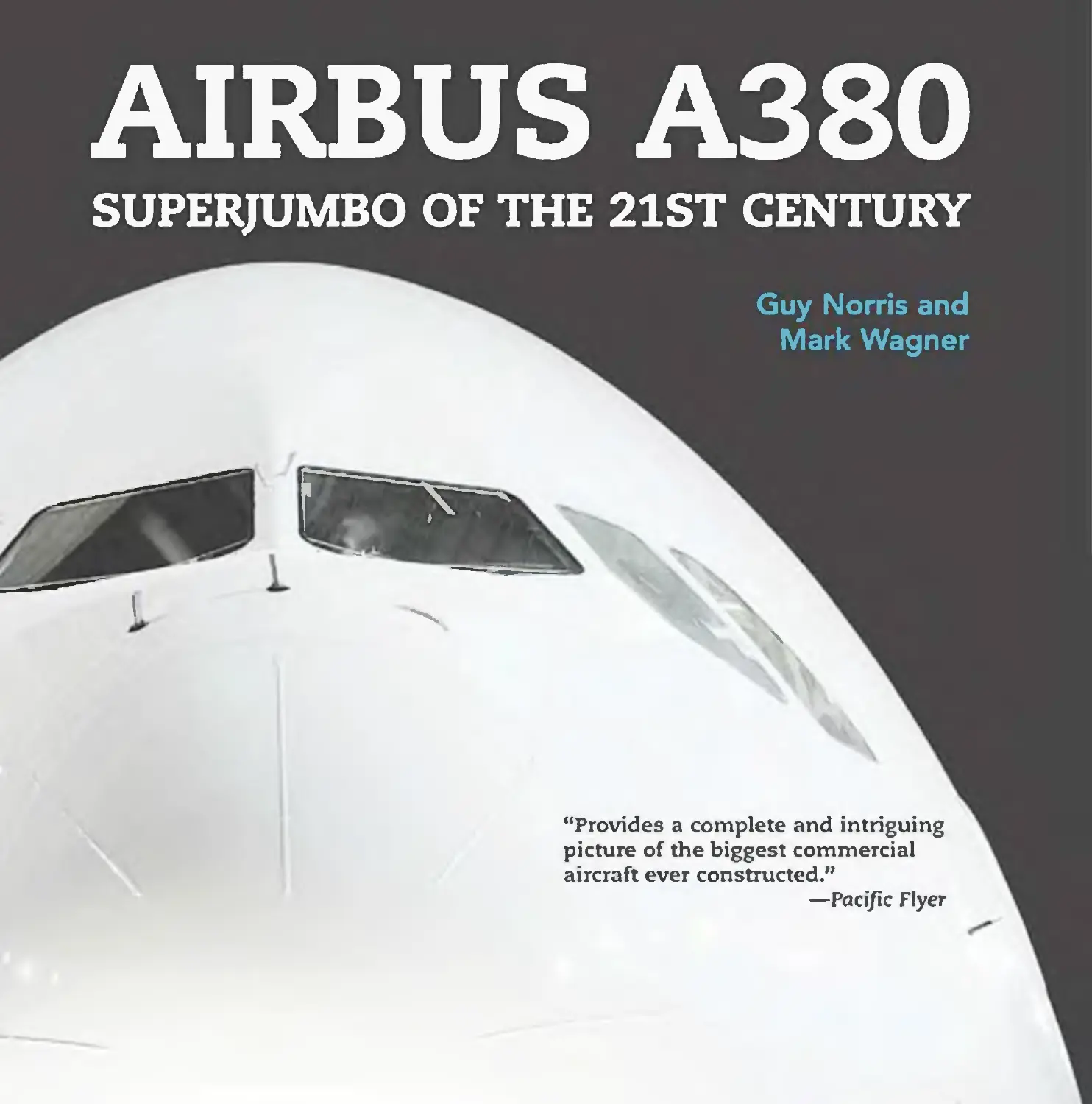
The world's latgest airliner in at its public debut "Reveal" ceremony in
Toulouse, Ftance, on January 18,2005. Mark Wagner
On the frontispiece:
At ait shows around the world, models of the A3XX and
747-5OOX/600X vied for the attention of the attendees
wandering the exhibit halls. Mark Wagner
On the title page:
The cross section of the A380 allowed up to 25 containers to be
loaded into the upper deck, 33 in the main deck, and 13 in the lower
deck. Total available volume, including bulk catgo in the lowet aft
hold, was a rematkable 1,240 cubic yatds. Mark Wagner
On the back cover:
Some idea of the structutal scale of the A380 can be glimpsed in this
impressive view of the completed fuselage center section 15/21 of
MSN006 at Saint- Nazaire, France. Measuring just ovet 28 feet tall
and 23 feet,S inches wide at its widest point, the lower part of the
section is also configured with support struts for the belly fairing that
is attached during final assembly in Toulouse. Mark Wagner
With the bulk of the early flight test program responsibilities on its
shoulders, MSN001 was expected to conduct about 600 hours of the
planned 2,1OG-hour test effott fot the Trent 900-powered A380. This
program would also involve three other aircraft: MSN002, 004, and 007.
Mark U0gner
:MEI Publishing Company would like to thank Airbus for providing
images from the following:
exm/H. Gouss,,; P. Masclet: pages 8, 32, 57, 67 (uppet), 92 (upper
right), 92 (lower), 93 (upper), 93 (lower), 94, 100 (upper), 101 (Iowet),
102 (lower), 103, 120 (center), 135 (Iowet), 152 (lower)
i3M: 38, 72, 74 (lower), 77 (upper), 77 (lower), 144 (upper)
About the Authors
Guy Nottis is the awatd-winning seniot editot fot Aviation TVeek &
Space Technology magazine. He has previously been U.S. West Coast
editor for Flight International, technical editor for Flight, and London
correspondent for lnteravia magazine, and has authored numerous
aviation books.
Matk Wagner, MRAeS, is a specialist aviation photographer and pilot.
He wotks as chief photographer for the international photo agency
Aviation-Images.com as well as for many aerospace, editorial, and
advertising clients worldwide. He is an Aviation TVeek & Space
Technology photo awatd winner and is based in London with his wife,
Stephanie, and children, Henry and Polly.
IRBUS
Superjumbo of the 21st Century
.
ZENITH
PRESS
Guy Norris and Mark Wagner
:0
Dedication
To Mark Hewish (1948-2005), colleague, mentor, and above all, great friend.
TABLE OF CONTENTS
AcknoW'ledgments ................................. 6
Prologue: Sowing the Seeds of a Superjumbo . . . . . . . . . . . . . . . . 7
Introduction .. . . . . . . . . . . . . . . . . . . . . . . . . . . . . . . . . . . . 11
Chapter 1: Back to the Roots. . . . . . . . . . . . . . . . . . . . . . . . . . 12
Chapter 2: Let the Battle Commence . . . . . . . . . . . . . . . . . . . . 20
Chapter 3: Defining a Dream. . . . . . . . . . . . . . . . . . . . . . . . . . 30
Chapter 4: Manifest Destiny? . . . . . . . . . . . . . . . . . . . . . . . . . 42
Chapter 5: Seeking Commitments . . . . . . . . . . . . . . . . . . . . . . 50
Chapter 6: High-Tech Advantage. . . . . . . . . . . . . . . . . . . . . . . 60
Chapter 7: Enter the A380 Superjumbo. . . . . . . . . . . . . . . . . . . 72
Chapter 8: Land of the Giants. . . . . . . . . . . . . . . . . . . . . . . . . 84
Chapter 9: Cutting Metal . . . . . . . . . . . . . . . . . . . . . . . . . . . . 94
Chapter 10: Absolute Power . . . . . . . . . . . . . . . . . . . . . . . . . 104
Chapter 11: Engineering a Giant ..................... 116
Chapter 12: Systematic Approach. . . . . . . . . . . . . . . . . . . . . . 124
Chapter 13: Turbulent Times. . . . . . . . . . . . . . . . . . . . . . . . . 130
Chapter 14: Supersized Freighter. . . . . . . . . . . . . . . . . . . . . . 142
Chapter 15: The New Space Age Begins. . . . . . . . . . . . . . . . . 150
Appendix: A380 Specifications. . . . . . . . . . . . . . . . . . . . . . . . 158
A380 Order Book. . . . . . . . . . . . . . . . . . . . . . . . . 159
In d ex. . . . . . . . . . . . . . . . . . . . . . . . . . . . . . . . . . . . . . . . . . 1 60
ACKNOWLEDGMENTS
We are deeply indebted to the countless Airbus employees, past and present, who helped bring this project to life. For recounting the high-
lights of the design, engineering, and marketing story, we thank Jean Roeder, Jerome Pora, Frank Ogilvie, Colin Stuart, and Wolf-Dieter
Wissel. For opening doors and helping us along the way, we thank Barbara Kracht and her fine communications team. In particular, thanks
to David Velupillai, Debra Batson, Daniel Bled, Rolf Brandt, Mark Challoner, Nadine Coedel, Laetitia Combes, Ann De-Crozals, Yannick
Delamarre, Daphne Dewachter, Francois Fournier, Fabian Guerrero, Mathilde Graux,Jose Luis Hormigos, Jean Michel Janniere, Georges
Lecoq, Francoise Maenhaut, Karen Mitchell, Sylvia Philp, Tore Prang, Fabienne Royet, Caroline Tabbernee, and Suzane Ziaket. Also to
Dietmar Plath for his desktop model and to Rick Kennedy, Deb Case, Jim Stump, and Mark Sullivan of the GeneraiElectric/Pratt and
Whitney Engine Alliance, Also Janina Cross, Robert Nuttall, Alistair Coast Smith, Andrew Siddons, and Martin Johnson of Rolls-Royce,
We would like to thank Mary Kane and Tom Lubbesmeyer of Boeing, as well as Caroline Harris of Smiths Industries, Thomas Niepel,
Martin Butler of Goodrich, Lori Krans of Hamilton Sundstrand, and Erich Wagner. For help with reseatch, we thank Rob Grundy, Stuart
Buchan, and Joe Wollner, and to Graham Warwick for help with proofteading. Thanks also to colleagues and friends at Flight International,
including Andrew Doyle, Max Kingsley Jones, Murdo Morrison, Chris Thornton, and Paul Gladman, For patience, help, and understand-
ing, our gratitude goes to Stephanie Day and Anna Ravelo, as well as to Henry Wagner; Tom and Greg Norris; Christopher, Daniel, and
Lia Ravelo. Last, but not least, we extend our gratitude to Scott Stickland at aviation-images.com and a special thanks to Steve Gansen
and Lindsay Hitch at MBI Publishing Company.
6
Sowing the Seeds of a Superjumbo
In the warm summer of 1988, a small group of advanced project engineers in Airbus Industrie's Toulouse headquarters gathered around a table
to study rough sketches of something few of them really believed would ever be built.
It was a giant aircraft capable of carrying more than 800 passengers-an unprecedented behemoth of a jetliner that would one day challenge the
mighty Boeing 747, the latest -400 version of which had just started flight tests in the United States. This group of engineers specialized in future
projects, and crazy ideas were their bread and butter; but until then none of them had seen proposals for anything quite so large, so bold, so auda-
cious, and so top secret.
Only this small group, working for the New Product Development and Technology branch of Airbus, knew of the project, dubbed the ultra-
high-capacity aircraft (UHCA). At this stage, the project's existence was totally unknown to the rest of the consortium, including the leadership
of Airbus.
To Jean Roeder, the group's leader and brilliant engineer behind the concept of the shared wing on the A330 and A340, the UHCA was
something that Airbus simply had to do. Boeing had reaped the benefits of a full family of airliners for more than two decades and had enjoyed
its mega jet monopoly for too long. If Airbus Industrie was to become a real global player, Roeder argued that the 747 monopoly would have to
end. "Airbus was making efforts at this time to get 30 percent of the market, and we thought that this just would not be possible in the long term
if we did not get a complete set of aircraft in our program." said Roeder, senior vice president of product development and technology. "It was
my job to look at what we needed to do."
Roeder acknowledged there were other, more selfish, motivations. "We badly needed the design work. All the big programs at the time had
just been completed. In addition, within Europe we urgently
needed a new technology vehicle. We had all the technology that
was available at the time, most of it going into the aircraft on the
line, and there wasn't much left up our sleeves."
The small group in the Technical Directorate pushed the
idea around for a few months. "We asked ourselves, is it possible?
Does it make sense? And only after we had convinced ourselves
there was something here that could be done, we started to make
a wider effort," said Roeder, who had first come from Munich in
the early days of Airbus to help work on the cross section of the
very first A300.
Tentatively at first, Roeder began making discrete sanity
calls to colleagues. Sid Swadling, Airbus chief engineer at British
Aerospace (BAe) Filton, told him that the major new component
would be the wing. "It was clear that whatever we decided to do,
it would be a BAe wing. So when I asked what we should be
working on next, to my surprise he said we ought to be doing
something the size of the 747, and I already had that in my pock-
et and I hadn't dared say a thing."
Encouraged by the reactions they received, the team
pressed on and, in October 1988, Roeder asked for a lunchtime
PROLOGUE
.
-
J A"",
-
; I
...
.
.
Seventeen years after it first dared to dream the seemingly
impossible, Airbus successfully flew the world's first superjumbo. The
first A380-800 performs a triumphant flyby over the main runway at
Toulouse toward the end of its maiden flight on April 27, 2005.
Mark Wagner
7
...
meeting to discuss future projects with Airbus president Jean Pierson and chief operating officer
Herbert Flosdorf£ The three met at the Airbus corporate restaurant, a five-star establishment in its own
right, and discussed the issues. Pierson asked: "Well, Jean, what are you going to do next?"
"I reached into a plastic bag that I had brought into the meeting with me, and pulled out a model
we had had made up and put it on the table. He was clearly surprised; he did not expect anything that
big," said Roeder, laughing at the memory.
Pierson looked at Roeder's model and instantly saw the possibilities. But he also saw risks. What
if word got out before Airbus was ready? What if a competitor, or even one of the partners themselves,
decided to take the initiative away rrom Airbus before the project could be properly assessed? "Pierson
was very, very careful, and he was right, If you start going out with something like this too early, even
with your partners, you are risking failure. It had to be done right, and if we were going to propose
something new, the partners would all have to go and find the money," said Roeder,
The idea would remain a secret for another two years while Airbus catefully began its UHCA
work But it would take more than a small model and a bit of market research to launch a project of this
scale. What economic and societal forces were at play to make Airbus believe that a market could exist
for an aircraft bigger than the 74 7?
Changing Worlds
In 1988, news of a changing world frequently dominated lunchtime talk in the Airbus dining room. At
the top of the agenda for discussion was the approaching end of the Cold War-the unremitting stand-
off between East and West that had gripped the world for four decades. Under the benign influence of
the recently elected Communist party general secretary Mikhail Gorbachev, the late 1980s had seen the
Soviet Union embark on the twin paths of perestroika, or restructuring, and the equally painful process of
glasnost, or openness.
By 1989, with Gorbachev's appointment as president of the Soviet Union, the radical reforms in the
U.S.S.R. became a prelude to the equally sudden meltdown of the Communist regimes throughout eastern
Europe. The astounding spectacle of the Berlin Wall being pulled, pushed, and bulldozed out of exis-
tence in November 1989 appeared to be a bellwether of a new epoch of global freedom and peaceful coexistence.
To aircraft manufacturers and airlines, these events heralded the potential for travel and trade on an unprecedented scale. Business flour-
ished while air passenger traffic climbed at or above a worldwide annual average of 5 percent, with some 1.2 billion travelers making a journey
by air that year. For reassurance, Airbus needed to look no further than the Asia-Pacific market, where the relentless expansion of the Tiger
economies of the region fueled double-digit surges in passenger air traffic. By the end of the 1980s, the Asia-Pacific region already accounted
for more than 21 percent of the world's gross domestic product (GDP), a 50 percent increase since 1970, and was forecast to grow to about 27
percent by 2000. Since GDP is generally the single most important variable when predicting air traffic volume, planners recognized the clear
signal that Asian-based airlines and their international competitors would be in line for expansion,
It didn't take a rocket scientist to see that more people traveling created a demand for more aircraft. But more aircraft also meant more con-
gestion, and pundits on both sides of the Adantic turned their attention to predicting how this would affect the size of future aircraft. Would
runway and airspace capacity limits dictate a move to larger and larger aircraft, or would infrastructure improvements and more efficient medi-
um-sized aircraft be better ways to meet the rising demand?
This was the pivotal $12 billion question that would launch the race for the next-generation super jumbo, and that would ultimately drive
a philosophical wedge between Airbus and Boeing for more than a decade.
In Asia, at least, the omens clearly warned of congestion to come, and statistics indicated the devastating possibility of virtual gridlock in
Hong Kong, Taiwan, and Japan, in particular. Figures showed that weekly aircraft arrivals and departures at the top 10 major airports in the
Jean Roeder,
the exceptional engineer behind
the common design philosophy of
the A330 and A340, came up with
the plan to use a similar concept to
go even further-into the realm of
the superjumbo. Although Roeder's
original plan did not come to
fruition, it planted the seed from
which the A3XX and later the A380
would grow. Airbus
8
-........
,.
1'1,.
....
........
"
-
Although it was originally the year-on-year traffic growth of the "Tiger" economies throughout Asia that sparked the ultra-high-capacity
aircraft (UHCA) development race of the 19905, the Japanese carriers remained cautious observers of the A380 program as it entered flight
tests in 2005. Here, the prototype, with gear stowed, is seen heading back to Toulouse to resume flight tests after taking part in the Paris Air
Show that year.
region jumped rrom 6,500 in 1971 to 10,000 in 1980, and to 16,600 in 1989. The trend indicated thattotal arrivals and deparrureswould reach
27,000 per week by 1999, or an average increase of 60 percent in airport congestion.
For the moment, however, the big divide was still ahead, and Airbus and Boeing appeared to be reading the same script. In its 1990 fore-
cast, Boeing predicted a steady increase in average aircraft size rrom fewer than 190 seats to almost 230 seats in 2005. While this may not seem
like a significant difference, remember this was the average, making it a sure sign that there would be a need for more aircraft as large as, or larg-
er than, the 747.
Boeing's 747 sales figures also supported the need for more large jets, further fueling Roeder's argument for an Airbus counterattack. From
the end of 1985, when Boeing announced the launch of the higher-capacity -400 model, through 1990, Boeing had picked up a staggering 382
new 747 orders-130 of them in 1990 alone!
9
Overall, Boeing predicted a demand for about 2,500 airliners with more than 350 seats between 1990 and 2005, while the closest equiva-
lent predictions from Airbus saw a need for 2,800 aircraft between 300 and 500 seats in the period rrom 1990 to 2009. In the Asia-Pacific region
alone, the consensus showed that the long-range fleet of aircraft with more than 350 seats would rise rrom 250 in 1990 to 920 by 2005. Even
McDonnell Douglas, still at this stage a powerful force in air transport, was considering new ventures to probe the larger aircraft market with
new derivatives of its recently launched MD-11 trijet.
While their predictions differed slightly, Airbus, Boeing, and McDonnell Douglas all agreed that the big battleground was not necessarily
in the jumbo category, but rather in the midsize market, where a new range of aircraft was competing to replace fleets of McDonnell Douglas
DC-10s and Lockheed L-1011 TriStar wide-bodied trijets. Beyond this was a potential market of more than 2,000 more aircraft to fill the
inevitable demand for growth in mid- and long-range routes.
Although no one could have predicted it at the time, the race to fill this market would have far-reaching effects that would forever change
the face of commercial aviation, Not only would the race contribute to the eventual disappearance of one of the most famous company names in
the business, it would also establish the basis from which Airbus would launch its pivotal assault on the super jumbo market.
10
INTRODUCTION
Poised for takeoff on that hot morning in April 2005, the Airbus A380 had the purposeful, powerful presence of a giant predatory bird.
With its enormous gulled wings; imperiously tall tail; and broad, domed forepeak, it looked ready to take on the world, champion its support-
ers, and silence its critics. And there have been plenty of both. No civil airliner since the supersonic Concorde has aroused such passion, such
controversy, and such fascination.
To friend and foe alike. all agree it is a phenomenal engineering achievement. To some, the super jumbo is a magnificent cruise liner of the
skies with unprecedented money-making potential. To others, it is a huge white elephant with questionable economics and a slim chance of suc-
cess.
To a confident Airbus and the thousands of awestruck workers who cheered it into that cloudless sky over Toulouse, it means so much
more. Under the broad wings of this incredible project, the European company has been reborn as a single corporate entity-transformed from
a loose consortium into a new, more dynamic force to challenge its worthy adversary Boeing in every market sector,
The A380, which was designed to bring people together on a scale never before seen, had touched thousands oflives before it even flew.
The very act of creating the super jumbo has forged a globe-spanning network of more than 100 international suppliers and partners in more
than 20 countries. The super jumbo inrrastructure, therefore, matches the industrial scale and sophistication of a space program.
And scale and space is what the A380 is all about. The aircraft is almost as large as the list of superlatives frequently used to describe it.
The first airliner designed to carry almost 900 passengers in its baseline version, it has the most spacious interior of any jetliner ever built, the
biggest wings, and the greatest overall engine thrust. Its double-deck load, hopes Airbus, will help relieve congestion at airports by taking up
less space than the two airliners it can replace, In that sense, it is also the "greenest" long haul airliner yet developed, burning less than 1 gallon
of fuel per passenger over 95 miles, a fuel consumption comparable with a small turbo-diesel family car.
As these words were written, the age of the super jumbo was in its infancy, flight tests were underway and deliveries about to begin.
This book, therefore, tells the story of where the A380 has come from, how it was designed and built, and gives a guide as to where it is
going in the future, Time, of course, will reveal the true destiny of the super jumbo. Given the skill, spirit, commitment, and passion of all those
involved in the birth of this rematkable aircraft, however, the signs are that the A380 will be the flagship of the twenty-first century and take
its place as one of the greatest aircraft ever made.
-Guy Norris and Mark Wagner, July 2005
11
,
GIICU'f
_PIWU
- ,
,
..
,
,
.
or-rt_
The A380 was the first large Airbus model to have a fuselage wider than the 18-foot-6-inch-diameter cross section body originally conceived for the first product, the A300B. Developed as the first'
so spacious at the time that early operators such as Air France actively encouraged passengers to bring luggage on board rather than check it in for transport in the baggage hold I Here the perfec
containing two LD-3 cargo containers side-by-side below the main deck, is shown to good effect as an early Air France A300B4 taxies at London Heathrow. Mark Wagner
o
1
Back to the Roots
A s Jean Roeder was presenting his plans for the future, development work was under-
way on the Airbus A330 and A340, the largest airliners yet designed in Europe. They,
in turn, traced their ancestry directly back 20 years to the first Airbus product, the A300.
Developed as the world's first wide-bodied twin jet, the A300 was the product of a
European study into a new "air bus" to link major hubs such as London and Paris.
The study was the work of an Anglo-French government working group that encap-
sulated its findings in a 1965 report, "Outline Specification for the High-Capacity
Short-Haul Aircraft."This formed the DNA for what was to become Airbus Industrie, the
French-based European consortium formally established in December 1970 to challenge
the dominance of American commercial jet makers,
Although it was a notable engineering achievement, the A300 failed to impress many
of the world's airlines when it first flew in October 1972, With very slow sales, the big twin
limped almost unnoticed through the early 1970s. The giant U.S. aircraft manufacturers
scoffed at it, and the global recession that the oil crisis in the Middle East spatked severe-
ly hampered it. These were dangerously vulnerable years for Airbus, which held onto life
by a thread, selling only a single aircraft in 1976 and producing only one aircraft
per month.
But airlines that were forced to adjust to higher fuel prices in the late 1970s gradual-
ly recognized the economic appeal of a wide-body twin. The basic concept of a large twin,
ironically, had come from an early American Airlines specification, and it was a U.S. -based
carrier, Eastern Airlines, that provided the sales breakthrough. The April 1978 order for
23 A300B4s by Eastern, the first North American customer for Airbus, instantly gave the
Nide-body twin in the world, the cabin seemed
tly circular fuselage cross section, neatly
13
A key driver behind the twin-
engined wide-body concept adopted
by Airbus for the A300B was based on
a 1966 requirement for an "air bus"
issued by American Airlines.
Nicknamed the "Koik Machine:'
after American's engineering vice
president, Frank KoIk, who crafted the
specification, the idea later morphed
into a trijet and bizarrely led to the
birth of not only the big twin, but also
to that of the two big trijets, the
McDonnell Douglas DC-10 and
Lockheed L-1011 TriStar. American
eventually would operate both the
A300 (as the -600R vanant) and the
DC-10, one of which is pictured on
takeoff from Las Vegas McCarren
International in 1989. Note the pair
of ex-Eastem L-1011s in storage
close to the corner of the field
where the Luxor pyramid-shaped
hotel now stands. Mark Wagner
14
'-
.... -
fledgling manufacturer a new measure of credibility
that it has kept to this day, It's interesting to note that
the original American specification also led directly to
the birth of the DC-10 and the L-1011-both trijets.
Eventually, in 1987, American Airlines did order a
fleet of A300-600Rs, which served it well into the
twenty-first century.
Interim developments of the A300, including the
A310 and the A300-600, were followed in 1980 by an
expansion into the single-aisle, short-haul market
with the A320. The diversification helped strengthen
the industrial base of Airbus at a grassroots level
beyond Europe, and just as importantly established
the manufacturer's reputation across a much broader
range of airlines and operators.
Airbus based all its wide-body designs on the
same 18-foot, 6-inch diameter fuselage cross section
of the first A300. The fuselage was perfectly circular
and provided enough width to accommodate two
LD3 containers (the industry standard for cargo ship-
ping) to be housed side-by-side in the lower
cargo hold,
Satisfied with the logic of its cross section, which
has rrequently been identified as the most important
specification in any new passenger aircraft design,
Airbus always intended to stick with this platform for
future higher-capacity designs.
Two of these original projects were designated
A300B9 and A300B11. After the A320 launch, they
A
'.
-..,.
were renamed TA9 and TAll, respectively, to indicate
that they were twin-aisle projects. The TA9 was essen-
tially a stretched A300 with more powerful engines for
medium stage lengths, while the TAll was to be the
first Airbus design powered by four engines for long-
haul routes. Even at this stage, however, Airbus did not
presume to tread on the toes of Boeing and invade the
sacred territory of the 747. The TAll was simply
aimed at replacing the 707 and DC-8 on long, thin
routes which, although covering vast distances, were
not sufficiently busy to fill an aircraft the size of the
747. Studies into the TA9 and TAll continued into the
1980s under the leadership of Jean Pierson, but the big
question of which one Airbus should launch remained.
The breakthrough, in terms of affordability, came
when Roeder, then Airbus chief engineer, hit upon the
idea of using the same wing for both designs. The air-
craft already shared common fuselages, systems, flight
decks, and tails, so the idea of using essentially the
same wing became even more appealing to the consor-
tium, Pierson would later recall the debate that raged
within Airbus: "Some people said we should launch a
twin, others a quad. Finally, the engineers promised
they could do both with a common airframe for half a
billion less. So I said, 'Let's go!'"
Adam Brown, who was vice president for strategic
planning during the early years of the A330/ A340 and
later the A3XX/A380 programs, remembered that
Roeder and his team were "able to create a common
wing structure, with the quad's outboard engines pro-
viding bending relief to counteract the increased
weights of the long-range model. The cost savings this
presented enabled us to do both aircraft. The idea was
really a piece of brilliant insight."
Following an Airbus supervisory board meeting in
Munich in January 1986, the designations of the TA9
and TAll officially became the A330 and A340,
respectively. Originally, Airbus intended to launch the
four-engine TAll first, because it was attracting the
most immediate interest from airlines. So the plan was
to call the TAll the A330, and the twin-engine TA9
the A340. However, as Brown recalled: "Our salesman
came back and said that airlines would never get their
brains around a twin having a four in its name and the
quad not, so we reversed the designations."
The pair was finally launched on the eve of the
1987 Paris Air Show, with two versions of the A340
being offered: a 260-seat -200 and a 295-seat -300. At
the time, only one version of the A330 was available,
the 295-seat -300. The A340 entered service with
Lufthansa in March 1993, followed by the A330
with Air Inter in 1994. A later, shorter version of the
A330, the 250-seat -200, was subsequently developed
and entered service in 1998. The later variant of the
twin would prove to be one of the most popular mem-
bers of the family, eventually outselling Boeing's 767,
....--......'"
Airbus was already trying to figure out how to get
more passengers into the A340 as it glimpsed the pos-
sibilities of taking a slice-but only a slice-of the
Classic 747 replacement market, The epithet Classic
had not yet come into vogue, but even by the
late 1980s it was obvious that the improvements in
the newly developed 747-400 would spark an
eventual replacement race for the older generation
747-100, -200, and -300 versions.
In September 1989, even before assembly of the
first 295-passenger A340-300 had begun, Airbus
revealed studies of a double-deck modification that
would seat up to 60 passengers in a converted forward
belly hold.
The move was designed to counter the MD-ll
rather than take on the 747, but it got Airbus planners
thinking and soon morphed into a more ambitious
stretch derivative with greater market appeal dubbed
the A340-400X. Almost immediately, however, the
study ran into trouble because of the limited power of
the incumbent CFM56 engines,
The -40OX plan involved stretching the fuselage
by 20 feet, 7 inches, which would provide capacity for
340 passengers in three classes. But without changing
engines and wing design, the range capability was
hopelessly penalized by about 1,500 nautical miles
compared to the baseline A340-300, rendering the
... ",''\.,
\ \ ,......... ,
..... -,
. .
. .
\ '\.
IiJ
--.....
;\
"
Spreading its wings into the
narrow-body business, Airbus
developed the A320 as the world's first
commercial transport with a
digital fly-by-wire (FBW) flight control
system. (The Anglo-French Concorde
was fitted with an analogue system.)
Based on earlier developments first
used on the A310 and proven on an
A300 demonstrator, the system
provides hazard protection throughout
the flight and was further developed
for the much larger A3301340 and
A380. The A320 family quickly became
a best seller, with more than 3,500
ordered and almost 2,500
delivered by late 2005. Here an
early-model British Airways A320-1 00,
originally ordered by long-defunct
British Caledonian and distinguished
by its lack of wing lets, is pictured on
approach to London Heathrow during
a late winter afternoon in 2001.
Mark Wagner
<
"
-....... '\,
...... "
.-
,
"I'D
I
, '<.
4
""
,
.J
...,
.................'...111...........
...... ........!!':: ..,
"N
Originally aimed at the
707/DC-8 replacement market, the
TA 11 study emerged in 1980 out of
earlier A300B 11 derivative work.
Renamed the A340 in January 1986,
the four-engined jetliner entered
service in March 1993 with Lufthansa
and later provided the platform from
which Airbus would launch the
long-range and higher-capacity
derivatives, the A340-S00 and -600,
respectively. These efforts, together
with the highly successful A330,
helped establish the credentials of
Airbus as a serious competitor in the
long-haul business, thus paving the
way for the eventual development of
the A380. Ajrbus
16
-400X a dud before it even got off the drawing boatd.
But the -400X exercise was not a wasted effort.
Airbus had seen a vision of the future and was
intrigued by the possibilities of this emerging market
opportunity, so it canvassed engine manufacturers for
a larger powerplant for its stretched A340. In 1991,
Airbus Engineering Vice President Bernard
Ziegler prophesied: "One day, for sure, we'll have
new-generation engines for this aircraft."
In the end, it took a torturous six years of negoti-
ation, redesign, indecision, market uncertainty, and
posturing before the project finally emerged as a qual-
ified challenger to the Classic 747. By now it had
again evolved, this time into a two-member family
renamed the A340-500 and -600. In another break
with tradition for Airbus, which had used General
Electric and Pratt & Whitney engines for all its wide-
bodies up to the A330, it signed a virtually exclusive
deal with British manufacturer Rolls-Royce for the
Trent 500 engine.
The new A340 design, coupled with a larger wing
and more powerful engines, could carry 378 passen-
gers and their luggage across ranges of up to 7,300
nautical miles, or right in the middle of the Classic
747 replacement frame, Furthermore, by trading air-
frame weight for range, the shorter -500 sibling could
carry 313 passengers over the great distance of 8,300
nautical miles, At 247 feet, 1 inch, in length, the
A340-600 became the longest airliner ever built, while
the A340-500, at 222 feet, 7 inches, became the
longest range airliner ever built. From the moment
these aircraft entered service in 2002, both helped con-
firm beyond doubt the credibility of Airbus in the
long-haul jetliner market, while at the same time
securing a precious foothold on the virtually untapped
ultra-long nonstop routes that beckoned between the
United States and Asia.
Studies Begin
It was the inherent flexibility of the basic A340
fuselage that Roeder seized on for the new UHCA
project in late 1988. "The purpose was to try and do
something at the lowest possible cost by using as much
as we could from the existing products. When I pre-
sented the original project to Pierson, it was all based
on what we could afford."
Wolf-Dieter Wissel, who Roeder appointed to
lead the UHCA study project and who would ulti-
mately become the director of configuration
integration for the A380, said: "It all came from first
ideas on a piece of paper, almost on the back of an
envelope, if you like, To be honest, it was all a bit like
a dream, there was nothing available from which to
start. But one of Roeder's brilliant ideas was to use the
A340 design elements to create this horizontal dou-
ble-bubble [HDB] concept, We took the A340
fuselage and sort of stretched the fuselage laterally and
put the A340 wings on it and used slightly larger ver-
sions of the HTP [horizontal tailplane] and both
vertical tails."
The bizarre-looking concept was sized to be
about 20 percent larger than the 747-400, and could
therefore seat up to 517 in a three-class configuration,
A flight deck was perched cupola-style atop the fuse-
lage. The Airbus technical director at the time,
Bernard Ziegler, was also keen to emphasize the pos-
sibilities of a clean-sheet design. "We've got to think
about a wider fuselage, We get no lift at all rrom the
fuselage today," he said when details of the design
began to emerge.
Pierson and Flosdorff had given Roeder the go-
ahead to continue with studies, and the Airbus
supervisory board gave its official approval for further
evaluations after Roeder's first formal presentation to
them in June 1990. With that approval, Airbus
decided to gingerly put its toe in the market with the
concept at the 1990 Farnborough Air Show that time
between 2003 and 2005. Airbus set a goal of having
direct operating costs that were at least 15 percent
lower than the operating costs of the 747-400, though
Jean Pierson told Flight International in May 1991
that the development would take account of "the
improvements they [Boeing] will make to the 747 by
the year 2000 . . . our obligation is to offer something
to the market that is far better than that."
With so much at stake, and with the need to focus
on specific new support technologies for a UHCA,
Airbus and its four partners launched a joint technology
program. This new partnership was formed under the
auspices of the European 3E (environment, economy,
energy) technology effort originally organized by Airbus,
its partners, and the European governments in the late
1980s to coordinate and rationalize research efforts,
In this case, the new initiative was directed at
defining three new technology demonstration plat-
forms for the single-aisle A320-size class, one for the
A340-size category, and one in the SOO-seat arena,
"
.....
1111111
11111111111111111 I
,
-............
I
\
Adaptability and innovation were hallmarks of the Airbus heritage, largely driven by the need
to do more with less. The use of a common wing on both the twin-engined A330 and the four-engined
A340 was a key enabler to making the entire project affordable. The outboard engine on the A340 is
located adjacent to the gap between the outer flap section and the inboard edge of the aileron, and
provides wing bending relief moment to the structure of the longer-range variants. The inboard engine
is sited at the same location as the engine on the A330, pictured here on the -200 demonstrator during a
flYing display at the 2000 Farnborough Air Show. Externally, the only difference between the two wings IS
a split between the fourth and fifth leading edge slat on the A340 wing. Mark Wagner
This novel approach ensured that Airbus would
utilize the best ideas and technologies from through-
out Europe by organizing four pre-project teams from
its partners-Aerospatiale, Deutsche Aerospace
(DASA), British Aerospace, and Construcciones
Aeronauricas, SA (CASA). The plan directed the four
teams to effectively compete with different designs to
be presented to the Airbus supervisory board by early
17
Designing the A340, the
consortium's first four-engined model.
taught Airbus valuable lessons that
would be used to good effect when
developing the structural and systems
redundancy of the A380. It also
shared a common cockpit with the
A330 and helped establish the
principle of crew cross-qualification.
which enabled pilots to quickly
transition not only between the big
tWin and its quad sister ship, but also
between these larger aircraft and the
A320. Total orders forthe CFM
International CFMS6-SC-powered
A340-200/300 family topped 240 by
mid-200S. Mark Wagner
A bigger wing and more
powerful Rolls-Royce Trent 500
turbofans rejuvenated the A340 and,
with the 380-passenger -600 version in
particular, gave Airbus the ability to
take on the 747 for the first time. The
development allowed the model to
penetrate two Boeing strongholds-
ultra-long range and high
capacity-though the shorter bodied
-500 faced massive competitive
pressure from the twin--engined
777-200LR. With combined orders of
about 140 by mid-200S, the duo
spearheaded the Airbus attack on the
upper end of the "fragmented"
point-to-point market. Mark Wagner
18
-
,
"
.'
..'
,.".,
.'
,.,.-
"
"
"
-
1992. The board would then select one or two of the
most competitive designs, and if none were sufficient-
ly cost-competitive with the 747 they would have to
go back to the drawing board, "We were expecting we
would need new technology to meet the range and
weight targets. We knew it could not be done using
the existing technology of those days; that was clearly
understood," said Wissel.
Airbus remained confident, however, that one
or more of the teams would come up with a
world-beater, or at least a design that could be merged
with features of the other contestants and possibly
even those of the in-house concepts, This would then
allow the concept to be formally adopted in 1993 in
preparation for a launch in 1996 or 1997. At this stage,
Airbus planned to begin searching for risk-sharing
partners and estimated that the overall development
cost would be in the $4 to $5 billion range-an enor-
mous amount of money that would eventually form
less than half of the new airliner's final cost.
,,'"
..
'"
" '\ ""
\ti
'\ " "
fI)) ...
,. al l
"'-'=. =:;:/
. Ovoid "
. Horizontal Double-&bbIe .
Possible Airbus
UHCA fuselage
cross sections
, W
L-J
Q
me(l1um-hlUl DuIineSI
dH.C'(ltlf!gu'.tIoftoI
. Clfcular .
.
. Clover leaf.
Nearly everyone in the airliner industry agrees that the most important design decision in the history of any
jetliner is the cross section. With no option but to go for a clean-sheet configuration, Airbus studied everything from a giant
circular section, which limited the upper deck options, to a "clover leaf" design that provided optimum space but was less
aerodynamically and structurally efficient. Top right is the famous A340-derived horizontal double-bubble section, while the
"ovoid" cross section finally adopted is pictured top left. Airbus
Airbus' first publicly revealed
UHCA concept was an unusually
configured aircraft with a wide
fuselage made up of two A340
fuselages melded side by side. The
idea was the brainchild of Roeder,
who believed the use of existing A340
components, including wings, tails,
and other systems, would be the only
way to afford to attempt such an
ambitious project. The concept got as
far as the wind tunnel stage but did
not produce encouraging results.
Airbus
-
:.-
\
Personally thanked by French
President Jacques Chirac for his
decisive role in launching the A380,
former Airbus President Jean Pierson
is pictured during the early 1990s at
the beginning of the UHCA odyssey.
His aim from the start was to take
the 747 head-on, and more
particularly any upgraded variant.
"Our obligation:' he said, "is to offer
something to the market that is far
better than that." Mark Wagner
.
..
.
I.
I
--
I.
" .
.
. .
..
r
..
I
. .
r .
- -" -iiiilil
· fl
n:
* ,"
I
.
_ "1J.1:A1I r J:a.-
.,... 11II
;::s- .. - .11'I r-
- .. - 'i' I;!!.
.. I ... ," S.
.11I. . . 'e"
r ..-: -. ....yii .:;
r.. .. '! .
.. ..... II. J:
.- !I! . · . (:;"
-11I:I IQ .,_ _. I.",
, .. rr !W .
.a &. __ ,. I
-- '1:;." II
T K .... v. _-;; ..
., JII. '"' I . I...
aD __.P.,
_ :!II.... ..._ .
. .... . c.
IU ..,. _ OIl. ..
.. . .Ir.
!III. .,.... 1;1.
.1;i'_1. .
-- . .. .
-. '!:!- -. -.
r _ ""11;I
I
f t
. ., I..
I i l ':
J r
III
-
. , .
. I
. I .
. . . . r .
. I .- I .. .
.
. . .
. . I
. -.. -...
. . . I .
. ." II
-.
II.
II 1 "11
:11 : I I
'11 I-il
.. '. 1 "
'11 ,"
"II , . 1
'11 .!
:11 I-i
Ii 1'1
.1' J:I
:.1 '- ,
:11 "
.11 ."
I -J' '"I
:, ..I i: n
, ---. II - II
i 1"1I'r""". I
..
i......
I. If
..., II
. .....
II t 1IV F;S
I
I
I
I
I
I
.
r-
.,.. T A
,.... T .,
...
-r ..,
"', 7 " --,
P'T yr .... .,.,
,.... R
,.... .
j.... ...,
- q .,..,
r:: -
-y q
.
--
I.'
.
.
I
I
I
I
I
I
.
I'
--- ,
, .
. I
- .. -.
'11 II
I: II
:: II ii "T
I. "
I- .
.
" it
...Ir -
--
&
,.....
..
I.
I I
II
.
,
.
--
'- ' 1
. - I
-.
" _ I
1 .
: ,i
I
.
I, .
II
II
II
1 (-. :
I .
I :
.--
"II II
fOil II
- :11 II
I I I i
'1 II.
-
"-
-.11"
: ' I i1: /: 1 1, 1 ,
II 1 °, I
1° I if: :11 f'
I Ii' I: II I
I I, I" 1
I I . "
I I I: r !
I II ;. I f!
.
w.
.. I I
;: I i
. I
I: 1/ J
.
ow
,..
....,.
"'
"II
l' I
. j I J
: id
....
.
-. .J
,. -
. ,.
'.
....
Reacting to the booming traffic growth across the Pacific in the late 1980s and early 1990s, United issued a broad specification to Boeing in 1991 for a UHCA aircraft dubbed the N6S0 It establishe(
and pushed Boeing's studies up in size well beyond the 41S-seat 747-400. The larger size category of the United spec would later drive an insurmountable wedge between Boeing and the Europea
commercial transport (VLCT) joint studies. Mark Wagner
..
. -..- --
.. "' .. ..
.- " . l-
t I ] -
" . -
" . . .-- .
-. -. ."RS:-.
I . I. .
I . if
! .. .. I . U U .....
. I II iI
r 1 . II II
I . II II' ...
"I . I II.
I I
I J . i" .
, . 1/ ... .- .
I
..
. I
II
f
.
I
, r.
,
-.
, -.
-.
.....
-.
-.
I .
....
......... PW:
-
-, -
-
. I
r..
,
--
...
.,
... ..
----...
"-,
-
d the baseline size at between 600 and 700 seats
In partners during the abortive very large
o
2
Let the
Battle Com me nee
A irbus had been making all the noise about new-generation jumbos, but that was about
to change. In June 1991, just before the Paris Air Show, it was revealed that United
Airlines chairman Stephen Wolf had asked Boeing to study United's requirement for a
650-seat transpacific aircraft. Dubbed the N650, the requirement galvanized Boeing into
action and triggered a bizarre series of events, the effects of which forever altered the face
of civil aviation, and which are still being felt today,
Boeing took United's request very seriously despite the fact that only 17 months ear-
lier it had launched the 777 on the back of a launch order rrom the massive Chicago-based
carrier. Within a few days of United's request, Boeing began to sketch a series of three
main concepts: a stretched 747, a full double-deck variant of the 747. and a clean-sheet
design, The first details of Boeing's response came at the Paris Air Show, where the com-
pany's executive vice president, Phil Condit, said: "We fully intend to compete in that
double-deck version market."
Boeing also appointed a former marketing vice president, John Hayhurst, as vice
president for large aircraft development, To Hayhurst, the writing was on the wall for a
new-generation jumbo, particularly when Boeing had forecast in 1991 that 54 percent of
the value of the commercial market up to 2005, or roughly $334 billion, was for 350-
seaters and upward, "We believe we can fulfill that by a combination of 747- and 777-sized
aircraft as well as a requirement for an aircraft larger than the 747-400," said Hayhurst.
"We have had a number of product developments aimed at this, ranging from stretches of
the 747-400 to all-new aircraft. What we're doing is bringing together all the efforts we've
had up to now and focusing them to find out what the market needs are for this segment
21
DASA's A2000 concept began to
make public appearances on the
Airbus stands at air shows in the early
1990s and offered a glimpse of the
ovoid cross section and overall layout
that would one day be adopted for
the A3XX. The best features of the
A2000, also known within DASA as
the DA PS02P602, were melded with
those of the "competing"
Aerospatiale ASX 500/600 and BAe
AC14, to produce the Airbus 3E
PS00-100/200 family. The A3XX and
the A380 were therefore direct
descendents of this leviathan,
which-In Its largest form-was
designed to seat 615 passengers. In
the DASA studies, large areas of the
lower deck were given over to
first-class sleeper bed accommoda-
tions, making this design, in effect,
a triple-clecker. Mark Wagner
22
-
.
" ."."""
"""",,,...,,,,.....,',..
...
............
............
..............
and then to design it." The simplest option, the pro-
posed 747 stretch, was slightly larger than the -400, a
tried-and-tested Boeing formula used on everything
from the 707 onward,
The United and Boeing move had a sudden
impact on Airbus, which announced an accelerated
schedule for its jumbo effort, calling for launch in
1995 and entty into service some time after 2000. As
if taken up with this greater sense of urgency, Airbus
shareholder Deutsche Aerospace (DASA) also
unveiled details ofits initial proposals to meet the new
jumbo requirements. Its leviathan was a conventional
configuration called the A2000, Not unlike the final
Airbus super jumbo in overall configuration, it meas-
ured 255 feet in length, with a massive wingspan of
262 feet. It had an overall height of 75 feet, a wing
area of 8,180 square feet, and a maximum takeoff
weight of 1.16 million pounds. The A2000 was
designed to seat 615 passengers on three decks, with
economy passengers on the upper deck, business trav-
elers on the main deck, and first-class passengers, for
whom beds would be available, on the lower deck.
DASA suggested a suite of advanced-technolo-
gy features for its configuration that would help
achieve a 15 percent fuel burn improvement over the
747-400, a target that would continue to be a bench-
mark for the eventual Airbus project, These features
included a fly-by-wire flight-control system to help
offset weight by creating a smaller empennage. DASA
.
I
A2000
...."."""",,,""""
"",,,,..,,,n. w ,
...,.11.,.11.11.11""
.......
.IIU II1II '"
-,
also proposed the possible use oflaminar-flow control
on the wing and tail, but it ruled out the use of carbon-
fiber composites in the primary structure of the wing.
DASA also recognized that such a huge aircraft
would present a psychological barrier to overall accept-
ance but added that it would be built nonetheless. The
company's executive vice president for design and
technology, Professor Uwe Ganzer, said at the
time: "We're seeing such an increase in traffic that it
is inevitable."
Boeing, driven largely by the inspiration of
United, tentatively saw a similar vision. Speaking in
September 1991 at the u.K. Institution of Civil
Engineers, Boeing Product Strategy Analysis
Manager Richard Bateman said that a 600-seater
could take a large chunk of a market forecast to be
worth some $617 billion through 2005. Bateman
painted a picture of an all-new design that used four
777-size engines and had a fuselage cross section of27
feet, 9 inches, in diameter. This would allow up to 12-
abreast seating on the main deck and up to 8 abreast
on the upper deck, while providing sufficient capacity
for up to three LD3 containers on the lower deck.
The wingspan was an impressive 259 feet, but
with folding wingtips to enable it to fit into existing
747-400 gates. Although approximately 18 feet short-
er in length than the A2000, the new design was
almost exactly the same height and had an array of
upper and main deck doors for loading and unloading,
The concept, loosely dubbed the 787, "could be in
service by the end of the century if the market wants
it," said Bateman.
But did it? United, which scheduled two
747-400 departures within 10 minutes of each other
on the New York-Tokyo route, obviously saw a need,
but what about everyone else? The only way to get the
answers was to ask the airlines, and that is precisely
what Airbus and Boeing began to do as 1991 came
to a close.
Teams from both manufacturers headed to the
headquarters of the world's biggest airlines, the bulk of
them in the Asia-Pacific region. Airbus marketers vis-
ited about a dozen carriers, hoping to present their
findings to the four special project teams set up to
study the UHCA. Speaking in Singapore that same
hectic September, Airbus Marketing Vice President
David Jennings said: "We are at the stage where we
think it is technically feasible, We think that Airbus
could produce such an aircraft, and we are testing
some of our assumptions about the market."
Boeing visited Qp1tas Airways in Australia and
learned that the carrier was really more desperate for a
shorter-term 747 stretch solution. But after hearing
encouraging news at an operators conference in
Hawaii, Boeing set up a customer advisory committee
like it had for the 767-X, which led to the 777, The
committee was comprised of prospective customers
that included the usual suspects, namely United;
British Airways; nras; and the two key Japanese
jumbo operators, Japan Air Lines (JAL) and All
Nippon Airways (ANA), as well as Cathay Pacific
Airways and Thai Airways International.
Speaking in South Korea after the November
1991 handover of the first 747-400 to Asiana, a new
Seoul-based airline, Boeing's Everett division vice
president, James Johnson, said: "The decision must be
made for a stretch of the 747-400 or a new aircraft or
both-we're actually considering both. There is active
interest in a new, large 650- to 680-seat airplane, and
there are a number of customers who'd like us to do it
real soon."
Using 777 technologies, Johnson believed that a
new design was probably the best option. "We could
go to a circular double-deck cross section, which is
lighter and more efficient and which obviates the
cargo capability," he added. Rather more surprising
was news that the new giant, should it go ahead, would
probably not be built in Everett-the traditional man-
ufacturing site of all Boeing wide-bodies. The reasons
given were site congestion plus the increasing specter
of high taxes in Washington state, In addition,
\
\
'\.
'.
-
'- ,
, .
"'. "\.')
"\: \ \
, '
I
.1
.,
.
,
\
,
'", /
...
.........
,
....... ,
...... I
0,'- ,
\. /
,
;""
\\
-
Johnson said that the effort would "probably be
financed by ourselves, with a sort of co-manufacturing
arrangement with someone like the Japanese on the
777, though not necessarily the Japanese."
At the same Asiana delivery meeting was
Boeing's vice president for international sales, James
Chorlton, who, like his equals within Airbus, appeared
keenly aware of the massive market opportunities of
the Asia-Pacific region. "This is big aircraft countty.
For people like JAL, ANA, and Thai, the bigger the
airplane the better. They keep saying: 'Are you going
to build it, and when, and how big?'" Chorlton also
fired from the hip when it came to China and its
prospects. "China's traffic is growing by twenty
percent a year internally and ten to twelve percent
internationally, They have a whole warehouse of
Russian junk that has to be done away with, and it's a
big market for aircraft. China Southeast wants the
biggest airplanes we can build."
Boeing's challenge-and a problem that Airbus
did not have-was whether it should take advantage
of the well-established 747 family-and everything
that meant in terms of commonality, manufacturing
experience, and inrrastructure-or whether it should
Many of the initial
superjumbo concepts were based
around the new generation of
high-thrust powerplants just then in
development for the Boeing 777. As
most were originally aimed at 600-
plus-seater designs, it was naturally
assumed that nothing less than the
75,000- to 8S,000-pound thrust
capability of these new engines would
be sufficient. As it transpired, a new
generation of engines with slightly
less power was specified for the
A3XX, though both the General
Electric/Pratt & Whitney (P&W) Engine
Alliance GP7200 and Rolls-Royce
Trent 900 were fundamentally based
on technology developed directly
from 777 engines. The P&W PW4084,
pictured hanging from the wing of a
United Airlines 777, provided the
basis for the GP7200 low-pressure
system, while the core was based on
that of the GE90. Mark Wagner
23
go for an all-new design. The 747-derivative option
was not necessarily the easiest, but it was the cheapest.
The two 747 studies included a 23-foot, 4-inch
stretch that would add 84 seats, taking typical three-
class seating to 484, and a more radical modificatIOn
that extended the hump of the upper deck aft along
the entire length of the main-deck cabin. But, as with
any derivatives, both 747s suffered from being sub-
optimized designs. Range was the big issue, with the
stretch plane being capable of only 80 percent of
the -400's range, while the upper-deck stretch would
only have 73 percent of the range.
-I
.,
"
--
f iJ e J
-
-=. -
.t
\. '1
-
-
-,
. ,
U'J
..
"
A
8
'\
..
),--. ' f
. aa. ...
r..: .
China's unbelievable economic boom was still slowly building when this sleepy parochial scene was
captured at Xian Airport in 1986. The 19S0s vintage Ilyushin IL-14 in the foreground was still in regular
front-line passenger service, while the Tupolev Tu-1S4M was brand new, having just been delivered from the
then-Soviet Union. Even at this early stage, the replacement market was beckoning and, as Boeing's senior
international sales supremo James Charlton pointed out: "They have a whole warehouse of Russian junk
that has to be done away with, and it's a big market for aircraft." Chinese Premier Zhou Enlai obviously
disagreed with Charlton's assessment ofthe IL-14 (or "Crate," to use its NATO code name), as he used one
as his personal transport. The aircraft is preserved today in a museum in Tianjin. Mark Wagner
24
A Surprise Challenger
But it was neither Airbus nor Boeing that emerged
first with a firm new double-decker design, it was-to
the shock of the industry-the Douglas Aircraft
Division of the McDonnell Douglas Corporation
(MDC). The Long Beach, California-based manu-
facturer had not even registered on the radar screen as
far as the UHCA race was concerned, but had been
busy for several years attempting to bolster its flagging
product line with a stretched derivative of the
MD-11, dubbed the MD-12X. In early 1992, howev-
er, the airlines that were closely involved with the
MD-12X studies began pressing for a more efficient
four-engine design with greater growth potential.
The sudden abandonment of Douglas's familiar
trijet heritage took everyone by surprise, especially
Airbus and Boeing, which looked on with curiosity at
the proposed new design. Remarkably, given the
design heritage of the MD-ll rrom the DC-10 and
the smaller MD-80/90 twins from the DC-9, the
revised MD-12X would have represented the first all-
new commercial transport to be designed by Douglas
since it started formal development work on the
DC-lO in 1968!
The lack of investment by St. Louis-based
McDonnell Douglas in its Long Beach commercial
airplane division over the years had resulted in a dis-
jointed product lineup with yawning gaps. While
Boeing, and later Airbus, had developed complete
families covering all the capacities rrom 100 seats up,
Douglas was dependent on its mid-market
MD-80/90 and larger-capacity MD-ll for business,
and was left vulnerable to the ups and downs of
the market.
Douglas had recognized its predicament for
years, becoming acutely aware of the problem in the
late 1980s when it began doing its sums over the
estimated $1 billion cost of developing a new super-
critical wing for the stretched MD-11. It had even
held discussions with Airbus over the faint chance of
using a derivative of the A330/ A340 wing, and talks
were still going on in 1988 when Douglas President
Jim Worsham conceded that "it is very difficult for
competitors to collaborate."
The talks with Airbus were abandoned, but by
1990 the cost of developing the proposed re-winged
MD-12X trijet stretch had mushroomed to $3 billion
with the realization that the wing would have to be
much larger than previously thought. In all, it would
have an area of 4,870 square feet-29 percent larger
than the MD-ll-with about 753 square feet more
area than the A330/ A340 wing. It would have had a
.
lit:.a'ila ;:
4 "00 Q 109
.
...
t
o
184-foot wingspan, compared with 211 feet for
the 747-400.
But the worst was yet to come. Estimated costs
had climbed to $4.5 billion by mid-1991, forcing
McDonnell Douglas into a radical rethink. Instead of
digging into its own dwindling coffers for develop-
ment dollars, why not invite partners to share in the
development? In rerum for taking this risk, the part-
ners would be entitled to part of the profit. At the
same time, MDC could benefit by sharing its own risk
and by bringing in partners who could perform work
at relatively low cost.
Gareth Chang, MDC president for Pacific and
Asia, described in Flight International a paradigm shift
in the company's strategy for regaining commercia]
market share. Production costs were to be driven down
by putting work where labor costs were lower, while
development capital would be sought rrom emerging
nations preparing to invest in high-tech industries,
Casting its net wide to talk with companies in
Japan, South Korea, Taiwan, and elsewhere, MDC
hoped to offset more than 60 percent of its costs
through the relatively novel concept of risk-sharing
partnerships. To further encourage the move, which
was pivotal to the launch of the MD-12X and with it
the long-term survival of the company itself, MDC
offered equity in Douglas in exchange for investment
in the effort.
The first breakthrough seemed to come in
November 1991 when MDC signed a memorandum
-"
11"1[. I,"
.
,
........
t"
,
,
of understanding covering equity investment by
Taiwan Aerospace (TAC) and the possible formation
of what was dubbed an "Asian Airbus." The negotia-
tions dragged on, however, and MDC felt
increasingly under pressure to give the MD-12 the
go-ahead with or without TAC involvement. MDC
still needed the cash, however, and Chang acknowl-
edged that without Taiwanese involvement it would
be "much tougher for us to keep our position and
become competitive."
It was against this troubled background that the
revised MD-12 plan was hatched. In overall appear-
ance, the new design was similar in length to the
MD-11 but, due to its twin-deck layout, would be
capable of seating up to 450 in a three-class layout.
Describing the MD-12 as "bold and visionary,"
Douglas President Robert Hood claimed that the big
jet had "leaprrogged our competition and is, in short,
an aircraft for the twenty-first century." Hood also
believed the MD-12 would capture a fair share of the
2,500 aircraft worth $300 billion that MDC had fore-
cast would be required in the long-range market over
the next 20 years.
From the start it was clear that the MDC design
had more in common with the new double-deckers
Airbus had shown at the previous year's Paris Air
Show than with anything Boeing had shown until
then. The driving force behind the design, according
to MD-12 Vice President Walt Orlowski, was the
goal of beating the seat-mile costs of the 747-400
...
A
......-
\ -
.".
--
McDonnell Douglas had
done so well with its stretched DC-8
and DC-9 denvatives
that an extension of its DC-10 was
considered a logical approach to the
emerging 7,OOO-nautical mile,
300-passenger aircraft market. By the
mid-1980s, McDonnell Douglas
(MDq predicted demand would be
for as many as 1,400 aircraft by 1998.
Although the project was launched as
the Mo.11 as early as December
1986, McDonnell Douglas failed to
capitalize on its lead over the
competing A340 and 777 programs
that were subsequently given the
Igo-ahead by Airbus and Boeing,
respectively. The MD-11 did, however,
sustain MDC well into the 1990s and
provide the basis for several
subsequent stretch attempts to
compete in the "jumbo" market.
Mark Wagner
25
"",",.,
1"""""""", ".,
,
. /ttI'CDONNEI..I.. DD6In,...
".,.........".
'""",..." lot
.. ...",.. ."",
""t"",..
...
_ r
MD-I2
."."",.
The baseline McDonnell Douglas Corporation (MDC) MD-12 would have measured 208 feet in length, with an identical span (213 feet) to the 747-400. Seating up to 511 in
a high-<:apacity layout, the aircraft was a world away from traditional MDC designs with its double-deck, four-engined layout. The design also featured a three-axis fly-by-wire
flight control system with wing load alleviation, extensive use of composites in the empennage, new four-post landing gear, and an unusual three-aisle main deck. The wing
design included Douglas Aircraft's latest divergent trailing edge (DTE) feature, a patented design that Boeing later offered as the "trailing-edge wedge" on its proposed
747-400X and 747 Advanced. DTE helped wing performance by increasing the curvature near the trailing edge, thereby increasing the amount of aft camber and improving
transonic lift distribution. Authors Collection
26
while at the same time meeting the payload/range
goals its target airline group had established.
The fact was that Douglas could not meet these
goals with a stretched MD-11. "Optimizing the fuse-
lage cross section and length did nothing to help,"
Orlowski said. "We went rrom 10 abreast to 11 and
12, but the return was really poor, and it looked like
we'd need 20 before we got what we really wanted. We
needed an aircraft with the same weight as before but
with more seats."
The new wing supporting the big double-decker
was a key part of the design, which was meant for
stretching from the start. The wing was designed with
a divergent trailing-edge drag-reduction feature that
Douglas had patented, It produced an effect similar to
the variable-camber concept Airbus had studied for
the A340, and gave the MD-12 wing both significant
inverse, or aft, camber and a blunt trailing edge almost
1.5 inches deep. The divergent trailing edge was opti-
mized for a Mach 0.85 cruise and promised a 3 to 4
percent improvement in overall aerodynamic efficiency.
Another reason for changing to four engines was
the availability of appropriately rated new-technology
turbofans. "We needed 240,000 pounds of thrust,
which either means four engines of about 60,000
pounds each or three of 80,000 pounds. Our only
choice for the trijet was a bigger engine (the General
Electric GE90 was then in early development for the
Boeing 777) and a de-rate, but this had big weight
penalties," said Orlowski.
..
....A..
- .J.
<
II!:!"'"
-=
...
....
"T"
"f"'!'-
'..
G ..
.,r -;
..
"T"
..
....
++ """""'0;
,...'
-k-
The early strands of A380 DNA are visible in these pre-A3XX UHCA concepts that trace the design
activity among the Airbus partners in the 1991-1992 timeframe as they sought to define the best way fOlWard. Note the
single-deck P40S and P4S0 concepts, and the intriguing 747 look-alike PS1 a and P4S1 designs, the former sporting a five-post
main undercarriage configuration. The best features of these designs, plus P602 (recognizable as DASA's A2000, see photo on
page 22) were molded into the 3E PSOO concept group in mid-1993. From here sprang the A3XX and its predecessor, briefly
dubbed the A3VY. Airbus
It could be argued that the MD-12 was the first of
the really viable new UHCA designs, but it was almost
certainly the least likely to see the light of day, which
proved to be the case. Douglas Aircraft, increasingly the
victim of bad timing, unveiled the double-deck MD-12
in the midst of one of the worst recessions the airlines
had yet seen. Orders for the already launched models
were hard to come by, let alone those for a yet-to-be-
launched multibillion-dollar gamble like the MD-12.
In the first half of 1992, for example, Douglas took
only four new finn orders for the MD-80/90 and no
new business at all for the MD-11. The warnings were
all there in 1991, when only 37 new orders had been
booked for the whole year, compared with 188 in
1990. The year had been so bad, in fact, that Douglas
had more cancellations than new firm orders placed or
options exercised, with the backlog dropping by 25
percent during 1991 to just $17,9 billion.
Worse still, by entangling the MD-12 project
with the complex attempts to sell up to 40 percent of
Douglas to Taiwan Aerospace, MDC had sent the
completely wrong message to the airlines, even those
historically loyal to the company, such as American
and Delta. Robert Crandall, the chairman of
American Airlines, provided a classic example.
Speaking to Aviation Week & Space Technology. he said,
"The aircraft was okay. The problem was the financial
condition of McDonnell Douglas. It is not in any
shape to statt a new aircraft program." While everyone
suffered, Douglas was hurting the most, and the airlines
knew it. In the same six months of a virtual drought in
orders, Airbus had booked 77 while Boeing had
notched up 113,
Crandall's words echoed throughout the industry
as Douglas vainly sought to sign up customers for the
MD-12 through the dry months of early 1992, as well
I I - I
J -' _, ..! -' -I -1- ' -'0' .1-J _1 _J
, i
I I j -.- j
..-;.. !r.. 1IiIII-......
.....
-------
as coerce the Taiwanese into signing up on the deal. By
June 1992, Douglas conceded that the orders were just
not coming in and slipped the planned launch into
1993, claiming that the failure to seal the deal with
Taiwan Aerospace had not affected
the situation.
Increasingly desperate attempts to prop up the
MD-12 continued as 1992 wore on. The fall issue of
MDC's Spirit magazine that yeat, for example, proudly
announced that the forthcoming super-sized airliner
"will be the biggest--and the best-jetliner ever built."
The article continued on a hopeful note, predicting that
the MD-12 "could be the revenue earner that puts
McDonnell Douglas on top in the commercial aircraft
industry." It also said that the "introduction of the MD-
12 gives MDC a head start over its competitors. Boeing
is studying the concept of a 750-passenger wide-body,
and an 800-passenger super jumbo is said to be under
development at Airbus. But no such aircraft have yet
been offered to customers."
What MDC failed to realize most was that, even
as that particulat edition of Spirit was landing on
employees' desks, the MD-12 dream-and the
Taiwan deal-were already dead. Research-and-
development spending for the last quarter of 1992 was
pated drastically back to about $11 million against the
uw
v"'!'" v
A rather dated-looking
artist's rendering from 1992 depicts
the broad stailWay close to door 1
on the proposed MD-12. The aircraft,
had it been launched, was intended
as the basis for a broad family of
derivatives ranging from a
620-passenger, long-range (LR) stretch
to a 430-seater MD-12 Twin. The
MD-12LR would have been stretched
more than 26 feet to a total length of
239 feet, enabling more than 700
passengers to be seated in a high-
density layout. The tail would have
also been increased from 74 feet high
on the baseline to 82 feet on
the -12LR. Author Collection
27
TJ!i(lp-Bo,[y Cross Sp-r.tioll. Comparisoll
@1"I
n
\l I JJ
747-400
256 In. Wide by 309 In, High
Looking remarkably similar to
the cross section of the later A3XX
and A380, the MD-12 was sketched
out with an overall width of 24 feet, 3
inches and a height of 27 feet, 11
inches. The early renditions of the
A3XX, by comparison, showed an
overall width of 22 feet, 1 a inches and
a height of 27 feet. 9 inches, later
being revised upward on the A380 to
23 feet,S inches wide and 28 feet, 1
Inch high. For all its promise, however,
the MD-12 was doomed long before
it even got to the proposal stage by
the repeated failure of MDC to invest
in its Douglas Aircraft product line
and expand beyond its traditional
twinjet and trijet derivative families.
Authors Collection
28
MD-12
291 In. Wide by 335 in. High
$80 million spent over the first part of the year, and
the MD-12 quietly died.
Airbus smelled blood, and despite MDC's sub-
sequent attempts to reinvigorate the MD-ll with
studies of a long-range variant, possible plans to
develop new-generation twins, and the launch of the
MD-95 100-seater, most airlines recognized that
the end was not far off fur McDonnell Douglas, the
once proud aircraft manufacturer. In some ways,
the dramatic and unexpected foray into the UHCA
market had exactly the opposite effect that MDC had
hoped for. The project briefly and brilliantly lit up the
marketplace, but in the end it served only as a distress
signal to tell the aviation industry that Douglas
Aircraft was badly holed and sinking fast.
Airbus Narrows Focus
Unperturbed, and possibly encouraged, by the emerg-
ing Long Beach fiasco, Airbus spent the bulk of 1992
further defining its approach to the UHCA market
and continuing its dialogue with 10 selected airlines.
By October, the consortium revealed that it was focus-
ing on a two-family design approach with a smaller
version seating between 600 and 800, and a larger
UHCA seating between 800 and 1,050.
Still loosely designated the A350 at this stage,
the baseline UHCA was sketched out with a massive
wing with an area of 8,020 squate feet, compared with
3,900 square feet for the A330/A340. Span was set at
255 feet, and the mean aerodynamic chordor-the
distance rrom the leading edge to the trailing edge
measured parallel to the longitudinal axis-was a full
63 percent longer than on the A340 wing. The design
also continued to be centered around two A340 fuse-
lages married laterally to form a flattened ovoid cross
section. Overall, the UHCA was to be about 260 feet
long with a 51-foot-tall tail.
The smaller 600-seater had a planned payload of
about 163,000 pounds, of which 30 percent was to be
made up of belly freight. In a single-class high-densi-
ty 8oo-seat layout of the type the Japanese airlines
used on the domestic 74 7SR variants, the aircraft
would have a payload of about 167,400 pounds but no
capacity for rreight. The latger family versions were
similarly configured, with payload limits of up to
407,490 pounds and seating for as many as 1,050 in a
single-class layout.
All the other weird and not-so-weird configura-
tions were still in the melting pot of possible options
at this stage, including the cloverleaf cross section that
combined the fuselage of the A340 with that of an
A320 on top, or a larger version with a new cross sec-
tion on the main deck and an A340 scabbed on top.
Maximum spans in the study ranged up to 275 feet,
while the longest fuselages were up to 265 feet.
Supporting studies were underway to help answer
all the other questions about developing the world's
biggest airliner. Qiestions about simply how to deal
with the unusual levels of mass and stiffness distribu-
tion within such a huge flexible structure; how to spread
the weight of a 1-million-plus-pound aircraft on the
wheels; how to steer the massive aircraft around exist-
ing airports and their limited taxiways; how to handle
the flying controls; the noise it might create; and how to
evacuate all the passengers in an emergency.
Meanwhile, Boeing's future large airplane stud-
ies, now being led by Chief Project Engineer John
Roundhill, showed an all-new design that bore an
even closer resemblance to the MD-12 than the first
double-deck shapes revealed the year before. But
Roundhill said the designs were "a lot different in
detail. In general terms, one of the designs is short and
fat. A circular cross section is our baseline, but there
are variations."
The new design could seat up to 750 and was
based on three different cross-sectional arcs in a triple-
bubble configuration for added strength at reduced
weight. The design also avoided the bulk of the
structural problems Boeing encountered with
the upper-deck fairing of the 747's section 41 nose sec-
tion, while allowing the incorporation of an extremely
wide main deck. For most configurations, this was 12
abreast, with 14 abreast studied for short-range
domestic Japanese routes.
The new wing was designed to provide a 6 per-
cent improvement in cruise efficiency over the
747-400, with about another 3 percent rrom the use of
state-of-the-art engines. The use of hybrid laminar-
flow techniques for drag reduction was also thrown
into the pot as a way of achieving a Mach 0.865 cruise
speed with low drag.
Like Airbus, the Boeing study included aspects
of the inrrastructure, including runways and ground
handling. Mter reviewing 70 runways at the most likely
key destinations around the world, the study esti-
mated that 17 would require strengthening with an
extra 3 to 6 inches of asphalt. Intriguingly, the study
also recommended the use of closed-circuit TV
cameras mounted in the empennage and belly to
help prevent the crew rrom taxiing over the edges of
runways and taxiways.
The study group had also split into two parts-
one was focused on the 747X derivatives and the other
was focused on the all-new design. No timetable was
being publicly discussed, but Boeing Executive Vice
President Phil Condit suggested that 1994 to 1995
would be prime time for launch. "Our thinking has to
be five years out, in terms of delivering at the end of
the century," he said. Not to be put off by the dire state
of the industry that year-the conditions that were
then condemning the MD-12 to death by a thousand
cuts-Condit said: "If you look at our history, we
always start making new aircraft in the middle of a
recession and we always start delivering them in the
middle of a recovery."
What Condit (or anyone else at the time) could
not reveal was the fact that secret transatlantic talks
had started over the future of the UHCA. The revelation
would equally shock and confound the industry for
several years to come, and the ultimate outcome of
these talks would forever alter the destiny of both
Airbus and Boeing.
..
""""-
-
-
.......
Boeing's new large airplane (NLA) appeared in many guises to fulfill the emerging UHCA requirement.
Most of the non-747-derived studies, such as this rendition, were based around an II-new wing with 777
aerodynamic heritage, as well as 777-derivative engines. This behemoth could seat up to 750 passengers
and had a "triple-bubble" fuselage cross section to incorporate an extra-wide main deck. Boeing
29
.
Daunted by the estimated $10 billion plus development costs of the next-generation superjumbo added to what it forecast would be a limited market Boeing believed the only viable way fOlWard
transport (VLCT) partnership. It predicted that in terms of expense and complexity, the superjumbo project would be on the same scale as a second-generation supersonic transport replacement Ie
multinational experience of Concorde helped pave the way for the creation of Airbus. A British AilWays Concorde, afterburners ignited, thunders off runway 27 right at London Heathrow to chase tf
Mark Wagner
-+
3
Defining a Dream
N ineteen ninety-three was a mere five days old when Boeing and Deutsche Aerospace,
a member of the Airbus consortium, dropped a bombshell on the aviation industry.
To everyone's amazement, Boeing's UHCA project manager John Hayhurst and DASA
chairman Jiirgen Schrempp announced on January 5 that the two were joining forces on a
UHCA or very large commercial transport (VLCT) feasibility study. Acting on contacts
first made at the Farnborough Air Show the previous September, Schrempp and DASA
aircraft group leader Hartmut Mehdorn had followed up with a visit to Boeing in late
1992. But the announcement posed fat more questions than answers, the biggest question
being whether or not Airbus itself was involved in the feasibility study.
As far as Airbus chairman Jean Pierson was concerned, the European consortium had
already played a direct role. Speaking at the annual Airbus results conference in Paris early
that January, Pierson declared that initial discussions had taken place at Farnborough
between himself, Schrempp, and Hayhurst, and that at the end of the month the Airbus
board was due to review a discussion document that the meeting had sparked.
However, the journalists at the meeting had also listened to the Boeing/DASA press
briefing only a few days before and asked why Hayhurst had made no reference to Airbus.
Pierson replied that, "either he does not remember me, which is impolite, or he has a short
memory, which disqualifies him from being a project manager, or he's having second
thoughts. I think it's more likely he's having second thoughts."
In making such a statement, Pierson indirectly admitted that Airbus had not been
invited to participate in the VLCT study, even though one and possibly more of its mem-
was an international very large commercial
" the Anglo-French Concorde. Ironically, the
1e setting sun on a summer evening in 1997.
31
German aviation engineer
Jurgen Thomas is frequently referred
to as the "father" of the A380. He was
European project director of the VLCT
study with Boeing and immediately
aftelWard took the helm of the A3XX
program by running the Airbus large
aircraft division when it was formed in
1996. With the appointment of
Charles Champion as head of the
newly launched A380 program,
Thomas took on a new role as special
advisor to chief executive Noel
Forgeard. Airbus
32
bers had. Pierson was adamant, however, that the
move did not threaten to undermine Airbus or the con-
sortium's continuing aircraft studies or those being
conducted with the consortium's members. "There has
been no betrayal by an Airbus member. This is not the
end of the Airbus system," Pierson strongly reiterated.
The Boeing line was equally adamant. "We are
open to working with member companies of Airbus,
rather than Airbus itsel£ We think we will always
compete with Airbus head to head. We will be just as
vigorous in our competition as we expect them to be,"
a representative of the U.S. company said. Boeing also
strongly denied that the move was aimed at anything
other than studying the UHCA and vehemently
denied that it was using subterfuge aimed at destabi-
lizing Airbus or at driving a wedge between the
partners in the consortium.
Boeing could not deny, however, that the link
with DASA was extraordinary. So why was it estab-
lished in the first place? The primary reason was the
massive $10 billion, plus development costs, that
Boeing estimated would be needed to see the new
jumbo through development. Should it go ahead, the
U.S. firm expected the project to be on the same scale
as a second-generation Concorde replacement effort.
In other words, something it considered to be well
beyond the means of either Airbus or Boeing and
demanding a broad international collaboration.
Second, there was the issue of market size. After
its initial rush of enthusiasm, and the painful
post-Gulf War period for the airlines, Boeing's view
of the true size of the super jumbo market was
changed. Its analysis predicted near- to mid-term
demand from only a handful of international cus-
tomers, nowhere near the market size that would be
required to support competing designs.
Then there were other, less direct reasons related
to the ever-changing tactical and strategic struggle for
market share. For Boeing, faced with the task of get-
ting the 777 through certification and into service, the
talks with DASA would be extremely beneficial. First,
it would give it a clearer and broader view of the true
state of the market as well as the market's technical
requirements. Second, it would almost certainly delay
rather than speed up the entry into service of a 747
competitor. Boeing was clearly not in a position to
make an early commitment to develop a new super-
jumbo, but by engaging DASA in this new dialogue,
it would effectively slow Airbus' progress toward firm-
ing up a competitive program of its own.
With a supreme touch of irony, Boeing pointed
out that the study couldn't really involve Airbus, even
if Boeing wanted it to. Boeing Corporate Vice
President of Planning and International Development
Larry Clarkson was keen to point out that as a GIE
(Groupe d1nteret Economique) Airbus did not con-
trol the financial or physical assets of its member
companies. The U.S. manufacturer, therefore, had no
choice but to deal with these "real" companies instead.
DASA would be first, but there would soon be more.
"We have left open the possibility of bringing in
others to the study, These include our Japanese friends,
Kawasaki, Mitsubishi, and Fuji, as well as
Aerospatiale, British Aerospace, McDonnell Douglas,
and the Russians. It's a pretty wide-open ball game,"
said Boeing, which explained: "The reason we're talk-
ing to DASA is that it is like Boeing: very diversified.
Airbus is only one segment of their business. We can
see ourselves doing business with them."
It was true. As a GIE, Airbus represented a
group of independent companies with a joint family of
products rather than a single company. The structure
of the GIE, a uniquely French business concept, had
been the perfect platform on which to float Airbus
into the market. It allowed the companies to work
closely together toward a common goal with a set of
joint products, without having to operate under the
tight legal and financial ties of a strict partnership.
Suddenly, and unexpectedly, the Boeing maneu-
ver appeared to have left Airbus vulnerable and
exposed. All the consortium's member companies
remained free to work individually on aircraft outside
the 100- to 350-seat range already covered by the
existing Airbus product line, and there was nothing
Airbus could do to prevent it. In the long run, howev-
er, Boeing's extremely clever move would prove to be a
double-edged sword. By delaying the ultimate super-
jumbo development, Boeing unwittingly gave Airbus
more time to make important design changes to
accommodate new noise legislation. The initiative
would also help accelerate Airbus toward a radical
restructuring into a single entity that enabled it to
launch a super jumbo and carry it forward into the
twenty-first century.
Boeing, DASA, and the other main Airbus part-
ners, Aerospatiale, British Aerospace, and CASA,
signed a memorandum of understanding on January
22, 1993, that covered the start of the first phase of the
VLCT study. Part of the agreement included the cre-
ation of "Chinese walls" within each organization to
prevent the crossover of sensitive information between
the various Airbus and Boeing large-aircraft project
camps. John Hayhurst admitted at the time that the
arrangement was "like walking a tightrope," but added
that no formal timetable or structure for the study had
been finalized. "We haven't resolved what details will
be looked at specifically. The intent is to focus on
things like, is this the right size? And so on. We want
to reach a general understanding rather than get
into specifics."
Hayhurst openly admitted that all parties would
be forced, to some extent, to share their newly refined
knowledge of large aircraft from their respective
UHCA studies. "None of us is going in as complete
neophytes," he commented. If the study was viewed as
positive by the end of 1993, the plan was to look at
details of joint manufacturing, but "for the moment it's
going to take time to figure out how to work togeth-
er," added Hayhurst.
While the new transatlantic VLCT team got
down to work, Airbus and Boeing continued to plough
their own furrows. Within days of Boeing's surprise
VLCT gambit, Airbus made an informal offer to the
Japanese aerospace industry for an "equal, risk-sharing
partnership" of up to 30 percent of the UHCA. Airbus
was increasingly anxious to outflank Boeing in Japan,
where the U.S. manufacturer enjoyed a very close rela-
tionship with the aerospace industry and airlines.
Loyal 747 users such as Japan Air Lines (JAL) and All
Nippon Airways (ANA) were prime targets for the
future UHCA, and increasing the Japanese industrial
.. "'",...
n........
.
. .'-
&.>
- .
--
' . ..'
,. ......
. ...".
. 'a,:.
- ..
. ....
.....
- . ... - \.
, It,
4,
- W'I
All'
J-
work share was seen as crucial to winning the hearts of
the airlines. Although Airbus had been sowing the
seeds of a Japanese campaign for over a year, the
VLCT maneuver injected fresh urgency into
its efforts.
In late January 1993, Pierson presided over a
series of meetings with the three main Japanese aero-
space companies: Fuji, Kawasaki, and Mitsubishi
Heavy Industries. "They would be offered a decision-
making partnership in the UHCA program and be
treated as equal partners throughout," said Airbus.
Taking a swipe at Boeing, which had conttacted large
structural elements of several civil programs such as
the 767 to the big three Japanese manufacturers,
Airbus added: "We will not simply present them with
a design which they will then be expected to build."
Airbus had also refined its market predictions,
which showed a need for up to 727 UHCAs between
2001 and 2011. "Our forecasts indicate that 25 per-
cent of the seats in as-yet-unordered aircraft in the
next 20 years will be in UHCA-type aircraft. That's
too important to leave in the hands of a Boeing
monopoly," Airbus said. The studies also revealed that
the average requirement was for an aircraft with 759
mixed-class seats, And perhaps not surprisingly, in a
region where the 747 was jokingly referred to as
a regional jet, the studies identified the Asia-Pacific
-
. .: "' \- ..
.........
.............,.............
... -
-..
...
...
...........
....
--
.....
._ -""
. -"''1a\';'"
"
Airbus was not officially
invited by Boeing into the 1993
VLCT study because, acoording to
the U.S. company, it was not a "real"
manufacturer. Airbus had, indeed,
been formed under the auspices of a
unique French business concept
called a "GIE," which allowed it to
represent a joint family of products
made by a group of independent
companies. The first of these
products, the pioneering A300B, IS
pictured on its first flight in October
1972. Airbus
33
Japan's heavy use of747s for
both domestic and international traffic
made it a prime target for all the
superjumbo projects from the early
1990s onward. Even with the
increasing use of large twins in the
region, the sheer volume of
passenger traffic wrthin Japan
continued to make very large aircraft
indispensable. ANA, for example,
operated 23 -400s by mid-200S, 11 of
which were -400D domestic variants.
Since the late 1970s, ANA gradually
took delivery of a grand total of 45
747s, about 26 of which were for
domestic operations. JAL, which had
taken 44 -400s by 2005, also flew eight
D models. Overall, JAL took an
incredible 108 747s from 1970 onward,
some 24 of which were either -100SR
(Short Range), -300SR, or -400Ds.
Mark Wagner
I
_r
-- I
,." :._-----
.
..........
. ...J..
..............
region as the key market, forecasting that 11 of the
airlines in the region would need more than 30
UHCAs each, which together would account for 66
percent of the total demand for the aircraft.
Five of those same airlines were also working at
the same time with Boeing, which spent much of1993
attempting to define a new large airplane (NLA), or
747X ANA, Cathay Pacific, JAL, Singapore Airlines
(SIA), and Qgntas Airways were involved, as were Air
France, British Airways, and Lufthansa. It was a sign
of the times that United Airlines was the sole
U.S. representative.
The plan was to whittle down five favorite con-
cepts to two versions by July 1993, and a single
configuration by the end of the year. The studies, none
of which were related to the patallel VLCT effort,
gave birth to a vatiety of shapes and sizes, with seat-
ing between 550 and 630 passengers, and stretch
capacity up to 750.
Only one of the five finalists was a 747 deriva-
tive, a massive 282 feet in length, allowing it to seat up
to 550 in three classes. Although it was by far the
longest aircraft, it was also the smallest in capacity.
Two of the other finalists were double-deckers, one
1'1111' I
'._ '
- ......
I
. .
:It
. . II.' ....'-
:I
-
........
L MlNnA.,hn...
. .... II ............
was a model that looked like a 747 with an all-new
cross section, and the fourth was a 244-foot-Iong sin-
gle-deck monster.
Despite adopting as its baseline a double-deck
design similar to those being studied by the VLCT and
Airbus UHCA teams, Boeing had an inherent resist-
ance to the concept. This went all the way back to the
influence of veteran designer Joe Sutter, the acknowl-
edged father of the 747. Although the 747 would be
the only double-deck commercial jetliner in produc-
tion for 35 years, the emergence of its distinctive
upper-deck hump was originally driven not by passen-
ger requirements, but by the needs of a freighter. The
747 design team always believed that most of the fleet
would eventually be converted to rreighters or made
as rreighters from the start. In the run up to launch in
1966, the 747 was therefore given a hinged nose
section that allowed for straight-through loading but
meant that the cockpit had to be moved up and out
of the way. This created a de facto double deck, and
passengers were only later accommodated in the
upper deck, virtually as an afterthought.
Boeing had considered lots of full-up double-
decker concepts in 1965 for launch customer Pan
.'
--
..
... ,I
. . .1
..
..............
" ......................... .'
. .1&.811
.,.
American, but to Joe Sutter the designs produced "a
clumsy airplane." Sutter's design team hit problem
after problem when trying to fit everything into what
he described as a "short, stubby airplane. The servicing
of the aircraft, the door arrangement, the emergency
evacuation situation, and the loading of cargo and bag-
gage all became problems," he said in a 1997 interview.
There was, however, one early fan of double-
deckers. This was none other than Charles Lindbergh,
the famous aviator who had been the first to make a
solo crossing of the Atlantic in 1927. In a letter to Pan
American, to which he was a high-profile advisor,
Lindbergh expressed his belief that a twin-deck design
made the most efficient use of floor space.
Fast forward to 1993, and Boeing was once again
looking at double-deckers. This time, instead of the
six- and eight-abreast twin-deck designs of the 1960s,
the new baseline was designed to take up to 624
passengers in three classes, with 18 abreast in econo-
my! The aircraft was about 18 feet longer than a
747 and weighed in at about 1.4 million pounds.
Other designs included an alternate double-deck seat-
ing for 584 and a huge single-deck design based on a
777 -style fuselage.
Enter the A3XX
While Boeing's new concepts were grabbing the head-
lines at the 1993 Paris Air Show that June, Airbus was
quietly approaching a critical juncture in its history. It
was determined not to lose the initiative to Boeing
and, spurred on by the challenge the VLCT conun-
drum posed, moved quickly to consolidate the results
of the UHCA studies it had originally commissioned
ITom the three mam consortium members:
Aerospatiale, British Aerospace, and DASA.
All three had come up with very similar double-
deck designs that included Aerospatiale's ASX
500/600, which, as its designation suggests, was aimed
at satisfying both the 500- and 600-plus-seat markets.
BAe came up with a concept dubbed the AC14, while
DASA's P502/P602 had by now become as familiar a
shape-in model form-as the A2000 on every Airbus
show display. Airbus took the best characteristics of
each of the three designs and, during that hot June of
1993, blended them into an amorphous group called
Family 1. The concept was called 3E P500 to reflect
both its 3E technology-demonstrator designation and
its baseline capacity of more than 500 seats. The fam-
ily consisted of two major versions, the
3E P500-100 and a stretch -200 variant with
higher capacity.
.l
.,. ........
nT
t.\\...
...... .t
--
...... .....
...................
.....
I..clun(. i..
(.Iu.ud...... .....
.._ I.
.
. ,
..................
...a'\
it
-
o
.
-
With hindsight, it's now possible to see Family 1
as the genetic grandfather of the A380 and the three
main partner studies as the great-grandparents.
Another great-grandparent was the rather strange
horizontal double-bubble (HDB) design that Airbus
had revealed earlier. Over the next four months, this
later line would give birth to a more refined study with
double decks seating seven abreast on each deck. More
important, it gave Airbus a touchstone against which
to judge the relative merits of Family 1.
But how was this to be done? It was obvious that
Family 1 favored a conventional double-deck vertical
design, while some within Airbus still believed that
the unusual design of the HDB held merit. The only
solution was to take it to the next stage and compete
the concepts against one another, and it was to this
end that in October 1993 Airbus announced the for-
mation of the A3XX integration team. "For me, that
was the big step forward, where we began seriously to
compare the ovoid with the HDB," said Wissel, who
would later become director of configuration integra-
tion fur the A380,
By giving the study the A3XX designation,
Airbus instantly raised the intensity of the
UHCA/VLCT debate to a whole new level. The des-
ignation also provided a sharper focus for the design
teams and, by bestowing it a pseudo-official Airbus
identity, it spoke volumes to the market about the seri-
ousness of Airbus' intentions. The 3E P500-derived
Family 1 aircraft was renamed the A3XX-V600, with
tL.
....
..'
...
(............. ...
---
r'''fi''''
...;;......
IRlI FS ..
............. ...
..............
..................
....
_I-,ro.-
..
...
..
I"
--
Some idea of the typical
everyday airport congestion found
in Asia can be glimpsed in this
dramatic image of a Garuda
Indonesia A330-300 on very short
finals to Hong Kong's old Kai Tak
International shortly before
operations there ceased and the
new Chep Lap Kok International
took over. The aircraft, one of six
in the carrier's fleet, is operating the
afternoon service from the
Indonesian capital, Jakarta.
Mark Wagner
35
...
Boeing's released VLCT ooncept
appeared to be a well-crafted,
balanoed design with many of the
classic Boeing design hallmarks,
particularly around the empennage,
wing root fairing, and flight deck. The
design also featured four upper deck
exits and five main deck exits. Boeing
36
--
I
. .........
. ............................
'DEIAI'I;
.......
......... . ....
-:;-
an ovoid cross section cartying 10 abreast on the main
deck and seven on the upper deck. The original Airbus
UHCA HDB was renamed the A3XX-H600.
The integration team went straight to work and
almost immediately cast aside the unusual but awk-
ward A3XX-H600 in favor of the V600 alternative.
The team decided that the vertical ovoid cross section
would be lighter and therefore could use updated ver-
sions of existing A330-type engines. Speaking about
six months after the decision for ditching the H600
the then-general manager of research and technology,
Joachim Szodruch, admitted candidly: "The advan-
tages of the horizontal layout, especially in terms of
fuselage commonality with the current models, were
not as great as we thought."
Wissel recalled: "We went right through all the
design and operating criteria-airport compatibility,
. ........... . ....
---
.:....:...... "' .." '" "''' ...
weight, emergency evacuation, everything. In the end
we chose the ovoid because it offered more flexibility.
The HDB was limited to an extent in the length to
which it could be stretched, and had these tie rods in
the middle for load bearing that were a bit of a prob-
lem as far as the interior was concerned." Worse, the
wind tunnel tests had not revealed any of the hoped-
for lift contribution from the wide fuselage, so the
HDB concept was dumped.
Parallel backup studies on the baseline 3E P500
concept drifted through the winter of 1993-1994 but
would gradually fade away over the next four months
as the A3XX firmed up around the -V600 vertical
ovoid concept that would henceforth mark the funda-
mental configuration of the new aircraft.
Speaking in later years about the decision, A380
Senior Vice President for Engineering Robert
Lafontan said: "There is no better fuselage configura-
tion than that of a wide-body on top of a wide-body.
If you have a narrow-body mated to the top of a wide-
body then it is too restrictive. There is no room for
growth. If you have a wider [single-deck] body then
the evacuation rules make it uneconomical. A wide-
body on top of another wide-body is also capable of
being a good freighter."
In January 1994, Airbus emerged with a single
concept that would form the basis for its talks with air-
lines and that would eventually become the A380. The
initial A3XX was divided into two main versions, the
-100, provisionally seating about 500, and the -200
seating about 600. Airbus designers were determined
to focus on keeping cost, complexity, and weight to a
minimum from the outset, and as a result began the
A3XX design with just three main gear legs in the tra-
dition of the A340. But it soon became obvious that
for system redundancy and pavement loading consid-
erations, Airbus would have to follow the 747's lead
and spread the weight over four main gears.
By March 1994, these changes were incorporat-
ed into a wider package of updates to the design that
also included moving the entire wing slightly aft
to achieve a better center of gravity, stretching both the
-100 and -200 by two fuselage frames, and increasing
the cabin volume by shifting the aft pressure bulkhead,
or rear dome, farther back. The additional space creat-
ed sufficient room for up to 530 seats in the -100 and
630 in the -200. "Making the cabin wider than the 747
was a big argument," recalled Wissel, "because lateral-
ly airlines can't do a lot with an extra 10 or 15 inches,
but increasing the cross section gives them a lot more
options when it comes to seat width."
The sudden acceleration of activity in the A3XX
coincided with an extension of the VLCT study from
the planned end date of January 1994 to Apri11994.
The partners had to decide on whether to extend the
study phase or define a potential consortium, and they
were facing increasing pressure from all sides.
Although DASA's Jiirgen Thomas, the leader of
the European partners, said that the VLCT was not
"an undermining of their [Airbus] activities," the con-
sortium was increasingly vocal in its objections to the
study. Boeing, on the other hand, faced potential hur-
dles created by the US. government. John Hayhurst,
now Boeing's vice president for large airplane develop-
ment, said that some form of antitrust clearance would
have to be obtained from the US. Department of
Justice if a joint program were to be implemented.
Sure enough, as the A3XX concept gained
momentum, cracks began to appear in the VLCT
"o."Nt '4'
147
o
----
............
----
-8 3 ---
0'0 0
team. Jurgen Thomas, then DASA's executive vice
president of preliminary design and technology, con-
ceded in January 1994 that, although it was clearly
established Airbus policy to allow both the VLCT and
A3XX studies to go ahead in parallel, there would be
no possibility of both projects going ahead, because
"there's just not enough room in the market."
Airbus itself added that it "would be difficult to
see how we could cooperate with Boeing on a large
aircraft and be at loggerheads with them on every-
thing else. We do not believe they [the Airbus
partners] would want to do something that would
damage their interests in Airbus Industrie. There is no
intention for Airbus to do one aircraft and the part-
ners to do another." Thomas reinforced the view,
adding that, "Airbus Industrie must stay in strong
competition with Boeing." In what must be consid-
ered one of the understatements of the decade, he
summed up the situation by saying that Airbus and
Boeing cannot cooperate.
With the end of the extended VLCT phase
looming, however, it was Airbus' turn to surprise the
industry. At a meeting of the VLCT partners' chair-
men in London on March 3, 1994, it was decided to
extend the study into mid-1995 but, most puzzling of
all, the "gang of five" announced that Airbus would be
joining as an advisor.
Boeing said that, "the original agreement is still
between Boeing and the four companies. But there are
still some activities which they perform better as the
joint [Airbus] entity." Behind the rhetoric, however,
was an increasing atmosphere of uncertainty and,
above all, suspicion between the US, and European
Boeing's aborted 1990s
VLCT contrasted starkly with its
earliest attempts in the 1960s to
develop a double-deck 747 concept.
These produced nothing more than
a II clumsy airplane" according to the
original design chief, Joe Sutter. The
design suffered from inadequate
baggage and lower deck cargo
capacity, and effectively put off
Boeing from looking seriously again
at double-decker designs for many
years. Boeing
37
.'
-.
....
.........
....,.....
...................
'A3XX'
.................
........
,
. ........,
-
...............-.!
-
"""
'"
Looking significantly different than today's A380-800, the early A3XX concept was pictured with a smaller area wing of reduced span and a far smaller belly fairing than the
final design. The forward fuselage and nose shaping was also distinctly different, as was the vertical fin that, although the same overall height as the current design, was almost
twice the chord. Note also the additional forward upper deck exit, which was later deleted from the -800 design, and the blunt tips of both the wings and horizontal stabilizers.
Airbus
38
camps. Aerospatiale, in particular, made little secret of
its misgivings, while senior Boeing figures within the
study began questioning who was gaining the most
out of the project.
Although the VLCT teams were separated by
Chinese walls from their respective NLA and A3XX
project teams, news about one another's projects fre-
quently leaked through. Details of Boeing's stretched
747X plan, for example, told the Europeans that the
U.S. company was studying an aircraft with a maxi-
mum takeoff weight of some 420 tons and a range of
up to 7,700 nauticaJ miles. The variant was based
around an all-new wing using 777-style aerodynamics.
The news did not sit well with some. Speaking
to Flight International in June 1994, Aerospatiale's
director of aircraft programs, Claude Terrazoni, sug-
gested that the move clearly indicated a hidden
Boeing agenda. "If Boeing launches the 777B [refer-
ring to what would eventually become the 777- 300ER
ratherrhan the -200ER], this will be in direct compe-
tition with the 747-400. Boeing will therefore be
obliged, in order not to kill its 747 market, to push the
"1J ..
.
,
.
L
, '.
.
I
......, -.A U
Q
N244
-
-
747 toward a bigger aircraft. It's what Boeing is actu-
ally doing now. We have proo£ They're studying a new
wing for the 747."
But Boeing argued that, like Airbus, it was with-
in its rights to study legitimate options to the VLCT.
In the meantime, it was all light and sweetness
between the partners as the VLCT project moved
onto phase two, with an agreed agenda covering a
refined market forecast, first steps toward a possible
joint business arrangement, and key technical issues.
These included airport changes to cope with a VLCT,
including wing span limitations on runways, taxiways,
and aprons; weight on crossover bridges; fuel, cargo,
and passenger volumes; noise levels; and emergency
evacuation ITom double decks.
What was not widely known outside the closed
sessions of the project was that the VLCT team had
decided to shrink the aircraft slightly. Switching gears
in a subtle way, phase two was to examine the arrange-
ments of a European-inspired 500- to 550-seat design
versus the Boeing-led 600-plus seater studied in phase
one. The move, which would have seemed relatively
unimportant to outsiders at the time had they known
about it, was to have much more serious ramifications
in the years to come.
t
....-
.........;..-
N ."
.::
.e;
\ \
..:..
---
-
-
British Airways was by now making the most
encouraging noises to the manufacturers, who refined
their market predictions to between 450 and 500 air-
craft with more than 500 seats by 2010. Cathay
Pacific's managing director, Rod Eddington, said his
airline might be interested in a VLCT, but only a rel-
atively short-range version compared with the mega-
ranges being studied.
More ominously, American Airlines' influentiaJ
chairman Robert Crandall said simply: "We just don't
think that bigger airplanes are the way to go. Smaller
aircraft with longer ranges are the way to go." These
few words, spoken almost casually in March 1994,
were to resonate with Boeing's top leadership and help
nudge it toward a seismic shift in strategy that would
soon doom the company's VLCT and NLA while giv-
ing Airbus a free hand in the super jumbo market of
the twenty-first century.
By January 1995, planning was under way on
where to take the VLCT study beyond mid-July,
when phase two was due to end, If all sides agreed
that the market was sufficiently large, the plan was
to begin evaluations of a common configuration
later that year. Thirty-eight individual teams
ramped up their frequent-flyer accounts as they
Jean Roeder's idea of trying
to make the UHCA concept
affordable by mating two A340
fuselages side-by-side was pivotal
to the birth of the horizontal
double-bubble (HDB) study and the
gathering momentum of the A3XX. If
the HDB had been chosen as the
baseline design, the early stages of
today's A380 assembly line could
have looked something like this. Two
forward fuselages await mating with
the center fuselage and wing
sections. As visible proof of the
production standardization and
modular approach Airbus adopted,
these two identical sections were
destined for very different outcomes
The aircraft in the foreground became
a Cathay Pacific A330-300, while the
fuselage behind it became an Air
France A340-300. Mark Wagner
39
tic
,
While the VLCT study was
underway, some influential potential
customers such as American Airlines
began leaning more toward the
concept of smaller, longer-range
aircraft rather than larger aircraft for
trunk routes. American, which had
been involved in the airline advisory
group on the design of the Boeing
777, eventually opted for this
approach in 1996 and took delivery
of 45 -200ERs from 1999 to 2003.
Mark Wagner
40
I
-
,
,
.
---
,
crisscrossed the Atlantic to meet at least once a
month. Airbus attended all the European planning
meetings and maintained a broader presence by
having representatives sit on the study's steering com-
mittee. Lawyers were also on hand at every working
group meeting, and everyone was briefed on
antitrust law.
Specific targets included discussions about
launch criteria, putting a joint venture together,
financia] viability, common product development
standards, laying out of key milestones, program
integration, and sorting out the value of work pack-
ages in the event of a go-ahead.
But there would be no go-ahead. While phase
two was getting into its stride, Boeing's independent
re-winged 747X study had meanwhile mutated into
a two-family double-stretch pair dubbed the -500X
and -600X. The new wing had a broader chord than
the existing design, and just fitting it to the fuselage
created a slight stretch that would create space for
between 500 and 600 passengers. Based on the same
wing, Boeing believed it could also develop a larger
stretch variant capable of seating as many as 800, if
the market needed it.
But did it? Even as Boeing's NLA team report-
ed encouraging figures from its 747-500X/600X
studies, the strategic thinkers within the company
continued to echo the thoughts of Crandall. The
then-president of the Boeing Commercial Airplane
Group, Ron Woodard, said in May 1995: "The chal-
lenge is: will the Pacific marketplace fragment?
History has shown that the Atlantic fragmented
when the twinjets appeared-nearly all of them
767s." Boeing at the time was busy developing
longer-range variants of the 777 with exactly this
fragmentation phenomenon in mind.
Then there was the risk. A stretched, re-winged
747 conservatively pegged at about $4 billion to devel-
op seemed a lot less risky and costly than the European
parrnership and its estimated $10 to $12 billion price
tag. "We are convinced a company the size of Boeing
would be threatened, even if we were in a partnership,
-" a.""''''''''''
1:. 1 ......., 'Jl
.... . ., ...... II _4'7- 600 ......... .
:'OEING , .... ... " ....
.,'- -_.....
.t'
.............
--
-
.
.....
,
;.
..e
J
-
II'
III
Bo ""' ,
I/tiC ..... '..
.... .4:>'40 0
I.. . II
-=
--
1l
-
-
.=: -I
1 f
II '1.
__ 1"'1
111'1
-- I
.-..._
...-.----
--: ::==::-..:=
.
#I
,
All the while Boeing and Airbus were engaged in the VLCT, the US company was simultaneously working on a more
conventional but relatively ambitious pair of 747-400 derivatives: the -SOOX and -600X. The -SOOX incorporated a new wing, a
slight fuselage stretch, and new engines to carry 460 passengers in three classes on ranges of more than 8,700 nautical miles. The
-600X used the same wing and would have a fuselage almost SO feet longer than the -400. Capable of ranges up to 7,700 nautical
miles, it was configured to carry up to 550 passengers in three classes, or virtually the same capacity as the A380. Mark Wagner
if the marketplace wasn't there," said Woodard. "We
remain convinced that there is only room for one aircraft
the size of a VLCT, and we will pursue this develop-
ment only if it makes economic sense." There was no
doubting the determination of Airbus, however, and
Woodard added prophetically: "Airbus is eager to go it
alone and launch the A3XX."
The writing was on the wall for the VLCT and,
inJuly 1995, the final meeting of the teams at a hotel
in Long Island, New York, brought this strange
chapter in the superjumbo story to a close. The
Boeing team headed west, and the European teams
returned across the Atlantic-from now on it was
back to the bitter cut and thrust of competitive war-
fare between the commercial giants.
"The VLCT caused some confusion," recalled
Wissel. "There were just some points where we
could not go any further with the discussions.
Cockpit philosophy was a big one, what with our
side sticks and Boeing with their conventional joy-
stick. It was a big barrier to cross-crew qualifIcation,
and the product had to be compatible with the other
products for both parties. It was really impossible.
You couldn't build a cockpit with a conventionaJ
stick on one side and a side stick on the other! In the
end we were happy when it ended."
41
.
. . . . . . . . . . .
. .
.
A:3
...
. . . . . . . . . . . .
-=-:
-.
.
. . . . . . .
AI..U.
.
.
'..,. .'\
'U
-
...."
..
.
Ii
The gradual growth of the A3XX, seen best in the progressive increases in wing area, fuel capacity, takeoff weight, payload, and range soon overcame the thrust capability of the derivative A330 en
design. The wing was also originally expected to feature variable camber "shape shifting" and possibly even laminar-flow (boundary layer) control technology to improve the cruise efficiency of the
however, in favor of a simpler, lighter single-slotted flap design and a mOre advanced, aft-loaded aerodynamic wing cross section. Mark Wagner
..
o
4
........
. . . . .
Manifest Destiny?
. . . .
. . . . . . .. 0
L ong before the European VLCT partners recognized that the joint effort with Boeing
was doomed, they had already learned a vital lesson. There was simply no way a proj-
ect of this scale could be managed under the existing Airbus GIE structural arrangement.
Something would have to change.
But Airbus was in an unusual position. It had grown and prospered under the GIE
structure, but as Airbus became larger and more successful, the limitations of the business
structure were obviously beginning to hamper growth. It could not, for example, make the
most of the economies of manufacturing enjoyed by Boeing and McDonnell Douglas and,
as Jean Pierson observed, had effectively reached its "genetic limits."
Under the GIE, Airbus was effectively a coordination and sales operation, not a man-
ufacturer-exactly the excuse Boeing used to justify not inviting it to participate in the
VLCT. As much of the design and manufacturing of the Airbus aircraft was carried out
by the partners, any savings that came out of improvements in cost or design were enjoyed
by the partners and their subcontractors rather than by Airbus itsel£ As a result, the sav-
ings could not be passed on to the airlines.
Due to the same restrictions, Airbus had far less ability to negotiate price reductions
with its suppliers and partners than did Boeing. The bottom line was that Airbus was
unable to take a lead on price, and this too would have to change before any A3XX launch
was possible. In addition, Airbus' ability to raise money for big projects or forge new rela-
tionships outside the traditional partnership was very limited. Worse still, although Airbus
could not take advantage of manufacturing cost reductions realized by its partners, it was
still vulnerable if any of them suffered financially.
gines that were originally penciled into the
big aerofoil. These features were dropped,
43
7.85m
.!WIn
I] 4Rm 12551n
8.47m
In
Similar uPpe
& mam ded<
11oo< wodtl1s
Lf t 1 172m 7
201m 681'1
SufflCent heoght j 79ln 1 '. I
for lower dec.k J - --- !
:n =S!
L- 6.95m/274In
747 & A3XX passenger cabin cross section comparison
Battle of the cross sections.
While design engineers worked out
the technical solutions, the Airbus
marketers worked on ways to beat
Boeing's 30-year dominance with the
747. The heart of the matter, they
eventually figured, was cabin cross
section and the ability to offer more
space and comfort, regardless of deck
or class of seating. With the basic
ovoid sufficiently large to absorb
containers below the main deck, the
designers were free to explore
interesting possibilities. Ultimately,
they went further than the promises
being offered here in 1995. The A380
ended up with a maximum main deck
width of 21 feet, 7 inches, compared
to the 747's 20 feet, 1 inch, while the
upper deck not surprisingly was 46
percent wider with a width of 19 feet,
5 inches. Airbus
44
In view of this long-term losing proposition, the
German and u.K. governments in particular had
begun to put pressure on the partners to set up a more
independent corporate structure. They believed that
such a change would allow Airbus to take tighter con-
trol of costs as well as gain access to funds on its own
account. Pierson listened, and in response a panel of
"wise men" representing the Airbus partners was set
up and tasked with reporting its findings on the ques-
tion by mid-1996.
As if to emphasize the importance of the
restructuring initiative, and thereby the foundations
for the A3XX, the 1995 year-end sales figures came as
a sobering reminder of Airbus' true market position.
Once again the figures showed that Boeing had
regained overall dominance in the market, which was
showing signs of recovering from the dire days of the
1992 downturn. What was most striking, however,
was the major impact of the 747 in combination with
the 777. Heavyweight airlines such as SIA, KAL, and
South African Airways (SAA) had all added 747s as
well as the big Boeing twin.
In 1995, Boeing netted 39 new sales of 747s,
worth (at least on paper) a staggering $6.5 billion, and
dramatically highlighted the inability of Airbus to
compete at the high-value end of the market. In a
message to Airbus staff at the start of 1996, Jean
Pierson said the consortium was intensifYing design
and development of the A3XX, adding that Boeing
could not be left to dominate the market with the 747.
Just four days later, Boeing once more raised the stakes
by announcing plans to begin a marketing campaign
for its two major derivatives, the 747-500X
and -600X, headed by former Boeing VLCT lead
John Hayhurst.
With a mounting sense of urgency, Airbus
sketched out plans for a large aircraft division that
would bring together personnel from the partner com-
panies and from Airbus itsel£ The combined team
would be led by an A3XX program director-none
other than Jiirgen Thomas-and effectively marked
the beginning of a process that would culminate with
the total restructuring of Airbus itself and the launch
of what would become the A380. Announcing the
new division in March 1996, Airbus Strategic
Planning Vice President Adam Brown said the organ-
ization would also "work closely with key potential
customers to define the aircraft."
Other forces were also at work helping to push
Airbus toward a restructuring that, in earlier forms,
had often foundered on French objections. Although
the chairman of Aerospatiale, Louis Gallois, remained
"cautious" over moving too quickly on a radical
re-jigging of Airbus, French transport minister
Bernard Pons himself added to calls for action on the
basis that the existing structure was making
Airbus uncompetitive.
Just as plans were being announced to create the
large aircraft division in early 1996, a leading credit
rating agency, Moody's Investors Service, downgraded
Airbus because of concerns over the effect of the pos-
sible restructuring. The concerns were as much about
what the move away from GIE status might bring as
they were about the uncertainty over what would fol-
low. Moody's believed that Airbus could suffer because
of weakened links with its partners and, without
knowing much about the plans for the restructuring,
could not recommend a higher debt rating.
Almost immediately after Moody's downgraded
Airbus, BAe Chief Executive Dick Evans added his
voice to the turmoil, saying that there was little
prospect that the u.K. manufacturer would lend
approval to the A3XX plan "unless there is a satisfac-
tory restructuring running in parallel."To Evans it was
clear that the fate of the A3XX and the long-term
reorganization of Airbus were intimately entwined,
Under the GIE structure, the four consortium compa-
nies took responsibility for funding on their own
balance sheets, and BAe simply could not see any easy
way to raise finance in its own right at interest rates in
excess of 10 percent for an $8 billion project with a
long-term payback like the A3XX. Under its launch
plan, Airbus had told the partners that it expected to
raise up to 30 percent of the money internally, 33 per-
cent from refundable government loans and subsidies,
and 40 percent from the risk-sharing partners
and associates,
The restructuring panel meanwhile completed its
report and presented its findings to the Airbus super-
visory board, which on July 8, 1996, gave its approvaJ
to the proposaJ under which it would become a full-
fledged company by the end of the decade. Although
no firm timetable had yet been set, the partners agreed
to begin immediate negotiations with the aim of draw-
ing up a binding agreement by year end.
The partners finally signed a pledge on January
13,1997, to reorganize the consortium amid pressure
from the German government, which tied the transi-
tion to a single company and the launch of the A3XX
to further research and development funding in
aerospace. The move to restructure Airbus as a precon-
dition for A3XX research funding was dubbed
unrealistic by the German Aerospace Industries
Association (BDLI), whose president, Manfred
Bischoff, said: "To avoid unfair competition, we need a
deliberate innovation policy for aviation in the future."
But Airbus and its partners faced a massive task
in transforming ITom a consortium into a company.
The January agreement drew up a blueprint that called
for the full range of design and development, produc-
tion, procurement, and customer service tasks to be
transferred from the partners to the new Airbus.
Having a plan was one thing; converting it into reality
was quite another.
Arguments soon erupted between Aerospatiale
and DASA over the valuation of the various sites con-
tributing to Airbus, while the picture was further
complicated by ongoing merger talks between the
French manufacturer and Dassault Aviation. Other
hurdles arose over a wide range of issues involving
everything from taxation to employment rules, while
deep-seated political and even culturaJ concerns were
never far below the surface. The result would be a tor-
turous restructuring process that would take far longer
than anyone would have guessed.
Refining the A3XX
While the complex issues of recreating Airbus went on
around them, the newly established Airbus large air-
craft division team pressed on with refining the
embryonic A3XX, which had already changed dramat-
ically over the previous year.
In the intervening months since the start of the
VLCT phase two work in 1994, the Airbus designers
made more fundamental changes to the all-important
.:
-
..
-.
.
"
.-.
.-.
. .
.
.-
.-;. .
,..
.-.
.'.
...
.-.-. .
,..
-4
,
.
'0.;
.;:
.c.,
"
1
,\
,
,
cross section. These included increasing the overall
width to allow lO-abreast seating on the main deck,
while adding extra width to the upper radius of the
ovoid to provide space for up to eight across on the top
deck. The move represented a return to the main-deck
size recommended by the original vertical DB studies
of the A3XX-V600 in late 1993 but added consider-
ably to the capacity of the upper deck.
By this stage, Airbus had studied more than 40
cross sections and was totally focused on meeting the
demands of as many airlines as it could. "If you get it
wrong, it is wrong forever," said Thomas, who
described the interior as the "biggest passenger cabin
in history."The latest widening had come in response
to airline feedback and allowed Airbus to configure
the main deck with four seats in the middle and three
on each side. This avoided what Airbus famously
referred to as the "prisoner" middle seats in the five-
abreast arrangements found on U.S. wide-bodies.
Airbus briefed 13 airlines on the progress of the
super jumbo at a meeting held that summer in the med-
ieval city ofCarcassonne, in the south of France. Boeing
was briefing the same airlines about the 520-seat
,
Engine efficiency was a key part
of the Airbus strategy to win a major
operating cost advantage over the
747, yet ironically the A3XX/A380
would build on a new generation of
engines originally launched for the
747-500X/600X. The Rolls-Royce Trent
900, the advanced scimitar-shaped fan
blades of which are pictured on one
of the first production engines in
February 2005, was launched at the
1996 Famborough Air Show, with
certification originally scheduled for
December 1999 in time to meet the
projected 747X development
timescale. Rolls-Royce subsequently
became the first to sign an agreement
with Airbus over the use of the Trent
900 on the A3XX, and was able
to make significant technical
improvements to the baseline design
as a result of the longer development
timescale of the European giant.
Mark Wagner
45
To help airports cope with the
massive span of the superjumbo,
Airbus considered options such as a
folding wingtip, similar to that
designed by Boeing to allow the 777
to use DC-tO-sized gates at major
US hubs. To save weight and
possibly make the wingtip fold
function more practical, the primary
structure of the wing outboard of the
number one and four engines was
originally expected to be made from
carbon composites_ Both ideas never
made it into production, the wingfold
being deemed an unnecessary
expense and complication In view of
airport expansion programs, and the
composite outboard being dropped
after trade studies revealed an
all-metal structure would actually
weigh slightly less! Mark Wagner
747-600X, which the U.S. manufacturer was touting
with a 2000 delivery target date-three years ahead of
the A3XX--so it was therefore vital for Airbus to
drive home the advantages it claimed for an all-new
design. Most important, said Thomas, was an estimated
17 percent lower seat-mile operating cost with the
initial A3XX-100, and up to a 23 percent lower cost
with the -200.
With the end of the VLCT the previous summer,
Airbus also felt free to compare its baseline (then
dubbed A3XX Status 7) with the results of the
transatlantic study in October 1995. The results of this
comparison, added to the earlier decisions to up the
cross section and increase the overall size of the fuse-
lage, led to more big changes in the next iteration,
Status 8, which was reviewed in May 1996.
The airlines at the Carcassonne meeting heard
new details about these latest changes, which included
the vital decision to use all-new engines and build in
more room for range and derivative growth by
increasing the wing area. The gradual growth of the
A3XX, and particularly the -200, meant that Airbus
had to abandon its plan to use A330 engines. The
plane's 72,000- to 80,000-pound thrust requirement
actually overlapped the A330 engines at its lower end,
but they ran out of steam at the higher end.
..._
'-.: .
"'-.
"
If
"
Explaining the dilemma, Thomas said: "The
engines are adequate for the initial versions of the A3XX,
but not for the growth variant, whereas the Boeing
777 engines would need to be de-rated, and would be
too big, heavy, and costly." Luckily for Airbus, it knew
that options would be available from Rolls-Royce,
which was discussing a new Trent 800 development
called the Trent 900, and from the General
ElectriC/Pratt & Whitney Engine Alliance, which
had already embarked on the similarly sized GP7000
engine for the 747X derivatives (see Chapter 10).
The larger wing, which was increased from
7,804 square feet to 8,396 square feet, provided capacity
for up to 639,000 pounds of fuel for both models.
With an aspect ratio of 8, the wing was designed to
give the aircraft a range of 7,450 nautical miles and
was approximately 40 percent latger than the 747-400's
wing. At this stage the wing did not have winglets,
though Airbus said that folding wingtips were still
being considered as a serious option.
The wing was also expected to feature the vati-
able camber innovation that had been considered, but
not selected, for the A340. This was intended to
reshape the aerofoil section to optimize it for particular
stages of flight by adjusting the position of the leading-
and trailing-edge slats and flaps. The technology was
---...-
considered sufficiently mature for introduction on the
A3XX, but, as shall be seen, it would not be a feature
of the final aircraft. Laminar-flow control, which
offered potential performance benefits by closely
controlling the boundary layer over the wing surface,
was also considered but not implemented.
Since Airbus pioneered the use of large-scale
composites, it was no surprise to the airlines attending
Carcassonne that even the wing design incorporated
carbon-filler composites in the primary structure outboard
of the engines, as well as in the fin and horizontal
tailplane. "The big challenge will be the dimensions of
these structures, considering that the horizontal
tailplane alone will be of a similar size to the entire
A310 wing," said Thomas.
Other key features highlighted at the meeting
included the not-unexpected decision to adopt a
cockpit common with the A320/ A330/ A340 to give
operators the benefit of cross-crew qualification
among all modem Airbus types. For operators concerned
about the ability of the design to meet the 90-second
evacuation rule from one side of the aircraft, the -200
form of which could seat a staggering 966 passengers
in a single-class layout, Airbus also reassured them
with details of new solutions from slide and life raft
manufacturers. The studies covered several accident
scenarios, including nose wheel collapses that left aft-
seated passengers some 50 feet above ground level.
The preliminary design freeze was set for the
third quarter of 1997, with the final design freeze set
for the following year. At this stage, Airbus still targeted
full go-ahead in the third quarter of 1999 and initial
deliveries in 2003. Some of the airlines at
Carcassonne, faced with a growing dilemma of
whether to opt for the earlier option of the new 747 or
wait for the all-new A3XX, had asked Airbus if it
could speed up delivery. Airbus was reluctant to do this
for several reasons. First, it did not want to be exposed
to the sort oflow production rates it had to face in the
early days of the A300, and it wanted guarantees of 40
to 50 aircraft per year at launch. Second, it was eager
to get it right the first time rather than put an immature
product into the market. Airbus had suffered initial
problems of this sort with the early A340 and was anx-
ious to avoid a repeat.
Accelerating a Giant
But the pressure was intense, and some within Airbus
saw this as a glorious opportunity to derail the Boeing
plan, which was using the earlier in-service target as its
major trump card. The decision to switch to a faster
track was made, and news of the change of heart
--+
...
...."
..........
........
, .'
,.......... .
(. ',,'" Iio...
\.
,.
.
. . .
. .
.
.....
..-
emerged in mid-September 1996 when the engine
makers were asked to prepare more detailed specifica-
tions, which indicated an overall program acceleration
of about one year.
The switch, driven by airlines such as British
Airways, SIA, United, JAL, and Thai Airways
International, allowed them to see much more
detailed proposals on specifics such as fuel burn,
range, payload, and direct operating costs. In concert
with these moves, Airbus also decided to undercut the
expected $200 million-plus price tag of the new 747
derivatives by offering the A3XX at "no more than
$198 million," according to Airbus Senior Vice
President John Leahy.
Plans by now covered three possible family vari-
ants, including a base 555-seat (three-class) A3XX-100
with a slightly increased range of7,500 nautical miles;
the stretched 656-seat -200; and a longer range, high-
er gross weight derivative of the -100, the -100R, that
would be capable of flying 8,520 nautical miles.
The Airbus move appeared to outflank Boeing,
which, until relatively late in 1996, had appeared
certain to launch the first stretch of the 747 since its
launch some three decades earlier. Throughout the
year, it had seemed only a matter of time before
the two derivatives were to be unleashed on the
market, with entry into service of the first vari-
ant-the 546-passenger, 7,500-nautical mile-range
747-600X-expected to be about December 2000.
The smaller -500X, carrying 487 passengers over
longer ranges up to 8,150 nautical miles, was likely
to follow in six months.
--.-
--
-
-
-
,
.
.
.-
-
t
,
"
Safety was a fundamental design
driver from the start of the A3XX
effort, with a major focus being on a
comprehensive system of multi-role
slide/life rafts. For the sake of safe
and speedy evacuation, Airbus
treated the A3XX as two totally
independent passenger decks with
the aim of keeping the maximum
velocity at the "toe end" of the upper
deck slides as no greater than those
certificated on current single-deck
aircraft. The most challenging design
case was the main deck 3L and 3R
overwing doors that required an
inflatable device that could allow
passengers to escape back over the
trailing edge and away from the rear
of the aircraft behind the upper deck
slides. Mark Wagner
47
-.:. , E-:" £ - 'c {
\
Subtle changes mark the four
key years of evolution of the A3XX
through Status 3 (early 1994) with its
three-post main landing gear to the
aft moving wing, slight stretch, and
revised cross section of Status 5 in
April 1994. Status 6, which lasted
through late 1995, culminated in the
expansion of the cross section to seat
10 on the main deck and eight on the
upper deck. Passing over Status 7,
which was the Airbus VLCT study
configuration, the design morphed
once again in 1996 with the formation
of the large aircraft division and the
emergence of Status 8. This brought
about bigger wings and increased
dihedral to fit bigger engines. Status
10, reached initially in early 1998 is
clearly recognizable as the distant
relative of today's A380. Airbus
48
So confident was Boeing that the new models
would be launched and would succeed the -400, that
new 747-400 contracts signed that year with British
Airways and United included clauses allowing the oper-
ators to convert later delivery slots to -50Q)(s or -600Xs.
The design was well advanced and revolved around a
777-style wing that reduced the 747s wing sweep
from the almost 40-degree angle of the -400 to 36.5
degrees. The wing was also a massive 248.6 feet in
span with an area of 7,540 square feet, but it was set
to grow again to 255 feet in span and 8,100 square feet
before its final completion.
Other aspects of the design included 777 -style
technology for the fly-by-wire flight control system,
high-lift system, flight deck, power distribution,
electrical and hydraulic systems, as well as the under-
carriage. But the adoption of so much 777 technolo-
gy was a calculated gamble for Boeing, which was
torn between sticking to 747 systems and flight
decks for commonality and moving to the newer
technology for longer-term operating-cost benefits
and faster development times.
John Hayhurst commented that the decision to
use 777-style systems, for example, probably helped
shorten the program schedule. "That's because the
777 systems are state of the art, and the team is most-
ly still here--to take that architecture and put it in the
747 is probably an easier task than updating the -400."
In the short term, however, the wholesale adoption of
radically newer technology had forced Boeing to vir-
tually double its development cost estimates for the
new derivatives to about $7 billion. To amortize this
cost, Boeing also bumped up the price tag for the larg-
er -600X version to a hefty $230 million in projected
2001 dollars compared to the then-list price of $165
million for the -400.
Despite the hurdles, Boeing held a final airline
advisory group meeting at the end of August, on the
eve of the 1996 Farnborough Air Show in the United
Kingdom. The hopes were that Boeing would use the
venue to announce the go-ahead of the project, steal-
ing the limelight and maybe even the life out of the
A3XX. Seven key carriers were in the frame to launch
r...- +
- -.
.....
..
t
...-.---
_10
.....
<._.1.:
c\
the 747X program, including British Airways, Cathay
Pacific, Malaysia Airlines (MAS), SIA, and Thai.
Lufthansa, a loyal Boeing 747 operator and
launch customer for the 737, was not among them.
The airline's chief executive of operations, Klaus
Nittinger, openly criticized the move away from com-
monality with the -400, saying that rather than
improving the chances of launching the program the
lack of commonality was damaging the program. He
argued that costs had been driven up, which meant
Boeing had been forced to increase seating capacity to
keep seat-mile costs down. The extended fuselage of
the -600X was, as a result, 16 feet,S inches longer than
the 262-foot "box" it was generally agreed that future
large aircraft would have to fit inside to be operationally
feasible within the existing airport infrastructure.
Nittinger added that even though the approach was
aimed at favoring 777 operators, it would alienate
more than it attracted. "Even those who were pushing
for a bigger solution would still have bought a smaller
aircraft with greater commonality with the -400."
Sure enough, things were all going to go sour for
Boeing's planners, who were hoping to make the head-
lines at Farnborough. Part of the reason for this
negative turn of events was that the airlines did not
want to be railroaded into making decisions before
they were ready. British Airways Chief Executive
Robert Ayling said that it was "important not to go
rushing into orders just because of meeting the dead-
line of some air show somewhere."
Without any firm consensus or even orders,
other than outline "accepted proposals" for up to 15
aircraft ITom MAS and Thai, the planned December
1996 launch decision came and went. Over the com-
pany's traditional year-end break, senior officers faced
the inevitable decision of whether or not to abandon
the 747 growth plan. By now the -500X/600X project
already employed more than 1,000 design and system
engineers and was reputedly costing Boeing a stagger-
ing $3 million a day!
Boeing officially pulled the plug on the stretch
plan at a board meeting in mid-Januaty 1997, and
announced it publicly on January 20. Boeing's product
"II
111 1111
11.
",,,,,,,,,
.
.
IND
RI
,
r-
· LJ
A1R8US 'HDUSTR'£
At air shows around the world, models of the A3XX and 747 -SOOX/600X vied for the attention of the attendees wandering the exhibit halls. All seemed pointed toward
launch in the Boeing camp, so the sudden demise of the 747-S00X/600X in early 1997 took much of the Industry by surprise. Most surprised of all were those at the A3XX
program who first heard about the decision on January 21 via one of the designated airline representatives working with Airbus on the definition of the superjumbo. Boeing
cited insufficient market requirement as the main reason for the move, which came on the heels of the rollout of the first Next Generation 737 and the expensive takeover of
McDonnell Douglas. The same rep then asked Airbus if they were about to can the A3XX for the same reason; the answer was an emphatic "No'" Mark Wagner
strategy and marketing vice president, Mike Bair, can-
didly admitted: "We just could not make a business
case for it. The small size of the market meant the
money we'd have to spend on it, with or without
the affect of [route] fragmentation, just did not
make sense."
Market reaction had been subdued for several
reasons, although Bair said the aircraft itself was a
"good one, with the 10 percent reduction in direct
operating costs relative to those of the -400." What
really killed it was a number of factors, not the least
being the Airbus decision to accelerate the
A3XX, thereby throwing a wrench in Boeing's
calculated works.
Wall Street reacted enthusiastically, with Boeing
stock moving up by more than $7, or about 6.9 per-
cent, on the news. After all, mused analysts, not only
would the $7 billion be better spent on long-range
developments of the 777, but the move would also
prolong the life of the 747-400, which had just had a
stellar year with 75 orders in 1996. Boeing, they
argued, had bigger fish to fry after all. It was newly
into the throes of taking over archrival McDonnell
Douglas and had just bought big chunks of Rockwell
as part of a concerted effort to grow its defense and
space businesses. Besides, they said, there was always
time later to develop better versions of the 747-400
when the market called for it. Who needs a superjum-
bo anyway? Let Airbus go ahead and build it!
t
,
, .....
--....
'---
----.,
...-
_----,'-r-
. ..........
I .
----
,....
I r
-----
....
\ -- "
,1-
\ .... ,
:- \
, -
_
.
--': r-
...
:- - *
.. -
4 J .
,
. \
, . ..
.
", )
..
,,,,-
..
I
I
...
I if
"
\ --1_
---- I
..
\\\\\
'.
G
11111111'
"II,
) "
. ..\
--
';
...
,
,I" .a,
t'
\,
,.
,
"'I "
\ .
'C
.' r'l" (,
':
-
;.
,
\
to \ \
\
.
, ,
,
t
Taking advantage of the fly-by-wire system to help control the stability of the aircraft artificially, Airbus was able to design a slightly smaller, and therefore structurally lighter, horizontal stabilizer. The
elevators are all made from a lightweight monolithic CFRP design for additional weight saving-an essential consideration for a structure that measures almost exactly 100 feet in span! Mark Wagn
- , --
,,--
,.
..
.. .. ....
..
. . .
\ , t
, :'
" ,i I .1
I
. '"
\ -. \
"
,.
\
fin box and rudder, horizontal tail plane box, and
er
o
,"
.If' ..
5
Seeking
Commitments
f.
B uosted by Boeing's sudden decision to shelve the 747 derivatives, Airbus continued to
refine the A3XX and work toward an initial design freeze that was still scheduled for
the end of 1997.
Airbus prided itself On being innovative, and in its fight for market share against
Boeing and McDonnell Douglas it had often used technology as a trump card in new
designs such as the fly-by-wire A320. But now Airbus faced an embarrassment of riches
as it surveyed the next-generation possibilities for the A3XX.
These included everything from avionics and in-flight entertainment to advanced
design and assembly techniques. Anticipating the research and development (R&D) needs
of the massive project, Airbus had created a formal initiative involving the four main part-
ners in 1996, aimed at identifYing where the main focus should be. Dubbed the 3E Plan
(environment, economy, and energy), it was seen as a vital part of the battle to keep devel-
opment costs under control.
By coordinating R&D efforts, Airbus hoped to eliminate duplication between study
programs underway throughout the consortium and, at the same time, promote a cross-
fertilization of ideas and solutions. Part of the 3E Plan was aimed at reducing the weight
and maintenance cost of aircraft systems and included making less do more. Inspired by
Honeywell's aircraft information management system (AIMS) used On the 777, Airbus
hoped to utilize fewer avionics computers that would serve multiple roles.
Other projects included extending the use of aluminum electrical cable, designing
servo controls with sufficient power to actuate the A3XX's massive horizontal tail surfaces,
51
Airbus evaluated large
fuselage-mounted canards, or
foreplanes, for both the A340 and
A3XX as a way of aerodynamically
off-loading the horizontal stabilizer,
thereby enabling these large control
surfaces to be reduced in size. The
large foreplanes, located on this wind
tunnel model at what was then known
as BAe Airbus at Bristol in the United
Kingdom, were mounted above the
crown of the fuselage above the flight
deck. Although the wind tunnel tests
showed the potential for reducing the
size of the empennage, the extra
structural complications and weight of
the foreplane wiped out the slim
advantage. It also made" docking"
even harder at the double-deck jet
bridges being planned for the A3XX.
BAe
.....
and harmonization of aluminum welding procedures.
Further projects included studies into the use of tita-
nium in the landing gear, carbon-composite primary
structure in the outboard sections of the wing, and
laminar-flow control around the engine nacelles.
Airbus also continued to tackle some fundamen-
tal configuration issues ranging from the location of
the engines On the wing to the possible use of a for-
ward fuselage-mounted foreplane. The latter option,
which had appeared in April 1996 in the first artist's
impressions of the A340-600, was tested as an option
for aerodynamically off-loading the horizontal stabi-
lizer. With concerns over drag and the size of the
actuators, BAe Airbus conducted preliminary wind
tunnel tests at its Bristol, Filton, site of a configuration
with "canard wings" mounted on the upper fuselage
crown area aft of the flight deck.
The concept was dropped from the A340-600
because of worries that the canard would interfere
with the operation of jet bridges, and also because
their effect was relatively minimal. Initial results from
the A3XX were, On the other hand, more positive. But
the idea of the large structures, which were approxi-
mately half the span of the horiwnta1 tailplane, was
SOOn dropped as being impractical. Like the -600
,
"
:]
"
study, the benefits simply did not justify the addition-
al complications.
The engine location change came as part of the
Status 9b design update when both engines were
moved outboard, the outermost being relocated
to about 60 percent of the span. This change helped
the designers reduce the structural weight of the wing
by allowing them to take more advantage of the bend-
ing moment relief provided by the mass of the
outboard engine. This essentially let the weight of
the outboard (and to a lesser extent inboard) engine
oppose the upward lifting force On the wing structure,
thereby reducing the need for excessive
structural stiffening.
At the same time, Airbus also opted for a revised
frame pitch, which, aft of the more conventionally
assembled nose section 11/12, upped the overall spac-
ing between the frames running the length of the
fuselage. Compared with al1 its other designs, which
had 21-inch frame spacing, Airbus opted to make the
frame spacing more proportional to the aircraft's size.
The result, as seen in the final design, was a frame
approximately every 25 inches. Airbus was, after all,
planning the world's biggest airliner, and extra frame
spacing would likely allow a wider range of interior
options as well as less structural weight.
The Status 9b changes coincided with increasing
concerns that development costs were rising like an
inexorable tide and were already heading toward
an estimated $9 to $10 billion. There were several fac-
tors, not the least being the growing R&D investment
that would be needed to support technological devel-
opments to meet the cost-performance goals
Airbus set. The development road map was becoming
increasingly complex with potential new market
opportunities falling out of Boeing's axing of
the 747-500X.
In response to requests from Lufthansa and oth-
ers, Airbus began in mid-1997 to study a
reduced-capacity 480-seat aircraft that would have
been a new member of the family joining the initial
7,500-nautical mile-range, 550-seat A3XX-100 and
the longer range -100R version, along with the larg-
er 656-seat A3XX-200. The new variant, SOOn to be
dubbed the A3XX-50, was shortened by about 16
feet, and was to be offered with derated engines and
lower takeoff weights.
From the start, Airbus had envisioned a full fam-
ily of derivate models, including full freighter and
multi-role cargo/passenger comb is. The workload,
therefore, included background studies on the
freighter, dubbed the -100E, as well as the -100C
I
.. .....- . A34D-600
- -.-
... 't" - -='". A340-500
A33D-300 .. .- _ - .- --=fi' A34D-300
..... -f.. A33D-200
- A300-600 jj!C'> A340-8000
]:.., A32 1 -" - A310
j" A320
...: A319
100 Typlal
:leI...,
..."..
600
...
Airbus
Family Plan
400
300
...
100
-J'
,
4000
2000
combi. Giant U.S. package freight company FedEx
pushed along studies of the -lOOE and told Airbus
that it needed capacity earlier than it expected.
To add to the workload, development of the new
A340-500 and -600 derivatives was by then well
underway, and the consortium's engineering resources
were being stretched to the limit. On top of this,
Airbus was coming to the glum realization that the
performance figures from wind tunnel tests and other
preliminary analyses were simply not good enough.
Airbus knew that if it could not meet the cost savings
target of 15 to 20 percent over the 747-400, it could
not launch the A3XX
The preliminary design freeze was accomplished
on January 22, 1998, about a month later than planned
but still pretty much on schedule, according to
Philippe J arry, vice president of market development at
the large aircraft division. J arty was speaking at the
Singapore Air Show, where the deepening gloom of
the Asia-Pacific economic crisis was taking center
stage. It was also the first venue at which Airbus was
able to explain why, only a few weeks before, Pierson
had made the difficult decision to extend the entire
development program by at least nine months, and
possibly a full year.
Slowing a Giant
Officially the Asian economic crisis was not to
blame. Airbus described it as "only a blip that will have
-<; ... A3XX-200
3;>. , -
A3XX-100 A3XX-100R
... ....""1'--1 III""
,
6000
1000
.0000
.
.
.
." .
. .
'-t
' .1
..
.
-
I
The A3XX was always designed
to form the basis of a family within a
family. From the baseline A3XX-1 DO,
Airbus envisaged development of a
higher-gross-weight, extended-range
-100R variant. This in turn would spin
off a stretched -2DO that offered the
potential for a short-range,
high-capacity -200S, while the -1 DOS
would be a short -range variant of the
first model. Right from the start, the
family plan also included both combi
and freighter models. Airbus
Fuselage frame spacing was
extended to 2S inches for the A3XX,
compared to the standard Airbus
frame spacing of 21 inches. They are
also more heavily loaded because of
the ovoid cross section and are
extruded in the lateral panels between
both decks and the upper-body shell
such as the section seen here.
Machined frames are positioned in
highly loaded areas around the nose
and center fuselage lower shells, wing
root area, and door cutout surrounds.
Frames are evenly spaced from
midsection 12 (about frame 19) aft.
Mark Wagner
High-speed design development
involved 2S wind tunnel" campaigns"
over seven years but resulted in the
finely shaped wing pictured here.
Using advanced computational fluid
dynamics (CFD), wing aerodynamicists
were able to cut drag by about 2
percent by subtle changes in the
spanwise distribution of camber and
twist from root to tip. This was a key
focus as the designers' earlier decision
to move the center of lift inboard had
saved about 7,700 pounds in weight
but had increased wave drag as a
result. The CFD work therefore got the
design back to its onglnal drag level.
Mark Wagner
,. \
........#";:-.
"
':c!
....
.....'-,
. .
"
\
'-.
j \( 4
,
\
.
It.
Titanium is used for the bulky
main landing gear, which is integrated
at Goodrich's site in Toulouse before
final delivery to the assembly line.
Engineers Install a side-stay on a wing
landing gear unit destined for one of
the first Singapore Airlines aircraft.
Mark \M3gner
54
e
e'
....
"...
no effect on our long-term planning." Unofficially,
however, Airbus was still looking for risk-sharing
partners, particularly in Asia, and the financial
meltdown of the region's Tiger economies had not
only impacted long-term fleet expansion plans, but
had dampened investment across all industries,
including aerospace.
The real reason behind the move, however, was
that the new design was not yet achieving the vital 15
to 20 percent cost reductions. Airbus knew that there
was no way the new aircraft could be launched by the
target date of late 1998. Even worse, Airbus had to
acknowledge that a game plan to reach those cost sav-
ings had still not been resolved. In a statement, Airbus
said: "We will launch only when we are satisfied that
this aircraft meets cost specifications and provides the
right level of return on investment for the airlines that
will operate it."
Pierson's reign at Airbus was drawing to a close
and, at his final official press conference before stand-
ing down at the end of March, he used the Asian show
to spell out Airbus' determination not to rush into the
A3XX. Areas still needed to be addressed, he said,
including aerodynamics, cost-effectiveness, and aero-
elasticity. The teams had been given another nine
months to come up with the goods. And if they
didn't, Pierson said that he would recommend a
further delay.
While Pierson was enjoying a characteristic swan
song in Singapore, engineers at the large aircraft divi-
sion were working On Status lOa, the stage of formal-
ly incorporating the shorter-bodied A3XX-50 into
the Airbus family and the achievement of the prelim-
inary configuration freeze. Spurred on by performance
shortfalls, this phase also saw some serious tweaking
of the configuration. One of the most dramatic was
. :--.....
"'*
........
.......
..
,.
the decision to increase the wing size again, this time
from 8,395 to 8,794 square feet.
The cross section was also improved, with a slight
variation introduced into the arc size of the ovoid from
forward to aft. The change was needed to increase the
internal height in the aft lower cargo hold to allow one
extra pair of LD3 containers to be shoe-horned into
place. Further revisions were also made to the main
gear, while the layout of the unusual nOse area was fur-
ther improved. "This was driven by one airline which
wanted a seventh freight pallet in the forward hold.
We had enough space for LD3s, but when we looked
at pallets we saw we had some wasted space, so we did
a study of extending the forward hold and moved the
electronic compartment as well as part of the lower
deck," explained Wissel.
The flight deck was designed from virtually the
start to be on a mezzanine placed between the two
main-deck levels. Together with the lower cargo hold
deck, this effectively formed a four-floor arrangement
that was considered best from an aerodynamic
perspective, but still presented a set of unusual comig-
uration issues.
In cross section, the revised nose layout had the
look of two aircraft merged into one. The upper air-
craft resembled the standard Airbus profile, and
included the flight deck and crew rest areas. The lower
aircraft was a massive unpressurized area, which occu-
pied what was effectively an underhang area beneath
and forward of the flight deck, and which contained
the large nose undercarriage bay and the radome.
The whole area was to be enclosed by a simple
reinforced fairing that provided easy access for
maintenance engineers.
This development phase also included efforts to
reduce the area of the horizontal tailplane and vertical
fin. Although necessarily very large structures, Airbus
hoped to reduce their size, and therefore drag, by
extensive use of a digital fly-by-wire (FBW) flight
control system derived from one originally developed
for the A320-the first FBW production airliner in
the world. To SOme extent, this allowed Airbus to
design the aircraft with relaxed natural aerodynamic
stability, meaning that some critical flight control
surfaces could be smaller and lighter than in a con-
ventionally controlled aircraft, and yet still do the
same job (see Chapter 6).
By May 1998, the design team was tackling
weight issues through a series of materials changes,
while the marketing team was paving the way to
launch the A3XX. In light of the overall yearlong delay
announced late the year before, the team had reset its
sights on getting airlines on board for a possible pro-
gram launch in the last quarter of 1999. This would
enable entry into service about October 2004, but still
required carriers to promise that they would sign on
the dotted line when Airbus was in a position to offer
the aircraft.
This game of chicken and egg began with Airbus
seeking letters from airlines in which they would for-
mally state their requirement for an aircraft in the
A3XX category. These pledges would then be used as
a form of collateral to secure a full progtam launch by
the Airbus supervisory board in the fourth quarter of
1999. The letters would be based around the prelimi-
nary discussions held with airlines like British
Airways, which had already stated a requirement for
up to 23 aircraft.
But before then, Airbus faced the firm design
freeze, which was needed to launch the parallel indus-
trialization effort to actually build the aircraft. Up to 40
percent of the program was On offer to outside partners
beyond the usual Airbus family, and by mid-1998 only
half of this was still up for grabs. Alenia, Belairbus,
Fokker Aviation (Stork), Saab Aircraft, and Finavitec
had all taken early slots, being joined later in 1998 by
GKN Westland Aerospace Structures of the United
Kingdom and Eurocopter. Talks also continued with
Aerostructutes of the United States (previously a divi-
sion of Textron), as well as a group of undisclosed East
Asian companies.
By July 1998, the design team was defining Status
lOc, a wide-ranging group of changes that included
further improvements to the nose aerodynamics, par-
ticularly around the lower cheek areas on either side of
the radome and above the nose gear bay.
This phase also included more changes to the
shape of the rear fuselage and improvements to
the empennage. Even the wing position was changed
slightly, while the structure itself was refined and the
overall planform improved.
Toward the end of1998, the focus shifted to fur-
ther revisions to the landing gear and rear fuselage as
well as the layout of the main-deck floor. Flap track
fairings were changed in profile for further drag
reduction, while the wing sprouted A320-style
wingtip fences. The belly fairing, until now a relative-
ly minor feature, was also dramatically increased in
size to provide drag reduction on a larger scale.
Stretching from just forward of frame 33 all the way
aft to beyond frame 81, the fairing ended up being
over 100 feet long, or just under half the length of the
entire fuselage.
The belly fairing changes were made as part of
Status lOd in October 1998 and were accompanied by
more alterations to the landing gear, which, for weight
reasons, was looking increasingly likely to be an all-
titanium design. Status 11, following that December,
saw the overall dihedral, or upward sloping of the
wing from the roots, reduced to about 5.6 degrees as a
result of the earlier engine position change and other
"-
...
-'\
;>
, , ...1 II " !}
-.;::. q..-
.-: ir .--,.:--= -
....--
-.
..
-
...
.
\
.
,
.-
..,
.......... ._-
..
..:. - . ').f .
. f" - I
"
.
t
,
I
I
The Meaulte-made flight deck
structure presents an almost abstract
image before work begins on
completing the section of an aircraft
destined for service with Australian
carrier Qantas. Note the strengthened,
curved nose bulkhead panel structure,
painted white. The A380's large nose
section, which extends below this on
the finished aircraft, is un pressurized.
Mark Wagner
55
The composite sandwich
construction used in much of the wing
and lighter-weight assemblies is seen
in this view of flap track fairings in the
FAL at Toulouse. In all, each wing has
three flap sections supported on six
flap tracks. Five of the six tracks are
outboard on the trailing edge and are
protected by fairings. Inboard "canoe"
fairings for flap tracks 2 and 3 were
deliberately cut back to make way for
the emergency escape slides, as well
as provide better access for ground
handling vehicles. Flap track S also
houses a jet pipe for dumping fuel.
Mark Wagner
Hugely scaled-up versions of the
A320 winglet were adopted into the
A3XX design in late 1998. The final
design IS made up of upper and lower
fences attached to a wingtip box
structure that fits on the end of the
outer cantilever wing box. Made from
light aluminum alloy, it is constructed
like a mini-wing with front and rear
spars, as well as leading and trailing
edges. Measuring 7 feet, 9 inches tall,
the winglet is nicknamed the" Jupp-
Reeselet" after Jeff Jupp and Peter
Reeselet, the two BAE Systems
engineers who patented the design.
Mark Wagner
56
,
--
..
-'
4
"
.,
'f \
decisions, while the plumbing arrangements for the
outer engine fuel feed tank (No.4) were also revised.
Another cost- and weight-saving change discussed
at great length with the airlines involved reducing or
eliminating the use of engine thrust reversers. As the
name suggests, these devices redirect the engine
power--or some of it-forward to help slow the aircraft
after touchdown. Whereas SOme early low-bypass
engines redirected all thrust by blocking the entire
flow out of the exhaust, the later generation and much
larger high-bypass-ratio engines deflected only the
bypass stream. This limited but valuable reverse thrust
was generally seen as a supplement to the stopping
forces and helped reduce brake wear on landing.
In itself, cutting wear and tear On brakes was a
major cost saver, and the decision to eliminate some or
even all the reversers was not to be taken lightly.
,
Airbus canvassed airlines on the proposals about
November 1998, emphasizing the potential weight
saving and performance improvement from the move.
In the end, a compromise was reached, and the
reversers were dropped on the outside engine pair
only, particularly since most airlines agreed that the
increased braking thrust from the improved-efficiency
engines to be used On the A3XX would help achieve a
predicted stopping distance similar to, or better than,
the A340, or even the 747.
The combined changes of Status lOa, b, c, and d
and Status 11, and all the hard efforts of the design
team were bearing fruit, and the gap to the planned
perfurmance target narrowed to within a few points.
At last, after more than a year of frantic work,
the teams could go back to the airlines with a
much more attractive design-but they were in
for a disappointment.
Market Retreat
While Airbus engineers had been working on fIx-
ing the design shortfalls of the A3xx, the prospective
airline customers had been taking a financial beating.
Although the worst of it had hit the Asia-Pacific mar-
ket, the international nature of the airline business
meant that no one escaped, wherever they were based.
The meltdown was devastating, particularly in
Japan, where the two heavyweights, ANA and JAL,
found themselves in the unaccustomed position of
t
fighting for survival. Although both were on the
A3XX design team, they were forced away from
the bargaining table and began backpedaling over any
potential commitments. ANA said it had "no plans to
add them to our fleet, given the state of the Japanese
economy." JAL said its requirement had suddenly
slipped back well toward the end of the next decade.
"We might feasibly have a requirement after 2010.
Obviously, we are interested in a bigger aircraft. . . but,
for the time being, our main concern is fIxing our
financial foundation, so we are having to put the
brakes on investment over the next three or
four years."
More worrying still, carriers such as British
Airways, which had previously talked firm numbers,
were now doing an about-face. The airline's chairman,
Bob Ayling, had begun to talk about the growing need
to compete on the basis of frequency rather than
capacity, and had backed this up in late 1998 by swap-
ping some 747 orders for the new 777. To be more
flexible, and to improve yields from business traffic by
increasing flights On some routes, BA was shifting its
sttategy away from the ultra-high-capacity concept.
The new Airbus president, Noel Forgeard, admit-
ted that the Asian market forecast had now shrunk
slightly, but he still believed an overall requirement
existed for about 1,300 aircraft with a seating capacity
over 400 through 2017. Of this, Airbus believed it
would take a minimum of 700 orders in the category.
"We have no doubts whatever on the A3XX's viabili-
ty, although we are looking at slightly lower figures for
the Asian market," said Forgeard, who added that the
II
-
target for launch was 30 to 40 orders from three to
four customers. "We'll press the button when the mar-
ket is ready and we have reasonable assurances."
Forgeard's careful words were full of foreboding
for those hoping for a 1999 launch. It was not only in
the market where the omens had begun to look bleak,
but also in the painfully slow establishment of the new
Airbus upon which the A3XX was SO dependent.
Talks between the partners had actually begun to lag
so far behind schedule that Airbus had made the deci-
sion to officially separate the two issues. But everyone
knew that, being realistic, there could be nO full-scale
launch of the A3XX without the formation of what
was now called the single corporate entity (SCE).
Although the Boeing takeover of McDonnell
Douglas in 1997 had created mounting political pres-
sure to speed up the process, the agreement had been
held up by the ongoing restructuring of the aerospace
industry in Europe. In particular, the French govern-
ment was grappling with the privatization of
Aerospatiale and its potential merger with Dassault
Aviation, and later (in 1998) the Matra Hautes
Technologies group. Meanwhile Aerospatiale, caught
in a difficult position facing a potential merger and
restructuring at the same time, had been reluctant to
reveal its valuation of its Airbus-related assets. These
were extensive, with about 40 percent of its business
tied up in Airbus work.
Friction between the partners continued into
1998, when the process was once again thrown off
course by a proposed merger between BAe and DASA
that Aerospatiale viewed as a dangerously destabiliz-
The A380 shows off its massive
belly fairing during a flyover. The
aerodynamic feature was dramatically
extended in size in 1998, largely as a
result of wind tunnel work undertaken
to improve the efficiency of the A3XX.
Although theoretically a secondary
structure covering an area allocated
mainly as housing space for the
enormous undercarriage, the fairing is
expected to carry some of the minor
structural loads working through the
interaction of the fairing substructure
and the fuselage itself. Airbus
57
The Asian crisis of 1998 hit not
only the airlines based in the region
but also the main line operators that
served Asia from Europe and North
America. The result was the
spectacular bloom of "desert roses"
in the arid southwestern United States
where dusty airfields such as
California's Mojave and Victorville and
Arizona's Marana burst at the seams
with stored jetliners large and small.
At the bi-annual A3XX meeting
between the manufacturer and the
airlines held in Singapore that
December, the operators told Airbus
bluntly there was no way they could
accept comrnercial proposals the
following year. The launch target date
slipped as a result into 2000.
Mark Wagner
As a weight-saving measure,
Airbus elected to delete the outboard
thrust reversers from the aircraft, as
indicated here by this image of
MSNOO1 stopping after landing at the
Paris Air Show in June 200S.
Mark Wagner
58
............... ...... -...:l
--
-
. I
....-- ,
't , ..
.-::r- _
-
---!!' m p ",... _
..;. ,.,.
-
........,.
nllIPPiiii.
-.....-.-
-
ing alliance. Despite reassurances that this was not the
case, Noel Forgeard later confirmed that the restruc-
turing was not likely until the end of 1999. But
speaking at a French aviation press club meeting on
November 10, he reiterated the vital need for the SCE
process to go forward. "Boeing has just finished reor-
ganizing and will seize the initiative. We must advance
............."'... ............ .
380
. ., . . c
g
,.
--
at a forced march." The SCE was, he added, the only
way to "reduce our production costs even more," and
he reaffirmed the consortium's determination to con-
tinue. "We told the shareholders in 1996 that it would
be done by 1999," he said. "We are redoubling our
efforts to achieve that." He acknowledged, however,
that it would more likely be at the end of the year and
nOt the beginning.
The new performance figures Airbus revealed in
April 1999 once again pointed to the vital need for the
SCE. Although it had achieved record sales of $13.3
billion in 1998, Airbus had the equivalent of roughly
$1.5 billion tied up in inventory. Measured in terms of
stock turns-sales divided by the value of parts invento-
ry and work in progress-the Airbus production system
had slowly improved from 1.7 in 1994 to 2.9 in 1998-
Airbus set a target of 4.0 for 1999, which would free
$1 billion in cash.
Aircraft lead times-the period between customer
specification and delivery-had fallen dramatically
since 1994, from 15.5 months to 9 for the A320 family,
and from 17.5 months to 1 year for the A330/A340.
But the rate of progress had slowed, mired by the rigid
constraints On engineering, purchasing, integration,
and final assembly imposed by the Airbus structure.
Corporate confusion continued throughout
Europe in early 1999 as BAe and GEC-Marconi
announced a surprise merger, just as the UK. Airbus
partner was closing in On its long-negotiated deal with
DASA and the formation of a European Aerospace
and Defence Company (EADC). The Marconi deal
sparked bitterness between the prospective Anglo-
German partners and diverted DASA into the
welcoming arms of newly privatized Spanish Airbus
partner CASA.
The new shape of the restructured European
aerospace and defense industry was slowly emerging,
and with it some hope that progress toward the SCE
might follow. Like some giant trees rushing down a
swollen river, the new mega-companies seemed poised
to break the logjam that had held up the formation of
the SCE for so long. The president of the newly
renamed Aerospatiale Matra, Yves Michot, agreed
that "the [SCE] process has become modified
mechanically" and that "we are all now talking on a
bilateral basis."
Like a train gathering speed, the two-pronged
movement to restructure Airbus and launch the
A3XX became virtually unstoppable from 1999
onward. The Paris Air Show that year once again pro-
vided the stage to act out the latest drama. The play-
ers this time were the transport and industry ministers
\ '
>
.......
---
_1111
-
from France, Germany, Spain, and the United
Kingdom, who met to issue what was probably the
nearest thing to an ultimatum the Airbus consortium
partner companies had yet experienced. The deal was
simple: come up with concrete plans to transform into
an SCE or risk a clear path to research and develop-
ment aid for the A3XX.
Although couched in more diplomatic language,
the implicit threat was spiced up by warnings that
unless Airbus got a move on, it might yet be caught by
Boeing, which was quickly regaining its competitive
edge after the production nightmares of the late 1990s.
French transport minister Jean-Claude Gayssot said
"determination was expressed very strongly" on the
need "to move forward very quickly and set up the
SCE for Airbus."
Gayssot added that the meeting agteed to "launch
concurrently a dual effort to build the corporate enti-
ty and launch the A3XX," and said the target
remained the end of 1999, with entry into service in
2005. He also revealed that the French government
had "provisionally" set aside Fr200 million (US. $31
million) in R&D funding for the A3XX for the year.
The German government position, on the other
hand, remained hard-line. The German minister,
Siegmar Mosdorf, said that Berlin would not budget
I ...11
228
-=, ...
J
.,..........
,...ir..( ".up
any money for the program without the guaranteed
formation of the SCE.
But Airbus knew the frenzied rounds of mergers
and privatizations throughout Europe were now an
but complete, paving the way for the final round of
talks between the partners. "The main handicap has
been the different cultures and traditions of the
European countries," said Forgeard. "The privatiza-
tion of Aerospatiale is finished, and CASA is also
going into the private sector, where the main focus is
On shareholder value. That can only be good for the
Airbus SCE process."
But just how good, not even Forgeard could have
guessed. Within months, the formation of a previous-
ly unthinkable union between DaimlerChrysler
Aerospace, CASA, and Aerospatiale Matra broke
down the last hurdles. The old Anglo-German
EADC dream was converted to a larger
pan- European juggernaut dubbed the European
Aeronautic Defence and Space Company (EADS),
and with it the task of setting up the planned integrated
company suddenly became a lot easier. Instead of four
partners, there were now only two-EADS and the
newly strengthened, renamed, BAE Systems.
Could the new Airbus nOw finally emerge, and
with it the long-awaited A3XX?
Although the GIE structure of
Airbus has more than served its
purpose in allowing the consortium to
become established as a global player,
it had outlived its usefulness by the
time planning had started in earnest
for the A3XX. The cracks had already
begun to show when Airbus fought to
reduce production costs for the A330
and A340, some new examples of
which are pictured prior to delivery
in 1998 at /'abreuvoir("cattle trough"),
as the Airbus flight test center IS
colloquially known. Mark Wagner
59
\
.I
.
...-
-
--
I
!'"'
--
!"'"
..
.1 t(
II
.'
\
-
lij ,..
\
I.
1
\ r-' \,
, ..-;
\ . \ .
,p::
\\
\
\
..
.,
11
. J
f
'.
r
A' /' .
....
.... \ '
5,
i1.
-
\
....
i. _;.e ;
. . \.
""" .r.,
\\ t. .'
."..
\\ ,,
..\ ,
t.t!.--"
. ,
-J
----
------
A
-.-
II
" I /1
:.. ff //1/ / I
:A-II. I.. 1 / I
A.iil!!!! r: 1 1 /
'-;!I.;i=: .1 f
.of
14 1 -,
..
..
., - .
'1
, '1 i',
l_' .'
= "'.L
.
SN
"
\.)
\.. \ \
\\\\\, ,
, , \)
\ .1 '-
"!,
..",
...
""==:- -... \
.... .
" -
\
"\
t--
\
\
1
..
- -
. . -
-
,
...
....
.
,.,-
"
"
\ ".
. ....... ...
I
............ t
f
\
, ..
.r
I
r
I .
\
" ----!
..... ..-.
\.
-
When fully assembled, the massive center fuselage is the largest and most structurally complex part of the A380. Taking up the space between frames 38 and 74, the section includes passenger do
upper deck. The lower fuselage section includes part of the forward cargo compartment, the center wing box, the belly fairing, and the main gear bar area that houses the wing and body landing
photo taken at Nantes, France. Mark Wagner
-
--
i ..
\ \ ,
!I.. ". I
:\ \. \
.,.s._, "\
r.,, \-...
'."'.... ..
I_ _ '
:. \
" \
.
,
\ '
.
\
,
,....
--- ""-
-'".......
-.
-
\
<\"
1(
I .r , wt1
.
"
I \)
.
.
. ,
.. '
"
} -)
or 3 on the main deck, and doors 7 and 8 on the
)ears. The latter area is clearly visible in this
.. \
,-
0( ...
\
\
\
\
o
6
High-Tech
Advantage
A irbus had pushed its way into the commercial aircraft market using advanced technol-
ogy as one of its trump cards. Innovation was key to differentiating its products in a
market already crowded by the established American giants Boeing, Lockheed, and
McDonnell Douglas.
The design team working on the selection of technologies for the A3XX therefore
enjoyed a proud heritage of technological advances. With the fIrst Airbus, the A300, they
had introduced the world's first twin-engine, twin-aisle wide-body. For a 1974-vintage jet-
liner, it featured severa] new technologies, including automatic wind-shear protection,
a full-flight-regime autopilot, an aft-loaded wing design, and triplex power and
control systems.
In the early 1980s, Airbus followed up by introducing a raft of new flight-deck
technologies that would become the standard for all future cockpits on both sides of the
Atlantic. The A300FF (forward-facing) cockpit was the first to automate the flight engi-
neer's tasks and to introduce a computer-based digital flight management system to reduce
pilot workload. For the first time, pilots were introduced to a dark, quiet flight deck in
which any system not activated or switched off would be conspicuous because the light
would show in a dark panel. It was the start of a display philosophy that was essentially
based around the theme of "don't distract the crew with something until they need to
know it."
Airbus took this philosophy to the next logical step with the A310 in 1983, when it
introduced cathode ray tube-based flight instruments and an electronic centralized aircraft
61
Airbus helped pioneer the
two-man flight deck, which
subsequently became standard
throughout the industry. The forward
facing crew cockpit (FFCq,
announced on the A300-600 in 1979
and introduced three years later,
effectively replaced the traditional
flight engineer's role by introducing
an advanced digital flight deck with
distributed computers providing flight
and thrust control functions, flight
management, and control of
improved electronic displays.
Mark Wagner
62
--
I
.
.
"
H
monitor display. The same aircraft was also used as the
platform for two other hallmark Airbus technological
innovations: large-scale composites and fly-by-wire
flight control. Althougb the A310 was just a stepping
stone toward much fuller implementation of these
advances in later aircraft, it was the first to have
carbon-fiber-reinforced plastic (CFRP) used in
aerodynamic fairings, and the first to use electrically
signaled flaps, slats, and spoilers.
The A31O-300 in 1985 took these on another
great leap when CFRP was used for the fltSt time in a
major primary structure, in this case the fin box.
Taking a leaf out of the Concorde design book,
the -300 also introduced the subsonic world to the use
of tailplane trim tanks for controlling the center
of gravity.
But arguably it was with the A320 in 1988 that
Airbus really gained its global reputation as an inno-
vator. The consortium's first narrow-body faced
entrenched challengers in the form of the best-selling
737 and MD-80 families, and was therefore packed to
the hilt with new game-changing technology. For the
first time on any commercial airliner, the A320 fea-
tured digital fly-by-wire flight controls and active
ailerons. On the flight deck it had side stick con-
trollers that seemed more familiar to F-16 pilots and
computer game players than to commercial air crew.
The side sticks controlled pitch and roll, with an auto-
matic system for pitch trim. Structurally as well, the
t
A320 was highly advanced, with a greater proportion
of composites than anything before it. Combining pre-
vious lessons from developing the A310, the A320 not
only used CFRP in the ailerons, spoilers, and eleva-
tors, but also in the tailplane and fin as well.
Similar evolutionary developments emerged on
the A330/ A340, which in most cases saw their use on
a much larger scale. From an innovation perspective,
however, the larger quad and twin family were most
important for having a common cockpit, which not
only enabled crews to fly either the A330 or A340,
but also the A320 series. The so-called cross-crew-
qualification feature would prove to be a winning
formula in sales battles to come, and a vital weapon
in the growing war with Boeing for market share.
The later A340-500/600 also provided an opening
for a materials innovation in the form of thermo-
plastics, which were used for the first time to form
the wing leading-edge J-nose.
So while top management, accountants, and
lawyers struggled through the complexities of forming
the SCE, the growing team of engineers and designers
continued to battle the equally daunting challenges of
weight and cost targets for the A3XX as the final
design freeze loomed. It now became clearer which
key innovations would be at the forefront.
Alloys and Composites
By late 1999 and early 2000, an estimated 40 percent
of the A3XX structure and components were to be
made from carbon composites and advanced metal
alloys. The design by now finally incorporated a one-
piece wing structure with a carbon-fiber wing box, the
first in any commercial aircraft. The use of composites
saved up to a ton and a half compared to using the
most advanced aluminum alloys, said Airbus. A
monolithic CFRP design was also adopted for the fin
box and rudder, as well as the massive horizontal
stabilizer and elevators.
Inside the fuselage, the upper-deck floor beams
and, surprisingly to some outsiders, the pressure
bulkheads were also to be made of CFRP. At this
stage the wing skins were still expected to be made of
advanced aluminum alloys, though here again com-
posites soon took over. The fixed-wing leading edges,
on the other hand, were to be made from thermo-
plastics, while the secondary support structure hold-
ing the interior furnishing and cabin trim in place
were expected to be made from the same materials.
Further potential applications of thermoplastics
included ribs in the fixed leading edges of the vertical
and horizontal stabilizers.
Glare
To save weight, a material called GLARE was chosen
in late 1999 for the upper fuselage shell of the A3XX.
GLARE (glass-fiber-reinforced aluminum laminate)
was tested as early as 1990 in evaluations by Delft
University and the Netherlands National Aerospace
Laboratory, along with Aerospatiale, Deutsche Airbus,
and original GLARE maker AKZO (which later
became Fokker Aerostructures Structural Laminates
Industries before becoming Stork Aerospace). The
material consisted of alternating layers of four or more
0.015-inch (0.38-millimeter) aluminum sheets and
glass-fiber-reinforced bond film and was 10 percent
less dense than aluminum. The material thickness
could be changed by adding sheets to match the loca]
..
"-
'.
\.
\
....
,'.:;,;
load requirements, while the glass fiber served as both
a load path and crack-stopper between the aluminum
sheets. Offering a weight saving of 15 to 30 percent
over aluminum, the material was tested on an
A330/ A340 fuselage barrel and had been considered
for possible use in the A321.
Flight tests were also conducted from the second
half of 1999 onward on a German Air Force A310
multi-role transport, which was fitted with a 12-foot-
by-4-foot, -ll-inch panel between frames 35 and 40
and stringers 5 and 13 on the right forward fuselage.
The modification was completed by Lufthansa
Technik with DaimlerChrysler Aerospace Airbus and
was certified by Germany's civil aviation authority. By
mid-2000, Airbus estimated that it would save about
........... ....
'O "
. .
-
.. .7'
""
...
" --'\ ( \ p
d -,t' t
;'!o...
1It....._:=;::==:, I
__::: ___- "4A"'
"'I""
.-a
'IIr;w'........-:..:..
-.
--:,
-
-
-
"-
./
- ---
1
--
..
The A310 was used to introduce
successive waves of innovations.
When it entered the market in 1983,
the baseline model brought with it
cathode ray tube-based flight
instruments; electronic centralized
aircraft monitor displays; CFRP
secondary structures; and electrically
signaled flaps, slats, and spoilers. The
A310-300, one of which is pictured
here over the beach at St. Maarten in
the Caribbean, added even more
features two years later. The most
important of these included a carbon
composite-based fin and tailplane,
the first ever use of CFRP in primary
structure, and the use of tailplane trim
tanks for center of gravity control. In
one way or another, all these
elements would later find their way
into the A380. Mark Wagner
- .
, -
_# ...: . . 63
L- V'
<;. - '- \. ..
'" ...... '" 'l
.
/
In 1988, Airbus introduced
digital fly-by-wire controls, flight
envelope protection, and active
ailerons on the A320 along with the
side stick control in pitch and roll. The
new-generation narrow-body was also
the first commercial airliner to feature
extensive composites throughout so
much of its structure, with CFRP used
for the fin, tailplane, elevators,
ailerons, and spoilers. Mark Wagner
Thermoplastics were used for
the first time in the fixed leading
edge of the A340-S00/600's extended
wing. This "j-nose" feature, as the
part is called, was transferred to the
A380 as a weight-saving measure
along with other design innovations,
including the use of advanced alloys
in wing boxes and fuselage panels,
one-piece engine nacelles, and a
CFRP rear-pressure bulkhead. Stork
Aerospace, which provides the
GLARE for the fuselage, also provides
the thermoplastic leading edge of
which there is almost 66 square yards
per aircraft. Mark Wagner
1,760 pounds on the A3XX, as well as having better
corrosion, fatigue-, and damage- resistance properties.
Laser-beam Welding
An advanced manufacturing process developed to
speed up assembly as well as reduce weight was laser-
beam welding (LBW), which would be used to attach
the stringers of the lower fuselage shell skins. The
same process, which could weld up to 26 feet of
stringers per minute, cut weight by reducing the
amount of weld material used and included a built-in
automated inspection unit. It also eliminated fasten-
ers, which are a major source of corrosion and fatigue
cracks. So promising was the process that it was intro-
duced into the assembly line as early as 2001 to make
the fuselage lower skin panels of the A318, with other
applications to follow. LBW was also proposed for use
on the curved, pressurized bulkhead below the flight
deck floor.
High-pressure Hydraulics
Tests in early 1999 showed that empty weight could
be trimmed by about 1 metric ton by using a new
higher-pressure hydraulic system running at 5,000 psi
\
I'"
11111111'
\, '
, lll!t ,
'i/I\
\\' ,
(345 bar), or about one-third higher than contemporary
conventional aircraft systems. All-electric actuators,
which would have been powered by locally generated
hydraulic pressure, had by now been rejected because of
insufficient maturity for the loads required. "The main
landing gear will weigh more than 44,050 pounds, for
example," said Robert Lafontan, A380 senior vice pres-
ident for engineering.
The final design was a partially decentralized
system that included a local hydraulic reservoir for a
series of electro-hydraulic actuators and saved an esti-
mated 2,200 pounds overall. The final design would
incorporate a remarkable network of tubes and pipes
stretching over 3,300 feet.
Air Generation
Faced with maintaining just the right cabin atmos-
phere for a space that could accommodate up to 840
passengers, Airbus scoured the industry for the most
powerful environmental control system (ECS) ever
conceived. The chosen system, which Hamilton
Sundstrand eventually selected for development (see
Chapter 7), was a double-spool, air-generating system
that promised better thermodynamic efficiency, occu-
pied less volume, and offered more redundancy.
Instead of opting for the conventional air condition-
ing system approach, in which high-temperature,
low-pressure bleed air from the engine compressor
stages is converted to pressurized cabin air at room
temperatures, the A3XX was to have two innovative
double-packs. Eacb pack contained four air cycle
machines, each of which had four stages, and were 85
percent more powerful than any previous ECS devel-
oped by the company. Each unit performed separate
functions within the overall cycle.
Flight Control System
By June 1999, flight tests had also begun of an A340
fitted with a reduced-stability configuration as parr of
efforts to validate the technology for the A3XX.
Natural stability was reduced by transferring fuel
between tanks so the aircraft's center of gravity was
moved aft. This meant that the aircraft was more fine-
ly balanced and required less downward force to be
applied by the horizontal tailplane for stability. By
using a high-fidelity FEW flight control system,
Airbus believed it could take maximum benefit from
the move by reducing the size of the 2,580-square-foot
tailplane by up to 10 percent, to approximately 2,153
square feet. This could reduce trim drag by about 0.5
percent and save 1,500 pounds in weight, directly con-
tributing to overall operating cost reduction.
.
.
.
I......
,.
.
-s: \ '-' \ 1 1: "
--.,.."., I
....- I
t \ ,
"""'
.
,
.
, ..-.-
, '"'-
'f.; ;\- -
)t..., fr.' t.2..\\
,-'it. .../ \,
,.... f
to .......J.
j',
'.
I.
\
.....
[;
. "
'- ,..................-.---
--
"'-'-
So far everyone involved in the A3XX had been
forced to use their imagination to judge the true scale
of what they were involved in, be they engineers,
designers, suppliers, or airlines. Now, as the winter of
1999-2000 approached, this was about to change as
the first huge A3XX mockup sections started arriving
by truck at Toulouse. Made by a local supplier, Sefca-
Qyeutelot, the initia] mockup was the upper-deck
section only, but would later be extended to provide a
full-length, full-diameter representative cross section,
including main deck and lower cargo hold.
The section, installed in a new mockup center
adjacent to the Airbus headquarters building at
Toulouse, gave airline customers in particular a real-
life impression of what they were being offered or
what they had already bought. Various interiors and
features, some of them future options not yet final-
ized, would also be displayed among the mockup
collection, which eventually included the A300-600,
A330-200, A340-600, and the narrow-body A319,
A320, and A321.
Aware of the need to keep the momentum
going, the supervisory board meanwhile met across
the road from the mockup center at an extraordinary
meeting in early December, The board authorized
Managing Director Noel Forgeard to begin touring
airlines to ask them to sign letters of support to gauge
l'
r---
._
.
.
.
1 \ . -h
tv"-f
It
:oj .
- .
.. .
I .
...
f ,"'. .W
.
II' I "0
. - 0
0
. 0 -
.
- -
-
, 'S . 0
0 -
- -
-
, - -
'"'t
:-\
J rf
I
1"11'
1-
-
I '
}
.-
, "
'..:.:,.l..L
. .
..
\ .
-
--.
&
--:::: -
--
",-
market demand. Assuming that sufficient commit-
ments could be obtained, the outline plan was to
expedite the delayed A3XX schedule and target mid-
2000 for the commercial launch.
I' '1 " " I 't
L , . ,
11'"'-. _ 1
- .--<::1' ."
.'
L ,
. ,..
, ' :i.
- ,11,c:'WI\
I . .n,
.
The center wing box is one of the
most massive single-structural
elements in the A380 and extends
across the width of the fuselage. Split
into twc cells, the bcx can be used as
a fuel tank depending on the version,
though the A380-800 will not use this
feature and therefore has a dry center
wing box. Composite materials are
used throughout the structure for the
spars, upper and lower skin panels,
and stiffeners. The diagonally
orientated struts support the floor
structure above as seen in this wing
box being built in Nantes for an
Emirates aircraft. Mark Wagner
Advanced automated laser-beam
welding techniques produce the
lower fuselage skin panels below the
main deck floor level, as well as the
curved bulkhead panel below the
flight deck. With this process, either a
carbon dioxide or solid-state YAG
(yttrium-aluminum-garnet) laser welds
the stringers to the skin. Airbus
-....
........
..
J38'
f
\
.L.
With the S,OOO-psi hydraulic
system unpowered, the enormous
elevators and ailerons of the A380 are
at rest. The use of the advanced
Eaton-developed hydraulic system-
which still uses the industry-standard
ester-phosphate-based fluid-saved
about 2,64S pounds in weight, and
eased maintenance concerns.
Mark Wagner
When the wing is joined to the
fuselage, the deep, open area in the
leading-edge root between the
fuselage and the inboard part of the
wing housing, the "droop nose," is
faired over and used to house the
double air conditioning packs that
Hamilton Sundstrand produces_ The
root chord of the wing, or the distance
from the leading to trailing edge
measured parallel to the longitudinal
axis, is an astonishing S8 feet!
Mark Wagner
66
.
....
Although the 1990s had turned out to be a dif-
ficult time to launch the double-decker, the culmina-
tion of the decade was a watershed time for Airbus
and its dream of market parity with Boeing. As the
1999 numbers were tallied, it became dear that Airbus
had not only completely outsold its rival, but had also
ended the year with a massive 48 percent of the total
number of undelivered new airliners held in the firm
order backlog. What better omens could there be as
Forgeard headed out on his quest for signed letters
of support?
I '
-:..
, : .\
fJ..'
. 1;
o. r:-
--.;;...... . -.-
--.-.
.. , --
... . "",. ...
\;.
.
(/
,
..
',- ;
"
.1\
a:t
(
" 1
-
...
,.. -
A-
.
Some, however, were reading the omens in a
completely different way. For example, a US. consul-
tancy, the Teal Group, announced a pessimistic 10-year
delivery forecast in early 2000, predicting slack
demand for the A3XX size category until 2009-and
even then saying that a mere six aircraft would be
required! Beyond this, the Teal Group saw a slow,
steady demand for three aircraft per month over sub-
sequent years. Airbus immediately rejected the
forecast, pointing out that some of the oldest
747-400s would be 15 to 16 years old by 2005, mak-
ing them ripe for replacement.
The airline response to the fIrst major sales foray
was encouraging, but SIA and Qgntas were adamant
about needing an additional range of 300 to 400 nau-
tical miles. "SIA needed to reach London, of course,
and Qgntas wanted transpacific range," said Airbus
Marketing Vice President Colin Stuart. "SIA also
wanted QC/2 [the emerging new tough nighttime-
noise requirement at London Heathrow]. Until then
we weren't guaranteeing QC/2. We targeted it, but
SIA wanted it guaranteed. It therefore became a
directive from Forgeard that we had to have these
things in order to launch."
Stuart recalled that at that meeting both the
range improvement (fmally agreed on at 350 nautical
miles) and the requirement to meet QC/2 rules
became pivotal conditions for launch. But how could
the A3XX meet QC/2? Tests and predictions increas-
ingly showed that the giant jetliner was marginal at
best, and Airbus decided that it had to bite the bullet
....
,.....
"'"
...
.
, .
\:
II"
.--
-W-
t
.,. ;- "
,
..-
pt"'"
"
.. .
\
\
.. \
"
.....
r
.
\
\ \I
I
\ I
, ,,-..
...
and immediately build in greater takeoff noise margin.
The package of changes included a significant series of
engine modifications to increase bypass ratio and
reduce noise emissions, as well as the knock-on effects
of drag and weight (see Chapter 10).
To improve the lift/drag ratio by 5 percent, most-
ly for takeoff and initial climb, the wing design was
changed to incorporate a droop-nose device by the
inboard leading edge. This variable-position device,
similar in design to one developed for the Hawker
Siddeley Trident, was used instead of a more conven-
tional Kruger flap because of the sheer depth of the
giant wing root. The droop device was a masterpiece of
design to solve a difficult problem, according to Frank
Ogilvie, A380 aerodynamics director and deputy head
of the overall aircraft design.
"One of the thoughts was to go to a completely
sealed slat system, but we couldn't do that because
Boeing has the design rights," Ogilvie said. "Also, the
wing was still stalling between the engines and not
near the root, so the question was, how could we do a
sealed slat that wasn't sealed? In the end, Britisb
Aerospace at Filton came up with the drooped nose
idea. The beauty about the design is that it is always
sealed as the rotating part is within the profile of the
wing. In high-lift configuration, it meets the require-
-
..........
. A3S'
"\,
"...,..--
-
,0
I
.
ment for maximum lift but has substantially better
drag. It also allows the wing to stall inboard, because
it does not have a slot."
The ailerons were also rigged to droop at takeoff,
adding to the overall lift. The flight management system
was optimized for improved takeoff and noise abate-
ment procedures. The changes, added to the range
increase, resulted in a total weight impact of about
26,000 pounds, which was reflected in a decision to
increase the highest maximum takeoff weight option
from 1.207 to 1.233 million pounds. The increases in
engine size and acoustic treatments, for example, result-
Don't expect to find your seat
here on your economy-price ticket!
Airbus naturally has made the most of
the A380's voluminous cabin,
although it acknowledges that most
of the operators will fill the two decks
with seats. But as Airbus likes to say,
the space gives operators the chance
to "innovate." The main deck floor
area of 3,264 square feet and the
3,086-square-foot area of the upper
deck equates to the floor area of a
mansion. Airbus
...
The angle of attack of the
horizontal stabilizer can be adjusted
by the trim system through a wide
range of angles varying from plus 3
degrees to minus 10.S degrees down.
The stabilizer contains an integral fuel
or trim tank that extends out to rib 8
and that is connected to the rest of
the aircraft's fuel system in the wings
by pipe work. Fuel is gradually
transferred aft during the flight to
maintain an aft center of gravity to
minimize cruise drag. The trim tank
has a 6,260-gallon (US_) capacity_
Note the red air data probe on this,
the first A380, MSN001, pictured
minutes after its first flight.
Mark Wagner
-
The A380 aerodynamicists
borrowed an old Hawker Siddeley
design to improve takeoff
performance_ Just visible on the wing
leading edge, between the fuselage
and the inboard engine, is a device
called the" droop nose" that was
originally used on the Trident airliner.
Unlike the similar-looking slats that
occupy the leading-edge space
outboard from the inside engines all
the way to the wingtip, the two-section
droop nose pivots forward around
a fixed point and is fully sealed
throughout_ Mark Wagner
-
..
For takeoff, the trailing-edge
high-lift system is made up of primarily
the three single-slotted flap sections
on each Wing, seen clearly In thiS view
of MSN001. To further improve takeoff
performance and guarantee meeting
London Heathrow's stringent OC/2
noise rules, the design team rigged the
ailerons to droop for takeoff. The
aileron is divided into three segments
and provides valuable additional
outboard lift in this "move down"
configuration. Mark Wagner
68
A380' . .
. . . .
e o e
Ii.
---- .-----
----
ed in an overall weight increase of about 6,600 pounds
and led to the further extension of advanced alloys, com-
posites, and thermoplastics in the wings.
Many of these changes were still being finalized
at the time of the 2000 Asian Aerospace show in
Singapore, where Airbus vice president for A3XX
market development, Philippe Jarry, was busy reassur-
ing airlines that the aircraft would still be a wonderful
performer. Despite the recent pessimistic Teal fore-
cast, Jarry also said, "You have airlines that have a
policy of replacing their aircraft early, so we believe
2005 is in line with market requirements." He did add,
however, that airlines had shown zero interest in the
proposed 480-seat A3XX-50R shrink. It also emerged
that hopes remained high oflaunching both the base-
line -100 passenger and -100F &eighter variants
simultaneously at the end of the year, even though the
cargo version would not enter service until 2007.
..
,
..
38.
.....t..
Outline proposals were handed out to the air-
lines, with Cathay Pacific, MAS, and SIA being
offered deals of between 12 and 15 aircraft each.
Discussions were also underway on the A3XX-100F
with Emirates, United, and Virgin Atlantic, as well as
with the big cargo carriers, including Atlas Air,
Cargolux, Lufthansa Cargo, and FedEx.
The massive sales push was tactical as well as
strategic. Most of the target carriers were already
members of one of the powerful new airline groups
such as oneworld, Sky Team, and the Star Alliance. As
key members of a larger group, any airline that com-
mitted to the A3XX would therefore exert a strong
influence on other partners in terms of new aircraft.
Mike Turner, chief operating officer of BAE
Systems, said that it was more important to secure "a
range of major airline customers covering all the major
global alliances," than it was to rack up a specific tally
of aircraft orders. Penetration of the four major
alliances was vital. "If we can secure a first wave of
major customers, we would expect other airlines to fol-
low," said Turner. Significant discounts were offered as
an incentive to the first takers. Depending on options
and interior configurations, the official list price for
the A3XX-I00 varied from $218 to $240 million,
while the stretched -200 was priced between $244 and
$253 million.
Gathering Inertia
The airline response to the first major sales foray was
encouraging and was enough for Airbus to pencil in
May 26 as the date for a go/no-go decision on the
commercial launch of the A3XX. Philippe Camus,
president of Aerospatiale Matra, said that the decision
would depend on "not only straight numbers, but the
quality of the customers, the potential of the A3XX to
satisfy demand from global alliances, and the suitabil-
ity of airports."
The launch, should it come, meant that a full
industrial launch would follow in December, with
delivery of the fIrst aircraft toward the end of 2005.
But who would that first customer be? Despite all the
focus on the big-name airlines such as Cathay Pacific,
ntas, SIA, United, and Virgin, it was something of
a surprise when, in late April 2000, it was the rapidly
growing Dubai-based airline Emirates that first
emerged as a potential buyer.
The news had leaked out, and was not officially
confIrmed by Airbus, which remained tight-lipped.
Emirates would only say it had officially notified the
manufacturer of its intent to order five A3XXs and
place five options should the program be launched.
Two further A3XX-100Fs were also tentatively added
to the mix. Then, within weeks of the planned critical
May meeting, SIA quietly followed Emirates by sign-
ing a letter expressing interest in up to 10 A3XXs.
Airbus later confirmed SIA was in discussion for 10
firm and six option A3XXs for delivery from 2005,
although the fmal deal announced at the end of that
September for up to 25 aircraft was bigger than any-
one at Airbus could have hoped for.
Why the secrecy? SIA was traditionally a cautious,
conservative carrier and was carefully considering its
options, which, at this point, still included a potentia]
747X offering from Boeing. The airline had gained
massive strength in its globa] network on the back of
the 747 and had even taken delivery of
the 1,000th aircraft produced by Boeing. SIA was also
a major 777 customer and enjoyed close links with the
U.S. manufacturer, which had offered it a deal cover-
ing six firm -4OOX and nine options as a possible
bridge to a stretched 747X variant.
Boeing had by now stepped up efforts to promote
the higher gross weight 9l0,000-pound takeoff -4ooX,
and planned a seminar for potential customers-
including Cathay Pacific and SIA-in June. The
-4OOX was a vita] part of a revised Boeing strategy to
try and counter the A3XX with a renewed attempt to
develop a stretch 747. This time, Boeing was trying a
building-block approach, with the first step on the ladder
being the -400IGW (increased gross weight) variant,
which was first proposed in 1997. (The -400IGW
was later renamed the -400X and ultimately became
the -400ER when launched with an order by ntas
for six passenger versions in November 2000.)
,
-
.....Jt ta1 .
The heavier-weight version was beefed up to
offer longer range, and provided the structural foun-
dations for two potential stretch versions. Originally,
Boeing saw the first of these being the -4OOY, featur-
ing a wing root insert and a stretched fuselage with
seats for an extra 70 passengers. A longer-range ver-
sion of the -400Y was also contemplated, but with the
original -400X fuselage length.
The airlines remained cool to the Boeing plan,
so a more radical revamp was designed, but still using
the -400X as a foundation. The stretched version
again featured a wing root insert that extended wing
span to 230 feet and increased fuselage length by 31.5
feet. Maximum takeoff weight was increased to 1.043
million pounds, and up to 100 more seats could be fit-
ted. The aircraft would, said Boeing, have up to 545
nautical miles more range and about 10 percent lower
v,'f The
"-
-
...
. 1r.
o
..
.......................
.........................
. +
+
...............................
........................-.........
Emirates surprised the aerospace
world, and possibly even Airbus, by
becoming the largest customer for
the aircraft with orders of 43 aircraft
by mid-200S, almost one-third of the
total orders. The airline, which wanted
the superjumbc to bcost the capacity
of its Dubai-based hub operations
from 2008 onward, leased two
additional aircraft from ILFC to ensure
it met its requirements. The airline
would be the first to operate the A380
in the region that expected massive
growth in the decade to come. In
2004, 21.7 million passengers passed
through Dubal; this number was
expected to mushroom to about 60
million by 2010. Mark Wagner
An early A3XX configuration
model shows the aircraft before its
final series of "Status" improvements.
Note the additional upper deck
forward exit, the broad chord of the
horizontal tail, and the relatively small
aerodynamic fairing around the wing
to body join. Mark IAkgner
A340
-..
--
'.
...'.....'.._ .,......A.
I
I
..-:;
-I
A3X:)(
.................
........
'-
The Intense debate over where to
place the A3>O< final assembly site was
finally boiled down to two sites,
Toulouse and Hamburg. The Toulouse
site, adjacent to Blagnac Airport, was
the traditional home of Airbus
assembly since the 1970s, but DASA
had made a strong case for the A3>O<,
having recently modemized its
Hamburg facilities to assemble the
A319 and A321 variants of the A320
family. The Toulouse bid involved the
construction of massive new facilities on
the north side of the field, well away
from the existing production site and
the then-new Clement-Ader A330/A340
assembly building, which was four years
old when this photo was taken in 1994.
The complete site at that time covered
130 acres and was named after the
Frenchman who, in 1890, had made a
brief hop in a steam-powered,
bat-winged" aeroplane." Mark Wagner
70
.-ryo _ .:" n
.....,
_ :;r..:.
II
-"::::
:.-.
. , .'
-
"
. 1
""
I .
- - ------ --- --
_--- . I
- - --- -
... .. ...
.....,
- ...
.
. .. I I W.
..d -,
.....- --, ,
S:;;C-'
.t
"L.JE
.,..
,
..........
.J\J.fo
seat-mile costs. It was also to be offered with deriva-
tives of the Engine Alliance GP7000 engines in
development for the A3XX, or a new variant of the
Rolls-Royce Trent family dubbed the 600.
The newest stretch study was based around a
777-style wing root section, simpler double-slotted
flaps, drooped ailerons for takeoff, and a trailing-edge
wedge design, originally conceived by McDonnell
Douglas, on the outboard wing only. The same fea-
tures would also be used on a shorter-fuselage version
that would be derived from the 747S Stretch and
resemble the standard -400 in length and passenger
capacity. But by using the bigger wing, improved aero-
dynamics, and engines of the larger Stretch, the new
747X would become the world's longest-range air-
craft, capable of flying up to 442 passengers across a
range of 8,975 nautical mires.
Armed with performance data that said the 747X
Stretch would beat the projected operating costs of the
A3XX-100, a high-powered Boeing team hit the board-
rooms of the major Asia-Pacific carriers in the crucial
few weeks before the Airbus meeting in May. The
team included the experienced Boeing Product
Strategy and Development Vice President John
,..
".-
...
..
'..
"':sI.
.... . ...
. -. '-
,..... I
.............
340
.
Roundhill and Joe Sutter, the mercurial father of the
747. To prepare the airlines for their visit, Boeing
Chairman and Chief Executive Phil Condit had even
sent each a letter exhorting the airlines not to commit
to the big Airbus until they could be fully briefed on
the final performance estimates of the 747X.
The effort did succeed in establishing the launch
of the -400ER, which went on to be ordered as both a
passenger and a fi-eight aircraft, but it could not stop
the inexorable progress of the A3XX toward launch.
As it turned out, however, the big Airbus May 26
go-ahead meeting to give the project the official green
light was postponed, but not because of the Boeing
counterattack, said Airbus. Rather, the consortium
said that extra time was needed to fine-tune other
aspects of the program, particularly final decisions
over funding, allocations of work share, and the loca-
tion of the final assembly line. Airbus hoped to hold
the meeting at the upcoming Berlin Air Show on
June 8.
Finding enougl1 money was crucial for Airbus.
Camus said that the Airbus partners were spending
Fr250 million (US. $42 million) each month on the
A3XX effort and were effectively "working in a world
in which it is already launched." The program had
been getting some good news on this nont, however.
While Forgeard had been on his sales road trip, the
first state-aid grant for the 3XX program, now valued
at about $12 billion, was announced by the u.K. gov-
ernment, which approved an $835 million (£530 mil-
lion) loan to BAE Systems. The move inevitably
sparked complaints from Boeing that, over the subse-
quent years, would eventually reignite the furious
transatlantic dispute over subsidies that had only been
grudgingly setded under the provisions of a 1992 trade
agreement (see Chapter 13).
News of the loan also came as the Airbus part-
ners finally reached unofficial agreement to house the
A3XX final assembly Line in Toulouse, France. The
rumors leaking out of Airbus suggested that the agree-
ment covered an overall rationalization of the produc-
tion setup, with Toulouse taking the lead on all wide-
body production, and Hamburg assuming final assem-
bly of all single-aisle aircraft. The truth, when it came
out, was more complex and somewhat unexpected (see
Chapter 8).
Customer momentum was simultaneously build-
ing, with Air France becoming the next airline to join
the potential launch group with a requirement of up to
10 new aircraft. In early June, Air France's president,
Jean-Cyril Spinetta, said that the A3XX, "could con-
stitute the appropriate solution for Air France in the
very-large-capacity market, meeting our needs in
terms of capacity for the projected growth in air traf-
fic, but also in terms of range, operational efficiency,
passenger comfort, and environmental friendliness."
A week later, Emirates Chief Maurice Flanagan
was more vocal in his support when he wrote a letter
to London's Evening Standard newspaper saying,
"With world passenger numbers growing at 5 percent
a year, I don't know what other airlines are waiting for.
Takeoff and landing slots at major airports will contin-
ue to be tight and we will need bigger aircraft."
Meanwhile, talks to create the new Airbus, now
dubbed the Airbus Integrated Company (AIC),
stormed ahead between BAE and the soon-to-be-
formed EADS companies, though several major issues
remained to be solved, including financial share and
corporate governance. Although the issues of the AIC
and the A3XX launch were officially separated, the
two were inevitably linked, and by June 2000 the part-
ners agreed to sort out both issues at the same time. In
theory, the AIC and A3XX could not be tied directly
because talks over the formation of the "new" Airbus
were going on at partner level, while authority to offer
Q -
I
Alfl SUS
-- -
. All fADS :rSVSTfMS ...
I t; WI r
. -
-I ;.
.-
the A3XX rested with the Airbus supervisory board.
The building bloclcs of the AIC were completed when
the last hurdles were cleared for the formation of
EADS with the merger of Aerospatiale Matra,
CASA, and DaimlerChrysler Aerospace.
The basic framework of the AIC divided owner-
ship between EADS, with 80 percent, and BAE
Systems, with 20 percent. The company was to be reg-
istered in France and was expected to produce almost
immediate savings by allowing the partners to stream-
line procurement, eliminate duplication, and reduce
production overheads. Overall, EADS predicted sav-
ings of up to €350 million (U.S. $407 million) by
2004. Employing about 41,500 people, the AIC was
to be governed by a seven-member shareholder com-
mittee, with five representatives nom EADS and two
from BAE. Rainer Hertrich, co-chief executive of
EADS, would be chairman while the day-to-day
management would be headed by Forgeard.
In an interview with the French newspaper Le
Monde on June 14,2000, Forgeard described the talks
between BAE Systems and the newly created EADS
as going well. As for the commercial launch decision,
which now seemed to be subject to one embarrassing
holdup after another, he said, "there is no reason to
delay further. From now on, Airbus' credibility as well
as my own is at stake."
The reorganization of Airbus
into a single corporate entity, the new
Airbus Integrated Company (AIC), was
pivotal to the go-ahead of the A380
and was finally achieved in June 2000
after years of negotiation and a flurry
of mergers. The partners were made
up of EADS with 80 percent and BAE
Systems with 20 percent.
Mark IMJgner
71
'-
"",,,,,,,""
vffino n ..:"..
- " "",,"
/"
n
"II
.
.
--
Although Emirates is credited with the first official firm order for the A380, it was Virgin Atlantic's $3.8 billion order for six aircraft in December 2000 that took the firm order book through the SO mar
its approval for the launch of the project. Airbus
o
7
..
Enter the A380
Superjumbo
..-
(
O n December 19. 2000, the news the industry was waiting for finally broke-the
Airbus supervisory board had voted to launch the A380, the new name for
the A3XX.
But why A380, rather than A350 or A360, both of which had been the next logical
designations in the Airbus numbering system? Although the use of the numeral 8 was
already believed to be good luck to many Asian cultures, and therefore a consideration
toward the large customer base of the region, Forgeard said the final designation was
selected because "8 suggests double-decks, one on top of the other."
The first variant was therefore to be the A380-800, replacing the A3XX-100, while
the reduced-capacity 480-seater variant previously dubbed the A3XX-50R was renamed
the A380-700. The stretched A3XX-200 was now known as the A380-900, while a
longer-range derivative of the baseline A3XX-I00 was to be called the A380-800R, and
the freighter version the -800F.
Then there was the question of using the higher-end -700/-800/-900 designations
for the derivatives straight out of the box. Airbus Chief Commercial Officer John Leahy
said that this approach was taken because the three versions were fully developed aircraft
and the -100/-200/-300 designations would be subject to earlier obsolescence and there-
fore lower residual values.
Manfred Bischoff, chairman of the Airbus supervisory board and EADS co-chairman.
said, "Airbus has a new flagship. This is a major breakthrough for Airbus as a full-range
competitor on world markets. We are convinced that this aircraft will have a bright and
extremely successful future. It will be proof of the outstanding capabilities and skills of
. ...
'k, allowing the Airbus supervisory board to give
73
-
".
Europe's aerospace industry and represents a com-
pletely new generation of technology in the field of
aircraft manufacturing and air travel. I am personally
very proud and happy to give the go-ahead for a proj-
ect that I fought for since 1989."
Forgeard-the credibility of both Airbus and
himself now ensured-was also in a fulsome mood.
"This decision crowns the efforts of all those who have
worked so hard on the project for the last four years,
and in particular the 20 airlines and 50 airports, the
airworthiness authorities, engine manufacturers,
suppliers, industrial partners, and not least, our share-
holders and all the Airbus staff, whose dedication
helped shape the program and bring it to fruition."
Forgeard left his last comment for perhaps the
most important players in this chapter of the A380
story-the six launch customers to whom he extended
"my warmest congratulations."
The group included SIA, Emirates, the leasing
giant International Lease Finance Company (ILFC),
ntas, Air France, and Virgin-the latter's $3.8 bil-
A380-800 fuselage cross section comparisons
E nomy GION
The additional cross-sectional
area of the aft fuselage resulted
primarily from the requirements of
some prime launch candidate carriers
such as Singapore Airlines for
increased lower cargo deck capacity
and was a key element of the final
pre-launch design refinements in 2000
to increase range and meet London
OC/2 noise goals.
Australian flag carrier Oantas
joined the launch party with an order
and options for up to 24 aircraft. The
airline planned to configure its aircraft
in a three-class, S01-seat layout on
transpacific services from Australia to
the United States, and on its
Kangaroo Route from Australia to the
United Kingdom. The airline planned
to deploy four A380-800s on the
services to the United States and
expected to be the first carrier to
operate services to that country with
the new Airbus. Airbus
.."
v,
Buelnee. cle..
,
o 0.... ...........0 'l
........... .C.................. n ........... ..........:: ............ -
;;..
.
e
,
j
-
,
--....
- "
lion order for six in December
being the final breakthrough
needed to achieve Airbus's 50-
order target. The Virgin deal,
announced just four days before
the final go-ahead, included ini-
tial deliveries rrom 2006 and was
part of the airline's strategy to
expand its existing trunk routes as
well as add new services. The air-
line's ebullient chairman, Sir
Richard Branson, said, "I am
incredibly excited about the
opportunities these aircraft will
bring-our reputation has been
built on innovation and the
A3XX will give us the opportunity to create a new fly-
ing experience for our passengers."
The new interior configuration of its recently
ordered A340-600s, featuring stand-up bars and the
provision for massage stations on its 747s, underlined
the willingness of Virgin to operate out of the box,
with the A380 providing the massive scope for never-
before-seen features on modern aircraft. Althougl1
Airbus was keen to market the potential for bars,
libraries, gyms, and even showers, it wasn't clear how
many, if any, of these would actually take flight.
Cheong Choong Kong, deputy chairman and chief
executive of SIA, which was also a 49 percent stake-
.
\
----
t
-
'\
holder in Virgin, said the A380 would allow the
potential for "service innovations and unprecedented
levels of comfort." He admitted, however, that the air-
line would be reluctant to give up revenue-earning
seats for what he termed as flights of fantasy features.
C2.iJntas had also added its considerable force to
the prelaunch momentum in December 2000 by plac-
ing orders and options for up to 24 aircraft. The deal,
worth a massive $4.6 billion, also included A330s and
the launch order for the 747-400ER, although the lat-
ter was widely considered something of a consolation
prize to Boeing, which had worked hard on the
Several designations were
considered for the A3>O< before
Airbus finally selected the A380.
Having very early on in the UHCA
days briefly referred to it as the A3S0,
the first designation it considered for
the A3>O< was" A360" after the
cardinal point for due north on the
compass. The "A370" was briefly
considered, but then rejected
because of the number "7" and its
aSSOciation with the competition. The
number" A380" was finally chosen
because the numeral 8 symbolized
the double-deck design, as well as
resembled the phrase for" good luck"
in some parts of Asia. Mark IMJgner
Airbus developed several interior
concepts such as upper deck "social"
areas, bars, boutiques, duty-free
shops, and other amenities not found
on contemporary aircraft Critics
proclaimed these ideas would never
be seen in real life, just as the" piano
bars" of the 747-100 quickly
disappeared with the onset of harder
financial times for the airlines in the
wake of the first Middle East oil crisis
In the 1970s. Nevertheless. with 49
percent more floor space and only 3S
percent more seating than the 747,
many operators are expected to
introduce ingenious new interior
concepts with areas for their
customers to stretch their legs like
never before on a long-range airliner.
Mark Wagner
75
m
...
,
t \" Q
.,.
"'1
-
.....
..
,,'\ ,
tof IR
..,AII
\
I
I
Charles Champion. the youthful
executive vice president of the A380,
was appointed to lead the mammoth
development effort once it transitioned
from the A3XX. He is pictured. in a
blue tie, with the triumphant flight test
crew after the completion of the
maiden flight on April 27, 200S. To his
left, also wearing a suit, is Airbus Chief
Executive Noel Forgeard.
Mark Wagner
A wing during assembly before
equipping has begun. Assembly of
major components of the aircraft was
divided into aircraft component
management teams (ACMTs), with
each team representing a mini version
of the entire project. Wing assembly,
for example. was headquartered at
Airbus UK in Filton with major
construction work undertaken at a
speCially bUilt site at Broughton on
the Welsh border. Mark Wagner
.
Australian campaign as hopes of fmding a strong
747X Stretch candidate in the Asia-Pacific market
had begun to narrow to just Cathay Pacific and
Korean Air.
Like the other launch customers, ntas had
benefited from a roughly 30 percent discount on the
A380 list price of $230 million. Philippe Jarry com-
mented that follow-on customers lining up to sign on
.
,. l:.
, ,
.,
'-I
-
-- p
) l.,. '
III ' AI
. ',\1-
- J -I\ . i
v ..
-...:
- I
- -
,
b. .-.
t '"
.
..
-
....
..L.
, \..
, \.
the dotted line early in 2001 would probably benefit
from a similar introductory offer. "We'lJ probably say
okay to them as well-it's in the business case (for
acceptable pricing for launch customers)."
Airbus also took the opportunity during the
industrial launch of the A380 to make significant
changes within its top management team, just as the
company began its official transition to Ale. The
biggest move was the appointment of Charles
Champion as senior vice president of the A380 pro-
gram. An aerospace engineer with a master's degree
from Stanford University who had begun with
Aerospatiale's Airbus division in 1979, Champion
came from the single-aisle A320-family program
where he had led the effort to ramp up production to
an unprecedented 23 aircraft per month. He had also
had stints with sales for southeast Europe and the
CIS, as welJ as managing director of the Airbus
Military Company, which was being set up to develop
the A400M airlifter. Champion, then 45 years old,
had led the A400M through the ups and downs of five
years of prelaunch development, and had taken over
from J,rgen Thomas, who had stepped down from the
project to become special advisor to Forgeard.
Almost immediately, Champion invoked changes
in the structure to see the A380 into production.
Aircraft component management teams (ACMTs),
tasked with engineering, manufacturing, and product
support, were co-located at Airbus sites around
Europe. "It is the first time we have co-located teams
for a new aircraft program," said Champion, who
promised that the first work packages would be signed
within weeks. ACMTs were devised for the wing, nose,
center fuselage, forward and aft
fuselage, propulsion, empennage,
,. landing gear, systems, interior,
and final assembly line (FAL).
Each ACMT acted like a
mini-program of its own, with a
head overseeing program man-
agement, engineering, industrial,
procurement, quality, and cus-
tomer services. Within each
ACMT were several combined
design build teams (CDBTs)
with specific responsibility for
sub-elements. ACMT allocation
was related to the traditional
Airbus oenter-of-excellence phi-
-... losophy, with responsibility for
the nose and center fuselage
being taken by Airbus France,
-
- ,
..
...
-
...
...
-.,.
....,....,
1
.....
!
"f', .."
-
forward and aft fuselage by AIrbus Germany, the wings
by Airbus u.K., tail cone and empennage by Airbus
Spain, and wing leading edges by Belairbus of Belgium.
Despite the fact that suppliers and risk-sharing
partners rapidly were being selected, some key design
decisions were still undecided. One of these, only
recently finalized, was the decision to go to an all-
.. »
! nsa
-
.-
.............
.
.....
.......
.......: ....I.- ".41\
.................:::. A .. RWAYS ....
QATAn ......... .::;..........
- ....... ......
...............
6"
"
..........
)
"
Oatar Airways was scheduled to take delivery of the first of up to four A380-800s in 2009 to
cOincide with the opening of the new Doha International Airport, the first In the world to be designed and
built specifically to take the double-decker. The new airport site, 40 percent of which was reclaimed from the
Arabian Gulf, cost $2.5 billion to develop during the first phase, making it capable of handling 12 million
passengers a year. The second phase, taking it through to 201S, will expand capacity to SO million
passengers at a cost of $S.5 billion. Airbus
6)
The air traffic meltdown after the
September 11, 2001, terrorist attacks
on the United States delayed
Lufthansa's December 2001 order for
1 S firm and six A380 options. It
planned to freeze its configuration in
October 2005 and make a final
decision on the exterior paintwork in
June 2006. Deliveries were expected
to begin late in 2007 with the first
batch of four in service by the spring
of 2008. Airbus
77
.
.... AIA' S h' U ' S .... 0,
J .......... 4380 .."""""""",,....
. - ........., """."
.....-
.
.,
. .
The 22 wheels of the undercarriage are clearly visible from below for the first time as the A380 takes
off to start its test career. The body landing gear, consisting of a six-wheel bogie, retracts aft while the
wing landing gear has a four-wheel bogie and retracts sideways into the belly fairing. The United
Kingdom-based landing gear supplier, ACMT, brought together nose gear components from
Messier-Dowty in France, Goodrich body and main gearfrom the United States and Canada, wheels and
brakes from Honeywell and Dunlop in the United States, and tires from Michelin in France and
Bridgestone in Japan. Messier Bugattl of France also supplied the braking and steering system, while
Smiths of the United Kingdom provided the retraction and extension system and Eldec of the United
States, the sensors. Mark Wagner
The sophisticated interactive
displays and integrated avionics of
the A380 flight deck are connected by
a Rockwell Collins-supplied avionics
full duplex (AFDX) Ethemet-switched
data link, providing 100 Mbit/s
two-way communications among the
flight controls, navigation and radio
systems, engines, flight deck, and the
many utility systems (see Chapter 12).
The system is mainly used for data file
transfer and incorporates safeguards
to ensure messages are partitioned
and do not get jumbled or go to the
wrong "subscriber." Although the
overhead panel layout differs slightly
from previous Airbus cockpits, the
"dark cockpit" philosophy of the
A320 is retained with pushbuttons
remaining unlit if everything is
working normally. Mark Wagner
,
.. .......
-.' ... ... ...
. . . .
.. .. . .. ..
............
...... .
.... ... .
.. . ..
-........
.........
-..-
.. .
.. .
.-
.....
a" -JI .----
...
.-
.. ....
..
metallic wing, rather than attempting to make the
outer sections from composite materials. Although
this had offered the tantalizing weight saving of up to
3,080 pounds per ship set, a fuller analysis showed that
the final weight saving would have been eroded by the
need for a massive structural join between the two sec-
tions where the inboard metal structure attached to
the carbon-fiber-reinforced plastic (CFRP) outer
third of the wing. Added weight would have also been
incurred through the need to strengthen the wing to
counter the loss of bending relief moment from the
lighter structure. Added together, the "plastic" wing
ended up bringing in a weight savings of less than
1,500 pounds, which Airbus decided was simply not
worth the higher manufacturing costs.
Sales of the A380 meanwhile appeared to be on
a roll during the first year and were forecast by John
Leahy to break the 100 barrier by the end of 2001. In
particular, talks with fteight operators were well-
advanced, he said, and it was a deal with parcel carrier
FedEx for 10 A380-800Fs that took the tally to 97,
along with 59 options, by the end of December 2001.
In late February 2001, tar Airways became a sur-
prise ninth ftrm customer for the giant jediner, and the
third freighter operator after FedEx and Emirates
(which had ordered two) with an order for two plus
two options. The order came as part of a bigger deal
including A330s.
Others placing orders in 2001 included
Lufthansa, which signed for 15. The aircraft "could be
used for daily flights from Frankfurt to New Delhi,
New York, Tokyo, and Singapore," said Lufthansa,
which, despite officially opting for the A380, still kept
the door open for a later 747X buy. The official sign-
ing for the A380s could not be firmed up, however,
until a wage dispute was settled with the Vereinigung
Cockpit German pilots union. It was then further
delayed by the airline's decision to hold off from all
major aircraft purchases following the September 11
terrorist attacks on the United States before finally
being ratified in December.
Supplier Selection Starts
As the program entered its first full year as the A380,
the major suppliers began to line up for work. The
U.S.-based undercarriage maker BF Goodrich (later
simply Goodrich) was selected early in 2001 to supply
the body and wing gear in a deal potentially worth $2
to $3 billion over the first 20 years. Goodrich, which
also provided the gear for the 747 and 777, beat off
competition from Messier-Dowty, which nonetheless
won the contract for the hefty forward landing gear.
The massive six-wheel body gear, similar in over-
all appearance to the 777 main gear, weighed in at
more than 8,970 pounds compared to about 3,000
pounds for the stockier four-wheel body gear on the
747. The four-wheeled wing gear, by contrast, was
expected to weigh about 5,100 pounds compared to
the 3,890-pound 747 gear. Under the deal, which was
its first main gear contract for any Airbus aircraft,
Goodtich agreed to supply fully dressed or completed
landing gear rrom a former Rohr engine nacelle facili-
ty in Toulouse.
In May 2001, Airbus selected Rockwell Collins
to supply an avionics full duplex (AFDX) Ethernet
switch for the A380, the first sole source selection for
the aircraft's avionics suite. The switch provided the
electronic backbone for the communications infra-
structure to connect various aircraft systems, including
displays, radios, and navigation sensors, The 100
megabit-per-second Ethernet network was designed
to be a thousand times faster than the ARlNC 429
--
\ R=k-
l:. ;" .
'i==.
11.
m ' :
. S'-
. 1 '-1I:::a -
. i:,.. ".Ii G
= .
.z
..--.
'f '
-.1: .- .
'" "
.! .. ". ., "
.
"'.
.. \\ - . .. ':.. -'
, ", ;.I . -..- ," ... .
; . ::' ,.:. .. "l
J
\ I II
..,(
II
avionics databus used in other Airbus designs. The
broadband design, which was selected over a compet-
ing offer from Thales Avionics, was based on
a limited 10 megabit-per-second system used on the
767-400ER, but was much larger and had enormous
capacity for growth,
Thales soon rebounded with its selection by
Airbus to provide the integrated modular avionics
"-
1J1
t) . r' .
.. ,.,
." 11 ."
..
" ,
. :'0,
.:
.
. : .
' et.
.. .
.
..r .
': .
,.J
...1 r-1\'
.....--,. .'
" t t
,-
,>
A
.
"!j ,
...:.. :
.....
, ..
<:1
I .
.
. .
.-.
.....
'
A peep inside the hidden area
below the flight deck floor and above
the nose gear bay inside the section
11/12 front fuselage. The radome is
directly behind the box-like structure
in the center of the frame, which is
actually a part of the bulkhead
separating the pressurized interior
From the unpressurized nose gear bay.
The area directly above the box is the
floor of the mezzanine level flight
deck. The area where the photo was
taken from is used for the main
avionics bay, while a secondary upper
avionics bay is located in the crown of
the fuselage aft of the crew rest area
behind the flight deck. Mark Wagner
The Goodrich-developed
inflatable slides are the largest ever
developed, and are equipped with a
survival kit, an integrated lighting
system, and a radio beacon. The
multi-role inflatables double up as life
rafts and on the upper deck are
housed in special stowage bays below
the door sills. On the main deck, they
are integrated with the door in the
conventional way. Some idea of the
size of the slides can be glimpsed
from this early outdoor test at
Goodrich's Phoenix, Arizona, site
where employees slid down from a
height of 26 feet. The slide is
designed to extend to 40 feet, but
those at the fore and aft cabin exits
automatically extend an additional 13
feet if onboard sensors detect a nose
up or down condition. Life-raft tests
were conducted in a large swimming
pool with six special effects wind
machines simulating stormy
conditions_ Goodrich
79
.
r/
/
.
.
-_ \ I
"'. - \.
.,.. -- _ 'I.-A..
A newly arrived Pratt & Whitney
Canada PW980 auxiliary power unit
(APU) sits on a raised platform
awaiting installation into one of the
test aircraft, MSN007, the tail section
and APU exhaust of which is visible in
the upper left. The engine provides
bleed air for main engine starting, as
well as for air conditioning, and can
itself be started on the ground by
either a dedicated battery or from a
ground power unit. In flight, the same
battery is used to start the APU or,
alternatively, the aircraft's AC electrical
system. The engine, designed jointly
with Hamilton Sundstrand in San
Diego, provides shaft power for two
120 kVA generators. Mark Wagner
The Honeywell flight management
system, with direct links to the system
most recently upgraded on the A330
and A340, is a key feature of the
cockpit. Systems are checked out in the
Aircraft Zero (also known as "iron bird")
cockpit simulator;. one of three used to
help both with initial design and
preparation for flight testing. For the
ground tests, the simulator was fully
integrated with a complete set of flight
control, hydraulic, and electrical
systems that were fully compliant with
the test configuration planned
for MSN001. Mark Wagner
(IMA). Teamed with Diehl Avionik Systeme of
Germany, Thales offered a systems architecture in
which avionics functions were distributed among
generic computing modules slotted into cabinets
placed throughout the aircraft. The modules were to
be linked via Ethernet. To ensure safety and redun-
dancy, other suppliers were to develop the software for
avionics functions ranging from display processing to
communications routing to utilities management.
Thales, however, was to bid for several software pack-
ages, including the set for flight management.
July 2001 saw Goodrich awarded the contract to
supply up to 18 evacuation slides per aircraft (see
Chapter 13), while New York-based Parker Aerospace's
Electtonic Systems Division was picked to provide the
fuel measurement and management systems. The sys-
tem would measure fuel quantity in the massive tanks
held within the wings, fuselage, and horizontal stabiliz-
er, while the management system, controlled by the
IMA suite, was designed to monitor the distribution of
fuel while commanding pumps and valves to transfer
fuel, handle refueling, and control center of gravity.
Another big-ticket item decided in 2001
included the air generation system, the biggest envi-
ronmental control system ever built for a commercial
aircraft. Awarded to Hamilton Sundstrand, the system
was closely linked to the operation of the auxiliary
power unit (APU), which was to be developed by sis-
ter United Technologies Company Pratt & Whitney
Canada (P&WC).
Having been frustrated in its earlier attempts to
lure major North American risk-sharing partners such
as Northrop Grumman and Lockheed, Airbus was
happy to see the US. and Canadian content of the
A380 grow. In late 2001, a new dimension to the US.
"
-
growth strategy came with the announcement of plans
to develop a wing design center in Wichita, Kansas.
Employing about 60 people, mainly structural
and stress engineers, the center was established as a
satellite office of the wing design center at Airbus UK.
in Filton, and allowed design work to continue around
the clock. Although several other US. sites had been
considered, Airbus selected Wichita because of the
large number of skilled engineers already based there.
Boeing, Bombardier, Cessna, and Raytheon were all
local employers, but the constant ups and downs of
business and general aviation, and commercial and
defense markets, meant that a pool of highly trained
engineers was readily available.
The US. content was further expanded in
December with the selection of Honeywell as the
supplier of the flight management system (FMS).
Based on the company's Pegasus FMS, as used on
the Boeing 717 and MD-ll, the A380 system was
expanded with new hardware for greater speed and
more memory. It also featured a graphical user inter-
face with pop-up menus and a cursor control device,
rather than the more usual text-based interface. To
save time, the system is list-based, allowing the crew
to select from the various options rather than having
to type in functions.
Although Honeywell's FMS had become stan-
dard on every new Airbus since 1984, the preceding
series of nonstandard equipment selections for the
A380 meant that nothing could be taken for granted.
Honeywell's win over stiff competition against a com-
bined Thales/Smiths team was therefore seen as a
major victory for the aerospace company, which esti-
mated its overall potential value at $200 million over
the next 15 years.
Meanwhile, Eaton, based in Cleveland, Ohio,
was selected in October 2001 to provide the high-
pressure hydraulic system, and a few months later the
company's aerospace unit in Michigan was chosen to
provide its Aeroquip-brand Rynglok and high-pressure
hoses as well. The A380 would be the first commercial
aircraft to use 5,000-psi hydraulics, with only the
Aerospatiale/BAE Systems Concorde coming close at
about 4,500 psi.
Using the higher-pressure system produced
weight savings of about 2.200 pounds, or about 30
percent less than an equivalent 3,000-psi pressure
system that would have been standard on other
commercial aircraft. The weight savings came mostly
from reduced actuator size and smaller-diameter lines
of about 1.25 inches compared to 2 inches or more
for the higher pressure. Eaton expected to draw on its
military experience for the A380 system, having
developed the pumps and systems for aircraft such as
the Lockheed Martin F-22 Raptor stealth fighter,
the Bell-Boeing V-22 Osprey tilt rotor, and the
F/A-18E/F Super Hornet.
Asian Ambitions
While the North American partners and supplier base
were consolidating swiftly, the picture in Asia was con-
siderably more fluid. Japan remained the number one
target for Airbus, both as a source of skilled potential
partners and as an untapped market, and despite
almost a decade of fruitless efforts, Airbus was still
determined to get Asian industry on board the A380.
The battle became particularly intense early in
2001, when Boeing upped the ante by offering
Japanese industry up to 20 percent of the proposed
747X, including the entire wing. Undaunted, yet
unable to dangle such a carrot, Airbus pressed on
with talks with Japan's big three, Fuji (FHI),
Kawasaki (KHI), and Mitsubishi Heavy Industries
(MHI), as well as Japan Aircraft Manufacturing and
ShinMaywa. While risk-sharing was the goal, Airbus
acknowledged that simple subcontracting would help
sell the A380 in prime ultra-high-capacity territory.
Internationally the risk-and-revenue program
was filling up, but it continued to fall short of the 40
- -.
-,
.
-i
;::::::===:..
I
"'--
'P-
([: " IIIIII
66T
([:'0"11
II
-=--" ...
-
,
'f.
:
- - - - ...... ..- . "" - . ..
. ..... ..... .
= "---:., I ] '-
_' L. =.c-
'; , ' - g : -- =-
:.:=--
-
Ii.: . ..-1 1 ,
,
" - .,
"- ,1;:.1 ,..-
-::..... --- ' ...
A3<;<I ...
.
.
'1
Some idea of the structural scale
of the A380 can be glimpsed in this
impressive view of the newly
completed fuselage center section
1 S/21 of MSN006 at Saint-Nazaire,
France. Measuring just over 28 feet tall
and 23 feet, S inches wide at its widest
point, the lower part of the section is
also configured with support struts for
the belly fairing that is attached during
final assembly in Toulouse.
Mark Wagner
The gracefully sculpted wing
root fairing is seen to good effect in
this close-up of MSN001. Note the ram
air intakes at bottom left that supply
the air generation system (AGS) buried
in the root area in front of the wing
box. The AGS is designed to provide a
fresh air flow per passenger of 0.66
pound per minute for an all-economy
layout, and O.SS pound per minute for
a high-density layout. Mark VVagner
81
An inboard view of the
Australian-made wingtip device that
stands out 119 feet away from the
side of the fuselage. The winglet
looks deceptively small when viewed
from the cabin, but its true size is
more apparent when considering the
wingtip chord is over 13 feet! The
winglet takes aerodynamic loads
during roll maneuvers, but is not
considered a minimum equipment list
(MEL) item, meaning the aircraft can
be dispatched with or without them
in place. Mark Wagner
82
'..'
tilt
....
percent of the $10.7 billion launch budget. Risk-shar-
ing partners outside the main partners included Saab,
with up to 5 percent; Hurel Dubois, with up to 2 per-
cent; as well as AIDC (of Taiwan), Belairbus,
Eurocopter, Finavitec, GKN Aerospace, Latecoere,
and Stork Italy's Finmeccanica-Alenia was also set to
join (through Alerna Aerospazio) as a 4 percent risk-
sharing partner with fuselage work, while Aermacchi
would also become involved by the end of2001 in the
design and production of carbon-fiber nacelle parts.
Although Airbus could not quite match the
Boeing wing offer, it discussed a substantial work
package worth about 10 percent, including wing
spoilers and ribs, cargo doors, and panels. The
Airbus argument was that it-not Boeing-was the
commercial powerhouse of the future, and that forg-
ing new links with Europe would provide an opening
for greater quantities of commercial aviation business
in the twenty-first century.
The Japanese manufacturers were in a tough
position. Boeing raised concerns that its old indus-
trial partners could risk infringing agreements with
them should they invest in the A380. Furthermore,
Boeing was busy pushing its recently revealed Sonic
Cruiser concept. and had expressed confIdence that
Japanese industry would feature prominently in its
development. Airbus gave FHI, KHI, and MHI
until June to decide on whether or not to become
risk-sharing partners, though by the end of the
month it had already become clear that it was not
going to happen.
..-
..-
.
Mter reports in the Japan Industrial Journal
pointed to "doubts over the project's viability," it
came as no surprise when FHI. KHI, and MHI reaf-
fIrmed loyalty to Boeing and rejected the full risk-
sharing offer from Airbus. From here on out, Airbus'
focus widened to attract second- and third-tier
Japanese suppliers, which quickly began to join forces
with Airbus.JAMCO, developer of the "no-slam can"
(non-slamming toilet lid) for the 777 and a traditional
Airbus fin part producer, was named as supplier of
the upper-deck-floor carbon crossbeams, as well as
stiffeners and stringers for the fin center box at its
Mitaki site in Tokyo.
Others included Toray and Toho Tenax, which
were signed up to supply intermediate carbon-fiber fIl-
aments for several airframe structures, while
Sumitomo Metal Industries was contracted to supply
titanium sheets. Some involvement from the heavies
then followed when FHI, MHI, and Japan Aircraft
Manufacturing all became involved as simple subcon-
tractors. FHI was contracted to provide leading and
trailing edges for the vertical stabilizer, plus the fin tip
and aerodynamic fairings. The parts would be pro-
duced at FHI's Utsunomiya site. MHI, working
through EADS subsidiary Eurocopter, was meanwhile
contracted to supply forward and aft lower cargo doors
at its factory at Oye in Nagoya. Japan Aircraft
Manufacturing signed up to produce horizontal stabi-
lizer tips at its Yokohama factory.
Later in 2002, new deals were also struck with a
further group of Japanese companies, taking the island
nation's potential total revenue in the A380 to well
over $1.75 billion in the years to come, said Airbus.
The new deals included Kobe-based ShinMaywa
Industries. which was signed up for the very large main
wing root fillet fairing, and the Yokohama Rubber
Company, which was contracted to make composite
water and waste tanks at its Hiratsuka factory in
Kanagawa. Nikkiso was also signed up to provide
composite cascades for the thrust reversers, which
were to be fabricated at its Shizuoka plant in Haibara.
Over the following years, the potential Japanese
revenue share increased to over $3 billion, according to
Airbus, which later awarded a second contract
to ShinMaywa for composite wing ramp surfaces. It
also signed a deal with Mitsubishi Rayon for advanced
composites for various A380 parts.
Australian, Korean, and Chinese manufacturers
also became involved, with Korean Aerospace
Industries (KAI) becoming the first Asian-based risk-
and-revenue-sharing partner with a 1 1/2 percent
share. Its initial contract covered the supply of 21-by-
10-foot aluminum lower outer wing skin panels to be
made at its Changwon factory. Australia's Hawker de
Havilland company was selected to build the large
A380 wingtip fences and was already a manufacturer
of similar devices for the A330/A340. Ironically,
Hawker de Havilland was also owned by Boeing, making
it the first time the U.S. company had directly con-
tributed to an Airbus program. (Not counting, of
course, the heavily modified Boeing Super Guppy
transports that had formed the backbone of the Airbus
transport system since the 1970s-see Chapter 8).
China's AVIC I was later added to the subcon-
tractor list with a deal to make the upper and latera]
panels of the A380 nose landing gear bay. The work
was subcontracted via the French company Latecoere,
and represented the first direct involvement by a
Chinese manufacturer in the A380. It seemed that the
world itself was now involved in assembling the planet's
largest airliner.
The nose landing gear retracts forward and is fitted
with a single-stage oleo-pneumatic shock absorber. The
unit is Just over 16 feet tall and is steered using power from
the" green" hydraulic system. The rear axle of the body
landing gear unit, which also can be steered, is powered by
the "yellow" hydraulic system. A ladder into the nose gear
bay provides access for maintenance of the nose radar.
Mark Wagner
\ I
.&\
. i
.....
, .., I !
1 '
,\ -
,
,
,
. .
- -I -
-
, )1 ,
--
...
-t
.
.......
- I
.. .
, I , I ,.
0', 11
.' II .,.
.
,
.....
...........
,-
,
-
"
..
.
...
.
. . .
it
.
.
....
, ,
--
\
.\
f
I
I
\
-
......
Airbus really owes its success to the air transport system that brought finished subassemblies, wings, and tails from the partner factories across Europe to the Toulouse final assembly line. The brain
Felix Kracht, the system's backbone was a fleet of bizarre-looking Super Guppy transports. Originally developed in the United States to transport sections of space rockets for NASA, the heavily mo
transporting sections of A300Bs and later A310s. After buying the two original Super Guppies, Airbus contracted with UTA at Le Bourget in Paris for two additional conversions. One conversion, nUl
operation at Manchester International Airport in the United Kingdom. The Guppy could carry up to 170,000-pound loads in its cavernous hold, which measured 2S feet, 6 inches tall at its highest pc
Guppies and expected to be operating it in regular service again by 2006. Mark Wagner
+
8
Land of the Giants
D eveloping and designing the world's largest airliner was equaled only by the massive
challenges of where and how to build it. The chosen assembly site would become
home to one of the greatest engineering accomplishments of the century and a towering
symbol of European industrial success. Try as it might to keep the selection process from
becoming mired in politics, everyone within Airbus recognized the task would not be easy.
Once more it was J.rgen Thomas who was at the forefront of the tough decision-
making process when the study to find an assembly site was launched in mid-1996. The
sheer scale of the A3XX meant that this was a selection process like no other. Given that
the horizontal tailplane was roughly equal in size to the wing of the A310, and that the
double-deck fuselage sections and the individual wings were each over 100 feet long, it was
immediately obvious that the existing airborne transport system would not do.
With a land and sea transport network in the frame for the first time, the Airbus
study looked at both inland and coastal locations. "We have to consider the relative advan-
tages of transporting smaller components by aircraft to a potential inshore site, against the
ability to carry complete subassemblies by ship to a coastallocation,"Thomas said in Flight
International in late 1996.
Since its first aircraft was assembled in the 1970s, Airbus had relied on its unique
air transport system to bring together subassemblies from all around Europe. The first-
generation Super Guppy fleet was gradually being phased out in favor of the faster
jet-powered "Beluga" Airbus Super Transports derived from the A300-600 airliner. But
even though the planned A3XX subassemblies fur exceeded the capacity of the larger
child of brilliant engineer and Airbus pioneer
.dified Boeing 337/KC-97s were perfect for
mber four, is pictured in the last few weeks of
)intJ NASA later bought one of the Airbus Super
85
'"
._.,-
For the A3XX, Airbus studied
a dramatic extension of its air
transportation system using a
converted A340-300 concept called a
"Super Beluga" as well as an external
piggy-back carrying A340 variant
similar to the Myasishchev VM-T
"Bison" bomber developed to carry
the external fuel tank of the Russian
"Buran" Space Shuttle. Both concepts
were wind tunnel tested but were not
adopted in favor of a combined air-,
ground-, and water-based logistics
train. Oietmar Plath
From October 1997, the
purpose-built Airbus A300-600sT
(Super Transporter) Beluga replaced
the Super Guppies. The Beluga was
designed to take the voluminous
A330/340 fuselage sections as well as
the heavy wings of these aircraft
inside its 24-foot-3-inch-diameter
bulbous cross section. Thanks to its
jet speeds, the Beluga helped cut
down Airbus transport costs by about
one-third and reduced the time to
transport all the components of an
A340 from the Super Guppy time of
S4 hours to a much shorter 19 flying
hours. Two A320 nose sections are
being loaded into Beluga number
one at Saint-Nazaire for delivery
to Toulouse. Mark VVagner
86
Beluga, the air link supporters were not about to give
up without a struggle.
The A340 was then the largest Airbus in
production, so it naturally became the focus for a pig-
gyback wing-delivery vehicle. To support the wing,
which at that stage was expected to weigh about
77,000 pounds as a monolithic unit ITom BAe, the
derivative would be modified with a support platform
to minimize changes to the upper fuselage. The wing
center section would have been supported by a single
frame attached to the fuselage sides, while the wing
tip-which would be at the front of the aircraft-
would have been attached to a smaller coupling. The
main center frame would have been stressed by a tri-
angular-shaped truss mounted inside the fuselage.
Wind tunnel tests in 1999 of the ungainly look-
ing arrangement proved that the combination could
cruise at up to Mach 0.6, cutting transport time to
about four hours, versus an estimated week by sea. The
tests also showed better than expected stability, despite
the potential effects of the huge wing on top. As a
result, Airbus believed that the only major aerody-
namic modification would be a taller A330-200 fin.
Another option was to build the wings in two
main sections, with the outboard being made from
composites. This would have enabled the Beluga to
..
if
....
r
.
6 n.",
-II.""
"
- J
.!... '''''.'.''.'A ...,',....... lAY"
-..
.
i\,
,
carry the sections, with only a minor upper lobe exten-
sion required for the larger inner-wing root section.
Aerospatiale, which made no secret of its desires
to have the A3XX built in Toulouse. also proposed a
solution to the problem of how to transport the fuse-
lage sections using the Beluga. Instead of assembling it
from giant, truncated sections, Aerospatiale suggested
dividing the fuselage lengthwise into top and bottom
sections. The move, it argued, would also allow more
careful matching of the completed subassemblies
before the fmal fuselage join.
Other advantages of the air transport system over
the land/sea alternative included the obvious time sav-
ings, as well as the reduced vulnerability of the supply
system to industrial problems such as strike action by
truck drivers or dock workers.
With so many potential options worth studying,
it was little wonder that uncertainty raged for years
over the site of the final assembly line that would be
the last stop in either a light- or a heavy-assembly
process. The light method, modeled on the traditional
Airbus system of bolting together virtually complete
subassemblies on the line, was obviously a problem
because of the size of the assemblies, as already dis-
cussed. The heavy system, on the other hand, would
require the establishment of a Boeing-like system that
I 1
AJR8USINDUSTRIE Y ... -
r_
-
: ..I ,.
.i,y. . "
I.
' l'.
,1.1 . I
"l .t
c
Yi(
I r
'"
.....
,,'
.
-- ..-..--
--
."
- -...
""-f
.. ,-...
. ,
--
-...
,-x>.
\.
--
--
..I"-
...--
It.
'-!--.. -i,
, ,-
J
I
c:
'f!
- -
J
...
I
#-
"'---
'""-
...
threatened to disrupt the anticipated work-share
arrangements of the A3XX partners.
By late 1997, the finalists had been boiled down
to six potential locations, with one in Spain, two in
France, and up to three in Germany. The Spanish con-
tender was Seville-home to the assembly lines of
CASA aircraft such as the 212 utility transport.
Seville, considered a light site, did not make the cut,
losing out to the more experienced commercial lines in
more northern regions. Later, however, Seville would
be awarded the valuable prize of the final assembly site
of the European military airlifter, the A400M, which
made it the third-largest European assembly line for
Airbus after Toulouse and Hamburg.
It was between Toulouse and Hamburg that the
true battle would rage, with somewhat of an unexpect-
ed twist in the tale. In the meantime, other "light" sites
remained briefly in the chase. They were Saint-
Nazaire on the Brest peninsula of western France and
two sites in Germany: Rostock, close to the shores of
the Baltic Sea by Germany's northern coast, and a
remote site farther to the east by Peenemunde, on the
island of Usedom. Both areas had been in the former
East Germany and were undeveloped with open land
and a relatively low-cost workforce. Peenemunde also
had a large Luftwaffe-era airfield, having been built
originally to help service and defend the adjacent
World War II German rocket research site.
The choice of sites, even with Germany, was a
political hot potato, particularly as DASA Airbus'
-
.
.. .
:- ...
-...;
-- --.......
.......
----:- --=.. . --.- --
v= ..... - ......
-- . .
- "-"'-'"
'_: b.
=--- ......--.
=- ,
..... -
. ...
"" -
-
--
'-
4,
'r,
.'
-.....
prime bid for its Hamburg Finkenwerder site had
sparked an environmental controversy. To accommo-
date the A3XX, the Hamburg site would require a
massive expansion and, after several alternatives had
been examined, included leveling an old submarine
factory to the east of the site. But the only realistic
option was filling in part of the Muhlenberger Loch,
a wetland area by the Elbe River and also Europe's
largest freshwater tidal mudflat.
The Social Democrat party and, to the surprise
of many, the Green Party, had supported the choice,
despite the fact that the loch was home to a rare
species of wildfowl. This was largely because develop-
ers were planning to reclaim only a fifth of the water
and were creating a new habitat for the ducks that was
twice the size of the area being filled just a few yards
away. The head of the Christian Democrat party, Ole
von Beust, voiced his support for the Rostock option,
Hamburg's Finkenwerder site
was dramatically expanded to
accommodate the A380 interiors
installation, major component
assembly building, and paint hall,
which were essentially completed by
early 200S. The 1,930-foot runway
extension, which was delayed by local
protests, was expected to be
complete in time for later delivery and
completions of heavier -800F freight
aircraft from 2008 onward. The new
I
A380 buildings are on the right side
of the photo, while the new paint hall
is in the distance by the River Elbe.
The site also contains the "Cabin
Zero" interiors test site close to the
water's edge. Airbus
A new £350 million (U.s. $S78
million) building was specially erected
for the A380 at Airbus UK's
Broughton and opened by British
Prime Minister Tony Blair in July 2003.
Known as the "West Factory," it
extends over 900,000 square feet and
has a floor area equal to 12 full-size
soccer fields. The site IS 1,310 feet
long and 6S6 feet wide and was built
across the runway from the existing
facilities that produce wings for the
other Airbus models. Airbus
87
"' \-,
\ \ '-
:
"
...."
-
.- --
..
---
: I
I."
.-.....
"
Built in China, the ViUe de Bordeaux roll-on, roll-off sea-going vessel is now the backbone of the A380
logistics chain. Visiting five ports in four countries every rotation, the ship carries fuselage, wing, and tail
sections to Bordeaux from where they begin the final part of the journey across France to Toulouse. Pictured
at Saint-Nazalre, the ship's massive 72-foot-wide by 46-foot-deep stern door (the largest ever built for such a
vessel) is shown open to permit the loading of fuselage sections for onward carriage to Bordeaux.
Mark Wagner
The biggest wing ever designed
and bUilt for a commerCial aircraft
hangs poised at Broughton for
transport to France. At peak
production, 1,200 people work to
assemble and equip the wings, each
of which weighs up to 33 tons.
Mark Wagner
stating Hamburg's site limitations and the expansive
possibilities of the windswept north German plain.
While the debate raged over the finaJ assembly
site, another erupted over where the enormous wings
would be built. Although wing building was tradition-
ally the United Kingdom's specialty, Germany had
> ,..,' \- ,. ,
' I' \'
, '-' ' '. \ \\ '.
.......... ,-
't.
..... 1 .
'vi
"'- -- ,- -
61 - ..
- -
__ a__.
------
.-
n "
1/
H'.
r - -... ..
- . .
.."' .;) -.
- ..
, , _....iL-. ...
88 --
. ::
"
l' I t .;; ;
r -'\
long held ambitions to break the British wing monop-
oly that had existed since Hawker Siddeley's initial
contract to make the A300 wing. DASA had recently
fought hard for responsibility for the future large air-
craft (later A400M) wing, resulting in a serious
disagreement between the United Kingdom and
German camps in 1995. DASA had signaled its intent
to make a bid to lead development of a next-genera-
tion wing for the A3XX
To help back DASA's bid, the then-Bonn-based
West German government allocated DM 600 million
(US. $327 million) for an A3XX-focused research
project in 1996 under a four-year program, about half
of which was for advanced wing work. To counter this,
British Aerospace, along with Shorts, Dowty
Aerospace, and Rolls-Royce, among others, requested
£230 million (US. $380 million) to help support
an equivalent wing, engine, and landing gear
R&D effort.
Known as the integrated powered wing program,
it was one of several R&D efforts the Society of
British Aerospace Companies (SBAC) supported that
lobbied the UK. government on behalf of the dis-
parate manufacturing group. In some ways, the omens
for help were better than in the past, particularly when
the UK. government had dragged its feet on funding
for such recent programs as the A340-500/600. The
critical importance of the A3XX was much more
widely recognized at high government levels through-
out the continent, and the European Commission had
earmarked aerospace for key action as part of its newly
I' .
-i
......... /'
;. .. - "'" ...
.
I II ","m",
-.
fTl . . :\
.:-ti,,\'\_
jt... \
9-
.
...L
......
1
ratified Fifth Framework €16.3 billion (US. $18.9 bil-
lion) research-and-development initiative.
Although a massive amount collectively, the
European Union still urged its members to step up
their support from an average of 1.9 to 2.5 percent of
gross domestic product, reminding them that the
United States outspent Europe in aerospace researcb
and technology development by a factor of four. In the
Fourth Framework, which was by now coming toward
its scheduled closure at the end of 1998, aerospace
researcb projects had attracted more than €400 million
(US. $465 million) out of a total of€13.2 billion (US.
$15.3 billion).
By mid-1999, the parts of the complex assembly
jigsaw were starting to fall into place. Wing work was,
to the United Kingdom's relief, allocated to British
Aerospace in Broughton near Chester, but the fuselage
detail remained undecided. DASA, which made the
forward and aft fuselage sections of the A330/ A340,
argued more strongly than ever for Hamburg. Gerhard
Puttfarcken, DASA Airbus vice president of product
management for the A3XX, said that the piggyback
A340 was essentially a waste of money, as it was geared
simply toward transporting wings to Toulouse.
Instead, DASA supported a ship-borne system
that would support existing centers of excellence, and
suggested a single roll-on, roll-off ship that would
make a weekly round-trip voyage among
Aerospatiale's Saint-Nazaire factory, Chester in the
United Kingdom, and Hamburg, delivering the sub-
assemblies to support a rate of four aircraft per month.
To support its bid, DASA would construct a 345-acre
factory on the site of land reclaimed from the filled-
in lake.
Aerospatiale countered with a proposal to help
set up a huge aeronautical "park" in Toulouse and to
use the Beluga to transport the top and bottom halves
of the double-deck fuselage sections. To simplifY
mating, these would be assembled as full-length
sections and joined to create the entire fuselage. The
wings, Aerospatiale argued, would be carried atop
the modified A340 one at a time, requiring two
rotations a week
Unique Solutions
So what should Airbus do? Looking at the lowest cost
option in 2000, it finally opted for an unexpected com-
promise that put A3XX assembly in Toulouse but used
Hamburg's Ro-Ro sea transport scheme as the trans-
portation method. Furthermore, to satisfY German
demands for a key role in final production and to
relieve some pressure on Toulouse, Hamburg
I
.
... . '-tl"ll':rr
-.:. f.t ..
,
.....
Finkenwerder was allocated the task of completing
furnishing, painting, and cabin production test flights.
In a further twist, the split also gave Hamburg respon-
sibility for completing aircraft destined for European
and Middle Eastern customers, while Toulouse would
handle the rest of the world.
The complex production and subassembly trans-
portation system was a fantastic logistical and indus-
trial feat of planning, with parts due to pour into
Europe from all over the world. Once inside Europe's
bounds, the real magic began with a carefully choreo-
graphed ballet of ships, barges, trucks, and aircraft
bringing together the assemblies in Toulouse using the
Airbus multi-modal transport system (MMTS).
With the start of parts manufacturing, the dance
began allover Europe at roughly the same time, but
the MMTS ballet commences when these parts are
assembled into larger sections. The forward and aft
fuselage sections are completed in Finkenwerder,
where Airbus Germany had built a 300-acre plant
expansion, including four hangars of 10,800 square
feet each. The site also includes a cabin furnishing hal1
and fuselage production lines, housed in the major
component assembly (MCA) hall, as well as two
paint shops.
Wings are transported ---,
individually on a 96-wheel trailer from
the Broughton factory to the River
Dee for the short journey downstream
to the port of Mostyn on the north
Wales coast. Ship sets are collected
together for transport to Bordeaux on
the Ro-Ro vessel. Note the protective
coverings on the leading and trailing
edges of this wing as it is prepared for
loading on a Dee Dee River Craft
barge. Airbus
89
.
..
. I - \ (
.' \- ,- .
"i, -
1 I' -
. -III
,>1'
,
",/
y
l'J
'.-
,
.
\
."
\'
.. ..
" -'
"\
.{I
to y .,,-.
"
I
,
to
'"
¥'1
I '1,. I
\
, I.
,
-
-
....
"'
Some idea ofthe scale ofthe
A380 can be gathered by this view of
a completed center wing box. The
complex CFRP-and-metal structure
contains a host of technological
innovations, including the
Alcoa-developed extended
performance lockbolt with a titanium
collar to help join composite and
aluminum parts. Alcoa, which supplies
about 1 million fasteners for every
A380, also supplies forgings;
extrusions; sheet, plate, and castings
for the aircraft's wing and fuselage
skins; stnngers; frames; spars; gear
ribs; engine and pylon support; seat
tracks; and floor beams. In 2004,
Airbus spent $6.9 billion with US
suppliers, supporting more than
140,000 US jobs. Mark Wagner
'I
g 1:; ' _ l D ".
- 1" " -
A . -: - _" " 1 . - Po 'II
>J j. .
\. :" ,,'
\.
,, ,\,
-" - (I -:iI -,. "h.. 'J
I
- -
:==
,
..
j
--f- . .
.-- ,...... -
"
1\
-f\-f\
-
f\ n
- --
f\
1
tu IJ
....
-...
.
....
...
Once assembled with pre-installed electrical,
hydraulic, and pneumatic system cables, hoses, and
wires, the two sections are prepared for shipping. The
subassemblies include large sections made at
Nordenham and consist of an 82-foot-long aft section
(combining the Airbus German-built aft fuselage
with the Airbus Spanish-built rear fuselage) and the
46-foot-long forward fuselage barrel. These are loaded
onto a specially built 5,200-ton Ro-Ro vessel 505 feet
long and almost 80 feet broad in the beam. Although
the vessel was critical to the A3XX effort, Airbus did
not plan to get into the shipping business and char-
tered it from FRET/Cetam, a subsidiary of Louis
Dreyfus Armateurs of France and Leif Hoegh of
Norway. This company, in turn, commissioned the
building of the ship by Jinling Shipyard in Nanjing,
China, in March 2002.
The ship's keel was laid in February 2003, and it
was launched from the banks of the mighty Yangtze
River just six months later. Christened the Ville de
Bordeaux, she featured the largest watertight stern
door (72 by 46 feet) ever built on such a vessel and had
72,334 square feet of space on the cargo deck. After
fitting out, the vessel sailed /iom Nanjing to Yizheng
,
"
..,
r
)
J
,--
-It
,
..
..
- ..q., '
'",
I
,
.
.
\
\, \
-
.f
-\ ,
, .
.. l
I CI
"
/
. -I
.
.,.-
\ " "
I'
\' .
farther down river in April 2004 before departing
China via Shanghai for its long delivery voyage
to Europe.
From Hamburg, the Ville's first voyage on its
regular bus route took it across the North Sea and
through the English Channel, around Land's End
and into the Irish Sea. Rounding Carmel Head just
off the island of Angelsea, it nosed its way into the
Dee Estuary, docking at the North Wales coastal port
of Mostyn. Here it took on the Airbus UK. -built
wing set, each wing measuring 147.5 feet in length
and weighing 72,700 pounds.
The wings were made at an all-new west factory
in Broughton, United Kingdom, across the runway
from where Hawker Siddeley once assembled the
highly successful HS 125 (later BAe 125) business jet,
and from where all the other Airbus wings are made.
As with these structures, the skins, spars, ribs,
and stringers were to be brought to the site from
Filton, Bristol.
The wings for the wide-body aircraft such as the
A300 and the A330/A340 are assembled at
Broughton before being flown by Beluga to the Airbus
Germany site in Bremen for fitting with control sur-
faces and on to delivery to Toulouse. The narrow body
wings for the A320 family are fully equipped at
Broughton before delivery to either Hamburg (A318,
A319,A321) or Toulouse (A320).
In the case of the A380, about 25 percent of the
wings are fabricated at Broughton; the remainder
come from Filton and subcontract suppliers such as
Saab, which was to produce the mid and outer fIxed
leading edges. Each set would comprise 32,000 parts,
with additional assemblies rrom Belairbus (leading
edge), Airbus Germany (flaps), and Airbus France
(spoilers/ailerons) being added in Toulouse. The west
factory houses the main assembly jigs, where the A380
wing components and subassemblies are loaded and
assembled into a wing box, and a wing-equipping area,
where fuel, pneumatic, and hydraulic systems and
wiring are installed and tested. The wings are then
loaded one by one on a Dee Dee River Craft barge for
the short journey down the river to Mostyn for trans-
fer to the Ro-Ro vessel.
From here the ship retraces its course as far as
Land's End, before heading due south across the chan-
nel past Brest and the jutting Finisterre peninsula to
Saint-Nazaire, where one forward fuselage is offloaded
so a locally built nose section can be attached. Here
Airbus France also incorporates the all-composite cen-
r:'
.
. --..
- .-
- ..
- .
. oil J ..
I ... ..
'I"
4'
..,
-I
!..
. .
.'.
;1 /
,
......
..-
-
,. -
-
...
,;
-
-
......=
-
\ 1 ,
\
. . \ !
I - I
, -.. ' I ,1\\ -r 1
t . . . . , . ., I
. r \1\ ,!. _£ .
l - f- I'. r
.'\1' k .::i ,
, ,
.. .-- .
!' . ""'it.. ..
\ b \ . . r
. , _,. f
'. .
. I I IJ
l J
\ .,
.- / .
-". ", t .. .
-,.-
..-- II
y-----
- .
II ' j
L'
.
--
--
-
..
A380 cockpit sections come
together on the line at Meaulte. The
cockpit window frames are made from
machined AL 7040 aluminum alloy,
while the tall windshield fairing above
the flight deck is made of chemically
milled aluminum skins clad over
machined ribs directly over the
windshield, and machined frames
above and aft the window line. The
upper stringers in the top of the
Crown are extruded. Just below the
windows is a specially strengthened
bird impact shield. Mark Wagner
Boxes of belly fairing parts arrive
at the final assembly line by road from
Spain. The massive fairing is built up
from sandwich panels made up of a
Nomex honeycomb core and a hybrid
carbon-glass-fiber epoxy skin. A
substructure made from aluminum
alloy sheet metal will support these
panels in place The stringers and
frame roots on the lower part of
the fairing are made from
corrosion-resistant titanium.
Mark Wagner
91
-
"
'
. \,
- '"
.. .-.,..
:'I
Towering almost 48 feet
above the fuselage and an almost
unbelievable 79 feet, 8 inches above
the ground, the vertical tail follows
in the Airbus tradition of being
constructed of composite with a
solid-laminate CFRP fin box cured in an
autoclave, or giant oven, at 180
degrees Celcius. The vertical stabilizer
covers an area of 1,316 square feet and
is swept back at an angle of 40 degrees
as measured at the 25 ercent chord
point. The Spanish-made rudder is
taken from Puerto Real to Stade in
Germany, where it is attached to the fin.
The complete structure is then flown to
Toulouse in the Beluga. Mark Wagner
The road transport convoy winds
its way through the French countryside
toward Toulouse. Tractor one, with the
left wing set, usually leads the convoy,
with tractor two following immediately
behind with the right wing. Next,
tractor three pulls a trailer with the
massive V-shaped horizontal stabilizer;
tractors four, five, and six make up the
remainder of the convoy with the three
fuselage sections. Some 26 gendarmes
help escort the convoy, at least six of
whom ride motorcycles in front of the
tractors. Airbus
1 ".,
'- - .1 ,,- .J\ '--
" ' .. .
..... -..-- , ,
. ., ... .. , ,...
.
r
-
AIRBUS
A':'''' 1"-'- ..
1 II
L-
I
==
-
The passage under the historic Pont de Pierre bridge at Bordeaux IS a matter of good timing for the crews of the river
barges taking the A380 subassemblies up the River Garonne from the port. Although the barges have special ballast systems to
lower their profile, the crews usually aim for a three-hour low-tide window to ensure good clearance. Airbus
'
ter wing box of the A380 built in Nantes and
transported to Saint-Nazaire by road, as well as incor-
porating the center part of the Spanish-made belly
fairing in the center fuselage. The two parts of the
nose section of the fuselage, which by now also contain
the cockpit, are subassembled at Meaulte, nearby in
France, and sent by road to Saint-Nazaire. A complet-
ed forward/nose assembly is then loaded for the short
voyage along the coast and past La Rochelle, down the
curving estuary of the Gironde to the Pauillac termi-
nal in Bordeaux harbor.
Having discharged its cargo, the Ville de Bordeaux
then sets sail on a fourth trip, which takes it west and
south beyond Cape Finisterre along the Portuguese
coast and past Lisbon and Cape St. Vincent to the
Spanish port of Cadiz. Here it takes aboard another
immense belly fairing and the Puerto Real-built 89-
foot-span horizontal tailplane, the latter weighing
7 tons. Airbus Spain's Getafe factory near Madrid pro-
duces the aft fuselage, main gear doors, dorsal fin,
composite rudder, and belly fairing. Although the lat-
ter goes south to join the ship at Cadiz because of its
size, the aft fuselage section is flown by Beluga to
Finkenwerder for attachment to the German-built
rear fuselage. Meanwhile, the rudder is taken by road
/iom Puerto Real to Stade in Germany for attachment
" \
,....
"
.'
, =-
- -
to the fin while the ship turns around at Cadiz and
heads back to Bordeaux with its new load.
At the Pauillac terminal, the massive subassemblies,
still in their palletized holding fIxtures, are off-loaded
directly onto a floating transfer station. Brought to
Bordeaux from Gdansk, Poland, the station is almost
495 feet long, 115 feet wide, 25 feet high, and weighs
3,500 tons. The unusual flat-topped station transfers
the loads to a pair of specially designed barges that are
fitted with a vatiable ballast system. This allows them
to float lower in the water when necessary and enables
them to pass under all the bridges on the River Garonne,
even in flood stages. Made by the Netherlands barge
builder De Hoop in 2003, the vessels are operated for
Airbus by Socatra.
The vessels travel for 12 hours along the
Garonne as far as Langon, the farthest practical point
up river for large-scale barge movements, and dis-
charge their cargo at a specially built wet lock in
Langon harbor. The parts are then marshaled togeth-
er in a remarkable convoy that could have jumped
straight from the pages of Jonathan Swift's Gulliver's
Travels as it winds through the pastutes, geese farms,
and vineyards of the Landes and Gers regions
toward Toulouse.
Organized by the /Teight company Capelle, the
convoy consists of specially developed trailers /Tom
Nicolas/Scheuerle pulled by 600-horsepower
Mercedes-built tractor units. The trailers have multi-
steering capability, height adjustment, leveling
compensation, and even their own guidance system.
Including gendarmes (French police) on motorcycles,
escort and support vehicles, and the tractor-trailers,
the convoy consists of 43 vehicles, 26 gendarmes, 8
pathfinders, and 29 drivers and operators.
j \
A,r
.
-.
. c..
-
I I
. I)I... .
' ....
.
",. ,
-
L
- ' W l ._ ___ -
First comes the port wing, followed by the
starboard wing, the horizontal tailplane, the aft fuse-
lage, the forward fuselage, and finally the center
fuselage. Avoiding the fast Route Nationale A62
between Bordeaux and Toulouse, the convoy snakes
along back roads through the countryside by night to
avoid disrupting traffIc. Traveling through small
towns and villages such as Bazas, Captieux, Maillas,
Lapeyrade, Gabarret, Cazaubon, Eauze, Vic-
Fezensac, Gimont, L1sle-Jourdain, and the larger
market town of Auch, the journey takes three nights,
with up to four en route parking areas available to the
convoy before finally arriving at the Aeroconstellation
complex. Now the hard work can really begin!
nr
"4' hB lIS
4380
,
..
:"i
,
'-,
,. i. . .'-:1
.
,
Dwarfing the road vehicles, the
three main fuselage sections head for
Toulouse with a helicopter riding
shotgun overhead. The standard
convoy pattern is for the aft section
(section 16/18/19) to lead with the
nose and forward fuselage {section
11/12/13/14) following in the middle,
and the center (section 15/21) taking
up the rear. Note the white protective
covering over the composite tail
section 19 and tail cone (section 19.1)
as well as the red material covering
up the exposed opening of the
horizontal stabilizer. Airbus
Despite building several bypass
roads around some of the smaller
villages and towns on the 150-mile
route from Langon to Toulouse, there
are still areas where the passage of
massive parts-such as the section
15/21-is a bit of a tight squeeze!
Traveling at around 10 miles per hour,
the convoy rests during the day at two
parking areas on the journey, which
takes three nights to complete. Airbus
1
"
",-
. .
4
.J..
.'.
.'
't
.
'\\
-
-
it
\\
.\
\
\...
,
.
,\"'.
.
- r
\ \
= ...Joo-
--
--
}.
,,,
II
..
\
4
-
\
-
(,
...
-u
-----
to.
'.
..
,.
...
t
"or;.,
'-
"
\
).
--- .'
i .'
.
...1'
.,
.
-
II
.
9
-
..,
L
1
ID
I:
..
.
r
\
,
-
-
-
-
==
-
-
-
-
.",
:;ow'
.
I
.
..4
..
"\
..
..
.....
-..--.......
,
I
.w
.
"
,.
-
, .
-
...
-
. .
,-'
__I
{
.
\
, .:'1'
c
1
-
.
...
,
.
.
,.
\
or
.\'
.-.
,
Being readied for the flight test in the equipping and test station 30/31 area after being shunted in from the final assembly station 41/40, work proceeds around the clock on the first flying aircraft, r
....
.-
-I
.
. -...
r,
I I ..
,
'
.
i; . 0
, . 9
'=
4\0"?
. r
7 Cutting M eta I
. . 'II .!
oJ At..
,.: ('
..,
..' '\\
."'; ,
.. '
.,
A ll across Europe through the winter of 2001-2002, companies prepared to start man-
ufacturing the first components of the A380. The first official metal-cutting
ceremony was in Nantes, France, on January 23, 2002, where work began on the A380
wing root fairing nose as well as the center wing box.
The start of machining began with work on a piece of structure called the "cross."
Together with the "tee," the cross was at the very heart of the A380 where the center wing
box joined the upper part of the center section. The massive center wing box measured 23
by 20 by 7 feet, but was about 2,200 pounds lighter than a similar-sized metal part thanks
to the extensive use of composites, which made up more than 50 percent of the structure.
Carbon fiber was used for forward and aft spars, as well as for upper and lower panels.
Assembly of these parts also began on January 23.
In March 2002, the Bremen site also began A380 production with two formed sheet
aluminum parts, which would form part of the aft fuselage. Airbus Germany's Varel site
began work the following month on the first aluminum frame assembly for the rear
fuselage, while production also began at the other German facilities in Nordenham and
Stade. In the United Kingdom, the first metal cutting for parts of the wing took place in
April at Filton.
As work was beginning on the various parts of the new airliner, many of the facilities
also saw massive building construction projects starting up for the A380 program. By far
the largest of these was in Toulouse itself, where a huge plant covering more than 123 acres
was underway just a short drive from the Blagnac Airport. Built as part of the prestigious
" '.
, ""I
"
...
........
,
It1SN001. Airbus
95
An advanced five-axis robotic
milling machine moves in for the kill
at Meaulte to start work On machining
out the cockpit window frames of the
20th A380. The drill bit, hidden by a
shower of lubricant, spins up to
24,000 rpm, or roughly four times the
speed of the older generation milling
machine. Note the ingot of aluminum
alloy On the left, out of which the
frame will be machined. The majority
of the ingots COmes from Alcoa's mill
in Davenport, Iowa, and consists of
the smelted products of bauxite,
soda, and lime originally mined near
Perth, Westem Australia
Mark Wagner
Home of the superjumbo!
Beneath the gentle arches of the
Jean-Luc Lagardere assembly site,
One of the largest buildings in the
world, Airbus will complete final bUild
of the A380 at a planned rate of up to
four per month when production rate
reaches its maximum. Inaugurated by
French Prime Minister Jean-Pierre
Raffarin in May 2004, the site also
includes several test stations as well
as hard standing for up to 10 A380s
just visible in front of the engine. The
initial assembly station where the
major parts are joined is situated in
the corner of the building in the
background. If required, Airbus has
provisioned the site to handle
production of up to eight A380s a
month. Mark Wagner
96
...
.
1
new Aeroconstellation Park, the site consisted of the
static test building and the final assembly hall, which
covered an area equivalent to 20 soccer fields.
Arranged in a series of adjoining hangars with gently
curved roofs, the building was 1,600 feet long, 820
feet wide, and 150 feet tall. It was one of the biggest
buildings in the world, incorporating more than
32,000 tons of steel, or the equivalent of four
Eiffel Towers.
Preparation for the site, which was to be named
Jean-Luc Lagardere after the cochairman ofEADS at
the time of the A380 launch and one of its fiercest
supporters, also started in April 2002. The final
r
- ------
"'"
assembly hall roof was raised into place in sections in
mid-February 2003, and was all but complete by the
end of the year. As well as providing sufficient space
for final assembly of up to six superjumbos simultane-
ously, the hall also accommodated 365,900 square feet
of office space.
Close by, construction work had also been
underway since January 2002 on a static test building,
modeled on the same lines as the individual hangars
making up the massive final assembly line building.
Covering 129,160 square feet, this building became
officially operational by mid-2003 and was ready to
house the static airframe that would be a vital part of
the A380 certification effort.
A new office on the Toulouse St. Martin site car-
ried out the design work and the release of drawings to
production. There, more than 1,000 people worked on
eight floors over a total area of almost 182,990 square
feet. The process of drawing release, under which final
engineering designs were passed on to production, had
started as a trickle at the start of 2002 and passed the
120,000 mark by the end of the year. It soon zoomed
to about the 330,000 mark, or about 95 percent by late
2003. At the program's peak, more than 5,000 engi-
neers worked on the A380 (including the -800F), and
by early 2002, the figure was already about 4,700 engi-
neers. The peak, at about 5,200, was expected to be
reached in early 2003, with a gradual fallback toward
3,000 engineers as the project moved into flight test
and full production.
Near the St. Martin site, another new building
with 204,500 square feet of space was erected to house
three A380 flight-deck simulators and the "iron bird,"
an unusual test rig that replicated all the major systems
of the aircraft. The iron bird was used for systems inte-
gration and verification and, together with one of the
simulators, was so complete that it was dubbed
Aircraft Zero. Tests with the iron bird began in
December 2003, when the combined Aircraft Zero
cockpit and systems rig (flight controls, hydraulic, and
electrical) was the same as that in the MSNOOl.
Pneumatic and cabin systems, including water
and waste, were tested in special rigs developed in
Hamburg, home of Cabin Zero. The new building also
housed a cabin technology device, which was mount-
ed on a moveable platform to simulate the effect of
sloping positions, standing impacts, and even runway
rambling. It also housed a virtual-reality lab to assess
other cabin redesign alternatives, a full cabin integra-
tion rig that enabled the full linking of the AffiX
(avionics full duplex) Ethernet network with the cabin
systems, and the IMA modules and their applications.
The site also helped evaluate relatively late interior
design changes, which saw new manufacturers such as
California-based C&D Aerospace become involved in
supplying the crew rest module and other parts of the
A380 interior. In-flight entertainment (IFE) tests
were performed separately by Thales in a 555-seat lab
in Irvine, California.
Adjacent to the Cabin Zero area, work was well
under way to complete the new 346-acre site on
reclaimed land in Hamburg. Protected from possible
coastal and river flooding by a dike, the site housed the
A380 major component assembly hall (MCA Hall)
work that began in March
2002. The building was almost
750 feet long, 393 feet wide,
and 75 feet tall, and was made
to house the forward and aft
fuselage sections, and to
"stuff" the subassemblies with
all the necessary systems.
Also being built on the
site were a cabin furnishing
hall, a delivery center for the
formal handover of aircraft to
European and Middle Eastern
customers, two paint shops, a
preflight hangar, and an engine
run-up site.
By now, work on the
Broughton wing site in the United Kingdom was com-
plete, with a new 226,050-square foot building to
make stringers for bottom wing skin panels being
completed in mid-2002. Extensions to other existing
skin mill and creep forming buildings was completed
by the end of the year and well before the official
opening of the £350 million (U.S. $578 million) UK
site by Prime Minister Tony Blair. At over 1,310 feet
in length and more than 656 feet tall, the new west
factory covered an area equal to 12 soccer fields, and,
at its peak, would employ up to 1,200 people.
Farther south in Filton, construction of the
world's largest landing gear rest rig was completed
across the runway from the famous "Brab" hangar, the
historic home of the u.K. Concorde assembly line, as
well as the production line for aircraft such as the
Bristol Britannia and, of course, the Brabazon. By
early 2003, work was also under way at the site on a
new integrated machining facility for wing ribs. Drop
tests in the Filton facility began in July 2004, while
extension and retraction tests were completed by the
end of November. To make the rig extra realistic, it was
integrated with a real aircraft electrical network and
associated avionics.
Even farther south in Spain at Getafe and Puerto
Real, new assembly facilities for the horizontal
tailplane and the enormous 105-foot-Iong belly fairing
were completed. The facilities covered 204,500 and
161,460 square feet. respectively. In Illescas, just out-
side Madrid, a plant extension housed new fiber
placement machines for tape lay-up of parts for severa]
carbon-fiber fuselage sections.
The first center wing box for flight test aircraft
MSNOOl, weighing in at 25,550 pounds fully
equipped, was delivered by barge from Nantes to the
..
'..
...
__ \ 'I}
t_
-
I.
in
.
If'
- -
I
..
r--.: 6J
'. .
I '.,
-r"" ...
!II::'---
'-' "
--
r .
..
::--
-- -
',r
---,...-
. ,
\.
....
,.,
"
.
:->.
Saint-Nazaire plant by the mouth of the Loire River
in August 2003. Within a few weeks, the forward
fuselage (section 12) was ready for fitting out at
Meaulte and was joined by the cockpit (section 11).
The first landing gear bay was also delivered from
Meaulte to Saint-Nazaire, where the job of fitting
together the first forward fuselage subassembly was
about to begin with the combination of the
German-built forward fuselage (section 13) and
the French-built cockpit.
Meanwhile, the first 75-foot-Iong center fuse-
lage sections (15/21) had been completed and moved
out of their jig at Saint-Nazaire in preparation for the
installation of the Spanish-built belly fairing. The rest
of the center fuselage was also coming together with
the integration of the structurally complex Meaulte-
built main landing gear bays and the Nantes-made
center wing box.
The section also included the Sogerma-pro-
duced floor grid and the forward lower shell and part
::j;
:fai I ',' ;,
· ., r.f
I ,_
'lb L .' ;/:J \t A
.... -'., "
.. IIi _ '
.1: I'"
li:["'
.
\-- \
..--
.,.'
"
I'>
'.
\
\ '"
-
A1
.
"
Although this might not look
much like an A380, so many of the
aircraft's systems are in this maze of
tangled steel and wiring that the test
rig is knowr as Aircraft Zero. Located
at Toulouse, the test rig, which is also
known more familiarly as the iron bird,
is used to replicate the A380's major
flight control, hydraulic, and electrical
systems. The actual control surfaces,
including the rudder seen rising up
inside its support scaffold toward the
rear of the site, are connected to the
systems to evaluate their readiness. In
the latter stages of development, a
cockpit simulator was also connected
to the rig (see Chapter 7).
Mark Wagner
Supplying the water needs and
handling the waste of more than SOO
passengers On a long-range flight are
daunting technical challenges. They
required a special water/waste test rig
all their own set up at Hamburg where
pneumatic and cabin systems were
developed. The rig simulates the
aircraft's water system, which features
four main potable water distribution
lines, two per deck, and baseline
storage in six tanks with a volume of
1,700 liters. Waste water is drained
down ducts with a slope of at least 2
degrees relative to the aircraft's X and
Y axes. Four vacuum waste pipes are
located in the aircraft, two per deck,
and feed into four waste collection
tanks with a capacity of 2,300 liters.
Airbus
The left wing of MSN009,
ultimately destined for Ethiad, is
pictured at Broughton about to receive
Its wingtip section. The Henri Line
milling machine at the site creates 18 of
the 20 wing skin panels on each wing
from a single aluminum billet, the
largest of which is almost 115 feet long.
The huge panels are treated and creep
formed in a 138-foot-long autoclave
weighing 300 tons, one of the largest in
the world. The Integrated machined
panel configuration of the outer wing is
based largely on the design heritage of
the BAC (BAE) VC10 and One-Eleven
airliners. Mark Wagner
-l-
ll.
-'
p
--
o.
. .
..
"':'...4,
ture supporting the vertical and horizontal stabilizers
and the aftermost tail cone housing the auxiliary
power unit, was also transported by Beluga to
Finkenwerder for attachment to the aft fuselage (sec-
tion 18). In November 2003, the first rear fuselage
aluminum ring frame, 24.5 feet in diameter, was deliv-
ered from Varel to Hamburg. The ring connected the
rear fuselage to the composite rear pressure bulkhead
and formed the interface between the rear fuselage
section and the Spanish-made aft fuselage. Airbus
Germany's Donauworth site also took delivery that
month of the first Mitsubishi-built cargo door, which
was shipped from Nagoya.
November 2003 also saw Malaysian supplier
Composites Technology Resource Malaysia (CTRM)
hand over the first set of composite leading-edge wing
components from Malacca to Airbus UK., where the
first wing set had been removed from its jigs at
Broughton. By January 2004, the wing was being fit-
ted out with hydraulic and fuel-system wiring prior to
delivery to Toulouse in April. The 66,000-pound
structure measured 119 feet root to tip in length, was
36 feet wide and almost 10 feet deep at the root where
the wing met the body. Meanwhile in the United
The massive main gear test "iron i?"
bird" rig at Filton follows a successful "-
J
earlier version developed for the \ 1
A330/ A340, and replicates the . '-
. ::--
constant retraction and extension of 'n
the 20-wheel main units. Retraction of I' . :.' I - ,
the complete system is achieved in 20 ' ..
seconds and includes the movement .t
of 450 square feet of landing gear "
doors. The rugged gear is designed ... .
-.... . 'I; " ,,,
to stop the 1.23-million-pound aircraft ,
- 'l
from a start speed of 200 miles ..
" e' i' .. fl,
per hour in 32 seconds. The total \ .,.: ::fJ
" - '. V
energy absorbed in this process is a "I J I
" '1 ,.
remarkable 500 million calories-or :-
, .' j :::\
.
mOre than 2 billion joules! Airbus lit. , t
.... \, fr: ..
.. ..
! .., ...
J .: \.,
, '. 1 .
-- . ,- ....
--
98
,. i plJ
.... :..
J.. .
---
II
'.
.. -
of the upper shell, both made by Alenia at its Turin
and Naples sites in Nola and Casoria, Italy. It also
included the 39-foot-Iong central lower fuselage shell,
which was supplied by SABCA of Belgium. This
formed a load-bearing support between the wings and
rear fuselage and also channeled several hydraulic and
electrical systems; it was covered in the aft part by
double-curved, stretched, and chemically milled skins.
The forward skin was mechanically machined from a
single piece of aluminum plate.
The first unpressurized two-part aft fuselage
(section 19), consisting of the largely composite struc-
.
- t'.
_ _ oJ -'!' '1.6
_.-r-r :: =:: _'t& ..
--- ..
r
'\i;.
,
..
-)
..
",
- "t t'.
':---- --..
.:.-
#0
,
...
:t,"
...
..
States, Los Angeles-based Hitco Carbon Composites
marked the official handover of the first ship set of
vertical tail carbon-fiber-reinforced plastic truss struc-
tures to Airbus Germany.
In Germany the vertical tail had been completed
for the first static test airframe, dubbed the essais sta-
tigues (ES) in the Airbus assembly firing order.
Assembly of the first two flying aircraft, MSN001 and
MSN004, was also under way by January 2004, with
the tail for the fatigue test airframe, the essais fttigue
(EF), started in March. Parts for the MSN001 and ES
airframes entered final assembly at Toulouse at virtu-
ally the same time, although the static test airframe
would be the first to be completed by July 2004. Full-
scale fatigue tests were to be undertaken in Dresden,
Germany, by IABG (Industrieanlagen-
Betriebsgesellschaft), the engineering company that
had previously tested other Airbus types, most recent-
ly the A340-600.
Testing. Testing
By May 2004, the first static airframe was coming
together in Toulouse in a new process in which it was
assembled at a single station, rather than moving it
through several assembly stations in the factory. Under
the new process, the fuselage sections, wings, and tail
were brought to one station before the complete air-
..-
IP- "-
I. - ".---
.....
-....
,
\..
." . .*
-,
...
...
. ,
... I
,..." .
..--
,",'
"-(.
'=-.{:"' .,...
"(9 1"
-.-
-
......
: 'I '
. "").
, i ,___...
r
r
If:
,.... . \
t
...
'-
-"-"--y -.....
.....
if<,,'
r
,
.
... ..
. '.
-
of , , \ ,!' ('
. : : .. ,..
-
...
..
.-::;;
"'
""'I
.........
..,
.,1
.,,: \
..
'\
, ' , "'\
, -, \
... - - -r ,,-:::. '(- l '
." .. : ..
.... .-::::J
. ":'P1.
_u
)-
--r
="""
i
...
One of the unique parts of the
entire A380 structure is the 39-foot,
4-inch-long load-supporting center
rear lower shell. Designed and built
by Brussels-based SABCA, the long,
box-like structure sits in between the
wings and the rear fuselage and helps
distribute the high loads acting on the
landing gear bay. Note the unusual
frame box structure that is integrated
into the sides and stressed aluminum
skins. The part also acts as a useful
channel through which hydraulic and
electrical systems are run from the
front to the back of the aircraft.
Mark Wagner
A rear pressure bulkhead, made
from composites in Stade, is readied
for assembly at Hamburg in Germany.
Located at frame 95, it marks the
dividing line between the rear
fuselage section 16/18, and the
48-foot, 7 -inch-long unpressurized aft
section enclosing the empennage
and tail cone. The dome itself IS made
of CFRP composite material and is
surrounded by a milled aluminum
frame. Mark Wagner
99
The first vertical tail fin arrives
at Toulouse from Germany in the
Beluga. The complete vertical tall is
virtually the only large part of the A380
that is transportable in the traditional
Airbus way, comfortably fitting into the
Beluga's huge 123-foot-long main
cargo compartment. Airbus
The piece de resistance of
the Toulouse final assembly line is
the 41/40 single station used to join
the massive parts of the fuselage and
wings together. The laser-aided
spatial positioning (LASP) system uses
high-tech optics to align the jigs and
subassemblies and works out the
exact dimensions of each section.
The system then confers with the
computer-aided three-dimensional
design system, which calculates the
exact positioning of the piece using
its data-based knowledge about the
section's structural characteristics,
dimensions. and average tolerances.
All this is achieved within a matter of
hours and to within accuracies of a
few millimeters. Mark Wagner
--
...........
"
-
...
-I a.
...
-.. - "'
\
.,.,'
J ....... -----. .
"': . \.'
,'f1.'
r--
\
t'
..
It",
Ii "
..
f
,.
'.
\
,
"'
/to
/I.
/II.
-;.-"..a., I.
".,
. ...-
.. II .....
.'&"A'A.,"A 'A L
- --...:.
.,.
t)
f
III
l'
-
.........
.......
t ,
.'
:'Jr- ..
. t
r .. ,J. I
,
. .1 j I
31 '!,g
,, { ';I. 7 .:..
....... ' , .., L
r.....
.... . I
""
t.f
,,, '"
-
"
\\.
.,
-
1"\
......
t
I
frame was moved on its own wheels to one of three
sites for completion and systems tests. In a full pro-
duction aircraft, this would entail fitting of the engines,
auxiliary power unit, fIxed leading edges, and landing
gear doors. Once completed, the aircraft was then to be
taken to one of10 outside positions for engine and APU
runs, pressurization and fuel system tests, and weather
radar evaluation and other tests.
On May 7, 2004, French Prime Minister Jean-
Pierre Raffarin inaugurated the $425 million (at that
time A360 million) Jean-Luc LagardEre Production
Complex, and on May 27, the static test airframe was
quietly rolled off the production line and into the adja-
cent test hangar. Although it was the world's first real
look at the A380, the ES was the poor ugly duckling
without most of its empennage, engines, radome, or
even paint. Naked in its simple primer, the aircraft was
quickly hidden from view while work went on to com-
plete assembly ofMSN001, the real star of the show to
come in January 2005.
The static test building was a worthy engineering
feat in its own right, with a vaulted ceiling height of
just over 95 feet under the hook cranes in the roof and
standing on concrete reinforced with about 1,000 tons
of steel. Mounted inside the test rig, which itself
weighed 1,000 tons, the airframe was supported on
306 jacks and connected to 8,000 gauges. For the actu-
al tests, several structural parts were replaced with
dummy parts, including the horizontal and vertical
tails, the entire tail cone, the slat and flap tracks, the
,, -
--
...
r.r- -...:. 'J!4
r
- -
I ..-
I :'18\ .
- f -.........
r---
- -
.....
1, .
t - ,
" - .
.
r
r -=..... II
--..,.=- -
-=a__ .--
-
-----
t.
, -
\\
t
'.
engines and pylons, and the landing
gear. The tests would be concluded
dramatically with the gradual bending
of the wings to their maximum elastic i' \\\.'
limit. Engineers predicted these would
eventually break with explosive force
when they were bent upward at the tip
by about 33 feet!
The static and fatigue tests
formed the top of what Airbus called a
test pyramid. Below the major tests
were big-ticket component tests on
the empennage, sub-components,
details, elements, and down to small
parts or "coupons." Other component
tests included a piece of fuselage made
up of GLARE skin, as well as aluminum
stringers and frames, and a curved
pressurized panel that had been laser welded.
Goodrich and Dowty also conducted separate landing
gear static and drop tests, while a further series of
tests also evaluated the resistance of the cockpit windows
to bird impacts.
Subassemblies for MSNOOl came together on the
first assembly station (41/40) in Toulouse on the same
day the static airframe rolled out. By July 7, the aircraft
.
;;-.. ..
,.....
. -,'- ",
. )
. .
t
\
I
-1. 1
... ,
..
J
{\
..
.
II
--
-
..-'. "C 'HI ,.1;'
...
f 1L.r'
t .
-
p
'..
"-' ....
..
--..:...
\.
.... "
l.
-- t... .&.11 , ". ..
-I . ,
. i' --
,.
- -.
-.;:9 I ... t
,. '1oJo I . . ,
(, I !;t 'i
. . . ..
. .v. ..... "
.. ,
. . \
"
t 4
was structurally complete and able to move on its own
wheels to the next completion station (31/30). Work
on MSN002 began a few days later, just as the five
major subassemblies of the next aircraft (MSN004)
arrived by convoy. Further back up the line, parts of
aircraft MSN007 and MSN003 were being built in
Saint-Nazaire, while assembly of components for
MSN0l5 had already begun at Nantes. In the United
A completed wing for M5N008
awaits mating with the fuselage at the
adjacent 41/40 join station. The
fuselage sections of the previous
aircraft are already in the body join
station and are obscured by the
gantry work outlined in the
yellow-painted structure.
Mark Wagner
Dramatic static tests under way
on airframe essais statiques (E5) at
Toulouse close to the final assembly
building show the massive wing close
to its maximum designed deflection
limit of just over 30 feet. The E5
airframe. which was deliberately tested
to destruction to ensure adequate
structural design margin, was the first
A380 airframe off the assembly line on
May 27, 2004. The E5 was backed into
its "torture chamber" test hangar in
early June and by October was
undergoing major static tests. Airbus
hopes the tests will prove the baseline
design has margin for growth without
being" over-designed." The planned
threshold for Initial structural
inspections is 7,600 flight cycles or
56,000 flying hours, whichever
comes first. Airbus
1 01
As if appealing for help, the
fatigue test airframe peers out
despairingly from the bars of its
prison in Dresden, Germany, where it
is being subjected to at least 5,000
flight cycles (simulated taxi, takeoff,
climb, cruise, descend, and landing)
before type certification. The main
sections of the airframe arrived in
October 2004 and testing began
shortly afterward, aimed at proving
the fatigue life of an aircraft with an
unprecedented mix of composite and
metallic parts. Meanwhile, separate
combined static and fatigue tests
were conducted on other large-scale
structures such as the horizontal
tailplane. The design service goal is
19,000 flight cycles, 140,000 flight
hours, or 25 years of operation.
Thomas Niepel
Seeing daylight fjust l } for the
flTst time on July 7, 2004, MSN001
is reversed out of the structural
assembly position at station 41/40
and pushed backward into the
adjacent equipping and test bay at
station 31/30. The first Rolls-Royce
Trent 900 was installed on the aircraft's
inboard left wing position on
September 23. Airbus
102
-
-
--s- ..
(",
..
I.
6
' 'ti'
.J'
L
-, J'
I I"
,. I
. '
I
..
..
.
i II "=1"
I, , fI \ --
-
'1 ,
.-1 "
[I I" t
,IJ I , fJ
0
-
r I iii II I .
j
r I: t I
I I
.1 , I
., .- .......
......
., IP
!"'"
.,
: ,;1 1 1 ,"
-,
;)
,
1IIIm
II I.It"1
, .
....-. .r)tl
:::: 1t
..
I;
: I
laa_.
.....
... ,
i,j
'-rI' I
'
-
Kingdom, work was under way on wings for five air-
craft, while in Germany the final touches were being
put on the aft fuselage of MSN007, and the fin of
MSN004 was virtually complete. Construction of
tailplanes for six aircraft was under way in Puerto
Real, Spain.
J ..
......
., ,
...r ..
....
,
&,
..11 h'
---,
F'"
....
4
l-
.
:
, I
- -'J'
i
,J
-1,
I...
.1,
The magic moment of "power on," the moment
when the aircraft officially begins to come alive, was
on July 30, 2004, when the electrical generation and
distribution system were powered up on MSNOOl for
the first time. Six weeks later, sections of the A380
were on the move again, when the EF fatigue specimen
#
,
r-
.........1..
-- --
L-
..
(the third airframe built) began its long journey
upstream along the River Elbe to the test site at
Dresden. Assembly of the structure was completed by
the end of February 2005, and by September of that
year it would begin to run through the fIrst of up to
47,500 simulated flights to test the fatigue life of the
airframe. Testing would last nearly 26 months.
To help put together the EF aircraft, the
Toulouse-based assembly team briefly moved to
Dresden to set up the test airframe, which, they hoped,
would amass 5,000 hours of time by the scheduled cer-
tifIcation of the A380 in 2006. IABG's contract called
for the completion of up to 900 "flights" per week,
with the rig operating 24 hours per day. Weighing
almost 1,000 tons, the test rig consisted of 190
hydraulic jacks; 7,200 strain gauges; and hundreds of
deflection, pressure, and temperature sensors.
Although targeted at 47,500 cycles by 2008, this
was actually calculated to be equal to 60,000 flights,
because it was to be fatigue loaded to a slightly higher
factor of 1.1 per hour. The structure was due to be
inspected every 4,000 hours for any signs of fatigue
damage, with each flight consisting of a full fuselage
pressurization cycle and an average of 480 load cases
covering the stresses and strains likely to be encoun-
tered during a typical flight, including everything from
taxi, takeoff, climb, maneuver, and descent to landing
and braking.
Assembly of the fourth flight test A380,
MSN007, began in Toulouse on November 18, after
the return of the construction team from Dresden.
Preflight test work meanwhile was well under way on
MSNOOl, which had spent over two months at station
30 having checks performed on the trimming func-
tionality of its large horizontal stabilizer, as well as
other tests on the flight controls, slats and flaps,
undercarriage extension and retraction, brakes
and steering, and bleed air system. MSNOOl (and
MSN004) were also fitted with a representative mini-
cabin section in a small area of the upper fuselage,
complete with sidewall and ceiling panels, overhead
storage bins, and even a galley and lavatory.
Following completion of these initial fIttings,
MSNOOl was moved outside for fuel and cabin pres-
surization tests at station 18 before being trundled into
the paint hangar for fInishing in its new blue Airbus
corporate livery. Only MSNOOl and MSN004 were to
be painted at Toulouse, with all others flying
to Hamburg for completion at the two new specially
built paint hangars at Finkenwerder.
Following the "reveal" (see Chapter 15), preflight
work continued at station 22 to swap out non-flight-
- -..
..
,
n.'" =
.1\ I, I , "
:\ll , -1
"'''. . . .;. -
..,.
-
&
'\
..-
:r'
tI
":
--
---
.... .
..,;;. ;S.
.A t
....
-;... -
---l
.......
'-
. ,',
. L.I
'l..
....., . ,I
;. ....",. .
J
J
.,
.-
..
J.
.
..-.;.
:
.. .
. \ 01 . ,I m...
....: j"
\ .
4.;. .4'1 f
\
..
....:--1It.
'"
. "
rated systems and equipment that were installed
during the initial build process, in addition to upgrad-
ing or changing items as a result of lessons learned
during the fIrst ground-test phase. Final checks and
flight preparation then were undertaken at station 17,
where items such as the deployment of the ram-air
turbine, thrust reversers, and operation of the radios
and oxygen system were carefully checked.
With all the boxes ticked, MSNOOl was cleared
to carry out taxi tests and low-speed acceleration and
stop checks. After all these years, it was difficult for
the gathered Airbus employees to believe that the
A380 was finally moving under its own power. Mter
several more days of brake and system checks, the
supetjumbo was cleared to be taxied to the end of
Blagnac's 11,480-foot runway 32L for high-speed
runs and a full stop. The urge to take the aircraft on its
fIrst flight was almost irresistible, but it would have
to wait.
A magic moment for Airbus, the
customer airlines, and thousands of
suppliers on October 11, 2004, when
for the first time three aircraft were in
the final assembly line at station
30/31. They included MSN001 in the
background, MSNOO2 in the middle
distance, and MSN004 in the
foreground. MSNOO1 would conduct
the first flight on April 27, 2005, while
the second aircraft into the air was the
medium-duty flight test and cabin
system evaluation airframe, MSN002.
The third aircraft, MSN004, was due to
follow, with the fourth test aircraft,
MSN007, right after that. Airbus
103
-
,I
" '
..
.-
The gulling effect of the A380 wing is pronounced in this head-on view. Designed to maximize ground clearance for the high-bypass-ratio engines in the event of an awkward "rolling" landing with
pylons rnade largely from titanium with a thermoplastic-carbon and aluminum secondary structure. The nacelle cowl is made from an epoxy CFRP outer barrel, with similar material used for the fan
I-
I..
..
()
r 'I
- 1
"
one wingtip down, the engines are hung from
cowl skin. Mark Wagner
11111
o
10
Absolute Power
"' X Jhen the throttles are advanced for takeoff, the A380's four engines pump out an
V V incredible 280,000 pounds of thrust, more than any commercial jetliner in history.
With heavier future models, such as the fteighter, total power will increase to more than
320,000 pounds of thrust. At their ultimate potential, the A380 engines have been
designed to collectively generate up to 336,000 pounds of thrust, compared with the
260,000 pounds of a current 747!
The engines that powered the A380 for its maiden flight in 2005 are different from
those Airbus first envisaged 15 years earlier. The early studies revolved around the use of
A330-sized engines for improved cost, schedule, and development. But as the size of the
UHCA family grew beyond 600 to 800 passengers to include a I,050-seater, the studies
had to include six-engine variants to stay within the thrust capabilities of this engine class.
General Electric, Pratt & Whitney, and Rolls-Royce were also, at the time, each in
the thick of developing new engines for the Boeing 777. These would prove to be the
largest commercial jet engines yet built, and because they were designed for a twin-engine
aircraft, they were too big to be used on the multiple-engine UHCA and VLCT designs
floating around in the early 1990s.
The key difference between a twin-engine and a four-engine aircraft is that the for-
mer are takeoff-thrust limited, while the four-engine designs are climb-thrust limited. The
reasoning behind this is simply that a twin must have sufficient power to continue to take
off on one engine alone, should it suffer an engine failure on the runway. Individual engine
power requirements are therefore not as high in four-engine aircraft, which have more
105
Darkening the sky overhead with
its sheer size, the enormous,
one-and-only Antonov An-225
"Mriya" {Dream} is still the largest jet
aircraft in the world. With a wingspan
of 290 feet, the fly-by-wire six-engined
design inspired early UHCA concepts,
most of which focused on the
possibilities of 700 to 800 seats with a
similar number of powerplants.
Grounded for rnany years, the An-225
returned to flight in 2001 as a special
freighter and continues in operation
today. With a wingspan of just over
261 feet, the A380 is the second
largest aircraft in terms of span, but
obviously reigns supreme as the
biggest passenger aircraft ever built.
For comparison, other giant jets
include the An-124 Ruslan, with a
240-foot span; the Lockheed Martin
C-5 Galaxy. with a 222-foot, 8-inch
span; and the Boeing 747-400 at
213 feet. Mark Wagner
With their 116-inch-diameter
fans, the Engine Alliance GP7200 and
Rolls-Royce Trent 900 engines are the
largest ever to power an Airbus
airliner. Total potential thrust output
from the initial engines is in the
280,000- to 300,000-pound range,
more than any previous jetliner.
Mark Wagner
106
-
thrust available from the remammg three engines
should they suffer a powerplant failure on takeof(
In particular, the focus for a four-or-more-
engine super jumbo design was on top-of-climb thrust.
The ratio of takeoff thrust to top-of-climb thrust in a
big twin and a conceptual UHCA was dramatic. The
initial 777s, for example, required about 84,000
pounds of thrust per engine for takeoff, and about
16,900 pounds at the top of climb. By contrast, the
new, large airliner would require about 75,000 pounds
of thrust for takeoff and close to 20,000 pounds for
top of climb.
None of the engine makers deluded themselves
when it came to development costs for the next new
''''''''''
R'\)
I II t I I.. .
I (
,
rG
.
...
---
44
4.
4 4
generation, however. Stan Todd, the erstwhile director
of Trent engines at Rolls-Royce, said in 1994 that,
"aircraft makers are diligently studying various
concepts for VLAs [very large aircraft], which, if com-
mitted, would be the biggest investment decision the
civil aircraft industry has yet taken."
Given the sheer scale of the projected designs, it
quickly became obvious to all players that a mega-twin
was out of the running. "A twin-engined VLA is an
option in theory, but the required engine size is at least
twice the thrust of any engine so far developed, but the
investment would be huge and the market base would
appear to be too limited to support that level of invest-
ment in the foreseeable future," said Todd.
"7
",.
GE argued at the time that there were advan-
tages in going to the other extreme with as many as six
engines in a configuration similar to the Antonov An-
225, the largest jet-powered aircraft ever made. "The
advantage with having more than four engines is with
redundancy. A six-engine aircraft down to five engines
is not going to have a great problem in completing
its mission," said a GE spokesperson. Aside £rom
stating the obvious, however, GE also acknowledged
that the "likelihood is that the VLA will have
four powerplants."
Then there was the crucial issue of noise, which
from the outset was aimed to be equal to or less than
the noise generated by the 747, and certainly well
below the limits agreed by the International Civil
t, lc
..
-I
-'
..
1 "
I
n.
Aviation Organization (ICAO) under Annex 16,
Chapter 3 (or equivalent U.S. FAR 36, Stage 3) with
environmentally perceived noise decibel (EPNdB)
targets of about 100 for flyover, 98 for sideline, and
about 100 for approach. To achieve these noise-level
targets, the engine makers were concerned that
modifying existing engines could incur too great a
performance or cost penalty, and increasingly the
focus was on all-new designs.
Rolls-Royce looked at three concepts for its large
aircraft study, all developed from the baseline three-
shaft Trent 800 then in test for the 777. The first,
dubbed the Trent 895X-119, was an enhanced design
for increased top-of-climb performance. The second,
the T895X -142, had a considerably larger fan diame-
-
@
I
"-
-=
.
The initial Trent 900 was based on
a scaled-down version of the core of
the Trent 800, one of which is pictured
here. As the noise requirement of the
A3XX changed dramatically in late
1999, Rolls-Royce and the Engine
Alliance were forced into late revisions
of their respective designs. Both
increased fan diameter by up to 6
inches to 116 inches, making the Trent
900 the largest engine ever built by
Rolls-Royce in terms of fan size. To
perfect its design, Rolls-Royce turned
to an advanced fan design originally
developed for the Trent 8104, a
100,OOO-pound-plus study engine
originally aimed at the ultra-long-range
777 -200LRX and -300ERX, but which
never entered production.
Mark Wagner
11
107
When Rolls-Royce was forced to
up the size of its Trent 900 to meet the
OC/2 London noise requirement, it
had to dramatically resize the
low-pressure turbine (LPT) and front
fan diameter. To give some idea of the
scale of this change, it is interesting to
note that the LPT on the Trent 900
ended up about the sarne size as the
fan on the RB.211-535E4, one of which
is pictured here under the wing of a
brand-new Condor Airlines-operated
Boeing 757-300. Mark Wagner
The power demands of big twins
such as the Boeing 777 drove the
development of higher thrust engine
technology that would later have
significant benefit to the A3BO. The
Trent BOO, seen here on the wing of an
Emirates 777-300 high over the
Arabian Gulf, provided Rolls-Royce
with a jumping-off point for its next
three-shaft engine proposal for both
the 747-500X/600X and A3XX in the
mid-l99Os. Mark Wagner
I
'..1.
/
.--
-'r-
-..1
II.
.
J
I;'
'_I
L ,
"
ter, while the third, the T895X-I64, was a more radi-
cal departure with a variable-pitch fan and fan-drive
gear system.
Although all three had similar overall pressure
ratios, temperature limits, and noise performance, they
differed significantly in terms of weight, size, specific
fuel consumption, and bypass ratio (BPR). The BPR
for the standard-configuration engine was 6.5, the
larger-fan version's BPR was 10, and the variable-
pitch fan had a whopping BPR of 13.5.
By early 1996, both the emergence of the A3XX
and the Boeing 747-S00X/600X projects had given
*"
,
lit
4
1
,
-,
II
--
. ",'f"1
-.....-,
("
" '---
:.-.
the engine makers firmer requirements to aim at.
Boeing aimed for a service entry target of 2000 to beat
Airbus to market, and Rolls-Royce soon adopted a
low-risk approach to satisfy the U.S. manufacturer's
fast-track goaL In July 1996, Rolls-Royce signed an
agreement with Boeing to offer a relatively simple
derivative of the Trent 800 dubbed the Trent 900.
.
Trent Tradition
The heart of the Trent 900 was a scaled-down Trent
800 core attached to a 1l0-inch-diameter fan, with a
slimmer, lighter nacelle. By reducing the core size and
yet retaining a large fan, Rolls-Royce was able to
increase BPR from about 6.5 on the Trent 800 to near-
er 8.S, or fairly close to the target BPR of the
T895X-142 study engine. For the 747X, it was to be
offered at thrust levels from 78,000 to 80,000 pounds,
putting it slightly higher than the thrust needs of the
A3XX, which were then envisaged at between 69,600
and 75,000 pounds.
Internally, the Trent 900 was configured with a
scaled core similar in size to what would soon become
the Trent 500, the new engine for the A340-500/600.
In particular, it consisted of scaled-down Trent 895
intermediate-pressure (IP) and high-pressure (HP)
compressors, a new five-stage low-pressure (LP) tur-
bine, and reduced-loading IP and HP turbines.
Headed by Charles Cuddington, the Trent 900 project
quickly assumed a greater role as Airbus sought a
choice of engine for the fledgling A3XX. The engine
project was launched formally at that year's
Farnborough Air Show, while talks with Airbus
assumed a new level of intensity after signing the
agreement with Boeing. Finally, in November 1996,
Rolls- Royce and Airbus signed a memorandum of
.
understanding to provide an engine in the 72,000- to
79,000-pound thrust range for the A3XX.
Then, when it seemed as if all systems were go,
Boeing suddenly dropped its 747-500X/600X plans
only a month later, throwing doubt on the engine
maker's plans. Without the urgency of the 747 deriva-
tive, which called for a fast-paced 33-month
development effort, the wind suddenly was taken from
Rolls-Royce's sails. Instead of aiming for certification
in December 1999, the engine maker now viewed a
considerably more distant notional in-service date of
2003 at the earliest.
The delay was enough to see risk-sharing part-
ners such as Kawasaki Heavy Industries (KHI) opt out
ofthe original program, which ticked along at a rela-
tively slow pace through 1997 and into 1998. But with
the rising tempo of the A3XX effort, a new team of
risk- and revenue-sharing partners began to join the
program. Over the next five years, the team grew to
include FiatAvio, Goodrich, Hamilton Sundstrand,
Honeywell, Marubeni, and Volvo. Samsung Techwin
of Korea and IHI of Japan also participated as pro-
gram associates. In June 2003, KHI also rejoined the
Trent 900 program as an associate with responsibility
for the IP compressor casing.
The design continued to be refined against the
original specifications, but in late 1999, the emergence
of tough new quota count (QC) noise laws planned for
I
I
,
'I
\\
,
The pronounced scimitar-shaped
edge to the elegantly curved and
twisted Trent 900 fan blades are
shown to good effect in this close-up
of an early production engine
pictured at Rolis-Royce's Derby site in
early 2005. As with earlier designs, the
swept titanium blades of the Trent
900 are hollow and made using a
modernized version of the
superplastic diffusion bonding
process that Rolls-Royce pioneered
for the first wide-chord blades used
on the RB.211-535E4 engine. Further
back inside, the engine sports several
features derived frorn the Trent 500
used on the A340-500/600, including
scaled versions of the eight-stage
intermediate-pressure (IP) compressor,
six-stage high-pressure (HP)
compressor, single-stage IP turbine,
and five-stage LP turbine.
Mark Wagner
The remarkable twist of the Trent
900 wide-chord blades is clearly
shown in this view through a fan set
being prepared for delivery for one of
the flight test aircraft early in 2005. At
full power, the 24 fan blades suck in
more than a ton and a half of air every
second, while the total power
produced by the four engines at
takeoff is roughly equal to the power
produced by 3,500 family
automobiles. Mark Wagner
109
The extraordinary-looking,
multicolored Trent 900 fan is specially
painted to enable recording and
monitoring equipment to pick out the
behavior of specific blades during
blade-off tests in which a blade is
deliberately detached from the hub in
the center of the engine at full power.
The test is crucial to successful
certification, and with the Trent 900
having an all-new large fan design,
Rolls-Royce took great care in the
buildup to these tests. Here
preparations are being made for a rig
test to prove the trailing edge blade
Integnty in preparation for future
blade-off testing. The engine
subsequently passed a blade-off rig
test in August 2003 and the full-engine
blade-off test, in which the
multimillion-dollar test engine 90007
was effectively ruined, the following
July. Rolls-Royce
(."
.
Engine tests also included
evaluations of performance with the
new Hurel-Hispano-built nacelle, one
of which was the cross wind ground
test pictured here using engine 90003.
Hurel-Hispano provided the new nose
and fan cowls, thrust reverser, and
exhaust nozzle, and delivered the first
units to Rolls-Royce in July 2003.
Rolls-Royce
110
-
1I1I .1 ._
-
--=
,\
--
. -.... I
I''t ( .'y
S "
I'i"' '.
-I
\
....
1
.....1'\.
'! -;::::::
i
'"
,
"
= \.
....
.-
..
-:.)
oA
i} ')
,. ),.- 1
. .--" ft
- .
- 5
" ... "
-so- f
I .
-}
I
-;
...
Another crucial requirement for all modern jet
engines is the ability to withstand the Impact and
ingestion of birds. Under a more recent certification
requirement, the engine makers had to show the engine
could continue operating after taking a hit from a 5.5
pound "flocking" bird, typically a goose. Test engine
90005, which had earlier been used for blade flutter,
nacelle, and thrust reverser tests, is prepared to undergo
the bird ingestion test. Note the high-speed camera,
illuminated inlet, and numbered fan blades. Rolls-Royce
London Heathrow Airport posed a potential new
threat to the final configuration. It soon became obvi-
ous that under the new QC rules, the A380 operators
would be penalized heavily at Heathrow if the air-
frame and engine design remained as it was.
As a direct result, severa] late design changes
were made (see Chapter 6), details of which were
announced at an Airbus customer symposium held in
January 2000. For the engine, it meant some major-
and extremely last-minute--revisions, the biggest of
which was the increase in fan diameter from 110 to
116 inches, making the Trent 900 the biggest engine
(in terms of fan size) ever built by Rolls-Royce. "We
had to change the LP system within only a few
months, but our design people had lots of options
under their belt," said Rolls-Royce Marketing Vice
President Robert Nuttall.
The larger fan was based on the Trent 8104
configuration, a three-dimensionally designed,
forward-swept fan that was originally aimed at the
777-200X/300X but which ended up as a technology
demonstrator. The eight-stage IP compressor was also
Trent 8104-based, and both the LP and IP turbines
were scaled up, the former now about the same size as
the fan on the RB211-535 engine on the 757. The fan
case also had to grow to accommodate the larger
bypass requirements.
For the first time on a Rolls- Royce Trent, the
HP turbine was designed to counter-rotate, and in
tests it had shown a 2 percent efficiency gain as it opti-
mized the flow entering the IP turbine, requiring
fewer nozzle-guide vanes. The vanes that remained
were also subject to less stress and were therefore
smaller and lighter by design.
At the end of 2000, Rolls-Royce won the first
engine competition when SIA selected it to power its
10 firm and 15 option A3XXs. The deal was a crucial
strategic victory over the General Electric and Pratt &
Whitney Engine Alliance, and gave Rolls-Royce pole
position in the race to gain the lead in the supetjum-
bo power market. By the time the first Trent 900 fired
up at Rolls-Royce's Derby test site on March 18,
2003, the engine had clinched a 57 percent share of
the firm orders, with subsequent wins at Qgntas,
Virgin Atlantic, Lufthansa, and International Lease
Finance Company.
By April 2, the test engine had achieved its cer-
tification thrust level of 81,000 pounds. On April 9,
the engine reached 88,000 pounds thrust, which was
"not for bravado," said Nuttall. "It was literally to push
the engine for data on extreme operating conditions,"
acknowledging that the initial Trent 970 version
;fl,_&
,t -
.
f
"
... .' - r./ '
-
-
--
would be rated at 70,000 pounds thrust for entry into
service. The critical blade containment test was passed
successfully in August 2003 and was "even more
impressive because it involved the largest fan ever used
in a Rolls-Royoe engine," said Ian Kinnear, director of
Airbus programs.
By the end of 2003, five test engines were run-
ning in the certification effort and were showing
performance that was "on spec for weight and fuel
consumption and emissions targets. It's now officially
the world's lowest emission large fan engine," said
Cuddington, who by now was Rolls-Royce managing
director for airlines. The only significant glitch
cropped up that year during an endurance test when,
with the engine passing the 115-hour mark, a nozzle
guide vane came loose and hit two LP turbine blades.
With the help of the IPT design team in Spain, the
seal segment and retaining ring were strengthened to
prevent a repeat of the failure.
Flight tests were undertaken on the well-used
A340-300 previously used as an all-purpose testbed
for several other tests ranging from llight control sys-
tem experiments to other engine tests, including the
Trent 500. The first llight was made on May 17,2004,
and lasted 3 hours, 40 minutes. With 60 hours of
llight tests under its belt, Rolls-Royce completed a
final full-scale blade-off test in July and, at the end of
October 2004, achieved its European Aviation Safety
Agency (EASA) airworthiness certification.
According to Airbus, the engines also performed flaw-
lessly on the big day for the A380 when they powered
the prototype into the air for the first time on April 27,
2005, truly marking one of the crowning achievements
in the growing civil success story for the British
engine maker.
E
,
,
-----
.
....
"-
-Bi...
The Grand Alliance
In May 1996, the aerospace world was stunned when
GE Aircraft Engines and Pratt & Whitney jointly
announced an agreement to develop a new jet engine
for the Boeing 747-500X/600X aircraft. The joint
engine development program covered the 72,000- to
84,000-pound thrust range and was agreed between
the two archrivals after a standard prelaunch sparring
session earlier in the year. Boeing, said the joint state-
ment, "urged the two companies to explore the
joint program."
No wonder. GE had been struggling to improve
the operability of the GE90, which had become an
expensive development program that was well over
budget. Boeing too was financially tied and was by
now in the thick of certification efforts on three sepa-
rate and expensive flight-test programs for the
GE-, P&W-, and Rolls-Royce-powered 777, and
had itself been attempting to explore the joint VLCT
initiative with the Airbus partners. Boeing figured the
'(
\ p Jj
.
_ 1- _ , \ '
f,1
. l '
I
-,
--
,
= I II "
-
Dwarfing the A340-300's standard
CFM International CFM56 engine, the
powerful Trent 900 hangs on the
inboard position of the Airbus flying
testbed at Toulouse. Rated initially at
70,000 pounds thrust, but having
topped 93,000 pounds in tests, it
easily became the largest and most
powerful engine ever to fly on an
Airbus aircraft when the test effort
started with a 3-hour, 41-minute flight
on May 17, 2004. As well as some
basic engine performance work, the
flights were mostly aimed at
investigating aircraft-related systems
such as the 5,000-psi hydraulic system
and variable-frequency electrical
generator system. Although the
formal flight test effort concluded in
2004 after 60 hours, some tests
continued into 2005 to support the
A380 flight test prograrn.
Mark Wagner
A crucial sales and logistics
consideration was designing the
engine to be able to fit Into the rnaln
deck cargo hold of a Boeing 747
freighter. With a fan diameter of 116
inches, the manufacturers realized it
would be a tight squeeze so they did
everything to try and minimize the
overall outer geometry of the engine,
particularly the fan case. Based on
earlier proof-af-concept rig tests on a
Trent SOD-sized fan assembly and
containment system, Rolls-Royce
introduced a revised, smaller design
than the standard aluminum/Kevlar
containment package_ The new
system was also lighter, which proved
vital in making it easier to transport on
a 747. Loading demonstrations were
successfully conducted on a 747-400F
(which has a slightly smaller door than
the -200F) at Stansted in the United
Kingdom on February 28, 2005.
Rolls-Royce
Pratt & Whitney's rugged PW4090
fan, seen here on a Boeing 777-200ER,
was the basis for the hollow, titanium
swept-fan design adopted for the
GP7200. Under the teaming
agreement, P&W has design and
manufacturing responsibility for the
low-pressure (LP) system, Including the
fan, LP compressor, and LP turbine, as
well as the accessory gearbox. The LP
rotor also features a frangible bearing,
or load reduction device, which is
designed to give way in the event of a
major fan failure. This means the
engine undergoes lower dynamic
stress and loads if the fan becomes
unbalanced. and therefore means less
weight has to be built into the basic
structure to cope with these loads.
Mark Wagner
General Electric has design and
manufactunng responsibility for the
GP7200 high-pressure (HP) system,
including the HP compressor,
combustor, and turbine. The HP
system IS an aerodynamically scaled
derivative of the GE90-115B. having
a nine-stage, 19:1 pressure ratio
compressor and a two-stage HP
turbine. The Ohio-based engine maker
also supplies the low-emissions
single-annular combustor and a
third-generation full-authority digital
engine control. The GE90, seen here
on test at Peebles, Ohio, is also the
world's largest jet engine as can be
gauged by the size of the
truck-mounted support cradle
approaching the test rig.
/ Uf
I
(
. . ,/I
L
- - . 3; <
"""_.::_,.i
. .......-.; .. ..........\ i...;r:
. -
, - - n-.
. '_I
<....-
market for the new 747 was likely to be too small to
cope with the complications and costs of another
three-way engine fight, and the cut-and-thrust had
already begun with GE offering a CF6-80X, P&W
offering a modular powerplant based on the PW4000,
and Rolls-Royce offering either a modified Trent 700
or a de-rated Trent 800.
It was with these thoughts in mind that a couple
of GE and P&W executives began to casually chat
about the situation over drinks one day at the
Singapore Air Show in February 1996. They both
agreed that to meet Boeing's tight timescale, GE and
P&W needed new engine designs in the same thrust
range and time period. Given that it would be a rela-
tively limited production run, the real economic
answer, they argued, was to team together. GE had the
new GE90 core that P&W admired, while P&W had
new fan technology, enabling a neat technical fit. The
idea was proposed to the chief executives of the two
companies, Gene Murphy at GE and Carl Krapek at
P&W, and following their joint approval the venture
was launched pending the approval of the European
Union which, because of potential antitrust issues, was
required to bless the marriage.
This joint venture, called simply the GE P&W
Engine Alliance, was unveiled at the 1996 Farnborough
Air Show that September. Engines were to be assembled
at a line at P&Ws East Hartford, Connecticut, site
using elements from both companies. GE was to supply
the GE90-derived high-pressure-core technology with
P&W's low-pressure technology based on the PW4000
series. Launch engine was to be the GP7176 for the
747-X, while a second engine, the GP7200, was aimed
at the A3XX.
Plans called for a 36-month certification effort to
run from the start of 1997 to meet a certification tar-
get of December 1999. But it was the Engine
Alliance's turn to be stunned when, less than four
months after the company was founded, the Boeing
747-S00X/600X plan was abandoned. Although
a proposed GP7100 version was later aimed at the
more modest 747-400X and -400ERX studies,
the new focus was now firmly on the Airbus
superjumbo project.
To the surprise of some, including possibly those
within the alliance, Pratt & Whitney still maintained
a dialogue with Airbus over the separate choice of a
new PW4000 derivative dubbed the PW4S00. By
mid-I997, however, Airbus made it clear that only two
engines would be offered, and ],rgen Thomas
acknowledged that "we are evaluating both offers from
the United States," while still considering the Rolls-
Royce Trent 900.
But the rift soon disappeared, and on December
18,1997, the Engine Alliance began installation stud-
ies with Airbus aimed at finalizing a firm engine
configuration by mid-I998. By now the core consisted
of a nine-stage HP compressor (instead of the original
to-stage unit) and a two-stage HP turbine "that still
looks like the GE90's," said the newly appointed pres-
ident, Bruce Hughes. "Pratt & Whitney will provide
the fan section based on the hollow titanium blades of
the PW4084 and low-pressure system based on the
PW4168. The one thing we're looking for is reduction
in shop costs."
Despite the Airbus-imposed delay on the
A3XX in early 1998, the Alliance's mood remained
upbeat. "All in all the delay is a good thing. It gives
us more time to add new things," said Hughes. By
mid-I999, the Alliance said the final configuration
of the engine was scheduled to be frozen in May
2001, setting the clock running on a certification
target in November 2003. Within months, however,
the engine was in consideration for
two twin applications-a proposed-
growth A330-300 and Boeing's
767-400ERX, and the Alliance
opted to raise the tempo of the
development program, accelerating
the planned milestones by nine months.
Soon this timetable was once
more in flux, following the decision
to redesign the engine to bring it in
line with QC/2 requirements. As
with the Trent 900, the Alliance
designers were forced to increase fan
diameter to 116 inches, raising the
fan bypass ratio from 8:1 to 9:1. The
changes added stages to the LP
compressor and turbine, as well as
noise-reduction features, including
swept, hollow wide-chord fan blades,
contoured exit-guide vanes and re-
optimized blade and vane counts in
the LP compressor and turbine.
Further core tests got under-
way in early 2001 under the newly
installed president, Lloyd Thompson,
with a further revised schedule call-
ing for the first full engine test to
run in early 2004. First flight on the
A380 was scheduled for January 2006.
May 2001 saw the Engine
Alliance clinch its first order when
Air France selected the GP7200 to
power 10 firm A380s, and crowned
this with a major win the following
February when Emirates chose the
engine to power 22 firm and 10
optioned aircraft. The deal, worth
about $1.S billion, pushed the Engine
Alliance into the lead over Rolls-
Royce. Further orders arrived in July
2002, when FedEx, as long expected,
,
'-
picked the GP7277 version to power its fleet of 10
A380-800Fs.
More re-jigging of the schedule followed in early
2003 when the Engine Alliance decided to bring for-
ward the first planned full GP7200 engine test by two
months to mid-February 2004 to give more margin
for lessons learned before the expected certification in
200S. Part of the time was allotted to extra tests of the
swept-blade design, which was described by P&W
GP7200 Vice President Bob Saia: "The shape gives it
efficiency and reduoes the shock loss as the flow goes
,.'.
\" )
Iff-
!
/I, .
\
)
-
III'
-,
I
...
Designed for low noise, the key
features of the GP7200 include the
swept-fan blades, extensive acoustic
treatment in the fan case, significant
axial spacing between the fan blades,
and contoured fan exit guide vanes
visible in this drawing of the back of
the wide bypass duct. The engine
also features carefully positioned
blades in the LP compressor and
turbine to produce an acoustic
cancellation effect, as well as a
chevroned core exhaust nozzle, which
is not shown in this illustration.
Engine Alliance
,
113
Carefully positioned lighting
picks out perfectly the swept-fan
blades as a test engineer inspects the
casing around the HP compressor_
The engine team elected to stay with
an enlarged version of the P&W
titanium-based design rather than
select a composite GE90-style design
when it was forced to grow the fan by
6 inches to meet more stringent OC/2
noise rules after 2000, Revenue-share
partners in the program include
Snecma and its Techspace Aero
subsidiary as well as MTU of Germany.
Engine Alliance
114
''1
1
.
....... l
"' \
.
... 6
\ .
I}
, ':/
. 4-
II
'- <..'
7
'..', I
.
/
"I
-
\
"
\'
' ,'l.
.. \ti
.
\4
. , \
L
-
. --. .-
'.
"I,
;
'.' .
"
,w
/
'4
\
/
<i>
....
.....
J ..
,
,
,
.
.
: .;
/' f'
,....'
. '
<,'
1
,
,,
.
. .
...
\
"
, ..
'-1-
""
\
from supersonic to subsonic
at the tip." The enlarged
metallic shape had been
selected in March 2002 over
an alternative composite-
blade design, which had been
proposed the year earlier as
part of the QC/2 redesign.
December 2003 brought
the welcome news that
Emirates had once again
selected the GP7200 for a
massive follow-on order of 23
additional A380s, for delivery from 2009 onward. The
total meant that Emirates had ordered 199 engines, val-
ued at more than $3 billion, making the GP7200 the
best-selling engine on the A380 at that time.
Initial runs of the engine finally got underway at
East Hartford on March 10, 2004, but unexpected
surges in the cruise condition caused by compressor
vane scheduling problems hampered efforts to quickly
demonstrate high thrust levels. These problems were
eventually ironed out, and in early April the engine
reached 80,000 pounds thrust, eventually topping out
at 86,SOO pounds thrust in the Airbus configuration
(88,000 pounds when adjusted to P&W's measuring
conditions), before the first phase of the testing was
completed after 4S hours.
Unexpected issues also cropped up on the second
GP7200 test engine, which started running at Peebles,
Ohio, in early May. After the test engine was deceler-
ated, "we noticed a vibration shift. We shut it down
and fuund bits of metal in the tailpipe, and then we
found we had lost the outer third of one blade," said
.
-..
/
'-
"
A
Thompson. The trailing edges of the second-stage HP
turbine were trimmed, and a longer term modification
involving stiffening the blade was also devised. Better
news came from the performance data, which showed
an exhaust gas temperature that was 10 degrees
Celsius lower than expected, as well as cruise-specific
fuel consumption that was 0.5 percent better.
Flight tests began on GE's 747-100 flying test-
bed in bright, clear weather at Victorville, California,
on December 3, 2004, roughly three months behind
the original schedule. Initial work fucused on engine
operability, but because of the need to add modifica-
tions to the HP compressor and HP turbine, the full
flight test evaluation was rescheduled for later in 200S.
All testing was wrapped up in the summer of
200S, with the engine's long-awaited certification set
for the third quarter. Meanwhile, the first flight of the
GP7200-powered A380 was due around November
200S, the first ship set of engines having been deliv-
ered to Airbus over the previous three months.
'... ....... GE A . .
----..:...-. ............!.T(iraft E nn-
---.:.: - --.:.::.-....... oq !1 s
---- .............
j'
. '
,-; I
,
...
. FI, ht r
..............
--
Kicking up dust and sand, the
General Electric-Dperated Boeing
747-100 flying testbed carries the
GP7200 into the alT for the flTst time
from its flight test base at Victorville.
California, on December 3, 2004.
Mounted in the traditional inboard
position in the left wing, the flight
lasted three hours and focused on
assessing engine operation and
on gathering propulsion system data
on the nacelle and accessories. The
initial test phase paved the way for a
full-up flight test effort later in 2005
using a production-standard engine
with several improvements added to
the aerodynamics of the core.
Engine Alliance
Some idea ofthe relatively
massive size of the new-generation
high-bypass engines for the A380 can
be gathered in this superb study of
the GE 747 flying testbed. The
GP7200 was initially certified at 76,500
pounds thrust, though subsequent
endurance tests cleared the way for
certification in 2006 for operations at
81,500 pounds to meet the needs of
future growth derivatives of the A380.
Prior to service entry with Emirates in
late 2006, the nine engines in test
program were expected to have built
up more than 16.000 cycles. or an
equivalent time of 30,000 hours in
revenue service. Engine Alliance
\\\\\\\\\\\ \ \\\\\\
,
\ \;. \\\\\
--- , ,--..
J oF ,
.
... \' "It 'III III
0. ""'1111111111111
I
.-:- AIII!I.IIa ;,
, AIRBUS \-) -"'. LQ ifl II:
. U
K5MtUll !
" -. (' '*
..
,.. ..
\ - \ b
. l
,I .
. -', (
1; ,
-",--- '" .
-
__n_ I
The changing contours of the A380 fuselage are subtly revealed in this foreshortened view of MSN001. The fuselage is spherical from the radome aft as far as frame 31 between the forward cargo (
main deck. Aft of this area, just forward of the large letter A in "Airbus," the fuselage assumes an ovoid cross section that is constant for the remainder of the fuselage. Although the overall length (
deck is actually only about 168 feet. The upper deck is 154 feet, 10 inches long. Mark Wagner
\\\\\\\\ \
\\,\
'""
I'" I
"'''''HilWa (
\
o
11
Engineering a Giant
"
l
I
"" '
O utwardly very different from any aircraft before it, the A380 is beneath the skin a
finely balanced blend of high-tech materials, structural advances, and traditional
Airbus design know-how.
Wrapped around the unique ovoid cross section, the overall aircraft shape was
optimized in the presence of all other airframe components using computational fluid
dynamics-a first for any Aimus. The process cut drag by 2 percent, which was particularly
vital fur the relatively blunt body and stubby nose section.
Aside from its sheer scale and its double-deck configuration, the structure itself is rel-
atively traditional, but with a wealth of new materials, such as GLARE and reinforced
thermoplastics. The aircraft also features carbon-fiber-reinforced plastic frames in the tail
cone section and, for the first time, welded stringers in the lower fuselage.
Built to last for a design service goal of 19,000 flight cycles, 140,000 flight hours, or
2S years, whichever comes first, the A380 is more ruggedly constructed than any previous
Airbus. Advanced aluminum alloys form the serni-monocoque structure of the fuselage,
while the skins are chemically milled or machined to reduce the all-important weight.
GLARE is used for the upper and lateral fuselage skins of the forward and aft section
above the main-deck level, again mostly for weight reduction, while welded stringer pan-
els are used in the lower fuselage sections below the main deck floor.
The panels for areas in the landing gear bays and other highly loaded sections such
as the lower center fuselage are machined in tandem with integrated stringers for extra
strength. The massive frames that run the length of the aircraft are also heavily loaded.
-
.
oor and the second passenger door on the
Jf the aircraft is 230 feet, the cabin main length
117
The forward and aft sections of
the fuselage are clad in skin made
of GLARE, while the lighter
green-colored center fuselage is
made up of 2000-series aluminum
alloys. Airbus selected GLARE, a
hybrid combination of aluminum foils
and unidirectional glass fibers
impregnated with an adhesive,
because it offered lower weight as
well as better fatigue and damage
tolerance and even better fire resist-
ance. The GLARE extends down to a
line just below the window belt of
the aft sections 18 and 15 forward of
the center fuselage. The mateTlal,s
extended down farther toward the
belly at the forward section 13. Stork
Aerospace, which drove the
development of GLARE with the
Technical University of Delft and the
Netherlands National Aerospace
Labs, supplies panels as large as 32
feet, 9 inches by 11 feet, 6 inches. An
even tougher version of the material.
high static strength (HSS) GLARE with
70aO-series aluminum, was later
developed for both passenger and
freighter models. Mark Wagner
A clear depiction of the main
structural elements of the A380-B00
showing the forward, center, and aft
fuselage sections, which are 72 feet,
75 feet, and 92 feet long, respectively.
Note the relative length of the
enormous belly fairing, picked out
in purple. Airbus
118
, \ {
...--' . I"
"''--- 1 - - ..
- ,. t T I"
.... ,_ I
. . d'
II II'
-. . .,.i,
1 ii 'I;.I :
--
\ \
"'f
,
-4 -
'.lI
\ 1rl r-
II 0)3 i \
,11
1'1 I
t r '
"
l'
.
-
.......
'"f
- -
f
,
-
-
I
'.
-I
.'
.1. t-
o .
-.
-
I
....,
,I
"
III ,
'.
.
...
.. -w.
... ..II....
\.;
-
"
-.,'
.......... 0"
:-.
4
,
Where stresses are particularly high-such as near
cutout surrounds (around doors and hatches), the
wing root area, nose and center fuselage lower shells-
critical parts are machined. In less highly loaded areas,
such as the upper shell, parts simply are extruded.
The nose section is another unique Airbus
feature, containing a large unpressurized area in the
forward lower part for the nose gear bay. The remain-
der of the nose fuselage, which is called section 11/12,
runs aft from the radome to frame 22 and includes the
Left hand side view
flight deck, crew rest area, electronics bays, and pas-
senger door 1. Locally welded longitudinal stringers
stiffen a double-curved panel that forms the internal
upper-pressure bulkhead inside and behind the nose
gear bay.
Tapering aft from the circular radome, the fuse-
lage is still spherical where it becomes section 13 at
frame 22. It remains this way all the way back to frame
31 between the furward cargo bay door and door 2,
where it assumes the constant ovoid cross section.
A380-800 Main Structural {Parts} Components
,w,,,u_
Cenlf'I' fuMIq
AfTIIJ'IoI'Iq
r
*-' 1'_4
QI
a.
...-.. :.....J
.I
t::_, '.
«<-"
S-......I!5
SccllOt\18
j.
-
jJk .....
-
.... ,.,..,..
- omoo.. '\. \ ""
,, "'. '-- -..w..... NI",",-e_
.?- '-
.... '- 1odoJ '- ....""....
\
""''-
AiICI___
I -
-..-,...
Welded stingers stiffen the skins on the lower side of
this section, and GLARE strengthens the upper shell
above the main deck door level. The upper-deck cross-
beams are made from carbon-fiber-reinforced plastic
and are connected to the frames by shear joints and
supported by vertical struts, while the main deck
beams are made from aluminum alloy. A floor grid sits
on top of the beams and supports composite floor pan-
els that are sealed in place for corrosion protection.
A double-width stairway, designed to be passable
by two passengers with hand baggage simultaneously
and located by door 1, has hand rails that enable its use
for in-flight movements. An aft staircase, cunningly
recessed into the curvature of the rear pressure bulk-
head, is reached by door S on the main deck and winds
up to the upper deck. The stairs are designed to be
wide enough for a stretcher to be carried up or down,
or for crew members with service equipment.
The middle chunk of the fuselage, section IS/2I,
runs from frames 38 to 74 and is the largest and most
complex fuselage subassembly Airbus has ever made.
The section includes doors 7 and 8 on the upper deck,
and door 3 on the main deck, as well as the center
wing box and belly fairing. It also includes the main
.
...
J:.
,
I .
r
_4- "
-t
I
{.
...
,
\.
,
-
\
11
,11 - u.
-"'11.. .
\ "-
'!\--
;.
' 1\l n l ,;
i (1-"
, I'll'
l,
i
t n,
,"""'
..
- .
--
.,..
. .-
\.
1
..
.
.
-,: ) I .- ":" I
,"4"..:- -.....
'-
-
1
\
.. ,
1[. _
I
,4
.
". ----
'
-
,
.
"
.:.
landing gear bay, which takes up the area between the
rear spar of the center wing box at frames S6 and 72.
The wing gears, each with a four-wheel bogie, stow
into the forward area between frames S6 and 63, while
the six-wheel body gears stow into the rear area
between frames 63 and 72. A traverse wall separates
- v,t-
# f"" :
11.
I" I r ( ( ( (
'.
.
..
I""
- I
\/.,' "''''. II;, .... , -
- ,
,,-:""> S"'
, ....-. . -
w:--:- ,-.- - -- -» .
-. .., ,.-.
-
..
.-:-:-.'
. ........
"
.
....
...
. . I .
.
,
.
,'. .
--:;:*' .
-...
.
, JII....
I - ._,....
,i_ ! t
-
The unusual "vertically stacked"
flight deck and nose assembly line
at Meaulte reveals the equally unusual
new nose concept that was adopted
to meet the deep-profile
requirements of the double-deck
design. Note the curved bulkhead
panel forming the lower section of the
cockpit floor. The nose In the
foreground was destined for MSN014.
the first A380 for Qantas, while the
nose in the background will eventually
fly for Emirates. Mark Wagner
A rare early glimpse inside the
cavernous main deck of an aircraft
destined for Singapore Airlines. The
width of this deck is 21 feet, 7 inches
at its widest point, 18 inches larger
than the 747. The upper deck is 19
feet,S inches wide at its widest point,
a full 46 percent bigger than the
relatively narrow upper deck of the
famous Boeing. Note the CFRP upper
deck floor beams made by JAMCO of
Mltaka, Tokyo. Mark Wagner
The difference between the floor
crossbeams on the two decks is
clearly shown in the view of the cross
section. Note the dark CFRP beams
supporting the upper deck, while the
main deck beams are made from
AL-Li C460/2196 aluminum-lithium.
Seat rails on both decks are made
from AL 734917055 aluminum, while
the lower skin panels are made from
laser-welded panels of AL 6013
aluminum alloy. Mark Wagner
The double-width forward
staircase is 5 feet wide, making it
passable simultaneously by two
passengers with luggage, and is a
fixed installation located on the main
deck adjacent to door 1 left and right
The stairs are designed to be used
in-flight during cruise. Airbus
Curving into the recessed aft
pressure bulkhead, the 15-step rear
staircase joins both decks and
provides access to the aft main cabin
area that is seen mocked up as a
meeting area, library, and in-flight
shop in this Airbus creation. Some
airlines are studying using the upper
deck area at the top of the stairway
for a cabin crew rest area with up to
12 bunks and a shower. Mark Wagner
120
\
\...
.........',
\
:--
. :: :=----
,zaa_ ..
.
.- -
-....
I.
.4
J.
"
"
_ -.a:z;
.\..
- - .iI-.. . .
:......
- ... .. - -..
..--. ..-'."-
,()
r
\
,
\, ,
.
\\
-
--
-
1
-
., ..
, - -
" "..
--. -..-
.AU .,
-
""':.
.
......
/
...
the wing and body gear
bays on each side.
The enormous belly
fairing is formed from a
series of panels made up
of a Nomex honeycomb
and hybrid epoxy skin
sandwich. An aluminum
substructure that supports
, these panels helps transfer
some of the fuselage loads
to the fairing by deforma-
tion between the primary
-r. structure of the fuselage
\ and the belly fairing sup-
I port structure.
\ The aft fuselage,
section 18, runs from
frames 74 to 9S and
includes passenger doors 4 and S on the main deck
and door 9 on the upper deck. The fuselage also
encompasses a cargo door on the right side and a bulk
cargo door on the same side farther aft between
frames 87 and 89. At frame 9S, the aft section is
attached to the unpressurized rear fuselage, which
consists of a forward unit (section 19) and a tail cone
(section 19.1). A dome-shaped carbon-fiber-rein-
forced plastic rear-pressure bulkhead separates the tail
section from the rest of the aircraft.
Although a relatively small piece of strucrure
compared to the main fuselage, sections 19 and 19.1
are complex assemblies. The double curvature of the
composite panels, which are "area-ruled" for transonic
flow conditions at the
root of the horizontal sta-
bilizer, are made up by
using an automated fiber-
placement technique.
Highly loaded frames,
which support the attach-
ment for the massive
vertical tailplane, are
machined from high-
strength aluminum alloys,
while weight-saving non-
metallic frames made
from resin transfer mold-
ing make up several of the
less loaded frames. A
double row of six lugs and
12 shear bolts attaches the
base of the vertical tail fin
r
-4
,",_'h._
. .
\-. ,-"
.
,,/.
,
... -
1.'
.....
,
,
to the fuselage usmg the same design concept as
the A340.
Just forward of the first set of lugs is the large
frame at station 108 supporting the horizontal
tailplane pivot points, while a single trim screw is posi-
tioned between frames 99 and 100. Aft of this is the
tail cone-mainly consisting of carbon-fiber-rein-
forced plastic skins, frames, and stringers-that houses
the auxiliary power unit. A titanium rear fairing
encompasses the aft-facing APU exhaust, while the
compartment itself is lined with firewalls made from
titanium sheets.
The vertical stabilizer towers almost 48 feet high,
taking the overall tail height to an incredible 79 feet, S
inches. The stabilizer has a chord of 39 feet, 6 inches
at the root, not counting the dorsal fairing, giving an
aspect ratio of 1.74 and a taper ratio of 0.39. The tail
is also relatively sharply swept back at 40 degrees,
measured at the conventional 2S percent chord point.
Overall, the verticaJ tail is about the same size as the
A320 wing in span, and almost the same chord width
as the A340-S00/600.
Both the fin and rudder are of a new design that
uses a single torsion box and an upper and lower rud-
der, the latter being just over 16 feet high. The fin box
is made up of carbon-fiber-reinforced plastic with two
full-span front and rear spars, web and framework ribs
and fittings for rudder support made from CFRP, and
\
-
.;.
,
-=-_..
on.
.41i
.'-
A f ..
. ;;--H.
.I-- .j
1!.JJ-1,.
.
.... "-
\
\
\
'. .\
t " .
1
J ' ) \
oJ j .,.-
I . J "
., I
-
-J 1 _ ....
. h
,
-
"')
. .
,. .11 1 , ,...
to
. I
,.4
--
.... .
, "
r-.
., '
I'!". .
; t:'"'..
.,!
:" -l:." I
Among the sturdiest parts of the
A380 are the strongly built wing and
body landing gear bays located on
either side of the T-shaped cargo
compartment that juts forward from
the aft cargo section up to the center
wing box. Looking more like the
Inside of a battleship than the
airborne" cruise liner" concept Airbus
proffered. the cutouts are made from
machined panels with a transverse
wall separating the wing and body
gear bays. Note the self-stiffened
panels making up the inner and
upper walls of the bays. Mark Wagner
The laser-welded skin of the
lower fuselage section 18 is shown at
Hamburg along with the white area to
the right of the cargo door opening
that will hold the rear section of the
belly fairing attachment. This "busy"
fuselage section includes door 4
of the main deck. the rear cargo
compartment access door, and an
entty door for the bulk cargo
compartment. The two compartments
are separated by a net. Mark Wagner
121
The rear unpressurized fuselage
section 19 holds the attachments and
reinforced substructure for the fin and
horizontal tailplane. It is a cleverly
constructed composite structure
made from CFRP panel skins,
attached to highly loaded aluminum
frames, and slightly less loaded resin
transfer molded frames. To make the
large unit, the entire structure is
turned on a mandril for optimum ply
distribution. Mark Wagner
Shown here under construction
in Stade, the left-hand skin panel for
the CFRP-made fin box of M5N008
contains the attachment holes for the
12 double-shear lugs and bolts that
will be used to attach it to the
fuselage. The fin box consists of two
full-span front and rear spars, web
and framework ribs, and fittings to
support the composite rudder.
Mark Wagner
A series of 12 aluminum forged
fittings, each with holes for two shear
bolt joints, are riveted to two adjacent
frames and skin in the top of section
19 Note the double curvature of the
skin by the space where the root of
the horizontal stabilizer will go. This
aerodynamic feature is "area-ruled"
to accommodate for the supersonic
speed of the local airflow around the
stabilizer, thereby mitigating any drag
rise. The concept of "Coke bottle" or
area-ruled shaping was the brainchild
of Richard Whitcomb. a NASA
Langley engineer who won the 1954
Collier Trophy for his work.
Mark Wagner
fAfi. f .'.
- -
.' ...--
. ---
.,
. ,:- I
L--..:. ..-.:
.
4 --
"IIi ...
-F' ..,
0 \
..
0 I'
J
I.
J
J r
J ';f
J
, .r
J
.
.\
,
"If
-,.-r' -
-ill
11":\
/I'
\
..
..
(
'"
. - "-
.. . ;
.
I ... ......... \
R. .....
-.
IiIo.. -
A view from the rear of section 19 before the tail cone
(section 19.1) is attached shows the heavily reinforced
structure that takes the lateral loads of the horizontal
tailplane. On the other side of the transverse structure,
roughly opposite where the struts are seen attached
nearest to the fuselage sides, two bulky fittings provide
the pivot hinge point for the huge horizontal stabilizer. The
position for the single screw Jack that rnoves the tTimmable
surface is visible through the small cutout at the base of
the structure. Mark Wagner
'-
resin-transfer molding material witb aluminum-alloy
end fittings.
The horizontal stabilizer runs through section
19 and includes an integral fuel tank between ribs 8
left and right. The fuel level in the tail tank, which can
take up to 23,698 liters, is adjustable in flight for trim-
ming purposes. Overall, the baseline A380-800
fuel-tank capacity is 3IS,292 liters, most of which is
contained in two inner tanks with more than 90,600
liters. Two other mid-tanks hold about 72,000 liters
between them, with inner engine 2 and 3 feed tanks
containing 28,130 liters each. The outer engine 1 and
4 feed tanks each hold 26,974 liters, while the two
outer tanks each hold 9,S24 liters.
The screw-driven trim system can adjust the
angle of attack of the horizontal stabilizer through an
angle ranging from plus 3 degrees up to minus 10.5
degrees down. As with the vertical tail, the horizontal
unit is an all-new design with CFRP torsion box. The
elevator is split into two about midway along the trail-
ing edge, with each part being separately actuated.
Overall, the tail span is just over 99 feet, which is S
feet longer than one wing of the A340-S00/600, or 6
feet wider than the wingspan of a 737-200!
Strucrurally speaking, two of the most
impressive features of the A380 are the enormous
26I-foot-6-inch-span wings, which cover a massive
I
area of 9,104 square feet-second only to the 9,741-
square-foot area of the six-engined Antonov An-22S.
With an aspect ratio of 7.52 and a 33.5-degree sweep
angle at the 2S percent chord mark, the wings have a
dihedral of S.6 degrees at the tip, which has a chord
just over 13 feet.
Each wing supports two engine pylons, the wing
main landing gear, three ailerons for low-speed flight,
and eight spoilers fur roll control, lift dumping, or gust
load alleviation. The leading edge also supports two
droop noses and six slat sections, while three single-
slotted Fowler flap sections hang off the trailing edge.
The inner flap is metallic. while the two outer flaps are
made from composites, as are the spoilers and ailerons.
The primary structure is made up of a metallic
outer part and a hybrid CFRP/aluminum-alloy center
box consisting of front, center, and rear spars, upper
and lower skin panels, and root rib. Frame fittings
attach the center wing box to the upper fuselage,
while the upper fuselage skin is bolted to a large struc-
ture called the upper cruciform flange. The inner part
of the wing from ribs 1 to 17 has front, center, and
rear aluminum-alloy spars, while outboard of this to
rib 49 there is only a front and rear spar. To save
weight, 23 of the 49 ribs are fully or partially made
from CFRP, most of them occurring mid-span
between the engines.
j38'
A380
, ........,. ",..ttttt..t.t
, ""..,
MM.. MM.....
. ........
'. ---
.' J
'"
...............
.
With a root chord of 39 feet,
6 inches and a height roughly
equivalent to an A320 wing, the
impressively tall tail of the A380 will
be an increasingly eye-catching sight
at airports around the world in the
twenty-first century. The rudder is split
Into two for yaw control, with each
part controlled by a pair of electric
backup hydraulic actuators (EBHAs)
from independent hydraulic and
electrical systems. In normal opera-
tion, the actuators are active and
driven by the flight control computers.
If a hydraulic system failure occurs, the
affected actuators automatically revert
to electrical mode. These operate
slightly slower but still provide
maximum rudder deflection of plus or
minus 30 degrees. Mark II1/agner
.
...
The impressive array of flaps and
spoilers and the elegant curvature of
the A380's rnassive trailing edge are
well-illustrated in this view of M5N001
coming to a halt at the end of its
rnalden flight. The overwlng surfaces
are a combined set of airbrakes.
spoilers, and lift dumpers, at least six
of which are visible in this shot. On
the landing roll, spoilers 3 through 8
provide a maximum deflection of up
to 45 degrees rising to 50 degrees for
lift dumping when firmly on the
ground. The metallic strip visible in
the aft section of the belly fairing near
door 4 is a flexible joint to allow the
composite shell to flex as it absorbs
the bending loads of the body.
Mark II1/agner
. .
123
. . \ ,
",-.
/. .
I
.
.
.. ... ... -- ...... ,
"QQ .
-.- ......... ..- ... ,.
r.;-. r.;-... r.;-. r.;-. -- ,
... \
. ..
.
... . ..
.. ..
, - . 'F -f T
! , i
_ i
4J o
.
I I
\ \....o .
-=- 'L.,.a.,-----.,.,
D QeQ
baUt.....\..!.L
JfQ.
-----
-......
............
"= L-
..
.... '---
'"-
"-
., ..
\ .
'-- .
1:3
.J\.. . \...
, CI '\..
-
I
, Ii
In t l .
I
.. .-
- ..
",
--- t
.....
c:II c:. ....... L»
-;::lc;.J LJ
"\0 DDgt1;
'Ja..dgU
Q Q L.;}'
-.... -"
__ JO ....
--- --.
.............:::f
.f -J
-/ -
)
-'
-I
I.
I
These bizarre-looking bulges on the pedestal between the pilots are the cursor control devices (CCOs). Unlike the regular "rnouse" of a desktop PC, the trackballs have to be built into these raised
operated in turbulence. Using the cursor or the keyboard rnounts ahead of the CCOs, the displays effectively become interactive. With Windows-like display formats, the crew can use the CCO to
menus. They can even use the device to steer the aircraft by clicking on a "direct to" command that interacts with the flight managernent display to direct the aircraft toward a new waypoint. Mark
/.
o
12
Systematic Approach
-
B eneath the skin, the A380 is packed with technical advances and innovations across a
wide range of avionics, systems, and hardware-all designed to help the crew operate
the world's largest jetliner as easily as if it were an A320.
Many of these advances are visible on the flight deck, which is roomier than a 747
cockpit because of its mid-level mezzanine location. Dominating the cockpit are eight
Diehl Avionik Systeme-developed 7.2S-inch-by-9.2S-inch liquid crystal displays (LCDs)
on the main panel and forward center pedestal. Unlike previous Airbus glass cockpit dis-
plays that are essentially square, the A380 LCDs are arranged in a portrait configuration
to allow more data to be added to the display.
In particular. the navigation display (ND) will show a vertical, or side-view, display
of the flight trajectory at all stages of flight. This extra safety feature is expected to be espe-
cially useful during descent and final approach, as it will show the actual flight path of the
A380 relative to the tetrain profile. Minimum safe altitude or lowest safe descent heights
are also shown graphically on the vertical display.
The Honeywell-developed aircraft environment surveillance system (AESS) handles
overall threat warning and awareness. The AESS also combines information about poten-
tial conflicts with other air traffic, weather hazards such as wind shear, and enhanced
ground proximity and warning.
When the aircraft is on the ground. the ND will revert to a system dubbed "Taxi
Driver" that puts the A380 as a symbol in the center of a screen depicting its position on
a moving-map display of the airport. Outboard of the ND is the primary flight display
!iI._
'-
-
- ....
.. ....
..... ....
..
I mounts or handrests so they can still be
Joint and click at options from drop-down
Wagner
125
I£'"
,-
\
\'
&.
The onboard information terminal
(01T) occupies the extreme corners of
the flight deck, just ahead of the side
stick controllers on either side of the
cockpit. Developed by Sagem, the
onboard information system (015)
hosts a massive digital memory and
effectively replaces all the paper charts
and weather maps that crews once
carted on board by the bagfull. It also
manages maintenance records and
passenger records and controls the
flow of data to and from the aircraft via
either a gatelink when on the ground
or via satellite communications once
en route. The crew interface with the
015 through a keyboard and pointer
found under the foldaway tray in front
of the pilots. Mark Wagner
Pilots familiar with the other
Airbus family members will feel at
home on the flight deck of the
A380, though will welcome the
improvements, including a total of
eight 6-inch-by-8-inch large-format
liquid crystal displays (LCDs). These
include two primary flight displays
(PFDs), two navigation displays (NDs),
two multifunction displays (MFDs), an
engine/warning display, and a single
systems display. Not shown here in this
developrnent simulator (Aircraft 1) are
the hales-developed LCD digital
heads-up displays that will be available
as a factory option. Mark Wagner
.
. . ... .
JU
--
.
.
.....
-
,. ..
crIQ QQ
,.. _ .I'..-IV.... 11.1 - ,a.
t&;\ If t&;\ t&;\
um
.. =* _ 8 '
.
lIIJ
I "U'U I' U" IH
..
;u.. .....
11".
---
New display features will help enhance safety on the A380, as seen in this montage of screen displays. The navigation
display on the far left, for exarnple, shows a vertical situation display at the base of the screen that clearly shows the aircraft's
altitude profile relative to the ground. The system displays the projected flight path in profile and irnmediately will warn the crew
graphically and aurally if the planned flight path is putting the aircraft in danger. Overall, the aircraft is better protected than
any previous generation of airliner thanks to the myriad safety systems grouped together as part of the Honeywell aircraft
environment surveillance system (AE55). Integrating the traffic alert and collision avoidance (TCA5), enhanced ground proximity
warning (EGPW5), and weather radar, the AE55 uses data from each to help refine the overall surveillance picture. For example,
AE55 uses EGPW5 data to alter the tilt angle of the weather radar antenna to optimize the scan along the intended flight path
without picking up too much clutter from the terrain. Mark Wagner
(PFD), which, at its base, will display configuration
data critical to the flight phase or airspeed, such as air-
brake or flap selection.
In the central position between the PFD/ND
screens is the Airbus-standard electronic centralized
aircraft monitor (ECAM), which combines
engine/warning and systems display functions on two
screens. Two multifunction displays (MFDs) sit at
either side of the lower ECAM display on the central
pedestal between the pilots. On either side of the
power levers are the pilot's keyboard cursor control
units (KCCU), which are linked to the MFDs and
provide the crew with their main interface with the
flight management system (FMS). This is a next-gen-
- $t
-. O.
r l -
,
.'-
. .
I -
-....
eration graphics-based system developed by
Honeywell based on the Pegasus FMS already used in
the A320 and A340.
Built into the KCCU is a cursor-control trackball
and a selector that allows crews to point and click their
way through menus on the MFD or to make flight
plan alterations by selecting new waypoints on the
ND, including the vertical display. The KCCU also
houses a keyboard with an alphabetic QWERTY key-
board. functional shortcuts. a thumbwheel, numeric
pad, and backup curser control device (CCD).
Outboard of the PFD is the onboard information
terminal (OIT), a database that includes everything
from the aircraft's operating manual to navigation
charts. Onboard information system (OIS) information
is accessed and controlled using another keyboard, this
one located on each pilot's pullout table. The keyboard
only works with the OIM, but the crew can also use it
to enter data on airport. airctaft. and weather so the
system can calculate the takeoff and landing perform-
ance. These can then be passed straight on to the FJVlS
which, in turn, sets the "bugs" (representing predeter-
mined speeds) on the PFD.
The pilot's table is a feature unique to Airbus
because of the space freed up by the use of side stick
controllers in place of a conventional yoke. The side
sticks provide pitch and roll control and, through the
, .'
. .
.. . ." .
.
.. .
II '. "
. .-
fly-by-wire flight-control system (FCS), command a
piloting objective rather than a control surface posi-
tion, a load factor for longitudinal control, and roll rate
for lateral control.
This means that the pilot effectively moves the
side stick in the desired direction, and the FCS evalu-
ates the command and figures out the best way to
achieve it using the combined control surfaces of the
aircraft. The FCS consists of six flight control com-
puters, each one of which is capable of controlling
pitch, roll, and yaw axes through its associated actua-
tors. To guarantee that no incipient problems crop up
in either the hardware or software. the suite is made up
of two dissimilar computer families with different
technology, internal architecture, and software. The six
are divided into three primary and three secondary
computers, and the aircraft can be dispatched with any
one if one of the six failed.
Software for the FCS, as well as all the other sys-
tem software aboard, resides within the 32-unit Thales
Avionics-supplied integrated modular avionics (IMA)
suite, developed with Diehl. The IMA suite is made
up of standardized electronic boards and modules and
uses a common ARINC 6S3 operating system. provid-
ing a common module processing resource that several
functions can share.
"
..---
3 '\
'"
,
II"""
----,
--.
\-........
---.
.
.
...
: .."
-
--
--
The IMA open-architecture concept enables
software upgrades to be easily loaded into modules
without the need for physically removing or replacing
them. Cockpit, energy, cabin, and utility functions
wholly or partly implemented in the IMA include the
following: management of engine bleed, air-pressure
control, air ventilation, avionics ventilation control,
temperature control, air generation, flight warning,
weight and balance back-up computation, air traffic
communication, electrical load management, fuel
management and measurement, brake and steering
control, and several undercarriage-related functions.
The IMA modules are connected with each other and
the flight deck using the Rockwell Collins AFDX
Ethernet systems bus.
-...-
-
-
,
-
"
On each wing, three ailerons and
outboard spoilers provide roll control.
For maximum redundancy, two
actuators power each aileron, one
servo controlled in the conventional
way and the other by EHA. In normal
operations, the servo control takes
the lead, with the EHA sirnply
damping. A single servo powers
the spoilers apart from two (5 and 6),
which are EBHA driven. Note the
enormous size of the spoilers, which
vary in area from 35.8 square feet
inboard to alrnost 30 square feet
outboard. Mark Wagner
final checks on systems, including
the auxiliary power unit (APU), went
on around the clock through March
and into April 2005 as Airbus made
feverish preparations for first flight.
One of the main focuses was on the
electrical system, which, on an aircraft
the size of the superjumbo, was large
enough to supply a small town. four
vanable-frequency generators are
installed on each engine and deliver
a nominal power of 150 kVA. Up to
120 kVA can be supplied by two
constant-frequency generators on the
APU, the access doors to which are
seen open in this pre-first-flight shot.
Mark II1/agner
127
...............
.................
........
,..............
..
.
On touchdown the sturdy,
six-wheeled Goodrich rnain gear legs
can each withstand a load of more
than 368,000 pounds-the equivalent
of more than two fully loaded A320s!
Parts for the gear are produced at
Goodrich's facilities at Oakville,
Ontario, Canada; Cleveland, Ohio;
Tullahoma, Tennessee; and Krosno,
Poland. Mark II1/agner
128
'iRB ........
I I
Three ailerons and outboard spoilers provide roll
control, with each aileron powered by two actuators
that are either servo-controlled or controlled byelec-
tro-hydrostatic actuators (EHAs). Two also are driven
by a separate form of actuator, the electric backup
hydraulic actuator (EBHA). The two developments
have stemmed from "more-electric" technology
advances, and are crucial to the flight-control function
in all three major axes. The EHAs convert electrical
power into hydraulic power locally through an electric
motor and a pump that moves a piston jack. The
hydraulics within the EHA are totally independent of
the aircraft's hydraulic system and are the first of their
kind to be used commercially. The EBHAs, on the
other hand, are used mainly as a safety backup and
remain connected to the main hydraulic system, only
transitioning to the electrical power supply in the
event of a failure.
Pitch is controlled with a trimmable stabilizer
with a powerful Ratier-Figeac S,OOO-psi actuator and
four elevators that are each actuated by one servo con-
trol and one EHA. Two rudders provide yaw control.
with each section activated by two EBHAs from inde-
pendent hydraulic and electrical systems. In case of
hydraulic failure, the actuators concerned automatical-
ly revert to electrical mode, providing reduced speed
but full deflection performance.
One of two independent hydraulic circuits power
all flight-control surfaces. In addition, one of the two
independent electrical circuits can power all surfaces,
except some spoilers and the outboard ailerons. Eaton
is supplying the S,OOO-psi hydraulic system-includ-
ing eight engine-driven pumps, hydraulic lines, and
hoses. Messier- Bugatti is supplying the hydraulic fluid
collectors and filters, as well as the EHAs.
The hydraulics consist of two fully independent
systems that are coded green and yellow, respectively.
The priority supply is to flight controls and brakes,
through priority and pressure-maintaining valves. The
major consumers such as the landing gears and brake
systems have an electrical backup power source
through a system dubbed "LEHGS" (local electrical
hydraulic generation system). The green system pow-
ers the nose and wing gears, while the yellow system
powers the body gears.
The six-wheel body landing gear bogie is rear-
ward retracting, while the two rear wheels mounted at
the end of the 13-foot-Iong bogie beam are steerable
up to 16 degrees but have no brakes. The four-wheel
wing landing gear bogie folds inboard, while the two-
wheel nose landing gear is forward retracting. The
body-mounted main gear, developed by Goodrich,
measures 16 feet tall from wheel base to retraction
point. while the wing main gear, derived from the
existing A340 design, is enlarged and fitted with a
10-foot-Iong shock strut outer cylinder. The Messier-
Dowty nose gear also stands about 16 feet tall from
the ground to the top of the drag stay.
Goodrich is the largest single subcontractor on
the A380 and supplies not only the main gear and pri-
mary and secondary FCS, but also several structural
items: the cargo mechanical system, exterior lighting,
emergency evacuation system (see Chapter 13), and
the primary and secondary air data systems. This pro-
vides information for the flight controls. flight deck
displays, and standby instruments, and uses the
company's SmartProbe multifunction sensing
probe technology.
Goodrich has also developed, through its
Aerolec joint venture with Thales Avionics Electrical
Systems, the first variable frequency (VF) electrical
power generation system to be used on a commercial
aircraft of this size. The power comes from four VF
generators, one installed per engine. that will provide
lS0 kVA in the 370- to 770-Hz range, while two
120-kVA constant-frequency generators are installed
on the Pratt & Whitney Canada PW980A auxiliary
power unit (APU) in the tail cone.
A generator driven by a drop-down Hamilton
Sundstrand-developed ram-air turbine (RAT) can
supply emergency AC power up to 90 kVA. The 62.5-
inch -diameter RAT is S8 percent larger than any pre-
vious emergency rurbine developed --
by the company and is the first all-
electric RAT for Airbus.
High-pressure air, bled from the
engines and the APU load compressor,
is used to provide pneumatic pressure
for air conditioning, wing anti-icing,
engine starting, hydraulic-reservoir
pressurization, and onboard oxygen
generator system.
Hamilton Sundstrand-devel-
oped air generation system (AGS)
machines, each with four stages.
control the cabin environment, a
major challenge with an aircraft
capable of seating 840 in a high-
density layout. The dual two-spool
AGS units are housed in front of
the wing box in the unpressurized
area of the fuselage by the wing
root and take in cold ram air before
passing it through the heat exchangers.
A central premixing unit combines the
fresh air from the AGS with recircula-
tion air flows. The pre-mixed air is
then sent to the different cabin zones,
where the flow is the equivalent of
0.66 pound/minute for an all-tourist-
class layout, or O.5S pound/minute for
a high-density cabin.
Pressurization equal to 7,000
feet altitude up to 41,000 feet cruising
altitude is provided by a quadruplex-
synchronous control system that
Hamilton subsidiary Nord-Micro
developed. Four outflow valves are
installed to minimize longitudinal air-
flow within the cabin in case of a valve
failure, with two valves positioned in
the lower forward fuselage and two in
the lower aft.
Another equally massive environmental challenge
for an aircraft of this capacity and range is providing an
adequate water and waste disposal system. Potable
water will be stored in up to eight tanks for a total vol-
ume of 600 gallons, though the baseline configuration
is for six tanks. The water is carried along four main
distribution mains, or lines, with two lines per deck.
Waste water £rom the wash basins is vented overboard
via drain masts.
Trash from the galleys is churned through waste
disposal units and dumped into the vacuum toilet system.
--
.!.
, -
. .
---- .:. ""---'-- '-',
---.-
",. I'r -- -.
:''';;.oe,,- _l,......
--_. --...: ' ....-
- - -- ---...
-
.........
...
,
,
,
\
\
- -
---
.,-
...
....
.,
.-
r.
r
\-
.
.I
' I
I
. .
The waste £rom the toilets also is transported through
the same system to four collecting tanks with a com-
bined capacity of just over 600 gallons. The tanks,
which are equipped with fill level measuring devices,
are located in the aft part of the aircraft by the bulk
cargo hold and are fed by four vacuum toilet lines,
with two lines per deck.
The trimrnable horizontal stabilizer
can be moved through a range of
minus 10 degrees and plus two.
Elevator movement, on the other
hand, is capable through a much
wider range of minus 30 degrees to
plus 20 degrees. As with the rudder,
the elevators are split for multiple
redundancy. The elevators on the left
side are powered by the green
hydraulic system, while those on the
right are powered by the yellow. In
addition to the standard servo-control
actuator, each of the split elevators
can also be controlled by an EHA.
Note the nonstandard square panels
of "sacrifiCial" skin and tail skid
attachment added to protect the aft
lower fuselage from potential damage
during low-speed takeoff evaluations
in flight test. Mark Wagner
129
\\\'\
'\\"\\\\\\\\\\\
\\\\\ \
\ \ \\\:\\:\\:
"\ \
\
.
,
I
..)
-----
. -
. \,
.
I ., ,
I
I
I I I
e
'" , , I
""'II'UII'
.
-
-
. '" . ..
"- =\r
( . tl
....
,
.-
".
:.i--,
\,:- \
..-1
. I
\ \0 I'
.. .
\.
- "
. '.j
\.
.-
,
Emergency escape from the A380 has been a primary design driver since the start of concept definition. The sheer size required several innovations, including the unique main deck door 3 escape
it deploys in less than six seconds to fall beneath the slides from the upper deck and doors 4 and 5. The slide for door 3 is housed in the belly fairing. Mark Wagner
\
..,---
. ..--
"
. \ , j \
I ---.;
t . t:.. -
..
.... . ..
. ..
.
\
.
slide that executes virtually a 90-degree turn as
o
13
Turbulent Times
N or surprisingly, given its record-breaking size. rhe A380 project was no stranger to
controversy as Airbus faced big questions over safety, weight, and cost, as well as the
ability of airports to cope with the behemoth.
To Airbus, safety was paramount and had been the driving force behind the basic
structural and sysrems redundancy of the design. Yet, as rhe A3XX became the A380, the
issue was as much about public perception as it was certification. In fact, as the design was
finalized, it became clear that there would be fewer potential certification issues with the
new double-decker than with the pioneering fly-by-wire A320 of the previous decade.
It was to the traveling public, as much as to the operators and regulatory authorities,
that Airbus wanted to demonstrate that the A380 would be fundamentally no different
from anything bet ore it. In fact, in terms of scale, the capacity increase of the SSO-seat
A380 over the 747 at between 3S and 40 percent, depending on configuration, was
insignificant compared with the 100 percent increase seen with the introduction of the first
37S-seat jumbos over the ISO-seat 707.
Nevertheless, to satisfy certification requirements, Airbus still faced the daunting task
of proving that the double-decker could be evacuated within 90 seconds using only half
the available exits. Furthermore, to enable the certification basis to cover higher-capacity
versions up to almost 900 seats, Airbus decided that nothing less than an evacuation
demonstration would be performed with 873 people-20 crew and 8S3 passengers.
For the trial, more than 320 people would have to be evacuated through only three
of the six doors on the upper deck. These escapees faced a descent of 27 feet to the ground.
131
The A380's Type A passenger
doors have a clear opening width of
42 inches, and an opening height of
76 inches They are also fitted with a
double-glazed observation window for
crew to monitor the immediate area
below the door before deploying the
slide. The door numbering sequence
starts on the main deck from the nose
with 1 Left, 1 Right, all the way aft to 5
Left and 5 Right. It continues to the
upper deck from the front with 7 Left
and 7 Right. continuing aft to 9 Left
and 9 Right. The numbers 6 Left and 6
Right are reserved for the front door
pair on the upper deck of the
proposed stretched -900.
Mark Wagner
Weight gain, a danger on every
new aircraft project, threatened to
overwhelm the A380 like an uncaged
beast, particularly when the design
changed to meet the OC/2 noise rules
and operators asked for additional
range performance In 2000.
Appropriately, Airbus attacked the
problem with Tiger Teams that
addressed every aspect of the design.
The engine makers worked on the
issues themselves, while tackling the
challenges of growing the power
without badly impacting noise and
weight. Note the noise-absorbing inlet
treatment in the first flying ship set of
the Trent 900s on M5NOO1.
Mark Wagner
132
The balance, more than
550 people (representing
more than the standard
maximum capacity of
most of the initial opera-
tors) had to make their
escape through five of the
10 main deck exits.
Airbus put this all to
the test in Hamburg,
where the "passengers"-
all volunteers from local
sports and social clubs-
gathered to represent the
required mix of age and
gender that the European Aviation Safety Agency
(EASA) and the U.S. Federal Aviation
Administration (FAA) stated. These agencies called
for a minimum of 40 percent females, of whom 15
percent had to be over 50 years old. Overall, 35 per-
cent of the total volunteer force had to be over 50.
For the test, conducted in a darkened hangar at
Finkenwerder, the passengers slid to the ground on
Goodrich-developed dual-lane slides. Each lane could
handle up to 70 passengers per minute. To help over-
come the chances of hesitancy by passengers at the top
E..I
I
\
'\
"
.
\ \
\
Jo
of the slide (particularly the upper deck), the slides
were extra wide and projected farther out from the
sides, making them appear less steep. Higher sidewalls
and built -in illumination were also added to further
reassure the passengers, while also improving the sea-
worthiness of the slides as rafts in case an aircraft
needed to be ditched at sea.
The slides were a major feat of design engineer-
ing in their own right, being built to fully inflate in 6
seconds and to remain stable in a 25-knot wind from
any direction, with all engines running at idle. Not
only did they have to avoid the "noodling" effect seen
on earlier wide-body escape slides, including the
upper-deck escape system of the original 747, but they
had to be long enough to reach the ground even in the
case of the aircraft ending up nose up or down. In
the case of the A380, this made a big difference. The
main-deck forward door sill height was only 9 feet
above ground if the nose gear collapsed, but a rather
more giddy 32 feet above ground if it rocked back
on its tail.
To help plan for the best location of exits, Airbus
commissioned a leading aircraft evacuation safety
expert, Professor Edward Galea of the United
Kingdom's Greenwich University. Galea specialized in
developing computer-based models that allowed users
"
(C,
'-..:
..
\
, \; "
*
..
---.-
"
J ,
\
.....
L
..
...
I
'--
...
I .....
, 1
. :
I
-
-
to study the impact on safety of the various design
options. Data from the models, derived in part from
live evacuation trials at Cranfield University, also in
the United Kingdom, helped prove that the final
exit and cabin configurations would satisfy the
90-second rule.
The Cranfield work in particular showed that the
best way to guarantee the safest passenger flow toward
an exit on any airliner-and not just the A380-was to
increase the space between the galley or lavatory bulk-
heads. Often stationed as "monuments" by an exit, the
research showed that the optimum width between
these units was the 30 inches already used in the A380,
against the required minimum of 20 inches. Overall,
the aircraft boasted 16 emergency exits, with eight
each side. The main deck had four double-width
slides, a single overwing slide that deployed aft, and
three wide upper-deck slides.
Weighty Matters
Like all aircraft manufacturers, Airbus waged a con-
stant battle with weight in all its new aircraft, and the
A380 was no exception. Unlike anything before it,
however, the sheer scale of the super jumbo meant that
seemingly minor changes such as over-designed parts
or inaccurate sensors could have massive downstream
.. .......
.
j. .; . ...
j'
0' " . .......
. . . .......
1111 1 "'
-;:. ..
.. \. -'
1 1! .-. \r.....
;7;L.
.
-
- u
- L.. 'Jd
effects on weight. A 1 percent error in fuel calculation,
for example, equated to the weight of 30 passengers.
Following the design changes implemented for
QC/2 and the longer range requirements of Singapore
Airlines and ntas in 2000, the maximum takeoff
weight inevitably ballooned to 1.23 million pounds, an
increase of35,000 pounds. The growth came from the
added weight of the larger re-fanned engines, the add-
on wing weight to carry them, the additional fuel
volume, changes to the control surfaces for improved
takeoff performance, and structural enhancement for
the added weight in the fuselage and undercarriage.
Weight adds weight, and very soon the situation
threatened to get out of hand, creating a potential dis-
Changes in aerodynamics helped
improve takeoff performance to help
meet OC/2 noise targets, and for the
first time on any new large commercial
transport, advanced computational
fluid dynamics optimization programs
were used to refine wing geometry in
the presence of the fuselage, wing-
body fairing, and engine installation.
As a result, Airbus saved a "significant"
amount of structural weight without a
drag penalty. Mark Wagner
Airbus continued to believe the
A380 would be good rather than
bad news for crowded airports,
and took airport and regulatory
recommendations on board when it
originally designed the aircraft to fit
in the "80 meter box." It was still
pleased, however, when a new
generation of airports began to
open with supe umbos such as the
A380 in mind, most replacing older,
congested sites such as Hong
Kong's Kai Tak Intemational,
pictured in the background behind
this landing China Airlines A300-600.
Mark Wagner
133
r : l ing'Om8Indeck
.() 1 ",-!i'
i"'. "-",,,,
"i ! 7 -lll! ,[
')-iL
To address upper deck access
concerns for some airports and
operators, Airbus set up the direct
upper deck access (DUD,lI) committee
in 2003. This helped establish the exact
design criteria for advanced upper
deck air bridges such as this version
developed by Florida-based FMC
Jetway. Although the same overall
length as existing bndges, it is
elevated to a height of 27 feet to reach
U1, the upper deck door 7, and will
work with a second bridge to reach the
main deck (M2) door and even a third
to access M1. Jetway's first upper deck
bridges were sold to Sydney and
Melboume airports in Australia, which
began installations in September 200S
FMC Technologies - Jetway
To help make the superjumbo
more maneuverable on the ground,
the rear axles of the six-wheel body
landing gear were designed to be
steerable in a similar fashion to those
on the 777 The feature is active during
taxiing and push back. and during
towing only if electrical power is
applied, generated by the aircraft or
the tow truck. The rear two steerable
wheels will not be fitted with brakes.
Mark Wagner
Ground handling and servicing were designed to be
as routine as any other large aircraft, and with the exception
of the oil filling port for the APU high in the tail cone, few
servicing duties require special ground equipment. The
photo illustrates the relative positions of the many service
vehicles that would be used to help turn around an A380.
It also shows loading and unloading using only two
passenger bridges from the terminal to the main deck,
which, for a full load of SSS passengers, Airbus estimated
would require a 126-minute turnaround time. This was
based on a studied average boarding rate of 1 S
passengers per minute and a disembarkation rate of 25
per minute-provlrlg that no matter how good the
manufacturer believes the aircraft to be, the passengers still
can't wait to get off! ftjrbus
" ......
h
-
. I
;1 . ..
.
. t
.. U'--I' -
'r-
I .
aster for Airbus. Speaking in 2003, Charles Champion
recalled the problems when he said that, "we had the
idea to put the whole company in a crisis mode two
years ago, and the pressure is still on." Tiger Teams
aggressiveJy pursued a massive series of weight-reduc-
tion initiatives that, at one stage, numbered almost 50.
Several structural modifications such as the use of
composite ribs in the wings were implemented as a
result, while others were studied for potential future
use. Suppliers also were asked to cut weight, particu-
larly in areas such as interior fittings, where they were
tasked with taking out up to a massive 20 to 30 per-
cent. The overall weight reduction target was set at an
astonishing 22,000 pounds.
Most observers used operating empty weight
(OEW) as the baseline against which to judge the
overall weight problem of the project, which officially
grew from 588,000 pounds in early 2000 to 595,000
pounds in 2002 and almost 608,000 pounds in 2004.
The airlines, however, revealed that Airbus was con-
cerned that the true figures were actually higher:
608,000 pounds in 2000, 613,000 pounds in 2002, and
619,000 pounds in 2003. In fact, it was worse than that
when late 2004 estimates showed that the real OEW
would be a little below 639,000 pounds by the time the
interior was completely fitted out.
Structurally, however, Airbus kept its sights firm-
ly on the maximum weight empty (MWE), which was
,
..
........
t ..
---
= -
. "
-
-.
,
,. 4' ·
, ...' '-
. .... ..
the baseline weight of the completed airframe,
engines, painted structure, systems, and undercarriage.
Internally, Airbus was also convinced that its Tiger
Teams could claw back the OEW specification to
596,000 pounds and added confidently in 2004 that
the launch customers would be comfortable with the
OEW of the first aircraft.
Operator's items adding to the weight included
1,600 pounds of unusable fuel, 460 pounds of oil for
the engines and APU, 3,750 pounds of water for the
galleys and lavatories, plus 160 pounds of waste-tank
treatment chemicals, 100
pounds of aircraft documents
and tool kit, 19,700 pounds
for seats, around 17,500
pounds of catering, another
7,700 pounds for the galley
and other structures, plus
4,390 for the escape slides and
other emergency equipment.
The crew, including two pilots r-
and 20 attendants and their
luggage, added a further
3,700 pounds.
This additional weight
added up to almost 60,000
pounds and, when subtracted
ITom the OEW, gave an esti-
mated MWE of just over
536,000 pounds. This was the
key figure, because it meant that Airbus would still be
able to meet its contractual specified empty weight
even if it did not meet its target OEW. Additionally,
the weight equated to payload and range, and there-
fore performance. Despite all the weight issues, Airbus
remained adamant that it would meet performance
guarantees ITom the start, including the ability to reach
35,000 feet within 200 nautical miles and 30 minutes
of brake release.
To cover the potential for excess growth in the
MWE, Airbus studied a 19,800-pound optional
increase in maximum takeoff weight in December
2003. Airbus said that the extra weight could be used
for either range or payload increases, but was reticent
about commenting on the true nature of the
weight problem.
However, some better news began to come in
during early 2004 with the start of subassembly pro-
duction and the advent of additional weight-saving
initiatives. Although too late for incorporation into
the first three aircraft, several could be built into the
fourth airframe (MSN007), which would also be refit-
Wing Landing Gear
eody Landing Gedr I
--:--
;/
Stowage
- Retracting Wing
and Body Gear
CION ProKlmtfy ot TIm.
o....ri.ng Retr Uon
c:__ ............-,.0.0.
'-
.
- ,....\.
...
...
,
- ,.
')
c
,
,,'
ted for eventual sale to SIA. These changes included
the use of GLARE for leading edges of the tail and
would later be retrofitted to the MSN002 and -004.
The changes also meant that the higher weight option
was no longer vital to meet guarantees, making it an
extra-cost option.
Airports Prepare
Boeing, rather than Airbus, began to warn airports to
prepare for the advent of very large aircraft when it
addressed the Airports Council International (ACI)
meeting in Switzerland in 1994. Boeing forecast that
airports such as Tokyo, Hong Kong, Taipei, and
Osaka, in particular, would need to handle thousands
of high-capacity transports per year from about
2010 onward.
Airbus surveyed a variety of airports around the
world where it expected the A380 to see service. The
airports were selected on the basis of the route struc-
tures or regular destinations of the key carriers that
had already either ordered the A380 or had made
expressions of interest. By 2003, the tally reached 86
The complex packaging of the
hefty gear, and the resulting close
proximity of the wing landing gear
and body landing gear during
retraction, is illustrated in this
Goodrich graphic. Goodrich
Although this might look like
a crew working on a road under
construction, it is actually the start of
Airbus' full-scale pavement tests that
were begun in 1998 to validate the
A3XXJ A380 landing gear design as
well as anticipate future runway
loading classification techniques.
The white-wheeled objects represent
the main undercarriage, with the
inner pair being the body landing
gear and the outer the wing landing
gear. The red structures to the left
are massive weights designed to
simulate the maximum ramp weight
of more than 1.2 million pounds at
maximum aft center of gravity, or the
worst case scenario. The marked-out
taxiway area to the right is part of
the specially instrumented "flexible"
pavement built to measure the
loading. Airbus
135
By the mid-1990s, major
international airports everywhere were
adapting to life with the A380 by
incorporating new facilities wherever
possible. London Heathrow, for
example, added new double-deck
A380 gates at its existing Terminals 3
and 4, and planned five additional
stands at its brand-new Terminal 5,
which is seen here under construction
in 2004. Overall, London Heathrow
planned to be one of the major A380
hubs in the world and forecast that as
many as one in every eight flights into
the airport by 2016 would be made by
the new supequmbo. Mark Wagner
r 't,'
\ '.. ""1..
.
I ; ...- 'J ,
"
airports, including 32 Asia-Pacific airports, 15 in
Europe, 18 in the United States, and a spread of 21 in
destinations as varied as Argentina, Brazil, Canada,
India, Mexico, the Middle East, Pakistan, Sri Lanka,
and South Africa.
Priority went to the airports where the first wave
of A380s would begin operation in 2006 and 2007.
These included Bangkok, Paris Charles de Gaulle,
Dubai, Frankfurt, Hong Kong, Jeddah, New York
JFK, Kuala Lumpur, Los Angeles, London's
Heathrow and Gatwick Airports, Melbourne,
Montreal, Tokyo Narita, San Francisco, Singapore,
and Sydney. The next wave, from 2008 to 2009, was
expected to include the big cargo hubs at Anchorage;
Indianapolis; Memphis; Ontario, California; as well as
Kansai, Shanghai, and Taipei. Other potential early
destinations beyond phase two included Auckland,
Amsterdam, Beijing, Minneapolis/St. Paul, Nice,
Paris Orly, Toronto, Vancouver, and Zurich.
In working so closely with the airports, Airbus
was promoting the high-capacity, high-efficiency
A .. , . R ... S ..... -. ...
. . . . . . . . . . .
..:.. J · · · . . . . · u .4380 · · · t
-- --... . . . . . .
.. . . . .
4&
-
.I
.
136
,
.
value equation that formed the foundation of the
A380 concept. The message was simply that the A380
was part of the solution to the growing congestion,
rather than the problem itsel£ Airbus argued that
adapting to the ultra-high-capacity aircraft was a
more efficient use of ramp and runway space than
developing extra nmways and gates to handle a larger
number of smaller aircraft. Airbus also determined
that the cost of adapting to the A380 would be rela-
tively small compared to the roughly $20 billion per
year airports of the world spend on general upgrades.
Using data from a group of30 airports originally
surveyed by ACI, Airbus predicted that adaptation
costs would be about $100 million each for taxiway
and apron improvements, strengthening of taxiway and
culvert bridges, and terminal upgrades, including the
development of double-deck air bridges. Airbus said
that, "about 200 airports accept the 747 today. As air-
craft capacity has not changed for more than three
decades, it is time to prepare for the future."
Not all agreed with this analysis, particularly in
the United States, where the spending watchdog, the
GAO (General Accounting Office), estimated in
2002 that the 14 North American airports most like-
ly to handle the A380 would have to spend about $2.1
billion, or an average of at least $150 million each.
Airbus challenged the findings, saying they were "not
the result of detailed analysis, but rather reflect
extremely rough and inconsistent estimating." By con-
trast, Airbus calculated that US. airports would need
to spend about $520 million, or just under a quarter of
the GAO's estimates. This was partly because Airbus
identified costs in the GAO's estimates that would
have been spent on modernization and capacity
improvement anyway.
Airbus strongly believed the main deck door
positioning of doors 1 and 2 would contribute to
equivalent turnaround times to the 747-400, even with 35
percent more passengers. Compared to the 747, door 1 is
much farther forward to serve both the upper deck and
the front section of the main deck, while the bulk of the
main deck passengers would board through door 2. This
was a more balanced solution than the 747, said Airbus,
because it minimized the chances of "choking" the flow
of passengers through to the aft main deck cabin due to
congestion around door 2. Turnaround time would
naturally be a lot shorter with the availability of
double-deck air bridges to serve door 7 simultaneously.
Mark VVagner
........ - .
... - ,- 0. ....
- --=- _ - -- ' - ,...--- ,....: . -"",----
-r"'-:a;. p - --c"" - - £ :_::....._-..r..... '""'" ._'- ......
-:.-== -::: . . 'Yi'li yt6. _ .-0': ;0._ .. ... -
_- I- A:V
-- . ___ f J .. " ..__ _ __ Ai
T-,,\_'. -' ,. - - C-- ---. -- - .... . __
... .,F-- - -...",,:" l -- -
. .0.- -= -- _,10 " ___-,a ......
-..... - -...... .
--II ".-;- _ ......
-Ir r - .._ . ..
. -- -: A . - .,
.1t"r .... _
':-...1'::" --
-= .,.,.-f ...
Most of the estimated costs were associated with
the wider taxiways and runways that the GAO said
would be needed for the A380, which the FAA classed
as a Group VI aircraft. This included extending the
width of runways to 200 feet and taxiways to 98 feet,
the latter only being required to be 75 feet wide for
Group V aircraft such as the 747. However, as Airbus
pointed out, the landing gear footprint of the A380
was less than 46 feet, meaning that it would still be
able to use the standard Code E (75-foot-wide) taxi-
way as long as the shoulders were extended by 61 feet
on each side. This would take overall taxiway width to
197 feet, compared to the minimum 144 feet typically
required for the 747.
The distance between the nose gear and the
aftermost main gear-the six-wheel body-mounted
undercarriage units-was just over 104 feet, or rough-
ly 20 feet longer than the 747. However, when meas-
ured to the steering point around which the A380
turned, the axis was just over 97 feet, making it slight-
ly less than the 100-foot steering axis of the 777-300
and the 108 feet of the A340-600. Airports around the
world had already adapted to these other giants by
.. '.
-.....-.
- . . -.: .:-:- -
-",I
- ....;;..- ..."" ....
- ..
-
- -
adding fillets to runway access taxiways and other
areas where maneuvers could be limited, so Airbus
was certain that this aspect would not be a problem.
To work out how the enormous weight of the
A380, and particularly that of the 1.3-million-pound
-800F freighter version, would impact runway and
taxiway surfaces, Airbus built a curious contraption
called the landing gear configuration test vehicle.
Laden with heavy weights, the skeletal vehicle rolled
along on 20 wheels to simulate the pavement loading
of the A380. As well as maneuvering around, the vehi-
cle was rolled over a special flexible pavement area that
was laid down at Toulouse with weight-sensing instru-
ments built into the concrete and asphalt. Using the
data, Airbus discovered that the A380's ACN (Aircraft
Classification Number-an lCAO method of calculating
the load-bearing value of an aircraft) was between 66
and 72, compared to 69 for the 747, as much as 75 for
the A340-600, 83 for the 777-300ER, and 69 for the
767-400ER.
The use of a static load on a slowly moving trolley-
like device to simulate the aircraft was sometimes ques-
tioned but was perfectly valid. A general misconception
...
«
...-
-
.
--
-- -- ...
-
Another critical destination for
the aircraft early on in its career was
Los Angeles Intemational (lAX), which
was expected to handle as many as
nine A380 flights a day as early as
2008. Although widely criticized early
on for apparently dragging its heels
on preparations, the airport authority
quickly gathered pace with a massive
$11 billion expansion plan beginning
in the mid-2000s. The scheme
included special gates at the Tom
Bradley International terminal and a
bespoke "mini-terminal" in the north
area of the remote parking site
dedicated to A380s. A typically busy
day at lAX is captured in this image
of United's bustling Terminals 6 and 7.
Mark Wagner
111111
....j
. .
....-
.....
:a...:
._=
-
"-
....
Airbus was considered nothing
more than a minor annoyance to
Boeing until Airbus' landmark sale of
23 A300B4s to Eastem Airlines in 1978.
The deal sent shockwaves through
the industry, conferred a new level of
credibility on Airbus, and triggered
Investigations by three subcommittees
of the U.S. Congress into what would
later explode into the long-running
subsidies row. Mark VVagner
Within days of the Airbus board
giving authority to offer the A3XX
in 2000, the US government
demanded details of German and U.K.
government funding for the project to
determine if they complied with World
Trade Organization (WIO) rules.
Development costs at this stage were
expected to be up to $12 billion, of
which 33 percent could come from the
partner governments as reimbursable
loans under the terms of the 1992
Large Civil Airliner (LCA) agreement
between the United States and the
European Union. This aid was
repayable over 17 years at or above
the cost of government borrowing.
At the start of 200S, Airbus said initial
research and development was
estimated at €10.7 billion (U.S. $12.4
billion), plus the potential for a further
€1.4S billion (U.S. $1.69 billion)
"overrun" between then and the
planned completion of the A380
development program (including
freighter derivatives) in 2011.
Mark Wagner
..
=--
-
..-
..........
. .......' .
,
"'l,
"
was that the greatest load is experienced by the run-
way surface when an aircraft lands. But the actual
impact weight is about 50 percent of the total weight,
as the aircraft wing is still producing lift, and the
weight is gradually transferred to the wheels as the air-
craft slows down. Conversely, the weight on takeoff
gradually decreases as the aircraft accelerates and lift
increases. The most critical weight situation is when
the aircraft is fully loaded and static on the ramp, or
when it is slowly moving toward takeoff
Turnaround time, or the period needed to off-
load the passengers, service the aircraft, and board the
1\111\ L'If)
.......
\ ..1111111 IIIIIIIIIUIIIIIIIII'
.. ,
"'...
...,
, 1
.
,
. --.
'.
.
"'-
....
'-.
/'
J
....
A -. -,...
-- ....
. .
, . t'.. ...
- - ,
...".
...
next passenger load, was also a critical concern. Airbus
believed that the fundamental design of the A380
cabin architecture would be the key to smooth opera-
tions and quick turnaround times and placed its faith
in the positioning of the two forward main deck doors
and the stairway to the upper deck. "This results in a
more balanced door utilization in comparison to the
747 where, although there are two doors, the majority
of passengers board through door 2," said Airbus. The
design caused congestion because, Airbus said, most
airlines used door 1 for first and business class only on
the 747, and even in the unrestricted use of door 1,
,
'1111111111"11 1111111.
....
ra
Airbus said the design caused delays as "flow to the aft
of the cabin is choked by congestion in the door 2 area
due to back-queuing of passengers on the narrow stairs
to the upper deck."
With the A380 design, passengers on the upper
deek and first-class main deek area were expected to
load through door 1, while the bulk of main deek pas-
sengers would load through door 2. Referenced against
a typica] 747-400 turnaround time of85 minutes with
417 passengers and two bridges, the A380 was expect-
ed to be turned around in about 90 minutes with 555
passengers and two bridges, plus a trolley lift at door 2
to help with upper deek catering. If main-deek-only
catering and other services were used, the time was
extended to 126 minutes. The time was shortened
considerably to 80 to 85 minutes if the airport was
using three bridges and upper deck servicing via the
upper deck door 1 on the right side.
The airports themselves ramped up steadily to
prepare for the aircraft on services from 2006 onward.
Key locations such as New York, San Francisco, and
Los Angeles were in the forefront of the major group
of 11 phase one North American destinations that
declared themselves ready for the aircraft by 2005. In
Europe, 10 airports were ready by the same time, while
a further 30 spread across the Middle East, Asia, and
the Pacific region also declared themselves prepared
for the giant aircraft by the middle of 2005.
In Europe, Eryl Smith, the planning and devel-
opment director for British Airports Authoriry (BAA)
Heathrow, told the press in July 2004 that, "the Airbus
A380 is critical for us-it will change the face of
Heathrow and the face oflong-haul travel. Building for
the A380 is the right thing to do." The airport com-
pletely rebuilt Terminal 3's pier 6 to provide four dou-
ble-deek A380 stands under a $180 million scheme,
with an additional four stands and three gates planned
for Termina] 4 from mid-2006, and five additiona]
A380 stands designed for the new Terminal 5 by 2011.
Overall, the airport expects to have 14 A380-capable
stands by 2016, when it expects that A380s would
operate one in every eight long-range flights.
Meanwhile, Munich Airport in Germany became the
first in Europe to gain formal ICAO Category F
classification to handle the A380 in early 2004.
To prepare for the A380 in New York, the JFK
board of commissioners authorized $179 million
worth of upgrades in April 2004. Bill DeCota, avia-
tion director of JFK's operating group, the Port
Authority of New York and New Jersey, said the
investment was worthwhile because "the arrival of the
A380 is as important to JFK International Airport as
the Boeing 747 was when it was introduced. There's a
huge economic benefit to seeing an aircraft like that
in a market like ours."
On the West Coast, San Francisco took the
lead in making preparations, becoming one of the
first airports in the United States to obtain full FAA
certification for its A380-adapted terminal and air-
field changes. The airport's director, John Martin,
said, "We planned for the future by designing the
new international terminal to accommodate the new
large aircraft, such as the A380, and that just makes
sense, given we have 50 daily nonstop flights to 27
international cities, many of which will be served by
the A380."
In Los Angeles, which was expected to handle up
to nine A380s a day by 2008, things were moving more
slowly because of budget problems and political infight-
ing within the governing city council. In late 2003,
Virgin Atlantic Chairman Sir Richard Branson said,
"Los Angeles [LAX] has been the slowest of all the
early A380 airports to get its act together. I have written
to [ California governor] Arnold Schwarzenegger to ask
him to intervene."
Virgin Atlantic later delayed its A380 deliveries
because of worries over interior oonfigurations and
concerns over preparations at LAX--one of its key
destinations. LAX meanwhile stepped up its plans,
which included modifying two gates at the Tom
Bradley Internationa] Terminal as well as double-
bridge jet bridges at multiple remote gates at the west
end of the airfield where it intended to develop a
mini-terminal for A380s by 2010-2011. Overall,
however, LAX was confident that the go-ahead of an
$11 billion airport expansion plan in early 2005 meant
it could catch up and be ready for the first arrivals of
the big jet in late 2006.
Subsidy Storm
As its first flight approached, the A380 entered the
eye of a new storm over unfair government support
that had raged on and off between the Europeans and
the Americans since the late 1970s. Although U.S.
manufacturers had considered Airbus inconsequentia]
for almost a decade, they were forced to sit up and take
notice following the Eastern Airlines A300B order
in 1978.
Urged on by the U.S. manufacturers, Washington
trade representatives took up the issue with their
European counterparts, and the following year an
agreement was signed to remove trade barriers on civil
aircraft. The agreement did not limit subsidies, how-
ever, and, in 1989, the issue once again flared up when
-
At Farnborough 2004, the war
of words erupted over subsidies
once more between Airbus and
Boeing. Airbus Chief Executive Noel
Forgeard accused Boeing of having
a hidden agenda when it came to
raising the rhetoric on subsidies
during a presidential election year
when job outsourcing was a hot
political potato in the United States_
Boeing, on the other hand, said it
wanted the bilateral agreement
fe-examined because it was never
intended to be a permanent
agreement. Mark Wagner
139
\,.
--
Airbus argued consistently that
U.S. civil aerospace, and particularly
Boeing, received a steady stream
of govemment-funded support
through Department of Defense
and NASA-related research and
development. The European Union,
for example, calculated Boeing had
received $18 billion in indirect
support since 1992, while the
Chicago-based company had said
it took "hardly any" benefit from
these sources. In 2002, the
Europeans estimated the benefit
accounted for about 8.6 percent of
Boeing's turnover, or well above the
4 percent limit set by the bilateral
agreement. An MD-11 makes the
world's first engine-only controlled
landing at Dryden Flight Research
Center, Edwards Air Force Base,
California, during the Propulsion
Controlled Aircraft program-a JOint
NASA and U.S. aerospace industry
research effort that successfully
developed an alternative safety
backup system in the 19905. NASA
140
--.
the West German government promised to protect
Messerschmitt Bolkow Blohm (MBB) from extreme
currency fluctuations. Under its plan, the Airbus part-
ner, by then owned by Daimler-Benz, would get a
$2.6 billion subsidy if the US. dollar exchange rate fell
below DM 1.6.
The battle threatened to erupt in an all-out
transatlantic trade war that was only averted after long
drawn-out negotiations that resulted in a 1992 bilat-
eral agreement on subsidies for the development of
large civil aircraft (LCA). The agreement limited
direct support to 33 percent of development costs.
Twenty-five percent of this was to be at an interest
rate no lower than the government's cost of borrow-
ing, with the remainder at a rate 1 percent higher. The
loans also had to be repaid within 17 years, while
the benefits of the indirect support (loosely defined as
reductions in research-and-development costs result-
ing from government-funded civil and military
research work) were also limited to 4 percent of any of
the company's annual commercial turnover.
The agreement worked well in principle but not
in practice for two main reasons. First, no true defini-
tion was agreed to as to what exactly "indirect
support" meant. Second, there were no means of
enforcing any of the provisions of the agreement,
which instead relied on biannual meetings to review
all publicly available infonnation on direct and indi-
rect government support. The agreement also called
for a progressive reduction in launch aid, but again
this was not clearly defined.
By 2001, with the LCA agreement nearing 10
years old, the A380 launched, Airbus gobbling up a
unprecedented amount of market share, and the Sonic
Cruiser project emerging, Boeing began to review the
subsidy issue once more. Its research revealed that
Airbus had received at least $15 billion in government
subsidies since the start of the 1970s, and it believed that
the low interest and lenient repayment terms for one-
third of the estimated $12 billion A380 development
costs had effectively allowed it to make a convincing
business case for launching it in the first place.
In addition, Boeing questioned whether the
launch aid for the A380 even fell within the bounds of
the LCA agreement, which it said had been violated
through state and local infrastructure improvements in
France, Germany, Spain, and the United Kingdom.
Furthermore, Boeing claimed that the LCA agree-
ment had been biased in favor of Airbus, which was
then a start-up company requiring some sort of pro-
tection. When the deal was negotiated, Airbus was
delivering just 20 percent of the world's civil aircraft.
By 2001, the picture was quite different, with Airbus
taking more orders than Boeing. By 2003, Airbus had
taken the lead in both orders and deliveries.
Leading the rhetoric was Harry Stonecipher, the
former chief executive of Boeing. Speaking to Flight
International in 2004, he said, "As soon as it came to
launching the A380, then all the hosepipes were
hooked up to the treasuries of three countries in par-
ticular and $4 billion came zooming through. This
whole subsidization thing has gone on long enough.
They keep trying to turn it into a globalization issue.
But this is about transparency and subsidy."
Europe, naturally, saw quite another side of the
coin, particularly by 2004, when Boeing was preparing
the ground for launch of the 787. All along, Airbus
maintained that Boeing (and before the merger,
McDonnell Douglas) has benefited directly and indi-
rectly from massive US. government aeronautical
engineering research-and-development spending with
NASA and the Department of Defense (DoD).
Representatives of the European aviation industry
believed that Boeing still received indirect government
support through reimbursement of independent
research and development money by the US. Defense
Advanced Research Projects Agency (DARPA) and
the DoD, and estimated the company had received
$18 billion in indirect support since 1992.
EADS, with 80 percent of the newly relaunched
Airbus, also countered with claims that any advantage
from lower interest rates on the collective €4.3 billion
(US. $5 billion) of government loans on its books,
worked out at about $100,000 to $120,000 per aircraft.
Given the multimillion-dollar price tag of the
Airbus range, this was considered as the proverbial
drop in the bucket.
At the 2004 Farnborough Air Show, the dispute
about government subsidies became highly volatile
with both sides firing salvo after salvo at each other.
Airbus Chief Executive Noel Forgeard accused Boeing
of having a hidden agenda, and that all the noise over
subsidies was designed to stir anti-Airbus sentiment in
the United States ahead of the award of key US.
defense oontracts. Boeing responded by saying that the
agreement was out of date and sloppy.
By October 2004, the pot boiled over, with Aimus
and Boeing both filing oomplaints to the World Trade
Organization (WTO) over alleged abuses of the 1992
agreement. In a nutshell, Airbus wanted to see tighter
oontrols on indirect support for Boeing, elimination of
the tax breaks that Boeing received from the state of
Washington to secure the location of the 7E7 (later
787), and fairer access to the US. defense market.
Boeing, on the other hand, wanted to stop any more
government loans to cover A380 oost overruns, and no
more launch aid for any new Aimus programs.
It was the latter issue that caused problems in
the talks, particularly after October 2004, when the
United States decided to terminate the 1992 bilatera]
agreement and filed a formal complaint over illegal
subsidies to Airbus witb the World Trade
Organization. The European Union responded with
an immediate oounterclaim alleging that Boeing had
been receiving similar illegal subsidies from the
US. government.
"The US. move in the WTO concerning
European support for Airbus is obviously an attempt
....
,
.................... ..-
to divert attention from Boeing's self-inflicted decline,"
said EU Trade Commissioner Pascal Lamy. "If this is
the path the US. has chosen, we accept the challenge,
not least because it's high time to put an end to massive
illegal US. subsidies to Boeing which damage Airbus,
in particular those for Boeing's new 7E7 program."
Robert Zoel1ick, the US. trade representative,
retorted the move was "about fair competition and a
level playing field. Some Europeans have justified
subsidies to Airbus as necessary to support an industry
in its infancy. If that rationalization were ever valid, its
time has long since passed."
As the dispute rolled into 2005. now with new
EU Trade Commissioner Peter Mandelson at the
head of the European delegation, it threatened to
beoome the most expensive trade dispute in WTO
history. It also looked likely to entangle the Japanese
government, which had openly subsidized its own
manufacturers, which, in turn, took large contracts for
the new 787 program. The intensity grew with prepa-
rations for the launch of the A350, the Airbus
countermove to the 787 that Boeing had both expected
and feared. At the time of the A380's first flight, it
seemed as if a full-blown trade war oould well be
looming on the horizon. Some hope emerged at the
2005 Paris Air Show, however, when Airbus delayed
the industrial go-ahead of the A350 until later that
year. Both sides hoped the move would give time for
a negotiated settlement through the WTo.
.
... ";;iii'iJ 5
.... ......,;35(J-pqo
..... ::-
..
A
The emergence of the A350 as
a challenger to Boeing's 787
"Dreamliner" helped reignite the
subsidies row between Europe and the
United States. The €4 billion (US $5.3
billion) program, based on the suc-
cessful A330 twinjet, won Airbus board
approval in December 2004. For once
it seems both Airbus and Boeing
agree, roughly speaking, on the size of
the market for this mid-size category,
which Airbus sees as being for about
3,100 aircraft worth $400 billion over
the next 20 years. Airbus
141
.
fed :
.".'" .
\.....n .
\
.
.'
---
..
"
"
.
'-
,
-
.
-
The A300 and its A310 derivative became well-established freighters, particularly in the latter phases of their respective development lives, The cargo market sustained the A300-600 line well into t
freighters and went on to enjoy a useful life with operators such as FedEx, One of its aircraft, part of a batch acquired from Swissair and KLM, takes off at Orange County's John Wayne Airport in C,
-,.
.
. ...
.
. .
..
.
le 20005, while many A31 Os were converted to
,Iifornia. Mark Wagner
o
14
Supersized Freighter
T o Airbus there was never even a question that the A380 would make a successful
freighter. After all, a super jumbo that could comfortably carry up to 35 percent more
passengers than the 747 would surely be the heir apparent to the role of king of the
cargo liners.
The simple arithmetic behind the A380F was that the capacious airframe offered up
to 50 percent more cargo volume than its erstwhile competitor and, with its high capaci-
ty, the aircraft could boast up to 33 percent more payload. The economics translated into
20 percent lower costs per pound of cargo and an attractive proposition to a market that
has seen virtually uninterrupted growth for the last four decades. From early on, therefore,
the real question over the launch of the freighter wasn't if, but when.
With the go-ahead of the A3XX from 1996 onward, fteight operators and airlines
with large cargo divisions played a major role in the regular customer focus group (CFG)
meetings with Airbus. Cargolux, DHL, EVA Airways, FedEx, and UPS were among the
20 airlines involved in the first few meetings. Atlas also became a prominent member of
the CFG club from 1999 onward, while airlines with significant cargo operations such as
Air France, Lufthansa, ANA, JAL, and SIA maintained a consistent presence over
the years.
It was at operators such as these that Airbus first pitched its most definitive freighter
and combi (combination passenger/freighter) plans for the A3XX-100. These began to
crystallize following two freighter/combi workshops held during 1997, one of which
FedEx hosted in Memphis. Tennessee, and the other Cargolux co-hosted in Luxembourg.
143
Airbus originally hoped to get the
go-ahead for the freighter variant of
the A3XX in early 1999 and put it into
service as early as 2005, 18 to 20
months after the airliner version.
From 1997 onward, intensive work with
cargo airlines began to define the
superjumbo, which was the first Airbus
freighter to be designed and launched
in parallel with the passenger version.
The sales pitch was relatively
straightforward: "This aircraft will carry
more cargo farther at lower cost than
anything else on the market." Airbus
The A380-800F does not have
the distinctive nose cargo door of
the 747 because studies that Airbus
conducted with operators revealed it
was of "limited value." In particular,
it said the design required at least 75
feet of extra valuable ramp space in
front of the aircraft to accommodate
the loading equipment. Airbus
decided the feature was both costly
and heavy, opting instead for
side-loading doors. Simulations
showed that with simultaneous loading
of both upper and lower decks,
the -800F could be turned around in
135 minutes, against 150 minutes for
the 747. Mark Wagner
144
a
-.\
.'"
...
;;1
'-
'
'\
.- , ..,
, ..
,
.. .
:. -11
; 1..
_:!
'
\ .....
, -..
-
. ...
'
, .... 1
.
.,
,
,
"
--
--
\
...
............
--
\...)
..,
....
G [K2
Airbus appeared mildly surprised at the high level of
interest in the freighter variant and promptly invited
EVA Airways to co-host another meeting in 1998 at
which it hoped to further define an offering that, if
sutIicient enthusiasm was shown, could be launched by
early 1999.
The earliest definitions for both variants were
configured with a main-deck cargo door measuring 11
feet, 3 inches by 8 feet, 3 inches in the aft fuselage. The
pure freighter would also have featured a cargo door
located in the forward fuselage on the upper deck. In
the combi mode, the aft section of the main passenger
deck was to have been configurable as a freight deck
with capacity for up to 15 7-foot, 8-inch by lO-foot,
5-inch cargo pallets. A further 11 pallets or 34 LD3
containers-the industry-standard belly hold cargo
conrainer-could have been carried on the two lower
deck holds.
A nose door, similar to the 747 design, was con-
sidered for the A3XX but rejected because of the
weight and drag penalties of having to raise the flight
deck. Unlike the 747, which was designed with the
upraised flight deck from the outset with the freighter
derivative in mind, the A3XX had a mezzanine-level
flight deck below the upper deck and above the main
deck level. This conscious decision meant that
the A3XX freighter could accommodate
standard-sized pallets only and not the larger seago-
ing-sized containers.
The beauty of the double-deck arrangement, as
far as Airbus saw it, was that a combi configured in
this fashion could carry up to 11 pallets, or 77,100
pounds of cargo, on the main deck and still be able to
take 380 passengers, plus 33,000 pounds of freight in
the standard cargo compartment, over a range of more
than 7,000 nautical miles. The full-freight version, on
the other hand, could carry a massive 57 pallets against
the 30 carried by the 747-400F. The main deck had
space for 28 pallets, while 18 could be held on the
upper deck and a further 11 on the lower level, creat-
ing a total potential cargo payload of about
330,400 pounds!
There was no doubting the awesome capacity,
but at the EVA meeting in Taiwan and several follow-
ing workshops it became clear to Airbus that the air-
lines wanted more range at maximum weight. The
changes to the baseline design (see Chapter 6) helped
the freighter design team, which, by April 1999, was
able to offer the capability to carry the maximum
330,400-pound payload over 5,600 nautical miles. To
the freighter community this was big news. Earlier
concepts had sketched these sorts of ranges, but with
· D
,
.---------
,
"only" 275,330 pounds, and not quite the step change
over the 747 that was needed.
The change was enough to excite a new level of
inrerest, and Philippe Jarry, vice president of market
development for Airbus' large aircraft division,
confirmed that, "a group of airlines are actually
demanding that we make the freighter available really
soon. We didn't think we'd have such a positive
response." It later emerged that the late Michael
Chowdry, the energetic chairman of Atlas Air, had
even urged Airbus to launch the freighter before the
passenger verSIOn.
Airbus did at least indicate for the first time that,
given this level of interest, the -100F could become the
second major derivative to follow the -100 passenger
version, rather than the planned extended-range or
stretched versions. "More and more I believe this will
be so, but it will be market driven," Jarry said. The
decision was not insignificant, bearing in mind the
amount of structural beefing-up that would be needed
to take the weight, which was the equivalent of rough-
ly 1,500 passengers.
Boeing, as the dominant heavy-air-freight man-
ufacturer with the 747-400F, was not about to give up
its monopoly without a fight, and throughout late
1999 and into 2000 pushed a freighter version of its
revised 747X Stretch. The key target was FedEx,
which had been a consistent supporter of the A3XX
"\
..
FedEx had already signed a tentative expression of
interest for up to 20 A3XX freighters, joining
Emirates, which had similarly signed for two and had
a permanent seat on the airline advisory board.
Boeing knew it had its work cut out for it and
approached FedEx with an attractive offer for the
freight carrier's initial requirement for up to eight air-
I;p ..',N.
,
---
747 AD ...
Atlas Airlines was one of the
aggressive cargo operators that
helped define the A380-800F, having
joined the customer focus group
activity from 1999 onward. Late
afternoon sunlight picks out the
contours of one of the carrier's
747-400Fs as it taxies for takeoff at
Los Angeles International. The 747
was designed as a freighter from the
outset in the mid-1960s as can be
seen by the distinctive upper deck
hump that was originally designed to
keep the flight deck up and away
from the main deck. By 2005, Atlas
was the largest operator of 747
freighters in the world with 43 aircraft,
having had to reduce its fleet to
emerge from bankruptcy, which it
entered in 2004 as a fallout of the
post 9/11 traffic slump. Mark Wagner
Airbus continued to see
extremely stiff competition from
Boeing with the 747. particularly
the freighter variant that made up
virtually the total firm order book by
2005. Later that year, Boeing made
one last determined push to extend
the life of its most famous product
with the 747 Advanced, a stretched
and upgraded version powered by
derivative high-efficiency engines
originally designed for the 787
Dreamliner and adapted for the
A350. The plan was to stretch the
freighter by 16 feet, 8 inches to give
an overall length of 237 feet and an
increased takeoff weight of 960,000
pounds. The manufacturer forecast
a need for 440 new large freighters
(above 65 tons) and 492 conversions
by the 2024 timeframe, and believed
strong brand loyalty and the inherent
qualities of the aircraft as a cargo
carrier would see the 747 take a big
chunk of this. Boeing
'I
--
FedEx plans to use its A380-800Fs
on routes that traditionally demanded
the use of two MD-11 Fs a day, such as
Memphis to Osaka Kansai, and
Memphis to Paris. In effect, it would
give the equal effect of putting two
MD-11s into one fuselage, with a huge
leap in efficiency as a result The
massive range capability of the aircraft
also offers the potential to open up a
series of new nonstop routes that were
beyond the MD-11 , such as Memphis
to Hong Kong. Atthe same time,
FedEx continued to stress its continued
love of the MD-11, which it said the
A380 would "augment" and not
replace. Mark Wagner
, ,
,
,
;-..
--
.,.
I.
craft. Boeing's game plan was relatively straightfor-
ward: offer a good price, promote the lower ton-mile
operating costs it claimed, propose a faster delivery
schedule, and push the fact that no new types of
ground-cargo handling equipment would be needed
-
"
..
.....
)(
J
-f'-
.
..'I
for the 747. Boeing also pointed out the interlining
restrictions of the A3XX, which could not take
10- foot-tall pallets, as could the 747.
According to Boeing's predictions, the 747X
Stretch freighter would have lower ton-per-mile costs
Airbus made several design changes to win a massive
launch order for the A380-800F from FedEx, including
a relatively late decision in 2000 to move the main deck
cargo door 5 frames farther aft to improve ground
handling. The carrier officially entered the A380 order
book in July 2002 when it signed for 10 aircraft plus a
further 10 options with first deliveries in 2008. A winning
feature of the aircraft was its phenomenal freight capacity
of 331 ,000 pounds combined with a range of 5,800
nautical miles that enabled it to cross the Pacific nonstop,
eliminating expensive stopovers and a whole extra day
from the all-important delivery time. Mark Wagner
than the A3XX-100F, largely because of the 747s
lower empty weight. Using Airbus data, Boeing said,
"the A3XX's upper cargo deck has a penalty of about
100,000 pounds operating empty weight, making its
ton-per-mile direct operating costs 12 percent greater
than the 747X Stretch freighter."
Boeing knew it still had a chance because FedEx
had not been able to get an agreement on pricing with
Airbus. The freighter market was also hot, particular-
ly in Asia, where operators had led a rush on
747-400Fs, placing orders for more than 20 aircraft in
only nine months. The area had seen a big bounce
back from the Asian flu that had hit only three years
earlier, seeing year-on-year double-digit air cargo traf-
fic growth to pre-1997 levels. Boeing Cargo
Marketing Regional Director James Edgar predicted
that within a few years "more than half the world's
entire 747-400F fleet will be domiciled in Asia."
Based on what it had seen with orders and mar-
ket development, Boeing predicted annual air cargo
growth from the late 1990s figure of about 180 billion
revenue ton per Ian (RTK) to over 500 billion RTK by
2020. To carryall this, Boeing expected the world
freighter fleet to almost double to 3,000 aircraft, of
which 600 would be new, 1,800 converted, and 600
retained in service. Meanwhile, other operators, all of
them loyal 747 freighter users, also were showing
interest in the new Stretch proposal. Atlas Air,
Lufthansa, and Polar Air had joined FedEx in discus-
sions with Boeing.
In late October 2000, talks between Boeing and
FedEx reached an advanced stage, and by early
November, Boeing believed the deal was in the bag. To
its dismay, however, Airbus came flying back to
Memphis with a better offer and a better aircraft.
Having re-emphasized the 1,260-nautica]-mile range
advantage it still claimed over the proposed 747X
Stretch freighter, Airbus came back to FedEx with a
sweeter deal. It had also relocated the main deck cargo
door aft by five fuselage frames to improve ground
handling.
The changes in price and configuration were
enough to bring FedEx back to the Airbus camp and,
probably just as important for Airbus, enough to
stamp out the 747X Stretch and, with it, one of
Boeing's last chances to puncture the balloon before its
impending official launch. FedEx's decision to go with
the Airbus was also a vital strategic step for the growth
of the A3XX family, as the thicker wing skins and
stronger landing gear would provide the basis for the
extended -range passenger model, as well as lay
the foundation for the stretched variant.
-
(.111I14\0
...
...
-
FedEx launch Order
In early January 2001, the deal was confirmed when
FedEx signed a memorandum of understanding for
the newly named A380-800F. In signing up for 10
firm plus further options, FedEx became the seventh
customer for the superjumbo and increased the overal1
backlog to 60. FedEx was also the first U.S. operator
for the aircraft, as well as the first dedicated cargo air-
line to be a launch customer for the A380 freighter.
FedEx Chairman Fred Smith said that the
A380-800F's 39,000 cubic feet of cargo space was a
"quantum leap in size and capability" over the MD-IIF
and even the 747X Stretch which, he added, was
"much smaller in terms of cubic space." Aside from the
331,000-pound payload, transpacific range, and an
option for further growth variants, the deal also was
allied to very keen pricing and negotiations over
possibly accelerating deliveries that initially called for
the aircraft to come into the fleet at the rate of three
per year from 2008 onward.
Boeing said the FedEx loss was very disappoint-
ing but pressed on with briefing 21 other prospective
customers at a cargo symposium in Seattle the same
month. Atlas, Cathay Pacific, British Airways,
Cargolux, and Lufthansa were all there, as was Air
France, which was still showing interest in the 747
freighter, despite being an A380 launch customer. The
FedEx loss, however, was a major blow from which the
747X Stretch effort never fully recovered, and within
three months Boeing's development priorities had
shifted to an altogether new focus-the Sonic Cruiser
high-speed long-range 767 airliner replacement.
The move also signaled an end, at least for the
moment, to Boeing's challenge of the A380. In a
statement on March 29, 2001, the company said, "air-
line customers have indicated that, with continued
improvements, the 747-400 family will satisfj the
majority of their large airplane needs. Development of
the Longer Range 747-400 (with optional auxiliary
tanks and heavier structure) will continue; the first air-
Emirates was expected to receive
the first of two A380-800Fs in late
2008 and planned to put it into
service on trunk routes from its
Dubai hub to destinations in Europe
and Asia. With more than 30
passenger aircraft on order when it
originally signed for the freighter,
Emirates-which would later
increase its A380 order to nearly
50 aircraft-decided it needed the
dedicated freighters to keep pace
with growth. Pre-A380, Emirates
carried 80 percent of its total cargo
in the belly of its passenger aircraft
With the rest flYing on leased
747-400Fs. The carrier needed to
boost capacity because of the
relatively limited 33,000-pound belly
cargo capacity of the passenger
A380 variant Mark Wagner
147
The cross section of the A380
allowed up to 25 containers to be
loaded into the upper deck, 33 in the
main deck, and 13 in the lower deck.
Total available volume, including bulk
cargo in the lower aft hold, was a
remarkable 1,240 cubic yards. To cope
with the heavier weights, the -800F
was designed with a stronger
structure, including heavier landing
gear, locally reinforced frames and
stringers, and thicker wing skins.
This would provide the structural
foundations for later, heavier
derivatives of the A380, Including the
stretched -900 passenger VerSion, and
a possible longer-range freighter
version. Mark Wagner
148
----
--
t1t
..- .
-=-....
plane will be delivered to Qgntas in November 2002.
Boeing is also studying additional improvements to
the 747-400 and will protect its ability to develop a
larger 747X, if and when customers indicate a need."
Ironically, the subsequent abandonment of the Sonic
Cruiser led to the more efficient 7E7 study in early
2003. This was later launched as the 787 Dreamliner
with advanced engines that were also offered on a new
version of the 747 dubbed the Advanced. In April
2005, just as the A380 was making its first flight,
Boeing selected the General Electric GEnx engine for
the 747 Advanced stretch, which was offered in both
passenger and freighter versions. With a go/no-go
choice to make by mid-2005, it was Boeing's last
chance to extend the life of the venerable jumbo,
with cargo carriers such as Cargolux tipped as
potential customers.
In July 2002, FedEx officially firmed up its
A380-800F order, declaring its intent to take three
aircraft in 2008, three each in 2009 and 2010, and one
in 2011. FedEx also confirmed options for another 10
aircraft. Fred Smith said the agreement "secures the
most efficient, long-range aircraft in the world for
the future needs of the FedEx fleet," and added that
rather than flying several MD-lls between FedEx
hubs in Europe, North America, and Asia, it "could
operate a single A380 on those routes."
The next month, Airbus firmed up specifications
for the freighter after more in-depth talks with FedEx
and Emirates. The baseline entry-into-service aircraft
was defined with a maximum takeoff weight
(MTOW) of 1.3 million pounds, a range of 5,600
nautical miles, and a payload of 330,400 pounds. A
wide variety of potential future pathways were also
open, however, which traded on various combinations
of payload, takeoff weight, and range.
The top range was limited only by the MfOW,
which, in turn, was limited by the design capabilities of
the structure. Senior marketing analyst for the A380,
Marie-Ange Plancq, said the MTOW could be
increased to 1.43 million pounds on current design
principles and would allow the development of up to
three additional options. One would have more pay-
load but less range, while another would feature an
increased MTOW for greater range, and a third would
have both a higher gross weight and extra fuel for
ultra-long-range operations.
The increased payload would be able to lift more
than 348,000 pounds, but with a range limited to
about 3,000 nautical miles. For this version, the
MTOW would be restricted to 1.18 million pounds,
while the maximum zero fuel weight would be
increased to 903,080 pounds from the baseline
885,460 pounds. The longer-range version would have
an increased MTOW of almost 1.33 million pounds,
but with a slightly reduced cargo capacity
of 279,740 pounds and a design range of 6,900
nautical miles.
For extra-long-range operations, Airbus studied
an optional 1l,080-gallon center fuel tank that, when
combined with the higher MTOW of the longer-
range version, would be able to carry 204,845 pounds
over ranges of up to 8,500 nautical miles. These
options were to be studied as technical tradeoffs, and
the baseline aircraft "has enough structural margin to
cope with the MTOW increase without modifications
of operating restrictions," said Plancq.
FedEx and Airbus meanwhile worked jointly to
evaluate a series of new cargo loading systems capable
of holding four containers, double the capacity of the
current system. The target was a turnaround time of90
minutes, or the same time it took to load and unload
an MD-11. The sill ofthe main deck door, at 16 feet,
8 inches, would be accessible by standard 747 loading
equipment, but the 26-foot-tall upper-deck door sill
would require the development of new loaders. To
complete preparations, the two also worked on trans-
fer techniques between aircraft and based these on the
standard 8-foot-tall FedEx wide-body container as
well as the transfers for the narrow-body
containers, which would fit on the upper deck.
By now, the side door size on the upper deck had
been fixed at 12 feet by 7 feet, 4 inches, enabling up to
25 contoured 96-inch-by-125-inch-by-82-inch pallets
to be loaded on and off The main deck door was
..
.
.;1
.-
..,
-1 I.. .
. it
.
.. 'II -
-J ..
,f '-
- ...
."- I
increased to 14 feet by 9 feet, 3 inches, providing
access for 33 96-inch-by-125-inch-by-96-inch pallets,
while the belly hold, accessed via the standard cargo
doors, housed seven 96-inch-by-125-inch-by-64-inch
pallets in the forward hold and six in the aft. To
provide sufficient vertical "tween" deck space, the
freighter main deck floor would be slightly lower
than the passenger version, and the ceiling would be
slightly higher. This was possible through the removal
of main deck seat rails and the use of aluminum rather
than composites for the upper deck floor.
With the program momentum building through
2003, Singapore Airlines subsidiary SIA Cargo
opened fact-finding talks with Airbus over the
A380-800F. The talks went on into 2004 and includ-
ed the potential switch of any of its 25 finn or
option positions to freighters, but the talks clearly
indicated the emergence of more interest from a key
Asian airline.
Surprisingly, it was not Asia but the United
States that provided the next big break for the A380
freighter when, just a week before the official public
unveiling, or "reveal," of the aircraft, the express freight
carrier UPS announced an order for 10 aircraft with
options on a further 10. UPS had been involved in the
customer focus group process since 1996 and had a key
role in the definition of the A3XXJ A380.
In the intervening years, UPS had also become a
key customer of Airbus, having earlier placed a mas-
sive order for 90 A300-600Fs, and as part of the
A380F deal this order was reduced to 53. This meant
that UPS would take its last A300-600F in July 2006
and its first A380F in 2009. The $2.2 billion transac-
tion was well worth it to Airbus, which welcomed
UPS as the 14th customer for the A380.
Assembly of the first freighter was expected to
begin by the end of 2006, with first flight in 2007 and
entry into service with FedEx in the second quarter of
2008. With a fairly rapid freighter fleet build-up
expected through the first five years of production, it
seems that the awesome spectacle of the A380-800F
will become a familiar sight at cargo hubs around the
world by 2015.
...... ..
A key part of the A380-800F
strategy was the development of the
ground infrastructure to support the
double-deck configuration. One of
the most important was the design of
new loaders to reach the upper deck
freight door, which was set almost 27
feet above the ground, and work in
conjunction with main deck loaders to
provide turnaround times similar to
current MD-11 and 747F operations.
Due to the curvature of the ovoid
cross section, the upper deck loader
designs had to be able to extend and
retract horizontally by at least 8 inches
after being raised to reach the Intenor
or before being lowered to avoid
damaging the fuselage. Meanwhile,
the manufacture of the first wing box
for the initial A380-800F got underway
at Nantes, France, in April 2005.
Airbus
UPS was one of 13 carriers that
played a part in the design of the
freighter from 1996 onwards. The
first A380-800F development aircraft
was MSN037, while a standard
production airframe, MSN053, was
assigned to help complete the
certification, which was targeted for
April 2008. Mark Wagner
,
. .\Nor\dWide Services
Synchronizing the World t
o commerce
..........
,
..-.... . ,.
1
..
.......
..
-.""-
--:
I
---
,
.
. .
.
"'>
. l
1- - .
..
..
..4
A....
.}..
'...c::""
-=
-.-
.....
<;
"... . _. .....,
, "L 'I .
;;":,.:;\ .,, "'..
. . ,'" ,
"
.
"
t ..
.. "' 1 ' ,
Q. . "" 0...
... r-
.
... ,-,...,
,. ...... }.:., L
, ",-
..'
..
.
. t
. .
-,-
-..
-\
..
....
/ } - .. ,;*
,.-. P \ I'\.
:t". I
'.:"- i' ,
"' , -
.' 1
... oz.."...
, ............y
:>{ -:;".;.. ,.' , <1"-
-.4'
.,
.
....
f
,
....
/'
_.4\......
o
t
.,
...
\ ,
-' ., '
. .' '"
. " :..... '\f.... 1"
rio- h J ' o/:.
' '} '.;""1 '
K ' " " '
_ A" )0 I , J " ,.._.
.-4e' \ I. . ....:,
lIP' '. '\ oJ . ..
. ."''-. ......;:.
,. '\., .t - -"'"""'.-;:-
.,. --
w. _ ?1' :;:;:::.--- -:;.
. --- --, -- "'-::"-A
--.. . -
...---..... _- --- --:4----- _ A._. 1
. - ...
_.... _ r::;;--
...,-J#
_ JII
"
\f'
..
,..
-. .
-4;';-
...
AI",
-<-... - ;Ji:!? "-
o .
-
"-
. \.
.
"
-
'"
a-
I
I,
=-
!.:r--- .:.
f\ .'
!
............
....11I...........
AIRIJU
A380"".........."....."'''...........
r,t"
. ;.
,'"
. -'e1t..
... ..
.
,,,
-.
, . , .
. ........- ......-
r'- C!
.,..I" "":r?
-CT
..,
4i
.....................
-
--
,\'.
. I" . ....,-, \
It\" " " It,. f'
, 4 1r It;
. ,
. " I :- ff:.: i" r'
r-' 'r'r 'f"
...1
.,
1
.---:'r
.. ..;. /,,-t ""
,.
. ,
;'. '.; ('\: )'
I' 'tf:... "...,...,
("\
1
..
.
I'.
'1
. ..1
. ..
Behind the glamour and glitz of the lavish reveal ceremony at the Jean-Luc Lagardere final assembly line on January 18, 2005, was a growing sense of urgency to get going with the flight test and c
massive celebration of a remarkable achievement and a fitting way to mark not only the unveiling of the largest airliner ever built, but also the passing of 2004 as one of the best years yet in Airbus'
had delivered 320 aircraft, or just over 53 percent of all the new 100-plus seaters delivered worldwide. It also beat Boeing in the order books in 2004, taking 370 new firm orders, or 57 percent, wortl
:t
..,
\,\ \
..
'"
..
. .,
\
t-.
.,'
....
,,.
. .
--=::
.-------
. 4 .
- -
, ----
..
. '\"""'"
-
,."",- t .,} r II
, .....
i; ,-_
--- , I
I"A
it
\
-)
. .......
....
, I
, I
..-1 4"
\
....
,
. ..
'I
\
I
.
1.'\
:ertification effort. The event was, nonetheless, a
relatively short history. During the year, Airbus
h some $34 billion. Mark Wagner
o
15
The New
Space Age Begins
O blivious to the driving rain and cold winds howling outside, 4,500 guests were snug
inside the gargantuan final assembly hall in Toulouse on January 18,2005, to witness
the grand reveal of the A380 to the world.
Fireworks, illuminated fountains, music, and light enthralled the crowd as a narrator
spelled out the story of the A380 through a series of projected images on giant screens.
Finally, the moment everyone had been waiting for arrived when four children pressed a
button to raise an enormous blue curtain to reveal the aircraft in its new blue-and-white
Airbus livery.
Mter the spontaneous cheers and applause died away, the collected government lead-
ers of the four partner countries heaped praise on the achievements of the company. "It is
a technological feat and a great European success," said French President Jacques Chirac
who added that "when it takes to the skies, it will carry the colors of our continent and our
technological ambitions to even greater heights."
British Prime Minister Tony Blair described the aircraft as "simply stunning," and
added, "This is the most exciting new aircraft in the world, a symbol of economic strength
and technical innovation. Above all, it is a symbol of confidence that we can compete and
win in the global market." With the recently ignited transatlantic subsidies row obviously
in mind, German Chancellor Gerhard Schroeder could not resist the temptation to snipe
at the United States when he said the multinational project had been accomplished
because of the "tradition of good old Europe."
151
In the first week of April, with the
schedule already tight, MSNOO1 was
handed over to the Airbus flight test
division to make preparations for the
first flight. Everywhere she went around
the perimeters of Toulouse's Blagnac
Airport, the massive aircraft was a
crowd puller! Airbus
Basically an empty shell during
initial testing, the interior of MSN001's
upper deck reveals the rows of water
tanks required to ballast the aircraft for
flight test work. The water, which can
be pumped around the system,
represents not only interior and
passenger weight, but also differing
center of gravity positions. The first
aircraft in the test program to have a
representative Interior was MSN002,
the third to join the effort. This was
given the job of cabin system testing,
including environmental control
system, lighting, noise, water, and
waste tests. Its first flight was a short
hop to Hamburg for fitting out with a
representative cabin seating up to 520.
Airbus
-'
-
...t...
...,.. j.
AJ80
." .j;,
.-
-
-
... I
.-
.
.
The heads of the airlines and operators also
spoke up. ILFC's Steve Udvar-Hazy hailed the A380
as the "beginning of a new era in civil aviation," and
said that it represents "the direction the airline indus-
try is going: mass transportation on a global scale."
FedEx Chairman, President, and Chief Executive
Fred Smith said, "2008 can't come quickly enough for
us. The aircraft is preny close to perfect. It gives us a
lot more cubic space, a lot more payload, and a lot
. .. ..,.....
. -... -.---
.
)
!!,,: , ; ... ,
-
-
'\
-,
: \
. .
- .
.'
"l. \.
,
.) ..
'},.
\
\., \_\. \.. C Q 0
'"
.
...
.;,. ---
r -
/-
... -
"-
.. ..
--- .-
'3:' ,
.
.,
t.
'-
L.I
-\
- -
-
--
more range, but it also sits in almost the same parking
dimension as our largest aircraft today and only uti-
lizes one slot. That's a great advantage."
Sheikh Ahmed bin Saeed Al-Maktoum, chair-
man of Emirates, the largest single A380 customer,
confirmed the aircraft was "a key element" in the
future growth of the Dubai-based carrier because of
the "continued constraints on traffic rights and the
availability of landing slots." Despite the incredible
size of the Emirates A380 fleet growth plan, which
includes up to 45 aircraft (including two £rom ILFC),
Sheikh Ahmed added that "every single one of the
A380s we have ordered has been carefully prepared for
and supports present and future network needs."
Akbar AI Baker, chief executive of neighboring airline
tar Airways, stressed the interior flexibility offered
by an aircraft with more floor space than any airliner
in history. "We are looking at having innovations that
other airlines have not yet thought about yet."
Echoing these sentiments, Virgin Chairman Sir
Richard Branson said the A380 would give operators
the chance to provide a new level of service. "The
A380 can take up to 900 passengers, but at Virgin we
plan to only have about 500 passengers." Branson
added the Virgin aircraft would feature beauty parlors
and". . . larger bars, so passengers are not stuck in their
seats and can get out and meet each other." The air-
craft would also have casinos for gambling as well as a
few private double beds "so there will be at least two
ways to get lucky!" he joked.
The reveal also generated
massive interest around rhe
world. As television networks
such as CNN and Sky TV
beamed live pictures to screens on
every continenr, an unprecedent-
ed 640,000 unique visitors logged
on to the Airbus website.
Interestingly, more than one in
three visitors came from the
United States despite the time
difference, while the next largest
proportion came from the United
Kingdom; Germany, Sweden,
Spain, Netherlands, and France
followed. Overall, over 14 million
hits were recorded by the site
through the day.
Inevitably, some of the
news on the world's websites was
not good reading for Airbus.
Although most credited the
engineering achievement, some
news reporters picked up on
acknowledgments by EADS the
previous monrh that the estimat-
ed cost overruns on the project
were now about €1.45 billion
(U.S. $1.92 billion). Forgeard had
set the figure at the slighdy more
conservative €1.0 billion (U.S.
$1. 7 billion) over a longer time
period up to 2010 that, given the
overall €11 billion (U.S.
$15.9 billion) estimate on the
total development costs, was
deemed acceptable.
According to Forgeard, this
also meanr the provisional
break-even target was 250 sales,
assuming a relatively benign
flight test effort and smooth
entry-into-service from the first
quarter of 2006 onward. At the
reveal, however, Forgeard told the
Irish Radio station RTL, "We'll
sell a lot more than 250. We'll sell
700 or 750. You know it is a plane
that will fly for 30 or 40 years."
The following day, January
19, the whole show was repeated
for the benefit of more than
-,u
"
--
:y
..
t,.'r
1, ". .\ , __ ..
..f'::"
A.AIluaA.1oW -..I--=--
""'1.
i..
I
----
;1
Ai"RBU ".....
........... .....................
__I .-
L \ \.. ,
.", . .)
t.'I 1! " L ", '.'
t..p'J f! )"
, . Ii · ! :t' .. :*:r.
...
v.!
-
, ----=----
........
.
..
_ ,3;'
---- :'
. ' M j(.:ftt\V P
i ).1"''' it;. 1\..1 : Y!.
, . . . .' .*' i it II ; ,
..1 /I II
: I
.
-----
'"
I' .
Rp . .......
-
The world's longest airliner meets
the world's largest airliner. Pictured on
arrival for the first time at /'abreuvo;r.
or "cattle trough," as the Airbus flight
test center is called, the sheer bulk of
the A380 became apparent when
MSN001 was drawn up alongside the
A340-600 prototype. At 245 feet, 11
inches in length, the A340-600 remains
the longest airliner ever built-but
only just. The single-decker is 3 feet
longer than the 777-300 and 8 feet
longer than the A380. In every other
way, however, there was no beating
the A380 for bragging rights! Airbus
Despite taking off at a staggering
weight of 928,300 pounds, a world
record for a civil airliner, the aircraft was
eerily quiet. Nearby witnesses noticed
the biggest airliner ever to leave the
surface of the planet had just flown
overhead making significantly less noise
than the far smaller A320 twin-engined
airliner that had left the runway just a
short while before. Climbing straight
ahead, Rosay etracted flaps, slats, and
undercarriage at 10,000 feet before
continuing to almost 14,000 feet on a
track that took it south and west toward
Tarbes and the Pyrenees for the second
phase of the test flight. Mark Wagner
Backing up to the "Bikini" area
for engine start-up, MSN001
underwent several weeks of ground
tests in the run-up to first flight These
included slow- and high-5peed
accelerations and sudden stops, brake
and thrust reverser tests, engine runs,
and taxi tests. Taxi speed limits in
service are expected to be 15 miles per
hour. The initial pair of test aircraft was
each fitted with more than 44,000
pounds of test gear, wired togethel
with 210 miles of cabling. Mark Wagner
-,,.
t.3eo A ;"
...........
III' ,
' .
.
For the standard flight test effort,
the aircraft was fitted with three flight
test engineer stations, two of them on
the main deck and one on the upper.
A team of flight test engineers on the
ground in Toulouse, however,
monitored, dissected, and interpreted
in real time most of the flight test data.
Using a sophisticated telemetry system,
the team evaluated data from an
onboard system that could take 6,000
measurements and monitor 150,000
parameters. Airbus
154
-
50,000 Airbus employees around the world, about
5,000 of which packed the hall for a re-run of the
spectacular sound and light show. The crowd was
mostly made up of employees who had won a place at
the event through a prize draw, and included a driver
for Airbus China in Beijing who was made his fIrst
journey away from his native country to attend
the ceremony.
With the big show over, the gleaming blue-and-
white behemoth, registered appropriately
F-WWOW, was returned to the cold outside to con-
tinue the build-up to outfItting for flight tests. Known
as station 18, this phase concerned fuel and pressur-
ization tests and was followed by a visit to station 22
for a fInal systems and equipment upgrade. The pro-
gram received a boost in late January when China
Lift off! At 10:29 a.m. on April 27, 2005, with Airbus
Chief Test Pilot Captain Jacques Rosay in command,
F-WWOW accelerated to 146 knots and, using less than
half the 1 O,SOO-foot runway 32L, soared with seemingly
little effort into the air for its maiden flight. Although the
moment marked the culmination of at least 15 years of
planning and effort, and four and a half years of
development since the official launch of the A380 in
December 2000, everyone on the program knew the really
hard work of flight test and certification was just beginning.
Mark Wagner
The early test sorties were accompanied by an
Aerospatiale Corvette acting as chase aircraft. Equipped
with cameras and observers, the little jet flew slightly
behind and usually above the A380 unless monitonng
specific actions such as the retraction of flaps or the
undercarriage. Speaking to A380 Deputy Project Pilot
Peter Chandler in the control room on the ground from
the aircraft during the flight, Rosay told him "the takeoff
was perfect. Up to now it is all absolutely perfect so we
are very happy." Initially, the flight was conducted with the
fly-by-wire flight control system in direct law, which does
not provide automated envelope protection. After flying
up to about 350 knots, the crew decelerated the
superjumbo and progressively introduced normal law in
which the aircraft would usually be flown in service.
Probing the edges of the handling qualities envelope, the
crew progressively fine-tuned the flight control systems by
continually adjusting feedback. Mark Wagner
Southern offIcially ordered fIve A380s, the fIrst couple
of which would be delivered in time to help the airline
take passengers to Beijing for the 2008 Olympics. The
latest sale took overall fIrm orders to 154 aircraft from
15 customers.
Meanwhile, ground vibration tests ofMSN002,
which would be the third to fly, were completed after
validating frequency and structural damping modes
used in models for upcoming flutter clearance flights.
Tests dragged on through February and March, and it
was not until April 6 that the aircraft was fInally
handed over to flight test and the fmal pre-fIrst-flight
work at station 17.
Engines and APU were powered up, with the
de-stor:Jge of oil from the engine oil system causing
spectacular white exhaust clouds behind the aircraft
on April 8. The following day, the aircraft trundled to
Runway 32L at Toulouse for its first low-speed rolling
taxi tests. These continued through the second and
third weeks of April with higher and higher speed
accelerations, and the use of thrust reversers noted on
April 13. Although hopes were raised for a first flight
on April 18 and again on April 20, the weather refused
to cooperate and it was not until the last week of April
that things looked better.
Finally, on the morning of April 27, the omens
looked perfect for the long-awaited maiden flight
attempt. A ridge of high pressure moved into France
rrom the Atlantic bringing clear skies, warm weather,
and a gentle northerly breeze that would allow the
A380 to take off away from the city ofToulouse, a vital
requirement before the attempt could be sanctioned.
Flight Division Senior Vice President Captain
Claude Lelaie and Chief Test Pilot Captain Jacques
Rosay led the six-man crew; between them, Lelaie and
Rosay had already amassed more than 13,000 flight
test hours, including the first flights of the A318,
A340-500, and -600. Flight Test Division Vice
President Fernando Alonso was picked as flight test
engineer responsible for overseeing flight controls and
aircraft structural monitoring, while the others includ-
ed flight test engineers Jacky Joye, Manfred Birnfeld,
and Gerard Desbois.
The word spread around the world that first
flight was imminent, and by the early hours of the
morning crowds estimated by the police to number
about 50,000 packed the fields and roads around
-,
..
........
............
r;.
Q
Flaps down and slats out, MSN001 appeared almost
to glide silently overhead as it completed a surprise fly past
to the delight of the 50,000 people gathered on and
around Toulouse's Blagnac Airport on April 27, 2005. The
three huge sections of single-5lotted Fowler flaps have a
combined surface area of more than 70.5 square feet per
wing and can be set by a combined slat/flap lever with six
detent positions. The first setting, position "0," is for climb,
cruise, or holding and is zero deflection on all slats and
flaps. Position "1" is for holding and puts slats at 20
degrees and the droop nose at 22. Position "1+F" is for
takeoff and sets the slats at 20, droop nose at 22, and flaps
at B degrees. Position "2" for more demanding takeoffs
and sets the slats at 20, droop nose at 22, and flaps at 17
degrees, while position "3"---.;hown in this photo-puts all
three at 23, 25, and 22 degrees, respectively. Maximum flap
angle, at position "Full" is 33 degrees of flap for landing,
with slats at 23 and the droop nose at 25 degrees.
Mark Wagner
\
, I;,'
I..............
.
..
.1..
With the bulk of the early flight
test program responsibilities on its
shoulders, MSN001 was expected to
conduct about 600 hours of the
planned 2,1 DO-hour test effort for the
Trent 900-powered A380. This program
would also involve three other aircraft:
MSN002, 004, and 007. The second
aircraft to fly, MSNOO4 was scheduled
to focus on performance tests and
particularly takeoff and landing
evaluations, including water ingestion
tests on a flooded section of runway at
Istres, the French air force flight test
center near Marseille in the south of
France. It was also tasked with "hot and
high" performance work, normally
involving a trip to "EI Alto" the
13.450-foot-high airport at La Paz, the
capitol of Bolivia, and cold soak tests in
either Siberia or Canada-depending
on where the coldest weather could
be found. Mark Wagner
Touchdown! The world's first
superjumbo landing took place at
14:23 local time, completing a very
successful 3-hour and 54-minute
maiden flight. The A380 had loomed
out of the clear sky to the south and
completed a fly past before making a
climbing right turn and joining a wide,
right-hand circuit, the faithful Corvette
In attendance the whole time. The
landing was made on runway 32L. the
longer of the two parallel strips at
Toulouse. No thrust reverser was used
to help stop the aircraft, which braked
to a halt using maximum flap, slat. and
brake settings. Mark Wagner
To check for the unknown effects
and strengths of the wake vortex
created by the A380 on approach,
landing, and climb-out, the third test
airframe, MSN002, was also tasked with
flying over special vortex sensing and
measuring devices rigged around the
Spanish air force base at Moron, near
Seville. The same aircraft, which was
also the first to have a full interior, was
responsible for noise certification.
The fourth test aircraft, MSN007, was
additionally fitted out with a full cabin
with a high-density 853-seat interior
for the evacuation tests and exit limit
certification trials In Germany.
Mark Wagner
"Oscar Whiskey" completed its
debut with what is best described as a
lap of honor around the field. After
making a left-hand turn off the runway,
it taxied around the northwestern edge
of the airport before back-tracking the
full length of the runway into
I'abreuvoir area in the southeast
corner. It then trundled sedately past
the final assembly lines where
thousands of Airbus employees waved
and cheered as they savored the
moment_ It completed its tour de force
by taxiing up to a specially erected
grandstand where guests, dignitaries,
and the media greeted it with
rapturous applause. Mark IiVagner
156
..
..
:,
---"
...
":'
.
-...........::..,
f
if
,--
.'
...
, ...r'
... ....
""' '\.
'"" .1J
J.":"
"",
.
"
I', ....
Toulouse's B13gnac Airport. Under a cloudless sky, the
crew boarded the giant blue-and-white aircraft and
started F-WWOW's four Trent 900 engines. Shordy
after 10:00 a.m. local time, the aircraft taxied slowly to
the holding point of 32L and then onto the
runway itsel£
Easing forward the throttles until they reached
maximum power, Lelaie and Rosay guided the A380
down the centerline as it quickly gathered speed. At
10:29 a.m., Rosay pulled back on the side stick con-
troller and the aircraft launched effortlessly into the
air. At liftoff, the ballasted aircraft weighed 927,000
pounds--instantly winning the A380 a place in the
record books with the heaviest ever takeoff of a com-
mercial airliner!
Accompanied by the Airbus flight test chase
plane, an Aerospatiale Corvette, the aircraft flew
straight ahead until, to the awestruck on-lookers at
Toulouse, it simply dwindled into a dot. At about
10,000 feet Rosay retracted the landing gear, slats,
and flaps before climbing farther to almost 14,000
feet for initial handling qualities tests. The first part
of the flight, including the takeoff, had been conducted
in direct law, in which the flight control system's
(FCS) envelope protection features are disabled.
Later on in the flight, the FCS normal law was acti-
vated for a while.
-'"
......
hUIIIII
.
......
'-
'.
.. -
.
Its first flight over, MSN001 was pushed back and
away to the flight test ramp to begin preparations for the
rest of the test program. The wait did not last long; the
aircraft was back in the air again a week later, on May 4, and
again on May 7, the latter being the first time the gear was
retracted immediately after takeoff. The first job at hand
was to explore the edges of the flight envelope and
compare actual design air speed and Mach number with
predictions. This would provide Airbus with its best chance
of making last-minute aerodynamic configuration changes
before the design was frozen for good. Even further ahead,
MSN001 faced the daunting challenges of Vmu tests
at Istres, in which the aircraft's slowest takeoff speed is
evaluated by trial and error, usually with much scraping of
the tail along the runway as a result. To protect the skin and
structure. the tail will be covered with a temporary skid.
Mark Wagner
The crew reported from the air that the aircraft
was handling well, while flight test engineer Fernando
Alonso reported that "in every configuration there was
very little buffet." With several initial handling and
flight control law tests completed, the crew headed
back to Toulouse where MSN0011anded smoothly to
rapturous applause and cheers some 3 hours and 54
minutes after taking of£
After all the back-patting and congratulating
were over, the crew admitted this was where the hard
work really began. Ahead of them lay a 2,500-hour
test effort that was expected to last about 13 months.
MSNOO1 was the first of four aircraft scheduled to
take part in the flight test and certification effort for
the Rolls-Royce Trent 900-powered version scheduled
to culminate with the delivery of the first aircraft to
SIA toward the end of2006. Beyond that, lay the fol-
low-on certification program for the Engine Alliance
GP7200-powered version later in 2006, and the
freighter variant beyond that.
The tests would stretch the A380 to the very
limits. MSNOOl and 004 would perform the bulk of
the tests with 600 flight test hours due to be chalked
up by each of them by mid-2006. The second pair,
MSN002 and 007, would between them be scheduled
to contribute about 900 hours of testing to the pro-
gram, including critical work on the cabin systems and
early long flights with full passenger loads of staff vol-
unteers, and later route proving.
Tests ranged from takeoff and climb perform-
ance and stalls, to wake vortex effects, braking and
rejected takeoff performance, cross wind landings,
noise certification, cold and hot weather tests,
emergency evacuation work, and "hot and high" per-
formance evaluation.
However, the first flight took place at least a
month later than Airbus originally planned, and
inevitably Airbus faced the fact that deliveries would
not be able to take place as scheduled. First details of
the slippage emerged in May 2005 when the company
revealed that it was sending out teams to "negotiate"
revised delivery times with the initial aircraft cus-
tomers. Singapore Airlines-the first to take the
aircraft for commercial services-still hoped to have
its initial deliveries by the end of 2006 but knew that
the chances of making it by December that year would
be tight.
Others immediately affected by the slipp:Jge
included Emirates and ntas, the latter being advised
that first deliveries would begin in April 2007 rather
than October the previous year. It was not only the
delays to the start of flight tests that had complicated
the schedule but also the intense work of finalizing
cabin configurations. Air France also acknowledged it
was talking to Airbus and revising its acceptance
schedule, having originally planned to take first deliv-
ery in April 2007.
The team knew it faced a truly mammoth task
for a mammoth aircraft. However, given its success to-
date and the gritty determination it had showed to
overcome the odds and develop the A380 in the first
place, Airbus was convinced it was up to the task. It
accepted that the schedule had been tight to begin
with but vowed to catch up as quickly as it could and
ensure that the entry into service would be as smooth
as possible. They knew the A380 was a world
beater. . . now they were out to prove it.
Proud moments as the flight test
. crew, accompanied down the extremely
long stairway from the aircraft by Airbus
'fR FRANC. I':: £r Chief Executive Noel Forgeard and
,,-.,,-
1- A3BO Program Executive Vice President
Charles Champion (nearer the top),
. . \NAIR acknowledges the applause from the
crowd after first flight. Leading the crew
.., Tnul was Airbus Chief Test Pilot Jacques
1 \. Rosay (waving) and Flight Division
Senior Vice President Claude Lelaie.
,
..- The remaining four flight test engineers
\ were Airbus Flight Test Division Vice
President Fernando Alonso, and
, engineers Gerard Desbois, Manfred
. Birnfeld, and Jacky Joye Mark Wagner
,"
. \
It
-! ,
,
. ]I' . -,
. u - -J
..... . 4"
.
;,
.....
-
I.'
-
The world's first superjumbo rests after its first flight.
With the pressure on getting deliveries going by late 2006,
the test team had its work cut out. Even after completing
certification of the Trent 900-powered A3BO-BOO, a feat that
was expected around mid-2006, Airbus still faced the
challenge of repeating certification of the Engine Alliance
GP7200-powered version starting later that year. Right on
the heels of these milestones comes the development, test,
and certification of the -BOOF freighter and beyond that
possibly the stretch -900. Whatever the exact sequence,
Airbus and its partners hope the A3BO program will be
keeping them busy for years and years to come.
Mark Wagner
""
.. V
"
Captain Jacques Rosay described
the superjumbo as being as easy to
handle as a bicycle. "This aircraft is very,
very easy to fly. Any Airbus pilot will feel
immediately at ease with this aircraft, a
pure member of the Airbus family."He
was enthusiastic about the flight deck
design, which he described as "an
excellent cockpit" that makes". . . the
work for the crew easier and safer. "He
added that, following the successful
start of the flight test program, "the
Airbus shareholders can sleep
easy now" Mark Wagner
157
ApPENDIX
A380 Specifications
A380-800
SPECIFICATIONS
Fuselage Diameter
Overall Length
Wingspan
Overall Height
Wing Area
Wing Sweep
Cruise Speed (Mach)
Maximum Operating Speed (Mach)
23 feet, 5 inchesl7.1 meters
239 feet, 3 inches/n.9 meters
261 feet, 8 inches/79.8 meters
79 feet, 7 inchesl24.3 meters
9,104 square feet/845.8 square meters
33.5 degrees
0.85
0.89
CAPACITY
Passenger (rypicaI3-class layout)
Maximum Passenger Capacity
Cargo Containers (LD3)
555 (22 firsr, 96 business, 437 economy)
853
38
Cargo Load
Range
33,000 pounds/14,968.5 kilograms
8,000 U.S. nautical miles/7,994.9 UK nautical miles
WEIGHT AND FUEL
Maximum T ake-offWeight
Maximum Landing Weight
Maximum Payload (Structural)
Maximum Fuel Capacity
1,235.000 pounds/560.185.6 kilograms
851,000 pounds/386,007.1 kilograms
185,000 pounds/83,914.6 kilograms
81,890 U.S. gallons/309,987.4liters
MILESTONES
Launch
First Flight
Entry into Service
December 2000
April 27, 2005
Late 2006
POWERPLANTS
Engine Alliance
GPn70 (A380-800)
GPn77 (A380-800F)
GP7682 (A380 growth)
70,000 pounds (31lkN) thrust
76,800 pounds (340kN) thrust
81,500 pounds (362kN) thrust
Rolls-Royce
Trent 970 (A380-800)
Trent 977 (A680-800F)
Trent 980 (A380 growth)
70,000 pounds (311kN) thrust
77,000 pounds (342kN) thrust
84,000 pounds (374kN) thrust
A380-800F
23 feet, 5 inchesl7.1 meters
239 feet, 3 inchesl72.9 meters
261 feet, 8 inches/79. 8 meters
79 feet, 7 inchesl24.3 meters
9,104 square feet/845.8 square meters
33.5 degrees
0.85
0.89
None
N/A
17 pallets on upper deck, 29 M1 pallets on main deck,
38 LD3 or 13 pallets on lower deck
335,000 pounds/151,953A kilograms
5,600 nautical miles/5,596.4 nautical miles
1,300.000 pounds/589,670.1 kilograms
941,000 pounds/426,830A kilograms
331,000 pounds/150,139.1 kilograms
81,890 U.S. gallons/309,987Aliters
December 2000
Mid-2007
Late 2008
A380 Order Book (as of June 2005)
Customer A380-800F A380-800F O p tion En g ine
Air France 10 4 GP7200
China Southern 5 TEA
Emirates 41 2 GP7200
Ethiad Airways 4 Trent 900
FedEx 10 10 GP7200
ILFC 5 5 GP7200
Kingfisher Airlines 5 TEA
Korean Air 5 3 GP7200
Lufthansa 15 10 Trent 900
Malaysia Airlines 6 Trent 900
C2!!ntas 12 10 Trent 900
C2!!tar Airways 2 2 Trent 900
Signapore Airlines 10 15 Trent 900
Thai Airways Intl 6 TEA
UPS 10 10 TEA
Virgin Atlantic 6 6 Trent 900
Total 132 27 60
Totals 159 60
IN D EX
3£ P500-100/200. 22, 27, 35, 36
A300, 7.13, 14, 47, 90,142
A300-600, 14, 62, 65,133,142
AJOO-600F,149
A300-600R,14
A300-600ST (SuperTransporr) Beluga, 85, 86, 92,100
AJOOB "Kolk Machine," 12, 14,33,84,139
A300BUffAll,I4-16
A300B4, 12, 138
A300B9ffA9,14,15
A300FF,61
A31O, 14, 15,47,61-63.84.142
A31 0- 300, 62, 63
A318, 91, 155
A319, 65, 70, 91
A320, 14, 15, 17, 18,28,47,51,55,56,58,62,64.65,70,76,78,86,91,
121, 123, 125, 126, 128. 131, 153
A321, 70, 91
A330, 7, 8, 13-18, 24. 36, 42, 46, 47, 58, 59, 62, 63, 70, 75, 78, 80, 83, 89,
90,98,141
A330-200, 15, 17,65,86
A330-300, 15, 35, 39,113
A340, 7, 8, 13-19, 24-26. 37. 46. 47. 52. 56. 58. 59. 62-64, 70, 80. 83, 86.
89, 90, 98, 126, 128
A34G-200, 15, 18
A34Q-300, 15.16, 18. 39, 86,111
A340-400X, 15, 16
A34G-500, 16, 18,53,62,64,88,108,109,121,122,155
A34G-600, 16, 18,52,53,62,64,65,75,88,108,109,121,122,137,153,
155
A350, 28, 141
A3¥Y,27
A400M, 87, 88
Aerospatiale, 17, 22, 32, 35, 38, 44, 45, 57, 58, 63, 80, 86, 89
ASX500/600, 22, 35
Aerospatiale Corvette, 156
Aerospatiale Matra, 59, 69, 71
AKZO, 63
Al Baker, Akbar, 152
Alenia, 55, 82
Alorno, Fernando, 155-157
Antonov An-225 "Mriya" (Dream), 106, 107
Ayling, Robert, 48, 57
BAC, VC10, 98
BAe, AC14, 22, 35, 44, 52, 57, 58, 86
BAE Systems, 56, 59, 68, 71, 80
Bateman, Richard, 22. 23
Belairbus, 55, 82
Bell-Boeing, V-22 Osprey, 81
BF Goodrich, 78, 79, 80, 101, 128, 132, 135
Bin Saeed Al-Maktoum, Ahmed. 152
Birnfield, Manfred, 155, 157
Bischoff, Manfred, 45, 73
Blair, Tony, 87, 97, 151
Boeing, 7, 9-11, 14, 17, 18,20-25,27-29,31-39,41,43-45,47,48,51,
57-59,61,66,67,69-71,81,83,86,108,111,115,119, 139-141, 145-148
1OOSR, 34
707,14,16,22,131
717,80
737,48,62,122
747,7-9,14-19,21,24,29,33,35,37, -1-4, 47, 51, 56,57,79, 105, 107,
125,131,136,138,139,143,144, 146, 147
747 Advanced, 26,145,148
747-100, IS, 75
747-200,15
747-200F, 111
747-300. 15
747-300SR,34
747-400,7,9,15-17,20-23,25,26,29,34,39,48,49,53,106, 136, 139,
147,148
747-400D,34
747-400ER, 69, 70, 75, 137
747-400ERX,112
747-400F, 111, 145, 147
747-KKHGW,69
747-400X,112
747-400Y,69
747-500X, 40, 41, 44, 45, 48, 49, 52, 108, 109, 111, 112
747--600X, 40, 41, 44-49
747--600X, 108, 109, 111, 112
7475,70
747SR,28
747X Stretch, 76, 145, 147
747X, 29, 34, 38, 45, 48, 69, 70, 78, 81,108, 112, 148
757-300,108
767,15,33,40, 147
767-400ER, 79
767-400ERX,113
767X, 23
777,21-23,25,26,29,32,35,38,40,44,46,51,57,70,78, 79, 82, 1
05-108,111,134
777-2ooER, 40. 112
777-200LR,18
777-200LRX,107
777-200X,110
777-300,153
777-300,108
777-3OOER,38,137
777- 3OOERX, 107
777- 300X, 110
177B, 38
787,23
7£7(787) "Dreamliner:' 141.145. 148
N650, 20, 21
New large: airplane (NLA), 29, 34, 38-40
Next Generation 737,49
Super Guppy, 83-85
Very large: aircraft (VLA), 106, 107
Very large: commercial transport (VLCT), 20, 30-41, 43, 45, 46, 48,
105, 111
Branson, Richard, 75, 139, 152
British Aerospace, 17,32,35,67,88,89
Brown, Adam, 14, 15, 44
Camus, Philippe, 69
Champion, Charles, 32, 76, 134, 157
Chirac,Jacques, 151
Chorlton,James, 23, 24
Concorde, 11, 15,32, 62. 80. 97
Condit, Phil, 21, 29, 70
Construcciones AeroP3.micas, SA (CASA), 17, 32, 58, 59, 71, 87
Cranda1l, Robert, 27, 39, 40
DaimlerChrysler Aerospace, 59, 63, 71
DASA, AlOOO, 22 (DA P502P602), 22, 27, 32, 35
Dassault Aviation, 45, 57
Desbois, Gerard, 155, 157
Deutsche Aerospace (DASA), 17, 22, 31, 35, 37, 45, 57, 58, 63, 70, 87, 89
Deutsche Airbus, 63
Diehl Avionik Systeme, 80, 125, 127
Dowty Aerospace, 88, 101
Eaton, 80, 81
Engine Alliance, 107. 110. 112. 113. 156
Eurocopter, 55, 82
European Aerospace and Defense Company (EADC), 58, 59
European Defence and Space Company (EADS), 59, 71, 82, 96, 140, 153
Family 1, 35, 36
Finavitec, 55, 82
Flosdorff, Herbert, 8, 16
FMC Jetway, 134
Fokker Aviation (Stork), 55, 63
Forgeard, Noel, 32, 57-59, 65, 66, 71, 73, 74, 76, 139, ]41, 153, 157
Fujii, 32, 33, 81
GE Aircraft Engines, 111
General Electric, 105, 107, 110, 112, 115, 148
German Aerospace Industries Association (BDLI), 45
GKN Westland Aerospace Structures, 55, 82
Hamilton Sundstrand, 64, 80, 109, 128, 129
Hawker de Havilland, 83
Hawker SiddeleyTrident, 67, 68, 88, 90
Hayhurst, John, 21, 31-33, 37, 44, 48
Honeywell, 78, 80, 109, 126
Hughes, Bruce, 112, 113
IABG, 99, 103
Iluyshin, IL-14 "Crate," 24
Japan Aircraft Manufacturing, 81
Jan)', Philippe, 53, 68. 76. 145
Jennings, David, 23
Joye,Jacky, 155, 157
Kawasaki Heary Industries, 32, 33, 81, 109
Kinnear, lan, 111
Lafontan, Robert, 37, 64
Lagardere,Jean-Luc.96
Lamy, Pascal, ]41
Latecoere, 82, 83
Leahy,John, 47, 73, 78
Lelaie, Claude, 155-157
Lindbergh, Charles, 35
Lockheed Martin, 10, 14, 61, 80, 81
C -5 Galaxy, 106
F-22 Raptor, 81
L-1011 TriStar, 10, 14
McDonnell Douglas Corporation (MDC), 10,24-28,32,43,49,51,57,
61,70,140
MD-11, 10, 15,24-28, 80, ]40, 146,148, 149
MD-12X, 24-26
MD-12LR, 27
DC -80/90,24. 62
DC-9,24
DC-8, 14, 16
MD-12 Twin, 27-29
MD-11F,l46, 147
DC-10, 10,14,24, 46
MD-95, 28
Messier-Dowty, 78, 79,128
Mitsubishi Heavy Industries, 33, 81, 98
MSN001, 67, 68, 80, 81, 94-97, 99-103, 116, 123, 132, 152, 153, 155-157
MSN002, 101, 103, 135, 152, 154, 156, 157
MSNOO3, 101
MSN004, 99, 101, 102, 103, 135, ]55, 157
MSN006,81
MSN007, 80, 101, 102, 103, 135, 155-157
MSN008, 101, 122
MSN009, 98
MSN014,119
MSN015, 101
MSN037,149
MSN053,149
Meaulte,55
NASA, 84, 122, 140
Netherlands National Aerospace Laboratory, 63
Ogilvie, Frank, 67
Orlow<dci, Walt, 25, 26
P405,27
P450,27
P451,27
P51O,27
P602,27
Pierson, Jean, 7, 8, 14, 16, 17, 19,31,32,43,44,53,54
Plancq, Marie-Ange, 148
Pratt & Whitney Canada (P&WC), 80,105,110-112,115,128
Putrfarchen, Gerhard, 89
RatIarin,Jean-Pierre, 96, 100
Rockwell Collins, 78, 79, 127
Roeder,Jean, 7-9, 13-16, 19, 39
Rolls-Royce, 88,105, 107, 108,110-112, 156
Rosay,Jacques, 154-157
Roundhitl, John, 28, 70
Saab Aircraft, 55
Schrempp,JUrgen,31
ShinMa}'\'I'1., 81, 83
Smith, Fred, 147,152
Smiths, 78, 80
Sonic Cruiser, 82, 140, 147,148
Stonecipher, Harry, 140
Stuart, Colin, 66
Sutter, Joe, 34, 35, 37, 70
Swadling, Sid, 7
Szodruch, Joachim, 36
Taiwan Aerospace (TAC), 25, 27
Teal Group, 66, 67
Thales Avionics, 79, 80, 96, 127, 128
Thomas,JUrgen, 32, 37, 44, 45, 76, 85, 112
Thompson, Lloyd, 113, 115
TigerTeams, 134,135
Tupolev, Tu-154M, 24
UHCA, 16, 17, 19, 20, 23, 24, 27-29. 31. 33-36. 39. 75.105.106
Ville de Bordeaux, 88, 90, 92
Wissel, Wolf-Dieter, 16, 18,35-37,41,54
Woudard, Ron, 40, 41
Ziegler, Bernard, 16