/


Автор: Niu M.C.-Y.
Теги: transport aviation airplanes aircraft technology aircraft manufacturing airplane models
ISBN: 962-7128-09-0
Год: 2002



Текст
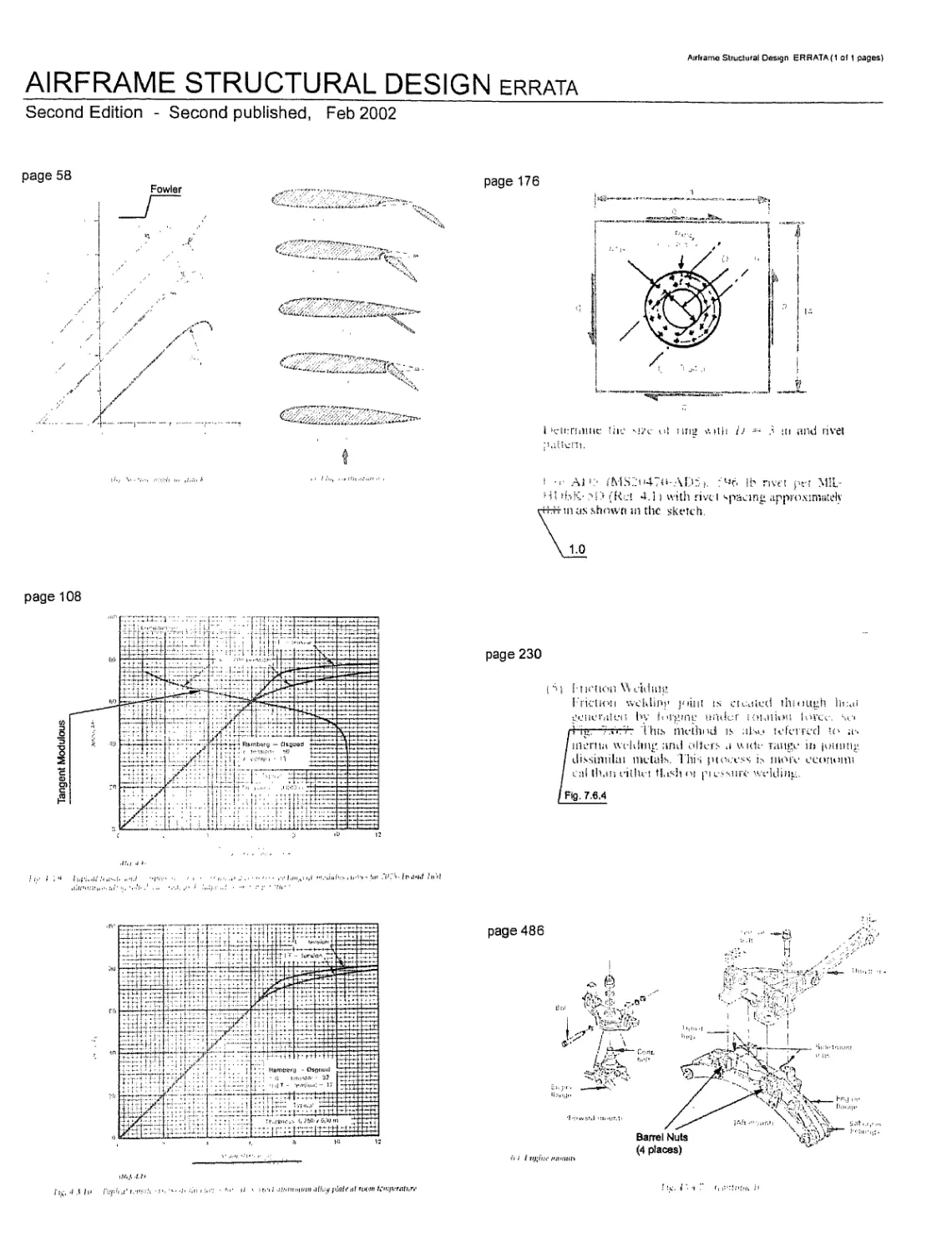
                    Airframe Structural Design ERRATA(1 of 1 pages)
AIRFRAME STRUCTURAL DESIGN ERRATA
Second Edition - Second published, Feb 2002
page 108
I >’ Al1:-	lb rivet pe-r MIC-
HI >Ьа-?Г.’ (Re! 4.1) with rivet ••pacing approximately
fr-H-tn as shown «и the sketch.
page 230
1.0
Pl [ net tori W i/td inn
l-'rictloti we.'kliii>’ joint is ctcaicd thiongh lin.ii
eetienileii bv forgine under lot.itiou lorcc. sc,
d it-;-This method is also telerrccl to a-,
[inertia welding and oliers a v. ids- range iis joining
/ elissintilai metals. This jnocess is more ecotiomt
/ enl than eithvi flash oi pi vssnre welding.
I Flfl. 7.6,4
IJ ’ i r.'i i .(Мишкин pirtf ill HX'Ht
AIRFRAME STRUCTURAL
DESIGN
SECOND EDITION
Practical Design Information and Data
on Aircraft Structures
By
MICHAEL CHUN-YUNG NIU
Lockheed Aeronautical Systems Company
Burbank, California
HONG KONG CONMIL1T PRESS LTD.
MICHAEL C. Y. NIU’S AIRFRAME BOOK SERIES:
AIRFRAME STRUCTURAL DESIGN (1988) - Green Book
COMPOSITE AIRFRAME STRUCTURES (1992) - Blue Book
AIRFRAME STRESS ANALYSIS AND SIZING (1997) - Red Book
About the author
Prof. Michael C. Y. Niu is the president of AD Airframe Consulting Company and is a metallic and composite airframe consultant. He was
a Senior Research and Development Engineer (management position). Lockheed Aeronautical Systems Co.
Prof Niu has acquired more than over 30 years experience in aerospace and airframe structural analysis and design. At Lockheed, he was
the acting Department Manager and program manager in charge of various structural programs, including development of innovative
structural design concepts for both metallic and composite materials that are applicable to current and / or future advanced tactical fighters
and advanced transports. During his service at Lockheed, he was deeply involved all aspects of preliminary design including aircraft layout,
integration, configuration selection and airworthiness. He was lead engineer responsible for the L-1011 wide body derivative aircraft wing
and empennage stress analysis. During /966 and 1968, he served as stress engineer for the B72? and B747 at The Boeing Company.
Prof. Niu is the author of the texts. AIRFRAME STRUCTURAL DESIGN (1988), COMPOSITE AIRFRAME STRUCTURES (1992) and
AIRFRAME STRESS ANAL YSIS AND SIZING (1997). He has also written Lockheed's Composites Design Guide and Composites Drafting
Handbook. He received the Lockheed Award of Achievement and Award of Product Excellence in 1973 and 1986 respectively. He is listed in
Who's is Aviation, 1973.
He is a Consulting professor in Beijing University of Aeronautics and Astronautics a Chair professor in Nanjing University of Aeronautics
and Astronautics, The People’s Republic of China.
He teaches the UCLA (University of California in Los Angeles) Engineering Short Courses “Airframe Design and Repairs", "Composite
Airframe Structures " and "Airframe Stress Analysis and Sizing".
Prof. Niu received a B.S. in Hydraulic Engineering from Chungyuan University, Taiwan, in 1962 and a M.S. in Civil Engineering from the
University of Wyoming in 1966.
© HONG KONG CONMILIT PRESS LTD.
All right reserved. No part of this book may be
reproduced in any form or by any electronic or mechanical means,
including information storage and retrieval devices or systems,
without prior written permission from the publisher.
Second edition - January, 1999 (with part of corrections)
Second published - February, 2002 (with minor corrections)
All inquiries should be directed to:	HONG KONG CONMILIT PRESS LTD. Flat A, 10th Floor,	or	P. 0. Box 23250, Shing Loong Court,	Wanchai Post Office, 13 Dragon Terrace,	HONG KONG NorthPoint,	Fax:(852)2578 1183 HONG KONG
U.S. order/inquiry:	ADASO/ADASTRA ENGINEERING CENTER P. 0. Box 3552 Granada Hills, CA91394 U. S. A. Fax: l-(877)684-4729 (U. S. A.) 1-(818)206-0709 Website: www.ADAirframe.com E-mail: books@ADAirframe.com
Please forward any suggestions or comments to:
Prof. Michael C. Y. Niu
P. 0. Box 3552
Granada Hills, CA91394 U. S. A.
Fax: (818) 701 0298
E-mail: mniu@att.net or mniu@ADAirframe.com
ISBN 962-7128-09-0
Printed in Hong Kong
Preface
This book is intended to advance the technical understanding and practical knowledge of both practicing
engineers and students. The book represents several decades of data collection, research, conversations with
different airframe specialists, plus the author’s more than twenty years’ experience in airframe structural
design. In addition, the text is partly based on the author’s lecture (Structures Symposium of Airframe
Design) for the Lockheed Extension Education Program (LEEP). It is, therefore, equally useful to those with
primary degrees in engineering fields as a reference for designing advanced structures.	*•
From a structural standpoint, the book is intended to be used as a tool to help achieve structural integrity
according to government regulations, specifications, criteria, etc., for designing commercial or military
transports, military fighters, as well as general aviation aircraft. It can also be considered as a troubleshooting
guide for airline structural maintenance and repair engineers or as a supplementary handbook in teaching
aircraft structural design in college. Aircraft design encompasses almost all the engineering disciplines and it
is not practical to cover all the information and data within one book. Instead, relevant references are
presented at the end of each chapter so that the reader can explore his own personal interests in greater
detail. This book does not cover basic strength of materials and structural (or stress) analysis. It is assumed
that the reader already has this background knowledge.
This book is divided into a total of sixteen chapters and emphasizes itemized vt'rite-ups, tables, graphs and
illustrations to lead directly to points of interest. The data can be used for designing and sizing airframe
structures and, wherever needed, example calculations are presented for clarification. As technology
continues to progress, basic technical data hold true, however, to suit today’s design such as advanced
composite structure some modification to the analysis may be required.
In preparing this book, it was necessary to obtain and collect vast amounts of information and data from
many sources. (Information and data used in this book does not constitute official endorsement, either
expressed or implied, by the manufacturers or the Lockheed Aeronautical Systems Company.) Sincere
appreciation is given to the Technical Information Center of Lockheed Aeronautical Systems Company
(LASC) for their gracious help. Thanks also to those who contributed to this book, my colleagues at LASC
and other specialists from various companies. Special thanks to Mr. Richard W Baker (Research and
Development Engineer of LASC) for his valuable comments in reviewing most of the drafts. Also, I would
like to express my appreciation to Mr. Anthony C Jackson (Composite Design Department Manager of
LASC) for his comments on Chapter 14.0, Advanced Composite Structures; and to my daughter Nina Niu
for her help with this book.
Lastly, it is my hope that this book, with its wide scope and information on the application of technology
on aircraft structural design, will prove not only to be a valuable reference tool for designing sound airframes
with structural integrity but also as a “bridge” to carry over the valuable experience and knowledge from
those who have retired from the aircraft industry to the next generation of engineers. However, any
suggestions and comments for revision would be greatly appreciated by the author.
Michael Chun-yung Niu
T-ff-J
California
U.S.A.
March, 19B8
CONTENTS
Preface
CHAPTER	1.0	GENERAL INFORMATION	1
	1.1	Introduction	1
	1.2	Development Progress	3
	1.3	Planning and Structural Weight	5
	1.4	Computer Aid	6
CHAPTER	2.0	DESIGN FOR MANUFACTURING	11
	2.1	Introduction	11
	2.2	Engineer's Responsibility	12
	2.3	Producibility	12
	2.4	Maintainability	14
	2.5	Tooling	15
	2.6	Other Considerations	19
CHAPTER	3.0	AIRCRAFT LOADS	21
	3.1	Introduction	21
	3.2	Aeroelasticity	30
	3.3	Flight Maneuvers	33
	3.4	Basic Data	36
	3.5	Wing Design Loads	53
	3.6	Empennage Loads	59
	3.7	Fuselage Loads	66
	3.8	Propulsion Loads	67
	3.9	Landing Gear Loads	69
	3.10	Miscellaneous Loads	73
	3.11	Example of An Airplane Loads Calculation	74
CHAPTER	4.0	MATERIALS	90
	4.1	Introduction	90
	4.2	Material Selection Criteria	95
	4.3	Aluminum Alloys	101
	4.4	Titanium Alloys	109
	4.5	Steel Alloys	110
	4.6	Composite Materials	112
	4.7	Corrosion Prevention and Control	113
CHAPTER	5.0	BUCKLING AND STABILITY	118
	5.1	Introduction	118
	5.2	Columns and Beam-Columns	120
	5.3	Crippling Stress	134
	5.4	Buckling of Thin Sheets	137
	5.5	Thin Skin-Stringer Panels	141
	5.6	Skin-Stringer Panels	146
	5.7	Integrally Stiffened Panels	155
CHAPTER	6.0	CUTOUTS	162
	6.1	Introduction	162
	6.2	Lightly Loaded Beams	165
	6.3	Heavily Loaded Beams	173
	6.4	Cutouts in Skin-stringer Panels	177
	6.5	Cutouts in Curved Skin-stringer Panels	186
	6.6	Fuselage Cutouts for Big Cargo Doors	204
CHAPTER	7.0	FASTENERS AND STRUCTURAL JOINTS	207
	7.1	Introduction	207
	7.2	Rivets	210
	7.3	Bolts and Screws	214
	7.4	Fastener Selection	218
	7.5	Lug Design and Analysis	219
	7.6	Welded and Adhesive Bond	227
	7.7	Fatigue Design Considerations	230
	7.8	Shim Control and Requirements	243
CHAPTER	8.0	WING BOX STRUCTURE	247
	8.1	Introduction	247
	8.2	Wing Box Design	251
	8.3	Wing Covers	256
	8.4	Spars	269
	8.5	Ribs and Bulkheads	277
	8.6	Wing Root Joints	282
	8.7	Variable Swept Wings	288
	8.8	Wing Fuel Tank Design	296
CHAPTER	9.0	WING LEADING AND TRAILING EDGES	303
	9.1	Introduction	303
	9.2	Leading Edges	326
	9.3	Trailing Edges	335
	9.4	Wing Control Surfaces	347
	9.5	Fixed Leading and Trailing Edges	352
	9.6	Design Considerations	355
CHAPTER	10.0	EMPENNAGE STRUCTURE	358
	10.1	Introduction	358
	10.2	Horizontal Stabilizer	363
	10.3	Vertical Stabilizer	369
	10.4	Elevator and Rudder	371
CHAPTER	11.0	FUSELAGE	376
	11.1	Introduction	376
	11.2	Fuselage Configurations	379
	11.3	Fuselage Detail Design	380
	11.4	Forward Fuselage	398
	11.5	Wing and Fuselage Intersection	406
	11.6	Stabilizer and Aft Fuselage Intersection	412
	11.7	Fuselage Opening	417
CHAPTER 12.0	LANDING GEAR	430
12.1	Introduction	430
12.2	Development and Arrangements	442
12.3	Stowage and Retraction	449
12.4	Selection of Shock Absorbers	454
12.5	Wheels and Brakes	461
12.6	Detail Design	464
12.7	Testing	466
CHAPTER 13.0	ENGINE MOUNTS	471
13.1	Introduction	471
13.2	Propeller-driven Engine Mounts	475
13.3	Inlet of Jet Engines	478
13.4	Wing-pod (Pylon) Mounts	479
13.5	Rear Fuselage Mounts and Tail Mounts	487
13.6	Fuselage Mounts (Fighters)	489
CHAPTER 14.0	ADVANCED COMPOSITE STRUCTURES	492
14.1	Introduction	492
14.2	Composite Materials	500
14.3	Design	509
14.4	Structural Joint Design	520
14.5	Manufacturing	526
CHAPTER 15.0	FATIGUE, DAMAGE TOLERANCE AND FAIL-SAFE DESIGN	538
15.1	Introduction	538
15.2	Performance and Functions	543
15.3	Design Criteria and Ground Rules	547
15.4	Structural Life Estimation	548
15.5	Fail-safe Design	554
15.6	Detail Design	561
15.7	Sonic Fatigue Design and Prevention	567
15.8	Verification Tests	570
CHAPTER 16.0	WEIGHT CONTROL AND BALANCE	581
16.1	Introduction	581
16.2	Weight Prediction	585
16.3	Performance and Configuration Influences	590
16.4	Balance and Loadability	591
Appendix A:	CONVERSION FACTORS (U.S. unit vs. SI unit)	599
Appendix B:	LIST OF CUTAWAY DRAWINGS	602
Index		609
CHAPTER 1.0
GENERAL
1.1	Introduction
There are many aspects of design of aircraft structures
as shown in Fig. 1.1.1. For modern jet aircraft, the
design must incorporate clear aerodynamic shapes for
long range flight near or at supersonic speeds, and/or
wings to open up like parachutes at very low speeds.
The wings must serve as fuel tanks and engine support
structures. All structures must withstand hail and
lightning strikes, and must operate in, and be pro-
tected against, corrosive environments indigenous to
all climates. The structure must be serviceable from
15 to 20 years with minimum maintenance and still be
light enough to be economically competitive. The
design must incorporate new materials and processes
that advance the state of the art. Using new techniques
often require developing still newer processes.
A good overall structural concept incorporating all
these factors is initiated during preliminary design. At
the very beginning of a preliminary design effort, the
designer writes a set of specifications consistent with
the needs. It should be clearly understood that during
preliminary design it is not always possible for the
designer to meet all the requirements of a given set of
specifications. In fact, it is not at all uncommon to find
certain minimum requirements unattainable. It is then
necessary to compromise. The extent to which com-
promises can be made must be left to the judgment of
the designer. However, it must be kept in mind that to
achieve a design most adaptable to the specified
purpose of the airplane, sound judgment must be
exercised in considering the value of the necessary
modifications and/or compromises.
(a) Military fighter
Fig. 1.1.1 Aircraft structural breakdown.
Airframe Structural Design 1
(b) Military bomber
(c) Commercial airliner
Fig. 1,1.1 (continued).
2 Airframe Structural Design
The first task of the designer is to familiarize
himself thoroughly with the specifications of the
airplane upon which the design is to be based. Also, if
the airplane is to be sold to more than one customer,
all available information should be obtained to mini-
mize the design that might be required in the future.
There should be no thought of making a general
purpose airplane, suitable for any purchaser or any
use, because that is an impossibility. However, it is
frequently possible to arrange a design which would
simplify future changes without sacrificing either
structural or aerodynamic efficiency or taking a
weight penalty.
Next, the designer should familiarize himself with
all existing airplanes of the same general type as that
proposed. If possible, it is advisable to collect all
comments, both positive and negative, of pilots,
passengers, maintenance groups, and operators using
the existing equipment. The designer should not
blindly copy any existing design just because it
happens to be available. On the other hand, not to
take advantage both of the successes and mistakes of
others is inefficient. Today’s jet airplanes have much
greater payloads at longer ranges and at higher speeds
than past models. A great many shapes and sizes of
wings and empennages were considered. Various wing
shapes should be examined in depth for aerodynamic
high and low speed performance, fuel capacity, range,
torsional and weight characteristics, and system
compatibility.
High lift and lateral control devices, pitch and yaw
devices on the empennage, and sizes were established.
As the final configuration was determined, statements
of work describing the structure were supplied to
manufacturing for scheduling purposes. Joints in the
structure were established based on manufacturing’s
facilities, subcontract programs, raw material avail-
ably, and schedules.
The aircraft industry has for the past two decades
spent considerable research and development effort
to exploit the very attractive structural efficiencies
achievable through the use of advanced composite
structures. Advanced composites offer promise of
substantial weight savings relative to current metallic
structures. Further, the number of parts required to
build a composite component may be dramatically
less than the number of parts needed to construct the
same component of metal alloy. This can lead to
significant labor savings, sometimes offsetting the
somewhat higher price of the present composite
materials. These features, together with the inherent
resistance to corrosion, make composites very attrac-
tive candidate materials for future aircraft structures.
1.2	Development Progress
The modern aeronautical engineering of aircraft
design has been an evolutionary process accelerated
tremendously in recent times from the demanding
requirements for safety and the pressures of com-
petitive economies in structural design. For example:
1900—1915 In this period, the Wright Brothers’
demonstration of practical mechani-
cal flight, power requirements, stabil-
ity and control were overriding con-
siderations. A successful flight was
1915-1930
1930-1940
1940-1955
1955—present
one which permitted repair and turn
around in a few weeks or days.
Strength considerations were sub-
ordinate and ultimate strength of a
few critical parts was the extent of
structural analysis.
World War I accelerated the solution
of power plants and stability and
control problems. Engine reliability
was improved by ground qualifica-
tion (fatigue) testing.
Commercial development of metal
aircraft for public transport took
place in this era. Design and analysis
emphasized static ultimate strength
and, except for the engine, had little
or no consideration for airframe
fatigue.
During this period, there grew an
increasing awareness of the fatigue
potential in airframe safety. A large
increase in performance capability
resulted from WW II technology.
Higher material static strengths were
developed without a corresponding
increase in fatigue strength. Static
ultimate design alone was not suffi-
cient; it was joined by fatigue design.
Safely from fatigue alone was rec-
ognized to be inadequate; fail-safe
and damage tolerance, i.e., stalic
strength of damaged requires ade-
quate inspection intervals lo discover
and repair fatigue and other damage
before cracks reach catastrophic pro-
portions.
So today we design for:
« Static ultimate (and yield) strength.
*	Fatigue life of the airframe (crack initiation).
•	Static residual strength of damaged structure.
*	Fatigue life of damaged structure (inspection
intervals).
*	Thermal stress analysis and design of supersonic
aircraft.
The primary objective of the structural designer is
to achieve the maximum possible safety margin and
achieve a “reasonable” lifetime of the aircrafi struc-
ture. Economic obsolescence may not come as soon
as anticipated. For example, some of the old DC-3’s
still flying today are approaching or exceeding
100,000 hours of service. This record is achieved only
by fail-safe structure, knowledge of when and where
to look for cracks, and replacement of a few vital
parts.
It is the purpose of this book to discuss, in some
detail, the design procedures, analysis methods,
material properties and experimental data necessary
to equal or better the past structural safety record in
the face of ever increasing performance, adverse
environments, and complexities of future aircraft.
All airframe structural design goes through these
phases:
« Specification of function and design criteria.
« Determination of basic external applied loads.
« Calculation of internal element loads.
Airframe Structural Design 3
•	Determination of allowable element strengths
and margins of safety.
•	Experimental demonstration or substantiation
test program.(Fig. 1.2.1).
Engineering is experimental, empirical, and theore-
tical in that order. The physical facts must be known
first; they may be empirically manipulated before the
“perfect theory” is available. Failure to recognize this
order of priority can lead to disaster if theoretical
analyses are relied upon without thorough and careful
experimental substantiation.
loads are relatively predictable from model data and
substantiation for a certification program should be
more or less routine. The laboratory development test
program is an important feature of any new vehicle
program; both to develop design data on materials
and shapes, and to substantiate any new theory or
structural configuration. Assuming clear-cut objec-
tives, design criteria, and adherence to design rules
and development test evaluations, the certification test
program will demonstrate success without degenerat-
ing into more and expensive development work.
Fig. 1.2.1 Development testing of a transport airplane.
This does not mean we do not need theory. It does
mean that we may and do need to progress beyond
the capability of theory. But when we do, we must
recognize and account for this fact wherever it may be
critical. The engineering system evolved to handle any
situation, be it a method of design, a component, or a
vehicle design is illustrated in Fig. 1.2.2. Of primary
significance are the three boxes in heavy outlines.
•	Laboratory development testing
•	Flight test data
•	Certification or substantiation test program.
The dotted arrows indicate feed-back where ex-
perimental data is utilized to modify the design as
necessary. The feed back loop for flight data on basic
loads for conventional airplane vehicles is not as
important as it once was simply because a vast store
of research, experimental data, empirical know-how,
and substantiated theory on the subject exists. Basic
4 Airframe Structural Design
Fig. 1.2.2 Airplane design, development and
certification.
1.3	Planning and Structural Weight
A good design is the result of proper planning and
scheduling. This means scheduling not only the direct
responsibility but also scheduling the data from other
groups or staffs. It must have all the data required,
such as loads from stress, aerodynamic requirements,
systems data such as controls, electrical, fuel, and
hydraulic interfaces, interchangeability, maintain-
ability, serviceability, special airline requirements, and
much more. All must be available in a timely manner
to ensure a good integrated design. The designer is the
only one who knows when he needs this data based
on schedules he is committed to. He is the one who
must make his requirements known and when he
needs them. He is the one who must follow up as
often as necessary to ensure receiving the data. He
must recognize that someone else’s performance is
unsatisfactory in time to take steps through his super-
iors to remedy the situation. There is no other satis-
factory way to schedule interchange of design data
since it is a “give and take” situation, particularly
between design groups. Loads and aerodynamic data
requirements can be scheduled somewhat more pre-
cisely, but it is still the designer’s responsibility to
maintain a constant monitoring of stress and aero-
dynamic progress. Remember, it is the designer’s
ultimate responsibility to release designs on schedule
to the shop. Fig. 1.3.1 shows an example of bar
charting design purposes. It is particularly useful in
getting management stirred into action.
The fact that structural designers or stress engi-
neers who determine structural sizes should be
concerned with weight should not strike one as
strange. Nevertheless, in today’s specialization, there
is a tendency to narrow one’s viewpoint to the
mechanics of his job and to forget the fundamental
reasons for that job. It has been said, sometimes in jest
and again in earnest, that the weight engineer is paid
to worry about weight. However, unless every aircraft
engineer in a company is concerned about weight, that
company may find it difficult to meet competition or,
in other words, to design a good performance air-
plane. Weight engineers can estimate or calculate the
weight of an airplane and its component parts. Actual
weight savings, however, are always made by design-
ers or stress engineers. A very small margin of weight
can determine the difference between excellent and
poor performance of an airplane. If the structure and
equipment of a successful model were increased only
5% of its gross weight, the consequent reduction in
fuel or pay load may well mean cancellation of a
contract. In transport aircraft the gross-weight limit is
definitely stipulated; thus, any increase in empty
weight will be offset by a reduction in fuel or pay load
(Fig. 1.3.2).
The weight break-down of aircraft structure over
the years shows a remarkable consistency in the
values of the structure weight expressed as 20—40% of
the take-off gross weight (or all-up weight) realized in
service, irrespective of whether they were driven by
propellers or by jet engines.
At the project stage, if performance and strength
arc kept constant, a saving of structure weight is also
accompanied by savings in fuel, the use of smaller
engines, smaller wings to keep the same wing loading
and so on, such that the savings in take-off weight of
the aircraft to do the same job is much greater than
the weight saved on the structure alone.
The object of structural design is to provide the
structure that will permit the aircraft, whether military
or civilian, to do the job most effectively; that is with
Test Type	1968	1969	1970		1971
	J F m|a|m| ф ASOND	J f|m A M J J A S 0 ND	JFMAMJJA	SON D	J F M a|m J J A S 0 N D
Milestones		A 90% structure release	1 First Flight		A	A TIA	!(aa Cert
Development*		Materials, fastens	rs, joints, panels
	< . ' — 		-			* Include static, fatigue, fail-safe and sonic fatigue lesung.
	Design allowab	les
Qualification			Components		— Airplane proof □
			|	| LDG	gears
Dynamic	Flut	ter models	1		1G	ound vibration tests
			LDG gears 1
Fatigue		|	Systems
			| LDG gears ]
			□		Complete airframe
Flight			□		1 	 . Loads verification	]
Fig. 1.3.1 L-1011 complete structural test program schedule for project commitment.
Airframe Structural Design 5
the least total effort, spread over the whole life of the
aircraft from initial design until the aircraft is thrown
on the scrap heap. There is thus, an all-embracing
simple criterion by which the success of the structural
design can be judged. It is not sufficient to believe that
percentage structural weight is of itself an adequate
measure of effective design, either of the complete
airplane or of the structure itself. A well-known
example is the provision of increased aspect ratio at
the expense of structural weight, which may give
increased fuel economy at cruise and reduction in the
total aircraft weight. Nevertheless, percentage struc-
tural weight is a useful measure, provided its limita-
tions are recognized.
Fig. 1.3.2 Example of 5% increase in OEW and 25%
reduction of payload, or to keep the same
payload and redesign to achieve a 9%
lift drag ratio.
Finite Element Modeling (FEM)
Probably the most versatile tool in structural analysis
is the use of finite element modeling (FEM). Before
FEM, industrial stress analysis was largely an approxi-
mate science. Equations were available for deter-
mining stress and strain exactly in simple beams
shown in Fig. 1.4.2, A major structural discontinuity
occurs at the juncture of components such as the wing
and body. At such structural junctions, a major redis-
tribution of stresses must occur and the flexural dis-
similarities of the wing and body must be designed
for. Regardless of the construction details at this
juncture, the major components affect each other. In
those cases where the proportions of a component are
such that beam analysis (or theory) can be employed,
it is common practice to assume the behavior of one
of the components and correspondingly analyze the
other component. In the case of the wing/body
juncture as mentioned previously, such a procedure
could assume the body to provide cantilevered sup-
port boundary for the wing and then analyze the wing
by beam bending theory.
Fig. 1.4.2 Equilibrium and compatibility analysis.
1.4	Computer Aid
The requirements of structural analysis are under-
going changes due to different environments (i.e.,
altitude, speed, etc.), different construction, refined
detail, expanded analysis coverage, and broadened
analytical concepts as shown in Fig. 1.4.1. Motivated
by these changes in analytical requirement, the digital
computer and its effective use have assumed para-
mount importance. Environmental changes have
precipitated the search for improved structures. The
changes in altitude and speed have not only motivated
a search for lighter structures but have necessitated
the considerations of heated structure.
•	Different environment
•	Different construction
•	Refined detail
•	Expanded analysis coverage
•	Broadened analytical concepts
•	Stress analysis for composite structures
Fig. 1.4.1 Changed requirements for modern airplane
design.
Such conventional procedures will essentially
ensure that the analytical forces that occur between
the wing/body will be in equilibrium. Unfortunately,
the actual elastic structural compatibility that is
present usually enforces a different distribution of
forces between these two major structures. Thus a
change in the analytical requirements is present and
the analytical technology must be powerful enough to
ensure both force equilibrium and deflection com-
patibility at the structural discontinuity.
Most of the aircraft construction is such that not
only must the force equilibruim be satisfied, but the
elastic deflection compatibility must also be repre-
sented. This represents a broadening of the analytical
concepts, wherein it is required to change the analy-
tical technology to include both equilibrium and
compatibility concepts which give the actual structural
load or stress distribution.
However, most practical structures, especially
aircraft structures, are very redundant or indeter-
minate which means the analysis of redundant struc-
tures leads to the need to solve sets of simultaneous
linear algebraic equations. If the actual redundant
structure is large, the set of simultaneous equations
will also be large.
The finite element modeling represents a part with
a mesh-like network of simple geometric shapes
combined in building-block fashion as shown in
6 Airframe Structural Design
Fig. 1,4.3 Entire airframe finite element model.
Fig. 1.4.3. Each element has characteristics easily
found from .simple equations. So the behavior of the
entire structure is determined by solving the resulting
set of .simultaneous equations (or by matrix tech-
niques) for all the elements.
In the early days, finite clement models were built
manually (the element mesh was drawn by hand).
Then node coordinates, clement connectivity and
other pertinent data were written on lengthy tabula-
tion sheets and transferred to computer cards via a
keypunch machine. Because of the huge amount of
data to be handled, manual model-building is tedious,
time-consuming, costly, and error-prone. In addition,
the resulting model may be less than optimal because
the lengthy construction time prohibits the analyst
from refining the model with alternative mesh den-
sities and configurations. To overcome these defi-
ciencies, preprocessors or 3-D mesh graphics
program front CAD/CAM (Computer-Aided Design
and Computer-Aided Manufacturing) system were
developed to aid in model building. These programs
reportedly reduce model-building time and costs by as
much as more than 80%.
Many FEM programs have been written. Flowever,
only a few are satisfactory for general use. These
programs handle linear static and dynamic structural
analysis problems. Some of them perform a type of
linear heat-transfer analysis and damage tolerance
analysis,
C)nc of the earliest FEM programs and probably
the most well-known is NASTRAN (NASA STRuc-
tural ANalysis), developed by NASA in the mid-
1960s to handle the analysis of missiles and aircraft
structures. NASTRAN is one of few major programs
with public domain versions available. Several major
aerospace companies have modified NASTRAN for
their particular applications.
Various types of graphic scopes are available
showing model deformed-shape and displacements.
For dynamic analysis, these deformed shapes are
sometimes animated in slow motion to show how the
structure bends, twists, and rocks during operation.
CAD/CAM System
The use of interactive computer graphics for data
handling in design, manufacturing and product
support programs quickly spread from aerospace to
automotive applications and gradually permeated the
broad base of general industry during the past decade.
CAD/CAM (Computer-Aided-Design and Com-
putcr-Aided-Manufacturing) provides a common data
base of the elected design for all disciplines such as
preliminary design studies, lofting production design,
tool design, numerical control (NC) design, quality
control, product support, manufacturing, etc. Data
can be accessed to other design groups like airplane
payloads, controls, hydraulics, powerplant, electrical,
maintenance, etc. to narrow the gap between design
and manufacturing and also to open up a new oppor-
tunity for excellence in all design. It is no exaggeration
that CAD/CAM system has been considered as the
second industrial revolution of this century.
The large-scale computer (mainframe) is the heart
of the CAD/CAM system that can provide a rapid
and uncomplicated interface between engineer and
machine to produce the geometric and mathematical
definition for different programs. The large-scale
computer is the center of this system and the graphics
terminal as shown in Fig. 1.4.4 provides the engineer
and machine interface. The other components of the
hardware system provide fast response and recovery
of work in the event of a hardware failure or power
failure, the ability for the computer to operate on
multiple tasks, magnetic tapes for control of machines
Airframe Structural Design 7
Scope
Fig. 1.4.4 Typical graphics terminal.
Fig. 1.4.5 CAD AM hardware system.
8 Airframe Structural Design
to make parts or plot drawings, and disk drives for
accounting data and storage of the work accom-
plished. Fig. 1.4.5 shows the typical hardware system
components and the data flow.
CAD/CAM system is a broad data base system
and most of the companies simply do not need this
complete system. These companies find automated
drafting system a more reasonable way to get started
in CAD/CAM. The automated drafting system
increases in productivity from two to six-fold and
sometimes more. The drawing is stored in computer
memory and can easily be changed and replotted in a
few minutes to accommodate engineering modifica-
tions.
Automated drafting increases productivity by
coupling the creativity of the engineer with the
computer’s high speed and huge memory. This frees
the engineer from performing the time-consuming,
repetitive tasks such as drawing the same shape many
times, making the same change to several drawings, or
painstakingly measuring and dimensioning a part.
And the drawing is produced in minutes with the push
of a button. As a result, the engineer-machine team
can produce a drawing more quickly and more
accurately than would otherwise be possible.
REFERENCES
1.1.	Anon.: Airframe & Powerplant Mechanics. AC65-15,
Department of Transportation: Federal Aviation
Administration.
1.2.	McKinley J.L. and Beni R.D.: Basic Science far Aero-
space Vehicles. McGraw-Hill Book Company, New
York, N.Y. 1963.
1.3.	Torenbeek E.: Synthesis of Subsonic Airplane Design.
Delft University Press, Netherlands. 1976.
1.4.	Nicolai, L.M.: Fundamentals of Aircraft Design.
University of Dayton, Dayton, Ohio 45469. 1975.
1.5.	Williams, D.: An Introduction to The Theory of
Aircraft Structures. Edward Arnold (Publishers) Ltd.,
London. 1960.
1.6.	Bruhn, E.F.: Analysis and Design of Flight Vehicle
Structures. Tri-State Offset Company, Cincinnati,
Ohio 45202. 1965.
1.7.	Corning, G.: Supersonic and Subsonic CTOL and
VTOL, Airplane Design. P.O. Box No. 14, College,
Maryland. 1976.
1.8.	Wood, K. D.: Aerospace Vehicle Design, Void —
Aircraft Design. Johnson Publishing Company,
Boulder, Colorado. 1968.
1.9.	Newell, A.F.: ‘Impressions of the Structural Design of
American Civil Aircraft.’ The Aeroplane, (Aug. 15,
1958), 229-232.
1.10.	Megson, T.H.G.: Aircraft Structures for Engineering
Students. Edward Arnold (Publishers) Ltd, London
WIX8LL. 1972.
1.11.	Sandifer, R.H.: ‘Aircraft Design Philosophy.' Journal
of The Royal Aeronautical Society, (May, 1956),
301-330.
1.12.	Newell, A.F. and Howe, D.: ‘Aircraft Design Trends.’
Aircraft Engineering, (May, 1 962), 132—139.
1.13.	Way, W.W.: ‘Advantages of Aircraft System Maurity.’
SA E paper No. 730907, (1973).
1.14.	North, D.M.: ‘Soviets Test Two-seat MIG-25
Version.’ Aviation Week & Space Technology, (Mar.
28, 1977), 17.
1.15.	Sweetman, B,: ‘Foxbat — Something Completely
Different.’ Flight International, (April 23, 1977),
1121-1124.
1.16.	Smyth, S.J.: ‘CADAM Data Handling from Concep-
tual Design Through Product Support.’ AlAA paper
No. 79-1846, (1979).
1.17.	Wehrman, M.D.: ‘CAD Produced Aircraft Drawings.’
AMA paper No. S0-0732R, (1981).
1.18.	Stinton, D.: The Anatomy of The Aeroplane. Ameri-
can Elsevier Publishing Company Inc. New York,
N.Y., 1966.
1.19.	Wells, E.C.: ‘Operational Aspects of Jet Transport
Design.’ Aero Digest, (May 1 953).
1.20.	Epstein, A.: ‘Some Effects of Structural Deformation
in Airplane Design.’ Aero Digest, (Feb. 19491, 17.
1.21.	Anon.: ‘Tomorrow’s Fighter: Updated or out-
dated.’ Aviation Week & Space Technology,
(Aug. 10, 1987), 61-108.
1.22.	Wood, C.: ‘Cargo Plane Design Considerations.’ Aero
Digest, (Dec. 1943), 203.
1.23.	Rieger, N.F.: ‘Basic Course in Finite-element
Analysis? Machine Design, (Jun.—Jul. 1981).
1.24.	Anon.: ‘Russia’s New Long-Hauler.’ Flight inter-
national, (August 20, 1977), 524.
1.25.	Laser: ‘Design Probe — Another Look at the Square
Cube Law.’ Flight International, (Oct. 17, 1968),
615—616.
1.26.	Cleveland, F.A.: ‘Size Effects in Conventional
Aircraft Design.’ Journal of Aircraft, (Nov—Dec.,
1970), 483-512.
1.27.	Black, R.E. and Stern, J.A.: ‘Advanced Subsonic
Transports — A Challenge for the 1990’s’. Journal of
Aircraft, (May 1976), 321-326.
1.28.	Anon.: ‘Two or Three Engines?’ Flight International,
(Sept. 18, 1969), 446-447.
1.29.	Higgins, R.W.: ‘The Choice Between One Engine or
Two — An Appreciation of the Factors involved in
Choosing A Single or Twin-Engine Layout for
Military Tactical Aircraft.' Aircraft Engineering, (Nov.
1968.)
1.30.	Higgins, R.W.: ‘The Choice Between One Engine or
Two for Tactical Strike/Close Support Aircraft.’ The
Aeronautical Journal of The Royal Aeronautical
Society, (July, 1964), 620-622.
1.31.	Lachmann, G.V.: Boundary Layer and Flow Control
— Its Principles and Application. Vol. 1 and Vol. 2.
Pregamon Press. New York, N.Y. 1961.
1.32.	Teicltmann, F.K.: Airplane Design Manual. Pitman
Publishing Corporation, New York, N.Y., 4th
Edition, 1958.
1.33.	Anon.; NATO's Fifteen Nations. Frank O'Shanohnn
Ass. Ltd, London EC4A3JD.
1.34.	Foody, J.J.: ‘The Air Force/Boeing Advanced
Medium STOL Transport Prototype.’ SAE paper No.
730365, (April 1973).
1.35.	Bates, R.E.: ‘Structural Development of The DC-10.’
Douglas paper No. 6046, (May 1972).
1.36.	Spulding, E.H.; ‘Trends in Modern Aircraft Structural
Design.’ SAE paper No. 92, (May, 1957).
1.37.	Mackey, D.J. and Simons, H.: ‘Structural Develop-
ment of the L-1011 Tri-star.’ AlAA paper No. 72-776,
(April 1972).
1.38.	Marks, M.D.: ‘Technical Basis for The STOL
Characteristics of The McDonnell Douglas/USAF
YC-15 Prototype Airplane.’ SAE paper No. 730366,
(April 1973).
Airframe Structural Design 9
1.39.	Magruder, W.M.: ‘Development of Requirement,
Configuration and Design for the Lockheed 1011 Jet
Transport.’ SAE paper No. 68068S, (Oct. 1968).
1.40.	Morisset, J.: ‘Tupolev 144 and Concorde — The
official performances are compared for the first time.'
NASA TTF15446, (April 1974).
1.41.	Krogull, B. and Herbst, W.B.: ‘Design for Air
Combat.’ AIAA paper No. 72-749, (Aug. 1972).
1.42.	Woolsey J.P.: ‘U.S. Airplane Builders Finding Many
Barriers to New Programs.’ Air Transport World,
(Feb. 1976), 12-17.
1.43.	Sandoz, P.L.: ‘Structural Design of Future Commer-
cial Transports’. AIAA paper No. 73-20, (Jan. 1973).
1.44.	Foottit, H.R.: ’Design of Fighter Aircraft.’ Aero
Digest, (Feb. 1948).
1.45.	Anon.: ‘Aircraft Design at the AIAA.' Flight Inter-
national. (Sept. 8, 1972).
1.46.	Barton, C.: ‘Spruce Gosse — Pterodactyl of World
war 11.' Popular Mechanics. (Nov. 1977).
1.47.	Aronson. R.B.: 'Blown-wing STOLs on Trial.'
Machine Design. (Oct. 1977). 26—31.
1.48.	Satre, P.: 'Supersonic Air Transport — True Problems
and Misconceptions.' Journal of Aircraft. (Jan.—Feb
1970), 3-12.
1,49.	Raymer, D.P.: Aircraft Design: A Conceptual Approach.
AIAA Education Series, 1989.
1.50.	Fisher, F.A. and Plumer. J.A.: Lightning Protection of
Aircraft. Lightning Technologies lnc.# It) Downing
Parkway, Pittsfield, MA01Z0I, 1990.
10 Airframe Structural Design
CHAPTER 2.0
DESIGN FOR MANUFACTURING
2.1	Introduction
Design and manufacturing are successive phases of a
single operation; the ultimate objective of which is the
emergence of an acceptable final product. In aero-
space context, such acceptability has several com-
ponents: market viability, operational efficiency,
capacity for further development and structural
integrity. Less obvious but just as important, a struc-
ture must not be so complex or difficult in concept
that its realization will create great difficulties, or
increase the cost of the manufacturing process.
Design has always carried with it — indeed — a
degree of prestige; because its effectiveness can be
seen in the final product and a successful design can
confer something approaching glamour upon those
responsible. Production, on the other hand, emerged
later as a specialized branch of engineering and is
sandwiched between the designer’s drawings and the
final product. Consequently, its achievement is less
apparent and frequently, in the past, it has not been
accorded a like degree of consideration or credit. Yet,
it is the production phase of the operation that trans-
lates the design into hardware (see Fig. 2.1.1).
An aircraft is conceived as a complete structure,
but for manufacturing purposes must be divided into
sections, or main components, which are in turn split
into sub-assemblies of decreasing size that are finally
resolved into individual detail parts. Each main
component is planned, tooled and built as a separate
unit and joined with the others in the intermediate and
final assembly stages (see Fig. 2.1.2).
Fig. 2.1.1 How an airplane is built.
Airframe Structural Design 11
Tooling is required for each stage of the building of
each component — detail tooling of individual parts,
of which there may be many thousands, followed by
assembly tooling of increasing size and complexity for
the stages of progressive assembly.
Fig. 2.1.2 Final assembly of airplane.
There is nothing new in attempting to design an
aircraft to give trouble-free operation. This has, of
course, always been one of the major parts of a
designer’s job. In recent years there has been incor-
porated the maintenance requirements in every
engineering drawing before going into production. If
aircraft have become too difficult to maintain, it is not
entirely due to lack of appreciation of the problem in
the drawing, but mainly to the very great increase in
complexity of modern aircraft, particularly in the past
few decades. A great deal of this complication is due
to equipment and automatic gadgetry.
Between 25 to 40 per cent of the total direct
operating cost (DOC) of an airplane is due to main-
tenance, quite apart from the losses due to airplanes
not being serviceable when required.
2.2	Engineer's Responsibility
The design engineer is the “general practitioner” to
the engineering profession as compared with staff or
research types or engineers. Design engineers must
diagnose the symptoms of potential structural failures
and service problems early in the design stage. On the
shoulders of the design engineer rests the final total
design integration responsibility. To do a thorough
job, the design engineer must:
(1)	Coordinate thoroughly and integrate the design
package into the overall structure:
•	Use design data type diagram to make co-
ordination definite
•	Do not depend on oral cooordination
(2)	Establish basics as early as possible:
•	Based on functional requirements
•	Loads and materials — make sure to use the
right loads and materials to avoid needless
drawing changes
•	Aerodynamic requirements
•	Geometry and jig information, interchange-
ability, producibility, repairability, replace-
12 Airframe Structural Design
ability, maintainability, etc.
•	Identification of problem details early to avoid
backtracking in design
(3)	Spend adequate time to plan the job:
•	Plan layouts and drawings to represent the
work
•	Make schedules realistic
•	Study the requirements and select an optimum
solution
(4)	If you encounter interface problems, make
adequate sections to show:
•	Where clearances are required and the re-
quirement for such clearances
•	The interface to which the detail attaches
(5)	Review processes, finishes, assembly procedures,
etc:
•	Heat treatment requirements
•	Prevent stress risers which cause structural
fatigue
•	Rough machine requirements to eliminate
mocking stresses
•	Cold work treatment on machined surfaces to
increase structural fatigue life, such as shot-
peening
•	Surface plating
•	Forming and machining techniques
(6)	Subcontractor-built production joints for assem-
blies that must conform to shipping limitations.
(7)	Production joints resulting from raw material size
restrictions or size of fabrication tools, ie. skin
mills, stringer mills, stretch presses, protective
finish tank size.
(8)	The subassembly plan and how these subassem-
blies are loaded into the final assembly fixtures.
The design engineer is essentially involved in
putting together a structural jigsaw puzzle.
(9)	After ail, the most important one, is that the
engineer should dedicate himself (or herself) to
the job.
2.3	Producibility
In aircraft design, time is always the essence of the
contract, and the pressure is always on. There is never
sufficient time (and, frequently, not the information)
to consider objectively all the possible ways of doing a
job and thereby to arrive, on the first occasion, at the
optimum method.
Because of the difficulties of assessing (under the
combined pressures of technical requirements; econo-
mic realities and time) the best method of achieving a
given objective in terms of function and cost, the
initial process of collaboration and analysis has, over
the last several decades, tended to develop almost into
a new form of specialized engineering activities under
the name of producibility engineering. The name is no
more than a convenient label for an analytical process
— now, perhaps, more concentrated and consciously
applied than formerly — that has always been a part
of good design and engineering practice. The first
stage is to make available in the earliest days of the
design, before anything is committed to materials or
methods, all available information that will contribute
to the conception of an efficient design at minimum
costs. It is not possible, however, to have all the
necessary information available at the moment when
it is needed, regardless of the amount of intelligent
forecasting that is applied, and problems of materials,
processing, or continuing design development usually
compel reconsideration of the methods used for
reasons of time and cost.
Principles of Producibility Design
(1)	General configuration:
•	Rectangular vs. tapered wing sections, flaps
and control surfaces
•	Minimum number of major structures
•	Cylindrical, straight, or conical surfaces vs.
compound curvature (see Fig, 2.3.1)
•	Extend of fairing and filleting required, see
Fig.2.3,2
(2)	Major breakdowns:
•	Adequate access for assembly
•	Ease of handling and transportation
•	Completeness of master breakdown units
•	Assembly joints
•	Effectiveness (see Fig. 2.3.3)
Fig. 2.3.1 Requires no forming operations since the flat
skin may be wrapped onto its supporting
frames.
with the aid of controlled media, and
require only the application of attaching
means for their installation. Interchange-
able items shall be capable of being readily
installed, removed, or replaced without
alteration, misalignment, or damage to
items being installed or to adjoining items
or structure
—	Adjustment and take-up (see Fig. 2.3.6)
—	Tolerance
—	Adequate clearances (see Fig. 2.5.6)
—	Rework margins
—	Adequate fastener edge distance
—	Machining economy
Fig. 2.3.2 Fairings and fillets: interchangeability is
difficult to achieve because of the tolerance
accumulation at these points and should be
used only when essential.
(3)	Structure and equipment: Structure includes all
primary and secondary structure, Equipment
includes everything within the structural frame,
i.e. controls, furnishings, instruments, powerplant,
accessories, and all functional installations.
• Simplicity
— Adequate access for fabrication and sub-
assembly
— Avoid compound curvature
— Free body principles (see Fig. 2,3.4)
— Alignment relations (see Fig. 2,3,5)
— Minimum fabricating and processing opera-
tions
— Straight line systems
— Mechanical simplicity (avoid “Gadgetry”)
•	Parts
— Multiple use and minimum number of
different parts
— Minimum total number of parts
— Minimum amount and types of attachments
— Effective use of standard parts, materials,
and material sizes
•	Detail design
— Interchangeability, which applies to inter-
changeable items that are manufactured
Fig. 2.3.3 The degree of breakdown should be dictated
solely on the basis of its overall effect upon
producibility. Improved producibility does
not necessarily follow an increase in degree of
breakdown. The effective breakdown of the
center section in the lower view is preferable
to that shown in the upper view,
Airframe Structural Design 13
Rib design
Spar vertical stiffeners
Fig. 2.3.4 Ribs parallel with the airplane of symmetry often result in acute angle of attachment to the spar or leading edge
as illustrated in the left view. By ignoring unrelated airplane datum lines, improved producibility is achieved.
Another example, as illustrated in right view, is that the lower view design results not only in saving
fabricating operations, but the parts can be used on the right and left hand side.
Fig. 2.3.5 When it is impossible to avoid the location of
such related parts in different assemblies,
these fittings should not be mounted on
surfaces parallel with or normal to the
centerline, but means of adjustment should
usually be provided. The lower view
illustrates the greater simplicity by using
surfaces normal or parallel to the bearing
axis.
Fig. 2.3.6 If one flange of a channel is to be installed
against the under surface of a floor structure
and the other flange is to be against the
upper surface of a lower fuselage frame,
difficulties would undoubtedly be
encountered. Therefore, one flange of the
channel should be replaced with a separate
so-called take-up angle drilled for the
channel at assembly.
2.4 Maintainability
The proper outlook on maintenance must be instilled
into everyone from the start. It is believed that in the
old-fashioned system of two or three years maintain-
ability training must be in the works before going into
the drawing office. This period cannot be skipped if a
person is to become a designer. It is very important
14 Airframe Structural Design
that designers and draftsmen should be in constant
contact with the shops and service departments so
that they can see the difficulties which occur in the
parts that they have designed.
It is of the greatest importance that designers
should be in close touch with the engineering and
maintenance department of the users for whom the
airplane is being designed. It is not sufficient to rely
on some published book of requirements. A large
proportion of these are sure to be out of date or do
not refer to the problem in hand.
Between military and civil transport aircraft, the
first and most important difference is in the amount of
flying done by the two types. A modern civil transport
aircraft will probably have to last for 15—20 years,
and fly between 2000 and 3000 hours a year, that is a
total life of 30,000 to 45,000 hours. The average
flying life of a fighter during peacetime will probably
have a total of 4000 to 8000 hours. These times do
not, of course, apply to transport command aircraft or
to trainers, and probably not to most types used by
coastal command, which do long periods of patrol. It
is evident that the whole problem of design for main-
tenance presents an entirely different aspect in the
two classes of aircraft.
In the case of transport aircraft, life of components
and wear of the aircraft generally become very
important. The aim will be to keep the airplane flying
every day thus putting a premium on the ability to
change components quickly. Military aircraft, how-
ever, will spend long periods on the ground. Even in
wartime a military aircraft would spend a great deal of
its time on the ground between relatively short
periods of intense activity.
Facilities for maintenance in the case of military
aircraft, especially under wartime conditions, are very
much inferior to those available to the civil operator.
It would seem logical, therefore, to cut down to the
very minimum the amount of maintenance to be
carried out by the squadrons of operational machines.
With today’s types of fast military aircraft having very
thin wings and slim fuselages, it may be quite im-
possible to provide the same degree of accessibility
(see Fig. 2.4.1) for easy removal of components that it
has been used to in the past. It is suggested that much
of this equipment can be built-in and, provided it is
properly developed and tested, should be capable of
functioning satisfactorily between major overhauls.
Fig. 2.4.1 Accessable openings for F-16 maintenance.
(Courtesy of General Dynamics Corp.)
In general, a low-wing transport layout is better
from a servicing standpoint than high wing since
engines and refuelling points are more readily accessi-
ble without the use of steps. The low-wing layout has
considerable advantages from the point of view of
installation of control cables, hydraulic pipes, electric
cables and equipment, etc., ail of which can be run
under the cabin floor and reached for inspection and
maintenance through doors in the underside of the
fuselage without having to disturb cabin upholstery,
and minimizes the need for maintenance personnel to
work in the passenger cabin.
Position of service joints in the main structure can
be of considerable importance to the operator; if
possible, a fighter aircraft wing joint should be located
at the side of the fuselage. This allows wings and fuse-
lages to be transported more easily than the conven-
tional stub wing which is more or less permanently
attached to the fuselage.
A modern airline technique is to change the com-
ponent or items of equipment which have given
trouble or have reached their service life. This ob-
viously means providing good accessibility to items
which may have to be changed. It is very desirable to
separate routine maintenance and changing points, so
that a number of men can work on the airplane at the
same time without all being crowded into one small
space.
In civil transport, Air Transport Association of
America (ATA) specification number 100 titled
“Specification for Manufacturer’s Technical Data” was
devised by the airline industry in order to standardize
the treatment of all subject matter and to simplify the
user’s problem in locating technical information for
designing transport aircraft to meet maintainability re-
quirements.
2.5 Tooling
30 years ago, manufacturing and interchangeability
specifications were not taken too seriously in the
presentation of a tool estimate, but such cannot be the
case today. These increased customer requirements
are supplemented by closer engineering tolerances
dictated by higher performance requirements. All of
this adds up to higher costs of tooling which can be
reduced only by a tempering of specifications or by
improved production engineering and tooling. Thus it
is recognized that the closest coordination among
sales, engineering and tooling is essential in order that
all are traveling the same path.
It is of prime importance that the type of engineer-
ing be determined at the beginning in order that the
tooling and manufacturing plan be properly estab-
lished. Of course, the type of engineering is based on
the requirements specified in the bid proposal. If the
airplane is to be experimental with no production
engineering, the airplane will be fabricated in the
experimental department with tooling of a type
suitable for experimental manufacturing. If the re-
quirements specify by quantity or by quality that the
contract shall be on a production basis, the engineer-
ing and tooling must be adapted to suit. This is the all-
important time when the pattern is made for all to
follow.
The company makes or loses money on the ability
of each department to live up to its estimate. Any
Airframe Structural Design 15
Fig. 2.5.1 Precision forging products.
changes in the original specifications or bid proposal
must eventually require renegotiation with all depart-
ments concerned. If such decisions are made without
this consideration, some department may stray from
the agreed upon path of direction and an unbalanced
operation results with an end result of possible
financial losses.
In order to reduce the cost of tools and manufac-
turing time, the design engineer must consider the
method of manufacturing of each part individually
and the quantity per airplane, plus a careful look at
the specification. The evidence of the work that can
be done in this field is the number of tools that must
be made in order to meet drawing requirements.
There are as many or more tools on nearly every con-
tract than there are parts. This means that all of these
tools must be catalogued, numbered, stored and con-
tinually kept up-to-date to all changes. The savings
resulting from the elimination of each unnecessary
tool is very apparent.
Low cost production is only possible with an
engineering drawing that has incorporated in it every
possible manufacturing advantage. It is understood
that the practicability of the extent to which this can
be approached is dependent upon many factors which
inevitably restrict the design engineer.
It is noted that an objective attitude towards the
engineer’s problem by the tool engineer, serving as
manufacturing division’s representative, should result
in a more standard, consistent working plan. This
resultant standardization should enable the design
engineer to become better acquainted with the “best”
production design. While it is true that an airplane is
not built until it is designed, it is also a fact that an
airplane is not designed until it is built.
An aircraft is conceived as a complete structure
but obviously cannot be built as a single unit. The
structure is divided into a number of main com-
ponents, which are further broken down into sub-
assemblies that are finally resolved into individual
parts. Individual parts may be forged, cast, extruded,
press-formed or machined from solid or pre-forged
shape. Today, two new processes have been develop-
ed, ie. precision forging as shown in Fig. 2.5.1 which
requires little or no further machining, and super-
plastic forming as shown in Fig. 2.5.2. These two pro-
cesses have attracted great attention to reduce both
cost and weight. The complexity of tooling and its
durability and the degree of performance are deter-
mined by the number of parts to be made, the rate of
production called for, and the quality required in the
part. If the result can be obtained only with expensive
tooling, that method must be adopted even if the
number required is small.
Fig. 2.5.2 Superplastic forming of aluminum,
0.030 inch thick.
Numerical Control
Numerically controlled (NC) machining of large
integral components constitutes a considerable
proportion of the NC techniques employed in the
production of the modern airframe. Programming the
machining of a component is an extended process of
transcribing the information that defines the shape of
the finished part into the particular programming
language (or tapes) that has been used extensively
16 Airframe Structural Design
today.
The need to speed up the programming of ma-
chines and to develop procedures less prone to
human error has led to the increased use of com-
puters in the early stages of NC program preparation.
The computer-graphic programming of components,
or parts, is a technique for communicating with com-
puters by means of words and diagrams. In this way a
picture of the shape or part required can be created
and its machining simulated on the screen of a display
console linked to a computer in order to check the
operations involved.
The principal objectives of these program develop-
ments are to simplify part programming procedures,
to diminish programming errors, to reduce the cost of
producing accurate control tapes, to shorten the time
taken to produce these tapes and, in so doing, to
shorten the preproduction period.
NC is a method of simulating functions of a
machine operator through the use of a control tape.
The geometry of a part is mathematically described
and related via the computer to the coordinate system
of an NC machine. When machining instructions are
added, this new complete information, on tape, is
used to control the machining operation.
Robots
Robots are machines which arc programmable and
can be reassigned tasks by changing its instructions.
Robots can improve the quality, productivity, safety
and reliability of a manufacturing process.
Robots have an arm that functions as a human
arm; ie, the arm can pick up objects, move them
around and put them down again, all with great preci-
sion and repeatability. A robot arm is able to move in
at least three directions: in and out, up and down, and
around. When a robot hand is added, another three
axes of motion are yaw, pitch and roll, as shown in
Fig. 2.5.3.
Fig. 2.5.3 Robot movement capability.
Robots, by functions, fall into four basic categories:
Pick and place (PNP): A PNP robot is the simplest
one, its function is to pick up an object and move it
to another location. Typical applications include
machine loading and unloading and general mate-
rials handling tasks.
•	Point to point (PTP): Similar to PNP robots, a PTP
unit moves from point to point, but it can move to
literally hundreds of points in sequence. At each
point, it stops and performs an action, such as spot
welding, glueing, drilling, deburring, or similar
tasks.
•	Continuous path (CP): A CP robot also moves
from point to point, but the path it takes is critical.
This is because it performs its task while it is
moving. Paint spraying, seam welding, cutting and
inspection are typical applications.
•	Robotic assembly (RA): The most sophisticated
robot of all, a RA combine the path control of CP
robots with the precision of machine tools. RA
often work faster than PNP and perform smaller,
smoother, and more intricate motions than CP
Robots.
Shot-peen Forming
An example illustrates the design of the long, narrow,
and slightly contoured wing skins such as for the
Boeing 747, Lockheed L-1011, DC-10 etc, which
takes advantage of shot-peen forming technique, and
is much less expensive to produce than the earlier
“creep-formed” airplane wing skins.
Fig. 2.5.4 shows an integrally stiffened wing skin
being peened in a peenmatic gantry machine which
has the necessary controls to compensate for varying
curvature requirements along the skin, varying thick-
ness, cut-outs and reinforcements, as well as distor-
tion caused by machining or heat treatment. No dies
are required for peen-forming. However, for severe
forming applications, stress-peen fixtures are some-
times used. Peen-forming is effective on all metals.
In the same manner in which shot-peening has
been used to straighten parts, it can be used to form
certain parts in production. Integrally stiffened wing
skins are an excellent application of shot-peen-
forming, as frequently no other forming process can
be used to produce the required chordwise curvature
Although peen-formed parts usually require shot-
peening on one side only, both sides will have com-
pressive stresses in the surface. Besides forming and
increasing fatigue strength, these compressive stresses
serve to prevent stress corrosion.
Some parts should be shot-peened all over prior to
peen-forming to further improve these characteristics.
Parts of this kind which have been cold formed are
often shot-peened to overcome the harmful tensile
stresses set up by bending.
Assembly Fixture
Basically, all assembly tooling locates and clamps
individual workpieces or units while they are being
joined together. The resultant assembly is a larger
section of the final airframe sturcture and, in the next
stage, may itself be one of the units to be joined with
others. Any assembly fixture must be sufficiently
accurate and stable to guarantee that the assembly
built within it conforms to design tolerances and will
retain them after removal; it must be sufficiently rigid
to withstand distortion by the assembly itself. All
mating holes and pick-up points with other assemblies
or units must be accurately located and maintained;
wing-root, fin and tailplane fittings are obvious for
fighter airplane examples of such pars whose inter-
Airframe Structural Design 17
changeability must be assured to meet military re-
quirements.
A problem that arises in the design of large as-
sembly fixtures is that of thermal expansion and
contraction. With large airframes, movement can be
considerable and it is essential to match the thermal
distortion of the fixture to that of the airframe unit
assembled in it. The method usually adopted is to
match the coefficient of expansion of the airframe
assembly with that of the fixture or, at least, to use
material for the locations on the fixture that have the
same coefficient of expansion as the assembly. This
may not solve the problem entirely, because thermal
inertia can cause the expansion of the fixture to lag
behind that of the assembly. In these circumstances it
may be necessary to incorporate some provision for
free movement in the fixture location to accommodate
this differential.
Fixture design is governed by the accurate location
of parts, rigidity of clamping, accessibility to all parts,
and provision for rapid removal of the completed
assembly. It is probably quite important to make every
part of a component in its assembly fixture instantly
and effortlessly accessible.
Early in the design, surfaces on the structure are
agreed upon by both manufacturing and engineering
as a tooling surface. The agreement is that manufac-
turing will tool to the designated surfaces where engi-
neering agrees never to change these surfaces. Exam-
ples are shown in Fig. 2.5.5 for reference. The advan-
tages of establishing tooling surfaces are as follows:
•	Tooling can get started on design early.
•	Documentation of tooling surfaces early in the
design to reduce subsequent coordination effort.
•	Structural component can be easily and cheaply
changed for structural revisions or beef-up for
future growth.
In addition, designers should understand the manu-
facturing and assembly sequence to have excess edge
margin in order to allow float as shown in Fig. 2.5.6.
(Wing panel assembly-stringer) (Wing spar assembly)
ф — Tooling surface	— Assembly tool
Fig. 2.5.5 Tooling surface examples.
© - Clearance allowances
Fig. 2.5.6 Design for assembly tolerances.
18 Airframe Structural Design
2.6 Other Considerations
(1)	If liaison finds trouble with your design, don’t
go on the defensive — find out if it is a true
problem and fix it early.
(2)	Mixing of fastener materials and types in any
one fastener pattern or area should be avoided.
(3)	Ends of rib and spar web stiffeners should be
square-cut to allow saw cutting to length and to
allow turning the stiffener end for end (see Fig.
2.3.4), thus using a common part on both the
left and right hand. The outstanding leg should
be chamfered to reduce weight.
(4)	All designs should consider supplier capability,
particularly in sizes and kinds of raw materials
or standards, so that at least two sources are
available. Competition for orders is thus main-
tained, and not dependent on a single source in
case of emergency.
(5)	Tolerances less than ±0.03 for length, depth
and width, and ±0.01 for machine thickness
should be coordinated with the manufacturing.
(6)	Make ribs normal to the front or rear spars
where practical to minimize tooling and master
tooling template problems.
(7)	Crawl holes through ribs and spars should be a
minimum of 12 inches by 18 inches. Larger
holes should be used where allowed by shear
stress in minimum gage areas. Consideration
should be given to hole locations in adjacent
ribs for maintenance. Sharp corners and pro-
trusions around crawl holes should be elimi-
nated.
(8)	Structural stiffeners or plates should not be
incorporated across crawl holes unless a fail-
safe condition exists, in case they are inadver-
tently left off during maintenance. Producibility
will also be enhanced with an unencumbered
hole.
(9)	Aluminum alloy upset head rivets or pull-type
lockbolts should be used for web and stiffener
riveting wherever possible. Design should con-
sider automatic riveting.
(10)	Edge margins of rib cap to panel stringer attach
bolts shall be standardized for each diameter of
fastener. A standard tool can then be used for
drilling these holes in the wing assembly fixture.
(11)	-Web stiffeners on ribs should be located to
allow use of either bolts and nuts or pull-type
lockbolts for rib cap to panel stringer attach-
ment as far as is practical. This should be kept
in mind for all areas. Make room for lockbolt
and Hi-Lok fastener equipment if possible.
(12)	Angle rib cap should be flanged inboard when-
ever practical for ease of fabricating open
angles.
(13)	Skin and stringer detail drawings should show
stations or some datum lines (reference) as well
as direction arrows such as FWD, INBD, UP
for orientation of the part in relation to the
airplane.
(14)	All length dimensions should originate from a
machine reference plane. This should include
step cuts and end trims.
(15)	On machine parts consider commonality of
tools. The most important of these is cutter
radius. Use as few different radii as possible
consistent with the function of the part and
weight consideration.
(16)	All edge trims should be dimensioned from a
machine reference plane on the straight tooling
surface (see Fig. 2.5.5) side of the web. The
reference plane surface should be maintained as
flat plane whenever possible.
(17)	Manufacturing recommends stringer tolerances
as follows: Thickness +0.01, width and length
+0.03, height ±0.03. Special deviations may be
made on basic gage taper dimensions and cutter
radii. All tolerances should be reviewed for
weight savings within the established economic
limits.
(18)	All skin tolerances should be as follows: Thick-
ness ±0.005, edge trim and critical location
coordinates ±0.03.
(19)	The minimum machine gage on stringers should
be 0.08. The maximum flange thickness-to-
width ratio may be 1 to 15 when the flange can
be supported during machining. Otherwise, use
a maximum 1 to 10 ratio unsupported. The
maximum flange runout angle should be 15°.
The maximum thickness taper angle should be
6°.
(20)	See Reference 2.17.
Reference
2.1	Petronic, G.: ‘Producibility in Design.’ SAE paper No.
710748,(1971).
2.2	Brooks, Jr., D.T.: ‘Designing for Producibility: De-
sign-Influenced Production Cost Program.’ 5/1E
paper No. 7/0747, (1971).
2.3	Torget, S.J.: ‘Producibility Considerations in Produc-
tion Planning for New Aircraft.’ SAE Paper No.
710746, (1971).
2.4	Jones, W. R. and Harrison, H.M.: ‘Design Produci-
bility Serves the Industry, (Part I).’ Aero Digest, (Aug.,
1948)40.
‘Design Producibility Serves the Industry, (part II).’
Aero Digest. (Sept., 1948).
2.5	Green, E.A.: ‘Simplicity — key to producibility.’
Machine Design, (Nov., 1953). 112-123.
2.6	Epstein, A.: ‘Some Effects of Structural Deformation
in Airplane Design.’ Aero Digest, (Feb., 1949).
2.7	Goff, W.E.: ‘Design for Production.’ Flight Interna-
tional, (Oct. 25. 1973), 707.
2.8	Dougherty, J.E.: ‘FAA Appraisal of Aircraft Design
for Maintainability.’ SAE paper No. 710431, (1971).
2.9	Gilmaer, G.W. and Olson, B.D.: ‘Maintenance — The
designer's Stepchild.’ AlAA Paper No. 65-2/0,(1968).
2.10	Adams, C.W. and Hinders, U.A.: ‘Design-to-cost for
the A-10 Close Air Support Aircraft.’ AlAA paper
No. 74-963,(1974).
2.11	Knowles, Jr, G.E.: ‘Material Thickness Control
Through Manufacturing Process Refinement.’ J. of
Aircraft, (July 1976), 467—469.
2.12	Anon.: ‘Elements of Aircraft Production Design.’
Airframe Structural Design 19
Engineering Training Materials issued by Lockheed
Aircraft Corp.
2.13	Anon.: ‘Lockheed Engineering Developments for
Better Production Design.’ Issued by Lockheed Air-
craft Corp., (1954).
2.14	Foster, R.B.: 'An Approach to the Problem of Air-
plane Production.’ Aero Digest, (Mar. 1,1944).
2.15	Anon.: Vol. 2 — Heat Treating, Cleaning and Finish-
ing; Vol. 3 — Machining; Vol. 4 — Forming; Vol. 5 —
Forging and Casting. American Society for Metals,
Metals Park, Ohio 44073.
2.16	Anon.: Assembly Engineering. Hitchcock Publishing
Company, Wheaton, Illinois 60188.
2.17	Anon.: ATA Specification. Air Transport Association
of America, Washington, D.C. 20006,
2.18	Anon: ‘Interchangeability and Replaceability of
Component Parts for Aerospace Vehicles.’ Mil-I-8500
D, (Mar., 1980).
2.19	Lermer, E.J.: ‘Unplugging CAD/CAM from the
Mainframes.’ Aeropace America, (Oct., 1986).
2.20	Grand, R.L.: Manufacturing Engineer's Manual.
McGraw-Hill Book Co., New York, N.Y. 1971,
2.21	Witt, R.H. and Ferreri, A.L.: ‘Titanium Near Net
Shape Components for Demanding Airframe Appli-
cations.’ SAMPE Quarterly, (Apr., 1986), 55—61.
20 Airframe Structural Design
CHAPTER 3.0
AIRCRAFT LOADS
3.1 Introduction
Aircraft loads are those forces and loadings applied to
the airplane structural components to establish the
strength level of the complete airplane. These loadings
may be caused by air pressure, inertia forces, or
ground reactions during landing. In more specialized
cases, design loadings may be imposed during other
operations such as catapulted take-offs, arrested
landings, or landings in water.
The determination of design loads involves a .study
of the air pressures and inertia forces during certain
prescribed maneuvers, either in the air or on the
ground. Since the primary objective is an airplane
with a satisfactory strength level, the means by which
this result is obtained is sometimes unimportant.
Some of the prescribed maneuvers are therefore arbi-
trary and empirical which is indicated by a careful
examination of some of the criteria. Rational maneu-
vers and loadings are considered when the “state-of-
the-art” permits their use. The increasing availability
of electronic computing equipment will permit in-
vestigations of airplane and loading behavior as real-
istically as can be described mathematically. With the
advent of faster aircraft, the need for rational analyses
is becoming more important.
The amount of analysis used in derivation of
aircraft loads is dependent on the size, complexity,
and knowledge and data available. The time element
is also important during a design. The structural
design is dependent on loads. Therefore, the loads
must be determined early in the design to preclude
the possibility of delaying design work. The time avail-
able often governs the amount of load analysis that
can be made. Another consideration in determining
the extent of the load analysis is the amount of struc-
tural weight involved. Since weight is always of great
importance, a refinement of the methods used to
compute loads may be justified. A fairly detailed
analysis may be necessary when computing operating
loads on such items as movable surfaces, doors,
landing gears, etc. Proper operation of the system
requires an accurate prediction of the loads. In cases
where loads are difficult to predict, recourse must be
made to wind tunnel measurements. The final basic
loads must be an acceptable compromise of all the
considerations.
Aircraft loads is the science of determining the
loads that an aircraft structure must be designed to
withstand. A large part of the forces that make up
design loads are the forces resulting from the flow of
air about the airplane’s surfaces — the same forces
that enable flight and control of the aircraft. The study
of the behavior of these forces is the subject of aero-
dynamics that can be found from any book of the
fundamentals of aerodynamics and will not be dis-
cussed in this Chapter.
Load Factors
In normal straight ami level flight the wing lift
supports the weight of the airplane. During maneuvers
or flight through turbulent (gusty) air, however,
additional loads are imposed which will increase or
decrease the net loads on the airplane structure. The
amount (if additional load depends on the severity of
the maneuvers or the turbulence, and its magnitude is
measuredin terms of load factor.
Load factor is a multiplying factor which defines a
load in terms of weight. This definition is illustrated in
the accompanying diagram. In Fig. 3.1.1(a) the air-
plane is in straight and level flight. In Fig. 3.1.1(b) the
airplane is in accelerated flight; the airplane is being
subjected to an acceleration normal to its flight path.
The accelerating force, A /., is tin increment of lift
which is caused either by encountering a gust or as a
result of an intentional maneuver. 1'hc additional
force causes an acceleration, A., and equilibrium is
provided by the inertia force, f.
/1. A I.
Load factor, n = 1 + ' = 1 +
A- W
(I) '1’he maximum maneuvering load factor to which
an airplane is designed depends on its intended
usage. Fighters, which are expected to execute
violent maneuvers, are designed to withstand
loads commensurate with the accelerations a pilot
can physically withstand. Long range, heavily
loaded bombers, on the other hand, arc designed
to low load factors and must be handled accord-
ingly. Fig. 3.1.2 shows the relative strength (in
terms of design load factor) of various airplane
types. Actual values of design maneuvering load
factors are based on statistical data. Transports
have low values of the order of 2 to 3, while
fighters are designed to higher values, such as 6
to 8, The magnitudes to be used for design аге
specified by the licensing or procuring agencies in
their specifications.
Airframe Structural Design 21
(b)L 4- A L ~ W + F, case
where W and Csb=Ft
Fi^’, 3.1.1 Airplane load factor.
(a) Position of the aircraft along its flight path corresponding
to the basic wing load cases
Primary trainers
^^^~Advanced traJners^^”g4g* *E?j^>
Light planes >
(b) Basic wing load cases
Fig. 3.1.3 Typical fighter wing maneuvering flight path
vs. wing load cases.
Cargo & passenger transports
'\\^'77777--7?l u .	1_
tA——-SSCIS Heavy bombers
Fig. 3.1.2 Design load factor.
Fig. 3.1.3 shows the characteristic regions of
Ct and it combinations that are possible in flight
(where C\ = wing lift coefficient, n = load factor)
and the corresponding positions of the aircraft
along its flight path in all these cases;
• Case A is reaching large angles of attack
corresponding to C, m.lx while reaching a load
factor of nmux (steep climb).
• Case A' is reaching a load factor of nm.a at
maximum permissible airspeed, Kmax (recovery
from a dive or glide, ascending current of
rough air).
•	Case В is reaching the mean load factor (0.5
n,,,,,,) for maximum permissible airspeed with
ailerons deflected (advanced aerobatics and
roll maneuvers).
•	Case C is that of ailerons deflected at maxi-
mum airspeed when CL = 0 (dive).
•	Cases D and D' correspond to entering a dive
to the elements of aerobatic maneuvers with a
negative load factor, and to the action ot a
descending current of rough air.
Typical wing load cases are within the limits ol
these regions:
Region I n = nmax“ constant
(nmllx = maximum load factor)
Region II nmax ? n > 0;
22 Airframe Structural Design
Region III 0 > « > rtmin;
(where nmi„ = minimum load factor)
Region IV n =• /7min = constant
(2) The gust load factors experienced by an airplane
are caused by atmospheric disturbances and are
beyond the control of the pilot. The loads en-
gineer is faced with the problem of how to estab-
lish criteria that will lead to the best compromise
between an adequate strength level and an un-
conservative design.
The nature of atmospheric turbulence and its
effects on the aircraft structure have been
subjects of much research effort for a number of
years. The turbulence characteristic of most
interest relative to structural design loads is the
intensity of turbulence likely to be encountered;
in other words, the magnitude of gusts that the
structure must be designed to withstand. Design
gust intensities used to determine design gust
load factors are determined from statistical data
and are generally specified by the licensing, or
procuring agencies.
The gust load factors on an airplane are
greater when the airplane is flying at the mini-
mum Hying weight than they are at the gross
weight condition. While this is seldom critical for
the wings, since they have less weight to carry, it
is critical for a structure such as the engine
mounts which carries the same weight at a higher
load factor. It is therefore necessary to calculate
gust load factors at the minimum weight at which
the airplane with be flown (see Section 3.4 for
further discussion).
Limit and Ultimate Loads
Limit loads are the maximum loads anticipated on the
aircraft during its service life. The aircraft structure
shall be capable of supporting the limit loads without
suffering detrimental permanent deformation. For all
loads up to “limit” the deformation of the structure
shall be such as not to interfere with the safe opera-
tion of the aircraft.
Ultimate loads (or design loads) are equal to the
limit loads multiplied by a factor of safety,
Ultimate load = Limit load X Factor of safety
In general the ultimate factor of safety is 1.5. The
requirements also specify that these ultimate loads be
carried by the structure without failure.
Although aircraft are not supposed to undergo
greater loads than the specified limit loads, a certain
amount of reserve strength against complete structural
failure of a unit is necessary in the design of practi-
cally any part of the structure. This is due to many
factors such as: (1) The approximations involved in
aerodynamic theory and also structural stress analysis
theory; (2) Variation in physical properties of mate-
rials; (3) Variation in fabrication and inspection
standards. Possibly the most important reason for the
factors of safety for aircraft is due to the fact that
practically every aircraft is limited to the maximum
velocity it can be flown and the maximum acceleration
it can be subjected to in flight or landing. Since these
are under the control of the pilot it is possible in
emergency conditions that the limit loads may be
slightly exceeded but with a reserve factor of safety
against failure this exceeding of the limit load should
not prove serious from an aircraft safety standpoint,
although it might cause permanent structural de-
formation that might require repair or replacement of
small units or portions of the structure.
Loads due to aircraft gusts are arbitrary in that the
gust velocity is assumed. Although this gust velocity is
based on years of experience in measuring and
recording gust force in flight all over the world, it is
quite possible that during the lifetime of an aircraft,
turbulent conditions from storm areas or over moun-
tains or water areas might produce air gust velocities
slightly greater than that specified in the load require-
ments; thus the factor of safety insures safety against
failure if this situation should arise.
Structural Design Criteria
The structural criteria define the types of maneuvers,
speeds, useful loads, and gross weights which are to
be considered for structural design analysis. These are
items which are under the control of the airplane
operator. In addition, the structural criteria must
consider such items as inadvertent maneuvers, effects
of turbulent air, and severity of ground contact during
landing. The basic structural design criteria, from
which the loadings are determined, are based largely
on the type of airplane and its intended use.
The criteria which are under control of the air-
plane operator are based on conditions for which the
pilot will expect the airplane to be satisfactory. Load-
ings for these conditions are calculated from statistical
data on what pilots do with and expect from an air-
plane. The strength provided in the airplane structure
to meet these conditions must be adequate for the
airplane to perform its intended mission. The com-
mercial airplane must be capable of performing its
mission in a profitable as well as safe manner and is
assumed to be operated by qualified personnel under
well regulated conditions. Military types do not
usually lend themselves as readily to a definition of
strength level based on a mission, because the mission
may not be well defined. Military airplanes are not
always operated under well regulated conditions and
thus necessitate a wider range of design limits.
The latter group of criteria include those loadings
over which the pilot may have little or no control. The
strength necessary for these conditions is based
almost entirely on statistical data. Statistics are con-
stantly being gathered and structural design con-
ditions being modified or formulated from interpreta-
tions of these data. These statistics can easily be used
to design an airplane similar to the one on which the
statistics were collected. Unfortunately, the data
cannot always be successfully extrapolated to a new
and different design.
Regardless of airplane type, the criteria are based
primarily on previous experience and statistics.
Occasionally, a condition is experienced which is
outside the statistics and a failure occurs. Therefore, a
100 percent safety level is difficult, if not impossible,
to obtain and still have an economical airplane.
When the type and use of the airplane is defined,
reference is made to the requirements of the customer
involved and the requirements of the licensing agency.
The minimum structural requirements for airplanes
for the various agencies are presented in the following
documents;
Airframe Structural Design 23
Civil Aircraft
1.	Federal Aviation Regulations (FAR), Volume III,
Part 23 — Airworthiness Standards: Normal,
Utility, and Aerobatic Category Airplanes
2.	FAR, Volume III, Part 25 — Airworthiness
Standards: Transport Category
3.	British Civil Airworthiness Requirements,
Section D — Aeroplanes
Military Aircraft
The Military Specification MIL-A-8860 (ASG) Series
consisting of:
(a)	MIL-A-8860 (ASG) — General Specification for
Airplane Strength and Rigidity
(b)	MIL-A-8 8 61 (ASG) - Flight Loads
(c)	MIL-A-8862 (ASG) — Landplane Landing and
Ground Handling Loads
(d)	MIL-A-8863 (ASG) — Additional Loads for
Carrier-Based Landplanes
(e)	MIL-A-8864 (ASG) — Water and Handling
Loads for Seaplanes
(f)	MIL-A-8865 (ASG) — Miscellaneous Loads
(g) MIL-A-8866 (ASG) — Reliability Requirements,
Repeated Loads, and Fatigue
(h) MIL-A-8867 (ASG) — Ground Tests
(i) MIL-A-8868 (ASG) — Data and Reports
(j) MIL-A-8869 (ASG) — Special Weapons Effects
(k) MIL-A-8870 (ASG) — Vibration, Flutter, and
Divergence
The requirements are general in nature and do not
always apply to a new type of airplane. Consequently,
interpretations of and deviations from the require-
ments are necessary. These deviations and interpreta-
tions are then negotiated with the licensing or pro-
curing agency. In some cases, special requirements
may be necessary to cover unusual airplane configura-
tions. The manufacturers requirements are usually the
result of an unhappy experience or an advancement in
the “state of the art” by that manufacturer. The trend
on commercial airplanes in recent years has been
toward the establishment of specially designated
Special Conditions for each individual airplane design.
The FAA specifies these conditions with some negoti-
ation with the airframe and engine manufacturer.
(2)
И2
17=1391 (/inmPh)
(3.1.2)
Equivalent Airspeed
At altitude the difference in air density must be
considered. The equation for q is (| pah k)-)
where palt is air density at the altitude being
considered, Vt is true airspeed. Rather than
considering different values of p, the concept of
equivalent airspeed is introduced. The equivalent
airspeed, Ve is the true airspeed corrected for the
difference between sea level air density and the air
density at the altitude being considered. At sea
level F,= K.
(U
2. This density
Ps.i. /
ratio, , is defined as a. Then
Ps.l
1	И
V=V,o2 огИ“т—'"ГТ
I Alt I 2
\ Ps.l/
Substituting in the q equation
1 vf 1
Я ~ ~ Ait 7 V ' ~ Ps.l
2 I Pall |	2
(3.1.3)
(3) Compressibility Correction to Calibrated Air-
speeds
Starting with the isentropic relationship
P
(3.1.5)
where p() — total stagnation pressure
p = static pressure
к =1.4, ratio of specific heats
M = Mach number
Atmospheric Properties
As altitude increases the density of the air decreases
as does the temperature. Other properties of the air
change with these items, also. In order that all aerody-
namic calculations should be made on the same basis
a standard variation with altitude of the various par-
ameters has been established.
(1) Dynamic Pressure
Dynamic pressure is a measure of the kinetic
energy in a moving gas or fluid. It is indicated by
the symbol q and is defined as,
Substituting к — 1.4 in the above equation and
subtracting 1 from both sides of the equation.
P° = (1 + .2Л42)3'5 - 1	(3.1.6)
At sea level,
Pa “ P = Ps.l.
1 + .2
/ К V'
\ 661.5 )
1
q =^p?2
V = airspeed in ft/sec.
p = mass density = y- in slugs/ft3
(3.1.7)
The above equation is used to calibrate the air-
speed Vc at sea level, measured in knots.
At other altitudes, a correction is needed as
shown below:
w = density in lb/ft3
At the sea level and standard day:
q = (Fin knots)
296
pVc^Vo^-Vc (3.1.8)
(3.1.1)
which is plotted on Fig. 3.1.4
24 Airframe Structural Design
(4) Tables and Figures
Fig. 3.1.5 is a typical summary of atmospheric
properties useful in evaluating equivalent and
true airspeeds, etc.
Fig. 3.1.6 is a plot of altitude versus equivalent
airspeed with families of constant Mach lines and
constant calibrated airspeeds.
Fig. 3.1.4 Compressibility correction to calibrated airspeed.
Airframe Structural Design 25
Altitude		Pressure			Density			Temperature
	Pres-	P	<5	9 M2	p	G P			0
Geom ft	sure ft	lb ft2	P_ P«	0.7 P lb ft2	Slug ft3	Po P()= PS.L.)	/o'	T	t CA) . (”F)	T Ta	fC)
0	0	2116.22 + 0	1.00000 + 0	481.35 + 0	0.237689 - 2	1.0000 + 0	1.0000 + 0	518.670 59.000	1.ooooc	15.000
1000	1000	2040.86	9.64389 - 1	428.60	0.230812	9.7107- 1	9.8543 - 1	515.104 55.431	0.99312	13.019
2000	2000	1967.69	9.29816	1377.38	0.224088	9.4278	9.7097	511.538 51,868	0.98625	11.038
3000	3000	1896.67	8.96256	1327.67	0.217516	9.1513	9.5662	507.973 48.303	0.9793F	9.057
4000	4000	1827.75	3.63687	1279.42	0.211093	8.8811	9.4239	504.408 44.738	0.9725b	7.077
5000	5000	1760.87	8.32085	1232.61	0.2048 17	8.6170	9.2828	500.843 41.173	0.96563	5.096
6000	6000	1696.00	8.01430	1187.20	0.198685	8.3590	9.1428	497.279 37.609	0.95876	3.116
7000	7000	1633.08	7.71698	1143.16	0.192695	8.1070	9.0039	493,7 15 34.045	0.95189	1. ! 36
8000	8000	1572.07	7.42869	1100.45	0.186845	7.8609	8.8662	490.152 30.1 82	0.94502	- 0.6.14
9000	9000	1512.93	7.14921	1059.05	0.181133	7.6206	8.7296	486.588 26.918	0.93815	- 2.823
10000	10000	1455.60 + 0	6.87832 - 1	1018.92 + 0	0.175555 - 2	7.3859 - 1	8.5941 - 1	483.025 23.355	0.93128	- 1-303
11000	11000	1400.05	6.61584	9800.38 - 1	0.170110	7.1568	8.4598	479.463 19.793	0. 92441	- 6.782
12000	12000	1346.24	6.36155	9423.69	0.164796	6.9333	8.3266	475.901	16.231	0.91754	- 8.761
13000	13000	1294.12	6.11525	9058.84	0.159610	6.7151	8.1946	472.339 12.669	0.91067	- 10.740
14000	14000	1243.65	5.87676	8705.55	0.154551	6.5022	8,0636	468.777	9.107	0.У cSSI	- 12.718
15000	15000	1194.79	5.64587	8363.52	0.149616	6.2946	7.9338	465.216	5.546	Г89694	- 14.697
16000	16000	1147.50	5.42241	8032.50	0.144802	6.0921	7.8052	461.655	1.985	0.89007	- 16.675
17000	17000	1101.74	5.20619	7712.19	0.140109	5.8946	7.6776	458.095 - 1.575	0.8832!	- 18.653
18000	18000	1057.48	4.99702	7402.34	0.135533	5.7021	7.5512	454.5 35 — 5.135	0.87635	- 20.631
19000	19000	1014.67	4.79472	7102.67	0.131072	5.5145	7.4259	450.975 - 8.695	0.86948	- 22.609
20000	20000	9732.75- 1	4.59913 - 1	6812.93 -	0.126726 - 2	5.3316- 1	7.3018- 1	447.415 - 12.255	0.86262	- 24.586
21000	21000	9332.66	4.41007	6532.86	0.122491	5.1534	7.1787	443.858 - 15.811	0.85576	- 26.563
22000	22000	8946.02	4.22736	6262.21	0.1 18365	4.9798	7.0568	440.297 - 19.373	0.84890	- 28.540
23000	23000	8572.49	4.05086	6000.74	0.114347	4.8108	6.9360	436.739 - 22.931	0.84204	- 30.517
24000	24000	8211.72	3.88038	5748.21	0.110435	4.6462	6.8163	433.181 - 26. 189	0.83518	- 32.494
25000	25000	7863.38	3.. 71577	5504.37	0.106626	4.4859	6.6977	429.623 - 30 047	0 82832	- 34.471
26000	26000	7527.14	3.55688	5269.00	0.102919	4.3300	6.5802	426.065 - 33.605	0 82146	- 36.447
27000	27000	7202,66	3.40356	5041.86	0.993112 - 3	4.1782	6.4639	422.508 -37.162	0.81460	- 38. 423
28000	28000	6889.64	3.25564	4822.75	0.958016	4.0305	6.3487	418.951 - 40.719	0.80774	- 40.399
29000	29000	6587.75	3.11298	4611.42	0.923880	3.8869	6.2345	415.395 - 44.275	0.80089	- 42.375
30000	30000	6296.69- 1	2.97545 -	4407.68-	0.890686- 3	3.7473-	6.1215- 1	411.839 - 47. 831	0.79403	- 44.3 51
31000	31000	6016.15	2.84288	4211.31	0.858416	3.6115	6.0096	408. 2 83 - 51. 387	0.78717	- 46.326
32000	32000	5745.85	2.71515	4022.10	0.827050	3.4795	5.8988	404.728 - 54.742	0.78C32	- 48. 301
33000	33000	5485.50	2.59213	3839.85	0.796572	3.3513	5.7891	401.1 73 - 58.49'	0. 77346	- 50.275
34000	34000	5234.80	2.47366	3664.36	0.766963	3.2267	5.6804	397.618 - 62.052	0.76661	- 52.251
Fig. 3.1.5 Standard atmospheric properties.
26 Airframe Structural Design
Viscosity		RN “K” Factory			Speed of sound
A Slug ft-sec	V ft2 sec	G’/’.V RN/ 1	Г'! RN/ 1	KM RN/tM 1	G ft	Q Cs7a ft	G mph	G, Gs Г	G kt	Ge G Г kt
		ft-FPS	ft-kt	ft-Mach	sec	sec		mph
0.37372 - 6	0.15723 - 3	6.360 + 3	1.073 + 4	7.101+ 6	1116.45	1116.45+ 0	761.22	761.22+ 0	661.48	661.48 + 0
0.37172	0.16105	6.209	1.048	6.908	1112.61	1096.39	758.59	747.54	659.20	649.60
0.36971	0.16499	6.061	1. 023	6.720	1108.75	1076.56	755.96	734.02	656.92	637.84
0.36770	0.16905	5.916	9.984 + 3	6.536	1104.88	1056.95	753.33	720.65	654.62	626.23
0.36568	0.17323	5.773	9.743	6.356	1100.99	1037.57	750.63	707.43	652.32	614.74
0.36366	0.17755	5.632	9.506	6.179	1097.10	1018.41	748.02	694.37	650.01	603.39
0.36162	0.18201	5.494	9.273	6.006	1093.19	9994.76 - 1	745.35	681.46	647.70	592.17
0.35958	0.18661	5.359	9.045	5.837	1089.26	9807.61	742.68	663.70	645.37	581.09
0.35754	0.19136	5.226	8.820	5.672	1085.32	9622.67	739.99	656.09	643.04	570.13
0.35549	0.19626	5. 095	8.600	5.510	1081.37	9439.92	737.30	643.63	640.70	559.30
0.35313 - 6	0.20132 - 3	4.967 •*- 3	8.384 + 3	5.352 + 6	1 077.40	9259.36 - 1	734.59	«31.32 + 0	638.35	543.60 + 0
0.35136	0.20655	4.841	8.172	5,197	1073.42	9080.96	731.88	619.16	635.99	538.03
0. 3.1928	0.21195	4.718	7.963	5,046	1069.43	8904.73	729.16	607.14	633.62	527.59
0.34720	0.21753	4.597	7.759	4.898	1065.42	8730.65	726.42	595.27	631.25	517.28
0.34512	0.22330	4.478	7.558	4.753	1061.40	8558.71	723.68	583.55	628.86	507.09
0.34302	0.22927	4.362	7.362	4.612	1057.36	8388.90	720.92	571.97	626.47	497.03
0.34092	0.23544	4.247	7.169	4.474	1053.30	8221.21	718.16	560.54	624.07	487-09
0.33881	0.24182	4.135	6.980	4.339	1049.23	8055.63	715.39	549.25	621 65	477.28
0.33669	0.24842	4.025	6.794	4.207	1045.15	7892.14	712.60	538.10	619.23	467.60
0.33457	0.25525	3.918	6.612	4.078	1041.05	7730.74	709.30	527.10	616.80	458.03
0.33244 - 6	0.26233 - 3	3.812+ 3	6.434 + 3	3.953 + 6	1036.93	7571.42 - 1	707.00	516.23+ 0	614.37	44 8.60 + 0
0.33030	0.26965	3.709	6.259	3.330	1032.80	7414.16	704.18	505.51	611.92	439.28
0.32815	0.27723	3.607	6.088	3.710	1028.65	7253.96	701.35	494.93	609.46	430.08
0.32599	0.28509	3.508	5.920	3.594	1024.48	7105.80	698.51	484.49	606.99	421.01
0.32383	0.29323	3.410	5.756	3.479	1020.30	6954.67	695.66	474.18	604.51	412.05
0.32166	0.30167	3.315	5.595	3.368	1016.10	6805.56	692.80	464.02	602.03	403.22
0.31948	0.31042	3.221	5.437	3.260	1011.89	6658.47	689.92	453.99	599.53	394.50
0.31730	0.31950	3.130	5.283	3.154	1007.65	6513.37	687.04	444.09	597.02	385.91
0.31510	0.32891	3. 040	5.131	3. 051	1003.40	6370.27	684.14	434.34	594.50	377.43
0.31290	0.33868	2.953	4.983	2.950	999.14	6229.14	681.23	424.71	591.97	369.07
0.31069 - 6	0.34882 - 3	2.867 + 3	4.839 + 3	2.852 + 6	994.85	6089.97 -	678.31	415.23+ 0	589.43	360.82 + 0
0.30847	0.35935	2.783	4.697	2.756	990.55	5952.77	675.37	405.87	586.8f	352.69
0.30625	0.37029	2.701	4.558	2.663	986.22	5817.50	672.43	396.65	584.31	344.68
0.30401	0.38165	2.620	4.422	2.573	981.88	5684.17	669.47	387.56	581.7E	336.78
0.30177	0.39346	2.542	4.290	2.484	977.52	□552.77	666.49	378.60	579.1'	328.99
Fig. 3.1.5 (continued)
Airframe Structural Design 27
Altitude		Pressure			Density			Temperature
	Pres-	P	<5	Q M2	p	a P	Го			0	t.
Geom ft	sure ft	lb ft2	z A	0.7 P lb ft2	Slug ft3 (	Po Po~Ps.l)		T (»P)	(T)	X To	(°C)
35000	35000	4993.49	,.35963	1495.44	0.738206	3.1058	5.5729	394.064	65 .606	0.75976	- 54.226
36000	36000	4761.28	1.24990	1332.90	0.710284	2.9883	5.4665	390.510	69.160	0.75291	- 56. 200
36152	36152	4726.80 -1	>.23361 -1	5308.76 -1	0.706117 -3	2.9708 -1	5.4505 -1	S89.970	-63.700	0.75187	- 56.500
37000	37000	4536.63	2.14469	1177.04	0.678007	2.8525	5.3409	389.970	-69.700	0.75187	- 56.500
38000	38000	4326.40	2.04440	3028.48	0.646302	2.7191	5.2145	389.970	- 69.700	0.75187	- 56. 500
39000	39000	4124.10	1.94881	2886.87	0.616082	2.5920	5.0911	389.970	- 69.700	0.75187	- 56.500
40000	40000	3931.29 - 1	1.85770 - 1	2751.90 -1	0.587278- 3	2.4708 - 1	4.9707 - 1	389.970	- 69.700	0.75187	- 56.500
41000	4'1000	3747.50	1.77085	2623.25	0.559823	2.3553	4.8531	389.970	- 69.700	0.75187	- 56.500
42000	42000	3572.33	1.68807	2500.63	0.533655	2.2452	4.7383	389.970	- 69.700	0.75187	- 56.500
43000	43000	3405.36	1.60917	2383.75	0.508711	2.1402	4.6263	389.970	- 69.700	0.75187	- 56.500
44000	44000	3246.20	1.53397	2272.34	0.484936	2.0402	4.5169	389.970	- 69.700	0.75187	- 56.500
45000	45000	3094.50	1.46228	2166.15	0.462274	1.9449	4.4101	389.970	- 69.700	0.75187	- 56.500
46000	46000	2949.90	1.39395	2064.93	0.440673	1.8540	4.3058	389.970	- 69.700	0.75187	- 56.500
47000	47000	2812.08	1.32882	1968.45	0.420084	1.7674	4.2040	389.970	- 69.700	0.75187	- 56.500
48000	48000	2680.70	1.26674	1876.49	0.400458	1.6848	4.1046	389.970	- 69.700	0.75187	- 56. 500
49000	49000	2555.47	1.20757	1783.83	0.381751	1.6061	4.0076	389.970	- 69.700	0.75187	- 56.500
50000	50000	2436.11 - 1	1,15116- 1	1705.27 - 1	0.363919 - 3	1.5311- 1	3.9129- 1	389.970	- 69.700	0.75187	- 56.500
51000	51000	2322.33	1.09740	1625.63	0.346922	1.4956	3.8204	389.970	- 69.700	0.75187	- 56.500
52000	52000	2213.87	1.04615	1549.71	0.330721	1.3914	3.7301	389.970	- 69.700	0.75187	- 56.500
53000	53000	2110.49	9.97295 - 2	1477.34	0.315277	1.3264	3.6420	389.970	- 69.700	0.75187	- 56. 500
54000	54000	2011.95	9.50729	1408.36	0.300556	1.2645	3.5560	389.970	- 69.700	0.75187	— 513. □ 0 0
55000	55000	1918,01	9.06341	1342.61	0.286524	1.2055	3.4720	389.970	- 69.700	0.75187	- 56.500
56000	56000	1828.47	8.64030	1279.93	0.273148	1.1492	3.3900	389.970	- 69.700	0.75187	- 56.500
57000	57000	1743.12	8.23691	1220.19	0.260397	1.0955	3.3099	389.970	- 69.700	0.75187	- 56.500
58000	58000	1661.76	7.85251	1163.23	0.248243	1.0444	3.2317	389.970	- 69.700	0.75187	- 56.500
59000	59000	1584.21	7.48603	1108,94	0.236658	9.9566- 2	3.1554	389.970	- 69.700	0.75187	- 56.500
60000	60000	1510.28 -	7,13669 - 2	1057.19 -1	0.225614 -	9.4920 -	3.0809 -	389.970	- 69.700	0.75187	- 56.500
61000	61000	1439.81	6.80368	1007.86	0.215086	9.0491	3.0082	389.970	- 69.700	0.75187	- 56.500
62000	62000	1372.63	6.48623	9608.39 -	0.205051	8.6269	2.9372	389.970	- 69.700	0,75187	- 56.500
63000	63000	1308.59	6.18363	9160.13	0.195485	8.2244	2.8678	389.970	- 69.701	0.75187	- 56.500
64000	64000	1247.55	5.89517	8732.62	0.186365	7.8407	2.8001	389.970	- 69.700	0.75187	- 56.500
65000	65000	1189.35	5.62019	8325.48	0.177673	7.4750	2.7340	389.97C	-69.70	0.75187	- 56.500
65824	65824	1143.45 -	5.40330 -'	8004.18 -	0.170816 -3	7.1865 -2	2.6808 -1	589.97(	-69.70	0 0.75187	- 56.500
66000	66000	1133,88	5.35807	7937.19	0.169344	7.1246	2.6692	390.06	-69.60	0.7520E	- 56.447
67000	67000	1081.05	5.10842	7567.37	0.161229	6.7832	2.6045	390.61	-69.05	9 0.753K	-56.144
68000	68000	1030.76	4.87076	7215.30	0.153513	6.4586	2.5414	391.15	6 -68.51	4 0.7541	- 55.841
69000	69000	9828.71 -	2 4.64447	6880.10	0.146178	6.1500	2.4799	391.70	1 -67.96	9 0.7552	- 55.536
Fig. 3.1.5 (continued)
28 Airframe Structural Design
Viscosity		RN“K” Factory			Speed of sound
	V	KpPS RN/	К KT RN/	KM		Ge		Q.		c
Slug ft-sec	ft2	Z VF[,S 1	^KT 1	RN/Ш 1	cs ft	ft	G	G	G	^se G
		ft-FPS	ft-kt	ft-Mach	sec	sec	mph	mph	kt	kt
0.29951	0.40573	2.465	4.160	2.398	973.14	5423.27	663.51	369.77	576.57	321.32
0.29725	0.41850	2.389	4.033	2.315	968.75	5295.67	660.51	361.07	573.97	313.76
0.29691 -6	0.42048 -3	2.378 + 3	4.014 + 3	2.302 + 6	968.08	5276.47 -1	660.05	359.76-0	573.57	312.62 + 0
0.29691	0.43792	2.284	3.854	2.211	968.08	5170.37	660.05	352.53	573.57	306.34
0.29691	0.45940	2.177	3.674	2.107	968.08	5048.04	660.05	344.18	573.57	299.09
0.29691	0.48193	2.075	3.502	2.009	968.08	4928.61	660.05	336.04	573.57	292.01
0.29691 - 6	0.50557- 3	1.978 + 3	3.338 + 3	1.915+ 6	968.08	4812.01- 1	660.05	328.09 + 0	573.57	285.10 + 0
0.29691	0.53036	1.885	3.182	1.825	968.08	4698.19	660.05	320.33	573.57	278.36
0.29691	0.55637	1.797	3.034	1.740	968.08	4587.07	660.05	312.75	573.57	271.78
0.29691	0.58365	1.713	2.892	1.659	968.08	4478.58	660.05	305.36	573.57	265.35
0.29691	0.61227	1.633	2.757	1.581	968.08	4372.67	660.05	298.14	573.57	259.07
0.29691	0.64228	1.557	2.628	1.507	968.08	4269.28	660.05	291.09	573.57	252.93
0.29691	0.67376	1.484	2.505	1.437	968.08	4168.34	660.05	284.21	573.57	246.97
0.29691	0.70679	1.415	2.388	1.370	968.08	4069.80	660.05	277.49	573.57	241.13
0,29691	0.74143	1.349	2.276	1.306	968.08	3973.59	660.05	270.93	573.57	235.43
0.29691	0.77776	1.286	2.170	1.245	968.08	3879.67	660.05	264.52	573.57	229.36
0.29691 - 6	0.81587 - 3	1.226 + 3	2.069 + 3	1.187+ 6	968.08	3767.98 - 1	660.05	258.27 + 0	573.57	224.43 + 0
0,29691	0.85584	1.168	1.972	1.131	968.08	3698,46	660.05	252.17	573.57	219.13
0.29691	0.89777	1.114	1.880	1.078	968.08	3611.07	660.05	246.21	573.57	213.95
0.29691	0.94174	1.062	1.792	1.028	968.08	3525.75	660.05	240.39	573.57	208.90
0.29691	0.98787	1.012	1.709	9.800+ 5	968.08	3442.45	660.05	234.71	573.57	203.96
0.29691	0.10362- 2	9.650 + 2	1.629	9.342	968.08	3361.13	660.05	229.17	573.57	199.14
0.29691	0.10870	9.200	1.553	8.906	968.08	3261.74	660.05	223.75	573.57	194.44
0,29691	0,11402	8,770	1.480	8.490	968.08	3204.23	660.05	218.47	573.57	189.85
0.29691	0,11960	8.361	1.411	8.094	968.08	3128.55	660.05	213.31	573.57	135.36
0.29691	0.12546	7.791	1.345	7.716	968.08	3054.68	660.05	208.27	573.57	180.98
0,29691 - 6	0.13160- 2	7.599 + 2	1.283+3	7.356 + 5	968.08	2982.55 - 1	660.05	203.36 + 0	573.57	176.71 + 0
0.29691	0.13804	7.244	1.223	7.013	968.08	2912.13	660.05	198.55	573.57	172.54
0.29691	0.14480	6.906	1.166	6.686	968.08	2843.39	660.05	193.87	573.57	168.47
0.29691	0,15188	6.584	1.111	6.374	968.08	2776.27	660.05	189.29	573.57	164.49
0.29691	0.15932	6.277	1.059	6.076	968.08	2710.74	660.05	184.82	573.57	160.61
0.29691	0.16711	5.984	1.010	5.793	968.08	2646.76	660.05	180.46	573.57	156.82
0.29691 -6	0.17382 -2	5.753 + 2	9.710+2	5.569 * 5	968.08	2595.19 -1	660.05	173.94+C	573.57	153.76 + 0
0.29697	0.17537	5,702	9.625	5.521	968.20	2584.30	660.13	176.20	573.64	153.12
0.29732	0.18441	5.423	9.153	5.254	968.87	2523.38	660.59	172.05	574.04	149.51
0.29767	0,19390	5.157	8.704	5,000	969.55	2463.98	661,05	168.00	574.44	145.99
0.29801	0.20387	4.905	8.279	4.759	970.22	2406.07	661.52	164.05	574.84	142.56
Fig. 3.1.5 (continued)
Airframe Structural Design 29
Velocity - equivalent airspeed - KEAS
Fig. 3.1.6 Constant calibrated airspeeds.
Summary of Primary Design Conditions
for Transport
(1)	Flight: Pilot induced maneuvers and airplane
system malfunctions
•	Combination stabilizer-elevator maneuvers
•	Aileron and/or asymmetric spoiler maneuvers
•	Rudder maneuvers
•	Combinations of above three items
•	Engine failure
(2)	Flight: Atmospheric turbulence
о Power spectral approach
(a)	Mission Analysis based on operational
spectra
(b)	Design Envelope Analysis based on
extremes of operational envelopes.
• Discrete Gust Approach
(a)	FAR gust load factor equation
(b)	Tuned discrete gusts (i.e., one-minus-
cosine shape gusts with varying wave-
lengths)
(3)	Landing
* FAR landing condition (i.e., LL1, LL2, LL3,
DL)
о Rational landing time histories (based on
FAR-designated sink speeds, wing lifts, pitch
altitudes, and speeds)
(4)	Ground handling
•	FAR ground handling (i.e., BR2, BR3, turning,
pivoting, unsymmetrical braking, towing)
•	Rational taxiing (i.e., bump encountered dur-
ing take-off runs, rejected take-offs, landing
runout, taxiway taxiing)
•	Rational ground maneuvering
® Jacking
(5)	Fail-safe and breakaway design
3.2 Aeroelasticity
Aeroelastic effects in loading calculations are those
associated with structural deflection. When certain
parts of the structure deflect, significant changes may
occur in the airplane stability and distribution of
airloads. (Ref. 3.20 and 3.33).
The effects of aeroelasticity are usually not found
without a large amount of calculations. These calcula-
tions must be based on estimated stiffness of the
structure. Also, the effect of structural deflection on
the aerodynamics is difficult to determine accurately.
Consequently, wherever possible, the aeroelastic
effects are neglected or simple assumptions made
when the effects are significant. The simplest method
is to estimate the angle of attack change from struc-
tural deflection and calculate an increment of loading
from this change.
Unswept Wing
An accurate method of determining wing-twist can be
used where the loads are readily determined. Each
increment of load caused by structural deflection pro-
duces another deflection as shown in Fig. 3.2.1 and
requires an iteration to determine the final wing loads.
A reasonable assumption is that the iteration
follows a geometric series. The final equilibrium incre-
ment of angle of attack a of the wing takes the form
Да = Да|[1 + 7?+7?2 + ...]
. „ д <*>
where R =------
Д а.
The limit of the sum of this series is
1
1 - R
Д a = Да
where R < 1
30 Airframe Structural Design
The lift distribution on the wing is a basic type of
distribution. The change in angle of attack of the
complete wing to maintain constant lift is equal to the
ё (see Fig. 3.2.2) corrected by the iteration series.
where: Tlt is wing torsion and causes д a,
A at is initial deflection and causes д Lt
д Lt causes Д Tlt Д 7', causes a,
b. a2 causes д L,, etc.
Fig. 3.2.1 Wing loads vs. structural deflections.
Fig. 3.2.3 Illustration of aileron reversal.
A considerable loss in roll performance is experi-
enced as shown in Fig. 3.2.4.
Fig. 3.2.2 Wing lift comparision between a rigid and
flexible wing.
From the value of e, the change in lift curve can be
found for a flexible wing as follows:
гс;.л=1 = -А_
af aK + e
Divergence of a wing or control surface occurs
when the value of Да2 approaches Да, in the
iteration equation. When this situation exists, R - 1.0
and Д a -> oo. The result is rapid destruction of the
wing or surface.
The largest source of torsion on a wing and, con-
sequently, the most serious aeroelastic problem is
aileron deflection. Assuming a down aileron deflec-
tion, the wing is twisted nose down. The aileron effec-
tiveness is decreased and a down load occurs on the
forward section of the wing. This down load further
aggravates the situation as shown in Fig. 3.2.3.
At the speed, F((, the rolling moment caused by the
wing deflection is equal to that caused by the aileron.
This speed is the aileron reversal and Fo is the
airplane design speed which is smaller than Clt.
Swept Wing
A swept wing of a control surface is especially impor-
tant with respect to aeroelastic effects. In this case, the
bending and torsion deflection contribute consider-
ably to the twist angle of the airfoil sections. Twist
angle caused by these is shown in Fig. 3.2.5.
The change in slope of the elastic curve between
any two points on the beam is equal to the area under
M
the — diagram between points as shown in Fig.
3.2.6,
Фа - Фи=
A M
— dy
nEl
E = modulus of elasticity (ratio of s,tress/strain)
(e.g., 30 X 10fi lb/in2 for steel; 10.5 X 10л lb/in2
for some aluminum alloys)
I = moment of inertia of wing box
G = modulus of rigidity (e.g., 12 X IO6 lb/in2 for
steel; 4 X 10⁶ lb/in2 for aluminum alloys)
J = torsion constant
Airframe Structural Design 31
(b) View looking inbd
Fig. 3.2.6 Wing spanwise pure structural bending
(no torsion).
The deflection of point A on the elastic curve of
the beam from a tangent to the elastic curve at point В
M
is equal to the moment of the area under the —
diagram between points taken about point A.
The change in angle of attack on the strip due to
structural deflection is
A «flex = $ cos A ~ Ф sin A
where:
в = twist angle due to torsion =
ll 'T'
— dy
о GJ 7
where у ~ distance between centroid of elastic
, , / m\ , . A
load I — I and point A
To consider the chordwise deflection (torsion) the
concept of the structural elastic axis (also called shear
center) is introduced and shown in Fig. 3.2.7.
0 = slope of bending deflection =
A M
— dy
(>£/
It is obvious from the above equation that changes
in airload due to structural deflection on a straight
wing are mainly due to torsional loads and that
bending loads contribute more and more as the sweep
32 Airframe Structural Design
Root
Deflected
wing
Non-deflected
wing
Section A-A
Fig. 3.2.8 Relation between wing deflection and local streamwise angle of attack.
increases. Less obvious is the fact that the bending
induced deflection on an aft swept wing tends to
decrease the bending moment on the wing (shifting
the center of pressure inboard) and conversely the
bending induced deflection on a swept forward wing
tends to shift the loads outboard and increases the
bending moment on the wing. Interpreted another
way, the swept forward wings are more susceptible to
divergence at high speeds.
3.3 Flight Maneuvers
Flight maneuvers are those displacements, velocities,
and accelerations resulting from a control surface
movement. Maneuvers which create critical structural
loadings are the results of a single or combined
predetermined control surface movements. The
control surface movements and the forces applied to
the control systems are determined from statistical
data. In most airplanes, however, restrictions on pilot-
ing techniques may be necessary in order to prevent
structural damage. Few airplanes are designed to a
strength level high enough to sustain loads resulting
from the maximum output of the pilot.
Pitching Maneuvers
Pitching maneuvers are those maneuvers involving
motion and equilibrium along the vertical axis and
about the lateral axis and are a result of elevator
motion shown in Fig. 3.3.1.
Fig. 3.3.1 Typical airplane pitching maneuver.
Airframe Structural Design 33
Steady level flight is a form of maneuver where the
forces on the airplane are put into equilibrium with
the airplane which is subject to 1.0g acceleration. This
type of maneuver is known as balanced flight. The
aerodynamic moments are balanced to zero about the
center-of-gravity. This balancing is accomplished by
deflecting the elevators until a balancing tail load is
developed. In level flight the airplane is then consid-
ered trimmed.
This type of equilibrium is also associated with
accelerated flight when the load factor is a value other
than one. The balanced flight conditions exist in a
slow pull-out or steady coordinated turn. In these
cases the angular motion about the lateral axis is so
small that it can be considered zero except where
gyroscopic moments are involved.
A force system on an airplane in balanced flight is
shown in Fig. 3.3.2.
Another type maneuver exists where the aero-
dynamic moments are not balanced to zero about the
airplane center-of-gravity. This maneuver is asso-
ciated with a rapid movement of the elevator and the
maneuver is for very short durations. Pitch maneuver
is the term commonly used to describe this condition.
The time involved in this elevator motion is very
short and the unbalanced aerodynamic moments are
balanced by the airplane inertia.
2 (aerodynamic moments) = 16
where I = airplane moment of inertia
6 = airplane pitching acceleration
If the elevator could be deflected instantaneously, the
force is as shown in Fig. 3.3.3.
Usually a variation of the elevator motion with
time is established and the airplane response can be
readily computed. In lieu of this calculation, some
designers have established arbitrary pitching acceler-
ations which give satisfactory strength levels.
Rolling
Rolling maneuvers are usually associated with aileron
deflection. Rolling may be induced by rudder man-
euvers and asymmetric engine thrust. Roll attitudes
and velocities are usually accompanied by yawing
motion and often the two motions must be considered
simultaneously. Structurally, rolling is of importance
since the following design conditions are encountered
in roll maneuvers.
(1)	Critical wing torsion caused by aileron loading.
(2)	Vertical tail loads caused by induced yaw.
(3)	Centrifugal force on wing-mounted stores and
internal fuel tanks.
Steady roll is that part of the roll maneuver when
the aerodynamic forces about the rolling axis are zero
and the airplane is no longer accelerating. The rolling
velocity is reduced to a dimensionless quantity by
measuring the roll as the wing tip helix angle. This
angle in terms of roll velocity is ypwhere
p — roll velocity in radians/second
b = wing span in feet
V = airplane velocity in feet/second
Accelerated roll occurs immediately after the
ailerons are deflected. While the velocity is building
up the aerodynamic moments about the roll axis are
not zero and the forces are shown in Fig. 3.3.4.
Wing + body
lift
Balancing
tail load
(tail load) I, = (wing + body lift) X„ + (wing + body) moment
Fig. 3.3.2 Airplane in balanced flight.
<д Fa./) y~tp
Fig. 3.3.4 Forces due to deflected ailerons.
А T caused by
elevator
Fig. 3.3.3 Force diagram due to deflected elevator.
The increment of load factor at any point, y,, on
the wing is
Yawing
Several maneuvers involving rudder motion are pre-
scribed for structural analysis.
(1) Rapid movement of the rudder with a given pedal
force.
(2) Oscillating rudder motion.
34 Airframe Structural Design
These conditions may result in critical vertical tail
loads. The magnitude of the tail loads produced is
proportional to the rudder mechanical advantage built
into the airplane. In each case the subsequent airplane
motion must be investigated to determine the tail
loads.
Inadvertent yawing maneuvers are experienced
when a wing-mounted engine fails or a gust strikes the
vertical tail. These conditions are not under the pilot’s
control, 'but may cause considerable yawing and
produce critical vertical tail loads.
Equations of Motion
The previous sections define the various maneuvers
required to establish a strength level. In order to
determine loads on various structural components,
the motion of the airplane must be studied. This
section presents an approach to the subject of air-
plane dynamics as related to structural loadings. The
foundation of airplane dynamics lies in the studies of
dynamic stability and control.
The six degrees of freedom and the positive senses
of forces, moments and airplane velocities along and
about the various axes are shown in Fig. 3.3.5. The
body axes are used as reference and all subsequent
motion equations are referred to these axes. Note that
the positive sense of the axes are opposite those
normally used and moments and rotations are deter-
mined from the right hand rule.
The yawing maneuver considered here is asso-
ciated with rudder deflection. Two degrees of free-
dom (sideslip and yaw) are used. A third degree of
freedom, roll, may be necessary. The ailerons are con-
sidered to be neutral or deflected sufficiently to main-
tain a level roll attitude. If the ailerons create asym-
metric drag these terms must be included in the equ-
ations.
Because a moving set of axes is used, the curvature
of the flight path introduces another inertia term in
the sideslip equation.
Sideslip acceleration = v+ Vip
Rolling acceleration, 0=0
Aerodynamic stability derivatives used in the
equations are defined as follows:
C?/J = =change in side force with sideslip angle
"F (negative)
C,l/( = “' =change in yawing moment with sidelipe
“P angle (positive)
= —7—= damping moment in yaw caused
/1 T— I by yawing velocity (negative)
\ 2И/
dC„
dd.
change in yawing moment with rudder
angle (negative)
For sf; = 0
dF,
—m (v + Vip) + fl = 0
Fig. 3.3.5 Notations used in airplane motions (see appendix at the end of this chapter).
Airframe Structural Design 35
ForSA=0
r ,  dN .dN , SN
—I,ip + ip —г + В —- + <5V —— = 0
v dip ldfi r db.
where v=frV
dFy
= CypQpSw (side force caused by sideslip)
dN C„vb „ ,	,
—г =-------4pSwb (damping moment caused by yaw
dV 2 v velocity)
dN
— =C nfiqpSwb (yawing moment caused by sideslip)
dN
-^7 qP$wb (yawing moment caused by rudder)
Equations of motion then become
ForSF,. = 0
/J + ip — [1
ForSA=0
qpSwb
''rf j
The vertical tail load is determined from the following
equation:
хлт r <l?S»b
' v) Ciltr ,
L	* v/
where A Cr.,vl may be put in terms of vertical tail lift
curve slope.
The previous equations assume linear stability
derivatives through the range of sideslip and rudder
angles which will be experienced. Rudder effective-
ness and yaw stability curves should be examined to
determine the linear ranges. Where nonlinearities are
encountered, assumptions can usually be made to
linearize the derivatives. No general procedure can be
adopted since the method of handling each set of data
will be different. The method chosen will depend on
the accuracy of the data, the accuracy desired of the
results, and the characteristics of the particular data.
3.4 Basic Data
The primary sources of basic data to the loads analy-
sis are:
•	Airplane geometry
• Aerodynamic data
• Weight data and design speeds
• Stiffness data
•	Miscellaneous systems data
•	Operational data
•	V — n diagrams
Much of the basic data is expressed in matrix
format in which unit distribution data (unit airloads,
weights, stiffnesses, etc.) are represented over the
entire airplane on defined grid systems. The term
“unit distribution” is very common in loads work and
this manner of expressing data has been, and still is,
fundamental to almost any loads analysis. These
distributions can be various load quantities such as
panel loads, shears, bending moments, torsions, hinge
moments, total empennage loads, etc. Basically, these
load quantities are defined for unit changes in key
variables such as airplane angle of attack (i.e., A aFRL
— 1), unit control surface deflections, unit changes in
velocities and accelerations, etc. It follows that, in
general, total loads can be obtained by multiplying
each unit distribution by the variable appropriate to
the maneuver being analyzed and adding these (i.e.,
superposition appropriate to linear analysis).
Airplane Geometry
The airplane geometry must be established in order to
start the analysis. This includes such items as the
planform, the inboard profile, the camber and twist
distributions on the wing (see Fig. 3.4.1) and hori-
zontal and vertical tail, the wing and tail incidence
with the fuselage, control surfaces locations and
geometry, etc.
In order to clarify the concepts involved, a sim-
plified grid system is shown in Fig. 3.4.2 with far
fewer points than would be used on an actual airplane
model. A further simplification is that the loads,
stress, SIC (Structural Influence Coefficients), and
control points will be considered coincident.
Typical grid system established include as follows;
(1)	The basic loads grid on which basic weight and
airload unit distributions are established.
(2)	The previous mentioned SIC grid system at
which the structural deflections are defined and
at which the external panel loads are defined on
computer tapes as input to the redundant struc-
tural “finite element.”
(3)	The control point grid defining the collocation
points used in the lifting surface aerodynamic
theories. The theoretical airloads over the air-
plane are expressed as functions of unit changes
in angle of attack at each of these collocation
points.
(4)	The wind tunnel pressure model orifice locations.
(5)	Other miscellaneous grids which are generally
established by reducing (lumping) the above
systems. These reduced order systems are usually
selected to minimize the size of the computation
on the computers or because of computer pro-
gram limitations.
Aerodynamic Data
Aerodynamic data is of primary importance in the
loads analysis. The typical types of data classified
under aerodynamic data include:
36 Airframe Structural Design
Wing airfoil
Fig. 3.4.2 Simple grid system of an airplane.
•	Wind tunnel or flight measured aerodynamic force
data.
•	Wind tunnel or flight measured surface pressure
data.
•	Predicted flight profiles for optimum performance.
•	Control surface requirements for stability and
control (Ref. 3.33),
•	Limitations due to stall, flutter (Ref. 3.41), buffet-
ing, and stability and control (Ref. 3.33).
® Predicted aerodynamic force and pressure data
based on theoretical methods (e.g., lifting surface
theory per Ref. 3.9, 3.10 and 3.11).
Wind Tunnel Data
Basic wind tunnel force data is usually measured on
scale models along and about the wind axis. The
forces and moments are reduced to coefficient form
by dividing by reference areas and references dis-
tances. The coefficients measured usually include:
Cz “lift;	<7= roll
C„ = drag;	C„, = pitch
Cr = side force; C„ = yaw
Complete ranges of angle of attack (a|.RL) and
sideslip (Д) are measured for most operational con-
figurations such as clean, flaps extended, high drag,
gear down, in and out of ground effect, etc. In addi-
tion, selected variations in control surface deflections
such as aileron (<5U), rudder (dr), elevator (c\.), etc, are
measured in combination with variation in a and fi.
The above combinations can constitute a substantial
amount of wind tunnel data especially when Mach
number effects must be considered.
Certain basic data are measured on a model build-
up basis. These might include such combinations as
body, body-wing, body-wing-nacelles, airplane-less-
tail, and airplane. These component built-ups are an
aid in estimating component load distributions as well
Airframe Structural Design 37
as performance effects. It should be kept in mind,
however, that the presence of each component usually
induces interference effects on other components and
vice versa. Therefore, incremental measured forces
cannot always be added exclusively to the component
that caused the increment. The application of air-
plane-less-tail and airplane data to aid in estimating
empennage loads is discussed further in later sections.
Strain gages are often used to measure hinge moments
and pylon loads.
liie airplane derivatives due to airplane transla-
 • • Pb yb вс
tional and rotational velocities (i.e., — , —, — and
v 2V 2V 2V
de
~y) are usually not obtained from wind tunnel meas-
urements but are estimated from theory or from
extrapolations from past airplanes.
The data acquisition and reduction problems with
wind tunnel force data are less complex than the
problems associated with wind tunnel pressure model
data. A typical pressure model contains hundreds of
orifices which measure surface pressures over the
entire airplane. This type of data provides much
useful loads information. In addition to local surface
design pressures, the integrated pressures provide
accurate distributions and over-all force data on each
major component of the airplane. This type of data is
essential for complex configurations, and/or for
designs that are weight critical, and/or for configura-
tions designed to operate in the transonic mixed flow
environment where theoretical potential flow lifting
surface theories are inadequate.
Chordwise pressure distributions have been dis-
cussed previously in connection with various struc-
tural components. Methods are available for calcula-
tion of these pressure distributions. However, in
reports such as Ref. 3.34, 3.36 & 3.37 the theoretical
pressure distributions are already calculated for a
large number of airfoil sections. The references listed
in these reports may be used for further calculations.
In the transonic speed range, estimations of chord-
wise pressure distribution should be based on experi-
mental data.
Fig. 3.4.3 Subsonic chordwise pressure distribution
with deflected flap.
Chordwise pressure distributions are of consider-
able importance in the study of the loads on leading
and trailing edge flaps. With flaps in the neutral
position, the leading edge flap experiences maximum
loading at high angles of attack in subsonic speed
ranges. Trailing edge flaps are most highly loaded in
transonic and supersonic ranges. Leading edges will
have pressures of 10 to 12 psi, while trailing edges of
high speed airplanes will have pressures of 3 to 5 psi.
Leading edge flaps are used on thin wings to delay
the flow breakdown as the angle of attack is increased.
Consequently, the high pressures mentioned will be
on the flap even when it is depressed 4 or 5 degrees.
When studying trailing edge flaps, two increments
of pressure are considered. First is the basic pressure
on the wing with undeflected flap. Second is the incre-
ment caused by the flap which is superposed on the
basic pressure distribution. (See Fig. 3.4.3).
Airplane Weight Data
Design loads are determined in the early stages of
airplane design; design loads affect the weight of the
airframe structure; the weight of the airplane influ-
ences the magnitude of design loads. This inter-
dependence suggests that a judicious selection of pre-
liminary design weights is mandatory to the economi-
cal design of an airframe.
Airplane weight and detailed distribution of weight
both have a large influence on structural design loads.
Obviously, the lifting air loads on an airplane wing
must be as great as the weight in order to support the
airplane in flight as shown in Fig. 3.4.4. Another effect
of weight on design loads is the vertical load imposed
on the landing gear when it contacts the ground at a
given sink speed.
Fig. 3.4.4 Airplane weight and lifting air loads.
Airplane weight to be used for structural design
are determined from the mission requirements of the
airplane as mentioned previously in Section 3.1.
Mission requirements and/or design criteria spell out
maximum and minimum amounts of fuel and payload
to be considered at various stages of airplane opera-
tion. Typical design weights are:
• Maximum take-off weight (MTOW): weight to
perform the specified mission. The airplane is
generally considered as containing capacity fuel
and maximum payload. This is varied in some
instances to suit the particular needs of the design.
Take-off weight is considered for taxiing condi-
tions and flight conditions, but the airplane need
38 Airframe Structural Design
not be designed for landing at this weight.
•	Maximum landing weight (MLW): weight for the
landing operation. It is reasonable to expect that a
predetermined amount of fuel is used up before
the airplane is expected to land. It would be un-
necessarily penalizing the airplane structure to
design it to loads imposed during a landing at gross
weights above the Design Landing Weight. In many
instances fuel dump provisions are installed in an
airplane so that gross weight may be reduced to the
Design Landing Weight in emergency landings.
•	Zero fuel weight (ZFW): weight with zero fuel
aboard. This somewhat confusing title for a weight
is very popular in structures because it is descrip-
tive. It defines the summation of weight of empty
airplane, items necessary for operation (crew,
engine oil, etc.), and cargo and/or passengers.
•	Operation empty weight (OEW): weight with no
payload on board. Fuel considered is a predeter-
mined or specified minimum, generally something
between 0 and 10% of total fuel. Flight maneuvers
at this weight can produce some critical loadings.
All design gross weights are negotiated during the
formulation of design criteria. Using past experience,
an attempt is made to establish the design weights at a
level that will include the natural growth of gross
weights between preliminary and final design, and yet
not be so excessive as to penalize the design. See
Chapter 16.0 for more detailed discussion.
(1) Center of gravity envelope
The combination of gross weight and airplane
center-of-gravity location are of considerable
importance. A plot is made of the variation of c.g.
with different airplane weight. An envelope
enclosing all extremes of the variation is deter-
mined for design. An attempt is made to set the
c.g. limits such that it will include the extremes
that can result from changes that occur as the
design progresses. A typical example for a com-
mercial transport is shown in Fig. 3.4.5.
Fig. 3.4.5 Typical c.g. envelope of a commercial transport.
Airframe Structural Design 39
(2) Weight distribution
Once the critical loadings are determined, a
distribution of the dead weight is necessary. An
accurate distribution of weight is important
because the dead weight of fuselage, wing, cargo,
etc., contribute a large part of the loading. The
effect of distribution of weight can be realised by
considering the distribution of mass items of
cargo within a fuselage. Whether these large
masses are condensed about the center body or
placed at extreme forward or aft location will
influence greatly the magnitude of downbending
experienced by the fuselage forebody or aflbody
during a hard landing.
The amount and disposition of fuel weight in
the wing is particularly important in that it can be
utilized to provide bending relief during flight.
This is easily explained in terms of wing bending,
considering an airplane containing fuel in wing
cells. The Fig. 3.4,6 illustrates how the weight of
fuel in the wing acts to relieve the bending caused
by airload. The illustration points out that placing
fuel as far outboard as possible and using fuel
from the most outboard tanks last provides the
optimum arrangement for wing bending during
flight.
(a) Fuel weight provides relief to wing bending.
(b) Inboardfuel expended. Airload reduced because of
reduced gross weight. Outboard fuel providing relief.
(c) Outboard fuel nearly expended. Bending relief decaying
faster than airload bending; therefore, net bending
increasing slightly.
Fig. 3.4.6 Illustration of the effect of fuel weight in
wing.
However, thinking in terms of the large inertia
effects in a downbending direction during a hard
landing points out that this extreme arrangement of
wing fuel is not necessarily the best solution. The
illustration does make it apparent that fuel manage-
ment (sequence of usage) should be given consider-
able attention in order that the final design be the best
compromise.
Design Speeds
Structural design speeds must be chosen such that
they are compatible with the airplane performance
and operational requirements. These airspeeds are
generally chosen by the contractor, but must meet the
design requirements of the certifying or procuring
agency. The speeds are generally selected as low as
possible to avoid penalizing airplane weight.
Basic design speeds generally considered are:
Design Cruising Speed, Vc A minimum value of the
maximum speed to be considered for straight and
level flight. The speed is determined empirically
(based on statistics), but need not exceed the maxi-
mum speed available in straight and level flight.
Design Dive Speed, VD The maximum speed for
structural design. A statistically determined speed
sufficiently greater than Vc to provide for safe
recovery from inadvertant upsets.
Design Flap Speed, VF The maximum speed for
design during flaps- extended flight; generally arrived
at empirically.
The above speeds are named and defined per FAA
Regulations. Similar design speeds with similar defini-
tions are presented in each of the military specifica-
tions.
Fig. 3.4.7 shows altitude vs airplane cruise speed,
dive speed and maximum power.
Speeds for extension and retraction of flaps,
landing gears, etc,, are dependent on the operational
requirements of the airplane. Minimum values are
found in the specifications of the licensing and pro-
curing agencies.
Stiffness Data
The stiffness data is provided in the form of Structural
Influence Coefficients (SIC), in terms of deflections
per unit load. Two matrices are usually provided: (1)
for unit loads applied symmetrically on both the left
and right side of the airplane; and (2) for unit loads
applied anti-symmetrically (in opposite directions) on
right and left sides. In addition, it is sometimes neces-
sary to obtain sets of stiffness data appropriate to low
load levels, such as minor excursions from 1.0 g flight
and also stiffness data appropriate to limit load levels
(e.g., buckled skin). For supersonic airplanes it is also
necessary to establish stiffness changes due to tem-
perature.
The SIC format is supplemented by plots of El and
GJ on components of the airplane such as the wing,
fuselage, horizontal tail, vertical tail, control surfaces,
etc. (See Ref, 3.20).
Miscellaneous Systems Data
Systems which can strongly interact with the primary
structure include the following:
•	propulsion
•	primary flight controls
•	automatic flight controls
8 environmental control
40 Airframe Structural Design
Fig. 3.4.7 Design speed vs. altitude.
•	fuel
•	hydraulic, and
•	brake anti-skid systems
Knowledge of both the normal operating character-
istics and failure modes and effects of system mal-
functions are required in order to assure the desired
level of over-all system/airframe integrity. Some of the
above items will be discussed in more detail in further
sections.
Operational Data
It is necessary to gather detailed data on anticipated
operational usage of the airplane being designed. This
data is needed to establish realistic load spectra for
fatigue analysis, and also to provide necessary inputs
to the dynamic gust mission analysis unit loads deter-
mination. This includes such items as statistical data
on landing sinking speeds, gusts, and maneuvering.
They also include anticipated operational runway
roughnesses and typical pilot ground maneuvers. An
important part of the data are the mission profiles
which predict typical mixes (including the percentage
of time) of payloads and ranges.
V-n (or V-g) Diagrams
The operating flight strength limitation of an airplane
are presented in the form of a V-n orV-g diagram. A
typical V-n diagram is shown in Fig. 3.4.8. Each
airplane type has its own particular V-n diagram with
specific Vs and ns. The flight operating strength of an
airplane is presented on a graph whose horizontal
scale is airspeed (V) and vertical scale is load factor
(n). The presentation of the airplane strength is con-
tingent on four factors being known: (1) the aircraft
gross weight; (2) the configuration of the aircraft
(clean, external stores, flaps and landing gear position,
etc,); (3) symmetry of loading (since a rolling pullout
at high speed can reduce the structural limits to
approximately two-thirds of the symmetrical load
limits); and (4) the applicable altitude. A change in
any one of these four factors can cause important
changes in operating limits. The limit airspeed is a
design reference point for the airplane and an airplane
in flight above the limit airspeed may encounter: (a)
critical gust, (b) destructive flutter, (c) aileron reversal,
(d) wing or surface divergence, (e) critical compressi-
bility effects such as stability and control problems,
damaging buffets, etc.
Airframe Structural Design 41
Fig. 3.4.8 Significance of the V-n diagram.
where: РИА — Positive high angle of attack
PIA — Positive intermediate angle of attack
PLA — Positive low angle of attack
NHA — Negative high angle of attack
w	NIA — Negative intermediate angle of attack
NLA — Negative low angle of attack
Fig. 3.4.9 Typical V-n Diagram for Maneuver.
42 Airframe Structural Design
(I) Construction of Diagrams: Maneuver envelope
A typical diagram is shown in Fig. 3.4.9.
The stall line indicates the maximum load
factor that can be obtained because of the in-
ability of the airplane to produce any more lift at
a particular speed.
K, 2S
L = W = С, -SA-
i-max 296
sidered in knots)
/296 W/S
S' 1 Л /
V ^Lmax
(all speeds will be con-
(3.4.1)
In accelerated flight and assuming that any
velocity along stall line higher than FS1 is Vs„;
V 2 * *
nW=C, ~S
296
Substituting for W
(V. \2	(v \2
1	' 5 I / Q	\ Snl л
•'•mux 296 & tra”’i 296 d
K2
(3.4.2)
If CLmax is f(M) the following procedure can
be used in calculating ordinates of the stall line:
1.	Assume M
2.	Determine as f(M)
3.	Calculate И, from M at altitude being
considered
И2
4.	<7=——
296
5.	From equation for accelerated flight
П _ ^7. mux Я
w
5
(2) Construction of Diagrams — Gust envelope
The preceding section shows the construction
of the maneuvering V-n diagram, which presents
the limits to which the airframe must be designed
for adequate strength to withstand all maneuvers
to which the airplane may by subjected. Before
proceeding with loads analyses, a similar diagram
must be constructed to provide an envelope of
velocities and load factors that might be encoun-
tered in flight through turbulent air. This en-
velope is referred to as the gust envelope or the
gust V-n diagram. In the final analysis the air-
frame strength must be based on both the maneu-
ver and gust envelopes or a composite diagram,
representing both.
To better understand the meaning of the gust
envelope it will be of value to discuss the gust
loads problem. The problem resolves itself into
investigating the source of loads, the airplane’s
behavior during application of the loads, and
conditions likely to lead to critical loads (loads
affecting structural design).
The problem of a loads change when en-
countering a gust stems from the very rapid
change in direction of relative wind. This angle of
attack change with virtually no change in forward
velocity results in a change in wing lift. A simple
idealization of the problem lends itself readily to
representing the load change with a simple
equation. The concept simply pictures the
airplane flying along at a constant velocity, V, and
suddenly encountering a sharp-edged gust. The
gust velocity, Ude shown below is assumed to act
vertically, normal to the flight path and is of
uniform intensity across the wing span. The
steady flow relation between lift and angle of
attack is assumed to hold (see Fig. 3.4.10 for
design gust velocities vs. altitude).
Angle of attack change,
a a =	(for U,k, and V in feet per second)
1.68 Ve
where Ve = equivalent airspeed in knots
I V2 \
Д L (caused by gust) = а а С1аЛ -f- S
\	I
Substituting for A a,
AL=^5
498
Note that C, (M must be per radian when the
equation is in this form.
498 —
Airframe Structural Design 43
ft
Equivalent Gust Velcoity
(From FAR-2S, Airworthiness Standards — Transport category airplanes per Ref. 3.2)
Fig. 3.4.10 Design gust velocities ds. altitude.
By use of this simple formula, measured
accelerations and velocities can be converted to
gust velocities for use in design. Because of the
extreme simplicity of the equation, a gust inten-
sity determined in this manner would not be a
true gust velocity, but rather, an effective gust
velocity.
Note that from the simple equation for An
(see Fig. 3.4.11) that the only parameter used for
transferring these measured sharp-edged-gust
intensities from one airplane design to another is
the wing loading. This assumes that all airplanes
of a given wing loading will have the same dy-
namic response and the same lag in lift increment
due to Да, and that all gusts encountered are
sharp-edged rather than possessing a velocity
gradient. No serious effects of this simplication
were noticed in earlier designs when most air-
planes were of similar size and design; however,
with the high speed of airplane types and sizes of
today, a connection for the unaccounted for
properties is in order. This is accomplished by
the introduction of the gust alleviation factor, Kg
thus:
n = 1
X —2--7 )—
f w\
498 5
(3.4.4)
The factor Kg has taken several forms during
the development of the gust equation. Recent
investigations show it to be related to wing
loading, lift-curve slope, air density, and a repre-
sentative airplane dimension such as wing chord.
The alleviation factor Kg is given as an empirical
function of the so-called mass parameter,
K °-88M
s 5.3 + /л
(3.4.5)
where /i =
gcpC^aA
44 Airframe Structural Design
The above Kg factor is an attempt to account
for: (1) gust gradient; (2) airplane response; (3)
lag in lift increment caused by A a.
The inertia factor or total airload factor on the
airplane is determined by using CLaA in the
equation, whereas the airload factor on the wing
is determined by using CLaW that can be esti-
mated from Ref. 3.5 by using CL = CLaW, For
convenience, curves from Ref. 3.5 are shown in
Fig. 3.4.12—Fig. 3.4.14.
Determination of CLaW from these curves is
quite accurate for thin airfoils. The curves correct
a theoretical two-dimensional flow value of 2л
for the effects of three-dimensional flow and for
compressibility effects. The effects of three-
dimensional flow are accounted for by consider-
ing wing geometry; aspect ratio, taper ratio, and
sweep. Definitions for the various symbols ap-
pearing on the curves are as follows:
/3 = compressibility parameter =	— M2
Cl a = lift-curve slope
The previous discussion of gust load formula
was developed from Ref. 3.45 that the derived
gust velocities are based on a rigid airplane.
However, due to its simplicity, this formula is
good enough for the preliminary loads. The
recent dynamic gust analysis of a flexible air-
frame, discrete gust analysis and power spectral
density (PSD) analysis, will be discussed in more
details in Section 3.5.
Gust Envelope (see Fig. 3.4.15):
1. The stall line is constructed in the same manner as
for the maneuver envelope.
2. Gust lines, radiating from n = 1.0 at V= 0 are
constructed using the equation 3.4,4 and the gust
intensities given by equation 3.4.5 (Note that design
gust intensities reduce as velocity increases. It is
intended that the airplane will be flown according-
ly, i.e., that as intensity of turbulence increases the
pilot will reduce speed).
Example: Given — CLaA—5.25
W
= 7.3.
Ve = 130 Knots
The =0.96 from A n scale.
Fig. 3.4.11 Gust load factor nomogram.
Airframe Structural Design 45
Compressible Sweep Parameter, Af, degree
Fig. 3.4.12 Range of plan forms included in the study of the characteristics of straight-tapered wings (Ref. 3.5).
46 Airframe Structural Design
1.8

(a) i) = 0
c c
Fig. 3.4.13	Variation of the spanwise loading coefficient — with the compressible sweep parameter Afj (degrees) for
BA
various values of the aspect-ratio parameter^— and taper-ratio Л (Ref. 3.5).
Airframe Structural Design 47
1.5 r
1.4 I 1.3 1.2 1.1 1.0 1.4 1.3 1.2 1.1 1.0 0.9 1.4 1.3 ОЛ 12 C,.c„ 1.1 1.0 0.9 1.4 1.3 1.2 1.1 1.0 0.9 1.4 1.3 1.2 1.1 1.0 0.9										10M.							3.5.., 4.5	'					1.
																r		B-	“ 1 				2.5 -
																							L..
										1.0 J
											Л e
		L	aader spect	s indi ratio	cate v paran	allies neter,	of th к	e				0
		a

											rl.O												2_r-- О	5 R
											40
														8->"								Л.-.3	5
														6								4	5

											Л "*	0.25 -


	V	L-i.s									r 1.0												r •	-1.5 _ 2.5
			-2.5'								*--10				'--6						L д
			3.5 4.5-	J											t’8					-4.5 3.5-	J

			—


		1.5 2.5	 1 1 1								 "LO-												r “	-.2.5 '.1.5
		—			3	.5-- 1.5’ J		—		—		‘‘10					Illi cot co			VI v'4	.5--z 5
												1.0-

																									1

		-1.5									r-1.0										/	2.5 • 1.5
																					t ;

											Чо					8 6				' '—4.5 3.5		t
	(b|										Л e	- 1.5		I I
	-40	—20	0	,	20	40	60 (b) ч — 0.383
Fig. 3.4.13 (continued)
48 Airframe Structural Design
Fig. 3.4.13 (continued)
Airframe Structural Design 49
0.6
(d) у <=0.924
Fig. 3.4.13 (continued)
50 Airframe Structural Design
0.12
(а) Л — 0
(b) Л = 0.25
ВС
Fig. 3.4. '14 Variation of the lift-curve-slope parameter -------
per degree, with the compressible sweep parameter zl/f
BA
(degrees), for various values of the aspect-ratio parameter — (Ref. 3.5).
Airframe Structural Design
51
(с) Л- 0.50	(d) }. = !.()
Fig. 3.4.14 (continued)
52 Airframe Structural Design
0.12
(е) Л = 1.5
Fig. 3.4.14 (continued)
Fig. 3.4.15 V-n Diagram (Gust Envelope).
(3) Combined Flight Envelope (V-n diagram)
It is often the practice to present a combined
flight envelope which is merely a composite of the
gust and maneuver envelope, as shown in Fig.
3.4.16. A calculation example is given in Section
3.11.
3.5 Wing Design Loads
Design wing loads consist of the shears, bending
moments, and torsions which result from air pressures
and inertia loadings. Flight loads are those experi-
enced when maneuvering to the limits of the V-n
diagram or those caused by gusts. Other flight condi-
tions are those associated with control surface deflec-
tions. In addition, wing design loads must be deter-
mined for the landing and taxi conditions.
Airload Spanwise Distribution
Clean configuration: The air loading on a wing con-
sists of two parts, additional loading and basic-
loading. The additional air loading is caused by angle
of attack. On normal aspect ratio wings (> 3) this lift
and its distribution varies directly with angle of attack.
The basic loading is that distribution of air load on the
wing when the total lift is zero, This type of loading is
caused by wing twist.
The distribution of the additional lift will take the
following form:
C{a is the section or two dimensional lift coeffi-
cient. The distribution of the additional section lift
coefficient may be readily estimated from Ref. 3.5
(see curves in Fig. 3.4.12—Fig. 3.4.14.) The distribu-
tion is usually carried to the airplane center line. The
Airframe Structural Design 53
------ Gust lines
Fig. 3.4.16 Combined flight envelope (V-n diagram) — fighter.
Fig. 3.5.1 Wing additional lift distribution.
54 Airframe Structural Design
Fig. 3.5.2 Basic lift distribution.
fuselage is assumed to carry the same amount of lift
that would be on the blanketed wing area. Subscript 1
(i.e. C/al) denotes the distribution for a wing lift
coefficient (C( ) of 1.0.
The concept of basic lift distribution is illustrated
by Fig. 3.5.2 which is an end view of the wing with the
tip section twisted down relative to the root (wash-
out). Assuming the angles of attack shown result in
zero lift on the wing, the lift curve slopes are shown in
Fig. 3.5.3.
Fig. 3.5.3 Lift curve slopes on zero lift wing.
The root section is producing positive lift and the
tip section is producing negative lift. The section lift
coefficient, Ctb, distribution across the span for this
case will appear as Fig. 3.5.4,
The distribution of the basic lift for both sym-
metrical or antisymmetrical twists can be estimated
from Ref. 3.6. The symmetrical distribution of the lift
takes the form of
Fig. 3.5.4 Section lift coefficient distribution of basic lift
case.
average angle
e = A
of twist in, degree
a = three dimensional lift slope per degree
A f jt1
~~ \ 90 ]
----- + 2 v '
cos A
or CLa similar to that of Fig. 3.5.3
A = aspect ratio
CM = section lift coeff. for additional lift
(Ref. 3.5) distribution at a wing lift
coef. of unity.
b = wing span
у = spanwise coordinate
A ~ sweep angle of wing quarter-chord
line, degrees
q •= edge-velocity factor for symmetrical
Cisc _ e e I CM c
b	360 a I 6
1 -I---5---
л A
(3.5.1)
lift distributions
4 cos2 A
where c = local chord of wing
s = angle of twist, degree
For detailed discussion on the basic lift, see Ref.
3.6.
Airframe Structural Design 55
Fuselage, Nacelle and Wing Stores Effect
on Wing Loads
Effects of these items are not readily determined as
quantitative values. Qualitatively, the effects appear as
shown in Fig. 3.5.5.
Fig. 3.5.5 Additional lift distribution due to nacelle or
stores.
Stores located near the wing tip or large protuber-
ances on the fuselage, such as radomes, have the
greatest effect on wing loads. Both tend to move the
center-of-pressure outboard. The tip tank will effec-
tively increase the aspect ratio. The radome will
interfere with the lift near the fuselage causing the
airplane to fly at a higher angle of attack and result in
higher loads on the outboard sections of the wing.
In the stress analysis of a conventional wing, it will
be necessary to investigate each cross section for each
of the four conditions shown in Fig. 3.5.6. Each
stringer or spar flange will then be designed for the
maximum tension and the maximum compression
obtained in any of the conditions.
Dynamic Gust Loads
The advent of high speed, structurally efficient,
flexible airplanes has made necessary the determina-
tion of the dynamic response of these airplanes to
atmospheric turbulence. Early techniques for evaluat-
ing the dynamic effects of turbulence involved repre-
senting the gust as a discrete phenomenon (Ref. 3.45)
and calculating the time response of the airplane to
this discrete function.
Characteristically, the gust shape used in the dis-
crete analysis was chosen to be 1 — cos (at), where
a is a function of chord-length. The amplitude of the
gust (i.e. 50 fps) is assumed invariant with the wave-
length, and the wavelength is varied to tune (tune
means let the airplane natural frequency including
damping to match the maximum gust frequency)
the airplane’s response to achieve a maximum dy-
namic overtravel. Fig. 3.5.7 represents a typical
response curve, showing the envelope of the peak
load as a function of gust wavelength.
A program was developed in the 1950s to evaluate
the airplane’s response in two degrees of freedom,
vertical translation and wing bending (discrete plunge-
bending type). Various publications such as one
shown in Ref. 3.26 indicated these to be the major
response freedoms in airplanes, an indiction that was
probably correct for relatively stiff, straight-winged
airplanes. This, again, was a time history solution
considering the response to a discrete gust.
Gust wavelength (chords)
Fig. 3.5.7 Typical discrete gust.
56 Airframe Structural Design
The technology in loads has advanced considerably
since the 1950s such that the discreted plunge-bend-
ing type of analysis has lost its applicability. Lifting-
surface aerodynamics combined with panel weight
and stiffness presentations are much more amenable
to power-spectral analysis (Ref. 3.43) such that to
perform the discrete analysis today requires use of a
more sophisticated and less direct approach.
Previous discussion showed that the discrete gust
approach loads are less critical than the design loads
which are due to other conditions including gust loads
obtained on a power-spectral basis as shown in Ref.
3.43.
The industry has recognized for many years that
turbulence is a continuous phenomenon, not discrete
as assumed in the discrete gust analysis. Accordingly,
the dynamic gust analysis methods accommodate the
continuous nature of turbulence in the power-spectral
approach. In this approach the gust is represented as a
continuous function in the frequency domain rather
than the time domain.
Briefly, the criteria are defined in two forms, name-
ly mission analysis and design envelope (refer to
Section 3.4). The mission analysis considers normal or
typical expected utilization of the airplane during its
life. The design envelope ignores anticipated utiliza-
tion and considers instead the actual design envelope
of weight, speed, altitude, and c.g. location. Ref. 3.43
describes in depth the development of both forms of
the power-spectral gust loads criteria.
Airplanes that have been analyzed using power-
spectral methods have gernerally been critical for
loads based on mission analysis criteria, so major
emphasis is placed on application of this mission
analysis.
As noted before, the critical design envelope re-
quires consideration of the airplane’s actual design
envelope of weight, c.g., speed, and altitude. The
complete design envelope analysis can require consid-
eration of as many analysis conditions as the mission
analysis, particularly when various combinations of
fuel and payload are included to insure adequate
coverage of the envelope. Engineering judgement and
experience must be relied upon to guide the analyst
and to limit to a reasonable number the conditions to
be investigated. For example, the vertical gust loads
have been found to be most critical for high gross
weights at forward c.g. and low weights at aft c.g.
Wing loads appear to be critical for high payloads,
low fuel cases, while the fuselage loads seem to be
critical for high fuel, low payload. Therefore, the loads
were generally less than as calculated by mission
analysis procedures, or, in the few locations where
they exceeded the mission analysis values, some other
conditions being designed.
Detailed discussion and development of the
power-spectral criteria are found in Ref. 3.20 and
3.43, and are not covered in depth here.
Landing and Taxi
Landing wing loads are of importance because of the
down loads experienced and because of the large
concentrated loads applied to the wing if the gear is
located on the wing.
Taxiing must be accomplished at maximum take-
off weights when the load in the wing is a maximum
and wing stores are most likely to be installed. Rough
runways will cause fairly large load factors on the
airplane (in the vicinity of 1.7 to 2.0). Because of the
flexibility of the wing, a whipping of the wing will
occur and a considerable magnification of this load
factor will be experienced at the wing tip. This magni-
fication is a function of the wing weight and stiffness.
Variation in load factor along the wing as shown in
Fig. 3.5,8.
Fig. 3.5,8 Dynamic taxiing load factor vs. wing span.
Airframe Structural Design 57
Additional landing and ground handling conditions
that are of particular importance to the strength of
the wing and wing-mounted stores are the dynamic
conditions; particularly, consideration of the effect of
large masses located in an elastic wing structure
during landings or taxiing over rough runways.
Wing Control Surfaces
For airplanes equipped with wing flaps, slats, ailerons,
spoilers, dive brakes or other high-lift devices, addi-
tional flight loading conditions must be investigated
for these control surfaces extended. These conditions
are usually not critical for wing bending stresses, since
the specified load factors are not large, but may be
critical for wing torsion, shear in the rear spar, or
down tail loads, since the negative pitching moments
may be quite high. The aft portion of the wing, which
forms the flap supporting structure, will be critical for
the condition with flaps extended.
(1) Flaps
This span load distributions as shown in Fig.
3.5.9 may be estimated from data contained in
Ref. 3.8 and 3.44.
(a) Load distribution from flap
(c) Flap configurations
Fig. 3.5.9 Effect on section lift characteristics of a 25% chord flap deflected 30°.
(b) Section angle of attack
58 Airframe Structural Design
Since the flapped airfoil has different values
for the magnitude and location of the airfoil
characteristics, the wing structure must be
checked for all possible flap conditions within the
specified requirement relative to maximum speed
at which the flaps may be operated. Generally
speaking, the flap conditions will effect only the
wing portion inboard of the flap and it is usually
only critical for the rear beam web and for the
upper and lower skin panels of the wing box near
to the rear beam. This is due to the fact that the
deflection flap moves the center of pressure
considerably aft thus producing more shear load
on the rear beam as well as torsional moment on
the conventional cantilever wing box.
(2) Ailerons
This spanwise load distribution as shown in
Fig. 3.5.10 may be estimated from data contained
in Ref. 3.7 and 3.22.
Load distribution from aileron
Fig. 3.5.10 Wing load distribution due to deflected
ailerons.
•	The horizontal tail is put on an airplane for two
primary reasons:
— Balance the moments caused by aerodynamic
and inertia forces of other parts of the airplane.
— Provide control about the pitching axis.
•	Loads on the vertical tail are caused by the follow-
ing:
— Rudder deflection
— Aileron deflection
— Lateral gust
— Asymmetric engine thrust
Horizontal Tail Loads
To determine loads on the horizontal tail in this
condition requires a knowledge of the aerodynamic
forces and moments on the other components of the
airplane. This information is obtained by measuring
these forces and moments in the wind tunnel with the
horizontal tail removed. The force and moment co-
efficients areas shown in Fig. 3.6.1.
The value of CL measured in these tests is that of
the airplane less the tail. This fact is important when
calculating the horizontal tail loads for balance.
The system of force and moment coefficients and
the method of balancing an airplane are shown in Fig.
3.6.2.
W
n~s
For equilibrium: SF, = 0 = CLa	+ CL( + ——
where lift coefficient on entire airpline,
Fig. 3.5,11 Damping load distribution on wing span due
to rolling.
(3.6.1)
Rolling involves a damping load distribution
as shown in Fig. 3.5.11 on the wing which is a
function of the rolling veloctiy
/лЙ
\2F7
This
distribution can be found in Ref. 3.7 and 3.22.
Wing Weight Distribution
To determine design loadings the weight of the wing
must be taken into account. The weight distribution
consists of (1) basic wing structure and (2) power
plants and landing gear, if mounted on the wing, and
removable stores such as fuel, tip tanks, etc.
Since in flight conditions the weight is a relieving
load, considerable attention is given to the placement
of fuel tanks and the sequence of using fuel.
3.6 Empennage Loads
Empennage loads include both horizontal tail and
vertical tail loads and are described as follow:
Fig. 3.6.1 Wing lift coeff. with tail-off case
(subsonic speeds)
Airframe Structural Design 59
Fig. 3.6.2 Forces of balancing an airplane.
and SMcs = 0
Г' I Xq I
^"'A-l LA-I	~ I
or CL/----------------------	1	(3.6.2)
c
(X i
I term can be eliminated by
manipulating the axis of the Стд _} vs. CLa _ ( curve.
x
Assume a CLa _ t of 1.0. The term is then -=-which is
the moment increment of CLa _ t at CLa =» 1.0. On
the curve of tail-off moment coefficient this shift of
axis is as shown in Fig. 3.6.3.
Using the new axis, the equations for all tail lift co-
efficients become
3	Q	-O e.g.
L‘
\ c
4.	CLa = CLa_i + CLi
5.	Plot CLa vs. CLi
The tail load is obtained from given value of
W
”~S
---- and then,
therefore, the vertical load on horizontal tail is
Pz = CL,gS	(3.6.4)
(see Section 3.11 for sample calculation)
Сц„(-С-±-Л:»	(3.6.3)
c
W
n S
^la ~
The value of Ct can be found by trial and error, or
by obtaining the variation of Q(with CLa as follows:
1. Assume value of C,A _ t
2. Obtain (CmX.t) from curves shown in Fig.
3.6.3.
(1)	Steady Maneuvers
A steady pitch maneuver such as a steady
turn, steady pull-up or steady push-over is. de-
fined to have zero values of 0 and a but does
have a steady value of 6. The value of 0 is a func-
tion of maneuver load factor and type of maneu-
ver and is stated below
и _ g(« “ 1) £
0 = -------—— tor pull-ups and push-
V overs from level flight
for steady level turns
60 Airframe Structural Design
Fig. 3,6.3 Horizontal tail-off ClA_tvs. C„,A plots
Negative
increment
at nose
due to .
positive 6
Fig. 3.6.4 Angular velocities vs angle of attack.
where 6 = angular velocity in pitch (radian/
second)
V — airplane forward velocity (ft/sec)
n = airplane load factor
g =32.2 ft/sec2
It should be remembered that the above load
factor is opposite to the inertia load factor [i.e., a
positive 2.5g pull-up maneuver would have a
g
positive value of 0 = — (1.5)].
The above angular velocities impart a change
in angle of attack over the entire airplane which
varies linearly from the tail to the nose with a sign
change at the center of gravity as shown in Fig.
3.6.4.
The effect of в on airload redistribution is
small on total lift since the lifts are opposite on
either side of the c.g. However, the effect on
moment can be large since the moments add in
the same direction on either side of the c.g. A ne-
gative pitch moment (i.e., Cm- is negative) results
Airframe Structural Design 61
from a positive в. This can be thought of as a
damping term tending to counteract 0. The
negative Cm& can also be thought of as moving the
aerodynamic center aft thus providing a further
aft neutral point for maneuvering static stability.
The incremental balancing tail load due to 0 can
be estimated by
Г
I m 6C I I n Т/
acl = A.
To balance Й effect I £ I
(3.6.5)
For positive values of в the incremental bal-
ancing tail load increment will be negative.
(2)	Transient Maneuvers
The previous sections discuss the use of air-
plane-less-tail data to estimate horizontal tail
loads for steady flight conditions. The increment
of horizontal tail load due to transient motion of
the elevator and airplane (to be added to the level
flight balancing tail load) can be estimated from
equations such as
Transient
(3.6.6)
where
I	de
& aFRL 1 - —
\	act
V da I
(/,	\	da.,,
<:)+
(pht — efficiency of the horizontal tail and use 0.8
as a good approximation.)
CLah can be estimated theoretically or may be
estimated from the difference between airplane
and airplane-less-tail pitching moment data in
conjunction with a reliable estimate of de/da, or
using Cm6 wind tunnel data in conjunction with a
,	da l,
reliable estimate of ——-.
doe
Theoretical lifting surface methods are often
used to aid the correlation of the above parame-
ters.
(3)	Pitch Maneuvers
The pitch maneuver involves a rapid motion
of the elevator (see Fig. 3.3.3). A dynamic
analysis of the airplane is necessary to determine
the tail load accurately. The equations of motion
are similar to those derived for the yawing
maneuver in Section 3.3. Typical curves of
pitching maneuver time history are shown in
Fig. 3.6.5
The increment of tail load shown here must be
added to the level flight balancing tail load. This
tail load increment may be estimated from the eq-
Fig. 3.6.5 Typical pitching maneuver time history. .(Ref: з-зв.)
62 Airframe Structural Design
uilibrium equation of the pitching moment.
IQ = iPz«)
IQ
РгГ^	(3.6.7)
where 0 = pitching acceleration in rad/sec2
Approximate values of в are ± 3.0 for fighters
and ± 0.8 to ± 1.0 for transports and bombers.
(4)	Unsymmetrical Loads
Unsymmetrical loads on the horizontal tail
may occur from
• Buffet
® Misalignment
• Roll and yaw
Buffet and misalignment cannot be deter-
mined analytically and are taken into account
arbitrarily.
Roll induces a damping load on the tail which
can be determined from the same method used
on a wing.
Yawing will induce a rolling moment on the
horizontal tail which is difficult to estimate
because of fuselage interference. The rolling
moment caused by yaw is particularly sensitive to
dihedral on the horizontal tail.
(5)	Gust
The gust load on the horizontal tail is similar
to the gust load on the wing or vertical tail.
However, the horizontal tail is operating in the
wing downwash. The correction factor for this
d*
effect takes the form of (1---), where — is
da	da
the rate of change of downwash angle with angle
of attack. This value may vary from 0.5 to 0.8.
The gust load equation becomes (approximately)
V IV/» 1 - — |
др-----------------------\--------L (36g)
z'	498	v 1
where C, can be estimated the same as for the
wing and
« 0.8 to 0.9
Lateral gust velocities and speeds are similar
to those for vertical load factors. The lateral gust
load on the vertical tail is shown below.
p =	1(3,6.9)
,VW	498	t )
for V in knots and
Kg = alleviation factor
7„, (С’л'Ри *s cul've slope of tail
Vertical Tail Loads
The loads imposed by rudder deflection are a direct
function of the rudder power. The rudder power con-
sists of the mechanical advantage built in the control
system between the pilot and the surface. The rudder
effectiveness must also be included in considering
rudder power.
The rudder hinge moment for boosted rudder
system and a simple unboosted system are as shown
in Fig. 3.6.6,
The 300 lb pedal force is the maximum pedal force
considered for structural design. The boost cut-off is
usually in the vicinity of 160—180 lb. The hinge
moment coefficient of the rudder versus rudder angle
will appear as shown in Fig. 3.6.7.
Fi£. 3.6.6 Rudder hinge moment.
Fig. 3.6.7 Rudder hinge moment coeff. us.
rudder angle.
The non-linearity at high rudder angles usually
cannot be neglected. Any non-linearity at low rudder
angles is usually small and can, in general, be neglect-
ed. From these curves the rudder angle at any speed
may be determined from
(3.6.10)
H.M.
C^SyCr
where C),d is slope of Ch vs dy curve
Sy = rudder area
Cy = rudder m.a.c.
The other important paramenter that must be con-
sidered is the variation of rudder hinge moment due
to sideslip (C^). The hinge moment will be
(3.6.11)
The rudder deflection induces loads on the fin as
well as the rudder. However, the primary loading on
the vertical tail is caused by the resulting side slip
angle when the rudder is deflected. The side slip angle
Airframe Structural Design 63
can be determined from the directional stability. A
cross plot of C„ vs at constant ft angles yields the
rudder effectiveness as shown in Fig. 3.6.8.
These curves indicate the efficiency of the rudder
in producing side slip angles,
The side slip angle is found by equating the yaw
moment caused by the rudder to the yaw moment of
the airplane.
drq S b = С„рд poq S b
or	=	(3.6.12)
where	— the equilibrium yaw angle
C„6 = slope of C„ vs t5? curve
Cn — slope of C vs /3 curve for
complete airplane
The approximate vertical tail load at with
rudder returned instantaneously to neutral is found as
follows:
Л’и = (Cnp	(3.6.13)
where (C„^ )„, is the slope of the tail lift curve and
is the efficiency of the vertical tail. The product of
these values is found by equating the yaw moment
from the tail load to the moment increment between
tail-on and tail-off as shown in Fig. 3.6.9.
Then
Vvi (Gi^)w P Q	^vt ~ (CnpA ~ CnpA _t) P 4$ b
where — r = (дГ t
'4л	л - ( ' '""fl /w
Sb
5 Z	_
The quality -- / is known as tail volume, V,,
S b
The equation for tail load then becomes
c
P^^C^qf	(3.6.14)
yvt
If the rudder is deflected, the load from the rudder
will subtract from the side slip load. The load caused
by the rudder is derived similarly as
(3.6.15)
(due to deflected rudder)
The dynamic consideration of a sudden rudder
Fig. 3.6.9 Yawing moment coeff. between tail-on and tail-off.
64 Airframe Structural Design
movement will cause an overswing of the airplane past
the equilibrium side slip angle. The magnification of
the side slip, K?, will be approximately 1.4 to 1.6. In
this condition the rudder is considered to be deflect-
ed. The tail load equation becomes
Pyv, = [(Д Cnfi )w Kfi Д,-C„fr dy] q	(3.6.16)
(overswing force)
(1)	Aileron roll case
In this condition the ailerons are considered to
be suddenly deflected while the rudder is held
neutral. The equations for tail load are similar to
the ones shown previously for rudder deflection.
In this case, the side slip angle is being caused by
the ailerons and the airplane rolling velocity.
The equilibrium side slip angle is
Г Pk . r A
^"p 2 V С''дя °'
= t;
(3.6.17)
'n?A
The numerator terms can be approximated
,, к C<- ™	г •	t
very roughly by — . The magnification, Kfi, from
dynamic overswing is again in the vicinity of
1.4—1.6. The exact value can be determined only
from a dynamic analysis of the airplane. The tail
load equation becomes
(3.6.18)
(2)	Asymmetric engine thrust case
When engines are located away from the
airplane center line, a loss of thrust from engine
failure must be balanced by a vertical tail load.
For static conditions this is easily determined.
However, with the failure of a turbine engine, a
large amount of drag on the failed engine will be
experienced. Time history of the engine thrust
and drag is shown in fig. 3.6.10.
This asymmetric thrust will induce large side
slip angles. Because of the rapid application of
this force, a considerable magnification of the
side slip angle will occur.
(3)	Distribution of load on vertical tail
For spanwise variation of airload, a plan form
distribution is usually satisfactory. Chordwise
pressure distributions for subsonic speeds will as-
sume the shapes as shown in Fig. 3.6.11.
Airframe Structural Design 65
3.7 Fuselage Loads
Loads affecting fuselage design can result from flight
maneuvers, landings or ground handling conditions.
Fuselage loads are primarily a problem of determining
the distribution of weight, tail loads, and nose landing
gear loads. Weight distribution is important because a
large part of fuselage loads stems from the inertia of
mass items acted upon by accelerations, both trans-
lational and rotational. Tail loads, which are generally
quite large, contribute heavily to bending the aft
portion of the fuselage. Disymmetry of tail loads cause
significant aft-body torsions. In the same sense that
tail loads affect the aft-body, loads acting on the nose
landing gear will contribute significantly to net loads
on the forward portion of the fuselage, the forebody.
As implied above, the various portions of the
fuselage can be most critically loaded by completely
different flight or handling conditions. For expedience
of analysis the airplane is divided into three sections
and each of these is analyzed separately. Of course,
eventually the structure must be considered for effect
of loads carrying through from one section to the
other. For discussion here, the fuselage will be divided
into sections in the same manner as is generally
applied in analysis. For a typical airframe, the fuselage
is divided into three sections (see Fig. 3.7.1.):
(cargo and passengers) is considered to include such
items as seats, galleys, lavatories, etc. An arbitrary
floor loading is then used for transport airplane
design. This arbitrary loading is selected to envelope
all possible variations of cabin loading. The floor
loading for this equipment plus passengers runs
approximately 45 lb per sq. ft. Baggage weight is satis-
factorily approximated by a maximum of 20 lb per cu.
ft. of cargo space.
The arbitrary loading used is then distributed in
the fuselage to obtain the gross weights and center-of-
gravity locations on the c.g. envelope.
Forebody Loads
The forebody loads incurred during symmetrical flight
are obviously in a vertical direction only; there are no
side loads. This vertical direction is normal to the
airplane reference axis, or in the “z” direction. These
vertical loads are determined simply by multiplying
the weight loads by the load factor.
Vertical airloads are generally neglected in fore-
body loads calculations except for wide body fuselage
or their affect on local structure. Neglecting them is
generally conservative because they are in the direc-
tion to relieve inertia loads. Also, they are usually
small relative to net loads. Another reason contri-
buting to their omission is the fact that accurate
Fig. 3.7.1 Divided fuselage into three sections.
(1)	Forebody: that portion of the fuselage forward of
the forward main frame.
(2)	Attbody: that portion of the fuselage aft of the aft
main frame; including the empennage.
(3)	Centerbody: that portion of the fuselage between
main frames.
Distribution of Weight
The fuselage weight distribution consists of the fixed
weight of the structure and equipment, and the re-
movable load. The removable load in military types is
relatively small and concentrated. Passenger and
cargo airplanes, however, are required to carry loads
of varying quantity and location in the fuselage.
Because of the various possible arrangements of
the cabin for different customers, the removable load
66 Airframe Structural Design
distributions are difficult to determine because of irre-
gularities in the fuselage profile. Good distributions
would have to be determined by wind tunnel pressure
measurements. The cost involved is usually not war-
ranted. Assumed, linearized distributions are some-
times used, but it should be borne in mind that the
probable inaccuracy, coupled with the relative magni-
tude of the airload, results in a load component of
questionable reliability.
Side loads (in the у direction) are caused by side
and yawing accelerations and airloads incurred during
unsymmetrical maneuvers. Here the airloads make up
a large part of the net loads and therefore cannot be
neglected. As reasonable a distribution as possible is
estimated based on best available data.
Critical forebody loadings may also be experienced
from application of nose landing gear loads. Design
loadings might arise from landing or application of
main wheel brakes during taxiing, particularly unsym-
metrical brake application.
Aftbody Loads
Aftbody vertical flight loads are a critical combination
of inertia loads and horizontal tail balancing loads.
The horizontal tail loads are determined for the
various conditions on the V-n diagram and center-of-
gravity locations. Since the distribution of weight in
the fuselage as well as the tail loads are a function of
c.g. location, the problem is one of determining the
critical combinations.
Lateral loadings result from application of airloads
acting on the vertical tail in combination with side in-
ertia loads.
Airloads on the fuselage aftbody are generally neg-
lected, both in the vertical and side directions. In this
case the airloads are not necessarily relieving, there-
fore it is not conservative to neglect them. However,
they are generally quite small, and their distribution in
the unpredictable flow behind the wing is impossible
to determine.
External Pressures
External pressures on the fuselage, other than in wing
vicinity, are usually significant only around protu-
berances. In the area of the wing, the pressures on the
wing are carried onto the fuselage as shown in Fig.
3.7.2.
Fig. 3.7.2 Pressure distribution on fuselage.
The pressure on the fuselage will be of the order of
magnitude of the pressure on the wing.
Internal Pressures (Cabin Pressure)
The fuselage internal pressure depends on the cruise
altitude and the comfort desired for the occupants.
Pressure differential may be readily determined from
the altitude charts as shown in Fig. 3.7.3, if the actual
altitude and the desired cabin pressure are known.
Fuselage pressurization is an important structural
loading. It induces hoop and longitudinal stresses in
the fuselage which must be combined with flight and
ground loading conditions. The important considera-
tion for establishing the fuselage design pressures is
the cabin pressure differential or present in altitude
and the fuselage is designed to maintain.
Example: Assume an airplane
(a) provide an 8000 ft. altitude cabin pressure
(b)the max. flight altitude at 43,000 ft.
The pressures used with flight and ground conditions
on the airplane are:
Condition	Max. Positive (Burst) Pressure	Max. Negative (Collapsing) Pressure
Flight (All)	8.85 psi"*	—0.50 psi'2*
Ground	1.0 psi	—0.5 psi
In addition, a pressure of 1.33 X 8.85 = 1 1.77 psi is considered to act alone.
Note:
(1) Upper limit of positive relief valve setting = 8.6
psi (cabin pressure differential, see Fig. 3.7.3) +
0.25 psi (relief valve tolerance) = 8.85 psi
(2) Upper limit of negative relief valve setting =
0.50 psi.
3.8 Propulsion Loads
The propulsion system is one of the major systems
that requires extensive integration with the design of
the airplane. The following illustrates the magnitude
of the task;
"The magnitude of this task can perhaps be best
appreciated by partial listing of the necessary data
exchanges and coordinated analyses and tests required
for the propulsion system alone on the airplane. These
included: net thrust, gross thrust, thrust distribution,
engine mass data, engine deflection data and tests,
engine vibration data, sonic environment (near field),
bleed air pressures and temperatures, thrust reverser
system safety characteristics, design load and loads
spectra for the engine, fan blade containment analyses
and tests, fan blade unbalance analyses and tests, fan
whirl mode analyses and tests, bird ingestion criteria
and tests, and asymmetric thrust due to inadvertent
th rust reverser deployment in flight."
The items mentioned above are obviously too
numerous and involved to cover here, so the discus-
sion will be limited to the major propulsion system
loads that affect design of the pylon (engine support
structure) and the airframe structure. These loads are
usually referred to as engine mount loads. The major
considerations are thrust loads, aerodynamic loads,
inertia loads, and gyroscopic loads.
Thrust
The thrust values used must account for installation
on the aircraft. Various thrust levels are used in
design, maximum take-off, maximum climb, maximum
cruise, maximum continuous flight idle and reverse.
These thrust levels depend on such parameters as
temperature, bleed air, altitude, and Mach number.
Most of the thrust from a turbo-fan engine is pro-
duced by the fan and the primary jet thrust; however,
some thrust is produced by the inlet and fan nozzle.
Airloads
This term refers to the various aerodynamic forces
developed on the installation.
The inlet portion of the pod is a highly loaded
portion of structure since its function is to straighten
the airflow into the engine. Thus, the inlet is changing
the momentum of the airflow into the engine and this
developes high loads and pressures. A typical inlet
pressure distribution for a symmetric pitch condition
Airframe Structural Design 67
i—10
9
—24
Cabin altitude ~ 1000 ft
6 -		— 20	I	— 5
			I cu ^3
		—16		-

				— 4
4 -
		— 12

2 -				— 3
		— 8		—
0 -			1	1	!—		1 '  1
Example:				1111-1
Assume an airplane provided an 8,000ft				— 1
altitude cabin pressure and the maximuni		Q
flight altitude at 43,000ft.				«
From above nomogram obtain a cabin				-
pressure (pressure differential) is 8.6 psi.
Pressure differential ~ psi
0
Fig. 3.7.3 Pressure differential nomogram.
68 Airframe Structural Design
is shown in Fig.3.8.1.
Sizeable moments and forces (besides thrust) can
be produced by the fan. The inlet will not straighten
the flow into the fan entirely for conditions with large
angles of attack or yaw. Therefore, the fan will experi-
ence forces and moments similar to those of a propel-
ler.
Inertia Loads
Load factors at the engine c.g. for airplane maneuver-
ing conditions can be determined using the following
equations and its notation as shown in Fig. 3.8,2,
Fig. 3.8.2 Notations and sign convenients for
propulsion system.
, z.O , yii> x .,,
=	Г02 + V2}
ООО
«W = +пУА + - +- (ip2 + Ф2}
g g g
,	уф x& z
niN ~ +«гл	~ +— +~	(Ф	+&}
ООО
The side loads are arbitrarily applied and the
load factor is 1.33gor >1; —.
4
It should be noted that dynamic landing, taxi, and
gust are conditions that often produce the largest
engine load factors, in the order of 5.0 to 6.0.
Gyroscopic Loads
A gyroscopic moment is developed when the rotating
parts of the propulsion system are rotated about
either the airplane pitch or yaw axis. The equations
for these moments are:
Мл = —INf)
MY= INi/)
where I = polar moment of inertia in-lb-sec2
N = engine angular velocity in rad/sec
(hp = airplane pitch and yaw velocity,
respectively in rad/sec
Note: These equations are used for engines that rotate
clockwise looking aft. For fighter airplanes, the gyros-
copic loads from spin velocity should be considered.
Combining the thrust, aerodynamic, inertia and
gyroscopic loads together into the maximum design
loads is an involved task since some loads can be re-
lieving other loads.
3.9 Landing Gear Loads
Loads imposed on the various airframe components
during landing and ground handling operation are of
necessity dependent on characteristics of the air-
plane’s landing gear. A conventional landing gear
performs two basic functions. It dissipates the energy
associated with vertical descent as the airplane con-
tacts the ground; and, it provides a means of man-
euvering the airplane on the ground (taxiing). Analysis
of airplane behavior during the landing impact and
during the taxiing operation are imperative in order
that:
•	the landing gear and its attachment be designed to
a proper strength level
•	other components are investigated for every possi-
ble design condition.
It is apparent that landing impact loads are de-
pendent on a number variables, among which are air-
plane landing contact velocity (airplane design sink
speed: 10 ft/sec for transports and land based fighter
except trainer; 20 ft/sec for carrier-based airplanes),
gear and tire energy absorption characteristics (parti-
cularly length of strut stroke), airplane attitude, air-
plane mass, distribution of airplane mass to the var-
ious gears, and magnitude of lift acting on the airplane
at time of impact. In addition to the variables contri-
buting to vertical gear loads are those affecting gear
Airframe Structural Design 69
drag loads, such as the friction coefficient between the
tire and ground surface, and the spring function be-
havior of the entire gear in the fore and aft direction
(see Fig. 3.9.1).
Mathematical prediction of landing gear vertical
forces requires that the landing gear behavior at
impact be described in equation form with a fair
degree of accuracy. The oleo-pneumatic shock strut
now in general use displays a rather complicated
relation between force, stroke, and rate of closure.
Attempting to solve a complex set of equations for
loads purposes has been found impractical both
because loads predictions are generally made early in
the design stages, before enough details have been
established to permit accurate mathematical repre-
sentation, and because the relative accuracy does not
warrant the computation time. Instead, equations
represenlaling a highly idealized landing gear that can
be represented simply are generally used.
The energy absorption during landing is of primary
importance. The ability of the landing gear to absorb
this energy governs the value of the landing load
factor.
The simplest device would be a spring, where
variation of the vertical load on the gear with spring
deflection is linear, see Fig. 3.9.2.
The energy absorbed would then be
X-PVXS^KSX1 2
The efficiency of the strut is defined as the ratio of
a constant vertical load (dash line) over the strut
stroke that will absorb the same energy, to Pv max. The
efficiency of the spring is, then, 50 percent.
Considerable increase in efficiency can be realized
by using a device with non-linear characteristics. The
most common type of strut is the air-oil oleo. This
oleo is a piston arrangment where oil is forced
through an orifice in the piston. The size of the orifice
governs the efficiency of the oleo and is usually
determined during drop tests. A schematic of an oleo
is shown in Fig. 3.9.3.
The efficiency of a well designed strut of this type
will be 80—85 percent. The load factor may be ap-
proximated by a simple energy relation. The energy of
Note: Spin-up and Spring-back loads do not occur simultaneously.
Fig. 3.9.1 Applied loads and accelerations considered during landing.
Xsmax.
P,, = vertical load = KS.XS
X., = spring deflection (or stroke)
X: = spring constant
the compressed tire is subtracted from the kinetic
energy of descent plus the potential energy and equat-
ed to the area under the load-stroke curve.
1 W ,
Kinetic energy = -—
1
Tire energy = К, X2
(3.9.1)
(3.9.2)
Potential energy = (W — L) (A, + Xs) (3.9.3)
1 № , 1
Then - - К'" V, ~ К, X2 + (W - L) (A, + As.)
Vs Av
Fig. 3.9.2 Linear spring deflection with applied load.
where IV = gross weight
Vs = sinking speed (ft/sec)
= tire spring constant (Ib/ft)
70 Airframe Structural Design
T)t = factor to account for fact tire deflection
non-linear
X, = tire deflection (ft)
L = wing lift (lb), usually equal to - W
Xs = strut stroke (ft)
% = strut efficiency, 0.8 to 0.85
Pv = vertical load
(a) Oleo strut
(b) Dynamic response
Fig. 3.9.3 A schematic of an oleo gear.
= Pr
LC1 W
Landing gear load factor, n
the nLC
(3.9.4)
and the inertia factor on the airplane is nL(! +1^1.
The shape of the load-stroke curve can be further
modified by the use of a metering pin. This pin
changes the size of the orifice during the stroke. If
insufficient stroke is available and the strut “bottoms”
or high air pressures are experienced, poor efficiency
and high load factors result. An example of this situa-
tion and a possible cure by use of a metering pin are
shown in Fig 3.9.4, and a typical main landing gear
strut airspring and load curves are shown in Fig. 3.9.5.
A liquid spring is a similar device where the energy
absorption is accomplished by compressing as well as
metering the oil (refer to Chapter 12.0).
Landing Conditions
Design loads for the landing operations (Ref. 3.27)
are obtained by investigating various airplane alti-
tudes at ground contact at the specified landing and
sink speeds. The procuring service or certificating
agency specifies the minimum sink speed and maxi-
mum amount of wing lift that may be used. The
various conditions considered are referred to as the
landing conditions. These conditions are well defined
in Ref. 3.2, 3.3 and 3.4 for both nose wheel type and
tail wheel type airplanes. A typical set of landing
conditions for an airplane with tricycle gear is sum-
marized below.
•	Level landing, three point
•	Level landing, two point
•	Tail down landing
•	One-wheel landing
•	Drift landing
Gear reactions and airplane accelerations are
determined for each condition. The load on the
Fig. 3.9.4 Load stroke curve of a strut with a metering pin.
Airframe Structural Design 71
Fig. 3.9.5 Typical main landing gear strut airspring and load curves.
landing gears are externally applied forces and are
placed in equilibrium by translational and rotational
inertia forces.
In addition to the static loads on the gear, loads
associated with accelerating the wheel assembly up to
the landing speed must be considered. These “spin-
up” loads are difficult to determine rationally and
equally difficult to measure in tower drop tests. Ref.
3.2, 3.3 and 3.4 provide semi-empirical equations for
calculating the spin-up loads (drag loads) and vertical
loads at time of peak spin-up loads. This method of
analysis is accepted broadly by load engineers.
The elasticity of the landing gear assembly is
considered in determining a forward acting design
load. It is assumed that following the wheel spin-up,
when sliding friction has reduced to zero, the energy
stored in the gear as a result of rearward deformation
causes the wheel mass to spring forward resulting in a
sizeable forward inertia load. This forward acting
dynamic “spring-back” load is considered to occur
about the time the vertical load reaches its maximum.
Ref. 3.2, 3.3 and 3.4 provide a method of analysis for
spring-back along with the spin-up load analysis
mentioned in the preceding paragraph.
Generally the spin-up (Ref, 3.29) and spring-back
loads can be assumed as very high frequency loading,
to which the total airplane mass does not respond.
Consequently these drag loads are used only to design
the gear and its attaching structure and do not affect
airplane balance. However, care must be taken in that
these loads may excite other large masses such as
nacelles or tip tanks.
Gear Strut Loads
The ground handling loads are based on the assump-
tion of a rigid airplane with the external loads placed
in equilibrium with appropriate linear and angular
inertia loads.
(1) Ground handling drag and side loads are applied
at ground and vertical loads are applied at the
axle.
(2) Landing drag loads are applied at the axle.
Note that the landing and taxi loads are deter-
mined by dynamic analysis.
The landing side load condition usually referred to
as drift landing is defined from the level landing loads
with only the main gear contacting the ground.
Unsymmetrical Loads on Multiple-Wheel Units
Unsymmetrical loads on multiple-wheel units con-
tains the requirements for unsymmetrical distribution
of the gear strut loads to individual wheel loads. These
requirements cover both flat tire and no flat tire
conditions.
(1) Gear/wheel loads with flat tires
72 Airframe Structural Design
The requirements for gear strut loads are speci-
fied as percentages of the no tires flat conditions
previously discussed. These gear strut loads are
then distributed to the wheels with inflated tires.
Gear/wheel loads with no flat tires
(2)
The limit gear strut loads for no flats must be
distributed to the individual wheels by accounting
for the following effects:
® Number of wheels and their physical arrange-
ment.
® Differentials in tire diameters due to manufac-
turing tolerances, tire growth, and tire wear,
2
(use - of the most unfavorable combination).
о
Unequal tire inflation pressure (use ±5% of
the nominal inflation pressure).
1
Runway crown (use zero and 1- % slope).
® Airplane attitude.
® Any structural defection (includes wing, strut,
bogie, and axle deflections).
Landing Gear Loads
For a tricycle gear, the landing gear loads associated
with ground maneuvers are defined
® Braked roll — 3 wheels
® Braked roll — 2 wheels
•	Unsymmetrical braking
® Reverse braking
•	Turning
® Pivoting
The maximum coefficient of friction in these condi-
tions is 0.8. The load factor for braked roll conditions
is 1.2 at landing weight and 1.0 at take-off weight.
Other ground handling conditions are hoisting,
jacking, towing, etc.
Retraction Loads
The strength of the retraction system must be ade-
quate with the gear in any position up to the design
speed for retraction. A load factor approximately 2.0
is applied in combination with airloads. In addition,
the gyroscopic moment of the wheels and the torque
from brake application during retraction must be
considered.
3.10 Miscellaneous Loads
® Engine and gear breakaway
® Antenna Loads
® Ram air turbine loads
Calculation of miscellaneous loads often requires
detailed information about a particular system in the
airplane in addition to details of the airplane’s operat-
ing environment. Miscellaneous loads may include
structural design loads, operational loads, and fatigue
loads. Structural design loads are the maximum loads
the component should ever experience. Operating
loads are used to size the component or system. These
loads are the maximum the system is required to
experience and still function. Fatigue loads are deter-
mined from normal operational usage and are used to
assure that a proper lifetime is achieved for the
component.
A limited number of miscellaneous load items will
be discussed to provide insight into the types of
analysis usually required for miscellaneous com-
ponents and systems.
Ground Handling Loads
Licensing agencies require that the landing gear and
airframe be designed for certain ground handling
conditions. These conditions are usually well defined
by the agency and in general are based on many years
of operational usage of aircraft.
Control Surfaces
Control surfaces are designed by the mechanical
advantage of the system. The following pilot forces
are required by:
» Aileron: Stick 100 lbs
Wheel 80D (where D = drive wheel
diameter)
• Elevator: Stick 2501b
Wheel 3001b
® Rudder: 300 lb
The variation of mechanical advantage with surface
deflection should be taken into account. The required
output of a system is usually specified at maximum
deflection of the surfaces, At lower angles the me-
chanical advantage may be considerably higher. A
typical example of aileron hinge moment is shown in
Fig. 3.10.1. In some designs, trim tabs are consid-
ered to be deflected in the direction to assist the pilot
forces.
The term miscellaneous loads is usually applied to
loads required to design non-primary airframe struc-
ture. As such, it encompasses an extremely wide
range of airplane components and systems. There are
so many items covered by miscellaneous loads that it
is not feasible to discuss many here. The following is a
partial list of types of miscellaneous loads:
• Ground handling loads
® Control surface loads
« Door loads (passenger, cargo, landing gear, and
access)
® Pressure loads (cabin, fuel tank, and local surface)
® Nose radome loads
® Fluid system requirements
• Seat and floor loads
® Auxiliary power unit loads (APU)
® Environmental control system loads (ECS)
® Jacking and mooring loads
® Fixed leading edge loads
Fig. 3.10.1 Typical aileron hinge moment vs. aileron
angles.
Airframe Structural Design 73
The control system is designed for the pilot loads
as mentioned above. In the case of a boosted system,
the part of the system between the booster and the
surfaces is designed for the relief valve setting on the
hydraulic cylinder.
Doors
Doors such as weapons bay doors, landing gear doors,
etc., are usually required to operate at high design
speeds. Bomb bay doors are usually opened at dive
speeds. Landing gear doors must be able to extend
retract at speeds up to at least 67% Ve
In addition to the loads associated with openingj
doors must be designed stiff enough when closed to
prevent deflection and leakage. “Door closed” condi-
tions require an estimation of the pressure distribu-
tion over the body to which the doors are attached.
Loads on doors in the open position should be based
on experimental data, if at all possible.
Structural design loads on the doors should include
the static load plus yaw effects plus buffet; The shape
of the door will have considerable effect on the hinge
moment. For straight clam shell doors with the hinge
line parallel to the airstream, the approximate hinge
moment coefficient is
Ch = 0.05 ± 0.0064/3 ± 0.04
where ± 0.0064/3 is from yaw and
± 0.04 is from buffet
(Note: hinge moment = Ch qSC)
If the doors are curved fore and aft, the 0.05 value
may increase from 0.25 to 0.30. When another body
such as a landing gear is near to the doors, tile hinge
moment will increase again. The chordwise pressure
distribution on the doors is usually triangular with
peak pressure at the hinge line.
Tip Tanks
Tip tanks are subjected to pressure which are gen-
erated by the wing. This pressure carry-over from the
wing will cause significant loads on the tanks. The lift
on a tank is primarily a function of the diameter of
the tank. Consequently, lift coefficients are based on
tank cross-section area. The lift curve slope will be
approximately 0.17 to 0.20 per degree. The use of a
horizontal vane on the tank will almost double the lift
of the tank. The CLmax of the vane, based on vane
area, is about 1.2 to 1.5. The center of pressure of the
tank load will be around 0.35 of the tank length. With
a vane the lift is increased but the c.g. is moved aft
considerably.
Radomes, Canopies,...
Local pressures on protruberances are usually' of
considerable magnitude. When integrated over the
area of the body (i.e. fuselage) a significant load
results. These loadings are primarily a function of the
shape of the body. Radomes and canopies are among
the items affected most. The pressure distribution on
a radome is shown in Fig. 3.10.2. The maximum
p
suction Д- for low speed will be from —0.8 to —1.4.
q
As speed increases this value will increase with
1
the Prandtl-Glauert factor as —---
- M
3.11 Example of An Airplane Load
Calculation
Airplane data
Geometry (See Fig. 3.11.1).
Wing:
Area, .7= 1200 sqft
Span, b = 98 ft
Aspect ratio, AR (or A) = 8.0
Ct
Taper ratio, A = — = 0.4
Cr
Root chord, CR = 17.5 ft
Tip chord, CT = 7.0 ft
74 Airframe Structural Design
Fig. 3.11.1 Three view diagram of the airplane.
Mean aerodynamic chord, c = 13.0 ft
Vertical Tail:
Area, Svl = 220 sq ft
Tail length, Zw = 45 ft
Rudder area, 5X= 60 sq ft
Rudder mean chord, cy — 3.5 ft
Horizontal Tail:
Area, Shl = 200 sq ft
Tail length, Zw = 48.0 ft
Weight Data
Maximum take-off gross weight = 108 000 lb
Landing design gross weight = 88000 lb
Maximum zero fuel weight = 84 000 lb
Aerodynamic Data
CL x (complete airplane) =1.3
C, ™= 1.10 C,
‘а А	'"«И'
C,.A = 0.01 per degree
Rudder hinge moment output = 7520 ft-lb
Landing Gear Data
Strut stroke, Xs = 18 in
Tire defection, X,= 4.5 in
Tire spring constant = 160000 Ib/ft
Tire efficiency, ??(= 0.8
Fig. 3.11.2 Vertical tail yawing moment coeff. vs.
side slip curves.
Fig. 3.11.3 Tail-off pitch stability.
Airframe Structural Design 75
Fig. 3.11.4 Effect of Mach number on CL„m.
Fig. 3.11.5 Effect of Mach number on CL„.
Example 1
Calculate the true airspeed, Mach number, and
dynamic pressure for an equivalent airspeed of 325
knots at 10000 feet altitude.
(1)	Equivalent airspeed: (Refer to Eq. 3.1.3)
All ]2
A.z.J
Front Fig. 3.1.5 at altitude й= 10000 ft, find
Vff- |— 2 = 0.8594
\ Po I
therefore,
' 0.8594
= 378 knot
(2)	Mach number:
Speed of sound at altitude h = 10000 ft is
Ge = 548.6knot (from Fig. 3.1.5)
therefore,
j/ 325
Mach number M = — =-----------= () 592
C,e 548.6	"
(3)	Dynamic pressure: (Refer to Eq. 3.1.1)
И2 (32 5)2
*=^=V=357,b/ft2
Example 2
Calculate and sketch the V-n diagram for maneuver
and gust for a gross weight of 88 000 lbs at 10 000 ft
altitude assuming that Vc - 325 KEAS and V„ = 400
KEAS. Use commercial airplane requirements.
Obtain wing lift slope (CLa) from Ref. 3.5. Assume
negative is equal to CLm^ positive.
Refer to tabular form in Fig. 3.11.6:
V
Step®: M =	; where Cse = 548.6 KEAS al
h — 10 000 ft from Fig. 3.1.5
Ф к	® M	я	® ( £кшах)л/ (^<Lmax)(J	® p max	® all _ Я 'Ctinu RYS'	® (QJo	® С(.аЛ Per Radian	® p	©	®	© Art U^66	© А П A-50	© АЛ A-25
										498 W/S
	Ф 548.8	285	Ref. Fig. 3.11.4	1.3Ф	73.2	Ref. Fig.3.11.5	S.22<®	198.5 ®	-0.88® 5.3 + ®	<D®& 36600	66®	60®	25®
60	0.081	8.4	0.885	1.280	0.148	1.005	6.250	37.8	0.771	0.006	0.396	0,300	0.150
10D	0.182	83.8	0.980	1.288	0,693	1.010	5.260	37.7	0.771	0.011	0.726	0.650	0.276
ISO	0.274	76.2	0,980	1.27S	1.327	1.020	5.320	37.3	0.770	0.017	1.120	0.850	0.426
200	0.354	135.2	0.970	1.260	2.830	1.030	6.370	37.0	0.770	0.0227	1,60	1.133	0.5Б7
26 В	0.450	211.0	0.965	1.241	8.585	1.042	5. 440	38.5	0.758	0.0285	1.89	1.430	0.716
300	0.547	304.0	0,825	1.202	6,0	1.076	5.600	86.5	0.765	0.0352		1.75	0.880
325	0,582	857.0				1.100	6.740	84.5	0.768	0.039		1.95	0.975
350	0,838	413.0				1.140	5.950	83,4	0.759	0.0438			1.082
400	0.730	541.0				1,300	5.780	29.3	0.745	0.0564			1.382
			Maneuver								~ Gust 							- ।
Fig. 3.11.6 V-n diagram calculation procedure.
76 Airframe Structural Design
Step®: CLmax = 1.3 at M = 0, see given airplane
data
Step ®: Wing loading ^ =	= 73.2 lb/ft2
Step ®: See given airplane data
AR(prA) = 8.0, A = 0.4, Л = 0,
The compressible sweep parameter
Compressibility parameter at M = 0
/3= 71 - M2=1.0
Assume к =1.0 for this case and then
-----8.0,
к
from curves in Fig. 3.4.14 obtain the follow-
ing values: (let CLa = C/alv).
= 0.083 or CLa = 0.083, for A = 0.25
К
— = 0.0825 or LLa = 0.0825,
for 2 = 0.50
Interpolated above values to 2 = 0.40 obtain
CLaw = 0.0826/degreeat M = 0
or CLa[U = 4.75/rad at M = 0
From airplane data gives CLaA~ 1.1 C[aw= 5.22
Step ®: Refer to Eq. 3.4.5
S Ср
_________2(73.2)________
Ц (32.2) (13) (0.00176) (Смл)
198.5
''La A
Use commercial airplane requirements:
(1) Refer to Ref. 3.2 [FAR 25.337(b)], the positive
limit maneuvering factor is as follows:
n, J 24000 \
\ W + 10000 I
^2Л+ 1—3.4000	)
\88000+10000/
= 2.1 +0.203 = 2.303 < 2.5
therefore use n = 2.5
(2) Also refer to Ref. 3.2 [FAR 25.337(c)], the
negative limit maneuvering factor is as follows:
n = —1.0
The V-n diagram plot is shown in Fig. 3.11.7.
Clean configuration
Fig. 3.11.7 V-n diagram.
Example 3
Estimate the loads on the vertical tail for a speed of
325 KEAS for a rudder kick maneuver. Solve for
three points in time:
(1)	Initiation of maneuver assuming instantaneous
rudder deflection;
(2)	Dynamic overswing holding constant rudder from
initiation of maneuver (use a dynamic overswing
factor of К# = 1.4);
(3)	Instantaneous return of rudder to neutral while at
equilibrium yaw angle. Neglect the effect of yaw
velocity, and make use of the curves (shown in
Fig. 3.11.2) of C„A (tail-on) and С„л_, (tail-off)
versus Д assuming that the difference between
the airplane and airplane less tail is entirely due
to load on the vertical tail and that the airload
due to rudder deflection is entirely on the vertical
tail.
From the given airplane data:
Chi =0.01/degree; Sy= 60 ft2; Cy = 3.5 ft
Rudder hinge moment system output = 7520
ft-lb
К2 (325)2
296	296
= 357 lb/ft2
From Eq. 3.6.10, the hinge moment H.M. =
and the obtainable maximum rudder rotation in
degree is
- H.M. (from system output)
Ci's? 4
7520
=--------------------=10
(0.01) (357) (60) (3.5)
Airframe Structural Design 77
From cune shown in Fig. 3.11.2, obtain the side
slip angle value with = 0 (the equilibrium
yaw angle from Fig. 3.11.2) as
A = 5.F
(at the intersection point where the tail-on curve
with 6, = 10° goes through horizontal co-
ordinate from Fig. 3.11.2)
and the maximum overswing angle as
K, (A,) = (1.4) (5.1") =7.15"
Case ®; Initiatiim of maneuver
From Eq. 3.6.15. for vertical tail load due to
initiation deflected rudder,
where
<xm>-P57H1200)(98|_
A, 4S
C„Sy, = Д C„i: when /3=0 and dy = 10°
From curves in Fig. 3.11.2 obtain
AC, =-0.0155
"if
Therefore, the vertical tail load
= -0.0155 (931000) = -14400 lb
(due to rudder rotate a = 10° only)
Case ©: Dynamic overswing
From Eq. 3.6.16 for vertical tail dynamic
overswing load as
or P -(AC,
?vf x rtv/z " g
where 931000
AC. -0.014
(when Kfi Д, — 7.15° and = 10° from
cunes shown in Fig. 3.11.2)
Therefore, the vertical tail load
Py.vi - 0.014 (931000) = 13000 lb
[this is approximately equal to 1.4 (19500)*
due to side slip (3) less 14400 lb (as
calculated in Case ® above) due to rudder
A = 10°, a high torsion case]
*Vertical tail load from Case <D below.
Case Rudder returned instantaneously to neutral
From Eq. 3.6.14, for vertical tail load due to
rudder returned instantaneously to neutral.
^-(аС^Д,?^
„	/ Г' x «
or Р/н=(лС^)„ Ao q ?
where ~ = 931000
VI
and (A C„^)„ ft, = л C„vf when Ao = 5.1" and
<5 = 10° from curves shown in Fig. 3.11,2
obtain A C„w = 0.021
Therefore, the vertical tail load
P = 0.021 (931000) = 19500 lb
[this load due to side slip (A) only]
Example 4
Solve for the main gear load for a 10 ft/sec sinking
speed with assuming a strut efficiency of 85 percent
and the airplane lift equal to airplane weight (i.e. L =
И7). What is the airplane inertia load factor at the
instant that this load is applied for an airplane weight
of 88000 lb?
From airplane data:
sinking speed, Fs = 10 ft/sec
W = L = 88000 ‘lb
X,= 18 in or 1.5 ft
X, = 4.5 in or 0.375 ft
K, = 160000 Ib/ft
7] = 0.85
ri, = 0.8
From Eq. 3.9.4
И2 VQV .
Tg 2Vr + I1	w)(*' +
”LC
102 _ (0.8) (160000) (0.375)2
_ 2 (32.2)_________2 (88000)
(0.85) (1.5)
= 1.138
The inertia load factor on the airplane is
«г = nLa + ^ = 1.138 +
88000
88000
= 2,138
Example 5
Estimate the balancing horizontal tail load for a
steady maneuver at n = 2.5, gross weight = 88000 lb,
c.g. © 12% MAC, V ~ 400 KEAS, M = 0.95. Make
use of the pitch curve of airplane-less-tail. (Assume
fuselage lift and moment are equal to zero for this
case, see Fig. 3.11.8).
Aerodynamic pressure
9“
K2 (400)2
296	296
= 540 lb/ft2
The distance between the 25% MAC and c.g. at 12%
MAC
Wing, C— 13 ft (from airplane data)
Therefore, £sX- (25% - 12%) C
“ (13%) X 13 = 1.69 ft
78 Airframe Structural Design
Isign convention)
Fig.11.8 Airplane pilch lends.
«г
Qi, C dq
t
(3.11.2)
Dividing both Eq. 3.1 1.1 and Eq. 3.11.2 by C, C„v
Therefore
£ G. C(;l
dq = 1.0
From curves in Fig. 3.4.13 obtain values as
G.G
tabulated in Fig. 3.11.10 and the additional calcu-
lations are tabulated in Fig. 3.11,11,
The airplane lilt coefficient calculation is
и IV (2.5) (88000)
( ’ ж MH '	' '	' an () ),(
M qS (5411) (1'2011)
with С) ““ 11.34 anil from curve of Л7 “ 0.95 (Fig.
3.1 1.3) obtain
С,»,,.,,™ —(1.0K2
The wing pitch moment at 25% MAC is
M “(G,)(</)(.S')(C)
-(-0.082) (540) (I 200) (13)
-690768 l'1-lb
'lake moment center al wing 25% MACthen
—(n IV) (л A") + M +	(/,„) “»t)
-(2.5 X 88000) (1.69) - 690768 + /% (4«) “ ()
। 87 I'1 (balancing horizontal tail load)
Fig. 3.11.9 Ax’ernge wing chord length.
Example 6
Use Ref. 3.5 to estimate the "additional lilt” on the
- • < к <'
wing, i.e. versus span, neglecting fuselage cllecls
' I. C IIV
and considering the wing leading and trailing edge
loads carried into centerline.
Considering a strip (Ay) on the wing
The average chord length c
(sec Ing. 3.11.9)
’ll|.
(' cl?
t
let Л;) “ "
A	в	С	D
>1	сл, с	сл, с	с/(,с
У	С /, С-{Ц,	С/, с,,,,	С/ф С(П,
	(Л - 0.25)	(X ” 0.50)	(А -0.4)*
0	1.400	1.305	1.343
0.383	1.185	1.150	1.164
0.707	0.830	0.890	0.866
0.921	0.460	0.540	0.508
1.000	0.0	0.0	0.0
* Inrerpnhirefnim I) , C .
Noto: The above values In Colume D have been plotted In
Fig. 3.11.12.
2 ls\ f'"’
Lilt on hall wing•» (q I ~ « q C/a Ccly (3.11,1)
С/д c ,
Fig. 3.11.10 Tabulation of~— values.
Airframe Structural Design 79
		A Г]	С,„С		мх

		2	G.G,,	1 s\	S1 b\
				с4)	ЧШ1
			®	©
					t J © dr)
1	0	Л л<	1.343	0.993*	0.4128
2	0.1	U. U J	1.325	0.86	0.3202
		0.05
3	0.2	Л л^	1.28	0.73	0.2407
4	0.3	и. и»? л л4;	1.223	0.604	0.174
5	0.4	л л4;	1.155	0.485	0.1195
6	0.5	и. U D	1.072	0.374	0.0766
		0.05
7	0.6	Л л<	0.98	0.272	0.0443
8	0.7	U  U J л л4;	0.877	0.179	0.0217
9	0.8	kJ, U D Л Л^	0.738	0.0979	0.0079
10	0.9	л лэ<	0.552	0.0334	0.0013
11	0.95	U.UZ j	0.392	0.0098	0.0002
		0.025
12	1.0		0	0
(See plots in Fig. 3.11.12)
Step ©:
Sz
CLq~
®n +
А Г)
2
(approximated by trapezoidal integration)
5*	С C
* ——- should equal to 1.0. Good practice would be to refer „  slightly to converge on 1.0 at T]= 0
_ 5	Q, Gn,
Cl92
Step ®:
Fig. З.И.П
m , .. f C/0C	Sz
Tabulation of———,-----т——г
G G„ n S I
Ml
80 Airframe Structural Design
п
Fig. 3.11.12 Spanwise additional lift distribution curves.
Example 7
From the given airplane data plus additional given
wing data as shown in Fig. 3.11.13—Fig. 3.11.16,
complete the wing loads and plot the net shears,
bending moments and torsions versus wing span (?/).
This problem is meant to provide a numerical
example of the concepts involved in calculating wing
loads. The technique illustrated is one of many. The
problem is considerably simplified in order to keep
the steps to a minimum. The following items should
be noted:
(1)	The wing information in the airplane data sheets
should be used.
(2)	The element of wing perpendicular to the air-
plane centerline is assumed to be the 40 percent
wing chord. The local wing centers of gravity are
assumed at the 40 percent wing chord with the
exception of the engine, (the plot in Fig. 3.11.16
reflects this assumption)
(3)	The lift distribution on the airplane is assumed to
be (wind tunnel data),
+ 0.05 on Forebody
+ 0.05 on Wing propellers
+ 0.00 on Aftbody
— 0.15 on Horizontal tail
+1.05 on Wing
blanketer
S = 1.00 on Total Air
(4)	The gross weight e
maneuver is a steady
ignored). Thus,
Лл = 2.5 (88000) =
Lw~ 1.05 (220001
c c
(5)	Use the values of la
C C
(6)	The value of —~— is tj
Unl'
erties of a straight wir
aerodynamic and gei
angles (as discussed in
Airfr:
Fig. 3.11.13 Given aeordynamic center.
Fig. 3.11.14 Given basic lift.
Fig. 3.11,15 Given basic pitching-moment.
82 Airframe Structural Design
of Ref. 3.6 could be used to obtain this type of
distribution.
(7) Chordwise (fore & aft) loads effects on torsion
are neglected.
(8) Flexible effects are also neglected to simplify the
problem.
(9) The speed is 405 knots, then
S
q2
(405)2
<7 = 4^y = 5561b/ft2
[ 1200 \
= 556	= 33400 lbs
at .аде - ю6 in-ib
ч
Wing Span
Fig. 3.11.16 Given wing inertia data.
Airframe Structural D
Ф						®	©	®	Additional Airload
									®	®
n	V	rin —			3			Ay	c	c Mid. strip (inches)	G„c	£	S.
		'	2	(inches)			2	(inches)		C/.C„	„ 5	Additional airload
		®„+, ~®„ 2		’ b 2 588	[71 X ®	®„ + i - ®„ 2	cR-(G Cr) t] 210-126	C„ + C„ -1 2 ©,, + ®„+,	From Fig. 3.11.11	f aw J CLC„	L„. — ® 2
							X ®	2		t J ® dr)	1155(H)®
2	0.1	0.05	58.8			29.4	197.4	191.1	1.325	0.86	9933(1
3	0.2	0.05	117.6			29.4	184.8	178.5	1.28	0.73	8432(1
4	0.3	0.05	176.4			29.4	172.2	165.9	1.223	0.604	69760
5	0.4		235.2				159.6		1.155	0.485	56020
5	0.4+	0 0.05	235.2			0 29.4	159.6	159.6 153.3	1.155	0.485	5602(1
6	0.5	0.05	294.0			29.4	147.0		1.072	0.374	43200
	0.6							140.7
7		0.05	352.8			29.4	134.4	128.1	0.98	0.272	31420
8	0.7	0.05	411.6			29.4	121.8	115.5	0.877	0.179	20670
9	0.8	0.05	470.4			29.4	109.2	102,9	0.738	0.0979	11310
10	0.9	0.025	529.2			14.7	96.6	93.45	0.552	0.0334	3860
11	0.95	0.025	558.6			14.7	90.3	87.15	0.392	0.0098	1 1 30
12	1.0		588.0				84.0		0	0	0
	Basic Airload				Airload-Torsion due to Additional and Basic Loads				Inertia Loads			- -
	®	©	@				®	®		®	®	®
n	C'bC	5, 5 4	Basic airload	S. additional + basic load ®+ ®	i	C Front Fig. 3.11.13	(0.40-®) X®	Mr additional + basic load 12 ® X ®	s, nt	My ltL	S„ Inertia -2.5®	M. Inertia -2.5®
	Fig. 3.11.14	Г C'"C , Jog/’ t f®di/	<?(© 334000®						F Fig..	rom 1.11.16
2 3 4 5 5 6 7 8 9 10 11 12	0.025 0.0205 0.014 0.006 0.006 -0.002 -0.1 -0.0175 -0.0235 -0.024 -0.021 0	-0.00325 -0.00553 -0.00626 -0.00726 -0.00786 -0.00806 -0.00746 -0.00608 -0.00403 -0.00163 -0.00053 0	-1086 -1847 -2091 -2425 -2625 -2692 -2492 -2031 -1346 - 544 - 177 0	98244 82473 67669 53595 53395 40508 28928 18639 9964 3316 953 0	15771 14804 14074 200 12887 11580 10289 8675 6648 2363 953	.261 .260 .257 .255 .248 .240 .225 .205 .182 .160 .145	26.5 25 23.7 23.2 23.3 22.5 22.5 22.5 22.5 22.5 22.2	2337639 1919707 1549607 1216053 1211413 911146 650596 419093 223905 74325 21157	21000 17100 15100 13500 7500 6000 4700 3400 2100 1000 500 0	.84 X 10'’ .84 X 10" .84 X 10" .84 X 10" 0 0 0 0 0 0 0 0	-52400 -42700 -37700 -33700 -18750 -15000 — 11750 - 8480 - 5240 - 2500 - 1250 0	-2.1 x It)' -2.1 x 10' -2.1 x 10’ -2.1 X III' 0 0 0 0 0 0 0 0
Note:- — 49ftor588in	.	. 2	A Propellor load (including power plant weight), a - 17.5 ft or 210 in	0.05(220000) Ct- * 7.0fi or 84 in	2	5500lb/stde CK — Cr «* 210 — 84°“ 126 in	,	, ,	, / r 4-Г \	a™ assume the above load is located 200 in forwar Cm.»l --g-J -Г \~147in	WhereMy^ 5500 X 200 = 110000in-lb											iof0.40C
Fig. 3.11.17 Tabulation of wing loads.
84 Airframe Structural Design
Q	Propellor air loads		Torsion load due to Cmo			Net wing loads plotted vs. wing span (rf)
		®	®	@	®			®
n	Propeller air load	My Propeller air load	c c '~mo c From Fig. 3.11.15	dM& s q~2 1 J ® ® dr)	МД106) due to Cmo 334000 X® (in-lb)	(net) ® + ® + ® (lb)	МД106) (net) 1 J® dy (in-lb)	M,(iofi) (net) ® + @ + ® + ® (in-lb)
2	5500	1100000	-.105	-10.847	-3.623	51324	11.434
3	5500	1100000	-.10			45273	8.594	-2.286
4	5500	1100000	-.095	— 8.886	-2.986	35469	6.219	-2.05
5	5500	1100000	-.089	- 7.144	-2.386	25395	4.43	-1.836
5	0	0	-.089	0	0	34645	4.43
			-.084	— 5.616	-1.876			-0.665
0	0	0		- 4.288	-1.432	25508	2.662
			-.08					-0.521
I	0	0		- 3.133	-1.046	17178	1.407
			-.076					-0.386
о	0	0		- 2.132	-0.712	10159	0.604
9	0	0	-.072			4724	0.166	-0.293
10	0	0	—.066	- 1.282	-0.428	816	0.0033	-0.204
11	0	0	-.063	- 0.57	-0.19	-297	-0.004	-0.116
12	0	0	-.06	— 0.268	-0.09	0	0	-0.069
&dM,-C,CdyCq	м I \
=	dy \,c.l S j , .	therefore^ =	(C) (dtp
1 c„, b ' ' 2 1	\ c- I
2
(CtW	I	,z. (	I	I 1
T~ (Q А/ - (q)
'-nr	/	\	/	I	Z /
(Fig. 3.11.17 continued)
Fig. 3.11.18 Wing spanwise load distribution curves (data from Fig. 3.11.17).
Airframe Structural Design 85
Appendix: Notations
n' Vn V ~ аУР!апе veloi?ity "long the X, У, Z axes, respectively.
Р.Я.У- airplane rotational velocities about the X, У, Z axes, respectively.
(a) Airplane coordinates and motion
(b) Airplane forces and moments	м л- t
Ю Airplane yawing motion
86 Airframe Structural Design
A	cross-section areaa
A, AR	aspect ratio
b	span	P„,,
	drag coeff.
c>,	hinge moment coeff.
c,.	lift coeff.	c
cLl	tail lift coeff.	V71
Cl.a	lift curve slope	r 0 C A
c.	roll moment coeff.
c,	airfoil section lift coeff.
C,„	pitching moment coeff.
c '-motn	moment coeff.
	normal force coeff.	к,
G	yaw moment coeff.
	pressure coeff.	hi Kfl
c	mean aerodynamic chord
E	modulus of elasticity	C G, c.q
G	modulus of rigidity	C.P., c.p.
g	acceleration of gravity	MAC or mac
I	moment of inertia
к	ratio of specific heats	А Л
L	lift	v
L	roll moment
M	pitching moment	K,
M	Mach number	R.\
N	yaw moment
n	load factor	К
P	airplane rotational velocity about X axis	Л
P	local pressure	n
Pr	vertical load	Ci
4	rotational velocity about the У axis	£ ftt c
	dynamic pressure	С‘-л
У	rotational velocity about the Z axis	C>.A
s	wing surface area	p.
V	airspeed	ё'
К	sinking speed	ё
к	stall speed
к	design cruising speed	Y
v„	design dive speed	Ai x
К	equivalent airspeed	x
у.	design flap speed	»1,
и	velocity along the X axis	гЧ.а LL{
V	velocity along the У axis	LL^
w	velocity along the Z axis	ll\
W	weight	DL
a	the angle of attack	JZ
0	the angle of side slip	г/
0	compressibility parameter	"wl c,
в	angle of pitch	1. max u,
A	sweep angle	c
P	mass density	M
P«i,	air density at the altitude being considered	1Y1( M.s
Ps.l. ~P„	air density at sea level	iY1l) M„
Ф	angle of roll	tvi I) Mr..
V»	angle of yaw	IVI( R 0
de
	change in wing downwash angle with angle
da	of attack	Subscript:
		ht
da^	change in horizontal tail angle of attack	vt
ddr	with change elevator angle	У r
	horizontal tail length	n A
<5,	elevator deflection (degree)	A — t
	rudder deflection (degree)	a
Vi„	efficiency of the horizontal tail	t
V»	efficiency of the vertical tail	e
horizontal tail area
vertical tail area
vertical tail load
yawing moment coeff. per unit side slip
hinge moment
yawing moment
equilibrium yaw angle
slope of C„ vs. A curve
slope of C„ vs. /3 curve for complete
airplane
slope of the tail lift curve
vertical tail volume
horizontal tail volume
magnification of slide slip due to rudder
overswing
center of gravity
center of pressure
mean aerodynamic chord
mass
pressure increment
gust velocity
maneuvering speed
gust alleviated factor
aspect ratio parameter
taper ratio
chord length at wing root
chord length at the tip
section lift coeff. (additonal lift)
section lift coeff. (zero lift on wing)
wing lift coeff. at tail-off
lift coeff. on entire airplane
horizontal tail load
pitching angular acceleration
angular velocity in pitch (radian per
second)
tire deflection
strut stroke length
tire spring constant
landing gear load factor
level landing, one wheel
level landing, two wheels
level landing, three wheels
draft landing
true airspeed
velocity along stall line of a V-н diagram
max. lift coeff.
gust velocity
chord length
Mach No. at cruise speed
Mach No. at dive speed
divergence Mach number
critical Mach number
density ratio
horizontal tail
vertical tail
rudder
hinge moment
airplane
at tail-off
aileron
tail
elevator
Airframe Structural Design
References
3.1	Federal Aviation Regulations (FAR), Vol. Ill, Part 23
— Airworthiness Standards: Normal, Utility, and
Aerobatic Category Airplanes.
3.2	Federal Aviation Regulations (FAR), Vol. Ill, Part 25
— Airworthiness Standards: Transport Category.
3.3	British Civil Airworthiness Requirements, Section D —
aeroplanes.
3.4	Mil-A-8860 (ASG) — General specification for air-
plane strength and rigidity.
3.5	DeYoung, J. and Harper, C.W.: ‘Theoretical Sym-
metric Span Loading at Subsonic Speeds for Wings
Having Arbitrary plan form.’ NACA Rep. No. 921,
(1948).
3.6	Sivells, J. C.: ‘An Improved Approximate Method for
Calculating Lift Distributions due to Twist.’ NACA
TA 2252,(1951).
3.7	DeYoung, J.: ‘Theoretical Antisymmetric Span
Loading for Wings of Arbitrary Plan Form at Sub-
sonic Speeds.’ AAG4 Rep. No. 1056, (1951).
3.8	DeYoung, J.: ‘Theoretical Symmetric Span Loading
due to Flap Deflection for Wings of Arbitrary Plan
Form at Subsonic Speeds.’ NACA Rep. No. 1071,
(1952).
3.9	Weissinger, L: ‘The lift Distribution of Swept-back
Wings.’ NACA TMNo. 1120, (1947),
3.10	Falkner, V.M.: ‘The Calculation of Aerodynamic
Loading on Surfaces of any Shape.’ ARC Rep. R&M
No. 7970,(1943).
3.11	Multhopp, H.: ‘Methods for Calculating the lift Dis-
tribution of Wings (Subsonic lifting-surface theory).’
ARC Rep. R&M No. 2884, (1955).
3.12	Watkins, C.E., Woolston, D. S. and Cummingham,
H.J.: ‘A Systematic Kernel Function Procedure for
Determining Aerodynamic Forces on Oscillating or
Steady Finite Wings at Subsonic Speeds.’ NASA TR
R-48, (1959).
3.13	Bonney, E.A.: Engineering Supersonic Aerodynamics.
McGraw-Hill Book Company, Inc., New York, 1950.
3.14	Alford Jr., W.J.: ‘Theortical and Experimental Inves-
tigation of the Subsonic Flow Fields Beneath Swept
and Unswept Wings with Tables of Vortex-induced
Velocities.’ NACA Rep. No. 1327.
3.15	Zartarian, G. and Hsu, P.T.: ‘Theoretical Studies on
the Prediction of Unsteady Supersonic Airloads on
Elastic Wings.’ WADC TR 56—97 Part I, (1955) and
Part II, (1956).
3.16	Liepmann, H.W. and Roshko, A.: Elements of Gas
Dynamics. John Wiley & Sons, Inc., New York, 1957.
3.17	Nielsen, J.N.: Missile Aerodyamics. McGraw-Hill
Book Company, Inc., New York, 1960.
3.18	Zartarian, G., Heller, A. and Ashley, H.: ‘Application
of Piston theory to Certain Elementary Aeroelastic
Problems.’ Proceedings of the Midwestern Conference
on Fluid Mechanics, Purdue University, West Lafa-
yette, Indiana, U. S. A. 1955.
3.19	Evvard, J.: ‘Use of Source Distributions for Evaluat-
ing Theoretical Aerodynamics of Thin Finite Wings
at Supersonic Speeds.’ NACA TR 951, (1950).
3.20	Bisplinghoff, R.L., Ashley, H. and Halfman, R.L.:
Aeroelasticity. Addison-Wesley Publishing Company,
Inc,, Reading, Massachusetts, 1957.
3.21	Williams, D.: An Introduction to the Theory of Aircraft
Structures. Edward Arnold (publishers), Ltd., Lon-
don. 1960.
3.22	Polhamus, E.C.: ‘A Simple Method of Estimating the
Subsonic lift and Damping in Roll of Sweptback
Wings.’ NACA TN No. 1862.
3.23	Gray, W.L. and Schenk, K.M.: ‘A Method for Cal-
culating The Subsonic Steady-State Loading on an
Airplane with a Wing of Arbitrary Plan form and
Stiffness.’ NACA TN No. 3030, (1953).
3.24	DeYoung, J.: ‘Theoretical Additional Span Loading
Characteristics of Wings with Arbitrary Sweep,
Aspect Ratio, and Taper Ratio.’ NACA TN No. 1491,
(1947).
3.25	Stevens, V.I.: ‘Theoretical Basic Span Loading Char-
acteristics of Wings with Arbitrary Sweep, Aspect
Ratio, and Taper Ratio.’ NACA TN No. /772,(1948).
3.26	Houbolt, J.C. and Kordes, E.E.: ‘Gust-Response
Analysis of an Airplane Including Wing Bendinc
Flexibility.’ NACA TN No. 2763, (1952).
3.27	Biot, M.A. and Bisplinghoff, R.L.: ‘Dynamic Loads on
Airplane Structures during Landing.' NACA ARR
No. 4H 70,(1944).
3.28	Flugge, W.: Landing-Gear Impact. NACA TN No.
2743, (1952).
3.29	Flugge, W. and Coale, C.W.: ‘The Influence of Wheel
Spin-up on Landing-Gear Impact.' NACA 'IN No.
3277,(1954).
3.30	Milwitzky, В and Cook, F.E.: ‘Analysis of Landing-
gear Behavior.’ NACA Rep. No. 1154, (1953).
3.31	Gudkov, A.I. and Leshakow, P.S.: ’External Loads
and Aircraft Strength.’ NASA TTF-753, (July, I 973).
3.32	Gudkov, A.I. and Leshakov, P.S.: ‘External Loads and
the Strength of Flight Vehicles.’ FTD-MT-24-W-7t).
(Sept., 1970).
3.33	Perkins, C.D. and Hage, R.E.: Airplane Performance
Stability and Control. John Wiley & Sons, Inc.. New
York, 1949.
3.34	Abbott, I.H. and Doenhoff, A.E.: Theory of IV/ny
Sections. Dover Publications, Inc., New York, 1 959
3.35	Abramson, H.N.: An Introduction to the Dynamics of
Airplanes. Dover Publications, Inc., New York. I 958.
3.36	Abbott, I.H., Doenhoff, A.E. and Stivers, L.S.: 'Sum-
mary of Airfoil Data.’VA CA Rep. No. 824, (194 5).
3.37	Loftin Jr., L.K.: ‘Theoretical and Experimental Data
for a Number of NACA 6A-Series Airfoil Sections.'
NACA Rep. No. 903, (1948).
3.38	Kelley, Jr., J. and Missall, J.W.: ‘Maneuvering Hori-
zontal Tail Loads.’ A.A.F. T.R. 5185, (1945).
3.39	Roskam, J.: Flight Dynamics of Rigid anti f-.lasne
Airplanes. The University of Kansas, Lawrence.
Kansas, U.S.A., 1973.
3.40	Roskam, J.: Methods for Estimating Stability and
Control Derivatives of Conventional Subsonic Air-
planes. The University of Kansas, Lawrence, Kansas.
U.S.A., 1973.
3.41	Budiansky, B., Kotanchik, J.N. and Chiarito, P.T.: 'A
Torsional Stiffness Criterion for Preventing Eluttei of
Wings of Supersonic Missiles.’ NACA RM 1.7GO2.
(1947).
3.42	Donely, P.: ‘Summary of Information Relating to Gust
Loads on Airplanes.’ NACA Rep. No. 997, (1950).
3.43	Hoblit, F.M., Paul, N., Shelton, J.D. and Ashford,
F.E.: ‘Development of a Power-Spectral Gust Design
Procedure for Civil Aircraft.’ FAA-ADS-53, (1966).
3.44	Paulson Jr., J.W.: ‘Wind-Tunnel Investigation of a
Fowler Flap and Spoiler for an Advanced General
Aviation Wing.’ NASA-TN-D-8236, (1976).
3.45	Pratt, K.G.: ‘A Revised Gust-load Formula and a Re-
evalution of V-G Data Taken on Civil Transport
Airplanes From 1033 to 1050.’ NACA Report No.
7206,(1954).
3.46	Clousing, L.A.: ‘Research Studies Directed Toward
the Development of Rational Vertical-Tail-Load
Criteria.’ J. of the Aeronautical Sciences, (Mar. 1947),
175-182.
3.47	Sibert, H.W.: ’Aerodynamic Center and Center of
Pressure of an Airfoil at Supersonic Speeds.’ J. of the
Aeronautical Sciences, (Mar. 1947), 183—184.
3.48	Anon.: NACA Conference on Aircraft Loads. (A
compilation of the papers presented), (Feb. 18—19,
1948).
3.49	Pope, A. and Harper, J.J.: Low-Speed Wind Tunnel
88 Airframe Structural Design
Testing. John Wiley & Sons, Inc., New York. 1966.
3.50	Pope, A. and Goin, L.K.: High-Speed Wind Tunnel
Testing. John Wiley & Sons, Inc., New York. 1965.
3.51	Anon.: ‘Wind Tunnel Design and Testing Techniques.'
AGARD-CP-174, (March 1976).
3.52	Anon.: Characteristics of Nine Research Wind Tunnels
of the Langley Aeronautical Laboratory. NACA
publication, 1957.
3.53	Anon.: Engineering Sciences Data Unit (Aerodynamic
Section). 251—259 Regent Street, London W1R
7 AD, England.
3.54	Anon.: USAE Stability and Control DATCOM. Flight
Control Division, Air Force Flight Dynamics Labor-
atory, Wright-Patterson Air Force Base, Ohio, U.S.A.
3.55	. Taylor, J.: Manual on Aircraft Loads. Pergamon Press
Inc., New York, 1965.
3.56	Rossman, E.: Basic Loads Notes. Unpublished.
3.57	Etkin, B.: Dynamics of Flight — Stability and Control.
John Wiley & Sons, Inc., New York, N.Y., 4th
Edition. 1965.
3.58	Storey R.E.: ‘Dynamic Loads and Airplane Structural
Weight.’ SA WE Paper No. 1153, (1977).
3.59	Anon.: ‘Combat Loads on Modern Fighters.’ AGARD-
R-730, (1986).
3.60	Anon.: MlL-A-8861 (ASG) — Airplane Strength and
Rigidity, Flight Loads.
3.61	. Anon.: MlL-A-008861 (USAF) — Airplane Strength
and Rigidity, Flight Loads.
3.62	. Hoerner, S.F. and Borst, H.V.: Fluid-Dynamic Lift.
P.O. Box 342, Brick Town, N.J. 08723.
Airframe Structural I
CHAPTER 4.0
MATERIALS
4.1 Introduction
As airframe design concepts and technology have
become more sophisticated, materials’ requirements
have accordingly become more demanding. The steps
from wood to aluminum, and then to titanium and
other efficient high strength materials has involved
some very extensive development activities and the
application of a wide range of disciplines.
Structure weight and therefore the use of light
materials has always been important. When a modern
full-loaded subsonic transport takes off, only about
20% of its total weight is payload. Of the remaining
80%, roughly half is aircraft empty weight and the
other half is fuel. Hence, any saving of structural
weight can lead to a corresponding increase in pay-
load. Alternatively, for a given payload, saving in
aircraft weight means reduced power requirements.
Therefore, it is not surprising that the aircraft manu-
facturer is prepared to invest heavily in weight
reduction.
Airframe designers still demand strong, stiff
materials at an acceptable weight and cost. Although
significant parts of the airframe are designed on
stability considerations, i.e., buckling and therefore a
high elastic modulus rather than strength, but high
static strength is always sought.
The fact that all materials deteriorate in service has
to be taken into account in design and in scheduled
maintenance over the expected life, typically 6000—
8000 hours for military fighters and over 60,000
hours for transport aircraft. The designer, therefore,
requires data on time-dependent properties of mate-
rials prior to selection — not only strength and
endurance but fatigue crack propagation and fracture
toughness, creep data for high speed airframe aircraft
materials, and information of resistance to corrosion
and stress corrosion cracking.
Aluminum, steel and titanium will probably con-
tinue to be the principal materials in airframe design
for a while. All these materials, however, will have to
be improved. Work is being done to improve the
ability of aluminum alloys to resist corrosion and
fracture. One of the alloys of major interest is current
aluminum-lithium. Its improved properties are based
on its lower density. Other aluminum alloys, i.e.,
aluminum-iron-molybdenum-zirconium, function well
enough at high temperature to be competitive with
titanium up to near 600°F.
Another material that is having a major effect on
aircraft design is the rapidly growing percentage of
parts made of composites such as graphite/epoxy
90 Airframe Structural Design
materials (thermoset resins). A new trend is toward
thermoplastic composites that can be rendered malle-
able by heat (temperature up to 700°F) and becomes
strong and tough after cooling. One of its strongest
advantages over thermoset resins is its shorter
fabrication cycle, because it does not need a chemical
cure and turn out to be cost saving. Composite mate-
rials will also be necessary to evolve new structural
design concepts to achieve the weight savings of 20 to
30 percent.
New metallic alloys and composite materials give
great promise for lighter airframes with longer life and
better fatigue resistance. Such weight savings will
result in greater payload for a given take-off weight,
and hence greater fuel economy, and for combat
aircraft, better maneuverability. However, the accep-
tance of new materials, as always, will depend on both
the cost balance throughout the life of the aircraft and
the development of new techniques of construction to
make the best use of the material’s properties.
Stress-strain Data
The significant properties of material for structural
design purposes are determined experimentally. There
is no successful theory for prediction of these proper-
ties, nor is there any likely in the forseeable future.
Too many factors in metallurgy, alloying, crystal
formation, heat-treatments, and environments. alTect
the deformation and fracture response of a material to
externally applied forces. Tension and compression
coupon tests provide the simplest fundamental infor-
mation on material mechanical properties. Experi-
mental data is recorded on stress-strain curves which
record the measured unit strains as a function of the
applied force per unit area. Data of importance for
structural analysis is derived from the stress-strain
curve as shown in Fig. 4.1.1.
(1) Definition of Terms
Young’s Modulus: Slope of the initial, usually
straight line portion of the stress-strain curve, E
(psi).
Secant Modulus: Slope of secant line from the
origin to any point (stress) on the stress-strain
curve — a function of the stress level applied, E,
(psi).
Tangent Modulus: Slope of the line tangent to
stress-strain curve at any point (stress) on the
stress-strain curve, E,. The tangent modulus is the
same as the modulus of elasticity in the elastic
range.
Proportional Limit: Stress at which the stress-
strain curve deviates from linearity, initiation of
Fig. 4.1.1 Typical stress-strain curve.
plasticity or permanent set. Sometimes defined
arbitrarily as the stress at 0.01% offset, Fp; (psi).
Yield Strength or Stress: At 0.2% offset, Fcy (psi).
Ultimate Strength or Stress: Maximum force per
unit area sustained during the experiment, Flu
(Psi).
Secant Stress: Stress at intercept of any given
secant modulus line with the stress-strain curve,
F:>.?> F85 (psi) where subscript 0.7, 0.85 are
secant lines of 70 and 85% of Young’s Modulus.
Poisson’s Ratio: Ratio of the lateral strain
measured normal to the loading direction to the
normal strain measured in the direction of the
load, px, /лу (non-dimensional ratios) subscripts x,
y.refer to coordinate directions of principal axes
of orthotropy for non-isotropic materials. Poi-
son’s ratio from the elastic value of around - to
!	3
- in the plastic range.
Elongation: Permanent strain at fracture (tension)
in the direction of loading, e (%). Sometimes this
property is considered a measure of ductility or
brittleness.
Fracture Strain: Maximum strain at fracture of
the materials e„ (in/in).
Elastic Strain: Strains equal to or less than the
strain at the proportional limit stress, ee or the
strain to the projected Young’s Modulus line of
any stress level.
Plastic Strain: Increment of strain beyond the
elastic strain at stresses above the proportional
limit, ep (in/in).
(2) Ramberg-Osgood Formula
An algebraic expression for the stress-strain
curve shape is of great usefulness for structural
analysis. One of the more popular formulas was
derived in Ref. 4.7 and is presented here in non-
dimensional form:
Fe _ F	. 3 ( F	"
F(|,7 Fi.7 7 F(17
(4.1.1)
where
log
log
(4.1.2)
(и is shape parameter)
The relation n is plotted in Fig. 4.1.2 as a
p
function of the ratio . Three measurements
Al.S5
Airframe Structural Design 91
on an experimental stress-strain curve provide E,
Л)7, Л>.85 and define all the numbers needed to
make the Ramberg-Osgood equation (Eq, 4,1.1)
a very good fit to the original stress-strain curve.
Non-dimensional stress-strain curves are shown
in Fig. 4.1.3.
Fig. 4.1.2 Exponent n for Ramberg-Osgood Eq. 4.1.2.
2
0	°-2	0.4	0.6	0.8	1.0	1.2	1.4	1.6	1.8	2.0
Ее
hi.7
Fig. 4,1.3 Non-dimensional stress-strain curves.
92 Airframe Structural Design
(3) Secant and Tangent Modulus
The secant modulus (ratio to Young’s Modulus)
and the tangent modulus (ratio to Young’s
Modulus) can be defined algebraically:
’y.v
Es
E
(4.1.3)
a

E,
(4.1.4)
The non-dimensional form of the tangent and
secant modulus ratios are shown in Fig. 4.1.4 and
Fig. 4.1.5 respectively. These curves have been
normalized by use of F()7. The characteristics of
the materials can be derived without having to
reproduce a stress-strain curve and measure
secants and tangents graphically which is an in-
accurate procedure.
Standard Shapes
о Sheet and Plate
A rolled rectangular section of thickness 0.006
through 0.249 inch, with sheared, slit or sawed
edges (sheet).
A rolled rectangular section of thickness of
0.250 inch or more, with either sheared or sawed
edges (plate).
Note: Alclad sheet or plate — composite sheet or
plate having on both surfaces (if on one side only -
alclad one side sheet or plate) a metallnrgically
bonded aluminum or aluminum alloy coating that
is anodic to the core alloy to which it is bonded,
thus electrolytically protecting the core alloy against
corrosion.
Foil
A rolled section of thickness less than 0.006 inch.
Wire, Rod and Bar
Wire: A solid section long in relation to its cross-
section dimensions, having a symmetrical
cross section that is square or rectangular
(excluding flattened wire) with sharp or
rounded corners of edges, or is round, hexa-
gonal or octagonal, and whose diameter,
width, or greatest distance between parallel
3
faces is less than - inch.
8	3
Rod: A solid round section - inch or greater in
8
diameter, whose length is great in relation to
its diameter.
Bar: A solid section long in relation to its cross-
section dimensions, having a symmetrical
cross section that is square or rectangular
(excluding flattened wire) with sharp or
rounded corners or edges, or is a regular
hexagon or octagon, and whose width or
3
greatest distance between parallel faces is -
inch or greater.
Fig. 4.1.4 Non-dimensional secant modulus.
Airframe Structural Design 93
Л) 7
Fig. 4.1.5 Non-dimensional tangent modulus.
e Tube
A hollow section long in relation to its cross-
section which is symmetrical and is round, square,
rectangular, hexagonal, octagonal or elliptical, with
sharp or rounded corners, and having uniform wall
thickness except as affected by corner radii.
Extruded tube: A tube formed by hot extruding.
Drawn tube: A tube brought to final dimensions by
drawing through a die.
•	Extruded Shapes
A section produced by such methods as extruding,
rolling, drawing, etc., that is long in relation to its
cross-section dimensions and has a cross section
other than that of sheet, plate, rod, bar, tube or
wire.
•	Forging
A metal part worked to a predetermined shape by
one or more such processes as hammering, upset-
ting, pressing, rolling, etc.
Die forging: A forging formed to the required
shape and size by working in impres-
sion dies.
Hand forging: A forging worked between flat or
simply shaped dies by repeated
strokes or blows and manipulation
of the piece.
Note: “Precision forgings" is a new manufactur-
ing technique and improved die designs have made
it possible in recent years to develop an entirely new
type of forging of highest strength with very low draft
angles, or no draft at all and these forgings are
called Precision forgings as shown in Fig. 2.5.1 of
Chapter 2. Such forgings offer greatest advantage
where it is desirable (1) to obtain thin web sections
and thin ribs while maintaining highest strength: (2)
to hold the draft angles to 0" or Г; and (3) to reduce
corner and fillet radii to a minimum. Precision forg-
ings are made to very close dimensional tolerances
and have an excellent surface finish. Variations in
weight from piece to piece are negligible.
Material Grain Oriention
Many fabricating operations cause changes in shape
of the grains in metals and alloys. This change in
shape in the material grain also causes changes in the
properties of the material. This behavior results
because the properties (mechanical and physical) of
the grain are not always equal in all three dimensions.
This change in shape of the grains is called distortion
or deformation. Severe working of the metal causes
large deformation of the grains. Such operations as
forging, extrusion, cold drawing, rough machining, etc.
can cause such large distortion of the grains that they
may be stretched out (elongated) in the direction of
application of the working load and shortened in
directions perpendicular to the working direction.
This effect is called Grain Flow.
The three directions of Grain Orientation are:
Longitudinal, parallel to the direction of working or
the main direction of grain flow in a worked metal;
Long Transverse and Transverse, means “across” and
is perpendicular to the direction of working; Short
Transverse, the shortest dimension of the part per-
pendicular to the direction of working. These grain
orientations in a part are shown schematically in Fig.
4.1.6. Because the properties of the material are
reduced in the short transverse direction, the ten-
dency toward Stress Corrosion Cracking is usually
greater in this direction.
94 Airframe Structural Design
Pig. 4.1.6 Material grain direction.
Basic Sources and Use of Material Allowables
The basic source for the mechanical and physical
properties of aluminum alloys shall be MIL-HDBK-
5D (Ref. 4.1). For some of the materials more than
one set of allowables are given under basic headings
of A, B, or S. A and В basis allowables arc probability
allowables based upon a statistical evaluation of
tensile test results. Some typical allowables are shown
in Section 4.3, Section 4.4 and Section 4.5.
A basis: The mechanical property value indicated
is the value above which at least 99 percent of the
population of values is expected to fall with a confid-
ence of 95 percent.
В basis: The mechanical property value indicated is
the value above which at least 90 percent of the popu-
lation of values is expected to fall with a confidence of
95 percent.
S basis: The mechanical property value indicated is
the specified minimum value of the governing Military
Specification or SAE Aerospace Material Specifica-
tion for this material. The statistical assurance asso-
ciated with this value is not known.
MIL-HDBK-5D properties are used to design a
single member whose loading is such that its failure
would result in loss of structural integrity, the guar-
anteed minimum design properties, or A or S values,
must be used.
On redundant or fail-safe structure analysis, where
the loads may be safely distributed to other members,
the 90 percent probability, or В values may be used.
4.2 Material Selection Criteria
Materials selection is quite frequently a compromise
involving various considerations and the more
important considerations have historically been those
associated with mechanical properties. A list of
selection criteria for materials are as follows:
•	Static strength efficiency
•	Fatigue
•	Fracture toughness and crack growth
•	Corrosion and embrittlement
•	environmental stability
Other criteria equally important are the criteria
associated with producing the basic material in the
forms requred and fabricating the end product at a
reasonable cost. These criteria are as follows:
•	Availability and Producibility
•	Material costs
•	Fabrication characteristics
All of the criteria listed above are important to the
selection of structural materials. In addition to these,
the following are a few considerations that are more
frequently related to specialized requirements:
•	Erosion and abrasion
•	Wear characteristics
•	Compatibility with other materials
•	Thermal and electrical characteristics
•	Hard coating to improve wear resistance
•	Metallic plating to provide galvanic compatibility
Static Strength Efficiency
For structural applications, the initial evaluation of
various materials is a comparison of static strength
efficiency that is a satisfactory means of measuring the
material relative strength. For certain applications the
effect of temparature should be considered, i.e. the
lower strength of aluminum alloy 2024-T81 has
better strength retention at elevated temperature than
7075-T6 alloy, and for this reason has been consid-
ered in Supersonic high speed military aircraft ap-
plications.
The material properties and material strength
efficiencies for several relatively familiar alloys are
shown in Fig. 4.2.1.
There is one of selecting materials for strength and
modulus limited applications that is not readily appar-
ent from Fig. 4.2.1. Assume, for example, that in a
strength-limited aluminum design application, a ti-
tanium alloy with improved strength efficiency is
substituted, with a resultant weight savings. Unfor-
tunately the improved strength efficiency of titanium
results in a disproportionate loss of cross-sectional
area (less moment of Inertia) when considering the
almost equal modulus efficiencies of these two mate-
rials. The net result is a lighter structure, but also one
that has less rigidity and could actually be modulus
limited.
Fatigue
The behavior of a materials under conditions of cyclic
load can be evaluated as follows:
•	The conditions required to initiate a crack
•	The conditions required to propagate a crack
Fatigue crack initiation is normally associated with
the endurance limit of a material, and is undoubtedly
familiar to most in the form of S-N curves (see
Chapter 15 and Ref. 4.1). Another major factor
Airframe Structural Design 95
Material	Conditions	Properties (room temp.)				Density P (lb /in3)	Structural Efficiency
		P,u (ksi)	(ksi)	(ksi)	E (10й psi)		FJP (103 in)	E/p IO6 in)
Aluminum	2014-T6	68	56	48	10.7	.101	673	106
	2024-T4 Extrusion	57	42	38	10.7	.100	570	107
	2024-T81	64	56	57	10.8	.101	634	107
	7075-T6	78	71	70	10.3	.101	772	102
	7075-T6 Extrusion	78	70	70	10.4	.101	772	103
Titanium	6A1-4V Annealed	134	126	132	16.0	.160	838	100
	6A1-4V Heat- treated	157	143	152	16.0	.160	981	100
Steel	4340 180KsiH.T.	180	163	173	29.0	.283	636	102
	17-7PHTH1050	177	150	160	29.0	.276	641	105
	AMS6520 Maraging steel	252	242	255	26.5	.283	890	94
	H-ll	280	240	240	30.0	.281	996	107
	300M	280	230	247	29.0	.283	989	102
Nickel	Inconel X-750	155	100	100	31.0	.300	517	103
	A-286	130	85	85	29.1	.287	453	101
Beryllium	Be Cross-rolled, SR200D	65	43	43	42.5	.067	970	634
Magnesium	AZ31B-H24	40	30	25	6.5	.064	625	102
Fiber-glass	Glass/Epoxy*	80		60	5	.065	1230	77
Kevlar	Kevlar/Epoxy*	160		40	12	.05	3200	240
Graphite	Graphite/Epoxy*	170		140	22	.056	3040	393
* Unidirectional with 60% of fiber contents.
Fig. 4.2.1 Comparison of current material properties and efficiencies.
effecting the fatigue behavior is the stress concentra-
tion and detail design of the structure.
Fracture Toughness and Crack Growth
The fracture toughness and crack growth character-
istics of a material have become increasingly impor-
tant in the evaluation of high strength materials.
Analytical techniques involving the application of
fracture mechanics and fracture toughness data have
become indispensible tools for the design of fail-safe
structure.
(1) When a skin in structure containing a crack is
subjected to arbitrary loading, the stress field
near the crack tip can be divided into three types,
each associated with a local mode of deformation
as shown in Fig. 4.2.2.
(a) Tensile — stress
intensity, KK
Mode II
(b) Shear — stress
intensity, Knc
Fig. 4.2.2 Three basic types ofcrack and stress intensities.
Mode III
(c) Torsion — stress
intensity, Klllc
96 Airframe Structural Design
Fracture toughness may be defined as the
ability of a part with a crack or defect to sustain a
load without catastrophic failure. The Griffith-
Irwin fracture theory involves the use of the stress
intensity approach, although it is based on a
potential energy concept. In the “through cracked
skin” (Mode I case and also primarily considered
in design) shown in Fig. 4.2.3, the stress intensity
at the tip of the crack will increase as the crack
propagates slowly under a static or cyclic applied
Fig. 4.2.3 Stress intensity at crack tip for through
cracked skin.
stress, or as the applied stress increases at a
constant crack length. At some combination of
crack length and stress, a critical stress intensity
level is produced and rapid crack propagation
occurs.
The critical stress intensity factor for a given
material is itself a material property since it is
dependent on other physical and mechanical
properties of the material. It is a measure of how
well a material is able to transfer load in the
region of a crack tip, and is related to stress and
crack length.
The effect of material thickness on the critical
stress intensity factor is shown in Fig. 4.2.4 for a
typical material. In thin materials, the state of
stress at the crack tip is two-dimensional, and is
termed plane stress. As thickness increases, an
additional degree of restraint is added. The stress
state now becomes three-dimensional and pro-
duces strain in the plane of the plate; hence, it is
termed plane strain.
After a certain thickness is reached, the criti-
cal stress intensity factor remains constant and
called Klc as shown in Fig. 4.2.4. Other values are
listed in Fig. 4.2.5 for reference. Usually the
major airplane manufacturers have their own test
data for design.
The “through crack length” and stress relation-
ship is as follows:
Stress intensity factor
K — Sg/jtaa	(4-2.1)
Fig. 4.2.4 Material stress intensity factor vs. thickness.
Airframe Structural Design 97
Material		Thickness Range	A;c(ksiTin)
			LT	TL	SL
2014-T651	Plate	0.0-1.0	22	21	18
2024-T351	Plate	0.5-2.0	31	29	22
-T851	Plate	0.5-1.5	23	20	17
7050-T7451		0.5-2.0	33	28	25
-T7452	Hand
	Forging	1.5	34	22	22
7075-T6	Extrusion	0.5-0.75	29	21	19
-T651	Plate	0.5-2.0	26	22	18
-T7351	Plate	0.5-2.0	30	30	23
-T7651	Plate	0.5-2.0	27	23	19
7178-T651	Plate	0.5-1.0	24	20	15
-T7651	Plate	0.5-1.0	28	24	17
300M (235 ksi)	Plate	0.5	47	—	—
H-l 1(220 ksi)	Plate	0.5	34	32	—
17-4PH (175 ksi)	Plate	0.5	42	38	—
D6AC (210 ksi)	Plate	0.5-1.0	36	—-	—
(Ref. 4.1, above data are for information only)
Typical principal fracture
path directions
Fig. 4.2.5 KIC values for aluminum and steel alloys.
Skin gross area stress
(4.2.2)
where:
К = Critical stress intensity factor in
ksi Tin (from Fig. 4.2.4, Fig. 4.2.5 or
other sources)
= Skin gross area stress in ksi
Z = Crack length (or 2я) in inch
a = Correction factor for skin width (most
design cases, use a — 1.0 because the
structure has usually been designed as
an infinite width skin)
(2) Crack growth characteristics of a material under
cyclic stresses are a measure of its ability to
contain a crack and prevent it from rapidly
attaining critical length.
The “through crack growth” rate for a flat skin
can be expressed as stress intensity factor as
follows:
AA = 5max(l-R)"1T2^
where:
(4.2.3)
Д К = Crack growth stress intensity factor in
ksi Tin
5max = Alternating stress Sa plus mean stress
Sm in ksi
c .
R = stress ratio in —
c
°max
m = Empirical material constant (m = 0.5
for aluminum)
2 я = Crack length (Z = 2 я) in inch
Note: The geometric factor such as curvature or
reinforcement should also be considered in above
equation.
A sample crack growth rate curve for 7075-T6
aluminum sheet (t = 0.09 in) is shown in Fig. 4.2.0.
For other curves, refer to Ref. 4.1, Ref. 15.63 or other
sources.
Corrosion and Embrittlement
Corrosion and embrittlement associated phenomena
have for some time exerted considerable influence on
the selection of materials. As strength levels of
structural materials have increased, it has usually been
found that the material’s tolerance to these phen-
omena has been reduced. Modifications to heat treat-
ment have, in many instances, been able to offer
satisfactory compromises between strength and
resistance to the particular phenomenon involved.
The major corrosion related phenomena to be
considered in selecting materials include the follow-
ing:
•	General surface corrosion
•	Aqueous stress corrosion cracking
•	Corrosion fatigue
General surface corrosion must be considered
when selecting magnesium alloys, aluminum alloys,
and low-alloy steels. To remain in serviceable condi-
tion, magnesium alloys must rely on surface treat-
ments and protective coatings, which are at best only
stop gap measures for a metal as reactive as mag-
nesium. For this reason, magnesium has been severely
restricted in military applications, and is limited to
areas that are readily accessible for inspection in
commercial applications. Aluminum alloys are pro-
vided with relatively good resistance to corrosion by
combinations of aluminum cladding, surface conver-
sion treatments (as anodizing), and organic protective
coatings. For low-alloy steels, cadmium plating,
phosphate type conversion coatings, and organic
98 Airframe Structural Design
•5
<3
2
s
о
I
§•
$3

Stress intensity factor range, A K, ksifiri
Fig. 4.2.6 Fatigue-crack-propagation data for 0.090-inch-thick 7075-T6 aluminum alloy (Ref. 4.1).
finishes are generally used to obtain the required
resistance to corrosion. Of the common airframe
structural materials, only titanium alloys with their
excellent resistance to general surface corrosion can
be used unprotected.
The resistance of an alloy to aqueous stress-
corrosion cracking is not necessarily related to its
resistance to general surface corrosion. Almost all
alloy systems, even gold, have been found susceptible
to some form of stress corrosion. Aluminum alloys
are susceptible to stress corrosion cracking (SCC) in
varying degrees depending on composition, heat treat
condition, grain direction, stress level and nature of
the corroding environment. Cracks start at the surface
Airframe Structural Design 99
and propagate slowly until fracture occurs. In gen-
eral,the 7000-series alloys are more susceptible to
SCC than the 2000-series alloys. Fig.4.2.7 shows the
effect of grain direction on resistance to SCC 7075-
T6 extrusions.
Environmental Stability
Environmental stability can be broadly defined as the
ability of a material to retain its original physical and
mechanical properties after exposure to the operating
environment, particularly temperature and stress. In
all alloy systems, there is an inherent tendency for
microstructural changes to occur at elevated tempera-
tures. In all precipitation-hardened alloys, exposure to
temperatures equal to about 80 to 90 percent of the
aging temperature will result in progressive overaging
and loss of strength. The micro-structural changes that
occur are diffusion rate controlled processes; they are
dependent upon temperature, time and stress; and in
addition are reasonably predictable.
Availability and Producibility
Availability and producibility imply more than just
being able to obtain material on a commercial basis.
The material must also be available in all forms
required to fabricate the structure. The forms re-
quired may include continuous sheet, large size plate,
and close tolerance extrusions. A structure could
probably be fabricated with mill products that are less
than optimum with respect to overall size or dimen-
sional tolerance. However, the application may prove
to be not cost effective.
Once a material has been produced commercially,
lead time for material procurement must be consid-
ered for scheduling purposes, but is rarely influential
in the initial selection of a material. However, the
availability of a material in large quantities will
depend on production capability and industry-wide
demand. These affect material cost, which frequently
influences material selection.
Material Cost and Fabrication Characteristics
Decisions involving the use of material in aircraft will
frequently be based on whether or not it will be cost-
effective in the intended application. Raw material
and manufacturing costs will therefore be important
considerations.
The basic method used to analyze the manufactur-
ing costs involves the application of the selected
material-to-aluminum complexity factor to aluminum
parameters. This complexity factor relates the fabrica-
tion characteristics of the material to those of alumi-
num, and is expressed in terms of relative effort
required to perform a given manufacturing operation.
Days to failure
Fig. 4.2.7 Effect of grain direction on stress-corrosion cracking.
100 Airframe Structural Design
4.3 Aluminum Alloys
In commerical aviation and military transport aircraft
where aluminum material counts for about 80% of the
structural materials used, that material and its cost
become major economic problems. Aluminum 2014
(aluminum-copper-magnesium alloy) has been used
since 1920 on aircraft structures. In the 1940s, the
demand for more tensile strength led to the introduc-
tion of the 7000 series alloys (Al-Zn-Mg-Cu), but the
problems of stress corrosion cracking and low fatigue
resistance soon become apparent.
Stress corrosion remained a problem until I960
when the introduction of the T73 double ageing treat-
ment produced a dramatic improvement. But the
treatment reduced the tensile strength by about 10%
and the additional development work was on to regain
strength while retaining satisfactory stress corrosion
resistance. In the early 1970s, it resulted in the
appearance of 7050 and 7010 with an improved bal-
ance of properties.
The problems of fatigue became prominent since
the 1950s and metallurgists have been less successful
in developing fatigue resistant alloys. One of them is
2024-T3 and it still remains the yardstick for good
fatigue resistance. The fatigue failure of aircraft wing
spars caused several accidents in the early 1950s and
the 7000 series alloys were in part to blame in that it
had offered the designer higher tensile strength but no
commensurate improvement in fatigue strength.
By the late 1950s the safe-life design philosophy
was giving way to fail-safe design since material
growing cracks could be more safely monitored in
service, following a much improved understanding of
crack behavior. Crack stoppers could be designed in
— but usually with weight penalties — so the demand
was increasing for 7000 series strength with 2024-T3
levels of fatigue crack growth resistance and tough-
ness.
The demand for improved toughness reflects
another deficiency in the 7000 series alloys. By using
higher purity alloys much has been achieved and the
7075 and 7010 alloys have appreciably better
strength in the presence of cracks than its predeces-
sors.
Recently, the premier new alloys, perhaps the most
important aluminum material development are alumi-
num-lithium alloys which is about 10% lighter than
conventional aluminum alloys, and about 10% stiffer.
Substitution of aluminum-lithium for conventional
alloys in an existing aircraft design would reduce
weight by 8 to 10%, and about 15% weight reduction
could be achieved for new design. Primarily because
of its superior fatigue performance, the high cost of
lithium material, safety precautions in casting, the
need for scrap segregation and handling, and closer
control of processing parameters all continue to
increase product costs more than three times above
those of conventional aluminum alloys. But the advan-
tage of using this material is that the manufacturers
can use existing machinery and equipment to work
and workers do not need special training. Other
recently developed aluminum alloys can provide
outstanding combination of strength, fracture tough-
ness, fatigue resistance, and corrosion resistance for
aircraft components. The basis for these alloy systems,
called wrought PM alloys, is the rapid-solidification
process. The commercially available wrought PM alu-
minum alloys are 7090 and 7091. See Fig. 4.3.1 for
the material grain comparison between 7050 and
7091.
(a) Uniform grain flow
(b) Fine grain
PM = Powder Metallurgy
Fig. 4.3.1 Microstructure improvement ofPM7091.
Design Considerations
Today, the structural designer no longer chooses a
material solely on the basis of its strength qualities,
but on its proven ability to withstand minor damage in
service without endangering the safety of the aircraft.
The residual strength after damage, described as the
toughness, is now uppermost in the engineer’s mind
when he chooses alloys for airframes. Damage caused
by fatigue is the main worry because it is difficult to
detect and can disastrously weaken the strength of
critical components.
So whereas about a decade ago aluminium alloys
looked as if they had reached a technical plateau,
engineers have now been able to clarify their needs as
a result of the work done on fracture mechanics (these
matters will be discussed in detail in Chapter 15), and
metallurgists have changed their composition and
treatment techniques to meet the new toughness
requirements.
For pressurized cabins and lower wing skins — two
areas particularly prone to fatigue through the long-
continued application and relaxation of tension
stresses — the standard material (for commercial
transports, the entire fuselages of which are pressur-
ized) is an aluminium alloy designated 2024-T3. For
upper wing skins, which have to withstand mainly
compression stresses as the wing flexes upwards
during flight, 7075-T6 (with zinc and chromium
introduced) is used. This alloy is also used extensively
for military aircraft structures, which generally have
stiffer wings and — except for the cockpit area — un-
pressurized fuselages.
Recommended application of common aluminum
alloys are shown in Fig. 4.3.2.
Airframe Structural Design 101
Material	Recommended Application
2024-ТЗ, T42, T351.T81	Use for high strength tension application; has best fracture toughness and slow crack growth rate and good fatigue life. -T42 has lower strength than -T3. Thick plate has low short transverse properties and low stress corrosion resistance. Use -T81 for high temperature applications.
2224-T3 2324-T3	8% improvement strength over 2024-T3; fatigue and toughness better than 2024-T3.
7075-T6.T651, T7351	Has higher strength than 2024, lower fracture toughness, use for tension applications where fatigue is not critical. Thick plate has low short transverse properties and low stress corrosion resistance (-T6). -T7351 has excellent stress corrosion resistance and better fracture toughness.
7079-T6	Similar to 7075 but has better thick section (> 3 in) properties than 7075. Fracture toughness, between 7075 and 2024. Thick plate has low stress corrosion resistance.
7150-T6	11% improvement strength over 7075-T6. Fatigue and toughness better than 7075-T6.
7178-T6, T651	Use for compression application. Has higher strength than 7075, lower fracture toughness and fatigue life.
Aluminum-Lithium	Compared to conventional aluminum alloys: 10% lighter, 10% stiffer, and superior fatigue performance.
PM Aluminum	Compared to conventional aluminum alloys: Higher strength, good fatigue life, good toughness, higher temperature capability and superior corrosion resistance.
Fig. 4.3.2 Recommended application of common aluminum alloys.
Designations For Alloying Elements
Aluminum 99.00% Min.	Ixxx
Aluminum-Copper	2xxx
Aluminum-Mangauese	3xxx
Aluminum-Silicon	4xxx
Aluminum-Magnesium	5xxx
Aluminum-Magnesium-Silicon	6xxx
Aluminum-Zinc	7xxx
Aluminum-Other Elements	8xxx
orlfllnal alloy	type
Heat Treat Conditions
F: As fabricated, usually forgings where machining
will be done prior to heat treatment. Castings are
also included. There is no guarantee on prop-
erties.
O: Annealed — softest condition for forming.
W: Solution heat treated, unstable condition occuring
after quenching, forming possible in this condi-
tion similar to O.
T: Heat treated to stable tempers other than О or F.
T3 — Solution heat treated, cold worked and
naturally aged (usually sheet or plate)
T4 — Solution heat treated and naturally aged
T6 — Solution heat treated and artificially aged
T7 — Solution heat treated and overaged
T8 — Solution heat treated, cold worked and
artificially aged
One or more numbers may appear after the heat
treat number — T7xx. These show a stress relieving
operation or the extent of aging or overaging.
For example, 7075 — T7351 is overaged alumi-
num-zinc alloy that has been stress relieved by
stretching.
Fig. 4.3.3—Fig. 4.3.10 show mechanical properties
of a few selected aluminum alloys.
102 Airframe Structural Design
Airframe Structural Design 103
Specification	QQ-A-250/4
Form	Sheet					Plate												Sheet		Plate
Temper	T3					T351												T361
Thickness, in.	0.008-	0.010-		0.129-		0.250-		0.500-		1.001-		1.501-		2,001-		3.000-		0.020-	0.063-	0.250
	0.009	0.128		0.249		0.499		1.000		1.500		2.000		3.000		4,000		0.062	0.249	0.500
Basis	S	A	В	A	в	A	В	A	В	A	В	A	В	A	В	A	В	S	S	S
Mechanical properties
Fw,ksi: L	64	64	65	65	66	64	66	63	65	62	64	62	64	60	62	57	59	68	69	67
LT	63	63	64	64	65	64	66	63	65	62	64	62	64	60	62	57	59	67	68	66
ST														52	54	49	51	—	—	—
	47	47	48	47	48	48	50	48	50	47	50	47	49	46	48	43	46	56	56	54
LT	42	42	43	42	43	42	44	42	44	42	44	42	44	42	44	41	43	50	51	49
ST														38	40	38	39	—	—	—
F^Jcsi:	39	39	40	39	40	39	41	39	41	39	40	38	40	37	39	35	37	47	48	46
LT	45	45	46	45	46	45	47	45	47	44	46	44	46	43	45	41	43	53	54	52
ST														46	48	44	47	—	—	—
Fa, ksi	39	39	40	40	41	38	39	37	38	37	38	37	38	35	37	34	35	42	42	41
A™, ksi: (s©=1.5) (eD-2.0)	104	104	106	106	107	97	100	95	98	94	97	94	97	91	94	86	89	111	112	109
	129	129	131	131	133	119	122	117	120	115	119	115	119	111	115	106	109	137	139	135
A™ ksi: (e©=1.5) (e/D =2.0)	73	73	75	73	75	72	76	72	76	72	76	72	76	72	76	70	74	82	84	81
	88	88	90	88	90	86	90	86	90	86	90	86	90	86	90	84	88	97	99	96
e, percent (S-basis) LT	10	—	—	—	—	12	—	8	—	7	—	6	—	4	—	4	—	8	9	9
£ 10’ksi		10.5									10.7							10.5		10.7
£„103ksi		10.7									10.9							10.7		10.9
G, 10’ksi		4.0									4.0							4.0		4.0
		0.33									0.33							0.33		0.33
Physical properties
a», lb/in’	0.101
--------------------------------------------------------------------------------------------------------------------------------- ’	(Ref. 4.1)
Fig. 4.3.3 Design mechanical and physical properties of2024-T3 aluminum alloy sheet and plate.
Airframe Structural Design
Specification	QQ-A-250/4
Form	Coiled sheet		Flat sheet and plate												Sheet		Plate
Temper	T4		T42				T62		T72	T81		T851			T861
Thickness, in.	0.010-		0.010-	0.500-	1.001-	2.001-	0.012-	0.500-	0.010-	0.010-		0.250-		0.500-	0.020-	0.063-	0.250-
	0.249		0.499	1.000	2.000	3.000	0.499	3.000	0.249	0.249		0.499		1.000	0.062	0.249	0.500
Basis	A	в	S	s	s	s	S	S	S	A	В	A	В	s	S	S	S
Mechanical properties
ksi:
L	62	64	62	61	60	58	64	63	—	67	68	67	68	66	71	72	70
LT	62	64	62	61	60	58	64	63	60	67	68	67	68	66	70	71	70
F„,ksi:
”l	40	42	38	38	38	38	50	50	—	59	61	59	61	59	63	67	64
LT	40	42	38	38	38	38	50	50	46	58	60	58	60	58	62	66	64
F„, ksi:
L	40	42	38	38	38	38	—	—	—-	59	61	59	61	58	63	67	64
LT	40	42	38	38	38	38	—	—	—	58	60	59	61	59	65	68	67
ksi Fj^.ksi:	37	38	37	37	36	35	—	—	—	40	41	38	39	38	40	40	40
(e/D= 1.5)	93	96	93	92	90	87	—	—	—	100	102	102	104	101	108	110	108
(a© — 2.0) Ffa^ksL-	118	122	118	116	114	110	—	—	—	127	129	131	132	129	140	142	140
(a©= 1.5)	56	59	53	53	53	53	—		—	83	86	87	90	87	90	96	93
(e/Z>= 2.0) e, percent (S-basis)	64	67	61	61	61	61	—	—	—	94	97	102	105	102	105	112	109
LT	—	—		8	—	4	5	5	5	5	—	5	—	5	3	4	4
E, 103ksi
E# 103 ksi <7,10-’ksi								(See Fig. 4.3.3)

Physical properties
tu, lb/in3
0.101
(Ref. 4.1)
Fig. 4.3.4 Design mechanical and physical properties of2024-T4, Тб, T8 aluminum alloy sheet and plate.
Specification	QQ-A-250/12
Form	Sheet							Plate
Temper	T6 andT62							T651
	0 008-	0.012-		0.040-		0.126-		0.250-		0.500-		1.001-		2.001-		2.501-		3.001-		3.501-
Thickness, in.	0.011	0.039		0.125		0.249		0.499		1.000		2.000		2.500		3.000		3.5	00	4.C	00
Basis	s	A	В	A	В	A	В	A	В	A	В	A	В	A	В	A	В	A	В	A	в
Mechanical properties
Fm, ksi: L		76	78	78	80	78	80	77	79	77	79	76	78	75	77	71	73	70	72	66	68
LT	74	76	78	78	80	78	80	78	80	78	80	77	79	76	78	72	74	71	73	67	69
ST														70	71	66	68	65	67	61	63
F,.,ksi:		69	72	70	72	71	73	69	71	70	72	69	71	66	68	63	65	60	62	56	58
LT	61	67	70	68	70	69	71	67	69	68	70	67	69	64	66	61	61	58	60	54	56
ST														59	61	56	58	54	55	50	52
ksi: L		68	71	69	71	70	72	67	69	68	70	66	68	62	64	58	60	55	57	51	52
		71	74	72	74	73	75	71	73	72	74	71	73	68	70	65	67	61	64	57	59
ST F„,ksi	—	46	47	47	48	47	48	41	44	44	45	44	45	67 44	70 45	64 42	66 43	61 42	64 43	57 39	59 41
Fim’^		118	121	121	124	121	124	117	120	117	120	116	119	114	117	108	111	107	110	101	104
(e/D = 2.0)	—	152	156	156	160	156	160	145	148	145	148	143	147	141	145	134	137	132	135	3 24	128
Fb„ ksi:		100	105	102	105	103	106	97	100	100	103	100	103	98	101	94	97	89	93	84	87
(e® = 2.0)	—	117	122	119	122	121	124	114	118	117	120	117	120	113	117	109	112	104	108	98	103
e, percent (S-basis) LT	5	7	—	8	—	8	—	9	—	7	—	6	—	5	—	5	—	5	—	3	—
10.3
10.5
3.9
033
10.3
10.6
3.9
0.33
E, 103 ksi
E„ 103 ksi
G, 103ksi
/4
irframe Structural Design 105
Physical properties
a>, Ib/in3
0.101
(Rej. 4. Ц
Fig. 4.3.5 Design mechanical and physical properties of 7075 aluminum alloys sheet and plate.
Airframe Structural Desi
Specification Form Temper Cross-sectional area, in2 Thickness, in Basis	QQ-A-200/11
	Extrusion (rod, bar, and shapes)
	T6,T6510, T6511, and T62
							20				> 20, 32			< 32
	Up to 0.249		0.250- 0.499		0.500- 0.749		0.750- 1.499		1.500- 2.999		3.000- 4.499			4.500- 5.000
	A	В	A	В	A	В	A	В	A	В	A	В	s	A	В
Mechanical properties
ksi:
L	78	82	81	85	81	85	81	85	81	85	81	84	78	78	81
LT	76	80	78	81	76	80	74	78	70	74	67	70	65	65	67
F^ksi:
L	70	74	73	77	72	76	72	76	72	76	71	74	70	68	71
LT	66	70	68	72	66	70	65	68	61	65	56	58	55	50	53
7^,, ksi:
L	70	74	73	77	72	76	72	76	72	76	71	74	70	68	71
LT	72	76	74	78	72	76	71	74	67	71	61	64	60	56	58
f„,ksi	42	44	43	45	43	45	42	44	41	43	40	41	38	37	39
Fb., ksi-’
(e/£>= 1.5)	112	118	117	122	117	122	116	122	115	120	109	113	105	100	104
(e/D = 2.0)	141	148	146	153	146	153	145	152	144	151	142	147	136	135	140
Fbv ksi:
(e/D — 1.5)	94	99	97	103	96	101	95	100	93	98	89	92	87	83	87
(e/D — 2.0)	110	117	115	121	113	119	112	118	110	116	105	110	104	99	103
e, percent (S-basis)
L	7	—	7	—	7	—	7	—	7	—	7	—	6	6	—
E, 10’ksi								10.4
E„ 103 ksi								10.7
G, 103 ksi								4.0
ft								0.33
Physical properties
ш. lb/in3								0.101
(Ref. 4.1)
Fig. 4.3.6 Design mechanical and physical properties of 7075 aluminum alloy extrusion.
100
во
60
40
20
12
.Simin, 0.00/ in /in
compressive langem modulus, 10' ksi
(Ref. 4.1)
Fig. 4.3.7 Typical tensile and compressive stress-strain and compressive tangent-modulus curves for 2024-T3 aluminum
alloy sheet at room temperature.
Fig. 4.3.8 Typical tensile and compressive stress-strain and compressive tangent-modulus curves for 2024-T42 aluminum
alloy plate at room temperature.
Airframe Structural Design 107
Strain, 0.001 in /in
compressive tangent modulus, 10' ksi
(Ref 4.1)
Fig. 4.3.9 Typical tensile and compressive stress-strain and compressive tangent-modulus curves for 7075-T6 and T651
aluminum alloy rolled-bar, rod, and shape at room temperature.
(Ref. 4.1)
Fig. 4.3.10 Typical tensile stress-strain curves for 7075-T651 aluminum alloy plate at room temperature.
108 Airframe Structural Design
4.4	Titanium
The use of titanium as a commercial material goes
back only to about 1950. Offsetting its industrially
attractive properties is an extreme chemical reactivity,
and there were considerable difficulties to be over-
come in refining the metal from its ore and forming it
into forging or castings. These problems delayed its
introduction until the demands of aviation bulldozed
them aside.
Several titanium alloys are used in aeronautical
engineering, among them Ti-6Ai-4V, and Ti-4Ai-
4Mo-2Sn-0.5Si. Ti-6A1-4V was developed in 1956 in
America and is now probably the most widely used
titanium alloy. Ti-4Al-4Mo-2Sn-0.5Si is a more
specialized alloy developed in Britain and is little used
elsewhere.
The first large-scale airborne application of ti-
tanium was the Lockheed SR71 and North American
XB-70 in the 1960s. These projects, along with other
investigations of titanium in support of aerospace
programs, were responsible for solving many of the
production problems. Titanium is a suitable alter-
native to light alloys (i.e. aluminium alloys) when
prolonged operating temperatures are greater than the
150°C or so that can be withstood by aluminium
without excessive deformation due to creep, or when
somewhat greater strength is required without signifi-
cant weight increases.
Titanium alloy bolts are now produced in quantity.
For the same size as the equivalent steel bolts they
have the same strength, about Fn = 95000 psi in
shear strength, and adequate fatigue properties, but
weight only two-thirds as much. They are, however,
more expensive, though over the life of the aeroplane
the weight reduction may outweigh this disadvantage.
Titanium rivets are also quite extensively employed,
Hi-Lok titanium fasteners for instance.
Due to the very high cost of machining of titanium
parts, the economic production of titanium com-
ponents therefore depends to some extent on forming
them as nearly as possible to the required size, usually
by forging, or by the newer precision forging so that
as little as possible is machined where the cost of
metal removal is paramount.
Titanium is now finding increasing use in aircraft
as volume production increases. Titanium alloys may
comprise up to 5% of the structural weight of com-
mercial aircraft. This figure rises to as much as 25%
on the newer military aircarft (the F-14 structure
contains 24.4% by weight, that of the F-15 contains
26%) and the Rockwell B-l contains 21% titanium.
Nevertheless, there is no prospect that it will displace
aluminium and its alloys because strength is not the
only criterion. Rigidity is frequently essential, particu-
larly where thin members act in compression, and a
reasonable bulk such as that provided by low-density
light alloys is necessary to resist buckling.
On a strength/density basis, titanium has an edge
over both aluminum and steel. Also, it generally has
corrosion resistance superior to both. Aluminum has
usually not been considered for applications above
the 35O°F region. Titanium, on the other hand, is used
to 1150°F, with most of its applications lying between
room temperature and 1000°F. It is used in airframes
as high-strength and high-toughness forgings, or
where there is too little airframe space for aluminum.
It is used in firewalls to isolate engines from struc-
tures, and in wing skins and support structures for
military aircraft, ie. both the F-14 and B-l use ti-
tanium carry-through wing center box structures, and
the familiar SR71 reconnaissance aircraft with its
extreme speed, requires an all-titanium surface. In
addition, the titanium alloys have better ratios of
fatigue properties to strength than do either the alumi-
num or steels.
Specification Form Condition Thickness, in Basis	MIL4-9046, Type Ill. Comp.
	Sheet, strip, and plate
	Annealed					Solution treated and aged
	< 0.1875		0.1875- 2.000		2.001- 4.000	< 0.1875	0,1875— 0.750	0.751 — 1.000	1.001- 2.000	2.001 — 4.000
	A	В	A	В	s	S	S	S	s	S
Mechanical properties
F„„ ksi:
L	134	139	130	135	130	160	160	150	145.	130
LT	134	139	130	138	130	160	160	150	145	130
ksi:
L	126	131	120	125	120	145	145	140	135	120
LT	126	131	120	131	120	145	145	140	135	120
Лк ksi:
L	132	138	126	131	126	154	150	145	—	—
LT	132	138	126	138	126	162	—	—	—	—
Лк, ksi	79	81	76	79	76	100	93	87	—	—
6™, ksi:
(e/D~ 1.5)	197	204	191	198	191	236	248	233	—	—
(g/D-2.0)	252	264	245	254	245	286	308	289	—	—
6,,,. ksi:
(e/D-1.5)	171	178	163	170	163	210	210	203	—	—
(e/D-2.(l)	208	216	198	206	198	232	243	235	—	—
e, percent (S-basis)
L	8			10	—	10	5	8	6	6	6
LT	8	—	10	—	10	5	8	6	6	6
E, I0J ksi					16.0
IO1 ksi					16.4
G, 1(P ksi					6.2
F					0.31
Physical properties
a), Ib/in-1					0.160
(Ref. 4.1)
Fig. 4.4.1 Design mechanical and physical properties ofTi-6Al-4V.
Airframe Structural Design 109
Design mechanical and physical properties of Ti-
6A1-4V is shown in Fig. 4.4.1 and typical stress-strain
curve for Ti-6A1-4V is shown in Fig. 4.4.2.
(Ref. 4.1) Strain, Mln
Fig. 4.4.2 Typical tensile stress-strain curve for
Ti-6Al-4V.
4.5	Steel Alloys
Where tensile strengths are required, greater than
those obtainable from titanium alloys, the high
strength steels are still supreme. A range of maraging,
high-strength nickel-chrome, precipitation-hardening,
stainless, etc. steels are available with strength up to
300000 psi (300M steel). These are used in critical
areas such as landing gear units and other compact
but highly loaded fittings, their use often being dic-
tated not only by weight considerations but by the
lack of space available in some areas.
Selection of high-strength alloy steel is based upon
high tensile to yield ratios. These values usually are
found in upper limit of heat treatment i.e. 300M steel
(280000—300000 psi) and 4340 steel with tensile
strength 260000 psi (260000-280000 psi). The
best strength-weight ratios are achieved by heat treat-
ing steels at the maximum range that yields the de-
sired structural reliability.
Experience shows that steels heat treated near the
upper limits exhibit a tendency to fracture without
appreciable deformation. Therefore, a selection of
steels that considers only maximum tensile strength
and hardness can result in premature failure when
subjected to impact loads. Such failures can occur
during attachment of fittings or rough shop handling.
These loads can be either dynamic of static in origin
and, although not great, be sufficient to cause failure
in brittle steel. Because of this, steels are tempered to
lower tensile strengths, which will increase impact
values. The problem is one of selecting a steel that will
give the service desired. To arrive at this selection, the
engineer must determine the toughness characteristics
of constructional alloys. Toughness of a material is the
ability displayed to absorb energy by deformation.
Martensitic Stainless Steels
Contain 12—18% chromium and no nickel and are
heat treatable by quench and temper. Maximum of
140—230 ksi attainable from 410 and 420 steels. 440C
can be tempered to 275—285 ksi.
Typical Usage: Cutlery, turbine blades, etc.
Corrosion Resistance: Lowest of the stainless steels
because of relative low chromium content and no
nickel. Should be used in mild environments only.
They will rust in moderate to severe corrosive Condi-
tions.
Ferritic Stainless Steels
Contain 15—30% chromium, no nickel, are not heat
treatable, and have relatively low strength. They are
annealed at 1200—1500’F or are slow cooled from
above 1700T.
Typical Usage: Piping and vessels in refineries and
chemical plants.
Corrosion Resistance: Excellent resistance to high
temperature sulfide corrosion. Improved resistance to
other environments.
Austenitic Stainless Steels (18-8 type)
Contain 18% or more chromium and 3.5 to 22%
nickel. 321 and 347 stainless steels contain titanium
and columbium respectively as stabilizing alloys to
reduce the susceptibility to intergranular corrosion
resulting from heat sensitization. Low carbon content
also reduces the susceptibility to sensitization. These
alloys are non heat treatable.
Typical Usage: Limited usage in aircraft industry.
Large usage in chemical industry for piping and
reaction vessels; can be used in sea water applications.
Corrosion Resistance: Resistant to most corrosives
and sea water. These alloys are nonmagnetic unless
cold worked.
Precipitation Hardened Stainless Steels
Contain very little carbon, 15—17% chromium 4—7%
nickel and other minor alloying elements. These alloys
are solution treated and can be hardened to very high
strengths.
Typical Usage: Aircraft industry for airframe
applications where high strength and excellent corro-
sion resistance are required. Also used in elevated
temperature locations.
Corrosion Resistance: Excellent for marine en-
vironment.
High Strength Low Alloy Steels
Principally iron base alloys, which can be hardened to
very high strengths. The common steel alloy for use in
the 180 to 200 ksi range is the 4130 alloy. 4340 steel
has a strength range of 200 ksi up to 280 ksi and is
commonly used in the 260 and 280 ksi range.
An even higher strength alloy is 300M, most
commonly used for aircraft landing gear components.
It can be hardened to the 240 to 290 ksi range.
Typical Usage: Airframe and landing gear com-
ponents.
110 Airframe Structural Design
Alloy	Hy-Tuf 4330V	D6AC 4335V	AISI 4340 D6AC	AISI 4340	0.40C 300M	0.42C 300M
Form	All wrought forms			Bar, forging, tubing
Condition	Quenched and tempered			Quenched and tempered
Basis	S	S	S	S	S	S
Mechanical properties:
F„„ ksi	220	220	260	260	270	280
F^, ksi	185	190	215	215	220	230
Fcy, ksi	193	198	240	240	236	247
Fs„, ksi	132	132	156	156	162	168
F/)ra, ksi:
(e/D =1.5)	297	297	347	347	414	430
(e/D = 2.0)	385	385	440	440	506	525
F/)0, ski:
(e/D = 1.5)	267	274	309	309	344	360
(e/D = 2.0)	294	302	343	343	379	396
e, percent:
L	10	—	—	10	8	7
T	5	—	—	—	—	—
E, 103 ksi			29.0
E,„ 103 ksi			29.0
G, 103 ksi			11.0
F			0.32
Physical properties:
a>. lb/in.3			0.283
(Ref. 4.1)
Fig. 4.5.1 Design mechanical and physical properties of low-alloy steels.
(Ref. 4.1/
Fig. 4.5.3 Typical tensile stress-strain curves at
cryogenic and room temperature for AISI
4340 alloy steel bar, F(„ — 260 ksi.
Fig. 4.5.2 Typical tensile stress-strain curves at room
temperature for heat-treated AISI4340 alloy
steel (all products).
Airframe Structural Design 111
Corrosion Resistance: Poor to most environments.
Components made from these alloys must be plated
for corrosion protection and wear. Cadmium plating,
electrodeposited below 220 ksi and vacuum deposit-
ed above 220 ksi, is most commonly used for basic
corrosive protection. In addition, a primer — topcoat
paint system is used for additional protection. Chrom-
ium plating is usually used for wear surface.
Fig. 4.5.1 and Fig. 4.5.2 show mechanical prop-
erties of several high strength steel alloys.
4.6	Composite Materials
Research into composite materials started in the early
1960s and at this early stage the target was a material
as stiff as metal but less dense. Composite materials
are now reaching the production line and aircraft
designers, appreciating the weight savings available,
are continually looking for further applications.
Composite or advanced composite materials will
be defined as a material consisting of tiny diameter,
high strength, high modulus (stiffness) fibers em-
bedded in an essentially homogeneous matrix, see Fig.
4.6.1 for thermoset resin comparison. This results in a
material that is anisotropic; having mechanical and
physical properties that vary with direction and
heterogeneous: consisting of dissimilar constituents
that are separately identifiable. Broadly speaking,
today’s advanced composite materials can be broken
down into two basic classes; organic matrix and metal
matrix materials.
® The organic matrix systems consist of high strength
fibers, such as boron or graphite, which provide
the basic strength of the material and a matrix such
as epoxy, polymide, or any of the thermoplastic
materials which stabilize these thin or tiny fibers in
compression and acts to redistribute load in shear
between fibers in case of individual fiber failure or
laminate transition. See Fig. 4.6.2 for reinforce-
ment forms.
• The metal matrix composites in current use are
boron/aluminum and graphite/aluminum, although
some much higher temperature matrix materials
such as titanium and nickel are currently being
developed. The benefit of these materials is found
primarily at higher temperatures. In addition, the
metal matrix provides a much better foundation
Form	Advantages	Disadvantages
Tape	Maximum Structural properties, design flexibility	Drapability, possible fiber misalignment
Bi-directional reduced lay-up	Good drapability, lay-up costs	Some loss of properties due to fiber crimp, width limitations, less design flexibility
Unidirectional fabrics	Improved drapability, fiber alignment, minimal reductions in fiber strength	Slight weight penalty
Pre-plied fabrics	Reduces lay-up costs	Loss of design flexibility
Stitched fabrics, pre-forms	Provides exceptional fiber stability need for pultrusion, resin injection molding; some forms provide “Z” direction strength	Weight penalty, loss design flexibility, increased cost
Fig. 4.6.2 Reinforcement forms' comparison.
Characteristics	Thermosetting Resins
Property	Polyester	Epoxy	Phenolic	Bismaleimide	Polymide
Processability	Good	Good	Fair	Good	Fair to difficult
Mechanical properties	Fair	Excellent	Fair	Good	Good
Heat resistance	180T	200°F	35 ОТ	350Т	500-600T
Price Range	Low — Medium	Low — Medium	Low — Medium	Low — Medium	High
Delamination resistance	Fair	Good	Good	Good	Good
Toughness	Poor	Fair to Good	Poor	Fair	Fair
Remarks	Used in secondary structures, cabin interiors, pri- marily with fiberglass	Most widely used, best properties for primary structures: principal resin type in current graphite production use	Used in secondary structures, pri- marily fiberglass, good for cabin interiors	Good structural properties, inter- mediate temper- ature resistant alternative to epoxy	Specialty use for high temperature application
Fig. 4.6.1 Comparison of properties for thermoset resins.
112 Airframe Structural Design
against buckling for the filaments in compression
and therefore produces much high compression
strength capability, especially at higher tempera-
tures.
During the last decade, aircraft designers have
been using thermoset carbon (graphite) fiber com-
posites as a metal replacement in aircraft industry.
However, the advances in thermoplastic technology
have attracted designers’ attention to switch to this
material. The strength-to-weight ratios, toughness,
corrosion resistance, stiffness-to-weight ratio, wear
resistance, producibility and etc. make it suitable
contenders.
Now, designers will have to be more precise when
referring to carbon or graphite fiber composites. This
term can mean either thermoset or thermoplastic
fiber/resin composites. A thermoset resin is one
which solidifies when heated under pressure and
cannot be remelted or remolded without destroying
its original characteristics (ie. epoxy resin). On the
other hand, thermoplastic resins soften when heated
and harden when it cools down. This heating and
cooling process can be repeated and the material
remolded at will, see Fig. 4.6.3 for these two materials’
comparison.
• Improved toughness and better impact damage
® More resistant to heat and chemical
® Do not have to be stored in refrigerators
® Resistant to attack from moisture
® Can be reheated and reformed
® Low cost of manufacturing
• Much less time of curing
® Easily repaired
Fig. 4.6.3 Advantages of thermoplastic vs. thermoset
materials.
More detailed discussions regarding the advanced
composite design and characteristics are in Chapter
14.
4.7 Corrosion Prevention and Control
The aircraft industry has utilized little of the vast
amounts of data gained from history and research on
corrosion to design out corrosion and to manufacture
corrosion resistant aircraft. This Chapter relates some
of the more pronounced corrosion problems faced
today and the means being employed to implement
corrosion prevention into design and manufacturing
practices. Although stress corrosion is generally
considered today as the paramount corrosion prob-
lem because of its catastrophic implications, other
types of corrosion create major problems too. The
problems most associated with corrosion are derived
from water intrusion into structural joints from
exterior surfaces, lack of adequate protective coatings,
contaminated fuels, applied stresses to inadequately
protected high-strength alloys in their short transverse
grain direction, dissimilar metal couples and hydrogen
infusion in high-strength steels. Some of the most
common corrosion problems encountered today are
shown in Fig. 4.7.1.
® Water intrusion into structure
® Corroded fasteners and resulting corroded
structure
® Exfoliation corrosion
® Pitting of exterior skins
® Corrosion of steel and hydrogen embrittlement
® Dissimilar metal couples
® Corrosion of fuel tanks
• Fitliform corrosion
® Stress corrosion
Fig. 4.7.1 Aircraft corrosion problems.
Exfoliation corrosion is compared to stress corro-
sion in failure pattern with the differences being in the
propagation of the failure. Proper barrier coatings
have shown that this type of corrosion can be pre-
vented or at least controlled. Pitting corrosion prob-
lems are being combated successfully with paint and
in thin skin areas with anodic films. Galvanic potential
differences are being resolved with closer material
selection and platings.
Paint, platings and baking are being employed to
diminish the threat of hydrogen embrittlement.
Stress corrosion, with ultimate catastrophic failure,
is the area of most concern when considering the
airworthiness of the aircraft and its systems; however,
stress corrosion is not the most prevalent form of
corrosion being encountered on today’s aircraft and
large expenditures are made each year to combat the
everyday disintegration of structure by its environ-
ment.
Water, with its dissolved salts and other chemicals,
constitutes the largest single corrodent known and
creates by far the major portion of all corrosion.
Control of corrosion by preventing water, and other
corrosive fluids, from entering the aircraft structure
would be the ideal solution, and great strides have
been made in this direction by “environmental”
sealing. The environmental sealing task consists of
sealing all of the exterior joints and other points of
fluid entry by applying an elastomeric compound to
the faying surfaces of exterior skins.
Field experience and research and development
work have defined the corrosion problems associated
with aircraft. This Chapter deals only with the imple-
mentation of the corrosion prevention and control
into the design and manufacture of aircraft.
Common Types of Corrosion
Corrosion may vary from superficial discoloration to
deep pitting and intergranular corrosion. The severity
depends upon previously mentioned factors. Several
types of corrosion which have been encountered in
aircraft include general surface corrosion, pitting,
exfoliation, intergranular corrosion, stress corrosion,
corrosion fatigue, galvanic corrosion and fretting
corrosion.
(1) Surface Corrosion: This type of corrosion is
visually uniform and is objectionable only from
an appearance standpoint. Dulling of a bright or
polished surface, etching by acid cleaners, or
oxidation (discoloration) of steel are examples of
surface corrosion. Corrosion resistant and stain-
less steels can become tarnished or oxidized in
corrosive environments. Surface corrosion can
Airframe Structural Design 113
indicate a breakdown in the protective coating
system, however, and should be examined closely
for more advanced attack. If surface corrosion is
permitted to continue, the surface may become
rough and surface corrosion can lead to more
serious types of corrosion.
(2) Pitting Corrosion-. Pitting may occur in local
patches and is generally characterized by the
presence of loose corrosion products. On alumi-
num and magnesium parts these corrosion prod-
ucts appear white or gray. Most metals and their
alloys are subject to pitting corrosion. A cross
section through a pitted surface would show
shallow to deep depressions. These can be con-
sidered as potential starting points for more
serious corrosion and fatigue. Removal of corro-
sion products will reveal minute pits or holes in
the surface. Pitting corrosion is more serious than
general surface corrosion because of its localized
or concentrated nature. See Fig. 4.7.2
Foreign deposit
keeps oxygen out
Pit progresses as
"crevice" corrosion
High 02 region
Low O2 region
initially starts
corrosion
Fig. 4.7.2 Pitting corrosion.
(3)	Exfoliation Corrosion: This type of corrosion
occurs in the high strength aluminum alloys and
is a form of intergranular corrosion. It is of
special seriousness in extruded or other heavily
worked shapes in which the grains of metal have
been extruded in length and flattened. Corrosion
products along these grain boundaries exert pres-
sure between the grains and the result is a lifting
or leafing effect. This type of corrosion usually
starts at grain ends as in a machined edge,
groove, chamber or machined hole and can pro-
gress through an entire section. See Fig. 4.7.3.
Fig. 4.7.3 Exfoliation corrosion.
(4)	Intergranular Corrosion: Intergranular corrosion
proceeds along grain boundaries in a metal alloy
114 Airframe Structural Design
and can penetrate through a section in a short
time. For example, minute particles (precipita-
tion) are produced along grain boundaries in an
aluminum or steel alloy, especially with improper
heat treatment. These particles by their forma-
tion, produce less corrosion resistant areas
nearby and these areas corrode rapidly in the
presence of an electrolyte or conductor. These
grain boundaries are anodic to the much larger
adjacent cathodic grains.
(5)	Stress Corrosion: Corrosion damage can result
from the combined action of stress and corrosion.
It can proceed either along grain boundaries or
across the grains and can penetrate through a
section in a short time. Stresses may be induced
by working (as in bending or rolling), by non-
uniform cooling during heat treatment and by
machining or grinding. These stresses are internal
or residual. Internal stresses can be induced
during installation of a part such as press fitting.
These stresses are especially dangerous because
they are difficult to measure or predict and
usually do not become evident until a part or
assembly has failed by cracking. Stress corrosion
cracking can occur in both aluminum and steel
alloys, including the stainless steels. Stress cor-
rosion cracking can advance more rapidly in a
part or assembly which is subjected to pulsating
or alternating stresses. This effect is sometimes
called corrosion fatigue and can occur at stresses
below the nominal fatigue strength of the metal.
This type of failure can also start with pitting
corrosion (stress raisers), leading to cracking. See
Fig. 4.7.4.
(6)	Galvanic Corrosion: Galvanic corrosion can
occur where two metals or alloys in different
groups in the galvanic series (shown in Fig. 4.7.5)
are in contact in the presence of moisture. This
type of corrosion is usually accompanied by a
buildup of corrosion products in the contact area.
Corrosion progresses more rapidly the farther
apart the metals are in the galvanic series. Metals
located toward the anodic end of the table will
corrode sacrificially. For example, aluminum will
corrode in contact with stainless steel, magnesium
will corrode in contact with titanium. Steel which
has been cadmium-plated will cause less corro-
sion of aluminum, since cadmium is closer to
aluminum in the galvanic series.
Galvanic or dissimilar metal corrosion can be
reduced by insulating the metals from each other
at areas of contact and by applying protective
coatings on both metals. It is important to note
that the comparative areas of two metals in a
dissimilar metal joint can influence the severity of
corrosion in the anodic member. A large uncoat-
ed cathode area (stainless steel or titanium) will
greatly accelerate corrosion at a local defect in a
protected anodic (aluminum, for example) sur-
face because of the high current flow concen-
trated at the defect. See Fig. 4.7.6.
(7)	Fretting Corrosion: Fretting corrosion has been
defined not as a true electrochemical corrosion,
but as the deterioration of one or both of two
contacting surfaces by the mechanical displace-
ment of surface particles. The resulting fine par-
tides can oxidize quickly and thereby further
destroy the surfaces by their abrasive action.
Method of Prevention
The effective way to prevent or minimize corrosion is
to exclude those external agents which promote or
accelerate corrosion. To accomplish this, protective
coatings such as plated films and cladding are used.
These protect the base metal by sacrificial corrosion.
On stainless steel alloys the natural occuring oxide
films serve as a protection. However, in crevices,
under accumulations of dirt or under fasteners, the
stainless steel can become active and corrode since
oxygen is excluded, thereby preventing formation of
Installation fit-up causes tensile
Break in paint
due to riveting
and unsealed
fasteners are
factors in
starting SCC
Fig. 4.7.4 Stress corrosion.
Electromotive Group	Metal or alloy
Group I	All magnesium alloys
Group II	All aluminum alloys, zinc, cadmium, and nickel-zinc alloy
Group III	Steel, cast iron, lead, tin, lead-tin solder, and 400 series stainless steel
Group IV	200, 300 and 400 series stainless steel, precipitation hardening steel (PH 13-8Mo, 15-5PH, 17-4PH, 17-7PH, AM 350, A-286), nickel, inconel, monel, titanium, chromium, silver, copper, brass, bronze, 70 Cu-30Ni and Hasteloy В
Group V	Graphite, gold and platinum
Fig. 4.7.5 Classification of dissimilar materials in the galvanic series.
grain boundary
Fig. 4.7.6 Galvanic corrosion
Current flow
,	Cathode (-)
rode ( +)	'
Electron flow
Area of single piece
of metal anodic
Airframe Structural Design 115
the protective oxide.
Protective coatings such as paint prevent corrosion
by shielding the metal surface from moisture; and with
primers, as with zinc chromate primer, surface protec-
tion is given by release of corrosion inhibition.
Coatings such as cadmium plating on steel alloys
and cladding on aluminum alloys protect the base
metal by sacrificial corrosion. Cadmium is anodic
(higher in the galvanic series. See Fig. 4.7.5.) to steel
alloys and aluminum (essentially pure) is anodic to
alloyed aluminum. These metals will provide protec-
tion as long as they are sufficiently intact.
Chromium plating applied directly to steel, as on
landing gear piston surfaces, is used primarily as a
mere resistant coating. When applied in sufficient
thickness, it protects the base metal by excluding
moisture. Cracks or other defects in chromium plating
are especially serious because the underlying metal
(steel) is anodic to the chromium and will corrode
rapidly.
Stainless steel alloys, nickel alloys and titanium are
protected by a thin, tightly adhering, complex oxide
film which keeps moisture away from the active base
metal. This film, as long as it remains intact or is
permitted to reform after minor abrasions or
scratches when oxygen is present, will protect the
metals from corroding. In certain instances where
oxygen is not available, as under washers or on faying
surfaces, the protective film will not form and corro-
sion may occur.
(1)	Stress Corrosion Prevention:
•	Use materials which exhibit good stress corro-
sion resistance.
•	Mi nimize stress concentrations.
•	Do not allow sustained tensile stresses to
exceed the allowables specified in Fig. 4.7.7.
These values are appropriate for designs with
geometrical stress concentration factor of 1.0.
Sustained tensile stress allowables for other
materials are dependent on the particular
alloys, heat treatments, form of materials,
application of structure, plus many other detail
factors.
•	Use stress relief heat treating and surface cold
working (such as shot peening) to remove
residual surface tension stresses. Removal of
residual tension stresses is especially impor-
tant for high heat-treat steel and aluminum.
•	Use shims to further reduce or relieve fit-up
stresses, (see Chapter 7.0).
•	Use control of tolerances to reduce assembly
fit-up stresses.
•	Specify torque requirements of fasteners when
uncontrolled torque could result in excessive
stress in the part (such as female lugs).
•	Minimize stresses in the short transverse
plane.
•	Avoid using interference-fit bushings or inter-
ference-fit fasteners which could produce
stress in the transverse or short transverse
planes of susceptible materials.
(2)	Galvanic Corrosion Prevention:
•	Use metal combinations close together in the
galvanic series.
•	Use large anodic metal areas in combination
with small cathodic metal areas.
116 Airframe Structural Design
Material	Stress Allowables (Ksi)
	L	LT	ST
2024-T3.T4 plate	35	20	8
extrusion	50	18	8
7075-T6 plate	50	45	8
extrusion	60	32	8
7075-T76 plate	49	49	25
extrusion	52	49	25
7075-T3 forging	50	48	43
plate	50	48	43
extrusion	53	48	46
7178-T6 plate	55	38	8
extrusion	65	25	8
7178-T76 plate	52	52	25
(Ref. 4.1) Stress path directions, see Fig. 4.2.5.
Fig. 4.7.7 The sustained tensile stress allowables
(aluminum alloys).
•	Review proposed material combinations and
platings for compatibility within groups
•	Avoid the use of dissimilar metal com-
binations in corrosive environments such as
galley and lavatory areas.
•	Insulate dissimilar metals either by protective
coatings or by interposing an inert material
between them. Use special precaution with
dissimilar metal combinations involving mag-
nesium.
•	Eliminate access of water to the metals by
sealants, protective coatings, etc.
(3)	Fretting Corrosion Prevention:
•	Use a lubricant on the contact surfaces.
•	Seal the joint to prevent entrance of a corro-
sive agent.
•	Consider adhesive bonding in addition to
mechanical attachments for vital fatigue criti-
cal parts.
(4)	Intergranular Corrosion Prevention:
•	Avoid exposure of short transverse grain
structure.
•	Use a protective film such as plating, cladding,
anodizing, or a sealing compound.
•	Use a cold working process on the surface
grain structure such as shot peening.
•	Use alloys and heat-treat conditions least
susceptible to intergranular corrosion such as
7075-T73.
(5)	Design for Corrosion Prevention — General:
•	Provide adequate ventilation and drainage to
minimize the accumulation of condensed
vapors and moisture.
•	Avoid depressed areas in integral fuel tanks
where drainage is not provided.
•	Avoid the use of absorptive materials (such as
felts, asbestos, and fabrics) in contact with
metallic surfaces.
•	Provide permanent joints with additional
protection from corrosion by assembling with
faying surface sealant and with fasteners that
are installed wet with sealant. The sealant
provides a barrier, in this case, to prevent
entrance of moisture and fluids which could
promote corrosion.
Provide easy access for the purpose of corro-
sion inspection and part replacement.
References
4.1	MIL-HDBK-5D, Metallic Materials and Elements for
Flight Vehicle Structures. U.S. Government Printing
Office. Washington, D.C. 1986.
4.2	MIL-HDBK-17A, Plastics for Flight Vehicles, Part I —
Reinforced Plastics. U.S Government Printing Office.
Washington, D.C. 1977.
4.3	M1L-HDBK-I7A, Plastics for Flight Vehicles, Part II
— Transparent Glazing Materials, U.S. Government
Printing Office. Washington, D.C. 1977.
4.4	Anon: ‘Materials: Technology Keeps Pace with
Needs.’ Aviation Week & Space Technology, (Oct. 13,
1986), 67-99.
4,5	Buyers' Guide, Modern Plastics Encyclopedia — En-
gineering Data Bank. McGraw Hill Company, New
York, N.Y. 1977-78.
4.6	MCIC-HB-01, Damage Tolerant Design Handbook (A
Compilation of Fracture and Crack-Growth Data for
High-Strength Alloys). Metals and Ceramics Informa-
tion Center, Battelle Co. Columbus, Ohio, Jan. 1975.
4.7	Ramberg, W. and Osgood W.R.: ‘Description of
Stress-Strain Curves of Three Parameters.’ NACA
TN902,Q\iVy 1943).
4.8	Wilson, M. and Boradbent, S.: ‘Materials Tech-
nology.’ Flight International, (Sept. 11, 1975),
371-376.
4.9	Steinberg, M. A.: ‘Materials for Aerospace.’ Scienticftc
American(Oct. 1986).
4.10	Brown, Jr, W.F., Espey, G.B. and Jones, M.H.: ‘Con-
siderations in Selection of Wing and Fuselage Sheet
Materials for Transonic Transports.’ SAE Transac-
tions, Vol. 70 (1970), 583.
4.11	Dietz, J. and McCreery, L.H.: ‘High-Strength Steel
4340.’ Aero Digest. (May 1956), 48—52.
4.12	Brandes, E.A.: Smithells Metals Reference Book, 6th
Edition. Butterworth & Co. Ltd. 1983.
4.13	Tortolano, F.W.: ‘Powder Metallurgy.’ Design News,
(Dec. 3, 1984), 333-364.
4.14	Anon.: Metals Handbook, 9th Edition. American
Society for metals, Metals Park, OH 44073,1979,
4.15	Sloan, B.G.: ‘Strength-Weight Characteristics of
Metals for High Speed Aircraft Structures.’ Aero
Digest, (Apr. 1956), 38.
4.16	Rittenhouse, J.B. and Singletray, J.B.: ‘Space Mate-
rials Handbook.’ AFML-TR-68-205, 3rd edition,
1968.
4.17	Hibert, C.L.; ‘Factors and Prevention of Corrosion.’
Aero Digest, (Mar. 1955).
4.18	Doyle, W.M.; ‘Development of Strong Aluminium
Alloys (Hiduminium — RR.58).' Aircraft Engineering,
(July, 1964),214-217.
4.19	Anon,: ‘Aircraft Transparencies.’ Aircraft Engineering,
(Dec. 1964).
4.20	Mathes, J.C.: ‘Magnesium Alloys in the Aircraft
Industry.’ Aircraft Engineering, (Nov. 1941),
323-324,
4.21	Anon,: ‘Some Notes on Alclad.’ Aircraft Engineering,
(Nov. 1941), 325.
4.22	Kennedy. ‘The Prospects for Materials.’ Aeronautical
Journal of the Royal Aeronautical Soiety, (Jan. 1969).
4.23	Graham, R. ‘Materials and Structures for Future Civil
Aircraft.' Aeronautical Journal of the Royal Aero-
nautical Society, (May. 1969), 411.
4.24	Advanced Composites Design Guide, First Edition,
U.S. Air Force Materials Laboratory: 1983.
4.25	Anon.: 18% Nickel Maraging Steels. The International
Nickel Company, Inc. 67 Wall Street, New York,
N.Y. 10005.1964.
4.26	Wells, R.R.: ‘New Alloys for Advanced Metallic
Fighter-Wing Structures.’ Journal of Aircraft, (July,
1975), 586-592.
4.27	Anon.: Aerospace Structural Metals Bandbook. Bat-
telle’s Columbus, OH 43201-2693,1986.
4.28	Anon.: Catalog of Literature: Metallurgy, Design,
Engineering, Metalworking Applialions. Aluminum
Company of America (ALCOA), 1051 ALCOA
Building, Pittsburgh, PA. 15219. Jan. 1970.
4.29	Anon.: Forming ALCOA Aluminum. Aluminum
Company of American (ALCOA), Pittsburgh, PA.
15219. 1962.
4.30	Anon.: Machining ALCOA Aluminum. Aluminum
Company of America (ALCOA), Pittsburgh, PA.
15219. 1967.
4.31	Anon.: ALCOA High Quality Forgings. Aluminum
Company of America (ALCOA). Pittsburgh, PA„
15219. 1968.
4.32	Anon.: ALCOA Aluminum Hand Forgings and Rings.
Aluminum Company of America (ALCOA). Pitts-
burgh, PA. 16219.1969.
4.33	Anon.: ALCOA Forgings. Aluminum Company of
America (ALCOA). Pittsburgh, PA. 15219.
4.34	Anon.: Aluminum Standards & Data. (1968—1969)
Aluminum Association. 420 Lexington Ave., New
York, N.Y. 10017. 1968.
4.35	Anon.: Standards for Aluminum Sand and Permanent
Mold Castings. Aluminum Association. 420 Lexing-
ton Ave. New York, N.Y. 10017.
4.36	Anon.: Aluminum Forging Design Manual. Aluminum
Association. 420 Lexington Ave. New York. N.Y.
10017. 1967.
4.37	Kaufman, J.G.: ‘Design Mechanical Properties, Frac-
ture Toughness, Fatigue Properties, Exfoliation, and
Stress-Corrosion Resistance of 7050 Sheet, Plate,
Extrusion, Hand forgings, and Die Forgings.’ NASA
Contract N0019-72-C-0512, (Feb, 1974).
4.38	Anon.: 'The World of Titanium,’ Aircraft Engineering,
(Jan. 1975).
4.39	Sendeckyj, G.P.: Composite Materials — Vol. 2 Me-
chanics of Composite Materials. Academic Press,Ilew
York. 1974.
4.40	Jones, R.M.: Mechanics of Composite Materials.
Scripta Book Co./McGraw Hill Book Company, New
York. 1975.
4.41	Wells, N.J.: ‘Critical Design Factors for High-strength
Steel.’ Machine Design, (Oct. 1953), 149—157.
4.42	Green, E.A.: ‘Steel in Airframes.’ Journal of Metals,
(Feb. I960), 129-131.
4.43	Orden, J.V. and Pettit, D.E.: ‘A Close Look at 7475
and 2024 Aluminum for Aircraft Structures,’ Metal
Progress, (Dec, 1977), 28-3 1.
4.44	Anon.: A ircraft Engineering, (Jan. 197 5).
4.45	Loyell, D.T.: ‘Structural Materials Trends in Com-
mercial Aircraft.’ A1AA paper No. 78-1552. (Aug.
1978).
4.46	Hyatt, M.V., Quist, W.E. and Quinlivan, J.T.:
‘Improved Aluminum Alloys for Airframe Applica-
tions.’ Metal Progress, (Mar. 1977).
Airframe Structural Design 117
CHAPTER 5.0
BUCKLING AND STABILITY OF STRUCTURES
5.1 Introduction
The three most important structural components of
an aircraft, namely, the wings, fuselage and empen-
nage, are considered from the point of view of stress-
ing as beams or cantilevers with variable loading along
their lengths. The demand for a high pay load (pas-
sengers, cargo, military weapons and so on) necessi-
tates an economical use of the materials of construc-
tion, and hence a more accurate prediction of strength
than is the case in most engineering structures. This is
enhanced further by reduction of safety factors, over
past years, from the general value of 2.0 to 1.5 which
is used today for structural ultimate design and in the
future the 1.33 factor may be considered in use.
The more or less standard design for wings, con-
sisting of two-spar or three-spars, lends itself fairly
readily to analysis, which is somewhat complicated by
the addition of stressed-skin upper and lower wing
surfaces. Semi-monocoque fuselage construction,
which has become really popular in modern aircraft
design, has presented the designer with a number of
complex problems, perhaps the most important of
which is the calculation of the bending strength of
tubes with thin walls strengthened by longitudinal
stiffeners or stringers and stabilized laterally by
formers or frames.
Aircraft compression structure can be classified as
columns or plates or panels and shells. The types of
instability failure is different for each classification
and can be described as general buckling or instability
in the case of the long slender column, or local in-
stability failure commonly regarded to as crippling for
short built-up plate and panel elements.
For a perfect column, the lateral deflection is zero
up to Pcr (column failure load) and then monotonous-
ly increases without increasing P (column axial load).
When the column is not perfectly straight, it deflects
before PrT is reached, as shown in Fig. 5.1.1, and the
load may never reach the value of P„. Aircraft struc-
tures behave as imperfect structure and the difference
between perfect and imperfect structure should be
understood and structural limitations recognized.
The primary structure of an airplane usually
consists basically of a box beam. The main structural
box of the wing or tailplane is a well-known example;
a semi-monocoque fuselage is another. For any given
loading condition of the aircraft, the material in the
box is stressed mainly in tension, in shear, or in
compression, depending on its location in the box
cross-section. The aim of the designer is to make the
material fulfil these three functions in the most econ-
118 Airframe Structural Design
omical manner. In tension, it is limited only by the
quality of material available. In shear, this is again
substantially the case, although it is well known that
very light shear webs over great depths do not de-
velop as high an effective failing stress as do more
sturdy webs. This property of dependence on the
intensity of loading is much more marked in the case
of the compression structure, which is liable to in-
stability in various ways. The fundamental problem of
the design of such a structural element is the stabiliz-
ing of the compression surface. The ingenuity of the
designer in this respect has led to various types of
structure being adopted: one may mention the two-
spar wing box, the thick skins reinforced by stringers
and supported by ribs in the case of a wing, or by
frames in the case of a fuselage, and the sandwich
structure.
Fig. 5.1.1 Perfect and imperfect column structure
It is assumed that it is required to design a surface
carrying a certain ultimate compressive end load. The
surface consists of a skin stiffened by longitudinal
stringers, and supported at intervals by ribs or frames.
As a limiting case, this type of structure can include
the two-spar wing, in which there are only two
“stringers” or “spar-caps” which are stabilized by the
spar webs. The trend of modern design has been to-
wards the thick stiffened skin type of construction, the
thick skin being needed for torsional stiffness in the
case of the wings or tailplanes and for carrying pres-
surizing loads in the case of fuselages. In addition to
the reinforced skin cover, there may also be spar caps
which carry part of the end load.
Of the various design conditions, the one of over-
riding importance is that the structure should have
adequate strength. The primary purpose of this design
therefore is to determine the structure which has a
minimum weight when its external dimensions and its
strength are given. In general, the design conditions
often involve other aspects besides strength. The
provision of adequate stiffness may be one; ease of
manufacturing, and limitation of working stresses by
fatigue considerations, may be others; they are not
inevitable design conditions, whereas strength con-
siderations are.
In a subject with so broad a scope, it is inevitable
that any solution involving a reasonable amount of
labor is not a precise and complete one; in fact, it may
be assumed to be design condition of the structure
that the labor involved in design should not be pro-
hibitive. Some reasonable limits to the range of the
problem explored, and perhaps to the accuracy of the
answer desired, must therefore be set. To illustrate
this point, one may note that it is necessary to include
many forms of stringers so as to pick the best type for
the particular structure — typical shapes being Z-
section, У-section, hat-section, /-section or integrally
stiffened panels and so on. A certain amount of
experience is necessary in order to choose a limited
range of sections which must be subjected to theoreti-
cal analysis. Even when a basic type such as the Z-
section has been chosen, there are several shape
parameters which can be widely varied. The various
modes of instability are often quite heavily coupled so
that analysis is difficult and depends on a large
number of parameters: the failing stress may be appre-
ciably different from the instability stress because of
initial eccentricity (mainly due to manufacture toler-
ance, see Fig. 5.1.2), panel shear loading due to box
torsion, or lateral air, fuel pressure and crushing
loading, and so on.
Support	em„	Support
1	I	I
-^==p==~~ em„ - (inch)
.*>.. .......... 11 w
L (inch)
Fig. 5.1.2 Initial eccentricity due to manufacturing
tolerance.
It is good practice to avoid eccentricities in any
structure. Many times eccentricities do occur, how-
ever, and they must be accounted for in the design.
For example, if a stringer is spliced from two different
sections, the centroidal axes of the sections may differ
in location as shown in Fig. 5.1.3. This will affect the
strength of the member locally and must be consid-
ered — at the splice point and in the adjacent bays.
The splice should be made at a wing rib or fuselage
frame.
в
,1________________r
Support	Support	Support
Fig. 5.1.3 Locate eccentricity at support (i.e. rib).
Usually the space available for compression
member is dictated by fuel volume (wing box for
instance) requirements and other things. The choice of
skin-stringer panel types is usually decided in advance
by responsible engineers after considerable investiga-
tion and study. Very often the rib spacing (wing) and
frame spacing (fuselage) is established by things other
than structural efficiency. The following items should
be kept in mind:
• The highest possible allowable stress for a given
load and material will result in lowest weight. If
stringers are to be used, the shape should be
carefully studied. For example, the hat section
shown in Fig. 5.1.4(a) will have a higher crippling
stress than the normal hat shape shown in Fig.
5.1.4(b), But it is more difficult to be formed and
assembled.
Fig. 5.1.4 Hat-section stringers.
•	The desirable structure support spacing is one for
which the stringer — (see Eq. 5.2.2) allows a
P
column stress equal to the crippling stress. This
gives the least number of supports at highest possi-
ble stress.
•	The allowable panel stress for skin-stringer panel
will vary with the ratio of skin to stringer thickness.
•	The allowable shear stress for the skin in a skin-
stringer panel may be estimated from flat panel
data for diagonal tension field beam.
•	The rivet spacing should be such as to prevent
buckling between attachments, as discussed in
Section 5.5.
•	Local bending stresses on the surface structure due
to pressure acting normal to the surface vary as L2.
Thus the effect can be lessened by reducing the
support spacing. The allowable bending stress is
usually higher than the allowable axial stress since
the effect is localized over a relatively short length.
This value also may be obtained by test if it is
worthwhile.
•	Interaction of compression, shear and bending:
7?I2 + Kl.2=1.0
(for compression and shear)
R2 + (Rc + Rh)2 = 1.0
(for combined compression, bending and shear)
panel shear stress
where R. =---------—--------:-----------
panel allowable shear stress
panel compression stress
R,. =----7--------------------:--------
panel allowable compression stress
p —	panel bending stress
b panel allowable bending stress
Airframe Structural Design 119
Buckling is the general term frequently used in
aircraft analysis to describe the failure of a structural
element when a portion of the element moves normal
to the direction of primary load application. The
deformation alters the mechanism by which loads are
transmitted. In all instances, regardless of the com-
plexity of the system or the nature of the primary
loading (compression, shear, torsion, etc.), it is the
compression stress component that forces the buckle
to occur. Correspondingly, it is the compression load
capability that is interrupted by the buckle formation.
The general term may be applied to beam-column be-
havior, crippling, or any of the many complex failure
modes as well as to the classical buckling behavior.
The critical equilibrium condition or buckling
strength may be presented in a variety of ways. The
equations commonly used to describe the equilibrium
condition is as follow:
Fcr=7<E^j	(5.1.1)
where: Fcr= Critical stability stress such as com-
pression, shear, bending, torsion, etc
E = Material modulus (i.e. Young’s modu-
lus, tangent modulus etc.)
g, = Geometry term which is usually a
measure of the most significant un-
supported length such as column
length or panel width
& — Geometry term which is usually a
measure of local rigidity such as plate
thickness or radius of gyration
К = A parameter which is a function of
geometry, boundary conditions and
loading condition
In many stability analyses, the К parameter is rela-
tively complicated which contains all the constants of
integration necessary for the equilibrium equation
described in Eq. 5.1.1. However, when the boundary
loading and other necessary conditions are estab-
lished, the К term can then be reduced to a single
coefficient for the specific case.
The general buckling equation includes an E term
without indication of any limitation required when the
material elastic proportional limit is exceeded. How-
ever, the use of a general modulus accounting for the
decreased rigidity beyond the proportional limit is a
requirement common to all buckling analyses. The
general modulus E„ is a general term used., to treat-
ments of stress ana strain relationship for materials
beyond the proportional limit. The general modulus
will describe any or all of the various modulus and
shear modulus forms including the tangent and secant
modulus. The fact that different forms are used with
the different types of structural behaviors results from
the fact that some behaviors are dependent upon
total strain, whereas others are more dependent upon
the slope of the stress vs. strain curve at the critical
stress. (In general, the various elastic stability solu-
tions are obtained by replacing the Young’s modulus
by an appropriate general modulus.) Thus, an iterative
process of solving the equation
F
rcr 7 V2
-
\ &/
(5.1.2)
for assumed value of Eg is continued until obtaining
compatible Fcr and Eg values from a plot of the curves
shown in Fig. 5.1.5, which illustrates the characteristic
relationships of the stress-strain curves and corre-
sponding general modulus curves for a given mate-
rial.
Fig. 5.1.5 Typical general modulus curves.
5.2 Columns and Beam Columns
A member subjected to compression loads( no lateral
loads) is seldom of such proportions or supported in
such a fashion that it can be stressed much above the
yield stress of the material before it fails as a column.
In general, column failures can be classed as either
primary, or local. Primary failure of a column is lateral
bending of the member. This lateral bending occurs
about the axis of minimum moment of inertia as
shown in Fig. 5.2.1. Local failure is a local collapse of
the walls of the cross-section as shown in Fig. 5.2.2.
тЦ
Axis of minimum moment
of inertia
Section A — A
Fig. 5.2.1 Primary failure or buckling of a column
member.
120 Airframe Structural Design
Section A—A
Fig. 5.2.2 Local failure or buckling of a column member.
A member subject to both compression loads and
bending is called beam-column which is frequently
used on aircraft structural analysis or design. The
bending may be caused by eccentric application of the
axial load, initial curvature of the member, transverse
loading, or any combination of these conditions as
shown in Fig. 5.2.3.
Column
Centrally loaded elements may exhibit any one of the
following structural behaviors at failure:
•	Material yielding
•	Local crippling
•	Flexural instability
•	Local section torsional instability
•	Column torsional instability
•	Interactions between the above
Column denotes members whose cross-sectional
dimensions are small compared to length and may be
any combination of flat and curved elements. Fig.
5.2.4 gives an illustration of the structural behaviors
and the relationship to each other. A plot of this type
would normally be used only to display relationships
of the different behaviors.
The modes of failure which are a result of an
overall instability are column torsional instability and
flexural instability. These are length dependent,
whereas, the remaining modes are independent of
length and the failure occurs locally. Relative posi-
tions vary for different configurations of materials.
(a) with eccentricity
(c) combination of (a) and (b)
(b) with lateral loads
Fig. 5.2.3 Typical beam-column cases.
Airframe Structural Design 121
Fixity coefficients (or end fixity coefficients) as
functions of the support constraints and variations in
cross-section are of the form c to be used in the
following general column equation as:
(5.2.1)
2/7
or	(5-2-2)
\ P I
where: L = Column length
L’ —	, Effective column length
Vc
p — Column section radius of gyration
c = Column end fixity coefficient
E = Modulus of elasticity (if in inelastic
range, use tangent modulus £()
For some element configurations two coefficient
values are presented. One is for use in design and is
prepared to facilitate determination of the required
element geometry to support the design load. The
other one is for analysis and is prepared to facilitate
determination of the critical load (P„) for the element.
When using the fixity coefficient c for columns
with varying load, stress, or cross-section the iterative
process must be used to find P„. If the resulting stress
is above the proportional limit, the tangent modulus is
used. Using the tangent modulus E, corresponding to
the maximum stress to obtain a predicted load will
give conservative predictions.
Find Pcr by using Young’s modulus E and then
compute the stress in each section. With these stresses
go to the appropriate material modulus charts and
find the E, corresponding to each section. Use the
tangent modulus in place of the Young’s modulus
and find a new Pcr. Continue until the new tangent
modulus is approximately the same as the tangent
modulus found in the previous iteration. Fig. 5.2.5
through Fig. 5.2.8 present a partial list of various
column end fixity conditions usually used in aircraft
design. There are a lot of other conditions which
could be found in different buckling handbooks or
aircraft design handbooks.
Column Shape and End Condition			End Fixity Coefficient		Column Shape and End Condition		End Fixity Coefficient
	T L ±	Uniform column, axially loaded, pinned ends	c- 1 1 . Tc~'	T	IT I L	Uniform column, distributed axial load, one end fixed, one end free	c - 0.794 1 7я “ 1.12 Vc
V	‘1	Uniform column, axially loaded, fixed ends	c - 4 1 7я “ 0,50 Vc			Uniform column, distribution axial load, pinned ends	c- 1.87 7= — 0.732 Vc
	7 L Д	Uniform column, axially loaded, one end fixed, one end pinned	c - 2.05 1 T - 0.70 Vc	T1	и ti	Uniform column, distributed axial load, fixed ends	c —7.5 7= — 0.365 Vc
	T	Uniform column, axially loaded, one end fixed, one end free	c - 0.26 1 _2 7c	4	1 £	Uniform column, distributed axial load, one end fixed, one end pinned	c — 6.08 (approx,) 1 -j— — 0.406 Vc
Fig. 5.2.5 The most common use of column end fixity coefficients.
122 Airframe Structural Design
Fixity coefficient, c
Fig. 5.2.6 End fixity coefficients of column concentrated axial and distributed shear loads.
where Q - shear flow (lb/in)
Pcr-p+ OL
Pi
— P where fi)> p, — Torsional spring
r	constant (in-lb/radim)
El	PL
(a) for analysis
(b) design data
Fig. 5.2.7 End fixity coefficients of single span column with end elastic constraints.
Airframe Structural Design 123
Example 1.	Material — Aluminum alloy 7075-T6 Extrusion =70000 psi and E= 10.7 X 10⁶psi 2.	Design the column to determine the required cross-sectional area and section properties. 3.	Analyze the column as designed to determine Pcr. я - 1.13X10’ in-lb/rad	- 2.17X10’ in-lb/rad P —P - 224000 lb 1*	 L - 80.5 in 	>-1 Determine area A, radius of gyration p and moment of inertial: 1.13 x io1 PL 2.24 X 105 X 80.5 Pi	.	2.17 X 10⁷ PL 2.24 X 10s X 80.5 = ’ From Fig. 5.2.7(b), c - 3.5 Assume the column is loaded in the material pro- portional limit, use F - 70000 psi and Young’s modulus —10.7 X 10⁶ psi	л 224000	, A 		= 3.2 in2 70000 /	70000 p = 80.5 /	5	6-1-1C H	3.5 X я2 X 10.7 x IO6 I = A xp2 = 3.2 x 1.1082 = 3.927 in4 Determine Pcr: A = 3.2 in2; p = 1.108 in; 7= 3.927 in4 p{L_ 1.13 X 107 X 80.5 = 2 El 10.7 X 10s X 3.927 p2L 2.17 X 107 X 80.5 sb 41,5 EI 10.7 X 106 X 3.927 From Fig. 5.2.7(a), c = 3.5 Fcr_ cn2p2 E L2 _3^W=000654 F„ = 0.00654 (10.7 X 10⁶) - 70000 psi p = F A "=70000 (3.2) = 224000
124 Airframe Structural Design
The Euler equation (5.2.1) is universally used to
describe flexural stability of elastic or long columns.
However, in the short and intermediate length range
the column behavior can be considerably more
complex. In this range the column strength is highly
dependent upon the column cross-sectional details
and the material inelastic properties. Fig. 5.2.9 illus-
trates two common examples of strength prediction
methods that are used in various instances for short
and intermediate length columns.
tiie parabola to the — value of interest. Thus, a
P
strength prediction for a column with — — 10 to 15,
based on these curves, result in lower stresses than
those obtained from crippling stresses. A Johnson-
Euler family of curves for aluminum alloy with
modulus of elasticity E = 10.3 X 10⁶ psi is plotted in
Fig. 5.2.11.
Fig. 5.2,9 Shorfand intermediate column failure methods.
The Johnson-Euler Column Curves
The Johnson-Euler column equation is an empirical
relationship which is used to describe the flexural
stability strength of columns with cross-sections
having elements that are subject to local buckling or
crippling. The Johnson-Euler equation will yield
reasonable strength predictions for most common
types of structural sections when used in conjunction
with the column cross-sectional crippling strength.
This method has been commonly presented as a
family of curves as shown in Fig. 5.2.10. The para-
bolas are tangent to the Euler curve at Fc =
— with
2
the vertex, Fc — Fcc at — = 0. These curves are used
P L'
by entering the vertical scale at - — 0 with the crip-
P
pling stress obtained from Section 5.3 and following
Fig. 5.2.10 Typical Johnson-Euler family curves.
Airframe Structural Design 125
70
Johnson equation:
p2
1 IT
where:
F,c — crippling stress
Fc —Stress in psi
E -10.3 X 10⁶ psi
c — Restraint coefficient
p — Radius of gyration (in)
Euler equation:
_ rtE
Fig. 5.2	.11 Johnson-Eulerfamili/ curves for aluminum alloy with E — 10.3X10⁶ psi.
Example
Given an aluminum alloy, — = 42 and crippling stress
P
Fn.— 40000 psi.
Entering the curves in Fig, 5.2.11 and following the
curve for Fn. — 40000 psi and read allowable column
stress Fc = 33000 psi.
For routine design purposes it is convenient to
have column curves of allowable column stress Fc
L
versus the effective column length — as shown in
P
Fig. 5.2	.12. These curves are plotted per equation of
л2 E,
Ff = ~1—ТГГг and assume a value of F„ then find the
I b I
\ z
corresponding tangent modulus E, from the tangent
modulus curve and then solve for the term E. The
typical calculation is shown in example below.
7057-T6 Extrusion
Fc (assume)	E, (from Ref. 4.1)	-o |t~; II a
5000 10000 20000 30000 40000 50000 60000 70000 80000	10.7 X10⁶ 10.7 X IO6 10.7 X 10⁶ 10.7 X 10⁶ 10.7 X 10⁶ 10.7 X10⁶ 10.7 X10⁶ 10.4 X 10⁶ 5 X10⁶	145.3 102.8 72.7 59.3 51.3 46 42 38.3 24.8
The above values are plotted in Fig. 5.2.12.
p
Fig. 5.2.12 Column allowable curves for several
aluminum extrusions.
Another method to represent the column allowable
stress is to use the tangent modulus Equation 4.1.4
from Chapter 4 and the Euler Equation 5.2.2 as
shown below:
Tangent modulus equation:
126 Airframe Structural Design
Euler equation:
e,
fc
The problem therefore resolves itself into obtaining
£
an expression for —' from the non-dimensional rela-
Fr
p
tionship. To do this, multiply both sides by -77 and
F
equate to B2.
Fig. 5.2	.13 is a plot of this expression and shows
Fc
— versus В for various values of n. The shape of the
Л).7
stress-strain curve is given by the shape parameter n
and the abscissa В incorporates the particular prop-
p
erties of the material . These physical properties,
E
together with the other parameters for all the com-
monly used materials in aircraft structural design can
be found in Ref. 4.1.
Inserting a value of Fc=
in Equation (5.2.3)
Airframe Structural Design 127
and then
B2 = ^2 I ___§____
E I \ nEJIFItf
(5.2.4)
Example
A column is made of material 7075-T6 extrusion, find
column compression allowable Fc with column length
= 50 in (assuming c = 1.0) andp = 1.2.
The column material properties are:
n — 26, Ec = 10.7 X 10³ ksi, and Fo 7 = 74 ksi
Therefore,
L’
L_ 50
Tc~ Ti
= 50;
E
P
50
1.2
= 41.7
Substituting these values into Equation 5.2.4
1 /	74
B=-	-------7 (41.7)= 1.1
л V Ю.7 X 10'1'	>
Using Fig. 5.2.13 with В = 1.1 on bottom scale
and projecting vertically upward to n = 26 curve and
then horizontal to scale at left side of chart, read
F
Fo.7
Then the Fc = 0.77 X = 0.77 (74) = 57 ksi.
This Fc = 57 ksi can be obtained by using the
column curves in Fig. 5.2.12 rather than go through
the above equations. With — = 41.7, using curve ®
P
of Fig. 5.2.12 and then read the column allowable
Fc = 57 ksi at left side scale.
It is normally assumed that centrally loaded col-
umns will buckle in the plane of a principal axis
without rotation of the cross-sections, but experience
reveals that columns having open cross-sections show
a tendency to bend and twist simultaneously under
axial load. The actual critical load of such columns,
due to their small torsional rigidity, may be less than
the critical load predicted by the generalized Euler
formula as described previously.
The following sections usually are the sections
subject to the torsion failure mode.
— Sections of short
flanges or webs
length and very wide
— Sections of short and intermediate lengths
— Sections with equel and unequal legs of sll
lengths.
It is generally not necessary to check 4” IT
sections, having relatively narrow flanges, for failure
by the torsional mode.
Beam-column
A beam column is a compression member which is
also subject to bending. The bending may be caused
by eccentric application of the compressive load,
initial curvature of the member, lateral loading, or any
combination of these loadings.
A beam-column is a member subjected to trans-
verse loads or end moments plus axial loads. The
transverse loading, or end moments, produces bend-
ing moments which, in turn, produce lateral bending
deflection of the member. The axial loads produce
secondary bending moments due to the axial load
times this lateral deflection. Compressive axial loads
tend to increase the primary transverse bending
moments, whereas tensile axial loads tend to decrease
them. Beam-column members are quite common in
airplane structures. The beams of externally braced
wing and tail surfaces are typical examples, the air
loads producing transverse beam loads and the struts
introducing axial beam loads. In landing gears this is
usually subjected to large bending and axial loads.
In general, beam-column members in aircraft
structures are long and slender compared to those in
buildings and bridges; thus, the secondary bending
moments due to the axial loads are frequently of con-
siderable proportion and need to be considered in the
design of the members.
The principle of superposition does not apply to a
beam-column, because the sum of the bending
moments due to the transverse loads and the axial
loads acting separately are not the same as the
moments when they act simultaneously. If the axial
load remains constant, however, the deflections and
bending moments resulting from any system of lateral
loads are proportional to the loads. The deflections or
bending moments for two or more systems of lateral
loads may therefore be superimposed, if the axial load
is considered to act with each system. The procedure
for superposition of loading conditions is shown in
Fig. 5.2.14(c) are obtained as the sum of those in Fig.
5.2.14(a) and (b). The axial load P must act for each
condition.
In the design of a beam-column it is necessary to
assume a value of El before the values of - can be
i
calculated. Where
L = length of the column span (in)
I El
7 = V p
E “Material modulus of Elasticity (psi)
1 = Moment of Inertia of the cross section of
column (in4)
P = Applied axial load (lb)
If the bending moment calculations show the
assumed cross-section to be unsatisfactory, a new
section must be assumed, and the bending moments
must be recalculated. It is obviously desirable to
estimate the cross-section required rather accurately
before starting the bending moment calculations in
order to avoid numerous trials. Fig. 5.2.15 shows one
128 Airframe Structural Design
Fig. 5.2.14 Superposition of beam-column loadings.
of the approximate method of analysis, which is
frequently used to design simple compression mem-
bers, enabling the designer to select a cross-section
without applying numerous equations.
Example
Z=0.5 in4
E = 10.5 X 10⁶psi
P= 10000
w (lb/in)
Fig. 5.2.15 Simply-support beam with applied axial
loads and lateral uniform loads.
w - 20 lb/in
10000
If the bending moment in a beam-column with a
compressive load P is compared to the bending
moment in a simple beam with no axial load, the
following approximate relationship is obtained:
M_(20M)_62501n.lb
P„ = л210.5 X 106	= 20726 lb

Mo
Kax ------Л7Г\ = 1-93 (6250) = 12063 in-lb
10000 1	4 J
1 ~ ( 20726 J
or entering in curve ® of Fig. 5.2.16 with
_P
Er
10000
20726
= 0.48 and then read -= =
Mo
1.95.
where Afmnx is the bending moment in the beam-
,	1 wL\ . , ,
column, M„ = ——- is the bending moment in a
\ 8 /
simple beam resisting the same lateral loading, and
Therefore, Mmas = 1.95 (6250) = 12188 in-lb
Fig, 5.2,16 and Fig, 5,2.17 present the beam-
л2Е1
P,r = —ч- is the Euler column load.
Г
column magnification factors versus — for many
useful loading cases, For all of the curves, El should
be considered constant on the span, and the ends of
the beams are considered to be pinned.
Airframe Structural Design 129
8
130 Airframe Structural Design
In the lower portion of Fig. 5.2.16, a plot of у
P	X
versus — is given, where — defines the value of X at
which the maximum bending moment Mmax occurs
„ P
for—.
Per
Example
Given conditions:
I X-25 [ Pa - 2000
p — 3000-Г",	-	1 — ------ p ~ 3000
h-------------------------4
29X10° psi, / - 0.1Б in4
тг2 (29 x IO6) (0.15)
Per =--------^2---------= 7600 lb
P 3°0° non
— =------= 0.39
P„ 7600
The initial maximum bending moment is
„ P0X(L-X} 2000 (25) (75 - 25)
Л/„ “-----------=------------------
0 L	75
“ 33400 in-lb
,	x 25
and	— = — =0.33
L 75
P	M
Entering Fig. 5.2.16 with —= 0.39, read 1-45.
Thus,
Mmax = 1.45 (33400) = 48500 in-lb
Example
Given conditions:
я2 (29 x IO6) (0.10)
-------------5 e 3201)1) 10
cr	302
Л4	P
—— a 0.48 and — =0.78
44	Per
M
From Fig. 5.2.17,—s== 1.65
Mo
Hence
MmM= 1.65(10000)
= 16500 in-lb
There are two failure modes to be considered for
beam-columns. If the axial load P is greater than the
critical column load P„, then the member will fail by
flexural instability. If the axial load P, combined with
the transverse load w, produces a stress level greater
than the material or element allowable stress, then the
bending mode is critical. If neither of these modes of
failure exceeds its critical value, the beam-column will
reach a state of equilibrium.
If the axial load P were tension instead of com-
pression, the moment and deflection would be de-
creased at any point along the beam-column.
Beam-columns under axial compressive loads are
far more critical than beam-columns under axial
tension loads. Axial compressive loads increase the
bending moment and add the possibility of instability
or buckling types of failure. An analysis of this type of
loading must consider the limitations of both beams
and columns. Other commonly used beam-column
equations are shown in Fig. 5.2.18 through Fig.
5.2.22.
Fig. 5.2.18 Beam-columns — cantilever.
Airframe Structural Design 131
(Values ofv, v, UJ, a' and p'can be found from Fig. 5.2.21)
Fig. 5.2.19 Beam-column with both ends fixed.
Fig. 5.2.20 Beam-column with one end fixed.
132 Airframe Structural Design
L i	a	p	p	V	7	P"
0	СЮ	1.000	1.000	1.000	1.000	1.000
0.50	1.030	1.017	1.027	1.021	1.026	1.004
1.00	1.131	1.074	1 116	1.092	l.lll	1.017
1.50	1	1.343	1.192	1.304	1.242	1.291	1.040
К 2	1.388	1.216	1.343	1.273	1.329	1.044
2.00	1.799	1.436	1.702	1.557	1.672	1.074
2.10	1.949	1.516	1.832	1.660	1.797	1.082
2.20	2.134	1.612	1.992	1.786	1.949	1.091
2.30	2.364	1.733	2.190	1.943	2.139	1.101
2.40	2.669	1.885	2.443	2.143	2.382	1.114
2.50	3.050	2.086	2.779	2.407	2.703	1.123
2.60	3.589	2.362	3.241	2.771	3.144	1.134
2.70	4.377	2.762	3.913	3.300	3.786	1.147
2.80	5.632	3.396	4.984	4.141	4.808	1.161
2.90	7.934	4.555	6.948	5.681	6.680	1.176
3.00	13.506	7.349	11.696	9.401	11.201	1.192
3.10	45.923	23.566	39.481	31.018	37.484	1.208
я	oo	oo	oo	PO		1.216
3.20	-32.706	-15.740	-27.647	-22.395	-26.245	1.227
3.40	-7.425	-3.079	-6.065	-4.527	-5.738	1.267
3.60	-4.229	-1.457	-3.331	-2.381	-3.131	1.315
3.80	-2.996	-0.813	-2.267	-1.541	-2.111	1.370
4.00	-2.357	-0.460	-1.701	-1.093	-1.569	1.436
4.20	-1.979	-0.232	-1.352	-0.814	-1.234	1.516
4.40	-1.743	-0.065	-1.115	-0.624	-1.007	1.612
4.49	-1.6680	0	-1.032	-0.557	-0.927	1.663
4.60	-1.596	0.068	-0.945	-0.487	-0.843	1.732
4.80	-1.515	0.185	-0.818	-0.382	-0.720	1.885
5.00	-1.491	0.298	-0.719	-0.299	-0.623	2.086
5.20	-1.528	0.417	-0.641	-0.231	-0.546	2.362
5.40	-1.644	0.559	-0.578	-0.175	-0.484	2.762
5.60	-1.889	0.754	-0.526	-0.127	-0.431	3.396
5.80	-2.405	1.075	-0.483	-0,085	-0.387	4.555
6.00	-3.746	1.802	-0.447	-0.048	-0.349	7.349
6.20	-11.803	5.881	-0.416	-0.013	-0.316	23.566
2я	oo		-0.405	0	-0.304	oa
—	___ 2£	у
A and v can be determined by taking/; and rvalues for — instead of - a" and /3" can be found by taking aand/3
L	£	1	'
values for — instead of - .
2/	/
Fig. 5.2.21 Beam-column coefficients for Fig. 5.2.18, Fig. 5.2.19 and Fig. 5.2.20.
Case	Critical Load	Maximum Useful Load
P 			 P *	[	A— T Iе0	T (-«•— a —►+«— а >—iJ (co - lb/in)	Approx. г?Е1 P„ - —5- + 0.375 ша 4a	P a2
(co-lb/m)	1	Approx. „ ^Et Pcr - —— + 0.40 ша a	P ™ 2.046 — a
More than two spans (ш - Ib/ln) Tt	1—»{}—ж	ж T co <	| co T >-*— а —n a— a —J	Approx. 2 у a	л Et P~~T
Uniform elastic support co = Ib/in/in	Pcr-2fmEI 2 п Et Л2	Wavelength A A ” Л / — У CD
Fig. 5.2.22 Beam-column with elastic supports.
Airframe Structural Design 133
5.3 Crippling Stress
Extrusion, formed sheet metal, and thin-walled tubes
are all subject to a local or crippling type of failure.
This type of failure is characterized by a local distor-
tion of the cross-sectional shape. The beginning of
distortion usually occurs at a load appreciably less
than the failing load with the more stable portions of
the cross-section continuing to take additional load
while supporting the already buckled portions until
complete collapse occurs. Although it is possible to
predict theoretically the stress at which the first
buckling occurs, no satisfactory theory exists for the
prediction of the average stress at failure. Thus, it is
necessary to rely on test results or empirical methods
which have been found to give satisfactory agreement
with test results.
When the comers of a thin-walled section in com-
pression are restrained against any lateral movement,
the comer material can continue to loaded even after
local buckling has occurred in the section. The re-
maining material is largely ineffective in supporting
additional load above the local buckling load. When
the stress in the corners exceeds the yield stress, the
section loses its ability to support any additional load
and fails. The average stress on the section at the
ultimate load is called the crippling stress Fcc. Fig.
5.3.1 shows the cross-sectional distortion occurring
over one buckle length in a typical thin-walled section.
Fig. 5.3.2 shows the stress distribution over the the
cross-section just before crippling.
Crippling stress is a form of instability involving
inelastic axial strain of the more stable portions of a
structural element resulting in permanent deformation
of the section. Its longitudinal axis of the section does
not necessarily deflect laterally at crippling stress as it
does during column buckling.
Crippling stress is commonly assumed to be in-
dependent of component length. However, crippling
stress tests indicate that the strength capability of a
section is strongly affected by small changes in length
L'
at — values in the range of 10 or less.
P
Crippling stress is calculated as if the stress were
uniform over the cross-section. In reality, parts of the
sections buckle at a load below the critical crippling
load with the result that stable areas such as inter-
sections and corners reach a higher stress than the
buckled elements. At failure, the stress in corners and
intersections is always above the material yield stress
Fcy, although the crippling stress may be considerably
less than the yield stress. The use of the compression
yield stress as crippling strength cut-off has been used
since there is no proven analytical method for the
prediction of the crippling stress.
The following is a method to analyse the crippling
stress allowables for extruded, machined and formed
sections. Formed and extruded or machined sections
are analysed in the same manner, although different
values are used for each. The section is analysed by:
• The section is broken down into individual seg-
ments as shown in Fig. 5.3.3. Each segment (or
element) has a width b, a thickness t, and will have
either no edge free or one edge free.
• The crippling stress calculated is as follow.
a	^2^2-^cc2	. . . __	(5 3 1}
+ ^2^ + ••• 2bntn
where
b!, b2,... Length of the individual segments
/,, t2 ... Individual segment thickness
F^i, Fcc2 ... Allowable crippling stresses correspond-
ing to computed - values of the individual
segments as shown in Fig. 5.3.4 and Fig.
5.3.5.
134 Airframe Structural Design
Fig. 5.3.3 Typical segment broken down of a section.
t
Fig. 5.3.4 Crippling stresses Fcc of aluminum extrusion alloys.
Fig. 5.3.5 Crippling stresses F„ of aluminum sheets and plates.
Airframe Structural Design 135
Example
Find crippling stresses of the following two cross-sections:
(a) Formed section (7075-T6 bare)
(b) Extruded section (7075-T6)
(a) Formed Section (7075-T6 Bare). Using Fig. 5.3.5 curve ®,
Segment	Free Edge	b„ (in)	t„ (in)	bn tn	t„b„ (in2)	(Til (ksi)	ecu (kips)
©	one	0.425	0.05	8.5	0.021	52	1.09
®	no	0.863	0.05	17.3	0.043	63	2.71
®	no	2.46	0.05	49.1	0.123	27.5	3.38
®	one	0.94	0.05	18.7	0.047	27	1.27
L		i—	-				20.234		28.45
p — ^1«ЬпРи„ _ 8.45	,
“ у, А	= 36.1 ksi
0.234
(b) Extruded Section (7075-T6). Using Fig. 5.3.4 curve ®,
Segment	Free Edge	b„ Qn)	t„ (in)	t„	(in2)	(ksi)	t b F l/il/n ccn (kips)
©	one	0.425	0.1	4.3	0.043	70.5	3.03
(g) (5)	no	0.863	0.1	8.6	0.086	70.5	6.06
	no	2.46	0.08	30.8	0.197	44	8.67
®	one	0.94	0.12	7.8	0.113	66	7.46
														—					20.439		225.22
25.22 _
ДД 0.439 ~ 5745 ksi
136 Airframe Structural Design
5.4 Buckling of Thin Sheets
In general, a structural component composed of
stiffened sheet panels will not fail when buckling of
the panel skin occurs since the stiffening units can
usually continue to carry more loading before they
fail. However, there are many design situations which
require that initial buckling of panel skin satisfy
certain design specifications or criteria. For example,
the top surface skin on a low wing passenger airplane
should not buckle under accelerations due to air gusts
which occur in normal everyday flying, thus prevent-
ing passengers from observing wing skin buckling in
normal flying conditions. Another example would be
that no buckling of fuselage skin panels should occur
while a commercial airplane is on ground with full
load aboard in order to prevent the public from
observing buckling of fuselage skin. In many airplanes,
fuel tanks are built integral with the wing or fuselage
(basically for military fighters or bombers fuselages),
thus to eliminate the chances of leakage developing, it
is best to design that no buckling of panel skin that
bound the fuel tanks occur in 1.0— 1.2g flight and
landing conditions.In some cases, aerodynamic or
rigidity requirements may dictate no buckling of panel
skin. To ensure that buckling will not occur under
certain load requirements, it is good practice to be
conservative in selecting or calculating the boundary
restraints of the sheet panels.
The general buckling equation 5.1.1 has been
discussed in Section 5.1 and shown below:
F„ = KE -
If we let the vertical edges be supported by a hinge
(actually are simply supported on all four edges
conditions) so that the edges can be rotated but must
remain in a straight line, this buckled plate must bend
Fig. 5.4.1 A simple square plate.
For thin plate buckling, the above equation becomes,
kn E t2
12(1 - /) b2
(5.4.1)
(5.4.2)
in two directions and the resistance to buckling is
greatly increased; in fact, it will maintain four times
the load previously carried with no edge support.
Therefore, the buckling equation for this all four
edges simply supported is
I t\2
Fc, = 3.6 E 2	(5.4.4)
where KL. = 3.6
When the plate is lengthened in the direction of
loading, the principal restraint against buckling is by
bending of the plate across the minimum plate dimen-
sion, b, as shown in Fig. 5.4.2. This plate is buckled
into three waves, each of them being square and
acting in the same manner as the plate shown in
Fig. 5.4.1.
where: К and к = Non-dimensional coefficients or
constants that depend upon
conditions of edge restraint and
shape of plate (Kc = compres-
sion and Ks “= shear).
E — Young’s modulus in psi (use
tangent modulus £, if in in-
elastic range)
t = Thickness of plate in inch
b —	Width of plate in inch
и =	Poisson’s ratio
Assume a plate as shown in Fig. 5.4.1 is a square
configuration.
When the two vertical edges are not being re-
strained against buckling, the stress required to cause
buckling will be as
/ / V
F„=0.9£ -
\ JL/ J
Fig. 5.4.2 A rectangular plate with four edges simply
supported.
(5.4.3)
where Kc = 0.9
Airframe Structural Design 137
It is seen that the minimum dimension of the plate
or panel is the most important in the buckling equa-
tion, so
The dimension b in above equation is always in
the perpendicular direction of loading.
Non-dimensional coefficients or constants of
common design cases are shown in Fig. 5.4.3, Fig.
5.4.4, Fig. 5.4.7 and Fig. 5.4.8.
/ И
F<=K<E Ы
where Kc — 3.6
	Support conditions at edges		Sources
			McDonnell- Douglas	Lockheed	NASA	Convair	Rockwell Int’l	Northrop	Republic	Boeing
Plate panel all edges supported	® -L	J-		3.62	3.62	4.0	4.0	3.62	3.62	3.62	3.62
			6.3	6.3	6.98	6.98	6.98	6.28	6.45	6.3
		llX	6.25	6.3	—	6.98	6.98	6.28	6.3	6.3
	u 111		3.7	6.32	—	4.0	4.0	3.62	3.7	6.32
	®	IZ		5.1	5.02	—	5.4	—	4.9	5.0	5.0
			5.0	5.02	—	5.4	5.41	4.9	4.9	5.0
Plate panel one edge free	®		-fc		1.2	1.16	1.28	1.28	—	1.2	1.05	1.12
	® *i		1.17	1.16	—	1.28	1.28	1.2	1.14	1.12
	li Tm H		0.45	0.378	—	0.429	—	0.367	0.4	0,4
	© -T		|iX	0.429	0.378	0.43	0.429	0.429	0.367	0.388	0.4
|	| Simply supported edge I I Fixed edge
Fig. 5.4.3 Compression buckling coefficients Kc(flat plates).
138 Airframe Structural Design
Fig. 5.4.5 Compression buckling coefficients kc (circular cylinders).
Fig. 5.4.6 Shear buckling coefficients Ks (circular cylinders).
Airframe Structural Design 139
Fig. 5.4.7 Shear buckling coefficients Ks (curved plates, b at curved side).
Fig. 5.4.8 Shear buckling coefficients Ks (curved plates, b at straight side).
140 Airframe Structural Design
5.5 Thin Skin-stringer Panel —
Compression
This form of construction is a logical development of
the necessity of providing a continuous surface for an
aeroplane, combined with the requirement that the
weight of structure should be as small as possible.
Although it is now a commonplace of aircraft en-
gineering, its conception and rapid development over
past years has been an engineering triumph of no less
importance for aviation than the more publicized
developments in other fields of aeronautics.
The components of skin-stringer panel may be
classified as follows:
• Longitudinal reinforcing member:
These are the stringers and longerons of fuselage
shells and the spar flanges of wings. They are
capable of carrying appreciable tensile loads and,
when supported, compressive loads as well. They
can carry small secondary bending loads, but their
bending rigidity are negligible compared with that
of the sections of which they form a part and so it
is customary to describe them as direct load carry-
ing members.
• Skin:
Like all thin shells, this is best suited to carrying
load in its own surface as “membrane” stresses.
Tensile, compressive and shear loads can be
carried, but reinforcement (lateral support) is
required for all but the first. The thin skins used in
aircraft can only sustain and transmit normal
pressure over very short distances by bending.
Pressurization loads in a circular section fuselage
can, however, be taken by “hoop” tension stresses.
• Transverse reinforcing members:
These are the rings, frames, bulkheads or dia-
phragms of fuselages and the ribs of wings. In the
design of these members most attention is directed
to providing stiffness and strength in the plane of
the member. They are therefore usually incapable
of carrying much lateral load.
The stringers and rings or ribs are attached to the
skins by lines of rivets, spot welds or perhaps bonding
(so far this technique has been successfully applied on
fuselage construction such as Caravelle, Trident,
European Air Bus A-300 and so on). These joints will
be called upon to transmit forces mainly along their
length. Forces parallel to the skin and directed at right
angles to the stringers or rings or ribs will be limited
by the torsional flexibility of these members. Forces
normal to the skin will be limited in magnitude by the
small bending strength of the skin and stringers. The
primary function of these joints is thus the transmis-
sion, by shear forces, of direct loads in the reinforcing
members to the skin and vice versa. Their secondary
functions are indeed essential to the working of the
structure but do not give rise to such large loads.
Fig. 5.5.1 shows some typical skin-stringer con-
structions which have been used on existing aircraft
structures. Fig. 5.5.1(a) and (b) are the most popular
constructions in recent structural design especially the
Fig. 5.5.1(a) configuration due to its high structural
efficiency (or high Farrar’s efficiency factor described
in Fig. 5.6.8) and easy assembly. The Fig, 5.5.1(b) is
not as efficient as (a) but it has good fail-safe char-
acteristics (see detailed discussion in Chapter 15.0)
due to the double row of fasteners attached between
stringer and skin. This J-stringer is used to splice the
spanwise wing skins or fuselage longitudinal skin
joints as shown in Fig. 5.5.2.
(c) Extruded Y-striitger
(e) Extruded Hai-siriuger
ф Formed Z-stringer
(g) Formed Hat-stringer
Fig. 5.5.1 Typical skin-stringer panels.
Airframe Structural Design 141
Fig. 5.5.2 The J-stringer used for skin splice as well as
compression member.
Fig. 5.5.1(c) and (d) which are used on some trans-
port aircraft are not adopted again in structural
design because of its complication of the stringer
attached to rib structure. The Y-stringer configuration
is not accepted by commercial operators owing to
the corrosion problem where inspection is very diffi-
cult as shown in Fig. 5.5.3, even though this configura-
tion has the highest structural efficiency.
Fig. 5.5.1(e) hat-stringer configuration is generally
not accepted by structural design because it has the
same corrosion problem as the Y-stringer configura-
tion but it could be used on wing upper surfaces as
fuel tank vent (fuel pressure) passage as well as com-
pression member to carry compression loads. This
configuration has been widely used on modem air-
craft for that purpose; however, extra corrosion pro-
tection is required in the enclosed area as shown in
Fig. 5.5.3(b).
The formed stringers are usually applied on light
compression load application such as fuselage skin-
stringer panel. Fig. 5.5.1(f) and (h) configurations are
frequently seen on existing aircraft fuselage constmc-
tion, (refer to Chapter 11). The configuration shown
in Fig. 5.5.1(g) has higher structural efficiency than
the other two but is not acceptable for commercial
transports due to the same reason as mentioned be-
fore for corrosion problems.
Y-stringer-  а»
Not inspectable area
(a)
corrosion protection
Fig, 5.5.3 The corrosion problem for the Y- and hat-
stringer configuration.
Effective Skin Widths
A skin-stringer panel (or skin-stiffener panel), such as
shown in Fig. 5.5.4, is subjected to axial load and the
К E
skin will buckle at a stress of Fcr sk = / rp. Buckling
of the skin does not constitute a panel failure. In fact,
the panel will carry additional load up to the stress at
which the stringer fails. As the stringer stress is
increased beyond the skin buckling stress, the skin
adjacent to the stringer will carry additional stress
because of the support given by the stringers. Stress in
the skin between stringers is illustrated in Fig. 5.5.4.
I
Fig. 5.5.4 Skin stress distribution between stringers.
142 Airframe Structural Design
(actual)
(effective)
Fig. 5.5.5 Effective width of skin stress distribution.
It is noted that the skin stress at the center between
stringers does not exceed the initial buckling stress of
Fcr sk no matter how high the stress becomes at the
stringers.
The stringer stabilizes the skin against buckling
with the result that some width of skin acts as part of
the stringers and carries loads beyond the general
panel buckling stress up to the stringers failure stress.
The width of skin which acts as part of the stringer is
known as the “effective width” as shown in Fig. 5.5.5.
The effective width of skin acts as part of the stringer
and is incorporated in the computations of the section
properties of the stringer and the load in the skin per
stringer spacing as shown below,
Pc.Sk = f-s, t Ьс
or	=	(5.5.1)
1J c. st
where Pe, sk = Load in the skin per stringer spacing
fc,si = Stringer compression stress
t = Skin thickness
be = Effective width of skin
Therefore, the effective width, at a given stress, is
equal to the panel width (between stringers) at which
buckling will just begin
Hi)’
(5.5.2)
produces a fixed edge condition for the skin and the
compression buckling coefficient is 6.32 (refer to Fig.
5.4.3. case ©),
Fig. 5.5.6 Twisting stringers due to skin compression
buckling.
A narrow panel with thicker skin produces buckl-
ing forces so great that the stringer will twist locally.
This panel will act as if it had hinged edges and its
compression buckling coefficient is 3.62 (refer to Fig.
5.4.3 case Q). It is seen that there are two limits for
the compression buckling coefficient K, and it has
b
been found from tests that K.. = 3.62 for - = 40 and
t
KL. — 6.32 for -y = 110. There is a gradual transition
from one Kc value to the other, as plotted in Fig. 5.5.7.
Example
Assuming allowable crippling stress of stiffeners
» 25000 psi
where Fcrsl = Stringer compression buckling stress
KL. =Skin compression buckling coefficient
E = Young’s modulus (use E, in inelastic
range)
A buckled panel exerts a twisting force on the
stringers as shown in Fig. 5.5.6. The direction of this
twisting moment reverses with each change in buckle
direction. These reverses occur at frequent intervals
along the length of the stringer and the net twisting
moment on the stringer is zero. For a large panel with
thin skin, the torsional stiffness of a stringer is large in
comparison to the force tending to twist it. This effect
Airframe Structural Design 143
7.0
From the effective width equation, be = t
From Fig. 5.5,7,
I b \
-	= 160
\ 11 ®
then Kc = 6.25
then Kc= 4.8
faces, (2) fuselage stringers, and (3) shells supporting
rings. The effective width of skin acting with any
compression panel is important in the interest of
structural efficiency and weight economy. If the skin
buckles between rivets, it can not carry the compres-
sion load and the calculated effective width will be
erroneous.
The buckling equation 5.4.1 for a flat plate with
free edges shown below.
/ t \2
Ftr= 0.9 E -I
^г® = (0.05)
6.25 (10.5 X 10⁶)
25000
= 2.56 in
6еф = (0.05)
'4.8 (10,5 X 10fi)
25000
= 2.24 in
Inter-rivet Buckling
Inter-rivet buckling is of special importance on com-
pression panels with skin attached by rivets. Examples
of structures where the spacing of rivets (or attach-
ments) is important are: (1) skin-stringer wing sur-
144 Airframe Structural Design
or Fcr = 0.9 cE -
\L)
where c = Column end fixity coefficient
L = Column length
Therefore, for a plate with c = 4 (see Fig. 5.2.5), the
above buckling equation becomes:
lt\2
Ffr-3.6Ei-l	(5.5,3)
where Fir — Inter-rivet buckling stress
s = Rivet spacing (see Fig. 5.5.8)
Fig. 5.5.8 Inter-rivet buckling.
Equation 5.5.3 has been plotted and shown in Fig.
5.5.9 which provides for inter-rivet buckling in
common aluminum alloys. The curve applies to uni-
versal head rivets. Suitable corrections must be made
if other than universal head rivets are used and the
corrections as below:
c — 4.0 Universal head
c = 3.5 Spotwelds
c = 3.0 Brazier head
c = 1.0 Countersunk rivets
Normally the skin-stringer construction will be
designed so that the rivet spacing is derived from the
crippling stress of the stringer. However, when the
inter-rivet buckling stress of the skin is reached
before the crippling stress of the stringer the skin
exhibits the ability to maintain the inter-rivet buckling
stress while the stringer continues to take load.
Example A
Obtain the spacing for universal head rivet spacing for
the following:
Material: 7075-T6 clad skin t = 0.050 in
Compression stress = 32 ksi
Enter Fig. 5.5.9 at 32 ksi and proceed horizontally
to the curve ® of 7075-T6 clad material. Next, go
vertically to the 0.050 thickness line. Finally, read the
spacing 1.68 in. See dotted lines in Fig. 5.5.9.
If countersunk rivet heads are used
c for universal head = 4.0
c for countersunk head =1.0
Spacing required = 1.68
?4
= 0.84 in
Fig, 5.5.9 Inter-rivet buckling curves for aluminum alloys. (Euler-Engesser Equation with c — 4.0)
Airframe Structural Design 145
Another method of obtaining the inter-rivet buckl-
ing spacing is to calculate effective width of skin based
on the crippling stress of the stringer and it is neces-
sary to space the rivets of skin such that Fcc = Flr.
Then enter the appropriate material column curve as
shown in Fig. 5.2.12 and read out the corresponding
F
— value. This value multiplied by 0.577 is the rivet
P
spacing to skin thickness ratio -.
Example В
Use the same data given in Example A to obtain the
universal head rivet spacing by using column curve
method.
Enter Fig. 5.2.12 with compression stress = 32 ksi
and read — = 57
P
- - 0.577 - = 0.577 (57) = 32.9
f \p]
Therefore, rivet spacing = 32.9 (0.050) *= 1.64 in
If the stringer flange next to the skin cripples at a
stress lower than the average crippling stress of the
stringer, the buckling of the flange will force buckling
of the skin at the reduced value. The rivet spacing
should be based on the Fn. of the stringer attaching to
the skin and the effective width of skin acting with the
stringer should be reduced accordingly.
When panels are loaded in combined compression
and shear or tension and shear, the rivet of skin to
stringer presents a problem in net section. It is often
necessary to compromise the rivet spacing in order to
prevent the skin from becoming critical in net section.
5.6 Skin-stringer Panel — General
For thin skin supported by sturdy stiffeners, the initial
buckling stress can usually be calculated assuming
that the skin buckles between stringers with some
rotational restraint by the stringer, while the failing
stress can be calculated by considering the stringer
together with an “effective width” of skin to fail in
flexure as an Euler strut. The effective width concept
accounts, in a simple way, for the interaction between
the skin and the stiffener.
Where the skin is thick the initial buckling stress of
the skin may be comparable to the failure stress of the
stringer and both may approach the yield stress of the
material. It may no longer be possible to regard the
stringer as “sturdy” and it becomes necessary to take
into account the flexural, torsional, and local defor-
mations of the stiffener. These deformations govern
the restraint given by the stringer to the skin, at initial
buckling. They also govern the final modes of failure,
where the stiffener fails as a strut with one of the
above modes predominating.
The skin-stringer (or called stiffened panel) con-
struction can develop several separate type of instabil-
ity, which may be coupled to a greater or less degree.
• Initial buckling (skin buckling); This generally
involves waving of the skin between stringers in a
half-wavelength comparable with the stringer pitch.
There will also be a certain amount of waving of
the stringer web and lateral displacement of the
free flange. For some proportions these may be-
come larger than the skin displacements, and the
mode becomes more torsional or local in nature.
See Fig. 5.6.1.
Fig. 5.6.1 Initial buckling of a skin-stringer panel.
•	Local instability: A secondary short wavelength
buckling may take place in which the stringer web
and flange are displaced out of their planes in a
half-wavelength comparable with the stringer
depth. There will be smaller associated movements
of the skin and lateral displacements of the stringer
free flange.
•	Flexural instability (or called Euler mode); Simple
strut instability of the skin-stringer construction in
a direction normal to the plane of the skin. There
may be small associated twisting of the stringers.
The half-wavelength is generally equal to the rib or
frame spacing. See Fig. 5.6.2.
Fig. 5.6.2 Panel instability of a skin-stringer panel.
146 Airframe Structural Design
® Torsional instability: The stringer rotates as a solid
body about a longitudinal axis in the plane of the
skin, with associated smaller displacements of the
skin normal to its plane and distortions of the
stringer cross section. The half-wavelength is
usually of the order of three times the stringer
pitch. See Fig. 5.6.3. and Fig, 5.6.4.
•	Inter-rivet buckling: Buckling of the skin as a short
strut between rivets. This can be avoided by using
a sufficiently close rivet pitching along the stringer.
See Fig. 5.6.5.
•	Wrinkling: A mode of instability similar to inter-
rivet buckling in which the skin developes short-
wavelength buckling as elastically supported along
strut (or as column of stringer). For all practical
skin-stringer constructions it can be avoided by
keeping the line of attachments very close to the'
stringer web. See Fig. 5.6.6.
Cross section A — A
Fig. 5.6.5 Inter-rivet buckling and wrinkling of askin-
stringer panel.
Fig. 5.6.3 Torsional buckling of a skin-stringer panel.
„	, Torsion center
Center of (
Original
Section A-A
Location В
Fig. 5.6,4 Flexual and torsional buckling of a skin-
stringer panel.
Fig. 5.6.6	Wrinkling of a skin-stringer panel.
Airframe Structural Design 147
The buckling and failure of skin-stringer panels are
complex problems encountered in this kind of con-
struction (such as wing surfaces subjected to com-
pression loads). Because there are many dimensional
parameters and different modes of buckling to be
considered, the determination of the strength of
panels and the selection of the most efficient panel are
challenging problems, which require skill and consid-
erable experience on the part of structural engineers.
In spite of extensive studies, the design of the panels
in actual practice is not based on theoretical solutions
alone. Very often test data and the design charts,
prepared on the basis of data, also are used.
In the following, rational analytical analysis is
presented for computing the failing stresses of flat
skin-stringer panels. Because of the high efficiency
and advantages due to simplicity in shape and con-
struction, and because of the need to clarify the
mechanism of failures and to explain how the meth-
ods of analysis are revised, Z-section stringer panels
are considered herein. It is assumed that the stringers
are extruded or formed, and that the pitch and the
diameters of rivets used in the construction of panels
are such that they yield the potential strength of the
panels.
When the skin-stringer construction approaches its
Euler instability stress, development of skin buckling,
local instability, torsional instability, inter-rivet buckl-
ing or wrinkling will so reduce the flexural stiffness as
to cause premature collapse. If the Euler instability
stress is reasonably remote, instability of skin buckling
will not precipitate failure, and the structure will carry
increased load, with the skin buckled, until failure
occurs by the onset of instability of local torsional,
inter-rivet or wrinkling. In general, an excessive mar-
gin of flexural stiffness is needed to prevent failure
due to any of these four modes.
Initial Buckling
The local buckling mode which is the first to develop
is a mixture of modes of skin buckling, local instability
and torsional instability, the predominant type of
buckling being dictated by the geometry of the parti-
cular skin-stringer construction used. The stress at
which this initial buckling occurs has been determined
theoretically for a wide range of skin-stringer com-
binations, allowance being made for all the interac-
tions between the various modes of distortion. Typical
results are shown in Fig. 5.6.7 in which the non-
f	A
dimensional buckling stress — is plotted against — for
Jo
various values of . (Note: f0 is the buckling stress of
the skin if pin-edged along the stringers, and fb the
actual initial buckling stress). The upper portions of
the curves correspond to a skin-buckling-and-stringer
local type of instability, while the lower portions of
the curves correspond to a stringer torsional-and-
lateral type of instability over a longer wavelength.
The change of slope in the curves takes place when
these two types of initial buckling occur at the same
stress.
Flexural Instability
Considering a stringer associated with a pitch b of
skin, the whole cross section is fully effective until
bt
Fig. 5.6.7 Initial buckling stress of flat panel with
Z-section stringer. (- — 0.3, see Fig. 5.6.8.)
h
&
initial local buckling occurs. In general, the stringer
will not develop pure flexural instability: there will
also be a certain amount of stringer twisting, the
analysis of which is far from simple. However, the
type of design which this analysis will show to be most
efficient is one in which flexural-torsional coupling is
small and it will therefore be assumed that pure flexu-
ral instability occurs. Use Farrar’s efficiency factor,
(5.6.1)
where
f = Mean stress realized by skin and stringer at
N
failure (/ = -)
N = Compressive end load carried per inch width of
skin-stringer panel
T = Average panel thickness which has the same
cross-section area as the skin-stringer panel
_tb +A,
b
f> =3.62eU|
\ 61
fb = Initial local buckling stress
E = Young’s modulus of skin-stringer material
E, = Tangent modulus of skin-stringer material
L = Rib or frame spacing
As •= Cross-section area of stringer
t = Skin thickness
ts = Stringer web thickness
148 Airframe Structural Design
b = Stringer spacing
h = Depth of stringer
d = Flange width of stringer
t
F is a function of and - and it is a measure of the
bt t
structural efficiency of the skin-stringer construction.
The quantity F (= f Jl/NE,) is plotted against Ф and
bt
t. .	A
- in Fig. 5.6.8. It is seen that an optimum value of —s
t5
and - exists, at which for a given N, Et and L the
stress realized will be a maximum. For this optimum
ht
Fig. 5.6.8 Contour ofF values for Z-stringer where
initial buckling coincides with failure.
yl
design with — = 1.5 and -=1.05 then
bt	t
which means that the maximum value of F = 0.95 is
achieved for Z-stringer panels.
It is also noticeable that a ridge of high realized
stress exists for the family of designs where the two
types of local buckling occur simultaneously; if for
any reason the minimum-weight design cannot be
used, it is economic to use designs of this family. (The
general principle seems to emerge that the most
efficient designs are those in which failure occurs
simultaneously in all possible buckling modes.)
In practice the full theoretical 'value of F is not
achieved; experimental results indicate that about
90% is an average realized value. This reduction is
due to the effect of initial eccentricity of the structure,
and (unlike the case of a simple strut) it occurs even at
low design stresses. Suppose that the Euler stress and
skin buckling stress of a particular skin-stringer con-
struction are both 30 ksi. When an actual compressive
stress of 27 ksi is reached, it is likely that the bow due
to initial eccentricity will give an additional stress (due
to bending) of 3 ksi in the skin: thus the total stress in
the skin will be 30 ksi, the skin will buckle and induce
premature flexural failure. A simple method of allow-
ing for these effects is to design for a theoretical
failing load per inch N (assuming no eccentricity)
somewhat greater than that actually required. A more
refined method, which gives slightly more efficient
structures, is to provide a slightly greater margin of
flexural stress than is allowed for local buckling, the
actual margin depending on the standard of straight-
ness (typical e = inch as shown in Fig. 5.6.9) of
the stringers which can be achieved.
Fig. 5.6.9 Typical straightness of stringer.
In Fig. 5.6.10, the structural efficiency, as meas-
ured by f
of the designs is plotted against the
ratio of the skin buckling stress to the stress at failure.
It is seen that the skin should either not be allowed to
buckle at all, or should buckle at a comparatively low
stress, if good structural efficiency is desired.
Airframe Structural Design 149
In Fig. 5.6.11, the best possible results using Z-
section stringers are given for current light alloy
material. It is assumed that the optimum design is
used, and the mean stress thus achieved is plotted
N
against the value of — . It is seen that the working
stress, and hence the structural weight, is dictated
N
entirely by the value of — which is used, and typical
values of tills quantity of various aircraft components
are shown.
Type of panel	Theoretical best value ofF	Realized value of F
Z-section, primary buckling causing failure	0.95	0.88
Hat-section, primary buckling causing failure	0.96	0.89
Y-section, primary buckling causing failure	1.25	1.15
Ratio of skin buckling stress io failing stress
Fig. 5.6.10 Effect of skin buckling on theoretical stress
realized by optimum Z-stringer-skin
construction.
It shows that of the range explored, the F-section
stringer is the most efficient, although for values of
N
— less than 100 (see Fig. 5.6.11) the buckled skin and
Z-section is as good and in practice is more robust.
The results show that at present aluminium alloys
are the most efficient at high values of the loading
А	/V
coefficient — ; at lower values oi — , magnesium alloys
E	E
are more efficient; at lower values still, wood is effi-
N
cient, and for very low values of — (small model air-
planes) balsa wood is indicated as the best structural
material.
N
Fig. 5.6.11 Theoretical stress realized by optimum
Z-stringers and skin in aluminum alloy.
Now it can be established that the structural effi-
ciency of a skin-stringer construction can bemeasured
by
the constant F, which is
and which has a
definite maximum value for any given type of stringer.
The results of some similar calculations and test for
stringer sections other than Z-stringer are given
below:
Considerations Affecting Rib or Frame Spacing
Since the stress achieved by the skin-stringer con-
N
struction varies as — , a light construction for a wing
surface for example is achieved by placing the ribs
close together. When this is done, however, the weight
of ribs may be considerable, and the structure of
minimum weight in fact may be associated with a
wider rib spacing, the increase of weight of the skin
and stringers being more than offset by the saving on
ribs.
The design of ribs is a detail matter and the weight
of a rib cannot be predicted in practice from pure
theoretical considerations. Accordingly, a more or
less empirical approach must be adopted.
Consideration of Riveting
Special NACA riveting have the manufactured head
on the stringer side of panel. A comparision of
NACA riveting and conventional riveting is shown in
Fig. 5.6.12.
The manufactured head, either flat or brazier, is
placed on the flange side in NACA riveting, and the
upset head is either upset into a countersink or upset
flat on the skin side. Upsetting is accomplished by
squeezing the rivet in a press rather than by hammer-
ing. This riveting process tends to yield higher allow-
able stresses for wrinkling than is obtained with
conventional riveting. The increase is large for the
same rivet location, and it is ascribed to the stiffening
effect of the large rivet head on the attached flange as
compared to conventional riveting where the rivet
head is really in contact with the flange only at the
edge of the hole.
150 Airframe Structural Design
Conventional riveting
Stringer
NACA riveting
Fig. 5.6.12 Comparison of NACA riveting and conventional riveting.
Design Curves
In modern aircraft structural design, the high accuracy
calculation to obtain the highest efficiency of the
structure is possible through the use of computer
analysis. A system of computer programs to optimize
and analyze skin-stringer panel (or called stiffened
panel) for fuselage and lifting surfaces (wing and
empennage structures) have been developed by air-
craft manufactures for their own use. These optimiza-
tion programs consist of synthesis of the least weight
within the input constraints that is adequate for
multiple input load cases. Each input load case
consists of compression, shear and surface pressure;
output includes failure modes and margins of safety.
All these analyses have been correlated with several
hundred tests. In Fig. 5.6.13 shows one of the typical
strength envelope of the stressed-skin construction of
Z-stringer.
The horizontal scale shows panel compression
loads N (kip/in), and the vertical scale shows panel
shear flow Q (kip/in). This panel can carry any
combination loads of N and <2 as long as these loads
are within the envelope curve. The margin of safety is
calculated as below:
Assume a load case of N and Q as shown at point
В in Fig. 5.6.13 and then draw a straight line between
О and В and intersect envelope curve at point A.
Therefore
Fig. 5.6.14 is a series of curves for which it can be
readily determined whether or not a section is opti-
mum. In order to develop these curves, several as-
sumptions had to be made. Since there are so many
dimensions on a typical section it would be nearly
impossible to vary them all. Fig. 5.6.14 are based on
the section as shown below:
OB
Skin (7075-T76 plate)
Stringer (7075- T6511 extrusion)
L » Length of panel = 26 in
Airframe Structural Design 151
Fig. 5.6,13 Skin-stringer panel allowable strength envelope curve (interaction curve).
A constant lateral pressure of 10 psi is applied to
the section assuming variable dimensions for t, taf and
ts from which a series of compression allowable of N
with Q = 0 are generated. A typical example is also
shown in Fig. 5.6.14.
Similar curves are developed for the formed sheet
stringers (Z-section) as shown in Fig. 5.6.15.
152 Airframe Structural Design
t. -1,
t (in)
Fig. 5.6.14 Skin-stringer (extruded) panel allowable curves.
Airframe Structural Design 153
Shear Q (kip/in)
Interaction curves
-N (kip/in)
+N
W, kip/in
Skin, 2024-T3 clad
0.100
— 1.06 in
Bend radii
/l\ Stringer allowable
/j\ Skin allowable
/3\ Cutoff allowable due
to frame stability
b (in)
Fig. 5.6.15 Skin-stringer (formed) panel allowable curves.
154 Airframe Structural Design
-8
1.35 in
Stringer, 7075-T6 clad
Typical section
Note:
These aims are based on following assumptions:
I.	Panel length (frame spacing) — 20.0 in
2.	Fuselage radius - 120 in
3.	Q = 0	_8
0.063
0.071
Example:
J. Assume I =•= 0.100 in
2. Assume I, = 0.080 in
5. b — 7.9in
4. Read from curve: N = 2.7 kip/in
N, kip/in
5.7 Integrally Stiffened Panel
The high performance levels in machines and equip-
ment continue to place more exacting demands on the
design of structural components. In aircraft, where
weight is always a critical problem, integrally stiffened
structural sections as shown in Fig. 5.7.1 have proved
particularly effective as a lightweight, high strength
construction. Composed of skin and stiffeners formed
from the same unit of raw stock, these one-piece
panel sections can be produced by several different
techniques. Size and load requirements are usually the
important considerations in selecting the most feasible
process.
For highly loaded long panels, extrusions or
machined plates are most commonly employed. Since
extrusion width capacities are somewhat limited,
attachment of a series of extruded panels with span-
wise splices may be required in some applications.
Splicing can often be eliminated or reduced with billet
or plate stock of sufficient width to permit machining
an integral structure or, at least, to provide a structure
with fewer lineal sections. Section discontinuities such
as encountered in the region of cutouts can often be
produced more easily from machined plate.
From a cost standpoint it is usually better to
extrude integrally stiffened structures than to machine
a section of the same size from a billet or plate.
However, the minimum extrusion thickness is about
0.1 inch and frequently, where loads are light, consid-
erable additional machining is needed to produce an
efficient design. In some of these cases, machining
from a billet seems to be more economical. Further-
more, under light loads a machined section with risers
as shown in Fig. 5.7.1(a) may be sufficient. Actually,
limitations on minimum thickness for both machined
plates and extrusions may preclude the efficient use of
these methods for lightly loaded panels. Where thin
section applications are encountered, rolled and
forged integrally stiffened structures may be more
suitable.
Stiffener
(or called
riser)
(a) Unflanged section
(b) J-section
(c) I-section
Fig. 5.7,1 Three popular sections of integrally stiffened
panels.
From a structural standpoint, appreciable weight
savings are possible through the integral section
design which also develops high resistance to buckling
loads. In addition, the reduction in the number of
basic assembly attachments gives a smooth exterior
skin surface. Another potential advantage of the inte-
grally stiffened structure is the elimination of attached
flanges with a corresponding redistribution of this
material for optimum stiffener proportions. However,
some production development work is necessary to
exploit this advantage fully. In aircraft applications,
the most significant advantages of integrally stiffened
structures over comparable riveted panels (skin-
stringer panel) have been:
•	Reduction of amount of sealing material for pres-
surized shell structures.
•	Increase in allowable stiffener compression loads
by elimination of attached flanges.
•	Increased joint efficiencies under tension loads
through the use of integral doublers, etc.
•	Improved performance through smoother exterior
surfaces by reduction in number of attachments
and nonbuckling characteristics of skin.
Integral fuel tanks and pressurized shells usually
create sealing problems for a riveted structure. These
problems are eliminated to a large extent by integral
stiffeners. Integrally stiffened structures have their
greatest advantage in highly loaded applications
because of their minimum section size.
The integral structure is often designed so that the
skin panel is unbuckled at ultimate loads. For a com-
pression panel, it can be shown that optimum design
provides either a nonbuckled skin or a skin that is
completely buckled with maximum material in the
stiffener. However, most aircraft structures carry
shear loads in addition to axial load and from this
standpoint unbuckled skin is preferable.
A method is given enabling rapid determination of
the optimum cross-sectional dimensions of compres-
sion surfaces having unflanged integral stiffeners, and
consideration is given to the effects of practical
limitations on the design. The theoretical efficiency
of the optimum integral design is found to be only
85% of that of optimum skin-stringer panel with Z-
stringer design.
In view of the current interest in employing ma-
chined surfaces which are unflanged (a very popular
design due to its easy machining process with less
cost) for major aircraft components, it is highly desir-
able to have a rapid method of achieving optimum
(i.e. minimum weight) design of these surfaces. Such a
method, presented in this Chapter, is only for com-
pression axial load which is the primary design load.
The interaction between axial loads and panel shear
loads are beyond the scope of this discussion and the
detailed analysis of this interaction is complicated and
computer assistance is needed. However, 80—90% of
the panel sizing are dependent on the axial loads;
therefore, for preliminary design purpose, it is suffi-
cient to use the axial loads to size the structural panel.
Assumptions (see Fig. 5.7.2):
» The panels are assumed to be sufficiently wide to
allow their treatment as simple column, i.e. no
restraint is imposed on the longitudinal edges of
the panels.
Airframe Structural Design 155
® Each panel is assumed in the analysis to be pin-
ended over its bay length Ц but account may be
taken of end fixity by regarding L as the effective
pin-ended length rather than as the actual bay
length.
•	The depth of the stiffeners is assumed to be small
compared with the overall (aircraft wing for exam-
ple) structural depth, and hence movements of the
panel neutral axis have a negligible effect on the
value of the load intensity
•	The ratios - and - are assumed sufficiently small
a b
to allow application of thin-plate buckling theory.
•	The ribs or frames are assumed to impose no
restraint on the local buckling.
® The effective modulus throughout the panel in the
plastic range is assumed to be the tangent modulus.
® The best designs are assumed to be those for which
the initial buckling and Euler instability stresses
coincide.
The initial buckling stresses of a variety of skin-
stiffener combinations are presented in Fig. 5.7.3 as
ratios of section buckling stress to simply-supported
skin buckling stress fh/f0 and these buckling stresses
take full account of the interaction between plate and
stiffener buckling, but any effects of the stiffener root
fillet have been neglected.
It is noted that for a given material, load intensity
and effective bay length, the achieved stress is a maxi-
mum (and hence the weight is a miminum) when F is
a maximum. See Equation 5.6.1.
For a given material, for which the relationship
between f and E, is known, equation of F =
J ГЁ\ . I [ne,\	.
f orf“ Fl LI bC tO plOt
N
curves of f against the structural index — for various
values of F, and this has been done in Fig. 5.7.4 for an
aluminum 2024-T6 extrusion material. Also shown in
Fig. 5.7.4 is a curve for F = 0.95 which is the largest
theoretical value achievable with Z-stringer of skin-
stringer panel.
Design Procedures for An Unflanged
Stiffened Panel
Notations
b = Skin width between stiffener (or riser), see Fig.
5.7.2.
d = Stiffener depth, from skin center line to tip
E, = Tangent modulus
f	= Panel applied stress
fb — Panel initial buckling stress
f0 = Initial buckling stress of a long plate of width
Fig. 5.7.2 Typical unflanged integrally stiffened panel.
Fig. 5.7.3 Initial buckling stress of panel having
unflanged integrally stiffened panel.
Fig. 5.7.4 Graphs of panel failing stress against
structural index for 2024-T3 aluminum
alloys.
156 Airframe Structural Design
b and thickness t, simply supported along its
I t\2
edges = 3.62E, -
\ " I
= Euler instability stress
F = Farrar’s efficiency factor
p = Radius of gyration of skin-stiffener combina-
tion about its own neutral axis
L = Effective pin-ended bay length
J E< В
2	J[(AL).
r	J E' В
[(AL3).
[ E< В
Ji ' [ NL J
N — Load per unit panel width
t = Skin thickness
ts = Stiffener (or riser) thickness
For any panel section,
local buckling stress fh = ~
3.62E,
Euler instability stress/. = л2 E,
(5.7.1)
(5.7.2)
Determination of Actual Dimensions
of Optimum Panel
From equation 5.7.3 and 5.7.4,
f 1 I AZ.U
' F(1 + R„R,)\ E, )
NL 1 4 \eJ	(5.7.6)
For the optimum design, Rb - 0.65, R, = F = 0.81, therefore,	2.25 and
1 = 0.501 W \ I	(5.7.7)
From Equations (5.7.1), (5.7.4), (5.7.5) and (5.7.6)
 ° Ir/r,(4 + RbR,)]'-2 \ E, J	2 4
= / (Ab 1U J	(5.7.8)
For the optimum design,
\ Ь1 1	(5.7.9)
and 1, may then be calculated from
	(5.7.10)
and
t, = R,t	(5.7.11)
For example, the optimum design,
d = 0.656	(5.7.12)
1, = 2.251	(5.7.13)
wherez?2=	— /4 _|_ r r )2
12 (1 + RbR,)
p is radius of gyration of the skin-stiffener (riser)
combination about its neutral axis.
Relating the stress in the panel to the load intensity
Now impose the condition,
Take Equation (5.7.1) X (5.7.2) X (5.7.3)2, obtain
, АО-62) Г N2
' L2fob2 [(1 + КЛ)2
(NF U
•— 1	(5.7.4)
where Farrar’s efficiency factor,
F =• 1 314 -fy + В (5 7 5)
1 + R„R, \foj
Effect of Limitations on Stiffener Thickness
and Pitch
Along the length of any one integral surface (extend-
ing over a number of bays or spans) it may be consid-
ered necessary, for ease of machining, to keep ts and b
constant, even though A and L will vary. To facilitate
design in these circumstances, contours of
, JaV
1 ° [ NL2 /
.	, J E, В
and	/2=4mJ
have been plotted in Fig. 5.7.5 and the use of these
contours is described below:
Design an optimum panel, i.e. F = 0.81, R, — 2.25
and Rb - 0.65 and to follow the following steps:
. A „ ,
(a)	From the curves of f against у for the material
such as shown in fig. 5.7.4 of 2024-T6 aluminum
N □	. К r.
to find f corresponding to - and with F =
0.81.
Airframe Structural Design 157
(b)	From the curve of E, against f for the material,
find E, corresponding to f.
(c)	Determine t, b, d and t. from Equations (5.7.7)
to (5.7.13).
At another section on this panel,
(d)	Assume a value for E,' (e.g. as a first approxima-
tion make E,'=E,).
(e)	Since let b’ = b and ts' = t, and then 7/ and J2'
may be calculated.
(f)	Determine F' from Fig. 5.7.5.
(g)	Determine f from Fig. 5.7.4.
(h)	Find Е/ corresponding to f.
(i)	Repeat steps (d) to (h) until the value of E’ in
step (d) and (h) coincide. Repetition will be un-
necessary in the elastic range.
(j)	Read off Rb' and Rf from Fig. 5.7.5, hence find
t's
d' = Rbb' and t' =-—
“t
A variety of panel designs and panel weight may be
obtained by placing the optimum panel section at var-
ious positions, but experience should enable a choice
of the correct position to achieve overall minimum
structural weight.
Fig. 5.7.5 Design chart for unflanged integrally stiffened panel (with limitations of stiffener thickness and pitch).
Fig. 5.7.6 Design chart for unflanged integrally stiffened panel (with limitations on skin thickness and stiffener depth).
158 Airframe Structural Design
Fig. 5.7.7 Unflanged integrally stiffened panel allowable curves.
Airframe Structural Design 159
Effect of Limitations on Skin Thickness and
Stiffener Depth
Additional limitations may be imposed by (a) skin
thickness requirements and (b) maximum depth of
stiffener. Fig. 5.7.6 which includes contours of
has been prepared to facilitate optimum design of
panels subjects to such limitations.
If the integrally stiffened panel construction is to
conform to the ideal compression material distribu-
tion, it will be necessary to be able to taper skin thick-
ness, , stiffener pitch and stiffener dimensions. With
unflanged integrally stiffened panel, this can be done
on existing machines with easy operation and appears
to be an economic production. With flanged integrally
stiffened panel, the problem of machining these
various tapers is great and does not appear to be an
economic proposition.
Fig. 5.7.7 presents a series of curves for designing
the unflanged integrally stiffened panels made from
aluminum 7075-T76 extrusions. Since there are so
many dimensions for this panel section and using
fixed values for L, b and rf and variable dimensions
for d, t, and t from which the N allowables (with
Q = 0) are generated.
References
5.1	Farrar, DJ.: ‘The Design of Compression Structures
for Minimum Weight’; Journal of The Royal Aero-
nautical Society, (Nov. 1949), 1041—1052.
5.2	Emero, D.H. and Spunt, L.: ‘Wing Box Optimization
under Combined Shear and Bending.’ Journal of
Aircraft, (Mar—Apr., 1966), 130—141.
5.3	Melcon, M.A. and Ensrud, A.F.: ‘Analysis of Stiff-
ened Curved Panels under Shear and Compression’.
Journal of the Aeronautical Sciences, (Feb. 1953),
111-126.
5.4	Catchpole, EJ.: ‘the Optimum Design of Compres-
sion Surfaces having Unflanged Integral Stiffeners’.
Journal of the Royal Aeronautical Society, (Nov.
1954), 765-768,
5.5	Rothwell, A.: ‘Coupled Modes in the Buckling of
Panels with Z-Section Stringers in Compression’. The
Aeronautical Journal of the Royal Aeronautical
Society, (Feb. 1968), 159-163.
5.6	Saelman, B.: ‘Basic Design and Producibility Consid-
erations for Integrally Stiffened Structures.’ Machine
Design, (Mar. 1955) 197-203.
5.7	Bijlaard, P.P.: ‘On the Buckling of Stringer Panels
Including Forced Crippling.’ Journal of the Aero-
nautical Sciences, (July 1955), 491—501.
5.8	Cozzone, F.P. and Melcon, M.A.; ‘Non-dimensional
Buckling Curves — Their Development and Applica-
tion.’ Journal of The Aeronautical Sciences (Oct.
1946), 511-517.
5.9	Yusuff, S.: ‘Buckling and Failure of Flat Stiffened
Panels.’ Journal of Aircraft, (Mar 1976), 198-204.
5.10	Meyer, R.R,; Buckling of 45°Eccentric-Stiffened
Waffle Cylinders. Journal of The Royal Aeronautical
Society, (July 1967), 516-520.
5.11	Niu, C.Y. and Baker, R.W.: ‘Design Curves for Com-
pression Panels.’ Lockheed Handbook (unpublished),
5.12	Ensrud, A.F.; The Elastic Pole. Lockheed Aircraft
Corp., 1952.
5.13	Gerard, G. and Becker, H.; ‘Handbook of Structural
Stability (Part I - Buckling of Flat Plates)’ NACA
TN 3781, (July 1957).
5.14	Becker, H.: ‘Handbook of Structural Stability (Part II
— Buckling of Composite Elements')’. NACA TN
3782, (July 1957).	Л
515	9efafd G’ and Becker, H.: Handbook of Structural
Stability (Part III — Buckling of Curved Plates and
Shells)’. NACA TN3783, (Aug. 1957)
5.16	Gerard, G.; ‘Handbook of Structural Stability (Part
IV — Failure of Plates and Composite Elements)'.
NACA TN3784, (Aug. 1957).
5.17	Gerard, G.: ‘Handbook of Structural Stability (Part V
— Compressive Strength of Flat Stiffened Panels)'.
NACA TN 3785, (Aug. 1957).
5.18	Gerard, G.; ‘Handbook of Structural Stability (Part
VI — Strength of Stiffened Curved Plates and Shells)'.
NACA TN3786, (July, 1958).
5.19	Gerard, G.; ‘Handbook of Structural Stability (Part
VII — Strength of Thin Wing Construction)'. NACA
TND-162, (Sept. 1959)
5.20	Needham, R.A.: ‘The Ultimate Strength of Aluminum
Alloy Formed Structural Shapes in Compression.'
Journal of the Aeronautical Sciences, (Apr, 1954).
5.21	Shanley, F.R.: ‘Inelastic Column Theory.' Journal oj
the Aeronautical Sciences, (May, 1947).
5.22	Cox, H.L.: ‘The Application of the Theory of Stability
in Structural Design.’ Journal of the Royal Aero-
nautical Society, (July 1957)
5.23	Jones, W.R.: ‘The Design of Beam-Columns.' Aero
Digest, (June 1935), 24—28.
5.24	Legg, K.L.C.: ‘Integral Construction — A survey and
an Experiment.' Journal of the Royal Aeronautical
Society, (July 1954), 485-504.
5.25	Boley, B.A.: ‘The Shearing Rigidity of Buckled Sheet
Panels.’ Journal of The Aeronautical Sciences, (June
1950), 356-374.
5.26	Fischel, R.: ‘Effective Widths in Stiffened Panels
Under Compression.’ Journal of Aeronautical
Sciences, (Mar. 1940).
5.27	Fischel, R,: ‘The Compressive Strength of Thin
Aluminum Alloy Sheet in the Plastic Region.' Journal
of Aeronautical Sciences, (Aug. 1941).
5.28	Timoshenko, S. and Gere, J.M.: Theory of Elastic
Stability, McGraw-Hill Book Co., Inc. New York,
N.Y,, Second Edition, 1961.
5.29	Peterson, J.P. and Anderson, J.K.: ‘Bending Tests of
Large-diameter Ring-stiffened Corrugated Cylinders.'
NASA TN D-3336, (Mar. 1966).
5.30	Dickson, J.N, and Brolliar, R.H.: ‘The General In-
stability of Ring-stiffened Corrugated Cylinders
under Axial Compression.’ NASA TN D-3089, (Jan.
1966).
5.31	Dow, N.F., Libove, C. and Hubka, R.E. : 'Formulas
for the Elastic Constants of Plates with Integral
Waffle-like Stiffening.' NACA Report 1195, (1954).
5.32	Kempner, J, and Duberg, J.E.: ‘Charts for Stress
Analysis of Reinforced Circular Cylinders under
Lateral Loads.’ NACA TN 1310, (May 1947).
5.33	Ramberg, W. and Osgood, W.R.: ‘Description of
160 Airframe Structural Design
Stress-Strain Curves by Three Parameters.’ NACA
TN 902, (July 1943).
5.34	Bleich, H.H.: Buckling Strength of Metal Structures.
McGraw-Hill Book Company, Inc., New York, N.Y.
1952
5,35	Gerard, G.: ‘The Crippling Strength of Compression
Elements.’ Journal of Aeronautical Sciences, (Jan.
1958).
5.36	Maddux, G.E.: Stress Analysis Manual. Air Force
Flight Dynamics Laboratory (AFFDL-TR-69-42),
1969.
5.37	Dow, N.F, Hickman, W.A. and Rosen B.W.: 'Effect of
Variation in Rivet Strength on the Average stress at
Maximum Load for Aluminum-Alloy, Flat, Z-stiff-
ened Compression Panels that Fail by Local Buckl-
ing? NACA TN2963, (June 1953).
5.38	Hickman, W.A. and Dow, N.F.: ‘Data on the Com-
pressive Strength of 75S-T6 Aluminum-Alloy Flat
Panels with Longitudinal Extruded Z-Section Stiff-
eners.’ NACA TN 1829, (Mar 1949).
5.39	Hickman, W.A. and Dow, N.F.: 'Data on the Com-
pressive Strength of 75S-T6 Aluminum-Alloy Flat
Panels Having Small, Thin, Widely Spaced, Longi-
tudinal Extruded Z-Seetion Stiffeners? NACA TN
1978, (Nov. 1949).
5,40	Rossman, C.A., Bartone, L.M. and Dobrowski, C.V.:
‘Compressive Strength of Flat Panels with Z-Section
Stiffeners? NACA RR 373, (Feb. 1944).
5	41 Niles, A.S.: ‘Tests of Flat Panels with Four Types of
Stiffeners? NACA TN882, (Jan. 1943).
5.42	Schuette, E.H., Barab, S. and McCracken, H.L.:
‘Compressive Strength of 24S-T Aluminum-Alloy
Flat Panels With Longitudinal Formed Hat-Section
Stiffeners? NACA TN 1157, (Dee. 1946).
5.43	Holt, M. and Feil, G.W.: 'Comparative Tests on
Extruded 14S-T and Extruded 24S-T Hat-Shape
Stiffener Sections.’ NACA TN 1172, (Mar. 1947).
5.44	Dow, N.F., Hickman, W.A. and McCracken, H.L.:
'Compressive-Strength Comparisons of Panels Hav-
ing Aluminum-Alloy Sheet and Stiffeners with Panels
Having Magnesium-AIIoy Stiffeners? /VACA TN 1274,
(Apr. 1947).
5.45	Dow, N.F. and Hickman, W.A.: 'Design Charts for
Flat Compression Panels Having Longitudinal Ex-
truded Y-Section Stiffeners and Comparison with
Panels Having Formed Z-Section Stiffeners? NACA
TN 1389, (Aug. 1947).
5.46	Gallaher, G.L. and Boughan, R.B.: 'A Method of
Calculating the Compressive Strength of Z-stiffened
Panels that Develop Local Instability? NACA TN
1482, (Nov. 1947).
5.47	Hickman, W.A. and Dow, N.F.: 'Compressive
Strength of 24S-T Aluminum-Alloy Flat Panels with
Longitudinal Formed Hat-Section Stiffeners Having
Four Ratios of Stiffener Thickness to Skin Thickness?
NACA TN 1553, (Mar. 1948).
5.48	Dow, N.F., Hickman, W.A. and Rosen, B.W.: 'Data
on the Compressive Strength of Skin-Stringer Panels
of Various Materials.' NACA TN 3064, (Jan. 1954).
5.49	Fischel, J.R.: ‘The Compressive Strength of Thin
Aluminum Alloy Sheet in the Plastic Region? Journal
of The A eronautical Sciences, (Aug. 1941).
5.50	Rothwell, A. and Liacos, N.J.: 'Stiffened Shear Webs:
Post-Buckling Failure of Stiffeners of Less Than Cri-
tical Rigidity? Aeronautical Journal, (Dec. 1979).
5.51	Shanley, F.R.: Engineering Aspects of Buckling —
The Buckling of Simple Columns and Flat plates
simply explained for the Engineer? Aircraft Engineer-
ing^Jan. 1939), 13-20.
Airframe Structural Design 161
CHAPTER 6.0
CUTOUTS
6.1 Introduction
The aircraft structure is continually faced with
requirements for openings at webs and panels to
provide access or to let other members such as
control rods or cables, hydraulic lines, electrical wire
bundles, etc., pass through. Other cutouts such as
windows, doors, servicing panels, hatches, bomb-bays,
inspection access holes, etc. cause a recurring head-
ache for the structural engineer. As soon as one
makes a hole in a load-bearing skin, a stronger
surrounding structure must be introduced to provide
alternate paths to carry the loads. Perhaps the most
noticeable feature of cutouts is the rounding of the
corners; sharp comers cause excessively high stress
concentrations (K,) as shown in Fig. 6.1.1.
The most efficient structure is when the load path
is most direct. Cutouts in structures invariably
increase the structural weight because the structure
adjacent to the cutout must be increased to carry the
load which would have been carried in the cutout
panel, plus the forces due to the redistribution of this
load. The procedure used in the analysis for the effect
of cutouts may be condensed to the following two
methods, depending primarily upon the geometrical
relationship of the cutouts to the remainder of the
structure.
•	When cutouts are relatively small to medium in
size the effect is localized. This means that only
structure in the immediate vicinity of the cutout is
appreciably involved in the redistribution; i.e.
“Donut-doubler” or with standard round flanged
holes. See Fig. 6.1.2.
•	Sections having relatively large size cutouts must
consider the effects of the cutout in computing the
section properties. This means that the entire
section will be affected by the cutout instead of the
effect being localized, such as framing cutouts in
Fig. 6.1.1 Stress concentration for different cutouts (for flat plate).
Triangular hole
162 Airframe Structural Design
Rivets
Doubler
webs of large rectangular opening. If the holes
(round or rectangular) are so large, some shear is
carried by frame action of the adjacent cap mem-
bers. This should be taken into account if the caps
are to be subjected to high axial loads as the ability
to carry axial loads will be reduced. See Fig. 6.1,3.
Frequently it will provide an access opening or
manholes on the skin-stringer panel or integrally
stiffened panel for accessibility, inspection, etc., such
as wing and empennage structures shown in Fig. 6.1.4.
These panels usually are designed for high axial-loads
(sometimes it reaches 25,000 Ib/in) and careful detail
design for these cutouts is very important to achieve
long fatigue structural life and prevent buckling in
Integrally machined
doubler
Section A-A
(a) Doubler or integrally machined doubler around the cutout
(Standard round flanged hole)
(Framing cutout with doubler)
Standard round
flanged hole
Section B-B
Section A-A
Fig. 6.1.3 Typical shear beam with framing members
and doubler around the relative large cutout.
(b) Standard round flanged holes
Fig. 6,1,2 Typical shear beam cutout reinforcements
around relatively small holes.
Fig, 6.1.4 Typical cutout arrangement in skin-stringer panel and integrally stiffened panel.
Airframe Structural Design 163
compression loads.
Transport and fighter fuselages contain numerous
cutout areas of different sizes and shapes located in
various regions of the fuselage body as shown in Fig.
6.1.5. However, cutouts such as those in large pas-
senger openings, cargo openings, service openings,
emergency exits, window, etc., often occur in the
regions where high loads must be resisted and there-
fore additional structure is needed to carry the loads
around the openings. Such openings require the instal-
lation of jambs as well as strengthening of the abutting
internal structure as shown in Fig. 6.1.6.
Fig. 6.1.5 General arrangement of openings of a commercial transport.
Fig. 6.1.6 Surrounding structures of fuselage passenger door opening (internal structure shown).
164 Airframe Structural Design
6.2 Lightly Loaded Beams
The ideal construction for most shear-carrying beams
is a tension field (or diagonal tension beam per Ref.
6.8). However, in some cases it is advantageous, and
in other cases necessary, to incorporate circular,
flanged holes in the beam webs. These cases come
under two main categories:
0 Lightly loaded or very shallow beams. In such
cases it may not be practical to construct an effi-
ciently designe'd tension field beam because of
minimum gage considerations and other restric-
tions due to the small size of the parts involved. It
may then be advantageous from a weight stand-
point to omit web stiffeners and, instead, introduce
a series of standard flanged lightening holes, as
shown in Fig. 6.2.1.
e Moderately loaded beams with access holes.
Where it is necessary to introduce access holes into
the web of a shear-carrying beam, a light, low cost
construction is obtained by using a flanged hole
with web stiffeners between the holes.
Lightly Loaded or Very Shallow Beams
The following two tyj^es of beam construction are
considered. The standard flanged lightening holes as
shown in fig. 6.2.2 are centered and equally spaced.
0 The limiting conditions for the design curves is
given in Fig. 6.2.3.
D (inch)	2.0	2.5	3.0	3.5	4.0	4.5	5.0	6.0
f (inch)	.25	.3	.4	.45	.5	.5	.5	.55
(a) Lightening holes of typical
flanged holes (45°
flanged)
Outside diameter
R — 0.155 inch
D — Inside diameter
	D	a
(Inch)	(Inch)	(Inch)
1.7	0.8	0.2
1.95	1.05	0.2
2.65	1.7	0.25
3.0	2.05	0.25
3.65	2.7	0.25
3.9	2.95	0.25
4.95	3.8	0.4
5.95	4.8	0.4
6.95	5.8	0.4
7.44 7.95	6.3 6.8	0.4 0.4	(b) Lightening holes with
8.95	7.8	0.4	beaded
9.45	8.3	0.4	flanged
Fig. 6.2.1 Common flanged lightening holes.
(t - 0.032 in - 0.125 in)
0.25 « у < 0.75;
h
web thickness 0.016 < t 0.125
0.3 « 7 « 0.7;	40 < - « 250
b	t
d — rivet diameter
(Note: — the assumed effective depth of beam cap)
6
Fig. 6.2.2 Lightly loaded or very shallow beams.
Fig. 6.2.3 Ultimate allowable gross shear stress for
aluminum alloy webs with flanged holes
as shown in Fig. 6.2.1(a).
Airframe Structural Design 165
• The ultimate allowable gross shear stress of the
web is given by:
where K. and F„ are given in Fig. 6.2.3. F„ is the
ultimate allowable web stress of a shallow beam
without holes.
• To cover the case of large or closely spaced holes
and rivets the net shear stresses should be cal-
culated. These values must not exceed Fitl.
b _
D
(6.2.1)
At web between holes: js \ _
Web net (vertical) section at holes.
J h \
Д h - D)
(6.2.2)
Web net section at rivets: fs =	(6.2.3)
A, t
where Kr = 1.0 for type I;
K' = -—- for type II
i
Fig. 6.2.4 Correction factor K2 for aluminum alloy webs
with stiffeners and flanged lightening holes
as shown in Fig. 6.2.1(a).
® Because of the non-uniformity of stresses caused
by the holes, the web-to-flange riveting of the type
II beam should be designed by the greater of:
qr=1.25q or q, = 0.67 —Ц- q
\b - D
( _ 0T85 D2
tc'~( 1 hb
For a given web height h, web thickness r, and loading
q the equivalent-weight-web thickness t will be
minimum when the hole diameter D and hole spacing
b are chosen so as to lie on the curve for optimum
factor in Fig. 6.2.3. This generally will be a beam
D	D
where — is approximately 0.25 and — is approxt-
h	"
mately 0.45. It should be noted that if the web height
h hole diameter D, and loading q are given generally
then the lightest beam will be obtained when the hole
spacing b is such that is approximately 0.45.
Example
Consider the following shallow beam with lightly
loaded,
Given: q= 3001b/in
h = 3.0 in
t =0.04 in
Material: 7075-T6 Aluminum bare plate,
Fm = 45000 psi
Aluminum 1)1)5 rivets (MS20470)
spiicings “ 0.8 in
Determine the optimum hole diameter and spacing
and check the riveting requirements.
. q 300	.
t 0.04
Therefore from Fig. 6.2.3, F„= 18800 psi
From Fs = X, F„;
„	%	7500	n Л
or л, = — =---------= 0.4
1	F„	18800
Note: considering Fs = fs = 7500 psi for this calcu-
lation to optimize the hole diameter and spacing.
Then from Fig. 6.2.3 with optimum K{ factor curve,
• The equivalent-weight-web thickness of a plane
web beam with lightening holes is given by.
— = 0.57 and ~ = 0.65
h	b
166 Airframe Structural Design
Therefore,
D = 0,57/t = 0.57(3) = 1.71 in
(or use standard hole diameter, i.e. D = 1.5 in)
D 1.71
b = 7165 = 0.65 = 2,63 in
IfP = 1.5 in
^ = — =0.5
h 3
— = 0.7 (from Fig. 6.2.3 with corresponding
b K} = 0.4)
D 1.5
6 =— = -— = 2.14 (used)
0.7 0.7 k J
Beam web allowable strength with D = 1.5 and
6 = 2.14
qall = Kt Fo t = 0.4 (18800) 0.04 = 300.8 lb/in
M.S. - — - 1 =	- 1 = 0.003 O.K.
q 300
Web-to-Beam cap flange riveting,
fl. = 1.25 q = 1.25 (300) = 375 lb/in
or fl=0.67 q
= 0.67 —2-1(300) = 672 lb/in
\2.14 —1.5/'	1
with DD5 aluminum rivets (MS20470) at spac-
ing s = 0.8 in, (watch inter-rivet buckling at
beam cap with compression load).
DD5 {d = in. in diameter) rivet shear
allowable = 815 lb
(from MIL-HDBK-5D per Ref. 4.1 or see Fig.
7.1.3.)
u	815
then fl,„= — = 1018 lb/in
U.o
Net web shear check
•	At web between holes;
f _q / b \ = 300 / 2,14 \
Zl t\b-D) 0.04(2.14-1.5 ]
= 25078 psi < Fw
= 45000 psi	O.K.
•	Web net vertical section at holes;
.q I h j _ 300 I 3	j
Z’ t \ h - D j 0.04 ( 3 - 1.5 )
= 25078 psi <FSU
= 45 000 psi	O.K.
•	Web net section at rivets;
g 300
Krt 0.81(0.04)
= 9260 psi < Fs„= 45000 psi
O.K.
, s-d 0.8-0.156
where Kr =----=------------= 0.81
5	0.8
Moderately Loaded Beams
A sketch of the type of construction considered in the
design of moderately loaded beams requiring access
holes is given in Fig. 6.2.5. The access holes are
centered between the single angle stiffeners and are
formed to the flanged lightening holes as shown in Fig.
6.2.1. The beaded flanged lightening holes of Fig.
6.2.1(b) are recommended because of its good crack-
free edge of the round hole compared with that of Fig.
6.2.1(a) which had found cracks by past experience.
Fig. 6.2.5 Moderately loaded beam with access holes.
Airframe Structural Design 167
Shear webs of the type shown in Fig. 6.2.5 are
often used in aircraft construction particularly in
large, low loaded shear beams. Their function is to
provide stiffness and accessibility when loads are
fairly low; hence in most applications the web gauge is
light, i.e. between 0.02 to 0.1 in. They are used for
flap and control surface beams, ribs and formers, and
floor supports. Very often beads are used in place of
stiffeners where cap is formed by flanging the web
(see type I of Fig. 6.2.2). The holes are always flanged
as shown in Fig. 6.2.1.
No clear-cut analytical procedure is available.
However, with the help of existing test data and
reports, an experienced designer can select accept-
able methods as described in this chapter. Sometimes,
static tests are frequently conducted for the interest of
weight and safety.
(1)	Flanged-hole Webs with Intermediate Vertical
Stiffeners-Method I
* The following limiting conditions must be
satisfied when using the design curves in Fig.
6.2.4.
(a)	0.025 t 0.125
h
115 < - 1500
t
6,
0.235 C -p < 1.0
h
(b)	To prevent net shear failure between
holes, the maximum hole size in relation
to panel rectangular! ty is given by:
D	I h\
- < 0.85 - 0.1 -	(6.2.4)
bs	\bs/
It should be noted that a staggered
arrangement of holes between panels is
preferred to having them in a single line.
(c)	The single angle stiffeners must satisfy the
following conditions:
r0> r
л	/ h \ 3
т2 > 0.385 - 0.08 v	(6.2.5)
bst	\h	v '
where Io is the moment of inertia of the
stiffener about its center of gravity and
parallel to the skin line and the approxi-
mate equation is
j = to ^°2
°	12(h0I + M
(6.2.7)
Ь02
(d)	The maximum width-to-thickness ratios
of the single angle stiffeners are limited by
Fig. 6.2.6.
•	The ultimate allowable gross shear stress is
given by
Fs = X2F0	(6.2.8)
where Fo is obtained from Fig. 6.2.3 as
function of —
t
K2 is given in Fig. 6.2.4.
•	To provide for the non-uniformity of stress
caused by the access holes, the following rivet-
ing requirements must be satisfied.
(a)	Web-to-flange riveting:
Qr=1.25Fvt[^j	(6.2.9)
(b)	Flange-to-stiffener rivets are designed to
transmit the following load:
0.0024 Д, Fsbs ( h \
sl t \h- DI
(6.2.10)
(c)	Web-to-stiffener riveting should conform
to Fig. 6.2.7.
For single angle stiffeners, the required
tensile strength of the rivets per inch run
is:
P,„, = 0,20/F„,
where Flu is the ultimate tensile strength
of the web material. This criterion is
satisfied by the table in Fig. 6.2.7 for
MS 20470 rivets.
to	0.032	0.040	0.050	0.063	0.071	0.080	0.090	0.100	0.125
bpj t0	12.5	12.5	11.5	10.0	9.5	9.0	9.0	9.0	9.0
Ьог to	16.0	16.0	15.0	13.0	12.0	12.0	12.0	12.0	12.0
Fig. 6.2.6 Max. width-to-thickness ratios.
168 Airframe Structural Design
Web thickness (/)	0.025	0.032	0.040	0.051	0.064	0.072	0.081	0.091	0.102	0.125
Rivet	AD-4	AD-4	AD-4	AD-5	AD-5	AD-6	AD-6	DD-6	DD-6	DD-8
Rivet diameter (tf)	1 8	1 8	1 8	5 32	5 32	3 16	3 16	3 16	3 16	1 4
Rivet spacing (s)	1 2	5 8	5 8	7 8	3 4	1.0	7 8	1.0	1.0	m 1 oc 1—4
Fig. 6.2.7 Web-to-stiffener riveting spacing (MS 20470 rivets)-
® The equivalent-weight web thickness t;q for a
beam with stiffeners and access holes is given
by:
. ,	0.785 D2 , Ao\
t„-t 1---------—-----+ —	(6.2.11)
\ h bs bstj
For a given web height h, hole diameter D, and
loading q, the minimum equivalent-weight beam teil
will usually be obtained when the hole (and stiffener)
spacing is the closest permissible value, provided the
hole spacing criterion given in Eq. (6.2.4) is satisfied.
The procedure to follow is outlined in the following
example.
Example
Given: q = 5 7 0 lb/in
h = 12 in
D= 5 in
Web and Stiffener Materials: 7075-T6
Determine the web thickness, required stiffener area
and spacing.
Optimizing the hole and spacing, let
^=0,85 - 0.1
b.
from Eq. (6.2.4)
Therefore,
5	/ 12
- - 0.85 - 0.1 -
\ bs
obtain bs = 7.3 in
The following procedure is used to obtain the light-
est web thickness:
Ф (in)	t	® Fo (psi)
	7.3 Ф	Fig. 6.2.3
0.04	183	8400
0.051	143	10400
0.064	114	12600
0.072	101	14000
0.081	90	15600
	© F, (psi)	® (psi)
Fig. 6.2.4	® X©	570 ©
1.32	11088	14250
1.08	11232	11176
0.92	11592	8906
0.84	11760	7917
0.8	12480	7037
The lightest web design is such that the value of
column ® equals that of column ®. Therefore, t =
0.051 in is the lightest design for this given configura-
tion.
R
J a
11232
11176
— 1 = 0.01
O.K.
Required stiffener area A„ is determined from Eq.
(6-2.5).	/ ч n
I b, ।
A0(™.~bst 0.385 - 0.08 ^)
/7.3 V
= 7.3 (0.051) 0.385 - 0.08 I —
= 0.137 in2
Airframe Structural Design 169
It is customary to use t0 > t,
let t„ = 0.081 in and from Fig. 6.2.6
— = 9and —=12
bnl = 9 (0.081) = 0.73 in
b„2 = 12 (0.081) = 0.97 in
Therefore, actual Ao = (0.73 + 0.97) (0.081)
= 0.14 in2 > A„(min) O.K.
Required stiffener moment of inertia is given by Eq.
(6.2.6)
Fs t bs h3
7°(min)— 10s (Л _ Д)
11232(0.051)(7.3)(123)
”	10s(12 - 5)
= 0.01 in4
The actual stiffener moment of inertia is computed by
Eq. (6.2.7)
. _ t0 fepz (4 Z>„| + />„2)
12(^„ + bu2)
0,081 (0.97)3 [4(0.73) + 0,97]
12(0.73 + 0.97)
= 0.014 in4 > l„ = 0.01 in4 O.K.
Web-to-flange (beam cap) riveting strength is ob-
tained from Eq. (6.2.9).
I h \
/ 12 \
= 1.25 (11232) (0.051)
= 1228 Ib/in
Using a double row of AD5 (MS 20470-AD5) rivets
at spacing equal 0.8 in (rivet strength allowable, see
MIL-HKBK-5D per Ref. 4.1 orFig. 7.1.3).
_596(2)
'7r(all) 0.8
= 1490 Ib/in
M.S. 1
1490
1228
1 = 0.21
O.K.
Web-to-stiffener riveting spacing is obtained from
Fig. 6.2.7.
Using AD5
7.
-in.
8
(d = in) rivets with spacing equal
Flange-to-stiffener rivet strength is obtained from Eq.
(6.2.10)	4
0.0024 A0F,bJ h \
t \h- Dj
_ 0.0024(0.14)(11232)(7.3) [ 12 \
0.051	\ 12 - 5 /
= 926 lb
Using 2 DD6 (MS 20470-DD6) rivets (rivet strength
allowable see MIL-HDBK-5D per Ref. 4.1 or Fig.
7.1.3).
Ря(вИ)“ 1180X2 = 2360 lb
P,,
1.55
_ 2360
~ 926
The equivalent-weight web thickness
from Eq. (6.2.11)
O.K.
'и; is obtained
i -
0.785 D2	A,
h b„	bs t
= 0.051
0.785 (5)2
12(7.3)
= 0.051 X 1.15
= 0.059 in2
0.14
7.3 (0.051)
(2)	Flanged-hole Webs with Intermediate Vertical
Stiffeners-Method II
• Flanged Hole Web Analysis:
Web thickness required for a given beam
depth and hole diameter is based on a conser-
vative web shear flow which is equal to:
1.25 V
q‘ff (h- D)

Required flanged hole web thickness vs gross
area shear flow qall is plotted for 7075-T6 alu-
minum clad material in Fig. 6.2.8. Thickness
ratios for 2024-T3 and 7178-T6 materials are
also included in Fig. 6.2.8. The following web
limitations are recommended:
Holes have standard flange as shown in
(a)
(b)
(c)
Fig. 6.2.1(a).
Hole diameter is not to exceed - of beam
2
depth h.
Hole centers should not be staggered
more than - of the beam depth.
(d) Minimum hole spacing b, is 1.5 hole
diameter D.
(e) Web to stiffener attachment strength is
50% stronger in tension and shear than
required for webs without hole design.
Stiffener Analysis:
Web thickness presented in Fig. 6.2.8 are
based on a stiffener area Ao equal to
Ao = 0.5 (Z?5 —D)t or Ao = 0.2 t
The stiffener leg attached to the web must
have a leg width-to-leg thickness ratio equal to
or less than 12 to prevent stiffener crippling
prematurely.
• Riveting Strength Requirements (Fig. 6.2.9):
170 Airframe Structural Design
t (in.) web thickness
Fig. 6.2.8 Gross area shear flow, qa№.
(7075-T6 aluminum)
Fig. 6.2.9 Vertical stiffeners with flanged-hole webs beam.
(a)	Web-to-Chord (cap flange) attachments
— carrying a running load qall equal to the
effective net area shear flow qeJ{.
_ 1.25 V
h - D
(b)	Stiffener to Web Attachments — should
be designed for a strength 150% of that
required for shear resistant webs.
where:	= running shear per inch for
attachment of stringer to
web
Ao = area of stiffener
bs = stiffener spacing
К = 22000 for 2024 web; 25000
for 7075 web
(c)	Stiffener-to-Chord Attachments — are
designed to the same requirements as
tension field beams. Refer to Eq. (6.2.10)
of Method I.
Example
Using the same given data as in Method I.
—=i.46 « 1.5	O.K.
D 5
— = —=0.42 <0.5	O.K.
b 12
Another type of web has round holes with
beaded flanges and vertical beads between holes
as shown in Fig, 6.2.10. The vertical bead is as
descrbed in tile table in Fig. 6.2.10. The beaded
flange holes used in this analysis have been
described in Fig. 6.2.1(b).
Whenever using webs with formed beads as
shown in Fig. 6.2.10, it is important that the
beads be formed long enough to extend as close
to the beam caps or flanges as assembly will
allow. Short beads, ending well away from the
caps, will not develop the strength indicated by
the allowables given in the Fig. 6.2.11. Rivets at-
taching the web to the caps above a hole also
need to be more closely spaced to take the higher
net shear force locally (refer to the previous de-
sign as described in Method I).
The allowable shear flows shown in Fig. 6.2.11
are based on the design of —~ = 0.6 and the hole
spacing is equal to h. The solid lines of Fig. 6.2.11
give the ultimate strength qall of the web as a
function of web height h and this represents the
total collapsing strength of the web. The dotted
lines indicate the shear flow q„ at which initial
buckling begins. The allowables are for pure
shear only, no big lateral concentrated loads. If
such loads applied, suitable vertical stiffeners
must be introduced to prevent earlier collapse of
the beads, see Fig. 6.2.12.
Example
with — = 0.42, from Fig. 6.2.8 read qaU = 580 Ib/in
h
M.S. =^'-1 » — -1 =0.02
q 570
O.K.
(The result of this method II agrees with method I)
(3) Flanged-hole Webs with Intermediate
Vertical beads
Airframe Structural Design 171
(in)	В (in)	R (in)
0.02	0.95	0.32
0.032	1.16	0.52
0.04	1.27	0.64
0.05	1.42	0.81
0.063	1.55	1.02
(in)	В (in)	R (in)
0.073	1.65	1.15
0.08	1.73	1.3
0.09	1.8	1.45
0.1	1.9	1.6
0.125	2.12	2.0
Fig. 6.2.10 Beam webs with round beaded flanged lightening holes and intermediate vertical beads.
Using the same given data as in Method I.
Check the limitation of this method before using
Fig. 6.2.11.
~ « 0.6; then Do « 0.6 (12) = 7.2 in
From Fig. 6.2.1(b)
Choose Dq = 7.44 in and D = 6.3 in
From curves in Fig. 6.2.11 with h = 12 in and qall
— 570 lb/in, obtain t= 0.064 in
Comparison between vertical stiffeners and beads:
Vertical stiffeners	Vertical beads
/,, = 0.051 in D = 5 in	t= te„ = 0.064 in D“6.3in »
From weight point of view (for this lightly loaded
beam), the vertical beaded web configuration (not
including stiffeners) is slightly heavier than that of
vertical stiffeners.
(1) Design curves for clad 2024-T4 and 7075-T6 with beaded
stiffeners per Fig. 6.2.10 and flanged lightening holes per
Fig. 6.2.1(b).
(2) Curves apply when:	(3) qall as shown in solid lines
—fl ~ 0.6	(4) qcr as shown in dotted lines
beaded spacing
h
Fig. 6.2.11 Beaded shear webs with lightening holes.
172 Airframe Structural Design
Р — Lateral concentrated loads
Fig. 6.2.12 Vertical stiffeners needed wherever concentrated, loads are applied.
6.3 Heavily Loaded Beams
Large holes or openings in the web as shown in Fig.
6.3.1 are undesirable, but if essential they may be
compensated for by careful reinforcement. Beam
webs with an access hole reinforced by either flanged
or local doubler will generally be from 20 to 50%
heavier than the same web without holes. Many
aircraft design hours are spent solving the problem of
reinforcing holes in beam shear webs. Among the
many considerations a designer must resolve in
designing a reinforcement are penalties imposed by
weight, manufacturing costs, engineering time, clear-
ances, accessibility, and freedom in routing auxiliary
equipment.
Since holes in shear beams are unavoidable for
equipment accessibility or systems routing, the follow-
ing methods of analysis are presented.
(b) Ring (or donut) doubler for round holes
Fig. 6.3.1 Typical heavily loaded shear beam design with access hole.
Airframe Structural Design 173
Framing Cutouts in Webs
There are several methods to determine the loads in
the area of framing cutouts (basically for rectangu-
lar cutouts) in beam web. One of these methods
presented here is approximate and conservative. It is
assumed that a shear flow q equal and opposite to
that present with no cutout as shown in Fig. 6.3.2 and
determine the corresponding balancing loads in the
framed area. Adding this load system to the original
one will give the final loads and, of course, the shear
flow equal to zero in the cutout panel.
(a) Considering no cutoul
(b) Applying equal and opposite shear flow (q)
at the cutout area.
0	q4-q+qH jf J
(c) Final shearflow distribution
(H, + H3)
(b) The shear flows in the panels to the left and right
of the center panel must also statically balance
the force due to q
a
4L Щ + L3)
(c) The shear flows in the corner panels must also
balance the force due to the shear flow in the
panel between them.
I Ъ
qHL~qfl{Lt + L3
The final shear flows are obtained by adding the
values in Fig. 6.3.2 (a) and (b) together algebraically.
The shear flow in the center panel (the cutout) is zero
as it should be. The shear flows above and below and
to the left and right of the cutout give greater shear
flow qH and qL than the original q. The shear flows
qHL in the comer panels are smaller than the original
Q-
Finally there are axial loads developed in all of the
framing members due to this cutout effect. These will
add or substract, depending upon their directions, to
any loads present before the cutout was made. These
are illustrated in the following example.
Example
RAi - 30000 lb
Q = 120001b
Ra< = 30000 lb
Fig. 6.3.2 Self-balancing internal shear flow in the area
of framing cutout.
For the panels at each end of this beam,
To eliminate redundancies, it is usually assumed that
the same shear flow exists in the panels above and
below the cutout area. It is also assumed that shear
flows are the same in the panels to the left and right of
the cutout. Since this represents a self-balancing load
system, no external reactions outside of the framing
areas are required. This is an important assumption that
the designer should keep in mind.
If there were no cutouts there would be a constant
shear flow q in all of the panels as shown in Fig.
6.3.2(a). Next apply a shear flow q equal and opposite
to that in the center panel as shown in Fig. 6.3.2(b)
and then add this load system to the original one. The
final shear flow distribution around the cutout is
illustrated in Fig. 6.3.2(c). The discussion is as follows,
(a) The shear flow in the panels above and below the
center panel must statically balance the force due
to q
12000
10 +10+10
= 4001b/in
9 =
For panels at ® and ®,
I 10	1
- 400 + 400 -------- =6001b/in
\10 + 10 /
For panels at ® and ®,
/ L2 'l
91 “ q-i “ q + <7 7—7-
\Li + L31
I 15 \
= 400 + 400 I I = 600 Ib/in
174 Airframe Structural Design
For panels at ®, ®, ® and ®,
J нг V ц 'I
91	% “9 9^1+/лДа1+£ъ
With all the shear flows known, the variations in
axial load in the stiffeners and longitudinals are easily
determined. These are plotted below,
= 400-400	= 300 Ib/in
110 + 10 Д 15 + 15 )
(a) Axial loads — upper cap member
(b) Axial laods — vertical stiffeners
(c) Axial loads — horizontal longeron
Ring (or Donut) Doubler for Round Holes
The data presented herein consists of round holes
h
with diameters up to 50% (or — ) of the beam depth
2
W
and ring reinforcement — ratios of 0.35 to 0.50. The
D
theoretical approach is described below (refer to Fig.
6.3.3).
Fig. 6.3.3 Rings used for shear web hole reinforcement.
D -2R
q — web shear flow
t, •=• ring thickness
t„ — web thickness
W — ring width
Airframe Structural Design 175
(1)	Bending and tension stresses at Sect. A — A:
Bending stress, fb = —:—
Section Modulus
2?(0.25R)(R1)
W2
6
„  r 2qR qD
Tension stress, f, = —- = —
Wtr Wr,
(2)	Stress interaction at failure:
Ultimate tensile stress
=Л +f,
14
0,75?D(D + W) qD
trW2 + Wtr
and
0.75?
1.75?
Pn,
(3)	Rivet strength requirement at ring doubler:
Rivet pattern between tangent lines as shown in
Fig. 6.3.4 develops a running load strength/inch.
„ /	tr	\
2? -----------
\ r, + 0.8tw]
Fig. 6.3.5 presents the total reinforced thickness
(tw + tr) required for gross area shear flow at
various — ratios.

<?
Fig. 6.3.4 Rivet pattern around hole.
Example
Given: Material 2024-T3 Clad for both web and ring.
Assume the allowable shear flow ? =
750 lb/in (buckled web without cut-out).
176 Airframe Structural Design
Determine the size of ring with D = 3 in and rivet
pattern.
Fig. 6.3.5 Shear web hole reinforcement for 2024-T3
clad and 7075-T6 clad aluminum alloys.
From Fig. 6.3.5, tw -Hr = 0.14 with —= 0.35.
Therefore, tr = 0.14 — 0.04 = 0.1 in
and W = 0.35(3) = 1.05 in
„ I tr \
Rivet pattern = 2? ----------
\ tr + 0.8t,„ I
" 2 (750) (0.1 + 0.8 (0.04))
= 1154 lb/in
Use AD5 (MS20470-AD5), 596 Ib/rivet per MIL-
HDBK-5D (Ref. 4.1) with rivet spacing approximately
0.8 in as shown in the sketch.
6.4 Cutouts in Skin-stringer Panel
(Wing and empennage)
Cutouts in aircraft wing and empennage structures
constitute one of the most troublesome problems
confronting the aircraft designer. Because die stress
concentrations caused by cutouts are localized, a
number of valuable partial solutions of the problem
can be obtained by analyzing the behavior, under load
(axial or shear load) of simple skin-stringer panels or
integrally stiffened panels. In order to reduce the
labor of analyzing such panels, simplifying assump-
tions and special devices may be introduced. The
most important device of this nature used in this
Chapter is a reduction of the number of stringers,
which is effected by combining a number of string-
ers into a substitute single stringer as shown in Fig.
6.4.1 and Fig. 6.4.2.
If this cutout is designed for axial compression
load, the local buckling problems has to be inves-
tigated carefully. In practice, the coaming stringer is
designed to have a higher moment of inertia to in-
crease its buckling strength and with smaller cross-
sectional area to reduce and absorb local axial loads
because of the cutouts. However, stringers next to the
coaming stringer in the cutout region should have
large cross-sectional area to absorb a portion of the
coaming stringer load. In addition, the local skin
thickness also should be beefed up such that it can
redistribute both axial and panel shear loads.
Simplified Solution of Cutout Analysis
— Axial Load
This Section describes the application to a panel with
a cutout of a simplified three-stringer method of
analysis. As indicated in Fig. 6.4.2, these substitute
stringers are:
• Substitute Stringer No. 1: A substitute stringer
having for its area all the effective area of the fully
continuous member to one side of substitute string-
er No. 2 “coaming stringer” (the stringer bordering
the cutout) and placed at the centroid of the area
of material for which it substitutes. The stress
which this stringer develops is then the average
stress for the material it replaces.
° The coaming stringer (called substitute stringer No.
2): It is the main continuous stringer bordering the
cutout.
о Substitute Stringer No. 3: This one replaces all of
the effective material made discontinuous by the
cutout. It is located at the centroid of the material
it replaces, and its stress is the average stress for
the material it replaces.
о The panel skin thickness used in this analysis are
the same as those of the actual structure.
It is assumed that the panel is symmetrical about
both axes; the analysis can then be confined to one
quadrant. It is also assumed that the cross-sectional
areas of the stringers and of the skin do not vary in
the longitudinal direction, that the panel is very long,
and that the stringer stresses are uniform at large
longitudinal distances from the cutout. In a panel with
a cutout, the most important action takes places
around the main stringer (coaming stringer) bounding
the cutout. In accordance with the three-stringer
method, it retains the main stringer as an individual
stringer in the substitute structure. The Fig. 6.4.2
shows the actual structure, the substitute structure,
and the distribution of the stresses in the actual struc-
ture.
Fig. 6.4.1 Skin-stringer panel with rectangular cutout.
Airframe Structural Design 177
Fig. 6.4.2 Schematic representation of actual structure and of substitute structure with stress distributions.
(Axially loaded skin-stringer panel with cutout by three-stringer method)
Symbols and Sign Conventions
Д! Effective cross-sectional area of all continuous
stringers, exclusive of main stringer (coaming
stringer) bordering cutout (in2)
Л2 Effective cross-sectional area of main continu-
ous stringer (coaming stringer) bordering cutout
(in2)
Л3 Effective cross-sectional area of all discontinu-
ous stringers (stringer No. 3) (in2)
Xj(i Cross-sectional area of rib at edge of cutout
(in2)
К, + K2 + 2K
K2t + K} + 2K~
У Chord wise distances (in), see Fig. 6.4.2
On Average stress in the gross section (ksi)
O] Stress in continuous substitute stringer No. 1
(ksi)
a2 Stress in main continuous stringer No. 2 (coam-
ing stringer (ksi)
o3 Stress in discontinuous substitute stringer No. 3
(ksi)
onb Stress in rib (chordwise), (ksi)
о Average stress in net section (ksi)
r. Shear stress in continuous substitute skin in z,
(ksi)
r2 Shear stress in discontinuous substitute skin in
t2 (ksi)
(1) Stresses at the rib station in the substitute
structure
The stringer stresses at the rib station are
co Stress-excess factor for cutout of zero length,
see Fig. 6.4.3.
_ rcoa2
а1Л=*<7| 1----
(6.4.1)
D -V^ + X2 + 2K
E	Young’s Modulus of Elasticity (ksi)
G	Shear Modulus (ksi)

G± Ц+ ±
E b, (A, A2
a2/f = o(l + 7? Q)	(6.4.2)
where the factor Co is obtained from Fig. 6.4.3
and the factor R is obtained from Fig. 6.4.4.
The running shear in the continuous panel at
the rib station is
9i л “ Ti л = ° R GAik tanh K, L (6.4.3)
The running shear in the discontinuous panel at
the rib station is
2 Eb2\A2 A, I
?2S ~ T2R h
Gt2
E bt A2
_ kJ „ „ J
== a A2 — 1 + R Co + —
D \	° К
(6.4.4)
Gb
•4 r- L
к -Jk^k}-к} к<
L Half-length of cutout (in)
R	Stress-reduction factor to take care of change in
length of cutout, see Fig. 6.4.4
b, Distance from A2 to centroid of A,, see Fig.
6.4.2
b2 Distance from A2 to centroid of A3, see Fig.
6.4.2
in which the factor D may be obtained from the
Fig. 6.4.5.
The stresses olR and o2R are the maximum
values of o, and a2 respectively, and are the
maximum stresses in the panel. The stress o,
reaches its maximum at the center line of the
cutout. The stress r, reaches its maximum in the
gross section at the section where <7, “ a2 # ff().
See Fig. 6.4.6.
(2) Stresses in the net section of the substitute
structure
At a distance x from the center line of the cutout,
the stresses in the stringer No. 1 and No. 2 are
a, == о 1 —
R С;, A2 cosh Кх x
A| cosh Ki L
(6.4.5)
A3 o0
r == T1R 11 ~ Г1Я
2 Аг{агк - <r0)
E b2 r2«
t\ Thickness of continuous skin (in), see Fig. 6.4.2
b Thickness of discontinuous skin (in), see Fig.
6.4.2
X Spanwise (or longitudinal) distances (in), see
Fig. 6.4.2
a2 =* <7 1 + R C„
cosh К, x
coshKi L
(6.4.6)
The running shear in the net section is
_	sinh Ki x
ti^uRCuA.Ki ^cosh/f L
(6.4.7)
and decreases rapidly to zero at the center If
the cutout.
Airframe
Fig. 6.4.4 Graph for factor — R.
180 Airframe Structural Design
(3) Stresses in the gross section of the substitute
structure
It assumes the differences between the stresses at
the rib station and the average stresses in the
gross section to decay exponentially with rate-of-
decay factors. The stress in the cut stringer
(stringer No. 3) by the solution is
o3 “ a0 (1 ~ e-n1)
(6.4.8)
The stress in the main stringer (coaming stringer)
is
a2 = oQ + (o2r “ <7»)e V	(6.4.9)
The stress in the stringer No. 1 is
I A2 ,	. I Al ,	.
a'= a°+ л? ~ + л -
(6.4.10)
The running shears in the skins are
ri h = T2R l2e
~ (r2R^2 ~ Т1Л?1)6	(6.4.11)
T2 h ” Т2К12С 3	(6.4.12)
(4) Stresses in the actual structure
By the basic principles of the substitute structure,
the stresses in the main continuous stringer
(coaming stringer) of the actual structure are
identical with the stresses in stringer No. 2 of the
substitute structure. The total force in the re-
maining continuous stringers of the actual
structure is equal to the force in stringer No. 1 of
the substitute structure, and the total force in the
cut stringers of the actual structure is equal to the
force in stringer No. 3. In structural shear-lag
theory, the force acting on a substitute stringer is
distributed over the corresponding actual string-
ers on the assumption that the chordwise (y-
direction) distribution follows the hyperbolic
cosine law. Again, by the principles of the sub-
stitute structure, the shear stresses T] in the
substitute structure equal the shear stresses in the
first continuous skin panel adjacent to the main
stringer. In order to be consistent with the
assumption that the chordwise distribution of the
stringer stresses is uniform, the chordwise dis-
tribution of the shear stresses should be assumed
to taper linearly from r, to zero at the edge of the
panel as shown in Fig. 6.4.2. Similarly, the chord-
wise distribution of the shear stresses in the cut
skin panels should be assumed to vary linearly
from r2 adjacent to the main stringer (coaming
stringer) to zero at the center line of the panel.
By experimental values, it was found that the
law of chordwise distribution of the shear stress
r2 at the rib station could be approximated quite
well by a cubic parabola. If the stress r2 is distri-
buted according to cubic law, then the stress in
the rib caused by the shear in the skin is
..r2n h b
°nb U.
1- У-
b
(6.4.13)
Fig. 6.4.5 Graph for factor - D.
Airframe Structural Design 181
t_ of cutout
Rib station
£ of panel
Fig. 6.4.6 Max. axial stresses at cutout.
From Fig. 6.4.3, obtain Co = 0.6
For KXL = 70.01295 (15) = 1.707 and the exact
value of
D / K2t + Kj + 2K
В = /------------------------
.Itf + Kl + ZK-^
___________0.01295 + 0.00944 + 2(0,00664)__________
0.01295 + 0.00944 + 2(0.00664) - -00"5 (°-00785
0.01295
Example
The structure for this numerical example is a 16-
stringer panel with eight stringers cut and with a
length of cut out equal to 30 in. The basic data is:
0.703 in2	0 = 0.0331 in
/1, = 0.212 in2	t2 = 0.0331 in
/13= 1.045 in2
6] = 5.96 in	L= 15.0 in
b2 = 7.56 in
Materials for both skin and stringers are aluminum
with:
E = 10.5 X 10³ ksi and G = 4.0 X 10³ ksi
This data yields the following values:
7^ = 0.01295	/<з = 0.00995 K = 0.00664
7^ = 0.00944	7<4 = 0.00785
= 1.097
From Fig. 6.4.4, obtain R = 0.492.
The stresses in the continuous stringers at the rib
[refer to Eq. (6.4.1) and (6.4.2)] are
<r1R = 8.21
1 0 212
1 ~ (0.492) (o,6)
= 7.48 ksi
<r2R = 8.21 [1 + (0.492) (0.6)] = 10.63 ksi
The running shear in the continuous panel at the rib
[Eq. (6.4.3)] is
9|Я = T]R Z1
= 8.21 (0.492) (0.6) (0.212) (0.1138) tanh 1.707
= 0.0547 kip/in
The maximum running shear in the cut panel is
Compute
К2Кг2 0.01295(0,00944)
K3 K4 0.00995 (0.00785)
0.00664
0.00944
0.704
computed by Eq. (6.4.4). The value of D is obtained
from Fig. 6.4.5 with
K- 0.00664
K2t + K% = 0.01295 + 0.00944 = 0.02239
D = 0.189 and
К
182 Airframe Structural Design
?2Й T2R k
= -8.21 (0.212)
I 0.00785 \
\ 0.189 )
1 + (0.492) (0.6) +
0.01295
0.00664
x
= —0.234 kip/in
or the shear stress as
T2R
0,234
0.0331
= -7.08 ksi
The stresses in the cut section are computed as
follows;
The rate-of-decay factors for the stresses in the
gross section can now be computed
=-------0.0587
A3 aQ 1.045 (3.82)
r2R r2 — r1R ti _ —0,234 + 0.055
“ A2(o2K - <70) ~ 0.212 (10.63 - 3.82)
= -0.1236
G o2R (4.0 X 10³) (10,63)
Гз E b2 t2R “ (10.5 X 10³) (7.56) (-7.08)
‘—0.0755
The stress in the cut stringers is obtained from Eq.
(6.4.8)
tr3 = 3.82 (1 -е~,Ш87х)
and in the main stringer from Eq. (6.4.9)
<r2 = 3.82 + 6.93 е~°-1236х
The stress in the continuous stringer can be found
by Eq. (6.4.10).
The running shears are obtained by Eq (6.4.11)
and (6.4.12)
Qi “ t, “ -0.234 e°'0587x+ 0.179 e~(11218x
q2 “ r2 t2 = -0.234 e-00755x
At x = 1.5 in, the point of maximum observed shear
flow
Qx-1.5in= —0.234 e~°°755(1.5)
= -0.234 (0.893) = -0.209 kip/in
and shear stress is,
°-209
r, =----------- —6.31 ksi
2	0.0331
Simplified Solution of Cutout Analysis
— Shear Load
A method for the estimation of the maximum stresses
around a small rectangular cutout in a skin-stringer
panel loaded in pure shear is presented in this sec-
tion. This method is based on a simplified application
of the shearing theory. This method of analysis is valid
only when either the length or the width of the cutout
is less than the half-width of the panel.
The structure considered for the analysis is a skin-
stringer panel with a rectangular cutout bounded on
two sides by stringers and on the other two sides by
ribs that lie at right angles to the stringers. The
stringers and ribs are assumed to be of constant
section and the skin is assumed to be of constant
thickness. Under the simplifying assumptions on
which the analysis is based, the cutout need not be
centrally located in the panel but it must not be closed
to an edge of the panel if the formulas are to be valid.
The simplifying assumptions also imply that the
results may be applied to a panel with a moderate
amount of curvature.
In Fig. 6.4.7 the actual loading case investigated
may be resolved into case I and case II. In case I the
basic shear stress r0 is assumed to act along the outer
edges of the .panel and also at the edges of the cutout.
For such a loading, the shear stresses are equal to the
basic shear stress r0, and there are no stringer stresses.
In case II shear stresses, which are assumed to act
only along the edges of the cutout, are equal in magni-
tude but opposite in direction to those acting at the
cutout as in case I. The shear stresses of case II will be
called liquidating stresses because, when superposed
on the stresses of case I, they neutralize the stresses at
the edge of the cutout and thus produce the condition
of zero shear at the edge of the cutout that exists in
the actual case.
Fig. 6.4.7 Shear panel loading cases.
Airframe Structural Design 183
Symbols
AR	Effective area of rib (in2)
Д Effective area of stringer (in2)
E Young’s Modulus of elasticity (ksi)
G Shear modulus of elasticity (ksi)
KR Shear-lag parameter for stresses in rib-skin
Ks Shear-lag parameter for stresses in stringer-skin
L Half length of cutout (in)
a Chordwise distance from the edge of cutout to
the edge of the panel (in)
b	Half-width of cutout (in)
t	Skin thickness (in)
x Spanwise distance from rib bounding cutout (in)
у	Chordwise distance	from stringer bounding
cutout (in)
uR	Rib stress (ksi)
q	Stringer stress (ksi)
r0 Basic shear stress in panel (ksi)
тд Shear stress in rib-skin caused by liquidating
forces (ksi)
t, Shear stress in stringer-skin caused by liquidat-
ing forces (ksi)
r' Final shear stress in stringer-skin panel (ksi)
r" Final shear stress in rib-skin panel (ksi)
Experimental results indicate that the stresses caused
by the liquidating forces acting along the length of the
panel are confined mainly to the stringers (coaming
stringers) bounding the cutout and to the skin lying
between these stringers. Similarly, the stresses caused
by the liquidating forces acting across the width of the
panel are confined mainly to the ribs bounding the
cutout and to the skin lying between these ribs. There-
fore, in order to simplify the problem of analysis, the
actual structure is replaced by a simplified structure
consisting of the aforementioned stringers and skins
of the actual structure which carry the major share of
the stresses caused by the cutout as shown in Fig.
6.4.8.
Fig. 6.4.8 Schematic representation of actual structure and stress distributions.
184 Airframe Structural Design
(1)	Stringer stresses
The uniformly distributed, liquidating shear
stresses, applied to the edge of the cutout parallel
to the stringers, produce stresses which, because
of the antisymmetry of the stringer-stress distrib-
ution in the vicinity of the cutout, are zero at the
center line of the cutout and increase linearly to a
maximum at the ribs. See Fig. 6.4.8. The maxi-
mum stringer stress is
(6.4.14)
The stringer stress beyond the cutout can be
expressed as
(6.4.15)
The shear-lag parameter K, is defined by the
equation below:
(2)	Shear Stresses along stringer
The shear stresses caused by the liquidating
forces
rs = r0 Ks L e~Ks*
The final shear stresses in the skin is obtained by
adding the basic shear stress to the shear stresses
caused by the liquidating forces as
/ = т0 (1 + KsLe~Ks*)	(6.4.16)
(3)	Rib Stresses
The liquidating forces applied to the ribs
produce stresses in the ribs that are zero at the
center line of the cutout and increase linearly to
maximum at the stringers. At the stringers the
maximum stresses in the ribs are given by
^(max)” ± A-	(6.4.17)
The rib stress away from the cutout is
^R=aR^e~Kr<>/	(6.4.18)
in which the shear-lag parameter KR is defined by
r-2 _ Gt
Kr elar
(4)	Shear Stresses along rib
The shear stresses in the skin between ribs
decrease exponentially
-T0KRbe-KRy
The final shear stresses in the skin are the sum of
the stresses caused by the liquidating forces and
the basic shear stress
t" = т0 (1 + KR b e~KR >)
In many practical cases, it is sufficiently accurate
to assume that the shear stresses are uniformly
distributed over a length of a, then the above
equation can be written as
(, . b
1 + -
a
(6.4.19)
Example
Given:
r0 = 20 ksi
t =0.05 in
As = 0.5 in2
Ar = 1.0 in2
Materials:
E = 10.5 X10³ ksi
G = 4.0 X 10³ ksi
2L- 20 in
Stringer stresses:
Gt
EbAs
(4.0 x 10³)(0.05)
(10.5 x 10³)(5)(0.5)
= 0.00762
or Ks = 0.0873
The maximum stringer stress obtained from Eq.
(6.4.14)
= + T<)fL = + 20 (0.05) (10)
-	Д	-	Q5
= ± 20 ksi
The stress beyond the cutout obtained from Eq.
(6.4.15)
if x = 20 in
q. - ± 20 [e-'ws’JP'»] = ± 20 (1.745)
= ± 3.49 ksi
Shear stresses along stringer:
from Eq. (6.4.16)
r' - r()(l + KsLe~K^\
= 20 [1 +0.0873 (10) с-"-'’»”*]
ifx-0
r' = 20 (1 + 0.873) = 37.46 ksi;
ifx=20
r' = 20 (1 + 0.152) =23.05 ksi
Rib stresses:
Airframe Structural Design 185
.1 — G t
R~ ELAr
(4.0 x IQ3) (0.Q5)
(10.5 x Ю3) (10) (1.0)
0.0019
orKR = 0.044
The maximum rib stress obtained from Eq. (6.4.17)
__ r() t b
(max) 7
20 (0-05) (5) _
1.0
The rib stress away from cutout obtained from Eq.
(6.4.18) is
/Т = n p~Kr У ss f ^—(>.044 y\
UR a/?(max)e к 4'	/
if у = 0
oR = 5 ksi;
if у = 10 in
uR = 5 fe-°-044 (">)] = 5 (0.64) - 3.22 ksi
Shear stress along rib:
from Eq. (6.4.19)
f* =

= 20 1 +-M =30 ksi
\ 10 /
Stresses at cutout regions (5):
t" tL
Stringer stress os c =	-
=52^M=30ksi
0.5
t't b
Rib stress <j„ „ =-----
c ar
,37.46(0.05) (5)
1.0
6.5 Curved Skin-stringer Panels
(Fuselage)
The following method of analysis is considered
applicable for establishing preliminary designed plug-
type door cutouts (generally for cutout aspect ratios
of approximately - = 0.6). Since the main loading
systems are to be redistributed over a much smaller
region, as shown in Fig. 6.5.1, than actually would
occur. In fact, the redistribution loads should be, in
general, somewhat conservative. The methods of
analysis reflected herein will be modified if required
for final design based on more rigorous analytical
186 Airframe Structural Design
Forward	Forward	Cut
adjacent	edge	frame
frame	frame
Aft	Aft
edge	adjacent
frame	frame
Fig. 6.5.1 Effective fuselage redistribution structure around cutout
methods such as finite element modeling.
Cutout Sizing Considerations
The following is a guide for preliminary sizing of
members around a transport plug door cutout (the
most common type design) of aluminum structure.
(1)	Skin panels: Skin panel thickness should be based
on the average panel shear flow. The panel is
considered to be made up of skin or skin and
doublers without inclusion of strap materials
locally over frames and sills. The panel thickness
should be such that the gross area shear stress
should be lower i.e. 25 ksi for aluminum
skin.
(2)	Straps: Straps as shown in Fig. 6.5.1 are included
over the main sill and edge frame members
around the cutout to provide required outer
chord (Fig. 6.5.5) material for redistribution of
design ultimate loads in addition to providing a
fail-safe load path.
Overall strap widths and thickness require-
ments should be first based on the critical com-
bination of axial and bending loads in the outer
chords. In addition, the areas of the strap, skin,
and doublers, in the immediate vicinity of the
main sill and edge frame junctions, as indicated
by the crosshatching in Fig. 6.5.1 shall keep a
gross area shear stress low for long fatigue life
when subjected to a shear flow of X qov. This is
intended to account for local load concentration
at the sill-frame junctions.
(3)	Frame and sill outer chord members: The frame
and sill outer chords consists of the frame or sill
cap, strap and effective skin. For preliminary
sizing of outer chord members, consider the
following (see Fig. 6.5.5):
(a) Frame and sill axial loads act on the outer
chord only.
Airframe Structural Design 187
(b)
(c)
(d)
Bending loads — combined with the axial
\ h' /
loads when they both produce the same type
of loading (tension or compression load) in
the outer chord.
Consider 50% of the bending moment loads
„ 0.5Л/	,
(le. ----) combined wtth the axial loads
h' ’
when the bending moment loads relieve and
are of smaller magnitude than the axial loads.
Consider the total bending moment loads
— combined with the axial loads when
\ Л' /
the bending loads oppose and are of large
magnitude than the axial loads.
Note: The above loading combinations will be
different with different sizes of cutouts as well as
different airplanes.
(4)	Edge frame and main sill inner chord members:
(a)	The inner frame and sill chords are consid-
ered to carry bending moment loads only.
(b)	If the inner chord ultimate tensile stress is
very high, the chord shall be given fail-safe
design considerations.
(c)	The - ratio for the inner chord outstanding
flange should be maintained at less than 12
to prevent compression crippling buckling.
(5)	Panel attachments (fasteners): The panel attach-
ments shall be good for 1.25 times <?max (ultimate
panel failing shear flow).
(6)	Redistribution geometry: effective fuselage re-
distribution structure.
(a)	One frame bay forward and aft of the cutout
edge frame members
(b)	Three stringer bays above and below the
cutout
(7)	Design conditions (ultimate load):
(a)	Flight Loads (acting alone when critical)
(b)	Flight Loads + 2.0 Load Factors X Cabin
Pressure (2 X p)
(c)	3.0 Load Factors X Cabin Pressure (3Xp)
— (Acting along)
(d)	2.5 Load Factors X Cabin Pressure (2.5 X p)
— (Use for shear and stringers in compres-
sion case)
where p = Fuselage cabin pressure differ-
ential
(8)	Fail-safe design loads use ultimate
(use limit loads per FAR 25):
Each of the primary structural members, namely
the edge frames and main sills shall be individual-
ly designed as fail-safe based on the following
design load conditions.
(a)	Fail-safe flight loads acting alone
use limit loads
(b)	Fail-safe pressure loads acting alone
Fail-safe pressure loads shall be 1.5 times a
maximum operating pressure differential.
(c)	Fail-safe pressure loads combined with fail-
safe flight loads
This condition shall be (maximum operating
pressure differential) times a 1.25 factor to
account for dynamic effects combined with
the fail-safe flight loads.
(9)	Internal load redistribution cases:
To more clearly define the redistribution loads
for the four loading cases (shown below), each
case should be considered independently and
then combined to formulate the most critical
design condition on each of the structural
elements. The following designs reflect the meth-
Fig. 6.5.2 Panel shear flows assuming no cutout.
188 Airframe Structural Design
4__________/л
.
ьа, --------
la + Ь)
Д Оэ "-----
(c+d)
Лп д
(а + b)
Fig. 6.5.3 Apply an equal but opposite shear flow (q„) to the cutout and redistribute as A shear flows to the surrounding
panels.
ods of internal load redistribution for each of the
four loading cases with considerations for con-
stant and varying shear flows.
Case I Fuselage skin shears — flight condi-
tions
Case If Cut stringer loads — flight conditions
СаееШ Longitudinal and circumferential
tension loads — cabin pressurization
conditions
Case IV Plug pressure and door stop redis-
tribution effects
Case I. Fuselage Skin Shears
— Flight Conditions
Redistribution of constant shear flows in the vicinity
of the cutout and assume that cutout in an area of
nearly constant fuselage radius.
Combining the shear flows from Fig. 6.5.2 and Fig.
6.5.3, the total redistributed shear flows (average) is
obtained around the cutout as shown in Fig. 6.5.4.
on the average shear flows and are determined by the
above final redistributed panel shear flows.
Axial loads are considered acting in the frame or
sill outer chords only since the loads are introduced
from the skins. The outer chord consists of frame or
sill cap plus local effective skin plus local doubler or
fail-safe strap if any, as indicated in Fig. 6.5.5.
Effective width
(Outer chord) p
_J h
I I Doubler or fail-safe
(Inner chordjJ strap
Strap
(if any)
— Fuselage skin
c.g. of outer chord
- c.g. of inner chord
''Frame or sill cap
Fig. 6.	5.5 Total cross-section of typical frame or sill
elements.
Fig. 6.5.4 Final redistributed panel shear flows around
cutout.
where qt, q2 and q3 are average shear flows q„„ in each
individual panel.
Axial loads in the sills and frames shall be based
Redistribution of variable shear flows in the
vicinity of the cutout (Fig. 6.5.6) shows the shear flow
variation in fuselage panels.
Then apply an equal and opposite shear flow to the
cutout panel qb and q,. and redistribute as A shear
flows to the surrounding panels as shown in Fig.
6.5.7(a). Utilize the distribution lengths shown in Fig,
6.5.7(b) in redistributing the cutout shear flows to the
upper and lower panels.
Combining the shear flows from Fig. 6.5.6 and Fig.
6.5.7(a) the total redistributed shear flows (average)
are obtained around the cutout as shown in Fig. 6.5.8.
4ib = 4а + Л<?1Ь
4ie = 4d + Д91Г
Ч2Ь — 4ь *" д 4ib
42c = 4c + A qlc
4ib = Aq3b- qa
4ic ~ A q3c qcl
Airframe Structural Design 189
Up
Forward
Lipper aux.
sill
Upper main
sill
Lower main
sill
Lower aux.
sill
where qt, <7;,, <J. and q:l are average shear How al each
bay respectively as shown in above sketch.
Fig. 6.	5.6 Average panel shear flows assuming no cutout.
(a)&. Shear flow distribution
(b)Shear at cutout
hi.	£	hi,
л to ~Qi,~t д to ~9/.'“77,>' д to. = to"~
a	c + d	a
hc	t	hc
bqn^q'-r; tsqle=> qc ; A qlr = qlc ~
o	c + d	b
Fig. 6.	5.7 a shear flow distribution to surrounding panels.
190 Airframe Structural Design
Next we consider frame shear flows, sill reactions,
and frame and sill bending moments. To reflect a
method of obtaining loads, the forward edge frame of
a typical cutout is considered.
To minimize conservatisms in establishing frame
bending moments due to curvature effects, the re-
distributed panel shears reflected to Fig. 6.5.4 (for
constant fuselage shear flow application) and Fig.
6.5.8 (for fuselage variable shear flow application) are
modified to introduce higher shears at the main sill
and edge frame junctions thus minimizing the sill
reactions required to put the frame in equilibrium.
•	Consider a 3:1 distribution of frame shear flows
when two stringer bays exist between the main and
auxiliary sills.
•	Consider a 5:3:1 distribution of frame shear flows
when three stringer bays exist between the main
and auxiliary sills. The 5:3:1 implies that the ap-
plied frame shears (average) in the upper, center,
and lower portions of the frame are proportioned
5	3	1
“ (<?)> and з (<7) as shown Fig. 6.5.9.
When the sills are radial (as assumed in this
method), moment equilibrium is satisfied, therefore,
only vertical and horizontal force equilibrium equa-
tions are available to establish sill reactions. Since four
unknowns exist and only two equations, the following
assumptions will be considered:
Fig. 6.5.8 Final redistributed panel shear flows around
a cutout due to circumferential variable shear
flows.
Airframe Structural Design 191
R2 = 2R, at upper sills
R3 = 2R4 at lower sills
The sill force reaction can now be obtained from
the following equations.
Summation vertical forces = 0
R,, sin at + 2R. sin a2 + 2/?4 sin a3 + sin a4
11	\	15	\	(5	\
+ I 3	Язь	Vi	+	(Язь)	У2 +	I 3	Язь I	Уз - I з Язь	\ Ул
/1	\	/1	\
(Язь) Уз	I	3	Язь I	Я	I з	Язе I	У1	(Язе) №
15 \	, /5 \	.	. /1	\
- I 3	Я1С I	Уч + I 3	Язе I	Ио + {Язе) Hi + I 3	Язе I	У12
= 0
Summation horizontal forces = 0
R, cos a, + 2F, cos a2 — 2R4 cos a3 — R4 cos a4
/1	\	(5	\	(5	\
I 3	Язь I	И {Язь) X3 I 3 Язь I	X3 *" I 3	Язь I	x4
+ {Я2ь)Хь+	*б+	*7+(<?2C)*8
15 \ I5 \	11]
~ Iз”lз ^3c I x,°	*!l "i" I 3 ^3< j Xl2
= 0
With the sill reactions at the forward edge frame
known, as determined from the above equations, the
bending moments at any point on the frame may be
determined by conventional methods. Sill reactions
and frame moments for the aft edge frame are ob-
tained using the same technique as for the forward
edge frame.
With sill reactions known at both edge frames, sill
balancing loads at adjacent frame are obtained as
indicated in Fig. 6.5.10.
Fig. 6.5.10 shows a balanced sill from which shear
and bending moment diagrams may be obtained.
Bending moments (B.M.) in the adjacent frames are
obtained by direct proportion of radial loads as
follows:
B.M. (Fwd Adj. Frame) =
[B.M. (Fwd Edge Frame)]
^'Fwd Edge
For practical structural considerations, it assumes a.
sill extending two bays either side of cutout as shown
in Fig. 6.5.11.
The simplified assumptions above are based on
adjacent frames of equal stiffness and do not reflect
variable stiffnesses of frames due to induced loading
effects from fuselage floor beams, etc.
Case II. Cut Stringer Loads
— Flight Conditions
Additional panel shear flows resulting from cut-
stringer at both forward and aft edge of cutout must
be considered.
Assume zero fixity of comers as shown in Fig.
6.5.12 and cut-stringer loads are assumed to be
diffused to the main sills generally over one frame bay
on either side of the cutout. This approach results in
somewhat higher panel shears and frame axial loads
than actually occur in practice. However, this con-
servative approach is required to consider fatigue
design for less tension stresses around cutout.
If the cut-stringer loads are not the same on either
side of the cutout, use average stringer loads at center
line of cutout for preliminary analysis. However, large
11 Cutout region	, i
RAl: edge	^Anidj.
Adj.	Fwd edge	Aft edge	Adj.
frame	frame	frame	frame
Fig. 6.5.10 Sill extending one bay either side of cutout.
Fig. 6.5.11 Sill extending two bays either side of cutout.
192 Airframe Structural Design
Fig. 6.5.12 Additional panel shear flows from cut-stringer loads.
door cut-outs such as passenger, service, cargo doors,
etc. will necessitate considering additional Д axial
stringer loads between forward and aft adjacent
frames.
Obtain P„ and PL by conventional moment and
force balance as shown below.
Hoop tension loads above and below the cutout are
considered to be redistributed to the edge frames via
shears in the panels between the main and auxiliary
sills as shown in Fig. 6,5.13.
Pz x ^2 + Рз x + p,t x /?,, + ps x hs
h
Cutout
and P„ = (p2 + p3 + P4 + Ps) “ Pl
Panel shear flows (ie. forward panels)
<7/12
<7и
Etc.
Note: Aft panel shears are obtained in the same
manner and care should be used in establishing shear
flow directions.
Case HI Longitudinal and Circumferential
Tension Loads — Cabin
Pressurization Conditions
Fig. 6.5.13	Cutout panel shear flows due to cabin
pressure-hoop tension.
Airframe Structural Design 193
w =pr (hoop tension running load in Ib/in)
qu = 0 at panel center varies to
prl J ,
o =------at edge frames
2a
qL = 0 at panel center varies to
Prl . X
q, =-----at edge frames
2b
Hoop tension load in edge frames
P -PL£
t,IT 2
Longitudinal tension loads are assumed to be
redistributed to the upper and lower main sills in the
same manner as for hoop tension, see Fig. 6.5.14.
Fig. 6.5.14 Cutout panel shear flows due to cabin
pressure-longitudinal tension.
pr
W =—(hoop tension running load in Ib/in)
qF = 0 at panel center varies to
w'h
qF ==~ at main sills
2c
qA = 0 at panel center varies to
w'h .
qA = —at main sills
2d
Longitudinal tension load in main sills
The following reflects a method of obtaining
corner panel shear flows (see Fig. 6.5.15) and incre-
mental axial loads in the frame and sill members from
comer fixity considerations. First, consider the comer
as bent under combined pressure effects and establish
adjusted fixed end moments (F.E.M.) considering
relative stiffnesses of upper, lower, and side panels.
w — pr (Ib/in)
and iv' — у (Ib/in)
Fig. 6.5.15 Cutout corner shear flows due to cabin
pressure.
Then assume deformations such that a minimum of
50% fixity is provided in the corners.
Distribution factor (see Fig. 6.5.16) based on constant
moment of inertia (it is usually designed such that
these values of a, b, c and d are approximately equal)
around comer.
h
A) =  (upper and lower panels)
Z
K2 = —— (forward and aft side panels)
Fixed end moments:
upper and lower panels
wZ2
(in-lb)
forward and aft side panels
w' Л2
(Ib-in)
Considering 50% comer fixity based on adjusted
F.E.M., the shear flows in the comer panels are ob-
tained as reflected below.
Shear flow in upper forward corner panel:
_ 50% (Adjusted F.E.M.)
194 Airframe Structural Design
Shear flows in the other corners are generated in the
same manner based on their respective geometry. The
axial loads in the sills and frames are obtained by
summation of q's.
The following reflects method of obtaining sill
reactions add frame and sill bending moments result-
ing from pressurization effects. Fig. 6.5.17 shows a
section above the cutout reflecting the balancing loads
per unit width required to react pure hoop tension
load applied at the auxiliary sill.
Integrating the unit reaction system shown in Fig.
/
6.5.17 over half the door width I - I, the total loading
on the sills (shown in Fig. 6.5.18) is obtained.
Where the shear flow qu (lb/in) is the same as
shown in Fig. 6.5.13, loads on edge frames between
lower main sill and lower auxiliary sill are obtained in
the same manner as indicated above.
Induced frame and sill loads resulting from corner
panel fixity considerations are shown in Fig. 6.5.15.
Fixing shear flows in the corners result in a A PH1
load in the frames (tension in edge frames and com-
pression in adjacent frames) plus local frame and sill
bending due to frame curvature. Fig. 6.5.19 are
examples showing loads necessary to put the forward
edge frame and upper auxiliary sill in balance.
Case IV. Plug Pressure and Door Stop
Redistribution Effects
Plug pressure loads on the door are redistributed to
the forward and aft edge frames surrounding the door
by means of stop fittings located at several points
along the door edges as shown in Fig. 6.5.20. Since
the door stops are somewhat eccentric from the edge
frame, Д moments are produced at the edge frame.
Fig, 6.5.17 Upper cutout balancing loads.
Airframe Structural Design 195
Forward edge frame	Forward edge frame
Where the shear flow q„ (lb/in) is the same as shown in Fig. 6.5.13 and
loads on edge frames between lower main sill and lower auxiliary sill
are obtainable in the same manner as indicated above.
Applied sill loads — upper aux. silk
Forwa rd
adj. frame
Forward
edge frame
I
Aft	Aft
edge frame adj. frame
у (ib/in)	I
! I" t <
Cutout	r
’	Note: Applied loads on the lower
sills are obtainable in
the same manner.
Applied sill loads — upper main sill:
Forward
adj. frame
Forward
edge frame
I

edge frame
t t I t f
b|
г	«ya
d
Aft
adj. frame
Cutout
R2
Fig. 6.5.18 Sill loads at cutout.
These A moments are generally reacted by providing
intercostals between edge frames and reversed loads
on the adjacent frames.
For preliminary analysis the 50% fixity consider-
ations should encompass the fixity requirements for
stop overhang considerations. Also, for preliminary
analysis, assume the point loads introduced at the
stops are uniformly distributed on the frames, thus
introducing no localized bending on the frames. In
general, frame bending from stop load effects will be
small compared to bending from flight load consider-
ations.
196 Airframe Structural Design
Forward
adj. frame
Forward
edge frame
Aft	Aft
edge frame adj. frame
Forward Forward
adj. frame edge frame
Aft	Aft
edge frame adj. frame
Note: These loading effects on the frames and sills when combined with the loads developed in Fig. 6.5. IS constitute the total loading
due to pressurization and fixity effects.
Fig. 6.5.19 Induced frame and sill loads resulting from corner panel fixity.
Fig. 6.5.20 Surrounding structures of fuselage cargo entrance cutout.
Airframe Structural Design 197
Example
Given data as shown below:
Fwd
In general, the surround structure for a cutout shall
consist of two main and two auxiliary sills (upper and
lower), two edge frames (one forward, one aft), and
two adjacent frames, door stops and corresponding
intercostals, reinforced straps and various skin
doublers. This structure shall absorb fuselage body
shear, body bending arising from aircraft flight condi-
tions, hoop tension and longitudinal tension due to
cabin pressure.
Design conditions:
(a)	3.0 factors pressure, which is 3 (8.6) psi — 25.8
psi acting alone and to be used for tension and
bending members
(b)	2.5 factors pressure, which is 2.5 (8.6) = 21.5
psi acting alone, and to be used for compression
and shear structures
(c)	Flight loads, plus 2.0 factors pressure which is
2 (8.6) = 17.2 psi
(d)	Flight loads, without pressure
Assumed effective fuselage body structure:
(a)	One frame pitch forward and aft of the edge
frames
(b)	Two stringer pitches above and below the main
sills for the calculation.
For cutout on or near the aircraft fuselage horizontal
bending axis (neutral axis), the vertical shear flow
along the boundaries of the redistribution structure
198 Airframe Structural Design
may be assumed uniform. The magnitude of this shear
flow will be equal to the value that exists at the verti-
cal center line of the cutout in the uncut structure.
However, for cutouts which are appreciably off-set
from the horizontal bending axis, for example, under
floor cargo cutouts, the shear flow will not be uniform
and this must be reflected in establishing the shear
flows when “free-bodying” the structure. Further, the
average change in shears due to the cutout maybe
calculated and distributed between the top and
bottom stringer panels (above and below the main
sills) in a manner consistent with the loading and stiff-
ness etc.
(i) Fuselage body shears due to flight conditions:
For simplicity, thus, cutout is assumed near the
neutral axis and therefore the normal average
body shear flow is considered uniform shear as
(/о = 450 Ib/in.
(Refer to Section 6.3 framing cutout in web.)
I h \ I 49 \
9i“ 1+----------7 Ио= 1 +-------------- (450)
( a + b 411 (	17.5 + 16 V ;
= 1108.2 Ib/in
I , / \ I 45 \
q2 = 1 +--------- a, = 1 +--------- (450)
( c+dj (	23 + 19 / 1 J
=* 932.1 Ib/in
, , I t \ [ h V
q-> — — 1 + ------- --------
L \ c + d / (a + b I J 4
I 45 \ I 49	\
-1 + —2—	---2Z----	/45т
(23 + 19/ (17.5 + 16/J V J
= 255.2 Ib/in
(See shear redistribution around cutout sketch
on next page.)
Note: Frame and sill axial loads are determined by
summation of shears, and axial loads are assumed
to be carried in the frame or sill outer chord,
straps, skin and doublers as defined in Fig. 6.5.5.
(ii)	Cut stringer loads from fuselage body bending
moment — flight conditions
It will be assumed that zero fixity exist at the
junction of frames to main sills. The cut stringer
axial loads will be diffused to the main sills over
one frame pitch.
Given stringer axial loads as shown below.
Taking moments about point К to obtain the up-
per main sill reaction load S9:
(-760) (8.5) + (760) (17) + (2200) (25)
+ (3630) (33) + (5060) (41) + (6500) (49)
= (49)(S9)
S9 = 14480 lb in tension
Taking moments about point J to obtain the
lower main sill reaction load 6)5:
and 515 = 630 lb in tension
Shear flow below stringer No. 9 due to diffusion
of axial loads is given by
14480 - 6500 _ 7980
19	19
= 420 lb/in
at aft edge frame
7980
----=347 lb/in at forward edge frame
23
Shear flow above stringer No. 15
630 -(-2280)
—------—------=153 lb/in at aft edge frame
630-(-2280)
-------—-------- = 126.5 lb/in
2 3
at forward edge frame
Forward edge Z — 45in Aft edge frame
frame
Fuselage
bending
moment
Airframe Structural Design 199
Panel shear flows, due to fuselage bending moment
of flight loads, around cutout structure are shown be-
low.
Forward edge frame shear flows:
Consider the shear between the upper main and
auxiliary sills
(0.5a) (fc-) + (0.5a) (3fc) = (a) (<?, + q3)
-1 (1108.2 + 255.2) = 681.7 Ib/in
3fc = 3(681.7) = 2045.1 Ib/in
Similarly for the shear flows between lower
main and auxiliary sills.
Consider the shear flows between the upper and
lower main sills, thus
/ h \
4 I (3?TO + 4fg + 4fg + 3fc;) «= q2 (Й)
qFa~ I (932.1) = 466.05 Ib/in
3qFG = 3 (466.05) = 1398.15 Ib/in
681.7 Ib/ln 5
2045.1 Ib/in
1398.15 Ib/in
Y
Ф- 13"33'
Rg
0
12’23'
14.------,
where: к,. = — ; /</-----
466.05 Ib/in -j ©
U-erLMin a"23”18'
466.05 Ib/in- J ©
1398.15 Ib/in ©
2045.1 Ib/inV®—-
R°H ,T ©
6B1.7 Ib/in -JU-
П
Rh
The sill reactions are assumed also to be the
components of a resultant load (RFr and R(;H as
shown above) located at one-third the distance
between the main and auxiliary sills and meas-
ured from the main sill.
Segment length in л and у directions:
Segment No.	Shear (Ib/in)	(in)	У (in)
О ® ® ® ®	681.7 2045.1 1398.15 466.05 466.05 1398.15 2045.1 681.7	4.2 3.3 3.1 1.0 1.0 3.1 3.0 3.8	7.6 8.1 11.9 12.2 12.2 11.8 7.5 7.0
Consider the vertical equilibrium of the frame:
Ref sin a + RCH sin /3 + 681.7 y>| + 2045.1 y2
-1398.15 y3- 466.05 ,y4 -466.05 ys
- 1398.15 4- 2045.1 y7 + 681.7 ,у« = 0
Rearrange above equation and obtain
Ref sin a + Rgh sin /3+681.7 (y! +y8)
+ 2045.1 (й + у7)- 1398.15 (Л + уб)
- 466.05 (y4 + y5) = 0
200 Airframe Structural Design
REF sin 23’18' + RGH sin 23-24'
+ 681.7 (7.6 + 7.0) + 2045.1 (8.1 + 7.5)
- 1398.15 (11.9 + 11.8) - 466.05 (12.2 + 12.2)
= 0
0.396 REF + 0.397 RGh — 2651.4 (Eq. A)
Consider the horizontal equilibrium of the frame:
— REfcos a + RCH cos /?+ 681.7 xt + 2045.1 x2
— 1398.15 x3 — 466.05 x4 — 466.05 x5
+ 1398.15 x6- 2045.1 x1 - 681.7 x8 = 0
Rearrange above equation and obtain
- Ref cos a + RGFl cos £ + 681.7 (x, - x8)
+ 2045.1 (x2 — x1) - 1398.15 (x3 - xfi)
-466.05 (x4 + x5) = 0
- Ref cos 23’18' + RGH cos 23’24'
+ 681.7 (4.2-3.8)+ 2045.1 (3.3-3.0)
- 1398.15 (3.1 - 3.1) -466.05 (1.0 + 1.0) = 0
-0.918fl££+0.918AGH = 45.9 (Eq.B)
Solving Eq. (A) and (B) yields
REF~ 3322.73 lb and R(;H = 3372.73 lb
and, therefore,
3322.73 _
“ 3	3
1107.581b
Rf=—-f= 2215.15 lb
3
n 2Rgh 2 x 3372.73
R(; = —™	------= 2248.49 lb
r =—=1124.24 lb
3
Note: For the case of radial sill loads and a body of
constant radius, moment equilibrium is satisfied by the
above procedures. If either condition is violated, special
considerations of rotational equilibrium must be uti-
lized.
In a similar manner, establish the loads on the
remaining frames (forward adjacent, aft edge and
aft adjacent) and then draw shear force and
bending moment diagrams after finding the
reactions by conventional methods of analysis for
the main and auxiliary sills. Also bending
moment and end loads in the frames. These load
diagrams are due to flight cases only. To these
have to be added the effects arising from pres-
surization, which will be found in the next
calculation.
(iii) Hoop tension due to pressurization condition
Pure hoop tension is assumed to exist above and
below the upper and lower auxiliary sills respec-
tively. Until discrete stops are located, it is
assumed that the door applies a uniform radial
loading to the main frames and will be magnified
by the overhang (see sketch below). This magni-
fied loading must be reflected in higher loads in
the main frames implying high hoop tension, and
a reverse loading to the adjacent frames, that is a
hoop compression, and this effect is achieved
where corner fixity is available.
Door and skin overhang pressure load re-
distribution on one inch wide strip with unit load
of 1.0 psi.
Rf (38) = 35 (18.5) - Rf = 17.05 lb/in
Ra (38) = 35 (19.5) - RA = 17.95 lb/in
Airframe Structural Design 201
Reaction loads on forward edge and adjacent
frames,
taking moments about FG
«вс_иет_3.71|Ь/й1
ас 23
taking moments about ВС
742
2
/4	7t
(13’33-)-—-sin 13°33'
1 ou
-0.752 = 5.267 in2
q"+trr=26418 lb
^17.05 (23 . 5)^076lb/in
°	23
Reaction loads on aft edge and adjacent frames
taking moment about NO
R„_lZ^-1M51b/in
taking moment about JK
Forward edge frame at cabin pressure 17.2 psi
(2.0 X 8.6 psi, see previously mentioned design
conditions requirement):
Рит” (357) (74)-26418 lb
74'
/4	7Г
(6°46') —- — sin 6°46'
loll
0.752 in2
qu = 2264.4 Ib/in
2
Taking moments about F,
2 A, (<?„) + 2 A2 W - 17.38 (cos |) R/ =0
2 (0.739) (2264.4) + 2 (5.285) (754.8)
-17.26 R£' = 0
R£'== 656.14 lb
Taking moments about E
2 A, j + 2 A2 (<?„) —PHr (2.06)
+ 17.38 (cos 6°46') Rf = 0
2 (0.739) (754.8) + 2 (5.285) (2264.4)
- 26418 (2.06) + 17.26 RF' = 0
/?/-1701.67 lb
And similarly the shear flows and reaction Rc'
and RH' may be established. The forces at the
other frames, ie. forward adjacent, aft edge and
aft adjacent frames may be computed by the
same method.
Panel Shears — due to cabin pressure
[2.0 (8.6) psi=* 17.2 psi]:
Pressure p = 17.2 psi
w = pr = 17.2 (74) = 1272.8 Ib/in
w' = — = 636.4 Ib/in
2
Distribution factors based on constant moment of
inertia around cut-out, upper and lower panels
h
h + /
49
49 + 45
0.521

forward and aft side panels
45
49 + 45
0.479

h + /
Fixed end moments (F.E.M.), see Fig. 6.5.16,
for long sides (h — 49 in)
n_|b
12	12
for short sides (/ = 45 in)
1.272.8 (45f = 21n.ib
12	12
F.E.M.
214,785 in-lb
Consider one comer (by moment distribution
method):
Airframe Structural Design 203
Distribution factors	Л', 0.479	Ki 0.521
F.E.M.	-127333	214785
Correction values	-41890	-45562
Adjusted F.E.M.	-169223	169223
Assume that the deformation of the corner panel
will permit only 50% fixity. Thus, for the forward
top corner (ABFE) the fixing shear flow is given
by
169223(50%)
17.5(23)
= 210.2 lb/in
and the shear flows for all other corners may be
found in a similar manner.
Consider the shear flows in the structure
bounded by forward and aft adjacent frames and
main and auxiliary sills (A-B-F-J-N-M-I-E-A):
H-L-P-O-K-G-C).
Hence, panel shear flows due to 2.0 pressure
factor can be drawn. If 3.0 pressure factor is the
critical case, these shears may be obtained by
simple ratio (3:2) for shear structures. However,
if 2.0 pressure factor plus flight loads is the
design case, all loading may be obtained by
simple superposition of the flight and pressure
cases.
It is now possible to draw shear force, bending
moment, and axial load diagrams for all sills and
frames. And finally the cutout structure can be
sized.
6.6 Fuselage Cutout for Big Cargo
Doors — Shear Type Door
These doors have hinges and latches along upper and
lower sills with or without plugs.
It is not economic to design big cargo door cutouts,
Z
generally for cutout aspect ratio - > 1, which is very
h
critical for pressurized cabin conditions. A method of
analysis is presented here suitable for the preliminary
Reactions at edge frames,
Rt- = (1636.5 + 210.2) (17.5) = 32317 lb
Rj =(1636.5+254.4) (17.5) = 33093 lb
Reactions at adjacent frames,
R„ = (210.2) (17.5) = 3678.5 lb
^ = (254.5) (17.5) = 4453.8 lb
Axial loads in main and auxiliary sills at center of
cutout
32,317 (^) - 3,678.5 (23 + ^-) -1,272.8
__________£_________________2_____________2
17.5
= 13,576.2 lb
Note: The similar calculation of reaction load
(Rj) is required for the running load of w' =
636.4 lb/in due to longitudinal pressure will be
sheared to the main sills (top and bottom) to give
additional loads.
And a simlar procedure can be adopted for
the lower structure, that is between main and
auxiliary sills and forward and aft frames (C-D-
design of cargo door cutouts as shown in Fig. 6.6.1.
Each opening will be framed by four or more hori-
zontal and vertical members respectively. In order to
simulate actual loading conditions several assump-
tions will be made, and these are outlined below
based on experience gained from past aircraft designs.
Design Conditions:
1.	3.0 pressure factor acting alone — use for
tension and member tension bending stresses due
to pressure.
2.	2.5 pressure factor acting alone — use for shear
and compression stresses.
3.	Flight loads plus 2.0 pressure factor where
critical.
4.	Flight loads acting alone.
5.	50% of the average shear load is carried across
the door; another 50% is carried by the cutout
surround structure (see Fig. 6.6.2 & Fig. 6.6.3).
6.	With door unlatched (on ground), limit loads will
be distributed around the door cutout as for a
“door removed” case. The method of cutout
analysis is same as Case I and II of Section 6.5
except only ground load conditions are used.
204 Airframe Structural Design
<?'„ = 4/+~7
P/2
q'L^qi + —
where P = q„ x h (SM)
q„Xf(5n)
Q=------------
N =• Number of hinges
or lathes
(^Assume all vertical loads at the door are carried by the end
hinges and la(hes:^denotes end hinges and lathes)
Fig, 6.6.2 Loads around cutout for shear type door.
Airframe Structural Design 205
7.	The fuselage cutout with assumed 50% average
shear load carried will be analyzed by Case I
through Case TV of Section 6.5.
8.	Assume 100% of hoop tension loads is carried
across the door through those hinges and latches;
longitudinal tension loads are considered to be
redistributed to the upper and lower main sills in
the same manner as shown in Fig. 6.5.14.
*Note: Assume door stops carry no shear load
Fig. 6.6.3 Loads around shear type door (carried partial shear load).
References
6.1 King, K.M.: ‘Rings Used for Shear Web Hole Re-
inforcement.’ Aero Digest, (Aug. 1955).
6.2 Kuhn, P., Duberg, J.E. and Diskin, J.H.: ‘Stress
Around Rectangular Cutouts in Skin-Stringer Panels
Under Axial Load — II.’ NACA ARR L368 (ARR
3J02), (Oct. 1943).
6.3 Rosecrans, R,: ‘A Method for Calculating Stresses in
Torsion-Box Covers with Cutouts.’ NACA TN 2290,
(Feb. 1951).
6.4 Kuhn, P. and Moggio, E.M.: ‘Stresses Around Large
Cutout in Torsion Boxes.’ NA CA TN 1066, (1946).
6.5 Golologov, M.M.: ‘Shear Distribution Due to Twist in
a Cylindrical Fuselage with a Cutout.’ Journal of The
Aeronautical Sciences, (Apr. 1947).
6.6 Cicala, P.: ‘Effects of Cutouts in Seminomocoque
Structures.’ Journal of The Aeronautical Sciences,
(Mar. 1948).
6.7 Kuhn, P.: ‘The Strength and Stiffness of Shear Webs
with Round Lightening holes Having 45° Flanges.’
NACA ARR WR L-323, (Dec. 1942).
6.8 Kuhn, P„ Peterson, LP. and Levin, L.R.: ‘A Summary
of Diagonal Tension.’ NACA TN 2661.
6.9 Anevi, G.: ‘Experimental Investigation of Shear
Strength and Shear Deformation of Unstiffened
Beams of 24ST Alclad with and without Flanged
Lightening Holes.’ Sweden, SAAB TN-29, (Oct.
1954).
6.10 Gurney, C.: ‘An Analysis of the Stresses in a Flat
Plate with a Reinforced Circular Hole under Edge
Forces.’ R. & M. No. 1834, Aeronautical Research
Committee Reports and Memoranda, London, (1938).
6.11 Moggio, E.M. and Brilmyer, H.G.: ‘A Method for
Estimation of Maximum Stresses Around a Small
Rectangular Cutout in a Sheet-Stringer Panel in
Shear.’ NACA ARR No, L4D27, (Apr. 1944).
6.12 Kuhn, P.t Stresses in Aircraft and Shell Structures.
McGraw-Hill Book Company, Inc., New York, 1956.
6.13 Bruhn, E.F.; Analysis and Design of Flight Vehicle
Structures. Tri-State Offset Company, Cincinnati,
Ohio, U.S.A. 1965.
6.14 Kuhn, P. and Peterson, J.P.: ‘Stresses Around Rectan-
gular Cutouts in Torsion Boxes.’ NACA TN 3061,
(Dec. 1953).
6.15 Kuhn, P., Rafel, N. and Griffith, G.E.: ‘Stresses
Around Rectangular Cutouts with Reinforced, Coam-
ing Stringers.’ NACA TN 1176, (Jan. 1947).
6.16 Anon.: ‘Airworthiness Standards: Transport Cate-
gory.’ Federal Aviation Regulations (FAR), Vol. Ill,
Part 25.
6.17 Anon.: ‘Aeroplanes.’ British Civil Airworthiness
Requirements, Section D.
206 Airframe Structural Design
CHAPTER 7.0
FASTENERS AND STRUCTURAL JOINTS
7.1 Introduction
A complete airplane structure is manufactured from
many parts. These parts are made from sheets, ex-
truded sections, forgings, castings, tubes, or machined
shapes, which must be joined together to form sub-
assemblies. The subassemblies must then be joined
together to form larger assemblies and then finally
assembled into a completed airplane. Many parts of
the completed airplane must be arranged so that they
can be disassembled for shipping, inspection, repair,
or replacement, and are usually joined by bolts or
rivets. In order to facilitate the assembly and dis-
assembly of the airplane, it is desirable for such bolted
or riveted connections to contain as few fasteners as
possible. For example, a semimonocoque metal wing
usually resists bending stresses in numerous stringers
and sheet elements distributed around the periphery
of the wing cross section. The wing cannot be made as
one continuous riveted assembly from tip to tip, but
must usually be spliced at two or more cross sections.
These splices are often designed so that four bolts, for
example, transfer all the loads across the splice. These
bolts connect members called fitting’s, which are
designed to resist the high concentrated loads and to
transfer them to the spars, from which the loads are
distributed to the sheet and stringers. The entire
structure for transferring the distributed loads from
the sheet and stringers outboard of the splice into a
concentrated load at the fitting and then distribute this
load to the sheet and stringers inboard of the splice is
considerably heavier than the continuous structure
which would be required if there were no splice.
Many uncertainties exist concerning the stress dis-
tribution in fittings. Manufacturing tolerances are such
that bolts never fit the holes perfectly, and small
variations in dimensions may affect the stress distribu-
tion. An additional margin of safety of 15% is used in
the design of fittings. This fitting factor must be used
in designing the entire fitting, including the riveted,
bolted, or welded joint attaching the fitting to the
structural members. The fitting factor need not be
used in designing a continuous riveted joint.
The ideal aircraft structure would be a single
complete unit of the same material involving one
manufacturing operation. Unfortunately the present
day types of materials and their method of working
dictates a composite structure. Furthermore, general
requirements of repair, maintenance and stowage
dictate a structure of several main units held to other
units by main or primary fittings or connections, with
each unit incorporating many primary and secondary
connections involving fittings, bolts, rivets, welding,
etc. No doubt main or primary fittings involve more
weight and cost per unit volume than any other part
of the aircraft structure, and, therefore, fitting and
joint design plays an important part in aircraft struc-
tural design.
A blanket factor of safety for all types of fittings or
load conditions is not logical. The manner in which a
load is applied to a joint often involves a dynamic or
shock load, for example, joints or fittings in landing
gear. Single pin connections often undergo rotation or
movement between adjacent parts, thus producing
faster wearing away of material in operation. Repeat-
ed loads often present a fatigue problem. In an air-
plane there are certain main fittings which, if they
failed, would definitely cause the loss of the aircraft.
Thus, the design fitting requirements of the military
and civil aviation agencies involve many special or
higher factors of safety. This is particularly so in
designs involving castings.
General Design Considerations
Joints are perhaps the most common source of failure
in aircraft structure and therefore it is most important
that all aspects of the design are given consideration
when making the structural analysis. Failures may
occur for various reasons but generally because of
some factor, such as secondary stresses due to eccen-
tricities, stress concentrations, slippage of connectors,
excessive deflections, etc., or some combination of
conditions, all of which are difficult to evaluate to an
exact degree. These factors not only affect the static
strength but have a great influence on the fatigue life
of the joint and the adjacent structure.
(1)	Eccentricities and their effect on the part of the
joint and the surrounding structures.
e If eccentricities exist in a joint, the moment
they produce must be resisted by the adja-
cent structure.
e When a joint contains a dihedral or anhedral
angle (such as wing structure), a rib should
be provided at the vertex of the angle to
eliminate the eccentricity that would exist.
®	A joint of a truss structure containing an
eccentricity produces secondary stresses
which would be accounted for.
®	Eccentrically loaded bolt and rivet patterns
may produce excessively loaded connectors
if eccentricity is not considered.
(2)	Fatigue considerations.
(3)	Mixed fasteners: It is not good practice to
employ both rivets and bolts in combination in
Airframe Structural Design 207
a joint. Due to a better fit for the rivets, the
bolts will not pick up their proportionate share
of the load until the rivets have deflected
enough to take up the clearance of the bolts in
their bolt holes.
This tends to overload the rivets and may
induce premature failure. If such a combination
is absolutely necessary, it is advisable to use
close tolerance bolts in reamed holes.
(4)	Overall efficiency: Both sides of the joint should
be considered. It is possible to design a perfect
joint on one side by paying a heavy weight and
production penalty on the other. A compromise
should be made to make the joint and surround-
ing structure the most efficient. It is the overall
efficiency which is the prime consideration.
(5)	Splices in discontinuous members, which act in
conjunction with a part or parts which are
continuous past the splice, should be made as
rigid as possible using generous splice members
and close fitting attachments, thereby minimiz-
ing slippage which might overload the con-
tinuous material and cause premature failure.
(6)	Insufficient rigidity of surrounding structure
may cause excessive deflections and consequent
changes in direction and magnitude of loads on
certain joints, such as those in a landing gear
installation.
(7)	Do not use spot welds on either side at the
joggled area of a joggled member; use rivets at
the joggle.
(8)	Do not use a long string of fasteners in a splice.
In such cases, the end fasteners will load up first
and yield early. Three, or at most four, fasteners
per side is the upper limit unless a carefully
tapered, thoroughly analyzed splice is used.
(9)	Carefully insure against feather edges in all joint
designs (see Fig. 7.1.1). The thickness of coun-
tersunk sheet shall be equal to or greater than
1.5 times the depth of the countersunk head of
the fastener at the fatigue critical areas. For
other applications, f > h + 0.020 inch shall be
considered.
Fig. 7.1.1 Feather-edge in countersunk sheet.
(10)	When possible use a double shear splice.
(11)	Maintain a fastener spacing approximately four
times the fastener diameter or more.
(12)	Probably the most single important item regard-
ing detail structural design is the matter of
equilibrium. If the engineer will show the load in
equilibrium for every part of the assembly, most
errors will be prevented.
(13)	Carefully select interference-fit fasteners which
produce sustained tensile stress (stress corro-
sion crack in fastened material).
(14)	In fastener installation, a minimum edge dis-
tance (see Fig. 7.1.2) of two fastener diameters
plus 0.03 inch and a spacing of an approximate-
ly four diameter shall be considered. Edge
distance is measured from the center of the
fastener hole to the closest edge of the sheet and
a shorter edge distance of 1.5d may possibly be
considered in a few applications.
Fig. 7.1.2 Fastener minimum edge distance.
(15)	The use of rivets involving tension only is poor
engineering practice and should be held to a
minimum.
When secondary tension loads are imposed
on a standard aluminum rivet (such as the
attachment of a diagonal tension web to a stiff-
ener), use the tension allowable of rivet and
sheet combination test allowable data.
Basic Criteria of Fastener Strength Allowable
The allowable loads are based on the lowest values of
the following criteria:
(1)	Bearing load (protruding head only) = Fhrdt
where
Fbr — Allowable ultimate bearing allowable
stress of sheet material is based on
either MIL-HDBK-5D “B” value per
Ref. 7.6 or other sources
d — Nominal shank diameter
t — Nominal sheet thickness
/ Tr-A \
(2)	Shear-off load — Fsu I —I
where
Fm — Ultimate shear allowable stress of
fastener material is based on MIL-
HDBK-5D per Ref. 7.6 or other
sources
d — Nominal shank diameter
(See Fig. 7.1.3)
(3)	Countersunk fastener and sheet combinations —
the allowable ultimate and yield loads are estab-
lished from actual test data.
(4)	Yield strength to satisfy permanent set require-
,	, ultimate load
ments at limit load (limit load =-—------).
208 Airframe Structural Design
Fastener Diameter		3/32	1/8	5/32	3/16	1/4	5/16	3/8	7/16	1/2	9/16
Fastener Material	(Ksi)	Ultimate Single Shear Load (Ib/fastener)
HOOF	9
5056(B)	28	203	363	556	802	1450	2290	3280
2117-T3(AD)	30	217	388	596	862	1550	2460	3510
2017-T31(D)	34	247	442	675	977	1760	2790	3970
2017-T3(D)	38	275	494	755	1090	1970	3110	4450
2024-T31(DD)	41	296	531	815	1180	2120	3360	4800
Monel	49	355	635	973	1400	2540	4020	5730
7075-H75	38	275	494	755	1090	1970	3110	4450
A-286 CRES Ti-6A1-4V	90	—	—	1726	2485	4415	6906	9938
& Alloy Steel	95	—	—	1822	2623	4660	7290	10490	14280	18650	23610
Alloy Steel	108	—	—	2071	2982	5300	8280	11930	16240	21210	26840
Alloy Steel	125	—	—	2397	3452	6140	9590	13810	18790	24540	31060
H-l 1 Steel	132	—	—	2531	3645	6480	10120	14580	19840	25920	32800
(Refer to MIL-HDBK-5D per Ref. 76)
Fig. 7.1.3 Fastenershear-offallowableloads.
Fittings
For structural economy, engineers in the initial layout
of the aircraft should strive to use a minimum number
of fittings, particularly those fittings connecting units
which carry large loads. Thus, in wing structure,
splicing the main beam flanges or introducing fittings
near the centerline of the airplane are far more costly
than splices or fittings placed farther outboard where
member sizes and loads are considerably smaller.
Avoid changes in direction of heavy members such as
wing beams and fuselage longerons as these involve
heavy fittings. If joints are necessary in continuous
beams place them near points of inflection in order
that the bending moments to be transferred through
the joint to be kept to a small magnitude. In column
design with end fittings, avoid introducing eccen-
tricities on the beam; on the other hand make use of
the fitting to increase column end fixity, thus com-
pensating some of the weight increase due to fitting
weight by saving in the weight of the beam. For
economy of fabrication, the engineer should have
good knowledge of shop processes and operations.
The cost of fitting fabrication and assembly varies
greatly with the type of fitting, shape, and the required
tolerances. Poor layout of major fitting arrangement
may require very expensive tools and jigs for shop
fabrication and assembly. Fittings, likewise, add
considerably to the cost of inspection and rejections
of costly fittings because of faulty workmanship or
materials. The stress analysis of most connections or
fittings is more complicated than for the primary
structural members due to such things as combined
stresses, stress concentrations, bolt-hole fit, etc., thus
an additional factor of safety is necessary to give a
similar degree of strength reliability for connections as
provided in the strength design of the members being
connected.
(1)	Fitting Factor
Under the conditions outlined below, the U.S.
FAA requires an ultimate fitting factor of 1.15 to
be used in the structural analysis (military aircraft
may not require the use of a fitting factor).
•	A fitting factor is required for joints which
contain fittings when the strength of the fitting
is not proven by limit and ultimate load tests.
•	This factor shall apply to all portions of the
fittings, the means of attachment (connec-
tions), and the bearing on the members joined.
•	In the case of integral fittings, the part shall be
treated as fitting up to the point where the
section properties become typical of the
member.
The fitting factor need not be employed in the
following cases:
•	When a type of joint made in accordance with
approved practice is based on comprehensive
test data.
•	With respect to the bearing surface of a part, if
the bearing factor used is of greater magnitude
than the fitting factor.
•	If a casting factor (for casting materials) has
been used which is of greater magnitude than
the fitting factor.
(2)	Hinge Factor
The U.S. FAA requires that control surface
hinges, except ball and roller bearings, incorpor-
ate a special factor of not less than 6.67 with
respect to the ultimate bearing strength of the
softest material used as a bearing, and that
control system joints subjected to angular motion
in push-pull systems, except ball and roller
bearing systems, shall incorporate a special factor
Airframe Structural Design 209
of not less than 3.33 with respect to the ultimate
bearing strength of the softest material used as a
bearing.
7.2 Rivets (permanent fasteners)
Rivets are low cost, permanent fasteners well suited to
automatic assembly operations. The primary reason
for riveting is low in-place cost, the sum of initial rivet
cost and costs of labor and machine time to set the
rivets in the parts. Initial cost of rivets is substantially
lower than that of threaded fasteners because rivets
are made in large volumes on high-speed heading
machines, with little scrap loss. Assembly costs are
low. Rivets can be clinched in place by high-speed
automatic machinery.
(1)	Advantages:
•	Dissimilar materials, metallic or nonmetallic,
in various thicknesses can be joined. Any
material that can be cold worked makes a
suitable rivet.
•	Rivets may have a variety of finishes such as
plating, parkerizing, or paint.
•	Parts can be fastened by a rivet, if parallel
surfaces exist for both the rivet clinch and
there is adequate space for the rivet driver
during clinching.
•	Rivets can serve as fasteners, pivot shafts,
spacers, electric contacts, stops, or inserts.
•	Parts that are painted or have received other
finishes can be fastened by rivets.
(2)	Disadvantages:
• Tensile and fatigue strengths of rivets are
lower than for comparable bolts or screws.
High tensile loads may pull out the clinch, or
severe vibrations may loosen the fastening.
Riveted joints are normally neither watertight
nor airtight; however, such joints may be
attained, at added cost, by using a sealing
compound.
•	Riveted parts cannot be disassembled for
maintenance or replacement without destroy-
ing the rivet.
•	Rivets produced in volume are not normally
made with the same precision as screw-ma-
chine parts.
Use flush-head rivets only where:
•	High aerodynamic efficiency is required, or
•	Head clearances are inadequate; i.e. where a
protruding head might interfere with a mating
part or the operation of adjacent mechanisms.
Solid rivets and threaded collar rivets such as Hi-
Loks shall not be used for the attachment of
control surface hinges, hinge brackets, or similar
parts which must be readily removable. Blind
rivets shall be used only where access is limited to
one side. Blind rivets shall not be used on control
surface hinge brackets, wing attachment fittings,
landing gear fittings, fixed tail surface attachment
fittings or similar heavily stressed locations. Also,
do not use them in the design of hulls, floats, or
tanks where a fluid tight joint is required. In
structural applications, the upset head must be
visible for inspection. Fig. 7.2.1 illustrates the
conventional rivet material characteristics and
usage.
Rivet Material	Driving Characteristics	Used in Material	Recommended Use and Limitations
1100-F	Easy-soft	Soft aluminum, fiber,	Low strength — not recommended in
		plastics	large dia. (1/16-1/8 inch)
5056(B)	Medium	Aluminum alloys	Used if the strength of 5056 is adequate and lower driving force is desirable (3/32-3/16 inch)
2117-T3	Medium-hard	Aluminum alloys	For use in sealing application in integral
(AD)			fuel tanks (1/16-5/32 inch)
2017-T3(D)	Hard	Aluminum alloys	For general use
2024-T31	Hard	Aluminum alloys	High strength, limited use due to
(DD)			refrigerated cond. (3/16—1/4 inch)
Monel(M)	Very hard	Copper alloys, steel and CRES	Driving force too high for large dia.
A-286	Very hard	Titanium, steel and	Up to 1/4 inch dia. — Used in pylon, hot
			areas and corrosion environment
Titanium B120(K)	Very hard	Steel and CRES	Up to 3/16 inch dia. — Used in hot areas and corrosion environment
7075-H75	Medium-hard	Aluminum alloys	Do not use in fatigue critical areas
Fig. 7.2.1 Conventional rivet material characteristics and usage.
210 Airframe Structural Design
Semi-tubular rivets
Semi-tubular rivets shall not be used in any structural
application. They are normally used in soft materials
such as rubber, leather, fabric, etc., with the upset
head against a harder surface, such as a washer or
back-up strip. (See Fig. 7.2.2).
Fig. 7.2.2 Semi tubular rivet.
surface. The COMP-TITE blind fastener overcomes
this problem by forming a large and uniform bearing
surface that will not crush or delaminate the com-
posite material during installation. As illustrated in
Fig. 7.2,4, a coiled washer element is driven over the
tapered end of the nut, expanding to its final diameter.
The formed washer is then seated against the joint
surface by the continued advance of the sleeve and
corebolt. This fastener form a flat washer surface
without damaging the mating surface.
Blind rivets
Blind rivets, or fasteners, are designed to be installed
where access to both sides of a sheet assembly or
structure is not possible or practical. The blind rivet
usually consists of a tubular sleeve in which a stem
having an enlarged end is installed. The heads of such
rivets are made in standard configurations such as
brazed, universal, and flush. The rivet and stem are
inserted in a correct size hole, and the stem is drawn
into the sleeve by means of a special tool. The bulb or
other enlargement on the end of the stem expands the
end of the rivet and locks it into the hole. A typical
blind rivet is the Cherrylock shown in Fig. 7.2.3.
Fig. 7.2.4 illustrates a C0MP-T1TE blind fastener,
which is a large-bearing blind fastener developed for
use with advanced composite materials. Existing blind
fasteners do not provide sufficient blind head expan-
sion and they may damage the composite structure
during installation. This damage is caused by either
excessive clamp load for the available bearing area or
by radial fastener expansion within the fastener hole,
delaminating the composite plies on the blind-side
(I) Using NAS 1675-type Installation
tooling, the nut is restrained from
turning while the corebolt is driven.
(2) The advance of the corebolt forces the
washer and sleeve over the taper,
expanding and uncoiling the washer to
its maximum diameter.
''Rivet
sleeve
Inserted Expanded Finished
(3) Continued advance of the corebolt
draws the washer and sleeve against the
joint surface, preloading the structure.
At a torque level controlled by the
break groove, the slabbed portion of
the corebolt separates, and Installation
is complete.
(Installation of Cherry blind rivets)
Fig. 7.	2.3 Cherry blind rivets and huck blind rivets.
Fig. 7.	2.4 COMP-TITE blind fastener installation
sequence.
Airframe Structural Design 2'.
Blind Bolts
A blind bolt, like a blind rivet, is one that can be
completely installed from only one side of a structure
or assembly. The blind bolt is used in place of a blind
rivet where it is necessary to provide high shear
strength. The bolt is usually made of alloy steel,
titanium, or other high-strength material. A typical
blind bolt is shown in Fig. 7.2.5.
Hi-shear fasteners
Hi-shear rivets are designed for quick, permanent
installations where it is desired to reduce weight and
installation time. Such rivets or bolts can be used only
where they can provide adequate strength. The hi-
shear rivet is made of steel and employs a swaged
aluminum collar to hold it in place. The collar is
driven on to the end of the rivet by means of a special
tool in conventional pneumatic rivet gun. A hi-shear
rivet is shown in Fig. 7.2.6.
Hi-Lok fasteners
The Hi-Lok fastener is basically a high strength fas-
tener which combines the best features of a rivet with
those of a bolt and nut. It consists of two parts, a
threaded pin and a threaded collar. The pin is a
straight shank, precision threaded pin which is in-
Sleeve assembly	Corebolt
Sleeve inserted in hole, ready for pull-
up by mandrel of installation gun. After
setting the nut, the mandrel is
withdrawn from sleeve.
Protrusion
before
pull-up
External serrations prevent
rotation of nut
groove of sleeve
After pull-up
(Completed Installation with corebolt installed)
Following the Installation of the sleeve,
the corebolt Is inserted into the the sleeve
and torqued to the limits specified on
the individual standards.
Fig. 7.	2.5 Installation of the Hi-Kor blind bolt.
Hole prepared.
Pin inserted
into hole.
over pin end. Hi-shear set and
sucking bar
readied.
Riveting starts.
Collar begins
toform.
Excess collar
material starts
to trim. Groove
starts to fill.
Groove In pin filled.
Collar trim cut off
by pin trimming edge.
Lwj
Collar forming
completed.
Trim lodged in set
before being ejected.
Fig. 7.	2.6 Hi-shear rivet.
212 Airframe Structural Design
stalled in a straight walled hole, drilled normally, at
0.002 to 0.004 diametral interference. The installation
of the Hi-Lok fastener is completed on one side of the
assembly after the bolt has been inserted through the
hole from the other side. The hexagonal wrench tip of
the installing tool is inserted into a recess in the bolt,
which holds the pin while the tool turns the collar. As
the collar is tightened to the design torque level built
into the collar, the hex portion of the collar is sheared
off automatically by the driving tool. This leaves the
installation with the correct amount of torque and
preload. They are normally used where:
« High shear strength is required, or
•	Impact riveting of solid rivets is prohibited and
they cannot be squeezed, or
•	Expansion of the shank would cause undesirable
effects, or
•	High clamp-up is desired for sheet pull-up or
faying surface sealing requirements dictate.
The Hi-Lok fastener is illustrated in Fig. 72.1.
Taper-Lok fasteners
Taper-Lok fastener is an interference-fit, lightweight
fastening system with self-sealing feature. The system
comprises a close-tolerance tapered-shank bolt and a
companion washernut assembly which is both self-
centering and self-locking. The washernut assembly,
as the name implies, consists of a nut with a free-
spinning captive washer. The Taper-Lok system and
installation sequence are shown in Fig. 7.2.8.
Insert the hex wrench tip of the power
driver into the pin’s hex recess.
Installation sequence
High surface finish
Special, close-tolerance tapered
drills are used for Taper-Lok hole
preparation; drilling, reaming and
countersinking are accomplished in
one operation.
Firmly press the power driver against
the collar, operate the power driver
until the collar’s wrenching device has
been torqued off.
Head protrusion
1
2 The tapered shank bolt is then
Г inserted in the hole, and seated
firmly in place by hand pressure.
Head protrusion (in thousandths
of an inch) above the structural
material, multiplied by 0.048
gives the interference value
between the bolt and the hole.
This completes the installation of the
Hi-Lok fastener assembly.
3 Full contact along the entire shank
of the bolt and the hole prevents
rotation of bolt while tightening the
washemut. During tightening, the
nut spins freely to the locking point,
but the washer remains stationary
and provides a bearing surface
against the structure.
4 Torquing of washemut by
conventional wrenching methods
produces a controlled interference
fit, seats the bolt head, and creates
an evenly balanced pre-stress
condition within the bearing area of
the structural joint.
Fig. 7.2.8 Installation of tapered fastener.
Airframe Structural Design 213
Pig. 7.2.7 Installation of the Hi-Lok fastener.
Fig. 7.2.9 illustrates a LGP fastener which is a
specially designed version of the HUCK lightweight
titanium lockbolt system. It is specifically for graphite
composite applications. It is an all titanium system
with a Ti-6A1-4V pin and a flanged commercially
pure titanium swage on collar. The fastener comes in
both a pull stem version for installation with common
pull tools or automatic drill/rivet machines such as a
DRIVMATIC machine. Another LGP fastener is
called LGP sleeved fastener which is designed to be
installed into interference fits in graphite composite
structure without causing any installation damage
while gaining the improved structural fatigue, elec-
trical continuity, and water/fuel tightness with an
sealant (see Fig. 7.2.10).
7.3 Bolts and Screws (Removable
Fasteners)
A bolt is an externally threaded fastener designed for
insertion through holes in assembled parts, and is
normally intended to be tightened or released by
torquing a nut. The aircraft high-strength steel bolts
and screws are shown in Fig. 7.3.1 and high-strength
steel nuts are shown in Fig. 7.3.2.
To ensure satisfactory service life of bolts and nuts
used in primary structure in addition to required
design strength is the type of thread form and thread
relief, plus material grain structure of thread forms.
The basic form of thread used in aircraft design is the
60° American National Form of thread as specified in
Fig. 7.3.1 Standard bolts and screws.
(Courtesy of Standard Pressed Steel Co.)
Collar
Fig. 7.2.9 HUCK-COMP fastener.
(Courtesy of Huck Manufacturing Co.)
Fig. 7.2.10 HUCK-TITE interference fit fastener.
(Courtesy of Huck Manufacturing Co.)
Fig. 7.3.2 Standard nuts.
(Courtesy of Standard Pressed Steel Co.)
MIL-S-7742 which does not require a specific radius
in the root of the thread. In MIL-B-7838 the mini-
mum root radius is specified and thread is rolled after
heat treat and produces a grain flow in the threads
which is continuous and follows the thread contour.
214 Airframe Structural Design
Other rolled thread improvement over the MIL-B-
7838 thread form is the MIL-S-8879 thread form. Its
root radius is a smooth uniform radius which blends
to the thread flanks with an uninterrupted surface and
is a larger radius than found in any other standard
form. Fig. 7.3.3. shows the three thread forms and
root stress concentration. Additional fatigue strength
improvements available in the rolled thread fasteners
pertain to the bolt head to shank fillet radius. This
radius is coldworked to the desired finish requirement
after heat treat of the bolt and is free of seams or
inclusions.
Rolled thread grain
flow
Machined thread
Rolled thread
Photo-stress comparison
Fig. 7.3.3 Comparison of thread forms and root stress
concentration.
In addition to standard bolts, screws and nuts,
there are many special fasteners that have been de-
veloped to join parts or structure where the more
common fasteners are not usable or do not provide
adequate strength. Other special fasteners have been
designed to provide for quick removal of inspection
plates and cowlings. The use of special fasteners is not
discussed here.
Bolts and Screws
Aircraft bolts are used primarily to transfer relatively
large shear or tension loads from one structural
member to another. In designing or strength checking
a multiple bolt fitting, the question arises as to what
proportion of the total fitting static load does each
bolt transfer. This distribution could be affected by
many things such as bolt fit or bolt tightness in the
hole, bearing deformation or elongation of the bolt
hole, shear deformation of the bolt, tension or com-
pressive axial deformation of the fitting members and
the member being connected, and a number or other
minor influences. Since aircraft materials such as
widely used aluminum alloys have a considerable
degree of ductility, if the fitting is properly designed,
the loads on the bolts approach their maximum value
and will tend to be in proportion to the shear strength
of the bolt. That is, if the shear strength of the bolts is
not the critical strength (bolt shear strength is stronger
than the local material bearing strength), the yielding
of the fitting material in bearing, shear and tension
will tend to equalize the load on the bolts in propor-
tion to their shear strengths. For stresses below the
elastic limit of the fitting material the bolt load dis-
tribution no doubt is more closely proportional to the
bearing area of each bolt; on the other hand, the load
distribution on each bolt is the function of fitting
material modulus, cross-section, fastener pattern
(spacing, rows and diameter), fastener deflections, and
materials (see later section of this chapter). Since the
primary interest is failing strength (based on design
ultimate loads), the bolt load distribution in propor-
tion to the bolt shear strength is usually assumed. Fig.
7.3.4 shows several high strength tension bolts.
Nuts
Fig. 7.3.5 illustrates different standard steel nuts. Nut
material should be more ductile than bolt material;
thus when the nut is tightened the threads will deflect
to seat on the bolt threads. Therefore, it is important
to select the proper nuts to match the tension bolt or,
otherwise, it could decrease the capability of the
tension bolt load. Usually refer to design handbook or
other documents from fastener manufacturers.
Self locking nuts are widely used in the aircraft
industry. The use of the self locking nut reduces
assembly costs as it eliminates the bothersome cotter
pin which takes extra operations and is very difficult
to install on the nut in the many joints and corners of
an aircraft. However, the castellated hexagonal nuts
with cotter pins are mandatory on installations subject
to bolt or nut rotation on any rotational hinge design.
There are two basic types of nuts: tension nuts
such as 12 point nuts for tension bolt applications and
shear nuts for shear bolt applications which are
primarily loaded in shear.
Aluminum alloy nuts are not used on bolts de-
signed for tension. Bolts used in places where the nut
should be aluminum alloy are not allowed. Aluminum
nuts are not recommended.
Since honeycomb panels generally have thin
facings, the shear and tension loads in particular
should be transmitted to the entire honeycomb struc-
ture wherever possible. For this reason, most fasteners
go through the entire honeycomb or are bonded to
the opposite facing and core by means of a potting
adhesive as shown in Fig. 7.3.6. These fasteners will
provide the best structural strength since the adhesive
bonds the fastener to both facings and core. They add
Airframe Structural Design 215
weight to the panel and are more time consuming to
install.
Detail design considerations
•	Avoid joints incorporating bolts or screws in con-
junction with upset shank rivets or interference fit
fasteners. Due to the better fit of the other fast-
eners, the bolts or screws will not pick up their
share of the load until the other fasteners have
deflected enough to take up the clearance between
the bolt and its hole as previously mentioned.
When this type of joint cannot be avoided, the
other fasteners should be able to support the entire
shear load.
•	Cadmium-plated bolts and screws shall not be
used in composite structure and areas with tem-
peratures above 450°F.
•	No threads shall be in bearing in a fitting as shown
in Fig. 7.3.7.
•	Critical applications requiring the control of torque
of bolts $nd screws shall be indicated on the
drawing such as preloaded tension bolts for
tension fittings.
•	Bolts smaller than 0.25 in diameter shall not be
used in any single bolted structural connection
including primary control systems or any applica-
tion where failure would adversely affect safety of
flight.
•	Shear bolts with thin heads or shear nuts shall not
be used where bolts are subjected to bending loads.
Companion Temperature
Tensile	Shear Iksi)	Style and Part Number	1		Description	Material	Locknut	Application To
160	96			Internal Wrenching	Alloy Steel	42FW 42FLW	450°F
160	96	I	II MS 21262	Self-Locking, Cap	Alloy Steel	-	250°F
160	96		№l	MS 24675 |l	MSU24678	Drilled Head, Cap	Alloy Steel	32FL	450°F
160		uvnatt к"		Hex, Full Thread	Alloy Steel	42FW 42FLW	450°F
160	96		M	NAS 1223 NAS 1235	Hex Head, Self Locking	Alloy Steel	-	250°F
160	95		B* ^S1266 IK ’W” NAS 1270	Hex Head	6AI-4V Titanium	48FLW FNT20	500°F
300	180		|l^EWB 30	12-Pol nt	Alloy Steel	FN 30	450°F
300	180	HH	EWB 930	12-Point	Alloy Steel	FN 930	900’F
260	156		•	12-Polnt	Alloy Steel	FN 26 FNF26	450’F
260	156		|i ^8^ ewb 926	12-Point	Alloy Steel	FN 926	900°F
220	132	Mil	m Ш Ф	12-Point	Alloy Steel	EWN 22 FNF22 FNH22	450’F
220	132	мн||фг>>*		12-Point	Alloy Steel	FN22	450°F
220	132	мив|| фtwB ™’		12-Point	Alloy Steel	EWN TM9	900’F
220	132	Ml	|t	LWB 922	12-Point	Alloy Steel	FN 922	900’F
Fig. 7.3.4 Several tension and shear bolts.
(Courtesy of Standard Pressed Steel Co.)
216 Airframe Structural Design
Style and Part No.	Description	Gov't/lnd Equipment	Material	Size Range	Tensile (ksi)
450T and 500T
Ш ewsn“	Shear Nut		Alloy Steel	t tO thru 1,0 inch	200-220
EWN 22	High Tensile		Alloy Steel	V, meh thru I1/, meh	200-220
FNZZ	Featherweight		Alloy Steel	t 10 thru t’/j inch	200-220
Им	FNF22 Мшв	FNH 22	Featherweight		Alloy Steel	t 10 thru 1'6 inch	а 200-220
JJL fnzs	Featherweight		Alloy Steel	t 10 thru % inch	260
J||^ FNF“	Featherweight		Allay Stool	t 10 thru 1 inch	260
jfljl FN 30	Featherweight		Allay Sleel	t 10 thru '/> Inch	330
750‘F and SOOT
О ягт	Thin Height	NAS IQ22C	CRES Sleel	# 6 thru 1'4 inch	60
	Lightweight	MS 21040 NAS 679	CRES Steel	t 4 thru SZ4 inch	125
9941	Regular Height	MS 21O46C AN 363C NAS 1021C	CRES Steel	f 4 thru I'A inch	125
Fig. 7.3.5 Several standard steel nuts.
(Courtesy of Standard Pressed Steel Co,)
•	Bolts of 180 ksi heat treat and above shall be
procured to specifications which meet or exceed
the requirements of MIL-B-8831 (180 ksi). MIL-
B-8906 (220 ksi) and MIL-B-8907 (260 ksi).
•	Bolts highly loaded in tension shall be assembled
with washers under both bolt head and the nut.
Fig. 7.3.6 Typical insert.
Fig. 7.3.7 No threads in bearing.
Airframe Structural Design 217
TA Fastener Selection
In making a fastener selection, the designer must write
down all the conditions to be encountered by the
overall design. These are not specific requirements
which are determined for each part but are the gen-
eral ranges over which the entire aircraft is expected
to operate.
Fig. 7.4.1 shows the fastener characteristics in-
fluencing fastener selection.
Fastener	Advantages	Limitations
Solid rivets (Fig. 7.2.1)	Good clamp-up High rigidity Lowest cost Lowest weight Good static & fatigue in shear joint	Non-removable Limited static shear Low tension & shear Low tension fatigue High noise level during installation
Lockbolt (Fig. 7.2.10)	High clamp-up High shear strength High reliability Low noise level during installation	Non-removable Moderate cost Limited tensions Low fatigue, Moderate weight
Hi-Lok (Fig. 7.2.7)	Same as Lockbolt but somewhat lower cost and weight	Same as Lockbolt but somewhat lower cost and weight
Taper-Lok (Fig. 7.2.8)	Same as Lockbolt except high joint shear fatigue capability High regidity	Same as Lockbolt except high cost
High shear rivets (Fig. 7.2.6)	High shear strength Low cost Low weight	Non-removable Low clamp-up Low tension Poor fatigue High noise level during installation
Blind rivets (Fig. 7.2.3)	Locked spindle Moderate rigidity Low cost Low weight Blind installation	Low tension & shear Poor fatigue Moderate clamp-up Moderate reliability Non-removable
Blind bolts (Fig. 7.2.5)	Locked spindle High shear strength Blind installation	Low tension Poor fatigue Moderate clamp-up Moderate reliability High cost Higher weight Non-removable
12 point tension bolt (Fig. 7.3.4)	High static tension High tension fatigue High torque High reliability Removable	High cost High weight No flush surface
Hexagon bolt	High tension (long thread) High static shear Low cost Removable	Low tension (short thread) Low fatigue Moderate weight Moderate torque No flush surface
100° Flush bolt	High static shear Low weight Removable Flush surface	Low tension Low fatigue Low torque Moderate cost
Fig. 7.4.1 Fastener characteristics comparison.
218 Airframe Structural Design
After the designer determines the type of joint to
be used, he then determines whether the fastener is
loaded axially or in shear. If tension fatigue is the
principal load condition, items such as thread form
rolled threads (see Fig. 7.3.3) and rolled head-to-
shank fillets with special design tension heads are
used.
For static tension loading, the same enlarged root
radius threads are not essential. For joints with
incidental tension loadings, nearly any fastener can be
considered, including rivets, blind rivets, and shear
head fasteners.
Shear loading requires consideration of fasteners
such as bolts or swaged collar fasteners with conven-
tional or shear heads. Shear heads offer the higher
strength-weight ratios. For shear fatigue loadings, the
designer selects fasteners capable of interference fit or
of developing high residual compression stresses in
the structural material around the holes.
The process of fastener selection is usually accom-
plished in the following steps:
•	Static strength is determined by material, diameter,
head size, and thread size and length.
•	Corrosion resistance — Fastener materials with
good corrosion resistance are not acceptable for
many applications because of high cost or galvanic
corrosion they may cause in the dissimilar metals
used in structure. Cadmium plating is the most
commonly used finish on steel fasteners, but it
leaves much to be desired. In blind rivets, alloy
steel stems have been replaced by corrosion resist-
ing steel stems to avoid unsightly rust or expensive
paint touch-up.
• Material compatibility — Fastener materials,
finishes, and lubricants must be selected so as to be
compatible with other materials which they contact
and with the functions and life of the assembly or
equipment in which they are installed.
8 Fatigue (Tension) — Tension fatigue failures are
complex problems; therefore, very careful selection
of materials, configuration, manufacturing pro-
cesses, finishes, lubricants, mating parts, and instal-
lation procedures are required. Vacuum melt mate-
rial is generally used to improve life of fasteners.
Threads per MIL-S-8879 (with enlarged root
radius) reduce stress concentrations and improve
fatigue life. Rolling of threads after heat treatment
and cold working of head-to-shank fillet induce
compressive stresses which prolong fatigue life.
8 Fatigue (Shear) — Many fasteners are used in
applications where the primary loading is shear;
however, fastener fatigue failures are induced by
secondary loads in tension or bending. In such
cases, many shear fasteners are used in tight or
interference-fit holes.
8 Elevated temperature strength is required and this
is a function of the material as to strength at
temperature and strength after exposure to tem-
perature.
8 Magnetic permeability — In or near certain types
of equipment (compasses or directional control
devices), magnetic permeability of fasteners is a
critical characteristic.
8 Fluid compatibility — The finish or lubricant on a
fastener or the fastener material must be carefully
considered when the fastener will come into con-
tact with any of the many fluids used in aircraft.
8 Availability — Is there more than one source for
the fastener? Competition is good because of its
influence on price and delivery schedules. Procure-
ment costs are also important in fastener selection.
8 Storage — Do the manufacture already have stocks
of needed fasteners in the stores? Shelf life may
also be a problem; for example, 2024-T31 (DD)
rivets have a short shelf life after removal from the
refrigerator.
8 Fastener installation — It should be considered
whether there is equipment for installation, in
plant, availability for purchase, or whether it must
be designed. Is the installation manual or auto-
matic? How is reliability, fastener-fit, applied
torque on a nut and bolt combination, etc?
In the design process, the designer considers the
relationship between cost, weight, and function in
selecting from the previously chosen fasteners, the
optimum combination of these factors should be care-
fully considered. In some military applications,
ground support equipment and facilities may be
required. In such cases, great consideration to cost
and little or no attention to weight is required. When
removeability is required, the design case limits the
choice to bolts or screws. Inaccessibility, when com-
plete, requires the use of blind fasteners unless pre-
viously installed nut plates can be used with bolts or
screws.
7.5 Lug Design and Analysis
(Shear Type)
A method of analysis (Ref. 7.5) for the design of lugs
made of aluminum or steel alloys, with static load
applied axially, transversely, or obliquely (as shown in
Fig. 7.5.1) is presented herein.
Fig. 7.5.1 Three different applied load cases on lug.
Airframe Structural Design 219
A tension efficiency factor is introduced to account
for stress concentration effects, and curves are given
for predicting such failures in lugs of steel and alumi-
num alloys.
The method, as described in this Section, had a
theoretical basis, and its validity has been verified by
comparison with many test results. This method also
contains the evaluation of pin bending moments.
Lugs Loaded Axially — Case I
Three modes of failure: (a) net section tension; (b)
shear tearout, assuming all the load to be transmitted
on “40 degree planes”; and (c) bearing as shown in
Fig. 7.5.2. It is indicated that modes (b) and (c) could
be regarded as a single mode of failure and that for
this mode, the allowable ultimate load for shear-bear-
ing failure is
Pbm = KbrAbrFlu	(7.5.1)
where:
Pbni = Allowable ultimate load for shear-bearing
failure
Kb, = Shear-bearing efficiency factor, see Fig.
7.5.3
Abr = Projected bearing area (A;,r = Dt)
F,u = Ultimate tensile strength of lug material
with grain (refer to Ref. 7.6)
Over a range of lug shapes covering all lugs
d
found in practice, Khr depends only on the ratio — .
The ratio — also affects the shear-bearing efficiency
D a
factor Kbr, but only for very large values of — or — ,
and can usually be ignored.
The allowable ultimate load for tension failures
=	(7.5.2)
Fig. 7.5.2 Lug net section tension and shear tearout
failure under axial load.
Fig. 7.5.3 Shear-bearing efficiency factor, Kbr.
220 Airframe Structural Design
where
Plu = Allowable ultimate load for tension
failure
K, — Efficiency factor for tension, see Fig.
7.5.4.
A, = Minimum net section for tension, Ar —
(W — D)t
Flu = Ultimate tensile strength of lug material,
refer to Ref. 7.6
Yield axial load attributable to shear-bearing is given
ЬУ
Pv=C^(P„)ml„	(7.5.3)
"tux
where
P — Allowable yield load on lug
C = Yield factor, see Fig. 7.5.5.
Flyx = Tensile yield stress of lug material
across grain
Flux — Ultimate tensile strength of lug material
across grain
(-P«)min = The smaller of Pb or P,u
Determine allowable yield bearing load on bushing,
P^ = 1.85^Abrb	(7.5.4)
where
Pbry = Allowance yield bearing load on bushing
Fly = Compressive yield stress of bushing
material
Ahrb = The smaller of the bearing areas of
bushing on pin or bushing on lug. (The
latter may be the smaller as a result of
external chamfer on the bushing).
Finally, calculate margins of safety.
w
D
Legend L, LT and ST indicate grain in direction F
in sketch:
Aluminum designation:
14S-2014
24S-2024
7SS-707S
Curve ©
4130 steel
14S-T6 and 75S.T6plate S 0.5 in (L, LT)
75S-T6 bar and extrusion (L)
14S-T6 hand forged billet S 144 sq in (L)
14S-T6 and 75S-T6 die forgings (L)
Curve ®
14S-T6and 75S-T6piate> 0.5 in, £ lin
75S-T6 extrusion (LT, ST)
75S-T6 handforged billet S 36 sq in (L)
14S-T6 hand forged billet > 144 sqin (L)
14S-T6 hand forged billeti 36 sqin (LT)
14S-T6 and 75S-T6 die forgings (LT)
Curve @
24S-T6plate (L, LT)
24S-T4 and 24S-T42 extrusion (L,LT)
Curve ®
24S-T4plate (L, LT)
24S-T3 plate (L, LT)
14S-T6 and 75S-T6 plate > 1 in (L,LT)
24S-T4 bar (L, LT)
75S-T6 hand forged biliet> 36 sqin (L)
75S-T6 hand forged billet S 16 sqin (LT)
Curve ©
75S-T6 handforged billet> 16sqin (LT)
14S-T6 handforged billet > 36 sqin (LT)
Curve ©
Aluminum alloy plate, bar, handforged billet, and die
forging (ST)
75S-T6bar (LT)
Curve®
18-8 stainless steel, annealed
Curve ®
II	3
18-8 stainless steel, full hard. Note: for —, - and - hard,
4 2	4
interpolate between Curves® and®.
Fig. 7.5.4	Efficiency factor for tension, Kt.
Airframe Structural Design 221
Fig. 7.5.5 Yield factor, C.
Fig. 7.5.7 Lug shapes.
Lug Loaded Transversely — Case II
(1)	Obtain the areas A„ A2, A3 and A4 as follows:
(a)	At, A2 and A4 are measured on planes indi-
cated in Fig. 7.5.6(a) perpendicular to the ax-
ial centerline, except that in a necked lug A:
and A4 as shown in Fig. 7.5.6(b) should be
measured perpendicular to the local center-
line.
changes of cross section), an equivalent lug
should be sketched as shown in Fig. 7.5.8
and used in the analysis.
Obtain the average of these areas using
Fig. 7.5.6 Locationst)fcross-sectionalareasofAj,A2,
A3 and A4.
(b)	A3 is the least area on any radial section
around the hole.
(c)	Since the choice of areas and the method of
averaging has been substantiated only for
lugs of the shapes, as shown in Fig. 7,5.7,
thought should always be given to assure that
the areas Ah A2, A3 and A4 adequately ref-
lect the strength of the lug. For lugs of un-
usual shapes (for example, with sudden
(7.5.5)
(d)	Compute:
Abr = Dt and
Abr
(e)	Determine allowable ultimate load
Plnl~ Ktn,AbrFlux	(7.5.6)
where
Pim = Allowable ultimate load as deter-
mined for transverse loading
Klm = Efficiency factor for transverse
load (ultimate), (see Fig. 7.5.9)
Abr — Projected bearing area
F(UI = Ultimate tensile strength of lug
material across grain.
In no case should the allowable transverse
load be taken as less than that which could
be carried by cantilever beam action of the
portion of the lug under the load (see Fig.
7.5.10). The load that can be carried by can-
tilever beam action is indicated very approxi-
mately by curve A in Fig. 7.5.9; should Klm
be below curve A, a separate calculation as a
cantilever beam is warranted.
(f)	Determine allowable yield load of lug
Py^ KlryAbrFlyx	(7.5.7)
222 Airframe Structural Design
Equivalent lug
Actual lug
and Klry
Curve ®
14S-T6 and 75S-T6 plate S 0.5 in
Curve ®

Fig. 7.5.9 Efficiency fador for transverse load, Ktru.
Airframe Structural Design 223
where
P = Allowable yield load on lug
Klr/ = Efficiency factor for transverse
load (yield), see Fig. 7.5.9
Abr = Projected bearing area
Flyx = Tensile yield stress of lug material
across grain
(g)	Determine allowable yield bearing load on
bushing by using Eq. (7.5.4).
(h)	Calculate margins of safety.
Fig. 7.5.10 Cantilever beam action of the portion of the
lug under load.
Lug Loaded Obliquely — Case Ш
(a)	Resolve the applied load into axial and transverse
components and obtain the lug ultimate and yield
margins of safety from the interaction equation:
1
MS. =,.6	„1.6,0.625 — 1	(7.5.8)
(Rn + R,r }
where
for ultimate load,
Ra = [Axial component of applied ultimate
load] divided by (Smaller of Pbm (Eq.
(7.5.1) and Plu (Eq. (7.5.2)]
Rlr = [Transverse component of applied
ultimate load] divided by [Plru (Eq.
(7.5.6)]
for yield load,
Ra = [Axial component of applied yield
load] divided by [P,, (Eq. (7.5.3)]
Ru “ [Transverse component of applied
yield load] divided by [ P Eq. (7.5.7)]
(b)	Determine allowable yield bearing load Pb on
bushing by Eq. (7.5.4).
Pin Design
In general, static tests of single bolt fittings will not
show a failure due to bolt bending failure. However, it
is important that sufficient bending strength be pro-
vided to prevent permanent bending deformation of
the fitting bolt under the limit loads so that bolts can
be readily removed in maintenance operations.
Furthermore, bolt bending weakness can cause
peaking up a non-uniform bearing loads on the lugs,
thus influencing the lug tension and shear strength.
The unknown factor in bolt bending is the true value
of the bending moment on the bolt because the
moment arm to the resultant bearing forces is difficult
to define. An approximate method for determining
the arm to use in calculating the bending moment on
bolt is given below:
moment arm, b = 0.5q + 0.25t2 + <5	(7.5.9)
If it is no gap (<5 = 0) between the lugs, the moment
arm is taken as
6 = 0.5q + 0.25r2	(7.5.10)
If it is desired to take account of the reduction of
pin bending that results from peaking as shown in Fig.
7.5.11, the moment arm is obtained as follows:
(a)	Compute the inner lug r — use Db instead of D,
if bushing is used
h
(b)	Take smaller of Pbm and P,u for inner lug as
. „ .	,	. (P()min
(P«)n,inand compute——
Abr *tux
lp\
(c)	Enter Fig. 7.5.12 with j—1- and r to obtain the
Abr Гц1Х
reduction factor for peaking, and calculate tfie
moment arm
Fig. 7.5.11 Pin moment arm for determination of bending moment.
224 Airframe Structural Design
b — P + <5 + у
\2 r 4
(7.5.11)
The maximum bending moment in pin from the
equation as
"\2/
(7.5.12)
and calculate the bending stress in the pin that
results from M, assuming an -yj- distribution (where
I = moment of inertia of pin) and its margin of safety
as
Fb
M.S. ------------1
MD
21
where Fb = the modulus of rupture deter-
(Filnihx^lirt'lux
Fig. 7.5.12 Peaking factors for pin bending (dash lines indicate region where these theoretical curves are not
substantiated by test data).
Bolt Dia. (in)	Bolt Area (in2)	Moment of Inertia (in4)	Single Shear (lb)	Tension (lb)	Bending (in-lb)
1/4	0.0491	0.000192	3680	4080	276
5/16	0.0767	0.000468	5750	6500	540
3/8	0.1105	0.00097	8280	10100	932
7/16	0.1503	0.001797	11250	13600	1480
1/2	0.1963	0.00307	14700	18500	2210
9/16	0.2485	0.0049	18700	23600	3140
5/8	0.3068	0.00749	23000	30100	4320
3/4	0.4418	0.01553	33150	44000	7450
7/8	0.6013	0.02878	45000	60000	11850
1.0	0.7854	0.0491	58900	80700	17670
Note: AN steel bolts, Flu — 125 ksi, Fsu “ 75 ksi
Fig. 7.5.13 AN steel bolts allowable strength (Fllt — 125 ksi).
Airframe Structural Design 225
mined from Ref. 7.6 or other sources
or
Ultimate bending moment (allowable)
M.S. ----------------------------------------1
M
The ultimate allowable bending moment for
Ftu = 125 ksi AN steel bolt can be obtained from
Fig. 7.5.13.
Bushing and Bearing
It is customary to provide bushings in lugs with single
bolts or pin fittings subjected to reversal of stresses or
to slight rotation. Thus, when wear and tear takes
place, a new bushing can be inserted in the lug fitting.
Steel bushings are commonly used in aluminum alloy
single bolt fitting lugs to increase the allowable bear-
ing stress on the lug since the bushing increases the
bearing diameter. If bushings are not used on single
bolt connections, sufficient edge distance should be
provided to ream hole for the next size bolt in case of
excessive wear of the unbushed hole. If considerable
rotation occurs a lubricator should be provided for a
plain bushing or an oil impregnated bushing should be
used.
Plain spherical bearings usually consist of two
pieces: an outer race with a spherical inside diameter
swaged over a spherical inner ball, as shown in Fig.
7.5.14. Joint rotation takes place between these two
pieces with a ball-and-socket feature providing a small
amount of unrestricted alignment.
Example
Given: Materials —
Lug: Aluminum extrusion 707 5-T6 (see Fig. 4.3.6)
Bushing: Steel with H.T. = 150—180 ksi
Pin: Steel with min. H.T. = 200 ksi
a = 1.875 in
W =3.75 in
Db = 1.25 in
Г (or t2)=’ 0.75 in
t, = 0.375in
Pin diameter = D = 0.7 5 in
Swaged —
bushing

(a)
Spherical
ball

Compute:
a 1.875
Db~ 1.25
-^=^=3.0
Db 1.25
04_1.25
7 0?75_1'67
Fig. 7.5.14 Plain spherical bearing.
The advantage of a plain spherical bearing over an
anti-friction bearing lies in the much greater load
carrying capability of its area contact as opposed to
the point contact or line contact of the ball. Disadvan-
tages of the plain spherical bearings include:
® Very much higher friction
•	The necessity of frequent lubrication
•	Poor reliability compared to plain bushing
•	Usually higher cost.
Because of these factors, mechanism designs
should specify the plain spherical bearing for joints
where the load is high (such as powered controls,
landing gear joints, etc.); anti-friction bearings should
be used elsewhere. Highly loaded joints where the
aligning feature of spherical bearings is not required
should utilize plain bushings.
Abr = Dbt -1.25 (0.75) - 0.938
A, = (W - Dd) t - (3.7 5 - 1.25) 0.7 5 = 1.87 5
(b)	Allowable shear-bearing failure load
[Ref. Eq. (7.5.1)].
Enter Fig. 7.5.3 with — = 1.5; —4= 1.67,
Db t
obtain Kbr = 1.26
Kbr (Abr) (F(ux) = 1.26 (0.938) (74)
= 87.5 kip
(c)	Allowable tension failure load: [Ref. Eq. (7.5.2)]
W
Enter Fig. 7.5.4 (curve®) with — = 3,0,
obtain Kt — 0.922	b
P,u = K, (At) (FIU) = 0.922 (1.875) (81)
= 140.03 kip
(d)	Allowable yield load: [Ref. Eq. (7.5.3)].
226 Airframe Structural Design
(е)
(f)
L	87.5 kip
Enter Fig. 7.5.5 with
(^«Ln	87.5	, ,
——~~----------------= 1-15. obtain C = 1.1
Abr(F,ux) 0.938 (81)
2. Py = C^(Pu)mia
* lux
1.1 (72) (87.5)	_
=------------------ 85 5 fop
81	F
Allowable yield bearing load on bushing:
[Ref. Eq. (7.5.4)]
Plirf= 1.85 FcyXAbrb
= 1.85 (145) (0.563) = 151.02 kip
where Abrb =Dt= 0.75 (0.75) = 0.563 in2
Fcy = 145 ksi (From Ref. 7.6)
Allowable pin bending load [Ref. Eq. (7.5.9)]
Assume there is no gap between q and r2,
therefore <5 = 0
b = 0.5 r, + 0.25 h + b
= 0.5 (0.375) + 0.25 (0.75) + 0 = 0.375
pin moment, M = (P„)min 11
-1^-1 =0.62
1.15 (75)
p,
Yield margin M.S. = -—H;— 1
limit load
85.6
=-------- - 1 = 0.49
75
M5<T?)
2. Pin:
Ultimate margin in bending
.“L-L0.4,
1.15(75)
Ultimate margin in shear
—db-
=	---1 =0.28
1.15(75)
3. Bushing:
Yield margin M.S. =
= 87.5 (j = 16.4 in-kip
Pbry t
limit load
(g)
From Fig. 7.5.13, the allowable ultimate bending
moment is 7.45 in-kip (£> = 0.75 in), and forH.T.
= 200 ksi steel bolt and allowable pin bending
load is	,	,
M' - 2 (7.45) ~ = 23.84 in-kip
A = ^,U	87.5
\M j \ 16.4 /
= 127.2 kip
Allowable pin shear load
From Fig. 7.5.13, the allowable ultimate shear
load is 33.15 kip (D — 0.75 in), and for H.T. =
200 ksi (Fsu =125 ksi, from Ref. 7.6) steel bolt
and total allowable pin shear load is
1125 \
P,. = 2(33.15) Hy = 110.5 kip
(h)
Margins of safety
1. Lug:
Ultimate margin in shear bearing
M.S. =-^-1
1.15P
Ultimate margin in tension
p
M.S.------ - 1
1.15P
1.5
Conclusion: The least margin of safety as shown
above is 0.27, which is greater than requirement of a
minimum margin of safety of 0.20 (recommended).
7.6 Welded and Adhesive Bonding
Joints
Welded Joint
Since the overall structure of an airplane cannot be
fabricated as a single continuous unit, many struc-
tural parts must be fastened together. For certain
materials and types of structural units, welding plays
an important role in joining or connecting structural
units. Research is constantly going on to develop
better welding machines and welding techniques and
also to develop new materials that can be welded
without producing a detrimental strength influence on
the base or unwelded material.
Welding is used extensively for steel tube truss
structures, such as engine mounts, general aviation
airplane fuselages, and for steel landing gears and
fittings. The strength of welded joints depends greatly
on the skill of the welder. The stress conditions are
usually uncertain, and it is customary to design
welded joints with liberal margins of safety. It is
preferable to design joints so that the weld is in shear
or compression rather than tension, but it is frequent-
ly necessary to have welds in tension. Tubes in tension
are usually spliced by “fish-mouth” joints, as shown in
Fig. 7.6.1, which are designed so that most of the weld
is Tn shear and so that the local heating of the tube at
the weld is not confined to one cross section.
To weld or use fasteners: here are a few points to
Airframe Structural Design 227
consider when deciding whether welding or a me-
chanical fastener would be best for a particular
design.
о Is the joint to be permanent or temporary? If it is
temporary, welding is obviously out of the ques-
tion.
о Is air tightness or leak tightness required? If so,
welding may be the easiest and least expensive way
to achieve this.
® Is access to both sides of the part available? This is
often essential with mechanical connection, but not
generally required with welding.
® What equipment is needed? What does it cost?
Sometimes expensive drilling and assembly systems
are needed to give a bolted or riveted part the
same production rate as welding. This is especially
true if there are long seams, or if many holes must
be drilled.
® Is it practical to design the joints with overlapping
edges? This is necessary with bolts and rivets, but
not usually essential with welding.
® Does available labor have the necessary skills to
use the assembly method properly? Some welding
methods require highly trained personnel.
Tests show that plain carbon and chromemolyb-
denum steels suffer very little in loss of tensile
strength due to welding. For cold rolled sheet or
tubing the refinement in grain due to cold working is
lost in the material adjacent to the weld which lowers
the strength to a small degree. Welding, however, does
produce a more brittle material which has lower
resistance to shock, vibration and reversal of stress.
Thus, it is customary to assume an efficiency of weld
joints less than 100%. Ref. 7.6 gives the allowable
ultimate tensile stress for alloy steels for materials
adjacent to the weld when the structure is welded
after heat treatment. For welding members subjected
to bending, the allowable modulus of rupture for alloy
steels when welded after heat-treatment should not
exceed that as specified in Ref. 7.6. For weldable
materials heat-treated after welding, the allowable
stresses in the parent material near a welded joint may
equal the allowable stress for the heat-treated mate-
rial; in other words, no reduction for welding. How-
ever, it is good design practice to be conservative on
welded joints; thus a reduction of 10% of the heat-
treated properties is often used in calculating the
tensile or bending strength in the member adjacent to
the weld, or properly test the designed component
without using the 10% reduction.
When the structural engineer considers the possi-
bility of welding or brazing as a method to satisfy the
joining requirements of a aircraft, several questions
immediately arise:
® Are the alloy compositions, conditions, and forms
being used readily weldable?
•	To what degree is the design depending on the de-
velopment of the full design strength in the joint?
•	To what degree are the joints repetitious, and in
what total quantity?
® Can heat treatment and/or machining be per-
formed on the welded assembly?
® Can the weld be formed manually, by machine with
operator, or automatically?
The designer of welded structures in steel can
greatly help the welder obtain good joints or connec-
tions by adhering to the following general rules:
•	It is much easier to obtain a good weld when the
parts being welded together are of equal thickness.
It is general design practice to try and keep thick-
ness ratio between the two welded parts less than 3
to 1. Some designers try to keep within a 2 to 1 ra-
tio in order to eliminate possibilities of welders
burning the thinner sheet.
•	Steel tubes often have walls as thin as 0.035 in,
and the welder must control the temperature to
keep from overheating the thin walls and burning
holes in them.
•	A weld should not encircle a tube in a plane
perpendicular to the tube length.
® In general, avoid welds in tension since they
produce a weakening effect. In some connections it
is difficult to avoid all tension loads on welds; thus
weld stresses should be kept low and if possible
incorporate a fishmouth joint or finger patch to put
part of weld in shear.
•	Tapered gusset plates should be incorporated in all
important welded joints to insure gradual change in
stress intensity in members. These gussets lessen
the danger of fatigue failure by reducing stress in-
tensity.
Welding consists of joining two or more pieces of
metal by applying heat, pressure, electron beam, etc.,
with or without filler material, to produce a localized
union through fusion or recrystallization across the
joint interface. Examples of common welding pro-
cesses include: fusion, resistance, flash, pressure, and
friction. Several terms used in describing various
(Butt weld)
Not more than 30°
(Fishmouth weld)
Fig. 7.6.1 Welded joints of butt weld and fishmouth weld.
228 Airframe Structural Design
sections of a welded joint are illustrated in Fig. 7.6.2.
(1)	Fusion Welding:
Fusion joining is accomplished by heating the
joint zone to a molten state and weld is formed
when adjacent molten surfaces coalesce and
freeze. A filler metal may be added to the welded
joints. All fusion welds must be classified as
follows:
• Class A — a vital joint (failure would jeo-
pardize the aircraft safety.)
® Class Bl — a secondary structure (failure
would not jeopardize the aircraft safety)
« Class B2 — nonstructure
The fusion weld applications are summarized in
Fig. 7.6.3.
Parent
metal
Parent metal heat
affected zone or
Weld metal	adjacent parent
|	Weld zone	I Parent
| metal
Fig. 7.6.2 Schematic diagram of weld and parent
material.
(2)	Resistance Welding (spot, roll and seam welding):
Resistance spot welding is produced by the resis-
tance to the flow of electrical current through the
plates being jointed. The roll and seam welding
are basically spot welding process.
In general, aluminum alloy spot welded joints
should not be used in primary or critical struc-
tures without the specific approval of the military
or civil aeronautic authorities. The following are a
few types of structural connections in aircraft
where spot welding should not be used.
•	Attachment of flanges to shear webs in
stiffened cellular construction in wings.
•	Sonic fatigue critical areas such as flaps, slats,
wing fixed trailing and leading panels, etc., if
the jet engines are mounted underneath the
wing.
® Attachment of shear web flanges to wing sheet
covering.
® Attachment of wing ribs to beam shear webs.
•	Attachment of hinges, brackets and fittings to
supporting structure.
•	At joints in trussed structures.
•	At juncture points of stringers with ribs unless
a stop rivet is used.
® At ends of stiffeners or stringers unless a stop
rivet is used.
® On each side of a joggle, or wherever there is a
possibility of tension load component, unless
stop rivets are used.
® In general most aluminum and aluminum alloy
material combinations can be spot welded.
Type of Welding	Characteristics
Gas tungsten-arc (or called T10 or heliarc) Hot wire gas and tungsten-arc Pulsed current gas and tungsten-arc Plasma-arc Gas metal-arc Vacuum electron beam (E.B.) Non-vacuum electron beam Pulsed laser	Tungsten electrode with inert gas shielded. The most popular welding process in aerospace. A faster welding and improved distortion. Better depth-to-width ratio, narrower heat affected zone and lower porosity content. Permits higher welding speeds and improved process control. For thick materials. Welding heat is generated by impingement on the metal joint by high velocity electrons. Vacuum chamber size and depth of welding are the limiting factors. It is a relatively costly process and requires close tolerance machining and straight line joint surfaces. This welding process is widely applied on titanium material (some for tension joint applications), Least costly of the E.B. welding process and high speed welding of sheet gages with constant thickness and straight line joints. Small function spotwelds by a concentrated coherent light beam. Generally for electronic parts and instrumentation.
Fig. 7.6.3 Summary of fusion welding.
Airframe Structural Design 229
(3)	Flash Welding:
Flash welding is an electric current passing
through a joint causing a flashing action which
heats the metal to the fusion point and the end
pressure is required to complete the process.
This welding process is usually applied to joining
tubular and solid cross-sections.
(4)	Pressure Welding:
Pressure welding is produced by a radially oscil-
lating oxyacetylene ring torch to heat the butting
joint under pressure. This process is similar to a
flash welding.
(5)	Friction Welding:
Friction welding joint is created through heat
generated by forging under rotation force, see
Fig. 7.6.7. This method is also referred to as
inertia welding and offers a wide range in joining
dissimilar metals. This process is more economi-
cal than either flash or pressure welding.
Kinetic energy of rotatingflywheel is
predetermined by selection of moment
of inertia.
Axial force is applied and energy stored
iu flywheel becomes converted to heat
at the Joint faces.
Welding and upset occurs Just before
rotation ceases.
Fig. 7.6.4 Principle of inertia welding.
Brazing
Brazing consists of joining metals by the application
of heat causing the flow of a thin layer, capillary
thickness, of nonferrous filler metal into the space
between pieces. Bonding results from the intimate
contact produced by the dissolution of a small amourit
of base metal in the molten filler metal without fusion
of the base metal.
Soldering
Soldering joints are accomplished by applying a low
melting point filler metal between joined surfaces.
Soldering is not to be recommended as a means of
structural attachment due to its inherent low resis-
tance to creep.
Adhesive Bonded Joints
Light weight materials can often be used with ad-
hesive bonding rather than with conventional fasten-
ing, simply because the uniform stress distribution in
the joint permits full utilization of the strength and
rigidity of the adherends. Payloads in aircraft can be
increased.
The following are possible advantages of properly
designed adhesive bonded joints:
•	Adhesive bonds provide airtight joints.
•	Electrochemical corrosion is reduced or eliminated.
In a bonded joint adhesives are electrically insu-
lated from each other; there are no holes to expose
base metal, and cladding, anodize and other corro-
sion protection surfaces are not destroyed.
•	Higher fatigue life of joints may possibly allow
reduced sheet gages.
•	Residual strength of damaged structure which is
adhesively bonded can be large. In a laminated
panel, cracks may grow for some time in only one
layer; in stiffened panels, cracks may grow more
slowly across a bonded area than across a rivet
line.
•	Aerodynamic surface smoothness of adhesively
bonded structure is excellent.
Adhesively bonded joint may suffer from the
following limitations:
•	Assembly may be more expensive than for conven-
tional joints.
•	Very extensive process control over the entire
bonding procedure is required.
•	Curing temperature? of some adhesives may
degrade other components.
•	Service degradation of bonds is difficult to check.
Bonded joints shall not be used in any application
in which a complete bond failure or obvious partial
failure could cause loss of the aircraft. Bonded joints
shall be classified for structural application as follows
as a means for designating levels and types of inspec-
tion and peel strength requirements. The appropriate
class shall be designated by the engineering depart-
ment.
7.7 Fatigue Design Considerations
(Mechanical fastened joints)
The purpose of this section is to introduce a rational
method of analysis; the stress severity factor concept
(Ref. 7.19) that emphasizes the fatigue characteristics
of the structural joint rather than it’s static strength.
The stress severity concept requires a detailed analy-
sis of the load distribution on each critical fatigue
230 Airframe Structural Design
fastener within the structure. The fatigue performance
of a joint is largely influenced by hole preparation,
fastener type, and installation technique. Residual
stresses from cold working the hole and from inter-
ference between the fastener and hole must be
accounted for. The load distribution can be calculated
by structural finite element model analysis.
Once the load distribution has been found, the life
estimates of the structural joints may be directly
obtained by combined use of the severity factors,
fatigue load spectrum, and material S-N data.
(1)	Basic intent of the design criterion
The basic intent of this joint criterion is to realize
an equivalent fatigue life within the joint equal to
or greater than the basic panel life. The joint
configuration is designed such that the peak
stresses within the joint are equal to or less than
the peak limitation stress as defined by the basic
panel. There are two essential requirements
necessary before the analysis can be made: (a) the
basic panel design allowable stress immediately
adjacent to the joint as defined by the fatigue
analysis and (b) the fastener load distribution
along the length of the splice or doubler being
analyzed. Once these two requirements are satis-
fied, the stress concentration factor can then be
determined to define the joint peak stresses by
using curves derived from conventional stress
concentration factor data.
(2)	Fastener load distribution method of analysis
The imporance of defining the point of maximum
stress concentration in fatigue design warrants a
detailed definition of joint fastener load distribu-
tion. The net stress level at the fastener hole
coupled with the fastener load dictates the stress
concentration to be expected. The load distribu-
tion along the splice or doubler length is a
function of the area distribution, fastener pattern
(spacing, rows and diameter), fastener deflections
and materials. Excessive unconservatism can be
expected in assuming equal distribution of load
on a given pattern. This method of analysis is
limited to stress levels within the elastic limit.
Since all fatigue damage should be within the
elastic range, this method is readily adaptable.
Comparison of Doublers and Splices
It is helpful to keep in mind that there are two basic
differences between doublers and splices.
(1)	Different purposes
•	A splice’s function is to transfer a given load.
It is kept as short as possible to accomplish
this.
•	A doubler’s function is to pick up load (and
relieve another member). In order to do this
efficiently, it must have some considerable
length, although this is kept to a minimum.
Therefore, doublers are, by nature, relatively
long members compared to splices.
(2)	General guide for doubler design
(a)	To increase the load picked up by the
doubler
•	Increase the doubler planform width
•	Increase the doubler thickness
«	Increase the length of the doubler
•	Increase the number of fasteners
•	Increase the size of fasteners
• Use stiffer fasteners (material change)
® Use stiffer doubler material
(b)	To reduce the “peaking effect”, that is the
large fastener loads developed at the ends of
the doubler
» Taper the doubler thickness
® Use tapered width at both ends
® use more flexible (or smaller) fasteners at
the ends
(c)	In order to insure all fasteners loading up
efficiently, and also more consistent results,
the doubler should be installed using close
tolerance or reamed holes when interference
fit fasteners are used.
(3)	General guide for splice design
The main effort is to keep the length of the splice
as short as possible. Within this limit the “peaking
effect” can be dealt with as outlined in the fore-
going items (b) and (c) which also apply to
splices.
(4)	The fastener load distribution
(a)	The fastener load in splices can be made to
approach a somewhat uniform distribution
efficiently since they are all acting in one
direction (unless unusual intermediate
applied loads are present).
(b)	In a doubler, however, the fastener loads
form two groups acting in opposite direc-
tions to loqd and unload the doubler. Thus,
the fastener loads will be larger at the ends
and vanish at the center where the relative
displacement between members is zero. This
will not, efficiently, approach uniformity as
in the case of the splice. These facts are
illustrated in Fig. 7.7.1.
Fig. 7.7.1 Comparison of internal loads in typical
doubler and splice.
(c)	Fastener fit
The fatigue life of a joint loaded in fluc-
tuating shear is greatly influenced by the
fastener fit in the hole. A close fit or an
interference fit hole must provide long term
fatigue life.
(d)	Fastener hole preparation
Drilled and punched holes have equal fatigue
characteristics whereas reaming produces
slight improvement. Coining process (Ref.
7.33) is the addition of a concentric groove
around a hole that induces a high compres-
Airframe Structural Design 231
sive circumferential stress in the material
around the hole edge. Under cyclic loading
of a structure, the residual compressive stress
lowers the applied mean stress at the hole
and hence the fatigue life is increased. Fig.
7.7.2 illustrates the improved fatigue charac-
teristics obtained by the use of mechanical
cold work such as by expanding the hole
diameter slightly with a mandrel.
Reducing Stress Concentration by
Careful Detail Design
Serious fatigue troubles have, in the majority of cases,
been the result of unusually high stress concentration
factors existing in vital tension members or joints. The
relatively simple changes in detail design may improve
service life by a factor of from between 10 and 100.
When designing for fatigue, one should not be too
concerned about testing scatter in the order of 2
because far more potent factors are under the de-
signer’s control in detail design. However, the detail
design is the most important single factor affecting the
fatigue life of a structural joint and an airplane as well
(see Chapter 15.0 for further discussion).
General rules and information:
• Symmetrical joints should be used wherever possi-
ble.
® Joints should be designed to distribute the loading
evenly between the parts.
® Local eccentricity should be kept to a minimum in
joints.
® Provide adequate increased thickness on machined
members at all riveted and bolted joints.
232 Airframe Structural Design
• The thickness of machined countersunk sheets
must be 1.5 times the depth of the fastener coun-
tersunk head (see Fig. 7.7.3).
Fig. 7.7.3 Variation of stress concentration factor
with countersunk fastener hole.
• The fastener edge distance should not be less than
2 times the fastener diameter (metal structures).
® Avoid single rows of fasteners at all splices; use
double or three rows of fasteners whenever possi-
ble (Fig. 7.7.4).
® Use double shear joints wherever possible.
• Shotpeening the plate surfaces.
® Structural shims applied properly may reduce the
No. of rows
Fig. 7.7.4 Variation of stress concentration factor
with no. of rows of fasteners.
local fastener load transfer to improve joint life
8 Avoid abrupt change in cross section.
•	Avoid superimposing stress concentrations.
•	Avoid feather edges and sharp corners when spot-
facing.
•	Design with sufficient fastener clamped force
(fastener torque) see Fig. 7.7.5.
•	Design with sufficient fastener spacing, usually
between 4 and 8 times the fastener diameter (see
Fig. 7.7.6).
•	Machined countersunk joints (see Fig. 7.7.7).
•	Dimple countersunk joints (see Fig. 7.7.8).
•	Avoid dimple countersinking in sections subject to
bending (see Fig. 7.7.9).
•	First fastener row is relieved with a long splice or
doubler by either tapering the splice or doubler
plate, or by using thin auxiliary doubler (see Fig.
7.7.10).
® Wing spanwise joint design should follow Fig.
7.7.11.
Fig. 7.7.5 Joint life comparison between clamped and
unclamped fasteners.
Fig. 7.7.7 Machined countersunk joints.
Fig. 7.7.6 Stress distribution between two holes at
3D-spacing.
Fig. 7.7.8 Dimple countersunk joints.
Airframe Structural Design 233
Dimple countersunk
Failure between
dimples
First
row
First
row
(a) By tapering the splice plate
Machine
countersunk
Increased thickness
at rivet line
(Preferred)
Fig. 7.7.9 Dimple countersinking subject to bending.
Smaller and/or
softer rivet
doubler
fb) By using thin auxiliary doubler
Fig. 7.7.10 Two typical designs of splice and doubler.
(a) Integrally stiffened panel
(Preferred)
Fig. 7.7.11 Typical wing spanwise joint designs.
Fastener Load Distribution and By-pass Load
It is considered that most fatigue damage occurs
under loading conditions for which the fasteners
behave as linear elastic members. Even for very
simple structures the treatment of the fasteners as
flexible members result in rather elaborate calcu-
234 Airframe Structural Design
lations justifying the use of the finite element model-
ing analysis. Before simulating the structural model-
ing, the fastener spring constant which can be con-
verted to equivalent structural beam member is
obtained by the following hypothetical equations (see
Ref. 7.8).
where С — Fastener constant (in/lb)
Kt— Fastener spring constant (К,— 1/C)
Еьь — Fastener material modulus of elasticity
Fig. 7.7.12 Average thickness of plate and straps.
Case VI: For aluminum plates and titanium fasteners
(see Fig. 7.7.12)
a	I r r	r
C------— 0.133 P 2.06 + p
^av^bb l	\ & /	\ &
+ 1.242
(7.7.5)
Case VII: For aluminum plates, titanium straps and
titanium fasteners (see Fig. 7.7.12)
a	t r	/ t r
C =----- 0.1325 —	2.06+1—1
^Еьь I \ d I L \ d /
+ 1.1125	(7.7.6)
Case I: For steel plates and fasteners (see Fig. 7.7.12)
8	/rl2
c*—— o.i3 p
tav&bb [	\ ^ /
It I
2.12 + -
\ d /
+ 1.0
(7.7.1)
Case II: For aluminum plate and straps and aluminum
fasteners — Same as Case I.
Case III: For aluminum plates and steel fasteners (see
Fig. 7.7.12)
8 [	I t \2
C=-------- 0.13 -
tav^bb I	\ d I
11 \2
2.12 + -
\ d )
+ 1.87
(7.7.2)
Case IV: For aluminum plate, steel straps and steel
fasteners (see Fig. 7.7.12)
о 1	11 U
c = —— U13pl
tavEbb [	( d I
t V
2.12 + pv
\ « /
+ 1.43
It is convenient to simulate the structural finite
element modeling by a simplified model as demon-
strated by the following joint illustrations as shown in
Fig. 7.7.13.
When there is more than one fastener in a row
(normal to the loading, or in the axial direction) the
spring constants of the individual fasteners in the row
can be simply added together and considered as one
fastener.
Frequently, however, in the case of doubler instal-
lations there are too many rows of fasteners for any
analysis to include all of them, and it is necessary to
group, or “lump”, two or more rows together as one
row, or one fastener. Since the end fasteners are the
most highly loaded it is best to do the least grouping
at the ends and the most at the middle. Fig. 7.7.14
illustrates how this is carried out.
Fig. 7.7.15 through Fig. 7.7.22 illustrate fastener
load distribution of several typical joints designs and
can be used as a guide for preliminary sizing purposes
(7.7.3)
Case V: For aluminum plate, steel straps and alumi-
num fasteners (see Fig. 7.7.12)
tav^bb
t \2
0.13 -
\ “ /
It i
2.12+ -
\ « /
+ 0.84
(a) Actual doubler
(7.7.4)
Fig. 7.7.13 Structural model of four fastener lap joint.
(b) Conversion of rows to single
equivalent fasteners
«оОоО o OOOOooo
fc) Grouping of fasteners for
analysis purposes
Fig. 7.7.14	Grouping of fasteners.
Airframe Structural Design 235
Fig. 7.7.15 Fastener load distribution of three rows of fasteners.
Fastener load
Fig. 7.7.16 Fastener load distribution of four rows of fasteners.
236 Airframe Structural Design
I
Fig. 7.7.18 Fastener load distribution of three rows
of fasteners with different plate thickness.
Fig. 7.7.20 Fastener load distribution of two rows of
fasteners with tapered plate thickness.
1.5K	1.5K	1.5K	1.5K	I.5K
L		К	К	К	К
of fasteners with
Airframe Structural Design 237
р
1	4.5K	4 К	3K	2K	к 		1
1			K	2K	3K	4K	4.5K		V- P

	Fastener L	load curve > . .	r
>	•1 	k]		)	к	>	-"V/
Wore:	?or the axial spring the load in all fasten «dependent of the fa	ate (K) distribution ts is the same and stener spring consta	given т/ (K7)
Fig. 7.7.22 Fastener load distribution of five rows of fasteners with stepped plate thickness.
6.P = Load transfer through the
fastener
P+ Л.Р
Fig. 7.7.23 Load fastener load transfer and bypass load.
Severity Factor (SF) Concept
(1)	Concept (Ref. 7.7)
The severity factor SF, which is a fatigue factor
that accounts for:
•	Fastener type, method of installation, inter-
ference, hole preparation, etc.
•	Detail design
•	Fastener load distribution to avoid “peaking
effect”
•	Minimization of the stress concentration
caused by both local load transfer at a fastener
and bypass load (seeFig. 7.7.23).
(2)	Local Stresses
The maximum local stress in the considered
element,
ДР P
°™x “ CTj + cr2 = Ktb — 0 + K,e —
at b wt
where = Local stresses caused by load
transfer ДР, see Fig. 7.7.24(a)
<r2 = Local stresses caused by pypass
load P, see Fig. 7.7.24(b)
Fig. 7.7.24 Local peak stresses caused by load transfer and bypass load.
238 Airframe Structural Design
К,ь = Stress concentration factor, bear-
ing stress, see Fig. 7.7.25
Klg = Stress concentration factor, bypass
gross area stress, see Fig. 7.7.26
0 = Bearing distribution factor, see
Fig. 7.7.27
d/w
Fig. 7.7.25 Bearing stress concentration factor — Klb.
Fig. 7.7.26 Stress concentration factor — Klg.
Airframe Structural Design 239
Fig. 7.7.27 Bearing distribution factor — в
Dividing the maximum local stress by the
reference gross area gives a stress concentration
factor SCF for the considered element:
°ref
As mentioned previously, the fatigue perfor-
mance of fastener joint is largely influenced by
fastener type and method of installation. These
effects are expressed by a factor which is applied
to the previously derived SCF in order to get a
dimensionless factor expressing the fatigue design
quality:
ав ( &p p \
SF^^.\Klhe~+K,s — \	(7.7.7)
Uref I dt Wt)
where a “ Hole or surface condition factor, see
Fig. 7.7.28
p “ Hole filling factor, see Fig. 7.7.29
(a and p are empirical factors derived from
fatigue tests)
A condition of an unreinforced open hole (not
cold work) in a wide sheet, the severity factor SF
— 3.0. For a hole filled by a well driven fastener,
with no load transfer, SF < 3.0. In case of a load
transfer, usually, SF > 3.0.
	a
Standard hole drilled	1.0
Broached or reamed	0.9
Cold worked holes	0.7-0.8
Fig. 7.7.28 Hole condition factor — a.
	£
Open holes	1.0
Lock bolt (steel)	0.75
Rivets	0.75
Threaded bolts	0.75-0.9
Taper-Lok	0.5
Hi-Lok	0.75
Fig. 7.7.29 Hole filling factor — p.
(3)	Application of Severity Factors
Procedures:
•	Perform a load transfer analysis.
•	Evaluate a, p, в, Klb and Klg.
240 Airframe Structural Design
• Calculate the severity factory SF.
а P
5F = —(<7( + <72)
°ref.
Example I:
Consider a plate with an open hole subjected to a
tensile load
a = 1.0 (see Fig. 7.7.28)
p = 1.0 (see Fig. 7.7.29)
О] = 0 (no load transfer)
P „	„ „	P
л k,s	3.0
bypass	bypass
Thus,
+ cr2)
ОГ----------------------------
C^ref
(1.0) (1.0) 0 + 3.0—^—
_____________\______** bypass
p
The result, of course, is simply the stress
concentration factor for an open hole. The SF,
therefore, may be imagined as a stress concentra-
tion factor with reference to some hypothetical
stress which would exist if the entire local area of
interest were replaced with a single uniform piece
of structure. The SF is not referenced to the
nominal stress at the particular hole location.
Example II:
Consider a simple lap joint
a = 0.9 (see Fig. 7.7.28)
p — 0.75 (see Fig. 7.7.29)
6 = 2.0 (see Fig. 7.7.27)
Klb =1.26 (see Fig. 7.7.25)
Thus
5F=a(°-9)(0-75) [ —(2,0)(1.26) + 0 1=8.5
P [dF n J
5dt
Because the Severity Factor is, after all, a
direct measure of the severity of the state of
stress at a particular location in a structural joint,
relative values of Severity Factors at all fastener
hole intersections in a joint give an excellent
indication of which locations are the most critical
from a fatigue standpoint. Fatigue tests have
shown that specimens almost always fail at the
location of the highest Severity Factor.
A typical joint will have many fastener hole
intersections. The overriding problem in Severity
Factor analysis is, therefore, that of obtaining a
detailed stress distribution of the entire joint
region. Once the stress distribution has been
found, the Severity Factors may then be deter-
mined as per Eq. (7.7.7).
Structural Joint Life Prediction
The basic formula for predicting the fatigue life of a
structural joint is that of the severity factor SF. In this
equation в, a and p vary with the joint material,
fastener type, and- installation process. For preliminary
design, Fig. 7.7.27, Fig. 7.7.28 and Fig. 7.7.29 can be
used to estimate the values of в, a and p respectively.
However, for detail design, coupon test specimen
should be required to achieve more accurate results.
In addition, the digital computer is strongly recom-
mended as a useful tool for analyzing member stresses
and fastener load distribution in a joint. Ideally, it is
desired to achieve evenly distributed loads on each
fastener. This is especially important on the end
fasteners as they are most sensitive in joint life
analysis. Once the load distribution is obtained and 0,
a and p are determined, the severity factor SF can be
calculated. Then, knowing the defined constant am-
plitude loading, the predicted fatigue life of the
proposed (baseline) joint can be obtained using the
SF as calculated above in conjunction with material
constant-life diagrams (or S-N curves).
Example
Given a critical support structural joint;
9,04 kip^
24.07 kip -------------f 17 ]___________17.54 kip
.:— ^sj Finite element
2.48 kip (model number
(b) Equivalent finite element model output data
Airframe Structural Design 241
Material— 2024-T3 plate with t — 0.3 inch
11
Fastener Diameter = — (or 0.6875) inch
16
— Threaded bolts
All loads at this joint come from the finite element
model,
24.07	, , , л i •
ст , =--; = 11.14 ksi
ref 7.2 (0.3)
zlP = 9.01-2.48 = 6.53 kip
a 1.0 (from Fig. 7.7.28)
/3 = 0.855 (fromFig. 7.7.29)
Klb = 1.25 (fromFig. 7.7.25)
К = 3.0 (from Fig. 7.7.26)
9 — 1.4 (fromFig. 7.7.27)
From Eq. (7.7.7)
ав I ЛР P\
SF~^\K<be * + *'s J
_1Щ8ЗД/	6Z3
11.14	\	2 (0.6875) (0.3)
+ З.о-Ц^
7.2 (0,3) j
= 0.0769(27.7 + 24.36)
= 4.0
Given structural joint fatigue loading was defined
as a constant amplitude loading of 24.07 ± 24.07
kip, then
2 (24.07)
^m = -T7^7 = 22.29 ksi
a 7.2 (0.3)
‘Snin = 0
So „ (Sma,= (^LzO) = !iл45 ksi
2	2
. GS™ + S™.) (22.29 + 0)	1 1ЛЧ..
Sm«n “------2----- -------2-----= 11,145 k
prediction, then the SF value should be revised by the
following equation (also see Fig. 7.7.30).
K — a + b(.SF)	(7.7.8)
where К = Fatigue quality index (see Chapter 15.0)
a and b = constants obtained from test results,
a = 0-1.5 and b = 1.0-1.5
К = SF, if a = 0 and h= 1.0
Severity factor (SF)
Fig. 7.7.30 Severity factor (SF) vs fatigue quality
index (K).
(For definitions of 5max, Srain, S„ and 5mean, see Chapter
15.0).
From Fig. 15.4.6 of Chapter 15.0, obtain the pre-
dicted life for this joint as 46,000 cycles.
After the predicted life of the baseline configura-
tion is complete, a small component test specimen
should be built to measure the strain gage reading at
the most critical location. Each specimen should
represent the typical as well as the critical part of the
entire joint structure. In addition to a strain gage
survey at some critical cross section, it is highly
desirable to perform a stress coat, or photo stress
measurement of the test specimen. A structural finite
element modeling analysis should also be performed,
taking into account the method of loading and sup-
porting the test specimen.
By correlating the final analysis with the measured
strain data, a high level of confidence will be obtained
that an accurate stress distribution has been achieved.
When the fatigue test of the specimen is completed
and the test life is significantly different from the
Skin 4.7	5.6 4.3
4.3 2.8 2.8 3.6 2.9
Skin------h2.1 2.4 2.0 2.2 2.2 2.9 2.6 2.6 2.7 2.4 Sculptured
DoUb|er	1.4 1,5 3.0 3.3 2,8_______________ stiffener
(a) Baseline design
4.0 3.1 3.3 2 1 2.3 2.7 3.3 2.7 2.7 2.6 2.6
Strln9er 4.3 3.5 3.5 2.5 3.0	$
Напде^гт 2.2 3.1 3.4 3.3
(b) Improved design
Fig. 7.7.31 SF comparison between baseline and
improved design.
242 Airframe Structural Design
(a) Double-scarf joint specimen (SF = 3.2)
Once this is accomplished, improvements of the
baseline configuration can easily be evaluated with
just a few minor changes in the finite element model-
ing analysis as illustrated in Fig. 7.7.31. Fig. 7.7.32
illustrates the comparison of five different joint
designs from the best design of SF = 3.2 to the worst
design of SF= 13.
7.8 Shim Control and Requirement
Shims used where they could have been avoided are
costly and wasteful, shims not used where needed, or
used improperly, can be far more costly. Engineering
can reduce both cost and waste by controlling shim
usage through design and specifications as shown in
(b) Double-shear joint specimen (SF—4.1)
(d) Plain-scarf joint specimen (SF = 4,1 — 8.1)
(c) Stepped double shear joint specimen (SF = 4.3)
(e) Single-shearjoint specimen (SF= 13)
Fig. 7.7.32	SF comparison of five different joint designs (all dimensions are in inches).
Fig. 7.8.1 Wing joint design (with shims).
Fig. 7.8.1. Another improvement design is that of the
wing joint which eliminates the need for shimming as
illustrated in Fig. 7.8.2.
Shims are used in aircraft production to control
structural fit-up, to maintain contour or alignment,
and for aesthetic purposes, In attempting to control
shim usage by specification, the engineer now
depends on the maximum shim thickness in the parts
list and the note “shim if and as required”. The
mechanic must then decide when to shim, what the
shim taper and thickness should be, what gap to allow,
and whether the gap should be shimmed or pulled up
with fasteners.
Airframe Structural Design 243
An examination of improper shimming practices
reveals some unsatisfactory results. These include a
great number of unnecessary shims, waste of manu-
facturing manhours, and increased production costs.
Fig. 7.8.2	Wing joint design (without shims).
The responsibility for shims belongs to the en-
gineer who must evaluate each of the designs to deter-
mine proper shimming requirements. It must be speci-
fied when, where, what, and how to shim. Above all,
the engineer must not delegate the responsibilities to
the mechanic.
Estimates of Tension Stress from Pull-up
Each problem is unique and requires a study of
deflection. Some example analyses are included in Fig.
7.8.3.
After the tension residual stress (or sustained
tensile stress) is estimated, do not allow this stress to
exceed the allowable (as shown in Fig. 4.7.7).
Example of pull-up
(a) Sequence of assembly may cause gap as shown
, 1 Inch
Clamping stresses (of cross-section VWW/Д ^~t)
Case		Loading condition	Stress
(1) '	L	p		№ 4 \4	, 1.5Edt
e 1 (			„ E6? EeP M =“ —5— 		 6L2	12L	_ Edt Eet L2 ~ 2L
’J		pt		, 3E 6 t
(4) 	L	 - ~*l 1		I f\3	, 6E6t f>~—
	 (5) 1—	L~	—*1 *		E й f M =“ 	7 1.5L2	4E5t
<6) h —-L-		6.4E <5 f1 w- L„	,	4.8E d t fb- Lz
(7)	iv “ (Ib/in) .	£	32E d ? W	L*	16Ed t 4- L2
P I- ,6 j		 -4^272^4 -*- (8) H " L		P-V3E6	12Edt fb	L2
№ (Г- 1 I i_m “i/ri IZ/li *14*		5 \Li	2.4E d t 4	L2
Fig. 7.8.3 Pull-up (or clamp-up) stresses.
244 Airframe Structural Design
(b) Define maximum gap for pull-up
• Maximum allowable tensile sustained stress Ft
= 50 ksi (refer to Fig. 4.7.7)
• Maximum pull-up gap [see case (3) of Fig.
7.8.3]
<5= — =	50, 71'1L—; = 0-02 in (gap)
3 Et 3 (10.4) (10 ) (0.1) k 7
Fatigue Consideration
Fatigue performance depends on alternating stresses
and mean stresses. While pull up rarely affects the
alternating stress in a given part, it will increase the
mean stress. The significance of this increase is
illustrated in Fig. 7.8.4. The tension residual stress
due to pull-up is 60,000 psi at point A. The normal
operating mean stress has been established at 45,000
psi from design condition. When the residual stress is
added to the design mean stress and evaluated on the
material S-N curve, the part life is significantly re-
duced at all alternating stress levels as illustrated in
Fig. 7.8.5.
How to Minimize Shims
To minimize shims the engineer shall:
(a)	Calculate part tolerances
(b)	Check sequence of assembly
(c)	Define max. gap for pull-up
(d)	minimize stress concentration
(e)	Use materials which exhibit good stress corrosion
resistance
(f)	Do not allow residual tensile stresses to exceed
the allowables specified
(g)	Use stress relief heat treating and surface cold
working (such as shot peening) to remove resi-
dual surface stresses. Removal of residual tension
stresses is especially important for high heat treat
steel and aluminium alloys
(h)	Use control of tolerances to reduce assembly fit-
up stresses
(i)	Mimimize stresses in the short-transverse plane
(j)	Necessary shims:
•	Specify shim material and size.
•	If taper is required, minimum shim thickness
should not be less than 0.03 inch.
•	Specify structural shim or non-structural shim,
see Fig. 7.8.6.
(a) Non-structural shim
Fig. 7.8.4 Pull-up stress due to the mismatch between
two structures.
(b) Structural shim
Fig. 7.8.5 Reduction of structural life due to pull-up
stress.
Fig. 7.8.6 Differences between structural and non-
structural shims.
References
7.1. Ritchie, Oscar: ‘Design Trade-offs that Determine
Fastener Selection.’ 54E paper No. 670886. SAE
Transactions, (Vol. 76,1967), 2801-2807.
7.2. Ramsey, C.L. and Ingram, Jr., J.C.: ‘Structural Fast-
Airframe Structural Design 245
eners for Extreme Temperature Utilization.’ SAE
paper No. 670887. SAE Transactions, (Vol. 76,1967),
2808-2815.
7.3.	Hills, J.F.: ‘Advantages of Some New Fastener Sys-
tems.’ SAE paper No. 680206.
7.4.	Smith, C.R.: ‘Effective Stress Concentrations for
Fillets in Landed Structures.’ Experimental Me-
chanics, (Apr. 1971), 167—171,
7.5.	Melcon, M.A. and Hoblit, F.M.: ‘Developments in the
Analysis of Lugs and Shear Pins.’ Product Engineer-
ing, (June, 1953), pp. 160—170.
7.6.	MIL-HDBK-5D: ‘Metallic Materials and Elements for
Flight Vehicle Structures. U.S. Government Printing
Office, Washington, D.C. 1983.
7.7.	Jarfall, L.E.: Optimum Design of Joints: The Stress
Severity Factor Concept. The Aeronautical Research
Institute of Sweden, 1967.
7.8.	Tate, M.B.: ‘Preliminary Investigation of The Loads
Carried by Individual Bolted Joints.’ NACA TN 1051,
(1946).
7.9.	McCombs, W.F.: ‘Analytical Design Methods for
Aircraft Structural Joints.’ AFFDL — TR-67-184,
(1968).
7.10.	Peterson, R.E.: Stress Concentration Design Factors.
John Wiley and Sons, 1953.
7.11.	Hartmann, C.C.: ‘Static and Fatigue Strengths of
High-Strength Aluminum-Alloy Bolted Joints.’
NACA TN2276, (1951).
7.12.	Rosenfeld, S.J.; ‘Analytical and Experimental Inves-
tigation of Bolted Joints.’ NACA TN 1458, (1947).
7.13.	Grover, H.J.: ‘Fatigue of Aircraft Structures.’
NAVAIR 01-1A-13, (1966).
7.14,	Anon.: Fatigue and Stress Corrosion Manual for
Designers. Lockheed-California Company.
7.15.	Deneff, G.V.: ‘Fatigue Prediction Study.’ WADD TR
61-153, (1962).
7.16.	Niu, Michael Chun-yung ('^’tf'U): ‘L-1011 Fastener
Handbook.’ Lockheed-California Company. Report
No. CER 51-013, (Jan. 24,1973).
7.17.	Anon.: ‘Fastener Technology Catches Up.’ Aviation
Week &Space Technology, (Dec. 14,1987), 89-93.
7.18.	Bruhn, E.F.: Analysis and Design of Flight Vehicle
Structures. Tri-State Offset Company, Cincinnati,
Ohio 45202.1965.
7.19.	Niu, Michael Chun-Yung (z^^isj): Structural Joint
Analysis Handbook (Fatigue). Lockheed-California
company, 1973. (unpublished).
7.20.	HANDBOOK H28: ‘Screw-Thread Standards for
Federal Services (Part I, II, & П1).’ U.S. Department of
Commerce, National Bureau of Standards (1957).
7.21.	Sines, G. and Waisman, J.L.: Metal Fatigue. McGraw-
Hill Book Company, Inc., New York, N.Y. 1959.
7.22.	Kimball, D.W, and Barr, J.H.; Elements of Machine
Design. John Wiley and Sons, Inc. new York, N.Y.
1935.
7.23.	Kuenzi, E.W.: ‘Determination of Mechanical Proper-
ties of Adhesives for Use in Design of Bonded Joints.’
U.S. Dept. Agriculture Forest Service, Prod. Lab.,
Report No. 1851,(1957).
7.24.	MIL-A-5090B: Adhesive: Airframe Structural; Metal
to Metal. Government Printing Office, Washington,
D.C. 1955.
7.25.	McClure, J.G.: ‘The Prestressed Bolt.’ Machine
Design (Sept. 15,1960).
7.26.	Stewart, W.C.: Bolted Joints — ASME Handbook.
McGraw-Hill Book Company, N.Y.
7.27.	Anon.: ‘Fasteners Reference Issue.’ Machine Design,
(1987).
7.28.	Parmley, R.O.: Standard Handbook of Fastening and
Joining. McGraw-Hill Book Company.
7.29.	Anon.: Assembly Engineering. A Hitchcock Publica-
tion, Wheaton, 111.60187.
7.30.	Cole, R.T.: ‘Fasteners for Composite Structures.’
Composite, (July, 1982).
7.31.	Phillips, J.L.: ‘Fastening Composite Structures with
HUCK Fasteners.’ Technical Paper of HUCK Manu-
facturing Co. (1984).
7.32.	Phillips, J.L.: ‘Fatigue Improvement by Sleeve Cold-
working.’ SAE Paper No. 730905. SAE Transactions,
(Vol. 82.1973), 2995-3011.
7.33.	Speakman, E.R.: ‘Fatigue Life Improvement Through
Stress Conining Methods.’ Douglas Paper No. 5506.
Douglas Aircraft Company, (1969).
7.34.	Khol. R.: ‘Fasteners That Fight Fatigue.’ Machine
Design, (Feb. 20,1975).
7.35.	Boucher, R.C.: ‘Table Speeds Calculation of Strength
of Threads.’ Product Engineering, (Nov. 27,1961).
7.36.	Baumgartner, T.C. and Kull, F.R.: ‘Determining
Preload in a Bolted Joint.’ Machine Design, (Feb. 13,
1964).
7.37.	Anon.: SPS Threaded Fasteners — Section I, Reference
Guide to Bolts and Screws. Standard Pressed Steel
Co., Santa Ana, Calif. 92702.1966,
7.38.	Anon.: SPS Threaded Fasteners — Section II, Refer-
ence Guide to Self-Locking Nuts. Standard Pressed
Steel Co., Santa Ana, Calif. 92702.1966.
7.39.	Hopper, A.G. and Thompson, G.V.: ‘How to calcu-
late and Design for Stress in Preloaded Bolts.’ Prod-
uct Engineering, (Sept. 14,1964).
7.40.	Cobb, B.J.: ‘Torque and Strength Requirements for
Preloading of Bolts.’ Product Engineering, (Aug. 19,
1963).
7.41.	Leftheris, B.P.: Stress Wave Riveting. Grumman
Aerospace Corp., Bethpage, new York 11714.1972.
7.42.	Cornford, A.S.: ‘Bolt Preload — How can you be sure
it’s right?’ Machine Design, (Mar. 6,1975).
7.43.	Dann, R.T.: ‘How Much Preload for Fasteners;.’
Machine Design, (Aug. 21,1975).
7.44.	Whaley, R.E.: ‘Stress-Concentration Factors for
Countersunk Holes.’ Experimental Mechanics, (Aug.
1965).
7.45.	Harris, H.G. and Ojalvo, I.U.: Simplified Three-
Dimensional Analysis of Mechanically Fastened Joints.
Grumann Aerospace Corp., Bethpage, New York
11714.1974.
7.46.	Thrall, Jr. E.W.: ‘Fatigue Life of Thick-Skinned
Tension Joints,’ Aeronautical Engineering Review,
(Nov., 1953), 37-45.
7.47.	Brilmyer, H.G.: ‘Fatigue Analysis of Aircraft Bolts.’
Aeronautical Engineering Review, (July, 1955),
48-54.
7.48.	Anon.: Adhesive Bonding ALCOA Aluminum.
Aluminum Company of America, Pittsburgh, Pa.
1967.
7.49.	Trembley, W.H.: ‘Fastening Analysis to Optimized
Design.’ SAE Paper No. 730309. SAE Transactions,
(Vol. 82,1973), 1066-1074.
7.50.	Silha, C.W. and Schwenk, W.: ‘Fasteners with a
Memory.’ SAE Paper No. 730900. SAE Transactions,
(Vol. 82,1973), 2982-2987.
7.51.	Gill, F.L.: ‘A Corrosion Inhibiting Coating for Struc-
tural Airframe Fasteners.’ SAE Paper No. 730902.
SAE Transactions, (Vol. 82,1973), 2988-2994.
7.52.	Robinson. G.I.: ‘Influences of Grain Flow on the
Strength of Lugs.’ Aircraft Engineering, (Sept., 1951),
257-260.
7.53.	Anon.: Shur-Lok Specialty Fasteners for Industry, (9th
edition) Shur-Lok Corp., P.O. Box 19584, Irvine,
CA. 92713.
246 Airframe Structural Design
CHAPTER 8.0
WING BOX STRUCTURE
8.1 Introduction
The purpose of this chapter is to explain the basic
principles of wing design that can be applied to any
conventional airplane such as shown in Fig. 8.1.1
It will be noted that any wing requires longitudinal
(lengthwise with the wing) members to withstand the
bending moment which are greatest during flight and
upon landing. This is particularly true of the cantilever
wings, which are normally employed for high-per-
formance aircraft. Light aircraft often have external
struts for wing bracing, and these do not require the
type of structure needed for the cantilever wing as
shown in Fig. 8.1.2.
The outline of the wing, both in planform and in
the cross-sectional shape, must be suitable for housing
a structure which is capable of doing its job. As soon
as the basic wing shape has been decided, a pre-
liminary layout of the wing structure must be in-
dicated to a sufficient strength, stiffness, and light
weight structure with a minimum of manufacturing
problems.
There are several types of wing structure for
modem high speed airplanes; thick box beam struc-
ture (usually built up with two or three spars for high
aspect-ratio wings as shown in Fig. 8.1.1(a)), multi-
spar box structure for lower aspect-ratio wings with
thin wing airfoil as shown in Fig. 8.1.1(b), and delta
wing box as shown in Fig. 8.1.3.
The wing is essentially a beam which transmits and
gathers all of the applied airload to the central attach-
ment to the fuselage. For preliminary structural sizing
(a) Typical transport wing
Fig. 8.1.1 Typical transport and fighter wing.
(b) Typical fighter wing
Airframe Structural Design 247
and load purposes it is generally assumed that the
total wing load equals the weight of the aircraft times
the limit load factor times a safety factor of 1.5. In
addition to this applied load, other loads that may
also be applied to the wing may include:
•	Internal fuel pressure (static & dynamic) which
may influence the structure design
•	Landing gear attachment loads
Fig, 8.1.2 Wing with external struts.
(c) Converging span
Fig. 8.1.3 Several structural arrangements for delta wing box.
248 Airframe Structural Design
•	Wing leading and trailing loads
These are generally secondary loads in wing
design, the primary loads resulting from the applied
airload.'The local concentration of these loads may
however require a rib to distribute the load to the
overall structure. The applied airloads result in
increasing shear and bending moments toward the
wing root with the shear carried by the wing spars and
the bending moment by the wing covers. Rather than
referring to bending moment what is generally defined
as cover load the load per inch measured along
the chord line. If this load is divided by the thickness
of the cover skin the result is the average stress of the
cover at that point.
Since the covers typically represent fifty to
seventy percent of the structural weight of the wing, it
is imperative that the covers be designed as efficiently
as possible.
Since the lower cover is loaded primarily in ten-
sion, its design is fairly straight forward. It requires
careful material selection in order to assure fairly high
tensile strength to density ratio combined with good
fracture toughness and fatigue life. Certain aluminum
alloys such as 2024-T3 and the newer alloys such as
7475-T7351 are excellent candidates along with most
of the titanium alloys such as Ti-6A1-4V.
An additional 'Consideration of tension cover
design is improving the fatigue strength by utilizing
interference fit fasteners. In this process a fastener is
installed in a hole that is several thousandths of an
inch, typically 0.003 inch, smaller than the fastener
diameter. This produces radial compression and
tangential tension stresses at the; edge of the hole.
Since the tangential tension stresses are larger than
the stress produced by most of the applied loads, the
edge of the hole sees less stress cycling and therefore
a lower effective stress concentration resulting in
increased fatigue life.
The upper cover optimum design is far more
complex and configuration dependent. Since the
upper cover is loaded primarily in compression, its
design efficiency is dictated primarily by how well it
can be stabilized, that is, prevented from buckling.
In order to enforce a mode requires that the cover
be supported and restrained from moving up or down
at the particular location. Many techniques are avail-
able to accomplish this and will be discussed in later
sections of this chapter. The selection of the optimum
cover stabilization technique is very configuration
dependent. For thin wings, multi spar and full depth
honeycomb tend to be the lowest weight construction.
For deeper wings, wing cover with skin-stringer panel
become attractive but ribs have to be spaced closely
enough to prevent the stiffeners from failing as a
column.
Variable Swept Wing
In choosing a variable swept wing, the designers
endeavour to make the aircraft as adaptable as
possible to the varying flow conditions encountered
during the operation of supersonic flight. The aero-
dynamic concept of an aircraft of this type has to take
into account both the requirements for economic
cruise at Mach 2—3 and those for slow flight, particu-
larly during the take-off and landing phases, hi order
to obtain reasonably satisfactory slow flight character-
istics, the wing structure could be incorporated by
adding various high lift devices and airbrakes or
spoilers. Fig. 8.1.4 shows the outer swept wings are
mated to fuselage by titanium pins (one per wing).
Pins are first cold soaked in liquid nitrogen at —320°F
for 3 hours to provide a shrink fit.
Fig. 8.1.4 B-l bomber titanium pivot pin (38 in. long &
18 in. dia.)
From the viewpoint of structural strength, variable
swept wing has disadvantages. The transmission of
forces and moment at the stub wings, as shown in Fig.
8.1.5, requires care in designing such elements as the
sweeping mechanism, and gives a weight and space
penalty which adversely affects the fuel capacity. An
absolutely reliable and synchronized operation of the
sweeping mechanism is another prerequisite for the
maintenance of stability over the whole speed range,
especially for safety during landing. The system is for
this reason required to be fail-safe. Certain difficulties
also arise in routing the linkages for the flight controls
and fuel supply lines, as it is indispensable to utilize
the great capacity of the outer wing for fuel stowage.
While, with a backwards rotation of the wing, the
aircraft’s center of gravity moves towards the rear, the
same applies to the aerodynamic center, so that a part
of the change of longitudinal moment produced by the
movement of the center of gravity is compensated.
Still more pronounced is the backwards movement of
the aerodynamic center with increase of Mach
number, which acts in the same direction. It is,
therefore, only necessary for the resulting residual
moment, which in every case is smaller than the
largest of the above mentioned additional moments,
to be trimmed.
Airframe Structural Design 249
Fig. 8.1.5 Sweeping wing location.
Advanced Airfoils
Advanced transport technology studies show that
supercritical airfoils can provide greater gains by
increasing airfoil thickness and/or decreasing wing
sweep at the same cruise Mach number, rather than
by increasing cruise speed. Although increases in wing
depth alone of approximately 30% can be used to
reduce wing weight, it has been determined that the
greatest benefit is achieved by a combination of
increased depth, reduced sweep, and increased aspect
ratio. The airfoil difference between a conventional
and supercritical wing is shown in Fig. 8.1.6. The
disadvantages of supercritical wing are:
•	The incompatibility of the sharply “undercut”
trailing edge with extensive flaps.
•	The extremely close tolerances needed to maintain
laminar flow.
One of the most demanding tasks is the design of
the wing pivots. These have to take the entire loads
inposed on them by the outer wing panels: drag,
bending and torsion. See Section 8.7.
As with strength calculations, a pivot does not
introduce new factors which are so unusual as to
render existing methods of calculating stiffness
inapplicable. Unlike the localized effects of the
discontinuity at the bearing on strength, its stiffness —
like that of any root attachment — does have an
overall effect on deflections and this has to be accom-
modated in static and dynamic aeroelastic calcula-
tions. The stiffness of “massive” attachments is not
always easy to calculate reliably, and early tests are
therefore desirable. It is normal practice in flutter
calculations to vary important parameters, and the
stiffness contribution of the pivot is no exception.
It is also current practice to check at an early stage
not only flutter speeds but also modal damping, which
is more indicative of conditions applying within the
flight envelope rather than beyond it. As soon as a
design is sufficiently defined, - the response of the
whole aircraft is evaluated over a practical range of
frequencies to check the level of accelerations
induced by turbulent air. This procedure not only
checks crew comfort, but confirms the vibration
spectra for equipment and fatigue life of structure.
In order to achieve versatile performance, wing
drag may be minimized for high-speed flight by having
a small wing, a high wing loading being met by high-
lift devices as mentioned previously to compensate
and give good take-off, approach and landing char-
acteristics. At intermediate speeds, however, where
the wing is still unswivelled and very high normal
acceleration required, the high-lift devices may be
developed for practical setting.
This introduces new loading cases, and flutter
calculations will have to take account of attachment
stiffness and derivatives appropriate to the extended
position at higher speeds than usual for flaps. The
mode of usage will have to be taken in the fatigue
calculations on associated local structure.
A broad study of the structural problems asso-
ciated with variable swept wings for aircraft has been
discussed in Section 8.7 of this chapter.
Supercritical
Fig. 8.1.6 Conventional and supercritical airfoil
comparison.
Another possibility also is under study at NASA.
This is tailoring the flexibility of the wing so that
aerodynamic loads can be used to flex it to the proper
size and shape for the performance envelope in which
it is operating. The wing might be structured, for
example, so that it normally assumes the proper
aerodynamic shape for take-off and landing. As the
aircraft becomes airborne, the aerodynamic forces on
the wing would be sufficient to flex it to a shape best
suited for cruise. Such a wing could eliminate, at least
in part, the use of mechanical flaps, slats, spoilers or
other high-lift devices in aircraft. This peculiar wing
structural design is used on the air superiority fighter.
Brief Summary of Wing Loads (reference only)
(1) General
•	Positive high angle of attack (+HAA)
•	Negative high angle attack (—HAA)
•	Positive low angle of attack (+LAA)
•	Negative low angle of attack (—LAA)
•	Dive maneuvers
•	Flaps down maneuver — takeoff configuration
•	Flaps down maneuver — landing configuration
•	Taxiing
•	Jacking
•	Maneuver with certain wing fuel tanks empty
•	Flutter
•	Control surface reversal
•	Roll initiation
•	Unsymmetrical spanwise lift distribution
•	Fatigue
•	Fail-safe
*	Fuel vapor or refueling pressures
250 Airframe Structural Design
•	Thermal gradients
•	Lightning strike
(2)	Spar conditions
e Fuel slosh
•	Fuel head — crash conditions
•	Concentrated shear loads
•	Fuselage pressure in center section
(3)	Rib conditions
•	Rib crushing
•	Concentrated load redistribution
•	Fuel slosh
® Fuel head
•	Wing cover stabilization
® Sonic fatigue
(4)	Leading edge conditions
®	Hail strike
•	Thermal anti-icing
® Duct rupture
•	Sonic fatigue — engine reverse thrust
(5)	Trailing edge and fairing load conditions
•	Sonic fatigue
•	Buffet
® Slosh and gravel impact
® Minimum gage
•	Positive and negative normal force pressures
(6) Other special conditions for military aircraft (see
Ref. 3.4).
8.2 Wing Box Design
It appears that the primary structural design problem
is one of general structural layout — first, whether a
large percentage of the wing bending shall be carried
by the spars, or whether the cover should be utilized
to a large extent; and, second, in which direction
should be primary wing ribs run — along the flight
path, or normal to the rear spar in the wing?
Regarding the first, it is fairly obvious that the
cover should be utilized for a large percentage of the
bending material. This is true, since it appears that
torsional rigidity is required and, since it is, this same
torsion material may as well be used for both primary
bending and torsion material. Spanwise stiffeners
spaces fairly close together are, as a consequence,
required to keep the buckling of the bending material
down to a minimum.
In consideration of the direction of wing ribs, Fig.
8.2.1(a) shows the somewhat conventional structure;
Fig. 8.2.1(b) shows the wing ribs parallel to the flight
path. It may be noted here that some opinions hold it
necessary to have the wing ribs parallel to the flight
path in order to insure a smooth aerodynamic shape
between the spars (assuming a two-spar wing). This
latter arrangement seems to have too many disadvan-
tages to be structurally sound and, further, if spanwise
stringers are utilized between the spars, then the rib
riveting will not particularly further aggravate the
aerodynamic contour because a large amount of
riveting is already required for the spanwise stiffeners.
For the sample illustration chosen, the total rib length
is 28% longer for the wing with the ribs parallel to the
flight path, with corresponding weight loss.
Some of the manufacturing problems that exist
with the sweptback wing are:
e Bending the spar caps is difficult.
« The skin gages required are extremely thick
because the skin is of a necessity a large part of the
bending material. These thick gages will probably
require multiple brake operations, rather than
hydropresses, because of huge capacity presses
needed.
• Angles of 90° in jigs, fixtures, bulkheads, and spar
webs are important to the workman. Any variance
to 90° imposes a hardship.
The triangular section A, shown in Fig. 8.2.2, is
indeterminate. It is noted that the torsion, shear, and
bending are perfectly stable without the skin indicated
area as A. Further, it is perfectly stable to cut out all
attachments and utilize only the skin to take out the
torsion. Therefore, if both forms of structure are
present, a consistent deformation analysis is required
to determine the percentage of torque-carrying for
each structure. For the center-of-pressure aft, the
primary torque and the primary bending produce
additive torsions which make this condition critical
for torque in the wing root rib bulkhead.
(a) Rib arrangement- r—i
convention /
Rear spar
(b) Rib arrangement-
parallel to the
flight path
Fig. 8.2.1 Comparison of rib direction (rectangular
box).
Fuselage
centerline
Fig. 8.2.2 Wing root load distribution problem of swept
wing (a high indeterminate structure).
Airframe Structural Design 251
In the initial weight estimate of the aircraft, the
weight of the wing root rib bulkhead and fuselage
must not be neglected.
Another design method is by using a single main
beam approach as illustrated in Fig. 8.2.3, which is
practical to apply on very high swept wings with a
relatively thick wing box. It is simple and it works.
The fore and A spar locations as shown in Fig.
8.2.4 are approximate locations early in the design
during layout of high lift devices. The design of the
wing body joint, and development and sizing of the
hydraulic components, control components, and elec-
trical systems may require changing spar locations as
design progresses. However, firm spar locations must
be established very early in the design and preferably
by the time the final mathematically defined loft are
available. In any case, both are required before final
layouts and drawings can be started.
The rear spar must be located at a suitable chord-
wise station, leaving sufficient space for the flaps and
for housing the controls to operate the flaps, ailerons
and spoilers. A rearward shift of this spar increases
the cross-sectional area of the torsion box (and
incidentally the fuel storage space) but the reduction
in the sectional height will make it less efficient in
bending. Similar criteria apply to the front spar when
it is moved forward. It is noted that the best flap
chord for simple plain and split flaps is about 25% of
the wing chord, but highly efficient slotted flap
systems are more effective with flap chords of up to
35% or even 40% of the wing chord. In general, the
front spar is located at about 15% chord, the rear spar
at 55 to 60%. About 5 to 10% chord should be avail-
able between the nested flap and the rear spar for
control system elements. The central part of the wing,
bounded by the front and rear spars, takes the loads
from the nose and rear sections and carries them to
the fuselage, together with its own loads. Primary wing
structure of transport aircraft is in effect a leak-proof,
integral fuel tank, the arrangement of which in the
spanwise direction is dictated by considerations of
balancing the aircraft for various fuel loads. Center
tanks should be avoided from the outset, although for
long-range aircraft they are more or less essential.
Fig. 8.2.5 shows a preliminary view of spars and
maximum wing thicknesses. In conjunction with a
preliminary cubic mathematically defined loft, these
are used for fuel quantities and management design
(locations of end ribs), and to establish the torsional
and bending material of the wing box.
Fig. 8.2.3 Single beam design for very high swept wing.
252 Airframe Structural Design

Fig. 8.2.4 Wing plan view layout of a transport.
Fig. 8.2.5 Preliminary view of spars and wing maximum thicknesses of a transport.
Airframe Structural Design 253
The final wing loft is established in two stages. The
high speed loft is finalized first. The lines from this
loft are then examined and modified for producibility,
particularly in the leading edge and trailing edge. As
an example, the contour in the vicinity of the wing
spoilers could be modified so that the spoilers are
interchangeable with one another. Also, the left hand
spoilers are interchangeable with the right hand
spoilers. The inboard spoilers and the leading edge
flaps were developed the same way.
Wing Layout
Since the wing design has to allow for so many factors
— planform, spar and stringer location, landing-gear
attachment and retraction, power plant, ailerons,
flaps, and a host of others — it is desirable to make
preliminary studies to make sure that every design
feature has been properly incorporated. The following
recommendations are for taking full advantage. The
instructions are for a two-spar wing and may be
modified for any other type of design.
® Draw planform of wing with the necessary dimen-
sions, to scale, to satisfy aspect ratio, area, and
sweepback.
•	Determine the mean geometric chord and check
that the relation of the wing to the fuselage is such
that the center of gravity lies in the lateral plane
perpendicular to the mean geometric chord at the
mean aerodynamic center.
« Locate the front spar at a constant percentage of
the chord, from root to tip. The front spar is
located at between 12 to 17% of the chord. Note
that the constant percentage line of the chord may
not parallel the leading edge of the wing. Indicate
the spar location by its center line.
« Locate the rear spar similarly. The rear spar is
located from 55 to 60% of the chord — usually
60% to accommodate a 30% chord aileron. Neith-
er the front nor rear spar needs to be extended to
the extreme wing tip, since the extreme wing-tip
structure is inherently rigid and capable of trans-
mitting tip loads to the spars and adjacent struc-
ture.
•	Mark out the aileron. The leading edge of the
aileron may be parallel to the rear spar. If the rear
spar is located at 60% of the chord, then the
aileron chord should not exceed about 30% of the
chord, since some allowance must be made for rear
spar cap width, aileron gap, space for control
systems, etc,
•	If a flap is used for a high lift device, it may extend
the entire flap distance inboard of the aileron.
Here, some additional study may be necessary if a
considerable flap area is desired. In that case, the
aileron chord might be increased, even if such an
aileron has some adverse characteristics. Increasing
the aileron chord may necessitate moving the rear
spar slightly forward to give sufficient clearances. If
the flap chord is less than the aileron chord, an
auxiliary spar is needed to support the flap hinges,
and may have to be added to the wing structure.
•	The wing rib spacing may be spotted in next. Ribs
are likely to be located at each aileron and flap
hinge. The rib spacing is determined from panel-
size considerations, to which reference should be
made. Some adjustments in the rib spacing may be
desirable to get hinge-rib locations to coincide with
the rib stations. Reinforced ribs are also called for
engine-mount attachments, landing-gear attach-
ments, and fuel-tank or external store supports.
Also, such ribs may suggest relocations of the
other ribs in order to obtain a more pleasing
pattern.
® Spanwise stringers may be located. These may be
placed parallel to each other or at constant per-
centages of the wing chord. These spanwise string-
ers are not normally carried out to the tip, but are
rather discontinued at intervals inboard of the tip
so that fewer and fewer stringers are left from the
mid-span outboard.
« The main elements of the wing structure have now
been located. If the layout is considered satis-
factory, other details may now be added. Some of
them may cause reconsideration of the structure
locally. For example, the wheel well for the retrac-
tion of the landing gear may necessitate some re-
designing.
The layout outlined above is shown primarily in
outline form by means of centerlines, with subsidiary
sketches showing structural details. Until the stress
analysis is completed, such dimensions as thicknesses
and limiting dimensions should be omitted. After the
stress analysis is completed, a more detailed drawing
is possible.
Lightning Strike Consideration
Airplanes flying in and around thunderstorms are
often subjected to direct lightning strikes, and also to
nearby lightning discharges that produce corona and
streamer formations. The possibility that lightning
may ignite fuel vapors has been strongly suspected in
at least several transport airplane accidents. The
surveys show a lightning strike frequency of one strike
each 2000 hours of flights operation.
(1)	Lightning Strike Zone
It is convenient, for the purpose of the discussion
that follows, to define three zones (on the exter-
nal surface of the airplane), each having a differ-
ent lightning strike probability (see Fig. 8.2.6).
(a)	Zone 1:
Surfaces of the aircraft for which there is a
high probability of direct stroke attachment.
These areas are;
•	All surfaces of the wing tips located
approximately within 18 inches of the tip
(measured parallel to the lateral axis of
the aircraft)
•	Forward projections such as engine
nacelles, external fuel tanks, propeller
disks
•	Any other projecting part that might
constitute a point of direct stroke attach-
ment
(b)	Zone 2;
Surfaces for which there is a probability of
strokes being swept rearward from a Zone 1
point of direct stroke attachment (such as
engine nacelles, propellers, etc). Zone 2
extends approximately 18 inches laterally to
each side of fore and aft lines passing
through the Zone 1 forward projections
points of stroke attachment.
(c)	Zone 3:
Surfaces for which there is a low probability
254 Airframe Structural Design
of either direct or swept strokes. Ignition
sources in these areas would exist only in the
event of streamering. This zone includes all
surfaces of the aircraft not coming under the
definitions for Zones 1 and 2.
Fig. 8.2.6 Lightning zones of a transport wing.
(Dimensions in inch)
Lightning strike damage is generally confined to
the tip areas and will result in burn through damage if
the cover thicknesses are inadequate or other pre-
ventions such as diverter strips are not used. Since a
wing box generally contains fuel (i.e. transports and
advanced fighters) and should consider:
(a)	Flammable mixtures are likely to exist in any part
of the tank and venting system
(b)	Certain types of vent outlet designs may be
susceptable to ignition of vapors by either
streamering or direct strokes
(c)	Stroke attachment to semi-insulated parts of the
fuel tank can cause sparking on the inside of the
tank with sufficient energy to ignite flammable
vapors.
The final item (c) is the primary concern in the
integral fuel tank. Components such as access doors
and filler necks must be designed with care. Paint
films, anodizing, and other corrosion protection treat-
ments usually serve as electrical insulators. Two basic
solutions to prevent internal arcing and sparking have
been used:
(a)	to provide a continuous electrical contact around
the entire periphery of the part; or
(b)	to design the part in such a way that any arcing or
sparking that might occur would take place on
the outside of the fuel-containing wing box rather
than on the inside.
The (a) approach is the best. Any other approach
is guesswork and requires extensive testing. Do not
hesitate to investigate by testing if any doubt at all
exists. A review of fastener patterns, method of instal-
lation (that is, with wet primer as sealant), and joints
between structural members should be a continuing
procedure to ensure against inadvertent insulation
and possible arcing.
Resistance to Lightning Strike Skin Penetration
The forward motion of an airplane causes lightning
strokes to bounce across a surface from fore to aft. A
stroke hitting a leading edge tip, the corner of a
leading edge slat, or the leading edge of the engine
cowl will bounce aft in Zones 1 and 2, hitting the wing
several times. Enough conductivity must be available
to carry off the charge and keep resistance heating
below the ignition point of potential flammable
mixtures in the integral fuel tank area. A 0.080 inch
gage aluminum alloy or equivalent is adequate to
carry off the charge without heating to a potential fuel
vapor ignition point.
Composites are being used extensively in limited
leading edge and trailing edge minimum skin thick-
ness areas. This presents a problem to electrical
wiring installation in these areas. An electromagnetic
field around a structure results, as shown in Fig. 8.2.7,
from the flow of current from a lightning strike. If the
leading edge and trailing edge are all-aluminuin alloy,
no problem exists.
(a) Aluminum alloy leading edge & trailing edge
(b) Composite leading edge & trailing edge
foil (typical)
(c) Composite with aluminum alloy foil
Fig. 8.2.7 Composite edge panels affect
electromagnetic field.
Airframe Structural Design 255
Lightning strike inducing higher voltage in the wir-
ing may result in damage to engine instruments. Also,
overloading wiring to fuel quantity probes in the
integral tank may result in arcing to the structure.
These problems could be solved by;
•	Running wiring in conduits
•	Putting fuel quantity probe wiring inside the
integral tank
•	Protecting the engine gage wiring with 0.003 self-
bonding aluminum alloy foil on the fiberglass skin
panels to increase electromagnetic field as shown
in Fig. 8.2.7(c).
8.3 Wing Covers
In the consideration of bending material it is con-
venient to classify wing structure according to the
disposition of the bending-load resistant material: (a)
all bending material is concentrated in the spar caps;
(b) the bending material is distributed around tire
periphery of the profile; (c) skin is primarily bending
material. Typical wing cross-section in which the
bending material is concentrated in the spar caps is
shown in Fig. 8.3.1.
Skin
Spar
Fig. 8.3.2 Multi-spar skin bending material.
The wing bending loads which cause compression
at the upper surface of the wing are generally some-
what higher than those causing compression at the
lower surface. This requires that the stiffening
elements along the upper surface be more efficient
and also more closely spaced than those on the lower
surface.
The torsional moments are primarily resisted by
the skin and the front and rear spars. The portion of
the wing aft of the rear spar is usually over the greater
portion of the chord for control surfaces which does
not resist any of the torsional loads (seeFig. 8.3.3).
Skin
Fig. 8.3.3 Typical wing torque box enclosed area.
Fig. 8.3.1 Three spar wing — all bending materials
concentrated at the spar caps.
(1)	Advantages of the concentrated spar cap type:
•	Simplicity of construction (mostly used on
general aviation aircraft).
•	Because of the concentration of material, the
spar caps can be so designed that buckling
occurs near the ultimate stress of the material;
this allows the use of higher allowable stresses.
(2)	Disadvantages of the concentrated spar cap type:
•	Skin will buckle at a very low load. The load-
carrying ability of the skin, in so far as bending
is concerned, is therefore negligible, which
means that it has a certain amount of material
which is not being utilized.
•	Skin can be in a wave state having relatively
large amplitudes which disturbs the airflow
over the wing profile and causes an increase in
drag.
•	Fatigue failures due to the local bending stress
in the buckled sheet.
Typical wing cross sections in which the bending
material is distributed around the periphery of the
profile. The distributed bending material consists of
stiffening elements running in a spanwise direction. In
high speed airplanes, the wing structure is usually
made of multiple spars which are primarily shear
material and carry vertical shear. Very little bending
material is contributed by the spars. They may be
built-up shear webs or channel sections, as shown in
Fig. 8.3.2.
256 Airframe Structural Design
Fig. 8.3.4 shows five panels on the wing lower
surface to meet the Federal Aviation Regulations
(FAR), Volume Ш, part 25 that require fail-safe
structure. This structure shall be able to carry 80% of
limit load times 1.15 dynamic factor after a structural
failure. Another approach is allowed if testing and
analysis can establish safe life structure, that is, if the
manufacturer can convince the Federal Aviation
Agency (FAA) that failure will not occur. Obviously,
this is rather hard to accomplish. Each spanwise splice
between panels is a tear-stopper which tends to stop
the failed panel to continuously crack to the adjacent
panels. The rivet patterns and shear strength shall be
designed such that it is strong enough to transfer a
failed panel’s load (fail-safe load) into the adjacent
panels.
The upper panels on a wing structure are also
designed to be fail-safe, but since the only structural
separation that can occur is during ground operations
where the tension loads are small and the FAR 25
requirements can easily be satisfied. The skin panels
are designed as wide as possible to minimize the
weight and expense of spanwise joint.
Since positive flight design load factors are always
higher than for negative flight, the wing upper surface
is usually critical for compression loads. When large
weights (such as tip tanks) are concentrated at the
wing tip, the upper surface near the tip may be critical
in tension for positive flight conditions. The following
Tank end
Lower skin splice
3 Krueger flaps
Rear spar
Surge
tank
ends
Variable
camber flaps
Spanwise beam
NAC
Body bulkhead
Floor beam
(upper) and
intercostal
(lower)
Landing gear
trunnion
t Airplane
Landing gear
support beam
Inboard spoilers
Inboard flap
Skin splice (upper,
lower and midspar)
Tank end
Front spar
Inspar rib
Shear tie
rib
End of midspar
NAC
High speed aileron
Outboard spoilers
— Outboard flap
Tank end
— Low speed aileron
Dry bay
Surge tank
Fig. 8.3,4 Wing lower surface have five panels.
loads must be considered in the design of a compres-
sion surface:
(a)	Direct compression induced by bending of the
entire section.
(b)	Shear flows — Maximum panel shear flows
induced by wing box torsion loads.
(c)	Combination of maximum compression panel
load with corresponding local shear flow, or
maximum shear flow with corresponding local
compression load to optimize the least weight
structure.
(d)	Local bending effects caused by surface aero-
dynamic pressure load — consists of air loads
normal to the surface of the wings. The summa-
tion of the components of these pressures normal
to the airplane reference plane over the entire
wing surface is equal to the airplane weight times
the design load factor plus or minus the effects of
tail load. For the conditions critical for the wing
upper surface (usually +HAA, +LAA), the air
loads normal to the upper surface are negative,
i.e. they are suction pressures and act upward.
When wing fuel tanks are pressurized, this pres-
sure adds to the external pressures. Inertia loads
due to fuel, structure and articles of equipment
usually act opposite to the above and must be
considered. Fig. 8.3.5 shows the critical wing
cover axial loads at different locations.
(e)	Local bending effects caused by wing tank fuel
loads which includes fuel vapor pressure, refuel-
ing pressure, inertia, etc.
(f)	Local bending effects caused by wing bending
crushing loads — crushing load is a radial loading
caused by curvature of the wing cover as it bends.
As a wing is loaded it naturally deflects and this
load is reacted by ribs as discussed in Section 8.5.
This load always acts inward to compress the
ribs. Generally, the crushing and inertia loading
are less than the air loading on the compression
cover and act in the opposite direction. The effect
of these loads on the design of the cover structure
is generally small and depends to a good extent
on the rib spacing. Frequently, the effect of air
load is included while the relieving crushing and
inertia load effects are conservatively neglected.
When corrugated panels are used, the shear flow is
distributed between the skin and corrugation in
proportion to their respective thicknesses. If skin-
stringer panels are used, the entire shear flow is
carried by the skin. To properly take these normal
loads into account the longitudinal members are
treated as beam-columns or panel compression in-
stability as specified previously in Chapter 5.
It is good practice to avoid eccentricities in any
structure. Many times eccentricities do occur and they
must be accounted for in the design. For example, if a
stringer is spliced from two different sections, the
centroidal axes of the section may differ in location as
shown in Fig. 8.3.6. This will weaken the strength of
the member locally and must be considered at the
splice point and in the adjacent bays; therefore, this
splice should be made at a rib location.
Airframe Structural Design 257
Compression+НАА	Compression ч-LAA
Tension-LAA	Tension-HAA
Fig. 8.3.5 Critical wing cover axial loads at wing surfaces.
Keep eccentricity to minimum
Centroid of
skin-stringer
Centroid of
skin-stringer
panel
Rib	Rib
Fig. 8.3.6 The wing panel affected by eccentricity.
The principal source of eccentricity occurs where
stringers end. To properly provide for this eccentricity
these stringers should be ended only at ribs where the
shear load due to surface pressures and eccentricity
or loading can be resisted without over-straining the
skin. The stringer should be tapered at the end to
prevent a sharp change in section. The stringer will
tend to carry the same stress as the skin since they are
both tied together. A sharp change of section can
overload the rivets near the end and may cause
failure. It is good practice to space the rivets near the
end reasonably close together and also taper the
stringer thickness near the end to reduce relative
deflection between the stringer and skin (refer to
Chapter 7 for detailed discussion).
Skin-Stringer Panels
The most common wing covers of transports are skin-
stringer panels as shown in Fig. 8.3.7. Wing skins are
mostly machined from a thick plate to obtain the
required thickness at different locations and then
required pads can be integral; otherwise the pads or
doublers have to be riveted or bonded on the basic
skin around cutouts. The machined skins combining
with machined stringers are the most efficient struc-
tures to save weight. This machined skin process has
been adopted by modern aircraft structures.
There are many advantages in using integral
machined skins. The skins can be taperad spanwise
and chordwise, thickened around holes and to
produce rib lands as shown in Fig. 8.3.8. With
integral skins, when designing a sweep wing, with its
associated problems at the root, the ability to place
end load-carrying material where it is required is a
great advantage.
Optimum distributions of area between skin and
stiffener for minimum weight exist. Various studies
show that the optimum ratio of stiffener area to skin
area is approximately 1.4, assuming equal buckling
stress in the skin and stiffener. The optimum design of
unflanged integrally stiffened panels and from results
obtained therein, the ratio of stiffener area to skin
area is 1.7. Based on the equality of Euler column
failure stress of the composite section with the initial
buckling stress of the skin, the optimum ratio of stif-
fener area to skin area for Z section stiffeners is
obtained to be approximately 1.5; and the ratio of
stiffener thickness to skin thickness for minimum
weight is 1.05. It should be noted that in a practical
design, the skin area will be a higher fraction of the
258 Airframe Structural Design
(a)Z-shape
(Widely used)
(b)J-shape
(Widely used)
(e)Y-shape
(Less used)
Fig. 8.3.7 Typical wing skin-stringer panels.
(c)Hat-shape
(Less used except
as vent conduit
at wing upper cover)
(d)I-shape
(Less used)
(j)J-shapefor panel splice
Basic local skin thickness
Fig. 8.3.8 Rib lands in integral wing skin-panel.
total weight than indicated in this discussion because
of interacting shear loads, fatigue, and stiffness con-
siderations. It is recognized that the upper as well as
the lower wing cover must be designed to fatigue
criteria.
An example will illustrate the importance of
considering the effect of interacting loads in the effort
to obtain minimum weight design. It is common
practice to optimize a cover panel for compression
loading by maintaining a 10—15% allowance for shear
loading; however, the resulting geometry has to be
revised later since the skin thickness is found to be
inadequate to carry the shear loads. Presently only a
trial and error procedure is available to obtain a panel
geometry that is nearly optimum for the combined
loading. Considering an aluminum alloy skin and skin-
stringer panel with a compression loading of 21000
Ib/in and shear loading of 3400 Ib/in, the compres-
sion optimization analysis yielded the following
dimensions: stringer spacing b — 2.7 in, skin thickness
ts = 0.15 in, and effective thickness te = 0.376 in. The
combined margin of safety was a negative 10%. In a
subsequent optimization analysis, the stringer pitch
was maintained at b = 2 (2.7) = 5.4 in. The resulting
skin thickness was 0.22 in and the effective thickness
obtained was 0.396 in, representing a 5% weight
increase. The margin of safety for combined compres-
sion and shear was a positive 1%. The increase in
stringer pitch has the additional beneficial effect on
the so-called non-optimum weight; for this case, it
permits the elimination of 40 000 fasteners and 1000
stringer-to-rib clips, and a reduction in the amount of
material for tank sealing. The combined effect of the
increase in stringer pitch amounted to a 400 lb weight
reduction and a cost reduction. The increase in skin
thickness will also yield increases in torsional stiffness
and fatigue life due to reduced stress levels.
In the design of current transports, the allowable
tension stress, based on fatigue considerations on the
lower cover, is somewhat lower than the maximum
compression stress on the upper cover; however, the
average working stresses are of the same order of
magnitude, resulting in approximately equal weight
for the upper and lower covers. Centroids of sections
should be as close to the skin as possible for maxi-
mum centroidal depth of the wing box and minimum
panel eccentricity.
Fig. 8.3.9 shows three most advanced wing struc-
tures of their maximum upper compression and lower
tension loads or stresses. These maximum compres-
sion allowable stresses reach as high as 60 000 psi
and, to obtain such high efficient structure, good
detailed structural design is necessary to achieve this
goal. One of the most important detail designs is the
structural cut-out such as fuel probe holes, inspection
doors, etc. For detailed discussion of how to design
structural cut-outs, refer to Chapter 6.
Airframe Structural Design 259
- Compression stress or loads
+ Tension stress or loads
(b)Ultimate design loads (kip/in) — DC-10
(c)Ultimate design loads (kip/in) — L-IO11
Fig. 8.3.9 Ultimate design stresses or loads (for reference only) - wing covers.
260 Airframe Structural Design
Integrally Stiffened Panels
Present trends toward higher performance levels in
machines and equipment continue to place more
exacting demands on the design of structural com-
ponents. In aircraft, where weight is always a critical
problem, integrally stiffened structural sections (see
Fig. 8.3.10) have proved particularly effective as a
light weight, high-strength construction. Composed of
skin and stiffeners formed from the same unit of raw
stock, these one-piece panel sections can be produced
by several different techniques. Size and load require-
ments are usually the important considerations in
selecting the most feasible process.
Integrally stiffened structures have their greatest
advantage in highly loaded applications because of
their minimum section size. Investigations have indi-
cated that an integrally stiffened section such as
shown in Fig. 8.3.11 can attain an exceptionally high
degree of structural efficiency. A weight reduction of
approximately 10—15% was realized by the use of an
integrally stiffened structure.
A study on a typical transport’s upper surfaces was
made, comparing integrally stiffened and builtup skin-
stiffener types of construction with a rib spacing of 26
inches. The analysis has been made under the sim-
plifying assumption that an optimum design is attain-
(a)Integra! blade section
(Widely used)
(b)Integral Z-section
(c)Integra! T-section
(d)Blade section with reinforcement
(e)Splice configuration
Fig. 8.3.10 Typical integral stiffened paneis (planks).
(fiSplice configuration (avoid)
For highly loaded long panels, extrusions or
machined plates are most commonly employed.
Section discontinuities such as encountered in the
region of cutouts can often be produced more easily
from machined plate. From a cost standpoint it is
usually better to machine a section from the extruded
integrally stiffened structures than to machine a
section of the same size from a billet or plate.
From a structural standpoint, appreciable weight
savings are possible through the integral-section
design which also develops high resistance to buckling
loads. In addition, the reduction in the number of
basic assembly attachments gives a smooth exterior
skin surface. In aircraft applications, the most signifi-
cant advantages of integrally stiffened structures over
comparable riveted panels has been:
•	Reduction of amount of sealing material for
pressurized fuel tank structures
•	Increase in allowable stiffener compression loads
by elimination of attachment flanges
•	Increased joint efficiencies under tension loads
through the use of integral doublers, etc.
•	Improved performance through smoother exterior
surfaces by reduction in number of attachments
and nonbuckling characteristics of skin
•	Light weight structures
able for all stations along the wing span for both
designs. In this analysis, all non-optimum (such as
joints, cutouts, etc.) factors are ignored. The integral-
ly stiffened skin and the stringers are manufactured
from 7075-T6 aluminum alloy extrusions and the skin
is 7075-T6 bare plate. In both cases a 10% margin for
shear-bending interaction was maintained. The result-
ing weight of the integrally stiffened upper surface is
6000 lb and that of the skin-stringer surface is 6600
lb, indicating the builtup configuration to be approxi-
mately 10% heavier than the integral construction. It
should be noted that in order to obtain the true weight
difference, all non-optimum factors must be taken
into account. The integrally stiffened design will have
a relatively low weight for the so-called non-optimum
features. This is attributed to the machined local
padding and reinforcing material and permitted by in-
tegral cover construction. In contrast, the builtup type
of design generally requires a relatively large non-
optimum weight because of the many chordwise
splices for ease of tank sealing and fabrication, dis-
crete doublers, etc.
From the foregoing one concludes that the lightest
cover panel design can be obtained with an integrally
stiffened cover structure supported by sheet metal
ribs with a preference for a large spacing. If the use of
Airframe Structural Design 261
integral skin is prohibited for such reasons as exfolia-
tion, etc, then special attention must be given to the
non-optimum factor for using builtup skin-stringer
panel. End grain exposure and residual stresses
(threshold stresses) due to fabrication “pull-up”
presented a stress corrosion risk. Airplane operator
objections, due to experience with integrally stiffened
panels on some competitors’ airplane, led to a deci-
sion not to use them on some of these commercial
airplanes.
Cover Panel Splice Design
It is practical to use double or stagger row of fasteners
to splice panels together as shown in Fig. 8.3.12.
Avoid joints incorporating bolts or screws in conjunc-
tion with upset shank rivets or interference fit fasten-
ers. The extensive machining to sculpture the wing
plank splice resulted in exposure of short transverse
grain flow in the extrusion web junction. Basically, the
aluminum extrusion alloys, especially 7075-T6510
and 7178-T6510 materials, have a high susceptibility
toward stress cracking in the short transverse direc-
Fig. 8.3.11 Integrally stiffened panels — wing covers.
Basic extrusion
contour
(a)Avoid
(b)Preferred
Fig. 8.3.12 Wing cover panel splice configurations.
262 Airframe Structural Design
tion. The combination of a susceptible alloy and
exposed residual tensile stresses in the transverse
grain resulted in the high incidence of stress corrosion
cracking failures.
Stringer Run-out Design
Fig. 8.3.13 shows a wing cover stringer run-out which
has given many fatigue problems because of
unanticipated patterns of load transfer at end fasten-
ers. This problem is analyzed by the stress severity
factor (SF) method (refer to Chapter 7). This method
determines the elastic load transfer and bypass load
for each fastener, and specifies a severity factor for
each location. The effects of fastener size, fastener
tightness, materials of fasteners, stringers and skin are
all reflected in that solution. The SF method is useful
as a comparison of several designs of determining the
best way to reduce the severity factor and thus to give
the best fatigue performance.
Stringers are parallel to the rear spar or front spar,
and because of wing taper, some of them must ulti-
mately terminate on a special edge member stringer
near the front spar (for aft sweep wing design). The
splice fitting shown in Fig. 8.3.14 is designed for
reactions of both stringer axial loads, thus minimizing
the possibility of skin cracks at the end of stringers.
Other than designing to minimize these cracks, the
stringer ends and skins are padded to reduce bearing
stresses and tension stress around the fastener holes.
Adequate ramps from the basic stringer thickness to
the cover skin padded thickness are a necessity.
However, careful attention should be given to this
location due to past experience of fatigue cracks.
Access Holes
The techniques selected for installation of the various
access holes contained in the wing box structure
presents one of the more critical design challenges.
Structural integrity and aircraft maintainability are
prime considerations. The penetrations have been
carefully tailored so that load eccentricities and stress
concentrations are held to a minimum. Design of the
sealing method and the finish of the sealing surfaces
have been considered as important factors. Lightning
protection has increasingly influenced the design of
the modern jet aircraft and tests should be conducted
to assure that the design will not result in a safety
hazard in fuel tanks. There are two major designs of
access holes, with stressed door (carried loads) or
non-stressed door (not carried loads)
For access hole with stressed door (Fig. 8.3.15):
•	Increased stiffness
•	Reduced fretting corrosion between door and door
landing
•	Improved tank seal
•	Improved electrical bonding between door and
fixed structure, thus minimizing the possibility of
in-tank arcing following a lightning strike
•	Lighter structure
For access hole with non-stressed door (see Fig.
8.3.16):
•	All doors are designed as clamped in equipment
with none of the installation fasteners penetrating
wing surface structure, thus minimizing fatigue
crack problems.
•	Due to clamped-in door, it eliminates the installa-
tion problems of using close tolerance fastener
holes and precise location of fastener holes be-
tween door and support stnicture.
Fig. 8.3.17 shows a doubler around a skin access
door cutout. This is a typical example of a failure at
end fasteners. The answer is to machine all doublers
into the tension critical skins or spar webs, remember-
ing to use a 7° maximum/ramp of the inachine-in
doubler.
Leading Edge and Trailing Edge Panel
Attached to Wing Panels
Any notch at the wing skin such as at the front and
rear spar where the leading edge, trailing edge, control
surfaces, etc, are attached to will result in a stress
concentration. The notch in the skin for a spoiler
hinge, for example, is unacceptable as shown in Fig.
8.3.18. The best design is no notches, but if no other
better design is possible, then attention should be paid
to the detailed design, adding thicker pads around
notch corners and, if it is possible, conducting tests.
Fig. 8.3.13 A typical stringer run-out of skin-stringer panel.
Airframe Structural Design 263

Fig. 8.3.15 Wing access hole with stressed door.
Fig. 8.3.16 Wing access hole with поп-stressed door.
Doubler
Wing skin
(a)Doubler design
Max. 7" ramp
(b)Machined-in doubler design (recommended)
Fig. 8.3.17 Reinforcement around access hole.
Airframe Structural Design 265
Stress concentrations in wing box structures will
result at end fasteners where trailing edge and leading
edge skins, such as fixed leading and trailing edge
panels, rivet to the wing spar caps or wing skins.
Several approaches are introduced as follows:
(1)	A corrugated splice strap shown in Fig. 8.3.19
called a “wiggle plate” is developed to support
and splice the edge panels to the wing box. The
wiggle plate acts like an accordion. Using this
design restricts “wiggle plate” to pick up spanwise
loads.
(2)	A second approach is to use a sacrificial doubler
to attach interchangeable leading or trailing edge
panel as shown in Fig. 8.3.20. The design allows
the use of interference attachments in the heavier
spar flanges and avoids degradation in the spar
cap if replacement of the edge panel becomes
necessary.
(3)	A third approach is used where aerodynamic
loads are low and minimum skin gages are used.
This approach involves using either laminated or
honeycomb fiberglass panels (see Fig. 8.3.21).
These panels may be fastened directly to the spar
flange with hole filling rivets, since the modulus
of elasticity of fiberglass can be designed to be as
little as 25% of aluminum alloy, thus reducing
induced loads to an acceptable level. Induced
Fig. 8.3.18 A notch at wing skin for spoiler hinge.
loads are a direct function of the modulus of elas-
ticity of the panels being elongated.
(4)	Another approach is to use gooseneck hinges,
particularly if the leading edge or trailing edge
panel is to be used as an access door (see Fig.
8.3.22). The maximum spanwise length of panel
is governed by bending stresses in the gooseneck
hinges as the spar elongates.
Fig. 8.3.20 Sacrificial doubler design.
(a)Attached to wing skin
Fig. 8.3.19 A corrugated splice strap (wiggle plate)
design.
Fig. 8.3.21 Fiberglass panel attached to wing box
design.
266 Airframe Structural Design
Fighter Wing Covers
High performance modern fighters require not only
high speed with very thin wing box but also higher
design loads as high as 6.0g X 1.5 = 9.0g (ultimate
load), which produce very high cover axial stresses
that are a function of wing box cross-sectional mo-
Fig. 8.3.22 Access panel attached to wing box by
gooseneck hinges.
(b)Stiffened panel
Rt — Moment of inertia’s ratio — Ц1, — (hp/hy
Assume h.— Iff and hs"ff
then R|- 23.4%
ment of inertia. Fighter wing covers generally are
machined from a thick plate to various required thick-
nesses, and, from a structural stand point, plate covers
are more efficient than either skin-stringer panel or
integrally stiffened panel as shown inFig. 8.3.23.
Design criteria of a fighter wing is different than a
transport such as removable wing cover for main-
tenance, multi-root fittings for removable wings,
integral fuel tank seal problem (no access holes and
sealed externally, see Section 8.8) etc.
Various Wing Box Data
Typical wing box data of various modern fighters and
transports are illustrated in Fig. 8.3.24 and Fig. 8.3.25
respectively.
Fighter Name	Wing Skin
	Upper	Lower
F-4	7075-T651 (Plate 3 in)	7075-T651 (Plate 3 in)
F-5E	7075-T651	7075-T7351
F-8 (A-7)	7079-T6 (Plate 1/4 in) 7049-T7xxx 7050-T7xxx	7075-T6 (Plate 1/4 in)
F-14	Ti-6A1-4V (Ann. plate 0.5-0.75 in)	Ti-6A1-4V (Ann. plate 0.5-0.75 in)
	Leading edge: 2219-T6 (bare) Control surfaces: 2024-T6, -T8 (Honeycomb)
F-15	2124-T851 (Plate, 0.5— 1.5 in)	Ti-6A1-4V (Ann. plate 1.5 in) 2124-T851 (Plate)
F-16	2024-T851 (Plate, 0.5-1.0 in)	7475-T7351 (Plate, 0.5-1.0 in)
F-18	7050-T76 Plate, 0.5 in)	7475-T7351 (Plate, 0.75 in)
	Graphite/Epoxy Composite
Fig, 8.3.23 Moment of inertia comparison between a
stiffened panel and plate cover (equal
cross-sectional areas).
Fig. 8.3.24 Typical fighter wing box material
data comparison.
Airframe Structural Design 267
Airplane Name	Cover	Type of Construction	Material Skin/Str.	Pane! Shape	No. of Spars; Type of Ribs; Rib Spacing
1649	Upper Lower Upper Lower	Integral Integral	7075	1	2 spars; rib-truss;
L-188			7075	1
		Integra!	7178-T6	1	2 spars;
B707		Integral Skin-str. Skin-str.	7075-T6	1	rib-truss; 18 in.
	Upper Lower
			7178/7178	1	2 spars; rib-web;
			2024-T3/7075-T6	L
DC-8	Upper	Skin-str.			28.5 in.
			7075/-	У	2 spars; rib-web;
	Lower	Skin-str.	7075/-
DC-9	Upper Lower	Skin-str. Skin-str.	7075-T6/- 2024-T4/-		32 in.
					2 spars; rib-web;
				L
CV880	Upper	Skin-str.	7075/-		3 spars; rib-web;
	Lower	Skin-str.	2024/-
					22 in.
CV990	Upper	Skin-str.	7179/-
	Lower	Skin-str.	2024/-		rib-web;
					22 in.
ВАС 111	Upper Lower	Integral Integral	7075 2024-T4	1—	3 spars; rib-web;
Cl 30				1
	Upper	Integral	7178/7075		23 in.
				1	2 spars;
	Lower	Integral	7178/7075
P-3				1	rib-truss; 18 in.
	Upper	Integral	7075-T6
				1	2 spars;
	Lower	Integral
C141			7075-T6	t	rib-truss; 18 in.
	Upper Lower	Integral Integral
				" 1	2 spars; rib-truss;
			7075-T6	1
C-5A	Upper	Integral	7075-T6		23 in.
				_L	3 spars;
	Lower	Integral	7075-T6
B747				J-	rib-truss; 30 in.
	Upper Lower	Skin-str. Skin-str.
			7075-T6/7075-T6	l_	3 spars; rib-web;
			2024/2024	1
L-I011	Upper	Skin-str.	7075-T76/7075-T6		25 in.
					2 spars; rib-web;
DC-10	Lower	Skin-str.	7075-T76/7075-T6	—'X_
					21 in.
	Upper	Skin-str.	7075-T651/7075-T6		2 spars; rib-web;
	Lower	Skin-str.	2024-T351/7075-T6	L_. *
					18-34 in.
A-300	Upper Lower	Skin-str. Skin-str.	7075-T6/- 2024-T3/—	I	'	3 spars; rib-web;
				z
B-i	Upper Lower		2219-T851/- 2219-T851/—
		Integral Integral		1	2 spars;
Trident				1	rib-web;
	Upper Lower	Skin-str. Skin-str.	7075-T6/7075-T6 2024/2024
				1-	3 spars;
B727				L_T"	rib-web;
	Upper	Skin-str.	7178-Т651/ 7178-T6511
				L	2 spars; rib-web;
B737	Lower Upper	Skin-str. Skin-str.	2024-Т351/ 2024-T3511 7178-T651/-

				u	2 spars; rib-web;
VC-10	Lower Upper	Skin-str. Integral	2024-T351/— 7075-T6
				' l"	4 spars; rib-web;
	Lower	Integral	2024-T4
F.28				I
	Upper Lower	Skin-str. Skin-str.	7075-T6/7178-T6
				"1. Г~"	2 spars; rib-truss;
KC-135			2024-T3/7075 7175-T6/7178-T6	1
	Upper	Skin-str.			2 spars;
				l_
	Lower	Skin-str.	7178-T6/7178-T6
Concorde				 1_	rib-web; 28.5 in.
	Upper	Integral	Hiduminium RR.58
				1 1	Multi-spars;
	Lower	Integral	Hiduminium RR.58
B757and				1	rib-truss; 2 spars;
	Upper	Skin-str.	7150-T6/7150-T6

В 767	Lower	Skin.str.	2324-T3/2224-T3
				• u	rib-web;
Fig. 8.3.25 Typical transport wing box data comparison.
268 Airframe Structural Design
8.4 Spars
For strength/weight efficiency, the beam (or spar) cap
should be designed to make the radius of gyration of
the beam section as large as possible and at the same
time maintain a cap section which will have a high
local crippling stress. The cap sections for large can-
tilever beams which are frequently used in wing
design should be of such shape as to permit efficient
tapering or reducing of the section as the beam
extends ouboard. Fig. 8.4.1 shows typical beam cap
sections for cantilever metal wing cover construc-
tion where additional stringers and skins are also used
to provide bending resistance. These cap sections are
generally of the extruded type although such sections
as (c) is made from sheet stock. These cap sections
are almost always used with a beam web composed of
flat sheet, which is stiffened by vertical stiffeners
riveted to the web as shown in Fig. 8.4.2.
The air loads act directly on the wing cover which
transmits the loads to the ribs. The ribs transmit the
loads in shear to the spar webs and distribute the load
between them in proportion to the web stiffnesses. In
the past it has been customary to design wings with
three or more spars. The use of several spars permit a
reduction in rib stresses and also provides a better
support for the spanwise bending material. Another
important purpose is so designed for structural fail-
safe feature. Refer to discussion in Chapter 15.0.
Space requirements for the housing of fuel tanks
and landing gears (when retracted) is the main reason
for the at least two spar wing box construction. A
two-spar wing construction usually consists of a front
and rear spar, the front spar located that the wing
leading edge slats can be attached to it and the rear
spar located that the control surface such as these
hinge brackets of flaps, aileron, spoiler, etc, can be
attached to it. Furthermore, the front and rear spars
combined with wing skin panels form as the closing
member of the torsion-resistant box and also serves as
integral fuel tank.
Different types of spar beam construction are
shown in Fig. 8.4.3 and spars can be divided into two
basic types; shear web type and truss type. The shear
web type is widely adapted to design the modern wing
spar for its structural efficiency as described later.
The aerospace structures engineer is constantly
searching for types of structures and methods of
«*——- Web
(a)
Fig. 8.4.1 Typical spar cap sections.
(c)	(d)
Wing
Fig. 8.4.2 Typical spar construction.
Airframe Structural Design 269
(a)Built-up web
(b)Built-up truss
Fig. 8.4.3 Typical spar configurations.
structural analysis and design which will save struc-
tural weight and still provide a structure which is
satisfactory from a fabrication and economic stand-
point. The development of a structure in which
buckling of the webs is permitted with the shear loads
being carried by diagonal tension stresses in the web
is a striking example of the design of aerospace struc-
tures from the standard structural design methods
into other fields of structures.
The design of a metal beam composed of cap
members riveted or spotwelded to web members is a
common airplane structural design, In this section, the
two basic types of shear beam construction are
discussed, i.e. shear resistant (non-buckling) type and
diagonal-tension field (buckling) type. However, the
more common case where the beam web wrinkles and
goes over into a semi-diagonal-tension will be
introduced later.
A shear resistant beam is one that carries its design
load without buckling of the web, or, in other words,
it remains in its initially flat condition. The design
shear stress is not greater than the buckling shear
stress for the individual web panels and the web
stiffeners have sufficient stiffness to keep the web
from buckling as a whole. In general, a thin web beam
with web stiffeners designed for non-buckling is not
used widely in airplane structures as its strength-
weight ratio is relatively poor. In built-in or integral
fuel tanks, it is often desirable to have the beam webs
undergo no buckling or wrinkling under the buckling
criteria of 1.0—1.5g of level flight loads in order to
give better insurance against leaking along riveted web
panel boundaries. It is realized that the buckling web
stress is not a failing stress as the web will take more
before collapse of the web takes place, thus in general
the web is not loaded to its full capacity for taking
load and the web stiffeners are only designed for suffi-
cient stiffness to prevent web buckling and sufficient
strength to take the full failing strength of the web.
Investigations have indicated that stiffened non-
270 Airframe Structural Design
buckling web-stiffener (shear web resistant type)
constructions are lighter than the diagonal-tension
type for certain regions of high structural load index.
A large majority of the beams in aircraft wing and
tail surfaces have sloping spar caps because of the
taper of the structure in both planform and box depth.
This sloping of the spar caps relieves the beam web of
considerable shear load and should not be neglected
as illustrated in Fig. 8.4.4.
The two primary conditions which determine the
overall efficiency of a spar are its construction cost
and its efficiency as a load-carrying member. The
incomplete tension field beam is particularly adapt-
able to mass production because of its component
parts. Webs require a simple cutting operation, and
for the spar caps and vertical stiffeners extrusions or
bend-up sections are used. Because of the high degree
of redundancy present in an incomplete tension field
beam, it will carry load even when severely damaged.
Semi-tension type beams have a better strength-
weight ratio and are much stiffer than the truss-type
beam. Shear stiffness of the spars is important because
large deflections will cause deep shear wrinkles, which
may become permanent in the leading edge of the
wing. Construction of a truss-type spar requires con-
siderable more time because of the large number of
individual parts and because more elaborate tooling is
necessary. A truss-type spar has either none or a small
degree of redundancy, which means that if any one
member in the spar fails, its load carrying ability will
be destroyed. For modern airplane design, the wing
box is considered an important fuel tank that the
truss-type spars can not serve this purpose.
Fig. 8.4.5 shows the behavior of spar web con-
struction in semi-tension type. The effect of the
vertical component of web tension is to compress the
vertical stiffeners (upright), bend the caps in the plane
of the webs, introduce horizontal shear loads on the
web-to-cap rivets. The horizontal component of web
tension compresses both beam caps, bends the end
Fig. 8.4.4 Sloping spars relieve the spar web shear
load.
Fig. 8.4.6 Integrally machined spar.
Fig, 8.4,5 The behavior of spar web construction.
stiffeners inward, produces vertical shear forces on
the web-to-end stiffener rivets and on any vertical web
splices that may exist. The horizontal web tension,
however, has no tendency to bend interior stiffeners
or to load the web-to-upright rivets. Web wrinkles
tend to produce sinusoidal deformations of web stif-
fener flanges and to a lesser extent out of the plane of
the web. The buckling of the web also loads the web-
to-upright rivets in tensions, an effect which some-
times is responsible for panel failure.
The effect of material utilization factor on cost for
an integrally stiffened (machined one piece including
cap, web and stiffeners as shown in Fig. 8.4.6) spar
which is fabricated from aluminum, titanium or steel
materials, and the cost of the finished spar installed in
the wing, (i.e. fighter thin airfoil construction) is far
less than the cost of a built-up assembly of individual
caps, web and stiffeners riveted together. For this
special reason, the structural engineer would like to
adapt the integrally machined spars for their design.
On the other hand, although this method of construc-
tion gives a weight saving, the fail-safe feature is far
less than the built-up spar and, therefore, other fail-
safe methods should be carefully considered such as
adding a titanium strap or crack stopper on the spar
web to retard or stop the crack propagation (refer to
spar design as shown in Fig. 8.4.17); another design
uses three or more spars concept to compensate it.
General Rules of Spar Design
1.	Machine pads or add doublers to the web around
spar web cutout to reduce local stresses as shown
in Fig. 8.4.7.
2.	It is strongly recommended to use double rows (or
stagger rows) of fasteners between spar caps and
webs, and also between spar caps and wing box
skin as shown in Fig. 8.4.8.
3.	Spar web splice doublers should be designed such
that it is strong enough to carry not only the verti-
cal shear force but also the spar axial force at the
spar cap where the tapered doubler along spanwise
is recommended (see Fig. 8.4.9).
4.	The tension fitting is required wherever appreci-
able concentrated loads exist, such as engine pylon
fittings, main landing gear support fittings (if gear is
supported at wing box), flap track fittings, aileron
support fittings, slat track fittings, wing jack fittings,
etc. At these locations, the local material thick-
nesses of spar cap, web as well as skin should be
made thicker to reduce local principal stresses as
shown in Fig. 8.4.10.
5.	Do not allow any fixed leading or trailing edge
panel to be directly riveted to the spar cap to avoid
potential fatigue cracks. If fiber glass (E = 3.5 X
106 psi) honeycomb panels are used, the panels
may be riveted to spar caps with soft rivets (i.e.
aluminum rivets), providing careful stress analysis
has been done. Some typical configurations are
shown in Fig. 8.4.11.
6.	In the area of the wing sweepback break, the spar-
cap horizontal flange and local wing skin can be
easily spliced by double shear splice plates and an
additional tension fitting should be provided to
take care of the remaining part such as spar-cap
vertical flange and local web as shown in Fig.
8.4.12. Careful detailed design should be given to
this crtical area.
7.	Clips, provided for the support of wires, hydraulic
tubes, control rods, ducts, etc, should be fastened
to spar vertical stiffener only. See Fig. 8.4.13.
8.	Fastener spacing along vertical stiffeners should
not be too close to make the local web net area
shear critical. In addition, the fasteners going
through the spar cap and stiffener should be at
least two fasteners with diameter of one size bigger
than adjacent attachments as shown in Fig. 8.4.14.
Airframe Structural Design 271

(Section А —А)
Fig. 8.4.7 Spar web reinforcement around cutout.
(a)Stagger row
Fig. 8.4.9 Typical spar web splice design.
Basic web thickness
Web
Added doubler
Cover skin
Fig. 8.4.8 Spar cap fastener pattern (avoid using single rows of fasteners).
(Section A — A)
272 Airframe Structural Design
Wing skin
Padded skin
Track
(Section В — В)
Fig. 8.4.10 Local padded thickness where the concentrated load applied.
(Avoid)
Wing skin
Sacrificial
doubler (segment)
Rivets Corrugation
(Note: also refer to Fig. 8.3.19, Fig. 8.3.20 and Fig. 8.3.21)
Fig. 8.4.11 Typical installations of edge panels to wing box.
Airframe Structural Design 273
Sweepback break
(wing root joint)
Fig. 8.4.12 Wing root joint at spar location.
Fig. 8.4.13 Control system support clips.
274 Airframe Structural Design
Wing skin
Web
Spar
cap
Do not install
fasteners opposite
flange radius
(b)Acceptable if special attention
is paid to rivet pattern
(c) Unacceptable design
Fig. 8.4.14 Fastener pattern at the location of spar cap and vertical stiffener.
Airframe Structural Design 275
Fail-safe Design
A truly fail-safe structure must not fail when a shear
beam is damaged for any reason. Here, multiple beam
construction has the advantage of supplying alternate
load paths for tension in case any single beam web
should fail. Assuming that a fatigue crack would start
as usual at the lower wing cover, it would probably
run upward through the web unless stopped in some
manner.
Fig. 8.4.15 shows two types of “crack stopper” that
are formed basically by the creation of an artificial
joint. The design consists of a spanwise web splice and
stiffener located about one-third of the distance above
the lower surface. The remaining two-thirds of the
shear web would be able to sustain considerable load
should the first one-third be broken. Even though the
scheme has satisfactorily stopped fatigue cracks, its
use involves considerable extra weight, parts, and
assembly labor.
Another design, which avoids the artificial splice, is
shown in Fig. 8.4.16. Here the web is thickened at the
attachment to the spar cap (tee extrusion). Steel
attachments (high strength steel) are made equally
critical in bearings in the web and cap; vertical stiff-
eners are added as required on the web. Upon the
fracture of a spar cap, the load to be transferred
divides between the thickened web and the adjacent
wing skin structure. Bearing deformation in the holes
will allow the load to be distributed over a number of
attachments. The thickened web is sized to carry the
additional load.
Another design feature is that the wing front and
rear spars are integrally machined from aluminium
alloy rolled or forged plate. This method of
construction gives weight savings at reasonable cost
compared with fabricated spar construction. Each
section of spar has a continuous horizontal stringer
crack stopper introduced approximately a third of the
way up the shear web from the lower predominantly
tension flange as shown in Fig. 8.4.17.
Fig. 8.4.16 Fail-safe spar shear web design.
Wing skin
(a)Configuration “a”
Fig. 8.4.15 Spar shear web crack stopper for fail-safe feature.
(b)Configuration “b”
276 Airframe Structural Design
Upper
flange
the web are large enough for a man to crawl through
and provide access from bay to bay. Forged clips are
used for attachment of stringers to ribs in lieu of
bolting to stringer and rib cap flanges. Rib bulkeads
are also provided for such purposes as flap, aileron,
pylon and landing gear support, tank ends and redis-
tribution of loads at the sweep and dihedral break.
Vertical __________
stiffener
Fail-safe _
crack stopper
Lower
flange
Shear
web
11 MLG backup rib andfuel surge rib
12 Front spar kick rib
13 Inboard tank bulkhead
14 MLG torque box structure
IS Trailing edge structure
16 Rear spar
Fig. 8.4.17 Integrally machined A310 front and rear
spars.
Fig. 8.5.1 Two-spar wing box construction of
Lockheed L-1011.
(Courtesy ol Lockheed Aeronautical Systems Co.)
8.5 Ribs and Bulkheads
For aerodynamic reasons the wing contour in the
chord direction must be maintained without appreci-
able distortion. Therefore, ribs are used to hold the
cover panel to contour shape and also to limit the
length of skin-stringer or integrally stiffened panels to
an efficient column compressive strength. The rib also
has another major purpose, to act as a transfer or dis-
tribution of loads. The applied loads may be only dis-
tributed surface air and/or fuel loads which require
relatively light internal ribs to carry through or trans-
fer these loads to main spar structures. Fig. 8.5.1 illus-
trates a typical wing box with different ribs and their
functions.
A typical wing rib, illustrated in Fig. 8.5.2, is com-
posed of caps, stiffeners and webs. Lightening holes in
Fig. 8.5.2 Typical rib construction.
Airframe Structural Design 277
(b)Main landing gear support fuses (shear pin)
Fig. 8.5.3 Break-away design of engine pylon and main landing gear support.
(a)Engine nacelle support fuses (shear pins)
Basically, there are many types of rib construction
similar to the spar shown in Fig. 8.4.3. The aircraft
industry generally uses shear web rib design due to a
number of advantages. Its web acts as a fuel slosh
inhibiter. The web gage should be a minimum 0.04
inch thick of aluminum alloy to withstand fuel slosh.
The rib cap members and shear web inherently re-
quire gradual cross sectional change, eliminating load
concentrations. The web provides continuous support
for the wing cover panels for internal integral fuel
tank pressures of up to 20—25 psi at the tip of the
wing box.
The shear web rib is somewhat forgiving for small
changes in load criteria or analysis, and is a distinct
original release schedule and eventually has a “growth
airplane” advantage. A truss type rib has none of the
above advantages. In addition, it generally will be
heavier, particularly on deep ribs where column
lengths in compression are a problem. Truss member
end design for fixity and concentrated loads of truss
members are a distinct disadvantage, particularly
where they attach to tension members. The one
advantage of truss type rib is where tubing runs or
control components require cutouts that do not leave
room for a shear web.
The rib structure in the torque box should be put
to double use wherever possible. Flap tracks support-
ed from the same ribs that support the landing gear is
the best example. When the airplane is on the ground,
the flap has no load and vice versa. Another example
is putting fuel management, internal tank ends at the
nacelle support or flap track support ribs to take ad-
vantage of the heavier structure required for a tank
end rib. In addition, the shear ties between stringers
can readily be sealed.
All concentrated load points on the wing box such
as engine nacelle support, landing gear support, and
flap track support are designed to ensure that the
wing box integral fuel tank will not break open and
spill fuel in a crash condition. Fig. 8.5.3 shows exam-
ples of nacelle support and landing gear support fuses.
Flap track fuses are similar. Shear pins are generally
used since shear pin failures are most readily predict-
able. Shear failure testing, of course, is a necessity.
The local backup structure in the wing box is designed
approximately 15% stronger than the shear pin in
Fig. 8.5.4 Wing crushing loads due to flexure bending.
ultimate load condition.
This type of approach has proved successful in a
number of instances in service, where violent training
flight maneuvers have resulted in engines breaking
away from the wing and where horizontal loads on the
gear from landing short of the runway or where
excessive sink rates have resulted in gear support
failure.
Function of wing ribs
(1)	Wing bulkheads are frequently constructed as
solid webs, although webs with access holes or
trusses may be used.
(2)	Wing ribs carry the following loads:
•	The primary loads — acting on a rib are the
external air loads and the transfer of them to
the spars.
•	Inertia loads — fuel, structure, equipment,
external stores (missiles, rockets, etc.).
•	Crushing loads due to flexure bending — when
a wing box is subjected to bending loads, the
bending of the box as a whole tends to pro-
duce inward acting loads on the wing ribs as
shown in Fig. 8.5.4 Since the inward acting
loads are oppositely directed on the tension
and compression side they tend to compress
the ribs.
•	Redistributes concentrated loads — such as
nacelle and landing gear loads to wing spars
and cover panels.
•	Supports members — such as skin-stringer
panels in compression and shear.
•	Diagonal tension loads from skin — when the
wing skin wrinkles in a diagonal tension field
278 Airframe Structural Design
the ribs act as compression members.
(3)	The manner in which the rib structure resists
external loads and reaction forces acting on the
ribs depends on the type of construction.
® In the truss-type ribs the distributed external
loads and reaction forces are applied as con-
centrated loads at the joints and the structure
is analyzed as a simple truss. The outer mem-
bers on which the distributed loads are relied
upon to transfer these loads, in shear, to the
points where they can then be considered as
concentrated loads. These outer members are
therefore subjected to combined bending and
compression or bending and tension. Fig. 8.5.5
illustrates the structural stability requirement
of truss rib cap.
® Shear web type ribs are usually employed
either to distribute the concentrated loads,
such as the nacelle and engine or landing gear
to the shear beams.
® Webs with lightening holes and stiffeners are
applied to resist bending moments by the rib
cap members and shear by the web.
(4)	Ribs must effect a redistribution of shear flows in
a wing where concentrated loads are applied or
where there is a change in cross section such as
cutouts, dihedral change or taper change, etc.
(5)	The analysis of rib is usually similar to that of a
simple beam. The items to check are:
® Shear in web, or axial loads in truss members
•	Rib caps due to bending loading on ribs
•	Shear attachment of rib to spar and wing
covers
•	Tension attachment of wing covers to rib
(usually gives a combined shear and tension
loading)
•	Effects of crushing loads on rib
•	Effects of shear flow distribution on rib if it
borders a cutout.
•	Effects of loads normal to the plane of the rib
from such items as fuel pressure, slosh etc.
Rib Spacing
The spacing of the wing ribs usually has to be estab-
lished early in the design phase. Since the weight of
the ribs is a significant amount of the total box struc-
ture, it is important to include the ribs in the overall
optimization consideration of the structure. This is
illustrated in Fig. 8.5.6 where the relative weight of
ribs and cover panels is presented for a specific span-
wise of the wing. It is advantageous to select a larger
rib spacing; for equal structural weight it leads to cost
savings and less fatigue hazards.
Wing rib spacing will increase with the depth of the
wing box. Thus, considering the typical wing which is
tapered in planform and in depth, the optimum wing
structure would have a variable rib spacing with the
maximum spacing at the inboard end. Of course,
practical considerations such as alignment of a control
surface support structure with box beam ribs and
heavy skin for stiffness or fatigue reasons may dictate
a compromise in box beam rib spacing.
Fwd
Rib cap stiffness required as in following equation:
Where: E - Modulus of elasticity of rib cap material
lc — Moment of inertia of rib cap
L = Rib spacing
b = Distance between diagonals
D = Spanwise bending stiffness of the cover
panel per inch of chord (EI cover Un)
Fig. 8.5.5 Structural stability requirement of truss rib cap.
Airframe Structural Design 279
Fig. 8.5.6 Determination of rib spacing by structural
weight comparison.
Configuration (b)
Fig. 8.5.7 Transport wing rib arrangments outside
of wing root joint.
Wing rib arrangements outside of wing root joint is
critical for designing the compression structural
stability, especially for the wing upper surface. The rib
spacing here is considered as important as the root
joint design and the two basic arrangements are
shown in Fig. 8.5.7.
Rib Arrangement of Modern Transports
Some typical wing rib arrangements (including spars)
of modem transports are illustrated in Fig. 8.5.8.
Fig. 8.5.8 Typical wing spar and rib arrangement of
transports.
280 Airframe Structural Design
(d)DC-9
Root joint
Fig. 8.5.8 (continued.)
Airframe Structural Design 281
8.6 Wing Root Joints
Wing joint design is one of the most critical areas in
aircraft structures, especially for fatigue consideration
of long life structure. The detail design and analysis of
the joint has been given in Chapter 7.0.
There are basically two types of wing joint design,
i.e. fixed joint and rotary joint, discussed in Fig. 8.6.1
and Fig. 8.6.2.
The best fatigue design, of course, is one with no
joints or splices. This is accomplished on the modern
transports, which have no joints across the load path
except at the side of the fuselage. Wing sweep plus
dihedral and manufacturing joint requirements make
the joint at the side of fuselage necessary. Remarkable
double shear, minimum eccentricity joints are shown
in Fig. 8.6.3—Fig. 8.6.6. Note that the centroid of the
skin and stringer segment is lined up with the neutral
axis of the splice plate. It is important to keep the joint
short. A long joint tends to pull load in from adjoining
areas, therefore use two-row fastener joints (see Fig.
7.7.4) wherever possible.
At the stringer ends, the local skins are padded to
reduce bearing stresses and tension stress around the
fastener holes. Adequate ramps from the basic skin
thickness to the padded thickness are a necessity. Do
not use a variety of fits for the fasteners. Hole sizes
should be held as tight as practical and close ream
holes are used in those joints. For further detail
design, refer to Section 7.7 of Chapter 7.0.
As customary in the design of any new airplane,
much attention is paid to the design of joints. Many
configurations were studied and the more promising
one is subjected to small component tests in the deve-
lopment stages. The analysis of joints in the past
proved to be very unreliable and tests were the only
reliable methods for selecting a design. With the
advantage of high speed computer techniques and
improved structural simulation methods, it has be-
come apparent that test and analysis plus complemen-
tary tools lead to a fast selection of proper con-
figurations. Correlation of small component test
results with analytical techniques will increase the
probability of successful selection.
Joint	Ref. Fig.	Advantages	Disadvantages
Spliced plates	8.6.3	Widely used due to its light weight and more reliable and inherent fail-safe feature.	Slightly higher cost, manufactural fitness
Tension bolts	8.6.4	Less manufactural fitness required, easy to assemble or remove. More economic for military flighter with thin airfoil.	Heavy weight penalty
Lug (shear type)	8.6.5	(Same as above)	(Same as above)
Combination of spliced plates and tension bolts	8.6.6	Reliable and inherent fail-safe feature, and less manufactural fitness required.	Heavy weight penalty
Fig. 8.6.1 Wing root fixed joints.
Joint	Ref. Fig.	Advantages	Disadvantages
Swivelling pivot* (horizontal movement) Folding joints	8.7.1 - 8.7.8	Required by variable (swivelling) geometry wing design for the best aerodynamic efficiency to accomplish missions required. Mainly designed for the aircraft to fit on a carrier hangar deck, (with limited space)	Structural weight penalty, high cost, complicate design, close tolerance requirements make manufacturing maintenance, repair, and replacement difficult and expensive Structural weight penalty, complicate joint control mechanism
*More detailed discussion can be found in Section 8.7.
Fig. 8.6.2	Wing roof rotart/joints.
282 Airframe Structural Design
(b)B727 (Skin-stringer panel)
(c)C-141 (Integrally stiffened panel)
Fig. 8.6.3 Wing root joint-spliced plates.
Airframe Structural Design 283
(Fuselage)
(a)F-16fighter
(b)Concord supersonic transport
(Courtesy of Aerospatiale)
Fig. 8.6.4 Wing root joint - tension bolts.
284 Airframe Structural Design
Fig, 8.6.5 Wing root joint — lug (shear type).
Fig. 8.6.6 Wing root joint — combination of spliced plates and tension bolts.
	Percent area built up as sectional area compared with section A-A
Section	Total	Skin	Stringer
B-B	13%	25%	36%
c-c	39%	29%	61%
Airframe Structural Design 285
One of the peculiar designs is in the area of the
sweepback and dihedral break of the transport wing
box; spar caps are fabricated from machined forgings
as shown in Fig. 8.6.7(a). The front spar forged cap
extends from the airplane centerline to outboard of
the fuselage; the rear spar forged cap extends from the
airplane centerline to the aerodynamic break where
there is a slight change in sweep angle of the rear spar.
Spar webs are continuous in the high load transfer
region of the sweep break. Continuous spar caps and
webs across the dihedral and sweep break are a major
factor in achieving good fatigue life.
The forged spar caps are spliced to machined
extruded caps at the outboard ends. A typical spar
cap splice is illustrated in Fig. 8.6.7(b). The caps and
splice members are tapered to minimize stress con-
centrations. Spar cap areas are increased at the start
of the joint to reduce the stress levels for increased
resistance to fatigue.
Most of the lightly loaded wings for general aircraft
adapt a single main front spar and an auxiliary rear
spar construction. Therefore, the wing root joint
usually is a triple point lug joint as illustrated in Fig.
8.6.8. The upper and lower lugs at the front spar
pickup wing bending loads, vertical shear loads and
wing torque; the single lug at the auxiliary rear spar
takes wing vertical shear loads and torque only.
If it is a high swept fighter wing as shown in Fig.
8.2.3, the rear spar should be the main spar and the
front spar is the auxiliary spar. To ensure the struc-
tural integrity and life, these lugs generally are ma-
chined from forging materials which is not only to
reduce weight but also to minimize the local stress
concentration. Double shear design as shown in Fig.
8.6.8 have to apply to all lug construction to obtain
the most efficient joint; Fig. 8.6.9 illustrates highly
loaded wing root joint designs for swept wing fighters.
A fail-safe design feature of “bolt within a hollow
tube” may be required (multi-spar lug design may
waive) in case the failure of hollow tube and then the
bolt will take the fail-safe load as illustrated in Fig.
8.6.8.
(a)Center wing spar caps
(b)Spar cap splice
Fig. 8.6.7 Continuous spar caps across the wing diherdral and sweep break.
286 Airframe Structural Design
Typical doubler shear
lug design with hollow tube
Configuration	Advantages	Disadvantages
“a” Upper and lower lugs take axial load and vertical load shared by these two lugs	Stronger fittings Less machining cost	Smallest moment arm (/i) and produce the highest lug axial loads Difficult to install due to its close tolerance holes requirement Vertical load distribution is difficult to predict
“b” Upper and lower lugs take axial load and vertical load taken by upper lug only	Easy to install Load distribution is clear Longer moment arm (h) and then produce moderate lug load	Not enough space to install lower lug, if beam depth is too shallow
“c” Upper and lower lugs take axial load and vertical load taken by center lug only	Easy to install Load distribution is clear Longest moment arm (A) and . then produce small lug load	Heavy weight because of the third lug Highest machining cost Not enough space for the center lug, if beam depth is too shallow
Note: Always use double shear design with steel bushings to ensure fatigue life.
Fig. 8.6.8 Wing lug design and comparison.
Airframe Structural Design 287
Fig. 8,6.9 Wing root joints of high swept wing fighters.
8.7 Variable Swept Wings
This section presents a broad survey of the structural
problems associated with variable swept wing aircraft
as shown in Fig. 8.7.1. Variable sweep allows an
aircraft to fly throughout a broad regime of speed and
altitude efficiently and without excessive power
requirements. Tailored lift drag, improved ride
quality, lessening of fatigue damage, and reasonable
control sensitivities are advantages. Structural prob-
lems fall into two general categories: (a) Because of
the number of wing positions, the equivalent of many
fixed-wing aircraft must be investigated, analyzed and
tested; (b) there are many unusual problems which
have not be considered in conventional design.
Category (a) presents the problem of managing and
assimilating large amounts of data. Computer pro-
grams and a family of cross-plots assist greatly in
design. Category (b) presents new fail-safe criteria, a
large number of possible flutter-critical configura-
tions, unavoidable free play in mechanisms which
affect flutter speeds, dynamic loads, pivot mechanism
bearing life, and requires high reliability in materials.
Analyses and wind-tunnel tests have shown that free
play in mechanical joints may or may not cause
significant service problems depending upon the
288 Airframe Structural Design
mechanical arrangement selected and the actual
degree of free play under service conditions.
One of the obstacles which has delayed develop-
ment of the variable-sweep aircraft is the change in
stability, control characteristics and structural stiffness
as wing sweep is varied. Nevertheless, it has taken two
decades of engineering development to achieve this
sweep wing ideal, because of the magnitude of the
associated problems of structural and systems en-
gineering and aerodynamic stability and control.
Fig. 8.7.1 Variable swept wing aircraft.
Airframe Structural Design 289
Pivot Mechanism
For the problems in which all, or a major portion, of
the exposed wing surface is movable, there are many
candidate arrangements in the pivot mechanism. Four
examples have been selected for brief qualitative
discussion.
(1)	Concept I (Fig. 8.7.2)
The “shoe-in-track” type offers the advantages of
low wing thickness requirements, a degree of
redundancy of load paths, and an efficient load
reaction means on the wing-box side of the joint.
Based upon evaluations of this concept, it has
been found several distinct disadvantages. An
efficient strength design in this type has less
rigidity than some other concepts. The arm-like
beams “wipe” through a significant volume as the
wing sweeps and, thereby, (a) reduce the avail-
able space for route electrical, mechanical, and
fluid lines and, (b) require a relatively great
expanse of fuselage structure which must be
designed to support high static loads at many
discrete points.
(2)	Concept II (Fig. 8.7.3)
Employing a large ring of inclined roller bearings,
offers low friction and requires only nominal
depth of wing cross section. On the other hand,
this concept has highly redundant load paths, has
the same routing provisions problem as does
Concept I, and requires a large number of parts
fitting precisely with close tolerances.
(3)	Concept III (Fig. 8.7.4)
A track-type concept with roller bearing contacts,
offers a workable system requiring a minimum of
wing thickness, distributed reaction loads, and
low friction. Disadvantages evident in this design
include: (a) the requirement for a large number of
close tolerance parts; (b) the same routing diffi-
culties characteristic of Concepts I and П; (c)
many detail features which adversely affect
functional reliability, and (d) the design is highly
redundant and complicated in essentially all
respects, particularly the actuation mechanism.
The Concepts I, II, and IH share some common
disadvantages — ice, debris, etc., could become major
maintenance and reliability problems.
(4)	Concept IV (Fig. 8.7.5)
A single vertical pin-clevis arrangement appears
to be a design which is in many ways most ideal
from a structural point of view. It offers the
utmost in structural simplicity. Load paths are
determined with confidence, a minimum of
volume is occupied by the “hinge”, actuation
mechanism arrangement is simple, very few
moving parts are involved, and a minimum weight
design is possible. Disadvantages include: (a)
relatively high journal bearing operating stresses,
(b) somewhat greater local wing thickness is
required in order to accomplish the necessary
load transfers; and (c) great reliance is placed
upon the integrity of single-load paths.
Many studies made for alternate designs have
generally concluded that an arrangement similar to
£ Airplane
/-•Track
/ /—Shoe
Fig. 8.7.2 Track and shoe design.
Fig. 8.7.3 Moment bearing design.
Fig. 8.7.4 Track with roller bearing design.
290 Airframe Structural Design
Fig. 8.7.5 Vertical pin design.
Concept IV should be the choice. Some engineers
would modify this concept to the extent of providing
additional fail-safe features rather than relying so
completely upon achieving a fool-proof safe-life
design. This concept has been applied on the modern
variable sweep wings.
Variations of these primary concepts are as numer-
ous as the number of designers who toil away at the
problem. The vertical pin design usually provides the
lightest structural arrangement because it provides the
least interruption to the wing bending load path. For
extremely thin wings, the vertial pin design may not be
feasible, and track and shoe or moment bearing
designs will offer the best solution. Studies indicate,
however, that the vertical pin concept is feasible for
wing thickness-to-chord ratios down to 7—8%. Any
further discussion of pivot points throughout the
remainder of this section will be limited to the vertical
pin concept.
In a vertical pin wing joint, wing bending moment
is taken across the joint as a couple consisting of equal
and opposite loads acting approximately parallel to
and in the plane of the upper and lower wing skins. A
vertical pin through the pivot axis transfers this couple
force from the movable outer wing to the fixed center
section. The two basic vertical pin joint designs, the
single shear and the double shear joints, are described
schematically in Fig. 8.7.6,
In the single shear joint, a full-depth vertical pin is
required to balance the moments due to lug offset and
this typical design is shown in Fig. 8.7.7.
The method of transferring wing vertical shear
from the movable to the fixed wing is one of the
primary considerations in the vertical pin joint con-
cept selection. A unique method is to “tilt” the planes
of the bearings so that they intersect at the location of
the net center of pressure of the movable wing.
(a)Single shear
(b)Double shear
Fig. 8.7.6 Typical vertical pin wing pivot design.
(a)B-Iwing pivot
Fig. 8.7,7 Single shear pivot design (vertical pin design).
(b)Tornado wing pivot
Airframe Structural Design 291
This “tilted bearing” concept is described schema-
tically in Fig. 8.7.8. Shear and bending load com-
ponents are resolved into loads in the plane of the
lugs and pivot bearings. Self-aligning spherical
bearings are required for this, joint design because of
the slight misalignment which occurs between inboard
and outboard lugs when the wing sweeps away from
the optimum points. Separate shear transfer structure
and hold. The fixed glove area increases in size and
weight as the pivot point moves outboard. As men-
tioned before, the incorporation of flow control
devices in the fixed glove may be necessary if the
glove becomes too large and this, too, means a weight
increment. Total wing structural weight is seen to
decrease as the pivot moves outboard over the practi-
cal range considered.
These bearings were tilted and aimed
toward the airload center-of-presstire
airloads and bending moments are
carried as bearing radial pressure
(b)Added pivots
This arrangement eliminates the need
for vertical shear webs and thrust
bearings in the pivot
(c)Applied on swept wing
Fig. 8.7.8 Wing pivot truss concept.
and separate thrust bearings are eliminated in this
design.
The structural weight of the wing is of course
sensitive to pivot point location. In general, the
optimum spanwise location of the pivot point for
minimum wing weight will be further outboard than
the aerodynamic considerations will allow. A trade-off
must be made to arrive at an overall optimum. As
shown in Fig. 8.7.9, the major wing items that are
subject to weight variation with pivot location are as
follows:
(a)	Outer wing box
(b)	Fixed carry-through box (center section)
(c)	Pivot lug area
(d)	Sweep actuator
(e)	Fixed glove
As the pivot point moves further outboard, it can be
seen that the outer wing box weight will decrease
because its span is shortened. On the other hand, the
fixed carry-through box weight goes up as it becomes
longer. The pivot lug area will show a decrease in
weight because the wing bending moment is decreas-
ing faster than the wing thickness; consequently, the
spanwise axial load that must be carried by the lugs
decreases. The sweep actuator will show a weight
decrease because it has a smaller outer panel to sweep
Outboard pivot
Fig. 8.7.9 Swept wing component weight vs. pivot
location.
Structural Dynamics
As in the case of static loads for design, variable
swept wings present a multiplicity of possible dynamic
load and flutter considerations. Dynamic loads over-
shoot and the dynamic influences on repeated loads
are very possibly affected by the stiffness and free
play in the pivot mechanism. Flutter-free flight must
be assured over a broad flight regime for many wing
positions, and quite often for a multiplicity of possible
292 Airframe Structural Design
wing mass configurations — such as a variety of wing-
mounted weapons, external fuel tank, and internal fuel
variations. If external stores must be retained through-
out the range of wing sweep positions, another vari-
able is added in the form of the articulating pylon
supports which are required to align the stores
stream wise.
The mechanism such as that shown in Concept IV
(Fig. 8,7.5) can be thought of as an interruption, or
discontinuity, in the structure of the wing box as
compared to the straight through uninterrupted wing
box of the same typical fixed wing aircraft. If the
torsional, bending, and shear stiffnesses of the beam
structure through this region do not differ significantly
from those expected in a fixed wing, and, if free play
(see Fig. 8.7.10) in the joints is negligible, unusual
flutter problems would be unlikely.
Fig. 8.7.10 A pivot pin and hole free play relationship.
In any rotating or moving joint similar to a wing
pivot mechanism, free play to some degree is almost
certainly unavoidable — at least without some elabor-
ate, complex preload scheme. Interference fits in
manufacturing are not compatible with low friction
and minimum wear journal, ball, roller, or sliding shoe
bearings. Some small freedom for alignment and
uniform pressure distribution is necessary. On the
other hand, excessive free play is definitely undesir-
able. Close tolerance requirements make manufac-
turing, maintenance, repair, and replacement difficult
and expensive. So, the structure engineers have the
problem of deciding how much free play he can
permit, It is too generous in allowing clearances and
tolerances to simplify and economize in manufac-
turing, it may very well reduce the serviceability of the
article. Free play in the joint or joints of the pivot
mechanism potentially affect flutter speeds, dynamic
wing loads, and can “pound out” bearings.
For several years there has been the necessity to
consider free play effects in irreversible control
surfaces such as tabs, elevators, rudders, etc, Tests on
all movable “slab type” horizontal tail surfaces which
are controlled in pitch by linkages and actuators have
shown a significant flutter sensitivity to free play in the
pitch direction. Relatively small amounts of free play
can lower flutter speeds by 15—20%.
Pivot materials
As mentioned previously in discussions of the various
pivot mechanical concepts, loads are large and highly
concentrated and space or volume in the vicinity of
the pivot is at a premium. These facts almost certainly
dictate the use of high strength and dense materials,
such as steel. To avoid excessive weight, non-optimum
material must be eliminated to the maximum degree
practicable in the design. Experience has shown that
the reliability of these high-strength materials is quite
sensitive to variations in manufacturing processes.
This means that precise process standards must be
established and rigidly followed during manufacture.
Generally speaking, bearing material and lubrication
performance demands are greater than those of “off-
the-shelf’ bearings For the case of the journal bearing
type of pivot joint, one might desire to have a sec-
ondary or dual rotating bearing surface as a fail-safe
feature.
Structural Fatigue
A benefit of paramount importance to the structural
engineer is reduced fatigue damage. For the same
reasons that a variable swept wing offers the option of
a “smoother ride” in a given environment, so does this
geometric feature offer the opportunity to reduce or
minimize structural and material fatigue damage. The
less a vehicle responds to a given level of turbulence,
the less the magnitude of cyclic or repeated loads and
stresses. These facts offer the opportunity to achieve
long service life with a minimum of structural weight
penalty for military bombers and commercial trans-
ports, and, in some cases, make the gust sensitivity of
structure of high manoeuvre-factor fighters non-
existent.
Fail-safe Considerations
There also arises the question as to whether fail-safe
features must be incorporated in this vital mechanical
pivoting system. Very few, if any, landing gears have
alternate load paths to carry load in case of major
member failure. One may think of the wing pivot
mechanism as just another mechanism like that of the
landing gear. However, there are differences in the
results of failure. Many landing gear failures do not
result in loss of the vehicle nor loss of life or serious
injury to occupants. The landing gears are required to
function only during taxi, take-off, and landing and
have little influence on safety during most of the flight.
On the other hand, at all times during aircraft opera-
tion, with the possible exception of low taxi speeds,
the loss of a wing panel will almost certainly result in
loss of the vehicle and occupant lives. The reliability
of a wing pivot mechanism, therefore, should be
considered even more vital to flight safety.
Incorporation of alternate load paths in pivot
mechanisms such as that previously shown in Concept
IV (see Fig. 8.7.5) leads to problems. Generally
speaking, more premium space or volume is required,
more structural weight will be involved, and it is
conceivable that the added complexity of design can
adversely affect maintenance operations, safe-life type
of material reliability, and probability of mechanical
malfunction. For example, consider a fighter designed
for high-maneuvre-load factor such as a 7.33g limit or
1.5 (7.33) = 11.0g ultimate. A minimum weight
design might have two elements in parallel resisting
Airframe Structural Design 293
the ultimate load, and, in such a case, the failure of
one element would leave fifty per cent of the ultimate
strength available. The remaining strength would
normally correspond to that required for 5.5g
manoeuvres. The aircraft safety is now entirely a
function of the probability of encountering 5.5g loads
before failure is detected and repaired. This prob-
ability, according to manoeuvre statistics, is high for
fighter and attack aircraft. Thus, essentially no
measure of safety has been gained. For the fail-safe
features to be of value, additional load paths in
parallel, or more than 50% ultimate strength in the
remaining member is required. Providing the addi-
tional strength or a multiplicity of load paths can be
significant problems in thin, space limited, high
performance fighter wings.
In the case of passenger transports, fail-safe fea-
tures more easily add to the reliability with less
penalty, since these aircraft normally experience
incremental load factors which are much smaller
percentages of their ultimate design capability.
Adequate and thorough consideration of fail-safe
design philosophy most certainly must be greater in
depth than the above criteria philosophy. These
expressed philosophies, however, should serve as a
reminder that the structural designer has a new
important task.
Carry-through (Center Wing) Structure
Design of a carry through structure which will satisfy
all operational requirements is a complex inter-
disciplinary task. It requires detailed coordination to
ensure that all design criteria and interfaces are
properly considered. Geometric constraints, design
and operational loadings, weight goals, material
characteristics, service environment, service life, and
damage tolerant criteria must be considered.
(1)	Space Truss
A space truss design which would use uniaxially
loaded members that enable individual members
to be placed in a manner which would effectively
transmit the design loadings. Good damage toler-
ance performance could be obtained by use of
multi-element members. This design concept has
a high structural efficiency for wing-fuselage
loads. However, the truss became highly redund-
ant and inefficient for point (or concentrated)
loadings at landing gear supports, etc. This factor,
coupled with the nonstructural assembly required
to contain fuel caused the total weight to be
higher (see Fig. 8.7.11).
(2)	Constant depth box
This design is much simpler in geometry and
generally easier to fabricate. It eliminates the
discontinuities in the upper cover and minimizes
the size of spars and ribs (see Fig, 8.7.12).
Reduction of the depth of the box, however,
requires heavier covers to carry the same design
loadings. In addition, weight must be included to
provide fuel tanks. Deflection compatibility
between these tanks and the wing carry-through
structure produced some unusual design prob-
lems. The total weight of this design generally is
found to be heavier but has been adopted on
many fighters and one of these examples is shown
in Fig. 8.7.13.
(3)	Conical box
294 Airframe Structural Design
A conical design is highly efficient in carrying
torsional loadings and typical of those applied to
the wing carry-through structure when the wings
are in the swept position. However, a review of
the design loading distribution shows that a large
portion of the shear loadings is removed at the
side of body. Also, this configuration is inefficient
in bending and for fuel containment, nevertheless,
it is the highest manufacturing cost design (see
Fig. 8.7.14).
• Utilize uniaxially loaded truss members to transmit carry-through
structure load
• Payoff would be high structural efficiency and low cost
• Damage tolerance would be through multi-element members
• Fuel containment would be by bladder cells or other low modulus
shell
Fig. 8.7	.11 Carry-through structure — space truss.
• Simple geometry for welding
• Lighter support structure
• Heavier cover panels
» Less fuel capacity
Fig. 8.7	.12 Carry-through structure — constant
depth box.
Centerline
Fig. 8.7.13 F-14 wing carry-through box.
(Courtesy of Grumman Carp.)
The center section is a truncated cone shape with pivot big welded ai the
outboard end
Spokes or rods are used го stabilize the cone skin
Fuel volume is substantially decreased
Fig. 8.7.14 Carry-through structure — conical box.
(4) Minimum rib and splice design
The design can be simplified by minimizing the
number of ribs and splices. This approach gen-
erally increases the efficiency and reduces the
manufacturing costs. However, the elimination of
these items reduces the damage containment
capabilities of the structure. Significant material
(weight) must be added to provide the required
level of damage tolerance (see Fig. 8.7.15)
(5) Built-up variable depth box
This configuration is so designed to fit the
“blended” wing and body aerodynamic design of
the specific aircraft involved. The forward and aft
of the carry-through box may be more regarded
as fuselage structures. Thus, they are character-
ized by provisions for longitudinal bending
strength rather than wing spanwise bending
strength. The wing carry-through structure
inboard of the pivot pin is the principal spanwise
bending component, and it should be designed by
multi-spar elements for fail-safe consideration. A
substantial proportion of the fuselage bending
strength is contributed by the principal longerons
as indicated in Fig. 8.7.16.
Fig. 8.7.15 Carry-through structure — minimum rib and splice design.
Airframe Structural Design 295
• Higher structural stiffness and lighter structure
• GoodJuel capacity
» Highly efficient for concentrated load supports
• Relative improvement in damage tolerance, inspectabilily,
repairability, etc.
• Not practical for passenger transports
• Best fit for “blended" wing carrythrough structure
(a)Built-up variable depth box
(b)Built-up variable depth box and fuselage interfaces
Fig. 8.7.16 Carry-through structure — built-up
variable depth box.
8.8 Wing Fuel Tank Design
Fuel tanks for aircraft may be constructed of alumi-
num alloy, fuel-resistant materials, or stainless steel
Tanks that are an integral part of the wing are of the
same material as the wing and have the seams sealed
with fuelproof sealing compound. The material select-
ed for the construction of a particular fuel tank
depends upon the type of airplane in which the tank
will be installed and the service for which the airplane
is designed. Fuel tanks and the fuel system, in general,
must be made of materials that will not react chemi-
cally with any fuels that may be used. Aluminum
alloy, because of its light weight, strength, and the ease
with which it can be shaped and welded, is widely
used in fuel tank construction.
In the earlier day, many aircraft used synthetic-
rubber bladders for fuel cells in the wing box and
even today many fighters still use bladders in fuselage
fuel tanks for combat bullet-proof purposes.
Metal fuel tanks generally are required to with-
stand an internal test pressure of 3.5 psi without
failure or leakage. Furthermore, they must withstand
without failure any vibration, inertia loads, and fluid
and structural loads to which they may be subjected
during operation of the aircraft.
Fuel tanks located within the fuselage of a trans-
port aircraft must be capable of withstanding rupture
and retaining the fuel underneath the inertia forces
that may be encountered in an emergency landing.
These forces are specified as 4.5g downward, 2.0
upward, 9.0g forward, and 1.5g sideward. Such tanks
must be located in a protected position so that ex-
posure to scraping action with the ground will be
unlikely.
A number of special requirements are provided for
the installation of fuel tanks in aircraft. These require-
ments are established principally to provide for safety,
reliability, and durability of the fuel tank.
The method for supporting tanks(separate metal
tanks inside of the wing box structure) must be such
that the fuel loads are not concentrated at any particu-
lar point of the tank. Non-absorbent padding must be
provided to prevent chafing and wear between the
tank and its supports. Synthetic-nibber bladders or
flexible fuel-tank liners must be supported by the
structure so that they are not required to withstand
the fuel load. A positive pressure must be maintained
within the vapor space of all bladder cells under all
conditions of operation, including the critical condi-
tion of low airspeed and rate of descent likely to be
encountered in normal operation. Pressure is main-
tained by means of a tank vent tube, the open end of
which is faced into the wind to provide continuous
ram air pressure.
The testing program should be carried out in
connection with an integral tank program which
should consist of the following parts:
(a)	tests to prove the suitability and physical prop-
erties of sealing materials
(b)	tests to prove the application of sealants to detail
structural design
(c)	test of the final integral tank as designed.
As a consequence, the following criteria has been
established.
•	Compression surfaces should not have compres-
sion wrinkles at limit load (some designers prefer
1.5g).
•	Shear panels should not wrinkle at limit load (some
prefer 1.5g).
In designing any kind of a tank, the engineer has to
depend on quality of workmanship. If workmanship is
known to be questionable or poor, the designer must
go to unusual lengths in his design to be sure that the
production line will fulfill its requirements.
296 Airframe Structural Design
Transport Wing Fuel Tanks
The definition of transport wing box is a thicker airfoil
with bigger wing planform which the interior can be
accessible through access holes for tank sealing and
repairing. The following items must be considered in
the design of a transport wing fuel tank:
(1)	Doublers, or other flat metal strengthening
members, are to be so designed that sealing
material can be applied where these members
intersect or paralled other structure. Flange spar
caps, ribs and bulkheads, should be kept away
from the tank cavity. The tank cavity must be
accessible for the replacement of all rivets or
other attachments. It should be possible to
make any spot repair in the tank within one
hour.
(2)	The structure must be arranged to permit
complete drainage to one point and corner seals
must be flexible and large enough in size to
isolate fittings and other complicated structures
in the tank corners. Avoid locating end bulk-
heads at places where the structure is com-
plicated. Use additional bulkheads, if necessary,
to accomplish this.
(3)	Avoid the use of countersunk rivets in the tank
area, if possible. All rivets must be tight and
special fabrication precautions should be made
to insure that such tightness is obtained. Access
doors on lower surfaces should seal on the
inside of the structure.
(4)	Minimum sheet thickness should be 0.064 inch
with exceptions in certain areas as determined
from the amount of bearing and the rivet con-
figuration. The absolute minimum sheet thick-
ness should be 0.05 in. Do not permit gaps
between structural members if there is any way
to avoid them. The maximum gaps in the struc-
ture must not be any greater than 0.03 in.
(5)	All parts, accessories, brackets, clips, fittings,
and attachments that require service removal or
replacement should be so mounted that removal
will not disturb cavity integrity.
(6)	All tank walls should be accessible on both the
interior and exterior surfaces so that leakage
detection and repair can be readily accom-
plished.
(7)	The number of parts comprising a tank wall
should be kept to a minimum. Design for the
combining of parts wherever possible.
(8)	Fewer parts mean fewer seams to leak, fewer
fasteners penetrating the seal plane, fewer fillets
to apply, and less chance of channeling in case
of a leak. Avoid abrupt section changes and
sharp corners in the vicinity of a seal. Tank wall
intersections of less than 90“ increase the diffi-
culty of cleaning, sealing, and repairing seals
and therefore decrease the seal plane reliability.
(9)	It is of utmost importance to design integral fuel
tank subassemblies (that is , skin panels, spars,
tank end ribs) so that they may be as struc-
turally complete on the seal plane as possible
prior to major assembly. This will generally
• allow the use of fasteners or bolts to obtain the
primary seal gaps, and will greatly facilitate seal-
ing operations.
(10)	Domenuts as shown in Fig. 8.8.1 are not recom-
mended for primary use on the tank seal plane.
Not only do nutplates make additional seal, but
are also easily failed because of overtorquing by
too long a grip length of screw.
Fig. 8.8.1 Domenut (sealing nut).
(11)	Wherever possible, design the parts so that the
fillet seal is on the unloaded edge of the joint as
illustrated in Fig. 8.8.2. The relative importance
of this requirement depends primarily on the
structure gages and fastener pattern. When
heavy gages are involved and/or locating the
fillet seal on the unloaded seam causes an
increase in seal plane complexity (that is addi-
tional parts and/or fasteners, preassembly seals,
etc.), consideration can be given to applying the
seal on the loaded edge.
(12)	Avoid placing the seal where there is a differ-
ence in rigidity of the parts being sealed. The
sealed parts should have similar rigidities.
(13)	All fillet seals should be readily accessible for
proper application of the fillet material, for
inspection after the seal is applied, and for
repair in service.
(14)	Avoid conditions where a seam is not in the
direct line of vision of the sealer. See Fig. 8.8.3.
(15)	All portions of tank should be readily accessible
by convenient access doors. Having to crawl
through one compartment to reach another may
be considered.
(16)	Tubing and equipment should be kept away
from tank walls to increase accessibility to
sealed walls.
(17)	Stringer termination at tank end ribs generally
improves sealing reliability between the two
adjacent cavities. Continuous stringers (through
tank end ribs) can reduce tank-to-tank sealing
reliability, but their use improves the sealing
that prevents external leakage. This is because
the continuous stringer concept has a more con-
sistent structural section (no hard spots) and
fewer potential leak paths to the exterior when
compared to the spliced stringer design.
(18)	Closed section stringers (excluding vents)
should not be used because their interior is
inaccessible.
(19)	Stringer ends should be designed without splice
angles, splice tees, or splice fittings. Machined
Airframe Structural Design 297
Fuel load »—
Not acceptable
Any diaphragm action in tank wall
tends to split the stiffener-to-skin fillet.
Fig. 8.8.2 Fillet seals.
Sealer must use
X a mirror to see
and to apply seal.
Mirror
Fig. 8.8.3 Seal seam.
stringer ends are preferred because they elim-
inate the preassembly seal associated with splice
angles and reduce the number of parts on the
seal plane.
(20)	Wherever possible, the stiffeners shall be placed
on the dry side of the tank wall to avoid sealing
around the stiffener. This also provides a con-
venient attachment point for brackets, etc.
without penetration of the tank wall.
(21)	All items inside and outside of the tank should
be attached to stiffeners or intermediate ribs
wherever possible to avoid loading or penetrat-
ing the tank wall.
(22)	Chordwise skin joints are not desirable because
this design requires splice structure across the
primary load paths. This in turn would cause
additional leak paths in an area that is highly
susceptible to working.
(23)	Fuel tank ventilation —
•	Fuel tank must be suitably vented from the
top portion of the air space. Such air vents
should be arranged so as to minimize the
possibility of stoppage by ice formation.
•	Where large fuel tanks are used, the size of
the vent tubes or other means should be so
proportioned as to permit rapid changes in
internal air pressure, thereby preventing
collapse of the tank in a steep glide dive.
(24)	Install all fasteners wet.
298 Airframe Structural Design
Transport Fuel Tank Geometry vs
Structural Wing Relief
Careful fuel management can result in lighter weight
wing structures. Fuel management is an important
consideration in the structural design of an aircraft.
Each of the three cases shown in Fig. 8.8.4 represents
a transport wing (fuel in military fighter aircraft is
generally stowed in fuselage and external fuel tanks,
but in modern fighters, fuel has also been stowed in
the wing). The e.g. fuel management is important with
internal fuel tanks. The weight of the fuel supply acts
down at its e.g. This creates a counterclockwise
bending moment at the root. These moments are
subtracted to obtain the final root bending moment.
In Case A there are two fuel tanks. By feeding first
from the inboard tank and then from the outboard, a
counterclockwise moment corresponding to trace A is
obtained.
In Case B, there are two fuel tanks; however, the
inboard tank is much longer than in Case A. There-
fore, its e.g. remains further outboard and a counter-
clockwise moment corresponding to Case В results.
In case C, there are three tanks and by feeding first
from the root tank, next the middle, and finally the
outboard, a moment corresponding to trace C is
obtained. Since these values are the highest in magni-
tude, it is advantageous to use them. However, it is
not always possible to position fuel tanks in the
optimum locations.
If, for example, the engines are placed on the wing,
fuel tanks may not be placed adjacent to them. Tanks
may not be placed in areas where their mass might
induce flutter.
Furthermore, fuel management procedures must
not be too complex or the airline personnel will
object. In short, considerable coordination is required
to come up with a satisfactory method which results in
an optimum structure.
(a)Fuel tank installation
(b)Fuel tank geometry vs. wing relief
Fig. 8.8A Transport fuel tank geometry vs. wing load relief.
Airframe Structural Design 299
Fighter Wing
High speed fighters usually require thin wings which,
from structural stand point and internal space, the
wing covers are designed without access holes. One of
the requirements is to repair the tank seal externally
without removing wing covers. For those restrictions,
the groove injection sealing (non-curing sealant) is the
only method to seal the fuel tank rather than the
common fillet seal for transports with thicker wing
sections, The grooves must form a continuous inter-
connected network completely enclosing the fuel on
all sides as illustrated in Fig. 8.8.5.
The non-curing sealant are injected by high pres-
sure gun through a special insert. A series of inserts
are installed permanently on the wing upper and
lower convers for the horizontal grooves and on the
spar web for the vertical grooves. The grooves can be
located either along fastener rows or between fastener
rows as shown in Fig. 8.8.6.
The groove could be machined either from sub-
structure or wing covers (not recommended for
certain cases) and the final selection should be based
on the structural strength requirement. Fig. 8.8.7
illustrates the design cases, and the mismatch gap
between the two contact surfaces should keep flat and
under 0.003 in. The most critical loactions are at the
corners where the spar and enclosed rib are joined.
Their depth mismatch should also be kept to the
minimum, otherwise a specially designed tapered shim
should be installed to smooth the mismatch problem.
Fig. 8.8.5 Interconnected network groove sealing of awing box.
(aJGroove along fastener row
(b)Groove between fastener rows
Fig. 8.8.6 Groove locations and insert.
(c)Insert installation
Cover
thickness
300 Airframe Structural Design
— Bolt with O-rlng or with sealant washer to stop fuel leak
— Fuel leak
— Possible sealant split because of sealant pressure (or need test to show impossible)
Fig. 8.8.7 Fuel groove design cases.
Airframe Structural Design 301
References
8.1	. Catchople, E.J.: ‘The Optimum Design of Compres-
sion Surfaces having Unflanged Integral Stiffeners:’
Journal of The Royal Aeronautical Society, (Nov.
1954), 765-768.
8.2	. Saelmen, B.: ‘Basic design and Producibility Consid-
erations for Integrally Stiffened Structures.’ Machine
Design, (Mar. 1955)
8.3	. Cozzone, F.P. and Melcon, M.A.: ‘Nondimensional
Buckling Curves — Their Development and Applica-
tion.’ Journal of The Aeronautical Sciences, (Oct.
1946).
8.4	. Farrar, D.J.: ‘The Design of Compression Structures
for Minumum Weight,’ Journal of The Royal Aero-
nautical Society, (Nov. 1949).
8.5	. Anon: ‘AFFDL-TR-79-3047.’ Aircraft Integral Fuel
Tank Design Handbook, (1983)
8.6	. Osgood, Carl C.: Spacecraft Structures. Prentice-Hall,
Inc., New Jersey, 1966.
8.7	. Asbroek, J.G.: Contributions to the Theory of Aircraft
Structures. Delft University Press, Groningen, The
Netherland, 1972.
8.8	. Emero, D.H. and Spunt, L.: ‘Wing Box Optimization
under Combined Shear and Bending’. J. Aircraft,
(Mar—Apr. 1966).
8.9	. Becker, H.: Handbook of Structural Stability, Part II
— Buckling of Composite Elements, NACA TN 3782,
(July 1957).
8.10	. Baker, Allen S.: ‘Integral Fuel Tank Design.’ Aero
Digest.
8.11	. Barfoot, J.E.: ‘Design of Sweptback Wings,’ Aero
Digest, (June 1947).
8.12	. Williams, W.W.: ‘An Advanced Extensible Wing Flap
System for Modern Aeroplanes.’ AIAA Paper No.
70-911,1970.
8.13	. Pazmany, L., Prentice, H. and Waterman, C.: ‘Poten-
tial Structural Materials and Design Concepts for
Light Airplanes.’ NASA CR-73258, (Oct. 1968).
8.14	. Smetana, F.O.: ‘A Study of NACA and NASA
Published Information of Pertinence in the Design of
Light Aircraft.’ NASA CR-1484, (Feb. 1970).
8.15	. Torenbeek, E.: Synthesis of Subsonic Airplane Design.
Delft University Press, The Netherland, 1976.
8.16	. Anon: Lockheed-California Company, Fatigue and
Stress Corrosion Manual for Designers, (Nov. 1968)
8.17	. Goff, Wilfred E.: ‘A-300B Wings Production,’ Flight
International, (Dec. 9,1971).
8.18	. Staff: ‘Supercritical Wing.' Flight International (Jul. 1,
1971)
8.19	Staff: ‘Fixed or Variable Geometry Wings?.’ Interavia,
(Mar 1964).
8.20	Heath, B.O.: ‘Problems of Variable Geometry Air-
craft.’ Flight International, (Oct. 12,1967).
8.21	Special Report: ‘European Airbus — Full Details and
Cutaway Drawing of The Airbus Industrie A-300.’
Flight International, (Apr. 6,1972).
8.22	Burns, B.R.A.: ‘The Ins and Outs of Swing Wings.’
Flight International, (Jul. 13,1972).
8.23	O’Malley, Jr. J.A. and Woods, R.J.: ‘First Revelation
of Details of World’s First Variable-Sweep Research
Airplane, Bell X-5.’ Aero Digest, (Aug. 1953).
8.24	Bodet, P.: ‘Contribution to the Structural Analysis of
Swept Wings.’ Aircraft Engineering, (Jul 1954).
8.25	Anon.: ‘The DeHavilland DH 121 Trident.’ Aircraft
Engineering, (May, 1962).
8.26	Anon.: ‘Vickes VC-10.’ Aircraft Engineering (Jun
1962).
8.27	Anon.: ‘ВАС One-Eleven — Structural Design.’
Aircraft Engineering, (May, 1963).
8.28	Anon.: ‘Short Belfast: Structural Design,’ Aircraft
Engineering, (Sept. 1963).
8.29	Anon.: ‘Engineering Problems Associated with Super-
sonic Transport Aircraft.’ Aircraft Engineering, (Nov.,
1963).
8.30	Anon.: ‘Trident: Structural Design.’ Aircraft En-
gineering, (Jun 1964).
8.31	Swihart, J.M.; ‘Variable Sweep Today.’ Aircraft En-
gineering, (Oct. 1965), 300—308.
8.32	Alexander, Jr., M.M.: ‘Structural Problems Asso-
ciated with Variable Geometry.’ Aircraft Engineering,
(May, 1966), 34-39.
8.33	Heldenfels, R.R.: ‘Structural Prospects for Hyper-
sonic Air Vehicles.’ Aircraft Engineering, (Nov.
1966), 18-20.
8.34	Bradshaw P.: ‘Design Features of the Hawker Sidde-
ley 748.’ Aircraft Engineering, (May 1967), 45—48.
8.35	Anon.: ‘Fokker F.28 Fellowship.’ Aircraft Engineer-
ing, (Jun 1967), 10—45.
8.36	Landgral S,K., and Herring, R.N.: ‘Aerodynamic
Design Considerations of Variable Geometry Air-
craft.’ SAE No. 670880, Society of Automotive En-
gineers, Inc., (1967)
8.37	Swihart, J.M.: ‘Variable Geometry in a Supersonic
Transport Aircraft.’ SAE No. 670878, Society of
Automotive Engineers, Inc,, (1967).
8.38	Harvey, J.W.: ‘Structural Considerations for Variable
Sweep Wings.’ SAE No. 670881, Society of Auto-
motive Engineers, Inc., (1967).
8.39	Paget, F.M.: ‘Mechanical Aspects of Variable Sweep
Wings.’ SAE No. 670882, Society of Automotive
Engineers, Inc., (1967).
8.40	Newell, G.C. and Marsh, F.E.: ‘Reliability of the SST
Wing-Sweep Actuation System.’ SAE No. 670884,
Society of Automotive Engineers, Inc., (1967).
8.41	Foreman, C.R.: ‘The Design and Testing of a Wing
Pivot Joint for Variable Geometry Aircraft.’ AIAAl
ASME 11th Structures, Structural Dynamics, and
Materials Conference, (1970).
8.42	Brown, D.A.: ‘Advanced Airfoils Studied for Trans-
ports.’ Aviation Week & Space Technology, (Jun. 22,
1970), 55-60.
8.43	Anon.: ‘Assessment of Lift Augmentation Devices.’
AGARD -LS-43-41, (1971).
302 Airframe Structural Design