/


Автор: Кузьменкова Ю.Б.
Теги: общие вопросы лингвистики, литературы и филологии языкознание лингвистика английский язык учебное пособие
ISBN: 5-86866-169-9
Год: 2001


Текст
                    Азы вежливого общения
ИЗДАТЕЛЬСТВО
ТИТУЛ
Т I Т и L
PUBLISHER
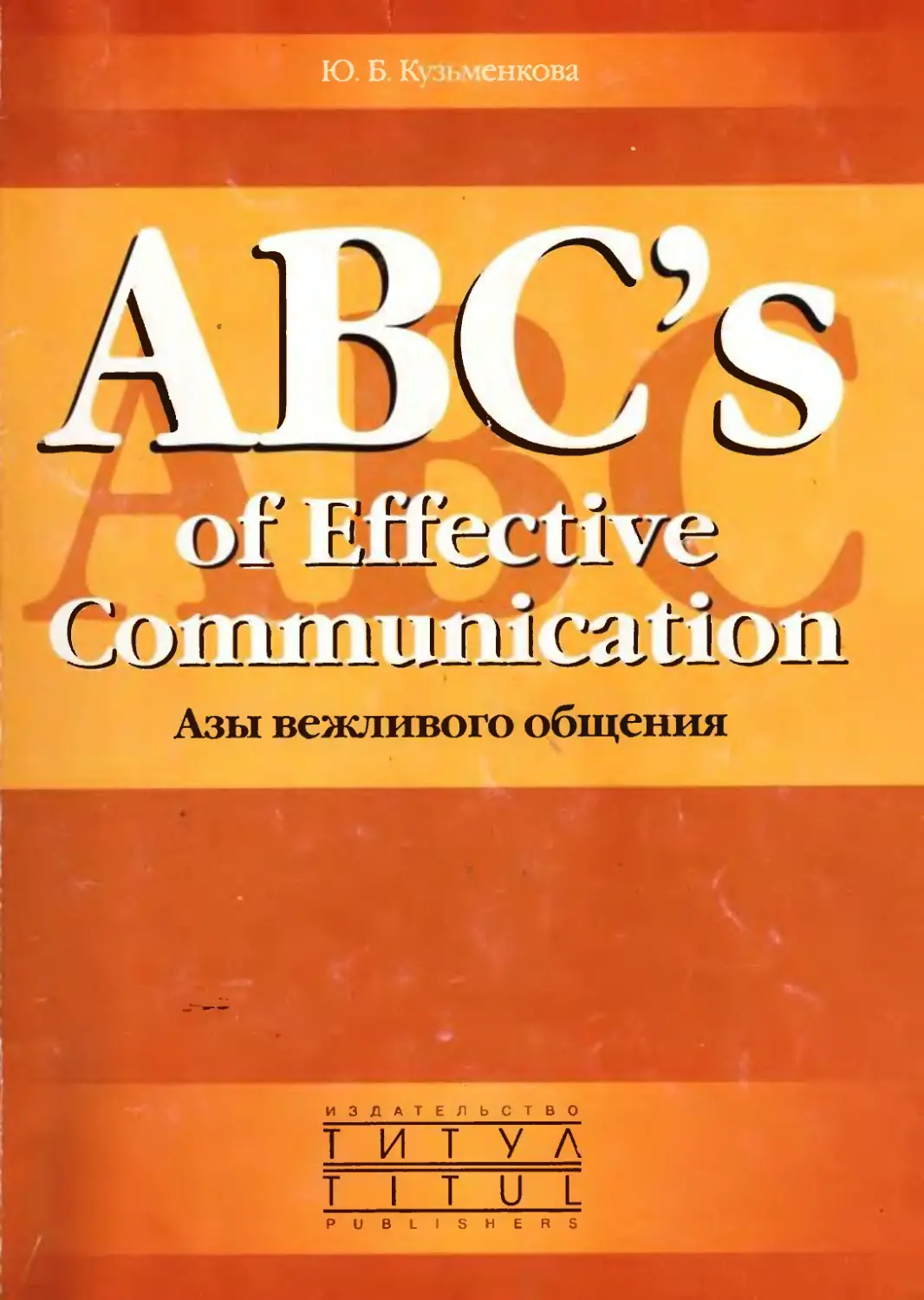
Ю. Б. Кузьменкова
ABC’s of Effective
Communication
Азы вежливого общения
Допущено Министерством образования
Российской Федерации
в качестве учебного пособия для студентов
высших учебных заведений, изучающих
английский язык
т'и'т Ул
Т I Т и L
2001
ББК 81 2 Англ-923
К89
УДК 802.0(075 3)
Кузьменкова Ю. Б.
К89 ABC’s of Effective Communication / Азы вежливого общения: Учебное пособие. —
Обнинск: Титул, 2001.— 112 с.
ISBN 5-86866-169-9
Автором предпринята попытка систематизировать разнообразные и, как правило, разрознен-
ные сведения относительна вежливого речевого поведения на английском языке, представить соб-
ранный материал в наглядной форме, облегчающей его усвоение, и проверить приобретенные на-
выки посредством тестовых заданий, составленных в форме диалогов.
Книга предназначается для всех, кому сведения межкультурного характера необходимы в силу
их деятельности или просто небезынтересны- для старшеклассников и студентов, преподавателей
вузов и школьных учителей, гидов, бизнесменов и многих других.
УДК 802 0(075.3)
Юлия Борисовна Кузьменкова
ABC’s of Effective
Communication
Азы вежливого общения
Зав редакцией изданий по английскому языку К. И. Кауфман
Корректоры Г. А. Киселева, Г. П. Мартыненко
Макет, верстка, обложка В Кин
Художественный редактор Е А. Валяева
Лицензия ИД № 00416 от 10.11 99 Подписано в печать 28.03 2001 Формат 60x84/8.
Гарнитура “Таймс". Печать офсетная. Бумага офсетная. Усл. печ. л. 13,07.
Уч.-изд л. 9,16. Усл кр-отт. 14,0 Тир. 5000 экз Зак № 168
Издательство “Титул”. 249035, г Обнинск Калужской обл., а/я 5055, ул. Курчатова, 21.
Телефон (08439) 4-82-82. Internet: www titul.ru E mail: sales@titul.ru.
Отпечатано с готовых диапозитивов на ФГУП Тверской ордена Трудового Красного
Знамени полиграфкомбинат детской литературы им. 50-летия СССР Министерства
Российской Федерации по делам печати, телерадиовещания и средств массовых ком-
муникаций. 170040, г. Тверь, пр. 50-летия Октября, 46.
ISBN 5-86866-169-9
©Кузьменкова Ю. Б., 2001.
© Издательство “Титул”, 2001.
Contents
Предисловие......................'..........4
Структура пособия ..........................5
Как пользоваться пособием...................5
Practice Section............................8
Introduction................................8
Pari I. Politeness strategies...............X
I.	Distancing.............................8
1.1.	Distancing tense forms (Lesson	1)......8
1.2.	Distancing modals (Lesson 2)........	II
2.	Presupposition........................13
2.1.	Understatement through downtoning
information (Lesson 3).....................13
2.2.	Understatement through negat on
(Lesson 4).............................15
2.3.	Overstatement through intensification
(Lesson 5).............................18
3.	Softening...........................  20
3.1.	Softening opinions / statements
(Lesson 6)...........................  20
3.2.	Sofjening with questions (Lesson	7).. 22
3.3.	Softening questions (Lesson 8)...  .	-24
4.	Keep-the-conversatton-going . ...	. 26
4.1.	Answering techniques (Lesson 9)......	26
4.2.	Attention signals (Lesson 10).........28
Part //. Tasks and dialogues for discussion .32
Tasks for initial discussion............. .32
Dialogues for dis cussion (1 8)... ...	...	34
1.	Meeting friends.......................34
2.	In the park...........................35
3.	In the street.........................37
4.	In a cafe.............................38
5.	Visiting a British home	.	    39
6.	Shopping..............................41
7.	Discussing a business proposal ...... 42
8.	Saying good bye.......................44
Tasks for final discus: on	46
Reference Section (Комментарии)........... 48
Введение...................................48
1 1 11екоторые особенности бри ганско! о
менталитета........................... 48
1.2.	Характерные черты речевого поведе-
ния .......................................50
1.3.	Два не британской вежливости	...	52
Часть I Стратегии вежливости	54
Тема 1. Дистанцирование (Уроки 1. 2)...	54
Тема 2. Предположение (Уроки 3, 4	5)	56
Тема 3. Смягчение (Уроки 6, 7. 8)	61
Тема 4. Способы поддержать беседу
(Уроки 9, 10)..............................64
Часть 11. Разбор трудных случаев и типич-
ных ошибок....................................68
1.	Особенности упот ребления некоторых
формул вежливости ...	...... . 68
I 1 Приветствия/ прощания ................... 68
1.2.	Особые случаи- .	. 69
2.	Некоторые типичные ошибки при вы-
боре ответных реп шк	. 69
2.1	Plea. е. thank you and о/ course	69
2.2	. Sorry and excuse me ................................... 70
3	Формулы приказа, вежливой просьбы.
предложения	... ............. 71
3 1 Просьба и приказ	 71
3.2. WnJ-phrascs..............................71
4. Формальн 1Я и неформальная речь:
некоторые различия	.	.	  72
4 1 Язык социального обшення . ... ..........72*
4.2. Словарь..................................72
4.3. Грамматика...............................73
Home Reading Section. Cultural lessons and
cross-cultural puzzles........................................... 74
How it all began (instead of introduction)... 74
I.	First surprises..........................75
2.	Watching TV ........................... 76
3	Food experience..........................77
4.	Living in a hotel..........:............78
5.	Sightseeing-.....................  ...	79
6.	Visiting classes........................80
7.	Col ege policies and regulations ...... 80
8.	Clean Monday in Washington .	..81
9,	Home Hosp ality.........................84
10.	On thank you letters ..................  88
Appendices....................................90
I Some politeness formulae graded according
to degrees of politeness.................... 90
1.1 Requests and offers, advice and permis-
sion ....................................90
1.2. Opinion-phrases ......................91
2. Some grammar structures in formal and
informal English..........................91
3. Maintaining small talk the weather ..... 92
Answer keys...................................93
1.	Exercises................................93
2.	Tasks for initial d scussion	102
3.	Dialogues .............................. 102
4.	Tasks for final d scussion ............. 104
5.	Supplement Dialogues (Russian
version).....................................107
References....................................112
3
Предисловие
Почему нельзя напрямую выразить свое мнение, а с критикой надо быть пре-
дельно осторожным? Почему нельзя (без всяких задних мыслей) попросту
поинтересоваться у коллеги, сколько он зарабатывает? Почему невинный вопрос
о возрасте или семейном положении расценивается как проявление бестактности?
Почему расточаемые вам комплименты нельзя принимать за чистую монету?
И почему же наконец, нельзя на время прекратить общение и просто помолчать?
На эти и подобные им вопросы можно найти ответы в этой книге, предназначенной
для всех, кому сведения межкультурного характера необходимы в силу их деятель-
ности или просто небезынтересны,- для старшеклассников и студентов, преподава-
телей вузов и школьных учителей, гидов, бизнесменов и многих других.
Специалисты по теории коммуникации считают, что во время общения более
90% информации передастся с помощью неязыковых средств: манерой держаться,
жестами мимикой, телодвижениями и т. д. Весь этот массив данных передается /
воспринимается более-менее неосознанно, как нечто само собой разумеющееся.
Но это вовсе не означает, что оставшимися десятью (а то и меньше) процентами
можно пренебречь: вербально передаваемая информация должна строго корре-
лировать с невербальной; в противном случае противоречие между тем что и как
говорится и что и как делается легко сведет на нет все усилия, потраченные на
преодоление межкультурных барьеров
Совершенно не случайно в последнее время ввиду постоянного расширения
международных контактов все настойчивее отмечается целесообразность разви-
тия межкультурной компетенции, поскольку при изучении иностранного языка
важно нс только правильно понимать, что говорится, но еще и владеть речевыми
приемами, столь привычными для носителей языка Попытка осмыслить понятие
“межкультурной компетенции" в терминах русского языка неизбежно приводит к
выводу о необходимости своего рода "межкультурного ликбеза”, что на вербаль-
ном уровне предполагает прежде всего обучение навыкам грамотного общения.
Грамотность в общении особенно с малознакомыми иностранцами, предпо-
лагает, помимо фоновых историко-культурных знании н активного пользования
необходимым набором лексических единиц и грамматических структур, достиже-
ние такого уровня владения языком, которое позволяет:
- гибко реагировать на всевозможные непредвиденные повороты в ходе беседы,
- быстро определять адекватную линию речевого поведения,
- безошибочно выбирать конкретные средства из обширного арсенала (кото-
рый британцы даже обозначают специальным термином - social language) и
- употреблять их сообразно предлагаемой ситуации
Поставленная цель нс настолько труднодостижима, как это представляется на
первый взгляд,- овладевать навыками грамотного общения можно практически
на любой ступени обучения языку и чем раньше, тем эффективнее, поскольку в
таком случае отсутствует необходимость устранения уже приобретенных ошибок.
В настоящем пособии предлагается системный подход, облегчающий практичес-
кое освоение учебного материала, собранного для иллюстрации стратегий вежли-
вого речевого поведения, и прелоставляется возможность проверить приобретен-
ные навыки посредством тестовых задании
4
Структура пособия
Пособие состоит из трех разделов: основного (Practice Section), справочного
(Reference Section) и вспомогательного (Ноте Reading Section).
Основной раздел, посвященный стратегиям вежливости в соответствии с
возможными речевыми задачами, предназначен для работы в аудитории под
руководством преподавателя. Раздел состоит из двух частей часть 1 (Politeness
strategies) включает 10 уроков, представлсньгх в наглядной табулярной форме,
тренировочные и проверочные упражнения, а также творческие задания на
развитие и закрепление приобретенных навыков в устной и письменной речи,
часть II (Tasks and dialogues for discussion) состоит из 8 обучающих тестов,
составленных в форме диалогов, а также вопросов и заданий для обсуждения.
Справочный раздел предназначен для преподавателя или для тех, кто
занимается самостоятельно Он состоит из введения, которое содержит краткие
сведения из области межкультурной коммуникации и их преломление на уровне
невербального и вербального общения подробных поурочных пояснений (на
русском языке) к части I и анализа наиболее 1иппчных ошибок, возникающих
при общении с англоговорящимн партнерами в различных речевых ситуациях,-
в качестве систематизирующего справочного материала к части II
Раздел Cultural lessons and cross-cultural puzzles может использоваться как
вспомогательный и содержит материалы для домашнего чтения (результат
реального опыта межкультурного общения автора во время пребывания в США)
с вопросами для последующей дискуссии
В пособие также включены приложения по основному разделу, ключи к
упражнениям и диалогам, и - для удобства различных катеюрий обучающихся -
диалоги в русском варианте (supplement), что позволяет исполльзовать их для
обратного перевода
Как пользоваться пособием
При составлении пособия автор руководствовался модульным принципом, да-
ющим возможность гибкой подачи учебного материала и большую вариа-
тивность его использования В отличие от традиционного построения пособий
(с четким закреплением структур по соответствующим урокам и строго опреде-
ленным порядком их изучения) модульный подход позволяет преподавателю вы-
страивать собственный курс из необходимых блоков - модулей - с учетом требо-
ваний конкретной аудитории, количества выделяемых часов и пр.
Пособие предполагает примерно 25-50 часов аудиторной работы (в зависимо-
сти от уровня обучающихся) и рассчитано на лиц со стартовым уровнем не ниже
(Pre)Intermediate. В качестве общего подхода рекомендуется чередовать уроки
части I с диалогами из части 11, на обсуждение может соответственно отводиться
до 1 2 часов учебного времени. На уровне Advanced эффективнее предлагать тест
в русском варианте для обратного перевода, а на более низких ступенях обучения
представляется целесообразным коллективное обсуждение материалов части I, згу
работу можно сочетать с разбором тестов и более детальным рассмотрением харак-
терных трудностей и типичных ошибок из части II
Материал основного раздела подбирался с целью обучения возможным стра-
тегиям вежливости на основе функционального подхода, то есть с учетом пра-
5
вильного владения языковыми средствами при выполнении поставленной рече-
вой задачи (ср functions of English), - в зависимости от того, где (в каком окруже-
нии), с кем (возраст, социальный статус, степень знакомства и т. п.), с какой це-
лью вы общаетесь и какая тематика при этом затрагивается. Необходимо при
этом отметить, что так называемый ситуативный жаргон (situational dialects), -
специфический, более компактный вокабуляр, часто употребляемый в обществен-
ном транспорте, столовой, билетной кассе и т. д , не рассматривается особо.
В отличие от большинства существующих современных разговорников и учеб-
ников английского языка, где аналогичный материал, как правило, трактуется
как клише для заучивания и “привязывается" к работенад конкретными речевы-
ми ситуациями, в данном пособии используются элементы структурно-компонен-
тного анализа, что (в сочетании с функциональным подходом) позволяет расши-
рить возможности гибкого практического освоения различных речевых средств и
общепринятых формул вежливости, рассматриваемых через призму межкультур-
ной компетенции
Умение определить верную линию языкового поведения, особенно при обще-
нии с незнакомыми людьми в малознакомом окружении, должно основываться
на знании особенностей менталитета носителей английского языка Чтобы на-
учиться вежливому общению, нашему соотечественнику прежде всего придегся
оставить досадную привычку дословного перевода с русского на английский и
постараться развить способность “мыслить по-английски"; последнее предпола-
гает доведенное до такой степени автоматизма умение правильно пользоваться
грамматическими блоками и речевыми оборотами, которое позволяет сосредото-
читься на том, чпю и когда надо сказать. Одним из непременных условий достиже-
ния такого уровня общения на иностранном языке является (помимо знания самих
особенностей способа выражения мыслей носителями языка) умение соо гнести
эти особенности с нормами и привычными оборотами родного языка Этому дол-
жно предшествовать выяв. еннс соответствий / несоответствий аналогичных обо-
ротов и блоков, различий в стиле и частотности употребления, что достигается
путем сопоставления переводов и анализа высказываний с точки зрения их адек-
ватности конкретной речевой ситуации
Для развития вышерассмотренных навыков используются обучающие диало-
ги, составленные по принципу multiple choice. Каждый диалот представляет собой
функционально связанный сюжет, героями которого являются прибывший в Бри-
танию россиянин и местные жители; стиль их общения приближен к Standard
English: отсутствуют диалектизмы и сленг, однако определенная неформальность
допускается На каждом шаге диалога отклонение от этой нормы приводит к воз-
можности возникновения различного рода межкультурных минн-конфзикгов
При составлении диалогов ставилась цель
-	показать, что культурные различия действительно существуют и проявляют-
ся в нашем поведении, в том числе и на вербальном уровне;
-	представить некоторые нормы вербального поведения британцев,
-	проиллюстрировать возможные последствия игнорирования принятых в об-
ществе культурных норм
В качестве дополнительной иллюстрации необходимости практического вла-
дения стратегиями вежливого поведения приводится текстовой материал для до-
машнего чтения представляющий собой как бы дальнейшее расширение контек-
ста межкультурного общения. Этот матсрнал (который целесообразно использо-
вать на достаточно высоких ступенях обучения) также способствует развитию
навыков спонтанной речи
6
В заключение автору хотелось бы воспользоваться возможностью выразить
глубокую признательность всем, кто так или иначе способствовал появлению дан-
ной книги. - прежде всего, доценту факультета иностранных языков МГУ Люд-
миле Городецкой за проницательные и тактичные замечания относительно пода-
чи и компановки материала, большинство из которых были должным образом
учтены. Нельзя не сказать слов искренней благодарности и в адрес профессора
Светланы Тер-Минасовой, декана факультета иностранных языков МГУ. всячес-
ки поддерживавшей автора в работе над книгой. Хочется особо поблагодарить
Андрея Трушкина, редактора журнала ’‘Бумеранг”, который рискнул нс только
напечатать несколько приведенных в книге днало!ов, но и превратить их в забав-
ные комиксы. (Как знать, может быть, при работе над .материалами такого рода
за столь наглядным способом их подачи - будущее.) Автор очень признателен
Алене Громушкпной. редактору газеты “English”, предоставившей страницы сво
его издания для полной публикации весьма обширных диалогов и еще более про-
странных “мемуаров” о поездке в Америку, тем самым позволив познакомиться с
ними широким кругам преподавателей и специалистов английского языка. Автор
не представляет себе, как удалось бы справиться с многочисленными проблема-
ми, с которыми постоянно приходилось сталкиваться при отборе и подготовке
материалов для книги, без помощи английских консультантов: Сэнди Уоррен и
Колина Стоуна (Concorde International. Canterbury); особо хотелось бы отметить
ту важную роль, которую Сыграли здесь Бетси Льюис. Джоханпа Ковиц (USIA,
Moscow)
Однако автор не считает, что в работе над книгой поставлена точка, и будет
приветствовать любые замечания по сути дела со стороны читате ей.
7
Practice Section
Introduction
The two fl’s of British politeness
avoiding directness and negativity			avoiding silence
distancing	presupposition	softening	keep-the-conversation-going
Different cultures have different attitudes towards space and time, speed of the infor-
mation flow and messages transmitted Those peculiarities of national mentality are
usually reflected by the way people speak. For the British, one of the basic notions
forming the background for communication is the proper distance the key clement
underlying the set of du's and taboos for small talk The unwxitten rules of social lan-
guage usage prescribe a tentative approach of treating conversation topics that mani-
fests itself through the choice of certain commonly accepted expressions and politeness
formulae (where the representatives of the Russian culture would turn to or hide behind
gestures or intonation).
The rules mentioned serve as a foundation for politeness strategies which could
roughly be classified as above and called the “two a s" of British politeness, namdy,
avoiding directness and negativity (1) and avoiding silence (2)
Part I. Politeness strategies
1. Distancing
Distancing s aimed at making requests and orders, suggestions and inquiries etc. sound
less direct and therefore more polite Certain tense forms and modals are used for this
purpose
1.1. Distancing tense forms (Lesson 1)
tense forms			functions
Future:	• Present	Past	e g : order instruction, request, parting formulae, suggestion offer, inquiry, accepting offers stating intentions etc
Indefinite (Simple)	—	Indefinite (Simple)
Continuous	Continuous	Continuous
The tense forms for distancing are Indefinite (the Future and the Past) and Continuous
which could replace the corresponding phrases in Present Indefinite to make them more
distant from the immediate reality.
8
Consider the examples below (1.1.1; 1.1.2) illustrating different ways of distancing your utterances.
Think of more xamples possible for some other functions of English.
1.1.1. Indefinite tenses: the Future and the Past
functions	indirect	direct
order formulae	Гil have to ask you to sign it. 1 You'll need to sign it.	(You must) Sign it
order / instruction	Will you open the books and start reading?	Open jhe books and start reading.
suggestion / offer	Shall we go out for a menl somewhere downtown?	Let’s go out for a meal downtown.
offering / accepting	- That will be 10$ That’// be OK. (In a shop)	-That is 10$. - That’s OK
polite inquiry	How many guests did you intend to invite over9	How many ... do you intend to...?
request formulae	1 thought you could / would like to join in...	1 think you could join in..
suggestion	1 thought it would be nice to visit an old friend.	1 think it'll be nice to visit a friend.
request / offer	I wondered if you were free at ten o’clock?	1 wonder if you are free at ten?
The use of Future Simple and Past Simple, e.g. Will you...? in typical formulae for or-
ders, Shall I / we...? m offers, I wondered /1 thought... in polite requests etc. helps to
remove them from the present moment of speech making them less straightforward.
1.1.2. Continuous tenses
functions	indirect	direct
polite inquiry	What meetings are you planning to arrange?	Let me know your plans.
stating intentions	I’m sorry, I must be going, or I’ll be late for dinner.	Sorry, I must go...
request formulae	I’m hoping you can give me a hand m packing.	I hope you can gi c me..
parting formulae	I’m looking forward to hearing from you soon.	I look forward to hearing...
polite inquiry	Will you be staying with us al Christmas?	Are you staying with us...?
suggestion	I was thinking - wrhat about having a picnic?	I thought - what about...?
request formulae	I was wondering if you had a bag to spare?	I wondered if you had...?
Present Continuous is preferable to Present Simple when you intend to sound more casu-
al; seen from this perspective. Future and Past Continuous possess two levels of distan-
cing and are thus con: iered to be the least direct
Exercise 1. Make (he following sentences more polite (indirect). State the functions.
function	direct	indirect
...	Fetch me some application forms.	...
	I hope you can lend me your printer.	...
...	Fill in this form, please.	...
...	Use block letters only.	...
...	Are you looking for anything special?	...
9
Окончание таблицы
function	direct	indirect
...	1 want this blouse and two sh rts.	...
	That’s 12 dollars.	•••
...	Let's take a few days off in July.	...
...	I think it will be nice to go to the lakes.
...	What about borrow ing a boat for our trip?	...
...	Arc you busy right now?	—
...	Could you help me?	...
...	Have you got a double room?	...
	"How many days do you want to spend?
	Are you staying for the weekend?
	What date do you plan to leave?	...
...	I look forward to seeing you soon	...
Exercise 2. Render from Russian into English. Different polite variants could be possible.
1	Вы будете ходить на декции профессора Холла9
2	Я думаю, они будут полезны для вашего проекта.
3	. Какие лекции он будет читать9
4	Я хочу проешь его прочитать курс по межкультурному обшению
5	. А мои коллеги могут также поприсутствовать?
6	. Сколько именно?
7	. Думаю, человек пять.
8	. Надеюсь, вы сможете уточнить некоторые детали относительно оплаты
и документации?
9	Да, конечно Организационный взнос составляет 20$
10	И вы должны принести свои фотографии для документов.
Transfer
I.	Use the distancing tense forms:
a)	to ask about your friend’s / teacher’s intentions (suppose, one has made plans of
vis ling London and the other decided to attend a conference);
b)	to offer your help to a stranger who feels unwell / a friend who looks miserable /
your teacher who is overburdened with various responsibilities;
c)	to ask your superior / secretary / colleague to send a fax for you;
d)	to instruct a junior student / a visiting professor how to use the computer / tape
recorder tn your room
II.	Write a brief note / letter to:
a)	a fr end / colieage who wants to visit your town offering your assistance;
b)	your teacher where you suggest (on behalf of your class) a plan for spending a
weekend / holidays together
10
1.2. Distancing modals (Lesson 2)
could would, might			functions
question formulae verbal structures	conditional expressions	subjunctive expressions	c g.: request, offer, nquiry. suggestion advice, order / instruction, desire, opinion
Interpersonal use of the modals could, would, m gin is characteristic of quite a number
ol set formulae (also known as common formulae of politeness). It is the use of modals
that makes requests and offers, instructions and orders etc more indirect suggesting the
idea of their being merely intentions.
Consider the examples below (1.2.1; 1.2.2) illustrating the use of modals as another means of distancing.
Think of more examples possible for some other functions of English.
1.2.1. Set question formulae and verbal structures
functions	indirect	direct
request formulae	Could / would you lend me your printer?	Will you lend me your printer?
opinion	Might it be alright to do it this way?	Is it alright to do it this way?
inquiry	You wouldn't be going to Hull by any chance?	You’re not going to Hull.
inquiry	When would that have taken place?	When did it take place?
offer / suggestion	Do you suppose we might give them a lift?	Let’s give them a lift
critisism advice	You could /might wam them in advance.	You should/must warn them..
opinion / offer	Г</ think we might spend а г ;ht here.	I think we’ll spend a night here.
opinion	He won? I'd have thought he wasn’t good at chess.	He won? I thought he wasn't good..
opinion / critisism	IV/.wry this is not the best way to treat cats.	I say, this is not the best way to. .
desire / suggestion	I’d like/prefer to make a brief re ew of...	1 want (you) to make a brief..
Set question formulae with modals (e.g. Could/ Would you...?) are mostly used for
polite requests, offers and (critical) opinions which expressed otherwise might sound
exteremely rude.
Verbal structures like a modal + a verb of speaking or thinking,
e.g. would + say, call, think
or a modal + a verb of liking,
e.g. would + like /prefer
arc also used as set formulae for expressing opinion, desire, intention,
e.g : Would you like. ?/I'd prefer. ../I'd like to... /I'd say /I'd think.
11
1.2.2. Conditional and Subjunctive expressions
functions	indirect	direct
inquiry / offer	I wonder if you might be interested in...?	Г wonder if you are interested in...?
advice formulae	If 1 were you I’Jjoin up with this firm.	You should join up with this firm.
suggestion / advice	It would be better if he went there alone.	Let him / He should go there alone.
order I instruct >n	If you would stand over there?	Will you stand over there?
order 1 refusing	I’Jrather you didn’t refer to those data.	I don’t want you to/ Don’t refer to...
permission	I wish you wouldn’t disclose those facts	You mustn't / shouldn't do that
Conditional expressions with modals (e.g. if-phrases) are used in question formulae to
make a polite inquiry or suggestion, to give advice or order, e.g.: / wonder if you might
be interested in... / could possibly... / would like to. ?; If I were you I'd...: It would be
better if .; If you would...
Subjunctive express 3ns (suggesting more tact) are preferable for refusals, personal
questions and recommendations, e.g.: I’d rather not (answer that) if you don’t mind: I’d
really like to (say yes)...
Exercise 3. Make the following sentences more polite (indirect). State the functions.
functions	direct	indirect
...	Let’s have an evening out.	...
	1 say, let’s go to a restaurant downtown.
	1 don’t want you to spend a fortune there.	...
	You shouldn’t talk in terms of money.	...
	/ suggest a bar.	...
	We should better go to a cafe.
	1 thought you didn't like cafe meals.
	We want a lable in the comer.	...
	Will you come this way, please?	...
	What do you want to drink?	...
	Do / Perhaps you want to dance?	...
	Won’t it be better to have the candles lit?	...
	That’s what I call intime, as the French say.	...
...	Is there a telephone I can use?	...
	Maybe you’ve picked up some lost purses?	...
	Can you give me more details?	...
...	When did you find it missing, exact y?
Exercise 4. Render from Russian into English. Different polite variants could be possible.
1.	Вы не скажете, где институтский научный центр?
2.	Да он прямо перед вами.
12
3.	У вас есть книги из собрания профессора Джеймса по истории Британии
4.	Какой именно том вам нужен?
5.	Я точно не знаю, дайте мне какой-нибудь том по средневековью.
6.	Посмотрите последний, в котором есть полное содержание.
7.	Это последнее издание? Я думал, оно более полное.
8.	Тогда лучше поищите специальный выпуск по средним векам.
9.	Думаю, вы найдете там все. что вам нужно.
10.	Вам надо бы посмотреть работы разных авторов.
Transfer
I.	Use the distancing modals
a)	to give advice to a teacher / a junior student who appears to be on the first visit to
your country / town / institute (school);
b)	to to ask your teacher / a stranger who’s going abroad to do you a favour (send a
letter / take a souvenier to a friend of yours / find a book you need etc.);
c)	to ask your superior / secretary / colleague to give you the information you need
on the subject of your research / how to get about the town;
b) to express your desire / preference talking about eating / drinking habits / hobbies.
II.	Write a brief note I letter to:
a)	a shop selling the items you’re interested in to inquire about necessary details,
b)	a friend working in a tourist firm describing a way of spending free time you prefer.
2. Presupposition
presupposition
understatement		overstatement
downtoning	negation	intensification
Presupposition is aimed at ’‘neutralizing” emotionally coloured utterances thus making
them sound casual and less direct. The desired result could be achieved through the use
of understatement (i.e. saying less than you imply) and overstatement (i.e. implying less
than you say). Understatement could be effec ed through downtoning information and
through negation.
2.1.	Understatement tlirough downtoning information (Lesson 3)
downtoning devices		functions
minimizing adverbs	verbs of intention also with	e.g.: explainations, complaints.
non- assertive words	a) fillers b) vbs of thinking	(negative) opinions, apologies
Information could be toned down by means of certain speech devices - adverbs, verbs
and fillers - diminishing or softening the impact of what is being said and thus avoiding
negativity.
13
Consider the examples of understatement given lielow (2.1.1) to illustrate different ways of downtoning.
Think of more examples possible for some other functions of English.
2.1.1.	Minimizing adverbs, fillers and verbs of intention
functions	understatement	statement
criticizing	The room is a little/a bit overcrowded.	The room is overcrowded.
apology	It was just a slip of the tongue.	It was a slip of lhe tongue.
attitude	The news son ei hat shocked me.	The news shocked me.
giving	There’s a kind of misunderstanding.	There is misunderstanding.
explainations	It was more or less out of place.	Il was out of place.
expressing	We tend to overlook the importance of tests.	We overlook the importance of tests.
(negat ve)	I am inclined to feel that it is important.	I feel that it is important.
opinions	1 sort of think t could be better if you quit.	It could be better if you quit.
The impact of what you say could be regulated by the use of minimizing adverbs (e.g.
Just, only, a bit. a little}, non-assertive words (e.g. somehow, somewhat etc.) and fillers
(e.g. kind of, sort of, so to speak, more or less etc.) which help to level unwanted emo-
tions concealing the negative attitude.
Verbs of intention (e.g. to be inclined, to tend, to intend} together with verbs of think-
ing also make for lessening sharp criticism safely referring what is being said to the
realm of intentions
The effect achieved could be enhanced by combining the devices mentioned with
different fillers appropriate for the purpose: I'm sori of inclined to think...’, I kind of
intend to feel,.,: In fact / act wily, I sort of think / feel someihings missing... I mean, it
looks like that, so to speak.
Exercise 5. Make lhe following sentences more polite (indirect). State (he functions.
functions	statement	understatement
...	Pat said that Bess is buying a new cottage.	...
	It seems untimely.	...
	I was surprised and asked her husband.	...
	My question took him unawares	...
...	He was disappointed by her choice.	...
...	1 also think she is impractical.	...
...	The place is devoid of light and greenery.	...
...	The surroundings are industrial.	...
...	It is on the outskirts of the city.	...
...	She thinks it's a minor discomfort.	...
...	She says it's a 10 minutes walk to the nearest bus stop.	...
14
Exercise 6. Render from Russian into English Different polite variants could be possible.
1.	“Как вам нравится наш новый учитель?" - “Я думаю, он ннча о".
2.	А я бы сказала, что он у нас в школе неуместен.
3.	У него нет контакта с другими учителями.
4.	Он ВЫ1 ладит старомодно.
5.	Говорят он педант.
6.	Он строг в отношении дисциплины.
7.	Он не любит когда ему залают много вопросов.
8.	Он какой-то странный.
9.	Он будез ставить одни плохие отметки.
10.	Ты просто его боишься.
Transfer
I.	I se understatement to minimize the impact of sth (which was contrary to your expectations):
a)	an unpleasant encounter with your ne ghbours / sb's shocking behaviour.
b)	your poor performance at a contest (exam) / disappointing news-
c)	a place you visited I a party (meeting, concert) you attended
d)	a purchase you’ve made / presents (results tn sth) you’ve got
11.	Write:
a)	a brief description of a -book you’ve read / a film you’ve seen expressing politely
your critical attitude;
b)	a note of explamation / apology / complaint giving reasons for your failure at an
exam / misbehaviour at a lesson / misusing someone else s property
2.2.	Understatement through negation (Lesson 4)
types of negation			functions
explicit, also with:	implicit with-	double with:	e.g. (negative) attitude, criticism, dislike, statements of opinion, dis- agreeing, offering
a) degree adverbs	a) adj like little /few	words of negative meaning
b) transferred negation	b) negative adverbs	(also with preffixes / suffixes)
c) non-asserlive words	c) vbs. Jail, lack etc.	adj., adv , vbs. prepositions
Understatement manifests itself through negation of three mam types: explicit, implicit
and double. Explicit negation is typical for an ordinary negative sentence or could be
expressed by a verb of thinking (transferred negation), or by a non-asserlive word; im-
plicit negation could take place in an affirmative sentence contain ng the words of nega-
tive or min mizing meaning; and doubli negation occurs when an ordinary negative
sentence contains the words of negative meaning
Consider the examples below (2.2.1; 2.2.2) illustrating different ways of using negation us a means of
understatement. I hink of more examples possible for some other functions of English.
15
2.2.1.	Explicit negation
functions	understatement	statement
attitude	I'm not pleased with his manners	(= I’m definitely disgusted.)
greeting	How arc you? - Not so well, thank you.	I’m not well. (= I am ill.)
dislike	I’m not partictdarly keen on TV	I’m not keen on TV (= I hate TV )
explaining	It is not quite that easy; you see ..	It is not easy. (= It is very difficult.)
disagreeing	I don't think I could quite agree with it.	I think 1 can’t fully agree. (=1 disagree.)
offer	I don t suppose you’ll accept my offer.	1 suppose you’ll not accept it. (=1 hope you will.)
statement	He didn't tell me anything about it	He told me nothing about it
Explicit negation is used to replace an emotionally coloured word by a neutral one. the
purport of understatement each time being dented from the context (thus. e.g. I'm not
pleased could be treated differently. I m simply displeased/shocked/definitely disgusted
etc.) Understatement structures often contain degree adverbs (e.g. very, too particular-
ly, quite) and non-assertive words (e g anything anywhere) serving as a sort of buffers
to lessen the negative impact.
2.2.2.	Implicit and double negation
functions	undeistatement	statement
statement	He’s got little idea how engines work	He’s got no idea how engines work
statement	I hardly ever speak in public.	1 never speak in public.
criticising	He lacks the courage to give it up	He doesn’t have the courage to give it up
criticising	His plan is not devoid of drawbacks	His plan is full of drawbacks
statement	It is not impossible	It is possible.
opinion	He’s not without pretentions.	He has (many) pretentions.
Negation as well as negativity could be masked by negative adverbs (e g. hardly, barely,
scarcely), adjectives few, little or verbs like fail, lack etc.,- thus man Testing itself impli-
citly
Still another structure typical for understatement is based on the use of words with
negative affixes in already negative sentences changing the negative meaning for its
opposite (e.g. It's not unfair = It's fair).
Exercise 7. Make the following sentences more polite (indirect).
functions	statement	understatement
...	I suppose you've got no news about Roy	...
...	Last time he told me nothing about his plans	...
...	I couldn’t approve of his behaviour.	...
...	I don’t see what you mean. Could you be more explicit?	...
16
Окончание таблицы
functions	statement	understatement
...	Well, he has ambitions.	...
...	He does not sec that the job he is offered is not trivial	...
...	1 acknowledge his talents but his approach could not be called reasonable.	...
...	During his job interv ew he didn't say a word.	...
	He is not right in doing so.	...
...	The m nagcr was ed to think he doesn't like the job.	...
...	There was reason in his reproach.	...
...	Roy has no bat kground knowledge.	...
...	He has no experience in dealing with people.	...
	It is likely he’ll be denied this position.	...
Exercise 8. Render from Russian into English. Different polite variants could be possible.
1.	Я понимаю, у всех есть недостатки.
2.	Но я возмущена отношением вашего сына к занятаям.
3.	Правда, он никогда не блистал в английском.
4.	Вы знаете, учить иностранный язык очень трудно.
5.	На прошлой неделе он пропустил почта все занятия
6.	И он не сдал нн одного теста.
7.	Л перед экзаменом ему не хватило духа прийти и объясниться.
8.	А в письменной работе у него много грубых ошибок.
9.	Возможно, директор даже захочет его исключить
10.	Мой сын никогда не говорил, что у него какие-то проблемь
Transfer
1.	Use understatement to:
a)	express your dislike of some TV programmes / latest fashions / pets;
b)	crilisize some recent innovations in school system / city planning;
c)	disagree with your teacher / a friend on the subject of getting ready for exams /
strict discipline;
d)	describe to a friend of yours the frame of mind / state of health of your other
aquaintance who feels wretched / is very unhappy / terribly ill.
II.	Write in brief:
a)	a critical review of an article / essay written by a friend of yours;
b)	a characteristics of somebody who you think is unfit to be elected a president /
sent to an international contest in English.
2 Аш вежливого обшониш
17
2.3- Overstatement through intensification (Lesson 5)
intensifiers		functions
emphasizing	exaggerating	e.g.: expressing gratitude, sympathy, praise, apology; refusing, complimenting, inquiring
degree adv. as emphasisers	words as intensifiers
Overstatement (unlike understatement) is aimed at exaggerating the effect of what is
being said. Different words used in their maximizing I minimizing meanings could serve
as emphasisers and intensifiers.
Consider the examples below (2.3.1) illustrating different ways of using overtatement. Think of more
examples possible for some other functions of English.
2.3.1. Emphasizing
formulae of	overstatement	statement
gratitude	Thank you (ever) so much / very much indeed.	Thank you.
gratitude	I’m so much obliged to you! Flow can 1 ever thank you!	Thank you
gratitude	I'm so grateful! / I can t tell you how grateful I am1	Thank you.
sympathy	I’m so sorry! / 1 can’t tell you how sorry I am!	l am sorry.
apology	I’m extremely /awfully / (ever) so sorry (but.. )	Sorry (but )
refusal	I’m very much afraid, 1 can’t join you.	Sorry (bin .)
The emphasizing function is mostly performed by degree adverbs (e.g. how, so, too,
extremely, terribly, awfully, very etc.) often used in set formulae of politeness to intensi-
fy. say. the expression of gratitude or sympathy, refusals or apologies which - reduced
to mere thank you or sorry - would sound rude.
2.3-2. Exaggerating
functions	overstatement	statement
greeting formulae	How are you? - I’m fine, thank you.	I m well, thank you.
request formulae	I wonder if it is at all possible for me to...?	Is it possible for me to...?
request	Could I make a very br cf announcement?	Can I make an announcement?
accepting	Would you like a cup of coffee? Yes I’m dying for it.	A cup of coffee? Yes, please.
apologizing	How very stupid of me to ask you...	How silly of me to ask you..
inquiry	I suppose you’re very busy now? Just a minute.	Are you busy? Wait a little.
inquiry	I really hate to bother you at this early hour but...	Excuse me..
praising	1 just adore our new саг I really love your present.	1 like your present.
complimenting	You’re so good at organising things’ Y >u're too kind!	You’re good / kind.
Some degree adverbs like just, really, fully, completely etc. or stylistically coloured verbs
(e.g.: love hate, die) or adjectives (e g super, great, smashing, horrible, awful, stupid
18
etc.) could be regarded as intensifiers when they lose their direct meaning and their
function is merely to exaggerate, e.g : I fully agree with you: I’d love to (go with you);
That may sound a stupid question (hut I'd like to know...)?
Further classification being complicated, it is possible, however, to outline some
strategies for the use of overstatement. Thus. (1) if you have to bother sb or invade sb’s
privacy, simply saying sorry wouldn’t be enough, you should indicate reluctance giving
very strong reasons to make your imposition seem less than it is.
On the other hand, (2) during a small talk, you should notice and attend to the
hearer’s wants and needs, exaggerate interest, approval or sympathy making him I her
feel good by saying what s/he would like to hear (even if you don’t agree), giving com-
pliments and praise.
Exercise 9. Make the following sentences more polite (indirect). State the functions
г functions	statement	overstatement
	Excuse me for disturb ng you late.
	I know no one here 1 could turn to for advice
	Oh. come on in, 1 haven't seen much of you lately
...	Are you tired?	...
...	Could you spare me sortie t me7
...	I’ll be brief, my story won’t take long.	...
...	What do you think about this sad and rather delicate matter?	...
...	Thank you for your piece of advice.	...
...	You understand me.	...
	1 like the way you treat people	...
...	How sad! I am sorry
...	You’re kind! Thank you	...
...	Sorry to have taken your time.	...
Exercise 10. Render from Russian into English. Different polite variants could lie possible.
1.	“С Новым годом1” - “Спасибо. Вас также”.
2.	Вы хорошо выглядите. Вам идет это вечернее платье.
3.	“Эго вам”. - “Что это? Брошь?”
4.	Спасибо. Я люблю янтарь.
5.	“Что же мы стоим? (Проходите.) Как здоровье вашей матушки?”- "Спасибо,
хорошо”.
6.	Извините, но она не сможет прийти.
7.	“Что случилось?”- “У нас заболела собака, и ей пришлось вести ее к ветери-
нару”.
8.	Жаль.
9.	Я не хочу вас беспокоить во время праздничного вечера, но мне надо позво-
нить ей и узнать, как дела.
10.	Спасибо.
19
Transfer
1.	Use overstatement to:
a)	express your gratitude for a present you recieved / a reception you were given:
b)	apologise for not being able to come to a meeting on time / at all;
c)	express your reluctance to bother somebody at an inconvinient hour to dehever an
urgent piece of news / to ask for a favour;
d)	ask your teacher / an expert whose opinion you value for a piece of advice (on,
say, the best way of writing essays / treating pets) and express agreement with the
view you’re offered.
II.	Write a letter of:
a)	thanks to a host family you spent summer with / a book firm who sent you a present;
b)	apology to a landlady whom you owe a sum of money / a friend whose book /
bycicle you’ve damaged.
3. Softening
Softening, a strategy not to be dispensed with if you wish to keep the conversation
going, is also aimed at avoiding negativity and making what is being said as little poten-
tially offensive to the hearer as possible.
3-1. Softening opinions / statements (Lesson 6)
1 softening devices			functions
op nion phrases	general statements	probability phrases	e.g.: attitude, advice, opinion
Generally speaking, softening devices are based on the use of different probability
phrases and opening phrases which serve to make utterances sound less definite and
straightforward.
Consider the examples below (3.1.1: 3.1.2) illustrating different ways of softening utterances Think of more
examples possible for some other functions of English.
3-1.1. “Personalising” opinions by means of opening phrases
functions	indirect	direct
opinion	In my opinion it would be belter to postpone the meeting.	It is... (without opening phrases)
attitude	As far as I know finding lhe right decision is not that simple.
remembering	If I'm not mistaken, the matter was highlighted in Issues № 2
explaining	I'd like to mention that it has been discussed time and again,
opinion	I reckon /guess she’s the last person to ask for compassion.
opinion	Personally. 1 (don’t) feel you’re making the best choice.
Certain opening phrases and set expressions could be used to soften an opinion, to
make it sound just as if it wrere merely your personal point of view which the other party
20
would be free lo disagree with. Softening devices of this kind could be reduced to three
types of opinion phrases: 1) mind/ view phrases (e.g.: to my mind: in my opinion / view,
from my point of view etc.); 2) as- ph rases (e.g.: as far as I know, as far as I’m concerned:
as I see it; as for me etc.); 3) /-phrases (e.g.: forgive me if I’m wrong; if I'm not mistaken:
if you ask me etc.)
Another way to “personalize” your opinion is to use an opening phrase with a verb
of thinking (e.g. think, feel, guess - Am.E, reckon) or a verb of speech (I’d like Го-phrases,
e.g. with say. mention, point out etc.). Further softening effect could be achieved by
adding fillers.
3.1.2. Generalising and probability phrases
functions	indirect	direct
advice	It is well known that language le m ng takes time.	I know it well
hesitation	One can't know for sure, it depends on many things.	I don’t know for sure.
attitude	They say it’s not a proper way to treat animals.	It’s not a proper way to treat...
complaint	It appears that our lunch is likely to be delayed	Our lunch is delayed.
criticism	You happen to be mistaken, he seems to have won.	You are mistaken, he has won.
On the other hand, while expressing, say, your attitude, it often becomes necessary to
“hide” your personal view masking it by a general statement as if referring to something
that is common knowledge and thus avoiding the risk of sounding dogmatic. Different
impersonal and probability phrases with, e.g. maybe, perhaps, by (any) chance, happen/
seem /prove / turn out / appear / (un)likely etc. do well for this purpose.
Exercise 11. Make the following phrases indirect (you can also add fillers and >erbs of intention if necessary).
functions	direct	indirect
...	Why do you think he did poorly in the exam again?	...
...	It is his fault	...
...	It’s due to the time limit It was too short.	...
...	You should always leave time to check your answers	...
...	Something’s gone wrong.	...
...	The examination board postponed the final decision.	...
...	You can persuade them to look it all over again.	...
...	They are not ready with the results, at least it looks like that.
...	Oh. I can t know for sure.
...	I’d say. we unanimously accept that tests take a lot of revising.	...
...	You can’t learn English in a fortnight.
...	He is making a grave mistake.
...	He just doesn’t care a bit for language learning.	...
...	He could turn to intensive methods based on hypnosis.	...
21
Окончание табшцы
functions	direct	indirect
	1 well know, this approach has a lot of advantages.
...	1 doubt that those methods work
	My advice is to turn to a professional teacher.
Exercise 12. Render from Russian into English. Different polite variants could be possible.
1	Вы думаете, у моего сына серьезные проблемы с английским?
2.	На мой взгляд, он много занимается.
3.	Непохоже пока, чтобы он добился какого-то успеха.
4.	Лично я не думаю, чтобы хтесь было что-то серьезное.
5.	Но все же мне кажется, что-то не так.
6.	Если вас интересует мое мнение, он уделяет занятиям недостойно времени.
7.	Невозможно ведь повторить весь годовой курс за ночь перед экзаменами.
8.	Может быть, я не права, но я думаю, прежде всего ему надо расширять свой
словарный запас.
9.	Если не ошибаюсь, он нс прочитал ни одной книги в оригинале
10.	На мои взгляд, такое отношение к изученшо языков вряд ли можно назвать
серьезным.
Transfer
I.	Use the softening devices mentioned to:
a)	agree / disagree with one of the following extreme opinions: ‘7r is easier to learn
Russian than English" / “Language learning is completely boring”;
b)	express your negative altitude to bad habits f dogmatic elders / unnecessary waste;
c)	criticise a boring lesson / an extravagant fashion / a risky profession;
d)	give a piece of advice (to somebody you don’t know well) on: using a photo
camera / choosing an appropriate shopping site.
11.	Write a brief report on:
a)	your friends’ / classmates’ behaviour during a trip / a visit you had together,
b)	your progress in language learning showing your strong points (as an application
for a contest).
3.2. Softening with questions (Lesson 7)
types of questions				functions
persuasive (negative)	general:	declarative:	tag:	e.g.: suggestion, (pressing) offer, asking for information I agreement opinion, request, advice, order
	a) negative	a) negative	a) negr live
	b) affirmative	b) affirmative	b) affirmative
Question form being softer and often sounding less categorical, it is a useful device to
facilitate the exchange of information and to soften the purport of an order, advice or
criticism.
Consider the examples below (3.2.1; 3.2.2) illustrating different ways of turning statements into questions.
Think of more examples possible for some other functions of English.
22
3-2-1. Questions softening statements
functions	question (indirect)	statement (direct)
advice	Why don t you speak to him directly9	You should speak to him directly.
pressing offer	couldn t we prolong our visit?	Let us prolong our visit.
suggestion	Won't it be better (for us) to leave at once?	We’d better leave at once
opinion	Would it be less expensive to go by car?	It'd be less expensive to go by car.
To soften statements and orders it is useful to turn to иЛу-questions and yes/no ques-
tions which sound far more polite cf: It could wait till morning.
BTry couldn't it wait till morning? (pressing offer)
Cotddn ! it wait till morning? (persuasive question)
Could it wait till morning? (open question)
3-2.2. Questions softening questions
functions	indirect	direct
request I offer	I don't suppose you’ll find time for it now?	Will you find time for it now?
inquiry	I suppose you're very busy now?	Are you (very) busy now?
request / asking	You haven t seen my cal here have you'!	Have you seen my cai here?
for information	You don t know where Bells is. do you?	Do you know w here Bells is?
inquiry I asking	You are the new teacher, aren't you?	Are you the new teacher9
- for agreement	You do take milk in coffee, don 't you!	Do you take milk in coffee?
order	Carry this bag for me. will y ou?	Will you carry this bag for me?
Questions themselves (especially personal) could further be softened by statement-qws-
tions and tag questions S/«/eme«/-questions are used to ask for something more tenta-
tively helping the other person to refuse without sounding rude and at the same time
indicating that refusal will simply confirm your pessimism.
Tag questions are used to replace straightforward statements, requests and orders.
Exercise 13. Make the following phrases indirect. State the functions.
functions	direct	ind rect
	Ben. have you heard the news7 The Smiths arc in town.	...
...	Let's spend a weekend together	...
...	Will you be free next weekend7	...
...	Have you postponed your appointment7	...
...	We should invite them over	...
...	Do you have their their home address?	...
...	Don’t forget to send them an invitation.	...
...	Chris could meet them at the station	...
...	You’d better hire a taxi	...
	It would be proper to send a car	...
23
Окончание таблицы
functions	direct	indirect
...	Arc you here for the first time?	...
...	Have you met Ben?	...
...	Sit down
...	Have some whisky
...	Do you like it straight7
	We’d better get going, dear Mr Smith
...	You can stay for the night.	...
	Do you always say what you really think?	...
Exercise 14. Render from Russian into English. Different polite variants could tie possible.
1	Вы сейчас очень заняты?
2	. Вы можете уделить мне несколько минут?
3	Вам лучше обратиться к Джейн, она теперь секретарь
4	Вы не видели Дженн9
5	. Вы наш новый секретарь?
6	У вас есть папка прошлогодних отчетов7
7	Мой ассистент отдал ее вам на прошлой неделе?
8	У вас не осталось его компьютерной версии?
9	Надежнее хранить документы на дискете.
10	Пошлите мне e-mail с заклю штельнымн выводами
Transfer
I.	Use different questions to:
a)	ask an over-worked teacher / an imposing looking hotel clerk to give you the
information you need;
b)	try to persuade a stranger / a friend to go together to a place you like;
c)	suggest a plan for a party / a tour;
d)	ask a person you don t know well to spare you an item you need (a bag / a pen /
change for the phone).
II.	Write a few lines (which vou leave in haste):
a)	tor a friend asking to help find some things you forgret to pack;
b)	for your elders / neighbours to remind them that your invitation / request still holds.
3-3. Softening questions (Lesson 8)
softening devices				functions
probability	verbs of	right-	mind-	e g requesting, asking for information / op mon
phrases	thinking	phrases	phrases	suggesting, giving advice, asking permission
Softening manifests itself through the conventional set of question formulae varying
according to the degree of politeness (see App. 1) The formulae are used to implicitly
ask for information or opinion, to make requests, suggestions and offers, to ask permis-
sion and give advice
24
Consider the examples below (3.3.1) illustrating different ways of asking questions politely. Think of more
examples possible for some other functions of English.
3-3-1. Softening devices in question formulae
functions	indirect	direct
asking for information	Do you happen to know the weather forecast9	Do you know the forecast9
implicit request	Do you think you could lend me your printer?	Could you lend me ...?
suggestion / advice	Don’t you think it might be an idea to try again?	You must / Let’s try again
asking for opinion	Am 1 right in thinking that this is a true story?	Is this a true story?
asking permission	(Is it) alright if I use a dictionary?	May 1 use a dictionary?
permission / request	Do you mmd if 1 sit here? / sitting here?	Can 11 Could you sit here9
Most widely used question formulae are based on the following softening devices:
1)	probability words (e.g. possibly, by (any) chance, happen) and
modals (see 1.1) which could also be preceded by / wonder...',
2)	verbs of thinking (e.g.: think, believe, consider, suppose), both in the affirmative
and negative forms;
3)	right - phrases (also with verbs of thinking) and, finally
4)	mind phrases (also preceded by I hope...).
Exercise 15. Make the following questions more polite (indirect). State the functions
function	direct question	indirect question
	Do you mind my accompanying you to the even ng meeting?	...
	Shall I ask our new assistant to join us7
...	Can I borrow your car to get there?
	May 1 use the telephone over there?	...
	Can you tell me where the meeting takes p ace?	...
...	Do you know what's going on there?	...
...	Do you know where the board director is?	...
	Can you spare me u few minutes?	...
	Have you got an extra copy of the agenda?	...
	Is it possible for me to gc draft proposals?	...
...	Do you agree with the project considered?	...
...	Isn't the initial project more Umc consuming?	...
...	Still, do you prefer the latest variant?	...
	Is it the best solution?	...
...	So you don’t insist on further discussion?	...
25
Exercise 16. Render from Russian into English. Different polite variants could be possible.
1	. Мы собираемся на пикник Вы поедете с нами?
2	А Джейн тоже позовем9
3	Я думаю, каждый из нас должен, так сказать, внести свой вклад.
4	Я могу взять что-нибудь из еды. хорошо?
5	Вы не знаете, где продаются одноразовые чашки и тарелки9
6	Ник предлагает поехать к нему за город. вы не против9
7	Мы не могли бы поехать туда на вашей машине?
8	Может, поедем на поезде?
9	Он живет далеко от станции?
10	Думаю, мы не заблудимся
Transfer
I.	Use different question formulae to:
a)	ask a stranger / your superior for information you need on the whereabouts of
places of tourist attraction in the town / sourses of data necessary for the task you
were given,
b)	ask your teacher / a famous scientist for their opinion on a report you re going to
make,
c)	ask your teacher’s / boss’ permission to leave early / use his dictionary / keep the
book he gave you for some more time,
d)	give a stranger / a newcomer advice how to spend a weekend in your town / to feel
at home in the new' surroundings.
II.	Write a brief note (in the form of questions):
a)	suggesting a plan for improving the present day school system:
b)	asking your teacher I collcage to confirm the changes in the work you both are
engaged in
4. Keep-the-conversation-going
Kecp-the-conversation-gomg techniques are aimed at constantly reacting politely to
what you’re being said so that the talk would not unexpectedly end Most “dangerous”
in this respect are short answers which - incautiously used - might put a full stop to all
the previous efforts and the ensuing silence might cause embarrasement.
4.1. Answering techniques (Lesson 9)
ex	sanding devices	functions
emphasizing formulae	softening, a) verbs of thinking b) phrases of reservation	e.g. accepting, (disagreeing, explaining, apologetic refusal, (negative) opinion
Short yes/no answers should be made more polite by expanding devices based on different
ways of emphasizing and softening
Consider the examples below (4.1.1) illustrating different ways of expanding short answers. Think of more
examples possible for some other functions of English.
26
4-1.1. Expanding through emphasising and softening
functions	indirect	direct
agree ng	It's all very amusing, isn’t it7 - Yes very. / It certainly is.	Yes.
accepting	Will you join us at the party? - Yes, of course. (Thank you,)	Yes.
opinion	Do you think it’s going to rain? - (No,) 1 don’t th nk so. / 1 hope not.	No.
refusing	Are you going to the meeting? - (No.) I'm afraid, not. I'm likely to be busy.	No.
apologising	So you’re going to be late again? - Yes, Гт afraid so. = I'm sorry, but...	Yes.
d sagrccing	Do you agree with our proposal? - Yes. up to a point, but (you see)	No.
Expanding devices could mainly be reduced to the set formulae for emphatic agreement
containing adverbs like very, certainly, definitely, alright and sentences with verbs of
thinking (believe, think, suppose, hope, expet t) which often help to soften opinions as
well as phrases of reservation (e.g.: in most cases, in principle, to a certain extent). Sof-
tening formulae J agree but /only /except. Гт sorry but.../1 m afraid but... are mostly
used for apologies and polite refusals.
Exercise 17. Give polite answers to the questions from exercise 15. State the functions.
direct quest on	direct answer	indirect answer
Do you mind my accompanying you to the meeting?	No.	...
Shall 1 ask our new assistant to join us?	No. We won't need her.
Can 1 borrow your car to get there?	No. It is impossible.
May I use the telephone over there?	No. It is out of order.	...
Can you tell me where the meeting takes place?	No.
Do you know what's going on there7	No I have no idea.	...
Do you know where the board director is?	Yes. In the office upstairs.	...
Can you spare me a few minutes?	Yes.
Have vou got an extra copy of the agenda?	Yes.
Is it possible for me to get draft proposals?	Yes.
Do you agree with the project considered?	Yes but not completely.
Isn't the initial project more time consuing?	No.	...
Still, do you prefer ihc latest variant7	Yes.	...
Is it the best oluiion?	Yes. excep for some minor points.	...
So you don’t insist on further discussion?	No.	...
Exercise 18. Render from Russian into English answers to the questions from exercise 16; give explanations
in case of refusals. Different polite variants could be possible.
1.	“Мы собираемся на пикник. Вы поедете с нами?” - “Да'
2.	“Л Джейн тоже позовем?" • “Нет".
3.	“Я думаю, каждый из нас должен, так сказать, внести свой вклад”. - “Да”.
27
4.	“Я могу взять что-нибудь из еды, хорошо?” - “Да”
5	'Вы не знаете, где продаются одноразовые чашки и тарелки?" - ‘ Her”.
6.	“Ник предлагает поехать к нему за город, вы не против?” - “Нет”.
7.	“Мы не могли бы поехать гуда на вашей машине?’ - “Нет”.
8.	“Может, поедем на поезде?” - “Да”.
9	“Он живет далеко от станции?" - “Нет”.
10.	“Думаю, мы не заблудимся”. - “Да”.
Transfer
I.	Lsc different answering techniques (giving explanations where necessary) to:
a)	refuse poliely when you re: invited to attend an extra class / supposed to give a
hand in cleaning the room after a party / offered to visit a friend who is ill / asked
to have another helping of something you dislike,
bj apologise when you took somebody’s belongings by mistake / failed to write a
letter you’d promised / had to leave (a meeting / party) earlier;
c)	disagree w th a plan for spending Christmas Eve / a proposal for dealing with
business partners I an idea of entertaining guests;
d)	emphatically agree with an opinion of a brilliant report somebody’s made / an
amusing party you've been present at / somebody’s extravagant tastes / cooking
habits / an unusual exhibition.
II.	L sing the prompts below write mini dialogues about:
a)	good weather
b)	bad w'ealher
structure	pattern conversation
I) a tag question introducing the subject	Hot (day) today, isn tit/ don t you think?
2) comments containing comparisons	Yes much hotter than last spring isn t it?
3) the tag repeated	Yes. it is. isn't it?
4) expectations	1 hope it will last /keep up don t you?
5) the tag repeated	It does make a nice change docsn t it?
6) expressing agreement / disagreement	Yes, 1 suppose so.
4.2. Attention signals (Lesson 10)
“attention signals”			functions
reply questions:	exclamations	“silence fillers”,	c g. emphatic agreement, hesitation,
short, echo, tags	and interjections	“all purpose'’’ nouns	surprise, concern, sympathy, praising
Attention signals are used to prevent or fill in different possible pauses in a conversa-
tion. Those phrases perform the important function of indicating that you follow what s
going on, your reaction is adequate and the talk wouldn’t end abruptly.
Consider the examples below (4.2.1; 4.2.2) illustrating different ways of reacting politely; think of more
examples.
28
42.1. Reply questions
functions	polite reactions	s i 1 e n c e
attention	“It was great'” - "Oh, yes?" - “I really enjoyed the play."
interest	“There was an excellent performance last night.” - "Oh was there?'
emphatic agreement	“It was a lovely party.” - "Yes, wasn’t it?'
pity	So you're getting a divorce, are you! How sad!
concern	Oh, it was his funeral yesterday, was ill
surprise	“...I opened the fridge and saw... a mouse!*5 - "A mouse71 In the fridge?'
Reply questions are used not to ask for information but simply to politely demonstrate
your interest in what is being said. There are three types of reply questions:
I)	short questions, e.g.: Oh. yes? And so? And what happened) then? Really?
2)	question tags (positive and negative), e.g.: "He’s resolved to marry Ann. "Oh, is he?"
- "Yes, he thinks he couldn’t live without her. " - "Couldn't he?"
Another variety is the so called “same-way” tag (only positive), e.g.: "So vou think
you're the boss, do you?" Note that negative tags are used for emphatic agreement,
e.g.: 'She was great!" - "Yes, wasn't she?"
3)	echo questions, e.g.: ANow he works as a palaeontologist." - "As a what?"
4.2.2. Exclamations, interjections and fillers
functions	polite reactions	s i 1 e n c e
praising / attention / pity	Oh. how very exciting!/ (How) interesting'/ How very sad!
interest / surprise / sympathy	What a beautiful sight!/Hl a! a surprise! / What a pity!
delight / concern / disbelief	That s) Great!/ (That s) awful! / (That’s impossible!
surprise ! concern / disbelief	You can't be serious! / It can't be' / You must be very upset / joking!
sympathy / surprise	Oh dear /my God! Oh no! / Gosh! / Won ! Phew! / Oh, come on! No!
hesitation / attention	um /er...; a-yyy / the-eee /1 >-ooo //yes /uh-huh /hni-mmm
hesitation / attention	Well. now. that is to say... /1 see what you mean. Quite. Right OK
gaining lime / explaining	Well, you see .. Oh, let me think for a moment. The point is.
Exclamations, interjections and fillers are also important to show your attention. Ex-
clamations are based on the use of a) pronouns how / what / that; b) modals; c) set
expressions like, e.g.: Oh dear! Oh my God! Oh no! My goodness! Poor you!
Exclamations as well as interjections (e.g.: Gosh! Wow! Phew! Oh' No! Never! Oh,
come on!) also help to emphasise different emotional reactions.
Silence fillers, "all purpose" nouns (like thing, fact, reason, point) and hesitation de-
vices (e.g.: well, now, 1 see /know you see /know, let me see / think) perform the func-
tions their names suggest, i.e. those of concealing embarrasement when hesitating, fill-
ing pauses to gain time and the like.
29
Exercise 19. React politely to the following story using appropriate attention signals. State the functions.
reactions	the story
Did you have a good evening out?	Great!
	I enjoyed every minute of it.
	Ned invited quite a lot of people, his former colleagues mostly.
	It was quite an event.
	Yes. with cakes and candles and music and everything.
	Everyone semmed to be eager to give him a present.
	They greeted him one by one leaving a wrapped box on the table and saying: “This is something to remember me by.”
	We were on the point of singing Happ у Birthday to you when an awkward moment occurred, as if something was wrong, you know...
	Then Ned’s eyes fell on the table... and there it was.
	All the packages looked suspiciously the same!
	So Ned began to unwrap them...
	Everyone has brought him a Parker pen!
	Yes, there were ten of them or so.
	Just imagine Ned standing there embarrassed!
	He was about to start giving out his autographs when there was a knock at the door... and Dan appeared.
	Ned beamed and the guests exchanged a meaningful smile.
	They were pulling his leg!
	Yes. Dan produced a huge box saying: “It’s from all of us1”
	There was the latest version of a lap-top computer in it!
	Ned was moved to tears.
	Then everybody began to make merry, sing and dance - till midnight.
That reminds me... When did you return home?	...
Your mother was worried stiff, you know.	...
Exercise 20. Render from Russian into English using attention signals. Different polite variants could be
possible.
1.	‘’Вам понравился концерт?” - “Да”.
2.	‘'Правда?” - “Это было первое выступление знаменитой группы в нашем
городе”.
3.	“Был полный аншлаг”. - “...”
4.	“Их встречали очень тепло”. -
5.	“Исполни ели старались вовсю”. - “...”
6.	“По окончании никто нс хотел уходить”. - “...”
30
7.	“Им пришлось петь на бис раз десять”. - “...”
8.	“И тогда они стали исполнять свои лучшие произведения". - “...”
9.	“Под конец все в зале встали и начали петь хором”. - “...”
10.	“А многочисленные поклонники буквально засыпали их цветами". - “...”
Transfer
I.	Use the appropriate attention signals to react to the following
a)	you’re told that you won in a lottery (say. a cruise abroad) / your friend won
books worth 100$ in a recent prize draw;
b)	your friend tells you that he failed to join you yesterday because s/he missed the
last tra In and had to spend the night at the station;
c)	you're told that a terrible storm caused a lot of damage in the neighbouring city
and an acquaintance of yours was badly injured and taken to hospital;
d)	your friend shows you photos taken when s/he went to the seaside / mountains.
II.	Write a few appropriate remarks to a short story (made up or chosen) which:
a)	is just a plain narration / an account of sth routine;
b)	describes sth unusual / thrilling / unexpected.
31
Part II. Tasks and dialogues for discussion
Tasks for initial discussion
From the four options given below, choose the one polite variant appropriate for the situation suggested.
1	You were invited to a British home. You brought a small present (flowers or choco-
lates). The host says: “That’s very kind of you, you shouldn’t have bothered."
You say A It’s nothing, really
В That’s my pleasure.
C Not at all
D nothing
2.	You’re about to leave your host.
You wouldn’t say: A I’ll have to be going. I’m afraid.
В I’m sorry. I must be going
C nothing (stand up and leave unnoticed)
D I'll really have to go soon.
3.	There’s a bug on your neighbour’s lapel.
You would warn him by saying- A Take care!
В Mind out!
C Be careful’
D Watch out!
4	You are to politely refuse something you don’t like
Your host says “Help yourself to the apple pie ”
You wouldn’t say: A No, thank you. I’m not very keen on apples. I'm afraid
В No thank you I'm afraid apples don t agree with me
C Excuse me. I'd rather have some chocolates, 1 don’t like apples
D It’s really lovely but I don’t think I could manage any more,
thank you.
5.	In a cafe it would be rather impolite to say
Excuse me. A anyone sitting here?
В do you mind moving your bag?
C do you mind if I move your bag a little?
D is this seat taken?
6	In public transport it would be appropriate to say
A Would you move, please?
В If you were taking just a little less room, I could sit down
C I'd rather you moved a little.
D Excuse me. I wonder if you d m nd moving up a little so that I could sit
down?
7.	Which one of the following is appropriate in English?
A My congratulations on your birthday!
В 1 wish you a good trip!
C Remember me to your sister
D For our charming hostess’ (a toast)
32
8.	“Really7” is inappropriate to use when you want to show that
A you’re following me / listening.
В you sympathise.
C you’re surprised.
D you find something difficult to believe.
9.	What is appropriate to ask of a chance acquaintance whose ring you admire:
What a lovely ring' A How much does your husband eam annually?
В How much did your husband pay for it?
C How long have you been married?
D How beautifully it is cut!
10.	In Britain, you wouldn’t say Excuse me!
A if you apologise
В if you brush past somebody.
C after sneezing / coughing.
D before interrupt ng somebody.
11.	Which one of the following functions equivalently in Russian and in English?
A Good day! (as a greeting)
В Good appetite! (before eating)
C Good luck! (before a difficult event)
D Good Heavens! (as an exclamation)
12.	What would you say to the clerk in the booking office?
A Give me a return to Rye, please.
В 1 need to buy a return ticket to Rye, please.
C A return to Rye. please.
D Would you mind selling me a return ticket to Rye, please?
13	You want to ask a passer-by about the time.
You would say: A Hi. what time is it now?
В Excuse me, could you tell me the time, please9
C Tell me the time, please, will you?
D I wonder if I might trouble you, I wanted to know the time.
14.	In a shop the assistant gave you the wrong newspaper.
You would say: A Sorry, you’ve made a mistake-
B I’ve made a silly mistake.
C Don’t you think there’s been a mistake? -
D I think there s been a mistakc.-
Could you change this for me. please?
15.	Your TV has broken down on the evening when there’s a programme you very much
W'anl to watch. You W'ould ask a neighbour (a stranger to you):
A I hope you don’t think me rude - but would it be at all possible
for me to come and watch your TV tonight?
В Do you mind if I come and watch your TV tonight? I hope you
won’t think me an intruder?
С I wondered if my company would prevent your watching TV
tonight?
D Could I come and watch your TV tonight?
3 Aim мкжнкго rfuiniu
33
Dialogues for discussion
I he dialogues below are a multiple choice activitv from the three options, choose the one most appropriate
for the situation suggested and discuss the inadequacy of the remaining two sariants.
Dialogue 1. Meeting friends
A boy from Russia has just arrived bi a British town He is going to his friend who
invited him over.
I.	Vasia: A Good afternoon.
B.	How do you do?
C.	Hello everybody
Nick. Oh, hello, Vasia. Come on in How’re you?
2.	Vasia A. I’m all right. Thanks. And what about you?
В OK And you?
C. So-so. You wouldn’t expect me to be well and kicking after a long jour-
ney But one mustn’t grumble, must he? And how’ do you do9
Nick: Fine, thanks. Now, Vasia, do you know Zeb? Zeb. this is my friend Vasia
from Russia.
3.	Vasia: A. Hello, Zeb.
В No, I don’t know Zeb, I’m afraid. I'm glad to meet him
C Hello. I’m pleased
Zeb: Welcome to Britain How was the Hight?
4.	Vasia: A. Great, thanks.
В One can't complain, thank you
C. Oh. that was quite an experience. To begin with, I was unlucky to sit by
the window. I got terribly cold. To say nothing of the service. It was awful.
Nick How’re things? Is Moscow still standing, as I think the Russian saying goes9
5 Vasia A. Everything’s fine Bes des. the weather has settled down
В Tilings go well, Moscow stands still. Thank you.
C. Of course, it is. You don’t want to say it was ruined, do you?
Zeb- It’s also warm here today, isn’t it?
6 Vasia A Oh. it’s lovely, yes.
B. Yes, I also think so
С. I agree. It’s much sunnier in Moscow, though.
Nick. Why don’t you sit down? Fancy a drink?
7.	Vasia A. Sorry?
В What9
C. Pardon me?
Nick I’m just going to get you a drink. You must need that after such a long
journey There’s tea and coffee or maybe some beer9
34
8.	Vasia: A. I’d rather have some beer, thanks.
В. I think a hot shower will refresh me and strong tea to follow I’ve brought
Russin vodka for you as a present They say, you don’t have any.
C. Beer will do, thank you. I hope, it’s from the fridge?
Nick: Mild or stout?
9.	Vasia: A. Mild, please
В. I prefer mild, you know, I’m stout myself.
C. I’d like to taste both, if I’m not asking too much. I was wondering what
English beer is like.
Nick Here you arc.
10.	Vasia: A. Thanks. Here’s to you.
В I’d like to propose a toast for my host - almost a rhyme!
C. Great! That’s what I really need now. Let’s drink Your health
Nick: Cheers.
Dialogue 2. In the park
A girl is silling on a bench in the park: there is a book beside her. The boy is going to
engage her in a conversation
1 Vasia: A Excuse me, anyone sitting here?
B. Sorry, may I sit down9
C Mind if I sit here?
Girl: No, no. I’ll just move my book.
2 Vasia: A. Right Thanks
B. Thank you very much.
C. Very well.
Girl There we are.
3. Vasia. A. I wonder what that book is you’re reading? A detective story, I bet! Looks
really interesting.
B. What’s this book about? Is it interesting?
C. Hey. you like detective stories, don’t you?
Girl: It’s all about criminals and their methods.
4. Vasia: A. I see. I see.
B. Is it, really?
C. Great!
Girl- I like detective stories and thrillers, you know. But there just isn’t time..
5. Vasia: A No, there isn't.
B. Yes. There is not.
C It’s very bad, isn’t it?
Girl even to go to the cinema.
35
6 Vasia: A 1 was just thinking of going to the cinema this evening. Would you like to
come?
В I’d say we should go to the cinema together this evening.
C. What about this evening? I could invite you over if you don’t mind
Girl: That would be nice, yes’ Oh! I'm busy tonight. I’m afraid. What about tomor-
row n ght?
7	Vasia. A Oh, dear, no I’m afraid I’m busy then myself
В Oh, my dear, tomorrow 1 cannot.
C Sorry, my dear friend. I’m very busy tomorrow
Girl Oh., well.
8	. Vasia: A. Er... it would be nice to meet somet’me.
В Um mmm .. I want to see you sometimes.
C Wow* Would you h ke to meet somewhere else
Girl: Yes
9	Vasia- A Perhaps if you gave me your phone number 1 could
В Give me your phone number, please
C Could you possibly give me your phone number9
Girl Yes, alright. Shall I write it down for you9
10	Vasia A Yes please.
В Please do
C. If it is not difficult.
Girl O’key Here you are. By the way, I’m Mary.
11	Vasia- A. Oh, yes. I’m Vasia. (Taking the note)-. Thanks 1’11 give you a ring.
В Thank you very much Wait when I ring My name is Vasiliy, I’m from
Russia, you know
C. You’re married? So what? Let's meet the three of us.
Girl Alright
12	. Vasia (looks at his watch)'.
A Oh no, is that the time? 1 must be off.
В Gosh! 1 beg your pardon, I must be rushing to work right now
C. Sorry, I’m late for my work
Girl Oh, dear!
13	Vasia A It has been really nice meeting you!
В Nice to see you.
C I’m really glad to get acquainted with you'
Girl Nice meeting you too'
14	. Vasia: A Good bye, then.
В Good night, then
C Good evening, then
Girl: Bye.
36
Dialogue 3- In the street
A man with a dog is walking along the street The boy is going to ask him the way to the
town centre
1.	Vasia: Л. Excuse me.
В Hello, there
C Hey, mister!
Resident: Yes9
2.	Vasia: A 1 wonder if you could help me
В May I ask for your kind assistance?
C. Help me, please.
Resident Well I’ll try
3.	Vasia: A. You see. 1 need to find out where the town centre is?
В Where is the town centre? You know the way, don't you?
C. Tell me, please how can I get to the town centre
Resident It all depends whether you re on foot or going by car
4	Vasia: A Ah, no, I’m walking
В Yes, of course. I'm on my foot
C Oh. yes. on my feet.
Resident: Well, then you go up to the fork in the road, take the right one. Then you
cross over the bridge, take the second left and walk for about 100 meters.
5.	Vasia: A Sorry, I didn't quite follow what you said. What must I do after I cross
over the bridge?
В Please repeat from the very beginning, will you9 I did’t quite catch your
instructions.
С. I failed to understand about lhe fork. Which is the right one to take?
Shall I keep it ?
Resident You take the second left and walk for about a 100 meters.
6	Vasia: A Right Well, would you mind telling me if there is a good cafe down-
town9
В All right Do you mind telling me about any good cafe downtown?
C. Right. You don't mind my asking if there is a good cafe downtown, do
you?
Resident. Oh. let me think for a moment Yes there is a small cafe further on in the
High Street
7	Vasia: A Sorry to be a nuisance, but do you happen to know when it is open It s
3 already, time to have something to eat
В I sec. 1 see Just one more thing if I’m not pressing too much Can I
have dinner there right now? What do you think?
C. Do you think it could be opened by any chance9 It’s 15 o’clock, I need
lunch badly.
Resident- I think it’s still lunch time But I’m not sure about that particular place
I ve never been there.
37
8. Vasia. A. I see, I see What a nice dog you’ve got! May 1 stroke it?
В That’s a pity. What shall I do if it is closed? I am so tired and hungry as
your dog May I pat it?
C That’s clear. Thank you and let me give a sweet to your dog.
Resident I’d rather you didn’t if you don’t mind. Rex doesn’t like it 1 hope you find
your way.
9 Vasia: A Thank you. Good bye.
В Excuse me, please, would you kindly remove the dog s fangs from mv
hand.
C. Ouch' It bit me!
Resident: Bye Good luck
Dialogue 4. In a cafe
The boy is going io enter a cafe. Suddenly he sees his new acquaintance and asks her to
lunch.
I. Vasia: A. Excuse me. haven’t we met somewhere before?
В Excuse me it seems to me we’ve met somewhere, haven t we?
C Hey! What a meeting! You haven’t forgotten me. have you9
Mary: Oh, it is nice to see you again. How are you?
2 Vasia. Л. Fine, thanks 1 was thinking of having lunch here. Would you like to join
me?
В Oh. thank you. How are jow? Are you hungry? What would you say
about having lunch?
C. Thanks, fine. I was just thinking of you. It’s high time to have lunch
together, isn’t it?
Mary That’d be lovely. (They enter a cafe.) Let’s ask the waiter if we can sit near
the window See if you can catch his eye?
3. Vasia: A. Yes. of course. Er... waiter!
B. Certainly! Do you think it’s worth the bother9 Can’t wejust go and sit there?
C How do you think I could possibly do it9 Let him have his eye
Waiter: Good afternoon.
4 Vasia A. We’d like to sit near the window if that’s possible.
B. Good day! The lady wished that we sat by the window if that’s possible
C We’d like the table by the window. Don’t keep us waiting, will you9
Waiter: I’m afraid this table is taken Would you mind sitting nearer the bar?
5. Vasia: A. All right. That suits you? (to the girl)
B. Yes, of course. Am I right? (to the girl)
C No, we wouldn't. Right9 (to the girl)
Mary Mm. fine
6 Vasia A Oh. I don’t seem to have any cigprettes on me. Have you got a cigarette by
any chance?
38
В Oh my. I’ve left my cigarettes at home just by chance. Could I ask you for
one?
C. Sorry, I ran out of cigarettes, you see Have you got any?
Mary: I’m awfully sorry, but, you see. I’ve given up
7	Vasia: A Oh, well. Shall we have a look at the menu then?
В That’s a pity Pass me the menu then
C Then forget it Where is the menu?
Mary: Oh, yes. And where is it? 1 can’t see one Do you think you could ask the
people at the next table?
8.	Vasia: A Excuse me Could you possibly let us see your menu?
В Hello, there’ I wonder if it is possible that you've got a menu?
C Let us have a look at your menu, ch9
Girl: Oh, look, there is a menu under your napkin! Could ycu pass it to me?
9.	Vasia: A Here you arc’
B. Help yourself!
C. Yes. please.
Mary Thanks.
10 Vasia: A Well. What would you like?
В Please. Let’s order something. What would you prefer?
C Not at all What shall we choose?
Mary: I 11 have fruit salad and shrimp cocktail with Jamaica dressing.
11. Vasia: A And I’ll have my favourite cabbage soup, chips and beefsteak. Mm. 1
wonder what Jamaica dressing is?
В And I’ll have good old soup, meat and potatoes. Er.. It may sound a
stupid question but I was wondering why don’t you have a full meal? Let
this lunch be on me.
C. Phew! Who comes here to order dresses?
Mary: Ah, Jamaica dressing* It’s one of their specialities. It’s delicious and has no
calorics. I’m dieting, you know. Er... waiter!
Dialogue 5- Visiting a British home
After the hutch the boy saw the girl home and she invited hint for a cup of coffee Her
mother meets them
1	. Mary: Hello. Mum This is my new friend from Russia (To the boy) Vasia, meet
my mother.
Vasia: A How'do you do?
В How arc you?
C Glad to meet you
2	Mother You rc welcome. Sit down and make yourself at home. Would you like
some coffee9
39
Vasia; A. Yes. please. I'd love some.
В Yes, thank you I d love some
C. Yes. by all means I like coffee very much
3	Mother Black or white9
Vasia- A. Black, please
В Please, black
C Black Thank you
4	Mary Have you got enough sugar?
Vasia- A. Yes, thank you.
В Quite enough, thank you
C Yes. quite enough, it’s fine
5	Mother Nasty weather we are having today, don t you think9
Vasia: A Oh, yes. On a rainy day like this it s so nice to sit in a warm room Your
coffee is excellent1
B.	Oh, yes I'd say the weather is awful here. This terrible wind! And rain...
I wonder if it ever stops, don’t you9 We’re not used to such long periods
of rain in Russia
C Oh, yes. Actually, you see, that’s exactly what I was thinking about
6.	Mary: Have some more biscuits9
Vasia A. No, thank you. I’ve had enough
В I’d rather not if you don’t mind
C I’m afraid. I'm full. Thank you,
7.	Mother. I guess, it’s your first visit to Britain. Do you like it here?
Vasia A. Oh, yes I in enjoying even' day of my visit
В 1 like it very much. Could it be otherwise?
C Hardly. To begin with, there’s always rain or fog. Then, there's a lot of
traffic in the streets and on top of it, that strange attitude to foreigners
A lot of problems
8	Mother I hope you don’t mind my asking, but could you tell me what you do for a
living9
Vasia: A Well, 1 do some sort of chance jobs er... mostly during lhe summer, I
mean, apart from my studies You see, I’m a university student.
В Well, now. I sort of think that I’m no exception I mean, I eat and drink,
so to speak, just like everyone else does
C Well, Madam . Living is hard nowadays, you know I work during the
day, study tn the evening and spend the weekends in the library I also de
chance jobs during the holidays
9 Mary: Oh, really? And what are you going to do in future?
Vasia A. I’m going to be an economist You have to study hard to become a good
one, you know
В I’m going to do research on the economy of firm It’s a very promising
branch of science m the present day Russia, you know After 1 get my
MA degree, I'm going to work with some firm, a joint venture, preferabh
40
C.	Well, now, let me think for a moment. That problem is not so easy, you
know. I’m afra cl, I haven’t solved it yet.
10. Mary: This may sound a stupid question, but is it true that a young man in your
country cannot support his family without his parents’ help?
Vasia: A. Well, you see, that’s a very interesting question. I have to admit that it’s
not easy, but as the English say, where there is a will, there is a way.
B. I’d rather not answer stupid questions if you don’t mind.
C. Yes, I’m afraid.
Dialogue 6. Shopping
The boy sees a pair of shoes in a shop и indow. He goes in to buy them.
1 Assistant Hello. Were you looking for anything special?
Vasia: A. Hello. There’s a pair of black shoes in the window. Could you show
them to me?
B. Hello there. Let me see a pair of black shoes.
C. Sir. would you kindly show me the pair of black shoes I’ve seen m the
window?
Assistant; This pair?
2. Vasia: A. No, the other one, a flat, lace-up. 15.99.
B. Not this I’m sorry. I’d like lace-ups with flat soles, they cost 15.99.
C. No. I wanted flat, priced 15.99.
Ass slant: What size?
3.	Vasia: A. I’m not sure but I think, I take size 6 and a half shoes. I’m a guest in
your country, you see.
B.	I'm 6 and a half.
C.	My shoes are something like sixes. I don’t know exactly, I’m afraid.
English sizes differ from Russian, you know.
Assistant: Here you are.
4.	Vasia: A. Thanks. Can I try them on?
B. Thank you. Is it possible to try them on right here?
C At last' I’ll put them on. OK?
Assistant: Sure
5.	Vasia: A. They’re a bit tight. Could I try a bigger size, please?
B. Ouch! They are pressing on my feet. Take them away, will you. I sup-
pose I need a bigger size.
C. I'm awfully sorry but these won’t do. Will you show me another pair, please.
Assistant: Sorry, but we only have black lace-ups in this size. You could try another
pi ir. Would you like a horn?
6.	Vasia: A Thanks.
B. Thanks, you must be joking! I think I’ll manage. Leave horns to yourself.
C. No, thank you, but you must be joking! I’m not a musician to blow it.
Assistant- Are these OK?
41
7 Vasia A. No. I’m airaid. they are tight, too I'm broadfooted you see
В Uh. look’ I cannot make a step, can I?
C. What a pity! These don’t fit either. I’ve been looking for this particular
model What shall I do now9
Assistant Wc have brown and grey in bigger sizes Shall I show you them9
8. Vasia A No, thank you
B. No, those colours don t suit me. They won’t match my bnef case.
C. I'd say. black is my favourite colour.
Assistant Then have a look at this window. Our best collection The latest fashion
9. Vasia: A. How much are those black shoes?
В Well, 1 believe those black shoes are not bad. are they? How much?
C. Could you please tell me the price of this pair of black shoes?
Assistant: 45.10 Yesterday they were 60. We have a sale today.
10 Vasia A Oh it’s too expensive Could you bring me the grey in 6 and a half 111
try them on.
В Oh, it’s too much1 You don’t think I am Rockfeller’s son. do you9 I'd
rather have grey then
C Oh. well let me think for a moment. Are you really sure they are in
fashion9 You see. I’ll have to part w th my last savings to buy them
Assistant: Here you arc.
Dialogue 7. Discussing a business proposal
A boy is calling a travelling agency headed by his пен acquaintance He Hanis to discuss a
business proposal.
1 Vasia A Hello' Can I speak to George Pane, please?
B.	Good day* Is it George Pane?
C Hello! George Pane, please?
Ken: I’m sorry, right now he’s not ava lable Can I help you? I’m Ken. his assistant.
2	. Vasia: A Um I thought I’d introduce myself My name is Vasiliy. Could you
change my appointment to half past two tomorrow afternoon, please?
You see. the thing is. I'm not too well at the moment.
В I’d better introduce myself. I m Vasiliy You see, the fact is that I'm feeling
very unwell now. I’ve got to shift our appointment for 14.30 a m tomorrow
if it is at all possible.
C Oh' This is Vasily calling. Well I wanted to say that today I feel bad but we
agreed to meet at 2 30 a.m. Could you tell George that I can do it only
tomorrow?
Ken Well, let me see Yes. 14 30 is alright What did you say your name was?
3	Vasia: A Vasiliy. I’m working for a travelling agency. I wondered if you might be
interested in visiting one of the most picturesque Russian camping sites9
B. I’m Vasiliy from a travelling agency Are you interested m going camping
to Russia by any chance?
42
C.	As 1 said, it was Vasiliy. Гт a travelling agent. By the way, maybe you want
to go camping somewhere in Russia for your holidays?
Ken. Holidays in Russia... m...m very unusual. I’d say. Actually 1 started thinking
about it this summer. Could you tell me a bit about the place?
4.	Vasia A. Well, there is a nice lake surrounded by a pine forest. I'd think you
couldn’t find a better place for fishing. And they say, walking among
pines is nvaluable for restoring health.
B.	You shouldn't be idle there. There i > a nice lake with plenty fish in it. and the
nearby forest abounds in berries and mushrooms. You could even stock up
for the winter if you like.
C.	There is a nice lake among a pine forest. Unfortunately, there are no wild
animals to hunt - they were exterminated long ago. but you’ll find a lot
of wild berries and mushrooms there.
Ken: Could you tell me a bit more about accommodation?
5.	Vasia: A. I’d sort of call it an oasis of modern civilization, so to speak. Just imagine,
a few isolated cottages scattered among lhe huge pines. Besides, l is
within a short riding distance from Rostov the Great.
B. Well, accommodation presupposes comfortable modern cottages situated in
lhe beautiful surroundings in the close vicinity of Rostov the Great. But if
you look for more privacy, my granny runs a sort of bed and-board resort.
C. Of course, there are no such things as five-star hotels, but I can assure you
that living at my granny’s will make up for any inconveniences. You’ll enjoy
superb bcd-and-full-board there. Besides her house is situated in those
beautiful suburbs of Rostov lhe Great.
Ken- There’s one more thing I’d like to know. How can you gel to town?
6.	Vasia: A Oh. it's not very uneasy There arc regular bus tours, and the bus stop is
only something like a five-minute walk from the camping site.
B. Oh. it’s rather easy First, you get to the nearest bus-stop It’s only about a
three miles walk from my granny’s house. Then you take a local bus to
Rostov. If it rains and the road becomes somewhat muddy, you could al-
ways hail a lorry,- unfortunately taxi service is scarce, so to speak.
C. No problem. I'll be your guide when wc get on the spot.
Ken: Well, er... sounds tempting. Don't you think you could give me more details
about Rostov the Great?
7.	Vasia. A. Why, of course. Only I thought it might be an idea if we met somewhere.
Would you m nd coming to our office8 9
B.	Why. most willingly. But I’d rather you come to our office if you don’t
mind.
C.	O'key. Rostov the Great is a very old Russian town with a lot of ancient
churches, monasteries, with excellent cuisine and hearty people. You’d
better come and see for yourself. I bet. you wouldn’t be disappointed.
Ken- No, of course not.
8. Vasia: A. I wondered if you were free some lime at the beginning of next week? Do you
think wc could meet. say. on Monday?
В. I wonder if you could find t me a week today?
43
С I wish you were free a week from today What if w'e met next Monday?
Ken: Er. Monday is a b t of a problem, I’m afraid Is Friday any good to you?
9. Vasia: A. Yes, alright. Let’s make it a week on Friday.
В Yes, 1 suppose
C. Yes, it is.
Ken Fine. Call me Thursday afternoon to confirm, will you?
10 Vasia A Yes, sure Say hello to George for me Good bye
В OK Till Thursday, then Bye, Ken
C. Right. I’m looking forward to hearing from you. Good luck!
Ken Take care.
Dialogue 8. Saying good bye
The boy and the girl have just had dinner Noh it s time to say good bye the boy is going
back home.
1.	Vasia A Well, that was delicious! Thanks very much indeed I didn't know that you
were such a good cook.
В Uh, I suppose I w'on’t need any food till I’m back home. Everything was
extremely tasty
C Thanks Excellent meal I d say. As a cook you're OK
Mary Thank you, it was a pleasure. I enjoy cooking.
2.	Vasia A Would you like me to send you a traditional Russian recipe book?
В Next time 111 present a book of traditional Russian cuisine. I hope, you 11
appreciate it.
С. I think you should learn to cook schi and kasha. I’ll send you a recipe,
won’t I? That’ll do you good.
Mary Thal’d be lovely But I don’t know a word in Russian.
3	Vasia: A Shall 1 try to translate our favounte recipes for you?
B. You could always get somebody translate it lor you. I think it’ll be no
problem: the book is very interesting.
C That's a pity. It could wait, then, till you learn some Russian, couldn't it?
Mary: That’s very kind of you. thanks.
4 Vasia: A If you like, I could do the washing-up
B. And now I'd like to do some packing. The dishes could wait, couldn’t
they5 * * * 9
C. Don’t you think it might be alright if I helped you to do the washing-up?
Mary Oh, don't bother. I can do it later. Would you like me to make coffee now9
5 Vasia: A No. thank you I d belter be going My plane leaves m two hours.
В No, thanks. 1 must be going right now, can’t you see. There’s no time to
lose. I’m afraid.
C. No. thanks. Oh. 1 should hurry, my plane leaves very soon
Mary Oh, if you like, I could drive you to the airport
44
6.	Vasia: A. Thanks ever so much, but I wouldn’t like to put you to so much trouble.
В. I hate to bother you further. I m not used to such blunt things, and
besides. I’d rather take a taxi.
C. Well, why not. I'll be much obi ged to you. Thank you.
Mary: Oh, well, alright.
7.	Vasia: A. Remember me to your mother.
В. I hope, your mother won’t forget me.
C. Say hello to your mother.
Mary: Thanks.
8.	Vasia: A. Well, if you're ever in Russia do come and sec me - you ve got the address.
B. Next time I hope to meet you in Russia. You’ve got my address, haven’t you?
C. If you ever come to Russia, don’t forget about me, will you?
Mary: Yeah, I will.
9.	Va< a: A. It’s been really nice to know you. I’m going to miss you.
B. So glad to meet you. Great time we’ve had together.
С. I was very lucky not to miss you. I cannot imagine what I’d do without
you.
Mary: Don’t forget to drop me a line, will you?
10.	Vasia: A. I won’t forget at all. And now it's t me for me to leave. Thanks for every-
thing. All the best.
B. How can I? I never break my promises. Bye for now. I must be going.
C. Why, sure. But don't think I’m so ungrateful, I’ll drop something better
than a line for you. And now I must be ofT. See you!
Mary: Good bye and good luck.
45
Tasks for final discussion
Task 1
Make the following sentences more polite (indirect)
direct	indirect	function
1 Are you free tonight?
2. I've got to go.
3. Are you staying here for long?
4 Are you somg to Dover by any chance7
5. You're Susan, aren't you?
6 Stand over there.
7 Don’t touch the ornaments.
8. It’s better if he studies at home.
9. Goodness! It’s time to go.
10. Don’t do that!
11. Shall we go?
12 Try again!
13 Will you carry this for me?
14 It’s better to leave now isn’t it7
15. Have you seen my glasses7
16. Do you know the results?
17 Could you do it now?
18 Сап I use the phone?
19 Can I sit here7
20 Is he French?
Task 2
Transform the following statements Into understatements (1-8) and overstatements (9-15)
statement	under / overstatement
1. Your figures arc wrong	...
2 He often lies.	...
3 It’s far too spicy	• •.
4 It has many bad points	...
5 The course is not what I expected
6. I didn’t like it.
7. She's too fat
8 He’s bald
9 I’ll be upset if he doesn t phone soon.
10 I’ll be irritated if you hum that tune one more time!
11. Don’t tell Mum or I’ll be very cross
12. I can’l manage without my car.
13 It was silly pf ms to do that.	 14 I was SO ashamed when
15 Can I op out? I’ll only be a short time	...
46
Task3
In the sentences below, underline all the devices that make them polite; then - removing those devices one
by one - rewrite the variants obtained and arrange them in the order of lessening politeness (you could mark
them by stars accordingly); the last variant in a row should be reduced to a mere statement of the purport.
1.	I hope you don’t mind (my asking) but I wondered if it might be at all possible for
you to let us live in your country house just for a short while?
2.	I’d quite like to sort of start thinking about going now, so to speak.
3.	Forgive me if I’m wrong but actually I'm not inclined to think it's quite as simple as
that, you see.
4.	To a certain extent, yes, the proposal seems to be rather vague and it is not devoid of
weak points of minor importance but isn’t it more to do with poor financing?
5.	I was wondering if it might be alright for your boss to give us a very brief interview if
he isn’t too busy?
6.	Well... let’s see... that’s a very complicated problem... I mean, it’s not easy to arrive at
a plausible conclusion, you know.
7.	That's a very promising offer and generally speaking it is not mattraclive but I kind
of feel it's a little premature, at least it appears so.
8.	Sorry, I don’t quite see it the same way, personally I'm inclined to believe that per-
haps it’s somewhat time consuming.
9.	I agree in principle, there’s a lot of truth in what you say and in most cases you would
be right but one shouldn’t forget about the deadlines.
10.	It would be very kind of you if you could check it over but don’t worry if you don't
have enough time.
47
Reference Section (Комментарии)
Введение
1.1.	Некоторые особенности британского менталитета
Культура, с точки зрения зарубежных ученых-антропологов, представляет со-
бой целостную систему для создания, передачи, сохранения и обработки про-
изведенной людьми информации, которая отличается от форм жизнедеятельнос-
ти других существ; сюда же включаются такие понятия, как традиции, нравы, при-
вычки и обычаи, и как частность - литература и изящные искусства В широком
смысле слова культуру можно сравнить с гигантским компьютером, чрезвычайно
сложным и мастерски сработанным, все части которого взаимосвязаны и взаимо-
зависимы. Его “программа” управляет действиями и реакциями людей буквально
на каждом шагу, помогая им выживать, добиваться поставленных целей и полу-
чать удовлетворение от достигнутого При этом члены одной культуры не только
пользуются общим "банком данных" своего “компьютера”, но также оперируют
похожими методами получения, кодирования и сохранения этих данных.
Каждая нация в процессе развития создала свои “культурный компьютер”, в
котором вышеперечисленные методы обработки информации имеют свои особен-
ности. Поэтому механическое без соответствующего “транслятора” - перенесе-
ние культурной “программы" одного “компьютера” на другой неизбежно приво-
дит к сбою последнего. Даже такие фундаментальные понятия, как пространство
время, объем и скорость передаваемой информации, воспринимаются различны-
ми нациями по-своему. Рассмотрим их более подробно
Всякое живое существо имеет видимую оболочку - кожу, которая отделяет его
от окружающей среды Но помимо нее существует целый ряд оболочек невиди-
мых, которые, однако, не менее реальны, чем видимая Ближайшая к человеку
невидимая оболочка называется “личным” пространством, которое коконом ок-
ружает его и может изменяться в размерах в зависимости от целого ряда причин:
отношения индивидуума к находящимся поблизости людям, ею эмоционального
состояния и воспитания, характера осуществляемой им в данный момент деятель-
ности и т. д.
Размеры этих “коконов” заметно различаются от культуры к культуре. “Ко-
коны” британцев, как и других народов Северной Европы, достаточно велики. и
это заставляет их сохранять во время общения определенную дистанцию На по-
веденческом уровне, например, обычно рекомендуется вообще избегать физичес-
кого контакта - исключение делается лишь для рукопожатия, а целоваться при
встрече допускается только с членами семьи или с очень близкими друзьями. Если
же вы случайно (скажем, проходя мимо) нарушили “личное” пространство друю-
го человека (то есть сократили привычное для него' расстояние), принято изви-
ниться - даже если вы в действительности его не задели.
Причины такого отношения к пространству кроются в религиозных, культур-
ных и историко-i еографических особенностях развития этих наций (пословица * Мой
дом - моя крепость” чрезвычайно точно отражает данную особенность брш адс-
кого менталитета) Именно в этом, видимо, следует искать корни таких осново-
48
полагающих понятии британской культуры, как privacy (эквивалент которого в
русском языке, а следовательно и в русской культуре, отсутствует), индивидуа-
лизм. права человека и т. д.
Для того чтобы во время разговора чувствовать себя комфортно, люди обыч-
но выбирают определенное расстояние, отделяющее их друг от друга. Поскольку
такое расстояние для представителей разных культур различно, каждый вольно
или невольно старается придерживаться привычного для него. Несоответствие в
степени близости / удаленности общающихся сторон уже само по себе нередко
является источником взаимного непонимания: попытки сократить или увеличить
дистанцию могут восприниматься как угроза, флирт или презрение, что неизбеж-
но вызывает соответствующую реакцию. И неудивительно поэтому, что предста-
вители культур с несовпадающим комфортным расстоянием общения относятся
друг к другу с некоторой долей подозрительности - британцев, например, неред-
ко упрекают в холодности и высокомерии.
Отношение ко времени у людей различных наций также имеет свои особенно-
сти. Обитатели Британских островов, в частности, воспринимают время линейно,
уподобляя его дороге, которая начинается в прошлом и уходит в будущее. “Ли-
нейное” время естественным образом распадается на сегменты и структурирует-
ся, становясь при этом почти ощутимым. Следовательно, его можно “потратить”,
“потерять", “сэкономить”; именно при таком отношении ко времени становится
возможной формула “время - деньги”, а скрупулезная пунктуальность и вовсе не
удивляет. Однако линейное время изолирует людей друг от друга, воздвигая не-
видимые барьеры в процессе общения, преодолевать которые могут лишь те, кому
это по каким-либо причинам позволено. Из концепции линейного восприятия
времени вытекает и другое важное следствие, касающееся процесса “переварива-
ния сообщений” - принимаемая информация, как правило, обрабатывается бри-
танцами последовательно, и по этой причине она жестко структурируется и фоку-
сируется. а сам процесс ее обработки строго контролируется. (Вообще говоря,
привычка “делать все по очереди” очень характерна для британцев, как и других
севсроевропейцсв). Однако привыкнув воспринимать информацию последова-
тельно и по частям - one thing at a time, британец может легко оказаться перегру-
женным избыточными сведениями и потому всячески стремится избегать этого.
Необходимо, однако, отметить, что национальная культура определяет дале-
ко не все в поведении человека. Многое в нем является универсальным для всех
наций: добывание пищи, воспитание детей, строительство жилищ и т. д. Именно
по этой причине общение с представителями других культур нередко оказывается
вполне успешным. Иными словами, нет никаких оснований предполагать, что
всякий контакт с представителем иной культуры непременно завершается конф-
ликтом, взаимным непониманием или каким-либо неприятным происшествием.
Каким образом закладываются специфические поведенческие нормы того или
иного индивидуума? По всей видимости, этот процесс начинается еще в детстве,
когда мы копируем действия старших, находящихся возле нас. По мерс взросле-
ния этот опыт обобщается, становясь нормой поведения. В конце концов, наше
поведение становится инстинктивно-неосознанным, и мы нередко наступаем так
или иначе, совершенно не задумываясь над тем, почему это делаем. А поскольку
нормы, принятые в культуре, в которой росли Джон и Мэри, отличаются от норм,
принятых в культуре, где воспитывались Ваня и Маша, попытка перенести на
иностранца абсолютно все нормы своего собственного поведения приведет к
тому, что межкультурные различия рано или поздно напомнят о себе. Пожалуй,
самая большая неприятность здесь кроется в весьма ограниченной способности
вежливого обшепжв
49
самообучения: вас могут поправить при неверном употреблении слов, граммати-
ки. скорректировать произношение, но об ошибках культурного характера ско-
рее всего просто не сообщат - общепринятым считается, что в этой области от
чужаков едва ли можно ожидать осведомленности. В таком случае даже после
того, как упорное, пусть и неосознанное, игнорирование принятых в обществе
норм поведения - как на вербальном, так и на невербальном уровне - приведет к
возникновению каких-либо проблем, их причину будут искать где угодно, но
только не в межкультурных различиях, И хотя от иного бизнесмена можно услы-
шать заявления вроде: “Я провел много времени в Англии, и у меня ни разу не
возникло никаких проблем", эт о вовсе не означает, что у самих англичан никогда
не возникало проблем в общении с эт им бизнесменом, другое дело, что они могли
не счесть нужным указывать на них, сознательно, может статься, оставляя его в
блаженном неведении относительно упущенных им блестящих возможностей...
Вышеперечисленные особенности поведения представителей британской куль-
туры неизбежно проецируются на разговор, находя непосредственное отражение
в выборе речевых средств. И если невербальное поведение описано достаточно
подробно, то описание вербального повеления обычно ограничивается приводи-
мыми примерами, которые практически не систематизированы. Изложим ряд
предпосылок, позволяющих, по мнению автора, решить последнюю задачу.
1.2.	Характерные черты речевого поведения
Одной из наиболее характерных особенностей вежливого речевого поведения
носителей английского языка (безотносительно целей общения и его участ-
ников) является их неподражаемое умение поддерживать легкую непринужден-
ную беседу. Отдавая дань традициям воспитания, британец, соблюдая приличия
следует укоренившимся привычкам не выходить из круга тем, предписываемых
этикетом, что позволяет ему держаться на удобном от собеседника расстоянии
интимном, личном, социальном, в зависимости от ситуации. Это неподражаемое
умение вест легкую непринужденную беседу напоминает своеобразную игру в
мяч, главной целью которой является продержать его в воздухе как можно доль-
ше. Говоря обобщенно, сущность эффективной коммуникации (и межкулы урной
тоже') заключается в умении реагировать на реплики адекватно ситуации, но из-
бегая при этом прямой конфронтации - “in conversation the English... hardly ever
lie, but they would not dream of telling you the truth.’’ (9) И хотя россиянин и сам
нередко ведет себя подобным образом, однако речевые приемы, которые пред-
ставители обеих наций используют для этих целей, весьма различны.
Дело в том. что для представителей англоязычной культуры такое умение об-
ходить острые углы, недоговаривать, не называть вещи своими именами, исстари
считалось признаком воспитанности, хороших манер, тогда как прямые вопросы
“в лоб’’ даже о том, что вас на самом деле волнует, если их не преподнести соот-
ветствующим образом, расценивались как излишнее любопытство, граничащее с
бестактностью Точно так же и чрезмерная лаконичность односложных ответов,
грозящая повлечь за собой неловкую паузу, может восприниматься как проявле-
ние дурного тона. Так, согласно традициям британской воспитанности не допус-
кается выражать напрямую свою точку зрения - особенно критическую или нега-
тивную, поскольку это может привести к горячим дебатам и разногласиям и вы-
литься в конфликт. Чтобы быть правильно понятым, иностранец, задавая
вопросы (особенно личного характера, которые могут трактоваться как попытка
50
вторжения на “чужую” территорию), должен проявлять максимум внимания и
такта общепринятыми для британцев табу считаются расспросы о личных дохо-
дах. стоимости приобретенных покупок, возрасте и семейном положении
Стереотип поведения британца - внешне не проявлять эмоций, hhkoi да нс по-
давать виду, если что-нибудь не так. стараться в любой ситуации «держаться мо-
лодцом», никогда не жаловаться особенно незнакомцам Поскольку британцы
отнюдь не стремятся к установлению тесных контактов с малознакомыми людь-
ми. то на уровне речевого общения техника дистанцирования для них - своего
рода искусство, предполагающее умение держаться как бы на некотором рассто-
янии, чтобы ненароком не задеть собеседника неловким словом и не обидеть не-
скромным вопросом. "Distancing themselves from any confrontation, they will play
down any anger or enthusiasm they may feel in a way that is satisfyingly maddening to
foreigners. They have even evolved a special vocabulary' for the purpose ” (9)
В процессе общения эта психологическая особенность отражается целой сово-
купностью клише составляющих основу small talk, той самой словесной игры, по
правилам которой не принято затрагивать серьезные проблемы, а также вдавать-
ся в пространные рассуждения о своих политических пристрастиях, семейных не-
урядицах и состоянии здоровья Для россиянина естественно говорить, когда ему
действительно есть что сказать, причем без обиняков. - иначе это не разговор, а
пустая трата времени, и для него более свойственно не ходить долго вокруг да
около, а поскорее перейти от “прощупывания почвы” “ближе к делу”. Поэтому
придерживаться привычных для британцев норм общения оказывается зачастую
действительно непросто и столь же трудно бывает уловить что-то на самом деле
важное в тривиальном - на первый взгляд - обмене репликами, уместными толь-
ко для легковесной светской болтовни. С точки зрения иностранца, “they (the
British) are devoted to a huge range of hackneyed expressions which they drag out
frequently to keep the conversational ball in play or to cover their escape. Because they
are slightly ashamed of the triteness of these, they refer to them dismissively as “cliches”
Moving from one to another, the skilful user will avoid taking a stance on any subject
under discussion.” (9)
Люди, неискушенные в этом искусстве, не перестают изумляться: о каком ус-
тановлении контактов может идти речь, когда суть можно интада свести к двум-
трем немногосложным фразам? Где искать почву для взаимопонимания, когда
даже вполне безобидное высказывание россиянина британец может воспринять
как отаровенную грубость обвинив при этом собеседника в элементарной невос-
питанности9 Л если - не дай Бот - наш назадачлнвый соотечественник примется
по простоте душевной рассуждать о чем-то наболевшем, скажем о бедственном
финансовом положении матушки России то его может ожидать весьма неприят-
ный сюрприз: британец в лучшем случае сочтет его за человека недалекого, в худ-
шем - за вымогателя
Едва ли удивительно, чю человек, воспитанный в русской культурной тради-
ции, где бедность никогда не считалась пороком, а разговор “по душам” нор-
мой общения, гак легко попадает впросак, когда в своем стремлении установить
доверительные дружеские отношения он пытается завести разговор о том, как
действительно трудно ему приходится Его подстерегает жестокое разочарова-
ние: вместо оживленных расспросов, как на самом деле его, к примеру, здоровье,
происходит всего-навсего примитивный обмен малозначащими дежурными фра-
зами И депо вовсе не в вопиющей черствости англоязычного собеседника - про-
сто "правила игры” разные, о чем не перестают напоминать британские юморис-
ты; “Do not forget, however, (hat your new friend who makes a touchingly kind inquiry
51
after your state of health does not care in the least whether you are well and kicking or
dying of delirium tremens ” (10)
Помимо упомянутого выше табу - не рассуждать о серьезных материях во вре-
мя small talk - необходимо помнить и другом, не менее важном запрета - длитель-
ные незаполненные паузы недопустимы. Даже отвечая на кажущиеся очевидны-
ми вопросы, считается невежливым ограничться кратким односложным “да" или
“нет", и поэтому желательно всеми возможными способами стремиться продол-
жать беседу (неукоснительно соблюдая правило keep the conversation going!}, - ведь
в противном случае может последовав напряженное молчание. Человек, воспи-
танный в традициях русской кулыуры, не усмотрит здесь ничего предосудитель-
ного: тишина для российской аудитории - признак внимания и уважения к гово-
рящему Представители же англоязычной культуры, напротив, испытывают в та-
ких ситуациях чувство неловкости и стараются любыми способами заполнять (а
еще лучше - не допускать) паузы, используя специально для этого предусмотрен-
ный арсенал речевых средств Особенно важно помнить об этом в ходе деловой
беседы или интервью при приеме на работу, koi да необходимо нс только умело
реагировать на вопросы, но и самому задавать их а также если того потребует
ситуация - не смущаясь рассказать о своих достоинствах (последнее зачастую яв-
ляется для россиян тяжелым испытанием не в наших традициях говорить о своих
сильных сторонах, поскольку это похоже на бахвальство) С другой стороны, при-
ветствуется скромность и сдержанность в общении, постоянное Саля иностранца
иногда кажущееся чрезмерным) внимание к собеседнику, частично выражаемое в
комплиментах или преувеличенно хвалебных отзывах практически по любому
положительному поводу и. разумеется в “дежурных” улыбках.
Фактически здесь мы вновь сталкиваемся с особенностями национальных мен-
талитетов, выражающихся в отношении к передаваемой информации и в несовпа-
дении границ уместного / неуместного. Разумеется, представители обеих культур
строго разделяют круг тем, приемлемых для поверхностно-непринужденного раз-
говора и серьезного общения, однако наблюдается ряд различий как в самой те-
матике, так к в общепринятых (в каждом конкретном случае) этапах установле-
ния межкультурных контактов, ярким примером чего является рассмотренное
выше отношение к small talk
1.3-	Два не британской вежливости
Вежливость в общении, с точки зрения представителей британской культуры,
предполагает две основные линии поведения - “заповеди”, которые можно
условно назвать двумя не" британской вежливости: 1) не будьте прямолинейны и
негативны и 2) не молчите Чго стоит за этими двумя запретами? Как уже упоми-
налось, в основе мировосприятия британца лежит идея неприкосновенности лич-
ного пространства, и он всячески старается создать и упрочшь невидимые грани,
защищающие его от неблагоприятных внешних воздействий и всецело поддержи-
вающие некие комфортные условия — иллюзорные или реальные, столь необхо-
димые для полноценного (с его точки зрения) существования На неподготовлен-
ного иностранца эта тонкая преграда часто производит впечатление непробивае-
мой брони, от которой отскакивают его словесные тирады, не позволяя узнать,
что же в сущности скрывается под маской непоколебимого спокойствия и внеш-
него благорасположения Думается, можно, пусть не всегда безоговорочно, ут-
верждать, что привычка всегда держаться на расстоянии, не допуская посторон-
них в свой внутренний мир, уходит корнями в традиции религиозно-нравственно-
го воспитания, характерного для протестантской культуры, где благополучие ма-
териально физическое служит мерилом правильности усилий духовных, своего
рода проекцией высшей благодати и побудительным фактором к дальнейшему
стяжанию богатства - делу, безусловно, богоугодному! - и где человек становит-
ся легко уязвимым, дай он лишь понять, что проблемы житейские - а не свобода
выбора - определяют его поступки. Этот уникальный в своем роде феномен веж-
ливого общения, известный как presupposition, является одним из ключевых мо-
ментов, без понимания которого невозможно сколь бы то ни было полно воспри-
нять суть национального характера. Будучи неотъемлемой частью менталитета,
этот своеобразный язык недомолвок (так можно попытаться передать смысл это-
го трудно переводимою адеквашо на русский язык термина) понятен любому
британцу, но иностранцев зачастую приводит в недоумение’ что же говорится на
самом деле и что стоит за этим? По словам самих британцев, “...they hardly ever
say what they mean, and very often say the exact opposite. Thus when you are telling a
story to an Englishman which elicits the response: “How interesting!", it should not be
taken at face value. Faint praise damns as surely as critisism." (9)
He сомнителен ли сказанный комплимент, облеченный в излишне красивые
фразы? И почему реакцией на вроде бы безупречное с точки зрения грамматики
выражение оказался недоуменный взгляд и холодное прощание? Чтобы не зада-
ваться подобными вопросами, гораздо проще и безопаснее удерживать разговор
в установленных рамка* нейтрального “вежливого” общения, как это делают бри-
танцы - при помощи различного рода дистанцирующих и смягчающих приемов и
формул, а также опираясь на знание принятых в обществе норм и табу, что в со-
вокупности составляет суть правил хорошего тона.
Оборотной стороной рассматриваемого явления может оказаться необходи-
мость научиться правильно воспринимать то. на что деликатно намекает собесед-
ник. давая понять, что гладкий разговор на фоне безмятежных улыбок и внешне-
го благодушия может скрывать подводные течения Что же остается делать в та-
кой ситуации россиянину? Волей-неволей ему приходится развивать умение
“читать между строк", постоянно догадываться, что же на самом деле имеется в
виду, когда обычно говорят гораздо меньше, чем подразумевают. Об опасностях,
подстерегающих иностранца, готового принимать все за чистую монету, предуп-
реждает и Джордж Микиш, юморист венгерского происхождения, рассказь вая о
своем опыте: "When some years ago, knowing ten words of English and using them all
wrong. 1 applied for a translator’s job. my would-be employer (or would-be-not-
employcr) softly remarked: “I’m afraid your English is somewhat unorthodox.” This
translated into any continental language would mean: Employer (to the comissionaire):
“Jean, kick this gentleman down the steps.” (10)
Необходимо отмстить, однако, что вышеперечисленные стратегии существу-
км не только в английском языке - в русском языке они также присутствуют. Од-
нако значение этих стратегий сильно меняется от культуры к культуре. Недооцен-
ка их роли в процессе изучения английского языка может негативно отразиться
на общении с носителями языка
53
Часть 1. Стратегии вежливости
Тема 1. Дистанцирование
Острые углы в разговоре британцы сглаживают различными способами, значи-
тельный эффект достигается при помощи дистанцирования Эго г прием предпо-
лагает использование целого ряда структур (например, определенные временные
глагольные формы, модальные глаголы), которые придают высказываниям не-
кую кажущуюся удаленность от реальности (и делают их тем самым более вежли-
выми). а также обеспечивают удобное для собеседников умозрительное расстоя-
ние, позволяющее чувствовать комфортность при общении
Урок 1
1.1. Временные формы. 11екоторые временные i лагольные формы можно использовать
в качестве так называемых "дистанцирующих " структур для того, чтобы придать
инструкциям распоряжениям гит приказам вид вежливой просьбы и облечь в так
личную форму вопросы личного характера, выражения намерений, предложения
различного рола и т. п По мнению британских исследователей (12). в таких слу-
чаях уместнее употреблять не Present Simple, а формы Past или Future, подразуме-
вающие некое смещение в прошлое гит будущее относительно момента речи, да-
ющее свободу выбора ответных реплик
1.1.1. На использовании Future Simple строятся общепринятые формулы приказания /
инструкции (Will you ?) и предложения {Shall 1 / we...?), для смягчения содержа-
ния намерения возможны также варианты с глаголами need и have to You will need
to wait downstairs Will you join us in Ifyminutes? (Вместо прямого указания, выра-
женного повелительным наклонением, wait downstairs, join us in 10 minutes.) Для
формул вежливой просьбы и вопроса характерно употребление форм Past Simple,
также устанавливающее некую дистанцию между моментом речи и самим предме-
том просьбы / вопроса, отодвигающее последний как бы на ступеньку в прошлое,
ср.: 1 wonder if you could lend me vour computer? I wondered if you could. Этот прием
уместен и в разговоре о деньгах которые вам кто-то должен, е g : That will be
2 dollars, please (перенос в будущее) или же можно избежать неловкости ситуации
говоря о ней как бы в прошлом: How much did you intend to spend? вместо вопроса
в лоб How much do you want to spend7
1.1.2. Формы продолженного времени часто используются в тех же вопросах и просьбах,
сообщая им оттенок как бы вскользь брошенного замечания, а выражаемые в
Continuous намерения или предложения звучат менее навязчиво. Так, например,
если вам надо узнать о чем-то уже решенном шли осведомиться о чьих-то планах,
необходимо дать понять собеседнику, что вы никоим образом не собираетесь вме-
шиваться в его намерения или повлиять на его решение, не говоря уж о том, что-
бы оказывать прямое давление в форме приказа
Ср. Will you be leaving this afternoon? (simply enquiring about sb's plans)
Are you going io leave this afternoon? (pressing for a decision)
Will you leave this afternoon7 (requesting / ordering)
54
Continuous часто встречается в общепринятых формулах, например, вежливой
просьбы / предложения: / was thinking // tas wondering... Гт hoping you could lend
me... (ср. I think - what about borrowing.. ; / wonder if you haveI hope you could lend
me...}; прощания: / must be going. In ook ng forward to... (ср. I must go. I look for-
ward to. .): обращения (в магазине): What are you looking for? и пр.
В настоящем времени рекомендуется сгроить беседу на базе Present Continuous,
поскольку значение не- авершенности. заложенное в этой грамматической форме,
придает высказыванию большую по сравнению с Present Simple непринужден-
ность и неопреде енность - в этом свете Future и Past Continuous обладают как бы
двумя уровнями дистанцирования.
В русском языке есть аналогичные дистанцирующие приемы (ср. Вам придет-
ся подождать: Я (тут было) подумал, не сможешь ли ты одолжить.. ; Как долго
вы собираетесь пробыть здесь?; Сколько вы собирались потратить?: Это будет
стоить, и т. п.) варьирующие в зависимости от того, в какой мере необходимо
“сглаживать"’ ситуацию.
Урок 2 ....................................
1.2. Модальные глаголы. Модальные глаголы could, would, might могут выступать в
роли дистанцирующих средств, позволяющих избежать прямолинейности выска-
зывания. Британцы выделяют как особую сферу функционирования этих глаго-
лов межличностное общение (interpersonal use): с помощью could, would, might вы-
ражаю ся различного рода просьбы, вопросы, предложения, мнения, пожелания
и пр. Они входят в целый ряд “застывших” формул вежливости в виде устойчи-
вых конструкций - вопросительных, условных, сослагательных - соответственно
присущим им опенкам значения вероятности, возможности, предпочтения, жела-
ния и др.
1.2.1. Вопросительные конструкции с глаголами could, would, might - традиционные спо-
собы выражения вежливой просьбы / предложения или мнения, критического за-
мечания: Could / would you do that for me? Suppose we could / might find another
solution? Might it be an idea to have a break right now? You might try the new diet, it
works miracles. You could / might tell me before reading my notes - которые иначе
могут прозвучать более императивно или категорично (ср: Will you do that for me?
Let's have a break. Try the new diet. You shouldn ’t read my notes). Эти глаголы незаме-
нимы для различного рода расспросов и наведения справок, т. к. могут придавать
вопросам тактичное ненавязчивое звучание, делая их менее определенными.
Ср: Would you be able to complete this work by noon? (indefinite inquiry)
Will you be able to complete this work by noon? (definite inquiry ).
Или же.
‘ You wouldn I be going to the university canteen by any chance? I've left my watch
somewhere there." - "Where exactly could you have left it?"
(Cp.; "Are you going to the university canteen...?" - "Where exactly did you leave it?”)
Глагол would в сочетаниях с глаголами говорения / мышления (типа say, call,
think) и глаголами предпочтения (типа like /prefer) также составляет основу неко-
торых общепринятых формул, например, предложения, (по)желанпя: Would you
like some tea? I’d prefer...', в таких глагольных конструкциях (I'd like to.../ I'd say.../
Id think...) он может придав оттенок вежливости выражаемым намерениям и
мнениям.
55
1.2.2. Модальные глаголы в условных конструкциях с if также испольуются в качестве
формул вежливого вопроса, предложения, совета, приказа: / wonder if you might be
interested m J could possibly.../ would like to If I were you I'd.... Il would be better
if.. If you would... (rather formal); You might see ifprofessor Smith is free this afternoon
и т д.
Глаголы could и might (более формальные, чем can, may) часто употребляются,
koi да необходимо спросить разрешения, наиболее тактично такие вопросы зву-
чат в конструкциях с if Could I ask you something if you ‘re not too busy? I wonder if I
might have some more lea7 Условные предложения такого рода могут быть очень
удобны для просящего или предлагающего, поскольку позволяют сформулиро-
вать вопрос так, чтобы возможный отказ не прозвучал грубо, а предлагаемая по-
мощь / услуга нс были навязчивы It и Quid he really nice if you could.... but don't
worry if you don t have time : I could go and see him if that would help
Рекомендации и пожелания вопросы личного характера и отказы в просьбах,
советы и запреты звучат более тактично в сослагательном наклонении: I'd rather
you... I wish you wouldn't (for action) /didn t (for state) I d rather not answer that if
you don't mind: I'd really like to say yes/help. but... и др.
Следует отметить, что английские конструкции с модальными глаголами could
you и would you соответствуют в дословном переводе несколько устаревшим обо-
ротам с бы и ли (ср Не могли бы вы? Не угодно ли вам'?). тогда как имеющиеся в
русском языке аналоги вежливой просьбы адекватно переводятся на английский
язык фразами и оборотами с повелительным наклонением плюс слово пожалуй-
ста (Дайте. пожалуйста.. = Could you give те .) Таким образом, роль could и
would можно трактовать эквивалентно слову пожалуйста, и в целом здесь налицо
случай явного несоответствия способов выражения вежливой просьбы а также
вежливого отказа, совета и др. в русском и английском языках.
Тема 2. Предположение
Острые углы можно сглаживать еще одним способом - прибегая к различного
рода “допущениям” и предположениям (presupposition). Помимо функции нейт-
рализовывать эмоции говорящего по отношению к высказыванию этот прием
служит опять-таки все той же цели, правильно расставлять необходимые акцен-
ты, чтобы сделать процесс общения вежливо-непринужденным На уровне речи
желаемый эффект достигается при помощи целенаправленного использования
определенных слов и структур presupposition обычно трактуется как understate-
ment (т с. преуменьшение - когда говорится меньше, чем подразумевается) и over-
statement (т. е. преувеличение - когда, напротив, подразумевается меньше, чем
говорится)
Урок 3 •.....................................•..........•	•••.....
2.1.	Understatement - это по своей сути преуменьшение значимости или значитель-
ности говоримого и сообщаемого, вызванное стремлением к бережно-уважитель-
ному отношению к чувствам собеседника Необходимость обращаться к этому
приему возникает, когда речь идет либо о чем-то сугубо личном. 1ребующем
5о
деликатного обхождения (как. например, необходимость поделиться своими
переживаниями / впечатлениями, сообщение печальных известий), либо же о
чем-то неприятном (связанным, скажем, с выражением негативного отношения,
жа I )бы). В таких ситуациях целью является поддерживать дружелюбно-безобид-
ную беседу, всячески избегая любых неловкостей и шокирующих эффектов,
потенциально заложенных в сообщении. Достигается это путем использования
различных средств, снижающих значимость высказывания (downtoning).
Преуменьшение значимости высказывания (как и смягчение, см. ниже) обычно
имеет место при обмене мнениями, выражении (критической) оценки или своего
отношения к обсуждаемому предмету, когда с помощью эмоционально нейтраль-
ных фраз разговор можно удерживать в русле общеприятых норм вежливого об-
хождения, общения Придать своим словам легковесное звучание можно по-раз
ному. Рассмотрим некоторые распространенные способы.
2.1.1.	“Весомость” фразы, степень ее воздействия на слушателя можно регулировать
посредством наречий минимизирующего значения: just, only, a bit /а little, а также
различных слов неопределенного значения типа somehow, somewhat (поп-assertive
words), которые помогают как бы свести па нет нежелательные эмоции, напри-
мер, при необходимости оправдываться / извиняться, сгладить остроту критики,
скрыть неприязнь:
She could give a little more attention to details. I know, it was just a sketch and she is
only making her first steps in drawing, but she seems a bit slow, I'd say.
Или же: His coming uninvited somehow embarrassed the hosts. There was something
of an intrusion in this visit.
Еще одним незаменимым “регулятором” значительности высказываний, явля-
ются так называемые “дежурные” выражения (fillers) типа kind of, sort of. so to
speak, more or less и пр., делающие речь менее определенной и резкой, и при необ-
ходимости дополшгтслыю смягчающие (негативное) отношение
/ must apologise. - I ve got a kind of an apology / confession to make I've got a bit of
a problem. You see, I kind of borrowed your son's car. so to speak, it worked more or less
alright but then suddenly the engine sort of ceased to work (Арсена, i этих средств в
английском языке достаточно велик и разнообразен, как разнообразны и выпол-
няемые ими функции, которые отнюдь не ограничиваются смягчением: см ниже
4.2.)
Этой же цели могут служить и глаголы намерения типа to be inclined, to lend, to
intend, которые употребляются как самостоятельно, так и в сочетании с глагола-
ми мышления и значительно снижают резкость высказываемого мнения, перево-
дя беседу в .менее реальную плоскость тенденций и склонное ген, ср.:
Не criticizes everyone lately.— Не tends to be rather critically minded lately
Your previous report is incomplete.- I’m itu lined to think that your previous report is
somewhat incomplete
You never attend our staff meetings - You tend to miss our staff meetings.
The principal will ask you to come and see him after classes.- The principal is inclined
to ask you to come and see him after classes.
В таких случаях также используются filers - с целью усиления смягчающего
эффекта
Гт sort of inf lined to think ...I kind of intend to feel • In fact / actually, I sort of think /
feel something's missing... I mean, it looks like that, so to speak.
В русском языке имеется набор аналогичных средств, также способных, при
необходимости, преуменьшать значение высказываем»! о (ср. Я немного устал; она
57
была слегка удивлена: мы склонны считать, что это своего рода шутка) и пр., од-
нако частотность обращения к ним во многом обусловливается ситуацией (точ-
нее, степенью ее “неприятности”), тогда как для британца understatement - своего
рода норма речевого поведения.
Урок4 ..............................................................................
2.2.	Типы отрицательны^ конструкций. Отрицание как способ уменьшения значимос-
ти высказывания встречается в основном в конструкциях трех типов: прямое,
скрытое и двойное. Прямое отрицание, как правило, относится к глаголу или пе-
ренесенно на глагол мышления (transferred negation), или же выражается словами
неопределенного значения (поп-assertive words). Скрытое отрицание имеет место в
утвердительных предложениях с наречиями негативного или минимизируюше! о
значения или соответствующими глаголами и причастиями. Двойное отрицание
возникает, когда слова негативного значения употребляются в отрицательном
предложении. К отрицанию как к приему преуменьшения значимости (смягчения)
• обычно обращаются, когда необходимо ослабить эмоциональное воздействие
стилистически окрашенных слов, выражающих (критичное) отношение, несогла-
сие, неприязнь и пр.
2.2.1.	Прямое отрицание. Конструкция с прямым отрицанием может замещать эмоцио-
нально окрашенное слово конструкции утвердительной; в таких случаях подби-
рается более нейтральный его синоним, а значение подразумеваемого (un-
derstatement) выводится из контекста, поскольку его нельзя однозначно опреде-
лить путем замены синонимичным оборотом или путем “механической”
подстановки слова с противоположным значением (как, например: Гт not amused
можно трактовать как Гт bored / displeased / tired и пр.):
She can’t help watching TV for hours. (= She is a TV addict.):
We are not on friendly / speaking terms with them. (= We are enemies.)
Отрицательные конструкции часто опираются на использование наречий сте-
пени типа very, too, particularly, quite и слов неопределенного значения типа
anything, anywhere и т. п., снижающими отрицательный эффект:
I’m not particularly fond ofsnakes, (ср.: Гт not fond of snakes = I'm afraid ofsnakes.)
She is not too happy about it. (cp.: She is not happy... = She is unhappy / miserable
etc.)
Или отрицание может быть перенесено на глагол мышления:
I don't suppose it's right, (ср.: I suppose it’s not right. = It is all wrong.)
Такого рода фразы незаменимы при выражении негативного отношения, жа-
лоб, объяснений, извинений и др., например, чтобы, скажем, во время важной
встречи или на экзамене не терять лицо, попросту говоря: / don 7 understand, мож-
но с успехом воспользоваться understatement: Sorry, but Гт not quite clear on... или
же выразить свое несогласие при помощи формул типа Гт not sure I quite could
agree/1 don7 guile see it the same way /1 don’t think it’s quite that simple.
2.2.2.	Скрытое и двойное отрицание. Скрытое отрицание может выражаться “неявно” в
утвердительных предложениях путем замены прямого отрицания, например, на-
речиями негативного значения, типа hardly, barely, scarcely, наречиями минимизи-
рующего значения (few, little) или соответствующими глаголами и причастиями
типа fail, lack и пр. Например:
Не barely touched his drink, (cp.: He didn 7 touch his drink. = He drank nothing.);
58
His contribution could hardly be underestimated, (cp.: His contribution could not be
underestimated. = It is highly praised.)'.
The author failed to mention these facts = The author did not mention these facts.
Когда слова негативного значения, например, с отрицательными приставка-
ми или с предлогами, употребляются в отрицательном предложении. возникает
как бы двойное отрицание: Our new director doesn’t look unfriendly, he is not likely to
be devoid of human weaknesses. (= He looks friendly and human.)
В русском языке имеются сходные средства для смятения отрицания, напри-
мер. небезынтересная новость = интересная (ср. также наречия не особенно, не
вполне, не слишком, почти не. чуть. едва. мало, или глаголы и причастия типа недо-
ставать, лишенный и пр. Олнако при выражении негативного отношения или
оценки для русского языка более характерна прямота (ср. Я не могу не смотреть
— я смотрю; если киша немного неинтересна - она попросту скучна, а когда что-
то не невозможно, значит, оно возможно). Таким образом, в русском языке час-
тотность и целенаправленное употребление аналогичных средств для смягчения
прямоты высказывания в значительной мере отличны от их функционирования в
английском языке.
ок 5 »••«•••>••>•»••............................
2.3.	Overstatement, в отличие от understatement имеет оттенки усиления и преувеличе-
ния значимости, придающие высказыванию большую весомость, что можно трак-
товать как избыточную, чрезмерную вежливость; упрощенно, это как бы
understatement со знаком плюс. Overstatement может передаваться, условно гово-
ря. посредством двух приемов: усиления и преувеличения и используется для вы-
ражения похвалы, благодарности, сочувствия, сожаления, извинения, отказа веж-
ливого вопроса и пр.
2.3.1.	Для усиления используются по большей части наречия степени, такие, как hou so.
too, extremely, terribly, awfully, very, much, most и др., однако здесь они выполняю!
иную функцию - эмфатическую, и в отличие от understatement, где они выступали
преимущественно в отрицательных конструкциях, в случаях overstatement для этих
наречий характерно употребление в утвердительных и восклицательных предло-
жениях.
Как правило, в любой культурной традиции выражение благодарности или
извинения (особенно когда речь идет нс о пустяках) нс бывает лаконичным, и
правила приличия требуют “рассыпаться в любезностях**, не ограничиваясь про-
стыми thank you или sorry, пусть даже произнесенными с правильной интонацией
и подчеркнутым смысловым ударением. Наиболее очевидным проявлением
overstatement является усиление этих формул, а также продолжение самой форму-
лы дополнительными знаками внимания: комплиментами, хвалебными отзывами
и т. п.
Ср.: Thank you for q most lovely party! It was such a distraction for everyone.
AU those extremely funny surprises! That was very considerate of you1
Для аналошчных случаев в русском языке имеется похожий набор речевых
средств (типа премного благодарен, весьма сожалею), выбор которых, равно как и
сам xapaKicp усиления, напрямую зависит or сложности коммуникап1вных тре-
бований (и здесь важно не переусердствовать), задаваемых выбранной линией
поведения, от того, насколько трудна или неприятна стоящая перед вами задача.
59
Тема 3. Смягчение
Искусство поддержать разговор (особенно с малознакомыми людьми) предпола-
гает знание определенных “правил игры”, позволяющее постоянно направлять
нить беседы в нужное русло, не выходя при этом за грань вежливости. Эти прави-
ла базируются на вполне конкретных приемах, предполагающих использование
определенного набора структур (softening devices), смягчающих резкость выска-
зывания и делающих его менее прямолинейным: вводные фразы, безличные пред-
ложения (в том числе и с вероятностным оттенком), формулы вежливых вопросов
и ответов, утверждения в форме вопросов и пр.
Урок 6 •••••••••••••••••••••••••••••••••••••••••••••••••••
3.1.	Смягчение утверждений является одним из непременных условий вежливого об-
щения: высказываемое мнение или критическое замечание, выражаемое отноше-
ние или совет, которые иначе могут прозвучать слишком категорично или пока-
заться чересчур назидательными, необходимо облечь в соответствующую оболоч-
ку. чтобы не обидеть собеседника. Достигается это двояким образом: либо при
помощи вводных предложений (opening phrases), подчеркивающих личное отно-
шение, либо, наоборот, посредством безличных / неопределенно-личных предло-
жений обобщающего н вероятностного характера, скрывающих отношение гово-
рящего.
3.1.1.	Смягчить совет или мнение можно посредством вводных предложений и устойчи-
вых оборотов, позволяющих расставить акцепты так, чтобы ваше утверждение
воспринималось просто как ваша личная точка зрешш - не более, которую собе-
седники вольны принять или оспорить. Набор таких смягчающих средств доста-
точно разнообразен и варьирует в зависимости от степени формальности обще-
ния (см. Арр. 1). К ним. прежде всего, относятся клише для выражения мнения
(opinion phrases):
1)	mind- / view phrases - to my mind; in my opinion / view; from my point of view etc ,
2) as-phrases - as far as I know: as far as Гт concerned: as I see it: as for me etc. •
3) if-phrases - forgive me if Гт wrong, if Г m not mistaken; if you ask me etc.
Cp.: This design is no longer used. -
Forgive me if Гт wrong, but as far (is 1 know this design is no longer in use (formal).
If you ask me, this design is no longer used (informal).
Резкое или негативное oiношение можно также “спрятать” за глаголами мыш-
ления: think, feel, guess (Am. E), reckon (также в сочетании с модальными глагола-
ми. см. 2.1) и глаголами говорения: say, mention, point out etc. (I'd like to-phrases),
доминантой выражаемого намерения становится то, что это опять же всего лишь
ваше мнение, которое в таких конструкциях звучит менее категорично или догма-
тично.
Ср.: There are disadvantages in this approach. -
I'd like (0 point out that there are a few disadvantages in this approach (formal).
Id pi'. ik( to say that I think something is wrong with it (informal).
Эффект дополни тельного смягчения можно создать при помощи соответству-
ющих вводных слов (fillers, см. 2.1):
Well, personally I sort of think you ought to try again, really.
Следует отметить, что при наличии в обоих языках эквивалентного набора
дежурных выражений (ср. общепринято. хорошо известно; по-моему и пр.) бри-
61
танцы обращаются к этим клише гораздо чаще, чем это делают россияне в анало-
гичных речевых ситуациях Однако в использовании данных речевых средств не-
обходимо развивать чувство меры; особенно это можно отнести к встречающему-
ся у россиян пристрастию к оборотам to ту mind, it seems to me - по аналогии c
распространенным нейтральным рус. кажется (ср. It seems (hat, нс вполне
естественным для неформальной беседы на английском). Для повседневного об-
щения характерны вводные фразы типа I think, тогда как гак называемые opinion-
и as-phrases подходят для ботсс формального общения.
3.1.2.	Высказывая личное мнение, особенно критическое, можно избежать опасности
выпятить свое я. маскируя его безличным предложением (часто с темп же глаго-
лами говорения), придающим выражаемому от ношению характер обобщения, или
преподнести как общеизвестный факт (common knowledge) 'Этим приемом удобно
пользоваться в тех случаях, когда необходимо чтобы личная точка зрения звуча-
ла менее догматично, например, давая совет, проявляя скромность по поводу ка-
ких-либо очевидных своих заслуг, скрывая неуверенность, ср.:
Coming late is impolite. - It is не// known I They say that coming late is impolite
Смягчающий эффект имеют также и различные слова со значением вероятно-
сти: maybe, perhaps, bv (any) chance, happen / seem / prove / turn out/appear/(pri) likely
и пр., которые можно использовать как в личных, так и в безличных предложени-
ях, чтобы, например, придать жалобе или извинению, объяснению или критично-
му замечанию оттенок предполагаемой возможности:
This teaching method is inefficient. -
It is в idely accepted that this teaching method proved to be inefficient
Hes late. - / feel he 'll most possibly be late.
Британцы иногда прибегают к обобщениям, даже реагируя на формулы веж-
ливости, используя при ответе неопредсленно-тичное местоимение one. что имеет
смягчающий эффект и одновременно позволяет дистанцироваться от собесе тни-
ка. ср
How are you7 - One, mustn l grumble
Следует, однако, помнить, что обобщение как прием более характерен для
письменной и научной речи, а в разговорной речи его можно использовать в уме-
ренных “дозах” (равно как и употребление местоимения one нс является стилисти-
чески нейтральным и типично для представителей высших слоев общества).
Урок 7 ••••••••••••••••••••••••••••••••••••••••...........................
3.2.	Вопросы как средство смягчения высказывания Можно уйти от высказывания
своих мыслей напрямую, если перевести утвердительные пли попечительные
предложения в более мягкую форму вопроса, что существенно обле! чает обмен
мнениями, выяснение необходимой информации, с одной стороны, а с другой -
вопросительная форма как более вежливая позволяет смягчить приказ, избежать
неловкости при выражении мнения и просьбы, пожелания и совета.
3.2.1.	Для смягчения приказаний и утверждений удобно использовать и Лу-questions и
yes / по questions (общие) IFAy-questions употребляются в отрицательной форме,
что помогает придать назидательно звучащему совету или предложению ненавяз-
чиво-убедительную форму Почему бы вам не...7 Ср
You must shoM it to a specialist - Why don I wit show it to a specialist?
62
Общие вопросы предоставляют собеседнику возможность выбора: согласить-
ся или нет. Они употребляются как с отрицанием, так и без него, причем если
форма первого вопроса имеет оттенок убеждения, то форма последнего является
более диет анимирующей, как бы оставляя вопрос открытым, ср.:
It would be easier this way. -
Wpuldn't it be easier this way? (persuasive question)
Would it be easier this way? (open question)
3.2.2.	Смягчать можно и сами вопросы, особенно касающиеся наведения справок, полу-
чения информации личного характера, просьб и пр., которые иначе звучат доста-
точно прямолинейно и более бесцеремонно. Для этих целей хорошо подходят воп-
росы декларативные” (statement-questions) и разделительные (tag questions).
"Декларативные” вопросы, не трансформируя грамматическую форму утвер-
ждения, придают ему вопросительно-вежливое звучание. В зависимости ог ситуа-
ции, особенно когда вам приходится выступать в роли просителя, им можно при-
дать оттенок безнадежности, так чтобы вероятный отказ просто как бы подтвер-
ждал ваши “худшие” ожи щния. Для этого подходят как утвердительная, так и
отрицательная форма вопроса (unhopeful statements), ср.:
Could you find anyone to help us with this task?
I don’t suppose you'd find anyone to help us with this task?/
I suppose you wouldn't be able to find anyone to help us with this task ?
Tag questions (не так ли? не правда зи?). требующие непосредственной реакции
собеседника, можно использовать и вместо прямого утверждения / приказа, и для
смягчения самих вопросов, при этом сам tag может также быть н в утвердитель-
ной, и в озрицатсльной форме. Ср.:
So this is your new ear. / Is this your new ear? - This is your new car, isn't it?
Take it upstairs, please. / Will you take it upstairs? - Take it upstairs, will you?
В русском языке - в силу гибкости вопросительного предложения, не имеюще-
го закрепленного порядка слов,- у декларативных вопросов есть прямые анало-
ги, особенно в оipima гелыюй форме как более вежливой, ср.:
Вы не скажете / вы видели?., ши же у вас (не)найдется?.. (не)зиаете ли вы?., и
др. Однако приглагольное отрицание (transferred negation) не настолько характер-
но, и россиянин скорее использует утвердительную форму в вышеприведенном
примере: Я полагаю, вы очень заняты? вместо отрицательной: Я не думаю,
что у вас найдется время Что же касается разделительных вопросов, то если
в английском языке tags, - пожалуй, одна из самых распространенных форм обра-
щения. для русского языка они менее характерны и. соответственно. не столь ча-
стотны.
эк 8 ..................................................................
3.3.	Смягчение как прием распространяется и на саму форму вопросов, порождая гра
дацию степеней вежливости в зависимости от речевой ситуации. При общении с
малознакомыми людьми обычно не принято спрашивать о чем-то “в лоб”, прави-
ла хорошею зона как в англиийском. так и в русском языке основаны на целой
системе так называемых формул вежливости, которые по мерс возрастания фор-
мальности становятся тем вычурнее, чем сложнее стоящая перед вами задача, ср..
Can I borrow your penknife. Jim? и
Mr Jenkins, I hope you don't mind my asking but I wonder if it is possible for you to
lend me your car?
63
3.3.1.	Формулы вежливого вопроса, совета, предложения строятся на использовании це-
лого ряда смягчающих средств, которые можно варьировать, соответственно, тре-
бованиям предлагаемой речевой ситуации. Наиболее распространенными явля-
ются I) слова со значением вероятности, а также модальные глаголы (см. 1.1),
2) глаголы мышления; 3) конструкции с right и 4) конструкции с mine!
Слова со значением вероятности типа possibly, by (any) chance, happen, часто
употребляются при выражении вежливого вопроса или просьбы
Could you possibly show me how it works ?
Have you got an. extra copy of this article by any у hunt e?
Одной из типичных для них конструкций также является / wonder, выполняю-
щая функцию дополнительно! о смя! чения просьбы или разрешения
/ wondered if you could possibly lend me your bicycle?
I wonder if it is possible for me to to join you in the evening?
Глаголы мышления - think, believe consider suppose - также характерны для
формул вежливого вопроса или просьбы, а также совета и предложения Они мо-
гут встречаться как в формах с отрицанием, так и без него и со словами со значе-
нием вероятное™, усиливая эффект смягчения, ср
Do you think you could (possibly) show me how it works?
Don t you think it might be an idea to spend a weekend in the mountains?
Так называемые ng/n-phrases широко используются в тех случаях, когда надо
вежливо спросить разрешения или узнать чьс-то мнение:
Alright if I close the window?
Oini также встречаются в формулах с глаголами мышления
Am I right to suppose you re not against his offer?
A/zW-phrases также распространяются на формулы разрешения и просьбы, ср :
Do i ои mind if I close the window?
Would you mind sitting in the last row?
Конструкция c / hope делает подобные просьбы еще более вежливыми и фор-
мальными ср / hope you don t mind speaking tomorrow?
В русском языке имеется богатый арсенал аналогичных средств смягчения, ср:
как вы думаете?., надеюсь, вы не возражаете?., интересно: вы случайно не?., и пр.;
основная сложность, однако, заключается в правильном выборе и комбинации
этих выражений и использовании их адекватно предлагаемой ситуации - иначе
возникает риск либо выглядеть смешным, используя слишком вычурные фразы в
неформальной обстановке, либо попасть в неловкое положение, когда недоста-
точно "изысканное' обращение может быть воспринято как панибраюво во вре-
мя официальной беседы. Некоторые наиболее характерные случаи градаций фор-
мул по степени вежливости приводятся в приложении (см Арр 1).
Тема 4- Способы поддержать беседу
Основное требование, которое следует соблюдать, общаясь с британцами, можно
сформулировать так: реплики надо строить таким образом, чтобы за ними непре-
менно последовало продолжение разговора, иными словами - keep-the-
conversation-goingl (Разумеется, сюда в меньшей степени относятся специфически
деловые или научные дискуссии или общение между хорошо друг друга знающи-
ми людьми, это, прежде всего, правила для “светской” беседы.)
64
Урок 9 •••••••••••••••.....................•.........................•............
4.1.	Техника ответов в основном сводится к использованию ряда речевых формул и
приемов, помогающих разнообразить краткие ответы да / нет , которые у бри-
танцев считаются не самыми вежливыми, что позволяет участникам разговора
выиграть время для обдумывания последующих реплик.
Приемами распространения односложных ответов являются в основном уси-
ление - для подчеркнутого выражения согласия и смягчение - для вежливого от-
каза; в этих целях обычно используются: 1) наречия как усилители: 2) предложе-
ния с глаголами мышления; 3) оговорки и допущения (phrases of reservation).
Наречия very, certainly, definitely, alright и др. употребляются в значении конеч-
но, разумеется как средства усиления, когда требуется подчеркнуть выражение
согласия или подтвердить готовность откликнуться на просьбу, ср.:
Не's our most talented teacher.- Yes, he certainly is.
I don‘t suppose this is the best plan. - No, definitely not.
Could you help me with this project?- Yes alright.
Предложения с глаголами мышления - believe (more formal), think, suppose, hope,
expect могут служить как для выражения положительного, так и отрицательно-
го мнения ср.:
Не is an opera singer, isn t he? - (Угл,) I suppose so.
Are we going to see him again? - (No,) I don7 expect so.
Различного рода оговорки и допущения типа in most cases, in principle, to a
certain extent или же формулы I agree but.../only /except; I’m sorry but. ./I’m afraid
but..., незаменимые в случае вежливого отказа, извинения, несовпадения мнений,
объяснений, жалоб и т.п., употребляются и для смятения нет и да, ср.:
Do you like the idea of spending the night in the hotel? - In a iw, yes, but, you see..,
(-No)
So he failed the last exam? - Yes. Гт afraid so.
So, you didn 7 know about it. did you? - No, I’m afraid I didn’t.
Здесь следует отметить, что утвердительный ответ на реплику в отрицатель-
ной форме должен начинаться с No, так как фраза Yes, I didn 7 грамматически
некорректна, тогда как для русского языка вполне естественно соединить да и
нет в одном предложении: да. я не знал, что соответствует английскому Yes, (but)
! did know.
Особого внимания заслуживают ответы на tag questions, где непременным ус-
ловием. а точнее, правилом приличия, указывающим к тому же на ваше доброже-
лательное отношение к собеседнику, является любое дополнение к да / нет - в
форме новой информации или же просто повторения самого tag, - поскольку од-
носложное нет расценивается как проявление агрессивности, а да может неожи-
данно для вас поставить преждевременную точку в разговоре.
В русском языке имеются прямые аналоги подобных вариантов ответов, одна-
ко не менее частотны и краткие да / нет, а обдумывание последующих реплик
вполне естественно происходит во время пауз, которые не смущают представите-
лей русскоязычной культуры.
Урок 10..............................................•........................
4.2.	Заполнение пауз. Поддерживая непринужденную беседу следует внимательно от-
носиться к возможному возникновению пауз, поскольку продолжительное нелов-
кое молчание может свести на нет “героические” усилия всего предшествующего
5 Азы ясалиого сбшсии*
65
разговора. “Бороться" с паузами .можно следующими способами прежде всего
не доводить до них, стараясь отреагировать на каждую реплику собеседника Со-
ответствующим ситуации вопросом, восклицанием или подходящим по смыслу
междометием В контексте беседы эти речевые средства функционируют как сво-
его рода “знаки внимания” (attention signals), показывающие собеседнику, чти
поток его красноречия не изливается впустую и вы не просто внимаете, а активно
участвуете в разговоре (пусть даже лишь сочувственно / заинтересованно I изум-
ленно кивая головой и поддакивая - но непременно к месту). Эш “знаки внима-
ния’’ еще одно из непреложных правил вежливого общения: вы должны неусып-
но следить за ходом разговора, время от времени (соблюдая чувство меры) под-
черкнуто выражая свое одобрение, похвалу, не скупясь па комплименты (см. 2.3)
и - улыбаясь (в разумных пределах)
4.2.1.	В качестве знаков внимания в ответных репликах обычно используются краткие
вопросы трех типов: 1) собственно краткие (short questions), 2) разделительные
(точнее, их финальная часть - question tags) и 3) вопросы, повторяющие реплику
(echo questions) Такие вопросы задаются нс с целью получить необходимую ин-
формацию. а просто для 1ОЮ, чтобы продемонстрировать свое участие проявить
заинтересованность в общении на данную тему. (Важную роль при этом играет
правильная интонация )
Наиболее распространенными краткими вопросами являются Oh yes? And so?
And (what happened) then? Really? Такие вопросы, подчеркивая положительную
реакцию слушающего, стимулируют дальнейшее продолжение беседы. Ср
Have you heard the latest news? - Oh, yes7-
A student from our college is the winner at the international contest! - Really? -
And, you know, the President himself..
К разделительным вопросам, как правило, обращаются, чтобы выразить ин-
терес. удивление, заботу, сочувствие и т д . причем tags могут быть и с отрицани-
ем. и без него, ср.: Не did poorly in the English e.xani ' Qh, did he?" -
“ Yes, he coiddn't answer a single question. " - "Coiddn t he? I m sorry
Разновидностью вопросов этого типа являются "same-way tags, которые упот-
ребляются только в утвердительной форме и служат для выражения тех же эмо-
ций, ср
"So you think you're clever, do you?"
“ You ve hurt yourself, have you7 Oh dear!
Отрицательные tags в качестве реплик на утвердительные предложения ис-
пользуются для подчеркнутого выражения согласия, ср.:
"She looked rather tired those days. " - "Усу, didn 't she?"
Вопросы ‘эхо” (произносимые обычно с восходящей интонацией) попросту
повторяют предыдущую реплику или се часть и чаще всего используются для вы-
ражения удивления, ср.’ "Look, I've seen a ghost!" - "Л ghost?! Where?"
‘‘We've got a test in listening comprehension this term."- ‘A test in yhat7
Интересно, что среди приведенных в таблице примеров, пожалуй, только
negative tags (к которым британцы прибегают, чтобы ярче подчеркнуть свое
согласие), являются специфически английским явлением, не имеющим прямого
аналога в русском; прочие же средства функционируют в обоих языках сходным
образом (ср. Правда? Да что вы говорите7 Неужели? Не может быть' и харак-
терный набор речевых средств при проявлении внимания, удивления, заботы
и др.).
66
4.2.2.	Заполнить паузы можно при помощи самых различных восклицаний, междоме-
тий. * дежурных” слов и просто звуков. Рассмотрим наиболее распростри генные.
Типичные восклицания строятся на употреблении местоимений how, what, that и
конструкций с модальными глаголами, пере дающими значение вероятности. Они
используются для передачи широкого спектра эмоционального отношения: по-
хвалы, восторга, сожаления сочувствия, удивления, заботы, недоверчивости и пр.
Сравните
"Нс fell and broke his leg."Нрц very unfortunate / unlucky!"
'Ann got an award at the competitions, you know." - "What a surprise! That S
incredible!"
"...and on top of it, I've lost my key. " - "You must be very annoyed/upset!
" ...she got a heart attack last week."Oh no! Surely not! I can't believe it, she's only
thirty!"
Часто в таких случаях употребляются междометия типа Oh! No1 (удивление),
Ouch! (боль). Oops! (неловкость), которые могут в сочетании с вышеуказанными
приемами усиливать желаемый эффект (большинство из них, однако, более ха-
рактерно для неформального общения), ср.:
"Last time I saw a crocodile in his appartment " - "A crocod le?! Oh, come on! You
must be kidding!"
Различного рода преамбулы, вводные фразы - так называемые “дежурные"
выражения {fillers), а также существительные типа thing, fact, reason, point ("all
purpose" nouns) являются в некотором смысле универсальнымн. поскольку их фун-
кции не ограничиваются смягчением высказывания их можно употреблять для
уточнения, исправления, дистанцирования и пр., руководствуясь необходимой
расстановкой акцентов, соответственно, предлагаемой речевой ситуации. Так,
чтобы нс допустить паузы, пока вам надо собраться с мыслями, обычно прибега-
ют к hesitation devices, таким, как well, now, I see / know; you see / know; let me see /
think; Do you know what I mean? I mean... и пр. а если пауза все-таки возникла
(например, вы нс знаете, что или как сказать, и вам необходимо потянуть время),
ее можно либо просто озвучить (в буквальном смысле слова используя звуки типа
ит/ег...). либо заполнить при помощи fillers.
Ср.: Right-I see what you mean. И'ell, you know... that s a very interesting question...
Oh, let me think for a moment... Now, you see, it's rather complicated... that is to say,
it...
Для таких случаев и русский, и английский языки располагают сходными сред-
ствами типа видите ли: понятно; ну; вот: как вам сказать, от частого употребле-
ния иногда именуемыми ‘'словами-паразитами".
67
Часть П. Разбор трудных случаев и типичных ошибок
1.	Особенности употребления некоторых формул
вежливости
1.1.	Приветствия / прощания
form of address	answer	style	function
How do you do?	the same repeated	formal	greeting after introduction
How are you?	Fine, thank you. And you?	neutral	inquiry after sb’s health
How’re things?	Fine, thanks. What about you?	informal	greeting
Good day!	(All the best!)	formal	parting (cold dism ssal)
Формулы приветствия и прощания, в основном совпадающие в обоих языках,
имеют различную сферу употребления в ряде случаев, незнание которых может
повлечь за собой недоразумения и нежелательные для разговора последствия.
Формальное приветствие How do you do? иногда ошибочно используют в каче-
стве вопроса Как дела? Эта формула вежливости, однако, употребляется только
во время официального знакомства, соответствует рус. здравствуйте и требует
повторения в ответной реплике. (При неформальном общении ответная реплика
также может повторять приветственную, например hello, - в соответствии от за-
данной ситуации; далее возможны фразы типа Glad / Pleased to see / meet you и
пр.). Саму же процедуру знакомства можно предварить нейтральной фразой типа
Shall I make the introductions? или же, если вас по какой-либо причине не предста-
вили, можно представиться самому, сказав, например, так: I thought I’d introduce
myself. My name is... Если же, i редставляя людей разного пола на официальной
встрече, вы по ошибке начали с обращения к мужчине, этикет можно соблюсти
следующим образом: Mr Jones, let те introduce you to Mrs Kay.
Наиболее хрестоматийным является ошибочно распространенное употребле-
ние How are you? в качестве эквивалента рус. Как дела? (в данном случае прямым
аналогом является How’re things?; возможны и менее формальные варианты: How’s
everything? / How's it going?). Использование How are you? в значении Как дела?
характерно для американцев, британцы обычно пользуются этой формулой при-
ветствия, когда необходимо справиться о чьем-либо здоровье - более или менее
формально, поскольку в ответной реплике подразумевается соответствующее кли-
ше из шаблонного набора типа: Fine, thank you / Not so well, thank you (ответную
реплику необходимо рассматривать как своего рода застывшую форму со строго
зафиксированным порядком слов - ответ Thank you, fine будет некорректен).
Проше всего приветствовать малознакомых людей или прощаться с ними -
при помощи нейтральных фраз, выбираемых в зависимости от времени суток. При
этом следует отметить, что добрый день возможно как приветствие только в аме-
риканском варианте; для британцев же - это способ вежливо-холодно указать че-
ловеку на дверь, давая понять (не выказывая явного недовольства), что разговор
окончен. Следует также упомянуть, что формула All the best, эквивалент Всего
68
хорошего! (нейтральный в русском языке) в английском языке имеет более огра-
ниченную сферу употребления и используется при расставании на долгое время
(ср. See you sometime soon, а также Take care и Cheerio (informal), не имеющие пря-
мых русских аналогов).
1.2.	Особые случаи
special greetings	sending good wishes
Happy birthday / Manv happy returns (of the day)!	Remember me to N / AmE Say hello lo N for me
Happy New Year / Easter! Happy / Merry Christmas!	Give my best wishes / regards / greetings / love to...
Для праздничных случаев можно воспользоваться специальными поздравле-
ниями с конкретным событием (в которых отсутствуют традиционно русские по-
здравляю и желаю). Следует отметить, что функциональная нагрузка их англий-
ских эквивалентов существенно иная. Так. например. Congratulations! использу-
ют, поздравляя с какой-то важной вехой или событием в жизни человека: юбилей,
рождение ребенка, сдача сложного экзамена и т.п., а различного рода best wishes
характерны при прощании, где наиболее распространенные английские формулы
эквивалентны русским, за исключением разве что Remember те to N / Say hello to
N for me и Enjoy yourself или просто Enjoy! в американском варианте.
Интересно также отметить, что во время застолья для британцев нс характер-
но произносить тосты, особенно длинные - обычно принято ограничиваться крат-
кими.формулами типа (That's) То you! То the host! Your health! При этом одной
из типичных ошибок россиян является в дословном переводе с русского Давай-
те выпьем за хозяина дома! замена предлога to на for (в данном контексте имею-
щего значение вместо).
Таким образом, русский и английский языки при достаточно большой степе-
ни сходства в средствах выражения приветствия / прощания проявляют весьма
различную избирательность в отношении употребления самих формул.
2.	Некоторые типичные ошибки при выборе ответных
реплик
2.1.	Please, thank you and of course
structure	form of address	answer	function
please / lhank you / here you are	Would you like some more tea?	Thank you. /(Yes,) please.	accepting
	Have you got enough sugar?	Yes, thank you.	confirming
	Have you got a cup 1 could use?	Yes, here you are.	handing over things
	Thank you.	(no answer)	reply to thanks
of course	Have you ever tasted cold tea?	Why, yes, of course/ sure	reply to sth obvious
Существенные различия между русским и английским языком наблюдаются в
выборе ответных реплик в следующих ситуациях:
69
Если вам что-нибуль предлагают. возможны три варианта вежливого ответа
No. thank you (в случае отказа), а в случае согласия - Yes. please или Thank you (без
Yes). Формула Yes. thank you употребляется не для того, чтобы выразить благо-
дарность. а чтобы подтвердить, что вам достаточно предлагаемого (количества)
Когда надо что-то передать или подать, например во время застолья, вмоло
слова please (нс употребляемого в качестве аналога рус. «от. пожалуйста) исполь-
зуется формула Here you are (AmE there you go), которая может иметь логическое
продолжение - Help yourself, когда человеку пре;ыагаегся далее действовать са-
мому.
Когда вам говорят спасибо, можно ответаib при помощи фраз типа Not at ail;
You re welcome That's (quite) alright. функционирующими эквивалентно русскому
пожалуйста (так как please не употребляется в таких случаях; заметим также что
формула Don t mention it. нередко рекомендуемая в отечественных разговорниках,
не является нейтральной и характерна в основном для сугубо официальной бесе
ды). Однако нс требуется никакого ответа, когда вас благодарят за оказанные
“мелкие” услуги: вы подали пальто даме или подняли упавший предмет и т.п.
Необходимо отметить, чго чрезмерное усердие в расточении любезностей может
оказаться смешным для вашего собеседника
Ответ yes of course, столь привычный для россиян (но отнюдь не столь частот-
ный. как русское конечно), и чуть более “современный” вариант sure, оказывает-
ся. не эквивалентны certainly и не юдятся “на все случаи жизни” для выражения
согласия. Более того, их употребление в ответ на вопрос, связанный с фактологи-
ческой информацией (asking for information), воспринимается как грубость, так
как значение of course предполагает, что факт настолько очевиден, что east самим
следовало знать об этом. Надо, однако, заметить, что в отличие от британского в
американском варианте sure функционирует в значении certainly, и эта особен-
ность распространяется на другие регионы мира. Тем нс менее чтобы не попасть
впросак человеку неискушенному в тонкостях словоупотребления, лучше ис-
пользовать certainly или соответствующую глагольную конструкцию: It's hot
here.- It certainly is. Do you speak French? - Yes, I do
2.2.	Sony and excuse me
structure	form of address	answer	function
sorry / excuse те	Do you mind' Thai s my plate!	1 nmsorry. I didn't realise...	apologizing
	Excuse me. could 1 have some jam?	Here you are Help yourself	attracting attention
	Sorry, did I take your spoon?	Oh, never mind it s alright	apologizing
sorry / please	Can 1 borrow your dictionary9	No please don t. / I m sorry, but.	refusing
	May J use your telephone?	Oh, well, alright / Please do	granting permission
Если вы причинили кому-то неудобство или вам указали на какую-либо допущен-
ную вами грубую ошибку и т и., ваш ответ должен быть достаточно простран-
ным и содержать - помимо ключевого слова sorry - подобающие ситуации объяс-
нения (см. overstatement). В менее серьезных случаях можно ограничиться простым
I am sorry, с подчеркнутым ударением на ат, а если например, вы чихнули или
случайно задели кого-то, или просто прошли близко (пусть даже не касаясь),
обычно говорят Excuse те!
70
Россиянам свойственна определенная неразборчивость в выооре самих фор-
мул извинения excuse те / sorry, - вероятно, в силу кажушет о сходства их значе-
нии На самом деле, у них достаточно четко очерченная сфера употребления
excuse те говорится прежде, чем вы кого-то побеспокоили (в том числе с целью
привлечь внимание), a sorry или его более формальный вариант/ beg your pardon
в качестве извинения после причиненного беспокойства (а также когда надо пе-
респросить); в американском варианте, правда, excuse те = sorry - извинение, а I
beg vour pardon = excuse тс - привлечение внимания.
Слово please незаменимое для смягчения приказа или запрета (will you please /
please, don t .), не употребляется в английском языке, когда дается разрешение
(ср. рус.: Можно позвонить? - Да пожалуйста.)-. иногда встречающаяся форма
Please do характерна для весьма официальной беседы, а нейтральными pei шками
будут alright /go ahead / certainly и т и
3.	Формулы приказа, вежливой просьбы, предложения
orders, instructions, invitations	requests, suggestions, advice	offering, asking permission
Л roll and a cup of tea please	Could you give me some tea7	Can I give you / have some tea7
Please come in.	Would / do you mind comeing in?	Do / would you mind if I come in?
Please (don t take your coat off	Will you lake your coat off	Shall 1 help you with your coal’
Wait a moment please.	Could you wait a moment'’	Would you ike me to wait?
3-1. Просьба и приказ
Хрестоматийным становится ошибочное употребление please в конструкциях с
императивом для выражения вежливой просьбы Повелительное наклонение
используется - согласно значению самого слова - для того, чтобы повелевать, а
не просить, и слово please в таких случаях смягчает именно приказ, инструкцию,
заказ (в магазине, кафе), запрет отказ. В России для человека, желающего проде-
монстрировал ь свое знакомство с хорошими манерами, всегда под рукой с дет-
ства. знакомая палочка-выручалочка волшебное слово пожалуйста При помо-
щи этого поистине чудодейственного слова любое намерение, выраженное - по
правилам русского языка - повелительным наклонением, обретает вежливую фор-
му просьбы, совета, предложения. Пойдите туда пожалуйста. Пожалуйста
не надо Увы, британцам повезло здесь гораздо меньше: слово please вовсе не яв-
ыется всемогущим, и потому сколько бы мы ни старались с его помощью при-
дать английскому императиву вежливую окраску, призывая на подмогу самые
обворожительные интонации и у 1ыбки, императив в какие одежды его ни ряди,
так и останется повелительным наклонением и будет выражать приказ и только
приказ Go out please будет в слегка утрированной форме - соответствовать рус-
скому “пойдите вон пожалуйста”
3.2.	AfrW-phrases
Просьба и предложение в английском языке чаще всего передаются при помощи
модальных глаголов would и could (см Distancing) соответственно - с местоимени-
71
ями you или / (ср. could/would you give me ..? / can/could/shall 1 give vou. ../’-так
можно упрощенно показать разницу выражения просьбы и предложения)
Смешение этих функций наблюдается в вопросах с would /do you mind...'/ (в дос-
ловном переводе соответствует русскому Вы не возражаете?), чю нередко вызы-
вает -затруднения, поскольку таким образом в английском языке можно реализо-
вать две различные функции а) спрашивать разрешения: Would you mind ту siting
here? = Can I..? н b) выражать просьбу; Would you mind joining us? = Could you .?,
которые и определяют содержание последующего ответа, ср. a) No not at all =Да,
конечно (т е. нс возражаю). Yes, of course будет здесь иметь значение прямо проги
воположное. что вы именно возражаете, тогда как в Ь) этот oiuei вполне уместен
для выражения согласия или готовности.
4- Фомальная и неформальная речь: некоторые
различия
4-1. Язык социального общения
differences in	informal speech (IFS)	formal speech (FS)
politeness formulae	shorter, more direct; less emphasised	indirect, lengthy, emphasised
forms of address	first names or nicknames	surnames proceeded by titles
dealing with a) taboo	fewer taboo topics	more conventions
bj personal information	few details possible	very few details possible
Смешение стилей - еще одна ловушка при определении стратегии вежливого об-
щения Чтобы не выглядеть смешным и не оказаться грубым при выборе тех или
иных потенциально возможных речевых средств, можно постараться наметить
хотя бы некоторые ориентиры, позволяющие осознанно относиться к их употреб-
лению Так, формальное общение, в целом гораздо более вежливое, характеризу-
ется отсутствием прямолинейности и, соответственно, богее длинными фразами,
часто с оттенком преувеличения (e.g TS Thank you very much вместо короткого
1FS: Thanks или FS- Would you he so kind as to give me that book?- Il'S Can you give
me that book, please? см. также 2.3 и Арр I В неформальной беседе меньше “зап-
ретных” тем, допускается обращение по имени и больше детален личного ха-
рактера (eg IFS Гт going to see ту tutor about ту graduation paper FS I have an
appointment with my tutor.).
4.2. СЛоварь
differences in	informal speech (IFS)	formal speech (FS)
tendencies in word usage	to be imprecise	to be precise and specific
the choice of words	common words (limited basic vocabulary)	their “learned" counterparts
dealing with a) fillers	more frequent	fewer "all purpose" words
colloquial expressions	few er taboo on slang and swear words	rare
72
Сфера употребления влияет и на выбор слов: так в неформальной речи он сводит-
ся к ограниченному базовому словарю, а формальное общение часто строится на
основе расширенной лексики (например, с использованием “ученых” слов латин-
ского и греческого происхождения или выбора менее частотных глаголов вместо
общеупотребимых фразовых, е g, IFS. teach, begin, understand - FS educate,
commence, comprehend; или IFS: put off, do up — FS: postpone, redecorate) В нефор-
мальном разговоре (в отличие от формального) возможно использование табуи-
рованых слов, сленга и разговорных оборотов, например, при overstatement для
усиления часто употребляются прилагательные типа super, great smashing, horrible,
awful и т. п.). В целом наблюдается тенденция к меньшей точности (например,
типично употребление разного рода “дежурных” слов и выражений многоцелево-
го назначения типа thing, guy, place, fine, good, bad; what-do-you-call-it. whatsisname
you-know-what-l-mean; well, you see), тогда как формальная речь опирается на бо-
лее точный словарь, и значение используемой лексики конкретизировано.
4-3- Грамматика
differences in:	informal speech (IFS)	formal speech (FS)
structures	simple	complicated
sentences	often reduced 3	often long and complex
Тенденция к краткости и меньшей определенности неформальной речи проявля-
ется на уровне грамматики - в употреблении упрощенных или сокращенных грам-
матических конструкций и стремлении избегать длинных оборотов и сложных
предложений (см. также Арр 2). Ряд широко используемых формул вежливости
является просто формами усеченных предложений, в которых может опускаться
подлежащее или сказуемое eg. Nice day! Good idea! Know what? (Sounds) great'
Seen John7 Must be off.
73
Home Reading Section
Cultural lessons and cross-cultural puzzles
(Extracts from a teacher’s diary)
Read the extracts from a teacher's diary below; think of possible similar “lessons" you've experienced,
read or heard about and be able to discuss them further in the classroom.
How it all began (Instead of introduction)
I’ve got a call on a gloomy wintry morning - not the best time lor the news No, not
for me. And in my place anyone would be taken aback and get a bit suspicious
woken from a drowse by something like that. “My congratulations, Julia! You've got it!
Ready to jump with joy, aren’t you?” Why should I? In the declining post-crisis Russia
there were few reasons for good humor rather for well-founded pessimism.
1 couldn’t afford being discourteous and of course I've made all the appropriate
noises over the phone: that's great.... thank you.... oh. yes. I'm awfully touched.. and
so on but perhaps some of my mood came to the surface and was immediately noticed.
"You didn't catch it", came the motherly reproach "It’s a stroke of luck You’re on the
list for I VP. Come at once and I’ll tell you the details. The journey will probably change
your whole outlook”.
“Maybe the wise girl is right”, I thought and looked out obediently. Nothing in the
air spoke of any change other than impending rain - so nice for December. Inside it
wasn’t much better e ther: my kitchen - where the call had reached me - badly needed
repairs after 20 years of - 1 hope everybody guesses what - and it had been number one
on my urgent changes priority list for centuries. Yes. the call was from the American
Embassy But I simply couldn't afford indulging in surprises. After all. I’ve got a family
to take care of. not to mention my professional projects and quite a heap of administra-
tive work to do. Slightly curious as to what on earth had this IVP (sounding suspicious-
ly similar toVIP. which I’ve never been) to do writh me 1 was walking towards to the
Ame ican Embassy. It started to rain heavily (another uninspiring fact) when I reached
the premises, still wondering what was going to happen to me in the nearest future.
What I came to realize was quite an event. Going to the United States for three
weeks as a member of the International Visitor Program IVP) with the group of Rus-
sian teachers of English to uncover the sides of American system of education which are
of professional interest to you, that was unheard of! Moreover, to have your report
accepted by the TESOL conference board and on the top of it. to have all the expenses
covered by the American government, - that sounded too good to be true. I had to win
time to “digest” the news.
The enormity of the information discovered went home. I've got a funny feeling of
being an impostor. There should be a kind of mi take, those Tine things couldn't be
intended for me. they arc for some ethereal VIPs and I’m just an ordinary human being.
(When the matter was discussed later in the L’SA. it turned out that nearly all the mem-
bers of our team reacted almost in exactly the same way on learning the news). It was
pure chance, just as if you suddenly won in a lottery. But if it were really a lottery I
74
would be on the loser’s side, as usual. So I began digging in my past in order to uncover
an explanation - something plausible not to lose my safety belt of skepticism
About a couple years ago I was making a report on typical mistakes in cross-cultu-
ral communication at a scientific conference in Moscow. The room was full of familiar
and not so familiar faces of our compatriots; somewhat relaxed I felt free to offer com-
parisons of the kind: ire are used to..., they misinterpret it..., our mentality is too... they
cannot grasp the difference... While thus speaking less and less formally I suddenly
caught my breath - to my sheer confusion I’d noticed in the periphery of my view a face
or two that undoubtedly belonged to “them". Proceeding now with greater caution I
was at the same time trying to remember whether in my agitation I could have used a
phrase or a gesture that might’ve been offensive. That’d be a capital joke: while theoriz-
ing about possible dangers of losing cross-cultural awareness to fall into the same trap!
I wound it all up rather smoothly and was about to leave the room when to my return-
ing horror one of "them” ra sed her hand and sa d she’d like to speak to me after the
session ended. "You’ve got it: there’s no one else to blame”, I thought waiting for the
lady to approach. Having introduced herself, she st id that she was much interested (oh.
thank God) in the subject considered and offered further cooperation.
Afterwards we often kept in touch finding mutual understanding in matters of pro-
fessional interest. So when she urged me to come and fill some forms for her. it didn’t
even occur to me to go into details. And the last thing I could imagine was my being
selected a nominee for the IVP. My documents were sent to Washington and I think I
was chosen mostly due to Ц1е fact that I'd last traveled abroad some 20 years ago.
1.	First surprises
On February 20 our team boarded a plane due to take us to the unknown shores of
America which we were eager to explore. And it was probably symbolic when after
some 4 or 5 hours of tiresome flying we were rewarded by a unique chance of catching
a breathtaking sight: below spread vast fields intertwined by hills all covered with snow
glistening in the sun. The landscape was fantastic, reviving in the memory surreal polar
scenes from Poe and Lovecraft. We watched for the traces of human presence or inter-
ference and - unconsciously, despite of our rational selves for the signs of strange and
unknown creatures crossing the land and erecting their eerie buildings - but found nei-
ther. It looked as if those untouched and unknown vistas of rocks and snow lay guard-
ing their fasc nating and horrible secrets awaiting to be discovered. Later we learnt that
it was Greenland - don’t be mislead by the "green” part of the name.
After a rather exhausting 11 hours’ journey wre landed in Washington. D. C. Ameri-
ca welcomed us by chilling wind and zero temperature: the weather was unusually cold
for that time of the year and ever-present evergreens and poor early pansies were suffer-
ing from frost. Slightly dazed we speculated how we were going to survive the afteref-
fects of the jet-lag: our program was to be packed, rather densely (starting at about 8.30
and usually going into the late afternoon) and we had only Sunday to recuperate before
our lectures and visiting tours began.
In fact, there was so much to discover, both about everyday life and the sphere of
our professional interests - and one cannot say which was more important, at least at
the beginning. No wonder our first impressions were mostly concerned with the sur-
rounding world realities - plastic cards, taxes and tips. Plastic cards seemed to be uni-
versal they served not only as phone cards (which was very convenient because they
75
were rechargeable) but also as keys to hotel rooms and even elevator passes,- that was
another advantage that saved us the trouble of touching metal (which was very unpleas-
ant because of the unusual abundance of static electricity). Taxes that Should be added
to prices indicated on labels and even to fees in taxis were also a real source of confu-
sion (arithmetic is commonly not among EL teachers’ strong points so that when hav-
ing to hire taxis we preferred to ask in advance how much it would cost) And finally,
tips, one more source of frustration which remained as such 111 the end of our v isit we
never learnt properly whom to tip. how much and what for.
There remained still another vital clement ol everyday life threatening to nnn the
beginning of our promising professional career What I mean here is an nnocenl trave-
ler’s check. The project managers probably underestimated the effect that our complete
lack of practice in dealing with it would have... Monday morning program began rather
early but we courageously survived three open ng speeches and two lectures in succes-
sion and then it happened They gave us quite a sum of money (to be paid for our living
and daily expenses) in those travelers’ checks and during a 10(!)-minutes’ break tried to
teach us how to sign and use them properly And if it were only that! We fell into a trap
not uncommon for lhe Russians we began to convert the sum into rubles (computa-
tions though simple were very time consuming). The result of comparison was astonish-
ing but predictable - here was a society with higher standaids of living (in spite of the
fact that prices were often even lower than in Moscow) and to get used to it was only a
question of time. So one of the lecturers w hom wc happened to meet later in New York
remembered us as ‘’those Russian ladies who were absorbed by toying with money for
the greater part of the presentation”. Luckily the professor seemed to bear us no
grudge, he was well (from our point of view, of course) rewarded for his efforts: having
found a good pretext for ignoring our questions after the lecture (in handing out sum-
maries to review w'hen money-shock had gone) he busied himself signing a honorarium
for 100S per hour, a sum unheared of for a Russian teacher, much exceeding an average
monthly salary. For us that came as a sort of an “aftershock”.
2.	Watching TV
Watching TV late into the night was quite an experience, a luxury I cannot afford
at home for the lack of time. But here owing to the jet lag I preferred staying
awake for as long as possible to getting up in the dead of night and suffering from
insomnia. I was surprised to find out that the quality of the American TV-films we’d
seen was far better than those we were used to back home (in Russia I had even begun
to doubt whether the great American cinematography could produce anything worthy
of attention but a couple of yearly Oscar-winners) We happened to catch some really
entertaining psychological thrillers, an amusing comedy about a schoolteacher wfho was
accused of being gay, a famous version of Alice in Wonderland and The Peacemaker, an
American feature film The latter caught my attention just by chance It was rather late.
Victoria, my roommate was dozing peacefully and - having completed my early morn-
ing call to Moscow - 1 was on the point of following her example w-hen suddenly 1
heard a male voice quite distinctly cursing in Russian I'd never heard anyone thus
using the choicest expressions at home but since there were no men - and surely nobody
from Brighton - in our room I first thought that I was dreaming and became prey to
homesickness which played a funny tnck with my senses Then 1 realized that 1 hadn't
switched off TV Victoria woken up by my involuntary exclamation of surprise joined
76
me and what we saw was a curious mixture of warning and fear (an attitude towards
Slavonic states) and protectionism and power (an attitude towards themselves), the ac-
tion alternatively taking place in Serbia. Russia (the source of our native speech), Tur-
key and America.
Victoria also persuaded me (just for the purpose of developing my favorite cross-
cultural awareness, as she put it) to watch the notoriously famous Barbara Walters’
interview with Monica Levinski and I was slightly shocked by the revelation that thou-
sands of Americans could endure going into all those intimate details of personal rela-
tions for several (most precious for TV) evening hours and to further discuss it in the
morning to come.
3.	Food experience
Finding your own way in dealing with food is always an exciting experience. Our ac-
quaintance with this side of life began by a visit to a CVS Pharmacy (where they sell
little proportion of pharmacy proper and quite a variety of other goods). Our escorts
(both Russian immigrants) took us there to show the cheapest way of shopping - proba-
bly relying on the underlying notion that all their former compatriots should suffer
from acute poverty and were therefore willing to save every penny. Their idea was that
we bought some ready made food to be further cooked in the hotel (in Wash ngton we
had the necessary facilities). But the goods on the counters differed very little from the
usual stock of imported food at our shops at home.
Loaded with bags and packets we emerged from the shop - to be encountered by a
street beggar who persistently demanded to be given a few dollars to buy himself some
booth. Having nothing against beggars "as a stratum" but angered by his insolence
(and probably moved by recollections of similar experiences back home) one of the
ladies found nothing better than to explain - and in good English to that creature that
she didn’t understand him. Drunk but not insensitive enough to overlook the peculiar
incongruity, the beggar accused her of being a liar to which she bravely replied: “Sure,
I speak English but not the American variant!’’ The rest was a matter of time: for him
to recover from the shock, for us - to establish a safe distance away from him.
Next time our escorts told us that we were going to have lunch at a Washington
railway stat on. On hearing this I felt a bit uneasyt for most of the Russians the notion
"привокзальный ресторан” evokes in mind a picture of the worst and the dirtiest place
to eat, where beggars - like the one who had plagued us the other day - could be met in
numbers and not so easily dealt with. Here was just another cultural lesson: what I
thought was the lack of manners on our escorts’ part proved to be the lack of cross-
cultural awareness - on my part, for I couldn’t imagine that in other countries those
places could be decent. What we saw surpassed all my expectations; al the same time
there was nothing so unattainable that couldn’t be introduced in our country. A huge
basement floor housed a great number of counters with different national foods practi-
cally to any liking, meat, broiler chickens, salads, pastas, sea food, vegetarian diets
etcetera, etcetera. It was all rather clean, reasonably cheap and with little queuing.
There were other options for having relatively inexpensive and substantial meals.
You could enjoy a hearty dinner in a Chinese restaurant (Chinese cuisine - unless you
take very spicy dishes - could be anw ingly close to what Russian palates are used to),
moreover, the 5S hot dogs at a university cafe are nothing compared with the doggie
food (remains of the huge 5S restaurant portion) you could take home for supper But
77
perhaps most common with the Americans is the hab t of buffet style eating You coulc
feast for the same 5S (with as many helpings as you hke) somewhere in the suburbs 01
small towns; in big cities, however, even in a students' canteen this kind of lunch oi
dinner will cost you a bit more
Eating out soon became a minor problem - after 1 d learned not to destroy decora-
tive bunches of greenery which I once mistook for something exotic but eatable (while
helping myself to leaf salad) and not to order a shnmp cocktail for refreshment. Still,
there was a strange phenomenon constantly reminding us of being away from home no
matter where we ate nor what kind of food it was, it always proved to be rather taste-
less; even most delicious dressings couldn t make things better and m an hour or so we
got as hungry' as if we hadn t got a crumb. We couldn't find any better explanation for
“the hunger syndrome’" than that of the quality of food it looked somewhat artificial
though appetizing and we thought (and not without reason, for emigrants often con-
firmed our suspicions having had similar puzzling problems) it to result from the use ol
hormones and nitrates.
4-	Living in a hotel
T ivmg in a hotel could also be a problem for a newcomer in the country, because
JL/you'll never know what surprises are there in store for you. neither you’ll be able to
master all the intricacies connected with it - especially when you are tired after a long
flight and not very keen on observation. So during the first stages of living in unfamiliar
premises wc made up a simple list of dun ts which fac htated the necessity to cope with
our ignorance of different regulations.
I Don t toy with TV switch buttons (even quite nnocent search for a good film
could lead you to a commercial channel to be paid for afterwards)
2	. Don't use the phone unless you know which calls are free (sometimes even dialing
the numbers from a phone card is registered by computers the price being further in-
cluded in your bill)
3	Don t smoke in a non-smokers room (you could set a fire alarm or simply be
lined)
4	Don t be so sure you could use a sw imming poo) m a ***/****hotcl, especially in
cold weather (although most of the hotels have pools they are often outside the buil-
ding).
5	Don't use fire exits unless in case of emergency (once I tried it - the elevator was
out of order - and found myself locked in the back stairs I managed to escape just by
chance).
6	Don’t forget to remove the don t disturb sign when you leave the room in the
morning (otherwise they wouldn’t clean your room).
7	. Don’t put things to dry on the conditioner (one of us was once wroken up at night
by a nasty smell of something burning - her socks in this case - just in time to prevent
the alarm being set of).
8	. Don’t completely ignore reading hotel instructions: brace yourself to al least leaf-
ing through whatever papers you are given at the reception desk sometimes they might
contain useful information
The underlying idea was just to be careful and watching. Once on arriving at Char-
lotte, tired though she was, Victoria opened a small envelope - to find out that our
status had risen to that of VIPs The revelation gave us a surpn e in the form of a free
78
meal (needless to say how wc welcomed it after 5 hours of flying) and also a free access
to the lounge bar (which turned out to be an excellent supper with a choice of drinks).
That was really a fine example of Southern hospitality So amused we were w th our
being raised in status that we took to experimenting. There was a note in our room
informing us that if we’d happened to forget any toiletries we’d immediately be sup-
plied with all the necessary items. In about five minutes after we called room service
there came a maid and displayed for the astonished "VIPs ” (Very Impoverished Per-
sons would be a much better name under the circumstances) what I'd call a weekly
supply of toothbrushes, combs, soaps shampoos etc all nicely wrapped and ready for
us. Victoria was the first to come to her senses and began making signs that the girl
wanted to be tipped. In fact, the maid didn’t reject her dollar but more enthusiastically
she welcomed our filling a service evaluation form with compliments for her efficient
work
5.	Sightseeing
Another source for gaining cultural experience was sightseeing. The tour around
Wa-shmgton was a great success we had a native American guide( young and en-
thusiastic, who really knew and loved his city. But we were also able to show him a
peculiar feature in the capital. While sitting in the Capitol that fine afternoon my atten-
tion was caught by a huge old clock - I noticed that the time it showed was somewhat
strange We d seen quite a number of street clocks showing time in different cities of the
world, but there were several clocks and here in the hall - only one. Then my glance
suddenly fell on my watch (it show'cd 8.30 p.m. Moscow' time - I didn’t change it during
all the journey) and I suddenly realized that it was exactly the time on the wall clock I
turned for explanations to our guide but he only suggested that the clock had stopped.
Content with that and thinking it was just a coincidence. I was curious enough to have
another look at the clock tn 5 minutes. Imagine my astonishment when it was showing
8 35 - Kremlin time in the House of representatives in the Capitol* Now the guide could
only shrug his shoulders in bewilderment leaving room for abundant speculations over
this inexplicable - though not unwelcome for us synchronization.
In New- York we were lucky to meet an acquaintance of Victoria's, a former archi-
tect and a Russian immigrant, who kindly offered to show us the spectacular panorama
of an evening New York It was he who shed some light on the mystery of the city s
aichitecturc. 1 wondered if there existed a plan (like that of any ancient Russian town)
for placing all those skyscrapers in Manhattan and to my surprise he answered in the
negative Apart from Broadway w hich served as a sort of historically preserved axis, all
the sites in the vicinity were simply bought and the owners were free to choose for
themselves what to build on their property. So after all, it was money that mattered and
not lhe beauty ol the construction. No wonder you often get the impression of walking
through a crazy labyrinth especially in central avenues: looking up it is difficult to trace
w'here skyscraper s walls end and the road ahead strangely curves into another giant.
Broadway itself curiously resembles Novy Arbat in Moscow, the latter seeming more
spacious due to the wider road and lower buildings. And living in a New' York hotel (on
the third floor of a multistoricd building) in a room with a view to a back yard was like
being plunged in a kind of a well, suspiciously similar to old St Petersburg "wells-
yards” where you aren't able to see the sky and are always to guess what weather awaits
you when you go out
79
6.	Visiting classes
Wc were lucky to witness not only what is considered common knowledge but also
to have glimpses into peculiarities and novelties introduced into school educa-
tion. One of our most vivid impression (apart from the general atmosphere of loving
care and warmth in the River Glen Elementary Schoo! in San Jose. CA) was connected
with visiting a music lesson where a brilliant guitarist was introducing alphabet and
pronunciation through songs and gestures. It was also fun to see an ad announcing a
students' performance of Pedro у el lobo, a musical by Prokofiev.
We were somewhat surprised to realize that apart from developing cross-cultural
awareness, one of the central problems in the U.S. remains literacy development, the
main emphasis being laid upon reading and writing skills acquisition. At present, Rus-
sian teachers of English are focusing more on competence in listening comprehension
and speech fluency, reading and writing skills being - “historically” - better developed.
This is probably the reason for that relative ease typical for the Russian students in the
process of adaptation in the English speaking countries: those better developed skills
serve as a solid background for further learning.
While in Charlotte we were gi ren a chance to observe classes in content-based dis-
cussion and reading. The former reminded me of my experience as a preparatory de-
partment teacher (some 15 years ago I worked at Moscow State University). The tasks
were exactly the same, a challenging statement (e.g. TV is a waste of time, TV is rhe best
source of information etc.) for further discussion. But what startled me most was the fact
that the 12 students of different nationalities could painstakingly discuss all possible
variations of the theme for about 50 minutes, while with the Russian audience this
would last only for five, maximum ten minutes after which there would follow a request
to change either the subject or activity.
As to the latter, 1 was surprised to find out that not all American teachers we’ve met
work efficiently. The students in that class (false beginners) were given two pages of a
densely printed text about architectural styles in building porches which they were to
read. While they were working, the teacher suddenly remembered that he’d forgotten to
bring questions for reading comprehension and left the room for a while. The questions
given and the task explained, the group went on reading silently. After half an hour of
thus sitting Victoria risked to ask how long they were supposed to be reading - only to
learn that it would last till the end of the lesson and if the time was not enough this
would be their homework. From the students wc got to know that reading that very
text had been their homework for that lesson as well! Later we decided that our hosts
wanted to show us all - not only the brightest - sides of college life, even at a risk of
sacking their employee.
7.	College policies and regulations
The American attitude to college policies and regulations also deserves attention.
The Russians are often criticized for their rigorous approach to maintaining disci-
pline in the classroom that deprives our students of freedom to behave naturally etc.
Below are a few extracts from “77ie ELT1 Student Handbook, 1998-99" for the readers
to consider.
Attendance. ELTI (English Language Training Institute) has a strict attendance poli-
cy: you should go to all of your classes but you must attend at least 80% of your classes
80
to complete them successfully This does not mean that you can miss 17- 19% of your
classes and that will be okay - your teachers will lower your grade if you miss close to
20%. You may think. “I can miss a few classes and it will be OK". However, if you get
sick later, the classes you mi sed earlier will add to your absences from illness and you
may fail the class. Try to schedule any appointments at times when you are not in class;
this includes any trips you want to take.
Punctuality, Coming to class on time is necessary for the class to start when it should.
When students arrive late, they disturb the class, and in our culture this shows disre-
spect for the teacher and other students. Being late for class may affect your grade; in
fact, your teacher may add 2 or 3 of your tardies (being late) to equal an absence.
Assignments. You must complete all assignments on time. Each ELTI instructor will
tell you his assignment policy at the beginning of each term. It’s your responsibility to
follow your teacher’s policy.
Academic Honesty. Copying the words or ideas of other people is called plagiarism
and is a serious offense in ELTI. Cheating is also a very serious matter in academic
work. If you plagiarize or cheat, you will fail the test or assignment.
Needless to say how much we were surprised by the “freedom” of behavior demon-
strated by some ELTI students (and not only those): they could walk up to a pencil
sharpening machine or even leave the classroom, they interrupted their teachers and
asked us, foreign visitors, questions that had nothing to do with the subject of the les-
son, not to mention “tardies”. If it were the norm, one could only guess what was meant
by “disrespect for the teacher” in the Student Handbook.
8.	Clean Monday in Washington
It so happened that our arrival in Washington coincided with the beginning of the
Great Fast. I remembered well how it would be back home, in Moscow: mild frost in
the a r, a tiny crescent of the moon in the cloudless evening sky; the half-darkness of
churches lit only by the flickering candlelight, quiet and penetrating sounds of Great
Canon of Venerable Andrew of Crete. The very first day of the Fast even has a special
name (known to many owing to Bunin’s story Clean Monday). The name speaks for
itself, according to the ancient church regulations, on that day every faithful Christian
should completely abstain from food; only babies, the diseased and the very old could
count on some m gation of the harsh rule
Belonging to none of those and having helped myself to a hearty dinner (as it was
only common sense to do after a long and tiring journey - the canons’ rigors were
always wisely allevi ited for those who travel) I nevertheless decided not to miss the
opportunity to attend an evening service which - as I ferreted from a local newspaper -
were held daily in Washington, alternatively in English and Church-Slavonic. After
consulting a map I chose St. Andrew’s Cathedral for my pilgrimage, it being situated in
a picturesque district of Georgetown - another advantage for those who prefer walking
when sightseeing. And at a quarter past seven I was standing in front of the beautiful
Orthodox cathedral sanctified by the Moscow Patriarch Aleksii the Second during h s
visit to the USA in 1992.
From the outside, however, nothing betrayed any signs of activity, the doors were
locked and I was about to leave when at last my timid knocking was heard and some-
body let me in. There were no onlookers, only some two scores of parishioners deep in
prayer, and my arrival was almost unnoticed. The congregation were a motley crowd:
6 А1Ы КЖЖЛМГО обшежв
81
most Americans and Afro-Americans in jeans and vests, a couple of Greeks - their
church was just opposite the cathedral, half a dozen business-like choir ladies in pants
and with their heads bare, and three or four women wearing traditional dark robes and
headscarfs; to my surprise there were no reverend looking grannies, whose presence
always adds a peculiar touch so characteristic for any Orthodox church in Russia.
Nobody paid any attention to me. neither was there a habitual candle-vendor - of-
ten a source of information necessary' for newcomers and inexperienced neophytes Still,
I decided to inquire about the local customs and icons, the latter were undoubtedly
worth attention from both religious and aesthetic points of view. But when I approached
one of my former compatriots (while questioning her I happened to mention where
1 came from) 1 received a curt answer in which even my not too sensitive ear caughl
upbraiding tones. Getting used to different modes of “welcome” in churches back home
I wasn’t much impressed by her attitude - it could have been a kind of reaction after
the whole day of fasting - and tried to concentrate on the service which was in English
that day.
Of course, I was prepared for it, if only theoretically so; once in an old-believers
church in Moscow I chanced to come across an Easter chant translated from Church-
Slavonic into English and supplied with ancient musical “hook” notation. But all my
“homework” proved to be of little value - very' soon I realized that it would take much
time to get used to the service so unusual for me. Its outer form was, of course, easier to
observe and to follow, like, for example, a lot of knee-bowing performed with pious
eagerness.
The service finished, I stayed for a few minutes to ask a blessing from the bishop, an
elderly Russian emigre, who appeared to be remarkably understanding and attentive.
Meanwhile the congregants began to disperse, the majority directing downstairs, where
to my sheer amazement I found a basement cafeteria stuffed with a variety of appetiz-
ing cookies. I never saw anything like that in Russia, and for a split of a second - woe to
my overcritisizing mind! - it occurred to me that the next step would be to sell there also
beer, gin and tonic etc. But an old Russian adage wisely cautions not to impose your
own rules on an unknown monastery and 1 timely remembered that, after all. 1 was only
a guest in America. However, even in Rome one shouldn’t copy everything the Romans
did and I resolutely made for the exit.
Only outside, in the darkness of a deserted street, it came to me that the way back to
the hotel could be “a bit of a problem”. I had secretly hoped that a motorized parishio-
ner (all those present had come by car) could have given me a lift. - at least to some
more lively quarters where I could hire a taxi,- in fact, nobody would go in that direc-
tion. There was a bus stop nearby, they kindly informed me, and I could get somewhere
downtown and then take another bus which would probably take me to my destination.
Or I could walk a few blocks up to the National cathedral: there was more traffic there
and the streets were lit. My heart sank: the perspective of walking to the hotel on my
own wasn’t much inspiring, but the picture of myself waiting alone for the bus in the
unknown quarters at that late hour was even less attractive. Yet, for my sins I deserved
nothing better than that. With a sigh I started moving up the street and after but a few
steps I saw headlights of an approaching car. O, merciful God! - a taxi. But why was it
moving so slowly, as if searching for something - or somebody? A terrifying thought; it
didn’t help much to remember horror stories about the other, darker side of American
city life.
With mixed feelings I stepped from the sidewalk and waved my hand; the taxi noise-
lessly stopped without turning off the motor. An young unsmiling Latino scrutinized
me. I shivered unconsciously. “Where to?” - he barked. Oh, my! In agitation the name
82
of lhe place slipped from my mind. "Just a moment”,- I mumbled as bravely as I could
at the same time desperately searching my pockets for the writing pad with the hotel
name. “You kidding or what...?5' came the reproach and - interrupting his suspicions
and producing - at long last the blessed pad - I almost stumbled: "Do you happen to
know where...” Without waiting for me to finish he nodded and by the same gesture
pointed at the passenger seat thus leaving me no choice but to accept the invitation
I tr ed to make sure he understood me right by describing the hotel whereabouts but
a kind of awkwardness st II pers sted. “Arc you from Britain?’' - he almost startled me
by a habitual tension reliever. I answered - anticipating some compliments concern ng
my accent as a topic for small talk. Least of all could I imagine what followed. His
attitude towards me changed in a flash. The face, a minute ago so sullen, almost un-
friendly. became one broad smile which only his kind could produce naturally. Forget-
ting for a second the traffic which was rather dense this time of the night he turned to
me and exclaimed as if genuinely delighted: “Yes. sure. I should’ve guessed that: you
were returning from the Orthodox cathedral. 0. God, you're not the first Russian lady
I've met this year in Washington!”
I thought I'd be very lucky if his hobby wasn't to collect their scalps. How silly of
me to have supposed so! All the way to the hotel turned out to be his continuous though
passionate monologue about the recent crisis in Russia. He couldn't imagine how it
could have happened - in the country so rich in natural resources; he wondered how
long could people endure being robbed to such an extent, he regretted the consequences
of the USSR disintegration (he reasoned - not without logic - that destroying the bal-
ance of the world forces would inevitably affect quite a number of countries in the
future) and - knowing Russian government leaders much better than I did - he blamed
them for being weak and corrupted and scolded their counterparts in the USA for nar-
row view's and snobbishness. But when I ventured a question whether he was a member
of a communist or radical party - though I wasn't sure if political organizations of that
sort still existed in Amen :a - he shook his head and swore energetically, his opinion
easily read.
How understanding and how sympathetic I mused, was this guy - like so many
Americans we had encountered, and how strikingly different was this attitude from the
air of always knowing better (even in matters of our professional needs) assumed by our
escorts: though both Russian emigres, their "impeccable” manners and pretended cor-
diality was but a mask to hide contempt at our lack of dexterity m dealing with prob-
lems. both at home and in the unknown premises.
Thus riding along over night Washington I experienced a strange feeling, as if I had
been taken twenty years back, to Moscow of the Breznev's era. Yes, everything seemed
very familiar, surprisingly familiar: the same quiet streets of a big city about to go to
sleep, a politically-minded (a bit too talkative but meaning no harm) taxi-driver leisure-
ly touching the steering-wheel and an incomparable “aftertaste” of the church service.
The impress i эп became so vivid that for a brief spell I completely forgot where 1 really
was...
“Good luck to your country”, I heard as he braked near the hotel waking me from
my reverie. It w-as lime to part. “Good luck to you”, I replied. Still under the spell of
recollections - too strong and real to be pleasant without hurting - I stepped on the
sidewalk It was only on the porch’ of the hotel when I suddenly realized that the fare
was susp ciously low (by that time I had managed to learn something about local taxes).
O, Dear! Once again I forgot the ever present tips. I hastily turned - apologies on my
lips, ready to face anger, perhaps, even curses,- to find but an empty space: the driver
and h s car had van shed So it was my fault “An overseas enchantress, the poor guy
83
was easy prey, very handy".- somebody seemed to have whispered in the thickening
darkness. I felt a qualm of conscience. But the mental cloud didn't 1 nger long and in a
moment I smiled inwardly. It had only been the last stroke to complete the picture of
the past, so unexpectedly reminding me that it was still alive - altruistically impulsive
drivers eager to find a sympathetic listener weren’t rare birds then. Where they are now?
Left for America to winter post-perestroika colds?
9-	Home Hospitality (almost a dream)
I never thought that in early spring the suburbs of Charlotte and Moscow could be so
much alike: small houses scattered here and there, fields bleak and barren, almost
devoid of greenery whose shoots had just began to push up. tiny windows of lakelets
glistening in the distance nestled at the foot of low hills, the water rounded neatly by
narrow rims of high dried reeds. 1 looked at the leafless trees swaying against the back-
ground of the low gray clouds brought by the moist winds from the Atlantic and heard
their branches clash with hollow unnerving sound, as if the dead land promised to re-
main forever still.
Of course. I was only imagining things. Together with the other five Russian teach-
ers I was sitting in a minibus taking us to visit “a very hospitable couple with five chil-
dren" who loved to receive guests from all over the world and to watch a “simply mar-
velous” fancy puppet show. Home hospitality was part and parcel of every IVP pro-
gram and need I say how deeply the very notion of hospitality is rooted in our culture,-
the very mention of the word would bring about a peculiar heart throbbing familiar to
every Russian. And if there still remain magic words which could touch upon some
hidden strings in the Slav soul, hospitality is undoubtedly one of them, in a row with
faith, hope love, mother and so on. In pagan times, if a host had nothing to welcome his
guests by. he could even be pardoned for stealing from his neighbors (though in other
cases theft w'as unmercifully punished by death). No wonder we were trying to guess
what aw'aited us: the cultural program - we fancied - could be a bit trivial (like any
children performance) but sincere and thought of in details; the word reception sounded
a bit puzz mg but we w'ere unanimous in anticipating a meal.- supper or, perhaps, tea.
neatly served, with fine cookies for the kids something like those things we w'ould do.
Bcs des. having recently parted with a charming VIP lounge hostess whose sincerely
hearty welcome was one of the best memories to take back home, w'e were still won-
dering could anything surpass it
In the meantime though, most of us were getting a bit uneasy: we’d been riding for
more than half an hour and yet there were no signs of our destination. Urban surround-
ings had long before given way to the peaceful suburban landscape but our driver
studying his map time and again - wrent on and on. Handsome houses were far behind
and seeing none to replace them we began to mentally “choose” a place for our would-
be hosts: some of the ladies had picked out “a small house with an orchid” while others
preferred to be welcomed in a traditional mansion with columns. Suddenly my atten-
tion was arrested by a couple of strange looking wagons, something like those tempo-
rarily erected structures for season workers to live during the summer and I made a
remark: “That’s at least something, but. of course, there is not enough room for the six
of us.” The trailers so lonely and abandoned - were resolutely passed by but with
every new mile our driver was obviously getting more and more perplexed. At last hav-
ing consulted his map for the hundredth time he made a resolute u-tum: we appeared
84
to have missed our house. It took us another ten m nutes before we came to a sudden
stop.
The place looked vaguely familiar - as if we had already seen it. Realization came
soon: that was the very "house” I had pointed at. Bracing ourselves - after all. none of
us was used to living in palaces - wc slowly “debussed”. There was no living soul in
sight but for a huge brute of a dog running unchained and barking incessantly, an-
nouncing our arrival. Then we heard a soft meow and a thin cat materialized from
under the trailer on whose “porch” we distinguished a female figure - an immobile
observer had thus remained almost unnoticcable. So we changed our minds to address
the animals in their language and turned our attention to the lady, a woman in her mid-
thirties wearing the inevitable jeans and a blouse. Having measured us from top to toe.
she uttered something monosyllabic but at that same moment the door opened giving
way to four kids pouring one by one. Shouting “the guests, the guests’" they ran bare-
foot (though it was only the beginning of March) to greet us. The lady made an indefi-
nite gesture evidently inviting us to enter. So she was the hostess, after all The four of
us obediently did as had been indicated but I realized that I had to stay outside for a
while. Victoria followed my example and under the pretext of taking some photos of a
pine grove nearby we wandered aimlessly for a good quarter of an hour over last year’s
yellowish grass persistently struggling through orange and white sand until wc gathered
courage enough to join our colleagues...
The room was spacious but dusky (in spite of a big lamp hanging from the low
ceiling) and almost devoid of furniture,- but for a few shelves, a couple of chairs and a
large broken armchair there were no other items. A sort of partition divided it into two,
the second part serving as a kitchen. And yes. there was a sofa which was just enough to
be densely packed with our four companions sitting there rigid and shivering - surely,
heating devices, if they did exist, were nowhere to be spotted. I caught myself looking
for traces of moisture oozing from the paneled walls, found none but the feeling that
the search hadn’t been done properly persisted.
However it was not the lack of comfort that most surprised us: there was a tiny
coffee table in front of the sofa and its surface was v rginal clean! Not even a pile of
empty glassware, not to mention the absence of any appetizing smells from the kitchen.
The mother was sitting cross-legged on the floor, the children fidgeting all around the
place and the air almost sparkling with tension. The hostess seemed unperturbed what-
soever as if it were only natural. A fine example of home hospitality!
Why did wc have to do as the lady of our escort wished and why on Earth hadn’t
she joined us? Had wc obeyed our instincts we’d have been warm and cozy in the dimly
lit lounge at Charlotte sipping a soft drink after a hearty supper in the company of
loving souls... Involuntarily I looked out of the window, as if I still doubted that our
minibus had long ago disappeared leaving us no way of retreat until nine - and it was
only half past six. Well, if there was nothing to eat we could at least try to сАен some
fat. I resolutely moved to the broken armchair beside the hostess and made an attempt
to engage her in a conversation. My colleagues doggedly looked at me as a savior.
I was duly informed that the children were taught at home school, education in the
family being first and foremost religious. In wasn’t unusual - the church appeares to
play an important part in the US education system, quite a number of universities have
grown out of Jesuit missions; religious organizations are often in charge of various
charity actions for volunteer training and teaching immigrants. The mother seemed to
be an active member of an Old Testament-oriented sect; she described it in detail and
claimed their leader to be no less than a “prophet”! “O, really! How very exiting!” - I
heard myself saying while furtively throwing a quick glance at my watch - still a quarter
85
to seven. Something had to be done immediately and wc decided to unpack the gifts.
Our traditional vodka and caviar (received with the same adamant monosyllabic calm
as if no comments could have been proper) was promptly taken away while the choco-
late instantly disappeared from the box effectively consumed by the children So it led
us nowhere- once again we were facing the empty table and being fed by religious prop-
aganda. In despair wc turned to our last resort, the kids seemed to have forgotten their
promise of a puppet show Oh. yes, sure!
Oh, God, how unwise of us' What we witnessed was a horrible Bible scene where the
children unmercifully long toyed with Olophem’s head made of an old food packet,
constantly forgetting the words, quarreling with each other for reasons and without,
using other ugly painted brown paper bags for “puppets”. They got bored somewhere
in the middle (so that the spectators, bewildered, never came to know who to greet with
applaud) and the younger boys began to wail - only to be told that their father was
expected soon with some vegetable pizza and probably juice (“we are fasting, you know” -
a reverence in our direction). It was yet a quarter past seven
So that was that. What cannot be cured must be endured, just so no complaints,
Russian-style. Like frosts in June. Like floods in mid-January. At least no harm was
meant, that was reassuring. Well, haven’t we got guts to cope? Desperately had I tned
to introduce a whole spectrum of topics and Victoria did her best as well, but somehow
the conversation always returned to religion. Having almost abandoned the hope I
switched my attention to the kids who kept wandering around, still barefoot, like stray
kittens. The attempt also proved to be unwise - in the long run, but at least it had
partially relieved the tension. The picture we’d made was truly pathetic. Imagine a for-
eign teacher from faraway Russia silting in a huge armchair (which threatened to fail
apart any minute) almost literally overhung by kids, all five of them, aged from 2 to 12:
two were sitting on both sides of the armchair, two - in my lap and the eldest look hold
of my shoulders. We were thus “reading” a book -1 mean 1 was reading it to them. Il
was a great success and they asked for more. More followed Those were mostly picture
books or cartoons; however, when I asked the girl of eight to help me read she said she
didn’t know how; I then turned to the boy of ten - to be answered almost the same, the
girl of twelve being clever enough to leave our company without waiting for her turn
By that time excellent contacts with the kids had been established and mutual un-
derstanding reached: I had come to understand the child language (which is quite an
experience for a foreigner) and was accepted as one of them and even given a toy ring as
a present But everyone knows, that familiarity of this kind cannot last long,- the kids
wear out fast and begin to fidget, so I was soon frantically looking for a way to escape
Fortunately, I happened to remember a clever trick which my mother-in-law reserved
for similar cases: I offered to start a drawing competition. I tried to tempt them saying
that my two little daughters would be happy to see their pictures and hinted that they
were paricularly keen on fairy-tales. It worked! But before the “young painters” were
off with the task there was a muffled thud followed by a piercing cry: the baby (aged
two) who had been suspiciously silent for quite a while was by then half way climbing
onto the back of the armchair where he lost balance, fell and hit his head. 1 dragged the
remaining kids away from me and came to quieten the little one, his mother stoically
ignoring everything all that time
Strange happenings of the night kept unfolding as if in a drcam, somehow resem-
bling Lewis Caroll’s mad tea party, lhe absence of real tea spoiling the impression not in
the least. Suddenly the soft purr of a car announced our host’s return. “At last", we
sighed with relief - and hoped for changes. In a minute a well-built man in his early
forties, with a resolute voice and confident manners, was in the room holding a large
86
brown bag - oh, those inevitable brown bags! - in his hand. “Yes-s!”,- echoed the
room, the exclamation coming from the kids, of course. By this hungry cry resembling
that of the wolf-cubs ready to fight to get the catch so longed for, they welcomed the
arrival of deliciously smelling pizza which was prudely hidden behind the partition. The
whole pack doggedly followed the smell; they were out of competition, no doubt. For
several minutes the only sounds to be heard were their content chewing and occasional
crying - we guessed at those moments somebody tried to reach for somebody else’s
piece. The “game” finished, the “cubs” invaded the room, that time hunting for pieces
of ice for their juice.
Then the mother decided to take the initiative in her skilled hands. “Would you like
some pizza?” - she addressed us politely but firmly, as if proclaiming the advent of the
hospitality era. (Oh, here we are at last!) General and sincere “No!” was the answer -
how could we deprive the hungry kids of their meal? But with the same result we could
attempt to resist the global greenhouse effect. Without batting an eyelid she disappeared
behind the curtain and soon we heard her voice inviting us “to take over”. We had no
choice but to go to the “kitchen” and “help ourselves”. There we found some paper
plates and glasses piled on the table, a carton of tomato juice and - to our surprise -
two or three untouched pizzas. It was only half past seven.
For an outsider the situation might appear to have reached its climax. Far from it:
believe it or not, everybody present were beginning to feel mighty better and in their own
plates-, the guests were absorbed in slowly biting tiny pieces of pizza and due compli-
menting and the hosts wire left to enjoy themselves, the kids having appeased their
hunger. I had gradually come to view the whole process as if reversed: wasn’t it at all
possible that it were us who should have introduced an element of hospitality to the
house of those unkempt creatures? Was it so unusual for us, so different from our tra-
ditional concepts of hospitality? What is hospitality after all, just a skill to receive guests?
Pass a primitive test: can you endure your neighbor?
The crucial point overcome, everything gradually fell into proper places and we
parted as the best friends, the religious topics completely forgotten. No hard feelings
from either side. The lady of the house kindly invited us over: next time (if ever there
would be a chance for it) she would cook some real home made pies for us - provided
she wouldn’t have been given so short a notice. The happy kids handed me their “pic-
tures” duly addressed “For Maria and Katherine with love from Sarah and Nancy, Ben
and Jim.” I was much surprised to find in one of the drawings something resembling a
fat beheaded herring. “It is fairy’s tail”,- the “author” explained. We had thus been
chatting, peacefully and naturally, for quite a spell to be interrupted - almost startled -
by our minibus arrival. Il was time to return to the hotel. There remained only a trifling
matter (a bit out of place to ask, perhaps) - who was supposed to leave: we or our
hosts’
Once outside, we felt relaxed - at long last. The big balloon of the moon appeared
from behind the clouds. There was spring in the air, the unmistakable smell of moisture
from a nearby pond and wet ground. But the evening was young yet. Not suspecting
anything we boarded the minibus - to find still another surprise awaiting us: in the
front row of seats there was a tiny baby sucking peacefully its mother’s breast. The
driver, beaming, introduced her as his wife. That was the last stroke, were we really
dreaming, after all?
87
10.	On thank you letters
Looking back I cannot get rid of the strange feeling that the kaleidoscopic events of
that night were but a trick of imagination, a sort of a through-a-looking-glass ad-
venture that would happen to you in a dream. I still have some doubts whether it could
actually have taken place at all. because the everyday reality was so different and com-
prised quite a number of manifestations of sincere feeling and consideration, skilled
guidance and impeccable receptionthe examples abound. On the other hand, our
American friends’ ease and cordial attitude were such a welcome contrast to our escorts
who tended to find good excuses for avoiding their duties - just as they once had “ig-
nored” a couple of teachers (a mere trifle) who could not follow their quickened pace
and thus got lost in night Washington. It stands to reason to say; beware of your former
compatriots - chances are, they simply cannot help looking down at you.
Speaking of gratitude, there is a peculiar issue to be dwelt upon. The Russian are
quite often labeled by foreigners as people devoid of elementary notion of proper man-
ners. This assumption is frequently based upon a persistent habit of “forgetting” to
write letters of thanks. I think the matter is not that simple and involves cross cultural
differences, namely some divergence in mentality. Being no professional psychologist.
I’ll still risk to express a personal opinion. In my view, this phenomenon is closely con-
nected with our attitude towards the notion of formality which in many cases is synony-
mous to a routine to be endured and done away with. Yes, there are certain rules in “the
game” and our way of saying thank you is mostly confined to verbal manifestations and
- presents, quite a variety to choose from for different types of occasions. As to letters,
this had traditionally - been something far more personal and therefore informal and
sincere, not something to be just endured, after all, no one would like to permit any
intrusion of alien propriety into private domains: if I do have something to say - be it a
matter of business or an exchange of professional views - I’ll do it gladly and of my own
free will without any restrictions imposed by the norms of formal communication.
Of course, by all that I don’t mean to say that the Russians will persist in ignoring
the accepted etiquette. I’m only trying to show that in our culture verbal expression of
gratitude accompanied by gift giving on a formal occasion is often more than enough
and in most cases equivalent to letter writing. No offense meant, cultures differ and
that’s all there is to it. I think our friends and colleagues overseas will understand and
bear us no grudge: if they hadn’t received the appropriate number of thank you letters it
by no means was a sign of underestimating their efforts. We appreciated them greatly;
moreover, it was this realization of what they had actually done for us that inspired
those modest notes’ writing. There, as I secretly hope, words and sentences of gratitude
will help to compensate - if only partly so for the frustrating mabunduncc of letters of
thanks.
Transfer
1.	Use the materials you’ve read to discuss the following questions.
1	. What problems could be faced by people who come to a foreign country for the first
time? Have you ever been abroad? Did you experience any kind of cultural shock? Was
there anything during your stay in a foreign country that surprised you greatly or struck
you as unusual? Could you remember anything of the kind from the books you’ve read
or other people’s stories?
88
2	What is your attitude to foreign TV films and programmes? Are they somehow diffe-
rent from ours9 If yes, in what respect? What do you think about young people TV
watching habits? What is your opinion on foreign press and reporters, their techniques
and manners?
3	. Have you ever dined in a foreign restaurant or cafe / tasted some unusual foreign food?
Have you noticed any peculiarities in table manners I national cuisine I eating habits?
Could you remember anything of interest (relating to cross-cultural communication)
about eating out in public9 Do you think it is easy to do shopping in unknown quarters?
Why?
4	Do you agree that living m a hotel could be a problem for a newcomer in the country?
Have you ever lived in a hotel in our country or abroad? Do you think hotels in this
country differ greatly from those abroad? In what respect? Could you make up a list of
do's and don ‘ts of your own I add anything to the list suggested on p. 789
5	What is your idea of the best way of sightseeing in a foreign city (a guided tour / walk-
ing on your own I driving etc.)? Why9 Could there be many problems for a newcomer9
Could you remember any funny episodes (from your own or somebody else's experi-
ence) based on some misunderstanding while sightseeing? Do you agree with the au-
thor's view on architecture9
6	What problems in learning English bother you most? Do you have I think there might
be difficulties while communicating with native speakers of English? Do you think that
the classes described differ much from those in our country? What do you think could
make an English lesson interesting and useful9 What do you think of home schooling?
7	. What is your opinion on college / school policies? Do you think that a handbook on
regulations similar to the one described on pp. 80-81 could be useful for you? Why?
What is your attitude to punctuality and attendance9 Do you think that plagiarism
should be considered as a serious offence? What is your idea of honesty and friendly
cooperation9 Which is the best way of maintaining discipline in the classroom9
8	Do you agree with the author’s view of people’s behaviour in church9 Have you ever
visited an Orthodox church abroad? Do you think there are any differences in the ap-
proach to fasting between the Russian Orthodox tradition and those of other Christian
churches? Have you ever talked to strangers in a foreign country9 What is most difficult
for you in maintaining small talk?
9	If you are to go abroad, would you prefer to stay in a hotel or with a host family9 Why?
Do you agree with the author’s attitude to hospitality? What is your idea of home hos-
pitality? Do you think there might be problems in your receiving foreign guests? What
kind of problems?
10	Do you share the common opinion of the necessity of writing thank you letters? Could
you accept the author's point of view on letter writing? Have you ever noticed any
cross-cultural differences in gift giving traditions? What cross-cultural differences are
involved in expressing gratitude in Russian an in English? How could they be account-
ed for?
II.	Write a brief essay on:
a)	your encounter with a foreigner I stay in a hotel;
b)	sightseeing / your shopping experience / eating out in an unknown city.
89
Appendices
1.	Some politeness formulae graded according to degrees
of politeness
1.1.	Requests and offers, advice and permission
degree	mind-phrases	wonder / think	modal verbs	probability words or phruses	UM?
	I hope you don t mind (my asking)	but / wonder	if it might be	at all possible for ine to...
			but would it be
		I was wondering	if you /1 could	possibly...
		Do you think	you /1 could	possibly...
			Could you	possibly...
	Would you mind if I...	Don't you think	it might be an idea /	posiible...
			Might it be an idea /	alright...
			Would it be	alright if 1...
			If you could...	I’d be...
			Would you like (me to)...?
	Do you mind if 1...	I wonder	You couldn't...		сои! I you?
	Do you mind my... ...ing		You could always...		couldn't you?
			if you could...
		Do you think	you could...
				Is it alright if I...
	Anyone minds if I...	Have you ever thought of...	Shall/Сал I...?	Alright if I...?	You haven’t... ...have you?
				Do you happen to...?
				Have you... by any chance?
*		I thought	1 might...	I don’t seem to...
			Vd like to...	Any point in...?
			You’d better...
			If I were you I’d...
			If you like 1 could...
0	Hey!	I	need	some... / Give me...
	You	must 1 should...
	How / What about...? / I’m going to...
90
1.2. Ор/и/ow-phrases
iegree	As/ //"-phrase	n. of opinion	vb. of thinking	/'</-phrasc	negative question
	As for me As far as I’m concerned	In my opinion From my point of view		I’d like to point out I'd say / think that...	Wouldn’t you agree / think / say that...?
**•	As far as I know If I'm not mistaken	In my view	I suppose I think /feel / believe / hope	f’Jjust like to say that I think...
♦♦	As I see it If you ask me	The point is	I reckon /guess		Don't you agree that...?
2.	Some grammar structures in formal and informal
English
structure	formal	informal
1) мЛ-qucstion words with prepositions	In what century did he live?	What century did he live ml
	The book about which I’ve told you.	The book I've told you about.
	A difficult person with whom to live.	A difficult person to live with.
2) who /who	To whom did you show it?	Who did you show it to?
3) whom / which / that in relative structures	The lady whom you met at the party...	The lady you met at the рапу.
	The ring which he gave her.	The ring he gave her.
	I think that it is quite important.	I think it’s quite important.
4) personal pronouns	It was she who.,.	It was her that...
	Who’s that? - It’s I / It’ she / Bob and I.	It’s me / It’s her I Bob and me.
	She is as slim as I am.	She is as slim as me.
	I swim better than he does.	I swim better than him.
5) determiners + of + sg./ pl.	None/neither of you works hard.	None / neither of you work hard.
	Has any of them been examined?	Have any of them been examined?
99
Maintaining small talk: the weather
Without the topic of the weather, the English would be without one of the most useful
weapons in their conversation. Only the English know just how little meteorological
cliches really mean. Of course, it is all so much mouth music and you can bet thet the
English man or woman you are talking to is merely marking conversational lime and
either planning an escape route or a deadly verbal thrust.
In England, if you do not repeat the phrase “ Lovely day, isn't it?" at least two hun-
dred times a day, you’re considered a bit dull. This is an ever-interesting, even thrilling
topic, and you must be good at discussing the weather. Learn the following patterns by
heart.
For Good weather	For Bad Weather
“Lovely day, isn't it?” "Isn’t it beautiful?’’ * The sun...” “Isn’t it gorgeous9’ “It’s so nice and hot...” “Personally, I think it’s so nice when it’s hot - isn’t it?” “I adore it - don't you9”	“Nasty day, isn’t it?" “Isn’t it dreadful?” ‘The ram... I hate rain...” “1 don’t like it at all. Do you?” “Fancy such a day in July. Rain in the morning, then a bit of sunshine, and then rain. rain, ram, all day long.” “I remember exactly the same July day in 1936.” “Yes, 1 remember too.” “Or was it in 1928?” “Yes. it was.” “Or in 1939?” “Yes, that’s right.”
If you are a bit slow in picking things up, learn at least one conversation... Just
repeat it and you’ll have a fair chance of passing as a remarkably witty person of sharp
intellect, keen observation and extremely pleasant manners.
After A. Miall and G. Mikes
92
Answer keys
1. Exercises
The answers below arc by no means the only possible and could be considered as suggested
variants.
Ex. 1
functions	indirect
orders / instructions (in an office)	Will you fetch me some application forms?
	I’m hoping you can lend me your printer
	You will need to fill m this form, please.
	1’11 have to ask you to use block letters only.
offers / intentions (in a shop)	Were you looking for anything special?
	1’11 take this blouse and two shirts
	That will be 12 dollars
suggestions / offers	Shall w-e take a few days off in July7
	1 thought it would be nice to go to the lakes.
	I was thinking - what about borrowing a boat for out trip?
polite inquiries	I w-ondered if you were busy right now7
request formulae	I’m hoping you could help me.
making inquiries and stating intentions (in a hotel)	1 was wondering if you had a double room?
	How many days did you want to stay?
	Will you be staying for the weekend?
	What date are you planning to leave?
	I'm looking forward to seeing you soon.
Ex. 2
1	. Will yon be going to Professor Hall's lectures?
2	1 thought they might be useful for your project.
3	. What lectures is he planning to deliver*’
4	1 was thinking to ask him about a course on cross-cultural communication
5	I was wondering if my colleagues could also attend it?
6	How many people did you intend to invite?
7	. 1 thought we could make about five.
8	I'm hoping you'll give me some details about payment and documents.
9	Why. certainly The registration fee will be 20S.
10	And you'll need to bring your photos for the documents.
93
Ex. 3
functions	indirect
offer / suggestion / advice / opinion	Suppose we might have an evening out? I’d say wc might go to a restaurant downtown. I’d rather you didn’t spend a fortune there.
offer / suggestion Г advice / opinion	1 wish you wouldn’t talk in terms of money. (If I were you) I’d suggest a bar. It would be better if we went to a cafe. I’d have thought you didn’t like cafe meals.
request / order / inquiry / offer / desire (in a cafe)	We’d prefer a table in the corner. If you would come this way. please. What would you hkc to drink? You wouldn’t like to dance by any chance? Wouldn’t it be better to have the candles lit? That’s what I would call intime. as the French say.
request formulae	I wondered if there was a telephone I could use? I w'onder if you might pick up any lost purses9 Could / would you g ve me more details9 When would you have found it missing, exactly?
Ex. 4
1.	Do you happen to know the way to the institute’s research centre?
2.	I’d say. you’re standing right in front of it.
3.	I wonder if you might have any books on the history of Britain from professor
James’ collection?
4.	Which particular volume would you need?
5.	I don’t know exactly, I’m afraid. I’d think a volume on the Middle Ages might
do.
6	Suppose, you could look through the last one, there is a complete table of con-
tents.
7.	Is it the latest edition? I’d have thought it was more comprehensive.
8.	If I were you. I'd look for a special issue on the Middle Ages.
9.	I’d suppose you might find there all you need
10.	It would be better if you could have a look at the works by different authors.
Ex. 5___________________________________________________________________________________________
functions	understatement
intention	Pat said that Bess is inclined to buy a new cottage.
opinion	I feci it is more or less untimely, 1 mean n seems so.
attitude	1 was somewhat surprised and asked her husband.
statement	In fact, my question took him unawares, so to speak.
94
Окончание ггшбчицы
functions	understatement
attitude	Actually he was sort of disappointed by her choice.
criticism	1 also tend to think she is a bit impractical.
	The place is a little devoid of light and greenery.
	The surroundings are kind of industrial.
	Lt is somewhere on the outskirts of the city.
explanation 1 attitude	She thinks it's just a minor discomfort.
	She says its only a 10 minutes walk to the nearest bus stop.
Ex. 6
1.	What do you think of our new teacher? I'm inclined to think he’s OK
2.	But I’d rather say he’s sort of out of place in our school
3.	He just lacks contact with other teachers.
4.	He looks a little old-fashioned
5.	They say. he’s something of a pedant.
6.	He tends to be more or less strict about discipline.
7.	He kind of dislikes to be asked questions.
8.	He’s somewhat strange.
9.	He sort of intends to put bad marks only.
10.	You’re just a bit afraid of him, so to speak.
Ex. 7
functions	understatement
inquiry	I don’t suppose you’ve got any news about Roy.
statement	Last time he didn't tell me anything about his plans.
cr ticism	I’m not sure I could approve of his behaviour.
inquiry	1 don’t quite see what you mean. Could you be a bit more exp cit?
expressing critical opinion	Well, he is not without ambitions.
	He fails to see that the work he is offered is not too trivial
	1 don’t underestimate his talents but his approach could hardly be called reasonable.
	During his job interview he scarcely said a word.
	I don’t think he is quite right in doing so.
	The mauager was led to think he is not particularly keen on the job.
	His reproach was not beyond any reason.
	Roy has little background knowledge.
	He lacks experience in dealing with people.
	It is not unlikely he'll be denied this position.
95
Ex. 8
1.	I don’t suppose there is anyone devoid of all drawbacks.
2.	But I can’t approve of your son's attitude to studies
3	He wasn’t always very good at English, that s true
4.	Learning a foreign language is by no means an easy task, you know.
5.	Last week he failed to attend a single class
6	So he couldn I pass any test.
7.	And he lacked the courage to come and speak to me before the exam
8.	And his written, paper is not without grave mistakes.
9.	It is not impossible that the principal won’t be against denying him permission
to continue studies
10	My son hardly ever mentioned any problems to me.
Ex. 9
functions	overstatement
apologizing	I really hate to disturb you so late at night but it’s urgent.
explaining	i simply don't know anyone else here I could lum to for advice
encouraging	Oh come on in. I haven t seen you for ages! You haven’t changed a bit
showing concern	1 suppose you’re very tired9
polite request	It would be really nice if you could spare me a moment of your attention but don’t worry if you don t have time.
apologizing	1'11 be very brief, my story won't take a minute.
asking for opinion	This may sound a stupid question but I’d like to know what you think about this sad and rather delicate matter?
expressing gratitude	Thank you for a most useful piece of advice.
complimenting	The reason I turned to you is because you’re always so understanding.
praising	I just love the way you treat people
sympathizing	How extremely sad! I can’t tell you how sorry I am
expressing gratitude	You’re too kind' How can I ever thank you!
apologizing	I’m awfully sorry to have taken so much of your time.
Ex. 10
1	Happy New Year! - Thank you. Happy New Year to you!
2	You look really beautiful in this evening dress! It becomes you so!
3	That is for you - Oh. what is it? A brooch1 Hou1 lovely!
4.	Thank you very much indeed That’s very considerate of you. You know. I just
adore amber.
5.	Why don't you come in? How’s your mother? - She’s fine, thank you
6.	I’ve got a bit of an apology to make: she’s unable to come to your party. I m
afraid.
7.	Oh. is anything wrong9 - She’s awfully sorry but our dog isn t quite well. She’s
to lake it to the vet, you see.
46
8.	How very unlucky!
9.	I hate to bother you during the party but do you think I could make a very brief
call? Just to ask my mother how’s it going? I won't be a minute.
10.	That’s most kind of you, thank you.
Ex. 11
functions	indirect
asking Гог opinion	Why do you lend to think he did poorly in the exam again?
expressing opinion	If you ask me. I think it is his fault.
	I’m inclined to think it’s due to the time limit. In my view, it was too short.
	One should always leave time to check one’s answers.
	Actually, I kind of think something’s gone wrong.
statement	It appears that the examination board postponed the final decision
advice	I think you could persuade them to look it all over again.
statement	It is likely that they are not ready with the results, I mean, at least it looks like that
expressing opinion	One can’t knqw for sure.
	As 1 see it. I’d say that it is unanimously accepted that tests take a lot of revi mg.
	One can’t learn English in a fortnight
	I feel he’s making a grave mistake.
	1 reckon, he just doesn’t care a bit for language learning.
advice	Personally, I suppose he could turn to intensive methods based on hypnosis.
attitude	It is well known that this approach has a lot of advantages.
disagreement	It is doubtful thet those methods work
advice	Il is always advisable to turn to a professional teacher.
Ex. 12
1.	You seem to think my son’s got serious problems m learning English.
2.	As far as I know, he works much.
3.	Yet, he's unlikely to have made any progress so far
4.	Personally, I don’t expect there’s something serious.
5	But still I feel something might’ve gone wrong or so it seems.
6	If you ask me. I’m inclined to think that the. time he spends on learning English
is not enough.
7.	One can’t revise the whole year’s course during the night before exams.
8.	Forgive me if I’m wrong but, as I see it, he needs to enrich his vocabulary.
9.	If I’m not mistaken, he’s scarcely read a single English book in the original.
10.	From my point of view, this attitude to language learning could hardly be called
serious.
7 Aiu мжлмжжо обокаш
97
Ex. 13
functions	indirect
inquiry	Ben you haven’t heard the news, have you? The Smiths are in town.
suggestion	Why don’t we spend a weekend together?
inquiry	1 don’t suppose you’ll be free next weekend?
inquiry	You’ve postponed your appointment haven’t you?
suggestion	Why don't we invite them over?
inquiry	You don’t seem to have their home address, do you?
order	Don’t forget to send them an invitation, will you?
order / offer	Chris could meet them at the station, couldn’t he?
advice	Why don’t you hire a taxi?
opinion	Would it be proper to send a car?
inquiry	You are here for the first time, aren’t you?
introduction	You haven't met Ben, have you?
offer	(Do) sit down, won’t you? / Why don't you sit down?
offer	Won’t you have some whisky?
inquiry	You do like it straight, don’t you?
suggestion	Wouldn’t it be better for us to get going, dear Mr Smith?
offer	Won’t you stay for the night?
inquiry	You always say what you realy think, don’t you?
Ex. 14
I.	I suppose, you're very busy right now?
2.	I don’t expect you could spare me a few minutes?
3.	Why don’t you ask Jane, she is the new secretary?
4.	You haven't seen Jane, have you?
5.	So you're the new secretary aren’t you9
6.	You’ve got our annual report file, haven’t you?
7.	My assistant gave it to you last week, didn’t he?
8.	I don’t expect you keep its computer version?
9.	Wouldn’t it be safer to keep documents on diskettes?
10.	Send me the final conclusions by e-mail, will you?
Ex. 15
functions	indirect question
ask ng permi sion / offering	I hope you don’t mind my accompany ng you to the evening meeting?
	Do you mind / (Is it) alright if I asked our new asistant to join us?
	I wonder if it is possible for me to borrow your car to get there?
	Is it alright / Do you mind if I use the telephone over there?
asking for information	Do you mind telling me where the meeting takes place?
	Do you happen to know what’s going on there?
	1 wonder if you know where the board director is?
98
Окончание таблицы
functions	indirect question
requesting	Do you think you could spare me a few minutes?
	Have you got an extra copy of the agenda by any chance?
	I wonder if it is possible for me to get draft proposals?
asking for opinion	I wonder if you agree with the project considered9
	Don’t you think that the initial project is more t me consuming?
	Still, am I right in thinking that you prefer the latest variant?
	Do you consider that it is the best solution?
	So the board do not insist on further discussion?
Ex. 16
I We’re going on a picnic, do you mind joining us?
2.	Do you think it is alright to ask Jane too?
3.	Might it be an idea if each of us would make a contribution, so to speak?
4	Is it alnght if 1 brought some food?
5	Do you happen to know where we could get some plastic cups and plates?
6	Nick offers to go to his country house, do you mind?
7	I wonder if it is possible for us to go there m your car?
8	Don't you think we could go by tram?
9.	He doesn’t live far from the station, by any chance?
10	I don’t expect we’d get lost, anyway?
Ex. 17
funct ons	indirect answer
granting permission	No, of course, not.
refusing permission / offer	No. 1 don I think we’ll need her
	No I’m afraid it is not possible.
	No. I’m afraid not, its likely to be out of order.
avoiding answering	I’m very sorry, I really don’t know.
	1 have no idea, I'm afraid.
giving information	Yes. certainly lie is m the offce uplairs.
granting requests	Yes. I suppose so.
	Yes. 1 expect so.
	Yes. I hope so
reserving opinion	Yes, to a ccrt< in extent.
disagreeing	No. I’m afraid I don’t. (1 can’t fully agree )
agreeing	Yes, definitely.
reserving opinion	Yes, in principle, except for some minor points.
agreeing	No. I believe we don’t.
99
Ex. 18
1.	No, of course not. I’ll be glad to join you.
2.	No, I don’t think so. I’m sorry, but, you see, it's (intended) for boys only.
3.	Sure. I can’t agree more.
4.	Yes, certainly.
5.	I’ve no idea. I’m afraid.
6.	Why. no. not at all
7.	No. I regret to say but it is not possible. 1 got into a road accident recently
and the engine still needs reparing.
8.	Yes, I think so.
9.	No. I hope not.
10.	No, definitely not.
Ex. 19
functions	reaction	the story
surprise	Did you have a good evening out?	Great!
attention	Oh. good!	I enjoyed every minute of it.
sympathy	Really?	Ned invited quite a lot of people, his former col- leagues mostly.
agreement	Oh, yes?	It was quite an event.
concern	Oh, it was his amversary, was it?	Yes, with cakes and candles and music and every- thing.
prais ng	How very exciting!	Everyone sennned to be eager to give him a present.
hesitation	Mm-hmm. And so?	They greeted him one by one leaving a wrapped box on the table and saying: ‘'This is something to remember me by.”
attention	I see, 1 see.	We were on the point of singing Happy Birthday to you when an awkward moment occurred, as if something was wrong, you know.
attention	Quite so. And what happened then?	Then Ned’s eyes fell on the table and there it was.
interest	Was what?	All the packages looked suspiciously the same!
disbelief	Oh, no!	So Ned began to unwrap them..
interest	And then?	Everyone has brought him a Parker pen!
surprise	Oh. dear! That's incredible!	Yes, there were ten of them or so.
disbelief	10 Parker pens! You arc kidding!	Just imagine Ned standing there embarrassed!
concern	Poor Ned! He must be very upset!	He was about to start giving out his autographs when there was a knock at the door... and Dan appeared.
attention	Yes?	Ned beamed and the guests exchanged a meaning- ful smile.
interest	And so?	They were pulling his leg!
disbelief	Really?	Yes. Dan produced a huge box saying: “It’s from all of us!”
100
Окончание- таблицы
functions	reaction	the story
attention	Oh. come on!	There was the latest version of a lap-top computer m it!
surprise	A lap-top’ What a surprise!	Ned was moved to tears
concern	1 know the fee ing!	Then everybody began to make merry, sing and dance - till midnight.
hesitation	That reminds me. When did you return home9	Well, now let me think er you see. the thing is.
avioding answenng	Your mother was worried stiff, you know.	I'd rather not answer that if you don’t mind
Ex. 20
1.	Did you like the concert? - Oh I enjoyed every sound of it
2.	Really’ - It was the first time the famous band performed in our town
3	The hall was full. - How very exciting’
4.	And they got a very hearty welcome. - Yes. didn't they9
5.	The singers really did their best. - Oh, yes?
6	When they finished no one wanted to leave. - And so?
7	They had to sing ten encores. - That's fantastic!
8	And then they began to sing their best hits. - That was lovely, wasn t that?
9.	At the end everyone stood up and started to sing in chorus. - You must be very
glad
10.	Lots of fans literally covered them with flowers! - Oh, my'
101
2. Tasks for initial discussion
1	2	3	4	5	6	7	8	9	10	11	12	13	14	15
A	C	D	c	В	A	C	В	D	A	C	C	в	D	A
3. Dialogues
Abbreviations
Numbers referring to the parts (I or II i i Reference Section and corresponding para-
graphs) are used to mark the most appropriate variant
d - direct and impolite / too straightforward, sounding rude
c - inadequate complaining
1 - too lengthy explanations
st - styles mixed, IFS or FS inappropriately used
wr (also**) - formulae misused or grammatically incorrect
Dialogue 1
	1	2	3	4	5	6	7	8	9	10
A	II, 1.1	II, 1.1	ii. i.i	II, 2.1	II, 1 1; 3.3	1,4 1.1	II, 2.2	I, 1.2.1	11,2.1	II, 1.2
В	st	st	1, wr	st	wr	wr	d	d	wr; st	wr
c	st	1; c	wr	1	d	wr	wr**	wr, st	1	st, 1
Dialogue 2
	1	2	3	4	5	6	7	8
A	II, 2.2	I, 4.1.1	I, 3.3.1; 3.1.1	I. 4.2.2	I, 4.1.1	I, 1.1.2; 1.2.1	I, 4.2.2; 4.1.1	I, 4 2.2; 1.2.1
В	wr	st	d	wr	wr**	wr	wr	d
C	st	wr	st, wr	st	wr	st	wr	wr; d
	9	10	11	12	13	14
A	I, 1.2.2	1,4 1.1	I, 4 1 1	I, 4 2.2	I, 2.3	II, 1.1
В	d	st	st; wr	wr; st	wr	WT
C	st	wr**	st; d	d	wr**
Dialogue 3
	1	2	3	4	5	6	7	8	9
A	11, 2.2	I, 331/11,31	I. 4.2.2	I, 4.1.1	I, 2.2.1	I, 3 3.1	I, 3.3.1	I, 4 2.2	II. 1 1
В	st	st	d	wr	d	wr	wr; d	wr; c	st
C	d	d	d	wr; d	wr	wr	wr; c	d	d
102
Dialogue 4
	1	2	3	4	5	6	7	8
A	Il 2.2; I, 3.2.1	II, 1.1; I, 1 1.2; 1 2 1	II. 2.1	I, 3.3.1	11,3.2	I. 2.2.1; 3.3.1	I, 1 1 1	I, 33 1
В	wr	wr 1	1	wr	wr**	st	d	wr
C	st	st**	wr	d	wr**	d	d	wr
	9	10	11
A	11, 2.1	II, 2.1	I. 3.3.1
в	d**	••d; st	d
c	wr**	♦♦d	wr/d
Dialogue 5
	1	2	3	4	5	6	7	8	9	10
A	11. 1 1	11 2.1	11. 2.1	11, 2.1	1.4.1 1; 2.3.2	11,2.1	I, 4.1.1; 2.3.2	I 4 2.2	I, 31 2	1,4.2 2.2
В	WT	wr	wr**	st	1	wr	wr	1; wr	1	d
C	wr	wr. st	wr	1	wr	wr	d, 1	1	1	wr**
Dialogue 6
	1	2	3	4	5	6	7	8	9	10
A	11 3.3.1	I, 4 1.1	I, 3 1.1	II 3 1	12 11 1 2.1	II. 2 1	14 11	1 4 1.1	II. 3	I, 33 1
В	d	st	wr	d	d	wr	d	d	d	d
C	st	d	1	st	st; I	wr	c	wr	st
Dialogue 7
	1	2	3	4	5	6	7	8	9	10
A	11,3 1	I. 1.1 1, 1 1 2, 22 1	I, 1.1.1; 1 1 2	I, 3.1.1; 3.1 2	I. 2.1.1	1. 2.1.1	I. 4.1.1; 1.1.1; II, 3 2	I. 1.1.2	1, 4.1.1	I, 4.1.1; II. 1.2
В	wr**	wr; 1	d	d	1	1	wr. st	d	wr**	st
C	d	d; 1	d	d	d; 1	d	1	wr	d	st, wr
Dialogue 8
	1	2	3	4	5	6	7	8	9	10
A	1, 2.3.1; 2.3.2	1, 1.2.1	1, 1.1.1	I, 1.2.1	I, 4.1.1; 1 1.1	I, 2.3.1	11, 1.2	I, 2.3.2	I, 2.3.2	II. 1.1
В	d	wr	d	d	wr, d	wr: 1	WT	d	wr; st	d, wt
C	st	d	d	st	d	d	wr	d	wr; st	wr
103
4.	Tasks for final discussion
Task 1
indirect	function
1. I was wondering if you were free tonight.	inquiry
2. I must be going.	intention
3. Will you be staying here long?	inquiry
4. You wouldn't be going to Dover by any chance?	inquiry
5. You wouldn’t be Susan, would you?	inquiry
6. Would you mind standing over there?	order
7. I’d rather you didn’t touch the ornaments.	order
8. It’d be better if he studied at home.	advice
9. I’m awfully sorrv I think it's time we went home.	intention
10. I wish you wouldn’t do that.	forbidding
11 Look at the time! Shouldn4_ we be going? 12. Don’t you think it would be a good idea to try again / if you tried ag n? 13. Would you mind carrying this for me. please?	suggestion advice / offer request
14. Won't / wouldn’t it be better if we left now?	inquiry /offer
15. I don’t suppose you’ve seen my glasses, have you?	inquiry
16.	You don’t happen to know the results, do you?	 17.	I don’t suppose you could do it now, could you?	 18.	Is it possible for me to use the phone? / OK if I used the phone?	inqu ry request request
19. Do you mind my sitting here / if 1 sit here’	asking permission
20. Am I right in thinking he is French?	inquiry
Task 2
under / overstatemei t
I.	Your figures are a little mislead ng / not exactly correct.
2.	He doesn’t always tell the truth / is a little economical with the truth.
3.	It's a little on the spicy side for my taste.
4.	It’s not without good points.
5.	The course doesn’t quite live up to my expectations.
6.	1 don’t think it’s / It’s not exactly / quite my cup of tea. Actually I’m not loo keen on it.
7.	She’s a little on the plump side.
8.	His hair is thinning I starling to get thin / not quite as thick as it used to be. I He’s
follically challenged
9.	I’ll go nuts / just die / kill him if he doesn’t phone soon.
10	1’11 scream / go bananas if you hum that tune one more time!
11	Don’t tell Mum or I’ll kill you.
12.	I can’t live / I’d die without my car
13.	How very stupid of me I what a fool I idiot I was to do that!
14.	I was absolutely mortified / I wish the ground would open up and swallow me when...
15.	Can I pop out? I’ll only be a sec (second) / a flash.
104
Task 3
1 •*••*• । yOU don’t mind (my asking) but 1 wondered if it might be ai all possible
for you to let us live in your country house nist for a short while?
*	**** J wondered if 11 might be at all possible for you to let us live in your country
house just for a short while5 * * * 9
*	**• Might be possible for you to let us live in your country house just for a short
while?
*	** Is it possible for you to let us live in your country house lust for a short while?
*	* Could you let us live in your country house for a short while?
♦	Let us hve in your country house just for a while
We want to hve in your country house for a while
2 ****** pa qmt€ |jke to s<:ir( of start thinking about going, so to speak.
*	**** 1 d like to sort of start thinking about going, so to speak.
*	*** I sort of start thinking about going, SO to speak
*	** 1 start thinking about going so to speak
*	* 1 start thinking about going.
*	I think about going.
I want to go
3. ****** Forg|VC tf |-m wrong but actually I m not inclined to think it’s quite as
simple as that, you see
***** Actually I’m not inclined to think it s quite as simple as that, you see.
**** Actually I don't think it’s quite as simple as that, you see
♦** Actually I don’t think it’s quite as simple as that.
** Actually I don’t think it's as simple as that
* I don t think t’s as simple as that
It is difficult.
4 ****** уд a certain extent, yes. the proposal seems to be rather vague and it is not
devoid of weak points of minor importance but isn’t it more to do with poor
financing?
*	**** To a certain extent, yes the proposal seems to be rather vague and it is not
devoid of weak points but isn’t it more to do with poor financing?
*	*** To a certain extent, yes, the proposal is rather vague and it is not devoid of
weak points but isn’t it more to do with poor financing9
*	♦* To a certain extent, yes, the proposal is vague and it is not devoid of weak
points but isn't it more to do with poor financing?
*	* To a certain extent, yes the proposal is vague and it has weak points but isn’t it
more to do with poor financing?
*	The proposal is vague and it has weak points but isn’t 11 more to do with poor
financing?
The proposal is appropr ate but poorly financed
5. ****** I was wondering if it might be alright for your boss to give us a very brief
interview if he isn’t too busy
***** I wondered if it might be alright for your boss to give us a yen' brief interview if
he isn't loo busy
**** I wondered if it might be alnght for your boss to give us a very brief interview'?
*** Might it be alnght for your boss to give us a very brief interview?
*♦ Is it alright for your boss to give us a very brief interview9
* Is it alright for your boss to give us an interview?
We need your boss’s interview
105
6. ****** Well.,, let’s see... that’s a very complicated problem... Lmsan it’s DOl.casy to
arrive at a plausible conclusion, you know
*	**** Well,,, that’s a very complicated problem.., I mean, it’s not easy to amve at a
plausible conclus on. you know-
*	*** That s a very complicated problem.,, 1 mean, it’s not easy to arrive at a plausible
conclusion, you know
*	*♦ That’s a very complicated problem.., I mean, it’s not easy to arrive at a plausible
conclusion.
•	• That s a very complicated problem it’s not easy to arrive at a plausible conclu-
sion
*	It’s not easy to arrive at a plausible conclusion.
I don t know the answer.
7_•**♦•♦♦ That’s a very promising offer and generally speaking it is not inattructive but I
kind of feel it’s a little premature, aljeasl it appears so.
*	***** That s a promising offer and generally speaking it is not mattractive but I kind
of feel it’s a little premature, at least it appears so
*	**** That s a promising offer and it is not mattractive but I kind of feel it’s a little
premature, at least it appears so
•	•** That’s a promising offer and it is attractive but I kind of feel it’s a little prema-
ture, al kasl и appears so.
•	** That s a promising offer and it is attractive but I feel it s a little premature, al
least it appears so
*	* That s a promising offer and it is attractive but it's a little premature, at least it
appears so.
*	That’s a promising offer and it is attractive but it’s a little premature.
We don't need the offer now.
8.*•**•** Sorry, I don’t qu te sec it the same way, personally I’m inclined to believe that
perhaps it’s somewhat time consuming
****** Sorry, I don’t sec it the same way, personally I’m inclined to believe that per-
bflPS it’s somewhat time consuming.
***** Personally I’m inclined to believe that perhaps it’s somewhat time consuming
♦	*** I’m inclined to believe that perhaps it’s somewhat time consuming.
*	♦♦ I believe that perhaps it’s somewhat time consuming
*	* I believe that perhap it’s time consum ng
*	I believe that it’s lime consuming
It takes much time.
9.	***** I agree in principle, there s a lot of truth in what you say and in most cases you
m ght be right but one shouldn’t forget about the deadlines.
*	*•* I agree in principle there’s truth in what you say and in most cases you might
be right but one shouldn t forget about the deadlines
*	** I agree in principle and you might be nght but one shouldn’t forget about the
deadlines.
*	* I agree in principle, but one shouldn’t forget about the deadlines
*	I agree m principle, but don’t forget about the deadlines
I disagree (because there is no time).
106
10.	*♦♦♦• It would be very kind of you if you could check it over but don’t worry if you
don’t have enough time.
*	•** It would be kind of you if you could check it over but don’t worry if you don’t
have enough time.
*	** It would be kind of you if you could check it over.
*	* It will be kind of you if you could check it over.
* Could you check it over9
1 want you to check it over.
5.	Supplement. Dialogues (Russian version)
Диалог 1
1.	Вася: Добрый день
Ник: Привет, Вася. Заходи. Как самочувствие?
2.	Вася: Все в порядке. Спасибо. А как ты?
Ник: Спасибо, хорошо. Вася, ты не знаком с Зебом? Зеб, это мой друг Вася из
России.
3.	Вася: Привет, Зеб.
Зеб: Добро пожаловать в Англию. Как долетел?
4.	Вася: Отлично, спасибо.
Ник: Как дела? Москва еще стоит - так, кажется, у вас в России говорят?
5.	Вася: Все замечательно. И к тому же. погода наладилась.
Зеб: У нас се одня тоже тепло, не так ли?
6.	Вася: Да. отлично.
Ник: Присаживайся. Дать тебе что-нибудь освежить я9
7.	Вася: Прости, нс расслышал?
Ник: Я собирался принести тебе что-нибудь вышль. Думаю, это то, что тебе
нужно после долгой дороги. Есть чай и кофе или, может быть, немного пива?
8.	Вася: Спасибо, я бы выпил немного пива.
Ник: Светлое или стаут?
9.	Вася: Светлое, пожалуйста.
Ник: Вот, пожалуйста.
10.	Вася: Спасибо. Твое здоровье.
Ник: Твое здоровье.
Диалог 2
1.	Вася: Простате, здесь занято?
Девушка: Нет-нет. сейчас я уберу книгу.
2.	Вася: Хорошо. Спасибо.
Девушка: Ну вот.
107
3	Вася: Интересно, какую кишу вы читаете9 Детектив, если не ошибаюсь?
Кажется, что-то интересное
Девушка1 Эта книга о преступниках и их методах
4.	Вася: Понятно.
Девушка Знаеге, мне нравятся детективы и триллеры Но у меня просто нет
времени...
5.	Вася Да, это уж точно.
Девушка . .даже сходить в кино
6	Вася: Сегодня вечером я как раз собирался в кино Пойдете со мной?
Девушка: Было бы неплохо. Ой, к сожалению, сегодня вечером я занята. Может
быть, завтра вечером?
7.	Вася О Боже, не выйдет Боюсь, завтра я буду занят
Девушка: Ну... что ж...
8.	Вася М... м. было бы неплохо как-нибудь встретиться
Девушка: Пожалуй.
9.	Вася. Может быть, вы бы дали мне свой телефон, и я мог бы
Девушка Хорошо Я вам запишу?
10.	Вася Да, конечно.
Девушка: Вот. пожалуйста Кстати, меня зовут Мэри.
11	Вася: А меня - Вася. Спасибо Я вам позвоню
Девушка: Хорошо
12.	Вася: Который час? Не может быть! Мне пора идти
Девушка: О Боже*
13.	Вася Очень приятно было познакомиться
Девушка Мне тоже.
14.	Вася: Итак, до свидания.
Девушка До свидания
Диалог 3
1	. Вася: Прошу прощения
Прохожий1 Что вам угодно?
2	. Вася. Не могли бы вы мне помочь?
Прохожий: Что ж, попробую
3	Вася Мне надо попасть в центр (юрода).
Прохожий: Вы на машине или пешком9
4	Вася: Нет, пешком.
Прохожий: Тогда дойдите до развилки, потом направо, дальше, после моста до
второго поворота налево и затем сше метров сто.
5	Вася Простите, я нс совсем понял, что мне делать после того, как я пройду
мост
Прохожий: После второго поворота налево вы пройдете сше около 100 метров.
6	Вася- Отлично А вы не подскажете, нет ли там хорошего кафе?
Прохожий Дайте сообразить. Да, чуть дальше, на Хай-стрю есть небольшое
кафе.
108
7	Вася Извините мою назойливость, но вы, случайно, не знаете, когда оно
открыто9 Уже три часа, самое время для ленча
Прохожий. Думаю, ленч еще не закончился Но я не уверен насчет этого кафе.
Я там никогда не был.
8	Вася Понятно Какая у вас хорошая собака’ Можно погладить9
Прохожий: Лучше не надо. Рекс этого не любит. Надеюсь, вы доберетесь.
9	Вася: Спасибо До свидания.
Прохожий: Удачи!
Диалог 4
1.	Вася: Простите, мы, кажется, где-то встречались?
Мэри- Рада вновь видеть вас. Как поживаете9
2.	Вася- Отлично, спасибо. Я собираюсь здесь перекусить. Присоединитесь ко
мне?
Мэри: С удовольствием. (Входят в кафе.) Давайте попросим официанта
посадить нас у окна. Вы можете привлечь его внимание?
3	Вася- Да, конечно. Официант’
Официант Добрый день!
4	. Вася: Мы бы хотели сесть у окна, если можно
Официант Боюсь, этот столик занят. Вы бы не возразили сесть поближе к бару?
5	Вася: Хорошо Вас это устроит?
Мэри Мм. Хорошо.
6	Вася: Похоже, я забыл сигареты. У вас, случайно, не найдется?
Мэри: Очень сожалею, но, видите ли. я бросила курить.
7	. Вася: Ну что ж, тогда давайте посмотрим меню
Мэри. А где же меню? Я не вижу Вы не спросите у людей за соседним столом?
8	Вася Простите можно воспользоваться вашим меню?
Мэри- Ой. смотрите, оно у вас под салфеткой' Вы не даднге его мне по-
смотреть9
9	.	Вася: Вот, пожалуйста.
Мэри. Спасибо.
10	Вася: Ну что вы выбрали?
Мэри- Я закажу фруктовый салат и закуску из креветок с соусом “Ямайка".
11	. Вася: А я возьму свои любимые щи. чипсы и бифштекс. Интересно, а что
такое соус “Ямайка"?
Мэри- A-а. соус “Ямайка" - это их фирменное блюдо. Он очень вкусный, и
в нем почти нет калорий. Знаете я ведь на диете. Эй, официант!
Диалог 5
1.	Мэри: Мам, привег. Это мой новый знакомый из России Вася, это моя мама.
Вася: Здравствуйте.
2.	Мама: Добро пожаловать. Присаживайтесь, чувствуйте себя как дома. Хотите
кофе?
Вася Да. спасибо С удовольствием.
109
3.	Мама С молоком или без молока?
Вася: Черный, пожалуйста.
4	Мэри Сахара достаточно?
Вася Да, спасибо.
5	Мама Сегодня неважная погода, не так ли?
Вася. О, да В такой дождь хорошо сидеть в тепле. У вас превосходный кофе
6	Мэри: Еще печенья?
Вася Спасибо Мне уже достаточно
7.	Мама Вы как я полагаю, впервые в Британии Вам здесь нравится?
Вася О да Я наслаждаюсь каждым днем.
8.	Мама- Надеюсь, вы простите мое любопытство, но чем вы зарабатываете на
жизнь9
Вася Я немного подрабатываю... э-э в основном летом, я имею в виду -
nt мимо учебы в университете. Я ведь студент
9.	Мэри Правда9 А кем вы собираетесь стать в будущем9
Вася: Я собираюсь стать экономистом. Ведь чтобы быть хорошим специалистом,
надо много учиться.
10	Мэри Нс сочтите за глупый вопрос, но правда ли, что в вашей стране молодые
люди не способны обеспечить семью без помощи родителей9
Вася Видите ли. это очень интересный вопрос. Я склонен думать, что это не
легко, но как говорят в Англии, было бы желание, а остальное прило-
жится
Диалог 6
1.	Продавец: Здравствуйте, что-нибудь хотите посмотреть9
Вася. Здравствуйте, у вас на витрине черные ботинки. Покажите, пожалуйста.
Продавец: Эти?
2	Вася Нет. другие без каблуков, со шнурками, за 15.99.
Продавец Какого размера9
3.	Вася Я точно не знаю, думаю, мой размер шесть с половиной. Видите
ли, я гость в вашей стране
Продавец Вот. пожалуйста
4.	Вася Спасибо Можно померить?
Продавец Разумеется.
5.	Вася1 Эти слегка жмут Нет ли у вас размером побольше?
Продавец. Простите, но черные со шнурками у нас только одного размера
Примерьте другую пару Вам дать рожок?
6	Вася Да, пожалуйста
Продавец Эти подошли9
7.	Вася: Нет, боюсь, что эти тоже жмут. Мне нужна большая полнога.
Продавец: У нас есть серые и коричневые большего размера Вам принести?
8	Вася Нет. спасибо
Продавец- Тогда обратите внимание на эту витрину. Наша лучшая коллекция
Самая последняя мода
110
9.	Вася: Сколько стоят вон те, черные?
Продавец: 45.10. Вчера они стоили 60. Сегодня у нас распродажа.
10.	Вася: Это слишком дорого. Не могли бы вы принести мне померить серые,
размер шесть с половиной.
Продавец: Вот, пожалуйста.
Диалог 7
1.	Вася: Алло? Будьте добры Джорджа Пейна.
Кен: Простите, но он сейчас не может подойти. Я могу помочь? Это Кен. его
помощник.
2.	Вася: Э-э... Пожалуй, мне лучше представиться. Меня зовут Василий. Не могли
бы вы перенести нашу встречу на завтра на 14.30? Дело в том, что я сей-
час не совсем здоров.
Кен: Сейчас посмотрю. Да, хорошо, в 14.30. Как, вы сказали, вас зовут?
3.	Вася: Василий. Я работаю в турагентстве. А, может быть, вам будет интересно
отдохнуть на природе, в одном из самых живописных уголков России?
Кен: Отпуск в России... очень необычно, я бы сказал. Я тут начал было строить
планы на предстоящее лето. Не могли бы вы в двух словах рассказать, что
это за место?
4.	Вася: Там, в сосновом бору,- прекрасное озеро. Я бы сказал, трудно отыскать
лучшее место для рыбалки. А прогулка в сосновом бору считается очень
полезной для восстановления сия.
Кен: Не могли бы вы рассказать поподробнее об условиях и размещении?
5.	Вася: Я бы назвал это своего рода оазисом современной цивилизации. Представь-
те себе несколько уединенных коттеджей среди огромных сосен. К тому же.
оттуда совсем недалеко на машине до Ростова Великого.
Кен: И еще одно. Мне бы хотелось уточнить, как можно добраться до города?
6.	Вася: О, это совсем не трудно. Там есть регулярное автобусное сообщение, а от
кемпинга до остановки автобуса всего пять минут ходьбы.
Кен: Э-э... Звучит заманчиво. А вы не могли бы поподробнее рассказать мне о
Ростове Великом?
7.	Вася: Конечно, с удовольствием. Только я подумал, может быть, нам лучше где-
нибудь встретиться? Вы бы не хотели зайти к нам в офис?
Кен: Да. конечно.
8.	Вася: Вы не заняты где-нибудь в начале той недели? Думаю, мы могли бы ветре
титься, скажем, в понедельник.
Кен: Э-э... Боюсь, в понедельник будет немного проблематично. А в пятницу
вы не сможете?
9.	Вася: Хорошо. Давайте в пятницу на той неделе.
Кен: Отлично. Позвоните мне в четверг во второй половине дня, чтобы
окончательно договориться, хорошо?
10.	Вася: Да, хорошо. Передавайте от меня привет Джорджу. До свидания.
Кен: До свидания.
111
Диалог 8
1	Вася: О, все было превосходно Огромное спасибо. Я и нс знал, чго вы так
хорошо готовите.
Мэри: Спасибо Для меня это удовольствие. Я люблю готовить
2	. Вася: Хотите, я пришлю вам книгу рецептов русской кухни?
Мэри: Это было бы замечательно Но я нс знаю ни слова по-русски.
3	. Вася: Давайте, я попробую перевести вам самые известные рецепты"?
Мэри: Спасибо, вы" очень любезны
4	Вася: Если хотите, я мот бы помыть посуду.
Мэри Не беспокойтесь я сделаю это потом Приготовить вам кофе?
5	Вася: Нет. спасибо Мне, пожалуй, пора Через два часа у меня самолет.
Мэри: О. если хотите, я могу отвезти вас в аэропорт.
6	Вася Огромное спасибо, но, я не хотел бы доставлять вам столько неудобств.
Мэри: Ну ладно.
7	. Вася. Передавайте привет своей маме.
Мэри: Спасибо.
8	. Вася: Если когда-нибудь будете в России, обязательно навестите меня - адрес
у вас есть.
Мэри: Хорошо
9	Вася: Было очень приятно с вами познакомиться Я буду скучать без вас.
Мэри: Не забудьте черкнуть мне пару строк.
10	Вася: Конечно, не забуду А теперь мне пора Спасибо за все Всего хорошего.
Мэри: До свидания, удачи.
References
I Alexander L. G Right Word, Wrong Word. - Longman, 1995
2.	Briegcr N Sweeney S. The Language of Business English.- Prentice Hall, 1994
3	Dormnyei Z., Thurrelly S Conversations and Dialogues in Action.- Prentice Hall, 1992.
4.	Gorodetskaya L , Teaching Intercultural Communication m ESP Courses.- ESP Russia,
v.2,3, 1996.
5	Hall E.T , Hall M R Understanding Cultural Differences, intercultural Press 1990
6.	Hill J., Lewis M. Welcome to Britain - Титул: Обнинск, 1997
7.	Jones L Functions of English. CUP. 1981
8.	Kuzmenkova J Texts, Tests and Topics M , HSE. 1996
9	Miall A Xenophobe’s Guide to the English.- Ravette Publishing, 1993.
10	Mikes G How to Be an Alien. Pegum Books, 1986
11.	Slorti C. Cross-Cultural Dialogues. Intercuhural Press, 1994.
12.	Swan M Practical English Usage. OUP, 1980.
112
«ABC’s of Effective Communication» является первым практическим учебным
пэсо ием по межкультурной коммуникации, предназначенным для широкого круга
пользователей, изучающих английский язык и достигших урозня pra-lntermedlate
или белее высоких уровней зн .ния этого языка
Данное пособие ног эго типа налргзлнно на систематизацию знаний в области
ср мнительной культурологии и на р ? звитие нетолько языковой, но и коммуника-
тивной компетенции Для этого продумана интереснля подача материала и раз-
работана эффективная система упражнений и тестов
С Д Тер-Миуасова, профессор, председатель Националь-
ной Ассоциации препода*.отелей английского „зыка
IА	•
Автором п, •. .принята усл> шн ?йЧ1опытка систем:<тизирооать данные сравни-
тельной культурологии, пергяедя ихмзте-рнтической в практическую плоскость
При этом богатый крмментарий п. ^ззоляет прел» даы стелю восполнить и недоста-
ток теоретических сведений о различиях социально Приемлемых форм коммуни-
кативного поведения в английском и русском языках, если студенты не имеют
возможности изучать курсы межкуль
рыв читаются не факультете иностр,
языка».	)
Интер ген,- и форма подачи матери 31,. называем -я модульной, позволяющая
моделировать структуру курса из щюдлагаемых автором блоков в зависимости
от родго^сг. лекности обучаемых, целей и размер в программы и вкусов препода-
вателя.
7. Л. Городецкая, кандидат филологических наук, доцент
факультета иностранных языков МГУ им. Ломоносова
<рной коммуникации, наподобие тех, кото-
1ных языков МГУ в цикле «Мир изучаемого
*