/































































































































































































































Похожие



Текст
                    RUDOLF BULT
The Gospel of John
A COMMENTARY
by Rudolf Bultmann
TRANSLATED BY
G. R. Beasley-Murray, General Editor
R. W. N. Hoare and J. K. Riches
THE WESTMINSTER PRESS
Philadelphia
© in this translation Basil Blackwell, 1971
All rights reserved. No part of this publication may be reproduced, stored in a retrieval
system, or transmitted in any form or by any means, electronic, mechanical, photocopying,
recording or otherwise, without the prior permission of the copyright owner
Translated from the 1964 printing of Das Evangelium des Johannes (with the Supplement
of 1966) by permission of Vandenhoeck & Ruprecht, Gottingen
ISBN 0-664-20893-2
Library of Congress Catalog Card No. 70-125197
Published by The Westminster Press®
Philadelphia, Pennsylvania
9 8 7 6 5
Den alten Marburger Freunden
Contents
sections of the commentary in order of the text.............xiii
publisher’s NOTE............................................ xiv
INTRODUCTION.................................................. 1
1.	The Characteristics of the Gospel of John in Comparison
with the Synoptic Gospels................................... 3
2.	The Sources............................................. 6
3.	The Relationship to	Gnosticism.......................... 7
4.	The Relationship to	Paul................................ 9
5.	The Integrity of the	Gospel............................ 10
6.	Authorship, Time, and Place of Composition............. 11
1.	1-18: the prologue.....................‘.................. 13
A.	1.1-4: The Pre-temporal Existence of the Logos........	19
a)	His Relation to God: 1.1-2........................... 19
b)	His Relation to the World: 1.3-4..................... 36
B.	1.5-18: The Logos as the Revealer in History........... 45
a)	Preliminary Description: 1.5-13...................... 45
b)	The Logos in the Flesh: 1.14-18...................... 60
1.19-	51: THE MAPTYPIA of the baptist....................... 84
A.	1.19-34: The Witness of the Baptist.................... 84
B.	1.35-51: The Calling of the First Disciples............ 97
CHAPTERS 2-12: THE REVELATION OF THE ДОНА TO
THE WORLD....................................................109
prelude: chapter 2.........................................113
A.	2.1-12: The Miracle of the Epiphany....................113
B.	2.13-22: The Cleansing of the Temple...................122
I.	2.23-4.42: the encounter with the revealer................130
A.	2.23-3.36: Jesus and the Teacher of Israel.............130
a)	Introduction: 2.23-25 .............................. 130
vii
viii
Contents
b)	The Coming of the Revealer as the xpiGi? of the World:
3.1-21 (+3.31-36)...........................................131
The Mystery of Rebirth: 3.1-8............................133
The Mystery of the Son of Man: 3.9-21....................143
The Mystery of the Witness: 3.31-36......................160
c)	The ptapTupia of the Baptist: 3.22-30 ................. 167
Introduction: 3.22-26 .................................. 170
The (lapTupia; 3.27-30 ................................. 172
B.	4.1-42: Jesus in Samaria.................................175
a)	Jesus and the Samaritan Woman: 4.1-30...................176
Introduction: 4.1-4......................................176
Jesus and the Samaritan Woman: 4.5-30....................177
i.	Setting the Scene: 4.5-6..............................177
ii.	Jesus Asks for Water: 4.7-9..........................178
iii.	The Living Water: 4.10-15...........................180
iv.	The Revelation as the Disclosure of Man’s Being:
4.16-19.................................................187
v.	The Self-revelation of Jesus: 4.20-26 .............. 189
vi.	Conclusion: 4.27-30 ............................... 192
b)	Jesus and the Messengers of the Revelation: 4.31-42 . . 193
Jesus and the Proclamation of the Witnesses: 4.31-38 . . 194
“First-" and "Second-hand” Hearers: 4.39-42 ............ 200
II.	4.43-6.59; 7.15-24; 8.13-20: the revelation as KPfsiS . . 203
A.	4.43-45: Introduction....................................204
B.	Prelude: 4.46-54: The Healing of the Son of the paaikix6c 204
C.	6.1-59: The Bread of Life................................209
a)	The Feeding of the Multitude and the Journey on
the Lake: 6.1-26 ...........................................210
b)	The Bread of Life: 6.27-59 ............................ 218
The Lord’s Supper: 6.51b-58............................. 234
D. 5.1-47; 7.15-24; 8.13-20: The Judge........................237
a)	The Healing Story and Controversy: 5.1-18...............240
The Healing of the Lame Man: 5.1-9a......................240
The Controversy: 5.9b-18.................................242
b)	The Judge: 5.19-47; 7.15-24; 8.13-20 .................. 247
The Revealer as the Eschatological Judge: 5.19-30 . . . 247
The Witness for the Revealer: 5.31-47; 7.15-24 .... 262
i.	The (xaptupla: 5.31-40 .............................. 263
ii.	The Ж*: 5.41-47; 7.15-24 ........................... 268
Conclusion: (xaprvpla and хр(ац; 8.13-20 ............... 278
Contents	ix
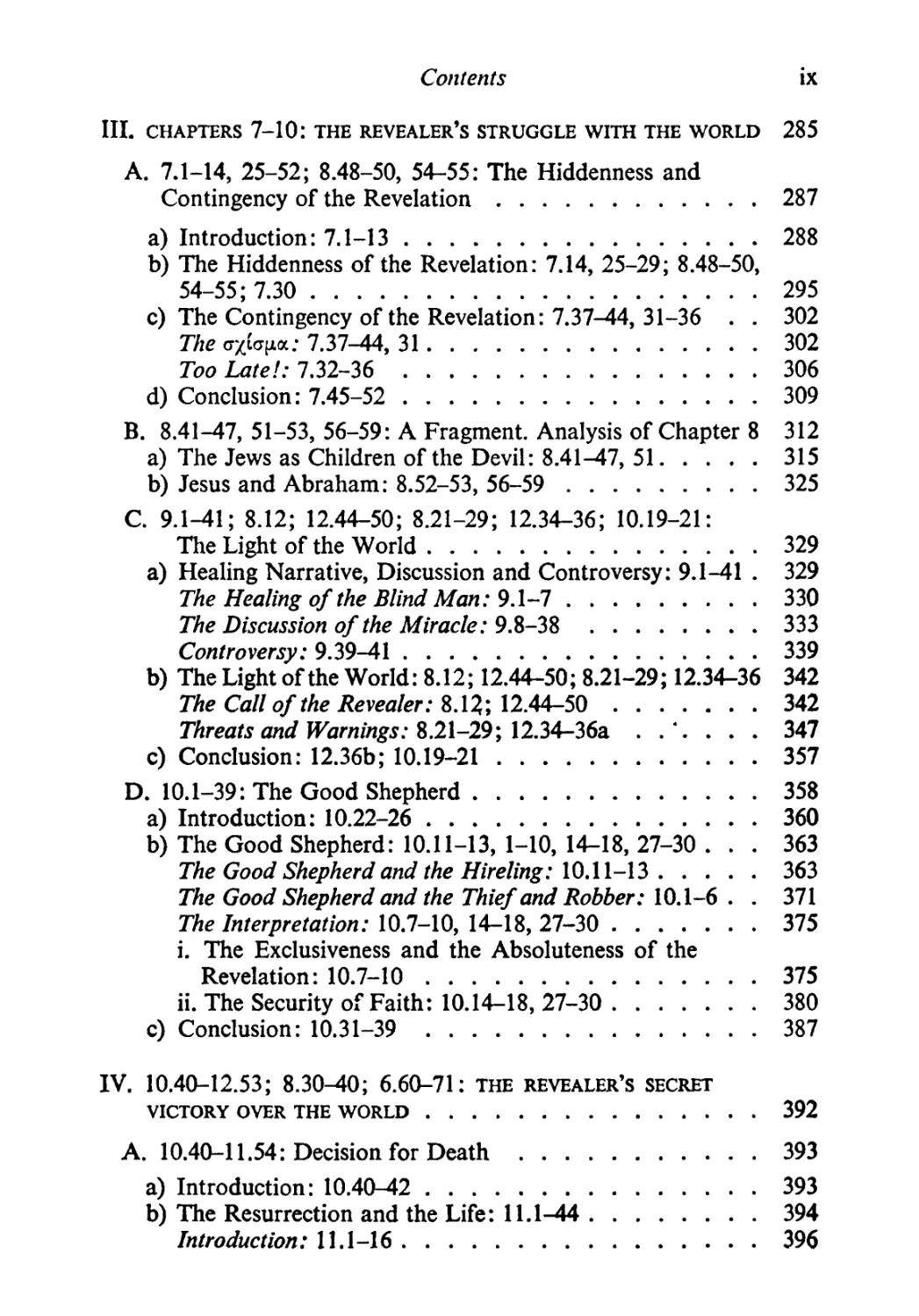
III.	chapters 7-10: the revealer’s struggle with the world 285
A.	7.1-14, 25-52; 8.48-50, 54-55: The Hiddenness and
Contingency of the Revelation............................287
a)	Introduction: 7.1-13...................................288
b)	The Hiddenness of the Revelation: 7.14, 25-29; 8.48-50,
54-55; 7.30 .............................................. 295
c)	The Contingency of the Revelation: 7.37-44, 31-36 . . 302
The cr/lcpa: 7.37-44,	31 .............................. 302
Too Late!: 7.32-36	................................ 306
d)	Conclusion: 7.45-52	................................ 309
B.	8.41-47, 51-53, 56-59: A Fragment. Analysis of Chapter 8 312
a)	The Jews as Children of the Devil: 8.41-47, 51.........315
b)	Jesus and Abraham: 8.52-53, 56-59 .................... 325
C.	9.1-41; 8.12; 12.44-50 ; 8.21-29; 12.34-36; 10.19-21:
The Light of the World.......................................329
a)	Healing Narrative, Discussion and Controversy: 9.1-41 . 329
The Healing of the Blind Man: 9.1-7.....................330
The Discussion of the Miracle: 9.8-38 ................. 333
Controversy: 9.39-41 .................................. 339
b)	The Light of the World: 8.12; 12.44-50; 8.21-29; 12.34-36 342
The Call of the Revealer: 8.12; 12.44-50 .............. 342
Threats and Warnings: 8.21-29; 12.34-36a ..'.... 347
c)	Conclusion: 12.36b; 10.19-21...........................357
D.	10.1-39: The Good Shepherd..............................358
a)	Introduction: 10.22-26 ............................... 360
b)	The Good Shepherd: 10.11-13, 1-10, 14-18, 27-30 ... 363
The Good Shepherd and the Hireling: 10.11-13............363
The Good Shepherd and the Thief and Robber: 10.1-6 . . 371
The Interpretation: 10.7-10, 14-18, 27-30 ............. 375
i.	The Exclusiveness and the Absoluteness of the
Revelation: 10.7-10...................................375
ii.	The Security of Faith: 10.14-18, 27-30 ............ 380
c)	Conclusion: 10.31—39 ................................. 387
IV. 10.40-12.53; 8.30-40; 6.60-71: the revealer’s secret
VICTORY OVER THE WORLD.....................................392
A. 10.40-11.54: Decision for Death...........................393
a)	Introduction: 10.40-42 ............................... 393
b)	The Resurrection and the Life: 11.1-44 ............... 394
Introduction: 11.1-16...................................396
X
Contents
i. 11.1-5..............................................396
ii. 11.6-16............................................398
The Resurrection and the Life: 11.17-44 .............. 400
i.	Jesus and	Martha:	11.17-27 .....................   400
ii.	The Raising of Lazarus:	11.28-44 ................. 405
c) The Decision of the Sanhedrin that Jesus must die: 11.45-54 409
B. 11.55-12.33; 8.30-40; 6.60-71: The Way to the Cross . . 412
a)	The Entry into Jerusalem: 11.55-12.19..................412
Introduction: 11.55-57 ............................... 413
The Anointing in Bethany: 12.1-8.......................414
A Bridge Passage: 12.9-11..............................416
The Entry into Jerusalem: 12.12-19.....................417
b)	The Mystery of the Death of Jesus: 12.20-33; 8.30-40;
6.60-	71..............................................419
Access to Jesus: 12.20-33 ............................ 420
i.	The Request for Access: 12.20-22 .................. 423
ii.	The Law of Access: 12.23-26 ...................... 424
iii.	The Achievement of Access:	12.27-33 ............. 427
The Offence: 8.30-40 ................................. 433
The Separation: 6.60-71 .............................. 443
Conclusion: 12.37-43 ...................................... 452
CHAPTERS 13-20: THE REVELATION OF THE ДОНА
BEFORE THE COMMUNITY..........................................455
I. 13.1-17.26: THE revealer’s FAREWELL .......................457
A.	13.1-30: The Last Supper................................461
a)	The Founding of the Community and its Law: 13.1-20 . 461
Exposition: 13.1-3.....................................463
The Footwashing and its First Interpretation: 13.4-11 . . 466
The Second Interpretation: 13.12-20 ................. 474
b)	The Prophecy of the Betrayal: 13.21-30 .............. 479
B.	(13.1) 17.1-26: The Farewell Prayer.....................486
a)	The Introduction: 13.1................................486
b)	The Petition for Glorification: 17.1-5 ...............490
c)	The Intercession for the Community: 17.6-26 .......... 497
The Founding of the Community: 17.6-8.................497
The Petition for the Preservation and Sanctification of
the Community: 17.9-19................................499
The Petition for the Oneness of the Community: 17.20-23 512
The Petition for the Perfecting of the Believers: 17.24-26 518
Contents	xi
C.	13.31-16.33: Farewell Discourses and Conversations . . 522
a)	Farewell and Testament: 13.31-35;	15.1-17..............523
Introduction: 13.31-35 ................................. 523
The True Vine: 15.1-17...................................529
i.	jAewecTs ev £(aoi : 15.1—8............................529
ii.	(AEivate ev ауатгт]: 15.9-17.........................539
b)	The Community in the World: 15.18-16.11.................547
The World's Hatred: 15.18-16.4a..........................548
i.	Revealer and Community share the same Destiny:
15.18-20 ............................................... 548
ii.	The Sin of the World: 15.21-25 ..................... 550
iii.	The Disciples’ Task in the Face of the World’s
Hatred: 15.26-16.4a...................................551
a. The Disciples* Task: 15.26-27 .................... 552
p. The World’s Hatred: 16.Ma..........................555
The Judgment of the World: 16.4b-ll......................557
i. The Disciples’ Situation: 16.4b-7.....................557
ii. The Judgment of the World: 16.8-11...................561
Additional Note: The Paraclete...........................566
c) The Believers’ Future as the Eschatological Situation:
16.12-33 ............................................... 572
The Continuation of the Revelation in the Future:
16.12-15.................................................572
The Future as the Situation of the Eschatological /ара;
16.16-24 .......................................'	. . . 576
The Condition for comprehending the Eschatological
Existence: 16.25-33 .................................... 586
d) The Fellowship with the Son and the Father: 13.36-14.31 595
The Promise of Discipleship: 13.36-14.4................. 595
The Unity of Way and Goal: 14.5-14.......................603
The Love-Relationship to the Son and to the Father:
14.15-24.................................................612
i. The Promise of the Paraclete: 14.15-17................614
ii. The Promise of Jesus’Coming Again: 14.18-21 . . . 617
iii. The Promise of the Coming of Jesus and of God:
14.22-24 ............................................ 622
Conclusion: 14.25-31 ................................... 625
II.	18.1-20.29: THE PASSION AND	EASTER..........................632
A.	18.1-19.41: The Passion...................................637
a)	The Arrest of Jesus: 18.1-11............................637
xii
Contents
b)	Jesus before the High Priest and the Denial of Peter:
18.12-27 ................................................ 641
c)	Jesus before Pilate: 18.28-19.16a.....................648
Jesus is handed over to Pilate: 18.28-32 ............. 651
The First Examination and its Result: 18.33-38 .... 653
Jesus or Barrabas?: 18.39-40 ......................... 657
The Flogging, Mocking and Presentation ofJesus: 19.1-7 . 658
The Second Examination and its Result: 19.8-12a . . . 661
The Condemnation of Jesus: 19.12b-16a..................663
d)	Crucifixion, Death and Burial of Jesus: 19.16b-42 . . . 666
The Crucifixion and the Inscription: 19.16b-22 ....... 668
The Distribution of the Clothes of Jesus: 19.23-24 . . . 670
Mary and the Beloved Disciple at the Cross: 19.25-27 . . 671
The Death of Jesus: 19.28-30 ......................... 673
The Taking Down from the Cross: 19.31-37 ............. 675
The Burial: 19.38-42 ................................. 679
B.	20.1-29: Easter.........................................681
a)	The Easter Morning: 20.1-18 ......................... 681
b)	The Risen Jesus before the Disciples: 20.19-23 .... 689
c)	Thomas the Doubter: 20.24-29 ........................ 693
20.30-	31: THE CONCLUSION OF THE GOSPEL......................697
postscript: chapter 21........................................700
A.	21.1-14: The Appearing ofthe Risen Lord by the Lake . . 706
B.	21.15-23: Peter and the Beloved Disciple................711
Conclusion: 21.24-25 ...................................... 717
LIST OF ABBREVIATIONS OF JOURNALS AND PERIODICALS.............719
LIST OF ABBREVIATIONS OF BOOKS CITED..........................721
BIBLIOGRAPHY..................................................725
1.	Commentaries............................................725
2.	Books and Essays on the Gospel of John .................726
3.	Books Frequently Cited..................................730
indexes.......................................................733
1.	Greek Words..............................................733
2.	Literary and Historico-critical Questions...............735
3.	Theological Motifs.......................................737
4.	Religio-historical Relations............................738
postscript to this edition....................................741
Sections of the Commentary
(in the order of the Gospel text)
Chapter	Pages	Chapter	Pages
1.1-8	13-83	52-53	..	.. 325
19-51	..	84-108	54-55	..	.. 300
2.1-12	111-121	56-59	..	.. 325-328
13-22	..	122-129	9.1-41	.. 329-342
22-25	..	130-131	10.1-6	.. 371-375
3.1-21	131-160	7-10	.. 375-380
22-30	..	167-175	11-13	..	.. 363-371
31-36	..	160-167	14-18	..	.. 380-385
4.1-30	176-193	19-21	..	.. 357
31-42	..	193-202	22-26	..	.. 360-363
43-45	..	203	27-39	..	.. 385-391
46-54	..	204-209	10.40-42	..	.. 393-394
5.1-47	237-273	11.1-54	.. 394-412
6.1-26	209-218	55-57	..	.. 412-414
27-59	..	218-237	12.1-19	.. 414-419
60-71	..	443-451	20-33	..	.. 419-433
7.1-13	287-295	34-36	..	.. 354-358
14	295	37-43	..	.. 452-454
15-24	..	273-278	44-50	..	.. 344-347
25-29	..	295-299	13.1	.. 486
30	302	1-30	..	.. 461-486
31	306	31-35	..	‘.. 523-429
7.32-36	..	306-309	36-38	..	.. 595-598
37-44	..	302-306	14.1-31	.. 598-631
45-59	..	309-312	15.1-17	.. 529-547
[7.52-8.11]		18-27	..	.. 547-555
8.12	342	16.1-33	.. 555-595
13-20	..	278-284	17.1-26	.. 490-523
21-29	..	347-354	18.1-40	.. 632-658
30-40	..	433^443	19.1-42	.. 658-680
41-47	..	312-324	20.1-29	.. 681-697
48-50	..	299-300	30-31	..	.. 697-699
51	324	21.1-25	.. 700-718
Publisher’s Note
The translation of a large and outstanding work of scholarship
which has attained international reputation is a formidable under-
taking. It demands not only close familiarity with and belief in the work
itself but also a wide knowledge of the subject with which the work deals.
We have been fortunate to get the assistance of two young scholars,
John Riches and Rupert Hoare, well versed in the original language and
in the subject matter. They have willingly worked under the supervision
of Dr. G. R. Beasley-Murray, Principal of Spurgeon’s College, London,
who not only translated a considerable part of the text himself but has
co-ordinated the work of his younger colleagues. To all three the pub-
lisher is deeply indebted. He would also like to thank Professor D. M.
Mackinnon, who revived the publisher’s enthusiasm for the project when
translation difficulties seemed insuperable.
INTRODUCTION
Introduction
The German original of the present commentary does not possess
any Introduction. The following Introduction was written for the
English edition by Walter Schmithals. It brings together the literary and
historical results of the Commentary. The questions that arise can be
more intensively pursued by consulting the indices II (Literary and
Historico-Critical Questions) and IV (Religio-historical Relations).
1.	The Characteristics of the Gospel of John in comparison
with the Synoptic Gospels
The Gospel of John exhibits the same literary form as the Synoptic
Gospels. It covers the period from the Baptist’s appearance, includes
the beginning of the activity of Jesus, and extends to his death and resur-
rection. Galilee and Jerusalem are the scenes of the work of Jesus, as in
the Synoptics. Most of the names of places and persons in John are also
met with in the Synoptic tradition. The material of John, as in the
Synoptic Gospels, consists of miracle stories and traditions of sayings
and narratives. Not a few elements of the Synoptic tradition also appear
in John. Above all mention should be made of the passion story, the
account of John the Baptist (1.19-34), individual Logia (2.19; 4.44;
12.25f.; 13.16, 20; 15.20 etc.), miracle stories (4.46-54; 6.1-13) and
narratives (2.13-22; 6.66-71).
Nevertheless, along with these agreements there are considerable
differences.
The style of John manifests a more markedly Semitic character
than most parts of the Synoptic tradition. Certainly that ought not to
lead to the conclusion that John has been translated from an originally
Aramaic composition into the Greek language, for in the editorial
sections of the Gospel no translation errors can be established. The
Gospel of John was undoubtedly written in Greek. But the author’s
Greek is dyed with a Semitic colour. Perhaps he himself was a Semite
and lived in a bi-lingual area. The possibility must be taken into account
that one of his sources was originally composed in Aramaic (see below).
The polemical situation manifests a considerable change from that
presupposed in the Synoptic Gospels. Admittedly in John, as in them,
the Jews are in continual opposition to Jesus. But they no longer appear
3
4
Introduction
in the concrete distinctions of Palestinian relations, but always are
described simply as “the Jews,” in contrast to whom Jesus and his
disciples appear as non-Jews (8.17; 10.34). In the Gospel of John the
Jews represent the unbelieving world generally, and in the relations of
the Jews to Jesus the relations of all unbelievers to the Christian
Church and its message are mirrored.
Especially noteworthy are the differences that emerge on form-
critical considerations.
The collections of sayings in the Synoptic Gospels consist pre-
ponderately of isolated logia, frequently brought together, of course,
to form sermonic compositions and parables. John’s Gospel, on the
contrary, contains continuous sermons, in which occasionally individual
and originally independent logia may be found, firmly entrenched.
Parables are altogether absent. Even the characteristically Johannine
I-words, which often announce the theme of a great parabolic discourse
(ch. 10, the Good Shepherd; ch. 15, the Vine), are not parables, but
must be understood as direct statements: Jesus does not act like a good
shepherd, and is not like the real Vine etc.; he is himself the Shepherd,
the Way, the Resurrection, as he is Truth and Life.
The conversations of the Synoptic Gospels follow more or less
closely the rule of rabbinic discussion or debate, the point of which
forms a single saying of Jesus. John’s Gospel, on the contrary, does not
contain the thrust and counter-thrust of genuine discussions. These
conversations are frequently developed through misunderstandings,
which are sparked off by concepts or utterances of Jesus that have a
double meaning (3.3ff., on being born anew; 6.27ff., the Bread of Life;
7.34, Jesus’ departure)—a technique which is almost entirely foreign
to the Synoptic Gospels.
The miracle stories of John are relatively closely related to those of
the Synoptic Gospels, though undoubtedly they exhibit an increase in
the miraculous element. Above all they have lost their formal indepen-
dence; they are closely bound up with the addresses and discussions,
which on their part take their motives from the miracle stories.
The narrative material, especially the passion story and the ac-
counts of John the Baptist, has the closest contact of all with the
corresponding elements in the Synoptic tradition. But even in these
respects the author has more or less strongly interposed, transformed
and completed them in accordance with his theological views.
In the Synoptic Gospels the editorial framework can be removed
from the elements of the tradition with comparative ease. It fulfils the
function chiefly of conjoining the earlier isolated elements of tradition
into a chronologically and geographically ordered life-story.
In John, by contrast, the editorial comments that provide the
The Characteristics of the Gospel of John
5
structure are closely bound up with the narrative- and sayings-material,
and in general they cannot be loosed from this structure. They no longer
serve the purpose of adding together individual items of tradition, but
rather support the artistic composition of the Gospel in accordance with
a dominating theme.
Most striking are the differences of a theological kind. The formal
peculiarities that have been enumerated are often merely the outward
expression of essential differences. The individual items handed down
in the Synoptic tradition, viz. the separate logia, miracle-stories,
apophthegms, parables, etc., contain definite themes: they yield declara-
tions about the sovereignty of God, the Son of man, the time of the
end, the validity of the Law, the right of forgiveness of sins, ethical
behaviour, missionary service, order in the community, the right sort
of prayer, the use of sacraments, and many another subject. In most
cases the Synoptic evangelists preserve these utterances wholly or
essentially in accordance with their subject matter. They give expression
to their theological aims in that they interpret the material of their
tradition through selection and arrangement, abbreviation and enlarge-
ment and reformulation in the sense of their redactional theology.
Tradition and redaction often stand clearly alongside each other, and
in this manner the tradition, i.e. the detail of the Gospel as a whole,
retains the greater importance. In contrast to this the Gospel of John
fundamentally contains but a single theme: the Person of Jesus. The
entire Gospel is concerned with the fact of his presence, the nature of his
claim, whence he comes and whither he goes, and how men relate
themselves to him. The miracles supply information about Jesus himself;
the speeches are concerned with the speaker; the discussions devolve
about the person of Jesus. The stories of healings on the sabbath, for
example (chs. 5 and 9) do not, as in the Synoptics, demonstrate the
Christian understanding of the sabbath command, but serve as occasions
for discussions about the person of the miracle worker. In John the
detail no longer possesses worth on its own account, but it can be
understood only from the leading theme of the whole.
The formal distinctions between this Gospel and the Synoptics
follow from this reorganisation and concentration of the Gospel’s
content—not vice versa. Because of his specific theme John leaves
aside most of the Synoptic material; he treats with particularly great
freedom the material of the tradition; he unhesitatingly takes over
traditions that have come from outside Christianity, and carries out his
redactional reconstructions on a much grander scale than the Synoptists.
The question of tradition and redaction in the Gospel of John,
accordingly, must be faced, and above all the question about the
sources.
6
Introduction
2.	The Sources
How is the relationship between the Gospel of John and the Synoptic
Gospels to be explained? Did the author know one or more of the
Synoptic Gospels? Did he use the traditions that lay behind the Syn-
optics? Or do both possibilities hold good? The question arouses sharp
division. It requires a fresh investigation on the basis of modern methods
and results of the research into redactional criticism.
Since Mark created the literary type of Gospel, to which John’s
writing also belongs, a direct or indirect acquaintance with the Gospel
of Mark must surely be accepted. Such an acquaintance would also
presuppose the use of the Synoptic tradition, as is particularly clear
from the Passion story, but also by reason of other narratives and the
sayings-tradition. That a continuous account of the Passion lay before
the author must be considered as certain, for in his representation of
the Passion he merely reproduces numerous accounts without making
use of them for his theological ideas, e.g. the story of Peter’s denial.
At the same time, however, in many passages of the Passion story the
Evangelist’s additions can be removed on stylistic and objective grounds.
Now the author could have taken over the Passion narrative as a
free, pre-Markan tradition, for it is generally acknowledged that such a
narrative lay before Mark as an independent and continuous tradition;
in that case one would have to presume that the same held good of the
other elements that link John with the Synoptic Gospels. However
that may be, no reason or possibility whatever exists for tracing the
Gospel of John back to a complete Gospel writing, independent of
the Synoptics and only edited by the author. But the fact that the Gospel
“ type ” was already in existence prior to John does not prejudice the
recognition that the plan and composition of the book reveals a work
of the Evangelist, to whose hand also the Gospel’s unified linguistic
form seen in its entirety goes back.
This unity of language naturally does not exclude the use of
traditions, as the material from the Synoptic tradition material, taken
up by John, shows.
To these traditions, a miracle-source could have belonged. John
recounts seven miracles of Jesus. Some of these miracles have no parallels
in the Synoptic tradition, e.g. the miracle of the wine at Cana and the
raising of Lazarus. In 2.11 and 4.54 the changing of the wine and the
healing at Capernaum are reported as the first and second miracles,
although the Evangelist in 2.23 (cp. 4.45) already speaks of various
miraculous deeds of Jesus. The possibility lies to hand, therefore, of
ascribing this precise enumeration to a source of (seven) miracle-stories
taken over by John. This source, from which the concluding expression
The Relationship to Gnosticism
7
in 20.30 could also have been taken, is related to the Synoptic tradition,
but it is recognizable by the previously mentioned heightening of the
miraculous. Frequently additions of the Evangelist are clearly separable
from the sections taken out of this source (cp. e.g. 4.48; 6.4, 6, 14f.).
Along with the miracle-source the author of this Gospel probably
used a source for his discourses. The discourses of John often show in
their individual sentences a peculiar poetic form, e.g.:
He who believes on him will not be judged;
He who does not believe is already judged (3.18).
In this typical sentence from the Johannine discourses there appears,
along with the apodictic form, the antithetic parallelism, with the
surprising expression “is already judged ” instead of “will be judged”
in the second member.
In the discourses a pattern can be more or less plainly discerned
that advances in three motifs. First the Revealer presents himself and
his significance; then follows the invitation to come to him; lastly the
consequence of the acceptance or rejection of the Revealer is made
known in promise and threat. The style and pattern of these discourses
have close parallels in Gnostic revelatory writings. The Prologue most
plainly of all enables us to see how the Evangelist has taken up an
already existing composition and commented on it by his additions.
Admittedly it is not a revelatory address that lies behind the Prologue,
but a hymn. Nevertheless in the revelatory addresses comments added
by the Evangelist can often be removed from his source.
The supposition lies to hand therefore that the author used a
source of revelation discourses, on the basis of which he fashioned the
speeches and discussions of his Gospel. The limits of this source admit-
tedly cannot be defined with certainty. Often the question must remain
open to what extent the author reproduces a source with comments, or
to what extent he himself conceives the words of Jesus in accordance
with the pattern of the discourses presumed for this source.
3.	The Relationship to Gnosticism
An analysis of the discourses of John, their content, style and their
sources, leads into the area of early Gnosticism and introduces the
problem of the relationship in which the Gospel of John and Gnosticism
stand to each other.
The Gnostic view of the world starts out from a strict cosmic
dualism. Life and death, truth and falsehood, salvation and ruin of
human life are anchored in the cosmos. In it the divine world of light
and the demonic power of darkness stand over against one another. In
8
Introduction
the primeval time a part of the light fell into the power of the darkness.
In order to be able to maintain their hold on the light, the evil powers
created the world and human bodies. They divided the imprisoned
being of light into mere sparks of light, and banned these parts of life
to the physical world. In order to redeem and bring home this lost
creature of the light, the good God of life sends the saving knowledge
(Gnosis) into the world. By illuminating man as to his true origin and
his true being, this knowledge bestows on him the power to return to
the heavenly homeland after he puts off his body. In this connection
the figure of a Redeemer is often met with, who is sent by the Father,
mostly in the primeval time, to impart the knowledge. Under his word
men separate themselves into the children of light, who are from above,
and the children of darkness, who do not bear any soul of light in
themselves. After his completed work of redemption the Redeemer
ascends again and so makes a way for the elements of light that follow
him.
The relationship of John’s Gospel to this Gnostic view of the
world is twofold.
On the one hand John manifests close contacts with the Gnostic
conception of the world. The source of the discourses, which John takes
over or to which he adheres, is Gnostic in outlook. It has its closest
parallels in the Mandaean writings, the oldest strata of whose traditions
go back to the time of primitive Christianity and to the region of Syrian
Palestine. In these Mandaean revelatory addresses are also to be found
parabolic sayings that characterise the Revealer as the good Shepherd,
the real Vine, etc. Moreover, the Gnostic Odes of Solomon are especially
closely related to the discourses of John, as are the Letters of Ignatius
of Antioch, whose Christology shows itself strongly influenced by a
Syrian Gnosticism. In John Jesus descends from heaven, like the
Gnostic Redeemer, to bring to men the saving message, and he returns
to the Father after completing his work. In face of his word light and
darkness separate themselves; before him life and death are decided.
He who is of the truth hears his voice; to the blind, however, the mes-
senger of life remains hidden.
The stylistic form of the misunderstanding and the ambiguous
address, that John likes to use, offers a formal correspondence to this
Gnostic dualism; for the Redeemer and his word must necessarily
remain incomprehensible and unrecognisable to mere men of flesh.
Naturally the antithetic reasoning of the Gospel of John also goes
back to the dualistic thinking of Gnosticism, and often directly to
Gnostic terminology.
The influence of pre-Christian Gnosticism can also be discerned
in Philo of Alexandria, and particularly in speculations of late Judaism,
The Relationship to Paul
9
e.g. the wisdom myth, as well as in the Qumran writings. Notable
contacts between these complexes of tradition and the Gospel of John
are therefore discernible. Nevertheless one should not fall into the error
of attributing the Gnosticising tendencies of John’s Gospel to the
influences of Alexandrian religious philosophy or the sects of late
Judaism. John is directly dependent on Gnostic traditions, and he uses
these traditions in far greater measure than Philo and the other late
Jewish writers.
The second characteristic relationship of the Gospel of John to
Gnosticism consists in the fact that in his Gnostic form a pointed anti-
Gnostic theology is expressed. John knows no cosmic dualism. Therefore
in John man is not seen dualistically. Flesh and spirit do not stand op-
posed as substances of the demonic and divine realms. Rather it is
stressed, with all sharpness, that the Redeemer has become flesh, and
shows his glory precisely as the One made flesh. Man’s lostness in the
world is not the lost condition of a heavenly substance in the power of
darkness, but the sinful turning of the creature from the Creator. In
place of cosmic dualism steps a dualism of decision: life and death are
not determined from all time on natural grounds, but depend on the
decision of faith and of unbelief. The Redeemer therefore does riot
bring a knowledge that illuminates men as to their true nature; rather
he reveals to man his sin, and sets him before the decision to live on the
basis of the created world or from the Creator.
John thus uses the language current in Gnostic circles to give
expression to the Christian understanding of faith. The conclusion
perhaps could be drawn from this that he lays worth on convincing
adherents of Gnostic circles as to the truth of the Gospel.
4.	The Relationship to Paul
Paul also shows himself influenced by the language and conceptual
world of Gnosticism. His Christology is strongly influenced by the
Gnostic Redeemer-myth. Like John he finds himself in debate with
adherents of Gnosticism. The relationship of John and Paul thereby
suggested goes beyond the limits imposed by the common sphere of
Hellenistic Christianity.
Admittedly the essential theological agreement is still more com-
prehensive. John and Paul interpret the coming of Jesus as eschatological
event, and therefore they understand their time as the period of salvation.
For both salvation consists in the fact that in Christ God has given to
sinful men the possibility of living from God instead of from the world,
and thereby for them to make a decision for life. Both oppose Gnostic
10
Introduction
dualism with faith in the Creator, and both replace the Gnostic ideas
of substance with the historical dialectic of judgment and grace.
Now these common features do not rest on the dependence of
John on Paul, as has often been imagined. In John no discussion about
the Law is to be found. The concept of the “ righteousness of God ” is
lacking in him. In his Gospel the Jews are not the representatives of
Jewish orthodoxy, as they are in the Synoptic Gospels and Paul, but
representatives of the unbelieving world. Paul’s scheme of salvation
history will be sought for in vain in John; proof from Scripture occurs
seldom; the pair of contrasts “flesh-spirit” falls into the background;
the apocalyptic expectation of the future, to which Paul holds fast,
has been excluded by John.
In reality Paul and John, independently of one another and in their
respective concrete situations, give clear expression to the early Chris-
tian understanding of time and existence that in its essentials was already
in existence before both.
5.	The Integrity of the Gospel
Problems of textual criticism significant for the exposition of the
Gospel of John are to be found relatively seldom (cp. e.g. on 1.13, 18,
41; 3.34; 6.69; 7.53-8.11; 14.3). In contrast to this there are reasons for
doubting whether the Gospel itself has found entrance into the ecclesi-
astical tradition in the form intended by the author. Two problems
require discussion.
The thesis has been represented, occasionally even in very early
times but strongly from the beginning of this century, that the original
order of the text has been disturbed, through an interchange of leaves
or by some other means. For example Jn.6.1 reports a journey of Jesus
to the other bank of Lake Gennesaret, although chapter 5 is set in
Jerusalem: 7.15-24 harks back directly to the sabbath healing that
lies far off in chapter 5.14.30f. leads on directly to the Passion story in
ch. 18, while the discourse continues in ch. 15. From these and many
other examples it must be presumed that the present order of our Gospel
is not derived from the author. The thesis that the author himself
extended and edited his Gospel in various ways, but did not bring to
completion the last edition, has to take account of too many improbabil-
ities. Attempts to restore an original order admittedly remain hypotheti-
cal, but they are necessary. How the present (lack of) order came about
cannot be determined with certainty. It is not enough to reckon with a
simple exchange of the pages of a loose codex, for the sections that
appear to demand a change of position are of unequal length. The
assumption lies closest to hand that the Gospel of John was edited from
Authorship, Time and Place of Composition
11
the author’s literary remains on the basis of separate manuscript pages,
left without order. In any case the present form of our Gospel is due
to the work of a redactor.
With this observation the second problem emerges: Are we to
attribute not only the present order but also particular sections of the
Gospel to the hand of the redactor? The question must be answered in
the affirmative. Precisely such a redaction of John’s Gospel is convinc-
ingly demonstrated by ch. 21; for the original Gospel concluded with
20.30.f, and it was subsequently extended by ch. 21, which exhibits in its
details many differences from chs. 1-20, as the exposition will show.
If ch. 21 betrays the redactional influence, the further question
must be raised whether other parts of the Gospel are due to the redactor.
This question also must be answered in the affirmative. An example is
the passages that relate to the Lord’s Supper and baptism, i.e. 6.51b-58
and 19.34b-35. Sentences which express an apocalyptic expectation of
the future are also due to the redactor, i.e. 5.28f.; 6.39,40,44; (12.48).
And lastly, individual explanatory glosses that clearly break into the
context should be viewed as editorial, e.g. 3.24; 4.2; 18.9, 32.
The exposition will go into all these passages more fully. The
tendency of the redaction referred to shows features that heighten
ecclesiastical interests. Since the redaction additions are current in all
manuscripts, it may be assumed that the redactor and the editor of the
Gospel, to whom we owe its present order, are identical.
6.	Authorship, Time and Place of Composition
We are not in a position to say anything definite about the author
or about the redactor. The Gospel does not name either person, and the
superscription of the Gospel comes from a later time. From 21.24f.
(cp. 19.35) we gather that the redactor holds the author to be an eye-
witness of the life of Jesus. He identifies him with the enigmatic figure
of the Beloved Disciple, mentioned in 13.23, 19.26f., 20.2-10 (hardly
in 18.15f.), and in the redactional appendix 21. 20-23 it is assumed that
the disciple has died. But the Gospel itself does not mention this
identification (see on 13.30).
Later the Beloved Disciple was equated with John, the son of
Zebedee and brother of James, a member of the circle of the Twelve,
and it was claimed that he died in advanced age in Ephesus. The first
clear testimony to this tradition is offered by Irenaeus III, 1.2. But John
the son of Zebedee must have been killed by the Jews very early, as
Mk. 10.39 shows, and as is indicated by several witnesses of the ancient
Church. Moreover the Gospel itself makes no claim to have been written
by an eye-witness. And in no way doesit give occasion to presume that
12
Introduction
an eye-witness lies behind it, rather it completely contradicts such an
assumption.
Now the much discussed testimony of Papias (in Eusebius, Н.Е.Ш,
39.3f.) refers not only to John the son of Zebedee but also to the Presby-
ter John, who may have written the Book of Revelation. Probably
Irenaeus and the whole later tradition confused the Ephesian Presbyter
with the son of Zebedee of the same name. Prior to Irenaeus, then,
the Presbyter John could have been regarded as the author of the
Fourth Gospel, and possibly this was already the view of the redactor
of the Gospel. But this assumption, of course, is quite uncertain, and
it is no longer possible to demonstrate the correctness of such ah
opinion. The author remains unknown to us.
Before Irenaeus there is no certain attestation for the use of John’s
Gospel by any author belonging to the Church; for it is improbable
that Papias and Justin knew it, and without question Ignatius did not
make use of it. Admittedly in the papyrus P. 52 we possess a testimony
to the fact that our Gospel was known in Egypt in the first half of the
second century. We cannot therefore put the composition and redaction
beyond about 120 A.D., and we should define the period for the
composition and redactional edition of the Gospel as about 80-120
A.D.—the processes could have been relatively distant from one
another.
The Semitic style of the author and the relationship of the Gospel
to the Gnostic revelation discourses, the letters of Ignatius of Antioch
and the Odes of Solomon, strongly supports the supposition that the
author of the Fourth Gospel originated from the area of Syria. Above
all it must be said that nothing in the Gospel points to its origin in
Egypt or Asia Minor.
1.	1-18: The Prologue
1.	A preliminary glance tells us that 1.1—18 forms a whole, and has been
placed at the beginning of the Gospel as a kind of introduction. A remarkable
introduction, certainly! For the Prologue is no introduction or foreword in
the usual sense of the words. There is no indication in it of the content or
structure of what follows; nor are we told why the author has set himself
his task, as we are, for instance, in the preface to the Gospel of Luke. On the
contrary the section forms a whole, and is complete in itself; it is not necessary
for anything to follow.1 And does this introduction give the reader the key
for the understanding of the Gospel? It is far more a mystery itself, and is
fully comprehensible only to the man who knows the whole Gospel. It is
only when the circle is complete, and the “Son” has returned to the So^a
which the love of the “Father” has prepared for him тгрб хатароХ^с хоацои
(17.24), only when the reader has been led back out of the temporal sphere
into the eternal, that he can judge conclusively in what sense the Prologue
leads out of the eternal into the temporal.
And yet the Prologue is an introduction—in the sense of being an
overture,1 2 leading the reader out of the commonplace into a new and strange
world of sounds and figures, and singling out particular motifs from the
action that is now to be unfolded. He cannot yet fully understand them, but
because they are half comprehensible, half mysterious, they arouse the
tension, and awaken the question which is essential if he is to understand what
is going to be said. The concepts and <рй^, 86£а and aXY)0£ta are the
kind of motifs for which the reader brings with him a certain prior under-
standing; but he still has to learn how to understand them authentically. The
antithesis (рсо^-сгхбтос;, the negatives ой хатбХар£У, oux cyvco, ой тсареХароу
are the kind of motifs, which together with their opposites бстоь fc'Xapov,
1 This impression is itself a motive for the attempts to dispute that the Prologue was
originally part of the Gospel (Ad. Harnack ZThK 2 (1892), 189-231; so too British scholars,
(see Carpenter 290). That it was so is denied mainly on the grounds that the concept of the
Logos only occurs in the Prologue, and is not used elsewhere in the Gospel as a title of
Jesus, and that the Logos doctrine of the Prologue is foreign to the rest of the Gospel. This
conclusion fails to recognize: 1) the fact that the Prologue is not itself a literary whole, but
clearly betrays the editorial hand of the Evangelist; 2) that the Logos concept of the Pro-
logue does not have its origin in the philosophical tradition of Hellenism, but in mythology;
3) that the “Logos doctrine” of the Prologue gives expression to the idea of revelation
which dominates the whole Gospel; 4) that the language of the Prologue is the same as
that of the discourses of the Gospel itself. On each point, see below.
2 Thus Htm.; so too Cl. R. Bowen (JBL 49,1930,298), who not only sees the Prologue
in a loose sense as an overture, but regards it strictly as such, because he understands the
whole Gospel as a kind of drama.
13
14	The Prologue
£6ea<ripie0a and £X(£[Jo(aev, at once give the reader an intimation of their
meaning, but this has still to grow to full clarity of vision?
2.	The literary character of the Prologue. At first sight one would call the
Prologue myth, judging by its subject-matter. For it speaks of a divine being,
his life and his destiny. But the myth is not presented in narrative or specu-
lative form; for then the identity of the speaker, which is in fact so clearly
expressed in the ev Tjp.iv, сбеасархба, sXa[3o|i£v, would be without importance.
And the listener? He is not addressed at all. Who is it who is being addressed?
In one sense, no one. There is no differentiation between author and reader,
as is the case in I John 1.1-4; rather, just as there the distinction is withdrawn
in a first person plural that embraces speaker and listener, so here from the
beginning everything stands under this all-embracing “We”. It is the com-
munity that is speaking! And in what way? In its form the Prologue is a piece
of cultic-liturgical poetry, oscillating between the language of revelation and
confession. On the one side, as a revelation-discourse, the Naassene Hymn
provides a parallel1 2; it too starts with the very beginning of all things, and
recounts the fate of the soul in the world, and then describes how Jesus asks
the Father to send him down in order to bring the Gnosis to the soul. On the
other hand, in the style of a confession, the 7th Ode of Solomon sings of how
the son of God became man, and took human nature, in order to be a bearer
of revelation; and this the singer extols as the grace which he has experienced,
and finally calls upon the choir of the community to praise him who “allows
himself to be seen”. In hymnic form the 12th Ode praises the “Word”: it
goes forth from the Highest, holds sway through the whole Cosmos, and has
taken its dwelling in men; and the song concludes, that those are blessed
“who by means thereof [i.e. of the Word] have understood everything
and have known the Lord in his truth.”3
Rather differently again in 33rd Ode, which also describes the “descent” of
“Grace”; but here the description of grace turns into its proclamation, in
which the hearer is promised:
1 Hosk. 137. “ThePrologue... is not so much a preface to the Gospel as a summary
of it”. Clavier: R. H. Ph. rel. (1955) “le Prologue est la с!ё de 1’evangile ou, si Гоп veut, la
g£n6ratrice du mouvement.”
2 Hippol. El. V 10,2 p. 102,23ff. Wendl.
3 The double theme,—revelation and believing community,—determines the arrange-
ment of a number of the Od. Sal., with differing variations. The 6th Ode (after the introduc-
tion, w. 1-5) consists of: a) a confession of the community (vv. 6-7), b) a figurative
portrayal of the revelation (vv. 8-12), c) a declaration of the blessedness of the community
(w. 13-18). The 7th Ode (after the introduction vv. 1-2): a) a portrayal of the revelation
(vv. 3-17); b) the calling of the community to worship; (vv. 18-25). The 12th Ode (after the
introduction vv. 1-3): a) portrayal of the revelation (vv. 4-12), b) a declaration of the
blessedness of the community v. 13, cp. Ode 24 where the mythological pbrtrayal of the
revelation in verses 1-13 is followed in verse 14 by the brief characterisation of the com-
munity as “those who have known him ...” (cp. John 1.12). Similarly, Ode 30: w. 1-6,
invitation to the source of the water of life; v. 7, declaration of the blessedness of the
believers. (English version by Rendel Harris: The Odes and Psalms of Solomon, Cambridge
1909).
The Literary Character of the Prologue	15
“And I will enter in to you,
and will bring you forth from perdition.”
The parallels show that, taken as a whole, the Prologue is the hymn of a
community which gratefully reveres the secret of the revelation that has been
given to it.
The form of the Prologue is not loose or haphazard, but rigid and even
minor details are governed by strict rules.1 The construction is similar to that
of the Odes of Solomon; each couplet is made up of two short sentences.
Sometimes both parts of the couplet express one thought (vv. 9, 12, 14b);
sometimes the second completes and develops the first (vv. 1, 4, 14a, 16);
sometimes the two parts stand together in parallelism (v. 3), or in antithesis
(vv. 5,10,11). This form is not foreign to Semitic poetry,1 2 and recurs often in
the discourses of the Gospel; but in the Prologue it is developed further by
means of a special artistic device. In each sentence two words normally carry
the emphasis, and the second of these stressed words often recurs as the first
word emphasised in the next sentence. This is not only the case with the
two parts of a couplet; as occasion offers, single verses are also joined together
in this way,3 and the result is a kind of chain-locking of the sentences, e.g.:
V.l	ev apxfl ?jv 6 Xoyoq
xai 6 X6yo<; тр кро^ tov Oeov.
xai 0e6<; Vjv 6 Xoyoq.
Vv.4f.:	ev аитф ?jv,
xai 7) tjv тб rSv avOpanrcov.
xal тб <pw<; ev ту) охотСа qjalvet
xai v) uxoTta auro ou xar£Xa[3ev.
In the same way verses 9 and 10 are joined together by the key-word x6up.o^,
v. Ila and b by the concept vv. 11 and 12 by the concept Xa[x(3ivEiv,
v. 14a and b by 86£a, vv. 14b and 16 by тсХтдет^.4 Now admittedly this pattern
does not hold good throughout the Prologue without alteration; if one tries
to read it, with the verse rhythm set out above in mind, verses 6-8, 13,15,
stand out as interruptions. But these verses also conflict with the character of
the whole, as a hymn of the community praising the revelation; they are partly
prose narrative with a clearly polemical purpose, (vv. 6-8, 15), and partly
1 The attempt by N. W. Lund (AThR 13 (1931), 41-46) to expound the structure of
the Prologue (leaving out v. 6-8, 15) by means of the principle of Chiasmus, is not con-
vincing.
2 The synonymous and synthetic Par. membr., so characteristic of Semitic poetry,
is missing: it often occurs in the Od.Sal., although it is seldom dominant there, (as in Od.
14. 16).
3 This artistic form occurs occasionally in the Psalms of the O.T. (29.5; 93.3; 96.13;
in particular, 121; cp. Burney 42); it is esp. developed in the Mandaean poetry, where the
second half-verse frequently appears as the first section of the following verse. Cp. Ed.
Schweizer, 45; Kundsin, Char. u. Urspr. 259; also M. Dibelius, Der Brief des Jakobus
(Meyers Komm.) 92f.; Becker 34.
4 With regard to v. 3/4 see below.
16	The Prologue
have the character of a dogmatic definition (v. 13). This brings us to the
critical analysis.
3.	Literary-critical analysis.1 The problem raised by the Prologue’s
textual structure leads us to undertake a critical analysis of it. Since verse 14
reports the incarnation of the Logos, the subject of what has preceded must
be the pre-existing Logos. But can it be said of the latter that та t8ia ^XOev
(v. 11)? This gave rise to the old dispute of the exegetes: how far does the
Prologue speak of the pre-existent Logos, and from which verse does it
begin to speak of his appearance in the flesh?1 2 3 The question is quickly
answered when one sees that there lies at the basis of the Prologue a source
document to which the Evangelist has added his own comments? In the first
place vv. 6-8, 15, which treat of the Baptist, belong to these comments.
According to the order of the text as we have it, the Baptist who speaks in
v. 15, is still speaking in v. 16; he cannot strictly do this, because the of
v. 16 must be those of v. 14.4 * V. 15 breaks the continuity and separates the
connecting words кХу^^ and ex tod кХт]р(Ь|1ато(;: it has been inserted. The
same is true of vv. 6-8. V. 9 must follow v. 5? If vv. 6-8 were originally in
the text, vv. 9—13 would have to refer to them in such a way as to state that
in spite of this witness the Logos found no faith. What is said however is:
Although the world was made by the Logos, and belonged to him ...; i.e.
reference is made to v. 3f.6
These insertions are not to be eliminated as interpolations: they are the
Evangelist’s own comments (the ancient world has no knowledge of notes
1 Cp. Eucharist. II 3. The analysis given there is developed further here. Particular
points will be further substantiated in what follows. Wik. and Schlier take this view. I am
as little able to regard Goodwin's scepticism over a division of sources in the 4th Gospel as
justified, as I can Barrett's argumentation against it.
2 Sp., Zn. and L. take v. 4 as the beginning of the ref. to the incarnate Logos: B.
Weiss, v. 5. According to Htm., v. 9 tells of the coming of the Logos into the world, and
w. lOf. portray the tragic side of the life of Jesus. So also Bd. and Bl.; undecided, Ho.,
Hamack, Br.—Cp. Eucharist. II 4f. and cp. Howard, Christianity 44ff. 5If.
3 One has to suppose that in oral recitation the “comments” would be distinguishable
by the tone of the speaker.
4 This difficulty caused Priestley—as early as 1769—to move v. 15 and place it in
front of v. 19 (Carpenter 333,2). D. H. MUller, SAWien 1909,2 wants to place v. 15 and 16
before v. 19.
’Thus Chr. H. Weise, already: Die Evangelienfrage 1856, 113. Cp. Wellh. 8. in
w. 6-8 the Baptist “is mentioned ad vocem тб —because he is in fact not the light.”
Wdt. I, 109 correctly stresses the offence given by mentioning the name of the Baptist,
before that of Jesus.
6 It will become evident, apart from this, (see below) that in v. 9 тд is not subject
but predicate; the subject of to <pc3<; is to be taken from w. 1-5 (Wellh.; Goguel, J.-B.
77). Another way of producing a uniform movement of thought is to place vv. 6-8, together
with v. 15, in front of v. 19 (cp. Carpenter 333, 2)—or, (Hirsch) without v. 15. This breaks
down because w. 6-8 were clearly intended to provide an antithesis to the section vv. 4ff
and 9. Sp.'s opinion that w. 6-8 form the beginning of the original Gospel is fantastic; cp.
G.A. v.d. Bergh van Eysinga, NthT 23 (1934), 105-123.—The attempt to save the original
unity of the text by appeal to a confusion possible in a mystic (Ed. Meyer I, 314ff.; H.
Leisegang, Pneuma Hagion 1922,55ff.) shows false ideas about the logic of mystical thinking
—quite apart from the question whether the Evangelist is a mystic.
Literary-critical Analysis
17
placed under the text), as is confirmed by the way he works throughout the
Gospel.1 It goes without saying that the exegesis must expound the complete
text, and the critical analysis is the servant of this exposition. The case is only
otherwise where glosses of a secondary redaction occur.1 2
V. 12c (тосе; tclcttcuouctlv xtX.) also belongs to the exegetical comments of
the author, as also v. 13, an interpretation of the notion texvoc 0eou (v. 12b)
which disturbs the rhythm of the hymn.3 So does v. 17 (an exegetical gloss
on v. 16), which mentions the name Ttjctou^ Xptaroc, suppressed until now,
abruptly and without any introduction4 and makes use of the (Pauline)
antithesis v6{xo<;-xapt<;, which is otherwise foreign to the Gospel. Finally
v. 18 is probably to be regarded as an addition of the author’s—on stylistic
grounds (see below). One must, of course, reckon with the possibility of other
small corrections.
It is concluded, therefore, that the Evangelist has made a cultic com-
munity hymn the basis for the Prologue, and has developed it with his own
comments.5 It is further clear that in vv. 1-5, 9-12 the source spoke of the
pre-existent Logos, and in vv. 5,1 If. it described his fruitless or almost fruitless
effect as Revealer in this form, before going on to tell of his incarnation in
v. 14. It is also clear, however, that the Evangelist wants to regard the text
from v. 5 onwards as referring to the Incarnate Logos. For it is only because
he found in the words to cpco^ ev т9) ахотих «paivei, xtX. an expression of the
revelation given by the historical Jesus, that he is able to introduce the Baptist
at this point as the witness to the light.6
The motive for the insertion of w. 6-8, 15 is clear from their polemical
character. For their purpose is not only the positive one of proclaiming the
Baptist as witness for Jesus; it is also polemical: to dispute the claim that the
Baptist has the authority of Revealer.7 This authority must therefore have
1 Cp. also my analysis of I Joh. in Festg. Ad. Jill. 138-158. Omodeo is particularly
sensitive to the changes of style within the Prologue, but nevertheless rejects a lit.-crit.
analysis into different sources, and explains the changes of style in terms of the dramatic
structure of the liturgy, in which lyrical and didactic parts are intertwined (Mistica 50ff.).
2 The grounds for holding that the Gospel in its present state is not as the Evangelist
wrote it, but is the product of a redaction, are: 1) that disorders occur in the text; 2) that
ch. 21 is an appendix of the editor (or editors). Some glosses of this edition can be estab-
lished here and there with more or less certainty.—D. H. Muller (op. cit. 2) leaves it open
whether the “historical glosses (w. 6-8 and 15-16) originate from the author himself”,
or are later.
3 Cp. Edg. Hennecke, Congr^s d’Histoire du Christianisme I, 1928, 209.
4 17.3 is also an exegetical gloss;—the only other place in the Gospel where the
phrase T. Xp. occurs.
5 It will become evident that this procedure of the Evangelist is not limited to the
Prologue; the underlying source there stems rather from a collection of “Revelation-
discourses”, which are to be thought of as similar to the Od. Sal., and which the Evangelist
has made the basis of the Jesus-discourses in the Gospel. Similarly, Grant 209, 220f., who
supposes, that the song is a composition of the Evangelist himself, from his pre-Christian
period.—Schlier too (275f) believes that a hymn to the Logos (a cultic-liturgical composition)
lies at the basis of the Prologue.
6 Dodd wants to take vv. 5,9-12 as referring in the first place to the pre-existent Logos;
but he admits that w. 9-12 can be understood of the incarnate Logos.
7 So correctly, W. Baldensperger, Der Prolog des vierten Evgs., 1898.
В
18
The Prologue
been attributed by the Baptist sect to their master1; they saw in him the cpcoc;,
and thus also the pre-existent Logos become flesh. This suggests that the
source-text was a hymn of the Baptist-Community. By referring it to Jesus,
the Evangelist would then have been acting in a way similar to that of the
Church Fathers, who saw a prophecy of Jesus Christ in the 4th Eclogue of
Vergil. There is no difficulty in this conjecture, if one may suppose that the
Evangelist once belonged to the Baptist community, until his eyes were
opened to perceive that not John, but Jesus was the Revealer sent by God. For
without doubt the narrative I. 35—51 bears witness to the fact that one section
of the disciples of the Baptist went over to the Christian community; and
must we not therefore assume that Baptist tradition was taken over by the
Christians?1 2
The hypothesis, advocated primarily by Burney, that the Johannine
Gospel is a work translated in its entirety from Aramaic into Greek.3 can only
be maintained, in my opinion, in respect of the source underlying the Pro-
logue and the Jesus-discourses in the Gospel.4 It will be necessary to consider
this question at the appropriate places in the exegesis that follows.5
1 The rivalry between the disciples of Jesus and those of the Baptist is already re-
flected in the synoptic tradition (cp. Gesch. d. Synopt. Tr. 2nd ed. 22.177-179.261f.=Hist.
of the Syn. Trad. 19, 164-66, 246), and is attested by Acts 18.25f.; 19. 1-7. Ср. M.
Dibelius, Die urchristliche Oberlieferung von Joh. d. Taufer 1911; M. Goguel, Jean-
Baptiste 1928; P. Guemin, Y-a-t-il un conflit entre Jean-Baptiste et Jesus? 1933. Rud.
Meyer, Der Prophet aus Galilaa 1940, 96; D. Cullmann, Coniect. Neotest. XI (1947)
26-32.—The traces that the disciples of John the Baptist held their master to be the
Messiah, and—at what point?—to be the pre-existent and incarnate Logos, have almost
disappeared. They are found (Lk. 3.15?) in the Ps. Clem. Rec. I. 54. 60, in Ephraem ev.
exp. ed. Moes. 288, to which Baldensperger (op. cit. 138) has already called attention,
and in the medieval heresy-documents (Ign. Dollinger, Beitr. zur Sektengesch. des
Mittelalters I 1890, 154. 169. 190; in addition the relevant Documents: II 34. 65. 90.
155. 267. 283. 294. 325. 375.). The Johannine parts of the Mandaean writings are also
a witness to this, even if they belong to a later stage.—Cp. R. Reitzenstein, Das mand.
Buch des Herrn der Grosse (S. A. Heidelberg 1919, 62, 2;); Das iran. Eriosungsmyst.
1921, 125, ZNTW 26 (1927) 48, 64; Die Vorgeschichte der christl. Taufe 1929, 60; M.
Goguel, J.-B. 105ff.—It is not surprising, in the sphere of syncretistic Baptist-belief, that
the Baptist sect assimilated Gnostic speculations about the heavenly redeemer become man.
Schlatter too (Der Evglist Joh. 13) finds it conceivable that Gnostic piety was attracted to
the Baptist.—Cp. Br., additional note on 1.7.
2 This was moreover without doubt the case; the history of the Baptist’s birth in Lk. I
(and also the history of his death, Mk. 6.14-29), certainly stems from Baptist tradition.
Cp, Geschicht. der Synopt. Tr. 2nd ed. 320f., 328f.«Hist. of the Syn. Trad., 294f.,301f.;
Goguel, J.-B. 69-75, For further discussion see on 1.6-8 (48f.), on 35-51 (97f.), on 3.29
(173f.).
3 C. F. Burney: The Aramaic Origin of the Fourth Gospel, 1922; cp. R.Bultmann:
Die christl. Welt 41 (1927), 570f., and the full investigation by M. Goguel, Rev. H. Ph. rel. 3
(1923), 373-382. The question whether the Joh. Gospel has been tr. from Aramaic is
answered in the negative by J. Bonsirven, Biblica 30 (1949), 405-432, and by W. F. Albright,
The Archeology of Palestine, 1949 (238-248) and in The Background of the N.T. and its
Eschatology (Festschr. for С. H. Dodd) 1956, 154f. On the other side, Black regards it as
probable that an Aramaic source has been used in the Jesus-discourses (as also in the words
of the Baptist in ch. 3).
4 See page 21, note 1: cp. also Black: page 43 and passim.
5 See particularly, on 1.9.
His Relation to God: 1.1-2
19
A.l. 1-4: The Pre-temporal Existence of the Logos
a) His Relation to God: 1.1-2
ev apyj) r(v 6 Лбуо?
xai. 6 Лбуо? яро? tov Oeov.
xai Ого? тр б Лбуо?
об то? го ap/vj яро? tov Огбо.1
Four statements are made about the Logos in the solemn tones of
the hymn. They presuppose that the figure of the Logos is well known.
No prior statement has to be made that a Logos exists at all,1 2 nor is the
term defined by any attribute. It is regarded as self-explanatory within
the bounds of the community from which the hymn originates; and
that is also true for the Evangelist who takes it over. For us, of course,
the identity of the Logos will become clear only in the light of what is
said about him. And the first thing we see is that he is a divine figure, at
once Creator and Revealer. But it is here that the mystery lies! For is he
not thereby designated as God himself? For he was I» ap/vj. And in
fact it is said of him: 6s6? vjv б Хбуо?! And yet he is not God himself;
for it is also said of him: яро? tov бгбм! He is spoken of as a person,
in the language of mythology. But is he really to be thought of as a real
person ? Or has the myth become a picture, and is the Лбуо? a personifi-
cation of the power of God ? The Being of God personified, with regard
to its activity in the world? The comprehensive term, as it were, for the
divine powers that are active in the world ? Does not the name Лбуо?,
borne by this mysterious figure, require some such interpretation ? Can
the term “ Word ” or “ Reason ” denote anything other than a mode of
divine manifestation, or a divine law?3 Furthermore the oap? ёуЬгто
would not stand in the way of this: for it would make good sense to
1 For the structure of the verse sec page 15. In the first three half-verses the emphasis
is carried by a pair of words, the second of which recurs as the first stressed word of the
following half-verse. For v. 2, see below.
2 How differently, e.g. C. Herm. 1.9; 12.1!
3 Heraclitus had spoken of the loyot; in this way—(H. Diels, Die Fragmente der
Vorsokratiker I. 5th ed., 1934,150f., Fr. 1 and 2), without doubt influenced by mythology,
even if the mythological language is greatly weakened by him. Ed. Norden, Antike Kunst-
prosa, 2nd ed. 1909, II 473, 1, wanted originally to trace the Joh. prologue back to the
beginning of the work of Heraclitus, but then came to see in Agnostos Theos 1913, 348 f.
“the formal language of Hellenistic mysticism” as the source, under the influence of
Reitzenstein.—In any case one cannot simply say with Schl.: “The comparison of the
Word with things or powers is foreign to the passage; for it speaks of God.” This only
obscures the problem; for the question is exactly this: In what way does it speak of God?
20	The Pre-temporal Existence of the Logos
say that the fullness of the divine being achieved tangible form in a
historical person.
And yet “ Consider well that line, the first you see,
That your pen may not write too hastily.”1
The intention of the text cannot be unravelled by guessing or by a
Faustian speculation. Two things are needed for the interpretation:
firstly, a view of the whole, and secondly, knowledge of the tradition out
of which the assertions of the text have grown.1 2 And the exegesis has as
its first task to discover what possible forms of expression were open
to the author; the possibilities being those he has inherited with the tradi-
tion in which he stands. What the author intends to say here and now,
is of course not simply to be deduced from these possibilities: but they
have given a particular direction to what he intends to say, and have
imposed particular limits; thus a review of the tradition must be the
preliminary for understanding the text.
It would be hard for the Evangelist to begin his work with cv apXTh
without thinking of thefi^Nna of Gen. 1.1. Although there is no mention
of the Word of God as a substantive in Gen. 1, the creation is attributed to
God’s word by means of the declaration, “And God said”. Is the Logos
therefore to be understood in terms of the O.T. tradition of the Word of God!
In the O.T. the Word of God is his Word of power, which, in being
uttered, is active as event. God’s word is God’s deed, and his deed is his
word; that is, he acts through his word, and he speaks in his action, and it is
man whom he addresses. His word is 1) his sovereign rule in nature and history,
in so far as it is comprehensible to man and “ speaks” to him, that is, demands
something of him; and in truth it demands, in the first place, that he become
aware of his humanity before God the Creator, place his trust in God as
Creator, and praise him.3 God’s Word in nature and history is not therefore
the essence of a system of cosmic laws, such as the Stoic Logos—the meaning
of which can be understood by itself, and which serves as a principle for
comprehending the unity of the cosmic process. God's Word is 2) his
authoritative command, uttered by men (priests and prophets) to men, telling
1 Faust: Goethe: I. 1. 1230-1231 tr. George Madison Priest. Great Books of the
Western World. No. 47.: Encycl. Britann. Inc. 1952.
2 In my “ Untersuchungen zum Johannes Evangelium” in ZNTW I intend to treat
of the Лоуси; (among other subjects); I refer provisionally to my article “Der Begriff des
Wortes Gottes im N.T.” in Gl. und Verstehen 1268-293. As regards the O.T. there, see pages
268ff. Further: O. Grether: Name und Wort Gottes im A.T. 1934; Moore I. 415f.; Lor.
Durr, die Wertung des gottl. Wortes im A. T. und im antiken Orient (Mitteil. d. vorderasiat.
—ag. Ges. 42, 1) 1938; R. Asting, Die Verkiindigung des Wortes im Urchristentum 1939,
15ff.
3 Cp. e.g. Ps. 29; 33; 145; 147; Is. 40.8; 55.11.
His Relation to God: 1.1-2
21
man what he should do.1 Here again it is not the essence of ethical demands,
to be understood rationally in the light of a principle as a uniform law of
morality. In both cases God’s Word is not the essence of something that has
timeless significance, but is address, which takes place; it is a temporal
event, and as such the revelation of God as Creator and Lord.
The Лбуо<; of Jn. 1.1 cannot therefore be understood on the basis of
the O.T.: for the Лбуое; here is not an event recurring within the temporal
world, but is eternal being, existent with God from the very beginning. This
being so, the only thing that could be designated simply his “Word” would
be God’s revelatory will, in so far as it stands behind, and works in, all the
individual “words” of God. Even if our view of the Gospel as a whole could
corroborate this interpretation, what remains inexplicable in terms of the
O.T., is the fact that the Prologue does not refer to “the Word of God”, but
speaks simply of the Word1 2} it takes the proper name or title 6 Лбуос; as
given.
Furthermore, what is said about the working of the Logos before his
incarnation cannot be understood in the O.T. sense of a summary of the
divine work of revelation, such as is given in the reviews of the history of the
nation (e.g. in Ps. 78; Ps. 106; Neh. 9. 6-31; IL Esdras 3.4-28; Acts 7.2-47).3
Two motifs are necessary for such a review: 1) the description of the alter-
nation of divine mercy with judgment, and corresponding to this, of the
people’s apostasy with their repentance; 2) the conception of history a$
directed to a goal. Neither motif is present in the Prologue, or elsewhere in the
Gospel. And there is the related fact, that the idea of the election of the nation,
and of the covenant of God with it, does not occur at all either4, and nowhere
in the Gospel does the Israelite-Jewish nation appear to be raised decisively
above the rest of the world.5 The Prologue does not speak of the relation of
the chosen people to the Word of God, but of the relation of the world to the
“Word”. Finally, the 6 A6yo$ oap^ eyeveTo is hard to understand on the
basis of O.T. presuppositions; for in the O.T. to designate a man the bearer
of revelation is only conceivable in terms of the category of inspiration6 7;
and Jesus is not thought of as bearer of the divine spirit, either in the Prologue
or elsewhere in the Gospel.
If the absolute use of the concept 6 Лбуо<; shows how far the Prologue
is from the O.T. the same holds good of its relation to Judaism? For here,
too, the Word of God has not become a “hypostasis” existing for itself as a
1 Man is “told” what is right (Micah 6.8). God’s commands are his “words” (II
Chron. 29.15) etc.
2 Cp., immediately below, the “Word” in Judaism.
3 Acts 7.2-47, probably with the appropriation of a Jewish source; the same kind of
review also occurs in Acts 13. 17-25, in a shortened form.
* Contrast Paul’s view of history!
5 This holds good, in spite of 4.22; 5.39ff. and certain other passages, as will be shown
in the exposition. For the Gospel as a whole, the Jews are the representatives of the “ world”
as such.
6 Cp. on 5.19f.
7 Cp. Gl. u. Verst. I 271f.
22	The Pre-temporal Existence of the Logos
divine being, nor has the “Word” come to be used absolutely as a proper
name or title.1 Furthermore the paraphrased designation of God as кпапд
the Word of Jahweh, or Adonai,1 2 which one meets in the Targumim, does
not mean a cosmic potency, a “hypostasis”,3 4 but is God’s mighty Word,
his manifestation, he himself as numenpraesens* It is in accordance with this,
that the Memra is never spoken of absolutely, as the A6yo<; is here; there is
always a genitive with it!5 Therefore here too, God’s Word is his powerful
action that recurs within time.
On the other hand, the figure of Wisdom, which is found in Judaism,
and also in the O.T. itself, does seem to be related to the Logos-figure in the
Johannine Prologue. She is spoken of in mythological language as a divine
figure, and has a myth, of which tradition has preserved at least fragments.6
She is pre-existent, and is God’s partner at the creation.7 She seeks a dwelling
on earth among men, but is rejected: she comes to her own possession, but
her own do not accept her. So she returns to the heavenly world, and sojourns
there, hidden. She is indeed sought at the present time, but no one finds the
way to her.8 She reveals herself only to individual religious men, and makes
them friends of God and prophets.9 It is in accordance with the independence
of this figure that she is simply designated “Wisdom”.10 11—There can be no
doubt, in fact, that a connection exists between the Judaic Wisdom myth
and the Johannine Prologue.11 But the two cannot be connected in the sense
1 See Moore 1. 147-149.
2 “The Word of Adonai*9 was the spoken form; see Str.—В. П 302, and cp. generally
the whole extended note on the Memra Jahveh, pp. 302-333.
3 So, correctly, Str.-B.; on the other hand wrongly, in saying that ’’’П КПЙ'Й is only
the abbreviation for the formula: “He spoke and it came to pass.** Ср. V. Hamp, Der
Begriff “Wort** in den aram. Bibelubersetzungen 1938.
4 This is shown by the parallelism of КПЙ’О with XFlIiH and esp. ПГ?#; it
corresponds to the parallelism of *134 and ПЛ in the O.T., while in Targum the ICWD more
frequently takes the place of the O.T. ПП.
5 The Memra of Jahveh, or Adonai, or “my Memra’*. Philo himself, whose Logos
stems largely from hellenistic tradition (see below), through the influence of the Judaic
manner of speech never speaks absolutely of 6 Хбуо?, but always of 6 Osio^ Хбуос, etc.; cp.
Rev. 19.13.
6 Cp. my article “Der religionsgeschichtliche Hintergrund des Prologs zum Johannes
—Evangelium”, Eucharist. II 3-26; W. Schencke, Die Chokma (Sophia) in der judischen
Hypostasenspekulation (Vidensskapsselskapets Skriften II. Hist.—Filos. KJ. 1912, ♦ Nr. 6)
1913; W. Staerk, ZNW 35 (1936), 236f., 257f.; by the same author: Erlbsererw. 71-85; W.
L. Knox, St. Paul and the Church of the Gentiles 1939, 55-89; cp. also Percy, 297, note 43.
7 Prov.8.22-30;Ecclus. 1.1-9; 24.3f., 9; Wisdom 8.3; 9.4,9; Philo ebriet. 30; leg. all.
II, 49; virt. II, 62; for the rabbinic literature Str.-B. II, 356f. (as transferred to the law, see
below).
•Prov. 1.20-32, Job 28, Ecclus. 24.7; Bar 3.10-13, 29-36; Eth. Enoch 42.1-3; Mt.
23.37-39 and parallels, (cp. Gesch. der synopt.Trad. 120f.=Hist. of the Syn. Trad., 114f.).
9 Wis. 7.14, 27f.; Ecclus. 1.15 (acc. to Smend).
10 Prov. 8.1; Ecclus. 1.6; 24.1: Wis. 7.22; Bar. 3.20 etc.
11 H. Windisch, Neutest. Studien fur Heinrici 1914, 220-234, has pointed out the
connexion between Pauline Christology and the Wisdom—speculation. So also Dupont
36f.
His Relation to God: 1.1-2
23
that the Judaic speculation is the source of the Prologue.1 Quite apart from
the fact that the title Logos would then require a special explanation in the
Prologue, the Wisdom myth was not as such a living force in Judaism: it was
only a mythological and poetic decking-out of the doctrine of the law. Every-
thing that the myth related of Wisdom was transferred to the Torah: the
Torah is pre-existent; she was God’s plan of creation and instrument of
creation; Wisdom, being in some sense incarnate in the law, has found in
Israel a dwelling, prepared for her by God.1 2 But the Wisdom myth does not
have its origin in the O.T. or in Israel at all; it can only spring from pagan
mythology; the Israelite Wisdom poetry took over the myth and de-mytholo-
gised it.3 The Wisdom myth is however only a variant on the Revealer-myth,
which is developed in Hellenistic and Gnostic literature; and the kinship of
the Johannine Prologue to the Judaic Wisdom speculation is due to the fact
that both go back to the same tradition for their source.4
1 Thus, J. Rendel Harris, The origin of the Prologue of St. John’s Gospel 1917; the
same in The Bull, of the John Ryland Library 7 (1922) 1—17. Howard—Christianity 51—
supposes that a hymn to Wisdom “in her later aspect as the Torah” forms the basis of the
Prologue.—According to P. Winter, Ztschr. f. Religions.- und Geistesgesch. 5 (1953), 355
note 53, the Wisdom myth has been divested of its cosmological significance in Rabbinic
teaching, in that Wisdom has, so to speak, been split into the КП2ГО and the 7ГПП.—
The Wisdom myth does not seem to occur in the Qumran texts, nor is there any other figure
there that corresponds to the Logos in the Johannine Gospel. DSD 11.11 is only a formal
parallel to Jn. 1.3. K. G. Kuhn Z. Th. К 47 (1950), 192-211, and F. M. Braun R. B. 62
(1955), 5-44, have shown provisionally that a form of Judaism (clearly Essenism) appears
in these texts, that in other respects belongs to the religio—historical presuppositions of the
Joh. Gospel. The Gnosticising character of this type of Judaism is not pronounced in all the
Qumran texts; very clear however in DSD 3.13-4.26. On this, K. G. Kuhn Z. Th. К 49
(1952), 296-316. Cp. too R. Marcus JBL 73 (1954), 157-161, ‘Pharisees, Essenes and
Gnostics’; L. Mowry, The Dead Sea Scrolls and the Background for the Gospel of John’,
The Biblical Archaeologist 17 (1954) 78-97.
2 Ecclus. 24.8,23;Bar. 3.37; 4.1. (Rabbinic literature) Str.-B.jII 353-357. This explains
why K. BomhSuser, Das Johannes-Evangelium, eine Missionsschrift fur Israel, 1928 5ff.,
wants to explain the Johannine Prologue by means of the‘‘ToraIogy”, that is to say, by
maintaining that what was said of the Torah in Judaism has been transferred here to Jesus.
But the genealogy cannot be:
Hochmah	pagan myth
Torah but only: Hochmah, Logos
I	I
Logos	Torah
sJust as the Israelite Wisdom literature itself is only comprehensible within the
context of the international Wisdom literature of the ancient orient; cp. W. Baumgartner,
Israclit. und altoriental. Weisheit 1933, and his review of research in this field, Th. R, NF 5
(1933), 259-288.—The attempt to trace the myth back to a particular origin, has not yet
been successful. Cp. Baumgartner (op. cit. 286f.); P. Humbert R. G. G. 2nd ed. V 1800f.
4 These two variants (the speculation on the ao<p(a and that on the Хбуо;) collided in
Alexandrian Judaism, the former clearly from Judaic, the latter from Hellenistic tradition.
The Wisdom of Sol., where Хбуо; and aoqpta once occur in parallel (9.If.), follows the cro<pla
tradition, but endows the ao<p(a with the attributes of the Xdyot; (see Grill I 154ff.). In Philo
Хбуос and oo<pla compete with each other, with the effect that the latter is to a large extent
displaced by the former. It appears, moreover, that the oriental figure of aocpta has been
transformed through the Isis theology here (Brehier 115ff.; Bousset, Rel. des Jdt. 345,
24	The Pre-temporal Existence of the Logos
This tradition has many ramifications, and the fact that it is combined
with different types of mythological and philosophical thinking makes it
hard to unravel. But we do not need to analyse the whole tradition, or trace
it back to its origin in order to understand the Johannine Prologue; it is
enough to recognise that the mythological figure of the Logos has its home in
a particular understanding of the world, namely, the Gnostic.
The Greek philosophical tradition, in which the Logos is first encountered
as a cosmic-divine potency in Heraclitus, and then achieves its historically
most important role in Stoicism, is not relevant to our purpose.1 The Logos
is not a mythological figure there,* 1 2 but is the regularity of what happens in
the xoqxos, the xoivo^ v6p.o^ rfa tpuaeox;, which is at the same time the
TOvtxT) 3uva(xi<;, immanent in the xocqxo<;, uniting it and holding sway through-
out it. As X6yo<; 6p06<; this cosmic regularity is at the same time the law that
guides the thought and action of the individual, whose particular Хбуо$ is
identical with the world-Logos. The only thing that the Logos of the Johan-
nine Prologue has in common with this immanent world-law is that both are
of fundamental significance for the world; but because the understanding of
the world is so totally different in each case, and with it the understanding of
the relation of the Logos to the world (in the former transcendence, in the
latter immanence), only the name remains the same; and this is only an
apparent identity, because the Stoics use the word Хбуо$ as a concept, and
not as a proper noun.
Further the Stoic Logos does not assume mythical form, in virtue of the
fact that Stoic allegorising sees the Logos in the figure of Hermes,3 or in
other divine figures like the Egyptian Tot.4 But a quite different Logos-figure
does appear in certain cosmological speculations of Hellenism of a religious
and philosophical nature. These are in the first place the originally dualist
systems of what is called Gnosticism*, here the Greek tradition, in so far as it
has been assimilated, provides a secondary element, and has been put to the
service of the conceptual development of Gnosticism in the Greek world.
Pascher, Konigsweg 60ff.). Plotinus, too, appears to be familiar with the Wisdom myth
when he designates the as the стосрЕа, described as прсЬтт) xal oux dnf &XX/)<;, which is
the тгареЗро; of the vout;, whose size and might is discernible in this, oti рьет’ айтт)<;
xal тгетсоЕ^хе та бута тсаута ... Enn. V 8, 4, p. 236,21ff. Volkm.—It is remarkable that in
the Odes of Sol. too, where normally the “Word” embodies the Revelation, in Ode 33 the
“pure virgin”, which is identical with the Sophia, stands alongside the Word (G. Bornkamm,
Mythos und Legende 93).
1 Cf. M. Heinze, Die Lehre vom Logos in der griech. Philosophic 1872; A. Aall,
Geschichte der Logosidee in der griech. Philosophic (Der Logos I) 1896; K. Priimm, Der
christl. Glaube und die altheidnische Welt 1935,1, 227-252; J. A. Thomsen, The Art of the
Logos 1935; Asting, op. cit. 39ff; Ad. Dyroff, in Pisciculi (Festschr. f. F. J. Dolger) 1939,
86ff.—For the connexion between the philosophical concept Х6уо$ and the original Greek
concept of Word, cp. Gl. u. Verst. 274ff.
2 Of course 6 Хбуос is used absolutely, but not as a proper-name or title; it is a
general concept here. The Stoic Хбуо? was identified with the Christian куеирса, not with
Jesus Christ; J. Howard. Christianity 34.
3Kornutos, Theol. gr. 16. Plato once interpreted Hermes as X6yo<; and £ppi7)ve6^
(Krat 407e), just as the Orphic tradition (Fr. 297a Kem) conceived him as the ёрргф/еи?.
4 Cf. Bousset, Kyrios, 2nd ed. 309-312; J. Schniewind, Euangelion 219.
His Relation to God: LI-2
25
But there are also in the Greek tradition the systems of Neo-pythagoreanism,
Neo-platonism, and related phenomena1; and these modify the Greek idea of
the unity of the world to a greater and greater extent until they are forced to
abandon it; in this they are not only influenced by the Gnostic understanding
of the world as a whole, but themselves take over a more or less Gnostic
mythology and adapt it to the terminology of the Greek tradition.
The figure of the A6yo< is encountered in both groups as an intermediary
between God and the world,1 2 whose purpose is to explain how the step from
the transcendent divinity to the formation of the world was possible. Here the
chief interest lies in the question of man; he feels his being-in-the-world to be
a being in exile, and believes that he belonged originally to the divine sphere.
The Logos has a soteriological as well as a cosmological function here; for it
is not only the reason for the existence of human souls in the world, but is
also the means of their emancipation from it. Whatever its disguise may be,
the Logos is in fact the ocoryjp. In so far as we can say that the Stoic Xoyo^ has
a soteriological function, as Xoyo<; opOoc, the distinction between the Stoic
view and these others is plain: the Stoic Logos demands that the individual
understand himself to be incorporated into the cosmos, which is his home. On
the other hand, in the “dualist” systems the individual, by turning to the
Logos, frees himself from the хбсгрсо;;, in order to attain to his supra-cosmic
home. Thus in the Gnostic systems an eschatology corresponds to the cos-
mogony; that is to say, the process of the formation of the world, in which the
spheres of the divine and anti-divine have joined themselves together, must be
annulled by the separation of the elements.3 And since the Logos initiated the
formation of the world, by losing himself as it were to it, through its destruc-
tion he returns to himself; he is redeemed, by redeeming himself.
As redeemer the Logos betook himself to the lower world in human
form. He disguised himself in a human body, in order to deceive the demonic
powers of darkness, and at the same time not to alarm those who are to be
saved. This specifically Gnostic motif could not of course be taken over by
the philosophical systems.4 In Christian Gnosticism, the redeemer who
1 Philo belongs here too; but since his doctrine of the Logos is only indirectly con-
nected with that of the Prologue, it does not need to be set out fully here; cp. Aall, op. cit.
184-231; Brehier, op. cit. 83-111; Bousset, Kyr. 308-316; Pascher, Konigsweg, passim;
Br., addit. note to the Prologue.
2 For evidence for all that follows see above, page 20, n. 2; cp. Bousset, Kyrios
304-316 and Br., addit. note to Jn. 1.1-18.
3 This of course has nothing to do with the Stoic ёхтгириок;. In the sphere of philo-
sophical thought, the universal-cosmic eschatology has been displaced by the individual
eschatology of the ascent of the soul, and this too has been stripped of its originally cosmic
character (the journey of the soul to heaven) and re-interpreted in spiritual terms (Philo,
C. Herm. 1 and 13, Plotinus). Or the universal-cosmic eschatology has become the principle
used to explain the continuing world-process, (Plotinus* doctrine of the спютросрт]); cp.
H. Jonas, Gnosis I 260.
4 In Poimandres (C. Herm 1) this motif is reduced in the following way: the teaching
that mediates the yvcocrt*;, is attributed to the revelation by the Nouc;, appearing in the form
of the Shepherd; similarly in other Hermetic writings, to a Revelation-divinity, who takes
over the roll of the mystagogue. In C. Herm. IV God sent the revelation (the Nou<;) down as
the кратер, accompanied by a xTqpuyjia.
26	The Pre-temporal Existence of the Logos
becomes man was held to be Jesus. That is not to say that the idea of the
incarnation of the redeemer has in some way penetrated Gnosticism from
Christianity; it is itself originally Gnostic,1 and was taken over at a very early
stage by Christianity, and made fruitful for Christology.1 2 3
This figure appears under different names and is presented in varying ways,
but remains essentially the same. It is called Зейтсро? 0s6?, ulo? Oeou, piovo-
Yev^c, eixwvTou 0eov, occasionally З^рлоиру^» and is also termed’'AvOptorco?,
“archetypal man”? But almost without exception it carries the title or
proper-name Aoyo^, although, particularly in the philosophical authors, this
is often replaced by the title Nou?, which has the same meaning for the
Greeks. This figure appears as a mythological person in Gnosticism proper,
although it is sometimes weakened to а 3uvap.t? here as well. In the sphere
of the Greek philosophical tradition, it is often only the conception of the
world-process and the picture-language that recall its mythological origin,
and here the figure of the Л6уо<; or Nou? has itself become a cosmic potency,
and is often thought of in a platonizing fashion, as the essence of the xocqxo?
votjto?.4 In genuine Gnosticism the figure is often attenuated5 or divided,6
in accordance with the Gnostic tendency to split up the process of the world-
formation into an increasing number of stages, each with its gradual transition
to the next.7 But even where the Aoyo? (or Nov? or MAv0pcoKo?) has become
an apparently secondary figure in the systematic ranks of aeons, its original
significance can be seen quite clearly. Furthermore, where the creation of the
real sublunar world is attributed to the figure of a demiourge, which has been
1 Cp. Bousset, Hauptpr. 238-260; Bultmann ZNTW 24 (1925), 106f., 119ff.; Schlier,
Relg. Unters. 5-17; G. Bomkamm, Mythos und Legende in den apokr. Thomas-Akten
1933, 10; Jonas, Gnosis, 1122ff. 275.—cp.The Hymn of the Soul, Act. Thom. 109, p. 221,
4; Od. Sal. 7.3ff.; Ginza 112,14ff. Further, see on Jn. 1.14.—E. Percy concludes differently;
with ref. to this, see my discussion in Orient. Lit.-Ztg. 1940,150ff.
2 Ср. I Cor 2.7f. (see Lietzmann, Hdb. zum N. T.); Phil. 2.6-11. (see Dibelius, ibidem;
E. Lohmeyer, Kyrios Jesus, SAHeidelb. 1927/28, 4); Barn. 5.10 (see Windisch, Hdb. zum
N. T.); Ign. Eph. 19.1 (see Schlier: prev. note); Asc. Jes. 10-11.—In the Jewish Wisdom-
speculation the idea has been taken over in the modified form, by which Wisdom reveals
herself in the prophets (cp. Eucharist. 15-19), or is incarnate in the law (ibid. 6f.). For the
Gnosticising-Jewish Christendom, cp. the Adam doctrine of the Pseudo-Clementines
(ibid 19; Bousset, Hauptpr. 171ff.; L. Troje АДАМ und ZOH (SAHeidelb. 1916, 17),
23ff.).
3 The title ’'AvOpcorco? clearly has its origin in the Macrocosmos-Microcosmos idea,
which uses a human analogy to explain the construction of the universe. This idea has
clearly been taken over by the Greek world from the Orient; cp Reitzenst., Studien 69ff.;
see below.
4 Philo, Plutarch, Plotinus; Damaskios (de princ. 125, p. 321 f. Ruelle).
5 The Aeons (=Sygynies) of Simon, of the Barbelo-Gnostics and the Valentinians,
of Markos and Basilides, are basically only an attenuation of the Logos figure, or its
secondary combination with other mythological figures of importance.
6 The most remarkable case of a splitting off from the Logos in Christian Gnosticism
is that of the Demiourge. The different kind of division, into the Xoyo? that is to be re-
deemed, and the redeeming Xoyo?, is grounded in the same basic conception.
7 Ср. H. Jonas, Gnosis I, 260. 359 etc. The same procedure can be seen with regard
to the figure of Socpla; cp. the Jewish doctrine of Wisdom with the Valentinian Sophia-
s peculation.
His Relation to God: 1.1-2
27
split off from the Logos, it is the latter that remains the decisive figure, from
which the impetus for the formation of the world emanated. Similarly it is
only a secondary division, when the Redeemer, who has become man (in
Jesus), is distinguished from the cosmic Logos.1
Even if the reconstruction of this kind of thinking has to be carried out in
the main from sources which are later than John, nevertheless its greater age
remains firmly established. It is proved in the first place by the appearance
of parallel forms of the basic ideas in both the religio-philosophical litera-
ture of Hellenism from the first century onwards and in the Christian Gnostic
sources. In addition there is the witness of Ignatius and of the Odes of
Solomon and of the Mandaean writings. The harmony all these works
exhibit, and their presentation of the basic Gnostic view-point in a modified
and embellished form, subject to variation, and the frequent reduction of the
mythology more or less to a symbol, all show that the basic conception itself
reaches back to the pre-christian era. Two further points confirm this view:
firstly, the pre-christian Judaic Sophia speculation is a variant of the myth,
on the basis of the O.T. faith in God the Creator1 2; and secondly, both Philo,
and the Pauline and deutero-Pauline literature presuppose the myth.3 There
can be no doubt that the syncretistic Apocalyptic of Judaism stands under the
influence of Gnostic mythology.4
But it is most probably the case that decisive ideas of the Gnostic myth
—and in particular the idea of the intermediary, that mediates divine powers
to the world—are ofpre-gnostic origin*, that is to say, that there was originally
a cosmogony, without an eschatology corresponding to it, unrelated to the
idea of soteriology, and designed merely to explain the permanence and
structure of the world.5 This could follow from the fact that in some authors,
the figure of the Mediator is the x6cqxo<; itself conceived as a person, and
contrasted with its own parts as an independent whole; this is a view that can
1 That the Logos (or the Nou^) is the incarnate redeemer, is shown by the “Hymn of
the Soul” and the Od. Sal., by the doctrine of the Sethians (Hipp. V 19, 20f.), of Simon
(Ir. 123,3; Hipp. VI18,3 and 19,4), of Markos (Ir. 115,3 or Hipp. VI 51), and of Basilides
(Ir. I 24, 4).
2 It appears that Judaism took over this motif, by identifying the Spirit of God men-
tioned in Gen. 1.2 with the Logos or Wisdom. For the Jewish (Jewish-Christian?) tradition
provides almost the only possible explanation of the fact that in Herm. sim. V 6, 5 the
nvcvfxa тд ayiov to Kpo6v, to xTtaav Ttacrav T$jv xtictiv appears instead of the Logos; ср. IX
12, 2: d ul6c too 0eov (acc. to IX 1, 1, the Twsupta)	xtIseon; аотоъ Ttpoyev-
^сгтерб^ £cttiv, &СГТЕ oup.pouXov aoTov YEv6a0ai тф тгатр1 ttJc xtioegn; аитои. Ср. II Klem
9.5; 14.4; Pistis Sophia 120 (Kopt.-Gnost. Schriften I 78, Iff.).
3 For Philo, cp. esp., Reitzenstein’s work, passim. So also for Paul and the Deutero-
Paul. Literature; further see J. Weiss, Der erste Korintherbrief, 1910,225ff.;Bousset,Kyrios
126. 133f. 136f. 140ff.; cp. the commentaries in the Hdb zum NT, e.g. on 1 Cor. 15.45, Col.
1.17; E. Kasemann, Leib und Leib Christi 1933; H. Schlier, Christus und die Kirche in
Epheserbrief 1930.
4Cp. the figure of the “Son of man”; cp. G. Holscher, Geschichte der israeli-
tischen und jiidischen Religion 2nd Ed. 19 § 84; Rev. d'hist et de phil. rel. 1929, 101-
114.
3 Cp. esp., Reitzenstein, Studien 69-103.
28	The Pre-temporal Existence of the Logos
be traced back to Plato in the Greek world,1 and which recurs in the pan-
theistic parts of the Corpus Hermeticum.1 2 The supposition that this myth-
ology was taken up and transformed by the dualistic understanding of the
world in Gnosticism, accounts for the fact that the Gnostic dualism is
developed in varying shades,3 and also that in some systems which are in fact
Gnostic, the creation as such does not appear as a fall. In these systems
the creation of worlds is allowed within the sphere of the Pleroma4; it is only
below this that it implies apostasy.
The Johannine Prologue, or its source, speaks in the language of Gnostic
mythology, and its A6yo<; is the intermediary, the figure that is of both
cosmological and soteriological significance; it is the divine being that, while
existing from the very beginning with the Father, became man for the sal-
vation of men. This proposition will be confirmed by the Evangelist’s presen-
tation of the figure and work of Jesus in the terminology of gnostic mythology
as the Gospel develops. The Evangelist was not the first to make use of this
mythology for Christian proclamation and theology. Paul had preceded him,
with his frequent exposition of the eschatological and soteriological meaning
of Christ in the terminology of the Anthropos myth, even if he does not use
the title Aoyo^ himself.5 .The Gnostic mythology was put to the service of
Christology and soteriology to a greater extent in the deutero-Pauline litera-
ture (Col. and Eph.). The express identification of Christ with the Logos
was carried out by Ignatius, independently of John.6
It remains still to ask to which type of Gnosticism the source used by the
Evangelist belongs.7
1 Plato describes the relation of the creating God to the хбоцос; in Tim. 37c: dx; Sd
xivTjOev абтд xai 6v6t]ctev tcov dftSlcov Oewv yeyovoc &yaX(xa (that is, the xoa[xoq) d
YEWTjoac; каттдр, ^уаобт] те xai edtppavOelc;. ... He had described the xogjaoc; as £<oov
fe'vvouv те, as euSaQicov 6e6<;, as elxdbv той votjtou беде; а1о0т)т6<; (Tim. 30b. 34b.
92c.) (cp. p. 72 (71n.2) f.). For Philo, cp. esp. Pascher’s demonstration of the duality of the
Logosfigure: the cosmic and the supra-cosmic Logos.
2 With ref. to Plut. and the Hermetic writings, ср. M. Dibelius Hdb. zumNT, on Col.
1.17; see further J. Kroll, Herm. Trism. 155ff.; ThWB II 386f.
3 Ср. H. Jonas, Gnosis I 257, and the following analyses of the Gnostic systems.
4 Just as in Plotinus, within the intelligible world.
5 Rom. 5.12ff. I Cor. 15.45f. etc.; cp. the literature mentioned on page 27,note3.
6 Ср. H. Schlier, Relg. Unters.—Other traces are found in Heb. 1.3 and Rev. 19.13—
(here, of course, under the influence of the O.T. linguistic usage, which also affects the
Christian reception of the concept of the Logos elsewhere, for the absolute Лдуос; has
become the Хбуос; той Осой). Acc. to Clem. Al. Strom. I 29, 182; II 15, 68; Ecl. proph. 58
the Kerygma of Peter described Jesus as vojxoc and Xoyoc, the designation also occurs
in the quotation in Clem. Al. Strom VI 5, 39 where the text is unfortunately doubtful. The
Logos of the Apologists is mostly derived from the Stoic tradition, although, e.g. in Tatian
ch. 5, the Gnostic figure is also visible. With reference to the Gnostic Logos in the apocry-
phal Acts of the Apostles, cp. Bousset, Kyrios, 306, 4; on this Act. Joa. 8, p. 156, 7f.;98,
p. 200, 5ff.; Act. Petri c Sim. 20, p. 68, llff. and the calls to prayer Act. Joa. 94.96. 109, p.
197, 19; 199, 2; 207, 9ff.
7 On the question of the type of Gnosticism, cp. R. M. Grant’s verdict: “The environ-
ment in which he (the Evangelist) lives is no longer that of Judaism, but of a kind of Gnosti-
cism not unlike that of Ignatius and the Odes of Solomon” (JBL 69 -1950-, 322).
His Relation to God: 1.1-2
29
1.	It belongs to the sphere of early oriental Gnosticism. For the tendency
to include the origin of the sphere that is hostile to God within the process
of the divine self-development is foreign to the source, while being charac-
teristic of the Syrian-Egyptian type? There is no reflection on the origin
of darkness in a primeval fall,1 2 and even if later in the Gospel traces of
the “Iranian” type occur,3 in which the darkness achieves the role of an
active power hostile to God,4 the mythology has been pushed back so
far—as in the Odes of Solomon—that the early oriental type is in fact present
in a modified form. And as in the Odes of Solomon, this particular form
will be due to the influence of the O.T. belief in God.
2.	The figure of the Logos stands alone between God and the world.
And here the peculiar duality of the historical setting shows itself again; on
the one hand the attachment to an early form, in so far as there is no
speculative endeavour, such as is characteristic of later Gnosticism, to
present “ the way of being” in a multiplicity of stages5; on the other hand, it is
a developed form, in which the mythology, again as in the Odes of Solomon
under O.T. influence, has been pushed into the background.6 The same thing
can be seen in that while there is no attempt to expound the procession of the
Son from the Father7 (a characteristic both of the western and of the later
oriental systems) the conceptual meaning which the proper-name “Logos”
originally had, i.e. “word”, is no longer clearly discernible.8
1 Ср. H. Jonas, Gnosis I 279.
3 The same is true of one section of the Mandaean writings; cp. Jonas op. cit. 267.
268f. 283.
3Joh. 8.44; 12.31; 14.30; 16.11.
4 Cp. Jonas op. cit. 267. 280ff. 288ff.
5 Cp. Jonas op. cit. 260. The parts of the Mandaean writings to be compared are
those in which a monotheism is apparent, which has no connexion with the idea of emana-
tion (the type В in Jonas op. cit. 262ff.).
6 Clearly, it is the speculative doctrine of the development of being in stages, not the
conception of a multiplicity within the divine being—consisting of the Pleroma and the
Aeons—that represents a later stage. The latter view is attested by the Od. Sal. and Ignatius,
both of whom belong to the sphere from which the Prologue's source comes; for the Od.
Sal. cp. e.g. 7.11, where the п^рсорл is characterized by “the fullness of the Aeons and their
Father”, just as the “way of the Gnosis” leads to	i.e., to the тсХ^рсорлх (7.13).
For Ign. cp. e.g. Eph. 8.1; 19.2 (cp. Schlier Relg. Unters. 28);Trail. 5,2; Smyrn. 6,1. In the
Johannine Gospel, apart from terminological allusion (see on 1.16), only the figures of the
angels (1.51) and of the Paraclete, and the heavenly “dwellings” (14.2) remind us that the
divine world has a greater multiplicity than is disclosed in the Prologue.
7 Whether it be thought of as a natural process (Mandaeans), or as an Act of reflection
(Valentinians).
8 Many signs show that the Gnostic Абуо? originally had the conceptual meaning of
the spoken word (spoken by the Father). In Markos the theogony and cosmogony have
their origin in a primordial speaking about the Постер (Iren. 114,1; Hipp. El. VI 42, 4ff.)
and the ’'AvOpcorco^ is designated as 7П)ут) 7ravrd<; Хбуои xal dep/^ ттаот]^ qxovvje; xal тгаутб$
(£ррт)тои xal Tijq tJtcoTrcopiviqt; 2tyrji; атбреа (Iren. 114,3; cp. 14, 5; Hipp. El. VI44,3;
cp. 46, 2). Origen attacks this primitive view in Jo. I 24, 151, p. 29, 21ff. Ср. C. Schmidt.
Kopt.-Gnost. Schriften 1905, 338, 5ff. For the Mandaeans, cp. Schlier, Relg. Unters. 36f.
This view is most clearly expressed in the Od. Sal., cp. e.g. 12 (esp. v. 8), and then 8, where
the Logos himself speaks, or 42, 6 where he speaks in the redeemed.—The following also
30	The Pre-temporal Existence of the Logos
3.	Neither the origin of the world, nor that specifically of man, appears
as a tragic event. It is at this point that the distance from almost every form
of Gnosticism is at its greatest. That the origin of the world and man goes
back to a tragic development within the world of light is admittedly only the
doctrine of a particular direction of Gnosticism, represented above all in the
West; in the “Iranian” type, the world and man are attributed to the creation
by the Divinity, but in such a way that this act of creation is seen as a struggle
against the darkness.1 The disappearance of this motif of struggle in the
Prologue is in accordance with the severe limitation of the role of darkness
as an independent power (see above, under 1). Clearly the influence of the
O.T. is at work here; in the Judaic Wisdom speculation the case is the same.
This is also true of the Odes of Solomon (as in the Hymn of the Soul—Act.
Thom. 108-113), where the dualism only determines the soteriology,* 1 2 not
the cosmology, and where the world is understood rather as the creation of
God, or of his word.3 The figure of the demiurge, split off from the Logos,
which in the Mandaean literature does at least still belong to the world of
light,4 does not of course appear in the Prologue’s source, or in the Odes of
Solomon. The Gnostic conception of the pre-existence of the souls of men,
and of their belonging to the unity of a Being of light (the archetypal man),
plays no part in the Prologue. It does however emerge, as it seems, in a later
part of the source-document used there.5 But since the Evangelist has given
this conception up, it is not possible to judge with certainty on this point.
The result of this enquiry is that the Prologue’s source belongs to the
sphere of a relatively early oriental Gnosticism, which has been developed
under the influence of the O.T. faith in the Creator-God. This development
has taken the following direction: the mythology has been severely pushed
into the background; the Gnostic cosmology has been repressed and has
given way to the belief in Creation; and the concern for the relation of man
to the revelation of God, that is to say the soteriological concern, has become
testifies to the same fact: 1) In the Gnostic use of language, “word” and “voice”, just as
“word” and “(spoken) name” are interchangeable. Cp. for Schlier, Relg. Unters.
37, 1; Iren. I 14, 3.5 (see below); for 6vop,a, Karl Muller, Beitrage zum VerstSndnis der
valentinian. Gnosis, Nachr. der Gdtt. Ges. der Wiss., Phil.-hist. KI. 1920, 180f; Od. Sal.
28.17С; C. Schmidt op. cit. 337,35f. 2) The Stfq corresponds to the Лбуос;; it was only later
that the former was hypostatized as a divine being; originally it only meant the silence of the
very beginning; cp. Schlier, Relg. Unters. 38f.; Iren. I 14, 3 (see below); Exc. ex Th. 29;
Od. Sal. 12.8; above all Ign. Mg. 8.2: 6rt d?	6 cpavcpwoat; fcavrdv 8ia I. Xp. too
vlou avrou, avrov X6yo<; dbrd irpoeXOcbv (cp. Rom 8.2). On this, Simon Mag.
in Eus. eccl. theol. II 9.—For the aiyrj in pagan Gnosticism, cp. W. Kroll, de Oraculis
Chaldaicis, Bresl. Phil. Abh. 7, 1 (1894), 16. In the Hermetic writings, the conception of the
primordial silence of the Divinity is also of importance, in that silence is the mystical state
of union with the Divinity.
1 Cp. Jonas op. cit. 270.—Cp. also, however, how in the syncretist. text of the
“Eighth Book of Moses” (Preisendanz, Pap. Graec. Mag. II, 86-131) lines 138-206,443-564
(Preisend. p. 93-97,104-114) the creation of the Cosmos is attributed to the highest God.
2 Cp. the outline in Jonas op. cit. 327f.
3 Esp. Od. Sal. 12 and 16; in addition e.g. 4.14f.; 7.9.
* Cp. Jonas op. cit. 272.
5 Cp. on 3.4.
His Relation to God: 1.1-2
31
dominant. The Odes of Solomon prove to be the most closely related.—The
figure of the Logos, as Creator and Revealer, is to be understood in terms of
this Gnosticism, on the basis of a characteristically modified dualism, which
sees not the world’s origin, but rather its actual condition at the moment as
the reason why it stands over against God as the darkness. This further
explains why there is no talk of a history of revelation in the O.T. sense (see
above, page 21). But the figure of the Logos cannot be subjected to further
interpretation in advance. In particular, the question whether the Logos was
conceived of personally in his pre-temporal existence or not, can be decided
only in the exposition of the text itself; the previous history of the concept
offers both possibilities.1
The first statement about the Logos is that he was iv dtpxib io the
very beginning, before all worlds; cp. the description in 2 Esdras 6. Iff.;
“ In the beginning of the world,
before the doors of heaven stood,
or ever the blasts of the winds blew,
before the voices of the thunder sounded,
or ever the lightning flashes shone ...”
There is more intended here than in the of Gen. 1.1; for it is not
said of the Logos that he ечт(абт), or еуЬето, but that he fy».1 2 The
ipy?) is not therefore the first member of a temporal succession, but lies
before all time, and therefore before all worlds.3 Thus the Logos does
not belong to the world—not even in the sense of being the key for
explaining how the world arid time began. It does not say <4рхл &
Лбуо;, as if his being were the answer to the Greek or Gnostic question
1 For the understanding of the whole Gospel on the basis of Christendom’s dispute
with Gnosticism, see the excellent exposition .by Ad. Omodeo, La Mistica Giovannea
1930.
2 Cp. Aall, op. cit. II110: “The 9jv forces the conception, wherever possible, one step
further back. For us, the result is the purely negative concept of Pretemporality”.—Other-
wise in Prov. 8,22f. of “Wisdom”:
“The Lord possessed me in the beginning of his way,
Before his works of old.
I was set up from everlasting, from the beginning,
Or ever the earth was”, (tr.: R.V.)
The LXX, which follows the Heb. text in the Sxtiq^v pie 6&ov ocvtou seeks to go
beyond it in the тгрд той aicovo? ^OepieX(coo£v pie ipxfi; so too in Ecclus. 24.9: тгрб той
alcovoc fat' ap/ifc 2xti<j£v pie (the Heb. is lacking).
3 Cp. 17.24: 6ti TjyaTnjoat; pie тгрб хостароХт^ xoopiou. Acc. to Od. Sal. 41.14, the
Logos was “from time immemorial (= атс*4рх^<;) in the Father”, and “was known before
the foundation of the world”; cp. G. Lindeskog, Studien zum Neutest. Schopfungsgedanken
1 1952, 204-207.
32	The Pre-teniporal Existence of the Logos
about the origin of things.1 The first clause expresses his absolute
otherness; and this is precisely its intention: not to teach anything about
the origin of the world, but to designate the Logos in a manner that takes
him away from the sphere of the world. This designation is in the first
instance wholly negative. For nothing positive can be said about that
which is before all worlds—unless the apyj) is in fact to be brought
down to the time sequence of the world. And yet it does have a positive
significance: for the statement is made with reference to the one who,
in his incarnate form, is the bringer of the revelation.1 2 The hymn that
forms the basis of the Prologue praises the Logos as the Revealer;
and the Evangelist’s aim is to show that the Logos has become flesh
in Jesus of Nazareth. That is to say: in the person and word of Jesus
one does not encounter anything that has its origin in the world or
in time; the encounter is with the reality that lies beyond the world and
time. Jesus and his word not only bring release from the world and from
time, they are also the means whereby the world and time are judged:
the first words of the Prologue at once prepare us for this.
The first clause presses on to the second; for if apx^ is used in its
radical sense, the movement of thought must be directed to God himself:
in what relation does the Logos stand to God, who is really the only one
who can be thought of as being £v apxfi ? The answer is given in mytho-
logical language; xal 6 A6yo? fy» крб; tov 0e6v. This answer regards it as
self-evident that in the beginning God was: but he was not alone; the
Logos was with him.3 The герб? 6e6v excludes all speculation about an
1 In Greek Gnosticism there is continual talk of the Ap/vj as the origin; cp. e.g. Hipp.
El. VI 9, 3 p. 136,1 Iff.; the тсир as t&v oXcov apx*) in Simon VI 29, 2 p. 155,22; the depx?)
t<5v TtavTtov in Valentinus, and esp. its characteristic 4y6vvT)To;, as the арх^ tgSv oXcov xal
£l£a xal PaQo; xal рибо; VI 30, 7 p. 158, 4f., and generally the synonymity of Лрхл and
£ l^a, Tnqyr) and отгбррса in Gnosticism. Cp. with ref. to the second god that has emanated
from the highest god, Jambl. de myst. 8, 2 p. 262, 3ff. Parthey: dpx^ yap outo; xal 0e6;
Oecov, [xova; ёх тои &vo;, крооиаю; xal apx-Q тт); оистса;. In Philo, the X6yo; in conf. ling.
146 is called apx^, and in leg. all. I 19 dpx*n yEVEOEcoq; cp. Pascher, Konigsweg 118ff.—If
the intention of the Prologue were speculative, the text would not begin with a statement
about the Logos (as the second stage of the divine being) but with one about God himself;
cp. the beginning of the Naassene Hymn (Hipp. V 10,2 p. 102,23 W.): v6|xo; 9jv ysvtxd; той
7tavrd<; d тгрсотбтохо; vo6;.
2 This is correctly stressed by Ed. Thumeysen, ZwZ 3 (1925), 18ff. L. Kohler (Ehr-
furcht vor dem Leben, Festschr, f. Alb. Schweitzer 1954, 7If.) rightly states that the stress is
laid on the £v <£pxT3 and not on the 6 X6yo;.
3 Elvat гербе; plus the acc., answering the question where?, here as in Mk 6.3; 9.19;
I Thess.3.4; that is to say like ттара with the dat. (cp. 17.5 Prov 8.30); BID. §239,1; Raderm.
2nd Ed. 140: 142. 146. Even if the mixing of prepositions like тгрб; and теара and the
mixing of their constructions (acc. and dat.)—occurs frequently in the Koine (Raderm. 2nd
ed. 137-143; Moulton, Einl. 173), in the papyri гербе; with the dat. is retained in answer to
the question Where?. Прб; with the acc. in answer to the question Where? must be under-
stood as a Semitism; ттрбе; renders Л1Ъ, which means 1) тгара with the dat., and 2) гербе;
His Relation to God: 1.1-2
33
archetypal generation in the divine sphere; it excludes every conception
of an unfolding of the Diety, or of an emanation, every idea of the
archetypal Diety becoming objective to itself. There is no attempt to
go back beyond the 6 Aoyo? vjv 7tpo<; tov Oeov; it was so ev ap/jj, and no
Siyr) preceded the Л6уо$. But is the intention really to express the
mythological idea of the existence in the beginning of two divine persons,
either alongside each other, or the one subordinate to the other? In
any case, not alongside each other: for the relation is not clarified by
turning the sentence round, so that it stated: xal 6 6e6< яро; tov Aoyov.
Rather: xai беб? 6 A6yo?. There is therefore no talk of subordination;
the status of the Aoyo? is one of equality with God: he was God.1 For
it cannot be taken as meaning: he was a god, a divine being,* I 2 as if
Geo? were a generic concept such as амброзхо; or animal, so that there
could be two divine beings, either in the naive polytheistic sense,3 or in
the sense of the Gnostic idea of emanation.4 This is clearly out of the
question, because in the phrase -Jjv прб? tov 6e6v, which both precedes
and follows xal 6e6<; -Jjv 6 A6yo<;, the word 6e6<; is intended in its strict
monotheistic sense; furthermore, what comes afterwards shows that
all polytheistic conceptions and emanationist theories are foreign to
the text. And one can hardly translate “ of divine being ”, “ of the divine
species ”5; for in that case, why was not Geto? usedl6 And if the answer is
that the text was a translation of a Semitic original, in which there was
no concept 9eio<;, then this answer itself brings us back in the end to
with the acc. That this points to a written source, follows as little in the present case as in
I Thess. 3.4; cp. Goguel, RHPhrel. 3 (1923), 374f. against Burney 28f. On elvat крб<; cp.
Dodd 279f.
1 So correctly, Lagr., Dillersb. and Schlier. Of course, and this is shown at once by the
distribution of the article—the subject is not God, but the Logos, as is the case throughout
this passage.
2 The lack of the article in front of 9e6^ does not somehow (contra Origen) necessitate
such a translation; it is lacking, because Oeoc; is the predicate.
3 As in the O.T., in the question asked in Deut 3.24: “For what god is there in heaven
or in earth, that can do according to thy mighty works?” Cp. Ez. 28.2,6, 9. Otherwise in
Is. 45.22: “For I am God, and there is none else”, where LXX correctly has 6 6e6^; cp. Is.
45.14; 46.9. So also Is. 31.3: “Now the Egyptians are men and not God”. On the other hand,
polytheistic thought is apparent in the of Ps. 82.1, 6; 86.8; 95.3; 97,9; 136.2, where
LXX has Oeot ,and Ps. 8.6; 97.7; 138.1, where LXX has йууеХои It is of course something
quite different, when in Ex. 4.16 Moses takes the place of God over against Aaron, and when
according to rabbinic exegetical theory a man (Moses, Jacob) is designated God (Str.-B. II
352).
4 Thus the	is a Seurepot; 0е6<; in Numenius (Aall op. cit. I 236f.); cp.
C. Herm. 8, 1.5; hermet. Fr. in Lact. div. inst. IV 6, 4 (Scott Hermetica I 298); Asci. 8,
29ff. (ebd. 298/300; 348, 8ff.). In the same way the in Philo is called Seurepoc;
leg. all. II 86; cp. somn. I 229f. Cp. Kroll, Herm. Trism. 55ff.
5 So too B. Weiss, Zn., Bl., just as Ho., Htm., Br.
6 Oslo; in the N.T.: Acts 17.29; II Pet. 1.3f.; Оеьбтт^: Rom. 1.20.
34	The Pre-temporal Existence of the Logos
the meaning “ a God-being ”. But coming between these two clauses,
which express the fy, лрб? rov 0e6v, the 0e6<; cannot possibly mean any-
thing other than God. The Logos is therefore given the same status as
God,1 just as faith confesses the Son, who has been raised again to the
glory that he had had before, (17.5), to be 6 xupio? p.ou xai 6 0s6<; цои
(20.28).
Of course, the placing of the phrase 0гб<;	6 Лбуо? between these
two clauses also shows that no simple identification is intended. A
paradoxical state of affairs is to be expressed which is inherent in the
concept of revelation, and which will be developed further in what
follows: the paradox that in the Revealer God is really encountered,
and yet that God is not directly encountered, but only in the Revealer.1 2
Whereas the statement 6 Лбуо? тгрб? tov 0s6v could have made us think
that we were concerned with the communion of two divine persons, the
statement is pushed to its opposite extreme: Oeo? 6 Лбуо?. But this,
too, is at once protected from any misunderstanding by, as it were,
revoking what has just been said and repeating the крб<; tov 0e6v: (v.2)
обто<; ev арх?) яр&с tov Oeov.3
The ou-ro; is stressed: this one, of whom it has just been said that
he was God.4 The truth to be expressed lies between the alternating
and apparently contradictory ways in which the Logos is defined: for
it cannot be adequately expounded in the language of the myth; it has
rather to be grasped from the succession of contradictory propositions.
But this is the same contradiction that pervades the whole of the Gospel:
certainly the Father and the Son are one (10.30), and yet the Father is
1 It is not the case that the contradicts the equality of status, “because the identity
of the Logos with 6 Oeoc, if it was ever asserted, could not at the same time be limited to a
past that is in some way marked off, by holding on to the Jjv, as is done here*’ (Zahn). The
vjv does not limit the identity to the past at all; it simply states from the standpoint of the
speaker how it was £v ap/f), without inferring thereby, that it was once otherwise. With ref.
to vjv as the appropriate mode of speaking of the eternal being, cf. (after Thomas) Dillers-
berger 45f.
2 The relation of the Лбуо<; to God is analogous to the relation of the “Name”
(Dtf) of God to God in certain O.T. passages, in which the name of God stands alongside
God, as a separate power, without in fact being anything separate. Rather it describes God,
in so far as he acts, reveals himself (Ex. 23.21; Isa. 30.27; Ps. 8.2, 10; 20.2 etc.). Ср. O.
Grether, Name und Wort Gottes im A.T. 1934, 28ff. 44ff. Cp. also I Jn. 1.2: Cq £wt))
7rpdq яатбра.
3 Cp. the quite different statement in Philo de somn. I 65: 6 яро тои Хбуои Oeoi;, and
on this see Jonas, Gnosis II 1, p. 75.
4 The outoc; is not stressed for the sake of polemical antithesis to other divine figures,
of whom it could be asserted that they were with God. Nor does the significance of v. 2 lie
in its forming a transition to what follows (Ho.), as if the previous sentence were not
suited to this purpose. Why should it not be?—The division: Оеб^ Tjv . 6 Хбуод обто? 9jv
хтХ., which acc. to Ambrstr. (quaest. 91; cp. Augustine, de doctr. christ. Ill 2,3; cp. Nestle,
ZNTW 8—1907—781T.) Photinus had read, and which Jannaris defends (ZNIW 2—1901—
24), is not only absurd, but contradicts the structure of the verse.
His Relation to God: 1.1-2
35
greater than the Son (14.28). Certainly the Son carries out the Father’s
will obediently (5.30; 6.38), and yet the Son has the same power as the
Father; he bestows life and claims the same honour as the Father
(5.21-27), and whoever sees the Son, sees the Father (14.9). God is
there only in his revelation, and whoever encounters the revelation,
really encounters God: Geo? тр 6 A6yo<;. But again, the sense is not such
as to suggest that by looking at the revelation and understanding it,
one could make God one’s own. God is only encountered in the revela-
tion, when it is understood that it is his revelation: б Л6уо<; ?jv rcpop tov
6e6v. It is as in the O.T.: there, the belief that God works in the historical
event, and yet is not limited to this event, not identical with it, but
stands beyond it as God, can be expressed by the juxtaposition of God
and his name;* 1 so here the Logos stands beside God, so that God must
be understood from the outset as the “ one who speaks,”2 the God who
reveals himself. And yet this kind of language, taken over from Gnostic-
ism, is more strongly mythological than that found in the O.T. because
it has to express still more: the revelation that the community has
received in its historical Revealer, has its origin before time. The cosmic
and saving event is grounded in the eternity and unity of the divine
will: the Logos is not an act of revelation by God, limited to the temporal
order, but is pre-existent. For this reason the ev ap/vj is repeated here?
The idea of God is therefore determined from the outset by the
idea of revelation. To speak of God, means: to speak of his revelation;
and to speak of his revelation, means: to speak of God. And revelation
is not here intended in any general sense; it is rather the saving will of
God that can be experienced in the incarnate Revealer. God was always
the God that was made known in the historical revelation, and he was
this alone. As such, however, he is the God beyond the world and time,
who is never identical with his revelation in the way he would be, were
he immanent in the world and time. Should anyone ask: How can one
talk of revelation, whilst there was as yet no creation?—he would be
misunderstanding the ev ap/jj, and would be thinking of God and the
Logos as two beings existing in time, whereas for man ev ap/jj by itself
is purely negative in meaning; it can only be given positive significance
when the sentence continues: ev ap/^ -/jv 6 A6yo<;. That is to say, the
world and time will not be understood by reference to themselves, but
* Cp. p. 34, n. 2.
1 Schl., on v. 1.
3 This interpretation would receive corroboration, if v. 2 were the work of the Evan-
gelist; in that case it would have displaced a (more strongly mythological?) sentence of the
source that would have gone with the xal zjv 6 Хоуос, as the second part of the couplet.
This suggestion is further substantiated, in that v. 2 has three stressed words, in contrast
to the sentences of v. 1, which have only two stressed concepts.
36	The Pre-tetnporal Existence of the Logos
by reference to the God who speaks in the revelation. Thus the philo-
sopher’s question, “ Why is there not nothing 7”1 would also be answered
by the sentence: ev ap/vj rjv 6 Лбуос.
If Logos is to be translated, the translation can only be “ Word”,
the meaning already given to it through the Gnostic myth.1 2 It is never-
theless the appropriate translation—however much the conceptual
meaning of the term Лбуо? has disappeared3—in so far as the authentic
function of the Лбуо? is that of Revealer; that is to say, in so far as the
Logos makes God known.4 Of course Faust finds “ it is impossible the
Word so high to prize”,5 because his is in the first place a speculative
question, concerned with the intelligible beginning of things, in the
sense of the Greek apyj), a question that makes him consider translating
by thought (Sinn) or power (Kraft). But by discarding both these, and
confidently writing deed (Tat), he simultaneously discards this formula-
tion of the question and approaches the actual meaning of the text,
in so far as he grasped the element of judgment in ev ap/jj i)v б Aoyo?
correctly: how the world and time came to be, is not to be deduced
from the timeless; their existence became event through the divine
act (“Tat”).
b) His Relation to the World: 1.3-4
3 Ttavra 8i’ avTOu iy^vexo,
xai xwPlS auxou eyevexo ou3£ Sv.6
4 6 yiyovev, ev абтф ^v,
xai 7) -fy to tGv av6pa>7ta>v.
Here again, the pattern is the same: the preceding statement has
already indicated the direction this one will take: for if there is to be
talk of God in a sense meaningful to men, there must also be at this
point talk of the world, as the sphere in which men find themselves.
Thus in v.3, in two parallel sections, the world is defined negatively
and positively as the creation of the Logos. The concept хб<тр.о$, of
course, which first appears in v.10, is here represented by Ttavxa—
1 M. Heidegger, Was ist Metaphysik? 1929, 29.
2 Cp. p. 27 n. 2.
3 The /)v яро; shows at once the complete absence of the conceptual meaning; cp.
further esp. the еОеааареОа in v. 14.
* Cp. v. 4f (<p<5;), v. 14 and esp. v. 18.
3 Tr.: Faust: Goethe: 1.11.1224-1237. Tr. George Madison Priest.
6 Instead of ou8i ev, K*D, some Mims and Gnostics read o686v. Acc. to Zn. this would
be a correction, because when the о y^yovev was (falsely) connected to what follows, the
oiiSe ev would have been intolerable. Thisireasoning is false, see below.
His Relation to the World: 1.3-4
37
everything that there is—whereby no account is taken of the fact that
this can be summarized as -rot ttocvtoc (to tow), whether it be as a whole
over against God,1 or as the unity of the divine cosmos in itself.1 2 But
the choice of towtoc rather than 6 хбоцо?3 is a matter of liturgical style,
which likes using parts of the word той;, to arouse a feeling for the
fullness of that which has its origin in God.4 The addition of the
negative statement to the positive is also made for liturgical reasons:
everything by the Logos, nothing without him.5
It is thus stated as strongly as possible that everything without
exception6 has been made by the Logos: on the question of how or
when there is no reflection. The eyeveto is the pure expression of the
idea of creation7; it excludes both the idea of emanation, and the
1 Rom. 11.36; I Cor. 8.6; Col. 1.16f.; Heb. 2.10. For Judaic thought, cp. Schl.,on
this verse. There is no playing with prepositions in John, such as is loved by Paul, and
stems from the Greek tradition.
2 For the Greek, specifically Stoic tradition, cp. Ed. Norden, Agnostos Theos 1913,
240-250; for the Hermetic trad., Kroll, Herm. Trism. 43-50. Cp. also Lietzmann, Hdb.
zum N.T. on Rom. 11.36.
3 “The all” and “the World” are also used as equivalents by the Rabbis; Schl.,
Spr. und H. 17.
4 Cp. note 2.
5 For the oriental tradition, cp. J. Hempel, Gott und Mensch im A.T. 2nd ed. 1936,
205; J. Begrich, ZATW 46 (1928) 232. Example in DSD 11,11;
“And everything arises through his knowledge (1ЛУ*Т1),
And everything that there is, he directs according to his plan (1ЛЭДПШ),
And without him nothing can be done”.
(from the G. tr. by H. Bardtke).—Cp. IQH Pl. X2.
Cp. A. Ungnad, Die Religion der Babylonier und Assyrer 1921, 204f.
For the Greek-Latin tradition, Ed. Norden op. cit. 157, 3. 159, 1. 349f. 391 f. Example in
Lucr., de rer. nat. 1, Iff.:
(4) ... per te quoniam genus omne animantum
concipitur visitque exortum lumina solis.
(22) nec sine te quicquam dias in luminis oras
exoritur.. .
Cp. further example: Diog. v. Apoll. Fr. B5.
Cp. Deichgraber, Rhein. Mus. 87, 6.
Only by misunderstanding the style and construction of the verse is it possible to refer the
two halves to different classes of the created world. It is the same kind of misunderstanding
which finds polemic against other doctrines of the creation in v. 3b (O. Pfleiderer, Ur-
christentum 2nd ed. II 1902, 337), or indeed which discovers a sideglance at the Baptist in
the o'jSi ev (Bldsp. 8). But Schl/s interpretation is also impossible: the xwpk does not ex-
clude gradations in the participation of the divine word in the course of history.
6 The emphatic ending ou8e ev (see on v. 4) is a favourite way of ending a sentence,
because of its effect. Cp. examples from comedy in Ed. Schwartz, Ар. IV 534, 3; in addit.,
Epict., Diss. II 18, 26; Ench. 1, 3 (ой ouSsva, oux ^yxocXeoeu; &xcov
ev); Philonides, in Stob. Anth. Ill 35, 6 (III 688 Hense); Epigr. 646, 5f. Analogously,
the ouSe eI; in Bel 18 (Thdtn.); I Масс. 7.46; Jos., ant. VI 266; Rom. 3.10, (12) (follow-
ing Ps. 13.1; 52.4).
7 Cp. Od. Sal. 16, lOff,
38	The Pre-temporal Existence of the Logos
conception of an original duality of light and darkness, according to
which the world was formed by a tragic collision of both these powers.
The Greek view, that wants to understand the world as a correlation
of form and matter, is also excluded: the creation is not the arrangement
of a chaotic stuff, but is the хатофоХт) xoqxov (17.24), creatio ex nihilo?
But there is no consideration either of the question as to what
belongs to the roxvra, what beings are included in the world. There is no
mention either of other cosmic powers, or of the Devil, although he
does play a part in the Gospel? Of course he belongs to the created
world as a possibility, and v. 5 will show that he belongs to the fallen
world as a reality. On the other hand, it is clear that mankind belongs
to the Ttivra, and mankind alone is the subject of what follows. The fact
that in v. 10 both the тсЫа of v. 3 and the Орыттоь of v. 5 are taken
up again in 6 хба^о?, shows that men are not just beings who like others
happen to be found in the xoqxot;, but that it is they who make the
x6ff[A0? a x6<7|10?.
The question what God was doing, while the Logos was creating,
is illegitimate, after w. If. The Logos is as little separated from God by
his relation to the world, as he is afterwards by becoming incarnate
(10. 30); otherwise he would not be the Logos of vv. If. He is not, as
Philo’s Logos, or the Nous of Plotinus, a mediator between the world
and the transcendent Divinity; he is God himself in so far as he reveals
himself? The world is God’s creation, and as such God’s revelation;
this is the sense of v. 3, and both these aspects are developed in v. 4.
If v. 3 had considered the “when” of the creation, the result would
have been the necessity of distinguishing between the making of the
world and its conservation, even if it were only in the primitive sense of
Gen 1.11, 22, 28? The radical nature of the idea of creation is evident
at this point: in the beginning the world did not, so to speak, receive
1 Philo, spec. leg. IV187, attempts to interpret the idea of creation in a Greek manner:
та yap p.7] 6vra ixaXeaev (God) elq тд elvat, Ta£w ££ ата*1а<; xal ££ anocwv тго1бтг)та;
xal avopLoltov 6р.ос6тт)тас; xal ££ IrEpoioTTqwv таит6т7]та<; xal ££ axotvcovrjTtov xal
Луарцбатсоу xotvtovlac; xal appiovlac; xal ix piv £уит6т7)ТО(; 1а6тт)та ex 8£ охбтои^ tpco?
ipyaaapcevo?* ael ydcp fomv fott|xeX£<; аитф xal Tai; £иеру£тклу аитои Suvcxpceat to
7гХ7)|Л|леХ^ vrfc /etpovo? ouola? рьетатсосеьу xal pLe0appi6^ea0ac ttjv dpieivco.
For the Hermetic view cp. the fragments collected in Scott, Herm. I 544 to 548:29.30.33.
35. esp. 27: d yap X6yo<; ocijtou (t. Oeou) npoeXOcbv, Travr&cioi; coy xal y6vtpio^ xal 8iqpaoupy-
<ix> 6^, £v yovlptco tpuaet тгеабу . • . gyxuov тд 68cop fowling.
2 8.44; 12.31; 13.2; 14.30; 16.11.
3 Dillersberger (54ff.) finds in the 8c* айтои (not perchance, £5 айтои) a hint that
God himself stands in the background as the “first Creator”!
4 The plants carry seeds; animals and men are to be fruitful and multiply. Philo,
opif. m. 43f., has expanded the naive idea by reflection along Stoic lines: the fruits of the
plants are тгара<тхеиа1 тгрд? тт)у twv optolov ael y£veaiv, та<; акеррсатсха<; o6o(a? тсерсе-
X0VTg$, £v al<; £8t)Xoi xal aepavel^ ol X6yoi тыу oXcov elol, 8?jXoc xal tpavepol yiv6p,€vot
His Relation to the World: 1.3-4	39
as its own that which it then maintains by itself; both its beginning and
its continuing existence are attributed to the Logos? Precisely this is the
meaning of v. 4a: 8 yeyovev, ev айтф &Ц /jv? the vitality of the whole
creation has its origin in the Logos; he is the power which creates life?
And it does not matter here, whether one understands the text as:
“What has come to be—in him (the Logos) was the life ,(for it)”; or as:
“ What has come to be—in it he (the Logos) was the life”? In both cases
xaipcov 7vept6Sot£. ёроиХ^бт) yap 6 0e6<; SoXc/cGecv (t° run round in circles) ttjv фбаьч,
anaOavaxi^GiV та y^vt] xal рхта&Зои^ аитоГс; аНк6тт)то$.
Cf. W. W. Graf Baudissin, Kyrios III 458.
1 This is correctly stressed by Calvin: simplex enim sensus est, sermonem dei non
modo fontem vitae fuisse creaturis omnibus, ut esse inciperent, quae nondum erant, sed
vivifica eius virtate fieri, ut in statu suo maneant.
2 More recent exegesis (since the end of the fourth cent.) has usually preferred to take
6 Y^yovev with the preceding ov8& Sv (and yet one would expect wv YeY-D> and this has be-
come normal practice since Chrys., in the interest of the struggle against the heretics (cp.
Addit. Note I in Zn and E. Nestle, ZNTW 10, 1909, 262-264; also G. D. Kilpatrick, JTS
46(1945) 191f.).But it not only contradicted the linguistic sensitivity of the older Greeks;
it is in fact impossible; for it contradicts the rhythm of the verse, while on the other hand
the artistic form of the Prologue is maintained, if the verse starts with 6 y^Y0VCV» thereby
picking up the бубчето ovSS Sv, with which the previous sentence ended (v. p. 15f.). Cp.
E. Hennecke, Congrds d’Histoire du Christianisme I 212f.; M. d’Asbeck, ebenda 220ff;
Ad. Omodeo, Saggio 14f.—The correct division of the verses also in Grant 220; Wik.,
Dupont (35, 2) and Schlier. Otherwise, J. Rendel Harris, The Bull, of the John Rylands
Library 6 (1922), 11. The elimination of 6 y£Y- (Htm., Br., Hirsch) destroys the rhythm of
the verse. With ref. to the variant iariv, see below p. 40 n. 1.
3 Zmt), asserted with ref. to the Logos or Jesus, is not vitality itself, but the power that
creates this vitality. The which he “has”, consists (as is the case with the Father) in
his making alive (5.21, 26). He gives the world its life (6.33); he gives his own the
alcbvio? (10.28). In this sense he “is” the	(11.25; 14.6) as the £рто$ т. (6.35,48),
as the т. (8.12). He bestows the uScop £wv (4.10; 7.38), the Лрто? £<5v (6.51).
Because his words make alive, they are Kveupia xal (6.63), they are р^ата fynfa
akovtou (6. 68).
4 The following is determinative for the interpretation: 1. The sentences of the Pro-
logue, all the way through, are to characterise the Logos; v. 4a therefore may not interrupt
the continuity, by being a characterisation of what is created. 2. The passage must speak of
the as that power of the Logos that creates life (i.e. that which makes alive), not as the
vitality itself (i.e. that which is alive); for the is immediately to be designated the
which stands over against what is created; therefore it cannot be the vitality that belongs
to what is created. To understand it as follows is then impossible: “In it (what is created)
was life”. If Sv аитф refers to what is created (in which case Sv tovtco would be better, but
is not essential), can only be the predic. and the subj. must be the “he” contained in
the 3jv. This could be maintained on analogy with vv. 4b/5a; just as in v. 4b is the
predic., and is then picked up again in v. 5a as the subj., so tco/j would be the predic. in
v. 4a, in order to be picked up again in v. 5a as the subj. On the other hand, one is inclined to
understand the Sv аитф of the Logos, since the абтои and /wpU абтои referred to him
in v. 3 (thus Omodeo, Saggio 14f.).—Another punctuation is frequently preferred: 6
Y$Y°vev Sv абтф, Ccotj 9jv. On no account may one then read it as: “That which came into
being in him (in the Logos), was life”—as if this were the assertion of the ideal (pre-)
existence in the Logos of all that has been created. This would come in the end to the idea
that is expressed in a variety of ways by Philo (the Хбуо? as the xoqxoi; vot)t6<; opif. m.
25 etc.), by Plotinus (the individual Ideas are contained in the Зиа? that follows the Sv:...
9jv 8S xal vovc; xal Sv абтф VI 7, 8 p. 435, 9f. Volkm.), and in the Hermetic writings
40	The Pre-temporal Existence of the Logos
it is stated that life was not inherent in creatures as creatures. This was
the case from the very first—it is not as though it was once otherwise!
But the (like that which follows) is spoken with the words ou xareXapev
(v. 5), oux eyvco (v. 10), or with the incarnation in view: the possibility
of revelation was given from the first.1
Verse 4b affirms that revelation is possible because the world is the
creation of the Logos: xai vjv -ri <рй<; t&v dwOpwraw. This vitalising
power,* 1 2 it is stated, that gave permanency to the creation, was the light
of men, i.e. the light for men.3
That <pc5? is not spoken of figuratively is indicated by the article
attached to it. The of the Logos is not compared with the light; it is
the light.4 That is to say, it signifies for men, in a way that is conclusive
and final, everything that each individual, momentary light attempts to
signify.5 And what is the significance of the light? By making the world
bright, it makes it possible for men to see. But sight is not only signifi-
cant in that it enables man to orientate himself in respect of objects;
sight is at the same time the means whereby man understands himself
in his world, the reason he does not “grope in the dark”, but sees his
(the xoapto?, hypostatized as a unity, is God’s vl6$ and elx&v and is the nX^pcojia T7j$
Ccofc, 12.15); it may also be present in Col. 1.16f. This speculative idea contradicts'the
Si* аитой ёуЬето of v. 3.—In relating £v аитф to 6 yfyovev, it would be necessary to
understand the & instrumentally: “That which came into being through him, was life”.
In that case, why would the аитои of v. 3 not have been used again? For it is not credible
that the Ь аитф should be a false translation of an underlying FT? (Burney, Burrows); for
why should the translator have translated correctly in v. 3, and falsely in v. 4?! But both
the possibilities that arise by connecting Ь аитф with 6 are excluded by the fact
that they would grant the to the creation instead of to the Creator, and thus not fit
in with what follows; both would have to understand as the vitality itself, and not as
the power that creates life. To assume textual corruption (Htm., Br.) seems unnecessary
to me.—With ref. to the Valentinian interpretation cp. W. von Loewenich, Das Johannes-
Verstandnis im 2 Jahrh. 1932, 77. 84.
Both Schaeder (in R. Reitzenstein and H. H. Schaeder, Studien zum antiken Syn-
kretismus 1926, 312) and Black (56f.) in different ways take the 6 Ycyovcv аитф
7)v as a false rendering of the Aramaic text, which simply meant: “For in him was (the)
life”.—Wik. and Schlier also take the	аитф to ref. to the Xoyot;.—The notion that Philo
and Plotinus expound goes back to Plato’s Timaeus.
1 The ecTiv, which N D it syre , Valentinians and Iren. I 8, 5 read instead of fjv, is
an obvious correction, which overlooks the context, and is at once shown to be false by
the of the following sentence.
2 The art. is used by anaphora, or demonstratively, not generically.
3 This is of course the sense of the Gen. r. av0p.; elsewhere the Dat. is used in the
same sense: cp. examples in Br.
4 For this reason the Rabbinic passages, in which the Torah is compared with a
light (Str.-B. II 357, ср. I 237f.), are without value for the interpretation. Cp. esp.: Siphre
Dt. 33, 2 §349 a b in Bonsirven, Exfcgese Rabbinique, etc. 1939, 237; Megillah 16 b in P.
Winter op. cit. (see on p. 23 n. 1) 359, note 53.
5 In the same way, water and bread are not spoken of in ch. 4 and ch. 6 in a “figura-
tive” sense; the significance of water and bread is only to be grasped in respect of what they
do for men; see on the respective passages; so too on ch. 10 and ch. 15.
His Relation to the World: 1.3-4	41
“way”. In its original sense light is not an apparatus for illumination,
that makes things perceptible, but is the brightness itself in which I find
myself here and now; in it I can find my way about, I feel myself at
home, and have no anxiety. Brightness itself is not therefore an out-
ward phenomenon, but is the illumined condition of existence, of my
own existence.1 Such brightness is necessary for life; so that from the
first, and throughout the ancient world, light and life, darkness and
death are seen as belonging together.1 2 And since man in the first place
finds himself in the outside world and finds his way about there, light
generally means the brightness of the day, i.e. the sunlight.3 And from
this light comes to be used frequently in a figurative sense, to denote
the power which enables man to find his way about in life at all,
whether it be the power of thought,4 or the guiding norm,5 or personal
1 This is evident in the concept of “Augenlicht” (English: “Eyesight”, tr.) which the
German has as well as the Greek (Pind. Nem. 10, 40). “Light” can mean “eye” (Eur.
Kykl. 633). Cp. Verg. Aen. 11, 819. In Aristoph. Thesm. 17, the 6(j>0aX(i6q is seen as the
avTijitpttx; ^X(ou тро/й.—The deliverer, the bearer of salvation, can be described as
“eye” (Pind. 01. 2, 10;*6, 16; Pyth. 5, 56; Aesch. Pers. 168f„ 980; Soph. Tr. 203; Oed. r.
987; Eur. Andr. 406; 6q>0aXp.6q plou), just as well as “light” (Hom. II. 16.39; 17.615;
18.102; Pind. Isthm. 2.17; Aesch. Pers. 300). Cp. Matt. 6.23 and parallels: 6 Xti/vot; toG
ос5(лат6<; d 6<р0аХ(л6<; хтХ. (here the ccoptoc <pcoTetv6v clearly does not mean the body
that is “lit up”, but the body or man that is “in the light”, that can see, just as in Eph.
1.18 the 7r€<pcoTicpUvot 6<p0aXptol Tij<; xapSlat; are the eyes that can see). Cp. Philo leg. all.
Ш 171ff., where the X6yo<; is first described as хбрт) (apple of the eye) and then as
Hipp. El. X 11,5, p. 271, lOf. W.: хбрт] той бфОаХцои... фсот^стоа. Н. Usener, Gotter-
namen 1896, 177ff., 331f.; R. Bultmann Philojog. 97 (1948), 1-35 (cp. this also on what
follows).
2 The concept of the “light of life” is familiar to Greek thought. “To be in the light”
means “to live” (Soph. Phil. 415; 1212; Eur. Нес. 707), “to see the light” (Hom. Od.
4. 540, 833, etc.) means the same. Hades is dark. In line with this, death is considered in
Semitic thought to be dark, cp. L. Durr: Die Wertung des Lebens im A.T. und im antiken
Orient 1926, 33, 35, 38; cp. Ps. 88.7, 13; 134.4; Job 10.21f.; 17.13. On “to see the light”
for “to live”, see Ps. 36.10; 49.20; Job 3.16; on “light of life”, see Ps. 56.14; Job 33.30;
on “light” = “life” see Job 3.20. With ref. to Judaism, see too A. Marmorstein ZNW 32
(1933), 36.
3 Cp. the hymns to Shamash, A. Ungnad, Die Religion der Bab. und Ass. 1921,
185ff.; Altoriental. Texte zum A.T. 2nd ed. 1926,242ff., in which the significance of light for
life comes out very clearly.
4 So especially in Greek thought, which developed the notion of
in this sense. Cp. J. Stenzel, Die Antike I (1925), 256ff.; II (1926), 235ff. Above all, cp.
Plato’s exposition of the idea of the aya06v as the	—Resp. VI p. 507e-509b. Ср. P.
Friedlander: Platon 12nd ed. 1954,70,74. Hellenistic Judaism took over this way of talking.
Just as in Wis. 7.10 the aotpia is called the cpco<;, so Philo describes oocpia and	as
tpw<; Siavota? (spec. leg. I 288; migr. Abr. 39f.); so too vouc; (post. Caini 57f.)and 7toci8ela
(leg. all. Ill 167) are called and ayvota is considered blindness (ebr. 1541T.). Philo,
of course, speaks of the бщла	as well (migr. Abr. 39 etc.).
5 So especially in O.T.; Ps. 19.9; 119.105; Prov. 6.23; Bar. 4.2 etc.; for the ancient
Orient in general ср. H. Gressmann, Messias, 1929, 290-292. For Rabbinic Judaism, cp.
Odeberg 140-144; see also 286; in addit. see Dupont 67f., 77fT., and esp. Sverre Aalen,
Die Begrifie Licht und Finsternis im A.T., im Spatjudentum, und im Rabbinismus, 1951
esp. 178ff., 272ff. Str.-B. II 427f. ibidem 357 for the comparison of the Torah with a light.—
42	The Pre-temporal Existence of the Logos
integrity.1 Alongside this, the original sense of “light” as the illumined
quality of existence is preserved by its use to designate happiness
and salvation;* 1 2 thus the word comes to describe the divine sphere in
general;3 and its original meaning is preserved above all by the
description of salvation itself, in its “eschatological” sense, as “the
light”.4 Thus тб фй<; comes to mean exactly the same as the eschato-
logical and is used as an alternative to it, or combined with it.5
But Greek thought too originally connects “ the notion of sin and the image of darkness, and
the notion of a redemption and salvation from evil and the image of the light**, (Stenzel
op. cit. I 256); in the same way for Plato (see previous note) the idea of the ауаббу is that
which, as the <pw<;, makes the world intelligible.—For Hellenistic Judaism, cp. Wis. 5.6
(to tt)<; Sixaiotjuv7)<; <pw<;); 18.4 (тб Жрбартоу tou v6ptov <pa>^); Test. Levi 14.4 (тб <pco<; tov
v6ptou). Philo speaks of the <p&i; of the Logos as an apex?) (leg. all. I 18) and calls the con-
science a (deus imm. 135; Jos. 68); similarly of the v6(iot decal. 49. For the N.T. cp.
Rom. 13.12; IThess. 5.4ff.; Eph. 5.8ff.—To a certain extent the Iranian linguistic usage has
worked its way in (esp. in the Test. Patr.), whereby truth and light, deceit and darkness
belong together; cp. Bousset, Rel. des Jdt. 3rd ed. 334. 515f.; see Kuhn ZThK 47 (1950),
206f.; 49 (1952), 3O8f.
1 Cp. Str.-B. II427 on Jn. 3.19.
2 On the Greek usage, see p. 41 n. 1; for the O.T. usage cp. Amos 5.18; Job 22.28;
Ps. 27.1. The king, as bringer of salvation, is described in ancient oriental idiom as the
“Sun” and so on; L. Durr, Ursprung und Ausbau der israelit.-jud. Heilandserwartung
1925, 106ff. Ср. T. Boman, Das hebraische Denken im Vergleich mit dem Griechischen
112f.
3 Naturally the sphere of the divine, which is full of undisturbed life, and of happiness
and joy, is conceived everywhere as the sphere of light and splendour. God is clothed in
light (Ps. 104.2; Isa. 60.19f. etc.; cp. Eth. Enoch 14.15ff.; I Tim. 6.16); and beside him
sun and moon themselves appear black as the Moors (Ape. Mos. 35f.). Heavenly figures
are numinously bright (II Масс. 15.13; Mk. 9.3; 16.5; Lk. 24.4 etc.), while the Devil is
black (II Cor. 6.14; Bar. 4.10; 20.1; cp. J. Dolger, Die Sonne der Gerechtigkeit und der
Schwarze 1918). Cp. too Staerk, Erloserw. 11; Aalen (see p. 41 n. 5). Corresponding to
this, in the divine world as conceived by the Greeks xdXXo$ Хар.тгр6у, айут) хабара (Plato
Phaidr. 250bc) are dominant ideas; cp. Plat. Ale. 1134de: elq тб Oeiov xai Харлгроу брсоутЕс;
—etc тб &0eov xai oxoteiv6v рхёкоуте*;, Cp. Dodd 201ff. In Philo too, Jos. 14.5, the
heavenly world is seen as <pco<; eiXixpiVEtTTarov xai хабарбтатоу. With ref. to Gnosticism,
examples are unnecessary; ср. H. Jonas, Gnosis und spatantiker Geist 1934, 103, and
Hipp. El. VIII 9.3, p. 228 7f. W.; C. Herm. 1.21; 7.2; 10.4, 6. On the Mandaeans see
Helm. Kittel, Die Herrlichkeit Gottes 1934, 115-124.—Cp. p. 43 notel. Cp.Percy 23ff.,
51ff.
4 In the O.T. cp. Isa. 9.1; 60.1-3, 19f.; Zech. 14.7; Dan. 12.3 etc. In Judaism cp.
Str.-B. II 428; cp. too Staerk Erldsererw. 23; Dupont 82ff. The eschatological existence of
the Christians is characterised by <pwc. II Cor. 4.6; Rom. 13.12; I Thess. 5.5; Coll. 1.12
etc. Examples in Gnosticism, according to which the emancipated soul returns to the world
of light, are superfluous; but cp. Od. Sal. 11.19; 21.3, 6; 38.1.—The transference into the
eschatological existence can be described as a “being illumined” or a “becoming light”,
ср. C. Herm. 13.18L, 21; Od. Sal. 11.14; 25.7; 36.3; 41.6 etc. Acc. to Philo (vit. Mos. II
288) Moses is transformed eu; vouv тзХюЕсЗеататоу; ср. C. Herm. 10.6; Plotin. Enn. VI
9,9, p. 522, 15ff. Cp. G. P. Wetter: Phos 6 Iff.; J. Dolger Sol. salutis 1920.
5 Esp. in Gnosticism; ср. C. Herm. 1.9, 12, 21; 13.9, 18; Л6уо<; t£Xeio<; (Scott,
Herm. I 374; Reitzenst., HMR 3rd ed. 286). Od. Sal. lO.lff.; 38.Iff. With ref. to Judaism,
see Bousset, Relg. des Jdt. 3rd ed. 277. Ср. II Tim. 1.10: tpordaavTOi; 8s Cwrjv xai acpOapatav.
Of course d6avaa(a etc. can take the place of fan—ср. C. Herm. 1.28; 10.4; Od. Sal.
ll.llf.; Act. Thom. 12, p. 118.9f.
His Relation to the World: 1.3-4	43
For just as “life” necessarily includes the definitive understanding of
the self, that knows no further question or mystery, so the “light”
for which man longs as this definitive state of enlightenment, necessarily
includes freedom from death, from the fate that makes existence sheerly
unintelligible.1 But the more completely is regarded as something
eschatological, the stronger grows the conviction that the definitive
illumination of existence does not lie within human possibilities, but
can only be divine gift. Thus <?&<; comes to mean revelation.1 2 And where
one speaks of a Revealer, one can describe him as the “Light” or as
the Giver of light.3
1 By being combined with (aOavaoia), фш; often comes to mean a divine power.
Indeed, the essential nature of the Divinity is seen as фй;: and by coupling together the
concepts of light and fire, the conception of the divinity as the radiating archetypal light
becomes particularly significant, where the relation between God and the world is con-
ceived in terms of emanation. The result is a metaphysic of light, where the divine light,
as the votqtov <pw<; etc. (see p. 53 note 2 on v. 9) is contrasted with the perceptible light.
Cp. Cl. Baeumker, Witelo (Beitr. zur Geschichte der Philosophic des Mittelalters III 2)
1908,357-421. Cp. also Kroll, Herm. Trism. 21ff. In line with this, in cultic piety фй; comes
to mean a power-substance of magical efficacy, or the power of immortality (for this cp. esp.
G. P. Wetter, Phos 1915; Pascher, Konigsweg 177ff.). So too in the language used in the
Mysteries; here the deifying act of consecration is carried out with the aid of light effects,
and the consecration itself is described as фсотюцб;, (ptmoOijvai; this is also used to
describe Christian baptism (cp. besides Wetter: G. Wobbermin, Religionsgeschichtl.
Studien 1896 154ff.; Bousset Kyr. 2nd ed. 172ff.; Reitzenst. HMR 3rd ed. passim). So too
in magic, where фы; is synon. with other designations of the divine power, such as icveupta
and 86£a (Wetter op. cit.). At the same time фш; continues to mean the illumination of the
self-understanding (see following note).
2 Фео; becomes synonymous with yvcoai; (on this concept see ThWB I 693, 18ff.),
ср. C. Herm. 1.32; 7.2; C. Herm. 10.21 speaks of тб yvwaeco; фй;; Лбуо; тбХею;
(Scott. Herm. I 374); one can talk of the illumination of the yvwou; (C. Herm. 13.18) or
of the vou; (C. Herm. 13.21). Cp. the association of with фиэд and of фсо; with vou;
in C. Herm. 1.17. For фи; yvwaew; as designation of the eschatological salvation see Test.
Levi 4.3; 18.3. Philo too describes фсо; as the divine revelation; ebr. 44; Abr. 70, 119. So
too Porphyr. ad Marc. 13.20 p. 282, 22ff.; 287, 18ff.; Nauck. In the Od. Sal. the “light”
is the revelation proclaimed in the Word: 6.17; 10.1, 6; 11.11; 12.5, 7; 29.7ff.; 32.Iff.; and
just as light and word can be combined, so can light and truth; 18.6; 25.7,10.—This involves
in Gnosticism the clear statement that the knowledge given in the revelation is self-know-
ledge; cp. ThWB I 694, 26ff., esp. C. Herm. 1.19-21; Od. Sal. 6.18: “For they all came to
know themselves in the Lord”; 7.12; 13.—Furthermore, light retains its fundamental
meaning—the illumination of existence—where the mystic gaze beholds the divine light,
in which all duality disappears, and nothing more that is individual can be recognised, and
in which consciousness of the self finally fades away. For what is dominant here is the
longing for definitive self-understanding, which the duality, the separation of subject and
object, is felt to destroy. It can only be said to have been reached, when I see myself in the
“All”, and that means ultimately as the All. Cp. the descriptions in Phil. opif. m. 71; ebr.
44; C. Herm. 10.4-6; Plot., Enn. V 8,10; VI 9.9. Since in such a vision every opposite ceases
to exist (ср. P. Friedlander Platon I 1928, 93-95), it is understandable that the light can
turn into darkness. The first instance of this seems to be Dionys. Areop. de myst. theol. 1
and 2; ер. 1 and 5; since then it has occurred both in medieval and modem mysticism
(Novalis and Rilke).
3 The Logos is light acc. to Phil. leg. all. Ill 171 (cp. opif. m. 31). Just as the Nou;
44	The Pre-temporal Existence of the Logos
Jesus is the <pw<; in this eschatological sense in John; he is the Re-
vealer, who gives man that particular understanding of himself in which
he has the “ life ”. The Prologue, however, affirms that the significance that
the Logos has in his incarnate state has been his from the beginning:
тб <p£>? twv av6pd>Kcov.And to say that he was the light as the Creator,
as the is to say that the possibility of the illumination of existence
(the salvation that consists in the definitive understanding of existence
itself) was inherent in its very origin. Creation is at the same time
revelation, inasmuch as it was possible for the creature to know of his
Creator, and thus to understand himself. Thus the self-understanding
that would have been decisive for man, would have been knowledge of
his creatureliness;1 only with such knowledge would he have been “in
the light”, and thus have had life in the sense in which created man (in
contrast to the Creator) can have it.* 1 2 It is self-evident, and in line with
the synonymity of <p&<; and fari in their eschatological sense (see page
41f.), that the Revealer, by being the “light”, gives the “life”. Equally
the significance of his coming is expressed by saying that he is “the
light of the world”,3 that he “has come into the world as the light”
C. Herm. 1.6 is <pco<; (Or xal 9,12, 21), so his son is the cpwreivi; springing
up out of him, Od. Sal. 41.14:
“And light dawned from the Word,
That was beforetime in him (the Father)'*.
Od. Sal. 12.7 (of the Logos),
“For as its work, so is its end,
For it is light and the dawning of thought**.
GR91.11ff.
“A beloved son comes ...
He comes with the illumination of life’’.
1 This is also the sense of the revelation in Od. Sal. 7.14:
“He has given himself
To be revealed to them that are his,
In order that they may recognise him that made them,
And that they might not suppose that they came of themselves’*.
2 That the was the is not therefore to be interpreted in the sense that there
have always been expressions of “spiritual” life in the world, such as morality or culture,
that is to say, something that testifies to divine life. Nor is there any reference to ОТ revela-
tion; this is excluded by the twv avOpcoKcov. Rather the thought is the same as in Rom.
1.18-21 (cp. Wis. 13.If.; and see C.Herm. 5.2): the world is originally intelligible, as creation,
and so too is God’s claim on man as his creature, the claim being that man should honour
God. Of course man’s knowledge of his creatureliness is neither a theory nor “ an emotion of
creatureliness”, grounded in some kind of “numinous” experience; it is, rather, existential
self-understanding, whatever the thoughts or feelings may be in which it becomes explicit.—
Correctly, against the view that sees sporadic “acts” of the Logos in the pre-Christian era,
W. Liitgert, Die Joh. Christologie, 2nd ed., 1916, 82ff.
3 8.12; 9.5; cp. 3.19-21; 12.35f.
Preliminary Description: 1.5-13
45
(12.46), and that he has come to give the world “life” j1 and in the same
way it can be said that man receives the cpw?	from him (8.12).
The integral connection between light and life is grounded in the fact that
life achieves its authenticity in the proper understanding of itself.
For this reason Catholic exegesis (Tillm., Dillersb.) is right in not
wanting to take the of v. 4 in any sense other than that of the
which the incarnate Jesus has, and in the power of which he “makes
alive”1 2. For clearly the of v. 4 is, in the first place, the life-creating
force that calls the creation into existence; but this existence is not bare
living vitality in the most general sense; it is—because the is the
—that life that carries within itself the necessity and the possibility
of illumined existence. The bestowed by Jesus is not another
different from that bestowed by the pre-existent Logos; Jesus gives man
the possibility, realized through faith in him, of understanding himself
in the £coF). The saving revelation brings back the lost possibility of
revelation in creation3; and we can leave out of account for the moment
the fact that this possibility, as it has been restored to men, is different
from what it was, before it had been lost originally.
The statement that the of the Logos was the for men,
includes the conviction that it alone was the This kind of statement
can only be made if one sees men as beings who need light, who as men
live in tiie possibility of erring, of going wrong; the possibility of dark-
ness corresponds to the possibility of light. Thus the way is prepared
for v. 5.
B. 1.5-18: The Logos as the Revealer in History
a) Preliminary Description: 1.5-13
5 xal то <ры<; ev ту) axorta tpaivet,
xal 7) спита avro ой хатёХофеу.
Whereas up till now the imperfect tense has been used to speak of
the Logos, with tpodvei there is a change to the present.4 For it is the
present revelation which is being discussed here. But in what sense?
1 6.33; 10.10; I Jn. 4.9; cp. 4.10f.; 6.35, 48, 51, 63, 68; 7.38; 11.25; 14.6. Thus
Wisdom (see pp. 22f.), which corresponds to the Logos, promises life to the man who
listens to her, while he who lacks her has death (Prov. 8.35).
2 See page 39 n. 3.
3 See on verse 5.
* The source, in which all statements before v. 14 referred to the pre-existent Logos
(see p. 15f.), must have had the imperfect, or alternatively, if it was written in Aram, (or
Syr.) a participle with imperf. sense (Burney and Burrows translate back to ППМЭ. However
cpatvei is not a mistranslation but has been deliberately altered.
46	The Logos as the Revealer in History
One might be tempted to take the pres. <pa£vei to indicate a timeless
presence, so that it would refer to the pre-temporal Logos. Yet the
ой хатбХофеу which follows cannot have any other meaning than that of
the oux gyvw and the ой ?rap£Xapov of vv. 10f., i.e. of the rejection of the
incarnate Revealer; <pa£v« must then refer to his revelation, in the same
sense as the тб	<pa£vet of I Jn. 2.8. Yet it does not, or rather it
does not only, refer to his earthly work, which for the Evangelist lies in
the past, but to the revelation which has been given to the world
through this work and now lives on in the community?
At first sight the sentence is a riddle; for it is not till v. 14 that the
miracle is named by virtue of which it is possible to say: to <p<5? Ь гд <тхот£а
<pa(vet. The miracle however is already hinted at in vv. 9-13. Yet v. 5a
anticipates the consequence of this miracle and so states, as it were, the
theme of the Gospel, which can be fully understood only on the basis
of what has been said in w. 1-4: it is the light of the eternal Logos,
which shone in creation, which has now become present. Here already,
therefore, we can clearly hear the claim which is made in v. 14 by the
identification of the Logos with the man Jesus: that in Jesus there shone
a light which was none other than that which had always shone in
creation. Thus the understanding of himself which man gains in the
saving revelation is in no way different from that which he should have
already derived from the revelation in creation? There is continuity
between creation and redemption.
Yet it is assumed in this statement that the shone in vain in
creation3; and this assumption is brought out by ^т^схот(<?:ТЬетеп
for whom the light now shines in the saving revelation were previously
without light! They were in darkness; not although as creatures they
had the possibility of light; but on the contrary, just because they had
this possibility. For just as light is the illumined state of existence, so
darkness is that constitution of existence in which it does not understand
itself, is lost, does not know its way (12.35), is blind (Chap. 9) and dead,
1 This is confirmed by the introduction in w. 6-8 of the Baptist as witness, and of
course as a witness to Jesus as the incarnate Revealer, as w. 15,19 ff. show; see p. 15f.—In
the source, in which the sentence referred to the pre-temporal Logos (seep. 45 n. 4), it had
much the same sense as Wis 7.27f.:
pda обаа тгатта Suvarai (sc. $ aotpla),
xai [i^vouaa aurjj та тгаута xaivlCet,
xai хата yevea? etc фи/ас ба(а$ (лгтараЬоиеа
ф(Хои? 6eou xai тсроф^та^ хатеруа^етас.
Cp. on v. 12.—By recognising exceptions to the massa perditionis even before the revelation
in the Incarnate, the source has not abandoned the fundamental understanding of <pco;.
2 Basically what is assumed are the ideas expressed in vv. 5.9-11, as understood by
the source.
3 Cp. Od. Sal. 7.12 see p.44 n. 1.
Preliminary Description: 1.5-13
47
for to the real life belongs the illumined state of the self-understanding.
To answer the question how existence can go astray, or whence the
<txot(<x has come into the creation, with mythological speculation would
be to misunderstand the notion of creation in the Prologue, for it has
abandoned every kind of mythology. The охотЕа is not an autonomous
power existing alongside the <pc5c, but it is only because of the light
that there is darkness at all; and this is because the ?£><; has its basis in
the of the Creator, because men are creatures who can find the
proper understanding of themselves only by returning to their origin.
It is because the is not a mysterious substance which can be pos-
sessed when present, but is the light of self-understanding which man is
challenged to embrace, for which he is always seeking, because he is sought
of it. It is the light of the self-understanding, which does not consist simply
in knowing about the self as a neutral phenomenon, but is the knowing
choice of one’s self, which lies at the root of every particular act. If it
is man’s part to understand himself—-and it is, if the t&h which called
him into existence is for him the — then this means that he also has
the possibility of сгхотЕа, the possibility that instead of being illumined
by his knowledge of his creatureliness, he should be darkened by turning
away from his Creator and by the folly of imagining that he has his
origins in himself. Of course the Prologue gives no explanation of why
men seized upon the possibility of сгхотЕа instead of <?«<;; indeed such
an explanation may not even be attempted, if the basic meaning of
фш; and сгхотЕа as possibilities of human self-understanding is not to be
surrendered.
Yet the of the Logos does not cease to be the <pw? of men just
because men have chosen the possibility of darkness. Rather it is only
because the Logos is constantly present as the light of men that the
world of men can be сгхотЕа at all. For darkness is neither a substance
nor the sheer power of fate; it is nothing other than the revolt against
the light. The interpretation in the Gospel of the darkness of the world
as the constant revolt and hostility against God has found its expression
in the mythological figure of the devil, of the apxwv той х6<г{хои тойтои.
He is the murderer and the liar (8.44) because he represents the deliberate
blindness of the world, which excludes everyone who belongs to it from
the true knowledge of himself and thus robs him of the proper
life.1
V. 5a states that the light of the saving revelation shines in this
world of darkness and v. 5b adds that the same process has been re-
peated: xal 7) сгхотЕа айтй ой хат£Ха[Зеу, that is to say that the darkness
1 For further discussion cp. on v. 10.
48	The Logos as the Revealer in History
has not understood it.1 The thematic character of v. 5 thus comes to
full expression. The two sentences summarise the content of the Gospel
under one aspect, and indeed under that aspect that is presented and
developed above all in the first part, chaps. 3-12. That the rejection of
the revelation runs parallel to its acceptance by the believers will be said
in w. 12f., which thus formulates the other side of the theme as it is pre-
sented and developed in thesecond part of the Gospel (chaps. 13-17). The
statement of only one side of the theme first, as if the other did not exist,
brings out immediately the character of the revelation as critical of this
world, its nature as offence, and so it shows the particular relation to
the world which is chosen by those who open themselves to the revela-
tion. The terrifying nature of the fact which is stated in v. 5 is again
especially stressed by the continued liturgical style, where all the sen-
tences are linked by a simple xai, and by the absence here also of an
adversative particle. These solemnly objective tones lend to the verse
the character, as it were, of a divine judgement.1 2
At this point the Evangelist leaves his source, which he will take
up again in vv. 9-13, when he turns to the preliminary exposition of
his theme, to insert in w. 6-8 a note on the witness of the Baptist to the
Light.3 In so doing he anticipates another theme which will be heard at
1 Since the ой xar&apev has its parallels in oux £yvco,ou irap^XaPov w. 10f.,xaTaXap.-
Paveiv cannot have the meaning of “attack” (cp. on 12.35), “seize” in a hostile sense,
“overwhelm”, although Orig. and the majority of Gk. exegetes took it in this sense, but
can only mean “grasp” = to make one’s own, as in Rom. 9.30,1 Cor. 9.24, Phil. 3.12;
Plat. Phaed. 250d etc. Cp. Mand. Lit. 131: “The worlds do not know thy (sc. Manda
d’Haije) name, do not understand thy light”; esp. Od. Sal. 42.3f.:
“I am hidden to them who do not ‘grasp’ me,
But I come to those who love me.”
“Grasp” here translates ТПК (Heb. ТПК), and Schaeder (Studien 312f. 339) suggests that
this is also true of the source of the Prologue. “Grasp” here does not mean a simple
“understanding”, (which is not uncommon for хатаХар,р. v. Br.), but the comprehension
of faith (w. 7 12).—Omodeo (Saggio 16f.) wants to find two meanings in хатеХ.: to seize
in a hostile way, and thereby to see through and to understand. Wik. and Schlier take
хатеХ. as “grasp”. Hoskyns (143) and Barrett see both meanings.—Burney’s suggestion of
a mistranslation (according to Ball): “The darkness did not darken it”, is totally unneces-
sary and is rejected by Burrows, Torrey, Schaeder, Colwell (108f.) and Black (10).—
According to Dodd 156-160 the ou xareXapev, or alternatively the oux (v. 10), goes
back to ОТ prophetic tradition.—According to Mowry, who takes хатаХ. as “overwhelm”,
it is the victory of the pre-existent Logos over the darkness which is stated in v. 5. But
this breaks down as soon as we look at the double vuv in 12.31.
2 This style can be traced throughout the whole Gosp.(1.10f.; 3.11,19; 7.34; 10.25
etc.); in itself it is permissible in Gk.; for Gk. knows xai in the sense of “and yet” (Br. and
Colwell 86f.). Yet this is irrelevant here, for what we have is the simple xal of liturgical
style.
31 have set out the grounds for taking w. 6-8 as a note inserted by the Evanglist into
his source, on pp. 15f. In the first place the insertion is characterised by its wholly prosaic
style, which contrasts strongly with the style of the source. Further it exhibits
Preliminary Description: 1.5-13
49
frequent intervals in the first half of the Gospel? Its insertion here shows
how important this witness is for him; indeed the more one sees how
loosely this insertion is related to the main line of thought of the Prologue
(and it is no more than a note), the more apparent it becomes that the
Evangelist includes it here for a special personal reason. For he is con-
cerned here to oppose those who also proclaim the of the Logos,
and its appearance in a historical figure, but who venerate none other
than the Baptist as the incarnate Logos.* 2
the characteristic style of the Evangelist. This may be summarised in the following way:
1) in his imitation of ОТ forms of speech, which are foreign to his source; 2) in peculiarities
of linguistic usage which are typical of Rabbinic style (cf. Schl.’s study of this question. It is
significant that the parallels he finds, in so far as they are parallels at all, only apply to the
passages written by the Evangelist himself, and not to those which have been taken from
the “Revelation discourses*’, as is the case with the Prologue); 3) in peculiarities of usage
characteristic of the Evangelist himself.—Ad 1. ёуЕУето йуОрсокос corresponds to ТПК
tf’K ’JT] Judg. 13.2; 19.1; 1 Sam. 1.1 (cp. Mk. 1.4; Lk. 1.5); it is a Hebraism and not (as
one would expect from the source) an Aramaism or Syriacism (in Syriac ЮГП occurs only
as a Hebraism, Noldeke, Syr. Gramm, para. 338C). 6vo(xa абтфТ. is equally an O.T. figure
of speech, cp. Judg. 13.2; 17.1; 1 Sam. 1.1; 9.1f. etc.; so also in Rev. 6.8; 9.11 (no proof
of course of the Aramaic source, as Burney 30-32 suggests; Colwell 34-36 rightly takes the
opposite view: the phrase also occurs in Greek).—Ad 2. ^XGev elq puxpTupiav corresponds
to КЭ (most often with inf. see Schl. on Mt. 2.2; sometimes however with subst., see
Schl. on Jn. 1.29; Schl., Spr. und H. compares el<; [tapTuptav with the rabbinic ЛНУЬ);
Greek would normally have 9jX0ev piapTvp^acov; elc pwcpruptav xX^G^vai Plat. leg. XI
p. 937a is in no way analogous.—Ad. 3. о6то<; ^XGev elq p.. is qualified by a tva clause, cp.
11.4 and similar cases where a demonstrative is qualified by a Iva clause, such as 6.29,40.;
15.8,12f.; for this see Festg. Ad. Jiil. 142 and also Schweizer 89. The Evangelist favours the
exepeget. tva clause (e.g. 4.34), which in the Koine suppresses the inf. (Bl-D. para. 392;
Raderm. 2. ed. 190-193). The explanation of the demonstrative often follows the pattern
found in v. 8, where that which is asserted in the explanatory clause is preceded by a nega-
tion of its opposite: cp. 1.31; 2.25; 3.17; 6.46; 7.22; 10.18; 11.4; 15.15; 17.9; Festg. fur
Jiil. 143. Emphasised in this way bcervot; occurs throughout the Gospel; cp. v. 18 etc.;
also p. 79 n. 3. (It is not a Semitism, as аитб? often is in LXX and in the Synoptics, Bl.-D. para.
277, 3).—Under 2 and 3 we must also include the ellipsis aXX’iva v. 8, which is characteristic
both of rabbinic usage (Schl., Spr. und H.) and of the Evangelist (1.31; 9.3; 13.18; 14.31;
15.25; 1 Jn. 2.19). Of course such ellipses are also possible in Greek (Bl.-D. §448,7; Raderm.
2 ed. 170). Burney’s suggestion that I'va is a mistranslation of T (6$) is somewhat arbitrary
(Goguel, RevHPh. 3, 1923, 375; Colwell 96-99, who further shows that tva in Hellenistic
Greek can occur in the sense of oq. Cp. too Black 59f.; A.W. Argyle, JThSt.NS V(1954),
210; E. Ullendorf, NtSt II (1955), 50f.).
1 Not only in the extended account of the witness of the Baptist, 1. 19-34, but also
1.35f.;3.22ff.;5.31ff.; 10.41.
2 Cp. pp. 16f.—Schaeder (Studien 325f.) claims that v. 6a also belongs to the
source. He argues that Opwrro; is not, as Burney suggests, a translation of but goes
back to tfjK or The translator mistook this for an appellative (which is found in the
Hebrew and in the Nabataean inscriptions), whereas it is in fact the proper noun “Man”,
found in the Mandaeans writings. The sense would then be: “Enosh was sent by God”.
But 1. It is hard to believe that the translator, who was otherwise well acquainted with the
figure of the “ Man”, would have been capable of this mistake; we would have to say that
50	The Logos as the Revealer in History
In his account of the appearance of John, the Evangelist falls into
the style of Old Testament narrative1; it is clear to any Christian reader
that, as is shown in 1.19ff., it is the Baptist whom the Evangelist has in
mind. Evidently he assumes that his readers will know whom he is
referring to; no attempt is made, by way of introduction, to chronicle
his activity, as in the Synoptics (Mk. 1.6 & par; Lk. 3.1f.); all interest
is concentrated on his fiaptupia. Accordingly neither here nor else-
where are we told anything about the content of his preaching; he is not
the “forerunner”, but merely a witness; even his ministry of baptism,
which is not so much as mentioned here, serves only his calling as a
witness (1.19ff.; 3.22ff.). This is why his authorisation as a witness is
immediately brought out by оотготаХ^Ьо? кара 6eou.* 1 2 He came3 to bear
witness to the light4; and this means, as is clearly shown in 1.19-34, to
Jesus as the Revealer, and not to the divine revelation (the pre-existent
Logos) in general. His witness3 consists in his confession that Jesus is
he had consciously altered the sense; 2. бЬОрсжо? does not correspond to the style
of the source; 3. on this understanding, the structure of the source becomes unintelligible;
it is not possible that the appearance of the heavenly emissary should be mentioned there
before v. 14, cp.pp. 15f. For the argument against Schaeder see Ch.H Kraeling, Anthropos
and Son of Man 1927, 170-174.
1 See p. 48 n. 3. It is therefore not permissible to take dwreeraXplvoi; together with
iyevETo ® атгссттЛХу], even if Greek exegesis on occasions understood it in this way (Br.).
2 cgtooteXXeiv (in contrast to k£(xtteiv), indicates primarily the task and authorisation
of the emissary (Rengstorf, ThWB I 397ff.). It should be noticed that John always uses
акоот. in the same sense, ср. 1,19.22; 5, 36f; 20, 21 and С. C. Tarelli, JThSt. 47 (1946),
175. It is therefore frequently used of a mission with a divine task and a divine authorisation,
both in the LXX and in Judaism, as well as in the Cynics (Rengstorf, loc. cit.). The charac-
terisation of the Revealer or the revelation as “having been sent” by God is particularly
striking in Gnosticism; cp. Br. on 3.17; G. P. Wetter, Der Sohn Gottes 26ff.; Bultmann
ZNTW 24 (1925), 105f.; G. Bornkamm, Mythos und Leg. 9f. See C. Herm. 4.4 (the Кратер
of the divine revelation); act. Jo. 96 p. 198,13 (the word of the mysteries).—The place to
which the emissary is sent may be indicated (Ex. 3.10-15; Mt. 15.24; etc. Epict. Ill 22,
23.46; IV 8.31), but need not necessarily be so, as it is perfectly clear when the emissary is
sent from God (Is. 6.8; Jer. 14.14; Mt. 10. 40; Rom. 10.15; 1 Cor. 1.17; etc.; Epict. I
14, 6); this is the case here.
3 His coming corresponds to his mission; this is not the normal ОТ expression for the
appearance of the divine emissaries (prophets), but it is frequently used in the NT for the
appearance of Jesus (John usually adds eI<; t6v x6o(xov). Where the coming of the emissary
corresponds to his mission, it is not possible to trace the usage back to cultic language, in
which the coming of the Godhead is its epiphany, or to eschatological language (as it occurs
frequently in ОТ and NT). For an analogous usage and for the roots of this usage, we must
look rather to Gnostic language, which corresponds to the notion of revelation; cp. J.
Schneider, ThWB II 662ff.; G. P. Wetter 82ff.; Bultmann, Gesch, der synopt. Trad. 2 ed.
164ff. = Hist. of the synopt. Trad. 152ff.; ZNTW 24 (1925), 106f.; Schlier, Rel. Unters.
34ff.; Jonas, Gnosis I 123.
4 For a discussion of the style see p. 48 n. 3,
3 Мартиресо ([лартпрСа, р.арти<;) ordinarily has the (legal) meaning of testifying in a
statement to the reality (or unreality) of a state of affairs which has been questioned. The
testimony is based on knowledge, particularly on the account of an eye-witness (Pollux
4.36: ptapTvpla 8e xaXEirat 6rav tic аитбе; I86v pLaprupfj; cp. Jn. 1.32, 34; 3.11, 32; 15.27;
Preliminary Description: 1.5-13
51
the “Son of God” (v. 34). The Evangelist leaves the discussion of the
content of the |лартир(а till later; here he simply stresses its purpose:
tva 7cavxe<; TtiaTeuacoaiv 8i’ аитои. IlicrreiSetv1 should not be taken here
merely in the sense of “being (or becoming) a Christian”,I 2 but in the
full sense of 20.31: tva Kia-reuvjre oti Tt)<tou<; sgtiv 6 Xpt<rro<; 6 ulo<; too 0eou3.
Thus for the first time the word “believe” is mentioned, which is for
man the appropriate answer to the revelation, and the meaning of
which will be developed in what follows. The fact that all men are to be
brought to faith by the Baptist, shows that the Evangelist was not think-
ing of the historical situation of the Baptist’s preaching, but that he
was referring to his witness as it was constantly re-presented through
the tradition and which in this way retains its actuality.
The positive statement of v. 7 is now repeated antithetically inv. 8:
he, the Baptist, was not the light! This is a clear rebuttal of those who
regarded the Baptist as the Revealer.4 Yet it is characteristic of the
Evangelist that he does not see the Baptist as a pseudo-Messiah or an
emissary of the Devil, as one who “comes in his own name” (5.43);
I Jn. 1.2; 4.14). It is made before a tribunal which has to give judgement on the matter, and
this judgement must be based on the statement of the witness; on the other hand the witness
is in duty bound to make his statement, and in so doing commits himself to what he says.
Witness is given either for or against the person (or state of affairs) awaiting judgement.
Anyone of the elements which make up the concept царт. may recede into the background,
or may equally become dominant. Similarly the Hebrew *1137 (ТП37' 137); except that here
the forensic element is stressed so strongly that “witness” may be identical with “accusa-
tion ”(cp.Mk. 6.11; etc.); on the other hand thebindi ng character of the witness is dominant,
so that Т37П comes to mean: affirm solemnly, protest, adjure, either in the sense of admonish
or warn; here the personal commitment of the witness may be stressed. In the latter case
the LXX regularly has ЗкхцартбресгОоа (originally like [хартиресгбаи to call as witness; then
also—less frequently for the simple [лартирсаОас—to adjure). 3iap.apTvpec6at. is used with
the same meaning in the NT (I Th. 4.6; Lk. 16.28 etc.), as is the simple [xaprupecrOai (Gal.
5.3; I Th. 2.12 etc.), and in Rev. {xaprupeiv (1.2; 22.18, etc.). (Sta) (хартиреоваь does not
occur in Joh. and p-aprupsiv and цартирСа have the original forensic meaning, which may
however be used paradoxically (see on 3.11). Here the sense of bearing witness for something
is most often stressed, with the result that (xapTupscv almost takes on the meaning of
“confessing” (von Campenhausen, Die Idee des Martyriums in der alten Kirche 1936,
37f.). It is only in the constant stress on the binding character of the witness that the Joh.
usage resembles the usage of the ОТ and the rest of the NT.
1 cva Каутсе xtX. is not parallel to tva [xapTupTjCHQ xtX. but rather subordinate to it.
Burney's suggestion that 8i’ аитои is a mistranslation of FP?, which should properly have
been translated as eu; ocut6v, is purely arbitrary. Elsewhere the Evangelist rightly under-
stood 3 ]*’&*’П as TvIctteuelv elq! (Burrows).
2 So e.g. often in Acts 2.44; 4.4, 32; 8.13 etc.
3 In John 7viqt£ueiv used absolutely has throughout the same value as tuoteiSeiv
eh; тб tfvopux аитои (1.12 etc.), tlq аитбу (2.11 etc.), eL; tov viov (3.26), 7vta»Tsueiv oti . ..
(6.69 etc.) and similar expressions. Cp. the change in 3.18; 4.39-41; 11.40-42; 12.37-39;
16.30f. See Dodd 182-186.
4 See above pp. 16f. and p. 48.—On the style of the sentence see p. 48 n.3.
52	The Logos as the Revealer in History
rather he not only accepts the witness of the Baptist, but expressly lays
claim to it—and in this he agrees with the rest of the Christian tradition,
which sees the Baptist as the “Forerunner”.1
The Evangelist now returns to the text of his source, and so to the
initial description of the revelation-event, whose detailed portrayal will
form the contents of the Gospel. The negative side, which was stated
thematically in v. 5, is now described in w. 9-11 in such a way that vv. 10
and 11, like v. 5, characterise the revelation-event and its rejection by the
world in antithetical phrases, while v. 9 brings out the terrifying nature
of this happening by once again calling attention to the importance of
the Revealer:
9 тр то срсос to aX'/jOwov
8 cpcoTt^et 7ravTa [av6pG)7i:ov] ep^optevov et<; tov xoopiov
Just as in v. 4 it was said that the of the Logos was the light of
men, so too here the Logos is himself called the <pw^1 2, indeed the light
which has appeared in history, and for whom the Baptist bears witness.
He is the proper, authentic light, who alone can fulfil the claim to give
existence the proper understanding of itself. In this it is assumed that
human existence searches for the light, i.e. that it searches for an under-
standing of itself, and that in this very search it can err, can mistake
a false light for the true light, that it can misunderstand its own
1 See on 3.29.
2 The argument of the passage in itself suggests that the subject of is “he”, the
Logos, while тд фйс is the predicate (it must have the article, since the concept of the
tpco^ aX. must necessarily be qualified). Masson and Wik. 300 also take the Logos as the
subject of and тб tpcot; as predicate. For a different view see Dodd (268) and Barrett.
This becomes clear when it is seen that the subject must be the same as for 9jv in v. 10 and
for TjXftev in v. 11; but this, as atixov vv. Ilf. shows, is the Logos (as Hirsch rightly sees).
The assumption of an Aram, (or Syr.) original is convincing here: */jv would then be a
rendering of К1П (thus Burney and Burrows) and there is no need to suppose that the
Evangelist misunderstood this as KJ71; following on vv. 6-8 he could not begin ouro$ /jv.
—This also shows that, as earlier exegesis rightly saw, is not to be taken with ^p/opxvov,
for which 2.6 and 18.18 provide no analogy (for nowhere else do we find a relative clause
between a modal verb and its participle!), and which would be contrary to the verse structure;
it would finally give no tolerable sense to the passage, as is clearly shown by the embarrass-
ment of the commentators. The only ground for wrongly taking the two words together is
the feeling that ip/.e!? t. x6a|x. alongside <5tvOp. is superfluous. Infact&vflp. is an explanatory
gloss (of the translator) on паута £p/. et<; t. x.; for this is a common paraphrase in Semitic
languages for “every man” (Str.-B. II 358; Schl. ad loc.). Thus it should be taken not as a
descriptive attribute placed after “man”, but as used instead of “man”. It is clear then that
<2v0p. is an explanatory addition. (So too С. H. Kraeling op. cit. 172; for the contrary view
cf. Sickenberger, Theol. u. Glaube 1941, 129-134). Once it is removed v. 9b is seen to have
the required length. It is at this point that the hypothesis of an Aram, (or Syr.) original
seems to me to receive the strongest confirmation.—Schaeder (seep. 49 n.2) suggests: “He
was the light of the KuSta, which illuminates all men, Enos, who comes into the world”;
arguments similar to those put forward in the discussion of v. 6 could be brought against
this rendering.
Preliminary Description: 1.5-13	53
significance. And it is claimed that only in the revelation which occurred
in Jesus can man receive the proper understanding of his existence which
he constantly seeks and fails to find. The “proper” light is also the divine
light, the light which shines in the revelation. It is the	(8.12);
for life in its authenticity is possible only in the clarity of the self-
understanding which is given through the revelation1. Originally (that is,
in the source) the contrast of the aX. was seen in the earthly light
of day;1 2 but when the notion is incorporated into the context of the
Evangelist’s thought we can detect, as v. 8 shows, the further contrast
with alleged revelation and would-be revealers. Barrett and Dupont
(99ff.) rightly say that the contrast to the aX. can be seen in the
Baptist. But it would be wrong to restrict it to him. The exclusiveness of
the revelation which occurred in Jesus is further brought out by the
relative clause 8 <ра>т(£а хтХ: he and only he is the Revealer for all men.3
The meaning of the present tense tpom^ei is no different from that of
cpaivet v. 5; it states that the incarnate Logos is the Revealer, without
considering the question whether or to what extent men open themselves
to his revelation.4 In him and in him alone the possibility is given to
man to see himself as he is before God; but this also means that man has
1 In the context dX7]0iv6(; has the original formal meaning of “proper, authentic ".It is
however in line with the Joh. and Hellenistic use of aX-rjGeia, which not only has the formal
sense of “truth" and “reality" but also takes on the meaning of “divine reality" (ThWB
1254,23ff.), to catch in тб qxos to dXrj0iv6v the further meaning of “the divine light", in the
sense of Luther’s “the eternal light enters in" (Luther’s Christmas hymn: Gelobet seist du,
Jesu Christ, v. 4). The same meaning attaches to 90S; fyrifa 8.12; cp. the parallel between
dpro;	(6.35,48) and ^{хтгеХо; dXvjOivT) (15.1) and cp. ThWB I 251,18ff. Hirsch
strikes out rd dX. and thus destroys the rhythm.—It should further be noticed that 9cotI£eiv
does not of course mean “light up" but “enlighten", i.e. to give the possibility of sight.
Cp. Ps. 18.9; Eph. 1.18; 3.9; C. Herm. 1.32 (see n. 86 in Nock-Festugiere I 28), and in
relation to baptism Hebr. 6.4; 10.32; Justin, Apol. I 61,12; 65, 1. In the terminology of the
mystery religions it means “to turn into light", i.e. to divinise; see Reitzenst., H.M.R. 264.
292.
2 The earthly light of day is contrasted with the 96S; in Phil. opif. m. 30f.;
Abrah. 119; Plot. Enn. VI 9.9 p. 522, 15; the voepov <pc5<; Exc. ex Theod. 12; the 910;
<|>i>Xix6v Phil. leg. all. Ill 171; the 910; a’iSiov Wis. 7.26; the 96S; aiamov Act. Thom. 34
p. 151, 5f.; the yvyjaiov 96S; Phil. mut. nom. 4f.; the dXrjOivov Plot. Enn. VI 9.4 p. 513,
12; the vera lux Sen. ep. 93.5. In Phil. quis. rer. div. her. 263f. we find the 0eiov 90; con-
trated with the light of the vou;.—On the antithesis between the divine sphere as authentic
and the eartly sphere as the sphere of appearance, see on 4.10; cp. too Omodeo, Mistica
55ff.
3 Thus the “Wisdom" which corresponds to the Logos calls (see p. 22f.): “Come to
me, all you who desire me!" (Ecclus. 24.19).
4 Cp. Test. Levi 14.4: тд 96S; тои vojxou тб 8o0£v el; «pcoriaptiv 7vocvt6<; dv0pamou.
Also analogous expressions in Christian hymns, for example Luther’s “The light eternal
enters in and gives a new appearance to the world", and Paul Gerhardt’s “Thou art the
comfort and the light of all the heathen".—The invocation, Pap. Gr. mag. IV 990ff., of the
0eo; as та лосутос <рсот1£<та xai Siavyd^ovra Tfl i8(a Suvdpiei toy оицкаута
x6s(xov is different, for it is pantheistic.
54
The Logos as the Revealer in History
the possibility—in unfaith—of losing himself irrevocably.* The <pm(^etv
of the Revealer is an act which also impinges on the unbelievers; but
only in the sense that as a result they become completely “blind”. For
just as there can only be sight where there is light, so too it is with
blindness', this paradox is expressly drawn out by the Evangelist in
9.39-41.
10 [ev тф xoapiw 3jv xai] 6 x6afio<; Si’ аитои ey^vero,
xal 6 x6ff[io<; auxov oux eyvco.
Against the background of v. 9, v. 10 gives us the first antithetical
description of the fate of the revelation, and so developes the theme of
v. 5: he, the Logos, was (as the Incarnate) in the world (cf. v. 11), and
although he was the Creator of the world, the world did not know him.1 2
The power and the claim of the historical Revealer are grounded, that
is to say, in the fact that he is the Logos, the Creator. For if the proper
self-understanding of man consists in understanding himself in relation
to his origin, the illumination of his existence can only come from his
origin, from his Creator.
The place and the object of revelation are here stated to be the
x6ap.o<; instead of the ivOpcowoi. The x6a(xo? is seen not as the «бетона
be Oeoiv xai av6p<I>7t<ov xai ex wv Svexa toutcov уеуоубтыч3 but as the
world of men. Yet the latter is considered as a whole, viz. as the хбацо?,
in as much as it stands over against God and confronts him with hostility;
the хбацо? then is the crxoxia (v. 5), which constitutes itself as such by
turning away from the revelation.4 As the хбацо? which stands over
1 In the source, where w. 9-12 refer to the pre-temporal Logos, the understanding
of фсот^еь (for which in Semit. a partic. would have stood, see p. 45 n. 4, is fundamentally the
same; i.e. it refers to the possibility of the revelation (as understood in the Od. Sal.), not to
the participation in the Logos, in the Reason of the world (as understood in the Stoa and
Philo, opif. m. 146; leg. all. Ill 171-176; plant. 18 etc., and the Apologists, Just. ap. 28.46.
p. 71c, 83c).—On as a technical term for the Mysteries and Revelation ср. C. Herm.
1.32; 13.18f., 21; Hipp. El. VII 26, 5f., 7f„ p. 204, 23.26; 205, 3.14 W. (Od. Sal. 11.14);
Clem. Al. Paed. 125,1 (£фСйт((уО7]р.еу yip* тб Si &jtlv iKiyvcivat 0e6v); 27,3; Eph. 1.18;
3.9; Hebr. 6.4; 10.32. Cp. Reitzenst., HMR. 3 ed. 263 f.; Wetter, Phos 61ff.
2 The first line has one foot too many. We may suspect that the source, which is here
still speaking of the pre-existent Logos, and thus solely of the revelation in Creation, con-
tained only 6 хбор.. Зс’аит. iy., and that the Evangelist, who has been concerned with the
revelation of salvation since v. 5, added iv t.x. 9jv, which gave the sentence in the source the
meaning: “And although...”. Even if ivx.x. was contained in the source (whereit
would have referred to the eternal presence of the Logos in Creation), it could only have
been the first part of a couplet, whose second part was omitted by the Evangelist.
3 Chrysipp fr. 527 in v. Arnim, Stoic, vet. fr. II 168; cp. Plat. Gorg. 507e.
4 Cp. on v. 5.—Of course it would be wrong to try and draw a distinction between
x6o{xo<; as the whole of creation (cp. esp. 17.24). and as the world of men. Admittedly
x6a{xo<; is often used of the world of men without any reference to the rest of creation; this
is so here: 6 x. auriv ойх Syvco, and in passages where the x. is the object of the divine act of
salvation (3.16f.; 4.42; 6.33 etc.) or the subject of actions directed against God (15.19;
16.20 etc.). But x6op.oq can also be the whole of creation, although even here the world of
Preliminary Description: 1.5-13	55
against God, it has made itself independent of him; because it refuses to
see itself in relation to God as creation, it can only seek its understanding
of itself in itself. This is the basis of the Johannine “dualism” of God
and world, of light and darkness.1 The x6cp.o^ is not, therefore, the
T7j<; xax(a< (C. Herm. 6.4) as understood by radical Gnosticism,* 1 2
where creation and the existence of the world are evil in their very
origins—which means that evil must be understood not as sin but as an
inherent quality. Rather men are хба^о; and cxoxta by virtue of their
being God’s creation and the place and object of the saving revelation;
they are хб<тр.о<; and схотСа because they have made themselves inde-
pendent of God, and correspondingly the ахотк is the darkness of lies
and sin.3 For this very reason the xoajxo? can be described both as the
object of God’s love (3.16) and receiver of the revelation (4.42; 6.33;
12.47), and also as the deceitful power which revolts against God
(14.30; 16.11) and is rejected (12.31; 17.9). Both elements go to make
up the concept of хбацо?, and it is wrong to try to distinguish two sepa-
rate concepts of х6ст[ло? in John.4
The хбацос did not “know” the Revealer, i.e. it failed to believe in
Jesus as the Revealer (v. 11) and so to accept the possibility of illumina-
tion which was offered to it (v. 5). For such knowledge is not a theoreti-
cal perception of truths, but recognition.5 It could only occur in the act
of abandoning one’s own chosen, false self-understanding and in re-
ceiving the gift of a proper understanding of oneself in relation to the
Creator. The sin of the world, which makes it the “world”, is that it
rejects this gift; this is unbelief (16.9).6
men is seen as the essential factor in the world; so here: 6 х.Зс’аитои &yeveto, and for example
in passages which speak of the mission or the coming into the world (3.17,19; 9.39; 10.36;
16.28 etc.); see n. 4.
1 Cp. GuV 135ff.; Gaugler 53: “The Joh. Dualism is not cosmological but historical.”
Faulhaber 28f.; Howard, Christianity 83.
2 Examples in Br., Note on 1.10. It is interesting to note that “world” in DSD is not
used in this sense; cp. F.-M. Braun RB 62 (1955), 21.
3 That феи8о(; and арсартЕа describe the character of the world is clear from 8.30-40,
41-47; for апарта cp. too 8.21-29; 9.39-41; 15.21-25; 16.8-11.
4 The fact that the because it is God’s creation, may be seen in different ways
(as a whole or as the world of men, as at enmity with God or as object of His love) has its
parallels in systems of thought which contain a religious understanding of the world, i.e.
in the Rabbinic literature, in the Hermetic writings, in the Mandaeans, and particularly in
the Od. Sal.; cf. on this Odeberg 115-130. Cp. also Omodeo, Saggio 13f.
5 Br. is right in his definition: “To recognise someone as that to which he lays or has
claim.” Only we should be careful to notice that such ytvcooxeiv “signifies” nothing else
than YtvcooxEiv== “know, perceive.” For it certainly refers to an act of cognition, but to
one which if it is to be complete must issue in recognition. An objective and neutral appre-
hension of the matter (which would then be followed by an “evaluation” or the taking of a
“personal attitude”) would be no apprehension at all of what we are concerned with here.
6 In the context yivcooxEiv has precisely the same meaning as kigte^eiv, w. 7, 13.
It is of course possible to distinguish between the two; see on 6.69.
56	The Logos as the Revealer in History
11 etc; та tSta tjXOcv
xai ol tStot aurov ou TcapeXapov.
V. 11 is exactly parallel to v. 10, and each verse explains the other:
el<; та c3ia rjXOev corresponds to ev тф хоср-ы Vjv as oi iSiot auTov ou
Ttapekapov corresponds to 6 xoct[xo<; auTov oux eyvw. Ta tSta refers therefore
to the world of men, which belongs to the Logos as its Creator, and the
tStoi equally are men.1 Thus the same idea, which was expressed in v. 10
by 6 xoop.o<; 8i’ аитои eyeveTo, is here contained in the notion of tSiov.
Equally the rejection of the revelation, which was expressed by oux syvco
in v. 10, is now affirmed by ou raxpeXapov, an expression which becomes
clearer by its reference to the efforts of the historical Revealer to win
men to him.1 2 “To receive” him, would of course mean to believe him.3
In the saving revelation the tStot, are asked if they are willing to recognise
themselves as belonging to their Creator. If they refuse, then in so doing
they assign to themselves another origin; they deliver themselves into
the hands of the world (15.19); the Devil is now their Father (8.44).
Accordingly only those who believe in him can be counted as t8ioi
(10.3f.; 13.1). That such a division takes place when men are confronted
with the revelation is said in v. 12:
1 TatSux cannot here mean “home, homeland'* as in 16.32; 19.27 Acts 21.6 (and
elsewhere often, see Br.), but only “property, possession,” (often with this meaning in Pap.
and Inscr., see Br. ad loc. and Br. Lex. 616 = E.T.370.)The ISiot are “his own”, who belong
to him as their creator, as in Od. Sal. 7.12 (see p. 44, n. 1). This also provides us with a
basis for understanding the dualistic gnostic sense of the concept, according to which
tSiov means that which shares in a common nature; cp. on the one hand 8.44; 15.19; on
the other hand 10.3 f.; 13.1 and on this C. Herm. 1.31; Iren. I, 21, 5; Hipp. El. V 6, 7; 8.
12.17; 19, 16; 21, 8 p. 78, 18; 91, 11; 19, 13; 120,4; 124, 7; Act. Thom. 124 p. 233, 14;
Od. Sal. 26,1 (FITT); Mand. Lit. 114,4f.—It is impossible in the Prologue, which treats of
the <Jcv0pco7coi and the x6ap.o;,to take та	(or о I ?8ioi)to mean Israel or the Jewish people,
which is, according to Ex. 19.5; Dt. 7.6; 14.2; 26.18; Ps. 135.4 God’s “own people,” or a
people as God’s “possession” (rP?£D or П710 DV = LXX Хаб; тгсрюиою; not l'8to;). For
even if Merx is mistaken in supposing John to be the most anti-Jewish book in the world,
he is least right when he says: “The sentence, He came into his own ... may mean what it
will; but one thing it cannot mean, namely: he came to the Jews ...” (p. 5). There is however
a parallel in the Wisdom myth (see p. 22), where peoples and nations as well as earth and
sea are seen as the possession of Wisdom (Ecclus. 24.6), just as in the Wisdom myth there is
a parallel to the ou Ttap^Xapov (Prov. 1.24-31; Bar. 3.12f.; Eth. Enoch 42.If.; cf. Eucharist.
II 6-11). Wik. and Schlier have interpreted та t8ia correctly, while Barr, wants to take it
as God’s “own people”.—The alternation between тасЗса and ol tSioi should probably be
traced back to the translator; Aram, (or Syr.) would in both cases have had ТУ’’1!; cf.
Od. Sal. 7.12; 26.1.
3 Bl. considers it remarkable that the cross is not mentioned here. Yet of course it
could not have been named in the source which is the basis of the passage.
3 ITapaXapipavEiv is used in this sense only here in John (a use also found in Jambl.
Myst. 88.2); Xajxpaveiv is used in exactly the same sense in 1.12 (which see), 5.43, and
has, as vv. 11 and 12, and also 5.43 and 44, taken together show, the meaning of tcioteueiv.
Preliminary Description: 1.5-13	57
12 6aoi eXa^ov avriv,
eScoxev avTot? [e^oucr(av] t£xv« 6eou yev^aOat,
[тоц TCiaTeuouaiv el<; to 6vo[ia аитои].
There аге, that is to say, exceptions in the massa perditionis;
there are those1 who “received” him.1 2 foot in itself, however, tells us
nothing about how great or small their number is. But it must be small;
for the general picture is conveyed by v. 11: ot tSiot auTov ou xapeXapov.3
This is the constant complaint whenever we hear of a message which
calls men to salvation, to themselves and to God.4 Yet to these few—and
one can already grasp the implication that they are the “we’’referred to
in vv. 14,16—the Revealer has given authority5 to become the children
1 The relative clause which qualifies the indirect object of the main clause (аитои;)
has been placed first in the sentence, this being a not uncommon rhetorical device which is
by no means specifically Semitic; Colwell quotes p. 39 BGU I 19 (135 B.C.) col. II 1.4f.:
боа TtpoorjvavTO za[Tpi]xcov Tzepl tov Tzpoxciptcvov and тт^ Eu[S]aip,ovtSot; Sta07jx7)$ ...
тайта [XETEivat той; ^xelvou T^xvot?. This is somewhat different from the device, much
favoured by the Evangelist, of placing the subject or the direct object at the beginning of a
sentence as a casus pendens; see on 1.18; 6.39.
2 The use of Xaptpdtveiv as interchangeable with параХарф. (cf. Rom. 15.4; II Cor.
5.3 and Br.) is not normal Greek use (one would expect	ср. C. Herm. 4.4); it is a
Semitism (Aram. Ьзр, Schl., Spr. und H. 20f.); see on v. 16.
3 The idea that the few are predestined by virtue of their heavenly nature (Omodeo
50) is foreign to the text.
4 The ^uJT<xp.£vo(; twv dcpiOpconlvwv anouSaoptiTcov xal npd^ тф 0e(co ybyv6p.Evo?
is called mad by the noXXol, Plat. Phaedr. 249d. Cp. the lamentations of Epict. diss. I
3, 3f.; 16,19 (£тге1 ol noXXol акотЕтифХсостбг); Isai. 10.22; C. Herm. 9.4; Asci. 18 p. 320,
16ff. Scott; esp. C.Herm. 4.4f.; 6qol o6v ouvijxav той х^риурихтос; xtX.: Similarly for
the Mandaeans the elect are only very few in number, see Br., and Mand. Lit. 203:
“They noticed me not, recognised me not
and concerned themselves not about me.
The man who saw and recognised me
receives his way to the place of life.”
Further Ginza 387, 34f.; 389, 7f.
5 ’E^ouata in John is always used in the normal Greek sense of “right”, “authority”
(1.12; 5.27; 10.18; 17.2; 19.10f., which are all from the Evangelist), and not in the sense
developed in Gnosticism and magic, where the emphasis is placed not on the element of
right but of power (here the freedom from other powers may also be stressed), and according
to which ££ousla, related as it is to Suvaptu;, refers to the power of the spiritual man. Cp.
C. Herm, 1.15, 32; 16.14; Reitzenst. HMR. 3 ed 301f., 363; Th. Schermann, Griech.
Zauberpap. und das Gemeinde-und Dankgebet im I. Klemens-Briefe 1909,45f.; L. Bieler,
0eio<; ’Avrjp 1 1935, 80ff. So too I Cor. 8.9 Mk. 3.15; 6.7; Lk. 4.36; 10.19;—For a similar
use to John see C. Herm. 1.28: tL еаитойс;... el; OavaTov ёхЗсЗбхатЕ, g/oyTEt; E^ouoiav
Т7)? aOavaata; ptETaXaPsiv. Ai86vai ^ouoiav in some ways corresponds to the Aram.
Iwl jni (to give permission, to do something); cp. Schl. on Mt. 9.8; 28.18; Foerster,
ThWB II562,22ff. Yet probably the Evangelist inserted the word in his source for the sake
of clarity; in Semitic (SiSovai) can be used by itself in the sense of “give permission”,
“delegate authority”, cp. 5.26; often in Rev. with the inf. 2.7; 3.21 etc.; with tva 6.4;
9.5; 19.8; used absolutely 11.3; at the same time E^ouotav 8i86vai 2.26; 6.8 etc. There is no
58	The Logos as the Revealer in History
of God. The significance of this gift of adoption by God will be drawn
out in 3.1-21. But it is already clear from this passage that it is a descrip*
tion of salvation, of the eschatological existence.
The idea of God as Father and man as his child is found throughout
the history of religion from the primitive stages onwards.1 Variations
within the notion depend in the first place on which of the main elements
in the notion of fatherhood is most strongly stressed—the natural ele-
ment (the procreator), the legal (the master), or the personal (the
provider), or on how these various elements are played off against one
another;* 1 2 but they also depend on whether the fact of man’s being a
child of God is seen as something perfectly obvious,3 4 as simply given,
or whether it is seen as by no means obvious, but as a relationship which
is shared only by particularly favoured men,* or which is given by God
only on special conditions.5 Above all the notion that men are related
to God as his children develops into an “eschatological” concept, both
in Judaism and in the Mystery religions:6 man becomes God’s child (or
son) only when he has been transferred into a new existence, whether
it be at the end of the present aeon, when God renews the world, or
whether it occurs in the present, when a man is made the son of God
by initiation into the Mysteries, and thus is “begotten” anew or “born”
anew. It is clear that in John rexva 9eou yev£a6ai is intended in such an
“eschatological” sense. Moreover the fact that this notion is derived
from the Mystery religions, and not from Jewish eschatology is shown
Semitic equivalent* to fountain the sense of “authority”; see Bonsirven Bibl. 30 (1949)
416.—Ai86vai is characteristic of the Revealer: 4.14; 6.27, 33f., 51f.; 10.28; 14.27; 17.2,
7, 22. See further on 3.27.
1 Cp. for example N. Soderblom, Das Werden des Gottesglaubens, 2.ed. 1926,
146ff. 192; Fr. Heiler, Das Gebet, 2.ed. 1920, 89-93; Seeger, RGG 2.ed. V 1442-1445;
G.v.d. Leeuw, Phanomenologie der Religion 1933, 161-166, 492f. W. Twisselmann, Die
Gotteskindschaft der Christen im NT. 1939.
2 For the ОТ cp. R. Gyllenberg, Gott der Vater im AT und in der Predigt Jesu, Studia
Orientalia I 1925, 51-60; Baudissin, Kyrios HI 146f. 309ff. 391 f.; for Judaism cp. Bousset,
Rel. des Judent. 3, ed. 377f.; Str.-B. I 392-396 etc. H. Godan, Das Bild von Gott dem Vater
im rabb. Judentum, Diss. Leipzig (1941 ?).—In the ОТ, as indeed throughout the ancient
world, the notion of father and ruler are closely connected.
3 In Greek Zeus is accepted unquestioningly as the Father of the Gods and of men.
In the Stoa the principle that men were related to God as his children gained particular
importance: it gives man his nobility and his sense of obligation as well as his confidence
in the divine 7tp6vota; cp. esp. Epict. Diss. I 3 and 9. For the cosmolog. meaning of the
description of God as Father (since Plat. Timaeus 28c) cp. Dupont, Gnosis 1949, 340f.
4 Just as Israel knows itself to be the Son of God by contrast with other peoples, so
too the king is in a particular sense the Son of God (e.g. II Sam. 7.1317.; Ps. 2). The idea that
the king is the Son of God is widespread in the East and in ancient Greece; cp. v.d. Leeuw,
op. cit. 102f. and the numerous studies of the Hellenistic and Roman cult of the rulers.
5 The pious know themselves to be the children of God in distinction from the godless,
Wis. 2.13,16,18; the phrase ulot Ocou (cp. Gal. 3.26) is avoided by John (Gosp. and Epist.).
6 For Judaism: Ps. Sal. 17.30; Jubil. 1.34f.; Mt. 5.9; Lk. 20.36. For the Mystery
religions, Albr. Dietrich, EineMythrasliturgie2. ed., 1910,134-156. See below p. 90 n. 3.
Preliminary Description: 1.5-13	59
clearly by tivcoOsv yewvjOr^ai 3.3ff? It is equally clear that the transference
into this new mode of existence is given only to the man who believes in
the revelation with which he is confronted in Jesus; further that the
new existence is characterised by the illumination which comes from
understanding oneself in relation to God: the -rexva Osou are the viol
too <рсот6<; (12.36).
That this gift can be received only by those who believe is brought
out again by the Evangelist through his addition of той; ztX.1 2
These are the men who, as v. 133 further explains, by virtue of their
faith4 are God’s children, God’s offspring.5 In order to underline the
1 Cp. as well I Jn. 2.29; 3.9; 5.18. In this respect there is no difference between the
source and the Evangelist.
2 kcgteuelv etc; 6vofia айтои has precisely the same meaning as kigteueiv eI^
ocut6v; see p.51 n. 3. (Cp. the Jewish formula “to believe in the Name of God”, Schl.).
Only the phrase лют. tlq тд 6v. brings out more clearly that “believing in him” is the
recognition of that which is signified by his person, i.e. that he is the “son” etc. (3.18;
20.31 etc.); cp. W. Heitmiiller, Im Namen Jesu 1903,114, 3.—The thesis that the words are
an addition of the Evangelist finds support when we consider the form of the source (the
words break the rhythm of the line), and the content of the source (it is not possible that
the source should speak of the incarnate Logos before v. 14). In v. 12 the source spoke of
the few individuals who had received the revelation and who thus were exceptions within
the different generations. Cp. esp. Wis. 7.28 of the oo<p(a (see p. 46 n. 1). Also Ecclus. 1.15
(acc. to Smend). Cp. Eucharist. II15-19; for the idea that the Gnostic Redeemer “wanders
through history in changing form” see Jonas, Gnosis 1125f. 278f. 31 If.
3 V. 13 is the Evangelist’s explanatory addition. It noticeably disturbs the rhythm of
the verse. Even if one supposed with Burrows that in the first line the predicate (ГТT)
had been omitted by the translator, the difficulty remains that the first section is much too
long, while in the second the subject is missing. Moreover v. 13 explains тоь<; klctt. v. 12,
which is itself an addition of the Evangelist.
4 Naturally procreation by God is not the “root and presupposition” of faith, as
H. J. Holtzmann, Lehrbuch der neutest. Theol. II 2. ed. 1911, 534f. thinks possible; that it
is not, is shown clearly by v. 12.
5 Naturally ot lysw. explains Tszva Oeou and notrriCTv.—6$ EyEvv/jOv) is again defended
by M.-E. Boismard, RB 57 (1950), 401-408; F.-M. Braun, Aux sources de la tradition
Chretienne (Festschr. f. M. Goguel) 1950, 11-31. The opposite view is rightly held by
Dodd (260,1), Wik., Barr, and Schlier. The context of the passage makes it impossible that
the original text should have contained the reading attested in many Latin additions: qui
natus cst (see Br., Lagr. and Note II in Zn). If modern exegetes argue for the originality of
(6<;) eyevv'/jOt) (Zn., Burney, Bl. and others), then this is simply wishful thinking. No one will
credit Tertullian’s assertion that the plur. is a correction of the Valentinians, who wished
to introduce semen illud arcanum electorum et spiritualium, quod sibi imbuunt, if only for
the reason that the Valentinians also consider the фи/ixoi as ttictteuovte:; (see v. Loewenich
81 f,).—If the description in v. 13 is applied to Jesus as the Logos, then it makes very peculiar
sense after what has been said in vv. 1-5 and 9-11. But if the sentence in the singular is
taken to refer not to Jesus’ eternal generation but to the virgin birth (as for example, the
epist. apost. 3, p. 6. Duensing), then it stands in complete contradiction to the Fourth
Gospel, which not only does not contain the idea of the virgin birth, but (like Paul) excludes
it; cp. on v. 14. If, as seems likely, the singular form of the text first occurred in a Latin
text, then it is possible that it goes back to a translation from the Syriac; for in Syriac a
plural ending may be elided, and of the syrcur can be taken either as sing, or plur.
(Burrows). Yet the more probable explanation is that the copyist involuntarily related the
60
The Logos as the Revealer in History
miraculous nature of man’s relation to God* 1 as his child, the divine act
of procreation which establishes the relation is sharply contrasted with
man’s origins in the human sphere? A contradiction of the Evangelist’s
notion of Creation will be found in this antithesis only if one has mis-
understood his statement about in v. 4. For the activity of the divine
£<ot) as the <p<oq of the Creation does not issue from the vital processes
of natural life. Whatever Creation produces by its own efforts remains
in its own sphere; eschatological existence is the gift of God.
b) The Logos in the Flesh: 1.14—18
14 xai 6 Aoyo^ aap£ eyeveto
xai earxTjvcoQEV ev 7)(jllv.
Just as the et incarnatus est marks a turning point in the Mass, so
too here the character of the Prologue changes? This is most noticeable
qui to the preceding eius.—Cp. further A. v. Harnack, SABerlin 1915,542-552, alternatively
Studien zur Gesch, des NTs und der alten Kirche 1931, 115-127; Cadbury, Expositor 9
(1924), 436f.—It is instructive to consider the relation of the doctrine of the Virgin Birth to
the Redeemer myth in Ignatius; for this see Schlier, Relig. Unters. 42f. Further literature:
M. Dibelius, Jungfrauensohn und Krippenkind, SAHeidelberg 1932,19,2; now in Botschaft
u. Geschichte I, 1953, 1-78.
1 FcwaaOai can mean to “ be conceived ” or to “be bom ”;£x here is said of the mother
(v. Br. Lex.). If in 3.3ff. the meaning “to be bom” is dominant, then I Jn. 3.9 shows that
yevvaaOat Ik can also be used of begetting by the Father. The more specific meaning has
obviously been suppressed by the more general, “to receive one’s origin”.
2 The human sphere is designated by concepts which, taken together, give a uniform
description of that which is human as opposed to divine. In Semitic thought oap^ and
aljia are traditional descriptions of that which is human and earthly (I Cor. 15.50; Gal.
1.16; Mt. 16.17, etc.). Yet the phrase here cannot be traced back to such a formula, but is
original. To understand the unusual plural Ц alpuxrcov we must look not to Semitic but to
Greek, where at least Eurip. Ion 693 provides a proper parallel:	xpacpeU al^iarcov
= a son sprung from strange blood. Otherwise the plur. of blood is only used of drops or
streams of spilt blood (Lev. 12 and 15 passim and the Tragedians, cf. Liddell and Scott, or
in the Pap. Amh. II141, quoted by Br.). Here the plur. is only used to refer to the “sphere”
of the blood. For attempts to explain the plur. by means of the physiology of conception,
see Cadbury, Expositor 9 (1924), 43СМ36. Hoskyns* explanation is very forced: the Evan-
gelist could not use the sing, because the believers themselves are in fact born of the blood
(sing.), namely the blood of Jesus (acc. to 19.34).—1к ОеХт)[хато<; стархб^ also describes the
human sphere, and one may point (Br.) to Pap. mag. IV 1430, 1521, 1533, where ОбЪ)[ха
is used in the sense of sexual desire. In any case аар5 is not used here in the sense of a prin-
ciple which is at enmity with God. Cf. also on v. 14.—Without drawing an undue distinc-
tion, as B. Weiss wished, between the foregoing and the following, it is not surprising that
the human initiative can also be described by the phrase ёх	£v8p6(;, for it was
an unquestioned assumption of the ancient world that the man played the leading part.
—The fact that in the antithesis the of God is not named is to be explained partly
by the fact that “to be born of God” is a typical expression of the Evangelist, and partly
by the fact that in the context OeX^jia refers to a natural movement of the will which could
not be attributed to God.
3 Schlier sees the change as the transition from a revelation discourse to a confession.
The Logos in the Flesh: 1.14-18	61
in the source, which till now had only spoken of the revelation in crea-
tion; but there is also a change in the style of the Evangelist, who from
v. 5 onwards has spoken indirectly, only hinting at what is to come.
Now the riddle is solved, the miracle is proclaimed: the Logos became
flesh!
It is the language of mythology that is here employed. Just as the
ancient world and the Orient tell of gods and divine beings who appear
in human form, so too the central theme of the gnostic Redeemer-myth
is that a divine being, the Son of the Highest, assumed human form, put
on human flesh and blood, in order to bring revelation and redemption.1
In this mythology the concept of revelation receives a definite form;
it affirms 1) that revelation is an event with an other-worldly origin;
2) but that this event, if it is to have any significance for men, must take
place in the human sphere. And indeed, man knows what revelation
means, in the same way as he knows what light means, and in the same
way as he can speak of the bread or water of life.1 2 For this reason the
Evangelist can make use of the mythological language of Gnosticism.
In the notion of revelation, man possesses a prior knowledge of revela-
tion, and this consists in a knowledge of one’s own situation which leads
one to seek constantly for its true meaning. In such prior knowledge
man in no way possesses the revelation—-the iX-qGwov3; indeed it can
lead him to destruction, if he attempts to derive from it the criteria
1 For a list of individual examples see Brand Bultmann, ZNTW 24 (1925),104ff.; cp.
H. Gressmann, Messias 373.—In Gnosticism the Redeemer clothes himself in human form
principally for the purpose of disguise; the Redeemer must not be recognised by the demonic
powers of this world; cp. Iren. I 24, 6; Asc. Is. lOf.; 1 Cor. 2.7f.; Ign. Eph. 19.1 etc.; cp.
H. Schlier, Relg. Unters. 6-17 ;G. Bornkamm, Mythos und Legende 10. The other motive is
give most clearly in Od. Sal. 7.3ff.:
“He revealed himself to me richly in his truthfulness,
for his kindness made his greatness small.
He became equal to me, that I might take hold of him,
in form he appeared like unto me, that I might put him on.
I did not start back when I saw him,
because he had pity on me.
He became like my nature, that I might comprehend him,
and like my form, that I should not flee from him.’*
So, too, Exc. ex Theod. 4; Ginza 112,16ff.; Bam. 5.10 etc.; ср. H. Windisch on Barn. 5.10.
Erich Auerbach, Sermo humilis in Roman. Forschungen 64 (1952), 326f. who also draws
attention to Tert. Adv. Marc. 2,27.—On the attempts to explain Jn. 1.14 without mythology
(Loofs, Jannaris) cp. Carpenter 326f. A further proof of the thoroughly unjewish character
of the verse is given by Leop. Cohn’s protest (Judaica, Festschr zu H. Cohens 70. Geburtstag
1912, 330f.) against Ed. Schwartz’s attempt to interpret the verse in the light of Jewish
presuppositions.
2 Cp. on 4.10 and Bultmann, Der Begriff der Offenbarung im NT 1929, ‘The Concept
of Revelation in the New Testament’, in Existence and Faith, 1961.
3 See p. 53 n. 1.
62	The Logos as the Revealer in History
by which to judge how God must confront him and how the revelation
must become reality. For it becomes reality only as an event which
passes all understanding. Our prior knowledge is a negative knowledge:
the knowledge of man’s limitations and his estrangement from God,
combined with the knowledge that man must look to God for his salva-
tion; the knowledge that God does not confront me in my world, and
yet that he must confront me if my life is to be a true life.
Yet on the basis of this negative prior knowledge man constructs
out of his longings and desires a positive but illusory knowledge. The
decisive question is therefore whether man, when confronted by the
event of the revelation, will remain true to his genuine prior knowledge
of the revelation, whereby he sees it as an other-worldly event which
passes judgement on him and his world; or whether he will make his
own illusory ideas the criterion by which to judge the revelation, i.e.
whether he will choose to judge the revelation only by these worldly
standards and human values. The event of the revelation is a question,
is an offence. This and nothing else is what is meant by б к6уо<; <тар£
Sap£ in John refers to the sphere of the human and the worldly
as opposed to the divine, i.e. the sphere of the Kveujxa,1 3.6; 6.63,
(cp. above v. 13) ;1 2 but whereas <tx6to? refers to the worldly sphere in its
enmity towards God, aitf, stresses its transitoriness, helplessness and
vanity (3.6; 6.63); хб<т(хо<- on the other hand can be used in both senses.3
Thus the Evangelist, following the usage of the ОТ, can refer to human-
ity as ласта <тар£ (17.2). It is the realm of first appearances, of that which
is immediately to hand, and it exerts on those who belong to it a cor-
rupting power, with the result that they judge things хата старха (8.15),
i.e. хата (7.24). It possesses an illusory form of life (3.6; 6.63)
which man at first takes for real life. It is in this sphere that the Logos
appears, i.e. the Revealer is nothing but a man.4 And the men who meet
1 On Tweupia see on 3.5.
2 In this respect there is no difference between the view of the Evangelist and that of
his source. 1.13; 6.63; 8.15; 17.2 may be attributed to the Evangelist; 1.14; 3.6 to the source
(6.51-56 to the editor).—This corresponds to the fact that both in Gnosticism and the ОТ
“flesh” is used to refer to the wordly sphere which is at odds with God. This can also be
seen in Ignatius’ notion of adp?, cp. Schlier, Relg. Unters. 131.
3 See above on v. 10.
4 This makes superfluous all questions about the way in which the ёубусто took place
or about the time at which the Logos united itself with the man Jesus. The man Jesus is, as
the Revealer, the Logos. The notion that the Logos descended into Jesus at his Baptism will
not do, simply for the reason that 1.32f. does not speak of the descent of the Logos but of
the Tvvsujxa; but above all because the Logos is not someone or other, but God, in so far as
he reveals himself. To see the as a miraculous process, that is as a physiological
miracle, is to do violence to the main theme of the Gospel, that the Revealer is a man. More-
over 1.45; 6.42; 7.27f., show that the Evangelist knew or wished to know nothing of the
The Logos in the Flesh: 1.14-18
63
him take him for a man,1 as is seen most clearly in the iSou 6 амбрытго;
(19.5). For they know his father and mother (6.42; 7.27f.; 1.45) and there-
fore take offence at his claim to be the Revealer (10.33); they cannot
tolerate the “man” who tells them the truth (8.40). It is therefore
perfectly appropriate for the title Logos to play no further part in the
rest of the Gospel. The Logos is now present as the Incarnate, and in-
deed it is only as the Incarnate that it is present at all.
Thus the offence of the gospel is brought out as strongly as possible
by 6 Хбуо? аар^еуёмето. For however much man may await and long for
the event of the revelation in the human sphere, he also quite clearly
expects—and this shows the peculiar self-contradiction of man’s
existence—that the Revelation will somehow have to give proof of itself,
that it will in some way be recognisable. The Revealer—although of
course he must appear in human form—must also in some way appear
as a shining, mysterious, fascinating figure, as a hero or Oslo? &v9pcoKo<;,
as a miracle worker or mystagogue. His humanity must be no more than
a disguise; it must be transparent. Men want to look away from the
humanity, and see or sense the divinity, they want to penetrate the
disguise—or they will expect the humanity to be no more than the visual-
isation or the “form” of the divine.
AU such desires are cut short by the statement: the Word became
flesh.* 1 2 It is in his sheer humanity that he is the Revealer. True, his own
also see his 86£а (v. 14b); indeed if it were not to be seen, there would
be no grounds for speaking of revelation. But this is the paradox3
which runs through the whole gospel: the 861-a is not to be seen along-
side the аар£, nor through the crap£ as through a window; it is to be
seen in the <тар£ and nowhere else. If man wishes to see the 86£а,
then it is on the <s&p% that he must concentrate his attention, without
allowing himself to fall a victim to appearances. The revelation is
present in a peculiar hiddenness.
legend of the Virgin Birth. The error of the Jews (6.42; 7.27) is not so much that they are
misinformed, but rather that they put their questions about Jesus’ origin хата оарха,
when what they should be doing is listening to his words. They are perfectly well informed;
yet it is precisely here that we see the paradox, namely, that while their judgements хата
odcpxa are here as elsewhere perfectly correct (as Jesus 7.28 expressly admits), nevertheless
in these judgements they cut themselves off from the revelation, which cannot be grasped
by the questions of the worldly sphere.—Moreover the assumption that the ёуеуето
is a physiological miracle rests on a misunderstanding of аар? and nveup.a; they do not refer
to a particular thing or substance, but to the way in which something exists, to a
sphere. Cp. Goodenough, 170f.
1 Cp. 4.29; (5.12); 7.46, 51; 9.16; 11.47, 50; 18.14,17,29.
2 It is not clear in what sense the Gnostics, who are under attack in I Jn. 4.1-3 and
II Jn. 7, challenged the notion of the ёктДиОёуаь aapxl of the Revealer; but it is clear
that for the author the oapxl is decisive.
3 The paradox of the joh. Christology has been developed by H. Clavier, Rev H.
Phrel. 35 (1955), 174-195.
64	The Lagos as the Revealer in History
Yet in this hiddenness God’s revelation is really present among men:
for the first time since v. 1 the Logos is again mentioned by name.1
This means that we are to look to the Revealer for nothing else than that
which was given from all time in the eternal A6yo?: the light which he
as Creator signified and by which man should understand himself.
Nothing else—hence the Revealer does not come to fulfil the desire and
longings which stir in the man who has failed to come to a true under-
standing of himself. Whether man can overcome the offence of the
cap£ will depend on whether in his search for revelation he is really
looking for God, on whether he is prepared to abandon his claim to
self-glorification. Nothing else—therefore nothing less than everything
that brings man to himself and to God.
The manner of the coming of the Logos in the Incarnate and its
dwelling among men will be developed in the Gospel, whose theme—as
was hinted in v. 5a—is stated in the 6 Хбуо? cap!- ёуЬето. For the moment
all one can do is to exclude certain misconceptions. In speculative
Gnosticism, the coming of the Redeemer in the form of a man is not
seen as a revelation, in the sense of an event which challenges and
illumines man, but rather as a cosmic process. Redemption is brought
about by the Redeemer in his human form, who gathers and leads up
the souls of men, the particles of light scattered from the figure of light,
which in the very beginning was snatched away by darkness; in so doing
the Redeemer frees his second self, the figure of light which fell at the
beginning of all things. By their <р6<гц the pre-existent souls are predes-
tined for salvation, and the whole process of redemption consists in the
disentangling of the unnaturally confused «рбстец of the divine and the
demonic powers of darkness.1 2 The individual is involved in this process,
so far as he is a cosmic being and stands within the sphere of this cosmic
event. For what is meant here by soul,3 body and redemption is not
indeed my particular soul, my body and my redemption, but the soul,
the body and the redemption in general. The redemption is a great
natural process which, as it were, passes me by; it cannot in any sense
1 Zahn is right when he says that the Logos does not cease to be the Logos at the
Incarnation. But it is absurd that he should maintain that the Logos ceases to be 0e6<; at
the Incarnation, although not in every respect. In how many respects is it possible to be
6e6<;? This is to conceive divinity and humanity according to the category of substance.
If the Incarnate is the Logos, then he is also 0e6q.
2 For this basic theme of Gnosticism see Jonas, Gnosis. On redemption as ths gather-
ing up of the scattered particles of light, e.g. Iren. I 30, 14; Exc. ex Theod. 36; Bultmann,
ZNTW 24 (1925), 118f. 131f.; Schlier, Relg. Unters. 88ff.; esp. 100ff.; Christus und die
Kirche im Epheserbrief 27ff.; E. Kasemann, Leib und Leib Christi, 1933,65ff.—The image
of the redeemer as the magnet drawing the men of spirit to him is given in Jonas, op. cit.
341.— Фиась	Exc. ex Theod. 56; Clem. Al. str. IV 13, 89; Iren. I, 6,1.
3 By soul I do not of course mean the which as the vital life-force is considered
to be of little worth, but the spiritual ego or self of the Gnostic.
The Logos in the Flesh: 1.14-18	65
be understood as an event in the history of my own life. Equally the
Redeemer is in truth no specific historical figure, but primal man
(Urmensch). He wears not his body and his flesh, but body and flesh in
general. Thus the place and time of his appearance are in effect of no
importance; the myth can attach itself to any saviour figure, and let
the historical tradition be submerged.
It is easy to see that in John revelation (and redemption) is not
understood as a cosmic process; one has only to consider the fact that the
idea of the pre-existence of souls, which has a central role in the Gnostic
myth—as we can see from the Od. Sal.—finds no place here.1 Equally
there is no speculation whatever on the destiny of the soul, or on its
heavenly journey. Rather the destiny of the soul is determined by faith or
unbelief, not by its	—a concept which never occurs in John. And just
as unbelief is seen as sin (9.14 etc.), so too the notion of sin receives a
meaning which goes beyond the significance it has in Gnosticism. It
should not be necessary to produce further arguments to show that a
distinction similar to the one we have drawn between the Johannine
and the Gnostic view of revelation could also be drawn between the
Johannine view and any doctrine of revelation and redemption which
takes no account of the particularity of individual men.
Of course in Gnosticism there is a “revelation”, connected with
the process of redemption set in motion by the advent of the Redeemer
in human form, inasmuch as the Redeemer also brings the yvGat? which
the individual must acquire if he is to enter into this process of redemp-
tion; in this way such knowledge can actually be described as the re-
demption.1 2 In the yvtoai? man achieves knowledge of himself and his
origins, the knowledge that in this earthly world he is an exile, and the
knowledge of the way back to his heavenly home.3 Yet apart from the
fact that such teaching instructs him about man in general without help-
ing him to understand his own concrete existence, when the Redeemer
does bring him such revelation, his incarnation is only a means to the
revelation which he brings and not the revelation itself. The Revealer,
once he has become man, assumes the role of the mystagogue; and
the Gnostic no longer needs him as the Incarnate, once he has himself
acquired the yvoSai;. In John, however, the encounter with the Incarnate
is the encounter with the Revealer himself; and the latter does not bring
1 Cp. ZNTW 24 (1925), 140.
2 Cp. Jonas, op. cit. 347f.
3 Exc. ex Theod. 78: ... tj Yvcoatc, tNec; ^(zev, тЕ уЕубма^ЕУ rou Tjfzev,
EVEpX7)0'/){iEV кои O7r£u8opi£v, 7r60£V XuTpou[zeOa‘ ?£ y^vvTqav<;, т£ ауауЛмда^. Cp. ThWB
I 694, n. 24; also the formula used for the sacrament administered at death by the Marco-
sians, Iren. I 21, 5: суш о18а £jzau-r6v xai yivwoxoj qOev £t[zE. Further Schlier, Relg.
Unters. 141f.; Bornkamm, Mythos und Legende 13f.; Jonas, Gnosis 206.261.
66
The Logos as the Revealer in History
a teaching which renders his own presence superfluous; rather as the
Incarnate he sets each man before the decisive question whether he will
accept or reject him. So too the Gospel presents us with the peculiar
dilemma, that it does not offer a real “teaching” of Jesus.1—Of
course it must be realised that the imparting of doctrine in Gnosticism
is not simply the imparting of information about man’s situation. It is
also a challenge which, by demanding that men should live out the
understanding of existence which it expounds, faces them with a decision;
in this way the teaching can be accompanied by the call to repentance.* 2
Yet because the understanding of existence demanded in this teaching
is developed speculatively, it comes to be understood as something which
is in principle universally possible and accessible; the confrontation with
the teacher is only the occasion for reflexion on the situation of man, and
does not itself create a new situation. In John, on the other hand, the
confrontation with the Incarnate Revealer is the decisive, eschatological
situation.
Finally there is in Gnosticism the danger of what one might call
a pietistic misunderstanding of the Revealer; it occurs when his humanity
is seen, not as an offence and a paradox, but as an act of condescension
which makes the Revealer visible, removing all fear from the man who
encounters him, and enabling the latter to enter into a merely human
and personal relationship with the Revealer.3 Thus the significance of
the Revealer’s humanity is that it makes him visible, arousing in us
trust and confidence and even emotion. But it is only the man who is
visible, not the Logos; my knowledge that this man is the Logos is
something that must come from elsewhere. This means, however, that
on such a view the incarnation is not understood as the decisive revela-
tion-event. Accordingly in the Johannine portrayal of the incarnate
Revealer there is no attempt to present him as a visible figure;4 to
encounter the Revealer is not to be presented with a persuasive set of
answers but only to be faced with a question.
V. 14b explains the miracle of the incarnation of the Logos: “He
dwelt among us”;5 that is, he stayed among us men as a man,6 and he
* Cp. ZNTW 24 (1925), 102; see on 3.11 etc.
»C. Herm. 1.27-29; 4; 7. Mand. J-B. II 87.5ff.; 92.27ff.; 101.15ff.; 225.6ff.; Ginza
180.20ff.; 391.23ff.; 585.1ff. etc.
3 See p. 61 n. 1.
4 In particular W. Wrede has brought out this unrecognisability (Charakter und
Tendenz des Johannes-Evangeliums. 2. ed. 1933).
5 It makes no difference whether one regards the aor. caxrjv. as ingressive, (“he
came to dwell”) which would correspond to the parallelism to aap£ iyfvETo, or com-
plexive (Bl.-D. para. 332, 1), casting a general glance back over the course of Jesus' life
on this earth.
6 It fits into the parallelism of v. 14a if we take •fjpuv to refer to mankind in general:
cf. 12.35 and Bar. 3.38 on cocpla: р-ета тоито тг^ 6S<pOiQ xal той; dvOpcbnou;
The Logos in the Flesh: 1.14-18	67
did so—for this is what is implied, even if the emphasis is on the positive
content of the statement—as a guest who took his leave again.1 The
real paradox of the revelation, however, is brought out in the following
couplet:
xai £0Еа<та|ЛЕба rqv 36£av aurou,
86£av [AovoyEvouc; лара латро<;.
It is the confession of those who, having overcome the offence,
have perceived the divine glory in the man Jesus.* 1 2 Yet how can God’s
auvEaTpa<p7). There can be no question of £v vjpiiv referring to the indwelling of the Logos
in the soul of the Gnostic (Act. Thom. 88.148, p. 203, 7f.; 258. 19) or of the mystic (H.
Leisegang, Pneuma Hagion 1922, pp. 55-58), for v. 14 states the theme which will be developed
by the Gospel itself. For the extreme opposite of this view see Spitta: Jesus lived in a tent
among the disciples of John in the desert! Schlier sees the meaning of ^qxtjv. Sv rjpuv as:
he entrusted himself to the Church!
1 Sxtjvouv means not only to “live in a tent” but also to “dwell”, in a general sense,
and is used especially in the sense of “taking up quarters” (Herm. sim. V 6,5 has xarotxsiv
in a similar context, and in para. 7 uses хатаах^соаи; for “dwelling”). It seems possible
that the expression was chosen as a play on the common use in the Orient of the “dwelling”
of the Godhead, to refer to its salutary presence among men (in a town, a temple, etc.);
cp. Streck, Assurbanipal II (Vorderasiat. Bibl. VII 2) 1916, 230f., 248.262f., 266f.; Textb.
zur Religionsgesch. 2. ed. p. 302. In the ОТ: Ex. 25.8; 29.45, etc. L. Goppelt, Typos 1939,
218f. attempts a typological interpretation of Soxrjv. and 86£а: in the time of Moses God’s
descended into the qxtjvt] (Ex. 33.9, 22; Num. 12.5). But the idea of a “time of salva-
tion in the past” is quite foreign to John. The Hebr. is frequently translated by
xaratjxyjvouv in the LXX Ps. 77.60; Joel 3. (4), 17; Zach. 2.20 (14). For Judaism see Ps.
Sal. 7.5: bi тф хатаахтроиу тд 6vo^<£ qou Sv (xegco T)p.c5v &Xe7}6t)(j6|ie9(x. Ecclus. 24.8.
хатаах. of “Wisdom”. Jos. ant. Ill 202; VIII106 on the xaTaexiQvovvof God in the temple.
In Rabbinic literature has become a technical term for the divine presence, for the
numen praesens; cf. Bousset, Rel. des Jdts. 315, 346f.; Str.-B. I 794; II 314f.; A. Marmor-
stein, The old Rabbinic doctrine of God 11927, 103f.; ZNTW 26 (1927), 239f.; Schl. ad loc.
Moore I 419f.434ff. It would then be possible to translate, “He manifested himself among
us”; but this unlikely as a continuation of the аар^ ^yeveto (see below on 86£a). Burney
wants to translate back to KIT? ГГЛТ?# v4$K1 = “he made his Shekhina dwell among
us”; however Burrows is right to suggest simply K33 pttT*. Did. 10.2 comes close to Jewish
usage: (тои оу6[лат6(; god) ou xaTEtncqvcoaat; ev Tate; xapSiau; ^[xcov, cp. also II Cor. 12.9
and Act. Thom. 52, p. 168,19: in the invocation of the divine Suvoqiu;: eXOS xai ctxt)v<ogov
ev той; uSaai toutok;. Cp. also W. Michaelis, ‘Zelt und Hiitte im bibl. Denken’, ZevTh 14
(1954), 24-49. O. Cullmann (JBL 74 [1955] 222) sees here a polemic against the temple, in
which, according to Jewish thought, the Shekhina dwells.—It is however in the Wisdom
myth that we find actual parallels: Eth. En. 42.2: “Wisdom went out to seek a dwelling
among the children of men”, Ecclus. 24.4: “I established my dwelling in the height”; 8,
“And he who made me, set up my tabernacle and said to me: In Jacob shalt thou dwell
(LXX xaTaaxTjvtooov) and take possession in Israel.” Bar. 3.28, see previous note. Above
all cf. Ginza 454.15f.; 575.1 Off.; 592.17ff.—It would be wrong to try to explain Sax^vtoacv
on the basis of the dualistic usage of ax7jvo<; for the transitory body of flesh (Wis. 9.15;
II Cor. 5.1, 4; II Pet. 1.13f.; Windisch on II Cor. 5.1; H. Leisegang, Pneuma Hagion 30f.);
for then instead of Sv 7jp.iv we would expect Sv acbpiaTi. <рОартф (Wis. 9.15), or something
similar.
2Д6£а in the LXX, the NT and in the literature of magic, the mysteries and related
Hellenistic literature, refers to the epiphany and the manifestation of the Godhead. The
68	The Logos as the Revealer in History
glory be manifested in the cap!; ysvipievoi;?1 The claim that it was so
is the subject of the Gospel; its aim is to show how this is possible.
But here the paradoxical tone of the statement should alert us: the
revelation clearly does not occur, as some might naively wish to imagine,
in a divine demonstration, visible to the natural eye of the body or the
soul and with the power to fascinate and convince the natural man;
equally the 6eaa9at is not an act of perception which is given to the
natural man. Indeed we can already see from the context that the
beholding of the Soija takes place within the process indicated by the
SiSovat of the Revealer (v. 12) and the Xap.pavew of the believer (v. 16);
that is to say, that the notion of the vision of the glory has been histori-
cized (see p. 44, i). The 36£a (of the Revealer) consists in what he is as
Revealer for men, and he possesses the 86£a really—as becomes
origin of this meaning, which is divergent from the normal Greek meaning of 86?a (1.
opinion, 2. honour), is disputed and need not bother us here (Reitzenst., HMR 3. ed. 289,
315, 344, 355, 358ff.; Joh. Schneider, Doxa 1932; ThWB II 238, 20ff.; 255, 22ff.; Helm.
Kittel, Die Herrlichkeit Gottes 1934, Percy 24; Dodd 206-208; Dupont 235-293. Further
lit. in Bauer, Worterb.s.v. and on 2.11). In any case the Hellenistic 86£a corresponds to
the Ч1ЛЭ of the ОТ and Rabbinic literature (the Targums have K*lj?’), so far as this refers
to the manifestation of God; also to the Iranian concept of glory (Schaeder in Reitzenst.,
Studien 321).—Even though the is conceived as a shining light or substance, it never*
theless describes not so much the mode of being (the <p6at;), the What of the Godhead, as
its mode of operation, its active power, its how, so that 86?a and Suvotpiu; come to have a
related or identical meaning (Philo, spec. leg. I 45; Preis. Zaub. IV 1616ff.; XIII 51 Iff.
554; Mk. 13.26; Rev. 15.8; cf. Rom. 6.4 with I Cor. 6.14; II Cor. 13.4. Cp. G. P. Wetter,
Die Verherrlichung im Joh-Evg. = Beitr. zur Rel. wiss. II 1914, 32ff.); thus in Act. Jo. 93,
p. 196, 19 86£а simply means “miracle**.—In the context of an eschatological faith 86?a
refers to the eschatological epiphany (Mk. 8.38; Rom. 8.18, etc.; cf. A. v. Gall, BaatXeta
rou Oeou 1926,332ff.); the same is true in the LXX, where 86£a corresponds to ТЗЭ: God
shows forth his “glory’’ or “glorifies** himself in the eschatological event; inasmuch as
this is accomplished within the processes of history (Ez. 39.13, 2Iff.; Isai. 40.5; 59.19, etc.;
cp. also Ex. 14.4, 17f.; Isai. 26.15; 2 Масс. 2.8, etc.), the concept of the (eschatological)
glory is historicized. This happens most radically in Paul in II Cor. 3.7ff. he sees the mani-
festation of the 86£a as taking place in the preaching ef the gospel and understands faith
as gazing on the 86£<x of the xupto?. In the same way the concept of the eschatological
86£a is historicized in John cp. Faulhaber 22f.—If ^qxtjvcoqev is a play on the notion of the
ПГ?# (see p. 67 n. 1) v. 14 contains two terms referring to the divine manifestation, which
Dalman (Worte Jesu 1189) would refer back to Rabbinical tradition, Schaeder (Reitzenst.,
Studien 318ff.) to Iranian tradition. In any case it would be wrong to take the concept of
the Logos in v. 14 as a third expression for the divine manifestation, as if Хбуо; =
for the Хбуо<; is here not a manifestation, but the one who manifests himself.
1 Cp. Ginza 318.29ff.:
“I am the Jokabar-Kusta
who went out from the house of my father and came hither.
I came with concealed glory
and with light without end.” Cf. Ginza 455.17ff.
Ginza 353.18,25; 355.13, where the “disciples’* are characterised as those who have “seen**
the “glory” of the emissary.
The Logos in the Flesh: 1.14-18
69
clear towards the end of the Gospel (12.28; 13.31f; 17.1ff.)—when
that which he himself is has been actualised in the believer. Corres-
pondingly it is those who, as believers, allow him to be for themselves
what he is, who see his glory.1 The vision of faith takes place in
the process of the upturning of all man’s natural aims in life, a
process which is described in v. 12 as t£xvoc 6eou yevecOat. Those who
speak the ёбеасгоцлеба are the believers. The old dispute whether the
speakers in v. 14 are eye-witnesses or those who see in a “spiritual”
sense, is based on a false alternative, inasmuch as the precise character
of “spiritual” sight is not defined. For on the one side it is clear
that the specifically Johannine “seeing”1 2 is not concerned with eye-
witnessing in an historical or a legal sense. For in this sense the
“Jews” were also eye-witnesses, and yet they saw nothing (9.39-41).
On the other hand such “seeing” has nothing to do with the “spir-
itual” sight, found in the Greek contemplation of Ideas or in mys-
ticism. The Revealer is not an Idea of Christ, nor a symbolic figure,
but the Logos as the crap? yevopevo?; and the object of such “seeing”
is no less than the cap? yeviftsvot;.3 This “seeing” is neither sensory nor
spiritual, but it is the sight offaith.4 What faith sees—briefly summarised
1 According to Dupont (278-280) the 86£a which is the object of the Oeaa0at is the
miracles of Jesus, according to Schlier (282) it is the love of the Father resting on the Son.
The sight is therefore the sight of faith (see note 4.)
2 The verbs of seeing (John uses 6pav, I8eiv, бфеоваь, pxf7reiv, OeaaOat and Oewpetv
interchangeably;—see Tarelli, JThSt 47 (1946), 175f.) are used in a three-fold sense: 1. of
the perception of earthly things and happenings accessible to all men (1.38, 47; 9.8 etc.);
2. of the perception of supernatural things and events accessible only to a limited number of
men (1.32, 33, 34; 20.12, 14, etc.). Whereas in both these cases what is referred to is per-
ception with one’s physical eyes, “seeing” is used 3. of the perception of matters not
visible to the organs of sight. The object of such “seeing” is the revelation-event, or alter-
natively the person of Jesus as the Revealer. Thus 1.14; 6.40,62; 12.45; 14.7, П; I Jn. l.lf.;
4.14 etc. Also 9.37; 14.9; except that here there is a play on the meaning in 1., and in 11.40;
14.19; 16.10,16f., 19, a play on the meaning in 2. pX^Eiv in 9.39-41 is used absolutely in
this sense. This is the specifically joh. usage. (Apart, that is, from traditional usage in 4.19;
7.52; 8.56; 11.19 and in fixed expressions as in 3.3, 36; 8.51). The relation of the Revealer
to the Father is also referred to as “seeing” of this kind (3.11, 32, 38; 6.46); see n. 4 and
cp. Faulhaber 35f.
3 Cp. the polemic against docetism I Jn. 4.2f.—Torm, ZNTW 30 (1931), 125f. rightly
objects to any attempt to spiritualise Осаобас.
4 That the seeing here is the sight of faith is shown by 6.40 and 12.44f. where Oetopeiv
and 7V,(jteueiv are used together or in parallel to each other. Equally in 5.24 axouEiv and
KiaTEUEiv are also used together while in 8.45-47; 10.26f.; 12.46f. they alternate. On the
other hand opav and axouEtv are either used (3.32; 5.37; I Jn. 1.1,3.) together or alternatively
(8.38). And just as the relation of the Son to the Father can be described as “seeing” (see
n. 2), so too it can be described as “hearing” (5.30; 8.26, 40; 15.15). It is also true of
“hearing”, as well as of “seeing”, that it is not limited to contemporaries (5.24; 10.3, 16;
12.47; 18.37), equally as the hearing of the unbelieving contemporaries was no “hearing”
(8.43,47).—“Seeing” and “hearing” refer, that is, to faith, although admittedly a fulfilled
faith, in which the “knowledge” at which it aims has already been realised. For this reason
“seeing” and “knowing” can alternate (14.7,9) or be combined (14.17; I Jn. 3.6); thus the
70	The Logos as the Revealer in History
in I Jn. 4.14: 6ti 6 катт)р апбатаХхеу t6v vli>v ашт^ра. хбацои—has never
been perceived as an empirical event by any man. Faith sees it constantly,
and yet it sees it only by directing its attention towards the <тар£ yev6p.evoi;.
Such sight is not limited to the contemporaries of the Revealer, but it
is passed on by them to all the succeeding generations; indeed it can
be passed on only by them, for it is not the contemplation of a timeless
eternal truth but of 6 Лбуо? <тар£ eycveTo. The ебеааарсеОа is not spoken
by a limited number of “eye-witnesses,”1 any more than Oecopecv 6.40;
12.45 and opav 14.9 are limited to “eye-witnesses”. But because there
were once believing eye-witnesses, it is spoken by all believers; in the
same way the Evangelist desires to pass on the OeaaQai* 1 2 through his
Gospel. Just as the ебгааа^еба 1.14 could not have been spoken only by
“eye-witnesses”, so too it could not have been spoken outside the
history which is founded on the believing eye-witnesses and the tradition
passed on by them. The community which speaks it is not constituted
by an idea and by eternal norms, but by a concrete history and its
tradition. The sight of faith cannot be loosed from this tradition if it is
not to be lost in the contemplation of the Divine as a timeless universal,
which would equally involve the loss of the revelation of God.
The “eye-witnesses” as such are considered not as those who stand
guarantee for some later generation for the truth of the revelation, but
as those who confront every generation anew with the offence that the
86£<x must be seen in the one who became capS- Precisely those witnesses
who seem to takeaway the offence for coming generations, because they
pass on the стар£ ycv6|*cvo<; together with their own interpretation of it,
are themselves the cxavSaXov for later generations. For one cannot by-
pass them to gain the immediate vision of the 8б£а of the Revealer; one
is tied to them. Thus every generation is tied to the previous one, in
whose proclamation the offence of the crdtp? yevfaOxi is renewed, because
this proclamation does not pass on a timeless idea but transmits an
historical event. So too the ёОеастацгОа, in which the offence is over-
come, is renewed again and again.3
“Jews” have neither seen God (5.37) nor have they known him (8.55); and as Jesus has
seen the Father (6.46 etc.), so too he has known (17.25) and knows him (8.55; 10.15). On
the other hand тгкггебе^ is not said of Jesus, because faith cannot be thought of solely
with regard* to the moment of its fulfilment (see on 6.69). The fulfilment of faith may
also be described by Aappavew; see on v. 16.
1 On the eye-witnesses see O. Cullmann, Aux sources de la trad. Chret. 54.
2 H. von Campenhausen, Die Idee des Martyriums 37.2 takes the correct view when
he describes the “we” here as a pluralis ecclesiasticus.—The problem is discussed by Robert
Browning in the speech of the dying John (“A Death in the Desert” in “ Dramatis personae”
1864).
3 The matter was most clearly seen by Kierkegaard who developed it above all in the
“Philosophical Fragments” (E.T. 1936) under the headings “The Contemporary Disciple”
(pp. 44-58) and “The Disciple at Second hand” (pp. 74-93). Cp. p. 57, the “immediate
The Logos in the Flesh: 1.14-18	71
The characterisation of the 86£a of the Incarnate as the 86£a of the
[iovoyevv^ кара катрб.;1 confirms that his glory consists in nothing
other than in being the Revealer. For this characterisation, in which for
the first time the Revealer is spoken of as the Son and God as the Father,
designates him precisely as the Revealer,* 1 2 and it contains the main
contemporaneousness” (of the “eye-witnesses”) can become the occasion of their “seeing
the glory with the eyes of faith”. “ Yet such a man is not an eye-witness (in the direct sense),
but in the autopsy of faith it is because he is a believer that he is a contemporary. In this
autopsy every non-contemporary (in the direct sense) is the contemporary.”—The extraordi-
nary way in which every new generation enters again into the situation of Jesus’ contem-
poraries is shown in I John. Cp. Iren. V 1.1 where Irenaeus accounts himself one of the
magistrum nostrum videntes et per auditum nostrum vocem eius percipientes.—The sort of
semi-pietistic, semi-liberal interpretation such as is given by Zahn, who describes the
OeaoOat 1.14 as seeing “the glory which shone forth from the bodily appearance of the
incarnate Logos, and which presented itself to all men’s senses in his visible actions,
audible words and majestic countenance” is scorned by Kierkegaard (p. 52) “And when in
the strength of his omnipotent resolve. . . . God makes himself the equal of the humblest,
let no innkeeper or professor of philosophy imagine that he is a shrewd enough fellow to
detect anything unless God gives,the condition.”
1 тгара may denote either the descent (6.46; 7.29; 9.16, 33; although here it is always
preceded by cTvai) or even the origin (cp. 15.26; 16.27; 17.8; although here it is with
ix7tope6co0ai and £56pxecr0ai, and with ytyveoOai e.g. Plato Symp. 179b); more probably,
however, it is doing duty here for a simple gen., as (xovoyevou? катр6<; would be ambiguous.
—The Ac; can hardly be intended simply as a comparison, but means “in accordance with
the fact that” (cp. Ps. Sal. 18.4 and Chrys. in Lagr.). The omission of the art. before театр,
must be a sort of assimilation to (xovoy. (Bl.-D. para. 257,3); this does not need to take the
art. because it has the character of a predicative nominative (scil. 6vto<;. Cp. Aall II120:
“The absence of the art. throws the weight of the argument on the particular content of
the term.”).
2 MovoYcvifc (cp. Biichsel ThWB s.v.; P. Winter op. cit. (see p. 23 n. 1), 335-365;
D. Moody JBL 72 (1953) 213-219) is understood as “unique in its y£vo<;” (Parm. fr. 8,4;
I Clem 25.2 of the phoenix) or “uniform in its manner” (H. Diels, Doxogr. Gr. 278, a 17,
b 13; 279, a 7, b 4 (syn. dwrkou;)), or as “only begotten”. Occasionally it is understood as
“descended from a single begetter” (Hippol. El. VI31,4, p. 159,4 W.; cp. Eur. Hel. 1685:
ЛЗеХфт) [xovoYevow; deep’ ацлато?), or even as “making one unique” (Pluto, de fac. inorbe
lunae 28,5 p. 943b). From Hes. op. 376 (рллюу. тпхй;); Herod. VII221 onwards it is used in
the third sense for the only child. So often in LXX: Judg. 11.34; Tob. 3,15; 8.17; in Jos. ant.
V 264; XX 20; in the NT: Lk. 7.12; 8.42; 9.38; Hebr. 11.17. It is used to translate T1JJ
Judg. 11.34 which is also often translated by piovoY. elsewhere, but in the sense of “lonely”,
“deserted” (Ps. 21.21; 24.16; 34.17; Ps. 67.7 has instead (хоубтротсос;), while TtP in the
sense of “only son” is frequently rendered by осуатлдтб? (Gen. 22.2, 12, 16; Jer. 6.26;
Am. 8.10; Zach. 12.10;	Prov. 4.3). The parallelism of its use with ауатпдтб;
shows that in such cases (xovoy. also ascribes value to that of which it is predicated, which is
completely proved by the combination of “only (son)” and “first-born” Ps. Sal. 18.4;
II Esr. 6.58; as does the fact that Israel is described as the “only son” (see ad loc.). The
(xovoyev?)? (тгроф7)тт]^) Test. Benj. 9.2 is probably a Christian addition. So too, P. Winter,
op. cit. 344ff. This ought to give us the key to Jn. 3.16,18; I Jn.4.9, as well as to 1.18, if it is
right to read [xovoy* (see below). Movoy. in this sense, does not occur elsewhere in the
NT as a characterisation of Jesus (later Mart. Pol 20.2 in the final doxology and in credal
formulae up till Symbol. Rom.; examples in Lietzmann ZNTW 22 (1923), 277f.; also
Geschichte der alten Kirchell 108; Ad. v. Hamack, * Die Bezeichnung Jesu als „Knecht^
Gottes und ihre Gesch. in der alten Kirche’, SABerlin 1926 XXVIII; E. Boecklen, Theoi.
Stud, und Krit. 101 (1929), 55-90), it corresponds roughly to the Ауатпдтб? Mk. 1.11 parr.;
72	The Logos as the Revealer in History
themes which run through the Gospel, and which are stated cogently
towards the end: he is the only way to the Father (14.6); but whoever
sees him, truly sees the Father (14.9).
9.7 alt. Mt. 17.5; cp. Mt. 12.18. Since however Jn. 1.14 conies from the source (only here is
piovoy. found without vl6<;), whereas the other references are the Evangelist’s own, piovoy.
1.14 must be taken in a different sense.
Movoy. occurs not infrequently as the attribute of divinities of the occult or the under-
world; for Hecate from Hes., Op. 426.448; in “Orphic” literature for Core, Persephone and
Demeter, admittedly attested only in later literature but probably on the basis of old tradi-
tion (refs, in G. Wobbermin., Religionsgeschichtl. Studien 1896,118f.; further for Persephone
Plut. de fac. in orbe lunae 28.5, p. 943b. None of these refs, is given in Kern, Orph. Fr.,
where we only find the description of Moses as piovoy. Fr. 247, 23). The characterisation of
Athene as piovoy. is certainly very late, Hymn. Orph. 32.1 and here the attribute is clearly
used to mean “begotten by one (father) alone (without the assistance of the mother)” (see
below); Rendel Harris wants to trace the ascription of piovoy. to the Logos back to this use
(‘Athena, Sophia and the Logos’, Bulletin of the John Ryland’s Library VII 1, 1922). Here
piovoy. is in every case the attribute of female divinities. (It is extremely doubtful whether
it is in accordance with old tradition for the Orphic Phanes, who is usually characterised
as тгрсотбуоуос;, on one occasion to receive the attribute piovoy. (K. Buresch, Klaros 1889,
116)). In every case the meaning should be taken as “unique,” and the designation has
became a formula; this is most clearly seen in the invocations of magicians (Pap. Gr. mag.
IV 1586; Wiinsch, Antike Fluchtafeln 4, 36 in KL Texte 20; as attribute of the ayiov
Ttveupia Pap. Gr. mag. XII174), where it is no longer referred to any one particular divinity.
There is no question of this “Orphic” usage in any way conditioning the use in Jn.
1.14, except very indirectly, if there is a connection between it and the use of piovoy. as a
cosmological attribute. This use of piovoy. occurs first in Parm. fr. 8,4 as a characterisation of
being in its unity and totality (Plut. and Procl. read o^XopieXf?; cf. piovoEi3£; for the Universe
in Empedocl. A 32); then in Plat. Tim. 31b. 92c. as attribute of otipav6; i.e. of the uniform,
closed x6apio?. In any case Plato is dependent on mytholog. tradition; the хборю? is thought
of as having been created by the demi-urge, by its father as the 0e6? а1о0т)тб$, who is
the eIxcov той votqtov (Tim. 37c. 92c.; see p. 28 n. 1). Cp. also Plut. de def. orac. 23, p. 423a:
UXoctcov ... айтф ST) фт]<н Soxeiv Sva toutov (sc. t6v x6apt,ov) elvai piovoyEv?) тф 0еф
xal ауатг7)т6у. Does the attribute piovoy. also come from this tradition? Naturally it has
lost its mythological meaning when later it is used by Comutus theol. gr. 27 to describe
the x6qxo<; as elc xal piovoy. Yet the use which we find in the realm of Gnosticism points
back to an originally mythological meaning; piovoy. seems here to be one of a series of terms
ul6<;, &v0pco7Tos, eExwv той тгатрбс;, Хбуо<; (vou?), which all denote the second stage in the
unfolding of the Godhead, and thus sometimes refer pantheistically to thex6opio(;, sometimes
dualistically to the spiritual world in its unity, and thus also to the Revealer. The Neo-Platonist
Damascios, in his recounting of the Babylon, cosmogony (acc. to Eudemos of Rhodes) de
princ. 125 (p. 321 f. Ruelle), declares that the Mummu, who is the p^voyevr^ тгац of
Tiamat and Apsu, is the хбстрю^; votjt6^. In Suidas (J. Kroll, Herm. Trism. 56) we find the
invocation: dpxl^co as, oupav£, Oeou pie^aXou aotpfcv £pyov, opxtt/o as, qxovqv тгатрбс;,
1ф0бу£ато 7tpcoTT)v TjvExa t6v 7tavTa x6apiov бстттдрЕ^ато, брхЕ£со cte хата той piovoyevout;
айтой Хбуои. In the C. Herm. the xoopioc; is often seen as the ul6$ 0eou; admittedly piovoy.
is not predicated of him, and in the rendering of the characterisation of Plato’s Tim. (in
the fr. in Lact. div. inst., IV 6, 4. in Scott I 298) he is called тгрейтбе; xal pu5vo$ xal eI$ (see
on v. 14c). This in substance is the same; we find too a similar state of affairs in Philo, who
has no use of the pred. piovoy. but who, in a passage which is certainly influenced by the
Gnostic myth, ebr. 30 (God the Father and the бяюттдрсх) as the Mother), refers to the
хбзрих; as the pi6voc; xal ауа7П)т6<; uid<; (in Wis. 7.22 the cosmic oocpEa is described as the
KVEupia piovoy., a passage which is admittedly strongly influenced by Stoic terminology).
According to Clem. Al. str. V 74, 3 Basileides referred to the хборю^ as piovoy.; and when
Clement speaks in str. VII16, 6 of the тф 6vti piovoy. he clearly has in mind the contrast to
The Logos in the Flesh: 1.14-18
73
Finally in v. 14e the Incarnate as the Revealer is characterised as
/apiTO^ xai aX^Oeia^.1
For x^P1? and aX^Oeia describe God’s being; not “in itself”, but as it
is open to man (in his receptivity) and in its activity towards man: they
refer, that is, to the benefits in which God (or the Revealer) abounds,2
and which he bestows on the believer. Харк; and aXvjOeia are here a
hendiadys, since x^P1? has the formal meaning of “giving grace” and
the false ptovoy. of the Gnostics (a similar contrast seems also to be suggested in Act. Phil
43 p. 19, 37, where it is said of Jesus: аитб? £cttl pi6vo? pLOvoyevT)? б той £тгоирау[ои Осой
ul6?). According to Clem. Exc. ex Th. 6 (cp 7), the Valentinians referred to the ap^iq as the
Movoycvi?? and Nou? (which was artificially distinguished from the Лбуо?) and this is
confirmed by Iren. 11,1 (in Iren. 11.2 a second Movoy. appears at the end of the Dekad;
this appears otherwise only in Hippol. El. VI30, 4). In the Ptolemaic system the ВиОб?
stands at the beginning, and to him are ascribed two au^uyot, "Evvoia and OeX^ch? whose
кророХт) is the Movoy., who is also called Nou? (Hipp. El. VI 38, 6). In the “Docetics”
(zovoyevT]? rat? or и 16? is the name given to the <тсотт)р 7ravTG3v,who is begotten by the three
aeons, who is like the original or^ppta and who becomes man in Jesus (Hipp. El VIII 9,
2f.; 10, 3.9; in the recapitulation X 16, 6 he is called instead the ptovoy. Suvapu?). In Exc. ex
Th. 7.10 the ptovoyew)?, brought forth from the AyvcooTo? катт)р and the 6v0upt7)ot?, is
expressly characterised as the Revealer; similarly in Iren. I 2 (l.)5. The Movoy. is also
involved in the tortuous mythology of the “unknown Gnostic work” (C. Schmidt, Kopt.-
gnost. Schriften 1 1905), and so much is clear that he is a primary cosmological figure (esp.
342, 9ff.; 343, 10ff.); he is also characterised as the Revealer (346, 31ff.) It is, however,
hardly possible to trace the Gnostic usage back to John, even if the Gnostics themselves
made fruitful use of the Gospel of John.—The Mand. writings also know the “only son”,
the “great, just Single one, who went forth out of the great just Single One, who created
life by His word (Ginza p. 236,7ff.); he is then portrayed not only as the Revealer, but also
as the one who orders the world 237, 35ff.; cp. 251, 20ff.; 91, llff.). Gnostic terminology
must also lie behind the invocation in Act. Thom. 48 p. 164,14f.: 6 яоХйрсорфо?, 6 piovoyev7)?
u7rapx<Dv, and behind the characterisation in Act. Thom, 143 p. 250, 3: uld? paOou?
pLovoyevz)?. The phrase “The Christ is one in truth” Od. Sal. 41, 15 is shown to be Gnostic
by its continuation, “and was known before the foundation of the world,” as well as by
the preceding verses, which contain the title “Son of the Highest” and “Logos” (cp. too
H. Schlier, Relg. Unters, 78f.). Bocklen op. cit. tries to show why it is probable that piovoy.
in this tradition has the meaning “begotten by a single person (i.e. without a mother)”.—
It can hardly have anything to do with this tradition if, according to Epiph. haer.51,22,11,
p. 287, If. Holl, the Arabian God Dusares, the son of Kore, is called pLovoy. той Seokotou,
or if—perhaps—the Syrian Adonis was referred to as the “Only (Son)” (W. W. Graf.
Baudissin, Adonis und Esmun 1911, 89ff., acc. to Philo Bybl. in Eus. Praep. evang. 110,30,
p. 48 Heinichen).
1	The line seems to overrun; yet neither this nor the previous line should be taken as
additions of the Evangelist. V. 14d is linked to v. 14c by the keyword Зб^а (see p. 16f.
and cp. n. 2); and v. 14e is clearly presupposed in v. 16. If one rejects the thesis that the
Evangelist has omitted a line (containing, for example the concept slxcbv, which he clearly
always avoids), then it would seem resonable to take v. 14e with v. 16 (as does Burney) and
to suggest that the original text read as follows:
<9jv> TvXrjpTQ? /apiTO? xal aX^Osia?,
xal ex той тгХ^рб^ато? айтой rjpLEi? ттауте? sXaPopiEv
2	tcXtjPTj? is clearly not predicated of Зб£а (for it is the Revealer who is being de-
scribed); it is either “related to the dominating term 6 X6yo?” (Schl.; this is surely right if
74	The Logos as the Revealer in History
“gracious gift”,1 while denotes the content of the gift, the divine
reality revealing itself.* 1 2 Moreover each of these expressions can denote
both the content and the form: in the /.apt? as the divine gift, the a/./]0eia
is included (v. 16), just as the aXvjOeia is the gift which one receives from
the Revealer (8.32; 14.6).—But before the argument in v. 14 is resumed
in v. 16, the Evangelist again inserts a note:3 it relates to the witness of
v. 14e and v. 16 originally belong together, see n. 1), or else it is to be taken with аитой and
is used without inflection, as is not uncommon in Koine Greek (Bl.-D. para. 137, 1;
Raderm. 60; Moulton, Einl. 73f.; Deissmann, L.v.0.99f.)—The characterisation as тсХ7)р7)<;
хтХ. seems to be a traditional description of the Son of God (when understood as хбсцо^
or as the Revealer). This is found as early as Plat. Tim. 92b, (see p. 72 n.): OvvjTa yap
xai aOavara £фа Xapwv xai £uprX7]pc*)0£l<; 63e б хбарюс;...; similarly this is echoed in
the description of the xoapioq in the Hermetic writings as тсХ^рбстато^ iravrcov twv ayaOwv
(Scott I 298, see p. 000). In Philo, too, the хба|ло<; is: теХеьбтатоу 3£ xai лХ^реататоу
(Abr. 2; cp. plant. 128); God also is characterised by him as лХт^рт^ (used absolutely: sacr.
Ab. et C.9; det. pot. ins. 54; rer. div. her. 187; ттХ. ёаитой leg. all. I 44; mut. nom. 27;
tcX. ayaOwv teXeIcov spec. leg. II 53), and the Logos as тгХ^рбататос; (somn. I 75; tcX.
eauTou rer. div. her. 188, ad. loc.; хбХХа yap xai Зеар.^ ойто<; iravra ovala$ £хтгетг-
Xvjpwxdx;); he is irX^p’/jc; той aotplac; vdcpaToc; (somn. II 245), and his 3ta0iqx7) is кХт)р7)<;
/aplToiv (somn, II223). Cp. Grill 1363ff. Among the Peratae the аХцО^б^Зфи; is 6 teXeio<;,
б кХт)р7)(; t&v TtXiQpwv Hipp. El. V. 16,7 p. 112, Ilf. W. Further discussion, see on v. 16.
1 Originally X“PL? is the act or conduct which brings joy and happiness, the demonstra-
tion of goodness; yet this may be seen not only from the point of view of the agent but also
of the recipient, of the one who enjoys the x^pt$, so that it can equally well mean goodness
and kindness or gift, present, (and finally also thanks). Cp. esp. Arist. rhet. В 7 p. 1385a
15-bl0; O. Loew, Xdpu;, Diss. Marb. 1908. The use of x<£p*C for the grace or the demonstra-
tion of the grace of God is to be found in Greek before the LXX. In the latter x«P^ usually
renders ]П although this may sometimes be translated by SXeo?.-—The context determines
whether it is to be taken as “gracious deed”, “gracious gift” or “gracious attitude”; it
gains the further meaning in Hellenism of “the (gracious, salutary) power of God”, so that
Хари; can be synon. with Зб^а, TTvcupia, 36vap.u; and vIxt); cp. G. P. Wetter, Charis 1913.
—№№ occurs in John only in 1.14,16f. and in the formula of greeting II Jn. 3. In 1.14 and
16 the meaning is clearly that of the demonstration of grace, seen in v. 14 more from the
point of view of the agent, in v. 16 more from the point of view of the receiver. For further
discussion see on v. 16,17. A. Lang, Christentum und Wissenschaft 8 (1932), 408-414 is
inadequate. Hoskyns’ distinction x«P^ —the miracles,aXr]0Eia = the teaching is impossible.
2 In Hellenism аХ^Оеса received over and above the formal meaning of truth, reality
(and truthfulness) the meaning of “divine reality”, with the connotation that this divine
reality reveals itself (ThWB I 240, 26ff.) The joh. usage is based on this (ThWB I 245, 23ff.).
In view of the pervading sense of aX. in John, it is not possible to take aX. 1.14 in the sense
of “faithfulness” as in the LXX (for Г1Я$) and to see in irX-qp. /аР- x. aX. a reference to
Ex. 34.6, where God is described as	(Zn.), and where the LXX, which norm-
ally translates ПОП as eXeo<; has tcoXueXectc; xai aXiqOivoc;. Dodd (175f. 272) and Barr, see
Хар. xai aX. as a reproduction of the ОТ ПОХ1 ПОП.—What is here described is the gift
and not the “experiences which confer happiness” (Gulin 29.1; G. P. Wetter, Charis,
1913, 154).
3 See p. 15. The style of v. 15 also betrays it as the work of the Evangelist; the saying
of the Baptist is one of the typical identification statements; cp. 1.33; 4.42; 6.14; 7.25f.,
40f.; 21.24, etc.,I Jn. 2.22; 5.6,20; II Jn. 7,9. Aeyetv Tiva = to say something about someone,
is also typical for the Evangelist (see p. 75 n. 3). Finally the occurrence of rabbinical express-
ions is also characteristic for him (see p. 75 nn. 4,5). Cp. Thomas op. cit. 106f. 123f., 130, he
The Logos in the Flesh: 1.14-18
75
the Baptist, as to an inspired1 witness, confessing and testifying* 1 2 of the
Incarnate one that this is he who was promised and expected, because
he is the pre-existent one. Such is the force of the ou-ro; fy xtX. The
Baptist refers back3 to one of his own sayings (as in v. 30), which the
Evangelist assumes to be well known; it is the saying which we know
from the synoptic tradition (Mk. 1.7f. parr.), expressed admittedly in a
typically Johannine way, full of associations and paradoxes: the бтгСаы
(xou refers, as in the Synoptic version (metaphorically expressed in
spatial terms), to the chronological order of the appearance of the
Revealer;4 5 but the е'ртр. |лои усу., which we have here instead of the
Synoptic iaxvpoTepo? [лои xtX., refers to his status (though still using the
same metaphor).3 However, the Synoptic account is taken further, in
that a justification of these claims is added: oti Ttpmo? (лои -5р,6 which
rightly finds that there is here a reference to the polemic between the communities of Jesus
and John. So too O. Cullmann, Coniect. Neotest. 1947, 26-32 and JBL 74 (1955), 218.
1 Kpd^eiv (cry aloud) is used with a special sense for inspired speech, as for the speech
of Jesus 7.28; 12.44; elsewhere of cries in the Spirit, Lk. 1.41f. Rom. 8.15; Gal. 4.6; Ign.
Phld. 7.1. For the cries of demoniacs Mk. 3.11; 5.5,7; 9.26, etc. For the cry of the prophet
Rom. 9.27 corresponding to the Rabbinic use of ГПХ (Str.-B.III 275; II135f.; Schl. ad. loc.).
For the Eleusinian hierophants Hipp. El. V 8, 40, p. 96, 17 W.: xal xexpaye Xeycov,
for the Pythia Plut., de orac. def. 438b. Ср. H. Leisegang, Pneuma Hagion 1922, 23, 4;
Schlier, Relg. Unters. 144; E. Peterson, EIcOeoc; 1926, 191, 3.—Dodd (382,1) points out
that xpa^siv in LXX translates the ОТ ХПр alternatively with x^pAoaEtv; whereas the latter
word in the Synopt. and elsewhere in the NT means “ proclaim”, Dodd maintains that
John instead uses xpd^Eiv in this sense. For the combination of (xapTupsw and xpd^etv
ср. H. Almquist, Plutarch und das NT 1946, 71 f.—Cp. also Jos. Bonsirven, Exegdse Rab-
binique, etc., 1939, 32.
2 The present tense (лартиреь is used because of the continuing actuality of the witness
of the Baptist. That is to say, it is not an historical report; cp. on vv. 6-8. xsxpayev also
describes the cry as one which, after it has died away, is still there, cp. Bl.-D. para. 341.
3 cOv EtTtov = итг£р ou eIkov (as also 6.71; 8.27,54; 10.36) is perfectly good Greek
(see Br.). On the other hand the reading 6 eUcov of BC is meaningless; the intention probably
was to remove the difficulty, which was felt because the saying of the Baptist had not yet
been quoted. The same effect is achieved by the omission of ov ecttov and the insertion of
qq after £p76p.£vo<; in K. Instead of 9jv one expects as in v. 30; the /jv is probably an
attraction to eitcov and is to be explained psychologically: “This is the man whom I meant
when I said ...”
4 “To come behind someone” is a common Rabbinical expression for chronological
order; cp. Schl. on Mt. 3.11 (p. 78). Burney who takes угу. as a mistranslation of an Aram,
participle, suggests that it means “he anticipates me”, or “he will anticipate me”. This is
completely unnecessary and only serves to destroy the paradox. Black (108,1) suspects that
fc'pXEsOat driaco has the same sense as ахоХоибесу, meaning the following (discipleship)
of a pupil. Then the meaning of the Aram, saying which here lies behind the text would be:
“My pupil is superior to me.”
5 "ЕалгростОгу is commonly used of time and rank. The basis of the use here is
probably the Rabbinic “to precede” = to have the greater dignity; Siphre Deut. 11, 10
para. 37 (76a) in Str. —B. Ill 256. Schlier suggests as the meaning of ’qxrp. рои угу.:
“he existed before me”, which can scarcely be correct.
6 Tcpwroc; — кротгрос;, as is common in the Koine, because of the appended piou; see
Bl.-D para. 62; Raderm. 70; Colwell 77f.;Br.—Burney rejects (xou as a translator’s error and
thus again destroys the paradox.
76
The Logos as the Revealer in History
again must be taken in a temporal sense. Thus the contradiction between
прс5т6<; jiou and omaco |iou poses a riddle which remains unsolved. And
yet it is precisely this which gives the grounds for the ёргр. p.ou, because
the7rpwTo<; |iou refers to his pre-existence.1 Thus the meaning of the Bap-
tist’s saying is that in Jesus as the incarnate, eternal Logos all the Jewish
messianic expectations and all the Gnostic hopes of a Redeemer are ful-
filled; it finds its rightful place here because v. 14 has already given the
essential characterisation of the Incarnate.
After this note the Evangelist again returns to the text and argument
of the source;1 2 to the first confession of the congregation (£0Eaoap.E0a
v. 14) is now added the second:
V. 16: ex той 7сХ7)ра>|лато$ auxou 7)[XEt(; ndtVTEC eXapopisv,3
xai avxl X*PtT0<^4
The vision of the 36£a of the Revealer is realised in the acceptance
of his gift;5 he allows man to share in the fulness of his divine
1 The full significance of the concept of pre-existence is brought out in the body of the
Gospel, so far, that is, as it has not already emerged from the Prologue as a whole. In its
terminology it follows the Gnost. notion of Pre-existence; on the тсрыто^ ptou 9jv, cp. Od.
Sal. 28, 17f.:
“They sought my death, but could not find it,
for I was older than their name.
In vain they threatened me
who came into being after me.
In vain they sought to root out
the name of him who was before them!"
For the joh. concept of pre-existence see v. 30 and 6.62; 8.58; 17.5, 24.
2 See p. 73, n. 1.
3 It is unlikely that a conclusion can be reached on the question whether the sentence
originally began with ort (K BC*DL 33) or with xai. xai would suit the style of the source
better; but the Evangelist could have changed it to oti, if, that is, the otl is not an early
correction, due to a view widely held in early exegesis (see Zn. 5. ed., p. 90, n. 2) that in
vv. 16ff. it is the Baptist who is speaking, considering himself as one of the righteous of the
ОТ.—Against Burney, who sees 6ti as a mistranslation (instead of o5), see Colwell, 101—103,
and cp. on 9.17; for Burney cp. Black 56. Hirsch sees as part of the editor’s insertion in
v. 15.
4 If v. 16a originally belongs to v. 14e (see p. 73, n. 1), then v. 16b would overrun its
proper length. This could be due to an addition of the Evangelist’s; on the other hand it is
not unusual for the last line of a hymn to overrun its length, cp. Od. Sal. 3.11; 4.15; 16.20;
18.16; 41.16; esp. 21.9; 22.12c; 23.22c. Cp. also Phil. 2.11; I Pet. 3.22.
5 As far as the argument of the passage is concerned, it makes no difference whether
v. 16 is connected to v. 14 by xal, or whether it is thought of as giving the grounds for v. 14
(see n. 3). Just as “beholding" denotes the reception of the revelation in faith, so too does
Xap.pavsiv; yet there are subtle differences in the use, which correspond to the various
shades of meaning of Xajzp. It has the meaning “grasp", “lay hold of", when its obj. is
ttjv [zapTuplav or та ^|хата (zou (3.11, 32f.; or 12.48; 17.8), and in this case it denotes the
act of turning towards someone in faith. It is used in relation to faith, in the sense of
“receive (a gift)’’, both in 1.16 and 14.17, and so corresponds to a divine SiSovat (see on
v. 12, p. 57, n. 5); here it sees faith as fulfilled, as having come to its goal (see p. 69, n. 4),
The Logos in the Flesh: 1.14-18	77
Being.1 Whereas elsewhere this gift of the Revealer is mostly referred
to as (c&ovio;) (3.15f; 6.33,40; 10.10, 28; 17.2 etc.), here, following
and is thus connected in 14.17 with OewpEiv and yivcboxEiv. Finally it is used in the non-
Greek sense of “to welcome, receive’* (1.12; 5.43; 13.20; see p. 57, n. 2), and then also
means to turn towards someone in faith. It is not possible to decide whether in v. 16 £Xa£.
has as its object in the first place lx той кХтдр айт. (for lx with verbs of taking, enjoying,
etc. see Bl.-D. para. 169, 2; Raderm. 137ff.), and then receives a second accusative obj. in
X«xp. аут1 xap. which is separated from it by xai — “ namely” (Bl.-D. para. 442, 9); or whether
it is used absolutely and must then be supplied again before the xal /ар. XTX. As far as the
meaning is concerned it makes no difference.
1 Like 7tX7)p7)$ (see p. 73, n. 2) TrXiqpcopia is also a traditional characterisation of the
divine sphere. In Greek Gnosticism tcX. is used absolutely as the name of the divine kingdom
of the aeons, and can also denote the sphere of the individual aeons (K. Muller, Nachr. der
Gott. Ges. der Wiss.; phil.-hist. KI. 1920, 179). Originally kX. did not have the Gnostic
dualistic meaning, but denoted the fulness of the world which (as the second degree of
being) is developed from the original Godhead. The x6op.o^ (of the той Осой or his
eIxcov) is described in a pantheistic sense as тгХтдесоца r/jc i/от)q C. Herm. 9,7 (cp. the anti-
Gnostic polemic 9.4); 12.15f. (cp. 16.3; Asci. 29, Nock-Festugiere, HermesTrismes. 337.11;
Asci. 26.32 N.F. 331, 18; 340.2). Elsewhere, too, in pantheistic mystic speculation the
“Full” or the “Fulness” appear as characterisations of the divinity, cf. R. Otto, West.-ostl.
Mystik 1926, 31f. 75f. In Neo-Platonism the character of 7rX. is naturally ascribed to the
vot)t6c; хбзрит^ In Plotinus the concept of TrXrjpcopia naturally does not occur (it is replaced
by the concept of the хбро;); but cp. Enn. Ill 8,11 p. 346,15 Volkm. of the vovjTdt; хборкх;
as the тгай; of the Highest and as уой$ and х6ро$: тгХт]рсосп.у dX^Oiv^v xal v6tjOiv ^ei.
Further Jambl. myst. I 8 p. 28, 18 Parthey: та 8’bd yr^q Iv той; 7гХрт/>|лаас twv Oecov
2/оУта t6 slvai; Damasc.,inst. Plat. c. 85, p. 160, Kopp: Erspov ЗвХбуЕтас *'Ov to 6Xo<pu£$
кХт]рсо(ла тсоу ysvoiv 6 тахроиа(ау IStac; хаХойцсу 6 IlXomvo^. The concept of the 7tX.
is presupposed by Philo, when he says of the Logos: 6v £х7ге7гХ7)рсохеу 6Xov Si* 6Xg>v
decopdrrocc Зиуархспу айтбс; 6 0e6<; (somn. I 62; cp. the фи/7) as7rXTqpcop.a арстсоу praem.
et poen. 65), and when he characterises the ark as the аут1рлр.оу yfy атгЛсгдс because of its
кХт)рсор,а: 1ч 1шк& ф£роу та twcov у1чт\ Vit. Mos. II62. (The frequent statements that God
fills the universe and that the universe is filled by him are of a different nature; cp. Isai. 6.3).
This usage is also at the basis of Col. 1.9,19; 2.9; Eph. 1.23; 3.19. The concept of the divine
7tX. is also presupposed when it is said in C. Herm. 6.4, in a dualistic sense: б уар хбор.о$
(the world of coming into being and passing away) тХт)ра>и.а £oti т/jc; xaxiaq. Cp. Dibelius
on Col. 1.19 in Hdb. zum NT.
In theOd. Sal. the pleroma is the heavenly world. There are echoes of the cosmological
usage when the Logos 7.11 is described as the “pleroma of the aeons and their father”,
and when the Revealer is called the “Highest in all his pleroma ”(17.7), to whom the pleroma
belongs from the height of heaven to its very edge (26.7). However pleroma is used essentially
in a religious sense, so that it is synonymous with “eternal life” (9.4). The way of “Gnosis”
leads to the pleroma (7.13). The singer prays God not to take it away from him (18.5 cp.
8); he refreshes himself from the Lord’s gracious gift and pleroma (35.6), and sings of God’s
pleroma and glory (36.2; not with the division suggested by Gressmann!) as one who has
been anointed with the pleroma (36.6). Above all it is said of the Son that he has appeared
with the pleroma of the Father (41.14). In all this I have assumed that is to be under-
stood throughout, and not merely occasionally (as Gressmann), as KXrjpcopia. This is how-
ever confirmed by the use of the verb кЬо. In Paradise “everything” is “full of thy fruits”
(11. 23!). The Revealer “fills” the believer with his love or with the word of truth (11.2;
12.1); the Gnosis “fills” everything (6.10; cp. 23.4), and man is to “fill” himself from the
spring of life of the Lord (30.1). Cp. J. B. Lightfoot, St. Paul’s Epistles to the Colossians
and to Ph. 1882, 257-273; J. A. Robinson, St. Paul’s Epistle to the Ephesians. 1903, 255-
259. M. Dibelius, on Col 1. 19 (Hdb.z.NT); W. L. Knox, St. Paul and the Church of the
Gentiles 1939, 163ff.; J. Dupont, Gnosis 1949, 421-427 (-453), 453-476; Festugifcre in
Hermes Trismeg. I 76, 17; II 238, 12.
78	The Logos as the Revealer in History
on v. 14, x*P^ is used1. This denotes the character of the revelation as
pure gift; the formulation is appropriate in this context because, in
contrast with the &rq-sayings which are spoken by the Revealer, the
recipients of the gift themselves are here speaking, and v. 16 is their
confession of thanks. The same is true of the x«P^ avrl х«Р^ос;,1 2 which
praises the inexhaustible bounty of his gift. “We all received”, confesses
the congregation; it is not the number of the that is thereby
reflected on, but the inexhaustibility of the gift which is brought out.3
With this confession of thanks the hymn reaches its proper con-
clusion; what follows are the Evangelist’s own additions, antithetical
statements put in to bring out more clearly the meaning of what has
been said and to guard it against error.
V. 17 stresses the absoluteness of the revelation in Jesus by contrast-
ing it with the v6|io$, or to put it in Jewish Christian language, with the
Torah, or indeed with the ОТ as a whole (Dupont 39 suggests that this
is directed against Jewish speculation on the Torah). The question
whether there is perhaps also a positive relationship between the ОТ
1 On /apt^ see p. 74, n. 1. The description of the revelation as the reception of
Xdcpic has its parallels. In a sacramental sense Iren. I 13.3 on the consecration of the
Marcosian prophets: Xdqxpave гсрютоу Лтс* ipou xai Si’ £p.ou rip /apiv ... ISou x«Pl?
xarvjXOev об (viz. in die mystery of the wpupuv); cp. 13.3, the invocation of the /apt;
on the chalice of the sacrament. Cp. Ginza 273.18. In an eschatological sense in the prayer
Did. 10.6; £X0£tco x^PlC xa^ хареХОйш 6 хбар.о£ обтос;; cp. Ginza 274,20. C. Herm. 1.32
about Gnosis: x^PtT°£ фютЬы тобс £v dyvo[$ тои y£you?...; the grace which
grants the yvcoou; Asci. 41 (Scott I 374): тп yap ajj pi6vov x^PlTt	yvwoecoc oou
£iXtqx«Hcv* More generally Phil. ebr. 149: тсартгбХХт) ye rappijoia rfa фих?к,
Xaplrwv rou Oeou тсекХ^рсотас; somn. II183 on the Logos: 65 та$ twv aeyyacov xaP^TWV
Ха£<Ьу кротгбоеи; ДутехтЬеь, кХ^рес 6Xov тб акоуЗеГоу ixpaxov p.e96ap.aro<; ^7rix^wv>
£аит6у; somn. II223 (see p. 73, n. 2).
2 Avrt means “instead of”. Yet neither for the source nor for the Evangelist (v. 17),
can the meaning be that the X“Pl? given by the Revealer takes the place of an earlier ОТ
grace (thus since Chrysost., both old and new exegetes like Baldensp., Ed. Schwarz, Loisy).
It can only mean the x«ptc of the Revealer, whose inexhaustibility is unfolded in its ever
changing variety (thus Schl., who sees in this the radical rejection of a theology of rewards.)
In a similar sense Phil, post Caini 145, admittedly in a scholastic interest regarding God:
8id тас тгрбтас; aid x®PtTaC? rcplv хореаО^утас; ££upp(aai тобс; Ха/бутас;, ётла/иу xai
та|Л1еиста|леуо^ eloauOu; £тбра$ avr* £xelv<ov xai тр1та$ dcvrl rcov Зеитбрсоу xai dcidv6a<;
dcvrl KaXaioripcov... £~i8l8<o(Ti (so also dcyrl leg. alleg. Ill 82). The meaning of x^Pl<5
£kI xapiTt Ecclus. 26.15 (cp. Ez 7.26; Phil. 2.27) or бХкСаьуб^ £Хк18ыу (Bl.-D. para 208,2)
is not noticeably different. P. Joiion, Recherch. de Science Rel. 22 (1932), 206 wants to take
iyrl in the sense of Tg3 (Gen. 2.18, 20): “une grace r^pondant A sa grace”; similarly
Bernard and others. Black (JThSt 1941, 69f.) raises the question of a possible translator’s
error.
3 Ср. C. F. Meyer’s poem “All”: “No place was empty, and none might go without”.
“He alone was the giver, and they were all only recipients” (Zn) hardly seems to catch the
meaning of the verse. According to Schl. the Ttavree; suggests that all the different gifts of
the congregation are gifts from Jesus, and he deduces from this that the Evangelist too
refuses to recognise an independent Paulinism!
The Logos in the Flesh: 1.14-18	79
and the revelation in Jesus is not raised here (cf. on 5.39-47); the
Evangelist is only concerned with the contrast between the two, which
is shown as the contrast between their origins,1 between Moses and
Jesus Christ. Following v. 14 the new revelation is called v) xdlpi; xai
J) aX^ficta and thus the contrast between vopux; and x*Pl<; is introduced;
the contrast is otherwise foreign to John and comes from the Pauline
school; moreover vv. 14 and 16 in no way lead us to expect it here.1 2
V. 18 is likewise a note inserted by the Evangelist3 to stress the
absoluteness of the revelation in Jesus; it is not directed in particular
against the Jews’ claim to possess the revelation in the v6|io<; but against
any claim to enjoy the vision of God; indeed—since opav must not be
restricted simply to visual perception4—against any striving after or
imagining that one can gain or possess knowledge of God outside the
revelation given in the incarnate Son of God. Thus although the Jews
are certainly included in this polemic (5.37; 7.28; 8.19, 55) the verse is
certainly not directed against them alone; the Evangelist will unquestion-
ably also have had the Gnostics in mind,5 who were for their part quite
capable of speaking in this way.6 However the Evangelist’s chief concern
is not with his contemporaries but with the basic truth of the gospel.
1 v6[aov is not Greek and corresponds to the Rabbinic	(Schl.);
similarly ёуЬето corresponds to FlftH (Schl.), which again is characteristic of the Evange-
list's usage, as is also the name ’Ivpouc; Xp., which otherwise only occurs in the egexetical
gloss 17.3 and in .1 and II Jn. (see p. 17). Further it should be noticed that the antithesis in
v. 17 is of a quite different kind to the antitheses of the source w. 5,10f., since in the latter
the second sentence always repeats antithetically a term from the preceding sentence.
2 The meaning of хссрц in w. 14 and 16 corresponds more nearly to the Pauline
Kveupta, which is normally contrasted with oap^; indeed outside the doctrine of justification
(where v6pto<; and харц are contrasted with each other) Paul himself also uses /apt; in a
Hellenistic sense, so that it is related to nveupta, I Cor. 15.10; II Cor. 1.12; 12.9.—It is hard
to think that any significance attaches to the alternation of $oO$jvai and yev£o0ai. Ai86vai
is elsewhere used of the revelation, and in v. 16 is presupposed in correlation with Xoqipaveiv.
On 8tS6vai see p. 57, n. 5; cp. Rom. 12.3, 6; Gal. 2.9 etc.—Subtle distinctions in Ho., Zn.
and others.
3 The style of v. 18 shows it to have come from the Evangelist. The antithesis is of the
same type as the one in v. 17 (see n. 1); moreover the second sentence is too long to fit the
rhythm of the verse, and the insertion of the appositional 6 xtX. and the repetition of the
subject by ixz ivot; are thoroughly prosaic. Finally the use of this pronoun to repeat a subj.
or obj. is characteristic for the Evangelist (Sxeivot;: 1.33; 5.11,43; 9.37; 10.1; 12.28; 14.21,
26; 15.26; similarly обто<; 3.26, 32; 5.38; 6.46; 7.18; 8.26; 15.5), and this is yet another
indication of the Rabbinic character of his style (Schl. on 1.18). The antithesis here, by
which the argument is carried forward, corresponds to countless sentences of the Evangelist's,
where an idea is developed by preceding it with a negation, see on v. 8, p. 48 n. 3 and cp.
esp. 6.46. Finally see on the use of pLOvoyev^.
4 See p. 69, n.2 on iGeaaapteOa v. 14.
5 Carpenter 329f.; v. 18 is directed against the Mystery religions. Delafosse 14f. sees
only the contrast with the ОТ.
6 Iren. I 2, 1: t6v pdv o5v Простора au-riov yivcbaxcaOat |x6vco X£youoi тф I?
аитои yeyov6n, Movoyevet тоит^ап тф No (of the Valentinians).
80	The Logos as the Revealer in History
The sentence Oeov ou8eU scopaxev1 kwkote denies that God is directly
accessible to men. At the same time it assumes that it is natural for man
to wish to see God and to be able to approach him, as is expressed in
Philip’s prayer (14.8): 8si£ov tov катера, xai apxec Man’s
efforts to gain access to God are nothing but the expression of his
yearning to have “life” in the “light” of a definitive understanding of
himself, and thus to be in the “truth” in order that he may truly be.
Jesus is the Revealer because he is the “truth” and the “life” (14. 6)
and the “light” of the world (8.12). And yet, it is only in‘his reve-
lation that God may be approached—formerly in the revelation in
creation, in which the Logos as the light was at the same time the life
(1.4); now, when the world has turned to darkness (1.5), the revelation
is given in Jesus as the incarnate Logos, who is the sole “way” to God
(14.6). The assertion, however, that God is not directly accessible has
nothing to do with the Greek idea that God is a being of such a kind
that he cannot be grasped by the senses, but only by the vou?;1 2 for the
Evangelist it is not the vov? but ли-ц which sees him, and then only
7ti<ra<; which is directed towards the Revealer. Equally the thought is
far from the Gnostic idea of the а^ыато? веб?, according to which God
as the Irrational is sheerly incomprehensible to men. Of course the idea
of the &yv<ogtoc Geo; in Gnosticism is linked with the idea of revelation;
yet even here God is conceived as a being among others, who can become
the object of possible knowledge, and for whose comprehension we
simply lack the necessary faculties. Here again, his being is conceived
after the pattern of substantial, natural being, so that the man who would
see God must first be transformed into the divine nature. In such a view
the revelation is the mysterious doctrine and discipline which prepares
man for this transformation. The transformation itself is experienced in
the ecstasy which is the direct vision of God.3 Similarly for Philo the
Geto? X6yo? accompanies the soul as her guide only to the point where she
is completely prepared; thereafter the soul becomes independent of her
guide and journeys on to God alone.4 John knows neither an ecstasy
where man receives the direct vision of God, nor a time when the soul
becomes independent of the Revealer: only he who sees him, sees the
Father (14.9). For this reason the idea of the direct inaccessibility of God
1 On the popular perfect form of 4<1>раха which is used consistently in the Pap. see
Bl.-D. para. 68. On the perfect instead of the aorist, which would here have been better
with KibnoTE, see Moulton, Proleg. 144. Cp. Pap. Gr. Mag. V lOlf. ou el ’Ooopovvcotppu;,
ov ov8eI<; лсЬтготе.
2 Cf. R. Bultmann, ZNTW 29 (1930), 169ff.; also the criticism there of W. Graf
Baudissin, ARW 18 (1915), 173-239; E. Fascher, Deus invisibilis (Marburger theol.
Studien I) 1930.
3 Cp. op. cit. 173ff.
4 Phil., migr. Abr. 174f. and see on 14.6.
The Logos in the Flesh: 1.14-18	81
is not founded on a concept of God as abeing of a particular kind, nor on
the notion of the inadequacy of the human faculties to perceive him;
there is no attempt whatever to raise'ontological and epistemological
questions about God. This does mean, however, that the Evangelist
rejects any concept of God by means of which God can be thought of as
the object of human or suprahuman knowledge. God ceases to be God,
if he is thought of as an object. Correspondingly in John man is seen as
God’s creature, at God’s mercy, standing under the claim of God:
for man to abandon the path ordained for him by God, and to attempt
to make God into the direct object of his vision, is to lose the true idea
of God. That God is inaccessible, means that he lies beyond man’s
control. This freedom from man’s control, however, is not the accidental
property of an unreachable being; at the same time it also points to
man’s inability to master himself. The desire to see God, when it becomes
the desire to turn God into an object of our knowledge, inevitably leads
man into a radically false self-understanding; for it wrongly assumes that
man could in some way be free, or be made free by God, to undertake
such a task, and that he could find the кой ото from which to enjoy such
a vision. We have here in a radical form the oriental and ОТ idea of the
sovereignty and absoluteness of God.1
The sentence is not directed against those who seek God, knowing
their own blindness, but to the blind who think that they can see (9.39),
to the poor who imagine that they are rich. In this way it shows that the
idea of the invisibility of God is by no means so obvious as one might
assume. It directs man back into his own sphere, and by pointing to the
Incarnate as the Revealer, corrects man’s desire to see God, inasmuch as
such desire is always guided by the wish to gain control over oneself
and over God. Those who harbour such desires necessarily fail to under-
stand why they can never be fulfilled; they misunderstand the invisibility
of God after the manner of the Greeks or the Gnostics. The very fact
that God is invisible can be properly understood only in the light of the
revelation, because through the latter man comes to understand anew
his own humanity. For if in the desire to see God there was anywhere
present a true readiness to accept God, then this must give proof of
itself in the fact that God’s revelation, this revelation finds faith. Yet in
faith the idea of God’s invisibility has become not a negative, but a
positive concept; it has become the expression of man’s true knowledge
of himself.
V. 18b describes the Revealer as the novoyev^ uto?,1 2 that is to say,
1 Cp. ZNTW 29 (1930), 176ff.
2 MovoyevT)? Оеб? is read by NBC*, and Greek texts up to and even later than the
3rd century (cf. Lagr., Zn. Excursus III; cp. also v. Loewenich 77, 1); novoy. u!6? is read
by most MSS, the Greek from the 4th century on, Latin, and syrc. Even though Oeo? may
D
82	The Logos as the Revealer in History
with the title taken from the confession in v. 14. However, the title is
used in a manner characteristic of the Evangelist, with the result that
ptovoyev^ is the attribute and ulo<; the actual characterisation. In this way
the (xovoyev^ receives the sense commonly found in the LXX of an
ascription of value,1 in which sense it is also clearly used in 3.16, 18;
I Jn. 4.9. Its use here on the one hand brings out the character of the
revelation as an event which springs out of the divine love (3.16; I Jn.
4.9), and on the other hand it stresses the absoluteness and sufficiency of
the revelation, because the Revealer as the Son of the divine love stands
in perfect communion with the Father. It is this communion which is
stressed by the appositional phrase: 6 Av eIq t6v x6Xtcov той тгатрб^.* I 2 3
This characterisation is set by the Evangelist in place of what one might
otherwise have expected, following the line of the Gnostic concept of
revelation, namely that the Son is etxAv of the Father? Here as else-
where he avoids this term, heavy as it is with cosmological associations.4
The general sense of the characterisation5—itself admittedly expressed in
highly mythological language-is clear, even if there is some doubt about
the precise meaning of &v. Does it refer to the pre-existent one, who was
in the bosom of the Father, or to the post-existent one, who is now with
the Father again?6 In any case the purpose of the phrase is to describe
be considered better attested, and even if the predication of 0e6$ of the Revealer is not in
itself impossible for John (1.1; 20.28; I Jn. 5.20), nevertheless 0e6<; cannot be defended
here, for it neither fits in with the preceding 6e6v xtX., nor can it take the appositional phrase
d cSv xtX. The latter must have ul6g, which is what the Evangelist always writes (3.16,18;
I Jn. 4.9). 0e6<; is most likely the result of an error in dictation. Against Burney’s suggestion
that [xovoy. 6e6<; should be regarded as original, but that it is a mistranslation of {xovoyev^
Осой, it can be argued that the correct reading and translation would have been the most
obvious. There remains only the suggestion that 0c6<; and ul6<; are both later additions to
ptovoy., which originally stood by itself (Lagr.; Bousset, Kurios 247, 1; Hirsch).—The art.
is missing because it is intended in the sense of “one who is the only begotten son”; that the
Evangelist thought of p-ovoy. ul6<; as qualified is shown by the apposition which follows.
1 See p. 71, n. 2.
2 Eb; stands for iv(likeярwith acc. inv. 1 forwxpawithdat.),seeBl.-D.paras.205.218
and Br. ad loc.; on the other hand Schl. thinks that etc “suggests the position of two people
lying next to each other at table and turning towards each other.”—The expression c^ r.
хоХя. (in its proper sense in 13.23 ;Lk. 16.23, etc.), occurs elsewhere in Greek and Latin in a
figurative sense, indicating close fellowship, cp. Wetstein and Br. ad loc. For its interpreta-
tion cp. Calvin: sedes consilii pectus est. ergo filium ab intimis secretis paths fuisse docet,
ut sciamus in evangelio nos habere quasi apertum Dei pectus.
3 On clxcov cf. M. Dibelius. Note on Col. 1.17 (Hdb.z.NT).
4 In 14.9 ctxwv is also avoided.
5 On this mythology cp. on 5.19.
6 It is possible that wv stands in place of the missing preterite participle. This would
agree with the statements that Jesus bears witness to what he has seen with the Father and
what he has heard from him 3.11, 32; 8.26, 38 etc. It is more probable, however, that 6Sv
is to be taken as a true present, and that it is therefore said of the Revealer who has returned
to the Father. This would thus introduce the idea, which is so important for the Gospel
that the work of the Revealer is bounded by hi& “coming” and by his “return”, 6.61f.;
The Logos in the Flesh: 1.14-18
83
the unity of the Father and the Son, which is central to the Johannine
concept of revelation.1 His function as Revealer is denoted by	—
this being the only time it occurs in John—a word which from earliest
times was used in a technical sense for the interpretation of the will of the
gods by professional diviners, priests and soothsayers, but which can
also be used of God himself when he makes known his will.* 1 2 This, then,
is the final characterisation of the Revealer, that he “has brought know-
ledge of God”,3 and in this the Evangelist shows that it is in his word
that he is the Revealer. At the same time the unity of the incarnate and
the pre-existent one is suggested, for the latter as the “word” was in
the beginning with God. Thus the argument has come full circle; and so
again we are told not to see in Jesus as the Revealer a kind of hiero-
phant or mystagogue, who fades into obscurity beside his word. For Jesus
speaks the word, in that at the same time he is the word; and in what is
to come the Evangelist gives us not the teaching of Jesus, but his life
and teaching as a unity.4 * *
8.14; 16.28.—It is hardly probable that wv denotes the continuing timeless existence of the
Revealer with the Father; see on 3.13 and ср. H. Windisch, ZNTW 30 (1931), 221-223.
1 Cp. on 5.19f.; 10.30 etc.
2 Examples in Wetstein; see E. Rohde, Psyche, Index s.v. Exegeten; Цтдутдт^ is
closely related to 7гроф7)тт)<;, see E. Fascher, IIpocpTjTjqc 1927, 22.29, 1.40—ThWB II910,
21ff. Similarly Philo calls the Logos ёрр^уебс, крофтрпд;, ukocptjttjc leg. all. Ill 207; quod
deus imm. 138; mut. nom. 18.—It is possible that the Evangelist had a saying like Ecclus.
43.31 (35) in mind: т(с сбрахлу £ut6v (Kupiov) xai £x8t7)Y7)(JETai; (no extant Hebr. text).
3 ’E^y. stands without theobj.,for the verb as such can mean: to give divine know-
ledge, divine instructions; cp. Aesch., Choep. 118; Plat., resp. 427c.
4 It is not possible to find parallels in any and every divine figure who gives a revela-
tion, for they only illustrate mythological thinking in general. So, for example, Apollos in
Aesch., Eum. 19: Дtic Kpotpyj-njc 8’ Логосе тсатрбс, on which the scholiast comments:
Soxet yap 6 ’A-oXXcov кара Aide XaptpavEtv tou<; xp7)*1^0^ (cp. Fr. Blass, Die Eumeniden
des Aischylos 1907, 69); Verg., Aen. Ill 251:
Quae Phoebo pater omnipotens, mihi Phoebus Apollo
Praedixit, vobis Furiarum ego maxima pando.
A more likely parallel is the mediator figure of Gnosticism (and so too in Philo’s Logos),
in whom the cosmological and soteriological functions are united (see p. 25). There is a
very close parallel here, in that not only the teaching of this figure but also its fate is of
decisive importance for its soteriological role. On the other hand the fundamental difference
lies in the fact that the redemption in Gnosticism is understood as a cosmological process
(see p. 64).
1.19-51: The Mapwpia of the Baptist
The expectation raised in v. 14, that the narrative that follows would tell
of the 86^a of the incarnate Logos, will not be fulfilled till chap.2. The
preceding section therefore is an introduction, whose heading presents
it as a commentary on the statements in 1.6-8,15 about the Baptist’s role
as witness. It falls into two parts: 1) 1.19-34: 2) 1.35-51. The first part,
which would be headed specifically “the witness of the Baptist”,
develops the positive and negative sides of the theme announced in
v. 8; and here, moreover, the (лар-rupta is addressed specifically to the
Jews. The second part, “the calling of the first disciples”, illustrates the
tva 7га.уте<; xiareuawaiv ocutou of V. 7, but while doing this at the same
time it also comments on the oux sxeivo? то of v. 8: it is the
Baptist’s disciples themselves who leave their master to follow Jesus;
here then the [лартир(а is directed specifically to the Baptist’s disciples.
In addition the importance of 1.35-51 is that it leads over into the follow-
ing chapter, not merely outwardly, in that Jesus’ accompaniment by
his disciples is the necessary condition of 2.1-11, but also inwardly, in
that the expectation which had been raised by v. 14 (-18) is again brought
to life by the crowning verses of the narrative 1.50f?
A. 1.19-34: The Witness of the Baptist
1.19-34 is not an original unit.1 2 In the first place vv. 22-24 stand out
clearly from the rest of the section and break the continuity between v. 21
and v. 25. The question is whether they have been inserted by the Evangelist
in a source which he was using, or whether they are the later interpolation of
an editor. The latter must be the case, for the basis of the text clearly comes
from the Evangelist. The dominant thought that the Baptist is |ларти<;, and
only [Лартиг, is the Evangelist’s idea. It is characteristic for him that Jesus
is the “prophet” (6.14; cf. 4.19,44; 7.52; 9.17), and that the titles 6 тероф^ттдс
and 6 XpiQTo^ are coordinated (7.40Е); his hand is also betrayed by the style
(see below). Finally it would be impossible to explain how the Evangelist could
1 Bowen, JBL 49 (1930), 298-302, gives a description of 1.19-28, 29-34, 35-39,
(40-42,) 43-51 as dramatic scenes. Muilenburg JBL 51 (1932), 42-53 gives an analysis of
1.19-28, 29-34, 35^42, 43-51.
2 Wellh., Spitta, Goguel (J.-B.80) think of the combination of variants, Schw., Hirsch
of interpolations.
84
The Witness of the Baptist
85
have inserted into his source the characterisation of the Baptist in vv. 22f.,
which cannot be brought into any clear relation to his statements in v. 21.
It is however understandable that an editor should have inserted the charac-
terisation of the Baptist on the basis of Isa. 40.3 (Mk. 1.2?; Mt. 3.3; Lk. 3.4;
cf. Justin Dial. 88,7) which was traditional in the community. Thus we may
conclude that we have here the first case in which it becomes evident that the
Gospel owes its present form to an ecclesiastical redaction.
Further traces of the redaction are also to be found in what follows.
For v. 26 should clearly be followed by v. 31; only when vv. 26 and 31 are
taken together do they give the answer to the question in v. 25. V. 27 is again
an additional comment from the Synoptic tradition (Mk. 1.7 par.); v. 28 on
the other hand is the original conclusion of the section1 and originally came
after v. 34. Vv. 29-30 are connected with v. 28. The misplacing of vv. 28-30
can be attributed only to the disorder of the text which the editor had before
him. The new start in v. 32 and the repetition of the xaycb xzX. in v. 33 are
surprising. Clearly v. 32, which alongside v. 33b is quite superfluous, is an
insertion from the Synoptic tradition, after which the editor takes up the
xaycb again, in order to establish the connection with what follows. Naturally
this originally began (after v. 31) not with aXXa, but with xal or yap. Finally
the editor has added in v. 26 the еуш ратет^со ev u8azt, and in vv. 31 and
33 the ev uSazt, and has in v. 33 appended 6 Pa7tzl£cov ev Kveijpi. ay., in order
to bring the account into line with that of the Synoptists, which is based on
the contrast between baptism by water and by the spirit.
Thus the original text of the Gospel reads: (19) xal auzvj eazlv tj
jjtapzupla zou ’Icoavou, ore arceazetXav лрб? auziv ol ’louSalot e£ 'lepoaoXupicov
lepel? xal Aeuelza? tva epomqacoatv auzov ай zl? el; (20) xal cbpioXoyTjaev
xal oux -фугато, xal wpioXoyiqcTev ozi eyw oux elp.1 6 Xptazo?. (21) xal
7jpdrc7)aav auzov zl ouv ou; ’HXla? el; xal Xeyer oux elptl. 6 тероф^т^с el
xal атсехрьОт]* ou. (25) xal TjpcbzTjaav auzov xal el~av auzar zl ouv pa7tzl£et?
el ou oux el 6 Xpiozo? ou3e ’HXla? ou8e 6 Kpoq>7)Z7]?; (26) a7tsxpl6v] auzol?
6 ’Icoav?]? Xeycuv p.eoo? up,wv ozyjxet ov upiel? oux otSaze. (31) xaycb oux
^8eiv auzov, aXX’ tva qjavepcoOvj zw ’lopaiqX, 8ta zouzo ^X0ov eycb Pa7tzl£cov.
(33) xal 6 тгецфа? це paruzl^etv, exelvo? p.oi ei7tev eq/ ov av ISiq? zo 7iveup.a
xazapatvov xal [levov ел* auzov, ouzo? eoztv. (34) xaya> empaxa xal
p.epiapzup7)xa 6zt ouzo? eoztv 6 uto? zou 8eou. (28) zauza 8e ev B. eyevezo
7cepav zou ’lopSavou, блои vjv ’Icoav?)? (BaTrzl^cov. (There follow vv. 29-30).
V. 19 is the heading1 2 which announces the theme, the Witness of
John,3 and at the same time states the occasion on which he made his
1 Cp. the conclusions 6.59; 8.20; 12.36.
2 The sentence has the form typical of the Evangelist’s explanatory comments: an
important concept in the preceding passage is picked out by the demonstrative and com-
mented on, cp. 3.19; 6.39; 17.3; Festg. Ad. Jul. 142; cp. Muilenberg JBL 51 (1932), 43.—
Thus the xal does not simply lead on to what follows as in 2.13; 4.46; 9.1 etc. (Schl), but
points to v. 15 (Lagr.) and means “and indeed”, as in I Jn. 1.5; 2,25 etc., cp. 3e 3.19 etc.
3 On (xaprupia cp. p. 50, n.5.
86
The MapTupla of the Baptist
witness.1 This however is not an historical note, but is intended to bring
out the official character, as it were, of the witness, by naming the forum
which demanded it and before which it was given. The forum are the
“Jews”; just as in the rest of the Gospel they appear as the opponents of
Jesus, here they appear as the opponents of his witness. This, then, is the
prelude to the struggle which runs through the whole of the life of Jesus:
it is a struggle between Christian faith and the world, represented by
Judaism, a struggle which is continually portrayed as a trial, in which the
“Jews” are under the illusion that they are the judges, whereas in fact
they are the accused before the forum of God; it is a struggle which
reaches its conclusion in the x^xpixai 16.11 and the eyw vevlxvjxa tov
x6ff[iov 16.33.
The term oi Tou3aiot, characteristic of the Evangelist, gives an over-
all portrayal of the Jews, viewed from the standpoint of Christian faith,
as the representatives of unbelief (and thereby, as will appear, of the
unbelieving “world” in general). The Jews are spoken of as an alien
people,1 2 not merely from the point of view of the Greek readers, but
also, and indeed only properly, from the stand-point of faith; for Jesus
himself speaks to them as a stranger and correspondingly, those in
whom the stirrings of faith or of the search for Jesus are to be found are
distinguished from the “Jews”, even if they are themselves Jews.3
In this connection therefore even the Baptist does not appear to belong
to the “Jews”.4 This usage leads to the recession or to the complete dis-
appearance of the distinctions made in the Synoptics between different
elements in the Jewish people;5 Jesus stands over against the Jews.
Only the distinction between the mass of the people and its spokesmen6
1 Since the comment here is given by the whole of the following narrative, it is not
possible to take xai абтт)—т. Tcodtoov as a complete sentence by itself, and then to see v. 20
as a concluding sentence to the бте хтХ. of v. 19; rather the бте-clause determines the xai
aurr) xtX. The heading, then, runs over into the narrative.
3 As when he speaks of the customs and feasts of the Jews, 2.6, 13; 5.1; 6.4; 7.2;
19.40. This corresponds to the usage of Mt. 15.2,9, of Acts and also of Paul, who practically
only ever speaks of TouSaioi when it is a question of distinguishing them from the "EXX^vec;
(Rom. 1.16; 2.9 etc.). Correspondingly the Rabbis say “Israel”, “when they speak to the
community or about it”, but “Jews”, when they introduce strangers in a speech. (Schl. on
1.47 and Spr. und H. 43f.; Str.-B. on Rom. 2.17; ThWB Ш.36О-366; 372, 14ff; 378,26ff.).
3 8.17: “in your law”; so too 10.34; cp. 7.19,22 (fyuv) and contrast 7.51 in the mouth
of Nicodemus: “our law”.
4 5.15; 7.13—Thus this usage does not tell us one way or the other whether the
Evangelist was of Jewish descent.
5 The different types of rich and poor, tax-gatherers and prostitutes, the sick seeking
to be healed and the questioners eager for knowledge, have disappeared. Only where the
material used by the Evangelist demands it, do we meet individual people.
6 For this the Evangelist can choose the traditional terms, as ol apxicPe^, ol Фарь-
aatot (in which case the Фар. are seen as an authoritative body 7.45,47f., 11.47, 57; cp. on
v. 24) or else the colourless term ol dcpxovTec (3.1; 7.26,48; 12.42).
The Witness of the Baptist
87
occasionally proves to be necessary for the Evangelist’s presentation of
his theme; but this, characteristically, is often drawn in such a way that
the ’louSawi, who are distinguished from the o/Xo?, appear as an author-
itative body set over the Jewish people.1 ‘Oi ’Iou8atoi does not relate to
the empirical state of the Jewish people, but to its very nature.1 2
So too in 1.19 the Tou8aioi are seen as an authority which, from its
seat in Jerusalem,3 sends out learned men to conduct an enquiry;4 * it is
as such that the priests and Levites a^e named, for it is a question of
baptism, of purification.3 Their question, ci el; is indeed put in an
extremely general form, but its intention (as v. 25 confirms) is to enquire
into the authorization of the Baptist’s action ;6 thereby it is assumed that
the reader knows that this action is his baptism. Indeed there is a wider
assumption that the reader is acquainted with the Christian tradition
about John. He is not introduced and characterised as in the Synoptics
(cp. Mk. 1.2ff. parr.). He is not described as 6 (За-тютт)? or о
indeed it is not till v. 25 that it emerges at all that he baptises. Nor is any
motive suggested for the mission of the “Jews”. It might, for example,
have been suggested that from a report on his activity they had formed
the idea that he wanted to be the Messiah (cp. Lk. 3.15; Justin, Dial.
88.7). Correspondingly the scene has only a formal conclusion (v. 28),
and no record is given of what impressions the delegates received, or of
what they reported in Jerusalem. The messengers simply disappear;
for the only purpose of the questioning is to inform the reader of the
(xaprvpGx of the Baptist.
The cumbrous introduction to the Baptist’s answer (v. 20) corre-
sponds to its preparation in v. 19; it has the full weight of the solemn
15.15; 7.13; 9.22; 18.12. On the other hand it is used in the normal way to describe
the members of the Jewish people, or indeed the people itself, in 4.9 (22), in the Passion
narrative and in the places listed in p. 86 n. 2; see ThWB III 378ff.
2 The view of Liitgert (Neutest. Studien fur G. Heinrici 1914, 147-154) and Bom-
hauser (Das Johannesevg. 19-23), according to which the TovSatoi form the part of the
Jewish people which adheres strictly to the law, can be reduced to this formula.—Gutbrod,
ThWB III 380,44ff. is right, although he has not put it clearly or forcibly enough.—Accord-
ing to J. Jocz, Judaica, 9 (1953), 129-142 the TouSaioi in John are “the unbelievers of the
house of Israel”.
3 ТеросбХица is the Hellenised form of OTUhT’ which is used throughout John
(Lk and Acts mostly have ТсроиааХ^ц; Paul also has it in most cases, while Rev. has only
ТероиааХт;[л), and indeed frequently with the art. 2.23; 5.2; 10.22; 11.18, which is not other-
wise instanced in the NT, but ср. II Масс. 11.8; 12.9.
* The uncertainty of irpd? <xut<5v whose position varies, and which is altogether missing
from many of the texts, does not affect the meaning.
3 It is because they are learned in questions about purification that the Levites are
mentioned here (and only here) as well as the priests.
6 The formulation of the question corresponds to Jewish and also to Greek usage,
cp. Schl. and Br.
88
The Mapxupla of the Baptist
testimony of a witness in a trial.1 The answer itself, eyd) oux elpd 6
Xpurroq, points us clearly to the contemporary background. Debate1 2
centres on the question whether John or Jesus is the Messiah, and
the Christian community in its struggle with the disciples of John can
appeal to a optoXoyla of John himself, that he did not wish to be the
Messiah. But before the positive content of this statement is given, fur-
ther distinctions are made to exclude any form of rivalry between him and
Jesus. Thus the messengers, dissatisfied with the merely negative reply,
ask further3 whether he is Elijah, and when he denies this, whether
he is the “prophet”, which he equally denies (v. 21). These questions
presume certain possibilities: if John were Elijah or the “prophet”,
then there would be a reason for his baptising. This rests on a double
assumption: I. that baptism is considered a messianic act; 2. that Elijah
and the “prophet” are messianic figures.
That baptism was considered a messianic act, i.e. a purification (an
“eschatological sacrament”) which qualified the baptised for participation
in the messianic salvation (endowed them with an “eschatological” character),
is shown by the Synoptic tradition concerning the Baptist, as well as by the early
Christian understanding of baptism. The same is shown by the Jewish and
Jewish-Christian, as well as by the gnostic Baptist sects, whose originally
messianic character cannot be doubted.4
1 The first cSpioX. is used absolutely as isoflx^pv.; the second is qualified by the
6rt- clause. The first two appearances of xai in v. 20 mean “and”, and the third means
“and indeed”. Whereas in v. 19 the question was put in the subordinate clause, in v. 20 the
narrative of the scene in which John made his ptapTupla comes to the forefront* The fact that
xai oux vjpv. xai cbp.oX. looks like “an emphatic addition” (Hirsch), is no reason for striking
it out; for the Evangelist wants to lend emphasis to the statement here, while the conjunc-
tion of the positive and negative statements (see p. 48 n. 3) is in accordance with his style,
even if this is the only instance where he uses the form of the litotes. For examples of the
combination of positive and negative statements in Mandaean lit. see Ed. Schweizer, EGO
EIMI, 45 n. 244/OixoXoyeiv does not of course refer here to the confession of faith, but is
used like ipve taOat as a juridical term. ‘OpioX. and apv. occur together elsewhere used in
this sense; Thue. VI 60; Jos. ant. VI 151 (cp. Eur. El. 1057; Aelian, Nat. an. II 43); cor-
respondingly Hnin and ПВЭ in Rabbinic lit., Schl. ad loc. and on Mt. 10.33.
2 See pp. 17f. and 49 (on 1.6-8). The stressed which is missing in the following
answers, is used to bring to the fore that there is another person who is the Christ! It is
evident that in the question 6 Хрьатб; is used as a title (the “ Messiah”).
3 The way the question is put varies; in some authorities(KL) rlouv; stands alone, in
others it is preceded by ай (B), in others the ай comes afterwards (C*33); other authorities
have the ай after ’HXela? el. The variants may best be explained from the original tI o$v
ай;. The position of ай after tI ouv here is not a Semitism (as is supported by Burney 82;
the opp. view is held by Lagr. CXIV; Colwell 25); yet the primitive character of the dialogue
is reminiscent of the Rabbinic way of retelling conversations (cp. Schl. on v. 21), which is
again characteristic of the Evangelist’s style.
4 See Jos. Thomas, op. cit. On Jewish soil prophetic warnings and predictions will
have contributed to this, even if the “washing” of which they spoke was only intended
metaphorically; cp. Is. 1.16 (Wash yourselves; make yourselves clean!), 18; 4.4; Ezek. 36.25,
29, 33; 37.23.
The Witness of the Baptist
89
Equally well attested is the expectation in Judaism that at the onset of
the time of salvation Elijah would return. The messenger who, according to
Mai. 3.1-3, is to precede the judgement of God, is interpreted in 3.23 by an
interpolator as Elijah. In Ecclus. 48.lOf. he is also seen as the forerunner, as
well as in Rabbinic lit.,1 as is shown by Justin, Dial. 8.4; 49. If a Messiah was
expected, then Elijah naturally had to become his forerunner, which is assumed
in Mk. 9.11-13; for this reason the Christian tradition,1 2 3 which saw John as
Jesus’ forerunner, in the main recognised in him the returned Elijah (Mk.
9.11-13; Mt. 11.14).
It is not possible to determine with certainty who is meant by the figure
of the “prophet”. For the general expectation of a prophet who can announce
the will of God in a time of doubt and perplexity has nothing to do with
this (I Масс. 4.46; 9.27; 14.41); it must refer to a particular messianic figure
such as Elijah, and the expectation of such a figure is also clearly presupposed
in 6.14 and 7.40,where the figure is of equal importance with the Messiah?
Now the prophecy in Deut. 18.15, 18, that God will always send a prophet
when his people have need of one, is referred in Acts 3.22; 7.37 to the Messiah
himself; yet this must be a specifically Christian interpretation.4 5 In Judaism
the expectation of the “prophet” is not attested? Since however for Judaism
Moses is the prophet above all others,6 and since, on the other hand, the
1 Cp. Bousset, Rel. des Jdt.s 232f.; Str.-B. IV 2, p. 779-798; P. Volz, Die Eschatologie
der jild. Gemeinde 1934, 195ff.
2 Luke, who omits Mk. 9.11-13; Mt. 11.14 seems, like John, to have rejected
this interpretation; the phrasing of Lk. 1.17 modifies and limits the idea of a
return.
3 Torrey’s (p. 343) explanation of 6 кроф. in 1.21 and also 7.40 as a mistranslation of a
simple is sheerly arbitrary. Nor is it right to say that for John тгроф. and б кроф. are
synonymous (E. Fascher, Проф7)тт)<; 1927, 179). Thus it is of little value to point out that the
possibility was discussed that John (Mt. 11.9 par.; 14.5) and Jesus (Mk. 6.15; 8.28; 11.32;
Lk. 7.16, 39; cf. Mt. 21.11, 46; Lk. 24.19) were prophets (this is the general direction of
Jn. 7.52; 9.17). Nor therefore to point to the general expectation that in the age of salvation
prophets would again make their appearance (cp. Str.-B. II 479f.; Fascher op. cit. 162f.;
see esp. Rud. Meyer, Der Prophet aus Galiliia 1940, 97f.; W. Staerk, Erlosererw.
99ff.).
4 In Rabbinic literature Deut. 18.15 is taken either to refer generally to the appearance
of prophets or to refer to Jeremiah (Str.-B. II 626); in the latter case however Jeremiah is not
understood as the “forerunner” (Str.-B. I 730). The expectation of the prophet of Deut.
18.15 is also found in a Qumran fragment; see J. T. Milik, Discoveries in the Judaean
Desert I (1955), 121. In DSD 9.11 it is anticipated that a prophet and the anointed ones
(Messiahs) of Aaron and Israel will come. F. M. Braun (RB 62 [1955] 22) is of the opinion:
“II est ciair que 1’attente du prophete, entretenue dans la secte, doit ctre interpretde cn un
sens messianique”. So too Brownlee in the notes to DSD.—Sec further H. J. Schoeps,
Geschichte u. Theologie des Judenchristentums 194§, 90.3.
5 Admittedly A. v. Gall. BaaiXeia той 0eou 1926, 381 f. believes that hecan produce
evidence for this hope in Judaism, though he thinks that it originated in Iranian eschatology.
Similarly W. Staerk, Soter I 1933, 64. According to J. Jeremias the interpretation of Deut.
18.15,18 with reference to the Messiah probably existed in Judaism; however the term
“theprophet” is not attested (ThWB IV 863, Iff.).
e For Philo cf. Fascher op. cit. 152f.; for Jos. Schl. ad. loc.
90	The MapTupta of the Baptist
return of Moses was also expected in the time of salvation,1 it is possible that
the expectation of the “prophet” is, in fact, the expectation of Moses.1 2
On the other hand what is perhaps referred to is a figure which, although
not attested in orthodox Judaism, does occur in heretical and syncretistic
circles, namely, the figure of the Revealer who, throughout the generations
(or aeons), embodies himself in different forms as the “prophet”.3 Nor is it
impossible that the question: 6 кро<р. el au is motivated by the fact that at
the time of the Evangelist the Baptist sect referred to their master as the
“prophet” in this sense.4 *
In any case, these three titles, which the Baptist rejects as being
inapplicable to himself, denote the eschatological bringer of salvation.3
And this is what John in no way wishes to be.6 In that case, then, his
baptism can have no saving significance! So in v. 25 the delegates quite
logically ask what the meaning of his baptism can be.7 The answer
1 Cp. Bousset, Rel. des Jdts. 232f.; Schl. on Mt. 17. 3; Volz. op. cit. 194f.; B. Mur-
melstein, Wiener Zeitschr. fur die Kunde des Morgenlandes 36 (1929), 5If. The evidence
for the expectation of the return of Moses is admittedly relatively late; the expectation that
the Messiah will be a second Moses (whereby the eschatological redemption is thought of as
parallel to the Exodus) is clearly earlier; cp. Str.-B. II 481; Volz op. cit. 370; R. Eisler,
ZNTW 24 (1925), 178, Staerk. Erldsererw. 50ff. This expectation is presupposed in Jn. 6.31.
—The expectation that Moses and Elijah will return as the “forerunners”, is not attested
till late (circa 900?) according to Str.-B. 1756; where the return of Moses is expected, he is
not, like Elijah, thought of as the “forerunner”. According to J. Jeremias (ThWB IV 860,
30ff.) in the earlier Jewish lit the idea is nowhere to be found that the returning Moses will
be the Messiah. On the other hand H. J. Schoeps op. cit. (see p. 89 n. 4) 87-98, believes that
he can show that there existed in (perhaps Essene) Judaism the idea of the Messiah as the
“novus Moses”, which was also taken over by early Christianity. Cp. also O. Cullmann,
Le probteme litUraire et historique du roman Pseudo-Clementin 1930, 120f.
2 This is perhaps confirmed by 6.31; see previous note. It is hardly likely that Jeremiah
was intended, see Str.-B. I 730.
3 The idea is attested in the Ps. Clem, writings and elsewhere in Gnosticism, but also
in Wis. 7.27f.; cp. Eucharisterion II 14-19; Br., extended note on Jn. 1.21; Wetter, Sohn
Gottes, 21 ff.; Fascher op. cit. 195f.; R. Eisler, Ттзстои? paoiXeiic П 1930, 356f.; Percy 297,
n. 43; Staerk, Erldsererw. 40ff. and ZNW 35 (1936), 232ff.; Thomas 169.—Dodd (239f) is
sceptical about the explanation of Jn. 1.21 in terms of this idea, which admittedly does not
give a sharply defined explanation.
4 Cf. Bldsp. 134. Cp. Goguel’s (J.-B, 78, 3) tour de force in tracing v. 20 back to an
editor on the basis of the insight that the Messiah and the “prophet” were rival figures.
3 The number three here is not connected with any system in which the three figures
have a particular position or rank, such that, if John was not the first, he might be the second
or the third. It is possible to find some such relation between the Messiah and Elijah (as
his forerunner) but not for the “prophet”, who is a rival of the Messiah. If this is the case
then we will also have to view Elijah (as the forerunner of God) as a rival figure. Thus the
three possibilities rejected by the Baptist correspond to the expectations of different messianic
circles, and so the artificial construction of the conversation becomes clear.
6 It is not correct to say that with the denial that the Baptist was Elijah “the whole
complex of Jewish expectations for the future” is specifically rejected (Hirsch). What is
under debate is not the conception of salvation, but the question whether it is John or Jesus
who is the bringer of salvation.
7 The editor has, by the insertion of w. 22-23, introduced the Synoptic characterisa-
tion of the Baptist based on Is. 40.3 (see p. 85) and by the addition of v. 24, has succeeded
The Witness of the Baptist
91
w. 26,31 says that its only meaning is to make known the unknown one
who is already present; and it is understood by all that this unknown
one is the awaited bringer of salvation.1 He is already there,* 1 2 although
no one knows him. This first statement, which contains an allusion to a
messianic dogma,3 introduces a motif which will be heard again and
again throughout the Gospel: the “Jews” are blind; they look for the
one who stands among them, without recognising him as the one they
are looking for.4 Admittedly no one can recognise him before the
in introducing the Pharisees, the typical opponents in the Synoptics, alongside the priests.
(The sentence does not report a second deputation to John but is a parenthetical note. This
does not imply that the delegates belonged to the Pharisees, which was obviously understood
by the later scribes who insert the art. before атгеат, but that the messengers, who have just
been mentioned, were sent by the Pharisees, that is to say that the latter are behind the
Tou3atot of v. 19). The brachylogy in v. 22. (tva xtX. scil. “Tell us!*’ cp. 9.36 and Bl.-D.
para. 483) is nothing unusual; nor is атгбхркяу 8t86vat (Br. Lexic.), so that there is no par-
ticular significance in Rabbinic parallels (Schl.). The quotation in v. 23 is taken, as in the
Synoptics, from the LXX; yet here the last line has been omitted and ётоьцбоате changed
into EuOuvare.—It is not possible to discern whether the editor reflected on the relation of
the answer given in v. 23 to the statements made by John invv.20f.; in any case the relation
is not clear; for the view of the Baptist as the <pcov^ of Is. 40.3 can be very easily reconciled
to an interpretation of him as Elijah, as is shown by Mt. and Mk. Since however the
editor will hardly have taken the xtipioc; of the quotation to refer to God (Schl.) but to Jesus
(which is alien to the Evangelist, see on 4.1), he may well have taken the quotation in the
context to give a characterisation of the Baptist as the witness.
1 The ёуы ратгт(£<д £v 68an in v. 26 must be an addition of the editor. For 1) this
statement has no relation whatsoever to the following (jt£ao? upLtov xtX.; “I baptise ...”
would have to be followed by “but he...” (cp. Mk. 1.8 parr.) and at least a |jtb-8£ would
be indispensible, which the Evangelist does use elsewhere (10.41; 16.9, 22; 19.32f.; 20.3;
while 7.12; 11.6 contain at least a [i6v) although admittedly infrequently. The ёуы xtX., as
understood by the editor, is contrasted with v. 27, which is again inserted by the editor.
2) The £v 68art in w. 31, 33 is without doubt an insertion which disturbs the sense. The
editor is attempting to assimilate the Gospel to the synoptic tradition.
2 The a'rqxet does not of course mean that Jesus is present in person.
3 Cp. 7.27; Justin, Dial. 8.4: ХриттЗс 3£, el xai уеуЕУ/угаь xal тсои, йуусоатб?
£arixal duS& аитб^ тгсо еаитбу bdararat ouS£ ё/et Suvajilv Ttva, |x£zpt<; av &X0<bv ’HXta$
/plan auxdv xal tpavepiv Tract Tronqcfl, cp. 49,1. For further discussion see Schiirer II 260;
Bousset, Rel. des Jdt.s 320; Volz, Eschatologie 208; Str.-B. IV 797f. Moore II 360; E.
Stauffer, The Background of the New Testament and its Eschatology, 1956, 281-299.—
Probably what is alluded to here is the Judaised form of the Gnostic motif of the hidden-
ness of the revealer, cp. ZNTW 24 (1925), 119-123; Schlier, Rel. Unters. 14ff.; cp. also
Justin, Dial. 110,1.
4 The editor inserted v. 27 in accordance with the Synoptic tradition; it is the only
case in John where the relative is taken up by a pronoun (at the most one could compare
13.26); cp. Wellh. 135; Burney 84f. takes a different view, which is opposed by Colwell
46-48. Since the sentence comes from an early tradition, the construction here should be
taken as a Semitism, even if similar constructions occur in the Koine (Br. ad loc.; Bl.-D.
para. 297; Raderm. 217). The same is true of the tva-clause, which follows instead of
the inf. (Bl.-D. para. 379).—In the form of the words v. 27 partly resembles Mt. 3.11 (6 ...
fcpxdpievoq), partly Mk. 1.7 or alternatively Lk. 3.16 (Xuaat toy 1р,оЬта). In the relative
clause v. 27 agrees with the three Synoptics, except that it has instead of txav6<; and a
t'va-clause instead of the inf. Since this clause is linked to the previous one as a conjunctive
participle, the laxupoTEpo? of the Synoptics had to drop out.
92
The Maprupla of the Baptist
witness to him has been made; but for this reason John came to bear
witness to him. Even he did not recognise him of his own accord,1
but along with his commission to baptise he received the ability to
recognise and to make known the expected one. This is the purpose of his
baptism, as stated in v. 31.1 2 V. 33 then comments on this: God who had
sent him,3 had also told him the sign by which he should recognise the
Christ.4 The sign has occurred (v.34), and so John has given his witness.5
God has said to him, “This is he!”—meaning of course, the bringer of
salvation, who has been under discussion since v. 19; and that means
that Jesus is in his person all that the Baptist has denied of himself—
the Messiah, Elijah, the prophet. John bears witness to this by surpassing
all the titles mentioned in vv. 20f.: “This is the Son of God!”.6 This
1 There can be no doubt that the sentence 6v upxu; oux омоете* хаусо oux $8eiv
аитбу corresponds to the antithesis ujxet^ oux оГЗате* буб о!8а in 7.28f.; ср. 8.14,55. Only
Jesus enjoys original knowledge; the Baptist has secondary knowledge.
2 V. 31 shows the style of the Evangelist 1) in the oux... iXX* (cp. on 1.8 p. 48 n.3).
2) in the elliptical aXX* tva (cp. ad loc.), 3) in the explanatory 8ux touto (cp. 5.16,18; 6.65;
7.22; 8.47; 9.23; 10.17; 12.18,27,39; 13.11; 15.19; 16.15; 19.11; I Jn. 3.1;4.5;III Jn. 10).—
The iv иЗать is a clumsy addition (sec p. 85); for the question is why John baptises at all;
it is the meaning of his baptism which has to be explained, not its inferiority. Equally the
£v иЗать in v. 33 is an unskilful addition, and this means that the 6 ратгг. tv rcv. ay. v. 33
must also be discarded. For not only is the обтбе taxiv perfectly adequate as an answer, it is
indeed more emphatic without the addition, which anyway introduces a motive foreign to
the Gospel.
3 THX0ov v. 31 and 6 pe v. 33 correspond to the formulation in 1.6f.
4 It is not important on what occasion or in what situation this occurred; on the motive
of the sign cp. Lk. 1.18, 36f.; 2.12 etc. (Gesch. der synopt. Trad. 321=Hist of the Syn.
Trad. 295). V. 33 of course assumes knowledge of the Synoptic baptismal narrative. In
v. 32 the editor comments unnecessarily on the short £<p* 6v xtX. by giving a more detailed
account of the coming of the Spirit on the lines of the Synoptics, and he takes away the
force of Эбраха in v. 34 by the insertion of TeO^ajiat; of course the seeing ought to be
related first, once the sign by which he was to be recognised has been given (£9’ 6v av
xtX.). It is interesting to notice the xai jx^vov be* аитбу in v. 33 (on etcI with the acc. in
answer to the question where? See Bl.-D. para. 233,1), which has been added toxaTapaivov
and which has probably been taken from a traditional formulation (cf. Gospel acc. to
Hebrews: in Jerome on Is. 11.2; Mand Lit. 208, 247; Ginza 7.5; 487.25 Justin. Dial. 87,
3 p. 314c.).—The Evangelist has clearly not thought out the relation between the Spirit
which Jesus receives in his baptism and his character as the Logos; in the rest of the Gospel
Jesus appears not as the bearer but as the giver of the Spirit. The imparting of the Spirit to
Jesus is taken from the tradition and has, in the Evangelist’s interpretation, no longer any
importance for Jesus; it is significant only for the Baptist as a sign of recognition, see
below p. 94 n.3.
5 Vv. 33f show the style of the Evangelist 1) in the £xeivo<; (cp. on 1.18 p. 79 n.3) 2) in
the pair of verbs introduced by xat (=and so) and linked by xai (=and) (cp. 6.69; 8.56;
15.24). The цецартир^ха shows that this scene does not record the first occasion on which
John made his witness.
6 As well as 6 utdt; t.O., 6 £xXext6<; t.O. is also well attested (X syr’c and Latin Mss).
It is hardly likely that they are both expansions of an original simple оитб<; £qtiv; for al-
though this accords well with v. 33, it hardly fits into a verse which summarises the цартир£а
of the Baptist. Rather, what we would expect here is the title which throughout John is
ascribed to the Incarnate Logos, that is 6 ui6<; t.O. (Bousset, Kyrios, 2. ed. 156); whereas 6
The Witness of the Baptist
93
phrase suggests that the [xaprupta of the Baptist, even if it is addressed
in the first place specifically to the Jews, is nevertheless directed beyond
them to the whole world. For the whole world shares the expectation
and knows of the glorification of sons of God.1
V. 28* 1 2 is the original conclusion of the scene.3 Yet apart from this
£xXext6(;, which occurs nowhere else in John, must be a correction (dating from as early as
the redaction?), based on a baptism narrative of the Synoptic type (ауатг^тбс; Mk. 1.11 is
equivalent to £хХехтб(;; cp. Lk. 9.35 parr.; Bousset, Kyrios 2. ed. 57.2); in any case it is a
traditional title (Lk. 23.35), which shortly afterwards fell out of general use. Cp. A. v.
Harnack, SA Berlin 1915, 552-556 or Studien zur Gesch. des NTs und der alten Kirche
1931, 127-132, who supports bcX.
1 The title “Son of God” (cp. v. 49; 11.27) was already present at the time of the
Evangelist in the Christian tradition, where it is particularly connected with the baptismal
confession (G. Bomkamm ThBl 21 (1942), 58, 8). The history of the origins of the title
goes back to the ОТ and Judaism, where it was used as the title of the (messianic) king
(H. Gressmann, Der Messias, 1929, 9f.et passim; G. Dalman, Worte Jesu I 219ff.; Str.-B.
Ill 15f. 17ff.; Bousset, Rel. des Jdt.s 227f.; Volz, Eschatologie 174; Bousset, Kyrios, 52ff.;
Jesus der Herr 4f.), but it also has its roots in Hellenism, where it is used to denote the
Oeio^, &v0pcj7roc;, the Revealer (G. P. Wetter, Der Sohn Gottes 1916; L. Bieler, Oecoc;
’Avtjp 1935, 134ff.; Br., extended note on Jn. 1. 34), as well as the Emperor (Deissmann, L.
v. 0.294f.). The common feature to all these uses is that they refer to the bringer of sab
vation, whereas the precise meaning of the title varies in accordance with the individual
world-view and the particular understanding of “salvation.” There can be no doubt that
the Evangelist intends the title to outdo the messianic titles listed in w. 20f. It is character-
istic of him that he should stress the relation to the Father which is expressed by the title
•’Son of God” (cp. already 1.14, 18);.thus what is important for him in the title is that
it contains the idea that Jesus is the Revealer, in whom God encounters man. Ср. E.
Gaugler 46ff.; Faulhaber 24f.
2 The should be taken together with pa7rrt£cov. Elvat with the pres. part, (peri-
phrastic conjugation) occurs frequently in John; the however often has a certain inde-
pendence (2.6? 11.1; 13.23; see Bl.-D. para. 353,1). This is the case here: “where John was
staying while baptising” cp. 3.23; 10.40.
3 Neither the question of the textual variants nor that of the precise location intended
by the Evangelist is of any interest in the exposition of the text. As far as the different
readings are concerned, which Torrey (343) would trace back to a copyist’s error, both vari-
ants were known to Orig. (VI40,204ff.): Bv)0av(a (K*B lat al) and Br20apapqc (syrsc al). His
decision in favour of Вт)0ар., because he knew of no Bethany east of the lower Jordan, is
valueless, for the simple reason that there is no need to assume that John baptised in the
lower Jordan. Since in v. 28 it is not the Jordan, but only the land east of Jordan which is
mentioned, it is conceivable that the place of the baptism was at some stream which flows
into the Jordan. The attempts to identify a Bethany or a Bethabara east of the Jordan have
not led to any definitive conclusion; cp. Dalman, Orte und Wege Jesu 3. ed. 1924, 95-102;
D. Buzy, Rech, de Science rel. 21 (1931), 444-462; M. Goguel, (J.-B.) 82-85; Carl H. Krae-
ling, John the Baptist 1951, 8f.—P. Parker (JBL 74 [1955] 257-261) avoids the difficulty of
trying to find a Bethany east of the Jordan, by taking rcepav not as “on the other side” but
as “over against”, and is thus able to identify the Bethany of 1.28 with the Bethany of 11.1
etc.—Hirsch (II 4) infers from Jn. 10.40 that there was originally no precise indication of
the place in 1.28; probably there stood rjj ’АрарЕа, which a copyist must have changed into
Вт]0араРа (К2 syrhmB). The other two readings were then attempts to turn this into a
possible place name. N. Kruger (ZNW 45 [1954], 121-123) also considers that the indication
of the place in 1.28 is not genuine.—The Evangelist, as 10.40-42 shows, was interested in the
location of the events. Perhaps he thought that Jesus himself had baptised there (3.22), “for
the remark that John was at that time baptising elsewhere (3.23), seems to assume that
94	The Map-rupla of the Baptist
formal purpose which it has, it is also intended to stress the importance
of what has been reported, as are 6.59; 8.20; 12.36). The witness of the
Baptist is an established fact; no “Jew” can play off the Baptist against
Jesus (cp. 3.22-30; 5.33-35) and this means that his цартирСа is turned
into an accusation against the “Jews”.1 In composing 1.19-34 the
Evangelist worked over the tradition freely. Whereas the Synoptics had
taken up the figure of the Baptist into the “Gospel” as the forerunner
and preparer of the way,* 1 2 and in doing so had also taken up his eschatolo-
gical message and interpreted it as a foretelling of the coming of Jesus,
John no longer speaks of the forerunner and preparer of the way; the
Baptist is seen only as the witness to Jesus. Thus we learn nothing of his
preaching, and his mission of baptism is only hinted at. Even the baptism
of Jesus himself by John is not related as such. It is only referred to as the
event which was for the Baptist the sign by which he should recognise
the Saviour; it is subordinated to the main theme of his witness, in the
same way as the disciples of the Baptist in 3.26 say to their master, not
8v au epdcKTiaa?, but ф ci р.е[хартбр7]ха<;. Yet it would be wrong to conclude
from this that Jesus’ baptism was an embarrassment for the Evangelist,
so that he passes over it as quickly as possible.3 On the contrary he
clearly refers to it without misgivings. Yet he does not give an account
of it, firstly because he can assume that his readers are acquainted with
the story, and secondly, because for him the mere historical fact is of
no significance by comparison with the witness of the Baptist which is
based on it. Nor is the significance of this witness solely to point to
Jesus as the Revealer and to demand faith in him, for at the same time
it teaches us the proper understanding of the figure of the Baptist himself:
oux £X£ivo? тб dtAX* (va [xaprvpvjcrn xepi той <р<от6<;.
There now follows in w. 29-30 a second, shorter scene, which
abandons altogether the realm of historical narrative, with its attention
to vivid portrayal of dates and facts, and—like an old stylised picture,
Jesus had taken his place” (Dalman 96). This would make K. Kundsin’s suggestion
convincing (Topol. Oberlieferungsstoffe im Joh-Evg. 1925, 20f.), that the place is men-
tioned because at the time of the Evangelist it was the home of a Christian congre-
gation which had gone over from the Baptist to Jesus.
1 See p. 50 n.5.
2 Cp. the kerygmatic formulations in Acts 10.37f.; 13.23-25.
2 It would only have raised difficulties for the Evangelist if he had conceived Jesus’
character as the Logos and also as the nvcupia under the category of the Greek concept of
фйак;. Since however he thinks in the category of revelation, he could take over the tra-
dition of the coming of the Spirit on Jesus at his baptism without further reflection, even if
for him to say that Jesus was filled with the Spirit is not an adequate expression of his con-
ception of the Revealer; see above p. 92 n.4. Much too contrived is H. Windisch, Amicitiae
Corolla (Festschr. fiir Rendell Harris) 1933, 303-318. In Syrian Gnostic Christianity no
importance could be attached to Jesus’ baptism as far as his own person was concerned,
see Schlier, Relg. Unters. 43ff.
The Witness of the Baptist
95
which omits all superfluous detail—shows the reader the man to whom
the (лартирСа has been born. Just as w. 19ff. are an explanation of w.
6-8, so too vv. 29f. comment on v.15. The delegates from Jerusalem have
disappeared; there is no mention of any public present; John alone
stands there, pointing to Jesus, and Jesus comes walking towards him;
the reader knows neither whence nor why he comes, and may not even
ask.1 Jesus appears, only so that John may point to him. Nor do the
words by which he points Jesus out have any immediate consequences.
It would have been easy for the Evangelist to have made the two disciples
of v. 35 into witnesses straightaway, and to have continued with vv. 37ff.
But the Evangelist is interested solely to show this one picture, and so at
the same time to bring the saying of the Baptist, which he has already
given in a note in v. 15, within the framework of a narrative.
The saying of the Baptist, by which he points to Jesus, is an oracular
utterance: “Behold the Lamb of God, who takes away the sin of the world!”1 2
The definite form 6 aptvo^ t.O. shows that the phrase refers to a particular
figure, whom the Evangelist assumes to be known to his readers. The general
sense is immediately clear, inasmuch as the title, which occurs only here in the
NT3 (v. 29 and 36), proclaims the decisive eschatological significance of its
bearer as the bringer of salvation. It is as a result of this title that afterwards
(v. 37) the two disciples of the Baptist follow him and recognise in him the
Messiah (v. 41). The Evangelist most probably took the title from the saying
of the Baptist v. 36, which he found in the source he used in vv. 35-50. He has
brought out the meaning of the title4 by the attribute: 6 atpcov ttjv apiapxtav
1 Naturally Jesus does not come to be baptised himself (Orig.); equally there are no
grounds for saying that he has come from the desert after the temptation (Chrys., who takes
Tjj bra6ptov to mean the day after the forty days in the desert). Other suggestions, such
as that Jesus came to take his leave of the Baptist or to win disciples are sheerly a waste of
time (Loisy).
2 On the typically Semitic expression 186 see Schl., Spr. und H. 28.
3 The quotation of Is. 53.7 in Acts 8.32 is comparable but not identical; so too I
Pet. 1.19. It can hardly be correct to identify the арл>6<; т.0 with the apvlov of Rev. (anyway
never as apvlov tou Oeou!). For the rest the apvlov is not a uniform figure; on the one hand
it is the “slain” lamb, which has bought the redeemeds’ freedom with its blood, on the other
it is the messianic ruler; and further it is indiscriminately made to bear all sorts of messianic
functions. The original sense is not clear. Cp. Lohmeyer (Hdb. zum NT) and Hadorn
(Theol. Handkomm. zum NT) on Rev 5.6. Bousset (Meyers Komm. on Rev. p. 259)
suspects that behind the dcpvlov lies a pagan myth.—Fr. Spitta (Streitfragen zur Geschichte
Jesu 1907,172-224) tries to show that the image of the Messiah as a horned apviov or apiv6^
was known to Jewish apocalyptic. Against this K. F. Feigel, Der Einfluss des Weissagungs-
bewieses etc. 1910, 30-32.
*Spitta’s and Lohmeyer’s suggestion (see previous note) that “lamb” had already
come into use as a messianic title in Judaism, can hardly be maintained on the basis of
Eth. En. 89, where the people of Israel is admittedly depicted as a herd of lambs, without
however the messianic ruler being specifically designated by the word “lamb”. In the vision
in Test. Jos. 19 the lamb, (dcptv6e;) who is born of the virgin and overcomes the wild beasts, is
certainly intended as the Messiah; but the passage is not free from suspicion of Christian
interpolation.—Dodd (230-238) also takes	т.0, as a messianic title.
96
The Mapxupia of the Baptist
tov x6<j|xou: Jesus is the bringer of salvation, because it is he who takes away
the sin of the world1. As elsewhere in the early Christian tradition, this clearly
refers to the power of Jesus’ death to expiate sin; that is, the lamb is thought
of as the sacrificial lamb.1 2 It is not, however, of particular importance here
whether the title was chosen with Isa. 53.7 in mind,3 or—more probably—the
paschal lamb,4 or the lambs5 sacrificed in Israel, perhaps specifically the
two lambs sacrificed daily in the temple. For the Evangelist the title must have
seemed specifically Old Testament and Jewish, for he does not use it again.
The death of Jesus is only rarely seen by him from the point of view of
1 Aipcov is an atemporal descriptive pres. Atpeiv means “lift up (with the purpose of
getting rid of)’* or “get rid of”, “carry away”. Occasionally it is assimilated to <p6peiv~=
“carry”, “take upon oneself” (see ThWB I 184f.), but elsewhere in John atpeiv is always
used in the sense of “get rid of”, “carry away” (2.16; 5.8ff.; 10.18 etc.). The same is true
here; just as the tva та<; ар.арт(ас dtpyj of I Jn. 3.5, when seen in the light of 1.7, 9, must
clearly also bear this sense. Dodd (237), on the basjs of Test. Levi 18.9; Ps. Sal. 17.29. Ape
Bar. 63,1-4, wants to take 6 atpcov xtX. as referring to the office of the Messiah who is to
rid the world of sin.
2 Ср. I Jn. 1.7, 9; 2.2; 3.5; 4.10 whose meaning is clearly determined by the terms
хабар t^eiv, а1р,а, IXanp-oc;. The view of the apivot; т.6, as the sacrifice for sin is defended by
P. Joiion (NRTh 72 [1940], 318-321) against Prat’s view, that the lamb is the symbol of
innocence.
3 It is improbable that the Evangelist was thinking of Is. 53.7. For there the “servant
of God”, who as a substitute bears the sins, i.e. the penalties of the sins of others, is com-
pared to the patient lamb. Even if one disregards the fact that the lamb is not intended to
depict the bearing of sins, but silence under punishment, it still remains clear that Is. 53.7
is concerned with the servant’s taking the punishment upon himself, and not with the
removal of the debt of sin. The LXX then translates both МЙ and 7J0 of the Hebr. text by
$£pEtv (and dcva(p£pciv)=“take upon onself ”. Since however atpwv xtX. Jn. 1.29 may be an
explanatory addition of the Evangelist’s, it would still be possible for the title “Lamb
of God” to come from Is. 53.7, just as the X£cov 6 £x -njt; «риЦ? ТоиЗа and the £[£а AauptS
in Rev. 5.5 come from Gen. 49.9 and Is. 11.10. This view is taken by Strathm. I do not find
convincing the suggestion, made by Lohmeyer (on Rev. 5.6) and J. Jeremias (ThWB I 343
and ZNTW 34 [1935], 117-123), following Ball and Burney, that a(iv6<; is a translation
of the Aram. KJ7D (=boy, servant, and =lamb) and that the title originally referred to the
servant of God of Deutero-Isaiah. For KjV? primarily and most frequently means “boy”,
and the Aram. KTW, which is used by the Targum of the Prophets, suggests itself more
obviously for the translation of П1Л'1 TW (ср. С. H. Dodd, Joum. of Theol. Studies 34.
[1933] 285). Furthermore there is no reason to assume an Aram, original for Jn. 1.29, 36
The thesis that ap.v6<; is a mistranslation of Xjbp has again been advanced by H. W. Wolff,
Jesaia 53 im Urchristentum 1942, 70-73; according to Wolff the title originally referred to
the servant. Against this view see esp. Dodd 235f.—The gen. too 0eou is in itself no reason
for resorting to the П1ГР *7?У; the gen. indicates that the lamb was given by God himself.
For the Evangelist the tov Oeou has the same meaning as elsewhere aX7)0iv6(; 1.9; 6.32; 15.1.
41 Cor. 5.7 shows that the interpretation of Christ as the paschal lamb is of an early
date, and 19.36 clearly refers to such an interpretation. Even if the Passover in later Judaism
was not seen as a sacrifice of expiation (Dalman, Jesus-Jeschua 114f., 152f.) such a function
nevertheless was attached to the blood of the lambs slain at the Exodus from Egypt (J.
Jeremias, Die Abendmahlsworte Jesu 1935, 81). Dodd, who rejects the interpretation of
аил/бс; as the paschal lamb, rightly points out that in the LXX the paschal Iamb is never
The Calling of the First Disciples	97
sacrifice, and in any case he nowhere else attaches the gift of the forgiveness
of sins specifically to Jesus’ death, but understands it as the effect of his
Word (8.31f.). The title must come from the Jewish-Christian tradition,
perhaps from its liturgical vocabulary,1 in which it was used as the title of the
Messiah without further reflection on its original meaning, while at the same
same time it gave room to gather further associations.
The acclamation of Jesus is followed by the saying quoted in v. 15/
and it is done in such a way that the Baptist can now declare that Jesus
is the one to whom his saying had referred. Naturally this relates, not
to the saying in v.15, which is quoted without reference to its situation,
but to a scene which the Evangelist has not described, but has assumed
as known. The reference, of course, is to the parallel saying in the Syn-
optic tradition, which the editor has inserted at v. 27. Thus what is
naively suggested by the Synoptic tradition, when it refers the prophecy
of the Baptist to Jesus, is worked out deliberately by the Fourth
Evangelist. In Jesus the proclamation of the Baptist has found its ful-
filment (cp. 10.41). The Baptist is the p.apru$.
В. 1.35-51: The Calling of the First Disciples
The account is essentially uniform. The movement of the narrative is
only interrupted by minor additions; these however must be traced back to
the Evangelist and not to the editor, so we must assume that the E angelist is
here using a literary source. The link with the preceding section in v. 35: rfi
cKauptov xaXtv,* 1 2 3 assuredly comes from his pen, and certainly the chronological
referred to as except in Ex. 12.5 v. 1.—The interpretation of apw6<; as the paschal
lamb is supported by Wik. and Barr.; the latter admittedly assumes that it is also connected
with the ideas of Is. 53; so too in NTSt 1 (1954/55), 210-218, where he enlarges this thesis to
take in Dodd’s view (see p. 96 n. 1).
5 So Schl. ad loc.; Hoskyns 169.176; cp. on the sacrifice of Tamid: Schiirer II 345ff.;
Str.-B. Ill 696ff. and passim; Moore III 153.—O. Schmitz, Die Opferanschauungen des
spateren Judentums 1910,237-240, draws a general distinction between the “Lamb of God”
and the lambs sacrificed in Israel. In any case the essential thing is the positive content of the
saying namely that the sacrifice really takes away the sin of the world. There is no particular
reason to suppose that the saying is directed specifically against the sacrificial cult (Hirsch);
nowhere else in John do we find such an attack, for it was not a subject which any longer
directly concerned the Evangelist. H. v. Campenhausen (Die Idee des Martyriums 1936,67)
rightly points out that it is no mere chance that the idea of an objective expiation recedes
into the background in John, “since there is a certain tension between this and the dialectical
character of the saving encounter with the ‘Word’.”
1 So Br.
2 The of v. 15 must now become Sorlv; for the rest the form varies, in that the phrase
6 . . . £px6(xevo<; (under the influence of Mk 1.7; Lk 3.16?) has now become a main clause,
so that dw7)p has had to be inserted, and the main clause of v. 15 has had to become a
subordinate clause.
3 There is no reason for assuming that the saying of the Baptist v. 36 goes back to the
Evangelist’s redaction; on the contrary, it is this saying which must have prompted him to
compose his own saying in v. 29, see p. 95.
98	The Mapxvpla of the Baptist
scheme in v. 43, for it makes the account obscure.1 In the first place it is
surprising that at the end of v. 43 6 Ttjqouc; is expressly named as the subject,
although Jesus was the subject in the preceding sentence.1 2 Further it is
strange that Jesus himself should find Philip; for this 1) runs contrary to the
idea, that is evidently consciously worked into rest of the account, that
one disciple brings the next disciple to Jesus, and 2) it accords ill with the
Eupyjxapev, spoken by Philip in v. 45. Further there would then be no reason
for the KpcoTov or тгр&то<;, which is said of Andrew in v. 41.3 Indeed, would
it be possible to imagine the situation at all? In v. 43 Jesus sets out on his
journey; thus the cuptcrxet must mean that he meets him on the way. How
then would Philip have the opportunity of finding Nathanael, speaking to
him, and bringing him to Jesus (vv. 45f.) ? All becomes clear if the subject
of euptaxci in v. 43 was originally one of the disciples who had already been
called, either Andrew, who first finds Simon and then Philip, or else the
disciple called at the same time as Andrew, who then finds Philip. Thus v. 43
has been altered by the Evangelist—perhaps simply in order to prepare the
transition to the next section by 7)9eXt)qev e£eX9ecv t. ГаХ., but perhaps
in order to suppress the name of the disciple called with Andrew, if he was
originally the subject of eupterxei in v. 43.4 Finally vv. 50f. come from the
Evangelist and limit in a peculiar manner the importance of the miracle which
has just been told.5
The accounts falls clearly into sections: 1) vv. 35-37, the acclamation
by the Baptist; 2) w. 38-39, the meeting of the first two disciples with Jesus;
3) vv. 40-42, the calling of Simon; 4) vv. 43-44, the calling of Philip; 5) w.
45-51, the calling of Nathanael. The style of the narrative is throughout
Semitic in tone.6
1 As has been rightly seen by Wellh., Schw. and Spitta.
2 For this reason Pesch. puts 6 ’Eqs. at the beginning, in front of vjO&Tjoev.
3 On the variants, see on v. 41.
4 It is not possible to say with certainty how far the Evangelist’s alterations extend in
v. 43. Just as it is not possible to decide whether the subj. of etipiaxei was originally Andrew
or (as appears more probable to me) his companion, nor to decide whether the rfi iraxuptov
was already in the source or whether it was included by the Evangelist in the interests of his
dating of the days (see on 2.1). Naturally v. 43 must take place a day later than w. 35-39 on
account of the кар’ аитф fy. т. 7){i. lx. v. 39. Yet for this reason the events told in w. 40-42
must also have taken place a day later than v. 39. Yet since v. 41 does not start with the date
(assuming that кран is not to be read instead of кр&тоу, see on v. 41), then it is probable that
v. 43 also contained no date (syrs expressly dates vv. 41 f. on the same day as vv. 35-39). If
one were to take v. 39b as an addition of the Evangelist’s, then all the events recorded in
vv. 35-50 would take place on one day; but there is no reason for this assumption; only the
indication, that it was at the 10th hour, will have been added by the Evangelist.
3 Cp. the materially and formally related sentence 20.29; on pxt^ova toutcov cp. the
Evangelist’s addition in 5.20b and his formulation 14.12.—It is not possible to say whether
the translation of the Aram, words in w. 38,41,42 come from the Evangelist or the editor.
—Noack (154) sees in w. 50/51 the combination of “two originally independent elements”;
acc. to him v. 51 has been joined to v. 50 by the key-word (бф^-бфесбе).
6 In almost every case the verb stands at the beginning of the sentence, while the passage
is comprised almost entirely of asyndeta (xai in v. 37 and in v. 38 should probably be
omitted as in K* al); for a more detailed account see Schl. Yet this is clearly not a translation
The Calling of the First Disciples	99
1)	Vv.35f. show the Baptist with two of his disciples.1 He sees Jesus
walking along,* 1 2 and calls his disciples’ attention to him. Again this is
told without any attention to historical detail. Neither the place3 nor
the situation is described. The fact that the Baptist had disciples is not
recorded, but merely assumed; nor does the narrator raise the question
whether the two disciples had heard the jiaprupia of the Baptist on the
previous day. Nor, in the last place, are we told whence and why Jesus
comes.4
The Baptist’s acclamation consists in the oracular saying: tSe
6 dp.vo; той 6eou. This is sufficient indication for the disciples; they under-
stand that they must leave their master (V. 37) and follow Jesus.5 There
is no attempt to give a psychological explanation of how it was that
they could understand and why they were immediately convinced.
The narrative is not concerned with historical or psychological matters;
rather it attempts to give a symbolic portrayal of that which in 3.30 is
represented as a law of history, namely that the Baptist must surrender
his disciples to Jesus.
2)	Nor is it possible to look for the psychological motivation in
w. 38f. Jesus turns round,6 sees the two following him, and asks what
they want. It is not as if he, who sees into all men’s hearts (vv. 42,47), did
not know what they were looking for. But his question provides an
from the Aram.; for a Greek translator would certainly have linked up the sentences; nor
are there any mistakes in translation. The source was therefore probably written in Greek
by a Greek-speaking Semite. For further discussion of this source, see on 2.1—12.
1 If in this story there is preserved an old tradition about the conversion of the first
two disciples of the Baptist to Jesus, then one would expect the names of the two to be given.
This was indeed perhaps the case in the source (see p. 98 n. 4), and I consider this more
likely than the suggestion that w. 35f. have been constructed as a counterpart to the story
in Lk. 7.19 of the two disciples sent by the Baptist to Jesus (Windisch, Jesus und die
Synopt. 112f.; Hirsch).
2	(v. 35) refers simply to the perception which is the occasion of the
saying, whereas in v. 42 it means to “look straight at s.o.”
3 In the context this is unnecessary after v. 28; but the indication of the place in v. 28
did not of course come in the source.
4 The Baptist omits any account of Jesus* temptation, as he does of his baptism. Yet
just as it would be wrong to say that he tries to suppress the baptism story (seep. 94 n. 3),
so too it would be wrong to suggest that he omitted the temptation story because it was
offensive to him. That no one can convict the Son of God of sin (8.46), does not mean that
he could not have encountered Satan as the tempter. Yet the Evangelist is as little interested
in the story of the temptation as he is in the story of the baptism. For him all Jesus* activity
is a struggle against Satan; cp. 12.31.
3 TjxoX. in the first place means only “they went after him*’. Yet the repetition of the
word (w. 38, 40, 43) already shows that this is meant to depict their “discipleship”; cp.
8.12; 10.4f., 27; 12.26; 13.36f.; 21.19f., 22. The description of their discipleship as “follow-
ing” is taken over from Rabbinic terminology (Str.-B. I 187f. 528f.; G. Kittel, ThWB I
213f.).
6 OTpacpelt; is often used as a sort of formula in Lk. The should be omitted with
Xepc. Asyndeta are characteristic of the style of the narrative.
100
The Мартир1а of the Baptist
occasion for them to speak. They want to know where he is staying.1
They are invited: “ Come and you shall see”.1 2 They accept the invitation,
see where he is staying, and spend the day with him—all, apparently,
facts of no particular importance; and yet the essential meaning of the
narrative is hidden behind these events.3 Why do they want to know
where he lives?4 They do not say what they really want. They only
address him as “Rabbi”, so that outwardly no more seems to be re-
corded than the following of two enthusiastic pupils after a teacher.5
What they find in him is not recorded. Naturally they find confirmation
of the Baptist’s acclamation and recognise him as the Messiah (v. 41).
But all that has, as it were, till now been hidden under a veil, and it
would be an absurd mistake to think that any real interest attaches to the
external details.6 If the original narrative intended to say more than it
actually expresses, this is certainly the case with the Evangelist: фугато;
are the first words that Jesus speaks in the Gospel.7 It is clearly the first
question which must be addressed to anyone who comes to Jesus, the
first thing about which he must be clear. And it is essential to know where
Jesus “lives”; for in the place where Jesus is at home the disciple will
also receive his dwelling (14.2). So too the hour of the day8 9—inserted
perhaps by the Evangelist—probably has a particular significance: the
tenth hour is the hour of fulfilment.’
1 (i£veiv = “ stay at an inn", as in Mk. 6.10; Lk. 19.5 and often; also in Pap. (Preisigke,
Worterb.); similarly the Aram. K*)#, Schl. ad loc.
2 A common phrase in Semitic languages (Schl. ad loc.). In spite of Str.-B. the xal
should be taken consecutively (Bl.-D. para. 442, 2; Burney 95f.).
3 Cp. Omodeo, Mistica 70.
4 Loisy holds that the question about where he is staying can be explained from the
Rabbinic custom, whereby the rabbi taught sitting down and not walking about. This
may be the external reason. But why then are we told only that they saw where he lived,
but nothing of the questions and the teaching in his dwelling?
5 The mode of address is in no way intended as disrespectful, and thus as betraying
a still imperfect understanding. It is a formula, so that even when Nathanael recognises
Jesus as the Son of God, he addresses him as “Rabbi” (v. 49). The disciples use the same
form in 4.31; 9.2; 11.8. The form of address brings out the paradox that the Son of God
appears as a Jewish Rabbi.
6 Or else why is not the name of the place given where the inn was which this is all
about? Equally, no consideration is given to the question where the two went in the evening.
Yet the main point of the story, that the disciples of the Baptist henceforth became disciples
of Jesus, is only made indirectly!
7 Rightly stressed by Cl. R. Bowen, JBL 49 (1930), 300; Hosk. 171
8 In accordance with the Semitic character of the story we shall have to reckon the
hours of the day after the Babylonian Jewish system (as in 4.6), so that the 10th hour = 4.00
p.m.
9 The number ten has particular significance in the ОТ and Judaism, for the Pythagor-
eans and in Gnosticism; for Philo it is the r£Xcto<; aptOjx6^, vit. Mos. I 96 etc., see Hauck,
ThWB II 35f.; Carpenter 238f.; Er. Frank, Plato und die sog. Pythagoreer 1923, 251f.,
309ff. The explanation is often given, pointing to 11.9; I Jn. 2.8, that the twelve hour day
signifies the time of the world, and that the 10th hour therefore refers to the beginning of
The Calling of the First Disciples	101
3)	Vv. 40-42 give a report about one of the two disciples, Andrew,1
who is identified as the brother of Simon Peter (the latter, it is assumed,
being known to the readers). Andrew finds—again we are not to ask
where and how, at any rate on some later day* 1 2—his brother Simon,3
and he tells him, “We have found4 the Messiah’’, and brings him to
Jesus. What will Jesus say? What impression will Simon receive?
Jesus looks at him and calls him by his name! That is to say, he knows
him, although he has never seen him before! And more, he adds the
prophecy that Simon will some day bear another name,5 the name
“the Rock”.6 Thus—in Hellenistic terms—Jesus shows himself to be
the working of Jesus, or of the “Christian era” (Ho.). Yet the “day” 11.9 is a figure of the
time of the earthly working of Jesus (cp. 9.4f.; 12.35). H. Huber (Der Begriff der Offen-
barung im Joh.-Evg. 1934) 49, 1 thinks (following J. Jeremias, Das Ev. nach Joh. 1931, 90)
that the 10th hour refers to a sacramental meal, which Jesus celebrated with the disciples at
the time of the Mincha sacrifice. Fantastic!
1 ’AvSp6a<;, a Greek name also used by the Jews, Str.-B. I 535.—In John, Andrew
appears again in 6.8; 12.22.
2 See p. 98 n. 4; on the reading Trpcot, see the following note.
3 In v. 41 Kc AB etc. read крштоу, K*L al тгрштор. It is not possible to decide between
the two readings because the original text of v. 43 is no longer extant, see p.98n. 4. If in v. 43
Andrew was the subj. of evptaxei, then тгрa>tov is demanded in v. 41; if it was Andrew’s
companion, then we must read тгрсЬто^. In any case either reading must be understood in the
light of what follows in the story. If we read лрсото?, then this exludes the hypothesis that
the “other one”, as a second person (i.e. after Andrew), must also have found his brother
(there is no need at all to stress t6v tSiov, v. 41; for like suus it can be used in a weakened
sense, see Bl.-D. para. 286,1 and esp. Br. ad loc.) and that therefore the “other” was one of
the second pair of brothers among the twelve, namely one of the sons of Zebedee. Rather, if
we read тгрйто^;, then it follows that the second one, the “other one”, found Philip. (For
the rest the sons of Zebedee are not mentioned in John, and they do not appear till 21.2,
in the chapter added by the editor.) The arbitrary suggestion that the “ other one” must be
the Evangelist is purely wishful thinking. A. B. Hulen’s suggestion (JBL 67 [1948], 153-157),
that the unnamed disciple was Philip, is not convincing.—Bd. wants to read тгрсо( in v. 41
with b e (r) which would improve the chronological scheme, but is too poorly attested.
4 In vv. 41, 43, 45 euptoxei refers to an unintentional finding, while eupiqxaptev w.
41, 45 refers to the finding of those who have sought. Meaoiac; occurs in the NT only here
and in 4. 25; it is a transliteration of {VW or alternatively of the Aram. ; on its
spelling see Schl. ad loc.
5 Of course this does not mean that Simon receives a new name from Jesus now. For
this reason 1.42 cannot be taken as the Johannine form of the tradition found in Mk. 1.16-18
or 3.16 (Windisch, Joh. und die Synopt. 91). Rather Jn. 1.42 foretells such a scene, which
however the Evangelist did not need to retell afterwards, because he could assume that it was
well known. Nor is it in any way “assumed that Peter has, prior to this, in some way con-
fessed the Messiahship of Jesus, i.e. that he has indicated that he endorses the confession
of his brother in 1.41” (Windisch, loc. cit.).
6 Eiptwv is the Greek name which is used for the apostle throughout the NT instead of
(pBfctf); seeDeissmann, Bibelstudien 184,1; Str.-B. I 530. His father is referred to
as ’Iwav7)<; (JjnT) as in 21.15-17, whereas in Mt. 16.17 he is called ’I gov а; (П1Г or R}!*’).
On Kr^at; (KB4?) see Str.-B. 1530-535. The Synoptists use only Петрос, while Paul mostly
has Ктдеа;.
102
The МартирЕа of the Baptist
the Oeloc SvOpcoTtoc;, who recognises and sees into the hearts of the
strangers whom he meets? The impression made on Peter is not re-
corded; but the reader realises that Peter is won over by the revelation.
However the narrator does not describe the result of the revelation, but
reserves this for a second case, which is even more astounding.
4)	Vv. 43-44 briefly record the calling of Philip. Jesus wants to leave
for Galilee1 2 and finds Philip3—again it is not possible to know whether
1 The same motif occurs in w. 47f.; 2.24f.; 4.17-19. The idea is widespread in pagan
and Christian Hellenism; the ability to recognise and to read the thoughts of those whom
one meets characterises the Oeioc; Мрсоттос; cp. Reizenst., HMR. 238f. Hist. Mon. et hist.
Laus. 90f.; G. P. Wetter, Der Sohn Gottes 69-72; W. Bousset, Apophthegmata 1923, 85f.;
E. Fascher, Просрет?]*; 1927, 194-196; L. Bieler, Geloc; ’Avtjp I 1935,89-94; for Islam: R.
Otto, Reich Gottes und Menschensohn 1934, 302-306 = E.T. The Kingdom of God and the
Son of Man, 1943, 351-356. Just as Apollonius of Tyana can divine the thoughts of men,
so too acc. to Apul. met. XI15 the priest of Isis “recognised in the spirit the experiences and
thoughts of Apuleius when he came to him and told them to him, just as the astrologist
Horus does with Propertius (IV 1) when he meets him” (Reitzenst., HMR. 238). Cp. Pap.
Graec. Mag. V 286ff.—I Sam 9.19f. shows that such figures were known in ancient Israel,
but they gave place to the prophets and do not occur in Judaism. Yet here the idea occa-
sionally occurs, as is shown by the story in T. Pes. 1.27f. (157) where a rabbi knows the man
whom he meets, although he has never seen him before (Str.-B. I 528). This ability is
naturally not attributed here to the divine quality of the rabbi, but to the Holy Spirit. So too
Paul knows (I Cor. 14.25) that the Holy Spirit gives men the ability to see into the hearts
of others, which is otherwise the privilege of God alone (Str.-B. II412). The gift of seeing
into the future is somewhat different; this was given to the ОТ prophets by God and was still
claimed by theEsseneprophets(Schl.on 1.47).The Johannine Jesus is nothowever portrayed
as a prophet, but in his omniscience he is more like the Octot; 6cv0p<ono<; (he knows events
which occur at a distance 11.4,11-14; he knows his own future destiny in advance 2.19,21;
3.14; 6.64,70; 13.1,38; 18.4; 19.28, as well as the fate of others 13.36; 16.2), whose miracu-
lous knowledge is not based on a gift of God which has to be constantly renewed, but on
his own personal divinity.—However the 0eio<;-dcv0p.-motif, which undoubtedly is found in
1.42, 47f.; 4.17-19; 11.11-14, is not the decisive element in the Gospel; for Jesus’ omni-
science is not based on any particular talents which enhance his humanity, but on his unity
with God, which he enjoys in his full humanity, just as the confession vvv otSajiEV, otl
ol3ac Travra 16.30 is called forth not by a display of supernatural knowledge, but by the
totality of the self-revelation of the Son of God. Thus the idea of omniscience belongs to
the mythological elaboration of the idea of revelation, while the task of the Оеьо<;- &vOp.
motif is to help portray the idea of omniscience (see the text above). The close connection
between the omniscience of the Revealer, grounded in his unity with God, and his task of
revelation can already be seen in Gnosticism. “Wisdom” is the companion of God; God
loved her; for she is [xuqti? tou Oeou	(Wis. 8.4; cp. 9.9 and p. 22). The
messenger of the Mandaeans, before he is sent out, is instructed in all the cosmic mysteries
(Ginza 381,7ff.); he too “knows men’s hearts and sees into their minds” (Ginza 194.14ff.;
M. Lit. 67, 258). Equally the metatron of Jewish Gnosticism has been initiated into all
mysteries and knows the hearts of all men (Odeberg 43-47). On the other hand it is question-
able whether Philo’s characterisation of the Logos goes back to this tradition: leg. all. Ill 171
... ойтсх; xai 6 Oeioc Х6уо<; д^иЗерхбататб^ £<rrtv, ax; reavra ^cpopavelvat, lxav6<;.—As in
John, so too in Ign. Eph. 15.3 the notion is transferred to Christ (Schlier, Relg. Unters. 58).
2 ’E^eXOeiv: out of the house or the area.
3 The name Ф1Х. is found elsewhere of Jews, Str.-B. I 535.—Phil., mentioned in the
Synoptics only in the list of the apostles, appears again in Jn. 6.5ff.; 12.21f. (on both
occasions together with Andrew); 14.8f. It hardly is possible to say what sort of tradition
this is taken from.
The Calling of the First Disciples	103
this happens before he crosses the Jordan, or when he has already reached
Galilee. His brief injunction; “Follow me”,1 makes Philip into his
disciple,1 2 as is shown by v. 45. Philip is described in terms of his home
town Bethsaida, and of the relation that he consequently has with Peter
and Andrew.3
5)	Vv. 43f. are only the prelude to the more splendid event in
w. 45-49, which repeats the motif of v. 42 in a more elevated form
and provides the climax of the section. Philip—again without any
indication of the particular circumstances—finds Nathanael,4 5 and
announces to him, as Andrew did to Simon: eup^xafiev! But here the
“Messiah” of v. 41 is paraphrased: “Him of whom Moses in the law
and also the prophets wrote”; i.e. the one who was promised.3 It is
“Jesus, the Son of Joseph, from Nazareth”.6 The reason for this being
said here (and not in v. 41) is that it is used to link up with what follows.
It seems incredible to Nathanael that obscure Nazareth could be the
home of the promised one.7 But—as the reader must learn—God’s action
1 On dbcoX. see v. 37; the imperative as in Mk. {2.14 parr.; Mt. 8.22. The phrase,
which in itself is not uncommon (see Schl.), has of course a particular ring on the lips of
Jesus.
2 On the view that in the source it was Andrew (or the disciple called at the same time
as A.) who brought Phil, to Jesus, see p. 97.
3 The remark in v. 44 probably belongs to the source, since it is analogous to the
remark in v. 40. Within the context of the source it is intended to stress that it was Philip,
and none other, who was found. Again there is reflected in the report the fact that it was
a group of people from a particular district, formerly disciples of the Baptist, who had
gone over to Jesus.—On Bethsaida (== Julias) on the east bank of the Jordan, before it
flows into Lake Genesareth, see Schiirer II 208f.; Str.-B. I 605; Dalman. Orte und Wege,
4th ed. 173-180; see also on 12.21.—and ёх are used interchangeably in the NT as
in the LXX and Pap. to describe a person’s origins, Bl.-D. para. 209.3, “That Beths, is
named after a person living there is in accordance with a well-established Rabbinic usage”,
Schl. Spr. und H. 31).
4 NaO.=ЪКЗЛЗ (in Greek it would be ОебЗыро?). He is mentioned again in the editor’s
addition 21.2; there it is said that he comes from Cana. Otherwise nothing is known of him.
Since the Middle Ages he has been readily identified with the Bartholomew mentioned
in Mk. 3.18. Others believe that he is identical with Matthew, who is not mentioned in
John, because their names both mean the same C5& = gift of Jahweh). Cp. Br., ext. note
after 1.51. R. Eisler, Das Ratsel des Johannes-Evangeliums 1936, 475-485 identifies
Nathanael with Dositheus, “Simon’s predecessor among the leaders of the Baptists.”
5 It is not possible to say whether this refers to particular passages. It was a well
established usage that the law and the prophets together referred to the whole of the ОТ.,
see Lk 16.6, 29; Rom. 3.21; Str.-B. I 240.
6 Ttjqoucthe shortened form of ЭДЛТ Str.-B. I 63f. T<ocnq<p=r]0V. Nazareth
is attested neither in the ОТ nor in Jos., nor in other contemporary Jewish or pagan sources.
For a late Rabbinic attestation see Str.-B. I 92; G. Dalman, Orte und Wege Jesu 3. ed.
65f.; this is based on early (perhaps as early as the 3rd cent. B.C.) tradition, see S. Klein,
Beitriige zur Geschichte und Geographie Galilaas; Jos. Klausner, Jesus von Nazareth
1930, 31 If.
7 It makes no difference whether one takes the sentence as a question or an ironic
104
The MapTvpta of the Baptist
is surprising and incredible; and the offence of the Messiah’s coming
from Nazareth belongs, as the Evangelist understands it, to the offence
of the incarnation of the Logos? No attempt is made to give a rational
defence? Nathanael is simply told: “Come and see!”3
Again Jesus shows himself to be the 6sio<; OpGmo;; this time not
because he knows the name, but because he knows the character of the
man he meets. He is a true Israelite,4 in whom there is no guile? Jesus’
words provoke the surprised question of Nathanael, who feels that he
has been seen through and through. This question again serves to make
Jesus’ miraculous knowledge evident: Jesus has seen him before with
far-seeing gaze under the fig-tree? This proof of Jesus’ miraculous
power overwhelms Nathanael, and he confesses the Rabbi as the Son of
God and the King of Israel.7 But faith based on miracle has only a
statement.—There is no need to suppose that Nazareth had a bad reputation; it is enough
that it was an insignificant village.
1 Neither is Joseph’s fatherhood disputed (see on 1.14 p. 62 n. 4) nor is the statement
of Jesus* origins in Nazareth modified by the assertion that he was born in Bethlehem
(see 7.42). Cf. Ph.-H. Menoud, Revue de Theol. et Phil. 1930, 276ff.
2 By attempting for example to produce a proof text as in Mt. 2.23.
3 Bengel: optimum remedium contra opiniones praeconceptas.—The phrase is
common (Str.-B. ad loc.) and the xai is consecutive as in v. 39.
4 "ISs weakened with Nom. see Bl.-D. para. 144. ’lap. as distinct from ’louSato^, is
the name used in the saving history, cp. Rom. 9.4; 11.1; II Cor. 11.22; see p. 86 n. 2. ’AX^Ow;
is attributive, with much the same force as dcX7)0iv6^, i.e. “one who is worthy of the name
of Israel”. Cp. Ruth 3.12; Ign. Rom. 4.2 and Plato, leg. 642 D: aXiqOco<; xal ou ti nXaarac;
elotv dyaOoi.
5 On £v ф 86Xo<; xtX. cp. Ps. 31.2 piaxaptoi; avvjp ... ovSe eotiv ev тф отб^ать аитои
8бХо<; (Rev. 14.5); Is. 53.9; but also Theogn. 416: ntOTiv ^Tatpov, бтср png tl^eveotl 86Xo<;.
The description scarcely refers to the fact the Nath. v. 46 has spoken out openly—for why
then should he have kept anything back from Philip?! Rather one would think that Nath,
shows himself to be without 86Xo<; in what follows. But since the statement, which is
intended to show Jesus’ knowledge of men’s hearts, is shown to be correct by Nath. *s
question in v. 48, it must have referred to a state of affairs already in existence; this is
perhaps hinted at in v. 48, see below. See C. Edlund, En rath Israelit 1949.
6 On the fig-tree, ср. C. F. D. Moule, JTS 5 (1954), 210f. Maldonatus warns us:
quaerere quid Nath, sub ficu egerit, nescio an satis moderati sit ingenii, and in fact we
cannot guess quid egerit. It is questionable whether there is in the background here a legend
according to which Nathanael under the fig-tree exhibited those qualities for which Jesus
called him an “Israelite without guile” (Dibelius, Formgeschichte. 2. ed. 114 — From Trad,
to Gospel, 117). If we are to assume that there is a connection between this description and
Nath.’s behaviour under the fig-tree (see previous note), then perhaps it is enough to point
out that the Rabbis favoured a place under a tree for study and teaching. Nath, would
then show himself to be a true Israelite by searching the Scriptures (5.39) and to be without
SoXoc by coming to Jesus—as opposed to the Jews who study the Scriptures but do not
believe them (5.39, 46f.!). This would at least correspond to the Evangelist’s intention, for
to him Nath, is a symbolic figure (regardless of the fact that he occurs in the tradition); cp.
Hirsch 1116f.—It is too much to suppose that Nath, had been studying the story of Jacob’s
dream under the fig-tree (Str.), or even that this was how the Evangelist understood it,
although he wrote v. 51.
7 It is possible that ou el 6 ulic too Oeou was first added by the Evangelist; in the
context of the source the title could only have the same meaning as paoiXEui; той ’lop. (see
The Calling of the First Disciples	105
relative value as a stepping stone to true faith, which once awakened will
see “something greater” than such miracles (v. 50).1
The Evangelist gives an indication of how this is meant by making
Jesus take up the point again (v. 51)* 1 2 and repeat the promise of fresh
miracles—a promise nowaddressed to all disciples (up.lv)—in a figurative
saying reminiscent of the story of Jacob.3 The Evangelist understands
the angels ascending and descending upon the “Son of Man” as a
p. 93 n. 1). And this means essentially the same as Meqqlo^ v. 41; cp. on this 6.15; 12.13;
Ps. Sol. 17.23 etc.; VolzEschatologie 173ff.; W. Staerk, Soter I 1933, 48ff.; Dodd 229f.
1 Vv. 50f. an addition of the Evangelist's, see p. 97-8. It makes no difference whether
one takes kioteueic as a question or a statement. Either way the meaning is: “If at this
point you already believe, you will see still greater things.” For a discussion of the theolo-
gical content see on 2.23; 4.48; 20.16f., 29.
2 V. 51 an addition of the Evangelist’s, see p. 98.—The emphatic a[X7jv is doubled,
as occurs frequently in the ОТ (in the LXX usually yevotTo), whereas in the Synoptic
sayings of Jesus the single ap^v is found. (The double “Amen” is also found in the responses
in DSD 1.20; 2.10, 18.) In contrast with the ОТ, where the formula comes at the end of a
speech, it comes in John and the Synoptics at the beginning (and is here only found on the
lips of Jesus). In Rabbinic usage “Amen” is used to indicate assent to the speech of another,
whereby the speaker makes the opinion of the other his own, as it were by an oath; see
Dalman, W. J. 1 185-187; Str.-B. I 242-244. II Cor. 1.20; Rev 1.7 show that Amen could
be used simply as an emphatic Yes.—The emphatic (ujxtv) is Rabbinic (Schl. Spr.
und H.40 on 3.3).—The irc* icpxi which in К it syr precedes бфсаОв must be taken from
Mt. 26.64.
3 There can be no doubt that there is an allusion here to Jacob’s dream, Gen. 28.10-17,
where the unusual order diva- and xaTapalvEtv is found. In the Rabb, tradition the fa
(Gen. 28.12) is sometimes correctly taken to refer to the ladder on which the angels ascended
and descended (so too the LXX in afrnfc), sometimes incorrectly to refer to Jacob (see
Burney 116, note). The latter interpretation, which appears to be assumed in the r.
vldv t. avOp. here, is connected with a mystical interpretation of the passage as a whole in
Gen R. 68.18, which interprets the ascending and descending of the angels as the com-
munication between the earthly Jacob (== Israel) and his heavenly archetype (elxcov).
Odeberg suspects (33-42), probably rightly, that it is this interpretation which lies behind
Jn. 1.51, and that further behind this interpretation lies the Gnostic idea of relation of the
earthly person to its heavenly archetype. According to Ginza 68.13ff.; 296.32ff. 316.28ff.
the communion between the messenger on earth and his heavenly home is mediated by
helping spirits. (See also Black 85, who takes £тг[ as “unto” or “towards”, while Torrey
(The four gospels 318) wants to take it as “in the service of the Son of Man”.) On the basis
of this understanding, Odeberg attempts an explanation of the title of the Son of Man,
which occurs here for the first time in John; he suggests that it denotes the earthly man as
distinct from his archetype which dwells in heavenly 36£a. In the Gnostic and in the
Johannine view the “Son of Man” must be “glorified” (i.e. in Gnostic terms: be united with
its heavenly archetype); cp. 3.14; 6.62; 12.23, 34; 13.31. This is also most probably correct,
but it is not correct to suggest that the title “ Son of Man” has here an “inclusive” meaning,
according to which the believers belong, together with the Revealer, to the one “man”,
which would mean that the believers themselves received here the promise of the com-
munication with their heavenly archetypes. For even though John has taken over the
Gnostic idea of the original community between the believers and the Revealer (see below),
he has reserved the title of the “Son of Man” for Jesus; the believers are not here promised
communion with the divine world, but the vision of the communion which is enjoyed by
Jesus. Str. (op. cit. 10), following Odeberg’s interpretation, takes v. 51 to mean that Jesus
is the ladder between heaven and earth, by which God’s power and love is mediated to men.
106	The Мартир1а of the Baptist
mythological picture of the uninterrupted communion between Jesus
and the Father (cp. 8.16, 29; 10.30; 16.32); there is no account of
angelophanies in what follows. Thus the vision which is promised to the
disciples is not conceived as the vision of heavenly beings, but as the
vision in faith of his 361-a (1.14), as the vision which sees in him the
Father (14.9f.). It is the promise of the vision of the S6£a in all that Jesus
does; and inasmuch as this includes the working of particular miracles,
the latter are to be thought of as a manifestation of the communion
between Jesus and the Father (5.19f.).x
In this way the Evangelist indicates also how he would have us
understand 1.35-51. The source showed Jesus as the Quo? &v0pco7to?,
whose miraculous knowledge overwhelms those who meet him. It depicts
these events in a remarkably dry narrative style, by which it creates an
impression of mystery; as soon as Jesus appears there are at work in
everyday life higher powers which, from time to time, break through into
the open. And when the source tells how one disciple brings the next to
Jesus, it allows us to feel the almost magical power of attraction of
his person.2—It is easy to see how the Evangelist could use this narrative
not only as an indirect рартирСа of the Baptist, but also as an illustration
of the paradox of the of the Incarnate; for it is a narrative which at
once portrays the right way of seeking Jesus,3 the power of the word
which acclaims him, and the right way of hearing this word—in the
“following” of discipleship. Equally the demonstration of Jesus’
Dodd (241-246), like Odeberg, takes the Son of Man to be the true Israel of God, as the
epitome of the new humanity.
By contrast with Odeberg, H. Windisch (ZNTW 30 (1931), 215-35; similarly E.
Gaugler 45) finds in Jn. 1.51 a traditional “Son of Man-saying”, a fragment of a Son of
Man tradition in which the idea of the eschatological appearance of the Son of Man
surrounded by angels (Mk. 8.38; 14.62) is historicized, i.e. transferred to theSonof Man
who is active on earth; it is a “fragment", because the бфеаОе refers to visible angelo-
phanies, which are not however actually recorded in the rest of the Gospel! On the other
hand Goguel (J.-B. 189f.; 219f.) believes Jn. 1.51 to be a fragment of a baptismal narrative,
which was originally an Easter narrative; against this view Windisch ZNTW 31 (1932),
199-203.—J. Jeremias, Angelos 3 (1928), 2-5 suggests that Jn. 1.51 should be understood
on the basis of the Jewish mythology of the stone of Bethel, according to which the stone
of Bethel is the rock on which the creation was begun, the place of the presence of God,
above which the gate of heaven is situated. Yet the stone is not even mentioned.
1 Wik. and Barr, also take the ascending and the descending of the angels on the Son
of Man as a symbolic description of the communion or unity between Jesus and the Father.
Clavier (Rev. Phil. rel. 31 [1951], 289f.) and Dodd (294) also take it as a symbolic descrip-
tion; the former however as a symbol of the new relationship between God and men, the
latter (see p. 105 n. 3) of the continual communion between God and the new people of
God. As opposed to this H.v.d. Busche (NRevTheol. 75 [1953], HOlf.) takes the phrase to
refer to the exaltation of Jesus.
2 The fairy-tale motive of “Swan, join on!” is transposed into a higher sphere.
2 See p. 100.
The Calling of the First Disciples	107
omniscience has a meaning which goes beyond the outward miracle.
Jesus shows himself to be the Revealer because he knows the people
who meet him; he knows his “own” (10.14) and in his word reveals
to them what they are and what they will be; in this way he compels
them to confess and follow him (cp. 4.16-19, 29). Thus faith in him is
grounded in the fact that in the encounter with him the believer’s own
existence is uncovered.1
Finally we may ask whether the titles which Jesus receives in this
passage are not intended to bring out his importance in a particular
way.1 2 3 The source contains the titles 6 dtpix; too 6eou (v.36), “Messiah”
(v. 41), “King of Israel” (v. 49), and perhaps “Son of God” (v. 49),
which would then have the same meaning as the previous title. Thus
for the source Jesus is the messianic king in whom the Old Testament
prophecies find their fulfilment, as v. 45 expressly emphasises. The
Evangelist was able to take over this idea (5.46); but he gave it a new
meaning by the (interpretation or) addition of “Son of God” and, in
any case, by the title of the “Son of Man” in v. 51. In the earthly
presence of the Son of God the promise is fulfilled? Jesus is the Son of
Man, not, as understood by Jewish and early Christian apocalyptic,
as he who one day will come on the clouds of heaven, but in his earthly
presence; for in this earthly presence, in which he enjoys continual
communion with the Father, he shows to faith the miracle of his 36£<x.
Thus in the Evangelist’s view the passage already reflects the truth that
Jesus’ coming is the judgement of the world (3.19), and that it is in the
present time, when his word calls us to faith, that the decision between
life and death is made (5.25).
The difference between the narrative 1.35-51 and the Synoptic account of
the calling of thefirst disciples Mk. 1.16-20 parr, is evident. The only similarity
is that in both accounts the two brothers Peter and Andrew are among those
first called. Admittedly in John they are both said to come from Bethsaida,
whereas in Mk. 1.29 Peter is said to live in Capernaum. In John there is no
mention of the sons of Zebedee, while Mk. does not have the unknown
companion of Andrew, Philip and Nathanael. Moreover the situation is
1 Cp. Ad. Schlatter, Der Glaube im NT 4. ed. 1927, 193.
1 Windisch (ZNTW 30 [1931], 218), who takes 1.19-51 as a single unit, counts eight
titles; apart from those mentioned above in the text: 6 paivrl^ov £v rrv. ay. v. 33,6 ЬсХехтбс
т. 6 v. 34, which he considers to be original, and 6v ёурафем x-rX. v. 45.—Hirsch (Das vierte
Evangelium 119) counts seven titles in 1.19-51; apart from those mentioned in the text:
6 ixXcxrix; t. 0 and |5a°3l: “Jesus is the fulfilment of the ultimate, hidden truth which lives
in the search for God of the Israel, religion. But he is the fulfilment which breaks Judaism
and the law asunder.”—On the messianic titles in John see also Dodd 228ff.—According
to E. L. Allen (JBL 74 [1955], 89) Nathanael and his confession represent Jewish Christian-
ity, which as Jesus shows, must be raised to a higher plane.
3 See p. 104 n. 7.
108	The Maprupla of the Baptist
completely different. In John the first disciples come from the Baptist’s
following, and he it is who directs them to Jesus;1 whereas in Mk. (1.14) the
calling of the disciples does not take place till after the arrest or the death of
the Baptist, and then it occurs on Lake Genesareth, where those who have
been called give up their trade as fishermen. Principally the difference lies in
the basic idea of the call-narrative in Mk., that the disciples are suddenly
called away from their normal occupations in every day life.1 2 Further in
Mk. the first disciples are called to be apostles, whereas in John there is no
mention of their apostleship.
The two narratives cannot be harmonised as historical accounts; indeed
any attempt to do so destroys the specific intention of each narrative. Yet
since the two scenes related in Mk. 1.16-20 are not historical accounts,3 it is
possible that the Johannine narrative contains reliable historical tradition,
namely, the fact that there were erstwhile disciples of the Baptist among
Jesus’ first disciples, who perhaps joined him when he broke away from the
Baptist.4 This however is uncertain, whereas it may be taken as certain that
there is in the account a reflection of the fact that, in general, a part of the
Baptist’s following went over to the Christian community.5 It is probable
that the Evangelist himself was among these disciples; for this would explain
the way in which he deals with the Baptist tradition.6
1 Because 1.19-34 and 1.35-51 have been put together, the place is Trepav той
’lopSavou; but of course this need not have been the case in the source on which 1.35-51
is based.
2 See Bultmann, Gesch. der synopt. Trad. 2. ed. 27 = Hist, of the Syn. Trad. 28.
3 See Gesch. der synopt. Trad. 2. ed. 27 = Hist, of the Syn. Trad. 28; M. Dibelius,
Formgesch. 2. ed. 108f. = From Trad, to Gospel, 11 If.
4 The historically indisputable fact that Jesus had himself been baptised by the Baptist,
proves that Jesus belonged for a time to the disciples of the Baptist.
5 The less 1.35-37 can be viewed as historical event, the more certain it is that
such an account could only be formed if it was known that the way to Jesus for many
had in fact lain via the Baptist. Moreover we have in Acts 19.1-7 an historical account of
this fact. Cp. too p. 17 n. 1 and Kundsin, Topolog. Uberlieferungsstoffe 20f.
6 See p. 16—1.35-51 would then provide evidence for the conversion of the Evange-
list by such disciples of the Baptist as had becbme believers in Jesus before him; the source
which he uses here is part of the propaganda made by such disciples for the Christian faith.
CHAPTERS 2-12
THE REVELATION OF THE
AOSA TO THE WORLD
Chapters 2-12
The Revelation of the
ДОЕА to the World
Chapter 2, as we had been led to expect by ch. 1, and as is confirmed bj
2.11, sees the beginning of the revelation of the Зо^ос of Jesus. It is easy to
discern the basic structure of the Gospel: chs. 3-12 portray the revelation of
the 86£a to the world, or the struggle between light and darkness, in such a
way that they illustrate 1.5,9-11,1 while in chs. 13-17 (or alternatively -201 2) is
portrayed the revelation of the 36£a to the believers, or the victory of the light,
whereby 1.12-18 is illustrated.3 The first part may be summarised by the word
хрЬц; for the struggle of the revelation is portrayed as xpicriq, in the double
sense of “judgement” and “division”: 3.19; 5.22ff.; 8.15, 26; 9.39; 12.31,
46ff.4; while at the same time this division in the “world” has a debased
analogon in the c/tapia which is called forth by the word of Jesus: 7.43;
9.16; 10.19.
The more precise division of the Gospel is, however, open to question, for
the original order of the Gospel has in many places been disturbed. Admitted-
ly it is clear that 6.59 marks the conclusion of one section and 7.Iff. the
beginning of another. Thus one must regard chs. 3-6 and chs. 7-12 as the
main divisions of the first part, with the exception of 6.60-71, which has been
displaced and should come at the conclusion of the public ministry of Jesus
(see below pp. 285f., 420). Within chs. 3-6, apart from minor alterations, 6.1-
59 should come between chs. 4 and 5. Thus we can reconstruct the main di-
visions of chs. 3-6 as follows: ch. 3 (for which the introduction is provided
by 2.23-25) and chap. 4 should be taken together*, in each of the two chs. (and
only there) the central feature is provided by Jesus’ conversation with a
single person, with the ЗсЗсшхаХо^ тои TopayjX and with the yuvT) Еарсарест^,
with the man and the woman, with the official orthodoxy and with heresy.
Moreover the structure of the two chs. is similar, inasmuch as in both cases
the main section, which contains the revelation of Jesus (3.1-21 and 4.1-30),
is followed by a section which deals with the relation of the witness of others
1 The rd ivrjj axorta qpalvei of 1.5 is heard again and again: 3.19; 8.12; 9.5, 39;
11.9f.; 12.35f.,46. Equally the ou xax^XaPev, oux ^yvco, ou 7vap6XaPov of 1.5, lOf. in 3.19,
32; 5.39f.; 6.66; chs. 7 and 8; 10.31ff.; 11.45ff., 12.37ff. and elsewhere.
2 The passion narrative chs. 18-20 is portrayed by the Evangelist as the revelation
of the 86£а of Jesus, and therefore forms a single unit together with chs. 13-17, in which
Jesus reveals himself to his own as the So^aoOet^.
3 See p. 48.
4 The “division” is specifically portrayed in the scene in 6.66ff.
Ill
112	The Revelation of the ДбЕА to the World
to the revelation (3.22-30, the witness of the one who represents the time
before the revelation; 4.31-42, the witness of those who represent the time
after the revelation).
Equally chs, 6 and 5 should clearly be taken together. Both are introduced
by a cnqpLEtov,1 which provides the starting point and the subject for the
ensuing discussion or discourse. In 6.1-59 the revelation is portrayed as the
of the natural, human desire for life, in ch. 5 as the xptcri^ of religion.
The introduction to chs. 6 and 5 seems to be provided by 4.43-54. Since the
point of the story is contained in 4.48: cav pzJ] avjjxEia xal терата lStjte,
ой ЦТ) тпатЕОЕТЕ, and since ch. 6 and ch. 5 open with avjjxEia, one might be
tempted to contrast chs. 3-4 and chs. 6-5 under the headings: “тиатц and
the word” and “тиотц and the (jtjjxeiov”. However, according to 2.23-25;
3.2, Nicodemus was also led to Jesus by ат)(хеса, and Jesus’ demonstration of
his omniscience 4.16-18 has also the character of a avjjxEiov. And on the other
hand in 5.24, 47 it is precisely through his Xoyot or рт](хата that Jesus reveals
himself. Thus we can say no more than that we find in chs. 3 and 4 a portrayal
of the confrontation of the most diverse individuals with the revelation, and
in chs. 6 and 5 a portrayal of the conflict of the revelation with the questions
of natural life and religion.
This leaves ch. 2, which is unusual in that it describes two events, neither
of which is followed by a discourse.1 2 Clearly they form a prelude or a diptych,
which represents Jesus’ ministry symbolically: the miracle of the wine in
2.1-11 is expressly designated the ap^vj twv <п)|ле(соу (v. 11), and the cleansing
of the temple 2.13-22 symbolises the end—the death and the resurrection of
Jesus. This is made all the more clear by the fact that the miracle of the
changing of the wine is an epiphany miracle, and that the Evangelist has
taken the story of the cleansing of the temple, which in the old tradition,
represented by the Synoptics, was placed at the end of Jesus’ ministry, and
he has put it at the beginning, alongside the epiphany miracle.3
1 Ch. 6 should not be taken as two orjfxeia; for in the tradition the miracle of the
walking on the water and the feeding of the multitude were given as a unit. It is equally
wrong to wish to annex 4.43-54 to ch. 5 to provide two cnjjxeia as an introduction for the
chapter (Htm); for no reference is made to 4.43-54 in Jesus’ discourse in ch. 5; on the
contrary, 4.43-54 must have an independent meaning of its own (see above). Nor can one
take 2.1-12 and 2.13-22 as the two cn^eia which precede the conversations in chs. 3 and 4
.(Htm); for the crq^Eia in ch. 2 (even if one were to take the cleansing of the temple as such)
do not provide the themes for chs. 3 and 4.
2 2.13-22 does indeed contain a discussion; yet, because of its brevity—a single
exchange of words—it cannot be compared with the other discussions, not even those in
ch. 11.
3 What I have said above shows that I cannot accept E. Lohmeyer’s attempt to
divide the Gospel as a whole and in its individual sections by the number seven (ZNTW
27 [1928], 11-36). To do so he has to combine sections of unequal value, to split up sections
which should be taken together (e.g. 2.1-12 and 2.13-22) and to obscure important dividing
lines (e.g. 18.1).—Nor is E. Hirsch’s division of the Gospel into seven “rings” (Das vierte
Evg. 1936) any more convincing, if for no other reason than that it does not recognise the
displacement of chs. 6, 8, 17.—I can find no trace of the importance of the number seven
for John. One can, of course, count seven miracles, but only by including in the number the
miracle in 6.16-21, which is of no importance within the context of the Gospel and belongs
Prelude: Chapter 2
A. 2.1-12: The Miracle of the Epiphany
There can be no doubt that the Evangelist has again taken a story from
the tradition as the basis of his account here. Manifestly he has taken it
from a source which contains a collection of miracles, and which he uses for
the following miracle stories. It is the la-source, which in its style is clearly
distinguishable from the language of the Evangelist or of the discourse-
source, which is the basis of the Prologue and the following discourses; it is
equally clearly distinguishable from the miracle stories of the Synoptic
tradition. The similarity of the style with 1.35-501 makes it likely that 1.35-50
was the introduction of the cnqpxux-source, and in fact the content and also
the conclusion of 1.35-50 would be admirably suited for this. Obviously in
the source the miracles were numbered; for the fact that 2.11 (in its basic
outlines) comes from the source and is not an addition of the Evangelist’s is
shown by 4.54, where the reported miracle is described as Jesus’ Seurepov
<H)p,Etov, thus contradicting 2.23; 4.45. It is clear that the conclusion of the
Gospel 20.30f. also comes from this source, of which it originally was the
conclusion.2
Now if the Evangelist dared to use this ending as the conclusion of his
book, it shows not only that the ctjiaeiov is of fundamental importance for
him, but at the same time—if he can subsume Jesus* activity, as he portrays
to the narrative of the feeding of the multitude, and by overlooking the different degrees
of importance which the individual miracles have within the structure of the Gospel; only
the miracles in chs. 5, 6, 9, 11 are roughly parallel. Anyway such obvious doublets as
chs. 3/4, chs. 6/5 undermine the principle of division by seven.—Fr. QuiSvreux (RevHPhrel
33 [1953], 123—165) attempts to discover Pythagorean number symbolism in the structure
of John.—Dodd (297) believes that 2.1-4.42 should be taken as a unit and headed “The
new Beginning”.
1	2.1-12 also shows the positioning of the verb at the beginning of the sentence and
numerous asyndeta; admittedly the text has been more heavily edited (see below).
2	For the argument for the 0-qp.Eia source see A. Faure, ZNTW 21 (1922), 107-112,
who considers, probably rightly, that 12.37 also belonged to the source. Wellh., Schw. and
Spitta, as well as Ed. Meyer (Urspr. und Anf. des Christentums I. 337) also recognised the
original connection between 2.1-12 and 4.46-56.—Were the miracles of the ОТ chron-
ologically ordered and numbered in Judaism? Cp. Joma 29a (Str.-B II 409f.): “R. Asi
(c. 300) said: Esther is the last of all the (ОТ) miracles.”—A. T. Olmstead, Jesus in the
Light of History 1942, believes that the narrative material in John was composed before
A.D. 40 in Aramaic; similarly Albright, “The Background etc.” (see on p. 18), with the
difference that he dates it between 60 and 70 and thinks that it existed only in the form of
oral tradition.
E	113
114
Prelude: Chapter 2
it, under the concept of ovjiictov!—that this concept is more complex than
that of the naive miracle story. Rather it is clear—and it will be made perfectly
clear by the exegesis—that the concepts tnjjxcLx and рубаха (Xoyot) both
qualify each other:	is not a mere demonstration, but a spoken
directive, a symbol;1 p9jp.a is not teaching in the sense of the communication of
a set of ideas, but is the occurrence of the Word, the event of the address.
2.1-11 therefore can immediately be seen to be a symbol. Yet this raises the
question how far the Evangelist has put a new interpretation on the tra-
ditional material, and whether he has brought this out by editing his source.1 2
The Evangelist's redaction in 2.1-12 may perhaps be responsible for the
date in v. I,3 but not for v. 12, which must have been in the source, since it
does not link up with the following section.4 The fact that some authorities
omit the р,а0т]та[ in v. 12, while others mention them before the aSeXcpot,5
shows that they were not originally mentioned in the text; they were added
later, since they were missed after (v. 2 and) v. 11. Indeed it is likely that they
were not even mentioned in v. 2, but that they have replaced here the aSeXcpoi,
who originally were mentioned6 alone. For the rest, v. 9b. (xai oux flSci —to
1 Sletov = “miracle”, in John as elsewhere in the NT; in the LXX for ГПК; with
this meaning also in Hellenism, see Br. on 2.11 and Worterbuch s.v.; the Greek word was
borrowed by the Rabbis (Kltt'O, J^O) for “miracle” “miraculous sign” (Str.-B. II 409).
For John the original meaning of “sign” is uppermost, see on 6.26. Fr. W. Young (ZNW
46 [1955] 224) believes that John is dependent on Is. 53.13 in his use of cnjp-Eiov.
2 For the division between the redaction and the tradition in Jn. 2.1-12 ср. K. L.
Schmidt, Harnack-Ehnmg 1921, 32-43; of course I cannot agree that 2.1-12 contains only
“the torso of a short-story”.
3 The dating is perhaps only intended to bring out the sequence of events, as in
1.29, 35,43; naturally the time which has elapsed must now be rather longer because of the
journey. Whether the dating “on the third day”, i.e. “two days later”, is determined by a
clear idea of the length of the journey is not known, since neither the scene of 1.19-51 nor the
Cana mentioned in 2.1 can be identified for certain (see p. 93 n.3). Dodd (300) sees in т.
t. тр£тл an allusion to the date of the resurrection.—It is possible that the Evangelist has
simply added up all the previous dates, although this is quite uncertain because of the ob-
scurity of 1.40-42 (see p. 98 n.4). If this were the case, then naturally he would not have done
so in order to date 2.1-12 historically (which is in any case impossible, as the terminus a
quo 1.19 is not dated), but in order to emphasise the importance of the day on which the
events in 2.1-12 happened. If one counts 1.19ff. as the first day, and includes, apart from
the times mentioned (1.29, 35, 43) an extra day for vv. 40-42, then one arrives at the con-
clusion that 2.1-12 occurred on the seventh day, i.e. on the Lord’s day, the day of the
epiphany (Htm., Omodeo, Hirsch).—B. W. Bacon (HThR 8 [1915], 94-120) puts 2.1ff. on
the sixth day and sees in this a conscious contrast to the Dionysius epiphany, which is also
put on the sixth day.—Bd., who accepts the seventh day as probable, thinks that 1.35-39
occurs on the Sabbath, so that 2.Iff. falls on a Wednesday, which according to the Talmudic
prescriptions (see Str.-B. II 398f.) was the day laid down for the marriage of virgins.—
Qutevreux loc. cit. (see p. 112 n.3), 131, argues that the seven days correspond to the seven
days of the Creation in Gen. 1.
* V. 12 probably led on to 4.46-54, q.v.
5 xal ol [ia0. аитоб is omitted by К abe ff2 al. It comes before oi aS. H S 371 = 1241
al. In W the order is ptaO/jTai, цт}тт)р, aSsXtpoi.
6 Thus Wellh. Perhaps one may quote Epist. Apost. ch. 5 (Schmidt p. 29f.) in support
of this: “Then there was a marriage in Cana in Galilee. And he was invited with his mother
and his brothers.”—Of course the correction of “brothers” by “disciples” might well
The Miracle of the Epiphany
115
uScop) should probably be ascribed to the Evangelist, as should the end of
v. 11 (xai etpavepwoev), on which see below.1
As far as the form is concerned we have here a typical miracle story.
Vv. 1-2 give the setting, vv. 3-5 the preparation of the miracle, told, as is
proper to the genre, so as to create a certain tension; w. 6-8 contain the
miracle itself, related only indirectly, without describing the actual miraculous
process, which is again true to the genre; the same applies to vv. 9-10, which
form the conclusion and emphasise the TtapdSo^ov of the miracle.
2.1-2: The Setting. The scene is Cana in Galilee, a place which is
also frequently mentioned in Josephus.* 1 2 3 Here a wedding is taking place,1
at which Jesus’ mother also is among the guests. Whether she is thought
of as being temporarily or permanently resident in Cana does not
matter;4 but she must be mentioned explicitly by name, because of the
role which she will presently have to play. Jesus and his disciples5 have
also been invited to the feast, but there is no need to give any particular
explanation of this.6
have occurred in the (njixeia-source, if the miracles there were linked together to form a
continuous narrative.
1 Might not ol |xaO. абтои in v. 11 also be an editorial addition? Then the rest of v. 11
could be assigned to the source.
2 Cp. Br.—Acc. to Eus., On. 116.4 there were several places of the same name in
Galilee. Perhaps the addition ГаХ. is intended to distinguish this Cana from one outside
Galilee. It is not of importance for the exegesis which Cana is intended; cf. Dalman, Orte
und Wege 3. ed. 108-114; Str.-B. II400; Kundsin, Topol. Oberl. 15.22-25.—It is pointless
to try and guess which way he Went from 1.43 to 2.1; and it is amusing to read reflections
on the speed of Jesus and his disciples walking, see below, n. 6.—For the question whether
the location of the narrative in Cana can be explained from the history of the Christian
community there, see Kundsin, loc. cit.
3 On the Jewish marriage customs, see Str.-B. II 372-399.—Doubtless no one will
any longer want to try and guess who the bridegroom was, whether 6 Kavavatoc
of Mk. 3.18 or even the Evangelist himself, the “virginal” John, who straight after the
marriage left his wife. Nor is it permissible to suggest that the people at the wedding were
poor people.
4 The phrase “she was there” is common in Rabbinic usage and simply refers to her
presence, see Schl.; see also on v. 12.
5 If one takes the combination of the narratives seriously, then this refers only to the
five disciples called in 1.35-51. Yet there can be no doubt that in the rest of the Gospel,
where the ца6т)та( are given as Jesus’ followers, it refers to the traditional twelve, even
though the Evangelist does not record their calling; yet in 6.671T.; 20.24 he assumes that it
has taken place. Thus it is the twelve who must be referred to here; see Cl. R. Bowen,
JBL 49 (1930), 303.—The Evangelist also uses цаО. in a wider sense, cp. 6.60, 61, 66.
6 xaXEtv = “invite” is common, as is The marriage feast usually lasted seven
days (Str.-B. I 517); whereas the bridal party had to last out the whole week, new guests
could come and go (op. cit. 506). One cannot deduce from £хХт)0т) v. 1 that Jesus and his
disciples were only invited later when the feast had already begun and that their arrival
was not noticed (B. Weiss, Zn.). It is grotesque to suggest that the wine ran out earlier than
had been planned, because of the “unexpected increase” in guests and because the newly
arrived guests, as a result of the haste in which they had accomplished their long journey
(see n. 2), were particularly thirsty (B. Weiss). Acc. to Lagrange it was Nathanael, who
came from Cana (21.2), who had arranged the invitation.
116
Prelude: Chapter 2
2.3-5: The Preparation of the Miracle. When the wine runs out,1
Jesus’ mother brings it to his notice; of course she does this with the aim
of getting him to perform a miracle, as can be seen from Jesus’ answer
v. 4, and as was also to be expected from the style of the miracle story,
in which everything is related with an eye on the main point of the story
and must be understood in relation to this point.1 2 The purpose of the
preparation is precisely to bring out the character of the miracle as
KapaSo^ov by raising the tension. This is done here, as elsewhere,3
by making Jesus at first refuse the request, but in such a way as to keep
the expectation alive. The refusal is a rough one: “Woman, what have
I to do with you?”4 What is surprising here is the form of address,
ywai, where one expects “Mother”. Even though it is not disrespectful
or scornful,5 it sets a peculiar distance between Jesus and his mother.
1 uQTEpGLv in the sense of “to be lacking’* is common in late Greek; for Pap. see
Preisigke, Worterb.—However the gen. abs. uaTEpiqaavTo^ otvou is undoubtedly a smoothing
over of the clumsy original text (K it syrhme) olvov oux eI/ov, 6ti uuveteXecfOt) 6 olvot;
tqu ydqiou. eItoc ... On the wine consumption at Jewish weddings, see Str.-B. II400.
2 There is no room here for psychological interpretations, as for example, that
Mary (whose name is anyway never mentioned in John) was in the habit of sharing her
difficulties and worries with her son, in the expectation that he would know what to do;
how they might, for instance, be able to get new supplies from the neighbourhood (B.
Weiss, Zn.), for she was embarrassed that the supplies of wine had run out so quickly as
a result of the arrival of Jesus and his disciples (Zn.). But this is not so grotesque as the
view that Mary was telling Jesus that they ought to go; but he replied that the hour was not
yet come!—The question why it is Mary in particular who asks Jesus, can best be answered,
not by wondering what particular position Mary had in the marriage-feast, but by pointing
out that the narrative probably comes from circles in which a certain authority was already
ascribed to the mother of the Lord as a matter of course; this is already suggested by the
absence of any reference to Jesus* father. (This is true, even if the story really contains an
attack on the veneration of Mary.) Thus we must dismiss the question how it could have
occurred to Mary that Jesus might be able to help with a miracle.
3 Cp. Mk. 7.27; Mt. 8.7 (to be read as a question, refusing the centurion); similarly
the drawing out of the action in Jn. 4.48; Mk. 9.19ff.
4 tI euoI xal aol; (Bl.-D. para. 299.3) is a popular formula, in the LXX frequently
used for ГРЭ, occurring often in the NT. It does not mean that one completely
refuses to have anything to do with someone, but refers only to the case in question. A.
Karfess(ZNTW44 [1952/53], 257) tries to give an interpretation of tI £txoi xalaol;(= Don’t
worry yourself about my affairs) by taking the outtoj fycei сора [лои as a question (after
H. Seeman). Most improbable!
5 Odysseus in disguise addresses Penelope as (w) yvvai (Od. 19.221), just as Oedipus
addresses Jocasta (Soph. Oed. tyr. 642, 800, 1054). Further examples in Wetst. and Br.,
cf. Jac. Wackernagel, Ober einige antike Anredeformen 1912. According to Str.-B. II
401 “Woman” (WK) also occurs as a form of address in Rabbinic lit.; but this is questioned
by Dalman, Jesus—Jesch. 182f. The examples of <5 yuvai in Jos. (Schl. on Mt. 15.28)
are not sufficient evidence to decide the question.—It is a gross exaggeration to say that
Jesus disowns his mother with this form of address (Delafosse 9-13); but it is true that this
rough refusal cannot be watered down by an allegorical interpretation of Mary as the
Synagogue or by any other artificial means.—According to Zahn, the “harmless remark”
of the mother is a temptation for Jesus to enter upon his ministry too early and on his own
initiative, which temptation he rejects with horror; Zn.’s interpretation is individualistic
The Miracle of the Epiphany
117
Human ties and obligations in no way influence Jesus’ action; the miracle
worker is bound to his own law and must listen to another voice:
обтгсо ijxEi г; Apa jxou.1 The preparation is concluded by v. 5: the mother
has understood her son; all she can do now is to await the commands of
the miracle worker. So she directs the servants to do whatever Jesus
tells them.* 1 2
2.6-8: The Miracle. A description of the scene is necessary for what
is to come. Six large water jars of enormous capacity are standing ready.3
Since this would seem strange to anyone unfamiliar with Jewish customs,
it is added that they are there for the Jewish purification rites.4 Jesus
has the jars filled up to the brim; this is done, and followed by the com-
mand: “Take it to the steward of the feast”.5 The reader knows,
without being told in so many words, that the water—and in such
and moralistic.—A.11 one can find is the general idea that the OeIoj;	is not in-
fluenced by human motives; for otherwise it would be impossible to see why, in spite of this,
Jesus so shortly afterwardsJn fact performs the miracle; do we suppose that 2 hours later,
or even 24 hours later, it was no longer a temptation? And why not? Hosk.’s remarks
(188) are apposite here.
1 Cp. Eunapius, Vita Jambl. p. 459 Didot (Weinreich, Antike Heilungswunder
46.4): Aidesios and others want to see great miracles, б кр6<; айтобс aXX’ oux hr* fyxot
yc touto, &eye, aXX’ 6rav xatp6<; % (cp. Jn. 7.6). In astrological belief and magic “the
hour” plays an important part, cp. Juvenal, 6.597: ad primum lapidem hora sumitur ex
libro. Cp. also Frz. Boll, Aus der Offenbarung Johannis 24f. With regard to the miracle the
apostle Act. Thom. 73 p. 188.12ff. prays: tI ioTrjxajxev dspyEu;; ’Itjqou xuptfc, •?) <bpa
TrdcpEOTLV tI dbtatTEt ysv^ofiat; x£Xeu<jov oSv ^XTvXTjpcoOijvat 6 St) yEvsaOai d<petXet. The
hour of a vision is determined precisely in Herm. vis. Ill 1.2, 4.—The examples given by
Str.-B. II 401-405, Schl. and Odeberg 271.273ff. for the belief in particular hours, have a
somewhat different meaning. In the cases where it is not simply the belief in some particular
time laid down by the law, it is the belief in the hour determined by God (or sometimes
by the stars) for the destiny of a man. Cp. the texts quoted by G. Kittel, Probleme des
palast. Spatjudent. 169-178. This is indeed the key to the understanding of Jn. 7.30; 8.20;
12.23; 13.1; 16.21; 17.1 as well as Mk. 14.41, but not of Jn. 2.4—or at least only in the sense
given to the narrative by the Evangelist himself; on this see below.—A further type of
belief in hours in Hes. Theog. 754.
2 There is of course no point in wondering how Mary comes to be giving orders to
the servants in a strange house (see p. 116 n.2); rather one should admire the economy of
the miracle story in its giving an indirect characterisation of Mary’s attitude by this com-
mand and at the same time introducing the servants necessary for the ensuing action.
3 Each jar contains 2-3 р.Етр7)та1; |лстр. (in the NT only here, often in Pap.) is the
name for the Attic measure which corresponds to the Hebrew ЛЗ. The measure is equal to
nearly 40 (to be exact 39.39) litres, so that the total volume would come to 480-700 litres;
see Str.-B. II405-407.
4 On the 9joav ... xeQxEvat see Bl.-D. para. 353, 1; yet in the light of К al we should
probably omit x£lp.Evat. хата xtX. hardly refers to the purpose of the jars (although this is
admittedly possible, Br.), for then tcov Tou8. would not have been put in; rather хата here
means “according to”. Ka0aptap,6<; for the Jewish purification rites as in Lk. 2.22; 5.14;
The purification is the ritual washing of the hands before and after meals; see Schiirer II
560-565; Str.-B. I 695-704; W. Brandt, Die jud. Baptismen 1912.
5 On dcpxiTptxXivoi; (steward of the feast, master of ceremonies) see Br. Worterb.
118
Prelude: Chapter 2
quantities!1—has been changed into wine. It is in accordance with the
style of the miracle stories that the miraculous process itself is not
described; the divine action remains a mystery.1 2
2.9-10: The Conclusion. As in other miracle stories, the greatness
of what has happened is emphasised by a demonstration or acclamation
by the public.3 Yet there the KapaSo^ov is not brought out by a general-
ised phrase, but by a concrete scene: the water has been turned into the
most excellent wine! The steward of the feast, who tastes the wine, asks
the bridegroom why he has kept the best wine back till the guests can
no longer appreciate it!4 This saying marks the end of the narrative
proper: any further words would only detract from the effect.5
The source counted this as the first miracle.6 It is easy to see why
it put it at the beginning of its collection; for it is an epiphany miracle.
There are no analogies with it in the old tradition of Jesus-stories, and in
comparison with them it appears strange and alien to us.7 There can be
no doubt that the story has been taken over from heathen legend and
ascribed to Jesus. In fact the motif of the story, the changing of the
1 The enormous amount of wine is of special significance in the miracle story. Act.
Thom. 120 p. 230.16ff. also speaks of р.етрт)та1 oivou, in order to stress that it is a large
quantity. The attempts to reduce the quantity (for instance that only a part of the water,
as much as was necessary, was changed into wine) are simply comical, as is the assurance
that Jesus would by his presence have ensured that the wine was not misused.
2 Cp. Gesch. der synopt. Trad. 2. ed. 237, 239 = Hist, of the Syn. Trad. 221, 223;
Dibelius, Formgesch. 2.ed. 88.91 = From Trad, to Gospel, lOlf. Thus it would be wrong to
say that the story lacks the typical vividness of miracle stories (K. L. Schmidt, op. cit. 35).
3 Cp. Die Gesch. der synopt. Trad. 2.ed. 240f. = His:, of the Syn. Trad. 224f.
4 The rule spoken by the apxtTP. in v. 10 is contradictory to both modern and
ancient custom. Windisch, who devoted his great learning to the subject of the “Johannine
wine rule” in ZNTW 14 (1913), 248-257 could nevertheless reach no more of a conclusion
than Wetst. before him, namely that poor hosts or dishonest publicans will give drunken
guests bad wine. It is possible that the dtp/iTp. is making a rough joke about such practices;
it is equally possible that the rule “has been formulated ad hoc for the purposes of the
miracle” (Br.). It is too subtle to suggest that this contains a polemic against Lk. 5.39
(Omodeo, Saggio 58).
5 The sentence xal oux $8el—и&ор in v. 9 interrupts the construction; for it is not
possible to take the (8s ^усиаато) temporally in relation to суеиаато and then causally
in relation to oux Admittedly as understood by the story the sentence may be intended
to give a reason for the steward’s remark and to point to the servants as impeccable wit-
nesses. But Faure and K. L. Schmidt are probably right in taking it as an addition of the
Evangelist’s; the tc66ev reflects too clearly the question that will again and again be raised
in respect of Jesus (7.27f.; 8.14; 9.29f.; 19.9), and the antithesis between knowing and not
knowing sounds Johannine.
6 See p. 113. dcpxiqv is here predicative (Bl.-D. para. 292) as in Isocr. Paneg. ch.
10.38: dcXX’ apx^v Taurqv бтсопдаато twv EUEpyeaicov, трофтр той; 8eo^evou; EUpEiv
(Br.).—As understood by the source the reference to the place where the miracle took place
is intended to strengthen the credibility of the account; see Lohmeyer, ZNTW 27 (1928),
17f.—On the notion of ot^elov see on 6.26.
7 On this strange and alien quality of the story see Dibelius, Formgesch. 2.ed. 98f. =
From Trad, to Gospel, 101 f.; Carpenter 377 dnd others.
The Miracle of the Epiphany
119
water into wine, is a typical motif of the Dionysus legend. In the legend
this miracle is the miracle of the epiphany of the God, and was therefore
dated on the day of the Dionysus Feast, that is on the night of the 5th to
6th of January. This relationship was still understood in the Early
Church, which saw the Feast of Christ’s Baptism as his epiphany and
celebrated it on the 6th of January. Equally it held that the 6th of Janu-
ary was the date of the marriage at Cana.1
For the Evangelist the meaning of the story is not contained simply
in the miraculous event;1 2 this, or rather the narrative, is the symbol of
something which occurs throughout the whole of Jesus’ ministry, that
is, the revelation of the 36£а of Jesus.3 As understood by the Evangelist
this is not the power of the miracle worker, but the divinity of Jesus as
the Revealer, and it becomes visible for faith in the reception of
and aXvjfleia;4 his revelation of his S6£a is nothing more nor less than his
revelation of the ovopia of the Father (17.6). Of this the epiphany story
can provide only a picture; and equally the emcreucrav el? av-rov (ol
ца6т)та1 аитои), in the Evangelist’s view can be no more than a symbolic
representation of the faith which the Revealer arouses by his Word.5
The question arises how far one can carry this basic understanding
1 Every year on the day of the Dionysus feast the temple springs in Andros and
Teos were said to have poured out wine instead of water. In Elis on the eve of the feast
three empty jars were set up in the temple, which were then found full of wine on the next
morning.—As well as Br. ext. note on 2.12 see Arn. Meyer, Das Weihnachstfest 1913,12ff.;
Bousset, Kurios Chr. 2.ed. 62, 270-274; J. Grill II 1923, 107-119; P. Saintyves, Essai sur
folklore biblique 1922, 205-229; K. Holl, Der Ursprung des Epiphanienfestes, SA Berlin
1917, XXIX, or in Ges. Aufs. II 1927, 123ff.; Dibelius, Formg. 2. ed. 98f. 277ff.; Carpenter
379f., C. Bonner, Amer. Joum, of Archaeol. 36 (1929), 368-375; M. P. Nilsson, Geschichte
der griech. Religion I (Handb. d. Altertumswiss. V 2.1, 1941), 556f.; O. Eissfeldt, AO 40,
(1941), 24.—In later Christian legend the miracle of the wine is frequently dated on Christ-
mas night or New Year’s night; cp. as well as Santyves, K. Mullenhof, Sagen, Marchen
und Lieder der Herzogtumer Schleswig, Holstein und Lauenburg 4. ed. 1845, 169; Kleiner
Fuhrer fur die Samlandbahn 5. ed. (after “Sagen des Preuss. Samlandes” by R. Reusch,
2. ed. 1863), 16; Joh. Kiinzig, Schwarzwaldsagen 1930, 211.
2 The question whether the Evangelist believed the miracle to have been an actual
historical occurence may not, it seems to me, be answered so obviously in the affirmative
as usually happens; but here we may leave it on one side.
3 It is very likely that the Evangelist could find support for his interpretation in an
earlier tradition. Even according to Philo the Logos (represented by Melchisedek) gives to
the souls avri u&xroq olvov (leg. all. Ill 82; but here avrt is used as in Joh. 1.16; see H.
Lewy, Sobria Ebrietas 1929, 22.3), and is called the olvoxooi; rou Oeou (somn. II 249). See
Dodd 298f.
4 On Зб^а see p. 67 n.2.
5 If the sentence xal ^cpavepcoacv xtX. really stood in the source (see p. 115 n.l) then
36£a here referred to the power of the miracle worker (see p. 67 n.2), and KtcTEUEtv had the
primitive meaning of belief aroused by external miracles, which it cannot have for the
Evangelist if for no other reason than that the sentence, as a description of a single event, is
not in any way related to the preceding section (1.35-51) or to the following one (6.68f.);
moreover the faith which did not understand the miracle as cn)(x£iov in the sense of 6.26,
would in reality be no faith at all; see also on 7.3f.
120
Prelude: Chapter 2
over into the interpretation of the individual details of the story. For
here, as elsewhere, the Evangelist’s figurative language refers not to any
particular gift brought by the Saviour Jesus, but to Jesus himself as the
Revealer, as is true of the images of the living water, the bread of life
and the light, as well as of the shepherd and the vine; equally the wine
refers not to any special gift, but to Jesus’ gift as a whole, to Jesus
himself as the Revealer, as he is finally visible after the completion of
his work.1 And whereas elsewhere the predicate aXv)6wov is used to
contrast Jesus’ gift with some other imagined or temporary good (1.9;
6.32; 15.1), here the same contrast is achieved by setting the wine and the
water over against each other. This means that it would also be wrong
to attempt to give a more specific interpretation of the water; for it
stands for everything that is a substitute for the revelation, everything by
which man thinks he can live and which yet fails him when put to the
test.1 2
1 The view that the wine specifically refers to Jesus'" blood is unlikely, for the reason
that the blood of Jesus has hardly any role to play in John (only in 19.34, which however
with its alpia xai u&op does not fit in well with the “wine instead of water” of 2.1-11 and
I Jn. 1.7—6.51b-58 come from the editor, see ad loc.). And how should such an idea come
at the beginning of a ministry which will be portrayed as a whole as a ministry through the
word!—R. Eisler also thinks that the wine represents Jesus* blood (Das RStsel des Joh-Evgs
487f.), and indeed he sees in the story a justification of the (Baptist) circles who partook
of the communion with water instead of with wine—for which he quotes Iren. I 13,2
(Markos by his epiclesis succeeds in having the water appear as wine in the chalice). This
is probably all too subtle.—Similarly Omodeo (Saggio 58) suspects that the wine miracle
presupposes a eucharistic rite, in which the chalice contained water. The wine into which
the water was changed for the participants was the Spirit. Yet it is not in character with the
rest of the Gospel to take the wine as a figure of the Spirit, if the latter is understood as a
specific gift of Jesus; it is correct, admittedly, inasmuch as according to 6.63 Jesus* £т){хата
are KVEupia and But then one could just as well say that the wine represents the life\
in other words we must avoid trying to give a specific interpretation. Wik., Dodd and Barr,
also reject a specific interpretation of the wine in terms of the blood of Jesus.—J. Jeremias,
Jesus als Weltvollender 1930, 28f., maintains that the wine is the symbol of the time of
salvation. Yet more proof must be given for this symbolic language than references which
speak of the drinking of wine in the time of salvation (Gen. 49.1 If., Mk. 14.25; and the
reference to Num. 13.23f. is totally inapposite). The wine of the marriage at Cana does not
come from the ОТ expectation of salvation but from the Dionysus cult in Syria (seepp. 118f.
and, for the significance of the vine in the Syr. cult: H. Schlier, Relg. Unters. 54f.).—Above
all it would be quite improper to seek an interpretation in the Jewish Christian idea of the
Messianic banquet or marriage feast (Str.- В. I 517), for no emphasis is put on the marriage
as such in 2.1-11, and there is no mention of the guests’ enjoyment of the feast, nor of the
impression made on them by the miracle.
2 It would be tempting to take the water of the jars of purification as referring speci-
fically to the Jewish religion; cp. Dodd and Barr., who take the water as referring to Jewish
ritualism. But just as the “Jews” represent the world in general for John, so too their
religion stands for all false or temporary salvation beliefs; cp. on 4.21. Moreover in John
there is hardly any trace of an attack on the Jewish law (see p. 96 n.5) If Loisy was right in
suggesting that the 6 jars portray the “nombre imparfait” then Jesus ought to have con-
jured up another! The same sort of argument could be brought against Carpenter [378]
Howard [186f.], and others who see in the 6 jars the 6 days of the week of the world, which is
The Miracle of the Epiphany
121
But the Evangelist will doubtless have attached particular signifi-
cance to the part of the story where Jesus at first refuses the request that
he should perform a miracle, because his action is determined by his
“hour”. For the Evangelist this “hour” is the hour of the passion,1
which is however the hour of the So^aoOvjvat of Jesus. The story then
will teach us that the help for all man’s perplexity is to be found in the
miracle of the revelation; but the event of the revelation is independent
of human desires and cannot be forcibly brought about by man’s suppli-
cation ;* 1 2 it comes to pass where and how God wills, and then it surpasses
all human expectation. Perhaps v. 10 may also be interpreted in this
sense, namely, that the divine action runs contrary to all human rules.
In any case the Evangelist’s addition in v. 9,3 with its oux $Jet itoOev
eorb, represents the blindness of men confronted by the Revealer. The
steward of the feast does not know where the wine has come from, just
as the Jews do not know where Jesus comes from, even if they imagine
that they do (7. 27f.; cp. 8.14); only the servants who drew the water
know this, just as only the faith which receives of his fulness knows him.4
V. 12 in the source led on to another narrative.5 It can hardly be
that it tells of a change of abode, but simply of a journey made by Jesus
and his followers to Capernaum, which seems to have been thought of as
his permanent home.6
followed by the 7th day, (the day of salvation). On theother hand it isdear that heis fighting
against Gnosticism. Yet even if this confronts him in the Baptists above all, it would be
absurd to see in the Jewish water of purification a representation of the water baptism of
John, particularly since the iv iiSari 1.21, 26, 31 should be ascribed to the editor (see ad
loc.).—Hosk. thinks that Av-rX-qaa-re v. 8 is an allusion to the fact that Jesus is the spring of
living water (4.10-15), since a^xXeiv (acc. to Westcott) means to draw water from a spring;
But cp. Theocr. 10.13: £vtX. £x TtlOco.
1 7.30; 8.20; 12.23,27; 13.1; 16.31; 17.1. Cf. also on the &pri v. 10:10.24; 16.24.
Cp. H.v.d. Bussche, NThRev 75 (1953), 1009-1019.
2 It can hardly be right to take Mary as an alleg. representation of Judaism or of the
expectant Jewish community (in 19.26f. she clearly does represent Jewish Christianity);
for she does not ask Jesus to give a proof of his authority by the miracle; and if she did,
then Jesus would hardly have been able to agree to the request so shortly afterwards.
3 See above p. 118 n.5.
4 One may hardly extend the allegory any further, see p. 120 nn. 1,2 and n. 2 above;
Br., Bd., Carpenter 377f.—The parallelism between 2.1-11 and 7.1-10 is obvious: in both
Jesus is challenged to show his power, in ch. 2 by his mother, in ch. 7 by his brothers; in
both this is rejected with a reference to his <bpa (2.4) or xaip6? (7.6); and in neither case
is any explanation given when he afterwards proceeds to comply with the request. Since
7.1-10 shows more signs of having been worked over by the Evangelist it is possible that he
introduced this parallelism himself. But it is more likely that in 7.1-10 he used a piece of
tradition which was originally the introduction to a miracle story.
5 See p. 114. The Evangelist has perhaps added the об noXXi? f)p.£pa? (Wellh.), in
order to prepare the way for the appearance of Jesus in Jerusalem which is narrated in
2.13ff.
6 Мета тойто (2.12; 11.7,11; 19.28) and fieri тайта (3.22; 5.1,14; 6.1; 7.1; 19.38;
21.1) are used interchangeably in John as transitional phrases (cp. 4.43; 20.26). It is pure
122	Prelude: Chapter 2
В. 2.13-22: The Cleansing of the Temple
The story of the epiphany is now followed by the story which portrays
the end and fulfilment of the revelation.1 Clearly the Evangelist has taken the
story of the cleansing of the temple from the tradition, for the same story is
also to be found in Mk. 11.15-17 parr. Yet he has not taken it from the
Synoptics, nor from oral tradition, but from a literary source,* 1 2 as can be
seen from the fact that vv. 21f. are a reflexion of the Evangelist’s which he
himself has added or inserted; this literary source, however, was almost
certainly related to the Synoptic accounts. The narrative used by the Evangelist
differed from that of the Synoptics in that a short dispute over the question of
Jesus’ authority had been added to the act of the cleansing of the temple, based
on the motif found in Mk. 13.2; 14.58 etc. of the prophecy of the destruction of
the temple. It is easy to see that this saying and the story of the cleansing of the
temple would have attracted one another, resulting in the dramatic account we
have here.—The editorial introduction in v. 13 is obviously the Evangelist’s,
as are perhaps some smaller additions in vv. 15f. and certainly the reflection in
vv. 20-21; vv. 17 and 22 are the work either of the Evangelist or of the
ecclesiastical redaction. There was no need for an editorial conclusion since
it is provided for by the transition in vv. 23-25.
The editorial introduction v. 13 explains the appearance of Jesus
in Jerusalem in a way typical of the Evangelist;3 the occasion for the
fantasy for Zn. to suggest that рхтатоито = “very shortly afterwards” as opposed to (лета
таита = “later”. Both expressions simply refer to a certain lapse of time. xarapalvetv,
because of Capernaum’s lower position by the lake (see Schl.). Schl. gives Rabbinic parallels
for айто$ xal . . . xal . . .; but of course this is not a specifically Rabbinic usage, but a
primitive oriental manner of speech which is also to be found in the ОТ. On Katpapvaovp. see
Dalman, O. und W. 3. ed. 142ff.; Str.-B. 1159f.—^(xetvev is perhaps to be preferred to the
better attested t'piEivav.
1 See p. 113.—R. Eisler, Das Ratsel des JohEvgs 358, believes that the Evangelist
put the story of the cleansing of the temple here in order “to obscure the connection
between this revolutionary attack on the powers of the temple authorities and Jesus’
condemnation by the Romans”.
2 The source is Semitic in tone; cp. beginnings of the sentences v. 14, 18, 19.;
typical too the “sitting” of the dealers (see Schl.); that Jesus drives them out with a rope
and not with a stick shows a knowledge of the situation; for “sticks and weapons were not
carried in the courts of the temple” (Schl.). Above all the question of authority (v. 18) is
typically Jewish (see Schl.).
3 We can see here particularly clearly that the Johannine journeys to the festivals are
editorial explanations; for the story is put here only because of its symbolic importance.The
note in 6.4 that the Passover was near is only put in for reasons of composition, namely to
prepare for Jesus’ journey to Jerusalem, which follows shortly afterwards (5.1). Nor can
one deny the symbolic significance of the feasts mentioned in 7.2 (охтротпдуСа); 10.22
(eyxalvta). The Passover in 11.55 is the traditional Passover of the passion (12.1; 13.1).
On the disappearance of Galilee as the scene where the greater part of Jesus’ ministry took
place and the substitution of Jerusalem, see Hosk. 63f. Jerusalem and the Temple
represent the power against which the Johannine Jesus fights—as is the case with the ОТ
prophets.
The Cleansing of the Temple
123
journey up to Jerusalem is a festival,1 in this case the festival of the
Passover,1 2 which was mentioned in the tradition as the date of the events
in the story. We are not actually told that Jesus was accompanied by his
disciples, although they are naturally thought of as witnesses.3 While
the Synoptic account, which clearly did not have non-Jewish readers in
mind, only relates Jesus’ action in the temple, the source used here first
describes the situation, v. 14: Jesus finds dealers in animals4 and money-
changers5 in the temple.6 No account is given of the impression this
made on Jesus, nor are we told explicitly of his judgement on them;
rather in v. 15 we are told what he does, that he makes a whip7 out of
cords and clears the temple of the business which is being conducted
there.8
While in the Synoptics the saying of Jesus which interprets his
action has been given little importance,9 here a similar reproach is
closely bound into the story, v. 16. In place of the simple statement of
fact (Mk. 11.17 parr.) we have the imperative, “Take these things away!
You must not make my Father’s house into a house of trade!”—a
statement which very much meets the situation, whereas in the Synoptics
1 avapalveiv is traditionally used of the journey to Jerusalem, see III Масс. 3.16;
Mk. 10.32f., Acts 8.5; 11.2; Gal. 2.1 etc., Schl., Spr. und H. 36f. and on Mt. 20.17.
2 On to tv. Tov8. see p. 86 n. 2. On the feast of the Passover: Str.-B. IV 41-76;
G. F. Moore II 41f.; Klostermann on Mk. 14.1 (Handb. zum NT).
3 They do not appear again till 3.22; for the mention of them in 2.17, 22 is paren-
thetical, although it also shows that they are presupposed as witnesses.
4 Instead of kgjXouvtec; and ауора^оутес; as in Mk. 11.15, in Jn. 2.14 only the
7rcoXovvT£t; are mentioned, and their wares are given as oxen, sheep and pigeons, where-
as in Mk. only pigeons are mentioned. On the business done in the temple area with
sacrificial animals, see Str.-B. I 850-852.
5 xEpjxaTtQTiqc; is otherwise not attested; from x£p|xa=small coin (v. 15).
6 Naturally in the outer forecourt; on the topography see Schiirer II 342—345;
Klostermann on Mk. 11.11 (Hdb. zum NT).
7 This detail is missing in the Synoptics.—cppay^XXiov is a borrowed Latin word
(flagellum) which has also found its way into the Mischna; the verb in Mk. 15.15; Mt.
27.26. Cp. BI.-D. para 5, lb; 21, 2.—a/otvlov originally a rope plaited out of reeds, but
then often simply=rope, cord, string, see Preisigke, Worterb.
8 ^cPaXev as in Mk. 11.15; also in Jn. 6.37; 9.34; 12.31.—та те яр брата xai tov<;
рбас is a poor apposition to ясЬтас;; it is clearly an editorial addition (perhaps wholly
secondary), particularly as the correlative те-xal does not occur in the Gospel or the
Epistles of John (only a forward pointing te 4.42; 6.18). This raises the question whether
all the rest of v. 15 is not also a secondary addition, based on Mk. 11.15 or Mt. 21.12; the
same question can be asked about the dative object той; та яср. ясоХоиспу at the beinning
of v. 16. That this might be the case is suggested by the Synopt. хоХХирютаь in v. 15 instead
of the хЕрр.ат. of v. 14 (or was this merely to avoid the clash between t&v херрихтштиу ...
та хсррсата?); further by the fact that Jesus’ saying in v. 16 is directed not only to the
pigeon sellers but to the яауте<; of v. 15a.—B’s, and Origen’s reading of та хбррсата instead
of the non-Attic то xcppux of other authorities is perhaps a correction. It is an unimportant
variant, as is B’s ауеотрсфсу instead of ауЕтрефеу.
9 Mk. 11.17 is surely an accretion to the original narrative, see Gesch. der synopt.
Trad. 2. ed. 36=Hist, of the Syn. Trad. 36.
124	Prelude: Chapter 2
Jesus is made like a Scribe to reflect on the Scriptural significance of
his action.1
The account is interrupted in v. 17 by a note of the Evangelist
or of the editor.1 2 3 Jesus’ words remind the disciples of the saying in
Ps. 69.10.’Clearly what is meant here is the same as in v.22and in 12.16:
they later realised that this event was the fulfilment of the saying in the
psalm. And yet the meaning can scarcely be that Jesus’ action was an ex-
pression of his consuming zeal (i.e. that хатос<рс£уеа0а1 is taken to refer
to his consuming emotions).4 Rather the Evangelist (or the Editor) is
looking forward to what is to come—or alternatively at the whole of
Jesus’ ministry—and he means that Jesus’ zeal will lead him to his death.5
In reply to Jesus’ attack v. 18 the “Jews” question him about his
authority, just as the apxiepeu; and урар.р.ате1? do in Mk. 11.27;6 thus
they make their appearance here as the authorities.7 They ask for an
authorisation which will show the lawfulness of his action.8 The Evan-
1 From the fact that Jesus* words in John are better adapted to the situation we can
only infer that the narrator was skilled at his task, and not that his account is historically
more faithful (R. Eisler, ’Itqct. Раст. II 499ff. draws different conclusions).—Instead of
6 olx6<; jiou Mk. 11.17, which is taken from Is. 56.7 (cp. Jer. 7.11), in John we have 6 olxo<;
той тгатрбс; |лои, which need not of course be a Johannine correction; for Jesus does not
speak of God as “my Father** for the first time in John (cp. Mt. 7.21; 10.32f.; 11.27; Lk.
2.49 etc.).—It is customary to compare Jn. 2.16 with Zech. 14.21: xal ouxSsTatXayayatoi;
(=dealer) £у тф otxcp xvplov тгаУтохрЛторос £v ту) ^xeIvtj. However the text
does not itself suggest such an allusion; as v. 17 shows, the Evangelist felt himself reminded
of another passage in the ОТ; if, that is, these verses should not perhaps be ascribed to the
redaction, see p. 417 n.5.
2 V. 18 with its обу follows on directly from v. 16, and v. 17 is a reflection, as are
v. 22; 12.16, which clearly come from the Evangelist’s pen.
3 The quotation agrees word for word with the LXX. On the Hellen. future <payop.at
see Bl.-D para 74, 2. The variant хатб<рауеу (in John and LXX) is at least for John a cor-
rection; if he, in fact, read хатбсраусу in the LXX, then his turning it into a future is char-
acteristic of the understanding of the Psalms as prophecies.—yEypaptpiboy £<rrlv (cp. 6.31,
45; 10.34; 12.14, 16) like убурактас (cf. 8.17) corresponds to the Rabbinic З’ТОС’Т) see
Schl. on Mt. 2.5; Bacher, Die exeg. Terminologie der jiid. Trad.-Lit. II 1905, 90f.
4 For the use of хатасрауестОаь to refer to the emotions see Hom. II. 6, 202: ov
Ouptdv хатбЭсоу. Aristoph. Vesp. 286f. {лт)8* оитах; асаитбу &i0le {17)8* ayavaxTEt.
5 This corresponds to the use of Ps. 69 in the Early Christian proofs from prophecy;
cp. Rom. 15.3, where the second half of the verse is quoted.
6 аяохрСуеаОаь as often=“make a rejoinder’*.
7 Of course the Evangelist will have understood ol *Iou3. here as elsewhere; but it is
unnecessary to suppose that he substituted this subject for another. For in Christianity the
“Jews” must have been thought of more and more as a united opposition; cp. the usage of
Acts.
8 The бть is not elliptical, in the sense that one would have to complete: “we ask
thus (because you do this)’* (Bl.-D. para 456, 2). Rather the бть depends quite correctly on
(tI) tnqptEtov (SctxvuEtc;); and the meaning of the question is brought out by the pregnant
use of TCotEiv: “What kind of sign can you show as a proof that you are doing this lawfully
(or alternatively that you are allowed to do this)?’* Of course one can give a more general
translation of cn)p.Etov: “sign by which we shall know that..But there can be no question
that a part of the sentence has been suppressed, as in 7.35; 8.22; 11.47.
The Cleansing of the Temple
125
gelist will certainly have taken the asked for here, as in 6.30,
to be a miracle which would prove his authority; as will the source,
which makes Jesus answer by the announcement of a miracle—even if
it is of a different kind to that expected by the questioners. The question
therefore is a parallel to Mk. 8.11; Mt. 12.38=Lk. 11.16 / and it is put
from a typically Jewish standpoint,1 2 which admittedly in this case is
also the natural human point of view: unbelief asks for a sign so that it
can dare to believe, as is clearly expressed in 6.30.
This question, which was probably put to the historical Jesus more
than once and was rejected by him, is also rejected here, but in such a
way that the question receives an answer which formally meets its
demands. V. 19: the destruction of the temple and the building of a new
temple will be the mqjxeiov, the eschatological catastrophe which brings
judgement and salvation—salvation naturally only for those who
believe. Jesus’ reply means therefore that whoever asks for a crqpietov
will receive a <n)(ieiov—but not until it is too late.3 Jesus refuses to give
a sign in proof of his authority, such as would enable men to recognise
him without risk, without committing themselves to him. Yet the pro-
phecy has a characteristic form; its first part is cast in the ironic impera-
tive of prophetic style,4 “Destroy this house!’’5 If on the one hand this
indirectly implies that the judgement on the temple is the consequence
of the failure of the Jews to believe in Jesus, it also looks forward to the
future and foretells that the appearance of the eschatological salvation,
represented by the new temple, will be nothing more nor less than the
final completion and fulfilment of the eschatological event which began
with Jesus’ mission. “I will (re-)build it in three days!” It is then the
1 While the content of the question is parallel to that of Mk. 11.27, there is, on the
other hand, no literary parallel here; thus there is no need to suppose that the narrator
had made the connection between Mk. 11.27 and 11.15-17, which is so much favoured by
modem exegesis.
2 Ср. I Cor. 1.22. That a prophet must prove his authority by an ГПК and fiDfa see
Str.-B. II480; I 726f.
3 This also seems to be the meaning of the saying about the sign of Jonas in the Lucan
version, Lk. 11.29; see Gesch. der synopt. Trad. 2. ed. 124,=Hist. of the Syn. Trad. 118.
* Cp. Am. 4.4: “Go to Bethel and transgress!
to Gilgal and multiply transgression!”
Is. 8.9f.: “Gird youselves and be dismayed . . .
Take counsel together—it will come to nought.
Say a word—it will not stand.”
Jer. 7.21; Mt. 23.32.—One may hardly say that the imperative here is equal to a concessive
clause (Bl.-D. para 387, 2), see J. Jeremias, Jesus als Weltvollender 43, 3; Dodd (302, 1)
and Barr.
5 kueiv (as xaraMetv Mk. 13. 2; 14. 58; 15. 29; Acts 6. 14) is, like cyelpetv, often
used of the destruction and construction of buildings, see Br. Worterb. and for £y. Preisigke.
Worterb.
126	Prelude: Chapter 2
judgement and the onset of the salvation after three days which will be
the <n)p.eiov of his authority.1
Whereas in the source this marked the ena of the story the Evangel-
ist has added to it in w. 20-21 an interpretation of Jesus’ saying as a
prophecy of his death and resurrection.1 2 He leads into this with the
1 Thus the source had linked to the story of the cleansing of the temple the saying,
which also occurs in Mk. 13.2 and Acts 6.14 simply as the threat of the destruction of the
temple, and combined it with the prophecy of the rebuilding of the temple in three days Mk.
14.58 (or Mt. 26.61); 15.29. It is scarcely possible now to come to any decision about the
original form of the saying, or to decide to what extent it goes back to Jesus himself. In any
case it is an old saying,which was early found to be difficult to understand and was subjected
to different interpretations. Whereas Mk. (14.58) describes the new temple as &XXov a/eipo-
TCohjTov, and clearly takes this to mean the Christian community, Mt. (26.61) has retained
the—certainly original—identity of the old and the new temple, but has by his 8uva[iai
xaxaXvaat... xal... olxoSo^Vjoai. made the prophecy into a mere statement of possibility.
John’s source (2.19) has also retained the identity toutov xdvvadv .. . avr6v, but unlike Mt.
has allowed the saying to retain its character as an eschatological prophecy. Thus the form
which we have in John ought to be relatively original (cp. A. Chiapelli, Estratti Rivista
Bilychensis II Ser., No. 117, Rome 1923 as reported by H. Koch, Theol. Lit-Zeitg. 1924,
538f.) The age and perhaps also the originality of the saying are confirmed by its intelligi-
bility within the context of the apocalyptic prophecies of Judaism. Just as the destruction
of the temple had already been prophesied in Mic. 3.12, Jer. 26.(33) 6,18, so it seems that
similar voices were heard in Jesus’ age (cp. jer. Joma 43c in Str.-B. 11045 and the appearance
of Jesus, son of Ananias in the reign of Albinus, Jos. bell. VI 300ff. cp. 295). In any case
there were ancient prophecies of the rebuilding of Jerusalem and the temple in the age of
salvation (apart from Ezek. 40-44; Hag. 2.7-9; Zech. 2.5-9; cp. Tobit 13.15f.; 14.5), which
were revived before the destruction of Jerusalem in 70 (Str.-B. I 1004f.), and had already
begun to rouse men’s hopes (Eth. Enoch 90.28f., see Bousset, Rel. des Jdt. 8 239; Str.-B. IV
928f.; A. v. Gall, BaoiXetoc том 0eou 1926, 359f.), even as the prayer of Schemone Esre 14
for the restoration of Jerusalem and the temple has its precursor in Ecclus. 36.18f. (see J.
Jeremias, Jesus als Weltvollender, 1930, 38f. who also cites Jos. ant. XVIII 85-87). What is
surprising in the saying of Jesus is the mention of the “three days’’; it is not found in
parallel Jewish prophecies, nor does it belong, as does for example “three and a half’’
(Dan. 7.25; 12.7; Rev. 11.9, 11 etc.), to the significant apocalyptic dates. Nevertheless the
Rabbis, following Hos. 6.2, dated the resurrection of the dead on the third day after the end
of the world (Str.-B. 1747), and some such dating must be supposed for the saying of Jesus,
unless one wants to take the “three days’* as referring generally to a short time. On the other
hand, if one assumes that the “three days” originally referred to Jesus* resurrection, then
the saying is a Christian vaticinium ex eventu (so G. Holscher, Theol. Blatter 12 [1933],
193). Then, of course, the old temple could only refer to the Jewish worshipping com-
munity, and correspondingly the new temple would refer to the Christian community.
However this is most improbable; for we would then expect not £v xptol jjpepau; i.e. “in
the course of three days” (so too Mk. 15.29 par.; similarly 8ia xpuov Mk. 14.58 par.),
but (лета трей; 7][i. (Mk. 8.31; 9.31; 10.34; Mt. 27.63) or alternatively т. тр(тт) (I Cor.
15.4; Mt. 16.21 etc.). Further it would be hard to understand the embarrassment of the
tradition which traces the saying of Mk. 14.57 (Mt. 26.60), as in Acts 6.13f., back to “false
witnesses”. Moreover Jn. 2.21 shows that the interpretation of the saying to refer to Jesus*
death and resurrection is secondary. Cp. on the whole question: Gesch. der synopt. Trad.
2. ed. 126f. = ET.120f.; M. Goguel, La vie de J£sus 1932, 399ff. 491ff.
2 It is clear that the verses are a secondary interpretation; the temple referred to in
v. 19 is the real temple in Jerusalem, as is shown both by the variants of the saying and by
the(xdv vadv) toutov. The suggestion that at the word toutov Jesus pointed to his body is an
extraordinary way of getting out of the predicament! The attempt to show that toutov
The Cleansing of the Temple
127
question of the “Jews”, who crassly misunderstand what Jesus has
said.1 Judging хата аарха, (8.15) they understand the miracle of the
rebuilding of the temple as a miracle in the most trivial sense (as is not
unknown in fairy tales).* 2 The building of the temple lasted 46 years,3 and
Jesus wants to rebuild it in three days.4 By contrast with this absurd in-
terpretation of the saying, its true meaning is given in v. 21: Jesus spoke of
himself, the “temple” refers to his body;5 that is, the saying is about his
death and resurrection.6 V. 22 adds that the disciples did not realise that
is a word which has strayed from another context, and thus to omit it (Merx: it is missing in
syrs), is fruitless; for it breaks down over the avrov, which can refer back only to r. v.
toutov. This interpretation would require an <5cXXov (as in Mk. 14.58) instead of the durrov.
Cp. Wendt I 62f.; II 28f.—Not only the use of the device of the misunderstanding (see next
note), but also the typical exetvoc; (see p. 48 n.3) and the formula-like (exeivo;) 3e eXeyev
irept cp. 7.39; 11.13 shows that the interpretation comes from the Evangelist; Ph.
Vielhauer, Oikodome (Diss. Heidelberg 1939), 65-67, suspects, probably rightly, that the
actual formulation of v. 19, (which comes from the source) is the work of the Evangelist,
who has substituted the ambiguous EyeipELv for an original olxoSo^iEtv. M. E. Boismard
(RB 57 [1950]) raises the question whether rov vaov is not a secondary gloss.
x The device of the misunderstanding occurs again and again throughout the Gospel:
2.20; 3.3f.; 4.10ff., 32f.; 6.32ff.; 7.34ff.; 14.4f., 7ff., 22ff.; 16. 17f.—The device is taken from
Hellenistic revelation literature, as it is found for example in C. Herm. 13; Hermas vis. IV
1.4f.; sim. IX 9.2; cp. Reitzenstein, Poimandres 246; Dibelius on Hermas in Handb. zum
NT; and earlier still W. Wrede, Das Messiasgeheimnis 1901, 199.—If the peculiar combi-
nation of Jewish and Hellenistic pagan motives in John should seem surprising, then at
least we have an undeniable analogy in the Shepherd of Hermas.
2 Cp. for example in “Marchen der Weltliteratur”, published by Diederichs, Jena:
Neugriechische Marchen 43; Nordische Marchen II 293.
3 On the temporal dative see Bl.-D. para 201.—According to Jos. ant. XV 380 the
building of the temple was begun in the 18th year of Herod’s reign, i.e. 20/19 B.C. The final
completion of the temple is put at 63 A.D. (Schiirer I 369; Str.-B. II41 If.). There is nothing
to be gained for the exegesis of Jn. 2.20 by pondering the question whether the Evangelist
was not fully informed about the length of time spent on the building of the temple, or
whether he regarded a stage reached before 63 as the completion on the building (perhaps
because of a pause in construction); nor from the dating of the Passover of 2.23 in the year
27, which is in fact possible (G. Holscher, SA Heidelberg 1939/40, III 26). It is doubtful
whether one can infer from 8.57 that the Evangelist put Jesus’ age at 46, and thus con-
cluded that building of the temple lasted 46 years. Even more questionable is the allegorisa-
tion of the calculation: Jesus’ life corresponds to the seven year-weeks of Dan. 9.24; his
three and a half year ministry begins in the second half-week of the 46th year, so that
he was nearly 50 when he died (Loisy). On the interpretation of Augustine and others,
see Carpenter 370f.
4 The reply only deals with the Ь тр. Tjpi; so it is reading too much into it to find the
sentence characteristic of the Jewish stand-point (Schl.): the Jews, when they thought of the
temple, thought more of its splendour and greatness than of God’s presence there.
5 tov о6[хато<; is either an appositional or explicative genitive.
6 The basis of the interpretation of the saying (cp. Mt. 12.40) is clearly the “three
days”, which in the early Christian tradition refer to the lapse of time between the death
and resurrection of Jesus (on the different formulations cf. e.g. Klostermann on Mk 8.31);
also the ambiguous ^yspco (taken by the Evangelist in the sense stressed in 10.17f ?). It is
possible, too, that the interpretation was made easier by the fact that “temple” and “ house”
were already in common use as figurative expressions for the “body”. On the other hand
such metaphors in I Cor. 6.19; II Cor. 6.16; Barn. 16.8 etc., are influenced by the notion
128	Prelude: Chapter 2
this was1 the meaning until after the resurrection,* 1 2 with the result that
their faith received a double support in the Scriptures and the word of
Jesus. In this the Evangelist presupposes the Christian proof from
prophecy of the death and resurrection of Jesus, whether he thought
of the Ypa<p^ as the whole of the ОТ or as a particular proof-text.3
If in the source the combination of the cleansing of the temple
with the prophecy had its unity in the notion that the cleansing of the
temple, desecrated by the Jews, was a prelude to the reconstruction of
the sanctuary, which has been destroyed by the guilt of the Jews, the
Evangelist gives the story a new meaning: Jesus is himself the temple
which the Jews will destroy, and who will shortly afterwards rise up
anew. In this way he gives the old eschatology a new meaning, which will
be found throughout the rest of the Gospel. The completion of the
eschatological event is not to be awaited at some time in the future; it is
taking place even now in the life and destiny of Jesus. And the Jews
themselves, in the blindness of their unbelief, have become instruments
of the revelation-event. They themselves must carry out the command,
“Destroy this Temple!” which brings down judgement on their own
persons, just as 8.28 contains the prophecy that they will “exalt” the
Son of Man.—The unity between the prophecy and the cleansing of the
temple, therefore, is now grounded in a totally different idea. In the
narrative of the cleansing of the temple there is no indication that we
should equate the temple with Jesus’ body; rather Jesus’ action is an
attack on the “Jews” and their sanctuary. The action of Jesus represents
and portrays the struggle between the revelation and the world, and this
struggle is subject to the prophecy in v. 19, which in turn is to be under-
stood in the light of v. 21. That is to say, the struggle in the last resort
of the body as a dwelling place (for the indwelling spirit), which is foreign to Jn. 2.21. The
Rabbinic practice of referring to the body as a small city quite clearly provides no parallel
(Str.-B. II 412). Rather we find parallels in the Mandaean use of “building", “palace”,
“house” for the human body; see H. Schlier, Christus und die Kirche im Epheserbrief
1930,50. It is not possible that скорое should refer to the community in a Pauline sense (Str.;
O. Cullmann, Urchristentum u. Gottesdienst 1944, 46-49), since the object of Xuctv and
£y£ip£iv must be one and the same.
1 Burney (108) objects for no good reason to the imperf. I'Xeyev v. 22, where he thinks
a pluperfect (or eIttev) is demanded; the Aram.	has been mistaken for an imperf.
Against this Torrey 328f.; Colwell 107f. Black (254) thinks that the SXeyev should be taken
as a pluperf.
3 V. 22, like v. 17, is an editorial addition; see p. 122. W. Wrede, Das Messiasge-
heimnis, 183f. 195 points out that in a saying like this we find a reflection of the awareness
of the community that they were only gradually—and only since the resurrection—coming
to a specifically Christian knowledge of Jesus. The Evangelist gives the theological justifica-
tion of this, 14.26; 16.14.
3 The expression is as general as 20.9 and as хата та<; ура<ра<; in I Cor. 15.3. It is
not possible to guess what passages the Evangelist may have had in mind. The type of proof
from Scripture given in early Christianity can be seen in Acts 2.24ff.; 13.34ff.
The Cleansing of the Temple	129
revolves about the person of Jesus, who though seemingly vanquished,
yet gains the victory.1
Thus by setting the picture of the т6ко<; alongside that of the ap/j),
the Evangelist gives us a portrayal of the meaning and fate of the revela-
tion, and consequently of the fate of the world: in Jesus God is present,
pouring out his fulness on man in his perplexity; and in him faith sees
the glory of the Revealer. The world, however, has to face the attack of
the revelation. It demonstrates its unbelief by autocratically demanding
from the Revealer a proof of his authority. He will indeed prove his
authority, but this proof is for the world the judgement which in its
blindness it calls down on itself. Thus in these two symbolic narratives
motifs are announced which will run through the whole of the Gospel.
1 For the interpretation of the temple which Jesus will build, sec M. Simon, Aux
sources de la tradition Chretienne 1950, 253f.; Dodd 301f.—O. Cullmann, JBL 74 (1955),
222f., suspects that the story contains an attack on the Jewish temple cult.
I. 2.23-4.42: The Encounter
with the Revealer
A. 2.23-3.36: Jesus and the Teacher of Israel1
a)	Introduction: 2.23-25
Although the arrangement of the material in the Gospel has been
dictated by the particular theological interests of the Evangelist, he neverthe-
less gives the Gospel the appearance of an historical narrative. Just as ch. 2 is
connected chronologically with ch. 1, so here the actual account of Jesus’
revelatory work, which comes after the symbolic prelude, is made to follow
the second story of the prelude without any noticeable break. The time and
place of 2.13-22 also set the scene for 3.1 ff., and this setting is sketched in the
connecting verses 2.23-25. It is obvious that these verses are an editorial
addition, made by the Evangelist.1 2 3 4 They indicate a certain openness in Jesus’
audience, and are thus designed to bring out clearly the offence of the revela-
tion, for which a reasonable human openness is in no way an adequate
preparation. Thus 2.23-25 prepares the way for the paradox of rebirth, which
is set out in 3.1ff.
The place and time given in v. 23 indicate that the situation is still
the same as in 2.13ff.; and the allusion to the miracles which Jesus
worked during the feast* shows that the Evangelist is not intending to
1 Cp. Bertrand Zimolong, Die Nikodemus-Perikope (Jn. 2.23-3.22) nach dem
syrosinaitischen Text. Diss. Breslau 1919.
2 Ch. 3 is connected to 2.25 simply by 3£, and Jesus is not re-introduced or even
mentioned by name in 3.1 f. (3.2: 9jX0ev 7tp6$ aur6vl).
’Editorial additions of this kind are to be found further in 4.43-45; in 7.1-13 (al-
though here the contrast with the traditional material is not so clear); 10.19-21,40-42; 11.55-
57; 12.17-19, (37-)41-43.—Typical of the Evangelist’s style is the connecting 6; 8г, or
alternatively <b<; o5v (4.1, 40; 7.10; 18.6, which admittedly also occurs in the traditional
material 6.12,16; 11.6; on ouv see Schweizer 89f.), further аито^ Зе (2.24) and аитог; yap
(2.25; 4.44; 6.6; aurol yap 4.42, 45). On noXXol ётпатгисгау . . . OecopovvTEt; аитои та
cnrj|X£ta St £яо1е1 cf. 11.45: tcoXXoI . . . OeacrdqxEvot 6 &7roty<J£v ётсттгистау . . . On xai ou
Xpetav cl/ev ba cp. 16.30; I Jn.2.27.—Again the constantly recurring observation that many
believed (7.31; 8.30; 10.42; 11.45; 12.42) is typical of the Evangelist, as is the general refer-
ence to Jesus* <п)(хгТа (3.2; 6.2; 7.31; 11.47; 12.37; indirectly 10.41)—’Ev т. тсаа/а,
which is superfluous with b t. fcopTfj, might be a gloss of the ecclesiastical redaction.
4 The impf. 6то(гь suggests that Jesus’ activity as a miracle-worker was extensive.
4.45 confirms that this does, in fact, refer to miracles performed during the feast.
130
Jesus and the Teacher of Israel
131
give an exhaustive description of the setting. He is only interested in
sketching in the background for the following account.1 The very fact
that many people have been brought to faith by the miracles* 1 2 is an
indication that such faith is of doubtful value. For in reality faith
should not have to rely on miracles (4.48; 20.29). This is not, of course,
to say that faith aroused by miracles is false, but that such faith is only
the first step towards Jesus; it has not yet seen him in his true signifi-
cance, and it is therefore not yet fully established. Later the example of
the healing of the blind man will be used to show how such a first step
towards Jesus, if it turns into trust in him, can issue in true faith (9.35ff.).
Here however v. 24 teaches that such a turning towards Jesus, simply on
account of his miracles, is suspect. Jesus does not trust himself to these
believers,3 i.e. he considers them unreliable, for he sees through them
all. That this is due to his omniscience is brought out painstakingly
in v.25.4
b)	The Coming of the Revealer as the хр£ац
of the World: 3.1-21 (+3.31-36)
Ch. 3 falls into two parts of differing length and importance: 3.1-21,
Jesus and Nicodemus; 3.22-30, the witness of the Baptist. This is followed by
a section which in the present order of the text still belongs to the speech of
the Baptist, but which cannot be understood if it is taken as having been
spoken by him. On the contrary the sayings in 3.31-36 belong, as is demon-
strated by their style and theme, to Jesus’ discourse beginning at 3.11.
Originally they will most likely have come after v.21.5 The structure of the
ch. as a whole is then quite simple. If for the time being we set 3.22-30 on
one side as an appendix in which the цартирьа of the Baptist is heard again
* On mar. el? тб ovopia аитой see p. 59 n.2.
14.45 shows that веыройчте? has been used instead of the pres. part, of opav, which
becomes rare in Koine Greek (Bl.-D §101, p. 60).
1 TnareuEtv 4аит6у Tivi = “to trust oneself to someone” is not frequent, but is
perfectly correct Greek, see Wetst. and Br.; also in Jos. ant. XII 396.—In fact, according
to the best authorities, we shold read not iavrdv but айтбу (not айтбм as Bl.-D. §64,1), but
this would of course have a reflexive sense. E. Stauffer’s suggestion (The Background etc.
281-299) that v. 24a reflects the Messianic secret is fantastic.
4 See p. 102 n.l.—On xpeiav 6/civ tva Bl.-D. §393, 5.—rl + instead of tl Jariv
Bl.-D. §330.—The cumbrous formulation is typical of the Evangelist (see p. 130 n.3); for
this reason it is not correct to omit 8ia to xtX. v. 24 with syr’. and to start v. 25 with
xai 6u xpelav el/ev or alternatively ой yap xp. cl/ev (Bl.-D. §402,1).
’ So too J. H. Bernard and Wik.—similarly F. Warburton Lewis and J. Moffat, with
the difference that they place 3.22-30 after ch. 2. H. G. C. Macgregor places 3.31-36 after
3.13, at the cost of having to place 3.14-15 after 12.32, and 3.16-21 after 12.34. Cp. Howard
125ff. 264. It would seem more reasonable to insert 3.31-36 after 3.16, and for the rest to
leave the text as it is. Lagr. leaves 3.31-36 in its present place but separates it from the
Baptist’s speech as a “reflexion de 1’Evangeliste”.—Gourbillon wants to place 3.14-21
between 12.31 and 32 (acc. to Wik.).
132	The Encounter with the Revealer
after the Revealer’s witness to himself, then the main section falls into three
sub-sections, all of which are related to the theme of the coming of the Revealer
as the of the world: 1) 3.1-8, the coming of the Revealer is explained
by the necessity of rebirth; 2) 3.9-21, the coming of the Revealer as the xptau;
of the world; 3) 3.31-36, the authoritative witness of the Revealer.1
The chapter begins with a realistically described scene, which, however,
is never brought to a conclusion; for the dialogue between Jesus and Nico-
demus, which begins in this scene, issues in a discourse by Jesus which is not
related to any particular situation at all, and in which, from v. 13 onwards, the
Revealer is spoken of in the third person. As far as the content of the compo-
sition is concerned, the primary element is the discourse. The same appears on
a purely literary analysis of the passage. Its close relationship, both in form
and content, to the Prologue* 2 and to the discourses of the following chapters
show that the Evangelist has taken it from the “revelation-discourses”3 which
he uses as a source. This is, moreover, confirmed by the exegesis of the passage
which, as in the case of the Prologue, brings out the difference between the
source and the explanatory additions of the Evangelist. The latter are more
extensive here (as they often are later on), so that the source provides, as it
were, the text for the Evangelist’s sermon. The Evangelist “historicizes” the
revelation-discourses by working them into his portrait of the life of Jesus. In a
more primitive form the Synoptics had also woven independent logia of Jesus
into their portrait of his life, sometimes by using a traditional story as the
framework for such a saying, sometimes by composing a setting of their own.
The same technique, in a more developed form, is to be found in John. It seems
likely that he composed the Nicodemus scene himself, drawing thereby on the
traditional motif of the dialogue as used in the schools, and probably using a
traditional Dominical saying as well (see on 3.3). In this he has been visibly
influenced by the religious literature of Hellenism, which also knows the
dialogue form contained in the revelation-book. The difference between the
discourse of 3.1ff. (together with the related farewell discourses) and the
Synoptic discourses lies not only in its length, but also in the type of argument
used. For even if the latter are in fact literary compositions, they reflect in
their form and content the actual conversations of the world in which Jesus,
the Rabbis and the primitive Church moved. In John one feels that one has
been transported into the world of C. Herm. 13 and the Лбуо^ teXeio^.4
x P. Winter op. cit. (see p. 23 n.l) 353,51 wants to trace 3.16, 20f., 31-36 and the basis
of 4.4-42 back to the same source, which also lies behind the Prologue. He thinks that this
“Israel-source” has been combined with a “Baptist-source”, from which 3.23-30 and
perhaps also 4.1 are taken. According to him the Evangelist has modified this in 3.26, 28,
29, 30.
2 Ch. H. Weisse (Die Evangelienfrage 1856, 113ff.) thinks that the sections 1.1-18;
3.13-21; 31-36,5.19-27 originally belonged together. Similarly Soltau 15; Faure, ZNTW 21
(1922), 115, 1.—The verse form is clearly not as strict as in the hymn which lies behind the
Prologue.
3 See pp. 16f.; see also Kundsin, Charakt. und Urspr. 198f.
4 See p. 127 n.l. Cp. Wellhausen 16f.: “This is the only discussion in John with a
scribe, but even here the subject under discussion is not the law and legal questions, but
Jesus and the Teacher of Israel	133
The nocturnal setting and the style of the dialogue—above all Nico-
demus’ misunderstanding and the oux olSac;; of v. 8—give the whole passage
an air of mystery. Moreover the theme of the dialogue is itself a mystery,
which is developed in a three-fold sense as the mystery of rebirth, the mystery
of the Son of Man, and the mystery of the witness. But above all an air of
mystery lies over the whole passage, because Jesus only speaks of the Revealer
in the third person and never discloses himself by an еуб etptt-saying. His
sayings in vv. 3, 5 and 11 are indeed introduced by apiTjv a[X7)v Xeyco croi,
which shows that he speaks with authority, but even in vv. 12ff. he does not
say that he is speaking about himself. Equally in vv. 31-36 it remains obscure
who the 4v(o6ev epx6|ievo<; is, whose witness is under discussion.
1) The Mystery of Rebirth: 3.1-8
Vv. If. are closely connected with the previous section,1 and yet it
is hardly probable that Nicodemus is intended to represent one of the
unreliable “believers” of 2.23f.* 1 2 Jesus’ miracles have, it is true, made
an impression on him also, but this does not mean that they have moved
him to “faith”; they have drawn his attention to Jesus and set him
asking questions. Nicodemus himself is otherwise unknown.3 The
description given of him is important, for in him Jesus is confronted by
a representative of official Judaism. He is a Pharisee and a ruler4 and, as
is suggested by 6 SiSdcaxaXo? (v. 10), a scribe (cp. 7.50f.). This then, is the
kind of man on whom Jesus’ appearance has made an impression, and
he comes to him by night.5
The words which he addresses to Jesus have the form of a simple
statement, but in fact they contain a question, as is shown by Jesus’
something which is foreign to the Jews. One can recognise in Nicodemus a shadow of the scribe
in Mk. 12.28ff., who is not far from the Kingdom of God and yet does not belong to it.. .”
1 Sec p. 130 n.2.
2 Calvin: nunc in persona Nicodemi spectandum nobis evangelista proponit, quam
fluxa et caduca fuerit eorum fides, qui miraculis commoti Christo repente nomen dederant.
—But if his coming to Jesus bears witness to his seriousness of purpose, his later conduct
(7.50f., 19.39) also bears witness to his faithfulness. Thus it is not correct exegetically to
take Nicodemus as the type of the admirer as opposed to the disciple (Kierkegaard, Training
in Christianity, 1941, 240ff.).
3 <Jcv0pw7to<; — tk;, as in 1.6; 5.5 etc.; £x т. Фар. (which is the usual way of describing
someone’s membership of a group or class) is attributive to &v0p. here and should not be
taken with vjv.—On 6vop,a аитф see p.48 n.3; X* reads Ntx68^p.o<; 6v6piaTt—The name,
which was common among the Greeks, also occurs frequently of Jews, see Br., Schl.,
Str.-B. II 413-419. Nicodemus appears in John again in 7.50; 19.39, see previous note.
* The title dcp/uv refers here, as in 7.26, 48; 12.42 and in Lk. and Acts, to a member
of the Sanhedrin; it is also found in Jos. and other Jewish literature, but it is not always
possible to determine the meaning exactly; see Schiirer II 251f.; Schl. on Mt. 9.18.
5 There is no indication that his coming by night was occasioned by his “fear of
the Jews” (19.38). It is more likely that this is intended to show his great zeal, in the same
wayas nocturnal study is recommended to the Rabbis (Str.-B II 420). But above all it allows
the Evangelist to fulfil his intention of creating an air of mystery.
134	The Encounter with the Revealer
reply. It would be wrong to give a psychological or individual interpreta-
tion of this question? Nicodemus comes with the one question which
Judaism, of which he is a “teacher”, has to put to Jesus, and must put
to him. It is the question of salvation. Jesus replies by giving the condi-
tions for entry into the rule of God, and in so doing he proceeds on the
self-evident assumption that for the Jews the question of salvation is
identical with the question of participation in the rule of God? It is
typical that Nicodemus should use the form of an indirect question,
starting from what is safe ground: ot3ap.Ev!3 This much one could say
with certainty on the basis of Jesus’ miracles: he is an accredited
“teacher”4—for this is the only title which the Scribes could have given
him—and Nicodemus accordingly has addressed him as “Rabbi”.
If Nicodemus’ question has been based on an understanding of the
matter formed in accordance with traditional standards of judgement,
Jesus’ answer tears him away from his rational considerations and makes
him listen to something which he cannot understand. In truth, the
dialogue cannot run along the lines expected by the ЗьЗаакаХо^, such as
he could expect if he were confronted by another 3i8aaxaXo^. He may
well consider Jesus, a man accredited by miracles, to be a superior teacher
1 The sort of guesses made by the exegetes is well illustrated by the note in B. Weiss
ad loc.: “The form of address is not merely a polite convention (Wahle). Nor is it con-
vincing to suggest that, in addressing him as he did, he thought of him as the Messiah, and
therefore had in mind the conditions for entry into the Messianic kingdom (Hengstenb.)
and only refrained from specifically mentioning the question because he cleverly preferred
to wait his time (Lange), so that Jesus in his answer anticipated Nic.’s actual question
(Meyer); equally unconvincing is the suggestion that N. wanted to find our whether Jesus
was perhaps the Messiah (Meyer, Godet, Keil, Schanz), or whether he stood in some other
relation to the kingdom proclaimed by the Baptist (Lucke), in particular, whether his
miracles were the beginning of the Messianic kingdom (Luther). The suggestion that he
came with the hypocritical intention of luring Jesus into making statements which could be
used against him (Корре . . .) is a purely arbitrary insinuation.” Admittedly B. Weiss*
own view is no better, for he suggests that Jesus had appeared at the feast in Jerus. also
as a teacher, and that in the recognition of him as a teacher sent from God there is con-
tained the indirect challenge “to say what new teaching he had to give**.
2 Cp. Mt. 5.3; Mk 10.14f., 23ff. etc.
3 The plur. otSajxev does not necessarily need to refer back to a subject in the plur.
(see 20.2); for a “we** of this sort spoken by a single person corresponds to the Rabbinic,
and indeed general Oriental usage, in which the form of speech is determined by the in-
dividual’s consciousness of belonging to a community (Schl., Torrey 329f.). The “we” in
3.2 however expressly refers to the speaker as a representative of his own group, which here
stands in contrast to another “we”; for the contrast between “we” and “you” see v. 7,1 If.
and cf. 4.22.
4 Just as a miracle is considered as a divine sign accrediting the word of a prophet
(see p. 125 n.2), so too it is the case with doctrinal decisions of a Rabbi; Str.-B I 127; IV
313f.; P. Fiebig, Jud. Wundergesch. des neutest. Zeitalters 1911, 31f.—On otl атгб Oeou
^Хт;Х. see p. 50 n.3; the Gnostic phrase sounds strange in the mouth cf a Rabbi. The
iav tri) 6 Oeo^ цет’ аитои which follows is, by contrast, good ОТ Jewish usage (Gen
21.20; Judg 6.13; Acts 10.38).
Jesus and the Teacher of Israel
135
to him, to whom he, the Фарюасо?, the fipxwv ar*d the 8i8aaxaXo? comes
to put questions; the Revealer, however, is not quantitatively, but qual-
itatively superior to the human teacher, and the criteria which the latter
has at his disposal are not capable of providing an adequate basis for
understanding him.
The reply in v. 3, which is introduced by the emphatic aprJ]v а|ф
Xeyco coi, reads: “Unless a man be born anew,1 he cannot see God’s rule.”1 2
Thus right at the beginning it is stated uncompromisingly that man, as
he is, is excluded from salvation, from the sphere of God; for man as
he is, there is no possibility of it. Yet at the same time it is said in such a
way that a hint is given that salvation may be a possibility for him, inas-
much as it is possible for him to become another man, a new man. The
saying therefore also contains an injunction; not, however, of a
moralistic3 sort, but rather the injunction to put oneself in question.4
1 ’'AvcoOev can mean “from above” as well as “anew”, and also “from the start”,
“from the beginning” (see instances in Br.). In 3.31; 19.11, 23 it means “from above”,
whereas in 3.3, 7 it can only mean “anew” (most exegetes give this translation, see Br.,
Lagr.,but BiichselThWBI 378 differs). Nor is “anew” to be taken as a secondary meaning
here. The ambiguity of Johannine concepts and statements which lead to misunderstandings
does not consist in one word having two meanings, so that the misunderstanding comes as a
result of choosing the wrong one; it is rather that there are concepts and statements, which at
first sight refer to earthly matters, but properly refer to divine matters. The misunder-
standing comes when someone sees the right meaning of the word but mistakenly imagines
that its meaning is exhausted by the reference to earthly matters; it is a judgement хата
бф17 (7.24), хата odlpxa (8.15). L. Cerfaux, Coniect. Neotest. XI (1947), 15-25; O. Cullmann,
ThZ 4 (1948), 360-372.
2 PaatXela той Oeou is in the Synoptics by far the most frequent designation of the
eschatological salvation. In John it only occurs in 3.3, 5 (18.36 is different). TSctv is a
common term for participating in salvation (3. 36; Lk. 2.26; Acts 2.27; I Pet. 3.10), cor-
responding to the use of ПК*] to mean “come to know”, “experience,” but also not foreign
to Gk. usage (Br. Worterb. 364). eiqeXOeiv, which replaces it in v. 5, has the same meaning.
(Mk. 9.47; 10.15 etc.).
3 B. Weiss thinks that Jesus’ answer is intended to make Nicodemus conscious of his
moral inadequacy, which is why, like Mk. 1.15 he starts by demanding pETavoia! On the
contrary, it is significant that the concept of p.ETavoia which is open to this kind of moralis-
tic understanding does not occur in John, either in the Gospel or in the Epistles (cp. on the
other hand Rev.!).
4 It is clear that the Evangelist in v. 3 has chosen a traditional dominical saying as a
means of leading up to the saying in vv. 5ff. That this is the case is suggested by the concept
of раа. t. 0., which occurs nowhere else in John, and is confirmed by the occurence of a vari-
ant of the saying in Justin apol. I 61,4: av p.7) ivayEW7)07)TE, ou p.7) eIo^XOtjte eI? t. Paa
tcov oupavcov (other variants, which can hardly be independent, are found in Ps. Clem.
Hom. XI 26; Rec. VI 9). It is the Hellenistic form of the dominical saying, found in two
variants in Mt. 18.3; Mk. 10. 15. (Dodd [304] is right in pointingout that v. 3 is not directly
based on Mt. 18.3.). Clem. Al. Protr. IX 82.4 has fused the Hellen. and Synopt. forms of the
saying together. Cp. W. Bousset, Die Evangeliencitate Justins des Mart., 1891,116-118.
The reason for this procedure was most probably that while the revelation-discourse,
on which the following passage is based, discusses the theme of &vco0ev Y£W7)07jvat, the
actual phrase does not occur in the sayings' which the Evangelist quotes from the source.
However a trace is to be found in the Yew7)07jvat ex tou к v гиратор of v. 6. At least one can
136	The Encounter with the Revealer
This is emphasised and made clear1 by Nicodemus’ misunderstanding
in v. 4; for the Evangelist chooses this grotesque way of making it
abundantly clear that rebirth is in no sense a natural process, an event
which can be set in motion by man himself. In the human sphere it is
say that the source dealt with the question of the origin of faith in the Spirit. There can,
however, be no doubt that the source spoke not of “ being bom”, but of “ being conceived”,
and that—to assume its Semitic origin—the equivalent word for #vco0ev had the meaning
of “from above” (the corresponding word for dvcoOev in Aramaic is	which has
only a spatial and not a temporal meaning, Str.-B. Il 420). This is shown 1) by the fact that
0eou YEW7)07)vai, which (equally on the basis of the source) occurs in I Jn. 2.29; 3.9;
4.7; 5.1, 4, 18, is understood as “being begotten by God” (as is shown by 3.9), and that
elvat fcx which, as a way of referring to someone’s origin, is analogous to Ysvv7)0/]vat £x,
equally refers to the origin in the father (see esp. 8.44); 2) that chat ex т. Oeou can be used
as an equivalent for clvat ёх t£v dveo, which in 8.23, where it is contrasted with ёх tc5v
хатсо, clearly means “from above”. Further proof is given by the fact that in similar expres-
sions ёх т. 0eou and &vco0ev = “from above” are used synonymously; cp. 3.31 with 8.42;
16.28, and 19.11 with 3.27; 6.65. (On “above” see on 3.31.
Thus we may conclude that the Evangelist has here transformed the idea of “ being
begotten from above", which Avas suggested by the source and is elsewhere readily utilised
by him (see 1.13), into the idea of “ rebirth" ,and that surely because the latter idea was already
common in the Christian tradition (ср. I Pet. 1.3,23; Tit. 3.5; Justin apol. 61.3; 66.1; dial.
138. Act. Thom. 132 p. 239.10ff.). This need not have made any material difference. Admit-
tedly, as originally understood by the Gnostics, “begetting from above” probably referred
to the pre-existent origin of the spiritual ones. They are (putJEt aco^ijiEvot (Exc. ex
Theod. 56; Clem. Al.strom IV 89; Iren. 1.6,1; see p. 64 n.2), because their ербац comes from
above (&vco0ev) Iren. 1,6,4; Clem. Al.strom IV, 89; Act. Thom. 61 p. 178, lOf.; cp. Hipp.
V, 7, 36; 8, 21.41, p. 88, 1; 93, 3; 96,19ff.: 6rt ^XOoptsv . . . ol TtvEuptarixol dvcoOcv ind
rou ’ASajxavToi;; Iren. 121,5. But since in practice the spiritual men on earth are only brought
back to their origin by the Gnosis, their redemption has the appearance of “being begotten
from above” anew, or of a “rebirth”. The dvay£vv7)0£vTE; kveu^octixoI Hipp. V 8, 23 p. 93,
18 refers to those who have been reborn (ср. V. 8,10 p. 91,4f.); the dvayEvvYjot? is the dvo8o<;
of the archetypal man from his submersion in the earthly body Hipp. V, 8, 18, p. 92, 15
(ср. VI, 47, 3 p. 179, 10). dvay6w7)<ji^ is contrasted as “rebirth” to яоЬртц (creation;
Hipp. VI, 47, 4, p. 179, 13ff.) and to yivv^atc (Exc. ex Theod. 78), as Ycvvav sl<;0dvaTov
xai еЬ; x6qxov is contrasted with dvaycvvav eU £coiqv (loc. cit. 80). Thus C. Herm. 13 (cp.
Act. Thom. 15, p. 121, 13: tva TtdXtv y^cop-at 6 ?jpwp) can speak specifically of TraXty-
yevEala. In the Naassene sermon the ёасо dvOpcorcoi; is said to come from the archetypal
man, dvco0£v. His yevegk; in the earthly sphere is worked хатсо (downwards), and must be
followed by the yevectu; dveo (upwards). The Christian version of these ideas interprets them
on the basis of Jn. 3.5f. (Hipp. El. V, 7, 35-41 p. 87, 15ff.).—It may be that the general
usage of the mystery religions has had an influence on Gnostic terminology. The source
used by the Evangelist, however, as seems to be indicated by w. 12f., took the “begetting
from above” in its original sense as referring to the pre-existent origin.—For a full dis-
cussion of this usage, c.f. A. Dieterich, Eine Mythrasliturgie, 3. ed. 1910, 157-179; Reitzen-
stein, HMR. passim; Die Vorgeschichte der christlichen Taufe 1929, 103-126; Lagr.
83ff.; Br., ext. note on Jn. 3.3, and on 3.4; Lietzmann, ext. note on Rom. 6.4; Dibelius,
ext. note on Tit. 3.5; Windisch, ext. note on I Pet. 2.2 and on I Jn. 3.9 (all in the Handb.
zum NT). For a further discussion see Br., Worterb. on avayewdeo and 7гаХсуу£У£<т(а;
Biichsel, ThWB 1667ff. 685ff. For the religious background of the terms see G. v. d. Leeuw,
Phanomenologie der Religion 1933, passim, esp. §§ 22, 49, 79; H. Festugi6re, HThR 31
(1938), 8.42 and 43.
1 The form of the question, tccoi; Suvaxat ...; is Rabbinic (Schl. on Mt. 12.29), and
is one of the Rabbinic turns of expression which are characteristic of the Evangelist’s
Jesus and the Teacher of Israel	137
impossible for there to be anything like a rebirth.1 For rebirth means—
and this is precisely the point made by Nicodemus’ misunderstanding—
something more than an improvement in man;* 1 2 it means that man re-
ceives anew origin, and this is manifestly something which he cannot give
himself. For everything which it lies within his power to do is determined
from the start by his old origin, which was the point of departure for
his present life, and by the person he has always been. For it is one of the
style (3.9 and the interrogative which is intended to point out the absurdity of Jesus*
statement, 6.42; 8.33; 12.34). Cp. however the question of the man who is to be initiated
C. Herm. 13, If.: ayvow, w трсстр^уютЕ, о1'оц {гг)тра<; dcvOpwrto^ <dcv>ayEvvT40<Et>7]
<av>, сткорас; 7rola<; xtX. and further aiviypux [xoi X^yEi^ ... see below p. 143 n.2. For
C. Herm. 13.1 Nock (N.-Fest., Henn. Trism. II 200, 15f.) following the codices reads: ...
Ц oVa<; (XTjTpa^ <Jcv0pw7vo<;	... On this he comments: malim (JcvOpconoi; av dvaycv-
V7)0£t7).
1 B. Weiss again attempts an individualistic and psychological interpretation:
Nicodemus’ inability to understand Jesus is the result of his internal resistance to what Jesus
really meant! But Schl. is also wrong when he suggests that Nicodemus rejects the possi-
bility of a new beginning in the sphere of man’s inner life on the ground that the miracle
of the resurrection will not come to pass till the new aeon, and that there is no place for a
divine miracle in the present age.—Nicodemus’ remark is not an expression of doubt in
God’s present activity. His reply is only intended to show the absurdity of the idea of a
“rebirth” from a human standpoint. So he makes not a typically Rabbinic, but a specifically
human reply. If the figure of Nicodemus had been intended to represent the Rabbinic
point of view, his reply would be hard to understand. For the idea that man can can become
a “new creature” ЯПЭ), if God heals him from his sickness, rescues him from his
plight, and forgives him his sins, is Rabbinic (Str.-B. II421 f.); equally in Rabbinic Judaism
we find the phrase “to be like a new-born child” used as a description of the proselyte
(loc. cit. 422f.; Rengstorf ThWB I 644, 30ff.). The school of Hillel spoke of the Tamid
sacrifices as making the children of Israel like a year-old child (Str.-B. II 423).—The only
way of giving a specifically Rabbinic interpretation of Nicodemus’ reply is to take it as a
counter-question by means of which he hoped to refute Jesus (see Gesch. der synopt. Trad.
2. ed. 42ff. — Hist, of the Syn. Trad. 41 ff.). Yet this method of disputation ill accords with
the style of the Johannine dialogues; moreover the rest of the dialogue shows that Nicodemus
should be seen not as a skilled debater, but as a man full of amazement and incompre-
hension. It is possible that in v. 4 we have a typical objection to the insistance on the need
for rebirth taught in the (Gnostic) mystery religions (see below). This is suggested by Lidz-
barski, J. B. 123 (122,5), because the objection (admittedly here raised against the chimerical
wish for a prolongation of life, J. В. II122, or for the return of the soul to the body, Ginza
188,10ff.) is also found in Mandaean literature. On the other hand Justin apol. 61,5, shows
that the idea of v. 4 was also used outside John to interpret the meaning of rebirth, as does
C. Herm. 13.1 (see previous note).
2 Calvin is right here: ... atque hac locutione simul docemur, exsules nos ac prorsus
alienos a regno Dei nasci, ac perpetuum nobis cum ipso dissidium esse, donee alios secunda
genitura faciat.. .Porro verbo “ renascendi ” non partis unius correctionem, sed renovationem
totius naturae designat. Unde sequitur nihil esse in nobis nisi vitiosum.—The contrast
is well brought out by the saying of the philosopher, who is also acquainted with the longing
to become a “new man”, M. Aurelius X 8: one should ponder the оуорсата: ауаОб?,
al8^[i<ov, dXvjOiqi;, ^puppcov, стахррсоу, uir^pippcov: £av ouv 8iaTT)pfl<; стеаитбу ev tovtou; tou;
dvoptaat, per) yXix6|iEvo^ tou utc’ dcXXcov хата таита dvopid^ECT0ai, ест*/) Етеро*;, xal eI$ 0lov
eIcteXeuctt) ^TEpov. тб yap £tl toioutov elvat, oloc; p^xP1 vuv Yeyovac,	тоьоитср
стларастстЕстОас, xal [хоХиуЕстбац Xlav ecttIv dvatCT07)Tou xal срьХофихои . .
138	The Encounter with the Revealer
basic ideas of Johannine anthropology—as was hinted at already in
1.13—that man is determined by his origin, and determined in such a
way that, as he now is, he has no control over his life, and that he cannot
procure his salvation for himself, in the way that he is able to procure
the things of this life? Moreover the goal of man’s life corresponds to
his origin. If his way is to lead to salvation, it must start from another
point, and man must be able to reverse his origin, and to exchange the
old origin for a new one. He must be “reborn”!
Nicodemus cannot see that there is such a possibility, and Jesus’
reply in v. 5, which is made with great emphasis, repeats again the condi-
tion for participation in salvation;1 2 and yet he repeats it in a slightly
different form, which suggests an answer to the riddle. For now
YcwqOvJvat (JcvcoOev is replaced by Yewqffijvai ex тп/ей|лато(;.3 In the first
1 The reason for stating a person’s origin (i.e. of the Revealer, the believer or the
unbeliever) in Gnosticism was originally speculative, but in John it is used to describe a
person’s nature as expressed in his words and actions. A person or thing is ultimately
determined by his origin. The origin can be described generally by elvai 6x (see on 3.31),
while Ifor believers YcyEvvTjoOai be (seep. 135 n.4) is also used, for the Revealer (££)6pxecT0ai
(be) or elvai лара. 8.42 shows that elvai be is synonymous with ^p/caOae be, ср. 8.44.
Un. 2.29; 4.7 show that it is also synonymous with YEyEvv^aOai be, cp. Ill Jn. 11;
further I Jn. 4.1f., cp 5.1; I Jn. 3.8, cp. 3.9.
The believers (or alternatively the unbelievers) are characterised like the Revealer
by their elvai be, and the origin of the Revealer and the believer is the same. Like him, the
believers are not ix тои хбехрюи (8.23,15.19; 17.14; I Jn. 2.16; 4.4f.); they are £x tov Oeov
(8.47; I Jn. 4.4,6; 5.19; be той катрбс I Jn. 2.16; be ttjc аХцОсСас Jn. 18.37), just as he has
come ex too Oeou or alternatively be той тгатрбс (8.42; 16.28 or dcveoOev 3.31), or as he is
ix tojv (8.23), or as his doctrine is be tov Oeou (7.17).
3.31 shows clearly that eTvat ix describes someone’s nature, for here a person’s
nature and origin are expressly identified; so does I Jn. 2.19, where elvai 6x is expressly
distinguished from an 6££px£o0ai, ёх that refers only to one’s historical descent. 8.43f.,
47; 18.37; I Jn. 3.9; 4.5f.; 5.18 show that the possibilities which are open to a man are
determined by his origin; equally 3.31; I Jn. 4.5 say expressly that the elvat бх yvjc (or
alternatively £x тои хбстрюи) issues in a XaXccv be Tijt; ут)? (too x6ojiou). This is important
for the understanding of the notion of pre-existence in Johannine Christology, for it means
that for John pre-existence refers not to a mythical existence, but to the character of a man’s
existence.
2 eigeXOeiv is synonymous with ISetv in v. 3; M pc read ISelv in v. 5 as well. The
variant рае. tcov oupavow (Кф pc e m and Fathers) must go back to the influence of Mt.
18.3. Instead of yew^OS nearly all the Latin texts read renatus (fuerit).
3 The originality of the words иЗатос; xai, which link the rebirth with the sacrament
of baptism, is at the least very doubtful. Admittedly they are found throughout the tradition
(by contrast with v. 8, which is only infrequently found and is certainly an interpolation),
but they are, in my opinion, an insertion of the ecclesiastical redaction, which in 6.51b-58
has also forged the link with the Last Supper. The meaning of baptism is not only not
mentioned in the following passage, but if mentioned could only confuse the ideas in v. 6
and v. 8. Similarly in ch. 6 and ch. 13 (which see) the Evangelist consciously rejects the
sacramentalism of ecclesiastical piety. The relation of spirit and water Ezek. 36.25-27 can
hardly be cited in favour of the tradition, which is defended by O. Cullman (Urchristent.
u. Gottesdienst 50). Admittedly in the tradition of the Church the event of the rebirth has
been tied to baptism; as early as Tit. 3.5 baptism appears as XouTpov 7raXiYYeve<*(a<;, and
Jesus and the Teacher of Israel	139
place this means that the condition can only be satisfied by a miracle;
for kv£U(xix refers to the power of a miraculous event.* 1 Secondly, however,
it suggests to Nicodemus, and indeed to anyone who is prepared to
entertain the possibility of the occurrence of a miraculous event, that
such a miracle can come to pass.
in Justin apol. I, 66,1 as el? avay^wqaiv Хоитрбу, cp. Justin apol. I, 61, 3f. 10; dial. 138,2;
Act. Thom. 132, p. 239, 8ff.; Ps. Clem. Hom. XI 26 p. 116, 33ff. Lag.; cp. p. 4, 26f. (Cp.
how in Herm. sim. IX, 16 and II Clem. 6.9 the elQ^pxeaOat eU t. ^aa. t. 0. is linked with
baptism.) In favour of the exclusion of иЗатос xai can be cited Wendt, Wellh., Merx (who
thinks that the words have strayed from another context, because syrs has them in the
reverse order), K. Lake (The influence of textual criticism 1904, 15f.), v. Dobschiitz
(ZNTW 28 [1929], 166). So too Hirsch, who however excludes w. 5 and 7 in their entirety
as editorial additions, thereby completely destroying the dialogue.—On the other hand
Odeberg 48-71 wants to retain the words but in so doing takes иЗсор to refer, not to baptism,
but to the seed of divine procreation (which view he bases on the idea, found in Jewish and
pagan Gnosticism, of the heavenly (spiritual) water), which would mean that u3.xal kveuji.
would be equivalent to ёх алёрцатос; TrvEupLaTixfjq. Yet the analogies in the Christian
tradition which we have cited make this unlikely.—In C.Herm. 13.3 rebirth (лаХ1уу£УЕо1а
see p. 135 n.4) is described as a yEvvr)07jvai ev vq. Vou<; should not here be taken in the Classical
Greek sense, but in the sense which it has in (Gnostic) dualism of the transcendent divine
power, i.e. = лусица. Cp. esp. C. Herm. 4, where the vou<; is the gift sent by god, with
which man must be baptised in order to achieve the Gnosis. Cp. note 7 on C. Herm. 4.3,
in N.-Fest., Herm. Trism. 1, 53; further on the relation of the concepts vou$ and луеирл
(and X6yo<;) sec Reitzenst., H.M.R. 308-333; Dodd 213-227.
1 KVEupux does not mean “spirit” in the sense of the Platonic distinction between
фих^ (°r voG<;) and ошца, or of the idealist distinction between spirit and nature. This
interpretation was, under the influence of F. C. Baur, widespread among scholars, but was
refuted above all by H. Gunkel (Die Wirkungen des heil. Geistes, 3. ed. 1909), whose view
was confirmed by the work of Reitzenstein and Leisegang. Both the Greek лувирл and the
Hebrew underwent a change in meaning, referring first to something existing in the
human sphere (breeze, breath, wind), and then secondly to a suprahuman divine power.
Although at first in primitive modes of thought the latter is thought of as a substance, a
materialised power (“Mana”), this is not the proper meaning of the concept. Rather such
concepts as луеир-а and refer in their proper sense to a mode of human existence,
inasmuch as the latter is aware that it is at the mercy of the mysterious, of a superior
power. Thus both лveupux and ПТЧ refer to the divine power, whereby the latter is conceived
not as it is in itself, but as it impinges on human existence. This means to say that there
are two constitutive elements in the concept of spirit: 1) the element of the miraculous, of
that which lies beyond the human sphere. Here the precise object to which the concept
pneuma or “pneumatic” refers varies, depending on what limits are set to the sphere of
human possibilities. This does not however cause any variation in the concept of pneuma
itself. 2) An active element; here pneuma is spoken of wherever the miraculous appears
within the sphere of human existence as an event worked in man, whether man is thought of
as passive or active. Thus луеи^а is to be distinguished from Зиуаци; (leaving aside the
Stoic usage). For Зиуарш; can refer to the divine activity in general, including, that is, his
activity in nature. Equally it is to be distinguished from Зб^а, which refers to the epiphany
of the Godhead, to the self-portraying numen praesens, as opposed to the miraculous
events worked in man (see p.67 n.2). Of course there are modulations and combinations of
these ideas; in magic all three words (and others as well) may be used synonymously.—
Other elements however are not constitutive for the concept of pneuma. 1) the moral
element, as can be seen from the fact that the daemon can also be called луви^а, and that
actions caused by the daemon can be called “pneumatic” (ср. I Jn. 4.Iff., 6; I Cor. 12.2f.).
140	The Encounter with the Revealer
V. 6, in which the Evangelist quotes from his source, stresses that
what is being discussed here is indeed no less than a miracle.
to Yeyew7)pi£vov ex тт)? aapxo<; <raplj ccttiv,
xal to yeyewvipievov £x той 7tveup.aTOi; rrveijjia cctiv.1
This antithesis* 1 2 makes it quite clear to Nicodemus—and with him to
Yet inasmuch as the moral good is conceived as lying beyond man’s possibility, as a miracu-
lous phenomenon (as e.g. in Paul), it is naturally attributed to the pneuma, without this
however in any way modifying the concept of pneuma itself.
(2) the element of the psychic and the abnormal, e.g. ecstasy, prophecy, etc. Of course such
phenomena—particularly in primitive thought—are ascribed to the pneuma, because they
are considered miraculous, yet they are not constitutive of the concept of pneuma.—
Obviously KVEujxa can be spoken of apart from its concrete manifestations, as for example,
God’s nature may be spoken of as Kveupia (4.24). But this does not give a metaphysical
definition of God as he is in himself, but states how he encounters man (the same is true
of ауатгг) when used of God, I Jn. 4.8, 16).
John speaks relatively infrequently of Kveupia. Apart from 1.(32), 33, where, following
the tradition of the baptismal narrative, nrveupia is spoken of mythologically, KVEupia is
seen as the divine power which establishes and rules over the being of the believer and the
community, in other words as the miraculous manner of Christian being (3.5f., 8). Moreover
the combination of куейр-а with оЩОсьа (4.23f.; 14.17; 15.26; 16.13) and (6.63), and
its characterisation as £c*)O7zotovv (6.63), shows that Christian being is eschatological existence
established by the revelation. This is not characterised by any particular striking phenomena,
but is seen as a whole in contradistinction to adp5, by which is meant worldly being (3.6;
6.63), so that for the world it remains invisible (14.17). Since the revelation which establishes
this existence is Jesus* ^тцхата, which are тгуеи^а and (6.63), it is not realised by means
of a miraculous event or in a mystical experience, but only in the faith which recognises
the Revealer (6.69). Christian existence of this sort only comes into being with the fulfilment
of the revelation-event (4.23f.; 7.39); and this event establishes such existence because, when
it is seen and understood as it really is, it lives in the tradition of the community (14.17,
26; 15.26; 16.13; I Jn. 4.6; 5.6) and determines the character of the life of the community
(I Jn. 3.24; 4.13).—20.22, which follows the tradition closely, speaks of кусина in a
mythologising manner, but is of course to be taken in the sense of 14.16f., 26. Similarly
the unmythological meaning of тгуеи^а (тгуеи^ата) in I Jn. 4.1-3 is clear. It does not refer
to demons, but to teachers. The figure of the £ут1хрьзто(; I Jn. 2.18, 22; 4.3; II Jn. 7 is
demythologised in a corresponding manner.
1 The verse has been glossed in 161 syrc and a number of Latin MSS, the second half
has also been glossed by syr« (see Merx 56ff.). To the first half oti ёхтт^стархбс; Ь/еуу^От].
has been added; to the second бть 6x той гсуеирсатбс; £<mv, or alternatively, quia deus
spiritus est et ex dec natus est.
2 The form of the verse is characteristic of the revelation-discourses. 1) It is an
apodictic statement, for which no explanation is given. 2) In the antithetic par. membr.
the second half is a simple inversion of the first (Festg. Ad. Jul. 141; on the style of the
revelation-discourses see H. Becker, Die Reden des Joh.-Evg. und der Stil der gnost.
Offenbarungsrede 1956, esp. p. 24).—This form is characteristic of Gnostic (dualistic)
revelation literature in general; cp. the Hermet. sayings from Stob. Ecl. I 275f. in Scott,
Hermetica I 428, 430 (some also in Reitzenst., HMR 78, 2), e.g.:
ouSb ayaOdv Tifc yrjc,
ouSev xax6v £v тф ойрауф (Scott No. 18).
ouSev £v ойрауф SouXov,
ov8ev ёХсиОероу (Scott No. 26).
тихита та iv ойрауф (Jqxcofxa,
Trivra та iril yrji;	(Scott No. 29).
Jesus and the Teacher of Israel	141
every reader—what the alternatives are by which he is confronted.1
The statement assumes a general understanding of crdcp^ and ттица;
i.e. that refers to the this-wordly, human mode of being, and ~veu[j.a
to the other-wordly, divine mode. Yet neither nor гоеица refers
here to a material substance, however much this may have been the
case in some cosmological theories. Rather аар!; refers to the nothing-
ness of man’s whole existence; to the fact that man is ultimately a stranger
to his fate and to his own acts; that, as he now is, he does not enjoy
authentic existence, whether he makes himself aware of the fact or
whether he conceals it from himself. Correspondingly iweujia refers to
the miracle of a mode of being in which man enjoys authentic existence,
in which he understands himself and knows that he is no longer threatened
by nothingness.* 1 2
Behind all such talk of crap!; and TWEujia there also lies the assump-
tion that man stands, as it were, between these two possibilities of
existence, in that he knows, or is able to know, that his proper place is
in the other-worldly being, whereas in fact he has become entangled
in the this-worldly. The statement in v. 6 is intended to make the man,
who, like Nicodemus, is searching for salvation, realise that these two
possibilities of being are not open possibilities between which he can
freely choose; that the alternatives by which man is confronted are not
governed by choice, but by destiny. It is intended to make him aware
that his goal is determined by his origin,3 and that his end will be noth-
ingness, because it is in nothingness that he has his origin. He must
realise that everything that he can achieve, and everything that can
happen within the sphere of life in which he has existed till now, will
come to nothing. Nor will the sphere of this-worldly, human life provide
him with the miracle he is looking for. If he is to enjoy a miracle at all,
his whole being from its very origin must be changed into a miraculous,
Further Scott I 380, 5ff.; 408,	15ff. (ЬсвТуа ц£у та аббата Л? Ц Лосо[латои
ouaiaq yeyEVJQp^va, ЛОауата £атг та Si ^(лбтера ЗьаХита xal Ovjqt<£, -rijc; uXtqc; T)p.wv ix
асо[лат(оу аиуеат6ат)<;, ср. С. Herm. 13.14); Р. Оху. VIII No. 1081: кау тд yE[iv6p,E]vov
тт)$ [<р0ора<;] &поу£[уЕ[таь 6? £к]6 <р0ора<; уЕ-Доуб^* тд] Зе yEivojisvIov аяб] а<р0ара(а$
[оих ino]yeiy[ETai], 4ХХ[а (л]6[уеь] &р[0ар]тоу dbri афб[ара1а]<; y£yov6<; (for the
Herm.texts see now Nock-Fest., Herm. Trism. Ill 54ff.; 2f.; 30). Similar formulations can
be found in Ign., see Schlier, Relig. Unters. 132f.
1 The use of the neuter form instead of the masculine stresses the fundamental and
thematic character of the sentence.
2 On аар^ see pp. 62f., on Kveujxa see p. 139 n.2. This understanding of аар£ and
TtyEupia is typical of Gnostic anthropology, and is taken over by both Paul and John. What
is decisive in each case is the radical way in which the nullity of human existence is under-
stood, whether it is more or less limited to the idea of transitoriness and death, or whether
it is related to the radical perversity of man’s will and of his understanding of the world and
himself. Cp. on the concept of pp. 40ff.
3 See pp. 136f.
142	The Encounter with the Revealer
other-worldly being. Once he has understood this, he will no longer
be surprised by talk of rebirth (v. 7)1; for he will then understand that
the attainment of authentic existence can for him be only a miracle—
just as the “becoming like little children” which, according to the
Dominical saying in the Synoptics, is the condition of salvation, cannot
be achieved by deliberate action on the part of man, but can only be
received by him as a divine gift.
Yet precisely because the power of the nveupia is a miraculous
power, the |лт) Oaujxclcr/)? applies not only negatively, in the statement
that salvation is impossible when considered as a human possibility,
but also positively, in the statement that it is possible as a divine possi-
bility. This is the force of v. 8:
to 7tveup.a бкои 0eXei itvei,
xai rJ)v tpor/qv аитои axouei?,
aXX’ oux ol8a? xoOsv ep/erai
xai Ttou uxayei.1 2
The miraculous operation of the spirit is bound by no discoverable law;
its presence is revealed by its effect. Admittedly it is the ambiguity of the
term xvEV|xa that makes it possible for us to entertain this idea, as a
hidden meaning lying behind the initial sense of the word. For in the first
place the sentence is a comparison whose application is expressively
given in the clause out<o<; xtX. Just as the wind is incomprehensible,3 4
and no one knows whence it comes and whither it goes, its origin and
its destination, yet none can deny its reality—ttjv фоугр аитои ахобец—
so it is with him who is born of the Spirit* Thus there are such men,
or at least such men can exist. And yet it is not within man’s possibility
to bring this to pass! Their existence, where indeed they exist at all,
1 (гг) 6аи(лаат]^ is a characteristically Rabbinic turn of speech, (seeSchl.; A. Marmor-
stein, Hebr. Union College Annual VI 1929, 204), which the Evangelist makes his own
(5.28 red.; I Jn. 3.13). But it also occurs in Luc. Men. 1; hist. quom. conser. 40; C. Herm.
11.17; cp. ou 0aujxa and similar transitional formulae in diatribe (Windisch on II Cor.
11.14).—On the aor. subj. after (xtq see Bl.-D. para. 337, 3 and Br.
2 On the pres, итгауес see Bl.-D. para. 323, 3; on nou in the NT and LXX for ttol
see Bl.-D. para. 103; Raderm. 2. ed. 65f.
3 The incomprehensibility of the wind is used more than once in the ОТ and in Jewish
literature to provide a comparison for the incomprehensibility of God’s ways, Eccles. 11.5;
Prov. 30.4; Ecclus. 16.21; II Esd. 4.5-11). Cp. also Xen. Mem. IV 3, 14: xai
айто1 jxev oux op&vrai, a 8e ttoiouoi (pavepa Tjpiiv xai 7rpocn6vTa>v auTcov aio0avopi£0a.
An Indian example is given in Grill II339. It is used directly of God, without the comparison
in Soph. Ai. 14ff.:... xav атготгто^ fjc;, {pcbvTjpi? axouto ... and in Eur. Hippol. 86:
xXucov [x&v auSiQv, 8* oux op&v тб o6v.
4 H it syr*c add йЗатос xai see p. 138 n.3.
Jesus and the Teacher of Israel	143
is an enigma to the man “of the flesh”, as is the person of the Revealer
himself, whose origin and goal are hidden from the eye of the world.1
2) The Mystery of the Son of Man: 3.9-21
The discourse now moves a step forward. Up to now the man who
has asked how he might find salvation has been told that only rebirth
will lead to it. Now his attention is directed to the event in which the
possibility of such a miracle is grounded, to the revelation and to the
Revealer, the “Son of Man”. The Evangelist indicates the transition
by the short dialogue in vv. 9f.
Nicodemus’ question:	SwxTai таита yeveaOai; accurately re-
presents the inadequency of the way in which man puts his questions,1 2
1 It is a fundamental tenet of Gnosticism that the Redeemer is a “stranger” to the
world, which does not know his origin or his destination. The ignorance of the world
corresponds, however, to his own knowledge. By virtue of their secret relationship with the
Redeemer, the same is true of the redeemed, the spiritual men; indeed for them the decisive
Gnosis is to know whence they themselves have come and whither they are going, (see
Schlier, Relg. Unters. 141 f.; the wicked do not know whence they have come: Ginza 374,4).
—John took over the Gnostic view of the Redeemer and applied it to the person of Jesus
in an interpretation determined by his idea of revelation (see on 8.14); equally he applied
it to the person of the believer, but in this respect he has moved further away from the
Gnostic view as a result of rejecting the idea of the pre-existence of souls and of the cosmic
relationship between the Redeemer and the redeemed (see p. 65). The believer’s knowledge of
his origin is the knowledge of his elvat (or уеуЕУУ^сгваь) ёх, which here, however, no longer
gives a speculative account of man’s descent, but a characterisation of his nature (see p.
138 n.l). The believers’ knowledge of their destination is stated indirectly in 12.35; I
Jn. 2.11, and directly in 14.4; as a result of the Evangelist’s abandoning the idea of the
heavenly journey of the soul, the concept of knowledge has also been demythologised.—
The ignorance of the world about the nature of the believers, which corresponds to this
knowledge, is stated in 3.8 and I Jn. 3.1 (the Pauline parallel is I Cor. 2.14f.), and this motif
is also dominant in 15.18ff. The sense, therefore, is that those who are born of the Spirit
are a mystery to the world; not, that in them the voice of the Spirit is heard (Lagr.).
The formula in 3.8 has remarkable parallels. Firstly in Ign. Phld. 7.1, where the
knowledge of the spiritual man corresponding to the ignorance of the world is described: rd
7rvEvp,a ov пХа^атас, атго Oeov ov* oISev yap itoOev ёрхетаь xal irov urcayEL; this goes back not
to Jn. 3.8 but to Gnostic tradition (Schlier, Relg. Unters. 141 f., in spite of Loewenich,
36f.). Then Clem. Al. strom. VI, 6, 45 and Adumbr. in I Pet. 3.19, where with reference to
the descent into hell it is said: X^yci 6 "Ai87)(; ту) ’AttcoXeIcx* e18o<; аитои oux eISojiev,
аитои 7jxo6aapiEv. This, however, originally applied to the descent of the
Redeemer to earth, and was only secondarily taken to refer to the descent into Hell (see
ARW 24 [1926] 102; Reitzenst., JEM 112f.; this view is not shared by J. Kroll, Gott und
Hoile 1932, 331), while in Hipp. V, 8, 14 p. 91, 22 the saying is made to refer to the
descent of the archetypal man into the world: cpomp [iev аитои TjxouoajxEv, e18o<;
аитои oux ^copaxapLEv. Further variants in ZNTW 24 [1925], 121f. It ought then to be
clear that Jn. 3.8 goes back to Gnostic tradition.
2 The ir&c; of this question is typical of the “common-sense” point of view, which
recognises only that reality which it can master with its reason, and which, in so far as it
believes it can recognise a divine reality, subjects also that reality to rational criteria: cp.
6.42, (52); 7.15; 8.33; 12.34; 14.5.—In the context the question is perfectly appropriate
and in no sense out of place, as if Nicodemus would not be able to ask this sort of question
144	The Encounter with the Revealer
and the perplexity of man confronted with the miracle of rebirth.1
Jesus’ answer is not intended to imply that the scribe ought himself to
have been able to give the answer, which would mean that one should
look for the scriptural references which, in the Evangelist’s view,
contain the doctrine of rebirth. Rather Jesus’ answer makes it clear that
the teachers of Israel can give no answer. They necessarily fail when
they are faced with the decisive questions.* 1 2
Vv. 11-15 begin to unfold the mystery. V. 11 and v. 12 assert that it
can only be spoken of in the language of witness, a witness that is con-
fronted by the world’s unbelief. Then in vv. 13-15 the witness is given
indirectly: the descent and the exaltation of the Son of Man are the
miracle by means of which rebirth can come to pass. Yet clear as this is,
it is most difficult to understand it in detail.3 Ibis is partly because the
Evangelist discontinues the dialogue at this point and ceases to relate
the discourse to the particular situation4 (though not to the theme of the
previous discussion). Jesus now no longer speaks only to the Jews, as
once the rebirth had been described in v. 8 as a mystery (Wellh. and Spitta; Wendt’s view
is correct, II 8If.). There is then no justification for a critical treatment of the passage, for
example by excluding w. 4-8 (Spitta). The question is also in accordance with the style of
revelation literature, cf. Herm. mand. XI19 and see p. 136 n.l.
1 Material parallels to the situation of the dialogue (G. P. Wetter, ZNTW 18
[1917/1918], 51 are to be found in C. Herm. 9, 10: таита cot . . . ivvouvri iXqOij
B65etev div, ptf) <ev>voouvti Bi dcniara* тф yap vorjaai Ьгетаь тб тпатейааь, тд dmoTTjoai Bi
тф pj) vovjaai (text in Scott 1 184, 25ff.); 11, 21:
iav 8i хатахХсСау)^ aou t?jv фи/^v iv тф аФр.ат1
xal татгЕГУюа^ aur?)v xal ebrnc*
ou8£v voo), ouBiv 8uvap.ai'
tpopoupuxi yrjc; x<al> OdXaaaav*
eL; t6v oflpavdv ivaP^vai ой Buvapiat
oux olBa tI<; ^p.7jV, oux olBa tI$ ^aopiai*
Tt aoi xal тф Оеф;
ovBiv yap Buvaaai tcdv xaXcov xal (iyaOcov vorjaat
(ptXoacopuxTOi; <&v xal xax6<;. (Scott I 220, 32ff.).
2 The article in front of BtSaaxaXoc; raises a certain difficulty. Zn. and Lagr. want
to read: “you are the teacher of both of us”. But why then add той Тар.? Probably we
should understand: “In you I encounter the teachers of Israel; you represent them.”
Similar expressions are also found elsewhere, see Schl. and Br., Bl.-D. para. 273, 1. той
Tap. not tcov TouBatav, for Israel is used to denote the people of God (ThWB III,
387,34ff.).
3 For this reason Hirsch wishes to exclude v. 11 as an editorial gloss. He wants to
retain the connection between w. lOff. and the situation, but this is impossible.
4 Spitta’s explanation is extraordinary. For Nicodemus, who is reprimanded for
his lack of belief in Jesus and the Baptist, “there is nothing left to do but to disappear from
the scene and perhaps to exert an improving influence on his colleagues”. Hoskyns is good
here. The dialogue ends by leaving Nicodemus faced with the final issue of faith and un-
belief, and thus by bringing the reader into the same situation. He does not need to know
how Nicodemus decided, but must himself come to a decision.
Jesus and the Teacher of Israel	145
represented by Nicodemus, but to the хостцо? (vv. 16f., 19)1 and the
concept of the paatXsia той Осой is replaced by the concept of eternal
life. It is also because the Evangelist has here to use an artificial, forced
interpretation of the sayings which he takes from his source in order to
make them fit into the movement of his argument.
The initial meaning of v. 11 is that the words of the Revealer are
themselves words of witness:
8 otSapisv ХаХой[хсу xai 6 Eupaxap.ev [хартирой[ХЕ7.
In the first place piaprupsw has here its normal forensic meaning.1 2
The eye-witness, by virtue of his knowledge, can remove all doubt about
matters to which others have no access. For this reason what he says
has authority. Yet none of the other conditions which a witness is nor-
mally expected to fulfil are applicable here: his statements cannot be
checked, nor is he known as a reliable witness. More important still:
neither here nor elsewhere, where Jesus claims to be speaking of what
he has seen and heard with the Father,3 4 does he in fact speak of things
or events, heard or seen, which he himself has witnessed. In all possible
variations he speaks of nothing else than that the Father has sent him,
that he has come, that he will go away again, and that he must be raised
up. For this he demands faith, and to such faith he promises life.
Manifestly the original mythological meaning of such language* has
been abandoned.5 Its sole purpose is to bring out the nature of the word
of revelation as a word which 1) comes from outside man’s sphere to
confront man, which cannot be checked and which cannot be arrived at
on the basis of man’s observation and reasoning, and 2) which is an
authoritative word, binding its hearer to obedience. Thus the heavenly
provenance of the messenger is not a guarantee which makes belief in
his proclamation easier; rather his very proclamation consists in the
scandalous claim that his origins are in heaven, and it is this which man
is called on to believe. The fate of the (хартирСа corresponds to its nature:
1 in w. 13, 32 does not mean “no Jew” but “no man”, and тгас; in v. 15
not “every Jew” but “everyman”; cf. v. 19 ol	The “Jews” represent the “world”;
see Hosk. 49, 138, 173, 284.
2 Cp. p. 50 n.5.
3 The Son tells of what he has seen when he was with the Father: 3.(11), 32; 5.19f.;
8.38; and of what he has heard: 3.32; 5.30; 8.26,28,40. The same is said of the Spirit 16.13.
Cp. further discussion on 5.19.
4Cp. on 3.35; 5.19.
5 This can also be seen from the fact that the expression “speaking of what the Son
has seen or heard” is equivalent to the expressions “doing the works with which his Father
has charged him”, 4.34; 5.36; 9.4; 17.4; “fulfilling the will or the command of the Father”,
6.38; 10.18; 12.49; 14.31; 15.10. Further discussion on 5.19.
F
146
The Encounter with the Revealer
xai rJp [laprupiav v)p.cov ou Xap.pavcvE:1 the world rejects the word which
is alien to it.1 2
The unexpected plural “we..probably goes back to the source,
where the speaker was speaking as one of the group of messengers from
God.3 The Evangelist has retained the plural because in a peculiar
manner he disguises the person of Jesus and conceals the fact that
ultimately Jesus is the only one who speaks from knowledge and who
bears witness to what he has seen.4 He wants the discourse to retain its
air of mystery, and he does not yet wish to state clearly that Jesus is the
Revealer—witness the fact that in vv. 13-21, 31-36 Jesus uses only the
third person5 to refer to the “Son of Man”, the “Son”, and him “who
has come from above”. The nature and destiny of the message he
brings must first be made clear. The “you”, contrasted here with the
“we” refers not only to the Jews, but to the unbelievers as a whole.
Ou Xap.pdlvETe has the same comprehensive meaning as ou xavcXapev,
oux eyvco, ou TtapeXapov (1.5, 10f.), and ouSeu; Xap.pavet (3.32).
V. 12 gives the reason for the ou Xap.pavsTE. If what has been said
till now has not been believed, how can one expect the witness to the
heavenly things to be believed?
1 Aappavetv rrjv papTuplav 3.11, 32f. seems to be a Semitic expression (ЛПУ bSj?
Schl. ad loc.); an analogy to it is probably to be found in Xapipdcvetv та £т^ата, 12.48;
17.8 (or to ЯП1П 5?j?? Schl. on Mt. 13.20). In Greek Xajip. t. X6yov means to "enter a
discussion" or "to understand, comprehend what has been said", also "to admit sth. to
be true", which probably comes closest to the Johannine usage here. Yet the "admitting",
or "refusing to dispute" in John is not based on logic, but on the obedience of faith. In
Greek we would expect SexeoOai instead of Xaji^, see p. 57 n.2.
2 It is true that v. 11 is unnecessary in the context (Hirsch); yet there is no reason for
omitting it as a result. V. 11 in no way alters the meaning of v. 12 (Hirsch), but, together
with v. 12, v. 11 prepares the way for the incredible utterances of vv. 13-21.
3 In the Mand. texts the messenger mostly speaks in the 1st person sing. (Joh.-B.
44ff., 144ff.; Mand. Lit. 196f.; Ginza 57, 33ff.; 455,24; 503, lOff. etc.); occasionally, how-
ever, he uses "we" to speak of himself along with other divine beings (Ginza 458, 30ff.;
476,4; 501,29ff.). Sometimes "I" and “we" alternate (Ginza 59, 39, "we" instead of "I",
which is otherwise used throughout in this passage, but here see Schweizer 37, n. 217;
Ginza 461, 17ff., where there are frequent changes; there are also changes in 473, 28ff.;
similarly 488,20ff. What in Ginza 537, 21 is said by one messenger is said in 590, 17 by the
messengers).
4 The usual explanation of the plural is that Jesus is speaking of himself as of one of
the Christian preachers, and that is correct, inasmuch as v. 11 gives a description of the
Christian message as a whole. Cp. Dodd 328, 3: "The ‘testimony’ of 3.11 is that of Christ,
but, as occasionally elsewhere, the evangelist betrays the fact that it is mediated corporately
by the Church." According to Barr. "Jesus ... associated with himself his disciples ...".—
The view that Jesus sees himself as one of the prophets—of the ОТ (Bl.), or the Christian
prophets (v. Dobschiitz, ZNTW 28 [1929] 162)—is based on the mistaken idea that
&opaxa(iev should be taken realistically to refer to visions. It is odd that B. Weiss and Zn.
should take the plural to refer to Jesus and the Baptist. According to Hosk. 204, 215f.
the "we" embraces the prophets, the Baptist, Jesus and the Christian witnesses.
5 Seep. 132.
Jesus and the Teacher of Israel
147
el та emyeia eiTtov upiiv xai ou татеиете,
tcwi; eav simo upiiv та ётгоирста кютебсете;
It is presupposed that Jesus has already spoken of the sjuyeia
(the Evangelist, following his source, now returns to the 1st person).
If the continuity of the passage is not to be disrupted then emyeta
must be taken to refer to what has been said in vv. 3-8. Yet how can
rebirth be seen as ётпуеюу?1 II III The phrase has been taken from the
source, where its meaning was unambiguous: emyeia referred to the
1 The general distinction between earthly and heavenly is common in Jewish and
Christian, as well as in Hellenistic-dualist thought. Cp. Wisd. 9.16:
xal p,6Xt<; elxa£o[xev та ёл1 . . .
та Зе ev oupavoL? т1$	;
II Esd. 4.1-21 (esp. v. 11 and 21); Sanh. 39a (Str.-B. II 425): “What is on earth, thou
knowest not; shouldst thou then know what is in heaven?** cp. Schl. ad loc.; Philo leg. all
III 168: toutok; (who see their good in the Stavoia) (jujipEpiqxE pu) той; yr) lvou; aXXa той;
^7roupavloL<; тргфеаОаь. I Cor. 15.40; Phil. 2.10; Ign. Eph. 13.2: o68ev £<jtiv ^ptsivov Eipiqvr^,
iv ка; к6Хе[ло<; хатарусьтаь broupavtcov xal £my£icov; Trail. 5.1f.; 9.1; Polyc.
Phil. 2.1. In Jas. 3.15; Herm. mand. IX, 11; XI, 6ff. the distinction between &vojOev-
irzlyEiov.—Cp. the Hermetic sayings quoted on p. 140 n.2 and the Hermetic fragment nepl
iXrjOEta? N.-Fest., Herm. Trism. Ill, 4-12. Some of the examples we have quoted (for
others see Br.) show that it is also everywhere taken for granted that man can at the most
understand what is earthly, and not what is heavenly. It is only suprahuman knowledge,
such as that enjoyed by the “Metraton**, which knows both the earthly and the heavenly
(Odeberg 46f.). ётуеьа here is taken as referring to the realm of earthly, natural things
and events (та £v xePa^» Wisd. 9.16), ^oupavta as referring to the heavenly mysteries of
cosmology, of the divine plan for the world, of the angelic hierarchies and so on, cp. esp.
Ign. Trail. 5.If.
This cannot be the meaning of Jn. 3.12, for on the one hand the broupavia which
Jesus reveals to faith are not the mysteries of cosmology, mythology and speculation (cp.
the Farewell Discourses), and secondly what is said in 3.3-8 is not characteristic of the
bdyEta in the normal sense of the word. It is easy to see why Odeberg (49) takes what has
been said up till this point as broupavia; but the difficulty then would be to know what the
&riyEia were, of which it is said: ou kiqteuete. According to Zn. the distinction is made
between the earthly and the heavenly side of God’s rule; yet how far does God’s rule have
an earthly side, and where does Jesus speak of it? Schl. gives the correct explanation of
£ziy el a as “what happens on earth’’, but not of the ётеоирста, which he takes to refer
to heavenly things as understood in the Book of Revelation, for such things lie beyond
John’s field of vision.
It might seem more likely that we have here something like the Pauline distinction
between preaching (puop(a) for the vtjKloi and the teaching (ootpla) for the t^Xeioi (I Cor.
1.18-3.3), and that we should assume that the Evangelist wanted to contrast his own work
with the gospels of the Synoptic type. Yet it would be hard to see how he could describe
them as Етйугьа. Moreover this would mean that there would now be no connection what-
soever with the section vv. 3-8. Ho. and L. similarly think that the distinction here is a
distinction between different forms of proclamation: ЬсоирсЫа refers to the order of salva-
tion which is expounded in the following section, and refers to the same subject
matter, but in the symbolic form in which it is spoken of in vv. 3-8. Yet vv. 3-8, as under-
stood by the Evangelist, are not intended symbolically at all! Moreover ou tciqteuete can
only have for its object a material content. Nor can rebirth, water and wind, which Hosk.
wants to take as ётиусиг, be conceived as the object of mtJTEUELv, in so far as they are earthly
phenomena. And Jesus does not even speak of them as such.
148	The Encounter with the Revealer
earthly world as understood in Gnosticism; the Revealer sheds light
on its origins and nature, and consequently on the nature of man, who
is called on to see the earthly world as alien to himself, ercovpavta
referred to the heavenly world which, according to the Revealer’s
teaching, is to be seen as the home of souls, to which he opens the way
back.1 In Gnosticism soteriology is linked to a particular cosmology,
and whoever refuses to accept the understanding of the world and man
contained in this cosmology will also refuse to believe ih the Gnostic
doctrine of redemption. The doctrine of avwOev	i.e. of the
pre-existence or heavenly origin of souls, also belongs to the Ыу«а,
and is the real crux of the cosmology. The central doctrine of the
eTToupavta1 2 is the doctrine of the ascent of the soul, as will immediately
be confirmed by v. 13.3
1 The Naassene sermon (Hipp. El. V, 8, 39-44 p. 96,9ff. W) distinguishes the [xixpa
puxrrijpia (тт^ ПЕрз£<р6у7)<;) from the ptEyaXa and блоиросла ptutJTiqpia; the former are the
mysteries of the oapxtxT) y^vequ;, the latter of the KveupiaTix-?) yevequ;. Accordingly the
Peratai (Hipp. V, 16, 1 p. Ill, 9ff.), say: pt,6vot 3&... ol ttjv avayxvjv Tifc yEvdoEtoi;
буусохбтЕ^ xai та<; 68ou<;, St* elaeX^XvOev 6 ilvOpcoKO^ t6v x6opt,ov, ixptpco; 8£8i§aypt,6voi
SieXOeIv xai ЛЕрааас ttjv <p6opav pi6voi SuvajisOa. Equally two stages of Gnosis are
distinguished Hipp. V, 6,6 p. 78,14f.: ipX’h teXelcoqcgx; yvootc £у<0рсолои, 0eo6 >yva>au;
£7П)рт1о(1£у/) teXeIcogu;. Cp. also the difference between xpelrrova and буаосоуа
ptuoTiqpia in the difficult passage Кбрт) K6qxou, Herm. Trism. IV, 1, 12ff. (on thissee’p.
23 n. 7), where at least it is clear that the хреСттоуа циоЦр. correspond to the o6pav6<;, and
the cXanoova to the lower <?ugi$. According to the Hermetic fragment N.-Fest. Herm. Trism.
Ill, 58, 2ff., the yvcoou; brings with it the knowledge бть уЕУ7)тд<; 6 хборюс, xai 5ti лаута
хата [лрбуоьау xai] avayxiqy ylverat, elpt,appt6v7)C каутсоу ipyoumqs (which is of course
misunderstood by the wicked man), that is the knowledge of the inlyEta. It is not quite
clear how the mysteries of earth and heaven are distinguished in the Mand. J.B. 167-199.
The text is uncertain in many places, but the basic idea is clear, viz. that there is a mysterious
correspondence between the symbols of earth and heaven; it is necessary to know both.
Cp. the conclusion: “The mystery of the elect is the myrtle and the mystery of the body is
the rose. For as the myrtle breaks freshly into flower, so too the elect also break into
flower; yet as the rose petals fall, so too the bodies fall into decay. The bodies decay and
the measure of the world is filled.’* Here, too, it is assumed that the Gnosis embraces
knowledge about the mysteries of the earthly and heavenly realms. The corresponding parts
of the Gnosis are described in a kind of catechism in Exc. ex Theod. 78:... vj yvcoQu; tIvec
TjpLEV, Tt yfiydvapLEV* Лоб 9jpLEV, p)] ЛОО <ЕУ >EpX7)07)pL£V’ ЛОО QKEuSopLEV, лб0ЕУ XUTpo6pi£0a*
t( yewtqgl^, tI ауаубуутдак;. The ascending soul of the Gnostic must have learnt to
understand both та аХХбтрьа (the earthly things) and та l'8ia (the heavenly things), Iren. I,
21, 5; cp. Act. Andr. 6, p. 40, 26ff. This corresponds to the plan of C. Herm. I, where first
the doctrine of the origin of the world and of man (1-23), and then the doctrine of the
£vo8o<; (24-26) is expounded.
The same idea lies behind Philo"s distinction between the small and the great mysteries
(sacr. Ab. et C. 62; Abr. 122): the small mysteries give knowledge of the хбарю<;, which
includes man’s self-knowledge, the great mysteries lead to the vision of the supra-mundane
God (the reference in Pascher, Konigsweg); cp. also the warning, de somn. I 52-60, that the
striving for knowledge should not be directed towards the heavenly things (та (ХЕтбсора,
dlypu; оирауоб, та илбр oe xai deveo), before man has examined himself and has thus
recognised the ouS^ysta тоб у£УТ)тоб : 6 8’алоууои<; Еаитбу yiyvcogxel t6v бута.
2 On the interpretation of £л1уе1а and Snoupavta see H. v. d. Bussche op. cit. (see
Jesus and the Teacher of Israel	149
Although the Evangelist has abandoned the Gnostic meaning of
ivcoOev yew7)07}vai as signifying the heavenly origin of souls, and has
reinterpreted it to refer to rebirth, he can still use the statement in v. 12
for his own purposes. The discussion of rebirth belongs to the Ыуеис
in as much as it records man’s judgement on his situation in the world,
that being born of the cap?, he is cdcp?, that he is lost, that he has failed
to reach the destination to which he has striven and that his point of
departure has lead him astray. Thus, as in the Gnostic myth, the emyeia
indicate the meaningless situation of man. Only by seeing himself in this
way can man gain the prior understanding which is necessary in order to
understand the revelation. We can paraphrase as follows: If a man
cannot see the necessity of rebirth, he will also be unable to see that in
Jesus it has become possible. 6.61f. provides a parallel to this: If a man
cannot surmount the offence of the ахХ?)ро<; X6yo<;, which questions his
previous understanding of himself, he will also be unable to understand
the mission of Jesus which brings salvation.1 For it is the mission of
Jesus, his descent from heaven and his return, which is seen here as the
exoupavta,* 1 2
This in turn points the way to the correct understanding of v. 13:
xai ovSet; ava££{3v)xev el? tov oupavov,
el (ir; b lx той oipavou xara[3d^,
6 vid? tou avQpcoTtou.
The meaning of this sentence in the source is clear. Only one whose
origins are in heaven3 can ascend thither; only, that is, the SvoOev
yewv]0el<;, the pre-existent souls.4 This is the mystery of the e-oupcwia,
p. 121 n.l) 1013. He takes ^(yeta as the doctrine of the new life mediated by the Spirit,
and btoupavia as the eschatological event. This is not possible in my view.
3 Unfortunately Iren, tells us nothing about the content of the teaching when, in
I, 7, 3, he records of the Valentinians: тгоХХа xal rqv рпдт^ра кер1 tcov avcoT^pco
elpT]x£vai k^youaiv.
1 Naturally v. 11 does not mean that Jesus will not speak of the £тгоира\да (kw;
£av xtX. is not an unreal conditional), but that when he speaks of it, he will not find faith.
2 Hirsch II 50 rightly says: “The heavenly mystery is the revelation-mystery of the
incarnation of the word.”—But of course we must always hold the incarnation and the
exaltation together.
3 The perf. avap^xev in the source had the force of a present tense.
4 If 6 tou dcv0p(O7rou was contained in the source, it will have presupposed there
the Gnostic idea that it is the totality of the pre-existent souls which make up 6 vide t.
ivOptoir., the archetypal man, who in some former age fell from the world of light into
darkness, and whose liberation and exaltation can only be accomplished by the redemption
of every individual soul. (Ср. H. Schlier, Christus und die Kirche im Epheserbrief 1930,
27ff.; E. Osemann, Leib und Leib Christi 1933, 65ff.) Yet it may be that 6 t. dcvOp.
has been added by the Evangelist in order to establish the reference of the sentence to Jesus,
and to prepare the way for vv. 17-21, according to which Jesus’ coming is the judgement;
for according to 5.27 it is as the Son of Man that Jesus is the Judge. He uses the title 6
vide t. ivOp. exclusively as a title for Jesus, the divine messenger wandering on the earth
150	The Encounter with the Revealer
which is incredible to those who reject the proper understanding of the
iidyeia.1
Manifestly the sentence must have had a quite different meaning for
the Evangelist. He does not teach the pre-existence of souls, and for him
the “Son of Man” means not the totality of (pre-existent) souls, but it is
the Messianic title of Jesus. For him, therefore, the one of whose ascent
and descent the passage speaks is Jesus himself. The verse cannot then
bear the meaning which is normally attributed to it, that “no one has
ever ascended into heaven, in order, that is, to bring back knowledge of
the e-oupavia, except the one who descended from heaven”. For Jesus
did not first ascend into heaven to bring such knowledge back to earth
again.* 1 2 Rather he first came down from heaven with the message
(see p. 105 n.3 and 107). It is not possible to tell with certainty whether the source used
the title in the “inclusive** sense suggested by Odeberg (72-100), according to which Son of
Man means the totality of the souls in their union with the Redeemer. 1.51; 5.27; 6.62 are
the Evangelist’s own compositions (6.27b and 6.53 are from the redaction). 8.28; 12.34
have also been given their present form by the Evangelist but here he has used a source
text as a basis for the verses. Such a text can be found in 12.23,13.31 and even though the
Evangelist takes 6 ul6<; t. av0p. in an exclusive sense to refer to Jesus alone, the title could
have been used in an inclusive sense in the source.
1 V. 13 quite clearly contains the Gnostic idea of the xaxd- and dvdpaau;. G. P.
Wetter, Der Sohn Gottes 1916, 82ff., does not distinguish clearly enough between
examples of the occurrence of this idea and other statements about Oetot dcvOpwnoi. Man-
daean instances in Odeberg 75-88. C. Herm. 10, 25 (ср. M. Dibelius, Die Isisweihe, SA
Heidelberg 1917, 53) may perhaps contain an attack on the Gnostic idea: ouSel<; jdv yap
tcov oupavlcov 0£wv lid yr^q хатеХебаетса ... d Si dvOpcorro^ elq xdv oupavdv dcvapalvei (that
is to say by means of the vouc in speculation), where as Jn. 3.13 (as understood by the source)
may be an attack on this sort of Greek speculation. It is more likely, however, that it is
directed against the various types of (visionary) heavenly journeys, which were commonly
expounded in Jewish apocalyptic and in the speculation of Merkaba (Odeberg 94f.). There
is no question of a parallel here with general statements about the impossibility of man’s
ever ascending into heaven (Deut. 30.12; Bar. 3.29; П Esd. 4.8; Prov. 30.4).
2 This is source of great embarrassment for the exegetes. B. Weiss wants “somewhat
violently” to make dvap. refer to Jesus* original existence in heaven.—Zn. paraphrases:
“No man has ascended into heaven (and consequently no man has been in heaven, before
he lived and spoke on this earth), except him who has come down from heaven.*’ But
this is not what the text says.—Bl. thinks that dcvap. refers to Jesus* times of prayer in
which he raised himself above the earth. In that case however we would expect a pres.,
and the el xtX. would be unintelligible. Moreover we cannot give ava0aweiv here a
different sense from that which it has in 6.62 ;20.17; cp. xarapatveiv 6.33ff. and p. 152 n.4.
Hirsch shares Bl.’s view.—L. and Br. rightly relate dvapep. to the ascension, but think
that it is spoken from the stand-point of the Christian community as it looks back
to Jesus* exaltation. Yet it is as the xarapd? that Jesus brings knowledge from above, and
not as the ascended Lord. Clearly if the sentence was meant to say that only someone who
had ascended could bring knowledge, it would have to read: “No one has ever ascended
into heaven and returned thence again (with knowledge)”; cp. Deut. 30.12; Prov. 30.4;
Bar. 3.29, and the lament of the Sum KuSta J.B. 59: “My measure is full. Now I will
journey forth, but know not who shall lead me, nor (whom I can ask) how far I have to
travel. Neither among the good men nor among the wicked is there anyone who has been
there and returned, whom I might ask how far I have to travel.’* As the text stands the
avapalvetv does not precede the xarapalvetv but rather the reverse. Odeberg has rightly
Jesus and the Teacher of Israel	151
entrusted to him by the Father and then he ascended again into heaven.
The Evangelist cannot have thought of his ascent as a means for him to
gain knowledge of the enoupavia. For the ascent is itself one of the un-
believable ETroupavta. His exaltation, his So^aaSvpat, is the fulfilment of
the work of salvation, by which he draws his own to himself (12.32).
The exaltation, however, presupposes the incredible fact of the <тар£
eyevevo, and belief in the exaltation means also that one should recognise
in the man Jesus the “Son of Man” descended from heaven.1 That this
is the meaning of v. 13 is confirmed by vv. 14f. Thus the argument of
vv. 12-15 runs as follows: “If you find the стхХ^рб; Хбуо? of rebirth in-
credible, how much less will you be able to believe when I speak of the
descent of the ‘Son of Man’, his exaltation and the salvation wrought
by it! Yet no one has ever ascended into heaven* 1 2 except the ‘Son of
Man’, who came down from heaven, who must be exalted in order that
he may mediate eternal life to those who believe in him.”3 The ётоира-ла
which the world refuses to believe are comprehended in the statement
that in the man Jesus we are confronted with the one who has come down
from heaven and who must again be exalted.
This is now stated explicitly in w. 14f. The event which is necessary
seen that v. 13 is not intended as an answer to the question; “Who can bring knowledge
from the heavenly world?” but: “Who can enter the heavenly world?”
1 Cp. Eph. 4.9f.; the xarapalvetv and the dcvapatveiv of the Redeemer are seen as a
unity.
2 The pref, dcvap. (see p. 149 n.3) is to be taken as a perf. of the kind used in general
statements or fictitious examples (Bl.-D. para. 344; Raderm. 152f.; cp. Rom. 9.19), if one
rejects the idea that it was spoken from the point of view of the community as it looked
back on the exaltation.
3 Western and Syrian authorities also add in v. 13: 6 <&v £v тф оирауф (syr*: “from
heaven”, syrc: “who was in heaven”, which is a correction or alternatively an interpreta-
tion). It is possible that the source thought of the Son of Man (yet see p. 149 n.4) as still being
present in heaven, while at the same time he was dwelling on earth. For he is never “cut
off” from the Father and can be above and below at the same time. Cp. Exc. ex Theod.
4, 2: .. . ou8& Siexexotcto ft fivcoOcv |xet£qt7) Ssvpo, t6tcov &x тбтгои ipiEtPov, t6v piv
iTttXaPfiiv, tov arcoXiTCEiv* aXX’ Tjv to 7ravT7) ov xal кара тф катр1 xavrauOa.
Cp. w.7,10; M.L. 242: “Who has sent thee, new king, thou who sittest in the realm
of the great (life)?” The same idea can also be expressed by saying that the “image” or the
heavenly robes of the messenger remain above, while he himself is in the world (Ginza
91, Ilf.; the pearl song of Act. Thom. Further discussion in H. Schlier, Relg. Untersuch.
40; cf. also Christus und die Kirche im Epheserbr, 27ff. and Kasemann op. cit.; Odeberg
33-40,114). The idea is expressed less speculatively in many of the Mand. texts and in the
Od. Sal., where it simply describes the indissoluble community between the messenger on
earth and God; cp. ZNTW 24 (1925), 108. Similarly Ign. Mg. 7, If.: сооттер ouv 6 xupioc &veu
tou тсатрос ou8£v ^ttoItjqev, •fjvcop^vos wv . . . htl sva ’Itjctouv Xp., t6v a<p’ &vd$ тгатр6<;
TtpOEXOovTa xal eI<; sva 6vra xal xcoprjaavTa. So too Jn. 8.16, 29; 10.30; 16.32. Yet this idea
has no place in the verse (3.12) as understood by the Evangelist. Nor would it be easy to
see why he had taken over the sentence from the source. It is more likely that 6 wv xtX.
is an old gloss, which, assuming that avapsp. refers to the ascension, refers to Jesus* post-
existence: “who is now (again) in heaven”. Cp. on 1.18; p. 82 n.6.
152
The Encounter with the Revealer
in order that faith may receive eternal life is the exaltation of the “Son
of Man”.1 In other words, the event which makes rebirth possible,
and consequently makes it a reality for faith,2 is the saving event
enacted in the mission of the Revealer.3 V. 14 mentions only the exalta-
tion;4 this is the fulfilment of the Son’s mission, and by this alone is it
1	Vv. 14f. have been composed by the Evangelist himself, for his source was far from
being interested in establishing a positive connection with the ОТ (see on 5.39). It is however
probable that w. 14f. have replaced a sentence in the source, which spoke of the necessity
of the exaltation of the Son of Man (cp. 8.28; 12.34). This would, of course, not have
spoken of faith in the Son of Man, if by Son of Man the source meant the totality of souls
(see p. 149 n.4). The Evangelist was probably acquainted with the typological interpreta-
tion which the Christian tradition had given to Num 21.8L, for it also occurs in Bam 12.5-7;
Just. Apol. I 60; Dial. 91, 94, 112. This interpretation almost certainly represents a con-
tinuation of the Jewish tradition (Wisd. 16.8; Philo leg. all. II76-81; agric. 95-101; Rabbin,
in Str.-B. and Schl. ad loc.; Odeberg, 107-109; T. W. Manson JTS 46 (1945), 129-136.)
The account of the teaching of the Peratai given in Hipp. El. V 16, 5ff. (p. Ill, 27ff. W),
which uses Num 21.8f. to illustrate the nature of the dcX-rjOtvdq otpt? as the 0е6?тт)? ncoTTjpla?,
admittedly presupposes the influence of Jn. 3.14f. It is however probable that the use of
Num. 21.8f. in Ophitic Gnosticism is older (Odeberg 104f.; cp. too Omodeo, Saggio 71).
Yet it is not possible to show that Jn. 3.14f. is dependent on any such Gnostic tradition, for
on the one hand John puts no emphasis on the identification of Jesus with the serpent,
while in the Ophitic interpretation of Num. 21.8f. no use is made of the ифсобтрас, which is
for John the main point of the verse. See on the whole question Odeberg 98-113.—Hirsch
wants to omit w. 14f. as an editorial gloss, on the grounds that they render v. 13 unin-
telligible, whereas in fact the very opposite is true. Nor is it correct to say that the mention
of the exaltation before 8.28ff. would destroy the carefully conceived dramatic composition
of the Gospel. For dvapalvew v. 13; 6.62, urtdyEiv 7.33; 8.14, 21f., KopeucaOai 7.35, all
speak of the exaltation.
2	BaoiXela той Oeou is replaced here by the concept of alamo?, which occurs
here for the first time in John. As far as the actual meaning is concerned this makes no
difference; but it does mean that the Evangelist has now left the sphere of specifically Jewish
terminology. For although the concept of ^ojt) alamo? is common in the Jewish sphere,
where it can be used interchangeably with £а<т. т. 0. to refer to salvation (cp. e.g. Mk. 10.17;
Lk. 10.25; with Mt. 25.34; I Cor. 6.9f. and see Bousset, Rel. des Judentums 213ff., 275ff.),
its meaning here is not to be gathered from the Jewish sphere (ThWB II 840, n. 56).—Since
£ап) is only true life when it is £а>т) alamo?, £cot) can often stand by itself for ?cot) alamo?
(as in Jn. 3.36; 5.24, 40 etc., also Mk. 9.43, 45; Mt. 19.17 etc.). However a distinction is
made, inasmuch as £ап], when characterised as dcidmo?, always refers to the life as a con-
dition of man, while £а>т) by itself may also refer to thepewer which creates life (see p. 39 n.3).
Thus Scot] alcJmo? is never predicated of God or the Revealer, whose £wt) is the power
which creates life (1.4; 5.26; 11.25; 14.6). Jesus’ words are the ртщата £ап]? alcov. (6.68)
because they create life; as such they are themselves 7WEV(xa and Swtj (6.63).—Hirsch (II 51)
mistakenly wants in every case to ascribe the concept ^ojt) alamo? to the editor, believing
that the Evangelist only used £а>т).
In v. 15 £v аитф (which should be read as in В al as opposed to the variants) should
be taken with	since tckjteueiv in John always has the construction with el?. On
fyEiv iv аитф cp. 20.31; 16.33.
3	Ael indicates that the saving-event is governed by a divinely ordained necessity,
cp. 3.30; 20.9 and esp. 12.34. Cp. the Sei of the eschatological statements in Mk. 8.31;
9.11; 13.7 etc. and of the proofs from Scripture in Mt. 26.54; Lk. 22.37; 24.44 etc.
Ср. E. Fascher in Neutest. Studien f. R. Bultmann 242-245; J. Bonsirven, Bibl. 30 (1949),
412f.
4	Dodd 247 finds confirmation in v. 14 of his view of the meaning of Son of Man
(see p. 105 n.3): “the character of the inclusive representative of true humanity”. Yet the
Jesus and the Teacher of Israel	153
made effective (cp. 13.31f.), for it is the exalted, glorified Lord who is the
object of Christian faith. Yet the necessary condition of his exaltation
is his humiliation, as v. 13 has already said. The saving event embraces
both these elements. Indeed the real miracle is the humiliation, which is
described in v. 16. Vv. 17-21 work out the implications of this miracle
by describing the mission, or rather the coming of the Son, as the
eschatological event.
V. 15 stated that belief in the exalted Son of Man is crowned with
the gift of eternal life.1 Why? In v. 16* 1 2 we have the answer. The event
which is brought to fulfilment in the exaltation of the Son of Man is
grounded in the love of God which sent him, so that faith might receive
eternal life.3 The real miracle, therefore, is the mission of the Son, which
men believe when they believe in the exaltation of the Son of Man.
Belief in his mission is belief in his exaltation. For only the man who
overcomes the offence of Jesus’ humility and who perceives his exaltation
in his death, can see in Jesus the Son sent by the Father. The reverse is
exalted Lord of v. 14 is also the катара of v. 13, to whom such a description cannot apply»
—In the first place u^coOvjvat simply means the return of the Revealer from the world to his
heavenly home, as in 12.32, 34 and as dvaPalvetv v. 13; 6.62; 20.17 (cp. urcayciv 7.33;
8.14, 21f.; 13.3, 33, 36; 14.4f., 28; 16.5, 10, 16f.; and nopeueoOat 7.35; 14.2f., 12.28;
16.7, 28). At the same time the utpcoOvjvai is also the So^aofiTjvat (7.39; 12.16, 23 etc.); yet
just as the 8o5ao07)vai is ambiguous, in that Jesus' glorification is achieved through the
cross, so too is his ttycooOvjvai, which can also mean his raising up on to the cross (8.28).
The Evangelist intends it to be taken in both senses in 3.14 as well, as is shown by v. 16.
Cp. Dodd 147.375,2.—It is impossible that, as Odeberg (in connection with his “inclusive"
understanding of the Son of Man) suggests, бфсоб-qvat here also refers to the exaltation of
the Son of Man which is brought about by the vision of faith (Odeberg 99.112). It is highly
unlikely that ифсоОтроа has its origins in the acclamation ифои (Er. Peterson, El$ 0e6; 176,
also 318).
1 Vv. 16-21 are the Evangelist's own composition, although he perhaps used parts of
the source on which w. 31-36 are based in v. 18a and vv. 20f. The Evangelist’s style can be
easily recognised. V. 16 is prose; the о urco<;-co ore-sentence is one of his favourite definitions
(Festg. Ad. Jill. 142), cf. esp. I Jn. 4.9, 10. V. 17 is also prose and gives the justification for
v. 16 in a way typical of the Evangelist, by putting the negative before the positive statement
(Festg. Ad. Jill. 143; seeon 1.8, p. 48 n.3 andcp. esp. 5.22; 8.42; 12.47; 16.13, and on ouyap
in such explanations also 3.34; 4.9; 7.1, 5, 39; 20.9, 17). jiovoYevt^ uto<; is also one of the
Evangelist's own terms, see p. 71 n.2. In v. 18 the explanatory on-clause is characteristic of
the Evangelist, cp. e.g. 14.17, 19; 15.5; I Jn. 2.11; 4.18; 5.10. aurq egtiv xtX. in v. 19
is one of the typical definitions (Festg. Ad. Jill. 142 and see 15.12; 17.3).—Vv. 16-21 also
could not have come from the source, for the further reason that in them w. 12f. are
understood in a sense which they first received in the Evangelist’s own treatment of them.
If 3.31-36 come from the section of the source from which 3.6, 8,12f. are also taken, then
the source must of course have had some discussion of the divinely sent Redeemer, who
comes from above (v. 31), in order to achieve the avapalvetv of the souls who are begotten
from above.
2 The on read by Chrys. and Nonnos instead of «ore is impossible. It can only be
explained in a highly artificial way, as is shown by Bl.-D. para. 391, 2; cp. Raderm. 196f.—
On оитас; followed by a consecutive бите with the indicative, see Br.
3 In v. 16 ul6<; t. dvOp. is replaced by the simple vlo;. For the Evangelist the identity
154	The Encounter with the Revealer
also true, that faith in the exalted Lord (v. 15) involves the affirmation of
his humiliation (v. 16).
The mission of the Son, embracing as it does both his humiliation
and his exaltation, is of decisive importance, for it is by faith in this
mission that man gains life. This means that the mission is the eschato-
logical event, as the present tense £xet in v. 15 indicates, and as vv. 17-21
expressly state. In this event the judgement of the world takes place.
For if faith in this event brings life, then it follows that unbelief is
excluded from life (cp. Ps. 18.26f.). Moreover if this event is grounded
in the love of God, it follows that God’s love is the origin of the judge-
ment. It is of course contrary to the intention of God’s love, for he wishes
not to judge, but to save the world (v. 17).1 Unbelief, by shutting the
door on God’s love, turns his love into judgement. For this is the mean-
ing of judgement, that man shuts himself off from God’s love. There
would therefore be no judgement at all were it not for the event of God’s
love.* 1 2 And with the mission of the Son this judgement has become a
present reality v. 18:
of the two figures is a matter of course. He cannot however speak of the mission of the
t. avOp., for it is only as a result of his mission that the Son becomes the t. avOp.
On (xovoy. see p. 71 n.2.—This is the only instance where the mission is referred to by
SScoxev (used in 14.16 of the mission of the Paraclete), which is to be distinguished from
(fcTt&raiXev (v. 17; I Jn. 4.9f., 14 etc.) in that it stresses God’s gift in the mission of the Son
(see esp. I Jn. 3.1). The Evangelist will also have chosen the expression because he was
alluding to God’s giving Jesus up into death (thus rcapaSt36vat Rom. 4.25; 8.32; Mk. 9.31
etc. and 3t86vat or alternatively 7capa8i86vat £ocut6v Gal. 1.4; 2.20 etc.)—The mission of the
Son as the demonstration of God’s love, as in I Jn. 4.9f., 14f., 19. ^ydbrqeev (not iyarcqH),
describes the unique event of the demonstration of God’s love. The object of this love is
here said to be the хбарюс, which is used in the normal Johannine way here to refer the
world which is at enmity with God, and does not imply that the world loved by God
consists only of the believers (Br.), cp. p. 54f..—The parallels adduced by Br. for the love
of God for the world really apply to v. 35.—’АкбкХиобас for the eternal corruption of the
world corresponds to the early Christian usage. (Oepke, ThWB I 393ff.); in John
cp. 6.39; 10.28; 12.25; 17.12; 18.9; dbuoXeux 17.12. The opposite is acoOijvat, see
v. 17.
1 The explanation for the construction ofty&p . . . iXXa (seep. 153 n.l) lies in the
method peculiar to the Evangelist of explaining his ideas by saying what he does not mean.
The occasion for this is provided here by the fact that the mission of the Son, of which the
purpose is the	of the хборю?, in actuality turns into a judgement on the world. The
Evangelist is not prompted by the contrary views of the Jews (Loisy), of the Baptist sect
(Baldensperger), or of other prophets (Br.). There is certainly no question of the Evangelist
defending his own view here against Stoic or Philonic statements, according to which the
X6yo$ can be accredited only with and not with рХаятеьу (Br.)—xptveiv t. x6opiov
is a Jewish expression, see Rom. 3.6 and Schl. ad loc.—особтраь is used here for the first
time to refer to the fruits of salvation, as is common in OT-Jewish and Hellenistic usage.
It is found relatively infrequently in John: 3.17; 5.34; 10.9; (11.12), 12.47; further (Rirrijp
4.42; I Jn. 4.14 (ocorqpta 4.22). On the subject of the xploic in John see also Dodd 208-211.
2 John no more eliminates the idea of God as the judge than does Paul. The message
of the love of God does not bring a rationalistic image of God, but brings out the notion of
judgement in its full force.
Jesus and the Teacher of Israel	155
6 7tt<rreu<ov etc; auTov ou xpweTai,
6 |iv) TctaTEucov xexpiTai.1
Thus the judgement is not a specially contrived sequel to the coming
and the departure of the Son. It is not a dramatic cosmic event which is
yet to come and which we must still await. Rather the mission of the
Son, complete as it is in his descent and exaltation, is the judgement.1 2
This means that the earlier naive eschatology of Jewish Christianity
and Gnosticism has been abandoned, certainly not in favour of a spiritu-
alising of the eschatological process to become a process within man’s
soul, but in favour of a radical understanding of Jesus’ appearance as
the eschatological event.3 This event puts an end to the old course of the
world. As from now on there are only believers and unbelievers, so that
there are also now only saved and lost, those who have life and those who
are in death. This is because the event is grounded in the love of God,
that love which gives life to faith, but which must become judgement in
the face of unbelief.
1 This antithesis could have been taken from the source, in which case it would have
come from the section which is used in w. 31-36. On the other hand the Evangelist may
have composed it himself, using v. 36 as his model. In any case the appended explanatory
6tl p.7) xtX. (рт) in the бтс-clause to avoid the hiatus, see Bl.-D. para. 428, 5; Raderm,
212; on TtiCTTEueiv etc rd 6v. see p. 59 n.2)iscertainlytheworkof the Evangelist.The fact that
KioTeueiv is contrasted with klctt. and not with ЛкютеЬ may show the influence of
Semitic usage (Schl.), but it also accords with the rhetorical character of the antithesis.
2 It is wrong to paraphrase ou xplveTat as, “He has escaped the judgement to come
before it has taken place” (Zn.). This would be the sense of the Mandaean parallels in
Ginza 323, 13ff.:
“The true and faithful Nazorites
will ascend and see the place of light
They will not be kept back (in the world)
and in the great judgement they will not be called to account.
On them the judgement will not be pronounced
which will be pronounced on all beings.”
Cp. Ginza 512, 22ff. (or M.L. 157):
“The worlds gather for judgement,
and they will be judged.
Judgement will be passed on those
who have not done the works of an upright man.
Thou alone, О Elect and Pure One,
Thou shalt not come before the court of judgement,
On thee no judgement shall be passed.
For thou hast done the works of an upright man.”
156	The Encounter with the Revealer
At the same time this means that faith is not one of man’s good
works, receiving life as its reward; nor is unbelief seen as an evil deed
incurring judgement. Just as faith already possesses life (5.24: 6.47),
so too unbelief is already lost (3.36; 9.41). Faith and unbelief are the
answer to the question posed by God in the mission of Jesus; they are a
new possibility for man which is made open to him only by the saving
event (cp. 9.41; 15.24). If faith and unbelief are not the works of man,
neither are they spiritual dispositions (&аО£вец) which can be developed.
Rather just as so to speak, does not know what it is doing—in
as much as it cannot consciously decide to acquire l&h—so too unbelief
is also ignorant of the fact that it is bringing judgement on itself. It is
blind.4 Yet since faith and unbelief are the answer to the question of the
divine love, they are (notwithstanding the fact that they are not achieve-
ments or spiritual dispositions) responsible deeds, in which it becomes
manifest what man is. This means that John can speak with a peculiar
sort of ambiguity about judgement. Thus in 8.15; 12.47, as in 3.17, he
can say that the Son does not come to judge and in fact judges no one;
and yet in 3.19 he can say that his coming is the judgement, that God
has entrusted the judgement to him (5.22,27).
The Evangelist is aware of the novelty of this conception, and so in
v. 19 he gives a clear statement of his own understanding of judgement.
Cp. Ginza 60, 26ff. and for the self-condemnation of the wicked, Ginza 183, Ilf.: “They
will be cut down with their own blows, so that I shall not need to strike them down.*' Cp.
Odeberg 135ff. and Br. on 3.18.
The original meaning of such parallels has been radicalised by John, who understands
the history of Jesus, the Revealer, as the eschatological event, see 128 and 5.24f.; 8.51;
11.25f.; 12.31; I Jn. 2.8; 3.14 etc.—There can, of course, be no parallels in Rabbinic litera-
ture, since it cannot point to an eschatological event. (The reinterpretation of Gehenna,
Odeberg 137, is not a genuine parallel). Nor is “the idea that man’s decision for or against
God’s purposes of love is the actual judgement on man, to be found in Rabbinic literature’’
(Str.-B. II 427). In Rabbinic lit. the righteous can only be said to be exempt from God’s
inasmuch as is generally taken in the specific sense of condemnation (Odeberg
147f.).
3 Cp. Bultmann GuV I 134—152.—This interpretation of the appearance of Jesus is
the same as that attempted by Paul, even if Paul did not interpret so radically as John;
cp. Gal. 4.4; II Cor. 5.17; 6.2; see GuV 1145,1. Cp. also Groos, ThStKr 41 (1868), 244-273;
Faulhaber 44f.; Hosk, 123, “The mainspring of Johannine Christology is not eschatology,
but epiphany”.
4 Cp. by contrast J.B. 244, 18ff. where the alternative with which the revelation
confronts man is clearly formulated, yet without the idea that faith and unbelief are as such
life or death:
“Everyone who . .. hears and believes me,
For him is a dwelling prepared in the place of light.
Whoever . . . hears me not,
His dwelling will be removed from the place of light,
His name will be excised from my roll,
His figure will become dark and will not be bright.”
Jesus and the Teacher of Israel
157
There can be no mistaking the attack which this statement makes on
traditional eschatology, even though the Evangelist does not specifically
refer to it. Judgement for him is nothing more nor less than the fact that
the “light”, the Revealer,1 has come to the world.1 2 This saving event is
judgement, for the reason that men—by which he again means men in
general3—have shut themselves off from the “light”.4 And so the judge-
ment, in the sense of the great division of the world, takes place (the
Evangelist making play on the ambiguity of хрСсц). This is described
in vv. 20f. as the division between light and darkness.5
Vv. 20f.6 pick up and justify the last sentence of v.19, which in its
turn gave the reason why men in general shut themselves off from the
1 On tp&s see p. 40ff. esp. 43 n.3.
г The perf. ёХтдХ. characterises the event of the coming as valid for all future time.
3 Cp. on ou Xa[x(3av£TE v. 11.
4 jiaXXov ayanav means, as in 12.43, “to prefer”, “to decide for”; it is a Semitic
expression (Schl. ad loc.). 12.43, for example (cp. with 5.44) shows clearly that it is a question
of deciding between alternatives.—Philo, spec. leg. I 54 says of the Jews who have fallen
away from monotheism: <jx6to$ atpoupievoi лрд айуоссЗсататои фй>тб$.
3 The understanding of the judgement as the division of light and darkness was already
to be found in the Gnostic tradition, in which the division is thought of in the first place as a
cosmic process. “On the day when the light ascends, the darkness will return to its place.”
(M. L. 54.97; cp. Bousset, Hauptprobl. 102; H. Jonas, Gnosis 103f.,278;Br. on 3.18 etc.).
The division however takes place above all in the world of men. The Redeemer, who “shone
in the world” (M. L. 192), is the one “who divides life from death . .. divides light from
darkness ... divides good from evil. .. divides truth from error” (Ginza 56, 14ff., simi-
larly M. L. 128; cp. Ginza 306, 20ff.; 321, 8ff.). Further Gnostic material on the parallel
distinctions between light and darkness, life and death, faith and unbelief can be found in
ZNTW 24 (1925), 110f.; Odeberg 130-135. In itself the drawing of parallels between life
and death, good and evil, and light and darkness is, of course, not only to be found in
Gnosticism but is far more widespread (for Judaism cp. Odeberg 138-145, for the Greeks
see Wetst. and ip. 40f). In Gnosticism however the metaphysic of light has been developed
within the framework of a clearly defined cosmology and eschatology, and the terminology
which is employed here is the basis of the Johannine usage. On the other hand the Johannine
conception of the coming of the Revealer has nothing to do with Philo’s (or the Stoics’)
Хбуо<; to(ieu<;, or with the cotpla interpreted as xploit;, Philo de fuga et inv. 196.
6 The antithesis in vv. 20f. may, like v. 18a, come from the source (from the section
used in vv. 31-36?); only the explanatory iva- clauses should be taken as the Evangelist’s
addition.
On the terminology of w. 20f.: та tpauXa npaaoEtv is relatively infrequent in Christian
usage (5.29; Rom. 9.11; II Cor. 5.10; cp. Jas. 3.16; Tit. 2.8); but <pauXo<; is common in Greek
thought and in the LXX as an ethical term.—On Шу/Etv cp. 8.46; 16.8 and esp. Eph. 5.13,
from which it becomes apparent that ^Хеу/От^аь v. 20 and <pavepw07)vai v. 21 are synono-
mous.—коtetv t. iXvjOEiav goes back to the ОТ	which originally means “to
give proof of one’s faithfulness” (ZNTW 27 (1928), 115f. 122), but then comes to mean
“to act uprightly” (loc. cit. 129.130f.; ThWB I 243, 6ff.); this is the meaning here (and
I Jn. 1.6) when it is contrasted with та «раиХа пр. However since aXiq0£ia for John refers
to the divine reality, the emphasis here in nouiv т. aX. is clearly less on upright actions, as
such, than on the fact that such action is genuine action, which has permanence and which
in this sense is referred to as having occurred ev 0e$ (cp. its opposite фЕиЗсобаь I Jn. 1.6) cp.
also DSD 1, 5: В1ЭШ1 ПГТ31 MDK similarly 5, 3; 8, 2.—ёруа ^py^EoOai as in
158
The Encounter with the Revealer
light: their works were evil.1 Yet this latter explanation seems to rob
of its seriousness the question posed to man by the mission of the Son.
For does it not mean that the decision has already been made, and that
the coming of the Revealer merely reveals what has been decided
beforehand ?* 1 2 This would then mean that, for those who had done good,
6.28; 9.4 is a Semitic expression, see Num. 8.11; Ecclus. 51.30; Mk. 14.6; I Cor. 16.10; but
it does also occur in Greek literature.—Sv Оеф cannot mean “in the judgement of God”‘
for in that case we would certainly expect xaXwc; or something similar, but it can only mean “ in
communion with God”. The expression is unusual; at most it can be compared with Rom.
16.12 (exoniaoev Sv xvplcp). It is a Semitism, cp. Ps. 17.30. M. Goguel, 1’Eglise primitive
1947,491, 1 wants to take Sv беф instrumentally, “par Taction de Dieu”.—The oti should
not be taken causally but as an explanatory clause after tpavep.
1 The tva-clauses in w. 20f. are, of course, final clauses; they do not refer to the
subjective and conscious intention of the agent, but to the tendency of their nature, which
necessarily determines the content of their action. It does not refer to a bad conscience
(BL). For this is the really terrifying thing, that a man can love the darkness and still have a
good conscience (cp. Plat. Phileb. 65e/66a). The numerous occurrences of the idea that evil
is afraid of the light (xXercTcov yap v; v6£, S’t&qOeta; тд Eur. Iph. Taur. 1026 etc.,
see Wetst. and Br.), which move on the psychological level, are only parallel in as much as
w. 20f. are formally a general statement which plays on the meaning of ф<5$. For material
parallels we must rather look to Gnostic statements such as J. B. 203: “The evil are blind
and cannot see. I call them to the light, but they bury themselves in the darkness.” Ginza.
285, 30ff. speaks of those who “leave the call of life and love the call of darkness”. See on
9.40f.; ZNTW 24 (1925), 111 and Br. ad loc. This terminology also lies at the basis* of
Eph. 5.8-14, but there it has been used in the exhortation, see H. Almquist, Plutarch u. das
NT., 1946, 72.
2 The same is found in Gnosticism which propounds the doctrine of the tpucrEt
qco^6|aevo(; (see p. 136): Od. Sal. 23.2f.:
“Grace belongs to the elect;
who shall receive it
but those who trust in it from the very beginning?
Love belongs to the elect;
who shall receive it,
but those who possessed it from the very beginning?
Od. Sal. 18.11-14 (the saving event only reveals that which always was):
“Their ignorance was revealed as foam,
and as the mud of swamps.
The vain men thought themselves important,
they entered into their own figure and became void.
But those who had knowledge knew them and pondered on this,
and were not sullied in their thoughts;
For their thoughts remained fixed on the most High,
and they mocked those who walked in error.”
Of course the Gnostic has no criterion in his theory of the tpvcm; for recognising the oo*
£6pLcvoi, but he addresses his proclamation to all men and exhorts them to make the
decision of faith. Moreover he does not believe that this decision will make no difference at
all to man, he speaks not only of being begotten from above, but also of rebirth, see p. 136.
The theory of the predestination of the believers on the basis of their cpuau; is, on the one
hand, the expression of the Gnostic’s certainty of his salvation, and it serves on the other to
relieve anxiety caused by the fact that most men do not believe. But even here, behind all
Jesus and the Teacher of Israel	159
rebirth would no longer be a radically new beginning effected by the
exchange of the old origin for a new. If vv. 20f. only meant that immoral
men are predestined to dmcoXeia and moral men to then the serious-
ness of the basic idea of ch. 3 and indeed of the whole Gospel would have
been forfeited, and all that would be left would be a mythologically
embellished moralism. This is certainly not what is intended. Rather
what is meant is that in the decision of faith or unbelief it becomes ap-
parent what man really is and what he always was. But it is revealed in
such a way that the decision is made only now. In the encounter with
the Revealer man is put in question in such a way that his whole past,
which determines his present being, is also put in question. Only so can
he be called to rebirth, to the rebirth which is the exchange of his old
origin, for a new one. His decision as to his destination at the same time
settles his decision on his origin. Before the encounter with the Revealer
the life of all men lies in darkness and sin. Yet this sin is not sin, insofar
as God, by the sending of his Son, holds the whole past in suspense and
so makes the encounter with the Revealer the moment of true decision
for men. But for this encounter there would be no sin in the definitive
sense of the word (9.41; 15.24). If the encounter leads to faith, the
decision is thereby made that the believer is Iv. -njc аХт)6е(а<; (18.37);
the believer becomes a new man, in that his past too becomes a new past,
and his works can be regarded as ev 6ew elpyaapi£va. If the encounter
leads to unbelief, then this also decides a man’s past. Now sin “remains”,
the anger of God “remains” (9.41; 3.36). The statement that man in the
encounter with the Revealer decides for or against him on the basis of
his past is only a boldly paradoxical way of saying that in man’s de-
cision it becomes apparent what he really is. He does indeed reach his
decision on the basis of his past, but in such a way that this decision at
the same time gives the past its real meaning, that in unbelief man sets
the seal on the worldliness and sinfulness of his character, or that in
faith he destroys its worldliness and sinfulness. In the decision man
makes when faced with the question put to him by God, it becomes
apparent, in his very act of decision, what he really is. Thus the mission
of Jesus is the eschatological event in which judgement is made on all
man’s past. And this mission can be the eschatological event, because in
this, lies the conviction that in the decision for faith or unbelief the real nature of man
becomes apparent.
1 The same view is found in Philo de Somn. I 86; 6 yap tou Oeou Xdyot;, бтау ёк1 тд
yecSSsc; 7]txwv ouanqpia atplxvjTat, той; jxev aper/jc; стиуусубсл xal тгрбс; айт7)у aTroxXtvouaiv
apvpfEt xal PotjOei . . той; avTiTraXoic; oXcOpov xal tpGopav avtaTov
C. Herm. 1, 22f.; Kapaylvo^ac Eyd> d Nou<; той; ooloic; xal ауабой; . . . xal Trapouala
(iou ylvETai <айтой;> PoTjOeia . . . той; 8e avovjToic; xal хахой; xal тсоуфой; . . .
KOppwOev sqxi, то тцхсорф ёх/сорфас; 8at|xovi.
160	The Encounter with the Revealer
it God’s love restores to man the freedom which he has lost, the freedom
to take possession of his own authenticity.1
3) The mystery of the witness: 3.31-361 2
3.9-21 dealt with the mystery of the son of Man, the one who is the
Son sent by the Father (vv. 16f.), who has comedown (v. 13), and whose
coming and exaltation are the eschatological event. 3.31-36 also treat
of him who has come down from above (v. 31), of the Son (v. 35) whom
the Father has sent (v. 34). But now he is spoken of as the one who
brings witness of what he has seen and heard (v. 32), that is of the
E7roupavia (v. 12) and as the one who speaks God’s words (v. 34). Thus it
becomes clearer in what sense his coming is the coming of the light
(v. 19); he reveals God through his word. It becomes clearer, too, in
what sense the judgement is enacted through faith in him or through
unbelief (vv. 18f.): faith or unbelief in him is the faith which man puts or
refuses to put in his words. Jesus’ coming and exaltation have their place
within the scheme of salvation because he is the Revealer who speaks
God’s word.
Yet everything remains shrouded in mystery; for the word of God
1 Zn. weakens the sense of the words: “These statements would only be wrong, i.e
would correspond neither to the reality nor to the teaching of Jesus, if one were to exaggerate
them to mean that all faith is preceded by and based on a continual doing of the truth ...
as all rejection of the revelation brought by Jesus is preceded by and based on a decidedly
immoral character and a hatred of the truth." According to him Nathanael is the type of
one extreme and the priests of the other, while Nicodemus stands for a type in the middle.
This destroys the radical alternative.—Schl. thinks that in vv. 20f. Nicodemus “is told how
he should act, and at the same time he is given the charge to act in this way", which is that
he should do the work which is done in communion with God, which gives rise to the desire
for the light. This does justice to the actual wording of the verses, but in their context
they are certainly not intended to indicate a particular course of action, but to explain why
men decided against the light.—According to Hirsch “man’s relation to the light which
relentlessly illuminates him, his relation, that is to Jesus, is determined" by whether he is
upright or not. “ It is the question of the nature of man in the roots of his being before God ",
—that is, whether he is upright or not. But what if there are no men who, in the root of their
being, are either upright or dishonest? If all men are always both upright and dishonest?
On the contrary, it is only in the encounter with the light—in so far as this is really the
eschatological event—that the decision is made whether man is upright or not! Hirsch has
here, as elsewhere, eliminated John’s eschatology. Hosk. sees correctly that Mpya cannot
refer to meritorious deeds, and thinks that they are Sv Оеф ElpyaojiSva when they are
governed by the knowledge that all human action is in itself incomplete and requires
the creative act of God for its completion. Such knowledge is faith:—but we can talk
of this faith before Jesus* coming? Wik. has the correct answer.
2 3.31-36 did not originally belong to the sayings of the Baptist, as can be seen from
the fact that as far as their form and content are concerned, they belong to 3.1-21, and
from the fact that v. 32b does not fit the situation described in v. 26 (which is why Reitzen-
stein, Taufe 58, 2, takes v. 32b as a rhetorical question and reads Xap.pdvoi, which is im-
possible). Moreover if it were the witness of the Baptist, then it could hardly speak of the
Revealer without saying of Jesus that обтос bnv (1.34). Dodd’s (308-311) attempt to
show that 3.31-36 is the proper continuation of 3.22-30 is highly artificial.
Jesus and the Teacher of Israel	161
which he speaks is nothing more nor less than the witness that he is the
Revealer, that he speaks God’s word! Whereas in the normal way the
one who bears witness and the one to whom the witness is borne are
two different persons, and while this could appear to be the sense of
vv. 11-21, it is made clear that here the two are identical. For the
time being the riddle remains. So does the air of mystery of 3.9-21;
for Jesus still speaks of the Son in the 3rd person. Of course the reader
of the Gospel could already have learnt from Chapters 1 and 2 that
the speaker is himself the one of whom he speaks. Yet if he now hears
Jesus’ words with Nicodemus’ ears, and forgets, as it were, what he
already knows, then he must see that the kind of knowledge under
discussion cannot be directly mediated by reports about the Revealer,
but can only be attained by man allowing himself to encounter the word
of the Revealer, which at once reveals and conceals him.
V.31:	[6 5.V6J0EV	TCaVTCriV ECTTtv].
6 COV EX T7^ yvjc; EX T7)£ EGTtV
[xai ex yr^ XaXst.]
6 EX TOU OUpaVOU EPXO[J.EVO^ £7ravoi KaVTCOV e<jt(v*
V.32:	6 EcbpaxEV xai tjxougev, [touto] (лартирец
xal tt]v puxpTUplav аитои ouSsi^ Xap.pav£t.i
The subject of these verses is the figure who was discussed in vv. 13-21.
Just as in v. 13 he was referred to as the ex tou oupavou хата[3а; so too
here he is referred to as the &vw0£v epx6|x£V°(;,2 or, in the same verse, as
6 ex t. oup. spx? The messenger from God is first described as £7rav<*)
1 The antithetical style and the terminology of the verses show that they come from
the source. Yet clearly the rhythm has been disrupted. It is not really possible to recon-
struct the original form of the source, since the text of the Gospel is itself uncertain, ёкаусо
каутеру ёатсу v. 31 d is omitted by R*D al it syrc; touto v. 32 by R D al (touto, which picks
up again the preceding object, could very well have been inserted by the Evangelist in the
source; if it comes from a copyist, then even so it corresponds to the Johannine style, see
p. 79 n.3). Most probably, I would think, v.31a is the Evangelist’s own composition which
anticipates v. 31d, and equally it is probable that v. 31c is his own addition.
2 Obviously (JcvwOev (see p. 135 n.l), contrasted as it is here with fex t. means
“from above”, cp. 8.23.—The reason for the Revealer’s being referred to as б and
not as 6 ёХт)ХиО6<; is that the pres. part, is used as a timeless description of the messen-
ger, cp, 11.27; II Jn. 7. On “coming” see p. 50 n.3 and esp. Mand. Lit. 125: “Thou hast
come, thou comest, apart from thee no one has come.”
3 On the distinction between “heavenly” and “earthly” see p. 147 n.l. The practice of
referring to the divine sphere as “above” is wide-spread; for Judaism see Str.-B. and
Schl. ad loc. The expression was common in the Greek world, esp. from the time of Plato,
who speaks of the &vo8o(; of the фи/?) (P. Friedlander, Platon 2 ed. 1954,1.69ff. 205) and
also in mythological and philosophical Gnosticism, for which we need hardly give examples.
—See also M. Dibelius on Jas. 3.17; E. Lqhmeyer on Col. 3.1f. (both in Meyers Kom-
mentar).
162	The Encounter with the Revealer
KavTcov, which is to say that he is equal to God in his relation to the
world.1 The contrast with 6 <JSv ex y^;,1 2 3 similarly implies that he is of
divine nature; for the former, as a result of his earthly origin, is of
earthly nature? Moreover—and this is the essential point in this context
—the man who is of the earth ex yijq XaXet. This contrast is used as
a foil for the description of the Revealer, and it makes no real difference
whether or not the Evangelist was thinking of particular persons who
had set themselves up as rivals to Jesus.4 5 In any case a word could never
come out of the earth comparable to that of the divinely sent Revealer,
a word which could demand “faith”, whose acceptance or rejection
could decide between life and death. Only he who has come from heaven
gives the authentic witness; or to put it another way, Jesus’ word
encounters us as the authoritative word spoken to us from beyond?
Yet, as in 1.11, the very word that comes from beyond is rejected
by the world, which loves only what belongs to it (15.19), and for which
the language spoken by the Revealer is strange and unfamiliar (8.43).
Yet, as in 1.12, there are exceptions.
1 Cp. Rom. 9.5 (6 &v twcvtcov Geo;); Eph. 4.6. It is not possible to decide whether
raxvwv is neuter or masc. (Lagr.).
2 The article in 6 &v 6x т.у. must clearly be taken in a general sense (as in 8.47 etc.),
in spite of the contrast with the specific 6 &vco0ev ip/. If d £x т.у. in the source, however,
was intended to refer to specific individuals, then it would have had the antichrist or Satan
in mind. And as the latter, according to I Jn. 2.18-23; 4.1-6 is embodied in the teachers of
false doctrines, who 6x той xoqxou eloiv and who 6x той x6op.ou XaXouatv (I Jn. 4.5), it is
possible that the reference here is to them. It is quite impossible, however, that 6v £x т.у.
should refer to the Baptist, for he is sent by God (1.6) and commissioned by him to bear
witness for Jesus. The Baptist is not even considered in the antithesis in 3.31; his position
is exceptional.
3 On ctvac 6c as referring to someone’s origin and consequently to his nature, see p.
135 n.l.—In Greek the phrase eIvoci £x is commonly used to refer to someone’s descent; cor-
respondingly the Rabbinic p? refers to a man’s origin (Schl.). For Gnosticism see Iren. I
6, 4: clvat 65 dXyjOeta; or alternatively 6x xoajxou. (cp. e.g. Ginza 379, 24f.). In Jn. elvat
6x Оеой 7.17; 8.47; I Jn. 3.10; 4.1,3,4,6,7; 5.19 (6x. т. гастро; I Jn. 2.16); 6x twv <Jcvco 8.23;
6x ttj; dX7}0e(a; 18.37; I Jn. 2.21; 3.19; 6c той хоо(лои 8.23; 15.19; 17.14,16; 18.36; I Jn.
2.16; 4.5; 6x тт); ут); 3.31; 6c tcov xoctq 8.23; 6c той 8cap6Xou 8.44; I Jn. 3.8 (6c t. ttovtjpou
I Jn. 3.12); 6^ Tjixwv I Jn. 2.19.—The reason for the use of yij here, and not xoojxo; as in
I Jn. 4.5, is that 6x t. yij; suggests itself more naturally as a contrast to dvcoOev or 6x t. oup.
The comparison of 12.32; 17.4 with 13.1; 8.26, for example, shows that there need not be
any difference in meaning. There is, of course, the difference that xoqxo; is determined by
its use in dualism, and can refer to the power which is at enmity with God (see pp. 54f.),
whereas yrj does not have these associations and can also be used in a neutral sense (6.21;
12.24).—There is no substantial difference between the cov 6x t. y. and the уеуеуу^бю;
6x. т. стосрхб; (v. 6).
4 See p. 162 n.2.
5 See pp. 144f. and on 5.19.—Bl.-D para. 342, 2 explains the change from the perf.
(6copaxev) to the aor. (rjxouacv) by saying that it is to stress the seeing. Yet it is hardly likely
that there is any particular significance in the change (so too Acts 22.15; Clem. Hom. 1.9);
cp. 5.37; Un. 1.1, 3.
Jesus and the Teacher of Israel
163
V.33:	6 Xa[3<bv аитои ttjv (xaptvplav
eccppayiaev oti 6 Oeo,; аХт]0т]<; cttiv.
New and interesting light is cast on the nature of р.артир(а and
татц in this verse.1 It does not describe the faith which accepts the
witness, as in 1.12, nor does it say that it “has the life” (3.15f.) but that it
confirms the truth of God.1 2 Since the цартирСа of the Revealer is
identical with what it attests, and not complementary to it, it finds
confirmation paradoxically not by appealing from the word which
bears witness to the truth of that to which it bears witness, but in its
acceptance by faith. It is only in faith in the word of witness that man
can see what it is to which the word is bearing witness, and consequently
can recognise the legitimacy of the witness himself. Thus according to
I Jn. 5.10, he who believes in the Son has “the testimony in himself”,
that is to say, he does not need to look any further for something to
confirm the testimony, for he already possesses it in the testimony itself.
And so according to 7.17, whoever does the will of God, that is whoever
believes, will recognise the truth of Jesus’ teaching.
V. 34 explains why in the previous verse it says, “He confirmed
that God is true” rather than . . that the witness is true”.3
ov уар атгеатеЛеч 6 беб?
та рт]р.ата той беой XaXet.
That is to say, God himself speaks in the words of the God-sent Revealer.
Now we can see more clearly why the word of witness and that to which
the word bears witness are identical, for what God says, simply because
it is said by God, can be nothing else than God’s action. Inasmuch as he
reveals himself, he is the X6yo$.4 If in Jesus the X6yo<; became flesh,
then God’s action is carried out in Jesus’ words. The eschatological
1 See p. 146 n.l.
1 In early usage а<ррау1? means a mark which is used as a means of identification,
particularly of property, and which is thus a guarantee for the genuineness of sth. or
someone’s right of ownership (ср. IV Масс. 7.15 Rom. 4.11; I Cor. 9.2); <J9payi£eiv (and
aippayi^caOai) means “to mark (with a seal) as a means of identification, and thus can
mean simply “to confirm”; cp. 6.27; Heitmuller, Neutest. Studien f. Heinrici 45f.; Br. ad
loc. and Worterb.—The Rabbinic ОЛП (to seal or to sign) also seems to occur with the
meaning of “to recognise”, Str. -B. and Schl. ad loc.
3 In the context аХ^От)? here, as in 8.26, can only mean “truthful”; its opposite is
фейат»)? 8.44, 55; I Jn. 1.10 and esp. I Jn. 5.10. It is, however, possible that it also (as in
7.18) has the further meaning of “real”. Whoever denies God’s truth in his revelation also
denies the reality of God, which manifests itself in the revelation, and indeed only in the
revelation. He who does not believe in the Revealer denies God, even if he theoretically
recognises the “existence” of God. For God does not exist as a theoretically demonstrable
being, but only as the Лбуо; for the world and men.
* See pp. 34f..
164	The Encounter with the Revealer
event, in which God’s love is active (3.16), is realised in the act of the
Son’s bearing witness to it in his word.
The identity of the words of Jesus with the words of God is under-
lined by the following sentence: ou yap ex pxrpou 8l8<oaiv? The Father’s
gift to the Son is not measured out,1 2 but given abundantly (rcavra v. 35).
That is to say, the revelation which Jesus brings is complete, sufficient
and in need of no amplification. And it means that Jesus is the Revealer
in the entirety of his person; for if we were to distinguish in his appear-
ance between what is and what is not revelation, we would have reduced
the revelation to the level of a determinable quantity; that is to say we
would again be looking at it from the point of view of the (xerpov.
Now according to John the revelation is neither a complex of statements
and thoughts whose completeness would consist in its forming a unified
system—nor is it the visible “figure” presented by the appearance of
Jesus, whose completeness would consist in its forming an organic
whole. The completeness of the revelation is nothing other than the
definitive character of the event which comes to pass in him, i.e.,
nothing other than the fact that he is the eschatological event.
The same point is made in mythological language in v. 35:
о Ttarijp ayaxa xiv uldv
xal Ttavra 8£8wxev ту) xElP^ avrou.
The mythological statement that God, “the Father”, loves the
Son is always found combined with the idea that God, creatively or
redemptively, takes on tangible form in his “Son”, becomes visible
and active in him. The declaration means that God himself becomes
present in his Son—whether he be the Cosmos or the Redeemer—as in
1 The sentence has been added by the Evangelist to the source (cp. the explanatory
ouyap v. 17; 5.22; 8.42), and anticipates the idea expressed in v. 35 (source). Black (op.
cit.) wants to put v. 34c (ou yap ... St&ocriv) after v. 35. The subject of would then,
of course, be the тгат^р of v. 35, which is in fact, read by syrcur in v. 34c (syrsin has
Oei<; 6 7гатт)р). Dodd (31 Of.) wonders whether Christ should be taken as subject, as in the
Catenae. The object тд тп/еица, which is in the margin in В and omitted by syr, is a
completely unjohannine addition (Zn. wants to retain to t:v., and moreover to take it as
the subject of the sentence). The addition of the subject d Oeoi; in KD al gives the right
sense. It is possible that originally the subject was given as б тгат7)р, which was then omitted
because of the subsequent 6 тгат^р in v. 35.—Afrahat and Ephr. add the Dative object
filio suo, which also gives the correct meaning. For in the context the statement cannot have
been intended as a general proposition, that wherever God gives, he always gives without
measure, which would in any case be a doubtful proposition; cp. Rom. 12.3, and the Rab-
binic theory that God gives the Spirit to the prophets in due proportion (Str.-B. ad loc.).
On the present Шсосяу (cp. 5.20, 30) see on 5.19.
2 ex [хетрои, which occurs only here, can only mean what is elsewhere expressed by
(хбтрср: “measured out”, “sparingly” (Ezek. 4.10, 16 Judith. 7.21). This is the explana-
tion given by Chrys. horn. 30, 2 t. VIII p. 172: Ацётртдтоу xal oXoxXiqpov 7raaav rqv
iv^pyeiav tou rrveu^aToq. Has it been confused here with ёх [хёрои<; (Мегх)?
Jesus and the Teacher of Israel
165
his own image. The second statement in v. 35, that the Father has given
over all things to him, carries the same meaning.1 In Jesus the Father
is present; he represents the Father. Whoever is directed to the Son
1 In cosmological speculation the thesis that God the Father brought forth the cosmos
as his son, has endowed him with perfect power, and loves him, is found as early as Plato's
Timaeus (see p. 28 n. 1). For the Herm. lit.: Ps.-Apul. Asci. 8 p. 300, 3ff. Scott; Lact. Div.
inst. IV 6,4 (in Scott 1298); C. Herm. 12,4; cp. J. Kroll, Herm. Trism. 155f. Scott, Hermetica
III 48. For Philo: ebr. 30; on this M. Adler in Die Werke Philos von Alex. V 1929, 17, 4
and Lcisegang, loc. cit. IV, 78,2; E. Br6hier, Les IdSes phil. et rel. de Philon d’Al. 1907, 74.
For Gnosticism: Hipp. El. VII23,5f. p. 201,9ff. W.; C. Herm. 1,12. This passage expressly
emphasises the handing over of the power to the Son (xai Trap^Scoxev аитф rravra та
87][люиру7)[лата [text according to Scott]; ср. 1, 14: ... rraaav ^ouolav]. Similarly
Orac. Chald. in Psell. 1140c (W. Kroll, ‘De orac. Chald.’, Brest phil. Abh. VII 1895, 14);
Kdvra yap	тсат^р xai va> хареЗсохе Зеитбрср.
In Gnosticism this mythology has been transferred from cosmology to soteriology,
so that in Hipp. VII 23, 5f. (see above), 26, 2 the ul6<; is identified with Christ. Cp. further
Iren. 14,5 and the parallel text Exc. ex Theod. 43. Cp. above all the Od. Sal. and the Man-
daean texts, according to which, as in Jn. 3.34f. the proof of the relationship between the
Father and the Son is given in the fact that the Son speaks the words of the Father. In the
Od. Sal. the Redeemer is the “Beloved" (of God, or of the Father) 8.22; 38.11, who has
appeared with the “fulness” of the Father (41.13, cp. Jn. 1.14,16; see p. 71 n. 2). He says:
“The Lord guided my mouth through his word,
and opened my heart by his light.
He made immortal life dwell in me,
and made me speak of the fruit of his salvation" (10.1L).
In the Mand. lit. cp. esp.
Ginza 70,3ff.: “The great (life) has created and commissioned thee,
has arrayed, commissioned and sent thee,
and given thee authority over every thing."
Ginza 333,27ff.: “The great (life) called and commissioned me,
and laid his wisdom over me.
(He laid over me) the well-guarded form,
which is kept for me in the hidden places.
He laid over me love,
which shall be given to my friends.
He laid over me gentle words,
with which I should speak to my friends.
I am to speak to my friends,
and redeem them from that which is transitory."
Cp. Ginza 68, 26ff.; 70, Iff.; 78, 29ff.; 272, 21ff.; 305, 38 (the beloved Son); 316, 9ff.;
343, 21ff.—There is, of course, no point here in considering general parallels for the fact
that the inspired prophet speaks the word of God (cp. Br. on 12.49), because the “speech"
of the prophet is here seen within the context of a particular myth.—Further mention of the
love of the Father for the Son is made in Jn. 5.20; 15.9; 17.23f., 26; 10.17. There are many
variations in the Evangelist’s way of describing the handing over of power; the Father has
“given" the Son: everything 3.35; 13.3; (17.7); his name 17.11; Зб^а 17.22, 24; ^ouala
тгасп)^ aapx6$ 17.2; £xetv & ёаитф 5.26; works, or the work 5.36; 17.4; words 17.8;
the xplatt;, or the ££ouata for the xptcn^ 5.22, 27; everything that he asks for 11.22; the
believers 6.37, 39; 10.29; 17.2, 6, 9, 12, 24; 18.9.—-Ср. M. Dibelius, Festg. fiir Ad. Deiss-
mann 1927, 173-178: “Love refers here not to the unity of will by virtue of an affective
relationship, but the unity of nature by virtue of divine quality" (p. 174). This is right,
166
The Encounter with the Revealer
can be sure of having for himself the Father who loves his Son, and
can be sure of encountering in him the omnipotence of God himself.1
Such statements made about the man Jesus of Nazareth bring
comfort and strength to those who hear them. There is nothing in-
comprehensible or mysterious which need frighten men away from
Jesus. For the Father’s love rests on him, and the power of the Father
rests in his hand. Yet only the believer will be able to grasp the real
meaning of this verse, for such words on the lips of Jesus are at first an
offence to men, which must be overcome in faith. Even then this meaning
is only implicit in v. 35, for the ёуб eljxi has yet to be spoken. It is
however implied, inasmuch as in v. 36 the hearer is confronted with the
possibility of faith and unbelief, together with their consequences, and
so made to face the radical alternative, and also inasmuch as this alter-
native is the final word of the discourse:
6 TttffTOJcov tJv ulov	aicoviov
6 Si aneiOwv тф и1ф oux бфетаь
dXX’ 7] Spyi) той 0еой (xevei етг’ аитои.* 1 2
It is the same alternative which we found in v. 18. Because man’s
eternal destiny is decided in faith or unbelief in him, his coming is the
eschatological event The judgement is accomplished in the way men
divide over his person.3 The £xel ai^viov (cp. v. 15) corresponds
to the ou хрЬетас of V. 18, the oix бфетаь xtX, to the IJSt) xixpiTai.4
The conclusion is less a promise than a warning. The consequences of
unbelief are therefore once more emphasised in a third line, aXk’
ipyJ; xtX. The unbeliever always was under God’s judgement.5 Through
his unbelief, his decision against God’s revelation,6 he makes this
inasmuch as the relationship of the Father to the Son is not thought of as a “ moral ’ * relation-
ship; nevertheless this interpretation remains in the sphere of mythology, which John
reinterprets in accordance with his idea of revelation; that is, that in Jesus we encounter
God himself, his words are God’s words.
1 At86vai £v t. xctpl or alternatively r. XEipa<; 13.3 is an ОТ expression, cp. Is.
47.6; Dan. 2.38 and Schl. ad loc. For the interchanging of ev and ei<;, see Br. ad loc. and
Bl.-D. para. 206, 218.
2 These sentences also formed the conclusion of a discourse in the source, as is shown
by the irregularly long third line (see p. 76 n. 4); there is no reason to take this third line as
the Evangelist’s addition.
3See pp. 153-6 (esp. p. 156n. 4and 157n.3.
4 On бфстас see p. 135 n.2 and Is. 26.14; Eccles. 9.9 and cp. 8.51.
5 The друт) of God does not, of course, refer to an emotion or disposition of God, but as
in the whole of the NT, corresponding to the ОТ and Jewish usage, to God’s eschatological
judgement. At first this is expected as a future event (Mt. 3.7 = Lk. 3.7; 21.23; Rom. 2.5, 8;
3.5; 5.9; I Th. 1.10 etc.); Paul does, however, think of it as something which is already
present (Rom. 1.18; 4.15? I Th. 2.16).
6 aKEiOscv, referring to unbelief, is contrasted here with tvictteueiv, by which the
character of faith as obedience is emphasised; this is the only occurrence of this in John,
Jesus and the Teacher of Israel	167
situation irrevocable1. Thus the full weight of the eschatological event is
found in Jesus’ coming, precisely because by calling men to faith he
questions man’s entire past, and consequently the opyiq of God, which
threatens sinful man. It is this present moment which is decisive (cp.
9.41; 15.24)?
c) The Мартирьа of the Baptist: 3.22-30
The witness of the Revealer (3.1-21, 31-36) is now followed by the
(xapTupta of the Baptist? As in 1.19-51 this discussion of the Baptist’s
witness has not only the positive purpose of confirming Jesus in his office as
the Revealer, but also the negative purpose of excluding any possible rivalry
between the Baptist and Jesus. The Baptist is only his witness. The intro-
duction (vv. 22-26) which leads to the [лартирСа (vv. 27-30) is primarily
concerned to make this second point. It shows the rivalry between Jesus and
the Baptist in their ministry of Baptism, and shows how the Baptist is defeated
in this rivalry, and how this fact is confirmed by the Baptist’s disciples.
It ought not to be difficult to see that this scene (vv. 22-26) is a literary
composition, reflecting the rivalry between the sects of the Baptist and Jesus,
nor to see that the Baptist who bears witness to Jesus is a figure from the
Christian interpretation of history? The question however remains, whether
the scene is a free composition of the Evangelist’s or whether it is based on
some kind of tradition.* 1 2 3 4 5 6
Taken as a whole 3.22-26 gives the impression of being the Evangelist’s
own composition? and in any case the utterance of the Baptist’s disciples,
but it occurs frequently elsewhere (Rom. 11.30Г; 15.31; I Pet. 2.7f.; 3.1; 4.17; Acts 14.2;
17.5; D 19.9, cp. Rom. 10.3, 16; II Th. 1.8; the noun dbretOeux Rom. 11.30, 32; Col. 3.6;
Eph. 2.2; 5.6; Heb. 4.11).
1 On &rt with the acc. in answer to the question: Where? see Bl.-D. para. 233;
Raderm. 142,146.
2 See pp. 159f.
3 On the structure of the passage see p. 114.
4Seepp. 16f.,94,107f.
5 Goguel, J. B. 86-95, particularly, has been at pains to show that the Evangelist in
3.22-4.3 has used a source containing particularly good ancient tradition. He believes that
the statement that Jesus baptised (v. 22) and the description of the scene of the action (v. 23),
could not have been invented; and as he suspects that the original text of v. 25 read цета
Tt)(jou, he believes that the source related that Jesus worked for a time alongside the
Baptist, sharing his views, and that he baptised in the Jordan district. Further it told how
the break between the two had come over their understanding of baptism.
6 Мета таита is a favourite transitional phrase of the Evangelist’s, see p. 000. On
(9jv 8e xal v. 23, see 2.1; 18.2, 5; 19.19, 39. The link with ouv (v. 25) is very frequent. The
simplicity of the style is like that of other editorial passages of the Evangelist’s, 7.1-13;
10.19-21, 40-42; 11.55-57; further the construction of the scene is like 7.1-9. However
many of the characteristic marks of the Evangelist’s style are missing, and the Semitic
type of language can be characteristic of the Evangelist and also of the source. The sequence
of the sentences is simple and unsophisticated; in w. 23, (24), 25 the predicate is placed
first in the sentence; и8ата roXXa v. 23 is like О'ЛП ЕГЙ, although the plural иЗата is
found in Greek (Colwell 82f.; Bl.-D. para. 141, 7); see Schl. on v. 23. Мета TouSalou
without tiv6<; v. 25 is not a Greek construction.
168	The Encounter with the Revealer
which refers back to 1.19-34, must come from his pen. It is possible that he
took the description of the scene of the action (v. 23) from oral tradition, while
Jesus’ baptising (v. 22) may be his own invention. He wanted to give a
pictorial representation of the rivalry between the two Baptist sects by
setting Jesus and John alongside each other as Baptists.1 It is not a very
plausible objection to this to say that, since a baptism performed by Jesus
could only have been a baptism imparting the Spirit,1 2 and that since such
baptism was only made possible by his death and resurrection, it would have
been impossible for the Evangelist to have invented the figure of Jesus the
Baptist.3 Even if the Evangelist, in his concern with the confrontation
between the two Baptists, gave any thought to such questions, he could
well have made the reservation which he makes with regard to the whole of
Jesus’ activity as Revealer, namely that such baptism receives its efficacy
proleptically, in that the achievement of his work is already contained in the
incarnation of the Logos.
Such arguments do not show that the statements in 3.22 could not be
based on tradition. Nor is it any argument to point out that the Synoptic
tradition makes no mention of Jesus’ ministry of baptism. For the account of
the relationship between Jesus and the Baptist in that tradition is clearly based
on a one-sided selection. Yet even if v. 22 really should contain ancient
tradition, this would be no proof that 3.22-26 has been taken from a source.
This is in any case unlikely as far as v. 22 is concerned, for one would then
expect an exact description of the place where Jesus baptised, such as is given
for John in v. 23.
The only verse which, in my view, really gives one the impression that a
source has been used in 3.22-30 is the puzzling v. 25; for it is not clear how the
way it is formulated serves the purpose of the narrative. Not only is it entirely
superfluous4 but the story would be made more coherent by its omission.
Nor is it possible to see why such a verse should have been interpolated here.
The most striking thing about the verse is that the discussion is Kept xaOa-
piqxou.5 In the context this can only refer to baptism,6 which would mean
that it was a discussion about the relation of Jesus’ and John’s baptism. Why
then is it not called ruepl 0атта|лои (or paTmqicov, cp. Heb. 6.2)? Ilepi xaO.
suggests rather that the discussion was about questions of purification, as in
1 It is possible that in 4.2 the Evangelist himself attempts to correct what he has
said in 3.22. Yet there is a strong suspicion that 4.2 is an editorial gloss. Admittedly one
would rather have expected an editor who wanted to make a correction here to have done
so at 3.22. Cp. Dodd 310.
2 Following Tert, and Chrys., Lagr. (and many others) defends the view that the
dispute was over the question of the continuance of John’s baptism of repentance; yet can
this really be what the Evangelist meant?
3 So esp. Goguel, J.-B. 92-94, cp. Rud. Meyer, Der Prophet aus Galilaa 115.—There
is no need to bother ourselves here about the question whether 7.39b is the Evangelist’s
or an editorial gloss.
4 “One” would be quite sufficient as the subj. of 9jX0ov v. 26.
5 Ka0apt(T[x6$ refers to cultic or ritual purity, see 2.6.
• This is of course possible, see p. 87 n. 5.
Jesus and the Teacher of Israel	169
Mk. 7. Iff. and parr. (cp. Lk. 11.37ff.; Mt. 23.25 ff.) and P. Oxy. 840 (KI.
Texte 31 [1908J.3-9);1 or perhaps that the Jew raised the question: What is
the point of your baptism, when we already have the xa0apicrp.o( of Moses?
Yet there is no reference to any such question in the following verses.1 2 It is
also striking that the dispute is between the disciples of John and a Jew,3
whereas one would really expect it to be between the disciples of John and
Jesus, or his disciples (cp. Mk. 2.18). The only way of making sense of it in
the context would be to suppose that the disciples of John have met up with
a Jew who has been or wants to be baptised by Jesus. Yet why is this not
said plainly? Indeed, why is the main point of the discussion not even men-
tioned?
Thus we must certainly reckon with the possibility that we have in v. 25
a part of an old tradition.4 The only reason the Evangelist could have had
for incorporating it in his own account would have been that there was
something in the rest of this traditional narrative which was useful to him.
Since vv. 26 and 28, with their reference to 1.19-34, certainly come from the
Evangelist’s pen, this leaves only v. 27, and at most v. 29a, which could have
been taken from the source. These verses would then be based on an apoph-
thegm from the Baptist tradition,5 which dealt with a dispute over the
question of purification rites. In this dispute the Baptist defended his own
position (his rite, or rather his criticism of Jewish rites) by appealing to the
authority given to him by God; for this would be the sense we should have to
attach to V. 27.6 Also we should have to assume that the Evangelist had made
this apophthegm into а [лартирьа of the Baptist for Jesus—in the same way
in which he based the Prologue of the Gospel on a Baptist Logos hymn.
Of course all this does not take us out of the realm of suppositions, which
are nevertheless suggested by v. 25. And in fact it is of no real importance for
the question of how the Evangelist himself understood 3.22-30.
1 This is the sense in which Lagr. takes it.
2 According to Schl. the dispute in v. 25 was about baptism; if the Baptist in vv. 27ff.
does not mention baptism at all, but speaks only of Jesus, this brings out the fact that
baptism, both in what it is and in what it imparts, is completely dependent on Jesus and
what he is. “It is because he is the Christ, that baptism is the xa0aptapi6q.” Yet the point
which Schl. holds to be the central point here is not even mentioned in the text.
3 As well as TovSalov (ABL syr sin) the tradition also has ’lovSatav (K Ferrar group
it syrCUf), which must be a correction of the unusual sing., for it would be hard to see how
the sing, could itself be a correction. One can see why modern exegetes have been led to
make conjectures such as: рсета twv ’Itqctou, (лета тои ’Itjctou, цета ’Fqaou. GoguelJ. В.
89f. believes the latter to have been the original reading, if not of the Gospel then at least
of the source. According to Strathm. the Tou8. is a Jew who has received baptism at the
hands of Jesus.
4 If 3.25 does come from a collection of (Baptist) controversies, there would have
been no need to preface it with a special introduction. On the other hand it is possible
that v. 23 is the original introduction.
5 For the view that the Evangelist also draws elsewhere on Baptist tradition, see p. 18,
108.
6 This would mean that we had a Baptist parallel to the synoptic account in Mk.
11.27—33. Yet even if the parable in v. 29a has been taken from the tradition, it would be
possible to give various accounts of this. Do we perhaps have a parallel here to Mk. 2.19a?
170	The Encounter with the Revealer
1) Introduction*. 3.22-26
The passage is connected to the previous section by the typical
рхта таита,1 which cuts short any speculation about what had gone
before.1 2 The passage of time is, as usual, combined with a change in
geographical situation.3 Jesus goes into the Judaean territory, although
we are not told his motive for doing so.4 He remains there, but we are
not told for how long. In contrast with the information which is nor-
mally given, we are told here what Jesus did throughout this time: he
baptised.5 We are not given any details about this,6 nor is it mentioned
anywhere again. It is brought in merely to set the scene for what follows.
One further piece of information must be given before the scene is
fully set for the action which begins in v. 25. In v. 23, we are told that
John also baptised,7 and that people came to him,8 and we are given
an exact description of where he baptised together with the reason for
his choice.9 We may not ask why John is still baptising, now that Jesus
has appeared and John has borne witness to him, when the only purpose
1 See p. 167 n.6.
2 See p. 121 n. 6.
3 Since the previous action has taken place in Jerusalem, TovSaia yrj here can mean
only the Judaean countryside. Гт) is then used here as x^Pa (11 -54f. and elsewhere), which is
however permissible in Greek (Aesch. Eum. 993: xal yvjv xal k6Xiv). Tou8 is used adjecti-
vally as in Mk. 1.5, with the narrower meaning of “ Judaean ” (as opposed to Galilean),
and not of “Jewish”, as in Acts 16.1:
4 Aiaxpiftetv in the sense of remaining in a place occurs frequently in Acts, but only
here and in 11.54 (which see) in John. Elsewhere John uses p£veiv 2.12; 4.40; 7.9; 10.40;
11.6,54.
5 Ераят. imperf., referring to the duration of the action.
6 See p. 168.
7 On 9jv ... panT^Qv, see p. 93 n. 2.
• Hirsch wants to take xal TwcpeylvovTo xal &ракт(£оуто (by making a strong break
after ixei) to refer to the flocking of the people to Jesus.
9 It is very unlikely that the place name has been invented simply because of its
allegorical meaning. For then, surely, the place where Jesus’ baptised v. 22 would have been
given in full, too. Nor does the reason given for John’s choice support this view (бть бЗата
xtX.). It seems probable that the description is based on tradition about the place where
John baptised. According to Kundsin (Topol. Uberlieferungsstoffe 25-27) Aenon near
Salim was “in the Evangelist’s time still thought of as a centre, if not the centre of the
Baptist sect, which was still present in Palestine”. It is possible that the Evangelist also had
the allegorical meaning of the place name in mind (cp. 9.7). Since Alvcbv=]??, spring (or
alternatively the aram. plur. see Lagr.), and SaXQx=obP, salvation, the meaning
would be “springs near to salvation”. It is questionable whether one should try to connect
this with the spring (Aina) in the Mandaean baptismal liturgy and with the Mandaean
angel of baptism Silmai (Br.).—The uncertain attempts to identify the places named here
geographically have no importance for the exegesis of the passage. V. 26 shows only that
the scene takes place west of the Jordan; see further Br., Schl., Lagr. ad loc. and Zahn,
Neue kirchliche Zeitschr. 1907, 593-608; Dalman, Orte und Wege Jesu, 3. ed. 98f., 250f.;
Albright (see on p. 18) The Archaeology 247 or The Background 159. Further see p.93 n.3.
Jesus and the Teacher of Israel	171
of his baptism was to bear witness of Jesus as the Messiah.1 The
Evangelist is only interested in the picture of the two Baptists working
alongside each other, and it gives a topographical illustration of the
saying in v. 30. If in v. 24 we are expressly told that John had not yet
been arrested which is of course perfectly obvious after v. 23, then it
seems that this note must have been inserted to bring this account
somewhat closer to the tradition, according to which Jesus only began
his ministry after the Baptist’s arrest.1 2
The action begins in v. 25. A dispute3 arises between the disciples
of John4 and a Jew5 тсерс xocOapiqxou—in the context that can mean
only a dispute about the relation of Jesus’ baptism to John’s baptism.6
In v. 26 John’s disciples do not report the actual dispute to their master,7
but rather inform him of what gave rise to the dispute, namely that
Jesus is baptising, and that his success has exceeded that of John:
“All are going to him!” Of course we have an echo here of the Baptist
sect’s jealousy of the sect of Jesus, which was outdoing them. Neverthe-
less one must not attempt to give a psychological interpretation of the
disciples’ report to John. At least on the face of it, this report can be and
indeed ought to be a joyful piece of news; for if John’s disciples refer to
1 The question is raised by Bretschneider, Probabilia 47. (Cp. Justin dial. 51 p. 271a:
xal Хрютб; £ti аитои (sc. той TcjAvvou) xaOe^opt^vou lizl TopSavou тготарсои bteXficbv
Мкаи<т£ те айтду той тгрофтдтебесу xal paKT^eiv). The Evangelist could reply that his con-
tinued ministry of baptism gave the Baptist renewed opportunity to bear witness to Jesus,
as is shown in the present narrative.
2 According to Mk. 1.14 (Mt. 4.12; cp. Lk. 3.19f.) Jesus made his appearance only
after the Baptist had been arrested (by Herod Antipas). It is this tradition which Jn. 3.24
clearly has in mind. It is not clear that he wants to correct the tradition. It is more likely
that he wants to harmonise his account with the Synoptic tradition, and to make room
for the narrative of Jesus’ and John’s baptising alongside each other, which seems to contra-
dict that tradition. It is even more probable that 3.24 (like 7.39b) is a gloss inserted by the
ecclesiastical editor. Elsewhere the Evangelist makes no effort to harmonise his narrative
with the Synoptic account, and indeed shows no further interest in the history of the
Baptist, who is mentioned again only in 5.33—35; 10.40f. and there again only as a witness
to Jesus. Ср. H. Windisch, Joh und die Synoptiker 1926, 62f.
3 ^тт]оц = controversy, disputation, only here in John; elsewhere in the NT, Acts
15.2; I Tim. 1.4; 6.4; II Tim. 2.23; Tit. 3.9. Cp. cu^Tetv = dispute (tf*1*7) and see following
note.
4 The Ik after C^ttjqic (searching, questioning) introduces the person who does the
searching or questioning, as in Herod. V 21; Dionys. Hal. VIII89,4; ^ттцоц &?)... кокХт)
Ik toxvtov £ylveTo (Br.). That is to say, it is not the £x which does duty for the gen. part.
(7.40; 16.17; see Bl.-D. para. 164, 2).
5 See p. 169 n.3.
6 See pp. 168f.
7 See pp. 168f.—V. 26 is clearly shown to be the Evangelist’s own composition by
the reference it contains to 1.19-34. On the carrying forward of relative clauses (6c... & ...)
by outoc see p. 79 n. 3. The stressing of обтос by tSe is specifically Rabbinic; Schl.
ad loc.
172	The Encounter with the Revealer
Jesus as the one to whom their master bore witness,1 then they must
know that the iravTE? ep^ovTai лр6<; айтбм is precisely what John wants.1 2
Yet the Evangelist gives no thought either to the excited joy or to the
embittered jealousy of the speakers in v. 26. His only aim is to reach a
position from which he can address the words in vv. 27-30 to the Baptist
sect of his own day.
2) The MapTuploc: 3.27-30
V. 27 ; ou Suvaxai SvOpawo,; XajipdvEiv ouSev,
eav ЦТ) vj 8e8o[a£vov аиты ex той oupavou.
The passage starts with a maxim, which provides the main theme
for what follows.3 It is a principle which is set forward as universally
valid, and from which the consequences for the present case may be
deduced. “No one can take anything, unless it has been given to him by
God.”4 Every time, therefore, a man takes something, even if super-
ficially it appears to be an arbitrary, foolish or high-handed action, we
must recognise that he is receiving something.5 6 The principle says
nothing about whether the man who does the taking is in the right or
the wrong. Indeed it would still be true of the robber, who could not
take his spoils unless God so disposed (cp. 19.11). The statement points
beyond the sphere of moral judgement—which has its justification
elsewhere; it justifies events, not persons.* In this case it is applied
1 ptapwpeTv does not, of course, have the special meaning of “giving a good report”
of someone, as in Lk. 4.22; Acts 6.3; I Tim. 5.10 etc., but the forensic meaning of 1.34;
see p. 50 n. 5.
2 It is ridiculous to suggest that the disciples of John thought that 6 сти p.qxapr,
was an expression of the superiority of the Baptist to Jesus, the one bearing witness being
superior to the one to whom witness is borne. For the testimony to which they appeal itself
referred to Jesus as being superior to John.
3 It is possible that the sentence comes from the Baptist source, see p. 169; this is
supported by the fact that stylistically (5.19; 6.44; 15.4) and in its thought (5.19,30) it cor-
responds to sayings taken from the “revelation-discourses”. The reflexion on the 8uvaa6ai
is also characteristic of the “revelation-discourses”; as well as 5.19, 30, cp. 5.44; 7.7, 34;
8.21, 43; 9.4; 10.29; 14.17; 16.12.—The od ... dcvOp. (=ou8eI<;) is a Semitic expression, in
spite of Colwell 74, and the position of о'Ж at the end of the clause is also probably
Semitic, see Schl.—For the maxim cp. Hom. II. 3, 65f.
4 ’Ex t. oup. (synonymous with tfvcoOev 19.11) in normal usage — from God; cf. Mk.
11.30, Schl. ad loc. and on Mt. 21.25.
5 It is wrong to translate Харф, as “receive”(1.16; see p. 76 n. 5), for the point of the
maxim is that every act of taking is a receiving.—God’s 8i86vai to men: 3.16; 6.32; 14.16;
15.16; 16.23; I Jn. 3.1, (23), 24 ; 4.13; 5.11.16? 20; to the son: 3.34f.; 5.22, 26f., 36; 6.37,
39; 11.22; 13.3; 17.2ff.; 18.11.On the 8i86vatof the Revealerseep. 57 n.5. The essential role
played by the concept of 8i86vat is shown particularly clearly by 14.27.
6 Lagr. interprets differently and following Aug., Cyr. Al. wants to relate the state-
ment to the Baptist and read; “It is not fitting that a man should take anything which has
not been given to him from heaven.”
Jesus and the Teacher of Israel
173
to the fact that the Christian community is growing, while the commun-
ity of the Baptist is on the decrease.
While the principle is self-explanatory its application is not expressly
stated. But it is reinforced by the appeal in v. 28 to the earlier (xaprup(a
of the Baptist.1 “You are my witnesses,1 2 that I said, I am not the
Messiah, but3 am only a messenger4 sent before him.”5 Here, too, the
conclusion which might be drawn from this in the present situation is
left unsaid, for it is perfectly obvious. Lastly in v. 29 we have the parable
which describes the subordinate but essential role of the Baptist.6
He is compared to the “friend of the bridegroom”.7 According to
Oriental custom the “friend” has an important role to play, both before
and after the marriage, in wooing the bride, arranging the feast, etc.8
The bridegroom, on the other hand, is described with a certain humour
as “he who has the bride,” i.e. as the central figure. The happiness and
joy of the bridegroom is taken for granted9 and is reflected in the
portrayal of the joy of the friend, who rejoices in the bridegroom’s
joy.10 11 Thus the metaphor shows that the course of events has not re-
duced the importance of the Baptist, but has rather shown where it
really lies.11 As in the Synoptics, the Baptist is seen here not as a heretic,
1 V. 28, which corresponds to v. 26 and which again refers back to 1.19-34, is of course
also the Evangelist’s own composition; see also n.5.
2 Of course, one can also translate: “You must bear witness to me.”
3 On dckX’ бп see Bl.-D. para. 470, 1: “6ti is omitted before oux, because 6ti stands
before cTkov; the missing бть is then inserted after dcXk’
4 There is no need to find any difficulty in the fact that there is no saying of the Baptist
in 1.19-34 which precisely corresponds to this one. 6 p,ou £px6p.evo<; 1.15 shows that
the Evangelist was acquainted with the Christian interpretation of Mai. 3.1 (Mt. 11.10 = Lk.
7.27; Mk. 1.2).
5 ’Exetvoc, used to refer to Jesus, is a favourite expression of John’s (1.18; 2.21; 3.28,
30; (4.25); 5.11; 7.11; 9.12, 28, 37; 19.21), but is also common elsewhere.
6 In its form v. 29 is not a comparison (<bq... обтсо^), but a metaphor (see Gesch. der
syn. Trad. 2. ed. 181f. = Hist, of the Syn. Trad. 167ff.), the application of which is linked
to it by абтт; ouv.
7 The question has been raised whether 6 2xov v6|A(p7)v is a legal term for the
bridegroom (cp. Leo Haefeli, Stilmittel beiAfrahat, Leipzig. Semit. Stud. N.F. IV, 1932,
149). Or is the form here stylistically the same as in 14.21; I Jn. 3.3; 5.12 and elsewhere?
(see Schl.).
8 On the see Str.-B. I 500-504. Cp. Leonh. Bauer, Volksleben. im Lande
der Bibel 1903, 190.
9 The joy of the bridegroom is proverbial, Is. 62.5; Jer. 7.34; 16.9; 25.10. On the
rejoicing at Jewish marriage feasts see Str.-B. I 504-517.
10 6 £qt7)xg>$ xal dxoucov is a typically Semitic general description, see Schl.—The
dative x<*pa with xodpew corresponds to the Hebr. inf. abs. as in Is. 66.10 LXX; so too
I Thess. 3.9, but the construction is not unknown in Greek, see Bl.-D. para. 198,6; Raderm.
128f.; Colwell 30f.; admittedly it more usually takes the accusative, as in Mt. 2.10.
11 This is a genuine metaphor, as in Mk. 2.19a, and not an allegory (as is correctly
seen by Lagr.). Neither is Jesus referred to here as the heavenly bridegroom, as in Rev.
174	The Encounter with the Revealer
but as a God-sent messenger subordinate to Jesus; his disciples should
be won over to the Christian faith. We can see the reason and the justice
of the picture which the Evangelist gives us of the Baptist and his
|хартир(а, if we assume that the Evangelist himself once belonged to
these disciples, that what he learnt there appeared in a new light from
the standpoint of faith in Jesus, and that he saw it as a promise which
had now received its fulfilment?
The application is given in w. 29b, 30. V. 29b remains close to the
metaphor: ай-nj o5v rj /ара vj ep/J] яетгХ^рсотах. Here two ideas are drawn
together: 1) this joy, i.e. the joy of the “friend”, is mine; 2) it has come
to fulfilment. Doubtless the way this is formulated contains a play on the
/ара 7re7tX7)p<o|xev7) which the Revealer promises to his own, when he leaves
them and which is at the same time the joy of the Revealer himself?
The joy of the Baptist stands in discreet contrast to the joy of Jesus
and his disciples; for theirs is the eschatological joy. The saying then—
virtually a variant of Mt. 11.11 = Lk. 7.28—contains the idea that the
end of the old epoch has now come? This is confirmed by what follows:
“He must increase, but I must decrease.”4 This is the law which gives
the key to the understanding of the process described in vv. 22-26.
These events, that is, only reflect on a small scale what is happening
throughout history; the old epoch of the world has run its course, the
eschatological age is beginning? Thus there are good, reasons for taking
19.7, 9, nor is there any reference to the messianic marriage of the eschatological com-
munity (Rev. 21.2,9; II Cor. 11.2). The fact that the Rabbis thought of the community as
the bride of God, and that they interpreted the Song of Songs in this way (Schl.) has no
bearing on Jn. 3.29. It is quite absurd of G. P. Wetter, Sohn Gottes 54, to take vfyxcpT) as
referring to the Spirit which Jesus has.—Br. citing the mystery cry xatpe vugqne, xaTpe
v£ov (pco? (Firmic. Matern. de err. prof. rel. 19,1), draws attention to the Gnostic myth of
the tepd<; yapio? of the Redeemer with the oocpta. But in Jn. 3.29 the primary figure in the
comparison is the “friend”, who plays no part in the Gnostic myth. We might note here
that the motif of the kpd; уацос; does not occur in all Gnostic systems; it is not found in
the Mandaeans, for example, whereas it does occur (at least as an image) in Od. Sal. 38.11;
42 8.
1Seepp. 18,51, 107.
2 15.11; 16.24; 17.13; (I Jn. 1.4); see on 17.13.
3 There is a certain parallel to this idea in the words addressed by Johana to Manda
d’Haije, Ginza 193,16ff. However the Johana sections of the Mandaean literature seem to
be late (H. Lietzmann, SA Berlin 1930,27. Abh.), so that there is unlikely to be any connec-
tion.
4 ’ЕХаттоистОоа here does not, of course, mean “to be in need”, as often in the LXX,
but has the usual meaning of “to be diminished”, “to decrease”; in this sense it is used
specifically of stars in Dio Cass. 45,17. ’Au^avetv is also used in this specific sense, see Frz.
Boll, SAHeidelb. 1910, 16. Abh., 44, 2; cp. also Boll, Die Sonne im Glauben und in der
Weltansch. der alten Volker 1922, 22; Ed. Norden, Die Geburt des Kindes 1924, 99ff.
esp. 107f.; H. Schlier, Christus und die Kirche im Eph.-Brief 1930,7If. H. Almquist, Plu-
tarch u. das NT 72.
5 On the Sei see p. 152 n. 3.
Jesus in Samaria
175
the words au£aveiv and eXaTrouaOat in the solar sense, as was indeed
done by early exegesis:1 the old star is sinking; the new star rises.
B. 4.1-42: Jesus in Samaria
4.1-3(4) is the editor’s introduction. It leads into the geographical setting
presupposed in the traditional material which begins with v. 5(4). The fact
that the Evangelist has used traditional material in vv. 5(4)ff. is shown by the
tension between the main lines of the narrative and the sections containing
the Evangelist’s characteristic ideas.1 2 Vv. 5 to 9 relate the first part of the
story of Jesus and the Samaritan woman. Clearly the point of this story
originally lay in the question of the relation of the Jews to the Samaritans.
Yet in vv. lOff. this point is not at first made; indeed vv. 10-15
(the living water), which employ the literary devices of double-entendre and
misunderstanding, show themselves to be the Evangelist’s own composition
for which in vv. 13f. he has used the “revelation-discourses”. The original
continuation of the traditional material used in vv. 5-10 is obviously con-
tained in vv. 16-19, where Jesus gives proof of his authority as	by
his miraculous knowledge. The original conclusion is to be found in vv. 28-30
and 40.3 However it is possible that this unit of traditional material has also
been used as the basis of w. 20-26, where the motif of vv. 5-9 is repeated, as
it were, on a higher level (see below). In their present form vv. 20-26 have, of
course, been completely remoulded by the Evangelist to form the climax of
the story. He uses the conclusion of the narrative to add two further ideas:
1) vv. 31-38: Jesus and the disciples, or the task of mission. This implies that
v. 8 and v. 27 should be attributed to the Evangelist, for the old narrative no
more mentions the disciples than do 2.1-12, 13-22 and, for example, Lk.
10.38-42.4—Vv. 39,41-42: Jesus and the Samaritans, or first- and second-
hand faith. Since this question also belongs to the problem of the mission, the
two sections are internally related.
1 Admittedly the exegesis of the early Church takes this interpretation too far, when
it tries (from Ambr. and Aug. on) to extract from Jn. 3.30 the dates of the birth of the Bap-
tist (summer solstice) and Jesus (winter solstice); see Norden op. cit. 101.
2 Cp. the analyses made by Wdt., Schw., Wellh., and Sp.—Wellh. suspects that 4.4ff.
originally came after 7.Iff. because Jesus could originally have passed through Samaria
only on his way from Galilee to Jerusalem, and because there is no account of his journey
after 7.Iff. But this sort of argument arbitrarily supposes a “basic written text” correspond-
ing to the schema of the Synoptics.—The analysis of the composition of 4.1-42 given by
L. Schmid ZNTW 28 (1929), 148-158 attempts to show that the whole passage is planned
as a unit, but he fails to give a critical analysis of the passage.
3 V.39 and v. 40 are quite incompatible with each other. Equally v. 39 is quite im-
possible after v. 30, for it completely ignores the arrival of the Samaritans reported in
v. 30. Yet one can hardly omit v. 30 in favour of v. 39, since v. 30 is demanded by v. 29
(Бейте ISete); moreover v. 39 betrays the style of the Evangelist. This means that v. 40 was
the original continuation of v. 30 and must have run something like:	£x Tijc
ябкеол; xai vjpcoTcov auxiv pteivat кар’ aurot? xtX.
4 Cp. also Gesch. der synopt. Trad. 2. ed. 368f. = Hist, of the Syn. Trad. 343f. Noack
124 argues against the analysis given above.
176	The Encounter with the Revealer
Thus the rather complex edifice created by the Evangelist can be divided
up quite simply: vv. 1-30 Jesus’ witness to himself, w. 31-42 the relation of
the believer’s witness to Jesus’ self-witness. This shows that the construction
of 4.1-42 is parallel to that of chapter 3,1 forming, as it were, the other side
of the diptych. Whereas ch. 3 placed Jesus’ self-witness alongside the Baptist’s
|лартир(х to him, 4.1-42 places it alongside the preaching of the believers,
which points back to him.
a) Jesus and the Samaritan woman: 4.1-30
1) Introduction:1 4.1-4
The reason for Jesus’ journey cannot here, as it is elsewhere, be
a festival,1 2 3 it must be, rather, the jealousy of the Pharisees,4 occasioned
by the success of his baptising,5 which makes him take measures for
his safety.6 Jewish traditions about Rabbis’ journeying through Samaria
and disputing with the Samaritans,7 may well have influenced the
Evangelist, just as they had earlier left their mark on the traditional
material he uses here (w. 5ff). The fact that Galilee is given as the
destination to which Jesus is returning once more (itdcXiv v. 3, referring
to 1.43-2.12), shows the influence of the old tradition, according to
which Jesus never purposely chose out Samaria for his ministry. Here,
too, he only passes through Samaria because it is the shortest route to
Galilee.8
1 Seep. 111.
2 As it stands v. 4 belongs to the introduction written by the Evangelist (see p. 175),
but he may have used a sentence from the source, работой; Kotetv is characteristic of the
Semitising style of the Evangelist (Str.-В., Schl.).—In v. 1 gyvco d xiSpto? oti is a clumsy gloss,
which makes the structure of the sentence cumbrous. Prior to ch. 20 Jesus is otherwise
referred to as d xtipto? only twice, in 6.23; 11.2, and these are also glosses, б Tijaout; X D al
is a correction to bring the text in line with Johannine usage.—The parenthetical v. 2
corrects the statement in 3.22, and the xalTOtyc which occurs nowhere else in Joh (nor in
the rest of the NT) suggests that it is an editorial gloss, although it is hard to see why the
editor did not make the correction at 3.22. Dodd (311, 3) is also inclined to take v. 2 as an
editorial addition, but Barr, has his doubts. See p. 168 n.l.
3 See p. 122 n. 3. The unexpected aor. tavjXOev v. 3 must be complexive, see Bl.-D.
para. 327.
4 The usual article before Тцаоис is omitted in v. 1, as in 4.47; 6.24, because the 6ti
is recitative here. (Bd.)—The view that the Pharisees were championing the Baptist (Htm.)
finds no support in the text (Lagr.).
3 TcXeiova? is the object of both цаО. Trotet and ратгт.; that is to say, being baptised
by the Baptist and becoming his disciple are one and the same! As in 6.60f., 66 p.aO. refers
here to a wider circle of followers. It has nothing to do with the Twelve, who are referred
to in 4.8,27ff. and who should be thought of as Jesus’ permanent following (see p. 115 n.5)
6 This motif also occurs in 7.1.
7 Cp. Dalman, O. u. W. 3. ed. 229.
* fSec also has this harmless meaning in Jos. vit. 269 (cp. also ant. XX 118).
Jesus in Samaria
177
2) Jesus and the Samaritan woman: 4.5-30
i.	Setting the scene: 4.5-6
Jesus comes into the vicinity of the town of Sychar1, whose position
is described as being close to the field that Jacob gave to Joseph.2
Since this description would only make sense to someone with knowledge
of those parts, the narrative evidently assumes local knowledge in its
hearers.3 This also applies to the statement that Jesus sat down4 by
Jacob’s5 well. For this lies on the main highway running south to north
from Jerusalem to Galilee, and is near the place where the main road
was joined by the road to West Galilee.6 The important points for the
1	Sychar, which is not mentioned in the ОТ, appears to be attested in Rabbinic lit.
(Str.-B. II 43If.; Dalman, O. u. W. 226-229; Schl. ad loc.). If it is the same as present-day
Askar, it lies at the foot of Ebal. It can only have been a village; the use of koAi; to refer
to it here (as in Mt. 2.23 for Nazareth) corresponds to the Palestinian use of TV and 7T4p
for places of every possible size (Schl. on Mt. 2.23).—According to Albright (Archaeol.
247f.; Backgr. 160) we should read Su/ф with syrsln.
2	This piece of information presupposes the tradition based on the combination of
Gen. 33.19 and 48.22, which is to be found in Josh. 24.32 (Str.-B. II 432f.). The tradition
also looks here for Joseph’s grave, which is not mentioned by John. Cp. too Joach. Jeremias,
Golgotha, 1926, 23, n. 6.
3	Of course the more precise description of the position of the place, TrXTjatov xtX.,
could also have been added by the Evangelist.
4	o6tc*)<; can scarcely mean “without further ado” (Br., who bases this view on Cat.
p. 216,21: <Ь<; аттХсо? xal 6; £тиуе) but means simply “so” (that is, wearied by his journey),
although in this case it would have been better to have placed it before ехаО^ето (cp. Acts
20.11; 27.17; and Br. ad loc.). For the argument against Torrey 343, who wants to take
обтсос as a Semitism, see Colwell 118 to 120.—On Ы. with the dative (as also in 5.2) instead
of the genitive (as in 21.1) see Bl.-D. para. 235, 1.
5	The omission of the article before тгтдут) in vjv 8£ xtX. might be a Semitism (Torrey
323), cp. Josh. 15.9; I Kings 6.18; II Es. 13.16; in Greek usage the omission of the article
could be justified if тгтдут) той T. were felt to be a proper noun (Bl.-D. para. 261, 1).—The
reason for referring to the well as тгтдут) may have been that it was filled by ground-water as
well as by rain water. Yet тгтдут) (v. 6) and фреар (vv. Ilf.) are used interchangeably in
Gen. 16.7, 14; 24.16, 20; Song. 4.15 (for and 4X3), whereas Philo post Cai. 153; vit.
Mos. I 255 naturally distinguishes between the two. In John 4 the fact that it is a well and
not a spring only becomes significant for the Evangelist at vv. 11 f.
6	This is assuming that the tradition about Jacob’s well, which is found neither in
the ОТ nor in Rabbinic lit., and which after John is not found again till the Pilgrim of
Bordeau (333), is correct. There are hardly any grounds for doubting (Loisy) that it is,
even if the well is 1J kilometers away from Askar, which makes one wonder why people
from Sychar should fetch their water from here, and not from a nearer spring. The reason
for this may be that they attributed special power to the water of Jacob’s well (Zn., Dalman).
On the other hand in the story the well is the central feature, and it would be natural to
choose an important well. If he had to mention a “town” as well, the narrator would choose
the nearest one without considering whether it was likely that people would go there from
the town to fetch water. Dalman (O. u. W. 228) points out that v. 11 gives one the impression
that this was the only place in the neighbourhood where it was possible to draw water, which
was not in fact the case.—The origins of the story must be sought in the local tradition of the
Christian communities of Samaria; cp. Kundsin, Topol. Oberl. 27-30.
G
178
The Encounter with the Revealer
following narrative are that the scene takes place in Samaria, and that
it is set at a well; moreover the fact that it is Jacob’s well also enters
into the story (v. 12). The situation at the beginning of the scene is that
Jesus, tired by his journey, sits down by the well.1 The mention of the
time of day1 2 3 has a like significance: it is mid-day, so one would expect
him to be tired and thirsty. The only thing that is not mentioned here
is that his disciples are not present, and the Evangelist adds this in v. 8.
If this had formed part of the original description of the scene it would
have been joined on to v. 6, which is where syr’ places it?
ii.	Jesus Asks for Water'. 4.7-9
The action proper begins with the arrival of a woman. In order to
bring out the point of the story she is expressly described as a Samaritan
woman.4 The enmity between the Jews and the Samaritans5 noted by
the gloss at the end of v. 9,6 7 was common knowledge to the original
narrator and his audience, so they would have immediately realised
that Jesus’ request for water signified an abandonment of the Jewish
viewpoint. The problem is brought out by the astonished question of the
woman (v. 9): how can Jesus, as a Jew, ask a Samaritan woman for a
drink ?’ The narrator here shows no interest in how the woman managed
to recognise that Jesus was a Jew.
1 xexoniaxcb; simply provides a reason for what happens in the story. No thought is
given here to the paradox which is expressed in Act. Thom. 47, p. 164, 9ff.: ’Itjoou? 6
i7cava7tau6[xevoc	iSonopta? той ха(лЛтои dtvOpcoiro; xai iwl rote хй(ла<я
TccpiTctXTcov 0e6<;.
—The narrative portrays a typical scene, cp. the expansion of Ex. 2.15 in Jos. ant. II, 257
which in style reminds one of a short story: etc те tc6Xiv MaStav^v acpixdjievo? (6 Маиотк)
. . . xa0ea6elt; Ini Ttvo? фрбато^ £x том хбтсои xai Т7)? TaXaizcopia? yjp^jiet 1ле<лцлРр1а$
обат)? ou тгбррсо тгбХеах; . . . 258: napaytvovTai ouv bd тб фрбар ётста 7rap0evoi
dcSeXcpal. . . (Kreyenbiihl II 397)
2 No thought is given to the question why the woman should be coming to fetch water
at this improbable hour. Hosk. points to Jos. Ant. II 257 where (in his account of Ex. 2.15)
he says of Moses: xaOeoOeU bd two? фр£ато$ Ьх тои хбтгои xai таХаьтсорСа^ т)рб{леь
(ле<л)|л^р(а^ обсп}$ ои тгбррсо тт)<; тгбХесос;.
3 See also р. 175.—The plural трофаС (as not uncommonly like бфата, йЗата etc.
Bl.-D. para. 141, 7) corresponds to both Greek and Jewish usage (Schl.).
4 Sapt. v. 7, of course, refers not to the town, but as always in the NT to the country,
’Ex -nfc Sapt. must therefore be taken with yvv^ (cp. 3.1) and not with Йрхетаи
5 On the relation of Jews and Samaritans see Ecclus. 50.25f.; Mt. 10.5; Lk. 9.25ff.;
the treatise Kuthim; Schiirer II 22f.; Moore 124-27; Str.-B. I 538-560; Hamburger, Realen-
zykl. fur Bibel und Talmud II 1062-71; M. Gaster, The Samaritans 1925.
• The gloss is omitted by R*D and the ancient Latin authorities; if originally it was
contained in the text, then of course it comes from the Evangelist.—Both TovS. and Еац.
are used in a specific sense (Bl.-D. para. 262, 3). For the dispute itself see previous note.
The sentence is still proverbial according to L. Bauer, Volksleben im Lande der Bibel 1903,
226, and is used by the members of different confessions when, for example, they fall out
over business transactions, or when one of them disapproves of the dishonest actions of
another.
7 Jesus is a ’louSatoc, even though he is a Galilean, because he belongs to the Jewish
Jesus in Samaria
179
Yet surprisingly the question of the relation of the Jews and the
Samaritans, or—to put it in the form in which it was raised for the
early community—the relation of Jesus’ disciples and the Samaritans
is immediately put on one side (vv. lOff.),1 despite the fact that it had
exercised the early community a great deal in the initial stages, Mt.
10.5; Lk. 9.52ff.; 10.30ff.* 1 2 Its place is taken by the characteristic ques-
tion of Johannine dualism, whether Jesus’ gift is of the earth or of
God. Besides this, the question of the Jews and the Samaritans fades
into insignificance.3 Whereas the original narrator would have felt that
this cut across the main line of his story, it was not so for the Evangelist;
for in vv. 20-26 he again turns to the problem which he had left un-
answered in vv. 10ff., and in his own particular terminology states
explicitly what had only been hinted at in the rapid transition of v. 10.
The old distinction between Jews and Samaritans has lost its force in
the light of the revelation which confronts man in Jesus.
It is, of course, not possible to reconstruct the rest of the original story.
There was certainly no need to mention that Jesus accepted the drink. But
the narrative must have included Jesus’ reply to the woman and this has been
lost in the Evangelist’s rewriting of the story. We can get some idea of what
it might have been from a Buddhist parallel, which can be traced in the 2nd
or 3rd century a.d. Buddha’s favourite disciple Ananda, tired after a long
journey, asks a girl of the Candala caste who is drawing water at a well for a
drink. When she warns him not to contaminate himself, he replies: “My
sister, I do not ask what your caste or your family is; I am only asking you for
water, if you can give it to me.”4 In the tradition used by the Evangelist the
conversation must have ended with some such saying of Jesus. However this
was probably only the first part of the conversation which, was then followed
by vv. 16-19, where Jesus reveals himself to be а кро<рт)г»)<;; and this in turn
will have prepared the way for the final exchange, which the Evangelist has
national and cultic community.—The view that the question is an unfriendly rejection of
Jesus’ request (Bl.) has no basis in the text.
* The link between vv. 7-9 and v. 10 is clumsy, inasmuch as one must naturally
emphasise “you would have asked him"—yet the contrast which one would expect to this:
“not he would have asked you”, makes no sense at all after el flSeu;.
1 In Acts the problem has disappeared, and the Samaritan mission is regarded as a
matter of course (1.8; 8.5ff.; 9.31; 15.3). Acts 8.5ff. raises a different problem altogether.
3 The extent to which this has become insignificant is shown by v. 27; the disciples
are not surprised that Jesus is talking to a Samaritan, but that he is talking to a woman.
4 G. A. van den Bergh van Eysinga, Indische Einfliisse auf evangelische Erzahlungen,
2. ed. 1909, 49-53; G. Faber, Buddhistische und neutest. Erzahlungen 1913, 60-62; R.
Garbe, Indien und das Christentum 1914, 34f. Wintemitz, Gesch. der ind. Lit. II 223f. The
end of the story is specifically Buddhist; the girl falls hopelessly in love with Ananda,
but is converted by Buddha to his teachings. It is debatable whether there is any genea-
logical relationship between the Johannine and the Buddhist story and a final answer
seems hardly possible.
180	The Encounter with the Revealer
replaced by vv. 20-26.1 It is most likely that in this final exchange Jesus
revealed himself as the Messiah, which would mean that vv. 25f. are based on
old tradition. This view is supported by the original conclusion, vv. 28-30,
40. It would also mean that the traditional material used here was. related to
that used in 1.35-51, wherein Jesus also shows himself to be the Osio; avOpw-
7to<;, and consequently the Messiah, by his supernatural knowledge of the men
he meets. If 1.35-51 is taken from the <77)(ieia-source (see p. 113), it would
lead us to suspect that it has also been used as the basis of 4.5-42.1 2 It would
then be possible to see why the Evangelist follows this narrative with the story
in 4.46-54, which certainly comes from the crqixeia-source, and whose
position here would otherwise be hard to understand (see below).
iii.	The Living Water: 4.10-15
Jesus’ reply (v. 10), in which he corrects the woman’s question,3
is intended to make it clear, more to the reader than to the woman,
that the encounter with him means a radical reversal of normal standards:
man, for all his possessions, is in truth poor, and Jesus’ poverty only
conceals the riches of his gift. If men are to recognise his riches two
conditions must be fulfilled: 1) el rqv Stopeav той Осой.4 A man must
know what it is that he has to receive from God, a knowledge which is
at one with the realisation of his own poverty. 2) xal law 6 Xeycov
oot... A man must recognise the Revealer when he encounters him in
tangible form. Since, however, the gift of the Father is the Revealer
1 The question in v. 19, beginning as it does with a captatio benev., recalls Mk. 12.14.
Was it originally meant to be a trap, which Jesus skilfully avoids? On the question of the
source, see also p. 193.
2 Both linguistically and stylistically the sections 4.5-9, 16-19, 28-30, 40 reveal the
same character as the source which is used in 1.35-51. The same simple way of stringing
together short sentences without any connecting links (how different are vv. 10-15, 21,
23f.!) and the same habit of putting the verb at. the beginning of the sentence, without
there being any evidence of a translation from a Semitic original. The expressions in w.
16f. for which Schl. adduces Semitic analogies can just as easily be Greek; the touto
dcXvjOcoc v. 18 is specifically Greek (see Br.).
3 Naturally the Evangelist must here say vScop £cov without the article, to make the
misunderstanding possible, whereas in analogous cases we find тд 6 &рто<;, 7) dtfineXo?.
4 Scopea in early Christianity and in Philo (see Leisegang, Index) is the usual word
for referring to a (the) gift of God. In Acts 2.38; 8.20; 10.45; 11.17; Heb. 6.14 it is the
Spirit; in Rom. 5.17 the Sixaiotruvr,; in Eph. 3.7; 4.7 salvation in general; in Barn. 9.9 the
ЗкЗах?). Rabbinic Judaism speculates about God’s “gifts” (ГПЗЛЙ), of which the highest is
the Torah (Odeberg 149-151). But the Greeks also speak of God’s Scopea, particularly
the gift of Dionysus: Plato leg. II, p. 672a; Athen. XV, p. 693b. It is used of God’s revelation
in C. Herm. 4.5; octoi 3d ttjc; and тои Oeou Зсоребц (sc. tou vo6;) ixeTeo/ov, ofrrot . • .
dtOavaxot ivxl Gvtqtcov elat. Cp. the Herm. fragment in Scott I 384, 14: lav d Oed^
OeoTvrtxTjv Scop'rjaiQTat Suvapitv. Pap. Gr. Mag. XII 92.—According to Arist. Top. IV 4,
p. 125a 18 the Swpea is a Sochi; avan68oTo<;; according to Philostr. vit. soph. II 10,4 Sa>pov
refers to material and Scopedc to ideal gifts.
Jesus in Samaria
181
himself, such knowledge and recognition are intimately connected. Yet
the knowledge may precede the recognition, inasmuch as there is a
knowledge of God’s gift which precedes the actual receipt of the gift,
a questioning, waiting knowledge, which contains the prior under-
standing from which, in the encounter with the Revealer, recognition
springs.1 The nature of this recognition is, however, made clearer by
the portrayal of the Revealer as a tired traveller who asks for something
for himself. Such recognition is a recognition in spite of appearances;
it must overcome the offence of the capS.
The peculiarity of this knowledge and recognition corresponds to
the peculiarity of the gift. Here it is referred to as u8<op —an ambigu-
ous expression; for “living water,” in general oriental usage, means
running water, spring water,1 2 as is shown by the woman’s reply (vv. 1 If).
But the reader can see without difficulty that something else is meant,
viz. the revelation which Jesus brings, as is immediately made clear by
what Jesus says in vv. 13f.3
Like Nicodemus in 3.4, the woman here misunderstands the
ambiguous words of Jesus (w. Ilf.) and imagines that he is claiming to
be able to get her spring-water, which would be impossible.4 The point
of the misunderstanding is to bring home the fact that the water which
men call “living” is not really “living water” at all. The use of SSwp XJm
to refer to the revelation is based on the peculiar type of “dualism”
which we find in John, according to which all earthly goods are only
apparent, false goods, and natural life is only inauthentic life. Only
what is given by the divine revelation can be said to have the character
of the real, the genuine, the oXtjSwov.5
1 See p. 62. This still holds good if, with Schweizer (161, n. 122), one takes the xal as
epexegetical.
2 Gen. 26.19; Lev. 14.5; Jer. 2.13; Zech. 14.8; for Judaism see Str.-B. on 4.11; Schl.
on 4.10; for Babylonian usage see P. Karge, Rephaim 1918,558. The phrase does not appear
to be usual in Greek; Latin has aqua viva, fons vivus, etc.
3It would (as in 2.1-12, see p. 120) be inappropriate and uncalled for by the text,
to take this to refer to any particular gift bestowed by Jesus, as for example the Spirit.
The water, like the bread and the light, refer to Jesus’ Revelation as a whole, or to him as
the Revealer; see also on 6.35.
4 There are grounds for taking the first clause of the woman’s reply v. 11: outs ...
paOv (on оите-xal see Bl.-D. para. 445, 3; Br., Schl.) as a clumsy gloss (Wendt), since it
does not fit in with the dominant contrast drawn in v. 12 between well water and spring
water, but asks: “How can you draw water from this well?” But perhaps one should
translate: “You can’t even give me well-water, so how can you give me spring water?!”
—On the honour accorded to the “Fathers” by the Samaritans, see Schl.—0р6(1|1ата —
“livestock”, particularly grazing or fattened cattle; it occurs frequently in Pap., see
Preisigke, Worterbuch.
5 uScop dX7)6iv6v would have the same denotation as uScop t/ov; ср. dX. 1.9 with
тб	8.12; dpro^ dX. 6.32 with dproi; Tifc 6.35, 48, or £cov 6.51;further
d(i7ieXo? dX. 15.1, cp. also 4.23; 8.16. Cp. Omodeo, Mistica 55f.
182	The Encounter with the Revealer
This mode of speech about “living water”, “bread of life”, “true light”
“true vine” comes from the sphere of Gnostic dualism. For there the view is
developed that all earthly things, whether food or clothing, birth or marriage,
life or death, are temporary, transitory and false, whereas their heavenly
counterparts are true, eternal and final. Yet this contrast of the earthly with
the heavenly does not only mean that the former is debased. It is also a con-
sequence of the basic position of Gnostic dualism, according to which man
misconstrues his own end if he is set on earthly things, because fundamentally
he does not desire these earthly things but their heavenly counterparts.
Fundamentally he desires life.1 Thus the fact that in John the revelation is
deliberately referred to in terms which denote earthly goods, indicates that
there is a positive relationship between natural human life and the revelation.
This relationship consists in the fact that whereas human life is false and in-
authentic, the revelation bestows true, authentic life. For the false points to
the true, the inauthentic to the authentic. The very fact that man mistakes
what is inauthentic for what is authentic, what is temporary for what is final,
shows that he has some knowledge of what is authentic and final. He knows
what the revelation means, inasmuch as he attributes an importance to
earthly things which can only properly be attributed to the revelation.1 2
The reason for describing the gift of the Revealer as uScop is that
water is sheerly indispensable for natural human life3. On the one hand this
indispensability is the basis of the figurative use of “water” to refer to any
good, or to any salvation.4 On the other hand the experience of water’s
1 The correspondence between the temporal and eternal goods is vividly portrayed in
act. Thom. 36 and 124.
2 Hamann saw this connection very clearly; ср. E. Metzke, J. G. Hamanns Stellung
in der Philosophic des 18. Jahrh.s 1934, 18f.
3 Pindar 01.1 1: ^piavov	(cp. Ill 42; fr. 101). The Orient, being short of
water, is particularly aware of its blessing. Thus in the ОТ the rain and the springs are
thought of as the gift of God (Ps. 65. 1 Of.; Job 38.25 etc.; for Egyptian examples see Ad.
Ermann, Lit. der Agypter 1923, 360). Thus the eschatological hope also-contains the hope
that in the end there will be abundance of water Is. 43.19f.; 49.10; Joel 4.18 etc.); a spring
will burst forth from Jerusalem (Ezek. 47.1-12; Joel 4.18; Zech. 13.1; 14.8); Rabbinic lit.
in Str.-B. II 436; III 854-856; cp. Rev. 7.16f.; 21.6; 22.1f.—On the other hand there is the
well attested custom of giving water for the dead, ср. P. Karge, Rephaim 1913, 559ff.; Br.
Meissner, Babylonien und Assyrien 1 1920,428; II 1925, 147; M. Holmberg, Studia Orien-
talia I 1925, 73f.; H. Diels, Philothesia fur P. Kleinert (1907) 43, 6.—Correspondingly the
mythological idea of the springs in the beyond which quench thirst, or bring men back to
life (or to consciousness); cp. Karge, op. cit. 561f.; A.v.Gall, BaoiXeta 6cou 1926, 328f.;
E. Rohde, Psyche II390,1; A. Dieterich, Nekyia 1893,90-100; Frz. Cumont, Die oriental.
Religionen im rom. Heidentum 3. ed. 1931, 93.250; A. Parrot, Le “Refrigerium” dans
I’au-dela. Rev. d’Hist, des Religions 113 (1936), 149-187; 114 (1936) 69-92; 115 (1937),
53-89; G. v. d. Leeuw, Refrigerium, Mnemosyne III 3 (1936), 125-148; G. Sverdrup, Rau-
schtrank u. Labetrank (Avh. utg. av det Norske Vidensk. Ak. i. Oslo II Hist.-fil. KI. 1940,
No. 5) 1941.
4Cp. Ps. 23.2f.; 36.9f.; 42.1f.; Is. 12.3; 55.1 etc.; see Kundsin, Charakter u. Urspr.
23If. God himself is “the spring of living water”, Jer. 2.13; 7.13; Eth. En. 96.6; as is
“wisdom” Bar. 3.12; Ecclus. 24.21, 30-33 (cp. Odeberg 153); Wisd. 7.25. In Judaism this
idea has been vested in the Torah; this is also found as early as Ecclus. 24.23-29. (For
further discussion see Str.-B. II 435f.; Odeberg 154f.; 157ff.). The “Spirit” is also thought
Jesus in Samaria
183
life-giving power is the basis for the belief in the magical"power" of water,1
originally of all running water, but later of the “power” and “holiness” of
particular springs and waters? This belief in the “power” of water is also
connected with cosmological ideas of an archetypal water, which is the origin
of all life in the world.3 As soon as this belief in the magical “power” of
of as water, when it is said that God will ° pour it out”, Is. 44.3; Joel 3.1; Acts 2.17ff.;
Tit 3.6, and in Rabbinic exegesis the “water” of the ОТ is frequently interpreted as the
Spirit (Str.-B. II 434f.). A “spring of life” is said of the fear of God (Prov. 14.27), of wisdom
(Prov. 16.22), of the sayings of the righteous and the wise (Prov. 10.11; 13.14; 18.4), of the
teacher (Str.-B. II 492f.), whose “water” is drunk by his pupils (Str.-B. II 436).—Philo
also compares (the	fug. et inv. 187 and) the ootpla with water leg. all. II 86f.;
post Caini 125; fug. et inv. 175 and calls it тггрп quod det.pot. ins. 117; postCaini 136.138;
fug. et inv. 195f.; spec. leg. IV 75. He interprets the <pp£ap of Gen. 24.20 as the 009 la post
Caini 151. In somn. II 242ff. it is the тетдут) from which the Хбуо? flows out as а тсотацб?,
whereas in fug. et inv. 97 the Geio? X6yo? is the тстдут) ооф(а?. (H. Lewy, Sobria Ebrietas
7,4; 9,1; 99,2). In virt. 79 he speaks of the xaplxcov Tnjyal of God and in fug. et inv. 197f.,
after Jer. 2.13, he calls God himself the airto?, the avcoTdmg xal dcplcrng тпд-р), which
admittedly shows the influence of another usage, as in the Mandaean literature, in which the
“water of life” is constantly used as a picture of the salvation which is given by the heavenly
world (Odeberg 55-58.160-163), see below.—In the course of time the epitaph Sotig 001 6
"Oaipi? тд фиарду бЗсор was also taken figuratively, to express a wish for immortality
(Cumont op. cit. 93.205). Outside these systems it may also occasionally be used figuratively,
cp. Epict. diss. Ill 1,18: Apollo as the тпду?) r/fc aXigOela?, M. Aurel. 8,51: яй? ouv
dfwaov av qjuXdcotn)? ceaurdv я<£<лд? &pa? el? £Xeu0ep£av xrX.—On тгтду^ used
to refer to Jesus cp. F. J. Dblger, IXOTSII1922,488f.; 569, 4; to Mary loc. cit. 254f.
1 The “power” of the water may be appropriated by washing as well as by drinking;
for washing not only purifies, but it mediates the salutary “power”; cp. G. v. d. Leeuw,
PhSnomenologie der Religion 1933, 320fi*.; on purification with running water cp. also
E. Rohde op. cit. II 405f.; M. Nilsson, Gesch. d. griech. Rel. I, 92ff.; J. Thomas, op. cit.
294ff., 3O3f., 315.—How close a connection existed between washing and drinking is shown
by the custom, which is attested for some Gnostic sects, of drinking the baptismal water,
cp. Bousset, Hauptprobleme 293 (for the Mandaeans, the book of Baruch, and the Sethians);
L. Fendt, Gnostische Mysterien 1922,36; the custom, though re-interpreted, is also attested
in Od. Sal. 6.11 ff.; 11.6.—The importance of the fish as a symbol of life is also based on the
belief in the “ power ” of water, F. J. Dolger op. cit. 180f.; 225f.—This belief is also probably
the basis (partly, at least) of the custom of drinking water at communion, instead of wine,
see Fendt op. cit. 29ff.; H. Lietzmann, Messe und Herrenmahl 1926,246ff.
2Cp. v. d. Leeuw op. cit. 40f.; J. Hempel, RGG 2. ed. IV 1668; Thomas op. cit.
289ff. 304ff.—For the Babylonian belief in the holiness of springs, see Karge op. cit. 558,
for the Iranian belief in the “power” contained in the water: N. Soderblom, Werden des
Gottesglaubens 2. ed. 1926, 248, for the belief in the saving power of certain waters, see
O. Gruppe, Griech. Mythologie und Religionsgesch. II 888.—The belief in the “power”
of running water leads to the mythologising of springs and rivers, cp. L. Preller-C. Robert,
Griech. Mythologie I 4. ed. 1894, 546ff.; K. Weinhold, Die Verehrung der Quellen in
Deutschland 1898; O. Waser, Flussgotter, in Pauly-Wissowa VI 1909; M. Ninck, Die
Bedeutung des Wassers in Kult und Leben der Alten 1921, esp. p. 12ff. (on the fertilising
power of water 25ff.); J. R. Smith, Springs and wells in Greek and Roman literature 1922.
—It is worth noting the idea that water gives the gift of soothsaying, ср. K. Buresch,
Klaros 1889; Ninck op. cit. 47fT.; Reitzenstein, Studien 45; E. Fascher, Профтдттд? 1927,
58; Nilsson op. cit. 513, 2; Sverdrup op. cit. 45; ср. II Esd. 14.38ff.
3Aug. Wiinsche, Die Sagen vom Lebensbaum und Lebenswasser 1905, 71; K.
Galling, RGG 2. ed. V 1770; Preller-Robert op. cit. 32ff.; Ninck op. cit. Iff.; Waser op. cit.
2774f.—On the one hand the idea lives on in the Gnostic speculations, see below; on the
other in the fairy-tale idea of the “children’s well”, Wiinsche op. cit. 86f.
184	The Encounter with the Revealer
water begins to disappear, it is replaced by the mythological notion of
miraculous water of life, which gives men immortality, and of a well of youth,
which restores men’s vanished youth.1 And as all natural earthly water
gradually comes to be thought of as profane, this gives rise to the idea of
sacramental water, which receives its life-giving force only after consecra-
tion.1 2 In the Gnostic baptist sects the idea of the “power” of running water
—at least of certain rivers—is fused with the idea of sacramentally consecrated
water,3 and similarly with the mythological idea of a life-creating cosmic
archetypal water.4 True to the dualist character of this kind of thought, the
“heavenly” water which is given in the sacrament is distinguished from all
earthly water as the true “living water”.5 Nor is the life which is given by
this water any longer the natural life-force, but immortality, so that baptism
becomes a new birth.6
However the idea of “living water”, combined with the water of baptism
as a divine power, can be used figuratively, or better symbolically, to refer to the
divine revelation, or alternatively to the gift bestowed by the revelation. This
1 Cp. v. d. Leeuw op. cit. 41; Wunsche op. cit. 71ff.; Ninck op. cit. 32ff.; Karge op.
cit. 562; Hempel, RGG 2. ed. IV 1669; H. Gunkel, Genesis 3. ed. 7f.; H. Gressmann, Der
Messias 18; v. d. Leeuw, Mnemosyne 140ff.; H. J. Schoeps, Theol. u. Gesch. des Juden-
christentums 202-211.—The notion of the water of life has fused with the notion of the
thirst-quenching water in the beyond (seep. 182n.3);cp.E. Rohde op. cit. II 390,1; Ninck
op. cit. 106f.; Karge op. cit. 580f;. cp. Karge 58If. on the refrigerium in the Christian para-
dise; cp. also Dietrich op. cit. 95ff.; on the Egyptian origin of the term refrigerium see
Cumont op. cit. 25If.
2 Cp. A. Dietrich, Eine Mithrasliturgie 2. ed. 1910, 170ff.; v. d. Leeuw, op. cit. 41,
on the epiclesis, by which the “power” is called down on the water, loc. cit. 401 f.; P.
Drews, RE 3. ed. V 409ff.; Bousset, Hauptpr. 282; Reitzenstein, Vorgesch. der christl.
Taufe 191 ff.—The old idea of the well of life can be combined with the idea of the baptismal
water. The well of life lives on in the history of art as the well of pines (Cantharus or the well
of purification), which is found in the fore-court of Byzantine churches and palaces, and
also lives on in the baptismal well of Christian churches; ср. K. v. Spiess, Orientalistische
Studien fur Fr. Hommel 1918, 328-341.
3 Cp. Bousset, Hauptpr. 278ff. But in the Church, too, value was placed in the begin-
ning on baptism in running water, Did. 7.If.—For the survival of the terminology of water-
belief in the terminology of baptism, cp. Dolger op. cit. passim.
4 See p. 183n.3, for Gnosticism see Ps. Clem. Hom. XI 24; Hippol. V14, Iff., p. 108
13ff.; V 19,13ff., p. 118,25ff; for the Mandaeans see following note. The idea of the cosmic
water is used only figuratively in Orac. Chald., where the Godhead is called the
tgjv ktjycov (W. Kroll, Bresl.Phil. Abh. VII, 1(1894), 19.23f.), and in Philo, seep. 182n.4.
The figurative use lives on in poetry, cp. Goethe, Faust I 459ff. 1201 f.
5 Cp. the distinction between the heavenly and the earthly water made by the Naas-
senes Hippol. V 9,18ff., p. 101,22ff. W.; more clearly in Justin’s Book of Baruch, Hippol.
V 27, 2f., p. 133, 3ff.; further act. Thom. 52, p. 168, 13ff.—The Mandaeans make a sharp
distinction between the water of salvation and the water of perdition, e.g. Ginza R. 285,
27ff.; 307, 24ff.; see Odeberg 56f.l63; cp. too Galling, RGG 2. ed. V 1770f. Elsewhere fire
and water are contrasted as the two hostile cosmic forces, cp. Schlier, Relg. Unters. 147.
O. Cullmann, Le Probldme litt. et hist, du roman Ps.-Clem. 214ff.; Thomas op. cit. 150,
179, 181 n.2, 238f.
6 In the Church, too, baptism was seen as one of the mysteries of rebirth, cp. Tit 3.5
and see p. 138 n.3. On the connection between the idea of rebirth through baptism and the
old water-belief, cp. v. d. Leeuw op. cit. 323f.
Jesus in Samaria
185
usage is to be found principally in the Odes of Solomon. “ Draw your water
from the life-source of the Lord!” cries the singer, (30), and confesses:
“ Speaking water1 came to my lips
abundantly from the spring of the Lord.
I drank and became drunk
from the spring of immortality;
Yet my drunkenness was not that of ignorance,
but I departed from vanity” (11.6-8).
It is this usage1 2 which must give us the clue to Jn. 4.10-15. The
revelation brought by Jesus gives life, and thus stills the desire which
no earthly water can satisfy.3 The description of the revelation as
“water” differs from its description as “light”, in that “light” origin-
ally refers not to an object or thing, but to the illumined state of exis-
tence,4 whereas water (and bread) originally refers to something which
living creatures constantly require. Yet each time man feels this need,
it only points him to the fact that he wants to live. When he hungers
and thirsts, then fundamentally he does not desire this or that thing,
1 Cp. Ign. Rom 7.2: иЗсор Si £cov xai XaXouv ev ipiol, &tg>6£v |xot X^oV Seupo rpie;
riv катера. Here “water** is the 7weu(xa (or the Christ, cp. Reitzenstein, Taufe 159, 2)
and it is possible that the expression “speaking water’’ goes back to the idea of mantic
inspiration by water (see p. 183 n.2 andBurney 160). Od. Sal. 11.6 refers to the word of revela-
tion, even if the Syrian text goes back to иЗата Хоугха and not to 63. XaXouvra (W. Franken-
berg, Das Verstandnis der Od. Sal. 1911, 13; H. Lewy op. cit. 84, 1), as in Od. Sal. 12 the
“word of truth” is said to pour forth from the mouth of the singer “like a stream of water”.
Cp. Epiph. haer. 19, 37, p. 221, 4f. Holl: TcopeteoOs 8i piaXXov brl ttjv (pwv7)v tod иЗатси;.
In Mand. Lit. 187 the “voice of living water” is expressly identified as the speech of the
Revealer, and in Mand. Lit. 62f. the Revealer is told: “You are the living water”; cp. 77;
107. In Joh.-B. 219 “the speech of the great and the word” is also identified as the “living
water”. In Act. Joa. 109, p. 208, 6 Jesus is worshipped as т) р£а dtOavacrlat; xai 7) тг/;уг)
dupOapcda*;. In C. Herm. 1, 29 (=Nock.-Fest., Herm. Trism. I 17; see n. 75, p. 26),
the prophet says: xai сатсесра аитои; тоис; -njc ao<pla<; Х6уои<; xai earpaqr/jcrav ly. tov
dqxpposlou иЗато<;. Cp. Reitzenst., JEM 145, 2; Schlier, Relg. Unters. 147, 2; H. Lewy
op. cit. 91, 2.
2 As well as the references given in the previous note, cp. Od. Sal. 6, where the
gnosis is represented as a river (v. 11: “All the thirsty of the earth drank therefrom, and their
thirst was quenched and stilled”, v. 18: “For all knew themselves in the Lord and were
redeemed by the eternal immortal water”); also 4.10; 28.15. The Marcionites boast of
rd (x^yeOoc yvcbaswc; ttjc аррт)тои Suvatiew^ p,6vou(; хататгЕжоХЕУаь (Iren. I 13, 6);cp.
act. Thom. 25 p. 140, 13f.; 148 p. 256, 8f.; further Justin dial. 69. 6; 114, 4; P. Oxy. 840,
43f. (KI. Texte 31, 5); ср. H. Lewy op. cit. 91 f. For the image of the watering of the planting
of the faithful, which occurs so frequently in the Mand. lit., see Od. Sal. 38.17f.
3 That the water of Jn. 4.10-15 is not the water of the Messianic age of salvation
(J. Jeremias, Golgotha 1926, 82), but is based on the Gnostic usage, specifically as in Od.
Sal., is shown by the parallels and by the fact that the meaning of иЗсор is governed
by the contrast with natural spring-water. Of course in vv. 20-26 the Evangelist relates this
to Messianic eschatology (see below), but he does so without using the term иЗспр
again. For further discussion see on 7.37ff.
4 See p. 40.
186	The Encounter with the Revealer
but he wants to live. The real object of his desire is not water and bread,
but something which will give him life and will rescue him from death,
something which might therefore be called real water, real bread.
Clearly, then, u8wp £<ov really means “life-giving water”, corresponding
to the meaning of which it had when predicated of the Revealer?
In vv. 13f.* 2 3 the peculiarly double-sided relationship of the revelation
to natural benefits is stated clearly:
тса<; 6 ttIvcov ёх тои иЗато<; rovtou
Street TtaXiv
o? 8* av ntv) ex той б8ато? об еу<Ь 8ахтш аитф,
ou pivj St'jnqffei et<; atwva?
The revelation quenches in a radical way the thirst for life, which
makes itself felt in physical thirst,4 it achieves what no earthly sustenance
can achieve, not even the highest and most indispensable of all, which is
water. But it can do this only if man ceases to search for natural water
in the belief that this will preserve his life, if he ceases to confuse the
inauthentic with the authentic, and if he opens himself to the Revealer
who confronts him. Of course this would still be compatible with the
saying in Ecclus. 24.21, where Wisdom says:
“Those who eat of me, still hunger for me,
and those who drink of me, still thirst for me.”
The meaning of these apparently contradictory sayings is the same!
Once a man has tasted this drink, he will never seek any other means of
quenching his thirst; his need is past.5 For manifestly the Evangelist
does not suggest that the believer must not again and again “drink”
* See p. 39.
2 It is hardly possible that the water of Jacob’s well was thought of as a symbol of
the Torah, as Dodd (312) and F.-M. Braun (RB 62 (1955) 24f.) suggest; the latter cites the
Zadokite fragment, 6.4-11, where Jacob’s well is interpreted as the Torah.
3 The Evangelist is clearly using a part of the revelation-discourses, which also appears
in 7.37f. The style is related to the antithetical style, which is predominant in the source used
in I Jn. The actual phrasing has probably been adapted by the Evangelist to fit the situation.
—On rclvciv see Raderm. 11.
4 The formula etc; t. al<3va occurs 12 times in Jn; as in I Jn. 2.17; II Jn. 2 (as well as
lx t. alcovo? 9.32). It is also found on inscriptions and elsewhere (see Br., C. Lackeit, Aion
1916, 32; E. Peterson, El? 0e6? 1926, 168ff.), and in the LXX, where the plural is also
found; in the NT the latter is favoured by Paul and Rev. (where it is used throughout),
whereas Heb. almost always uses the sing. Jos. has el? alwva, see Schl. on Mt. 21.19. The
meaning depends on the particular context: indefinitely, always, for ever; here it means
•‘for ever”.
5 In just the same way in Is. 49.10. “They shall not hunger or thirst”, comes in the
same verse as, “He will guide them by springs of water”. Cp. too act. Thom. 7, p. 110,18f. •
Itciov 81 акб той otvov той рл] 8l<J>av avToi? Kape£ovvo? xal lrciOvp.lav.
Jesus in Samaria
187
from the revelation, so surely as the branch must “abide” in the vine
(15.4ff.).
This negative description is followed by a positive one:
аХХа то uScop о Зсосты аитф
yev^oETai iv аитй ктдут) бЗато? aXXopievou el? £on)v aklmov.1
This equally expresses the inexhaustibility of the revelation,
which is a тодут) for him who receives it; it also tells us that the purpose
of the revelation is to give life.
The character of the revelation is once again brought out in v. 15
by contrasting it with the natural needs of man. The woman still has
not understood what Jesus is talking about.1 2 The only advance in under-
standing is that she has now realised that he must be talking about
something miraculous. This she imagines to be some kind of magic
water, the possession of which would make it unnecessary ever to draw
water again. She can only see the miracle as a welcome means of making
natural life easier, which is of course a usual misunderstanding of the
revelation. However the discussion of this subject is at first cut short.
The Evangelist returns to the traditional material he had left in v. 9 and
prepares the way for the final section by the dialogue in w. 16-19.3 4
iv.	The Revelation as the Disclosure of Man's Being: 4.16-19*
There is no point, as far as the traditional material is concerned,
in asking when Jesus tells the woman to fetch her husband, or what
purpose would be served by his arrival on the scene. For, as is shown
in what follows, Jesus’ request is only a means of demonstrating his
own omniscience. The story represents Jesus as the кроер^-п;?, as the
av9pw~o? who knows the secret things which are hidden from other
1 eu; auov. should not be taken with yEv^oeTai but with aXXojxivov, as is shown
by 6.27. Schl. is right when he says that the el? does not have a spatial connotation, but
certainly not right when he says that like 4.36; 12.25, it refers to the aim and success of an
action (i.e. = “for”). Rather, as in 6.27 it is used temporally, and the difficulty of under-
standing it lies in the fact that on the one hand акХеаОаь suggests something spacial, and on
the other hand that eI<; al. suggests something temporal. The meaning cannot, however,
be in doubt. He who has drunk the uScop £cov has in him the life-giving power, which is
bestowed by the revelation. In Hippol. El. u&op aXX6|xevov occurs more frequently, but
almost certainly in every case, where it is not a direct quotation it is an allusion to Jn. 4.14.
21 cannot find that her request is “crafty” (Zn.).
3 Any attempt to reconstruct the line of thought in the conversation is bound to fail.
Ср. B. Weiss: “Since what the woman said in v. 15 has shown that she is lacking in spiritual
needs, Jesus attempts to arouse these by rousing her feelings of guilt, and so taxes her with
the weak point in her life” (similarly Zahn). This approach would have failed hopelessly
—quite apart from the fact that the Revealer does not appeal to the “spiritual needs” of
man, but to his longing for life.
4 On the literary character see p. 179.
188
The Encounter with the Revealer
men, and who knows the strangers whom he meets.1 This is the impres-
sion that he makes on the woman (v. 19), and it is what she tells the
people in the town (v. 29). Her exclamation in v. 19 is not an expression
of guilt, but simply a cry of amazement. For the Evangelist however, the
episode is more than a demonstration of Jesus as the 6eto<; с«6рыло<;:
the revelation is for man the disclosure of his own life.* 2 Man is made
aware of the unrest in his life, which drives him from one supposed
satisfaction to another, never letting him attain the final fulfilment
until he finds the water of life, of which “one drink for ever stills the
thirst”. This unrest is portrayed by the woman’s disturbed past and her
unsatisfied present state.3 Perhaps one may go as far as to say that the
married life of the woman “who reels from desire to pleasure” portrays
not only the unrest, but the aberrations of the desire for life.4 This
leads on naturally to the next point. The fact that Jesus has shown the
woman the truth of her own situation, leads her to suspect that he is the
Revealer. Only by man’s becoming aware of his true nature, can the
Revealer be recognised. The attainment of the knowledge of God and
knowledge of self are part of the same process. This also makes the way
clear for taking the actual story a stage further: if Jesus is a prophet
he will be able to shed some light for the woman on the old dispute
between the Samaritans and the Jews.
*Seep. 101.
2 See p. 106.—-There is no support in the text for Schl.’s explanation, that Jesus con-
demns her as an adulteress, according to the Mosaic law which applied to her, and that he at
the same time forgives her, in that he converses with her in spite of her guilt and offers her
his grace (v. 10).
3 The allegorical interpretation of the woman’s five husbands and her present illicit
partner is wide-spread. It is customary to interpret the 5 husbands as the 5 Babylonian tribes,
which according to II Kings 17.24-34; Jos. ant. IX 288 had settled in the area of the northern
kingdom; the present illicit partner is then taken as Jahwe, or even Simon Magus. But in
II Kings 17. 30f. not 5 but 7 divinities are mentioned, some of which are female; also the
fact that they are all worshipped at the same time does not accord with the fact that the
woman had her husbands one after the other (see too Howard 184f. 272, b). And in general
the allegory is not suggested by anything that follows; for it can hardly be right to find in
upteu; TTpocxuvecre 6 oux oi&xte v. 22 a reference to the vuv e/eu; oux ecttiv oou avrjp
v. 18 (Odeberg 185f.). The Evangelist does not use allegorisation, but rather symbolic
representation as his main literary device.—It is hardly possible to determine whether the
number five has been chosen at random, or whether it is due to Its importance in Gnosticism
(see Bousset, Hauptprobl. passim; Reitzenst., HMR 162). With reference to the five verses
of the cultic hymn of the Arvai brotherhood, Ed. Norden (Aus altrom. Priesterbuchern
1939, 240f.) draws attention to the cpuXXov %6vte ЗахтиХои	Pap. Gr. Mag. II 40,
and to the Pythagorean тгЕ^таурарьцоу.
4 To the Jew, who felt that three marriages was the most that could be allowed (Str.-B.
II 437), the married life of the woman itself is a scandal, quite apart from the present illicit
relationship, which is even more shocking. (This relationship is referred to by 2/elv as in
I Cor. 5.1; Lucian, Dial, meretr. 8.3. On <iXr40£<; v. 18, describing her statement = “correct”,
cp. Br.; on touto aX. elp. Bl.-D. para. 234.292; on vuv ov Bl.-D. para. 474, 5c; 475, 1.)
Jesus in Samaria
189
v.	The Self-revelation of Jesus: 4.20-261
Up to now Jesus has determined the course of the conversation.
Now the woman takes the initiative, which is an indication that the
Revealer, although he certainly demands obedience and sacrifice from
men, is also the one who gives answers to men’s questions. There is no
need to give any particular reason1 2 3 why the woman asks the “prophet”
whether Jerusalem or Gerizim is the true place of worship? It is the
traditional source of contention between the Samaritans and the Jews,4
and in the context the only point of the question is that it provides an
opportunity for the answer of Jesus in vv. 21-24.
V. 20 puts the alternative: “This mountain” or Jerusalem! Jesus’
answer in v. 215 refuses to accept the alternative as such, but contrasts
the present cultic division with the future, in which every local cult,
both Jewish and non-Jewish, will have ceased to be of importance.
Without any doubt, this is the eschatological age, in which, according
also to the Rev. 21.22, there will no longer be any temple. V. 236 then
1 On the possibility that the section of traditional material used in vv. 5-9, 16-19,
28-30, 40 also forms the basis of vv. 20-26 sec p. 180. We can best see why the question
xtX., v. 29 was asked, if we assume that v. 25f.—or at least its theme—is taken from
the source.
2 Zahn: “She changes the subject away from this embarrassing question to a confes-
sional question about the national cult. She isnot without interest in religious questions and
not without patriotic feelings. But when she is confronted by this Jew, who from the first
has shown himself to be free of the narrow misgivings of other Jews, and who now has shown
himself to be a seer of great insight, she no longer feels certain of her inherited cult, which is
rejected by the Jews.”—J. Horst, Proskynein 1932, 295 rightly objects to this sort of
explanation; but his own suggestion that the woman’s expression of astonishment v. 19
was combined with the proscynesis, and that she then became embarrassed about her own
proscynesis, is quite fantastic. Hoskyns thinks her question is about the proper place of the
forgiveness of sins, now that she has been recognised as a sinner.
3 Tcpoaxuveiv refers to the cultic worship of God, and is not specifically associated with
any particular liturgical gestures; so too 12.20, but 9.38 is different. In classical Greek кр.
takes the accusative; the Koine prefers the dative. The change in vv. 22-24 is of no import-
ance; Bl.-D. para. 151, 2; Horst, op. cit. 33ff.
4 According to the Massoretic text of Deut. 27.4, Israel is to offer up the first thank-
and peace-offering when it has gone up to Mount Ebal, whereas the Samaritan text names
Gerizim, and this is taken as a justification for establishing the cult there. (Deut. 11.19;
27.12 refers to Gerizim as the mountain of blessing, and Ebal as the mountain of curses.)
The temple of Gerizim was destroyed 128 B.C. by Hyrkan I (Jos. ant. XIII 255f.), but the
cult persisted until later (Schiirer II 2If.). The question of the legitimate place of worship
was discussed between Jews and Samaritans, see Str.-B. I 549-551; Dalman, O.u.W. 229;
Br.
5 It is introduced by the singular тс(<ттеи£ p.oc, which clearly stands in place of ap.r,v
dqi. X£yco aoi (the latter occurs nowhere in ch. 4).
6 V. 22 is completely or partially an editorial gloss. The on 7] awr/jpia £x t.TouS.
Iotiv is impossible in Jn., and that not only because of 8.41ff.; for 1.11 already made it
clear that the Evangelist does not regard the Jews as God’s chosen and saved people (see
p. 56n.l). And in spite of 4.9 it is hard to see how the Johannine Jesus, who constantly dis-
associates himself from the Jews (8.17; 10.34; 13.33; and p. 86 n.3) could have made such a
190	The Encounter with the Revealer
tells us how this eschatological time and its worship of God is to be
understood. This time is coming and is already here,1 and the true
worship of God is worship ev zvetSpwtTt xal aXiqOetty. The two statements
are mutually explanatory.* 1 2 * 4 For the eschatological hour comes only
with the Revealer and his word. 3.19 has already stated that his coming
is the eschatological “now”, and this will be reiterated at 5.25, as well
as here at 4.23? This gives us the clue to the ev KvefyaTt xal aX-rjBeia:
the cultic worship of God is contrasted, not with a spiritual, inward
form of worship, but with the eschatological worship? Correspondingly
the terms Kveu^a and аЦВеьа are used in John to bring out the fact that
the eschatological age has been brought about by the miracle of the
revelation in Jesus. The Kvevp.a is God’s miraculous dealing with men5 6
which takes place in the revelation. Those who worship ev Kveup,art
are the ex тои тп/ебрьато^ yeyevv7]fx£vot of 3.3-8? The d&iqBeia is the
statement (see also W. Grundmann, Jesus der Galilaer u. das Judentum 1940,229ff.)« И is
only the first half of v. 22 where there is room for doubt. If vp.eu; refers to the Samaritans
and ^p.cis to the Jews, then this statement is also part of the gloss. For in the light of 5.37;
8.19 it is not possible that the Evangelist should have written it. However if refers to
the Samaritans and Jews together, who are contrasted with referring to Jesus and his
followers (cp. 3.11!), then this would be intelligible, and the gloss xtX. would be a false
interpretation of XTX. as misunderstood by the editor. This would, however, make it
difficult to see why v. 23 should be joined to it by iXXdc, where we would expect yip.
1 If the coming of the &pa is stressed, as in 5.25, as well as its presence, this is done in
order to show that the present hour is the eschatological hour. For its “coming”, even if it
is present, is never a thing of the past In the same way the Revealer can be referred to
as 6 £px6ptvo? even after he has come, II Jn. 7. On the Johannine vvv see Faulhaber
89f.
2 Thus it is impossible to see why H. Windisch, Amicitiae Corolla (Festschr. f. R.
Harris) 1933,309 should have remarked on this verse: “The verse is a remarkable example
of a non-christocentric revelation-discourse.”
s Cp. also 12.31; 16.11 and p. 128.
4 Neither Jews nor Greeks were in any need of enlightenment about the superiority
of a spiritual form of worship over a cultic form of worship. I Kings 8.27-30; Is. 66.1 f.;
Mai. 1.11 (cp. Acts 7.48f.) already knew that God was not bound to the place of the cult. For
Judaism see Bousset, Rel. d. Judent. 302ff.; Str.-B.II 437.—In the Greek world the idea of
spiritual worship had been introduced by the Ionic philosophers, and had long since been
popularised by the Stoics and the Sceptics; cp. Br.; further P. Wendland, Die hellenist.-rom.
Kultur 2. ed. 1912,99ff. Ed. Norden, Agnostos Theos 1913,130ff.; J. Kroll, Herm. Trism.
90fT.326ff. J. Geffcken, ARW19 (1916-19) 286ff.; Bodo von Borries, Quid veteres philosophi
de idolatria senserint, Diss. Gott. 1918; J. Weiss, Urchristentum 1917, 175ff.; further see
the literature in Lietzmann (Hdb. z. NT) on Rom. 1.20. The Hellenistic enlightenment was
adopted by the Jews; cp. Schiirer III 5O4fT.; P. Kruger, Philo und Josephus als Apologeten
des Judentums 1906 (cp. n. 7 and Acts 17. 24f.).—The argument against a spiritualising
interpretation of Jn. 4.23 in Horst op. cit. 301 ff.; he says rightly that Iv tvveu[x. corresponds
to the Pauline iv Хрсаты. Hosk., Dodd (174f.) and Wik., all argue very much to the point
here. Omodeo, Mistica 75 draws attention to Eph. Cp. also the TcvsujiaTixal Ouolat I Pet.
2.5 (synonymous with the Хоусхт) Korpela Rom. 12.1).—In pagan lit. C. Herm. 5, lOf.
seems to come closest to Jn. 4.22-24. On Heracleon’s view see v. Loewenich 88.
5 On TtvEvpa see p. 139 n. 1.
6 Odeberg 169 sees the parallel between 4.20-25 and 3.1-8, but rather exaggerates it.
Jesus in Samaria
191
reality of God1 revealed in Jesus, the “Word” of God by which the
believers are “sanctified”, i.e. are taken out of this wordly existence
and set in the eschatological existence (17.17,19). Thus only the believers,
those who are ёх той тп»е6[лато<; YEyew7)[i£voi and sanctified by the
dX^Oeta, are aXvjSwoi лро(тхиу»)та£.1 2 All other worship is untrue.3 God
demands such worshippers ;4 5 6 for worship of this kind is the only worship
which accords with his nature; for he is irvevpia (v. 24). This is not a
definition in the Greek sense. It is not, that is, an attempt to define the
mode of being proper to God as he is in himself, by referring to it as
the mode of being of a phenomenon from the observable world,
i.e. the тгуейца.3 It does however “define” the idea of God, by saying
what God means, viz. that for man God is the miraculous being who
deals wonderfully with him just as the definition of God as
(I Jn 4.8, 16) refers to him as the one who deals with men out of his
love and in his love.® The statement here justifies the demand for a
irpoexuveiv sv TrvsuptaTi xai abjOeta, inasmuch as it tells us that every
1 On dX^Geia see p. 53 n. 1. There is no parallel here with Ps. 145.18: God is near
касп. той; 6mxaXou|i6voi; айтбу fev dX^Oela for here tv corresponds to (Targum
DWj??) and means “upright”; similarly Ginza 5, 25f.
2 The only previously known occurrence of the substantive «pooxuvijT^c (which
occurs only here in the Bible) is on a Syrian inscription; see Deissmann, L.v.O. 79f.—
*AXt]0iv6^ naturally means “genuine” (see p. 53 n. 1); the play on words with tv &X. is
intentional.—Philo quod det. pot. ins. 21 speaks of God who	6еросяе(осс
Acnzi^eTai... та$ ЗД v6Gouc £яоатр£ф£та1, and for him this is the opposite of a form of
worship based purely on an inward spiritual disposition or on sacrifice (see p. 190 n. 4).
3 This does not of course mean that cultic forms of worship are to be excluded as such,
but that any cultic worship is only true worship if the eschatological event is realised in it.
O. Cullmann (JBL 74 (1955), 223) and F.-M. Braun (RB 62 (1955), 25f.) find in w.23f. an
attack on the Jerusalem temple-cult and show the relationship with the Qumran-texts (cp.
esp. DSD 4.20-22).
4 тоюбтои^... той<; тсроах. = “such as the (i.e. his) worshippers”, Bl.-D. para.412,4;
Raderm. 115.—In this context, where the conditions of the true cult are laid down, ^tjteIv
cannot mean “look for” in the sense of “striving for” (Mk. 3.22 etc.), but only “demand”
(Mk. 8.12, etc.). Its meaning in Philostr. Vit. Apoll. VIII7, p. 320,24f. Kayser: xai oux dnretxdc;,
oljjLat, &yaGcov ЗеГаОас a<pa^ (sc. той? Geovc;) йтт^р xaOapcov Ouptarcov is different.—
V. 23b etc., is clearly an explanatory comment of the Evangelists, cp. 4.45; I Jn. 2.19
and similar comments. Vv. 23a, 24 are probably taken from the “revelation-discourses”.
5 Thus the Greeks often describe God’s nature as vou<; (Diels, Doxogr. Gr. 301 ff.),
particularly the Stoics; cp. Stoic, vet. Fr. (v. Arnim) I 40.3ff.: (Zeno) y.r^ SeIv
Geou; otxo3o|XEiv tepdc, aXX’ £x£LV Geiov tv p.6vq> тф vw, ptaXXov Gs6v TjYEioOai rdv
vouv. Also as KVEujxa: ibid. II 299, llff.: opl^ovrat rJp tod Geou ouatav ol Swtxol
oGtcos* 7rvEU(ia voepiv xai TwpcoSet; . . . Further discussion in Br. on v. 24.—This is
also the sense of Justin apol. 6, 2, where he is describing the Christian oEpseGat xai
KpoaxuvEiv: Хбуср xai iX^Gsla тцхйутес. Cp. Origen’s attempt c.C. VI 71 to distinguish
the Christian meaning of KVEupta Elvat Gc6v from the Stoic understanding of the statement.
Also see Orig. Comm, on St. John XIII 21.23, to which Dodd 225f. draws attention.
Lagr., who takes aX. to mean veracity, defines тгуеир-а as a “disposition humaine”.
6 Schl’s view is correct here: “KVEupta describes God qua active in the world”, just
as I Jn. 1.5; 4.8 “describe God’s behaviour and activity.”—Cp. Is. 31.3.—On the use of
TTveupia in Jos. see Schlatter, Wie sprach Josephus von Gott 1910, 28. The Rabbinic
192	The Encounter with the Revealer
cult undertaken by man (which is at best a searching for God) is illicit.
Adequate worship can only be given as an answer to God’s miraculous
promulgation, and as such is itself miraculous. There can be no true
relationship between man and God unless it first be grounded in God’s
dealing with man. Any attempt by man to establish such a relationship
remains within the sphere of human works from which God is unattain-
able; for God is 7tv£up.a.
The woman’s answer in v. 25 is correct, inasmuch as she has seen
that Jesus is speaking of an eschatological event;1 but she has not
grasped the meaning of the xai vuv egtiv, and consequently has also
failed to understand what is meant by Ь rcveujiaTi xal aX-/)6e(a. For the
present she leaves the question open and hopes that the future Messiah
will be able to enlighten her.* 1 2 Thus, like the “Jews”, she cannot see that
the So^a of the Revealer appears in the cap!;. For she expects the
7tveu[ia to give proof of itself by miraculous and remarkable phenomena,
as is shown by her remark in v. 29. Accordingly she is not aware that it
is the awaited Revealer who is speaking to her. Even so she is not por-
trayed as being completely unresponsive to the revelation; her expecta-
tion makes it possible for Jesus to reveal himself (v. 26). He does this in
the simple words:	elp.i, 6 XaXwv cot. The person whom she has been
asking after is Jesus; the Messiah for whom men wait is already present.
Whoever hears these words spoken by the Revealer is faced with the
ultimate decision: the iyw el[tt lays absolute claim to faith.3
vi.	Conclusion: 4.T1-Ж
The Evangelist is not concerned to round off the narrative as
such, but seems content to have covered the essential ground for the
references in Str.-B. II 437f. provide no parallel; they speak of God as the soul of the world
which, as invisible and imperishable, is contrasted to the world as the human soul is con-
trasted to the body; it is moreover likely that the passages quoted betray Stoic influence.
1 On the Messianic expectation of the Samaritans see Schiirer II 608; Bousset,
Rel. d. Judent. 224f.; Ad. Merx, Der Messias Oder Ta’eb der Samaritaner 1910 (discussion
of this by P. Kahle, Theol. Lit Ztg. 1911 198); Odeberg 182f. M. Gaster, ZDMG 64 (1910),
445ff. or Stud, and Texts I, 638ff.
2 The 6 Xcy. Xp. gives the impression at first of being an explanatory gloss (of the
Evangelist’s or the editor’s); cp. 1.38, 41f.; 9.7; 11.16; 19.13, 17; 20.16. However one then
notices that it is not the borrowed word (cp. 5.2) but the translation which is qualified by
This is admittedly also the case in 11.16; 20.16 (19.13,17 is different); X^yeaQat
can therefore have the sense of “to mean” (scil. p,£0Epp,T)VEu6piEvov, see 1.38). Yet the
6 Xey. Xp. is so striking that Odeberg may be right when he suggests (187) that the source
read: “Ta’eb, the so-called (by you Jews) Messiah.”—The reason for the orav xtX is that the
Samaritan Ta’eb was expected, on the basis of Deut 18.18, to come as a prophet and
teacher. Of course oxav xtX. may have been added by the Evangelist.; the ot<zv ёХОу) ёх.
and the dcvayycXEi occurs again in 16.13—(15). Black 183f. wants to trace the reading of
syr5,n ScoQEt (instead of dvayyEXEi) back to the dependence of syrs,“ on extra-canonical
tradition.
3 On суб eI{xi see on 6.35.
Jesus in Samaria
193
reader. He does not return to the discussion in w. 10-15; but now the
reader knows what is meant by Jesus’ gift of living water.1 Nor does the
Evangelist want to make this into a conversion narrative, any more
than he did in the story of Nicodemus in ch. 3. He has no special
interest in the figure of the woman herself. It is enough that through
her conversation with Jesus the reader should be shown what the possi-
bilities of the revelation are; how the revelation, by appealing to man’s
thirst for life, can make him see himself as he really is in his unrest,
can point him to God’s miracle and itself confront him as this miracle,
the miracle which calls him to the decision of faith. The Evangelist
adds only the conclusion of the conversation in his source.1 2 The details
which he adds about the woman serve only to bring the Samaritans to
Jesus, and this in turn sets the situation for the discussion of the theme
in 4.31-42. The woman’s account of her strange experience rouses the
curiosity of the people, as to whether the stranger outside the town may
not be the Messiah,3 and they go out to him (vv. 28-30). The Evangelist,
however, weaves into this passage the account of the return of the dis-
ciples (v. 27),4 in order to lead into what follows. Moreover he does not
leave this item till after v. 30, because he wants the disciples to witness
the conversation and so to emphasize what is so remarkable about it.
They are amazed to find Jesus in conversation with a woman,5 but
they do not dare to question him about it. The Evangelist draws out
the fact that the Revealer encounters individual people, whether men
or women, often to the surprise of his disciples, who cannot understand
why it should be this particular man or woman with whom he speaks;
it is however, not permissible to ask why this is so.
b) Jesus and the Messengers of the Revelation: 4.31-42
In spite of its apparent simplicity this account is put together with great
skill. The section has two parts, the second of which forms the conclusion for
the whole narrative from 4.Iff. In both parts both aspects of the problem of
“first and second-hand hearers” are discussed": 1) vv. 31-38: What is the
1 That the woman leaves her jug on the well (v. 28) certainly does not have the allegori-
cal meaning that her thirst for life has been stilled by Jesus’ words, so that she no longer
needs earthly water, but merely shows her zeal.
2 See p. 175.
3 The question (v. 30) (|лт)ть, although expecting an answer in the affirmative, Bl.-D.
para. 427,2) has been formulated from the point of view of the person addressed; cp. 7.26;
Mt. 12.23; Lk. 3.15.
4 See p. 175 and following note.—’Em toutco== “during this”, Raderm. 11.
5 The fact that Jesus is talking to a Samaritan woman is not, as one would expect
after vv. 7-9, really drawn out; this only makes it clearer that the verse does not belong to the
traditional material used there.—On the Rabbinic views on conversations with women see
Br.; Str.-B. II 438; H. Strathmann, Geschichte der fruhchristl. Askese I (1914), 16f.;
Moore II 269f.
194	The Encounter with the Revealer
relation of the proclamation of the Revealer’s witnesses to his own work?
2) vv. 39-42: What is the relation of those who are won over by the witnesses
to the Revealer himself?
1) Jesus and the Proclamation of the Witnesses: 4.31-381
Vv. 31-34 are a prelude whose connection with what follows is not
immediately clear. ТЪе disciples, having returned meanwhile1 2 3 from the
town (see v. 8), tell Jesus to have something to eat (v. 31), which provides
an occasion for Jesus to refer to himself as the one who does the will
of God? This idea, which is stressed again and again,4 is intended to
describe the revelation as God’s action. In himself the Revealer is
nothing; he has been “sent”,5 and his life and ministry is service.
1 One might well suspect that this section, with its complicated argument, has been
worked over at a later date (Soltau, Schw., Wellh.); on the other hand it is difficult to pro-
duce a really convincing analysis and to find a reason for a redaction. Whatever the case,
w. 31-34 in its style (misunderstanding) and thought (see below) is completely Johannine.
Odeberg would like to exclude w. 35-38, but gives no reason why they should have been
inserted. Stylistic arguments establish rather than discredit its Johannine origins. The
Evangelist often introduces Jesus* questions with ойх, see 4.35, 6.70; 7.19; 10.34; 11.40;
14.10; and as in 4.35, the statement which follows in 6.70; 7.19 corrects what has been said
in the question (“and yet’*, “nevertheless”; similarly in questions put by others 6.42;
7.25). Elsewhere, too, Jesus answers his own questions by correcting them in a further
sentence, 1.51; 3.11; 6.62; 13.38; 16.20, 32 (here by xal ISou as in 4.35 by I8o6).—The
vv. 35,36 must be taken with what follows; sentences which begin with are also in 7.14;
9.22; 15.3.—If in v. 36 we should read a xal before 6 cnrelpcov as in X К D al, then cp. with
the xal -xal 12.28; 15.24 (Bl.-D. para. 444, 3).—The toutco (followed by 6ti) in v. 37
means “here”, “in this case” as in 9.30; similarly 13.35; 16.30 “by this”; cp. 15.8: £v
toutc) ... tva.—Further the language of vv. 35f. has the Rabbinic flavour characteristic
of the Evangelist, see Schl. and see below. For the rest it should be noted that the pas-
sage is based on proverbial sayings; these account for the terms 0epl£eiv, onelpEtv,
xoTztav, which otherwise do not occur in John.
2 Метали is used elsewhere in the NT as a preposition, except in Acts 13.42, where it is
an adverb, and means “afterwards”. Here “meanwhile”, as elsewhere (Bl.-D. para.
215, 3; Br. Worterb.)
3 Ilotetv тд 0£Хт4ца той Осой is an expression common in the ОТ, in Judaism and in
primitive Christianity, see Br. Worterb. (s.v. беХт^а); Str.-B. I 467; Schl. on Mt. 7.21. In
John with reference to Jesus 5.30; 6.38-40, with reference to men 7.17; 9.31 (koitjoco
BCDL al as opposed to rcoiw Ra al must be an assimilation to теХеьсопсо). TeXetouv тд
£pyov as in 5.36; 17.4 refers to the activity of the Revealer. These passages show firstly that
gpyov is not the work done by God, but the work which he commits to the Revealer, secondly
that TeXecouv does not have to mean bringing something to a finish which has already been
begun, but can also mean the execution or completion of something one has been commis-
sioned to do. So here; cp. Act. Thom. 167, 282, 1: ^тсХеьоаа aou тб тгрбатаурса; see Dal-
man, Jesus-Jesch. 190 to 192. IJotetv t. OeX. and teX. t. fc'py. are synonymous with ^pya-
^eaOat та spya той Trqx^avToc [xe (9.4), Zn.’s and Lagr.’s view that the spyov of God which
Jesus brings to its conclusion is God’s preparation of the woman for the word of Jesus,
is untenable.
4 5.30; 6.38-40 and elsewhere; see on 5.19.
5 This is the first occurrence of the expression тгЕрира^ (тсат^р) which occurs in all
24 times.
Jesus in Samaria
195
If this service is referred to here (vv. 32, 34) as his food,1 it means that
he has come not only for this service, but indeed through this service.
The idea is again stressed here by the typical way in which it is mis-
understood by the disciples: they do not “know” the food (v. 32)
which is his nourishment.1 2 3
Of course no historical interest attaches to the scene. We are not
told whether Jesus did, in fact, eat material food, or why he did not?
But what is the importance of vv. 31-34 in the context? Clearly one
cannot show any close connection between the motif of the PpoSjia
here and that of the u8op in vv. 10-15. For there the uSwp was a gift
which he gives to men; here he himself lives from the Ррорл.4 5 The
counterpart to the vSwp is much more the йрто; of 6.27ff., nevertheless
vv. 31-34 must be connected in some way with what follows. For as in
vv. 31-34 Jesus is portrayed as the one sent by God, who of himself
and for himself is nothing, but simply carries out the work of the Father,
so too according to vv. 35-38 the disciples sent out by him are nothing
in their own will and strength; and yet their ministry is the continuation
of the eschatological event which has begun in Jesus. Thus the reason
for putting vv. 31-34 before vv. 35-38 is to explain the disciples’ mission
on the analogy of the mission of Jesus?
Moreover just as Jesus’ activity is not governed by the laws which
1 Bpcoat; v. 32 (as in 6.27, 55) in the sense of |3pcopux = “food” (v. 34) is common,
see Br. Worterb.—“Food”, “nourishment” is that which maintains life, existence; this
constitutes its essence, and not the fact that in general it is a material substance which is
chewed with one’s teeth. The use here is therefore not “figurative” (as in Ps. 63.6; Prov.
9.5f.), but it is used in its proper sense. Philo opif. m. 158; sacr. Ab. et C. 86; vit. Mos. II 69
uses Tpo<p7) in the same way. Further discussion on 6.27.—A. Schweitzer’s view, Die
Mystik des Apostels Paulus 1930, 352f. is quite impossible. He suggests that Jesus’ food is
the food which brings immortality, which is obtained by his surrendering his body unto
death and is offered in the eucharist of the believers.
2 Cp. their lack of knowledge in 3.4; 4.10f. and above all their “not knowing” in
4.22; 7.29; 8.14f., 19,54f.—The Evangelist, like Mk., gives no indication that there was a
development in the disciples’ understanding. Their ignorance remains constant despite
6.66ff. (9.2; 11.8,12; 13.33; 14.4ff.); this is shown by the fact that despite 1.41 ff.; 6.69 they
still address Jesus as Rabbi (9.2; 11.8). Understanding comes to them only after he has left
them (14.15ff.; 16.7ff„ 25ff., cp. 2.22; 12.16).
3 Htm. correctly takes this view. Cp. the psychologising in Zn: “Both his thirst and
his hunger have left him during his conversation with the Samaritan woman. One can see
the tension and excitement aroused in Jesus by this unplanned conversation with the non-
Jewish woman.” Similarly Lagr., Bl. But Delafosse is equally wrong 29f.: “Ajoutons, que
notre regime physiologique lui est etranger”,—John does not give the question any thought.
4 Of course it is not impossible that the Evangelist was influenced in his choice of
expression in vv. 31-34 by the fact that the section of the “revelation-discourses” used in
w. 10-15 spoke not only of the living water, but also of the heavenly food. Drink and food
(or alternatively eating and drinking) are not infrequently mentioned together to refer to
the nourishment which is above the earth cp. Ecclus. 24. 21; C. Herm. 1, 29; Ign. Rom.
7.2f.; Act. Thom. 7, p. 110,17ff.; cp. also 6.35.
5 Htm. is right here.
196	The Encounter with the Revealer
apply to other human activity, so too the activity of those whom he
sends is not governed by the laws of earthly harvesting.1 Their activity,
too, has its own law, and it contradicts “good common-sense”, for
it is the eschatological event. This is the principal idea of what follows
(vv. 35f.).
The oux upieic; Хеугтг1 2 (v. 35), which does not seem to be demanded
by the situation as it stands, draws attention to the fact that the sentence
ёт1 тетрарлрбг; law xat 6 0epicp,6<; ep/STai,3 is either a statement of
“good common-sense” a propos of the matter in question (viz. the
disciples’ “harvesting”), or—more probably—a proverb which expresses
such typical common-sense.4 Since what follows shows that the contrast
to this saying is, “The harvest has already come”, its meaning must be
that there is plenty of time between seed-time and harvest; there is
still a good while to go! This means that the saying, like many pro-
verbs, is capable of various applications; it can be used to urge some-
one to have patience—“More haste, less speed!”—or it can be an
expression of indolence—“Tomorrow, tomorrow, but never to-day!”
But whatever its intention the application is clear. In earthly work there
is a place for waiting, whether it be the result of patience or of indolence.
The time is not always ripe for decision. Not every present moment is
of equal importance, some only point us forward to the future. By
contrast we are told here: I8ou X£yw up.iv xtX.;5 the time of harvest has
1 In Mt. 9.37f. the harvest is the image of the mission; principally it is the traditional
imagefortheeschatologicaljudgementls.27.12; Joel 4.13; II Esd. 4.28ff.; syr. Bar. 70.2ff.;
Mk. 4.29; 13.28f.; Mt. 3.12; 13.30, 37ff.; Rev. 4.15f.
2 The expression is probably specifically Rabbinic (see Schl.); with reference
to what “one” says, also in Lk. 12.54f.
3 ТетрсцАтр/ос; sc. xp6vo<; as in cod. A Judg. 19.2; 20.47; see Bl.D. para. 241, 3.—
Admittedly if one disregards the which is omitted by D L al but is nevertheless certainly
original, one can read the sentence as an iambic trimeter (Bl.-D. para. 487), but the expres-
sions, although not un-Greek, are typically Semitic (cp. esp. LXX Jer. 28.33; 35.3; Jonah
3.4; eti ... xod), so that one must assume the sentence to be Semitic in origin, particularly
as it would not be possible to make sense of the rule here on the basis of the Greek reckoning
for seed-time and harvest (Olck in Pauly-Wissowa VI 1,474: the barley-harvest, which is the
earliest, begins in the 7th or 8th month after sowing).
4 The sentence is, of course, not attested as a proverb.—To be exact there are 6 months
in Palestine between sowing and harvest, since wheat sowing begins in October/November
and the harvest in April (G. Dalman, Arbeit und Sitte in Palastina I 1928, 164ff., 413ff.).
Since however the winter sowing, depending on the beginning of the rains, can goon as late as
December, the sentence can be given a perfectly good meaning as a proverb; it gives the
minimum period of waiting (cp. Str.-B. II 439f.; Schl.).—The idea that the situation is to
to be dated in December by this sentence is far from the Evangelist’s mind. F. M. Braun
(RB 62 [1955], 26) argues from DSD 10, 7, and the Gezer calendar which agree with it (to
which Lagr. had previously drawn attention), that the Qumran sect reckoned the time between
the germination of the seed and the harvest to be four months.—Wik. also assumes that
this is a proverb, and correctly explains I8ou xtX. as meaning (that Jesus asserts) “that in
the time of salvation other laws will apply on God’s acre.”
5 There are signs of Semitic or Rabbinic expressions in v.36b as well. On ISou
Jesus in Samaria
197
already come. In the work of proclamation, in the service of the
revelatory event the decisive moment is always the present moment. It
does not belong to some future time, but always to the present, and
this because, as is suggested by the reference to this work as берктцбс;,
and as v. 36 further makes clear, it is an eschatological event. This idea is
illustrated by the scene which forms the background of the conversation,
viz. the coming of the Samaritans (vv. 30,40). Nevertheless the scene illu-
strates the idea symbolically; for the conversation has no historical signi-
ficance, it is the basic conception the Evangelist is concerned to draw out.
The proclamation of Jesus’ messengers1 is an eschatological event,
just as much as his own ministry. The “harvest” of missionary work is
the eschatological “harvest”.* 1 2 This is stressed by v. 36: the fruits are
even now being3 gathered in for “eternal life”4 For, if Jesus’ “coming
into the world” is the eschatological event, then everything that happens
as a consequence of this coming, must also be an eschatological event.
The rules of human activity are not applicable to such an event.5 The
joy of sower and reaper,6 i.e. seedtime and harvest, coincide.7
Хёусо fyitv see Schl.; bratpav ?. dtpO. as in Gen. 13.10; Lk. 6.20 etc., cp. Schl. on Mt. 17.8
- Xcopa = field is not uncommon, see Br. Worterb.; Xeux6g = ‘ripe’, see Wetstein and Br.,
Act. Thom. 147, p. 255,7f.: al tfpovpal (xov iXeuxavOTjaav* Oeptaptiv тгроаЗёхоутаь probably
goes back to Jn. 4.35. Cp. esp. in the eschatological prophecy Virg. Ecl. 4,28: molli paul-
atim flavescet campus arista. Yet it is usual to speak of corn ’growing white’ in Palestine
as well, according to G. Dalman, Arbeit und Sitte I 413.
1 The rule in v. 35 would also be applicable to Jesus’ own ministry (see 9.4); but v. 36
shows that the reference here is to the Oepl^etv of the disciples. For if Jesus was thought of
as the Oepi&ov, then the sentence would have to read: tva 6 orcelpcov djiou xal Oept^y),
unless of course Jesus the reaper were distinguished from God the sower (thus Zn., Tillmann).
But v. 38 confirms that it is the disciples who are the reapers. Strathm. thinks that Jesus is
himself the 0epl£cov,
2 See p. 196 n.l.
3 It makes no real difference whether tJSt) is the conclusion of the previous sentence
or the beginning of a new one, since the meaning of “already now” is contained in both
sentences. It is more likely, however, that it is the beginning of the sentence, see p. 194 n.l,and
the eschatological ^87) Mt. 3.10 = Lk. 3.9.
4 The jitaOdv Xap,{3. has no special meaning of its own, but like avvayei is a way of
referring to the end of the harvest, for the point of the story depends on the temporal rela-
tion of seed-time and harvest. For this reason etc; Ccotjv alcov. should not be taken with
[zto06v but with xap7t6v (as its place in the sentence shows); ovvayEi. xtX. thus shows clearly
that the reference is to the eschatological “harvest”.
5 For a similarly paradoxical description of the age of salvation, admittedly referring
to seed-time and harvest in their natural sense, see Am. 9.13; p. Ta’an 1, 64a (Str.-B. II
440d). As a fairy-tale motif, in H. Schmidt-P. Kahle, Volkserziihlungen aus Palastina II
1930, 9.
6 Joy at harvest is typical, see Is. 9.2; Ps. 126.5f. The coincidence of the joy of the
sower and the reaper in time (б^ои) is the point of the story, and not the fact that the joy of
the sower is the same as the joy of the reaper. Thus there is no connection here with the
ancient popular view that the work of sowing is like mourning (Gunkel on Ps. 126.5f.
in Gott. Handkomm. z. AT).
7 'Ojxou means either “together (in the same place)” or “at the same time”, but not
“aussi bien que” (Lagr.).
198	The Encounter with the Revealer
The paradoxical character of this eschatological event is heightened
by the fact that sower and reaper are two different persons. This is
stated in v. 37, which employs a further proverb.1 In its original meaning
the proverb records the tragic truth that in the course of time what is
sown by one man is reaped by a second.1 2 When applied to the eschato-
logical event this proverb receives its proper sense,3 4 * for which till now
it had had to wait: precisely here, where sower and reaper rejoice
together, it is true that the sower and the reaper are two different
persons. In the eschatological “time” the tension between present
and future is resolved; and yet, for a while at least, the law governing
earthly time, viz. that sower and reaper are two different persons, re-
mains in force. But now the sower no longer comes first and then the
reaper. Admittedly this is how it appears to be, for the ministry of the
disciples follows on the ministry of Jesus—and this viewpoint is brought
out by v. 38—yet in truth, as is taught by vv. 35-37, the ministry of
Jesus and the disciples, the seed-time and the harvest, take place at the
same time.* This means, on the one hand, that the ministry of the
“historical Jesus” is not something which we may look back on as an
organic whole, with its own special importance. The intention of his
activity is realised only when it has become a thing of the past, when its
ending becomes a new beginning. In earthly time the “coming” of the
Revealer and his “going away” are separate events, in eschatological
time they are contemporaneous.3 The Evangelist will make this paradox
clear by means of the concept of Jesus’ So^ae07jvai, which took place in
his activity in the past, but which comes to fruition only in his death.6
On the other hand the contemporaneity of the activity of Jesus and
the disciples means that the disciples’ activity is in itself powerless and
unauthorised. Without him they can do nothing (15.5), and he is glorified
in them (17.10). This is brought home to them here, in that their
1 Лбуо; = “ proverb” is common, see Wetst. and Br.; dX7)0iv6<; (see p. 53) here means
the same as АХтг)0т)<;, cp. Soph. Ai. 664: dXX’ tax’ dXiqO-i)? г) Рротйч irapoip.la(=Xoy6c,
cp. Soph. Trach. 1). It has however also the connotation of the Johannine dXr(0iv6<;, see
n. 3. "Oti here in the sense of “in that”, rather than “because”.
2 The saying is not attested anywhere else in this precise form, but the idea itself is
common enough in the ОТ (Deut. 20. 6; 28.30; Mic. 6.15; Job 15.28; LXX 31.8; cp.
Philo leg. all. Ill 227; Mt. 25-24), and in Greek literature (see Br.; e.g. dJXXoi anelpovaiv,
dXXoi S' dprijaovvai). Cp. G. W. Freytag, Arabum proverbial 1838, 570,No. 166: saepe
sibi serit, at alius demetit. As an African saying in B. Gemser, De Spreuken van Salomo I
1926, 19.
3Thus dXi)0iv6c (see n. 1) also has the same meaning as in <p6>; dX. (1.9), fipro?
dX. (6.32), dtpwreXo,; dX. (15.1). The earthly meaning of the Хбуо? is an improper meaning.
4 According to Eisler, Ratsel 474 the anelptov is Jesus, the Oepl^tov Simon Magus,
and the paradox is resolved by the fact that Simon is identical with Jesus. But this eliminates
the contemporaneity of seed-time and harvest.
3 Cp. 3.19 with 12.31.
6See on 12.28; 13.31f.
Jesus in Samaria
199
attention is focussed on the earthly sequence of events, yet as vv. 35f. have
just taught, it has been made void by the eschatological event. V. 38:
ёу<Ь атесттеЛа ujia<; 0epl£etv 6 ou/ хехогаахате.1 The task of the
disciples then is only that of harvesting. This means on the one hand
that they may not think of their work as a sowing for the future. The
preaching of the word is not a human undertaking, where the results
may be different from the work which has actually been done, where
caution, hesitation and laziness may lead to delay and where it is possible
to entertain doubts about the success of the enterprise. In the eschatolo-
gical event there is no preparation and no development; everything
depends on the present moment of decision; what comes after or later
does not come into view (v. 35). And yet—and this is the point which is
stressed here—so surely as there is no room for hesitation and worry,
so too here is no room for looking back to one’s past achievements, for
pride in the “world-wide effects of Christianity”. Even if these do
exist, they are not what is referred to by tnivayeiv xap-6v el<;
alwviov. For here no successes can give proof of the purpose and value
of one’s efforts. What the preacher reaps he owes to the хблос of others.
And who are these ? One would expect the contrast to be made
between the disciples’ 6ep£ew and Jesus’ xo^tav. Yet can Jesus’ activity
be bracketed with that of another or others, so that the fiXXoi—among
whom Jesus is numbered—would be those who prepared the way for
Christian missionary work?1 2 These &XX01 surely cannot refer to the
Father and Jesus, since the Father’s work is neither antecedent nor
complementary to Jesus’ work; rather the Father works through him.3
Indeed, can Jesus in any sense be included among those who prepare
the way for the missionary work, when he himself is active in the work
of his disciples ? Since however v. 38, unlike w. 35-37, is not spoken
eschatologically but historically, one can certainly say that Jesus belongs
to the &X/.01 as the precursor of the Christian mission; but the others
among whom he numbers himself are those who in each case have pre-
ceded the missionaries now at work. The алесттеЛа, for which there is
1 xomav originally means “to become tired”, “to endure hardships” (as in 4.6), but
is then used of tiring work, particularly of the countryman’s work, see II Tim. 2.6 and v.
Hamack, ZNTW 27 (1928), 5.—Cp. Josh. 24, 13: xai £8coxev up.tv ytjv, tjv oux exotti-
daotTE aurrfc xai	oux <ЬхоЗор.7)аате.
2 There can be no question here of any reference to the prophets of the ОТ (as is
suggested by Lagr. and the early Church, see Br.); a correlation of Jesus and the prophets
would be quite contrary to the Johannine view. There may be a reference to the Baptist and
his disciples (Lohmeyer, U.C. I, 26, 3), if v. 38 is an earlier saying used by the Evangelist;
such a view must not be attributed to the Evangelist himself. According to O. Cullmann,
(JBL 74, [1955], 221) the dcXXot are the Hellenists of Acts 8.4ff.
3 This is also the meaning of 5.17, where God’s and Jesus’ £pya^Eo9at are formally
correlated; see ad loc. Nor does the fact described in 6.44 justify the correlation of the work
of God and that of Jesus.
200	The Encounter with the Revealer
no explanation in the preceding narratives,1 is spoken from the stand-
point of later missionary work, where every missionary could look
back on some predecessor in his field. They all stand in an historical
tradition, which had its beginnings in the historical Jesus.
The eschatological event then is played out in history. The fact
that within this historical tradition everyone, through the succession of
his predecessors and on, is borne along by the beginning of this history,
brings it home to the individual that he is not the creator nor even a
helper in the creation of this tradition and independent in it, but that it
is in the tradition that the eschatological event is realised. Just as Jesus
is only what he is through the Father (vv. 31-34), so too the Christian
messengers are only what they are through him. And just as the Baptist’s
mission was nothing of itself, its only purpose being to bear witness to
Jesus (3.22-30), so too the witness of Jesus’ messengers is nothing of
itself, but finds its meaning only in him.
2) “First-” and “Second-hand” Hearers: 4.39-421 2
The idea worked out in vv. 35-38, namely that Jesus himself is
active in the work of his messengers, is straightway put into use, as the
theme of Christian proclamation is now considered from the point of
view of the hearer. The messenger through whom Jesus works is of
decisive importance because he leads others to Jesus. Yet in so doing
he renders himself of no importance, and the “second-hand” hearer
now hears the message at “first-hand”.
In the source v. 40 followed on v. 30 and recorded a successful
visit of Jesus to Samaria.3 The Evangelist, by adding w. 39,41f.,4 has
turned this account into a symbolic representation of the problem of
those who hear the message at “second-hand”.5 He could hardly have
created a scene in which those who heard the word from the messengers
1 John has no knowledge of the sending out of the disciples during Jesus’ life-time,
as reported by the Synoptists (Mk. 6.7ff. parr.). They first receive their mission from the
Risen Lord 20.21.
2 For the analysis see pp. 175-6.
3 The reason for its being said that Jesus remains two days may be that the writer of
the source had in mind the rule, attested in the Did. 11.5, that a travelling preacher may stay
only two days in a particular congregation. It was also necessary to state that he remained
only a very short while, if the narrative was not to appear too contradictory to the Synoptic
tradition, which makes no mention of Jesus’ ministry among the Samaritans. Cp. Br.
extended note after 4.42.—’EpwTav = “to ask” is common in the Koine.
4 Stylistic characteristics: separation of rroXXol from the genitive tcov Soqjt. by the
finiteverb, as inl2.11; 19.20; (cp. 6.60).On <b<;ouv see p. 204n.l.On 8l<xt. Xoyov r.yuv.
царт. ср. II Jn. 2: 8ta t. aXrjOetav ttjv ptsvovaav £v 7jp.Lv. On oiSapxv otl cp. the credal
definitions I Jn. 3.2,14; 5.15, 18—20. gwttjp t. x6ap.ou as in I Jn. 4.14. 12.47: iva абасо r.
x6a|xov also comes from the Evangelist, as does 3.17.
5 Cp. Kierkegaard, Philosophical Fragments.
Jesus in Samaria
201
of Jesus come to Jesus himself, since in his scheme the disciples receive
their mission only from the risen Lord.1 Thus the messengers are
represented here by the woman. She symbolises mediatory proclamation
which brings its hearers to Jesus.1 2 This idea is strongly emphasised.
For if the woman’s witness was for the people the necessary condition
of their faith, in itself it is of no importance; rather its importance lies
in the fact that it brings people to Jesus, so that faith becomes faith
3ia tov Xoyov литой, while human witness appears by contrast as XaXia,
as mere words which in themselves do not contain that to which witness
is borne.3 That is to say, the believer may not base his faith on the
authority of others, but must himself find the object of faith; he must
perceive, through the proclaimed word, the word of the Revealer
himself. Thus we are faced with the strange paradox that the proclama-
tion, without which no man can be brought to Jesus, is itself insignificant,
in that the hearer who enjoys the knowledge of faith is freed from its
tutelage, is free, that is, to criticise the proclamation which brought
him himself to faith. This is why it is impossible ever to give a definitive
dogmatic statement of the proclamation, because every fixed form of
words, in that they are human words, becomes XaXia. The eschatological
word becomes a phenomenon within the history of ideas.
"Oti o5to? ecTiv 6 асотт^р тои хостцои states what it is that the
believer knows. The expression is related to the discussion in vv. 20-26.
This title applied to the Revealer announces that through his coming the
national cultic barriers have been thrown down. Materially this adds
nothing to what has already been said by 3.17. But, as in 3.17, the im-
portant thing here is not only that the title announces the universal
significance of the Revealer, but the fact that this is expressed by an
eschatological title.4 For faith has to learn that the Revealer is the
eschatological Saviour.
1 See p. 200 n.l.
2 One can, of course, say that the conversion of the Samaritans represents the mission
to the heathen (Omodeo, Mistica 76); and yet this is not emphasised. The passage is con-
cerned with mission as a whole; the subject of the mission to the heathen is raised specifically
in 12.20ff.—Odeberg (178,189) rightly stresses the difference in the bearing of the Jews and
the Samaritans to Jesus; cp. 4.12ff. with 8.53fT. The Samaritans rightly appeal to their
fathers 4.12, whereas the Jews do not 5.46f.; 8.38fT., 56. Jesus is upbraided as a Samaritan
8.48.
3 AaXta, in Classical Greek usually “chatter”, means “talking”, as opposed to the
Хбуос; which refers to a statement of definite content, see Br. Worterb. (it has a different
meaning in 8.43). The fact that in the Rabbinic view women’s statements are not considered
reliable (Str.-B. II 441) is of no importance here, as is shown by v. 39.—The substitution of
(xapTuplav for XaXlav after v. 39 in X* D latt is certainly secondary.
4 The title acorqp tou xoo[xou is taken from Hellenistic eschatology, although there
are parallels in Judaism (Str.-B. 167-70); cp. the many references in Br. ad loc. and Worterb.,
discussed by R. Eisler, I^o. £аа. II 616, 4; 635f.; L. Bieler, Oeioi; avrjp I 1935, 120f. К D0
pl it add 6 XptoToi;.
202
The Encounter with the Revealer
Then it is clear that such knowledge can be gained only in the eschato-
logical event of an encounter with the Revealer himself, and that there-
fore the man who bears the message at second-hand is in no sense
inferior to the man who hears it at first-hand.1
1 Wik.’s interpretation of vv, 39-42 is very much to the point.—L. Kohler (after
K. H.Rengstorf)seesinthe clause: 6rt оитб^ёотьу dtXrjOco^ oStKovrjp той хбсурюи an attack
on the Asclepios cult (Ehrfurcht vor dem Leben, Festschr. f. Alb. Schweitzer 75).
II. 4.43-6.59; 7.15-24; 8.13-20: The
Revelation as KptbK
The external course of the narrative runs on without any noticeable
break or interruption. As far as the substance of the Gospel is concerned,
however, 4.43, just like 2.23, marks the beginning of a new section. The
similarity of 2.23-25 and 4.43-45 shows that the latter should be taken as the
introduction to a new section running parallel to 2.23-4.45. This new section
runs from 4.43-6.59, since 7.Iff. clearly marks the beginning of another
section.1 The main contents of this section are the two miracle stories and the
discourses or dialogues which follow them: 6.1-59; 5.1-47 (to which must be
added 7.15-24 and 8.13-201 2). Thus the stories of the feeding of the multitude
and the healing of the lame man correspond to the stories of Nicodemus and
the Samaritan woman. Jesus’ conversations with individuals are followed
by his disputes with the people (in Galilee) and with the leaders of the people
(in Jerusalem). Whereas chs. 3 and 4 showed the coming of the Revealer as
the xptatc; by which the possibility of a new existence and a new form of
worship is brought to man, chs. 6 and 5 show how the revelation works as the
xplmc; of the natural desire for life (ch. 6) and as the xptate; of religion (ch. 5).
What is not quite clear is the significance of the preceding account of the
healing in 4.46-54;3 in all probability it owes its position here only to the
fact that in the cryjpxia-source, from which it is taken, it happened to be
placed here between the story of the Samaritan woman, to whom Jesus shows
himself as a	by his omniscience, and the story of the miraculous
feeding of the multitude.4 Since the story, as adapted by the Evangelist, reaches
its climax in v. 48—“Unless you see signs and wonders you will not believe!”
—it seems likely that he saw in this saying a particular significance for what
followed. The world which asks for signs is given what it asks for; but only
in one exceptional case—4.46-54—does this actually result in faith. In general
the world responds to these miracles by complete incomprehension (ch. 6) or
horrified contradiction (ch. 5). All the same, the motif of kujtk; and orjpxia
can only be a secondary motif and not the leading idea of the composition.5
1 See p. lllf.
2 For the order of the text see below.
3 For the meaning of the healing-story 4.46-54, see Dodd 318, who suggests that what
unites the two stories 4.46-54 and 5.1-18 is that “they both tell how the word of Christ
gave life to those who were as good as dead”, which theme is then further developed in
5.19ff.
4 See p. 180.
5 See p. 111. Htm., who takes 4.46-54 with 5.1-18 (see p. 112 n.l), considers that the
pair of stories form an introduction to the following section, which portrays Jesus as the
203
204	The Revelation as Kpiai?
A. 4.43-45: Introduction1
As 4.1 led us to expect, Jesus now continues his journey to Galilee
(v. 43). V. 44 does not, of course, give an explanation of the journey,
for this has already been given in 4.1; rather it is a note added by the
Evangelist to remind the reader of a saying spoken by Jesus on another
occasion,* 1 2 and which was known to the reader from another tradition.3 4
Thus what is meant is not that the truth of the saying about a prophet
was the reason for this further journey, but that it here received its
confirmation. The assumption is that the saying will now be fulfilled,
although v. 45 seems to give it the lie. However, the acclaim which Jesus
finds in Galilee is not true recognition, just as the faith of the people
of Jerusalem (2.23) was not true faith. 6.26ff. shows that such acclaim,
after it has reached its height (6.14f.), soon turns into rejection. V. 44
thus confirms that in the original order ch. 6 followed ch. 4, and this
becomes still clearer when we see that Jesus’ saying (4.44) is a variant
of the traditional saying in Mk. 6.4, and that on the other hand 6.41ff.
is the Johannine variant of the scene in Mk. 6.1-6.*
B. Prelude: 4.46-54: The Healing of the Son of
the paoiXtKo<;
It is obvious that 4.46-54 is based on the same piece of tradition as
that found in Mt. 8.5-13=Lk. 7.I-10.5 The Synoptic схатб^тарх0*; in
Capernaum corresponds to the (ЗаспХьхбс; of Capernaum: in both cases the
mediator of life. Thus he sees the point of 4.46-54 in the Cfj which occurs three times (w
50, 51, 53). Similarly H. Pribnow, Die joh. Anschauung vom “Leben” 1934,154f.
14.43-45 is an editorial composition of the Evangelist’s, see p. 130 n.3. In v. 45 he refers
back to his own composition in 2.23. The style is “Semitising”, particularly if one may read
v. 43, following К 33 pm, as e^XOev £x. xai azvjXOev (L pc *7)X0ev); cp. Mk. 1.35. Charac-
teristic for the Evangelist аитос yap v. 44, auxol yap v. 45, see p. 130 n.3; ote ouv cp. 2.22;
6.24; 13.12 and a<; ouv 4.40.
2 V. 44 is, as it were, in parenthesis; v. 45 is linked with v. 43 by ouv .*Ep.apTup7)OEv
does not introduce Jesus’ saying as having just been spoken; in that case there would have
to be a Xeycuv (cp. 1.15, 32, also 13.21). The aorist ёр.арт. has a pluperfect meaning, as does
•JjkOov v. 45.—This is seen rightly by Bd.
3 Variants of the saying to be found in Mk. 6.4 par.; Lk. 4.24 Pap. Oxy. I 5.
4 Патр(<; v. 44 of course means “fatherland” and not “home-town” (see Br.). The
attempt (by the early exegetes, and more recently by Wendt, Hosk. and Barr, among others)
to make the saying intelligible in this context by taking Jesus’ театра as Judaea (or Jeru-
salem), comes to grief over 1.46; 7.41, 52, where Jesus’ home-country is clearly assumed to
be Nazareth or Galilee. Nor is there any substance in the much favoured view that v. 44
gives the reason for Jesus’ journey, namely, that because he wishes to carry out his ministry
unnoticed and undisturbed, he goes to a place where he may expect not to enjoy any great
success or Tip.-?). But apart from the fact that Tip.7)v p./) exetv does not mean “ to be undis-
turbed but rather “not to find recognition”, what other object has Jesus in his ministry if
Healing of the Son of the россякосб;	205
miracle cures the sickness of the son;1 it is achieved by words which Jesus
speaks at a distance; and it happens after the father has sought Jesus out,* 1 2
suffered a rebuff by him, and then persuaded him to fulfil his request. There
is also a considerable amount of agreement in detail,3 which does not of course
prove the literary dependence of John on the Synoptics, but must be accounted
for by their use of similar traditional material and the conventionality of the
narrative style. Moreover the enumeration of the miracle as the second in
Galilee (v. 54) shows that the Evangelist has taken the story from the а7)|л«а-
source.4
Against these similarities—apart from a few minor discrepancies—there
are certain striking differences. 1) In John the story takes place, not in
Capernaum, but in Cana. 2) The father is not portrayed as a heathen, which
gives a new meaning to Jesus’ initial refusal and subsequent persuasion.
Both these points show that the Johannine account is secondary: 1) Clearly
by moving the scene of the story to Cana the miracle of healing at a distance
has been heightened;5 2) Equally clearly, the Synoptic form of the motive
behind the refusal and persuasion, with its parallel in Mk. 7.25-30,6 is original,
as is shown by the obscurity of the Johannine dialogue (4.48f.) in its context (as
opposed to Mt. 8.7-10). Jesus’ reluctance to provide a guarantee for faith in
answer to a man’s desire for a sign (v. 48) makes no sense after v. 47, since the
patrtXixos has in no way asked for a miracle as a proof of Jesus’ authority.
On the contrary his request proves his faith, and so his reply (v. 49) can only
be to repeat his request, which makes it hard to see why this should now
persuade Jesus to change his mind.
not his recognition, his rip.?) (5.23)? B. Weiss, on the other hand, thinks that v. 44 means
that Jesus left Samaria where he was held in honour in order to win himself such acclaim in
his home-country, which as yet did not recognise him! Loisy thinks that Samaria, because
it was part of Palestine, was also Jesus* театр it;; since he had found honour there, he must
now leave on the principle stated in v. 44! Similarly Hirsch (who takes v. 44 as a gloss, as
do others): Jesus leaves Samaria so quickly lest it becomes a катрсс; for him.
5 Ср. P. Wendland, Die urchristl. Literaturformen 275f. (or 209f.)
1The SouXo^ in Lk. is secondary to Mt.*s касс; — “child”; cp. Gesch. der synopt.
Tr. 2. ed. 39 = Hist, of the Syn. Trad. 39.
2 Here too Lk. is secondary to Mt.
3 Cp. Jn. 4.47: ахоиаас; xtX. = Lk. 7.2f. ахоиаа^ xtX.
tJ^eXXev xtX. =	^[xeXXev xtX.
7)ра>та xtX. =	epojTwv xtX.
4.53: £xe(v7) Tfj wpa—Mt. 8. 13: Iv ту) бра Execv’fl
4 Seep. 113.
5 Grill (II134) is over-subtle when he suggests that the story has been reset in Cana,
as the place of the Dionysian miracle (2.Iff.), because Jesus appears again as Dionysus, this
time as Татрб^ or ‘Уусатт)*;.—Indeed the parallelism which, ithas so often been argued,
exists between 4.46-54 and 2.1-11 is an illusion. The only similarity is that in both stories
Jesus at first refuses to perform a miracle, and then does it after all; but both the reason for
the refusal and the reaction of those who ask for the sign are quite different. That in both
cases the request is granted in a way which was quite unexpected (Ho.) can at best be said of
4.46-54, inasmuch as Jesus does not accompany the father, but cures the son from a distance;
it is just not true of 2.1-11.
6 See Gesch. der synopt. Trad. 2. ed. 38f. = Hist, of the Syn. Trad. 38f.
206
The Revelation as КрЬц
The particular characteristics of the Johannine narrative must evidently
be attributed to the Evangelist himself, even if it is not always possible to
separate his own contribution from the original on which he worked.1 In
the <T7)p.ewc-source the story takes place in Capernaum; for 2.12, which
recorded Jesus’ journey from Cana to Capernaum, comes from this source1 2
and obviously formed the introduction to the “second” sign. This means that
the first sentence of v. 46: 9jX9ov... olvov must be an editorial addition of the
Evangelist’s,3 as can also be seen from the way in which it refers to what has
gone before.4 We should also attribute to him ex t. TouS. elq т. ГаХ. in v. 47,
which has become necessary as a result of his own composition, and further
хатофя xai (which may have replaced an original eX0d>v cp. Mt. 8.7: Lk. 7.3).
In v. 52 he has added £/0£<;, which was necessary because of the greater
distance between Cana and Capernaum.5 V. 48 is uncalled for by the story
and has no effect on it; it, too, as well as v. 49, must be attributed to the
Evangelist; v. 48, however, has suppressed an original dialogue, which must
have corresponded to Mt. 8.7-10. By this alteration the Evangelist has
destroyed the original point of the story, in order to make it illustrate the
motif of “itiffrt? and cn)(ieia”. He it is who must also have changed the
heathen officer into a Jewish court-official.
V. 46a is an editorial link with the previous passage.6 It describes
the general situation, whereas v. 46b leads into the miracle story which
follows; w. 47-50 are the corpus of the story. It begins in v. 47 with the
request of the Herodian court-official,7 the urgency of which is drawn
out by ^geXXev yip dbroOviqaxeiv. Jesus’ reply in v. 48 does notreally answer
the question; for in fact the father has turned to him because he has faith
1 Cp. particularly Wellhausen’s and Spitta's analyses.
* Seep. 114n.4.
’ It is quite clear that the Evangelist has a preference for Cana, cp. Kundsin, Topolog.
Cberlieferung 22ff.
*Cp. 1.30; 6.65; 13.33; 15.20; 16.15; 18.9.
3 Since in their present form vv. 52f. presuppose the distance between Cana and
Capernaum, Spitta wants to take the verses as a whole as an editorial addition. However it
is sufficient to omit The concluding phrase xal tniareuaev x-rX. does not sound like
the Evangelist, but rather betrays the terminology of missionary stories, cp. Acts 16.31-33;
18.8; also Acts 10.2; 11.14.
6 ndXiv does not record the next of a series of events as Mk. 2.13, etc., but refers back
to 2.1. The editorial character of the verse (see above) is also shown by the fact that we are
told neither the destination of the journey, nor what else happened during the stay in Cana.
The Evangelist simply wants to fit in an isolated story at this point.
7 On the different meanings of PaciXixd? see Br. In the Pap. it refers to civil and
military officials of the king or state. In Jos. all the relatives and officials of the Herods are
called PaaiXixol (Schl.). Since in the NT paaiXeu? is usually used to refer to the Herods and
Kaicap to the Emperor (so too Jn. 19.12,15), the |3aatXix6<; is probably an Herodian court
official. The fact that he is a representative .of the worldly power (Schl.) seems not to be
stressed. It is evident that he is a Jew, since nothing is said to the contrary. Also Jesus* reply
in v. 48 in John can have been addressed only to a Jew.—The reading PaaiXlexo? = “little
king” (D itTar) is not to be trusted.—’Epwvav = “ ask”, as in v. 40; on tva see Bl.-D. para.
392,1, cp. Mk. 7.26; xarapalvetv corresponds to the geographical position of Capernaum.
Healing of the Son of the 0a<iiXix6$	207
in his miraculous power—in the sense, of course, in which the Synoptics
talk of faith.1 No other sort of faith had till now been required of him,
and so he had not asked for the miracle as a proof of Jesus’ authority
to claim faith from men.
Of course for the Evangelist the very appearance of Jesus means
that men are faced with the challenge to believe in him as the Revealer;
and for him it is a misunderstanding if “faith” expects from Jesus a
miraculous liberation from physical distress.* 2 This is the only way in
which any sense can be given to Jesus’ refusing the father’s request.
The Evangelist may have cases in mind where a miracle was demanded
as the condition of belief. He may also have been thinking of a missionary
practice which sought to arouse faith by appealing to <яцхеш xal
тбрата.3 Clearly by his treatment of the story he wanted to correct the
naive faith in miracles, such as is exhibited by the Synoptic tradition,
and he has therefore at this point worked into the miracle story itself
the motif which rejects miracles as a means of authorisation4—a motif
which in the synoptics stands alongside the miracle tradition. This means
that Jesus’ refusal no longer has bearing on the situation of the story
itself, and it has become a general lament on the weakness of men who
ask for a miracle. The miracle is then (as in 20.26ff.) finally granted to
them; for there is always the possibility that such a miracle will lead
them on further. Thus while the story has lost its organic unity, it has
gained in content, so that it provides an example of the recourse from
XocXia to Jesus’ Хбуос itself (see p. 201).
This means that the progress of the narrative is halted at this
point; for the father in his reply (v. 49) can hardly take up the question
raised in v. 48. An answer like that in Mt. 8.8f. is excluded here, and
all that remains is to repeat the request in different words. Of course it
now comes to mean: “I do not ask you to give proof of your authority,
I come only in my distress and ask your help for my child”; thus the
father shows one of the characteristics of true faith, even if his faith
is at any early stage. He has come no further than to recognise his own
* See Gesch. der synopt. Tr. 2. ed. 234f. = Hist, of the Syn. Trad. 219f. 2h)pewt
xal -Герата (which occurs only here in John) is a common combination (Acts 2.19,43 etc.,
see n. 3); it goes back to the ОТ П’ЛВЬЗ ЛЛК (Ex. 7.3; Deut. 4.34 etc.) and is also found
in Jos. (Schl., Wie sprach Jos. von Gott? 52). The original distinction between the two
terms (R. Ch. Trench, Synonyma des NT 218ff.) has ceased to play any role in this tradi-
tional combination.—The strong negative ой цт) is rarely used in Classical Greek and
occurs only rarely in the Pap.; it is common in the NT because of the influence of the LXX;
see Bl.-D. para. 365; Moulton, Proleg. pp. 187ff.
2 Cp. Ad. Schlatter, Der Glaube im NT 4. ed. 1927,197.
3Cp. Rom. 15.19; II Cor. 12.12; Heb. 2.4; Acte 4.30; 5.12; 6.8 8.13; 14.3; 15.12;
in each case here the combination oijneta xql терата occurs (see n. 1).
♦ Mk. 8.1 If. or Mt. 12.39f. = Lk. 11.16,29.
208	The Revelation as Kpiait;
need for help. This is enough for his request to be granted, (v. 50).1
’Етиатгисеу 6 avOpcoTto; xtX. underlines the moral of the story. It does not
of course refer to faith in its full sense, for this is not reached till v. 53;
but inasmuch as the father believes without seeing (20.29), his faith
shows one aspect of true faith, which is then followed by the experience
of the miracle.1 2 The setting of the story in Cana heightens the power of
this faith without sight. The Evangelist is not afraid of being mis-
understood ; the miracle in an external sense is heightened, while man’s
desire for miracles is reproved.
Vv. 51-53 form the conclusion of the miracle story as demanded
by the genre. It is dominated by the motif of attestation.3 The reason
why the father does not simply confirm the healing on his return home,
but has to be told the news of the cure on the way4 by his servants,5 is
that they cannot know the reason for the cure and are thus beyond
suspicion as witnesses.6 They must even confirm that the cure7 took
place at the same time8 at which Jesus spoke the decisive word; this too
is a favourite motif.9 That the miracle results in the father and his
whole household becoming believers corresponds to the conclusion of
other miracle stories which record the impression made by the miracle.10
This traditional motif has been reshaped under the influence of the
1 Naturally Jesus' word is thought of as having power to work miracles, as is con-
firmed by v. 53. Since the Synoptic dialogue has been suppressed here, the healing at a
distance goes back, not to the father's request, but to Jesus' own initiative.—кореиои
corresponds to the Semitic phrase for dismissing people (see Schl. on Mt. 2.8), which in the
Synoptics is often found as йкауе in miracle stones. (Mk. 5.19, 34 etc.). The 6ul6<; gou in
I Kings 17.23 comes after the raising from the dead. However the phrase is appropriate
here too. for in Semitic usage illness is thought of as a kind of death, and there is no specific
word for “to recover”; see Baudissin, Festschr. fur Ed. Sachau 1915,143ff.
2 So too Wendt I 28.
3 Gesch. der synopt. Trad. 2. ed. 240= Hist, of the Syn. Trad. 224.
4 Аитои хатар ... итгурт. аитф as in Mk. 5.2 etc., see Bl.D. para. 423.1. Mk. 5.35
par. gives a further case where servants come to meet their master.
5 К D lat add xai f^yeiXav before Xeyovrc?, but this is omitted by BLN. On this and
similar variants see Schniewind, ThWB I 60, 28ff. The mss. also have ul6<; instead of лай;,
gou instead of аитои, but the variants are not uniformly distributed; they are probably
both assimilations to v. 50 (in spite of Noack 138).
6 Wendland, Urchristl. Literaturformen 276 (or 210).
7 Ко(лфй><; £xetv IS found only here in the NT, but is common in Epict., see Br.;
aqr/jxEv auTov 6 тгиретос (as Mk. 1.31 parr.) is Semitic, see Str.-B. I 480; II 441; Schl. on
Mt. 8.15.
8 бра in the accusative in reply to the question when? is also Classical (B.-D. para.
161.3; see also Schl. on Mt. 10.19). It makes no difference to the point of the story whether
the time was reckoned on the Jewish or the Roman system (Str.-B. II 442), nor whether
the distance between Cana and Capernaum (Dalman, O. u. W. 113f.; Lagr.) is large enough
to make the times given probable.
9 Cp. Mt. 8.13; Mk. 7.29L; Gesch. der synopt, Trad. 2. ed. 240= Hist, of the Syn.
Trad. 224; Str.-B. II 441; P. Fiebig, Jud. Wundergeschichten 20.
10 Gesch. der synopt. Trad. 2. ed. 241 = Hist, of the Syn. Trad. 225f.
The Bread of Life
209
Christian mission and its terminology.1 For the Evangelist, however,
this ETiiGTEuaev clearly means more than simply that “he became a
Christian”; it represents the step which leads from the preliminary
stage of faith (v. 50) to faith proper. Thus the miracle to which man
has no right, since he may not require the Revealer to give proof of his
authority, is nevertheless on occasions granted to man in his weakness
so long as man is aware of his own helplessness. For where it is granted
it can lead man on beyond the faith that is based on miracles. Admittedly
chs. 6 and 5 show that this is an exception.
V. 54 is an editorial conclusion already contained in the сттцлшс-
source, which numbers this miracle as the second; the Evangelist has
added the xtX. in accordance with his own composition.1 2
C. 6.1-59: The Bread of Life
The present order of chs. 5 and 6 cannot be the original one. Since in
6.1 Jesus goes “to the other side” (nepav) of the lake, he must have been at
the lake-side beforehand; but in ch. 5 he is in Jerusalem.3 Thus ch. 6 has no
connection with ch. 5. On the other hand it would follow on ch. 4 very well.
Correspondingly 7.1 assumes that Jesus had been staying in Judaea (Jerusalem)
up till then, and ch. 7 would thus link up with ch. 5. So the original order
must have been chs. 4, 6, 5, 7.4 This is confirmed by the fact that this order
makes good sense of 4.44, which otherwise makes no sense at all (see p. 204),
and also by the fact that 6.2 (сн)|лейх ... cm tcov acrOevouvrcov) is now seen
to be a reference back to the exemplary story of 4.46-54. It also enables us
to see the chronological order which the Evangelist had in mind. The festival
which was imminent in 6.4 has started in 5.1. Finally 7.1 states that Jesus
left Judaea because the Jews wanted to kill him, which is appropriate only as a
reference back to 5.18 provided ch. 5 immediately preceded ch. 7. Moreover
the themes which are discussed in chs. 5 and 6 also make the order 6,5 more
1 See p.206 n.5.—Olxo; is commonly used to refer to the family or the members of a
household. Zahn, with his customary ingenuity, suspects that the conversion must have
been important for Galilee; he raises the question whether one should identify the PaaiXtx6t;
with Chuza, Herod’s (Antipas*) ^тгкроко^, whose wife Joanna was one of the women
accompanying Jesus in Lk. 8.3, or with Manaen, Herod’s ouvTpotpoc; in Acts 13.1.
2 Grammatically it would be possible to take this to mean: “As the second miracle
which Jesus performed after his arrival”. But this is not possible, because in that case the
first miracle would have had to be recorded. V. 54 clearly points back to 2.11, and the
enumeration is taken from the source, since it ignores 2.23.—tcocXiv is added pleonastically
to SeuTepov, see Bl.-D. para. 484.
3 It is meaningless to refer to a point on the Lake of Galilee as lying “on the other
side” from Jerusalem; cp. even Zahn.
4 Apart from 6.60-71. The suggestion that ch. 6 should be placed after ch. 4 is nothing
new; see Howard 126ff., 264. Wik. is also in favour of placing it here, while Strathm. would
like to place ch. 5 after 7.13.
H
210	The Revelation as КрСак;
probable. Ch. 6 shows that the revelation is the хр(оц of man’s natural desire
for life, ch. 5 that it is the xpiatq of his religion. In ch. 6 we have the dispute
with the people, in ch. 5 with their leaders.—Whereas the Synoptics portray
Jesus’ ministry by collecting together a large number of small pieces of tradi-
tion, which they try to join up into acoherent wholeas best they can, John gives
his portrayal in a series of large detailed pictures. And even if he fits these pic-
tures into a chronological scheme, the individual sections are still not intended
as particular historical scenes, but as representative pictures of the revelation-
event. This is also the way in which chs. 6 and 5 are to be understood.
a) The Feeding of the Multitude and the Journey on the
Lake: 6.1-26
That the Evangelist in 6.1-26 has again used part of a literary source is
shown by his own editorial insertions in v. 4, v. 6, vv. 14f., vv. 23f., and by the
not entirely organic relationship of 6.27-59 (which in the main is his own
composition) to 6.1-26 (see below). The tradition used here is the same as in
Mk. 6.30-51, which also combines the miracles of the feeding of the multitude
and the walking on the sea, whereas in Mk. 8.1-10 a variant of the feeding
story appears on its own. In fact the agreement between Jn. 6.1-26 and
Mk. 6.30-51, both in the construction of the narrative and in matters of
detail, is very considerable. Yet even here we find characteristic divergences.
In the Johannine account great stress is laid on the fact that Jesus seizes the
initiative;1 Jesus knows what he will do and starts things moving by asking a
question to which he well knows the answer. Correspondingly the disciples’
dilemma is stressed more strongly (v. 7 and v. 9); the help of two of the
disciples, who are mentioned by name, is enlisted1 2 and this makes the
preparation of the miracle more complicated. Whereas in Mk. 6.37 two
hundred denarii worth of bread would suffice, according to John 6.7 it would
not be enough; the 6oov ^OeXov in v. 11 also heightens the effect. Finally the
use of direct speech is more frequent than in Mk.3 Since these divergences
should be attributed to the source, rather than to the Evangelist himself, he
cannot have used Mk. as his source.4 This becomes much clearer in the story
of the walking on the lake. The source used by John seems to come from an
earlier stage of the tradition, since the motifs of the stilling of the storm and
of the disciples’ lack of understanding (Mk. 6.52) are missing. On the other
hand the narrative has been further developed in another direction in that
1 Cp. Mk. 8.1f. as opposed to Mk. 6.35f.; see Gesch. der synopt. Trad. 2. ed. 69f. =
Hist, of the Syn. Trad. 65f.
2 Gesch. der synopt. Trad. 2. ed. 338. = Hist, of the Syn. Trad. 310.
3Op. cit. 340f. = 31 If. On the whole question ср. P. Wendland, Die urchristl.
Literaturformen 237 (303).
* Quite certainly he did not use Mt. or Lk. Mt. on the one hand makes no mention of
the 200 dinarii, which John has in common with Mk, while on the other hand John does
not have the story of Peter's sinking, Mt. 14.28-33. Lk. does not give the story of the walking
on the lake.
The Bread of Life
211
1) the motif of the miraculous landing has been added (v. 21) and 2) it has been
given a conclusion which presents the motif of attestation in an unusual way
(vv. 22, 25, see below). The most obvious inference to draw is that the
Evangelist has taken the section from the aTjjiela-source.1
Vv. 1-4 set the scene for the story which follows:1 2 Jesus’ crossing
of the lake provides the correct geographical setting for the story,3 and
the fact that people are continually coming to him (vjzoX. imperfect!)
explains why they search him out on the other side of the lake. Whereas,
by contrast with Mk. 6.3 If., no reason is given for Jesus’ акеХОеЬ (v. 1), his
following among the people is explained by the impression made on them
by his healing miracles, of which an example has just been given.4 It is
of course implied that the people go on foot round the lake; before they
catch up with Jesus he has already sought out a place with his disciples
on the hillside.5 Again no explanation is given and we are told no more
than this bare fact. Nor are we told that it is evening (Mk. 6.35 parr.).
Evening does not fall till v. 16, where it is required by the events which
follow. The account in these first four verses is concise and serves only
to introduce what follows. The only thing that goes beyond this is the
1 Stylistically the source shows the same characteristics as the sections which we have
already attributed to the o7)p,eTa-source. The style is a “Semitising” Greek, but it does not
seem possible to discern in the story a translation from a literary Semitic source. The
passage is characterised by the placing of the verb at the beginning of the sentence; also by
the lack (in w. 7, 8,10 where К pl have 8£) or very simple form of connection between the
sentences (8£ and ouv). Пснтрате (in Greek we would expect хсХейаате)... dvaTteaEiv
v. 10 corresponds to the Semitic causative (see Rev. 13.13 and Schl.), The constantly repeated
аитои also is not Greek (it corresponds to the Semitic suffix) after the different forms of
(£а6т)та1 w. 3, 8, 12, 16; significantly the only case in which it does not occur is in the
addition to v. 11 in D. Goodenough (156ff.), who also disputes John’s dependence on Mk.,
believes that they are both dependent on a “ritualistic tradition”, which was already
present in literary form.
2 As in 3.22; 5.1 etc.,the time which had elapsed is only loosely indicated; seep. 121 n.6.
3 The reference to the lake (баХаоаа as in Mk. and Mt.) is overlong. D al try to
correct this by inserting etc та р-ерт) before т^с Tip. (Hirsch II 58f. interprets this differently).
But it can hardly be right to leave out one of the genitives, even though тт^ ГаХ. is omitted
by N pc syr1. Probably ttjc Tip. (which can hardly be adjectival) has been added by the
Evangelist or the editor (cp. 21.1) to the name which was commonly given to it in theearlier
tradition (this is disputed by Barr.). The custom of describing the lake by reference to Tiberias,
which was founded by Herod Antipas c. 26 A.D. (Schiirer II 216f.; Dalman, O. u. W. 195f.;
Str.-B. II467-477), must have grown up gradually. As well as21.1 cp. Jos. bell. Ill 57: ttjc тгрое;
TiPepiaSa XipwiQt; (inferior mss: тт|$ TipepidSo?), IV 456: Ttpepi6cov (X(pivTq); Pausanias
V 7.3; Xlpwqv TipepidSa dvojxa^opiEviqv. In the Synoptics: Tij<; TaXiXaiat; (Mk., Mt.) or
TevvYjaapiT (Lk. 5.1); cp. Dalman, O. u. W. 128f.
4 The reason given must have been added by the Evangelist., see p. 130 n.3.—Instead
of the rare imperf. £6pcov (Bl.-D. paras. 66, 2.101) H D al read iOecopouv, which may be
an assimilation to 2.23.
5 Neither here nor in Mk. 3.13, Mt. 5.1 etc. is any particular hill intended.—The
statement in v. 15 contradicts v. 3, but this is probably carelessness on the part of the
narrator; the reason can hardly be that v. 3 was modelled on Mt. 15.29 and v. 15 on Mk.
6.46.
212	The Revelation as Kpiai?
mention of the date, which the Evangelist has added in v. 4 to the tra-
ditional material1 for the sake of the unity of his own composition. It
prepares the way for 5.1.* 2
In v. 5 the action begins with Jesus calling Philip’s attention to the
difficulty raised by the presence of so many people.3 4 His question how-
ever, as v. 6 expressly states, is only an apparent one, and its purpose is to
make clear the 7tapa3o£ov of the miracle.1 This is also the point of Philip’s
reply in v. 7, which explains to the reader what a large number of people
there was to be fed.5 The same is true of the information supplied by
Andrew, for want of anything better to suggest, in w. 8f. and which brings
out the helplessness of man.6 The fact that it does not occur to any of the
disciples that Jesus might perform a miracle shows that the story was
originally told as a unit complete in itself.
The miracle itself, as usual, is only indirectly related (w. 10-11).
xThe date here given has no bearing on the events which follow; this would be
unlikely anyway, as the stories in the early tradition contain no such dates. Certainly the
reason for its inclusion cannot be that it is intended to give a further reason for the crowds
following Jesus, which had already been explained in v. 2—for instance, that they were a
crowd of pilgrims who were going to Jerusalem for the festival. For their way would not
take them past the lake, and moreover pilgrims carried supplies of food with them.
2 Exegetes are fond of pointing out that v. 4. sets the story of the feeding of the
multitude, together with Jesus’ subsequent discourse, in the context of the Passover, or its
replacement, the Eucharist. Yet the subsequent discourse is related to the Eucharist only
by the editorial addition 6.56-58 (see below); one would then have to attribute v. 4 to the
editor as well. Moreover the discourse refers to the feeding of the Israelites by manna, but
not to the Passover meal. Further the Evangelist does not present Jesus’ last meal as a
Passover meal, nor does he present it from the point of view of the Eucharistic meal.—
According to P. Saintyves, Essais de folklore biblique 1923, 299ff. the miracle of
the feeding was dated at the time of the Passover because it was originally the cultic
legend of the festival of the first-born. As if John could still contain a reference to
such an (anyway highly questionable) fact!—Many exegetes leave out the universally
attested rd каа/а (cp. Herm. v. Soden, Encycl. Bibl. 803) in an attempt to preserve the
harmony of the Synoptic and the Johannine chronology. This is done particularly by Catho-
lic exegetes (ср. H. J. Cladder, Unsere Evangelien I 1919, 207-212).
3 There is nothing particularly solemn about the expression ёлара; той; 6<p0. in
v. 5, any more than there was in 4.35.
4 V. 6 is clearly a note added by the Evangelist which shows his own typical style.
On touto eXeycv cp. 7.39; 11.51; 12.33; (21.19); on айто; yap cp. 2.25; 4.44, further
6.64; 13.11.
5 Philip’s inability to see that Jesus really knows the answer to his own question has
nothing to do with Johannine “misunderstandings”, but merely shows that he is rather
naive. For the Johannine “misunderstandings” have nothing to do with Tvetpa^Eiv, while
on the other hand we miss here the ambiguity which goes with such “misunderstandings”.
—The tva v. 7 is consecutive, see Raderm. 193.
6 On v. 9: 7cat3dptov, which occurs frequently in the LXX and the Pap., = “young
boy” or “slave”.—Barley bread is generally considered to be an inferior food (see Br.,
Schl., Str.-B. II 478); yet this is not the point here, nor is it in II Kings 4.42.—6<pdptov
(diminutive of {tyov) = “something cooked” eaten with bread; it can refer to delicacies
(Tob. 2.2 К and elsewhere) and specifically also, as here, to fishes. References to the litera-
ture and Pap. in Br.—IV Kings 4.43 (LXX) (t£ 8w touto ^vcoklov bcaTov avSpcov) need not
have had any influence on аХХа таита xtX.
The Bread of Life
213
Jesus gives a command, as in 2.7f., which must at first seem pointless
to the disciples who are assisting him. Then, in order to raise the tension
here, we are told at some length that the crowd sat down on the grass,
and that there were five thousand men alone.1 In v. 11 an account is
given quite objectively and without any pathos, about the distribution.1 2
Finally w. 12-13, in the proper style of miracle stories, bring home the
greatness of the miracle by adding yet another TrapaSo^ov: after all have
been satisfied there is more left over than there was at the beginning!3
Vv. 14f. tell of the consequences of the miracle. The early tradition,
as is shown by the miracle stories of the Synoptic Gospels, records the
effect which the miracles had on the witnesses, but is not interested in
their further consequences, and in this respect the Synoptic writers are
virtually the same.4 In John, however, the miracles are closely related
to the history of the Revealer. They are <j-/)[xeca in a special sense (see
v. 26), and so compel men to take their stand for or against the Revealer.
Vv. 14f. therefore have been added by the Evangelist.5 Now we see
clearly, what had only been hinted at in 2.24: the crowd misunderstand
the <n)(xsiov,6 as Jesus expressly tells them (v. 26); they want to make
Jesus the Messianic king. Admittedly they have at least understood that
the miracle worker is the eschatological bringer of salvation;7 but they
1 Sincew. 2,5,22,24have5xXo;and w. 10a, 14 fivOpcoirot, оЮрес is without doubt
used as in Mt. 14.21; 15.38: x<*>pk yuvaixcov xal KaiSlcov.
2 Ейхарьеттдеас (cp. Mk. 6.41; 8.6f.) is not intended to present the feeding as a pre-
figuration of the Eucharist. The prayer of thanksgiving corresponds rather to the Jewish
custom (Str.-B. I 685f. IV 621); it is also in accordance with Jewish custom that Jesus as
host should distribute the bread (op. cit. IV 621). Temple (75) and Str. (184) stress that v. It
does not speak in sacramental language, and that it is not said that Jesus “broke” bread.
It is clear that the distribution to the crowd had to be delegated to the disciples, as is expressly
stated by KD pm b e by the addition after 8te8coxev (or £8gjxev К D al it) of той; цав^таи;,
ol (ха0т)та1
3 КХаа|латсо7 v. 13 depends on ёуфюау or xocplvouc, Bl.-D. para. 172. It is senseless
to ask why it was only the bread which was left over at the end and not the fish too (see
Mk. 6.43). According to B. Weiss because the fishes, unlike the bread were not distributed
to all, but only to those who asked for them! According to Ho. and L. because only the
bread had symbolic significance.—Even if Tert, de cor. 3; Orig. in Ex. horn. 13.3; Const.
Ар. VIII13 relates i'va jjlt) tl атсбХ^таь v. 12 to the Eucharistic elements, this does not prove
that John understood the sentence in this way. The collecting up of what was left over at the
end of the meal was a Jewish custom at meals (Str.-B. IV 625f.).
4 Only Mk. 3.6 (which is Mk.’s own editorial addition) gives any thought to the
consequences—and then less to the consequences of the miracle than to those of breaking
the Sabbath.
5 Neither v. 4 nor w. 14f. have any parallels in the Synoptic feeding narratives.
Nor do the events related in vv. 14f. have any consequences for Jesus* meeting with the
people on the next day (vv. 25ff.).
6 There can be no doubt that we should read: 6 ёя. a7]|X£tov with К ADW etc., and
not & £тг. a7)p,Eta with В pc.
7 V. 15 shows that the “prophet who comes into the world” is not a forerunner of
salvation but the bringer of salvation himself, for the people believe that the “prophet’’must
be king. The “prophet” can hardly be meant to refer to Moses at his second coming (J.
214	The Revelation as Кркц
have a false conception of the eschatological salvation. This will be
stated more clearly in v. 26, but is is suggested clearly enough here when
their intention is given as: tva Ttonqatoaiv paaiXea. Just as in w. 26,34 the
crowd expect the bringer of salvation to fulfil their natural desires and
longings, so too in vv. 14f. they see him as a king whose kingdom is
“of this world” (18.36); indeed they themselves want to “make” him
king. Jesus resists such pressure.1 The symbolic character of the scene is
clear; for we are not to ask how it is possible to reconcile Jesus’ flight
with the fact that shortly afterwards he is again standing before the people
(v. 25). The Evangelist is concerned to make this protest against the
old eschatology.* 1 2
Of course the Evangelist could have introduced the discussion
of vv. 26ff. immediately after the feeding of the multitude. His reasons
for not doing so are probably not only the mere fact that the miracles
of the feeding and Jesus’ walking on the lake at night are closely con-
nected in the tradition,3 but also that the source immediately afterwards
brings Jesus and the people together again, so providing the Evangelist
with the situation he required for the subsequent discussion. Perhaps,
too, he was moved by considerations of the symbolic significance which
he attaches to the second miracle (see below). Dodd (344f.), also finds
a symbolic significance in the order of the narrative in ch. 6: the progres-
sion in the dialogue from the misunderstanding of Jesus as a second
Moses (6.30) to his understanding of himself as the bread of life corres-
ponds to the progression in the sequence of incidents from the crowd’s
misconception of him as the messianic king (6.14f.) to his elpt
(6.20). This seems too artificial to me.
V. 16 describes a change in the situation. Evening has come and the
disciples go down to the lake.4 In view of w. 14f. this cannot be explained
as in Mk. 6.45 so that now it is hard to see why they do not wait for
Jesus. It is taken for granted that the crowd go home on foot, although
it is not actually recorded, but is assumed in vv. 22,25; it is also assumed
Jeremias, Golgotha 1926, 83); for was he ever expected to return as “king” in Judaism?
Cp. pp. 89f. Dodd describes the title of “the coming Prophet”asa “quasi-messianic desig-
nation”. On the commingling of the figures of the prophet and the messianic king see P.
Volz, Die Eschatologie der jiid. Gemeinde 1934, 193f.; W. Staerk, Soter I 1933, 61ff.—
H. Windisch, Paulus und Christus 1934,79 thinks that the judgement of the people is based
on the old belief in the magic powers of the king.
1 On аитбс; p,6vot; v. 15 =* “by himself”, “alone”, see Raderm. 77.
3 In this the Evangelist uses the motif of Jesus* retreat from the crowd, which also
occurs in Mk. 6.45f., but which here of course takes on a quite different meaning. D alone,
following Mk. (or Mt. 14.23), adds: xixEi тгроотр/Ето.—On the relation of v. 15 to v. 3
seep. 211П.5.
3 Cp. Mk. 6.30-52; Mt. 14.13-33; Lk. in 9.10-17 gives only the miracle of the feeding.
4 Perhaps they go down from the бро? v. 3; but there is no need to give much thought
to the question. In any case it is obvious that one “goes down** to the shore, see Schl.
The Bread of Life
215
that the S/Xo? has watched the disciples leave in their boat. Vv. 17f.
record their destination’ as Capernaum1 2 and give a brief description of
their journey in the dark.3 4 In contrast with Mk. 6.47f., the journey is
described not from Jesus’ standpoint as he sees the boat battling with
the storm, but from the stand-point of the disciples; and no mention is
made of their distress. Thus the motif of danger plays no part in this
account.* The narrator continues the story from this point of view,
for he gives no account of Jesus’ crossing of the lake (as in Mk. 6.48)
let alone any reason for it. Instead he simply adds without further
explanation, xai обкы eXi^XuOet тгр6<; аитои? 6 ’I., which neither the disciples
nor the uninstructed reader could have expected. The narrator was
obviously thinking ahead to what would follow, and the statement
shows clearly that for him the real point of the story is the miracle of
Jesus’ walking on the lake. This is also shown by the mention of the
distance which the boat had covered: the boat has already reached the
middle of the lake.5 The disciples then suddenly see Jesus walking
towards them6 on the water and approaching their craft (v. 19). They
are frightened; and this, although it is not expressly stated, must clearly
be taken in the sense of Mk. 6.49; they are awe-struck by the miracle of
the manifestation of the divine.7 That this is the reason for their fear,
is confirmed (as in Mk. 6.50) by Jesus’ words in v. 20: tyb H"*)
1 The nXoiov had not previously been mentioned (but cp. Mk. 6.32), although it is
assumed in v. 1. EU ttXolov (without the article, BK.L) is probably analogous to eU olxov
1B1.-D. para. 259.1). The imperfect ^pxovto denotes, as in 4.30, an uncompleted action.
3 In Mk. 6.45 their destination is Bethsaida; but the cngpeia-source obviously must
have said Capernaum. The reason for this preference for Capernaum, according to Kundsin,
Topol. Oberl. 33f., was that Capernaum was the scene of the conflict in early Christianity
between Hellenistic sacramentalism and Judaeo-Christianity.
3 Instead of xal схотСа ^§7} £yey6veb (В etc.), К D read xaT&aftev Se аитой?
oxox£a. clearly following 12.34.
4Wendland, Die urchristl. Literaturformen 210 (276). Htm. rightly wants to omit
v. 18 as a gloss; the stilling of the storm is not recounted later, and stylistically the verse with
its genitive absolute is out of place.
5 ’ЕХтдХахбте? should certainly not be taken transitively (“row”), but intrans.
(“journey”); according to v. 18 the boat is driven by the wind (yet see previous note).
’EX. gives no grounds for supposing that the boat was driven off-course (Zn.).—The 25-30
stadia (-3-3 J miles) are intended to refer to the middle of the lake, which according to
Jos. bell. Ill 506 was 40 stadia (4} miles) wide, and 6 miles at its widest part (Benzinger,
RGG 1. ed. II 1284).—Obviously this is put in here to make the miracle seem as great as
possible.
• ’Ел1т7)<; OaX. means of coursenot “by” but “on” or “across the lake” (see Job 9.5;
Rev 10.5). B. Weiss gives a rationalistic explanation. Since the disciples have covered about
25-30 stadia they believe themselves to be in the middle of the lake, whereas in fact they are
nearly at the other side, where Jesus is walking on the shore. Naturally then they come into
and immediately afterwards. They have been misled by the darkness of the night and their
excitement betrays them into thinking that it was a miracle!
7 Cp. Lk. 1.12; 2.9; Rev. 1.17, etc., Cp. Gesch. der synopt. Trad. 2. ed. 241. = Hist,
of the Syn. Trad. 225.
216	The Revelation as КрСоц
фс|ЗЕ1<т0е which is the traditional formula of greeting used by the deity
in his epiphany.1 The conclusion (v. 21) gives no account of the stilling
of the storm,1 2 but tells how the disciples desire to take Jesus into the
boat,3 which immediately arrives at its destination. Thus the miracle of
the landing is added to the miracle of the walking on the lake.4
The continuation, or rather the conclusion of the story in the source,
which is here contained in vv. 22-26 in a form modified by the Evangel-
ist, shows however that the real point of the story is the miracle of the
walking on the lake.
The o/Хо? of whom we are told in v. 22 is, according to vv. (24 and)
25, the crowd who had witnessed the feeding on the previous day, and
who are thus assumed to have arrived back on the other side of the
lake.5 When it is stated that the crowd is Ttepav 6aXa<r<n)<;, this clearly
is spoken, as is v. 25, from the stand-point of the feeding miracle. Thus
the crowd is in Capernaum. Here, to their surprise, they find Jesus
(v. 25), and they ask in amazement how he has got there. The reason
for their amazement over the xapaSo^ov of Jesus’ presence has been
given clearly in v. 22: the crowd know6 that in the place where the feeding
1 Cp. L. Kohler, Schweizer Theol. Zeitschr. 1919,1-6.
2 Even in Mk. 6.45-52 the motif of the stilling of the storm is secondary; it has been
imported from Mk. 4.37-41; Gesch. der synopt. Trad. 2. ed. 231.—Hist, of the Syn. Trad.
216.
3 Should one assume that they carried out their intention? Or should one imagine
that “Jesus, going before the ship, drew it to land*’ (Sp. 142; cp. Chrys. in Br. and Nonnos
VI 80ff.) ?
4 On parallels to the miracle of the walking on the lake see Gesch. der synopt. Trad.
2. ed. 251f. = Hist. of the Syn. Trad. 236f.; L. Bieler, 0eto; ’Avrjp I 1935, 96f.—On the
miraculously rapid landing, cp. Hymn. Hom. II 221 ff. (or 399ff.), esp. 255ff. (or 433ff.);
also Act. Petr. c. Sim. 5, p. 51, lOff. As a motif in fairy-tales: Marchen der Weltliteratur,
Sudseemarchen 1921, 273; Buddhist. Marchen 1921, 45; Plattdeutsche Volksmarchen I
1914, 223. It is also found as a motif in novels, see K. Kerenyi, Die Griech.-Oriental.
Romanlit. 1927, 98ff.; Rosa Soder, Die apokr. Apostelgesch. u. die romanhafte Literatur
der Antike 1932, 86f.
5 The narrator gives as little thought to the question how the 6/^oc; could get round
the lake to Capernaum on foot so quickly as he did in v. 2. In fact there is no problem. For
there is time enough at their disposal; v. 21 takes place when it is still night and rjj ^Kaupiov
v. 22 does not have to mean the first light of day.
6 This is certainly what is meant by eISov v. 22. It cannot refer to what they saw at
Capernaum, for there would have been more ships there. Anyway it would be pointless to
say that the people saw that “on the next day” there was only one ship on the shore near
the place where the feeding had occurred. Probably eISov is intended to have a pluperfect
sense (as £|ларт. 4.44 and vjXOov 4.45) and ought really to stand in a relative clause. There is
no need to alter the text; all that is necessary is to take Tjj ёлаирюу, which does not logically
belong to e!8ov, as governing by anticipation the complete statement of w. 22,25 (cp. 13.1).
It is possible that e18ov is the result of a copyist’s error for I86v, even though I86v AW,
which is favoured by Zn. and Schl., is no more than a conjecture, as is the e18w<; of e, which
is favoured by Bl.-D. para. 330. If the text should go back to a Semitic original, it is possible
that 6 is a mistranslation of a finite verb which should have been joined to eISov
by xat.
The Bread of Life
217
took place there was only one boat available,1 and that the disciples
crossed over in it without Jesus. Yet it goes without saying that Jesus
did not return on foot with the crowd. How then has he got to Caper-
naum? The purpose of this account is quite plain: vv. 22, 25 contain
the typical motif of the attestation of miracles. Like the unsuspecting,
ap/iTpixkwo? of 2.9f., or the uninformed servants of 4.51f., so here the
o/Xoi; which had been elsewhere at the time of the miracle must be called
as witnesses to it.1 2
The Evangelist has misunderstood the elSov, and has taken the
Ttepav to refer to the eastern shore of the lake, where the feeding occurred.
Thus he has to get the crowd across to the western shore and so adds
w. 23f.3 He introduces a deus ex machina in the form of ships from
Tiberias, which come near the place of the feeding4 and carry the crowd
over to Capernaum.5 Thus by one means or another we get the situation
of v. 25 as it was given in the source, and the question лоте й>8е yeyova<;;
can now be asked.6
It is most unlikely that the account in the source ended with this
question. But the Evangelist has left out the original conclusion and
replaced it by v. 26. Jesus’ reply gives no answer to the question, but
accuses the crowd of seeking him out because they experienced the
miraculous feeding, and—as is obviously implied—because they hope
to experience more such miracles from him.7 The crowd thus have
1 The 9)v has pluperfect sense (Bl.-D. para. 330). X* D al add Ixeivo etc 6 btfhpov
ol |1осОт}тос1 той ’I. after cl рл) ev, which gives the right sense.
2 See p. 118 and 208f.; Gesch. der synopt. Trad. 2. ed. 240=Hist. of the Syn. Trad. 224;
Wendland, Die urchristl. Literaturformen 211 (277), 1.
3 The insertion of vv. 23f. cannot be attributed to the editor (Strathm.) but must be
the work of the Evangelist whose ^tjteite v. 26 refers back to the ^tjtouvtec v. 24 (see also
the two following notes). The only thing which might have been added by the editor is
EuxaptoT^oavToc; той xvplov but this phrase is a late gloss (see p.204f.) whose omission by
D 69 pc a e syr’*®’ is manifestly original.—Hirsch also assumes that w. 22-26 have been
worked over by an editor, but he destroys the point of the verses by his omissions.
4 We should read aXXa (not <5cXXa) 9)X6ev xtX. The aXXa-clause, where the verb
follows immediately after aXXa, is typical for the Evangelist., cp. 6.64; 8.37. X tries to smooth
out the style.
5 The Evangelist does not make the connection very well between d б/Хог;... e!8ov
v. 22 and ote oSv eISev; for it is not very appropriate after v. 22 to say that the crowd sees
that the disciples “are not there”. (On £cttlv see Raderm. 153.156). The clause (ote ouv)
is typical of the Evangelist, see p.204n.l.—^toovte^s also poor after v.22; how then could
they start looking for him! Originally v. 22 was followed by the surprising discovery, v. 25
xai Eup6vTEq, but the Evangelist needed the key-word £tjteiv for v. 26.
6 rivEoOat = 7vapaYlv£Q0at as often, cp. v. 19; Lk. 22.40 etc., see Br.—The perfect
YEyovat; is really intended to be an aorist, Bl.-D. para. 343, 3.—Since according to v. 59, the
scene takes place in the synagogue, which means on the Sabbath, and since ships (v. 23) were
not allowed to sail on the Sabbath, Zn. concludes that some days must have passed before
they discovered him (v. 25)—which of course removes the point of the question tvote xtX.
7 There is no reference back to w. 14f. The Evangelist no longer needs the motif of
w. 14f. for the following passage.
218	The Revelation as Kp£<n<;
misunderstood Jesus’ action, just as the Samaritan woman (4.15)
misunderstood the promise of the u8cop —a motif soon to be developed
further (vv. 27, 34f.). The people have perceived only the outward
miracle, they have not “seen” it as a enqpxLov. The Evangelist plays on
the word onqpxbov, which is the traditional way of referring to miracles.1
In truth the miracle as a sign says something, and here “seeing” is
used paradoxically instead of “hearing”.1 2 Thus v. 26 shows that
Jesus’ cnqfieux, like his words, are ambiguous, and that they can arouse
misunderstanding and offence just as easily as faith,3 his last and great-
est <n)|i€Lov similarly brings him to the cross (ch. 11).
b) The Bread of Life: 6.27-59
V. 26 gives the Evangelist the lead into the discussion which follows;
it must now be clear in what sense the events in 6.1-25 were <iY]pieia. Of
course the way v. 26 is related to v. 25 has already shown that the transition
to the dialogue is artificial, so that the dialogue has no real bearing on the
situation produced by 6.1-25. Indeed the way the Evangelist links vv. 27ff.
with the previous events is most awkward, inasmuch as it is difficult to see
why, after what has already happened, the crowd in vv. 30f. should ask for a
miracle (and that a feeding miracle!) as a proof of his authority, when the
feeding miracle which occurred in vv. 14f. would have served that purpose.4
Clearly the Evangelist ignores the external situation and uses the feeding mir-
acle, which he takes from the source, as a symbolic picture for the main idea
of the revelation discourse, namely that Jesus gives the bread of life. If the
miracle of the walking on the water had a symbolic meaning for the Evan-
gelist, as well as serving to link up the two scenes,5 then this can only be
complementary to the main idea, since the following discussion makes no
reference to the walking on the water. It is possible that this miracle, which
shows Jesus’ freedom from the laws of nature that bind man, is meant to teach
the superiority and otherness of the revelation, as opposed to all forms of
earthly natural life.
The argument and structure of 6.27-59 raise great difficulties.6 In the
first place 6.51b (xal 6 артое; 8e хтХ.)-58Ь form a marked contrast to the
previous course of the discussion. These verses refer without any doubt to the
1 On G7)ptetov = “miracle” see p. 114 n.l.
2 See p. 113f., also p. 69 n.3.
3 Cp. Kierkegaard, Training in Christianity, 44f.
4 One may not conclude from the uneasy relationship of 6.27ff. to the previous
section that 6.27ff. really belonged to ch. 5 (Wendt I, 70ff.; II, 67f.), particularly since ch. 5
must follow ch. 6.
5 See above p. 214.
6 Ср. P. Gachter’s attempt, quite regardless of any critical problems, to establish the
structure of the verses and strophes of Jesus’ “eucharistic” discourse (w. 35-58). Zeitschr.
f. kathol. Theologie 59 (1935), 419^41.
The Bread of Life
219
sacramental meal of the Eucharist, where the flesh and blood of the “Son of
Man” are consumed, with the result that this food gives “eternal life”, in
the sense that the participants in the meal can be assured of the future
resurrection.1 Thus the Lord’s Supper is here seen as the cpapptaxov aOavaatac;
or	This not only strikes one as strange in relation to the Evangelist’s
thought in general, and specifically to his eschatology, but it also stands in
contradiction to what has been said just before. For here the bread of life
which the Father gives by sending the Son from heaven (vv. 32f.) is the Son
himself, the Revealer. He gives (v. 27) and is (vv. 35, 48, 51) the bread of life,
in the same way that he gives the water of life (4.10) and is the light of the
world (8.12), and as the Revealer gives life to the world (v. 33; cp. 10.28;
17.2)—to those, that is, who “come” to him (v. 35; cp. 3.20f.; 5.40), who
believe in him (v. 35; and cp. 3.20f. with 3.18). In all of this there is no need
for a sacramental act, by means of which the believer must make the life his
own.1 2 3 Furthermore the terminology of 6.51 b—58 is taken from a quite different
circle of ideas from that of 6.27-5la.4 Thus we must inevitably conclude that
vv. 51 b-58 have been added by an ecclesiastical editor;5 it is the same editor
who has added at the end of vv. 39,40,44 the refrain: xayw avatrnjaco auxov
ev Tjj ca/aTfj 7)[X£pa. This sentence has its proper place in v. 54; in the other
places, particularly in v. 44, it disturbs the line of thought. It has been added
in an attempt by the editor to make the whole discourse reflect the views of
1 Lagr.: “L’allusion a 1’Eucharistie est dvidente, et ne peut etre mSconnue par per-
sonne, sauf pour les protestants a m6connaitre la clarte des termes.”
2 Ign. Eph. 20.2; Act. Thom. 135 p. 242,1.
3 This explains why many of the earlier exegetes denied that w. 51b-58 referred to
the Eucharist; for the early exegesis, seeBr. Lohmeyer, ThR 1937, 304-309. See also J. M.
Nielen, Gebet u. Gottesdienst im NT 1937, 223.4 (see also 267f.). According to B. Weiss,
Jesus used the image of eating and drinking his flesh and blood to refer to “the acceptance
in faith of his human appearance on earth,” whereas the Evangelist uses the imagery to
refer to the appropriation in faith of the reconciling death of the Christ. Like Kreyenbuhl,
Odeberg (237, 239, 260) believes that the eating and drinking of Jesus’ flesh and blood
refers to the appropriation in faith of his teaching, or of his spiritual body, the reality of
which is clearly stressed by “flesh” and “blood”.
4 See below p. 224 n.2.
5 Sp. separates w. 51-58 from the previous section as part of another source A.;
Andersen (ZNW 9 [1908], 163f.); Merx and v. Dobschutz (ZNTW 28 [1929], 163.166)
omit vv. 51-56 as an interpolation, as does Carpenter (428) with w. 51-58, whereas accord-
ing to Wellhausen vv. 51-59 have been added later (by another hand); similarly Bousset
RGG 1. ed. Ill 616; Ed. Schweizer op. cit. 155ff. This is now disputed by Menoud op. cit.
23ff.; O. Cullmann, Urchristentum u. Gottesdienst 1944,61ff. The originality of vv. 51b-58b
is also defended by J. Schneider (In memoriam Ernst Lohmeyer 1951, 132-142) Ed.
Schweizer (ThZ 12 [1952/53], 358-363), J. Jeremias (ZNW 44 [1952/53], 256f.), Dodd
(342,3) and Barr.—Strathm. believes this section to be the real point of the chapter, whereas
Wik. points to Lagr.’s view that the Evangelist in vv. 51b-58b has placed sayings of Jesus
at this point which Jesus had spoken to the disciples in private on another occasion.—
J. Schneider defends the originality of the whole text 6.27-59; he does not however think
that it contains a single line of argument, but rather that the Evangelist has composed
it from three different meditations, which were originally created at different times;
vv. 37-40 and w. 44-46 are meditations which originally belonged to a different
context!
220	The Revelation as Kptau;
vv. 5 lb—58.1 Just as in ch. 3 the editor felt the lack of any reference to baptism,
and added it himself,1 2 so too he did in ch. 6 with reference to the Eucharist.
That the Evangelist adopts a critical position with regard to cultic sacramental
piety can also be seen in ch. 13 (see commentary there).
But even when we have made these omissions we have still by no means
established a clear line of argument. Rather the present text is in a state of
disorder, or at least of very poor order, which I can only explain by suggesting
that it is the work of an editor who, having found a text which for external
reasons been completely destroyed and so disordered, attempted himself to
reconstruct the original order.
When Jesus tells the people to work for the food of eternal life themselves
(v. 27), they reply by asking him how they can do the work of God (v. 28),
and receive the answer that the work of God consists in believing in him whom
he has sent (v. 29). Now this question in v. 28 is unmotivated after Jesus’
injunction in v. 27 ;3 rather one would expect them to ask, as in fact they do in
v. 34 (in the same way that 4.15 follows 4.14): “Give us this bread.” V. 30 is
connected to v. 29 only in appearance, for v. 30 assumes that Jesus has
demanded that they should believe on him, which in fact happens in v. 35.
And although in vv. 30-33 the dialogue runs smoothly enough, with the pople
asking Jesus to give proof of his authority in vv. 30f. and being refused in
vv. 32f., nevertheless v. 34 cannot really be taken as a continuation of vv.
32f. For the request: “Give us this bread always” (cf. 4.15), assumes that the
people think of the bread of life as a miraculous bread, and not, as had been
stated in vv. 32f. as the one xarapalvcov ex т. oip.4 Vv. 34-35, by contrast,
form a unit in themselves. To the request in which the nature of the bread
has been completely misunderstood, the answer is given that the Revealer is
1 So too Sp., Dibelius (RGG 2. ed. Ill 356); similarly Bousset, Kyrios 2. ed. 177, 1;
Faure^ ZNTW 21 (1922), 119f., with the difference that these two want also to omit the
statement when it occurs in v. 54.
2 See p. 138 n.3.
3 In order to show that there is a connection between v. 28 and v. 27, it would have
to be assumed that they understand Jesus’ words in v. 27 correctly (even if they only half
understand them), and that at the same time they make a clever play on the word ёруа^еабаь;
for in v. 27 ёру. means “to work for, to produce” (Hesiod Op. 42f. ptov epy. etc.), in v. 28
“to do the work” (Herm. mand. П4; IV 1,1: to ayaQdvor а^артСауёру.). While on the one
hand this is unlikely, when one thinks of the way in which the other dialogues in John are
conducted, it also completely contradicts the subsequent remarks of the people (especially
v. 34!) in which they show themselves to have completely misunderstood him.—Odeberg
(256) admittedly thinks that the people were able to understand v. 27 and to reply with v. 28,
since the Jews were familiar with the identification of the “food which endures” and the
“works of God”, seeing that they thought of the Torah as spiritual food. Yet why would
they then ask if the allegorical meaning of Jesus’ words was already clear to them? Rather
v. 34 shows that they have not understood.
4 Again it would to some extent help to take 6 хата£а1уо>у in v. 33 adjectivally, and
not substantially: “the bread which comes down from heaven”. Although this would not
contradict w. 41, 50, 51a (58), v. 32 still makes it impossible to take it in this way. For it
would then be a meaningless tautology. The only possible meaning is: the Father gives the
true bread from heaven (v. 32), and this bread (which comes down from heaven) is he who
comes down from heaven, the Revealer (v. 33).
The Bread of Life
221
the bread of life, and that life is promised to faith. Vv. 36-40 again strike one
as somewhat strange; for v. 36 upbraids the people for their unbelief. This
is uncalled for at the beginning of the discussion, before the question of the
believers’ assurance of salvation has been discussed in vv. 37-40. But even then
vv. 36-40 can hardly be considered the organic and necessary continuation
of vv. 34, 35.1 And in any case v. 41 is quite unmotivated as a direct continua-
tion of vv. 37-40. The Jews’ murmuring about Jesus’ claim: cyd) sqxt 6
арто<; 6 хатоф. ex t. oup. has no bearing on vv. 37-40, but refers back to
words such as he speaks in v. 33, or better v. 51a. On the other hand vv. 41-46
again form a closely-knit unit. The Jews’ unbelief, which finds expression
in their murmuring (vv. 41f.), is traced back to its metaphysical roots: the
possibility of faith is given only by God (vv. 43-46). The reference to faith here
as “coming to Jesus” gives the theme of “coming” its organic place within
the dialogue, and vv. 36-40 would doubtless most appropriately follow on
vv. 41-46. Even if vv. 47-51a, which characterise the Revealer as the bread of
life, are not impossible where they now stand, they still come post festum;
a more suitable place for them would be, for example, after v. 33.
Even if the original order cannot be restored with certainty, we must still
make the attempt. This is made all the more difficult by the fact that the
Evangelist, as so often, has used a part of the “revelation-discourses” as
the basis of his composition; his own work is to be found in the dialogue and
the sentences commenting on it, and it is perhaps not always possible to
distinguish the Evangelist’s comments from the editor’s glosses.1 2 By taking
as my starting-point that v. 27 (by analogy with 4.14) must be the beginning
of the dialogue, and that this must be followed by v. 34 (by analogy with
4.15), I arrive at the following order: vv. 27, 34, 35, 30-33, 47-51a, 41-46,
36-40.
This leaves out of account w. 28f., which is a detached fragment added
by the editor after v. 27 by association with the word epya^eaOat.3 The style
makes it probable that it comes from the Evangelist. The question tl 7uouop.ev
xtX., which is out of place after v. 27, could come from a dialogue whose
key-word was the epya tou 0eou; and the question has the characteristically
1 Cp. even Lagr.: “Le v. 36 est un peu en dehors du thdme.”
2 V. 27b xtX. is probably an addition of the editor’s (see below).
3 This may in part give an explanation of the editor’s arrangement of the verses. If
w. 28f. were added to v. 27 by association with £py., this would mean that vv. 34f., which
originally followed v. 27, could no longer be used here, but that it was now possible to fit
in here the question about Jesus* authority and his answer to it vv. 30-33. Vv. 34f. were
then appended at this point. Vv. 47-5la, which originally followed on here, were put at the
end in order to provide a lead into w. 51b-58, For the Eucharistic words are, of course,
thought of as the solution to the mystery of the bread of life and had to form the conclusion.
The reason for w. 41-45 being placed after w. 35-40 is possibly that the editor wanted to
make the two parts of the discussion, which was split up by the objection of the people,
of more or less equal length.—In all this we must remember that the editor did not bring
an ordered text into disorder, but was attempting to arrange a number of fragments in their
original order.
222
The Revelation as Kp(ct<;
Johannine ring of a misunderstanding or failure to understand.1 It seems that
nothing else has been preserved of this dialogue.1 2 Jesus’ answer corrects
the question in two ways. In the first place epya, which characterises the piece-
meal nature of man’s efforts,3 is replaced by the single, unified epyov. And
secondly, belief in the divine messenger is described paradoxically as “work”,
which thus “resolves” the concept of epya^eaOai: God’s commands4 5 * are not
fulfilled by what man works, but in obedience to what God works. Inasmuch
as man’s work is not just a series of isolated achievements, but properly
speaking the persistent attitude of his true being, one can also say that
Jesus’ saying gives a radically new meaning to the concept of epya^eaGat: a
man finds his true being not in what he himself achieves, but in submission to
what God works; he finds it, that is to say, in what, by faith, he allows to
happen to himself.
v.27:
’Epya^eaQe [jt-Jj rqv (3p<5<jtv r»jv a7toXXup.6v7)v,
aXXa vr;v ($p<5<Tiv rqv |x£vou<rav el? £<iri)v aicoviov®
This warning is again delivered against the background of Johann-
ine “dualism”. It is open for all to understand; for it is addressed, as
was the offer of the living water,® to man’s will for life. It brings home
to man that life is not assured by human food; for such food is perishable
as is the life which it gives. If man wants eternal life, he must find the
food which endures.7 But what is this miraculous food, and where is it
to be found?
1 In detail the Evangelist’s style can be seen in the тоитб £qtiv. . . tva, cp. (4.34);
6.40; 15.8,12, (13); I Jn. 3.8,11 etc.; cp. Festg. Ad. Jul. 142.
2 It is not impossible that 6.28f. belongs to the fragments of discourse or dialogue
which have been given some sort of order in chs. 7 and 8; cp. the key-word Spya, or alter-
natively Spyd&oOat, 8.39, 41 and at the beginning of the miracle story in ch. 9: v. 3f.,
which originally came before ch. 8. Particularly in the middle sections of the Gospel, the
editor must have had a text which was highly disjointed and full of omissions; see p. 312ff.
3 The plur. “ works” is used without further ado both in the ОТ (cp. Num. 8.11 of the
Levites: ipyd^ecOai та Spya xup(ou) and often in the NT cp. 3.19f.; Mt. 5.16 (xaXd £.);
Eph. 2.10 (AyaOd L); Jas. 2.14ff.; part, in the Past. (dyaOd and xaXdt L) and in Rev. The
idea of the unity of the one work is found especially in Paul (Rom. 2.7; I Cor. 15.58; I
Th. 1.3; ср. I Pet. 1.17). Where Jesus is concerned John speaks both in the plur. of his
Ipya (5.20, 36; 9.3f.; 10.25, 32,37f.; 14.10-12; 15.24), and in the sing. (4.34; 17. 4), which
makes the meaning of the plur. unmistakable.—On Spya ipyd^eaOat see p. 157 n.6.
4 Td £pya tou Oeou are, of course, the works which God demands of man, as in Jer.
31 (48), 10; II Esr. 7. 24; ср. тб gpyov t. xuptou I Cor. 15.58; та Spya (iou Rev. 2.26; та
Ipya tou v6(tou Rom. 2.15 etc. (the use in Rom. 14.20; I Cor. 16.10; Phil. 2.30 is different).
5 V. 27 is probably based on a saying taken from the source (the revelation-discourses);
it is doubtful whether it is quoted word for word, since the style of the source would lead
us to expect a verb in the second half verse as well.
•See p. 185.
7 M£vet.v el<; t6v alwva (see Schl. on 8.34) is used of Christ Heb. 7.24; Act. Thom 117
124, 139 p. 227, 20; 234, If.; 246, 21f.; of his own I Jn. 2.17; Act. Thom. 117 p. 227, 20f.
(cp. Herm. vis. II 3,2), of the spiritual yapiot; Act. Thom. 124 p. 233, 19; rcapdp.ovo<; (with
The Bread of Life
223
The idea of such food and man’s desire for it are very old and widespread,
as also, in its different forms, the promise that the desire will be fulfilled. In
primitive faith the life-preserving force of food is thought of as a magic power,
and in such faith bread is specifically thought of as containing the concentrated
power of fertility.1 Yet neither bread nor any other type of nourishment ever
achieved the degree of importance which was attached to water.* 1 2 The reason
for this, at least in part, is that unlike corn the spring and the running water
are things which do not require man’s labour, and which in the freedom and
unpredictability of their movement seem to give direct proof of the operation
of divine power. Nevertheless, alongside the living water myth has a place
for the bread of life, or some type of food which gives eternal life.3 For it is
easy to see that man’s imagination leads him to attribute the eternal life
enjoyed by the gods and coveted by men to some kind of food which gives in
full what earthly food only gives in part. In Homer nectar and ambrosia are the
food of the gods; in the Babylonian heaven there is the “food of life”;4 in
Judaism we find the heavenly food of the Parnasa, or the heavenly manna, on
which the angels feed and which in the Messianic age will be the food of the
redeemed;5 and the wedding guests at the heavenly wedding enjoy the
dqxppocna ppcoatq.6
Naturally man would like to possess this food of life. While in general
its enjoyment is thought of as an eschatological gift (as the participation in
heavenly meals, or as the gift of the coming age of salvation), man in his
longing often dreams of a place somewhere on earth where such food, “the
plant of life”, is to be found,7 or where an elixir of life could be produced.8
and p£paioc)as the attribute of divine things and acts (opp. осо(дат1х6с,7гр6<тха1ро^
etc.) Act. Thom. 36.61. 78.124 (130), p. 154, 3; 178, 9; 193, 17; 233, 17; (238, 8f.).—On
p£v£iv see on 15.16.
1 Cp. the article “Brot” in the Handworterb. des deutschen Aberglaubens (bread is
holy, contains concentrated power and is used for all manner of magic, particularly magic
concerned with growth and fertility).
2 The only food which might be considered of equal importance with water is milk,
for which there is evidence that it was used as a sacramental food in some cults (esp.
mystery cults). In Gnosticism “milk** then comes to be used to refer to the word of revela-
tion, see Schlier, Relg. Unters., 150,2; ThWB 1645, lOff.—On the tree of life see on ch.15.
Cp. also ThWB II 841, n. 63.
3 Water and food of life often occur together, as in the Babylonian Adapa myth
В 60ff. (Altoriental. Texte zum ОТ 1926, 145). Bread and water, which were taken in the
Mithras mysteries, were also taken by some Christian groups in the celebration of the Lord’s
Supper, see A. Harnack, Texte und Unters. VII2 (1891), 115ff.; A Julicher, Theol. Abhandl.
f. C. Weizsacker 1892, 217ff.; L. Fendt, Gnost. Mysterien 29fT.
4 Adapa Myth В 60f, op. cit. 145.
5 Odeberg 240ff. and see on v. 31. Cp. also the idea of the messianic meal Lk. 14.15;
Mk. 14.25; Rev. 3.20etc.,Dalman, W. J.90-92;P.Volz,DieEschatologiederjud.Gemeinde
1934,367f.; H. Lewy, Sobriaebrietas 99,1; for the Greeks and Hellenism: E. Rohde, Psyche
I 315, 2; A. Dietrich, Nekyia 79f.
6 Act. Thom. 7. p. 110,17.
7 The search for the plant of life is one of the main themes of the Gilgamesh epic; it
is wide-spread, and there are many variations of it, particularly in fairy-tales; cp. A.
Ungnad-H. Gressmann, Das Gilgamesch-Epos 1911,147ff.
• Cp. the (JcXt jxoe; троф4) ofEpimenides, Plut. sap. conv. p. 157d, of Pythagoras, Porphyr.
224	The Revelation as Кресту
The figurative usage of the terms runs parallel to this, describing God’s law
or the knowledge of the eternal as spiritual “food”.1 More important still,
in the sphere of dualism, there arises, under the influence of the old cultic
practices, the idea of a sacramental meal at which the initiates into the mysteries
are given the food which endows them with eternal life.* 1 2 Again, however, the
sacrament can become the symbol of the divine revelation and the gifts which
it brings.3 Sacramental faith and faith in the word of revelation are often
combined, particularly since the “word” can be thought of as being filled
with magic power. For this reason it is often not possible to decide whether
the texts are referring to the sacramental food or to the spiritual gifts.4 Both
are contrasted with the хостах*?] тр09iq as the тросрт) TCVEupiotTixv],5 аасорьатос;
and voepoc;,6 арфросн(Ь&Е<;,7 teXeiqc8 and 6eI*xv).9 In the Christian sphere,
Christ who gives such food is called тросреис;.10
Vit. Pyth. 34 p. 35, 1 Iff. Nauck., also Porphyr. de abst. IV 20, p. 266, 5ff. Cp. further the
tradition of the cpappiaxov aOavaatac; ThWB III 24, 6ff.
1 The soul “feeds’* on the xaXov, aocpov, aya06v (Plat. Phaedr. p. 246e); it aspires to
the “meal” of the gods (loc. cit. 247a). Porphyr. de abst. 20, p. 264,20ff. N. (yet in Porphyry
the language is also influenced by the usage of the Mysteries, see below). Cp. in general the
derivative meaning of Tp&peiv, трофт) — “educate”, “education”. Similarly in Judaism the
Torah is referred to as “bread”, Str.-B. II 483f.; Odeberg 241 f. For Philo see on v. 31
(p. 228 n.l). See also H. Lewy op. cit. 99f.
2For a general account of sacramental meals see G. v. d. Leeuw, Phanomenologie
d. Relig. 335f., 342f. For the Hellenistic mysteries cp. Frz. Cumont, Die oriental. Religionen
im rom. Heidentum passim; A. Dieterich, Mithraslit, lOOff.; H. Hepding, Attis, 1903,184ff.;
for Gnosticism L. Fendt, Gnostische Mysterien 1922.—In the Hellenistic mysteries the
food taken in the sacred meal is generally considered to be the god himself (cp. Br. ext.
note on 6.59). This view, which has also influenced the interpretation of the Christian
Eucharist, lies behind Jn. 6. 51b-58, but not behind 6. 27-51 a. Rather here the background
is provided by the quite different conception of the bread of life, which belongs to the same
way of thought as the conception of the living water (ch. 4) and of the tree of life (ch. 15).
This points to an Iranian tradition. In the Mithras mysteries, where we do not find the idea
that it is the godhead who is devoured in the meal, the initiates (as in the Mazdaic mass)
take bread and water; Frz. Cumont, Die Mysterien des Mithra 1911,145f.
3 See p. 184.
4 Cp. the references in Schlier, Relg. Unters. 149ff. Ignatius (Rom 7.3) seems to
interpret martyrdom as the reception of the Eucharist (Schlier op. cit. 151f.). The sacra-
mental food has been completely turned into a symbol for the word of revelation in the
Od. Sal. (see above p. 184), e.g. 4.10; 8.16; 19.1 ff.; 20.8; 35.5. It is most strange in Clem.
Al. Ecl. Proph. 14, where the трофт) Os’ixv) is interpreted as	ауакт) etc., that
the трофт) xoapLixT) is not understood as earthly food, but is reinterpreted as о тгрот£ро<;
plot; xal та ацарттщата.
5 Did. 10.3.
6 Porphyr. de abst. IV 20 p. 265, UN. (cp. p. 264, 23f.: фих^С ouv loyixf^ трсфТ)
T) TTjpouaa Xoyixiqv.)
7 Act. Thom. 36 p. 154, 2.
• Act. Thom. 120, p. 230, 14.
9 Clem Al. Ecl. Proph. 14, 3.
10 Cp. Schlier, Christus und die Kirche im Epheserbrief 1930, 59, 2; G. Bornkamm,
Mythos und Legende 13.—Schlier rightly understands the Mandaean title of “guardian”
in this sense. If Christ is referred to even as “bread” (Act. Jo. 98, p. 200, 7; for the Mani-
chaens see E. Waldschmidt-W. Lentz, Die Stellung Jesu im Manichaismus [Abh. d. Berl.
Akad. 1924, 4] 65), this must be attributed to John’s influence.
The Bread of Life
225
This circle of ideas and its language provides the background
against which we must understand Jn. 6.26ff. In reply to the question
about the food which gives eternal life, and in contrast to the answers
otherwise given to this question, the Revealer replies: “I am the bread of
life!” This reply however, is not given until v. 35, after the people have
made their request for the miraculous bread.1 The people’s request,
that Jesus should give them this bread always,1 2 like the absurd request
of the Samaritan woman, shows the lack of understanding on the part
of the хоо[ло? (v. 34). Jesus’ reply (v. 35), expressed by means of the
revelatory formula, eyw eip.i,3 says that what they are looking for is
present in his person:
1 V. 27b xtX. is a note. Yet in this present form it can hardly have been written
by the Evangelist. Otherwise one would have to assume that the people are able to identify
the Son of Man as Jesus without any trouble,which is, in the light of 12.34, most improb-
able. Moreover the sentence accords ill with the other Son of Man statements in the Gospel;
in them Jesus is the Son of Man, inasmuch as he walks this earth as the Revealer, but must
also be exalted and as such be the judge of the world. V. 27b however is clearly about the
activity of the Exalted Lord (it makes no difference whether one reads Scooei with ABL
etc., or the timeless SlScocnv with RD.). The only other verse which agrees with this is v. 53;
but this verse, like v. 27b., must be attributed to the editor: Jesus will give “the food which
endures” in the Last Supper. This interpretation seems to be confirmed by the explanation
which is given: toutov yap xtX.; for acppayi^ELv here hardly means “confirm”, as in 3.33,
but “consecrate”, “dedicate”; see Br., Worterb. s.v. acppayt? and particularly Frz. J.
Dolger, Sphragis als Taufbezeichnung 1911, 39ff., 156ff., Antike und Christentum I (1919),
Iff. Schweizer 152, n. 66 takes a different view.—It is possible that the Evangelist wrote
ёуш ujiiv Scbaw, which would correspond to 4.14. This would then make a better con-
nection with the request in v. 34: 36<; ujiiv, as far as the form was concerned.
2 If the Jews now say dcprot; instead of (Зрсост;, this is of course so that the key-word
for the discussion may be mentioned, ppwaic; is interchangeable with йртос; as the representa-
tive food, just as ррйои; v. 27 took up £pro$, v. 26.
3 We must distinguish various forms of the ёусо-Нрл formula, although of course
there are transitions between them: 1. The “presentation formula'', which replies to the
question: “Who are you?” By the use of iyw eI|xi the speaker introduces himself as so and
so; here ёусо is subject. The examples in profane literature are numerous, cp. Aristoph.
Plut. 78: iyw yap eQju ПХоитос;, Eur. Tro. 862f.; Hymn. Hom. I 480 = II 302 etc. It is used
as a sacred formula in the Orient: the God who appears introduces himself by it, cp.
Gen. 17.1: “...the Lord appeared to Abram and said to him, “I am El-Shaddai”; Gen.
28.13; Jub. 24.22; Rev. 1.17. So too in the opening passages of the Isis inscriptions of los,
Cumae, Andros and Nysa, e.g. Elou; ёуб eQxi Tupavvoc; Katnjc; xwpai; (W. Peek, Der
Isis-Hymnos von Andros 1930; Deissmann, L.v.O. 4. ed. 109 ff.; Br., ext. note on 8.12).
So too C. Herm 1.2: Eycb (isv ... Elp.1 6 IIoipiavSpTjc;, 6 rqc; avOcvTiac; vou?, Ginza 246, Iff.;
318, 29ff. Equally the phrase “the messenger of light am I” and similar expressions, Ginza
58, 17.23; 59, 1.15; “the treasure am I, the treasure of life” J.B. 202, 28ff.—A derivative
form of this is found where the law-giver introduces himself at the beginning of the law with
“I am”, as does Hammurapi (Altoriental. Texte zum AT 1926, 381) or Jahweh Ex. 20.2.
—2. The “qualificatory formula", which answers the question: “What are you?”, to which
the reply is, “I am that and that”, or “I am the sort of man who...”. Here too ёуб is sub-
ject. Profane examples: Epict. diss. IV 8,15f.: iytb 91X60096^ etfxt... (хоисихбс;... /аХхеис;,
I 19, 2; II 19, 29; III 1, 23; Ez. 28.2, 9 (the king of Tyre says, “I am a god”). This is also
used in the sacred language of the Orient: Is. 44.6: “I am the first and the last, and apart
from me there is no God”; 44.24: “I am Jahweh, who made all things”; 45.5-7; 48.12,
Such qualificatory formulae often follow on after presentation formulae, and the speech
226
The Revelation as Кркгц
eyco Etpii 6 бсрто? 'vfa £cot]?.
6 £px6|ievo<; крб? epte ou p) лемкп),
xal 6 raoTEiicov dq Е[й ou jr?) ЗкЦстеь ксЬкоте.1
then goes on to enumerate the deeds of the godhead (in the first person). This is the case in
Deut.-Is., and also in the prayer to Ishtar in A. Ungnad, Die Religion der Babylonier u.
Assyrer 1921, 200f., and in the Isis inscriptions. Cp. the qualificatory formulae of the Isis
inscriptions of Cumae 41 f. бусо elpu, кокбрюи xupla, 6y<b xEpa6vou xupla eIjiI (Peek op.
cit. 124). It occurs frequently in Mandaean texts: “A shepherd am I, who loves his sheep”
(J. B. 44,27); ,‘A fisherman am I who ...” (J. B. 144,8; 154,26). The qualificatory formula
is often followed by prayers or hymns in the second person, cp. the prayer to Ishtar; Apul.
Met. XI 25 (prayer to Isis); Ginza 271, 22ff.; Ed. Norden, Agnostos Theos 183ff. (In the
mouth of men this formula becomes a confessional formula, as in Ginza 454ff., where it is
the standard opening of the songs: “A mana am I of the great life” and similar expressions,
cp. Ginza 251,15ff.; 273, Iff. and Lidzbarski, J.B. 43f. Equally in the death formula of the
Marcosians, Iren. 121,5 6yw uld? акб Патрб?, ... охеиб? еЦхь £vtl[xov ...) 3. The “identi-
fication formula”, in which the speaker identifies himself with another person or object.
Here too бусо is subject. Thus the Egyptian god RS identifies himself with Chepre: “I am
he who arose as Chepre” (Altoriental. Texte 1). So too Isis, in the inscription quoted by
Plut. de Is. et Os. p. 354c, says: 6yd> Е1рц irav to ycyovo? xal 6v xal 6ct6[xevov. Similar
cosmic identification formulae in Ginza 207, 33ff. Modem examples in Stephan George:
“I am the one and am both ...” (Der Stern des Bundes 1920,21); “I am only a spark of the
holy fire ...” (Der siebente Ring 1919,123). The буш 60e6? elpu etc., of the Syrian prophets
Orig. c.C. VII 9, p. 161, 6f. К should perhaps be taken as an identification formula (if not
as a presentation formula). Such formulae occur especially frequently in magic, which often
uses old presentation and qualificatory formulae for the purpose, cp. Pap. Gr. mag. IV
185ff.; V 145ff.; XII 227ff., also Deissmann, L.v.O. 113; Br., Ext. note on Jn. 8.12); cp.
esp. бусб eIjjll tj	(Pap. Gr. mag. V 148), бусо tj Ultra? el? AvOpctaou? e6pE0efca
(loc. cit. XII 228). —4. The “recognition formula”, which is to be distinguished from the
others by the fact that here бусо is the predicate. For it answers the question: “Who is the
one who is expected, asked for, spoken to ?”, to which the reply is: “ I am he.” (Cp. questions
like those in Eur. El. 581: 6xelvo? el au; Is. 41.4, “Who has performed and done this?”;
Mt. 11.3). Thus the Paphlagonian in Aristoph. Equ. 1023 says: бусо pi6v elpt* 6 x6cov,
namely, the dog who had been announced in the oracle which has just been read out. (In
the Greek world 68e is usually used in such sentences instead of бусо, Aesch. Cho. 219;
Eur. Or. 380 etc.) This formula is also found in sacred language, sometimes in such a way
that by the бусо el[ii something which men are looking at or already know is given a new
interpretation; ср. C. Herm 1, 6: тб cpco? 6xeivo ... бусо, Nou?, б аб? Oeo?; Isis inscription
of Cumae 7: бусо eI[xi tj xaprr6v ivOpcorroi? Eupouaa. (I am she who ...”) 10: бусо elp-t tj
кара yuvai^l 6e6? xakou[i6v7) (Peek 122). It is used as a revelation formula proper (i.e.
where the speaker, being present, reveals himself by the бусо eI[xi as the one whom people
were waiting for or looking for), Ps. Clem. Hom. 2, 24, p. 28, 30ff. Lag., where Dositheos
says to Simon: eI au el б батсо?, xal Tpoaxuvco oe and he replies: бусо есрл. An unusual use
is found in Deut.-Is., where God reveals himself in the judgement against the other gods
imagined by the poet by his “I am he who...”, Is. 41.4; 43.I0f.; 52.6; similarly Deut.
32.39.—In the бусб-Eijit statements Jn. 6.35, 41, 48, 51; 8.12; 10.7, 9, 11, 14; 15.1, 5
we clearly have recognition formulae, even if in the source they were perhaps intended as
presentation or qualificatory formulae. For in the context of the Gospel the бусо is strongly
stressed and is always contrasted with false or pretended revelation (cf. 6.49-51; 10.10,
11—13; cp. also 5.43). On the other hand 11.25, and perhaps too 14.6, are probably identifica-
tion formulae. On 8.24, 28; 13.19 see the relevant passages in the commentary. Elsewhere,
as in 4.26; 8.18, 23; 18.5f., 8 the бусо ецхь is not used as a sacred formula. For the whole
question see Schweizer; Kundsin, Char, und Urspr. and Zur Diskussion etc.; H. Becker;
W. Manson, ITS 48 (1947), 137-145; G. Widengren, Muhammad, The Apostle of God and
his Ascension 1955, 48-54.
1 This revelation saying is certainly taken from the source, while the following dialogue
The Bread of Life
227
The whole paradox of the revelation is contained in this reply.
Whoever wants something from him must know that he has to receive
Jesus himself Whoever approaches him with the desire for the gift of
life must learn that Jesus is himself the gift he really wants. Jesus gives
the bread of life1 in that he is the bread of life. Yet he is the bread of
life surely because in his person he is nothing in himself, but is present
in the service of the Father* 1 2 3 for man. Whoever wishes to receive life
from him must therefore believe in him—or, as it is figuratively expressed
must “ come to him ”?
Yet the world when challenged to believe in him demands a erqiieiov
as proof of his authority (v. 30); it wants to see in order to be able
to believe (see 4.48; 20.29). By asking t( epyd^;4 it shows its folly to
the full. For the work of the Revealer is never a ti, a particular Spyov by
which one might recognise him and so believe in him.5 The Jews
demand a miracle, similar to the miracle performed by Moses in feeding
the people with manna (v. 31). They speak like this because Jesus has
promised them the bread of life, and so they show that they have not
understood his words, but still vainly imagine that life is given by
physical food.6 The reference to the manna is important also, because
according to the Jewish belief the coming Messiah, as the “second
Redeemer”, must correspond to Moses, the “first Redemeer”,7
vv. 30-32 comes from the Evangelist, who in v. 33 again uses a saying taken from the source.
In the source the “I am” probably had the force of a presentation formula (see previous
note). The presentation is then followed by the promise as in Ginza 58, 23ff.; 59, Iff.,
15ff.; J. B. 204, 5ff.; cp. Od. Sal 33, 6ff., see on 7.37.
1 The genitive T7j<; £corj<; is, as is shown by б&'ртое; 6 t/5v v. 51a, a qualifying genitive;
Cwv) means the life-giving force; see p. 39, 6 dcpr. ttJc; w. 35, 48 and о арт. 6
v. 51a are, of course, synonymous and ^wv means “making alive, quickening”, as it did
when predicated of 68cop (see p. 186).
2 Ср. E. Gaugler op. cit. 55f., who rightly says that the eycb-Ei^i statements may not
be taken as statements about Jesus’ being, i.e. they are not descriptions of Jesus’ nature as he
is in himself, but of the revelation event.
3 “Coming” to Jesus, as in vv. 37, 44f., 65; 5.40; 7.37. The expression should be
understood neither in terms of Jesus’ historical situation, nor of the cultic terminology which
is found in Rom. 5.2 (лроаауооут)), Heb. 4.16 (кроабр/ЕаОоа) and elsewhere (see M.
Dibelius, SA Heidelberg 1917, IV, 19f.); for it is a traditional expression in the myth: the
revealer “calls” men to him, and those who hear “come” to him; see on 7.37.—In the
promise the fulfilment of man’s desire for life is split up into the stilling of man’s hunger
and the stilling of his thirst (cp. Ecclus. 15.4; 24.21 and see p. 223 n.3). This shows clearly
the symbolic meaning of &рто<, and the identity of the bread of life and the living water.
4 Blass wants to omit т1 £руа£п following syrs; but this is incorrect.
5 The Jews’ question is similar to that in 2.18, but betrays the Evangelist’s style by
the tva хтк. On this cp. Mk. 15.32 and the Rabbinic parallels in Schl.—Burney’s view (75),
that tva is a mistranslation of the relative 6, is challenged by Goguel, Rev. H. Ph. rel. 3
(1923), 377.
6 This shows the artificiality of the connection between vv. 27ff. and the preceding
feeding narrative, see p. 218.
7 See p. 90 n.l; furtherStr.-B. 168f., 85ff.; IV 798. Cp. also O. Cullmann (see p. 90n. 1)
232; Schoeps (Theol. u. Gesch. etc.) 92.
228	The Revelation as Kptau;
because, that is to say, the miracle of manna must be repeated in the
final age.1 Thus this reference to the manna gives expression to man’s
folly in imagining that he knows the signs by which the Redeemer is to
be recognised, his folly in imagining that he has criteria at his disposal
to which the revelation must conform in order to gain recognition;
whereas in fact God’s revelation destroys every picture which man’s
desires make of it, so that the real test of man’s desire for salvation is to
believe even when God encounters him in a totally different way from
that which he expected. In the apt. apt. Xeyw upitv (v. 32), Jesus rejects the
deluded view of the Jews that the bread once given by Moses could be
the true “bread of heaven”.1 2 In the antithesis, which states that only the
Father can give the “bread of heaven”, the emphatic -rov aX^Swov3
makes it clear that all earthly goods are mere appearances in relation to
the revelation. The general statement in v. 32 is then substantiated in
v. 33; there is only one way in which life is given to the world, and that is
God’s revelation: the bread of God is the Revealer who comes from
heaven and gives life to the world.4
This brings the discourse back to the point where it had left off
in v. 35 to deal with the objection of the Jews. In w. 47f. man is chal-
lenged to believe in terms which suggest the promise which belongs to
faith:
[dtpiTJV X&ytO Upltv],
48 iyco el|xi 6 ipro<; т?)?
47 6 TriaretStov (etc £pt&) ^Xel odcovtov.5
1 The miracle of the manna, Ex. 16, played an important role in the ОТ (Deu t. 8.3; Neh
9.15; Ps. 78.24—to whichJn. 6.31 alludes—105.40) and then in the Jewish tradition (Wisd.
16.20; Sibyll. Fr. 3, 466 p. 232 Geffken; syr. Bar. 29.8; I Cor. 10.3; cp. Str.-B. II 481f.;
Odeberg 239ff.). The Messiah is expected to repeat this miracle (syr. Bar. 29.8; Str.-B. II
481; IV 890; 954; Schl. ad loc.; J. Jeremias, Golgotha 83, 4; Die Abendmahlsworte Jesu
88,2; Odeberg 242f.).—Philo interpets the manna in terms of the Oeio? X6yo? (or the ao<pla)
as the oupdvio? тро<рг) leg. all. II86; III 169-175; det. pot. ins. 118; quis rer. div. her.
79.191; congr. er. gr-100,173f.; fug. et inv. 137. Ср. P. Winter (see p. 23 n.l) 360 n. 60.
2 eSojxev, which BD al read in v. 32 instead of 868., must be an assimilation to v. 31.
The present tense in syr,c is more correct.—up.lv shows the unity which was thought to exist
between the generations of the wildernesss and the present.—Young’s suggestion (228)
that the formulation of v. 33 and v. 38 is dependent on Is. 55.1-11 is not convincing.—
Schoeps (Theol. u. Gesch.) 90 finds in 6.32f. (as in 1.17f.; 6.49f.; 9.28f.) “the fourth Gosp.’s
violent attack’’ on the identification of Jesus and Moses.
’Seep. 53 n.l.
* 6 x<xra(3. lx t. 6vp. should not be taken as the attribute of 6 Лрто? t. 0. but the pre-
dicate, see p. 220 n.4.
’ Vv. 47f. (with the exception of the introductory formula) are taken from the source;
yet the Evangelist must have reversed the order of the two lines. The iyco-ei^i formula
must precede the promise. In v. 47 mar. must be completed (cp. v. 35); CKD pl do, in
fact, read el? ip6, but perhaps this is only a correct conjecture. The Evangelist could have
omitted the ei? ep,. The el? 0e6v which is read by syr’c is a false conjecture.
The Bread of Life
229
V. 32 had stated that only God gives the bread of heaven, and v. 33
had added that the bread of God is the Revealer; vv. 47f. now complete
the argument by declaring, “I am he!” What is true in principle has
become historical reality in Jesus’ person. To this is added the promise
given to faith, which is at the same time a challenge of faith—as it was
in v. 35, only here the language used is non-figurative, as in 3.15f.
The discourse in w. 49-51a, like the dialogue in vv. 30-33, moves
on from the promise of eternal life to make the contrast between the
true bread of heaven and the manna.1 The contrast is first made in
general terms. The manna could not give life; the fathers who ate it
have all died (v. 49). Only that which gives indestructible life can be
called the bread of heaven (v. 50).1 2 This is again followed in v. 51a by
the word of revelation: “I am the one who fulfils that which is said
about the bread of heaven”.3
The three-fold has held together the first part of the dis-
cussion. This has shown Jesus as the true bread of life and confronted
man with the decision of faith in the form of a promise. In the second
part the express theme is the possibility offaith', this again is introduced
by the “Jews ”, who fail to understand, and interrupt Jesus, thus drawing
from him his words on the possibility of faith (vv. 41-46).
The murmuring of the Jews (v. 41)4 is directed against the decisive
el[ii in v. 51. The claim of revelation provokes the opposition of the
world. It takes offence at the fact that the revelation encounters it in
history, in the very sphere with which it is familiar and where it feels
at home; it is offended by the fact that the man, whose father and mother
they know, claims to be the Revealer (v. 42).5 The ко? vuv Xeyei . . .
1V. 49 and v. 50 are the Evangelist’s own composition; both verses are in prose;
v. 50 betrays the Evangelist’s style by the ovtoi;, which is explained by the tva clause, see
next note.
2 Обто? not only refers back to the Revealer (the ёусо of w. 47f.) but forwards to the
dcproc;. This is one of the Evangelist’s typical definitions (Festg. Ad. Jill. 142); the обто$ is
explained by tva (“this” i.e. “the bread is of such a sort..., that”). Goguel rightly chal-
lenges Burney’s view here, see p. 227 n.5.6 £x r. oup. xaraPalvcov here (unlike v. 33) is, of
course, attributive.
3 V. 51a must have хата0а$ after the timeless definition xarapatvwv in v. 50, because
now (v. 51a) хатарои; refers to an historical event; cp. the development of the ideas from
w. 32f. to vv. 47f.—On 6 dtpTOi; d £cov see p. 227n.l.
4 roYY^etv w. 41, 43, 61; 7.32 (YOYYuqi6<; 7.12) means at first an inarticulate mur-
muring, then the suppressed grumbling and mumbling which is a sign of anger or dis-
satisfaction. In the LXX y°YY- (for and ]}*4) often refers to ungrateful obstinacy and
doubt in God’s faithfulness; so too I Cor. 10.10; Phil 2.14 etc., see Rengstorf, ThWB
s.v.; E. Lohmeyer on Phil. 2.14 (Meyer Komm.). In John we have the usual profane usage.
3 In X b syrec xal t. pyripa is omitted, obviously because for later Christians the
folly of the Jews could only consist in their belief that they knew the father of Jesus (see
Br.). This is, of course, to misunderstand the Evangelist; for the folly of the Jews does not
consist in their being mistaken about Jesus’ father, but in their refusal to allow that a man
might be the Revealer; see p. 62n.4 on 1.14, and see Menoud see p. 104 n.l.
230	The Revelation as Kptoi;
brings out characteristically1 the absurdity—in the eyes of the world—of
the Revealer’s claim. In the opposition of the “Jews” we can see the
strange way in which man’s knowledge of the revelation is perverted into
ignorance.1 2 3 4 For even the Jews’ opposition is based on knowledge of
the revelation, the knowledge, that is, that the revelation must come to
them from God and not from men. But this knowledge is turned to
ignorance, inasmuch as they conceive the divine nature of the revelation
as a suprahuman phenomenon which could be observed as such,
instead of as an event which destroys the man who only accepts what
he can observe and determine. Thus the Jews with their objection do not
see that the divine cannot be contrasted with the human in the confident
way in which they say, “How can an ordinary man claim to be the
Revealer!” For this is the very absurdity which the event of revelation
proclaims; and the condition of its understanding is that man should
relinquish the assurance with which he believes he can pass judgement
on the human and the divine as objectively determinable phenomena?
The subject of Jesus’ origin is developed further in 7.26-28.*
But at this point the Jews’ remarks, in which the Evangelist has reshaped
in his own way the tradition preserved in Mk. 6.2f., serve only to demon-
strate their unbelief, and lead the Evangelist into the next section of his
source. He prefaces this by the p.-?;	of v. 43. Murmuring and
anger are unnecessary; for they have their place only in the cut and
thrust of debate between equals, where it is always possible that the one
will convince or disprove the other. It is this level of security which
man must abandon; as long as he persists in it he remains blind to the
revelation (v.44):
ouSelq Suvarat iXOetv 7tp6q fie
iav fii) 6 itarJjp 6 tt^fitpaq ре сХхбау) <xut6v.5 6
1 Ср.	3.4,9; 7.15; 8.33; 12.34; 14.5,9, and seep. 136 n.l.Odeberg(264,3)considers
the question how far Jesus’ statement that, although a man, he has come down from heaven,
agrees with or contradicts Jewish ideas. He is right to say that the latter is the case; however
the important point is not that the Jews have inadequate theories about the possibilities of
God's revelation, but that they have theories about it at all, and so fail to hear the call of
God when it meets them in tangible form. Man may fail to hear even when his theories are
much better, Mt.23.29f.
» Seep. 62.
3 It is evident that the dogmatic attempts of the early Church to conceive the unity
of the human and the divine in Jesus in some of the categories of human and divine " nature”
are absolutely contradictory to John.
4 The origins of the divine messenger are also discussed in heathen and Gnostic
Hellenism, cp. ZNTW 24 (1925), 119f.; G. P. Wetter, Der Sohn Gottes 90fT.
3 On the disrupting editorial addition x&ytb xtX. see p. 219. Of course, it is possible
that 6 яа-rqp or 6 я£рфа<; pe in the second line is the Evangelist’s own addition. A’s omis-
sion of i> mxrf)p is hardly significant, nor are other variants. H. Becker 69, 1 thinks that
6 тг£рфа? pe is an addition to the source.
The Bread of Life
231
The Jews do not have it in their power to form a judgement about
the Revealer; they have indeed already passed judgement, before they
began to think about it. For their thinking is itself unbelief because it
takes place within the security of human judgement. Moreover their
thought, which always remains within the sphere of unbelief, is equally
powerless to overcome their unbelief. Only God himself could alter that;
only that man “comes” to Jesus,1 who is “drawn” by the Father.1 2
In v. 45a the Evangelist comments3 on this statement by making an
allusion to Is. 54.13.4 By this he intends to say that the event which
makes faith possible is an eschatological event; for the saying of the
prophet is an eschatological prophecy which finds its fulfilment for faith.5
The idea (and the citation from the tradition) is carried on in vv.
45b,6 37b:
45b тга<; 6 ахоисга^ кара той театров xai [xaf)<bv
ep/erat тгро<; jxe,
37b xai tov ep/ojievov тгро? це
ou p.7] expaXw e£o>.
It is now perfectly clear what is meant when it is said that the Father
“draws” men to him. The тга? already indicates that it does not refer to
the selection of a chosen few, but that any man is free to be among those
drawn by the Father. V. 44 following on v. 42 leaves no doubt about
the matter: faith becomes possible when one abandons hold on one’s
own security, and to abandon one’s security is nothing else than to let
oneself be drawn by the Father. Moreover v. 45b shows that this
“drawing” is not a magic process, nor is it governed by rigid laws like
the laws of nature.7 It occurs when man abandons his own judgement
1 On iXOeiv, see p. 227 n.3 and on 7.37.
2 *EXxeiv in a metaphorical sense in Classical Greek and in the LXX, see Br. ad loc.
and Worterb.; Oepke, ThWB II500,21 ff. Similarly in Rabbinic Judaism the corresponding:
see Schl. ad loc.; Odeberg 266, 1. On the “drawing” of god or the divine in the
Gnostic sphere, see Oepke op. cit. 500, 32ff.—Odeberg 266 (n. 3 of p. 264) is right: v. 44 is
the correct reply to v. 42; but Br. is also right when he points out that Jesus ignores the
objection of the Jews, i.e. that he does not accept the basis for discussion which they offer.
3 On the formulaeaTiv Ycyp. seep. 124 n.3, and Schl. ad loc.—The appeal to the prophets
(plur.) ais in Acts (7.42) 13.40. The Evangelist could have had in mind passages like Jer.
24.7; 31.33f. (LXX 38.33f.) Joel 2.27, 29; Hab. 2.14. This hope is also kept alive in the
Rabbinic literature: Str.-B. Ill 634 (on I Th. 4.9) 704; IV 1153f.
4 Kai (sc. ) тгамта^ тойс; vlou$ стой ЗсЗахтоб? Oeou.
5 Ср. I Th. 4.9, whereas Bar. 21.6 says in the imperative: уЬсстОе Si ОеоЗЕЗахтоь
ix^Touvre? т( xupioe; d<p* vp.<5v.
6 H. Becker 69, 2 thinks that xai ptaOcov is an addition to the source.
7 Cp. Ad. Schlatter, Der Glaube im NT 1927,205f. 213; W. Herrmann, Ges. Aufsatze
1923, 111; Temple 87f.91; Howard, Christianity 92ff.—On determinism cp. also DSD 3,
15f. 25 and F.-M. Braun, RB 62 (1955), 16.
232	The Revelation as Kptffi?
and “hears” and “learns” from the Father, when he allows God to
speak to him.1 The “drawing” by the Father occurs not, as it were,
behind man’s decision of faith but in it. He who comes to Jesus, however,
receives the promise, “I will not reject him”.
Since hearing and learning from the Father are basically nothing
other than faith, i.e., coming to Jesus, the statement is a paradox which
makes clear the nature of faith. It means that only he who believes,
believes; but this is to say that faith has no support outside itself; it
sees what it sees only in faith.1 2 3 4 5 6 Nor, of course, is faith a spiritual dis-
position which, by reflection on itself, could assure itself of its validity.
For faith is related to its object; it is a relationship to that which is
believed and as such it has its own security, which can rest only in the
object of faith: tov ep/ojievov тгрб<; [ле ou p.7] ex[3aXw Faith is sure of
itself only as it seizes hold of the promises made to it.
The Evangelist has commented (v. 46) on the statement as it was in
the source, lest there should be any misunderstanding about the axoueiv
and piav6aveiv, and in order to bring out their identity with the coming
of Jesus? It is not that man has the possibility of a special and direct
relationship to God; for this can be said only of the Revealer; any other
relationship to God must be mediated by the Revealer?
The continuation of the discourse is to be found in v. 36, which has
been incorrectly placed by the editor: aXX’ ebtov ujjliv xtX? The hearers
had the possibility of enjoying the “sight” which is mediated by the
Revealer, but they have not taken advantage of it. Thus what Jesus
said at the beginning (v. 26)® is confirmed by their behaviour when
confronted with his word; they have failed to understand the a7)(xeiov
1 The dxoutrai; is qualified by as the true hearer as opposed to the mere casual
listener; cp. 5.25 and Polyb. Ill 32.9: босо 8ta<p£pEi rd ptaOsiv tou pt6vov dxousiv, toooutco
xtX.
2 See p. 163, on 3.33.
3 We can see the Evangelist’s style here clearly. The positive statement is preceded
by the negative statement that the opposite is not true, see p. 48 n.3, especially on оиу бтс
7.22; I Jn. 4.10. On the continuation of the subject by the demonstrative cp. 7.18; 10.25;
15.6; II Jn. 9; on the stressed обто? in general see p. 79 n.3.
4 See p. 80f.—’O <&v raxpd т. тсатр. = who is from the Father, i.e. who has come from
the Father; cp. 7.29; 9.16, 33; 17.7 and Bl.-D. para. 237, 1; see p. 298 n.l.
5 If v. 36 originally came after v. 46, then it is doubly clear that the omission of p.e
after ^сорахате in A К pc it syrsc gives the correct reading. This can also be seen by con-
sidering the relation of v. 36 to v. 26 (see next note). Moreover the addition of the |xe robs
the sentence of much of its force. For the point here is the contrast which is made between
seeing and believing as types of behaviour, just as in 20.29.—On xai-xal used to connect
two opposites (although-nevertheless) see Bl.-D. para. 444, 3 and Br. ad loc.
6 It seems certain to me that v. 36 refers to v. 26. Wendt (I 73 ff. II 67f.) tries to show
thatv. 36 refers to the discourse in 5.17 ff., but this does not seem feasible to me; see p. 218 n.4—
Cp. for the rest the Revealer’s (Hermes) answer to a question in the Herm. fragment No. 29
Scott I 544: xal bt той; 6[X7rpo<r0Ev eIttov* ou ou auvvjxat;.
The Bread of Life
233
of the feeding. There is a play here on the word “see”. In the true sense
of seeing, that is of hearing and learning from the Father, they have not
“seen”. Yet they have seen, in so far as the possibility of true sight is
given in the perception of the historical event. Indeed in the c-r^eiov
this possibility was open to them in an extreme sense. For although
the sight of faith really needs no <d][xeiov (14.8-10; 20.29), nevertheless
in some circumstances a G7)p.etov may be granted to man’s weakness.1
But the sign may also—as here—reveal that the demand for it was not
inspired by a genuine desire for God; even though the world “sees”, it
does not believe.
In order to be able to return to the argument of the source the
Evangelist now has to repeat the saying contained in vv. 45b and 37b.
He does this (v. 37a) by varying the first half of the verse in his own
typical fashion: kSv S 8i8g>g(v piot 6 яатт;р лрб; ёце v^ei.1 2 He then adds
the thought, admittedly taken from the source, but also often emphasised
by the Evangelist himself (v. 38): 6ti хатсфёр-^ха атго т. ovp. oux tva koig>
to 6еХт)(ла то ep.dv аХХа то 6ёХт)(ла too TtspnpavTo^ p.e.3 Having explained
v. 37 by the reference to the will of the Father, the Evangelist goes on to
describe in his favourite way, in the sense of v. 37, the content of the
Father’s will (v. 39): tovto egtiv to ОёХт;(ла xtX.4 The “will not cast
out” now becomes, “will not lose”;5 since Jesus alone is the аытт)р
(3.17; 4.42), his ЬфаХХвм would mean &k<&Xeuc. Just as in 3.17 we
have a negative and positive description of the purpose of his mission,
so here the negative description of the divine will is followed by the
positive description in v. 40: tva xtX.,6 which characterises the relation
of faith to the historical Revealer by the hendiadys Qswpeiv and TturrevEtv.7
1 See p. 209.
1 The Evangelist is fond of the neuter rrav (the use in v. 45a is different), see v. 39;
17.2; I Jn. 2.16 (also I Jn. 5.4?) For the rest the 8i86vai of the Father to the Son is charac-
teristic for the source, see pp. 165 n.l, 172 n.5, and esp. 164 n.l.
3 V. 38 betrays the style of the Evangelist; on the prefatory negative, see 232 n.3
and p. 48n.3. <хтго т. oup. (as in Wisd. 16.4) is synonymous with ёх t. oup. vv. 31-33, 41,
51.—The thought is the same here as in 4.34, see on 5.19.
* On the editorial addition dXXd ачаат^аы x-X., see p. 219f. The definition is charac-
teristic for the Evangelist, seep. 229 n.2 and Fest. Ad. Jill. 142., as is the placing of the nomina-
tive absolute at the beginning of the sentence, which is perhaps a semitism (Bl.-D. para.
466, 3; Raderm. 21f.), cp. 8.45; 15.2; 17.2.—As opposed to the timeless present 818<ooiv,
v. 37, v. 39 has SeScoxev, because something must have been given before it can be lost.
R. Hermann, Von der Antike zum Christentum 1931, 38f. would like to attach more sig-
nificance to the change in tense.
3 This also is a favourite concept with the Evangelist, 3.16; and see esp. 10.28; 17.12;
18.9.
6 Here too we have a typical definition, as in v. 39; c/etv чсг/р atav., as in 3.15f.,
etc. On the editorial addition xal dvaarrjato xtX., see p. 219f.
7 On Oeopeiv, see p. 69n.2, on maTeijsiveic, see p. 51 n.3; the two words are also
paired together in 12.44, but here in the parallelism of the verses (source!)
234	The Revelation as Kptai;
Oecopecv, when paired like this with 7ntrreuetv, is the true sight, which
seizes the possibility of 6pav (v. 36). And the fact that this phrase is used
instead of 6 SiSwmv (or 8eS<ox£v) pioi 6 Twenjp again makes it clear that
God’s work in man occurs in the act of faith, and does not stand in some
mysterious sense behind it.
The Evangelist’s exposition of this theme (vv. 38-40) is based on
statements taken from the source (vv. 45b, 37b) and forms a kind of
homily. It reaffirms that in Jesus God acts, that his history is an event
of revelation, that salvation depends on faith in him, and that faith in
him is assured of salvation because God himself is active in this faith.
Since vv. 45b and 37b seem to be the last part of the source to be used
in the discussion, it is likely that this was brought to a conclusion in
v. 40. V. 59 was the original conclusion of the whole scene. This takes
place, as we are now told for the first time, in the Synagogue in Caper-
naum.1 The men who dispute with Jesus are referred to in v. 41 as the
’louSxiot; this is characteristic of the Evangelist,1 2 whereas in v. 24 he
had adhered to the designation used in the tnjpieia source (vv. 2, 5, 22)
and called them the 6/Xo;.
The Lord's Supper: 6.51 b-58
At this point the editor, employing the style and language of the fore-
going discussion, has added or inserted3 a secondary interpretation of the
bread of life in terms of the Lord’s Supper. He begins in the first sentence4
by commenting on the meaning of the bread: xai 6 5рто; 8e ... т) crap£ p.ou
€<TTtv=“and indeed this bread is... my flesh”.5 If this flesh is described as the
1 This is not the only place where the Evangelist mentions the scene of the action
late on in the story: 1.28; 8.20. The concluding phrase таота eIttev is similar to 12.36b, cp.
8.30.—On the omission of the article before aovay. (as iv otxcp and the like) see Bl.-D.
para. 255. There is no reason to suppose that aovay. here refers not to the building but, as in
Rev. 2.9; 3.9 to the congregation (Schl. “at the time of the assembly”); covay. occurs again
in John at 18.20, where it certainly refers to the building. According to Loisy Capernaum
was given as the setting of the action instead of Nazareth (although in v. 42 the Evangelist
seems to have the scene in Mk. 6.Iff. in mind), because the Evangelist wanted to set this
scene in the centre of Jesus* ministry in Galilee, and because he could not get the crowd
who were at the feeding to Nazareth. The latter is probably the correct reason.
2 See p. 85f.
3 See p. 218f.
4 From a stylistic point of view the sentence could have been written by the Evan-
gelist, who also liked commenting on terms by a clause introduced by xai (followed by
Si, as here, I Jn. 1.3; not in Jn. 8.16, 17), see Festg. Ad. Jiil. 142. However this does not
betray an individual style, but is the style of the exegetical gloss, cp. Mt. 10.18; II Tim.
3.12; Bl. D. para. 447, 9.
5 The oldest text is certainly that given by BCDL syr5C it: xai 6 йрто(; Si eycb
Scoaw aap^	оттер тт)<; той хба|лоо where оттер xtX. is intended as an
apposition to oap^, which means that one must supply SiSojxivT) (Br. Lagr.). The placing of
оттер xtX. after ScGctw R and some other authorities, or the repetition of tJv iyd>S6aco before
07rip xtX. in ft, are simply corrections to make the sense easier. One might ask however if
v-ip xtX. is not an early gloss.
The Bread of Life
235
flesh which was given for the life of the world, clearly this has Jesus’ submission
unto death in mind, which in the early Christian view was a death илср ...?
Moreover the reason why the passage speaks not of Jesus’ фих^ (=hfe),
which would be specifically Johannine,1 2 but of his cap?, is that it refers to the
eating of his flesh (and the drinking of his blood) in the Lord’s Supper, which
he instituted by his submission unto death.3 At the outset this is expressed in
a deliberately mysterious way, and the “Jews” react accordingly by taking
offence v. 52: ксос; SuvocToct .. .4 In doing so they quite correctly see that a real
eating of his flesh is intended, but they regard it as absurd.5
Jesus’ reply (v. 53), cast in solemn terms with the apt. apt. Xsyco upu and
with its marked rhythm, unmistakably refers to the Lord’s Supper, since now
the drinking of the blood is added to the eating of the flesh.6 What was
absurd has now become offensive, since the drinking of blood must be
regarded as particularly revolting.7 It would, however, be wrong to suggest
that tou ulou t. av0p., which is used here instead of p.ou, is intended to height-
en the mystery; for since it is used interchangeably with pmu (vv. 52,54-56) its
identity with ptou was obviously assumed without further thought, and so
there can be no question of any particular mystery being attached to it.8
Its use here is probably occasioned by the occurrence of the phrase in v. 53 in
the liturgical language of the community.
Those who do not eat the Lord’s Supper are thus denied all claim to life;
the Lord’s Supper, as v. 54 shows more clearly, is understood as the <pap|xocxov
dOavaataq.9 This explains why the editor says exeiv сайтов instead
of the simple cxeLV (vv. 47).10 Those who participate in the sacramental
1 Mk. 14.24; I Cor. 15.3; II Cor. 5.21; Gal. 3.13; Heb. 2.9; etc.; specifically with
8i86vai; Gal. 1.4; 2.20; Rom. 8.32; Eph. 5.2; Tit. 2.14; Lk. 22.19.
2 Cp. 10.15, 17; 15.13; I Jn. 3.16; see also 13.37f.
3 Cp. Mk. 14.22-25 parr.; I Cor. 11.23-25 etc.—The use of odp£ and alpta in Jn.
6.51b-58 instead of <ic5p.a and alpia to refer to the elements clearly agrees with the Syrian
usage attested by Ign. Rom. 7.3; Phld. 4; Smyrn. 7.1; Trail 8.1; see also Justin apol. I 66,
If. Cp. Carpenter 434; Howard 265f.
4 Cp. v. 42; 3.4,9, etc. The editor clearly models himself on the Evangelist’s technique;
but it is easy to see that it is an imitation. For the misunderstanding here is not based on
the Johannine “dualism”.—цахсстОас assumes that there has been an interchange of
differing views but need not mean that the hearers have split into two parties, those for
Jesus and those against.
5 Even though according to В it syrsc аитои should be omitted, it still gives the right
sense.—The suggestion that the people are horrified by Jesus’ exhortation to anthropophagy
(Ho.), can hardly be found in the text; the хтА. refers to the absurdity of Jesus’ words.
—R. Eisler ZNTW 24 (1925), 185ff. makes the fantastic suggestion that in the Aramaic
original Jesus was asked for meat (КПРЗ) to which he replied that he brought them the
good news (ХПРЭ). Cp. R. Eisler, Das Ratsel des Joh.evg. 498.
6 Accusative instead of the genitive with «payeiv see Bl.D. para. 169, 2; Raderm.
121.
7 Cp. Lev. 17.10 ff.; Acts 15.20, etc.
8 As in v. 27, see p. 225 n.l.
9 See p. 219f.
10 See on 5.26.
236	The Revelation as Кресту
meal bear within them the power which guarantees their resurrection.1
V. 54 returns to the style of the discourse and elucidates what has been said
so far by explicitly stating the idea presupposed in v. 53: Those who partake
of the Lord’s Supper “have” life, inasmuch as Jesus will raise them up on the
last day.1 2 This of course, is quite different from the Johannine view (3.18f.;
5.24f.; 11.25f. etc.). On the other hand the offence is heightened in v. 54 by the
substitution of the stronger трсоусгу for epayEiv.3 It is a matter of real eating
and not simply of some sort of spiritual participation. Thus there is every
indication that v. 55 should also be taken in this way. It is really so! Jesus’
flesh is real food and his blood is real drink !4 However, it is possible that
аХт)6т)(; (as is usually the case with aX-yjStvo^) should be taken in a “dualistic”
sense;5 it would not be the specifically Johannine dualism, but rather the
sacramental dualism of the mysteries. All other food can give life only
apparently, but not really; the sacrament alone is real, true nourishment,
since it gives life.
V. 56 brings out the idea of the sacramental union, which finally makes
clear the thought of vv. 53f: whoever eats Jesus’ flesh and drinks his blood
in the Lord’s Supper is united with him in a mysterious way, and this is why
he has life in him.6 The formula employed to describe the union—“he in me
and I in him”—is the Johannine formula which elsewhere is used to describe
relation of faith to the Revealer.7 Just as the editor employs this formula to
develop his view of the sacrament here, so in v. 57 he uses the idea of 5.21, 26
to describe the living power of Jesus, which is the basis of the power of the
sacrament: “As (i.e. correspondingly as) I have life because of the Father, so
too he who eats me will live through me”.8 In v. 58 we at last have the
1 Cp. the similar idea in Rom. 8.11.
2 On the Rabbinic conception of the “last day** see Schl. on v. 39; similar formulae
occur frequently, see Br. Worterb, 522.
3 Tpcbyeiv, which does not occur in the LXX, and in the NT only 13.18; Mt. 24.38,
means to “munch”, “chew**, see Br., Worterb. However it is possible that in colloquial
usage Tpcoyeiv took on the meaning of “ eat”=“ devour”, which it has in modern Greek.
4 X D al syrsc latt read dX^Ococ; instead of dXiqQiqq, which in any case gives the right
meaning, and is perhaps also the right reading.
5 Assuming that we should not read dX^Ocoi;, see previous note.
6 On the idea of the sacramental union see A. Dieterich, Mithraslit. 95ff., E. Reuter-
skiold, Die Entstehung der Speisesakramente 1912; G. v. d. Leeuw, Phanomenologie der
Religion 335f. 342f.; Br., ext. note on 6.59; H. Lietzmann, ext. note on I Cor. 10.20 (Hdb.
z. NT.).
7 15.4f.; 17.21-23; see there and on 10.14f. In D and a few cod. the text has been
expanded as follows: xaOcb^Ev qxol 6 гахтт;р xdytb iv тф катр( (after 10.38; 14.11). оцхтр
d|X7jv Хбусо upLiv, £6cv ХаРтдтетд асо(ха той ulou той dvOpcoKou Ф<; тду dprov тт)<; ойх
Е/ете ev аитф. The second sentence as well as the Xdp^TE and the то show that
this is a gloss on the basis of the Synopt. account of the Lord’s Supper, Mk. 14.22; Mt.
26.26.
8 As is shown by the context Sid cannot mean “on account of”, “for the sake of”,
even though Sta tlv<x = “to live for the sake of another” is a not uncommon phrase,
cp. Wetst. and Br., who also give examples to show that 8td with the accusative can
also mean “to owe one’s life to”, esp. Plut. Alex. 8, p. 668d, where Alexander, referring
to his father and Aristotle, says: Si’ exeivov jxev £cov, Sid tgvtov Зе xaXco; see
Bl.-D. para. 222; Raderm. 142.
The Judge
237
conclusion of the discourse and consequently of the whole section, in which the
editor restores unity to the whole passage by taking up terms and phrases
from the Johannine text. For this reason he takes up again the concept of the
“bread which comes down from heaven” from v. 51a (or v. 33, or v. 50),
and he assures his readers by the outo<; that this miraculous bread is
indeed the sacrament of the Lord’s Supper.1 The last sentence finally promises
the participants in the sacrament eternal life, and takes up again from vv. 31 f.
and v. 49 the motif of the contrast between the bread of life and the manna.
The editor, in placing 6.60-71 after 6.1-59, obviously understood vv.
51b—58 in terms of vv. 60f, as а trxkvjpcx; koyo^ and axavSakov. For him the
axavSakov consisted in the fact that the historical Jesus, while he was still
alive, had referred to his flesh and blood as food, which was of course un-
intelligible to his hearers. On the other hand the idea of the sacrament itself is
not as such a oxavSakov, and cannot be so. But this has the result of exter-
nalising the concept of axavSakov and makes a literary motif out of one of the
characteristics of the revelation, which as such—6 koyo<; оар£ eyeveTo!—
always remains a axavSakov. Here it has been reduced to the idea that the
hearers cannot understand that Jesus is speaking of the Lord’s Supper.
D. 5.1-47; 7.15-24; 8.13-20: The Judge
In the original order of the Gospel 6.1-59 was followed by ch. 5? Ch. 6
portrayed the revelation, against the background of a miracle story, as the
xpl<n<; of man’s natural desire for life; similarly ch. 5, again with a miracle
story as the point of departure, portrays it as the xptai^ of religion.1 2 3 It is
symbolic of this that the scene of the discussion is now the temple in Jerusalem
(5.14ff.), so that at the end of the section comprising chs. 3-6 we have reached
the place where all the discussions of the following section, chs. 7-12, are to
take place.
As in ch. 6 the Evangelist takes a miracle story as his starting point, in
this case a healing story. In many of its characteristics it reminds one of the
Synoptic healing stories,4 although it is not taken from the Synoptic tradition,
1 OCxoq here does not point forward as in v. 50 but refers back to w. 51b—57; it does
not define but identifies.
2 See p. 209.
3 See p. Ulf.
4 The style corresponds to the Synoptic healing stories, inasmuch as there is no attempt
to give psychological explanations of peoples’ motives. The statement of the length of the
illness, v. 5, and the fact that the healed man carries away his bed, vv. 8f., are also true to
the style. Yet this latter motif, the original sense of which was to demonstrate that he had
been healed, is used here to connect the healing story with the dispute about the Sabbath.
That this is secondary can be seen from the way the date in v. 9b (as in 9.14) has been
added. Also the fact that Jesus seizes the initiative, v. 6, is a sign of later composition (as
6.5; see p. 210). For further discussion see below, p. 239 n.2. See J. Buse, Jn. 5.8 and Joh.-
Marcan Relationships NtSt 1 (1954/55), 134-136.
238	The Revelation as Кр(оц
but was probably derived from the отвеса source,1 as also the section 7.19-24
(see below). At the point where the healing story developed into a controversy
the Evangelist has introduced a long discourse, and he has worked over the
original text in order to establish the transition from story to discourse.
Instead of vv. 16-18 of the present text the source probably had something
like: xai 8ia touto e^touv ol ’Iou8aiot aTtoxrcivat tov ’Itjctouv, otl таита
eTcotet ev аарратб).1 2 The Evangelist has made this one sentence into two
(v. 16 and v. 18) and inserted between them Jesus’ “reply” (v. 17), so that now
the reason for the Jews’ wanting to kill him is his claim to be the Revealer,
and Jesus can now go on to discuss this claim in vv. 19ff.
The discourse is again based on a text from the “revelation-discourses”,
with which the comments of the Evangelist form a marked contrast. As in
ch. 6 the editor has here added a section designed to harmonise Jesus’ bold
words with traditional eschatology; for this is the only possible explana-
tion for 5.28f. The continuation of the composition is to be found in
7.15-24. This section cannot possibly have stood in its present place and
belongs without doubt to ch. 5. For 7.19-23 refer clearly to the healing on the
Sabbath and to the Jews’ intention to kill Jesus (5.1-18), while 7.16f. refer to
5.19, 30 and 7.18 to 5.41-44. In addition 7.15 connects up admirably with
5.45-47; this would explain why the Jews are shocked by his appeal to the
Scriptures (7.15). Finally, the call to Sixaia xpltnt; (7.24) manifestly refers
back to the starting-point of the discussion; it is directed against the “Jews”,
who have set themselves up as judges over Jesus (5.9ff).3 In 7.19-24 the
Evangelist has used the original conclusion of the source which he took as the
basis of 5.Iff. Jesus’ question (7.19), т( (хе фдтеьте dwcoxTEtvai, originally
followed ^tqtouv ... dbroxTetvat (see above), and then came vv. 21-23,
which in their present form of course have been worked over by the Evan-
gelist (see below).
We are still left, however, without a formal conclusion to the scene to
correspond to 6.59, or to other conclusions like 8.59; 10.19-21.1 suspect that
the original conclusion is to be found in 8.13-20.4 8.20 is parallel to 6.59; the
1 Stylistically the narrative shows strong similarities with the other sections which
probably come from the <nq(xeta-source. The Greek is not bad Greek, or translation Greek,
but "Semitising” Greek. Typical of this is the placing of the verbs at the beginning of
sentences inv. 7 (атгехр(От)), v. 8 (X6yet), v. 12 (Tjpcorqoav), v. 15 (dbtTjXOov), and the
corresponding lack of connecting particles. *Ev ту} aoGevela аитои, v. 5. is not Greek.
Nor can oapp. Iv £x. t. really be said to be good Greek. According to Black
&vep(O7tov oux (v. 7) is an Aramaism. See also Goodenough, 155f.
2 It may be that the Sia touto should be attributed to the Evangelist. He is especially
fond of it; in 5.16 as in 5.18; 8.47; 10.17; 12.18, 39, it is related to the following oti. He is
also fond of ou p.6vov—аХХа xai, in v. 18, cp. 11.52; 12.9; 17.20; I Jn. 2.2; 5.6.
3 The transposition of 7.15-24 after 5.47 has been suggested by Wendt and a number
of English scholars (Howard 264; see also v. Dobschiitz, ZNTW 28 (1929), 162f. and Wik.).
On the other hand Spitta and Hirsch want to take only 7.19-24 from ch. 7; Spitta then
places the verses after 5.18 (and continues with 5.30ff.) while Hirsch inserts them in 5.17
(after 6 йтссхр. аит.).
4 One would hesitate to make such a suggestion, were it not that ch. 8 proves on
examination to be a collection of isolated fragments which have been put together without
The Judge
239
key-words р.артир(а and xpia^ of 5.30-47; 7.15-24 appear again in 8.13-19,
and the ironic appeal to the law of Moses 5.45-47; 7.19-23 has its climax in the
pastiche in 8.17Г.1
The story used in ch. 5* 1 2 shows a markedly close relationship to the
healing story in 9.1-34, which is constructed in a very similar way. There too,
after the detailed account of the healing, we have the appended note that it was
the Sabbath (9.14), which is then followed by an account of the opponents’
action (who in ch. 9 are referred to alternatively as TouSaiot and ФарссгаГо!,),
and there also they lay hold of the healed man. The account in ch. 9 ad-
mittedly is much more detailed than that in ch. 5, and does not lead to a plot
on Jesus’ life but concludes with the Pharisees “throwing out” the healed man.
In ch. 9 also the Evangelist has expanded the source, principally by adding a
conversation of Jesus with the healed man (9.35-38), and then by a discourse
of Jesus (8.12 etc.), which is connected to the story by a short exchange of
words (9.39-41).
Manifestly the two stories in chs. 5 and 9 must be understood against the
same historical background. Both reflect the relation of early Christianity to
the surrounding hostile (in the first place Jewish) world; in a peculiar way they
reflect, too, the methods of its opponents, who directed their attacks against
men who did not yet belong to the Christian community, but who had come
into contact with it and experienced the power of the miraculous forces at work
in it. These men were interrogated, and in this way their opponents attempted
to collect evidence against the Christian community. Such stories provided
the Evangelist with an external starting-point, and at the same time they
were for him illustrations alike of the world’s dilemma, as it was faced by the
revelation, and of the world’s hostility. The world attempts to subject to its
own хрСац the event which is, in fact, the xptaic of the world; it brings the
revelation, as it were, to trial.3
much plan, so that one is faced with the task of seeking the original position of these frag-
ments. Among these fragments is the section 8.48-50, 54-55 (see below). One might be
tempted to find a place for this in ch. 5, since here too we have the theme of 86£a, and
because the content of 8.54f. is the same as 5.37; 8.19. However I have tentatively placed it
in ch. 7. It is, of course, not possible to achieve certainty in these matters.
1 If one asks how the editor came to put the isolated fragments in their present
positions, then as far as 7.15-24 is concerned we can say that this must have suggested itself
as an illustration of the £8i8aoxcv in 7.14; for in w. 16f. it treats of Jesus’ more-
over the key-word Ctjteiv dbroxTetvai (v. 19) seems to recommend its connection with 7.25.
It is not possible to discover similarly obvious reasons for the present position of 8.13-20.
However it is possible that the objection in 8.13 seemed to be the most likely continuation
of the eljxt 8.12; this is confirmed by the views of present-day exegetes.
2 A form-critical analysis shows that the story is a secondary composition. In the
Synopt. apophthegmata, where a healing miracle leads to a controversy only a brief account
is given of the miracle (see Gesch. der synop. Trad. 2. ed. 223 = Hist, of the Syn. Trad.
209), while what has happened here is that a controversy has been attached later to a
detailed miracle story. The appended date v. 9b and the obscurity of the situation (vv. 15ff.)
are characteristic.—At most one can compare Mk. 2.1-12, which is also a secondary
combination of a miracle story and a controversy (Gesch. der synopt. Trad. 2. ed. 12f. =
Hist, of the Syn. Trad. 14f.).
3 Cf. Hosk. 361f.
240	The Revelation as Kpiai^
a) The Healing Story and Controversy: 5.1-18
1)	The Healing of the Lame Man: 5.1-9a
V. 1 is an editorial addition made by the Evangelist to connect
the story with the preceding passage; like 2.13 it explains the reason
for Jesus’ journey to Jerusalem1 by reference to a feast.1 2 No precise
description of the feast is given; but it can only be the feast of the Pass-
over, which was imminent in 6.4 and which is followed some time later
by the feast of the Tabernacles (ch. 7).3 Vv. 2-5 describe the situation.4
The scene is a pool in Jerusalem by the Sheep Gate,5 called in the local
language6 Bethzatha;7 it is surrounded by five porticos,8 where invalids
1 See p. 86.
2 See p. 122 n.3; 123 n.l. It is obvious that the explanation has been added by an editor;
for the feast plays no part in what follows.
3 The readings vary between еортт) (XCL) and the simple ёортт) (BAD Ferrar group,
also Orig., contrary to Hautsch’s view, Die Evangelienzitate des Orig. 1909, 132). Other
readings such as tj ёортт) wv a^upicov (instead of tgSv Tov8. Л) and tj ax7]voTC7)Yia(131)
are clearly corrections. Although ёортт) is better attested, 7) ёортт; is to be preferred; for
elsewhere the Evangelist always mentions a specific feast; this must also be the case here,
but there was no need to mention the name of the feast explicitly, since *r) fcop-nj referred to
the Passover, which had just been mentioned in 6.4. One can easily see why, when the
original order had been lost, and with it the reference to 6.4, the was omitted. (There is no
real point in mentioning the fact that in the ОТ the feast of Tabernacles is sometimes simply
referred to as JH which the LXX renders as 0)) bp-nj, as in I Kings 8.2A; Ezek. 45.25;
Neh. 8.14,18; II Chron. 7.8, since there can be no question of this referring to the feast
of the Tabernacles). Cp. for the rest, esp. Br., Zn.; also J. Blinzler, Bibl. 36 (1955),
20-35, particularly 21.2.
4 "Egtcv v. 2 hardly'proves that at the time of the narrator the temple had not yet been
destroyed (Schl.); nor does 9jv 11.18 prove the contrary.
5 7) btiXey. demands that the object to which it refers should have been already
mentioned (Bl.-D. para. 412.2); thus we must supply хоХицР^Ора nominative and тсиХ?)
for ётг1 ту) Trpopomxfl, (Bl.-D. para. 241, 6; Br. The sheep gate is mentioned in Neh. 3.1,
32; 12.39; it lies to the north of the temple). There are a number of variants which have
been occasioned by a misunderstanding of the construction; xoX. was taken as a dative
(see Tischendorf; thus B. Weiss and Nestle, ZNTW 3 [1902], 172), or Sul Tjj was omitted
so that 7rpop. became a nominative (X* 554e al. see Br. ad loc.), or an £v was substituted
for (X c ADGL al; here rcpop. seems to be taken as a district in the city; cp. in inferiore
parte a b ff 2). Instead of ёжХгу. some authorities, particularly of the W- and C-text have
XeyopLcvT) X* to Xey6pievov (noticed by Tischendorf and Schwarz III 153f.), 1321 7)
3teppi7)veuopi£v7)—all of which are corrections with regard to the following ‘Eppataxi.
6 ‘EPpaiort can refer both to ОТ Hebrew and to the Aramic actually spoken at the
time (Str.-B. II 442ff.); here, of course, it refers to the latter.
7 The name varies considerably in the tradition. Вт^стоаЗа (ВТ 0137 sa bo c vg syrh
Tert. Hieron.) cannot be correct, for it is only a variant of В^О^аОа. Вт;0^а0а is read
(disregarding orthographic variants) byXWL33D713eabdff21r Eus. Barhebr. (Nestle,
ZNTW 3 [1902], 171). The other authorities have Вт^бгаЗа. Zn., Merx, Schl., support the
latter reading; yet (apart from the fact that it is less well attested) the allegorical meaning
of Вт]0£а0а (Х^ТОП or Х^рП ГГЛ — house of mercy) should probably be allowed to count
against it. Вт;0£а0а is at least a topographically established name; for it is probably identical
with Bc^£0a, which is mentioned several times in Josephus (Dalman, O. u. W. 325f.).
This is the name of the northern suburb of the city, which was settled later. (The name
The Judge
241
lie,1 who, as the reader immediately understands, are seeking to be cured.
V. 7 shows that the cure can only be had at certain times,* 1 2 namely when
the water of the pool is disturbed. Clearly what lies behind the story is
the idea of a pool fed by an intermittent source.3 This is developed in
detail in v. 4, which is of course only a secondary gloss,4 inserted into
the initial description of the scene; it expresses the popular belief that
from time to time an angel troubled the water, and so endowed it with
temporary healing powers. V. 5 then introduces the other main character
in the story besides Jesus, an invalid,5 who has already been lying at
the pool for 38 years6 without having found any cure.7 He himself
must then have been given, by way of abbreviation, to the pool.) In the 4th century a double
pool near the Sheepgate was shown as the “sheep-pool”, and this is perhaps confirmed by
excavations (Dalman op. cit.; Meyer II 244; J. Jeremias, Die Wiederentdeckung von
Bethesda 1949). It is however doubtful whether the narrator’s local knowledge was as good
as Kundsin, Topol. Cberl. 34ff. supposes. For the narrative assumes the existence of an
intermittent source, such as is attested for the pool of Siloam. (Dalman, O. u. W. 327).
Thus there may be a confusion here.
8 In the source the five porticos certainly do not refer allegorically to the Penta-
teuch; it is also hardly likely that the Evangelist had this in mind, for he attaches little
importance to the idea of Jesus as the liberator from the ОТ; neither can one interpret
5.39f. in this way, see below. Merx even finds a symbolic representation of Jesus the “shep-
herd** in the Sheepgate and of baptism in the pool. Ср. O. Cullmann, Urchristent. u.
Gottesdienst 58ff. According to Grill II61 ff. the 5 porticos refer to the five levels of society:
Pharisees, Sadducees, Samaritans, disciples of John and Essenes!—Dodd sees the water of
the pool as a symbol of the Torah.
1 КатахеГоОаь of invalids, as in Mk. 1.30, and elsewhere not infrequently, seeBr.,
Worterb. and Schl. ad loc.—Етдрб^ as in Mk. 3.1 =“lame*’, see Br., Worterb.; Schl. on
Mt. 12.10. On the list see Bl.-D. para. 460,3; in D a b тсараХитсхду is added.
2 The addition attested by the Western text: ^xSe/opiEvcov ttjv tov бЗато^ xlvrjaiv is
an explanatory gloss.
3 This is true of the pool of Siloam, see p. 240 n.7; see also Br. ad loc.
4 V. 4 is omitted by К BC syrc (syr5 has a lacuna here) and by D 1. The manuscripts
which contain the verse (in slightly varying forms) in part add glosses (cp. Nestle, ZNTW 3
(1902), 172,1) or critical marks. It would be impossible to explain how it had come to be
omitted, whereas its insertion can easily be explained on the basis of v. 7.—The angel is
probably not the angel of water in general (Rev. 16.5; Eth. En. 66.1f. and elsewhere; cp.
Boussett, Rel. des Jdt. 323f.; M. Dibelius, Die Geisterwelt im Glauben des Paulus 1909,
80f.; Str.-B. Ill 818-820), but a special angel for this pool (cp. Str.-B. II 453ff.). The belief
that angels or spirits belong to a particular source, or that they endow streams or rivers
with healing powers at particular times, is widespread, cp. Br. ad loc., Wellh. Joh. 25, 1;
Smith-Stiibe, Die Religion der Semiten 1899, 129ff.l40f., Thomas 352.—On хатарасуесу
£y Bl.-D. para. 218 and Br. ad loc., on хатБХсаОаь v6aw Br. ad loc. and Worterb.
5 The illness is not described any closer; but vv. 8f. (as compared with Mk. 2.11)
make it more probable that it was lameness than blindness, see Br.
6 тр. xai бхтсЬ e/wv (cp. v. 6; 8. 57; 11.17) is not impossible in Greek (admittedly
the examples which Br. gives are not applicable, because they have the ordinal number),
but is made impossible by the following ev rfi аоО. аитои. Correct usage would be тр.
xai 6. £tt) соу £у iaO. (without the article and аитои!) or oySoov xai трьахоатбу etos
£v aaO.
7 The indication of the length of the illness is one of the marks of the healing stories,
see Gesch. d. synopt. Trad. 236, =Hist. of the Syn. Trad. 220. The view, held by early
exegetes, that the angel came only infrequently, or only once a year at the said feast, has
I
242	The Revelation as Kpiau;
explains the reason for this in v. 7., he can never get to the water at the
right time because he has no one to put him in? This information is
given in answer to Jesus’ question (v. 6)* 1 2, for Jesus it is who seizes the
initiative. In reply to the sick man’s answer he pronounces the miracu-
lous word3 (v. 8), the immediate4 success of which is related in v. 9a.
2)	The Controversy: 5.9b-18
The narrative is comprised of three scenes: vv. 10-13, v. 14 and
vv. 15-18. The appended note v. 9b,5 to the effect that it was the
Sabbath, is followed in v. 10 by the Jews’ attack; yet unlike the attacks
in the Synoptic accounts of Sabbath healings, the one here is not
directed against Jesus but against the healed man.6 Thus the object of
been read into the text. Nor is there any basis for Loisy’s allegorical interpretation, according
to which the source represented Judaism, which only (if at all) healed one invalid a year
while the others had to wait.—Neither the source nor the Evangelist has in mind an alle-
gorical interpretation of tlje 38 years, in terms of the 38 years’journey of the Israelites from
Kadesh-Barnea to the crossing of the brook Zered (Deut. 2.14), as is rightly seen by
Howard 184. Loisy calculates that there are still two years to the Passion so that 38+2 =
years would symbolise the forty years of the wandering in the desert! Strathm again inter-
prets the 38 years in terms of the wandering of the Israelites.
1 "AvOpcoTtot; need not be taken as “servant” (Lk. 12.36 and elsewhere). Burney 99
wrongly claims the £vOp. oux fyco as a Semitism, see Colwell 74. The tva corresponds to an
Aramaic relative (= 6^), but need not necessarily be a mistranslation (Burney 75; against
this Goguel, Rev. H. Ph. rel. 3 (1923), 377; Colwell 96ff.; see Bl.-D. para. 379). BaXXeiv =
“lay”, “bring”, as in 10.4; 20.25,27; Mk. 7.33; Jas. 3.3 and elsewhere; this is good Greek.
2 This is the only possible meaning of the question. Zn. thinks that OeXeu; tiytijs
yev^oOai is a means of strengthening the faltering will of the sick man. The impossibility of
such a psychological interpretation is brought out by its consequences. The command to
take up his bed (v. 8) fills the soul of the sick man with courage to believe and his limbs with
strength. Zn. takes this rationalistic interpretation yet a stage further. It is doubtful if the cure
took place immediately (Zn. omits etifHcot;, v. 9, with К D, whereas this omission can only
be explained by uyn)<; y^yovac, v. 14); Jesus left the scene of the healing before the full
effects of the healing had become apparent.—Of course, one may not ask why Jesus went
to the pool. I\ou<; (as in Mk. 2.8, for example) refers to the miraculous knowledge enjoyed
by Jesus; it would be quite out of character with the simple story to ask how then Jesus can
question the sick man. J. Jeremias (Jerusalem zur Zeit Jesu IIA1924,34) has let his imagina-
tion run away with him when he suggests that the invalids were beggars, and that the con-
versation probably arose when the sick man asked Jesus for alms.
3 The formulation is almost precisely the same as Mk. 2.9,11. However this does not
necessarily mean that it is dependent on Mk. It need not surprise us that the храрато?,
vv. 8f. is not mentioned earlier, since it is obvious that invalids must lie on beds.—The
asyndetic imperative cyetpe apov (Bl.-D. para. 461, 1) is correct Greek; cp. Soph. Trach.
1255; Ant. 534; frequently in Epict. and in Pap., see Colwell 16f. On the popular xpap.
see Br. Worterb.—On the original meaning of the carrying of the bed as a proof of the
miracle, see Gesch. d. synopt. Trad. 240 = Hist, of the Syn. Trad. 224. and cp. particularly
Mk. 2.Ilf. According to Hirsch, for the healed man “to parade publicly before the Jews
with the bed on his back” at Jesus’ command was a deliberate attack on the Sabbath
customs. But this is to strain the meaning of тгерстгатеь.
4 On euOegx;, see n.2.
5 See p. 239 n.2.
6 xai v. 10 (=“and therefore”) need not necessarily be a Semitism, see Burney 68;
Colwell 88f.
The Judge
243
their attack is not the healing itself, but the fact that the man is carrying
his bed.1 The healed man’s answer (v. Il)1 2 contains no argument
whatsoever, but merely appeals to the command of the miracle worker.
When the Jews (v. 12) want to know who this was,3 it appears (v. 13)
that the healed man does not know Jesus, and that Jesus has already
left the scene of the healing.4 The next scene (v. 14) takes place in the
temple.5 Here Jesus finds the healed man and speaks to him; he warns
him of further sin, which would result in even greater misery.6 Thus
the saying reflects the Jewish idea of retribution, according to which
sickness must be attributed to sin.7 This is most surprising on the lips
of the Johannine Jesus, since it makes men accept the principle he had
rejected in 9.2f.8 Moreover the saying bears no relation to the question
which was raised in v. 10, and the only point of v. 14 is to prepare the
way for the next scene.
The healed man now (v. 15) tells9 the Jews that Jesus is the man
they are looking for.10 11 The situation is difficult to understand, but obvi-
ously one is meant to imagine that everything narrated in vv. 14ff. takes
place in the temple, since no other place is mentioned.11 The imperfect
tenses (w. 16,18), which have no bearing on the situation, show that the
narrator is less interested in the details of the story than in portraying
the Jews’ habitual bearing towards the normal (or repeated) activity of
1 On the law against carrying loads on the Sabbath see Str.-B. II454-461.
2 Since 6c Se (AB) occurs only here in John, we 'should probably read 6 with К
C*L al. (D and К have neither.)—The Evangelist must have inserted Sxewo;; see p. 79 n.3.
3 There is no need to read a pejorative sense into 6 tfvOp.; the Jews obviously want
simply to find out what has happened.
4’Exveueiv occurs only here in the NT, synonymous with avaycopeiv (6.15) or
UTvo/copEiv (Lk. 5.16; 9.10), with which it is used interchangeably in Justin dial. 9.2f. The
presence of the б/Хос is meant to explain the £xveueiv; although quite how it does, it is
hard to see (Schanz: fear of a conflict; B. Weiss and Ho.: to avoid a disturbance). It is point-
less to ask where the crowd came from.
5 No interest attaches to the question how much time had elapsed. The temple is
probably mentioned as a place where one could expect to find plenty of people. Euplaxei
clearly refers to a chance meeting, as in 1.41ff.; 9.35.
6 Mtjxetl with the imperative as Epict. diss. IV 19, 9; Frg. 23,19.
7 Cp. Mk. 2.5, and Klostermann’s commentary on this in Hdb. zum NT; Schl. on
Jn. 9.2; Bousset, Rel. des Jdt. 41 If.; Str.-B. I 495f., II 193-197.
8 Hirsch allegorises: “By its separation from Jesus (this is how H. takes: pjxsTt
a^apTave!), who wishes to free it from enslavement to the law, Judaism delivers itself up
for judgement.”
9 В & al: avTjYYEiXev, R C al: eTkev, D 9 33 al: «ktjyY*
10 There is no point in speculating about how in the meantime he had found out
Jesus' name. One would certainly have to assume that his motive for telling the authorities
was to free himself from suspicion of having questioned the validity of the Sabbath (Schl.),
but that, of course, raises the question how far it is proper to look for his motive at all. The
reader is clearly not required to pass judgement on the behaviour of the healed man; all
interest in him ceases after v. 15.
11 See p. 239 n.2.
244	The Revelation as Kpiot<;
Jesus? Nevertheless v. 17 presupposes a definite scene; “Jesus answered
them”. And this produces the real conflict. For the Jews understand
only too well (v. 18) the claim which is made by this saying, and this
confirms them in their intention to kill Jesus?
The starting point for Jesus’ subsequent discourse3 is provided by
the statement in v. 17, which stands out from the rest of the scene:4
“As my Father is working still, so I am working, too.”5 The Jews rightly
understand that Jesus makes himself equal to God in these words, and
so for their ears it is an insane blasphemy.6 The precise nature of this
equality is suggested by the title given to God, 6 ка-г^р p.ou, which is, of
course, used in the exceptional sense in which the Johannine Jesus speaks
of God as his Father? This, too, the Jews rightly understand. One
1 The Evangelist’s £8taxov (v. 16) has naturally been made to agree with the imper-
fect ОДтоиу (v. 18, see p. 238) of the source. Kai &£f)Touv aurov акохт. in v. 16, which is
read by It etc., is an addition from v. 18.—The descriptive imperfect in otl таита enolci
Iv старр. includes the particular case which has just been related. Because the story is con-
cerned to describe the Jews’ attitude to Jesus, it gives as the reason for their hostility, not,
as one might expect from v. 10, his command to the sick man, but his behaviour in general.
—There are no grounds for Schl.’s comment: “The haste with which the Jews lay hold of
the Sabbath breaker, assumes that they know he is about to flee.” Nor for his remark that
the proceedings had not progressed far enough for them to be able to forbid Jesus to speak—
“They still have to listen to him”. It is not the Evangelist’s intention here to describe
proceedings against Jesus under Jewish law, as can be seen from the fact that no verdict is
recorded.
2 Aueiv, used of breaking the law, is both Jewish (ТЭД) and Greek; see Str.-B. I
739-741; Schl. on Mt. 16.19; Br., Worterb., from which it is clear that Xueiv can also mean
“to abolish”.—According to Methodius v. 17 is a “Wisdom” saying; cp. R. Harris, The
Origin of the Prologue to St. John’s Gospel 1917, 42.
3 For the suggestions that 7.19-24 should be inserted in v. 17 or v. 18 see p. 238 n.3.
4 ’ATtexplvaro occurs only here and in v. 19, while аксхрЮт] occurs over 50 times.
Perhaps to show the official character of the reply (Abbot, quoted in Bd.)?
5 This is, of course, how the Greek paratactical construction should be understood
(see Wellh., Joh. 134); it corresponds to соатгср—outcd? in v. 21, cp., also H. Almquist,
Plutarch u. das NT 73.
6 According to the Jewish view the great blasphemers, Hiram and Nebuchadnezzar,
Pharaoh and Joash, made themselves equal to God, Str.-B. II 462-464. According to II
Th. 2.4, this is the blasphemy of the Antichrist. According to Philo it is a (рьХаотод xal
&0eo^ vou? which believes:	ebai 0еф, leg. all. I 49; leg. ad Cai. US; cp. Jos. ant.
XIX 4ff. on Caligula. Neither the fact that Rabbinic exgesis takes □’’nSx in some passages
to refer to men (Str.-B. II 464f.), nor the Greek use of taoOeoc; as a title of honour for out-
standing mortals (Wetst.) has any bearing on the exegesis of Jn. 5.18. The Greeks would
also have considered the statement in Jn. 5.17 to be madness, see Dodd 224-228.
7 It does not matter here whether tSiov v. 18 is stressed, or whether it is used in the
debased sense of the Koine (Bl.-D. para. 286). The former is possible in John (cp. 5.43;
7.18); it goes without saying that for John, Jesus in speaking of his Father lays claim to a
particular relationship to God (whereby 6 тгат^р and 6 7гатт)р (iou are synonymous). In spite
of 1.4 God is never referred to as the Father of men or of the faithful, with the exception of
20.17, where this Fatherhood is specifically distinguished from God’s Fatherhood of Jesus.
—For the discussion of the idea of God’s Fatherhood see p. 58f.
The Judge
245
thing, however, they do not understand, namely that Jesus’ Sonship, and
his claim to be equal to God and to work like God, only make sense in
that Jesus, as the Son and as the one who works like the Father, reveals
God,1 and that precisely because he is the Revealer he must make the
claim which sounds so blasphemous to their ears. They can only conceive
equality with God as independence from God,1 2 3 4 5 6 whereas for Jesus it
means the very opposite, as is brought out immediately in v. 19?
Whereas in the following discourse the question of the observance
of the Sabbath is completely disregarded, Jesus’ saying in v. 17 answers
the charge of Sabbath-breaking; for it contains not only the assertion
of the equality of Jesus’ work with God’s work, but this equality, which
is described in vv. 19f. with regard to content the work, is regarded in
v. 17 in terms of its constancy. This is certainly what is meant by
ewz apr? although it is not immediately apparent whether eco; ap-n
refers also to the continuation of the work until its expected end? In
the context, however, the emphasis is in the first place on its constancy,
and in so far as ew? apn points to an end of the work, this can only
really be the end referred to by 9.4, the night when no one can work
(cp. 11.9f.; 12.35f.), i.e. the end of Jesus’ work of revelation? Thus
there is to be not an interruption in the work of Jesus but its cessation.7
For the present, however, “as long as it is day” (9.4), he must work;
and in this he is no more restricted by the Sabbath than the Father is.
1 See on 1.18, p. 82f.
2 This is how “to make oneself equal to God” is understood in Rabbinic Judaism,
see Odeberg 203.
3 Odeberg 203f. has rightly seen the connection between v. 17 and v 19.
4 One might ask whether the saying in v. 17 also does not come from the passage of
the “revelation-discourses” used in vv. 19ff., and whether the Evangelist has not inserted
the cwt; dpvt in order to make it relevant to the situation. Or perhaps eco^ &pvi is a clumsy
translation ?
5 "Ecot; <JcpTt = “till now”, in the first place indicates the terminus ad quern, but it
can be used in a less precise way = “ still ” (I Jn. 2.9; I Cor. 4.13; 8.7; 15.6), always assuming
though, that the behaviour or events in question can, will or ought to come to an end.
This assumption need not, of course, be made explicit, so that eco^ dp-ri is almost equivalent
to det (ср. I Cor. 4.13 with II Cor. 4.11).—O. Cullmann (In memoriam Б. Lohmeyer,
127-131) sees in eco^ dpvc a reference to the Christian Lord’s day, which takes the place of
the Jewish Sabbath, and also a reference to Jesus’ resurrection and the new creation at the
end.
6 So too Hosk. Clearly it would be wrong to take this to mean, “Now also, even
though it is the Sabbath”; for eco<; apvi is spoken, not with an interruption, but with a
(definitive) conclusion to the work in mind.—Nor, of course, can one take it to mean, “Till
now the Father worked; from now on I am working”; for then “from now on” would have
to be expressed; also this idea would be meaningless in John.—One may, of course,
think here of the “world-Sabbath”, on which God’s activity ceases (G. Stahlin, ZNTW 33
(1934), 244f.), but only in the Johannine modification in which God’s work, is carried
out and ceases together with Jesus’ work.
7 Cp. the idea that it is “too late”, 7.33f. etc.
246
The Revelation as Kp(<ri<;
The constancy of the divine activity is taken as a self-evident axiom;
it is not here that the paradox lies, but in the fact that Jesus makes the
same claim for himself. Yet in what sense can the constancy of the divine
activity be taken as axiomatic? Obviously it is not based on the Greek
view, where the notion of the constancy of divine activity is conceived
in terms of law or natural power.1 God is no more thought of as the
origin, power and norm of the хЦоц,1 2 than the discussed in
vv. 21ff., is thought of as the life-force in nature, or the power of xwrjtn;
in the х6<т|ло<;. The work of God and the Revealer is conceived as the
work of the eschatological Judge, in whose power it lies to give or to
refuse the eschatological This, clearly, is based on the Jewish idea
that although God rested from his work of creation (Gen. 2.2f.;
Ex. 20.11; 31.17), he is still constantly at work as the Judge of the world
—even if in John there is no longer any trace of the exegetical discussion
by which the Rabbis developed the idea.3 4 The relationship between the
dispute over the Sabbath and Jesus’ reference to his work as Judge is
now plain: the constancy predicated of the divine activity is also
predicable of Jesus’ activity, precisely because the work of the Revealer
is the work of the Judge.*
Thus we can see why the Evangelist has taken the healing story of
5.1-9a as the starting point for Jesus’ discourse: as a story of the break-
ing of the Sabbath it becomes a symbolic portrayal of the constancy of
the Revealer’s work. The healing itself seems to have no symbolic
importance for the discourse—in contrast with the healings in chs. 6 and
9. For there is no suggestion that the health given to the sick man might
symbolise the “life” which the Revealer in his function as Judge gives
1 See p. 24f. on the Stoic concept of the Logos.
2 Cp. Cic. de off. Ill 28; Max. Туг. Diss. XV 6, 2 (both in Br.); Plotin Enn. IV 7,13,
p. 141, lOf. Volkm., of the vou$: Etrccp del xai оЛтос <bv &rrat St’ ^vEpyclas атгабсттои.
Frequently in Pantheistic sections of the C. Herm., e.g. 5.9; 9.9 (xai тоитб £cmv ata07]ot(;
xai v67]Qi<; той 0eou, тб та тсаута ael xcveiv) ; 11.5f. (ou yap dcpy6<; 6 0e6<;), 12-14,
17; 14.3f.; 16.19. Similarly in Hellenistic Judaism: Philo leg. all. 15f. тгабетаь yap ouSetcote
koicov б 0s6s xtX.) 16-18; Cher. 87 (tpijoEt Spatrojptov to tcov oXtovatTtov TrauXav ouSekote
tod 7rotEtv та хаХХьата xtX.); prov. I 6ff. (see W. Bousset, Jiidisch-christl. Schul-
betrieb 1915,144f.) Jos. does not discuss the problem when he retells the story of creation
Ant. 133; nor do his other statements give us any clear picture of his views, see Ad. Schlatter,
Wie sprach Josephus von Gott? 49ff. Aristobulus earlier expressed the same ideas as
Philo, in Eus. praep. ev. XIII 12, 11.—On Epicurus’ polemic against the deus otiosus see
A. Fridrichsen, Symb. Osl. 12 (1933), 52-55; cp. also Dodd 320ff.
3 The Rabbinic exegetes attempted in different ways to bring together the ОТ state-
ments about God’s Sabbath rest and the idea of God’s constant activity (see Str.-B. II
461 f.), above all by distinguishing his activity as Creator from his activity as Judge; see
esp. Odeberg 201f.; E. Sjoberg, Gott u. die Sunder im palast. Judentum 1938, 4.—Ep.
Arist. 210 seems to combine the Greek and the Jewish idea: the pious mind sees 6tl яаута
8t& каутб<; 6 0e6$ Ivepyei xai yivcooxet xai ou0fcv olv Xa0oi &3ixov Trouqaat; 7} xaxiv
ipyacdcpiEVOC Лубрсоко?.
4 Odeberg 202f. draws out the connection well.
The Judge
247
to men. Lastly the fact that the passage is concerned with the portrayal
of the Revealer’s authority (v. 27) is made clear when we see how differ-
ently the Sabbath question is treated by the Evangelist, as compared with
the synoptists, who are concerned with the question how far the law of
the Sabbath is valid for men and how far it is limited (by the law of
love.) Accordingly the Evangelist does not include here (or in ch. 9) the
arguments of the Synoptic Jesus in the Sabbath controversies. For him
the only question is whether the law of the Sabbath is binding on the
Revealer, and his only concern is with the freedom of the Revealer,
which is grounded in the constancy of his revealing work.1 Of course
indirectly, this also affects man’s obligations to the Sabbath; just as the
revelation-event is not bound to any religious law, so too the reception
of the revelation transcends all laws and rules. The healed man must also
break the Sabbath. The revelation-event means the disruption and
negation of traditional religious standards, and their protagonists must
become enemies of the Revealer.
b) The Judge: 5.19-47; 7.15-24; 8.13-20
The structure of the composition is simple. The theme of 5.19-30
is the equality of Jesus’ activity as Judge with the activity of God;
5.31-47 and 7.15-24 discuss the rights of such a claim of Jesus, in other
words the question of the p.aprupta; 8.13-20 finally bring the themes of
(tap-rupiix and хр(<л<; together. The argument of the first section is as
follows. Vv. 19f. give a formal definition of this equality, teaching us
to see the equality of Jesus’ and God’s work as grounded in the absolute
dependence of Jesus on God. Vv. 21-23 then describe the work of the
eschatological Judge, followed in vv. 24-27 by a description of the
eschatological judgement as the judgement which is carried out through
Jesus’ word. V. 30 looks back to the beginning and gives a summary of
the discussion.
1) The Revealer as the Eschatological Judge: 5.19-30
The discourse is introduced by the phrase атгехрЬато ... xal
eXeyev which, occurring as it does for the first time in ch. 5, now strikes
a solemn note. Similarly the discourse begins by claiming the attention of
its hearers with the formula: apjv арр» X£yo> 6p.iv. Jesus at first speaks
of himself in the third person, although now there is no secret about it
as there was in ch. 3; for in v. 24 the first person takes its place, to be
1 It is therefore completely wrong to suggest that v. 17 shows the “true piety” of
Jesus (Bl.).
248	The Revelation as Kpiou;
replaced again in v. 25 by the third person, which is yet again followed
by the first person.1 This introduces a strange element of pathos into the
discourse. The words of the speaker are not to be taken as the words of
one who speaks as a merely human individual. The speaker, who stands
before them as a human subject, is at the same time separated from them
by an infinite divide. They see the one about whom the words are
spoken, and at the same time they do not see him.
v. 19:
об SuvaTac 6 vto<; xoteiv aip’ еаитои ouSev,
av (лт) Tt pXenv) tov тестера TtotouvTa.
a yap av exeivot; тал?),
таита xai 6 ulo<; opiatac Ttotei.1 2
The Jews had met Jesus’ words of v. 17 with the accusation of
pride. There now follow what appear to be words of humility. Yet
Jesus’ words, as the words of the Revealer, transcend the human
possibilities of pride and humility. The same claim lies behind v. 19 as
was made openly in v. 17; for v. 19, by describing both negatively and
positively Jesus’ absolute dependence on the Father, is intended to
lay bare the ground of the equality of his work with the divine work,
and not to show his subordination to the Father. The negative statement,
which comes first, shows that what is being propounded is not a cos-
mological theory, which describes God’s activity through a mediator.
Clearly the theme of the discourse is the activity of the “Son”, which is
played out before his hearers in Jesus’ activity, and which is addressed
to them and confronts them with the decision of faith. The negative
formulation attempts to guard against the mistaken view that the
Revealer can be understood as a human person apart from his divine
commission; or that it is possible to make a distinction, with regard
to Jesus’ person, between what has the quality of revelation and what
does not; or that those aspects of his person which create an impression
of greatness or magnificence can be taken as an image or shadow of
God’s nature.
1 The interchange between first and third person gives no grounds whatsoever for
doubting the literary integrity of the text; rather it belongs to the style of the “revelation-
discourses”; see M. Dibelius,Die Formgeschichte des Evg. 2. ed. 1933,284,n.l =FromTrad.
to Gospel, 283 n. 1.
2 The two sentences, joined together by yap, consist of two lines each, of which one is
a main clause and the other a relative clause. The reversal of the order of main and relative
clause in the second sentence allows the two to be joined together by yap, whereas otherwise
one would have expected an antithesis. Becker 74 takes а yap хтл. as an addition to the
source.—ojjiotai; in the last line does not describe the identity in manner of the iroiciv
(=“in the same way”), but simply refers to the correspondence between the two (=
“similarly”, “also”) as in 6.11; 21.13.
The Judge
249
The idea that the Revealer does not act a<p’ eaurou runs through
the whole Gospel.1 The origin of his decisions and actions lies outside
him; he has been “sent”1 2 and acts on behalf of him who sent him.
All this is said not in order to provide the basis for a speculative Christol-
ogy, but because his origin is grounded in what he means for us;3
whoever hears him, hears God, whose words he speaks (3.34; 17.8);
whoever sees him, sees God (14.9). Thus the statement about his equality
with God refers to the situation of those who hear and see him, and not
to his own metaphysical nature.4
It would therefore also be wrong to conceive the unity of Jesus with
God as a moral union, as the conformity between the decisions and
actions of Jesus and his Father.5 For from the moral point of view
Jesus would appear to be fundamentally the same as other men, and in
so far as one could refer to an act of moral obedience as a pj Ttoieiv
аф’ еаитои, this could be said of all men, when they act morally. Jesus’
[at) Kotew a<p’ eavrov refers to the authorisation of his mission, which,
as the Revealer, he shares with no man. Jesus is not seen as a moral
personality in John;6 indeed, 5.19 seeks to guard against just such a
way of looking at him. The p) £<p’ еаитои gives expression, not to his
humility, but to his claim as the Revealer. His activity is not considered
with regard to what it means for him, but with regard to what it means
for his hearers, with regard to that which happens in the x6ap.o<; through
him.7 In the same way the high priest does not speak <£?’ ёаитой 11.51,
1 He does not act on his own authority 5.19; 8.28, nor does he speak on his own
authority 7.17f.; 12.49; 14.10 (the same is said of the Twcupuz 16.13); he has not come of
his own accord 7.28; 8.42 (cp. 5.43), and he does not seek his own will 5.30; 6.38. Stated
positively, he does the will of the Father, fulfils his commandments, does his works, see
p. 145 n.5—On the phrase а<р* Еаитои see Schl. ad loc. and on 7.17.
2 This explains Jesus’ continual use of 6	(about 17 times) or 6 тгер.фа^
pie 7гатт)р (about 6 times, the mss. sometimes vary in their use of the two titles) to refer to
God. Also the phrase that the Father has “sent” him is used about 15 times (атгоатеХХш
see p. 50 n.2).
3 Cp. the discussion on the meaning of the statements about his pre-existence p. 138 n.l,
and see below p. 254f. So too Hosk. 389f. on 10.30.
4 Cp. Calvin on v. 19: Arius minorem Patre Filium inde colligebat, quia ex se nihil
possit: excipiebant Patres, notari tantum his verbis personae distinctionem, ut sciretur
Christum a Patre esse, non tamen intrinseca agendi virtute eum privari. Atqui utrinque
erratum est. Neque enim de nuda Christi divinitate habetur concio, et quae mox videbimus,
in aetemum Dei sermonem per se et simpliciter minime competunt, sed tantum quadrant
Dei Filio quatenus in carne manifestatus est. Sit nobis ante oculos Christus, ut a Patre
missus est mundo redemptor.
5 Cp. Harnack, ZThK 2 (1892), 195f.; Bl. ad loc.: “It is merely a question here of
the perfection of the religious relationship which a man may enjoy with God”!
6 Wrede (Vortrage und Studien 206f.) and Htm. (p. 27f.) have rightly seen that to
judge the Johannine Jesus according to ethical standards would be to make him into a kind
of ghost.
7 Cp. the moralistic interpretation in B. Weiss: the original meaning of 5.19 (as
spoken by the historical Jesus) cannot have been that Jesus was attributing to himself a
250	The Revelation as Кркц
when his (humanly speaking) clever words suddenly gain the character
of a prophecy.1 Equally when Moses says in Num. 16.28; oti oux arc’
ёцаитои (sc. та ёруа таита), it refers not to his moral worth, but to his
mission, and the same is true of Balaam’s words in Num. 24.13 when he
says, ой 8uvfyjop.ai napa^vai to pj|xa Kuptou, Ttoivjcai айтб Ttoviqpiv
xaXiv кар’ £[лаитои боа av etKfl б бебс таита ерй.* 1 2
Thus in a certain sense the unity of the Father and the Son is
understood by analogy with the relationship to God of the Old Testament
messengers from God and Prophets, men who must speak God’s word
even when they do not want to.3 The unity does not consist in the partic-
ular divine quality which these persons or their words have, taken by
themselves (for example by virtue of their ethical content), but in the
fact that God works in them, that they act on God’s behalf, that their
words confront their hearers with a decision over life and death.
Yet, in spite of this, the idea of the unity of Jesus with God in John
was not formed under the influence of ОТ prophecy,—a conclusion
confirmed by the fact that the ОТ nowhere speaks of the equality of the
prophet with God4. It is not only that Jesus’ equality with God is asserted
of his actions as well as his words, it is also that Jesus’ words of authority
are not interpreted in terms of election, vocation and inspiration, but
special relationship to God, from which he then deduced his own imitation of the divine
action, “for the imitation of the works of the Father is the task of all the children of God
(Mt. 5.45) and not a prerogative of the Son of God хат’ i^ox^v”. The original meaning
was that the child of God reaches a kind of activity which no longer recognises the distinc-
tion between work and rest, just as God’s Sabbath rest in no way excludes his continued
activity. For the man to whom the fulfilment of God’s command is no longer a burden but
a pleasure, and is not toil but refreshment (4.34), the distinction between week-day work
and Sabbath rest has ceased to have any meaning.” Compared with such banalities M.
Dibelius (Festg. Ad. Deissmann 174f.) is right when he takes the unity of Jesus and God
“as the unity of natures by virtue of their divine quality”. “God does notg/pe” the divine
nature “to the Son because he loves him, but he bequeaths it to him because of the com-
munity of their natures.” Yet this interpretation still remains within the sphere of the
mythology which has been discarded in John. Cp. also Loisy: the community between
Father and Son is metaphysical; but the Evangelist describes it not as “mdtaphysique et
Sternel”, but as “actuel”.
1 On the formal meaning of (jxt)) а<р* £аитои cp. also 18.34.
2 In Jer. 23.16 it is said of the false prophets that: акд xapStdh; айтсоу XaXouatv xal
oux акй от6|хато<; xvptou, similarly Ezek. 13.3. The reverse is found in Jer. 29 (49). 14:
Axotjv ^хоиаа кара xvpiou, similarly Obad. 1.1; cp. Is. 21.10 (ахоиаате ol тухоиага кара
xvplou); 28.22; Ezek. 33.30 (axo6awp.ev та £хкорЕи6|ХЕуа кара xupiou). “Not of one’s
own accord, but from God” refers, not to the moral submission of the will to God, but to
inspiration, to divine compulsion. See Schl. on 7.17.
3 Cp. Num. 24.13 (see above in the text); Jer. 1.4-10; 20.7-9. See Dodd 254fF., who
thinks that the idea of the Son of God has been moulded upon the prophetic model.
4 Rather the relationship to God is here conceived of in terms of (election) vocation
and inspiration, which correspond to the idea of the distance of the prophet as man from
God. Heathen antiquity, of course, was also acquainted with the idea of prophetic in-
spiration, see Br. on 12.49f.
The Judge
251
in terms of the Gnostic myth.1 The latter speaks of the sending of a pre-
existent divine being, which in its metaphysical mode of being is equal
to God, and was sent by him to carry out his work of revelation, for
which he is commissioned and equipped by the Father,1 2 and which he
achieves in unity with him.3 4 Here the revelation is based not on inter-
mittent inspiration but on the permanent identity of being of the divine
messenger with God.
John of course frees himself from this mythology, but at the same
time he retains its terminology. Jesus’ destiny is not an event of cosmic
significance which inaugurates the natural process of redemption,*
nor does he bring miraculous cosmological and soteriological doctrines.
His doctrine is the that of his mission,5 the fact that he is the Revealer.
More important, the idea of God's activity in his Revealer has been
historicised. All the expressions which say that the Son does what the
Father does, that he carries out the will of the Father, fulfils his com-
mandment, and works his work,6 that he acts on the authority of the
Father (5.27; 17.2), that that which belongs to him belongs to the Father
and vice-versa (17.10), that he speaks God’s words, or alternatively
what he has seen and heard with the Father,7 8 that he who sees him, sees
God(14.9),thatheisonewiththeFather,’heinthe Father and the Father
in him,9 that the Father works his works in him (14.10)—all these expres-
sions assert what at the very beginning was asserted by xai бед? 6
Xoyo;:10 11 the Father and the Son may not be considered as two separate
persons, whose work is complementary to each other, while the Father—
as in the myth—remains in the twilight of that which lies beyond history;
nor as two separate persons united in their purpose; rather all these
expressions assert that the activity of the Father and the Son is identical.11
1 See the following note and on v. 20.
2 Cp. ZNTW 24 (1925), 104-107,114f.; esp. Joh.-B. 222 (the Father says to the Son):
“ My son, come, be my messenger, come, be the bearer (of my tasks)...” 224: “Whereupon
I carried out in order the works which my Father gave me to do.” Ginza 175, 4f. On the
messenger’s equipment sec op. cit. 109. On this Ginza 70, 3ff.; 333, 27ff.; Od. Sal. 10, If.,
see above p. 165 n.l; and Br. ad loc. In Jewish Gnosticism similar statements are made
about the Metatron, see Odeberg 204f.
3 See on 8.16 and ZNTW 24 (1925), 108; Schlier, Relg. Unters. 39ff. and cp. J.B.
32,18 (the messenger speaks): “Do not say that I have come to you on my own initiative.**
4 See p. 64f.
5 See p. 144f.
6 See p. 145 n.5 and 249 n.l.
7 See p. 145 n.3 and on this Jn. 3.34; 17.8.
8 8.16, 29; 10.30; 16.32; 17.11.
9 10.38; 14.10f.; 17.23.
10 See p. 32f.
11 Cp. Calvin on tva Tvavrec; Ttjxwotv v. 23: hoc membrum satis confirmat..., Deum
non ita in Christi persona regnare, quasi ipse, ut solent ignavi reges, quiescat in coelo, sed
quia in Christi persona potentiam suam declaret seque praesentem exhibeat.
252	The Revelation as Kptai?
John does not recognise two divine beings in a mythological sense;
Jesus’ activity is conceived strictly in terms of his revelation. What he
says and does is the word and deed of the Father. The “coming” of
the Revealer is the appearance of a particular historical person in a
particular history, and his exaltation is the historical event of the
crucifixion.
Thus the terminology of the myth provides John with a means of
describing the person and the word of Jesus in a way which takes him
beyond the ОТ idea of prophecy. The “Word of God” spoken by
Jesus, unlike the word of the prophets, does not give man knowledge of
what, in the light of God’s command, he must do in his particular
historical situation. It was this which the idea of vocation and inspiration
expressed. Rather the word of Jesus cannot be separated from his person.
The revelation has happened once and for all in the total historical
appearance of a man, in such a way that on the decision for or against
him hangs the decision over life and death for all men and for all time.
The consequence is that it is not possible to record individual sayings
of Jesus, as the warnings and invocations, the threats and the injunctions
of the prophets had been recorded; for his proclamation can only be the
proclamation of the single fact of his coming, of the coming which is the
eschatological event.1 The consequence is therefore that whereas one
must hear the prophets when they speak, where Jesus is concerned one
must “ believe ” in him.1 2
V. 20 expresses the idea of the revelation in the language of the
myth:
1 Ср. P. Humbert, Les Proph^tes d’Israel (Rev. H. Ph. rel. 1936), 41.
2 The peculiar nature of the relationship between the word and person of Jesus,
namely, the extraordinary fact that in his person he is the Revealer, and that through his
word he bears witness to nothing other than the fact that he is the Revealer, is reflected in
the double use of лютебею. To recognise him as the Revealer is called maze 6eiv el; auzov
(or el; rd ovojia аитои, or simply mazeueiv see p. 51 n.3). Since, however, as a result of his
word one believes “in him”, it looks as if the condition for belief “ in him” is that one should
believe “him”; thus as well as maTsueiv el; auzov, mazeueiv with the dative can also be
used, where -lot. has the general sense of “putting one’s trust in”, “believing in the truth
(reliability) of”. Just as one believes the Scriptures (2.22), or Moses, or alternatively his
ураната (5.46f.), or the preaching (12.38 after Is. 53.1), so too one believes his words
(5.47), one believes “him” (5.38, 46; 8.31, 45f.; 10.37f.; 14.11). All these statements are
made, as it were, from the point of view of the hearer (cp. 6.30: tva I'Swp.ev xal mazeucotiev
aoi. Cp. also 10.38: zoi; epyoi;). In practice there is no difference, for one must believe
“him” when he says that one must believe “in him”. The one cannot happen without the
other. Thus лют. el; auT6v can be used interchangably with лют. аитф 8.30f., and in I
Jn. 5.10 we find KLOTeueiv el; z. ptapzuplav, while Xaptpavetv z. [iapz. (meaning to believe
3.11, 32f.; I Jn. 5.9) or XapLpavetv тартрата (12.48; 17.8) is synonymous with Xap,{3. auzov
(1.12; 5.43).—Correspondingly лютеие^ when used of God can be constructed with el;
(12.44; 14.1) or with the dative (5.24; I Jn. 5.10).—Cp. J. Huby, Rech. sc. rel. 21 (1931)
404ff. Further ThWB s.v. лють;.
The Judge
253
6 yap лат7]р tpiXei t6v uiov,
xai 7tavxa Seixwaw аиты а аито<; ttoiec,
[xai [xel^ova to'jtcov Sei^ei аитф ёруа, tva ицец баица^те].1
The Father “loves” the Son1 2 and “shows” him everything that
he does. This corresponds to what was said in v. 19, that the Son only
does what he sees the Father doing.3 4 Thus what in the myth was original-
ly taken literally, is taken by the Evangelist—and also by his source—
as an image of the relationship of the Father and the Son. All these
different phrases, that the Son does or says what he has seen or heard
with the Father, give expression to the same idea, namely, that he is the
Revealer in whom we encounter God himself speaking and acting f This
can be seen above all from the fact that the words spoken by Jesus
never actually describe things he has seen or heard in the heavenly
1 The last sentence of v. 20 must be an addition of the Evangelist’s, who thus again
relates the discourse to vv. 1-18; cp. 7.21. Becker, 74f. thinks that the end of v. 19 a yap xtX.
and of v. 20 а айтб<; косе! xtX. are additions to the source. The Jewish parallel adduced by
Odeberg 208 (God commands Moses to do greater works than before, in order to astound
the people) is purely fortuitous. One would more readily think of the promise of “greater
things than these”, cp. 1.50; 14.12. There is no need to see in 5.20 a reference to specific
events related later in the Gospel, and certainly no cause to suppose that the pct^ova £pya
refer to Jesus* “life-giving activity as Spirit, which he will carry out in the sacraments”
(A.Schweitzer, Die Mystik des Apostels Paulus 1930, 357). According to v.d. Bussche (see
on p. 106) 1015 the pEl^ova epya refer to Jesus’ office as Judge.—The Iva can be taken as
consecutive, Bl.-D. para. 391, 5. up£ic is not stressed (Bd.); cp. vv. 38, 39, 44.
2 See pp. 164f. on 3.35. <plXei 5.20 (D: ауака) has the same meaning as ауака 3.35
(17.24); cp. the interchange of the verbs 11.3, 5, 36; 13.23; 19.26; 21.15-17.
3 On the mythological terminology see p. 165 n.l and p. 251 n.2. The idea that the “Son”
“sees” what the Father does and imitates his works originally has a cosmological meaning
(see pp. 27f.). According to Plat. Tim. 37c the demiurge creates the а1а0т)тд<; хбаро<;, by
looking at the votjto^ хборо<; as its караЗе^ура. Plotinus says the same of the vou$:
eva vouv ... ptpoupsvov tov катера xaO’ oaov ol6v те аитф (Enn. II 9, 2); he then applies
the same idea to the Tu/tj, which is the second being after the Nouc;: xoapetv 6p£y6p£vov
xaO* a ev vco el3ev . . . kocelv ctkeuSei xal S^ptoupyEt Enn. IV 7, 13 p. 140, 28ff. Volkm.
Philo stands in this tradition conf. ling. 63, of the Logos: toutov p&v yap KpcaPuTaTOv ulov
6 twv oXcov av^TetXe катт)р, . . . xai 6 yevvTjOel^ pevTOt, pipoupcvoi; та^ той катрб^ 68ou<;,
крдс караЗе1урата архаика PX6kojv ербрсрои та е1'Зт). Similarly in the Hermetic literature:
C. Herm. 9, 6 (the хбаро? as opyavov rfa тоибеои PouX^cteox;); 12, 15f. (the x6apo<;,the
peyac; 6eo<; xal той pei^ovoc; elx6v is described as vjvcopdvo^ ^xeIvoj xal ocb^cov ttjv Talpv
ха<та T7)v> PouXtjslv той катрбс;); particularly kore kosmu p. 458,18ff. Scott, of Hermes: oq
xal e!3e та aupKavTa xal I3o>v xaTevovjae xal xaTavorjaaq ca/uae Зт)Хыаа1 те xal
8ei£ai xtX. (This is strangely modified in C. Herm. 1, 12f.; Fr. in Scott I 408-410.—On
Jewish Gnosticism see Odeberg 204, also 46f.on the Metatron’s knowledge of the heavenly
mysteries.
4 The Son’s proclamation is traced back in 1.18; 3.11; 6.46; 8.38 to his “seeing”.
In the same way that axouetv 5.30 replaces PXekelv 5.19, so too in 3.32 seeing and hearing
are combined, whereas in 8.26,40; 15.15 hearing stands by itself (as it does in 16.13, where
it is used of the Spirit). The change in 8.38 is characteristic: & ёуо еыраха кара тф катр1
ХаХо? xal upei4 oftv а т)хоистат£ кара той катрбс; koieite, which is immediately fol-
lowed in 8.40 by ... 6^ T7)v iXriOciav upiv XcXaXvjxa, 7)v ^хоиаа кара той 6eou. Cp. also
the change in 6.45f.
254	The Revelation as Кр(оц
sphere; they do not initiate us into any mysteries? In the same way
Jesus does not “show” us any particular thing (1032; 14.8f.) in the
sense of displaying an object or state of affairs to our view. His “show-
ing” consists in his speaking to us and challenging us to believe.
It makes no difference whether the present tense is used, as in 5.19f.
(the Son does what he sees) and 5.30 (he judges as he hears), or whether, as
elsewhere, the past tense is used (he speaks what he has seen or heard).
Similarly we find both 7tav 8 SlScoolv ptot 6 пат^р (637) and SeScoxev (10.29)
(cp. 5.36; 133; 17.2ff). It is clear that the expressions in the past tense refer
to the pre-existence, as is shown by 536: та ёруа a SeScoxev цоь 6 латт)р
(namely in the pre-existence) tva teXeuoctco аита (namely in the historical
ministry), or by 8.26: aXX’ 6 кёцфас; (is аХт]0у)<; eotiv, xay<b а тухоисга
кар’ a'JTw, таита XaXco etc, tov xoajiov, where el<; t.x. shows that the “hear-
ing” has not taken place in the xoajioe;. It can also be seen from the fact that
the “speaking” corresponds to the appearance of the Revealer, or that the
a<p’ cauTou XaXccv1 2 corresponds to his not having come or having been
sent of his own accord,3 and that his having come or having been sent is often
combined with his having seen and heard.4 This is further confirmed by 1.18:
the giver of the revelation is the Pre-existent one.5
On the other hand the statements in the present tense show that the
pre-existence is not thought of as some former observable state and that the
mission is not conceived as a mythical event. The content of what was seen
and heard in the pre-existence is nowhere described,6 and the Evangelist
rejects mythological ideas about Jesus’ entry into the world.7 The point of the
statements about pre-existence and mission is not that they describe things
which in themselves are important for Jesus, but that they draw out the
importance of his person and word.8 Jesus’ words and actions are not the
result of human choice but are determined, just as the actions of his opponents
are determined (838, 41) and the word of his community, in which he speaks
as the Spirit (16.13). Nor is Jesus’ word determined by a momentary decision,
1 See p. 144 on 3.11.
2 See p. 249.
3 7.28; 8.42.
4 3.11-13. 31f., 8.26; 12.49Г., cp. 5.36; 7.16-18; 14.24.
5 Naturally the fact that the seeing and hearing refer to the pre-existence of the
Revealer is simply due to the statements being derived from the tradition of the myth. But
in the above discussion we have been concerned with the question how these statements
are interpreted in John, and have therefore left this out of account.
* See p. 144f. and p. 253.
7 2. See p. 62 n.4.
• Cp. R. Hermann, Von der Antike zum Christentum 1931, 37: “One can sec every-
thing that the Father has given into his hands here on earth among men and in the historical
circumstances of his life.... Nothing that the Father has given to him remains purely trans-
cendent”,—but this means that Jesus’ person is portrayed exclusively in terms of the revela-
tion. This is also the reason for the future Select (v. 20). For the intention is not to describe,
a metaphysical relationship, but to draw out the revelatory character of all Jesus’ actions*
So too Hoskyns.
The Judge
255
based on the knowledge of a particular situation. On the contrary the Evan-
gelist denies that Jesus’ word is based on this sort of personal decision? His
word is determined because it is God’s word, which, as the eschatological
word, does not arise out of the particular historical situation, but qualifies the
historical situation anew as the ultimate situation. As such the word is beyond
human criticism and assessment, and simply demands belief. It cannot be
contemplated; for it addresses man and confronts him with the decision of
faith. In this sense Jesus’ word does not represent his own personal judgement
on the world and men, and still less is it the expression of his inner life,
of his piety, but a XaXetv £L<; tov x6cr[iov (8.26); his words and his mission
are one and the same. Thus the statement about the pre-existence
describes in mythological imagery the word which encounters man as a word
whose origins are not in this world, and man’s situation as one where he
must take the decision between life and death.1 2 3 The statements about pre-
existence are not intended to make faith easier by tracing Jesus’ words back
to a reliable source, but they are an offence to men, inasmuch as they portray
the character of the claim made by the word?
1 At this point there is agreement with the prophetic word (see p. 249f.).Thc prophets
also do not appeal to their “experience” (whether it be their vocation, or the particular
occasion on which they have received a revelation), in order to justify the certainty with
which they pass judgement on a particular historical situation, or in order to describe the
way in which they have come to a personal decision; rather they appeal to it in order to
describe the authority of their word, which does not spring from their personal judgement
of the situation, but is also divinely determined. However John, as it were, fills out the
prophetic idea with the Gnostic idea by asserting the identity of the Revelation and the
Revealer.
2 See p. 248.—L. Brun, Symb. Osl. V (1927) 1-22 argues that the statements
about Jesus* having seen and having heard do not refer to pre-existence, and takes them
(as does, for example, W. Liitgert, Die joh. Christologie 2. ed. 1916, 25-36; similarly
BL, p. 15f.) to refer to Jesus* present activity. Jesus always acts on God’s initiative,
his actions are always based on God's “showing”, so that his activity is a continual
imitation of the Father. The statements in the past tense mean that Jesus' hearing
and seeing always precedes his speaking and acting. Brun wants to interpret these
statements by analogy with ОТ prophecy (cp. especially Is. 21.10). This, however,
is only justifiable up to a certain point, see above. He is also partly right to want
to exclude the mythological idea of pre-existence from Jesus* statements. For the idea of
pre-existence is only an image; it is quite right that the Evangelist did not have in mind
that Jesus had at some time in the past seen and heard something; he can also use the present
tense (see above), and indeed even the future (5.20c). Yet even if the idea of pre-existence
has been demythologised the concept itself has been retained, and the concept of pre-
existence may not be eliminated by a psychological interpretation. The analogy of prophetic
inspiration (which for the rest should not be interpreted psychologically and isolated from
the idea of election and vocation) does not provide an adequate basis for the intepretation
of the Johannine statements, for these clearly stand in the tradition of the Gnostic myth.
One may not isolate the statements about Jesus’ seeing and hearing from those relating to
his mission and his coming, and these latter statements cannot be understood in terms of
the prophetic mission, since they have their counterparts in the statements about his
departure and exaltation. Finally these declarations must be understood within the context
of the Johannine view that all speech and action is determined by its origin (sec p. 138 n.l).
3 See p. 144f.
256
The Revelation as Kptcn?
Vv. 21-23 develop this idea by saying that the equality of Jesus’
activity with God’s activity is to be seen in that Jesus is the eschatological
Judge. Jesus, that is to say, is the Revealer, inasmuch as he is the Judge
who decides between life and death.
V.21:
wartep yap 6 TtaTTjp eyeipsi tou^ vezpoup xai ^wortoiei,
оитыс xai 6 uio<; o6<; GeXei ^cooiroiei.1
If the Son acts like the Father, this means that he does the work
which is characteristic of God, that he raises the dead and gives them
life, that he fills the office of the eschatological Judge.1 2 Does this then
mean, as the ботгер-ойты? seems to suggest, that they both act as Judge?
No, for as the Evangelist’s comment in v. 22 explains, the Father has
relinquished his office to the Son.3 In v. 23 he immediately takes steps
to guard against a possible misunderstanding of this statement by adding
a note as to the purpose (ba xtX.) of this relinquishment. According to
this, what is asserted in v. 22 is not, as it were, that God has been relieved
by another Judge; rather v. 22 asserts the equality of the working of the
Father and the Son, described in vv. 19f. The Son must be honoured in
the same way as the Father is honoured. The Father remains Judge; as
indeed v. 21, with its ыстлер-ойтах;, had affirmed that they both exercise
the office of Judge. But now the meaning of the ambiguous &<ткер-оит<о;
is made clear; for by referring back to w. 19f., we can see that it means
that God exercises his office as Judge through the Son. Moreover any
possibility of misunderstanding which may still attach to the mythological
formulation of the wa-clause of v. 23, as if there were two divine figures
alongside each other, and as if the Son must be treated in an analogous
way to the Father, is removed by the addition of the principle: 6 jif)
Tipiwv xtX. One cannot honour the Father without honouring the Son;
the honour of the Father and the Son is identical; in the Son we are
confronted by the Father and we can approach the Father only through
the Son.
1 Becker 75 takes йсттгер yap and обтсос xai v. 21 as additions to the source.
2 Only one aspect of the judge’s function, the ^wottoictv, is described (cp. Schemone
esre 2: “Thou art a strong Hero, eternal Life, and feedest the living and givest life to the
dead. Praise to Thee, Jahweh, who makest the dead to live!’’). Of course it is obvious
that the counterpart of giving life is killing, or (according to vv. 24f.) allowing men to re-
main in death, and this is hinted at by ouq 6eXei. SsXet (the subject is the Son and not, as
Odeberg maintains, the Father) does not refer to his own decision (= обе av OeXtj); it is
intended to stress the congruity of his purpose and his actions (as Zn. rightly sees), so that
the sentence gives a description of the E^ouala of the Son. There is no explicit indication
here of an attack on the claim of the Jews to be the children of Abraham (Schl.).
3 It makes no difference to the sense of v. 22 whether one reads xplvei or xpiveu
However the present tense is to be preferred in the general statement.
The Judge
257
One thing has yet to be expressly stated, although it is clearly
implied by 3.19, namely, that the Son’s eschatological judgement takes
place in his present activity as the Revealer. Jewish and early Christian
apocalyptic had already given expression to the idea that the Messiah
or the “Son of Man” would exercise the office of judgement alongside
or in place of God.1 Yet in John no mention is made of the eschato-
logical drama of the end-time, which was the object of such hopes or
fears. Vv. 24-27 correct the ideas of the old eschatology in accordance
with 3.19. The truth of the eschatological idea is to be found in what
takes place now, as the words of Jesus ring out, and this makes it per-
fectly clear why God has handed over the judgement to him.
The two decisive sentences (v. 24 and v. 25) are introduced by the
solemn ap. ap. Xeyco upiv, The newness of what is said here is also stressed
by the change in the first sentence from the third person to the first.
V. 24:
6 tov X6yov (iou axoicov
xai Ttiaxeticov тф тг1|хфаут1 (хе
Hyp. alcSvtov
xal etc xplatv oux ёр/етац
£XXa fxeTa(3£(37]xev
lx tou бачатои el? ttjv
The situation of being confronted with the word is the situation of
judgement. Naturally the statement is not to be confined to the external
situation and time described in ch. 5. It is true for all time and for all
places.1 2 3 Everyone who hears the word of Jesus, wherever or whenever it
may be, stands before the decision between life and death. Judgement—
the division of 3.18-21—is brought about as the question of faith is
put to all who hear the word.4 The last clause gives unequivocal
1 Bousset. Rel. d. Jdt. 263f.; Str.-B. I 978 (the idea is not Rabbinic, see loc. cit. IV
1199-1212 also 1103-1105); H. Windisch on II Cor. 5.10 p. 170f. (Meyer Komm.). Further
Mt. 25.31 ff.; Lk. 21.36; Acts 10.42; 17.31; I Th. 2.19; I Cor. 4.5; II Cor. 5.10; Rom. 14.9
and elsewhere; cp. Br. on v. 22. In Jewish Gnosticism the office of the Judge has been
transferred to the Metatron (Odeberg 204).
2 Becker 71 believes that the conclusion акка	is an addition to the
source.
3 The world is seen as a world in which the Word rings out. In such statements no
thought is given to the problem of the “heathen world’’, which has not yet heard the Word.
The world is judged inasmuch as and in so far as the Word is spoken, as a result of which
men divide into believers and unbelievers. That part of mankind which has not yet heard
the Word remains, as it were, in suspense.—G. Stahlin ZNTW 33 (1934), 229f. rightly
distinguishes between the Johannine “now” and the nunc aeternum of mysticism.
4 See pp. 154—7.—Et^ xptotv oux ep/£Tai = “he has no need to appear before the
seat of judgement”, and so has the same sense asouxptveTat3.18.The expression is just as
possible in Greek (see Wctst. and Br.) as it is in the Jewish language . (Schlaiscp.p. 155 n.l).
258	The Revelation as Kplau;
expression to this idea, and to the distinction between this conception of
judgement and the traditional eschatology: the believer has already
passed over from death to life.1 Thus here the concepts of death and
life which dominated the old eschatology have been abandoned, at
least in the sense which they had there, where “death” referred to the
destruction of earthly life in dying, and the awaited eschatological
“life” referred to the immortality which is bestowed in the annulment
or abolition of physical death. John 5.24 does not deal with the problem
of physical death as such;1 2 yet the way for a discussion of the problem is
prepared, inasmuch as life and death are discussed here without any men-
tion of physical death. What then is the meaning of the death and life
which are spoken of here ? If Jesus’ promise to the believer is in any sense
to be understood by the hearer, then the life that it promises him must
be the object which he longs for in all his desires and hopes, however
darkly, misguidedly and mistakenly; it is that authenticity of existence,
granted in the illumination which proceeds from man’s ultimate under-
standing of himself.3 It teaches him that if he is to find this authenticity,
he must turn away from the common understanding of death and life,
and he must know that life is given only in faith in the Revealer, since
it is in him that God is encountered and recognised (17.3).
V. 25 stresses with all possible emphasis that the eschatological
moment is now present in the word of revelation:
a(i. apt. кёуш 6[xtv 6rt
ёр^етаь wpa xal vGviarw
Sts ol vexpol dcxoicouatv -rifc <p<ov^ tou ulou той Oeou
xal ol axoiiaavre? ^oouatv.4
1 Similarly the believers who see the criterion of faith in love (see 13.34f.) confess:
ot&ocpxv 6tl (lETapEp^xapiEV £x tou GavaTou е1<; т/р oti ауатс<Ь[1ЕУ тои$
iSEXtpotj<;, I Jn. 3.14. For the expression and the idea cp. Philo post. Caini 43, where he
speaks of those who have escaped from the pCo<; of тгаОт) and xaxlat: o0<; yap 6 0e6<;
EuapEQTTjoavTac; аитф (lETepipaoE xal p.eteOt)XEv £x (pGapTwv eI$ aGavaTa уёут), тгара той;
tcoXXol<; oux£6* euptoxovTai; cp. vit. contempt 13. Plotinus Enn. 14,4 p. 67, 16ff. Volkm.
where the Eu3od|i<ov is described as: 8^ Stj xal ^vEpycla (not merely SuvapiEi) £cttI touto (t8
teXeiov or the TeXsta £wtj) xal gETapspTjxs irpdq тд айтб clvai touto.
2 See onll.25f.
3 See pp. 40-45 and cp. ThWB II 871, 35ff.—It would be wrong to read into this
the Hellenistic doctine of immortality (Br. on v. 28). But it would be equally wrong to
describe the “life” as a condition of the soul. “The ‘life* is not manifested in the motions
of our consciousness, or in the effects of our strength ... for what is manifested and ex-
perienced in our consciousness in that respect is that we believe and are able to love”
(Schlatter, Der Glaube im NT 4. ed., 496f.). Cp. also D. Faulhaber, Das Joh-Evg u. die
Kirche, 1938, 20f. Thus John has no knowledge of the crowning manifestation of Gnosti-
cism, in which (in ecstasy) the negation of the this-worldly is transformed into a positive
experience of the other-worldly, in which the other-worldly is reduced to the level of a
this-worldly phenomenon, and consequently faith is reduced to sight, in such a way that
the present moment of this experience would not be considered a moment in the
The Judge
259
In the same phraseology and sense as in 4.23,1 the “coming”
eschatological hour, which men had hoped for at the end of time, is
declared to be already present, for it is the hour in which the Word of the
Revealer is heard. It is the hour of the resurrection of the dead.* 1 2 And
this leads us to a clearer grasp of the new understanding of death that is
required of us. For the vexpoi, who are here spoken of, are the men of the
xoapioi; who live a life which lacks authenticity, for they do not know the
dXv)6w6v <pw<; (1.9) and the Scot) which it gives.3
Like the concepts of death and life, the concept of hearing is also
redefined, this time by a play on the word. True “hearing” is distin-
guished from hearing which is no more than a mere perception, and which
is attributed here to the “dead”: ol dxouaavTe<; $pownv. It is hearing in
which mere perception of sound is combined with таатебем (v. 24) or
«puXd-rreiv (12.47); a hearing of which the “Jews” are not capable
this-worldly life. The Johannine Revealer does not take the believers out of the world
(17.15); and the elimination of the future judgement does not mean the complete elimina-
tion of the future in a mystical present.
4 The rhythm of vv. 24f. is not quite clear; it must have been modified by the trans-
lation into Greek (and by the revision of the original?).
1 See p. 190 n.l.
2 The formulation is again influenced by the tradition of the Gnostic myth, the main
idea of which has been radically historicised. The word of the Mandaean messenger, his
“call”, his “voice”, wakes the dead. “Life rests in his mouth” (Mand. Lit. 134). Cp. Ginza
596, 9ff.: “Thereupon there called a voice of life;
A watchful ear hears.
Many heard and revived;
Many wrapped themselves round and laid themselves down (to sleep).”
272, 23ff.: “Thou art the highest of the Ganzibras (treasurers),
To whom life gave dominion over every thing.
The dead heard thee and revived,
The sick heard thee and were cured.”
275, 19f.: “He who hears the speech of life,
finds room in the Skina of life” (cf. 257, 18ff.).
Further passages are given in Odeberg 194f., ZNTW 24 (1925), 109f. In the fragment
M.311 in F. W. K. Muller, Abh. d. Berl. Ak. 1904, 66f., it is said of Mani: “He revives the
dead, illumines the darkness”; ср. M.32, loc. cit. p. 62. Hippol. El. V 14, 1 p. 108, 14W
quotes from the manual of the Peratai: ёусЬ cpcovr) Цитпаорюи ev тф aldSvt -njc; vuxto;.
Cp. Eph. 5.14 (and on this M. Dibelius in the Hdb. zum NT and Reitzenstein J.E.M.
6.135ff.) and the (pcovq	of the Alchemist manual quoted in Reitzenstein,
op. cit. 6 and H.M.R. 314. Cp. further Od. Sal. lO.lf. (see above p. 165 n.l); 22.8-11;
42.14ff. (“I created the community of the living among his (death’s) dead, and spoke to
them with living lips.”)—Cp. Br. ad loc.; above all H. Jonas, Gnosis I 120ff., 126ff.
3 Occasionally in Jewish writings one finds unauthentic life referred to as death (see
Str.-B. I 489; III 652 on Mt. 8.22; I Tim. 5.6), but the usage was not well-established. In
the Greek world it was common from the time of the Orphic ocofia-cnjp.a onwards, and is
found particularly in the later Stoics, see ThWB III 12, n. 33 and s.v. vexp6$. Above all
however it expresses the basic view of Gnostic dualism; see the previous note, and on this
ThWB III 12, 14ff.; Reitzenst. J.E.M. 137; H. Jonas, Gnosis I 103ff.—Philo (see ThWB II
861, 6ff.; Ill 13, Iff.) and Plotinus (see ThWB II 839, 20ff.; Ill 12, 4ff.) also stand in this
tradition.
260	The Revelation as Kpfcn;
(8.43, 47), because it is only possible for those who are “of the truth”
(18.37).
The powerful statements of vv. 24ff. receive their justification in
v. 26:
&a~ep yap 6 Trar/jp e/et ^w/jv ev ёаиты,
оитб)<; xai ты utw e'Swzev i^cr/jv fyziv ev еаитй.1
This is a new formulation, though related to v. 21, in which the Revealer
is identified with God. £w?)v ё/eiv can, of course, also be said of men who
believe; but the latter have life “in him”,1 2 while God and the Revealer
have life “in themselves”;3 i.e. they possess the creative power of life;4
whereas the which man can enjoy is the kind of life proper to the
creature.5 In a certain sense v. 26 goes a step further behind the state-
ment in v. 21, and so gives grounds for it: the Son exercises the office of
Judge because he shares the divine nature.
V. 27 is another, and indeed unnecessary and clumsy repetition of
the statement, which has yet to be justified: xai e^ovaiav eScozev аитй
xplciv xoteiv.6 It is not given as the consequence of what has gone
before, but simply joined to the rest by xal. It can hardly be a further
sentence from the source. Probably it was added by the Evangelist or
even by the editor who inserted vv. 28f.7 The suspicion that it is an
editor’s work is heightened when one looks at the justification which is
added:8 9 б-ri ui6<; av6pwTrou Wv*—after what has gone before (vv. 19-23,
1 Becker 71 f. believes that Лакер yap and ourw; v. 26 are additions to the source.
2 3.16; 20.31, cp. also 16.33: tva iv £p,ol elpTjvvjv e^iqte. Just as this eip^vt) is “his”
EipvjviQ (14.27), so too the £<otj of the believer is really “his” from which the believer
lives.
3 e/eiv ^W7)v £v £аитой; is attributed to the believers (inasmuch as they receive the
sacrament) only in the editorial addition 6.53 (see p. 235). Not so in I Jn. 3.15: тга<;
avOpoxroxTovoc; oux e£ei £cotjv alcoviov £v аитсо ptevoucrav, where any misunderstanding
is averted by the addition of ptevounav, lest one should think that it referred to man’s own
possession.
4 God’s is of course his power as Creator, which he also wields as Judge. It
does not consist in God’s “continual contemplation of himself in blessed self-sufficiency”
(B. Weiss). Cp. rather Od. Sal. 10.2: “He made immortal life dwell in me etc.”, seep. 165 n.l.
5 See p. 39 n.3.
6 Kpiaiv tcoleiv in the context means “to sit in judgement”, as in Jud. 15; Gr. En.
1.9 (also Rabbinic, see Schl.), and not, as in Gen. 18.25 “to do right” (ВБЭД? H^). On
i^oucnav e&oxev see p. 57 n.5.
7 The first clause of v. 27 could be attributed to the source, if there was a new begin-
ning in the discourse at this point and it led on to v. 30 with a further sentence (now omitted
by the Evangelist or the editor); but see H. Schlier, Relg. Unters. 94, 4.
• The feeling that the oTi-cIause is, in the context, an unsatisfactory justification,
probably led Chrys., Theod. Mops, and the Pesh. into thinking that it was dependent on
the following Oaujia^ETE touto: but this is a rather desperate solution.
9 Is the article omitted because uUx; t. avOp. is treated analogously to Oeoj;, xupto;
etc.? cp. 4.25; 10.36; Bl.-D. para. 254.
The Judge
261
26) one expects бть uloq eartv at the most. It is possible that the editor
added only аубрблои to prepare forvv. 28f.,i.e.,to bring the statement
into line with traditional eschatology,1 according to which Jesus, as
the Son of Man, is the eschatological Judge.1 2 For to the Evangelist, to
whom the title “Son of Man” is the title of the Revealer who walks this
earth in human form,3 Jesus, as the “Son of Man”, who is “exalted”,
is of course also the Judge;4 but this statement itself would have to be
justified, and could not be advanced as an explanation of something
else.5
In any case w. 28f.6 have been added by the editor, in an attempt
to reconcile the dangerous statements in vv. 24f. with traditional
eschatology.7 Both the source and the Evangelist see the eschatological
event in the present proclamation of the word of Jesus. Yet the popular
eschatology, which is so radically swept aside by such a view, is re
instated again in vv. 28f.8 The editor corrects the Evangelist by this-
simple addition, so that it is difficult to say how he thought the state-
ments in vv. 24f. could be reconciled with it. Perhaps he thought that
the xpun<; which takes place in Jesus’ present activity was an anticipation
of the last judgement, so that the resurrection of the dead at the end of
1 Wendt I 121; II 76 wants for this reason to omit dcvGp. The attempt to remove the
difficulty by splitting up 6rt: xploiv tcoieiv б ti иЩ dv6p. £qtiv (Ch. Bruston, see Bl.-D.
p. 308 on para. ^00,1) has only a certain curiosity value.
2 See p. 257 n.l.
3 See p. 105 n.3,149n.4, 225 n.l.
4 See p. 151f., and esp. 8.28; 12.31-34.
5 It is quite impossible, in view of the use of ui6; t. avflp. elsewhere in John, and in-
deed in the whole of the NT, that uldc; t. avflp. v. 27 should, as Zn., BL, Temple suggest,
mean “man” in the simple sense (child of man), and that the clause therefore explains why
Jesus is the proper judge of men (in the sense of Heb. 4.15). The idea that a man is the
proper judge of men is to be found in the late Christian apocryphal writing Test. Abrah.
p. 92 James. The remarkable similarity between this passage and Jn. 5.22, 27 should not,
in my opinion, be ascribed to the fact that they both share a common source (as Schlier,
Relg. Unters. 94, 4 suggests), but to the fact the Test. Abrah. is influenced by Jn. 5.
6 touto v. 28 clearly refers not to the following otl, but to the content of v. 21 as a
whole; бть here gives the justification for what has been said, it is not explanatory, (x?) 0аиц.
must therefore be distinguished from the formulation in 3.7, see p. 142 n.l. (On the view that
|X7) flaunt. is a question see Bl.-D. p. 316 on para. 427, 2). The expressions avaoTaaic;
and xpfaeco^ (genitive of purpose; see Bl.-D. para. 166; for a discussion of the question
whether the omission of the article is a Semitism see Torrey 323; BL-D. para. 259, but also
Colwell 79) occur only here; cp. dvaaTaat^ etc II Масс. 7.14, and see ThWB II
861,n.214. Kplau; has a different meaning herefrom its usual one in John and = “con-
demnation”. On та сраиХа тграттЕЬУ see p. 157 n.6; та ayafla Ttoteiv occurs nowhere else in
John; to ay. tcoieiv is common in Christian usage, cp. Mt. 19.16; Rom. 7.19; 13.3 etc.
7 The motive is made quite clear by passages like II Tim. 2.18; Pol. Phil. 7.1. For
further discussion see Lietzmann on I Cor. 15.12 in the Hdb. zum NT.
8 The fact that w. 28f. teach a general resurrection of the dead, whereas in vv. 24f.
only the “hearers” are called back to life (ср. обе; flsXet v. 21) also shows that vv. 28f. do
not agree with what has gone before. On the other hand it is quite wrong to give a spiritualis-
ing interpretation of w. 28f. in terms of vv. 24f. in spite of Od. Sal. 22.8f.
262
The Revelation as Kpiai?
time would “confirm his Word before all men.”1 This is approximately
the understanding found in the Mandaean texts.1 2
V. 30 leads back to vv. 19f., and thus completes the circle for the
first section of the discourse:
ou Suvapcat ёуш rtotelv
art’ eptauTOu ouSev*
хабы? axouw xpivw,
xai fi xpan<; т; ё[лт; Sixaia eariv,
oti ou то 6ёХт)р.а то ep.6v,
аХХа то 0ёХт)р.а той ттёр.фаит6<; p.e.3
The first sentence, which corresponds to v. 19, gives a formal and
general description of the Son’s dependence on the Father. The second
applies this truth to the Son’s activity as the Judge, described in vv.
21-27, and draws the conclusion from this that the Son’s judgement
(i.e. the judgement which he passes4) is just. The third sentence gives
the grounds for this contention, namely, that the will of the Father is
carried out in the activity of the Son.5 The fact that this concluding
verse is again spoken in the first person makes it clear that what has
been said applies to the man Jesus of Nazareth, who is now speaking to
the hearers.6 This last formulation leads on into the second part of the
discourse, which raises the question of the validity of this enormous
claim made by a man.
2) The Witness for the Revealer: 5.31-47; 7.15-24
The key-word of 5.31-40 is {xapxvpta, that of 5.41-47; 7.15-24 is
36£a. As in v. 31 Jesus will not bear witness to himself, so too, according
to 7.18, he does not seek his own glory; and as v. 34 states that he
accepts the witness of no man, so v. 41 declares that he accepts no glory
from men. All this is connected together very closely. The man who
1 Thus Bl.; much the same view is held by Br., Lagr. and others; cp. too the defence
of the originality of vv. 28f. in H.-D. Wendland, Die Eschatologie des Reiches Gottes bei
Jesus 1931,80-89; G. Stahlin, ZNTW 33 (1934), 237ff.; H. Pribnow, Die joh. Anschauung
vom Leben 1934,102ff., esp. Odeberg 196,209f.—Wendt, Bousset (Kyrios 177,1), Goguel,
Introd, au NT II 1924, 358f.; Faure (ZNTW 21 [1922], 119) and v. Dobschutz (loc. cit.
28 (1929), 163), Schlier (Relg. Unters. 94,4) and others (see Howard 258ff.) maintain that
the verses are a later addition. Schwartz and Wellh. have a complicated view of the matter.
2 Seep. 155 n.2.
3 Becker 72 believes that the text of the source for the ort-clause read:
той тсб^фаутбг; px.
* *H xptau; 7) ipL’q = “the judgement which I have passed” (Schl.).
5 See p. 249 n.l.
6 On the present tense хабак dcxouco see p. 253f. It goes without saying that dcxotxo
refers to hearing what the Father says, and not to hearing the words of the man who stands
before the judgement seat.
The Judge
263
himself bears witness on his own behalf, and who dispenses with the
witness of others, seems to make himself independent of men. And yet
by bearing witness on his own behalf he. becomes dependent on men, for
he submits to their standards, to their judgement in order to gain their
recognition, in order “to seek his glory”. The Revealer then rejects
both courses of action: he neither bears witness to himself, nor is he
concerned about his own glory?
i. TTiefiaprupia: 5.31-40
Vv. 31f.
sav eyw [xaprupw ттер1 Ецаитои,
7)	fxapTupia [xov oux eatw
<5cXXo<; eotiv 6 piaprupcov Kepi ep.ou,
xai oi8a im алг(6т]<; e<ttw rj (xaprupia,
rjv [лартиреь 7tspi ejaov.2
It is assumed as self-evident, and in accordance with the way of the
world, that the words of 5.19-30 would prompt the question about the
authorisation of the one who, speaking as a man to men, makes such
claims for himself. Human thought would demand that the man give
proof of his authority, that he make his claim credible by appealing
to accepted authorities or by producing “testimonials” from other
people. Since Jesus refuses to do this the world can only understand
him to mean that he “witnesses” to himself,3 and such a witness would
be invalid (8.13). In this verdict the world is right: if he really bore wit-
ness to himself,4 his witness would not be “true”? This presupposes
that the world thinks of self-witness only in terms of the witness of a
man who is concerned with his own glory; it is this sort of self-witness
that Jesus rejects.
Yet the world is wrong when it demands that he should produce
a witness to support his claim in a manner that it would find acceptable.
1	The parallels to the theme of (xap-njpla which Odeberg 226ff. adduces from Man-
daean and Jewish Gnosticism only show the similarity of terminology without being material
parallels, since they are not concerned with the authorisation of the Revealer, but with the
witness for or against the souls undergoing judgement.
2	V. 32 contains three lines. Has the Evangelist expanded the two lines of the source
by inserting the ot$a ort? see on 12.50. In I John reference is frequently made to the know-
ledge of the community (3.2,5.14; 5.15,18,19,20; see Festg. Ad. Jul. 146).—Becker suggests
that the text of the source in v. 32 read:	£gtIv 6 jiapTupcav wepl	xal
papTUpta (аитои).
3	In v. 31 the emphasis is not on ircpl Shavrov but on ёусо, as is shown by the con-
trast with <5cXXo<; in v. 32.
* Is [хартиры in v. 31 indicative (Bl.-D. para. 372, la)? The meaning would then be:
“If really, as you believe ...”
5 On the invalidity of self-witness, see Str.-B. II466,522 for Rabbinic statements, and
Wetst. and Br. ad loc. for Classical parallels.
264
The Revelation as Kptai;
For his claim is the claim of the Revealer, and to subject this claim to
the criteria which man has at his disposal would be to assert the con-
tinuity between the human and the divine, and that there is a commen-
surable relationship between human and divine standards; it would be
to draw the revelation into the sphere of human discussion.
Accordingly Jesus can in fact also say that he will dispense with
every authorisation and will bear witness to himself, and that his witness
is nevertheless true (8.14). Even here, where he rejects self-witness as
understood by the world, what he says amounts to the same, for he
appeals to the witness of another,1 and this other who bears witness to
him is the Father whom they know not (vv. 36-38; 8.19). The fact that
he does not say simply: “and his witness is true”, but “ I know that his
witness is true”, points to the barrier which separates him, the one who
“knows”,1 2 from the world. Only the direct knowledge of the Revealer,
and not the appeal to generally recognised criteria, can guarantee the
truth of the witness.3
However, before moving on to a more detailed discussion of the
Father’s witness, the Evangelist in vv. 33-35 again underlines the impor-
tance of the Baptist’s witness.4 He, when questioned by the Jews,
bore witness to the truth5 (v. 33), and this witness has a certain relative
importance; indeed fundamentally it too is God’s witness, for God has
commissioned the Baptist (1.6-8, 33f.). That such importance as it has
is only relative is strongly emphasised. The only witness which Jesus
can consider6 cannot be accepted from men. Yet for the sake of the
hearers,7 who in questioning the Baptist have recognised his authority,
attention may be drawn to the witness of John (v. 34). One may w'ell
ask what good it has done, for in truth no one listened seriously to the
1 On dtXXoc; instead of ЕТЕро$ see Bl.-D. para. 306, 3.
2 See p. 143 n.l. Admittedly it is possible that the Evangelist inserted olSoc otl himself
see p. 263 n.2.
3 OiSocte, which is read by К D codd. it syrc, is certainly wrong, and owes its origin
to the misunderstanding that referred to the Baptist, who is mentioned in v. 33. Zn.
prefers otSare, on the grounds that ol8a contains an appeal to Jesus’ own consciousness,
which conflicts with v. 31. But then not only should we expect ицей; otS.—whereas in fact
the stressed upiEtc; does not occur till v. 33—but above all this sort of argument fails to
recognise the paradoxical nature of the self-witness.
4 Naturally vv. 33-35 (as well as vv. 36, 37a, see below; similarly v. Dobschiitz,
ZNTW 28 [1929], 163) come from the Evangelist, who after 1.6-8, 15, 19ff.; 3.22ff. could
not ignore the цартир1а of the Baptist when dealing with the theme of (харт. This is shown
clearly enough by the reference to 1.19ff.; it is confirmed by the style, which is prosaic,
particularly аХХа таита Хбусо i'va ... v. 34 (cp. 11.42; 13.19; 14.29; 15.11; 16.1, 4, 33;
17.13; I Jn. 1.3, 4; 2.1; 5.13); on exelvoi; see p. 48 n.3. The sentence eyth 8£ ой кара avOp.
v. 34 is modelled on v. 41 (source).
5 Vv. 33-35 look back on the Baptist’s activity as a completed and past event; the
Evangelist gives no thought to their relationship to 3.22ff.
6 With the article: ttjv [харт.!
7 i'va (jcoOtjte should be taken in the sense of tva ... TriaTEuocootv	аитои 1.7.
The Judge
265
Baptist. His appearance, which caused something of a sensation, gave
them a certain short-lived satisfaction.1 But they are incapable of making
a decision and then abiding by it, in order that the object of their decision
may itself abide (cp. v. 38a). They have not seen what the Baptist’s
light was intended to show.1 2 Thus it only turns into an accusation against
them, if their demands are conceded, and they are granted as a witness
an authority which they themselves recognise (v. 35).
Jesus, however, has no need of this witness; the witness which
accredits him is a greater than could be given by the Baptist;3 it is the
witness of the Father (vv. 36, 37a).4 In the first place this witness
consists in the cpya which the Father has “given” him to do.5 "Epya
here as elsewhere6—in an expression traditional in the myth7—refers
to the whole of Jesus’ activity as the Revealer.8 Even if an allusion to
the may be in view as in 5.1-9, it is clear from 5.19ff. that the
real ёруа are the xptveiv and the ^cootcoielv. To be more precise, Jesus’
words and deeds are [хартир(а, in that they are the xpvmv and
1E. Lohmeyer, Das Urchristentum 1 1932, 29 on Jn. 5.35: “More than probably a
scarcely concealed allusion to the fact that John was for them a Messianic figure.”
2 The Baptist is compared with a burning light which illumines men (the article
accords with the style of parables, cp. Mk. 4.21 etc. though Bl.-D. para. 273, 1 disagrees);
thus his relative importance is recognised: he was not the tpw? (1.8), but aXdxvo;. (The
comparison of the leader or teacher to a light is obvious and occurs frequently; see Schl.
and Str.-B. II466. The comparison between death and the extinction of a lamp is different,
Ginza 254,12f.; 256, 8f., see Br. Cp. Holderlin, Empedokl. I 2: “Do they love him? Yes,
so long as he flowers and gleams... they nibble away. But what are they to do with him when
he has grown dull and barren?”) The xtX., in which the image is now developed
metaphorically, says that the light has not fulfilled its purpose (АуаХХ. b t. qxoxl аитои
means “in his light”, not in the sense of the place where they rejoiced, but of the object
in which they rejoiced, which is a Semitism). To take the first clause of v. 35:	xtX.
as a criticism of the Baptist (Schwartz IV 521f.; he wants to take ттр6<; topav with xaioptevo^
xal cpalvcov cp. Mart. Pol. 11.2) is to contradict both the previous ЛлХа таита X£yco xtX.
and the following	xtX.—Пр6<; topav = “for a limited time”, as in II Cor. 7.8;
Gal. 2.5; Phm. 15; Mart. Pol. 11.2; it seems to be a specifically Jewish phrase (ПЭДг?) see
Schl.; Str.-B. II 466f.
3 Zn.’s view, that it means that Jesus has a stronger witness to his person than the
Baptist to his, is grammatically correct but is impossible in the context, in which it can only
be a question of the Baptist’s witness to Jesus. The correct Greek would be: {xslfro (or
тт)<;) tou ’I. Bl.-D. para. 185, l.The abbreviated form is not uncommon in Hebrew and
Aramaic; see Black 87.—On the form of pxl^co or (BA) see Bl.-D. paras. 46, 1;
47, 2; both are accusative = {ic^ova (D).
4 Vv. 36, 37a are the Evangelist’s own composition; та yap epya xtX. is prose. On
the picking up of the subject which has been placed earlier in v.36 and v.37a, see p. 79 n.3;
on v. 36 see particularly 10.25, on the “greater” witness of God I Jn. 5.9.
5 On the Father’s SiSovac to the Son see p. 172 n.5.0nTsXeLouvseep. 194n.3;onivaTeX.
Bl.-D. para. 390, 2.4. The appeal to works as a witness to something occurs, of course,
elsewhere as well; see Br., Str.-B. ad loc.
6 10.25, 32, 37f.; 14.10ff.; 15.24; the singular то epyov 4.34; 17.4 has the same force.
7 See p. 145 n.5, 251 n.2
8 Wendt II 40f. is essentially right here.
266
The Revelation as Kpt<n<;
i.e. they are not царторСа as visible demonstrative acts, but only taken
together with what they effect, in the same way that faith can be called
the attestation of Jesus.1 Then it becomes clear that the witness which
accredits him, i.e. the Father’s witness to him, and the witness which he
bears to what he has seen and heard,1 2 are identical. Apart from his
witness he offers no other proof of his authority which might provide
a man with a means of believing in that witness. The hearer who asks
can be referred only to the very thing whose validity he is questioning,
to the object of faith itself. There are no criteria for determining the
validity of the claim of the revelation, whether it be the reliable witness
of others, or rational or ethical standards, or inner experiences. The object
of faith makes itself known only to faith; and this faith is the only means
of access to its object.
Not only do the works bear witness but the Father himself also
bears witness (v. 37a). How are we to understand this? Fundamentally
the Father’s witness can be nothing other than the witness of the ёруа
which he has given the Son to do. One might well think that the two
witnesses are mentioned together only in order to stress that the Son
is not “alone” (8.16), that his actions can never be understood if taken
in isolation, but must always be seen in the light of this particular duality,
as is stated by 8.16-18. Yet 5.37a reads iiejxapripiqxev, and not цартирм
as in 8.18. The reference is to a witness which was made in the past by
the Father, which however is still valid in the present, namely the witness
of the Scripture; for only that can be meant by the X6yo<; of God in
v. 38 (ср. 10.35).3 Yet in what sense is Scripture a witness ? It cannot be a
question of proof-texts in the traditional sense; for the Johannine Jesus
never uses them; above all, it would completely destroy the idea of
v. 36, if the appeal to Scripture was thought of as an appeal to a gener-
ally recognised authority, through whose good offices one might be led
to accept the word of Jesus. V. 39 will show more clearly what is meant.
The double witness in w. 36,37a is paralleled by the double re-
proach in vv. 37b, 38a:4 God is completely hidden from the Jews; they
have no access to Him.5 Thus they cannot understand the witness of
1 Odeberg 221 f. is right here; see also p. 163 on 3.33.
2 See p. 253f.
3 R. Asting, Die Verkiindigung des Wortes im Urchristentum 1939, 679f., believes
that the witness is the voice from heaven at Jesus* baptism.
4 V. 37b is a sentence from the source which originally followed on directly after
v. 32. V. 38 is the Evangelist’s own composition. Both the source and the Evangelist use
the expression pievetv it is typical for the latter to speak of the Word abiding in the hearer
(5.38; 15.7; I Jn. 2.14, 24), whereas the source says that the Revealer or God abides in the
believer (15.5; I Jn. 4.12, 16; for a further discussion see on 15.4). V. 38 is prose; on the
picking up of the object by the demonstrative, see p. 79 n.3.
5 On the idea of the hiddenness of God see p. 80f.—Фсоут) and elSot;, speech and form,
The Judge
267
the works, nor do they really allow the word of God which encounters
them in the Scripture to speak to them (as is shown by vv. 42 and 44)1
and so they do not understand the witness of the Scripture. The proof
of both these charges* 1 2 lies in the fact that they do not believe in the
Revealer sent by God. If the Jews really knew God, if they listened
seriously to the word of Scripture, this would be shown clearly enough
by their believing when God revealed himself to them. God’s revelation
is encountered in the works of Jesus; if one fails to believe at this point,
then it is a sign that one does not know God. Whoever fails to hear
Jesus9 shows that he has never heard God's cpcoviq.3 Thus the Jews*
pretended knowledge of God is a lie (cp. 7.28; 8.19, 55; 16.3); not
merely an error based on inadequate information, but guilt; for it is
the consequence of their shutting the door against God. The following
verses make this plain.
Vv. 39f.:
epauvaTE rac; ypacpa^
бть й(ХЕЦ ЗоХЕЬТЕ EV оЛтЛЦ ^CO^V atOMQV EXSIV.
[xai Exsivat eiqlv al [Aaprupounat nepi Epiou]
xai ou OeXete eXOecv npo^ jae
tva £coi}v £эдте.4 * * * *
The world’s resistance to God is based on its imagined security,
which reaches its highest and most subversive form in religion and thus,
constitute a person, in so far as he is perceptible to others (naturally has nothing to
do with /ip Л2, see Odeberg 222f.); cp. Lohmeyer on Rev. 13.11 (Hdb. zum NT).—There
is no contradiction between the statement oute qpwvrjv аитои ясотсотб ах. and the fact that
God spoke to Israel on Sinai, so there is no need to try and find a way out by suggesting that
the Evangelist ascribed the voice on Sinai to the angels (Schl.); for Israel may well have
“heard° God’s voice—but it has not heard in the true sense (see p. 259). The same could
be said with regard to the prophetic words of the ОТ.
1 Kai v. 38 is coordinating and not antithetical (“and yet” Br.); see Bl.-D. para.
445, 4. Mevelv in John normally refers not to the future state of that which exists in the
present, but to the present state of what is past. The relationship expressed by jx^veiv £v is
the relationship of trust, and naturally what is meant here is that the Jews are not faithful
to the Scriptures, that they do not listen to it seriously; cp. v. 42.
2 "Otl v. 38 gives the epistemological rather than the ontological ground for the pre-
ceding clause; the logic can be seen clearly in 8.19.—‘Цаек; is no more stressed than in
vv. 39,44; Chrys. omits it in each of the three verses.
3 Odeberg 223f. rightly points out the connection between vv. 37f. and w. 24f.
4 In w. 39f. Becker 73 wants to attribute to the source only: cpeuvaTE та$ ураф&?
xai ou OeXete £X8eiv крбс ЦЕ.
A variant of vv. 39f. is to be found in Pap. Egerton (Bell and Skeat, Fragments of an Un-
known Gospel 1955; see also H. J. Bell, ZNW 37 [1938], 10-13):
£pau
<vaT£ t> a$ урафад. ev ai<; ujiek; So
<X£lTE> £l»W)V E/ElV EXECVai El <Q> IV
<at р.арт> upouaai KEpi ejiou.
268
The Revelation as KpEniq
for the Jews in their pattern of life based on Scripture. Their “searching”
in the Scriptures makes them deaf to Jesus’ word.1 Appropriately,
seeing that the Jews’ began their attack on Jesus by accusing him of
breaking the law (5.16), epauvav here refers not to the study of prophecy
but to the study of the law, which determined the Jews’ attitude to life,
as is also shown by the reference to Moses in vv. 45f. Only in this way
can one see why they should be reproached for thinking that they
“possess eternal life” in the Scriptures.* 1 2 For it is precisely this attitude
which lies behind their rejection of Jesus,3 as was shown by 5.1-18.
As understood by the source, this sentence is a rejection of the Jewish
religion in toto. The Evangelist has added the parenthesis, (correspond-
ing to vv. 37a, 38a) “and it is they that bear witness to me”, thus expand-
ing the source in the same sense as he does in vv. 45-47. In this way the
accusation is heightened; for it is in the Scriptures that the Хбуо? of
God speaks, and so through them men had the possibility of being open
to the revelation. For in the Scriptures the command of God is heard,
and through them man’s poverty is revealed to him. The Jews have per-
verted their meaning and believe that they—the blind—can see (9.41).4
ii. The 365a: 5.41-47; 7.15-24
As we might expect from the close relation between the concepts
of (xaprupia and 865a,5 the concept of 865a6 is now taken as the subject
Black 55 suspects that the fragment is independent of John, and that it goes back to an
extra-canonical collection of dominical sayings; on his view the texts of the fragment and
of Jn. 5.39f. would be different translations of a saying which was originally handed down
in Aramaic. M. E. Boismard, RB 55 (1948), 5-34 takes a similar view. Barr, is however
sceptical of this. If the analysis which we have given above is correct, then the dependence
of the fragment on Jn 5.39f. is proved.
1 If for no other reason than that it corresponds to xal ой OeXets, ipavvare must be
taken as indicative and not imperative. This is is howit is taken by Wik., Dodd (329.1), Barr,
and Dupont (206); also by the Ziircher Bibel and the RSV. ’Epauvav (Hellenistic instead of
ipeuvav Bl.-D. para. 30, 4) also occurs frequently in Philo in this sense, and corresponds
to the Rabbinic *T7 for the study and expounding of the Scriptures and for the doctrine
based on this, see Schl. ad loc. and Str.-B. II 467.
2 This corresponds to the Rabbinic statements that eternal life is given to Israel in
the Torah, see Schl. ad loc. and Str.-B. II 467; III 129ff. Cp. Schlatter, Der Glaube im NT
4. ed. 50 (on Jn. 5.39): “This gives precise expression to the view of Akiba.” On the un-
stressed й[1£ц see p. 267 n.2; Soxeiv of false opinions, as v. 45; 11.13,31; 13.39; 16.2; 20.15.
3 On “coming” to Jesus see p. 227 n.3 and on 7.37.
4 It is fundamentally the same objection that Paul makes to the Jews, Rom. 10.3
(ср. II Cor. 3.14 and Jer. 8.8ff.). John admittedly takes this a stage further, for he will not
even allow the Jewish £?jXo<; Oeou. It is, of course, incorrect to say that the Johannine Jesus
accuses the Jews of hypocrisy in the sense of Is. 29.13 or Mk. 7.6f., as is suggested by С. K.
Barrett. The latter would like to show that although the ОТ quotations of the Synoptics
have as such disappeared in John, their effect is nevertheless still to be perceived (JTS
48, 1947, 155-169).
5 See p. 262.
6 It is obvious that 36£a here means “honour”. In effect Jesus’ “honour” (his
The Judge
269
of the accusation. The men who demand a proof of Jesus’ authority
reveal their resistance to God by their conception of glory. Jesus
expresses his opposition to their attitude in the first sentence:
V. 41: 86£av Ttapa av9pco7tcov oi Xap.pavw.
To give a proof of his authority would be to receive 86£a from men. In
this way he would make himself dependent on them and would enter into
their world. The second sentence tells what kind of a world this is:
v. 42:	aXXa eyvoxa upia?,
8ti T7)v ayajr/jv той Оеой oux е/_гт£ ev еаитои;.1
Their stand-point is the very opposite of Jesus’—for this is what in the
context must be implied by the reproach that they do not have the
ауатгт) той 0еой within them. Moreover since in v. 44 their stand-point is
described as one in which the honour given by God appears irrelevant
to them, ауалтр т. 9. p) 'еугы must refer to the exclusion of God from
their life; they have no interest in him.* 1 2 The reproach runs parallel to
that in v. 38. Just as the Jews have not the word of God abiding in them,
so too they have not the love of God in them (the possibility of which
was opened up to them by the word of Scripture).3 And as they falsely
imagine themselves to be true to the Scriptures, they naturally suppose
that they love God. The one however is. as much a lie as the other.
Jesus has seen this.4 However this does not refer to the super-
natural knowledge of men’s souls which Jesus has as the Oeio? avvjp—
for the Evangelist this is at most of symbolic importance.5 Rather what
recognition as the Revealer) is no different from the “glory” which is given to him by the
Father (see on 8,49f., 54 and esp. on 17.1). However the Evangelist plays on both meanings
of the word, and it is not possible to equate the literal meaning of 86£a 5.41, 44 with that
of 1.14 etc. (see p. 67 n.2), as does D. Faulhaber, Das Joh-Evg und die Kirche 22f.
1 The formal correspondence between v. 41 and v. 42 is not strong; the Evangelist
must have altered the phrasing of the source in v. 42 in order to bring it in line with v. 38.
2 Thus the genitive t. Geou must be an objective genitive. This is also suggested by the
material parallel in 3.19, where men are said to love the darkness more than the light. Since,
however, the “light” is the revelation of God’s love to the world (3.16), and since man’s
love for God corresponds to God’s love for man (ср. I Jn. 4.7ff., esp. vv. 10,16), it actually
makes no difference whether one takes t. Geou as an objective or subjective genitive or
whether one believes that there is an intentional ambiguity here. It is, however, impermissible
to take the subjective genitive to refer to God’s love for men, which is active in Jesus and
makes him heal the lame man (Zn.), and to take v. 42 as meaning that love of this kind is
not present in his hearers. The context does not allow this kind of interpretation.
3 ’'E/eiv ev £аитф distinguishes serious love of God from mere pretended love of
him, cp. v. 38.
4 "Otl v. 42 is explicative. ’Ujiac after gyvwxa corresponds to Semitic usage, see
Schl. on Mt. 25.24.
5 See p. 104.
270	The Revelation as Kp£ai<;
is meant here is that man’s resistance to God, of which man himself is
unaware, is thrown into relief by the light of the revelation, inasmuch as
men reject the claim of the Revealer. This is stated in v. 43:
ёуы eX^XuQoc ev ты 6v6[xocti той тсатрб? p.ou,
xai ой Харфауетб p.e'
Eav fiXXo<; SkOfl ev тф 6v6[xaTi ты 18£ы,
£zecvov ктцхфесгбе.
Since they are not open to God they are unable to recognise1 the
one who comes in the “name”, i.e. on the behalf of, God.1 2 On the other
hand they will unhesitatingly accept the man who comes on his own
authority. Why? Because in him they hear only themselves speaking!
For whoever comes on his own behalf or—which is the same—whoever
speaks on his own authority (7.18) seeks his own honour (7.18); but
this means that he makes himself dependent on those to whom he
speaks. A man like this finds recognition from the world; for the world
loves what is its “own” (15.19). Being deaf to the true authority which
speaks to it from beyond, the world receives its punishment in its sub-
jection to those leaders (Fuhrer) who have no real authority at all,
but who give expression only to their own leanings and desires. “To
come on one’s own behalf”, “to speak on one’s own authority” is
synonymous with tx ttjc pic, lx. той xicjxou XaXsw (3.31; I Jn. 4.5).
This, moreover, is grounded in an elvai lx -riji yijc, lx той хб<т|хои (3.31;
I Jn. 4.5), lx twv х(£ты (8.23). This, however, means that in such alleged
authority it is only the world which speaks to itself, it falls a prey to
itself. And consequently it becomes the cause of its own destruction;
for it is the devil which speaks when the world speaks to itself, the devil
whose children the “Jews” are, and whose desires they realise, while
the message of Jesus sounds untrustworthy to their ears because it is the
truth (8.44f.).
It is very possible that in the source aXXo; meant the devil (or
the Antichrist),3 4 and that the Evangelist also refers to him here, as he
does expressly in 8.4Iff. If this is the case then he clearly thinks of him
as embodied in historical personages, in pseudo-messiahs and false
teachers.*
1 On the untypically Greek use of Xa^pdvetv see p. 57 n.2. On “coming” see p. 50 n.3.
2 ’Ev t. originally means “while naming (or calling on) the name” (see W.
Heitmuller, Im Namen Jesu 1903), but it can also take on the meaning of “while appealing
to”, “on behalf of”, see Heitmuller op. cit. 85f.; cp. also O. Grether, Name und Wort
Gottes im AT 1934, 23f.
3 As did the Early Church (see Br.) and also Odeberg 226.
4Cp. p. 162n.2on3.31.—It is not necessary to assume that the Evangelist was thinking
of particular historical personages, and in any case there is certainly no need to assume
that he was thinking of Bar-Kochba (his rising 132-135). For the “Unknown Gospel”,
The Judge
271
The caustic question in v. 44 states clearly that the reason for the
world’s unbelief is that it has fallen a prey to itself. By gaining its security
through mutual recognition it shuts itself off from God:
то»? SuvacOe up.ei^ лкттейаас,
36£av лар’ aXXvpitov XafiPavovre?
xal rrjv 36£av rJ)v лара той (lovou 0eou ou ^теёте;1
They cannot “believe”—that is, of course, in him, the Revealer;
but to believe in him means to believe absolutely; for in him alone is
God encountered. They are incapable of this because they receive
“honour” from one another; i.e., they accept each other and thus
achieve their security by satisfying their need for acceptance, which
security, however, is challenged by the Revealer.
The reproach that they spurn the Зб£а given by God contains the
idea that man is insecure and that by nature he seeks Зб£а, recognition.
In this he is certainly looking for the right thing, but in attempting, as
he does in every sphere,* 1 2 to provide the answers himself, he perverts the
truth into a lie. He loses sight of the fact that his whole existence—as
a creature— is in question, and that the only authority from which he
should seek recognition and in which he could find acceptance is the
one God himself.3 To ask for the 36£а which God gives would be to
recognise the insecurity of worldly existence and to abandon the attempt
to manufacture one’s security for oneself. For this reason the question
about the Зб^а which God gives is also the question about the S6i-a
which is due to God (cp. 7.18). Only he who accepts God will be accepted
of God. This is the double claim made by the revelation in Jesus:
whose fragments have been edited from papyri by H. Idris Bell and T. C. Skeat 1935, and
above all the fragment of the Fourth Gospel, published by С. H. Roberts in 1935, show that
the Gospel must have been known in Egypt about 100.
1 If in the source v. 44, as seems probable, formed the conclusion of a discourse, this
would explain the irregular third line (see p. 76 n.4). Becker however believes that the third
line is the Evangelist’s own composition. Burney 96 wants to ascribe the incorrect co-
ordination of participle and finite verb (Bl.-D. para. 468, 3) to the original Aramaic text.
2 See pp. 52, 69, 181f., 222, 230.
3 Oeou after |x6vou is omitted by В a b sa bo and some of the Fathers, but is indis-
pensable. The omission is perhaps due to a misreading of the spelling MONO0TYOY
(Bd.).—The description of God as is common in the ОТ and in Judaism (see Br.
Schl. ad. loc. and Wie sprach Jos. von Gott? 9.16; for Philo see Leisegang, Index). It was
equally common in Primitive Christianity: Rom. 16.27; I Tim. 1.16; 6.15f.; Jude 14.25 I
Clem. 43.6; II Clem. 20.5 etc. For Classical antiquity: E. Norden, Agnostos Theos 1913,
245, 1; in Byzantine acclamations: E. Peterson, El$ Oso; 1928, 134, 196, 256, 3.—This
stereotyped use also occurs in Jn. 17.3, but not here, where the contrast to the is
provided, not by the many gods of polytheism but by the reap’	God as the One
is contrasted with the multiplicity of human relationships. The one thing that matters is to
listen to the voice of the one God, and not to bother oneself about satisfying the many
demands made by men, as required by the 86^av 7tap* dXX. Xap.p.
272
The Revelation as Kptau;
he who honours him, honours the Father (v. 23). He who refuses to
abandon his this-worldly security and recognition cannot believe.1
For the source, and indeed for the Evangelist in so far as for him
the “Jews” represent the “world”, 86£av Trap’ dcXX^Xtov Xa^pavew refers
to the general disposition of mankind; but in the Jewish sphere the
phrase has a particular meaning, in that here the misunderstanding of the
law provides man with an opportunity of creating this area of security.
Therefore because this security based on Moses leads to the rejection of
Jesus’ claim, vv. 45-47 demonstrate the falsehood of this security by
appeal to Moses.1 2 There is no need for Jesus himself to take on the role
of the accuser; for even in their own sphere where they believe that they
have life (v. 39) there is one who accuses them,3 and this is Moses, in
whom they have put their hope:4 The attack is all the stronger in that
it manifestly refers to the fact that the Jews regarded Moses as their
“spokesman”, as their paraclete;5 whereas in truth he is their accuser.6
They have indeed “hoped” in him, but they have not “believed” him.7
The evidence for this (vv. 46b, 47) is that they now do not believe the
words of Jesus. For Moses “wrote about him”, and had they been open
to the words of Moses they would also have been open to the words of
Jesus.8
1 The attack is directed against man's need for recognition and the security which
he creates for himself, and not specifically against the sins of ambition. This is only one
particular form of that general human disposition. Thus there is no parallel here to the
exhortations to humility and the warnings against ambition found in Mk. 10.42-45 parr.;
Mt. 23.6-12 etc., and also in Jewish literature (Str.-B. I 192ff., 917f.; II 553). The same
view as in Jn. 5.44 of the relation of one’s own honour to God’s honour is given in Seder
Elij R. 14 (65): “If any one increases God’s honour, then both God’s honour and his own
honour will be increased; but if anyone decreases God’s honour and increases his own, then
God’s honour remains as it was and his own honour is diminished.’’—It would be wrong
to draw a sharp contrast between John and the Rabbinic exhortations to honour the learned
and their discussions about the limitations of the honour shown to teachers in relation to
honour shown to God, and their discussions about whether a teacher might dispense with
the honour shown to him (Str.-B. II553-556). Nor can one draw any strict contrast between
John and general exhortations to respect other men’s honour. The Johannine idea lies at a
deeper level; it is directed against men’s acceptance of others’ recognition of them, by which
the world shuts itself off from God. Modesty can also come under the heading of 86£av
Trap’ aXXvjXcov Xaptpavetv.
2 The Pap. Egerton (see on p. 267) has, immediately after the fragment mentioned
in the discussion of vv. 39f., a variant of v. 45 in which vjXOov хаттдуорт^ас, replaces
хатт)уорт)асо and a jxou is added to tov катера.
3 ’'Eartv б хатт)у. v|x. M. = “he who accuses (article!) you is present; it is Moses’*.—
This must, of course, be taken in the sense of vv. 38f.; there is no trace here of the mytholo-
gical idea that Moses now stands in heaven and accuses them before God.
4 On eXkl^eiv cp. Barn. 16, 1.—Vv. 45-47, like v. 39b (see p. 267), are the result
of an expansion of the source by the Evangelist. The source did not appeal to Moses.
5 Str.-B. II 561.
6 The concepts хатт)уоро<; and ларахХ^тос; had been taken into Rabbinic Hebrew
as borrowed words Str.-B. II 560.
7 On kiqteueiv with the dative see p. 252 n.2.
8 It can hardly be that the distinction between урарцхата and £т)|хата is stressed
The Judge
273
The idea, then, is the same as in vv. 38f. It would be wrong to think
of Moses’ writings about Jesus as consisting primarily in the Messianic
prophecies; it is much more a question of the characteristically Mosaic
writings, the Law.* 1 This is also in accordance with the occasion of the
discourse, namely the conflict over the Sabbath. For this illustrates
just how the “Jews hope” in Moses: the law opens up to them the
possibility of 3o£av кар’ akk^ktov ka(j$. and thereby makes it possible for
them to imagine that they are secure, whereas in reality the law is inten-
ded to make them aware of God’s command and at the same time of their
dependence on the 86£<x which God gives. This is shown also by the
following dialogue (7.19-24).
The Jews reject this appeal to Moses as presumption (7.15)?
How can Jesus appeal to the Scriptures! He has not made a proper study
of them! He does not belong to the guild of the Scribes? Jesus’ reply
has the same force as his remarks in 5.19, 30:
V. 16
7] 6(17) 3l8ap) OUX EGTIV Е[Л7]
akka tou кецфаито? p.s?
That is to say that they are right. His doctrine is not the result of
study; it is not the product of a closed and limited science. But then
he is in no sense responsible for his doctrine, for it has been given to
him by the Father? In the ears of his audience this must sound like
(Schl. ad loc. and Der Glaube im NT 4. ed. 201 f.). Indeed perhaps the reason why Jesus*
words are called ^цата here, and not X6yoi, is to stress what the words of Moses and Jesus
have in common. For the v6|ioi can be referred to specifically as ртдцата (R. Hirzel,
*АурафО(; убцо;, Abh.d. Konigl. Sachs. Ges. d. Wiss. XX 1, 1900, p. 73,1), cp. the famous
epigram on Thermopylae: 6ri rfiSc xE(p.E0oc toi<; xelvcov pyjpuxcn TmOojxEvot.
1 This is also the view held by Hosk.
2 ©aupia^Eiv here = “to be surprised”, cp. 7.21; Mk. 6.6; Eccles. 5.7; Ecclus. 11.21;
this is good Greek, see esp. Aesch. Ag. 1399: 0aupia£op.£j aou yXcoaaav, 0рааиатор.о<;.
3 Грарцлата EiSevai (ЫатааОаО, according to a wide-spread usage, means to have
been educated at school, and refers in the first place to the elementary instruction in reading
and writing (see Wetst. and Br.). Since, however, literary texts (in Judaism, the ОТ) were
used in this instruction ypoqxpu e18, can refer to education in general, in the same way that
аура^цатос; means not only an illiterate person but an uneducated one as well (Acts 4.13,
which is good Greek). Cp. Vit. Aes.: outo; 6 аатгрбс; ураната o18ev;—Since there is no
article the meaning is not: “How can this man understand the Scriptures?” However in
Judaism instruction at school is, in effect, instruction in the Scriptures, so that “to be
educated” and “to know the Scriptures” come to mean the same thing, in the same way
that in Judaism урар.р.атеи; means one learned in the Scriptures, and not as in Greek
usage a writer (secretary).
4 Jesus’ words in vv. 16-18 were most probably taken from the source; if they
belonged to the section used in 5.19ff., their original place might have been before 86£av
тгара av0p. xtX. 5.40.
5 The motif here is mythological, seep. 165 n.l, and not the idea of the0eio(; avrjp who
has knowledge without ever having learnt it (L. Bieler, Oeio<; ’AvTjp I, 35).
The Revelation as Kp(<ri<;
274
a bald and presumptuous statement; yet there is no other way for the
word of revelation to “prove” its authority; it must risk being mis-
interpreted as mere presumption. There is only one proof of his
authority:
V. 17:
eav тц ОеХу; тЬ OeXv)p.a аитои Ttoteiv,
YvoKTETai Ttepl т?)<;
KOTEpov ex той Осой early,
еуы are’ ераитои ХаХй.1
Only the man who hears the challenge of the Revealer’s word and
obeys it, i.e. the believer, will be able to judge1 2 whether it is the Word of
God or the assertion of an arrogant man.3 For roieiv то беХтдра аитои
means no more nor less than believing. There is a popular but none-
theless crude misunderstanding of v. 17 which suggests that it wants
to make the way to faith easier by advising that a man should first take
seriously the ethical demands, which are universally evident, and that
this will lead him on to an understanding of the dogmatic teaching.4
For John there is no “ethics”, no doing of the will of God.5 which is
not primarily the obedience of faith; it is the action demanded by God
(cp. 6.29). Admittedly for John there are no “dogmatics” without
“ethics”; but the love which is demanded of men grows out of faith
and cannot exist without it.6 The consequence of faith is the work of
love, because faith is not abstract speculation (neither of course is it the
blind acceptance of dogma), but it is the answer to the challenge which is
issued in Jesus’ word. This answer is the work demanded of man; and
faith receives the promise that its object will disclose itself to faith7.
1 The saying, with its positive formulation and promissory future (yvcoaeTat) strikes
a note of invitation, like many of the revelation sayings (cp. 7.37; 8.12; Od. Sal. 33.6ff. etc.).
It is only in the context here that it gains its polemical character.
2 On ytvcooxeiv Kept see Bl.-D. para. 229.
3 Of course 8tSax7) has the same meaning as Xdyot; and рт^ата elsewhere. Admittedly
occurs only here and in 18.19 (ср. II Jn. 9f.), but there are several references to
Jesus’ SiSaoxetv 6.59; 7.14, 28; 8.20. The word is appropriate here as an answer to the
Jewish objection v. 15; for to Jewish ears Jesus’ proclamation must sound like SiSax?} (cp.
18.19). The source probably had “my word(s)”, and the Evangelist then substituted “my
teaching” because of the context.
4 So too Hirsch: “The conscience which lies in his (God’s) power creates in us a
mute state of preparation for God’s will and activity; this is the way to Jesus.” Doubtless
there is a measure of truth in this, but it is not the meaning of Jn. 7.17. M. Dibelius,
Geschichte der urchristl. Lit. I 1926, 77, believes that Jesus’ SiSaxr) contains an allusion
to the Sermon on the Mount.—W. Wrede, Messiasgeheimnis 201, 3; Charakter u. Tendenz
des Joh-Evg. 3 is right here.
5 See p. 194. n 3.
6 See on 13.34L; 15.1АГ.
7 See p. 163.
The Judge
275
Such seeing faith is the “work” to which the Revealer bears witness?
V. 18 returns again to the key-word of 5.41ff., 36^a:
6 a<p’ iavzov XaXwv
tv)v 36£av zvjv I3(av £r)zeu
6 Зе £v)za>v zvjv So^av tou 7re(x<pavro<; auzov,
ouzo? <4Xv)6^? eoziv
[xai a3ixia ev auztii oux eaziv.]2
In a series of maxims3 the man who seeks the 36^a of his master
is contrasted with the man who is concerned with his own 36£a. Obvious-
ly this is intended to apply to the Revealer. But is v. 18, when taken
together with v. 17, intended as an aid to the man who inquires after the
truth of Jesus’ doctrine, pointing him to the convincing “unselfishness of
Jesus and the Christian preachers, as opposed to the obvious thirst for
honour of the Jewish teachers”?4 By no means! For in the first place the
“thirst for honour” on the part of the Jewish teachers is not obvious;
rather it is the desire for recognition, which is natural to man, which he
may well be unaware of, and which becomes apparent only in the light
of the revelation? Secondly, it is by no means apparent that the Revealer
is “unselfish”; rather he is always giving rise to the misunderstanding
that he is seeking his own 36£a. Only faith can overcome this misunder-
standing and see that Jesus does not “speak on his own authority”
(v. 17).
Admittedly v. 18 gives us the criteria for recognising the Revealer
as such. The two statements in v. 18 contain, in antithetical form, a
deduction. If it is true that the man who speaks on his own authority
seeks his own honour—and all will agree to this—then it must be true
that he who seeks the honour of his master does not speak on his own
authority, and that his words are true®—and all would agree to that too.
They would also admit its application to the Revealer, namely, that it
shows him to be the sort of man who seeks the honour of the one who
sent him. But faith alone can see whether this criterion applies in the
particular instance, whether, that is, it applies here to Jesus. In other
* See p. 266.
2 Since the Semitic original would have been briefer, the four lines here probably
represent a couplet in the source, particularly since обтос should be ascribed to the Evange-
list (see p. 79 n. 3. The last line (xal aS. xtX.) destroys the rhythm, and is the Evangelist’s
addition which prepares the way for vv. 19-24. Becker 76 also believes that the last line
was added by the Evangelist.
3 The article in v. 18 is in both cases generic. The way it is phrased leaves open the
question whether the principle could, in fact, be applied to others apart from Jesus.
4Htm.
5 Seepp. 268., 271 n. 2.
6	here, of course, means “true”, “veracious”.
276	The Revelation as Kpleri^
words v. 18, on the lips of Jesus is simply a challenge to men to accept
him as the true Revealer.
The Evangelist adds: xai aSrzia ev аитй oux ikmv,1 and so, by
means of the ambiguity of aSixia, he manages to link up vv. 15ff. with
vv. 19-24. For, when contrasted with aStxia has the specific
meaning of “lie, deceit”.1 2 Yet at the same time it has the general mean-
ing of “wrongdoing”. The Revealer is “true”, because his words are
spoken solely on behalf of him who sent him, and so cannot be influenced
by personal motives. Moreover, since his actions are entirely determined
by his commission, no one can accuse him of “wrongdoing”,3 as the
Jews have done.
7.19-24, as it were, tackle the Jews on their own ground and show
that Moses is their accuser, as was said in 5.45-47. Jesus’ breaking of the
Sabbath was the occasion of their attack on him, and in this they believe
that they are acting out of regard for the law. But this is a delusion, for
Moses, their acknowledged authority, speaks not for them but rather
for Jesus. This idea emerges clearly enough, but the detail of the argu-
ment is complicated and obscure. The reason for this is obviously that
the Evangelist has here taken and expanded the original conclusion of
the healing narrative used in 5.1-18.
The line of the argument in v. 23 is clear. If the Sabbath may be
broken in order to circumcise someone in compliance with the Mosaic
law,4 it is surely entirely in accord with Moses’ intention to break it to
heal the whole man. This is a typically Rabbinic argument, both with
regard to the inference a minori ad maius5 and to its application to a specific
case.6 It must necessarily be taken together with the statement in the
1 The phrase is typically ОТ (II Sam. 14.32; Ps. 91.16) and Jewish (Schl.).
2 "A8ixo<; and dSixfoc in the LXX are used frequently (for	in the sense of “liar”,
“lie”, see ThWB I 152, 20.29ff.; 154,13ff.; also in the NT, see Lk. 16.11: I» т. <Шхср
—то аХтДуоу. The ambiguity is all the easier to understand when one remembers
that “lie”, as used in the ОТ and NT, means not only subjective untruthfulness but also
objective worthlessness, “deception” in the sense of “appearance”. When used in anti-
thesis to this, “truth” comes to mean also what is genuine and right, so that the distinction
between aXiqOsca and aSixEa is full of subtle differences of meaning, see ThWB I 156, 8ff.:
243, 6ff.; see also on 3.21 p. 157 n. 6.
3 There is no question here of a moral judgement on the ethical person of Jesus. For
the Revealer is above such judgements; see on 8.46.
4 On Xueiv t. v6|xov see p. 244 n. 2.
5 On the Rabbinic argument ПЙ1ГП 7j? (light and heavy) see Str.-B. Ill 223-226.
6 Yoma 85b: “If circumcision, which concerns one of the 248 members of the man,
can displace the Sabbath, how much more must the whole body (if his life be in danger)
displace the Sabbath!” (in Schl. and Str.-B. ad loc., see also Br., who draws attention to a
related form of argument in Justin Dial. 27).
The Judge
277
preceding v. 22: “Moses gave you circumcision,1 and (consequently)
you circumcise a man on the Sabbath.”1 2 We should also take with it
the question in v. 19, which forms a link with the statement from the
source3 4 found in 5.16-18. The question: t( jie ^tjteite anoxTsivai;
introduces the argument in a way typical of this style of dispute.* Yet
the original continuation of this question, which prepared the way for
v. 22, is clearly provided by the words in v. 21: ev spyov xai
ndvrs? 6aup.d^£T£ 3ta touto. For here there is a clear contrast between
the “one work” (Jesus’ breaking of the Sabbath)5 and the continual
breaking of the Sabbath by circumcision (v. 23). How can the Jews take
offence at Jesus* one work,6 when they themselves continually break
the Sabbath in order to circumcise people?7
This clear line of argument has been confused by the Evangelist’s
treatment because, as a consequence of 5.45-47, he wants to portray
the Jews as transgressors of the Mosaic Law. This explains firstly the
rhetorical question in v. 19: “Did not Moses give you the law?”,8
which prepares the way for the accusation, “Yet none of you keeps the
law!”9 How then can they want to kill Jesus because he breaks the
Sabbath? The enormity of their intention to kill Jesus is underlined by
the crowd’s remark (v. 20), which is of no importance for the argument.
The б/Хо?,10 11 which is distinguished from the TovSatoi (5.15) and is
ignorant of the latter’s intention, refuses to believe Jesus’ words.11
Jesus’ reply (v. 21) ignores this and returns to the subject under discussion,
1 At86vat and (v. 23) Xapt^dcvetv т. тсерьторлр is Rabbinic usage, see Schl.
2 On the practice of circumcising on the Sabbath see Str.-B. ad loc.
1 See p. 238.
4 Cp. Mk. 2.8; 3.4 and Gesch. der synopt. Tr. 42 = Hist, of the Syn. Trad. 41.
5 "Epyov refers to Jesus’ deed, not as a miraculous deed, but as a “work” which
breaks the Sabbath (so rightly Bd.).
6 On 0aup,a£etv see p. 273 n. 2.
7 Ata touto, with which v. 22 begins (omitted by X* ), should probably be taken with
the preceding Оаи^л. If one takes it with what follows, then we have the elliptical expression,
“Therefore I say to you ...” (cp. Hos. 2.14). Hoskyns takes it to mean “For this cause”,
namely, that the circumcision should be a type and anticipation of Jesus’ healing ministry,
which equally breaks the Sabbath.
8 On 8i86vat v6(iov see p. 79 n. 1.
9T6v v6(iov rroiEtv corresponds to the Rabbinic JTWH (Schl.); in Greek
we find ttoleIv та SsovTa, та 8(xaia, та tol$ Oeou; vo[u£6[ieva (BGU 1197, 21).—The
reproach is clearly intended in a quite general sense, and does not refer specifically to the
breach of the Sabbath mentioned in v. 23.
10 The same distinction is made in 7.12; see p. 86.
11 Aatfiovtov ё/eiv refers to possession by spirits (as in 8.48f. 52; 10.20; Mt. 11.18;
Lk. 7.33; 8.27; cp. Mk. 3.22, 30; 7.25; Lk. 4.33; 13.11; Acts 8.7; 19.13) and is the Hellen-
istic expression, whereas Semitic usage constructs the formula with sv (3), cp. Lk. 4.33 with
Mk. 1.23; Lk. 8.27 with Mk. 5.2. Mk. 3.22 has both formulae together. Cp. Iren. I 13.3:
Saidova %va 7raps8pov 2/siv.—In Jn. 7.20 the expression has been watered down, “You
are mad!”. Not so 8.48, which see.
278	The Revelation as Kpi<n<;
taking up the thread of the argument as it was in the source:1 How
can the Jews condemn Jesus for one breach of the Sabbath ? Moses
ordained circumcision (which is admittedly described in a note1 2 as
being not really Mosaic)3 and in complying with it they break the
Sabbath. How then dare they condemn Jesus? For this would be super-
ficial (хат* офсу4) judgement, and the men who set themselves up as
judges over Jesus need to be told to “judge with right judgement”
(v. 24).5 6
There is only one way in which we can attach any meaning to this
confused speech, in which the Jews are accused on the one hand of
breaking the Mosaic law (v. 19) and on the other of breaking the Sabbath
in compliance with the Mosaic law (v. 23). It must mean that the Jews
break the Mosaic law, because, even though they act in compliance
with the law of circumcision, they fail to ask what Moses’ real intention
was. Thus the very people who believe that they have security in the
law, are made aware of their insecurity. And since in their deluded
security they make the wrong decision, Moses becomes their accuser.
3) Conclusion: цартир(а and хрЬц; 8.13-20®
8.13-20 form the real conclusion to the whole complex of 5.1ff.
For here the theme of the цартирСа, which dominated the discussion
from 5.31 onwards, is combined with the theme of 5.19-30, the theme
of xpttni;. And now a final explanation of the paradoxical nature of
the Revealer’s xplvew and papTvpew is given, when it is asserted that Jesus
does not judge and that his self-witness is true, both of which statements
outwardly contradict what has been said before. Thus it is maintained
that he judges, and that he does not judge; that he does not bear witness
to himself, and that he does bear witness to himself; that he does both
and he does neither—depending on how one understands the concepts
of judging and bearing witness. The phrasing of the parallel verses
8.14 and 16, “Even if...”, indicates that it is a question of looking at
the matter from the correct point of view.
1 One might almost be led to think that w. 20, 21a come from the editor, who put
7.15-24 in its present position. V. 22b (6v gpyov izolijaa) would certainly follow on better
after v. 19.
2 The note is typical of the Evangelist, see p. 232 n. 3.
3The law of circumcision comes, according to Gen. 17.10; 21.4, from the time of
the катере;, the Patriarchs (see Rom. 9.5 and Schl. ad loc.), even though it appears in the
Mosaic law (Lev. 12.3).—The note is clearly of only academic interest, for it is of no impor-
tance in this context and only disturbs the line of the argument.
4 *'0фи; here means not “face” (as in 11.44; Rev. 1.16) but the external appearance,
as often; cp. Lysias, or 16, 19 p. 147: йатс oux	бфсо^ . . . обте (piXstv обте
puoctv ou36va, dtXX’ £x tcov Spyo>v axoireiv.
5 Cp. Zech 7.9: xplpia Sixatov xptvare.
6 See p. 239.
The Judge
279
There is a close connection here with what has gone before. The
opponents1 make the formally quite correct statement (v. 13) that Jesus
bears witness to himself. If we call to mind what was said in 7.16-18,
this objection brings out clearly the nature of the word of revelation;
it can only be self-witness; for it would no longer be God’s Word if it
demanded other authorities recognised by men to confirm its authen-
ticity.1 2 Its opponents naturally think of it as the word of man, and are
therefore bound to contest its veracity.3 *
By contrast Jesus can only insist that his word is true precisely
as witness to himself, v. 14a:
xav eyw (lapxupw rrepi ёр.аитои,
ecmv 7) (xap-rupla [xou.*
Yet although this assertion is in strict accord with the nature of the
revelation, so too is the fact that outwardly it is in contradiction to 5.31.5
Outwardly—for the self-witness there rejected was the self-witness of the
man who seeks his own glory, who gives proof of his authority to others,
and thus recognises their claim on him. Yet this is just how Jesus does
not bear witness to himself. He “bears witness to himself” by making
his own claim heard; and only in this way is his witness true as the word
of the Revealer, which must always incur the risk of being misunderstood
by the world.
The justification of this statement is given in peculiarly Johannine
terms in v. 14b:
6ti olSa 7t60ev -JjXOov xai тгои UTtdtyw
бцгц Si oux otSare TtoGev Ep/op,ai xou urrayco.6
1 As distinct from the 6/Xo<; (7.20; cp. 7.12,31 f., 40,43,49) the opponents are referred
to indifferently as ’lovSaioi (5.15; 7.13; 9.22) or Oaptaaiot (here as in 7.32,47; 9.13 etc.);
cp. esp. 4.1 with 7.1.
2 Calvin: quod in propria causa quisque suspectus est et legibus cautum est, ne cui
in rem suam credatur, id in fllio Dei qui supra totum mundum eminet, locum non habere.
3Seep. 263n. 5.
* V. 14 must come in its entirety from the revelation-discourses, in particular from
the section used in 5.19ff. The section of the source used in vv. 14,16,19 may well have
followed on directly after the section used in 5.42-44. Becker 78 believes that both vv. 15
and 16 have been added by the Evangelist to the source.
5 xav which refers back to 5.31 is intended in the sense of "Even if from another point
of view (namely on another understanding of self-witness) I bear witness to myself.”—
Zahn’s explanation of the outward contradiction, namely that Jesus was only contradicting
himself in the same way that any clever and witty person might do in the heat of debate,
completely destroys the sense of the contradiction, which springs from the very nature of
the revelation. Jesus is speaking neither as privatus quispiam ex communi hominum grege
(Calvin), nor as a “clever and witty” person.
6 On the alternation of xai and (whereas X al have xai) see Bl.-D. para. 446; q
approximates to a copulative meaning.—The second line is missing in Origen, clearly as a
result of the homoioteleuton.
280
The Revelation as Kp(at<
The self-witness of the Revealer is true because he knows where he
comes from and where he is going. It is entirely in accord with the
Gnostic view that it is his knowledge of his origin and destination which
justifies this statement, and not his origin itself; for on the Gnostic
view it is this knowledge which characterises the Revealer and the
Gnostics whom he redeems, while for the rest of mankind the Revealer
and his followers are “strangers”.1 The Evangelist can take over this
Gnostic characterisation of the Revealer, because in Gnosticism the
Gnostic’s knowledge—however much it may have been elaborated
mythologically and speculatively—was in a decisive sense a form of
self-understanding, an understanding of himself both as a stranger in
the world and as belonging to the divine world.1 2 Thus the Revealer’s
appeal to his knowledge of his origin and destination is nothing more
nor less than an appeal to his unity with the Father, as stated in 5.19ff.
and as soon to be repeated in v. 16.
The antithesis might well have been expressed in another way:
“ Your origin and destination you do not know”. Yet the way it is
expressed here, “My origin and destination you do not know”, not only
indicates that man’s decisive self-knowledgeis dependent on his knowledge
of the Revealer, but above all it shows the Revealer himself in his
“estrangement” and distance from the world;3 and it is for this reason
that his self-witness, unlike the self-witness of other men, is true. The
standards which apply to the Revealer are not the ones which apply to
men; and this is true not only with regard to his рартир(а but also with
regard to his xpCau;. And just as his gigantic claim to be the judge (5.19ff.)
led into the theme of his piapTupla (5.31ff.), so too now the clarification of
his [xapTvpetv leads on to a clearer definition of his xpweiv. There is a
further parallel in the argument: the assertion that he does not bear
witness to himself (5.31) found its complement in the assertion that,
rightly understood, he does bear witness to himself (8.14); similarly
the statement that he is the judge (5.22, 27, 30) finds its complement in
the statement that he judges no man (v. 15): u[xei<; хата rijv аарха
xptaere, ёуы xpivco ou8£va.4
1 Seep. 143 n. 1.References in G.P. Wetter,ZNTW18(1917/18),49-63;Schlier.Relg.
Unters. 141f.; Br. ad loc.; ThWB I 694, 23ff.—For the idea that the Revealer and his
followers are “strangers” in the world, see ZNTW 24 (1925), 119f.; Schlier. Relg. Unters.
16f.; Jonas, Gnosis 122ff.
E. 179
2 In Gnosis I, H. Jonas interprets the Gnostic myth as a particular understanding of
the world and the self.
3 See n. 1.
4 Vv. 15f. seem strange after w. 13f. (thus leading Wellh. and Sp. to assume that they
are an interpolation) only if one fails to see that 8.13-20 belongs to chap. 5. Once this has
been seen it is easy to understand why the motive of xptveiv has been introduced alongside
The Judge
281
One would like to complete eyw xplvco ouSeva by хата ttjv oapxa.
Yet it has been purposely omitted in order to stress more clearly the
main idea of the passage, namely that just as Jesus’ р.артир1а is by
human standards no цартирьа at all, so too by human standards his
judgement is no judgement. For human judgement is judgement
хата vqv оарха. The norm of human judgement is the сгар£; that is to
say on the one hand that it is based on what man can observe and
outwardly determine (хат’ бфьу 7.24) and on the other hand that
precisely for this reason it is restricted in its judgment to the human
sphere, and breaks down when applied to anything which puts this
sphere in question. This is not the way that the Revealer judges, and so
(cp. 3.17; 12.47) he can say that he judges no man.1 Yet of course in a
certain sense he does judge (v. 16):
xal eav xplvco Зе eyco,
7) xplaiC 7) £[Л7) aX7]0LV7] COTlV,
бть pZvoc; OUX
aXX’ eyco xai 6 тг€|лфа<; px.* 1 2
Like his р.артир(а, his xplvetv is also “true”, that is to say, valid.3
This is because of his unity with the Father,4 i.e. because his judgement
is the event of revelation, as described in 3.17—21; 5.24f.
the motive of (xaprupciv.—N. 15 must have been added by the Evangelist to the source, in
which xav ёуб р.артирсо xtX. v. 14 and xal £av xplvw Зе ёусЬхтХ. v. 16stood immediately
alongside each other. This is also shown by the use of the expression хата ttjv оарха,
which is probably taken from Christian usage. It occurs in the form хата оарха (only
II Cor. 11.18 perhaps has хата ttjv оарха) in the Pauline and Deutero-Pauline literature,
and often in Ignatius; also I Clem. 32.2; Diogn. 5.2.
1 See p. 157.
2 On the parallel between v. 16 and v. 14 see p. 280 n. 4. xal £av ... Si iya> (on the
word order see Bl.-D. 475, 2) as opposed to xav iyco must be seen as a translator’s varia-
tion; see following note.
3 ’AXtqOtjj; (K al) as opposed to (B* D.al) must be an assimilation to v. 14.
The change must go back to the translator (see previous note); in v. 16 he is influenced by
the LXX (whose influence is also felt in Rev. 16.7; 19.2) in his use of aXiqOiv^. In the LXX
aXvjOivoj; is more frequently predicated of xp (crtc; (Is. 59.4; Dan 3.27 ;Tob. 3.2, 5; Test. Levi
2,3e) or of xplpta (Ps. 18.10). The same usage is found in Judaism, see Schl. and Str.-B.
ad loc. “True” in this context is equivalent to “just”, and so aX7]0iv^ 8.16 corresponds to
Stxata 7.24. Greek does not use aXiq9iv6(; in this way, but prefers aXvjO^; cp. Soph.
Oed. Tyr. 501. xp(<n; аХт/М^ = right judgement, and see Wetst.
4 See pp. 151 n. 3, 244f., 248f. 5.17, 19f., also pp. 165n. 1, 194n. 3; further on 10.30.
The formulation that the Son is not “alone”, is not “cut off” from the Father, but is one
with him, is typically Gnostic. Cp. J.B. 39, 15f.: “But I have a stay, in that I know that I
am not alone”; 40, If.; Ginza 296, 37ff. (the “great life” speaks to the messenger):
“Be not anxious and afraid,
And say not, I am alone.
If fear overcomes thee,
We will all be with thee.”
282
The Revelation as Kp!<ri?
In w. 17f. the Evangelist has taken the mythological statement of
the unity of the Father and the Son and used it to add1 a satirical
reply which will satisfy the Jew’s demand for proof of Jesus’ authority.
It is written* 1 2 in the Jews’ law—the distance between the Johannine
Jesus and the “Jews”3 is sharply illuminated by I» тф vopicp 8e ты ufxe-tipw
—that the witness of two people, if it agrees, is valid.4 Well then, the
Father’s witness, which has already been given in 5.321F., and Jesus’
witness do in fact agree!5 So the Jews have certainly no right to complain
indeed on the basis of their law they are really bound to accept Jesus.
This idea, which was stated quite generally in 5.39ff., admittedly carries
no conviction here, where it is applied to a concrete instance, for the
legal requirements are met only in a highly external way, and moreover
the Father’s witness has itself still to be demonstrated. The sentence is
in fact, not an argument at all but an expression of scorn: “The re-
quirements of your law have been satisfied, indeed radically so, for
here the two witnesses really are in unity, for the two witnesses are one!”
This pushes the satirical treatment of Jewish legalism to its extreme.
What we are taught by this law, with its rule about the two witnesses,
is that God’s revelation does not have to answer for itself before men,
may not be subjected to man’s demand for witnesses to support it; for
otherwise the rule about two witnesses would have to be applied, and
that is sheerly absurd.
The Jews give proof of their lack of understanding of the unity of
the Father and the Son, and consequently of the meaning of the revela-
tion, by their question (v. 19) “Where then is your Father?”—so that he
can appear as a witness. This leads the Evangelist on to the next saying
in the source:
Similarly 316, 32ff.—Further discussion in ZNTW 24 (1925), 108; Schlier. Relg. Unters
39f. Cp. too C. Herm. 12, 1: 6 vouj; oux etrriv	обспбт^тос той Осой,
dXX* (Ьокср 7)7rXcopZvo<;, хабатгер тд той ^Х(ои «рейс; ср. loc. cit. 15b; 1, 6; И, 14. On the
relationship of the human vow; to the Oeta wv/iq Philo quod det. pot. ins. 90; cp. Gig. 23ff.
1 Becker 78 attributes v. 18 to the source, in which, according to him, it followed on
immediately after v. 14.
2 On the formula у^уратгтаь cp. the Rabbinic Л1ЛЭЭ (хаОш? у£уратгта0 Bacher,
Die exeget. Terminologie der jiid. Traditionslit. II 1905, 90f. On the lips of strangers,
ВЭЛ*Т1ЛЛ 31ЛЭ = уеуратгтоа £v тф v6p.cp up.wv, Schl. ad loc. Similarly from the 3rd.
cent. B.C. onwards Greek legal language uses the formula tv v6tiw убуратгтоа, Deissmann,
Bibelstudien 1895, 109f.; O. Michel, Paulus u. seine Bibel 1929, 68ff.; Br. ad loc. and Wor-
terb. sub урасрез.
3 See p. 86.
4 Deut 17.6; 19.15, cp. Str.-B. 1790f. on Mt. 18.16 and Schl. ad loc.
3 eipii 6 р.арт. xtX. is not, of course, one of the great cyco-dpi sayings (see p.
225 n. 3). The sentence (in which ёусо is the predicate) is not a revelation saying but part
of a discussion. There is no allusion to Is. 43.10 (Bd.).
The Judge
283
обте ё(лё оС8ате обте riv тгатёра p.ou*
el ёцё fjSetTe, xal t8v катера p.ou av fjSeiTe.1
Thus, as in 5.37, the claim is made that when men shut themselves
off from Jesus’ witness, it is a sign that God has shut himself off from
them. God can only be approached through his revelation (1.18). To
have knowledge of God does not mean to have adequate information
about him, whether this be gained from the tradition (as is the case with
the Jews, or with any form of orthodoxy, including Christian orthodoxy)
or whether it be derived from general thoughts and ideas; it means to
know him as the one who encounters man in his revelation, who puts
man in question and demands his obedience. Thus knowledge of God
includes true readiness to hear him when he speaks. If this readiness
is absent, if, that is, there is a refusal to accept the Revealer, there is no
true knowledge of God. Of course it goes without saying that such
acceptance of the Revealer is not the acceptance of a Christological
dogma (indeed such dogmas are satirised in 6.42; 7.26f, 41f.); rather it
is the hearing of his eschatological word, proclaimed again and again
in the vuv. It is a hearing which entails the surrender of all reassuring
dogmas. This readiness is not present in Jesus’ opponents, and so he
has become their judge.
V. 20 (like 6.59) is the conclusion of the whole complex. The place
where the scene takes place shows its importance. It is in the temple that
Jesus pronounced the judgement on the Jews, that they have no know-
ledge of God. In the temple itself they gave proof of their being closed
to the Revealer!1 2 Hereby judgement is passed on the Jewish religion; and
at the same time, since the “Jews” represent the world as a whole, it is
1 ’'Av which in В comes before fi8eiTe and in К after it, should perhaps be omitted
with D, since it is often omitted in John, see v. 39; 9.35, Bl.-D. para. 360, 1.—In John
cl86vai can be synonymous with yivcoaxeiv; see 14.7—It is unlikely that the Jews’
question refers to the supposed illegitimacy of Jesus’ birth, as is suggested by Hosk.,
following Cyril of Alexander.
2 Presumably тф ya^ocpvXaxta is intended to underline the particular importance
of the scene; however it is not possible to be sure how it is meant, у may refer to the treasury
in the temple, yet according to II Esr. 22.44; Jos. bell. 5, 200; 6, 282 there were several of
these. It is possible that one of these was referred to specifically in this way, and that it
played a role in the Jewish tradition, ср. I Масс. 14.49 and esp. II Масс. 3.6,22f. (Heliodor
legend); 4.42. If this is the one referred to here, then £v тф у. means “by the treasure house”.
—On another view y. is the alms chest of Mk. 12.41 par. (even then would still mean “ by”)
and in this case, according to Str.-B. II 37ff. (where тф у. is admittedly understood as
“in the room before the y.”), it would refer to the alms box for free-will offerings,which
paid for the burnt-offerings that were the “dessert of the altar”.—It is not impossible that
iv тф у. has come from the Christian tradition, and is intended only to make the scene
more vivid; this is the view put forward by Hirsch I 73, who denies the Evangelist any
knowledge of the locality.
284	The Revelation as Kpiai?
a judgement on all religion as a sphere which gives man this security
and his self-consciousness.1
Since the Revealer’s judgement on Judaism has been portrayed in
the form of a narrative recounting the clash between Jesus and the Jewish
authorities, some explanation must be given why the opponents take
no action after his attack, and why they do not have him arrested.1 2
This is given when we are told that “his hour has not yet come.”3 There-
by it is clearly stated that the Revealer’s judgement is not dependent on
man’s will but on divine necessity.4
1 Ср. p. 189f. on 4.21 and p. 267 on 5.39f.
2 Whereas in 7.30,44; 10.39 the statement that they were unable to lay hands on Jesus
is prefaced by the statement that they wanted to lay hands on him, here this prefatory
declaration is missing. This can hardly provide grounds for an argument against the way
we have positioned 8.13-20 above, as if xal ovSeIc; ёт^ааеу айтбу required some preceding
account of an attempt to seize Jesus. For this is not even the case in the text as we have it.
In any case xal ov3eI<; xtX. is perfectly adequately explained by the whole situation (which
begins in 5.16-18), so that xal takes on the adversative sense which it has in 1.5 etc. (see
p. 48 n. 2).
3 On wpa see p. 117 n. 1. What is referred to is the hour of the passion, which has
come in 12.23; 13.1; 17.1, whereas here as in 7.30 it is still to come.
4 Similarly 7.30, 44; 10.39, to which correspond materially 10.18; 14.30f.; 18.1 Of.
III. Chapters 7-10: The Revealer’s
Struggle with the World
In our exposition of chapter 6 we left 6.60-71 out of account. In seeking
the original position of 6.60-71 we shall have to consider three possibilities:
1) that the correct position of 6.60-71 is after 6.1-59, where it provides the
conclusion of that complex; 2) that its correct position is before the complex
which begins in 7.1 ff., which was originally separated from 6.1-59 by chap. 5
(i.e. 5.1-47; 7.15-24; 8.13-20); 3) that it has been divorced from its original
context, which must be sought in another part of the Gospel altogether.
The first possibility can be eliminated with reasonable certainty: a) The
conclusion of 6.1-59 is to be found in v. 59. b) The assumption in 6.60ff, is
that it is the jiafhjTod who are listening to Jesus—not the “twelve”, but the
“ disciples ” in a more general sense.1 However these are not in view in 6.1-59;
for the [xocfhjTat who are here mentioned (for the last time in 6.24) are the
twelve, and they, in line with the traditional material on which the passage is
based, are thought of as Jesus’ constant companions in his ministry, c)
6.60-71 clearly marks an important dividing line in Jesus’ ministry, namely
the separation of the twelve as the true disciples from the mass of untrue
disciples. It is hard to see how this passage could have come between chs. 6
and 5, which form a matching pair;1 2 moreover the situation in 6.66Т, where
the disciples make their decision for or against Jesus, suggests that it must
have been preceded by a much longer public ministry than could be adequately
represented by the single example in 6.1-59.3—It could perhaps be argued
against these points that 6.65 seems to be a reference to 6.44. However, if
this were so, why should 6.44 be quoted so loosely?4 Moreover according to
6.65, the saying of Jesus there quoted was addressed to the “disciples”,
whereas in 6.44 it was addressed to the unbelieving multitude.5
The second possibility seems to be the most likely, for it would then be
1 See pp. 115 n. 5, 176 n. 5.
2 See pp. 209f.
3 The description of Jesus’ sayings as oxX^pd? Хбуо; (v. 60), which must have pre-
ceded 6.60-71, gives no grounds for arguing that all Jesus’ speeches have this character.
4 Instead of £av цт) 6 яат^р ... ёХхистя auxov (v. 44): £av p.7) f) 8e8o|a6vov аитф £x
той тохтрб; (v. 65). The discrepancy is all the more surprising in that in 6.37, 39
was used in a different sense (the Father “gives” the Son to the believers). Elsewhere in
John Jesus quotes himself much more accurately, cp. 8.24 with 8.21; 13.33 with 7.33f.;
15.20 with 13.16; 16.15 with 16.14 (also 13.11 with 13.10). 14.28 is the only quotation which
is not accurate, but this refers not to an individual saying, but to the basic idea of the pre-
ceding discourse (14.3f., 18).
5 On the possible relationship of 6.62 to 6.33, 50f., 38, see the exposition of 6.62.
285
286	The Revealer’s Struggle with the World
easy to see why 6.60-71 occupies its present position; the reason is that it was
connected with 7.Iff. in the textual tradition. Yet if one accepts this view one
must also accept the consequence that there must be a passage missing in
front of 6.60-71; for 6.60-71 cannot follow on immediately after the complex
5.1-47; 7.15-24; 8.13-20, because a) the complex in ch. 5 is concluded by
8.20; b) the рса6т)та( presupposed by 6.60-71 are also not to be found in this
complex; c) in this case also the decisive situation in 6.66f. would still seem
to come very early on in the ministry. Thus if one accepts 6.60-71; 7.Iff. as
the original order, one will have to assume that a section has been omitted
which contained the beginning of the scene whose conclusion is given by
6.60-71. By analogy with the other narratives in John, one would expect this
to have begun by giving the setting of the scene (its time and place), and that
it be followed by a discourse of Jesus, or a discussion with the “disciples”,
which reached its climax and conclusion in 6.60-71. As we can see from 7.1,
the scene must have taken place in Jerusalem, or at least in Judaea.
Now it is possible that the section, whose conclusion is given by 6.60-71,
has become detached from its original context and that it might be possible to
discover it elsewhere in the Gospel. In fact, the analysis of ch. 8 leads one to
suppose that 8.30-40 is a section which came immediately before 6.60-71
(see below). Yet even this would not completely fill the gap, for 8.30-40
cannot be the beginning of a scene, but only the continuation of one. For the
moment we must leave on one side the question whether it is possible to find the
beginning. As is indicated by the state of chs. 7 and 8, one must at least
reckon with the possibility that parts of the original text have been lost.
Thus it would be possible that the Gospel originally contained a whole
complex before ch. 7, of which only the conclusion, 8.30-40; 6.60-71, has
been preserved. However this assumption is not really to be recommended,
since 7. Iff. is closely connected to the complex in ch. 5. For 7.1,25 speaks of the
Jews’ intention to kill Jesus, and this is a reference to 5.17-19 (7.19).
There remains, therefore, only the third possibility, namely that 6.60-71
is a section which has been divorced from its original context; if so where is
this to be found? On the basis of the content of the verses one would be
inclined to place it between chs. 12 and 13. Jesus’ ministry to the people and
its leaders extends to the end of ch. 12. From ch. 13 onwards he is alone with
the twelve.1 If it is the case that the Evangelist, by this ordering of his material
(which is quite foreign to the Synoptics), illustrates the хркгы; brought on
the world by Jesus’ activity, then the best place for the narrative 8.30-40;
6.60-71, wherein the xp[<n<; is brought about in a concrete symbolic scene, is
doubtless between chs. 12 and 13. Admittedly 8.30-40; 6.60-71 cannot simply
be added on to the end of ch. 12, nor can they easily be fitted into that chapter.
But we shall have to reckon with losses of traditional material in ch. 12 as
well, or at least with editorial insertions (see below).
In the light of all this, it seems advisable to expound 8.30-40; 6.60-71 in
the context of ch. 12, and to move from the complex 5.1-47; 7.15-24; 8.13-20
immediately to ch. 7.
1 That is, of course, apart from the actual passion narrative chs. 18-19.
The Hiddenness and Contingency of the Revelation 287
Lastly it is possible to provide an answer to the question how the editor
came to place in their present position the dislocated sheets which contained
6.60-71 and 8.30-40. The description of Jesus’ discourse as	Хоуо<;
(6.60), and equally the statement about Kveupia and aap5 (6.63), fitted in well
after the verses 6.51b-58, which he had added to the discourse on the bread
of life. This addition provided him with the ideal place for 6.60-71. As far
as 8.30-40 is concerned, it is at least clear that there were obvious reasons for
taking it with 8.41-47; for in both sections the Jews are upbraided as children
of the devil, though in 8.30-40 they are contrasted with the children of
Abraham, in 8.41-47 with children of God.
A. 7.1-14, 25-52; 8.48-50, 54-55: The Hiddenness and
Contingency of the Revelation
7.1-13 is the introduction to the whole complex; it prepares the way for
Jesus’ appearance in Jerusalem at the feast of Tabernacles, which is surprising
both in its timing and its manner. This introduction is followed quite naturally
by 7.14,25f? The scene which begins in these verses is concluded in 7.30. It is
followed by a second scene, which has no conclusion, 7.31-36, and two further
scenes, 7.37-44 and 7.45-52. While there is a space of several days between
the second and third scenes, the first two appear to take place on the same
day, as do the third and fourth scenes. Thus the whole section 7.14-52 seems
to be clearly divided into two parts, each of which consists of two sub-
sections, and the division is made in such a way that the themes of the first
two sub-sections and of the second two sub-sections correspond to each
other: 7.14, 25-30 and 7.37-44 the question of Jesus’ origin; 7.31-36 and
7.45-52—the attempt of the authorities to have Jesus arrested by the ser-
vants sent out by them. Yet however obvious this may seem, it is not the
original structure of the section; for 7.31-36 and 7.45-52 must take place on the
same day, since the servants sent out in 7.32 would hardly return only after three
or four days! 7.37-44 thus disturbs the course of the narrative1 2; probably it
originally came after v. 30, for v. 31 is awkward after v. 30, but fits very well
after v. 44. In this way the oyjapia mentioned in v. 43 is portrayed in v. 44 from
both points of view. This also removes the difficulty caused by Jesus’ continuing
to speak in v. 33 as if nothing had happened, in spite of what has been re-
counted in v. 30; for now some days have passed between v. 30 and v. 33.
Moreover the conclusion of the scene 7.31-36 is now provided by 7.45-52.3
1 After the transposition of 7.15-24 to ch. 5; see pp. 237f..
2 Cp. the different attempts made to overcome this difficulty in the analyses given
by Wendt, Wellh., Sp. and others.
3 Joh. Schneider (ZNW 45 [1954], 108-119) wants to take ch. 7 as a single unit, except
for vv. 33-36, which are an insertion; the only change in the order which he makes is to
put v. 32 between vv. 44 and 45.—Becker (115,118) wants to place 8.48-50, 54-55 after 5.44.
—According to Dodd (345-347) chs. 7 and 8 contain “ a collection of miscellaneous material”,
but he does not attempt himself to give a critical analysis; he thinks that the dialogues are
all held together by the motif of conflict.
288	The Revealer’s Struggle with the World
The original intention must then have been that 7.1-13 and 7.45-52
provide the introduction and conclusion for Jesus’ appearance in Jerusalem,
the account of which falls into two scenes, 7.14, 25-30 and 7.37-44, 31-36.
In this, however, it is noticeable that the first scene is extremely short, and
without much incident. It is also hard to see why Jesus’ brief words in vv. 28f.
should arouse the wrath of his audience to such pitch that they are moved to
lay hands on him (v. 30). One would have expected sayings of Jesus here
which would have given better grounds for the attempt to arrest him, and
which would also have given more force to the scene. In fact, the collection
of fragments in ch. 8 does contain a passage which one might well insert
here, namely 8.48-50, 54, 55, which has, in its present form, been joined with
8.51-53, 56-59 to form an unconnected block of material.1 Of course it is
impossible to reach any certainty in these matters; but it cannot be denied
that 8.48-50, 54-55 fits extremely well between 7.28f. and 7.30, and provides
an excellent explanation for 7.30.1 2
a) Introduction: 7.1-13
The introduction is obviously intended on the one hand to prepare the
way for Jesus’ appearance in Jerusalem, and on the other to make it clear that
the motives for this appearance are not worldly ones, that his choice of the
xatpo$ is not based on worldly considerations. This intention is fulfilled by
recording how Jesus rejects his brothers’ demand that he should reveal him-
self to the “world” in Jerusalem, but nevertheless shortly afterwards goes up
to Jerusalem. This is perfectly clear, and the idea provides a most suitable
introduction to what follows. Nevertheless the form in which the idea is
expressed raises grave difficulties, for Jesus’ actions contradict his own words.3
1 For the analysis of ch. 8 see below.
2 One might very well be tempted to transpose the fragment 8.21-29 to ch. 7 as well.
It may be felt that 7.31-36 is also rather thin, and that it ought to contain a saying of Jesus
which would give a better explanation of the servants’ remark in v. 46. 8.21-29 would fit
in well after 7.31—36; the themes agree: Jesus’ departure and man’s search for him when it
is “too late’’. Yet it is more probable that 8.21-29 is a part of the discourse on light,
beginning in 8.12; see below.
3 It makes very little difference whether in v. 8 we read oukco (as in 2.4) or oux with X
D al lat syrsc. Oukgj is probably intended to tone down the categorical oux. But even
outcgj <xvap. eu; т. сорт, таиттр can only be a refusal to go to this feast, to which he goes all
the same. Ou <?<xv£pco<; <xXX’ (&<;) Ь хрииктф only roughly conceals the contradiction in
v. 10. Lagr. thinks that Jesus was refusing to go in the great crowd of pilgrims to Jerusalem
and to make a solemn entrance with them, but that can only be read into the text. What
Jesus refuses to do and then does is simply avapahciv vv. 8, 10. The same can be argued
against O. Cullmann, Urchristent. u. Gottesdienst 42f. The idea that Jesus received a divine
sign to alter his decision after his brothers had left (В/Weiss, Zn., Bl., Liitgert, Joh. Christ.
103f.) is most odd, in view of the Johannine picture of Jesus. Does Jesus ever say anything
but what he has heard from God, and did God alter his decision after three days?—It can
hardly be right to resolve the difficulty by assuming that v. 8 is ambiguous, as Br. and
Omodeo (Mistica 58f.; and also Ephraem much earlier), Wik. and Barr, would like.
According to them the brothers take avapalveiv xtX. to mean: “to journey up (to Jeru-
salem) for this feast”; while Jesus takes it to mean “to ascend up (into heaven) at this
The Hiddenness and Contingency of the Revelation 289
The difficulties are resolved as soon as we see that the Evangelist has used a
piece of traditional material in 7.1-13, namely the introduction to a miracle
story. This contention is supported by the parallel which has often been
noticed between 7.1-13 and 2.1-11.1 Both deal with the question of the
xatpo<; (or the сора—2.4). This (i.e. the time of the miracle) cannot be deter-
mined by man’s wishes. To ask why the хаьро<; was at first not present, and
yet arrived a little later, would be pure pedantry in relation to a miracle
story; for this sort of story is only interested in the demonstration of God’s
arbitrary power. It was enough for the Evangelist roughly to conceal the
contradiction by ou cpavepw^ xtX. (v. 10); he used the introduction because
he, too, was interested only in the demonstration of God’s power. Accordingly
it would be quite wrong to question Jesus’ motives.* 1 2 This also explains the
other contradiction, namely that the brothers challenge Jesus to continue his
ministry in Jerusalem, and even to perform miracles there, as if 2.13-22,
23-25; 4.45; 5.Iff. had never happened.3
V. 1 links up the new section with the preceding one, and at the same
time gives a general description of the situation: Jesus is staying in
feast”. In that case Jesus would have deliberately deceived his brothers, who in this situation
could not but understand his words in the way they did. In addition to this the Johannine
misunderstandings are not caused by the ambiguity of prepositions; see p. 121 n. 2.—Another
way of removing the difficulty is by accepting the omission of &ц т. £орт. табттр in Chrys.,
min. 69 and q. ’Avapaivco then loses its future sense and only refers to the present moment;
see Bl.-D. para. 323, 3.—It is oversubtle to suppose that Jesus’ refusal to go to the feast of
Tabernacles is an expression of the Christian protest against taking over this Jewish feast
(Ed. Schwarz, ZNTW. 7 [1906], 22).—Cp. too R. Schute, ZNTW. 8 (1907), 251f.
1 See p. 121 n. 4. It should also be noticed that these two passages are the only places in
John in which Jesus’ brothers appear (in 20.17 the aSeXcpol are the disciples, and in 21.23
Christians in general). The Lazarus story, ch. 11, contains a third variation on the theme
that Jesus does not perform his miracles when they are expected of him, but only later.
The identity of theme seems to be fair proof of the fact that all three stories have been taken
from the oiqjieia-source. (See p. 113 n. 2.)—If 7.1-13 was originally the introduction to a
miracle story, and if, like 2.1-11, it was taken from the cnjfieia-source, one can well wonder
if in the source it formed the introduction to the miracle recorded in 5.Iff. This idea is
supported by the fact that 7.3 assumes that Jesus has still performed miracles only in Galilee,
and that it is now time for him to perform a miracle in Jerusalem.
2 The analyses of Wellh. and Goguel (Introd, au NT. II 41 Iff.) are right in so far as
they gain the impression that 7.1-13 must be based on earlier tradition, but I can neither
find a “basic document” (Wellh.) nor ancient historical tradition (Goguel, who here finds
the same tradition as in 10.40-42) at this point.—Sp. was working on the right lines in his
attempt to analyse out the Evangelist’s redaction from the traditional material, only one
must take this a stage further. V. 1 comes, of course, from the Evangelist; it is designed to
link ch. 7 with ch. 5. (On [лета таита see p. 121 n. 6; on ou yap see p. 153 n. 1.) Further in
vv. 4-8 the Evangelist has worked over the source, and here vv. 4b, 5,6b, 8b, are editorial
additions proper, while v. 7 is probably a verse taken from the revelation-discourses. Finally
vv. 10b, 13 probably come from the Evangelist.
3 “Jesus is challenged to go to Judaea, because Galilee is only a remote comer of the
country; Judaea has till now seen nothing of his ministry. This flatly contradicts what can
be read in chs. 1-6” (Wellh.). The view that 7.3 refers not to miracles such as Jesus had
already performed, but to the sort of £pya which he had only promised in 5.20,36 (Wendt I
133; II 46f.) is impossible, if only because of ei таита ганец v. 4 (see below).
290	The Revealer’s Struggle with the World
Galilee1 in order to escape the Jews’ attempts to have him arrested.1 2
Thus it is assumed that he had previously been in Judea (Jerusalem).
V. 2 gives a more precise account of the chronological situation, pre-
supposed in the following narrative: it is just before the feast of Taber-
nacles3 of the Jews4. In w. 3-5 the world’s failure to understand the
manner of the revelation is shown by the brothers’ demand that Jesus
go up to Jerusalem for the feast5 and there reveal himself to the world.
For the brothers, as is shown by vv. 6f., are representative of the world,
and so the folly of their demands is ascribed to their unbelief (v. 5).6
According to v. 3 their unbelief is shown, not in their rejection of his
person, but in their failure to understand his epya, by which of course,
they mean his miracles.7 As they see it, his miracles are the proof of his
authority8 and so they urge him to provide a similar demonstration in
Jerusalem.9 They justify their demand by appealing to the general truth
1 The imperfects тгерьстсатес and ou... ijOeXev denote a period of time of some length,
namely the time between the Passover (5.1) and the feast of Tabernacles. The emphasis in
the meaning of neptnaTEiv is not on walking around, but it has the meaning, as it often
does in context, of “staying, spending some time” (cp. 10.23; Mk. 11.27).
2 "Ort £^touv xtX. refers to 5.17-19 (7.19).—In the same way that Jesus’ journeys
to the festivals are used to give a schematic explanation of his visits to Jerusalem (see p.
122 n. 3), the motif of his pursuit by the Jews is used here also and in 4.1-3 to explain his
visits to Galilee.
3 In the LXX the feast of Tabernacles is called iopri) (tgjv) охтрс» (Lev. 23.34;
Deut. 16.13 and elsewhere; similarly in Philo spec. leg. 1189) or Ьр-ri) frifc) ох7]уотст;у1а$
(Deut. 16.16; 31.10; so too Jos. ant. 4,209; 8,100; 13,241). Jos. frequently has the simple
ох7]У07г/)у(а (ant. 13, 372; 15, 50; cp. 8, 123:	<TX7)vo7W)y(av xaXou|x£vv)v £орттр).—
According to Deut. 16.13,15; Ezek. 45.25; Jubil. 16.20-31; Jos. ant. 13,242 the feast lasted
seven days, from the 15th to the 21st Tischri (SeptJOct.). Lev. 23.34-36; II Chron. 7.8f.;
II Esr. 18.18; Philo spec. leg. 1189; II 211 add to this a further concluding day, so that in
Num. 29.12-39; II Масс. 10.6; Jos. ant. 3, 245 the feast is considered to last eight days.
According to a gloss on I Kings 8.65 (based on II Chron. 7.19), which is not included in the
LXX, Solomon celebrated the festival for 14 days; Jos. ant. 8, 123 is based on this.—On
the celebration of the feast see Str.-B. II 774-812.
4 See p. 86 n. 2.
5 МЕтартД (not dvaP^Ot) v. 3 might refer to a change of abode, rather than a journey
to the feast. If this was the meaning in the source, then we would have to ascribe the dating
of the narrative to the Evangelist’s redaction (as does Wellh.). One must certainly take this
possibility into account.
6 The motivation given in v. 5 is typical of the Evangelist, see p. 153 n. 1 and cp. esp.
5.22; 8.42; 20.9. He knew from the tradition (Mk. 3.21, 31-35; 6.6 etc.) that Jesus’ brothers
did not belong to his followers during his lifetime. As understood by the source the brothers
were no more “unbelieving” than Jesus* mother 2.3. A certain parallel is afforded by the
Gospel of the Hebrews, where Jesus’ mother and brothers urge him to go to John’s baptism,
see Arn. Meyer, Handb. zu den Neutest. Apokr. 1904, 25.
7 Cp. the usage presupposed in 5.20; 7.21; 9.3, which should be distinguished from
the Evangelist’s usage (see pp. 264ff.), but which is to be found quite clearly in Mt. 11.2.
—If the traditional material on which this passage is based came from the от; la-source,
then the brothers are referring to the miracles related in 2.1-11; 4.46-54; 6.1-26.
8 This is the same as the view expressed in 6.14f.; see p. 212f.; cp. also p. 134 n. 4.
9 On tva with the indicative future (which occurs elsewhere in the NT and in in-
scriptions and papyri) see Bl.-D. para. 369,2; Raderm. 173.—The subject ol р,а6т)та1 uou is
The Hiddenness and Contingency of the Revelation 291
that no man who lays claim to public recognition should continue to
work in obscurity? They judge by human standards, according to
which the obscure Galilee signifies a mere xpunrov, and the capital
city by contrast ларрт)сгЕа. Yet for the Evangelist, the meaning of their
words extends far beyond this present situation, as he shows by this
addition, V. 4b: el таита лосей;, cpavepcooov oeauTov тф xocrjico* 1 2. Materially
it is the same demand which is made of Jesus in 10.24.3 As if Jesus
had not from the beginning revealed himself to the world and spoken
publicly—in so far as one can speak of “revealing” at all in his inter-
pretation ! As if the хрилтбу, which is an essential element in this revela-
tion—since it is said; xal 6 Хбуос; <тар£ eyeveTo—were to be attributed to
the temporary limitation of his ministry to Galilee!
The world does not see that Jesus* cpavepouv is always ambiguous,
and that therefore, so long as it holds fast to its worldly being, this
surprising here. In the context it cannot refer to the disciples who were with him in Galilee
and were journeying up to the feast with him; for w. 3 f. assume that Jesus has already per-
formed miracles in Galilee. Thus it can only refer to the disciples (in a more general sense)
which Jesus had made during his earlier activity in Jerusalem (cp. 2.23; 3.26; 4.1); and yet
the source cannot have been referring to disciples of this kind, for it assumes that till now
Jesus has performed no miracles in Jerusalem at all. And apart from this, why should it
only be disciples of this kind who are to see the miracles, and not everyone? We must
therefore conclude that ol p.a0. has been inserted as the subject of the sentence by the
Evangelist in order to establish some sort of harmony with what has been recounted earlier.
In fact, however, he has succeeded in “producing the purest nonsense” (Wellh.). Originally
the meaning was “so that they (in Jerusalem as well) may see the works which you perform”.
—Torrey 340 suspects that there may have been an error in translation here; it ought to
read, “in order that they may see your disciples and the works which you perform”. Yet
there is no reason for supposing that the cnQpxia-source was translated from the Semitic.
1 This claim is denoted by ^tec ... 7rapp7]G[a elvat. IJappiqata here does not,
of course, mean, as it originally did in Greek, the right or the courage to appear in public,
freedom of speech, openness (ср. E. Peterson, Reinh. Seeberg Festschr. 1929, 283-297),
but as is common later, it refers to actions performed in public. In this meaning лар. was
taken over into Rabbinic Hebrew as a borrowed word (see Str.-B. and Schl. ad loc.).—In
view of the fundamental character of the word it makes no difference whether we read
айтб (BD*; where the agreement is better) or абтб; (also read by the Syrians; possibly
corrected to agree with the following <pav. GeauT6v); see Bl.-D. para. 405, 1.
2 V. 4b comes from the Evangelist, for it is unlikely that the Giq(iEia-source spoke
of a revelation to the x6g(io;. That is the language of the Evangelist and the revelation-
discourses, cp. 1.9; 3.17, 19; 8.26; 9.39 etc., also 2.11; 17.6.—Windisch, Theol. Tijdschr.
1918, 230 draws attention to Kore Kosmou Stob. I 403, 18ff., where the elements pray to
the Creator: dvaTEiXov (Scott, Herm. I 486, 37: avaSec^ov) GcauTov xpvj [р,ат(] £ovtc
тф x6a(icp, which cannot be considered to be a material parallel. Nor can Tos. Sota 4, 7
(Schl. ad loc.), where Moses cries to Joseph, who is buried in the Nile (in Schl.’s translation):
cl tpavcpou; tv geqcut6v, xaX6v (similarly in other versions of the legend in G. Kittel. Die
Probleme des palast. Spatjudentums 1926, 169ff.). cpavcpouv geocutov here only means
“to show oneself”, “to appear”, and does not have the meaning “to reveal oneself.”—
El таита ко lei; (which is not hypothetical but refers to an actual fact, see Bl.-D. para.
372, la) also characterises Jesus' claim. The particular formulation is a result of the link
with v. 3: if you perform miracles such as you have performed till now, then this is a demon-
stration which must be brought out into the open.
3 In 10.24 TtappTjGla does, of course, mean openness.
292	The Revealer 's Struggle with the World
revelation will always remain for it xpuivrov, because the is only to
be perceived in the incarnate Logos? In precisely that activity which
the world considers inadequate, the Revealer fulfils their demand,
(pavcpcocrov аеаитбу tw x6crp,cp; and in just this way the revelation is made
ev ларр^сгих. This nappvjcria is a “public act”, not as the world under-
stands it, namely as a demonstrative act which forces itself upon man’s
attention, but a “public act” in the sense of an undemonstrative
everyday occurrence (18.20).
Jesus’ answer (v. 6) rejects the world’s understanding of the matter;
“My time is not yet come; your time is always here.”1 2 The xatpo^ is the
decisive moment, plucked out of the stream of time (xpovoe;), which is
favourable for a particular action.3 The world also knows that every
important action and event has its xaipo<;; and in this sense the brothers
could well understand why he might reject their suggestion for the
present moment and then follow it later. But 6 xoupot; 6 ф6$ ойксо
TOxpecrav does not point forward, as the world might think, to a future
occasion which would be more propitious; it is a complete rejection of
the world’s view of the matter. It does not mean, “not now, but later”,
but asserts that the time (the “now”) of the revelation cannot be deter-
mined at all from the world’s point of view.4 Similarly the words which
follow, 6 Зе xatp6q 6 uplrepoq xtX., say that the world is completely
ignorant of the moment (the “now”) of genuine decision.5 For if their
1 See p. 62f. and Hosk. ad loc.—It is possible that the Evangelist had in mind
heathen attacks on the obscurity of Jesus* ministry, such as are attested in Orig. c. Cels.
VI 78, p. 149, 22ff., Koetschau (cp. Acts 26.26). But the sentence expresses an idea which
is so fundamental to the Evangelist that there is no need to assume that there is an express
reference to such attacks. In any case the sentence is directed every bit as much against a
misconceived Christianity.
2 It is very difficult to decide whether the antithesis in v. 6 comes from the revelation-
discourses, as does v. 7, or whether it was composed by the Evangelist. Becker 75 considers
it to have come from the source.
3 In Greek xaip6c denotes the decisive, irrevocable time for an action which is offered
by fate (or alternatively the cosmic constellation) and determined in this way. Thus in
Biblical (or Rabbinic) usage xoctpoe; is used for the moment determined by God, above all
for the eschatological moment in time (which is either defined more specifically, as in Lk.
19.44; Rev. 11.18; I Pet. 1.5 etc. or left without such further definition Mk. 13.33; Lk.
21.8; Rev. 1.3; etc.). In Jn. 7.6 xatpo<; is also the eschatological moment, but this is under-
stood in the way typical of the Evangelist, i.e. in such a way that Jesus’ activity is conceived
as the eschatological event (see above); for this reason xocipoc; can also retain its original
meaning of the decisive moment for an action.—See also ThWB s.v. xatp6?.
4 Odeberg 270ff. rightly protests against taking Jesus’ xaipo<; to mean the time which
is propitious for his activity, as is done, e.g. by Sp. and Bd. It is a question of the “spiritual
time” which has been determined for the Redeemer.
5 Weiss: “For them the time to show themselves publicly to the world is always ready.”
This expansion of the sentence is pedantic, for there is no question whatsoever of them
showing themselves publicly to the world. The sentence has a very general sense.-—The
correct interpretation is given by Odeberg 279f. and D. Faulhaber, Das Joh-Evg. und die
Kirche, Diss. Heidelberg 1935, 44.
The Hiddenness and Contingency of the Revelation 293
xoap6<; is always there, then in reality it is never there, and their actions
never decide anything, because everything is decided in advance; for the
world is “in death”. The world can make a decision only when it is
faced with the question whether it wishes to “remain” in death (12.46
etc.), that is, only when man acts not from worldy motives and according
to worldly criteria, but when in his action he abandons the world. But
this is the way of the Revealer’s action; it is eschatological event, and
for this reason the world’s point of view can have no power over him
(v. 4). The revelation is not an unambiguous, demonstrative act made
by the world to the world, and so the feast at Jerusalem could not be its
xatp6<;.
V. 7 states that the true xaipo? is the moment of decision for or
against the world;
ou SuvaTai 6 x6<rp.o<; puaecv up.ac,
ejxe Se [iierei,
6ti eyw [хартирй Kept аитои
6ti та ё'руа аитои TrovTQpdc ecttiv.1
Whoever recognises the xaip6<;, which is provided by the encounter
with the Revealer, calls down on himself the hatred of the world, be-
cause for him the moments which the world thinks important are
reduced to insignificance. The fact that the brothers’ xaip6<; is always
at hand corresponds to the fact that they are not subject to the hatred
of the world. Their actions take place within the sphere of the world;
they belong to the world.1 2 Jesus, on the other hand, arouses the world’s
hatred, because his action gives the world the true xaip6?, because the
revelation questions the security and self-sufficiency of the world.3
Jesus “bears witness”4 to the world that its works are evil. Yet he does so
not through moral sermons5 but rather as the Revealer who puts the
world in question, who comes to win the world. The world’s “works”
1 V. 7 probably comes from the revelation-discourses; but it might have been com-
posed by the Evangelist, on the pattern of that part of the discourses used in 15.18ff.; cp.
esp. 15.18f.,22.
2 Cp. 15.19.—That like attracts like (Ecclus. 13.15), that the evil band together
against the righteous (Wisd. 2.12), that moral judgement easily arouses hatred (Rabb, in
Str.-В.), are statements which at most illustrate Jn. 7.6, but which do not have the funda-
mental character of this saying, since they remain within the sphere of experience.
3 Cp. 3.20; 15.18. The same is true of Jesus* disciples, who by their decision against
the world in their turn call the world to decision (15.18f.; 17.14; I Jn. 3.13).
4 MaprupEiv here is employed in an entirely forensic sense, and is equivalent to
“accuse” (see p. 50 n. 5 and cp. xpiou; and	3.19-21). The forum before which the
world stands accused is God; see p. 85f..—Thisp-apTupEiv also becomes part of the disciples’
task 15.26f.
5 Such sermons are not to be found in John at all; nor are the terms p,£Tavoeiv and
(xcrdvota.
294	The Revealer’s Struggle with the World
are not “evil” because they are immoral; they are evil because they are
worldly actions, actions, that is, of a world which is incapable of a true
decision. The event of revelation is the coming of light into darkness,
and the “witness”, the accusation, results automatically from the world’s
reaction to the light.1
Vv. 8f. return to the initial situation. Jesus will not go to the feast
with his brothers.1 2 He remains in Galilee, for his time is not yet “ful-
filled”—a phrase which hints at the eschatological character of his
actions.3
However, after a certain time has passed—we are not told exactly
how long—Jesus does in fact make the journey to Jerusalem4 (v. 10).
The Evangelist attempts to patch over the contradiction5 with v. 8 by
ou <pavepw<; aXX’ (a>$) ev хритгтй.6 While admittedly it is impossible
strictly to reconcile these two verses, because Jesus does in fact appear
publicly (w. 14, 25f.), it is possible to remove the contradication so far
as the Evangelist’s understanding of the matter is concerned, since Jesus
remains the hidden Revealer, in spite of his public teaching, and his
work does not lose the character of the xpuxrdv, as was demanded of
him in vv. 3f.
Vv. Ilf. introduce a motif which runs through the whole of the
following passage. Jesus’ previous activity disquiets7 the crowd at the
feast;8 they raise question and counter-questions about him. Where-
as till now (5.16ff.; 6.41f.) Jesus’ words had provoked only opposition,
1 See p. 158f.
2 The antithesis upLci^-iyco v. 8 is not, of course, a specifically Johannine antithesis,
but arises naturally out of the situation.—On the different readings oux and оитш see p.
288 n. 3.—On dvapalvetv see p. 123 n. 1 ;dvap cl? T- iopnqv is in accordance with Jewish
usage, see Schl.
3 nXvjpouv or TvXTjpouaOat of the fulfilment or running out of a particular period of
time is common in Greek, in the LXX, in Jos. and in primitive Christian literature; see
Br. ad loc. and Worterb.—Properly speaking the object or subject can only be a period of
time (xpovoc;, T)|x£pat, £ro<; also xatpol plural, e.g. Acts 7.23, 30; 9.23; Lk. 21.24) and not
a point in time. xaip6^ is, however, used improperly as the subj. of тгХ^роиабаь Jos. ant.
6, 49; Mk. 1.15; so too here. Naturally the usage here is eschatological, seep. 292 n. 3 and
on 7гХт)р. II Esr. 4.35ff., Mk. 1.15; Gal. 4.4.
4 This also must have been related by the source, and v. 10 may have been taken from
it (on 6c ... тбте cp. 11.6 from the tnjpxta-source?). But vv. 11-13 is, of course, an
editorial section added by the Evangelist; cp. 7.43, 31; 10.19-21. The stressed ixetvo; is
typical of his style (see p. 48 n 3.), as is |1£vtoi after a negative (4.27; 7.13; 20.5; also 21.4;
б{лсос (a£vtoi 12.42; |1£vtoi occurs otherwise only three times in the NT, and then never
after a negative); фброс; т. ’Iou8 also in 19.38; 20.19.
5 See p. 288f.
• cbq is omitted by X D pc it*ar syr’e.
’ On уоууио|х6<; see p. 229 n. 4. Here as in v. 32 it refers not to indignant anger
but to something supressed, indefinite, undecided.
8 *Еортт} here probably refers not to the feast but to the crowd at the feast, as in Plot.
Enn. VI 6, 12, p. 412, 21 Volkm. and perhaps also Mk. 14.2 (Joach. Jeremias, Die
Abendmahlsworte Jesu 1935, 35).
The Hiddenness and Contingency of the Revelation	295
they now create сх^на> division (7.43; 9.16; 10.19). Yet the fact
that no one is prepared to commit himself to Jesus’ cause shows that
such argumentation1 is not the true хрСсц that divides the believers
from the world; rather it remains within the x6<t[xoi;, which loves sensation
and excitement,1 2 which likes to have something to argue about, (v. 13).3
The crowd are all dominated by the fear of the “Jews”, i.e., the author-
itative voices of the world. And yet they are all part of the world, and
this is expressed symptomatically in the use here of the words l>xXo<;
and ’louSaioi. For on the one hand the б/Хо? (which is of course itself
Jewish) can be distinguished as the mass of the people, speaking without
authority, from the ’lov&xioi, who are the authorities (vv. 12, 40, 43,
31f.); and yet on the other hand 6 6xX°; and ol TouSatoi (vv. 11, 35) can
be used interchangeably.4 5
b) The Hiddenness of the Revelation:
7.14, 25-29; 8.48-50, 54-55; 7.30
On the fourth day of the feast’ Jesus appears in the temple6 and
begins to teach7 (v. 14). This causes considerable surprise among some
of the people of Jerusalem8 (vv. 25f.), who know that there had been a
1 The judgement of the first group here, that Jesus is dtya06<;, chooses a predicate
which is as general as possible, by contrast to the judgements passed later on, that he is
6 Хрьптбс; (vv. 26,41) and d тгроф7]Т7)<; (v. 40). The judgement of the other group TrXavqc t6v
б/Xov is clearly typical of Jewish polemics, cp. v. 47; 12.19; Mt. 27.63; Justin dial. 69, 7
(Jesus as and Xa6:rXavo<;); Str.-B. I 1023f.—The text variants (£v т. К D, the
addition of Si after tfXXoi in many authorities, see Bl.-D. para. 447,6) are of no importance.
2 ’Exeivof; is certainly not used in a pejorative sense (Chrys., etc., cp. Br.) but is
typical of the sensation produced by Jesus. Just as the gives a distorted reflection
of the xphn$, so too ixetvoc; on the lips of the Jews gives a broken image of the Christian
ixEivot;.
3 Парр7)<у[а (see p. 291 n. 1) means publicly as opposed to the suppressed nature of the
Yoyy’jo|x6(;; materially speaking it has at the same time the sense of open and bold speech.
4 See p. 86f.
5 xrjc; iopTrfc |xeoouo7)(; = in the middle of the feast, which is normal Greek usage,
with which the LXX, Philo and Jos. were also familiar; see Br. and Schl. ad loc.—The
middle of the feast is the fourth day, see p. 290 n. 3.—Dodd (351) thinks that the verse is
intended as a fulfilment of the prophecy of Mai. 3.1: “The Lord whom ye seek shall sud-
denly come to his temple.”
6 “To go up” into the temple is a phrase common with the Rabbis and Jos.; see
Schl.
7 AiSacxEiv is said of Jesus, as in 6.59; 7.28, 35; 8.20, 28; 18.20 (see p. 274 n. 3). It
would be incorrect to think that 7.14 refers to a different sort of teaching from that
which is referred to in all the other references (namely ethical teaching), as does e.g.
Schl., who appeals to Rabbinic usage and is clearly influenced by his misunderstanding
of v. 16 (see p. 274).
8 ’крозоХирНк occurs in the NT only here and in Mk. 1.5, a few times in the LXX
and Jos., see Br. Worterb.—The reason why “some” of the Jerusalemites speak in this
way is that, according to the account given in 7.20, the crowd as a whole has no knowledge
of the authorities’ intention.
296	The Revealer's Struggle with the World
plot to kill Jesus (5.18), and that he (as one may surely supply) had as a
result left Jerusalem (7.1). Yet if he is now speaking publicly,1 without
hindrance from the authorities,2 it seems as if they must have recognised
him as the Messiah.3 But this absurd idea is immediately rejected
(v. 27). It is impossible! The origins of the Messiah must be mysterious,4
and everyone knows where Jesus comes from. That is to say, no one
whose origins are generally known5 can be the one in whom God
reveals himself. The origin of the Revealer must be a mystery.
Again we see that the world is certainly in possession of concepts
which are appropriate to the revelation, for the origin of the revelation
is, in fact, a mystery. Yet again, we see that the world does not under-
stand itself, and that it perverts the meaning of its concepts, rooted as
they are in its search for the ultimate, into a quite contrary sense.6
For what the world calls a mystery is not a true mystery at all. In its
foolish mythology it turns its mysterious, transcendent origin into
something belonging to this world. It imagines that it has criteria by
which it can determine whether and where God’s mystery has become
visible, with the result that nothing remains mysterious. The recognition
of the true mystery presupposes that man has gone astray with respect
to normal standards. It is for this reason that the revelation remains
hidden to the world, and that the world’s knowledge only leads it
further into ignorance.
1	On rrapp^atdt see p. 291 n. 1.
2	ОбЗЬ айто X£youaiv, according to Schl. ad loc. and on Mt. 21.3, is a “genuinely
Palestinian formula”. This is the only occurrence in John of puq коте (4.29 wfa).—On
dcpXovrei; see p. 133 n. 4.
3	It is assumed as a matter of course that the whole of Jesus’ activity and preaching
contains the claim to the Messiahship.
4	This is based on one of the principles of Messianic dogmatics (see p. 9In. 3 and also
H. Gressmann, Der Messias 1929, 449ff.; Str.-B. II 488f.). The idea behind Jn. 7.27 is not
that although it is known that the Messiah will be of the house of David, he will spend the
time before his appearance in an unknown place (on this also Str.-B. II 339f.); for koOev
itrdv makes it clear that we are concerned there with his origin, and this, according to II
Esr. 7.28; 13.22, Syr. Bar. 29.3, is absolutely hidden. It is more than likely that the Gnostic
myth has influenced Jewish messianic mythology at this point.—Analogous discussions in
the life of real or pretended 6eioi <JcvOgjkol occur in Hellenism on the basis of this myth,
if not indeed on the basis of the generally accepted idea of the mysterious origin of the
divine as such (G. P. Wetter, Sohn Gottes, 90ff.; cp. L. Bieler 0eio<; ’Awfa I 1935, 134f.).
When the accused Apollonios of Tyana is accredited by a miracle, the city governor
Tigellinus takes him aside and asks him who he is; Apollonios tells him the name of his
father and home-town and states only that God is with him; but e8o£e to TiYeXMvo таита
8aqjL6via t* elyai xal кроагсо avflpoKou (Philostr. Vit. Ар. IV 44, similarly I 21). By contrast
the false prophet Alexander of Abonuteichos claims to be a descendant of Perseus, and the
Paphlagonians (e186te^ аитои ариротсрои*; той$ yovsa^ acpavEu; xal талсьуои^) are taken
in by the fraud (Luc. Alex. 11).
5	It is of course assumed, as in 6.42, that they are not mistaken in this respect;
see pp. 62 n. 4; 229 n. 5.
6	See pp. 60f., 182f., 186f., 230 esp.
The Hiddenness and Contingency of the Relevation 297
Jesus’ words in w. 28f. reply to all this talk as if it had been ad-
dressed directly to him.1 The difficulties of visualising the scene show that
this is not really an account of a discussion in Jerusalem; the historical
scenery is only a disguise for the real event, which is the conflict
between the world and the Revealer before the tribunal of God.1 2
Jesus makes reply not to “certain people of Jerusalem” but to the whole
world, whose views were expressed in the words of those men. The intro-
duction to his speech expa^ev o3v ev тф lep& 8t8dax<ov already indicates
that his words have their origin in a very different sphere.3
xap.e otSare xal otSave 7t6()ev e’ip.1.
xai атс* ёцаитои oux ёХ^Хива
aXX’ &rav aX7)0tvi><; 6 тгёр.фа<; [ie,
ov u[xei<; oux otSare,
ёуы ol8a auTov,
6ti лар’ аитои eip.i
xaxeivi? (ie алёатегХеу.4
The irony of Jesus’ observation that they know him and his origins
does not lie in the suggestion that their knowledge is based on faulty
information. No, they are quite right;5 people know very well who his
parents are (6.42). Yet in a paradoxical way this is at the same time the
proof of their ignorance.6 Their knowledge is unknowing; for they use
their knowledge, which in itself is perfectly correct, to conceal the very
thing which it is important to know. Their knowledge serves only to
prevent them from recognising Jesus; he cannot be the Messiah
1 It is one of the characteristic marks of the Gospel that Jesus often takes up a point
that has not been addressed to him directly: 4.34; 6.43, 61; 7.16, 28; 16.19. 7.33 also is
one of these instances.
2 See p. 85f.
3 On xpdc^etv »inspired speech see p. 75 n. 1 ’Ev t. Up. 3i8. was unnecessary, so the
intention must have been to stress the importance of the saying.
4Vv. 28f. are most probably quoted from the revelation-discourses, which were
edited by the Evangelist. He probably composed the first line himself in order to fit the
quotation into the context. In the Semitic text of the source the relative clause (ov upiEi^
xtX.) and the explanatory clause (otl тгар’ аитои eipii) will have been main clauses, if they
were not in fact added by the Evangelist himself. According to Becker 76f. not only the
first line of v. 28 (with the following xai) but also the last two lines of v. 29 should be as-
cribed to the Evangelist.—In v. 29 some authorities add a after iyco. Instead of тгар*
аитои X e syrsc Tert read тгар’ аитф (syr* admittedly also has ?/]pi7]v instead of eqxi), which
is accepted by Zn. and Bl.; it must however be a correction, intended to express the idea of
the Son’s continual presence with the Father (seep. 82 n. 6, 151 n. 3). The variants on
aTTeoTaXxev X D are of no importance.
5The xal ... xai (both ... and) gives particular ring to the sentence: “Certainly!
You know me and know....” Weizsacker catches the paradoxical tone of the sentence very
well: “So? You know me and do you know that... ?”
6 xal in xai ат? ёри xtX. has the same adversative sense as in 1.5 etc.; see p. 48 n.2
298	The Revealer’s Struggle with the World
because they know where he comes from (v. 27)! Thus in truth they do
not know him, for they do not know him who sent him.
’A%’ £p,auTou oux ЁХ7)Хи0а, which denotes his divine authorisation,1
is intended in the context to state that any judgement on his origin as
understood by the world is senseless. For his origin can be understood
only if one recognises his authority, hears his word and disregards his
person as it appears to the world. For he has been commissioned to
speak by God, aXX’ £<rav aXvj6tv6<; 6 л£р.фа<; [ле. He has not authorised
himself (cp. 5.43) but he has really been sent, and—the two ideas are
interwoven in this sentence—he who sent him is true.1 2 Whoever refuses
to believe in him convicts God of lying, just as whoever believes in him
recognises God’s truth (3.33).
Whereas in 5.37f.; 8.19 their unbelief, when confronted with Jesus,
earns the Jews the reproof that they do not know God, here their ignor-
ance of God serves as a proof that they are ignorant of Jesus’ origins.
There is, of course, no reference at this point to the sort of knowledge
of God which one might enjoy outside a relationship to Jesus. Rather
what is assumed here is the idea of 5.37f.; 8.19; the proof of the reality
of a man’s knowledge of God lies in his recognition of Jesus. If then
ignorance of Jesus’ origins is grounded in an ignorance of God, this
means that it is grounded in a man’s refusal to recognise Jesus. Mani-
festly, then, knowing Jesus’ origin does not mean entertaining some kind
of mythological or speculative theory about the origin of the Revealer—
it is just such theorising which obstructs the Jews’ path to Jesus—but it
means believing in the divine authorisation of his word.
The Revealer himself bases his claim simply on the fact that he
knows God: ёум о18а avx6v. Again this knowledge of God does not
consist in some kind of mythological or speculative theology,3 4 but
simply in the knowledge of his commission: 6ti кар’ аитои el[ii xdcxEivd?
(xe aTTeaTEiXEv.* He lays no claim for himself to any kind of metaphysical
qualities and makes no appeal to any authority recognised by the Jews,
but solely to his knowledge of his mission. It is only as the messenger
1 See p. 249.—For the “coming” of Jesus gp/caOat abs. 5.43; 7.28; 8.14,42; 10.10;
12.47; 15.22; Spx. el? r. x6ogov 3.19; 9.39; 11.27; 12.46; 16.28; 18.37; ^pX. be (dzd,
Trapdc) т. беои (тгатрб?) 8.42; 13.3; 16.27f., 30; 17.8; xarapalveiv £x (diri) r. ovpavov 3.13;
6.34,38,41f. (50f., 58). Cp. p. 50 n. 3. For Ign.’s terminology cp. Schlier, Relg. Unters. 35f.
2 ’АХтД^б? here means not “real”, as it often does when predicated of God (ThWB
1250,19ff.), but (as in 3.33 and 8.26)= dX7]07)?, “true” (this is also used elsewhere of God,
loc. cit. 1250,14ff.; 249,41 ff. on the interchanging of аХт26^б? and аХцОт)?).
3 See p. 253.
4 "Oti of course gives the justification and is not introductory of reported speech. But
inasmuch as the Son's relation to God is said to be based on his mission, the mission itself
is at the same time declared to be of the essence of the Son's relationship to God (i.e. to be
the content of his knowledge).—It makes no material difference whether one takes xdxetvo?
xtX. as part of the 5ti clause or not.—On elvat кара see p. 232 n. 4.
The Hiddenness and Contingency of the Revelation 299
that he lays his claim before his hearers, and only when man recognises
him as the messenger does he know who he is and where he comes from.
As the assertion in 5.37f. of the unity of the knowledge of God and
the recognition of Jesus was followed in 5.41 ff. by the question about
Jesus’ 36£а, so here again the discussion is continued in 8.48-50, 54f. by
the introduction of the theme of 36£a? The Jews1 2 understandably take
offence at Jesus’ words3 (8.48). His words are proof for them that he is
a Samaritan,4 that he is possessed.5 In his reply (v. 49) he brusquely
rejects this charge! “I am not possessed, but I honour my Father and
you dishonour me.”
The Jews’ objection arises directly out of his colossal claim that
only he, an ordinary mortal, whose origin is known to them, knows God,
and moreover that he has been sent by God. And yet he must make this
claim; for it is in this way that he honours the Father, from whom he
has received his commission. The Jews, by their cursing, dishonour him.
The paradoxical nature of the situation is brought out clearly here; for he
does not say, as one might expect, that they dishonour God. Of course
they do that as well. They make God a liar by refusing to believe in
Jesus (I Jn. 5.10). Yet they do this by refusing to honour his Revealer.
The Revealer must claim this honour, for his honour and the Father’s
honour are one (5.23)! Does he then seek his own honour? Once again
1 On the insertion of 8.48-50, 54f. after 7.29 see p. 287.
2 See p. 295.
3 хаХш^ X£y£iv« “speak correctly, to the point”, is common in Greek. Ou xocXcog
Х^уоцсу cannot refer to any previous utterance, for Sajiap. el ou has not been said any-
where up till now, and Зацл. fyet; cannot refer to 7.20. The meaning is, “Are we not right
when we say....” The meaning is the same as in v. 52. It is however very probable that the
Evangelist has put into the Jews' mouths a sentence which is typical of Jewish polemics;
see next note. Cp. too С. H. Kraeling, John the Baptist 11.
4 Еа|хар1т7)(; e! ou perhaps means no more than the accusation made against the
Amhaaretz, “He is a Samaritan”, i.e. as it were, a heretic (Str.-B. ad loc.). In the context
the particular reason for this would be that Jesus had impugned the Jews' knowledge of
God (7.28). In any case there is no evidence that Sajx. was used simply as a term of abuse.
It is also possible that Jesus is accused here of being a Samaritan Goet or Gnostic, such as
are described by Celsus (Orig. c. Celsus VII 8; cp. Norden, Agnostos Theos 188-190);
thus in addition to the judgement on the Amhaaretz, he is also accused of being a magician;
cp. Merx 215-218. 221-235. The accusation would then be identical with the following
Зацл. (O. Bauemfeind, Die Worte der Damonen im Mk-Evg. 1927,1); in v. 49 Jesus,
in fact, only replies to the accusation of madness.—Eisler’s explanation, Ratsel 455 is
fantastic.
3 Aai(x6vtov fyetc here has a more precise meaning than in 7.20. It is used in the same
sense as in Mk. 3.22. However the difference between this and the Synoptic tradition (Mk.
3.22; Mt. 12.24 = Lk. 11.15) is characteristic. In John Jesus is not attacked for having worked
his miracles with the aid of demonic power, but with being possessed by a demon, to whom
his words are attributed. It is the same attack which in Hellenism is made by the unbelievers
on the OeToc dcvOpcono?, and which is made by the Gnostics on the Christians and vice-
versa; cp. Wetter, Sohn Gottes 73-80; for a more general discussion of the mocking of
the Oclqc &vOp. see L. Bieler, Octo; *Awqp 1132f.
300	The Revealer's Struggle with the World
there is a danger of misunderstanding, which Jesus anticipates in w.
50, 54f.:
ёуы Se ov £qzo> ztjv 86^av pov
eaziv 6 Ctjz&v xai xpivcuv.
eav ey<b So^aaoi epauzov,
•J] 36!; a pou ouSev eaziv.
eaziv 6 Kazvjp рои 6 8o!;a£wv pe,
ov upeic; Xeyeze ozt 6eo<; vjpwv eaziv,
xal oux eyvwxaze auzov,
ey<b 8e ol8a auzov.
xav el'nco 6zi oux oI8a auzov,
eaopai opoto^ up.iv фе6аг>)<;.
aXXa oi8a auzov,
xai zov Xoyov auzou z^pw.1
No! He does not seek his own honour. But there is a parallel here
with the other paradoxical statements about his judgement and his
witness. He does not judge (8.15; 12.47), but the Father makes him
judge (5.22, 27), and so he does judge (5.30). Similarly he does not
bear witness to himself (5.31), but points to the Father’s witness to
him (5.32, 36f.), and so in fact he does bear witness to himself (8.18).
In the same way then, he does not seek his honour, but the Father seeks
it, and intervenes for him in his struggle with the world;1 2 and so he too
lays claim to his honour by making plain the Father’s intervention. All
this is true because and in so far as he is the Revealer who acts only on
behalf of the Word. For if he sought his 861-a in the way the world
understands it, his 86£a would be of no account, just as his witness would
be of no value if he bore witness to himself in accordance with the world’s
understanding (5.31).
But how does the Father ensure that he receives 86£a? Whereas
it is explicitly stated that he is the judge, inasmuch as he proclaims the
word which raises the dead (5.24f.), and equally explicitly that the Father
bears witness for him through the works which he has given him to do
1 The whole of vv. 50, 54f. probably come from the revelation-discourses. It is
however possible that the sentence which comes between the two, ol&x auz6v, has been
inserted by the Evangelist. Becker 83 thinks that ov ujiei; Хбуете xtX. in v. 54 and xav
ehwo to ol3a auzov in v. 55 have been added by the Evangelist. ’Hjicov v. 54 has under-
standably often been corrected to upidiv (H К pm), but the ozt-clause here introduces, as
in v. 55, what is really direct speech.
2 6 £t]tcov v. 50 should be completed by ttjv 36£av (лои, as is shown by 6 3o^a^<ov
pie v. 54; cp. also &XXo<; eoriv 6 piapTupoSv 5.32. In fact, it makes no material difference to
the sense if one takes it absolutely, because of its conjunction with xpivojv (Br.): “He who
conducts the inquiry and passes judgement as the judge”; for in either case we must pre-
serve the image of Jesus’ law-suit against the world before the tribunal of God (see p. 297),
as is shown by xpivcov.
The Hiddenness and Contingency of the Revelation 301
(5.36), there is no explicit statement here of how it happens that the
Father gives him honour. Yet this does not need to be stated explicitly,
for it is self-evident: just as he carries out his office as judge in his present
activity, which indeed consists in the works given him by his Father,
so too the Father’s 8o5a£etv takes place in precisely this activity of the
Revealer, and that means at this very moment, before the eyes of the
opponents to whom he is speaking. Of course they are blind to this;
they cannot see his 86£a because they do not know his Father, just as
they cannot understand the witness of his works because they do not
know God.1 The Revealer’s 86£a is hidden. It is not “honour” as the
world understands it, but it is the hidden “glory”, which belongs to
him as the Revealer, as the Son.1 2 12.28 states explicitly3 that he obtains
this glory through his activity as the oap£ yevoptevo^, and in 1.14 the
believing community confesses that it has seen his glory.
Yet when confronted with the world Jesus can only appeal to his
knowledge (cp. 7.29 and see p. 298). Indeed he must do so, and in doing
so cause offence to the world; for if he denied it he would himself be as
much a liar as his opponents. Even to keep silence would be to deny it,
for his knowledge of God is no more nor less than his knowledge of his
own mission.1 In this way his knowledge of God and his knowledge of
his own mission coincide: “But I know him and keep his word.”4 5
1 In 5.37 the impugnment of the Jews’ knowledge of God follows Jesus* appeal to
the Father’s witness, and similarly here it follows his assertion of the Father’s
On the charge that the Jews are ignorant of God, see Dodd 156-160.
2 On the double-meaning of 86£oc as “honour” and “glory” see on 17.1. It is wholly
mistaken to attempt to take it in every case in the sense of “honour” (Hirsch I 226); pre-
dominantly it is used in John to mean “glory”, in the sense of the manifestation of the
divine (see p. 67 n. 2). In this Faulhaber 22f. is quite right; however she does not see that
the Evangelist on occasions plays with the double meaning of the word, as is shown
quite clearly here by the alternation between Tqxav, aTtjia^ctv, Cjqteiv t. 86£av.
3 See also on 13.31; 17.4.
4 See p. 298.
5 In the phrase t6v X6yov nqpeiv, Хбуо<; refers to the word of command, the com-
mandment, as is shown by the phrase т&с £утоХа<; TTjpEtv (14.15, 21; 15.10; I Jn. 2.3f.;
3.22, 24; 5.2f.) with which it is used interchangeably, т. X6y. ттдр. here describes Jesus’
relation to the Word of God, elsewhere men’s relation to Jesus’ word (8.51f.; 14.23f.;
15.20; 17.6; I Jn. 2.5). Cp. Jesus’ appeal to the £vtoXtj which the Father has given him 10.18;
12.49; 15.10; also 14.31.—Tvjpetv in Greek means not only to guard, to take care of,
but also to give heed to, to watch narrowly. It can take as its object words like opxou?, ttjv
klcttiv, тб Tp^itov (see Liddell and Scott). Thus in the LXX it is used (as well as qpuXaaaeiv)
to translate and especially and can here take as its object тои<; Хбуои<; (I Sam.
15.11), та р7)|хата (Prov. 3.1), £утоХа^ (Ecclus. 29.1). Similarly Jos. ant. 8,120 (t. SvtoXqci;).
395 and 9, 222 (та v6pu|ia); so too ttjpeiv т. Ьт. Mt. 19.17; Rev. 12.17; 14.12; cp. TTjpTjati;
ivToXwv I Cor. 7.19; and for related expressions see Br. Worterb. ttjpeiv here in every case
means to “keep”, in the sense of observing and ordering one’s life by something. Else-
where T7)p. can be used in the sense of preserving (StaTTjpeiv тд f>T)|xa Gen. 37.11 =not to
forget; similarly ovvttjpeiv Lk. 2.19), or in the sense of taking care of something, as in Jn.
12.7; 17.1 If., 15; I Jn. 5.18.—ttjpeiv can be used interchangeably with «риХаттеьу, which
302
The Revealer’s Struggle with the World
Understandably Jesus’ words arouse the anger of his hearers
(7.30), and they seek to lay hold of him. Yet, as in 8.20, it is as if a spell
lay on his opponents: no one can lay hands on him,1 for his hour is not
yet come.* 1 2 His fate is not determined by what man wills but by God’s
governance.3
c) The Contingency of the Revelation: 7.37-44, 31-36
The section falls into two closely interconnected parts, 7.37-44,31
and 7.32-36.4 Jesus’ words of invitation, with which the first section
begins, do not announce the theme of the section, but provide only an
occasion for a among his hearers (v. 43), in which the question
of the origin of the Revealer is again at issue. However, this question
is not the main theme of the section, and Jesus does not take it up as he
did in vv. 28f. The really new element in his words in this section, and
consequently the theme of the section, occurs only in the second part;
it speaks of his departure, and that means the contingency of the revela-
tion.
1) The cxlqx*-- 7.37-44, 31
The new scene takes place on the “last day of the feast, on the great
day ” (v. 37), which is the third or fourth day after the events just related.s
It is not said in so many words that the scene of the action is the temple,
for that can be taken for granted. The scene is introduced by a saying of
Jesus, which as Sxpal-ev (as in v. 28) again suggests, is divinely inspired:
also has the double sense of guarding and observing faithfully; in John the first meaning
occurs in 12.25; 17.12; I Jn. 5.21; the second in 12.47 (sc. та ^(хата); cp. Lk. 11.28 (т.
X6yov). Cp. Herm. sim. V 3, 3-5; Dio Chrys. or. 31, 150 p. 333, 27f. de Bude; Inscr. SA
Berl 1935, 719.
1 Iltd^etv as in 8.20 etc.; brtpaXXetv t. /ctpa is common; usually the plural is used,
as in v. 44, see Br. ad loc.
2 The сора here as in 8.20 is the hour of the passion.
3 Zn. gives a rationalistic explanation: “They (the Jerusalemites of v. 15) must have
been afraid of the oxXo? (the pilgrims to the feast)!” This is, of course, an example of a
mythical or legendary motif, such as we find in a very debased form in mand. Joh. B. 96.
Slav. Jos. Fr. 1, 16 (KI. Texte 11, 19) is probably dependent on Christian tradition. Cp.
K. Zwierzina, Die Legende der Martyrer vom unzerstorbaren Leben (in Innsbrucker
Festgruss 1909, 130-158), and see on 8.59.
4 On the rearrangement of the two parts see p. 287.
5 This refers either to the 7th or the 8th day of the feast, depending on whether the
final day is included in the seven days of the actual feast or not (see p. 290 n. 3). Nowhere else
is either of the two days referred to as “the great day”. Since however the actual rites of
the feast were no longer performed on the 8th day (among which was the water libation
on the altar of burnt-offerings, see below), and since too the 7th day was marked out from
the others by particular festivities, it is probably the seventh day which is referred to here;
both Str.-B. II 490f.; and Joach. Jeremias, Golgotha 1926, 81 hold this view.
The Hiddenness and Contingency of the Revelation 303
iav "ТЦ Sttpa, ep/ecOco [rcp6<^ fie?1]
xal тшетсо 6 тсйтеиыч el<; грх.1 2
Jesus appears before the crowd at the feast as the bringer of salva-
tion, the Revealer, and he calls the thirsty to him.3 He gives the water
which quenches all thirst (4.14), the “water of life”.4 Without any
doubt this refers to the gift which he brings as the Revealer no matter
what images may be used to describe it on other occasions: it is the
revelation, or better, Jesus himself. Admittedly in the Evangelist’s
note v. 39s the water which Jesus gives is interpreted in terms of the Spirit
1 тгрб? pie is omitted by K* D be and is perhaps an addition suggested by the context;
it gives the correct sense.
2 *O т.сгт£исоу el? is the subject of the preceding kiv£tco, and should be taken
together with it. The reasons for this are three: a) because if 6 ttiqt. el? fye is taken with
what follows it is impossible to find any suitable scriptural quotation; b) because the rhythm
of the sentence demands that it should be taken in this way; c) most importantly, because
otherwise it would produce the grotesque picture of streams of water flowing out of the
body of the man who is drinking to quench his thirst.—In the context there is no question
of any man being compared, because he bestows good gifts, with a source (Prov. 18.4;
Song 4.14) or with a well (Rabbis in Str.-B. and Schl.).—On the divergency in the views
of the Early Church, see Lagr. and Hosk. The view of the division of the clause given
above is also shared by Wik. and Dodd (349).
3 The cry, ёр/ёобш (гсрб? |ie) is typical of the bringer of salvation and the Revealer;
see p. 227 n. 3 and cp. the cry of “Wisdom”, Prov. 9.4; Ecclus. 24.19; 51.23f. (where the cry
is also addressed to the thirsty); further Mt. 11.28; Od. Sal. 30.1ff. (here too men are
summoned to the “living spring of the Lord”); 31.6; 33.6; Joh. B. 48, 6ff. (the cry of the
shepherd); 87, 6; 154, 8ff.; Ginza 29, 21; 47, 21 f.; (here linked with “believe in me”); cp.
P. Oxy. XI 1318, 203. H. Lewy, Sobr. ebr. 77, 1 compares with P. Oxy 1, 17ff.—It is, in
fact, probable that the saying of Jesus in v. 37 was taken from the revelation-discourses,
in particular from the same section as that used in 4.13f. Was it preceded in the source by
an saying? Promises are usually preceded by such sayings; see p. 226 n. 1.
4 See pp. 181ff. According to Hosk. there is here a typological correspondence
with the water from the rock Num. 20 (ср. I Cor. 10.4) as there is between the “bread of
life” ch. 6 and the Manna.
5 There is no reason for omitting v. 39 as a gloss, inserted by the ecclesiastical editor;
rather the latter is responsible for v. 38b, which makes an inadmissible break between
Jesus’ words in w. 37.38a and v. 39. Cp. the Evangelist’s notes in 2.21f.; 11.13; 12.16, 33.
Moreover the fact that the interpretation of the water, given by Jesus in terms of the Spirit,
corresponds to the Jewish view of the feast of the Tabernacles (see in text) supports the
view that v. 39 comes from the Evangelist. Only v. 39b could possibly be an editorial gloss
(see p. 171n. 2), although the view that the community will not receive the Spirit until after
Jesus’ So^aaOTjvaL is also the view of the Farewell discourses (cp. esp. 14.26; 16.7), and
also of 20.22.—On the conception of the Spirit in terms of water see p. 182 n. 4.—V. 38b on
the other hand, which breaks the continuity between w. 37, 38a and v. 39 should be ascribed
to the ecclesiastical editor. The difficulty of finding the scriptural quotation referred to only
really arises if one takes б тпот. el? ёрх as part of the quotation. If one takes it with the
previous clause (see n.2 above) then although it is not possible to find anything of which
кота(хо1 xtX. is a direct quotation, it is clear that it refers to eschatological prophecies,
according to which a spring will rise in Jerusalem or the temple in the age of salvation (see
p. 182 n. 3). The phrase ex t. xoiXla? аитои which does not occur in ОТ texts, may have been
included because the editor had 19.34 in mind (Jeremias, Golg. 82; A. Schweitzer, Die
Mystik des Apostel Paulus 347f.). There can be no question of an error in translation, since
the editor wrote in Greek (Burney suggests the confusion of = spring (Joel 3.18) with
304
The Revealer's Struggle with the World
which the believers will receive after his glorification.1 But this does not
mean that the Evangelist has limited the gift to a specific object; for as
we shall see from the Farewell Discourses, the Evangelist does not see
the Spirit as a special gift which gives proof of its presence in the partic-
ular phenomena of the Christian life.2 Rather for him the Kveupia is the
aXXo<; TOxpaxXvjroc; (14.16), who takes Jesus’ place, in whom Jesus him-
self comes to his own.
Yet why does the Evangelist choose this saying of Jesus, which is
thematically unrelated to the following scene, for his starting point in
this section? Obviously because this saying becomes particularly
significant within the context of the feast of Tabernacles and because,
like 4.21-24, it states that the eschatological event which takes place in
рУЙ « body; this is challenged by Goguel, Rev. H. Ph. rel. 1923, 380; Torrey suggests the
confusion of HW = from her (Jerusalem’s) midst, (Zech. 14.8) with r®? = from his
stomach. Similarly de Zwaan 165f., who however takes it to mean, “from its (the Scripture’s)
midst”. It would however be a strong Aramaism (as opposed to a mistranslation) if xoikta
corresponded to the Rabbinic	which originally means “cavity”, but is then used
in the sense of “person”, or as a substitute for the personal pronoun, so that £x r. xotX. абтои
would simply mean “from him” (Str.-B. II 492; Jeremias, Golg. 82, so too Strathm.)
L. Kohler (Marti-Festschrift 1925, 177; see too “Kleine Lichter” 1945, 39-41) wants to
trace the saying back to Is. 58. Ilf., more particularly to a text of Isaiah, which in John’s
time was still undamaged. He suggests that in Is. 58.12 should be inserted after
v. 11 as “May thy body be a place from which the waters spring.” Yet a further
conjecture is to be found in R. Eisler, Orpheus 1921, 148f.; ’Itjoou; paatXeu^ II 1930,101,
249). Ch. Goodwin (JBL 63 (1954), 72f.) suspects that the quotation comes from an apocry-
phal writing.—If these explanations fail to satisfy, then one can still remember that xotXta
in the LXX, apart from its physiological and anatomical meaning, can also refer to the
inner (man), and can be synonymous with xap8ta, which is substituted for it in some
variants (see Br. ad loc.).—The phrase the “living source of the Lord” was certainly known
in Gnostic circles (Od. Sal. 30.1), and the Mandaeans refer to the messenger directly as the
“Spring of life” and the “living water” etc. (see p. 185 n. 1). But there is no known instance
of the view that the living water comes from the body of the Redeemer. For this one would
have to look to cultic images, cp. Bousset, Hauptpr. 280, 2; H. Gressmann, Die oriental.
Religionen im hellenist.-rdm. Zeitalter 1930, 31; E. Curtius, ges. Abh. II 1894, 127-156;
H. Prinz, Altoriental. Symbolik 1915, 81, 87, 137 (table X 7-9; XII 5, 8; XIII 1, 2). Rev.
9.19 shows that such representations can influence the writer’s fantasy, as do Herm. vis.
3,8,2; 9,2,4 and esp. Eus. h.e. V 1,22; cp. Wetter, Sohn Gottes 55,1.—Exegetes who take
6 xwr. xtX. as part of the quotation try to attribute a special meaning to ix t. xotX. Zn. on
the basis of the physiological meaning of xotX. thinks it refers to the organ of propagation:
the believer will be a source of the Spirit for others. Leisegang (Pneuma Hagion 1922, 37f.)
takes xotX. to refer to the whole of the abdomen. He draws attention to the understanding of
inspiration in the Hellenistic Mysteries as an impregnation by the Spirit, and sees here a
prophecy that the disciples will become &Yya<rrpi[iu6ot (prophets). See also H. Rahner,
Bibl. 1941, 396f.
1	AoCaoOTjvat refers here to Jesus* glorification through the cross and exaltation; cp.
esp. 12.16 and see on 17.1. Cp. J. Schneider, Doxa 1932, 123; H. Kittel, Die Herrlichkeit
Gottes 1934,246f.
2	E.g. miraculous deeds, speaking with tongues; see H. Gunkel, Die Wirkungen des
hl. Geistes 3. ed. 1909.
The Hiddenness and Contingency of the Revelation 305
Jesus has set an end to the Jewish cult. The libation of the water, typical
of the feast of Tabernacles, was seen as a symbolic representation of the
blessing of water in the final age, and as an anticipation of the reception
of the Spirit in the end time;1 now its place is taken by Jesus, who comes
as the giver of the water of life, the giver of the Spirit. The promise is
fulfilled; the age of salvation is present in Jesus.
This provides us with the best approach for understanding the
account of the effects of Jesus’ word2 on the crowd (vv. 40-42)? It
raises again the question whether he is the eschatological bringer of
salvation. Some think he is “the Prophet”, others the Messiah,4 and
lastly others reject these views on the basis of their own messianic
doctrine: the Messiah must be a member of the house of David born
in Bethlehem? whereas Jesus comes from Nazareth? Again we see
1	Cp. Str.-B. II 799-805 on the water libation at the feast of Tabernacles; Jeremias,
Golgotha 60-65; 80-84; W. A. Heidel, Americ. Journ. of Philology 45 (1928), 233f.;
Moore II 43-48.—The libation, which was offered at the morning sacrifice on each of the
seven days of the feast, seems early to have been connected with the eschatological prophe-
cies of the spring of salvation. Even though the libation water was not drunk, Is. 12.3 was
applied to the rite: “With joy you will draw water from the wells of salvation”, and the
forecourt of the women, which was the place of the festive rejoicing, was called the “place
of drawing water”. The joy at the feast was attributed to an outpouring of the Spirit. On
Messianic significance of the feast of Tabernacles see Har. Riesenfeld, Jesus Transfigure
1947 24ff., 43ff., 275ff.
Jeremias draws attention to the fact that the altar for burnt offerings, on which the
libation was poured out, was thought of in the Jewish tradition (from what date?) as the
holy rock, and at the same time as the stone which sealed off the underworld and from which
the waters of the final age would stream forth. On the basis of this he argues that Jesus
in his saying v. 37 thought of himself as “the holy rock which gives the water of life”. So
too Staerk, Erlosererw. 493. And yet the holy rock is not so much as mentioned!—It is
even more fantastic to try to interpret v. 37 on the basis of the symbolism of the Eleusinian
celebrations which occur at the same season as the feast of Tabernacles (Grill II129, n. 384).
2	A secondary tradition reads tov X6yov (toutov) instead of tcov X.t. If this is not an
oversight, then it is a correction, because Jesus has only uttered one saying. The plural,
which is certainly original, is used not because it refers to all his sayings at the feast (since
v. 14), but because v. 37 is thought of as representative of Jesus’ proclamation. There
hardly seems to be any need to raise the question whether there is a section missing after
v. 39.
3	The style exhibits the characteristic traits of Jewish usage which are typical of the
Evangelist:—the question oux YPacM еЪгеу, the use of оперла to refer to posterity (in
Greek it is mostly used to refer to individual descendants), the phrase 6 Xp. ep/ETat; see
all this Schl. ad loc.—For the rest and Br40X. т/fc xcopwjc; xtX. is perfectly good Greek,
Colwell 41f.
4	There is no more attempt here to give the titles in order of importance than there
was in 1.20f. (see p. 90 n. 5); both titles refer to the eschatological bringer of salvation, and
the two-fold statement serves only to illustrate the uncertainty of Messianic doctrine.—On
d npotp. see pp. 89f., 213 n. 7. Perhaps the Jewish expectation that Moses on his return
would repeat the miracle of the spring at Horeb (Jeremias, Golgotha 64) is an indica-
tion that “the Prophet” refers to Moses.
5	According to II Sam. 7.12f.; Is. 11.1; Jer. 23.5 the expected Messiah is to come
from the house of David; according to Mic. 5.1 he must be born in Bethlehem; cp. Schiirer
II 615; Bousset, Rel. des Jdt. 226f.; Str.-B. I 11-13, 82 f.; Volz, Eschatologie 203f.; Staerk,
L
306	The Revealer's Struggle with the World
that doctrine bars the way to Jesus? Nevertheless the Evangelist does
not go into this again at this point, but mentions only that there was
a axiapia in the oxXo<; about Jesus (v. 43),* 1 2 a division which he illus-
trates in vv. 44, 31. Some of the people want to lay hold of Jesus, but
again it is as if their hands were tied (as in v. 30); however, many of the
6xXo<; believe, remembering the many miracles which Jesus has perfor-
med.3 This faith, recorded here schematically as in 8.30; 10.42; 11.45,
is based on miracles, like the faith in 2.23; 10.42; and 11.45. It is as
little reliable as the faith in 2.23.4 In the context it is mentioned only to
explain the intervention of the authorities, and so to lead on to the saying
of Jesus which introduces the real theme of this section.
2) Too Late!: 7.32-36
The authorities5 learn of what has happened (v. 32)—the Evangelist
is not interested in how they learn this—and they send servants to
arrest Jesus.6 The assumption of v. 45 is that the servants arrive on the
scene immediately, although this is not stated in so many words. Indeed
the whole account is extremely sparse in such details; the only thing of
importance is Jesus’ saying (v. 33). This refers directly to the authorities’
Soter I Iff.—There is no need to try and find a reconciliation between this doctrine and the
doctrine of the hidden origin of the Messiah (v. 27); it is enough that two principles of
Messianic speculation can be advanced against Jesus. If any reconciliation were needed
we would have it in v. 27, if the hiddenness did not refer to his origin, see p. 296 n. 4.
6 This is assumed on the basis of 1.45; (6.42) 7.52. The Jews, of course, are as little
mistaken in this as they were in 6.42; 7.27. That is to say the Evangelist knows nothing,
or wants to know nothing of the birth in Bethlehem; see W. Wrede, Charakter und Tendenz
des Joh-Evg. 2. ed. 1933,48; Goodenough 171.
1 See p. 297.
2 The same motif is to be found in 9.16; 10.19.
3 Clearly what is assumed here is the view that the Messiah on his appearance will
give proof of his authority by miracles. This view is not very clearly attested in Jewish litera-
ture. But it seems that the miracles which were expected to occur in the age of salvation
(cf. e.g. Is. 35.5Г. and see p. 228 n. 1) could also be thought of as accrediting miracles for
the Messiah. This view is presupposed in Mt. 11.2ff. parr.; Mk. 13.22; II Th. 2.9. Cp. also
the demand for a sign in Mk. 8.11; Mt. 12.38 par. and see Volz, Eschatologie 209.
4 Cp. 2.24f. and see on 8.30.
5 The subjects in v. 32 are mentioned twice: (fyeovaav) ol Фар. and (атгеат.) ol apxteP*
xal ol Фар. This is in all likelihood original, although syr’ mentions the high priests and the
Pharisees right at the beginning, and then continues with a simple “they”.Ol Фар. by itself
refers to the persons themselves, and ol ар/, xal ol Фар. (as in v. 45; 11.47,57; 18.3) refers
to the authorities, the Sanhedrin; see Schiirer II 25If. The Pharisees were commonly
confused with the Scribes, and thus are often linked with the ap/tepe t<;, as are the урарцлате u;
in the Synoptics (though this never happens in John) cp. 7.32, 45, 48; 11.47, 57; 18.3. In
11.46 (12.19, 42) and in ch. 9 the Pharisees also appear as the authorities.
6 On the “servants” (also 18.3, 12, 18; 19.6), who were half cultic officials and half
police, see Schiirer II443.—’Akoot^XXclv is used absolutely in 5.33; 11.3 but even then there
is hardly any cause for thinking that итдрста^ has been interpolated here (after v. 45),
although its position varies and it is occasionally even omitted.
The Hiddenness and Contingency of the Revelation 307
intention to arrest him (v. 32)? Their real intention, of course, is to
remove Jesus altogether (according to 5.18). Jesus replies to this in words
of terrible irony. His opponents, like the Jews in v. 27, are right. He must
be removed! Yet they are as fatally mistaken as those Jews; for they do
not even suspect how right they are, and what Jesus’ removal will mean.
Sri jrpovov	v|x<ov eipii
xai vrcayw про? tov п£(лфамта [ле.
^TTjaere [ле xai ov£ euptjcete,
xai опои е1[л1 Eyw up.£i< ou SuvaaOe eXOeiv?
It is not Jesus whom they will destroy, when they remove him, but
themselves. Fundamentally, it will not be their work if they kill him,
but his deed, his return to the Father who sent him? Yet his return to
the Father is not seen here in terms of his exaltation and glorification,
and of what that means for the believers,4 * * but in terms of his departure
from the world, and of what that means for the unbelievers, namely that
it is too late. His departure from the world means that the world is
judged? and this judgement will consist in the very fact that he has gone,
and therefore that the time of the revelation is past. Then “they will
seek him’’, they will long for the revelation, but in vain; for then it will
be too late; he will no longer be accessible to them?
Thus it is the historical contingency of the revelation which throws
this terrible weight of responsibility on the hearer of the word. For the
revelation is not generally available, but presents itself to man only at a
certain limited time of its own choosing.7 It does not consist in universal
truths, which can be grasped at all times and for all times, nor in dogma
‘ Seep. 297 n. 1.
2 This is without doubt a quotation from the revelation-discourses, which probably
originally belonged to the quotation in 7.28f. The Evangelist uses it again in 13.33.—The
idea goes back to the myth and was applied in Judaism to “Wisdom” (Prov. 1.23-31; and
cp. Eucharisterion II 8ff.); cp. ZNTW 24 (1925), 126-128; Schlier. Relg. Unters. 76f.—
According to Gnosticism the return of the Redeemer, who has freed his own by his ascen-
sion into heaven, and thereby withdrawn all the particles of light from the world (see on
12.32), is the world’s judgement; see ZNTW 24 (1925), 136; Jonas, Gnosis I 278 and cp.
esp. Ginza 346, 33ff.; 517, 6ff.; also 529, 30ff.; 530, 25ff.; see below p. 308 n. 2.
3 8.14; 13.3 speak of Jesus* urayeiv in relation to his coming; instead of итсауеп/
16.28 has nopeueaOai, 3.13; 6.62 have ava(3atvetv. ‘Uiraystv is used without reference to
his coming in 7.33; 8.21f.; 13.33, 36; 14.4f., 28; 16.5, 10,17; nopeusaOai 7.35; 14.12,28;
16.7, 28; dvapalvetv 20.17. On Ignatius’ terminology see Schlier, Relg. Unters. 76.—On
the terminology of “coming” see p. 298 n. 1.
4 ’ифсобт^аь is seen in this way in 3.14; 12.32 (although it can also be portrayed in.
relation to the judgement 8.28), ЗоСааОтрас in 12.23, 31 f.; 17.5.
5 Cp. on 8.28; 16.8-11. 8.21-24 is an exact parallel.
6 syrsc read etptt as sljxt; this is certainly incorrect; cijit is also used with future mean-
ing in 12.26; 14.3; 17.24.
7 ,zEti [itxpov and ndXtv [itxpov 16.161T. show how in another respect temporality
is also of the nature of the revelation event.
308	The Revealer’s Struggle with the World
which one could invoke at any time, but it confronts man in time, it is
in every case the present moment in a personal history. Should one
neglect the opportunity, when confronted with the challenge of the
Revealer, then the verdict applies: too late!
Of course in this symbolic scene no consideration is given to the
fact that the word of Jesus is taken up again by the community, and that
the revelation is again and again made present in time. We have to
grasp the fundamental meaning of this symbolic account: just as in
Jesus the revelation is realised as an historically limited event, so is it
again and again in the preaching which proclaims him.1 The latter is
authoritative only because of this event, and not because of its agree-
ment with universal truths or dogmatic systems. Admittedly it is not a
question of recreating this event by historical reminiscences of the
“life of Jesus”, nor can the event be “realised” by pointing out the
cultural and intellectual effects of the historical person of Jesus, in an
attempt to extrapolate a timeless content from the subsequent course of
events by means of a philosophical-historical analysis, and thereby bring-
ing the revelation under man’s control again. For in the word of
proclamation he is himself made present to the world (as is the case in
this Gospel), in the “Now”, in the present moment in time. And the
threat is always present, “Too late!” For human inquiry and research
cannot find the revelation; it is inaccessible.
In this “too late” the judgement is present. For it means that man
shares the fear which is described by Смоете це xtX.1 2 It makes no
difference whether this fear breaks out in a despairing search for the
Revealer; it is also present in the seemingly fearless “unspiritual”
man,3 where it is only biding its time. The ^тт)<тете [лг does not describe
something which will some day come to pass, but describes something
which will determine the very being of the world.4 For here we can for
the moment leave out of account that there is a search which will be
rewarded with success.5
The world’s lack of understanding is characterised by the “Jews’ ”
grotesque misunderstanding in v. 35.6 They think that Jesus wants to
1 See p. 68f.
2 In the same way the despair of the faithless people of God is portrayed as a hopeless
search for God in Hos. 5.6; Am. 8.12. Jn. 7.34 however is based on the Gnostic myth, cp.
(Prov. 1.28) Ginza 347, 15ff.; 588, 26ff.; Mand. Lit. 155 and see p. 307 n. 2.
3 Cp. Kierkegaard, Concept of Dread, 1944, 85f.
* It is pointless to ask whether the Evangelist was thinking of a particular situation
in the history of the Jewish people (cp. 5.43). It is usual to point to the prophecies in Lk.
17.22; 19.43L; 21.20-24.
5 Cp. Deut. 4.29; Is. 55.6; Jer. 29.13f. etc.
* On the technique of the misunderstanding see p. 127 n. 1; see esp. 8.22.—Про? iaxrt.
=кро? aXXiQXou? (as in 4.33), Bl.-D. para. 287; кой = whither, Bl.-D. para. 103. Bl.-D.
The Hiddenness and Contingency of the Revelation	309
leave the country, perhaps in order to instruct1 the Greeks in the
Diaspora.* 1 2 V. 36 shows the Jews’ uncertainty about this, and their
perplexity in face of the saying of Jesus3; and precisely the emphasis on
their perplexity draws our attention to the irony with which their remark
in v. 35 was recorded. Like Caiaphas in 11.51f., they become prophets
without knowing or willing it. For Jesus’ departure will indeed lead to
Jesus’ preaching to the Greeks.4 And as a result the “too late” will
become effective for the people as a whole, and God’s rule will be taken
away from the Jews, as Matthew puts it (21.43), and be given to a people
which will bear its fruit.
d) Conclusion: 7.45-52
The scene in 7.32-36 needs no special conclusion, like that in vv.
30,44/31, for its place is taken by 7.45-52. That is to say, the concluding
motif has been expanded into a scene on its own, in which again a kind
of ox£qxa is recorded. The division which Jesus’ appearance causes among
the people makes itself felt to some extent also in the circle of the authori-
ties.
The servants sent out in v. 32 return without success to the Sanhed-
rin and justify themselves (v. 46): “ No man ever spoke like this man! ”5
prefers not to take бть elliptically but = Зь’бть as in 14.22; 9.17 etc. (cp. also para. 299, 4;
456, 2). But perhaps бть should be taken consecutively (as 14.22?), cp. Job 2.6 = Ps. 8.4
etc., see Br. ad loc.
1 Zn.’s suggestion is quite pointless, namely that the Jews “probably thought it
possible that, since he was not the pupil of any of the local Rabbis (7.15), he was alluding
thereby (by итаусо xtX.) to a well-known teacher in the Diaspora, and suggesting that he
had been his teacher and that it was he who had sent him”. It is equally incorrect to omit
xal mrayco xtX. v. 33 as Sp. does, on the grounds that it could not give rise to a misunder-
standing.
2 AiaoTCOpdl in the LXX frequently refers to the dispersion of the people among the
heathen (Deut. 28.25; 30.4; Jer. 41.17), but also to the dispersed people as a whole (Is.
49.6; Ps. 146.2; II Масс. 1.27; Ps. Sal. 8.34); it is further used, as here, to refer to the place
in which the dispersed are found (Judith 5.19). The genitive affixed to this can refer to the
people who have been dispersed (StaoTt. tou TopayjX Is. 49.6) or, as here, to the peoples
among whom Israel has been dispersed; see Bl.-D. para. 166; Rabbinic lit. in Schl. and
Str.-B. Hosk. in line with 11.52 (cp. 10.16; I Pet. 1.1) wants to take бсаотс. to refer to the
dispersed xexva tou Oeou. This would mean that the Jews were unwittingly prophesying
the fulfilment of Is. 49.1.—The "EXXtjvec; are the Greeks (or alternatively sophisticated
Orientals), see Windisch, ThWB II 506, 25ff.
3 The phrase tIc eotiv 6 X6yo<; обто<; seems to be typically Rabbinic, see Schl.
4 See on 12.20ff.
5 The clause 6<; обто<; xtX. is omitted in X с В al probably because of the homoio-
teleuton.—According to Burney 99 ou86kote . . . ivOpconoc; is a Semitism; Colwell 74
disagrees.—For the rest 7.45-52 of course betrays the Evangelist’s Semitising style, his
habit of putting the predicates at the beginning of clauses (vv. 45, 47, 50, 52), and the in-
adequate way in which he joins up his clauses. On the formulation of the questions 8ta tI
v. 45 and p.7} xal upLcu; v. 47 cp. Schl. on 6.9 and on Mt. 22.29; on 6 6xXo<; xtX. v. 49
see below and on v. 49. On EyetpEaOai Schl. on Mt. 11.11.
310	The Revealer’s Struggle with the World
Jesus’ words, that is, have such power that his would-be arresters dared
not lay hold of him.1
The reply of the authorities (w. 47f.), who think that the opinion
of the official representatives of the people1 2 is ground enough for
convicting Jesus as a seducer of the people,3 shows the blindness
precisely of men in positions of responsibility, those whom the world
has charged with its government. The curse they pronounce on the
people4 who do not know the law (v. 49),5 shows where they, and
1 The motif is the same as in w. 30,43; cp. esp. 18.6. Psychological explanation of
the conduct of the итпдрЕтас should be avoided. By contrast Plutarch’s account of the
soldiers who are sent out to arrest Marius for the murder of M. Antonius is psychologically
vivid, Marius 44; they surprise him but Totaunq 3e tu; Tjv, ax; Motxe, tou av8p6<; 7) tcSv
X6ycov QEipTjv xal /apu; coots ap^aptevou XeyEtv . . . афааОаь (liv ou8eI<; It6X(17)oev ouS&
аутфХ£фаь xtX. Again the account in Act. Thom. 105 p. 217, 20ff. of the soldiers who are
sent out by King Misdai to arrest the Apostle Thomas, though perhaps influenced by John,
is very different in character: eIcteXOovtec; Se ol 7ге(1ф6еуте$ eoco cupov аитбу tcXtjOo^ ttoXu
SiSaaxovra . . . 0£aaa(iEvot. tov tcoXuv 6/Xov тер1 аитбм itpoP^Orjaav xal a7r?jX0ov
7rp6<; tSv paoiX^a auTojv xal eTtcov* oux ётоХ(17)<та(1£У eItzelv аитсо tl’ О£Хо$ yap vjv тсоХи^
7t£pl auTov xtX,—See also on 8.59. According to the account in 7.32-36 the servants only
heard one saying of Jesus; but this as, in 7.37 is certainly intended to be representative of
Jesus’ other sayings (see p. 305 n. 2, so that the impression they have received is adequately
motivated, which means that there is no need here for a critical treatment of the passage
(see p. 218 n. 2). It is in any case extremely difficult to reconstruct the scene 7.32-36 accur-
ately (see p. 306).
2 The different titles £p/ovte<; (see p. 133 n. 4) and Фар. are used to distinguish be-
tween the members of the Sanhedrin and the members of the religious group which enjoyed
the greatest respect among the people. No great importance can have attached to this
distinction, since both groups put their faith in the v6|xoc.
3 See p. 295 n. 1.
4 ’Етсаратос; (in the LXX ётпхатарато?) is found in Philo and Jos., and is also
Greek; see Br. Worterb.—The indicative clause, as in other Semitic curses and blessings,
has the force of an imperative: “May they be cursed!” (Merx ad loc.).—V. 49 is probably
not a combination of two sentences (Zn., Br.). But its conjunction with the previous clause
(aXXd) implies the idea, “What if the o/Xo; does believe in him!”
5 There can hardly be any doubt that the 6/Xo^ which does not know the law is
the Am-haaretz (*f ПКЛ DV) of Rabbinic literature, which is frequently described as being
ignorant of the law. In the ОТ Am-haaretz refers in the pre-exilic age to the full citizens
who possess land and are liable for military service, in the post-exilic age usually to the foreign
or nationally mixed population of the country as opposed to the Gola, the returned exiles
(E. Wiirthwein, Der ‘am haarez im AT 1936). In Rabbinic usage Am-haaretz is used
exclusively as a religious descriptive term. It is a term of abuse, and refers to those who are
lax in their observance of the laws and customs, thereby causing offence to the righteous.
(In the 2nd. cent. A.D. a more specific use seems to have been developed, where Am-h.
refers to the Galilean peasantry who refusd to pay their tithes.) Since knowledge and prac-
tice of the law in Judaism are normally as one, and since education and piety coincide with
each other, the Am-h. can be described as a people which knows not the law, as in the well-
known saying of Hillel: “An uneducated man (П1Э) is not afraid of sin and an Am-haaretz
is not righteous.” This should not, of course, be taken to mean that a specifically academic
education is necessary for piety, and that lack of education in the theoretical sense is charac-
teristic of the Am-haaretz. For this reason Am-haaretz is not used to describe a particular
group or class (as Str.-B. suggest, although they are refuted |by their own material), and it
would certainly be quite wrong to imagine that the Am-haaretz was the ktoj/oI of Lk.
The Hiddenness and Contingency of the Relegation	311
consequently where the world also, find their security: in the Law.
Yet the S/Xo; is made uneasy by Jesus’ words, and in the there are
believers—however much they may waver—whereas the official
authorities, on the whole, remain unshaken; this but serves to illustrate
that it is among those who, according to the world’s standards, are the
most questionable, that we may in the first place expect to find a read-
iness to receive the word of the Revealer.
Yet Nicodemus’1 behaviour immediately shows us that there are
exceptions. Even among the official authorities a kind of сууща. arises,
although it is only a single man who contradicts the united front of
the others (vv. 50f.). For neither are they whom men judge to be question-
able, as such believers, nor need human rank exclude a readiness to
receive the revelation.
Nicodemus’ cool objectivity allows us to see that the revelation does
not simply contradict the law, but that it is the misuse of the law which
makes the world deaf to the Revealer. 5.38f., 45-47 showed that the law
becomes the accuser* 1 2 of those who seek in it their own security instead
of allowing themselves to be challenged by it, and here we see that such
men lose their objectivity and no longer hear what the law says.3
Nicodemus must needs remind them that according to the law no one
may be condemned without first being heard.4 But their lack of objec-
tivity is shown clearly enough by their reply: for them the matter is
already closed! Moreover they can give their judgement an appearance of
legality (v. 52). They appeal to the Scriptures, and in so doing provide a
confirmation of Jesus’ charge in 5.39f.5 They know that no prophet
6.20; Mt. 5.3 (Str.-B. 1190). On the contrary Am-haaretz is a term of abuse which is levelled
at individuals (priests can also be castigated in this way, Str.-B. II 495), and which can, of
course, also be directed at a crowd (o/Xo^) of individuals. It is likely that cOvixot; Mt.
5.47; 18.17is a translation of Am-h.—Cp. Schurer II 468f.; Str.-B. 1 190-192; II494-500; J.
Abrahams in Montefiore, The Synoptic Gospels II 2. ed. 1927, 647-669; C. G. Montefiore,
Rabbinic Literature and Gospel Teachings 1930,3-15; S. Daiches, JTS 30 (1929), 245-249;
Moore II157-160; also G. Dalman, Jesus-Jeschua 29f.; M. Dibelius, Der Brief des Jakobus
39f.
1 The description of Nicodemus as 6 £XOcbv xtX. which is omitted by X* may have
found its way in here via 19.39.
2 See p. 273.
3 V6p.o(; is used here as the subject of xplvctv in the same way as it is in Rom. 3.19,
where it is the subject of Xeyelv. This corresponds to Rabbinic usage and to Jos.’ usage, see
Schl. However this usage is also to be found on Greek inscriptions, see Br. On the personi-
fication of the voptos in Greek literature see R. Hirzel, ’'Aypa<po<; v6p.o<; (Abh. der Konigl.
Sachs. Gesells. der Wissensch., phil.-hist. KI. XX 1, 1900) 80, 2.
4 This principle is true both in ОТ law (Deut. 1.16f.; 17.4; so, too, in Rabbinic
Judaism and in Jos., see Schl.) and in Greek law, see Wetstcin.
5 In the context ^pauvrjcrov certainly refers to the study of the Scriptures, as it did
in 5.39, and not to the investigation of the existing circumstances as in 2 Kings 10.23.
For oTi ... iyEipeTat cannot denote a present fact, but is a dogmatic principle. If^ysip.
were in fact a correction of an original EY^YEpTa».,asread bysyrsc, then it would indeed have
312	The Revealer’s Struggle with the World
can come from Galilee.1 Their study of the Scriptures leads them to a
dogmatics which provides them with the security they want, in that it
puts at their disposal criteria by which to judge the revelation but
which make them deaf to the word of revelation.
Thus the fact that on the one hand the authorities’ teaching is in
strict accordance with Scripture, and on the other that they allow them-
selves to be drawn into irregularities with regard to the law, (v. 51) shows
that they are interested only in their own security, to which the Scripture
is no more than the means. It is not the irregularities in themselves
which put them in the wrong. They are but a symptom of their real
malady. Ch. 9 will show that their misuses of the law can go hand in
hand with the utmost correctness in its observance; for there the members
of the Sanhedrin do in fact institute proceedings such as Nicodemus has
demanded.
B. 8.41-47, 51-53, 56-59: A fragment.
Analysis of Chapter 8* 1 2
10.19-21 shows clearly enough that, as we have them, chs. 8-10 are not
in their original order. For these verses can have been only the conclusion of a
complex which contained the narrative of the healing of a blind man and
Jesus’ subsequent discourse (or discussion). Their present position is quite
impossible. For although admittedly the chapter continues in a perfectly
acceptable manner with the beginning of a new scene in 10.22ff., the preceding
passage 10.1-18 cannot possibly have been the discourse which originally
followed the narrative of the healing of the blind man in ch. 9. Furthermore
the order of 10.1-18 and 10.22-39 is impossible. 10.22ff. is the introduction
to the discourse on the Good Shepherd, of which 10.1-18 forms apart. 10.27ff.
to be taken in the sense we have rejected (see next note). But Syetp. must be original; it is
the timeless present of dogmatic principles. In any case iy^y., even though it refers to a
state of affairs in the past, would also carry the dogmatic sense that it is impossible for a
prophet to come from Galilee.
1 This principle contradicts II Kings 14.25, for the prophet named there, Jona ben
Amittai, is a Galilean. Nor does the principle agree with the Rabbinic tradition (see Str.-B.
and Schl.), according to which a prophet has come from each of the tribes of Israel. It may
be that it was out of consideration for II Kings 14.25 that eyelp. was changed to ёут}у. (see
previous note). If one will not allow the Evangelist to have overlooked II Kings 14.25, or
to have followed another tradition unknown to us, then it might be supposed that one
ought to read 6 кроф. and that the members of the Sanhedrin were denying that it was
possible for “the” prophet (in the sense of v. 40) to come from Galilee. It can hardly be
right to assume that the Evangelist has “in his mistaken zeal” intentionally made the mem-
bers of the Sanhedrin err (Ho., B. Weiss).
2 As the textual tradition shows, 7.53—8.11 belonged neither to the Fourth Gospel
in its original form, nor to the ecclesiastical redaction, and it is therefore omitted here.
For a detailed discussion cp. Br.
A Fragment
313
clearly refers to what is said in 10.Iff. and cannot be separated from this, as is
the case in the present order, by a gap of several weeks, or even for that matter
of a few days.1 Thus 10.1—18 belongs to the scene which begins in 10.22ff. and
should be inserted after 10.26 (see below).
Which, then, is the complex of which 10.19-21 was the original conclusion!
The healing of the blind man to which it refers is related in ch. 9; but 10.19-21
cannot be simply appended to the end of ch. 9,1 2 for it presupposes a longer dis-
course or discussion than the brief exchange in 9.39-41. This we would expect
by analogy with the structure of chs. 6 and 5. For there 6.22-27 and above all
5.17-19 lead over from the miracle story to Jesus’ discourse (or to the dis-
cussion), and similarly 9.39-41 is clearly the transition from the miracle story
to Jesus' discourse on the light. The beginning of the story (9.4f.) also points
forward to a discourse of this kind. The discourse most likely began with
8.12. However, 8.12 is not continued in 8.13-20; this passage cannot have
belonged to the discourse on the light, if for no other reason than that it has
its own conclusion in v. 20, whereas the conclusion of the discourse on the
light is found in 10.19-21. It is much more likely that 8.13-20 is the original
conclusion of the complex in ch. 5.3 However in 12.44-50 we find a passage,
divorced from its original context, which is clearly a part of the discourse on
the light, and which in fact makes most sense if it is placed after 8.12.4
The question, then, is whether the discourse on the light contained more
than this. In the first place we must see whether the following passage in
ch. 8 (8.21-29) might not have formed a part of it. As it stands in its present
position there is little reason for supposing it to have been part of the dis-
course on the light.5 There is a further factor however to be taken into con-
sideration: ch. 12 contains another displaced fragment of the discourse on the
light besides vv. 44-50, namely, vv. 34-36.6 These verses have been tacked on
to the preceding verses because of the key-word бфсоОтроа; but in truth, it is
very ill-suited to its present position. For 12.34 clearly assumes that Jesus
has just been speaking about the exaltation of the Son of Man (in the third
person). Yet this is not the case, for in the immediately preceding verses there
is no mention whatsoever of the Son of Man.7 On the other hand 12.34-36
follows admirably on 8.28f.8 This shows conclusively that 8.21-29; 12.34-36
110.22АГ. takes place at the feast of the Dedication of the Temple, that is in December;
the last date to be given was 7.37, that is, Sept/Oct. Between these two dates falls ch.9,
which, however, is not dated any more precisely than that. Since the next date is given in
10.22ff., which follows on directly after ch.9, one is inclined to think that the distance
between chs. 9 and 10 is probably quite considerable.
2 The view is held by a number of English scholars, see Howard 264; also by Wik.,
but not by Dodd (359).
3 See p. 238f.
4 Hirsch also inserts 12.44-50 in 8.12ff., but wants to leave 8.13-20 in its present
position and to insert 12.44-50 after 8.19.
3 On the possible position of 8.21-29 after 7.31-36 see p. 288. n. 2.
6 There is no need to deal here with 12.33, as it is probably a gloss on 12.32.
7 The last time the Son of Man was mentioned was in 12.23, and there the reference
was to his So^aaO^vai. 12.34 cannot, of course, refer to that.
8 Hirsch was the first to see that 12.34-36 belonged to 8.28.
314	The Revealer's Struggle with the World
was originally a part of the discourse on the light. There is now little reason to
look for further material which might have belonged to it; for 10.19-21
forms an appropriate conclusion to the complex which we have so far dis-
covered (9.1-41; 8.12; 12.44-50; 8.21-29; 12.34-36).1
This brings us to the further question how we are to assess the rest of
the material in ch. 8. It is probably best to start at the end, since this is clearly
the conclusion of a complex, and so appears to offer a clue by which to find
one’s way back to the beginning of the chapter. Now it is obvious that
8.48-59 contains two themes, which alternate with each other without being in
any way organically related: 1) Jesus’ 86£a vv. 48-50, 54-55; 2) Jesus and
Abraham vv. 51-53, 56-59. Vv. 54 and 50 are connected, as are vv. 56 and
53. Vv. 48-50 and 51-53 have clearly been placed together because of the
key-words 8atp.6vtov The continuation of the first segment fitted in
quite well after v. 53, since eav eyw 8o£acrco epiauTov (v. 54) seemed appro-
priate after tlvoc gekutov (v. 53), whereas the second half of the
second segment (vv. 56-59) was then added mechanically. Now 8.51-53,
56-59 obviously form the conclusion of a discussion, into which has been
inserted from another context 8.48-50, 54-55. If we remove these last-
mentioned verses,1 2 the question is whether 8.51-53; 56-59 can be taken as
the conclusion of the preceding passage.
It is immediately preceded by 8.30-47; but even this is not a single unit
but is made up of two fragments, 8.30-40 and 8.41-47. In vv. 30-40 the Jews
appeal to the fact that they are children of Abraham, which Jesus contests;
in vv. 41-47 they appeal to the fact that they are children of God, and Jesus
rebukes them as children of the Devil. Of course, the themes of the children
of Abraham and of God are related, and this is the explanation for the
editor’s having placed them together. But in the text the two themes are not
specifically related; indeed v. 41 follows on very awkwardly, while the theme
of EXeuOepla, which is related to that of the children of Abraham, is missing
in vv. 41-47. The contrast here is no longer between	and SouXoc;,
but between aXiqOeta and феиЗо^;. Naturally there is a material relationship
between eXeuOEpla and aXiq0£La, as is shown by v. 32. But a material relation-
ship is not adequate proof of an original literary relationship. On the con-
trary, it is apparent that 8.30-40 is addressed to people who have declared
their faith in Jesus (vv. 30f.)—however valueless that faith might be—and that
vv. 41-47 are addressed to those who reject his word from the very start.
The fact that in vv. 41-47 Jesus expressly calls the “Jews” children of the
Devil and denies their claim to be children of Abraham explains why they
are unable to believe, whereas in vv. 30-40 these charges are made only
indirectly and explain why it is that the Revealer’s word leads to freedom.
It now seems evident that 8.41-47 originally preceded 8.51-53, 56-59. V. 51
follows excellently after v. 47, and in all these segments we find the same
1 Wik. also thinks it probable that 12.44-50 is in the wrong place.—On the (hypo-
thetical) discourse on the light, see Becker 114-116; he too places 12.44-50 after 8.12.
2 8.48-50, 54-55 should probably be inserted after 7.29; see p. 288.
A Fragment
315
sharply polemical tone. As opposed to this 8.30-40, to judge by the audience
to which it is addressed, should probably be taken with 6.60-71. These two
fragments are best placed at the end of ch. 12.1
We still, however, have to find the original beginning of the complex
8.41-47, 51-53, 56-59. In my view the only solution is that the section whose
conclusion is found in 8.41 ff. has been lost (with the exception, that is, of this
conclusion). This surely will be no surprise to us, in view of the state of the
Gospel. For once it is accepted that the original text has been disrupted, then
the possibility must also be reckoned with that parts of the text have been lost.
The test of this is to collect together the passages of which we can be certain
that they are either introductions or conclusions.* 2 We then find that in our
text there are more conclusions than introductions, which is proof enough
that some of the original text has been lost.3 4
8.41-47, 51-53, 56-59 therefore is a fragment, and the only thing which
remains is to determine its place in the Gospel, or in other words to see where
in the Gospel there is a break in the continuity. Since it would obviously be
unwise to posit more gaps in the text than we are obliged to by our examina-
tion of it, there is no reason to cast doubt on the originality of the sequence of
9.Iff. on 8.59 (nor of the sequence of 10.22ff. on 10.19-21). Thus the break
must lie between 7.52 and 8.41.
a) The Jews as children of the Devil: 8.41-47, 51
The section begins with Jesus making a sharp attack on the “ Jews
whom he denounces—at first covertly—as children of the Devil, v. 41:
“You do the works of your father!” There is no point in speculating
on the original reference of this attack;5 but it is clear from the rest
of the passage that the “father” of the Jews is the Devil. The reply
shows that this subject has not been broached till now. Rather this
marks the beginning of its discussion. Jesus’ reproof assumes what was
common knowledge, namely that the Jews call themselves children of
» See p. 287.
2 Introduction 6.1ff. = conclusion 6.59; 5.1ff. = 8.20; 7.1ff. = 7.30; 7.37ff. = 7.43f., 31;
7.32 = 7.52; 9.1ff. = 10.19-21; 10.22ff. = 10.39. This leaves the conclusions 6.71 and 8.59,
for which there are no introductions.
3 In the case that 8.30-40 together with 6.60-71 originally formed part of the scene
which begins in 12.20, we would still have to reckon with a loss of part of the text. For it
is not possible to fit this materially smoothly into 12.20ff.
4 The TouSaiot are given as subject in 8.52, 57. They are obviously Jesus* opponents
in the discussion in vv. 41ff., for only so would there be any point in the discussion of
paternity.
5 All one can say is that it is possible that the preceding passage was based on the
key-wordcpya. If that were so then 6.28f. might be a fragment of the lost text (see p. 222 n. 2).
The work demanded by God, according to 6.29, is to believe in Jesus. The Jews prove that
they do the works of the Devil by not “loving” Jesus (8.41 f.) or by not believing in him
(8.45f.).
316
The Revealer’s Struggle with the World
God and that they call God their Father.1 Jesus challenges their right
to do so. But if God is only nominally their father, then they are children
conceived in adultery,1 2 who have a real father as well as their nominal
father. This train of thought is echoed in the Jews’ reply: “We were
not conceived in adultery! We have only one Father, even God!”3
Jesus replies with a long denunciation (vv. 42-47, 51).4 He begins
v. 42 by refuting the Jews’ reply: if they really were children of God they
would furnish proof of this by recognising him5 (which is the same condi-
tion for the true knowledge of God, given in 5.37f; 8.19). For he—and
this is again expressly stated6—is nothing of himself, but only God’s
messenger. And since unbelief is the rejection of his word, the reproach-
ful question (v. 43) can take the form: “Why do you not understand
what I say?”7 The reason for this is their very unbelief itself: “Because
you are unable to hear my word.”8 Thus whoever excuses himself by
saying that he is unable to understand the Revelation lays himself open
to the reply that his incomprehension is grounded in his unbelief.
1 Bousset, Rel. d. Jdt. 377f.; Str.-B. I 219f., 392-396; Moore II 201-209. Rabbinic
literature also discusses the question when the Israelites have the right to call themselves
children of God, whether they always have it, or only when they accept his Word and do
his will; Str.-B. I 220; Moore II 203.
2 On lx Kopveia? cp. Gen. 38.24: Iv уосзтр1 lx Kopvclat;; Rabbinic Schl.
on Mt. 15.19. Hosk. and Barr., following Orig., think that the Jews* reply contains a mali-
cious allusion to Jesus* supposed illegitimate birth, while according to Dodd (260, 1) this
is at most a possibility.
3 Equally one could translate: “God is the only father whom we have.’’
4 In this discourse the Evangelist has used a text from the revelation-discourses, and
it is on this that w. 43-46,51 are based. V. 42 seems to be the Evangelist’s own formulation,
in which he has used expressions which commonly occur in the revelation-discourses. The
only other possibility is that ly<b [yap] lx. t. 0eou l£ijX6ov xal tJxcj is a quotation, and that
it was originally part of an antithetical couplet of which the other half was fyxeu; lx tou
7гатрд(? tou ЗсарбХои IqtI v. 44. In any case o68l yap xtX. is characteristic of the Evangelist,
see p. 290 n. 6; as is the favourite Ixelvoq. Cp. the analysis given by Becker 81f.
5 See p. 267. The recognition of Jesus is referred to here (cp. 3.19) by ayazav—
perhaps because he had in mind the idea found in I Jn. 5.1 (cp. also the contrast between
ауатсам and avOpcoTtoxTovoi; I Jn. 3.14f. and see here v.44). Other occurrences of this use
of ayaicav are in 14.15,21ff.; «piXeiv is used in this way in 16.27. It has here the same mean-
ing as tcioteugiv, which takes the place of dy. in w. 45f.
6 On Jesus’ “coming” see p. 298 n. 1 (t^xco only 8.42). On “not on my own authority”
see p. 249 f.
7 AaXla (see p. 201 n. 3) here means “language”, as opposed to X6yot; = the content of
what is said; more strictly it means “dialect”, as in Mt. 26.73 and elsewhere. FivcbaxEiv is
used of understanding a language, as in Acts 21.37 and liziytv. II Esr. 23.24.—The formula-
tion is taken from the myth, in which the Revealer appears in this world as a “stranger”;
see p. 280 n. 1; on this G. Bornkamm, Mythos und Legende 11; and cp. esp. Mand. Lit.,
224: “Whence is this stranger, whose speech is not like our speech?”
8 On dxotetv see p. 259. Zahn’s misunderstanding is typical. He thinks that oti xtX.
cannot be the answer to the question Sid tI xtX., because “being unable to hear the word”
can only be the effect and not the cause of “not being able to understand what he says”.
Thus one should take 6ti (as in 7.35) to mean: “I ask this because ...”. But this is precisely
the Jews’ logic which Jesus is attacking.
A Fragment
317
It is impossible to gain a real understanding of what someone is saying
unless one has some relationship to the subject matter which he is
trying to express, and this applies equally to the word of the Revealer.
If the revelation consists in a calling into question of the natural man,
then it will be unintelligible to a man who is not aware of his own
questionableness. Thus it is impossible for anyone who is convinced
of his own security to understand the revelation; and it is equally impos-
sible to understand it by means of a neutral assessment and objective
evaluation of its claims. For all man’s understanding is conditioned by
his understanding of himself, and it is precisely this which is put in
question by the revelation. Outside faith it is impossible to understand
what the revelation says—however much faith itself is a process of
understanding.1
If the “Jews” are unable to understand, it is because they are
unable truly to hear. They are prepared to hear only what they already
know, even though of course they are interested in deepening and
enrichening this knowledge; but they are not prepared to hear anything
new, and so to surrender all that they knew before, and with it the con-
dition of such knowledge, their own understanding of themselves. They
cannot hear in this way! To raise the question why they cannot hear
would only be to show a lack of understanding that in this sphere being
able to do something and willing to do something are one and the same.
For the being of the unbeliever is constituted by the will to unbelief.
What he wills is determined by this being, and he cannot will any differ-
ently. Can he then be any different? Yes, for the question of the Revealer
puts his very being in question; the Revealer calls on him to decide.
But if he makes his decision in unbelief and for unbelief, then we may
not ascribe this decision to any cause external to the decision; for in that
case the decision would not be a decision with regard to the revelation,
nor would it be a decision which determined man’s being. For this is
what is meant by oti ou 8uvaa6e, namely that the decision of unbelief
constitutes man’s being, that unbelief is the very core of the unbeliever’s
being and that there is no neutral area of being, as it were, behind
unbelief.
One can indeed say that in the decision of unbelief the origin of
the unbeliever is laid bare. But “origin” here is ambiguous. Confronted
by the revelation man, by his decision, chooses his origin; and this origin
which he chooses is unambiguous: God or the Devil.1 2 If one asks what
is the ground of the unbeliever’s being, then one cannot point to an
1 Ср. M. Scheier on the conditions of understanding in Krieg und Aufbau 1916
393-429: Liebe und Erkenntnis.
2 See p. 159.
318	The Revealer’s Struggle with the World
historical origin, but only to a mythical one: the unbelievers are children
of the Devil (v. 44).
In the Gnostic myth the indication of a man’s origin can truly be
described as an attempt at a rational aetiology, for here faith is not a
decision in the true sense of the word, but a recalling of one’s mythical
origin. For the Gnostic is a <p6oet aco^op.evo?,1 and the unbeliever is
lost because of his corrupt John, by accepting this mythological
language, is only expressing in an extreme form a double fact: 1) that
rational, calculable grounds can have no bearing on faith and unbelief
(it is not possible to explain why one man believes and another does not,
for man realises himself only in faith or unbelief); and 2) that the decision
of faith or unbelief deprives man of his ability to calculate his actions;
since it is a decision for this or that origin, an origin which completely
determines him, so that nothing that he does can ever be done if it be
not done in God or the Devil—which means no more nor no less than
that man becomes himself only in faith or unbelief. This is what is
meant when the Jews in v. 44 are denounced as children of the Devil.
The present text clearly speaks not only of the Devil but also of the father
of the Devil. For grammatically upxt? Ik t. театр, т. 8iap. сате can mean
only: “you come from the father of the Devil.” If what was meant was
“... from the Devil, your father” then the article before театрб?, which would
then be predicative, would have to be omitted. (Bl.-D. para. 268, 2). Even if
one were prepared to admit that there was a grammatical error here, the
conclusion could still mean only “for his (namely the Devil’s) father also is a
liar”. It is illegitimate to find in the individual феиотт)? a general феистт)? as
the antecedent of айтой, so as to produce the meaning: “For he (the Devil)
is a liar and the father of every liar.” Nor can one extract the concept
феи8о? from феиатк)? (despite Bl.-D. para. 282, 3), so that аитои would refer
back to фейЗо? and the meaning would be: “For he is a liar and the father of
lies.” Now it is in principle possible that these verses refer to the myth of
the Devil and his father;1 2 but in fact there is no sense here in referring to the
father of the Devil. For it is the Devil himself who is described as avOpw-
toxtovo? and a liar.3 He is the Jews’ father and they strive to fulfil his desires,
just as in I Jn. 3.8 the sinner is described as a child of the Devil.4 And it would
be senseless if the теат^р in Cpist? ex тои театров were different tovthe теат7)р
in t. £m6up.(a<; т. театре? vp&v, namely the father of the Devil. Accordingly,
if it is undesirable to go against the grammar in translating the verses, it would
1 See p. 64 n. 2.
* Gnosticism frequently speaks of the Devil’s father or origin; see Br. and cp. esp.
Act. Thom. 32, p. 148,16ff.; 76, p. 195, 5; Act. Phil. 110, p. 42, 8ff.
3 In the same way that in Act. Phil. 119, p. 48,10 the “serpent” is called dvQpconox-
t6vo?.
4 So too in Act. Verc. 28 p. 77, 4; Mart. Petr. 7 p. 90,15ff.
A Fragment
319
seem most reasonable to assume that tou 3tap6Xou at the beginning is an
explanatory gloss which gives the correct sense, or else with К and Orig. to
omit той тсатрб^ (not however ex as well, as do syrs and Chrys.) as an incorrect
addition. This would still leave the father of the Devil at the end and here again
one would have to make corrections.
It seems probable to me that the difficulties have arisen because the
text as we have it has been translated from the Semitic. In the original text
“from the father” at the beginning of the verse must have been qualified
by the possessive pronoun, and the correct translation would have been: ex t.
катрб^ up,, той Зсоф., where той 8ia{3. would have been appositional. The
conclusion could be explained in the same way. There can be no doubt about
the main point of the passage, which is to show that the Jews’ unbelief, with
its hostility to truth and life, stems from their being children of the Devil.
Thus XaXetv to феиЗо^ should be said, not of the Devil, but of the child of the
Devil, of whom alone it can be said: фейстт^ egtlv xai б 7сатт)р аитои: his
father, the Devil, is also a liar. A man like this speaks ex twv i8£cov, i.e. “like
the rest of the family, in the way they have learnt from their father”.1 This
is also supported by the difference in the tenses, on the one hand (and
^gt7)xev—see below), on the other XaXci. The different tenses must have
different subjects; the preterite (or preterites) refers to the Devil,1 2 and the
present tense describes (here as in 8.38) the constant behaviour of the child
of the Devil. This meaning can easily be gained by correcting бтау into $<; <5cv,
as was first suggested by Lachmann.3 However, itfeems tb me more probable
that there has been an error in translation here; it ought to read: (ка<; ouv)
6 XaXcov то феиЗог;... .4 5
If this is the original meaning then we have to admit that it is not to be
found in our present text. If this present text comes from the Evangelist, then
the only solution seems to be that the Evangelist misunderstood his source
and ascribed the Jews’ unbelief to their direct descent from the Devil and to
their indirect descent from the father of the Devil. For the solution which is
often recommended, namely to see Cain as the father of the Jews and the Devil
as Cain’s father, instead of the devil and the father of the Devil respectively,5
does not seem viable to me. Apart from the fact that it means one must either
omit (Wellh.) той 3tap. at the beginning, or replace it by Kacv (Drachmann,
1 Thus Wellh., who however wrongly contrasts ‘like the rest of the family’ with ёх
t. 18.
2 Wellh. rightly stresses the difference in the tenses, but is wrong when he thinks
that the preterites could not apply to the devil.
3 Or else by inserting tk; after XaXjj, see Bd.
4 On the style ср. I Jn. 2.4, 9-11, 29; 3.4, 6-10; 4.7 etc.—On the argument in this
paragraph see Black 73f., who has however written to me to say that he finds my explan-
ation convincing.
5 Thus Wellh., Drachmann, ZNTW 12 (1911), 84f.; Hirsch.—This is how the verse
is taken in Corderius-Cat. 238 (катера rcov ’Iou8. xaXel tov KaCv. In the same way Ps.
Clem. Hom. 3, 25, p. 43, 5 Lag. says of Cain: <povEu<; yap xai феиатт)^. In Afraat (331
Wright) the Jews are also addressed as sons of Cain. According to Cyriacus’ prayer,
Cyriacus 8 (ZNTW 20 [1921] 25), the “serpent” deceived Adam and incited Cain to fratri-
cide.
320	The Revealer's Struggle with the World
Hirsch), it is highly unlikely that a figure from the ОТ, and consequently an
historical event like Cain’s fratricide, would be suggested as the origin of the
Jews’ unbelief. Only the antithesis: from God—from the Devil corresponds
to the antithesis: I—you (cp. from above—from below (8.23)). Vv. 42-44 are
directed against the Jews’ claim to be children of God, and not against their
claim to be children of Abraham, which is dicussed in vv. 30-40 (see pp.
314 ff). This alone corresponds also to I Jn. 3.8.
By their unbelief the “Jews” show that they are children of the
Devil.1 This determines their being; they strive to fulfil the desires of
their father,1 2 that is, they are out to kill and to lie. For their father was
from the beginning a murderer,3 and had no standing in the truth.4
1 On elvat 4x referring to descent or origin see pp. 135 n. 4, 138 n. 1,162 n. 3.
2 This is the only occurrence of buOupua in the Fourth Gospel; it also occurs in I
Jn. 2.16f. The verb occurs neither in the Gospel nor in the Epistles.—are
characteristic of the devil, cp. Act. Phil 111, p. 43, 12; 44, 1.20. Rom. 7.7ff., where the
briOufilaL are ascribed to а|1арт(а, seems also to be based on a myth about the devil,
his deception and his intent to kill (v. 11), which Paul has then presented in historical
terms.
3 ’АуОрсотгохтбуо^ is rare in the NT; it only occurs here and in I Jn. 3.15 (which is
also based on a source text, see Festg. Ad. Jill. 149f.). It also occurs in Act. Phil. 119, p. 48,
10 where it is predicated of the “serpent”. ’An’ dcp/ifa, as in I Jn. 3.8, refers not to an
historical event but to an event before the beginning of history, such as are spoken of in
the myth in order to explain man’s historical situation in terms of his origin in the mythical
age before the dawn of history; cp. Act. Phil. Ill, p. 44, 20; yap taiOupla тои бгреоц
£oTtv dtp/rfc.—There is no need to ask whether the source had a particular mythological
story in mind. Both in Gnosticism and in Iranian dualism, where the figure of the Devil
originated (see Br. extended note ad loc.), it is taken for granted that the Devil is the orig-
inator of all murder; cp. Eth. En. 8,1; Jub. 11, 5. It is possible that the Evangelist had the
Paradise story in mind (cp. Rom. 7.11). Judaism had taken over the Iranian idea that the
Devil was God’s opponent and that through him death had come into the world; cp.
Wisd. 1.13; 2.24; Vit. Ad. et Ev.; Bousset, Rel. d. Jdt. 408f.; Str.—В. I 139-149.
4 Ecrnjxev should either be read as egt., and then be taken as the present perfect of
(Bl.-D. para. 97, 1): “he does not stand (fast)”; or as ёат., when it w’ould be the
imperfect of the present (tttjxg), which is a late form derived from естттрса (Bl.-D. para. 73).
In the first case we would then have a statement in the preterite (Vjv) followed by one in the
present. Now it is in itself quite possible to refer to the Devil’s behaviour in the present
tense (I Jn. 3.8: атс* dcp/vj^ ... aptapTavei). But here we should read the imperfect after vjv;
the statement in the present tense: otl oux eotiv xtX. is clearly intended to explain how it
always was.—“Standing in” refers to someone’s belonging to something in such a way that
that to which he belongs completely determines his being; cp. Rom. 5.2; I Cor. 15.1; 16.13;
Phil. 4.1 etc. Rabbinic usage is the same (Schl.); cp. Ginza 276, 29; 286, 31: “they stand
outside the KuSta (== оЩОеис)”. Here too there is no need to suppose that there is any
allusion to a myth, according to which the Devil once stood within the sphere of truth and
then lost his standing. It goes without saying, on the basis of his Iranian origin, that lying
is the nature of the Devil; see Br. ext. note, and cp. esp. Act. Thom. 143, p. 250,15f. of the
&pXcov (tou xoct|iou ): то oux Eyvco, ёкЕсЗ^ПЕр	ёотЬ аХХотрьо^. Porphyr.
abst. II 42, p. 171, 22 Nauck of the evil demons: to yap ^eu§o<; toutok; oixeiov. Ginza 22,
22f.: Satan is “completely full of magic, deceit and seduction”. In Mand. Lit. 198 the
messenger says to Ruha (the demonic spirit of the world): “Your eyes are eyes of lying,
my eyes are the eyes of truth. The eyes of lying grow dark and do not see the truth.”
A Fragment
321
The Evangelist’s addition, “For truth was not in him”,1 makes it clear
that murder and lies are of the very nature of the Devil.
The description of the Devil as a murderer and a liar must be seen
in its unity. Zwv) and aXrjOeia together are the divine powers which
bestow on man the authenticity of his existence.1 2 Thus lying and the
hostility to life are also closely connected. The mythological form
of the discourse shows that the concepts aX^Oeia and феиЗо? on the one
hand, and and бауосто; on the other are not related here to the
Greek question of the rational knowledge of all existents, but to the ques-
tion of the reality and authenticity of human existence, of its
And just as aXvjSeia does not refer to the “uncoveredness” of all
(worldly) existents, but to God’s reality, in particular to God’s reality
as it unveils and reveals itself to man and so brings him to his authenticity,
so too фгиЗо^ here does not have the formal meaning of the deceptive
“coveredness” of existents or of error in general, but refers to the will
which is opposed to God, which indeed creates its deceitful reality only by
such opposition;3 4 that is to say, it refers to nothingness, which in its
revolt claims to be something and whose only being lies in this revolt.
It is because of this nothingness that the фейЗо? kills, because it robs
the man who imagines it is real of his own authenticity.
It is this hostility to life which constitutes the very nature of the
“Jews”, and it is from this that their unbelief stems.* In view of the
universal character of the statement it would be wrong to ask whether
there is any more specific reason for the charge made against the Jews of
intended murder. For hostility to the revelation is as such hostility to life.
Yet as seen by the Evangelist, this enmity is expressed symbolically in the
Jews’ intention to kill Jesus; it was first mentioned in 5.18, and referred
to again in 7.25, and from then onwards is always lurking darkly in
the background (7.30, 44, 32; 8.59; 10.39), until in 11.53 it emerges
as the firm determination to put an end to him.
1 On this use of eTvai £v cp. 1.47; 2.25; 7.18 etc.; it is used of akiqOEta again in I Jn.
1.8;2.4/Exeiv iv ёаитф 5.26,42 and [xevelv iv 5.38; 14.10; I Jn. 2.14 etc. are related to this
use. It refers to the determination of a person’s being by the thing which “is” or “remains”
in him, as do the corresponding expressions which speak of a person’s being (10.38; 14.1 Of.,
20; I Jn. 1.7; 2.5; etc.) or remaining (8.31; 12.46; I Jn. 2.6, 10 etc.) in ....—The ort-clause
must have been added by the Evangelist to the source.
2 On &07) see p. 39ff. and especially 39 n. 3; on see pp. 53 n. 1, 74 n. 2,190f.
3 See pp. 46f.—Biichsel (Joh. und der hellenistische Synkretismus 1928, 106) and
Odeberg (303) are right to maintain that there is no real dualism in John.
4 There is no question here of the view that Satan can inspire men, in order to use
them as his tools (cp. Mk. 3.22 etc.). The statement is much more likely to be based on the
Gnostic idea that the origin of evil is in evil, an idea which is often expressed in a crudely
mythological form (being begotten by the Devil or by an evil spirit). Cp. Act. Pt. et Pl. 55,
p. 203, If.; Iren. 115,6; Ginza 25,22ff.; 374,35 etc. See Br. ad loc. On Heraclean’s exegesis,
see v. Loewenich 144.
322	The Revealer’s Struggle with the World
Equally the accusation of lying, levelled against the Jews, does not
refer to particular lies which they may have told. The XaXeiv то фейЗо?
which they are (indirectly) charged with refers to their speech in general,
insofar as it is motivated by their enmity towards the revelation, i.e.,
to the truth. The very fact that they can speak то фейЗо^ unwittingly, or
even “with a good conscience”, shows the uncanny power that the Devil
has over his children. Just as the reality of God, which is present in the
continuing existence of the world, is perpetually concealed by the
“world”,1 so too the XaXetv то фейЗо<; occurs continually in the inter-
course of men who seek their own honour and receive honour from one
another (5.41ff.). It occurs, of course, in the speech which morality calls
“lying”; but it also occurs in everything man says when he wants to
secure himself against God, whether in the sciences or in art. In an
extreme sense it occurs in everything that man says in resistance to the
revelation which encounters him; here the “ lie ” is no more than unbelief
coming to expression. This is why it would be wrong to ask in what
respect the Jews have “lied” in the present discussion. Their whole
conduct is lying; and vv. 45f show us immediately that the феиатт)? is
not simply one who “lies”, but one who will have nothing to do with
the truth.* 2
V. 45: “But because I am the one who tells you the truth, you will
not believe me.”3 There is a formal contrast between the Si of this
verse and the fyidc which dominates v. 44. The conclusion to be drawn
from this is clear: because he tells them the “truth”, they, whose nature
it is to be at enmity with the “truth”, cannot believe him.4 Like XaXetv
то феиЗос, tt)v aXvjOeiav x£yeiv is also ambiguous: when it is said of any
and every man, it means to tell the truth in a general sense, as a moral
imperative; but when it is said of the Revealer it means to reveal the
reality of God in the word, and to present it as a challenge to men.
Jesus’ words play on this double meaning. For when he asks, “Why do
you not believe me when I speak the truth?” (v. 46b), this makes the
Jews’ behaviour appear capricious and contrary, because they refuse
* See pp. 44f., 46f.
2 This explanation is valid even if, following the Evangelist, we must take the subject
of XaXelv тб феиЗос; not as the child of the Devil but as the Devil (or even Cain) himself
(see pp. 3For in any case the Evangelist traces the conduct of the unbelieving Jews
back to the Devil, and explains thereby that unbelief has its ground in the power which
gains its illusory being from its revolt against the truth, and that therefore lying is of the
nature of unbelief.
3 It can hardly be right to read, with two Vulg.-Mss 6$ instead of oti, as is suggested
by Black (56).
4 Burney’s suggestion (77) that oti is a mistranslation and should read 6? (see on
9.17) completely misconstrues the main idea here.—On the position of суб at the beginning
of the sentence see p. 233 n. 4.
A Fragment
323
to believe a man who tells the truth;1 but their contrariness has its
explanation, for this man, who “tells them the truth”, at the same time
reveals the “truth”, namely God’s reality, in such a way that they are
quite unable to believe. For they can assert their own being only if they
conceal that reality from themselves.
The peculiar ambiguity of tvjv aXvjOsiav Xeyeiv is reflected in the
question interjected between v. 45 and v. 46b: “Which of you can convict
me of sin?” (v. 46a).1 2 For the question in the first place assumes the
general meaning of truth; they ought to believe him because he speaks
the truth. But, they might ask, what guarantee have they that he is
really speaking the truth? Well, he is trustworthy because he is un-
impeachable, for who could convict him of sin?3 But the question is
ambiguous. Is Jesus’ claim to speak the “truth” to be made subject to
man’s judgement on his unimpeachability? For in that case the man
challenged by the Revealer would after all have a criterion by which
to judge him. No! For just as a8tx(a 1м аитй oux eanv in 7.18 stated that
Jesus encounters man only as the Revealer, and is nothing in himself,4
so too the “sinlessness” of Jesus which is asserted in 8.46 means nothing
other than that he is “from God”, whereas his opponents are of the
Devil.5 6 Thus the question . . . eXey/ei pe xtX. can only really be
answered in faith; it does not point the man who is challenged by the
Revealer to a criterion by which to judge him, but once again affirms the
claim of the Revealer. His “sinlessness” does not describe his “person-
ality”, which could be judged by human standards. It is not demon-
strable nor can it be confirmed by the charitable observer. It is the
character of his word, which, as the word of revelation, forbids all critical
questions.®
1 For this reason we have ou пгь<тте6ете ptot, and not el? to 6vo|xa tou ulou t. 0eou,
eI<; t6v uliv etc. On the interchangeability of тот. with the dative and tcujt. elq see p. 252
n. 2. Cp. the reconstruction of the source in Becker 82.
2 The omission of v. 46 in D pc was occasioned by the homoioteleuton.
3 ’EX^y/eiv Ttept = “convict of” is also good Greek, see Br.
4 See p. 275.
5 The Gnostic myth also characterises the messenger as sinless. Cp. Ginza 59, Iff.:
“I am the true messenger
In whom there is no lie,
The true one in whom there is no lie,
In him there is no failing or fault.”
Cp. ZNTW 24 (1925), 113f. and Br. ad loc.
6 Thus “sinlessness” applies not only to the person of the Revealer but also to the
community which proclaims him. For what v. 47 says of the former, I Jn. 4.6 says of the
latter: “He who knows God hears us; he who is not of God hears us not.”—Thus Luther
can dare to say that the preacher qua preacher does not have to pray for the forgiveness
of his sins (EA 26, 35; cp. F. Gogarten, Glaube und Wirklichkeit 1928, 52f.).
324
The Revealer’s Struggle with the World
V. 47 answers the question in v. 46b, and in so doing abandons the
ambiguity of the question. Why do they not believe him, when he
“speaks the truth” ? The “truth” which he speaks is the words of God,
and only “he who is of God hears the words of God. ” Thus they cannot
hear because they are not “of God”.1 This brings the discourse back to
its starting point. Vv.43f. asked, Why do you not understand what I say?
Because you cannot hear my word! And why is this? Because you come
from the Devil! Vv. 46f., repeat the question and answer, Why do you
not believe? Because you do not come from God!
In v. 51 the denunciation reaches its conclusion. In the presence of
the “Jews”, who as children of the Devil are in death, Jesus issues the
solemn promise: (introduced by артр артр keyco 6piv) “He who keeps
my word,1 2 will never see death.”3 Just as in 6.63 his words were des-
cribed as “spirit and life”, so here the promise is made that life will be
given to those who believe in his word,4 a life over which death will no
longer have any power.5 Will the “dead” hear the voice of the Son of
God?
1 V. 47b 3ta touto xtX. has been added to the source by the Evangelist, see p. 92 n. 2,
(The omission of the бтс-clause in some authorities is clearly due only to an oversight.)
All in all I would like to reconstruct the source as follows:
43 8ia tI t^v XaXtav t4jv ipwjv ой yivcoaxeTe;
8ti ой SuvaoOe ixouciv t6v Xdyov tov fyx,6v.
42 £y<b [yap] Ьс той беой ^tjXOov xal t^xco,
44 6[ieic be той тгатрйе <6(ia>v> той ЗьарбХои £<ттЬ
bceivoc avQpcoTCOXTovot; 9jv arc* dlpx^C
xal £v tt) iX7]0ela oux Sonqxev.
6 XaXcov тд фейЗос be tcov I3lcov XaXet,
otl фейоттзс ёатЬ xal 6 тгатт)р айтой.
4бс 6 cov ex той 0еой та £т){1ата той 0еой axouei,
45 ёусЬ Зе бтс ттр aXiq0eiav Хеусо, ой кютейет£ {лои
4ба,ь т1<; up.wv eXey/et рее тгер1 ар.арт1ас;
el aXr)0eiav Хеусо, Sta т( ой тпотейете р,ос;
51 eav tic tov ^ptov Xoyov TTqprjcrn
OavaTOv ой рет) 0есорт)(П) el; tov alcova.
Of course the reconstruction is uncertain. I am still not sure whether the last line of v. 44
may not come from the Evangelist (otl фейоттде xtX) and whether the source instead may
not have had something like: eycb Зе та рт^ата той 0еой ХаХсо.
2 This translation is not intended to indicate that I favour the reading oc av (D sy sa)
as opposed to &avTtc, which the other authorities read. The actual meaning of the two read-
ings is the same.
3 Oecopetv like ISeiv 3.3 (see p. 135 n. 2). When the Jews repeat the saying in v. 52
Oecopeiv is replaced by yeueo0ai, which is synonymous, see below.
4 Tov Xoyov TiqpELv means obedience to the word, that is faith, see p. 301 n. 5.
5 Faith is promised £cot) (al6vio<;) in 3.16, 36; 5.24; 6.40, 47, whereas unbelief will
not “see” life 3.36. The negative form as here in 8.51 also occurs in 11.25f., where it is
coupled with the positive statement.
A Fragment	325
b) Jesus and Abraham: 8.52-53, 56-59
This last saying of Jesus, his promise, stings the Jews into contradic-
tion (v. 52): Now it is beyond doubt—Jesus is possessed.1 Their vvv
eyvcoxajAev is the counterpart to the EYvcozapiev of the faithful community
(6.69; I Jn. 3.16; 4.16). Both types of ytvcbaxeiv are called forth by the
word of the Revealer; before him the division between faith and
unbelief takes place. Unbelief argues: How can Jesus’ word give eternal
life,1 2 when even Abraham3 and the prophets are dead? That would
mean—and here they have grasped the meaning of v. 53 aright—that
Jesus claims to be more than these.4 Tiva eeaurov rcoieL;; does no more
than put in the form of a question what had already been stated in the
charge in 5.18, namely, that Jesus has made himself equal to God (cp.
10.33; 19.7). And the formulation shows at once why they cannot
understand his claim. They mistake it for the claim of a man seeking to
establish his own standing; they judge him by themselves, filled as they
with a boundless need for recognition and standing.5 Even as such they are
understand the context of his words aright; he does claim to have divine
life.6 And yet they misunderstand him, because they are unable to free
themselves from the concepts of life and death which dominate their own
sphere.7 They know only the kind of life which is a struggle for self-
preservation , a holding fast to oneself; whereas the life which is opened up
when a man abandons this struggle for survival they can only call death.
1 Aatpt6vtov	as in 8.48 see p. 299 n. 5. Vuv shows that they have only just come to
this conclusion, cp. 16.29f. This also shows that the combination of vv. 51-53 with w.
48-50 is secondary.
2 Instead of Oecopstv, as in v. 51, they say yeucaOat Oavaxou, which also occurs in
Mk. 9.1; Job 2.9; II Esr. 6.26 and which is Rabbinic terminology; see Schl. and Str.-B.
on Mt. 16.28. However the metaphorical use of yeucaOat is also found in Greek authors
(ThWB II 674, 3Iff.), and there we find y. Oavaxov (Leonidas, Anthol. Pal. *VII 662) and
dcOavaalat; (C. Herm. 10, 8).—Odeberg 305 thinks that the reason for the change from
Gecopstv to yeuEtjOat is that the sentence has a different meaning when spoken by Jesus
and when spoken by the Jews. This seems oversubtle.
3 v. 53 has the force of “who even” (Bl.-D. para. 293, 2). "Oti, which is
read by D a instead of бать<;, is a Semitism according to Burney 77.
4 Similarly the Samaritan woman 4.12 had realised that Jesus’ claim put him above
Jacob. On the veneration of Abraham in Judaism see O. Schmitz in Theol. Abh. Ad. Schl.
dargebracht 1922,99ff.; J. Jeremias, ThWB 17,30ff. “The fact that Abraham died is the most
conclusive proof of the inevitability of death” (Schl. ad loc.; see also Str.-B. ad loc.).—The
prophets are grouped with Abraham or the “fathers”, cp. Ecclus. 44-49; Zech. 1.5 says
that the “fathers” and the prophets have died.—There is a formal similarity in Hom.il.
21, 107: xdtT0av£ xal ПатрохХо<;, tic, тсер geo tcoXXov apielvcov. Lucr. Ill 1042ff.: ipse
Epicurus obit decurso lumine vitae, qui genus humanum ingenio superavit ... tu vero
dubitabis et indignabere obire?
5 See p. 271.
6 In the context it is unlikely that Jesus’ words suggested to the Jews that he was
claiming to be a man like Enoch or Elias, of whom legend said that they had not died
(Str.-B. IV 766; Odeberg 3O5f.).
7 See p. 257f.
326	The Revealer’s Struggle with the World
Jesus’ answer shows clearly the inadequacy of Jewish standards of
judgement (v. 56): I am indeed greater than Abraham! Yet of course the
answer is not immediately given as directly as this. It is given in a form
which suggests that the important thing about the person of Jesus is not
his greatness as a human figure, but his role in the salvation history:
“ Your father Abraham rejoiced to see my day; he saw it and was glad.”1
The “day” of Jesus is not only the time of his appearance in a merely
chronological sense, but at the same time, and chiefly (there is a certain
intentional ambiguity here), the eschatological day, the day of the com-
ing of the “Son of Man”.1 2 That is to say, Abraham knew that he was
not himself the fulfilment of the saving will of God, nor the yard-stick
for judging the greatness of divine revelation; he looked forward to the
fulfilment in the Messiah, and welcomed the day when he himself would
be judged by one greater than himself.3 Thus when the Jews try to play
off Jesus against Abraham, they distort the meaning of the promise, in
1 Instead of the infinitive of purpose and consequence (той ISetv) we have tva, in
accordance with Hellenistic usage. This can only mean: “he desired with delight to see”
or “he rejoiced that he should see”, Bl.-D. para. 392, la; Windisch, ZNTW 26 (1927),
206; according to Barr, tva is explanatory or gives the reason for the rejoicing, and in
support of this he points (following Br.) to BGU 1081, 5. Colwell 114 is opposed to the
suggestion that there has been a mistake in translation (Burney 111; de Zwaan 164f.) or
any textual mistake in the Aramaic original (Torrey 329).—On 18eiv see p. 135 n. 2; it
occurs frequently with when used in the sense of “experience”, see Wetst.
2 The ОТ speaks of the “day of Jahweh” and the day of the eschatological judgement
and salvation (ThWB II946,22ff.). This day can also be referred to as the “day of judge-
ment” etc. or simply as “that day”, and where the notion of the Messiah has been assimi-
lated by eschatology, as the “day of the chosen one” (Eth. En. 61, 5) and other similar
titles (Volz, Eschatologie 208; ThWB II 954, Iff.). The Rabbinic expression “the day of
the Messiah” (Str.-B. IV 816; Schl. ad loc.) is somewhat different, in that it refers to the
Messianic epoch of salvation. Lk. 17.24 presupposes the formula “day of the Son of Man”,
and in Greek Primitive Christianity r^spa тои Kuptou (I Cor. 1.8; 5.5; II Cor. 1.14 etc.)
was automatically taken to refer to the day of the parousia of Jesus Christ, as was the for-
mula т^ёра (Ttjctou) Хрютои (Phil. 1.6,10; 2.16). Dodd (261), Wik.,Barr, and Dupont (271)
all take the “day” to refer to the eschatological day of the coming of the Messiah.—The
fact that ауаХХсастбас is used to denote Abraham’s rejoicing also shows the eschatological
nature of his joy (ThWB 119, 40ff. and cp. esp. I Pet. 1.6, 8). See also next note.
3 In Rabbinic speculation it was self-evident that Abraham’s hope was set on the
eschatological age of salvation; such speculation had sketched out (above all on the basis
of Gen. 15.9ff.) the way in which God had shown Abraham the “coming world” (with
many details); cp. Merx 179ff.; Str.-B II 525f.; Schl. ad loc.; Odeberg 306; Lohmeyer,
Urchristentum I 132; Staerk, Erlosererw. 48f.; Dodd 261; Barr. In such accounts it is
sometimes said that Abraham rejoiced in what he saw (cp. Abraham’s joy at the promise
Yeb. 14, 21; 15, 17). In spite of this it is not likely that e18ev xai E/арт] v. 56 refers to
the joy which Abraham experienced in his vision of the future world, but in accordance
with TjyaXX. tva to his present joy at the fulfilment of the promise (Odeberg 307 combines
them both). So too Test. Levi 18, 14: t6te ayaXXtaCTETat ’App. xai T ста az xai ’laxcbp,
xaycb xap7)CTop,at. Jewish speculation also believed that Abraham in his present heavenly
existence participated in the fate of his people (Str.-B. Index, s.v. Abr.); it is also presupposed
in the prayer in Lk. 16.24. See too on 12.41.—Eisler, Ratsel 474f. thinks that Abraham’s
joy occurred in Hades, and that 8.56 therefore presupposes Jesus* descent into Hades.
A Fragment
327
the same way as they distorted the meaning of the law by their appeal to
Moses.1 What they lack is the readiness to wait, a readiness which
culminates in the acceptance of faith, when it is confronted with what has
been promised. Now the day has come; now the eschatological age is
present. But for the Jews it is hidden because they are ensnared in the
standards of the world view through which they try to find security. It is
hidden, because they are quite unable to comprehend the meaning of
God’s eschatological action which breaks the world and its standards.
The Jews remain caught in the trammels of their own thought
(v. 57); How can Jesus, who is not yet 50 years old,1 2 have seen
Abraham I3 Yet the world’s conception of time and age is worthless when
it has to deal with God’s revelation, as is its conception of life and death
(v. 58): “Before Abraham was, I am.” The Revealer, unlike Abraham,
does not belong to the ranks of historical personages.4 The суб which
Jesus speaks as the Revealer is the “I” of the eternal Logos, which was
in the beginning, the “I” of the eternal God himself.5 Yet the Jews
1 See p. 273.
2 On £xetv used in referring to people’s ages, see p. 241 n. 6. It can hardly be that 50
years is intended to give Jesus’ approximate age (thus the Presbyter in Iren. II 22,5), which
would strongly contradict the tradition attested in Lk. 3.23 (see p. 127 n.3). The reference is
simply to the age of a fully grown man. According to Num. 4.3; 8.24f., the Levites were
under obligation to serve till their 50th year According to Hippocrates (in Philo opif.
mundi 105) the 50th year is the limit of man’s span of life.
3 Instead of ёсорахас X* 0124 syr* sa read &6paxEv ae, which is accepted byBd.and
Strachan, but which is certainly a correction to conform with v. 56. The change of subject
may be accidental; таУ have prompted an unintentional alteration to ёбрахас;
but it may have been intentional. According to Odeberg (307) the purpose is to make it
clear that Abraham not only foresaw Jesus’ “day”, but that there is an “actual interrela-
tion in the spiritual world”. Perhaps, however, the Jews’ ебрахае; is meant to indicate that
they misunderstand the manner of seeing, that they think of it in terms of earthly sight,
where men observe each other as existent beings, i.e. that they conceive Abraham’s sight
in crudely mythological terms.
4 Eljxl instead of which one might expect (not of course ^yevojxiqv on the lips
of the Revealer) is admittedly characteristic. But it cannot be original, for the present
ecjxt would be stressed. Merx (179, 1) is certainly right when he suggests that £у6 ецль
corresponds to a simple ’’OiK (cp. Ps. 89.2: про той 6'piQ yEVYjO/jvat... ou Et=nfiXand even
if the text were written in Greek the Semitising Evangelist would have produced a “virtual
translation”. The being of the Revealer, to which all becoming is alien, cannot really be
defined in any temporal sense, and this is the contrast that is being made here. ГеуеоОосс
cannot be predicated of him; cp. W. Manson, JTS 18 (1947), 141. The contrast between
yev^aOai and ецл( is stressed by Dodd (261) in particular. According to Bonsirven (Bibl.
30 [1942], 412) the contrast cannot be expressed in Semitic. (Admittedly in D yEVEoOai
is omitted, and so rcptv has to be taken prepositionally; see Bl.-D. para. 395. This makes
the contrast simpler.)—This sentence has nothing to do with the ёуб-Ецль statements of
the revelation-discourses, where the ёуб is predicative, and which require a substantive
as subject (see p. 225 n. 3).
5 This formulation is necessary in view of 1.1: xal 0eo<; тр о Xoyoc; (see p. 32f.),i.e.
in Jesus’ words God speaks the еуб eI|xu We should, however, reject the view that ёуб
Etjxt means: “I (Jesus) am God”, i.e. that the sentence identifies Jesus with God. This
328	The Revealer’s Struggle with the World
cannot comprehend that the ёуы of eternity is to be heard in an historical
person, who is not yet 50 years old, who as a man is one of their equals,
whose mother and father they know. They cannot understand, because
the notion of the Revealer’s “pre-existence” can only be understood in
faith; for only then can the meaning of “pre-existence” be grasped,
namely, as the eternity of the divine word of revelation.1 For all specu-
lative notions of pre-existence which conceive of Jesus or the Messiah
as a pre-existing being occupying some place or other,* 1 2 consider the
Revealer in the same temporal terms as did the Jews in their objection
in v. 57, whereas the true meaning of “pre-existence” excludes any such
way of thinking.
In the Jews’ ears Jesus’ saying is blasphemy—and the revelation
cannot avoid calling forth this sort of reaction. They attempt to stone
him (v. 59);3 but Jesus hides himself and leaves the temple.4 Again there
is a lack of detail and preciseness in the account, which shows that the
Revealer is beyond the reach of the world.5
view rests on the belief that eljxi renders one of the mysterious Jewish formulas, which
were used in order to avoid direct mention of the divine name and which were formed on
the one hand out of the letters of the tetragrammaton HW or NW, and on the other hand
from ОТ sayings. The suggestion is that £у<Ь elpn. renders ЮП ЧК (or alternatively ЧЛ1ЧК),
which came to be used to refer to God because of verses like Deut. 32.39; Is. 41.4; 43.10;
46.4; 48.12 (G. Klein, Der ftlteste christliche Katechismus und die judische Propaganda-
Literatur 1909, 44ff.; G. P. Wetter, ThStKr. 88 (1915), 224ff.; cp. Odeberg 3O8f.). Alter-
natively, it might be a rendering of ГГЭД, which came into use as a divine title because of
Ex. 3.14 (K. Zickendraht, ThStKr 94 [1922], 162ff.; Lagr.; Odeberg 309f.) Jesus* statement
would then mean: “I am the ‘I-am’”. But is it possible to read this out of the simple
elptt? It would mean that iyco would have to be both subject and predicate! And apart
from the question when and in which circles these titles were used (they do not occur in the
list of the divine names in A. Marmorstein, The Old Rabbinic Doctrine of God I 1927),
this view is not possible in the context; for then the stress would lie on the predicate, whereas
in the context after rrplv *App. yEv£o0at the stress must be on the subject суб, and there is
no reason to expect a substantial predicate at all. This is seen rightly by Schweizer 44, n.
241.
1 See p. 35f. and pp. 253ff.
2 On the Jewish notions of the pre-existence of the Messiah, see Bousset, Rel. d.
dt. 263; Volz. Eschatologie 204ff.; Str.B. II 333-352.
3 Stoning as a punishment for blasphemy Lev. 24.16; Sanhedr. 5.3ff.; Acts 7.58.
On stoning in the temple, see Schl. ad loc. It is superfluous to ask where one would have got
the stones from in the temple (Str.-В.; Schl.: because building was constantly in progress).
Cp. further Str.-B. I 1008-1019.
4 Bl.-D. para. 471,2 raises the question whether the co-ordinated ёхрирт) xai
should be taken as ёхрирт) lgeX6d>v.—bcp6[h) also occurs in 12.36. The combination of
these passages with the idea of the “hidden Messiah” in R. Eisler, ’Itjcjquc; paoiXEv^II 47,3
is fantastic.
5 Cp. 7.30,44; 8.20; 10.39 and see p. 302 n. 3. Cp. further Lk. 4, 30 and the snatch-
ing away of the God in the Apollonios legend (Philostr. Vit. Ар VIII 5 p. 300,26 Kayser).
On the miraculous disappearance cp. Lucian, Philops. 36 and Rosa Soder, Die apokryphen
Apostelgesch. und die romanhafte Lit. der Antike 1932, 66f.—Zn. again gives a rationalistic
explanation: “They must have hesitated for a moment, which provided Jesus with his
The Light of the World
329
C. 9.1-41; 8.12; 12.44-50; 8.21-29; 12.34-36; 10.19-21:
The Light of the World
a) Healing narrative, Discussion and Controversy: 9.1-41
As in ch. 5 the new section is introduced by a healing story (9.1-7). The
transition to Jesus’ discourse for which this story paves the way is afforded
by a conversation about the miracle (or rather about the miracle-worker)
between the healed man and the Jewish authorities (9.8-34) and between the
former and Jesus himself (9.35-38). The narrative is far more detailed than in
ch. 5, and is dominated from the start by a mood of excitement and tension.
The miracle becomes a source of contention because it was performed on the
Sabbath, but this—as in ch. 5—we are told only subsequently (v. 14). Finally,
again as in ch. 5, there is a short controversy between Jesus and his opponents
(9.39-41), which provides the immediate introduction for the following
discourse?
The miracle story and the discussion which follows is taken, as in ch. 5,
from a source—we need not hesitate to surmise that it was the ovjpiEia-
source2—and it has been embellished by the Evangelist’s additions, which are
more extensive than in ch. 5. Vv. 4-5, 22-23, 29f. (-34a) and 39-41 may be
attributed to him; and his editors have also left their mark on w. 16f. and
35-38?
chance to slip away unnoticed.” Similarly B. Weiss, whereas according to Ho., the Evan-
gelist leaves the reader “to ponder and guess.”—Cp. the scene in Lucian, Demon. 11, where
the Athenians who want to stone Demonax are dissuaded by his clever speech; seep.
310 n. 1.
1 For the reconstruction of the whole complex, see p. 312f.
2 The language, as in all parts of the oT)p.Eia-source, is a Semitising Greek, but not
translation Greek (the view held by Burney, which is rightly challeneged by Colwell). The
conjunction of the clauses is primitive throughout (asyndeta, xal, ouv, 8e without {zev).
The predicate often stands at the beginning of a sentence. Дитой in vv. 2, 18 is superfluous
(assuming that it is not meant to be stressed here), as is rjp.EL<; in v. 24. "UrrayE vl^ac v. 7
is also Semitic, see Black 46. The conjunctive participle in vv. 6, 11, 25 is Greek, but not in
vv. 2, 19 Cqpu>T7)aav X^yovTE^ is a poor attempt at a more elegant form of TjpcoTTjoav xal
cbrav); the conjunctive participle is avoided in the phrase azexp. xal eTk. vv. 20, 30, 34.
The position of айтой v. 6, of aou v. 10, of коте v. 13 (although tov Kplv tv?X. or tov
кро той тофХ. would have been better) is Greek; £x yevettj^ v. 1 and OeooePt^ v. 31 is also
Greek.
3 Wellh. and Sp. see the change from Фар. vv. 13, 16 to *Iod8. v. 18, as an indication
that vv. 17 (or alternatively 18)—23 have been added to the source by the Evangelist. But
it seems to me that one cannot really maintain that in vv. 18-23 the blind man is treated as
if he had not previously been questioned (Wellh.). Nor does the fact that the Pharisees in
vv. 13-16 (unlike the Jews in vv. 18-23) did not doubt that the man really was blind, provide
much of an argument against the originality of vv. 18-23; rather it is a sign of their per-
plexity that they should now seize on this idea. Nor is it any argument against vv. 18-23
that the parents had not been mentioned till now. This would only be so if, like Sp., one
took ex ycv. v. 1 to be an addition, for the sake of which the parents must be introduced
later because they are the only people who can testify to the bt ysv.; on this point see below.
330	The Revealer’s Struggle with the World
1) The Healing of the Blind Man: 9.1-7
There is no strict literary dependence of the healing of the blind man in
Jn. 9 upon the stories in Mk. 8.22-26; 10.46-52,1 for the Johannine account
produces its own independent variant of the motif in those stories.1 2 Stylis-
tically the greatest difference between the Synoptic and the Johannine stories
lies in the fulness of the discussion which follows the miracle in the Johannine
account. It is a sign of the advanced stage of development of the story that
Jesus himself seizes the initiative in performing the miracle,3 so that the
miracle becomes a demonstration of his power; this is particularly underlined
by the Evangelist’s own verses 4f. Consequently the mention of the sick man’s
Ttiaxii; is omitted, as in 5.6ff.
There is no attempt in the setting of the scene in v. 1 to link up the
narrative with the preceding events. It has more the character of an
introduction to what was originally an isolated story.4 It is automatically
assumed that Jesus is accompanied by his disciples,5 even though this
has not been mentioned since ch. 6. The sight of a blind man 6 gives rise to
a discussion between Jesus and the disciples. Their question (v. 2), whether
the cause of a man’s blindness is his own sin or that of his parents,7
assumes certain well-known Jewish views.8 Whether the question is
1 The motif of the spittle (v.6) need not necessarily have been taken from Mk. 8.23
(this contrary to what I said in Gesch. der syn. Tr. 242 = Hist, of the Syn. Trad. 226).
2 There is no reason to suppose that a story from another tradition has been attri-
buted to Jesus here. The question of theodicy, occasioned by people who are blind from
birth, is dealt with in Jewish legend (two variants in Bin Gorion, Der Bom Judas II206-210,
one version in Gaster, Exempla No. 407); but in these cases the blind man's wickedness is
every time disclosed and shown to be a proof of God’s justice.—On healings of blind men
in the Hellenistic miracle tradition see Gesch. der syn. Tr. 248 = Hist, of the Syn. Trad. 233;
Br. ext. note after v. 34. Against the assumption of Buddhist influence on John 9, see R.
Garbe, Indien und das Christentum 1914, 35ff.
3 As in 6.5 ff.; 5.6; see p. 210 n. 1, 242.
4 xal Trapayeov e18ev as in Mk. 2.14; cp. Mk. 1.16; 2.23; Mt. 9.27.—napayeiv means
not only “to pass by” (= ПЗУ, Schl. on Mt. 9.9) but also “to proceed, go on further”
cp. Mt. 9.9, 27.
5 See p. 115 n. 5.
e In Greek usage a man born blind is referred to as тифХдс £x yevettj^ (Wetst. and Br.);
the Semitic equivalent would be “blind from his mother’s womb” (Schl.; cp. Mt. 19.12;
Acts 3.2; 14.8, etc.).
7 Of course one may not ask how the disciples know that he was born blind.—"Iva
is consecutive, as in I Jn. 1.9, etc., Bl.-D. para. 391, 5.
8 Illness was thought of as the punishment for a man’s own sins, p. 243 n. 7. The idea
that parents’ guilt was punished in their children was universal in the ancient world (for
the ОТ see Ex. 20.5; Deut. 5.9, etc., for Classical antiquity see Br.) and was developed
particularly in Judaism (cp. Tobit 3.3f. and see Str.-B. ad loc.).—The fact that it is hard to
see how one can talk about a man’s own guilt when he was born blind leads Sp. to omit
ix yEVET7j<; as an addition (see p. 329 n. 3; cp. Dibelius, Formgesch. 89 = From Trad, to God.
92). Rabbinic statements about a child’s sinning in its mother’s womb in Str.-B. do not occur
earlier than the (2nd.) 3rd. century. Schl. (ad loc.) shows that God had also to be praised
for his justice with regard to those who were deformed at birth; cp. also n. 1 above.—The
The Light of the World
331
simply prompted by curiosity, or whether it is meant to bring out from
the start the absurdity of the Jewish view, it does at least serve to provide
occasion for a saying of Jesus (v. 3). The saying cuts short the discussion
of the question; yet what he says does not confute the Jewish position,
nor does it suggest that there is another way of looking at such cases,
such as is suggested by the Dominical saying in Lk. 13.2-5.1 The saying
is concerned only with the particular case in question at the moment:
the purpose of this man’s blindness is that God’s works should be mani-
fested in him.* 1 2 This points forward to the healing miracle; for the one
who performs “God’s works”3 is Jesus, whom the Father has entrusted
with the doing of them (5.36). Thus the purpose of the blind man’s
suffering is the same as that of Lazarus’ illness, namely, tva 8о£аа0й 6
uio? той беой 8t’ au-nj; (11.4), which was also the purpose of the miracle
at Cana: e<pavep<o<rev r»)v 86£av айтой (2.11). Of course, Jesus’ miracles
are “works of God” only in so far as they are <n)[ieta,4 as indications or
symbols of the real works, or of “the work”, which he does on behalf
of the Father. Thus the following story must be seen from the start in
the light of this symbolism: he who gives the light of day to the blind
man is the “light of the world”.5 This is stated immediately in v. 5, and
it is further developed in the subsequent discourse.
The activity of the Revealer is limited,6 as is stated by w. 4f. V. 4
says of the Revealer that he must use his time to the full.7 V. 5 is addressed
reference can hardly be to sins committed in a pre-existent state, even though the idea of the
pre-existence of souls had found its way into syncretistic and Hellenistic Judaism (Wisd.
8.19f., further references in Br.; cp. Rud. Meyer, Hellenistisches in der rabb. Anthropologic
1937). Nor is it likely that a belief in the transmigration of souls is assumed here (J. Kroll,
Die Lehren des Hermes Trismeg., Reg. p. 422). However, the question perhaps is intended
to pose an impossible alternative in order to show up the absurdity of the dogma.
1 Such as the principle formulated by Br.: “There is undeserved suffering, of which
one cannot ask the reason but only the purpose.”
2 The elliptic clause aXX* I'va xtX. as in 1.8 etc. It is characteristic of the Evangelist
(see p. 48 n. 3), whose editorial addition begins at this point and comprises w. 4f. Thus
the original continuation of Jesus’ reply has been suppressed.
3 The ёруа т. КЕ(хф. are the works which he who sends him, i.e. God, has given him
to do, or alternatively has charged him with; cp. 10.32, and seepp. 194 n. 3, 222 n. 3.265f.
4Seepp. 113f, 125f, 218.
5 On the concept <рсЗс; т. хбстрюи see on 8.12. фсос eljxt tou xooptou 9.5 is not a proper
statement, but is a modification of such a statement, designed to make the saying
more plastic. This explains why the article has been omitted before фй<; (which Torrey
thinks is a Semitism).
6 "E(o<; v. 4 = so long as; see Bl.-D. para. 455, 3 (similarly 12.35f., which is also
read by some authorities in 9.4). "Otocv in v. 5 has the same meaning (cp. Lk. 11.34).
7 The text of v. 4 is disputed: R*WL $1° 0124 sa read: Tjiiac; 8ei...tou тс£|1ф.
Tjtxoce;; К aACN ГД0 and the Latin and Syriac translations read: ipi 3ei ... tov тс£р,ф. jie.
On the other hand В D 0124 bo pal Kup. Nonnus first then це. Thus the reading
best attested is first тцхас; then цб, in other words the text of В D, etc. Nevertheless this text
cannot be original, even though B. Weiss, Br. Lagr. BI., and Barr, adhere to it. Ho., Htm.,
332	The Revealer's Struggle with the World
to the world, to whom he ministers, in the sense of the exhortation
which is given more clearly in 12.35f., and so with an allusion to the
warning about the “too late” (7.33; 8.21). And since this exhortation
and warning, which is developed in the following discourse, is immedi-
ately intelligible, the reference to the limited time available to the Revealer
(time which he must use to the full, v. 4), in this context can hardly say
any more than that the Sabbath itself cannot limit Jesus’ activity—this,
of course, with an eye to v. 14. Thus v. 4 is an approximate parallel to
5.17.1
The healing of the blind man is described at first (v. 6) in a way
similar to Mk. 8.23.* 1 2 The detailed description of Jesus’ preparations for
the healing are very likely intended to show clearly that his action con-
stituted a breach of the Sabbath laws; cp. vv. 14f.3 The healing must
and Tischendorff want to read 7)|xa<; in both places; Bd., Hirsch favour and this must
be the original reading. ё(х£ was altered to 7)(ла<; in order to give the statement the character
of a universally valid principle (i.e. for Christians), since it was thought offensive that the
night should put an end to Jesus’ activity, seeing he is, according to v. 5, the light of the
world. The first correction led in some manuscripts to the second.—See following note,
and cp. too A.v. Harnack, SA Berlin 1923, 107, who by reference to 3.11 wants to take the
“we” as an emphasised “I”, since in a certain sense all God’s activity is Jesus’ activity.
1 There is no denying the artificiality of the relation of v. 4 to the context. It is sur-
prising enough that the time limit on the revelation should be the occasion for a warning
not only to the world, but to the Revealer to use the time aright; but it is even more sur-
prising that he, who according to v. 5 is the light of the world, and whose departure from
the world brings night to it, should according to v. 4, be dependent on day and night.—
The difficulties arise because the Evangelist (as in 11.9f.) has used a part of the discourse on
the light, taken from the revelation-discourses (which is the basis of vv. 39ff.), and inserted
it at this point in order to bring out from the very start the symbolic character of the narra-
tive. V. 5 following on v. 4 gives the impression that originally v. 4 spoke not of the work of
the Revealer, but of man’s ёруа^еаОаь, which is tied to day-light. This was meant in the
same metaphorical sense as яерпгатеЬ in 11.9f.: just as man’s possibility of working is
tied to day-light, so his possibility of being saved is tied to the presence of the Revealer
who, so long as he is in the world, is the “light of the world”. Thus in the source v. 4 read
simply:
^pya^saOat Seo? 7)(x6pa &<jt(v.
ёрХЕтаь vu£ 6te ou8el<; 8uvaTai ^pya^saOai.
In order to preserve the continuity of the narrative the Evangelist has applied the statement
to Jesus’ activity, and has therefore added £[ae at the beginning and та ёруа т. [хе
after £руа^еаОаь. Не probably also altered the original order of the verses; it is likely that
v. 5 preceded v. 4 in the source. Possibly w. 5, 4. were followed in the source by 11.9f.;
see on 11.9f.
2 For xa(xat = xa[Aa^£,,and for тттДбг;« dough, see the references in Br. According
to Bl.D. para. 473, 1 and p. 306 (on para. 248,1) the аитои, which has been separated from
t. dtpOaXp.. and placed in front of it, corresponds to a dative.—On the use of spittle in healing
and magic see Klostermann (Hdb. zum NT) and Str.-B. on Mk. 7.33; Gesch. der syn.
Tr. 237, 1. = Hist, of the Syn. Trad. 221, n. 1.
3 This explanation would, of course, not have been necessary in the original form of
the story.—Kneading (of dough) was, according to Shab. 7, 2, one of the 39 forms of work
forbidden on the Sabbath (Str.-B. I 615f.). On forbidden healing on the Sabbath, with
particular reference to healings of eye-diseases, see Str.B. on 9.16.
The Light of the World
333
still be completed by washing in the pool of Siloam (v. 7),1 which restores
the blind man’s sight.1 2 The interpretation of the name,3 which has been
added by the Evangelist if not indeed the editor, raises the symbo-
lism of the narrative to the level of allegory. Jesus is the
(3.17, 34; 5.36 etc.); as the blind man receives the light of day through
the water of Siloam, so faith receives the light of the revelation from
Jesus, the “emissary”.4
2) The Discussion of the Miracle: 9.8—38s
9.8-12: The confusion of the crowd. No account is given of Jesus’
movements (unlike 5.13b), but instead we are told immediately of the
excitement which is caused by the healing. In this the typical motive of
“witnesses” is employed,6 but here it is not used to prove the truth of
the story by way of conclusion, but forms a prelude to the main narrative.
The dilemma of the authorities is reflected in the crowd’s confusion.
Vv. 8f. recount the astonished questions of the people.7 The healed man
must remove all doubts that he is the same person as the man who was
previously blind (v. 9), and must describe how the healing occurred
(vv. 10f.).8 Unlike the healed man in 5.12f., he does at least know the
1 One may not ask how the blind man found his way.—On v(tcteiv eL; cp. the Greek
Xoueiv eI; and similar expressions, see Br. and Bl.-D. para. 205.—On the form of name
StXcod^x (LXX Is. 8.6 for tjvfrjj) see Br. and Schl. ad loc.; Bl.-D. para. 56, 3; Dalman.
Jesus-Jeschua 13.—On the the position of the pool see Str.-B. ad loc.; Dalman, O. and W.
327f.; R. Eisler, Ttjct. раст. II 518-525.—Was miraculous power attributed to the water of
Siloah at the time of the story, as it was later? Cp. J. Jeremias, Golgotha 22, 6; Str.-B.
gives evidence only of its power of ritual purification.—There is a certain analogy here to
the sending of the leprousNaaman to the Jordan in II Kings 5.10.
2 BX^TcetV, which is used throughout, differs from ipav in that it specifically denotes
the physical act of seeing.
3 The explanation interprets the name, which is originally a substantive (emissio sc.
aquae), as a passive participle. Cp. Eisler, Ttjct. Раст. II 82.1; 356, 1.
* It is possible that the Evangelist, with regard to the Jews’ unbelief, had Is. 8.6 in
mind: “Because this people have scorned the water of Siloah ...’. Allegorical interpretations
of Siloah occur in Rabbinic Judaism, see Str.-B. ad loc.—Omodeo, Mistica 80, who uses
the methods of the old exegesis, thinks that the healing also symbolises baptism.
5 On the reflection of the historical situation of the community in the discussion,
see p. 239f.
6 Gesch. der syn. Tr. 241 =Hist. of the Syn. Trad. 225; Wendland, Die urchristl.
Literaturformen 238f. (304f.).
7 It is in accordance with the economy of this kind of narrative style that the parents
are not included in the list of neighbours and other friends. They are kept back till vv. 18-23,
where they have their part to play (see p. 329 n. 3). The fact that it is only now mentioned
that the blind man was also a beggar (as in Mk. 10.46: тсростаСтт);, which is a late word, see
Br.) is probably to be explained by the narrator’s tacit assumption that all blind men
were beggars.—On ol 0ewpouvret;... бть тгр. Tjv see Bl.-D. para. 330: both and Oecop.
have the force of a pluperfect. Burney (78) thinks that is a mistranslation of T = бте;
this is questioned by Colwell lOOf.
8 By comparison with w. 6f. the account is somewhat shortened; for the unnecessary
334	The Revealer's Struggle with the World
name of the one who has helped him, but has no idea where he might
be found (v. 12). As conceived by the Evangelist, all this points to the
astonishing and unpredictable nature of the event of revelation.
9.13-17: First examination of the healed man. The healed man is
taken to the Pharisees;1 they were the authorities to whom one had to
turn on such occasions (v. 13). The reader knows that this is precisely
the wrong course of action, for the unexpected and new should not be
subjected to the old, manageable standards. Now we learn (after the
event, as in 5.9) that the healing took place on the Sabbath (v. 14), and
what was a source of amazement now becomes a source of offence.
This state of affairs is briefly described in v. 15,* 1 2 and in v. 16 we are told
of the authorities’ dilemma: the miracle seems to show that Jesus’ actions
are divinely accredited,3 but the breach of the Sabbath laws4 runs count-
er to this assumption, since it shows that Jesus is a sinner.5 So again there
is ayJ<T(i.a among them.6 The healed man, when asked7, confesses that
he believes Jesus to be a prophet (v. 17). Jesus’ miraculous power has
made on him the same impression as did Jesus’ miraculous knowledge
on the Samaritan woman (4.19); yet as in the case of the woman, so
here, this confession is only the first step. Certainly, such a step is import-
ant enough; but before this is stressed (w. 30-33) and developed
(vv. 35-38), we have a further account of the authorities’ reaction to the
reflection on this made by earlier exegetes see Br.—The meaning of dva=“ again” in
dv^pXe<J/ais no longer present; see Br. Worterb. and cp.	Rom. 7.9.
1 See p. 306 n. 5.—The anticipation of the object (t6v коте тисрХбу) by айтбу is in
accordance both with Semitic (Burney 86) and with Greek usage (Colwell 50f.).
2 ndXiv simply refers back to v. 10.
3 On miracles as a proof of someone's authority see p. 134 n. 4 and Str.-B. ad loc.—
One might ask whether the formulation oux Scttiv обто<; кара Oeou 6 dvOocoKo^ has been
inserted by the Evangelist in place of the phrase which originally occurred in the source,
cp. 6.46; 7.29; 17.7; and p. 134. But this is uncertain. Br. compares I Масс. 2.15, 17:
ol кара той paocX£<o$.
4 The formula TTjpeTv то oapp. corresponds to	(Schl.) but is also
possible in Greek, see p. 301 n. 5.
5 The stress in dcvOp. арсарт. is not on £v0p. but on арихрт., as is shown by v. 24;
cp. Lk. 24.7, and the reference to sinners as dvSpeq dpiapTcoXol in Ecclus. 15.7, 12; 27.30.
Lk. 5.8 is not comparable.
6 Cp. 7.43; 10.19. The Evangelist has clearly inserted this motif into the source; he is
also responsible for v. 16b (dtXXoi xtX.: the dXXot play no further part in the story) and also
the conclusion of v. 17: 6 3^ xtX. (see p. 336 n. 2). V. 17 originally followed on immediately
after v. 16a, and was not intended as a serious question but as a shout of horror: “How can
you say of him, that he has opened your eyes!” In the context the Evangelist probably
altered also the beginning of v. 18. In all probability the source simply had: xal oux
bdaTEuaav кер l айтой xtX.
7 As a result of the Evangelist's rewriting of vv. 16f. (see previous note) the question
in v. 17 now comes to mean: “What do you say to the fact that he ...”,see Bl.-D. para.
456, 2. Burney’s view (76) that 6ti is a mistranslation of 1 = 6; is challenged by Colwell
101-102.
The Light of the World
335
situation. Here the Evangelist seeks to portray the struggle of darkness
against the light, and to show the sacrifice which is implied in the deci-
sion of faith.
9.18-23: The examination of the parents. The authorities*—the
fiXXoi of v. 16 remain unheard—now hit on the idea of questioning the
fact of the miracle,1 2 as being the easiest way of putting an end to the
whole business (vv. 18f.). Thus the formal correctness with which they
act does not protect them from actual misuse of the law. Now they
examine the healed man’s parents,3 with the result, however, fhat the
offending fact remains as real as ever, as does their dilemma. This di-
lemma of the authorities is brought out by the double oix ot&xjxev of
the parents, which mercilessly leaves the authorities with the responsibil-
ity for their own judgement, and by the equally merciless auxov ерсот^сате
xtX. (vv. 20f.).4 The Evangelist adds vv. 22f., in order to explain that
the parents’ caution is a result of their fear of being cast out of the
synagogue.5
9.24-34: Second examination of the healed man. Again the authori-
ties have the healed man brought before them. Outwardly therefore
they act correctly, and take considerable trouble over the matter.6 But
in reality they have already made up their minds: “We know that this
man is a sinner.” They would like to throw the responsibility on to
1 The change from Фар. to Tou&xioi is to be attributed to the Evangelist’s editing
of the passage (see n. 334 n. 6) and is no indication of the secondary character of w.
18-23 (see p. 329 n. 3).
2 fjv in v. 18 is pluperfect, as in v. 24, see p. 333 n. 7.
3 "Eco<; отои v. 18 = “until” as in I Sam. 30.4:1 Масс. 14.10; Lk. 13.8, etc., Bl.-D.
para. 455, 3.—’Аитои after yovei?, which would be unnecessary in Greek, is an Aramaism
according to Burney (88); but cp. Colwell 49f., who cites examples in popular Greek.
4 ’HXtxiav 2/eiv = to be old enough, to be of age, is common, see Br.; corresponding
expressions are to be found in Rabbinic literature, see Str.-B.—’Aut6<; is stressed, B1.-D.
para. 283, 4.
5 ’Атсооиубусауос; occurs only here in the NT, and in 12.42; 16.2. According to
Schl. it corresponds to the Rabbinic fTjW; such a person is to be distinguished from the
man who is completely separated from the community (TB^IW); see Str.-B. IV 293-333;
Schiirer II 507.543L; Schwartz, Aporien 1908, 146f.—Vv. 22f. have clearly been added
to the source at a time when the confession of Jesus as the Messiah (which as yet does not
at all come into consideration in the context) meant automatic exclusion from the Syna-
gogue. The Evangelist’s style is apparent: on таита elirav... 6ti, see таита Xeyco tva,
5.34, таита XeXaXiqxa tva 14.25; 15.11; 16.1, 4, 33; 17.13 and ср. I Jn. 2.1, 26; 5.13 and
expressions like таита (touto) eItcev, etc., 6.59; 7.9, 39; 8.20, 30, etc. On the /^-clause,
cp. 7.14; 15.3; on tva Sav 11.57 (which is also a material parallel); I Jn. 2.28; on 3ta touto
xtX. 6.65; 12.27; 13.11; 19.11; I Jn. 3.1; 4.5; similarly 5.16, 18; 8.47; 10.17; 12.18, 39.
6 V. 22 makes it probable that the length of the examination reflects the intimidating
examinations which Christians had to undergo before Jews and heathens (Baldensperger,
Rev. H. Ph. rel. 2 (1922), 17f.). In the source the length of the proceedings is meant only to
illustrate the TtapaSo^ov of the event; and this is true of the Evangelist’s version as well,
inasmuch as for him the napaSo^ov is the revelation event.
336
The Revealer’s Struggle with the World
the healed man; he should give God the glory and confess the truth,1
i.e. agree with them (v. 24). However he does not allow himself to be
taken in by their bluff, but remains true to what he knows (v. 25)?
The authorities’ dilemma is shown in their repeated questions about
what really happened (v. 26), as if—should the healed man for instance,
contradict himself—they could still find something which would count
decisively against Jesus; and it is shown even more clearly by the ironic
reply of the healed man (v. 27). By pretending that he believes them
really to be in earnest, he treats the insincerity of the inquiry with the
greatest possible irony. In the face of this attack they are unable to
maintain the appearance of objectivity any longer; they abuse him
(v. 28)? and chase him out (v. 34). The Evangelist, who added vv. 22f.,
understands this to mean that they cast him out of the synagogue?
By doing this they take the view that, as disciples of Moses, they do not
need to concern themselves with any other sort of discipleship. They
know that God has given proof of Moses’ authority? but they do not
know whether he has given any such proof for Jesus (v. 29). Their state-
ment, “As for this man, we do not know whence he comes,” confirms
Jesus’ saying that his origin is hidden from them (8.14; 7.28). The posses-
sion of their tradition, on which they base their security, only blinds
them to the revelation which confronts them. Just as in 5.38ff. their
appeal to Moses was turned into an accusation against them, so it is with 1 2 3 * 5
1 Дбс 86£av t. 0e$ is a formula which was used to urge someone to (grateful) accept-
ance (Ps. 67.35; Rev. 14.7; cp. Lk. 17.18, etc.), to obedience (Jer. 13.16; II Esr. 10.11;
cp. Rom. 4.20; Rev. 16.9) and particularly to urge him to confess the truth (Josh. 7.19);
it is used in this latter way here and in Rabbinic usage, see Str.-B. and cp. Dalman, Jesus-
Jeschua 193f.; see also F. Horst ZAW 1929,45ff.
2 There is a certain contradiction between el оцларт. £oTtv xtX. and the confession in
v. 17, and this is to be attributed to the Evangelist (see p. 334 n. 6); however it is not serious,
for the statement in v. 24 is simply a refusal to accept the judgment of the authorities.—
*Ev ol8a (which is good Greek) is considered by Burney (112) for no reason whatsoever to
be a mistranslation for touto (КТП has been incorrectly read as On the pluperfect
<5Sv, see Bl.-D. para. 339, 3.
3 ’Exelvou v. 28 is spoken scornfully (see Bl.-D. para. 291,1). The Evangelist probably
understood it as an involuntary recognition of the ^xsivoc; in the other sense of the word
(see p. 48 n. 3). “Disciple of (Moses)’’ is a common Jewish phrase which was taken over
by Christianity (Str.-В.), but it is also quite permissible in Greek (Br. Worterb.)
*V. 29 certainly comes from the Evangelist, with its characteristic toutov oux
otSapiev £<jtIv, cp. 8.14; 7.27f.; also 2.9 (see p. 118 n. 5); 3.8; 19.9. In that case we
must also ascribe v. 30 to the Evangelist (on tv toutco cp. 4.37); but it is difficult to decide
how much of what follows must also be ascribed to him, and moreover it is relatively un-
important. Sp. is probably right when he suggests that v. 28 was followed immediately in
the source by xal £^E|3aXov auTdv v. 34, and v. 33 certainly sounds as if it were written
by the Evangelist (see p. 334 n. 3).—’ExPaXXeiv, which in the source was used in the sense
of Mk. 1.43, means for the Evangelist, “exclusion from the congregation of the synagogue”
(cp. Ill Jn. 10).
5 God spoke to Moses in Num. 12,2, 8, etc.; cp. Jos. ant. 8, 104: той<; S£xa Хбуоис
Tou^ итгд tou 0eou Mwuoei XaXiq66vTa?.—On the variants in Pap. Egerton see Barr.
The Light of the World
337
the words of the healed man; their conduct is exposed as monstrous?
For precisely their knowledge of God, which they claim to enjoy as
disciples of Moses, should lead them to accept this proof of Jesus’
authority. How can they refuse him recognition in view of the undoubted
miracle which he has performed (v. 30) ? The knowledge they enjoy—
and the healed man by joining himself with them in the ot8a(xev, shows
that he too is a disciple of Moses, and indeed a genuine disciple!—is
decisive here: they know that God will not hear a sinner, but only a
righteous man2 (v. 31). And this knowledge, taken together with the
unheard-of cure,3 provides the basis for an unbiased judgement
(v.32). The conclusion is drawn and stated in negative terms in v. 33:
the miracle proves that Jesus’ authority is кара Oeou (cp. v. 16).4
The Jews show their own wickedness by refusing to let themselves be
drawn into this line of argument, as they must if they are disciples of
Moses, and by refusing to be instructed by the healed man (v. 34).5
Even here they preserve the outward appearance of legality, inasmuch
as the fact of his having been born blind is proof for them of his sinful-
ness. He was born in complete6 sinfulness.7 They do not see that in this
they contradict themselves. Now it suits them to accept the fact of his
blindness, which a short while before they had doubted (v. 18).
1	Гар v. 30, as in 7.41, suggests an answer in the negative, or else it disguises the
question: ou yap £v touto Bl.-D. para. 452, 2.
3	The Jews must have learnt this from Is. 1.15; Ps. 66.16ff.; 109.7; Prov. 15.29 etc.;
corresponding Rabbinic statements in Str.-B. on 9.16, 31.—The examples in Wetst. and
Br. show that the principle was known in the Greek and Hellenistic world. Of course this
takes it for granted that the miracle is in every case given by God; indeed in Jewish miracle
stories on the whole the miracle is portrayed as the answer to prayer.—The combination in
v. 31 of the Greek беосер^ (its only occurrence in the NT; the subst. only in I Tim. 2.6)
and the Jewish “who does his will” is most unusual, tcoieiv to OdX. аит. here does not, of
course, have the specific sense which it has in 7.17; it is basically the same as the conduct
which is enjoined in Mic. 6.8. The formula occurs frequently in Judaism (Str.-B. 1467) and
in the NT (Mk. 3.35; Mt. 7.21; 21.31; Eph. 6.6; Heb. 10.36; 13.21; I Jn. 2.17; cp. Rom.
2.18, etc.).
3	’AxouoOTjvai = “become well known”, as in Mk. 2.1; Act 11.22; Ц alcovac is the
usual expression in Greek instead of ал* aiwvoc; (Gen. 6.4; Is. 64.4; Lk. 1.70; Acts 3.21;
15.18).
4	'Av is omitted in the apodosis as in 8.39; 15.24; 19.11; BI.-D. para. 360, 1.
5	According to E. L. Allen (JBL 74 [1955], 90f.) the healed man represents the group
of Jewish Christians who recognise Jesus as prophet and Messiah, and who are therefore
excluded from the synagogue (cp. the ambiguous ^EpaXov v. 34, which can mean that
they were excluded both from the place in which the action took place and also from
the synagogue). Their confession, however, must be raised to a higher level; see on
p. 107 n. 2.
6	"OXo<; = as a whole, i.e. completely, as in 13.10.
7	Cp. Ps. 50.7: I8ou yap ivopXau; auvEXTjjztpOTjv, xal £v а^лартЕак; ^xlaarjciv
7) цт)тт)р цои. Ps. 57.4: dbr^XXoTpicoOiqaav ol ар.артсоХо1 атгд pnjTpac, brXav^fhjaav dnrd
уаатрб;. This corresponds to the Rabbinic characterisation of the heathen (Str.-B. ad loc.)
or even of individual sinners (Str.-B. 528 on 9.2).
M
338	The Revealer’s Struggle with the World
9.35-38: The healed man's confession of the Son of Man.1 As in
5.14, Jesus now finds the healed man1 2 and puts to him the decisive
question, “Do you believe in the Son of Man?” (v. 35).3 The phrasing
of the question assumes that the man understands the title “Son of
Man”, and that he knows that it refers not to a figure who is to be
expected in some future age, but to one who is present and who en-
counters men in this age.4 “Belief” in the Son of Man cannot refer to
the expectation of the Son of Man who will come on the clouds of
heaven, but to the recognition of a present figure, as is shown by the
healed man’s immediate asking who the Son of Man is that he may
believe in him (v. 36).5 Yet even then it goes without saying that the
title is taken in its messianic, eschatological sense.6 The indirectness of
the dialogue—due to the fact that Jesus does not ask straight out,
“Do you believe in me?”— is designed to show the difference between
the healed man’s previous recognition of Jesus and the confession
which is now required of him.7 The healed man has recognised Jesus as
a prophet (v. 17), as authorised by God (v. 33), and has thus come as
far as he can within the Jewish sphere. But as yet he is unaware that his
helper is the “Son of Man”, the eschatological bringer of salvation.
He does not know that, if he wants to see Jesus as he really is, he must
leave the old sphere completely behind him. Any man who is basically
honest, and on whom Jesus has made an impression, can come as far
as he has come. But the decisive step only comes when the question is
put explicitly, when a man is confronted by the self-revelation in the
1 In view of the parallel structure of the two stories on which chs. 5 and 9 are respec-
tively based, we must assume that the meeting between Jesus and the healed man in 9.351Г.
was related in the source. The form of the account as we now have it must, however, largely
be attributed to the Evangelist, whose style is apparent in v. 37. However it is not possible
to distinguish between the source and the Evangelist's contribution.
2 It is clearly assumed that the healed man recognises Jesus when he meets him.
Naturally we may not ask how this is possible when he was unable to see him before the
healing.
3 Doubtless we should read (el<; r. uldv) r. avOpcbnou with В К D syr*, and not
t. 0eou with ft pl latt.—It does not seem possible to me to take the sentence as a statement
instead of as a question (Schl.).
*Thus the narrative assumes an understanding of the title “Son of Man”, which
was reached only in the Christian community; cp. Mt. 11.19, par. Lk. 19.10; Mk. 2.10,
etc.
5 Kai Tt; = “who then?” cp. 14.22, and see Bl.-D. para. 442, 8, and H. Almquist,
Plutarch u. das NT 74. Rabbinic questions beginning with “and” in Schl.—On the tva-
clause see Bl.-D. para. 483; according to Burney (76.85) tva is a mistranslation of the Ara-
maic relative pronoun; it ought really to read eh; ov ttictteuctco. This is challenged by Colwell
96ff.
6 On the “Son of Man” see pp. 107, 143ff., 150ff.
7 This is how the Evangelist meant it to be understood. In the source the phrase “to
believe in the Son of Man” may have been used, because it was a naive way of referring to
Christian faith; cp. Lk. 18.8; also Mt. 11.19 par.
The Light of the World
339
word. Yet what the question asks is not unmotivated, and what the word
asserts is not unintelligible: “You have seen him. He it is who speaks
with you!” (v. 37).1 The immediate cause of the confession is neither a
theophany, nor a straightforward demand that he should believe, compli-
ance with which would be no more than an arbitrary act of will. But
whereas man’s experience would remain obscure to him without the
intervention of the spoken word, so too the word itself is only intelligible
because it reveals to man the meaning of his own experience. This is
why the healed man can confess, “Lord, I believe!”1 2 and worship the
Revealer3 (v. 38).
3) Controversy: 9.39-41
Like 5.16-18, the paragraph 9.39-41 adds to the main narrative an
account of a short controversy, and so leads into the following dis-
course. Again as in ch. 5, the dialogue centres round a saying (v. 39) taken
from the discourse on which the following passage is based. The dis-
course is taken from the collection of revelation discourses. In this
case the saying helps to bring out the symbolic meaning of the miracle
story—Jesus, the “Light of the world”—more strongly than in ch. 5.
The Evangelist is no more interested in the precise details of the scene
than he was in ch. 5. Jesus issues his challenge, and the Pharisees, who
are assumed to be standing near,4 understand it, just as the “Jews”
do in 5.18:
V.39:
ci? xplpia el? t6v x6ap.ov toutov TjkGov,
tva ol (ЛТ) pXitrovTS? pXeraoaiv
xal ol pXexovTe? TU<pXol y£vo>vTai.s
1 'Ecopaxa? refers to the present moment; the perfect indicates that this sight has
become a permanent possession (Schl.)—The use of xai-xat is characteristic for the Evan-
gelist, cp. 7.28; 12.28. The second xai does not mean “and inspite of”, as in 6.36; 15.24
(see p.48 n. 2), but introduces a climax, “and precisely he who ...”, On ixeivo? see p.
79 n. 3; it is particularly striking here, since it refers to the speaker himself, B1.D. para. 291,4.
2 The form of address, xupie, in the context means more than simply “master*',
and should be taken in the sense suggested by TrpooexvvTjaev (see following note).
3 On npoaxuvetv, see p. 189 n. 3. The word here denotes not the homage and reverence
accorded to a man (I Sam. 20.41; Ruth 2.10), nor even that given to the miracle worker
(Mk. 5.6; Mt. 8.2; 9.18), but that paid to the “Son of Man” as a divine figure, in the way
that xpoox. in 4.20ff. 12.20 denotes reverence paid to God. Cp. Bousset, Kyrios 249;
J. Horst, Proskynein 292f.; Horst says, perhaps rightly, that the healed man now fulfills
the 88? 86?av t. Oe<j> (v. 24) in the true sense of the words.
* *Ot цет* аитои 6vts<; v. 40 means, of course, “who were (as it happened) standing
near him” (cp. 11.31; 12.17; 18.18), and not “who stood by him” (Hirsch).
3 The three lines have been taken from the source, in which, as is shown by 12.46ff.,
the coming light is described as judgement. Becker 84 also agrees that they come from the
source, although he attributes toutov to the Evangelist. It must remain uncertain whether
the first line was originally the second half of a couplet (its first line may have been: Jyw
340	The Revealer's Struggle with the World
Once again the coming of the Revealer into this world1 is described
as judgement.* 1 2 And according to this saying the judgement consists in
a radical reversal of the human condition: the blind will receive sight,
and the seeing will become blind. From the start it is clear that the
concepts “seeing” and “blind” are related to the concepts of “light”
and * darkness”, which in 1.5ff; 3.19ff. denoted the salvation given by
God and man’s shutting himself off from God. There the concepts
“light” and “darkness” were not used metaphorically, but in their
most proper sense, inasmuch as they referred to the salvation which
man receives or rejects, that is to the gift or the loss of a definitive
understanding of himself.3 The same is true also of the concepts “see-
ing” and “blind”. Yet of course it is possible simply to play with con-
cepts, and the use of them may at any time become simply metaphorical.4
Thus even in v. 39, following as it does 9.1-38, one will find traces of
this metaphorical use, which reflect its proper use in a remarkable
way. It is also clear from the start, as v. 41 makes very obvious, that the
рхёлоут£<; are spoken of with peculiar irony; they are the men who
imagine they can see. This is why here, as in 3.19 the xp£|ia5 is judgement
insofar as it effects a division, even though this at first seems not to be
elpu tq tpwc too x6qiou, which like fcyco elpu б &рто; rfa 6.35,48, 51 may have been
frequently repeated in the discourse, cp. 10.11,14; 15.1, 5); see p. 345 n. 5.
1 This is the first time in the Gospel that 6 x6qio; outo; occurs, which is used also
in I Cor. 3.19; 5.10; 7.31; Eph. 2.2 as a substitute for HJH D jto (elsewhere обто; d al6v
is used). In John it occurs relatively infrequently (8.23; 9.39; 11.9; 12.25, 31; 13.1; 16.11;
18.36; I Jn. 4.17) in comparison with the absolute x6qio;. Ign. with one exception (Mg.
5, 2) always says simply б хбарю; (8 times); but on the other hand he uses 6 alcbv обто;,
which never occurs in John; see Schlier, Relg. Unters. 129.—Has toutov been added by
the Evangelist?—Cp. Faulhaber 28.
2 See 3.17-21, also 5.22-24, 27, 30.
3 See pp. 40f.
4 As in 8.12; 12.35f.; 11.9f.; cp. ch. 10.—The metaphorical use of “sight” and
“blindness” is widespread, as it is of “light” and “darkness”. Cp. Is 6.9; 42.16; 56.10;
Mt. 15.14 (on this Wetst.) 23.16,24; P. Oxy. 11; V 840, 31 (KI. Texte 8,16; 31, 5). Further
Aesch. Ag. 1623 (oux opac; dpcov таЗе;); Plat. Phaed. 99e; Lucian vit. auct. 18 (тисрХб;
yap el TTjc; фих^<; t6v 6<p0aX|Aov.). This usage is particularly developed in Gnosticism and
mysticism, ср. C. Herm. 1, 27; 7; 10, 8f. 15; 11, 21; for the Mand. literature ZNTW 24
(1925), 110f., 123; cp. esp. Jn.-B. 175, 24f.:
I put it before his eyes, but he would not see,
I showed him, but he would not see with his eye.”
179, 18ff.:	“If a man put out his eyes with his own hand,
who can be his doctor?”
See also pp. 157 n. 5,158 n. l,and Bornkamm,Mythos und Legende 14.—This usage is found
frequently in Philo, cp. ebr. 155-161; fug. inv. 122f.; migr. Abr. 38-42; rer div. haer. 77-80;
leg. all. Ill 108-113; Cher. 58f.; somn. I 164; II 160-163, 192; decal. 67f.; spec. leg. I 54.
5 Kplpux (which in John occurs only here) was originally distinguished from xplai;,
the act of judging, as its result; however the distinction sometimes is lost.—El; xplfxa
without the article, see Bl.-D. para. 255.
The Light of the World
341
the case, since the division between the blind and the seeing appears to
have been made already before the coming of the light. But in reality it
is not made apparent till the coming of the light, indeed it is only
then that it is decided who is blind and who has sight.1 The Pharisees
against their will must bear witness that they are blind, although they
do not know it (v. 40), and this is confirmed by Jesus (v. 41).1 2
Thus the “blind” and the “seeing”, for whom Jesus’ coming means
the хрцла, do not refer to any particular definable groups which were
present before his coming. Rather everyone must face the question to
which of the two groups he wants to belong. In fact till now they were all
blind; for v. 41 shows that the “seeing” were only those who imagined
they could see, while the “ blind ” were those who knew they were blind.3 4
Moreover blindness is synonymous with being in darkness, which before
the coming of the Revealer was the only possibility open to man (cp.
12. 46). But all men were blind only in a temporary sense; through the
coming of the light both seeing and blindness receive a new and
definitive meaning. This is what judgement means; the “blind” receive
“sight”. These are the men who “believe” in the “light”, and whose
seeing is no longer an attempt to find their way in the world, in the
delusion that they are able to see, but the condition of illumination
through the revelation. “Blindness” is no longer simply a wandering
in the dark, which can always become aware that it is lost, and so have
the possibility of receiving sight; for now it has forfeited this possibility.
He who does not believe is judged (3.18) and judgement is carried out
on him precisely in his holding on to the delusion that he can see. Of the
blind who persist in their blindness it is said: “your sin remains”* This is
the paradox of the revelation, that in order to bring grace it must also give
1 See p. 159.—Ho.’s explanation relates it too closely to the preceding story. “In the
first line not-seeing or blindness is used in a physical sense, while in the second line it is
used in a spiritual sense. On the other hand seeing is understood spiritually in the first line
and physically in the second.** In fact in every case seeing and blindness are understood
“spiritually”.—On the ideas expressed here cp., apart from the Mandaean reference given
on p. 340 n. 4, Ginza 180,22f. “Oh! they that say: we belong to life and life is with us, while
life is not in them!”; further Plat. symp. 204a: аитб уар тоитб £<tti ^aXeirdv apuxQia, тб
6vra xaXdv xiyaOov tpp6vtp.ov Soxelv аитсо elvai lxav6v* ouxouv £Ki6up.ei d
o16[jlevo<; £v8e*?)(; elvai об av оГтдтаь imSeiaOai.. Above all Mt. 11.25, where the vtjkioi
correspond to the p,?) pX^rcovTEt; and the oocpol xal ctuvetoI to the PXekovte^ of Jn. 9.39.
See also for an Indian parallel, P. Deussen, Allgem. Gesch. der Phil. 12 (1899), 71:
“Ever more involved in the depths of ignorance,
Imagining themselves to be wise and learned,
Thus they run aimlessly to and fro like fools,
Like blind men, led themselves by a blind man.**
2 Becker 84 thinks that v. 41 belongs to the source.
3 El rutpXol v]te v. 41 means, “If you would recognize your blindness”.
4 Cp. 3.36; 12.46 and see p. 166f.. Cp. Faulhaber 44f.
342	The Revealer’s Struggle with the World
offence, and so can turn to judgement.1 In order to be grace it must
uncover sin; he who resists this binds himself to his sin, and so through
the revelation sin for the first time becomes definitive?
b) The Light of the World: 8.12; 12.44-50; 8.21-29;
12.34-36
1) The Call of the Revealer: 8.12; 12.44-50
8.12:
uaXw ouv auToiq eXaXiqaEV 6 ’hjaouc; Xeycov3
eya> Etpii to <pwq too xoap.ou.
6 axoXou0cov (xoi ou |d) тгертат^оу) ev rjj сгхотЕа,
aXX’ е£еь to (pwt; t^c
By calling himself the “light of the world’* Jesus describes himself
as the Revealer. He speaks words of promise and invitation. Here we
can hear an echo of the epxeoGco of 7.37. He is the light, not because he
gives us the brightness by which we can light up those things in the
world which we need and which interest us, but because he gave us the
brightness in which existence itself is illumined and comes to itself,
comes to life. The <рйс той хбацои gives the <рй<; tvjc The revelation
1 See p. 154.
2 It is therefore important in the discussion of the problem of “natural theology*’ to
remember that not all men outside faith stand in the same perverted relationship to God,
but that there is a difference between those who have not yet heard the word of revelation
and those who have rejected it.
3 On the sequence 9.41; 8.12, see p. 313. It makes no difference whether it was the
Evangelist or the editor who added the introductory sentence.
4 The discourse probably started with the single	saying, as in 6,35, which was
then followed by the couplets. According to Becker 71, 77 the last line (аХХа xtX.) has been
added to the source by the Evangelist, like the iXXa-clauses in 3.36; 5.24.
5 The genitives which are combined with тб cpco; are of different types, тб «рентой
x6qjLou (objective genitive) means “light for the world” (cp. 1.4 t. cpco? tcov avOp. and Luc.
Alex. 18: elptl FXuxcov ... epaot; dvOpcoirouri); not so in 11.9 (subjective genitive): тд <рш<; т.
Cewfc can either mean (genitive of source) “light, such as the (=life-giving force, see
p. 39 n. 3) gives”, which would fit in best with 1.4,7) т. <pc5<; тшм av6p., or (exepegetic
genitive), “light which is life (vitality, see p. 152 n. 2).” As in 1.4 <pc5<; is not used meta-
phorically (see p. 40), nor is there any attempt to draw comparisons, no more than there was
in 6.35; 10.11 ;15.1. For it is a question of the proper light (1.9). Thus Rabbinic statements
which call God, the law, Israel or individual teachers a “light” or “lamp” (Dalman, W. J.
144; Str.-B. 1237f. II 357; Odeberg 286) are in no way parallel. Rather the use here is based
on Gnostic usage which presupposes a metaphysical dualism of light and darkness, wherein
light is both the life-force of the divine world and the revelation whose coming into the world
brings about the division of light and darkness (see p. 43,157 n. 5). Admittedly, the formula
“I am the light ” is not attested here (Odeberg 288), but not only is the messenger referred to
again and again as the giver of light, but he is also called the “light”, “the shining one”, etc.
(see p. 43 n. 3: ZNTW 24 (1925), 1 lOf.; Br. ad loc., Odeberg 287), and he says of himself:
“the messenger of light am I” (Ginza 58, 17,23). On the “light of life”, cp. esp. Ginza 178,
29ff.; there (179, 23ff.) Manda d’Haije («yvSeu; t/orfc, which is the messenger’s title)
The Light of the World
343
speaks to men who are not merely concerned with the individual
problems of the world and their lives, but who are concerned with them-
selves as a whole, with their own authenticity. It is this question which
pursues man. He must have light, as is shown by the objection of those
who live by the idle belief that they can see (9.40): and therefore life is
a way which can run its course either in light or in darkness,1 a way which
leads either to life or to death (vv. 21, 24).
The eyw elpx* 1 2 announces that in Jesus we are confronted with the
light of the revelation. The syco is stressed not by contrast with other
givers of light who promise revelation,3 but by contrast with human
security, which believes that it already possesses the light. It is not a
question of setting on the right path an anxious inquiry, which looks
falteringly for the light, but rather of arousing interest in the inquiry at
all.4 Thus the eyco eipu characterises the unexpected in-breaking of the
revelation into the world, the paradox that this in-breaking takes place
in the person of Jesus. Therefore with regard to the statement that he is
the light of the world, the decisive feature is not the universalism but the
dualism; for without the revelation the world is darkness.5
Since the Revealer is the light, the faithful acceptance of the revela-
tion—and here the use of light becomes metaphorical—can be referred
says, “lam come to stay with you, and to establish you in the light of life... and you will
be true men in my sight in the light of life.” Further 182,28ff.: “M.d.H. revealed himself to
all the children of men, and redeems them from darkness to light, from gloom to the light
of life.” In Ginza 391, 12 the redeemed man who found the KuSta (=dXiqOeta) speaks,
“Then my eyes became full of light.” The dualistic use of “light” and “darkness” is also
found in the Qumran texts; see K. G. Kuhn, ZThK 47 (1950), 197ff.; 49 (1952), 308f.
“Light of life” occurs in DSD 3, 7 (Brownlee: “the life-giving light”). The “truth of the
world” DSD 4, 19 (Bardtke: “the truth which is destined for the earth”) is analogous to
фй? тои хбоцои.—Cp. G. P. Wetter, Beitrage zur Religionswiss. I 2 (1914), 171ff.—Har.
Riesenfeld (J6sus Transfigure 278f.), who wants to take 8.12 in the context of ch. 7, finds,
as do others, allusions to the light-ritual in the feast of Tabernacles. Strathm. and Dupont
(92f.) are sceptical about this and believe that the reference is to sayings of Isaiah (as 9.1;
42.6, etc.). Wik. rightly challenges both views.
1 As in 12.35 KcptitaTtEtv is here used figuratively, or better metaphorically (cp. its
proper use in the comparison 11.9f.), and refers to man’s attitude or direction of life as a
whole (in this sense Greek more usually has тгоребеабаь, Soph. Oed. tyr. 884; Plat. Phaedo
82d). This use should, however, be distinguished from its employment in moral exhortations
(I Th. 2.12; Rom. 13.13, etc.). The latter denotes the practical conduct of life as determined
by man’s search for norms (thus rcepwr. хата, Rom.8.4; 14.15, etc.,or its qualification by
an adverb, e.g. I Th. 2.12; сип/т^бум; Rom. 13.13, etc.), whereas the Johannine
rcepirc. is determined by the question of the sphere in which life moves (thus тгерьтгат. 6v,
which should be distinguished from the same construction in II Cor. 4.2; Col. 3.7, etc.).
Hence the Johannine rap tn. embraces both the practical conduct of one’s life and (what is
of primary importance) faith itself.—F.-M. Braun (RB 62 [1955], 18) thinks it possible that
v. 12 is based on the doctrine of the two ways.
2 On буб eljxt, see p. 225 n. 3. As in 6.35, etc. £yco is predicate, t. <pwt; t.x. subject.
3 There is no attack in John on other revealers (Mithras or other gods of light).
4 See p. 81.
5 See p. 54f.
344	The Revealer’s Struggle with the World
to as "following after” him.1 This refers only to faith, as did the eating
of the bread of life and the drinking of the water of life. This interpreta-
tion is confirmed by the fact that axoXouOeiv is immediately replaced by
mcreiew (12.44). Yet because he is the light, faith can be called following;
to have the “light of life” means to have him. And when he says eya>
elp,i 6 Лрто<;	he could equally well say, eyco eipu то <ры<; тт}? £сот)<;.
He gives the light and at the same time he is the light. He gives it
in that he is it, and he is it in that he gives it. The interrelation of these
two ideas is of the utmost importance for the concept of revelation.
Revelation is not transcendent in the sense that man is confronted by
something which is quite beyond his understanding, and which has no
intelligible bearing on his own life, for in faith man has the light; i.e.
the revelation is an event which determines his existence. Yet the revela-
tion is not like a possession which one has at one’s disposal, nor is it
like knowledge which one has acquired, nor like a quality which one has
made one’s own, for then it would be possible to forget the Revealer
while concentrating on what has been revealed. The revelation never
becomes somer/z/ng that has been revealed. The light which the believer
has is always the light that Jesus is. Only so can the believer really make
the light his own. For the folly of the blind who think they can see,
consists precisely in the fact that they think they have an assured posses-
sion, and therefore they fall short of life and never come into their own in
the true sense of the word.
The following sayings of the discourse1 2 make clear the responsibil-
ity of the hearer when confronted by the word of the Revealer. They
fall into three sections, of which the first (12.44f.), and the third (vv.
49f.) state that it is God who is encountered in the Revealer. The second
section (vv. 46-48) expresses the idea founded on this, that the revelation
is judgement.
12.44L:
6 KUTTEUCOV etq £[1£
ou 7riCTT£VEi elq £[i£ aXXa etq tov те(лфаута |ae,
1 ’AxoXouOelv is used metaphorically in this sense also in 10.4f., 27, whereas in 12.26;
13.36f.; 21.19f., 22 it refers to discipleship (see p. 99 n. 5), in the sense in which it is lived out
by accepting Jesus’ fate.
2 On the sequence of 12.44-50 after 8.12, see p. 313. This order corresponds entirely
to the style of the revelation-discourses:	ецль ... 6 kigteucov, cp. 6.35, 48/47; 11.25
(corresponding in its figurative expressions to 15.Iff.); otherwise, wihout the preceding
iycb eIjjll, 6 7tictte6gjv ... would, as it were, hang in mid-air.—Ed. Norden (Agnostos Theos
1913,298f.) rightly felt that 8.12 was the introduction to а р7)ак;. Nevertheless his view that
the Evangelist distributed the motifs of this among the different discourses in ch. 8
is confuted by the analysis given on pp. 312ff. For the same reason it is also impossible
that Rom. 2.19 should refer to Jn. 8.12), and that Rom. 2.20 should allude to Jn. 8.3Iff.
The Light of the World
345
xai 6 Occopcov ejie
OccopEt tov ке^фаута jae.1
The content of the two sentences, whose form is that of synony-
mous parallelism, is the same. For himself Jesus is nothing; he is the
Revealer who makes God visible.1 2 As in his actions and words God’s
words and actions are played out, so also in him God is really visible
and accessible.3 But this, of course, also implies that only in him is God
visible and accessible. Thus man’s relationship to him is decisive for
his fate. This is first developed in positive terms in v. 46: “I have come
as light into the world, that whoever believes in me may not remain in
darkness.” The sentence is only a variation on the theme of 8.12; the
Eva . . . рхм) again reminds us that the world without the revelation
is darkness, and that to reject the revelation is to persist in sin.4 But the
sentence here is used only as a foil for the decisive thought of the follow-
ing verses,5
w.47f.:
xai eav т($ [aou axoucrfl tcov pvjfAaTCov xai p) <puXa£fl,
eycn ov xptvco auzov.
[ou yap 3jX0ov Eva xpEvrn tov xoap-ov, aXX’ tva acoaco tov x6crp,ov.]
6 a0ET<ov xai pj Xapipavcov та р^|лата [aou
££еь tov xpivovTa auT6v.
[6 Хбуо$ Sv еХаХтра, exevvoc xpivEt auTov [sv ту) ест/ату) 7)ppqc6]]
1 The introductory formula T. 8Г gxpa^ev (see p. 75 n 1) xal eTkev has, of course, been
added by the editor.—It is legitimate to ask whether the text of the source has been edited by
the Evangelist (the scansion of the verses is uneven); perhaps the first couplet in the source
simply read: d tuctteucdv eI<; ttiotevei sig tov TrepupavTol p; ov... аХХа certainly
could have been added by the Evangelist, see p. 48 n. 3.
2 On the synonymous use of ttictteueiv and 0E<opstv, see p. 69 n.4.—The first sentence
is similar in form to a Jewish-Christian proverbial saying (“gnome”, see on 13.20), but
its actual meaning is more far-reaching. A “gnome” says that the superior instance in law
is represented by the inferior instance, so that respect paid to the latter (or refused to it) is
regarded as if it were paid to the former. This idea of representation can at the most be
used figuratively in the revelation-discourses; for the Revealer does not represent God in a
legal sense, but rather God is encountered in him, and in him alone.
3 See pp. 248ff. and see on 14.8-11.
4 See p. 341.
5 V. 46 was probably composed by the Evangelist (the unqualified cpco<; is surprising),
and he has probably inserted it in place of another verse in the source, namely the verse he
used in 9.39 which describes the coming of the фй? as judgement (see p. 339 n. 5, this would
give a better explanation for the eyw ov xplvco in v. 47.
6 It is quite obvious that the text of the source has been expanded by the Evangelist’s
own exegetical comments. The ой уар-clause in v. 47 is one of his typical explanatory com-
ments and corresponds particularly closely to 3.17; see pp. 153 n. 1,154 n. 1. Similarly
the last sentence of v. 48 is his gloss, as can be seen from its prose style and the £xetvo<;,
which picksup the subject again, see p. 79 n. 3. Finally the £v t.	is	a secondary
addition, inserted by the ecclesiastical editor, see p. 219.
346	The Revealer’s Struggle with the World
Thus the promise which Jesus makes brings man at the same time
face to face with a decision. The revelation must be judgement if it is
also to be grace, even though it is not its purpose to be judgement.
Whereas 9.39 established the fact that it is judgement, now the other side
of the matter is emphasised. Man himself bears responsibility for the
judgement. If he rejects the word of revelation1 he brings judgement on
himself—a point made in two sentences of synonymous parallelism.1 2
The Evangelist by his additions has stressed and clarified this idea. As in
3.17, he emphasises that Jesus came not to judge the world but to save
it. He comments on e'xet том xplvowa au-бм (which corresponds to
7$т) xexpitai 3.18), that it is Jesus’ word which will judge him.3 If man
brings down judgement on himself by rejecting the word, then in a
certain sense the word is his judge.
The reason for this—and this brings us back to vv. 44f.—is that it
is God whom we meet in Jesus.
Vv.49f.:
oxi Ёуы ё£ Ё[хаитои oux ЁХаХт]аа,
аХХа [6 тгЁцфа? pi катт]р аито? poi svtoX^v 8e8a>xev
т( етсй ха! т1 XaX^cw. Kai olSa on evtoXt) аитои
^<07) aloyvio? sffTiv. & oSv Ёусо XaXw,]
ха6<Ь? etpTjxEV pot 6 тостер, outco,; XaXoi.4
Jesus’ word of promise turns to judgement, because Jesus speaks
not on his own authority but as he has been commissioned by the Father.
The sentence, which the source clearly expressed in the same simple
antithesis as elsewhere,5 has been expanded by the Evangelist. For he
expounds the idea of Jesus’ unity with the Father, as elsewhere, in terms
1 On axouctv see pp. 259, 316, on tpvXdcrrEtv see p. 301 n. 5, cp. tpuX. Inschr. SA
Berlin 1935, 719. ’AOeteiv, which occurs nowhere else in John, need not necessarily come
from Lk. 10.16 (Br.). On Xa|x(3avEiv T.fop. see pp. 76 n. 5, 146 n. 1.
2 Cp. Ginza 183, Ilf. on the blasphemers: “They will be struck by their own blows,
so that my blow need not strike them.” See also Ginza 60,30f.
3 As understood by the Evangelist, xplvEt v. 48 should be read as a present tense;
for only then does the clause correspond to vjS?) хбхрстаь 3.18. The editor, of course, took
it as xpivEi.
4 The sentence in the source has been glossed by the Evangelist. This can be seen from
the typical marks of the Evangelist’s style, the аитб; which picks up the subject again (as
do elsewhere £xeivo<; and обто^, see p. 79 n. 1, cp. esp. 5.37, and for the picking up of a subject
by аит6<; 5.36); further xal olSa oti cp. 5.32; I Jn. 3.5, 15, and see Festg. Ad. Jul. 146f.
Moreover the idea that Jesus obeys the SvtoXt) of the Father is characteristic for the Evan-
gelist (10.18; 14.31; 15.10). Of course, he is only giving particular emphasis to the idea of
obedience, which is already present in the source, and which forms an essential part of the
myth; see on 8.29. *A o5v XaXco is used to bring the discourse back to the text of the
source.
5 7.16f.; 8.28; 14.10, cp. 5.19, 30; 6.38. For a discussion of the idea itself see pp.
248ff.
The Light of the World
347
of obedience:1 in what he says Jesus only fulfils the Father’s command.
He fulfils it because this commandment—that is to say, his fulfilment
of this commandment—or better his mission means eternal life for the
world.1 2 3 Thus the argument has come full circle, in that at the end the
positive purpose of Jesus’ mission is once more emphasized.
2) Threats and Warnings: 8.21-29; 12.34-36a
In his usual way the Evangelist interrupts the flow of the discourse
by a discussion between Jesus and the Jews (8.21-29; 12.34-36)? The
occasion for this is a saying of Jesus, which is again misunderstood by
the Jews (v. 21): “I go away, and you will seek me and die in your sin;
where I am going, you cannot come. ”4 It is the same prophecy of doom
which Jesus had already uttered in 7.34, ominously pointing to the fact
that soon it will be “too late”, and expanded here by xai ev ар.арт(а
u(i.a>v airoOavsiaQe5 an addition which is formally disruptive but which
nevertheless gets to heart of the matter.
At first sight it might seem that there is no good reason why the
Evangelist should put these words into Jesus’ mouth immediately after
12.44-50. The reason becomes clear when one sees that the saying con-
tains the “too-late” theme which in the source formed the conclusion of
the discourse on light (12.35f.). This theme, which had already been
announced at the beginning (9.4f.), is now worked up by the Evangelist
into a scene in its own right. In preparing the way for 12.35f. he uses
as an introduction in v. 21 the saying which he has already employed
in 7.34.
1 See n. 346 n. 4.
2 Hirsch (II 99) thinks that xai ol8a to Sa-rtv is a secondary gloss, since he maintains
that in this sentence (v. 50) has a different meaning from that which it had in the
previous one (v.49). In his view the meaning there is, “ My Father has commanded me”; the
editor misunderstood this, thinking it meant, “He has given me the commandment which I
must pass on to others.”: i.e. God gave Jesus a new law, in the same way that he once gave
Moses the Decalogue; the new law brings eternal life to the men who fulfil it.—Yet their
seems to be no compelling reason for accepting this interpretation, which in fact is far from
being an obvious explanation of the verses. Moreover the xal-ot8a clause is very typical of
the Evangelist, see n. 346 n. 4.
3 On the link between 8.21-29; 12.34, 34-36 and 12.44-50, see p. 313.—As in 7.35
it is now assumed that his hearers are the “Jews”, while the Pharisees disappear behind or
among them (8.22; 10.19);	(12.34) can be used interchangeably with ol Tov8atot,
see pp. 86, 295.
4 In v. 21 the sentence of the source quoted in 7.34 (see p. 307) has been expanded by
xai Ь rfi apt. xtX.—Becker also (79) ascribes v. 21 to the source, with the exception of
xai t. apt. dtao.
5 The expression is typically ОТ, which also indicates that it has been added by the
Evangelist; cp. Deut. 24.16; Ezek. 3.19; 18.24, 26; Prov. 24.9. It is possible that is
instrumental (Bl.-D. para. 219,2), so that a more accurate translation would read, “of your
sin” (Br.).
348
The Revealer’s Struggle with the World
As in 7.35f. the Jews inevitably misunderstand Jesus’ saying (v. 22),
thinking stupidly that he intends to take his own life.1 And as there
they must unwittingly become prophets. He will indeed lay down his
life (10.17f.)—but not in the way they think; for they themselves will
kill him (v. 28).
Jesus ignores the question and goes on to describe the division
between himself and them, a division which is explained by w 8uvac0e
in v. 21.
v.23:
u(xei<; ex twv хаты ёате,
eyw ex twv i.'iu elp.1.
6p,ei<; ex тоитои той хбстцои готе,
£ycb oux elp.1 ex той xoqxou тоитои.1 2
He and they belong to two different worlds, the godly and ungodly.3
It is for this reason—as is said with reference back to v. 214—that they
will die in their sins (v. 24). Admittedly, the division between what is
above and what is below need not be absolute. For the Revealer who
comes down from above5 enables man to ascend into the heights.
The division is only made final by unbelief: “For unless you believe that
I am he, you will die in your sins.” The content of faith is indicated
simply by еуб elfii; it sounds, and is intended to sound, mysterious,
for it raises the question, tU el; That is to say, they have failed to
understand who he is. But who is he? What predicate are we to supply
for the eyto е’.ил?6 In the immediately preceding sayings there is no title
describing his mission which we might supply here without further ado;
1 The misunderstanding is less well motivated than in 7.35f., but it would be wrong to
seek for a motive in the situation. The intention is on the one hand to show the Jews' lack
of understanding, and on the other hand to record their saying as an unconscious prophecy.
On the condemnation of suicide in Judaism see Br. ad loc.; Str.-B. I 1027f.
2 It is hardly possible to determine whether the couplet comes from the source, where
it might have been the continuation of the saying quoted in v. 21 and suppressed in 7.34,
or whether it was composed by the Evangelist by analogy with other similar antitheses con-
tained in the revelation-discourses. The fact that the concept обто<; 6 xoo|io^ occurs would
seem to indicate that it has been composed by the Evangelist, see p. 340 n. 1. Becker (77)
ascribes it to the source, with the exception of both occurrences of тоитои, which he thinks
have been added by the Evangelist to t. xoopiou.—B. Weiss’ view, that in the first couplet
lx denotes origin and in the second membership, invokes a distinction which is inappropri-
ate here, for in John origin is synonymous with membership; see pp. 135 n. 4, 138 n. 1,
162 n. 3.
3 On the contrast between above and below, see p. 161 n. 3. The concepts are neutral.
4 Such references to preceding verses are characteristic of the Evangelist, see 6.36,
65; 8.24; 13.33; 14.28; 15.20; 16.15.
5 See p. 298 n. 1.
6 The question ou t£<; el (cp. 1.19) shows that ёуб here is thought of not as predicate
but as subject (see p. 225 n. 3).
The Light of the World
349
for ёуб el[ii to tou x6ap.ou in 8.12 is too far away.1 Manifestly we
are not intended to supply any title. The meaning is rather that he is
everything which he has claimed to be.1 2 Thus all the other ёуб-еци
sayings are, as it were, reduced to this unqualified еуб г’ци3. Jesus’
answer, however, to the question, “Who are you?”, shows immediately
that everything that he has claimed of himself is gathered up in the title
“Son of Man”.
The menacing eav yap (xv) тисгтебо^те assumes that the Jews could
know who he is, that it is their unbelief which is to blame. And so they
receive an equally mysterious reply to their question (v. 28): “When
you have lifted up the Son of Man,4 then you will know that I am he. ”
Jesus, then, refuses to give them a direct answer; if they do not know
it now, they will know it when it is too late 1 They will realise the meaning
of the “I am” when they “have lifted up the Son of Man”; for then they
will realise that he is the Son of Man. тбте yvcoaesOc cm eyco eqxi is mani-
festly ambiguous. It clearly refers back to the unqualified cyco eljxt in
v. 24, while at the same time one must add to the main clause the sub-
ordinate clause, “that I am the Son of Man.” Thus everything that he
is, can be referred to by the mysterious title “Son of Man.”5 It is myster-
ious, not in so far as it is an eschatological title; for this was how his
hearers understood it, as is shown by their question in 12.34; for them
the Son of Man is the Messiah, the bringer of salvation. But it is myster-
ious in that they do not see that the eschaton which they await in the
future is already present, that this man Jesus is the Son of Man.
Yet the mystery is still richer and more awe-inspiring. They also
1 The question au rl? et shows that we may not supply 8ti lx wv &ve> elp.1 from v.
23.
2 So too Strathm., cp. Schl.: “The very absence of attributes gives a vivid description
of what happens in faith. What faith affirms is Jesus; he it is to whom the believer binds
himself, and not to this or that achievement or gift.”—It may be that this bold form of expres-
sion was suggested to the Evangelist by God’s saying in Is. 43.10: tva ууыте xal пютеиачтс
xal auvijTc 8ti	el;xi—namely everything which God has affirmed of himself in Is. 43;
cp. 41.4; 46.4; 48.12; Deut. 32.39. Cp. Kundsin, Char. u. Ursprung. 218.
3 The lf<i> etjxi in 8.24, 28 is of a completely different character from the £yc& eljxi
in 8.58; the only other comparable occurrence of lya elp.iisl3.19. But it is no more possible
here, than it was in 8.58 (see p. 327 n. 5), to resolve £y6 dpi into “I am the ‘I am ’ ”, and
to take the statement as Jesus* assertion of his identity with God. For if the 4yc8 el(xi was
intended as a paraphrase of the divine name the Jews could not ask, “Who are you?” but
would have to take offence at what to their ears would be a gross blasphemy. But it is clear
that in this section Jesus is not so much an offence as a mystery to the Jews; the saying does
not arouse anger but questions. Dodd (168.248, 350) and Barr, want to take £у<Ь cljxi as
КЧП (see p. 327 n. 5).
4 Dodd (376-378) rightly asks why we have 5xav бфшотдте and not б-tav бфыО?). He
suggests that the reason for this is the Evangelist’s desire to make the play on the double
meaning of tyouv: 1. lift up = to glorify; 2. lift up = to set on the cross.
3 On ul6c t. dtjvOp. see pp. 105 n. 3, 107, 143ff. 149ff.
350	The Revealer’s Struggle with the World
know from the tradition that the Son of Man not only brings salvation
but is the eschatological judge as well. Yet they do not suspect that by
“lifting him up” they themselves make him their judge. The double-
meaning of “lifting up” is obvious. They lift up Jesus by crucifying him;
but it is precisely through his crucifixion that he is lifted up to his heaven-
ly glory as the Son of Man.1 At the very moment when they think that
they are passing judgement on him, he becomes their judge.
Thus the end will also bring knowledge for them. Yet the knowledge
which they will then gain is not the same as the knowledge which they
should enjoy now, and which faith already begins to share,1 2 even though
full clarity will be reached only later.3 For those who refuse to believe
in him now will see him not as the Revealer, but as the judge.4 Then, as
those who seek in vain (v. 21), they will realise that it is too late, and
their knowledge will, in some form,5 be the knowledge of despair.
As in 7.33f. this prophecy of doom is, of course, not limited to Jesus’
contemporaries, so that we would then have to look for a chronological
date for the тбте (e.g. the destruction of Jerusalem). Rather it applies
to all those who refuse to believe in the Revealer, whenever and wherever
the word is heard; to all those who through their unbelief identify them-
selves with the Jews who set Jesus upon the Cross. The Cross was the
Jews’ last and definitive answer to Jesus’ word of revelation, and when-
ever the world gives its final answer in the words of unbelief it “ lifts up”
the Revealer and makes him its judge.
The verses which come between the question and the answer are prob-
lematical in every respect, as is shown by the exegetes’ difficulties and by the
conjectures which have been made.6 The only explanation I can find for
1 On ифоОтрац see p. 152 n. 4. It is not necessary to postulate that this ambiguous
formulation was suggested to the Evangelist by the fact that in Syrian and Palestinian
Aramaic Hp/JJN can mean both “to be lifted up” and “to be crucified”; see G. Kittel,
ZNTW 35 (1936), 282ff. (This includes a critique of Hirsch’s views, who draws conclusions
about the origin of the Fourth Gospel from the fact that this usage was restricted to
Northern Syria.) Fr. Schulthess, ZNTW 21 (1922), 220 draw attention to the Aram. ЕРПК,
which can mean both “remove” and “lift up”. Black shares Kittel’s view.—For Dodd see
on p. 349.
2 6.69.
3 Cp. 2.22 and esp. 12.16, in which the тбтс of 8.28 also occurs again.
4Odeberg’s (295) interpretation is quite impossible, “When you have lifted up the
Son of Man in your spiritual vision...” According to him the saying is a prophecy of
salvation like 7.17. Lagr. and others take it as a prophecy of the conversion of the Jews
after the destruction of the temple. Hosk. as a prophecy of their conversion as a result of the
Christian witness.
3 See p. 308.
6 For 6 ti (or 6ti) v. 25 Torrey suggests	Holwerda oux	6ti—Wellh. thinks that
jvepl fyxcov v. 26 has been altered by an editor, whereas originally it read Trepl ijxaurou.
The Light of the World
351
verses 26 and 27 is that they are a fragment which has been inserted by the
editor in its present place, for want of any better, because of the occurrence of
сайта ХаХй in vv. 26 and 28. Its original place may have been in the context
of 8.13-20. The statement that Jesus has much to say about the hearers and
much to judge, seems to mean that he could do so but that he intends not to;
he could, but the Father...! Yet when Jesus says what he has heard from the
Father, is this not a тсоХХа rrepl up&v XaXetv xai xptveiv?1 The clause intro-
duced by aXXa would make correct sense only if preceded by the statement
that Jesus does not speak on his own authority (cp. 7.16; 12.49f.; 14.10; also
6.38; 7.28), for this would explain the stress on the fact that the Father is
аХт)0^<; (cp. 7.28).* 1 2 It hardly seems possible to venture any suggestion about
the original text here.3
Further, the observation that the Jews failed to see that Jesus was speak-
ing of the Father may well be appropriate in 5.37f.; 8.19, and even makes sense
after v. 26. But why should it be included here, where the question at issue is
who he, Jesus, is? Admittedly it is possible to show the connection between
knowledge of Jesus’ person and of the person of the Father, but this is not
done in the text. And whereas in vv. 26f. it is assumed that it is possible
(falsely) to identify the тгерфа? pe with someone other than the Father, in
w. 28f. the identity of the two is presupposed as automatic. We must there-
fore abandon the attempt to understand vv. 26f. in their present context.
The question then is whether ▼. 25b belongs to vv. 26f., which would
mean that it, too, originally had no place in the context here, or whether one
can take the sentence rip dcpxJjv 8 ti (or 8ti) xai XaX<5 upZv as a preliminary
answer to the question in v. 25a, preparing the way for the answer in v. 28.
(T9p) ap/7]v, with or without the article, means “first”, and can have a
temporal sense like архй > it >s then contrasted implicitly or explicitly with
something occurring later,4 but can never mean “from the beginning”
(=Ц apx^jc5)- Very frequently however (t). apx^v is used not in a temporal
According to Merx the “original form” must have meant, “Who then are you, that you can
speak like this? Answer: I told you long ago!”
1 Br. seeks a way out of the difficulty. “Nevertheless Jesus continues to speak, because
God in his truthfulness remains true to his promise and because therefore his messenger
cannot make his preaching dependent on outward success or failure.” Yet which promise
does he refer to? For the word of promise spoken by the messenger (e.g. 8.12; 7.37) is as
such also the word of judgement!
21 do not see how Schl. can infer from the iXXi-clause “This gives Jesus the right to
remain silent.” Rather the opposite seems true, that he is duty bound to speak.
3 For example, теоХХа t%a>... xplveiv [xai ££ £[хаитой ou XaXto] aXX’. . ., or:
. . . 4XX’ <el Spot (хд татебетеЛ б тг£(лфас [xe . . .
* It is often contrasted with vuv, e.g. Thue. II74,3: ori ойте rijv ipx^v a8(xa><;...
iirl rrjvSe ^Xffojxev,. . . o&re vuv . . . diSix^aogxev; similarly Anaxagor. Fr. 6 (Diels
3. ed. I 402, 10f.); Isocr. Nicocl. 28, p. 32. Without vuv, but in the same sense, Androc.
3. 20; Gen. 41.21. In the sense of "the first time” as opposed to the second time, Gen.
43.18,20; Dan. 8.1 0 (LXX: rqv тгрбттр!); 9.21 LXX (0: tv тд ар/д).
5 Accordingly this excludes the view often (Belser, Odeberg, while Lagr. thinks it
possible) held about Jn. 8.25, that it means, “From the beginning I am, what I tell you.”
For that would require 4? «РХДС. The same applies to the suggested translation, “From
the beginning, whatever I may say to you, I have much to say about you and to judge.”
352	The Revealer's Struggle with the World
but in a logical sense; “ first ” = “ firstly ”, “ from the start ”, and this use occurs
particularly in negated statements or alternatively in sentences with negative
force.1
If one tries to take t. apx- (v- 25b) in a temporal sense it is difficult to
see what it is contrasted with. If it is contrasted with the present situation
one will have to translate (supplying eyco eiptt from the preceding question),
“I am what I told you at the beginning.” Yet the present tense of ХаХб alone
makes this impossible;1 2 and further the суб etptx would not only have to be
stated expressly, but would have to be qualified by (та) vuv. Nor can one
translate, “Already at the beginning I was what I tell you now”,3 for—quite
apart from other considerations—it is by no means a matter of course to
supply and more importantly, there would have to be a vuv before
ХаХб. On the other hand if one takes т. ap£. t0 refer t0 the present, the
corresponding contrast must lie in the future;4 it would be expressed in
бтау ... тбте (v. 28). But it is hard to see how yvcoGcaOc could correspond to
б ri xai ХаХй upuv; one would have to assume that the text was corrupt.5
Thus most modern exegetes, following the early exegetes,6 take it in a
logical sense to mean “at all”, just as early exegesis rendered it by 6Xco<;.
The sentence is then taken as a question with a negative implication: “ Do you
ask why I am speaking to you at all?”7 But that is not what they asked!8
1 Herod. 1, 193 (ouSi ксьратаь dpx'hv 9^pew = it does not even attempt...); 3, 39;
4, 25 (touto ойх £v8£xoptat rJjv dpx>jv = I do not believe that from the start.); Soph.
Ant. 92 (apx'Qv fhjpav ой Kp&rei Tdpnfaava not from the start, not at all); Phil. 1239;
El. 439ff.; Plat. Gorg. 478c; Philol. Fr. 3 (Diels 3. ed. I 310, 5f.); further material in Br.—
Without the negative Herod. 1,9; Philo Abr. 116; decal. 89; cp. esp. Ps. Clem. Hom. VI11,
p. 77, If. Lag: 816 t6v X6yov 4ух6фа$ Йсрчд p,or el pr?) карахоХоивеьс; ой; Х£усо, т1 xal
ipX^v 8taX£yo(iat.
2 The question whether this and similar attempts at a translation do not in fact
require Xeyco instead of XaXco need not be considered here, since in John XaXetv can be used
for Xeyeiv, cp. 12.50.—One is, of course, free to read either бть or 6 ti.
3 Barr, wants to take it to mean, “I am from the beginning what I tell you.”
Black’s explanation, which he attacks, does not appear in the second edition of Black’s
book.
4 This seems to be the way it is taken by syrs: “The first thing that I have to say to
you (is) that I have much to say about you and to judge” (Merx). But what is the second
thing? For it certainly does not occur in the аХХа-clause. Moreover this interpretation
ignores the xal in front of XaXco.—Hirsch translates: “Since I am speaking to you [but
6ti xal XaXw ufxtv cannot possibly mean this], I have, to begin with, much to say about you
and to judge.” But again the аХХа-clause does not add what he will go on to say. There is
a further reason why this clause seems out of context here, namely that in the preceding
clause Kepi upilv should be stressed (this is all the more noticeable if, with Hirsch, we omit
el<; t. x6ct(xov in v. 26).
5 The sense must then have been something like, “At the beginning, no matter how
much I may talk to you, you will not believe; but there will come a time ...”
6 See Br. and Lagr., also Strathm. and Wik.
7 According to Bl.-D. para. 300,2, this translation accords with Classical usage. One
could also take it to mean, “You accuse me of speaking...” But it is hardly possible to
supply, “You accuse me”. Moreover both these translation assume that the question:
ай tI? el; is not a genuine question at all, but merely a scornful rejection of Jesus, “Who
then are you, that you should want to speak to us!” But after the intentionally mysterious
The Light of the World
353
At best one could translate: “Why on earth am I still speaking to you at all?”1
and this could indeed be seen as an introduction to v. 28. Then the argument
would run as follows: “Who are you?”. “There is no point in discussing that
with you. But when you have lifted up the Son of Man, then you will
know...”* 1 2 Taken in this way, v. 25b would confirm the view that vv. 26f.
should be left out here. But: non liquet.
The knowledge which will dawn on the unbelievers when it is too
late was described by the tote yvcocreaQc бть eyco eipu as the knowledge of
Jesus as the judge. As such it is also the recognition, which again comes
too late, of Jesus’ divine authorisation; and so the sentence continues,
“and that I do nothing on my own authority, but speak as the Father
taught me.” The combination of these two ideas corresponds to the
argument in 12.44-50, where it is said that, because Jesus speaks God’s
word as the Revealer, the revelation is judgement. The Evangelist
repeats this argument here, because he wishes to bring the discussion
back to the text of the source, with its concluding discussion of the
“too-late” theme, which he has prepared for by the scene in 8.21-28.
Vv. 28b-29 is the direct continuation of the part of the source used in
12.49Т, to which the Evangelist has added his own gloss:
xal arc’ Е[лаитои 7toic3 ou8£v,
аХХа [хабах; eSI&x^ev [ле 6 TrarJjp, таита XaXco xal]
6 ЯЕ^фа^ [ЛЕ [ЛЕТ* £[XOU EOTtV.
OUX acp^XEV [ЛЕ [ЛОУОУ,
бть Eyw та ареста аитй tcolco kocvtote.3
£y6 in v. 24, and in view of the answer in v. 28, one can take the au tU el only as a
serious question.
8 See previous note.
1 Admittedly in that case т. ap£. really ought to come before XaX<5 (Wellh.). But we
may surely take it that it has been placed where it is now for emphasis; it is taken up again,
in a fashion, by the xai in front of XaXco. This is how Strathm. and Wik. understand it.
2 The attempts to take the sentence as a statement, while understanding t. dpx*
as “at all”, are unsatisfactory. “Firstly and above all it is clear that I am speaking to
you,” (Schl. thinks this possible) fails because the xai is ignored, and because it is not really
possible to supply “is clear”. “From the start I am what I tell you” (which Bd. and Schl.
think possible)—but here too the xal is ignored.
3 One can see why Delafosse wishes to omit the clause orav бфшсттдтЕ... £у<Ь eqxi
in v. 28 as a gloss, for then w. 26-29 apparently form a coherent whole. But the originality
of the clause, which he omits, is demonstrated by its reference to v. 24, whereas vv. 26-27
break the continuity of the passage (see p. 350f.). The realisation that vv. 28b, 29 refer back
to 12.49f. confirms the analysis. Hence for this reason, if for no other, Hirsch is mistaken in
leaving v. 28 in its present position, but following it immediately by 12.33-36 and putting
v. 29 after 12.32. The assumption that the editor “has allowed the two groups of statements
in 8.29 and 12.33-36a to change places” (II 75) imputes a far too artificial method to the
editor. The editor did not create disorder, but attempted to put a disordered text into some
sort of order.—Becker (79) reconstructs the text of w. 28b, 29 as we have done above,
except that he brackets the xal at the beginning and adds 6 тгат^р after oux ^cpTjxEv це
[j,6vov, following al.
354	The Revealer’s Struggle with the World
In the language of the myth, the unity of the messenger1 and the
one who sends him delineates the idea of revelation? The Evangelist
by his gloss stresses that the unity is realised in Jesus’ speaking what the
Father has taught him? By this means he leads the discussion back to
the preceding section of the source, which had been interrupted by
vv. 21 ff. This explains why he was able to add at once the last saying in
the source (12.35f.), which, by way of conclusion to the whole passage,
brings a word of warning. But once again he interrupts the discourse
with an objection raised by the 6%Xo?,1 2 3 4 which is listening to Jesus.
This serves to bring out both the urgency of the moment and the world’s
blindness to the decisive event of the present.
The objection (12.34)5 picks up Jesus’ saying (v. 28) that they will lift
up the Son of Man: “We have heard from the Law that the Messiah
remains for ever! How can you say that the Son of Man must be lifted
up?6 What kind of a Son of Man is that?” The direct identification of
the Son of Man with the Messiah shows that the question is prompted
by their understanding of the Son of Man as the eschatological bringer
1 On Koiw ou8£v cp. 5.19, 30; on (лет’ £|дои and oux ... p,6vov cp. 16.32; 8.16.
Cp. further 10.30.
2 See p. 251. Further ZNTW 24 (1925), 108; Schlier, Relg. Unters. 39-42.—The idea
is expressed frequently in Mandaean literature, e.g. Joh.-B. 39,15f.: “But I have a support,
in that I know that I do not stand alone”; 40, If.; “Thou art of our sowing and so we will
not leave thee alone. Thou shalt not say; I stand here alone.” Ginza 146, 9f.: “Thy speech
is our speech, be united to us and not cut off.” Cp. Ign. Mg. 7, 1: Докер ouv 6 xuptot;
dcveu tod костра ouSev £ko[7)oev, 'qvcop^voc Ду xtX. For further material see on 10.30—
On та ареота... koico see ZNTW 24 (1925), 113f.; Schlier, Relg. Unters. 42; cp. esp.
Ign. Mg. 8, 2: (Tt)<j. Xp.) 6c хата: каута eu7)p£o-nq<jEv тД тг6(лфауть аитбу; further Ginza
147, 29ff. (For the fact that ареотбс is frequently used in relation to God, see Br.).
3 See p. 249 n. 1 and cf. 7.16.
4 The fact that the 6%Xoc, which has not previously been mentioned in this context,
suddenly crops up as Jesus* audience is typical of the lack of clarity of the portrayal (see
p. 339), and cannot be put forward as an objection to the analysis. The oxXot; had to be
given as the subject of the question, because the question was intended to give expressions
to the primitive stand-point of popular eschatological hopes.
5 12.33 should not, as Hirsch suggests, be placed here, but should be left in its place
immediately after 12.32. For this note must follow on immediately after the saying on which
it comments (cp. 7.39); if it were placed here it would be divided from it by vv. 28b, 29.
6 Even though Jesus has not said Sei йф<оОт)уаь expressis verbis in 8.28, this cannot
be considered an objection to the new order of the verses. For he has spoken of the lifting up
of the Son of Man. If one leaves 12.34-36 in its traditional place we are faced with a much
greater difficulty, namely, that Jesus has not previously spoken of the Son of Man at all
(see p. 313). It is easy to see why the Evangelist chose the phrase Sei ифсоО^уац the 6xXo<;
unwittingly mouths the statement of faith.—According to Torrey (JBL 51 [1932], 320ff.)
there is a misunderstanding here because of the double meaning of the Aram, word pz^OR
which lies behind ифсоОтраь, which in Aram, can mean “to be lifted up into the heights”
and “ to depart”. He thinks that the 6x^°£ takes Jesus* saying 12.32 to mean, “ When I have
departed from the land.” Against this it must be objected that 12.34 comes after 8.29, and
that it was composed by the Evangelist, who wrote Greek.
The Light of the World
355
of salvation.1 Yet their error does not lie in this, but in the fact that in
their imagination they pull down the eschatological event into the dimen-
sions of this-worldly events and fail to understand that it is an event
which denies the world. The o/Л0? stands for the desires and imaginings
of Jewish apocalyptic,1 2 according to which the bringer of salvation will
come down from heaven to usher in the age of salvation on earth, an
age which has no end.3 Here as elsewhere4 the Evangelist is concerned
to attack this apocalyptic conception of salvation. The salvation which
God’s Revealer brings is not a state of affairs which will one day exist
in the world, and which man will have at his disposal, freed from care
because the bringer of salvation “remains for ever.” The revelation is
much more a denial and a questioning of the world; the acceptance of
its gift therefore demands that man abandon all human desires and
imaginations, all human striving for possession and mastery, even the
desire to master the future, just as it demands that he abandon his
traditional notions of life and death.5 And so the Revealer does not
come “to remain for ever”, but becomes soon to depart again. He “must
be lifted up”, as the Evangelist says in the terminology of the Gnostic
myth,6—not of course in order to replace Jewish mythology by Gnostic
mythology, but because Gnostic mythology enables him to express his
fundamental idea, that the Revealer by his coming does not become a
phenomenon of this world, but that he remains a stranger who takes his
leave again. This will be brought out clearly in the Farewell Discourses.
It is only in his departure that the meaning of his coming is revealed.
The encounter with the Revealer turns the present moment into the
1 In later Jewish eschatology the traditional figure of the Messiah (the Davidic king
of the age of salvation) often gave way to the Son of Man (whose origin is in the myth),
that is, in so far as the two figures were not actually combined; see Bousset, Rel. d. Jdts.
259ff.; Moore II 331ff.—On eit; t. alwva, see p. 222 n. 7, and Schl. on 8.34.
2 The £xXo<; appeals to the vo^cx;, i.e. to the ОТ (cp. 10.34). It is hard to say whether
the Evangelist had particular references in mind. According to Jer. 24.6; Ezek. 37.25;
Joel 3.20 Israel will dwell in the land for ever. According to I Kings 8.25; 9.5 the throne of
David will never be empty. According to Ezek. 37.25 David will be Israel’s ruler for ever
(cp. Is. 9.6; Ps. 72.5; 110.4 in a Messianic interpretation). According to Dan 7.13f. the king-
dom of the Son of Man is an everlasting kingdom. On the everlastingness of the Messianic
age in Jewish hopes, see Orac. Sib. Ill 49f., 766; Ps. Sal. 17.4; Eth. En. 62, 14; Rabbinic
references in Merx 328. Cp. Tryphon in Justin, Dial. 32, 1.—M£velv in 12.34 means “re-
main” in a general sense, and not in the special sense of “to remain alive”, as in 21.22 and
elsewhere.
3 The fact that in more developed apocalyptic systems the Messianic age does come
to an end and is followed by a new aeon (Bousset, Rel. des Jdts. 286ff.; Str.-B. IV 799ff.)
and that therefore the age of the Messiah is limited (admittedly not by his “lifting up”!
see Str.-B. Ill 824ff.) has no bearing on the popular hopes which are represented by the
6xXo<;.
4 See pp. 128f. 154ff. 166, 189f. 213f.
5 See pp. 257f.
6 See p. 150 n. 1. ZNTW 25 (1925), 126f.
356	The Revealer’s Struggle with the World
eschatological moment. If this moment could be prolonged, it would
no longer belong to eschatological time but to worldly time. It is this
which gives the moment of encounter its importance and responsibility,
which makes it the moment of decision concerning life and death.1
Jesus appears not to take up the question of the o/Xg^; he simply
warns them to make use of the present moment, vv. 35f.
[ёт1 jxixpov ypovov то <ры<; ev ujxiv ecrrw.]
лерьлатёьте <Ь<; то <pco? ё^ете,
tva [xv) охот!» 6(xa<; хатаХар?).
xal 6 лерьлатсоу ev Tfl ахотСа
oux olSev лои uxayet.
co? тб <pw? ёуете,
лютебете et? то <pw?,
Eva utol tporro? yevijaGe.1 2
What is important, in contrast to the Jewish hope—and conse-
quently to all imaginary visions of a future salvation—is not looking
away from the present moment and becoming lost in a mythical future,
in which the dreams of a romantic fantasy are to be realised and put at
man’s disposal; rather the important thing is to be open to the present
moment, which is invaded unexpectedly by the word of the Revealer.
It is—and is again and again—only a fleeting moment: “The light is
with you for only a little longer!” Here again is the warning that soon
it will be too late, as in 7.33f.; 8.21. And so too we hear the warning in
which reality and image are curiously intermingled: “Walk while you
have the light, lest the darkness overtake you.3 He who walks in the
darkness does not know where he goes.” It seems to be a comparison,
pure and simple, in which to <p<o? and схот(а have their primary sense
of day-light and the darkness of night.4 But even though the sentence
xai 6 лерьлатыу xtX. is a perfectly typical figurative maxim, the first
sentence is given a metaphorical sense by its imperative form and
1 Cp. Faulhaber 43f.
2 These are clearly the concluding verses of the discourse on the light in the source.
The first sentence, which makes the link with v. 34, presumably comes from the Evangelist.
The longer last lines are in accordance with the style of the discourses (see p. 76 n. 4.—The
textual variants are of no importance.
3 On 7vEpi7raTEiv see p. 343 n. l.'Q; like 9.4 (occurring as a variant also in
12.35f.) —so long as, as in Lk. 12.58; Gal. 6.10; see Bl.-D. para. 455, 3. иатаХа(10сс/Е1У
(used here differently from 1.5) —overtake, surprise, and in Greek is also frequently used
alike of night and darkness and of death, see Br. and Liddell and Scott.
4 The fact that the sentence is intended to be understood in the first place as a com-
parison is shown by the use of ахот(а without the article (understandably some MSS add
the article).—On the figurative use of light and darkness see p. 41; see also p. 341 n. 1, cp.
Job 12.25; and esp. Prov. 4.18f. Rabbinic references in Str.-B. ad loc.
The Light of the World
357
consequently, the meaning of to oscillates with peculiar ambiguity
between “day-light” and “true” light. In consequence the maxim is
also infected with the same ambiguity. If one listens closely one realises
that it contains an allusion to the Gnostic’s knowledge of his origin
and destiny.1 So the final warning can be added, without any explicit
statement that here the image finds its application: “While you have the
light, believe in the light!”
Finally, in the last line a note of promise is struck: “that you may
become sons of light.” The believer, then, need no longer fear the onset
of night; for him the mystery of the eti [xizpov xpovov has been resolved.1 2
And so the eschatological promise—as understood by the Jewish,
primitive Christian tradition and by the Gnostic tradition3—takes on a
new meaning. For the believer already enjoys in the present what
apocalyptic speculation had expected from a future transformation of
the cosmos.
c) Conclusion: 12.36b; 10.19-214
When he has said this, Jesus “hides” himself again (12.36b; cp.
8.59) and leaves his audience5 to themselves. There is a close parallel
here with 9.16. There the examination of the healed man by the Pharis-
ees led, as here, to a aytaya,6 and further, the discussion in 10.20f.
corresponds exactly to 9.16. The only difference is that here the claims
made by Jesus in his discourse have caused even greater offence. The
opposing party no longer condemns him as &v9pomo<; ар.артшХб?, but
1 See p. 143 n. 1. The comparison is, of course, by no means far fetched; cp. Plato,
Phaedo 82d, where he says of the man governed by his &ttOupdai: cb? ovxe ISotnv, бпу)
gp^ovTat.
2 In Semitic usage the concept of the son (or child) with the genitive of a thing refers
to membership of and determination by the thing referred to; Str.-B. I 476ff.; Schl. on
17.12.
3 In Jewish and Gnostic belief light is the essence of the divine world and consequently
also of the eschatological salvation (see pp. 42 nn. 3, 4). Those who are resurrected will be
transformed into фан; or 86£а, ср. I Cor. 15.42АГ.; Phil. 3.21, etc.; Bousset, Rel. d. Jdts.
277; Str.-B. I 752 on Mt. 17.2; Volz, Eschatologie 396ff. For Gnosticism cp. Ginza 391,
12; 396,19.37; 562.20ff.; Od. Sal 11.11; 15.2; 21.3; 25.7.—The formula “sons of light”
also occurs in Lk. 16.8, and in I Th. 5.5; Eph. 5.8 it denotes eschatological existence; in
Ign. Philad. 2,1 it is expanded to rcxva фсотд<;	In Mandaean literature the beings
which inhabit the world of light are called “sons of light” (Odeberg 335). It is also used to
refer to the members of the Ess. community of the Qumran texts. Cp. DSD 1, 9; 2, 16;
3, 24f. and DSW (=1QM): “The book of the struggle of the sons of light against the sons
of darkness.” See also K. G. Kuhn. ZThK 47 (1950), 312.
4 On the link with 10.19-21, see p. 312.
5 See p. 347 n. 3.
6 mxXtv refers back to 9.16, as is shown by v. 21.
358	The Revealer’s Struggle with the World
accuses him: 3atp6vwv ifyet za^ ptatverai; he is possessed and mad.1
The other party judges like the fiXXoi in 9.16, and believes the healings of
the blind man to be a proof of Jesus’ authority. Thus the xpljia for which
the “light” has come, is reflected in the a/Jop-a.
D. 10.1-39: The Good Shepherd
The discourse on the Good Shepherd and the discussions which go with
it have their introduction in 10.22ff.1 2 and their conclusion in 10.31-39. We
must first ask how far the introduction extends, and where we are to fit in the
misplaced section 10.1-18. The introduction certainly comprises vv. 22-25;
but we should probably also include v. 26, where the ou тиотеиете of v. 25 is
taken up again. By means of the metaphorical use of тгрбрата v. 26 leads
directly into the discourse on the Good Shepherd.3 On the other hand vv.
27-30 form a closely knit unit, and are clearly the conclusion of the discourse.
The last saying in v. 30 provokes the Jews to anger (v. 31).4 Now of course it is
not possible simply to insert 10.1-18 between vv. 26 and 27. V. 1 does not lead
easily on from v. 26, and v. 27 follows on v. 18 even less easily. Above all,
however, 10.1-18 is not an ordered whole, but is comprised of separate
units. And whereas they are all held together by the image of the shepherd
and the sheep, they are not closely related to each other; in fact some of the
individual units themselves hang together only very loosely.
10.1-5, which is explicitly rounded off in v. 6, contains (according to
v. 6) a Ttapoipda, whose point is the contrast between the shepherd and the
thief and the robber, a contrast which is brought out by the fact that the
shepherd goes into the fold through the gate, while the thief chooses another
way. The gate which is spoken of here is the gate which leads to the sheep,
and inasmuch as the Tcapoipda is about Jesus’ person, it represents him as the
one whom the sheep follow as their rightful and familiar shepherd. Admittedly
the equation between Jesus and the shepherd is not made in so many words;
for the section as a whole is a typical parable, and gives a finished picture.
10.7-10 forms a new section with its own introduction. At first it seems
as if this is the beginning of a new raxpoipita, which discusses Jesus by means
of the image of the door. In fact, however, this is only true of v. 7 and v. 9,
whereas v. 8 and v. 10 again deal with the contrast between the shepherd and
1 Дацлбмюм 4/ei as in8.48,52; see p.299 n. 5. On the chargeof [xaiveaOai cp.Wisd. 5.4;
Acts26.24f.; (I Cor. 14.23); Plat. Phaedr 249d:	Si t<5v dhiOpwrivcov атгоиЗасцаточ
xai прбс то> Oelco угр>6(леуо<; vovOereiTai piev итго tgiv TtoXXoiv <1>? irapaxivaiv, evOouoia^tov
84 XiXvjOe той? iroXXoiii;. Dio Chrys. or. 12, 8, p. 199, 12.
2 On the misplacement of the sections 10.1-18 and 10.22ff., see p. 312.
3 Cp. the way in which the theme of the discourse on the bread of life is introduced
by a metaphorical expression in 6.27, and similarly the theme of the discourse on the light
in 9.39-41.
4 It does not seem possible to me to insert 10.1-18 after v. 29, as is frequently done by
English scholars; see Howard 264.
The Good Shepherd
359
the thief and robber.1 Thus while vv. 8 and 10 seem to continue the thought
of vv. 1-5, vv. 7 and 9 run counter to it, for here the door is not thought of as
the way through which the shepherd goes into the sheep, but as the door
through which the sheep are led out to pasture and led back again into the
fold; and in so far as this section refers to Jesus, the image alters from verse
to verse. Vv. 7-10 give the impression of being an explanatory gloss on the
KapoipLia, commenting on the details of vv. 1-5? There is therefore no ground
for objecting to the sequence of vv. 7-10 on vv. 1-6. Furthermore, it seems
wholly appropriate that the interpretation should be separated from the
тсароцхла itself by a new introduction, since v. 6 had stressed the unintelligi-
bility of the тсароьрла. One can ask only if the interpretation, with its confusion
of the various images, is itself uniform. What seems probable is that the inter-
pretation has made use of the original continuation of vv. 1-5 in vv. 8 and 10,
whereas vv. 7 and 9 are the Evangelist’s glosses. In any case the whole section
is based on a source text, to which the Evangelist has added a descriptive
framework, together with his own comments. There is no reason to doubt
that the discourse on the Good Shepherd also comes from the book of
revelation-discourses.
V. 11 makes a fresh beginning, and in w. 11-13 Jesus appears as the
Good Shepherd, whose nature is described by the contrast with the hireling.
The thief and robber play as little part here as the door. Like vv. 1-5, the
section is a parable pure and simple—apart, that is, from the introductory
sentence £уб elpt xtX. Manifestly, then, this is the original beginning of the
discourse on the Good Shepherd, as may be seen by analogy with the other
revelation discourses. At the same time it also provides the best link with w.
22-26. The discourse on the Good Shepherd is the answer to the question in
v. 24, el ou el 6 Хрюто? xtX., and at the same time it is a refusal to give an
answer, because Jesus speaks ev кар о tp,la. and not, as asked, кар рт; a la. The
meaning of суб elpu 6 Ttoipjv 6 xaX6<; is brought out by describing the notion
of rcoipjv by means of a parable in vv. 11-13. Since this is also what vv. 1-5
do, the obvious thing seems to be to place vv. 1-5 (-10) after vv. 11-13, so that
we now have the original beginning and the original continuation.
V. 14 again makes a fresh start by repeating the eyco elpu .Vv. 14-18 are
not a unity in themselves. The суб clpu is not followed by a parable of any 1 2
1 The reading of v. 7 in sa, “lam the shepherd of the sheep”, must be taken as a
conjecture, which attempts to cover up the disparity between vv. 7 and 8, and consequently
between w. 7f. and vv. 1-5. And yet such unity as may be produced in this way is destroyed
by v. 9. Wellh. who wants to read rcoipojv in v. 7 instead of бира, has therefore to omit v. 9
as a gloss. Sp. believes that vv. (6) 7-10 are a secondary addition, because the verses give
an allegorical interpretation of the parable of the shepherd in vv. 1-5; but even if this latter
statement is right, the assertion that vv. (6) 7-10 are a secondary addition is only correct
inasmuch as vv. 1-5 come from the Evangelist’s source, while vv. 6-10 are his own composi-
tion; see below. Wendt wants to distinguish vv. 1-9, the parable of the door, from vv.
10ff., the parable of the shepherd; but Jesus is compared with the door only in vv. 7 and 9.
—For a discussion of other explanations, see J. Jeremias, ThWB III 178, 26ff.
2 ’Eyco cljit tj бира (т. кро(3.), unlike the other суб sIp.t sayings, is not the Revealer’s
introduction of himself, but an explanatory statement like 6 aTCElpwv... eqtiv 6 utoc t.
avOp. Mt. 13.37, etc.
360	The Revealer's Struggle with the World
kind. The relation between Jesus and his own is described in vv. 14f. in non-
figurative language, although the term which is used to describe this relation-
ship, YLvaxrxEtv, reminds one of the description in the parable in vv. 1-5.
The shepherd calls the sheep by name, and the sheep know his voice. On the
other hand the last clause of v. 15 contains another motif, that of TtOcvat ttjv
фи%Н which is characteristic of the shepherd, and which comes from the
comparison in vv. 11-13. This motif is developed in the equally non-figurative
verses, 17f.; but in v. 16 we have a completely new motif, the vision of the one
fold and the one shepherd. Moreover v. 16 uses metaphorical language, for
which the images (аиХт), Xystv, axoiietv т?)$ are again taken from
the parable vv. 1-5. Clearly vv. 14-18 should be taken with vv. 7-10 as
explanatory glosses on the preceding two-part parable, vv. 1-5, 11-13; and
again one asks whether all these glosses come from the same pen. Clearly,
part of this complex, vv. 14-18, comes from the source, namely the beginning,
eyo> ecjal to xaytb yivcboxco tov патера (vv. 14, 15a). The style alone is proof
of this; as is also the fact that the new beginning with the repeated eyco elpu,
is in accordance with the style of the book of revelation-discourses.1 This
view is finally confirmed by the fact that vv. 14, 15 and vv. 27-30 form a
closely-knit unit, and were clearly a continuous section in the source.
Thus we are brought to two conclusions: 1) The original order of the
whole complex (which was composed by the Evangelist on the basis of his
source) is as follows: 10.22-26, 11-13, 1-10, 14-18, 27-39. 2) The source on
which the complex is based comprised 10.11-13, 1-5, 8, 10, 14-15a, 27-30.
We have not taken into account here that it is possible that these sections of
the source may contain explanatory comments of the Evangelist’s. We will
have to go into this question when we proceed with the exegesis; we shall
then also have to see whether the editor limited himself to the task of restoring
the order of the confused text, or whether he himself also added to the
Evangelist’s comments.1 2
a)	Introduction: 10.22-26
Verses 22 and 23 indicate the time and place of the scene; it is the
feast of the Dedication of the Temple,3 and Jesus is in Solomon’s
1 See p. 339 n. 5.
2 Joh. Schneider, Coniect. Neotest. XI 1947 (Festschr. f. A. Fridrichsen) 220-225
gives a different analysis. According to him the discourse originally consisted of w. 1-18
(in the order in which they have been handed down) and w. 27-30; between which the
Evangelist has inserted vv. 19-26, which however originally came at the end of ch. 9.—
L. Cerfaux (loc. cit. 16-19) allows the traditional order of the text to stand and attempts to
show that the discourse is constructed after the same pattern as that used in ОТ, Jewish and
synoptic parable-discourses. The first part, vv. 1-5, gives a “parabole-altegorie”, and this is
followed in the second part, vv. 7-16, by the “application-explication”. Cerfaux does not
discuss vv. 17ff. here.—J. Jeremias (ThWB III 179, 4ff.) suspects that vv. 7-10 are an
allegorical interpretation of w. If., and that it comes from another pen than vv. 1-5.
3 Ta ^yxatvia (for ЛЭ1П) was the feast of the reconsecration of the Temple after its
desecration by the Syrians. The reconsecration was carried out by Judas Maccabaeus on
The Good Shepherd
361
porch? The reason we are told that it is winter2 can hardly be simply
to provide an explanation for Jesus’ choice of locality, but to indicate
that the end is near. The seasons of the year reflect the progress of the
revelation.3 V. 24 also shows that Jesus’ ministry is approaching its end.
The following speech is the last great revelation-discourse of Jesus to the
people. Admittedly it is now hardly directed to the people in the way that
his earlier speeches had been; it no longer contains the appeals and
invitations and warnings of those speeches. Jesus is already in a sense
separated from his audience, and speaks of himself and his own as it
were from afar. Indeed, the place in which the scene is set is itself an
indication of this, for according to Acts 5.12 (3.11) Solomon’s porch
was one of the meeting places of the early Christian community.4
Thus the time and the place serve to point to the importance of the
following scene.
Similarly the demand of the “Jews” (v. 24) shows that this is a
crucial moment in Jesus’ history. The uncertainty has lasted long
enough,5 and there must be an end to it! The final question is put to
Jesus, and he must give a decisive answer, whether or not he is the
Messiah. Had he not said so clearly enough in his discourses? Not
clearly enough to satisfy the “Jews”; for them, who now demand an
answer napp7)<n<j,6 all Jesus’ previous self-revelations had been roxpoipdai.
He is the concealed Revealer, because he cannot give them any proof of
the 25th Kislev 165 B.C., ср. I Масс 4, 36-59; II Масс. 1.9,18; 10.1-8; Jos. ant. XII
316-325; Schiirer I 2O8f.; Str.-B. ad loc.; Moore II 49.—For a discussion of the view that
the Feast of the Dedication fell on the winter solstice, see Ed. Norden, Die Geburt des
Kindes 1924, 26f.
1 Solomon’s porch, which according to Jos. ant. XX 220.; bell. V 185 survived from
the temple constructed by Solomon, lay on the east side of the temple; cp. Jos. ant. XV
396-401; bell. V 190-192. 411-416; Str.-B. on Acts 3.11 (II 625f); Dalman, O. u. W.
31 Of.; Jerusalem und sein Gelande 1930, 116ff.
2 Kislev falls in the months of November and December; see Schiirer I 745ff.
3 See p. 174, on 3.30; and cp. Hosk.—According to Hirsch the feast of the Dedication
of the Temple was chosen here by way of contrast, because it was the Jewish feast most
foreign to Christianity. “Jewry made the final break with Jesus at a feast which was con-
cerned with the renewal of the temple cult and thereby... they dedicated the temple to
destruction.” Huber makes the fantastic suggestion (Begriff der Offenb. 9) that there is a
connection between the discourse on the Good Shepherd and Ps. 29 (фаХцд<; coSvjc; той
ёухасуюрюй той oi'xou той AausiS).—There seems to be no play on the light symbolism,
which might have been suggested by the name sometimes given to the feast, та <рйта
(Jos. ant. XII 325).
4 See Kundsin, Topol. Oberl. 38f.
5 Aipetv t. фи)ггр = № put in a state of great expectancy, keep in suspense; see
Wetst., esp. Jos. ant. Ill 48: ol 3’ vjcav ent tov xivSuvov та<; фи/ас; 7)p[i6vot; Ps. 24.1;
85.4 are different. Hosk. wants to take a ip. т. ф. v. 24 in the same sense as in v. 18: How long
dost thou continue to take away our life?—namely, by the threat of the collapse of Judaism.
—This is scarcely credible.
6 On 7гаррт)(на, see p. 291 n. 3. Here ~app. as contrasted to л-apoifita means, as in
16.25, 29, openness; cp. Mk. 8.32.
362	The Revealer’s Struggle with the World
his authority in the way they require. For the justice of his claim is
apparent only to those who make the decision of faith, and his gift
is visible only to those who are aware of their own emptiness. Therefore
it is for the circle of the believers only that his speech is no longer a
7rapoip.ta (16.23-25, 29). The symbolism of the scene reaches its height
in this apparently meaningless dnbv vp.iv Twcppvjaia. They demand an
answer which would relieve them of the decision, an answer such as
Jesus has till now at most only been able to give to the Samaritan
woman (4.26) and the healed blind man (9.37). Yet he has never1 and
can never say it in the way they wish him to say it. He cannot reveal
himself by “direct”, only by “indirect” communication;1 2 for him to
speak 7гаррт;а(а is solely an eschatological possibility (16.25).
So Jesus cannot now simply reply by an	statement; for
him to do so would be for him to acknowledge their conception of the
Messiah and of the world. He can answer their question only indirectly
(v. 25): “I told you, and you do not believe.”3 4 He has long ago told
them what he can and must tell them. They have not understood,
because they do not believe. Just as they have seen without “seeing”
(6.36), so they have heard without “hearing”. For how has he told them ?
“The works which I do in my Father’s name, they bear witness to me.”
His work of revelation, which he carries out on behalf of the Father,*
is his witness,5 and that is not an unambiguous speech, nor “direct
communication”, but one which demands a decision from the
hearer.
Thus v. 25 says: Everything was in vain! And why ? The explanation
is given by v. 26, which expresses the peculiarly Johannine concept of
predestination.6 The fact that the “Jews” are not among those whom
God “draws” (6. 44), that they have their origin in the depth, in “this
world” (8.23), is here couched in metaphorical language: “But you do
1 Goguel’s view (Introduct. au NT II 1924, 427f.; Rev. H. Ph. rel. V 1925, 519)
that v. 24 goes back to source, because the question about the previous self-revelations is
meaningless, seems to me to be quite wrong.
2 Cp. Kierkegaard, Training in Christianity, 134f., esp. 135: “The statement can be
quite direct; but the fact that he is involved in it, that he (as a sign of the contradiction) says
it, makes it an indirect communication.” Cp. also Temple 138f. 171 and Hosk. ad loc.
3 ЕкютеиоатЕ В pc must be a correction. On xal = but, see p. 48 n. 2.
4 On ev. r. ov., see p. 270 n. 2.
5 The witness of the works, as in 5.36; see p. 265f.—Hirsch (II 84f.) wants to omit
vv. 25b, 26a (та £руа to ou tvlctteuete) as an editorial addition, because they disrupt the
unity of the discourse by anticipating the spya-motif (vv. 32ff.) and obscure the connection
with the parable of the shepherd. The latter is surely not the case, nor is there any reason to
object to the fact that the discourse is, as it were, framed by the spya motif. For not only the
idea of the paprupEtv of the spya, but also the style is characteristic of the Evangelist,
particularly the way the subject is picked up again by the demonstrative, see p. 79 n. 1.
6 See pp. 230f, 233f„ 317.
The Good Shepherd
363
not believe, because you do not belong to my sheep.”1 This anticipates
the motif of the following discourse and thus leads into it.1 2
The discourse is a roxpoifua (v.6), and as such it is the paradoxical
answer to v. 24—paradoxical, because of the character of the revelation.
It is also paradoxical in that it deals with the relationship of Jesus to
his own, and of his own to him. It thus indicates that knowledge of the
Revealer can be realised only within the circle of his own; and so indirect-
ly it explains the ou яютебете. At the same time by dealing with this theme,
by moving, that is, within a sphere to which its hearers are strangers,
the discourse makes clear what is the only possible way in which the
Revealer can reveal himself. He cannot enter the sphere of unbelief
and unbelief can be attacked only by being confronted with the sphere of
faith. Just because of its paradoxical character, therefore, the discourse,
in spite of appearances, contains an invitation.
Finally it is important to notice that the discourse on the Good
Shepherd is the last of the revelation-discourses to be addressed to the
people.3 By setting forth the relation of the Revealer to his own, it makes
its final appeal to the world—while saying substantially nothing differ-
ent from the other discourses—and shows to the world the highest
possibility of faith. It is therefore at the same time the transition to the
second part of the Gospel, where the discourses deal expressly with this
reciprocal relationship; they no longer talk about this relationship but
rather talk from the stand-point of the relationship. The very fact that
the discourse on the Good Shepherd talks about the relationship distin-
guishes it from the Farewell discourses. In the rcapoipda of the shepherd
the faithful are referred to in the 3rd person; in the лароцл(а of the vine
(ch. 15) we read: You and I!
b)	The Good Shepherd: 10.11-13, 1-10, 14-18, 27-304
1)	The Good Shepherd and the Hireling: 10.11-13
Jesus starts with the еуб eipit of the revelation discourse;5 6 the first
sentence is not part of the parable, so that there is no need to paraphrase,
1 On elvai lx, see p. 138 n. 1.—£D pm it add xaOcb^ efrrov fyxiv. This can only be a
gloss, which belongs to the following verse and refers back to vv. 3f. or to v. 14. The
glossator must have noticed that the passages, which really belong together, have been
separated in the present text.
2 See p. 358 n. 3.
3 Of course Jesus also addresses the people in 12.20-33; 8.30-40; 6.60-65; but this
discourse is not a typical revelation-discourse.
4 This is based on a section of the revelation-discourses, as is suggested by the eyco
statement, and confirmed by the explanatory additions in vv. 6,7-10,15b-l 8, see p. 359f.
Since the discourse has the form of a parable, the structure of the verse is very loose.
6 See p. 225 n 3.
364	The Revealer’s Struggle with the World
“I am to be compared with a good shepherd.” For here, as in the state-
ments about the bread of life and the light of the world (6.35; 8.12),
we have a title and not a comparison. He is the good shepherd. Just as
all the waters of the earth point to the one living water, and as all bread
on the earth points to the one bread of life, and as all day-light points to
the light of the world, just as every earthly vine is contrasted with the
“true” vine, so too every shepherd in the world is contrasted with the
“good” shepherd. Shepherding in the world is only an image and
pointer to the true, proper shepherding which is shown in the rule of the
Revealer. It is in this sense that Jesus is the good shepherd. Of course
the Evangelist might have put aXr)6w6<; instead of xaXo?.1 Yet xaXo?
brings out the Revealer’s significance in a particular way; for xaX6<;
refers not only to his absoluteness and decisiveness, but also to his “being
for . . This in itself already indicates that the title presupposes or
demands a self-understanding of man, which takes cognisance of man’s
being as “being which is dependent on . . .”. Man who is driven on in
his quest by this knowledge—whether implicit or explicit—is confronted
by the word of the Revealer, eyco : I am he, for whom you seek; I am
the good shepherd.
The image of the shepherd has been used in many forms and ways in
history.1 2 In Oriental3 and Greek antiquity4 the comparison between the
ruler and the shepherd, and between his people and the herd, was wide-spread
and ancient. It is so common in the ОТ that the comparison is not normally
1 In the Revealer’s conception of himself хаХбс; is used in an absolute sense (cp. the
chorale 44Tut mir auf die schone Pforte” “Open to me the beautiful gate” ). The reason
for the choice of xaXoc instead of dX^Oivot; (1.9; 6.32; 15.1) is because it is common, and
more appropriate as a description of shepherds (Str.-B. ad loc.; Fiebig, Angelos I 1925, 58;
Ginza 181, 18ff.). KaXoc; is rarely predicated of God; see Peterson, Els 0eo<; 31f.—In the
LXX xaXot; is used to translate 71ЕГ and ilO; here of course it is used in the sense of ауа06<;,
as is said explicitly in act. Thom. 25.39, p. 141, 3; 157,13; Exc. ex Theod. 73, 3 Troipt. dya0.,
so too Philo agric. 49. Cp. Schweizer 132.
2 See Wilh. Jost, IIOIMHN 1939; A. Parrot, Le 44bon pasteur”, Melanges Syriens
offerts a M. A. Dussaud I (1939), 171-182.
3 For Babylonia and Assyria see M. Jastrow, Die Religion der Bab. und Ass. I,
1902.69; Br. Meissner, Bab. und Ass. I, 1920, 48f.; A. Jeremias, Das AT im Lichte des
alien Orients, 4. ed. 652f.; L. Durr, Ursprung und Ausbau der israelit.-jud. Heilandserwar-
tung 1925, 117ff.; H. Gressmann, Messias 210f.—For Egypt: Durr, op. cit. 120f.—In
Parseeism Yima, the king of the first age, is the44 good shepherd”; Chantepie de la Saussaye,
Lehrbuch der Religionsgesch. 4. ed. II, 1925, 213; Bertholet, Religionsgesch, Lesebuch
2. ed. 1 (1926), 28.
4 In the Greek world this way of referring to rulers and kings was common, as from
the time of Homer (koiiztjv Xocwv); see Liddell and Scott; vejiEtv is used both of shepherds
and kings. In Plato Rep. 343 a. b Thrasymachos upholds the view that it is absurd to think
roue TvoipLEvai; 7) тои<; роихбХоис; то tcov ттроратсоу т) тб twv |3ocov axoitEiv, and similarly
the &pxovte<;, like the koiiievei;, are only concerned with their own gain. On the other hand
Socrates argues; 345 c, d: ...тд 8e TroipLEvixjj (sc. te/vt]) ou Svjkou aXXov tou jieXei t), Ecp’
The Good Shepherd
365
given at length, but is reduced to allusions and metaphors. As Moses was
once the shepherd of the sheep of God (Is. 63.11; cp. Ps. 77.21), so God has
taken David from his flock—
“to be the shepherd of Jacob his people, of Israel his inheritance.
With upright heart he tended them, and guided them with skilful
hand”. (Ps. 78.70-72)
God must find a man to lead the people, lest it become “like sheep who have
no shepherd” (Num. 27.17). If faithless Israel repents, God will give her
shepherds after his own heart, who will feed her with knowledge and under-
standing (Jer. 3.15). Instead of the bad shepherds who neglect and scatter
the sheep, God will provide better ones (Jer. 23.1-4; cp. 2.8; 12.10). The
Messianic son of David will one day guard the united flock as its only shep-
herd (Ez. 34.23; 37.24; cp. Mi. 5.3).
Similarly in Ps. Sal. 17.45 it is said of the Messiah:
KOlpiaWCOV TO 7tOt[XVLOV Kupcou £V 7UCTTEL xai SrzatOGUVV),
xai oux aqr/pet aoOEvyjcrat ev auTOic; ev tv) vop.jj auTtov.
In Judaism the prophets, like Moses and David, are also called good shep-
herds, and the evil leaders of the people are called bad shepherds, as they
are in the ОТ.1 Correspondingly Israel can be referred to as a flock.* 1 2
Since in the ancient Orient3 and in the ОТ, God is thought of as king, he
is correspondingly referred to as the shepherd: “For he is our God, and we
are his people, the sheep of his pasture” (Ps. 95.7; 79.13; 100.3; cp. Gen.
49.24). He is invoked as “shepherd of Israel” (Ps. 80.2) and the Psalmist
cannot understand his anger against the sheep whom he tends (Ps. 74.1).
Once “he led his people forth like sheep and guided them in the wilderness
like a flock” (Ps. 78.52; cp. 77.21; Is. 63.14); and in the age of salvation he
will again lead her to pastures and streams (Is. 49.9f.). The image of the
victorious ruler is combined with that of the shepherd who cares for his sheep
(Is. 40.10f.), and both his care4 and his gathering in of the scattered flocks is
described in Jer. 31.10; cp. Mi. 2.12; 4.6f.5 The image is embroidered with
great allegories in Ez. 34; Zach. 11.4-17, and above all in the allegorical
ф тетахтац бкох; тобтср то (^Xtlcttov ёхтгорьеТ. Ср. Polit. 267dff. (Comparison of the
king as the vojieix; xai тросрог; ауект^ with the cow-herds); Xenoph., Cyrop. VIII 2, 14;
Epict. Diss, III 22, 35. For further discussion, including the application of the image of the
shepherd to philosophers, see E. Lohmeyer, Christuskult und Kaiserkult 1919, 48f.
1 Str.-B. II 536f.; P. Fiebig, Angelos I (1925), 57f.; Odeberg 314ff. J. Jeremias,
ThWB IV 857, 19. Ср. II Esd 5.18 (Phaltiel to Esra): “Do not abandon us, like the shep-
herd who leaves his sheep to the wicked wolves.”; Asc. Jes. 3, 24.—Odeberg (318) points
out that in Rabbinic literature the Messiah is never referred to as the shepherd.
2 Odeberg 316f.
3 Durr, op. cit. 121f.; Gressmann op. cit. 21 If.; W. Eichrodt, Theologie des AT I,
1933, 119; Joh. Hempel, Gott u. Mensch im AT 2. ed. 1936, 181f.
4 The shepherd’s care is usually represented as the care he takes to provide the sheep
with good pasture (Is. 49.9; Ezek. 34.14) and water (Is. 49.10; Ps. 23.2).
5 The picture of the scattered flock also occurs in I Kings 22.17; the picture of the lost
sheep in Is. 53.6; the search for the lost sheep in Ezek. 34.4, 16.
366	The Revealer's Struggle with the World
portrayal of world-history in Eth. Eh. 85-90, in which the image has com-
pletely lost its original vividness.1 On the other hand, the image of God as
shepherd can be related to the individual, to the righteous man. Jacob calls
God his shepherd (Gen. 48.15), and the righteous man in Ps. 23 praises the
care of God, his shepherd.1 2
The image of the shepherd in the NT is very largely dependent on the
ОТ. The judgement on the people who are like sheep without a shepherd
(Mk. 6.34; Mt. 9.36), refers back to Num. 27.17; in this the idea that Jesus
is the true shepherd is in some sense present. Equally Jesus is thought of as the
shepherd in Mk. 14.27, where following Zach. 13.7 it is said: тгата£<о tov
kol[leva xal та тгро^ата StaoxopmoSiqoovTat.3 Yet here the flock is no longer
the people, but the disciples; in Lk. 12.32 they are called a small flock, but the
figure of the shepherd plays no part.4 In his Messianic role Jesus is referred to
as the Shepherd in I Pet. 2.25 (where there is an allusion to Is. 53.6), and Heb.
13.20 and I Pet. 5.4 show that even at that stage it had become a traditional
way of referring to him.5 Yet in this use its meaning has been weakened. There
is no longer any mention of his tending the flock,6 and in Rev. 12.5; 19.15
the saying in Ps. 2.9 (in the LXX version) is used to describe the Shepherd-
Messiah, not in relation to his community, but to his enemies. Equally, of
course, it soon became traditional to describe the community as a flock,7 and
to think of the leaders of the community as its shepherds.8
1 Here the Messiah appears not as a shepherd, but as a white bullock.
2 Philo's use of the image of the shepherd does not belong to this tradition, even
though he does occasionally quote Ps. 23.1, when he wishes to describe God (agric. 50)
or the Logos (mut. nom. 115) as the shepherd. God’s flock is the хборю; (agric. 51); usually,
however, Philo uses the image in such a way that it is the alafl^oeu; which are the flock
(sacr. Abr. et C. 105; quod det. pot. ins. sol. 25; post. C. 98; agric. 34) or the seven tou
ЛХбуо 8uvap.ei£ (mut. nom. 110; cp. post. C. 66; agric. 30), and the vov<; which is the
shepherd (sacr. Ab. et C. 105; agric. 30.34.48.66), or the Хоуюцб? (sacr. Ab. et C. 105;
agric. 29; mut. nom. Ill), or the dpOdc; X6yo$ (post. C. 68; agric. 51), or the Oeioc Хбуо?
(mut. nom. 114.116). In this Philo follows the tradition of the Cynics and the stoics; see
J. Quasten in "Heilige Dberlieferung” (presented to J. Herwegen) 1938, 51ff. IIotp.a(vEtv
(=to protect) is already to be found in Aesch. Eum. 91, where it is used of Hermes.
3 In Barn. 5.12, Zech. 13.7 is quoted in a rather different sense; here Jesus is seen as
the shepherd of the people.
4 The parable of the lost sheep is a pure comparison (Lk. 15.4-7; Mt. 18.12-14),
for Jesus’ ministry is compared with the work of a shepherd, while Jesus himself does not
appear in the traditional role of “the” shepherd. Nor has the division of the sheep and the
goats (Mt. 25.32ff.) anything to do with the traditional conception of the shepherd.
5 Cp. Mart. Pol. 19, 2: Jesus as the iroqxTjv Tvfa хата ттр/ oixou{i6vt]v хаОоХьхт^
IxxX^CTtat;. Cp. also III Esd 2.34.
6 Rev. 7.17 is the only occasion where the motif is used (following Ezek. 34.23, etc.)
to describe heavenly blessedness. But the one who grazes is not the shepherd but the
ipviov!
7 Acts 20.28; I Pet. 5.2f.; I Clem. 16.1; 44.3; 54.2; 57.2; Ign. Philad. 2, 1. Jn. 21,
15-17 also shows how common was the idea of the Church as the flock of Jesus. The
representation of the different sinners as a flock of sheep is a mere allegory, as is the designa-
tion of the «StyyeXot; три<р7)<; xal атгатт)^ and the &ууеХо<; тт)<; тцхсорСа^ as shepherds,
Herm. sim. VI.
8 See previous note; cp. further the7roqx£ve<;, who are bracketed with the SiSatTxaXoi
in Eph. 5.11. In Herm. sim. IX 31,4-6 also the leaders of the community are called shepherds;
The Good Shepherd
367
In some respects the picture of the shepherd given in Jn, 10 corresponds
to the ОТ tradition. The shepherd leads the flock (v. 4), and guides them to
the pasture (v. 9); he protects them from the wolves (vv. 11-13), and in this
distinguishes himself from the bad shepherd.1 There is, however, a decisive
difference in Jn. 10, namely that the shepherd is not thought of as the Messi-
anic ruler; there are no traces whatsoever of the kingly figure. Equally his
flock is not the people of Israel, but his “own”, and there is no analogy of
any kind to the saying in Mt. 9.36. On the other hand Jn. 10 contains motifs
which do not occur in the ОТ, viz. the motifs of the fold, and of the contrast
between the shepherd and the thief and robber. This, however, would be of
little importance, were it not that they are closely connected with another
important difference. For there is no mention in the ОТ of an idea which forms
an essential part of the Johannine picture of the shepherd, namely the
reciprocal relationship (referred to by ytvcoarxetv) between the shepherd and
the sheep,* 1 2 which is described in terms of the shepherd’s calling and the
sheep hearing his voice. By comparison with these differences the points of
agreement with the ОТ tradition, restricted as they are to the general charac-
teristics of the shepherd, seem to be of small importance. The differences,
however, show that the Johannine shepherd is either an original conception,
or else that it stands in another tradition.3
It seems that the latter is the case. In itself it is probable that the image
of the shepherd was taken from the Gnostic tradition, like the images in the
rest of the revelation-discourses. We can see the tradition of the image of the
shepherd most clearly in the Mandaean literature, in which the messenger is
on several occasions compared to the shepherd. In the highly disparate
collection of moral injunctions which are contained in the second half of the
Right Ginza V 2 (p. 180.5ff.), and which make much use of traditional
Gnostic images,4 we find the exhortation: “Have confidence in Manda
they are distinguished from the lord of the sheep. In act. Petri et Andr. 4, p. 119,10 Peter is
addressed as катт^р xai тсснрф.—In the Zadokite fragment the leader of the community
is referred to (13,9) as the shepherd of the flock.—On the founders and thiasarchs of Greek
societies as ° shepherds”, see E. Maass, Orpheus 1895, 181.
1 The figure of the hireling corresponds approximately to the bad shepherds of the
ОТ tradition. Yet the latter are thought of as being positively bad, whereas John is only
concerned with the fact that the hireling will not risk his life in danger. The fact that
Rabbinic law lays down strict limits for the obligations of paid shepherds ((aictOcotoI
cp. Str.-B. ad loc., Bomhauser 58f.) adds nothing to our understanding of the comparison.
The image of the hireling as such cannot be traced back to any particular tradition, for it
could occur in any of the traditions (see below p. 371 n. 2); Jn. 10 is the only known case
where it occurs as part of the symbolism of the shepherd. Cp. Plut. de recta rat. aud. 1,
p. 37e, where the рдаОсотб»; is contrasted with the Osio<;	the Хбуос;.
2 The difference is brought out characteristically in Ezek. 34.30: “And then (when
God has brought the flock to safety) they shall know that I, Jahweh, their God, am with
them.”
3 Barrett (JTS 48 (1947), 163f. and in his commentary) does not take sufficient notice
of the decisive differences.
4 Cp. the terminology of the light symbolism, which runs through the whole tradition
(the “light of life” 181, 6; 182, 13.15) the “voice of life” (180, 5), the “call” (181, 11;
182,27), Manda d’Haije as the “vine” (181,27). Cp.also 182,28ff.(seeabove p.342 n. 5);
180, 22f. (see above p. 341 n. 1); 183,1 If. (see above p. 346 n. 2).
368	The Revealer*s Struggle with the World
d’HaijS. Like a good shepherd who watches (his sheep), he will keep far from
you all spirit of apostasy. Like a good shepherd who leads his sheep to their
fold, he will set you down and plant you down before him.” The two long
passages on the shepherd in Joh-B. (p. 42.19ff.) show that the injunctions
employ traditional material; this is confirmed by the fact that the images of
the wolves and the lions, which occur in this context, crop up again as meta-
phors in the injunctions (183.If.). The first passage in Joh-B. (44.27ff.) is a
revelation discourse, in which the figure of the shepherd is used figuratively:
“I am a shepherd, who loves his sheep.” Two later additions turn the image
into an allegory;1 the original comparison describes the shepherd’s concern
to provide pasture and safety: “I carry the sheep thence, and give them water
to drink out of my cupped hand ... I bring them to the good fold, and they
graze near me.” (45.3ff.). “No wolf jumps into our fold, and they need have
no fear of the fierce lion. ... No thief penetrates into the fold, and they need
not worry about an iron knife”1 2 (45.1 Iff.). An injunction has been appended
in 48.Iff., in which the image has been allegorised, and which in its present
form is probably of a later date, while retaining the old tradition3 in the
language and style. The very fact that the shepherd has become a boatman
here, rescuing the sheep in his boat from the flood, shows how old and
well-established the figurative language was. The call of the “shepherd”4
rings out: “My little sheep, my little sheep, come! Follow my call! ... Every-
one who has heard my call and taken heed of my voice and turned his gaze
on me I will seize with both hands ... Everyone who did not hear my call,
sank.”
In its present form the second passage (51.5ff.) is of a later date, as is shown
by its attack on other religions (including Christianity). Yet the motif which
determines the structure of the passage and the figurative language are old.
The commissioning and sending out of the messenger from the heavenly
world5 are here portrayed as the charging of a shepherd: “Come, serve me
as a loving shepherd, and watch over thousands and ten thousands for me.”
In the exposition image and metaphor mingle together. The figures of the lion,
the wolf and the thief occur again. The conclusion relates briefly how the
messenger accepts the commission, watches over the thousand sheep, pur-
sues those who are lost, and protects the number with which he was charged.
Everything indicates that the image of the shepherd is an integral part
of early Mandaean figurative language. Here we discover again traits which
1 The additions are 45.5-11 and 46, 5-47.14; they differ from the old parable both
stylistically and linguistically; see Ed. Schweizer, EGO EIMI 1939, 64ff.
2 The knife is carried by the thief to slaughter the sheep, cp. Jn. 10.10.
3 The water floods mentioned here do not have their literary origin in the flooding
of the Babylonian area, the later homeland of the Mandaeans, as do those mentioned in the
insertion in 46.5-47.14. It is the mythical flood of the sea of Suf, from which the Redeemer,
who comes in the “shining ship” (48.10), rescues his own.—On the sea of Suf see Jonas,
Gnosis I 322, 4.
4 He calls after he has climbed up to the “highest point”; cp. Od. Sal. 33.3: the virgin
of grace “went up to a high peak and her voice rang out”.
5 On this motif see ZNTW 24 (1925), 105f., also 108.
The Good Shepherd
369
are important for the Johannine discourse on the Good Shepherd, not only
the shepherd’s care for pasture and water, the fold, the protection from the
wolf and the thief, but notably the most important, namely that the shepherd
is not a regal figure, but the Redeemer sent from the heavenly world. It is not a
people that he gathers together, but his own, who are lost and in danger in the
world. The terms in which his relationship to them is described are note-
worthy. He “loves” the sheep and carries them “on his shoulders” (Joh-B.
44.27f.), he calls them (48.2ff.), and they are rescued when they hear his voice
(48.1 Iff.). There is admittedly no explicit mention of their mutual knowledge
of each other; but neither does this expression occur in Jn. 10 in the compari-
son proper, but only in its interpretation (vv. 14f. 27) and, for the rest, the
motif of knowledge is characteristic of Mandaean and indeed of Gnostic
literature as a whole. The coming of the Revealer on his mission “to those
who know him and understand him”, and who go to meet him, is described
in Joh-B. 218.1ff.; 200.18. Cp. Mand. Lit. 205:
“The coming of Hibil-Uthra is like the coming of gitil, when he
goes to the house of his friends.
When the disciples heard the voice of Ano8, of the great Uthra,
They honoured and praised the great life beyond measure.”1
The only element which does not occur in the Mandaean shepherd-texts is the
contrasted picture of the hireling, and consequently the fact that the shepherd
risks his life for the sheep.
The fact that the image of the shepherd became wide-spread in Gnostic
and Gnosticising circles is attested by the apocryphal Acts of the Apostles,
even though here we must reckon also with the influence of Jn. 10.2 It is
surely, then, not without significance that in Hermetic Gnosticism the god
to whom the role of the Revealer was specifically attributed was the god who,
from of old, had been cast in the role of the shepherd, namely Hermes. Ad-
mittedly this is not the only reason why be became the Revealer, for he was
also the messenger of the gods and the guide of souls. The fact that neverthe-
less the figure of the shepherd and the Revealer are closely connected is shown
1	Further references in ZNTW 24 (1925), 117f., also 118f. See also Bornkamm, Myth,
und Leg. 43f.; E. Kasemann, Leib und Leib Christi 1933, 74ff. (on the gathering motif).
2	The image of the shepherd occurs among other Gnostic motifs in act. Thom. 25
and 39. In 25 Christ is addressed p. 140, 9ff.: фйка^оу аитоис; xal ако тйу Xuxcov,
фбрсоу аитоис; еу той; oot$ ketpicoot. тсбтьаоу 8e аитоис; ако тт)<; арфрост1со8оис; стой тг^ут^
. . . xupto^ coy xal аХтфсос; Kotpt^v ayaOoc;. Similarly in 39, p. 157, 13ff.; cp. 59, p. 177,
2f.; 67, p. 184, 18ff. The motif of the gathering in of the lost sheep 57, p. 174, 8f. The
prayer in 156 has a Gnostic ring; here p. 265, 5ff.: xal avTjXOsc; (лета коХХт}; 86£tq<;, xal
avvayaycby тахутас тоис; Etc; cte хатафЕбуоута^ тгарестхЕиастас; 636у, xal £тс1 тсоу 1£усоу стой
7гауте<; со^Еистау ойс; ёХитрсЬосо* xal ссстаусоусоу Etc; ttjv ёаитои TrotptvTjv той; стой; £ухат£-
ptEt^ac; лроРатос^ . . . стиуауауе аитас; etc; тт)У cttjv ptav3pav (fold); the following passage
also uses Gnostic terminology.—The value of the evidence provided by Mart. Andr. 9,
p. 52, 4; 14, p. 55, 18; Mart. Matth. 3, p. 220, 4 is uncertain; but even if the references to
Christ as the Kotptiqv should all be secondary, they still afford proof of the popularity of this
designation in the circles which handed down this literature.
N
370	The Revealer’s Struggle with the World
by the name ПоцлауЗр7)<;, which is given to the Revealer in C. Herm. 1, and
also by the shepherd’s costume of the revealing angel, Herm. vis. 5.1
In other respects the syncretism of the traditions at that time makes it
difficult to decide how far earlier mythological tradition was responsible for
the forming of the Gnostic image of the shepherd.1 2 It would be necessary to
see what evidence could be found for the influence of other traditions, perhaps
even Gnostic tradition, apart from the New Testament, on early Christian
representations of Christ as the Good Shepherd.3
This “being for . . .” is described in the comparison of vv. 11-13
in terms of the highest possible form which being for others can assume,
and this is done by means of a comparison between the good shepherd
and the hireling.4 The Revealer is the “good shepherd” because—like
a good shepherd—he stakes his life for the sheep,5 whereas the hireling
1 Reitzenstein, Poimandres 1904, llf.32ff.; M. Dibelius, ext. note on Herm. vis.
V 7 in the supplementary volume to the Hdb. zum NT; also on sim. IX 1, 4.
2 The Egyptian Anubis also appears as a shepherd; similarly the Phrygian Attis (see
Br. ext. note on Jn. 10.21 and the literature cited there). There is a mythological tradition in
the Abercios inscription (H. Hepding, Attis, 1903, 84) in which Abercios describes himself
as:
|za07}T>)^ Koipivot; ayvou,
6<; p6(ixei TrpopdcTOV 6pectv тгеЗСоц те,
6<р0аХцои<; 6$ E/et pxyaXou^ тсаутт) хаборсоутоц.
3 I would not like to risk an opinion on whether this is so in the account in the Prae-
textat Catacomb (Wilpert, Plate 51), where the shepherd protects the flock of sheep from
hostile beasts. But it does seem to me to be the case with the picture of the shepherd on the
tomb of Beratius Nicatoras (in Asia Minor). The shepherd is carrying a sheep on his shoul-
ders ; on the left and right of him are a dragon and a lion. There is also a portrayal of the
heavenly journey of the soul; cp. J. Quasten, Mitteil. des Deutschen Archaolog. Inst., Rom.
Abt. 35 (1938), 50ff. The dragon and the lion are typical of Mandaean texts. The good shep-
herd also appears among the Gnostic Christian scenes on the “Tomb of Aurelius” in a ver-
sion which still awaits a final interpretation (Atti della Pontif. Accad. Rom. di Archeol., Ser.
Ill Memorie, Vol. I. Part. II, 1924, Plate 12). For a discussion of the allegorical treatment of
lambs in early Christian sculpture see F. Gerke, ZNTW 33 (1934), 160-196. On the por-
trayal of Christ as the shepherd see Joh. Kollwitz, RAC III 5f. 11 f.
4 What we have is a parable and not an allegory. The article in front of rcoqx^y and
|ziq0cot6<; corresponds to the style of parables (Mk. 4.3: 6	Lk. 12.39: 6 oixoSea-
etc.), and figurative sayings (4.36; Mk. 2.19; Mt. 24.28, etc.). Thus it would be wrong
to think that the [iioQcoToq refers to a particular person, for example the Jewish authorities,
although it is true that their relation to the Jewish people corresponds to the relation of the
|ztoO. to the flock. But this is equally true of all false authorities. Above all we must not
attempt to allegorise the wolf. Schwartz thinks that it represents the Romans, but of course
Jesus does not rescue his flock from the Romans at all! Nor does it refer to the devil (Schl.,
Odeberg); the parable is intended only to illustrate by way of contrast the radical sense in
which Jesus’ being is being for his “own”. H. J. Schoeps (Theol. u. Gesch. des Juden-
christentum 92,4) thinks there is an “anti-Mosaic tendency” in w. 10-12.
5 Tdtevai i. here (and perhaps also in 13.37f.; 15.13) means to stake one’s life,
to risk it, to be prepared to lay it down, as in the LXX Judg. 12.3; I Sam. 19.5; 28.21. On
the other hand in vv. 17f. it means to lay down one’s life, like Souyat t. elsewhere,
and like the Latin vitam ponere (Wetst.). This cannot be the meaning in v. 11; for whereas
it is characteristic of a shepherd to risk his life for his sheep it is not characteristic for him
The Good Shepherd
371
in the crucial situation, which is the test of true shepherding, leaves the
flock in the lurch and abandons it to the wolf.1 The comparison shows
what a true shepherd is to a flock, without actually stating it explicitly.
Indirectly the explanation of the hireling’s behaviour (об oux e<rav та
7гр6₽ата ISia) makes it clear that true being for others must be grounded in
a mutual relationship. The sheep belong to the true shepherd; they are
not merely dependent on him as they might be dependent on a риаОатб?,
but they are also of value to him; they mean something to him, as he
does to them.* 1 2 But this also implies that he has a claim on them.
The security which man finds in the Revealer is not the sort of security
which can be bought and bargained for; it can be attained only by giving
oneself to him as his own. In general man is quite prepared to secure
God’s help for his own security. But does he really want God as his God,
the God who is for him—or does he only want him as a рлаботб;? Is he
seriously concerned that God should be for him, or is he merely serving
an idol?
2)	The Good Shepherd and the Thief and Robber: 10.1-6
Before the comparison can be given its application, it is developed
further by contrasting the nature of a shepherd with the хХётгп)? and
Xtjctt^.;. Vv. 1-3 describe the difference between the shepherd and the
thief and robber.3 The shepherd goes to the sheep by the lawful way into
to sacrifice it for them. The Rabbinic WBi (or *100) can have both meanings, as is
shown by the examples in Schl. on Mt. 20.28 and Str.-B. ad loc. and on Acts 15. 26; cp.
also Fiebig, Angelos I (1925), 58f.; E. Fascher, Deutsche Theologie 1941, 41-44. K* Dread
StScoaiv instead of tIOtjgiv (cp. v. 15), which is surely the result of the influence of tradi-
tional formulae (I Масс. 2.50; Mk. 10.45 par.; also Gal. 1.4; Tit. 2.14 etc.). Vv. 17f. show
that tl0. is original, as do 13.37L; 15.13; I Jn. 3.16.
1 On (6) oux тгоцл. see Bl.D. para. 430,1; Raderm. 212; Moulton, Proleg. 23If.;
oux with the participle occurs only here in John.—M6Xei pioi 7rep( tivo^ also 12.6; Mk.
12.14, etc., also Classical; Bl.-D. para. 176, 3.—The last sentence (v. 13) is clearly an
explanatory gloss added by the Evangelist; the poor link with the preceding verse has led
to the insertion of 6 рдаО., (реиуеь in many manuscripts.
2 This comes out very clearly in the description of Themistios I, p. lOf. Dind. where
the is also contrasted with the [хсст0сотб(;: Ttot^vtov Sxeivo euxoXov Toiq Xuxot*;,
бтсо 6 7rot|XT)v акЕ/OavoiTO . . . хахбс; роихбХо<; . . . аитб^ gcrrat [xig0cot6<; awl
РоихбХои . . . 6 & ayaOd? vopieu^ тгоХХа 6vlvaTat £x tou gpyou, ttXeIco
avToxpeXstv, Ovjpia те airepuxcov xal тгбас; uYieivv^ irpoopopLEvo?* xal	dwuptXouai
р-аХюта рбе^ [x&v ауатгсоута poux6Xov xtX. Philo post. Caini 98 and agric. 26ff. con-
trasts the хттр/отрбфос; and the Troqxvjv as images of the XoyiapLo^, according as they manage
the al<T07j<Te:<; badly or well; similarly mut. nom. 1 lOff. Cp. also Plat. Rep. I p. 341c-346e.—
On shepherding in general see Tovia Ashkenazi, Tribus seminomades de la Palestine du
Nord 1939, 162-165.
3 Like vv. 11-13, vv. 1-5 are a genuine parable which may not be allegorised (so
rightly Lagr.). Thus the figure of the thief and robber cannot refer to one particular figure.
It is equally applicable to anyone who unlawfully claims to have control over the flock,
i.e. to every corrupter of the faithful or of those who are called to faith, to everyone who
372	The Revealer’s Struggle with the World
the fold,1 which is opened for him as a matter of course by the door-
keeper,* 1 2 whereas the door is shut on the thief, who therefore has to
climb in over the wall.3 This account describes nothing less than the
shepherd’s right of ownership over the sheep; and consequently at the
same time it describes his relationship to them, which is based on his
right of ownership. For him the way to them is not closed. But their
relationship to him is also hinted at in this account; for on the basis of
vv. 3 and 4 we may surely add that the sheep are accustomed to the way
he comes to them, whereas they would be frightened by the thief climb-
ing over the wall. However, this is not intended to provide a criterion
by which the sheep can recognise the shepherd. As if they needed any
criterion! As if the flock of sheep were a society of doubters and critics!
On the contrary, the comparison is intended to show that the sheep
recognise the shepherd with instinctive certainty,4 and therefore we are
might be a temptation to them—always, that is, in a particular concrete historical situation.
Thus Odeberg’s suggestion that it refers to the Devil is wrong, however much it is true that
the Devil works in every man who corrupts the faithful. In the Evangelist’s situation it
might equally well refer to the Jewish authorities (which is the usual interpretation) and to
the false teachers of I John; also to the.Pseudo-Messiahs (Wellh.) and the Pseudo-Saviours
of the Hellenistic world. It cannot, however, refer to the Herodians (Schwartz), to whom
Zn. adds the Hasmonaeans, the Sadducees and all Messianic claimants, while expressly
excluding the spiritual authorities! Wellh. believes that it cannot refer to the Jewish authori-
ties “ because it is not the case that the flock does not follow them”. But he does not see
that the flock is not the Jewish people but the CStot.—Cp. Carpenter 388, 2. John A. T.
Robinson (ZNW 46 [1955], 233-240) thinks that w. 1-5 is a combination of two parables:
1. w. l-3a (whose theme is the 6upcop6<; as in Mk. 13.34; cp. Lk. 12.36, 39); 2. w. 3b-5
(whose theme is the shepherd and the sheep). According to him w. l-3a come from an
“authentic and early tradition of the teaching of Jesus”. I do not find this convincing.
1 AuXtj refers to a courtyard round a house, which can be used as a sheep-fold, see
Br.—It would, of course, be wrong to attempt an interpretation of the аиЦ (Odeberg: the
heavenly world, even the “seventh court” of heaven). V. 16 gives a secondary interpretation.
2 The 6upcop6<; must not be given a specific interpretation. It is neither Moses (Chrsys.),
nor the Baptist (Godet, Zn.), nor even the Father (Calvin, Bengel, Schl., Odeberg), nor
Jesus himself (Aug.). Exegetes who have taken it to refer to God seem to have been misled
by w. 7 and 9 into interpreting the вира in v. I as Jesus. Then the лоцлтр must refer to
the disciples, who have been charged by Jesus with the leadership of the community (this
interpretation is. not followed by Odeberg, for whom Jesus is both the shepherd and the
door). Yet everything in w. 1-5 is concentrated on the contrast between the shepherd and
the thief and robber. The ббра has no special importance of its own, and the statement about
the Оирсорбс; has merely been added to give greater vividness (so rightly B. Weiss, Ho.,
Bd.). Moreover it is impossible that Tzoipnjv in w. 3-5, particularly if we have regard to vv.
14f., 27, should refer to anyone other than Jesus.
3 ’AXXaxoOev (==dcXXo0£v) occurs only here in the NT; it is a colloquial word, see
Br.—’Avapalvcov shows .that the court is enclosed by a wall. There are occasional references
to the fact that the fold is closed when the flock is inside, Str.-B. on v. 1.
4 Zn.’s tortured allegorisation of the passage carries itself ad absurdum. According
to him the three characteristics of a true shepherd are fulfilled in Jesus. 1. he comes lawfully,
inasmuch as he has submitted to baptism, and carries out his ministry in the legitimate
places of worship, the synagogue and the temple. 2. He has gained entry there—“ neither in
the synagogue nor in the temple did the officers dare to forbid him to teach”. 3. In general
his teaching was not strange to the ears of the people (here he refers to 8.30f.; 7.31,47f.,
The Good Shepherd
373
told: "And the sheep hear his voice.”1 They have long known him, and so
immediately recognise him. The familiarity of their relationship is
illustrated further in v. 4.* 1 2 The shepherd leads the sheep out into the
pasture; he goes before them, and they follow him because they know his
voice.3
The application of the comparison is immediately clear. His “own”
recognise the Revealer with the same unfailing certainty with which the
sheep recognise their shepherd. Obviously the fact that the shepherd
comes regularly, daily to his flock to take them out into the pasture,
has no direct significance for the application of the comparison. For
when the Evangelist speaks of Jesus’ “coming”,4 he means his coming
into the world, the coming of the Revealer, of the apq£ yevofievo?,
once and for all. The comparison clearly takes account of this when it
describes how the sheep follow the call of the shepherd (vv. 3f.; cp.
v.27), and the interpretation of the comparison confirms this when it
says eycb ^XOov, tva ^cotjv e/cocnv (v.10) or, xaya> StScogx au-rot^ atcoviov
(v. 28)—expressions which are always used to describe the purpose of
the one decisive “coming”. The fact that the Revealer, when he comes,
is already known to his own, means no more nor less than the state-
ments elsewhere that whoever comes to him is drawn by the Father
(6.44), is given him by the Father (6.37), or has had it given to him by
the Father (6.65). Those who hear his voice are those “who are of the
12a). “Although the crowd’s attitude to him was changeable and although from time to
time voices were raised against him, he did develop with individual members of his people
a firm and deep personal relationship”!!
1 This in the sense of ol'Saat т. фсыпр айтои v. 5 (cp. 18.37), even though one cannot
translate, “they harken to his voice”. For since «pcovei is not said till the following verse,
we must imagine the scene as follows. The sheep hear the voice of the shepherd greeting
the door-keeper, while he is still outside the fold, and they rejoice at his coming. He then
comes to them, calls them by name (this illustrative touch is also found in other similar
descriptions, cp. Theocr. 2, 101; 4, 46; Longus, Past. IV 26, 4; 38, 4; see Br.) and leads
them out.—If tSta in та 1'8. тгрор. is stressed and is not merely a substitute for айтоб
(Bl.-D. para. 286), then it means “the sheep who belong to him”—but there is no intended
contrast with the sheep belonging to another owner, who are also in the auXvj (Sp.). Фсоуеь
(he calls) which 0 pm change to xaXs! (he names), is hardly proof of an Aram, source, as
suggested by de Zwaan (JBL 57, 1948, 161). —On хат’ 6vo[xa = each individually, see H.
Almquist, Plutarch u. das NT 74.
2 ’ExPaXXeiv is used here in a weakened sense as in 5.7, etc. Cp. BGU 597, 4: tva
paX?) tov ptoo/ov тгрб twv тгроРатсгл The image of the shepherd leading his flock also comes
in Num. 27.17 (Joshua); Ps. 80.2 (God). Was it the normal custom for shepherds to walk
in front of their flock? Schweizer op. cit. 147, n. 37 thinks not, but this is how it is portrayed
in the picture of the shepherd in Apollon. Rhod., Argaun. I 575-578.
3 V. 5 is clearly the Evangelist’s own explanatory addition. The reflections on the
аХХбтрю^ (for whom one must not, of course, give a specific interpretation) obtrude on
the dominant contrast between the tcol[xt)v and the хХетггг^ xai Xficrafc. Originally v. 4
must have been followed by w. 8 and 10.
4 See p. 298 n. 1.
374	The Revealer’s Struggle with the World
truth” (18.37); similarly he cannot be understood by those who are
“from below”, who are children of the Devil (8.23, 42-47). This is why
in V. 26 it was said: aXX* ujxeL; oi тстеиете, on oux ёате ex wv TtpoPamv
t<ov ejjLojv.1
It is therefore quite wrong to think that it is the Christian commun-
ity, the Church, which corresponds to the flock of sheep in the compari-
son.1 2 For the flock corresponds to all those who are “of the truth”,
even though they are scattered in the world and do not yet belong to the
community. They do not become his flock only when they have been
gathered together in the community—for then one would have to speak
of a pre-existent Church, to which all those belong who are revealed as
his own when they are confronted by the word. The Gnostic under-
current in this conception is unmistakable; for according to Gnostic
teaching those who are called by the Redeemer—the pre-existent souls,
the particles of light scattered in the world—were originally one body,
the body of the archetypal man, the heavenly figure of light, who long
ago was overthrown and rent in pieces by the demonic powers of dark-
ness. The work of the Redeemer is to gather together the scattered sparks
of light and to bring them back to their original unity.3 In John the
mythological elements in this idea have been jettisoned; he no longer
speaks of the fall of the archetypal man, or of the pre-existence of
souls. What he does retain, however, is the idea that man’s true being
is more than his temporal historical existence, and that therefore man
has from the very beginning a relationship (however hidden) to the
Revealer, even before he has been confronted by him. Of course, since
the myth has been rejected, this relationship is not something given
in man’s nature, something free from all ambiguity, of which man only
needs to be “reminded”. Man himself must make the decision for it.
For if the call of the Revealer goes out to all men, then everyone has the
1 Ltitgert (Joh. Christ. 85f.) is right here: “The emphasis of the discourse is on the
fact that there is a relationship between the shepherd and the flock which lies beyond their
conscious communication and historical relationship with each other/’ The fact that Jesus
is recognised as the true shepherd “has nothing to do with the activity of the ‘historical’
Jesus, for the effects of that activity are precisely what has to be explained; rather it is based
on the fellowship of the flock, which reaches out over the historical relationships and is
grounded in Jesus’ unity with God.”
2 Thus, e.g. Schl. and Carpenter (388,2). Above all the flock cannot possibly be the
Jewish people (Ho., Zn., Wellh.); this interpretation has been suggested by the secondary
v. 16.
3 ZNTW 24 (1925), 118f.; Schlier. Relg. Unters. 97ff.; and Christus und die Kirche
im Eph. 37ff.; Kasemann, Leib und Leib Christi 65ff.; Jonas, Gnosis I 104ff.—See below
p. 384 n. 2.—Cp. esp. the hymn in Clem. Al. Paed. Ill 12 (101, 3), p. 291,17ff. St. and act.
Jo. 100, p. 201, Iff.; if the expression y£vo<; Tvpoa/copouv br’ tpcov?) тд ip/fl 7rei06(xevov
here, in fact, comes from Jn. 10, then the interpretation given in the chapter is very much in
character; cp. on this Schlier, Christus und die Kirche 44.
The Good Shepherd	375
possibility of discovering his true being in belonging to the Revealer—
but also, of losing it.1
If therefore the “flock” of which Jesus is the shepherd is not an
historical entity, but a pre-temporal community, then of course the
meaning of the comparison is also applicable to the historical Church.
For this, too, is the “flock”, which must constantly realise itself by
following the voice of the “shepherd.” For even if in the first place the
comparison only speaks of the one decisive coming of Jesus, he is
nevertheless—as is shown by the Farewell discourses—again and again
the one who comes. Even when he comes in the Spirit, it is still true
that his own know him, while the world knows him not (14.17).
The comparison reaches its conclusion in v. 4 (5). In the source it
was then followed by its application; the Evangelist has added several
touches to this,* 2 and made a clear break between it and the comparison
in v. 6. V. 6 tells of the hearers’ inability to understand3 this “riddle”.4
In so doing it not only explains v. 26 and prepares the way for w. 3 Iff.,
but also throws light on the purpose of the discourse by means of the
contrasting picture of the uncomprehending audience. It is only his own
who can understand the Revealer.
3)	The Interpretation: 10.7-10, 14-18, 27-30
i.	The exclusiveness and the absoluteness of the Revelation'. 10.7-10
At first (vv. 7-10) the interpretation on the whole stays close to the
contrast between the shepherd and the thief and robber, which was
sketched out in vv. 1-4. It then goes on to deal with the relationship
of the shepherd to the sheep. Admittedly in the first section we also
find an exposition of the door.5 The only explanation for this confusion
seems to be that the Evangelist has expanded the text of the source with
his own glosses (vv. 7,9). For as vv. 14—15a, 27-30 show (which certainly
come from the source), the comparison was also followed in the source
by an interpretation which took up the images as metaphors. Thus w.8
and 10 must also have been part of the source, and indeed they fit in
very well after v.4.6
* See pp. 135f. 159, 231f.
2 Sec pp. 317f, and see below.
3 The ОТ and Jewish expression oux Syvcocav xtva 9jv (see Schl.) is typical of the
Evangelist’s style.
4 Парома (which occurs again in the NT only in 16.25,29; I Pet. 2.22) like тгарароХт)
means both proverb and riddle; see Br. ad loc. and Worterb. Aristoph. Thesm. 528;
II Pet. 2.22 show that the proverb can also be a figurative saying.
5 See p. 358.
6 Otherwise one would have to assume that w. 8 and 10 come from the Evangelist
and w. 7 and 9 from the editor. Yet v. 7 and v. 9 at least show no signs of the editor’s
special interests, such as are betrayed by 6.51b—58; 5.28f.; 10.16.
376	The Revealer’s Struggle with the World
V. 8 stresses, in language which is completely metaphorical, the
exclusiveness and the absoluteness of the revelation: “All who came
before me are thieves and robbers”. At the same time it also stresses
the inner, as it were, instinctive security of faith: “but the sheep did not
heed them”. In this saying the Revealer sets himself apart from all
other pretended revealers of past ages as the sole Revealer.1 It is a
purely secondary question to ask which particular historical figures
might be referred to here as those who came before Jesus. The saying is
of fundamental significance and refers to all pretended revealers, all
pretended saviours who have ever called men to them, who have ever
been followed by men. Thus there is no allusion here to rival revealers of
the Evangelist’s time (although of course the saying judges them also),
nor to the religious authorities of that time.1 2 The present moment is
considered as the eschatological moment, in which the light shines in
the darkness, that till then had been spread over the whole world.
Thereby, of course, judgement is also passed on the religions of the age,
in so far as they appeal to supposed revealers of earlier ages. If the source
comes from Gnostic circles,3 then Moses and the prophets of the ОТ
will also have been included among the number of the Pseudo-Revealers.4
Naturally this was not the way in which it was taken by the Evangelist.
Yet he can take the saying over in its categorical form, because in his
view Moses and the other authorities of the ОТ are nothing other than
witnesses to Jesus, and so cannot possibly be considered as possible
1 There is of course no difference in the meaning of and the claims made for Ep/ecOat
when it is predicated of those who came before Jesus and when it is predicated of Jesus
himself (v. 10). Thus one may not explain it here by reference to the Semitic pleonasm “to
come to do something” (Schl.). What we are concerned with here is the “coming” of the
Revealer (see p. 298 n. 1). The phrase corresponds to the Gnostic idea of the Revealer’s
supremacy over all his predecessors; cp. Baruch’s saying to the twelve year-old Jesus, in
the Gnostic Book of Baruch: тсауте? ol тгрд стой тсроф^таь йтгеойр^сгау Hipp. V 26,29, р.
131, 23 W. Br. rightly draws attention to the Mandaean view, that the original revelation
has been corrupted by the heralds and remains corrupted until the heavenly messenger
appears. On the other hand the contrast between the tpavXoi хатаахотгоь who are sent out
by men and the хбрю? хатаахотсо?, which is to be found in Antisthenes (Wetter, Sohn
Gottes 165, 3) is not really parallel.—Odeberg is right here.
2 It is not possible to take this to refer to the Pharisees or the Jewish authorities (Schl.,
Strathm. and many others). For “coming” in the sense in which it is alone intended here
(see previous note), cannot be predicated of the Pharisees and their like. Nor is such an
interpretation demanded by cialv, for this has no chronological sense, i.e. it says nothing
about the time when they came, but refers solely to the standing of the Pseudo-Revealers.
—Barr, thinks it refers to false Messianic claimants and fraudulent saviours, as does Wik.
—O. Cullmann (JBL 74 [1955]) thinks that the allusion is to figures like the “Teacher
of Righteousness” in the Zadokite fragment and in the Habbakuk commentary
(IQ Hp.)
3 See p. 19.
4 This is of course how Jn. 10.8 is understood by the Christian Gnostics and the
Manichaeans, see Br.
The Good Shepherd
377
rival revealers or bringers of salvation.1 It is thus difficult to say whom
he had particularly in mind as those who came before. If he did not just
simply mean the heathen religions in general, he was probably thinking
of the revealers and saviours of the Hellenistic Gnostic world, whose
followers still existed in his day.1 2 It is possible, however, that he was
thinking of the Gnostic doctrine that the Revealer incorporated himself
in different persons in different ages.3 For his eschatology this is a false
doctrine, since for him there is only this one turning point in the ages—
the point at which Jesus the Revealer appeared. In fact, this present
moment occurs again and again wherever the word of Jesus takes effect,
so that those who “came before me” cannot be limited to particular
figures in the past. All pretended revealers of all ages are swept away
by the “coming” of Jesus which is experienced in faith.
V. 10 begins like a parable, but in fact the language is meta-
phorical. For in the second line instead of the expected noipp we have
eyo>. The verse speaks of the contrast between the true Revealer and
false revealers with regard to their significance for men. The latter
bring only destruction,4 whereas, the former gives life and fulness.5
The Evangelist’s glosses, although formally disruptive, match
exactly the ideas of the source. V. 9 expands the motif of v. 10 into a
promise of salvation,6 and v. 7 uses the image of the door in a variation
on the motif of the exclusiveness and absoluteness of the revelation.7
1 So rightly Schweizer and Hosk. Cp. 5.39,45ff.; 8.56; 12.41.—This same is, of course,
true of the Baptist, who for the Evangelist is nothing but a witness to Jesus; cp. 1.6-9,
etc.—One can easily see why some copyists failed to understand the meaning of the saying,
and in order to save, as they thought, the ОТ authorities, either omitted tt<£vte(; (D) or
Tvpd £(xou (K it al syr® it pesch), which latter reading is accepted by Lagr. and Bl.
2 It is absurd to think that this refers to “persons of princely rank”, particularly the
Herodians (Zn.). The only political saviours who might be referred to here are those who
were religious saviours as well, i.e. the Pesudo-Messiahs. It could possibly refer also to the
Roman emperors, but there is no reference to the emperor cult anywhere else in John.
3 See pp. 26 n. 2, 59 n. 2.
4 Test. Abr. 10, p. 88: ourol elatv xX£nrai, ol PouXoptevot cpdvov ^pya^oOat xal
хХефа! xal Ouaat xal arcoXsoai may be based on Jn. 10.8. Yet the mention of slaughter
as one of the typical marks of a thief seems to be traditional; see p. 368 n. 2.
5 Kai TtEpiaadv e/. is omitted in D, simply because of the homoioteleuton. In fact it
can be dispensed with without making any difference to the sense, for the concept of
contains this idea as well. It has been expanded in the interests of rhetoric, ITEpcaadv =
to have more than enough, as in Xen. An. VII 6, 31 and elsewhere.
6 On асо6тг)(Т£та1 see p. 154 n. 1. ’ЕсаЕХебагЕтас xal ЦЕХЕбстетаь is a typically ОТ
way of describing (by a complementary expression) a permanent state of affairs (Deut.
28.6; I Sam. 29.6; Ps. 121.8 etc.; Rabbinic refs, in Schl.). The description does not really
quite fit here (see next note), but it corresponds to the leading in and out of the sheep by
the shep- herd in Num. 27.17. The pasture as in Is. 49.9; Ezek. 34.14; Ps. 23.2, etc.
7 Black (193, 1) suspects (as did Torrey before him; see Barr.) that there is a mis-
understanding of the Aram, text in v. 7. It ought to read “I am the shepherd of the sheep.”
But this cannot apply to v. 9. According to Jeremias w. 7-10 are an allegorical interpretation
378	The Revealer’s Struggle with the World
The first section of the parable, w. 11-13, showed the “being”
of the Revealer as a “being for his own”, and thereby indicated that
the Revealer’s “ being for...” corresponded to the “ being in belonging”
of his own; the second section, vv. 1-5, proceeds to expound this “being
in belonging”. Both these elements are brought out in the first section of
the interpretation; for vv. 9 and 10 describe what the Revealer means to
his own while vv. 7 and 8 make clear the absolute and exclusive claim
which is made by this “being in belonging”.
Basically this claim is contained in all the Revealer’s discourses,
but since it is here made explicit, we must define more exactly what the
force of this claim is, as it is understood by the Evangelist. Jesus’
«[it. . . always means that there is only one who can lead man to
salvation, only one Revealer. There are not various possible answers to
man’s quest for salvation, but only one. A decision must be made. This
is the basis of the intolerance of the revelation.
Tolerance, i.e. the recognition of every honest intention as of equal
right, is demanded in that sphere of man’s activity where the goal is left
to man’s intention and ability. Where we are concerned with the
ultimate goal of all man’s activities, where indeed the goal itself is
uncertain, itself the object of man’s search—and this is always the case
outside the revelation—then there is nothing else left to man but to
search honestly. Thus outside the revelation man is always a seeker, so
that it is pointless for man to pass judgement on others; what is required
is tolerance. All that man can ask of others is that they should recognise
what he understands and the way he understands himself. He cannot
demand that they should understand what he understands and share
of w. If. which does not apply to w. 1-5 (see on p. 360).—Formally w. 7 and 9 are explana-
tory glosses on the Оброс of w. If., in which the door is no longer thought of as the shepherd’s
entrance, but as the way through which the sheep go in and out of the fold (see p. 359).
The	statement v. 7 is not the Revealer’s self-introduction, but an interpretative
gloss (see p. 359 n. 2). This explains the 6ti, which does not occur in the self-introductory for-
mulae, and which seems strange here and has been omitted by BL; this also explains
t. TTpopdcTcov, which is foreign to the style of the	statements. In v. 9 on the other
hand we have a genuine ёусо-£1рл statement, and it is probable that the reason why the
Evangelist added his glosses was because the source (or tradition) contained this sentence,
which he has expanded by xal elaeX. xal (see previous note). Originally there was only
mention of entering into the fold, and the image of the Revealer as the door had nothing at
all to do with the parable of the Good Shepherd. The door is originally (like the way 14.6)
the entrance to life (to the world of light). On the door to the world of light in the Gnostic
tradition see ZNTW 24 (1925), 134f.; Br. ext. note on 10.21; Odeberg 319-326; J. Jeremias,
ThWB III 179, n. 80; Schweizer, 143, n. 14; Kundsin, Char, und Urspr. 239f.—Cp. also
Herm. sim. IX12,6 (on this M. Dibelius) and Ps. Clem. Rec. II22.—On the doors of heaven
in Jewish apocalyptic see Barr.—The Jewish parallels in Odeberg are questionable; the
difference which he emphasises between the door of the underworld opened by the Revealer
(as a way out) and the door of the world of light (the way in) is relative. Originally, both
doors were identical, since for Gnosticism the world we live in is itself the underworld or
hell; cp. e.g. Schlier, Christus und die Kirche im Eph. 18ff.
The Good Shepherd	379
the same self-understanding, the same light which he believes he has
found for himself.
Yet man’s search ends when he is confronted with the revelation
which opens up to every man the true understanding of himself. Here
absolute recognition is demanded. Here there can be no tolerance. But
of course it is the revelation which is intolerant; men can only be tolerant
of each other. Indeed in so far as men are required to uphold the intoler-
ant claim of the revelation, it is principally against themselves that it is
directed. The intolerance of the “homo religiosus” and the dogmatician
is not the intolerance of the revelation.
Admittedly there is an analogon in the human sphere to the intol-
erance of the revelation. Already in antiquity there is a form of intoler-
ance in the sentences of death and banishment, which the Polis imposed
in its attempt to defend itself against the perversion of the Nomos by
the Sophists, who set up man—i.e. subjectivity—as the “measure of all
things”. This intolerance demands that man commit himself to the
Polis; but it does not bind men’s consciences by imposing a doctrine
of an exclusive way of salvation. Accordingly the idea of “tolerance”
in antiquity is not fundamental in character. The modem idea of funda-
mental tolerance arises only in reaction to Christian intolerance, to the
claim that salvation is given to man only in the name of Jesus Christ.
The first classical formulation of the opposition to this claim is contained
in Symmachus’ petition against the removal of the Ara Victoriae from
the Senate House in Rome by the Emperor Gratian (382): “Quid
interest, qua quisque prudentia verum requirat? uno itinere non
potest perveniri ad tam grande secretum.”1 Yet inasmuch as the modern
idea of tolerance has—in radical relativism—ultimately abandoned
any idea of an objective verum, it has led once more to a form of
profane intolerance, through the recognition that a relativistic acceptance
of all claims—the “righteousness” of the “historical virtuoso”2—
cripples any kind of commitment whatsoever.
In this sphere true tolerance can only be a recognition of the sin-
cerity with which a man gives himself to a particular cause. Yet the
believer does not commit himself to the revelation in order to champion
its cause, but only in order to listen to it, to recognise its victory. His
intolerance is not a denial of the sincerity and seriousness of the non-
believer’s commitment. For in this respect the non-believer may often
be both a model and a reproach to him. As a man he must tolerate his
fellow. His intolerance consists in refusing to make concessions in gaining
1 Symm. Rel. Ill 10, p. 8, Iff. Meyer.
3 Nietzsche, Unzeitgemasse Betr. II (Vom Nutzen und Nachteil der Historic),
p. 154f. (Kroner’s pocket edition).
380	The Revealer’s Struggle with the World
a hearing for the revelation, for the claim of that power which has
made all human commitment obsolete and illusory. It consists in up-
holding the “truth” that all human commitment and endeavour,
through which man seeks to find his true being, is bound to fail; that the
revelation demands that man abandon his attempt to find himself by
giving himself up to this or that cause, because God in his revelation has
already given up himself for men; that Jesus has come to give life and
fulness. It is this faith in the revelation which leads to the peculiar
security of faith, whereas man’s commitment is essentially insecure and
his heroism but the reverse of his despair.
ii. The security of faith: 10.14-18,27-30
The peculiar security of faith had already been indicated in the
parable of w. 1-5, which spoke of the sheep hearing and recognising
the voice of their shepherd, and also in the metaphorical statement in
the interpretation (v. 8), that those who belong to the Revealer do not
heed the false prophets. The interpretation now moves on to deal with
the key-word yivwcrxew (vv. 14f, 27), leaving aside for the most part the
metaphors in the parable. The concept of knowledge is used to bring
out the nature of the mutual relationship between the Revealer and his
own. This description of the reciprocity of faith is used to characterise
the security of faith, which finally emerges as the main theme in vv.
28-30.1 At the same time the motif of the Revealer’s “being for” his own,
which was illustrated in the first part of the parable (vv. 11-13), is taken
up again and presented in its fullest form.
The discourse makes a fresh start in v. 14 with the repetition of
eyw eip.16	6 xaXo;,1 2 and this new beginning draws attention to the
importance of the theme, “/ know my own and my own know me".3
Here for the first time the relationship between the Revealer and his
own is described as a mutual yiv6oxEtv. The description is taken from
the terminology of mysticism, and similar formulations occur also
in Gnostic literature. They serve to describe the mutual determination
of elements which have been combined together into a single whole.4
The verb ywwcxEiv, which is used to describe this relationship,
1 Vv. 14, 15a, 27-30 come from the source, see p. 360.
2 See p. 339 n. 5.
3 The Я text reads xai yiv<ocrxo(iat uko twv ёцсоу, which in fact makes no difference
to the sense; the active voice is more in accord with the expressions in the parable; икб
with the genitive and the passive is only otherwise found in John in 14.21; III Jn. 12.
* ThWB I 693, 23ff. and 692, 1 Iff. in general; see Br. ad loc. and O. Weinreich AR
19 (1916-19), 165-169. Further act. Jo. 100, p, 201, Ilf.—Such statements of reciprocity
need not in themselves have a mystical sense. As such they only state that in the case of two
mutually related people their being also is mutually determined, that the one is for the other
and realises his being in this relationship. Hence such formulations also occur in erotic
The Good Shepherd
381
does not of course denote a rational, theoretical knowledge, in which
the thing known is separated from the knower as the objective percept
is separated from the percipient; it denotes rather an inward realisation,
in which the knower’s whole existence is determined by that which he
knows, namely God. It is a knowing in which God discloses himself to
man, and in so doing transforms him into a divine being.1 Because such
ytvwGxeiv—whether it be man’s knowledge directed towards God, or
God’s knowledge directed towards man—denotes a relationship in
which the partners are by nature bound together, it is possible to speak
of man’s knowledge of God, and of his messenger as eternal life (17.3).
Just as the unity between the Father and the Son (10.30) can be referred
to as the Son’s being in the Father and the Father in the Son (10.38;
14.11; 17.21), it can also be described by saying that the Son “knows”
the Father (10.15; 17.25). Similarly elvai ev can also be used inter-
changeably with yivwffxetv (15.1ff.; 17.21). The fact that this yivcooxecv
bears fruit as an existential disposition in the observance of the com-
mandments (I Jn. 2.3, 5) and in ауатгт) (13.34f.; 14.211Г.; 15.12, 17;
I Jn. 4.7f.)* 1 2 is not yet mentioned in ch. 10, but it will be developed in
the Farewell Discourses. Such things are intelligible only to the circle
of the faithful, and are consequently omitted in a discourse addressed
to the “Jews”.
However there is a further similarity between this final revelation
discourse held before the people and the Farewell Discourses, in that
the relationship between the Revealer and his own is described as a
reciprocal relationship. For the fact that they not only “know” him,
but that he “knows” them shows both that they are determined by
him and that he is determined by them. And this is the highest statement
that can be made about the Revealer. For it asserts what was already
hinted at in the comparison in vv. 11-13, namely, that the being of the
Revealer is nothing more nor less than a “being for” them.3 In
literature, as in the well-known verse, “Ich bin din und du bist min” (I am thine and thou
art mine). Dodd’s treatment 187-200 of the mutual relationship between God and the
Revealer is most apt and instructive.—J. Dupont, Gnosis, 1949 argues against the derivation
of the formula from Hellenistic mysticism.—The Johannine formulations: 10.14f., 38;
14.10, 20; 17.21, 23 (6.56).
1 ThWB I 695, lOff.
2 ThWB I 711, 19ff.
3 Cp. Od. Sal. 8,12ff.:
“Know my knowledge,
Ye who are truly known of me;
Love me fiercely,
Ye who are loved of me!
For I turn not my face from my own.
Because I know them”
(The text here is given in Gressmann’s translation [Neutest. Apokr. 2. ed. 1924,444] which
is not always reliable.)
382	The Revealer’s Struggle with the World
mysticism this statement of the reciprocal relationship between God
and mystic is used to describe a kind of unity between the two in which
all differences between them disappear, but where it is used in conjunc-
tion with the idea of revelation it naturally takes on a different meaning.
For although the believer’s yw6axeiv means that his being is grounded
in the Revealer’s yivcboxeiv, the Revealer’s being, although it is “being
for” them in an absolute sense, is in no way grounded in their yivtoaxeiv.
Indeed it is precisely because it is a true “being for” them that it cannot
be grounded in their conduct towards him; on the contrary it is grounded
in God, who makes him the Revealer. Thus the mutual relationship is
not a circular process, as it is in mysticism, in which the mystic raises
himself to equality with God,1 but a relationship which is established
by God. And this relationship frees man from the circularity of the
mystical relationship, in which in the end he can encounter only himself.
The revelation unmasks the deception of the mystical relationship to
God, in that it never loses its character as address and challenge—an
address which comes to man from beyond his own world; it unmasks
the mystic’s striving for God as a striving to turn God’s address into
his own human word, which he can hear in the depths of his own soul.
This is exactly what is meant by v. 15: “because (on the grounds
that) the Father knows me, and I know the Father”;1 2 i.e. the relation-
ship of believers to him is grounded in his relationship to God. Not only
does the Revealer’s relationship to God exclude any mystical relation-
ship with him, it also excludes any form of pietistic relationship. He
does not yield himself up to man’s tender emotions: for he is none other
than the Revealer, in whom God addresses man.
By describing Jesus’ relationship to God in the same terms of
reciprocity, the interpretation implies that he is the Revealer, and that
God is manifest in him. This on the one hand brings out the absolute-
ness of his “being for” God; i.e. he is nothing apart from what he is
for God, and precisely because of this he makes the absolute claim to be
the Revealer. On the other hand this also brings out God’s absolute
1 Cp. e.g. Angelus Silesius:
“I know that God cannot exist for a moment without me,
If I come to nought—he will render up his spirit in his torment.”
Or;
“There is nothing but I and thou—and if we two did not exist
Then God would no longer be God, and the heavens would fall!
Such statements could be brought into line with the Johannine understanding of the believer’s
relationship with God only if they were taken as paradoxical statements of the security of
faith.
2 Ka06?,as often in John here introduces not merely a comparison but an explanation;
cp. 13.15,34; 15.9f., 12 etc., esp. 17.11,21. These references show that it would be wrong to
make a complete break between w. 14 and 15 and then to translate v. 15,44As the Father
knows me, so I too know the Father.”
The Good Shepherd
383
“being for” him—and because he is the Revealer, for men; i.e. God is
not God apart from his revelation. And as in v. 14 the Revealer’s know-
ledge, which establishes his relationship with his own, is prior to the
knowledge of his “own”, so too, in v. 15 God’s knowledge of the Reveal-
er, which establishes their relationship with each other, is prior to the
Revealer’s knowledge which is grounded in God. This is not a descrip-
tion of the life of the Godhead, as a mystic circle of intermingling
waters; it is a description of God’s act of revelation.1 And because vv.
14f. is, as it were, a variation on the theme of l.lf., it also prepares the
way for v. 30: eya> xal 6 теа-rijp laps».
Admittedly the Evangelist has interrupted the flow of the discourse
by inserting w. 15b-18, which must be seen as his own comment on
the text of his source.1 2 He provided a lead in to his own comments by
adding to w. 14f, xal rqv (iou unlp t<3v Ttpopirov,3 taking the
motif from v. 11, with the difference however that here TiOevai rJjv
means “to lay down one’s life”, as is shown by w. 17f.4 The link
with v. 15a is somewhat forced, as the sentence does not really follow
on at all well from the statement about the reciprocal relationship.
The actual content of the sentence, however, is quite justified here, as
it asserts the Revealer’s absolute “being for” his own which is also
expressed in the reciprocity formula.
Nevertheless this idea is not taken up again till w. 17f. Before this
there is a further interruption in v. 16, which can only be explained as a
secondary gloss inserted by the editor.5 It has been prompted by a
specifically ecclesiastical interest, as is shown by its prophecy of the
mission and of the universal church. Even though the same idea is
expressed in 11.52 and 17.20 by the Evangelist, it is easy to see that it
would be missed in the discourse on the Good Shepherd6 by the
editors, and consequently inserted by them at this point. The fact that
v. 16 is secondary is also suggested by the additional interpretation of the
ocvXtq in v. 1 in terms of the Jewish people.7 It is not only in this that the
1 See p. 35.
2 It is easy to pick out the typical marks of the Evangelist’s style. On Stab touto ... 6ti
v. 17 see pp. 92 n. 2, 238 n. 2. On ouoek... dXX* see p. 48 n. 3. On the appended
таиттр т. ЬтоХ. xtX cp. expressions like 6.27; 9.23 and cp. the sense of 12.49f.; 14.31. N.B.
also the specifically Semitic expressions in v. 18, see below.
3 On the reading Шсори (K*DW) see p. 370 n. 5.
4 On Ti0£vat t. фих*)У see p. 370 n. 5. On the difference in meaning in v. 11 and w. 17f.
see also v. Dobschiitz, ZNTW 28, (1929), 162; admittedly he wants to retain the meaning in
v. 11 for v. 15b; however this is impossible in view of the clear reference in v. 17 to v. 15b.
5 So too Wellh., Hirsch, Schweizer (150) and others, whereas Sp. omits w. 17,18 (except
for the concluding sentence).
6 On the traditional comparison between the Church and Jesus* flock see p. 366 n. 7.
7 It is the аиХт) and not the herd which is taken to refer to the Jewish people! Odeberg
(330) thinks that v. 16 simply means that there are men whom Jesus numbers among his
384	The Revealer’s Struggle with the World
Revealer will find his own but in all the world. There was no need to
state explicitly that these sheep would first have to be gathered together
by the missionary work of the disciples. It goes without saying that he
is active in their work,1 so that he can say, “I must bring them also”.
In his messengers they will hear his voice, and he will be their shepherd
as well. So there will be one flock under one shepherd, i.e. one church
of which he is Lord.* 1 2
In vv. 17f. we have a closer explanation of the meaning of Jesus’
surrender of his life (v. 15b), in which his ‘‘being for” his own is finally
manifested. V.17, “For this reason the Father loves me, because I lay
down my life, that I may take it again.”3 The sentence makes two
assertions: 1) His sacrifice is part of his work, makes him the Revealer;
for the Father’s “love” for him denotes (as the Father’s ywwaxew in
v.15) his relationship to the Father, and so claims for him the dignity of
the Revealer.4 That is to say, he is the Revealer in his “being for”
his own, which is confirmed in his death. Of course we should not be
betrayed by the mythological language into bringing the idea down to a
trivial human level, thinking that Jesus had first to win the love of the
Father (and consequently his own dignity) by his death. For the Father
loved him тгрб хатароХ^? хбацои (17.24); and one might equally well
say that he surrenders his life because the Father loveshim. What is being
said here is that in his sacrifice the Father’s love for him is truly present,
and that this sacrifice is therefore a revelation of the Father’s love.
2) Jesus’ surrender of his life is, humanly speaking, not final; he
will take again the life which he has laid down.5 Or to put it in the terms
sheep, who do not yet belong to the flock but must first be brought to it. However this view
is contradicted both by Ik and таит?)?.
1 Cp. 4.37f.
2 It is possible that the prophecy in Ezek. 34.23; 37.24 has had some influence on the
formulation here. There the people are promised the Davidic king as their one shepherd
(Ezek. 34.23 LXX: xal avaaTflaco ётг’ аитои? notp.6va gva xal Trocptavei абтоб? 37.24:...
xal TvoipL-qv eT? ёсттаь iravTcov.). There is no good reason to assume that the idea of the myth
of the gathering of the scattered particles of light lies behind this (see p. 374 n. 3), for then
we would doubtless have оиуауауси/ instead of ayayeiv (cp. Ign. Mg. 10, 3; Od. Sal. 10.5;
act. Thom. 156 p. 265, 5.15; Mart. Andr. 14, p. 55,2).—The Stoic idea of the unity of man-
kind should be distinguished both from the ecclesiastical and the mythological idea of
unity. The Stoics also used the image of the herd to give expression to their idea (Stoic, vet.
fr. I 61, 2ff. v. Am.: i'va ... el? pto? fl xal хбацо?, соатсер ауект)? quvv6(jlou v6p.co
xoLvcp ouvTpecpojxEVT)?); see Br., who draws attention to the philosophical idea of the original
and finally recurring unity of religion.
3 This is the correct translation, for of course the iva clause indicates neither the inten-
tion nor the purpose of the tIOtjpll t. ф. ц. On w. 17f. see E. Fascher, Deutsche Theologie
1941, 37-66.
4 On the Father’s ayoftvav see p. 165 n. 1.
5 It is possible that this TiOevai and kap.pavEtv t. фи/flv is symbolised in the ti0.
and кацр. of the 1(латса in 13,4.12; see Carpenter 405, 1; but Fascher, op. cit. 42 disagrees.
—On Харф. т. ф. cp. av£GT7)ti£V Kaurov Ign. Sm, 2; on this Schlier, Relig. Unters. 69, 2.
The Good Shepherd
385
of the Farewell Discourses, Jesus’ death on the cross is his exaltation, for
it is precisely in this sacrifice that he truly shows himself as the Revealer.
V. 18 also emphasises the revelatory character of his death. His
death is not merely a fate which overtakes him (cp. 14.30), but it is a
free act.1 As the Revealer’s act it is at the same time the act of his free-
dom1 2 and of obedience, by which he fulfils the Father’s command.3
Precisely because he is nothing for himself, he has absolute freedom.4
Considering the fundamental character which such a statement has in
John, it would hardly be right to suggest that there is a naive, apologetic
interest behind v. 18.s If the saying was meant to show Jesus’ fore-
knowledge of his death, then we would expect future tenses in vv. 17f.,
as in the vaticinia in Mk. 9.31f.; 10.33f. and elsewhere. By contrast
one may perhaps lay special emphasis on the present tenses in vv. 15b,
17f. For it is not simply here a question of the death on the cross; for
this is only the necessary end of his surrender of his life (necessary, that is,
by the very nature of this surrender), which had its beginning in the
6 loyoi; <тарС syevero of 1.14; in the same way, too, Jesus’ So^acOzivai on
the cross is at one with the 8о£аа6тра1 which takes place throughout his
whole life.6
Vv. 27-30 link up with vv. 14, 15a,7 disregarding, as it were, the
note vv. 15b-l 8. In w. 27f. we have two variations on the two correspond-
ing statements in v. 14, each time in the reverse order; yivdxrxoual це та
fyjk in v. 14 corresponds to та крбрата . . . axovouatv in v. 27a and to
dLxoXouOoualv p.oi in v. 27c; ywcooxco та ер.а. of v. 14 is repeated in v. 27b
and then restated in the statements in v. 28. And so in these repetitive
variations the idea of the security of faith, which was indirectly contained
in vv. 14f., emerges as the main theme.
The security of faith is, as it were, two-fold. On the one hand it is
described as a subjective security by the statements that his own know
the Revealer and follow him, as had been said in the parable (v. 3f.),
1 The aor. 9jpev (so against the other authorities) like and ££qpdv6v)
15.6 is gnomic; Bl.-D. para. 333,1.—Atpetv т. фих^ is a Semitic phrase, see Schl.,
^Xeiv also corresponds to Semitic usage, see Schl. and also Fascher op. cit. 44f.
2 On ~ right, authority, see p. 57 n. 5.
3 On the fulfilment of the £vtoXt) cp. 14.31; 15.10 and see p. 346 n. 4. Fascher op. cit.
46 rightly points out that £vt. in the Pap. means not only “commission”, “command*’ but
also “authorisation”, “power”.
4 According to Stoic doctrine man has the over his life and consequently the
right to commit suicide (Ad. Bonhoeffer, Epiktet und das NT 1911, 6ff.; E. Benz, Das
Todesproblem in der stoischen Philososphie 1929, 54ff. 68ff.). There is no reference in Jn.
10.18 to of this kind, which is grounded in mankind. See on 15.13 for the question
how far a voluntary human self-sacrifice can provide an analogy for Jesus’ sacrifice.
5 Thus Ho., Htm., Br., Wrede, Charakter und Tendenz 5If. Cullmann suspects that
there is a contrast here with the “Teacher of Righteousness”, see p. 376 n. 2.
6 See on 12.28f.; 13.31f.
7 Vv. 14,15a, 27-30 formed a continuous passage in the source, see p. 360.
386	The Revealer's Struggle with the World
and indeed at the beginning of the interpretation (v. 8). This is the
security which faith enjoys, because it is a simple act of hearing and
obeying; if it sought for reasons it would immediately lose its security.
As the faith which hears it is itself the proof of its security; by accepting
the witness it confirms the truth of God.1 It is itself a proof of its security,
but only because it is the faith which hears, i.e., because it finds its
security in him in whom it believes, i.e., its security has in fact its ground
outside itself, which is why it only finds security in hearing. This “objec-
tive” security is characterised by the statement, “and I know them”,
and further by the promises in v. 28. It is precisely because the security
of the faithful is the security alone of those who hear, because this is the
only way in which it can become a this-worldly experience and a fact in
men’s lives, that the security is unshakeable. The world has no longer
any power over the believer, for his security lies beyond the world;
“I give them eternal life and they shall never perish, and no one will
snatch them out of my hand.”1 2
Vv. 29f. expressly give grounds for the last statement of v. 28.
This is parallel to those which were given in v. 15 for v. 14. The security
which the believer finds in the Revealer is grounded in the latter’s
relationship to God, in his unity with God. Thus the believers’ relation-
ship to Jesus is as such their relationship to God; no one can snatch
them away from Jesus, because no one can snatch them away from God.3
1 Cp. 3.33 and see pp. 163, 232.
2 Ou p.7) артгаау), which is read by XDL pc, while other authorities have ой/ ipiraaei,
has probably been assimiliated to the previous sentence.—The pathetic ou as in the
promises 4.14; 6.35, 37; 8.12, 51; 11.26. On the promise ой pt?) остгбХ. cp. 3.16; 6.39; 17.12;
18.9. ’ApTtdc^eiv iv. t. /Etp6c is used non-figuratively in II Sam. 23.21; figuratively in Plut.
Ages. 34, p. 615d and elsewhere (see Wetst. and Br.). Cp. also Is. 43.13: £y<b xupioc 6 0e6c
£rt arc’ ap/Tjc, xal oux 6 £x tcqv xeip&v p.ou &;aipo6|jtEvoc.
3 In v. 29 В latt read 6... pei£ov; Я syrr, Basil., Chrys., Cyr. Al.: 6c ...
There are also various combinations of these, (or copyist’s errors) 6 ... jxeI^cov (X LW) and
6c...	(A). D supports the sense of the $ text: 6 ЗеЗсохсЬс И01 тсат^р Aug.
takes the text of В (Tract, in Jo 48, 6) to be an explanation of Jesus’ equipment for his
calling given to him by the Father, i.e. of his nature as the Logos. R. Schutz omits w. 26-28
as an interpolation, and links v. 29 with v. 25: Jesus* works bear witness to his unity with
the Father which no man can take away from him (ZNTW 10 [1909], 324ff.; 18 [1917/18],
223; similarly Sp.). But it is absurd to think of Jesus* nature as the Logos, or of his unity
with the Father as that which the Father has given him. For the Father has “given him all
things**, because he loves him (3.35; 5.20), i.e. because he is the Logos joined with him in
unity. In the context what the Father has given him can only refer to his own, whom he will
not allow to perish (6.37, 39; 17.6, 9.12,24; 18.9). Since however (in spite of Lagr.) it would
not be possible to say of the latter that they were Kavrojv, the reading must be
incorrect; it must have been caused by a copyist’s oversight when the copyist was expecting
an object after SeSgjxev. The only reading which makes any sense is 6c... “the
Father who has given them to me is greater than all things”; it goes without saying that
айта should be supplied as object after 666c*)xev v. 28; the only question is whether one
should also supply it in the following sentence after ao^a^Eiv, or whether one should take
The Good Shepherd
387
He and the Father are one.1 This last statement, which had already been
hinted at in v. 15, gives the most pointed expression to the idea of revela-
tion which it has yet received; it goes further than the statements about
the unity of the Father and the Son in 5.19f.; 8.16; 12.44f., and is com-
parable only with the Oso; 9jv 6 X6yo; in 1.2: in Jesus and only in him
does God encounter man.* 1 2 The idea is stated in this abrupt form, that
it may provoke the offence which belongs by nature to the revelation
event, to God’s attack on the world.
c) Conclusion: 10.31-39
For Jesus’ hearers his challenging words are blasphemy. They have
the same effect as his saying in 8.58. They want to stone him (v. 31).3
The Evangelist is not interested in describing the scene in detail. Jesus
calmly continues speaking and this, as in 8.13-20, leads to a dispute in
which the “Jews” are caught out at their own game. The symbolical
nature of the scene must be obvious; it represents the struggle of the
revelation with the world. Or, more precisely, it affords an example of
the eX£yxetv ™pl <х(л<хрт£<х<; as understood by 16.8f.
Jesus’ first words, v. 32, help to clarify the situation.* His reproach-
ful question is like the questions in 7.19,23; 8.46. What is the real reason
for the world’s hatred ? It is only that he does “(good) works” on behalf
the sentence, which is in the nature of an explanation, to mean: “No one can snatch any-
thing out of the Father’s hand.”—Whereas Barr, defends the reading 6;... pct^ov, Dodd,
(433, 1), Wik., and Strathm. favour 6c...	—This view is confirmed by the parallels
in Mand. Lit. 182f.: “Your Father has widespread power at his disposal which extends
beyond every frontier.... The good man clothes his sons and wraps them round, lifts them
up and shows them the nature of the great peace of life.”—For the' argument against
Burney’s (lOlf.) view, that there has been an error in translation here, see Goguel, Rev.
H. Ph. rel. 3 (1923), 379; Colwell 103f. Black (62) thinks it likely that there has been an
error in translation, because he doubts whether it is permissible to supply an object for
&8<ox£v. R. G. Bury, JTS 41 (1941), 263 suspects that the text is corrupt here.
1 Schl. is essentially right when he says that the passage is far from suggesting that
the movement of Christian life passes from Jesus to the Father; yet in the context v. 30 is
intended only to characterise the security of faith, which Schl. also emphasises.
2 The statement in v. 30 should, of course, be understood in terms of the idea of
revelation, and not taken as a cosmological theory such as is found in a Stoic statement:
dfrravra r* iaxiv alfWjp, 6 auvdc <ov xai Ttarrjp xai ul6c (Chrysipp. in v. Arnim, Stoic, vet.
fr. II 316,20). True analogies can be found in the Gnostic mythology, which is influenced
by the idea of revelation. Cp. pp. 151 n. 3,281 n. 4, 354 n. 2.—Odeberg (331f.) thinks that
here (like dpi 8.58, see p. 327 n. 5) is a rendering of the mysterious divine name
ЧК, which in Rabbinic Judaism was used to refer to the divine Shekhina (his evidence for
this is not convincing), and he paraphrases v. 30: “In me (J) the Shekhina is present, and
now (in me) the Father and the Shekhina are united and Salvation is brought about.”
This is a totally unnecessary complication of what is a simple sentence. On the ideas here
cp. further pp. 244f., 248f.
3 Ouv (D pc it) is probably original, as against raXiv (or o6v iraXiv) which is read by
the other witnesses and which refers explicitly to 8.59.
* ’AzExptO?) as in 2.18, see p. 124 n.6.
388	The Revealer’s Struggle with the World
of the Father.1 The concept of “(good) works” summarises his whole
activity as the Revealer. They are his miracles,1 2 3 but only inasmuch as
they are only insofar as they form a unity with his ministry of
the word? Thus his words as well as his miracles are part of the (xaXa)
fe'pya, indeed it is really they alone which are the “(good) works”. If his
revealing activity is the ground of the world’s hatred, then it is clear that
the world is ignorant of its salvation, and that his activity for the world
must become an attack upon it. The world’s sin is revealed in the fact
that it takes as a reproach what is in fact intended for its salvation. And
it gives proof of its blindness by imagining that the attack on itself is an
attack on God (v. 33). Again it is clear that the world has no knowledge
of God;4 5 for what it calls God is only the religious transfiguration of its
own standards and judgements? This again shows that it could know
about God—for otherwise its conduct could not be called sin—but
that this knowledge has been terribly perverted,6 in that instead of
shattering their peace, it only nurses them into a false security. Formally
they are quite right; the penalty for blasphemy is stoning,7 8 and it is
blasphemy for a man to set himself up as God? But when the “Jews”
talk about God, we can see that they are in no sense prepared to hear God
when he speaks to them. They cannot grasp that he confronts them in
everyday life in a man like themselves. They only know one way of
“making oneself God”, and thus betray their own vanity, their striving
for 36£<x Trap’ oXAtjXcov (5.44). Yet their unbelief is not merely a rejection
and refusal of the revelation, but positive hostility and hatred, a positive
onslaught on it. Indeed it could not be otherwise, if the good is
1 On Jesus’ Spya see pp. 222 n. 3,265f., 331 n. 3; this is the only instance in John
where they are called хаХа, though this occurs frequently elsewhere: Mt. 5.16; I Pet. 2.12;
I Tim. 5.10; 6.18, etc. Since the position of хаХа varies in the tradition it is possible that
it is a gloss. In any case it could perfectly well be left out, in view of the £x тои катрб^, as
it is in v. 37. —’Ex (т. катрб*;) cp. 3.27; 6.65 like кара 1.14; 5.44; 6.45, etc.; it is synony-
mous with та 2руа тои катр6$ jxou v. 37; it makes no difference whether one takes it to
mean “works which the Father has granted him to do” (5.36), or “which he has charged
him with” (4.34; 9.4); they are the works which he does “in the name of the Father” (v.
25). AcLxvuvat as in 2.18. ЛсОа^ете conative present, Bl.-D. para. 319.—Cp. the similarly
reproachful question asked by Mani, see Br. ad loc.
2 Cp. the reproach in 7.23.
3 See pp. 113f., 218,232f., 265f., and cp. how in 5.20 the healing miracle is combined
into a single whole with the p.el^ova £pya, and how in chs. 9 and 11 the miracles demon-
strate the Revealer’s activity; cp. above all the parallelism between the рт}|лата and ёруа
14.10. See further on vv. 37f.
4 5.37; 7.29; 8.19.
5 See pp. 267, 309.
6 See pp. 267ff„ 276f., 309ff.
7 See p. 328 n. 3. On [ЗХааср. see E. Bickermann. ev. de 1’Hist. des Rel. 112 (1935)
175-177.
8 See p. 244 n. 6, also Str.-B. and Schl. on 10.33.
The Good Shepherd
389
understood not as a gift of God, but as the goal of man’s efforts in which
he realises himself. If the revelation fails to arouse faith then it must
arouse hostility.
Vv. 34-36 give a proof-text in defence of Jesus. Jesus draws the Jews
attention to their law1 on which they have based their judgement on him(v. 33).
In fact the Scriptures refute them, for they contain a saying in Ps. 82.6 in which
God addresses men as gods.1 2 If God can expressly refer to a man as God, then
it follows—a minori ad maius3—that Jesus is all the more entitled to call
himself God’s Son.4 For God has “consecrated him and sent him into the
world”.5
This kind of Scriptural argument is used in 7.23; 8.17f., but here it is
not so closely related to the context. For oti ebrov ulo<; той 6cou etpii does
not correspond exactly either to Jesus’ saying in v. 30, or to the Jewish
rebuke in v. 33. It is a way of arguing which is typical of early Christian
proofs from Scripture,6 and seems out of place in the Fourth Gospel. It
seems likely, then, that it has been inserted here by the editor.7 Otherwise one
would have to see it as a parody on Jewish Scriptural theology, such as we
have in 8.17f.8 This sort of intellectual subtlety always picks out what suits
its own case and can easily be defeated at its own game.
1 'vpitov, which is omitted by X p45 D it syr9, may be an addition; cp. 8.17 and see p.
86 n. 3. On &rrw уеурарцд. see p. 000. N6(xo<; like ЛП1Л can refer to the whole of Scripture;
cp. 15.25; I Cor. 14.21; and see Str.-B. ad loc.; see Kummel, ZNW 33 (1934), 111, n. 22.
2 This is quoted without any regard for the original meaning and context of the verse.
In the Psalm those addressed are divine beings (the gods of the nations). In Rabbinic
exegesis the saying is sometimes taken to refer to the Israelites, and sometimes to the
“serving angels**, Str.-B.
3 Cp. Str.-B. Ill 223-225; the type of argument used in Jn. 10. 35f. comes at the end
of the list given there: “If (such and such is true), then is it not (completely) true that ...?**
4 On v. 35: б X6yo<; t. 0. does not refer to God’s word in general, but to his saying in
Ps. 82.6 (Ho., Lagr.). On the other hand урафт) refers not to the Scriptural reference but
to the Scriptures as a whole. *O X6yo<; ёубуето 7rp6<; is a typically ОТ and Jewish phrase
(Gen. 15.1; Hos. 1.1 and Schl.). xai ou xtX. is not an aside, but part of the conditional
clause. On Xu07jvai seep. 244 n. 2. “The fact that Хибт^аь can be applied to the saying which
describes God’s gift, rather than to the commandment itself, is parallel to the use of v6p.o;
to refer to the Psalter.** (Schl.).—On v. 36: “Ov 6 тсат/jp xtX. has been placed in front of
the main clause; see Bl.-D. para. 478. On the colloquial use of direct speech: рХаасрт^хей;
see Bl.-D. para. 470, 1.
5 ‘Hylaaev xai атгеат. etc t.x. is a hendiadys. The setting apart from the profane
sphere referred to by ayidSetv is at the same time the preparation for his calling, his mission;
see on 6.69; 17.17,19 and cp. Jer. 1.5:... ^ylaxa ae, TvpoeprjT^v eh; TeOetxa ae. Ecclus.
49.7 says of Jeremiah,	(П213) яроф^тт^. Joh.-B. 217, 17f.: It chose out a Mana
and sent him to us’*, cp. Ginza 70, Iff.—Cp. R. Asting, Die Heiligkeit im NT 311; and see
on 6.69.
6 It is possible that the use of Ps. 82.6 was taken from an early Christian apologetic
tradition which had already formed, for early Christianity was very soon obliged to defend
its own assertion of Jesus* divinity against Jewish attacks (Str.-B. on v. 33); see Br. ad loc.
7 So too Hirsch, who admittedly ascribes only w. 34, 35 to the editor. This is not
possible, for the argument a min. ad mai. w. 34-36 is a single unit.
8 See pp. 282f.
390	The Revealer’s Struggle with the World
Jesus’ reply w. 37f. is closely related to the idea of revelation.
“If I am not doing the works of my Father,1 then do not believe me;
but if I do them, even though you do not believe me, believe my works ”.
But which are these works? This can hardly refer here to his miracles
alone, as opposed to his other works. Admittedly it is possible for the
miracles to develop man’s initial receptivity to the revelation into true
faith,1 2 so that this charge could mean, “Hold fast to the fact that the
miracles have given proof of my authority,3 and learn to understand
these miracles as oTjjxela.”4 Yet this sort of remark would be more in
place in a discussion following the performance of a miracle than here.
Moreover the miracles in ch. 5 and ch. 9 also caused offence, so that it
would be hard to see why they should be appealed to here as proving
his authority. Yet the main point is that the meaning of vv. 37f. must
be the same as the meaning of 14.11, where the disciples are also
pointed away from Jesus’ person to his epya. Yet as 14.10 shows, the
works here are not the miracles but Jesus’ рт;(хата, of which the mira-
cles, as speaking tnjjxeia, can only be a part.5 Thus as in v. 32, the ёруа
in w. 37f. must refer to Jesus’ revealing activity as a whole.
But in what sense can Jesus point away from his own person to his
work, when in fact his work consists of nothing but his constant asser-
tion of the	eljxi, when his work is concerned wholly with his preach-
ing, in which he speaks of his person as the Revealer? It is only possible
to find an answer if one makes a clear distinction between the word
which speaks only about a thing, and the word in which the thing
itself is present, between the speculatively or dogmatically oriented
word and the word which addresses man and penetrates into his exist-
ence. If Jesus’ words were merely dogmatic statements about his person,
they would not merit belief; they can be believed only when they are
heard as a personal address and only so can they be called his works.
This indeed is how the Evangelist always portrayed them; not as words
which bring new dogmas, but as words which destroy dogma; as words
which question man’s natural understanding of himself, and which seek
to transform his hidden and distorted knowedge of God and his desire
for life into a true and authentic knowledge and life. This is the only
sense which can be attached to vv. 37f. Man is not asked to believe in a
set of dogmas on the authority of a preacher without credentials; what
1 Ta gpya т. театр. = the works which my Father has granted me, or charged me with;
see p. 388 n. 1.
2 Nicodemus in 3.2 is prompted by the miracles to come with his questions to Jesus;
for the blind man the miracle is the way to faith; cp. p. 209.
3 See p. 134 n. 4.
4 See p. 388 n. 3.
5 See p. 388 n. 3.
The Good Shepherd
391
is demanded of man is a faith which experiences Jesus’ words as they
affect man himself.1 The charge to man to believe his works can only
mean that man must allow himself to be questioned by Jesus’ words,
must allow the security of his previous understanding of himself to be
shattered, and must accept the revelation of his true existence. The know-
ledge that he and the Father are one (v. 30), or as it is stated now, “that
the Father is in me and I in the Father”,1 2 stands not at the beginning
but at the end of the way of faith. It cannot be blindly accepted as a
dogmatic truth, but is the fruit of faith in the “works” of Jesus. When
it is first heard it can only cause offence; but this causing offence is an
integral part of the Revealer’s “work”.
The conclusion of the scene is recorded in the briefest of ways in
v. 39 as it was in 7.30,44; 8.20, 59.3 The reader must read between the
lines to learn that Jesus’ “hour” has not yet come (7.30; 8.20).
1 As is rightly seen by Hirsch 1268f.—See p. 266.
2 *'Iva yvwts xal yivcoqxtjtc distinguishes the act and the state of knowing; жате-
Cqtjtc for yivwqx. in К ft is a clumsy correction, жжатебхарху xal iyycoxapiev 6.69 gives
the sense much more closely. On yivcoqxciv see p. 380f. On the reciprocity formula, which
is used here to describe the unity between Father and Son, see pp. 380f.
3 See p. 302 n. 3.
IV. 10.40-12.53; 8.30-40; 6.60-71;
The Revealer’s Secret Victory
over the World
The fourth part of the first chief division comprises two sections, 10.40-
11.54 and 11.55-12.33, together with fragments that probably belong here,
8.30-40; 6.60-71. The first section is grouped about the miracle of the raising
of Lazarus, the second relates the last appearance of Jesus in Jerusalem.
Together they represent the conclusion and the result of the public work of
Jesus: his last act leads to the decision of the authorities to kill him, and his
last words lead to the final division between faith and unbelief. In this way
the whole forms the transition to the Passion Narrative, and to the scene
of Jesus’ departure from his own that precedes it.
If the farewell discourses teach us to understand the passion of Jesus as
the completion of his work and as his glorification, the bridge passage is also
illuminated by this truth. A characteristic irony fills the first section. It is
present not alone in the words of the High Priest (11.50), who contrary to
knowledge or intention prophesies the saving significance of the death'of
Jesus, but also in the entire passage: the authorities of this world sentence
to death the one who raises the dead to life. The futility of the world’s fight
against the Revealer and its victory over him is thereby signified. Such irony
also pervades the second section: the royal entry of Jesus is the way to the
cross; but the hour of desperation is the hour of glorification, and the end
of the one who is judged by the world is the judgment passed upon the world.
Both sections make it plain that the decisive test for those who belong to
Jesus is whether they understand this—in the first section through the
question directed to Martha, klgteucu; touto; (11.26), and in the second
through the question directed to the disciples, xai ирец бекете uKayeiv;
(6.67).
While the two sections form the transition to chs. 13-20, they are in a
way equally the conclusion of the first chief division of the Gospel, and to
this extent they possess yet another peculiar significance. They correspond
in their symbolic meaning to the two parts of the “overture” in ch. 2. The
symbolism of the miracle of Lazarus lies not alone—by analogy with other
miracle stories—in its representation of Jesus as the giver of life; rather it is
peculiarly isolated by the frame in which it is set, and so, like 2.1-12, the
narrative gains the character of an epiphany story. And while the condition
of ch. 12 makes a complete characterisation of it difficult, this much is
nevertheless clear, that the narrative of the Entry of Jesus into Jerusalem,
around which the rest is grouped, symbolises the eschatological event wrought
392
Decision for Death
393
out in his passion: by it Jesus becomes Lord of the world, as 2.13—22 had
prophesied; and as there, the Jews here also appear as the blinded instru-
ments of the revelation event.
A. 10.40—11.54: Decision for Death
The first section 10.40-11.54 is framed by the two passages 10.40-42
and 11.54. The former serves the purpose of marking the break between
what has preceded and what follows. It is as though a pause takes place
before the decisive crisis sets in. Jesus has ended his provocative activity
in Jerusalem, and he withdraws into a remote region. But 11.54 presents
this “end” and “withdrawal” even more clearly and strongly: Jesus
goes into solitude. Between the partial and the entire seclusion of Jesus
is set his emergence into the open 11.Iff. In this way it is lifted out of
the flow of events and becomes relatively isolated, although as an
occurrence with decisive consequences for his destiny, it is firmly
woven into the course of events. Accordingly the Lazarus story, by
reason of the frame in which it is set, is turned into an epiphany-
narrative, analogous to 2.1-12 (see above). And this analogy appears
the more forcefully in that, as in 2.1-12, the emergence of the Revealer
for his miracle-working action takes place at the hour of his choice,
conformable to him, in sovereign disregard of what the world wants
or expects.1
a)	Introduction 10.40-421 2
The public activity of Jesus has reached its end. The circle is com-
pleted (v. 40): Jesus goes back to the place from which he began,3 to
1 See p. 289 n. 1.
2 The question may be raised whether in this editorial segment of the Evangelist’s
use has been made of the arjpic ta-source, in which an utterance like 10.41 may have stood.
It is difficult to suppose that in 10.40-42 a recollection of the fact that Jesus kept himself
hidden in his last days lingers on (Htm.); and certainly one ought not to claim here a
historical tradition that is also reproduced in Mk. 10.1 (Bd.); Mk. 10.1 does not contain a
historical tradition at all, but is an editorial fragment (Gesch. der synopt. Tr., p. 365 = Hist,
of the Syn. Trad. p. 340). Goguel (Introd. II 429f.) would find here a fragment of the source
uncovered in 7.Iff: Jesus waits in seclusion for favourable circumstances, and meanwhile
remains in contact with his followers in Judea (the tcoXXoI of v. 41). It is preferable to
suppose that here, as in 11.54-57, the fact comes to light that in these places “in the time of
the Evangelist a Christian community existed with its own local, though meagre tradition”
(Kindsin, Topol. Oberl. 49f.; cp. 20f.; in ZNTW 22 (1923) 89f. he suggested that these
passages reflect the flight of the disciples from Jerusalem after the stoning of Stephen).
3 IlaXiv, omitted only from syr® and e, harks back to 1.28.
394 The Revealer’s Secret Victory over the World
the area east of Jordan, where the Baptist had baptized.1 Here he stays
for a while,1 2 3 admittedly not in absolute withdrawal, for “many come
to him” (v. 41)? Obviously he is to be pictured as still concluding his
work; yet this activity is carried on in a remote area, and nothing is
reported about it. This section is intended only to mark the break (see
above). The situation, however, gives occasion for making the testimony
of the Baptist, with which 1.19ff. began, to be confirmed out of the
mouth of the people. The Baptist himself can no longer appear as a
witness; his end is presupposed (5.33-35). Therefore those who once
heard his testimony now have to confirm its accuracy, even as they
declare the Baptist’s inferiority over against Jesus, which in fact the
Baptist himself had confessed.4 That this is the cause for many coming
to faith (v. 42) is here, as so often? shown by the fact that the work of
Jesus was by no means without result. Admittedly the comment, as
elsewhere is schematic; the results remain obscure, and have no
influence on developments. It is not at all clear whether the Evangelist
desires that this faith, occasioned through the avjjieia, be deemed as
unsatisfactory? It is also characteristic for the schematic character of
the passage that no mention is made of the disciples accompanying Jesus,
although their presence is presupposed in 11.iff. The interest is wholly
concentrated on the person of Jesus.
b)	The Resurrection and the Life 11.1-44
The crisis is coming on; the 6pa of the passion is drawing near. The
outward occasion of the fateful crisis is the raising of Lazarus, and the
Evangelist has brilliantly illuminated this significance of the event. The
disciples have a foreboding that the way to their friend will be a way to death
(11.7-16), and the word of Jesus spoken to them (v. 9) hints that the day of
his activity is drawing to its close. The raising of Lazarus provides the impetus
for the resolution of the Sanhedrin that Jesus must die (11.47-53), and the
1 Притом either = “at first”, “ the first time” (as 12.16), and then the change of place
for baptism would be in mind; or as то тгрбтером (so N D 0 al) it simply = “earlier” (as
presumably 19.39); see Bl.-D. §62.
2 If with D Ф, ff pl £[xetvev is to be read, against В Spievev, the aorist is complexive
(Bl.-D. §332, 1).
3 Since ёХеуом 5ti xtX can hardly be directed to Jesus, but describes what was said
about him, the stop is to be placed not before xal rroXXol 7jX0. rrp. аит. but after the phrase.
What follows is then to be translated: “And people said_”
4 1.15, (27), 30; 3.27-30.—In the formulation ’I.	In. оиЗём the polemical
intention is plain: the Baptist was viewed by his followers also as a miracle worker; see
Bldsp. 89, 5; Reitzenstein Taufe 61, R. Meyer, Der Prophet aus Galilaa 1940, 40.115;
also Gesch. d. syn. Trad. 22, 329.3 = History of the Syn. Trad. 23, 302.1; and see pp.
4f., 29.
’2.33; 4.39; 7.31; 8.30; 11.45; 12.42.
*2.23; seep. 131.
Decision for Death	395
recollection of this miracle afterwards confirms yet again the decision for
his death (12.17-19).
Just as in this way expression is given to the conviction that it is the out-
working by Jesus of his vocation that brings him to the cross, so it is similarly
evident beforehand that the meaning of the cross is the Зо^асвтраь of Jesus
(11.4, see below); and as an unwitting prophet the High Priest must intimate
how this 8oEaCT0v)vat will be accomplished (11.51f.). The Evangelist deliber-
ately selected this sign; as a raising from the dead it is not only the greatest
of the miracles he recounts, but standing at the beginning of the passion of
Jesus it makes him appear as the ауДатаоц and the (v. 25).1
The report about the sign, which has no parallels in the Synoptics, will
be taken from the cnjixeia-source.1 2 Since the Evangelist does not, as in Chs. 6,
5 and 9, use the miracle story as a point of departure for the following address
or discussion, he has considerably furbished it with shorter and longer
additions, and so made it subserve his purpose.3 By this means the person of
Lazarus is thrust into the background, and the sisters have been made the
chief persons.4
1 B. W. Bacon’s hypothesis (Hibbert Journ. 1917 Jan., after Windisch, ZNTW 20.
(1921) 89) is bizarre: the raising of Lazarus occurs at the date given in 10.22, in the feast of
the Dedication of the Temple; the Evangelist by his narrative wishes to christianise the
Jewish Chanukka-feast that serves as a memorial to the heroes and martyrs of the Macca-
baean time. Even more fantastic is Grill’s exposition (II 162-192): Mary and Martha are
originally the dawn and dusk of Indian mythology, Lazarus is the moon, and Jesus is
Sabazios-Dionysus.
2 Stylistically the narrative attaches itself to the other presumed sections of the
(njpteia-source. The language is without crude semitisms, yet it is semitising; cp. the frequent
setting of the verb at the beginning, the asyndeta or primitive linking of sentences; further
the 18e vv. 3.36 or gpxov xai ISs v. 34 (see p. 100 n. 2); the absolute aTtoaT^XXetv v. 3
could be a semitism (cp. Rev. 1.1 and Schl. on Mt. 27.19); similarly koieiv tva v. 37 (cp.
Ezek. 36.27; Eccles. 3.14; Rev. 3.9; 13.12,15f. Col. 4.16; Bl.-D §392, le), the statement of
time in v. 17 (see p. 241 n. 6) and tpcovjj [хеуаХт) v. 43 (Schl. ad loc. and on Mt. 27.46).
See also H. Preisker^ Wundermachte u. Wundermanner der hellenist.-rom. Kultur u. die
Auferweckung des Lazarus in Joh. 11. (Wissensch. Ztschr. d. Univers. Halle 2 (1952),
Gesch.-wiss. Reihe 6, 519-523).
3 The tension between the miracle and the meaning that is symbolised through it is
more perceptible here than in chs. 6 and 9; outwardly viewed Wcllh.’s judgment is correct:
“If that (namely the saying of Jesus in vv. 25f.) holds good, then the resurrection of Lazarus
is completely superfluous. The saying, which is the point of vv. 21-27, robs the whole event
of all meaning.” Nevertheless that verdict is correct only if judgment is passed from the
viewpoint of the miracle story which the Evangelist has taken from his source, but not from
his own point of view. The Evangelist has more or less already adduced that consideration,
and he brings to expression the two possibilities of attitude that can be taken to the enjixeiov
through the differentiation made between Martha and Mary, see below.
4 The analyses of Wendt, Spitta, Schwartz and Wellh. (see also P. Wendland, Die
urchristl. Literaturformen 3O5f. or 239f.) have achieved no illuminating result, and it is
questionable whether one can be reached. The linguistic investigation yields no satisfying
criteria, even though it confirms this. Certainly it is plain that Jesus’ sayings in vv. 9f. 25f.
are derived not from the cngixeta-source, but from the revelation-discourses. The style of the
Evangelist, however, is not always sharply distinguished from that of the aiQjxeia-source.
All the same the sentence construction in vv. 28-32 does distinguish itself from the more
primitive forms of the source; and on the other hand the semitisms mentioned in the pre-
ceding note are all to be found in the presumed text of the source. The sections characterised
396	The Revealer’s Secret Victory over the World
The arrangement is simple. 11.1-16 is the introduction both with respect
to the external progress of the event and regarding its significance. It falls
into two sections: vv. 1-5 give a statement of the outward and inward
situation, vv. 6-16 show by the dialogue between Jesus and his disciples the
consequence that follows from the situation. 11.17-44 is the main part, and
again it falls into two sections: w. 17-27 and w. 28-44, in both of which the
possibility is presented of understanding Jesus as the Vv. 28-44 consist
of the segments given in the outward course of the narrative, vv. 28-32,
33-40, 41-44. Possibly a conclusion is lacking, and has been replaced by
11.45-53.
1) Introduction: 11.1-16
i. 11.1-5
Verses 1, 3, 5, state the external situation: in Bethany1 a man lies
ill,* 1 2 and his name is Lazarus3 (v. 1). In vv. 3 and 5 it comes to light
by the theological ideas of the Evangelist are certainly compositions of his, namely w. 4,
7-10, 16, 20-32, 40-42; in these, as elsewhere, he employs sayings from the revelation-
discourses. V. 13 is a comment of his, whereas v. 2 is derived from the ecclesiastical redactor,
as the Kurios title betrays (see p. 176 n. 2. There remain over w. 1, 3, 5-6,11-12,14-15,
17-19, 33-39,43-44, in which one might be tempted to perceive the text of the source. Yet
many obscurities show that these verses are not an original report; presumably an old
narrative had already been edited when it was taken up into the <n)|xeta-source, and the
Evangelist has further worked over it. We are unable to clear up all the difficulties; it is
probable that originally the sisters, if named at all, were anonymous, and that their
identification with Martha and Mary is secondary; see below for the details: n. 1 below,
397 nn. 1, 3, 4,400 n. 6, 401 nn. 1, 3, 405 nn. 1, 4, 406 n. 3, 407 nn. 6, 7 and 9. Dodd
(363) contests the legitimacy of a literary-critical analysis of ch. 11.
1 As to the situation of Bethany east of the Mount of Olives see Dalman, O. und W.
265f.; Str.-B. and Schl. on Mt. 21.17. For the reader the village is characterised as the home
(see p. 000 n. 000) of the two sisters, who are already well known to him. The village was
known from Lk. 10.38-42, and probably also from further legendary elaborations. Their
x6pL7), into which Jesus comes in his journey through Samaria to Jerusalem, is not named in
Luke, and indeed in consequence of his outline of the journey, Luke could not have thought
of Bethany. Such identification is commonly secondary (Gesch. der synopt. Tr. 68f., 257f. =
Hist, of the Syn. Trad. 64f., 242f.). The statement cannot simply be an addition of the
Evangelist, for it is neither declared nor obviously intended that Martha and Mary are the
sisters of Lazarus (Schw., Wellh.). Admittedly this is presupposed in what follows, but the
identification appears to be secondary, see below. V. 2 is a gloss of the ecclesiastical redactor
(see p. 395 n. 4); its purpose is to identify the Mary who is here named with the woman
who is known from Mark 14.3-9 par. (Lk. 7.37f.); the procedure corresponds to a tendency
to link data given in the tradition to a world known to the reader. That story is found also
in Jn. 12.1-8, but it is improbable that v. 2 alludes to it; rather with Bl.-D. §339 we should
interpret: “M. was (more exactly ‘is’) the one who, as you know, anointed ....”.
2 On Tjv 86 rtc see on 5.5. On Ла?. and ртД cp. Jos. bell. 2,585: dMjp атгд FioxaXcov
and see p. 103 n. 3.	,
3 Aa?apo<; (as Lk. 16.20; Jos. bell. 5, 567)=ПТУ7, an abbreviation of ? (=he
whom God helps), Str.-B. on Lk. 16.20. To make mention of one on whom Jesus performs
a miracle by his proper name is unusual in the old tradition (Mk. 10.46; Lk. 8.41); see
Gesch. der synopt. Tr. 256f.=Hist. of the Syn. Trad. 241 f. It is an oft repeated supposition
that the name Lazarus is derived from Lk. 16.19-31 (so that the story should show that the
Jews do not believe, even when Lazarus rises from the dead).
Decision for Death
397
that he is a friend of Jesus. His sisters Mary and Martha1 send to Jesus
the message (v. 3), “See, the one whom you love is ill.”1 2 Of course this
message is an indirect request that Jesus should come and heal the sick
man. The motivation for the request is supplied to the reader in v. 5.3
In between, in v. 4,4 stands a saying of Jesus relating to the meaning of
this sickness, and it is presupposed that it is addressed to the disciples
who surround him: the illness will not lead to death,5 its purpose is the
glorifying of God. Naturally in the first instance that means—like the
analogous expression 9.3b6—that it will be the occasion for Jesus to
perform a miracle. Correspondingly the explanatory tva Зо^аобт] xtX is
meant to affirm that this deed will also glorify Jesus who, in that he
seeks the 86£a of the Father (7.18), at the same time acquires his own
86£a (8.54), for the 86£a of the Father and the Son form a unity.7 But
doubtless there is more at issue here than simply a 8o^aa6^vat through а
miraculous act. Back of this prior meaning there lies the other: the
miraculous action of Jesus will bring him to the cross; that is, however,
1 Such at least is to be affirmed from the text that now lies before us. If the sisters
originally were unnamed then oct aS. аитои would be expected. Was it originally simply
stated: аяеотесХау ouv крб; auzov X^yovre; (one sent to him)?—On the names or
СГПй and ХГН1Э see Str.-B. I 36; II 184. On the family relationships of Lazarus see J. N.
Sanders, NTSt I (1954/55), 29-41—in my view an artificial construction.
2 For cpcXecv, that reappears in v. 36, a change is made in v. 5 and dyarrav appears
without any difference of meaning (see p. 253 n. 2); the verbs do not have a specific
Johannine meaning here, but denote the human relationship; see M. Dibelius, Festg. fur
Ad. Deissmann 181. M. Paeslack, Zur Bedeutungsgesch. der Worter <?tXetv usw in der
Septuaginta u. im NT (no date), 140 wishes to differentiate between cpiXetv and ауатгам;
similarly V. Warnach, Agape 1951,155.1; 357. Further see the literature cited in W. Bauer’s
(=Arndt and Gingrich) lexicon under cpiXetv. According to R. Eisler (Ratsel 373ff.) v. 3
indicates that in the source there must have been a preceeding narrative that explained
Sv фьХец. Eisler identifies Lazarus on the one hand with the “Rich Young Man” whom
Jesus, according to Mk. 10.21, “loved”, and on the other hand (as Kreyenbuhl before him)
with the “Beloved disciple” of John, and through further combinations he deduces as a
source a “Gospel of Lazarus”.
3 According to v. 3 we should expect that Lazarus would be named as the only, or at
least the first object of the love of Jesus. The impression is conveyed that ttjv M. xal t. aS.
au-rifo xal is a secondary insertion.
4 In the source v. 5 immediately followed on v. 3. V. 4 (as 9.3-5) is derived from the
Evangelist; he anticipates the cb<; oftv TjXouoev of the source (v. 6) by dxouaaq Se, in order to
link on to the daOevei of v. 3 his sentence about the meaning of the aoO£veia. V. 4 shows
his characteristic style: on oux . . . dXXd and on the exposition of the concept S6£a t. 0.
through the I'va-sentence, see p. 48 n. 3; for тгрд<; Gav. ср. I Jn. 5.16f., for итсер т^с; S6^<;
cp. Ill Jn. 7 итг£р т. ovojzaToc;, for Si auTvjc; at theend of the sentence cp. 1.7; 3.17; I Jn. 4.9.
5 It is difficult to believe that a double meaning is intended, so that the disciples had
to interpret: “not for death”, while Jesus meant: “not to remain in death” (Br). That
would not be a Johannine double meaning at all (see p. 135 n. 1). Rather the sentence is
intended for the reader: death is not the end and meaning of the illness.
6 Seep. 331.
7 See on 12.28; 13.31f.
398	The Revealer's Secret Victory over the World
it will lead to his ultimate glorification. The position of the story makes
that clear (see p. 394), and from now on the mention of Jesus’ So^acrQ-r^ai
has this meaning in view: 12.16, 23, 28; 13.31ff; 17.1, 4f.
ii. 11.6-16
If vv. 1-5 have described the situation in its outward and inward
aspects, the dialogue of Jesus with his disciples makes plain the im-
portance of the decision entailed in Jesus’ resolve to help his friend. In
the presentation there is a certain tension between this characteristic
motif of the Evangelist’s: Jesus’ departure leads to death, and the other
one, which comes from the source: Jesus delays (in a manner at first
incomprehensible) the fulfilment of the request. The same motif is here
present as that which we meet in 2.3f.; 7.6ff.: the work of Jesus has its
own hour. The motif has a definite place in a miracle story, but the
Evangelist gladly adopts it, because it demonstrates the freedom of the
Revealer from worldly points of view;1 and it has a particular signi-
ficance in this context, where the choice of the right hour for the miracle
is at the same time the first step to the So^aaQ^ai of the passion.
The second motif is dominant in v. 6, admittedly in such a manner
that the meaning continues to be hidden: the delay of Jesus seems to be
without reason, and only in v. 15 does it receive an explanation. Not
till the third day1 2 does Jesus decide to set out for Judea3 with his
disciples (v. 7).4 With that the first motif is touched on: the disciples
know what etc -rijv TouSatav to£Xiv means; they remember the Jews’
intention to stone him (10.31),5 and they give a warning to Jesus about
the way that will lead to death (v. 8). The answer of Jesus (w. 9f.)
expresses pictorially the same thought as 9.4:
1 See pp. 117, 121, 292f..
2 Was there for the Evangelist a symbolic significance in the fact that Jesus chose the
third day?
3 ’Eiq t. Tou8., instead of the expected elq rqv pvjGavtav, links the section with 10.40,
and is intended to provoke the objection in v. 8. Naturally it is derived from the Evangelist;
in the source v. 11 followed immediately on v. 6: [ётгеста from v. 7] цета touto Хёуес
ocuTois. (So rightly Faure, ZNTW 21 (1922), 114, 1, who however is mistaken in the belief
that the verses derived from the Evangelist had formed an original connection with 10.40-42.
Admittedly this connection does exist, but it is due to the editorial work of the Evangelist).—
As vv. 11-15 show, the source presupposed that the disciples formed the entourage of Jesus,
as in 9.2. But as in ch. 9 the disciples afterwards (from v. 17 on) disappear; they have no
significance for the miracle, nor have they for the intention of the Evangelist.
4 On the pleonast. ётгеста [лета touto see Bl.-D. §484.—vAyco|igv as vv. 15f.; 14.31;
Mk. 1.38; Epikt. Diss. Ill 22, 55 etc.
5 For vuv = only recently, even yet, Br. refers to Jos. ant. 11, 24; с. Ар. 1, 46. It is
common in Greek, cp. Plato resp. 341c. etc.
Decision for Death
399
[ouyi 3w8exa cjpai elatv тт^ Tjfxepa^;]
eav ti<; тгер1яатт) ev ту) 7]p.cpa, ou тгроахбтгтгь,
[oti to <pw<; tou xoapiou тоитои рХгкег]
eav 8e ти; тгеретатт) ev тт) vuxti, тгроахбтгтгц
[cm то <pco<; oux eaTiv ev литы.1]
The idea is formulated as a general statement: the day comprises
twelve hours,1 2 i.e. it is limited—bounded by the night that will set in
(cp. 9.4). The two edcv-clauses contain in the form of a simple description
the exhortation to make full use of the day (cp. 9.4). In the context it is
self-evident that this saying (as 9.4) must first be related to Jesus himself,
and give the reason for his decision: he must use to the full the short
time that still remains to him on earth.3
With the таита e’nev of v. 11 the veil, as it were, falls again on
the mysterious background of the story; ignoring vv. 8-10, Jesus speaks
of his intention to make the journey to Lazarus.4 And indeed he speaks
in an ambiguous manner, with the result that the rtapaSo^ov of the
raising of the dead appears all the greater: he intends to “wake up”5
Lazarus, who has “fallen asleep”. The disciples misunderstand the
statement in a quite gross manner6 (v. 12), as the Evangelist’s addition
1 Without doubt the saying is derived from the Discourse on Light in the revelation-
discourses; the Evangelist has scattered parts of this Discourse in various sections: 9.4f.
39; 8.12; 12.44-50, 35f„ see pp. 332, 342f., 345, 356f. Cp. Kundsin, Char. u. Urspr. 226,
and esp. Becker 91,114-116. Presumably in the source 11.9f. and 9.4f. were closely related,
and perhaps one may venture to reconstruct the original connection in this way: 9.5, 4 (see
p. 332 n. 1); 11.9,10; 12.35,36. This would have been the second part of the Discourse on
Light; the first comprised 8.12; 12.44-50 (9.39 would originally have stoodi n place of v.
46, see p. 345 n. 5). In 11.9f. the Evangelist has glossed the text by the substantiating
ort-clauses (cp. his procedure in 12.47-50; see pp. 345 n. 5); in the first of these the tou
xoopiou тойтои (see p. 342 n. 5) is unmotivated; the second has the artificial meaning “for
he has no light in himself’* (Mt. 6.23 and Lk. 11.35 are not in mind; rather cp. Philo spec,
leg. 192 concerning the prophet: e/ovri vot)t6v 7)Xtov £v аитф); the correction of £v аитф
by ev auTfl D is quite understandable. I also regard the introductory question xtI. as
coming from the Evangelist’s pen; it is in characteristic Semitic style for the introduction
of a parabolic saying, cp. Mt. 10.29 par.; Lk. 14.28,31; 15.8; Gesch der synopt. Tr. 195f.—
Hist, of the Syn. Tr. 180f.
2 On the division of hours of the Jewish day, Str.-B. ad loc.
3 As in 9.4 no consideration is given of the fact that so far as Jesus is the light, there is
no night impending for him. This shows that the saying (as 9.4, see p. 332 n. 1) originally did
not apply to him at all, but was an exhortation to the hearers. Ho. and Br. (after Apolli-
naris Cat. 315, 20) are wrong in interpreting: Jesus wishes to still the disciples’ anxiety;
before his hour has come the Jews cannot do him any harm.
4 On the original connection between vv. 11 and 6f., see p. 398 n. 3.
5 ’ECunvt&o (also LXX) is a Hellenistic word; classical Greek has dccpunvC^o see Br.
6 This is no “Johannine” misunderstanding (see p. 135 n. 1) for it has nothing to
do with the confusion of the heavenly and earthly. Rather a primitive artificial device of the
source lies behind this (cp. Mk. 5.39). As to the counsel of the disciples that sleep is healthy,
cp. the parallels in Wetst. and Str.-B. The double meaning of xotjxaaOat is very old, see on
this Lidzb. On xolpjai; (only here in the NT) see the Th.WB.
400	The Revealer’s Secret Victory over the World
in v. 13 explains.1 Jesus, however, makes his meaning clear (v. 14) by
openly saying1 2 that Lazarus has died. The explanation of xexolpjTai
also clarifies the meaning of Цитглаа» au-rov, and it now becomes com-
prehensible (v. 15) why Jesus was glad for his disciples’ sakes that he
had not gone earlier;3 they must witness the miracle of the raising of
the dead and lay hold of faith.4 The &yco|aev,5 taken up once more from
v. 7, evokes the response of Thomas (v. 16), and that makes the first
motif sound out again: the way they are taking is to lead to death.
Thomas’ statement, which incidentally is directed not to Jesus but to
his companions, is not a warning but signifies a resignation to the fate
that threatens alike the disciples and Jesus.6 For the first time the truth
emerges that the disciples must accept for themselves the destiny that
lies ahead of Jesus; the farewell discourses are to develop this theme,
and the resigned submission is to give place to a firm resolution. For
the present it is but a blind devotion that is at stake, as appears from
the fact that it is Thomas7 who utters the statement—he who in 14.5
shows himself to be blind and who, according to 20.24ff., must “see”
in order to be able to believe.
2)	The Resurrection and the Life: 11.17-44
i.	Jesus and Martha WAl-Xl
Vv. 17-19 describe the external situation, which is the presupposi-
tion for that which follows. When Jesus comes to Bethany the deceased
man has already lain four days8 in the grave (v. 17)*. The distance from
1 Cp. the expositions on 2.21; 7.39; 12.16, 33.
2 On 7tapp7)ola see p. 291 n. 1.
3 "Oti depends not on rria-r. but on /atpo. The interpolated tva-clause, explaining
the up-a;, is possibly derived from the Evangelist. See Schweizer 95, n. 102.
4 eIva Ktav. is spoken as if 2.11 had not preceded it. There is no interest in the de-
velopment of the disciples; the presentation is schematic, see p. 195 n. 2. The supposition
that the faith of the disciples had been shaken through Lazarus* death in the absence of
Jesus (Schl.) imports an interest foreign to the Evangelist.
5 So from the point of view of the text, as it lies before us. In fact the Evangelist has
anticipated in v. 7 the &yco(iev of the source.
6 That р.Ет’ аитои relates to Lazarus is a bizarre idea of Zahn’s. Naturally v. 16
along with w. 7-10 are due to the Evangelist; in the source v. 17 followed on v. 15, as also
ensues from the au-:6v of v. 17, which refers back to v. 15, and has no relation to v. 16.
7 0coy.a(; is a Greek name (Bl.-D § 53, 2d), and was used as an equivalent for the
Semitic (= twin), see 14.5; 20.24; 21.2.
8 On тбста. g/ov-ra see p. 241 n. 6. The four days in the grave indicate that
the death took place four days earlier, since according to Oriental custom a dead person is
buried on the day of his dying (cp. Acts 5.6, 10). The fourth day therefore was chosen
because the Jews believed that the soul continues to remain in the neighbourhood of the
corpse for three days, so that on the fourth day all hope of a revival has disappeared; see
Schl. ad loc., Str.-B. and Br. on v. 39; Bousset, Rel. des Judent. 297, 1; Dalman, Jesus-
Decision for Death
401
Jerusalem to Bethany* 1 2 is expressly declared (v. 18) in order to provide
the motive for the presence of the Jews (v. 19). The latter, in con-
formity with custom,3 have come in order to console the sisters; so far
as the narrative is concerned, their presence is necessary because they are
needed as witnesses of the miracle.
With v. 20 the decisive scene commences: on receiving the news that
Jesus is coming, Martha runs towards him and meets him outside,
before he reaches the village (so it is to be inferred from v. 30), while
Mary remains in the house.4 In the outburst of Martha vv. 21f., ex-
pression is given to faith in Jesus’ supernatural power. The first sen-
tence—hardly thought of as a reproach, but rather as a painful regret—
reveals the trust in the healer that Martha, no less than others, brings
to him. It acts as a foil for the second sentence, wherein what is new
and proper to faith in Jesus comes to view: Martha knows that God
will grant him any request. Of course, her statement is an indirect
request to raise her brother; but it is significant that it is formulated not
as a request but as a confession, of which vuv ol8a as clearly stands in
contrast to the vuv eyvcoxaptev of 8.52, as it is in agreement with the vuv
Jeschua 170, 197f.; E. Boklen, Die Verwandtschaft der Jiid.-christ. mit der pars. Eschat.
1902,28f.; Lehmann-Hass, Textbuch zur Religionsgesch.2 1922,162f.—How the four days
are reckoned, e.g. whether the two days of v. 6 are included or not (see Br.), is irrelevant.
1 V. 17 sounds as though Jesus has come directly to the grave, which would be in
contradiction tow. 34,38. But v. 17 does not contain a clear statement of place; see n. 3.
2 ’Hv is assimilated to the time of the narrative, as v. 6; 18.1; 19.41; that Jerusalem is
no longer standing at the time of the narrator (Merx) is therefore not to be concluded. An
accusative for the question “How far?” is replaced, as often by ano; see Bl.D. §161, 1;
Raderm. 122; Br. and Schl. ad loc. The statement of distance (15 stadia = 3 kilometers, Str.-
В.) is inexact, according to Dalman, O. und W. 13, 266.
3 The variant in the Я text: крд<; т&с кер1 M. х. М. need not have a different meaning
from тсрд? T7)v M. x. M., see Br.—Concerning the custom of “consoling the mourners”,
see Str. В. IV 1, 592-607. It is remarkable that in v. 33 the Jews are not described as con-
solers but as the weeping. Wellh. is of the opinion that v. 33 has in view the procession of
mourners at the grave or immediately afterwards on the way from the grave; from that he
concludes that the purpose of v. 17 is to say that Jesus went at once to the grave (see n. 1
above). He further deduces that w. 18f. are secondary. The original report therefore related
that when Jesus came to the grave he met the mourners, who had just buried Lazarus. Con-
sequently тесст. 7,8?) 7)|x. e/ovra v. 17 must also be judged as secondary, and with that v. 39
is shown to be a similar addition. This construction may well be right; it also eliminates
the figures of Martha and Mary from the original form of the narrative (see p. 395 n. 4).
Nevertheless this original form will hardly have come from the Evangelist (Wellh.), but will
already have been edited in the cnjixeux-source; for the enhancement of the greatness of the
miracle, by the statement that Lazarus was already dead for three days, certainly corres-
ponds to the tendency of the tradition of miracles, but not to that of the Evangelist, for
whom the miracle becomes a symbol. And obviously by the naming of Martha and Mary his
source offered him the possibility for composing w. 20-32.
4 The differentiation between the sisters is deliberate; the precise point of the story
is bound up with it. The Evangelist could have received his impetus from Lk. 10.38-40
for this, but it is impossible to equate the the characters of the sisters in John with the way
they appear in Luke.
402	The Revealer's Secret Victory over the World
otSajiev of 16.30? The saying therefore has transcended its situation,
and becomes an expression of faith in the ability of Jesus to help,
indeed in Jesus as the Revealer to whom God gives everything (3.35 etc.).
But it is also significant that her faith in his power is faith in the power
of his prayer; this is further elucidated in vv. 41ff. The Revealer, accord-
ingly, is removed from the sphere of the Орыто^, as the old
miracle story sees him; it is recognised that everything he possesses he
has from God.
Nevertheless the dialogue that follows shows that fundamentally
it is simply a picture of faith that is drawn here, not the delineation of
an individual (Martha) mighty through faith. Jesus grants Martha’s
request with the ambiguous avas-njcmTat 6 aSeX<p6? aou (v. 23), and she is
not satisfied with it, because she relates it to the avaaraa^ ev -qj eox<£rn
(v. 24).1 2 The Johannine technique of misunderstanding is plain,
but its execution is unclear, because of the way the Evangelist has bound
himself to the miracle story. For basically the primitive concept of
&vi<rta.oiQ is not corrected by the fact that instead of declaring the
eschatological <Ы<тта<тц of popular thought, Jesus by his miraculous
power brings about an immediate dwaa-rijvat of Lazarus, but as vv. 25f.,
show, by the fact that the idea of the eschatological ^аатаосг, is so
transformed that the future resurrection of Martha’s belief becomes
irrelevant in face of the present resurrection that faith grasps. The
raising of Lazarus is only a symbol of this.
Vv. 25f.
cyw elfii v; dcvaoTaoK; xal 7)
6 TtioTEiScov eU xolv dc7to6avfl ^oexat,
xal Tta? 6 £&v xal 7ti<rre6<ov et<; ep.fe ou (iv)
axoOavT) el$ tov al&va.3
Jesus speaks as the Revealer.4 He is the Resurrection5 and the Life,
since for those who believe in him, i.e. who acknowledge him as the
1 See H. Riesenfeld, Nuntius nr. 6 (1952),41-44, onxal vvv of v. 22 in the sense “but
nevertheless’*.
* On the Jewish resurrection hope see Schl. ad loc., and Th.WB I 270, lOff; II 858,
4ff.
s Doubtless the saying is derived from the revelation-discourses. I venture the sug-
gestion that we are here dealing with a fragment of the discourse used in 5.19ff. It is open to
question how far the Evangelist had edited its formulation—whether perhaps xal rriareudv
el? £(x£ in v. 26 has been added by him; see p. 403 n. 6. Cp. the analysis in Becker 90f.
* On ty<i> eIfJ.i see p. 225 n. 3.
* ’AvaaTaai? should not be interpreted in an active sense (any more than £<o^) as
"the raising from the dead” (Schl.). The meaning of the tyco el[xi would be misunderstood
in this way; for it does not characterise the nature or the action of the iy<l>, but his gift or his
significance. Odeberg stresses (334) that the corresponding term to ivaaraau; is the Aramaic
Decision for Death
403
Revealer of God, life and death as men know and call them are no
longer realities. If the Revealer is described as the t&h (cp. 14.6) and
as the	the reason for that is not simply that the dialogue is
directed against the primitive conception of resurrection and would
affirm that whatever is significant in that idea finds its answer in Jesus;
it also brings to expression that the Cor/j is an eschatological pheno-
menon; i.e. that it is accessible only in the avaaraaic.
“I am the life” is not a description of the metaphysical nature of
Jesus; it speaks of his gift for the man who comes to faith and thereby
“rises.”1 That he is the in his significance for faith is exactly what
is meant by the linking together of ауаатаац and ^cotq.* 1 2
The self-predication is unfolded in a couplet. The two lines say the
same thing,3 positively and negatively; by a paradoxical mode of
expression4 they remove the concepts of death and life into another
sphere, for which human death and human life are only images and
hints: the believer may suffer the earthly death, but he has “life” in a
higher, in an ultimate sense.5 And for the man who tarries6 7 in the
earthly life and is a believer, there is no death in an ultimate sense;
death for him has become unreal. Life and death in the human sense—
the highest good and the deepest terror—have become unreal for him;
in so far as he sees the Revealer with eyes of faith, he stands before
God himself. "Nam mors animae abalienatio est a Deo.’’1
equivalent RfiZTp, a word that is also technical in the Mandaean sources, not the Rabbinic
□’’ЛПЛ П**ПП (vivificatio mortuorum). The reason adduced for this, that in the context
the latter has no meaning, is certainly unsatisfactory.
1 Thus there is more here than the assertion: “He who one day will raise the dead is
now standing before you” (R. Hermann, Von der Antike zum Christentum, Festgabe fiir
V. Schultze 1931, 32). Rightly Wik. and Dupont 213.
2 It can only be a mistake that in $45 a 1 syr* Cypr. xal Ccotj is lacking. In act. Jo. 98,
p. 200,8s among other characteristically Gnostic titles, Jesus is also accorded the titles
and avaoTaotq; a hint is provided thereby of the origin of these titles in the Gnostic tra-
dition, even if Jn. 11.25f. has influenced the act. Jo.
3 It is wrong, with Calvin, Bd., Schl., among others to find a different meaning in the
two lines, the first teaching the resurrection and the second the indestructibility of the
resurrection life. That presupposes an unsatisfactory interpretation of тса; 6 v. 26, see
n. 6 below. Dodd also finds a different meaning in the two verses: the first promises the
believer eternal life as something future after death, the second as something in the present.
* It is significant that it does not say tj iX-qfhvT) Son) (which in fact would be excellent),
as Ign. Eph. 7.2 and elsewhere; see ThWB II 840, 4ff.; 861, 6ff.; 865. n. 268.
5 See pp. 257f.
6 Since d in the second line corresponds to the x<Jtv aKoOavn in the first, like the
latter it must be taken from the point of view of human thinking, and so be understood of
the earthly life. Hermann op. cit p. 32 is therefore wrong; “He who has gained the life that
is promised to faith andyetfj) remains a believer”. This interpretation, and that represented
by Calvin and others (see n. 3 above), could at most be that of the source if xai ттсат. etc;
were an addition of the Evangelist (see p. 402 n. 3). But the Evangelist would then
have corrected the source in a highly significant manner.
7 Calvin ad loc.
404	The Revealer’s Secret Victory over the World
The question гаатебец touto1 therefore asks whether a man is
ready to let life and death as he knows them be unreal. In general one is
glad to hear that the destruction of life that ensues on death is itself
null and void, but only if—whether in relief or anxiously—he may hold
fast to life, which he knows to be the highest of all goods. But faith lets
this go also. That means: it does not claim to know of what kind the
is that is promised. If the promised gift bears the same name as the good
that men regard as the highest good, and if it be called then
admittedly what man calls “life” is a hint of that “life”; it is a hint—
but only in the sense that what he ought to be in this life in actuality,
indeed, what he would really wish to be, even though it is perpetually
veiled, is real in that The promised therefore cannot be
described concretely, nor can it be defined in its content; it is not the
“spiritual” life in the idealistic sense,1 2 3 4 nor a phenomenon of the con-
sciousness, the life of the soul, the mystic unio? Any representation of
the “what” and “how” of the promised could only speak of
human possibilities, and the highest of these would not be better than
the most primitive in comparison with the promised which as
eschatological reality—as avacrraai; xai	—stands beyond human
possibilities. Readiness for that means the ready acceptance of earthly
death, i.e. the giving up of man as he now knows himself and now
wants to be. For the world, therefore, the appears under the mask
of death.*
The answer of Martha (v. 27) shows the genuine attitude of faith,
in that she avoids the statement about the drops the “I,” and
speaks only of “Thou”—of him who confronts her as the Revealer of
God, and whom she acknowledges as such in faith.5 She cannot see the
promised but she can recognise that in Jesus the eschatological
invasion of God into the world has come to pass. The names which her
confession attributes to him are eschatological titles; and of these the
third one is the most significant here, because 6 ei<; tov x6cp.ov ipy/pisvo?
most plainly affirms the inbreaking of the beyond into this life.6
1 Only here and in 1 Jn. 4.16 in the Johannine writings does tusteuelv take an acc.
obj.; see Huby, Rech. sc. rel. 21 (1931), pp. 406f.
2 On the Greek interpretation of authentic life see Th.WB II 836, 3ff.; 838, 36ff. Philo
stands in this tradition; for example in the reinterpretation of the well known saying of
Heraclitus he comes close to the paradox of Jn. 11.25f,, see ThWB II 861.15ff.
3 See p. 258 n. 3.
4 So also in Paul, 2 Cor. 4.7ff.; see Th.WB. Ill 2O.35ff.
5 It is incomprehensible how many exegetes can say that Martha did not rightly under-
stand Jesus. Dibelius (Fest, fur Deissmann 185) is right in affirming that v. 27 is the christo-
logical confession of the Church.
6 On the Messianic title d	see Klostermann on Mt. 11.3 (Hdb. zum NT),
cp. further 3.19; 6.14 and see p. 298 n. 1. The title is lacking in the confession 1.50;
Decision for Death
405
ii.	The Raising of Lazarus 11.28-44
11.28	-32. Vv. 28-32 on the one hand describe the outward event
which is the presupposition of that which follows, on the other hand
they direct attention to the dominant theme of the entire section. The
broad argument in 11.28^44 shows that the raising of Lazarus is not
only a symbol for the saying in vv. 25f. (it could have been much more
briefly recounted if that were so). Rather 11.28-44 provide an antitype
to 11.17-27: a description is given of the primitive faith of those who
need the external miracle in order to recognise Jesus as the Revealer.
Passing over everything that is not really necessary,1 it is related
that Martha makes* 1 2 her sister go to Jesus (w. 28f.). That she does it
secretly3 cannot be due to the Jews in their enmity lying in wait for
Jesus; on the contrary they appear largely as a neutral JtyAo? (v. 42), on
whom the act of Jesus has varying results (vv. 45f.). In the economy of
the description Хабра can only have the meaning of differentiating be-
tween Mary and the o/Хо; of the Jews, and to direct the reader’s atten-
tion above all to Mary. For the event itself Хабра, is, of course, without
effect, for the presence of the Jews is necessary for the following scene
(vv. 33ff.). That the first scene takes place before the х<ор.т) (v. 30)
similarly serves that differentiation.4 Mary goes to Jesus—naturally in
silent hope, or at least in expectation; the Jews, on the contrary, good-
natured but hopeless, think only about the road to the grave (v. 31).5
For them it is a mere accident that they met Jesus.
The decisive verse is v. 32, in which Mary utters the same words
as Martha had also spoken, while Martha’s second statement (v. 22) is
lacking in Mary’s mouth. The former, accordingly, represents the first
step of faith, from which her sister advanced. As with Martha, we ought
not to say that Mary speaks in a complaining or reproachful fashion.
If her words do not express an undefined hope for a miracle, they do at
4.42; 6.69, and above all in 20.31, which otherwise is in agreement with 11.27.1 Jn. 2.23;
4.15; 5.5 contain only ulo; той Осой.
1 It is neither reported that Martha took her leave of Jesus, nor that he gave her a
charge for her sister (tpcovet cte v. 28). It is also not related that Martha again returns to
Jesus, although v. 39 presupposes that she is present, because the Evangelist is here interested
only in Mary. These inexactitudes (see also on v. 30) are insufficient to demand critical ex-
cisions; vv. 28-32 (likew. 20-27) are entirely compositions of the Evangelist; the Semitic
language (cp. Schl.) is characteristic of him.
2 On $cpcov7)aEv . . . еЬгойста (instead of Хеуоиаа) see Bl.-D. §420.2.
3 On Хабра or Хабра see Bl.-D. §26.
4 Why Jesus in the meantime has not gone further should therefore not be asked.
Admittedly the original narrative may have reported differently; see p. 401 n. 3.
5 Tax^co? v. 31 is no different from тахй v. 29, see Bl.-D. §102, 2.—Дб^аутес; xtX is
explicable from the custom of weeping at a grave; cp. Wisd. 19.3. Instead of i'va хХайсту) (on
this see Raderm. 154f.) Bl.-D. 390, 4 wish to read with syr® Chrys: xXauaat.
406	The Revealer’s Secret Victory over the World
any rate frame the expectation that Jesus has some consolation for her.
Her haste to come to him shows that.1 She has not, however, attained
to Martha’s certainty.1 2
11.33	-40.—The miracle of the raising is prepared for in vv. 33-40.3
The wailing of Mary and of the Jews provokes the height of agitation
in Jesus (v. 33). In this context it cannot be otherwise interpreted than
his wrath over the lack of faith, expressed in the wailing that is raised
about the death of Lazarus4 in his presence—the presence of the
Revealer. For this motif, the faithlessness of the people concerned despite
his presence, dominates also vv. 36f. and 39. The absurdity of this lack
of faith is laid bare, and in the setting of the miracle story it represents
doubt in the power of Jesus to raise the dead. Yet this is really a symbolic
picture of the faithlessness that does not understand that the Revealer
is the Resurrection and the Life, in whose presence earthly death is
void (vv. 25f.).
1 In this sense there is a certain parallel in the passage already cited by Wetst., Cic.
in Verr. V 49,129: mihi obviam venit et ita me suam salutem appellans... filii nomen im-
plorans mihi ad pedes misera iacuit, quasi ego eius excitare ab inferis filium possem.
2 In reverse to this Hirsch sees Martha (whose answer in v. 27 he ignores) as the “type
of the common ecclesiastical Christianity with a Judaistic admixture”, while in the adoring
and silent Mary “the Christian attitude to suffering and death is depicted” (1290f.).
3 At v. 33 the Evangelist takes up again the source he had left at v. 20. In this (the
already edited <rr)|ieia-source, see p. 395 n. 4) v. 33 followed on v. 19, and v. 33 began:
’I, ouv 6c clSev аитас; хХаюбаас xtX. How far the Evangelist edited w. 30-40 cannot be
said with certainty. V. 33 is wholly derived from the tnjpieia-sourcc (see the following note)
and similarly v. 34. Vv. 35-37 closely hang together and refer back to ch. 9; such a reference
would not be unthinkable in the oTjpiEia-source; yet the verses have the effect of an inter-
polation, after which (in v. 38) the connection with v. 34 is taken up again through 7tdXiv
фРр, Ь ёаит. Thus vv. 35-37 are derived from the Evangelist, who wishes to strengthen the
chief motif (see above in the text). V. 40 naturally comes from the Evangelist, while v. 38
(to rcdcXtv ... £аит.) belongs to the source.
4 Br. asks whether there is a polemic here against the wailing for the dead that is
characteristic of the Jews, analogous to the polemic of the Mandaeans and Manichees. In
truth there is a certain analogy, but the polemic is to be interpreted in the sense of the
Evangelist. In the source however the iveppipi. xrX had a quite different meaning: the
spiritual (“pneumatic”) arousal of the Oslo;	was described; cp. 13.21 and C.
Bonner Harv. Theol. Rev. 20 (1927), 171-180: fyxpptjxacOai and Tapdooeiv are, like
oTevd^etv (cp. Mk. 2.34; Rom. 8.26 etc.) used as voces mysticae (cp. also the pwevia and the
xapaxOijvai of the recipient of revelation C. Herm. 13.4,6). Otherwise ёрфрцх. (with or
absolutely) is used in the sense of “let fly at (a person), be angry”. And if here also, in the
Evangelist's meaning, the strong emotion of wrath is signified, that does not fit the irdpafcev
^аит., which can only designate the spirit-inspired (“pneumatic”) excitement. The strong
emotion therefore is intended as self-produced, but certainly not in opposition to the Stoic
ideal of ataraxy, as ancient and modem exegetes think; seeBr.—тф	with £ve{3pt|i. is
fully synonymous with Ь ёаитф v. 38; it is a semitism, cp. Mk. 8.12. On the early exegesis
see Br.; on Calvin and Godet: M. Dominick L’humanitd de J6sus d’apr£s Calvin 1933,
208f. Attempts to explain the remarkable ivepp. t. ttv£U|x. xat irdep. iaur6v as translation
semitisms may be seen in de Zwaan, JBL 57 (1938), 162f. and Black 174—177. Cod. D
weakens the sense in reading: бтар^хО?) тф nvctyaTi 6(jLppt[io6|X£vo£.
Decision for Death
407
Jesus now allows himself to be led to the grave (v. 34).1 The statement
that he wept (v. 35)—where the weeping must be understood as a sign of
agitation in the sense of v. 33—has hardly any other purpose than to
provoke1 2 the utterance of the Jews (w. 36f.),3 and so to set in a yet
brighter light the motif of the faithlessness in the presence of the Re-
vealer.4 Jesus—again in that anger over the faithless—comes to the
grave,5 which is blocked up by a stone (v. 38). His command to remove
the stone provokes the objection of Martha (v. 39)6; again it brings to
consciousness that motif,7 and Jesus thrusts it aside with the reminder
of his earlier word to Martha (v. 40). He had promised her the resur-
rection of her brother (v. 23), even if in the light of vv. 25f. this can
only be a symbol for the real experience of faith.8
11.41	-44.—Thus prepared, the narrative of the miracle now
follows,9 the character of which is made plain from the beginning—in
the Evangelist’s sense—by vv. 41f. Jesus directs his gaze to heaven for
prayer,10 but he utters no request; he gives thanks for the hearing
1 The reflection of the early exegetes (see Br.), how the omniscient can ask questions,
is foolish. The narrative is naive, like Gen. 3.9; 18.9, where accounts are given of God’s
questions to man.
2 On the reflections of the early exegesis, see Br.
3 For the interchange between SXeyov and etrcav see Bl.-D §329.
4 V. 36 relates to w. 3 and 5, v. 37 to the healing narrative of ch. 9. Vv. 35-37 presum-
ably are derived from the Evangelist, see p. 406 n. 3.
5 The crmljXaiov shows that a grave is in mind in the style of the Jewish rock graves,
as they are described in the Mishna; see Str.-B. 1 1049-51 on Mt. 27.60.
6 The description of Martha as &8еХ<рт) т. tct. (struck out in syr’. 6 al) certainly does
not show that she is here considered as the only sister of Lazarus (Wellh.); but it is likely
that, since few details about the sisters can have been given in the source, vv. 20-32 go back
to the Evangelist (see p. 395 n. 4); their statement does not at all suit the upshot of the
dialogue in vv. 20-27. On тетартаюс (only here in the NT. see Br.) see p. 400 n. 8. With
6£et the narrator manifestly does not take thought on the fact that according to v. 44
the deceased was embalmed.
7 In the source, from which the Evangelist certainly took v. 39 (see p. 401 n. 3),
the motive was different: the KapaSo^ovof the miracle must be heightened; cp. Theod.
Mops, (in Mr.) and Wendland, Literaturformen 240 or 306.
8 The formulation of v. 40 is not the same as v. 23; this surely can only be to stress
that God’s 86£а is manifest in the miracle; cp. v. 4.
9 As v. 40, so w. 41 f. come from the Evangelist; that is seen by their theological
content, their terminology (tva kiqt. . .. dwv^arciXac cp. 6.29; 17.3, 8, 21 and elsewhere)
and their style (on the characteristic аХХа ... tva cp. 1.8, 31; 3.17; 9.3; 11.52; 12.9, 47;
14.31; 17.15 and esp. 13.18; 15.25; see also p. 48 n. 3). To the source only faav o6v t6v
XIOov v. 41 belongs; v. 43 joined on to that, and from it only (xal) таита ebvwv is to be taken
out, and to it perhaps the subj. Ttjqouc (ouv) should be added.
10 Cp. 17.1. In Ps. 123.1 the worshipper directs his eyes to God in heaven (Ps. 121.1
to the mountains). In Judaism the raising of the eyes in prayer is seldom mentioned, but
occasionally it is presupposed, as Mk. 6.41 parr., Lk. 18.13 show; on this Str.-B II. 246;
G. Harder, Paulus und das Gebet 1936,7,5. According to Philo Vit. Mos. 1190 the Stivota
of the pious has learned dcvo px£?vetv тс xal dpav. See Hom. II. 15, 232; 24, 307; Cicero
Somn. Scip. 1. On the address in prayer катер see Str.-B 1392; Schl. on Mt. 11.25; Moore II
208; Schrenk ThWB IV 980f., 984f., 1003f. Hosk discusses the question in detail and is right.
408 The Revealer’s Secret Victory over the World
already granted (v. 41). It thus appears that the Son of God does not
need to make a request in prayer; and precisely this appears to be
stressed in v. 42: since the Son is constantly sure of the Father’s hearing,
he never needs to make request; if he prayed on this occasion it was only
for the sake of the people present, “that they might grasp faith” that
God sent him. To what extent can they do that when they see him pray?
Since they would see the miracle in any case, even if he had not prayed,
the meaning must be that they can rightly understand his miracle only
if they understand it as a gift of God to him; that is, if they grasp that
he is no magician, no Oeio<; avvjp, who works by his own power and
seeks his own 86£а (7.18; 8.50), but the one whom God sent, and who
does nothing of himself, but does only that which the Father has given
him to do.1
Jesus’ prayer therefore is the demonstration of that which he has
constantly said about himself, that he is nothing of himself. But does
it not thereby become a spectacle, a farce? It is obvious that Jesus’
words in vv. 41f. are not heard by the bystanders; they only see his
attitude of prayer, and in this situation they must understand his prayer
as one of request. Are they deceived? No, for it is the request of one
who stands in perfect unity with the Father.1 2 3 That he stands before God
as one who asks is shown by the fact that the Father’s attitude to him
is described as dbcoteiv (^xouct<£; pov); if he knows that the Father con-
stantly hears him (™£vtot£ цои dbiotSet?), it is implied by that he, the Son,
never steps out of the attitude of the asker, but continually holds fast
to it. For this reason he does not need to be quickened out of a prayer-
less attitude to make petition by reason of a particular act; rather when,
in a particular situation, he recalls to consciousness his relation to God,
as that of one who makes request, his request must immediately change
to thanks. For he who knows himself to be perpetually in the attitude
of a petitioner before God cannot do other than recognise himself as a
man to whom God perpetually gives gifts. But correspondingly he can-
not know himself as one perpetually heard if he does not know himself
as one perpetually asking. The character of his communion with God
is clearly delineated by this: he does not need to make prayer requests
like others, who have to rouse themselves out of their attitude of
prayerlessness and therefore godlessness; for he continually stands
before God as the asker and therefore as the receiver? In him that
1 See p. 401f. on v. 22; further p. 249 n. 1.
2Lutgert, Joh. Christol. 90ff. understands Jn. 11.4If. correctly; only the analysis
ought to be sharper. Cp. J. M. Nielen, Gebet. u. Gottesdienst im NT 1937, 18f., and
Hosk. ad loc.
3 Is. 65.24 (xal &rrat rcplv xexpa^at aurotx; йтгахоиооцаь aurcov xtA.) is no
parallel, for there it is not the one who prays, but God who is described.
Decision for Death
409
which is promised to his followers as eschatological possibility is
realised.1 The demonstration of his prayer therefore consists simply in
this, that he shows himself as the one who he is; and at the same time,
doubtless, he gives the possibility of misunderstanding, of appearing as
another.1 2 But it is in this continual provocation of misunderstanding
that he ever moves.
Now at last Jesus speaks the word3 that effects the miracle, and
he calls Lazarus out of the grave (v. 43)4 5. The coming forth of one who
is still wrapped up in bands (v. 44)$ is itself a minor miracle.6 The final
statement of Jesus has the significance of demonstrating the return to
ordinary life7 8 of the one who has been raised. The effect of the miracle
is not described, and in particular no further mention is made of the
sisters. The Evangelist has passed over whatever related to this in the
source, or has utilised it in v. 45. He has in fact, set the story in a larger
context, as is seen in the next section.
c) The decision of the Sanhedrin that Jesus must die: 11.45-54’
As in 7.43; 9.16; 10.19, the effect of the miracle is divisive (w. 45f.)’
Nevertheless the author’s concern here is not to describe the trxtafia,
1 Cp. 14.13; 15.7, 16; 16.23f.; 1 Jn. 3.21f.; 5.14f. In this sense it is correct that the
attitude of Jesus in w. 41f. is44 not human”; it is correct in so far as eschatological existence
is no longer (merely) human. For this reason, however, it is untrue that his praying has
become an ‘‘appearance” (Wrede, Charakter und Tendenz 46f.) or “only an accommo-
dation to human forms” (Htm.). Rather it is the praying that springs from a relation to God
that provides both a norm for judging every human relationship and the eschatological
goal.
2 This demonstration is imitated in the dying prayer of Thomas, act. Thom. 167,
p. 282, 3f.; таита X£yco oux £v8otd£cov, dXX’ dcxouercocnv oOc; ixouoai XP^ •
3 The saying is characterised as inspired through tpcovjj рху. Ьсраиу.; see p. 75 n. 1
and Ign. Philad. 7.1: Ьсрабуааа ... рсеуаХу) tpcovfl, 6eou «pcavy).
4 Vv. 43f. are derived from the source, see p. 407 n. 9.
5 On xetp(a = bands and аоиЗ. (a loan word from the Latin) = handkerchief, see
Br. ad loc. and lexicon; and for xctp, see also Raderm. 12; 6<pi? here (other than in 7.24)
means face, as in Rev. 1.16 and often. On the original significance of binding up the dead
(securing against their coming back), see L. Radermacher, Philologus 65 (1906), 147f.; J.
Scheftelowitz, Das Schlingen- und Netzmotiv im Glauben und Brauch der Volker 1912,27;
Fr. Pfister, Wochenschrift fur klass. Philol. 1914, 918f. According to Str.-B bands for
winding round the hands and feet appear not to be mentioned in Rabbinic literature, but
the handkerchief is.
6 It is so understood in early exegesis, see Br.
7 See Gesch. der synopt. Tr. 240 = Hist, of the Syn. Tr. 224f.
8 J. Finegan (Die Oberlieferung der Leidens- und Auferstehungsgeschichte Jesu 1934,
40f.) rightly considers w. 45-54 as a Johannine composition that has no source behind it.
The style of the Evangelist is plain: as to 6ti see w. 47f.; 7.35; 8.22; for &v v. 49; 1.18;
7.50; 10.33; 12.17; 18.26: for touto ... djrev w. 51f. see p. 212 n. 4; for oux. . . aXXdc
v. 51 and 52f. see p. 48 n. 3; for iXX’ Iva w. 52f. see p. 407 n. 9. Eisler’s supposition is
fantastic, ’Eqа. раа. II 232.1, that the source for this section is the “Logia”of Matthew.
But neither can I share Goguel’s belief in an early tradition that he considers to have been
410	The Revealer’s Secret Victory over the World
but to show how the unbelieving* Jews denounce* 1 2 Jesus to the authorities,
and so occasion the development of the action. It is precisely unbelief
that unwittingly and unintentionally must precipitate the So^aaOTjvai of
Jesus, as v. 51 will make yet more clear.
The high priests and Pharisees3 call a session of the Sanhedrin,4
and they are at a loss5 in face of the undeniable miracles of Jesus
(v. 47).6 If he is allowed to carry on, the Romans will step in and blot
out the existence of the nation.7 This consideration (v. 48) shows that
the authorities are aware that to believe on Jesus means to acknowledge
his messianic claim; but it also shows that the authorities are no more
capable of grasping the meaning of this claim than the people were
who wanted to make Jesus king (6.15; cp. 12.12f.). They are dominated
by the idea which they urge before Pilate in 19.12, for they do not
the understand that the (BaatXeta of Jesus is not ex той х6<тр.ои тоитои.8
This blindness reaches its peak in the proposal of the chairman
Caiaphas,9 the high priest of that year (vv. 49f.).*° The words of rebuke
worked over here (Introd. II 430ff.; Jesus 464), any more than Dodd's view, that w. 47-53
are a piece of tradition.
9 On v. 45: the nom. ol iX66vrec instead of the gen. is bad; on IkIct. xtX see p. 130
n. 3.
1 So syr” rightly characterises
2 For the Pharisees as authorities, see p. 86 n. 6; 306 n. 5.
3 ’Ap/tep. and фар. together, as 7.32,45; see p. 306 n. 5.
4 On the Sanhedrin as the highest Jewish authority and its membership, see Kloster-
mann on Mk. 8.31 (Hdb. zum NT); Schiirer II 237-267; Str.-B. I 997-1001. The plural
ap/iepeL; is frequent and includes the officiating high priest, his predecessors in office and
the members of the high-priestly families.
9 tI KOLoupiEv is obviously a deliberative question; the indie, pres, instead of the
subj. or the indie, fut. is only seldom met (Bl.-D §366; Raderm. 155; various witnesses
correspondingly correct).
6 "Ort is elliptical, as in 7.35 (?); 8.22: “we so ask because....”
7 тбтсо; can mean either the city of Jerusalem (syr., Chrys. t. VIII 386e) or, more
probably, the temple; cp. Acts 6.13L, 7.7; 2 Mace. 3.12,18,30; 3 Масс. 1.9; 2.14; rabb. lit.
in Schl. ad loc. The Jewish people here, as not infrequently (Br.), is called SOvoc; instead of
Xa6<; as in v. 50. The gen. rjpuov represents the sympathet. dat., Bl.-D. §284.1.
8 In the Slav. Jos. (KI. Text ll2, p. 22) the viewpoint represented in Jn. 11.48 is com-
bined with that given in 18.36.
’On ele Tte = a certain, see Bl.-D. §301, 1. Касафае (KSJp) was in office 18-36
A.D. (Schiirer II 271). He is named as High Priest in the trial of Jesus in Mt. 26.3, 57, but
not in Mk. and Lk.; he appears elsewhere in Lk. 3.2, Acts 4.6, and in Jn. 18.13f., 24,28.
10 той Ыаит. £x. is hardly a temporal gen. with the meaning “in, within“(Bl.-D.
§186, 2; cp. A. Bischoff, ZNTW 9 (1908) 166f. against Zn.); obviously it means “(High
Priest) of that year“, and so it presupposes that the person of the High Priest changed
annually, as was the case with pagan high-priestly officials in Syria and Asia Minor (see
Br.). The Evangelist therefore, as his understanding of the Pharisees also shows (see p. 306
n. 5) is mistakenly oriented about Jewish legal relationships, for the Jewish High Priest was
chosen for life. Even if account be taken of the fact that in that period the High Priests were
often in office for a shorter time, owing to frequent deposition through the Romans (Schiirer
II 268ff.), the mode of statement is not satisfactory, since Caiaphas, in distinction from his
Decision for Death	411
with which his proposition is introduced sets the blindness crassly in
the light: it is precisely the cleverness and deliberation that find accept-
ance in this world and always knows a way out that here lead to de-
struction. An issue that cannot be comprised under political categories
is judged as if it were a political question. Political sagacity requires
that the lesser evil be preferred to the greater, and it demands that the
fundamental principle be put into effect that the individual be sacrificed
in the interest of the nation.1 Of a truth this statement is to be validated
in a very different sense from that which Caiaphas intended (w. 51f.);
and so in the light of a tragic irony the latter appears as a prophet
against his knowledge and intention.* 1 2 There will indeed be a fulfilment
of what he said, for Jesus is to die for his people, and also for the children
of God who are scattered in all the world.3 That which political astuteness
predecessors, officiated for a particularly lengthy time. Eisler, Ttjct. роса. I 127, 2; II 776
attempts to justify John’s statement historically. According to de Zwaan iviocurou is a
poor translation instead of ётои<;. The meaning is: “who in that significant year was High
Priest”; so also Barr.
12лдхф£ре1 with tva instead of inf. as in 16.7; Mt. 5.29f.; 18.6; see Bl.-D §393, 1;
Schl. on Mt. 5.29; on the evasion of the comparative see Raderm. 69. йк£р here means “in
place of”; so also v. 52, though in this case it carries at the same time the implication “in
favour of”. For the maxim of Caiaphas see 2 Sam. 20.20-22; Jon. 1.12-15; Jos. bell 11,
103ff. The principle is explicitly formulated in the passages in the commentaries of Merx,
Schl. and Str.-B ad loc., see further Dalman, Jesus-Jeschua 157. For the same principle in
Greek and Latin literature, see Windisch on 2 Cor. 5.14 (Meyer’s Komm.), and as a proverb
see Tiirkische Marchen (Marchen der Weltliteratur) 199.
2 Cp. 7.35; 8.22. That it belongs to a prophet’s calling not to speak dwp’ ёаитои see
p. 187f. The Greek world also is acquainted with the view that a man under certain circum-
stances does not speak or act 019’ £аитои, but is inspired by a god to word or deed (see the
examples in Br., in which however the moment of tragic irony is lacking; on these see P.
Friedlander, Die Antike I [1925], 17,305). But the Greek idea would not have further moti-
vated here the unconscious prophecy; had it been so the irony would have lain in the
planning of the individual as being at the mercy of the dark power of fate (cp. Plut. de fato
7, p. 572c). On .the other hand the Evangelist bases the prophecy on the fact that Caiaphas
was the High Priest; i.e. it was due to the inspiration attaching to his office. Accordingly
the Jewish examples for unconscious prophecy (Str.-B.) are also unsatisfactory parallels.
It is hardly likely that the main idea prompting the Evangelist was that the High Priest once
gave oracles through Urim and Thummim (Ex. 28.30; Lev. 8.8; Num. 27.21; Jos. ant. 6,
115; according to 3,218 it no longer applies to the present); for John Hyrcanus it appears
that кроете la is not given with the office but is something special, in addition to it (Jos.
bell. 1, 68f.); the examples in Schlatter prove nothing for the connection between office
and prophetic inspiration. E. Bammel (ThLZ 79 (1954), 351-356) does show that in Rabbinic
thought the tradition of the prophetic character of the high-priestly office was a living one.
That appears also to be attested through the Hab.-Commentary (1 QpH) 10.9; see K.
Elliger, Studien Z. Habakuk-Kommentar vom Toten Meer 1953,209. It is probable that the
Hellenistic view is at the root of the concept in John, expressed by Philo in Spec. leg. IV
192: . . . ЬпхЗт) xal 6 т:р6$	iEpEu<; EuOuq eqtc 7йро<рт)Т7]<;, ou ysvEt (zaXXov 7] apETfl
карЕХ^Хибо^ ётс1 t?)v tou 6vto$ 0Ера7те1ау, 7гро(рт)т/) 8’ o68sv ayvcooTov. On priest-prophets
in Hellenistic Egypt see E. Fascher, тгро<р^тт^ 1927, 76-93; F. Cumont, Die orientalische
Rel. im. Rom. Heidentum3 1931, 81, 87; Br., excursus on 1.21; but cp. also Lohmeyer,
Urchristentum 1 163f.
3 Noack 135f. wishes to interpret the бть in v. 51 not as recitative but as as causal.
Fridrichsen is much too ingenious in reading out of v. 52 that Israel should be the
412 The Revealer’s Secret Victory over the World
will lead the worldly authority to do is going to have to serve not
their own will but the accomplishment of God’s will, as Jesus had
already declared in 10.17f?
The decision that Jesus must die, which was long ago purposed
(5.18; 7.1; 8.40, 59; 10.31), is now at last taken (v. 53). But it is not
possible to carry it out immediately, for in the meantime Jesus has gone
into retreat,* 1 2 and he stays with his disciples in Ephraim (v. 54).3 V. 57
shows how the authorities set about pursuing their end.
B. 11.55-12.33; 8.30-40; 6.60-71: The Way to the Cross4
a) The Entry into Jerusalem: 11.55-12.19
11.55-12.19 form a connected composition, consisting of various
fragments. 11.55-57 is a neutral description, creating a pause between the
events. But since the intermission is filled with questioning and allusion to
the threat that lies ahead, awakening thereby a sense of tension, the fragment
at the same time serves as an introduction to what follows. The story of the
anointing 12.1-8 brings Jesus into the neighbourhood of Jerusalem. It assists
the connection of the action, since Jesus’ presence in Bethany is the occasion
for the 5/Xoq streaming in, and so it inevitably hastens the catastrophe
(vv. 9-11). At the same time, however, it has the effect on the reader of a
retarding pause, and yet in such a manner as to create a foreboding of what is
coming (v. 7).—The entry 12.12-19, with its contrast between the jubilation
of the people (w. 12-18) and the mood of the authorities (v. 19), forms the
high point of the narrative. Through its being placed between w. lOf. and 19,
with their foreboding of evil, it is set in the light in which it should be seen:
instrument of salvation for the whole world (B. Sundkler, A. Fridrichsen, Arbeiten und
Mitteilungen aus dem neutest. Seminar zu Uppsala VI 1937,40f.).
1 Suvaysiv el; is a Greek expression; see Br. On the content see p. 384 n. 2; esp.
Od. Sol. 10.5f., on which see Burney 169; Did. 9.4, on which see Knopf (Hdb. zum NT,
Erganzungsbd.).
2 On irappvjalqt see p. 291 n. 1. Montgomery regards tv t. ’Iov8alot; as a mistransla-
tion for 4v r. ’louSoda; see Colwell U5f.
3 *Ei; ’E<pp. key. ir6kiv: the use of key. (ср. 19.17) as in papyri; see Colwell 41. Ephraim
is of uncertain identification, see Br.; according to Dalman, O.u.W. 23Iff. the village now
called et-taijibe is meant, about seven kilometers northeast of Bethel. Chrys. t. VIII 390c
reads ’E?par<£; D reads dbnjkOEV el; tvjv ycbpav Sapt<poupeTv(= Sepphoris) т?;;
tp^piou el; ’.Eqipalp. keyopi£v7)v n6kiv. Cp. also Kundsin 49f. According to Wellh. the flight
of Jesus 11.54 is a doublet of 10.40; the statement 10.40 stands in its right place, factually
however 11.54 is to be preferred, since it reports an actual journey; the statement is a frag-
ment of the foundational document, to which however 11.55-57 as little belongs as 11.45-53.
This criticism (with its consequences) is prompted by the prepossession about a foun-
dational document in the Gospel. In fact 11.54 is as schematic as 10.40. On the legal situa-
tion presupposed, see E. Bickermann, Rev. de 1'Hist. des Rel. 112 (1935), 213f.: after the
decision of the Sanhedrin Jesus flees; thereupon the проура?г) is decreed (v. 57).
4 On the character of the entire section see pp. 392f.
The Way to the Cross
413
it is exactly the messianic entry that leads Jesus to his death; and it reveals a
misunderstanding, in so far as the people that joyfully surround Jesus as their
king falsely understand the messianic claim (as 6.15). And yet this is com-
pletely right: the Revealer continually has to call forth misunderstanding in
order to achieve his work. And therefore this way that leads to death is
exactly the way that leads to perfection; and so Jesus really does enter
Jerusalem as the eschatological King, though in another sense than is
apparent.
The section is composed with great artistry, but in reality it has used
familiar traditions. Doubtless 11.55-57 are the Evangelist’s own composition
(see below); in 12.1-8 he appears to recount the story of the anointing on the
basis of a written source, which he edited and enlarged with vv. 9-11 (see
below). He seems also to have used a written source in 12.12-19 and enriched
it with additions (see below). Whereas in the Synoptics the anointing follows
the entry into Jerusalem, the order is reversed in John. Possibly this is due
to the Evangelist finding the two stories in this order in his source, but he
himself may have seen a deeper meaning in it: the story of the anointing is a
prophecy of the passion which has its real beginning with the entry into
Jerusalem.1
1)	Introduction: 11.55-571 2
The verses describe the situation awaiting Jesus when he comes to
Jerusalem. V. 55 makes the chronological statement that the passover
feast is impending;3 the pilgrims are streaming to Jerusalem, and that
early enough to undertake the necessary Levitical purifications.4 The
city therefore is full of pilgrims to the feast, and their reflections (v. 56)
describe the situation from its inward aspect. As at the feast of Taber-
nacles (7.11-13), so now also the crowd is occupied with the question,
“Will Jesus come?” People incline to the opinion: “Certainly not! For
everybody knows— so v. 57 in this context is to be understood5—that
1 Somewhat differently Htm: the dying Jesus (for such the story of the anointing
indicates him) must be presented before the triumphant Jesus (which the entry shows him
to be).
2 The introduction is an editorial composition of the Evangelist*s. For Tjv
with a following announcement of a feast, see 2.13; 6.4; 7.2. The statement of time follows
xai . . . as in 2.13; 5.1; 10.22; pc. 3.22. ’E^rouv oftv xai ёХеуоу corresponds to 7.11;
Зохеь; reflects the habit of Semitic colloquial speech (Schl. ad loc and on Mt. 17.25).
On SeSaixetaav 8e . . . tva £av Ttq ... cp. 9.22 (see p. 335 n. 5).
3 On тб 7vaaxa TouS. see pp. 86 n. 2.
4 Cp. Ex. 19.10f.; Num. 9.10; 2 Chron. 3O.17f.; Str.-B . ad loc., cp. also 18.28, ’Ayvl-
£elv for cultic lustrations as in LXX (Br.) and Acts 21.24, 26; 24.18; often in Josephus
(Schl.). Ср. E. Williger, Hagios 1922, 62f.
5 From the danger that threatens Jesus the multitude concludes that he will not come.
Whether their considerations are also supported by the observation that “Jesus does
not show himself among those who obtain cleansing for themselves” (Schl.) is irrelevant.
414	The Revealer’s Secret Victory over the World
the authorities1 have given command for his arrest.”1 2 The anticipation
therefore is aroused for what is to follow.
2)	The Anointing in Bethany: 12.1-83
Vv. If. announce the situation: the incident takes place six days4
before the Passover,5 6 in Bethany at a banquet.® It is not said who the
host is.7 It is simply reported that Mary anoints the feet of Jesus and
wipes them with her hair (v. 3). The depth of her devotion is made
plain in a naive fashion by emphasising the amount and the expense
of the ointment;8 and her humility is indicated by the fact that she does
1 Their designation as in 11.47. For the situation see p. 412 n. 3. On the relation of
the anointing stories Jn. 12.1—8 and Lk. 7.36-50 see J. H. Sanders. NtSt 1. (1954/55), 29-41.
2 "Otvcoc; is not elsewhere used in Jn and it is infrequent in the New Testament
generally; here it serves to avoid a double tvoc; Bl-D §369,4; Raderm. 203.
3The narrative, like its parallels Mk. 14. 3-9 = Mt. 26. 6-13, belongs to the bio-
graphical apophthegms (Gesch. der syn. Tr. 37 = Hist, of the Syn. Trad. 36f.). It is shown
to be a secondary variant 1. by the mention of the persons by name (vv. 2f., 4), 2. by the
elimination of the point of the story (see on vv. 6-8); 3. by the introduction of the motif
of the support of the poor (see p. 415 n. 8). The Evangelist’s source was neither Mk. nor Mt.
(so also Goodenough 152ff.); for manifestly he was not the first to introduce Martha in v. 2
and to identify the anointing woman, who is still nameless in Mk. and Mt., with Mary, but
he found this representation in his source. Otherwise it would be a matter for surprise that he
ascribes the chief role to Mary and not, as in ch. 11, to Martha. Above all however he would
doubtless have stated that the meal took place in the house of Lazarus, and the latter would
have been characterised as the brother of Martha and Mary (or they as his sisters). It could
be viewed as conspicuous that Martha and Mary are not introduced, but obviously acquain-
tance with them is presupposed as 11.1, and in fact the role of Martha corresponds to the
narrative of Lk. 10.40. On the other hand бтгои Tjv xtX., which links on to ch. 11, is derived
from the Evangelist, and similarly in v. 2 the sentence 6 Лазаро? xtX. See also n. 5, 7
below, 415 n. 7.
4 On тгрб ii t. тс(£<тха> which has analogies in LXX, Josephus and other Hellen-
istic writers, as also in inscriptions and papyri, see Br. and Bl.-D §213; p. 397f.
5 Possibly the source already contained this statement of time; for as Mk. and Mt.
show, the story was early bound up with the Passion narrative. Whether the Evangelist
had in mind a fixed reckoning of the days is doubtful. At all events the calculation cannot
certainly be known, for we do not know whether the Passover day is to be reckoned as the
14th (cp. 18.28) or the 15th Nisan, or whether it should be included in the calculation or not.
Accordingly the 8 th to 10th Nisan are all possible.
6 AeiKvov koieiv as in Mk. 6.21; Lk. 14.12, 16; also LXX and papyri, see Br.
(= Arndt and Gingrich) lexicon.
7 According to Mk. 14.3 par. the meal takes place in the house of Simon “the Leper’’.
It is hard to believe that the Evangelist struck out this statement. If it originally belonged to
the tradition, it could have been eliminated when the persons of Martha and Mary were
brought into the story. It should now be clearly understood that Jesus is a guest with the
sisters, as in Lk. 10.38-42. According to Sanders (see on p. 397 n. 1) op. cit. 39, Simon is
the father of Martha and Mary and Lazarus.
8 ЛСтра only here and 19.39 in the New Testament (also in papyri and Jos. ant. 14,
106 and elsewhere; see Br. lexicon); it corresponds to the Roman pound (libra), which in
time of the Caesars was 327.45 gr. (Br.), while Str.B., following Rabbinic statements, reckon
it as 273 gr. The amount is extravagant, cp. Hug in Pauly-Wiss., Real. Enc. second series
1.2, col. 1860. Мир. vdcpSou mQTixijc (= ointment of genuine nard, see Klostermann on
Mk. 14.3 in the Hdb. zum NT) as Mk. 14.3; TtoXurlptov as Mt. 26.7 К A.D.0, while Mk. 14.3
The Way to the Cross
415
not anoint the head of Jesus, but his feet.1 The fragrance of the ointment
fills the house—a feature intended both to describe the magnificence
of the occasion,* 1 2 and also to have a symbolic significance: the euwSia
'fvcoaecot; will at once fill the whole world.3
In any case the deeper significance that this act of homage has for
Jesus is made plain by what follows. In this respect the original point
of the narrative is all too briefly expressed, namely that this extravagant
act of love,4 even when contrasted with reasonable and purposeful
beneficence, has its own special value. Naturally this idea is not entirely
wanting. The reflection that the wasted money would have been better
used in helping the poor (v. 5)5—in Mk spoken by twec, in Mt. by the
[лабита!—is here put into the mouth of Judas (v. 4).6 In so far as the
Evangelist has subordinated the motif,7 by characterising Judas (as in
6.71) as the future betrayer, and by stating that he did not honestly
mean it but merely deplored that the money had eluded him (v.6),8 he
has to this extent destroyed the real point. And that is even more
emphasised by the fact that the saying of Jesus referring to v. 5 is only
dragged in at v. 8. If, as is likely, v. 8 is really a marginal gloss that
reads ttoXuteXou^. Perhaps тсоХитьц. first entered the text from Mt. as v. 8, see below.
vapSou omitted in D it.
1 That she anoints the feet certainly has significance (see in the text); anointing the
feet of a guest is also attested in Rabbinic literature (Str.-B.I 427f.; cp. also Aristoph.
Vesp. 609). Meanwhile the statement could go back to the influence of Lk. 7.38, where it is
related that the woman who came with ointment wetted the feet of Jesus with her overflowing
tears and dried them with her hair. For the motive of the drying of the feet is explained only
in the Lucan context. Is xai £5£p.a£ev xtX a secondary addition? The repetition of t.
к68а<; could hint of that; cp. Schwartz (1908, 178).
2 In the source this was certainly the only meaning.
3 So repeatedly the older exegetes; see Br.—Ign. Eph. 17.1 (8ta touto jitipov b'Xaftev Ы
tt)<; xecpaXifc аитои 6 xtipiot;, tva 7rv£fl ту) ixxXqala acpOapalav goes back to the Mk-Mt.
Version. Cp. also 2. Cor. 2.14f.; Nestle, SNTW 4 (1903), 272; 7 (1906), 95f.; E. Lohmeyer
Vom gottlichen Wohlgeruch, SAHeidelb. 10 (1919) Abh. 9.
4 See Gesch. der syn. Tr. 37 = Hist, of the Syn. Trad. 36f. According to J. Jeremias,
ZNTW 35 (1936), 75-82, the point of the story lies in the fact that in place of the alternative
alms or luxury Jesus set alms or work of love; the Rabbinic distinction between alms and
work of love is the presupposition for this.
5 The formulation essentially corresponds to Mk. 14.5, especially the declaration as to
the price, which is lacking in Mt. 26.9.
6 It corresponds to the tendency of the tradition to name anonymous persons; cp.
Gesch. der syn. Tr. 71 f., 256f., 338 == Hist, of the Syn. Trad. 67f., 241f., 310.
7 V. 6 is a composition of the Evangelist’s. On ou/ ... dcXX’ see p. 48 n. 3. ГХсоообх-
ojiov = cash-box only here and 13.29 in the New Testament. On the Hellenistic word
(also in LXX and Josephus) see Br. Lexicon; it also penetrated as a loan word into
Rabbinic literature (Schl., Str.-В.). BaXXeiv eL; yX. is also attested.
8 КХетгт7)<; shows that paoTdc^etv must be understood in the frequently attested sense
of pilfer, steal (Br.). It is then presupposed that the disciple group receives and distributes
gifts for the poor, hence perhaps the custom reflected in Acts 4.37 or in later church
use.
416	The Revealer’s Secret Victory over the World
entered the text at a later date,1 it becomes all the clearer that the
narrative is actually concerned with the other point, also appended to
the early story in Mk and Mt: the anointing of Jesus is an anticipation
of the anointing of his dead body (v. 7).1 2 If the story in John did conclude
with this saying, it stands at the head of the narrative that follows as an
impressive prophecy; it thus forms a contrast-parallel to the prophecy of
Caiaphas. Like this enemy, the woman disciple did more than she
realised.
3)	A Bridge Passage: 12.9-113
The purpose of vv. 9-11 comes to light in vv. lOf.: it is to sound
out the persecution motif that runs right through the whole section
(11.53, 57; 12.10f. 19). V. 9 has the significance of providing a motiva-
tion ; in its light it is comprehensible that the 6xXo? of v. 9 is opposed
to that of v. 12, which is derived from the source (see below). By the
бх^о? mentioned in v. 9 is meant the тгоХХо! ex t&v TouSatav of 11.19,
as v. 17 shows; these are the people who stream to Bethany when they
hear the news that Jesus is there again,4 and they are driven by curiosity.
It is this concourse of people that occasions the decision of the authori-
ties (w. 10f.), a decision which goes even beyond that of 11.53; Lazarus
1 V. 8 is lacking in D b.r. syr’; it corresponds (with transposition of the first words)
precisely to Mt. 26.11.
2 That is the clear meaning of Mk. 14.8; Mt. 26.12. In John the formulation is hardly
comprehensible, yet it can have no other meaning. One can only translate:“Leave her! she
must keep it for the day of my burial”. (B. Weiss: “that she preserved it”; Bl.: “she should
have saved it” are equally improbable). That is, Mary should keep the rest of the ointment
for the burial. (Unlike Mk. 14.3 she does not break the vessel in pieces; see Schwartz). But
then it is said that Jesus is already anointed with the ointment for the burial, or that the
intention of this anointing finds its fulfilment at his burial. It is comprehensible that copyists
have corrected the text; in the Koine and pm tva is struck out and tet^ptjxev is written for
P. Schmiedel conjectures TvotTjon instead of TTjprjafl, following Mt. 26.12. Torrey
(343) assumes a mistranslation: after &pe$ аиттр the imperfect followed, intended as a
question: “should she keep it for the day of my burial?” This would give a good sense, which
could also be obtained through the conjecture tva xt = why? So Kiihne, Th.StKr 1926,
476f. De Zwaan also supposes a mistranslation here. Strathm. translates: “she has pre-
served it”; Wik.: “she should preserve it”. Dodd (370) makes no decision. Barr, proposes
the choice: “Let her remember, when my body is consigned to the grave without due care,
that she has anointed it by anticipation”—or (since tt) pc iv = remember is very doubtful),
“Let her observe the last rite now, with a view to the day of my burial”.
3 Vv. 9-11 are a composition of the Evangelist’s. On (vjXOov) ou (p.6vov) .. . aXX’ tva
see p. 48 n. 3; specially on aXX* tva see p. 407 n. 9; ePouXeuoavro ... tva as 11.53; the
motivating oxi-sentence at the conclusion as 3.18; 5.38; 8.20; 10.13 and elsewhere. Accord-
ing to de Zwaan UK^yov . . . xai ёкЕат. v. 11 is a mistranslation for кЕрсааотерсос;
bricrrEvov or ^7r6ptooEuov TciQTEuovTE^ (corresponding to 15.16), while according to Black
(91) u7C7)yov here as 15.16 is an Aramaism and is pleonastic.
4 Thus the article before б^Хо^ is understandable as anaphoric, i.e. harking back to
11.19 (Bd. would strike it out with В К pm), and the position of xoXu< does not need to be
understood as predicative after the analogy of na; and 6Xo$ (Bl.-D.) (270,1; Raderm. 112).
The Way to the Cross
417
also has to die!1 The decision plays no further part in what follows, it
merely serves to characterise the extravagance of the wrath of the
adversaries; nevertheless it may well be intended to sound out the motif
expounded in 15.18-16.4a: the disciple of Jesus has nothing better to
expect than Jesus himself.1 2 3
4)	The Entry into Jerusalem: 12.12-19
The Evangelist has clearly taken the basis of vv. 12-19 from a source.
For the crowd called in by him in v. 9, and which one would expect should
form the escort of Jesus, is not immediately mentioned; instead a new
8xXo<;,s namely the band of pilgrims that have come to Jerusalem for the
feast, bring Jesus with them. Only later (v. 18) is the Lazarus miracle adduced
as the motive prompting those who went to meet him. And it comes to light
in v. 17 that the Evangelist thinks of the б^Хо; of v. 9 as also accompanying
Jesus. Accordingly it would seem that vv. 17ff. are derived from the Evangelist,
and vv. 12ff. from the source.4 It is questionable to whom vv. 14f. are to be
ascribed. If these verses stood in the source, they were a secondary addition
even there, for as its supplementary character betrays, it filled out the report
after the pattern of the Synoptics. But it is not impossible that the Evangelist
himself was responsible for this enlargement in order to express the thought
of v. 16, for this verse is to be put to his account.5
The source cannot be one of the Synoptic Gospels; for it differs from the
Synoptic report, in that in the latter the jubilant escort of Jesus is formed
from adherents who are journeying with him to Jerusalem, whereas here on
the contrary the multitude comes out from Jerusalem to meet him.6
In the mind of the Evangelist w. 12f. connect up immediately with
11.55f. The pilgrims at the feast who are present in Jerusalem go out
on the following day7 with palm branches to meet Jesus,8 and they
1 On koXXoI ...	see 11.45 and p. 132 n. 3.
2 So also Htm.
3 Here also the article (lacking in Л N D pm) is anaphoric, and indeed it is related to
the following
4 If w. 12f. are derived from the same source as 12. 1-7, ту) ётгабрюу could also
be derived from this. The editorial character of w. 17f. results from the reference to ch. 11.
Further on touto ... oti v. 18 see p. 238 n. 2.
5 If we wanted to assume that w. 14f. were derived from the ecclesiastical redaction
as a filling out in accordance with the Synoptics, then v. 16 would also belong to the same
redaction. That would have the consequence that 2.17, 22 must also be ascribed to this
editorial activity (see p. 124 n. 2), and likewise—with even less hesitation—7.39b (see p.
303 n. 5).
6 In this point the Synoptic report would deserve the advantage regarding the question
of historicity. In any case it is wholly determined by the proof from prophecy, whereas
in John the motive of prophecy is a later addition. Cp. Gesch. der syn. Tr. 281 = Hist, of the
Syn. Trad. 281.
7 Syrs completes in acc. with Mk. 11.1 parr: “On the following day Jesus went out
and came to the mount of Olives, and the multitude ....”
8 The pata tcov tpotxtxcov correspond to the trripaSec Mk. 11.8 and xXdSot Mt. 21.8
(on pdi*a, which in themselves mean palm branches, see Br.’lexicon). Palm branches are an
adornment of the victory festival and the triumphant king (I Масс. 13.51; II Масс. 10.7;
418 The Revealer’s Secret Victory over the World
welcome him as the messianic King.1 The fear of the authorities (11.48)
thus appears to be justified. As by an afterthought it is reported in v. 14
that Jesus rode on a young ass;* 1 2 eupcov gives the impression that he
found it accidentally.3 4 The significance of this fact however is empha-
sised in v. 15 through the citation from Zech. 9.9, which Mt. 21.5 had
also inserted into the Marcan account.* It is stated in v. 16, in a way
that is parallel to 2.17, 22, that it is not till after the glorification of
Jesus that the disciples gained an insight into the fact that the entry of
Jesus into Jerusalem fulfilled the Zechariah prophecy.5
Rev. 7.9; see Schl. and Str.-В.). According to Br. the articulated the palm branches perhaps
alludes to a Christian cultic usage. In fact such could have had an influence on the account;
for in Jerusalem there were no palm trees, from which the pilgrims would have had to cut
the palm branches, so that Schl. and Eisler presume that palm leaves are meant which
belonged to the festival foliage of the Tabernacle-booths and were kept in the houses; see
Schl. ad loc; Eisler, Ttjo. рао. II475; further Dalman, I. und W., 274; Arbeit und Sitte I
64,434. As the palm branches, the phrase etc; uirdv-npiv (DGLal: ovvdvr., AKUal: (bravr.)
surely shows that we are dealing with the entry of the Messianic King. For the expression
belongs to the terminology with which the bringing of the king and of exalted persons is
described; see E. Peterson, ZsystTh 1929, 682-702; Schl. on Mt. 8.34. Cp. W. R. Farmer,
JThSt 1952, 62-66.
1 The first part of the cry of welcome is derived, like Mk. 11.9, from Ps. 117.25f. The
LXX has rightly translated the KJ HSTEfin of the Hebrew text as awaov St). This cry (2
Sam. 14.4; 2 Kings 6.26 is directed to the king, in Ps. 20.10 to God for the king) has become
a cry for salvation; cp. Mk. 11.9; Mt. 21.9; Did 10.6 and see Dalman W. J. 180-182; differ-
ently Eisler, II472-75. In the psalm ебкоутщЬос хтк. was meant collectively and applied to
those entering the temple; here it is understood individually and is related to the Messianic
King as the ёрхбрдоос (see p. 404 n. 6). *Ev 6v. xvplov is hardly to be linked with euXoy.
(Heitmuller, Im Namen Jesu 86), rather it is to be linked with 6 lp%.; it means therefore
“in the commission of” (see p. 270 n. 2). If in Mk. 11.10 the praise of the PaoiXeta of David
follows the cry of salvation taken from the psalm, so here praise is given to the paoiXeuc
tou Tap., corresponding to the way d ipx6|xevo<; is enlarged by 6 рааьХей^ in Lk. 19.38.
2 ’Ovaptov only here in the NT. Is the diminutive chosen because of the tvojKoc in the
citation?
3 Admittedly it is difficult to conclude that the legend of Mk. 11. Iff par. was still
unknown to the narrator (whether the Source or the Evangelist, see p. 417). For this will
surely gradually have developed from the datum deduced from Zech. 9.9, that Jesus rode
into the city on an ass. But w. 14f. so decidedly have the character of an addendum, it must
be presumed that the addendum has been anticipated in remembrance of the already well
known story. (See also n. 4).
4 Instead of ха*Рс ®ф^Р« Zech. 9.9, which Mt. 21.5 continues, we have here pn)
форой, which could well be a reminiscence of Is. 41.10; 44.2 (Zeph. 3.16). In what follows
the text of Zechariah is even more markedly abbreviated than in Mt, hence the wording
diverges from that of the LXX.
5 See p. 128 n. 2. AoCaaOTjvai 12.16 corresponds to £ycp07jvat 22.2 (see p. 304 n. 1).
’Ея’ аитф instead of the expected irepl аитои (so D 1241). does not mean that the Scripture
rests upon him (Bd.), but it corresponds to the rabbinic 13 (Schl. on Mt. 11.10); cp. Rev.
10.11—If the disciples are thought of as the subject of ^obpav, the procuring of the ass,
recounted in Mt. 11.1 ff., is in view (see n. 2). But the subject can just as well be the бхХос or
“people” (cp. 15.6; 20.2), and that would be good Greek usage (Colwell 59f.); таита
erobQoav then signifies the homage paid to Jesus.—According to Grill II207-210 the narra-
tive again rests on the Dionysus mythology: the foal of an ass is the Dionysiac animal for
riding on, and at the same time is a symbol of the Hellenistic peoples.
The Way to the Cross
419
Vv. 17-19 repeat the motif of vv. 9-11, and accordingly begin with
an account of the acclamation of the people. Because of w. 9 and 12 a
distinction between two б/Xoi is made in a decidedly clumsy fashion;1
v. 17 relates to the 6x^°c of v. 9, which witnessed the miracle of Lazarus,
and v. 18 to the бхХос of v. 12, whose enthusiastic reception is now subse-
quently read back also into that cr^eiov. The significance that this very
miracle has for the death of Jesus, and so according to 11.4 for his
SoJjaeOvjvoti, is therefore expressly emphasised; and at the same time a
hint is again provided, through the ё(харт6р« of v. 17, that the person
of Jesus forms the subject of the trial between God and the world.1 2
Even when the Evangelist follows the tradition he sees the story of
Jesus as the xp(ot<; of the world.
The reflection of the Pharisees3 shows how the decision that Jesus
must die is confirmed in their minds: they have been right! If they do
not act as they had decided, the danger will never be banished;4 for
the whole world is running after him!5 Without their knowing it, their
utterance stands as a piece of self-justification in the setting of the great
trial; and at the same time it is a further unconscious prophecy con-
cerning the той хбоцои like 7.35; 11.51f., the fulfilment of which
is intimated in the next scene.
b) The Mystery of the Death of Jesus: 12.20-33; 8.30-40;
6.60-71
In 12.20-50 the text of the Gospel does not appear to be preserved in its
original form. It ought to be clear that the retrospect on the public ministry
of Jesus in 12.37-43 must originally have formed the conclusion of the whole
first half of the Gospel. 12.44-50 is an isolated fragment that belongs to the
discourse on the Light, beginning at 8.12;6 and similarly 12.34-36, which is
hardly an appropriate continuation of 12.20-33, originally will have belonged
to the discourse on Light.7 The question arises whether 12.33 was the
1 Since D E* L al it sy make of the бте in v. 17 a 6ri, they identify the two б/Xoi. The
civ v. 17 expresses contemporaneity with the sentence introduced by бте; Raderm. 227.
2 On [xapTupeiv see p. 50 n. 5; on the picture of the trial pp. 85f. 296f. etc.
3 No distinction is intended in the fact that those here named Фаркзойл are called
ApXiepei? in v. 10; in 11.47, 57 both are named together. Прб? £аит. = irpd<; dXXVjXou?
B1.-D §287.
* Oux wtpeXciv oi8£v as 6.63; cp. Mt. 27.24 and elsewhere; see Arndt and Gingrich
lexicon.
’ D L <p al lat sy add 5Xo? to 6 x6a|io?. “The (whole) world” in the sense of “every-
body” is a Semitic mode of speech (Schl.; Str.-В.); similarly (aTt)£p/ea0ai irtlaco for
“follow”;cp. Mk. 1.20 with Mt. 4.22 and see Job 21.33; Lk. 14.27; Jude 7; cp. rropeucaGai
J-ioa Deut. 13.5; Jer. 2.25; Lk. 21.8; 2 Pt. 2.10.
eSeepp. 313, 344f.
7 See pp. 313, 354f.
420	The Revealer's Secret Victory over the World
conclusion of the complex that preceded it and that 12.37-43 originally followed
it. In itself that should not be regarded as impossible. Since however it earlier
appeared that the supposedly connected fragments 8.30-40, 6.60-71 perhaps
belonged to the situation of хригц implied in 12.23-33,1 the further question
suggests itself whether these fragments can be understood as a suitable con-
tinuation of 12.23-33. Without doubt that is the case. Moreover 6.60-71
would also be extraordinarily well placed as a conclusion of the whole and
as a transition to the second part. If this judgment be held with reserve, and
if we reckon with the possibility that a piece of the original text may be lost,
we can venture to make an attempt to interpret the text in the combination
outlined above.
1) Access to Jesus: 12.20-33
It is very difficult to attain to a confident judgment about 12.20-33. The
puzzling features of the text, which admittedly are resolved in part through
an insight into the Evangelist’s technique in composition, have frequently
led to critical sorties on the text here.1 2 Certainly it seems to me that 12.23-33
are understandable as a unity. A text from the “revelation-discourses” lies
at its base, and to it vv. 23, 27f. belong. The Evangelist has enlarged it in
vv. 24-26 through material taken from the Synoptic tradition, which he has
edited in a peculiar manner; further, he has in his own way interrupted the
discourse of Jesus at vv. 29f. by a short dialogue, and added v. 33 as an
interpretation.
How are we to decide about the introductory scene 12.20-22? In any
event, to outward appearance it is a fragment lacking a continuation. The
request of the "EXX-rpeq which was mediated to Jesus in a circumstantial
fashion through Philip and Andrew, asking that they might be taken to Jesus,
remains without an answer. The ’'EXXiqveq immediately disappear from the
scene, and it is difficult to suggest that we view this as analogous to the
disappearing of Nicodemus in ch. 3, for Jesus discourses with him for quite
a while. Now it is true that the discourse of Jesus in vv. 23-33 can be under-
stood as an indirect answer to that request (see below); and therefore the
possibility must be reckoned with that the Evangelist—whether he himself
created this scene or whether he took it from a source—considered vv. 20-22
as an introduction to vv. 23-33, whose function was to prepare the way for
an understanding of the discourse. Accordingly we shall so proceed in the
interpretation that follows. Nevertheless we must realise that in so doing
we are simply following the train of thought of the discourse; for the suspicion
1 See pp. 286, 314.
2 Wellh. sees in 12.20-36 sheer disordered fragments; Wendt regards w. 28b-3O as
an addition of the Evangelist to his source; Sp. would join v. 23 immediately on to v. 19,
and strikes out vv. 26 and 30 (apart from other corrections), while Hirsch ascribes only v. 26
to the editor. See further Howard 258fT. and see below p. 425 n. 3. Ed. Meyer (1334f.) thinks
that vv. 28fT. were originally the continuation of the scene in w. 20-22: “The narrative that
lies at the base of this will have gone on to say that Jesus requests and receives for the Greek
proselytes a confirmatory sign”.
The Way to the Cross
421
cannot be suppressed that between v. 22 and v. 23 a whole piece has fallen
out. This is increased especially through the fact that in v. 29 the appears
without warning. According to vv. 20-22 we have to assume that Jesus is
surrounded only by his disciples; if it were to be imagined that he was in
public, surrounded by the people, then it would be difficult to understand
why the "EXXtjve^ could not address him directly.
The text of the revelation discourse has parallels in a discourse of
Mandaean texts, in which a description is given of the situation of the heavenly
messenger in this earthly world, and in part of the situation of the soul that
comes from the heavenly world.1 The messenger and the soul are alike in
origin and in being, and their mythical destiny is the same, so that the same
thing can be said of both, and the texts often allow no clear judgment whether
it is the messenger or the soul that is the subject of discourse. The texts in
question describe the anxiety that overtakes the messenger (or the soul) in
face of the persecutions of the demonic powers of the world ;1 2 these are suffered
partly in view of his task to fulfil in the world the charge of the “Father”,3
partly in view of the hour in which his “measure is full” and he prepares
himself to leave this world.4 In his anxiety5 he raises “his eyes upwards to
the place of light”.6 His lament and his cry for help7 receive an answer ;
a consoling voice sounds out from the height, and a helper is sent to
him.8
1G. P. Wetter (Verherrlichung 57f.) hazarded the view that the scene in Jn. 12.20ff.
imitated a Christian mystery, in which the role of the cult divinity was acted by the priests.
This construction, improbable in itself, is now clearly refuted by the Mandaean parallels.
2 See Lidzbarski, Mand. Lit. 208; cp. also H. Odeberg, Die mand. Religionsan-
schauung (Uppsala Univ. Arsskr. 1930, Teologi. 2), 8f.
3 Especially John -B. 224, 6ff.; cp. Mand.Lit. 192f. (XXII); 202 (XXXIII); 208f.
(XLII); related to the soul, Ginza 328,9ff.; 477, Iff. and in numerous parts of the second book
of the Left Ginza.
4 So especially in a succession of songs in the 3rd book of the Left Ginza, which
begin: “My measure is full and I go forth” (numbers 15, 36, 44), or, “I am redeemed, my
measure is full” (no. 22). Cp. also Ginza 183, 25ff; John B.59.2f. Somewhat differently the
songs 18,37,45 in the 3rd book of the Left Ginza: “Although I was still young, my measure
was full”. Everywhere here it is the soul that speaks.
3 Cp. e. g. Ginza 328,26: “(I) became anxious and made my soul anxious”; 477,19:
“I went into anxiety, and fear came over me”; 503, 5: “I was terrified, anxiety came upon
me”; further 184, If.
6 Mand. Lit. 193.4; Ginza 546, 31; 564, 36.
7 So continually in the pertinent songs in the 2nd book of the Left Ginza, in which the
soul laments that it is sent into exile out of its heavenly home in this perishable earth in
bodies wherein it is exposed to the persecution of the evil powers; further Ginza 328, 9ff.;
346.15ff.; John-B 59, Iff.; 62, lOff.; 68, 4ff.; 224.6ff.; Mand. Lit. 208 (XLII); 209 (XLIII);
223f. (LVI). Cp. also of songs of the Left Ginza named in n. 4 above, 533, 3ff.; 546, 23ff.;
564, 18ff.; 571, 31 ff.; further 592,14ff. Cp. also Jonas, Gnosis I 109-113.
8 In the songs in the 2nd book of the Left Ginza a messenger or “helper” appears
with words of promise and consolation (“To us shalt thou ascend”, 457,1 and the like); or
it is said: “There came the call of the great helper” (477, 25). Correspondingly in the
relevant songs in the 3rd book a Uthra, “helper”, is sent, who brings the soul up; or the
word of promise of this helper is simply reported (572, 19ff.). The sending of the “helper”
similarly is referred to in Ginza 328, 31; 346, 24; 593, 10. Likewise the hearing of the
422	The Revealer's Secret Victory over the World
Naturally the text used by the Evangelist cannot be reconstructed with
certainty, but the interpretative verses 29f. and 33 are clearly separable from
it. With magnificent assurance the Evangelist for his own ends set in the fore-
front the saying in v. 23, which in the source,1 along with v. 31, can only
have followed the utterance of v. 28. The original motive for the introduction
of the тарах?), the lament and the cry, lies in v. 27. The Evangelist has probably
transformed the lament through inserting the objection, аХХа 8ta touto
xtX.* 1 2 In the source the requests катер ocoaov xtX. and катер 86£aaov
xtX. will have stood in parallelism and have had the same meaning; the
Evangelist differentiates between them in consequence of his own view of
the 8o£aa07jvat of Jesus (see below). In v. 28 an answer follows the complaint,
promising the granting of the request. The vuv of the тарах?) (v. 27) is
therefore replaced by the vuv of the 3o£aa67jvat (v. 23) or the u^coOyjvai
(vv. 31f.). The exaltation of the Son of Man however is catastrophic for
the cosmos; in the language of the myth, because the Redeemer takes out
of the clutches of the demons of darkness the sparks of light, which once
were caught by the darkness and by means of which the demons formed the
world;3 in demythologised language, because the messenger, in virtue of his
exaltation, draws after him those who belong to him (v. 324).
request Mand. Lit. 193, 5ff.; the sending of the messenger Mand. Lit. 202, 9ff.; 225, Iff.;
John-B. 60,15ff.; 69,3ff. A promise answers the request Mand. Lit. 2O8f. (XLII and XLIII).
In John-B. 224, lOf. a staff is sent to the lamenting messenger “which bestowed on me
speech and hearing”.—Cp. Ginza 296,37ff. and 316,28ff., the promise to the messenger that
when he is afraid, a helper will assist him; similarly 317, Iff., that the heavenly “voice*
will come to him. Cp. again Ginza 184, 4f.: “O man, who callest after life, and whom
life answereth”. That this has to do with the old traditional type is shown by Od. Sol
21.1-3:
“My arms I lifted up on high;
Even to the grace of the Lord:
Because He had cast off my bonds from me;
And my helper had lifted me up to his grace and his salvation.
And I put off darkness,
And clothed myself with light”
(translated by Harris and Mingana, Odes and Psalms of Solomon, II, 1920,319f.). See also
ZNTW 24 (1925), 123-126.
1 There is no reason for doubting that the source contained the title “Son of Man”
(= man); see pp. 149 n. 4, 105 n. 3, 107, 261.
2 The query could also well be posed whether the question xai tC cIkco; has been
inserted by the Evangelist. But in the Mandaean texts questions are often bound up with
the lament; cp. especially Ginza 572,35f.: “ Whom shall I call, and who will answer me, who
will be a helper to me?”—One could rather hazard the suggestion that the objection pro-
posed by the speaker to himself is not an insertion into the source but the recasting of its
original wording, which could have run: 8ia rl fjXOov etc; ttjv a>pav Tativrjv; for questions
of this kind are typical in the Mandaean texts; cp. Ginza 328.1 Iff.; John-B. 224, 6ff. (“O
Lord, the Great! What have I sinned, that thou hast sent me into the depths? . . . ”). So
continually in the relevant songs of the 2nd book of the Left Ginza (“Who has made me
dwell in the tibilV' “Who has thrown me into the sorrow of the world?” “Why ... did
they cast me into the physical garment?” etc.).
3 See pp. 25, 64, 157 n. 5, 374.
4 See on v. 32.
The lEoy to the Cross
423
i.	The Request for Access: 12.20-22
Some “Greeks”, who also have come to Jerusalem to be at the
feast, desire to become acquainted with Jesus,1 though no motive for
their request is mentioned. Doubtless they are so called proselytes;1 2 if
they are not described as such (as кроо^Хитос or aepopievot) but are called
"EXXT)ve<;, obviously this is because they should be viewed as represen-
tatives of the Greek world. The way they have to take is complicated;
they turn to Philip;3 he informs Andrew about it,4 and they both then
present the request to Jesus. In the words that follow, however, Jesus
appears to ignore the request. What he says in vv. 23ff. is at least not a
direct answer, and in fact no such answer is given further on; indeed
not a word more is said about the "EXXr;ve<; in the subsequent discourse.
The meaning of this scene is immediately clear from its position
after v. 19; the unconscious prophecy there expressed, 6 x6ap.o<; omcrw
аитои aTt^XQev, is illustrated through the request of the ''EXXiqve?: the
Greek world is asking after Jesus! Accordingly the fact that the Greeks
must turn to the disciples in order to reach Jesus could also have a
symbolic meaning: the access of the Greek world to Jesus is mediated
through the apostles.5
If 12.20-23 can be interpreted as a unity,6 yet another result
emerges: the request of the Greeks to be led to the historical Jesus finds
no fulfilment; it is a false request. Vv. 23-33 show that the Revealer,
1This meaning of l&eiv is common in Greek, see also Lk. 9.9: 23.8; Acts 28.20;
Rom. 1.11. Cp. Diog. Laert. VI 34: £evcov коте ОеааааОаь 0eX6vtwv Дт)рьосг0е\пр.
2 In distinction from the 'EXXyjviotocI (Acts 6.1) "EXXtjve^ are those born Greeks (see
7.35); see Windisch ThWB II 506,25ff. Since they come to Jerusalem for the feast they are
proselytes, whatever their grade may have been; they belong therefore to the diXX6(puXoi,
баос хата Qp^axeiav Kapvjoav Jos. bell. 9, 427. Cp. what is said of the тгро(П}Хитоь and
or (poPoupxvot t6v 0e6v Schiirer III 174f.; Str.-B. ad loc and II 715-23.—’Ava
Palvetv as 2.13; Kpoaxuvclv of the cultic worship of God as Acts 24.11; see pp. 189 n. 3,
339 n. 3.
3 On Philip see p. 102 n. 3. In 1.44 it was stated that Bethsaida was his native city.
If this is now described as of Galilee, then possibly a geographical error has been committed
sec p. 103 n. 3), or it reflects the fact that the Jewish inhabitants of the East bank of the
lake called themselves Galileans (Schl.). But perhaps we have to presume that a Galilean
(other- wise unknown) Bethsaida must here be distinguished from the well known non-
Galilean town of that name; so D. Buzy, Rech. sc. rel. 28 (1938), 570ff.Cp. K. Furrer,
ZNTW 3 (1902), 264.
4 On Andrew, who as in 1.44; 6.8 appears with Philip, see pp. 101 n. 1, 102 n. 3.
Were these two disciples missionaries together to the heathen? They are the only two
among the Twelve who bear Greek names.
3 It is not impossible that a later Christian usage has served as a pattern for the
conception of this scene, according to which a Gentile, who wanted to join the community,
had to be recommended by two members of the Church. Wetter (Sohn Gottes 70,1) alludes
to scenes in the stories of the monks, in which visitors have to be announced through
disciples.
6 See pp. 419f.
424	The Revealer’s Secret Victory over the World
in order to be perfected as Revealer, must take his departure from the
earth, that precisely as the exalted Lord he may “draw all men to him-
self” (v. 32). The question at issue is not at all the attaining of a direct
historical “contemporaneity;” the important thing rather is to gain a
relationship to the exalted Lord. It is therefore understandable that the
request of the Greeks should come just at this point, for the <£>pa of
the	has arrived.
ii.	The Law of Access: 12. 23-26
The hour has come (v. 23) to which allusion was earlier made (7.6,8,
30; 8.20); it is the hour when the Messenger will return to the heavenly
glory.1 The paradox of this hour is plainly brought home: the hour of
the So^ac97jvai is at the same time the hour of the passion. That is the
first meaning of the parabolic utterance v. 24, the unexpressed applica-
tion of which can easily be filled out: as the seed of corn must “die”
in order to produce fruit, so also the way to the 8o£act09jvat, of Jesus can
lead only through death. If this saying does not yet clearly express the
peculiar paradox, that he who is “exalted” on the cross is as such the
one exalted to the 864a, nevertheless an essential moment of the
So^acrOSjvai is made especially plain by it. For the way that this traditional
picture1 2 is applied here is differentiated from applications of it known
elsewhere through the opposition piivop ptbet... rcoXiv xapiriv <pepei. What
is plainly said in v. 32 (in mythological language) is here only hinted at:
the So^aaOvjvai of Jesus is not a mythical event that concerns him alone,
but an event of salvation history: to his 86£a belongs the gathering of
his community. To this extent v. 24 can be understood as an indirect
answer to the request of the "EXXrjvep: through his passion Jesus will
become accessible for them as the exalted Lord.
At this point a dominical saying, well known from the Synoptic
1 On T) wpa Iva as 13.1; 16.2, 32 instead of бте 4.21 f. see Bl.-D. §382, 1: against
Burney, who (like Odeberg 277f.) regards the expression as a semitism, see Colwell 99f.—
Naturally сора is not to be understood in a very narrow sense, so that the wpa of 12.23 is
set up in opposition to that of 13.1; 17.1. Everywhere the same now is meant.
2 The motive is broadened; in 1 Cor. 15.36f. it is applied to the death and resurrection
of the individual, as also in the Rabbinic literature (Str.-B. ad loc. and on 1 Cor. 15.37)
and 1 Clem. 24.4f. (further material on this in Knopf, Hdb. zum. NT). Elsewhere it is applied
to the individual development of a human life, as also in the Rabbinic literature (Str.-B. ad
loc.) and Epikt. IV 8, 36f.—Hippol. El. VI 16, 6 (eav 8e pLELvfl SevSpov piovov, xapirov jit)
7totouv, (p.7)) i^EixoviapL^vov acpav(^ETat) could have been influenced by Jn. 12.24 in its
formulation, but in content it has nothing to do with it (rightly Bd.). Dodd 372,1 alludes to
the Hellenistic (Gnostic) concept of the soul or divine Anthropos as the seed, which derives
from the upper world and must again return to it. There is little probability of contact
with this idea here.
The Way to the Cross
425
tradition, but here reproduced in a Johannine rendering,1 is attached in
v. 25: life1 2 is of so peculiar a character, it so completely eludes any
desire to have it at our own disposal, that it is lost precisely when we
desire to hold it fast, and it is won exactly when we give it up. If the
first impression of v. 25 leads us to assume that it applies to Jesus
himself, and that it is intended to illustrate the saying of v. 24, namely
that the way to his Зо^асбтроа leads through death, v. 26 nevertheless
shows that in v. 25 we have rather an extension to the disciples of the
validity of the law to which Jesus is subject.3 V. 26 itself is a Johannine
variant of a Synoptic saying4 about discipleship. In the Synoptic version
it answers the question, “Who is my real disciple?” and the answer
runs, “He who follows me.”5 The Evangelist however has given the
saying a fresh meaning. For him it answers the question “Who will
(after my departure) follow me (into the heavenly 3o!>.)?” and the
answer runs, “He who is my servant.”6 For manifestly ахоХоибг(т<о is
1 That evexev (xal тоб еиаууеМои) of Mt. 10.39; Mk. 8.35 parr, is lacking in
John is certainly original; cp. Lk. 17.33. The Evangelist on his part has enlarged the saying
through the interpretative addition iv тф хбарко тоитср (see p. 340 n. 1) etc; ^cotjv aldmov
(cp. 4.14, 36; 6.27). The paradox of the saying is thereby weakened; similarly through the
exchange of verbs in the antithesis: cpiXetv—arroXXovai over against pnoetv—(?vX(£tteiv,
whereas in the Synoptic setting (apart from Lk. 17.33) the same verbs remain: aco^eiv (or
etipeiv)—dcKoXXova i. The Evangelist could have chosen <puX. (see p. 301 n. 5) on account of the
addition el<; C alcov. Cp. Dodd, NtSt 2 (1955/56), 78-81, who comes to very similar con-
clusions on v. 25.
2 фи/7) here naturally means “life”, as 10.11,15,17 etc.
3 The undeniable tension that exists between vv. 24, 25 and 26 suggests the question
whether v. 25 or v. 26 (or both) have been added by the ecclesiastical redactor from the
Synoptic tradition. If v. 26 be struck out, v. 25 then contains an unambiguous relation to the
destiny of Jesus. But then ttoXuv xaprcov <p6pEt of v. 24 loses its force, and the relation to
vv. 20-22—which admittedly cannot be affirmed with certainty—is completely lost in w.
23ff. If, as is more natural, v. 25 be eliminated, these considerations fall away. But against
the elimination of w. 25 and 26 it must be said in the same way that their formulation is
characteristically Johannine. In that case we should be content to find in w. 24-26 an
insertion of the Evangelist into his source, see p. 420.—If that be accepted, it is then clear
that evexev брюи of the Mk-Mt text is also valid for John. V. 25 does not simply express the
general truth of “die and become”, but it speaks of the law which is valid for the disciples
of Jesus; cp. Gogarten, M. Luthers Predigten 1927, 537.
4 Mk. 8.34 parr. Mt. 10.38 = Lk. 14.27. The Evangelist has abbreviated the wording
of the saying through leaving out mention of cross bearing (see below), and he has leng-
thened it through xal бтгои xtX. On бкои ... £xei cp. 14.3; 17.24.
5 So most plainly Lk. 14.27, whereas in Mt. 10.38 the weaker (xou etvai has
taken the place of р.а0т]т^ p.ou slvai. The Marcan wording does not express the meaning
so plainly, because here discipleship is denoted by отпстсо цои eXOeiv and axoXovOEtv,
whereas in the Matthaean-Lukan version dcxoXovOEtv (or fep/saOat) p.ou denotes
precisely the condition for discipleship, which in the Marcan wording is represented by
dcTrapvEiaOat &xut6v. All the Synoptic versions continue to retain as an epexegesis of the
demanded discipleship or self denial al'pEtv (or Харфауегу or paoTa^eiv) tov сттаироу аитои,
which is lacking in John.
6 If the wording of the saying that lay before the Evangelist already contained
Siaxovot; instead of [лабтзтт]^ (Lk), that probably is due to the influence of the Pauline and
Deutero’Pauline usage (2 Cor. 3.6; 6.4; 1 Th. 3.2; Col. 1.23, 25; Eph. 3.7; 1 Tim. 4.6).
426
The Revealer’s Secret Victory over the World
expounded through the Johannine xai бттои xtX; it must therefore be
an imperative of promise. Admittedly the promise that the servant will
follow him, and that he will be where Jesus is, is peculiarly ambiguous.
The meaning in the foreground conveys a promise to the servant to
follow him into death.1 But just as for Jesus himself the exaltation on
the cross is at the same time his So^aaO^vai, so also the promise of
following him and being where he is means the promise of participating
in his Ща.1 2 The promise is taken up again in the conclusion, where it
unambiguously runs: “If any man follows me, the Father will honour
him.”3 The promise of v. 26 therefore anticipates the promises of the
Farewell Discourses, that those who belong to him will be with him
(in his 36£a), and that the Father will love them.4
The train of thought in vv. 23-26 is quite compact,5 and it ought
not to be said that the point of view oscillates, directing attention now
to the figure of Jesus (w. 23f.) and now to the disciples. Rather a unity
is maintained: Jesus as the Revealer does not permit attention to be
drawn to himself, and the sayings about him are not mythology or
speculation. His exaltation can be spoken of only in terms of its sig-
nificance, i.e. as it is law and promise for those who wish to be his
followers. One can treat of Jesus and of those who belong to him only
together. The same holds good also for the teaching of the Gnostic
myth on redemption. But exactly by reason of the fact that w. 23-26
have as their premise the mythologically formulated statement about
the connection between the Redeemer and those who belong to him
(w. 31f.), historical considerations replace the cosmic connection
which the myth has in view. It is not the “nature” of those who belong
to him but their “ministry” that establishes their unity with him.
If we can regard w. 20-26 as having a compact connection,6 7 then
the answer to the question about access to Jesus (w. 20-22) is given:
Whoever asks after access to the historical Jesus is directed to the way
that leads to the exalted Lord.1 The exalted Jesus however is not directly
1 On dxoXouOciv see pp. 99 n. 5,344 n.l.
2 Because ахоХоибсСтсо is promise, as also because it is ambiguous, the Evangelist
has to leave out the motive of cross bearing, which the Synoptic versions contain and which
probably originally belongs to the saying.
3 The meaning of the promises, to follow him into the S6£a and to be with him—and,
to be honoured by the Father, is naturally the same. On тцлт)<те1 xtX. cp. 4 Масс. 17.20
of the martyrs who stand before God’s throne: xai ourot ouv aytao0£vTE<; Sii 0e6v TEr(p.7)v-
Tai. For the heavenly or eschatological тцлт) see Rom. 2.7,10; 1 Pt. 1.7; Heb. 2.7, 9.
4Cp. 17.24; 14.3 and 14.21; 16.27; 17.23-26.
5 It is hardly likely therefore that the sequence of w. 23-26 has been motivated
through dependence on Mk. 8.31-35 (contra Htm): according to him w. 23f. correspond
to Mk. 8.31, and by reason of association w. 25f. = Mk. 8.34f. are then added.
6 See pp. 419f.
7 See p. 424.
The Way to the Cross
427
accessible, say in moments of ecstatic or mystic vision which suspend
the historical existence of man. Rather the way to him is the way of
“service,” which leads to the acceptance of death as a man follows in
his steps.
iii.	The Achievement of Access: 12.27-33
V. 27 makes a fresh start, and in a certain way vv. 27-33 run
parallel to vv. 23-26.1 The бра of the 3o£ao07jvai, of which v. 23 had
already spoken, is more exactly defined in vv. 27f.; and its significance,
of which v. 24 had spoken allusively, is described in the language of
the myth in vv. 31f.
V. 27 represents the situation of the messenger in the language of
the myth: vuv vj рои тетарахтац i.e. “I am afraid.”1 2 If in the
Evangelist’s view this can have little or nothing to do with a psycholo-
gical description of one who, in truth, has no need at all of the divine
promise for the conquest of his fear (v. 30), the more the objective
meaning of the vuv should become plain. The sayings that follow inter-
pret it as the “now” of decision: What is the right word, the right
prayer for this hour?3 What is the right meaning of this бра? The бра
is the hour of death; the hour in face of which human fear trembles,
and from which human fear desires to be rescued: катер, pe be
-rifc бра; та6тт)<;. Is such a desire the right answer for the question of
this hour? No!4 Flight from this hour would destroy its significance.5
Its meaning can only be that it does not have the man’s interest in
view but the service of God. The right word therefore can only run,
катер, So^aaov cow тб fivopa (v. 286). With that word, however, the myth
is decisively corrected; for in the myth the requests crc5cr6v pe and
1 On the question whether w. 23,27, 31f. belonged together in the source, see p. 422f.
2 'Fu/v), in accordance with common usage (like xap8ia, 14.1, 27), simply denotes
“I”; cp. Mk. 14.34.—In distinction from 11.33 naturally it is neither the wrath nor the
pneumatic excitement (seep. 406 n4.) which is described, but the anxiety of the Messenger,
whom the demonic powers of the world are threatening, see p. 421 n.5. Parallels in content
are found in 14.1,27, in language Gen. 41.8; Ps. 30.10; 41.6f.; 54.5; Lam. 2.11.
3 By the insertion of аХХа 81а touto xtX. (seep. 422f.) the Evangelist has made тгАтср,
<koq6v (xe xtX. into a question.
4 ’ AXXa = no, as in classic Greek after a self question, B.-D. § 448, 4. On бра see
p. 117 n.l.
5 The unrelated 8ta touto must be paraphrased: “on this account, namely because
of this hour”, i.e. “in order to take on” what it brings. Admittedly it is grammatically
simpler with Schw. and Sp. to understand it as a question: “But did I then come /or this
purpose (namely to ask awa6v (xe) in this hour?” On the other hand it is pedantic to demand
a grammatical point of relation for 8ta touto.
6 The 6voga of the Father denotes the Father himself, and for this reason, because
the Father is glorified precisely when he is acknowledged or named as Father; cp. 17.6 and
see p. 59 n.2.
428	The Revealer's Secret Victory over the World
36£a<rov are synonymous: inasmuch as the messenger is set free from
earthly existence, the Father who set him free is glorified at the same
time. In John however the Father is glorified in that the Son takes on
himself earthly existence in its utter depth?
Inasmuch as Jesus in this hour appears like a man in his fear, it is
evident that every man ought in such an hour to make such a decision.
But naturally Jesus is not simply the prototype, in whom the behaviour
demanded of man becomes visible in an exemplary manner (cp. 13.15);
he is also and above all the Revealer, whose decision alone makes
possible in such an hour the human decision for God (cp. 16.33). It is
not the struggle of his soul that should become visible, but the decision
that he actually made; not the hour of an individual (Bios, but the hour
that decided the destiny of the world (v. 31). And the significance of the
8? vp.a(; of v. 30 means that it holds good not only of the <рсоЦ in v. 28,
but also of the prayer in v. 27 to which the <pcov7) supplies an answer.
The meaning of the сора certainly cannot be made manifest to one
whose gaze is fixed on the individual and biographical element, or to
one whose interest simply questions its significance for the history of
the world or of the human spirit. For it is the divine <pcow)1 2 3 that alone
makes the hour what it is: xai eSo^aaa xai 7taXiv Зо^аасо; the request will
be heard because it has already been heard? The future ЗоВДеьу is a
1 Since the Evangelist will have known the tradition attested in Mk. 14.32-42 parr,
to which there is no parallel in his own passion narrative, w. 27f. are to be looked on as the
counterpart to this, composed by him (ср. H. Windisch, Joh. und die Synoptiker 94, 110;
M. Dibelius, The Crozer Quarterly 12 (1933), 257f. or Botschaft u. Geschichte 11953, 262).
Scoqov p.e corresponds to the prayer Mk. 14.36, and the aXX’ ou xtX, that follows on there is
radicalised in 3d£aaov xtX. Correspondingly fjXOev tj cSpa of Mk. 14.41, which possibly still
lingers on in v. 23, has been changed into the vuv of v. 31, and by this means the visible,
historical event becomes the invisible event of salvation history that is fulfilled in it.—If
the Evangelist knew the Gospel of Mark it is possible that just as in w. 25f., he had Mk. 8.34
in view, so now he intended to give a counterpart to Mk. 9.2-8. But it is also possible that
he still knew the story of the Transfiguration Mk. 9. 2-8 in its original sense as a resurrection
narrative (cp. Gesch. der syn. Tr. 278f. = History of the Syn. Trad. 259f.), and therefore
understood the qxovrj v. 8 as a counterpart to the voice from heaven Mk. 9.7.
2 That the heavenly voice should answer the cry of the Messenger corresponds to the
representation of the Mandaean Texts; see p. 421 n.8. In the light of the fact that the «pcovv)
v. 29 is interpreted by the o/Xo<; as thunder, cp. Ginza 533,22f., after the soul’s cry of lam-
entation: "Immediately there occurred a quaking in the world", namely because a Uthra is
now sent as helper. Similarly Mand. Lit. 210, in the description of the ascent of the Messenger
(or the soul), which signifies judgment for the world, it is stated: "There was a voice in heaven,
a thunder in the house of the stars". In this context the Jewish idea of the /ip Г1Э (Br. ad loc
and Str.-B. 1 125-134) is out of place, but on the contrary Mart. Pol 9.1 is so to be under-
stood. Concerning voices from heaven which call up the dying, see also Frz. Bieler Geiot;
avvjp I 46. On <pcov7) generally see p. 259 n. 2.
3 The xai . . . xai closely binds together the two utterances and corresponds to
xa6<b<; (. . . . outcix;), which is a favourite expression of the Evangelist elsewhere, cp. es-
pecially 17.2.
The Way to the Cross
429
raxXw So^ew; it corresponds therefore to a So£a£eiv that has already
preceded. But this is to be understood neither of the 86£a of Jesus in
his “pre-existence” (if for no other reason than that it has to do with
the So^ew of the Father’s ovop.a, which is already glorified through
the work of Jesus as the Revealer, 17.4), nor of individual events of the
life of Jesus, but of his activity as a whole; therein indeed he sought
the glory of the Father (7.18), through it the works of the Father
became manifest (cp. 9.4. with 11.4), and looking back on it he could
say, “I glorified Thee on the earth, in that I completed the work which
thou didst give me to do ” (17.4). The glory which God received through
the work of the Son in truth consists in the fact that God became
manifest (17.4, 6). Inasmuch as God made him the Revealer, God has
glorified his own name; if he glorifies it further, that means that Jesus
will continue to remain the Revealer, and indeed precisely through his
death.1
Accordingly in the &pa. (v. 23), and in the wv (vv. 27, 31) past and
future are bound to each other. That the hour of death is the hour of
glorifying God rests on the fact that the entire work of Jesus serves
the revelation. But that his entire work can be revelation similarly rests
on the fact that he also takes up his death into his service. But all that
is included in its significance, i.e. in so far as it is God’s revelation, the
deed of the Father who glorified and will glorify, who wills that this
life with its end be understood as his doing.1 2 3
Just as past and future are bound together, so therefore also the
86£a of the Father and the 86£а of the Son are bound to each other. For
if the Father is glorified through the work of the Son, i.e. reveals himself,
so at the same time the Son is glorified as the Revealer? Grammatic-
ally ёЩааа and 8о£аоы should be supplied with to 6vop.a p.ov as object;
in consequence of the omission of the object there arises a deliberate
ambiguity: in so far as God causes his ovojaoc to be recognised, he causes
at the same time the Revealer to be recognised. Therefore the wpa is
indeed the hour when the Son is glorified (v. 23), just as the Father
also sought the glory of the Son in the work that the Son achieved in
the past (5.23; 8.50, 54). That which happened to the glory of God
happened equally that the Son might be glorified (11.4); indeed, the
Son must be glorified, that he may be able to bring about the glory of
1 Correspondingly the statement also holds good that the xptcru; of the world is
accomplished through the work of Jesus that has already taken place (3.19; 5.22, 24, 30) as
through his present work, which determines the future of the “now” (v. 31) and of all
future (16.8-11).
2 See further on 17.1; see also pp. 198f.
3 See further on 17.1.
430	The Revealer’s Secret Victory over the World
the Father (17.1); he is in truth the Revealer: Father and Son are
one (10.30).1
In so far as the <6pa of Jesus is understood in the light of the Si’ u[xa?
of v. 30, it is at the same time the hour of decision for the man to
whom the Revealer directs his word. In the тара/г) of Jesus his тарау^
is represented at the same time (cp. 14.1, 27). Will he understand that
the death of Jesus essentially belongs to the revelation of God ? That all
the teaching of Jesus about his being sent, in which all human standards
and valuations are set in question and destroyed, receives its seal in
the death of Jesus? That therefore his teaching cannot be appropriated
as mere instruction, as general truth, as a philosophy of life, whether
of pessimism or asceticism, but only as an action that has its goal in
death and is completed in death as radical surrender to the glory of
God ? Will he understand that the revelation of Jesus is the glorification
of God and thereby the judgment of the world?
In v. 29 the Evangelist has again made clear, through his medium
of the misunderstanding, how difficult such understanding is to man.1 2
The 6xXo<;3 does not understand the divine voice which authenticates
Jesus as the Revealer. Some hold that the voice from heaven is a peal
of thunder,4 an irrelevant happening in nature—they are the indifferent,
who do not observe that what is here taking place concerns them.
Others think that an angel spoke with Jesus;5 they have a certain
interest, but it is a false one: the interest of the uninvolved, perhaps
mixed with sympathy or respect, but also without realising that they'
themselves are the ones addressed.6 But this is precisely what they
should know; for ou’ 3i’ у <pwvv] абтг) yeyovev аХХа 3t’ u(xa? (v. 30).
As the Revealer does not need to utter an express petition in prayer
(11.42), so he does not need for himself a special divine word of con-
solation.
1 See pp. 386f.
2 Perhaps the source offered the Evangelist a foundation or stimulus for v. 29 also;
cp. Ginza 577, 17ff., where the soul, to whom the “helpers” appear, says concerning the
powers of the world: “They did not see the high Father, they did not see my helpers; they
did not see my gentle guide, who drew me out of their midst and led me away .... He
clothed me with his own splendour.....”.
3 Its appearance is unmotivated and surprising, see p. 421.
* That on the contrary in the Old Testament (Ps. 29. 3-9; Job 37.4; 1 Sam. 12.18) and
elsewhere in the ancient world (Wetst., Br., Frz. Boll. Aus der Offenbarung Johannis 1914,
18f.) thunder can be interpreted as a heavenly voice, has nothing to do with this statement;
cp. ratherp. 428 n.2. The question may legitimately be raised whetherthe Evangelist has re-
formulated for his description a sentence in the source which spoke of the thunder in paral-
lelism with the <p<ov7).
3 For the idea that an angel speaks from heaven, see Gen. 21.17; 22.11; 1 Kings 13.18.
* A similar differentiation of judgment appears in the Rabbinic narrative, cited by
Schl., concerning the rescue of a girl from drowning: was the rescue a natural event or was
The Way to the Cross
431
The true meaning of the hour is described in v. 31: the judgment
of this world now takes place? The ruler of this world* 1 2 will now be
thrown out of the domain over which he formerly held sway.3 The
significance of the hour of decision is thus described in the cosmological
terminology of the Gnostic myth.4 If in the Evangelist’s mind the myth
has lost its mythological content and become historicised,5 his language
on the other hand serves to eliminate the traditional eschatology of
primitive Christianity.6 The turn of the ages results now;7 naturally in
such a way that the “now” of the passion stands in indissoluble unity
with the work of Jesus in the past and with his future glorification;
indeed it actually established this unity (v. 28). Since this “now” the
“prince of the world” is judged (16.11); the destiny of man has become
definitive, according as each grasps the meaning of this “now,” accord-
ing as he believes or not (1.36; 5.25). No future in this world’s history
can bring anything new, and all apocalyptic pictures of the future are
empty dreams.8
The xpiatc; consequently is also the separation. For if Jesus v. 32
it a miracle? On the other hand this related to the judgment of a situation which in itself
was unambiguous.
1 The Evangelist could have added each time тобтои to x6qjiou, see p. 340 n.l; it is
lacking however in 14.30; its omission in 12.31 D al can hardly be original; see also S. A.
Fries, ZNTW 6 (1905), 129f.
2 The tou хбзрои (тобтои) naturally is not death but the devil. In the New
Testament the expression is found only here and 14.30; 16.11. Synonymous are d Oed; t.
alGvos тобтои 2 Cor. 4.4. (on which see Windisch in Meyer’s Kommentar) and 6 itp/ov t.
aluivoi; тобтои Ign. Eph. 17.1; 19.1; Mg. 1.3; Tr. 4.2; Rom. 7.1; Phld. 6.2. Cp. also the
expressions which occur in 1 Cor. 2.6,8; Eph. 2.2; 6.1 (on these see Lietzmann and Dibelius
in the Hdb. zum NT). The conception of the devil as the ruler of the world entered Judaism
from Iranian dualism (Bousset, Rel. des Judent. 331ff. 513ff.); the former took over
xoop,oxpdcTcop as a loan word (Str.-B. ad loc), and it is widely current in Gnostic and
Gnosticising literature; see Br. ad loc. and Schlier, Rel. Unters. 129; Christus und die Kirche
6,2; 11.1. The attempt of Fries op. cit., to Drove that not the devil but Metatron is meant,
on the ground that in Jewish literature	(tfpxcov т. хбар.ои) never denotes the
devil but only (God and) the Metatron, is impossible.
3 BXvjOiqoeTai which D has instead of ёхрХ. &;<«>, is a meaningless variant;
pXqO. хостю of 0 it syr* and several Fathers will be a correction in accordance with Lk.
10.18; Rev. 12.7-12; 20.3.—That the ascent of the Messenger signifies the destruction of the
world and of its (or their) ruler is the teaching of the Gnostic myth, seepp. 23, 157 n.5;
ZNTW 24 (1925), 136; Br. ad loc.; Schlier, Relg. Unters. 14ff.—Mand. Lit. 222, “I will kill
the evil one and cast him into the end of the world” deals, it is true, with the evil man;
nevertheless the latter is an incorporation of the ruler of the world, just as the believer is of
the Messenger.
4 Cp. the employment of the Gnostic myth for the description of the saving work of
Christ in 1 Cor. 2.6-8; Phil. 2.6-11; Col. 2.15, and especially the Ascension of Isaiah.
5 The placing of vv. 23-26 before w. 27-33 serves this very purpose; see p. 426.
6 See pp. 128f., 153ff., 166f., 189f., 195ff., 257f., 3O5f., 326.
7 In correspondence with Gal. 4.4: 2 Cor. 5.17.
• According to Gourbillon (in Wik. 198) 3.14-21 is to be inserted between v. 31 and
v. 32. Regarding Wik. see the remarks on pp. 313-4.
432	The Revealer's Secret Victory over the World
says—again in the language of the myth1—that as the exalted, i.e. the
glorified Lord,1 2 he will draw all men3 to himself,4 it is self-evident that
he certa’nly offers this possibility to all men, but that this is realised only
in those who belong to him, who as his servants will be with him
(v. 26; 14.3; 17.24).
The promise is ambiguous. For how will he draw to himself those
who belong to him ? Doubtless by virtue of the fact that he has over-
come death for them, and given them a share in the 36£a that he as the
exalted Lord has with the Father beyond death (17.24). And within the
myth this is the only meaning of the statement. But the ифсов^аь of
Jesus is at the same time, as the remark of the Evangelist in v. 33
expressly says, his “exaltation” on the cross,5 which in a paradoxical
manner is also his	If he as the exalted Lord draws after
himself those who belong to him, he draws them also to the cross, i.e.
the hate and the persecution from the world which he encountered.
The farewell discourses will explicitly develop that theme.6 But for
those who belong to him this “being drawn” to him is at the same time
a being exalted ex тт}<; They will then, however much they are still
ev тф xoqicp (17.11), no longer be ex tou x6ct[iou, in the sense of essen-
tially belonging to the world (17.14, 16); they are no longer tSiov of the
1 See ZNTW 24 (1925), 131f. In addition Ginza 429, 16ff; John-B. 81, 2f.; 84, 2ff.;
160,22ff. (“I lead my friends... I will draw them on high with glorious banners to thrones”);
Exc. ex Theod. 26; 58 (dvaXapPdveiv and dva<p£peiv); Iren. 113,6 (dvaoTtav); act. Andr. 5’
p. 40,17 (dvdyeaOat); act. Jo. 100, p. 201,4 (dvaXap.pdvEoOat). In Od. Sol. 3i it is described
how the Redeemer on ascending to the Highest “presents” his sons (3Hp, Frankenberg:
7rpoa<pepeiv, is that the TOxpatrnjtJat of 2 Cor. 4.14 and elsewhere?). The cross is described
in act. Jo. 98, p. 200,12 as dvaXuyT) pEPalot; cp. on this Schlier, Relg. Unters. 122 and gen-
erally HOff. (concerning the p.7]xav7j of Christ) and 136ff. (concerning the heavenly journey).
In Act. Thom. 156 p. 265,5f. (see p. 369 n.2); 169, p. 283,7f. (esp. 17f.) the executed apostle
appears to the believers in the role of the Redeemer and says: dwjXGov ydp xal dneXaPov rd
&Xtu86|xevov . . . xal р.ет* ou koXu ouvax6iQ<JE<J0E 7rpo<; jze. To this corresponds
ouXXap.pdveoOai act. Jo. 100, p. 201, 3; cp. the idea that the Redeemer “gathers” his own,
see pp. 374 n. 3; 384 n. 2; 412 n. 1.—The thought is spiritualised when in Ign. Eph. 9.2
тпзтц is the avaywyEu^; similarly C. Herm. 4.11b, where the view of the elxgjv tou 6eou
leads the way to the height; see Odeberg 100.—See also on 14.3.
2	and So^asOTjvai are synonymous; see pp. 152 n.4, 307 n.4; edv as in
14.3 almost = бтау; cp. 8.22. ёх t. yvj<; is frequently lacking in the Patristic tradition; see
M. E. Boismard, RB 57 (1950), 391.
3 Паута which K*D latt read instead of тгаута; can hardly be other than the acc.
sing, masc., so that the variant has no significance for the sense. That would however also
be the case if we had to understand тгаута as omnia (latt); Bl.-D §138,1.
4 On eXxw see p. 000; eXxuqw is Hellenistic for eX^co Bl.-D §101.
3 Is the comment derived from the Evangelist (so Dodd 434) or from the editor (see
p. 212 n. 1 on 18.9)? On the form of the comment see p. 212 n.4.—Evjjzalvstv is a technical
term for the allusive speech of the oracle (see Br.). The comment is “false” (Wendt, Sp.) in
so far as ифа)0^уа1 in the source was interpreted unambiguously in the sense of the Myth;
but the Evangelist actually corrects this.
6 15.18ff.; 16.1ff.; 17.14.
The Way to the Cross	433
хбсгцос (15.19), and therefore they stand, as he does, the other side of
death (17.24).1
The promise of v. 32 therefore is spoken under the sign of the cross;
like w. 25f. it is bound to the law of discipleship unto the cross. Corre-
spondingly it is in the hour of humiliation that the Revealer declares the
promise; a man has to let himself be addressed by the Man of humilia-
tion. Thus in a certain way the “drawing to himself” is at the same
time a “thrusting from himself.” It is precisely to humiliation that the
divine gives the glory and dignity of the 36£a, and in so doing it
gives it eternity. “Humiliation belongs to him just as essentially as
exaltation. In case there was one who could love him only in his exal-
tation—such a man’s vision is confused, he knows not Christ, neither
loves him at all, but takes him in vain.”1 2
2) The Offence: 8.30-403
As often, so now also the words of Jesus find faith in many hearers
(v. 30).4 Whether such faith is genuine must show itself by its ability to
stand the test and overcome the offence that the Revealer and his word
signify for the world. To such a test however the “Jews who believed”5
are immediately subjected through the next saying of Jesus (w. 31f.);
and it is significant that the offence which this saying offers arises
precisely from the fact that it is a promise. Again it becomes plain that
the world does not know at all what it really wants; when it meets the
salvation after which it aspires, then that must become an offence to it.
Its lostness becomes its sin, because men do not commit themselves
unreservedly to the salvation that is offered to them; i.e. they are un-
willing to give themselves up, and because of this they commit them-
selves to their lost condition. As they are blind men who think that
they see, so they are slaves who consider themselves to be free.
eav p.e(vv)Te ev ты Xoytp ты ep.w,
p.a9v)Tai [iou etrre,
xai yvooeaOe rr;v aXvjQeiav,
xai v) aXiqOeia eXeu0epn><rei fytaq.6
1 See Faulhaber op. cit. 42f.
2 Kierkegaard, Training in Christianity,ET by W. Lowrie, 1947, 153f.; cp. generally
the entire discourse “From on high he will draw all men unto himself”. On v. 32 see also
Dodd 247.
3 For the sequence of 8.30-40 after 12.20-33 see p. 420.
*See p. 130 n.3.
3 For the interchangeability of riarevs'.v av-6v v. 30) and kwt. литы (v. 31) see
p. 252 n.2; cp. also J. Huby, Rech. sc. rel. 21. (1931), 407f.
6 The sentences, unlike some of those that follow (w. 34f,, 38), can hardly be derived
from the revelation discourses. Already Merx (232) had noticed the Gnostic character of
P
434 The Revealer's Secret Victory over the World
It is not immediate assent but steadfastness of faith* 1 that gives
character to genuine discipleship? And it is for such faith that the
promise holds good. Elsewhere (alamo;) is promised to faith? but
here the promise is a double one: knowledge of the truth, and
freedom.
It is self evident that the dX^Oeta here is not the “truth” generally,
the disclosure of all that exists in the sense of the Greek quest after
аЦбаа. It is not a rational knowledge that is promised to the believer,
in virtue of which he could break through the appearance of things,
traditional opinions and prejudices, and win an undisguised, compre-
hensive vision into existence, in order rightly to perceive each individual
reality according to need and interest. Rather the question after
aXiqOeta is orientated on the question after the as the authentic
being of the man who is concerned about his life, to whom this question
is proposed because he is a creature.4 God’s аХтдвеьа thus is God’s
reality, which alone is reality because it is life and gives life, whereas
the seeming reality which belongs to the world is феиЗо;, because it is a
reality contrived in opposition to God, and as such is futile and brings
death? The promise of knowledge of the akqGsta therefore is actually
identical with the promise of
the promises. Of a truth in Gnosticism the earthly world is regarded as a prison, and bodily
existence as the captivity of the souls (Jonas, Gnosis I 106; Schlier, Relg. Unters. 154;
Bomkamm, Myth, und Leg. 113). The Messenger is the Emancipator (Schlier op. cit. 154f.,
and concerning the Хитрости;, Christus und die Kirche 73,2; further Bomkamm op. cit. 12,
19); he bursts the heavenly wall (Schlier, Chr. und die Kirche 18ff.). Cp. Od. Sol. 17.lOff.:
And nothing appeared closed to me;
Because I was the opening of everything.
And I went towards all the bondsmen to loose them;
That I might not leave any man bound and binding.
(Tr. by R. Harris and A. Mingana, op. cit. 290).
Further Od. Sol. 42.15ff., the request of the captives for freedom, and Od. Sol. 10.
In addition to the passages cited in ZNTW 24 (1925), 135 see also Ign. Phld. 8.1: шсттеио Tfj
Xaptn *1. Хрьсттои, 6; Xuaet dcp’ Travra 3ect[a6v. Act. Thom. 43, p. 161, 9. “When
will the captives be redeemed?” ask the souls, Ginza 524, 28; and Ginza 547, 17, a voice
calls out of the height: “The prisoners shall be freed”; see further Ginza 549,6ff.; 558, Iff.;
561,20; 583, 1 Iff. and elsewhere.
1 M£vetv bt as a designation of faithfulness (so 1 Tim. 2.15; 2 Tim. 3.14) is also custom-
ary in Greek; see Br. For the Johannine usage see pp. 266 n.4, 267 n.l, 321 n.l.
2 ’AX-qOcoi; here =	(v. 36) in accordance with frequent linguistic usage.
Mathie is here a description of the Christian as 13.35; 15.8 and in Ign. Mg. 9.1; on this
see Schlier, Relg. Unters. 57. On the history of the word in primitive Christianity see Arndt
and Gingrich, A. v. Harnack, Mission und Ausbreitung3 I 381—384 (= Expansion of
Christianity II1-4).
3 3.15L etc.
4 See pp. 44, 47.
5 As to the connection between dX^Oeta and on the one hand, and of феиЗо; and
OavaTo? on the other, see p. 321; Faulhaber 86. On the whole theme see ThWB s.v.
’AXqOeta.
The Way to the Cross
435
God’s reality however is called iX^Oeia in so far as it manifests in
Jesus the fight against the фейЗо?.1 Correspondingly the knowledge of
it is promised to faith in Jesus. That means first, that this knowing is
not contemplating in the sense of the Greek Oecopew, which grows out
of distance and gives distance, but that it is the reception of the truth
which grows out of obedient submission to the revelation, and therefore
from the fact that a man wills to live in a spirit of self-surrender, not
motived by the фей8о<; in alleged independence, but as a creature.1 2
That means at the same time therefore that faith will be a comprehending
faith, providing that it opens itself to its object and that it is not the
blind acceptance of a dogma. For life is for a man the illumination of
existence in that authentic self-understanding that knows God as its
Creator.3 The consequence of Kurretieiv and yiv^axctv is not viewed in
such a way that whoever accepts the dogma becomes the possessor of
esoteric knowledge in mystagogical teaching. Nowhere—not even in the
farewell discourses—does Jesus state such a view. Nor is it that a new
world of thought opens itself to the believer through his sinking down
and gazing inwardly; nowhere is there a hint of such ideas; faith always
remains bound to the Word, and does not hover out or beyond in
mystic vision. Rather the general way faith is characterised shows it as
an attitude which surrenders the previous self-understanding of man,
and that the ytvcSaxeiv is nothing less than a factor in the structure of
faith itself, namely faith in so far as it understands itself.4 Consequently
1 Christians therefore are called II Jn 1 о I ёуушхбтес	dcX^Gciav. According to 1
Jn. 2.21 rqv aXiqOeiav is characteristic of them. Rightly Wrede, Char.und Tendenz If.
2 On yivtooxeiv as “perceive” see p. 54f.
3 See pp. 40-45, 258.
4 In Jn KioTeiieiv and ytvcboxetv are not distinguished with respect to their object.
That the Father sent Jesus is object of faith (11.42; 17.8,21) as of knowledge (17.3); that he
or his teaching comes from the Father is believed (16.27-30) as it is perceived (7.17). The
&Xiq0£ia is perceived (8.32), but similarly believed, since faith believes on him who is the
iX^Oeta (14.6). That Jesus is the Christ is believed (11.27; 20.31), but also at the same time
it is perceived by faith (6.69). Accordingly kutt. and yiv. can stand alongside each other in
synonymous parallelism (17.8). Since kiot. customarily denotes the first turning to Jesus,
тиат. can stand in the first place where both verbs are bound together (6.69; 8.3If.; cp.
10.38). Nevertheless that the reverse order is also possible (16.30; 1 Jn. 4.16) shows that
Kiar. and yiv. cannot be distinguished simply as beginning and end stages, so that in
Christianity there are “Pistics” and Gnostics. rivwaxciv cannot be separated from kictt.,
but ttigt., if it is to be genuine, must at the same time be a ytv.; i.e. perception is a structural
element of faith. Whereas all human knowledge of the aXvjOeta is always only one of faith,
the relationship of Revealer to God is designated solely as ytv. and not also as тгьот. For
man there is an end of faith only when his earthly existence is at an end and a Oecopctv is
granted him, which is no longer directed to the 86^a veiled in the sap? of the Son, but which
is directed to the 86<a directly (17,24).—In Od. Sol. 42.8f. knowing and believing stand in
synonymous parallelism. It is different in Is. 50.10: tva yvwte xal п1ат£иот)тг xal стоите,
where perception is the presupposition for believing and comprehending. For the whole
subject cp. ThWB I 712,41 ff. and s.v. Ttlartc; further Faulhaber 33f.; Howard, Christianity
according to St. John 151ff.
436	The Revealer’s Secret Victory over the World
nothing essentially different is promised than what is in 7.17: as little
as the object of faith is visible outside faith, so surely is faith itself a
knowing, and indeed for this reason, because God’s revelation in which
faith believes is <Щ6«а, divine reality, and as such it is life giving and a
power that illuminates human existence. If to open oneself to it means
to understand it as aX^Osta, its object also opens itself to faith.1
In a certain way therefore the promise to faith is only faith; faith
has everything it needs; the knowledge of faith is eternal life (17.3).
Nevertheless a further promise can be given, which affirms that the
existence of the believer is determined through the knowledge of the
аЦОеса: tj aXTjOeia ekeuSepcbaei It is not a question of a temporal
consequence following upon knowledge of the truth and freedom in a
rationalistic-positivistic sense, namely that from knowledge issue prac-
tical consequences for the development of the individual or for the
fellowship. For just as knowledge of the Щбекх is by no means to be
identified with the knowledge of that which exists, neither does eXeuOspia
at all denote the growing human freedom of the spirit that comes from
such knowledge, which gives form to the individual and cultural deve-
lopment, and rules over the affiliations that are given in nature, tradi-
tion and convention. Rather, so surely as faith gradually comes to itself
in the believer (hence the future £Xeu0ep6<rei.), so surely does it come to
be only that which it is already: the believer is free as a man who knows
the aXrjOewc and so lives by it.
If however the £Xcu0ep£a is not freedom of the spirit in the ra-.
tionalistic-positivistic sense, neither is it in the Stoic or Idealistic sense.
For of course its realisation has to be interpreted also as a coming-to-
itself, i.e. as a becoming free, which in turn is always based on the fact
that the man who knows is free. Now in truth, in Stoicism and Idealism
knowledge is based on the original freedom of man that belongs to him
as Хбуо; or spirit. In knowledge this original condition of freedom is
disclosed and carried through vis-a-vis all relations, so that to become
free is nothing other than the accomplishment of original freedom in the
self-knowledge of man.1 2 Thereby the authentic self of man is reckoned
to be his spirit, his inner nature, and at the same time it is presupposed
that this inner nature stands at a man’s disposal, so that he is free as he
returns to it.3
In John iXeuOepia cannot be described as the substance of the know-
ledge that reveals the being of man.4 And it is only appearance that
1 See pp. 162, 274-5.
2 For the Stoic concept of freedom see Schlier ThWB II488, 5Iff.; H. Jonas, Augustin
und das paulinische Freiheitsproblem 1930, 8ff. Several citations also in Br. ad loc.
3 See especially Jonas op. cit.
4 It could not e.g. be said in Jn. уубстестбе orc ^XeuOepot £gtc.
The Way to the Cross
437
there exists in John the same connection as to the foundation of freedom,
namely that becoming free takes place in the fulfilment of the freedom
that is supposed to exist already. For naturally freedom is to be asserted,
not however in the original being of man, but through God’s revelation
which meets man in the Word as the eschatological event. Since he
makes this freedom his own in faith, his being free, in the sense of the
freedom appropriated by him, is grounded in his becoming free, con-
ceived in terms of the faith that lays hold of it. And in so far as faith
can never cease, in so far therefore as this becoming free has to continue
(as jieveiv ev то Хбусо) and therefore has constantly to be achieved anew,
a man experiences this condition of being free only as a perpetual
becoming free. That however is based on the fact that his freedom is not
the independence of his inwardness bestowed by nature and history, but
freedom from the “world,” which he falsely organises /i.e. freedom from
all that he was before, from his past, from himself.* 1 2 Freedom as eschato-
logical gift signifies for him the opening of the future, of himself as a
future phenomenon, a new thing. But that will become fully clear only
from the following discussion3 on freedom.
The Jews understand v. 33 quite rightly, that such a promise con-
tains a judgment upon them; They are bondmen. And they contest this
judgment by referring to their being children of Abraham.4 Their
question5 shows that they also rightly understand freedom as the free-
dom which the relationship to God gives to man. But they fail to
recognise that freedom can only be eschatological gift; they hold that
it is the characteristic of the Jew, who already has it as his possession
in virtue of his being a child of Abraham.6
* See pp. 54f.
1 See pp. 135f.
3 In the discussion the Evangelist appears in w. 34f. to have used the continuation of
the saying from the revelatory discourses that is cited in vv. 31f. Possibly we could re-
construct as follows
7ra£ 6 7roicov TTjv ajxapTLav 8ouX6^ forty
[......?1
6 [8£] SouXot; [ou?] pcsvei ev тд olxta eI$ t6v alwva,
d [8e] vids [ou?] |i£vel eu; tov alcova (see p. 440 n.2).
After the first line a member of the double verse has presumably been struck out. On the
style ка<; 6 ... see p. 319 n.4. The analysis in Becker 79f. is different.
4 On the formulation отссррих ’A0p. see Rom. 9.7; 11.1; 2 Cor. 11.22; Gal. 3.16;
Heb. 2.16 and Str.-B. ad loc. On the pride of the Jew in his descent from Abraham see
Mt. 3.9 par. and on this Str.-B. I 116-121.
5 On this ясод of incomprehension see pp. 136 n.l, 230 n.l.
6 That is the standpoint of Pharasaic Judaism. Whereas the Zealots based the struggle
for political freedom on the principle that the Jew is subject to no man but to God only
(Jos. bell 2.118; 7.323ff.), for the Rabbinic viewpoint the freedom of the Jew is independent
of his political situation; it is based on his being a son of Abraham or son of God, and on
his possession of the Thora; see Schl. ad loc.; Str.-B. 1.116f.; Odeberg 296f.; Am. Meyer,
Das Ratsel des Jacobusbriefes 1930,154; Hosk. 339. R. Eisler asserts (Тт^сг. Раст. II66,5) that
438 The Revealer’s Secret Victory over the World
The answer of Jesus in v. 34, introduced by the passionate <x[av)v
ap.'Jjv Xcyw alludes to their erroneous idea: “Everyone who does sin
is a bondman.”1 The idea of freedom therefore is determined by the fact
that the concept of bondage is defined as a noieiv tt(v apxpnav. Stoicism
and Idealism could also well speak in this way;* 1 2 they however would
start out from the presupposition that “sin” rests only on the error
of man as to what his authentic being is, as to the difference between
that which is e<p’ v)p.cv and that which is oux e<p’ vjf^7. and so finally on the
error as to the nature of freedom as of something originally proper to
him. Admittedly therefore in the Stoic view no «(xapzavtov is ап ёХеиберо?,
in so far as the apiapxavwv places himself in the servitude of aXXoxpia,
of things that are Ц<о, that are oux e<p’ vjp.iv and therefore ou про? vjpa?.
Nevertheless he is never enslaved to the ajxapTaveiv, because his tSiov,
his spirit is the realm which is independent of everything and
always remains e<p’ vj^7- He needs only to be illuminated in order to
achieve the freedom that is proper to him.3 The inquiry after freedom
here always remains the inquiry after independence from that which I
myself am not, and freedom is won through restriction to the self;4
apapTavew, however much it leads to servitude to things, is never
necessity.
The statement, however, that he who does sin is a bondman is
intended to affirm that the sinner is enslaved exactly to sin, that he has
lost himself, and is not able to withdraw to a safe area of inner freedom.
the statement of Jesus is a reinterpretation of the promises of freedom made by the Galilean
Judas (Jos. bell. 7.343f.).—Accordingly the freedom affirmed by Jesus to the Jews is not the
political (so de Wette among others), “whereby the Egyptian and Babylonian house of
servitude appears to have been forgotten, and the appearance of freedom in the Roman
empire too favourably adjudged” (Ho.); nor is it the social (Godet, B. Weiss: “Freedom of
person was, with certain reservations, guaranteed to all descendants of Abraham”).
1 T/jc; ap.apr(a<; is an interpretative gloss, which admittedly is not false factually, but
it destroys the point, since it depends on the definition of the concept of slave (“a slave
is one who does sin, and thus is a slave of sin”). The gloss is lacking in D b syr1 and Clem. Al.;
it could in fact be a wholly secondary insertion. Black, Dodd (177,2) and Wik. also regard
it as probable that т. dpiapT. is a (correct) interpretative addition, while Becker (8) wishes
to retain it in the text.—The saying could serve as a confirmation that the source was
originally composed in Aramaic, for if translated back into Aramaic it contains a word play;
see Black 128f.
2 That the <pauXo<; is a SouXoc; is a perpetually recurrent Stoic saying; see v. Arnim,
Stoic, vet. fragm. I 54, 23ff.; III 86, 30f.; 155.17f.; 156, 14f.; Plut. Cat. min. 67, p. 692c;
Epikt. diss. II 1, 23 (ouSelq rotvuv dpLaprdvcov £Xcu0Ep6<; £qtiv); IV. 1, 3; further Br. ad
loc.
E. 297
3 Epict, iv. 1, 41ff. etc., especially II 26, 1: 7rav dpuxpT7]|xa	£тге1 yap
6 apLapravcov ou 0eXei, aptapravEiv, dXXa хаторОйстац SvjXov ort 6 0еХеь ou ttoiei ...
7: Хоуьхф ^yEfiovixco 8ei£ov xal атсостттрЕтаь. I 17, 14: eI yap aX7)0£<; тд
“каутас; ixovrac apLapravEtv” (Plat. Protag. 345d), ou Se хатар1Ерих0т)ха<; ттр dX^Oeiav,
ivdyxi] he 5587) xaTopfiouv.
4 See Jonas op. cit.
The Way to the Cross
439
For the Revealer leads him to freedom indeed, not through demanding
that he reflect on his originally free self, but through calling him to
faith—to faith in him whom God sent to save the lost world. Just as
his coming as eschatological event makes an end to the world, so the
freedom which he promises is the eschatological gift; it is therefore
freedom from the world, and that means at the same time freedom from
the past, and so the freedom of man from himself. For the world is
indeed man himself, who constitutes it;1 and the past is his past, his
“whence” from which he comes, and which determines him.1 2
Man can receive freedom from himself only as a present, as
eschatological gift; he cannot acquire it himself. For everything that
he undertakes of his own accord is determined from the first through
that which he already is. Only he who could act under the motive of
that which he is not would be free; but that means: freedom is only an
eschatological possibility, given by God through the revelation. Its
conception however presupposes the admission that one is a bondman,
a slave to one’s own past, to the world, to sin.
Of that the Jews are ignorant when they talk about freedom simply
in virtue of their past, i.e. their descent from Abraham.3 For certainly
they would have been right in appealing to being Abraham’s children
if they had interpreted the significance of this as a promise for the future
which yet lays obligations upon them. From their descent from Abraham
they should have understood freedom as a divine gift; they misunder-
stand it, however, as a possession that belongs to them. To look into the
past, into history, is right indeed if it is a look at God’s deeds which
commit to faithfulness, since they always direct a man away from
himself to God’s future. Whether the adherence of the Jews to their
history is genuine faithfulness must prove itself by whether they recog-
nise God’s revelation in Jesus, which sets a question mark against them
in their present way of life.4 That they here deny that their faithfulness
to history is not genuine the following will show.
1 See pp. 54f.
2 See pp. 135f.
3 Since the Jews appeal to their descent from Abraham and not to their morals or their
faithfulness to the law, the discussion does not advance into the circle of Jewish debates
about the relationship of actual sins to the “evil impulse” and the possibility of ruling the
“evil impulse”, which Odeberg 297-300 adduces for comparison (cp. esp. Ecclus. 15.11—17).
In general these discussions show that the Jewish outlook also knows an area of inner free-
dom; it is however the purely formally understood freedom of the will to obey or not to
obey the commands of God; see Bousset, Rel. des Judent. 404ff.; Moore I 453/T. The Rab-
binic statements cited by Str.-B. ad loc., have no fundamental character but simply amount
to the truth, “He who gives the devil his little finger has his whole hand taken”.
4 See pp. 267-8, 273, 276f., 325f.
440	The Revealer’s Secret Victory over the World
First however in vv. 35f. freedom is yet once more characterised as
the eschatological freedom which man can receive only through Jesus.
The Evangelist in v. 35 obviously uses for this purpose a further state-
ment from the source, to which he has given a definite meaning through
his addition in v. 36. V. 35 appears to have been originally a parabolic
saying: as a slave1 has no certain place, no right of domicile, in dis-
tinction from the son of the house, so the sinner (as a “slave”) has no
certainty of the future, whereas the man who has been freed by the
Revealer is certain of the future.1 2 V. 36 however shows that the Evan-
gelist desires that the uto<; in v. 35 be understood as Jesus,3 and so he
find the opposition between the one free man and the slaves of sin. By
this means the picture, which he has destroyed in v. 35, he allows entirely
to fall from view in v. 36, in order to enunciate the thought of v. 32 in a
more precisely defined form in the light of vv. 33-34: Jesus promises
freedom; he alone can bestow it, and only that is genuine freedom.4
That the reception of genuine freedom presupposes the abandon-
ment of the false security is shown in w. 37-40, since the discussion of
vv. 33f. is continued. The Jews rightly appealed to the fact that they
stand in relation to Abraham as his children (v. 37: ol8a ...); neverthe-
less they understood it only in an external fashion—and in truth that is
not right (aXX<£). For if their relation to Abraham was a genuine one,
they would believe in Jesus; instead of that they wish to kill him.5
1 In the parabolic saying the articles before 800X05, olx.la and иЩ are the generic
articles of the parabolic style, as in Mk. 4.3 etc.
2 It is of course possible not to interpret v. 35 as a parabolic saying, namely if one felt
it permissible to understand the concepts as technically used metaphors. The pteveiv eit; r.
alcova gives rise to the possibility for such a consideration, for it seems to fall out of the
picture. Naturally it could not be meant in the sense of 6.27; 12.34 (see p. 222 n.7 and Schl.
on 8.34). Rather p^veiv in connection with obda would have the meaning of “dwell”,
“lodge” (see p. 100 n.l). Then obda, in accordance with current Gnostic terminological use,
would be a metaphor for “world”, just as “dwell’’would be a metaphor for the earthly life
in the world (Jonas, Gnosis I 100ff.). Then however one would have to assume that the
Evangelist changed the statement of the source into its opposite; the original meaning would
have been: “The slave must dwell in the house for ever, the Son not”, since the Son will leave
the world and return to the heavenly homeland. That is not impossible. In any case the obda
must not be equated with the “Father’s house” of 14.2; for without any closer definition the
mere olxia cannot have this meaning; moreover in the “Father’s house” the SouXoq has no
place at all, not even a transitory one.
3 So also Zn., Br., Schl., Bd. That this is the needful interpretation is shown by the
ouv linking up v.36 with v. 35. Also the Evangelist can hardly have understood pdvei eu; t.
alwva other than in 6.27.—Since we are dealing with the subsequent interpretation of an
earlier saying, we can afford to tolerate the harshness which lies in the opposition of the
general 6 800X05 and the individual 6 0165. It is difficult simply to strike out v. 36 as an
editorial addition, as Wellh., Sp., and Hirsch wish to do.
4 “Only he” corresponds to the tone which d vl6; carries in the context, “only that”
corresponds to the Svtcdc; in the sequence after v. 33.
5 ZtqteTt£ (ле aKoxTEcvai has an equally fundamental character as the murderous
will, with which the Jews are reproached in 8.44 (see p. 321); to this corresponds the general
The Way to the Cross
441
Their behaviour, which flows from the supposed certainty of their
possession, makes it transparently clear that they are unfaithful to their
history, in so far as it is the history that has been guided by God. This
divinely directed history, at the beginning of which stands Abraham,
would only really be their history if they grasped the meaning of the
figure of Abraham, which points to the future, the eschatological future.1
Since they fail to understand it and make of the status of Abraham’s
children a secure possession, they change their history into pure past.
Their history, properly understood, had the meaning of releasing them
from their specific past and of directing them to the God-given future;
to give to them therefore a future and life, so that the “whence” out
of which they live at any given time, is God’s future; instead of that
their history has been distorted to mere past and has become a power
that robs them of the future, i.e. that robs them of life; their “whence”
is that of death; their father is, as v. 38 will suggest, the devil. And so
their murderous purpose is but the behaviour that corresponds to their
self-understanding.* 1 2
As in 5.38 the faithlessness of the Jews to their history was charac-
terised by the reproach that they are not faithful to the word of God,3
so here their murderous intention is traced back to the fact that the word
of Jesus finds no place in them.4 His word is indeed God’s word, as
▼. 38 asserts in mythological language:5
A iyw ёбраха пара тф narpl XaXcS'
xai vpiei<; o6v & rjxouaaTC пара той патрб? note its. 6
Because his word has its origin in God, they do not understand him;
for their origin, which determines all their action, is a different one—
motivation 8ti 6 Хоуо.; xtX., which is plainly distinguished from the special motivation in
7.19ff. The reproach therefore does not demand for 8.30-40 the postulate of an insertion
into a context wherein the subject was expressly a murderous intent of the Jews. Moreover
this is sufficiently illustrated by 11.45-53; 12.10f., 19.
1 See pp. 326f.
2 See p. 321.
3 See pp. 266f.
* Xcopelv when spoken of the X6yo<; signifies in Greek the wandering, the spreading
itself abroad of the word (see Wetst.); accordingly we may interpret: “My word does not
reach to you, finds no place with you”. Frequently this is interpreted in connection with
v. 31: “It makes no advance with you”.
3 V. 38 could again be a citation from the revelatory discourses. On the mythological
terminology, see pp. 145 n.5; 249 n.l and especially 250f.
6 The text is uncertain, nevertheless the variants are insignificant in content. Both
times 6 instead of a in It; inversion of & in 11D; ёырахате instead of rjxouaaTS in X*
ltD (a pedantic correction; see p. 69 n. 4): пара хй> патр1 in the second clause instead of
пара той патрб? in SlD. Only a few variants of D could be held as original: the insertion
of |iou or after патр1 or патрй?, and the insertion of таита before ХаХй and
noieire. Becker (80) regards the ouv as an addition to the source. It is lacking in W al lat
syr'*“, possibly correctly.
442	The Revealer’s Secret Victory over the World
and in truth it is the devil (so the antithesis implies). They who regard
themselves as Abraham’s children in reality are the devil’s children;1 they
actually want to kill the man who speaks God’s word to them.
The Jews who in v. 33 had appealed to their status as Abraham’s
children in order to prove their freedom, realise that Jesus has denied
their relation to Abraham,1 2 and they assert defiantly and blindly:
6 тостер ’Арраац laxw (v. 39). Jesus contradicts them, both by
repeating his earlier statement (v. 37): they cannot be Abraham’s
children, because they are wanting to kill him, and by a declaration
that precedes this, and that makes clear the conclusiveness of the state-
ment:3 “If you were Abraham's children you would do Abraham’s
works I”4 The correctness of their assertion should have proved itself
by their action; for the behaviour of a man is determined by his
“whence”, his origin.5 But their action contradicts them, for they are
not doing the works of Abraham,6 but on the contrary they are wanting
to kill him (v. 40). In v. 38 their murderous intention was traced back
to the fact that they do not understand the word of Jesus because it is
God’s word; so now the same fact serves to make plain the preposterous
nature of their murderous will. Instead of “because” the term “al-
though” is now used: The Jews are wanting to kill Jesus although he is
a man who has said the truth to them.7 But since аЦбеис is charac-
terised as that which he has heard from God, and since play is again
made with the double meaning of the word—“to say the truth” in the
1 See pp. 316f.
2 Obviously there is no misunderstanding of the Jews in the sense that they insisted,
in opposition to Jesus, on their natural descent from Abraham; they rightly understood,
and they affirm along with their uncontested natural relationship their spiritual or salvific
membership in Abraham (rightly Odeberg 302). There exists therefore no contradiction at
all between vv. 37 and 39 (Wellh., Schw.), as if v. 39 denied that the Jews were children of
Abraham while v. 37 had recognised it.
3 A consistent argument is present here. Assertion: The Jews are not children of
Abraham. Proof: 1. to be children of Abraham shows itself in “ works of Abraham”, 2. the
Jews want to kill Jesus, 3. that is no work of Abraham. Conclusion: the Jews therefore are
not children of Abraham.—The inference is not expressed; it is self evident in the context.
4 For the thought it is irrelevant whether we read with В тсосеТте, and then understand
the sentence as an imperative: “If you are Abraham’s children, then do also the works of
Abraham!” But rcoieire will be a correction, due to the fact that the unreal (i.e. contrary to
fact) brotetTE (RD pm, and in addition &v is read С К L pm) did not appear to suit £ате
of the protasis (instead of this is read in C $ pl); see Bl.-D §260, 1 and Br. ad loc.
5 Sec pp. 138 n.l, 317f. The general notion that the filial status has to be preserved by
following in the same spiritual way is naturally often expressed elsewhere; see Br. as loc.
•The concept “works of Abraham” is Rabbinic (Str.-В.). Among such works are
reckoned “a benevolent eye, a modest mind and a humble spirit”. But Jn. 8.39 scarcely
has special works in view; rather ётг1<гг£иаеу could be reminiscent of Gen. 15.6.
7 The concept	is not stressed; £vOpcoKo<; is simply equivalent to тц, as
4.29; see Bl.-D. §301, 2.
The Way to the Cross
443
general moralistic sense, and “to reveal the reality of God”1—the
“although” also gains the meaning of “because”: they are wanting to
kill him exactly because he is the Revealer. Corresponding to that, the
concluding statement, "Abraham did not do that”, not only has the
meaning, “It was far from Abraham to do a deed of that kind, to kill a
man who speaks the truth.” Far beyond that, the statement alludes to
Abraham’s attitude to the revelation: Abraham was not like them,
closed against the coming Revealer.
If the murderous will of the Jews is proof that they are not
Abraham’s children, and therefore also that they are not free, manifestly
this murderous will is a particularly clear sign of their lack of freedom.
In very truth! By the fact that they wish to get rid of him, their hidden
fear betrays itself—it is the “dread of the good.”1 2 For it is exactly the
“good” that demands from man the inner freedom for self-surrender.
This hidden fear however describes the good as evil, and persecutes it.
In this perversion bondage finds its clearest and most terrible expression;
in its view the promise of freedom is itself the offence.
3) The Separation: 6.60-713
That the revelation is an offence, a scandal, had been demonstrated
from the beginning through the misunderstandings and the demands
made of Jesus for his authorisation; in 8.30-40 the offence had been
made an explicit theme, and 6.60-71 shows that this offence leads to a
final separation, even to a separation within the circle of the disciples
itself. It becomes apparent who is a genuine disciple and who has
attained only to a provisional, unauthentic faith. The offence was given
exactly to the Jews who “had become believing” in him (8.31); they
represent unauthentic discipleship. Genuine discipleship that “remains
in his word” is represented by the Twelve. They are here named as
such for the first time in John, and—apart from 20.24—for the only
1 See p. 322. For the first meaning cp. Ps. 14.2, in the characteristic of the pious man:
XaXcov iXT)0Eiav xapSlqc аитои.
2 Kierkegaard, Concept of Dread, ET by W. Lowrie, 1946, 105ff., 123ff.
3 Concerning the subsuming of 6.60-71 under this place, see pp. 285ff.,420. Hirsch
would strike out the whole section as an addition of the editor; against this see Evang.
Theologie 4 (1937), 125f. The section is a composition of the Evangelist’s with the aid of
synoptic tradition (see in the text). It is typical that Jesus addresses himself to idle talk that
was not directed to him (see p. 297); the question, with which he begins, is similar to that in
16.19. On the comment of v. 64 see p. 212 n.4 cp. especially 13.11; for the citation of him-
self v. 65, see p. 348 n.4. On the explanatory, 8ta touto v. 65, see p. 92 n. 2, cp. esp.
13.11; on &eyev v. 71, see p. 126 n. 2. Semitisms characteristic of the Evangelist are: the
repeated аитои after pa(h)rfc> vv. 60, 61, 66; the setting of the predicate forward, w. 68,
70; el8£vat iv ёаитф, v. 61; £тгеХ0есу el$ т. 6kIoco and лЕрьтгатеТу p€Tav.66 ; also the
formulation of v. 64a (Schl.).
444 The Revealer’s Secret Victory over the World
time. Doubtless elsewhere they are presupposed as the constant com-
panions of Jesus,1 but no account is given of their choice; the Evangelist
assumes an acquaintance with the Synoptic tradition.1 2 One story about
the disciples however that derives from this tradition he has used here
for his composition and has peculiarly transformed it, namely the story
of Peter’s confession of Jesus as Messiah. As this forms the decisive
point in the Markan Gospel and introduces a new period of instruction
of the disciples, so in a quite analogous manner, only much more
radically, John has made Peter’s confession the turning point.
From now on the activity of Jesus is wholly limited to the circle of his
followers.
The words of Jesus seem to many of the “disciples” to be a “hard
speech,”3 “who can listen to it?”4 (v. 60). That the offence is taken
actually by the disciples makes the character of the “scandal” perfectly
plain: it is necessary for those very people who do not adopt an un-
friendly and hostile attitude to Jesus, but seek a relationship to him, to
endure the test. Many falter and “grumble” like the Jews (v. 61).5
Jesus knows that,6 for he sees through men (2.25). In the Evangelist’s
view however this knowledge represents only that it belongs to the
nature of the revelation to arouse offence; he who has grasped that
knows straight off that men will grumble when they hear the offensive
word.
To that apprehension the question of Jesus corresponds: “What
are you taking offence for?”—a question that is neither astonished nor
reproachful, but one that simply remarks the facts:7 “So it comes about
1 See pp. 115 n.5.
2 In a certain sense however 6.60-71 is the Johannine substitute for the Synoptic
account of the call of the Twelve.
3 That is, an address which demands too much insight and good will. ЕхХтдрб? as
characteristic of the Xoyo<; is also in Greek (see Wetst. and Br.); cp. esp. Eur. tr, 1036N:
тгбтера 06Xei<; cot раХбаха феиЗТ) Хбусо $ ctxXtjp* аХт)6т); фра£е. yip т) хр(оц.
So also in LXX Gen. 21.11; 42.7; Deut 1.17; likewise Jude 15, after En. 1.9. There is a
corresponding phenomenon also in Rabbinic literature, see Schl. On the ivxoXat Herm.
mand. XXII 3,4; 4, 4.—The revelatory word is similarly characterised in C. Herm 13, 2-6
(atvtyp.dc pot X^yetc; . . . dSuvaxa pot Хбуец xai PePtaap6va).
4 ’Аитои refers to the Хбуос;, not to Jesus. ’Axoueiv in the context means “listen to”,
and then 3uvao0at passes over into the meaning of “be willing’* (see Br., who alludes to
Epikt. II 24, 11). In the mind of the Evangelist the statement will be ambiguous, inasmuch
as it ought at the same time to be interpreted: “who is able to hear it?**—namely in the
sense of genuine hearing, see p. 259.
5 Cp. 6.41 and p. 229 n.4.
6 Ei86vac 6v ёаитф is not Greek and corresponds to a Jewish manner of speech (see
Schl.), which is variously repeated in the New Testament; cp. Mk. 2.8; 5.30; Mt. 16.7.
7 On account of the logical relationship to the following sentence touto upa<; axavS.
is to be understood as a question; it corresponds to a conditional clause (“if this indeed,
what then . . .?”).
The Way to the Cross
445
then, that the language of the Revealer is an offence to you!”1 “How
will it then be,”1 2 he continues (v. 62), “if you see the Son of Man
ascending where he was before?”3 Clearly we have to understand:
“Then the offence really will be great!” If one was inclined to object
that the avaflawew of Jesus could not be a axavSaXov, but rather would
remove the offence of the стхХ-^ро? Xoyot;, then there would be a failure
to understand that this ava[3awew is not at all achieved as a glorious
demonstration before the world of the 36£a of Jesus; it is indeed no
other than the	and So^aaSr^at. that takes place on the cross.
What the disciples will “see” of that is simply what is described in
chs. 13-19; and in so far as there is anything to see in the outward
sense, the unbelievers will also see it. Indeed it is these latter who
themselves will “raise high” the Son of Man (8.28); and when they
recognise then that “it is he,” it will be too late, and in their despair
they will recognise him as the judge.4 What in 8.28 is a threat is in 6.62,
in conformity with the context, a question: will they overcome the
GxivSaXov of the cross, or will it mean for them the judgment?5
The question does not have the character of unambiguous refusal,
but it does contain nevertheless that moment of repulsion that is
essentially bound up with the “drawing to himself.”6 Indirectly it is
the question of decision, as later it is posed directly in v. 67. The hearer
of the word of Jesus ought to be clear as to its implications: if he takes
offence even now at the word of Jesus, he certainly will take offence at
the cross.
Not that the cross will bring a second and new offence; it simply
makes it ultimately plain what the one offence is: it is that a mere man,
whose life ends in death, solemnly lays the claim that he is the Revealer
of God! And this declaration, which demands of man the abandonment
of all his securities, is clearly seen at the cross to be a demand for the
surrender of life itself, a demand to follow right to the cross.7
1 On axav8aX(£etv = “to bring to a fall”, in a transferred sense, see Arndt and
Gingrich lexicon; it appears in Jn also at 16.1; the substantive 1 Jn. 2.10.
2 On aposiopesis see Bl.-D. §482.
3 ’AvaPodveiv corresponds to the xaraPatveiv mentioned in 6.33, 38, 50f. But the
discourse of 6.27-59 is by no means a presupposition for the understanding of v. 62. The
concept continually meets us in varied terminology, see p. 307 n.3. That v. 62 does not hark
back to the verses mentioned is evident from the fact that the catchword £рто<; т.
does not occur in w. 60ff.; also from the fact that the Son of Man is not spoken of in the
discourse w. 27-59, apart from the editorial fragments v. 27b (see p. 225 n.l) and v. 53 (see
p. 235). Concerning w. 62f. see also Ed. Schweizer, EvTheol 12 (1952/53), 356f.
4 See pp. 348f.
5 See pp. 149f. on 3.12.
6 See p. 432.
7 See pp. 425f, 432.
446	The Revealer’s Secret Victory over the World
How does the offence arise? It arises when one’s gaze is directed to
the trap?. Then certainly the claim of Jesus must be incomprehensible;
for in truth the judgment holds good (v. 63):
to nveu(xa ecttiv to ^wottoiouv,
7) aap£ oux wfpeXei ouSev.1
The hearers naturally also know that,1 2 and the statement could almost
be introduced like 4.35: oux йцей; ^еуете отц and it would then have to
continue as there, i8ou Хеуы up.iv. Or it could be said of this statement
as in 4.37: ev yap тоиты 6 Хбуо? aXvjOivdi; oti. For it is right hie et nunc
to draw the consequence of that which everybody knows to be general
truth: “ The words which I have spoken to you are spirit, and they are
HfeV’3 But these р-^ата4 are precisely the <rx<xvS<xXov! In that case there-
fore the statement, то irveupia xtX. is not an alleviation that helps to
remove the offence, as if it invited to a spiritualising reinterpretation,5
but the statement is a call to decision. Only faith that comes to decision
sees what is a<£p£ and what is uveupa; it is not to be found through faith-
less reflection, which measures by available criteria. The rtveupa is God’s
miraculous power, and that is not established by any reckoning.
The cap5 therefore is ambiguous! If attention is not to be directed
to the аар^ but to the words of Jesus, nevertheless in a certain sense it
must be directed exactly to the for 6 X6yo<; <гар£ ёуЬето!6 The
1 The sentence sounds like a citation; whether it is derived from the revelation
discourses is doubtful, since the antithesis does not manifest their characteristic style;
cp. perhaps 1 Cor. 15.50 and see the following note. Becker (68) does not view v. 63 as
belonging to the source; that the verse however is a citation is also presumed by K. G.
Kuhn, EvTheol 12 (1952/53), 276, n. 31.
2 The Old Testament also knows that the “ Spirit” (of God) makes alive, see Gen. 2.7;
6.3, 17; 7.15, 22; Ps. 104.29f.; Job 34.14f.; Ezk. 37.5f. (rcvEupia .. xai Зсостсо лусирих
[xou e’u; upLa<; xai ^sectOe), 9f. The allusion by Young to Is. 40.6 is not illuminating. See
further 2 Масс. 14.26; 2 Cor. 3.6; Rabbinic material in Schl. ad loc. In dependence on
Stoic teaching Phil. opif. m. 30: ^атхсотатоу то irveupwc; see also C. Herm. 9, 9.—On the
concept of rcvEupia see p. 139 n.l.
3 Are the words Kvsupid eotiv xai an editorial addition, with the intention of making
the reference to the preceding sentence needless? In v. 68 anything corresponding to this is
lacking.
4 In v. 63 to hold that рт^ата is a false rendering of (ог Г • ?) ж “ things
(about which I spoke)*’ (Burney 108f.) is an arbitrary fancy. Dodd (342,3) also understands
piqpLaTa as words, but he explains the contradiction with 6.53-57 by saying that it com-
prehends the sacrament, of which these verses speak, as verbum visibile. The idea that words
are life, or the concept “words of life*’ (v. 68), is found in Jewish thought (Schl. on w. 63
and 68) as also in Mandaean (Br. on v. 68); cp. also Od. Sol. 12; Act. Thom. 124, p. 234:
touto 1/dvtec; Xoyoi рпдЗЕтготЕ TrapEpxopLEvot. In the Turfanfr. Ml the hymn book is
described as “full of living words’’.
5 IIvEupia here as little signifies the spiritual sense of the ypdp^a as it does in 2 Cor.
3.6.
6 On this Hosk. 83 and passim is very good.
The Way to the Cross
447
offence indeed ought to arise, and faith is the hearing that overcomes it,
inasmuch as attention fixed on the cap^ perceives the 36£a; if it sees
the oap£ only as <тар£, then it does not overcome it. Jesus’ р^цата are
oapC in so far as they come to the hearer as the claim of a man who “ makes
himself equal to God” (5.18). The hearer overcomes the offence, but
not by finding in the words a “spiritual” content, eternal truths and
timeless ideas, but through believing that God meets him in the claim
of this man. That Jesus’ words are “spirit and life” is a promise, not
an illuminating truth.
Thus vv. 60-63 make the offence of Jesus and his word plain to
the last degree, in order to let the demand of faith appear in its absurdity.
Vv. 64-71 show that such a demand has the consequence of causing
separation: faith and unbelief divide off. So long as the decision question
was not urgent they were indistinguishable, but Jesus knows that the
separation will take place (v. 64a): “ But there are many of you who do
not believe'," they have (so we must interpret) to this point not appre-
hended, but thought that they were believers. But who can be sure of
his faith? “Therefore I told you: no man can come to me unless it is
given to him from the Father” (v. 65).1 Faith is exercised in the abandon-
ment of one’s own certainty; a man therefore can never achieve it as a
work of his own purposeful action, but he experiences it only as some-
thing effected by God.1 2 In the hour of decision it is shown whether
faith was one’s own work or the gift of God.
The Evangelist, after his manner,3 expressly emphasised in a note
the knowledge of Jesus (v. 64b), and in an anticipation of that which
was to follow he drew attention at the same time to Jesus’ fore-
knowledge of the extremest possibility of unbelief, that of the
betrayal.4
Since it has become clear that the teaching of Jesus is охХт)р6<; Хбуо$
1 For the citation of oneself see p. 348n.4; it is difficult to view v. 65 as specially hark-
ing back to v. 44 (as Noack 114f. thinks), see p. 285 n,4. Either the reference does not go back
to a specific utterance, but recalls the repeatedly expressed “deterministic” thought in general
(6.44; 8.43f.; cp. also 3.27); or it should be referred to a definite utterance, and then
this is not contained in the text of the Evangelist as we have it. Ai86vat (see p. 172 n.5) with
the sense it has here is used again only in 3.27; 19.11. Ata touto is not explained through the
following (— because), see p. 238 n.2, but it relates to that which precedes; oti is recitative
as in 9.23 etc. (see p. 335 n.5).
2 See pp. 230f.
3 See p. 212 n.4; cp. esp. 13.11.
4 That Jesus knew beforehand of the betrayal is an important motif of early Christian
apologetic; see 13.11, 18f., 21-30; Mk. 14.18-21 parr. If the foreknowledge is described as
££ it is undoubtedly the beginning of the discipleship or the moment of choice
(v. 70) that is meant (cp. 15.27; 16.4; 1 Jn. 2.7 etc.), not the knowledge of the pre-existent
Lord from the primeval beginning (cp. l.lf.; 1 Jn. 1.1; 2.13f.); the primeval knowledge of the
Metatron (Odeberg 46) therefore is no parallel.
448 The Revealer’s Secret Victory over the World
the hour of decision has now arrived; many disciples now1 fall away
from him and forsake him (v. 66).1 2 This factor is itself yet another
renewal of the offence, a temptation: around Jesus it is becoming
lonely; when the majority withdraw from him, who will be willing to
continue with him? And so Jesus puts (v. 67) the decisive question to
the Twelve: “Do you not also wish to go away?” But just in this critical
situation the genuine confession of faith is quickened, and in the name
of the Twelve Peter gives it expression (v. 68). It is strictly formulated
with respect to the situation and to the words of Jesus that had preceded:
"Lord, to whom should we wish to go away? You have words of eternal
life\” The character of genuine confession is thereby shown in so far
as it 1. grows out of the situation, and therefore is not general assent
to a teaching but an act of decision, and in so far as it 2. is the answer
to the question posed by the revelation, and is not the result of specu-
lation.3 4
Nevertheless at the same time the confession is raised beyond the
limits of the situation, because it articulates in the statement the
knowledge* that grows out of faith: “ You are the Holy one of God”
(v. 69); because it is not simply an expression of inner experience, but
it clearly formulates where faith stands; and because the believer does
not speak of himself but of him on whom he believes. But also in this
formulation the character of the confession as answer is preserved: the ei>
el corresponds to the fyw	which, whether expressed or unexpressed,
1 It comes to the same thing whether tx тобтои is interpreted as “consequently”
(so 19.12) or as “from now on”. At all events it is not a gradual development that is in mind,
but an apostasy that is now taking place.
1 The sentence receives its pathos through the double expression which is almost equal
to a parall. membr.—’ArcepyecOat el? та orriaco not as 18.6 “to turn back” but “to go
away”, in the sense of “to fall away, apostatise”, like Is. 1.4 “11ПХ JlDl (conjecture for
Mass. П1ПК llh); 50.5 ; cp. uKayetv ottIoco Mk. 8.33 par. Elsewhere (£nt) orp^cpEiv el; та
= turn oneself about” 20.14; Mk. 13.16 (on which see Schl. on Mt. 24.18).
Пер17гате1У [лета is a characteristically Semitic designation for fellowship; it makes no
difference whether Tceptrc. is meant in a literal or transferred sense; see Schl. ad loc. and cp.
Rev. 3.4.
3 This character of the confession plainly comes to the fore through comparison with
the Synoptic passages, wherein the same tradition has gained a more primitive form (Mk.
8.27-29 parr.). The motives of the Johannine setting are definitely prefigured there: the
confession is the answer to Jesus’ question; it is set off against that which the “people”
say about Jesus. But these motives first plainly emerge in John, because the confession grows
out of a defined situation and overcomes the offence.
4 On тгетпстт. xal £yvcox. see p. 435 n.4. This formulation also favours the view that
6.60-71 should be linked on to 8.30-40; the sequence kloteueiv-ylvcooxelv, which according
to 8.3If. characterises the man who “remains” with the word of Jesus, is realised precisely
in the Twelve, for whom Peter speaks, as men who have not “gone away” but remained
with him.
The Way to the Cross
449
sounds through all the sayings of Jesus.1 But at the same time the
newness which is proper to every authentic confession is consciously
given expression, since the saying of Peter attributes to Jesus a title which
has played no role in his own sayings.1 2 Peter confesses Jesus neither as
the Messiah, nor Son of Man, neither as the “Son,” nor as “him whom
God sent,” nor even as the оыт^р, but as the “Holy One of God.”3
Thus none of the customary messianic or saviour or redeemer titles
from the Jewish or Hellenistic-Gnostic tradition is chosen, but a desig-
nation which has no recognisable tradition at all as a messianic title.4
This description expresses first of all that Jesus stands over against the
world simply as the one who comes from the other world and belongs
to God,s and indeed that he is the sole one to do so: he is the Holy one
1 Here also the distinction from Mk. 8.29 is clear, where cl is indeed found, but not
in that correspondence.
2 In many, especially later, witnesses the confession is refashioned in accordance with
11.27 or Mk. 8.29 or Mt. 16.16. On the original form of the text, attested by К D, there can
be no doubt.
3 Therein also the distance from Mk. 8.29; Lk. 9.20 is shown. Only Mt. 16.16 goes a
step further in the direction of Jn.
4 Jesus is described as 6 &yio<; also in 1 Jn. 2.30 (3.3 as аууб;); Rev. 3.7 as d £710$, 6
&X7)6tv6<;. But in neither instance are we confronted with a title; the meaning is not, "He
who is the Holy One”, but “he who is holy”. Acts ЗЛ4 calls Jesus 6 dcytoc xal 8ixaio;, as
Mk. 6.20 does the Baptist; and in the prayer to God of Acts 4.27, 30 he is named as 6
dcyioc кац сои. As a Messianic title d fiytoc tou Oeou occurs only in Mk. 1.24 = Lk. 4.34.
Whether the title has an earlier history it is hardly possible to say. J. Naish, Expositor 8,
ser. 22 (1922), 66 considers he can give evidence to show that 5yio^ is a technical designation
for one consecrated in the mystery cults, and that Jesus is delineated “as the supreme and
representative initiate”. The Gospel gives no clue for ascribing this view to the Evangelist.
3 "Ayioc denotes the divine sphere over against the world, and therefore also that
which is marked out as apart from the profane world and belongs to God; see p. 389 n. 5. (On
the original meaning of the concept of holiness see G.v.d. Leeuw, Phanomenologie der
Religion 23ff.). The idea of splendour (86^а) and power can be linked with the idea of the
holy, as also the thought of the morally pure. Nevertheless these two things do not con-
stitute the concept of holiness.—Naturally “holy” is an attribute of beings who belong to
the divine sphere, like angels (Tob. 11.14; 12.15; Eth.En. 1.9; Mk. 8.38; Rev. 14.10 etc.,
see Bousset, Rel. des Judent. 321, 2) and the rcveu[ia. The sphere of the cultic, as demarked
out from the world, is holy (Ps. 106.16 LXX: Aaron as 6 ayiot; tou xuptou); so the Temple
(Acts 6.13 etc.) and Jerusalem (Is. 48.2; Mt. 4.5 etc.); so also the chosen people (Num.
16.3 etc.). Cultically consecrated persons (Jdc. 13.7; 16.17) or persons chosen by God, like
prophets (Sap. 11.1; Lk. 1.70; Acts 3.21; 2 Pt. 3.2) and apostles (Eph. 3.5) are holy, and in
this sense Jesus is the ityto^ тгаТ; of God (see previous note). The cultic meaning can at the
same time be an eschatological one. Therefore they who participate in the blessed end time
are holy (Is. 4.3; Dan. 7.18,22), and the community of the end time is called holy (En. 38.4;
47.4; 62.8 etc., see Str.-B. II 691), and therefore the Christians in their eschatological con-
sciousness call themselves dcyiot (Rom. 1.7; 8.27, etc.). It is God however who is holy sim-
pliciter (Is. 6.2; Lev. 11.44; 19.2; Jn. 17.11; 1 Pt. 1.15f.; Rev. 4.8; 6.10), He is “the Holy
One” (Bousset, Rel. des Judent. 312, 4; Str.-B. Ill 762f.; Moore II 101f.). On the whole
subject see A. Fridrichsen, Hagios-Qados 1916; Ed. Willinger, Hagios 1922; R. Asting,
Die Heiligkeit im Urchristentum 1930 (in addition Norsk teol. Tidsskrift 1931, 21-43);
Procksch and Kuhn, ThWB I 87-116; W. Staerk, Soter I 1933,109f.
450	The Revealer’s Secret Victory over the World
of God. Thus the title expresses Jesus’ special relation to God, corre-
sponding to the phrase 8v 6 toxtJjp vjylaffEv 10.36. And as in that passage
it continues, xai dwt&rretXev el? tov xoap.ov,1 so here also the title 6 ayio?
т.0, not only expresses the negative thought that Jesus does not belong
to the world; since the confession is the result of experiencing that Jesus
has p^jiaxa atomou, an intimation is at the same time given as to
what he is for the world: he represents God in the world as the Revealer
who bestows life. But as these р^цата are also the <тхХт)рд<; X6yo<;, this
holiness of his includes his judicial office. The Holy One whom God has
consecrated (10.36) is at the same time he who is equipped with 86£a,1 2
because his 861-a consists in the fact that he is the Revealer who has the
Цоисча of xpweiv and of £<oo7toietv (5.21, 27).
Finally however in this context, following on 12. 20-33 and anti-
cipating 17.19, it must be said that the title 6 аую? той беой also denotes
Jesus as the one who has consecrated himself as a sacrifice for the
world; vv. 70f. especially have reference to the story of the Passion.
Not alone the question of Jesus in v. 62, but the confession of Peter
also stands in the light of the mystery of the death of Jesus.
Peter made his confession in the name of the Twelve.3 If according
to vv. 67-69 these are the true disciples because in their victory over
the oxavSaXov they decided for Jesus, so according to v. 70 they are the
Twelve whom he has “chosen.”4 These two factors are not mutually
exclusive, on the contrary they subsist with each other.5 6 Inasmuch as
the believer makes a decision for Jesus, he knows that he does not exist
out of his own resources but from his; and as 15.16 says, he ought not
to interpret his decision as if he has chosen Jesus, but that Jesus has
chosen him. This situation is peculiarly illuminated in w. 70f., in which
the Evangelist again depends on the tradition of the community.® The
intention of these verses is to show that even for those who emerged
out of the circle of the unbelievers and penetrated into the circle of the
1 See p. 389 n. 5.
2 M. Dibelius, Festg. fur Ad. Deissmann 1927, 182, 2.
3 He speaks in the first person plural, and that this is a genuine plural is shown by the
абтоТс of v. 70.
4Cp. 13.18; 15.16, 19. Naturally ^xl^yceOat is to be understood as in Lk. 6.13;
Acts. 1.2, and not in accordance with the dominical saying of the Diatessaron (Ephr. ed.
Aucher-Moesinger 50): elegi vos antequam terra fieret (cp. Eph. 1.4).
5 See p. 231f.
6 Cp. Mk. 14.17-21 parr., which is freshly cast in Jn. 13.21-30.—MEkeyev v. 71 = “he
meant thereby” (as 8.27) is good Greek; see Colwell 57f. As in the Synoptics the betrayer is
called Tou8a<;; the Synoptics never use the father’s name (E((ioovo<; without article, see
Bl-D. §162, 2); rather they describe him as Тахар (see Lohmeyer on Mk. 14.10 in
Meyer’s Kommentar, Klostermann on Mk. 3.19 in the Hdb. zum NT), which here is used as
the father’s surname (ND al read and Кариытои, which in D stands also in 12.4; 13.2,26;
14.22).
The Way to the Cross
451
[лабита!, who also overcame the offence that diminished this circle down
to the Twelve, no certainty is given. If, as is repeated with deliberate
emphasis at the conclusion, it is none other than “one of the Twelve”
who becomes the betrayer, who then can be certain? Who will build on
his own decision, or make of the consciousness of his election a sure
possession ? Indeed the higher a man has advanced, the greater will be
his fall. It is then the breach of faith which betrays Jesus; he who is
capable of that is a devil.1 Therefore whoever belongs to the company
who are represented by the circle of the ЗыЗеха1 2 and did not stumble
at the ffxdvSaXov of the axXvjpis Xoyo?, ought to know how great is his
responsibility, and how much is at stake for him. Accordingly this
conclusion powerfully expresses the greatness and the daring of the
confession.
1 Acdpokot; is not to be understood as an appelative— “slanderer”, but as always in
Jn, as “devil” (8.44; 13.2; 1 Jn. 3.8,10). If Jn knew the Synoptics it would have to be ad-
mitted that he consciously changed the conclusion of the scene in Mk. 8. 27-33, in that in
place of the saying of Jesus that rebuked Peter as a Satan (Mk. 8.33; Mt. 16.23) he set the
description of Judas as a devil.
2 It is the circle of the community, which in the farewell discourses also is represented
by the Twelve.
Conclusion: 12. 37-43
12. 37-41 gives a retrospect on the public activity of Jesus that has
now concluded, and it establishes that its total result is: oux статеиои
el? аитои (v. 37). The astonishing thing is that the ministry of Jesus is
described here by means of the expression crista touiv, although his
G7)p.eia were subordinated to the discourses, and his real work was
achieved in the revelatory word. Now for the onlooker who remained
unaffected by the word, the cn^sia might well be the characteristic
element of his work (7.31; 10.41), just as in the eyes of the authorities
they are the deceptive feature (11.47). It should be remarked that there
will have been an external ground for this characteristic finding a place
in the retrospect: vv. 37f. could, like 20.30f./ be taken over from the
<nj[xsia-source, in which this way of formulating was regarded as
helpful.* 2 But the fact that the Evangelist was able to adopt it shows
how for him the concepts отвеса and р^рлта (X6yot) flow together: the
are deeds that speak, and their meaning is developed in the
discourses; moreover the ^цата are not human words but words of
revelation, full of divine and miraculous power—they are indeed
miraculous works.3 Hence the Evangelist also, when looking back,
could characterise the work of Jesus as a «лцхеГа kouiv.
The result—the unbelief—is explained in both citations w. 38-40
as a necessity ordained of God; in it is fulfilled simply that which the
prophet Isaiah had predicted.4 If the citation of Is. 53.1 (v. 38) has an
* See p. 113.
2 That is confirmed by the fact that the two citations w. 38 and 40 can hardly have
been written by one hand (Faure, ZNTW 21 [1922] 103ff.). In v. 38 Is. 53.1 is cited from the
LXX verbatim, whereas the citation from Is. 6.10 in v. 40 does not use the LXX (syr1 pesh
assimilate to the LXX). That the introductory formulae of the citations are different
cannot of course serve as a criterion for the separation of sources; for the Evangelist also
uses the formula i'va TrXvjpcoOfl (13.18; 15.25; 17.12). It is plain however on the one hand that
w. 39f., with its 3ia touto . . , oti is derived from the Evangelist (see p. 238 n. 2),and on
the other hand that v. 41 refers not to v. 38 but to v. 40 (against Faure; cp. F. Smend, ZNTW
24 [1925] 150). If w. 39ff. go back to the Evangelist (the same applies also to vv. 42f.),
then w. 37f. must have been taken by him from his source. Dodd (379f.), who does not
undertake any critical separation, considers (surely rightly) that both citations belonged
to the testimony material of primitive Christianity.
3 See p. 114f., 217f. and cp. 6.63.
4 In the note of v. 41 the Evangelist justifies the interpretation of Is. 6.10 in relation to
the work of Jesus. The beholding of the glory of Jesus by the prophet must mean the
Temple vision of Is. 6 (so clearly MD pm lat sy, which read бте instead of 6ti [according to
Conclusion
453
apologetic intention in the source, as the early Christian proof from
Scripture often did have,1 its connection with Is. 6.10, which was
added by the Evangelist,* 1 2 gains for it a new significance. For in the
Evangelist’s mind the idea of determination ought to illuminate the
character of the revelation: the revelation brings to light the authentic
being of man.3 Looking at Jewish unbelief, which is not an accidental
factor, the question should rise up in a frightening manner before the
reader as to what he belongs to, “whence” he comes, and what deter-
mines his existence. The thought that one’s actual behaviour in an
individual instance is determined by the deepest ground of being does
not destroy responsibility, but for the first time really awakens it; it
brings to consciousness the importance of the concrete action. Man
cannot look on his authentic being as something given in nature, rather
he discovers it in his decisions. In the thought of the Evangelist the
recollection of the prophecy has the sharpest appeal.
This purpose of awakening the will is discernible also in the last of
Burney 78 is a mistranslation; Colwell lOOf. and Black 60 deny it] and probably also W:
inti). According to 1.18 indeed the prophet cannot have seen God himself (Biichsel judges
Otherwise, Joh. und der hellenistische Synkr. 78, while according to Delafosse 12.41 comes
from the ecclesiastical editor, who corrects 1.18). Correspondingly in v. 40 the subject of
Uoopai is Jesus. That the pre-existent Logos stands as the subject of the Old Testament
theophany has its analogies; cp. Philo somn. I 229f.; Justin apol. I 62.63; cp. also 1 Cor.
10.1. It ought not to be replied to this interpretation of eI8ev ttjv 86£av аитои that the
prophetic view of the future must rather be meant, for to the Evangelist both fall together:
that which Isaiah beheld in the Temple at that time was the future 86£<x of Jesus which would
be given him through his work; cp. p. 326 n. 3. So also Dupont (269-273), who however
prefers to think of the future Jesus. According to the Targum on Is. 6.9 Isaiah saw the divine
ihekina. Young (215-221) shows that in Judaism numerous speculations attached to the
vision of Isaiah.
1 Is. 53.1 is also cited in Rom. 10.16 in the apologetic argument. In v. 38 Ахо*/) means
“preaching”, as in Rom. 10.16f.; Gal. 3.2, not, as Schl. thinks, “what we (namely Jesus;
cp. 3.11) have heard”. The ppaxtcov does not denote something else alongside that, but
characterises the preaching as a divine act. On the introductory formula see Str.-B. I 74
on Mt. 1.22.
2 See p. 452 n.2. Since the imperatives of the Hebrew text are changed into past indica-
tives, God (not the devil, Cyril of Alex.) appears as the one who effects the obduracy, and
Jesus becomes the subject of laoo^iai. Whether the Evangelist has taken his text from a
translation that lay before him, or whether he made it himself, can hardly be determined;
according to Barrett (JThSt 47 [1948], 167, 2) the text goes back to the Targum, while
according to Goodwin (JBL 73 [1954], 70f.) it is cited after the LXX. The precedence given
to the blinding corresponds to the meaning which this picture has for him; see on ch. 9,
esp. p. 340 n. 4. It is noteable that he has not used the stimulus given in taaopiai to employ the
picture of the Revealer as physician, although the image is traditional in the Gnostic circle
of ideas and quickly passed over into Christian literature; cp. Br. ad loc and on Ign. Eph.
7.2 in the supplementary volume to the Hdb. zum NT; A v. Harnack, Mission und Aus-
breitung41129ff. = Expansion of Christianity 1126ff.; Reitzenstein, Taufe 207; Bornkamm,
Mythos und Legende 12.
3 See pp. 155f., 158f., 317. Br. is right in maintaining that oux vjSuvavTO may not, with
Chrys., be equated with oux tJOeXov, namely in the sense of a weakening of meaning.
For the Evangelist however the two thoughts are bound up with each other.
454	The Revealer’s Struggle with the World
the sayings added by him (w. 42f.); it shows the difficulty of the decision
for faith in those who indeed believe,1 but who dare not stand up for it.
They are afraid of being expelled by the Pharisees1 2 from the synagogue.3
There are even many of these among the “ruling class”,4 but thus they
especially come from the o/Xoc;.5 As however 3.22; 8.30ff. had already
made known, their faith is not a genuine faith; for the honour that men
bestow is of greater account to them than that which comes from God,6
and according to 5.44 that is the decisive hindrance to faith. At all
events these irresolute people are different from the radically unbelieving;
we recall that Nicodemus interceded for Jesus in the Council (7.50),
and took part in his burial (19.39), similarly as Joseph of Arimathea,
whose discipleship was a secret one through fear of the Jews (19.38).
Obviously such secret disciples still have the possibility of their faith
becoming genuine.
How then will the man who surveys this result decide? The con-
clusion makes it plain to him that the issue at stake is to put the 8o£a
той 6eou before the 8o£a t<ov avOpwrccov. Will he summon up courage to
dare it?
1 "Ofxwi; piEVTot only here in the N.T.; брхос occurs nowhere else in John (in the N.T.
only elsewhere in 1 Cor. 14.7; Gal. 3.15); is a favourite expression with Jn (4.27;
7.13; 12.42; 20.5; 21.4), otherwise only in 2 Tim. 2.19; Jas. 2.8; Jud. 8; see Bl.-D §450, If.
2 These are thought of as authorities; see pp. 86 n.6, 306 n.5.
3 See p. 335 n.5.
4 On the (icp/ovrec; see p. 133 n.4. Examples are Nicodemus (3.1; 7.50; 19.39) and
Joseph of Arimathia (19.38).
5 See p. 130 n.3.
6 мНя£р only here in the NT.; К L X 565 pm read Ыр; see Bl.-D §185, 3.
CHAPTERS 13-20
THE REVELATION OF THE AOSA
BEFORE THE COMMUNITY
Chapters 13-20
The Revelation of the AOSA
Before the Community*
I. 13.1-17.26: The Revealer’s Farewell
The subject-matter of the new section of the Gospel becomes clear from
its opening scene: it deals with the relation of Jesus to his disciples, with his
ауаят) to his £8iot. His mission, seen as a whole, is itself the divine ауатп)
(3.16) as it becomes operative in the world. The first part (chs. 3-12) had
shown this ауатп) in its struggle to win over the world to itself; it had shown
how ауатст) necessarily implies axdvSaXov for the x6o|io^, and how the latter
allows the crxdvSaXov to become its own condemnation. The second part
shows the ауакт) revealing itself to the community of “his own”, firstly by
direct means, in the farewell scenes of the night before the passion, and then
indirectly in the passion itself, and in the Easter event.
The synoptic Gospels also have a section describing the period in which
Jesus is alone with his disciples after the end of his public activity and before
the event of the passion (Mk. 13.1-14.42, and par.s). There too the disciples
are taught about the future (Mk. 13.1-37); there is a meal by night, and with
it the prophecy of the disciples’ fate (Mk. 14.17-31); and like John, they
include a prayer of Jesus (Mk. 14.32-42). But in the synoptics the account
is broken down into separate scenes, which are spread over the space of
several days; Jesus does not always move in the same closed circle of disciples,
and the meal in Bethany precedes the last supper with the disciples (Mk. 14.
3-9). There is also the detailed description of the preparations for the last
supper (Mk. 14.12-16) which disrupts the unity of the narrative; and lastly,
the account of the Sanhedrin’s resolve to bring Jesus to execution and of
Judas’ betrayal (Mk. 14.If., lOf.) has also found its way into the description.
In John, on the other hand, everything that immediately precedes the
passion, and leads up to it, is compressed into the conversations and dis-
courses of a single night. There is no further change of scene and only the
1 For the division into these two sections see p. 48,11 If. (esp. Ill n. 2).
457
458	The Revealer’s Farewell
closed circle of disciples surrounds Jesus. Thus we have a visible illustration
of the inner unity that holds together all that is said and everything that
happens in the Johannine Gospel. The Revealer's farewell to his own is the
one theme of chs. 13-17; and in the treatment of this theme the idea of
revelation is finally clarified. What actually happens from then on is made
subservient to it, and it dominates all that Jesus says. The result is that all
the synoptic motifs,—the teaching about the future, the prophecy of the
disciples’ fate, the prayer of Jesus,—all these are characteristically recast;
moreover (and this is the strangest part of the Johannine presentation), the
climax to the synoptic account of the last meal—the institution of the Lord’s
Supper—can be completely left out.
Thus in comparison with the synoptic account, the writer succeeds
in achieving a tremendous concentration on the last night, and the result is
a much more definite break with all that had gone before. The colourful
pictures of the first part have disappeared; the noise of the cosmos has died
away; the stillness of the night prevails. But above all, although Jesus is
the same, in as much as he is the Revealer, it is as if he were another man.
He is no longer now the one who stands in the struggle, but the one who
speaks to his own, i.e. to his own community. In the Synoptics Jesus teaches
the disciples at every stage of his ministry; sometimes the teaching is combined
with that of the crowd, and sometimes it runs alongside it;1 but in John, it is
transferred in its entirety to the last night.1 2 The result is the radical division
of the Gospel into two, illustrating a fundamental Johannine idea: the work
of Jesus is the xpiai; which brings about the division between light and dark*
ness. Of course, it would be an over-simplification to say that chs. 3-12
portray the sphere of darkness, and chs. 13-17 the sphere of light. While,
it is true that the struggle of light and darkness is portrayed in the first
section, the darkness, the х6<т|лос, remains the background to the teaching of
the disciples in the second part, and as such it is not to be forgotten. The
community is in the world and must work in the world (17.15,18); it exists
on earth only in express opposition to the world; and to it as the people who
have “come to the light” (3.21) the saying applies: to <pco<; ev тй охот(а
tpaivei (1.5). Thus it is of symbolic significance that the scene takes place at
night.
When, however, the disciples are mentioned here, they are never ex-
plicitly called the twelve. 13.21-30 does of course suggest the familiar circle
of disciples, namely the Twelve; and Peter, Thomas, Philip, Judas, and Judas
Iscariot, each of whom plays a part in the narrative, certainly belong to it.
But in 13.23 there appears a disciple, “whom Jesus loved,” and who is not to
be sought among those whom we already know. Certainly any explicit mention
1 That is, in the secret teaching on the destiny of the Messiah, beginning in Mk.
8.27 and par. s, after being anticipated e.g. in Mk. 4.10-13, and par. s, 7.17-23 and par. s.
2 When the apocryphal tradition transfers this kind of teaching of the disciples to
the 40 days after the resurrection, it is to a certain extent in harmony with the Johannine
version, acc. to which Jesus is really speaking as the 8о£а<з0е($. But it is just on this point
that it spoils John’s account, because acc. to him the So^aaOelc cannot be directly
approached (see below).
The Revealer's Farewell
459
of the 8<b8exa appears to be consciously avoided. The circle of disciples
gathered round Jesus represent the Шоь generally,1 and only once is there
any reflection on the difference between their various generations (17.20).
It is the community in which Jesus stands at the moment, which he addresses,
and for which he prays; the community, the founding of which is described
symbolically in 13.1—20, and the law of whose life—already hinted at in
13.12-20—is developed in 13.34f.; 15.1-17.
The question whether the present order of the text of chs. 13-17 is the
correct one is prompted by the observation that 14.25-31 is obviously the
conclusion of the farewell discourses: 1. The addition of the phrase кар*
ирлл/ [xevojv in 14.25 to the words таита ХсХаХ^ха u|iiv, in contrast to 15.11;
16.1,4,25,33 where they also occur, shows that here they give a final summary
of Jesus* teaching.1 2 2. Vv. 26-28 bring together in brief compass all the motifs
that have been dealt with before. 3. The words etpvpnjv acpfypii u[xlv in v. 27
is the parting wish of Jesus. 4. Vv. 30f. lead on to the event of the passion:
ёрхетаь xtX., in v. 30 looks forward to 18.Iff., and the last words EyeipEoOE
xtX., round off the factual account of the scene; the only fitting continuation
is 18.1ff.3 Thus chs. 15-17 are left in mid-air; the suggestion that the dis-
courses they contain and Jesus* farewell prayer were spoken en route has no
foundation in the text and is absurd.
The conclusion is unavoidable that chs. 15-17 are either a secondary
insertion, or they are not in their right place. The first4 alternative is impossi-
ble because they are fully Johannine in both content5 and form. Like the
discourses in chs. 13 and 14 they exhibit the Evangelist's characteristic method
of composition, which is to use the revelation-discourses as his basis (as he
does throughout the Gospel). And it would not be reasonable to suppose
that an independent editor, writing in the form and spirit of the Gospel—and
he would have to be such and not just an opportunist interpolator—would
put the section in this impossible position, rather than insert it e.g. between
14.24 and 25. There remains, therefore, only the second conclusion, which
has frequently been drawn: chs. 15-17 are not in their right place. The order
as we have it is partly due to accident, and partly to puzzled attempts to
arrange the disordered material as well as possible.6
1 The tSioi are referred to in 13.1; the designation |ла6т]та(, the one that occurs most
frequently, is clearly used in 13.35; 15.8 in its broad sense (cp. 8.31). See p. 434 n.2. Dodd,
398,399 also explains it in this sense.
2 ПоХХа in v. 30, which does not occur in syr", is a bad addition, which has admittedly
penetrated to all mss. Its purpose is to get over the difficulty that there are still further
discourses to come.
3 What M. Dibelius says in The Crozer Quarterly 12 (1935) 262 seems impossible
to me. In 14.30f. he would find an old tradition, lacking any significance in its present
context (gpxfiTat yap d tou x6qjxou &px<ov. ^[pcsOe, йусорху SvteuOev), but which the
Evangelist has taken along with him.
4 Thus Wellh. Ed. Meyer, (Urspr. I 313), Br, while P. Corssen ZNTW 8 (1907)
125-142) tries to avoid this conclusion by eliminating lyetpEoOe &yco{iev ЬтеоОеу in 14.31
as an insertion from the synoptic Gospels (a solution he applies elsewhere as well).
5 This is rightly stressed by Corssen (see previous note).
6 One can of course ask why the redactor did not insert chs. 15-17 in front of 14.25,
460
The Revealer's Farewell
The attempt to re-discover the original order must be made, however
uncertain our conclusion may be. Where, in what has gone before, does ch. 15
fit in best? Amongst the various suggestions,1 the most obvious is to append
it to 13.35; 15.1-17 is precisely a commentary on the command of love in
13.34f. Moreover 13.36ff. follows excellently on 16.33; this would result in
the restoration of the traditional order of the prophecies of the disciples’
flight and of Peter’s denial (so Mk., Mt.).* 1 2
But the matter is not yet finished, with the insertion of chs. 15-16 after
13.35; for what happens to ch. 17? It cannot be placed after 14.31; for this
can only be followed logically by 18.1, beyond which there is of course no
room for ch. 17. It is also impossible to find a home for it within the dis-
courses;3 its place can only be at the beginning.4 It could be maintained that
it originally preceded the whole section ch. 13-17. The caesura between
chs. 3-12 and the history of the passion and Easter would be excellently
marked by this prayer. After the changing scenes in chs. 3-12, and particularly
after the conclusion in 12.37-43, ch. 17 would mark an interval before the
new action begins. Nevertheless it is difficult to imagine that the prayer
However, it is easier to regard the present order as the result of a redaction made necessary,
for good or ill, by the fragmented condition of the narrative, than to regard it as the result
of an independent editing such as the first hypothesis presupposes. Acc. to Str. (271 f.)
13.31-14.31 and 15.1-16.33 are two different drafts made by the Evangelist, who left behind
him an unfinished work. Very improbable, because the two sections cannot be regarded as
different versions of the same theme. Similarly, acc. to Strathm. and Barr. Chs. 15-17 give
a version parallel to ch. 13; Wik. leaves the choice open between this possibility and a
change of order (he also brings in the views of other Catholic exegetes).
1 Bacon wants to attach ch. 15 to 13.20 and gives us the following order: 13.1-20; >
15.1-16.33; 13.21-14.31 (leaving out 13.36-38 as an interpolation); 17.1-26.—Spitta cuts
out 13.12-20, 36-38 from the “basic document” and suggests: 13.21-31a; 15.1-17.26;
14.1-31, at the same time omitting smaller additions within the different sections. Similarly
Moffat (see Howard 264) and Bernard; except that they make 13.31b—14.31 follow on 16.33
and leave ch. 17 at the end. —Warberton Lewis suggests (see Howard 264): 13.1-32;
15.1-16.33; 13.33-38; 14.1-31; 17.1-26. Wendt arranges as follows: 13.31-35; 15.1-16.33;
13.36-14.31; 17.1-26. So too MacGregor, except that he sees 13.36-38 as a later addition.
In spite of all these considerations, G. Stettinger, Textfolge de joh. Abschiedsreden 1918,
with special ref. to the discussion with Spitta, wants to defend the received order as the
original one.
2 An apparent difficulty arises from the fact that Peter’s question in 13.36 seems to
refer to Jesus’ saying in 13.33. But this is an illusion; in fact, Peter’s question is not possible
before 16.5. For this reason, one must conclude that v. 33 gave the redactor his reason for
putting 13.36ff in its present position. The only difficulty in my opinion, in placing chs. 15
and 16 before ch. 14 is the fact that in 14.16 the Paraclete, who had already been spoken
of in 15.26; 16.7ff., 12ff., appears to be introduced afresh. But this is resolved when one
sees that the Evangelist has used a section of the source in 14.16. Furthermore, the impossi-
bility of making the statement 16.5 after 13.36; 14.5ff. confirms the change of order. And
16.16ff. must clearly be the first treatment of the theme of the рлхрбу, because it is expressed
here as a problem, whereas in 14.19 it no longer needs any discussion.
3 So Sp.,see note 1.
4 The objection can scarcely be raised that 17.8 presupposes the disciples’ confession
of faith in 16.30. For ch. 17 is the Revealer’s prayer for the community which he leaves
behind him on earth. 17.8 refers to the faith of this community, and does not look back to
one particular event.
The Last Supper
461
(ch. 17) had no setting,1 and one hesitates to posit an account of its setting,
which has since been lost by accident or in the process of a redaction. In fact,
however, the contents of the prayer (Jesus’ So^acrGvjvat and the preservation
of the community) point to the setting of the discourses, in which Jesus,
returning home to his S6£a, takes leave of his own. In this case the proper
place is after 13.30. This is confirmed by the excellent way in which the words
of Jesus in 13.31: vuv еЗо^асгбт) xtX. follow on from the prayer; the petition
So^aaov oou tov ulov (17.1) has been heard—the one who is praying knows
this; and this is why, when Jesus speaks to his own in the discourses that
follow, he can speak to them as the one who is essentially the Зо£асг0Е($
already. Indeed, one can regard the discourses precisely as a commentary on
the ideas expressed in the prayer. Further confirmation is found in our now
being able to understand why there is no account of the actual last supper
in John: ch. 17 takes its place (see below).
From 13.31a: 6te o5v e^X0ev one could therefore move straight on to
17.1: Tqcrous етгара; т. 6<p0 ... eIttev. However, I would suggest that the
prayer did have a special introduction, and that this is contained in 13.1.
The redactor has certainly been at work in 13.1-3; for the corrections in the
MSS and the exegetes’ dispute show at once that the present text is impossible.
For the analysis of the passage see below; I suggest the introduction to ch. 17
originally read: ote ouv ^TjXOsv, е13<Ь<; 6 Tyjaouj; бтс 9)X0ev аитои т) Лра tva
[хетаРя ex тои хосгр,ои тоитои Kpoq tov тгатЕра, ауая^сгас; то6<; LStou^ тобс;
£v тф xoajxcp TsXoq, syeipETat ex tou SeEkvou ха &7tapaq то6<; 6<p0aXp,oi>c
аитои etc; tov oupavov eItcev. In any case it is clear that elScoq xtX of 13.1 is
extremely appropriate as an introduction to the prayer of ch. 17; the prayer
is indeed said in the сора of the p.ETapY)vai, and is the demonstration of his
ayarcav.
The structure of the whole complex—on the basis of the new order—is
very simple. 13.1-30 records Jesus’ last meal with his disciples; 17.1-26 gives
us the farewell prayer; 13.31-35; 15-16.33; 13.36-14.41 contain the farewell
discourses and conversations.
A. 13.1-30: The Last Supper
a) The Founding of the Community and its Law: 13.1-20
The section 13.1-20 is clearly divided into two parts, vv. 1-20 and vv. 21-
30. They form two closely connected scenes, the foot washing and the prophecy
of the betrayal, bound together through the setting of the supper. The intro-
duction to the first scene has been expanded by the redaction (see below);
only the details of time in vv. 1 and 2, along with the whole of v. 3, are
original. The narrative proper divides into 1) vv. 4-11, the footwashing, with
1 Is a monologue conceivable at all in the earliest and immediately subsequent
literature of Christianity? For without any setting, as far as its form is concerned, this is
what the prayer would be.
462	The Revealer’s Farewell
the dialogue between Peter and Jesus, and 2) vv. 12-20 a discourse of Jesus
which interprets the footwashing and ends with some dominical sayings. In
actual fact, however, vv. 4-11 have already given an interpretation of the
footwashing, even if it is not immediately apparent as such, and the second
explanation runs contrary to the first. According to the first, the footwashing
is a symbolic action by Jesus, portraying the service that Jesus has done for
his disciples, the meaning of which they would only later understand. Accord-
ing to the second, the action is an example of service for the disciples to
follow. That the two do not form an original whole follows from the statement
in v. 7 that the disciple will comprehend the significance of the footwashing
only at a later stage. It would be a grotesque misunderstanding of the Johan-
nine style to maintain that the words yvcoa?) Зе [лета таита find their ful-
filment a few moments later in vv. 12-17.
It ought to be clear that the first explanation is the specifically Johannine
one, and marks of the Johannine style bear this out (see below). The explana-
tion embraces vv. 6-10, which, like v. 3, are the work of the Evangelist.1
He has used a source which gave an account of the footwashing as the basis
for his narrative, and has attached an explanation (vv. 12-20) to the act
(vv. 4f.). The source passage belongs to the category of apophthegms, in
which an action or descriptive framework forms the background to a dom-
inical saying;1 2 and here we are dealing with an apophthegm formed at a
relatively late stage, because it is Jesus* own action that gives rise to his
saying.3 The fact that the Evangelist uses this apophthegm and gives it a new
interpretation, does not mean that he wants to exclude the old one, but to
establish it afresh. It is the task of the exegesis to demonstrate the inner unity
of the two interpretations.4
In the textual analysis, we have not yet dealt with the fact that both
interpretations have been enlarged by appendices and notes of a redactional
character; and the question to which stage of the tradition they belong
remains. Now the additions, vv. 10b, 11 and 18, 19 clearly belong together;
and their associations with 6.64, 70 and with 14.29; 16.4, together with their
1 Similarly Wellh.; Von Dobschiitz ZNTW 28 (1929) 166 omits vv. 6-11 as a “sacra-
mental addition” to the narrative of the footwashing, which is “attuned in its entirety to
the ethical level of exhortation”. Sp. too, divides vv. 1-11 fromw. 12-20, but omits vv. 12-20
from the “basic document”. E. Lohmeyer (ZNW 38 1939, 74-94) sees a uniform piece of
the tradition in 13.1-20, which the Evangelist has enlarged with some additions.
2 Gesch. der synopt. Trad. 8 = Hist, of the Syn. Trad. 11. Acc. to W. L. Knox
(HTrR 43 1950, 161-163) the Evangelist is using a piece of the tradition into which he has
inserted v. 7 and w. lOf.
3 Clearly the dominical saying in Lk. 22.27, or a variant of it, lies at the basis of the
formation of this section; see Gesch. der synopt. Trad. 49 = Hist, of Syn. Trad., 47f.
4 The source document is written in a Semitic type of Greek. In the narrative, the
verb is normally brought forward to the beginning of the sentence. The following points are
characteristic: ЗДато in v. 5, the superfluous аитои in v. 12, the question (v. 12) (see Schl.),
the conclusion a mai. ad min. in v. 14, perhaps also ttolciv with the Dat. in v. 12. The
sentences belonging to the Evangelist show a Semitic colouring (as elsewhere), in addition
to his own special stylistic characteristics: e.g. the bringing forward of the verb, e/eiv
p£po<; [лета in v. 8.
The Last Supper
463
stylistic characteristics (see below) show that they are not to be ascribed to a
secondary redaction but to that of the Evangelist himself. In addition v. 16
and v. 20 have been appended to the second interpretation.1 Since both
verses are variants of synoptic dominical sayings, and since neither is formu-
lated in a way characteristic of John, they cannot have been inserted by the
Evangelist himself; we are led to the same conclusion by the fact that the
Evangelist’s own addition, vv. 18f separates these two logia, which in fact
belong together. It only remains to ask whether they have been inserted by
the ecclesiastical redactor, as a supplement from the synoptic tradition, or
whether they had already attached themselves to the apophthegm of the
footwashing in the source the Evangelist had before him. The latter, a frequent
occurrence in the tradition,1 2 is probably the case; otherwise it is hard to
understand why the redactor did not insert the two verses next to each other.
1)	Exposition: 13.1-3
The temporal phrase in v. 1 кро Si тт]<; EopTvfc tou 7taa/a cannot refer
to the whole sentence, but only to eiS6^3; because to date dyaw^aac ... etc;
тб теХо<;	would be absurd. Now the sentence, “Since Jesus, before
the feast of the passover, knew that his hour had come”, would make sense
in itself; but it makes no sense when it is stated as the reason for ауатг^стас
... ^уак^аЕУ. And it would make just as little sense simply to take elS6<;
temporally, because this again would come back in the end to a dating of
zlq teXo<; TjyaKTjoEv. The best one could do, would be to take крб Зе т.
1орт. т. к. as a chronological statement referring to the section as a whole,
and prefaced to it, without any grammatical connexion.4 Then еЕЗаи; ...
7)уатп]сгеу аитои<; would be a sentence complete in itself. But this would be
strange.5 Moreover the eiSgk of v. 1 clashes with that of v.3, both in form
and content. Thus one is forced to the conclusion that el3o^ ... zIq t£Xo<;
Tjy. аит. is an insertion into an existing text. But since this insertion cannot
be explained as an arbitrary redactional gloss,6 the sentence is probably a
piece of the disordered text, for which the redactor has found a home in the
wrong place; the supposition lies to hand that it is the original introduction
to ch. 17.7 In which case, of course, one must draw the conclusion that
7)уак7](геу аитой<; is not original; for to take eIScoc; xtX as following on 6te
oSv e^X0ev of 13.31a8 again involves linking the words £t<; teXoc; v^y. to one
1 With regard to v. 15 and v. 17 see below, pp. 476 n.3, 475 n.3.
2 Gesch. der Synop. Trad. 64f. = Hist, of the Syn. Trad. 61f.
3 Thus syr9 and the old expositors, see Zn.
*Thus Htm., Hirsch.
5 Tfi ётсаирюу would be a partial analogy (6.22). See p. 216 n.6.
6 What motive could have made a redactor anticipate in v. 3 by using the same
word in v. 12?
7 See p. 461. Moreover, however awkwardly the Red. has dealt with the form of the
passage, he has proceeded correctly as regards its subject matter, by placing 7)уакт)стеу at
the beginning of the whole virtually as its theme.
8 See p. 461.
464
The Revealer’s Farewell
particular point in time, and this is meaningless. I therefore suggest that
ei<; teXo<; originally belonged to ауак^аа^ т. 18. т. ev т. x., and that instead
of 7)уатп)(ТЕУ there was originally EyclpETat ex tou Sectuvou (or perhaps
ауёсгтт)). This the redactor could not use, because it anticipated v. 4; he
changed it in the simplest possible way, admittedly without being able at the
same time to produce a consistent text.
Out of v. 1, therefore, only the chronological reference тгр& 8£ т. сорт,
т. к. is to be retained as original; and this should be taken together with the
words in v. 2 xal Selkvou ytvoptEvou, which define the occasion more speci-
fically. Both statements are made with reference to еуесрстас in v. 4. But two
more clauses have pushed their way in: a new gen. abs. in v. 2, and a sub-
ordinate participle in v. 3, which is to be taken causally: eISgx; xtX. It is hard
to believe that this overloading is original. Since v. 3 is Johannine in both
form and content, the gen. abs. of v. 2 is probably to be excluded as a re-
dactional gloss;1 its purpose—which is quite unnecessary—is to prepare us
for vv. 11, 18f, 21-30.1 2
In v. 1 Jesus’ last supper with his disciples is put in the period
7tp6 Tifc Ебрту)$ той кааха-3 As is shown by what follows, the day
1 There is no need at all to read in to the formulation of 13.27-29 a reference to v. 2,
thereby proving, by means of w. 21-30, that v. 2 is an original part of the text; see below.
If we are to take every possibility into account, we can of course also ask whether е18ш; xtX.
in v. 3 is not a redactional insertion, and whether this verse, and not v. 1, was not the original
introduction to ch. 17. But even if v. 3 were not in itself unsuitable for this purpose, it would
remain true that it does not have the motif of iyanav as v. 1 does; moreover the formal
difficulties force one to regard v. 1 as an insertion, while v. 3 fits its position well, once v. 2
has been eliminated. Hirsch, who retains v. 1, omits v. 3 as a red. addition (as he does v.2).
2 The text of v. 2 is uncertain: tou 8ia£6Xou хтХ. ,B X L read: eU t. xapSlav ba
irapaSot (or тгараЗф) auxdv ТобЗа? SQjlcovoc Тахар icottjc; against this D $ pl lat read:
t. xар8Lav ТоиЗа SL^icovo^ ТахариЬтои (D: атед Карисотои as in 6.70 etc.). Syr® (and
some codd. it) agrees with what the second reading states: “And Satan had entered
the heart of J., the son of S., the Scar., that he should betray him”. Against В etc. is
not only the fact that it would be peculiar to say: “The devil had put it into his (own)
heart”, but above all, that the sense would then require pEpXvjpiEvou (for paXXcaOat eI<;
vouv = to put into one’s head, see Wctst. and Br.); and in spite of Orig. and Lagr., one
cannot translate B’s text: “Now that the devil had already put it into his (i.e. Judas’) heart,
that J. The view that Schl. considers and then rejects, that the devil had put it into
Jesus* heart, is absurd. The original text can only be that of D etc. (on the syr. text, see
Merx). B.’s text will be a correction made in the attempt to avoid the contradiction with
v. 27. Cp. Herm. mand. V 2.2, the £v£pyeia of the o^u/oXla: TtapEfxPaXXei caux^jv eU
T7)v xapSLav tou avOptbnou bcetvou. Cp. too Hom. Od. 15, 172f.; 6; £vl Oupuo dOavaTot
pdXXouat, and Pind. Ol., 13,16 (£v харЗСаи; paXketv).
3 This expression which occurs also in Lk. 2.41, is not the one used in Judaism, where
it is either simply “The Passover” or “the feast of unleavened loaves” (Lk. 22.1) or “the
unleavened loaves” (Mk. 14.12 and par. s). The Passover lamb was slaughtered on the
afternoon of the 14th Nisan, and consumed on that evening. There followed the feast of
unleavened loaves from the 15th to the 21st Nisan. A less exact use of language could call
the whole 7 day feast the Passover, or conversely, the feast of the unleavened loaves; see
Str.-B. I 985. 987f. on Matt. 26.2,17; see further p. 123 n.2. Merx, following syr®,wants to
read: “before the unleavened”, which is an obvious correction of the Greek-Christian
linguistic expression.
The Last Supper
465
immediately before the Passover feast is intended, that is to say, the
13th Nisan.1 V. 2 states more exactly the time and place of the event: xai
SeItwou ywojxevou.1 2 The meal in question is an ordinary one; as is shown
by v. 30, it is in fact the customary main meal in the evening, and not
the Passover meal, as in the synoptic account; for it is the 13th Nisan,
and there is no mention at all of a Passover meal.3 So much for the
outward facts relating to the setting; v. 3 turns our attention to the
inward ones: elScb? (o’lvjcout;) 6ti xtX!4 These words give a particular
significance to the event that follows, and this is immediately developed,
at least by implication, in the dialogue vv. 6ff. Ei3a>? will be used again
three times, following its occurrence here at the beginning of the actual
history of the passion: once, at its end, when “everything is . . finished”
(19.28); and twice between these two instances, in the introduction to
the “highpriestly” prayer (ch. 17),5 and again, where Jesus hands
himself over to the world to suffer at its hands (18.4). The purpose
of this repetition is to characterise everything that happens here as
revelation-event: Jesus acts as the one who “knows,” as the perfected
“Gnostic,”6 whose action and suffering do not have their origin or
goal in the causal continuity of temporal events, but in whom God
1 In themselves, the words тсрб т. £орт. т. ж. need only designate the proximity of the
Passover feast (thus Joach. Jeremias, Die Abendsmahlworte Jesu 1935, 36-38, 2nd cd.
1949 44-46; while unable to deny the contradition with the synoptic chronology in 18.28,
he seeks to overcome it in 13.1). But its proximity had already been mentioned in 11.55
and stated more exactly in 12.1. But above all, 13.1 is tied down to the 13th Nisan, by the
fact that 18.28 takes place on the following day; and this is definitely the 14th Nisan. The
dating of the last supper on the 13th and the death of Jesus on the 14th Nisan contradicts
the synoptic chronology, acc. to which the days concerned are the 14th and 15th Nisan.
The fruitless attempts to harmonise the Johannine and Synoptic chronology can be left
on one side: (Zn: a forced interpretation of John in line with the synoptics; Str.-B: in
John the dating is acc. to the official Sadduceean reckoning and in the synoptics acc.
to the popular Pharisaic method; but cp. Dalman: Jesus-Jeschua 80ff.). Nor is the historical
question, which of the two datings is correct (perhaps the Johannine), of any importance
for the interpretation of John; see also on 13.30.
2 yevop^vou (MD pl lat) instead of	(B K*L W) is either simply a mistake
or a senseless correction; for the meal is not yet over, but continues after v. 21. Д.yivop^vou
does not necessarily mark the beginning of the meal; if it did, еуесрстаь in v. 4 would imply
a pause (see p. 466 n.5). But ytveaQai need not mean the commencement of the meal, but
simply its taking place (thus y[vea0at is used with iyopa, a6vo3ot, та ’OXupria, SeItcvov
etc., see the lexicon). The meaning is simply: “On the occasion of a meal”; see Windisch,
Joh. und die Synoptiker, p. 71.
3 It is worth remarking that footwashing has no place in the Passover ritual, see
Dalman, Jesus-Jesch., p. 108.
4 That the verse comes from the Evangelist’s hand is proved both by the Gnostic
terminology, which he continually uses to express the idea of revelation, and by the import-
ance of the verse for the composition (see above). The indispensable d Ttjoouj; has been
sacrificed in the process of editing, since this has encroached on w. 1 and 2.
5 13.1 is to be taken as the introduction to ch. 17, see p. 461.
6 See p. 143 n.l, note l,279f.
466	The Revealer’s Farewell
himself is active, that God with whom as the “Father” he is at one.
Again the language of Gnosticism is used to express the idea of the
revelation: Jesus knows that “the Father has given all things into his
hands,”1 that he “came forth from God,”1 2 and “goes unto God”3
again. Just as the whole event of the passion is to be understood as
revelation event, so in particular is the following account of the foot-
washing, that is, as a mystery for the world’s sight and judgment.
2)	The Footwashing, and its First Interpretation: 13.4-11
In vv. 4f. the action is described in detail,4 so that the reader at
once realises the absurdity of the event—an absurdity that Peter gives
expression to in the very next verses (6-8), and which is afterwards
acknowledged by Jesus himself (v. 12-14). Jesus, the master, (v. 13)
stands up5 in order to do for the disciples what would normally be
done by a slave.6 Peter’s protest in v. 67 calls attention to the puzzling
nature of the event.8 To a certain extent, it stands on the same level as
1 See p. 165 n.l, 251,253 n.3.
2 See p. 138 n.l, 298 n.l.
2 See p. 272 n.5. Ср. E. Pfeiffer, Virgils Bukolika 1930,102f.
4 AjEvtlov (linen-cloth) is a Latin loan-word that has penetrated the Greek and Judaic
languages; see Br. and Str.-B; pdcXXetv = to pour into, is normal usage (e.g. Epict, Diss.
IV 13,12; Jdc. 6.19); vinr^p (basin) is not attested elsewhere, but KoSavtwT^p is: Herod,
II172. The use of &pxeo6ai (Dalman, W.J. 21f) to denote the beginning of the action, so
characteristic of the Synoptics, only occurs here in John; the Semitism indicates use of the
source: see p. 462 n.4. It is doubtful that the laying aside of the 1[латих (the outer garment)
means symbolically the laying down of his life; still more doubtful that the Xevtiov pre-
figures the cloth in which Jesus* body was wrapped (Loisy); there is indeed no explicit
mention of it in 19.40.
9 The words t. SeIttvou could make one think that the meal had already begun
(see p. 465 n.2). However it may have been inserted into the source by the Evangelist
or Red., on the grounds that the phrase Sslrcvou ytvo(x£vou in v. 2 lay too far back following
the insertion of (v. 2 and) v. 3, and that a reminder was needed as to the setting. But the
absurdity of the footwashing lies in its being carried out by the Master, not in the strange
choice of time and place. This plays no part in Peter's question, or in the two interpretations
that follow the action. The word £уе(рЕтоа itself does not necessarily presuppose that Jesus
and the disciples had already sat down at the table (see Dalman, W. J. 18 f and Schl. ad loc).
That they had in fact done so is shown by iraXtv in v. 12, and £уе(ретаь only serves to stress
the astonishing nature of the act; and yet see p. 474 n.2.
6 On footwashing as one of the duties of a slave, see Str.-В., Br., and Schl. ad loc.
W. L. Knox (HThR) 43, 1950 161-163) recalls the Hellenistic saying that one should not
go ivlrtTotc Koatv to a Хбуое.
7 There is as little indication that Peter comes last inorder (Orig.) as there is that he
comes first (the Catholic exegesis since Aug., Loisy also). The question of the order is of
no interest to the narrator. Peter, as so often in the old tradition, is representative and
spokesman; see G. der Syn. Trad. 336 = Hist, of the Syn. Trad. 308.
 & D pl read ixelvoe after Xeyei аитф in v. 6, which makes the style even more
Johannine. NIktei? is praes. de con. (cp. 10.32; Bl.-D § 319). S6 is stressed, as is rightly
drawn out by Chrys.'s paraphrase—414e= Cat. 337, 1, albeit with a false nuance: таье
Xepal таитаье, ale бфОаХрюис dMcp^ae xal Хстгробе бхДО^рае xal vexpo6c iv6<JT7]aae,
roue ifxou vLttteic коЗас;
The Last Supper
467
the Jews’ protestations and questions in the earlier narrative, and as
those of the disciples in what follows. Peter’s judgment is хата ttjv
аарха (8.15), хат’ (7.24). The “healthy human mind” is not
capable of grasping what is apparently absurd.1 And yet, in his answer
in v. 7—solemnly introduced by акехр. xai eikev—Jesus is not just
rebuking him for his ignorance; he is also at the same time exonerating
him and promising that although he cannot yet know what is happening
to him through this act of service, he will understand it afterwards.1 2
Мета таита: it is obvious that this does not mean “a few moments
later,” as if the second interpretation in vv. 12f. were to give Peter
“gnosis.” Rather, р.ета таита refers to the decisive turning-point that
is now imminent, to the death and resurrection of Jesus.3 For then the
Spirit would bestow knowledge, and lead into all truth (14.26; 16.13);
then Jesus would no longer speak in riddles, but in plain language
(16.25);4 5 then the disciples would be able to judge what Jesus had done
for them in his act of service.
It is significant that it is the knowledge of what is now happening
that is referred to the future. One cannot say that the footwashing por-
trays an event that will take place in the future. For v. 10 reads: “You
are all clean”; i.e. through the footwashing, Peter has already received
what he has to have; it is just that he does not yet know it, and he will
realise it only after the passion and Easter. This is in harmony with the
fundamental conviction of this Gospel, that the coming and the going
of Jesus are a unity. Of course, his coming and his action would, be
nothing without his “glorification” through the passion. But this is not
added to it as something new, for from the beginning it has already
been contained in his coming;3 his death is only the demonstration of
1 There can of course be no question of explaining Peter’s protest in terms of a
psychology of the individual; it does have a certain analogy (even if not an exact one:
Lohmeyer) with Matt. 3.14.
2 The fact that dcprt does not occur in syr® or in certain lat. mss. is immaterial, because
what it stands for is implied in the words ^ет& таита that follow. On oux oT8a<; = “You
cannot know”, see A. Fridrichsen, Coniect. Neotest. VII (1944), 6. The personal pronouns
are unstressed in Jesus’ answer, as is often the case in John, see Colwell 51-55.
3 This is also shown by the passages that speak of the understanding which is given
through the resurrection, in contrast to the earlier lack of understanding (2.22; 12.16),
e.g. 16.12f. (ou... apTt ... OTav 8e)> 22 (vuv p,£v ... 8£); 13.19, 36 (vuv ... uarepov); 14.29.
Wellh.’s question as to whether v. 7 refers to a later ecclesiastical institution is absurd.
Nor of course can [лета таита mean specifically: “After you have denied me, and yet
remained my disciple” (Schl.)—although without doubt all the Хбтгт) and тарах^ of the
disciples is included in what is said to lie ahead of them.
4 This is the Johannine version of the Gnostic-Christian idea that only the Resur-
rected Lord can give the full revelation; see Act. Io. 96 p. 198, 20ff: t£$ e’ljil yvw
(yvcSon?) бтау	6 vuv opojjxat touto oux elpu* Йфеь OTav ou
5 Seep. 429.
468	The Revealer‘s Farewell
what has always happened in and since his incarnation.1 His death is
not exceptional because it happens to him, but because of the special
experience or knowledge which the believer gains in the light of the
cross. The cross shows him the whole truth of 6 X6yo<; стар? eysvcTO, it
leads him to the Хитт») and тара/?) (as chs. 16 and 14 show) from which
the /ара and eiprpiq grow. Thus in the statement: yvcoGT) 8ё [лета таита
Peter is not referred to outer events, which are to instruct him; he is
referred to his own existence. The possibility which he already has as a
believer discloses itself to him, by being appropriated when faith is put
to the test.
What then, is the meaning of the footwashing? One thing is imme-
diately clear from Peter’s opposition: he does not understand that Jesus
humbles himself to serve his own. And just how much this goes against
the instinct of the natural man is shown by his repeated and increasingly
vehement resistance, v. 8.1 2 We are not, of course, to interpret this
psychologically,3 4 but as a matter of fact: the natural man simply does
not want this kind of service. Why not? The service in question is not
just any personal act of kindness—for why should this not be acceptable
to the natural man?—but it is service performed by the incarnate Son
of God. And even if man can reject it out of pride, Peter’s words do not
just express this kind of pride,* but rather the basic way men think, the
refusal to see the act of salvation in what is lowly, or God in the form
of a slave.
Jesus answers that only the man who accepts this service5 has
fellowship with him, remains united with him, that is, as he is on his
way to the 36£a.6 But it is this that is all-important for the disciple and
1 Cp. 14.31: aXX’ tva yvcp 6 хбстцос; xtX.
2 On “Simon”, which syrs reads instead of Peter, see Merx ad loc. and on Matt.,
160-171; but N.B. also A. Dell, ZNTW 15 (1914, 14-21). Instead of D reads vi^eu;,
which after ou is equivalent to the subj.; Bl.-D § 365, 2. On el? t. alwva see p. 186 n. 4.
об |лт)... elc; t. auova is characteristic of John, see 4.14; 8.51; 10.28; 11.26.
3 Nor may one suppose that the repeated refusal is a sign of politeness; for in that
case the second refusal would have to be half acceptance, as the rabbinic rule prescribes,
Berach. 34a (Str.-B.I 122 on Mt. 3.14).
4 Wrongly, B. Weiss (similarly Ho.): “Instead of submitting in true modesty, as he
should have done, Peter now refuses categorically and with a passionate determination ...;
by this he shows that the modesty that inspires his refusal is not free of natural self-will, or
from the pride that does not want to accept any act of loving service”.
5 That it simply says as instead of тои<; тгбЗас; oou, is only a shortened form of
speech. But it does show that the footwashing is not being contrasted with total immersion;
if this were so, then the shortened form would be impossible; see on v. 10.
6 The phrase e/eiv pipo<; [лета tivoc; (only here in John) is due to the О. T. Judaic
expression: (or 0?) 7 ГРП. The meaning was originally: to have a share with a person
in something (Dt. 10.9; 14.27, 29; Schl. on Mt. 24.51); it is then used more or less generally
to denote the sharing of a destiny (II Sam. 20.1; Is. 57.6; Ps. 49.18; Mt. 24.51; Rev. 20.6;
21.8; Ign. Pol. 6.1; Schl. op. cit.), not however the personal sharing of life and way of
The Last Supper
469
that gives his discipleship ultimate significance, namely that he is to be
where Jesus is (12.26; 17.24). But if that is the case, then everything
depends on his accepting this service.
Peter has now learned (v. 9) that this is important; but he has not
yet understood in what way. For now his refusal turns into its very
opposite: he demands more than he has already received. Thus he does
not understand that Jesus’ gift is something unique and complete in
itself, that allows of no distribution in larger or smaller amounts, nor
affords any lesser or greater degree of assurance. The Revealer with-
draws himself from the man who wants more, in that he shows the
foolish man that he already has what he needs (v. 10): as one who has
washed himself is completely clean, and needs no further washing,1 so
too the man who has received Jesus’ service needs no further assurance
that he is on the way to the 86!-a.* 1 2
thinking; thus it is to be distinguished from xotvcovlav e'xeiv [хста (I John 1.3, 6f.) and
from clvat tv (ch. 15) (against H. Seelemann, Der Begriff xoivoma in NT 1933,95f.).
1 Xpciav e/eiv is Johannine; mostly with ba, see p. 130 n. 3. oXo; as in 9.34.
2 The meaning of this verse, the text of which is uncertain, is disputed. Et (хт) той;
кбЗа; (which D supplements still further by: ou xp. £Xct xeqpaX^v уьф. el [xtj t. ttoS.) does
not occur in X c v codd., Orig., Tert., and is perhaps missing from other lat. fathers too
(see Zn. and Lagr.). If one includes these words, v. 10 speaks of two washings, the first
complete one, total immersion, and the one that follows, partial, in which only the feet
are washed. The first would be the decisive one; the second, although still necessary, only
of secondary importance. This is contrary to the solemnity of vv. 8f., acc. to which it is the
footwashing that appears to be absolutely decisive. And what would be intended by the
two washings ? Acc. to the explanation most frequently adopted, ХоиеаОаь refers to baptism
as the “general cleansing** and the footwashing to the Lord’s supper, which forgives
unavoidable new sins. (The saying would then be a polemic, directed against further bap-
tisms or washings, therefore against Jewish cleansing-rites, or rather against Jewish-Gnostic
baptist sects). But to suppose that the footwashing represents the Lord’s Supper is gro-
tesque, especially when it actually takes place on the occasion of a meal. H. v. Campen-
hausen (ZNTW 33 1934 259-271) regards the footwashing as a protrayal of baptism (as also
A. Schweitzer, Die Mystik des Apostels Paulus 350 (E.T. The Mysticism of Paul the
Apostle, 1931, 360); P. Fiebig, Angelos 3 (1930), 121-128; O. Cullmannn, Urchristent. u.
Gottesd. 68-72; the latter at the same time asserts that there is a reference to the Lord’s
Supper); contrasted with this is the cleanliness achieved through the ХоисоОаь, describing
cleansing through the word of Jesus (acc. to 15.3). The representation of baptism as foot-
washing is due to the ancient Church baptismal rite, whereby the catechumen only stands
in water up to his ankles. On this view, v. 10 is directed against the advocates of the earliest
rite (that of John’s disciples), acc. to which the catachumen was entirely immersed. Thus
the saying means: whoever has been made clean by Jesus’ word, has no need of further
washings, except baptism, and for this it is sufficient to wash the feet. But can there be two
antitheses in v. 10? That is to say: 1. whoever becomes clean through my word only needs
baptism and no further washing; and 2. in baptism only the feet need to be washed; there
is no need of total immersion. Only the first antithesis seems possible to me: whoever is
cleansed by the word, only needs baptism (portrayed as footwashing). (The point of the
saying would then be the same as on the other view.)
But the fact that both these interpretations distinguish between two essential clean-
sings argues against them both. It is said of the XeXoujxevo; that he is completely clean
(хаОаро; 6Xo;), and yet if, after the ХойеаОоа, there is still need of a footwashing, then he
cannot be completely clean. We are forced, in my opinion, to conclude that eI [xt; той;
470
The Revealer's Farewell
Whoever has received Jesus’ act of service is united with him to
share his destiny, and is thus assured of the way to the S6£a; Jesus’
service has cleansed him. The words, “And you are clean,” are valid
for everyone who belongs to the community of the disciples. While the
service Jesus performs is symbolised by the footwashing, its essential
nature is not expressly defined; and yet basically it is self-evident, as
15.3 expresses it: “Already you are clean, because of the word I have
spoken to you.” Thus the wora'has cleansed them.1 His service is accom-
plished in the word which he speaks, and which by speaking it, he him-
self is. For his word is not a doctrine that could be separated from his
person, a complex of ideas with general validity. Rather, he is himself
encountered as the word, in all the separate things he says; because he
noSaq is a bad addition (so too Lagr.; Hosk., F. M. Braun RB 1935 22-33; E. Lohmeyer
op. cit. 81ff.; Fridrichsen op. cit. 95,11; Barr., uncertain: Wik. and Strathm.). It is the result
of explaining XouEoOat in terms of baptism (an explanation made possible by the use of
language attested in I Cor. 6.11; Eph. 5.26; Tit. 3.5; Acts 22.16; Heb. 10.22), while at the
same time refusing to see the footwashing as a portrayal of baptism. Account had to be
taken of the former as well as of the latter, however one answered the question as to the
meaning of the footwashing. It is improbable that it was regarded as an archetype account-
ing for an ecclesiastical sacrament of footwashing, i.e. that the narrative assumed the
character of an aetiological cult-legent (G. Bertram, Die Leidensgeschichte und der Christus-
kult 1922, 41; Kundsin, Topol, Oberl. 56), because there is no evidence for such a sacra-
ment before Augustine (Joh. Zellinger: Bad und Bader in der altchristlichen Kirche 1928).
Foot washing is admittedly mentioned more frequently in the lives of the monks (G.
P. Wetter, Der Sohn Gottes 60, 3).
If the text is read without el jrij t. k68. we are clearly left with a parabolic saying:
“Just as the man who has had a bath needs no further washing, but is completely clean,
so. ...” (XoucaGat = to take a bath, and viKTeaOat = to wash oneself, or to be washed,
come to mean the same in certain circumstances [as in P. Oxy. 840, 32-34; KI. Texte 31,5]
but do mean different things in themselves, e.g. in Philo somn. I 148). Indeed the sentence
could refer to a proverb (perhaps also to Jewish discussions about ritual washings). Its
application can only be: “So too the man who has received fellowship with me through
the footwashing, needs no further cleansing”. It is clear that in the answer to v. 9 the
XeXou[i£vo<; of v. 10 is the man who has received the footwashing, which is shown to be
equivalent to a thorough washing, making one completely clean (see p. 468 n. 5). The XeX.,
who is not satisfied with what he has received is reprimanded in v. 10; it is Peter, who has
received the footwashing, and wanted still more.
But this has not in itself decided the question as to the meaning of the footwashing;
it could be a sacramental washing, but in that case only baptism. However this question
cannot be decided on the basis of v. 10, but only on the basis of the context as a whole; see
above, in the text.
P. Fiebig also takes XEXoup.. to refer to the footwashing, but he retains el pvj t. tc68.
by understanding б XeX. 1. as a present, and 2. as a Semitic casus pendens: “It is true of the
one who is now being washed by me, that he only needs to have his feet washed”. This
doesn’t seem possible to me. R. Eisler’s interpretation (ZNTW 14 1913 268-271), which
regards the footwashing as a portrayal of the mystical fellowship with Jesus on the grounds
that it is a wedding custom, is a curiosity. There is evidence that it was such in both the
Gentile (Servius Aen. IV 167) and Jewish worlds (but only late). In John, on this view,
Jesus the heavenly bridegroom carries out the footwashing on his mystical bride, the church.
But there is no trace of wedding mysticism in John.
1 So also A. Fridrichsen ZNW 38 (1939), 94-96, and E. Lohmeyer op. cit. 83 f.
The Last Supper
471
is the Revealer, the presence of God—in the form of the flesh, with
death as his destiny—becomes event in him. Thus to accept his service
means to believe; it means readiness to accept the disintegration of all
the standards which the world uses to judge what is great and divine.
Whoever can do this is free from the world, and thus “pure.*’ The purity
which is mediated through the word, as the service which Jesus per-
forms, can be nothing other than the freedom which is promised (8.32)
for “abiding in his word,** for fidelity in belief.1 Whoever accepts his
act of service, i.e. whoever believes his word, needs no other means of
salvation.
It remains only to raise the following question: if Jesus* service is de-
picted specifically in the footwashing, does this mean that the believer
receives it in the actuality of a particular event, in which, as in the foot-
washing, the cleansing is symbolically portrayed, i.e. in baptism?1 2 This
question becomes more pressing in view of the probability that the polemic
in v. 10 is not only directed against all attempts to secure a guarantee of
salvation by means other than faith, but more particularly against the intro-
duction of special means of purification, namely washings or baptisms.3 If
that is the case, there are only two possibilities; either v. 10 is directed against
supplementing Christian baptism by further washings (or by its repetition);
and in this case the footwashing portrays baptism as the natural Christian
practice, as the act by which each man receives and appropriates Jesus*
service. Or on the contrary, the service Jesus performs, through the word and
1 See pp. 436-440. КаОосрбс; only here and in 15.3 in John, both times in a meta-
phorical sense; in I Jn. 1.7, 9 xaOapl^etv is due to cultic linguistic usage (the subj. in I Jn.
1.7 is to aljia T/jaou), but is also metaphorical. The interpretation of purity as freedom
from the world does not contradict the view that sees it as freedom from ацартса and
dcSixta (I Jn. 1.7,9), cp. 8.34; and yet I Jn. 1.7,9 has a narrower sense than Jn. 8.32; 13.10,
in so far as we are concerned there with the Christians’ purity from the guilt of sin, in the
context of the polemic against the Gnostic idea of the sinlessness of the Gnostic.
2 The “cleansing” which acc. to Tit. 2.14; Heb. 1.3; II Pt. 1.9 is accomplished by
Jesus, and more specifically by his blood in I Jn. 1.7; Heb. 9.14 (cp. Herm. sim. V 6.2), is
mediated acc. to Eph. 5.26; Heb. 10.22 by baptism.
3 It must be borne in mind that the dividing line between pure Christian communities
and syncretistic ones can scarcely be drawn in the earliest era of Christendom (cp. W. Bauer
Rechtglaubigkeit und Ketzerei im altesten Christendum 1934, where unfortunately the
Jewish-Christian baptismal sects are not dealt with); one must furthermore bear in mind
that John specifically attacks the Baptist-Sect (see pp. 16f. 48, 108, 168f.), and that the
Gnosticism with which he does battle is itself organised in baptist sects. Concerning the
baptismal movement see W. Brandt, Die jiidischen Baptismen 1910; Elchasai 1912; G.
Holscher, Gesch. der israelitischen und jiidischen Rel. 1922, 207fT., 237ff.; Urgemeinde und
Spat- jiidentum (Avh. ut. av Det Norske Videnskaps Akademi i Oslo II Hist.-Filos. KI.
1928, Nr. 4); espec. Jos. Thomas, Le Mouvement baptiste en Palestine et Syrie 1935.—Jn.
13.10 is explained in terms of the polemic against baptismal rites by B. Brandt, Die jiidischen
Bapt. 121f.; Holscher, Urgem. und Spatj. 12 (cp. 19); both see in Heb. 6.If. the evidence
for a Christendom that practised a variety of washings фатта^оС). Cp. Schl. on v. 9:
“John resists a baptismal practice which, like that of the Essenes, Hemerobaptists, or of
Banus, necessitated the continual repetition of the washings.”
472	The Revealer *s Farewell
as the word, is considered to be fundamentally opposed to every form of
sacramental purification, baptism included.1
If it is strange to conceive of an early Christian movement in which
baptism was rejected, this cannot be excluded a priori; one could explain it as
arising out of opposition to the movements that had ascribed an excessive
value to baptism and baptismal washings. In point of fact, John’s attitude
to the sacraments is problematical. He makes no mention at all of the Lord’s
Supper;1 2 in his account of the last meal Jesus’ prayer takes its place.3 He
deals with re-birth, without referring to baptism.4 The disciples are considered
to be xaSapot, without any account being given of their baptism; they are
pure through Jesus’ word (15.3). On the other hand, John tells us without
hesitation that Jesus baptised, just as the Baptist did (3.22; 4.1); furthermore,
the combination of	кои tv and	in 4.1 seems to show that
entry into the circle of disciples was bound up with the reception of baptism.
But 3.22 and 4.1 are far from being stressed, and the sacraments play no part
in Jesus’ proclamation. One can therefore explain the facts only by con-
cluding that, while the Evangelist came to terms with ecclesiastical practice
in regard to baptism and the Lord’s Supper, it remained suspect to him,
because of its misuse, and that this is why he has made no mention of it*5
The truth is that the sacraments are superfluous for him: the disciples are
“clean” through the word (15.3), just as they are “holy” through the word,
according to the prayer that takes the place of the Lord’s Supper (17.17). If
the Evangelist did come to terms with the sacraments, he can only have
understood them in the sense that in them the word is made present in a
special way. Similarly, he does not ascribe a special significance, alongside
the incarnation and work of Jesus, to his death and resurrection as the events
on which the sacraments are founded, but rather sees the whole as a unity.6
In conclusion, it would be difficult to maintain that the footwashing represents
1 Thus Kreyenbiihl II 102-119; Reitzenstein Taufe 160,1. One cannot eliminate this
possibility by, for instance, arguing that in that case the Johannine Gospel would not have
been accepted by the Church. It was possible to incorporate the sacraments into it both by
interpretation and interpolation. Indeed, the latter is what has happened in 3.5; 6.51b-58.
2 6.51b-58 is an ecclesiastical interpolation; see pp. 218f., 234-7.
3 See p. 461, and on ch. 17; see too pp. 485f. Ср. M. Dibelius, ThBl 21 (1912), lOf, or
Botschaft und Geschichte II 1956, 174f., re Heb.’s anti-cultic bearing.
4 (ё£) u&xtoc; in 3.5 is an ecclesiastical interpolation; see p. 138 n. 3.
5 The view that the Evangelist kept silent about the sacraments because of the dis-
ciplina arcanorum seems to me to be without foundation (Joachim Jeremias, Die Abend-
mahlsworte Jesu 1935, 48f.). There is no trace of it even in Justin; it may be that its begin-
nings reach further back than the fourth century, when it was first properly developed, but
in any case it is only from the end of the 2nd century that it seems “quietly to make itself
known*’ (G. Anrich, RGG 2nd. ed. I 532; further, G. Anrich Das Antike Mysterienwesen
in seinem Einfluss auf das Christentum 1894,126ft*.; N. Bonwetsch RE 3rd. ed. II 53f.).
6 See p. 467-8. Only 19.34 seems to show the sacraments as grounded in the death
of Jesus; and this also appears to be the meaning of I Jn. 5.7f. However, both these cases
could be attributed to the ecclesiastical redaction. It is worth remarking that the attitude of
I John to the sacraments is just as problematical as that of the Gospel; see on I Jn. 2.20,27.
Otherwise, O. Cullmann, Urchristent. und Gottesd. 1944, 39-77; W. Michaelis, Die Sakra-
mente im Joh-Evg. 1946.
The Last Supper
473
baptism; it portrays, rather, Jesus’ service, which he performs through the
word, and as the word, on behalf of his own.1
Peter wanted more than he had already received, but the words
“And you are clean” refer him back to what he already has.1 2 The
plural uptsL; shows that Peter had spoken as the disciples’ representative,3
and if we take the farewell discourses as a whole, it is clear that the
disciples represent the Christian community as such. The words xaOapot
сате and yvcoch) Зг [лета таита hold good for all those who in faith make
Jesus’ service their own (v. 7). They can never know in any final or
conclusive way what it means that they are the cleansed people; there
is always the need to re-discover the meaning of their purity afresh. For
them, of course, Jesus’ passion and Easter are not historical occurrences
about to happen in the immediate future. But then the decisive thing to
which Jesus referred Peter was not the events as such, but his experience
of them. In the same way, through the [лета таита, the believer is con-
tinually referred forward to those moments of his life, in which the
proclamation of the Crucified leads him into китп) and тарах?); and it is
only in this Xu7W) and тарах?), when his faith is being tested, that he is
able to grasp what that faith means. For the radical realisation of the
meaning of Jesus’ service comes with the appropriation of that service
in the fulfilment of existence within history, not in dogmatic knowledge,
or a “Christian view of the world.”
In v. Il4 the Evangelist has inserted the comment that amongst
the disciples there is one who is unclean: the betrayer. And as in
6.64, 70 he has put the prediction in a place where it stands out, and
he repeats it in v. 18. In neither case is it primarily the apologetic motif
that is at work; the intention is rather to destroy any false security of
belief.5 The disciple can understand the affirmation of his purity correctly
only when he knows there is one who is unclean among the disciples.
Even to belong to the circle of disciples whose feet have been washed
by Jesus6 is no guarantee.7
1 Cp. A. Fridrichsen op. cit. 96: “... whether John himself thought of baptism in
this connection must remain very questionable”. Neither does Barr, see the footwashing
as portrayal of baptism. So too, acc. to Lohmeyer op. cit. 82ff. there is no portrayal of a
cultic cleansing, but it is a sacramental act, i.e. the “institution into a priestly apostolate”.
2 See p. 468.
3 See p. 458.
4 The Evangelist’s style can be recognised : on yap see 2.25 (4.44); 6.6, 64; on
8ia touto see 6.65 and p. 92 n. 2. Thus the verse is not a redactional gloss, but a comment
by the Evangelist himself (see p. 462f.); the comment really begins in v. 10b: xai upL£i<; xtX.
5 See pp. 450f.
6 The idea that Judas* feet were not washed, which was the view of the old expositors,
has been wrongly read into the text; the narrative in 13.20-31 presupposes that no exceptions
have been made: until then the traitor cannot be recognised by any outward sign.
7 It could be said that the juxtaposition of xaQapol ёате and aXX’ ouxl тгосуте?
474	The Revealer's Farewell
3)	The Second Interpretation: 13.12-20
Vv. 6-11 have fully developed only one aspect of the paradox
presented by the picture of the Master washing his disciples’ feet: the
disciple is to accept such service. The other side comes into its own in
vv. 12-20: the disciple, for his part, is to render this kind of service to
his fellow disciple.1 V. 12 introduces the new scene* 1 2 by picking up
vv. 4f.3 and using the same detailed narrative style as was used there.
The way is then prepared for the content of the teaching by the rhetorical
question: у^бохетс тс кекостдха upuv ;4 And it becomes immediately clear
from the use of vpb that Jesus’ exemplary action is not just an illus-
tration, floating as it were in empty space; on the contrary, the disciples
have actually experienced it performed on themselves.
V. 13 stresses firstly the paradoxical nature of what has taken
place: it is actually5 their teacher and lord,6 who has washed the dis-
ciples’ feet. If he, so v. 14 continues a maiore ad minus,7 has done this
for them, they are bound to perform the same service for each other.
corresponds to the juxtaposition of indicative and imperative in Paul (Rom.6.1ff.; I
Cor. 5.7 etc.).
1A source forms the basis of w. 12-20 (as of w. 4f.) see p. 461f.
2 Is the word kAXiv, well attested but missing in some cases (see v. Soden), an ancient
addition ? In which case it would be absolutely clear that the footwashing did not interrupt
the meal, see p. 466 n. 5.
3 "Оте ouv, which picks up the thread from v. 4, following the interruption, could
come from the Evangelist (see p. 217 n. 5); the source read something like: с1та SXapev
t. l|x. xtX.
*The question is asked as if vv 6—11 had not already gone before; as a rhetorical
question it clashes with oux olSat; Apxt in v. 7. On the form of the question cp. Sifre Num,
115 (in Schl.’s translation): усусоохсте т( кетсо^ха Avtoi;; Actually, tcoieIv with the Dat.,
in the sense of doing something (good or bad) to someone, is not good Greek (Bl.-D.
§ 157,1); in the LXX it more often stands for 7	(e.g. I Sam. 5.8; Is. 5.4; Hos. 10.3).
But it does occur in Greek literature, e.g. Antiphon fr. 58 (Diels-Kranz II 364, 5); Epict.
Diss. I 9, 21; IV 6, 23 and see Liddell-Scott.
5 КаХсо; = “correctly” as in 4.17; 8.48; see p. 299 n. 3.
6 ‘Yp.et<; (unstressed!) can scarcely mean “you hail me”, as if 6 818. and 6 xup. were
vocatives (which would be the correct grammatical interpretation: cp. Bl.-D. § 147, 3 and
cp. 20.28), but rather “you name me” (which, to be correct, would have to be хаХегге),
because the point lies in the contrast between qxovetoOac and clvai; thus 6 818. and 6 xup.
have the status of proper names introduced into the text in the Nomin. (Bl.-D. § 143 and
ср. I Sam. 9.9).—6 818. and 6 xup. define each other; thus xupto; is not a cultic term (see
p. 176 n. 2); nor is it simply a polite form of address (as in 6.68; 11.3,12 etc.): 8c8. is the
equivalent for the Jewish term *’3*1 for a teacher, and xCp. is the equivalent of ’П&. Both
are ways of addressing respected persons, esp. Rabbis (Dalman W. J. 267f.), and are also
used together elsewhere (Str.-B. ad loc). Thus SiS. (3.2,10; 11.28) and £aP£i (1,38,49 etc.) are
interchangeable in John, and in 1.38 £. is explained as 8c8. The absence of any repetition
of the personal suffixes in the Greek version is normal usage (cp. Mk. 4.38; 9.17 etc.); syr"
brings them back again. Cp. Bousset Kurios 82, and on the development of the use of ScS.
see Harnack, Mission und Ausbreitung 3rd ed. 383,2; Schlier, Relig. Unters. 56f.
7 The typical Jewish conclusion ПйЧГП (Str.-B. Ill 223-226) is characteristic of
The Last Supper
475
V. 15 repeats the imperative of v. 14 as a general statement: Jesus’
action is an example binding on his disciples,1—whereby of course the
footwashing is intended as a symbolic act, representative of loving
service in general.* 1 2 Thus we have here an anticipation of the exposition
(in 13.34; 15.12) of the command of love as the last testament of the
departing Revealer; in the same way the whole section 13.1-20 acts as
a prelude to the discourses that follow.3
As in v. 12, йрй*» which is again attached to ёттоп)<та, is fundamental
for the interpretation of the passage. Jesus’ exemplary action is not to be
regarded as an ideal illustration, or as a pattern or model of a universal
moral truth, such as history (Historic) or rhetoric could depict;4 it has
been experienced by the disciple as service. Only the man whom Jesus
has served can see him as the 6л68е1у|ла. Whatever may have been its
meaning in the source, the Evangelist takes xaOd><; in an explanatory
sense, as in 13.24; 15.12: they are committed by reason of what they
have received.5 Thus Jesus’ work is not something lying open to view
as an objective achievement, or as a factor to be taken into account in
world history; and this is true, whether we are looking at it as part of
our cultural heritage, or whether we are looking at the historical figure
of Jesus as such. If we look at what he did simply in order to find “what
it all adds up to” we will fail to see him; it is not as if the proclamation
had the task of depicting his personality, or e.g. of showing what has
become of Peter. He is only to be seen in that which on each occasion
he is for me. Thus the imperative only holds good for the sphere in
which Jesus* service has been received—only the man who is loved can
himself love; and its fulfilment is not by performing a work analogous
to his, but by readiness for the same existing for the other. The impera-
tive does not demand an action in return, to be rendered to Jesus—
14.15-24 will explain how the disciples* love cannot have him as its
the received source. D’s кбаср poXXov brings out the nature of the conclusion even more
clearly.
1	which the Atticists reject in favour of ларАЗегпха, is the example,
model, or pattern, which is shown to the onlooker either in deed or word; see ThWB II
32, 38ff.—For tva following ияб8. 8i86vat, in the same sense as following expressions
of ought, of being bound to, see Bl.-D. § 393. Schl. quotes rabbinic par. s to the tva-
clause.
2 Thus w. 14f. mean the same as Lk. 22.27; see p. 462 n. 3.
3 V. 15 could be the work of the Evangelist, stressing the sense of v. 14; on the expli-
catory tva-clause see p. 48 n. 3, and cp. esp 13.34; on xaOwt; cp. 13.34; I Jn. 2.6; 4.17 (also
2.27; 3.3, 7, 23). Cp. Kundsin, Character 207.
4 Apart from Xen. mem. IV 3,18 (Socrates as model) in Br. cp. Epict. Diss. IV 8, 31
(of the ideal xuvtxdc):	iycb up.iv KapdSetypia итсб Oeou атгбсттаХрш (jltjte xrrjaiv
fc/cov pcqTC oTxov jx^te yuvaixa T^xva, dkXd |X7)S’ икбсттрсора, /tTwva
oxeuoc, xai ISete, ttw; uyiaivco.
5 See p. 382 n. 2.
476	The Revealer’s Farewell
immediate goal—but rather the turning to one’s fellow. Jesus is not the
U7r68eiyp.a for an Imitatio; but by receiving his service a new opportunity
of existence together is disclosed to the disciple; and his readiness to
grasp this opportunity will show whether he has rightly received the
service. While there is no question of the disciple’s being directed to
perform a work, he is being led into an action that is grounded in the
action of Jesus, and which for this reason can never assume the character
of a work. 13.34Г. and 15.1-17 will develop this further; and in the
course of this development the peculiarity inherent in the command of
love will emerge: viz. that it is a command binding on the circle of those
in discipleship, on the community. Admittedly in the source it would be
hard to take the aXXrjXuv of v. 14 as referring to the limited circle of
those in discipleship;1 but the Evangelist does understand it in this
sense.1 2
In the original version of the source, v. 17 may have formed the
conclusion of the section.3 Here the exhortation becomes a promise, in
the form of a beatitude:4 Blessed is he who acts in accordance with
what he has heard and known!5
1 A limitation to one’s fellow disciple is as little in view here as in e.g. Mk. 9.50, or
in Mt. 5.23f.; Lk. 17.3f.
2 One may not limit the love-service demanded of the disciples in w. 12-20 to their
forgiveness of each other (Zn. Schl.), as if this followed from the connexion of w. 12-20
with w. 6-11. For the footwashing in w. 6-11 does not just portray the forgiveness of sins
through Jesus, but his service in its entirety. Moreover, 13.1-20 is the prelude to 13.34L;
15.1-17, where there is no mention of the need to forgive one another.
3 V. 17 could of course also belong to the logia in w. 16 and 20 that had already been
inserted in the source. These have been linked together by the key-word kejxtveiv (see
Gesch. der Synop. Trad 160f., 351f = Hist of Syn. Trad. 149f., 3250; in that case the inser-
tion of v. 17 would perhaps provide a basis as regards subject-matter for the promise
of v. 20: “Blessed are you, if you render a service of love to each other. For it is accounted
as rendered to me”. But it is also possible that v. 20 was attached to v. 16 in order to
guard against a misunderstanding, or rather to provide a counter-weight: certainly the
apostle is less than he who sent him (v. 16), but that does not mean that he may be treated
with less respect (v. 20).—One can scarcely regard v. 17 as one of the Evangelist’s insertions
(otSare could recall the frequent use of the word in I John, see 2.20f.; 3.5,15, and the whole
saying I Jn. 2.29); he would surely have placed it at the end of the section.
4Maxdpioi does not refer to “the blessing which true discipleship brings with it”
(B. Weiss), but to the salvation which is given to the true disciple. Macarisms in the 2nd
person, seldom in Greek, are characteristic of the Semitic use of language; see ZNTW 19
(1919/20), 170; Ed. Norden, Agnostos Theos 1913, 100, 1; H. L. Dirichlet, De veterum
macarismis (Religion ~^esch. Vers, und Vorarb. XIV 4) 1914.
5 таита refers io what has been said in v. 16, or w. 12-16; el = if therefore, as a result
of what has been said; liv = if in the future; Bl.-D. § 372, la; Raderm. 175f.—The exhorta-
tion as proverbialis sententia (Calvin) is common; cp. Lk. 11.28; Mt. 7.21, 24-27; Jas.
1.22, 25; Rom. 2.13; II Clem. 3.1-5. Jewish parallels in M. Dibelius on Jas. 1.22, p.109
(Meyer’s Comm.); Str.—B. 1.467,469f.; III 84ff.; Greek parallels in Br. ad loc, esp. Hes. Op.
826f.; Tdtxjv Eu3a[[2cov те xal 6^ таЗс Trdvra elSax; ipya^Tai dvalTtoc; aOavaToiotv;
esp. often in Epict. Cp. Calvin on v. 17: Neque enim vera cognitio dici meretur, nisi quae
fideles eousque adducit, ut se capiti suo conforment. Vana potius imaginatio est, dum
Christum et quae Christi sunt extra nos conspicimus.
The Last Supper
477
Even in the source the apophthegm had been augmented by
appended logia, which were intended to strengthen and particularise
the imperative in vv. 14f? V.16 is a variant of the dominical saying
which occurs in Mt. 10.24 and Lk. 6.40 (in a curtailed version).1 2 The
form of the saying is typical of a mashal, in this case of a parabolic
saying.3 The reminder that the servant is not greater than his lord, that
the messenger4 is not greater than he who sent him, strengthens the
argument about “all the more . . . .” in vv. 13f.5 V. 20 gives weight
to the exhortation6 by adding the promise that any loving service
rendered to a messenger of Jesus is really rendered to Jesus himself,
and thus also to God. For this purpose a dominical saying is used, which
occurs in the synoptic Gospels in the variants Mt. 10.40 and Lk. 10.16.7
Between v. 17 and v. 20 the Evangelist has inserted another comment
of the same kind as v. 11.8 V. 18 makes a further reference to the be-
trayer,9 and again the intention is to warn the disciple against any false
1 See p. 462f.
2 Originally a secular proverb? See Gesch. der synopt. Trad. 103, 107 = Hist, of
Syn. Trad. 99, 103. John is not quoting the Matthaean version, for he would have had no
reason for changing StSaaxaXo;—ptaQijT^; to алботоХо;—лффа;, because the former
would have suited the context better. V. 20, which was connected with v. 16 in the source,
also shows that албот.—лфф. inv. 16 is original. The variants are easy to explain. Rab-
binical parallels in Str.-B. ad loc and I 577f. on Mat. 10.25. Correctly Dodd, NtSt 2
(1955/56) 75-77: v. 16 is due to oral tradition; cp. Noack 96. Against this, H. F. D. Sparks
(JTS 1952, 58-61) seeks to prove the dependence upon Matt, and this argument is rejected
by P. G. Smith (ibid. 1953) 31-35.
3 See Gesch. der synopt. Trad. 181 =Hist. of Syn. Trad. 168. 15.15 shows that we
are concerned with a parabolic saying, and that the disciples are not really thought of as
Jesus’ slaves. Kvpto;, like SovXo;, is to be understood parabolically, and has no cultic
significance; see foil. note.
* ’АлбатоХо;, within the sphere of the parabolic saying, means “Messenger”, not
“apostle” (see prev. note), see К. H. Rengstorf, ThWB I 421, 40ff. ’Албат. only here in
John. See Joh. Munck Studia Theol III (1950), 103.
5 The idea of w. 12-15, that it is the service which is experienced that is binding, is
not brought out in v. 16, a fact which also points to v. 16 being secondary in this context.
6 V. 20 must be interpreted in this way, at least in its present context, even if the
relation of v. 20 to v. 16 may have meant something different in the source, see p. 476 n. 3.
One must therefore put up with the difficulty that in v. 16 the (servant and) messenger is
charged with the exhortation, while in v. 20 the exhortation to loving service is made
with the messenger as the one to be served.
7 With regard to the relation of the synoptic variants to each other and to Mt.
10.41f.; Mk. 9.37, 41f., see Gesch. der synopt. Trad. 152f. = Hist, of Syn. Trad. 142.
The Rabbinic literature affords parallels in its frequent use of the principle: “The one who
is sent by a man, is as the man himself,” Str.-B. I 590; II 167, 466, 558; ThWB I 415, 3ff.
As with v. 16, Dodd (op. cit. 81-85) supposes the source in v. 20 to be oral tradition.
• Ov лср1 лаутсоу Gptwv Xeyco corresponds to aXX’ ou/l лауте; in v. 11; it does not of
course follow on well from the ptaxaptot of v. 17. Some mss. try to improve the text by
inserting yap after oI8a.
9 ’Eycb (unstressed I) ol8a Ttva; ЦеХеЗДхтр is similar to 6.70. Instead of т£уа; ftD pm
read ou; which is more correct grammatically. Orig. XXXII 14, 152 (p. 447, 16 Pr.) para-
phrases: tI; £<jtiv ёхаато; uv ^еХе^а^у, Zahn: tcve; elctIv oO;. ... Both are right; but
Zn. is wrong to put бусЬ о18а tLv. ££eX. and also tva ... лХт)рсо0я in parenthesis, in his desire
478
The Revealer’s Farewell
assurance and thus to strengthen the exhortation to rcoteiv (v. 17). Here
the prophecy is made in the form of a quotation from Ps. 40.10.1 And
in this context, the words are not used primarily to stress the fact that
the dreadful event had been foreseen or pre-determined by God, but to
state the incredible fact that the betrayer eats at the same table as
Jesus,* 1 2 and belongs to the circle of his friends. But the apologetic motif
does come into its own in v. 19: the dreadful nature of such an event
should not shake the disciple’s faith in the Revealer;3 Jesus had foretold
it.4 This apologetic motif is, of course, to be modified on the lines of
the Evangelist’s thought: he does not refer to Jesus’ prior knowledge
in order to overcome the difficulty caused by a single fact, which is
what Judas’ betrayal is. On the contrary, just as the allusion to the
betrayer is intended to shake the disciple’s assurance and to draw
attention to a possibility he always has to face, so too the difficulty
that the Evangelist is concerned with is the ever present one, that there
are disloyal disciples. It is this, fundamentally, that Jesus knows before-
hand: it is a matter of fact, which springs from the nature of revelation,
that is to say, from its relation to the world. We are not of course told
here as clearly as we are later (16.1, 4, 32f.; 14.29) that Jesus’ fore-
knowledge is of this kind.
Thus two interpretations of the footwashing have been combined.
The significance of this combination becomes clear when one realizes
that both sections deal with the community created by Jesus’ service,
expounding it as the fellowship of the disciples with him and amongst
themselves. The explicit theme of the first section is the fellowship with
Jesus; this is shown to be grounded in an event that contradicts the
to read aXX* d Tpcoycov ... SrnjpEv ... as corresponding to ou Kept ttccvt. 6pt. X£yco. On the
contrary, the elliptical aXX* tva (“but the scripture had to be fulfilled”) is characteristic
of the Evangelist, see p. 48 n. 3.
1 On тра<рт) see p. 128 n. 3. Here the actual verse of scripture is intended. On tva
кХт)р. see p. 452 n. 2. The quotation is not taken from the LXX, which translates VTOJJ
by ipteyaXuvev (John’s version being bryjpev) and deviates in other ways too (see foil,
note). Met’ £jxou, which is inserted by К $D, could well be supplementation following
Mk. 14.18 or Lk. 22.21.
2 The table fellowship is described by 6 rpcbycov fiou t6v (JcpTov (LXX: 6 loOuov
(JtpTous |xou), just as in Mk. 14.18 by 6 £ct0(cov р,ет* ёр,ои; cp. Mk. 14.20 and par. s: 6
ip,pa7rc6p.EV0(; {лет’ £}iou eI$ to Tpu^Xiov and Lk. 22.21: xe'lP T0^ 7rapa8i86vTo<; jxe jiet’
fyxou brl Tvjc трате^т);. The fact that John reads tov &pTov instead of the LXX’s <5сртои<; is
no proof that he was thinking of the Lord’s supper, because the Heb. also has the singular.
3The parallel i'va-clauses: 13.19; 14.29; 16.1, 4, 33 all have the same meaning. While
in 14.29 it is simply iva тссатсиа^тЕ, in 13.19 tva 7:ictteu7]Te is supplemented by oti
cyco clpit, which like 8.24,28 has no predicate to define it. “The Revealer” is to be supplied,
as in 8.24; see p. 348f. Is the wording (т:рд тои yEVEo0ai) due to the recollection of Is. 46.10 ?
4 Because of v. 10 and 6.70 faz tfpTi cannot mean “from now on”; it simply marks
the contrast to бтаи y4vT]Tat and means “now”, or “now already”, as in 14.7; vuv in 14.29
means the same.
The Last Supper
479
natural reason, namely in the service rendered by Jesus, the binding
power of which will prove itself in the historical existence of the disciple,
if he is prepared to base his life on this event and on it alone. The second
section adds that this fellowship of the disciples with Jesus at the same
time opens up a fellowship amongst themselves, and that for the former
to exist, the latter must be made a reality through the disciples’ action.
The structure of the discourse on the vine 15.1-17 has a corresponding
duality: регате ev qxoi in 15.1-8 corresponds to 13.6-11; and (леЬате
Ь тд ауатгг; 15.9-17 corresponds to 13.12-20. Thus 13.1-20 describes the
founding of the community and the law of its being.
b) The Prophecy of the Betrayal: 13.21-30
There can be no talk of the community, without reckoning with
the possibility that one of its number is unworthy. But in the circle of
those who have received Jesus’ service, unworthiness is synonymous
with betrayal. The consciousness of belonging to the body of disciples
must not seduce any of them into the illusion of security. The Evangelist
had emphasised this immediately after the emergence of the body of
disciples as a limited circle (6.66-71), and he has twice drawn attention
to the fact in the previous scene which dealt with the founding of the
community (w. 11, 18). He now uses a special scene,1 that of the
prophecy of the betrayal (13.21-30), in order to express the idea in
tangible form.
The scene 13.21-30 stems from the tradition the Evangelist received:
that he used one of the synoptic accounts* 2 does not admit of proof, and is
improbable. It cannot be decided with complete certainty whether he used a
written source at all, because his own stylistic characteristics are evident
throughout. Vv. 27-29 are often held to be an insertion (whether inserted by
the Evangelist into his source, or by the redactor into the Evangelist’s text),
on the grounds that these verses break the continuity between v. 26 and v.30.
But in fact only vv. 28f. do so, because v. 30 follows on well from v. 27;
Xaptbv to фсорлоу v. 30 does not contradict (лета то фа>[л(оу v. 27, but picks
it up again.3 4 Vv. 28f. however supply one of the Evangelist’s characteristic
comments;* and the only question is whether it is a comment on his own
‘This explains why 13.21-30 follows on 13.1-20. Acc. to Loisy, 13.1-20 portrays
the law of love, and 13.21-30 the persecutions and troubles the disciples will have to face.
But in 13.21-30 the evil does not come from outside but from the community itself.
2 Mk. 14.18-21; Mt. 26.21-25; Lk. 22.21-23; see Gesch. der synopt. Trad. 284f.=
Hist, of Syn. Trad. 264f.
3 This is not affected by the possibility that v. 27b is an insertion of the Evangelist’s
into a source document, see below.
4 Seep.212n.4. Onrivei; yap iSoxovvcp. 11.13, 31; 16.2 (20.15).The misunderstand-
ing is also typically Johannine (see p. 127 n.l. The disciples do not understand a single word
480	The Revealer's Farewell
narrative, or on that of a source. Verses 27 and 30 on either side both have
exeivot; (see page 48 n. 3) of which the Evangelist is so fond; but this could be
attributed to his stylistic editing of a source-text,1 and does not necessarily
argue against his having used a source.* 1 2 And the word caTava^ of v. 27 may
be considered a point in favour of his having done so, because the Evangelist
always uses SuxpoXot;;3 but the strongest argument is as follows: the way the
narrative in vv. 23f. is set out clearly implies that Peter and the other disciples
received the answer to their question as to who the traitor was from the
disciple on Jesus’ breast. What Peter does is clearly secret; but it is not stated,
and would be unreasonable to suppose, that the question the disciple puts to
Jesus and Jesus’ answer to it are also secret. If that were really intended it
would at least have to be stated that Peter’s attempt had failed to achieve
its object. But vv. 28f. presuppose that no-one heard the answer. Thus vv. 28f.
must in actual fact be considered an insertion by the Evangelist into his
source. But it is just as clear that he has edited the source elsewhere as well.
Without doubt, the insertion of the saying of Jesus in v. 21 comes from him
(see below); and he is also responsible for describing the disciple who “re-
clined on Jesus’ bosom”,—whose closer identity is left unspecified in the
source—as the one ov т)уака 6 Tiqoou; v. 23.4 In v. 27 the sentence Xeyet o5v
xtX. is to be attributed to him, because it gives such forceful expression to
the idea of Jesus’ conscious action in his passion; and the phrase ?jv v6£
with its symbolic significance (v. 30) will have been inserted by him. In
addition there are isolated idiomatic expressions such as exetvo^ vv. 27, 30
(see below) or обтсо<; v. 25 (admittedly not attested with complete certainty)
that may come from him. The source gave an account, similar to that of the
synoptics, of the prophecy Jesus made during a meal, that one of his disciples
would betray him. The identification of the traitor with Judas, which does
not occur in the Markan or Lucan version, had already been brought into
the account by Mt., who simply makes Judas ask: p)Tt eyco elptt pappi; to
which Jesus replies: си е1ка<;. The Johannine source shows much greater
skill, in that it takes the words 6 EixparcTopisvot; реет’ epiou еЦ to Tpi[3Xtov
(Mk. 14.20), which originally meant simply a “table-companion”, like the
phrase 6 Tpcoywv piou tov apTov in v. 18, and weaves them into an action that
wrongly (see p. 135 n. 1); they take tcoielv (v. 27) to refer to action in space and time,
whereas it is in fact the action of a supra-temporal power that is at work in Judas. Certainly
it is demonic action, and not divine; but this too has its place in the revelation event that
God has ordained. 7.35f.; 8.32 are comparable.
1 Tore in v. 27 (which is not textually certain) could also have been inserted by the
Evangelist, who uses it in 8.28; 12.16. But in 7.10; 11.6, 14 it could have been provided by
the resp. sources.
2 EuOuc; is perhaps a sign that v. 30 comes from a source; it does not occur elsewhere
in John, except in 19.34, which may be an interpolation.
3 Perhaps also dvaxE[p.Evog in v. 23, the only real case of a periphr. conjugation
in John. The expression is certainly an indication that the meal which is spoken of in vv.
21-30, in contrast to vv. 2-20, is the Passover meal; for on this occasion reclining at table
was obligatory, see below p. 481 n. 5.
4 W. Soltau, ThStKr 1915, 375 and Hirsch (II 102) could be right here, although
not in their conclusion that the addition goes back to the redactor.
The Last Supper
481
identifies the traitor. It is also characteristic of the source, that it attributes
the betrayal to Satanic inspiration. But it is precisely this characteristic that
made the account in the source especially appropriate for the Evangelist:
for he is not concerned in the first place, as the old account was, with the
identification of the traitor, but with the nature of his act.
The beginning of the new scene is clearly marked in v. 21,1 and
the reader is forcefully made aware of the significance of what is to
follow by the way Jesus’ saying is introduced: ikapa/Ov; rtvsipari
xal Ё[хартирт)(тгу xal elrrev. Jesus is speaking as a prophet.* 2 He is to be
betrayed—by one of the disciples, from the circle gathered round him!3
His statement makes them perplexed v. 22; who could be meant?*
But nobody dares ask outright, and Peter,—who is of course acting on
behalf of the other disciples again—tries to discover the answer through
the mediation of the beloved disciple, whose place is nearest to Jesus3
(v. 23).6 This disciple,—a mysterious figure: there has been no mention
of him before, and one never discovers who he actually is,7—has the
*The transitional expression таита ebrebv as in 7.9; 9.6; 11.28, 43; 18.1; cp. 11.11.
2 On £тар. т. ttveuia. see p. 406 n. 4; on £|ларт. see p. 50 n. 5. It is not Jesus* emo-
tional crisis, but his speaking in the spirit, that is described; cp. G. Bertram, Die Leidens-
geschichte Jesu und der Christuskult 1922, 36.
3 The words are in exact agreement with Mk. 14.18, except that dep^v is repeated here,
and the phrase 6 £o0E<ov ^лет* £цои does not occur (so too in Mt. 26.21).
4 Here the account departs from that of Mk/Mt., acc. to which the disciples become
uncertain about themselves and ask: рлдть ёуб; Here, as in Lk. 22.23, each seeks the traitor
amongst the others.
5 The Greek-Roman custom of reclining at table is presupposed here (see Br.); it
had become widespread in Palestinian Judaism at the time of the NT; see G. Holscher,
Sanhedrin und Makkot (Ausgew. Mischnatraktate 6) 1910, 53, 7; Dalman, O. und W.
297 f.; Str.-B. IV 618 and cp. esp. Plin. Ер. IV 22,4: Cenabat Nerva cum paucis; Veiento
proximus atque etiam in sinu recumbebat. On reclining at table during the Passover meal
see J. Jeremias, Die Abendmahlsworte Jesu 2nd. ed. 1949, 22-26. On the order of pre-
cedence at the meal see Dalman Jesus-Jeschua 106f., and cp. DSD 6. 8-13, and on this,
K. G. Kuhn Ev. Theol. 1950/51, 511, note 21, who maintains that the meal described in
John 13 is in accordance with the rules of DSD.—On the periphr. conjugation, fjv devax.
see p. 93 n. 2. The context makes it clear, as do the other occurrences of the formula,
19.26; 21.7, 20, that 6v Tjyana 6 T. denotes preferential love; cp. 20.2. Hosk. sees sym-
bolical significance in the allusion to 1.18 afforded by this description of the disciple; so too
Barr.
6 Nevei shows that Peter is acting secretly; thus X£yEt аитф is thought of as a whisper.
V. 25 makes it clear that the words еЬг£ tIc 6otcv mean he is to ask Jesus who is intended.
The ambiguous phrase is corrected in AD syr® and elsewhere: veuei ouv тоитср S. П. 7rv0£a0ai
(or 7ruv0avEO0ai Bl.-D § 328) тЕ; Sv dty.
7 Jos. Martin, Symposion (Studien zur Gesch. und Kultur des Altert. XVII 1/2)
1931, 316 finds here the topos of the “love-pair”, developed in the Symposia literature
under Plato’s influence: “Jesus and John are firmly anchored in the last supper, by the
well established topos of the two who love each other”. Improbable; as is the author’s
phantasy that the Evangelist, under the influence of the Symposia literature, has4 5*created
a complete literary symposium”; see below p. 483 n. 3.
482
The Revealer’s Farewell
courage to ask Jesus (v. 25),1 and receives the answer (v. 26) that it is
the one to whom Jesus passes the next morsel.* 2 He gives it to Judas,3
who is thereby identified as the traitor.4 But the narrative does not
dwell on this, but so to speak branches off, by drawing our attention
to the act of betrayal as such. This is described in two ways (v. 27):
firstly, by the statement that after the sop Satan took possession of
Judas,5 and then by Jesus’ command: “What you do, do quickly.”6
Both of these have the effect of taking the act out of the sphere of
human, psychologically-motivated action. It is not a man who is acting
here, but Satan himself, the antagonist of God and the Revealer. And
yet at the same time we are shown the ultimate nothingness of this
antagonist, whose illusory being is only the rebellion of the nothing.7
In so far as his action intervenes in the history of the Revealer, it is
disposed according to the will of the latter. Jesus gives him so to speak
his cue, by giving Judas the sop8 and telling him to do what he has
to do without delay. The Evangelist’s comment in w. 28f. on the
disciples’ lack of understanding has the effect of emphasising the
incomprehensibility of the incident even more strongly.9
The traitor is now excluded from the circle of the disciples: after
he has received the sop, he goes out (v. 30). No account is given of what
he does now: the narrator has no historical interest in story-telling.
The first time Judas will appear again is 18.2, 5, where he is needed for
the action. The scene closes by stating when the incident took place:
t)v 8e vu£. Its nocturnal setting may well have been part of the narrative
of Jesus’ last supper in the tradition, as I Cor. 11.23 leads one to suppose;
* обтос means “accordingly”, not “without ado” (cp. 4.6 p. 177 n. 4, and 11.48).
It is missing in К D X al. Instead of dvarceawv 8* 8D pm read inmeecSv. $ D al insert
oiv after it.
2 before John only in Pap., see Br.
3 Judas is referred to as in 6.71, see p. 450 n. 6.
4 See pp. 480f.
’ The idea of possession by demonic spirits, which is the presupposition behind this
expression, is widespread in both Jewish and Gentile worlds, see Str.-B. ad loc; Schl. on
Mt. 12.45; Bousset. Rel. des Judent. 336-339; Br. ad loc;Cumont, Die orientalischen Rel.
im romischen Heidentum 3rd. ed. 1931, 139-141. 286-290; Bousset. AR 18 (1915), 134ff.
T6re (it does not occur in X D al lat syr’ Orig) does not necessarily imply a contrast (cp.
Lk. 22.3 or indeed v. 2), but rather draws attention to the significance of the moment:
“This was the moment in which....!”
*"O Koteic is conative present, cp. v. 6; ra/iov as in Heb. 13.23 and elsewhere=
quickly; see Bl.-D. § 244,1; Raderm. 70; Br. ad loc. The sentence means therefore: “What
you intend to (must) do, do immediately”. Cp. Epict. Diss. IV 9.18: irolei & Koiet?.
’Seep. 321.
• “It is a kind of satanic sacrament, which Judas takes to himself”: W. Wrede,
Vortrage und Studien 1907, 136; cp. the whole passage 136f.
9 See p. 479 n. 4 and Wrede, Messiasgeh. 184. The idea that Judas was in charge of
the money, also in 12.6 (see p. 415 n. 8). The supposition that Judas should buy provisions
for the festival presupposes that it had not yet started; see p. 465 n. 1.
The Last Supper
483
but in any case it has a deeper meaning for the Evangelist:1 it is to
point out that the night which puts an end to Jesus’ earthly work has
now come? The fact that the night is now the background to the prayer
that follows and to the farewell discourses portrays once again in
symbolical fashion the truth of 1.5: to ev ttJ сгхотЕа cpatvet.1 2 3
The figure of the beloved disciple is encountered here for the first time;
he appears again with the same characterisation (ov ^уака or e<p(Xet 6 ’I.) in
19.26 at the cross beside the mother of Jesus, and in 20.2-10 in the Easter
history, beside Peter. He also appears beside Peter in 21.20-23 and is des-
cribed in 21.24 as [xapTupcov ттерс to6tcov xal 6 (v. 1: 6 xal) урафа<; таита.
He is usually presumed to be the aXXo<; [ха6т)тт^, who as the yvcogto<; тф
apxiepet makes it possible for Peter to enter the аиХт) of the High Priest; and
finally he is identified with the witness at the cross in 19.35, on the strength
of 21.24, and on the grounds that apart from the beloved disciple mentioned
in 19.26 no-one else stayed to the end at the foot of the cross.4
18.15f. must be excluded immediately from these passages; for there is
no indication that the &XXo<; р.а6т)ту}<; is the beloved disciple; nor is the fact
that he appears beside Peter any proof that this is so. Furthermore 19.35
and ch. 21 are to be taken by themselves, the first as a redactional gloss, and
the second as a redactional appendix. Here, the term beloved disciple stands
for a particular historical figure, clearly an authoritative one for the circle
which edits the Gospel and one whose authority is placed side by side with
that of Peter. It is also clear that the redactor regards the beloved disciple
as the author of the Gospel, and holds him to be an eyewitness. The attempts
to identify this figure are without number; as a rule he is regarded as the
“Presbyter” John, mentioned by Papias, who must have played a part in
the post-apostolic era in the church of Asia Minor5—whereby it remains an
open question, whether one agrees with the view of the redactor that this
Presbyter was the author of the Gospel and an eyewitness.6
1 Cp. the symbolism in the description of the time of year in 10.22 (see p. 361).
Wik., Dodd (402) and Strathm. also confirm the symbolism of v. 30.
2 9.4; 11.10; *12.35; cp. also Lk. 22.53.
3 Cp. Howard 189: “Yet the Paschal moon was shining at the full. He (John) was
thinking of the dark night of the soul.” Martin maintains that тр is a typical remark
“for the ending of a symposium, or for the description of its duration” (see p. 481 n. 7);
he also draws attention to the “dialogue technical purpose” of Judas* departure, and
compares it to the departure of Alexidemos in Plutarch’s Symposium. The latter of course
goes out before the meal because he is annoyed at not receiving a place of honour.
4 One has no right to identify him with one of the two disciples who were called first
(1.35ff);see p. 101 n. 3.
5 Papias in Eus. h.e. Ill 39, 3-8.
6 From among the extensive literature see Br., extended note on 13.23; A. Julicher,
Einleitung in das NT 390-423; esp. W. Heitmiiller ZNTW 15 (1914) 189-209. More recently
Omodeo, Mistica 169-192; Hirsch II 130-190. Just as once J. Kreyenbiihl and R. Eisler,
so now F. D. Filson (JBL 68 1949, 83-88) and J. N. Sanders (NtSt 1 1954/55, 29-41) want
to identify the beloved disciple with Lazarus.
484
The Revealer’s Farewell
If the redactor is right, the Evangelist is portraying himself in the
figure of the beloved disciple, and at the same time asserting that he is an
eyewitness. The latter is in any case out of the question; for while there is
no doubt that the Evangelist includes himself in the circle of those who utter
the £беааа[ле6а of 1.14,1 it is equally certain that he cannot have been an
eyewitness in the sense of one who gives first-hand testimony:1 2 and it is
incredible that he should have nevertheless wanted to assert this about him-
self. One could sooner understand his wanting to portray himself as the
author of the Gospel in the guise of the beloved disciple, and doing so without
at the same time claiming to belong to the historical circle of the twelve.
For it cannot be maintained that the beloved disciple, as the Evangelist uses
the term, is a particular historical figure. If he were, there would be no
accounting for the fact that the Evangelist does not speak of him by name,
as he does the other disciples, but refers to him in that mysterious way. The
beloved disciple rather is an ideal figure.3
The more detailed interpretation of the relevant passages must start
with 19.26f., the scene in which Jesus hands his mother over to the beloved
disciple, as her “son”. If this scene has symbolic significance, which can
scarcely be doubted, it can only be that the mother, professing loyalty to the
crucified, and remaining at the cross to the end, stands for Jewish Christen-
dom.4 And the beloved disciple therefore represents Gentile Christendom,—
not of course with regard to its ethnic character, but in so far as it is the
authentic Christendom which has achieved its own true self-understanding.5
The self-awareness of this Christendom, emancipated from the ties of Judaism,
shows itself in the two scenes 13.21-30 and 20.2-10, where the beloved
disciple appears beside Peter, the representative of Jewish Christendom. It
is he and not Peter who reclines in Jesus* bosom, and can mediate Jesus’
thought. And the relation between Jewish and Gentile Christendom is
1 See p. 69f.; I Jn. 1.1 is also to be understood in this sense.
2 It is unnecessary to go over the well-known reasons for this conclusion cp. the lit.
mentioned in n.6 on p. 486. It is sufficient to point to the Evangelist’s way of dealing with
the tradition, which emerges from the whole interpretation of the Gospel.
3 M. Dibelius (Festg. fur Ad. Deissmann 179f.): The beloved disciple is for the
Evangelist the “type of discipleship in his sense”, the “archetype of a discipleship which
makes bearers of revelation out of hearers of revelation”. Acc. to Loisy he is the type of the
perfected Gnostic, the type of Jesus* spiritual witnesses. Cp. Omodeo, Mistica 65: the
beloved disciple is “la figura esoterico-misterica che deve giustificare nella sua pienezza
la rivelazione e I’interpretatione nuova della vita di Gesu”.
* The Evangelist could not let the beloved disciple be found next to Peter at the cross,
as he can elsewhere, because he could not let Peter appear there in contradiction to the
tradition.
5 Thus Pauline Christendom also comes under the category of Gentile Christendom;
and if one has to posit an actual historical figure who represented this free Christendom for
the Evangelist, Bacon’s view that Paul is intended is the best as regards his subject matter.
It is of course impossible, because the Johannine theology and terminology, while being
theologically akin to the Pauline, bears no historical relation to it, and John develops his
argument against Judaism in a completely different way from Paul (see e.g. the article
idcTK; in ThWB). Like Paul, the Evangelist is himself a “Gentile Christian” in this sense,
even if he may have been a Jew by birth, as his language makes very probable.
The Last Supper
485
portrayed in characteristic fashion in 20.2-10, where each in his own way,
by using the term in two senses, can claim to be “in front of” the other. We
can now understand why the beloved disciple receives no name, and why
he cannot be identified with any of the historical disciples. He is an intruder
into their circle, and yet he belongs to them. Does the Evangelist want to use
this figure to portray himself? In a certain sense, yes; in so far as he bears
in himself the self-awareness and consciousness of superiority of free Gentile
Christendom. But it is not his person, but what he stands for that is repre-
sented by the beloved disciple.
In the Johannine presentation of the last suppei, the meal itself only
serves as an introduction to Jesus’ symbolic action, and to his sayings—
in particular to the prophecy of the betrayal. The meal itself has no part to
play, and this being so, it follows that there is no account of the institution
of the Lord’s Supper. This appears to give grounds for the verdict: “It shows
the greatest disregard that John has allowed himself vis-i-vis his readers,
concerned as they are for the synoptic tradition, that he abstains from making
any reference at all to the Lord’s Supper”.1 What is one to make of this
disregard on John’s part? There is no substance in the apologetic argument
that John is only supplementing the synoptic writers, and that he can thus
pass over the account of the Lord’s Supper, because of his readers’ familiarity
with it. Are not his readers also familiar with the stories of the prophecy of
the betrayal, and of Peter’s denial?1 2 The Johannine presentation is complete
in itself, and at no point in it could there be a place for the Lord’s Supper,
which, if it is considered part of the farewell meal at all, can only be its
climax.3 Equally impossible is the argument that the Evangelist keeps silent
about the Lord’s Supper on the grounds of Disciplina Arcani.4
But is this really a case of disregard on John’s part? Does the Evangelist
really refrain from making any reference to the Last Supper? Far from it!
The conclusion that John did not recognise any institution of the Eucharist
by Jesus at the last meal,5 certainly goes too far. But it is true to say that he
1 Windisch, Joh. und die Synoptiker 72; pp. 70-79 contain a thorough discussion
of the problem.
2 Windisch, rightly, op. cit. against the supplementation theory. It results in the
curious dispute about where one should imagine the Lord’s Supper is inserted in the
Johannine account. For the Protestant discussion see B. Weiss 394f., and for the Catholic
Tillmann 246.
3 It would of course be logically possible to suppose that part of the text has been
lost, but this in fact is ruled out, because Jesus’ prayer takes the place of the Lord’s Supper,
see above in the text.
4 See p. 472 n. 5.
s Windisch op. cit. 74. He mentions in passing the possibility that the Johannine
criticism wishes to say: the Eucharist was not instituted at the last supper, but at the
miraculous feeding. Alb. Schweitzer (Die Mystik des Apostles Paulus 354f. E. T. The
Mysticism of Paul the Apostle, 365f.), uses John to correct the synoptic account: Jesus
cannot possibly have given out bread and wine as his body and blood at the last supper,
because the spirit that gives the power of immortality to the elements of the meal only
became operative after Jesus’ death and resurrection. Similarly M. Goguel, Trois Etudes
1931, 19f., and Loisy (Congr. d’Hist, du Christ. I 79): the Christ who is present on earth
cannot distribute himself as food. Differently, E. Lohmeyer (ThR NF 9 1937, 3OQ-3O4;
486
The Revealer’s Farewell
brings in the “highpriestly ” prayer of Jesus in the place of the Lord’s Supper,
and that he does so with unmistakeable reference to the sacrament of the
Eucharist. His treatment is the same as in ch. 6, the discourse on the bread
of life; he showed there that the attainment of life was the fruit of faith in
Jesus (as the word of revelation), and not dependent on the sacrament, to
which the primitive view had attached it. In the same way here, he lets Jesus’
prayer take the place of the sacrament. The ideas that are characteristic of
the Lord’s Supper, viz. that the community is grounded in the sacrificial
death of Jesus for his own, and united in a mysterious fellowship with him
(by partaking in the body and blood) and that this community is the “new
covenant”,—these ideas are taken up and transformed in the prayer, and
then in the discourse closely connected with it. The fellowship of his own
with him and with each other, that is the holy community, is established in
the death of Jesus as the &pa of his 8o£aa6Tjvat, established, that is, by him
who has “sanctified” himself for them (uncp auwv! 17.19). And this com-
munity is united with him both by its knowledge and faith, and by love, and
it is this that unites its members amongst themselves; but love is the content
of the xatv?) cvtoXt), which corresponds to the xatv?) StaO^xi).1 Thus the
Evangelist would not have attacked the ecclesiastical sacrament; he accepts
it, as he does the sacrament of baptism.* 1 2 But as a sacramental action it is
irrelevant to him, and could even be said to be suspect; and his presentation
gives what can only be considered its authentic meaning.3
В. (13.1) 17.1-26: The Farewell Prayer
a)	The Introduction: 13.14
With the words ore ouv e^XSsv (13.31) the outward circumstances of
the scene so to speak sink from view, and we are left simply with the
farewell itself. And here the Хитст] and тарах?) of those to whom the
JBL 56, 3 1937, 249-252); John follows the Galilean tradition, acc. to which the Lord’s
Supper does not have its origin in a special institution at the last meal of Jesus, but in the
custom practised regularly by Jesus at his meals.
1 That xqclvt) £vtoXt) corresponds to xaivij 3ia07jx7j has been rightly seen by Windisch
op. cit. 73. But the discourse on the vine has not been motivated by the drinking of wine at
the Eucharist, see below.
2 See p. 472. H. Clavier, Rev. H. Ph. rel. 31 (1951), 286-289, is of the same opinion
as regards John’s attitude to the sacraments.
3 It is possible that the Evangelist was not only thinking of the words of institution,
known to us from I Cor. 11, 24f., Mk. 14.22-24 and par. s, but also of liturgical prayers
attached to the celebration. A. Greiff (Das alteste Pascharituale der Kirche, Did. 1-10 und
das Johannesevg. 1929, draws attention to the following points of contact between John 17
and Did. 10: the mode of address “Holy Father”, Did. 10.2—Jn. 17.11; the thanksgiving
for the holy name: 10.2—17.6,26; preservation from evil: 10.5—17.11,15; the sanctification
of his own: 10.5—17.11; the consummation in love: 10.5—17.22.
4 The interpretation follows the order of the text as reconstructed on p. 460f.
The Farewell Prayer
487
Revealer is bidding farewell are uppermost; but we are not made
directly aware of the grief that is filling the disciples by what they say
themselves, but only indirectly by the words of the departing Revealer,
which are spoken into this situation. For it is not the kind of farewell
scene in which both sides are equally moved; rather, the one who is
taking his leave is fully in charge. And right at the outset, the phrases
el5<b? ... and ayax^aa? ... make this clear: he is in command.
Jesus is the perfected Gnostic, who knows his origin and his goal,1
whose coming into the world and going forth from it do not present
him with a puzzling, incomprehensible fate. He knows, too, the hour
of his going forth,1 2 and he knows that it has now come.3 4 Thus what
happens now is not a chance or tragic event, nor does it have its origin
in human plans or decisions, nor can it be understood in terms of them.
Jesus does not choose the right hour to go to his death, as a hero might.*
In the fate he undergoes, the event of revelation is carried through to
its completion.
In 12.23 this ыра had been described as the hour of his So^acO^vai.
Here—and the difference is purely one of form—it is described as the
hour of his pxTapvjvai ёх той xoojiou тойтои.5 For it is introduced here to
show its significance for the disciples. For them, it is primarily The
Hour, because he is going; they have still to learn that this p.sTa₽v)vai is at
the same time a	But the reader is immediately made aware
that his (xeTap^vai is not only the end, but at the same time the consum-
mation of his work: ауатора? el? теХо;; he showed them his love right
to the end, which means at the same time, right to its completion.6
This is not of course a biographical comment designed to show the
extent of Jesus’ heroism—that he remained true to his own, “right up
1 See pp. 143 n. 1, 279f., 465f. does not of course have any apologetic sense,
as Ammonius Cord. Cat. 331 (in Br.) maintains.
2 On oSpa tva see p. 424 n. 1. On <opa in general, see p. 117 n. 1.
3 See p. 424; with regard to the actual contemporaneity of 12.23; 13.31 and 17.1 see
p. 424 n. 1. It can scarcely be right that a third epoch begins with 13.1, the first beginning
in ch. 2 (see v. 4!) and the second in ch. 7 (see 7.6, 8) with the statement that the hour had
not yet come; for ch. 2 does not imply the beginning of an epoch, and ch. 7 is no more a
decisive turning-point than 4.43 or 10.40. Nor is it at all clear that 13.1 is modelled on
Lk. 9.51 (Goguel, Introd. 225, 2), or on Lk. 22.14 (Loisy).
4 Contrast e.g. Oedipus in Sophocles Oed. Col.
5 Mevapvjvai ёх т. xoopiou does not simply mean “die”, as in the Rabbinic passages
quoted in Str.-B. and Schl,, in which, characteristically, it is not said “from this world”.
It is the terminology of the Gnostic myth, and is to be understood in its correlation with
his “coming” (see p. 298 n. 1); see p. 307 n. 3. On ex t. x. toutou see p. 340 n. 1.
6 Here at least el? тёХо<; does not mean “at the end”, “finally”, as in Lk. 18.5; nor
does it mean as in Ps. 9.19 etc. “for always”, but “up to the end”, “to the last”, as in
Mk. 13.13 etc.( cp. <5c/pi тёХои<; Rev. 2.26). But as frequently happens (e.g. I Thess. 2.16;
Ps. Sal. 1.1) this can come to mean “right to the uppermost”, “to the culmination” (see
Br.); acc. to Bl.-D. § 207.3, “by far the commonest meaning” is “completely”, “totally”.
488	The Revealer's Farewell
to his last breath”; the intention is to show that even the end itself is
nothing other than an act of love, nay more, that it is the necessary
end, in which the work of love he had begun finds its consummation.
Here for the first time dyaitav is used explicitly to describe Jesus’
work as Revealer in its entirety,1 just as in 3.16 that work had been
attributed to the Father’s love for the world; and here also for the first
time, the ISioi are explicitly designated the object of this ayaTtav. In
chs. 3-12 Jesus’ work was portrayed as a battle with the world, and as
xpicu, and the хр(ац became clear chiefly as condemnation. And yet in
the last great discourse in the presence of the people, ch. 10, the interpre-
tation of his activity as an ауатсам directed to the I8ioi had become
discernible in the imagery there used; and at the end of his public
activity, the final division had taken place, on the basis of which a
limited circle of disciples forms itself round Jesus (6.60-71).1 2 But it is
only looking back at the end of his ministry that we can see the whole
of it clearly: it was never really anything other than an ayocnav той?
IStov;. In the prayer and the farewell discourses this ауа-rav is set before
us in its fullness, in that everything that was тгароьрла until now, is to
be made clear in Ttappvjcia (16.29); there is now only the occasional
hint of the motif of judgment (13.33), in the reminder that that “too
late” (7.33f.; 8.21f.; 12.35f.) is now becoming reality.
It is not necessary after ch. 10 to enlarge on the question who the
IStoi are.3 They are his own (10.14) whom the Father has given him
(10.29). And although they are the object of his love, whereas in 3.16
it was the xocrp.05 that was the object of the Father’s love, this distinction
between the two involves no contradiction, but is quite appropriate.
Of course the love of the Son, like that of the Father, is directed towards
the whole world, to win everyone to itself; but this love becomes a
reality only where men open themselves to it. And the subject of this
section is the circle of those who have so opened themselves.4 In the
actual situation as it was, this circle was represented by the twelve
1 The interchange of ауатгау and cpiXetv in 11.3, 5, 36 is of no fundamental signi-
ficance; see M. Dibelius, Festg. fur Ad. Deissmann 181.
2Seep.443ff.
3 The interpretation of Merx is quite unbelievable; on the strength of syr’ he wants
to read та i8ia, which refers back to 1.11: Jesus now leaves his own possession, the world,
after he had loved it to the uttermost and created a means of redemption for it. But under
та tSta of 1.11 is understood mankind as such, which the Logos can claim as his own
possession as the Creator (see p. 56), while the ISioi of 13.1 are his own in the sense of
ch. 10.
* M. Dibelius is right (Festg. fur Ad. Deissmann 173-179) when he says that ayarrav
does not describe the “ethical” attitude of love, but its self-communication. It would
however be clearer to say that the meaning of the word is not orientated on the subject
but on the action itself. ’Ay. and Ccotjv 8i86vat are of the same kind; the Revealer “gives”
life to the world(6.33), and yet he only “gives” it to his own, who actually receive it (10.28)
The Farewell Prayer
489
(eleven); but the use of the term tSioi here, and not рлОтрац is significant;
it shows that they are the representatives of all those who believe,1 and
it also shows that they are being viewed in terms of their essential
relation to the Revealer, which is grounded not in the temporal but in
the eternal.1 2
But the description of the ISioi as ev тф хбсгцф3 * brings out the full
significance of the situation for the first time: they stand over against
Jesus, as he leaves the world, as those who are remaining in it. He
leaves them behind in the world ;* and so it comes about that the very
people whom no-one can snatch out of his hand are peculiarly separated
from him. And yet it is to be precisely through this farewell, which
creates the distance between them, that his ayanav is first brought to its
fulfilment.
Thus we arrive at the theme of the prayer and farewell discourses
that follow, a theme that had already been touched on in 12.20-33.
It is the problem of the Revealer’s farewell, the problem of the distance
between him and the believers, the question of their relation to him,
once the direct personal relationship has come to an end. The theme
therefore is the indirectness of the revelation.5
But 13.1 serves specifically to introduce the prayer of ch. 17, and
shows it to be both a farewell prayer and an act of ayarcav. It is a peti-
tion for the realisation of the Revealer’s 86^a (w. 1-5), and also an
intercession for the community (vv. 6-26), and both parts show it to
be a prayer of love.6
A text from the “revelation discourses” forms the basis of the prayer,
as it does the basis of the discourses to come. A number of additions by the
Evangelist, in which he commentates on the text and expands it, can be
easily identified; other points remain uncertain.7 The prayer is an example
of a type we are familiar with from Gnostic literature, spoken by the Messen-
ger on his departure from the world.8
1 See p. 458f., 473.
1 See pp. 373-4, 459 n. 1.
3 Schl.’s parallels from Rabbinic literature are wrong. In all the expressions navra
та 20VT) тй iv тф хбацср, ка? |xa[x<ova<; d iv тф хбацср etc., iv тф х6в[ль> only serves to
strengthen the concept xa?. But in Jn. 13.1 the farewell-setting gives it a special antithetical
meaning.
*The motif is stressed throughout: 17.1 If.; 15.18f.; 16.28ff.; 14.1ff.
s Rightly, Schl., Der Glaube im NT 4th. ed., 185f.: “ By only giving us Jesus’ word to
the disciples in the form of farewell discourses, John has made very clear where the most
important question of faith lies for him, i.e. in the fact that the community is separated
from Jesus and has to believe in one whom it does not actually know or see”.
6 Since David Chytraeus (1531-1600), who described the prayer as praecatio summi
sacerdotis, it has normally been called the “high-priestly prayer”.
7 In any case the prayer is not simply a “literary product” of the Evangelist (Br.).
• ZNTW 24 (1925) 130f.; in addition also Joh. B. 236-239; C. Herm. 1, 29-32, and
490
The Revealer's Farewell
b)	The Petition for Glorification: 17.1-5
The prayer itself is introduced by the words (v. 1): i-nipac, той?
6<p0ak[xo6<; аитои ei<; tov oupavov;1 Jesus adopts the ceremonial posture
for prayer. This is the last time the Revealer appears in a purely human
posture; for after the words vuv еЗо^аабк) in 13.31, which express the
granting of the prayer, everything human is laid aside from him; in
the discourses that follow he speaks as the So^aaOei?, and it is also as
the So^aoOet;, that he moves through the event of the passion.
катер, eXvjkuGev 7) wpa.* 1 2
86^ao6v «гои tov ulov,
tva 6 ulo<; Зо^аот; ere.
The simple катер, with which Jesus addresses God, accords with
the terminology used throughout the Gospel to describe the relation-
ship between God and the Revealer. But it is also the believers’ normal
way of addressing God, and outwardly no difference can be seen.3 Like
the posture of prayer, the mode of address portrays the paradox that
the Revealer holds himself within the limits of what is human, in order
to achieve the culmination of his work as Revealer.
The decisive hour has come.4 To fulfil its purpose, it must become
the hour of glorification (12.23); this is the first petition of the prayer,
and is in fact its whole contents. Thus it becomes the eschatological
hour, which marks the turning-point of the ages.5 The petition 8o£aa6v
contains a prime motivation: tva ... 8o£a<rn ae, which at once makes it
the Manichaean text TII D 173a1 (Reitzenst, J.E.R. 37). Further, add. note on John 17
in Br.; Bornkamm, Myth, und Leg. 39,1. See also Dodd 420-423. For separate points see
below.—The character of the farewell prayer is misunderstood by T. Arvedson, Das
Mysterium Christi, 1937, 132, when he regards it as analogous to thanksgiving prayers
which accompany the enthronement of a king or of the ruler of the world.
1 See p. 407 n.10. The variant bnjpe... xal cItccv (J;) is of no interest.
2 The first line has been put in front of what follows, which (in the source) runs in
parall. membr.; cp. 6.35 (p. 226).
3 Otherwise in 20.17.
* With regard to the relation of 12.23; 13.31; 17.1 to each other see p. 424 n. 1. Here,
and in what follows, the prayer and farewell discourses have served as the model for
Holderlin’s Empedocles. Cp. Holderlin, Samtliche Werke, ed. by Hellingrath III 162, 3f.:
•'Nearer and nearer draws my hour”.
5 Д6£а is the attribute of the eschatological revelation of the Messiah and of the time
of salvation, cp. Mk. 8.38; 13.26; Mt. 19.28; 25.31; Rom. 8.18; I Thess. 2.12 etc. But the
glorification of the messenger also belongs to the eschatological turning-point of the ages
in the Gnostic myth; see p. 431. Magnificent robes are conferred on the ascending redeemer
(or on the individual soul that has been made equal to him): Mand. Lit. 226, 5; Ginza
524, 8; 562, 20f.; he is clothed in light (Od. Sal. 21.3; cp. 10.1 ff.; 25.7f.) and appears as a
shining star (Schlier, Relig. Unters. 28ff.). Cp. also the end of the Hymn to the Redeemer,
Act. Thom. 112f. p. 223, 9ff. The prayer for glorification: Mand. Lit. 208, see p. 499 n.9;
sec further p. 491 n. 2.
The Farewell Prayer
491
clear that the Father's Sci-a is one with that of the Son: the one does
not exist without the other.1 The final aim is the Father’s 86£a, which
that of the Son has to serve; but similarly the Father’s 86£a can only
be realised when the Son receives 86£a.
But in what does the Son’s glorification consist? In so far as the
interpretation is centred in the first place on the myth, in the language
of which the statements are made, Jesus’ Зо^астб^аь is accomplished
in his leaving the earth and returning to the heavenly mode of existence,
the essence of which is 86£a.* 2 But even in the myth this 36£а is not only
the substance and appearance of the heavenly existence, but also the
divine power in action.3 4 5 Thus Jesus’	also means that he is
equipped with power, that he becomes fully effectual. Finally however,
36£<x is “honour,” and Sogd^ctv can mean “to honour,”* so that Jesus’
8o£aa07)vai means at the same time the recognition and honour accorded
him, which he had previously been denied.3
What however does Jesus’ exaltation into the heavenly mode of
existence mean in the context of the Gospel? What is the significance of
his work, and of his honour? His work consists,—such is the interpre-
tation given in v. 2—in his being able to give eternal life to his own;
thus he who is Зо^аабеЕ; is at work in his community. And he is at
work there as the Revealer; for, according to v. 3, the life which he
bestows is nothing other than the knowledge of God and of himself
as the Revealer. He is therefore at work where he is recognised and
honoured as the Revealer, and this means his 86£a is at the same time
the honour due to him. Thus by his 86^a he is portrayed as the active
bearer of the revelation, who is recognised for what he is, and as such
he is simultaneously the heavenly one;6 for this is the reason why his
‘Seep. 429.
2 Д6£а as the essence of the heavenly world; w. 5,24; Lk. 24.26 etc. The interchange
of Зо^аабт^са with ифсобтра!. in 3.14 etc. shows that the former is in the first place his ascent
into the heavenly world, see p. 152 n. 4; see also p. 307 n. 3. On the 36£a of the ascending
Revealer see Schlier Relig. Unters. 14, 17, 22f., and ср. I Tim. 3.16: АуеХт^фОт) iv 36£n;
Act. Thom. 156 p. 265, 5: аут)Х0Е<; (лета noXXifc 36£т]$.
3 See p. 67 n. 2.
4 See p. 268 n. 6, 301 n. 2. Ср. I Sam. 2.30: tou<; 3o£dc£ovTdc<; (ле Зобасто, xai 3
Цоибеуыу (ле ^Т1(л<й6т)аета1 and the formal parallels often quoted with ref. to Jn. 17.1, 5
in Pap. Graec. Mag. VII 502ff: xupla Tai£ ... 36£aa6v (ле, ЗЗб^ааа rd 6vojxa той ulou
cou TDpo$. The meaning of	could be said to oscillate here between “honour”
and “equip with (miraculous) power”. Cp. further in the Isis Inscription of Kyme Z 40:
otiOelc Зо^а^етаь elveu тт^ уу6(Л7)<; (W. Peek, Der Isis Hymnus von Andros 1930,124).
For 3o£££ew = to praise, at the end of miracle stories, see E. G. Gulin Die Freude im NT
I 1932, 100, 1. On the 36£a~acclamation (perhaps of Syrian origin) see E. Peterson,
EIS 0EOS 1926,224ff., 324f.
5 8.49f., 54; see pp. 298f.
6 Ср. I Tim. 3.16: alongside ауеХ^добт) bi stands Ьгигтеббт) £v хбадо.
492	The Revealer’s Farewell
and the Father’s 36£а belong inseparably together.1 When he reveals
the Father he honours him and makes his power effectual, he glorifies
him. And when the Father is glorified, the Son receives 86£a as the
bearer of revelation, as the only way to the Father. The two cannot be
separated from each other, when the idea of revelation is properly
grasped. There can be no 36£a pertaining to the Messenger that does
not also involve the 86!-a of the Father, and vice versa.
This means however: Jesus’ Зб^а is not something already existent,
a metaphysical quality which could be seen apart from revelation and
faith, such as could be acknowledged theoretically in a christological
dogma; no, it is brought about in his work as Revealer and in men’s
response to that work within history. His 36£oc consists in the fact that
history has received the possibility of faith (and unbelief), and thus of life
(and death) through his work. Nor does his work come to an end with
the end of his earthly life, but begins precisely then, in its real sense. He
has not brought doctrines or ideas, which independent of him have
since become the common heritage of history, and behind which he has
himself disappeared. He is “glorified,” i.e he has become the eschato-
logical event, beyond which history cannot go, itself the end for the
whole of history. In the acknowledgement or repudiation of him is
afforded for all time the decision as to whether history is life or death.
The Лра of separation is the hour of So^aaOijvai. But if that is the
case, when Jesus at this point asks: 86^xct6v aou tov uiov and when he
according to v. 5, is now to receive back the 8б£а, which he once had
in his pre-existence,—does that not mean that he had no 861-a during his
earthly ministry? But did he not have it then? Did not the believers see
the fullness of his Зб£а (1.14) ? Must he not have had it already, if, as in
v. 4, he glorified the Father on earth, and was thereby himself glorified?
This too is what the voice from heaven had declared in 12.28: е8б£ааа!
And in v. 2 this very fact is brought in to support the petition: хабы?
ё8ыха? айтф e^ouoiav ласп)? аархб? ;1 2 for this means the same as хабы?
ёЗо^ааа? аитоу.3 The Father who loved the Son had given everything
1 Sse 5.23 (p. 256); 12.28 (p. 427f.). Cp. also Od. Sal. 10.4: “ I was strong and powerful
and took the world captive. That was (done) by me to the honour of the Highest, of God
my Father.”
2 KaOco$ explains the whole statement So^aoov xtX., and not just the iva-clause.
On the explanatory хабал; see p. 382 n. 2.—The sentence (like all of w. 2f.) is a prosaic
comment, and has been inserted into the source by the Evangelist. Паста стар£ 0273" 73)
s= all mankind, will be one of his characteristics (only here in John).
3 The insertion of каст. старх. shows that ё£оист(а (fullness of power) is not here the
power of the spiritual man (see p. 57 n. 5), but is a Messianic term (see 5.27 and pp. 260f.).
It is the royal power which belongs to God (cp. Num. 16.22; Jer. 32.37; I Clem. 59.3;
Herm. Mand. IV 1, 11) and which he transmits to the Messiah; cp. the passages in the
Psalms which are interpreted as Messianic prophecies: Ps. 2.8; 8.7 (G. Stahlin ZNTW 33
The Farewell Prayer
493
into his hand (3.35 and 13.3); he had given him the e£ovcna to exercise
judgment (5.19ff.); his coming into the world was itself the eschato-
logical event (3.19; 9.39). Therefore: the petition 36?aaov, so far from
contradicting the view that Jesus’ earthly life was a ministry in 86?a, is
itself supported by the very fact that it was so. What is requested has
already been given to him, and it is for this reason that it is requested.
But in what sense? Is the 36?a, which he had, to be bestowed on him
for the future too ? Mythologically speaking, yes! And this is what was
said in 12.28: ё8б?аста: xal rraXiv Зо?астбэ.
However it is not in fact a case of the renewal of the old 8б?а, or
indeed of changing the old, lesser 8б?а for a future, higher one.1 The old
Зб?а was indeed that of the [лоуоуеЦ<;, in its complete fullness: and could
the future possibly involve more than was said in 3.35: 5.191F. ? But what
the 8б?а was, it was only sub specie of the present ыра; indeed it will
only really become that now. In other words: The evangelist has
depicted the work of Jesus in such a way that it can only, and should
only, be understood in the light of the end: as eschatological event. In
the сора of separation past and future are bound together, so that the
latter gives meaning to the former.* 1 2
As a historical event Jesus’ life is very soon to become something
in the past; but viewed as such it does not reveal his Зб?а. This past
possesses eternal and decisive present actuality by being bound to the
future through this бэра. One cannot hold on to the past, nor can one
linger in it. Jesus thwarts any such attempt by separating himself from
his own, so that they are in the world without him. Whoever wants to
linger by the figure of the “historical Jesus,” reconstructed by means of
historical recollection, must soon become aware that he is without him.
The revelation as the xptai? of all history is not a chapter embodied in
the history of the world, but stands over against it as a constant future;
the Revealer as Зо?астбг'^ is the lord and judge who possesses Цои<ла
тгастт)? стархб?.
But to put it the other way round, the во^астбец is at the same time
and always the стар? yevoptevo?. His is both the exaltation and the humilia-
tion, and the humiliation is not obliterated through the return into the
heavenly 8б?а (v. 5). Whatever is said of the exalted Lord is true of the
humiliated man as well.3 This is why the coming of Jesus is the judgment:
it is precisely the historical figure of Jesus, precisely his human history
[1934], 232) and Rev. (2.26) 12.10; Mt. 28.18. On the Father’s 8i86vai see p. 165 n. 1)
"E8. describes the act of handing over, whereas 8e8., that follows, states that what was given
has become a present possession. But the distinction is not important, cp. 3.35 etc.
1 Thus e.g. Grill I 316-318; Pribnow 112.
2 See p. 428f.
3 In e.g. 3.14f. the exaltation and in 3.16 the abasement are named as the means of
procuring see p. 151ff.; see further p. 432.
494	The Revealer's Farewell
that has become the eschatological event by means of the &pa of
So^aa07)vai. Furthermore the revelation does not consist in e.g. inward
illumination or in mystical visions,1 but it is always and only present
in the proclamation of the стар!- yevo|xevo<;. And it is not special endow-
ments of might, or “miracles”1 2 that are to demonstrate his power in
the future, but the fact that the word of the стар!;	judges, and
brings the dead to life (5.24f.).
The final clause that follows expounds the eCowia which the
Revealer possesses, and which reaches out over “all flesh,” by showing
the purpose it is to fulfil: tva Kav 6 ЗёЗсоха? аиты Scoot) auxoi? £wt)v aicoviov.3 4
While our attention is drawn to the positive effects of the revelation
here,* in harmony with the setting, the negative, judgmental effect also
emerges indirectly through the contrast between каста стар£ and kSv 6
S£S. аитср.5 Jesus’ Цоистса, of course, also reaches out over those whom
the Father has not “given” him; for they also meet their fate through
the revelation, whether they know it or not: judgment is passed on them.
A further addition6 expounds the concept Scot) aicovio? as the
knowledge of God and of his Messenger (v. 3). The sentence anticipates the
idea of vv. 6f. (source), and in this context it has the purpose of making
clear wherein the 86£a of God and of the Son consists, that is to say,
in the fact the God is revealed through his Son. This is why both God
and his Messenger,7 not merely God alone, must be said to be the object
1 However much faith in the revelation may receive expression in such visions.
2 However many miracles may be given to the believers.
3 In the mss. 8с*кгп (K° AC) or 8cotrei (ВЕН pm) аитои; alternate with Зсоосо аитф
(Л pc) or h'xfi (P omitting абт.). On the fut. instead of the subj., see Bl.-D § 369,2; Raderm.
178. The sentence shows the Evangelist’s style; on the neutral (лау) 6 SeSuxs; see v. 24;
6.37, 39 (see p. 233 n. 2); as regards placing the obj. in front, see 6.39 (see p. 233 n. 4; on
хабах;... iva see v. 21; 13.34.
4 On the description of it as the gift of akovto; see pp. 39 n. 3, 152 n. 2. On
8t86vat see p. 57 n. 5; cp. esp. 10.28; I Jn. 5.11.
3 On the “determinist” sense of the expression see p. 231f., 233.
6 A definition characteristic of the Evangelist, see 3.19 and p. 153 n. 1. Temple: v. 3
“is a comment inserted by the Evangelist”. Dupont (176): v. 3 is “une profession de foi,
inoncee sous une forme doxologique”. The phrase ’Eqoou; Хриутбс only here and in 1.17 in
John (more frequent in I and II John), see p. 17. Some mss. have the indicat. vivcoaxouatv,
see Raderm. 173.
7 The phrase ov алеат. serves to portray Jesus as the Revealer (see p. 50 n. 2). The
reason why the Evangelist chooses the solemn T^a. Xp. is that it is the formulation used
by the community in its profession of faith; cp. e.g. I Jn. 4.2; Rom. 1.4; I Tim. 6.13; II
Tim. 2.8. In this way the profession of faith is presented as the result of Jesus’ work. This
is why God too receives the traditional attributes pZyoc and	on p,6vo$ see p. 271
n. 3; on аХтД see p. 53 n. 1; often as an attribute of God, see ThWB I 250, 14ff.; Schl.
ad loc. Both attributes combined in Athenaeus VI62 p. 253 (3rd Cent. B.C., in Br.); I Clem.
43.6; Martyr. Justini 4,9; cp. Philo spec. leg. I 332: xiv eva xai dX7)0ty6v6£6v.The’attributes
are liturgical, and do not imply any distinction between Father and Son (thus Orig., see
Br.); cp. the linking of God and Jesus Christ in statements like I Tim. 6.13; II Tim. 4.1;
Mt. 28.19; see H. Lietzmann, ZNTW 22 (1923), 269-271; Gesch. dcr Alten Kirche II 1936,
The Farewell Prayer
495
of ytvcoaxetv; because the Father is only known as the one who has
sent the Son, and because there can be no knowledge of the one without
the other.1 That knowing means acknowledging is clear;* 1 2 this is why it
can be said that ^07) aiowoi; is nothing other than this knowledge; in
it man finds his way back to his Creator, and thus has life;3 in it he is
completely determined by the one who is known, by God;4 in it he
has freedom from sin and death.5
In vv. 4f. the petition commences afresh, although the motive for
it precedes the petition itself:
eyco oe eSo^aaa еяс yyj<;
to cpyov TEXeuoaa^ 6 SeScoxoo; [lot (tva rcorqaco).
xai vuv 86£a<jQv pis, катер, кара аеаитф
T?j 86^ efyov (яРо тои T0V xoqzov slvai) лара aot.6
In v. 2 the grounds for the petition had been that the Father had
already given the Son Цоиспа, whereas here they are that the Son has
already glorified the Father on earth.7 They are both the same; the
Father is glorified in the completion of the work with which the Son
had been charged,8—but the work which the Father had “given”9 the
104. Young (223f.) understands the revelation of the aXvjOiv^; 0e6< and of his ftvopa as
eschat. revelation, following Is. 52.5; 55.13; 62.2; 65.15.
1 Of course it does not follow from the juxtaposition that God and Jesus Christ stand
alongside each other as two separate objects of knowledge. Rather, the one is recognised
together with the other, in acc. with the idea of revelation in John; cp. 14.9. Nor can one
take t6v ... 6e6v as a predicative object, ref. both to cl and to *1. Xp. (Bousset, Kyrios 246;
A. v. Gall BAEIAEIA 0EOY1926,459); see on I Jn. 5.20.
2 See pp. 435f.; On this point see Faulhaber 56f.
3 1.4, see p. 44. Contrast Plut. de Is. et Os. If. (see below p. 509 n. 3).
4 See p. 380f.
5 8.32 see pp. 433ff.
6 The text of vv. 4f. is from the source, and follows on from v. 1. The Evangelist
may have expanded it by iva and лр. т. т. x. elvai. On the variants in the Patristic
tradition see M.-E. Boismard RB 57 (1950), 394f.—See also Dupont 268.
7 The proof that бл1 т. у. belongs to бЗб^аоа and not to what follows is to be found
in the construction of the verse, and in the way in which ekI т у. and пара аеаитф cor-
respond to each other antithetically. "О ЗбЗсохас and el/ov correspond in the same way.
’Enl TTjs yyj<; means the same as iv тф хба^ср; see p. 162 n. 3.
8 On т. ёру. teX. see p. 194 n. 3. ft and 0 read ^TEXetwoa instead of теХессооа;.
The assurance that the messenger has fulfilled his commission is also found in similar places
in the Gnostic myth. Joh.-B. 224,17f.: “Thereupon I fulfilled in order the works which my
father had set me. I pressed down the darkness, and raised up the light to a high degree.
Without a mistake I ascended....” Mand. Lit. 190; Od. Sal. 10.4f.; 17.8ff.; C. Herm 1.29.
(Transferred to the individual souls, Ginza 471, 25f.; Manich. Turfan Fr. T. II D 173a2,
ZNTW 24 1925, 114). In detail, Act. Thom. 144-148, e.g. p. 252, 8f.: I3ov TOtyapouv
£лХт)р<оаа aou тд gpyov xal тб лрботаур.а бтсХе1соста, similarly p. 255, Iff.: on that, see
ZNTW 24 1925, 114f„ and esp. 131, 2. Also Act. Thom. 113, p. 224, 13f.—The question
whether the formal language of oriental royal inscriptions survives in such expressions
(Arvedson op. cit. 133) can remain undecided.
9 On epyov see p. 194 n. 3, 222 n. 3, 265f., 362, 387f. Instead of ЗёЗсоха? there is the
496	The Revealer's Farewell
Son is the xpwetv and ^woTtoteiv; that is to say it is the realisation of the
c^oucta.1 What the Revealer has to do and what he may do, his duty
and his rights are one and the same. His most compelling obligation is
lhe freest act of his will; his Spyov stands beyond the category of achieve-
ment.* 1 2
Just as the reference to the past in v. 2 served as motivation for the
petition in v. 1, so here the petition (xal vvv xtX.) is put as a conclusion
drawn from the evidence of the past; and 86£a<7ov is now defined more
closely: ту; 36^ yj el/ov ... кара aot.3 The language is mythological:
the Son’s desire is to be raised again out of his earthly existence into the
heavenly glory, which once he had in his pre-existence:—It accords
fully with the thought-form of the Gnostic myth. But what are its impli-
cations for the concept of revelation in the Gospel ? Jesus’ Зо^аабтрш
consists in two things: first in his earthly life becoming the eschato-
logical event—the event that makes an end of the whole of history, by
being the xptai? for all history; and secondly, it consists in the world’s
recovering the character of creation by means of the same eschatological
event.
What this Зб£а is which the pre-existent Logos had, follows from
1.1-4: the Logos was the revelation of God; he was God as the self-
revealer.4 Of course the <тар£ yevopievo? was also nothing other than that.
But in the Incarnate, the revelation is judgmental power over against
the cosmos, which has made itself independent of God. In the pre-
existent Logos the revelation was creative power,5 6 which would have
been “light” for men, had they understood themselves as creatures?
But the purpose of the revelation in its judgmental aspect can only be
to free the world from the independence it has assumed, and to make
the believers “children of light” (12.36) who know themselves to be
creatures.7 To say that the Incarnate is to return to the heavenly 36£a
which he once had, is to say that the revelation as judgmental power is
to achieve its purpose by making it again possible to understand the
variant ёЗсоха? as in w. 6, 8,11, 22,24.
1 5.20f., 36; see p. 265f.
2 Seep. 384.
3 On the wording see Ign. Magn. 6, 1: крд alwvwv кара катр1 Tjv; Act. Io. 100
p. 201, 12: ybcoaxe yap oXov кара тф катр1 xal t6v катера кар* £p,ot. See further
ZNTW 24 1925 104f.; Schlier. Relig. Unters. 33f.
4 See p. 35.
5 Про too t6v x6ct|a°v eTvat is not of course intended to define the 86£a simply as
existing temporally before the creation, but as existing beyond the created world; it has the
same judgmental sense as £v архи in 1.1» see p. 35.
6 See p. 44.
7 See pp. 44f.
The Farewell Prayer
497
world as creation. Men had ignored the word of God in creation; the
purpose of Jesus’ work is to make it perceptible again; to give sight back
to the blind eyes, so they can see the “light of men,” which for them is
life (1.4). The revelation as the eschatological event means judgment
for the world, but it also means the discovery of the world as creation.1
c)	The Intercession for the Community: 17.6-26
The explicit request for glorification is contained in vv. 1-5. The
real intercession starts with v. 9. Vv. 6-8 look back on the Revealer’s
work, which now lies in the past, describing it more fully than did the
allusion to it in vv. 2 and 4; these verses can also be regarded as pro-
viding a further reason for the petition So^aoov. But the emphasis in
vv. 6-8 lies in the description of the believers, so the verses are better
taken as providing an introductory motivation for the intercession.
The intercession itself asks for the preservation and sanctification of the
community (in vv. 9-19), in the course of which we hear for the first
time of the theme of the community’s oneness (v. 11), for which Jesus
then prays in vv. 20-23. The petition that the community be perfected
forms the conclusion in vv. 24-26.
1)	The Founding of the Community: 17.6-8
e<pav£p<oca gou to ovojxa toi? avQpcoTtot?.
ou? 4'Swxa? [ioi ex too x6g(xou.
aol Tjaav xa[ioi аитои? eScoxa?,
xai tov Xoyov gov тет'/jpiQxav.
In v. 6 the Revealer’s work is described in the language of the
myth: he has declared the name of God,1 2 i.e. he has made it known to
those whom God has given him out of the world, who were God’s
1 See p. 45. The wording of v. 5 differs from that in the Hymn to Christ in Phil.
2.6-11, in that there the ascended Christ receives an honour that exceeds that of his equality
with God in his pre-existence, namely that of the xupto?. In fact though, there is no differ-
ence, because the decisive element in the xup top-honour is the acknowledgment of the Son
of God, which the Johannine Jesus, too, only receives after the ascension.
2 Фауеройу as in 2.11; 7.4; 9.3; the same as yvcopl^eiv in v. 26; 15.15. On the revela-
tion of the divine Svopia cp. from the Naassene Hymn, Hippol. El. V 10, 2 p. 103, 18ff. W:
atppayiSag £/o>v xaraP^aojiai . . . pua-rijpia тсамта 8* ivol^to, (iop<pa? 84 Osiov JTtiSel^co.
[xaijra xexpupqi4va тт)? ayiov 68ou, yvciaiv хаХбаар, 7tapaS6ao>. The Revealer brings
mysteries: Ginza 296,9ff.; 316,20; 319, 3f.; 392,29; Mand. Lit 193, Iff. For the Act.Tbom.
see Bomkamm, Myth, und Leg. 13. Further Pap. Graec. Mag. II 127f.;XII 92ff:....
48<ор^аы ttjv той pisylaTov 6у<6[лат6?> аои yvcoaiv. On the significance of the knowledge
of the divine name in Gnosticism see W. Heitmuller, Im Namen Jesu 217. See further Od.
Sal. 8.21f.; 15.6-8; 22.6; 23.22; 39.7L; 41.15; 42.20. Thus, Ps. 21.23 is not comparable:
8ii)'rtoo(xai to 6vop.a аои той; аЗеХфой; [xou.
R
498
The Revealer’s Farewell
possession from the beginning,1 and who now faithfully preserve the
revelation they have received.1 2 For the Evangelist—and for the source
too—the imparting of the name of God is not the transmitting of a
secret, power-laden word, such as in the mysteries, or in the soul’s heaven-
ward journey, or in magic, takes effect by being spoken; rather it is the
disclosure of God himself,3 the disclosure of the aXvjQeia.4 * In the work
that Jesus does, God himself is at work, in him God himself is en-
countered? And it makes no difference whether one says that Jesus
reveals the name of God, or that he reveals his own 86!-a.6 But the
believers are they whom God has given him (they cannot regard their
faith as their own work),7 and who have been taken out of the world;
by their faith they testify that their origin does not lie in the world, but
that from the very beginning8 9 they were God’s possession.’ As those
who preserve God’s word, mediated through the Revealer, they form
the community for which he prays.10
The Evangelist now develops his account of the knowledge that
has been given to the community. V. 7 states that the believers have
1 On the Father “giving” the Son the believers, see p. 165 n. 1); see further p. 386
n. 3. In Gnostic terms these are the spiritual ones, the «puaci (j(o£6pevot (see pp. 64 n. 2,
135 n. 4, 374f.). Cp. esp. Ginza 296, 3ff. (the messenger’s commission): “Choose and
bring chosen ones out of the world... choose and bring the souls, who are honourable and
worthy of the place of light. Impart to them instruction....” On лара qou see p. 232 n. 4.
3 For the Evangelist, the meaning of rqpeiv (on the form of the perfect, see Br. and
Bl.-D. § 83.1) is the same as in the expression rqpelv t6v Xoyov (see p. 301 n. 5, Nonnus
always has <puX<xTT£tv for rqpetv in Jn. 17). In the terminology of the Gnostic myth r/jpetv
is both the loyal observance and the preservation from profanation. Cp. Hippol. El. 27, 2,
p. 133, 2 W: DQpvjaat та puar^pta таита xai ££eik£iv ppqSevl рт)8& £vaxdp<pai Алб tou
dyaOou £л1 rijv xt(chv. Pap. Graec. Mag. XII 93f. (continuation of the quotation in note
1): xal T7)p7)(T<i> dyvco? pt)3evI ретаЗсЗои? el р-q тоь? croi? аиурбатаь? el? та? era? kpd?
теХета?. On TTjpetv тб (Joarrtopa or ttjv CT<ppayi3a see F. J. Dolger, Sphragis 1911,130ff.
3 Cp. 12.28 (see p. 427 n. 6); so too w. Ilf., 26. The tfvopa which Jesus revealed
has been “given” him by God, acc. to v. 11; it is nothing other than the “words”, which
God has “given” him, acc. to v. 8; and just as he “revealed” the tfvopa, so he has “given”
the £т}рата (v. 8) or the Хбуо? of God (v. 14) to his own.
4 See pp. 434ff.
3 See p. 190f. and cp. 14.9.
6 Cp. 2.11, see p. 119. By what he does, Jesus reveals God’s works (9.3), or God’s
and his own 36£a (11.4).
’Seepp. 231,317.
• See p. 159; similarly with regard to the unbelievers p. 317.
9 Sol is the plural of the adj. pronoun, and not the dat. of об. As a formal parallel,
Br. compares Epict. Diss. IV 10, 16 (the dying philosopher speaks to God): ed -yip ijv
ndvra, об pot абта 3£3a>xa?.
10 As a parallel to the whole section see Od. Sal. 17.12ff, where the redeemer looks
back and says: “And I imparted my knowledge without grudging
And my prayer was in my love; and I sowed
My fruits in hearts, and transformed them into myself;
And they received my blessing and lived;
And they were gathered to me, and were saved.”
Cp. further C. Herm 1.29:... xal Холсера aurot? тоб? тт)? оо<р(а? Хбуои? хтХ.
The Farewell Prayer
499
come to know Jesus truly as the Revealer:1 they have recognised what
God has given him to be in fact the gift of God.1 2 And they have done
so at this moment;3 4 it is in the face of the Passion that the realisation
of faith is brought about; in the face of death, which normally tears up
the bonds between man and man, they find their true relationship to
him for the first time. V. 8 adds: the believers only come to such know-
ledge because Jesus has given them the words which the Father gave
him,* and because they accepted these words, i.e. they believed.5 In
this way the Evangelist is developing both the statement in v. 6, “Thy
word they have preserved”—they were the Father’s words which Jesus
handed on to them, and also the phrase каута 6aa 8e8<oxa? poi in v. 7;
the words which he handed on to them are themselves God’s gift to
Jesus. From this kind of faith grew the true knowledge,6 xai ёууыаау
aXv)6w<;..., which in turn is the means whereby faith comes to itself,7
xal s7tt<TTsuaav. For what is known and what is believed are in fact the
same; oti кара аой Ц^Хбоу and 6ti ай pe акеате1Ха<; mean the same thing.8 9
And the meaning is this: to understand Jesus as the Revealer and so
to come to know God (v. 3). This therefore is the Christian Community:
a fellowship, which does not belong to the world, but is taken out of
the world; one that owes its origin to God, and is established by the
Revealer’s word, recognised as such in the light of the Passion, i.e. in
the light of rejection by the world; a fellowship, that is to say,
which is established only by the faith that recognises God in Jesus.
2)	The Petition for the Preservation and Sanctification of the
Community: 17.9-19
It is for the community thus portrayed that the departing Revealer
prays: ey<b кер! ай-rwv ерсо-гй v. 9.’ And this is not really a second
1 On the form of the perfect gyvcoxav see Br. and Bl.-D. § 83.1.
2 Cp. 3.35; see p. 165 n. 1.
3 Nuv is clearly stressed as in v. 13; 13.31; 16.5.
4 Cp. 12.49f. etc.
5 On Xaptpdvetv see pp. 56 n. 3, 76 n. 5. The change of tense (геттер. and gyvcoxav in
w. 6f., EXapov and eyvocTav in v. 8) is due to the fact that w. 6f. describe the believers’
essential nature, while v. 8 tells us how it came to be so. Variants are without significance.
6	is intended to denote the authenticity of the ytvcooxeiv, not, as in 7.26,
where it means “actually”, to state the fact of yiv.
7 See pp. 435f.
8 Similarly in 16.30, the content of тскутеиеи/ is oti drcd Oeou	On Jesus’
ЦбрХеаОои see p. 298, and on his being sent p. 50 n. 2.
9 Similarly in Mand. Lit. 190f. (cp. 194), the intercession follows on the redeemer’s
review of his completed work: “I planted plants of life,
Genuine, believing men.
I command my builder,
Direct your eyes to my plants ...”
500
The Revealer's Farewell
petition, in addition to the prayer 86£aa6v aou t8v vlov, because he has
his by being active in the community and acknowledged by it.1
But before the intercession unfolds it is expressly stated that it refers
only to the community, not the unbelieving world.* 1 2 Of course, God’s
love which is effective in the Son reaches out over the whole world
(3.16); and in so far as the prayer for the community also means praying
that the world may be won over through it (vv. 21, 23), to this extent
the world is included in the intercession. But when Jesus says: Tqpvjaov
xtX. (v. 1 Iff.), he can of course only be speaking in regard to those who
believe: for the unbelievers, the glorified Lord is the judge.3
еуы кер! аитйу epcorw [. . 6ti cto£ eictw
xai та epa navTa ста ecttw xai та ста ёра.4
The departing Revealer pleads for his own—and here too reasons
are introduced for the petition—, because they belong to God,5 whose
possession they remain, even when he has given them to the Son.6 For
there is no difference between what the Father possesses and what the
Son possesses (v. 10); they are indeed both one (10.30).7 But if that is
the case, what is the point of the intercession? The reason why the
community belongs to God is not to be found in its cosmic or sub-
stantial србстц—here the crucial idea of the myth is abandoned—, but in
God’s eschatological revelation in history, and in the community’s
decision in favour of this revelation. The community belongs to God,
only in so far as it belongs to Jesus; i.e. it has its origin in eternity only
in so far as it holds fast to its origin in the eschatological event that is
accomplished in Jesus.8 To say that it belongs to Jesus is significant only
in that it thereby belongs to God (та ёра тгаута ст<£ ecttw); that it belongs
to God becomes a fact only in that it belongs to Jesus (та ста ера).
Cp. also Mand. Lit. 208:
“The brightness of life rests on me,
It rests on my disciples,
Whom the Seven in this world persecute.”
1 See p. 491.
2 V. 9b ou Kepi xtX. is certainly by the Evangelist; on the style see p..48 n. 3. That
there is a reference here to Jer. 7.16; 11.14; 14.11 (ou -роаго/ои irepi тои Хаои toutou)
is improbable; there is no corresponding contrast there.
3 See pp. 154f., 339f., and cp. 16.8-11.
*This is a possible reconstruction of the wording of the source; but, as regards w.
10f., it remains completely uncertain; see note 2. One could also regard xal та ёу.а xtX. as
the Evangelist’s interpretation and read xai SsSo^aopiai £v auroii; as the second section
of the couplet.
5 *'Oti does not substantiate 8£8сохас p.ot, but ёрытсо.
6 Cp. the same idea in mythological language in Od. Sal. 31.4: “He (the Redeemer)
brought him (the highest) the sons who had been reclaimed by him”.
7 See pp. 386f. and cp. 16.15.
8 Cp. Faulhaber 57.
The Farewell Prayer
501
Because the appropriation of God’s revelation takes place in the decision
faith makes for Jesus, the community stands in the uncertainty of all
historical existence, to which no direct relationship with God is given.
But because it is the revelation of God that it appropriates to itself in
its faith in Jesus, it stands in the complete certainty of the knowledge
that Jesus is there before God on its behalf; he prays to the Father
for it.
xai 8e86£aapiai ev аитои;,
xai ovxeri eijxi ev тф хостам’
xai auxoi ev тф xoqxcp eiaiv,
xaycb 7tp6<; epxoptat.1
The reason given here for the petition makes the position of the
community even clearer. Certainly it belongs to Jesus because of a
historical decision; but this decision is for the eschatological event, and
not for any particular possibility history contains, for ethical, political,
or cultural action and values. Certainly Jesus has his 86£a1 2 in the com-
munity, but not as one of the great figures of history, who remain
present in the actions they performed and the effects these have had.
“It is in the disciples that one can see what Jesus is.”3 But what is he?
As the Revealer of God he is the Judge of the world, through whom the
world is called in question; and he has his 86£a in the community inas-
much as it too means judgement for the world, and that through it the
world is called in question.4 And the very fact that constitutes the merit
of the community, viz. that he is glorified in it, necessarily means dismay
for its members, тарах^ and : that although they are in this world,
they are not from it. This is implied in the statement that he who is
glorified in the community is no longer in the world (v. 11). His 86S-a
cannot be seen at the present time like the glory of a Messiah.5 There
is no way of pointing to it in the world, except paradoxically, in that
the community which is a stranger to the world is also an offence to it.
Thus the community cannot prove itself to the world. Nor can its
members comfort themselves in the things they possess, in the fact that
1 Without doubt the source lies behind this section; but its form cannot be established
with certainty, see p. 500 n. 4.
2 Instead of 3c865aapai D reads 6865aaii; pie, which is a correction that does not
however alter the meaning (see 12.28 and p. 428f.). Nor is there in fact any difference in 6y6
<те 4865ааа (v.4), in virtue of the integral connexion between the 86?a of the Father and
the Son. But in the context of vv. 1 Of., the emphasis is laid on the 865а which Jesus has,
and continues to have, in the community; hence the perf., while in v. 4, as in 12.28, it had
to be an aorist.
3 Schl. ad loc.
* This is developed in 16.8-11.
3 This view has already been expressed in 12.34, see pp. 355f.
502	The Revealer's Farewell
they believe, in their dogma, their cult, their organisation. All this is
significant only as a sign that they have been called out of the world,
not as the enjoyment of what they have inherited. The Revealer is not
present for the community in its worldly affairs: “I am no longer in
the world.” And yet they are in the world!1 That is their situation and
their task: they are an association of people in this world who yet have
to lead their existence in an unworldly manner. And it all depends on
their understanding the words correctly “and I am going to Thee”:
i.e. that they must be without him, i.e. without any kind of worldly
security, and that this is where they find their assurance, and that they
are glad that he is going to the Father (14.28).
Now at last the meaning of the intercession becomes clear.
патер ayie, тт)рт)аом аитои^
ev тф 6у6[лат( sou ф ЗеЗсоха? pioi,
[tva &<nv Sv xaOd>$
From what has gone before it is at once clear that the prayer for
their protection is the prayer that the community which stands in the
world be protected from falling back into the world’s hands, that it
be kept pure in its unworldly existence.1 2 Vv. 15f. repeat the prayer, and
show that the request for protection is the same as the prayer for
holiness. Holiness means in fact being stripped of the world.3 And the
mode of address “holy Father” is in harmony with this.4 Just as
TT)p7]tTov corresponds to ayCaaov in v. 17,5 SO £v тф 6v6|xaTi arou corresponds
to ev ту] AXyjOelqi. And just as the 4X^0eia of God is manifest reality in
Jesus,6 so is the 6vop.x of God. It is the name that God has “given”
1 Cp. the messenger’s prayer to the Father in Joh.-B. 236, 20ff.: “Woe is me for my
disciples, who are thrown into darkness .And cp. esp. the messenger's anxiety for the
purity of the believers: 237, 16ff.
2 On vjqpEtv see p. 301 n. 5. As here, also I Thess. 5.23 (Rev. 3.10); so too cpuXarxEtv
II Thess. 3.3; Jude 24. Cp. the prayer in Л6уо<; т&еьос;: ббХтроу 7)р.а<; SiaTiqpTjO^vai 6v rfi
ajj Pap. Graec. Mag. I 607f. or Scott Hermetica I 376; Reitzenst. H.M.R. 287. In
magic: Pap. Graec. Mag. XII 260ff.: &jtciXov dcrcd тсаутдд xtvSuvou ттдр^вт^оа, tpopouv-rt
ptot toc6tt)v Suvaptiv.
3 See pp. 389 n. 5, 449 n. 5.
4 “Holy Father” also in Od. Sal. 31.5; as mode of address in prayer Did. 10.2; Act.
Petri cum Sim. 27, p. 74,4. God is frequently described as “holy” in the ОТ and in Judaism,
see Bousset, Rel. des Judent. 312; Str.-B. Ill 762f.; A. Fridrichsen Hagios = Qado§ 22ff.,
61 ff. Seldom in the Greek, but often in the Hellenistic world, due to Semitic influence, see
Cumont, Die oriental. Rel. im rom. Heidentum 3rd. ed. 266; Fridrichsen op. cit. 51 f.; Ed.
Williger Hagios 1922,81ff.; Br. dictionary. God is addressed as ay. in Hellenistic Judaism,
see Fridrichsen op. cit. 63; cp. ayto$ 6 0e6? and ay tot; eT in the hymn C. Herm. 1.31.
5 R. Asting, Die Heiligkeit im Urchristentum 1930, 307 wants to make what is an
artificial distinction between -njpEiv and ayta^Eiv; but cp. the equivalence of ttjpelv ёх
in v. 15 with ayta^eiv атсб in Herm. vis. Ill 9,1.
6 See pp. 74 n. 2, 190f., 433f.
The Farewell Prayer
503
Jesus,1 that he reveals him (v. 6), i.e. it is nothing other than the ртцлата,
which God has “given” him for him to utter (v. 8). By this 6vo(xa God
is to protect the community in the world; i.e. the revelation which Jesus
has brought is to be active in the community as the power that does
away with the world.1 2 3
If it is true that the existence of the community depends on its
maintaining its purity, i.e. on its receiving and preserving its raison
d’etre and nature not from the world but from beyond it, then unity is
an essential part of that nature. Accordingly the prayer for the oneness
of the community is joined to the prayer for the preservation of purity;
here it is only briefly mentioned, but later it will be more fully developed
(vv. 20-23)? The paradigm and basis4 for the community’s oneness lies
in the oneness of the Revealer with the Father; the deeper significance
1D2N 69 al lat read об; (8£8. pot) which is obviously a correction (assimilation to
v. 6). The only possible variants ar e cp (N BCLW 0 pm) and 6 (DU pc), between which it
is hard to decide on textual evidence. Acc. to Burney 102f. 6 was original and was a wrong
translation of 7» which should have been rendered by об?. J. Huby too (Rech. sc. rel. 27
1937,408ff.) defends 6 (in the sense of об;) as the original, and points to w. 2,24; 6.37,39.
But б Ш. pioi can hardly be taken in that way, coming immediately after абтоб;; it can
only refer to 6vopia, so that 6 and 9 are synonymous. Huby holds the statement that God
has given Jesus his name to be impossible, because the words “to reveal him” cannot be
expanded; but something further must be said to correspond to та £^ата A pioi in
v. 8, and to expand it in this way is very likely, following v. 6.
2 It is easiest to take instrumentally; but it could also be understood as an iv of
place, because it is in fact the same, whether the protection takes place through the power
or in the sphere of the tfvopux; in the latter case as well, the name would be understood as
the protecting power. The idea of the name of God being a means of power is frequent
both in ОТ and in Judaism; see O. Grether, Name und Wort Gottes im AT 44ff.;
W. Heitmuller, Im Namen Jesu 132ff. In the Hellenistic linguistic usage Svopux actually
becomes synonymous with Suvapu;; cp. the attributes which can be given to 6vopia, Br.
dictionary, s.v. 3a, and on this Pap. Graec. Mag. XIII 183f., 501 ff., 555f., esp. also XIII
796ff.: тб yap tfvopux aou tya Sv (puXaxriqpiov Sv xap8(a т/j Spijj хтХ.; cp. Did. 10.2; see
below. (Similarly, 6vopia and Kvsupia can come to mean the same, see Reitzenst. Poimandres
17.6; F. Preisigke, Vom gottlichen Fluidum 1920, 33f., and ср. I Cor. 6.11). The Gnostic
aeons can be called both 6v6puxra and SuvapiEi;, see K. Muller, Nachr. der Ges. der
Wissensch. zu Gottingen, Phil.-Hist. KI. 1920, 180-182. The formula TiqpEiv Sv t. 6v. cer-
tainly goes back to the belief in the “power” of the spoken name, but John no longer
holds this view; thus it must not be taken to mean that the protection is brought about
by the community naming or using the name of God (Heitmuller, Im Namen Jesu 84), or
that it is designated a cultic association through the naming of the name of Jesus (Bousset,
Kyrios 225). For John God’s tfvopia is nothing other than the revelation by which Jesus
makes God knowable, as is shown by the parallels with aX^Oeia in v. 17, with ^рихта in
v. 8 and with X6yo; in v. 14, see p. 498 n. 3. Parallel, or corresponding to it, is the formula
SiaTiqpeiv £v Tfj afj yvcbosi (p. 502 n. 2); cp. Did. 10.2 Euxapurroup^v 001, тгатт)р ayte,
V7tip tou aytou бубрихтбе aou, об хатЕОХтрсхта; Sv Tai; xap&ai; ijpicov, xai бтсср ttj;
yvdxjECo; . . .
3The tva-clause in v. 11, which anticipates this motif, has been inserted by the
Evangelist.
4 On xaOcb; in the sense of supplying a reason, see p. 382 n. 2.
504	The Revealer’s Farewell
of such a grounding will become clear in vv. 20-23. At this stage further
reasons are given in support of the petition for protection.
ore ^(i7)v (лет’ аитсо?
ёуы e-rijpouv аитои? [ev тф ovojiaTi стой]1 xai ecpuXa^a,
xai ouSei? avTcov аттсоХето
et (ii) uio? Т7)? dwrcoXeta?
[Eva 7) Ypa<p7) тгХт]ры07)].1 2
Once more the petition’s motivation (v. 12) forces its way in, by
the description (as in Ila) of what is happening to the community: the
Revealer is leaving it behind him, alone in the world. Its insecurity seems
to stand in contrast to the assurance that his actual presence once gave
it. Once he protected and guarded his own,3 so that none of them was
lost, except the one who was so destined.4 Thus one can understand
the desire that arises in the following generations of Christians to have
belonged to the first generation of eye-witnesses. But what are the facts
about the security which the first generation is supposed to have enjoyed,
in contrast to those who came after? Was no one in fact lost? And if
we try to find comfort in the fact that only the one for whom it was
decreed was actually lost, who knew then whether he himself was not so
destined ? And who from the later generations knows that he would not
have been the one to be lost? One can only look back on that security
as something which was once given; one cannot build on it as something
present, as that desire wrongly tries to do. No! The contemporaries of
Jesus had no advantage over their successors; and this is what the
intercession is about: it is a prayer that no essential distinction grow
out of the difference in the external historical situation of the successive
generations; and this very petition shows that there is no such dis-
tinction : the same protection in which Jesus’ disciples lived in his life-
time will also fall to the lot of those born afterwards; whoever belongs
1 R* syrs may be right in omitting ф (or out;) pioi; it is a pedantic supplemen-
tation out of v. 11.
2 The words t. <jov, which make the line unnecessarily long, will be the work
of the Evangelist, as without any doubt the phrase Eva ... ккт)р. On the other hand el
xtX. may have been in the source already, where of course the article would have been
intended in a general sense: if a member of the community is lost, then he never was a true
member (ср. I Jn. 2.19). The Evangelist took the art. to refer to an individual, and related
it to Judas; hence the addition of Eva xtX., echoing 13.18. And yet he may have regarded
the case of Judas as typical; so Hosk. with ref. to I Jn. 2.19. For the statement that no-one
destined for salvation is ever lost, see 10.28f. and p. 386 n. 2.
3Thus, it is also the task of the Mandaean messenger to “guard” the believers,
Ginza 335, 9f.; 353, Iff.
4 On the expression ulo<; -ofc ак. see 12.36 (p. 357 n. 2); the gen. is one of belonging
(cp. esp. Is. 57.4; II Sam. 12.5; Jub. 10.3; Mt. 23.15). In II Thess. 2.3 this is the title of
Antichrist; in Act. Pil. II4 (22). 3 p. 327 Tischend., it is said of Satan.
The Farewell Prayer
505
to the real disciples, will not be lost. For what was the essence of the
rrjpetv and tpuXa-rreiv Jesus carried out at that time? What else was it
but his revealing God’s name to his own (v. 6), his imparting to them
the words that the Father had given him (v. 8)? But all that would fall
to the lot of later generations too.
Indeed, even more than that! It is only his going forth from the
world that makes the meaning of his earthly life fully clear, only then
is the revelation completed: wv Зе upo; ce ёр/o^ai (v. 13).1 Now is the
hour of separation, and the words spoken in that hour1 2 disclose the
significance of the separation, and bring the disciples’ existence for the
first time to its completion as eschatological existence. For this is what
it means to say that the joy, which Jesus has, is to be given them in
completeness, in fullness. Xapa, like elpfynj, which takes its place in
14.27; 16.33,3 is a word used to describe the eschatological, other-
worldly salvation.4 Such joy is the Revealer’s possession, because he is
1 The sentence could be the first half of a couplet which followed immediately upon
the text of v. 12 in the source. The Evangelist has substituted his own wording (xal таита
XaXw xtX.) for the second half; it could originally have expressed the same thought as
v. 11: xal avrol тф хбст[лср eloiv, which would fit in well with the conjectured continua-
tion in v. 14. V. 13 is held to be the Evangelist’s work because таита XaXw goes together
with the formula таита XeXaXrjxa (see p. 335 n. 5), which goes back to him in all cases.
Furthermore the expression /ара тгекХ^рсорьбуу) is characteristic of him, see 15.11; 16.24;
I Jn. 1.4, II Jn. 12.
2 In view of the contradiction involved here with what has gone before £v тф хбарко
must mean: now, while I am still in the world, at the moment of departure. Clearly таита
ХаХсо refers not only to the prayer but also to the following farewell discourses, cp. 15.11.
3 ’EipiqviQ and /ара used together to portray the eschatological salvation also in Is.
55.12; Rom. 14.17 (15.13); Gal. 5.22; Jub. 23.29; Eth. Enoch 5.7, 9; Od. Sal. 31.3; Act.
Thom. 148, p. 258, 1. In Philo too elp7)V7) and /ара belong together as the consequence of
аретт) Leg. all. I 45; III 81; Cher. 86. For this reason alone Gulin’s interpretation (op. cit.
63f) is too narrow: he thinks that the joy referred to is that found in the way of suffering
which leads on to glory.
* Joy is a characteristic both of the cultic ceremony, and of the time of salvation
(largely conceived on analogy with the cultic ceremony, or anticipated in it). It occurs both
in the Egyptian portrayals of the future (Ad. Erman, Die Literatur der Agypter 1923,
147, 156f. or Altorientalische Texte zum AT, ed. H. Gressmann 2nd. ed. 55.48), in the
prophecies of the ОТ (e.g. Is.'9.2; 35.10; 55.12; 65.18; Zeph. 3.14; Zech. 9.9; 10.7; Ps.
126.3ff.), in those of Judaism (Bar. 5.1; Syr. Bar. 30.2; 73.1f.; Eth. Enoch 5.7, 9; 25.6;
Sibyll. III 619, 785f.; for the Rabbinic instances, see foil, note), and also in the prophecies
of pagan Hellenism (Verg. Ecl. IV 50ff.). So too in the NT (Mt. 25.21, 23; Lk. 1.14; 2.10;
I Thess.2.19f.; I Pet. 1.8; 4.13; Rev. 21.4 etc.); and yet here, this joy is thought of as already
present, without thereby losing its eschatological character (Rom. 15.13; II Cor. 1.24; 8.2;
Gal. 5.22 and elsewhere); it finds expression in cultic exaltation (Acts 2.46; 11.28D; Mart.
Pol. 18.3). Cultic joy is also characteristic of the mysteries; the ceremonial summons on the
third day (еиреак;) of the Roman Isis festival is: eupiqxapiev, cruvxalpo|X£v (Athenag. 22,
p. 140, 20f. Geffcken); in the Attis festival the 25th. March is celebrated after the two days
of mourning as та TXapia (H. Hepding Attis 1903, 167f.); Pap. Graec. Mag. IV 624ff.
describes the joy of the congregation of God (Dieterich, Mithraslit. 10, 19ff.); cp. also
Apul. Met. XI 24 p. 286, 8ff. Helm, and esp. the final prayer of the Л6уо<; t£Xeio<; (Pap.
Graec. Mag. Ill 599f.; Scott Hermetical 374/6; Reitzenst. H.M.R. 286):	бть
506	The Revealer's Farewell
leaving the temporal world, indeed he is even now no longer in the
world (v. 11). To say that this joy is to be shared by the disciples
7te7tX7)pwpiev»], is to say, as in 15.11, that the joy they have already
received through him will be brought to its culmination; the significance
of turning to him in faith is found in the believer’s life becoming
complete as eschatological existence.* 1 The joy is also shown to be
СТЕаитду 7jp.iv	xatpop,EV, ori £v TrXaapaaiv 7jp.a<; 6vra<; ат:Е0£соста<; Tfl стеаитои yvwctei.
Here the cultic piety of the mysteries has been elevated to a form of mysticism, and the “joy ”
has an eschatological other-worldly character, and this is also true of Gnosticism. Acc. to.
C. Herm. 13.8 /ара enters the soul as the second 8uvap.t<; (after yvwau;) in the rebirth:
rcapaYEvopL^viqc; таитт)*;... ^ Xutvtj «pcu^EToa. And in 13.18 the re-born Gnostic gives thanks:
Yvcoctu; ayia,	акд стой 8ia стой rd vo-qrdv <pto<; (up.vc5). up.vc5v 8£ XodpGJ XaP$
vou. Cp. also the text from the “Doctrine of Cleopatra” in Reitzenst. H.M.R. 314. For the
Mandaeans “joy” is a characteristic of the world of light (Br. on 15.11 and E. G. Gulin Die
Freude im NT II 1936, 37, 1) and the eschatological day is “the great day of joy”
(Mand. Lit. 134); joy has been brought to the believers by the revealer (Mand. Lit. 196):
“You came from the house of life,
You came, what did you bring us?
I brought to you, that you do not die,
That your souls be not imprisoned.
For the day of death I brought you life,
For the dreary day, joy.”
In the Od. Sal. joy and life belong together (31.6f.; 41.3); the redeemer proclaims joy (31.3)
and the believers receive it from him (31.6; 32.1), so that they rejoice day and night (41.7;
28.2; 40.4); the Lord is their joy (7.1f.; 15.1); they rejoice in the Lord (41.3); they are filled
with holy joy as the fruit which they bring to the Lord (8. If.; 23.1). So too, joy is character-
istic of the Gnosticising Christendom of the Act. Thom. (c. 14, p. 120, 8; c. 142, p. 249,
2.6.14; c. 146, p. 255, 11; c. 148, p. 258, 1). In Philo, the motif of eschatological-mystical
joy, which comes from this tradition, is combined with the Stoic doctrine of joy; the former
is evident when he describes the pure joy as something other-worldly, which belongs to God
alone (Abr. 201-207; spec. leg. II 54f.), and which is given to man only in the mystical
union with God (H. Lewy, Sobria ebrietas 1929, 34-37). Cp. the triad of gifts that fall to
him who is perfected: tcCcttu;, x«P^ and брастк; Oeov (praem. et poen. 24-51). On the whole
subject see ThWB 119,25ff. 40ff.; II771,23ff.; 722,2; 773,12ff„ and s.v. x«pa; Ed. Norden,
Die Geburt des Kindes 1924, 57f.; Gulin II 36ff.
1 E. G. Gulin. Die Freude im NT II 1936, 67-71 maintains that here as elsewhere in
John x«pa is to be understood “metonymically”, i.e. that it means the object of joy; he
wants to take кХтдроистОоа, on analogy with 7.8; 12.38 etc., to mean “to be fulfilled”, “to
come about”. The meaning of v. 13 is then: since Jesus gives them “his joy”, the object
of their joy actually comes about, i.e. their joyful expectations are fulfilled. Now it is
certainly right that the тгХтдеоистбаь of the xaP^ cannot mean that their state of joy has
reached its climax. But neither can тгХ^роистОаь mean here “to be fulfilled”, as it can with
Ypacpiq or xaipo;; for the concept x«P« does not contain within it the notion of determin-
ability. IIXiqpouCT0ai means rather (cp. also on teXeiovv in v. 23): to be brought to the
eschatologicsd consummation. In Rabbinic circles “complete joy” describes the eschato-
logical joy that is to begin with the Messiah (Pes. Kah. 21,147a, in Schl., Spr. und H. 51,
and on Mt. 9.15), joy which in contrast to all earthly joy is total (Pes. Kah. 29, 1896 in
Schl. Spr. and H. 5If. and on Jn. 3.29; this and further examples in Str.-B. on 3.29. On
the other hand, in Str.-B. on 16.24 the “perfect joy” is joy in the law). Now in John of
course the point is not the contrast between earthly and Messianic joy, but the culmina-
tion of the joy which the disciples already have, as disciples (otherwise it would have
to be: TTjv xaP«v rrjv тгеттХ.). But the dependence on this kind of language is clear;
the culmination is thought of eschatologically, as in 15.11; 16.24; I Jn. 1.4; II Jn. 12; see on
v. 23.
The Farewell Prayer
507
eschatological by saying that no-one can take it away (16.22); it is there-
fore, like the which he bestows (14.27), of a different kind from
the joy which the world can give and receive. It is Ай joy which they are to
share; i.e. they are not to receive the same kind of joy as his, but the
very joy that he has is to be theirs; and this is so because their joy is
grounded in his when the significance of his coming and going is borne
home upon them, namely that it is the eschatological event. They are
not to wait for a dramatic cosmic event in the future, but even now they
are to be men who have “crossed over from death to life,” although
they are still in the world. If one asks what the joy is about,1 it is clear
that nothing can be pointed to in answer; their joy is simply the know-
ledge that they are separated from the world and belong to him.
The paradox of this eschatological joy is expressed in v. 14:
ey<b SeSwxa аитоТ? tov Xoyov cov,
xai 6 хбоцо^	avrov<;.1 2
This sentence makes plain the tension in which the disciples stand:
they have received the word of God through Jesus, and yet3 they have
been abandoned to the hatred of the world.4 That this “and yet” is in
fact a “therefore” is explained by the Evangelist: like Jesus himself,
they no longer belong to the world, nor is their origin in the world.5
The world loves whatever belongs to it (15.19), and whatever separates
itself from it is the object of its persecution and hatred. But the fact that
the world’s hatred is due to the community’s becoming (through the
word) the eschatological dimension in which the world is annulled,
means that this very hatred is the criterion for the community as to
whether it does in fact no longer belong to the world, as Jesus does
not belong to it.
Precisely this is the community’s task: to exist in the world as the
eschatological community (v. 15): Jesus does not ask that God should
take his own out of the world, but that he should protect them from
1 Cp. the list of the various causes of joy in Philo, leg. all. Ill 86f.; quod. det. pot.
ins sol. 136f.; spec. leg. II185; praem. poen, 32,50.
2 V. 14a is the continuation of the source’s text (see p. 505 n. 1); v. 14b may be the
work of the Evangelist (like v. 15), with the source’s continuation (v 16) serving as model.
The last clause (xa0w^ xtX.) is missing in D pc it syre due to homoiotel.
3 On xai in this sense see p. 48 n. 2.
4 *E(x(ctt)CT£v describes as an already accomplished fact what would actually only be
imminent if the setting of the prayer were to be taken as historically true (see v. 18). The
fiction of historicity is employed in 15.18-16.4, where the disciples are addressed, and there
the future tense is used. In the same way the messenger, Joh.-B. 238,20ff. shows his Father
the believers’ suffering in the world: “For they are thrown into distress. They have to
bear anger and deceitful persecution ...”; cp. 237, 2ff.
5 On dvat £x in this sense see p. 138 n. 1. On the subject-matter see p. 432.
508
The Revealer’s Farewell
the evil.1 These words are directed against two things. First, against the
primitive Christian expectation of the imminence of the end, and the
longing for the glorious Parousia, which will make the community an
ecclesia triumphans; no, the church’s essential nature involves being
the eschatological community in which the world is annulled within the
world.1 2 Secondly, the words are directed against the temptation that
continually threatens the community, viz. of falling back into the
world’s hands; the community must not allow itself to be misled through
the world’s hatred into being disloyal to its essential nature; it must not
allow itself to become engrossed in its place in world-history, or regard
itself as a factor of cultural importance, or find itself in a “synthesis”
with the world and make peace with the world. It must retain its un-
worldly character, it must remain “protected from the evil,” i.e. from
the “world;”3 4 otherwise it would lose its essential nature (v. 16):
ex той хбстцои oux elalv,
xa6w? eya> oux et[xi ex той xoctjiou.*
The statement is repeated once more: as the origin and essential nature
of the Revealer, to whom the community owes its existence, does not
lie in the world, neither does that of the community itself. The reminder
that this is so serves as a fresh motivation of the prayer for protection,
which is now repeated in a new form (v. 17):
iylaaov аитои? iv ту) aX7)0eia'
6 X6yo? 6 ci? aX^Oeia etnw. s
1 V. 15 is the work of the Evangelist; on oux ... dXXd see p. 48 n. 3; on dXX’ tva
p. 407 n. 9. Atpeiv £x т. хбарюи is a rabbinic formula, see Schl.; so too ttqpeTv be corre-
sponds to the rabbinic use of language (also in Rev. 3.10), see Schl.
2 In Ginza 463, Iff. the believer is exhorted: “Endure to the end, and live in the world,
until your lot is full”. Similarly 464,16ff.: “Thus endure to the end, and live in the house of
misery,... look at us and keep yourself clean”. F. M. Braun (RB 62 1955 20) rightly stresses
the difference from the (Essene) Qumran community, which separated itself from the rest
of the Jewish community.
3 On the designation of the world as evil see pp. 54f. It makes no difference actually
whether £x tou kov. is taken as a masc. or as a neuter. In the light of I Jn. 2.13f.; 5.18 one
is inclined to take it as a masc. (cp. Mt. 6.13; 13.19, 38; Eph. 6.16 and esp. II Thess. 3.3:
tpuXa^ei and tou novrjpou). But I Jn. 5.18f. shows that the mythological idea is only a
linguistic form, as also in I Jn. 3.12. If it is understood as a neuter, Did. 10.5 affords a
parallel: tou puaaaOat auTrjv (sc. ttjv bcxX^oiav) dnd navrd<; nowjpou.
4 A sentence from the source which the Evangelist has already used in v. 14 (see
p. 507 n. 2); xaOcoc; did not originally have any substantiating sense here, and the Evangelist
could scarcely have taken it in that way either. V. 17 also comes from the source; the second
half is characteristically different from the Evangelist’s definitions; he would have written
something like: абт/) 86 Iotiv dcX., 6 Хбуо<; aou, 6v iXdXrjaa.
5 ® pm: Iv t. dX. aou, which is a correction; В pc: aXirjOeia, which is in fact right;
but as a dimension sui generis dX. does not need the article, see Bl.-D § 253.
The Farewell Prayer
509
Marked off from the world, the community is to live in the world
as holy community.1 But it can only enjoy this state of separation from
the world in virtue of the revelation* 2 on which it is founded, which is
nothing other than the word of God transmitted to it through Jesus.3
Thus its holiness is not due to its own quality, nor can it manufacture
its differentiation from the world by itself, by its rite, its institution, or
its particular way of life; all this can only be a sign of its difference from
the world, not a means of attaining it.4 Its holiness is therefore nothing
permanent, like an inherited possession: holiness is only possible for
the community by the continual realisation of its world-annulling way
of life, i.e. by continual reference to the word that calls it out of the
world, and to the truth that sets it free from the world.
Thus the community’s holiness is not just something negative, but
involves a positive task as well (v. 18): as the Father sent the Son into
the world, so the Son sends his disciples.5 As the sending of the Son is
x On the prayer for protection, and on the concept of holiness see p. 502. On
«to take out of the sphere of the profane and place in the sphere of the divine, see I Cor.
6.11; Pap. Graec. Mag. IV 522 (Dieterich Mithraslit. 4.22f.): aylot? ауьаабец dyida^acrt
4ую?. The ^xxXvjala as aytaaOetaa Did. 10.5. Br. dictionary; examples in LXX, in Williger
Hagios 100, 4; cp. esp. Ecclus. 45.4 where Tjytaaev, (namely God, with Moses as object)
is parallel to ^eXe^to аитбу bi zdo/)? aapx6?, and cp. the Jewish formula: “May he be
praised who has sanctified us through his laws** (Schl.ad loc.and on v. 19; Str.-B. ad loc.);
see further p. 502 n. 5. As regards subject-matter cp. Mand. Lit. 128: “He separated off
the friends of his Kusta (=dcXTj0Eia)-Name from the darkness to the light, from the evil
to the good, from death to life, and set them up in the paths of the Kusta and of faith**.
Cp. above all, Act. Thom. 156, p. 266, 3: dylaaov аитои? £v pitap^ xcbpqc (this will be the
correct reading); the request corresponds exactly with the Johannine one: the believers,
who are in the world, are to be raised up from it. (The continuation, p. 266, 4ff. translates
the request into Pauline terminology). I Clem. 60.2 has a more limited meaning: xaOdptaov
^pta? тбу xaOaptqxdv T7j? aij? dX^ftela?, where the ref. is specifically to the forgiveness of
sins.
2 ’Ev is doubtless instrumental; see pp. 502f. (esp. 503 n. 2). Like буоца, dX. can also
be conceived as Suvajxi?, see ZNTW 27 (1928), 152 157f.
3 On aX7)0sta, and on its relation to Xoyo?, £т^ата, буоца see pp. 498 n. 3; 502f.;
see also Asting, Heiligkeit im Urchristentum 313f. Cp. Mand. Lit. 165: “You are established
and set firm, my chosen ones, by the discourse of truth that is come to you .. .” (further
in Asting). Thus the meaning of dX. is not the same as in the formal parallel in Ps. 118.142
(English Ps. 119) о Хбуо? gov аХ^беьа (HOD) = “Thy word stands firm**; so too in R .Exod.
38,1 (in Schl.). Dodd rightly 175. In Plut. de Is. et Os. If., p. 351e the holiness mediated by
the cult is contrasted with that attained by the 6pE^t? T?j? dXTjOsLa?. But here aX. is not
the revealed reality of God, but the correct knowledge of what is; for the еибацхоу of
alamo? is: тб ту) yvcoaei рл) dTtoXiTtEiv та ytvo^eva (not to lag behind reality in one’s
knowledge of it), or yivcocrxEtv та бута xai cppovciv.
4 In Judaism on the other hand holiness is assured by fulfilling rhe commandments:
Tanch. П7Р 31, 74 (Schl. on v. 19): £?* баоу тпнеТте та? бутоХа?, up.Ei? ёсттг ^ycaapLEVOi*
dbrexXlvaTE аттб той vojaou, уеубуате ftepEP^Xtop^voi (Schl.’s version). In Ign. Eph. 2, 2
(ba . . . хата тгаута ?]те 7)yiaap.6yoi) the community preserves its holiness by unanimous
obedience to the bishop and presbytery.
5 V. 18 can hardly come from the source, the text of which is perhaps at an end with
v. 17; and yet see p. 512 n. 4. The sending out of the elect into the world by the Redeemer
510
The Revealer’s Farewell
not only his destiny but his task, so also is the sending of the community
through the Son.1 The community has a task analogous to his, and
rooted in it.* 1 2 Thus the world is as little a static quantity as the com-
munity is. In so far as it does not believe, it is of course judged; but what
was true of the person and word of Jesus is also true of the continuing
existence and word of the community in the midst of the world:
both call the world in question, and demand a decision. The community
takes over Jesus’ assault on the world, his ekey/eiv and xplvew (as
16.8-11 puts it)—the assault which is at the same time the paradoxical
form of his courtship of the world (3.16), and which continually opens
up for the world the possibility of faith (vv. 21,23). But it does not take
over this assault or the duty to win the world solely by embarking on
missionary enterprises; it does so simply by its existence.
The community can only undertake its task if it remains what it is:
separated off from the world, with its existence grounded purely in the
revelation of God in Jesus. And so the prayer turns back to the idea of
the holiness of the community, and in v. 19 it provides us with an inter-
pretation of the old account of the Lord’s Supper and its итсёр fyx&v:3
xal икер auTcov су<п ayia^cu Ермситбу.4 Jesus, the ayio$ tou 0eov (6.69),
proves his holiness by sacrificing himself for his own.5 His holiness
has no parallel in the myth. The only idea that could perhaps be considered such is that of
the “dark house’* of the world being illumined by the soul that sojourns in it (Ginza
514,18f.; 515, 20ff.; 109, 6ff.).
1 ’АтгботеьХа, Aorist, like ipltnjaev, v. 14; see p. 507 n. 4. That the disciples* com-
mission is a sending into a destiny of suffering (Gulin op. cit. 57) is correct; but бтгоот&Хеш
is primarily the commission for a task.
2 On the substantiating xa06<; see p. 382 n. 2.
31 Cor. 11.24, ср. uzep in Mk. 14.24 and in all the expressions which speak of the
death of Christ as a sacrifice for the community, see p. 235 n. 1; see further 10.15; 11.50f.
4 ’Eyco, which is missing from К A W pc, is uncertain; in any case it is not especially
stressed.
5 ‘Ayia^eo, put here in the farewell prayer at the beginning of the Passion, and used
together with йтг&р auTwv, means “to make holy”, in the sense of “to consecrate for the
sacrifice’’; cp. too, Chrys., who explains: Sotlv ayia^co £[iaur6v; тгроасрёрсо Ouatav
(in Br., with the continuation). Outside the Bible the word is infrequent see Br. dictionary
and see p. 509 n. 1. In the LXX ayia^oo frequently renders ЕПр = to consecrate, to dedicate
to God or the sphere of the cult (Fridrichsen, Hagios-QadoS 8). Consecration for the
sacrifice is intended in Ex. 13.2; Deut. 15.19, and in Ex. 28.41, the priest’s consecration.
Jn. 17.19 can scarcely be alluding to this too (although in Philo the Logos is considered
both Priest and High Priest, leg. all. Ш 82; de somn. I 215; II183); if it were, Jesus would
be being depicted as both priest and sacrifice (as in Heb. 9.11-14; thus B. Weiss, Ol. Moe
ThLZ 721947,338); and it is of course correct that Jesus’ self-sacrifice takes the place of the
priestly sacrifice. But Jesus’ giving up his life is not thought of as a priestly act in 10.18,
or in 15.13 either. Cp. too IV Масс. 17.20: the martyrs as aytaaG^vTec. On the other hand,
the “sanctifying of the self” of the pious Jew, which consists in fulfilling the laws, (Schl.
and Str.-B. ad loc) is no parallel; it only has the negative sense of separation, and does not
contain the element of итт£р. Since there is no disputing the allusion to the words of the
Lord’s Supper, Asting’s interpretation (Heiligkeit 314f.) must be wrong: “I am going back
The Farewell Prayer
511
like his sonship and his S6£a, are not attributes he has for himself, but
are the same as his own special being in virtue of which he is God’s son,
that is to say, his being for the world, or for his own ;* so too his holiness
is nothing other than the fulfilment of this his being for the world, his
being for his own. Since the essential nature of the world does not
consist in a cosmic-substance which is different from God, but in its.
being judged over against God, in its revolt against God,2 it is also true
that his holiness is no static difference in substance from the world,
but is something Jesus achieves only by completing the stand he has
made for God and against the world. But this completion means
sacrifice. In the sacrifice he is, in the manner of God, so against the
world that he is at the same time for it;—for his own, in so far his
significance for the world is realised in them. Thus the significance of
his sacrifice is found in this: tva oaw xai auxoi •rjyiaaixevci ev aX7)0Eta=
that his own, too, be truly sanctified.3 That does not, of course, mean
that they are to be a sacramental fellowship flooded through with
heavenly powers—it is precisely the account of the institution of the
sacramental meal that the Evangelist has replaced by Jesus’ prayer;4
it means that they should be taken out of the world, as that which is
evil (v. 15); and, just as according to 15.3 they are clean by reason of
his word, so they are to be taken away from the world through the
aXr)9ei.a, through the disclosure of God that takes place in Jesus’ word
(vv. 16f.); and, finally, it means that they are to remain “protected”
through the “name of God” (v. 11). It could, of course, also have been
said: “that they also sanctify themselves for each other.”5 And without
doubt the sending of the community into the world (v. 18) also involves
the challenge of being prepared for sacrifice as it follows in the steps
of Jesus. But only the other side is expressly stated: the purpose of
Jesus’ sacrifice is fulfilled in the existence of a fellowship of his own
that is grounded in him and raised out of the world.6
into the heavenly sphere on their behalf”. M. Dibelius (Festg. fur Deissmann 182, 2)
rightly says that the starting-point for understanding ay. is the notion of being sent (see
pp. 449f.); but he is wrong to exclude the idea of sacrifice for this reason; for John both are
a unity; for him the Passion already begins with the incarnation.
1 See 4.34 (p. 194); 5.19 (p. 249); 12.44f. (p. 344); 10.14f. (pp. 381f.).
2 See pp. 54f.,321.
3 Since iv dcX. has no article here, in contrast to v. 16, it must be taken adverbially
= aXvjGwt; (as also in I Jn. 3.18; II Jn. 1 and III Jn. 1 are ambiguous), even if to take it in
the sense of Ь rfi dlX. is right in the context (thus 4.23f.; II Jn. 3f.; III Jn. 3f.; the article
can be omitted: see Bl.-D. § 258). The ref. then is to the true holiness, in contrast to all
cultic holiness (4.23f.; see pp. 191 f.), not in contrast to the holiness the disciples used to
have (Asting, Heiligkeit 315).
4 See pp. 484f. also p. 472. Acc. to Hoskins the Evangelist is interpreting Mk. 14.22-25,
5 Cp. the continuation of 13.12-20 on 13.6-11.
• Gulin op. cit. 57 wants to take it as meaning: that they be consecrated (for sacrifice).
But the words £v aX., and the parallelism of aytatjeiv and -njpeiv, make this view improbable»
512	The Revealer’s Farewell
3)	The Petition for the Oneness of the Community: 17.20-23
The theme that had been briefly touched on in v. 11 now becomes
the subject of the petition in its own right: the unity of the community.
And at this point (v. 20)1 we are told explicitly that Jesus’ intercession
does not just relate to the historical situation, in which the Evangelist
makes him speak it, but is made for all believers, now and in the
future.1 2 This is of course also true of the previous petitions; but one can
easily understand why it is expressly stated here for the first time: the
prayer for the community’s unity consciously embraces its extension
through time. Thus petition is made for all believers, without reference
to space and time: tva KavTe; Sv waw (v. 21).3 But what is the real meaning
of the unity here requested? The petition cannot be for the gathering
together of those who, although scattered throughout the world, belong
to the Revealer in virtue of an original kinship with him.4 For Jesus is
praying for those who are already gathered together, for the believers.
And by combining the prayer for unity with that for protection in v. 11,
the Evangelist has shown that he sees Jesus as praying for the inner
oneness of the community, for its essential unity. This is not of course
thought of as unity of organisation.5 The words Kept tGv 7ci<tt6u6vt<ov
Sta той Xoyou aurcov el? (v. 20)6 state indirectly that it is a unity in
the tradition of the word and of faith; and the Gospel itself and I John
(cp. esp. 1.3) are actual examples of how the word is passed on.
One might perhaps ask why there is no mention here of the unity
of love, as in I John it is developed as the consequence of faith. But
express treatment of the theme ауатс?) is withheld, and there is only a
1 V. 20 is clearly the Evangelist’s work; on ой ptdvov, аХХа xat see p. 238 n. 2.
2 Cp. Act. Petri c. Sim. 9 p. 96, 3f.: йрсец ovv, ауатпдто! |iou, xai ol vuv axouovre<;
xai ol p^XXovTEt; ixouetv. Cp. also the exhortation in Mand. Ginza 26. Iff., which is address-
ed to “all Nasoreans who noware, and who will yet be bom,” Cp, also Lit. 140: “Now
we pray to thee (the believer to Manda dHaije) ... for ourselves, for our friends, for
the friends of our friends, the friends of the great race of life, and the whole body of the
Nasoreans of life, which is poured into, and disseminated on the Tibil (on earth)..
3 For patristic variants see Boismard RB 57 (1950), 396f.
4 This would be to think in the terms of the myth (see pp. 369 n. 1,2; 374f. 384 n. 2)
and cp. esp. Act. Io. 95, p. 198, 9: ^vcoOrjvat 0£X<o xai £v<5aai OeXgj. In fact there could be
a textual source at the basis of the petitions in w. 20-23, in which the request had this
sense. But it has been so severely edited by the Evangelist that it can hardly be recon-
structed.
5 In Ign. the idea has come to be expressed in this way; cp. Eph. 5.1:... fyiai; ptaxapl^co
тойс £vxexpap.6vov<; outgj^ (those united with the bishop), dx; £xxX^ala ’I. Хрютб xai
T. Хрьстд<; тф тгатр[, tva iravra £v £v6tt)ti oupupcova yj. Mg. 1.2: Ign. wishes the
communities £vaxyi$ aapxic; xai тгУЕирсатсх; *1 Xp lotov . . . kIgteox; te xai ayanr^, . . .
тд xupulrrepov Ttjgov xai тгатрб^. Cp. also Ign. Eph. 2.2.
6Tcov kigtedovtcov is a descriptive participle, without temporal ref., as in Rom. 1.16
and elsewhere. Ata т. Хбу. айт. does not, of course, only refer to the preaching of the first
generation, but to Christian preaching in general. Schl. rightly points to the difference
between Sia тои X. here, and 8ia tqv X. in 4.39,41.
The Farewell Prayer
513
hint of it in the clause xaOtbi; crv, Karrjp, ev epol zayw ev col, which is
added to the words tva iravTe; £v <baiv, to tell us what kind of unity it
is and wherein it is grounded. The unity of his own is to be of the same
kind as that between the Father and Son;1 i.e., therefore, just as the
Son’s being is a being for the Father, and vice-versa, so the being of
the individual believers must be a being for each other—in the bond of
ауакт),1 2 3 4 (cp. esp. 13.34 and 15.12). And just as the Father is encountered
in the Son, because the Son is nothing by himself individually, so within
the community no one ought to see, or cherish, or criticise the individual
character of his fellow believer, but ought to look on him only as a
member of the community? It is not personal sympathies, or common
aims that constitute the unity, but the word that is alive in them all and
that gives the community its foundation; and each member represents
the demand and gift of the word over against his fellow believer, in
that he is for him?
But such unity has the unity of Father and Son as its basis. Jesus
is the Revealer by reason of this unity of Father and Son; and the
oneness of the community is to be based on this fact. That means it is
not founded on natural or purely historical data, nor can it be manu-
factured by organisation, institutions or dogma; these can at best only
bear witness to the real unity, as on the other hand they can also give a
false impression of unity. Aiid even if the proclamation of the word in
the world requires institutions and dogmas, these cannot guarantee the
unity of true proclamation. On the other hand the actual disunion of
the Church, which is, in passing, precisely the result of its institutions
and dogmas, does not necessarily frustrate the unity of the proclamation.
The word can resound authentically, wherever the tradition is main-
tained.
Because the authenticity of the proclamation cannot be controlled
by institutions or dogmas, and because the faith that answers the word
is invisible, it is also true that the authentic unity of the community is in-
visible—even if it should testify to itself (according to 13.35) in the aXXvjXovc
1 On the unity of Father and Son, and on its exposition by means of the formula of
reciprocity, see pp. 383f. In 17.21 the unity is described as a mutual being in each other, as
in 10.38; 14.10; cp. the “Bee” of Solomon of Bosra c. 37 (Reitzenst. J. E. M. 100); see also
Wetter, Verherrlichung 77ff.
2 Just as the Father loves the Son, w. 23f., 26; see p. 165 n. 1.
3 Cp. Ign. Mg. 6.2: pnqSelt; хата аарха рХетсбта) t6v kXtjolov, аХХ* ev ’I. Хрьатф
dcXX^Xou; 8ta TravTdt; ауапате.
4 Thus Ho.’s exposition is wrong: for him the unity “is to be thought of primarily
as a unity of motives and goals of spiritual aspiration, determined by the unity of the image
of God in the consciousness of every individual. ...” This is clearly an idealist conception.
B. Weiss is no better; while protesting against Ho., he takes the unity as “a unity of life
mediated by the mystical fellowship of life with Christ and God”. Br. rightly sees that it is
the specific unity of the church that is intended.
514
The Revealer’s Farewell
ayaTtav. It is invisible because it is not a worldly phenomenon at all;
this is the meaning of the second tva-clause, which picks up the first
Iva xai auroi ev 7)p.lv aiaiv.1 Thus Sv elvai means the same as ev 7)[iiv elvai;
the community is united, in that it no longer belongs to the world but
is totally orientated1 2 on the revelation-event that takes place in Jesus
and is an eschatological phenomenon. But this is why the invisibility of
the unity is not the invisibility of an idea, but of the eschatological event,
which is comprehensible only to faith and which takes place again and
again in history. Christendom is not a dimension within world-history,
so that the “essential nature” that constitutes its unity could be estab-
lished only by a survey of history, and which therefore would actually
be hidden from those living within that history. Rather, this unity takes
place again and again in proclamation and faith.3
The purpose or result of such unity4 is: Iva 6 x6<rpio<; кютеиу) oti
au [ле алеатеьХа?. If there is such an eschatological community in the
cosmos, in history, then there is always the possibility of faith for the
world. The community is of course always a cause of irritation for the
world, and can always inflame its anger (v. 14). But this means that the
possibility of deciding for the Revealer is also always given to it, and
this was and always will be the means of overcoming the offence.
Admittedly there is also the possibility of a decision against him, and
thus the possibility of the knowledge that implies despair.5 6 But the
prayer does not dwell on that, but rather on the possibility of faith.®
And that is why the prayer for the community is at the same time an
intercession for the world, in which (as v. 18 has already said) the
community has been set its task.7
Vv. 22f. provide fresh motivation for the prayer for the unity of
1 The two iva-clauses dependent on $р<от<5 (v. 20), (the third tva-clause is no longer
dependent on it), run contrary to one another as regards their form, but are actually parallel
in meaning. Perhaps one of the two belonged to the source. "Ev, which is inserted into the
second clause before &aiv in К ft pl lat, is of course a correction, to bring it into line with
the first clause, even if it is not incorrect as regards content.
2 On elvai £v see p. 321 n.l.
3 See pp. 307f.
4 The third iva is not, like the first two, dependent on Iparrcb (v. 20), but states the
purpose or result of the £v (or £v 7j(iiv) elvai. But even if the faith of the world is thought of
as resulting from the community’s oneness, yet this result does not appear in the context
of the prayer as the ultimate goal of that unity.
5 Cp. 8.28 and see p. 349.
6 The fact that it is iva ... тпатеиу), and not e.g. iva yivcbax?), makes it certain that we
must interpret in this way, and not following 8.28; furthermore the words Iva ytv. in v. 23
must clearly also be taken in the light of iva til ат. It makes no difference whether татеи-д
(Хф В C W) or жатЕиау) (ft D 0) is read.
7 See p. 509f. and cp. Faulhaber 58f. Dodd (406) stresses that John, in contrast to the
popular cschatol. expectation, sees a revelation for the world in the fact that the divine love
in Christ is alive in the community’s unity of love.
The Farewell Prayer
515
the community; once again, knowledge on the part of the world is
stated to be its ultimate goal (v. 23b), but in addition to that the unity
is described as the purpose and fulfilment of Jesus’ work of revelation?
This idea is expressed twice, to stress its importance: he has given to
his own the S6£a which the Father had bestowed on him in order that
they should be one, as he and the Father are one (v. 22); he is in them,
and the Father in him, so that they may be perfect in unity (v. 23a).1 2
The meaning of both sentences is the same; they state that Jesus’ work
finds its fulfilment in the existence of a unified community. His work is
described first by saying that he has given his own the S6H,a bestowed on
him by the Father. Here again the language of the myth3 is used to
describe his work as Revealer; for what else does the sentence mean
than that he revealed to them the name of God (v. 6), which God has
given him (v. 11)? Or that he imparted to them the words of God which
he had received from God (v. 8)? He has bestowed his 36£a on them,
in that he is acknowledged among them as the Revealer and by this
means is himself glorified (v. 10). Thus on the one hand the faith of the
community can be called its 86£a, a gift bestowed on it by him, and it
too can be said to be glorified in the same way as he; and on the other
hand his Sol-a consists in his being the Revealer and being believed to
be such;* because both these things are true, it can also be said of the
community that it receives a share in his work of revelation. Thus v. 18
1 The sentences tva waiv xtX. in w. 22 and 23 are clearly parallel final clauses, and
correspond to the first two tva-clauses ofv. 21. The second tva-clause inv. 23 (tva ytvcbaxfl)
is not parallel to them; it corresponds to the third tva-clause of v. 21. The plethora of
clauses in w. 21-23 is without doubt due to the fact that the Evangelist has worked over a
source. Yet there is no cause for supposing redactional glosses, and then cutting them out,
as Hirsch (II117f.) does. It is incorrect to say that vv. 20f. speak of the later Gentile Christ-
ians, while аитои; in v. 22 refers to the disciples who actually heard the prayer; no, just as
w. 20f. refer not only to the disciples who were present, but also to future disciples, so too
the believers of every age are included in the аитои; of v. 22. The historical setting, in which
the Evangelist has put the prayer, should not be forced, nor is ЗеЗсоха in v. 22 to be limited
pedantically to the actual historical occasion.
2 Since the two tva-clauses are parallel (see previous note), the sentences хауб t.
86£av xtX. (v. 22) and £у<5> £v аит. xtX. (v. 23) must also be taken as parallel to each other.
3 The idea that the messenger “glorifies’* the believers, i.e. equips them with the
brilliance or light which he himself possesses, is common in the Mandaean writings; see
Schlier, Relig. Unters. 66. Cp. esp. Mand. Lit. 193: “He revealed hidden mysteries and
laid his splendour on his friends”. Mand Lit 128:
“Be my splendour, and I will be your splendour;
Be my light, and I will be your light”.
Ign. Eph. 2.2: Ttp&rov o6v £cttIv хата TtavTa Tp6?rov 8o£a£av *1. Xpurriv t6v So^aoavTa u(ia<;.
Thus R. Otto’s suggestion (Reich Gottes und Menschensohn 1934, 274, E.T. Kingdom of
God and Son of Man, 1938, 383), that v. 22 is the Johannine version of the promise in
Lk. 22.29, has little probability. The idea comes from the Gnostic myth, and the form it
takes has been given to it by the Evangelist, whose style is clearly recognisable; on the
anticipated object, see v. 2 and p. 233 n.4.
*See p. 491.
516	The Revealer’s Farewell
had already affirmed that he is sending his own into the world as the
Father had sent him; and v. 21 had already represented the com-
munity’s task for the world as the ultimate goal, and this will be imme-
diately repeated in v. 23b. In fact one can say: that he has given them
his So£a means that after his departure they are to represent him in the
world; it means that the “history” of Jesus will not become an episode
in the past, but will remain continually present in the world as the
eschatological event in the eschatological community.1
But the parallel sentence: “I am in them, and Thou art in me”
(v. 23) says the same thing. For he is not “in them” in the sense of
being an image in their historical recollection, such as awakens senti-
mental or pious veneration, or challenges to enthusiastic imitation, but
precisely as the Revealer, as the one in whom God is. And the following
discourses will show that this his being is made real in them in the
witness they bear to him through the word which proclaims him.
This fact, viz. that he is present in the community as the Revealer,
is to find its crowning glory in the oneness of the community: “In order
that they may be one as we are one” (v. 22),1 2 “that they may be per-
fected into unity” (v. 23a).3 Would one not expect the reverse, namely
1 Corresponding to the analogy that exists in the myth between the redeemer and the
redeemed, there is an analogy between Jesus and his own in John. As he is sent into the
world, so he sends them (17.18); as he is in the world, and yet not from the world, so too
are they (17.14,16; 15.19); as the world hates him, so too it hates his own (17.14; 15.18ff.).
Just as his work was а цартирсы, so too is theirs (15.27); they bring the same works to
fruition as he (14.12); the world’s fate is determined by its attitude to them (I Jn. 4.5f.; 5.1),
as it is by its attitude to him (8.42; 18.37); just as he has overcome the world (16.33), so will
their faith (I Jn. 5.4); see also pp. 509f.
2 The xa9(b$-clause that defines this unity provides us here with the simpler descrip-
tion of it as: хабах; т^ец Sv (sc. iarptEv), in place of the reciprocal formula of v. 21; cp.
v. 11; 10.30.
3 Here (not as in 4.34 etc., see p. 194 n.3) teXelouv has an eschatological sense, like
7rX7)pouv in v. 13 (see p. 506 n.l). In the Mandaean writings “perfection” frequently occurs
as an eschatological predicate. The abode of blessedness is the “house of perfection”
(Ginza, frequently, see the index in Lidzb.). The “wicked Abathur” certainly made things,
but never produced anything “perfect” (Ginza 205, 28ff.). The pious wait for “the light
to be perfectly established”; the believers are called “the perfected” (index to Ginza).
See further on I Jn. 2.5. Ср. C. Herm 4.4: octol jifev o6v CTuvfjxav тои хт)р6ур1ато<; xal
ёрат:т(аауто tou vo6$, o$tol (jlet£ct/ov yvcbaecoc xal t^Xecoi &y£vovto бМрожос, t6v
vouv Se^apLEvoL. Further Did. 10.5: ^.vtjctOtjtl, хбрсЕ, ttJi; ёххХ^стсас; стои тои ристастОаь auT7)v
ккЪ тгаутос; Troviqpov xal тсХЕ1соста1 auT7)v Sv ту) ауатг/) стои. Act. Thom. 54, p. 171, 10f.:
Jesus hands over a virgin to Thomas with the instruction :сти таитгр караХа^Е iva теХекоО?)
xal ЦЕта таита elq tov aurrjc; x^pov CTuva/Gj). How far this is the terminology of the
mysteries (see Reitzenst., H.M.R. 338f. and Br. dictionary on t£Xelo<; 2b), and how far
the language of dualism, which distinguishes between the mundane and the divine as the
imperfect and the perfected, will often be hard to say, because the subject-matter of both
is related. The linguistic practice, acc. to which T£XEico07jvai refers to the perfection of
dying blessedly, is also related (I Clem. 50.3; Mart. Andr. 11. p. 64.4; Mart. Matth. 31,
p. 261, 23 etc.), but here the temporal element plays a part at the same time: to reach
the end of one’s course.
The Farewell Prayer
517
that the unity of the community is the condition on which it can repre-
sent him in the world as the true eschatological community in which he
is present? How can the community’s oneness be described as the
objective to be attained by his presence in it? That would be impossible
if the unity were thought of as a mundane phenomenon, as a unity that
can be realised and organised in institutions and dogmas.1 That kind of
unity is incomprehensible as an end in itself; it can only be a means to
an end. But neither is the conception of unity, that we find here, one of
human-brotherly concord;* 2 for it is unthinkable that that could be the
final goal of Jesus’ revelatory work or the raison d’etre of the eschato-
logical community, however certain we may be that the concord of the
dftXvjXou; ауостам is to be a mark of the community (13.35). It is rather
the case that if we can isolate unity from the being of the community
(as a community of faith) and describe it as its raison d’etre, then it can
be regarded as an essential characteristic of the community only in so
far as it is eschatological. Without doubt,—and we could already have
drawn the conclusion from v. 213—the community’s oneness expresses
the fact that it is the eschatological community, in which the world is
annulled, and in which the differences of human individuality, that are
typical of any human association and in fact help to make it up, are
simply excluded. This unity stands for the radical other-worldly orienta-
tion of the community, that binds all individual believers and every
empirical association of faith into a supra-worldly unity, across and
beyond all differences of a natural, human kind. Accordingly, the kind
of unity it is, and the ground of that unity, are described by means of
the clause xa0o><; Sv (v. 22, cp. v. 21), and v. 23 can say: they are
to be perfected into unity.4 This unity is always called in question in the
history of the community; there is always the danger that it will be
forgotten or even denied. And whether the community remains true to
its character, i.e. whether it remains the eschatological community in
which the world is annulled, the community grounded in and preserved
by the eschatological event and by nothing else, depends on the know-
ledge of this unity. Only thus does it possess the 86£a bestowed upon it
by Jesus; only thus is he glorified in it.
Finally this knowledge is needed if the community is to fulfil its
task of representing the Revealer in the world, and of giving the world
the possibility of deciding for him (v. 23b). This decision, called
* See pp. 512, 513f.
2 Nonnus describes the disciples* unity by mean of 6|x6tppove$ (XVII 34) and 6[лб^иуе<;
(XVII 64.68).
3 See p. 512f.
4 See p. 516 n.3.
518
The Revealer’s Farewell
Ttttrretiew in v. 21, is now said to be ywcbcrxetv,1 without any difference of
meaning. The content of this yw. is the same as in v. 21: б-л це
атс£<тте(Хас, i.e. the knowledge of Jesus as the Revealer. But here there
is an addition: xai (oti) 7]уатгг)а,а^ аитои^ хабы? epii 7)уат;(та<;.1 2 That is to
say, the knowledge is nothing other than knowledge of the fact that
the community represents the Revealer, and that in it as the eschato-
logical community God’s revelation is present in the world.
4)	The Petition for the Perfecting of the Believers: 17.24-26
Up till now the prayer has been that the community which the
Revealer is leaving behind in the world should remain true to its
essential nature as the eschatological community, and thus fulfil its
purpose in the world; now it reaches out beyond this. The new invo-
cation, rcxnfo, and the stressed 66Xco, which now takes the place of
epwTw (vv. 9,15,20), draw attention to the new direction the prayer is
to take;3 and the repetition of the invocation gives it a special im-
portance. Jesus requests of God that those who belong to him should
be with him to see his glory (v. 24).4 5 What is the meaning of this peti-
tion? There can be no question of interpreting it in the sense of the
primitive Jewish-Christian apocalyptic eschatology, which was rejected
in 3.18f.; 5.24f.; 11.25f. Can the prayer have anything at all to do with
a future vision of Jesus* 86£a, beyond the temporal, earthly existence
of the believer? Does not the believer already see the Revealer’s glory
in this temporal, earthly existence (1.14), which has taken on eschato-
logical significance for him?3 Is not Jesus glorified precisely in his
community (v. 10) ? And is not the community to be in him and he in
it (vv. 21,23), so that his own, even when they are in the world, are with
him, and see his glory? Was he not resolved against requesting that
1 See p. 514 n.6, and on the relation of Ktareijeiv to ytvcooxetv in general see p. 435 n.4.
2 Instead of 7)уак7)аа<; D ф al a b r syr read ^yajcrjoa, an assimilation in form to 15.9
and in content to the preceding words, bi аит. ха! au iv such as interrupts the
continuity.
3 0eX<o can hardly be taken in the sense of a last will and testament (Godet); for the
prayer is not concerned with an inheritance that Jesus is leaving behind him. Nor may one
weaken the term to mean “I would like”; the expression is very bold: Jesus has nothing
on earth in his own right, and only fulfils the Father’s will (see 4.34 and p. 249 n.l), and
yet here he, so to speak, makes a demand upon God. It is an expression of the assurance
of faith that he is there for his own as the glorified one.
* V.24 exhibits the Evangelist’s style. The subj. of the orcou clause (bcervot) is antici-
pated in the absolute б З^Зсоха^. cp. v. 2; 6.39 and see p. 233 n.4. On б 363wxaq see Black
61 f., who decides against the supposition of a wrong translation. On tva see Schl.
and Bl.-D. §392, 1.
5 One could almost put the question in this form too: have not the disciples, acc. to
1.14, already seen Jesus’ 36£a during his time on earth? But 1.14 is not a historical observa-
tion, but the confession of the believers as a whole (see pp. 69f.). Even Jesus’ contempor-
aries could only make the confession in the subsequent knowledge of what had remained
hidden from them during his earthly life.
The Farewell Prayer
519
God take them out of the world (v. 15), and was not the whole inter-
cession concerned with the annulment of the world by the community
while it was within the world?
But the attempt to interpret v. 24 in this way would fail to do
justice to the paradoxical nature of the statements which speak of the
present vision of the 86£a, and of the annulment of the world already
achieved by the community. The community does not now enjoy an
existence that is already complete and independent in its own right,
but exists by believing, i.e. by continually overcoming both the present,
mundare existence, and the offence afforded by the fact that the 86£a
can only be seen in the aap£ yev6p.evo$. The community lives, and the
believer lives, from the future; and his faith has meaning so long as
this future is not an illusionary dream or a futurum aetemum. The
petition is for the realisation of the future. By asking that his own should
be with him, where he is, Jesus’ prayer clearly looks back to the state-
ments that he is leaving the world, that he is already no longer in the
world in which his own still find themselves (vv. 11.13). Thus the
petition can only be a request that the separation from him be a tem-
porary one, that they should be united with him again after their
worldly existence.1 “To be with him, where he is” is something other
than his being “in them,” of which v. 23 spoke; and the vision of the
86£a, to which v. 24 refers, is different from that of 1.14. It is the 86£a
that is freed from the veil of the the 36£a which he is himself
entering, and into which his “servant,” according to 12.26, will follow
him: he will come again, according to 14.3, and gather his own to him-
self. Thus the vision intended is that of which I John 3.2 says: бфбреба
auriv xaOco^ io-rtv.1 2
1 The language is that of the myth; cp. the messenger’s petition to the Father in Joh.-B.
236,26ff.: “If it is thy wish... let the measure of my disciples be made full, and so may my
disciples rise to the place of light". Further, Joh.-B. 161,3f.: “I and my friends of the Kusta
(=dX7)6eia) will find our place in the Skina (= dwelling) of life”. Act. Thom. 35, p. 152,
16fT.: xai бфп aurdv xai <ri>v аотф Йад el? tiv al<5va,xaltvTi) ivanoctxxi avrou dtvaxa^crn
xai tv rfi /ара айтои. Re-interpreted in terms of mystical experience: Od. Sal.
3.2, 5f.:
"And his members are with him.
And on them do I hang, and he loves me:
I love the beloved,
and I am loved by Him.
Where His rest is,
there also am I
And I shall be no stranger”.
In Lohmeyer, Eiv Хриттф (Festg. fur Deissmann 218-257), apart from 235f., there are no
real parallels.
2 Despite Hosk.’s protest, Wellh. is right, in that there is no thought here of the union
of the church with Jesus at his parousia; the thought is rather that his own should in each
case come to the vision of the 86£a through death.
520
The Revealer’s Farewell
But nothing positive can be said about it in explanation; for what
is said in I John 3.2 is just as relevant here; обтгсо ecpavepcoOr) £a6p.c6a.
And so the 36^a is only defined by means of the mythological sentence:
“which Thou hast given me, because Thou hast loved me before the
foundation of the world,”—which says in fact exactly the same as that
хавш? «rm».1 The only thing that is clear is that an existence for the
believers with the Revealer beyond death is requested, and thus pro-
mised. Death has become insignificant for them (11.25f.); but not in the
sense that they can ignore it because their earthly life is now complete
and meaningful in itself; but because their life is not enclosed within
the limits of temporal-historical existence. Nor can the revelation be
understood as an immanent process of world history, which begins with
the coming of Jesus, seen as the emergence of a new idea in the history
of thought. The reality of the revelation does not lie in the inward
superiority of light over darkness, enabling the believer to stand outside
the battle, safe in the knowledge of the eternal values and in inward
union with them. On the contrary, meaning is given to the temporal
event in that it is determined by powers which are not immanent in it
but which have their reality beyond the reality it has, yet without being
eternal in the sense of idealist thought. The temporal event is never
complete or meaningful in itself, and therein lies its importance: what
happens can fail to turn out as it should, and history is not a symphony
in which everything is woven harmoniously into a whole; no, in history
judgment is carried through. But this holds out a promise at the same
time: what happens, can achieve its purpose. History runs its course
before the judgment-seat of God. Thus it is also true of the believer
that his participation in life is not exhausted in his historical existence
within time, even though nothing positive can be said about the “then”
beyond death. The Evangelist avoids all speculation about any heavenly
journey of the soul, and refrains from any description of conditions of
another world, such as form part of Gnostic mythology.1 2 But the fact
that he has seen that “the view beyond has been barred” from us, does
not make him fall back on the opinion that human life can find its
completeness in this world; he knows the double possibility: that it falls
to pieces in condemnation, or that it is eternal in faith.
Because this eternity is bound up with faith, Jesus refers to the
1 On the Father’s love of the Son see p. 165 n.l. On тгрб хатар. xoaptou see v. 5
and p. 31 nn. 2, 3. The formula is also used in Mt. (13.35) 25.34; Lk. 11.50; Eph. 1.4 and
elsewhere in the NT. It does not occur in the LXX, or in Philo or Jos., but is found in
Ass. Mos. 1.14; Od. Sal. 41.15. The Rabbinic phrase would be: £тг* ap/vji; xtIcegx; хбацои,
see Schl. on Mt. 13.35. Textual variants in v. 24 are without significance.
2 John clearly avoids the Gnostic term Луатгаиац (see p. 519 n.l). On the im-
possibility of seeing the future see also pp. 402f.
The Farewell Prayer
521
knowledge they have in faith as the motivation for his prayer for his
own (v. 25). The invocation тсаЦр Slxaie points at once to the inner
connexion between present and future: in the gift of the future the
present faith finds its fulfilment; in this way it accords with the fact
that God is just.1
The question what faith means is answered by speaking of it as the
knowledge of God, which according to v. 3 is alcovto<; , and by contrast-
ing this knowledge with the world’s failure to know: xai 6 x6cp.o; ae oux
fe'yvw. The close connexion of this sentence, by means of xai, with the
preceding words is a reminder of the world’s guilt: although the Father
loved the Son before the foundation of the world, i.e. although the world
has its origin in the love of God, so that the possibility of revelation has
always been there from the beginning,1 2 the world has not known God.
The believers’ knowledge is contrasted with this; and yet the antithesis
is not, simply: ourot 3г ere eyvcotrav, but: ёуы Зё ae I'yvov xai ouroi
eyvojcav oti <tu p.e акёате1Ха<;. All knowledge of faith is grounded in
knowledge of God,3 and therefore is faith in him as the Revealer
(cp. v. 3). Once more it is stressed (v. 26) that the work he performs is
the knowledge they receive: xai eyveopura аитои; то ovotia crou;4 5 and
lest this work appear as something complete in itself, or the revelation
as a body of doctrines, it is further stated: xai yvcoplcrco? The future
yvcoplcGj is only possible on the basis of the past cyveopura; and the past
ёуушрюа only becomes significant when it is continued by a future
yvcoplcrco. But with this knowledge the love of God is bestowed on his
own: tva 7) ayanv) ^v •fjydbnqaai; px ev айтоц God’s eternal love, of
which the Son himself is the recipient and which existed про хатаЗоХт)?
хо<т(лои, is to become the believers’ own, i.e. is to become the determining
power of their life.6 In what does it consist? If it is true that love is the
being/or—in the radical sense in which this is at the same time a being
from . . . , then God’s eternal love, directed to the Son, consists in his
being the creator. God’s being from ... is his being as Creator, in
which he establishes his being for ... .7 He is not a being who exists
1 Atxatot; is a frequent attribute of God in the ОТ and in Judaism, see e.g. Ps. 118.137;
140.5; 144.17; Deut. 32.4; Song of Sol. 2.36; 10.6; Jos. ant. XI 55; bell. VII 323. In the NT,
in Rev. 16.5; I Jn. 1.9; Rom. 3.26.—I Clem. 27.1; 60.1 shows that the designation has
passed over into liturgical usage. Also used as a pagan attribute of God in Hellenism, see
Br. dictionary.
2 See pp. 39f. One can hardly take the first xai as corresponding to the second, as if
£усЬ 8s as Eyv. were a parenthesis (Lagr.).
3 See p. 381.
4 On the meaning of this phrase, worded almost as in v. 6, see pp. 497f.
5 It makes no difference whether one takes the double xai as simply linking the
sentences, or as corresponding in the sense: “not only ... but also”.
6 On st vat ev see p. 321 n.l.
7 See Fr. Ruckert, Die Weisheit des Brahmanen I 15; II 12.
522	The Revealer’s Farewell
for himself; indeed, he is never without the Logos, through whom he is
the self-revealing Creator.1
If then this eternal love is to be handed on by the Revealer to the
believers, this means that in the revelation the creation as such is
restored, that the world is brought back to its original relationship
with God as his creation.* 1 2 God the Creator is present to the believers
through their possession of the Revealer: xayd> ev аитои;.3 * Thus the
ultimate goal of the faith that knows is that the revelation always
remain present, i.e. that the existence of the believer be determined by
the revelation through which the world becomes creation again.
But this is not, as might be thought, a description of the vision of
the 86£<x in its other-worldly fulfilment;* vv. 25f. serve rather as motiva-
tion of the prayer in v. 24. But by grounding the prayer in the idea that
the Revealer’s work finds its goal in the determination of a believing
existence by the eternal love of God, transmitted through the Revealer,
the Evangelist is maintaining the inner unity of believing existence in
this world with its fulfilment in the world to come. For clearly nothing
further can be given beyond the gift of the love of God, and any further
questioning about the future has not only become meaningless but
would also be a case of unbelief.
If it is true that Jesus is in the community in that the revelation is
alive in it, then he is also in it in this prayer. Who is in fact praying?
Not the “historical Jesus,” but historically speaking, the community.5
But he is himself speaking in the community as the So^aa6e(<;.
C. 13.31—16.33: Farewell Discourses and Conversations
The footwashing and the two interpretations of it had dealt with the
theme of the farewell in the manner of an overture, and two things had
become clear about the believers’ fellowship with the Revealer: first, that
it is rooted in the service he performed, and secondly that it manifests itself
within the historical life of believers. Jesus’ prayer had shown that the sig-
nificance of the farewell lay in its being the hour of his So^aoSTjvat, and had
made known both the danger and the promise inherent in the situation in
1 See p. 35.
1 See pp. 496f.
3 The co-ordination of the two parts of the tva-clause corresponds to that in v.3 ;
see p. 494f.
* It is not concerned with the eTvai [лет* ifxoij of v. 24, but with the eTvat 4v айтоТ;
of v. 23 again.
3 Cp. the analogy of the community prayer in Did. 10, see p. 486 n.3. One is not
entitled to call the farewell prayer a “mystagogical instruction” (Arvedson op. cit. 133);
the discourses that follow are much more of that character. Rather, in ch. 17, the com-
munity is calling to mind the last will and testament of Jesus. Cp. Hosk. 495.
Farewell Discourses and Conversations	523
which the community was placed, now that the Revealer had left it on its
own. At this stage the isolation of the community in the world becomes the
dominant theme; it is the theme of the indirectness of the revelation}
The structure of the section is simple.1 2 It starts by repeating once more
the ground covered in 17.1-8: the significance of the hour of farewell lies in
its being the hour of the 8o£ao07jvaL of both Jesus and God (13.31Г); this is
followed by a brief description of what the farewell involves, of the separation
with its accompanying distress (13.33). 13.34f. tells us that the way of over-
coming this distress is to be found in the command of love, expounded as
Jesus’ last will and testament; and 15.1-17 develops this fact and shows how
the distress is overcome. Thus 13.31-35 and 15.1-17 deal with the theme of
the farewell and of Jesus’ testament and 15.18-16.11 are concerned with the
community’s position in the world. This is followed by 16.12-33: the be-
lievers’ future as the eschatological situation. Finally 13.36-14.31 forms the
conclusion; it deals with the believers’ fellowship with the Son and the Father.
a) Farewell and Testament: 13.31—35; 15.1-17
1) Introduction: 13.31-35
13.31:	vuv	6 uloc; tou av0po)7tou,
xai 6 0e6q	ev айтф.
32:	el 6 6c6q еЗо£ааг6т) ev айтф,3
xai 6 0e6<; 8o£aaret auTOv ev аитф,
[xai ейбйг; 8o£acret auTOv].4
Nuv is the moment when Jesus has spoken the prayer; the request
So^aoov (17.1) is fulfilled: е3о£аа0т) 6 ulo^ t. av6p. It isthatvuv, in which
past and future are bound together,5 stressed particularly at this point
by the paradoxical juxtaposition of е8о£асг0т) (v. 31) and 8o£acrEL (v. 32).
The subject is that 36£a which is at the same time the Son’s and the
Father’s:6 xai 6 0e6q eSo^acrfh) ev аитф.7 What has already happened
sub specie aeterni unfolds itself in the temporal future; and because
1 See p. 489. Joh. Monck, Discours d’adieu dans le NT et dans la litterature biblique
(Aux sources de la Tradition Chretienne 1950,154-170), only deals briefly with the Johannine
farewell discourses.
2 On the order of the text, see pp. 459f.
3 The fact that this phrase does not occur in $ D al it syrs is due to homoiotel.; on
the way in which the second part of the preceding couplet is picked up in the verse that
follows, see pp. 15f.; Schweizer 45.
4 Vv. 31f. come from the“revelation discourses”;the last phrase, which is excessive,
has been inserted by the Evangelist to relate the whole to the situation of the Passion. It is
possible that in v. 31 the source only read d uld;, and that the Evangelist has inserted
той avOp.; on vld<; dv6p. see p. 105 n.3.
5 See pp. 429., 492f.
6 See p. 429, 491.
7 £v is to be taken in both cases instrumentally. To take it as an of place would
524
The Revealer’s Farewell
this is so, the word Sol-acei (as if this future were at a distance from the
vuv) can be picked up again in xal eu9i<; 8o£daei auxov, which is a reference
to the immediately imminent passion. It draws our attention again to
that paradox inherent in the concept of 8б£а, viz. that the 86£а becomes
apparent precisely in the cross;1 and it also indicates a rejection of the
naive primitive Christian eschatology, for there the revelation of Jesus’
36£a was expected only at his coming Parousia (Mk. 8.38).
If the future expressed by 8o£a<rei is already contained in vuv
ё8о£аа6т] sub specie aeterni, and there is no “in between” which divides
the revelation of the 8o£aa6el<; in the future from that of the сар£
yevojxevo^ in the past, there is nevertheless such an “in between” sub
specie hominis: xexvla,* 1 2 cti [itxpov (ie9’ ujjicov elfxc. (v. 33). The period of his
personal presence has come to its end: ^т^аетё це, xal . . . бкои ёу<Ь
итгаусо йцец ou 8uvaa9e eX6eiv.3 His own will miss him; they will not
realise the full significance of that vuv immediately. Their faith has to
stand the test.
The Evangelist brings this out very clearly by making Jesus empha-
sise that what is here said to the disciples is the same as what was said
to the Jews (7.33f.; 8.21). Thus, to some extent the believers are in the
same position as the men of the xoqxo;. Of course the situation does not
contain for them, as it does for the latter, that element of the “too
late”; but both look back in the same way on a “no longer”, and the
beginnings of despair are there for the disciples too. They have to learn
that the Revealer has not come to be at their disposal through their
faith. What now lies in the past does not guarantee the future, but is
called into question by it. Jesus, in whom they believed, disappears
from them, and they are left with no security.
Then how can their relationship with him be retained in the face
of this isolation ? With this question the theme of the section has been
reached, and in v. 34 it receives its first answer:4 £vtoXt)v xaivqv 8i3co(xi
come to mean the same thing, viz. the 36£a of the one is represented by that of the other
On this idea cp. Od. Sal. 17.1:
“I was crowned by my God:
He is my living crown. °
1 See p. 397f.
2 The mode of address xexvta, only here in the Gospel, occurs more frequently in
the first letter. It is the way the teacher addresses his pupils (see Str.-B. ad loc.), and is
always to be attributed to the author. It suggests, as does the designation of the disciples
as	in v. 35, that the Evangelist desires to present a counterpart to the Rabbinic
portrayal of the future, acc. to which the Messiah will one day expound the Torah anew
(Str.-B. IV 1-3). On analogous farewell scenes in the ptoq of philosophers, see L. Bieler
Oeioi; avrjp I 1935, 45.
3 V. 33 is of course the Evangelist’s work, like w. 34f. On the speaker quoting himself,
or on references back, see p. 348 n.4. Cp. also the preceding note.
* The second and third answers will be given in the exposition of the jxtxp6v of the
“time between” in 16.16-24 and 14.18-20.
Farewell Discourses and Conversations	525
up.lv,1 The future is subjected to an imperative!1 2 Their anxiety was
centred on their own actual existence, but now they are directed to-
wards an existence that has the character of an “ought.” The illusion
that they possess him in such a way that he is at their disposal is con-
fronted by another kind of possession: one which consists in fulfilling a
command. Their despairing gaze into the past that is no more is re-
directed to the future, which comes and lays its obligation upon them.
An unreal future, which would only be a persistence in the past, is
made into the real future which demands faith. And in so far as the
content of the ev-roXr; is tva ауатгате аХХ^Хои?, the care for oneself is
changed into a care for one’s neighbour. But since it is precisely this
becoming free from the past and from oneself that is subjected to the
imperative, the future that is grasped as command coincides with the
future that is promised for loyalty of faith; for it was freedom from
the past and from oneself that was promised to the believer.3 Thus the
imperative is itself a gift, and this it can be because it receives its sig-
nificance and its possibility of realisation from the past, experienced as
the love of the Revealer: хаО<Ь$ т(уатгг)<та ир.а<;. For ха9<Ь<; expresses the
integral connexion between the аХХт;Хои^ aya-rcav and Jesus’ love which
they have experienced; it does not describe the degree or intensity of
the iyanav (Loisy), nor does it depict the way that Jesus took as the
way of service; rather it describes the basis of the ayarcav.4 And that is
why the tva-clause is repeated with the stressed xai 6p.el<;: it thereby
becomes clear that precisely this aXX^X. <£y. is the fulfilment of the pur-
pose of Jesus’ love.5
It is therefore not the case that Jesus is setting up an ethical prin-
ciple at his departure, to take the place of his presence; a principle to
which human life in general should be subjected, and which was observ-
able in the historical figure of Jesus. For in that case the problem of
the farewell, the problem of the disciples’ relation to the Revealer who
has disappeared from them, would not have been solved; this relation
would have been dissolved, there would be no further need of the
1 Vv. 34f. come from the Evangelist. In v. 34, apart from the characteristic xa6cb$
(p. 382 n.2), and the twofold tva-clause, this is shown by the fact that he has also inserted
the ауалт) motif in the source-text that lies at the basis of ch. 15. V. 35 is one of his descrip-
tive definitions, cp. 16.30;I Jn. 2.3, 5;3.16,19, 24; 4.9, 13; 5.2, all followed by a ort- clause;
without one in I Jn. 3.10; 4.2; with a following tva: 15.8; I Jn. 4.17. In all these cases £v
TouTip — lv. or 8ta toutov (so also in Greek use, see Br. ad loc.); it is otherwise in 4.37; 9.30.
2 If the word <5cpTt of the preceding sentence is drawn into the one following, as in
syr1 (acc. to Merx), the movement of thought becomes clear: “But for now, for the period
of separation, I give you a new command”.
3 See pp. 436f.
4 See p. 382 n.2, and cp. F. K. Schumann, Um Kirche und Lehre 1936,184ff.
5 The second tva-clause is not parallel to the first, dependent on evtoXt4v 8i8coptt,
but states the purpose of the xaOco ^-clause.
526	The Revealer’s Farewell
Revealer, and the future would lie in one’s own hand to be grasped.
But then the past too would have lost its meaning; it would have
become a matter of indifference for the future, even if it still had educa-
tional importance. But the bonds of the past are not loosed by depriving
it of all significance vis-i-vis the future. Rather the future looses from
the past in the sense that it destroys any attempt to possess the past
and control it, and thus makes its true fruition possible. The past was
for the sake of the future; and the resolute turning to the future on the
basis of the past remains in a proper way in the past:* free from it, in
so far as it is my past, and bound to it, in so far as God has been at
work in it.
The significance of the past lies in the fact that the encounter with
Jesus was experienced as his service which made the believer free; thus
the significance of the future can only be that in it this freedom is
brought to fruition. And this takes place in the fulfilment of the com-
mand of love. Because this command and its fulfilment are grounded in
the Revealer’s love which has actually been experienced, the believer
always remains bound to the Revealer’s service, and is never centred
on himself. And to put it the other way round, the faith which has
accepted that service can only continue to come to fruition in the attitude
of service, i.e. of love. Only if they are themselves loving do they who
belong to him remain in the experience of his love; in the same way
they can, and do love, only on the basis of this experience. Thus the
believers’ past and future are bound to each other like the former and
the future 86£a of the Revealer himself: the future receives its meaning
from the past, and the past becomes significant in the future. But that
means that in the future, despite their separation from him, they remain
united to him. In their action, his act is present.
And this is so, precisely because the command is iXX^Xov? aya-av.
There is no such thing as a love of which Jesus is the direct recipient
(cp. 14.15-24); if it thought that there were, such love would not have
understood him to be the Revealer, i.e. the one in whom God is en-
countered; there is no love of which God is the direct recipient (I John
4.20); Jesus’ love is not a personal emotion, but is the service that
liberates; and the response to it is not a mystical or pietistic intimacy with
Christ, but the АХХ^Хои? ayanav.
This also explains in what sense this evtoXt) is called xatv^. That is
to say, not as a newly discovered principle or cultural ideal proclaimed
by Jesus in the world. The command of love is not “new” in virtue of
its relative newness in the history of ideas. It is not “new” in this sense
‘ See pp. 439f.
Farewell Discourses and Conversations	527
either in regard to the O.T.1 or to the pagan ancient world; in both the
claims of a life of service wherein each serves the other—whatever its
motivation may have been—had long been understood.* 1 2 The recogni-
tion of this claim has, after all, been inherent from the beginning in the
possibilities of human intercourse.3 And even if one could say that the
command of love was new at any one point in history, it would very
soon become old, and it can in fact be described as such when one
looks back into the past, as in I John 2.7. But Jesus’ command of love
is “new,” even when it has been long-known, because it is the law of
the eschatological community, for which the attribute “new” denotes
not an historical characteristic but its essential nature.4 * 6 The command
of love, which is grounded in the love of the Revealer received by the
disciples, is “new” in so far as it is a phenomenon of the new world
which Jesus has brought into being; and indeed I John 2.8 describes
this newness as that of the eschatological event.
V. 35 states that the new world becomes reality in the community:
reciprocal love within the community is the criterion of the discipleship
of Jesus for those outside. The fact that the command of love is fulfilled
there demonstrates the strangeness of the community within the world,
and results in the world calling those who love, the disciples of Jesus.
Not just because theirs is a community in which love is both an injunc-
tion and an actual practice.3 Much rather because love itself there takes
on a form that is strange to the world. In the community the command
1 Cp. Lev. 19.18. The eulogy at the sabbatical morning prayer of the priests in the
temple goes: “Whoever lives in this house, let him plant among you brotherhood and
love, peace and friendship” (Str.-B. ad loc.). Acc. to Jos. bell. 2.119, the Essenes are pre-
eminent among the Jews as <piXdXXv;Xoi. For the Mandaeans see Ginza 20,12ff.; 38, 8ff.
(Love and bear with one another); Joh.-B. 55( Love and teach each other).
1 It is regarded particularly as a political imperative in the ancient кбХц, and as such
is one of the main concerns of Platonic and Aristotelian philosophy. In Stoicism the
imperative is extended to the whole of mankind and is grounded in the concept of humanity.
In late Stoicism «piXdvOpojno?, xotv<ovix6$, еиеруепхб? etc. belong to the ideal man,
and the attitude of selfless, serving love is apparent in Marcus Aurelius in an impressive
way. On the <piXta of the Pythagoreans, see on v.35. See also H. Haas, Idee und Ideal
der Feindesliebe in der ausserchristl. Welt 1927.
* Cp. Bultmann, Glauben und Verstehen vol. 1,1933,241f.
4 On xaiv6; as an eschatological predicate see TWB III 451,15ff. It is used both in
the Jewish and Jewish-Christian eschatology, and also in the Gnostic. Acc. to Ign. Eph.
19.2 the Redeemer's descent is announced by a star, the xaiv6-nj? of which arouses astonish-
ment ; on this, see Schlier, Relig. Unters. 28ff., and esp. Exc. ex Theod. 74:... dcvi-reiXsv l;ivo;
dcorijpxal xaiv6$, xaraXiowrijv naXaidv aarpoOeolav xatvqi фыт1,о6 хоарихф Xapwrijrcvoc,
6 xaivdt; oSotj? xal awnqplou? Tperc6[xevo;.
s Cp. Text. Apol. 39: vide, inquiunt, ut invicem se diligant; Min. Fel. Oct. 9, 2:
amant mutuo paene antequam noverint. In itself this would be no definite criterion, for
cp. Jambl. Vit. Pythag. 33,230 p. 123,24ff. Deubner: oSrco Gauptaorijv «piXlav napiStoxe
(sc. 4 Пиваубра?) tol? ypoiptivoic, &атс tn xal wv той? лоХХоб? Xfryetv ini rSv
a<po8p6repov euvoouvrov &аитоц, on r&v По0ауорс1о>у elal. See also L. Bieler op. cit. 125f.
528	The Revealer’s Farewell
of love is grounded in the love of God which is encountered in the
Revealer, and this means that its fulfilment must bear the nature of
world-annulment; by it all human love is peculiarly modified, in a way
that both limits and broadens it. God is the “middle term”1 in all
loving, and all loving becomes the proclamation of Jesus1 2—which means
that it can always become an offence too, not just in the individual case,
but especially because the association formed by this kind of love cuts
across the associations of the world in a special way. The ways in which
the world can react to this love, and the fact that the community fulfils
its commission to the world therein (17.21, 23), are not the subject of
explicit reflection here; but the subject is brought to our attention inas-
much as 13.31-35; 15.1-17 is followed by 15.18-16.11, a section which
deals with the place of the community in the world.
Although the associates of Jesus are described as his работа!,3 it is
clear that this predicate “disciple,” or “pupil,” is not intended as a
historical description, but as a definition of their essential nature. The
association with Jesus, therefore, is not realised by possessing articles
of knowledge or dogmas, nor in institutions or experiences of individual
piety, but in “pupil-hood,” in obedience to the command of love. But
piaO7]T7)5 elvai defines not only the obedience, but also the honour: as
“disciples,” his own are free; the command is at the same time the
gift.4
This also explains why the command of love seems to undergo a
limitation through the oXXtqXou;. It is no general love of mankind, or love
of one’s neighbour or enemy that is demanded, but love within the
circle of disciples. Naturally this does not mean that the all-embracing
love of one’s neighbour is to be invalidated; but here it is a question of
the very existence of the circle of disciples. How does the departing
Revealer remain present for his own ? By the vitality of the gift of his
love in their love of each other, and by their representation within the
world of the new world, which became reality through him.5
Thus the aya7tav, as the criterion of eschatological existence, is
limited not because it has to do with a group that is orientated on the
world, but because it has to do with the eschatological community, and
this means that the world always has the possibility of being included
within the circle of the ayanav.6 It excludes itself only when it rejects the
1 Kierkegaard, Leben und Walten der Liebe, German, Jena 1924, 113ff. (E.T. Works
of Love, 1962,112f.).
2 Cp. Ign, Eph. 4.1:	opiovota upiwv xal aujitpcbvco ayaiq) ’I. Хрютб? фЗетаи
3 *E(iol is adjectival, as in 15.8. On |ia07)T. see p. 434 n.2.
4 See p. 524f. and cp. 8.3If.
5 Cp. Faulhaber 38f.; Schumann, Um Kirche und Lehre 196, 13. Otherwise,
C. R. Bowen, Journ. of Religion 13 (1933) 39-49.
6 Cp. Schlatter, Der Glaube im NT 4th. ed. 492f.; Howard, Christianity 170.
Farewell Discourses and Conversations
529
faith to which it is continually challenged by the community’s existence,
whether the challenge be by the word it proclaims, seeking to win the
world over (16.7ff.), or by the offence it presents to the world—also a
means of winning it over. But the community itself fulfils its commission
to the world (17.21, 23) only if its ayaxav remains the response to the
love of Jesus, and so long as it does not exchange it for an Spyov of the
world, or for efficacy within world-history. It is not the effect it has on
world history that legitimates the Christian faith, but its strangeness
within the world; and the strangeness is the bearing of those whose
love for each other is grounded in the divine love.
2) The True Vine: 15.1-17
The discourse that runs from 15.1 to 15.17,1 without any interrup-
tion for dialogue, is a commentary on 13.34f., in the sense that it goes
more deeply into the grounds of the command of love, already briefly
defined by хаОы; ^уап^са йр.а$. The exposition of the command of love
as the essential element in constancy of faith makes it clear that faith
and love form a unity; i.e. that the faith, of which it can be said, хабах;
7)уа7Г7)<та v(xa<;, is authentic only when it leads to ayarrav aXXvjXou?. Thus
the first part of the discourse, vv. 1-8, is an exhortation to constancy
of faith in the language of (tdvaxe ev and the second part (w. 9-17),
which defines ev ifxol more closely as ту) aydfiq] -rj) ёц?), places the
command of love on this foundation. In this way 15.1-17 is also a
commentary on 13.1-20; for the two parts here correspond to the two
interpretations of the footwashing.2
i.	pteivaxe ev ep.oi 15.1—8:
V. 1:	ёуб ei|xi 7] dcpteXo? r) aXv)6ivr),
xai 6 тгаттдр p.ou 6 yeapy6<; eaxiv.
With the words eyco eip.i the Revealer presents himself again as the
object of the world’s desire and longing; if one asks about the “true
vine”, then the answer is given: “The true vine am I”.3 There is no
comparison here,4 or allegory.5 Rather, Jesus as the true, authentic
1	Again a piece of the “revelation-discourses” lies at the basis of the discourse;
the Evangelist has commented on it and expanded it with his own additions.
2	See p. 478.
3	Another example of the recognition formula: tyc!> is predicate, and т; Аря. t; £X.
is subject; see p. 225 n.3.
* The absence of any particle of comparison, the definite article, and the term аЪ;0.
all show that this is no comparison or parable, such as might have been suggested by the
sight of a vine climbing up the side of the house, or of the golden vine over the Temple gate
(Zahn, Temple; other psychological reflections of the same kind in Stettinger, Textfolge 44).
But naturally the title й|хтгеХо<;, like Troijx^v in ch. 10, presents the opportunity of appending
metaphorical and comparative discourse. See also Schweizer 114ff.
3 Placing ёуш el(ju at the beginning is at once contrary to the form of an allegory;
S
530
The Revealer's Farewell
“vine” is contrasted with whatever also claims to be the “vine”? To
understand the discourse aright, we must realise that it does not draw
attention to the vine with regard to its fruit, or to the wine that it
bestows,* 1 2 3 but simply to the tree itself with its shoots, and that the
shoots are perfused with vital power from it; from the tree they receive
their power to grow and to bear fruit, and they wither away if they are
cut off from it: the vine is the tree of life. Just as one can speak of v8wp
and of apro? and <pw? тт;? so one can speak of •*) &[xneXo<;
But there is a difference here from the sayings about the water
and the bread of life: the Revealer is not contrasted with the mundane
means of life, as the bestower of that life which had been hoped for in
vain from those means; the contrast is rather between the life which
can be seen in nature in the vine, and the Revealer as the source of the
true life. That he is the true vine means that no natural life is the true
life, that life, such as man seeks and longs for, can be had only in
association with Jesus.
Just as the myth has dreams of a water of life and of a bread of
life,4 so it has of a tree of life.5 But what is dream there is reality here:
if it were the clarificatory formula of an allegory, it would have to come at the end; see also
Schweizer 120f.
1 The language is characteristic of dualism. Jer. 2.21, with a viewpoint limited to
one temporal world, speaks of the pure vine as “genuine” (ЛЙХ, LXX oXtjOiv^), in contrast
to the vine that has degenerated, using the terms parabolically, or metaphorically.
2 Loisy is therefore wrong when he says that the description of Jesus as the vine
shows que le discours est dans un rapport aussi 6troit avec I’eucharistie, que le contenue
des chapitres XIII et XIV. On various Syriac versions, which appear to have read
(vineyard etc.) instead of &$лтсеХо$, see Merx and Zahn ad loc., and esp. Schweizer 158,
note 106.
3Thus Nonnus also says:	... Ярит, elptt. Cp. the juxtaposition of «pco;
AX. (1.9; I Jn. 2.8) and т. (8.12); and of &pxoq aX. (6.32) and &рто<; r.
(6,35, 48). Od. Sal. 1.2ff.:
“They wove for me a crown of truth
And it caused thy branches to bud in me.
For it is not like a withered crown which buddeth not...
But thou livest upon my head. ...”
4 See pp. 183f., 223.
5 Schweizer 39-41 has shown that the vine in John 15 does not have its origin in the
ОТ-Jewish tradition, but in the myth of the tree of life; he gives examples from the plethora
of Mandaean parallels. (In the Mandaean literature, too, the tree of life is a vine; elsewhere
it is variously portrayed, acc. to period and culture, e.g. as an olive-tree, pine or ash; see
also ZNTW 24 (1925) 116f.) On the tree of life see also W. Mannhardt, Der Baumkult der
Germanen 1875: Aug. Wiinsche, Die Sage vom Lebensbaum und Lebenswasser 1905; Uno
Helmberg, Der Baum des Lebens (Annales Acad, scient. fennicae Ser. В 16, 3) 1922; Ad.
Jacoby, Zeitschr. fur Missionskunde und Religionswissenschaft 43 (1928), 78-85; W. Boette,
Handworterbuch des Deutschen Aberglaubens 5 (1932/33), 460; Hildeg. Urner-Astholz
Basler Nachrichten 1952,28 Sept. On the conception of the archetypal man or redeemer,
as the tree of the world see E. Kasemann, Leib und Leib Christi 1933, 69ff.; also Schlier
Relig. Unters. 48ff. In the Christian tradition the tree of life lives on in combination with
Farewell Discourses and Conversations	531
elpit.	therefore means first, in the formal sense, “genuine”,
“real”, in contrast to the “imagined”, “unreal”;1 but because the
passage deals with the search for life, it also means “divine”, in that
there is only “real” life in God, and in contrast to that, all natural,
mundane life is only an appearance or lie.* 1 2 On the one side isthexocrftoc,
with everything that it offers as means of life, making it all look like
vital energy, and thus deceiving man’s longing for life. Certainly this
longing for life is to be fulfilled, but from another side; i.e. at the cost
of recognising and giving up all the deceptive possibilities of the хбсгцо?
as appearance, and instead of them choosing the one divine possibility
disclosed in the revelation: “The true vine am I”.
The discourse raises the question of decision only indirectly, be-
cause it is delivered to the circle of those who have already decided.
Hence the motif of promise also gives place to that of exhortation; and
it is an exhortation to abide. It is grounded in the words eyw eip-t; for
they imply that he alone is the source of life for all men, including the
believers. Before the exhortation is given, the phrase xai d Ttarqp цои 6
уе<ору6<; eaw3 declares that Jesus’ existence for his own is grounded in
the cross (often represented as a vine); cp. F. Piper, Evang. Kalender, Jahrb. fur 1863,17-94;
F. X. Kraus, Real.-Enz. der christl. Altert. II 983ff.; Wiinsche op. cit. 23ff.; H. Bergner,
Monatschr. fur Kirchl. Kunst 3 (1898), 333f.; L. v. Sybel ZNTW 19 (1919/20) 85-91; 20
(1921) 93f.; R. Bauerreiss, Arbor Vitae 1938; Eth. Stauffer, Die Theol. des NT 4th. ed. 1948,
113. This combination is met with as early as Ign. Trail. 11.2; on this see Schlier Relig.
Unters. 108,1; also Kasemann op. cit. 70f.
1 On	see p. 53 n.l. If the text is a translation from the Aramaic or Syriac,
then it is possible that it is only by translating by	that it comes to have
this meaning, whereas in the source the vine of the Kusta always meant the vine of the
divine world of “truth”; see Schweizer 60, note 122.
2 A partial analogy can be found in the Platonic manner of speech, acc. to which the
“true” being only belongs to the world of ideas, in contrast to the phenomena of the world
of becoming and decaying (ThWB 1240,1 Off.)- Vet of course the reality of the life mediated
by the Revealer is not that of the idea (Biichsel, Begr. der Wahrh. 40fi). A true analogy is
afforded by the use of language we find in Hellenism (ThWB I 240, 27ff.; 250, 41 ff.). Cp.
too Act. Thom. 36 p. 153, 23ff.: aXXa Xeyojiev кгр1 tov &vco x6optov, . . . rrepl тт)<;
dqxppocncbSouc трофее; xal tou kotou tt^ бсргеХои Tifc aXrjOtv^. In Act. Thom. 61 p. 178,
8ff. (тсо{хатьх6; and iirlyeiot; are contrasted with аХт^б? and Trapdqjiovot;; see further 12 p.
118,7f.; 14 p. 120,12; 88 p. 203,14f.; 124 p. 233, 25f.
3 It could be accidental that God is called у€<оруб(; and not аригеХоируб^ (Lk. 13.7;
Philo, plant. 1, distinguishes the two), because уесоруб? sometimes means vinedresser
elsewhere (Mk. IZ.lff.; Porphyr. abst. 3, 10; cp. Phil. somn. II 163). On the other hand it
seems that God was frequently compared to a уесорубс; (C. Herm. 14.10; on which see
J. Koll, Herm. Trism. 32), so that yew руб; became a metaphor for, or even a title of, God
(Pap. Graec. Mag. 126; on this see A. Dieterich Abraxas 1891,123f.; Reitzenst. Poim. 143).
Philo, who talks of God’s yetopyla (plant. 139), calls him сритоируб;, plant. 2.73.94; conf,
ling. 61.196; so too Act. Thom. 10 p. 114, 13. Ignatius speaks in the same way in Trail.
11.1, and in Phld. 3.1 of the <рите1а тахтрб;, and of its opposite in Act. Phil. 119 p. 84,12:
yecopyta tou (cp. Ign- Eph. 10.3: т. ЗьарбХои ₽0Tavr,; cp. Trail. 6.1). In the
Mandaean Jit., “Planter” is a frequent description of both God and the Revealer;
532
The Revealer’s Farewell
his existence from God,1 which is an indirect way of saying that as the
Revealer he makes it possible for his own to approach the Father.
But the purpose of drawing our attention to the relationship with
God that Christ mediates is not the same as in 10.14-18, 27-30, where
that relationship was described as the ground of faith’s assurance; here
the analysis draws out its judgmental significance:
V. 2:	twcv xX9)p.a ev ep,ol jxt) <p6pov xapnov,
atpei айтб.* 1 2
xai Trav to xapniv <p£pov,
xafialpet аитб tva xapnov irXetova qpep7).3
These judgmental statements are put in front of ixelvare (v. 4) and
prepare us for understanding the word p.6veiv.4 The relationship with
God means the destruction of human security—for the believer as well.
Tt does not provide enjoyment of peace of mind, or a state of contem-
plation, but demands movement, growth; its law is xaprcov tpepeiv.5 The
nature of the fruit-bearing is not expressly stated; it is every demon-
stration of vitality of faith,6 to which, according to vv. 9-17, reciprocal
correspondingly, the Revealer or the soul (souls) is seen as the plant; see Schlier, Relig.
Unters. 48ff. and esp. the messenger’s discourse in Ginza 301.1 Off.:
“I am a tender vine...
And the great (life: i.e. God) was my planter”.
The Revealer as God’s planting and as the tree of life (see p. 530 n.5) coincide. The Gnostic
myth also seems to be at the basis of the expositions in Philo, plant. 4ff., where the хбацос
is conceived as a tree planted by God; see Heinemann following Leisegang, Philos Werke
IV 1923, 148ff.
1 Cp. 10.14f., 29f.; see pp. 380f., 385f.
2 Bl.-D. § 466, 3 would read &pei with lat., and corresponding to it xaOaptet (D).
3 V. 2 could come from the source, for which participles with “every one who”,
often used antithetically, are characteristic (as they are of the Mandaean discourses):
cp. 3.20; 4.13; 6.45; 8.34; 11.26; 18.37; I Jn. 2.29; 3.4, 6, 9f. etc. (copied by the Evangelist
in 3.15f.; 6.37, 40; 17.2); cp. Schweizer 45n. 244, where Mand. parallels are cited; see
below p. 537 n.l. Becker (109) regards v. 2 as an addition to the source.
4 The discourse oscillates between literal and pictorial language. For even if Jesus is
not compared with a vine, the picture of one certainly comes before the mind of the reader,
so that he takes the concepts xkvjpia, xapndv (p£peiv etc. as metaphors. КХт)р.а only here
in the NT, but frequently in LXX; also frequent in Greek usage (see Br.). The object is
placed in front, in the nom. absol., as it often is; cp. Bl.-D. § 466. On the treatment of the
vine in the ancient world see Wetstein.
5 Cp. R. Browning (see p. 70 n.2), (Browning’s Poetical Works, 2nd series, London
1891, pp. 251f.):
“Therefore I say, to test man, the proofs shift,
Nor may he grasp that fact like other fact,
And straightway in his life acknowledge it,
As, say, the indubitable bliss of fire.”
“Well, was truth safe for ever then? Not so....”
6 Kap7t6v (p6p£tv signifies the evidence for vitality of faith (not however specifically
missionary work: Schl.) and does not mean success or reward (Rom. 1.13; 6.21f.; Phil.
1.22). Similarly Mt. 3.8 (and par. s) and elsewhere. The metaphor of bearing fruit is
Farewell Discourses and Conversations	533
love above all belongs. The description of the life of faith as a growing,
vital activity is the prime concern here. The first sentence says: the
shoot that bears no fruit is cut off;1 its connexion with the Revealer is
done away with, i.e. it is cut off from life and abandoned to death
(v. 6).* 1 2 The second statement develops the idea. Nobody can rest con-
tent in the knowledge of having borne fruit; no-one can rely on what he
has achieved. The imperative xapxov <p£pgtv does not demand a limited,
demonstrable achievement; xketova xapxov tpepsiv is binding: “enough
is never enough!” The idea finds expression in metaphorical language:
God, as the vine-dresser, “purifies” the fruit-bearing tendril, that it may
bear more fruit.3 4 There is no reflection on the way in which God is to
carry out the purification; the idea is simply: God takes care that the
believer can never give himself over to rest; he continually demands
something new from him, and continually gives him new strength.*
V. 3 seems to contradict the notion of existence in faith as a
infrequent in the Mandaean writings; but see Ginza 275, 33f.: “You are like the bad vine
that bears no fruit”; Joh.-B. 204: “The vine that bears fruit ascends; that which bears
nothing is cut off”. Normally “fruit” or “fruits” is a metaphor here for the divinity or
heavenly world (cp. Od. Sal. 10.2; 11.23). On the other hand in the Od. Sal. the picture
is still full of life, cp. 11.If.:
“My heart was cloven,
And its flower appeared;
And grace sprang up in it:
And it brought forth fruit to the Lord.”
Further 11.12; 38.17. The Redeemer sows his fruits in the hearts of believers (17.13), they
produce fruit through him (14.17), and bear their fruits (8.2; 11.1); their lips bear witness
to the fruits (12.2; 16.2). Cp. also Act. Thom. 61 p. 178,10.
1 In the Mandaean literature, “to be cut off” is a frequent expression, used to denote
separation from the world of life and light. The evil are to be “cut off”, and the pious not;
see previous note and Ginza 60.28; 87.37; 320.16ff.; 324.22; 328.8 etc. (Schweizer 161,
note 119). Sometimes the phrase is: “cut off from the place of light”, but often the word is
used absolutely. Used in connexion with the picture of the vine, cp. Lit. 252f.: “and thy
pure shoots are to thrive excellently ... they are to be united with thee, and not be cut off”.
2 This is not of course a reference to exclusion from the organised church. This is the
opinion of Hirsch, who sees it as a sign of an ecclesiastical redaction, which he thinks he can
reconstruct to a great extent in ch. 15.
3 KaOalpEtv and	both belong to the cultivation of the vine acc. to Philo
agric. 10; somn. II 62.
4 The purity is to be understood in terms of the vine imagery; it is the preparation
for bearing fruit. There is no ref. here to moral or cultic purity; thus C. Herm. 13.15 is
different; there the man who is freed from the Ttptcopol (the powers of darkness) by the
yvcoau; and filled with the divine Suvdqxeu;, is addressed as follows: хаХсос; аяЕиЗеь; Xuaai
rd axTjvoi; (namely the асоца)- хсхабарцбуос; yap, or in the allegorical re-interpretation in
terms of the mysteries, Philo somn. I 226: ётгесЗт) yap ^xa07jpEV 7)[ia(; 6 iEpo<; X6yo<; tou;
elg ayurretav EUTpErrtaOctart тгер1рраут7)р[ок; (differently, Bousset, Kyrios 170, 2). Nor of
course does xaGalpetv stand for the church’s disciplinary action, however much it may be
able to undertake the task of xa0. in certain circumstances. Loisy, rightly against this view:
the хаб. takes place a travers les dpreuves de la vie, par Faction de 1’esprit et la pratique
de la charite. Temple thinks onesidedly simply of the learning that comes through suffering.
534	The Revealer’s Farewell
continually directed movement, by giving us the comforting assurance:
ujiei? xaOapoi Itrtz. But the possibility of misunderstanding this is
eliminated by saying: Sia tov X6yov ov XeXaX-qxa up.iv.1 The believer is not
referred to himself or to the point he has already reached, to his “con-
version” or his achievement. The reason for his purity lies outside him-
self ; not of course, in ecclesiastical institutions or means of salvation,
but in the Revealer’s word and in that alone.1 2 The community is pure
and will always be pure, because, in the word, it possesses the power
that is continually moving, life-creating.3 4 But the word of comfort in
v. 3 must stand beside the warning of v. 2, in order that no misunder-
standing arises, such as would suppose that the relationship to God,
the belonging to Jesus, were a goal to be reached—a goal which the
believer ever more closely approaches through continuous movement.
Rather the fact of belonging to him is itself the basis that creates the
movement;* but only where the latter takes place is the former really
present. No-one can set himself in motion, but he is to allow himself
to be set in motion. The certainty of salvation is given to the believer:
“you are already clean”; but in such a way that his attention is directed
to the “Word”. If, anxious about his faith, he were to look at himself,
to see whether he were living in the movement demanded of him,
precisely in that kind of reflection he would be standing still. If he is in
true motion, then he has no time for reflection. Whoever remains in
motion by looking at the word, has certainty.
V. 4:	рсЬосте Iv eptot,
xdtycb ev fyuv.5
V. 2 and v. 3 had described the nature of the believer’s association
with the Revealer in the indicative mood; and yet the imperative was
already implicit in it: “Bear fruit!” Now the discourse adopts the
imperative mood: “Abide in me!”6 The circumstances of the farewell
1 V. 3 is certainly the Evangelist’s work.
2 See p. 533 n.4. Ata = “on account of”, “by virtue of”; here comes very close
to the instrumental Sta with the gen.
3 The perfect XeXaX., summing up the whole of Jesus’ work, shows that the X6yo<;
is not a single utterance, but the word of Jesus as a whole, as in 5.24; 8.31; 12.48 etc. Of
course this Хбуос; includes the forgiveness of sins, but does not refer specifically to it (Zahn).
See pp. 470f.
4 Cp. Faulhaber 52: what is demanded is “a conscious acknowledgment that every-
one, before and always and even without his own decision for him, is loved by Jesus”.
5 Thus far, v. 4 may come from the source; the explanatory xaOco;-clause may be
the factually relevant interpretation of the Evangelist, at the same time preparing us for
the sentence in v. 5 that comes from the source. See also Becker 109. On the consecutive
xat (in xay6) = “then”, see Bl.-D. § 442, 2.
6 ’Ev denotes the union in which the “one who abides” allows himself to be deter-
mined by him in whom he “abides” (as in pxtvaTe £v S^loc) or, vice versa, in which he deter-
mines him (as in xdtyo ev up.Lv); see p. 321 n.l and following note. In so far as the picture
Farewell Discourses and Conversations	535
form the background to this discourse; and in this setting the demand
for loyalty makes itself heard, for this is what цеЬ/ате implies.* 1 But the
meaning of loyalty varies, depending on who or what is its object. It is
not a question here of loyal steadfastness to a cause, in the sense of
standing up for something; for one cannot throw one’s weight behind
the validity of the revelation, nor could that result in a reciprocal rela-
tionship, such as is the case here. Moreover it is not a question of a
relationship of loyalty between persons; the imagery of the relation-
ship of the tendril to the vine shows us at once that the believer’s
relationship to the Revealer is not one of personal loyalty, in which
what is given and what is demanded are always equally shared by both
sides, even if the gift from one side had founded the relationship.
Rather it is the relationship of faith; but faith is the unconditional
decision to base oneself on the act of God, at the cost of giving up one’s
own ability. Mevew is persistence in the life of faith; it is loyal steadfast-
ness to the cause only in the sense of always allowing oneself to be
encompassed, of allowing oneself to receive? The loyalty that is de-
manded is not primarily a continued being for. but a being from*, it is
of the vine is still in the hearer's mind, the b in the first half means “on”; it must at the
Mme time be taken as “in”, in that it corresponds to xdfycb up.iv.
1 M£v£lv£v is used in John, 1. of men, and denotes the abiding in that which a man
has or is, the loyalty, which holds fast for the future what has been given in the past and
grasped in the present (see p. 267 n.l.) Thus the believer “abides” in the Revealer, 15.4-7;
I Jn. 2.6, 27f.; 3.6 (so also Ign. Eph. 10.3), or in God, as in I Jn. 4.13,15f.; or, it can be
said, he “abides” in the word (8.31), in Луакт) (15.9f.; I Jn. 4.16 (so also Od. Sal. 8.22);
or in the light, I Jn. 2.10; the sinner, on the other hand, “abides” in death (I Jn. 3.14).
Differently only in I Jn. 2.24, where the “abiding” in the Son and the Father is not a
demand of loyalty, but a promise. 2. When spoken of the Revealer or of God, pevetv 4v
denotes the eternal validity of the divine act of salvation for the believer. Thus the Revealer
“abides” in the believers, as in 15.4f.; I Jn. 3.24, or God “abides” in them (I Jn. 4.12f.,
15f. (cp. 14.17 said of the nveupia: кар’ ujiiv pivet xal £v vplv ёатас). So too, it can be said
that in the believers there “abides” the xpio[ia (I Jn. 2.27), God’s <тя£рца (I Jn. 3.9), the
alamos (I Jn. 3.15), the Луатп} т. Особ (I Jn. 3.17; cp. Od. Sal. 14.6). Used of God’s
relation to Jesus, 14.10. The language used about the word “abiding” in the believer is
different; for here (apart from I Jn. 2.14), the stress is not on the word as the blessing of
salvation, but as command, and its “abiding” in the believer denotes his loyalty (5.38),
as in 15.7; I Jn. 2.24. Thus in view of the difference between 1. and 2., where pibsiv b is
used reciprocally in a sentence, as in 15.4f.; I Jn. 2.24; 3.24; 4.13, 15f., there is an element
of paradox present. For the reciprocal relationship between believer and Redeemer cp.
Od. Sal. 8.10ff.:
“Keep my secret
Ye who are kept by it;
Keep my faith,
Ye who are kept by it;
And understand my knowledge,
Ye who know me in truth.
Love me with affection,
Ye who love” (Cp. 28.3f.).
2 Thus (xivetv is not identical with the	that is demanded elsewhere in the
NT, although the of faith certainly includes uko^ovt).
536
The Revealer’s Farewell
not the holding of a position, but an allowing oneself to be held, corre-
sponding to the relationship of the xXvj(xa to the &[ineXo<;. In this sense
the relationship can be a reciprocal one; indeed it must be.1
How then do the two imperatives, “abide” and “bear fruit” (v. 2)
relate to each other? The xaOd>;-clause, which is purely a comparison,* 2
makes the abiding appear as the condition of fruitbearing, whereas
according to v. 2 the fruitbearing is the condition for abiding in the
vine. But it is in accordance with the reciprocity of the relationship
that both can and must be said.3 There is no abiding in him (no being
held), without bearing fruit; nor is there any bearing fruit, without
abiding in him (without allowing oneself to be held). What is demanded
has already been given, i.e. the possibility of the future, which however
has still to be grasped by the believer. This is why even the farewell is no
reason for dismay; it makes quite clear that the significance of the past
lies in the disclosure of the future.
It is therefore no more true that the reciprocal p.6veiv ev describes
a mystical relationship of believers to Jesus,4 than it is that the “abiding”
in him is orthodoxy or ecclesiastical conservatism.5 For the Revealer is
not the mediator of a doctrine that can be received once for all; his
word is not a dogma, nor a view of the world, but the free word of
revelation that makes alive and that establishes anew one’s whole
existence. Mbcw means holding on loyally to the decision once taken,
and one can hold on to it only by continually going through it again.
So too the words xiyd> £v ujxTv do not say that Jesus continues to be
present in the Christian church and culture in the sense of being present
within the history of the world and the history of ideas; they speak of
the promise that he will always remain the ground and origin of the
possibility of life.
With v. 5 the discourse makes a new start:6
‘ See p. 535 n.l.
2 The fact that it corresponds to ovt<o<; makes this clear; xa06<; is different therefore
from that in 13.34 etc.
3 The apparent contradiction is no reason for making any literary-critical divisions,
but is itself the point to be made.
4 See pp. 38If. Differently Bousset, Kyrios 177ff. Because he fails to see that in John,
Jesus has the character of Revealer, he finds it remarkable that John almost confines
himself to a mysticism of Jesus, scarcely knowing one of God. Goodenough (167) actually
tries to find Stoic pantheism in John 15.
5 So too in Mand. Lit. 217, closely related as regards form: “Abide strong and stead-
fast in me, you who know me ... my friends ... do not change the discourse of my
mouth....”
6 The repetition of t'fio etyu is in accordance with the style of the revelation-discourse,
see 6.35, 47, 51; 10.11, 14; see also p. 339 n.5. On Becker’s only slightly deviating recon-
struction of the source in w. 5-7, see Becker 109.
Farewell Discourses and Conversations	537
£ya> elpii 7] &[akeXo<;,
та хХт^ата.
6 [X&V(UV EV E[Aol хаусЬ ev аитф.
обтос tp6pei xapxov xoXuv.
The idea of v. 4 is now formulated as a promise, but taken in the
context of the whole, this admittedly is subordinated to the exhortation
as the addition stresses again: 6ti x0)P'^ ep.ou ou SuvaoGs Kotslv ouSev.1
Of course man can achieve all kinds of technical and moral success
Хсорк аитои. But we are not concerned here “with the natural and
worldly life and being, but with the fruits of the Gospel” (Luther). And
in the face of that, everything else is an ouSev,—not in the sense of any
kind of pessimism or quietism, but on the basis of the knowledge of
man’s real life: of a knowledge that contains within it the greatest power
for action, because it does not need to think about achievement, and is
thus freed from deadening anxiety; the knowledge that alone can give
meaning to all worldly activity. Thus the words x^p'^	• • • °u8ev
correspond to x<°pk аитои e^^veto Sv: man is a created being, and
owes his existence to the word of God? He is not his own master, nor
can he make any new beginning for himself. In faith man is brought
back into the lost relationship of creation, in that he understands the
words: x<*>pk аитои ou8£v.
V. 6:	iav ydi тц ptvfi ev spiot,
&(3Xiq07) тб xXvjpia xai E^TjpavOi].1 2 3
1 The 6Ti-clause does not fit into the rhythm, and is an addition of the Evangelist's
to his source-text. *O(Hv<ov corresponds to the participles in 6.35,47; 8.12; 11.25; 12.44,Or
to those with ка<; (see p. 532 n.3). The continuation of the ёусо elpti clause with participles
accords with the style of the revelation-discourse (Prov. 1.33; Ecclus. 24.21 f.; Od. Sal.
33.12); a minatory participle often follows one of promise antithetically (cp. the construction
of Prov. 2; also Prov. 8.35f; prophetic discourse in Orig. c. Cels. VII9 p. 161,12ff. Koetsch.;
Kerygma Petri in Clem. Al. Strom. VI 48, 2 p. 486, 9ff. St; Ps. Clem. Hom. 7 p. 15, 16ff.
Lag. Very frequent in the Mand. literature, see p. 532 n.3 and Kundsin, Character 257f.).
It goes without saying that a relative clause can take the place of a participle (4.14; I Jn.
2.5; Orig. c. Cels, as above; C. Herm. 4.4f., where the pattern is turned into a narrative),
as can an Sav-clause (v. 6; 6.51; 7.17,37; 8.31,51; 12.47; I Jn. 1.6ff.; 4.12; Ps. Clem. Hom. 7
as above; Sib. 1, 130). These promises and threats can of course follow an £oT(v-clause
(I Jn. 1.5ff.; Ker. Petri, as above; after “Thou art’’, Od. Sal. 8.12f.) or an imperative, which
calls for conversion (Ps. Clem. Hom. as above; Sib. 1,30; C. Herm. 4.4f.). Кауш Iv upjv
(which unlike v. 4 is a postscript here) develops the participle p^vcov incorrectly; xai £v
ф £y<o jx£vco (Bl.-D. § 468,3) would be more correct.
2 On the tradition of xwPk аитои ou8£v, see on 1.3 p. 37 n.5; further K. Deichgraber,
Rhein. Mus. 87 (1938), 6; Br. quotes Ael. Arist. Or. 37, 10: ’AOrjva^ ^уои(л£уг)<; ou3£v
ttcotvotc avOpwrcou; ^[лартт)0т) ou8’ au rcpa£oual тготе хрт)отду &veu тт)<; ’AOrjva?. The
quotations in Str.-B. and Schl. only illustrate the linguistic expression, not the idea.
3 Thus far the source, which the Evangelist has expanded by xai auvayouatv xtX.
(xai or тб xXvjpia could be his work too), under the influence of imagery such as
Mai. 3.19 (4.1); Ezek. 15.4; Mt. 3.10, 12; 7.19; 13.30, 40. Lohmeyer (Urchristentum I 29)
538
The Revealer’s Farewell
Alongside the promise stands the threat:1 whoever is not loyal,
will be destroyed. This destruction consists in being separated from the
trunk that transmits the life. ВХтдО^ас does not imply ecclesiastical
excommunication, nor does the burning refer to the fires of hell.* 1 2 The
destruction is already a reality for the man who only belongs to the
community outwardly, but is in fact oux e£ (I John 2.19). Just as
[xevew and харкот <pepsiv are not two things that follow each other, nor
are fxo] fxeveiv and pX7)07jvai.
After the threat comes a further promise (v. 7):3 and it is the pro-
mise of the prayer that will be granted,4 made to those who “abide”
in the Revealer, i.e. who remain loyal to him; to those in whom “his
words abide”, i.e. for whom his words retain their authoritative vali-
dity.5 In v. 4 Jesus promised them that he would abide in them, and
that they therefore would bear much fruit. How does this promise
relate to the promise that their prayer will be heardl6 The prayer referred
to is clearly a possibility that goes beyond the харкот <pepeiv. In prayer
the believer, so to speak, steps out of the movement of his life, inasmuch
as the prayer is not an action that satisfies the claim of the moment—
which for the believer is the demand of love. But as he prays the be-
liever also steps out of the context of his life, in that he is certain of the
prayer’s being granted, and he no longer has need to fear the future
about which he prays, as of something that threatens to destroy him.
He can be certain that the prayer will be heard, whatever he prays for;
for what else could be the content of his petition, whatever form it may
maintains that John has here preserved motifs from the Baptist’s discourse, taken from
the Sayings-source [i.e. Q, Tr.]. The aorists S0X. and ^vjp. could be taken gnomically
(Bl.-D. § 333,2), or as the expression of an inevitable result (Bl.-D. §333,2; Raderm. 152.155;
on this see examples in Br.), certainly not in the sense that the divine verdict has preceded
the human conduct (Schl.). The variants	PO and аитб D pm, pedantic cor-
rection) are insignificant.
1 See p. 537 n.l; the £av-clause takes the place of a participle, see above.
2 The discourse keeps to the picture; i.e. not as in Mk. 9.43,47; Mt. 25.41 etc.
3 V. 7 is the work of the Evangelist; to talk of the abiding of the word in the hearer
is characteristic of him (see p. 266 n.4); the £av-clause with its two halves does not fit into
the rhythm. The idea is appropriate to the context, but has nothing to do with its imagery;
the Evangelist also inserts it in v. 16; 14.13; 16.23f., 26; ср. I Jn. 3.21f.; 5.14f.
4 John only uses 6 £av (В 6 £v) here and in I Jn. 3.22; 5.15; III Jn. 5; elsewhere it is
frequent, see Bl.-D. § 107, 371. The variant alTiqoeoOe R It al is without significance.
5 The (1£veiv of the р^ата in the believer (see p. 535 n.l) means the same as тас;
ёутоХас or t6v X6yov tiqpeiv (vv. 10, 20). It does not add anything further to the believers’
piveiv Sv S[iot, but highlights the element of obedience that is contained in the idea of
loyalty of faith.
6 As v. 16 shows, the prayer that is certain of being heard is not identical with bearing
fruit but is its result (just as, acc. to v. 5, Jesus* (aSveiv in those who are steadfast in faith
results in their bearing fruit); but there is a sense in which it can also be included in the
fruit-bearing, see on v. 8. The Mandaean Revealer also promises that prayer will be heard;
see Mand. Lit. 66. 140; Ginza 260.6f.; 268.1ff.; 389.27ff.
Farewell Discourses and Conversations	539
take, than the Revealer’s (xivetv in him, and his [icveiv in the Revealer?1
The granting of such a prayer, which raises him out of the context of
his human life in the world, is itself the documentation of his eschato-
logical existence.1 2
Clearly in so far as prayer is a single occurrence that takes place
within the context of the newly constituted life of the believer, it can be
included within the xapitiv <pepeiv, and thus v. 83 can set everything that
has been said till now under the final goal, and state that the Father’s
glorification4 takes place in the believers’ bearing fruit and in their
being Jesus’ disciples.5 But the glorification of the Father is at the same
time that of the Son, and therefore the last words of the passage bring
us back to the beginning (13.13f.), and give a surprising answer to the
pressing question raised by the farewell: his 8о£а<т07ра1, which seems to
separate him from his own, in fact unites him with them; for through
their faith he is glorified. But the final words of the passage return to
the beginning in another way: for beside the phrase tva xap-ov -oXuv
<рерт)те, instead of xai So^aaOG Iv up.lv (cp. 17.10) stand the words
xai yevvpOe epioi (xaOrjTal. Thus the connexion with 13.35 is secured: the
disciples’ union with the separated Revealer is achieved in their disciple-
ship; and after w. 4-6, the radical meaning of fiafhjrfc elvai has become
clear as a reciprocal pi£veiv ev. Accordingly by the same means we arrive
at the transition to the second part of the discourse; for as 13.35 had
defined discipleship as the aXXvjXoui; <4ya-av grounded in the love of
Jesus, so now the phrase peveiv ev epo£ is interpreted as a p£vetv
-qj ауатгт), and so the command of love is brought back to its origin.
ii.	[xeivare ev Tjj aydbry) 15.9-17
Vv. 9-17 run parallel to vv. 1-8. V. 1 had begun with a reference to the
Father, from whom Jesus derives his being for his own, and v. 29 does the
same; there the imperative pelvare proceeds from the existence of Jesus for
1 This kind of prayer is acc. to I Jn. 5.14 an alretaOai хата то ОбХцра аитоб, and
this accords with its condition being the p£veiv of the ^рата.
2 See p. 4O8f.
3 V. 8 comes from the Evangelist, for whom iv toutco ... iva is characteristic (see
p. 525 n.l). “Iva explains tv toutco (Bl.-D. § 394) which does not refer back to the preceding
verse; if it did, the hearing of the prayer would be the glorification of the Father (not an
impossible idea: see 14.13), and the purpose of the glorification would then be хартг.
q>£peiv, and that is nonsensical.
4 The aorist ёЗоСАабт) is either gnomically atemporal, or an expression of the certainty
of what is to come, see p. 537 n.3.
3 Even if yev^aeaOe (К A E etc.) is a preferable reading to ydvrjaOs (BDL al), xai
yev. is not a separate sentence, but belongs within the tva-clause. On the use together of
subjunctive, aorist, and future, see Mt. 5.25; Phil. 2.10f.; Eph. 6.3; Bl.-D. § 369, 3;
Raderm. 178. ’Epoi is adjectival, as in 13.35; L is wrong in reading poi, as is D* with pou.
ylveaOai means “to become” or “to be” in the sense of “to prove oneself”, as in Mt.
5.45; I Cor. 14.20 etc., see Br.
540	The Revealer’s Farewell
his own (v. 4, which followed immediately upon v. 2 in the source), and the
same is true in v. 9b. The phrase ^Зт) xa6apo£ e<tte in v. 3, which con-
tains the indicative that necessarily accompanies the imperative, is paralleled
in v. 14 by vyxeL; <p£Xot fxov eave; and the motif /topic; &piou ov8ev in v. 4 is
similarly paralleled by the words ou/ ... aXX’ eyco in v. 16; thereby
the destiny of the man who is chosen is seen in terms of xapnov tpepeiv, like
that of the disciple in vv. 2ff. And finally, just as in v. 7 the highest point
possible in the disciple’s existence is seen to be the prayer that is assured of
being heard, so too in v. 16b. Vv. 9-16 vary the theme of vv. 1-8, in the sense
that (x&veiv ev epiol is now expounded as pieveiv ev ту) ayartyy ту) epyj, and the
picture of the vine has disappeared in the process, apart from the metaphor
xap7t6v cpepeiv.1
V. 9:	xaQtoc; ^yamyaev jxe б тгат^р,
xayw upiac; vjyamyaa.1 2
(xeivaxe ev ту) ауатгу) ту) e(iyj,
(xaOw; eyco p.eva> аитои ev ту) ауатгу)).3 4
The climax of the statement lies in the imperative р.еЬате: the
preceding sentence tells us the grounds on which it is based. It is
grounded in the revelation-event, i.e. in Jesus’ service, and this in turn
is grounded in the love of God, of which Jesus is the recipient.* As
always, this love is not personal affection, but the being of the disciple
for his neighbour, that completely determines his own existence.5 To
abide in love, which is what is demanded of the disciple, means con-
tinuing in the love he has received, in the state of being loved; it means—
and this has already been stated in v. 4—that his existence is to be
based completely on the Revealer’s service,6 as the footwashing had
already made clear symbolically.7
1 In w. 9f. the Evangelist is still clearly following the source, which spoke of ауатгт)
in the sense of the myth, as the love of God received by the Son and mediated through him.
That this love forms the basis of the command of love, is the Evangelist*s conception, and
13.34f. is his work. His style is unmistakeable in vv. 11-13, and can also be seen in vv. 14-17;
and yet v. 14 and v. 16 (apart from the last iva-clause) could have been taken from the
source.
2 The position of upt. which varies in the MSS, is without significance.
3 The second half of the second couplet in the source is to be taken from v. 10. The
Evangelist has interpreted ptelvaTE as the TijpEtv of the evtoXaI, so as to be able to bring
in the command of love. Acc. to Becker (110) w. 9f. belong to the source.
4Cp. v. 1 and see p. 531f. КаО<Ь<; has its substantiating sense, as in 13.34 (see p.
382 n.2), at least for the Evangelist; in the source it may have only been comparative, as in
12.50; 14.31; and v. 10. Кауб xtX. is of course a concluding clause, as in 17.18; 20.21.
5 See pp. 164f., esp. 165 n.l, and see too Calvin, ad loc.
6 See p. 536. Cp. Od. Sal. 8.23:
“Abide in the love of the Lord,
Ye beloved ones in the Beloved:
Ye who are kept, in Him that liveth:
Ye who are saved in Him that was saved.**
7 See pp. 468f.
Farewell Discourses and Conversations	541
To continue in the love they have received, however, is not to
enjoy the peace of mind that comes from a self-sufficient assurance of
salvation, nor is it indulgence in devotions or ecstasy. It is only real in
that movement that consists in bearing fruit; it takes place in keeping
the commandments (v. 10). As in v. 2 the condition of jx6vew was the
xap-iv (pepeiv, so here it is the rqpew of the sv-roXaE ;* thus vv. 9ff. expound
v. 2. But before we are told more exactly what т^р. t. evt. actually
involves, the grounds for the command are stated once again, in terms
of xa0<b? eyd> xtX.1 2 The believers’ relationship to the Revealer is ana-
logous to the relationship of the latter to the Father: it is indeed
grounded in it. And this relationship is not a metaphysical communion
of substance, nor is it a mystical relationship of love; what makes him
the Revealer is the being of the Father for him, and his being for the
Father is fulfilled in his obedient work as the Revealer.3 So too the
believers’ obedience is to correspond to the service which they have
received from him. And only then have they really received this service,
when they “keep his commandments,” which in fact is only one com-
mandment,4 the commandment of love (v. 12); i.e. when his being for
them becomes the authoritative law of their life.5
If the ngpeiv of the ЬтоХаС basically draws the disciple’s attention
to what he already is in reality, the intention of the exhortation to
rqpew is not to make him anxious about himself; rather it is to make
him joyful, and v. 11 says explicitly that this is the purpose of the
Revealer’s teaching:6 tva /apa v; ip) sv up.iv ft. His joy is to become
theirs-, i.e. in their association with him, the eschatological existence,
which belongs to him of right, is given to them—as his prayer had
already requested for them (17.13).7 And the words (tva) xai t; /apa
1 On r^pstv t. £vt. see p. 301 n.5.
2 Instead of £у6, X D lat read xdcycb. And piou does not occur in B. Neither is of
importance.
3 See pp. 346 n.4; 382f. The perfect T£T7)p7)xa, in the farewell situation, stands in
contrast to the present т?)рй in 8.55. Cp. 10.18; 12.50; 14.31.
* Just as the Father’s 6vToXal to Jesus (15.10) are in fact one IvtoX^ (12.49f.), so
Jesus can speak both of his 6vToXat (15.10; 14.15, 21), and of his ^vtoXtq (13.34; 15.12).
Cp. the interchange of sing, and plur. in I Jn. 2.3f. etc. and 2.7f.; esp. the interchange
within I Jn. 3.22f. In the same way, corresponding to ttjpelv t6v X6yov (8.51f.; 14.23; 15.20;
17.6), is the phrase tou<; Хбуои^ TTqpscv (14.24) or та рт)|лата «puXasastv (12.47). Cp. in
general the interchange of X6yo<; (8.31, 43; 12.48; 17.14 etc.) with ^(хата (3.34; 6.63;
17.8 etc.). On £vtoXt) in the NT see Goguel L’Eglise primitive 508f.
5 See p. 526, and Faulhaber 54.
6 V. 11 is the Evangelist’s work. On таита XsX. tva see p. 335 n.5 таита refers to
what has gone before, as always in this manner of speech, and tva is final, i.e. it states the
purpose of XaXeiv as in 5.34; 16.1, 4, 33; 17.13; I Jn. 2.1; 5.13.
7 See on 17.13 pp. 505ff., and Gulin II 38. 59f. Cp. Od. Sal. 8.1f.:
“Let your love be multiplied from the heart, even unto the lips,
to bring forth as fruit to the Lord holy joy.” (Bultmann’s tr.).
542
The Revealer’s Farewell
up.<5v nX-qptoOfl make the same point that was made there, that everything
which they had previously had from him was only preparatory, a begin-
ning, that still had to come to fruition—and this precisely through his fare-
well from them. What is already reality in him, is to become reality in
them; this is the meaning of his exhortation to p.evew, to -ngpeiv of the
evroXal.
V. 121 now states the contents of the sv-voXat, which appear in the
last analysis as one svroXilj;1 2 it is the aXX^Xou; ayarcav, i.e. that evtoXt),
which Jesus had already brought them at the beginning of the discourse
(13.34) as his last will and testament; and again, as there, the ground of
the command is given in the хабы; xtX. The radical nature of the com-
mand of love as the unconditional being for one’s neighbour is brought
out in v. 13 by stating the highest possibility love can reach: the giving
up of one’s life3 for one’s friends.4 This highest possibility is however to
be characteristic of the aXXvjXou; ayarow demanded of the disciple; for
he is to love хабы; ^yamgcra йца;, i.e. his love is to have its ground and
its norm in the love received from Jesus.5 6 There is no express statement
that Jesus’ love consists in his giving up his life; but in the context it is
obvious,® and it is indicated by the fact that in what follows Jesus
addresses his disciples as his ср£Хоь. If v. 13 is read in the light of v. 12,
it describes quite generally, and as a principle, the highest possibility
of the love Jesus demands; but it is illumined subsequently by the words
of v. 14, in which Jesus calls the disciples his friends, and must therefore
be understood at the same time as a description of хабы; ^уагадсга ица;.7
1 Verses 12f. come from the Evangelist. V. 12 itself is a definition typical of his work
(p. 48 n.3), and closely related to it is the form of v. 13, to which III Jn. 4 is an exact
parallel; in both cases the before the iva is missing, see Bl.-D. § 394.
2 See p. 541 n.4.
3 Tdtevai t. фи/, can hardly just mean: to stake one’s life (see p. 370 n.5), although
this comes to mean the same, taking the context as a whole. The absence of tic in K* D*,
which is allowed in Bl.-D. § 394, can only be a correction.
4 That to lay down one’s life for one’s enemies (Rom. 5.6ff.) would be a still greater
act of love, is left on one side in this context, which is only concerned with depicting the
aXXiqX. ay. of those who are bound together as friends. In this context, the meaning of v. 13
is as follows: no-one shows his friends greater love than the man who lays down his life
for them. Just as the pre- and non-Christian world is acquainted with the command of
love (see p. 526f.), so it is too with its highest possibility: death forthe sake of others (e.g.
Tyrt. 6.1ff.; Diehl, Anthol. Lyr. Gr. 19f.). The only thing that is specifically Christian is the
grounding of the command, and, in line with this, its realisation (see pp. 527f.).
5 Gulin 58f. rightly says that there is also here a veiled summons to the discipleship
that involves suffering.
6 The words unep aurwv in 17.19 show it to be a presupposition of the prayer. It
is stated expressly in I Jn. 3.16.
7 Thus v. 13 contains within itself a double meaning (but no ambiguity in the sense
of 2.19 etc., see p. 127 n.l); the first one holds good in connection with the preceding
context, and the second in connection with what comes after. Yet v. 13 does not have an
“independent significance”, nor is it foreign to the context of the whole (Dibelius, Festg.
fur Deissmann 168ff., or Botschaft und Geschichte I 1953, 204-220). But it is certainly
Farewell Discourses and Conversations	543
V. 13 then already tells us indirectly that the disciples are Jesus’
friends; and this is presupposed in v. 14, where it says: й[хгц <plXoi цои
ears, eav xtX. It is not a question of their still having to become his
friends by fulfilling his commands; they are his friends already, as v. 15
states; the phrase eav xtX. specifies the condition whereby what they
already are can be fully realised in them. Thus eav is used in the same
way as in v. 10, and the idea corresponds to v. 2, just as the phrase
u(iei? qxXoi (лои ears corresponds to	xaOapoi е<ттг in v. 3. The
only new element is that the believers’ union with the Revealer, which
is the basis of their life, and which in v. 2 was described in terms of the
connexion of the shoot to the vine and in v. 10 as the abiding in his
love, is depicted here in terms of friendship.1 With the help of this con-
cept, vv. 15f. develop in greater detail what the union with the Revealer
means for the disciples; and then against this background the com-
mandment of v. 12 is taken up again by way of conclusion in v. 17.
The <p£Xoc concept serves to clarify the meaning of the union with
Jesus, in so far as he is contrasted with the ЗоиХо? (v. 15). The “friend”
therefore is the man who is free, and his freedom is understood as in
8.31-36, that is to say, as the eschatological gift resulting from the
revelation.* 1 2 In 8.32 this gift was seen in terms of knowledge of the
“truth,” and the same is the case here; it is attributed to the fact that
Jesus has made known to his disciples everything that he has heard in
the Father’s presence, i.e. that he has brought them the “truth,” that
he has revealed the Father.3 Just as in 8.34 it was the slave of sin who
was contrasted with the free man, so here it is the SouXoc, “who does
not know what his master does”; i.e. who does not understand the
master, who lives in darkness, and thus in continual anxiety. The two
together form a whole, just as one can also say the reverse, that the
possible that it picks up a current maxim (or hints at one), which spoke of love in general
human terms.
1 The reason why the concept <p(Xot is brought in, where one might expect ^уатг^тоС,
could be that the former was used in v. 13 to describe love’s highest possibility (on the basis
of a maxim? see previous note). But it is more probable that the wording of v. 13 has been
chosen because the ideas of vv. 14f. were already present in the Evangelist’s mind. In that
case it will have been the source that has suggested the wording, as v. 14 may well come
from there (see p. 540 n.l), see below p. 544 n.7. One cannot believe that the use of the
title tplXot; is due to polemic against the primitive Christian and Pauline view of Christ as
the xuptoi;, and the believers as his SouXot (Bousset, Kyrios 155).
2 On freedom see pp. 436ff.
3 On oux o18ev see on p. 467 n.2. On truth see pp. 434ff. On яаута $ т^хоиаа хтХ.
see pp. 251; 253 n.4. On fcyvcopioa see 17.26 (p. 521); there the obj. is the Father’s 6vo(ia,
which in fact means the same as яаута а трсоиаа; ср. 17.6, 26 with 17.8,14. Паута does
not contradict 16.12, thereby coming under suspicion of being a gloss (Br.); for v. 15 is
spoken sub specie of the work Jesus accomplished, the completion of which through the
Spirit is not thought of as the filling in of gaps; see on 16.12.
544
The Revealer’s Farewell
“friend” is freed, and being free knows God and lives in the light.1
The disciples are no longer SouXoi,1 2 thanks to the Revealer’s yvwp^eiv,
but free men and friends.3
V. 16	ou/ [ле ЦеХе£а<т6е,
аХХ’ еуы &£еХа£а(лтр vfxa?’
xai ё6т)ха й(ла<; tva Ufxei? итсаут]те
xai xaprtov <рерт)те
xai 6 хартгб? ujxwv [леуу).4
At this point, however, the relation of friendship that exists be-
tween the Revealer and the disciples is defined in a way that differenti-
ates it from any such relationship in the Greek or modern sense. The
latter is a reciprocal relationship, in which each partner stands funda-
mentally on the same footing as the other, and in which each seeks the
friendship of the other;5 but while the friendship between Jesus and
his own is certainly reciprocal, there is no equality in it. If they are
Jesus’ friends, this is not because they had sought his friendship, nor
does Jesus call himself their friend, but only them his friends. “ You have
not chosen me, but I have chosen you." The use of the word exXeyea0at
points to the fact that, incapable as they are of doing anything without
him, they could not even seek his friendship on the basis of their own
importance; for what is it, out of which they have been chosen?6 It is
the xoapio?, in which man is a captive, and out of which only the reve-
lation can free him and make him capable of becoming a <p(Xo?.7
1 It means the same to say that the revelation leads into the тсарртаСа, ср. I Jn.
3.21; 5.14.
2 Oux£ti refers to the fact that as disciples they no longer belong to the world; it
does not refer back to a previous stage of their discipleship, e.g. to 13.16; there, as in 15.20,
we are simply concerned with a parabolic saying.
3 The contrast between <plXot (of God) and SouXoi also occurs in Philo: migr. Abr.
45; sobr. 55; see Br. and E. Peterson, Zeitschr. fur Kirchengesch. NF 5 (1913) 179. See
also Paeslack op. cit. (see on p. 397 n.2), 94-96, 142, and Wamach, Agape 41 Of. The
attributes (piXoxaiaap, ф1Хоо£0аато<; etc. are no analogy, as Deissmann, Licht vom Osten
4th. ed. maintains (324). Further, see n.7.
* Apart from the last tva-clause, v. 16 could have been taken from the source. If it
formed the end of the discourse there, the extra half couplet is in place, see pp. 76 n.4;
166 n.2; 271 n.l; 356 n.2. Admittedly the Evangelist could have edited the text, and
inserted xai Efhjxa or	xai. Becker (HOf.) assigns w. 14-16, with some
cuts, to the source.
5 See pp. 535f.
6 ’ExX^yesOat (as in 6.70; 13.18) does not imply any contrast with those who have not
been chosen, but rather draws attention to the x6qzo<;, see v. 19. In Ginza 179, 25ff. the
messenger says: “I have separated you from the peoples and generations, I will establish
you for the truth in love....” In Mand. Lit. 75 he is addressed with the words: “Thou hast
chosen us out, and raised us from the world of hatred, of jealousy and discord. ...”
7 It is possible that the notion of election can be found in the concept tpfXoq itself.
In the Greek world, the tpCXoc; of the Gods is originally the man who has been sanctified
Farewell Discourses and Conversations	545
This means, however, that the reciprocity of the relationship created
by his choosing them is of a different sort from that of a purely human
friendship. Their relationship to him cannot be a direct response to his
amicable love, which would mean that he could be called their friend.1
They can respond to his friendship only indirectly; how, is stated in
the words that follow: “And I have appointed you, that you go forth
and bear fruit, and that your fruit abide.”2 Thus their response to his love
consists in the demonstration of the vitality of their faith, and the
metaphor of bearing fruit is picked up again to make the point. The
context itself suggests that the “bearing of fruit” takes place in the
йХХ^Хои? ауаяау; and yet it would be wrong to limit it to that; the
or consecrated by a god (e.g. the herald), therefore in some sense he is one who has been
chosen out. Cp. Fr. Pfister (Pauly-Wissowa, Realenc. der klass. Altertumswissensch. XI
2127f.), who asks whether <ptXo<; belongs to the pronominal root the basic meaning
would then be: “belonging to, peculiar to oneself, one’s own”. On the further usage of
<plXo<; 0eou (or бей) see Peterson op. cit. 161ff. (see p. 544 n.3). The concept is thought of
from a moral standpoint in the Socratic-Platonic and Stoic schools: the ocJxppcov or the
обфос; is the friend of God (disputed by Aristotle and Epicurus). “Friend of God” is a
title of distinction elsewhere in the history of religion: cp. Fr. Pfister, Blatter zur bayr.
Volkskundell (1927), 37; G.v.d. Leeuw, Phanomenologie der Rel. 453ff. Oriental usage
in Peterson op. cit.; on <ptko<; as a title of honour for court officials, see Deissmann, Bibelst.
195f.; L.v.O. 324. The element of election is clear in the ОТ designation of Abraham as the
friend of God (Ex. 33.11; Is. 41.8; II Chron. 22.7; cp. Daniel 3). Abraham retains this title
in Judaism (Peterson op. cit.; Dibelius in Meyer’s commentary on Jas. 2.23; Knopf in the
supplement to the Hdb. z. NT, on I Clem. 10.1), and from there Christendom and Islam
take it over. Judaism broadens the use of the term to include Moses, other men of piety,
and Israel (Wis. 7.27; Str.-B. II 564f.; Schl. on v. 15); so too Philo calls Abraham and
Moses the friends of God, and extends the term to the prophets. He understands the title
in the Greek sense, just as for him, in the last analysis, every обфо<; is the friend of God
(Peterson op. cit.). Christendom did not immediately take over the expanded use of the
term. Apart from Jn. 15.14f. the Christians only appear as friends of Jesus in Lk. 12.4; on
the other hand they are called friends among themselves (Acts 27.3; III Jn. 15). The title
is also found in this sense in pagan Otaaoi (Peterson op. cit., G. P. Wetter, Der Sohn Gottes
63, 2); it did not establish itself in Christendom (Harnack, Mission und Ausbr. 3rd. ed. I
405f.), but it was a favourite in Gnostic circles. Among the Mandaeans the pious were
very often denoted the friends of the Revealer (also of [the name] of the Kusta); and here
the “friends” are those to whom the Revealer “comes” (Mand. Lit. 108.139.205), and
to whom he brings the revelation or teaching (Mand. Lit. 79.193; Joh.-B. 92, 3; 167, 23ff.;
221, 17; Ginza 333, 27ff., quoted with ref. to 3.35, p. 165). Similarly among the Mani-
chaeans (Peterson op. cit.). Among the Christian Alexandrians the title “friend of God’
plays an important role in regard to martyrs and ascetics, but above all in the mystical
sense, which later again gives it importance in mediaeval mysticism.
1 This inversion, that God is the friend of the virtuous man, is found in Greek usage;
so too, characteristically modified, in mysticism and pietism, see Peterson op. cit.
2 On TtO£vai = “to institute to”, “to appoint to”, ср. I Cor. 12.18, 28; II Tim. 1.11;
Acts 20.28; also in this sense in Greek usage (with double acc.), see Br. Cp. also the Rabbinic
ТЙЮП (to make disciples), Str.-B. II341 on Jn. 4.1. That this tlO. refers back to
that in v. 13 (Hosk.) would be too ingenious. ‘YTrayetv does not mean “going out” (on
missionary journeys: Lk. 10.3), but is a pleonasm often found in both Greek and Semitic
usage; see Colwell 32 and Black 91.—Lagr. regards the sentence as the disciples’ commission
to be apostles, and finds in it la clef de tout ce discours.
546	The Revealer’s Farewell
attitude demanded of the disciples in 15.18-16.4a vis-i-vis the world is
also part of “bearing fruit.”1 The exhortation conceals a promise:
"and that your fruit abide,” i.e. the promise is none other than that the
believer’s new life shall last for eternity.1 2
But the promise does not end there:3 it also includes, as in v. 7,
the promise of the gift to the disciples of the prayer that they can be
sure will be granted. Can anything further be promised, beyond eternity
of life? In the last analysis, no; but the assurance of being heard, so
important for the Evangelist,4 is the sign for the believer that he stands
in the eternity of life.5 He stands in life, in so far as he stands in faith
in the Redeemer; thus the access of prayer to God also remains medi-
ated by the Redeemer. The believer prays “in the name” of Jesus; that
is—and here v. 16 goes beyond v. 76—he prays in the confession of faith
in Jesus, as it were on his authority.7 And so ёцои ouSev embraces
prayer as well.
V. 17 is a summary statement8 that marks the end of the section
vv. 9-17 and also concludes the whole discourse; and the repetition of
the dXXvjX. dcy. from 13.34f.; 15.12, stressing that this is Jesus’ own
command, serves to complete the circle.
The two themes p^vetv £цо( (w. 1-8) and (tfiveiv ev тт) iydbvn ту)
(vv. 9-17) together form a whole. MSvew Sv Sp.o£ is the demand for
loyalty of faith from the believer; it includes within it, by implication,
the commandment dcyairav aXX^Xou?, in so far as it is also a summons
to xapKov <pSpeiv. The demand (xSveiv Sv -qj <£ydbry] comprises in the first
place the commandment of love, and yet it is inseparable from the
summons to faith. The discourse as a whole, therefore, like both its
parts, deals with faith and love as a unity. The reason for the emphasis
placed on this unity, and for the interweaving of the summons to faith
1 Ср. I Jn. 3.23 where TviaTeuciv and Луак. аХХ. are summarised as the content of
the
2 M6vetv refers here to the continuation of what is present in the future, as in 6.27;
12.34; I Jn. 2.17. Of course the words eI? ^cotjv atcov. could well have been added in 15.16,
as in 6.27; see p. 222 n.7, and on that Herm. vis. II3,2.
3 Again a new tva-clause is appended, not co-ordinated with the first, but subordinated
to it, as in 13.34; 17.21,23,24; it is an addition to the source by the Evangelist. The reading
а1тт)те (В L Ф) instead of аЩот^тЕ makes no difference as to meaning.
* See p. 538 n.3.
5 See p. 538. Prayer also appears in Epict. diss. II 27, 29 as a characteristic of friend-
ship with God: el? t6v oupaviv ivapx^eiv cb? q>LXov Oeou. So too, in Philo, its sign is
KappTjata (Peterson op. cit. 170, 2.178).
6 So also 14.13; 16.24, 26.
7 See p. 270 n.2.
e Таита £vt. ... tva appears to be parallel to таита ХеХаХтдха tva (see pp. 335 n.5;
541 n.6). And yet таита cannot refer here to what has gone before, but is explained by the
following tva (as in vv. 12 and 13); the object of £vt6XX. can only be <4уакау. V. 17 therefore
picks up v. 12 again in conclusion (Htm., Lagr.).
Farewell Discourses and Conversations	547
and the summons to love in this way, is that life as we experience it
seems to indicate a temporal succession in the order of faith and love,
against which the real unity of the two must be maintained. The hearing
of the word and the doing of it, the decision of faith for the word that
has been heard and the decision of love for the brother’s claim, these
we experience in a relation of temporal succession. But what is their
real relation to each other? It would be a misunderstanding to hold
that it is really a succession, to regard the word as an introduction to
action, and the action as the application of what has been heard.
According to John 15 faith and love are, in fact, a unity. Faith is
not authentic unless it is steadfast; i.e. unless it is the kind of faith that
enables a man to decide beforehand the way all future action is to go.
The fact that the Word assures faith of the love of God manifest in
Jesus, and that this love is only received when it becomes the means
whereby a man is himself freed to love, means that the Word is only
properly heard when the believer loves in that he is a believer.1 Thus to
hear in faith is to anticipate the future, because it is actually later in
the temporal sequence that the brother makes his claim on the believer’s
love. In his decision of faith the believer anticipates the concrete de-
cisions called for by the claims of his brother in everyday life. To sum-
marise, therefore, faith is at once the resolute decision for the word
that has been heard, and the resoluteness that embraces all possible
ftiture decisions. Thus faith cannot be perceived as an isolated pheno-
menon, either by the believer himself, or by anybody else who looks on
from outside. It is real only in the resoluteness that sustains the whole
of life; and because that resoluteness is grounded in the believer’s
decision for the Word, his faith is sure of itself only in the sense that it
holds before him the reason for his decision, i.e. it keeps him looking
at the Word.1 2 Meveiv £v ёр.о( is therefore (i£veiv ev ту; dfydbrn -rj) ep.?;. That
is the last will and testament of the departing Revealer, in virtue of
which believers remain united with him.
b) The Community in the World: 15.18-16.11
15.18-16.11 are clearly a unity in themselves. The theme is the com-
munity in the world, and it is dealt with in two sections: 1. The world’s
hatred, 15.8-16.4a; 2. The judgement of the world 16.4b-ll. At the base of
it lies a piece of the “revelation-discourses”, which had three sections: 1.
The parallelism of the community’s fate with that of the Revealer: just as
he encountered the world’s hatred, so will they (15.18-20); 2. The world’s
sin: its hatred of the Revealer is hatred of the Father (15.21-25); 3. The
1 Cp. F. K. Schumann, Um Kirche und Lehre 1936,208.
2 See pp. 526f., 534f.
548
The Revealer's Farewell
demonstration of the world’s sin: the Paraclete will convict it of sin (15.26-
16.11). The Evangelist has altered this arrangement by interpreting the first
part of the third section, which referred the (xaptupetv to the Paraclete’s
indictment, of the community’s preaching, and by using it to link the prophecy
of the world’s hatred with that of the community’s preaching. He does
not pick up again the motif of the source’s third section until 16.8 (following
an extended introduction: 16.4b-8), after he has dealt more factually with the
motif of the world’s hatred (treated in a general way in 15.18-21 or -25)
and related it to the historical circumstances of the community (16.1-4a).
This results in 15.18-16.4a forming a complete section in itself, with the theme
of the world’s hatred of the community. The source’s second motif, which
attributes this hatred to hatred against the Father, is subordinated to this
theme, and we are also told the reason for the world’s hatred of the com-
munity: it is the community’s preaching. The text of the source, which the
Evangelist has frequently expanded with his own comments, cannot always
be recognised with complete certainty, but is clearly visible in outline.1
1) The World's Hatred: 15.18-16.4a
i. Revealer and Community share the same Destiny: 15.18-20
V. 18:	el 6 хбаро? ир,а<; {iiaei,
уюбахстс 6ti Ttp&rov up,Gv [xepltnjxev.1 2
V. 19:	el Ьс той хбацои Ijre,
6 x6o|ioc iv тб I8tov £<pllei. . .3
V. 20:	el i8lo£av
xal up.a; Sico^ouaiv.
el t6v X6yov |*ou irqpvjffav,
xal riv fyiixepov TTjp^aovffW.
The Evangelist adds his own comment in v. 19b in order to relate
this section to what has gone before: the world’s hatred is its reaction
to the election of the <plkoi (v. 16), which raises them up from the
world.4 If the <p(Xot experience this hatred, it should not astonish them;5
1 This textual analysis will be substantiated in what follows.
2 Ги/бсгхете 6ti could be one the Evangelist’s additions; cp. 5.32; 12.50 (see pp. 263
n.2; 346 n.4). He is fond of this kind of expression; ср. I Jn. 2.29 (Festg. Ad. Jiii. 142)
and the frequent oiSaptev 6ti in I John (ebenda 146).
3 Vv. 19b, 20a are additions of the Evangelist’s; on бть ... touto see 8.47 and
p. 92 n.2 ; on references back see p. 348 n.4; |xvqp,ov. as in 16.4. One may well ask whether
the similarity of subject-matter that exists between v. 20bc (el xtX) and Mt. 10.25 has
led to the introduction of v. 20a, which is a variant of Mt. 10.24; this would not of course
imply that John was dependent on Matt; cp. Noack 96-98. Becker (111) assigns vv. 18f.,
with some exceptions, to the source, but not v. 20.
4 See p. 544 n.6 and also p. 527.
5 This is the sense of v. 18, more clearly formulated in I Jn. 3.13: баиркх&те ... el
pucret ujia; 6 хбегрю;.
Farewell Discourses and Conversations	549
for, as they must remind themselves,1 it is the result of the fact that they
belong to Jesus and therefore must themselves experience what he went
through before them (v. 18b).1 2 This reference to his destiny is not of
course intended for the sake of solamen miseris socios habuisse malorum,
but to teach them that their essential union with him involves their
sharing an identical destiny. Thus the <p(Xoi are told that they must regard
their destiny as unavoidable: just as he is the object of the world’s
hatred, because he no longer belongs to it (8.23) but rather stands over
against it, so the same is true of them: the world will hate them because
they no longer belong to it (17.14).
This is stated indirectly in v. 19a, and the Evangelist expresses it
outright in his comment in v. 19b. The reference to the earlier saying
of Jesus must also serve to confirm it (v. 20a).3 This maxim does not
itself express the idea that identity of destiny results from such an
essential union, but in this context it must be understood like that.
V. 20bc re-phrases the basic conception: just as persecution overtook
the Revealer, so it will the <piXoi; and to the extent that he found faith,4
they too will find it—but that means, they too will encounter the world’s
unbelief. Ai6xeiv does not so much intensify the concept of (iiasiv, but
rather gives it a special direction; for the world’s hatred could just as
well manifest itself in enticement or seduction (cp. 6.15; 7.3). This
hatred is not just a psychic phenomenon, but the world’s fundamental
attitude to the revelation, an attitude that operates in every modus of
its life. But persecution is clearly, so to speak, the normal modus of the
hatred, in which it can be observed without any disguise. Essentially
however this hatred—and this is why at the end unbelief is mentioned—
is rejection of the revelation.
To be told that their essential union with the Revealer involves
sharing his destiny is both a comfort to the <p£Xot, a confirmation that
they really are <plXoi, and also a warning as to what it means, to be a
“friend” of Jesus: a warning of what they must be prepared for.5
1 Whether ytvcoaxsTe is indicat., or, more probably, imperative, is of no importance.
2 Прйтоу = jrpoTEpov Bl.-D. § 62. ‘Ypuov, which does not occur in X D a b al, is
regarded by Zn. as an early addition, but retained by Merx on the grounds of the uniform
Syriac tradition.
3 The ref. is without doubt to 13.16. Acc. to Syr* only otl ehrov up.tv should be
read, and Merx regards this as right, because r. Xoy. is a refined use of Greek. D reads
tou$ X6you<; ouq, X 579 tov X6yov ov.
4 Мои is not itself stressed, but it becomes important through the contrast with
see Bl.-D. § 284,1. On t. X6yov Tiqpetv see p. 301 n.5.
5 Ign. Rom. 3.3: ou тте1а[Л07% тд gpyov, aXXa ptey^Oout; £otIv 6 XptsrtavtapuSs,
6tocv pttaetrat und хбарои. The Mandaean writings also contain frequent talk of the per-
secutions which the pious have to endure in the world, e.g. Ginza 296,18f. (the “great life”
speaks to AndS, the messenger): “Instruct the Nasoreans, Mandaeans and elected ones
whom Thou hast chosen from the world, who are persecuted in the name of the life in the
550
The Revealer’s Farewell
ii.	The Sin of the World: 15.21-25
V. 21, with which the Evangelist moves on to the next section of the
source, summarises the basic conception of the previous passage: “All
that1 they will do to you, on account of my name”—i.e. “because
you confess me, are my friends,”* 1 2 and then it goes on to add the com-
ment: “because they do not know him who sent me.” The comment
adds no new subject-matter to the words Зчх to ovop.a (лоо; for his
Svojxa is nothing other than the challenge he presents as the Revealer
whom God has sent. To acknowledge the Father would be to acknow-
ledge him also, his name; to persecute his friends on account of his
6vopia is not to know the Father.3 Thus the world’s reaction is defined
as unbelief, and unbelief—in which a man blockades himself against
the Father—is at once shown to be sin. This brings us to the transition
to what follows; for at this point it will be made explicit that the
world’s behaviour is sin.
V.22:	cl v)X6ov xai cXaXvjaa auroi$,
ap.apx[av oux ei/oaav.
vuv 7tp6<pa(yiv oux g^ouaiv
KEpl vffi ар,арт(оц aurcov.4
d та £pya irtofycra ev аитоц
[4 ouSeU iXXoc; brobjocv]5 * * * 9
Tibil (the earthly world)”. Further Ginza 383,18ff., 404,30ff.; Mand. Lit. 160,208; Joh.-B.
64, 1 Iff. etc. The messenger laments because of the persecution of his own Joh.-B. 236,
20ff.; 237, 2ff.; the soul laments Ginza 474, 9ff.; Mand. Lit. 132, 213 and prays because
of the persecutions Mand. Lit. 108f. The soul is comforted Ginza 127, 8ff.; 260, 2ff.; 268,
4ff., or exhorted to withstand the persecutions Ginza 22, 25ff.; Mand. Lit. 195. Of course
such analogies could be the result of the analogous historical situation of the communities.
But there is also a kinship in subject-matter that goes beyond that, in that both here and
there persecution and the world’s enmity are regarded as resulting from the opposition
between God (or the Revealer) and the world. Similarly, in the Mandaean writings too, the
messenger is himself the one “whom all the worlds persecuted” (Mand. Lit. 193, see p. 421;
see also Jonas, Gnosis I 109ff.). So too the Od. Sal. contain the persecution-motif: 5.4;
23.20; 28.8ff.; 42.5, 7; in the Act. Thom, it finds expression in the legend (see Bornkamm
Myth, und Leg.). For ridicule of the revelation by the world, ср. C. Herm 1, 29; 9, 4b;
Asci. 112a; III 21 (Scott p. 308,15f.; 334,14), and in the Hermet. Fragm. in Scott 432,20ff.
1 Таита каута (каута om D 579 pc) embraces both the pLiaetv and Suoxeiv of vv.
18-20.
2 Cp. Mk. 13.13 and par. s; Polyc. Phi. 8,2 and esp. I Pet. 4.16.
3 Cp. the accusations in 5.37; 7.28; 8.19, 54f.
4 V. 23 breaks the rhythm, both formally and conceptually. It could be part of the
source, but if so, it must have occupied a different place, perhaps after v. 24; in which case,
the Evangelist, who brought it forward, must have cut out the other half of the verse that
went with it. The verse could however be the Evangelist’s own work, in line with such verses
as 5.23b; 12.44; 14.9b; I Jn. 2.23. Acc. to Becker (11 If.) v. 22 belongs to the source, but
not w. 23-25.
9 This phrase may have been added by the Evangelist.
Farewell Discourses and Conversations
551
a(iapTiav oux et/oaav.
vuv 8e xai ewpaxaciv xal [xejiKrqxaaiv
xai £(ле xai tov катера p.ou.
What the world does is sin, because it turns itself against Jesus,
who has shown himself to be the Revealer by his words and his actions.1
If there were no revelation, then there would no be sin either, in the
decisive sense of the term.1 2 But as it is, there is no longer any excuse.3
The verdict: “They are sinners,” is expressed in v. 22 by the words
rcpo^aciv oux g/ouaiv, and in v. 24 by eupazaoiv xai (xepnaTjxaaiv;4 and
through the declaration that to hate Jesus is also to hate the Father, it
is made clear that this kind of hatred, where there is the possibility of
sight, is itself sin. The Evangelist has inserted v. 23 to prepare us for
this understanding of v. 24. For what else would sin be, if not hatred
directed against God? But the unbelief that rejects Jesus is precisely
this; for God is present in him.5 Sin therefore is not primarily immoral
behaviour; it does not consist in any particular action, but is unbelief,
and it will be defined as such explicitly in 16.8.
The Evangelist by way of comment in v. 25,6 adds the observation
that this kind of hatred fulfils the prophecy he quotes.7 Manifestly the
emphasis that the prophecy lays on the groundlessness8 9 of this hatred
provides the Evangelist with confirmation of the guilt that attaches to it.
iii.	The Disciples' Task in the Face of the World's Hatred: 15.26-16.4a
In the source, the train of thought culminated in the demonstration
of the world’s sin,’ and the allusion to the coming Paraclete served
1 On the ёруа of Jesus see pp. 265f.; 331 n.3; 362; 387ff. Jesus’ words and his actions
are a unity, only split up into synon. parallels for rhetorical reasons; thus at the end it is
sufficient simply to say &*>p., to which syr’ pedantically adds “my works” (which is of
course formally correct); but the seeing of the works includes the hearing of the words.
On unbelieving seeing see pp. 232f.
2 See pp. 157ff., 166, 341. On clxoaav instead of eI/qv see Bl.-D. § 84,2; dev is left out
as in 8.39; 19.11; see Raderm. 159.
3 Прбфаок; = excuse, see Br. dictionary and Schl. ad loc.
4 On xal... xal = “although... yet” see 6.36.
3 Cp. 8.19; 10.30; 12.44; 14.9 etc.
• Zn. artificially wants to take аХХа (omitted by syr*) as a contrast to icop. in v. 24.
It is of course the unexpressed thought that connects the two verses that explains it: “such
a reaction is indeed inconceivable, but...”.
7 On the introductory formula see pp. 124 n.3; 452 n.2; Iva is elliptical, as in 13.18;
on £v t. v6p.(p auTwv cp. 8.17; 10.34 and see p. 86 n.3. In Ps. 34.19; 68.5 the worshipper’s
enemies are described as ot |xutouvt£<; pte Stop eav; cp. also Ps. 118.161: dcpxovTst; хате-
Slco^dlv [it Stopeav, and Ps. Sal. 7.1: ot ipilcnjaav Stopeav.
• Atopeav does not—gratis (Mt. 10.8; Rom. 3.24) or frustra (Gal. 2.21), but immerito
(ШП; Targ. nK10 = “those who hate me without a cause” Str.-B.).
9 See pp. 547f.
552	The Revealer's Farewell
this purpose too; but the Evangelist now turns back to his main theme,
the world’s hatred of the disciples, and at this point he deals specifically
with their task for the world.
a. The Disciples' Task: 15.26-27
Vv. 18-20 contained a general, undefined prophecy of the hatred
which the disciples would encounter; before this prophecy is expounded
in greater detail in 16.1-4a, it is explained in 15.26f. why the disciples
are to encounter it. The reason given in vv. 18-20 was their essential
union with the Revealer; and in v. 26 they are told that this union of life
shows itself in the task of witnessing to him. But characteristically, it is
not simply said, “You will be (or ought to be) my witnesses,” but in the
first place: “The Paraclete, the Spirit, will be my witness.”1
After Jesus’ departure, the situation on earth will remain unchanged
inasmuch as the offence which Jesus’ work offered the world will not dis-
appear. The witness, which till now he had borne to himself, will be taken
over by the Paraclete, the Helper, whom he will send from the Father.
This (v. 26) is the first mention of the sending of the Paraclete, and the
subject will be dealt with again in 16.5-11, 12-15; 14.15-17, 25f.1 2 If
the Paraclete originally was a mythological figure,3 the Evangelist leaves
no room for doubt that by this term he understands the Spirit given to
1H. Windisch (Festg. Ad. Jill. 110-137) maintains that all five sayings on the Paraclete
in the farewell discourses are secondary, i.e. that they were originally independent sayings
belonging together, which the Evangelist has worked into his text (Howard agrees with him,
Christianity 74). With ref. to 15.26 he regards it as quite clear that the saying is an inter-
polation. This fails to recognise two things: 1. the continuity of the source, in which the
Paraclete had to be introduced as witness to the world’s sin (16.8-11) at this point, following
15.21-25, and 2. the Evangelist’s train of thought, which puts the detailed prophecy of
persecution (16.1-4a) after the more general one (15.18-20), but only after finding the
ground for the world’s hatred in the disciples* witness.
2 The fact that the Paraclete appears as an already familiar figure in 15.26, while
seeming to be introduced for the first time in 14.26, could throw doubt on the new order
suggested for the farewell discourses. But 15.26 only presupposes a general familiarity with
this figure in the Evangelist’s circle (cp. the figure of the Son of Man in Mt. 25.31). More
important, however, one cannot draw any conclusions as to the order of the discourses
from the way the Paraclete passages are worded, because the Evangelist took the passages
from his source, which (in 14.16 as well) gave him the wording (see p. 460 n.2). On the
other hand the conclusion that 15.26 was the first occasion the Paraclete was met with in
the original order of the farewell discourses seems to follow from the Evangelist’s ex-
planatory addition: the source only read:
6tocv 6 карахХ^то;,
6«5» кара той катрб? ёхкорейЕтац
р,артирт)сте1 кер1 &[хой
«xai»	x6ap,ov Kepi арихртСа;
(16.8; see below p. 561 n.3).
Acc. to Becker, the source of v. 26 contained only the phrases: бтау £X6fl 6 карахХт)то(;,
(лартирт}СТЕ1 KEpl On the Paraclete-passages in the source see Becker 102.
3 See additional note.
Farewell Discourses and Conversations	553
the conununity, which early Christendom was conscious of having
received as the gift of the exalted Lord (or of God). In 14.26 (20.22) he
uses the common early Christian description тб nv. dcyiov, but here
as in 14.17; 16.13. he says to kv. ту).; dX-rjOela?.1 The diXiqOeia is for him
the self-revelatory divine reality,1 2 and the function of the Spirit consists
in bestowing revelation by continuing Jesus* revelatory work, as is
stated by the words [лартиртреь лер! ёрюй (ср. 14.26). Jesus will send this
Spirit from the Father, and from the Father he will come forth.3 This
two-fold designation makes the reference to the idea of revelation
certain; even after Jesus’ departure, God’s revelation will be mediated
through him: he it is, who sends the Spirit (sic, without additional
description: 16.7), who bears witness to him; but he does so in his
unity with the Father, who has made him Revealer; he sends the Spirit
from the Father; the Spirit proceeds from the Father, just as it is said
in 14.16 that the Father sends the Spirit at the Son’s request, or in
14.26 that he sends him “in the name” of the Son. All these expressions
say the same thing.4
The word цартир^сти indicates5 that the Spirit is the power of the
proclamation in the community, and this is made fully clear by the
1 Td TTVEupia t. &X. also occurs in Test. Jud. 20, with its opposite kv. -nfc яХ&ндс
(this also occurs in I Jn. 4.6), but in a narrower sense. There the underlying idea is tho
animistic one, whereby man's good and bad potentialities are attributed to томата. The
same kind of language is used in Herm. Mand. Ill 4. It is clearly the terminology of a
syncretistic Judaism which the Evangelist is using. The tcv. ay. as Ruha da KuSt& appears
in the sacral formula of the Marcosians, Iren. 121, 3. In the Mandaean writings the R. d. K.
has been made the evil principle. We also find the doctrine of the two spirits in DSD 3.18ff.,
where the first (the good one) is called the ‘'spirit of truth" or the “spirit of light"; see also
Kuhn ZThK 49 (1952) 305, and Ev. Theol. 12 (1952/53), 278-281; Albright, The Back-
ground etc. (see on p. 17) 168.
2 See pp. 74 n.2,190f., 321; 434ff.
3 ’Ехкор. is an atemporal present, cp. 3.31 and elsewhere. Both conceptions of the
sending of the Spirit occur elsewhere. That the exalted Lord sends him is stated both in
16.7,1 Jn. 3.24; 4.13 and in Mk. 1.8; Lk. 24.49; Acts 2.33. Corresponding to this, kv. is
the 7w. of the хбрю<; in II Cor. 3.17f.; Gal. 4.6; Phil. 1.19; Acts 5.9; I Pet. 1.11 (cp. Rom.
8.2). It can as well be termed kv. Oeou: Rom. 8.11, 14; I Cor. 2.10ff.; I Pet. 4.14; I Jn.
4.2f. etc., and tw. 6eou and rvv. Xpurrou can be interchanged, as in Rom. 8.9. Thus God can
be described as the bestower of the kv. too: II Cor. 1.22; Gal. 3.5; Acts 2.17; Heb. 2.4 etc.,
while other expressions remain undefined, as in Rom. 5.5; Gal. 3.2 etc. Tit. 3.6 has the
following combination: God has poured out the kv., 3ta 'I. Xp.
4 The “didactic-apologetic, perhaps also polemical significance" of the relative
clauses in v. 26 is limited to this point (Windisch op. cit. 118). There is no speculative
interest in relations within the Trinity. Ho. rightly speaks (ad loc.) of the “variability of
the ideas, which is not to be exploited for the purpose of substantiating immanent, divine
relations of subsistence".
5 On [lapTupeiv see pp. 50 n.5; 144f., 160ff.; 262ff.; 278ff. The Evangelist is of course
thinking of the community’s proclamation of the word, whereby [харт. retains its forensic
significance, because acc. to 16.4b—11, this proclamation has its place within the great
lawsuit between God and the world (see pp. 84f., 297 and elsewhere). But v. 26 has nothing
to do with Mk. 13.11 (and par. s) which refers to the special situation of the disciple accused
554
The Revealer's Farewell
juxtaposition of the disciples’ witness and that of the Spirit: xal ijxel; Si
[xapTjpetTe (v. 27).1 For the witness borne by the disciples is not some-
thing secondary, running alongside the witness of the Spirit. How else
could e.g. the Paraclete’s ЁХбу'/sw, as it is portrayed in 16.8-11, be
accomplished than in the community’s proclamation?* 1 2 But when, as in
Acts 5.32 (15.28), the Spirit’s witness and the witness of the community
are spoken of as two factors distinct from one another, this shows first
that the working of the Spirit is not unhistorical or magical, but rather
requires the disciples’ independent action, and secondly that the disciples
cannot accomplish on their own what they are in fact able to do. They
may not rely on the Spirit, as if they had no responsibility or need for
decision; but they may and should trust the Spirit. Thus the peculiar
duality, which exists in the work of Jesus himself, repeats itself in the
Church’s preaching; he bears witness, and the Father bears witness
(8.18). But the community’s preaching is to be none other than witness
to Jesus; for the word цартореТтг is of course to be supplemented by the
xepl epiou of the (tapiup^aei. Its place has been taken by fin in ipx^<?
цет’ ё|лои ё<тте.3 Their preaching is therefore to be a “repetition” of his
preaching, or a “calling to mind,” as is said in 14.26. It is very remark-
able, however, that the term ёстё is used and not туте.4 Thus their being
with him dwr’ apx’i? has not come to an end with his farewell, but con-
tinues further; and this is the only basis on which their witness is
possible. Their witness is not, therefore, a historical account of that
which was, but—however much it is based on that which was—it is
“repetition,” “a calling to mind,” in the light of their present relation-
ship with him.5 In that case it is perfectly clear that their witness and
that of the Spirit are identical.6 The Gospel is itself evidence of the
kind of witness this is, and of how that which was is taken up again:
before an earthly court (against Sasse ZNTW 24 [1925] 271; Howard 228f.; Windisch
op. cit. 118). Naturally witness through work (cp. 14.12) is included, as in the case of Jesus
himself.
1 Kai as in 6.51 (see p. 234 n.4); I Jn. 1.3. Март, can scarcely be an imperative
(Zn.) even though it does describe the disciples’ task. The present tense tells the disciples
the role they will take; “You are (ordained to be) witnesses”.
2 Thus Weizsacker, rightly: Apostol. Zeitalter, 3rd. ed. 519; Wrede Messiasgeheimnis
189f., and Hosk.
3 ’Atc’ dcp/Tjc as in I Jn. 2.7, 24; 3.11; II Jn. 5f., from the beginning in time; so too
16.4; 6.64.
4 Zn. misses the sense by taking it as a perfect: “You have been”.
5 Thus the disciples’ p.apTvpciv does not consist in “ their relating simply and straight-
forwardly the history they have experienced” (Torm, ZNTW 30 [1931] 133; similarly,
R. Asting, Die Verkiindigung des Wortes 1939, 685); see H. v. Campenhausen, Die Idee
des Martyriums 40, 1.
6 See on 16.13; 14.26. To say that the disciples’ own witness is no longer thought of as
inspired, i.e. that the Spirit stands alongside them, independent of them, seems to me to be
a fundamental mistake; as it does to say that this strongly suggests that under the term
Farewell Discourses and Conversations	555
Since much that at the first, in deed and word,
Lay simply and sufficiently exposed,
Had grown
Of new significance and fresh result;
What first were guessed as points, I now knew stars.1
0. The World's Hatred: 16.1 -4a
In 15.18-20 the only reason that had become apparent for the
world’s hatred of the disciples was that they had been raised up out of
the world as friends of Jesus; and now, after the disciples have been
depicted as witnesses of Jesus, the groundlessness of this hatred is made
absolutely clear. For as witnesses, they are, like Jesus himself, acting
for the world,—and this is why they encounter the world’s hatred. For
the world will interpret this work of theirs as an attack on itself, and
will respond to it with hatred and persecution.
The Evangelist uses the words таита ХеХаХтдха u[iw tva* 1 2 (v. 1) to
show the direction in which the prophecy and admonition of 15.18-27
are pointing: the disciples have to withstand the test in the actual his-
torical situation; will they remain loyal, or will they fall away? Will
they withstand the attempt to make them stumble?3
The historical circumstances are first indicated by the words
ebroovvaywYovs koit^couctiv u(ia<; (v. 2). The period we are concerned with is
that in which the Christian community is forced to free itself from
association with the synagogues,4 and thus to abandon the protection
of a religio licita. It is the period which stretches approximately from
Paul to Justin, and one cannot pinpoint it any more exactly than that.5
Paraclete one should think of “an independent person, such as a prophet, in whom the
Spirit is manifested” (Windisch op. cit. 118). Nor is it the case that the Spirit “supplements”
the historical tradition; if that were so, his witness would have to come after that of the
disciples.
1 R. Browning (see p. 70 n.2), Oxford Book of Christian Verse p. 422.
2 See pp. 335 n.5; 541 n.6.
3 On oxavS. see p. 445 n.l. It can mean specifically, to entice to apostasy by per-
secution; Mk. 4.17 (and par. s); Mt. 24.10; Mk. 14.27, 29 (and par. s); Mart. Petri 3 p.
82,22.
4 Cp. 9.22; 12.42 and see p. 335 n.5.
5 Of course the problems raised by the relation of Christians and Christian com-
munities to the association of synagogues differed depending on whether they were Jewish
or Gentile Christian, and also they varied considerably in different parts of the oikoumene.
Paul regards the £ххХтр[а as the true Israel (Gal. 6.16; cp. Phil. 3.3), and not as any new
religious association. It is not clear how far he tried to keep the Christian communities
within the association of synagogues. II Cor. 11.24f. shows that he did not break off all
connections as a matter of course. However that may be, his communities are no longer
within the synagogical association; nor does it seem that they broke away only when
compelled to do so. As regards Palestine, Mk. 13.9 (and par. s); Lk. 6.22 attest that the
Christian communities first of all established themselves within the synagogue, and only
556	The Revealer’s Farewell
Certainly we are not dealing with the first period; for aXX’ ep^erai apa1
clearly contrasts that which is already familiar and no longer a matter
of astonishment with something new and astounding: it will come to
martyrdom! In so far as the execution of a Christian is seen as an act of
service offered to God,* 1 2 it is probably Jews who are being thought of as
its instigators;3 this would refer us to the post-Pauline period, in which
Jewry no longer contented itself with corporal punishment (II Cor.
11.24) and excommunication from the synagogue, but regarded the
independent existence of Christian communities as competition and
tried to render it harmless by bringing them before the courts of the
pagan authorities.4
The disciples of Jesus are not to take offence at this kind of fate;
for they know—as v. 3 states, with almost word for word repetition of
15.21s—the grounds for the world’s enmity. The sentence is a paren-
thesis, and is followed by v. 4a, which picks up the idea of v. 1 with the
words аХХа тайта XeX. up.,6 thus bringing the whole section to an end.
In place of the negative tva p.-?j axavS., we now have the positive tva ...
p.vig[ioveu7)Te aurcov, indicating that the disciples’ existence is orientated
on that “calling to mind,” just as it belongs to the task of the Paraclete
to call to mind (14.26).7
attained their independence as the result of excommunication. Acts bears this out to some
extent for the Hellenistic world, and the same conclusion can be drawn for Asia Minor
from Rev. 2.9.
1 *AXXa = “nay more”, as in П Cor. 1.9; 7.11; Bl.-D. § 448, 6. Syr* read xai, which
Merx accepts, along with the future бХейеетаь. On &pa tva see p. 424 n.l; on Apa as a
pre-determined point of time see p. 117 n.l.
2 With regard to the strictly incorrect combination Xarpetav 7rpoa<p6peiv (Xarp.
is the act of service), Br. compares the expressions Зе^стеи; and eux?)v тгросф. in Heb. 5.7;
Jos. Bell. 3, 353.
3 Cp. NuR 21 (191a): “... that everyone, who spills the blood of the godless, is like
one who offers a sacrifice” (Str.-B. ad loc.).
4 Cp. Acts 17.5ff.; 18.12ff.; Mart. Pol. 13.1; Justin Dial, 95,4; 110,4; 131,2; 133, 6.
The Evangelist is thinking of this kind of systematic opposition to the Christians, not of
particular occurrences, in which Jews took it upon themselves to kill Christians (Stephen:
Acts 8.1ff.; James, Euseb. h. e. II 23, 17f.), or made the attempt to do so (II Cor. 11.25;
Acts 14.19), although that kind of thing kept recurring, as in the rebellion of Bar-Kochba.
Cp. Justin Dial. 16.4: ou yap i^oualav б/ете аитбхеьре? yev^aOai ^p,c5v 3ta той<; vuv
brixparouvTa<;. бстахц 36 av 63uv7$7)Te, xal touto бтсра^ате.
5 Merx regards the absence of v. 3 from syr’ as indicating its original omission.
6 *AXXoc doesnot occur in D* syr* (see Bl.-D. § 448,3). The firstauTtov is missing from
X D syr’, the second from D syr’. Both are accidental or arbitrary omissions. It makes no
difference whether one refers the first aijT&v to the words immediately before, or to the
Jews (if it is their <йра, 2.4; 7.6 would be comparable); Schl. prefers the latter and cuts out
the second айт.
7 The mode of expression is an involved one. But that should not mislead one to
regard the explicatory 6ti as a mistranslation for & (Burney 75f.), or to stress the unstressed
—omitted by syr’—, or to eliminate it as “stupid” (Merx); it is pleonastic, as in v. 7
and frequently elsewhere; see Burney 79-82.
Farewell Discourses and Conversations	557
The question arises as to the motive for introducing this prophecy,
the historical relevance of which is stressed by the tva-clauses in v. 1
and v. 4. Clearly it is not so much apologetic, in the primitive sense
that the fact of persecution need not be a cause of offence because Jesus
has already foreseen and foretold it; this would mean the offence was
to be overcome by the knowledge that he had foreseen and foretold that
persecution was going to occur as a matter of fact.1 The intention rather
is to make them understand the necessity of the event within the very
nature of things, and this is the force of the parenthesis in v. 3? The
reminder of the words that Jesus had spoken discloses to the disciple
the necessity of suffering, and gives him the strength to overcome it.
2) The Judgment of the World: 16.4b—11
i. The Disciples' Situation: 16.4b-7
The Evangelist returns to the words of his source, which he had
left on one side in 15.26, concerning the рсартирсос of the Paraclete? In
the context he gives it, this (laprupta is the crowning of the whole section
because it gives significance to the task set the disciples, a task which
leads to persecution and death, and provides a justification for it: in
the work of the Paraclete, i.e. in the activity of the disciples, is achieved
both the victory of the revelation over the world and the judgment of
the world. The Evangelist, however, not only puts this promise against
the dark background of the persecutions (16.1-4a); he actually intensifies
the darkness by describing the disciples’ situation as one of isolation
and sadness (vv. 4b-7).
The point of vv. 4b-7 lies in vv. 6b and 7, which prepare the ground
for the promise of the Paraclete in vv. 8-11. V. 4b is a somewhat forced
transitional expression, which brings us, by means of the contrast
Ц apyj)<;—vuv 3e, into the situation of the farewell.1 2 3 4 While one might
expect, after vv. l-4a: “Now, however, because I am departing, I must
tell you,” the words vuv итахуы тгрб? tov	pie (v. 5) do not
lead on to that kind of statement? but introduce instead an account of
the disciples’ situation.
1 Cp. Just. Apol. 33, 2: a yap vjv бстата xai iSuvara vopu^opsva тгара toi? <iv0peo7roi^
yeviqciEaOai, таита 6 7tpoEp7)vuaE 8ia той Kpo^rjixou TWEupaTo^ [aeXXelv yLVEcOai, IV
бтау Ysv7]Tai рт) dbtiQT7)0jj, dcXX* ёх той Trposip^aOai kioteuO^.
2 See p. 478 on 13.19.
3 See p. 552 n.2.
4 On в? ар/т^ see p. 554 n.3. Instead of 6tv Burney (78) would prefer to read ote;
see p. 424 n.l.
3 Thus the sentence таита ... ^pvjv is not aimed at explaining why the prophecy of
the disciples’ suffering occurs for the first time at this stage in the Gospel—in contrast to
558
The Revealer's Farewell
It is the vuv of his farewell, which for him is the hour of exaltation.1
But the disciples are not thinking about that; they are not looking at
him, but at themselves'. обОД Ц upicov срыта ge xtX. (v. 6). They are not
asking* 1 2 where he is going to—the answer would be: to the Father,
and that would solve their difficulty—but they are in Xutc-iq because they
are about to be left in their distress.3 Their Хбтп) cannot however be
soothed away artificially; they can only master it by coming to under-
stand the necessity of their being left alone: dXX’ еуы ттр dx^6eiav Хе^ы
upiiv, aupttpepet. Iva еуа> атгсХбы (v. 7).4 The disciples’ Хитт?) is due to a
misunderstanding; his going away, as 14.28 will confirm, should be a
reason for joy. Why? eav yap {xv) атеХбы, 6 харахХт)то<; ou p.v) eXOvj npo<;
бца?’ eav Зе ттореиОЛ, тгецфы auTov тсро<; ица<;.5
In mythological language we are told that the revelation, which
took place in Jesus’ work, only retains its significance as the real,
absolute revelation, when it retains the element of futurity. 15.26 has
already said that the Paraclete is the Spirit in whose working Jesus’
revelation is continued, and this will be made still clearer in 14.26. The
way this work is carried out will be described almost at once, in w. 8-11.
But first, in v. 7, the presupposition for its continuation must be made
clear: the historical Jesus must depart, so that his significance, the
significance of being the Revealer, can be grasped purely by itself. He is
only the Revealer, if he remains such. But he remains it only by sending
the Spirit; and he can only send the Spirit when he has himself gone.
In content the statement means the same as the others, that Jesus must
be exalted or glorified in order to be the one who he really is.
It is clear that the Evangelist does not want to depict this unique
historical occasion of the farewell psychologically, but rather he desires
Matt, where it comes as soon as ch. 10 (Loisy); its purpose is to be found in the fact that
•‘it serves as a connecting link with the idea of departure, and of the coming of the Paraclete
which depends upon it” (Br.). Becker (97f.) assigns v. 5a to the source.
1 It is the vuv of 17.13; 12.31; 13.31; cp. the бра of 12.23; 13.1; 17.1.
2 That what is meant is: ° You do not ask, because each of you knows now where I
am going to” (as B. Weiss maintains), is an unreasonable correction of the meaning of the
text; it is the result of the attempt to get over the contradiction with 13.36; 14.5 (where, on
the present order of the text, the disciples have in fact asked). Zn. attempts to overcome the
difficulty by explaining that Thomas’s question in 14.5 is “not a sympathetic questioning
about Jesus’ destiny.” Dodd (412, 2) tries a different way. Barrett thinks he can overcome
it by stressing the fact that the tense used in 16.5 is the present ^pcorqc and not 'rjpcoTTjQE.
3 Таита XeXocX., which picks up v. 1 and v. 4a, refers to the prophecy of the persecu-
tions; but in the light of v. 7, on which the discourse is orientated, and having regard to the
farewell discourses as a whole, we must take it to mean: “You are filled with sadness,
because you have to withstand all this without me, abandoned by me”.
*6y<b is unstressed both times; see Burney 79-82. T^v аХ. Хбусо has the formal
meaning: it is true, what I say; i.e.= aptfjv apJp Xeyco fyxiv. On <тиц<р£р£1 tva see p. 411
n.l. On the first атг£Х0со, instead of the present, see Radermacher 178.
5 Instead of ou рл; £X0fl, X $ D pl read: oux ^Хеистетас.
Farewell Discourses and Conversations	559
to point out the fundamental relationship of the disciple to the Re-
vealer.1 It is not a human or personal relationship, such as one can
cultivate with another man; it was not that in the case of the first
disciples, nor is it so for later generations. For the former he becomes
the Revealer in the full sense of the term only by departing from them,
and by setting their gaze free from his human presence; so also he
cannot become the Revealer for the latter by being presented to them
as a historical phenomenon, or as a human personality, by means of
historical recollection. This is why the former, as “disciples at first
hand,” have no advantage over the latter, the “disciples at second
hand,” when it comes to their relationship to him in faith as the
Revealer.1 2 For both, he stands the same distance away.
The revelation is always only indirect; but because it occurs within
the sphere of human history, it gives rise to the misunderstanding that
it is direct. In order to destroy this misunderstanding the Revealer
must take his leave; he must leave his own in their Хитгт;, in temptation,
for it is in this Хилт; that the disciple is freed from the things that are
directly given (which are always slipping away into the past) and turned
towards that which is only indirectly attainable and always in the
future.3 Of course, historically speaking, the disciples of later generations,
1 If this is not understood, Carpenter's verdict becomes understandable: he’concludes
that the question why the Spirit could not already have been at work during Jesus’ lifetime,
does not admit of an answer. Above all, one is not entitled to raise the question of the
relation of the Paraclete to the Spirit of God in the ОТ; the Spirit, which is foretold by the
Johannine Jesus, is nothing other than the power of proclamation, grounded in Jesus,
and at work in the community.
2 Kierkegaard. Phil. Fragm., tr. David Swenson, Oxford Univ. Press 1936: “There
is no disciple at second hand. The first and the last are essentially on the same plane ...”
“This immediate contemporaneity is merely an occasion, which can scarcely be expressed
more emphatically than in the proposition that the disciple, if he understood himself, must
wish that the immediate contemporaneity should cease, by God’s leaving the earth”.
“The immediate contemporaneity is so far from being an advantage that the contemporary
must precisely desire its cessation, lest he be tempted to devote himself to seeing and hearing
with his bodily eyes and ears, which is all a waste of effort and a grievous, aye a dangerous
toil”.
3 Taken in this sense, Loisy is right: “L’esprit est comme enfermfc dans la chair du
Christ sur la terre; il gagnera, pour ainsi dire, par la glorification de Jesus, la pleine liberty
de son action”. Corssen (ZNTW 8 [1907] 130) is ambiguous: “So much more important
for the Evangelist was the inner religious experience than the historical fact taken by itself”
—for religious experience does not mediate any direct revelation either. Ed. Meyer (III
646, 3) finds an analogy with “the Persian doctrine that Ahuramazda had denied the Zoro-
astrian immortality, because it would have meant that resurrection and redemption were
not then possible”. Hardly! And there is absolutely no question of our being concerned
here with “the moral estimation of Jesus* death, which sees it as the imminent crowning
of his life’s work, as the highest proof of his obedience to God and of his victory over the
world” (Ad. Bonhofter, Epiktet und das NT 1911, 326). Holderlin is far closer to under-
standing it aright: “He must, at the right time, away, He, through whom the Spirit has
spoken” (Empedocles II 4, v. Hellingrath III p. 154, 19f.). Cp. also R. M. Rilke, Die
560	The Revealer’s Farewell
who have not enjoyed the company of the earthly Jesus, will not ex-
perience the XiSttq of his farewell in the same way. But the danger of
misunderstanding the revelation by regarding it as direct is just the
same for them. For what was misleading for the first disciples was the
illusion of a false certainty which thought that it possessed the revela-
tion in what was directly given, in immediate experiences and gifts, and
which therefore was bound to hope that it would never have an end.
But the fact that everything that is given and experienced in time is
essentially transient is brought home to the disciple by the circumstance
that the Giver himself goes away. Otherwise he would be misunderstood
about his gift. He can only be the Revealer as the one who is always
breaking the given in pieces, always destroying every certainty, always
breaking in from the beyond and calling into the future. Only thus is
the believer, as he turns to the gift, protected from turning back to
himself and lingering by himself, instead of allowing himself to be torn
away from himself, in accordance with the intention of the gift, and to
be directed again and again into what is still to come. The intention of
the revelation is to set the believer free;1 the certainty which it gives
is not the continuation of the present—of something that has in fact
already gone by—but the eternity of the future.* 1 2 This is why it is also
true of the disciple of a later generation that he can never retain in his
grasp that in which the revelation first encountered him, whether it was
an experience within his own soul, or Christian knowledge, or culture.
For him, too, Jesus is the one who is always taking his leave; and if he
does not know the Хитп) of being left, neither will he experience the
/ара of union.
But this is what is meant by saying that the revelation is the word,
and indeed the word in its being spoken: that is, the word which does
not mediate a subject-matter to be appropriated once and for all, but
which is always spoken into the world’s situation, and which thereby
calls the hearer out of the world. Only in the word was Jesus the
Revealer, and only in the word will he continue to be it; for the Para-
clete, who is to take his place, is the word. The word is very far from
being a closed doctrine, or complex of statements, nor on the other
hand is it the historical account of Jesus’ life. It is the living word; that
Sonette an Orpheus I 5: (English translation: Sonnets to Orpheus; tr., with introduction
and notes by J. B. Leishman: the Hogarth Press.)
Could you but feel his passing’s needfulness!
Though he himself may dread the hour of drawing nigher.
Already, when his words pass earthliness,
He passes with them far beyond your gaze.
1 See pp. 436ff.
2 See p. 536.
Farewell Discourses and Conversations	561
is, paradoxically, the word which is spoken by the community itself;
for the Paraclete is the Spirit that is at work in the community. And to
ensure that we do not think of this word as the human spirit aroused to
self-awareness in the believers,1 it is made quite clear that the Paraclete
is the Spirit who is to be sent by Jesus1 2 to continue his work. The point
is made expressly in vv. 13f. and 14.26; at this stage it is the other side
of the matter that comes into view: the continuing newness and futurity
of the word arises from its being spoken at any time out of the actual
situation. Not in the sense of its being the meaning to be found in each
situation or the consequences to be drawn from it, as if it were at any
given time the interpretation of the meaning of history.
For the word is at the same time spoken into a situation; i.e. it is
spoken as the word of revelation against it. If therefore the community
has any understanding of the word of revelation that brings it into
being, it can and must know that it has always to interpret the word
afresh and to speak it into its own present as the word that is always
the same—that word that is the same because it is always new. If the
community is capable of that, then it has the revelation and shows itself
to be the authentic community that lives from the future. And in doing
this, it has overcome its forsakenness and Хбтпд. Moreover—and at this
point we arrive back at the context—this is the source of its comfort
in time of persecution; for it is this that gives it the victory over the
world.
ii. The Judgment of the World: 16.8-11
V. 8:	xal [eX0&v £xewo?] eX£y£ei tov x6<r[iov rcepl aptaprlac
[xal 7vepl 8ixatoc6vT)5 xal ivepi xpwreco^].3
The function of the Paraclete is eXey^eiv:4 he will uncover the
world’s guilt. The image that comes before the eyes is that of a lawsuit
1 Hegel finds in the Johannine sayings about the Paraclete the proof for his historio-
philosophical interpretation of Christianity as the absolute religion, in which the spirit
comes to itself in human self-awareness, is in its own presence, and thus in the truth. Cp.
Otto Kiihler, Sinn, Bedeutung und Auslegung der Heiligen Schrift in Hegels Philosophic
1934.18ff.
2 See pp. 552f.
3 On the text see p. 552 n. 2. ’EXOov £xeivo^ picks up the source’s orocv eXOf) (15.26);
xai tv. Six. xal тг. xp. will be an addition of the Evangelist’s; so too the explanation that
follows, vv. 9-11. Acc. to Becker (103) vv. 5b-l 1 come from the Evangelist.
4 On the role of the Spirit as plaintiff, see Test. Jud. 20; Wis. 1.7-9 is not comparable,
because John is concerned with a cosmic drama, not with the conviction of sinful indivi-
duals. This too is the reason why no analogy is afforded by Philo’s statements about the
iXey/Etv of the	(quod det. pot. ins. 146) or about the Logos interpreted as con-
science (deus imm. 135; fug. et inv. 188), ideas which rest on Stoic tradition (H. Leisegang,
Der Heilige Geist 11919, 80f.). It is precisely not with the judgment of conscience that John
is concerned. Wrong too, H. Weinel, Die Wirkungen des Geistes u. der Geister 1899, 189.
562	The Revealer’s Farewell
of cosmic dimensions, taking place before the court of God.1 The world
is accused, and the Paraclete is the prosecutor.1 2 But the mythical side
of the picture has completely faded away, for the lawsuit is not to take
place at the end of time, but immediately after Jesus’ departure, within
history. Nor is it to take place in the inward workings of men’s con-
sciences,3 but in simple historical facts which speak with complete
clarity—though of course, they speak only for ears that believe. For
these facts are not the historical effects of Jesus’ life, in so far as these
can be seen as phenomena of world-history, but the existence of Jesus’
disciples, in so far as his word is alive within them.4 5 Just as the judg-
ment of the world took place in his coming, because it was the coming
of light (3.20), so it continues to take place in the continuing proclama-
tion of his word by the community. It is not Christian polemic or
apologetic as such that is thought of here.3 For this presupposes that
there is a common basis for discussion and persuasion, and that one
can point to criteria by which the world can recognise that it is in the
wrong. But the lawsuit is played out on a higher level; the world itself
does not begin to realise that the existence and preaching of the
Christian community is its own conviction; it cannot perceive the
Paraclete (14.17); it cannot grasp the basis for the judgment—for how
should it, for instance, regard the sentence итгауы кр6<; t6v патера of
v. 10? Only faith understands the truth of Luther’s hymn: “For why?
His doom is writ.’’
The judgment consists in the world’s sinful nature being exposed
by the revelation that continues to take place in the community. This
is brought out by relating the eXey/eiv of the Paraclete to the three
dimensions ацарт£а, Sixaiociv?), and хрСац. The absence of the article
proves that it is the three ideas that are called in question, and not three
1 See p. 553 n. 5, etc. This idea is a Gnostic motif, elaborated radically in Ginza 436,
28ff.: Adam brings before the “great life** the “legal case with ref. to the world*’, i.e. he
makes accusation about the creation, which has resulted in the souls being abandoned to
the domination and persecution of the lower powers. Acc. to Ginza 256, 28ff. the Uthras
have been sent down into the world to conduct the case against it, to pronounce the souls
pure, and to bring them into the heavenly world; see Jonas Gnosis I 136f. The sections in
DeuteroIsaiah in which Jahweh disputes with the nations are a partial analogy (41.Iff.,
Iff.; 43.9ff.). But here Jahweh is defending himself and calling Israel to bear witness on his
behalf. Basically, Israel is the forum there, before which Jahweh justifies himself (cp.
43.14ff.; 44.6ff.; 46.1 ff.); see p. 564 n. 2. Cp. Baudissin, Kyrios III 1929, 395.
2 In the source this imagery begins in 15.26 where |хартирт)пеь means (for the source)
“he will make accusation”.
3 We are not therefore to think of a sequence of events similar to that recorded in
I Cor. 14.24.
4 Nor is there any ref. here to the sequence of events described in Mk. 13.9ff. (and
par. s). And yet the Evangelist will be conscious of having disclosed the real meaning of the
promise of the Spirit in Mk. 13.11 (and par. s).
5 Thus Htm., Bd., and others.
Farewell Discourses and Conversations	563
cases of sin, righteousness and judgment. It would therefore be wrong
to supplement the three substantives with three subjective genitives.1 It
is remarkable that the question is not the direct one: on whose side is
the ацартСа, and whose the Sixaioouw]? Who is it who is judged? But
rather: what do apt., Six. and xp. mean? The judgment that takes place
in the revelation consists in disclosing the true meaning of the standards
and values current in the world.1 2 But this means at the same time dis-
closing who is the sinner, who the victor, and who it is that is judged.
V. 9: Kept a^ap-rta^ p.Ev, 6ti ой TUffreuouaiv etc; e[x£.3 The meaning of
sin is expounded in the sense of 15.21-25; it is unbelief vis-a-vis the
Revealer. The world reacts to Jesus by clinging on to itself, by fibsiv
ev ту) axorta (12.46; cp. 9.41; 3.36), and precisely this is sin. Sin therefore
is not any single ghastly action, even if that action be the crucifixion of
Jesus; sin is not moral failure as such, but unbelief and the bearing
that springs from it, i.e. the world’s conduct determined by unbelief
and taken as a whole. From now on that is “sin.” That does not mean
that the reference is to the historical fact of the Jews’ unbelief at that
time; on the contrary, this unbelief has, from then on, been the world’s
reaction to the word that is proclaimed to it, the word which is con-
tinually bringing it into the presence of the revelation, where a decision
has to be made.4 5 It is not therefore that the world has at one time failed
to recognise a great man, but that it has rejected the revelation, and
continues to do so. The world understands sin as revolt against its own
standards and ideals, the things which give it security. But to shut
oneself off from the revelation that calls all worldly security in question
and opens up another security—that is real sin, in contrast to which
all that used to be sinful was only temporary and passing?
¥.10. Kept SixaiotTuvTjt; 86, бть vrpoc; rov тсатбра илаусо xai ouxeti
6e6)Pelte pie. The meaning of Зьхаюаб^ is made clear by Jesus’ going to
1 Thus Hosk., rightly. That one cannot supplement dtp., with той хбстрюи, 8ix. with
(xou, and xp. with тои-хбаиои is at once clear, because to do so would “result in an
intolerable tautology” in the last part of v. 11. Rightly too, Br. and Temple.
2 Zn.’s view is absurd: the Paraclete will prove that there are such things as sin,
righteousness and judgment (“ three ethical truths not recognised by the world ”)! The world
knows that much itself; what it does not know is how to apply these concepts; i.e. it does
not know that, in using standards such as these, it is condemning itself.
3 Of course in vv. 9-11 6tl has in each case the purpose of expounding, not sub-
stantiating what has been said.
4 The meaning is clear, even if one cannot with certainty appeal to the present tense
тгьатеиооа^ for confirmation; it may be that this is not an expression of continuous present
actuality, but a true present, like итсаусо in v. 10. In that case, however, the present unbelief
would be conceived as representative of the continuing unbelief of the world. In any case
OscopELTE in v. 10 is not limited to the actual moment, and the perf. xsxp. in v. 11 also
describes the continuing reality of the verdict pronounced at this moment.
5 See pp. 159, 166, 341, 550; wrongly, therefore, Hosk., who says: unbelief is the
origin of sin.
564
The Revealer’s Farewell
the Father. How? In so far as the terminology is that of the lawsuit,
Six. means “innocence”; not, however in the moral sense of upright-
ness,1 but in the forensic sense of being in the right, of winning one’s
case.2 As the lawsuit here is between God and the world, it is equally
clear that it is a question of Six. in the sense of righteousness adjudged
by God,3 of victory in the eschatological sense. What this kind of
SixaioGuvv) means is made clear by Jesus’ departure to the Father; i.e.
1	In this sense Jesus is called Sixato;: Acts 3.14; 7.52; 22.14; I Pet. 3.18 (ср. II Cor.
5.21); I Jn. 2.1, 29; 3.7; in acc. with this is tcoieiv tvjv Sixaioauviqv in I Jn. 2.29; 3.7, 10;
otherwise Sixaioauv?) does not occur in John at all, apart from here.
2	See E. Hatch, Harv. Theol. Rev. 14 (1921), 103ff., on the forensic meaning of Six.
In the Book of the Covenant the p’’!? is the one who is right in court, and p’TJH means
“to let a man gain his case” (Ex. 23.7; cp. Deut. 25.1; II Sam. 15.4 etc.; for the later usage
see Str.-B. Ill 134). In the oriental use of language, the connexion between righteousness
and victory is clear (cp. Baudissin, Kyrios III 134). Yahweh’s HlpTS, for which the people
praise him, are his victories (Jud. 5.11), the “mighty acts” which he has done to the ad-
vantage of the nation (I Sam. 12.7). Of the time of the judgment it is said:
ярдзэ	bxrn ввйэз nxias nirr nari
(Is. 5.16; LXX: xal ифсоО^стетаь xupio<; crapacbO £v хр(р.ат1, xal 6 (te<k 6 dfytos
Зо^ааб^аЕтаь tv Stxaiotrivn. The “mantle of righteousness” (TljPTS LXX
/trebv £uq>poQ6viqs) with which God has wrapped Zion (Is. 61.10) is the eschatological
glorification; both there and elsewhere the eschatological decision is conceived as a
lawsuit: Is. 41.1, 21; 43.9; 44.7; Jer. 25.31; Joel 4.1f., 12 (in the negative sense
Is. 1.18; 3.13; Hos. 4.1; Mic. 6.1f.). In the Mandaean writing ЮТ means “to be not
guilty, to be victorious” (Lidzb. Joh.-B. If.); the higher beings, which are called “inno-
cent”, are designated ivlxrjToi (Lidzb. ZDMG 61 [1907] 696, 6). The substantive КП1ЭКТ
means “guiltlessness”, and “the state of victory”; see ZNTW 24 (1925), 128f.; Peterson
El<; 0e6$ 159f.; T. Arvedson, Das Mysterium Christi 1937,39f. Above all, it is characteristic
that the victory of the messenger (or of the soul) goes together with his ascending from the
earth into the world of light. It is said of the three messengers Hibil, Sitil, and AnO§ (Mand.
Lit. 13, cp. 144): “They... carried out a lawsuit, and were the victors,... they are victorious
and not defeated. They came from a pure place, and are going to a pure place”. Ginza
257, 5f. (the “first” speaks to the three Uthras): “You will go out victorious, when your
works are complete”. Ginza 444, 25f. (to the soul) “Rise up, conduct your legal action,
and be victorious”; cp. Ginza 521, 5f.; Mand. Lit. 230. So too, in the Od. Sal. “to be
justified” is identical with the crowning of the victor, and with his ascending: 17.Iff.;
25.10ff.; 29.4f.; 31.5. The same kind of language is used in I Tim. 3.16 (£Sixai60T) tv
nveupiaTi ... ауЕ^цсрОт) tv 86^7)); Ign. Phld. 8, 2; Rom. 5.1 (see Schlier, Relig. Unters.
171). The difficulty Windisch makes of Six. in John 16.9 (Festg. Ad. Jul. 120, 2) is therefore
quite unjustified. Carpenter is right (394f.), but he refers vv. 8-11 onesidedly to the apolo-
getics and polemics of the time. Dalman, Jesus-Jeschua 194, with ref. to Lk. 7.29, 35, takes
Six. rightly in its formal-juridical sense, meaning the justification of the divine activity, but
he does not take account of the eschatological character of this event. Moreover vrxav
in Greek can also mean the victory in the lawsuit; see e.g. Aristoph. Equ. 95; Av. 445.447.
1101; Peterson op. cit. 159; Br. dictionary. On “victory” and “life” see Er. Peterson
El; 0e6<; 314.
3	Aix. also has this meaning in the Pauline expression Sixaioauv/j Oeou; and yet the
Six. Oeou is not identical with the Six. of Jn. 16.9f.; it is not applied to Christ, but to the
believer, and the concept is used within a specifically Pauline antithesis, which is absent
from John.
Farewell Discourses and Conversations	565
it is, as v. 33 puts it, the overcoming of the world, the annulling of the
world. And the significance of this annulment of the world becomes
clearer, in so far as it is the justification of the man whom the world
deals with as a sinner (9.24), and the victory of the one who was put to
death on the cross; it is therefore the complete freedom from the verdict
and power of the world. And this eschatological freedom is also depicted
by the words: xai oux£ti бешреёте [лг: he has become invisible to the
world, and unassailable by it; he no longer belongs to it. This, therefore,
is Sixaioauvv), and the disciples are to look at this, if they want to know
what victory is. They have a share in this victory by their faith (I John
5.4f.; 2.13f.; 4.4). What seemed to them a reason for Xukt) is in fact a
reason for joy: the fact that they no longer see him.1 For the world,
this victory is just as much a xpimrov (7.4) as is the real nature of
apiap-ia; as the world sees things, to suffer the wreckage of death means
condemnation by God ;1 2 the world can only see victory in what is visible.
But the significance of the victory lies precisely in the overcoming of
the visible by the invisible; this is why the world does not know that it
is condemned, or that it is conquered. But this is what the Paraclete
will show.
V. 11: nepi Se xplffeto?, 6ti 6 ip^wv той xoctjaou toutou xfexptrai. The
concept of xp'wn? that is in question here is, of course, that of the
divine, eschatological judgment. The world speaks of this judgment as
a cosmic event in the near or more distant future, whether it be in the
sense of a naive apocalyptic eschatology, or in terms of a conviction
that one can read off the judgment of the world by means of an historio-
philosophical interpretation of world-history. In each case the world
thinks it possesses the criteria for this judgment in its concepts of
ацарт^а and StxatoffuvTj. But as it deceived itself over the meaning of
ajx. and Six., so too it fails to see that the xplat? is already ensuing, that
the prince of this world is already judged;3 i.e. it fails to see that it is
itself already judged—condemned for holding on to itself, to its own
standards and ideals, to what can be seen.
Thus the revelation states definitively what aptapria, Sixatoaivv) and
xpian; mean; i.e. what they mean after and in the light of the fact that
1 It could also be said: ouxeti Oscopouaiv pie. But ОешреТтЕ emphasises the paradox
of the victory more strongly, in that the words are spoken from the standpoint of the
disciples: they are to know that the very fact that they no longer see him is his victory; cp.
20.29.
2 Cp. Od. Sal. 42.10 (13): “I was not rejected, though I was reckoned to be so,
I did not perish, though they devised (it) against me.”
31.8 (7): “And they made me a debtor, when I rose up,
I, who had been no debtor.”
Cp. 17.3; 25.5f.; 28.9f.
3 See on 12.31 (p. 431).
566	The Revealer’s Farewell
the revelation of God took place in Jesus. But is nothing of this visible
in the world ? While the Paraclete enables only the believers to see the
significance of what happened, his sXcyx£IV does nevertheless encounter
the world, in so far as it is carried out in the community’s proclamation.
This word and the claim it lays on men is heard in the world, and after
hearing it, the world can never be the same again. There is no longer
any such thing as an unprejudiced Judaism or an impartial Gentile
world within the circumference of the word of proclamation. Man has
no atemporal being, which is not qualified by history, nor is there any
human existence—this is the purpose of the sending of the Paraclete—
which is not decisively qualified by this particular history. The world
struggles against this idea, that a contingent historical event should be
the eschatological event, the means of grace or of judgment for the
world. This is a axavSaXov for it; for it claims the right to subject every-
thing that happens within it to its own standards, and to judge it by
them.
The x6ap.o? possesses all three concepts, ац., Six. and xp., and
because it possesses them it has—as with its knowledge of light, of the
water of life, and of the bread of life—a preliminary understanding of
the revelation; i.e. it can equally well open itself to the word of procla-
mation as it can close itself against it. This is why it can be sinful, because
it knows: man can gain himself (SixaioouvTj), or he can lose himself
(xp(<n;), and which he does is his own responsibility; he can be guilty
(арсарт(а). His destiny is decided in relation to the word.
The section 15.18-16.11 is a coherent discourse, like 13.31-35,
15.1-17; there is no interruption for dialogue, nor do the disciples say
anything in conclusion. This shows quite clearly that there is no psycho-
logical interest in depicting an actual historical farewell-scene, but that
the scene is only the symbolical representation of the situation in which
the believers always live their lives, a situation which they have to over-
come by continually calling the revelation to mind.
Additional Note: The Paraclete
It is clear that the Evangelist has taken the figure of the Paraclete from
his source and interpreted it, in the context of the Christian tradition, as the
ayiov nveuixa.1 The original significance of the figure is shown to us by the
functions ascribed to it in the source: 1) the Paraclete is sent by the Father
(14.16), or he proceeds from the Father (15.26); 2) he is not visible to the
world, but only to the believers (14.17); 3) he teaches, and leads into, the truth
(14.26; 16.13); 4) he does not speak on his own account (16.13); 5) he bears
1 See Br. on 14.9; Windisch op. cit. 122f.; Gulin 49.
Farewell Discourses and Conversations	567
witness to Jesus against the world, and convicts the world of sin (15.26;
16.8). In all this he is described as the Revealer, like Jesus himself; for Jesus
is also (1) sent by God (5.30; 8.16 etc.) and has gone forth from God (8.42;
13.3 etc., see p. 298 n. 1); (2) as Revealer is visible only to the believers, and
not to the world (1.10,12; 8.14,19; 17.8 etc.); (3) teaches, and leads into the
truth (7.16f.; 8.32,40ff. etc.); (4) does not speak on his own account (7.16f.;
12.49f.; etc. see p. 249 n. 1); (5) bears witness to himself (8.14), and convicts
the world of sin (3.20; 7.7 etc.). The Paraclete therefore is a parallel figure
to Jesus himself, and this conclusion is confirmed by the fact that the title
is suitable for both (14.16: . . . xal <iXXov карахХ. Scotm vp.iv).1
It is clear from 14.16 that the source taught that there were two sendings
of two Paracletes, Jesus and his successor, the one following the other. Neither
the Christian tradition, nor his own purposes could possibly have led the
Evangelist to this duplication of the figure of the Revealer. He could take
over the figure of the Paraclete who is to succeed Jesus only if he found there
an appropriate form for expressing his conception of the aytov Kvevpia. And
the figure itself must have originated in a body of opinion, according to which
the revelation was not exclusively concentrated on one historical bearer, but
shared amongst various messengers following upon each other, or repeated
in them. This view is, however, widespread in pagan, Jewish, and Christian
Gnosticism; it is found in the Pseudo-Clementines, in the Mandaean Litera-
ture and elsewhere, and it has been systematically developed in Manichaeism.1 2
1 W. Michaelis (Coniect. Neotest. XI 1947, 147-162) tries to avoid this conclusion
by taking fiXXov (14.16) pleonastically: “There will be another one too, and as Paraclete
(or, ‘that is to say, the Paraclete*)**. Even if that is correct, there would still be two messen-
gers, two parallel figures; but I Jn. 2.1 confirms that the Evangelist applies the title
“Paraclete” to Jesus. That verse does not come from his source, nor has тгарахХ. the
importance there which it has in John 14-16. But the fact that Jesus is given here the other-
wise unusual title тгарахХ. leads one to suppose that the tradition or his source suggested
it to him—at the same time allowing for modification in meaning in terms of the inter-
pretatio Christiana.
2 Bousset, Hauptpr. 171ff.; Bultmann, Eucharistion 18f.; Reitzenstein, Das Mand.
Buch des Herrn der Grosse (SA Heidelb. 1919, 12) 49ff.; Histor. Zeitschr. 126 (1922), 10;
ZNTW 26 (1927), 53; Is. Scheftelowitz, Die Entstehung der manich. Rel. und das Er-
losungsmysterium 1922, 40, 8.82; W. Staerk, ZNTW 35 (1936) 232ff.; Die Erlosererwar-
tung in den ostl. Religionen 1938,40ff. 91ff.; E. Percy, Untersuchungen uber den Ursprung
der joh. Theologie 1939, 159ff.; 297, note 43. G. Bornkamm (in the Festsch. for Rudolph
Bultmann 1949; 12-35) wishes to explain the parallelism of the two Paraclete figures in
terms of the idea of the Forerunner and Perfecter: just as the Baptist is the forerunner of
Jesus, so Jesus is of the Spirit. The fact, also stressed by Michaelis (see previous note),
that John only knows two “messengers”, and not more, as Gnosticism does, cannot stand
as a refutation of the explanation in terms of the Gnostic tradition. The mythological idea
of a plurality of “messengers” could certainly be transformed and given new and indepen-
dent expression (even in the Evangelist’s source). So of course could the Forerunner-idea
be transformed by the Evangelist; but could the transformation go so far as to make Jesus
the forerunner—and in fact by so doing, subordinate him ? In spite of the parallelism between
Jesus and the Paraclete, who comes after him (demonstrated in detail by Bornkamm), and
in spite of the Messianic character of the figure of the Paraclete (which Bornkamm draws
attention to by ref. s to apocalyptic), there can be no doubt that the sending of Jesus is not
only preparatory, but also decisive; thus the Paraclete, who follows him, can be said to be
sent by him, or at his request (15.26; 16.7; 14.16, 26), and is depicted as the one who is to
568
The Revealer's Farewell
But the actual title тгар£хкт)тос could also very well come from Gnosti-
cism, in the sense of “supporter”, “helper”. Парахк. was originally taken
as a passive, and is often rendered by the Latins by advocatus'^ but later it
assumes an active meaning, sometimes being taken as if it were тсарахаксоу,* 1 2
sometimes by the practice of regarding it as synonymous with the active
auvvjYopo^.3 4 Even if ларахк. did not become a technical term for the counsel
in a court of law (as was the case with the latin advocatus)* the concept is
hall-marked by the juridical sphere: тсарахк. means the one who speaks
before the judges in favour of the accused; it means the intercessor and
helper.5
Where man’s situation before God is conceived as responsibility before
the judge, ларахк. is named the intercessor before God, the Mediator. It is
frequent in this sense in Judaism, which has taken the word into its own
vocabulary.6 Alike angels and men, and also sacrifice, prayers, penitence and
good works can all be described as Paracletes, which step in on man’s side
before God. Thus according to Philo praem. poen. 166f. sinners acquire
God’s хатаккаут) by means of three карахк^тоь: the goodness of God him-
self, the intercession of the pious fathers, and their own improvement; and
according to spec. leg. I 237 the тсарахк. of the man who is asking forgiveness
is хата tpuxqv fe'keyxo<; (twinge of conscience, remorse). The high priest,
however, according to vit. Mos. II134, takes as his тсарахк. before God, God’s
son, the x6(T|jlo^, when he prays for the x^p^Y^a асрбоусотатсоу ауабсоу.7
Here the juridical sense has almost disappeared; and it does completely
glorify Jesus and take of what he has (16.14); he is to bear witness to Jesus (15.26) and to
call to mind Jesus' words (14.26). It is quite clear that the Paraclete is subordinated to both
the Father and Jesus, who belong together (16.14f.). Acc. to Bomkamm, “the forerunner-
perfecter-motif has been taken over by a Christology which recognises a dual manner of
existence in the Redeemer: he comes as the one who suffers, and dies—and, in a new form,
as Judge and Perfecter”. But has not Jesus already come as Judge (3.19; 5.27; 9.39; 12.31)?
Bornkamm does not overlook these objections. But when at the end he very rightly says:
“Thus the Spirit-Paraclete is basically none other than the exalted Christ, the Christ who
teaches and leads his community by the word, and who becomes manifest to the world too,
in its existence and proclamation” (see above p. 553f., 561), he transforms the motif of
the forerunner in such a way that nothing is left of it. Further clarification of the question
is to be expected in a work about the forerunner-motif, which Phil. Vielhauer is preparing.
1 See Zn., Br., on 14.16.
2 The first definite evidence for this is in Christian authors, e.g. Orig. de. or. 10, 2
(see Br.); Oecumen. p. 191: карахкт)тоу тду ик£р 97501 тду катера карахаХоиута.
3 Linked together in Clem. A. Quis div. salv. 25, 7.
4 Instead of which, quvtjyopoc; (oppos.: хатт]уорос).
5 Demosth. Or. 19, 1; Lykurg. Fr. 102; Phil. Jos. 239; in Flacc. 13.22f. 151; Did. 5,
2 = Barn. 20,2: кХоиаСсоу карахХ^тос, (opp.: ксут)тсоу icvoptot хрста().
6 Str.-B. II 560-62; Schl. ad loc. On the idea of the intercessor before God in the ОТ
and Judaism see Nils Johannson, Parakletoi 1940.
7 Philo uses Koeparnjrfc in the same sense: mut. nom. 129 (the pious as intercessors
for the sins of others); vit. Mos. II 166 (Moses as intercessor for the nation, alongside
ptealTT)<; and ЗьаХХахтт)^); spec. leg. I 244 (the high-priest for the nation’s sins). Similarly,
in Test. Levi 5.6 the angel that intercedes for Israel before God is called 6 кара стойкое;;
so too Test. Dan. 6.2, and in addition: цеснтт^ Oeou xai аубрбксоу.
Farewell Discourses and Conversations	569
wherever ларахХ. has the general meaning of intercessor, mediator.1 Thus
according to op. mundi 165 the	bring their gifts to the Xoyiajxoc;,
and take with them the 7геь9<Ь as тгарахХ., so that the Хоуктр,6(; should not
reject them.1 2
This much, therefore appears fundamental to the structure of the con-
cept тгарахХ.: the тгарахХ. is a speaker (or worker) on someone*s behalf,
before somebody else; hence the kinship with pxatrqc; and StaXXaxTiqc;.3
And yet even this duality of reference seems to be abandoned sometimes,
under the influence of TtapaxaXetv = to comfort; for otherwise there is no
reason why Aqu. and Thdtn. both render in Job 16.2 by 7гарахХ7)тоь
(LXX: карахХ7)торЕ£, Symm. TtapTjyopouvTE^).4
Because the intercessor and mediator is in effect a helper, карахХ. can
sometimes simply be translated “helper”, all the more because TtapaxaXdv
can have the sense: “to ask for help”.5
In Christian circles, apart from its secular use,6 we find both meanings
for карахХ., intercessor (deprecator) and comforter (consolator). Orig. in de
princ. II7,4 (p. 151,12ff. Koetsch) expressly distinguishes the two meanings;
the first is valid of Christ (I John 2. If.), the second of the Spirit (John 14.26f.).
It is correct that тсарахХ. in I John 2.1 has the sense of depre cat or, and this
is the first time it occurs in Christian literature,7 becoming more frequent
later;8 so too the conception of карахХ. as consolator is frequently found
apart from Orig.9
But neither meaning fits the irapdcxX. of John 14-16. In so far as Jesus
himself is a карахХ. according to 14.16, he cannot thereby be described as
“intercessor”; for John does not portray him as such. Not even the prayer
in ch. 17 portrays him as the one who steps in before God the Judge, inter-
ceding for the sins of his own. Nor can the word карахХ. describe Jesus as
“comforter”; for he is not portrayed as a comforter,10 nor is “comforting”
1 Thus in Diog. Laert. IV 30 Bion rejects a babbler, who annoys him with his begging,
with the words: to lxav6v aot tcowjctgj . . . £av тахрахХ^тоис; тг£|лфт)<; xal айт6<; p) £X0flt;.
2 Cp. also Phil., op. mundi 23.
3 P. 568 n. 7.
4 Admittedly, Bd. assumes that this translation has been influenced by an early
interpretation of the Johannine тсарахХ. as the Comforter.
3 Thucid. I 118: аит6<; (the Delphic God) £иХХт)феа0а1 xal TrapaxaXoujiEvoc
xal 5xXt)to<;. Epict. diss. Ill 21, 12: tov<; 0eov<; TtapaxaXeiv Pot)6ou<;. Plut. Alex. 33:
KapexaXEi тобс; 0so6<;. With ref. to Wis. 7.22; 8.3f.; 9.If., 4, 9, one would be tempted to
translate тсарахХ. in Philo op. mundi 23 also simply as “helper’*: ov8evI 8е тгарахХ^ты—
т(<; yap 7)v стеров — p.6vo) 8е аитф xp7)aap.£vo£ 6 0e6<; gyvco 8elv EuspysTEiv . . . ттр &veu
3copEa<; Oelac (puaiv ov&Evd<; aya0ou 8uvaji£v7)v ETciXa/eiv iauTrfc but here too “inter-
cessor” is what is intended.
6 Did. 5,2, see p. 568 n. 5.
7 The idea of Christ as the heavenly intercessor does occur elsewhere (Rom. 8.34;
Heb. 7.25; 9.24; I Clem. 36.1; with ref. to the Spirit in Rom. 8.27), but not with the title
тсарахХ.
8 See Zn., Br. on 14.16; Bd. on 15.26.
9 See Zn., Br., Lagr. on 14.16, Bd. on 15.26.
10 ПарахаХеи, does not occur at all in John. Therefore no allusion is to be made here
to the Jewish Messianic title “Menachem” —Comforter (Bousset, Relig. des Judent. 227;
570
The Revealer's Farewell
one of the functions that belong to the Spirit. It is equally true that the Spirit
is not an “intercessor” for the disciples before God; this cannot be the reason
for his possessing the title napaxX.1 The Spirit, like Jesus himself, is Revealer;
and when he as such becomes the world’s accuser, he is appearing as the
direct opposite of intercessor. Thus the idea of the Holy Spirit as the inter-
cessor which occasionally occurs in rabbinic literature—and of which, without
the title тгарахХ., Rom. 8.27 is an example—cannot explain the figure of the
Paraclete in John, especially in view of the fact that in Judaism the title
is not used to describe this role of the Spirit, but only “WiO.* 1 2 But
there is no point in going back to Jewish ideas to discover the origin of the
figure of the Paraclete, because the interpretation of this figure as Spirit is
secondary.
Its origin can only be explained if one can point to a body of opinion
in which the figure of the Revealer (or the Revealer himself) bore a title
which could be translated by тгарахХ. This is however the case in the Gnosti-
cism which is attested by the Mandaean writings and the Odes of Solomon.3
In the Mandaean literature there is frequent mention of helpers, and helping
beings. In Ginza 328,27ff. the soul complains that it has no helper on earth; a
“higher helper” is sent it;4 so too Ginza346,21ff.; 572, 36ff. where a helper
comes to it in Manda dHaije, who is elsewhere frequently described in the
same way.5 In Lit. 134 the son of the first great life is praised for coming,
Str.-B. I 66; H. Grcssmann, Messias 460f.). Barrett (apart from his commentary, in JTS
1950, 1-15) rightly sees that тгарахХ. cannot mean “intercessor” in John. But he wants to
regard the two meanings of TtapaxaXeiv, “to comfort” and “to exhort”, as combined in
John, while J. G. Davies (JTS 1953,35-38) decides in favour of the meaning “Comforter”.
1 In the lawsuit against the world that takes place before the throne of God, he could
only be considered Christ’s intercessor. But the meaning of the title тгарахХ. is not to be
sought there, but rather in the task which he—like Jesus himself—has to carry out for the
disciples.
2 It is only one place: LvR 6 (109a); to this can ;be added Midr. HL 8, 9f. (132b),
where the “heavenly voice” (/ip ЛЭ) is described as ПТГЗО. Both in Str.-B. II 562.
S. Mowinckel, questionably, adds Test. Jud. 20 to this. In ZNTW 32 (1933) 97-130, he
tries to prove that Judaism knew of the idea of the spirit (to which older ideas of an inter-
cessory angel were transferred) as both intercessor and accuser (the two notions together
forming a unity in the concept of “witness”). But this would help to explain the Johannine
Paraclete only to the extent of explaining how the Evangelist could identify the figure of the
Paraclete, which had come to him from elsewhere, with the Spirit, and how he could add
the title тгарахХ. to Jesus in I Jn. 2.1. But Judaism affords no explanation either of the
functions of the Paraclete in Jn. 14-16, or of the title itself. He is very far from being an
intercessor here, and in so far as he is accuser he could not be called тгарахХт)тос;,Ьи1 only
хатздуоро? or (хартии. The fact that in Jewish linguistic usage	and	are
opposites (examples in Mowinckel 102; Str.-B. II 560f.; W. Lueken, Michael 1898, 22f.),
makes it clear that the accuser’s function cannot be included in the title тгарахХ. (as it can
in p-dpruc;).
3 Br. and Windisch op. cit. also point to the Mandaean figure of the helper.
4 In the hymns of the second book of the left Ginza the soul’s lament is regularly
followed by the coming of the helper; see p. 421 n. 8.
5 Cp. Lit. 52,107, 139, 212; Ginza 284, 28; 285, 8; cp. Lit. 132. Other mythological
figures are also considered helpers, see Ginza 320,1; 322, 12f.; Joh.-B. 60,15f.; 69, 3f.
Farewell Discourses and Conversations
571
preparing the way, and being a helper, guide and leader, for the souls. The
believer affirms in Lit. 212:
“Yes, I have come to love my Lord Manda dHaije, (and hope)
That in him, there will come to be a helper for me,
A helper and a sustainer,
From the place of darkness to the place of light.”
The messenger calls to them, Lit. 195:
“Endure the world’s persecutions,
With genuine, believing hearts.
Revere me in uprightness,
That I may present myself and be to you a helper,
A helper and a sustainer . . .”
The figure of the helper has, however, also become an independent
mythological being, carrying the title Jawar = Helper, as its proper name.1
It often takes the place of Manda dHaije,1 2 or stands beside him;3 more often
one finds the combination Jawar Manda dHaije; so too it takes the place of
Hibil,4 or is combined with it.5 It'is said of Jawar, e.g., that he establishes
dwellings for the righteous,6 that he institutes baptism;7 he is the Revealer,
who has held gentle and sincere discourses;8 he receives from the divinity
the title “our word”, “word of life”;9 because of his name the believers
separate themselves;10 11 for his sake they are persecuted.11
In the Od. Sal. the figure of the helper has been de-mythologised. The
Lord is praised as “helper” in 7.3 for revealing himself in flesh;12 similarly
in 8.6; 21.2 (cp. 5), while in 25.2 God is called the helper.
One difficulty, greatly stressed by Michaelis (Coniect. Neotest. XI1947,
147-162), lies in the fact that the function of the “helper” is not always
described by the same term in the Mandaean writings; a variety of words is
used, in a variety of ways. But this fact does not seem decisive to me, nor do
the doubts raised by G. Bornkamm (see on p. 467 n. 2). Becker (98-102) refers
to the Mand. figure of the helper, but says cautiously: “We do not maintain
1 Frequently also Jawar-Ziwa.
2 For instance, when Jawar-Ziwa is depicted as the “victorious”, who “has secured
the victory” (Ginza 141, 36; 177, 8; 204, 6f.; 238, 16), phrases otherwise used to describe
Manda dHaije (e.g. Lit. 156,165,187). Or when there is talk of holding fast to the discourse
of Jawar-Ziwa (Ginza 268, 37), and in general, where Jawar appears as messenger and
revealer; see also note 8.
3 Joh.-B. 238, 25; Lit. 55, 149f., 247.
4 Thus, in the first section of the 5th book of the right Ginza.
5 See Lidzbarski, Ginza, Index 599.
6 Lit. 204, 243; Ginza 302, 30ff.; Joh.-B. 208, 6ff.
7 Lit. 21, 149, 270f.
• Lit. 71f., 74, 85f., 256.
’Ginza 289, lOf.; in Ginza 291, 31f. he is called: “The word, the beloved first
creation, in whom the life had pleasure. ...” In Ginza 295, 15f. AnoS says: “I am a word,
a son of words, I who have come hither in the name of Jawar”.
10 Joh.-B. 204, 30.
11 Ginza 310, 14; Joh.-B. 237, 4.
12 Cp. also Od. Sal, 22.6,10; 25.2.
572	The Revealer’s Farewell
that we have proved parallels to John 14.16, but only that we have outlined
a body of opinion analogous to that which has produced the mytholo-
goumenon of the <ЙХХо$ парахХт)то<;.”
The most probable explanation therefore may be taken to be that the
figure of the карахХ^то?, which the Evangelist found in his source, is this
Gnostic figure of the “helper”.
c) The Believers' Future as the Eschatological Situation:
16.12-33
The situation of the farewell and the problem it poses form the pre-
supposition for the conversations in 16.12-33. The question is whether the
future, which the hour of farewell is bringing in, will obliterate that which has
been, or whether it will bring it to its true fruition. It depends on whether the
disciples understand that the eschatological happening (Geschehen) which
broke in upon the world with Jesus will remain an event (Ereignis) in their
existence; it depends on whether they will see their situation as the eschatolo-
gical situation. Ch. 17 had focused our attention on the disciples as the eschato-
logical community; 13.31-35; 15.1-17 had laid down the “new”, that is to
say eschatological, command of love; 15.18-16.11 had shown that as the
eschatological community they would encounter the world’s hatred, and that
the eschatological judgment of the world is carried through in their existence.
At this point, the question is put to them: do they really want to exist as the
eschatological community? What resolve, what commitment is demanded
of them? In contrast to the preceding discourses, Jesus’ words are now con-
tinually interrupted by dialogue. This provides the structure for what is to
be said, and also adds a peculiar sense of excitement. To overcome the
Хил?) demands a definite assurance, which must be won in the struggle.
The theme is dealt with in three sections: 1) 16.12-15, the promise of
the continuation of the revelation in the future; 2) 16.16-24, the future as the
situation of yayk; 3) 16.25-33, the condition for comprehending the eschato-
logical existence. In the first and second sections the words of Jesus are based
on the source containing the revelation-discourses, while in the third section
this seems to have been used only in one verse (v. 28).
1) The Continuation of the Revelation in the Future: 16.12-15
V. 12:	eti коХХа e/w upxv Xeyelv.
aXX’ ou SuvaoOs Patrra^eiv apxt?
1 It is doubtful whether v. 12 comes from the source; the wording calls to mind con-
cluding expressions in general use: ср. II Jn. 12; III Jn. 13; Dion. Hal. IX 30, 4: excov
Stl nXeiw nauaopiat. On the other hand it also recalls the statement in the mysteries
that there are йсрртдта (xuaTiqpia, which only the t£Xeioi or nvEu^arixol are capable of
understanding; see Br. In any case a prophecy of the Paraclete, taken from the source, lies
at the basis of what follows, and this can be isolated from the Evangelist’s interpretations,
and it may well be that v. 12 was its introduction. Becker too (103) ascribes v. 12 to the
source.
Farewell Discourses and Conversations	573
The discourse starts again and the first words show that the subject
is not, as it was before, the content of the future—the task and destiny of
the disciples—but the future as such. The intention behind the prophecy
of the continuance of the revelation, contained in vv. 13-15, is to bring
about a state of readiness for the future, and v. 12 prepares the way for
this. The future will be richer than can be stated beforehand. Jesus still
has much to say, but the disciples are not yet able to bear it.1 The
language that is used arises out of the situation of departure, but the
words should not be understood psychologically; rather they indicate
the essential nature of the case. Readiness for the future is not only
demanded by that particular hour, but it describes the very existence
of the disciple. The believer has not been taken away from the world
(17.15); he has a future in it, and must withstand whatever it brings and
demands. What he has to go through, however, cannot be anticipated
in words, which he could not even put together; the believer can only
measure the significance and claims of what he has to undergo when
he actually meets it. He anticipates the future in faith, not in foreknow-
ledge. And thus the apparent contradiction between v. 12 and 15.15 is
comprehensible: Jesus cannot state all that the future will bring, and
yet he has said it all,1 2 everything, that is, that makes the believer free
and ready for it. One cannot simply take cognizance of his word and
then preserve it within a body of knowledge; it shows the believer its
significance and its power each time he is face to face with the future.
The power of Jesus’ word, becoming effectual each time afresh, will
always illumine the future; this is the meaning of the next prophecy.
V. 13:	8tocv Si (6 TtapaxXvjTO^),3
63т)у^сге1 u[iaq eiq tvjv aX^Oetav rracrav.4
1 Baa-ra^eiv is used figuratively, as in Rev. 2.2f. (cp. Acts 15.10; Mt. 11.30), but this
is also Greek usage (see Br.); it corresponds to *n Rabbinic lit. (Schl., Str.-В.). “Ap-ri
= “now already”, as in v. 31; 13.7.
2 See p. 543 n. 3. Wrede (Messiasgeh. 192) points out “a clear contradiction” in
John: “Jesus points to a future revelation, to a higher communication, than that which the
disciples are receiving at that time, and yet he tells them everything in his lifetime”. He
rightly regards this contradiction as intentional (on the part of the Evangelist); the state-
ments, “Jesus has already said everything that he is still concealing”, and, “He has as yet
said nothing in such a way that it could be understood”, belong together.
3 This was clearly what the source read: the Evangelist inserted £xeivo; (see p. 48
n. 3), interpreting the Paraclete as the r. aX. at the same time (see pp. 552f.). Becker
reconstructs the source in the same way (103).
* D reads ixeivo? up.a^	e m vg. Eus. Cyr. Hier.: SnqyiqaeTat ujiiv rrjv aX.
r.., which is an obvious correction. If £v -rfj aX. п. (K D L W 0 al, instead of ei<; iX.
я.) is original, then in this context the meaning can only be: “into all truth”; instead of
el? would be in line with its frequent use with verbs of motion (Bl.-D. § 218). In the LXX
68i)Yeiv denotes leading within an area, or in the direction afforded by a path (Ps. 5.9;
26.11 etc.; in the same sense, the Dat. is used by itself: Ps. 85.11); to denote the goal M.
is used (Ps. 24.5).
514
The Revealer's Farewell
If the Spirit is at work in the word that is proclaimed in the com-
munity/ then this word gives faith the power to step out into the dark-
ness of the future, because the future is always illumined afresh by the
word? Faith will see the “truth” in each case, i.e. it will always be
certain of the God who is manifest in the word, precisely because it
understands the present in the light of this word? The promise is no
different from that in 8.3If?
If it is true that the Spirit is, so to speak, to take Jesus’ place, and
if the Spirit’s leadership is to bring the believer for the first time to the
fullness of truth, then this is because Jesus and his word only come to
their true fruition by this means. In this sense the following sentence
gives the grounds (yap!) for the promise:
ou yap ХаХт)ОЕЬ atp’ savrou,
aXX’ бета axoiiei ХаХ^стсь?
1 See pp. 552ff.; 560f.
2 “Always ... afresh** is expressed by the word naaav (put at the end, as in 5.22;
10.4). The ОТ provides formal parallels to oS^yelv eU t. AX. such as Ps. 24.5: дЭДутдабу jxe
ini AXtjOeiAv' aou and Ps. 85.11: дЗ^утрбу pie ... ryj 68$ стой, xai nopetisopiai iv v/j
AX^Oeta aov, as well as others which speak of walking in the truth (Ps. 26.3; I Reg. 2.4; Is.
38.3 etc.). But in the ОТ the “truth** (ЛфК) is not, as it is in John, the truth which is believed
and known, but is either the law, the norm of behaviour, or a man's integrity or loyalty.
Thus even the passages Wis. 9.11; 10.10,17, which speak of the oS-qyeiv or of the 686<; of
Wisdom are no true parallels. And those which speak of the spirit as guide are only
analogous in form (Is. 63.14; Ps. 143.10); so too Philo gig. 55, while the ref. in vit. Mos.
II 265 is to the spirit of prophetic inspiration, which shows to the vov<; the AX. (i.e., not
God's reality, but what is right in each situation). True parallels, in so far as it is a matter
of being led to the divine reality, are C. Herm. 7, 2: ^т^аате xeipaywyov тоу бЗ^у^ааута
ini та<; yvcooeco^ 6бра$ . . . 9, 10: 6 3i vovc; . . . und тои Хбуои pixP1 II
6&qyT)0eU фОАуаь pi^xpi Tifc AXiqOetac. 10, 21: el$ 3i vrjv edaepij фихтр 6 vou<; брфА^ 63i)yei
aur?]v ini тб yveoaew^; qpcoq; ср. 12.12; 4, И. Wik. and Dodd (174) also interpret the
passage correctly. The latter (223) also refers to the parallels in Philo and C. Herm. DSD
4, 2ff. refers to the “ways’* along which the “spirit of truth” and the “spirit of darkness”
guide mankind.
3 The notion that the Spirit protects the believers from self-deception and spurious
piety is of course correct, but foreign to this context. A true parallel is to be found in Od.
Sal. 7.21 (24).
“For ignorance has been destroyed,
Because the knowledge of the Lord hath arrived.**
4 Cp. Holderlin, Empedocles II 4 (v. Hellingr. Ill pp. 156, 18ff), where the revelation
is not of course continued in the word of proclamation, but in the word of nature:
“What I have said,
While remaining here, is little,
Yet perhaps the ray of light will take it
Down through the twilight clouds
To the still source, which may bless you,
And you may think of me’*.
5 ’Axouqei (B D W), instead of Axouel (N L), is an assimilation to the other futures;
Axoutrf) in & pm does not need to be taken into account. wAv is frequently added. Becker
regards v. 13b as a gloss of the Evangelist’s.
Farewell Discourses and Conversations	575
The statement affirms that the word that is at work in the com-
munity really is the word of revelation and not human discourse; i.e.
it is like the word that Jesus spoke, which did not come from himself.1
It is irrelevant from whom the Spirit hears the word, whether from
Jesus or from God; for, as v. 15a reminds us, they are one and the same.
This means that the Spirit’s word is not something new, to be con-
trasted with what Jesus said, but that the Spirit only states the latter
afresh. The Spirit will not bring new illumination, or disclose new
mysteries; on the contrary, in the proclamation effected by him, the
word that Jesus spoke continues to be efficacious.* 1 2
Before vv. 14f. make this explicit, the addition: xal та ep/opisva
avayyeXEi u[xw tells us the essential significance of the word in this
context: it illuminates the future. If the sentence is not an addition of
the ecclesiastical redactor,3 but comes from the Evangelist himself, he
has certainly modelled it on the common Christian idea of the ттица
T7)<; 7rpo<pv}T£tac (Rev. 19.10), at the same time giving a bold interpre-
tation of that idea. For it is quite clear in the context, that there is no
thought of apocalyptic prophecy; there would indeed be no reason
why Jesus could not have made such prophecies himself, nor why the
disciples could not bear them “now.” Rather the meaning is this: the
future will not be unveiled in a knowledge imparted before it happens,
but it will be illuminated again and again by the word that is at work in
the community.4
V. 14:	[£xeivo<; lp.e So^cret, 6ti]
ex tou ejiou Хт)|лфета1
xai avayyeXei up.iv.5
1 See p. 249 n. 1.
1 To suppose that the Spirit will initiate into the great mysteries, while Jesus only
brought the small ones (Windisch op. cit. 120) is wrong (see also below p. 576 n. 2). It
is also wholly wrong to find here the “tendency to downgrade” the Spirit’s proclamation.
That the Spirit can only state the word of Jesus afresh is the proof of the authenticity of the
word which is proclaimed in the community. Rightly, Hosk., who stresses that this implies
the rejection of private inspiration.
3 This conclusion does not seem inevitable to me. Only if it is correct, is there any
ref. to the Book of Revelation. (Sasse op. cit. 274; Windisch op. cit. 131,1). In John, apart
from vv. 13f., ivayy&Xetv occurs only in 4.25; 16.23 v. 1.; also I Jn. 1.5, with ref. to
Christian preaching (so also Acts 20.20,27; I Pet. 1.12); AyyeXla, used of the proclamation,
in I Jn. 1.5; 3.11 as v. 1. alongside brayyeXta; dirayyixXeiv in 16.25; I Jn. 1.2f., with ref.
to the proclamation (so also Acts 26.20; Mt. 11.18 (=Is. 42.1); Heb. 2.12 [=Ps. 21.23]).
P. Joiion (Rech. sc. rel. 28 (1938), 234f.) thinks that avayy. always has the special sense of
reporting something that has been heard. Young finds the language of Isaiah in the use of
ivayyiXXeiv (= reveal).
*See Faulhaber 53; Str. 295. Differently, Temple: the ipxipeva are the Passion,
Resurrection and Ascension, which the Spirit will expound, when they have taken place.
Acc. to Hosk. the ip%. are the new epochs of the church, in the sense of 4.23.
31 have some reservations about this reconstruction of the source’s word-order.
576
The Revealer’s Farewell
This is an express statement that the Spirit’s word does not dis-
place or surpass the word of Jesus, as if it were something new. Rather
it is the word of Jesus that will be alive in the community’s proclama-
tion; the Spirit will “call it to mind” (14.26). And herein is to be found
the completion of Jesus’ glorification.1 The word of Jesus is not a
collection of doctrines that is in need of supplementation, nor is it a
developing principle that will only be unfolded in the history of ideas;
as the Spirit’s proclamation it always remains the word spoken into
the world from beyond. On the other hand the Spirit is not the “inner
light” that brings new knowledge on its own authority; it is the ever
new power of Jesus’ word; it retains the old in the continual newness
that arises from the speaking of the word in the present.1 2
In a note (v. 15) the Evangelist3 comments on what has been said
in v. 14 by reminding us of the unity of Father and Son (10.30; 17.10):
that the Spirit continues the proclamation of the word of Jesus means
that it is the word of God, i.e. revelation.
2)	The Future as the Situation of the Eschatological x<xp<* -‘
16.16-24
Vv. 12-15 had spoken of the future, and had done so in such a
way as to present all that had been experienced up to then as something
preliminary. The present is the critical time, the moment of Xuttq ; it is
this that has to be overcome, in order to find true unity of past and
future. The question, which had arisen as early as 13.33, is reframed
and asked again here. There it was said: Sti fxixpiv (xe0’ eipu, and
1 See p. 491.
2 Loisy has rightly seen that the Paraclete’s revelation is not a complete doctrine,
limited to the text of the NT, or to ecclesiastical tradition: it is identical with Jesus’ preach-
ing, being its “illustration et (teveloppement'\ without at the same time being limited or
fixed in size. This is correct, so long as developpement is not understood in the sense of the
development of the history of ideas. It is also correct to see this as the Evangelist’s justifica-
tion of his own work (thus e.g. Windisch: Joh. und die Synopt. 147), only not in the sense
of the хбс[лос, as if a new stage in the development of the history of dogma should be
justified. Wrede (Messiasgeh. 186-203) has seen the main point, in his refutation of
Weizsacker’s view that the Evangelist is appealing to the Spirit as the source of new revela-
tion, in contrast to the older apostolic doctrine. This would entail entirely new subject-
matter, which is not the case; Jesus has already said all that the believer must know. Wrede
is also right in pointing out that the Johannine view of the Paraclete is analogous to the
Markan Messianic secret; for the teaching given by the Paraclete is not set over against an
earlier stage of revelation (for this teaching is the same as that given by Jesus), but the
disciples* lack of understanding. The only mistake Wrede makes is to regard this lack of
understanding as a weakness that can be overcome, instead of seeing that it constitutes the
essential preliminary for believing knowledge, which will only become true understanding
through the test it has to undergo again and again in the future.
3 Cp. 13.11; the comment in v. 15 is inserted into the text, as in 6.65. On the ref.
to what was said earlier, see p. 348 n. 4; on 8ta touto, ... oti, see p. 92,n, 2. Л^рлретаь,
which in many cases is read instead of Xajxpavet, is an assimilation to v. 14.
Farewell Discourses and Conversations	577
the law of their communal life was given to the disciples for the time of
their isolation as Jesus’ testament to them; moreover the situation they
were in and the task they had in the world were pointed out to them.
Now they are told: in reality that pitxpov is not followed by a time of
isolation; this is only a transitional stage, a second piixpov. Everything
that was said in 13.34f.; 15.1-16.11 about the commandment and the
community’s task, subordinated as it was to the promise of the coming
Paraclete, now appears in a new light: puxpov xai бфеаОе це.
V. 16:	p.txp6v xai ouxeti беыреТтб pie,
xai toxXiv pitxpov xai бфеабе pie.1
There is a double piixpov1 2 then to be expounded! 1. the short interval
till Jesus’ departure, and 2. the short interval till they see him again.
But while that can be stated quite simply, it is far from easy to under-
stand it, and the difficulty is emphasized by the disciples’ discussion in
w. 17-19, in which they quote the words of Jesus. The question is
raised from their midst3 as to what the words mean; and of a truth,
the fact that the discovery of their meaning depends upon under-
standing the farewell, the departure of Jesus, is shown by the words
xai oti ’JTtayo яро? tov катера in v. 17, which the question, with the
help of v. 10, adds to the words of Jesus, repeated from v. 16.4 The
disciples are as far from understanding what Jesus has said about his
departure as the Jews had been earlier (7.36).s 6 They do not turn to him
directly; it is as if he had already left them. But in the perplexity which
affords them no answer, they are met by the word of Jesus.® He begins
by pinpointing their question,7 in order to go on with greater emphasis—
dcpivjv dcpcJjv X£y<o up.iv:
1 V. 16 comes from the source; the original continuation was v. 20; w. 21-22a may
also belong to the source, certainly v. 22b (iraXiv бфо(хаь xTX.)and v. 23a (up to oux Ip.
o£3£v) do; perhaps also the Lva-clause in v. 24. "Otl (ёу<Ь)й7саусотгрд$ tov тгостера, which is
added to v. 16 in Я? pl, the Syrian versions and the later Latin mss., is a gloss on v. 17,
unless xal otl итсаусо xtX. should be cut out there, too, against the attestation of the mss.
Certainly v.10 provides sufficient motivation for the wording of v.17, and v.19 does not
repeat the бтсаусо. Becker (103)assigns v. 15a (rcavTa... 6qtlv) to the source, as well
asv. 16.
2 Mtxpdvxal is a Semitic form (Greek would be хата ^txp6v)=,l ; cp. Ex.
17.4; Hos. 1.4; Is. 10.25; Jer. 51 (28), 33; £tl is normally added, as in 13.33; 14.19.
3’Ex tcov p.a0. sc. tlv&;, as in 7.40; see Bl.-D. § 164.2; Raderm. 125; hardly a
Semitism, see Colwell 86. The speakers clearly represent the disciples as a whole, cp. v. 29,
where the ol ptaO. are speaking.
4 Unless the repetition is a gloss, see note 1.
5 Ti eqtlv touto 6 X£yeL tjjalv is a Rabbinic phrase, see Schl. On oux otSapiev xtX.
(v. 18), Schl. quotes Meeh, on Ex. 22.3: opxo<; otl oux olSa ti XaXeu;.
6 The motif of omniscience (see 1.48; 2.24 etc., esp. 6.61) serves to point out his
superiority over the bewildered disciples.
7 On Ctjtelv see p. 171 n. 3,
578	The Revealer’s Farewell
V. 20:	хХаиаете xai 0ртрт)<т£т£ ирхц,
б 8e xoa|xo? /ap^asTai.
U(iei< XuTnjGvjaeaOe,
aXX’ v) Xukt] vfxcov el<; /apav yev^creTai.1
In 13.33 the situation of the first puxpov was depicted as that of
fruitless searching; here it is one of lamentation,1 2 3 of Хбтпд. The fact
that the xaP<£ of the х6ац,о<; corresponds to it gives it its special signifi-
cance; it is not personal sadness at the loss of a loved one, at the decease
of a great man. It is rather the situation of loneliness in the x6<r(xo?, the
situation in which men find themselves when they are called out of the
x6ff|xo^ by Jesus (17.16; 15.19) and yet are at the same time still in it,
given over to its hatred (15.18-16.4a). The хбарю? rejoices at the de-
parture of Jesus, because his appearance called it in question in its
security; it hates the community because the latter’s existence means
the continuation of the offence. The community, however, in belonging
to Jesus, must take upon itself loneliness within the хбар.о$ and must
accept its hatred, precisely because it belongs to Jesus and no longer to
the world (15.19). This implies Хбтст}, бХсфц (v. 33), тара/т) (14.1). For
its situation is not transparently clear; it has to find itself within that
situation?
And of a truth, this it must do at once, quicker than it thought:
(л'-zpov xai oixbi 0еырс1т£ |ic. We are not concerned here with a psycho-
logical analysis; the first [xtxp6v must be seen to be an essential part of
the matter we are dealing with (as must the second). In the historical
situation, which serves to illustrate the matter itself, pixp6v means the
short period before the passion. But it has a deeper significance than
that: first, in the light of the definitive separation to come, all the past
seems a ^ixpov, however long or short it may in fact have been. But more
important still, |xixp6v means basically the time of the encounter with
the revelation, which is followed by that Too-late;4 that is to say, it
means the time of faith’s answer, the time of tarrying with eyes on the
gift, the time of experience, of making the freedom one’s own, the time
of thoughtful consideration, of conscious understanding. All that is
only a pixpov, and can only be so. There is no tarrying in the experience,
if what is experienced is not to fall into pieces. The Revealer at each
point encounters experience within history in the actual Word that
1 Becker also assigns v. 20 to the source, regarding w. 17-19 as the work of the
Evangelist.
2 KXodeiv and OpiqvEcv are also combined in Jer. 22.10, to describe the lamentation
for the dead; xXalstv is also used for this in 11.31, OpTjvetv in II Reg. 1.17.
3 See ThWB IV 323, 15ff.
4 See pp. 307f.
Farewell Discourses and Conversations	579
is spoken, as the <rap£ yewfievo? (e.g. in John’s gospel itself). If faith
responds to him, it still does not have him at its disposal.1 The Revealer
disappears again, because he does not intend to be eternally present as
the aap£ Yev6[iEvo?, but as the 8o£aa0d;. The tarrying with the word that
has been apprehended, either in experience or in thought, is never more
than a (xixpov; that is true of each stage of faith and of knowledge that
is reached. Jesus goes forth—he goes into his 86$a. To believe in the
glorified one is not to stand on the same level as he, in direct contact
with him, as if he were at faith’s disposal. The disciples cannot imme-
diately come to the place where he is (13.33). There always remains that
peculiar distance between the believer and the Revealer; the believer
always has to stand the test of looking into the apparently empty
and dark future and of waiting. And yet it is also true of that
waiting: xal roxXw piixpov. The Хбтп) of isolation is to become xaP®-1 2
It is not however as if the promise simply meant that will
follow after an interval of time; on the contrary %apd has its origin
in Хитт/;. Лйтп] is an essential part of Christian existence, if the meaning
of the revelation is to become clear. This is what v. 213 is saying,
by means of the illustration of the woman in travail: she suffers her
XiStwj, her бХьфц, for the sake of her xapd:4 her xapa springs from her
1 Cp. R. M. Rilke (The Book of Hours: tr. A. L. Peck: Hogarth Press 1961, p. 113):
And if at night by someone’s grasp you’re pressed,
so that you’re forced to come into his prayer:
You are the guest
that still will onward fare.
And yet Christian isolation has to be distinguished from that of mysticism, in so far as the
latter means the rupture of a direct relationship with God. Pribnow (16* 11) compares the
pain involved in the rupture of the cultic-mystical experience (Epict. diss. IV 1, 106; Apul.
met. 11, 24 p. 286. 15ff. Helm.).
2 riveaOat el<; is a Semitism, see Mk. 12.10 (=Ps. 117.22); Rev. 8.11; 16.19 etc.,
Bl.-D. § 145,1. For a true parallel, cp. Act. Thom. 142 p. 249,5ff.
3 The variants (D it syr 7jp.6pa instead of &pa; D 579 c Xutttji; instead of ОХ(фесо<;)
are of no importance.
4 The imagery of the birthpangs of the woman in travail is used frequently and
variously: Is. 21.3; 26.17; 37.3; 66.7-9; Jer. 30.6; Hos. 13.13; Mic. 4.9f.; also in the Book
of the Psalms in the Qumran literature: (1 QH) Pl 37, 7f.; 39, 31; see JBL 74 (1955), 189;
75 (1956), 31. It also occurs in the Greek world: Hom. II. 11, 269 (for the joy following
the birth, cp. Hymn. Hom. 1, 125f.: /acpe Atqtg), ouvexa то^осрброу xal xaprepdv
vcdv Stixtev). With ref. to Israel’s “redemption”: R. to Hl. 2, 14 (Schl. ad loc.); on the
“pains” of the final age which precedes the appearance of the salvation, see Bousset,
Relig. des Judent. 250f.; Volz, Eschatologie 147; Moore II361; Str.-B. 1950. It is not likely
that the Evangelist (or his source) is alluding to this idea (Ho., Htm., Stahlin, ZNTW 33
(1934), 241ff.; Gulin II 35f.), because he makes no use of the characteristic word coSlve^
(Mk. 13.8 and par. s), which would be natural here. In any case there would have to have
been a radical transformation of the idea, because the subject is not the pains of the world,
which is bringing something new to birth, but the pains of the individual believers (Br.).
Loisy’s allegorising is absurd: the woman in travail is the woman mentioned in Rev. 12,
i.e. the believing synagogue, the mother of Christ, and also believing mankind, the mother
580	The Revealer's Farewell
Xuth;.1 The Хйтп), which now envelops the disciples, is to be understood
like that (v. 22):
xai брец ouv vuv p.ev Xutv^v e/ete,* 1 2
reaXiv 3e бфорихь u|ia^,
xai x«P^STat upAv 7] xapSca,
xai ttjv xaP<*v fyxcov ouSslq acpsi acp’ upuov.3
If the disciples’ Хитст) is grounded in their loneliness, so too is their
/ара, because it springs from their turning away from the x6qxo<;; their
loneliness also has the positive significance of freedom (8.32), and of
this the disciples will become fully aware: they will “see Jesus again,”
i.e. in turning away from the world, they will experience their fellow-
ship with him, and “their heart will rejoice;”4 this joy of theirs is out
of the world’s reach.
That otpopiat does not mean the Parousia in the sense of Jewish or
primitive-Christian apocalyptic5 follows at once from the fact that the /ара
of reunion must correspond to the Xutcv) of separation. Just as the latter
depicts the situation of the believer within the xoapioc, so must the former.
Accordingly, only the judgment of the world as described in vv. 8-11, and
not the cosmic drama of apocalyptic thought can correspond to thebeliever’s
/apdc. If this were not the case, what would be the sense of the second pxp6v ?
If the idea were that the puxp6v lasts until the Parousia in the apocalyptic
sense, then the union portrayed in 13.34f.; 15.1-17 (the “friendship” of
Jesus, which according to 15.11 is the very means of fulfilling the disciples*
/ара) would have to take place in the stage of Хитгт), and so too would the
disciples’ work as depicted in 15.18-16.11! Furthermore, бфор,аь ица<; cannot
be different from ёрхо[лаькр6$ ipia^in 14.18, which, according to 14.19, is not
visible to the x6qxo<;; therefore it cannot be the apocalyptic drama that is
intended. Again, the disciples’ inability to understand would have no sense
of the chosen; the birth is the resurrection of Jesus, and, however, also his Parousia. Dodd
(395f.) accepts the view that the idea of the “birthpangs” of the final age is present here,
and understands the TtaXtv puxp6v of v. 17 in the light of this idea: the resurrection, which
is to follow Jesus* death immediately, is the fulfilment of the eschatological hope.
1 Rightly, B. Weiss. Ho., Br.: the parable “preaches more than just the ancient wise
saying that conquered troubles are forgotten**, on which Br. quotes Soph, in Stob. Anth. Ill
29, 37; cp. Soph. Ai. 264.
2 (A D (L) W al it) is an alternative reading to g/ere (P 22 В X*^ pm).
3 Instead of atpet В D* lat read apet, which is a pedantic correction. Becker (104)
ascribes v. 22 to the source, also however v. 21 apart from its ending: 8ia t. xapav xtX.
4 The heart as the subject of joy, as in Is. 66.14; Jer. 15.16 etc.; the heart is also the
subj. of joy in Rabbinic (see Schl.) and Greek usage (e.g. Eur. El. 401f.); from the world
of the mysteries, cp. Act. Thom. 146 p. 255,2.
5 Characteristically, it is not said:	fyxtv, cp. Heb. 9.28. E. Lohmeyer,
Galilaa und Jerusalem 1936, Ilf., admittedly finds in these words the set phraseology used
to describe the Parousia.
Farewell Discourses and Conversations	581
if it were a matter of the mythological ideas of Ascension and Parousia; if
Jesus’ words had referred to his glorious second coming, the disciples would
have understood him at once.1 Precisely this motif of the disciples’ lack of
understanding shows that the going and coming again of Jesus do not have
their old mythological sense, but are to be re-interpreted. It is indeed possible
that the pitxpov is an answer to the questions which worried the community
as the result of the delay in the expected parousia.
It is more feasible to refer бфороа tyou; to the Easter experiences,1 and
there is no doubt that the Evangelist is thinking of these. But he sees their
significance in the experience depicted in vv. 20-22,1 2 3 which is not limited to
the Easter-experiences, and this means that the latter lose their special
importance. Like the parousia, the Easter event is translated into the experi-
ence of the believer, an experience that is always possible and always neces-
sary. And by combining the terminology of Easter and the Parousia, the
Evangelist shows that for him they mean the same thing. Within the sphere
of the Easter terminology, phrases are used which speak of their seeing each
other again (16.16-20, 22; 14.19), of the knowledge that the Jesus who died,
lives (14.19), of his appearance before the disciples, but not before the world
(14.21-23). To the idea of the Parousia belong the corresponding expressions
of vTrayetv (16.5,10,17; 14.4f., 28) and cp/caOai (14.3,18,23,28), the talk of
“that day” (16.23,26; 14.20) and of the “coming of the hour” (16.25).
Indeed Pentecost belongs to Easter and the Parousia too, in so far as the
sending of the Paraclete as the Spirit is the Pentecostal event, which thus
coincides with Easter and the Parousia because in the Paraclete Jesus himself
comes to his own.4
Thus the Evangelist has used the primitive Christian ideas and
hopes to describe the stages through which the life of the believer has
to pass, and on which it can also come to grief. The Revealer encounters
man first of all in the word that is spoken to him, the word that requires
an answer from him. If, in his answer, he turns to the Revealer for the
first time, and this turning records itself in experience and knowledge,
1 Thus Loisy, rightly; see also Faulhaber 91 (note 6). I regard G. Stahlin’s attempt to
interpret the Johannine predictions of the second coming in terms of the traditional expec-
tation of the parousia as unsuccessful (ZNTW 33 (1934) 24Iff.). K. Kundsin (op. cit. 21 Off.)
has rightly seen that we are concerned herewith the experiences of individuals; but that the
ref. is to the experience of martyrs, to whom Jesus comes in order to take them home, is not
at any rate true of 16.16-24. For the promise is valid for the whole community, of which the
disciples are the representatives. And how should one conceive of the situation whereby the
martyr, whom Jesus has brought home, is to pray in Jesus’ name, and be certain that his
prayer will be heard (vv. 23, 26)? The situation presupposed is the same as in 17.15, and the
problem of the farewell discourses is precisely the disciples’ fellowship with Jesus while
they are separated from him, remaining in the world.
2 Thus B. Weiss, Ho., Br. Here too the point can be made that the voice is not
6ф6т)еор.ас; ср. I Cor. 15.5ff.; Lk. 24.34.
3 So too 14.18-20; see ad loc. See also Goguel, Trois Etudes 1931, 22f., 28.
4 Thus Htm., correctly, while Bl. acknowledges at least the identification of Easter
and Pentecost.
582	The Revealer’s Farewell
this is nevertheless only something preliminary, a |xixp6v, in which the
eternal appears as present reality. But the believer remains in time,
in which the present passes away as something preliminary, and the
believer—for whom the world has become strange—stands so to speak
in emptiness. If he turns his gaze back to what is past, he is in Xumg: it
has gone by! But this very emptiness is also only a puxpov, a temporary
thing, something “between,” an essential stage if he is to understand
the significance of his faith correctly. He does not have faith as a
timeless possession, but only as a gift that has always to be grasped
afresh. How long this “between” is, as a measurable period of time, is
neither here nor there; it can be reduced to a moment, as is shown by
14.19, where the two puxpov of 16.16 are drawn together into one. In
fact, however, every Now that the believer experiences is hall-marked
by the fact that in it the first decision taken for Jesus has to be main-
tained. Faith of course is based on the past, in so far as the eschatological
word called it into being in the past; and the Paraclete, who is to show
it the AX^Oeia in the future, is only to call to mind what has already
been heard by it. But the believer is based on the past only in that he was
called to the eschatological existence then, an existence that is con-
tinually directed towards the future.1 He remains loyal to the word he
has heard when he remains always ready to hear it afresh, when he does
not tarry in his own past but in the word’s actually being spoken; for the
speaking of the word, as the eschatological event, is a mode of being
that anticipates every act of faith. The believer always has to catch up
with this anticipatory existence, which is peculiar to the word; in
catching up with it, he is however always at the end of time; his existence
stands under the бфоцаь ица?.
The promise xal rJjv /apav upiGv ou8el? atpei a<p’ ujiwv is not contra-
dicted by the fact that the believer can only attain the Christian хара
by going through the XuTrq. He can of course give up his /ара, but
nobody can take it away from him, because it does not have its origin
in him but in the revelation, and because it is not a phenomenon of the
world and it therefore always stands before him as a new possibility.
This statement contains an implied contrast to the joy of the xoqxoc
(v. 20). Its pride in possessing and achieving is realised as /ара precisely
over against the Christian community, with which it compares itself,
and whose “unfamiliarity with the things of the world” and “aloofness
from life” are the occasion of ridicule and contempt on the part of the
х6с|ло<;. It can see the community’s Xutctj, its loneliness and its helpless-
ness, but it cannot see its transformation into /ара (cp. 14.17,19),
1 See Faulhaber 54f.
Farewell Discourses and Conversations	583
because it does not understand its essential nature.1 The community,
however, sees that behind the %apa of the х6<тцо<; lies anxiety, which
any moment could take the joy away.* 2
The nature of the joy of faith is described in w. 23f.;3 4 first: xal ev
exeivfl ту) 7]p.epa ep.e oux ёрсот^сгете ouSev. The words ev. ex. t. tell US
at once that it is the eschatological joy. In what does it consist? It is not
described as a psychic condition of rapture, but is defined as the
situation in which the believers no longer need to ask anything.5 They
will no longer stand there as those who cannot understand (vv. 17f.:
14.5, 8, 22), and the question, which till then was appropriate to their
situation, will die away in silence. Jesus, as vv. 25-30 make clear, will
no longer be a riddle to them. That, however, is the eschatological
situation', to have no more questions! In faith, existence has received its
unequivocal explanation, because it is no longer explained in terms of
the world, and is therefore no longer a puzzle. But this is to say that the
believers live in joy', because it is the nature of joy that all questioning
grows silent, and nothing needs explaining. That is why the lilies and
the birds, which have no “care” i.e. no questions, are the “teachers
of joy.”6 We are not told the cause or object of the joy;7 eschatological
joy has no object that can be stated.8 It rejoices at absolutely nothing—
from the point of view of the хбарюс, whose joy is always occasioned
by something particular, and is thus always dependent on conditions
obtaining at a particular time. The х6ацо<; can only be more or less joyful,
* Cp. Holderlin, Empedod. II 4 (Helling. Ill 138,20ff.):
Dost thou not understand? Now, it is only right
That even the all-knowing one should sometime wonder!
Thy work is finished, and thy deceits
Cannot touch my joy. Dost thou understand that too?
2 Cp. the two kinds of grief in II Cor. 7.10.
3 The first sentence from v. 23 may be from the source; v. 24b belongs to it as the
second half of the couplet: tva xtX. The form of words Sv £x. t. vjp. may stem from the
Evangelist, who wanted to relate the statement to the eschatology of the community. On
the other hand, Becker (104) ascribes v. 23b to the source, although with reservations.
4 On Sv Sx. t. T)|i. as a description of the eschatological age, see Zech. 12.3f, 6, 8f.;
Mt. 7.22; Lk. 10.12; 17.31 etc. Cp. the analogous transference of “Day” in Od. Sal. 41.4.
5 ’Ерсотау means of course “ask a question”, as in vv. 5,19, 30; for the disciples are
depicted as those who do not understand, who up till now only ask questions (cp. also
13.37; 14.5, 22). It would therefore be wrong to take Spcoxav in the sense of the alxetv that
follows, meaning “to request”, and therefore to find the point of the statement in the
contrast between Sp&—tov тгатбра (В. Weiss, Bd.). The change of verb would then be
incomprehensible; moreover dp., dp.. XSyco up tv does not introduce a contrast, but a new
idea. Rightly, Hosk., Wik., Barr.
6 Kierkegaard, Christl. Reden, German 1929, 332ff., E. T. Christian Discourses,
1939, 351ff.
7 In contrast to this, cp. the portrayals of the eschatological glory in apocalyptic;
see p. 507 n. 1, and in general see on 17.13, pp. 5O5ff.
8 See p. 507, and for x<*pd in general, pp. 505ff.
584
The Revealer9s Farewell
not unconditionally joyful; joy cannot be the definition of its existence,
because it is never without questions, and can at best only forget them?
The believers’ existence on the contrary is joy which no-one can take
away, because it is not dependent on a cause which can be surrendered
to the world and is thus without care or questions. The believers stand
beyond the xoopiot;, and rejoice that He “sees them again.” In seeing
him, they understand themselves, and thus at the same time everything
which the world can bring against them. Their existence has become
transparent to them; they have become “sons of light” (12.36); the
anxiety of blindness has been taken away from them, and the future is
no longer threatening; they live in an eternal “today”; their day is the
eschatological т)[хера.1 2 3 Thus the work of the Revealer is brought to
completion, and the world has become creation again?
The eschatological joy is delineated further by saying with great
emphasis (ар., ар,. Хёусо ицЬ) that it is the situation of the prayer that is
assured of being heard, which 15.7,16 had already described as faith’s
highest possibility.4 The fact that such a possibility is based on the
revelation event is expressed in a strange way, by saying that not only
the disciples’ asking but also the Father’s giving takes place (as in 15.16)
1 The Greek believes that for mortal man there is no such thing as pure joy; see
ThWB IV 315, Iff. Cp. Hblderlin, Empedocles II4 (Hellingrath III 157,4f.) “There comes
and goes joy, but it never belongs to mortal man”. Acc. to Schillerjoy is the “divine spark**,
the “daughter of Elysium**, i.e. joy is of eschatological character. That a secret worry always
accompanies human joy is expressed in the Greek anxiety about the over-abundance of
happiness, which calls down the envy of the gods; or cp. also the verses of Morike: “Do
not overwhelm me with joy, or with sorrow ..
2 Cp. Kierkegaard op. cit. That true joy demands the eternity of today, of the Now,
is shown both by the word of “Faust**: “To this moment I could say: Tarry, thou art so
beautiful!*’, and by Nietzsche, when he says: “All desire longs for eternity ...” But the
unbearable thought that the joy will disappear can drive a man to request that he be taken
away at the height of his joy: “ Now am I blessed! Pierce my heart! ’* (C. F. Meyer). Cp. the
request that Holderlin’s Empedocles makes of the gods (II 4, Hellingr. Ill 1511 26ff.):
“As soon as I can no longer enjoy my holy happiness
In the strength of youth, without staggering,
Then to warn me, to send quickly into my heart
An unexpected fate ....’*
Behind the peculiar retributive theory of Herm. sim. VI4 there lies strangely con-
cealed the knowledge that torment extends the Now, while the time of joy is like a timeless
moment: the torment of one hour of punishment inflicted on the триер wvte? corresponds
to thirty hours of lust.
3 See pp. 44f.
4 See pp. 540, 546. Kundsin (see p. 581 n. 1) wants to identify the prayer that is
certain to be answered with the prayer of the martyr: he who prays in the name of Jesus
prays as the companion of Jesus in his suffering. But how, in that case, are we to think
of the Father’s granting the prayer, which also takes place in the name of Jesus? And in
any case the prayer mentioned in 15.7,16 is not connected with martyrdom, but with the
union of love with Jesus. See p. 581 n. 1.
Farewell Discourses and Conversations	585
ev тф 6v6(xoctI |iou, i.e. by invocation of Jesus.1 But the one corresponds
to the other: the prayer invokes Jesus, and is legitimated by acknow-
ledging him; and God fulfils the prayer, in that by so doing he ack-
nowledges Jesus, i.e. he acknowledges his own work of revelation. Until
the coming of Jesus, this had not happened; the prayer is the prayer
of the eschatological situation.1 2 For the words ev t. 6v. jxou of course
do not refer to a formula of petition hitherto unused, but depict the
relationship that obtains between the man who prays and the Revealer.
The two characteristics of x«p£, viz. the lack of need to ask ques-
tions and the assurance that prayer will be heard, form an inner unity,
and this is very clearly expressed in I John 3.21; 5.14 by describing
prayer in terms of Ttappvjtna. The lack of need to ask questions, the
freedom from anxiety and care is at the same time freedom, openness
before God, before whom men need no longer hide themselves. Thus
the Evangelist is able to give a new meaning to the exhortation that has
come down to him in the tradition, аьтесте xai Х^феабе:3 it enables
him to draw attention expressly to the eschatological situation; and in
this sense he can complete the exhortation to prayer with the words:
tva XaP* ty<5v 7te7rX7)pw(x6viq.4
Vv. 12-15 promise the coming of the Paraclete, while w. 16-24 promise
the second coming of Jesus himself. How are the two related to each other?
The same juxtaposition occurs in 14.15-17 and 14.18-20; also, in the reverse
order, in 14.21-24 and 14.25-26. The attempt to eliminate the Paraclete
sayings for textual-critical reasons as “foreign elements” in an earlier text
is attractive, but cannot be maintained.5 It is only right in so far as the prom-
ise of the Paraclete and the promise of Jesus’ coming again go back to two
different motifs in the tradition. The view that they compete with, or contra-
dict, each other in John’s gospel can be held only when they are not inter-
preted in the Evangelist’s sense. He not only re-interprets the traditional motif
of the expectation of the Parousia by combining it with the Easter motif,6
but also gives a new interpretation to the promise of the Spirit by identifying
the Spirit with the mythical figure of the Paraclete.7 Each of these motifs,
handed down from tradition, has been stripped of its original mythological
character, and the true intention of the old mythology thereby brought out
1 The bringing forward of 4v t. ov. gou so that it goes with air. t6v кат. in P22
Ж Dpi is certainly a correction; cp. 14.26, where the Father sends the Spirit £v t. 6v. p.ou.
2 Cp. Luther on Rom. 8.27 (П207,19ff. Ficker):how is one to understand the words
Лрть xtX., seeing that Jesus had already taught them to pray the Our Father? Sed
petiverunt in nomine suo, non in nomine Christi, sc. inferiora, quam Christus est, non in
spiritu sancto, sed secundum carnem.
3 Mt. 7.7 and par. s; cp. Jas. 1.5; Herm. mand. IX 2.4. Kat is consecutive, see Burney 95f.
4 See pp. 506, 541 f.
5 See p. 552 n. 1.
6 See pp. 581 f.
7 See pp. 552f.
586
The Revealer’s Farewell
in its purity in the Evangelist’s meaning; if that is so, then just as Easter and
the Parousia are interpreted as one and the same event, so too Pentecost
cannot mean a second event alongside them, but must coincide with the
appearance of the one who has risen and who will come again. In which case
16.12-15 and 16.16-24 say the same thing; the only difference is that w. 12-15
contain an initial promise of the continuation of the revelation in the future,
while vv. 16-24 expound this in full as the promise of the eschatological
existence.
3) The Condition for comprehending the Eschatological
Existence: 16.25-33
16.12-24 re-interpreted the old naive eschatology by expounding
existence in faith in Jesus, made possible for the first time by his de-
parture, as itself the eschatological existence. In this everything for
which the community had hoped from the future cosmic events, and
for which they thought they had a guarantee and an anticipation in the
experiences of Easter and the gift of the Spirit,1 is actually already
fulfilled. The believer’s existence is disclosed as the eschaton, and this
disclosure is made in the form of a prophecy. Once again the Evangelist
safeguards the prophecy from misunderstanding: not only are its con-
tents to be understood anew, but also the prophetic utterance as such is
not to be taken as a simple foretelling of future events which are to
occur, without the believer himself participating in or being responsible
for the realisation of what is promised. The believer’s existence is dis-
closed as itself the possibility given by the revelation; its realisation takes
place in the new venture of faith itself. There is no reference at all to a
new condition of the world which is still to come in the future. What is
to come is real only for faith and in faith (faith as believing existence),
and therefore it must always be won against the opposition of the
world. The prophecy is not a direct one, such as could be accepted
simply by holding it to be true; it is given ev тахроцЛац, and will only
be understood in its fulfilment?
This is stated in the first sentence in v. 25: таита ev тгаросцСац
ХвХаХцха u|xiv. These words do not explain the purpose of what has
been said up to now? but mark an ending; then and now are contrasted
X ’Атгар/т] (Rom. 8.23); арра^соу (II Cor. 1.22; 5.5; Eph. 1.14); cp. Heb. 6.4f.
2 Vv. 25-33 are probably almost entirely the work of the Evangelist. On таита Хал.
see p. 335 n. 5. Characteristic of his work are the following: the introduction of the contrast
7tappv)a(a, by means of the involved repetition of (oux6ti) £v 7rapoip.[ai<;; the prayer-motif
(v. 26: cp. w. 23f; 15.7, 16; 14.13) and the formulation that goes with it: ou X£yw oti (on
the bringing forward of the negatived opposite, see p. 48 n. 3; cp. also 15.15); lastly, the
dialogue (w. 29-32). The only probable quotation from the source is v. 28, which will be the
beginning of the text used in 14.Iff.
3 A iva-clause, such as occurs in 15.11 etc., is missing; see p. 541 n. 6.
Farewell Discourses and Conversations	587
with each other, as they were in 14.25. All that had been said pre-
viously* was enigmatic talk1 2—true, but incomprehensible, as the dis-
ciples’ inability to understand had just demonstrated (v. 17) and as
would be shown again (v. 29; 13.36f.; 14.4f., 8,22). Now it is quite
right to observe: “For us, a certain effort is required to find anything
enigmatic in such words as these; on the whole they are transparent to
us at first glance”;3 it is also correct that one cannot distinguish
between enigmatic and overt sayings in the discourses of Jesus in John,
but rather that all discourses are both overt and “enigmatic.”4 The
reason however is this: it is possible to understand the words of Jesus
only in the reality of believing existence. Before that they are incom-
prehensible—not in the sense of being difficult to grasp intellectually,
but because intellectual comprehension is not enough. It is precisely
this that the disciples must realise, namely that the commitment of
one’s whole existence is required to understand these words. They will
be comprehensible in the new (i.e. eschatological) existence: gpxerat
бте xtX. :5 only then will Jesus speak to them xappyjaia.6	ff'
Not that he will say anything new; not even that the meaning of
what has already been said will gradually become comprehensible to
the mind; for Jesus had never imparted theoretical knowledge. Rather,
what was once said will become clear in the eschatological existence,
for which it was spoken from the beginning. All that can be said as
simple communication had been said long ago; and with the words
xepl той хатрб? £тгаууеХй йрйл» we are not embarking on any new theme;
for that the Father loves him, that he has given him e^ovofa, that he has
sent him etc., has been said frequently,7 nor can anything else be said
of the Father than how he works in his Son.8 Nor will the Spirit teach
them anything new, the Spirit who ex той ёр.ой Х^фетаь (v. 14) and
1 Таита ought not to be limited to w. 23f. (B. Weiss), because its opposite is the
future 7rapp7jata-discourse. The old situation is contrasted as a whole with the completely
new one (Htm; Wrede, Messiasgeh. 196).
2 On тгароцДа see p. 375 n. 4.
3 Wrede, Messiasgeh. 286. Wr. may also be right in saying that the iv 7rapotpdat$
motif comes from the tradition and is a development of the Synoptic XaXetv тсарароХаи;.
Loisy, wrongly: Jesus has applied ce langage figure pour s’accommoder й la faiblesse de ses
auditeurs.
4 Wrede op. cit. 197f.
5 "Dpa is not used here in the general sense of the predetermined hour (see p. 117
n. 1), but is the eschatological hour in the narrower sense, as in 4.21; 5.25; I Jn. 2.18; Rev.
14.7,15; Mk. 13.32 etc.
6 On тгар рт] a (a see pp. 291 n. 1; 361 n. 6.
7 3.35; 5.20, 26f., 36 etc.
• On aitaYY^XXeiv see p. 575 n. 3. Loisy has rightly seen that there is no ref. to any
particular theological speculation: Jdsus n’a jamais parte du Рёге que par rapport й sa
propre mission. What he proclaims of himself, he proclaims of the Father, and vice versa.
He and the Father are one (10.30).
588
The Revealer’s Farewell
u(ia<; navra & eItcov u(icv еуб (14.26)? In the last analysis the
truth of the matter had already become clear in 10.24f., when Jesus in
reply to the plea of the Jews einov v)p.iv парр^стЕа; said, elnov upuv xai ой
тисттгйете. Only for the eye of faith does the veil of roxpoipda fall away?
Faith can see that the Father’s love reaches out also to the believers,
and not just to the Son; and to that extent Jesus is to make known
something new rcepl -гой тса-ро;.3 That is what the following sentences
say.
For why is the eschatological situation (the words ev exeEvy)
Tjfiepa draw attention to its eschatological nature)4 * * again described in
vv. 26f. as that of prayer in the name of Jesus ? Not only because the
believers’ ттарр^сЕа, which manifests itself in prayer (I John 3.21; 5.14),
corresponds to the карртрЕа of Jesus’ discourse. For the assurance that
prayer would be heard was already given in vv. 23f. What is new here,
in contrast to vv. 23f.; 15.7,16, is the emphatic statement that Jesus
does not need to ask the Father to answer the prayers? Of course this
does not mean that the believer is to stand in a direct relationship to
God and no longer requires the mediation of Jesus. The direct rela-
tionship to God is explicitly denied in 14.8f., and prayer is made by
invocation of Jesus.® Rather the words ой X6yw xtX. are intended to point
out the full significance of this newly disclosed possibility of prayer: the
disciples have, as it were, stepped alongside Jesus, or even taken his
place: айто? yap 6 KavJjp <piXei йр.а$. As the Father loves the Son (3.35;
5.20), so he loves the believers too,7 and indeed, as was said in 17.23,26,
with the same love with which he loved him. Thus the words ой X£yo> xtX.
1 See pp. 554, 575f.
2 See p. 361f..
3 Cp. Hosk. on v. 25: the distinction between the original teaching of Jesus and the
teaching of the Church is justified and explained.
4 See p. 583 n. 4. The comparison with e.g. C. Herm. 13 brings out the essential point.
There too, what the Revealer says is in the first place an enigma (atviypta); what has been
said must be speculatively developed. The way this happens is that the mystagogue’s com-
munication is only capable of “reminding” the mystic, but it reminds him of that which he
must draw up from his own being. For it is also true there, that authentic knowledge is not
the accepting of a doctrine, but experience, not however historical experience, but the
mystical vision. But there, the doctrine must be kept secret, tva (л-q <o(aev 8ia(3okot той
TtavT^; el? тои<; тсоХкоис, while Jesus’ words are тсароцДаь in spite of their outward тсар-
p7)ala.
5 The newness does not consist in the disciples* having been informed (by means of the
words b t. 6v. [xou that have been brought forward): this is not prayer about matters of
personal concern, “which finds its way easily to the Father’s heart, but (it consists rather in)
requests which they bring before God in his commission, asking for power and success for
the the work of their calling” (B. Weiss). Against this view Loisy, rightly: Les disciples
peuvent-ils done avoir un inUret personel en dehors de 1’oeuvre du Christ, et de faire des
prteres, qui ne se rapportent pas й celle ci?
6 As in v. 24; 15.16; 14.13; see p. 270 n. 2. Cp. also I Jn. 2.1.
7 There is no difference between qnXetv and iyaTrav, see pp. 253 n. 2, 397 n. 2.
Farewell Discourses and Conversations	589
imply that the disciples represent him in the world and thereby partici-
pate in his honour, the honour of being loved by the Father;1 and the
sign that this is so is their prayer. It is, so to speak, the prayer of Jesus
himself;1 2 but only in that it is a prayer “in his name.” And that their
position in the world, and God’s relationship to them, do not mean a
dissolution of their relationship to Jesus is stated expressly, in the
reason given for what has been said: oti vp.eu; е[лб кесрй^хате xai
тсетатеихате xtX. They are what they are only in virtue of their rela-
tionship to him, i.e. only because they believe in him as the Revealer of
God, as the clause 8ti eyo> кара той беой eEviX0ov puts it.3
V. 284 once more draws attention to the grounding of their
existence in his purpose of revelation, in a sentence that gives a summary
description of his work,5 and also acts as a link to what follows:
e£t)X0ov ex той ха.трог; xai IXvjXuOa ei? tov xotrfiov
xaXtv acpivjju tov xoafiov xai 7ropeuop.ai кро<; tov катера.6
The sentence is put there without any connection, almost as a
doctrinal statement, and it serves to point out the background against
which the discourses and conversations are to be seen. The founding of
the community, is not an event belonging to the history of this world,
nor is it the historical achievement of a great man, but it is revelation
event, sent into the world by God. It does not enter time in the sense of
becoming immanent in time as a factor within the historical develop-
ment of the world: the Revealer leaves the world again.7 And in the
context the emphasis is placed on this: the community has to realise
that it only possesses the revelation in that peculiar indirectness. The
work of the Revealer will be effectual for it only in the eschatological
1 The views are mistaken that regard the sentence as guarding against the danger that
faith’s bond with Jesus might lead to unbelief vis-a-vis the Father (Schl.), or against the
danger that the granting of his intercession would lead to a diminution of their trust in
God (Bl.).
2 Loisy, Bd.
3 Instead of Осой (X* A 0 33 al) В C*D L read техтро?, which conforms with v. 28.
On the subject-matter see p. 298 n. 1. Thus Philo migr. Abr. 174f. is no parallel: eo>? [xev
yip ou тетеХеСытаь (J)	), v)Ycp.6vi т1;р 68ой xpvjxai Хбусо 9е1ы ... (Ex. 23.20f.). irrciSciv
64 np6; axpav 4TO<iTV)[n)v aflxiQTai, awrovco? em8pa[X6jv iaora/Tjaei тф np6a0ev ^yovjxevcp
68ой. а[Лф6тсро1 yap обт<о? 6тга8о1 yevvjaovTai той Kavvjyepiovo; беой. See below
p. 605 n. 6.
4 V. 28 may come from the source, see p. 586 n. 3. Becker (105) thinks so too.
5 On the terminology see p. 307 n. 3. The coming and the going of Jesus summarise
his work as a unity, see p. 82 n. 6 etc.
6 Instead of 4x той тгатр. (В C L pc), К It pl read кара т. тгатр., which was done to
conform with v. 27. The fact that 4£t)X0ov... ттатро? is missing from DWb syr’- is a mis-
take.
7 IlaXiv in its original Greek sense = “correspondingly (looking back to something),
in a contrasting correspondence”, as in I Jn. 2.8; I Cor. 12.21; II Cor, 10.7 etc.; see Br.
590
The Revealer’s Farewell
existence (Existenz) which faith grasps hold of, and not in existence
(Daseiri) within the world. And that that means: solely in continual
mastery of worldly existence, is made clear by the following dialogue.
For when the disciples say in v. 29 that Jesus is now speaking sv
Kappijffia, there is a sense in which they are right. In one sense Jesus does
speak differently in the farewell discourses1 from the way he had spoken
before; and it is exactly the prophecies of the future in vv. 12-28 that
put all that had been said up to now in a new light, by describing what
had been said as only preparatory. On the other hand, since vv. 12-28
do not complete the preparatory teaching with a definitive statement,
but promise definitive knowledge for the future, the disciples are not
right—or are right only in so far as their answer anticipates the future.
To that extent their answer is appropriate; it is the expression of the
daring of faith when it grasps the future as the present on the strength
of the word of proclamation. In their reply therefore they express once
more the Yes of faith, as they did before (explicitly in 6.69).1 2 And it is
no coincidence that both in 6.69 and here their faith is described as
knowledge and faith: vuv otSapsv . . . ev tout<u xurreuojiev, implying of a
truth that the knowledge that discloses itself to faith is the ground for
faith.3 4
The disciples have realised this truth: 6ti ol8a<; Tvavxa xai ou xpelav
e/ei; tva n<; те ёрыта.* This is a confession of his omniscience; and yet
the words, “Thou knowest everything,” are not developed, as one
might expect, by “and hast no need to ask anyone,”5 but by “Thou
hast no need that anyone ask thee”; i.e. thou knowest already what
anyone could ask thee,6 as had just been demonstrated in v. 19. The
1 Nuv cannot be taken simply to refer to the previous verses, 25-28, nor just to v. 28;
it stands for the farewell situation in general, as in 17.5, 7; 13.31.
2 Wrede (Messiasgeh. 191) is right in saying that v. 29 cannot mean: at this moment
occurs a transformation of the disciples* knowledge. But one cannot say that v. 29 is a
“subordinate motif in the presentation”. It is these verses that are to make plain the peculiar
nature of faith: just as in the first encounter, Jesus’ word can only be a Ttapoipda, so too the
Yes to this word can only be a preliminary faith; and yet just as the encountering word is
aXvjficLa, so the preliminary faith is already knowledge, such as anticipates the future.
3 ’Ev тоит<р = “ therefore”, Bl.-D. § 219, 2 (ev as in Mt. 6.7 ;Ac ts 7.29 etc.). The
fact that the knowledge to which faith leads becomes itself the grounds of faith, is inherent
in the structure of faith; the more faith comes to itself and the more transparent it is to
itself, the more certain it becomes as faith; see p. 435 n. 4.
4 Xpetav g/civ tva as in 2.25; I Jn. 2.27; Bl.-D. § 393, 5.
5 That is how syr’ corrects: “that thou shouldest ask anyone”. To have no need to
ask anyone is a characteristic of omniscience, cp. Ginza 425, 39ff.: “Thou knowest, and it
is manifest to thee, my Father; the secret things are revealed before thee. Thou needest no
teaching, nor to ask anything”. Cp. also Is. 41.28.
6 Cp. Jos. ant. 11,230: Jonathan calls on God as witness: t6v . . . xal rcplv ippuqveuoal
pis той; X6yoL$ T7)v Siavoiav p,ou Tauv/jv с186та. There is scarcely an allusion to Is. 45.
11.
Farewell Discourses and Conversations	591
omniscience of the Revealer therefore is not understood as an abstract
attribute, but as his knowledge which communicates itself to his own.1
018a? Kav-га means basically: “Thou art the Revealer,” and it is the
assent to Jesus’ statement in v. 27.1 2 The answer to every question which
can worry the believer has been contained in the revelation from the
beginning. The believers know that nothing unforeseen can come upon
them, and their questions can die away into silence. Their confession
is therefore, so to speak, their answer to Jesus’ promise in v. 23: “On
that day you will ask me nothing more.” Their knowledge anticipates
the eschatological ?]р.ера, and demonstrates that faith is eschatological
existence. And yet it does not say, xai on ou /pecav E/o|j.ev tva as EpwTwpiEv,3
for the disciples’ statement is a confession which speaks not of them,
but of him whom they confess.4
The faith that confesses stands within the temporal sphere (Dasein),
in which the future is realised in the temporal course of events. Faith
dares to grasp the future beforehand, in its confession; but has it not
said too much? This is what Jesus’ reply in v. 31 is questioning: &pri
тигттеиете;5 the crux is to understand the “Now.”6 Does the believer
know that in his confession in the present he is taking the future upon
himself? Or does he imagine that there can be a definitive Now for
him, a definitive confession, which would not always need to be made
afresh? It will not have gone unnoticed that the disciples’ confession in
v. 30 has picked up only the e^XOov and not the rcopeuofiai of Jesus’ own
statement in v. 28. The questions of Peter (13.36) and of Thomas (14.5)
show that faith’s difficulty lies in explaining the apparent forsakenness
and in accepting the loneliness in which the believer, who wants to exist
eschatologically, is placed within the world. What Jesus now says (v. 32)
refers to this difficulty: ISou ep^sTai &ра xtX.7 * His words are in the first
1 Ой xpetav fe'xet? xtX.1S, as Dibelius (Festg. fur Ad. Deissmann 171,1) rightly says,
a conceptual parallel to £v тгарртпгЯа ХаХеч.
2 On Jesus’ knowledge, as that of the perfected Gnostic, see pp. 143 n. 1; 487, etc.
The disciples’ confession is thus fundamentally different from the statement of Nicodemus
in 3.2.
3 Cp. Meeh, to Ex. 15.2, acc. to Schl.: as God revealed himself at the sea, ой xpe(av
8oXcv ой8е1<; Ц айтм ёрсотау т1<; ^qtiv 6 растьХей^.
4 See р. 449.
5 The question has a judgmental sense, as in 13.38. Even if the sentence is taken
as a statement, the sense is no different.
6 The fact that £prt (v. 31) picks up the vuv of v. 30, brings out the problematical
nature of the Now. Nuv means “now” = “now at last”, looking back at the past (cp. Herm.
mand. XII 6, 4: xupte, vuv £8uvap.<bOT)v); dcpTt means “now already”, looking to the
future (cp. v. 12; 13.7, 33, 37; ак’ &pri: 13.19; 14.7; cp. Men. Epitr. 298: Хбу’ 6 X£yeic*
£pri yap voco). On this, see H. J. Ebeling, Das Messiasgeheimnis u. die Botschaft des
Marcusevangelisten 1939 161f.
7 "Exacrroc; with a plural verbis good Greek, seeBl.-D. § 305; eU та I3ta = “to one’s
own place”, or “home”, cp. 19.27; Acts 21.6. Ср. I Масс. 6.54: iaxopTccaO^aav ёхаатос
592	The Revealer’s Farewell
place a prophecy of the disciples’ flight, which was about to take
place.1 But the hour of this event is solemnly introduced as the wpa
which is coming and has already come, a formula used earlier of the
й>ра of the true worship of God (4.23), and of the сора of the awakening
of the dead (5.25); thus this hour also is to be considered the hour
of the eschatological event.* 2 For man, therefore, the eschatological hour
is first of all an hour of dismay; before he can appreciate its /ара he
has to experience its 16tw). The historical situation of the disciples at the
time of the death of Jesus represents the situation which repeats itself
constantly in the life of the believers. Again and again the world seems
to conquer, and again and again the disciple wavers and seeks refuge
in his native haunts, in the world, leaving Jesus alone. Not that he could
or should defend him, by loyally following him! In fact he is not
abandoning the Revealer to the world, but by imagining him to be so
abandoned and by despairing of him he is rather abandoning himself.
The Revealer in reality is not alone: xai3 oux е!(л1 |xovo<;, oti 6 TtarJjp (лет’
ё|лои eaxw. Indeed, in him the Father is at work, the Father with whom
he is one,4 5 and therefore, as v. 33 will state explicitly, in his apparent
defeat he is in fact the conqueror.
The statement that the coming hour has the appearance of horror
for human eyes was made precisely with the eager confession of faith
in mind: таита keXdkvjxa ujxiv tva bt elpvjvqv (v. 33). The fall
that is about to take place3 has been mentioned in order to strengthen
the believer’s faith. For he would be given over to despair if he had to
regard the confession he made at one moment as definitive, in the sense
t6v t6kov ocvtou. Gospel of Peter 59 (KI. Text 3, 8):	Si ol 8б8еха |ia07}Tal xvplov
ixXalo|xev xal iXuKo6(zc0a, xal схаато; XvKo6|ievo<; Зьа to oupiPav darqXXdrp) el; rdv otxov
абтои.
xThe Evangelist is employing the tradition which used Zech. 13.7 to express the
prophecy of the disciples* flight (Mk. 14.27; Mt. 26.31), just as in v. 32b and v. 33 he gives
his own rendering of the prophecy of the resurrection (Mk. 14.28 and par.s). It is possible
that ахортс . . . t8ia is a supplement of the redactor, following the Synoptics (Corssen,
ZNTW 8 [1907] 139f.), for the phrase contradicts the statement in ch. 20 that the disciples
stayed in Jerusalem. In any case ba ipii (i6vov dtpjTe (which is not contradicted by 18.8 or
19.26f.) would be quite enough, and by being a mere hint could itself have given rise to the
supplementation. Cp. also Dibelius (Festg. fur Deissmann 171f.), who refers to the Johan-
nine introduction and ending to the passage, and only errs in saying that vv. 29-32 are a
digression. Strathm. wants to take el; та t8ia in an undefined sense: “each to his own
nook”; H. v. Campenhausen (SA Heidelb. 1952,4, 52) agrees. Differently, Wik. and Barr.
2 N 0 insert the vuv of 4.23; 5.25 after xai.
3 On xal = “and yet”, see p. 48 n. 2.
*Cp. 8.16, 29; 10.30. Did the Evangelist want to imply a tacit rejection of the tra-
dition of the cry of God-forsakenness from the cross (Mk. 15.34 and par.s)? The Stoic
idea is no parallel: ouSel; £gtiv бсуОрсотго; dpcpav6;, aXXa irdvrcov ael xal Snqvexco; 6 тсатт)р
iortv 6 X7]36(zevo; (Epict. diss. Ill 24,15 in Br.)
5 Таита XeX. (see pp. 335 n. 5; 541 n, 6) can only refer here to the immediately
preceding.
Farewell Discourses and Conversations
593
that it could never be made again if he once denied it. He must learn
that his “I believe” is to be accompanied by an “help thou my un-
belief” (Mk. 9.24); that his way also leads through the depths, and that
after falling he may find the way back to himself, by learning to under-
stand the meaning of ev ёцоМ The certainty of his faith does not rest
on the believer himself, but on the Revealer in whom he believes. And
precisely this uncertainty, which the believer meets with again and
again, teaches him to direct his gaze away from himself to the Revealer,
so that it is indeed possible to speak of felix culpa. That which in the
earthly existence can only be realised in time is already reality in the
Revealer, and in spite of all weakness will be enjoyed by the faith that
is directed to him, namely, elp^vv). This is the eschatological salvation,
which was described in vv. 22, 241 2 as xocpa. When the believers look
towards the Revealer, they stand in the salvation, in the peace which
lies beyond the battle; they have the eip^vv) in their faith.3
The price of attaining this peace is of course the readiness to with-
stand the world’s enmity: ev тф xoqxcp 6Xi^iv е/ете.4 But faith can go
to meet it with confidence. Jesus as one who, so to speak, no longer
tarries on the earth, as manifest divinity,5 cheers his own with the words:
aXX<x OapaeiTe; and this is the reason why: his victory over the world,
already portrayed in picture form in 12.12-19,6 is certain: eyw vevlxiqxa
rdv x6cp.ov.7 The world has already lost its case; it is condemned.8
1 ’Ev ipiol is valid of the whole statement, not just of elp. On Ь fyxotcp. 15.4 and see
pp. 321 n. 1; 381.
2 On the relatedness of /ара and elprjv?] see p. 505 n. 3. Elprpn), used as an eschato-
logical attribute, always means “salvation”, corresponding to the Hebrew (e.g.
Is. 54.13; 57.19; Jer. 36 (29).ll; Ezek. 37.26; Ps. 84.9; Rom. 2.10; 8.6; 14.17; see ThWB
II 404, 15ff.; 407, 36ff.; for Judaism, see also G. Kittel, Saat auf Hoffnung 57 [1920] 109-
124). Just as Dl/tf can mean the “peace” that is included within the salvation, so too, very
definitely, can elpiqvT), in virtue of Greek linguistic usage. It is in each case subject to the
context; but the distinction no longer holds good when “peace” is intended eschato-
logically, as in v. 33 and 14.27 (opp. тарах?]). The Mandaean writings also know of the
eschatological “peace of life” (Mand. Lit. 17. 104. 107. 183), and for the Od. Sal., too,
“peace” is an eschatological attribute (8.6f.; 9.6; 10.2; 11.3; 35.1). Manichaean examples in
Br. on 14.27.
3 Cp. the parallelism of the tva-clauses in v. 33; 13.19; 14.29.
* Instead of ё/ете D <p pc lat syr* read с^етс.—ОХЕфк; only here in John (except for
v. 21); often used elsewhere for the community’s affliction, see Rev. 1.9; 2.9f.; Acts 14.22
etc. Becker (105) would ascribe v. 33b (£v t. xoapicp xtX.) to the source.
5 Gapaet, as the shout of encouragement by the manifest divinity (Mk. 6.50 and par.s;
Rev. 23.11), is the same as <po(3ou (L. Kohler, Schweizer Theol. Ztschr. 1919, Iff.; J.
Hempel, Gott und Mensch im AT, 2nd. ed. 1936, 8). The intention is normally to overcome
man’s terror at the appearance of the divinity (e.g. Dio Chrys. or. 36,40 p. 15,18 de Bude).
In a paradoxical way that is also the case here: the terror caused by the Revealer is not due
to his visible glory, but to his apparent defeat.
6 See p. 412f.
7 Jesus’ victory is “not simply an event in the past (which does not exist within the
eschatological view of time), but is the symbolical archetype and and the real surety of all
[For n. 8 see overleaf.]
594
The Revealer’s Farewell
Just as the joy, which Jesus has, is to become the disciples’ posses-
sion (17.13; 15.11), so his victory is their victory. Thus е’сртрп) is not
peace of mind, or the Stoic атара^а,1 but the possibility of existing as a
believer, a possibility which is to be continually grasped afresh;2 thus
it can also be correspondingly said that the victory which has con-
quered the world is faith (I John 5.4). The elpfyv) only becomes real in
the actualisation of the believing existence, and this existence is eschato-
logical, in that it continually overcomes the world and understands
itself in terms of the future it has already grasped hold of. But this kind
of existence has become a possibility through the victory of the Revealer,
on whom faith fixes its gaze.3
Etpvjviq has therefore become a description of the eschatological situa-
tion, and thus we arrive at the theme of the fourth section, 13.36-14.31, in
which the winning of eip7)V7) out of the тара/>) of the farewell is treated in a
similar way to the gaining of /ара out of the Xumq in 16.12-23. To some
extent the two sections run parallel; in both the promise of elpiqviq forms the
conclusion. 14.29f. corresponds to the prophecy of the offence in 16.31, 32a,
and . . . tva oxav yev^Tat тотеисг^тЕ corresponds to the question: dcprt
ттютеиЕте. The words ёр^етаь yap 6 той xocrp.ou dcp/cov in 14.30 correspond
to xap,E p.6vov dc<p9)TC 16.32, just as xai ev ejioi oux e/et ou86v corresponds to
xai oux elpd p.6vo$. In both 16.12-15,16-24 and 14.15-17,18-20 the promise
of the Paraclete and that of the second coming of Jesus follow one another.
Moreover the two sections are formally the same, in that the discourse is
redemption; it is the essential reality for the believer, because in suffering and emancipation
is the prior-completion and therefore pre-determination of one’s own destiny” (thus H.
Jonas, Gnosis I 303, on the Manichaean redemption-drama).
8 Cp. vv. 8—11; 12.31, and on the imagery of the lawsuit, see pp. 553 n. 5; 562. How
far the idea of the victory won in martial battle is combined with the victory in the lawsuit
(see p. 564 n. 2) in the concept vixav, it is hard to say. In Rev., where vtxav is an eschato-
logical term as here, the first of these ideas is dominant (3.21; 5.5; 6.2; 17.14, cp. the prom-
ises for the vixcov in 2.7, 11 etc.). Apart from I Chron. 29.11 (LXX for IW) the Old Testa-
ment does not know of “to conquer” as an eschatological term. The idea of the victorious
God occurs frequently elsewhere, and the idea of the divine victory seems to have been wide-
ly used in Hellenism, particularly as the result of Iranian mythology. It plays a part in
acclamations and prayers, and especially in magic (vtxvj used with /арк, Suvapttc;, 86£a etc.)
It also occurs in Gnosticism; cp. Od. Sal. 9.11:
All those who have conquered shall be written in His (the Lord’s) book.
For your scribe is your own victory.
And She (Victory) sees you before her,
And wills that you shall be saved”.	Cp. 18.6f.; 29.9.
Abundantly attested in the Mandaean writing (see p. 564 n. 2). Ср. E. Peterson Ek
0e6<;, esp. 152ff., 312ff.; O. Weinreich, Neue Urkunden zur Sarapis-Religion 1919, 21. 33ff.
1	Epict. diss. Ill 12, 9ff. (Br.) is not therefore a true parallel.
2	Just as, following Paul, one can speak of an aliena iustitia, so following John, one
could speak of an aliena pax.
3	Ср. I Jn. 2.13f.; 4.4, and esp. 5.4f.
Farewell Discourses and Conversations	595
interrupted by the disciples’ questions, and here the disciples are mentioned
individually: Peter (13.36f.), Thomas (14.5), Philip (14.8) and Judas (14.22).
d) The Fellowship with the Son and the Father: 13.36-14.31
The farewell discourses could be brought to an end with 16.33, and it
is no cause for wonder that the Redactor found their conclusion at this point.
However 14.25 (27)-31 is just as much a conclusion, and the question of the
relation of the one to the other remains to be answered. It is clear that 14.31
is the real conclusion, because it leads on to the treatment of the story of the
passion.1 But apart from that, it now becomes apparent that 13.36-14.31
must follow ch. 16. For 13.36 introduces the question of the “discipleship”,
the significance of which is evident only at this point. The disciples’ situation
in the world had been analysed in 13.31-35, 15.1-16.33 from different points
of view, and against the background of the farewell: the disciples remain in
the world, united with the Revealer who has gone from them; as his friends
they receive from him the power to live; they continue his work, and meet
with his fate; they represent him, and take part in his victory in the world.
Is their union with him limited to their existence in the world? Will their
participation in his victory be restricted to their overcoming the world while
remainingin it?—It is the same as in ch. 17: there, the petition (17.15) not to
take the disciples out of the world, but rather to protect them from evil
in the world, is followed by the petition to give them a share in his other-
worldly glory (17.24); so too here, 13.31-35, 15.1-16.33 are followed by the
promise of “discipleship”, demonstrating (after the promise has been made
in 13.36-14.4) the inner unity of the promised future in the world beyond with
the present eschatological existence.
1) The Promise of Discipleship: 13.36-14.4* 2
In a conversation, the construction of which reminds us of 16.29-
33,3 the question of “discipleship” (Nachfolge) is raised, and is answered
* See p. 459.
2 The dialogue 13.36—38 is clearly the Evangelist’s composition, while 14.1-4 largely
stems from the “revelation-discourses”. In 13.36-38 the same piece of Gospel tradition has
been used as occurs in Mk. 14.29-31 (and par.s), just as 16.32f. was the counterpart of
Mk. 14.27f. (see p. 592 n. 1). This order confirms the reconstruction of the text (see p. 460).
If the Evangelist follows the tradition attested by Mk. and Matt., this does not mean that
he used one of these Gospels. The wording of v. 38 recalls Lk. 22.33f. But the idea that John
is following Lk. in the order: prophecy of the betrayal (Lk. 22.21-23), prophecy of the
denial (Lk. 22.31-34), as Br. maintains, is an illusion, if the reconstruction of the text is
correct. Corssen (see p. 592 n. 1) wants to strike out vv. 36-38 as an interpolation of the
redactor, on the grounds that the verses break the continuity between 13.31-35 and 14.Iff.
3 Cp. the parallelism: 16.30 (confession of the disciples), 31 (critical question by
Jesus), 32 (shaming prophecy), 33 (comfort) and 13.37 (confession by Peter), 38 (critical
question and shaming prophecy by Jesus); 14.1ff. (comfort). There is also correspondence
between dtp-cx in 16.31 and vuv in 13.36 (or ou . .. ap-n: 13.37); ucrrepov, which is expressly
stated in 13.36, is implied in 16.33.
596	The Revealer’s Farewell
at first negatively: it does not lie within the disciple’s own free choice to
follow Jesus; he has to wait (13.36-38). What Jesus says next (14.1-4)
adds the positive side: he will come and bring the disciples to
himself.
The intention behind the question Peter asks (v. 36),-oj и-ауец;
is, as Jesus’ answer shows, to follow him wherever he may go.1 What
actual possibilities Peter was thinking of is irrelevant; like the question
in v. 37, his is simply the expression of that misunderstanding which
imagines Jesus’ u-ayeiv and the disciples’ dxoXouOeiv as happenings or
possibilities taking place within the sphere of the world; and to that
extent the question is as foolish as the deliberations of the Jews in
7.35, 8.32; and at first it is answered negatively: блои еуб> илаусо ou
Sivacwd p.oi vuv dxoXouQ^aat.1 2 3 But behind Peter’s question lies the
disciple’s readiness to follow Jesus, and thus he receives the promise'.
йхоХоиб^стец Se uorepov, admittedly a promise that in the first place only
tells him to wait. And this is what Peter cannot understand (v. 37). The
next question he puts: 8ia ti xtX. shows that he does not know that
Jesus’ илауем is an eschatological event. As a result he holds the
axoXouSew to be a human possibility, even if to grasp it may involve the
commitment of life itself: rijv Нои	If Jesus’ answer
in v. 384 only meant: “You are not strong enough for such a commit-
ment”; if, that is to say, the oi Suvaa-ai were only due to Peter’s charac-
ter, while a stronger man could have summoned up the strength for
dxoXouOeiv, or if the statement is only: “At the moment you are too
weak; you must first become stronger,” then the dialogue would have
no fundamental significance, nor would the false presupposition that
lies behind Peter’s words be put right. But the purpose of the text is
clearly to make this correction.
For the same reason therefore the meaning cannot be: “You will
not suffer martyrdom now, but only later.” For in that case too, Peter’s
1 On the relation of v. 36 to v. 33 see p. 460 n. 2. The apparent contradiction between
13.36 and 16.28 is the same as that between 13.36 and 7.33, which Peter must also have
heard; it should also be noticed that the disciples only repeat е^р/еоОось in 16.30, and not
KopcucaOai (from 16.28). The contradiction repeats itself in Thomas’s question, which is
also impossible psychologically.
2 ’Eycb is attested only in К D <p pm, but itaccords with Johannine style. On the other
hand, one has no confidence in ouvaxoX. of D* or in the ou before the vuv in D2e.
3 TtO^vat t. <pu/7)v is better understood as “to commit one’s life to’’ rather than as
“to give up one’s life”; see 370 n. 5; 542 n. 3; but cp. Lk. 22.33: eI<; Oavarov тгорЕиеабоа,
Mk. 14.31: ouvaTcoOavEtv trot.
4 The “twice”, inserted by syr* to qxovvjcH), is, in spite of Merx, secondary and comes
from Mk. 14.30. That John corrected Mk. 14.30 (Huber 27, 2) cannot be proved, because
it cannot be proved that John “must have known” Mk. On the “cock-crow” as the normal
way of marking the division between night and day, see Str.-B. I 993; Klostermann on Mk.
14.30.
Farewell Discourses and Conversations	597
conception of (uTtayeiv and) axoXouOeiv would not be corrected; on the
contrary it would be presupposed that Peter and Jesus were agreed
about the meaning of ax., and that the only thing Peter could not grasp
was why he could not at this moment follow Jesus to death.1 But his
first question: лои итахуец; shows clearly that his understanding of ax.
hangs on that of U7tayeiv, and is therefore wrong; and moreover 14.4f.
shows that everything depends upon understanding unaysiv.
What is true of Jesus’ vraxyew is also true of the axoXouOeiv: neither
is a human undertaking, or comprehensible as an occurrence within
mundane, human dimensions. Just as the former is both departure from
the world and also victory over the world, so too is the axoXouOew a
following (Nachfolge) into the 86^a of the exalted one; it is that ax.,
which was promised in 12.26 to Jesus’ servant, who will then be where
Jesus is (ср. 17.24).1 2 Certainly this kind of following involves the readi-
ness to accept Jesus’ destiny, and thus the readiness to die (12.25); just
because it means world-annulment, it is a following unto death—what-
ever form death may take for each disciple. Thus the following of Jesus
has become a possibility in this double sense—as world-annulment and
as following into the 86^a—only because of Jesus’ victory over the
world; it is therefore possible solely through faith in the Revealer, in
whose vxdcyeiv the victory over the world is accomplished.
It is this that Peter fails to understand, and that has to be repeated
again and again both to him and to the other disciples (16.7; 14.28).
The most glaring expression of Peter’s lack of understanding is found
1 This at once contradicts the wording of v. 37, the sense of which is: “I am ready
to follow you, even if it should cost me my life' ’’Jesus* answer would then have to be under-
stood like this: “You will follow me, but only later, and then by martyrdom**. But Peter
had declared himself ready for martyrdom; in Jesus’ answer the stress can only be on
OaTcpov; it cannot be a prophecy of martyrdom, but sets out to teach that the believer’s
existence depends on the uthxyelv of Jesus that precedes it; cp. 16.7; 14.28. But 21.18f. has
had the effect of making it almost self-evident that Jesus is prophesying martyrdom for
Peter. Against this, Bd. rightly: “The promise is not confined to martyrs”. In the NT
dcxoXovOciv has not yet become a technical expression for following unto death (H. v.
Campenhausen, Die Idee des Martyriums 59). It describes discipleship first of all in terms of
being a pupil, i.e. the carrying out of life acc. to the teaching and laws of the master (see
p. 99 n. 5); the meaning can be broadened by the fact that the taking on of the master’s
destiny also belongs to the position of a pupil (see p. 344 n. 1 and cp. Mk. 8.34 and pars.;
Rev. 14.4). Jn. 12.26 alludes to this sense (see p. 425f.); and yet, as in 13.36f., the primary
meaning is: a following into the 86£a, into which the Revealer has gone before (see follow-
ing note); it is the Gnostic idea of discipleship; see E. Kasemann, Das Wandernde Gottes-
volk 1938, 114ff. Moreover, Peter must be regarded as the disciples’ representative; his
question contains just as little individual concern for himself as do the disciples* questions
in 14.5, 8,22. Thus what Jesus says in v. 36 (as in 14.1ff.) is valid for all; and Peter’s denial
(v. 38) is only a representative event.
2 "Iva бтгои eljii ёусЬ xtX. in 14.3 corresponds to бтсои el|xl xtX. in 12.26 (cp.
17.24). This means that the axoX. of 13.36f. must be understood in the light of 12.26 (see
previous note), and that 13.36-14.4 is a continuous and homogeneous whole.
598
The Revealer's Farewell
in his words, йтеёр стой: he does not know that he cannot enter the field
“for” the Revealer, but only the Revealer for him (cp. 17.24)! It is
therefore clear that the following of Jesus is not an act of heroism.
Whoever should think that—this is the meaning of the prophecy of the
denial—will come to grief; the world will very quickly become lord
over him, as it was really lord over Peter already, in his thinking that
the following of Jesus was a heroic deed.
Of course in v. 36 uoTepov implies that Peter must first become
mature; but the concern is not with the development of strength of
character, but with the attainment of the decisive knowledge of faith.
"Ycrrepov is to be understood as equally fundamental as (лета таита in
13.7:1 Jesus must first have gone and have conquered the world; or:
in the light of Jesus’ death, by going through his own тара/;/; and by
becoming aware of his own powerlessness, Peter must first become
convinced of Jesus’ victory1 2 before he can follow him. His ax. will then
consist, as will be stated in 14.1-4, in Jesus fetching him; what is
required of him, on his side, is not an act of heroism, but expectant
preparedness.3
Just as in 16.33 so here, a promise that encourages the believer
follows the prophecy that puts him to shame.4 It is a promise made to all
the disciples, and therefore a sign that in vv. 36-38 the figure of Peter
is to be regarded as representative, as are the questions of the other
disciples.5 Jesus is speaking in the language of the myth.6
14.1: (x,J) тараааёабсо upiiov vj хар81аф
тессгтеиете cl? tov 6e6v; xai cl? ё[лё теютейсте.
2: ev t9j olxla too театра? p.ou piovai теоХХаС eloiv [. . .],
(xal) теорейо(лаь ётоцлаота toxov ujiiv.
3: xal za.v теорео0о> xal ёто1(лаосо tohov upiiv,
7taXiv epyojial xai теараХт)(лфо(ла1 й(ла? теро? ё{лаит07,
4: iva отеои cl[xi ёуы xai ujiel? т)те.
xai бтеои ёуы итеауы ос8ате ttjv oSov.
1 See р. 466.
2 See р. 467f.
3 In so far as discipleship is to manifest itself as martyrdom in the actual course of
history, vv. 36-38 make the significance of martyrdom clear. It is not the heroic surrender of
one’s life that makes death the death of a martyr, but rather the faith that death is a sharing
in the destiny of Jesus, and thus a sharing in his victory over the world. Martyrdom is
therefore primarily possible as the documentation of the believer’s eschatological existence,
and as such is significant as a special form of “witness”, of proclamation. What makes it
martyrdom is nothing other than the understanding of death which the martyr has in
common with all believers, for whom Jesus is just as much the 686? (14.6), as he is for the
martyr. See esp. v. Campenhausen, Die Idee des Martyriums.
* D a c make the transition easier by adding xal sbtev toi? (лабцтаТ? айтой.
3 See p. 597 n. 1.
6 14.1-4 mainly stems from the source of the “revelation-discourses’’.Their originally
Farewell Discourses and Conversations
599
The words [л?) тарастстеоОсо u(xc5v vj харЗ(а (v. 1 and v. 27) form a
framework around the conversations that follow. The Etpvpv) promised
in 16.33 must be attained in battle with the world, because it is of another
kind from that which the world knows (v. 27). Through their faith in
the Revealer the disciples find themselves in opposition to the world,
and because he leaves them alone, they are in тарах?;.* 1 But just as Хите?)
does not have to be overcome because it is a каОо; but because it is a
transitional stage, and just as it has the positive significance of being
the origin of /ара (16.21), so neither is тарах?)to be repulsed as a кабор,
in place of which there should come the аргтт; of атара^Са. The command
mythological character is illustrated particularly well by the Mandaean parallels. In Ginza
259, 33ff., Manda dHaije says: “I will go to assign a place to Hibil in the new abode, and
then I will come quickly to you. Do not be afraid of the sword of the planets, and let there
be no fear or anxiety among you. Afterwards, certainly, I come to you. The eye of life is
directed to you. I covered you with the garment of life, which it had lent you. Truly, I am
with you. Every time that you seek me, you will find me; every time that you call me, I will
answer you. I am not far from you.” In Ginza 261, 15ff. Manda dHaija speaks to AnoS:
“Do not be afraid or anxious, and do not say: they have left me behind in this world of
evil. For I am coming to you soon” (cp. 264, 4f.). Similarly in Ginza 268, 4ff., he says:
“Behold, I am going to the house of life now, then I will come and will free you from the
evils and sins of this world.... I will lead you up on the way on which Hibil the righteous
and Sitil and Manda dHaije are ascending, away from this world of evils”. Cp. Mand. Lit.
226:
Continue steadfast in thy assurance,
Until thy lot is complete.
When thy lot is complete,
I myself will come to thee.
I will bring thee robes of brilliance
I will free thee from the evils,
rescue thee from the sinners.
I will let thee live in thy Skina,
in a pure place I will rescue thee”.
Similarly in the prayer to Manda dHaije in Mand. Lit. 138: “Thou art he who builds up,
and brings out from the midst of nations . . . everyone who is called, desired and invited.
To everyone whose lot is full, thou art a helper, guide and leader to the great place of light
and to the brilliant dwelling”; see also ZNTW 24 (1925), 137f. Cp. further, the words of
Simon, Mart. Petri et Pauli 53, p. 164, 10f.: параитСха акеХОбуто^ pou el<; tov oupav6v,
тсбрфо) touc; аууёХоис; pou npdq a£ xal ttowjctco ac £X0elv npoc; pi (cp. 74 p. 209, 15f.).
The singer’s certainty in Od. Sal. 3.5ff. (see p. 519 n. 1) corresponds to this; see also
Lohmeyer, Festg. fiir Deissmann 235f. Becker (106) also reconstructs the text as it is given
above, in vv. 1-3. But he regards v. 4 as the work of the Evangelist, a transitional sentence
leading on to the question by Thomas, which has been inserted. On the patristic LA:
noXXal povai пара тф латрс, see Boismard, RB 57 (1950), 389f.
1 The TapaxOvjvat of the xapSla accords both with Semitic linguistic usage (Ps. 54.5;
142.4; Lam. 2.11) and with Greek (Tapaaoetv xapSlav Eur. Bacch. 1321; Tapaaaopai
<pp6va<; Soph. Ant. 1095 (cp. 1105: xapSlat; 3* ^(arapat); тар. <pp£va Eur. Hipp. 969); cp.
the ideal of атара^Са. The anxiety of the soul which is alone in the world is also a motif of
the myth, see p. 421 n. 5. The demonic powers of evil try to terrify the soul; they say:
“He will be disloyal, his heart is becoming anxious” (Ginza 394, 1). Act. Andr. 17 p. 44,
29f. could be an imitation of Jn 14.1: тб nepl ipfc piXXov oupPalvetv p^ &>тсо<;тара(уа6тсо
upaq xtX.
600	The Revealer’s Farewell
to overcome the тарах^) does not have its basis in the ideal of the man
at harmony with himself, nor does the тарах^ arise from human weak-
ness, but from the collision of the world with the revelation. Moreover
it is this that gives the тарах^ its positive significance: in it the disciple
experiences the break with the world. Would the disciples come to
realise the fruitfulness of their loneliness, if it did not fill them first
with dismay? The тарахбт^оа is thus in one sense appropriate for the
disciple; it is always contained in his faith as that which has been
overcome.
The way to overcoming it however is pointed out in the words:
тпсттеиЕте xtX. “Do you believe in God? Then believe also in me;1 for
you can only believe in God through me!” Thus, paradoxically, faith
in God is described as the epistemological ground (Erkenntnisgrund)
for faith in Jesus, whereas elsewhere, namely vis-a-vis the Jews (5.38;
8.46f.), faith in Jesus was regarded as the epistemological ground for
faith in God. But the paradox puts the believer to the test; it places him
before the either-or: because faith in God can only be mediated by
Jesus, the believer must realise that to give up faith in Jesus would also
be to give up faith in God.1 2 To be placed in front of this either-or,
however, is the strongest possible exhortation to faith.
The promise (w. 2f.)3 that follows the exhortation is in its entirety
made in mythological language: Jesus, who now takes his farewell,
goes into the heavenly home, into “the Father’s house”;4 there, there
1 “The chiastic word-order lays the stress on the contrast between el? t6v 0e6v and
el? (Zn). It may seem the most natural to take both the sentences connected by xai as
co-ordinated imperatives (as do the old Latin mss., Theod., Cyr. Al., and B. Weiss, Ho.,
Htm., Br., Bd., BL, Hirsch., Hosk., Strathm., Barr.). But sentences like v. 9; 8.19; 12.44
suggest that the relation of the two sentences is rather one of subordination; thus Orig.:
ixel tuqteuete el? r. 6., xai el? tviqteuete. Similarly Zn. (who does however regard
both xiqt. as imperatives), Lagr. (who only takes the second as an imperat.) and Wik.
Even if one regards both пют. as indicatives, the sentence remains an indirect exhortation.
2 There is no reason for taking xiqteueiv here, in contrast to its normal use in John,
as meaning “to trust” (Ho., Br.). Schlatter’s explanation (Der Glaube im NT 4th ed. 189)
misses the point: “Because Jesus, as a dying man, seems incapable of being the goal of
faith, we are expressly referred to the one who remains the basis for an unshakable trust”.
But John does not know of the kind of faith in God which could give strength to faith in
Jesus, i.e. which could also exist without the latter.
3 On the language of vv. 2f.: t6xov ^Totpid^Eiv also in I Par. 15.1 and Rev. 12.6;
Rabbinic examples in Schl., but it is also good Greek (e.g. fcroqid^Etv Swpta: Eur. Ale.
364). On £av, which as in 12.32 almost = OTav, see Br. ‘'Ep/optai has a future sense (Bl.-D.
§323, 1; Colwell 61-64); тгараХт^ф. expresses the further result. On хараХ. cp. Cant. 8.2:
караХт)[лфо|ла1 os, Etcd^G) os el? otxov [лт)тр6? piou. Consolatory form of words, used in
letters, in Deissmann, L.v.O. 144: 86£a . . . тф . . . бгф . . . ttjv ^vtxa аи^фбры
TCapaXapipavovTi.
4 Cp. in the Mandaean writings the “house of life” or the “house of perfection”; see
the indices in Lidzb. on the Mand. Lit. and on Ginza. Cp. Philo somn. I 256: the soul,
which has become lord over xdOo? and xev?) 86£a, will sing hymns to God; it is said of it:
Farewell Discourses and Conversations	601
are “ many dwellings,”1 in which he can prepare places for the disciples,
so that he can come again and bring them to him.* 1 2 The Evangelist has
interrupted the text of the source with the comment: st 8e p;, el-rcov av
up.iv on,3 4 which is not absolutely clear; its purpose must be to stress
the certainty of what has been said.* So much is in any case clear: the
abandonment of the disciples is only temporary; Jesus will come and
bring them to him.
ouTto; yap Suv/jafl xal eU t6v тгатрфоу olxov braveXGeiv, т?р ёт,	paxpav xal
(xvtjvutov ^aXvjv ёхсриуоиаа.
1 Mow} = dwelling (cp. pcvctv in 1.38f.), see Br. dictionary. Jewish apocalyptic
knows of the heavenly dwellings of the righteous (Eth. Enoch 39, 4; 41, 2; Slavonic Enoch
61, 2; Volz, Eschat. 405f.). The Gnostic Mark speaks of the икерОеу Збрата Iren. 114, 3
or Hipp. El. 44, 1 p. 176, 18; in the hymn Act. loa. 95, p. 198, 9f. it is said: olxov oux
fyco xal otxou<; ex<o • • • >	oux б/со xa^ ^тгои$ ^xco. In Act. Thom. 27, p. 142, 17f.,
Wisdom is summoned: ёХ0£ pTqvqp tgjv Ьгта otxcov, t'va *7) avaTraual; стои elc; t6v
6y3oov olxov yevTQTat. Above all, the bright, shining dwelling and the heavenly Skinas
play a great part in the Mandaean writings, see the indices to the Mand. Lit. and to Ginza,
esp. Skina; see further p. 598 n. 6; ZNTW 24 [1925] 132f. Manichaean examples in Br.
Related to the idea of the heavenly dwellings for the believers is that of the heavenly building
into which the believers are built; see Schlier, Relig. Unters. 120f.; Christus und die Kirche
49, 2. The harmony exhibited by the sentences in w. 2f. with the Gnostic mythology is
itself the refutation of O. Schaefer’s attempt (ZNTW 32 [1933] 210ff.) to understand the
Father’s olxla as the universe (which in spite of 8.35 would be quite unJohannine), in which
there is more than one dwelling, i.e. there is not only this earth, but also heaven, so that
Jesus’ departure from the earth does not mean that he vanishes into nothing. Similarly, R.
Eisler, ’Ьр. (Засх. II 246: God’s house or palace is the wide world, in which the “restless
wanderer” ... finds "many places of rest”.
2 See pp. 598 n. 6; 432 n. 1; 519 n. 1. This idea is completely different from the
mythology of Jewish-Christian eschatology; the promise refers to the ascent into the world
of light of the individual soul after death; see below, note 8. Temple takes the poval as
"places of rest”, i.e. as stations of spiritual progress. These are in the "Father’s house”,
because the man who is on the way to heaven is really already in heaven.
3 "Oti does not occur in 8 al it, but is firmly enough attested. Acc. to Hosk. the
promise alludes to Mk. 14.12-16; hardly credible!
4 To take oti causally (B. Weiss, Lagr., Tillm., Bl., Wik., and Barr.) inevitably results
in a triviality: either 1. one must relate бть to elnov ("Otherwise I would have told you,
because I am going there, and must therefore know”), or 2. one must regard cl 3e p9) ...
u|Hv as a parenthesis, and take бть as the reason given for the statement poval iroXXal
elatv (which comes to mean the same). It is better to take бть as explicative (as Orig. does)
and either interpret: 3. "Otherwise I would have told you that I am going ...”, i.e. "the
dwellings are already prepared, and I do not need to say that I am going to make a place
for you”; thus Zn.; opposed by Lagr.: precisely, and only, if the dwellings are ready, does
it make sense to go and book a place. But above all: acc. to v. 3 Jesus is in fact going in
order to prepare a place (Wellh. gets over this by eliminating £av тгор.... t6ttov uplv in
v. 3; against this solution Omodeo, Mistica 57, 1). Or 4. one can take the sentence as a
question (Ho., Htm., Br., Bd., Hirsch, Strathm.; so also Noack (148), who suggests that a
prj has been omitted before eIttov, through haplography): "Would I not otherwise have
said that I am going ...?” Of course Jesus has not yet said that directly, but he has in-
directly, in 12.26, 32; 17.24; and the fact that the tva-clause in v. 3 recalls the wording of
12.26; 17.24, makes this the most probable interpretation. Torry (341) suggests a mistake
in translation: el prj is due to wrongly regarding (fitting) as Kbl, so that we should
really read: auptpepEt, Хбусо upiv, бть тгореиорас, or perhaps better: apvjv ар. X£yco up tv*
602
The Revealer's Farewell
The words лараЦ[хфо|ла1 й[ла; про? ё(х. take this promise further than
бфесОе (хб in 16.16 and o^oftai ица; in 16.22. The transitoriness which
this ларах, brings to an end cannot be that second puxpov of 16.16. The
promise of the “heavenly dwellings” and of “being where he is” is
something different from the promise of the xaP“, into which the
believers’ Хбтпд is to be changed. It is that they will see the other-
worldly 86£a of the Revealer, no longer veiled by cap!-, in an existence
beyond death, such as was hinted at in 12.26 and requested in 17.24?
This accords with the fact that we are not dealing here in the first place
with the believers’ situation in the world but with the question about
the 686<;. In this sense the argument in the farewell discourses corre-
sponds to the development of thought in the prayer of ch. 17, which
dealt with the believers’ situation in the world in vv. 9-23, and then
with the eternity of their existence beyond death in vv. 24-26. But the
inner unity of the believers’ existence in the world and in the other-
worldly future was made very plain there,2 and the same is true here.
The question about the 6S6<; is very quickly deflected into a question
about the present fellowship with the Revealer, so that the anxiety in
which the believer is placed is not anxiety about the promised other-
worldly future, but about the believing existence in the world. This is
why the promise of an other-worldly future after death does not con-
tradict the idea that the resurrection is already experienced in faith
now (5.24f.; 11.25f.). On the other hand this kind of faith is accom-
panied by the certainty of the nothingness of impending bodily death—
but only on the condition that it does not become an object of anxiety.
It is precisely in the тара/?) of isolation that the believer can hear the
... (cp. 16.7). But the rhythm of the sentences argues against this; and if it is
one of the Evangelist’s additions we are dealing with, then there is no question of a mistake
in translation. Corssen’s attempt (ZNTW 8 [1907] 134f.) is impossible: he wants to take
cl (XT) as a contrast not to £v t. olx. xtX. but to шатебете: “If you could not believe
correctly (i.e. that I and the Father are one), then I would say that...”.
1 The eschatology that lies at the basis of this promise is not that of the Jewish-
Christian hope (thus Dodd 404), but is the individualistic eschatology of the Gnostic myth,
the connexion of which to the cosmological eschatology (see pp. 64; 157 n. 5; 431 n. 3)
is left completely on one side here. The Revealer’s fc'pxeaOat, promised in v. 3, is not there-
fore the parousia of Jewish-Christian eschatology (B. Weiss, Zn., Schl., Bd.). Wellh.’s postu-
lation of interpolation (see p. 601 n. 4) rests on the presupposition that this is what is referred
to. But the presupposition is shared by Sp. and Loisy; the latter with the modification that
in the Evangelist’s thinking the Parousia is blended with the spiritual unto which precedes
it (similarly Ho., Htm., BL). Kundsin (see p. 581 n. 1) rightly sees that it is concerned
with Jesus’ coming in the hour of death; but that it deals specifically with the martyr’s
death, is not possible in view of the generality of the promise, and is totally excluded by
vv. 4-9. The distinction Zn. makes, is also impossible; he maintains that w. 2-3a “are
valid for those disciples, who in the discipleship of Jesus ... are to enter glory through their
death”, while v. 3b “is valid for the body of disciples as a whole, which is to continue on
earth, until the Lord comes again”.
2 See pp. 521 f.
Farewell Discourses and Conversations	603
promise that he has a home, that in the Father’s house there are “many
dwellings,” and thus also a place for him? But he is only entitled to
hear the promise in the isolation which is peculiar to faith.
Jesus’ words in v. 4 state that the promise is valid solely for the
faith which sees in his unayeiv the victorious departure to the Father,
but they also make it clear that faith knows the way to follow him:
xai бтсои еу«Ь итсауо» otSars r/)v 68ov. This saying contains a two-fold
significance: 1. in close connexion with v. 3: about that place, where
you will be with me, you cannot be in any doubt, for you know whither
I am going. But it does not only say бтсои йтс<£уо> otSare, but also at the
same time (осЗате) ttjv 636v. Thus 2: you also know the way there.1 2 And
the latter now becomes the real theme. But knowledge of the 686? goes
hand in hand with knowledge of his departure, i.e. in the last analysis
with knowledge of him as the Revealer, and this means that the question
as to the 686<; is answered by talking about him.
2) The Unity of Way and Goal: 14.5-14
The wording of v. 4 was provocative; the believer was addressed
on a subject he ought to have known about, and yet did not. It has the
effect of drawing his attention to what has been given him, and thus of
inciting him to ask a question about it. It is Thomas3 4 who does so (v. 5)*
—foolishly, like the Jews (7.35f.; 8.22), because he should have known
long ago whither Jesus is going. His question is typical of the mytho-
logical standpoint, which can only conceive of the goal and the way
as things within the world.5 And yet to this extent the question has been
1 There is no question of the promise of the “many dwellings” referring to the
different grades of blessedness, as the Presbyters of Iren. V. 36, 2 maintain (whether this
quotes an independent dominical saying or John is questionable, acc. to v. Loewenich
126, 1). Speculations about the different /topat in which the ascending фи/al find their
place, each acc. to its xqd), after the separation from the body, are to be found in the
Hermetical passages in Scott, Hermetica I 506ff.; on this, see Kroll. Trism. 267ff. The
“many dwellings” simply describe the fullness, the richness of the world of light;
cp. Od. Sal. 3.6: “And I shall be no stranger, for with the Lord Most High and Merciful
there is no grudging (КООП = <p06vo?)”; dcpflovia is superabundance as well as liberality.
Cp. Vergil Aen. 6, 673: nulli certa domus, namely a beyond, the wide spaces of which are
at the disposal of all blessed ones.
2 The two-fold meaning becomes even plainer in the text read by Я F pl lat sy:
xai бтеои iycb йтгаусо оТЗате xai rrjv 633v ot3axe. But this is a clarificatory correction,
which spoils the rhythm.
3 See p. 400f. D adds: б Хеубцеуос AlSvpioc.
4 Before лыс, К pl lat read a xai. К Я pl continue: (z<5^) SuvdpieOa el3£vat rip
636v. Clearly a correction.
5 Cp. the reflections of Sum-KuSta in Joh.-B. 59, 2ff.: “ My lot is full. I will now go,
but do not know who will lead me (so as to ask him) how long my way is ... and no-
one is there to fetch me.” Again the mythological basis of the words that are used is clear.
The knowledge of the way, along which the soul which is separating itself from the body
has to go to enter the world of light, and the knowledge of the leader who knows the way,
604	The Revealer's Farewell
put correctly: it makes clear that the disciple’s knowledge of his own
way depends on knowledge of Jesus’ urcayciv.
Jesus’ answer in v. 6 corrects the mythological thinking:
eyco CLpLL 7) 686q xal v) aXvjOaa xai 7)
ои8с1<; ep/STai	катера ei p.v) St’ ejiov.1
can be described as a corner-stone of Gnosticism (W. Anz, Zur Frage nach dem Ursprung
des Gnostizismus 1897; Jonas, Gnosis 1205ff.). The redeemer brings as уусоегц information
about the XExpvpqi^va T?fc ayiac; 68ou (Hipp. El. V. 10, 2, see p. 497 n. 2). The Peratai
speak (Hipp. El. V 16, 1, p. Ill, 9ff. W): p,6voi . . . ol ttjv avayxTjv т/fc yevecteco;;
бууожбтЕс; xal та<; 68out;, 8t* <ov eIoeXtjXuOev б "AvOptoTro; eU tov x6op.ov, ахрфсо;
8E3i8ay{idvot 8ieX9elv xal Kcpaaai tqv <p6opav p.6voi. 3uvap,E0a. Ср. V 26, 23, pp. 130,17f.;
£va£a<; yap Trpdt; t6v aya06v 6 кат7)р 686v £8ei£e той; ava£a(vEiv fteXoutJtv. Exc. ex Theod.
38: tva . . . тф отг£р|лать 8lo8ov eL; 7tXf)poo{ia raxpaoxYb ° x6pto<; avOpcoTrcov
d xaTcXOcbv eU y?jv. In Iren. I 13, 6; 21, 5 (== Epiph. 36, 3, 2-5) and Orig. с. С. VI 31
Gnostic formulae are recorded which prepare the way into the world of light for the soul.
The prayers in Act. Thom. 148, 167 (p. 257, 10ff.; 281, 6ff.) request that the soul go on its
way to the goal unharmed; cp. esp. p. 281, 8f.: 68t)Y7)ct6v jie o^uspov £px6nevov CT^-
Acc. to Od. Sal. 39, 9ff., the Redeemer has prepared the way (cp. Od. Sal. 7.3, 13f.; 11.3;
22.7, 11; 24.13; 33.7ff.; 41.11). Examples from the Mandaean literature are more than
abundant. Cp. Mand. Lit. 38: “Thou hast shown us the way, along which thou hast come
out of the house of life. Along it we want to make the journey of true, believing men, so
that our spirit and our soul abide in the Skina of life 134f.: “Thou earnest, hast
opened the door, made level the way» trodden out the path.... Thou wast a helper, guide
and leader to the great race of life. Thou hast... brought it out to the great place of light,
and to the shining dwelling." Further, 77, 97f., 101, I32f.; Joh.-B. 198, 20f.: “I have
levelled a way from darkness to the bright dwelling"; 199, 3f.; 239, 14; Ginza 95, 15;
247, 16ff.; 271, 26f.; 395, 3ff. (the KuSta as the “way of the perfect, the path that ascends
to the place of light"); 429,17ff.; 439, 14ff.; 487, 8ff.; 523, 23ff.; 550, 16ff. etc., see below
p. 606 n. 3. Cp. the Manichaean hymn in Reitzenst. J.E.M. 23f. The same terminology is
found in Hermetic Gnosticism; ср. C. Herm. 7,2; 9,10; 10,21 (see p. 474 n. 2), cp. 4,11;
10, 21 and the teaching on the irpdq aX^fktav 686? in the fragments in Scott, Hermetica
390-392. Acc. to C. Herm. 1, 26, 29 the Gnostic will on his part be a ха9о8т)у6(; for the
others. On Zosimos see Reitzenst. H.M.R. 301. It would be worth researching into the
question how far the Platonic symbolism of the way lies at the basis of this kind of myth-
ology (P. Friedlander, Platon I 74ff.). Cp. ZNTW 24 (1925), 133f.; Reitzenst. H.M.R.
295ff.; J. Kroll, Herm. Trism. 380ff.; Schlier, Relig. Unters. 137ff.; Bornkamm, Mythos
und Leg. 12; E. Kasemann, Das Wandemde Gottesvolk 1938, 52ff. E. Percy wrongly
disputes the weight of the Gnostic analogies (Untersuchungen 225f.).
In contrast to this, the parabolic linguistic usage of the ОТ (e.g. Ps. 143.10; Is. 63.14)
is as little relevant as e.g. Epict. diss. I 4, 29 (praise of Chrysippus): & {leyaXig^ EUTu/la^,
& {lEyaXou EVEpysTou tou 8eixv6ovto$ ttjv 686v; or Wis. 10.10,17 (at most there could be
an echo of the myth in 9.11, which speaks of the д8т}уе^ of ootpla). On the other hand
Philo does show the influence of the Gnostic manner of speech; for him the 6eio<; X6yo<; is
the ^YeH^v 68ou of the soul (migr. Abr. 174f., see p. 589 n. 3), and he interprets the
PaoiXixr) 686<; of Num. 20.17 as the way of Gnosis and the vision of God, see J. Pascher,
H BASIAIKH OAOS 1931.
The idea of the “way" belongs together with that of the “door"; on the latter see
p. 377 n. 7; Ed. Schweizer, EGO EIMI 143, 14; Kundsin, Charakter 239f. The motif of
the heavenly wall, in which the redeemer makes a breach, also has place within the circle
of these motifs, see Schlier, Christus und die Kirche 18ff.; Kasemann, Das Wandernde
Gottesvolk 101f., 145ff.
1 Becker too ascribes v. 6 to the source.
Farewell Discourses and Conversations	605
By describing himself as the way Jesus makes two things clear:
1. his case is different from that of the disciples; he does not need a
“way” for himself, as the disciples do, rather he is the way for them;
2. the way and the goal are not to be separated as they are in mytho-
logical thinking.1 In the myth the redemption has become embodied in a
cosmic event, and therefore—contrary to the intention of the myth—it
is conceived as an intra-mundane event, as a divine history, which takes
place apart from the existence of man, who is referred to it as the
guarantee of his future.1 2 According to John the redemption is an event
which takes place in human existence through the encounter with the
Revealer, with the result that the believer’s present is already based on
his future; his existence is eschatological existence; his way is at the
same time his goal.
’Eyd> у; 686<;: this is pure expression of the idea of revelation.
The Revealer is the access to God3 which man is looking for,4 and what
is more—as is implied in the phrase ey<o ei[it and is stated explicitly in
the words ouSel; xtX.—the only access. Not, however, in the sense
that he mediated the access5 and then became superfluous;6 i.e. not in
the sense of a mystagogue, who brings doctrines and celebrations that
are the means to the vision of God. On the contrary, he is the way in
1 An analogy to this is found in Gnosticism, when the revealer is sometimes described
not only as the one who brings Gnosis, but as the Gnosis himself; see Schlier, Relig. Unters.
60f., and cp. the Mandaean revealer who is called Manda dHaije = yvcoat; rrjc see
Reitzenst. H.M.R. 394f. and cp. Ign. Eph. 17, 2:	Sfe ou тахутес; «ppovtpiot ytvop.E0a
Харбуте; 0eov yvcoatv, 6 £cttlv ’I. Хрютб;; In such cases it is not always possible to
decide whether the phrase used is rhetorical, or whether the view of faith (or of mystical
experience) is moving out beyond the mythological idea. That v. 6 abandons the myth, is
shown by vv. 7-9. G. Wingren, Studia Theol. Ill (1951), 122 expresses himself against my
interpretation.
2 See pp. 64f.
3 One is not entitled to isolate the sentence from its context within the Gospel as a
whole, as Kundsin does (op. cit. 212, see p. 581 n. 1), and interpret it in terms of the
Passion-situation only, so that the “way” is the martyrdom endured in union with Jesus.
4 The context makes it clear that суб is not subject, but predicate, i.e. that this is a
case of the recognition-formula (see p. 225, n. 3).
5 Rightly Dupont (213f.), who stresses that we are not concerned here with a de-
scription of Jesus’ own being, but with an account of his significance for us. Similarly
Dodd 178.
6 Thus Philo’s Хбуо;, see p. 589 n. 3. So too in Plotinus, of the Еттсатт]^ (Enn. VI
9, 4 p. 513, 2ff. Volkm.): “Thus it is not possible either to speak or write of it (the ev),
just as it is said: but we speak and write only of being led to it, of awakening from the
ideas to the vision соатгср 68dv Secxvuvte; тф тс 0EdaaoOac PouXopcevco. For the teaching
only reaches to the way, to the awakening, after that the vision must itself bring to fruition
whoever wants to see” (translation by Harder). Similarly Jambl. de myst. 9, 6, p. 280,
16ff. Parthey, of the olxsioq Saipicov of man: [XEXpt toctoutou xvpcpva too; dvOpamouq,
av 8ia Tvj; кратсхт;; 0Eoupyia<; 0e6v ecpopov Ыьатг)асо[1ЕУ xai TjyEpZva Tvfc
t6te yap viTo/copEt тф хреСттоуь rj 7rapa8l8coat ttjv ETriaraaiav, итготаттетас, ovvte-
Xeiv Etc; аитбу, 7] dXXov Tiva трбттоу utttjpetei аитф co; ^ndpxovTi.
606
The Revealer’s Farewell
such a manner as to be at the same time the goal; for he is also aX^Osia
xai •$;	: the aXT)0£ia as the revealed reality of God,1 and the as the
divine reality which bestows life on the believer in that it bestows self-
understanding in God.1 2 All three concepts are bound to each other by
the word ёуы :3 just as Jesus is the way, in that he is the goal, so he is
also the goal, in that he is the way. He cannot be forgotten in the
enjoyment of the goal, for the believer cannot have the аЦбекх and the
as acquisitions at his own disposal: Jesus remains for him the
way. Of course that is not to say that aX^Oeia and are a goal that
is always to be striven for and that is an infinite distance away; on the
contrary, in going along the way the goal is reached. Not however in
the sense of Stoicism or idealism, where the goal is ideally present in
the infinite way; for the way is not the тгрб? то ajiapravetv Te-raaQai
(Epict. diss. IV, 12, 19), nor is it a “perpetual striving to
make the effort”; rather it is the state of existence that is subjected to the
actual word of Jesus within history, for there God is present.4 But the
believer finds God only in him, i.e. God is not directly accessible; faith
is not mystical experience, but rather historical existence that is subject
to the revelation.
That means that there is no “short cut” to the correct under-
standing of aX7)0£ia and The discovery of this aXvjSeia is not
something established once and for all, at men’s disposal, such as could
be communicated in “condensed form” like a truth of science; on the
contrary everyone has to take the way to it for himself, for only on the
way does this truth disclose itself. Similarly Jesus is the truth; he does not
simply state it. One does not come to him to ask about truth; one comes
to him as the truth. This truth does not exist as a doctrine, which could
1 See pp. 74 n.2; 190f.; 321; 434ff.; 509 n.3. Becaus in Hellenistic linguistic usage
dtX7)0Eia can mean the divine reality, it can also be said in magic: iyco elp,i tj aXvjGcia (Pap.
Graec. Mag. V 148).
2 See pp. 38ff., 184f., 257ff., 321, 402f.
3 The combination of the concepts 686$, dX7}0Eta and is typically Gnostic, for
it must be remembered that for aX. the corresponding word Yvwat$ (which John avoids)
can be used. Cp. Mand. Lit. 77: “Thou hast brought us out of death. Thou hast shown
us the way of life, and hast made us walk the path of truth and faith.** In Ginza 271, 26ff.
the KuSta is addressed: “Thou art the way of the perfect, the path which ascends to the
place of light. Thou art the life from eternity. . . . Thou art. .. the truth without error.**
Acc. to Od. Sal. 38 the truth is the one who leads to the life; Od. Sal. 11.3; 33.8 speaks of
the way of truth (in contrast to the ways of фОора and arccoXeia); cp. 15.4ff. On the com-
bination of dX. and see ThWB I 241, 14ff.; ср. C. Herm. 13, 9:ту) 8г aXvjOcia ха1т6
4ya06v iTCEYsvETO apt.a Ссуд xai фат; the combination of and Y^^ai? occurs in the
concluding prayer of the A6y©$ teXeio$ (Scott, Hermetica I 376; Pap. Graec. Mag. Ill 602).
On John Lightfoot’s suggestion that dX. and Xcot) be taken as adjectival [attributes (“the
true and living way”; cp. Heb. 10.20), see Howard, Christianity 182f.
4 Otherwise Phil., somn. I 66: 6 8tj ^EvaynOelc 6k6 аоф[а$е1$т6у тсрбтгроу dbptxvELTai
t6tcov, Eupdpi£vo$ apeax£(a$ ХЕфаХ-qv xai t£Xo$ t6v 0elov X6yov, 6v ф y£V^H£V0^
ф6аУ£1 тгр6$ t6v хата тб elvai 0e6v 6X0eiv, dXX’ au~6v 6pa puxxp60ev xtX.
Farewell Discourses and Conversations	607
be understood, preserved, and handed on, so that the teacher is dis-
charged and surpassed. Rather the position a man takes vis-a-vis the
Revealer decides not whether he knows the truth, but whether he is “of
the truth,” that is to say, whether his existence is determined by the truth,
whether the truth is the ground on which his existence is based. And as
in Christianity everyone has to start for himself from the beginning,1
so too there is no such thing as a history of Christianity within world-
history, in the sense of a history of ideas or problems, in which one
progresses from stage to stage, from solution to solution; each genera-
tion has the same original relation to the revelation.1 2
If however that is the answer to the question Thomas raised, as to
the way that leads to the goal which is beyond historical existence, then
this much is clear: the questioner is referred back to his own historical
existence. His questioning cannot reach out beyond it and demand
further guarantees. He can only hear the promise within that existence:
raxXiv ep/opiai xai TtapaX^mJ/opiai up.a<; 7tp6<; efiautov. And his attention is
brought back to himself in such a way as to make him understand that
he is grounded solely on God’s revelation, from which he lives; his
attention is not drawn to any power or achievement of his own, nor to
any divine element within him. Only faith is certain of the future.
The paradox that the way and the goal are the same is brought to
our notice once more in vv. 7-11, again introduced by a provocative
word from Jesus, which is followed by a foolish request from Philip.
V. 7: el eyvcbxaT^ p.e, xal tov тгатера [xou yvcoffetrOe.3 4 * Jesus is the Revealer,
in that in him the Father is present;* if the disciples have known him,
1 Contrast the education in Goethe’s “pedagogical province”, where it is rather the
case that “wise men privately allow the boy to find what is fit for him; that they shorten
the detours, through which a man can all too readily fall from his vocation”.
2 Kierkegaard, Einiibung im Christentum, German 2nd ed. Jena 1924 20ff., 179ff.,
E. T. Training in Christianity, 1941, 26ff., 197ff.
3 This is the reading of К D pc; against this В C* 565 al read: cl £yvwxelt£ p.c, xal
т. тгат. p.. Sn 7]8elte, while syr9 has: “If you have not recognised me, will you also recognise
my Father?”, which has clearly arisen out of К D. Both readings go well with what has
gone before, but only that of К D accords with what follows; for acc. to В C v. 7a denies
what v. 7b affirms, while acc. to К D v. 7a states the condition for the possibility of the
affirmation in v. 7b. The original text (K D) has clearly been corrected in different ways in
В C and syr’, in order to provide motivation for what seems in the light of v. 7b an impossible
request by Philip (8.19 clearly having an influence on В C). But in this way the point of
vv. 7-9 is lost, the point being that the disciple already has the possibility, to which he is
still blind. Rightly Barr., while Dodd (164, 2) remains doubtful. On the identity of
yivcoaxEtv and clScvai see p. 283 n.l. V. 7a probably comes from the source, in which it
belonged together with v. 9a. The Evangelist has abandoned the parallelism for the sake of
the dialogue. Acc. to the source, one should read: 6 yivcoaxcov (yvou<;) xal t6v тгат. p..
YLvcoaxct (gyvcoxev) xal 6 ёсорахах; £copaxcv tov тсатбра. Becker (106) does not see
a piece of the source in vv. 7f.
4 See pp. 250f., 345. On the dpoptic johannique see H. Clavier Rev. H. Ph. rel. 31
(1951), 289-291.
608	The Revealer’s Farewell
then they will also know the Father. They will do so ? In fact they have
already, as v. 9 states: 6 ecopaxw<; ecopaxev tov катера. But the possi-
bility inherent in the encounter must be made a reality, it must be
grasped explicitly; the eschatological existence has to be realised within
history. Believing existence (Seiri) is historical existence (Existiereri)
within time; the possibility that has always been there remains a con-
tinual future before the believer, and therefore one can say yvwaeaOe
just as well as есорахате. This is precisely the point of the dialogue: to
show that the believer who is discouraged, and who cannot see his own
possibility, only needs to discover what he already has; and on the
other hand also to show what this entails, namely that believing exist-
ence is no permanent, settled state of affairs, but rather the grasping
hold of the possibility that has been given.
That this possibility is already within the disciples’ grasp, is the
force of the provocative words: ак’ &рт1 yivcooxeTe avTov xai еирахате.
This is already the situation!1 But here Philip1 2 is blind, and therefore he
asks: xupie, 8ei£ov ^(iiv tov катера, xai dcpxei -qpilv (v. 8). ’Apxei т)(л.3 does of
course show that he has correctly understood the intention behind
Jesus’ words, which direct the questioner of v. 5 to his present situation;
Philip does not want to reach out beyond the present, if only he can
see God in it. His foolishness however is to demand a direct vision of
God over and above the revelation.4 Jesus’ answer shows him the folly
of this, by re-directing his attention to the indirect vision of God in the
Revealer (v. 9). The implication behind the reproachful question:
togovtov ypovov xtX.5 is that all fellowship with Jesus loses its significance
unless he is recognised as the one whose sole intention is to reveal God,
1 As in 13.19 dcrc* means “now already**; see pp. 478 n.4; 591 n.6. Hirsch
wants to reject arc’ йрть, on the grounds that after it Philip’s reply is impossible!
2 On Philip see p. 102 n.3.
3 "Apxei with the dat. (good Greek) corresponds to the Rabbinic (Schl.).
4 Philip demands to see God той; той абрсато^ dtpOaXptoic; (Chrys. horn. 74, 1 t.
VIII 435a). “If one has rightly understood the misunderstandings in the Fourth Gospel,
then one can be in no doubt that Philip means a completely crude “showing”, such as is
fitting for every perceptible object” (Wrede, Messiasgeh. 190). And yet the Evangelist
may well have more than just one kind of “vision of God” before his mind, as the object of
his polemic: e.g. theophanies (thus Chrys. op. cit.: tcrcoc; rcepl to3v гсроф^т&у axoucov oti
eISov tov 0e6v, so also Ephraem in Merx 373), or epoptia of the mysteries (cp. e.g. G.
Anrich, Das antike Mysterien-wesen 1894, 30f., 33f.; Dieterich, Mithraslit. 2nd ed. 86f.),
or mystical experiences (e.g. Od. Sal. 21; 25; C. Herm. 4, 11), or experiences of philo-
sophical meditation (in Anrich op. cit., examples from Plato, Philo and Plotinus). But the
eschatological vision of God, such as Gnosticism promises, may also be intended; cp. Act.
Thom. 113 p. 224, llfT. and esp. 61 p. 178, 4ff.: 2rct3e £9’	. tva t6v a6v гсатера
OeaacoptEOa xai xopEaOwptsv тт)<; аитои Tpoqnfc тт)<; OeXxt^. In addition, cp. the Mani-
chaean hymn in Reitzenst. J.E.M. 23: “... I will bring thee ... to the place (ofParadise)...
and will show thee the Father, the ruler (for) ever.”
5 XD pc read, unclassically, тоаоитср xp6vcp, cp. Bl.-D. § 201.
Farewell Discourses and Conversations	609
and not to be anything for himself; but it also implies that the possi-
bility of seeing God is inherent in the fellowship with Jesus: 6 ё<орах<Ь<;
ё[лё ewpaxev tov катера.1 What need is there for anything further (kw?
<ri> Хёуеч; xtX.)? The only vital thing now is that the disciple understand
the question posed by his situation, a question demanding a decision
from him.
This question is posed by Jesus’ words in v. 10: ou ккттебесс 6ti ёуы
lv тф театр! xal 6 катт^р £v eptol eaTiv;1 2 The faith at issue is the faith that
man really encounters God in his encounter with Jesus, that Jesus and
the Father are one. The formula of reciprocity is again used to describe
this unity,3 but what follows makes it clear that it must be understood
in terms of the idea of revelation. In Jesus’ word, the work of the
Father is brought to fruition; on his own, and for himself, Jesus is
nothing: he is simply and without exception the revelation of the
Father, and the words 6 8ё каг)]р (6) ev ёцо1 p.evwv give added emphasis
to the fact.4 5
The reference to Jesus’ unity with the Father, which is apparent in
what he says, enables what was put as a question in v. 10 to be repeated
now as an imperative (v. 11): кютебетё p.ot xtX. And just as the Jews
were told in 10.38, so the disciples are here: el Зё (л-Jj, 8ia та ёруа аита
яютейете.3 In the light of v. 10, these Spya can only be Jesus’ revelatory
works in the word he speaks. And, as in 10.38, faith in this work is
distinguished from faith that is directed only to what has been said.
The man, for whom Jesus has not already become authoritative, so that
he could believe his word without question, should look at what his
word effects: i.e. he should look at himself. Jesus’ word does not com-
municate mysteries or dogmas, but discloses a man’s reality. If he
1 See p. 607 n.3. It is worth noting that the concept elxcov does not occur here either;
see p. 82.
2 The oTt-clause will come from the source (as the main sentence?), where it followed
the sentences quoted in w. 6f. and v. 9. How far v. 10 belongs to the source remains doubt-
ful. Becker (106) regards the sentence 6 ёсорахб; xtX. in v. 9 as a section of the source
which followed that which is retained in v. 6. The continuation would then be v. 10b: та
£т)[±ата хтХ.
3 Cp. v. 20; 10.38; 17.21; see pp. 381f.; 513 n.l.
4 The variant readings are unimportant: instead of X£yco there occur ХаХы (К & pl
lat) and XeXaXvjxa (D pc); before jx^vcov, X pl read the article, perhaps rightly. The
dropping of аитои after та £руа (Tert, al) or its replacement by аитб^ is a bad correction.
On dbr* £|x. ой XaXw see pp. 145 n.5; 249 n.l (see generally pp. 249ff.). On
b see pp. 267 n.l; 321 n.l; 535 n.l; on the £pya of God see p. 331 n.3.
5 The changing of аита to аитои (В) makes sense and is in fact correct, in so far as
the Йруа are the Father’s, acc. to v. 10; but the correction spoils the emphasis of the sen-
tence. (Schl., Glaube im NT 4th ed. 195, 1, refers to Polyb. I 35, 4: аитыу t&v gpyojv
Xagetv ттр k(qtiv and to VII13,2: St* айтсЗу twv Kpay|xdtTcov.) The insertion of p.ot after the
second tclqteuste (B & pl) is also understandable. In syr’, w. 10b, 11 are missing, but
probably only by mistake.
610
The Revealer’s Farewell
tries to understand himself by subjecting his existence to this word, then
he will experience the work of the Father on him? The nature of the
experience is stated in v. 12: the Father’s work will continue to come to
fruition in those who believe in Jesus: о тисггебои/ el? qis та ёруа & ёу<Ь
kouo xaxetvo? noirpei.1 2 This promise accords both with the commission
that the disciples received to continue witnessing to him (15.27), and
to the promise that they would share his destiny, in virtue of their
essential unity with him (15.18ff.).3 It also corresponds to the promise
of the Paraclete, who is to continue what Jesus had done, and whose
work is carried through in the community’s proclamation of the word
(15.26f.; 16.4b ff.). The disciples are to regard the taking up of their
task—and this is the point here—as the Father’s work. What further
need have they then to ask: 8et^ov vjfxiv t8v катера? Indeed, the
Father’s work, which began with what Jesus did, is to prove its power
more and more in what they do: xal jiei^ova toutcov локтей
This promise does not mean that the disciples’ activity is to embrace
a larger geographical area than that of Jesus, or to have greater success;
still less, that they are to do greater miracles than he.4 For if their work
is to be of the same sort as his, then it can be as little measured by human
standards as his. And just as the success of what he did was visible only
to faith, so the same will be true of the success they have. But the 6ti-
clause: 6ti ёуы крд? t8v яатёра Kopeiopiai states expressly why their work
will be greater than his. It will be greater in so far as his is seen within
temporal boundaries, and is brought to an end by his departure. In
that sense it is “incomplete,” and has not yet fulfilled its intention.
As eschatological event, however, it cannot be limited to one time or
place within history; it can only be seen to be such after his departure,
when it is taken up again in the Easter and Whitsun preaching of the
community, and thus protected from the misunderstanding that it is
simply a historical phenomenon. Jesus’ word is word of revelation in
its continual newness on every occasion when it is present. Only when
it is effective in this way in the community does Jesus’ work come to its
fruition. Thus there is no question here of supplementing or surpassing
1 See pp. 265f.; 390f. On the relation of Проста and £pya see also p. 145 n.5.
2 It is doubtful whether, or how far, v. 12 comes from the source. On the xixetvoc
which picks up d kiqtcijcov see p. 79 n.3. It is possible that the last sentence (ёуы тгрбс т.
тгат. тгор.) was the introduction to v. 14 in the source (see p. 612 n.l), or to the prophecy
of the Paraclete in w. 16f.
3 See p. 516 n.l.
4Cp. e.g. the words of the messenger about the “men of tested righteousness”,
in Ginza 319, 3f.: “I brought them secret discourses, so that they show their miraculous
powers to the ill-disposed”, and in general cp. 319, Iff.; 296, 9ff. Most of the exegetes refer
to missionary successes and miracles; see esp. Heitmiiller, Im Namen Jesu 79f. So also
Strathm. and Barr.; rightly, against this view, Wik.
Farewell Discourses and Conversations	611
Jesus’ work in any quantitive way. For every part within the revelation
is at one and the same time the whole; but that is only true sub specie
of the future event, which is “greater” than the past in the sense that
in it the significance of what is past is preserved and thus fulfilled for
the first time. Thus Jesus’ coming into the world is itself the judgment
(3.19; 9.39), and yet the hour of his departure is the judgment (12.31)
and the hour of his victory (16.33). Again, the lawsuit is only decided
in the work of the Paraclete, who convicts the world (16.8-11). And
the epya, which 16.8-11 had described as the working of the Paraclete
in the community, for whose sake Jesus had to depart (16.7)—these
are the p.el^ova Spya, which are possible on the basis of his departure.
To speak of the disciples’ p.e£ova ёруа is of course to speak para-
doxically; for they are in fact the works of him v/ithout whom the
disciples can do nothing (15.5). And the juxtaposition of that promise
with the promise that their prayer will be heard, which makes what
they do appear as something given (v. 13), reminds us at once that all
the disciples’ work is rooted in his work, and is in fact his work. What-
ever they ask for, appealing to him in asking it,1 will be given to them—a
promise already made them in 15.16; 16.23f., 26;1 2 but it does not say
here, as it did there, that the prayer is directed to the Father, and that
the Father will hear it. Instead the prayer is directed—remarkably—to
Jesus himself,3 and it is he, who will hear it.4 5 Actually this is no different
from what was said in 16.23, i.e. that the Father will hear the request in
the name of Jesus.3 But the wording, whereby the Father is so to speak
by-passed, has the effect in this context of guarding the promise of the
|ie(^ova ёруа from the misunderstanding that the disciples stand along-
side of Jesus, independent of him, on the grounds of their own rela-
tionship to God. God remains for them mediated by Jesus, and the
point is made emphatically by stating that it is he who will hear their
prayer. But this means that what will happen will be no different
from what occurred in his work as Revealer, through which he glorified
God on earth (1.7.4). If he hears their prayer, then he does so tva 8ol-acr0j)
1 Seep. 270 n.2.
2 Only in 15.7 is there no exact definition of the prayer.
3 After alnqoTjTE (В а1т^те), all witnesses omit a pie, which is strongly attested in
v. 14. It must however be supplied, in order to accord with touto тгопрсо. See following note.
4 Wellh. and Sp., who regard v. 14 as a redactional gloss, change tcoitjqco (a correc-
tion that has penetrated into the text from v. 14) into TCot^cet. One can be misled into doing
this, if one fails to take the sentence oti ... rcopeuopuxi as strictly substantiating what
had gone before, while at the same time closely connecting this бтс-clause with 6 ti av xtX.
If one were to do that, then it would clearly be most natural not to supply pie to аЩсг^те
but абтду (see previous note). But the tva-clause that follows presupposes after
TToiTjaei one would expect e.g.: Ьа d utog So^aafifl Sia тои 7raTp6g (or £v тф тгатрС).
5 See pp. 584f.
612
The Revealer’s Farewell
6 тахг?)р Ь тф vtS. Thus Jesus’ own request in 17.1 will have been
answered: as the 8о^ас0ец he hears the disciples’ prayer, but he does
so, in order to glorify the Father. And to say that this takes place in
his hearing the disciples’ prayer is to say once more that his work as
Revealer is carried on in the work the disciples do. This knowledge will
give their prayer its assurance, and from that will grow the strength to
do the |ie(^ova epya. In order to give them this assurance the promise
is repeated once more in v. 14 and emphasised by the words: ёу<Ь
колесо.1
3) The Love-relationship to the Son and to the Father:
14.15-24
In place of the key-word тгкттебеи/, which occurred at the outset
in v. 1 and them dominated vv. 10-14, the word ayaitav now appears,
and it holds vv. 15-24 together. The love which is directed to the Revealer
had been mentioned only fleetingly up to now (8.42; 16.27); at this
point it becomes the explicit theme. This love in fact can be nothing
other than faith.1 2 But the reason why it is dealt with specifically becomes
clear from w. 15,21,23f.3 The intention of the eb-clauses in vv. 15,23
(“If you love me, then . ..”) is not to state that when love for Jesus
is present in the disciples, then the result must be the rqpecv of the
evToXat;4 the intention rather is to define the nature of the love, as the
definition-sentence in v. 21 makes plain: the ayarcav is simply the -njpeiv
1 The fact that after air. t D pm omit pie, could be due to assimilation to v. 13, as
could touto instead of £yw in BAL al lat. That the whole of v. 14 is missing from some
witnesses (X 565 al b syr’c) is due to oversight. One could of course ask whether v. 14 is a
redactional gloss. But there is no clear motive for its insertion, because the theme it ex-
presses is already uppermost in v. 13; and had the redactor wanted to replace a Ttowjcrei
in v. 13 by no 17] oco (seep. 611 n.4),thenit is incomprehensible why he put it alongside the
other, instead of correcting the text of v. 13. According to Zahn, admittedly, v. 14 would have
special significance alongside v. 13: the prayer referred to in v. 13 is that directed to the
Father, while that in v. 14 is directed to Jesus: “In case, however, they not only make their
requests in his name to the Father, but also to him himself....” But lav ti in v. 14 cannot
be different from 6 ti av in v. 13 (cp. 15.7: 6 lav, 15.16: 6 ti Sv, 16.23: ti). It is however
possible that v. 14 comes from the source (see p. 610 n.2). For in the Mandaean writings,
too, the departing messenger gives his own the promise that their prayer will be heard,
see p. 538 n.6; e.g. Mand. Lit. 140: “You will call, and soon I will answer. You will pray
with your hand, and I will not reject it with my hand”. Cp. also Mart. Petri et Pauli 50
p. 162, Iff. (Simon to Nero): ... ba iv тф 7topEUEQ0at pie el$ t6v oupav6v гсрЬ^тду патера
piou ysv^aopiat aot еиХХатос.
2 See p. 316 n.5. In 16.27 tpi^eiv and жсгтебе™ are used together.
3 The realisation that a new theme is dealt with in w. 15-24 invalidates Windisch’s
exposition of the association which he says led to the appending of the sayings on the
Paraclete (w. 15-17) to the words on prayer in w. 13f. (Festg. Ad. Jiil. 114).
4 Thus I Clem. 49.1: 6 iydnnjv Хрютф тгостратсо та тои Хрютои тсарау-
у£Хрихта.
Farewell Discourses and Conversations	613
та? ёмтоХа;. The question therefore which activates the section w. 15-24
is this: what is this love, which is directed to Jesus? And this question,
too, has to be understood in the context of the “farewell situation.”
Can the disciples still love him, when he has gone? Can the next genera-
tion love him, without having had a personal relationship to him? Can
it, for instance, take him to itself with the love of the mystic? The clear
presupposition of vv. 15, 21, 23f. is that the believer must love Jesus,
indeed that he wants to do so, and this presupposition implies that love
is a personal relationship; that is to say, a false conception of the rela-
tionship to the Revealer, to the divinity, is presupposed here, one that
is characteristic of man: man desires to “love” the divinity, i.e. to
achieve a personal, direct, relationship to it.1 And precisely God’s
appearing “in flesh” seems to foster this misunderstanding, and to
establish a relationship of faith which is a direct personal one, even if—
in an unauthentic acknowledgement of his “departure,” of his belonging
to the other world—this is understood as a mystical love-relationship.
Over against this, a new understanding of love is unfolded: the ауатас*
that is directed to the Revealer, can only be a rqpew of his ev-roXal, of
his X6yo<;.
But as well as the imperative of the -nqpeiv, the disciple who asks
about the possibility of ауатгой» also receives a promise, and that in a
three-fold ascending order: the Paraclete will come (vv. 15-17), Jesus
himself will come again (vv. 18-21), Jesus and God himself will come
(vv. 22-24). In a different way, therefore, the longing that lies behind
that misunderstanding will be satisfied. The disciple who is left alone
by the Revealer and referred to the rqpew of the evtoW will not remain
alone. The union for which he longs will be given him—precisely when
he is not anxiously concerned about it.
But this promise corrects a false conception as well, for it is the
promise of the Spirit, of the Parousia, of the eschatological presence of
God—a promise which was always exposed to the misunderstanding of
being regarded as a promise of the fulfilment of the human longing for
the direct actuality of the divine. Just as in ch. 16 both hope and promise
are wrested from the ban of the mythological thought-forms, so here
the old Jewish-Christian eschatology is re-interpreted.1 2 What is hoped
for, and what is promised, is not one day to become a direct actuality,
but it will in fact be present as the believing existence is carried through.
It would appear that the theme of 13.36-14.4—the following of
Jesus beyond death—has been finally forgotten here. But by means of
1 Expression is given to this longing in Holderlin’s Empedocles, in the figure of
Pausanias, whom the poet contrasts with the departing Empedocles (III 157,8ff. v. Hellingr.)
2 See pp. 580f.; 585.
614
The Revealer's Farewell
v. 23 the ending is peculiarly linked to the beginning. If 14.2 directed
the believer’s gaze to the heavenly |iovq in the presence of God, of which
he may be certain, in 14.23 he is, so to speak, made to look in the other
direction: God will make his in the believer.
A piece of the “revelation-discourses” lies at the basis of the com-
position; in the source v. 16 probably followed the last sentence of v. 12 or
v. 14.1 Vv. 16-19 come from the source, interrupted only by comments of
the Evangelist; v. 20 is clearly the work of the Evangelist, as is the dialogue
vv. 21-24.
i.	The Promise of the Paraclete: 14.15-17
V. 15: the answer to the question how a relationship of love can be
established with the departed Revealer is this: it consists in the disciple
fulfilling his commands.1 2 The parallelism of Tvjpew та? ЬтоХа?3 with
tov x6yov цои TTjpeiv (v. 23),4 and the fact that the latter simply means
“believe,”5 show that the intention of the answer is to refer the man
who asks about a love relationship to Jesus back to the faith relation-
ship. Whoever seeks a direct relationship to the Revealer is reminded
that there can only be an indirect one. One cannot associate with him
as with another man; it is not possible to become one with him in
mystical fervour. To love him means to be obedient to his demands, and
this obedience is faith.6 It is of course natural, following 13.34; 15.12,
17, to think of the command of love, and this is certainly included in
the summons to faith, just as 15.9-17 make it equally certain that faith
as an abiding in love cannot be a reality without the aXXvjXou? ayanav.
However, this side of the matter is not stressed in this context.7 It is
faith that is demanded, demanded of course in the fulness of its sig-
nificance as existential living.
1 See pp. 610 n.2; 612 n.l.
2 The future тцр^аете (В L al), which corresponds to the double rroivjaei in v. 12
and to noiyjaco in vv. 13, 14, and also to the futures in vv. 16, 18, 20, 21, 23, is certainly
original. Тт;р^<п)те (К 33 pc) is a copyist’s error, т7;рт)аате (SV D syr’c) a correction.
3 See p 301 n.5.
* Cp. how in I Jn. 2.4f. rrjpeiv t. £vt. and t. Xoyov are interchangeable.
3 See pp. 301 n.5; 324 n.4. The term which belonged originally to ethical exhorta-
tion, is used of the obedience of faith, just as are the ipuXa-rreiv of the ртща-а (12.47), and
the rroieiv of the OeXigpia of God (7.17). It is therefore wrong to find here the sign of the
legalisation of the growing Catholic Church (Ho., Br., Weinel, Bibl. Theol. des NT 4th.
ed. 1928, 583). In so far as one can speak of this tendency at the time of John, this passage
is precisely its corrective.
6 So too the love directed to the Revealer (8.42; 16.27) is faith.
7 It is in accord with this that there is no mention here of the evroXf; (which is what the
command of love is described as in 13.34; 15.12), but of the evToXai in the plural.
Farewell Discourses and Conversations
615
V. 16:	хауы	tov катера,
xal &XXov TrapdxXvjTOv Scoaet up.iv
[tva у] p.e6* up&v el<; tov aicova].1
The coming of a Paraclete is promised to faith, a Paraclete whom
the Evangelist in v. 17a, (as in v. 26; 15.26; 16.13) interprets as the
Spirit; but that means: the promise is the promise of the continuation
of the revelation, as in 16.12-15.1 2 There is no need for the disciples to
be without that which they had always received from Jesus, after he has
gone from them; the Spirit will be for them what Jesus had been: a
карахкт)то<;, a helper.3 But it will be his help that they will then experience
for the Father will send the Spirit at his request. The Father will send
him, just as Jesus was once sent by the Father; i.e. as the revelation was
once present in Jesus whom the Father had sent, so too in the future it
will still be the revelation of the Father through the Son.4 Therefore
the fact that the believer who asks about the possibility of a love-rela-
tionship is referred to the relationship of faith need not disappoint him.
For faith is no SiaGeai; ttj? фи/г^; it is not the bearing of the man who
is orientated on and shut in upon himself, but is the answer to the
Revealer’s never-ceasing question; it is the bond which binds the
believer to the Revealer.
There is, however, no question of the Spirit at work in the com-
munity being a magical power, which proves its presence by violent
physical or psychical experience; it is not a force, that as it were over-
powers the community, which simply has to wait for it without doing
anything itself. No, the Spirit is the power of the proclamation of the
word in the community.5 Thus there is a peculiar paradox inherent in
the promise; the word of revelation, which the community is always
encountering, is the very word which the community itself utters. It is
responsible for the proclamation, and only when it grasps this responsi-
bility does it experience the power of the word as the word of revelation.
The grasping of this responsibility is that Tvjpetv та? evToXa;, that faith
(v. 15) for which the promise holds good. And faith has its basis in the
1 The variety of word-order in the tva-clause in the various mss. is without signi-
ficance; so too the changing of fl into (ievt) (following v. 17) in St* D pl. Burney (76) maintains
that tva is a wrong translation of T (— 6c;); against this, Colwell 96-99. Black (58f.) also
regards tva as a wrong translation for A. W. Argyle JTS 1954, 210, and E. Ullendorf
NtSt 2 (1955/56), 50f. both disagree.
2 See pp. 572ff.
3 See pp. 566ff. In the source the sentence was clearly the first introduction of the
Paraclete; see pp. 460 n.2; 552 n.2. Acc. to Becker (107) v. 15 belongs to the source, as
does v. 16 with the exception of the last clause (tva xtX). Temple wants to take &XXov as
meaning “besides’’, analogously to Lk. 23.32.
4 On the different expressions used to describe the sending of the Paraclete, see p. 553.
5 See pp. 553f., 561, 572ff.
616
The Revealer’s Farewell
appearance of Jesus, which broke through the circle of intra-mundane
events in order to create a new history—a history of the efficacy of the
Spirit, of the proclamation of the word.
A new history—this is what is implied in the words tva f, p.e9’ up.«v
el? t6v alSva.1 Jesus’ life and work have come to an end as an event in
world-history; the revelation which he brought will never come to an
end. But in accordance with its origin, this new history will not have the
character of world-history. The Spirit is depicted in v. 17 in such a way
as to make this clear:
o(v) 6 x6(T(io? ou Suvaxai XajBeZv
[&ri ou 9e<opei auto ouSi yivcoaxei],
upieti; (8e) yivcocxe-re auTo(v)
[oti reap’ upiiv (i£vei xai ev ujiiv feaxai].1 2
The statement that the world cannot “receive”3 this Spirit4 does
not mean that the unbeliever cannot become a believer, but rather
describes the essential contrast between the community and the world.5
The world qua world cannot receive the Spirit; to do so it would have
to give up its essential nature, that which makes it the world.6 In the
antithesis it is stated you “know” him—not in the sense that a previous
knowing is the presupposition for the receiving, but because “knowing”
and “receiving” describe the same process. So too the clause 6ti ou
Oewpei xtX.7 does not give the reason why, but is really a description,
1 The tva-clause may well be an insertion by the Evangelist into the text of the source.
On eL; t. alwva, see p. 186 n.4. If there really is, in this sentence, an allusion to a promise
such as Mt. 28.20, this fact makes the Evangelist's intention even clearer: he wants to
interpret Jesus’ continuing presence as that which is given in the Spirit.
2 After ylvcooxei $ pm insert аитб, D L al auxov; В D* al it syrcp read £ctt(v instead
of corat; g vg take [xevei as a future; see p. 617 n.l. The sentence comes from the source,
in which the neuters were masculines, referring to the TrapdcxX. (v. 16). The on-clauses
are comments by the Evangelist. So too Becker, 107.
3Aap.paveiv, as in 20.22 of the receiving of the Spirit (see p. 76 n.5; S^xecr®at
would be better Greek; ср. I Cor. 2.14), accords with normal Christian terminology, e.g. in
Rom. 8.15; I Cor. 2.12; Acts 8.15ff. etc.; corresponding to this is the use of StSovat, in
I Jn. 3.24; 4.13; Rom. 5.5; II Cor. 1.22; Acts 8.18 etc.
4 The Evangelist says to ttv. Tijc аХ^беЕас;, as in 15.26; 16.13; see p. 553.
5 It is therefore wrong to suppose that the intention of the statement is to explain
why the Paraclete lends his services to a small part only of mankind (Windisch, Festg. Ad.
Jill. 115).
6 The world’s “being able to” is at the same time “its wanting to”, so that the defini-
tion of the oapxtxoE as p.7)8£p.Eav ^/ovtec; ^7rc6vp.(av OeEou TTvsuptaToc; in Iren. V, 8, 2 is
quite correct. I Cor. 2.1 Of. describes the same essential contrast.
7 In this sentence OecopEt and ^lvcooxel are not to be distinguished, just as in the
antithesis we have only: ирхь; ylvo>oxete. Zn. and Bd. want to explain the omission of
GscopeiTE (xai) by saying that while the disciples have a knowledge of the Spirit, they do
not have a “seeing”, because the supersensual Spirit cannot be seen (contrast Merx, who
wants to follow r b, and read Oecop. xai ytv.). This pedantic treatment fails to understand
the Johannine concept OccopEtv. In 14.19 and 17.24 it is used precisely with ref. to the
Farewell Discourses and Conversations	617
just as the words vjiek yivoxtxete are substantiated on the other side by
the clause кар’ vpiiv |t£vsi xtX.1 This is why Bengel can say: est quasi
epanodos. Mundus non accipit quia non novit: vos nostis quia habetis.
Itaque "nosse” et "habere" ita sunt coniuncta, ut non nosse sit causa
non habendi, et habere sit causa noscendi. In truth the Spirit is not some-
thing which one can first get to know and then have, or first have and
then get to know. Possessing and getting to know coincide, because the
Spirit is the how of believing existence; whoever allows his existence to
be disclosed by the revelation exists in its light.
The world is as little able to recognise the community for what it
is as it was able to recognise the Revealer, because it does not know
what constitutes the community, viz. the power of the revelation that is
at work in it. Recollection of this fact can give the community its peace
and its pride in face of the world’s hostility (15.18-16.4a); but it must
also act as a warning: the community has its power only in its faith in
the invisible, not in the visible, not in what can be proved or controlled.
The Paraclete is not the “Christian Spirit,” at work in world-history
as a factor in the history of ideas, and such as could be detected by the
historian in institutions or persons, in cultural advance or social achieve-
ment, etc. The Spirit is visible to faith and to faith alone.
ii. The Promise of Jesus' Coming Again: 14.18-21
At this point the promise of Jesus’ return appears alongside the
promise of the Paraclete, and this confirms the view that the latter is
nothing other than the promise of the continuation of the revelation.
Both these promises presuppose the same background, that of the fare-
well and the question it raises; both are made on the same condition:
rqpEiv та$ evToXd?; and both have the same meaning. The prophecy of
the Paraclete picks up the early Christian idea of Pentecost, and simi-
larly that of Jesus’ coming again takes up the primitive expectation of
the Parousia;* 1 2 precisely in the coming of the Spirit, Jesus comes
supersensual, and in 6.40 and 12.45 with ref. to the perceptible, exactly in so far as this is not
viewed with regard to its sensual perceptibility. Of course, in addition to this, it can be used
to denote sensual perception (6.19; 9.8 etc.), and is so used specifically in paradoxical
contrast to the non-sensual Occop. (14.19; 16.10,16ff.).
1 The Latin tradition understands jxevei as (xevel; on the other hand, instead of
Sarai there is some support for Sar£v. The present (xSvei accords well with the present tenses
in the first б-ст-clause, and as its continuation carat is certainly more correct; for (iSvei
and Savai mean the same. On jxSveiv see p. 535 n.l. The fact that here we do not have as
elsewhere Sv, but кара, accords with the mythological use of language (which is corrected
by the phrase Sv vpt. Sarat): thenapaxX. stays “by the side of” those who need help;cp.
v. 25.
2 See pp. 580f., 585. Acc. to Windisch (Festg. Ad. Jiil. Ill), the idea that Jesus
will come to his own in the Spirit is a “combination that arose subsequently, due simply
to the fact that the promise of the coming again in vv. 18f. and vv. 23f. is embedded in the
618	The Revealer *s Farewell
himself; precisely in the community’s Spirit-inspired proclamation of
the word he himself is at work as Revealer.
V. 18:	oux и|ла<; opcpavouq,
срхорш кро<; up.a^.
The first line refers again to the Хият) of the farewell-situation;1 our
attention however is no longer allowed to dwell on it, but is drawn to
the future: Sp/opiat лро<; up,a<;.* 1 2 The reference is not to the coming of
the Redeemer as the soul’s guide at the death of the pious, of which
vv. 1-3 -spoke; for there is no mention of any xai TtapaXv^opiat u|ia<; here.3
Nor is there any reference to the glorious coming of the judge of the
world on the clouds of heaven.4 Rather it is the coming already promised
in 16.16-24, which the disciples will experience in the immediate future:
V. 19:	eti puxpiv xai 6 x6ap,o$ (jle oux£ti бсырсц
UJIEU; 8e бсырБЬТЕ {IE
[6ti syd) xai up,£^ ^oete].5
Just as there is no longer any need after 16.16-24 to speak at length
of the Xu7n), so neither is there any further reference to the two-fold
puxpov (16.16). Our attention is directed straight from the now of the
present text between two prophecies of the Paraclete”. It is correct that the prophecies of
Jesus’ coming again and of the coming of the Spirit go back to two different motifs within
the tradition; but why could not the Evangelist himself be responsible for combining the
two in this way?
1 The teacher’s abandonment of his pupils is sometimes portrayed in Rabbinic
literature by means of the image of the orphan (Str.-B. ad loc.). From Greek literature,
cp. Plato Phaed. 116a, of Socrates* pupils: axexv&C ^youpiEvoi бсттгер театра атЕр7)0£утес
Sweety dptpavol t6v breiTa plov. In the language of the myth see Luc. de mortcPeregr.6:
vuv ki, ivOpcoKQV eU Оеойс; тб ЛуаХца touto о^сгетаь. . . dptpavou? xaTaXwr6v.
It is of course simply a picture; Jesus is not thought of as the father of the believers, in the
sense of the Rabbinic Abba (Dalman W. J. 278f.); nor arc we to think of the language used
in the mysteries (Reitzenst. HMR 40f.), or of the fact that in Philo the Logos is sometimes
described as катт)р (quod deus s. imm. 134; conf. ling. 43), or that in the Mandaean writings
Manda dHaije can also be called the father of the believers (Joh.-B. 204, 20).
2 rEpxop>at is to be interpreted in the light of the Gnostic myth, see p. 598 n.6. In
John it refers simultaneously to the primitive Christian expectation of the Parousia. That
the Evangelist wants to recall this hope is shown esp. by the use again of the phrase £v
ixelvfl Tf) in v. 20 (see 16.23, 26). In a similar way the mythological expectation of
the rcapoucrla of the Revealer (the vou<;) is re-interpreted in C. Herm. 1,22 (see below p. 623
n.4). The motif is developed fictionally in Act. Thom. 88 p. 204, 4f., where the apostle
who represents the Revealer comforts the Mygdonia: xav кореиОсо, об хатаХ^фсо
OE pi6v7]v, dXXa ’hjtiout; 8id rrjv EuaTrXayxvfav аитои {лета aou.
3 It seems probable to me that it was in the source, and that the Evangelist dropped it,
because he wanted to give the promise a new meaning.
4 Zn. wants to take £px- in v. 18 in the sense of the primitive Christian Parousia, on
the grounds that the coming of the Paraclete would be unnecessary if the disciples were to
see Jesus again almost at once. But in the Paraclete, Jesus comes himself!
5 Instead of ^qete, К S? D pl read ^сгеоОб ; see Bl.-D. § 77.
Farewell Discourses and Conversations	619
farewell to the then of the re-union. The interval of Хитст) between now
and then has, so to speak, disappeared, and the pjxeti 6ecopeiv is now
only stated of the xoc^o;, and no longer of the disciples.1 That the
subject here is not the Parousia in the primitive-Christian sense is shown
at once by the phrase 6 хб<т[ло<; px ouxert бесорЕь; it is rather the same as
the promise of the Paraclete, whom the world cannot see either (v. 17).
That is to say we are concerned with the Easter experience; the words
oxi суш xai ^vj<tete1 2 3 make this clear, and it is confirmed by
Judas’s question in v. 22. The early Christian Easter-message is that the
one who was given over to death is alive, and bound up with that, that
the life of the believers is grounded in his resurrection life? The trans-
lation therefore must be as follows: “For as (because) I live, you too
will live.”4 5 The special feature of this promise in John and in particular
in this passage, is that the experience of Easter is seen as the fulfilment
of the Promise of the Parousia as it was in 16. 20-22; the result is two-
fold: first, the promise of the Parousia is stripped of its mythological
character, and secondly, the Easter experience is affirmed as the con-
tinuing possibility of the Christian life? Indeed, by making Jesus say
and not the Evangelist strips the Easter event of its outwardly
miraculous character; he is already speaking as the resurrected one, as
the (13.31).
1 In order to find a prophecy of the Parousia in the primitive sense of the term in
v. 19, Zn. has to deny that £ti jxixp6v goes with 6p.ci<; xtX!
2 The Sri-clause may have been inserted by the Evangelist, because he wants to refer
the promise to the Easter-faith. So too Becker (107), who also ascribes v. 18 and v. 19
to the source. Like the 6ri-clauses of v. 17, the one here substantiates what has gone before.
Zn. denies this, so as not to have to refer the promise to Easter, and wants to take it as an
independent sentence, in which бть £yw gives the grounds for xai ujietc Сдаете (“Be-
cause 1 live, you too will live”). But the argument he uses, viz. that the future vitality of the
disciples cannot be the grounds for their seeing the resurrected one, cannot be maintained.
For in fact the only possibility of seeing the resurrected one is that the disciple “lives**;
for if he were dead, he would belong to the хбарьос, which cannot see the resurrected one.
Thus without doubt, the бть-clause (in which the words xai upi. are also dependent
upon the 6tl) gives the grounds for the OecopEire. But it is right, that the “living’’ is not a
given state, upon which the “seeing** can or must follow; on the contrary, the one is given
along with the other, so that either can be said to be the ground of the other, just as is the
case with XapiPavEtv and ytvcoaxctv in v. 17 (see pp. 616f.). This argument also holds
good against Corssen (ZNTW 8—1907—129), who appeals to 9.8; 5.42 in order to take
on explicatively, because “living” cannot be the ground, but only the result of “seeing”.
Dupont (209) wants to do the same.
3 He who has been raised is the &рхт)уб? Trjt; (Acts 3.15), who has brought
and а<рОара(а to light (II Tim. 1.10); he is the one through whose we are saved
(Rom. 5.10), whose is ours (Col. 3.3f.); cp. Lk. 24.5, 23; Acts 1.3; 25.19; Rom. 6.10;
14.9; II Cor. 13.4; Heb. 7.8, 25; Rev. 1.18; 2.8 etc. See ThWB II 866, 5ff.
4 In the correspondence of the two halves, and uptEt$ are stressed; thus as
regards meaning, the two co-ordinated clauses are in a relation of subordination, the second
to the first.
5Seep. 581.
620
The Revealer’s Farewell
The reason why the Evangelist has not introduced the future ex-
periences of Easter (vv. 18f.) and Pentecost (vv. 15-17) in their chrono-
logical order is that he wants the Easter experience to be regarded as
the fulfilment of the hope of the Parousia.1 And so he introduces his
description of the content of this experience (v. 20) as he did in 16.23,26,
with the formula that traditionally introduces the eschatological hope:
ev exeivy) ту] 7)(iepa. The content of the experience however is this:
yvwaeaQe ир.£Ц бтс ёу<Ь ev тф катр1 цои xal ujieL; ev ejxol xayco ev up.iv.1 2
The first part of the oTi-clause (oti ёуы ev тф тгатрI) simply describes the
knowledge of the unity of Father and Son, i.e. the knowledge that Jesus
is the Revealer.3 But has not that always been their faith, on the basis
of which they are his disciples (6.68)? Certainly, but vv. 8-10 had shown
how uncertain this faith still was. It is to this faith thatyvdxreaSe promises
certainty. In this sure knowledge faith comes to itself;4 and as such it
is at the same time self-knowledge, based on knowledge of the Revealer.
This is stated by the second part of the бтс-clause: knowledge of the
Revealer is knowledge of one’s own existence in him.5 The description
of the Revealer as the light and the life had made it clear from the outset
that authentic existence and true self-knowledge are a unity.6 With this
kind of faith-knowledge, however, the original creature-relationship
which had been lost has been won back.7 After what he has already said
the Evangelist has no need to develop here the riches of the eschato-
logical existence that has become transparent to itself in the revelation;
in knowing the Revealer, the believer knows the aX^Oeia which makes
him free (8.32); he has joy and confidence in prayer (16.16-24). And
that this kind of existence becomes reality in the actual historical living
out of one’s life, in the aXXr]Xou<; ayarcav, and in the realisation of the
task of paprupeiv, has already become clear from 15.1-17; 15.18-16.11,
and it will be described in I John as the -njpeiv та<; evToXa? (3.24), as the
6|xoXoyeiv (4.15) and as the [x£vew ev т^ ауапу) (4.16).
Because this is so, because eschatological existence must become
1 Rightly Ho., Hrm., Br.
2 In the phrase yvtbti. бцец is of course, as often, unstressed, while in the oti-
clause and up., are again stressed, so that the sense is: “that as I am in the Father, so
also you....’*
3 The fact that the formula of reciprocity is not used here to describe the unity of
Father and Son (as it is in w. 10f.; 10.38; 17.21; seepp. 381f.; 513 n.l) but only the unity
between the believers and Jesus, is without importance; in 17.21 it is the other way round.
Schl. rightly stresses the fact that the plural ицеи; makes plain the unmystical nature of the
sentence. “The mystic always thinks unavoidably of the individual”.
4 See p. 435 n.4.
5 The believers* relationship to the Revealer is described by means of the reciprocity-
formula, as in 10.14; 15.5 (6.56).
6 See pp. 43ff., 53.
7 See pp. 44f., 496f., 521, 537, 584.
Farewell Discourses and Conversations	621
reality as historical existence, that which is its fruit can also be termed
its condition. The believer must affirm, he must himself want to be,
what he already is in the Revealer. And so, in v. 21 the promise can be
attached to the condition,1 and we arrive back at the point of departure,
at the question of a love-relationship with the Revealer: 6 eywv та?
ёитоХа? (xou xai TTjpSv аита?, exstvo? egtiv 6 ayaxcov [ле;1 2 i.e. the longing
for a relationship of love is fulfilled in the relationship of faith. But in
place of the promise of the Paraclete (vv. 16f.), and of the ep/opiai кро?
upia? (vv. 18f.) there now appears a promise which describes this fulfil-
ment in a way that allows of no misunderstanding: the disciple who was
searching for love will in fact experience love in his faith! But it is sig-
nificant that it does not say immediately: xayw ayarajaco auTov but first
of all: 6 8e ayaitcov p.s ауал7)6т)СТЕта1 uno тои тсатро? [iou, thereby averting
the disciple’s precipitate longing for a love-relationship with Jesus. That
does not of course mean that the Father’s love is something different
from the Son’s—for the Father and the Son are one—still less that a
relationship of love is to be established between the disciples and two
divine persons! It is rather to make it absolutely clear that the love of
the Son is not encountered in the form of personal love on the human
level. He is the Revealer, who is recognised aright when he is not sought
for his own sake—e.g. in love such as exists between friends, or in
inwardly devout or mystical love; he is the Revealer when God is sought
in him. The truth of the matter, as was already promised in 16.27 and
hinted at in 17.23, is this: the believer encounters the love of God.
But God’s love is encountered in the Revealer, and so the statement
continues: хау<Ь ауатг?)<тш аитои xai epicpauwcu аиты epiauTov. Here
£[x<pavta<u, like GscopeiTe pis in v. 19, describes the Easter experience,3
which means, as the Evangelist sees it, that it also describes the eschato-
logical coming of Jesus. Accordingly the promise that the believer’s
longing for love will find fulfilment is no different in content from the
promise contained in vv. 15-20. But it is stated that in this, his longings
really do find fulfilment. The implications of the statement are two-fold:
1 Bl. thinks that in v. 21 the promise that had previously been given to the circle of
disciples becomes a promise directed to the individual, while on the other hand Bd. says
that what was said in vv. 15-20 for the first circle of disciples is expanded in v. 21 to refer
to all later believers. In fact the disciples always represent the believers of every age.
2 A typical definition-sentence of the Evangelist’s; see pp. 48 n.3; 153 n.l. The
relation of i^Etv to ttjpelv corresponds to that of dzoueiv to <puXocttelv (12.47) or to
TrujTEiieLv (5.24). vE/eiv ^vtoXocc; is a Rabbinic expression (Schl.).
3 ’'Ejxcpavl^Eiv is not a technical expression in primitive Christian linguistic usage;
v. 22 shows that it here refers to the Easter appearances; cp. Acts 10.40:	yEvsaOai,
used of the resurrected one (the same expression is used of God in Rom. 10.20, following
Is. 65.1). Moses pleads with God in Ex. 33.13, 18: £pupavco6v jxql егеаитбу. Used of the
<тоф(а £[x<pav. in Wis. 1.2, of ghosts (Wis. 17.4), of God (Jos. ant. I 223), of gods (Diog.
Laert., Prooem. 7), of the ёххХт;о1а (Herm. vis. Ill 1, 2; 10, 2).
622	The Revealer’s Farewell
it implies first that his longing contains within it a misunderstanding
from which it has to be purified; and secondly that there is a true
longing that stirs him, and that this does find fulfilment. And in so far
as his longing is concerned with the ultimate fulfilment of life, this also
means that in all his longing man does not know what he really wants;
it means that the revelation presents him with the possibility of coming
to his own authenticity, i.e. presents him with the question whether he
really wants to be himself. What he really wants, and what he must
want as a creature who has his life through the Logos—and what
expresses itself even in his longing for love, is this: not to exist from his
own resources or for his own sake. This finds fulfilment when in faith
in God’s revelation he is given to himself; there he experiences the
love of God and of the Revealer.
iii. The Promise of the Coming of Jesus and of God: 14.22-24
The foolish question of Judas in v. 22 serves to make even clearer
what the promise means, namely that the relationship to Jesus is a
relationship to God, and that therefore the faith relationship to Jesus
transposes the believer into the eschatological existence. The question
is similar to the challenge made by Jesus’ brothers in 7.4, and expresses
once more the world’s understanding of revelation as an intra-mundane
demonstrable event.1 And in truth, if this is what the revelation is, then
there would be no reason why the risen and returning Lord should
appear only to the disciples. But since Easter and the Parousia are one
and the same, the question1 2 has a double significance.3 1. Why does
the resurrected Jesus only show himself to the disciples? This is the
question raised by unbelief.4 2. How can the eschatological hope find
1This Judas, differentiated from Iscariot, is the one mentioned in Lk, 6.16; Acts
1.13, and said to be the son of James. He is otherwise unknown; for there are no grounds
for equating him with the brother of James (Jude 1), or with Thaddaeus (Mk. 3.19) or
Lebbaeus (Matt. 10.3). Syrs reads instead, Thomas, and syrc Judas Thomas, which may be
due to the tradition of the Act. Thom., which identify the Lord’s brother Judas and Thomas.
2 (xai) tI yeyovev otl (xal is omitted by В Dal lat syr; instead of убу. Dsyr read
£ctt(v) means simply “wherefore?”, see Bl.-D. 299, 4; Raderm. 739; see also p. 338 n.5,
and Black 104.
3 The eschatological gpxeoOai in v. 23 shows that the question is not confined to the
Easter appearances, to which £pupav. refers, but also includes the Parousia.
4 This question, to which an answer is given as early as Acts 10.40f., is raised by Celsus,
or his TouSatoc;, and Origen answers it in с. С. II 63-73. Cp. 63 p. 184, 30ff., Koetsch:
сеттер 6vtco<; Octav 8uvapuv ^xtpTjvat TjOeXev 6 ’Itjoou^, auroic; Toiq ^-yipcaoaoi xal
тф xaTa3txaoavTL xal oXox; ivaoiv ^qpOvjvai; 67 p. 189, 10ff.: ... ovS* e~l tout’	ttjv
ipxrjv, iva XaOfl. 70 p. 192, 8ff. Origen replies partly by putting forward the idea that
the divine manifestation of the resurrected Lord would not have been bearable for all eyes
(64-66 pp. 186, 29f.; 187, 18f.; 188, 29ff.), and by saying that the resurrected Lord only
showed himself р.ета Ttvot; xpioEcoq ёхастто) рхтроисп^ та Ssovra (66 p. 188, 19f.; cp. 67 p.
189,7f.), and partly his answer is the correct one:	yap ou ptovov iva yvcoa9fh aXX’
Farewell Discourses and Conversations
623
its fulfilment in the Easter experience, awaiting as it does the mani-
festation of Jesus as Lord over the whole xocqioq? This is clearly a
question which arose from the community itself.1
Jesus does not give a direct answer (v. 23). His words, almost by-
passing what Judas had asked, answer the all-important question as to
the possibility of a love-relationship, a question which is based on the
same misunderstanding that prompted Judas to ask his question: the
longing for the direct present actuality of the Revealer. Again, the
questioner is referred to the relationship of faith by the words eav тц
ауатга tov X6yov p.ou TTjpiqcrei,* 1 2 and the promise attached to it: xai 6
Tta-rqp p.ou aya^cret auxov. This mstkes it clear, as in v. 21, that the longing
for love is fulfilled when the relationship of faith becomes a reality.
But instead of xai	аитф e[xaur6v we now have: xai npoq auxov
eXeuaofieOa xai [xovvp кар’ аитф Kot^oopieOa.3 This adds nothing new to
the subject-matter; the change in the terms used (as compared with
v. 21) only shows again that Easter and Pentecost are the same event.4
And the fact that it is not only Jesus’ coming that is foretold, but also
tva xai Xafrn (67, p. 189, 12f.); Jesus’ call rang out clear and loud during his life-time (73)
and the idea that sinners would not have to be punished was an absurd notion on the part
of Celsus (71). Macarius Magnes asks the same kind of question as Celsus, in Apocr. II14
p. 23 Blonde], namely, why the resurrected Lord did not appear to Pilate, Herod or the
High-Priest, but only to doubtful women xai dcXXoc,^ 6Xlyo^ ou a<p68pa	... eI
yap 9)v £pupavlaa<; avSpdcatv	St’ auxcov 7:avTE$ av ^Triaxsvov. See also W. Nestle,
Zeitschr. f. Religions—u. Geisteswiss. 4 (1952), 3.
1 Cp. e.g. Phil. 2.11; above all, Ign. Eph. 19, 2f., and on that, Schlier Relig. Unters.
5ff.
2 See pp. 613f. Acc. to Becker v. 23 (from £av ti? onwards) belongs to the source.
3 D e syrc read ёХеиаоцас and TrotTjcropiat. Clearly an attempt to make this verse the
same as v. 3, which means taking тгрбь auxovand кар’ аихф as referring to the ках?)р.
IIot7jaop.Ev (ft pm) is an unimportant variant. On the patristic LA xai lycb xai 6 Twcrqp
&Eua6pLE0a, see Boismard RB 57 (1950), 392f.
4 ''ЕХеиабр.еба is doubtless meant to recall the eschatological Ерхеабаь (see J. Schneider,
ThWB II 663, 54ff.; 666, 18ff.). But there is also an allusion to the Gnostic hope of the
coming of the Redeemer (see p. 598 n.6), as the words [xovtjv тгоьсьаОас make abundantly
clear.
Cp. Mand. Lit. 198:
“(Behold) the house of my acquaintances, who know of me,
that among them I dwell,
In the heart of my friends,
in the mind of my disciples.”
Ginza 389, 23ff.:
“I come, to examine the hearts....
To see in whose heart I dwell,
In whose mind I find rest.”
Ginza 461, 15ff. (to the soul “comes” her “helper” and says):
“Thou shalt dwell with me,
and in thy heart will we find a place.”
In Ginza 271, 29f., the KuSta is praised:
“Thou art the life from eternity,
thou who wentest in, and found a place in (every) steadfast heart.”
624	The Revealer’s Farewell
the coming of God, again stresses the point that Jesus is nothing for
himself; it makes clear that the man who wants and can have fellow-
ship with Jesus, must and can be certain of the presence of the majesty
of God himself. And the words ptovijv... KodjsopieOa, added to eXsuaojieOa.
draw out the element of finality in this relationship.1 Jesus and the
Father will abide with the believer, and he has no need to ask anything
further; the apxei up.iv (v. 8) will be fulfilled.
If v. 23 gives a definitive answer to the question of v. 15, it also
shows us the unity of the whole section. The question as to the vision
of God (vv. 5-11) has been answered, and the question about following
Jesus (13.36-14.4), which had been answered in the first place by
reference to the heavenly povod into which Jesus will bring his own, has
now ceased to be a matter of anxiety; the anxiety has been directed to
God’s p.ov7) in the believer.
If so much is promised for the believer’s future, this must not make
us forget that what was promised in vv. 7-11 should and can already
become present reality. There is therefore no question at all of the
promise referring to any miraculous event, to something which has still
to “happen.” The whole compass of the miraculous in the Revelation
event is stated in the one sentence: 6 X6yo$ aap£ ey£vero—a sentence
which includes the Passion and Easter within it. For if, at the actual
moment which forms the background to the promise in 14.23, these
events are still to come, yet they are only the demonstration of that
which occurred directly with the incarnation sub specie dei, even if it is
true that without the Passion and Easter nothing would have occurred;* 1 2
for even 6 X6yo? <rap£ ey£vexo is no miracle, but states that in the historical
Jesus God is present. The believer is not discharged from his historical
being; believing existence consists in just this: in making what has
already happened one’s own.3 In one sense Easter always lies in front
Further, see Ginza 244, 37f.; 327, 30ff. (of the soul?); 464, 24; Joh.-B. 204, 13f.; Od. Sal.
32.1f.:
“To the blessed joy comes from their heart,
the light from him, who dwells in them.”
C. Herm. I 22: Ttapaytvopiai еусЬ d vou^ toi<; oalou; xal ayaOoi^ . . . xal 7) Ttapouala
jxou ylvETat «айтой;» PorjOeia, xal eu0u<; лсЬта yvcopl^ovrai xal t6v катера IXaaxovTat
ауатп)Т1хсЗ(; xal Eu/aptaTouatv euXoyouvTEc; xal 6|1vquvtes тста|л£уо1 лрдс; aurdv Tfl
аторуу). Ign. Eph. 15,3: ксЬта o$v koiwjxev аитои Tjpuv хато1хоиуто<;, on which
see Schlier, Relig. Unters. 143.
1 Movr) = dwelling, as in v. 2; jjlovtjv Koteta0ai = “To make one’s dwelling”, or
“to abide”, Thue. 1131; Jos. ant. VIII 350; XIII41; BGU 742. If the language comes from
the Gnostic myth, the reader will nevertheless think of the ОТ hope of God’s coming to
dwell amongst his people: Ez. 37. 26f.; Zech. 2.24 (LXX 2.10: т£ркои xal eutppalvou,
0иуат7]р Seiwv, 8l6tl Eycb spxopiai xal хатаахтрсоасо Iv piexp aou).
2 See pp. 428f., 467f.
3 The paradox is the same as that in Paul: we are justified, and yet the justification
still lies in front of us.
Farewell Discourses and Conversations
625
of the believer; and even if he no longer needs to be worried or anxious
as to whether God will come and go again, but knows that God will
“abide” with him, yet he still has to remind himself that he must never
look back and allow his gaze to rest on himself as one who is perfect;
nothing has been “finished with.”
In this way too Judas’s question in v. 22 is answered. Formally,
the antithesis in vv. 23f. provides an indirect answer: eav-n? ауака px
... 6 [at) ayaKwv (ie. Faith is the condition for seeing him who has been
exalted; thus because the хбарю? does not believe, it will not see him.
But the words xai 6 Хбуо? xtX. added to v. 24 are not simply a comment,
impressing on us again the authority of what Jesus says;1 they make it
clear that the unbelief which is denied the vision of the exalted one is
not a merely negative attitude but disobedience, the rejection of oneself
over against the revelation, a rejection which has already been judged.
The X6yo<; of Jesus is itself the judge (12.48). The eschatological event is
therefore also carried through on the xoapio;, even if the latter is blind
to the fact. But this state of blindness is itself the judgment it suffers
(9.39). This means, in so far as Jesus already has and still does reveal
himself to the whole хб<тр.о$, that the presupposition behind the question
in v. 22 is false. For the possibility that Jesus “reveal” himself to the
x6<t[ao<; is always given it in the 6 Хбуос «тар? eyivero. And he does indeed
reveal himself to the unbelieving xoqio^, namely in the sense that it is
judged and ends in despair.1 2 Faith knows this, because it overcomes
the difficulty involved in the fact that the revelation does not demon-
strate its authenticity by an intra-mundane proof, but rather leaves it
open for the хбст^о; to regard it as an illusion.
4) Conclusion: 14.25-31
Vv. 25-31 finally conclude the farewell discourses; they summarise
the principle motifs of promise and exhortation, and lead on from the
discourses to the Passion Event. The words таита ХеХаХт;ха upiw (v. 25)
embrace all that has been said before.3 The phrase кар’ vpiiv (ievwv, added
here in contrast to 15.11; 16.1, 4, 25, 36, looks back on the whole of
the now completed earthly existence of Jesus, and makes clear that the
hour of separation has now come. If we bear 16.11 in mind, таита XeX.
comes to mean: “Only so much could I say to you.”4 Just as in 16.25
1 On the wording, see p. 249 n.l; cp. esp. 7.17; 8.28; 12.49f. It is б Х6уо$ 6v ax. sub
specie dei, in contrast to the preceding тоис; Хбуои? p.ov, which is spoken from man’s point
of view, for the Хбуос; always encounters man in separate X6yot.
2 See pp. 308, 350.
3 See pp. 335 n.5; 541 n.6.
4 Cp. Holderlin, Empedocles: “What I have said,
The while I tarry here, is little”
(v. Hellingrath III 156,18f.).
626
The Revealer’s Farewell
there was no tva-clause to record the purpose of the XaXetv, neither is
there here; instead a line is drawn between the past and the future; the
past is shown to be only preparatory. But the fact that it is incomplete
and has been broken off is no reason for despairing of it, or for con-
cluding that it was worth nothing. For the future is under the promise
of v. 26: 6 Зе тгар<£хХт]то<; xtX. The use of the current Christian ter-
minology to describe the Paraclete (ayiov Ttveupia)1 shows again that he is
the power given to the community, the power in which the eschatological
event continues to be carried through; and 6 ттецфа xtX.1 2 is a reminder
that it is the revelatory work of Jesus that is being continued: the
Father will send the Spirit “in the name of” the Son, just as he will
listen to the disciples’ requests “in the name of” Jesus (according to
16.23).3 And the ideas of earlier prophecies are picked up again to
describe the Paraclete’s work:
[exeivo<;] 6{ia? 3i3a£ei 7u£v?a
xai ujtojxviqaet ufia? Ttavra a elrcov upiiv £ya>.4
4t$a£ei has the same comforting sense as did the promise in 16.13a:
the revelation has not come to an end with Jesus’ farewell, but will be
bestowed anew in every future.5 ‘Yrcofivfaci corresponds to the assurance
given in 16.13b-15: the future revelation will take up Jesus’ own work
again;6 it will be “recollection” of this—not of course in the sense of a
historical reconstruction, but as the act whereby the eschatological
event that broke in in him is realised in the present.7 The community’s
[lapTupia is not a historical report, but is the witness in which Jesus’
1 See p. 553.
2 See p. 553.
3 See pp. 584f.
4 The sentence may have been taken from the source, but Ixeivo? naturally is due to
the Evangelist. "A etirco, read by D al, destroys the sense. should perhaps be omitted,
with К $ D pl. Becker (108) also ascribes the sentence to the source. He puts 6 8e тгарахХтдтос
at the beginning, instead of ixeivoc;, and also omits iyw at the end.
5 In I Jn. 2.27 ScSaaxEiv is regarded as a function of the yptajxa; by this means it is
shown that the Spirit does not speak in new revelations, loosed from the ties of history, but
in the continuity of the office of proclamation.
6 See pp. 575ff., and O. Cullmann (Aux sources de la Trad. Chr6t. 59), who
refers to A. Dahl, Anamnesis. Mlmoire et commemoration dans le christianisme primitif
(Studia Theol. 1947), 94. There is of course no differentiation made here between two
functions of the Spirit (B. Weiss, Zn.); 8t8. and икорь. are one and the same (contra R. Eisler,
Ratsel 396f.).
7 This fact distinguishes the promise from the one formally related to it, in C. Herm.
13,15:6 ПоцхауЗртдс, 6 ttjc a60EVTia$ vouc, tcX^ov ptot tgw ^eypa(X|x£vwv об 7tap£8wxev,
elScjc; бть атг* бцаитои Svv^aoptai iravra voelv xai dbcouEiv &v po6Xo(iat xai 6pav
та Ttavra. Cp. also C. Herm. 13, 2. Here the mystic has become independent of the
revelation.
Farewell Discourses and Conversations	627
own witness is renewed; like his word, it places the hearer again and
again in front of the now of the eschatological decision.1
Just as vv. 25f. summarise the promise contained in 16.12-15, so
v. 27 takes up the ideas of 15.18-16.7 again, and in particular those
of 16.16-24:
eiprprjv up.iv,
etpTjvvjv rJjv ep.7)V SiScopt up.lv.
ou xa6<b? 6 хо<т(ло<; SiSuaiv,
еуо> 8£3o>|*i uplv.
рт) тарасгаесгбш up&v vj xapSia
SetXtarco.* 2
’Eip7]V7)v а<р£т)рл is, so to speak, the Revealer’s parting word of
farewell. But it is more than just the good wishes that are normally
expressed at a parting; Jesus leaves the eip^vv; behind him, virtually as a
parting gift;3 he “gives” the dp^w) to those who remain.4 And while
there is certainly an allusion to the customary words of farewell,5 this
elprjvr) is not happiness (Heil) in the sense of continuing prosperity, such
as is normally intended, but it is that elprjvy) which took the place of
/ара in 16.33: the eschatological salvation (Heil),6 which is specially
marked out as such by defining it as eipvjvvjv vr;v epTjv—just as it is his
X«p<£, which his own are to share, according to 17.13; 15.11.7 It is the
elp^vv) of the one who has left the x6ap.o<; behind him; just as he no
longer belongs to this world (17.14)—this is what the farewell gift is
saying—so neither do his own. If this elp^vi; is also “salvation” (Heil)
in the comprehensive sense of the Semitic the element of “peace”
contained therein is brought out and given special importance by the
* See pp. 554,257. Rightly, Hosk.
2 V. 27 may come from the source; Becker (109) thinks it does.
3 ’АфЬдоы means “to leave behind”, as in v. 18; 4.28 and elsewhere; it is not a legal
term, describing the testator’s estate; see ThWB I 507, 46ff.
4 In Rabbinic linguistic usage, “to give the peace” can describe the uttering of the
greeting, but it can also mean the establishing of the peace (Schl. ad loc., who does not
however quote any example of its usage in the first person). Parallel to асрЬдрл, ЗсЗори
can only mean: “I bestow”, cp. Hag. 2.9 (where God is speaking): £v тф тбкср тобтср
elpjjwp; Is. 26.12: xupie 6 Oed$ elpirjvTqv 36^ II Thess. 3.16.
3 One thinks of the Semitic words of farewell: тгоребои el<; dpiqvqv in I Reg. 1.17
(ICT?7);20.42;29.7; Mk. 5.34; Acts 16.36; ср. I Cor. 16.11; Jas. 2.16 etc., with varia-
tions in the final greetings at the end of letters: III Jn. 15,1 Pet. 5.14; cp. Gal. 6.16; Eph.
6.23; II Thess. 3.16. The fact that a magical efficaciousness can be ascribed to salutations
(Mt. 10.12f.; Lk. 10.5f.; see Merx on Mt. 5.47, II1,116f.; Lyder Brun, Segen und Fluch im
Urchristentum 1932, 34) need not be considered with ref. to John.
6 See p. 505 n.3 on elp^viq and xaP® in their eschatological sense.
7 See pp. 507, 541f.
628
The Revealer’s Farewell
situation to which the words fi9) тараастёаОсо upxov т; хар8(а refer.1 And
certainly this peace is also peace of the heart,1 2 but it is more than that:
it is his peace which he gives the believers as the possibility of their
existence, a possibility already there, before they have found themselves
within it; it is his peace, in which they must discover themselves in
order to come to that “complete inward composure.”3
The eschatological nature of the eipvjvT] is made still clearer by the
words: ov хабсо^ 6 х6ацо<; xtX. In the хбацос, and according to its stan-
dards, their situation is one of Xurtv; and OXtyi? (16.20-22, 23). Their
фуру; is as far from being visible to the x6crp.o? as their /.ара. But this
should not mislead the community to strive after the peace of the
xoffpo;;4 its peace is no real peace, but at best the peace of death.5
Thus the promise becomes an imperative: |d) тарааа£а0ы xtX.,6 an
exhortation we are already familiar with, from the beginning of the
discourse (v. 1), and one that corresponds to бараеёте in 16.33. The
disciples’ peace is inherent in the possibility of freedom from the
xoqxop; but they have to grasp this possibility.7
V. 28 repeats once more that they can do this with confidence;
they have heard his promise, that while he is indeed to go from them,
he will also come again. Whether the £p/op.at is that of v. 3, which
finally frees the disciple from life within the bounds of the x6qio<;, or
whether it is that of v. 18, which is realised in the experiences of earthly
life within history, what is significant is that the saying does not end
in the comforting tones of the promise, but in a warning which takes
up again the thought contained in 16.7. Only the man who has grasped
1 See p. 593 n.2.
2 “The complete inward composure”; ср. B. Weiss, Ho., Zn.: “The satisfied and
satisfying disposition of the soul.” This is Philonic; see note 4. Even further from the truth
is the view that Jesus wants to say: “They are not to lose heart through the terrifying
experience they are to undergo” (Zn.).
3 See pp. 593f.
4 Philo too knows that only God can bestow elp^vv); cp. Vit. Mos. 1304: ScopTjaajjLevo;
b 0e6? <Piv££t тд p.£y lotov dcya06v, elpTjviqv, 6 txavdc avOpconcov rcapas/Giv. But
for him, such clp-^vv) is composure of the soul, and it is present in its fulness only in God;
in somn. II250-254 he explains the name Jerusalem as браак; elp^wjc; such a city of peace
could not exist on earth, dXX* фи/т) doroX^cp xai d^uSopxouofl (t£Xo<;) 7rpoT£0£i|x6v?)
t6v [8£] 0E(op7)Tixdv xal ElpTjvaiov piov, in a soul, to which атаок; and тарах?) are
strange. Indeed, it can be said finally, otl 0e6<; pt6vo<; ?) афЕиЗЕотатт) xal 7rpd<; &X?)0£tav
£cftlv elpvjvT), yevjqt?) xal ф0арт9) oticrta тгааа	k6Xejjio^; cp. ebr. 97ff.; leg.
all. Ill 80f.: the X6yo<; as ?)y£p.(bv Elpvpn^.—God as the 0e6^ or xupio? ttjc slp^t;, in Rom.
15.33; 16.20; II Cor. 13.11; Phil. 4.9; II Thess. 3.16; Heb. 13.20.ThesEp. Oeou in Phil. 4.7,
той Хрютои in Col. 3.15, tou EuayyEXtou in Eph. 6.15.
5 See Faulhaber 55.
6 On тар. see p. 599 n.l; Scikiav (to be in despair), only here in NT.
7 Kundsin (see p. 581 n.ll) appreciates the seriousness of the promise of peace, but
he would explain it in terms of the peace that is attained through martyrdom (op. cit. 212).
Farewell Discourses and Conversations	629
the meaning of Jesus’ departure will experience his coming: ei
pe xtX.1 They think they love him, and their love struggles with the
thought of being abandoned by him. But that is not the love that is
appropriate to him; it misunderstands his being and his work; it brings
his appearing down to the level of human, worldly existence, and
expects an intra-mundane bestowal of happiness from him. The love
that he demands is the faith which sees in him the Revealer,1 2 faith as
the living out of the eschatological existence in which the world has
been annulled. They should rejoice that Jesus is going from them, i.e.
they must realise that what he ought to be for them, he is as the glorified
one;3 in their search for a relationship with him, he remains an eschato-
logical figure, not someone within history. This is the meaning of what
is at first sight a strange way of substantiating what has been said:
6 Ttarrjp (tou earw.4 Of course, whoever understands Jesus
aright, sees in him the Father (v. 9); he is one with the Father (10.30),
and the Father has handed everything over to him (3.35; 5.21, 27;
17.2). But whoever wants to contain him within the sphere of human
relationships does not see him in this light. Such a man has, so to speak,
forgotten God above him, and must be reminded that God is greater
than the Revealer, that he is nothing for himself, but only does the will
of the Father (4.34; 5.30; 6.38; 7.16f.; 8.28; 12.49f.), and that only so,
does he reveal the Father. Thus the explanatory clause бп 6 ка-njp xtX.
corresponds to <n>pup£pet uuw in 16.7, with its reference to the coming
Paraclete; i.e. the reason for the disciples’ joy is to be this, that Jesus
shows himself to be the one in whom God’s eschatological work takes
place, the one who breaks up every moment of the present that tries to
cling to itself, the one who destroys every composure , that would like
to guarantee itself against the future; they are to rejoice because Jesus.
1 ’Ауакате, read by D* H L 9 al, is clearly a correction; & al insert otl before
Kopetiofxat.
2 See pp. 613f.
3 The myth, too, knows this idea; cp. Ign. Rom. 3.3: oij8£v <paiv6(xevov xaX6v. 6 yap
Gedc; 7)[xcov T. Xpiardi; ev катр1 cov (xaXXov cpatveTat. Exc. ex. Theod. 18,2: axtayap тт)<;
tov acoT7jpo<; -rifc кара тсЗ театре 7] кароиаеа т) evrauOa, see Schlier, Relig. Unters.
76f.
4 Merx wants to follow syr’c and read: 6<; p,et£cov реоб egtiv, on the grounds that this
does away with the (seemingly) artificial explanatory clause. This indeed implies that
“along with his exaltation to the God enthroned in heaven,... there must also be a glorifica-
tion for him” (Zn.); but this glorification is not conceived as something, which Jesus has
for himself so that his departure is “something gratifying to him” (B. Weiss), an “exalta-
tion of life” (Ho.), and the joy of the disciples a comradely “sharing in his joy”. Jesus*
glorification is rather his perfection as Revealer (see pp. 491 ff.), and the disciples’ joy—
in accordance with the aupicpepei vjxlv of 16.7—is due to the fact that as the glorified one,
he is the Revealer for them. There is therefore no need to refer to Schiller’s Maria Stuart
V 4 (Ho.), nor to Plato Phaed. 63b (Br.), but, on the other hand, one should certainly
compare the ending of Holderlin’s Empedocles (III 163ff., v. Hellingr.).
630
The Revealer’s Farewell
as the one who is coming, is always standing before his own, and as the
SoJ-aoGeU is drawing them into his eschatological existence.1
After this summary and exhortation, v. 29 leads on to the historical
situation. As in 13.19; 16.4, 32f., the disciples are exhorted to be pre-
pared for what is coming: it is foreseen, and therefore should not
dismay the believer when it actually occurs.1 2 Here too the historical
situation has an archetypal significance. In the last analysis Jesus is not
foretelling an historical event, but rather the separation of the Revealer
from his own, a separation which is essential for the revelation event,
and which every believer will ever and again experience in different
forms.3
We finally arrive at the historical situation in v. 30: oux£ti XaX-^aw
p.e9’ ujxwv.4 What has to be said has already been said—which means,
over and above its significance in that situation, that the revelation is
complete and definitive in the historical Jesus; if the Spirit is to continue
his work, then he is to do so only in the sense of “calling to mind”
(v. 26) what Jesus had said. As far as observation is concerned, Jesus’
work comes to its end by the world becoming lord over him: ёрхетоа
yap 6 tou xoapiou dcp/cov. The persecutors are already approaching (18.3);
but Jesus is not referring to them, but to the power that is behind them.5 6 * * * * II
For it is an eschatological event (Gescheheri) that takes place in the
intra-mundane event (Ereignisy it is the battle between God and the
demonic power. Fundamentally its outcome has already been decided:
xai ev epiol oux e/et ouSev :e the хоа(ло<; has no right to Jesus, and cannot
1 See pp. 492f., 558ff.
2 See pp. 478 n.3; 557; 591f. "Iva tcioteuo^te contains within it the iva p.viqpiov£U7)Te
of 16.4, and as regards meaning, is equal to iva ... elpTjviqv of 16.33. On the
absolute кют. see p. 51 n.3. Vv. 29f. correspond to 16.31, see p. 594.
3 See pp. 558f.
4ПоХХа, which does not occur in syr’, is certainly an early interpolation, “a bad
stop-gap” (Merx), which was to get over the difficulty caused by the fact that in the present
order of the text, there are still discourses to follow; one cannot think of any reason for
dropping it from the text.
5 On atp/cov tou x6opiov see p. 431 n.2. Cp. how in 13.27 Judas was depicted as
Satan’s tool; see p. 482. The sentence is the Johannine transformation of the old tradition;
see Mk. 14.41Г: TjXOev ?) бра ... t8ou 6 7rapa8t8ou$ pie ^yyixev; see below, p. 631 n.6.
6 On the xai see p. 48 n.2. The interpretation of the sentence was obviously an
uncertainty to the copyists. The variants supvjoEi ou8£v (ft al f) and oux exci ouSev eupeiv
(D a) clearly mean: Satan cannot find anything sinful in Jesus (cp. 8.46); Ho., Zn., Br.,
Bd., BL, expound accordingly, but this is a moralistic conception (see R. Hermann,
ZsystTh 7 (1930), 747). The expression xal Iv £piol ойх exei ou8£v goes back to the Semitic
lb pRI or ’’ЬЗХ lb pKl = “he has no right to me, no claim on me” (Str.-B.,
Schl.). But exeiv in the sense of44 to have a right (or claim)” is also good Greek, see ThWB
II 816, 13ff. and cp. BGU 180, 4: ^xsiv xp^vov avaTrauosco^ —44to have the right, to be
unburdened for an interval of time” (Preisigke, Worterb.). One can also take exeiv in the
sense of44to have the power” (cp. Philostr. Vit. Apoll. VI 5 p. 209, 28f. Kayser: Oa[iouv
^Xcy^av ot Tupivol xal coxov = “and won the upper hand”); one would then have to take
Farewell Discourses and Conversations	631
therefore find anything against him. Indeed his action must bring about
what is to happen. This divine teleology is expressed in the saying of
v. 31: a/.X’ tva yv$ 6 xoerpio; xtX.:1 in his death Jesus proves that he is
the Revealer. For his “loving the Father” i.e. “fulfilling the Father’s
commission”* 1 2 is accomplished through his whole life being an attack
on the хбацос (7.7)—albeit for the sake of the x6qxo<; (3.16). His death
therefore is not the heroic holding fast to his task even in failure, nor
is it the culmination of his faith in martyrdom—he is neither a believer
nor a martyr—but his death is itself his task, already included within
6 Хбуо? <тар£ еуЬето;3 this is why his death is his victory over the world;4
for the death sentence which it pronounces on him has been anticipated
by him as a death sentence upon the world. As an outward event his
death is simply the demonstration of the fact that he has already con-
quered the world. But this demonstration is itself the last question put
to the world, the last possibility it has of losing confidence in itself, and
of “recognising” that he is the Revealer.
The words eyelpeaOe, &ya>p.ev ev-txuOev mark the end of the scene
started in 13.2, and lead on to ch. 18.5 6 Thus we arrive at the traditional
Passion narrative.®
iv i|iot in the sense of I Cor. 14.11: “In my case (as far as concerns me) he is powerless”.
Rather differently, J. Jeremias, ZNTW 35 (1936), 76: “against me he is powerless” (accept-
ing the supposition of a Semitism).
1 On the elliptical dcXX’ tva (as in 13.18) see p. 48 n.3. It is unreasonable to try to
find the apodosis to it in the £yelpeoOe that follows.
2 This is the only place where aya7rav is used to describe the relationship of Jesus
to the Father, elsewhere it is the love of the Father to the Son (see p. 165 n.l); but this is
not surprising, in view of the interchangeability of the relationship. The Son's love is identi-
cal with his obedience (cp. 14.15, 21), as it is depicted here and in 4.34; 5.30; 6.38; 12.49f.;
xat in v. 31 is therefore epexegetical. (It makes no difference whether one reads 6vtoXtjv
£8<i>xev (as in 12.49) with В L al, or ^vsrEiXaro with R A 0.)
3 See p. 468.
4 Holderlin has imitated this in Empedocles (III 160, 19ff. v. Hellingr.):
“Yet am I not vanquished by mortal men,
And go in my own power fearlessly down
The self-chosen path; this is my happiness,
This my right.”
5 It is inconceivable that II Sam. 15.14 (avaaTTqre xai <puyco^ev) has influenced this
sentence (Finegan, Oberl. der Leidenund Auferstehungsgesch. Jesu 43, 3). Torrey (341 f.)
wants to overcome the difficulty of the present order of the text by positing an error in
translation: the words £y., ay. £vt. correspond to ПЭВ ’JTKJ IZttp which is a misreading of
ПЭ» blRl (“I will rise and go forth from here”). The sentence forms the transition
to ch. 15: “I must leave you and go forth from here; notwithstanding, abide in me!”
Corssen omits the sentence, see p. 459 n.4. de Zwaan, similarly to Torrey, wants to take
“go forth from here” as an Aramaic euphemism for “die”. Dodd (406, 1) takes Лусонеv
in its military sense, in which it does not mean setting out, but advancing (against the
enemy); see also Dodd 408f.
6 Cp. Mk. 14.42: eyetpeaOs <Jcy(i>|x«:v (see p. 630 n.5).
IL 18.1-20. 29: The Passion and Easter
Fundamentally, after the declaration in 13.31, vuv еЗо^ааОт) 6 uco<; той
dvGpdjTcou, it was as the Exalted and Glorified Lord that Jesus had addressed
his followers. His work on earth was therefore completed. And yet he does
not utter the тЕтеХеатас until he is on the cross, 19.30. For the &pa of his
3o£aa07jvai (12.33; 17.1), of his (хстофт^ас ex той костной (13.1), embraces
the Passion event as a whole; and in the vuv of 13.31 the entire action that
follows is anticipated. Admittedly it is not anticipated in the sense of the
historian, whose contemplation of the past gathers the individual occurrences
into a great, unitary, decisive event; rather that which happens in the event of
the Passion is anticipated in the resolution of Jesus, who in his obedience
takes upon himself that which the Father has commanded (14.31), and who
loves his own dq teXoc; (13.1). Basically this decision was already anticipated
in the 6 Хбуо<; crap^ £yevETO, 1.14.1 But if this decision were to be understood
in its full significance, everything that it comprises had to become visible, i.e.
the Passion had to be recounted; and while the Evangelist does this he does
not simply follow the dictates of the traditional form of the kerygma or
Gospel.
Undoubtedly his passion narrative does follow the tradition; but it is
now seen in a new light. For the Passion can no longer be told as a horrible
and inexplicable happening that has to be referred back to an incomprehensi-
ble divine Set,1 2 the understanding of which is a problem for the Church.
Rather the Passion grows out of the work of Jesus as the necessary conse-
quence of the struggle of the light against the darkness; it is the victorious
conclusion of this struggle. If the divine Set was indeed spoken once, right
at the beginning of the story (3.14), the Johannine sayings of Jesus that refer
to his end are nevertheless distinguished in a characteristic manner from the
Synoptic predictions of suffering.3 They are not secret instructions given to
the disciples, but they stand in organic connection with his public teaching.
And in this respect Jesus in the Farewell Discourses simply tells his own that
which he had always told them,4 namely that the period of his work is
bounded by the hour of his departure,5 that he is to go away,6 and that his
departure will be a catastrophe—not for him but for the world.7 That the
1 See p. 631.
2 Cp. Mk. 8.31; Mt. 26.54; Lk. 17.25; 22.37; 24.7 etc.
3 Mk. 8.31; 9.31; 10.33f. parr.
4 Cp. the explicit reference to earlier statement in 13.33.
5 7.6, 8, 33; 8.21; 9.4f.; 11.9f.; 12.35f.
6 See p. 307 n.3.
7 7.34; 8.21, 28; 12.31.
632
The Passion and Easter
633
Jews will kill him has been repeatedly announced,1 and Jesus himself re-
proaches them for it;1 2 but never does he prophesy his anoxTavG^vat,3
rather he speaks of his So^aaOvjvat,4 his йфсоО^ас,5 that the Jews themselves
are to bring about.6 Precisely because his decision has taken up the Passion
as the crown of his work, it is his glorification. Fundamentally therefore
he does not appear in the Passion story as the sufferer, but as the one who
takes the initiative, and it is symptomatic that in 14.31 it is stated, out<o$
7toicb, and not, say, outco^ Sei усуеабаи7 He is the one who actually takes
the initiative in his trial (18.1-11); in the examination before the High Priest
(18.12-23), as also before Pilate (18.28-19.16); on the cross he makes known
his last wish (19.26); he, as it were, gives the sign that the drama has reached
its end (19.28), and he dies in the consciousness of having completed his work
(19.30). Whereas in the eyes of the world his opponents have achieved a
conquest, in the light of a devastating irony they appear as the conquered.
On the one hand they meticulously observe the requirements of their law of
purity in the very act of handing over Jesus to the judge; on the other hand,
they can only reach the goal of their hatred through unreality and lying
denunciation. Thereby they themselves make a mockery of the hope of their
own people, as the heathen judge attests to them through the inscription on
the cross (19.19-22). If to outward seeming they are the superior, even when
the abused and thorn-crowned man is presented to them as their king (19.14),
they have no idea that that is what he really is, and that in this event all
human greatness and human pride are broken. For a man with eyes to see,
the Passion is the demonstration of the obedience of Jesus, and therefore the
proof of his 86£a.8
If then the Passion is but the crown and conclusion to all that has gone
before, it is nevertheless true that a new motif in the Revealer’s conquest of
the world comes into view. For now a phenomenon appears on the scene that
to this point has played no role, viz. the Roman State. The world brings its
case against the Revealer to the forum of the state.9 It becomes plain that the
struggle between light and darkness cannot simply be played out in private,
nor in the discussions that take place in fraternities and official religion. The
world has been shaken to its foundations by Jesus’ attack, so it seeks help
from the power set over it to maintain order, and in this way the state too is
drawn into the eschatological event. It cannot simply ignore the revelation.
And in so far as it is compelled to adopt an attitude, Jesus shows himself
here also as the Lord, and reveals his 86^a.10
1 5.18; 7.1, 25, 30, 44; 8.20, 59; 10.31, 39; 11.53.
2 7.19f.; 8.37, 40; 10.32.
3 Cp. Mk. 8.31; 9.31; 10.33f. parr.
4 11.4; 12.23; see pp. 397f., 523.
5 3.14; 12.32.
6 8.28.
7 Cp. perchance Mt. 26.54.
8 See 14.30f. and p. 630f.
9 See pp. 563ff. etc.
10 That could be the meaning of the Pilate episode. It is not apologetically motivated.
634
The Passion and Easter
If therefore the cross is understood as the crowning conclusion of the
event that commenced with the 6 Xoyo<; aap£ ey^vero, and if as an isolated act
it does not have a specific saving significance,1 it is equally true that the
significance of the resurrection as an event—even maybe a cosmic event—
does not lie in its effecting something new that the word of Jesus had not
already accomplished. Rather it is the demonstration of his victory over the
world that had already been wrested from it (16.33). The vuv, in which the
turn of the ages took place, had already been spoken, 12.31. Indeed, the unity
of the incarnation and resurrection had been set forth at the beginning, when
the coming of the light into the world was described as the judgment (3.19).
And if in the general Christian and Pauline view the life-creating power of
Jesus was not released until his resurrection,* 1 2 the Johannine Jesus, like the
Father, has life in himself from the first (5.26); he is the resurrection and the
life (11.25; 14.6); and as he earlier raised Lazarus from the dead by virtue
of his power, so he promises life to the man who believes in his word (5.24f.;
U.25f.), without any mention being made of his resurrection. Similarly his
coming as the “Son of Man” is not put off to a future appearing; he was
already the “Son of Man” in his work on earth.3 Consequently his teaching
does not include the synoptic predictions of his ivacr^vai or eyepB^vai,4
rather he speaks of his unaysiv, 4va|Ja(veiv etc.5 Moreover the Farewell
Discourses had shown that Easter, Pentecost and the Parousia are not cosmic
and mythical events, but that in their true meaning they are all the one de*
cisi ve event: the return in the experience of faith of the Jesus who had departed
from the earth.6
What then can be the meaning of the Easter happenings that the Evange*
list, in dependence on the Tradition, still reports? They can only be cngpieca,
as the miracles of Jesus were.7 Hence the Evangelist is able to comprehend
them (20.20) under the <nj|xeia of which his book tells; and they can claim
only the relative significance that attaches to the miracles.8 Just as 4.48
declared that faith ought not really to require miracles, and as was illustrated
through the confrontation with Martha and Mary, 11.17ff., so the last Easter
(Htm., Br.), as if allusion should be made to the innocence and political harmlessness of the
Christians and their unprejudiced attitude to the Roman state.
1 Етаирб; or атаиршб^чаь as a particular saving event is never the subject of dis-
cussion; cp. by contrast 1 Cor. 2 Cor. 13.4; Gal. 3.1; 5.11; 6.12, 14; Phil. 2.8;
3.18 etc. Especially in the words of Jesus these terms are never met with in Jn (unlike Mt.
20.19; 26.2); they are also lacking in the Johannine Epistles. From the first o-raupcod^vai is
interpreted as ифыОтртш 3.14; 8.28; 12.32; see p. 152 n.4.
2 Cp. Acts 3.15; 5.30f.; 1 Pt. 1.3,21; 3.21; 1 Cor. 15; Rom. 6.1ff.; 8.11; Phil. 3.10;
2 Cor. 4.14.
2 1.51; 3.14; 5.27; 6.62; 8.28; 9.35; 12.23,34; see pp. 105 n.3; 149 n.4; 260f.
* This terminology is lacking also in the Johannine Epistles. In Jn ivac-rijvai is only
in the editorial gloss 20.9; FfepOijvai only 2.22 (for which 12.16 has 8o5ac65jvai) and in the
editorial postscript 21.14.
9 See p. 307 n.3. Cp. also G. Bertram, Festg. fur Ad. Deissmann 1927,21 Iff.
• 16.16-24; see pp. 581,584.
7 Cp. S. V. McCasland, The Resurrection of Jesus 1932,142f.
• See pp. 113f., 208f„ 218,232f., 452.
The Passion and Easter
635
story (20.24-29) concludes with a saying that peculiarly relativises the pre-
viously recounted stories: “Blessed are they who do not see and yet believe!”
In the Passion and Easter narrative the Evangelist follows the tradition,
and when looked at from without his adherence to it is particularly close.1
That he follows a written source is assured on the grounds that 1. he produces
sections and individual statements which he does not utilise in accordance
with his theology, like the denial of Peter, the casting of lots for the cloak of
Jesus, the indications of place 19.13;* 2 2. his additions are often separable
from an earlier writing that lies at their base.3 It is also plain that his sources
are not the Synoptic Gospels, nor even one of them. Admittedly there is no
compelling proof that he used here a single writing that contains a coherent
account. But this alone is probable, for the Passion of Jesus had called forth
a complete representation of events, earlier than the other themes of the
story of Jesus,4 * * * and there could hardly have been a Passion narrative
without a following Easter story. The unified linguistic and stylistic character
also speaks in favour of the unity of the source that was used. The language
is a vulgar, lightly semitising Greek; its characteristics are briefly sketched
here, while the literary critical analysis will be made known in the exposition
of the individual sections.9
The sentence-construction is very simple; only in 19.17f., 31, 33f. do any
complicated junctures occur. Conj. participles subordinated to the verb:
(18.4: 19.28); I8wv (19.26); eIkcov (18.1, 38); 20 (14), 20, (22); axouoaq
(19.13); others in 19.2,17,29, 30, 33, 39; 20. (5,6,15,16), 20; qualifying the
subject: 18.10; (19.5, 38; 20.6); qualifying the object (19.26; 20.6f.); 20.12,
(14). (Participle with article as apposition (19.39); 20 (8), 24; participle as
completing the verb [18.32]; 19. (6.12)).—Especially remarkable is the avoid-
ance of subordination: 18.10, 12, 16, 29, (31, 33); 19.39, 40; 20.1 (f.) (five
finite verbs); in 19.2f. the participle stands with five verbs!—The genitive
absolute is found only in 18.22; 20.1; 19.26 (twice). Infinitive constructions:
(18.31) after S^eotiv, [18.32] after jx^XXeiv, (19.7) after dtpelXetv, (19.10) after
s^ouolav 6xsiv, (19:12) after Ciqtsiv. Relative sentences: simple relative 18.1,
[9], (13); 19.17, (22,26), 41; (20.7); бтгои 18.1,20; 19.18, (20), 41; 20.12,19;
xafkbt; 19.40; (20.21).—Temporal sentences: <!><; 19.33; co? o5v (18.6); 20.11;
Sts (19.23); 20.24; Sts ouv 19. (6, 8), 30.—Causal clauses: Sti 18.2,18; 19.
(7,20), 42; 20.13, (29); fi? (18.13); 19. (6), 31,36; 20. [9], (17); Ш 19.31.—
Final sentences: tva 18. (37), 39; 19. (4), 16,28,31, [35], 36,38; tva (18.28,
* Dibelius, Formgesch. 179f. = From Tradition to Gospel, 179f.
2 Dibelius, Formgesch. 204,4=From Tradition to Gospel, 204.1. Cp. also Dibelius,
Die alttest. Motive in der Leidensgeschichte des Petrus- und des Joh-Evg., ZATW. Beih. 33
(Festschr. for Baudissin), 125-150; M. Goguel, Les Sources du R6cit Johannique de la
Passion 1910.
2 The analysis can only partly be supported through linguistic criteria, since the
Evangelist’s stylistic peculiarities are not marked in the narrative.
4 Gesch. der synopt. Trad. 297f. = Hist, of the Syn. Trad. 275f.; Dibelius, Formgesch.
1781Г. — From Trad, to Gospel, 178ff.
’ The verses presumed to be derived from the Evangelist are set in round brackets,
additions of the editor in square brackets.
636	The Passion and Easter
36); 19.31; elliptical tva [18.9, 32] 19.24. Further, the paratactic final clause:
18.39 (Bl.-D.§ 366.3; Raderm. 222).—Consecutive clauses: йоте is lacking;
ouxouv (18.37).—Conditional sentences: eav (19.12); 20.25; el 18.(8), 23, (30,
36); (19.11); (20.15).—Dependent statements: 8ti 18. (8), [9], (14, 37); 19. (4,
10, 21, 28), [35]; 20. [9], (14), 15, 18).—Indirect questions: 19.24; 20.
13, (15).
The connections of sentences* are very primitive. Asyndeton occurs very
frequently; often it is found when the new sentence begins with a verb of saying:
18.17, 20, 23,25,26, (30, 31 (v. 1), 34,35, 36,37,38); 19. (6,7,11), 15 (twice),
(22); 20.13, (15, 16, 17), 28, (29).—o5v is very frequent; often it stands after
the verb that introduces the sentence, 18.11, 16, 17, (24), 25, 28, 29, (31)
(twice ?), (37), 39; 19. (5,10), 15,16, (v. 1.), (21), 24,32,39,40; 20. (2,3,6,10),
20, (21), 25; after the subject introducing the sentence, 18.4,10; 19. (26), 29
(v. 1), or the object, 19.29; between the article and the subject or name at the
beginning of the sentence, 18. (3), 12, 19; 19.13, (20), 23, 31—naXiv ouv 18.
(7), 27, (33, (v. 1.)); ouv KdlXiv 18. (33), 40; (20. 10, 21).—бте o5v, see below
under temporal clauses; тбте ouv 19. 1, 16; (20.8).—More seldom 8e after
the verb introducing the sentence, 18. 15, 18, (31 (v. 1)), 39; 19.19, (20.4);
frequently $jv 8e xtX, 18.10, (13), 25,28,40:19. (14), 19,23,41; after the sub-
ject introducing the sentence 20.11, 24; similarly in an intermediate position
after the article, 18. 15, 16; (19.9.12); Si xal after the verb standing at the
beginning of the sentence, 18. 2, 5; 19. 19, (39); vuv Si (18.36); |iiv ... Si.
19. (24) f., 32 f.; ou (livrot (20.5)—Other beginnings of sentences: е1та (19.27);
20.27; [лета touto 19.28; цета Si таита 19.38; ix тобтои (19.12): Sia touto
(19.11).
As to semitisms, one should not adduce under this heading the fact that
the verb most commonly precedes the subject and often stands at the beginning
of the sentence;1 2 the same applies to superfluous forms of айтбс, 18.1b, 19,
21; 20.26, for they occur too seldom; and sic instead of tic, 18.22, is not
necessarily a semitism (Bl-D. § 247.2; Raderm. 76). But the following may
well be semitisms: elxev <rqp.atvcuv (18.32), ixpauyaaav XiyovTec 19.6, [12],
as a7texpl07)cav xal elxav [18.30], or in the singular 20.28 (Bl.-D. §420).
Further ?)X0ov (ouv) xai vjpav 19.38 (see Schlatter ad. loc.), Tpiyei xal
SpysTai (20.2) (Schl.), xopeuou... xal elite (20.17) (Schl. on Mt. 28.7), possibly
also the consecutive xal (20.15), but hardly the tI xXaletc (Schl.). Other
semitisms could also be: xaxov itoietv (18.30) ivTeuOev xal evveuOev 19.18;
air’ ixelviqc ttjc ырас (19.27) (Schl. on Mt. 9.22); ту] pit? tov <ra(3paT<ov
20.1; eva ... xal eva 20.12 (Schl. on Mt. 24.40). Also о y£ypa<pa yiypa<pa
(19.22)? (Schl. and Str.-В.); ёсгтт) el? to piecov 20.19? (Schl. but cp. Xen.
Cyrop. iv. 1.1: <ттас el? тб picrov); <pspe t6v SaxTuXov сои <Ь8е 20.27? Natu-
rally elpvjvT) up.tv 20.19, (21), is Semitic, probably also the a<pt£vat and
хратеи/ та? арсартса? 20.23, although in these cases we are dealing with
technical terminology.
1 In this respect the textual tradition is repeatedly uncertain.
2 Wellh. 133; Colwell 21ff.
The Passion
637
A. 18.1—19.41: The Passion
a)	The Arrest of Jesus: 18.1-11
The pericope corresponds to Mk. 14. 26, 32-52 parr. As in the latter
passage, it is here related that after the last meal and the conversations with
the disciples that then took place Jesus goes off to the Mount of Olives, and
an armed troop appears, led by Judas. Apart from variations in detail (see
below), the difference between the Johannine and the Synoptic account
consists in the Evangelist’s omission of the narrative about the disciples
sleeping and Jesus’ struggling in prayer (Mk. 14. 32-42). This has been re-
placed by 12.27f. (p. 428 n.l), and no more than an allusion to it remains.
John was unable to retain this story, for in his account Jesus already acts as the
Зо^аогбеи; (13.31). The same viewpoint is seen in John’s very important
statement, which goes beyond the Synoptic narratives: the police fall to the
ground at his еуб efyu (v. 6); and whereas Jesus puts himself at their disposal,
he ensures that nothing happens to the disciples (vv. 8f.). So the first scene
reveals that the Passion does not come upon him as his fate, rather he is
the one who acts, and he controls the situation.
Further, the purpose of the Evangelist is shown in the statement that
the Roman militia takes part in the arrest. Even if it be historically correct
that Jesus was arrested and condemned by the Romans and not by the Jews,1
John’s representation hardly rests on a superior knowledge, for on the whole
it is not historical. It is even questionable whether Roman soldiers and Jewish
temple police would have worked together (though El. Bickermann thinks
otherwise, Rev. de 1’Hist. des Rel. [1935] 217f.); in any case it is unbelievable
that the chiliarch led the prisoner to the Sanhedrin (v. 12) instead of to the
Antonia. And would he also afterwards have escorted him to Caiaphas on
the instruction of Annas (v. 24)? The Evangelist, however, has a special
interest in view. Whereas he gives no account at all of the hearing before the
Sanhedrin, leading to the condemnation of Jesus, he supplies a very detailed
report of the trial by Pilate, which is only briefly described by the Synoptics;
his interest lies in the encounter of Jesus with the Roman state, consequently
he highlights this even at the arrest.1 2
That the Evangelist himself has fashioned the narrative is clear; but it is
equally clear that he depends upon the tradition, and in fact he has obviously
used a written source. Vv. lOf. could well have originated from it, for it is
1 Cp. Schiirer II261; H. Lietzmann, SA. Berlin 1931, XIV 310-322; ZNTW 30 (1931),
211-215; 31 (1932) 78-84; M. Dibelius, ditto 30 (1931), 193-210; Fr. Buchsel, same volume
202-210; 33 (1934) 84-87; M. Goguel, ditto 31 (1932), 289-301; H. J. Ebeling, ditto 35
(1936), 290-295; P. Fiebig, ThStkr 104 (1932) 213-228; A. Oepke, ditto 105 (1933), 392f.—
Cp. also M. Goguel, Vie de Jesus 453f.; Introd. II 450f.; El. Bickermann op. cit. (see above)
169-241; J. Jeremias, ZNW 43 (1950/51), 145-150; T. W. Manson, ibid. 44 (1952/53),
255f.; G. D. Kilpatrick, The Trial of Jesus 1952.
2 The claim that the Romans were not to arrest Jesus, but only wanted to be present
for safety precautions in case of a resistance (Schl., Lagr.), founders on v. 12. Moreover in
v. 18 the soldiers have disappeared in a remarkable fashion.
638
The Passion and Easter
difficult to ascribe to the Evangelist the legendary accretion that Mk. 14.47
has suffered here. Also vv. 4f. (up to ..An aurov) will have been taken
from the source; for otherwise it is incomprehensible why Judas—who,
although already known, is yet again characterised as 6 лара8ь8ои^ aurov—
is expressly stated in v. 5 to be standing by, whereas in v. 3 he was named as
the leader of the troop.1 In the source the statement of v. 5 would have pre-
pared the way for the intervention of Judas, and so the scene of the kiss of
Judas (Mk. 14.45), which here would have had the meaning of confirming
the суб etpu of Jesus. The Evangelist has broken it off and replaced it by
v. 6, and in v. 7 he takes up again the motif of v. 5 in order to be able to join
v. 8 on to it. What is derived from the source in vv. If. it is difficult now to
tell.1 2
¥• 1 links on to 14.31 and makes a transition to the new scene.3
Jesus leaves the city,4 and with his disciples crosses the Kidron,5 whose
ravine divides the Mount of Olives from Jerusalem.6 He comes with
them into a garden,7 which (v. 2) Judas knows to be a place where Jesus
and the disciples frequently stayed.8 This observation prepares for the
following scene.9
The action starts with v. 3. Without any account being given of
what else took place between Jesus and the disciples in the garden,10 it is
1 We cannot conversely ascribe v. 3 to the source, for it would be incomprehensible
why the Evangelist on his own initiative should have inserted the comment in v. 5.
2 It is difficult to show that in v. 1 the o6v, which elsewhere in Jn meets us only in
12.2 (21.3), should stand, while v. 2 has |лет£, which is constantly used elsewhere. That the
subject KeSpcov is used attributively can be reckoned as Johannine, see Raderm. 108.
3 Таита ebrcov as v. 38; 7.9; 9.6; 11.28,43; 13,31; 20.14,20,22 (21.19).
4 ’E^XOev, which corresponds to Mk. 14.26; Mt. 26.30, includes the departure from
the house and the city. On the topography see G. Dalman, Jerusalem und sein Gelande
1930, 262.
5 The correct and probably also original variant is tou xeSpcuv (A W pc lat syr1).
Ke8p6v « murky, black) is used in the LXX indeclinably, like Xe₽p6v, ’A(i(i6v
etc. (1 Kings 2.37; 2 Kings 23.6,12; sec Bl.-D. § 56,2), while Josephus declinesit (Ant. 1.17;
tov xeip-appouv KcSp&va and elsewhere, see Br.). The variant той КбЗрои (N* D a brsa) is
manifestly intended as a declined form of the proper name, whereas twv KeSpcov (K pl)
derives the name from хе8ро< = cedar (so also in LXX 2 Sam. 15.23; 1 Kings 15.13). The
brook is called x^H®PP0US as in LXX and Josephus, i.e. 6 £v тф	pecov катаное
(Suidas). Concerning the Kidron see Dalman, O. und W. 338f.
6 Jos. bell. 5,70. It is hardly likely that the reader should think on the fact that David
once had fled across the Kidron (2 Sam. 15.23ff.).
7 As in Lk the name Gethsemane is lacking (Mk. 14.32; Mt. 26.36); moreover it is
not explicitly stated that the garden lies on the Mount of Olives (Mk. 14.26 parr.).
8 On flSEi xal cp. v. 5; 2.2; 3.23; 11.57; 19.19, 39 (21.25). Lk 21.37; 22.39 declares
that in his last days in Jerusalem Jesus used to stay on the Mount of Olives.
9 It is too heavy a burden for the statement to bear to suppose, with Br., that v. 2
was intended to stress that Jesus went to the well known place because he wanted to be
found, and that by this means the opponents’ mockery is countered, “How can he flee
who desires to be reckoned as God’s Son!” (The Jew in Orig. c.C. II9 pp. 135ff. K.).
10 See pp. 637f.
The Passion
639
immediately reported that under the guidance of Judas1 a troop of
Roman soldiers1 2 and a number of servants of the Jewish Sanhedrin
come,3 equipped with lanterns, torches4 and weapons. They come, as
the reader knows, to arrest Jesus; and at the same time, as the reader
equally knows, there comes the fipy/ov tou xoajiou (14.31)—who never-
theless can achieve nothing against Jesus. It is precisely this that v. 4
expresses through the eiSwc,, which takes up again the motif from
13.1, 3.5 In the superior knowledge of the Gnostic, Jesus as it were
challenges those who had come to arrest him.6 Through his eyd> elfxi
(v. 5) he places himself at their disposal.7 The reader, who has in mind
the earlier eyw Etp.i, doubtless hears more in that than the context
actually says; the Redeemer is speaking—and so he comprehends the
miraculous effect that the saying has (v. 6): the myrmidons of the law
shrink back and fall to the ground,8 as a man sinks down before the
epiphany of Deity.9
1 Aa[36v naturally does not signify that Judas commands the troop, but only that he
shows the way.
2 Srcetpa » cohors (600 men) or = manipulus (220 men); see Arndt & Gingrich lexi-
con; it is commanded by a xi^apX°G (v. 12). On the participation of the Romans see p. 637.
3HDLa read Ьс тшу фар., В simply twv фар.; тсоу is lacking in С Я pl. On the
dlpxiep. xai фар. as authorities seep. 306 n.5. The итпдебтаь are the Levitical Temple police,
see Joach Jeremias, Jerusalem zur Zeit Jesu II В 1937, 72f.
4 Фаубс (also as a loan word in Rabbinic lit., see Str.-B.) — torch, light, and contrary
to the opposition of the Atticists is also used in the sense of Xvxvovxoc = lantern (Arndt &
Gingrich); so here, alongside Хар.па<;, which is the usual word for torch. Dion. Hal. Ant.
XI 40, 2 attests that lanterns and torches belonged to the equipment in a Roman camp
(il^Tpexov . . . атгаутес. . . фауойс ^хоутес xai XapwraSat;). “With lanterns and torches”
sounds Semitic (see Str.-В.); cp. however Thue. VI 58: (дета уар аотс18о<; xai 8брато<;
ElcoOeioav xat; тсоритас; тгбрлгеьу.—It need occasion no surprise that in a night expedition
lanterns and torches should be taken, despite the full moon. However the Evangelist does
not think about the full moon, see p. 483 n.3.
5 See p. 465. Naturally e 186s ... bf аитбу is inserted by the Evangelist into the source.
6 ’'Ерхеабаь im of the fulfilment of a curse Mt. 23.35; Deut. 28.15, 45; of terrors
that fall upon men Ps. 54.5 v. 1; of (coming) events Jos. Ant. IV 128; Dion. Hal. Ant. XI
40, 6 (with dat. Xen. Hist. Gr. VI 5, 43: xlvSuvo^); Rabbinic evidence in Schl. on Jn. 14.28
and Mt. 23.35.—The like applies elsewhere to ЬгбрхгоОаь Lk. 21.26; Jas. 5.1; 1 Clem. 51.10;
Herm. vis. Ill 9, 5; IV 1, 1; sim. VII 4.
7 We have here the profane formula of recognition; see p. 225 n.3. The answer (as v. 7)
designates Jesus by his customary name in the world Na^copatoc; (in Jn only 18.5,7; 19.19).
So also Mt. 2.23; 26.71; Lk. 18.37; 24.19 and frequently in Acts; along with this is Na^a-
pY)v6q Mk. 1.24; 10.47; 14.67; 16.6; Lk. 4.34 (there are variants almost in every case). On
the original meaning see the literature cited by Arndt & Gingrich. Jn will have understood
“of Nazareth”, see 1.46f.—As a parallel to the narrative cp. Eurip. Bacch 434ff.: Dionysus
allows himself to be taken without resistance (тграо;), though admittedly yeXcov.
8 Xapiai = X“Ha?E as 9.6. The asseveration of Zn and Lagr. is comical, that “self-
evidently it was not the entire company, numbered by the hundred”, which fell to the
ground, but only “the leaders standing at the head”. It is nevertheless, as 7.30, 44; 8.20,
59; 10.39 a miraculous occurrence; see pp. 302 n.3.
9 Cp. Dan. 10.9; Rev. 1.17. The psychological effect of the personality of Jesus
is as little in mind as in 7.46f.; see p. 310 n.l; G. Bertram, Die Leidensgeschichte Jesu
und der Christuskult 1922, 53.
640
The Passion and Easter
The comment interposed about Judas standing by is unmotivated
and can only be derived from the source;1 though the Evangelist does
not mention it, he certainly wishes to make it clear that Judas belongs
to the side of the йр/wv too x6<rp.ou.1 2
As though nothing had happened, Jesus repeats his question (v. 7),
and after making himself known again through the ёуб eljxi as the one
whom they were seeking (v. 8), he gives the order—for one cannot
describe in any other way the sentence that is spoken, without any
appearance of a request—to let his disciples go free. It is clearly pre-
supposed that that takes place, although it is not recounted, and in fact
one has to imagine that the prophecy сгхорпюб^те (16.32) now has its
fulfilment. Jesus himself, as it were, has thus occasioned the disciples’
flight.3
A note (v. 9) adds that by this means a saying of Jesus should find its
fulfilment;4 obviously 6.39 (cp. 17.12) is meant. But how can the statement
that Jesus does not let any of his own be lost, i.e. does not let any be deprived
of the alcovio? be fulfilled by his saving them from the danger that
threatens their outward life—something that 15.18-16.4a intimates can apply
only for a limited period of time?5 The outward deliverance can hardly be a
symbolic picture of the eternal one; in the context of the Gospel it could at
most be understood as implying that before the death and resurrection of
Jesus the disciples would not have been a match for temptation; if they had
been arrested and condemned with Jesus they would have apostatised, and
so lost the life eternal. But dare one read so much between the lines? V. 9
therefore must be adjudged as a gloss of the redactor;6 the same applies to
v. 32, which shows itself to be redactional through its relationship with 21.19.
The consequence of this must admittedly then be drawn: 12.33 should be
interpreted not as a comment of the Evangelist, but as a comment of the
redaction (see p. 432 n.5).
1 See p. 638.
2 Bertram (op. cit. 52f.) sees in the comment a correction of the Synoptic tradition:
“Although they had one who could have pointed out Jesus to them, the Lord himself had
to reveal himself to them”.
3 Whether on the ground of apologetic tendency (see the critical remark of the Jew
in Orig. с. СII 9.12.18.45; see Br.) is doubtful. Nevertheless in this manner it also needs to
be shown that Jesus is the one who is at work in every happening, that the Passion manifests
his 86£a.
* On ba тгХт)рсо07) see p. 452 n.2. Only here and in v. 32 is it used ofa saying of Jesus
and not of one from the Scripture. *Ou?	to which auTtov looks back, corres-
ponds to an absolute nominative (see v. 11 and p. 233 n.4). A Semitism (Burney 84f.) need
not be involved here; see Colwell 46, who alludes to Xen. Cyrop. VI4,9.
5 As early as Chrys. t. VIII 490d, Catene 377, 11 the situation was evident
(see Br.).
6 So also Wellh., Sp.; the editor had well hit off the style of the Evangelist. Dodd
defends the originality of v. 9.
The Passion
641
The scene could now come to its conclusion; but in w. lOff.—
doubtless in dependence on his source1—the Evangelist cites the motif,
well known from the Synoptic Gospels, of the disciple who defends
himself with a sword and cuts off an ear of the High Priest’s 8ouXo?.1 2
In Mark and Luke this event has no consequences, but Mt. 26.52
reports that Jesus rebuked the disciple for his deed. The tradition that
John follows does likewise,3 though it combines with it the motif of
Mk. 14.36, the drinking of the cup.4 The Evangelist has taken up the
tradition for the sake of this saying; as the entry to the Passion it
corresponds to the last saying of the Farewell Discourses.5
b)	Jesus before the High Priest and the Denial of Peter:
18.12-27
As in the Synoptics, the scene of the arrest is followed by that of the
examination before the Sanhedrin; the pericope thus corresponds to Mk.
14.53-72 parr., though it exhibits remarkable differences from it. As in the
Synoptics Jesus is brought before the High Priest and tried by him, and it is
in this context that the report of Peter’s denial is given. As in Mark and
Matthew the scene takes place at night, whereas in Luke the denial certainly
occurs in the night, but the examination does not take place till the next
morning (22.66). In John it is not expressly stated that the trial takes place
before the assembled Sanhedrin, nevertheless it may be allowed as self-
evident. There is, however, a difference with respect to the person of the
High Priest. According to Mt. 26.27 (cp. 26.3) this is Caiaphas (Mark and
Luke do not give his name). For John also Caiaphas is viewed as High
Priest; nevertheless the examination described does not take place before
1 See p. 637f.
2 The novelistic and legendary character of the development, as compared with the
Marcan account, is seen here as in Lk. 22.50. As in Lk it is the right ear that is struck off
(see Gesch. der synopt. Trad. 340 = Hist, of the Syn. Trad. 31 If.); the statement that Jesus
healed the ear again (Lk. 22.51) is lacking (op. cit. 306 = Hist. 282f.). Against this the report
names the disciple as Peter, and the slave as Malchus (op. cit. 306, 338 = Hist. 283, 310).
That the term 8ovko<; is used, not	is certainly not due to the idea that this SouXoc
is distinguished from the 6тгу)р£т<хь (vv. 3,12) as the sole personal attendant of Caiaphas, a
valet or the like (Zn.); it rests simply on the source or the tradition. (In general Sovkot and
uTHjp^Tat are to be distinguished; see v. 18 and J. Jeremias, Jerusalem z.Z. Jesu II. В 73).
On 9jv8e 6vop.a seep. 48 n.3. The name MdcXx©c( r is attested by Josephus and by Man-
daean and Palmyrene inscriptions (see Br., Zn., Str.-В.). Was Malchus an Arab, and there-
fore a slave? See Jeremias op. cit. II A 26, 63; В 219.
3 In the formulation also pdcXe ttjv pux/. eh; t. Otjxtjv reminds us of Mt. 26.52; on this
cp. Jer. 29 (47).6; 1 Chron. 21.27. fWpcq = scabbard was also taken over by the Jews as a
loan word; see Schl.
4 This metaphor, also common in the O.T. (Dalman W. J. 19), does not appear
elsewhere in Jn.
5 The question об цт) 7rtco (subj.) абтб signifies a strong affirmation, Bl-D. §365, 4;
Raderm. 169f.
642
The Passion and Easter
him, but before his father-in-law Annas (v. 13), and he too appears to be
regarded as High Priest (w. 19, 22). Afterwards he sends Jesus bound to
Caiaphas (v. 24). What happened before Caiaphas is not reported; one has
to presume that an examination likewise took place before him. Whether
this second examination corresponds to the second sitting of the Sanhedrin
on the following morning, which Mk. 15.1, Mt. 27.1 mention,1 cannot be
determined; for this is not thought of as an examination, but as a session
for the purpose of making a decision, at which Jesus manifestly is not
present.
The abuse of Jesus, which in Mk. 14.65 = Mt 26.67f. follows the trial,
but in Lk. 22.63-65 precedes it, has no real parallel in John. On the contrary
he relates that, during the hearing, a slave struck Jesus because of his un-
seemly answer to the High Priest (vv. 22f.).
While John agrees with the Synoptics in combining the narrative of
Peter's denial with the examination, he does not agree with them in the manner
in which he does this. As in Mark and Matthew, the story of the denial is also
divided into two parts, while in Luke it is recounted as a continuous narra-
tive.1 2 But whereas in Mk. 14.45 = Mt. 26.58 the first scene only gives a state-
ment of the situation, and the threefold denial is then described after the trial,
Mk. 14.66-72 = Mt. 26.69-75 (the first denial in the аиХт;, the two following
in the KpoauXiov), John sets the first denial in the first scene, v. 17 and the
two others then follow at the conclusion, w. 25-27.
The chief difference however consists in the fact that while in John, as
in the Synoptics, the examination counts as a court session, only one question
of the High Priest is reported, and that is quite general rrepl t«v
аитои xai rrepl tt)<; StSax^q айтой (v. 19).3 No witnesses appear, and no
definite accusations are lodged; the saying of Jesus about the temple (Mk.
14.58 = Mt. 26.61) plays no role. In particular the question of the High Priest
about the messianic claim of Jesus and Jesus* answer to it are lacking (see
Mk. 14.61f. = Mt., 26.63f., and cp. Lk. 22.66-70). Consequently there is not a
word about the result of the session, or of the death sentence (Mk. 14.63f. =
Mt. 26.65f., cp. Lk. 22.71).
It is plain that John has not utilised the Synoptics, but a source, in which
the same tradition was differently formed; his account cannot be understood
as an independent editing of the Synoptics (or of one of them), since his
departures cannot be traced back to the theological motifs that are
1 Unless it is simply intended there that the night session was not concluded till the
morning through the passing of the resolution. In Lk at all events there is no question of a
second trial; he knows only the one that takes place on the following day.
1 That is however probably a secondary piece of editorial work by Lk; so J. Finegan,
Die Uberlieferung der Leidens- und Auferstehungsgeschichte Jesu 1934,23 against Gesch.
der synopt. Trad. 290=Hist, of the Syn. Trad. 269.
3 According to Bickermann, op. cit. 219ff., the distinction rests on the fact that
according to Jn’s representation the judgment of the Sanhedrin stood fast; Jesus is already
“proscribed”, and the only needful action was to deliver him to the Roman authority.
Accordingly he is already fettered at the trial (in Mk. not until 15.1). The leading of Jesus
before the High Priest had to be recounted for the sake of Peter’s denial.
The Passion
643
characteristic of him.1 The use of a source of his own is confirmed by the fact
that one can perceive a redactional insertion of the Evangelist’s that has brought
a lack of clarity into the narrative. Jesus is led before Annas (vv. 12f.), and he is
described as the father-in-law of Caiaphas, while Caiaphas on his part is said
to be apxteP£u<; tou evikutou exeivov. Then, however, Annas suddenly
becomes the High Priest; for v. 19 says that the dcpx«pe6c examines Jesus.
But that can only be Annas, since Jesus is not sent from him to Caiaphas till
later (v. 24). Therefore vv. 13f. (from крсотоу on) are an insertion into the
source,1 2 and indeed an insertion of the Evangelist’s, for in his eyes Caiaphas
is reckoned as High Priest. He had introduced him as such in 11.49, and he
alludes to that passage in v. 14. For the source Annas was the High Priest.3
It follows then that the whole of v. 24 also is derived from the Evangelist.
But further difficulties are thereby raised: 1. What meaning could the ex-
amination before Annas have at all, if he was not the official High Priest?
2. Why is the examination before Caiaphas referred to only by an allusion
in v. 24, if this was the official hearing? 3. The remarkable change of scenes
that takes place between v. 24 and vv. 25-27 thereby disappears; for vv. 25-
27, as vv. 15-18, must be set in the court of Annas!4
In face of this, the attempt to bring clarity into the account by trans-
posing the verses is less illuminating. Admittedly this has been done already
in syr*, inasmuch as the latter places v. 24 after v. 13, and in this way it makes
the examination of vv. 19-23 take place before Caiaphas. It also places vv. 16-
18 after v. 23, so that the story of the denial is not divided.5 But against the
idea that this was the original order it must be objected: 1. the bringing of
Jesus before Annas now appears as completely without purpose and content;
1 Ср. M. Dibelius, Formsgesch,2 204,4, 217 = From Trad, to Gospel, 204,1,215f.
2 It is impermissible to plead that Annas, the predecessor of Caiaphas, still bore the
title of High Priest (Bd.), for the report clearly is talking about the High Priest, who is in
office.
3 This statement is an error, in so far as Annas, according to Jos. Ant. 18, 35, was
deposed through the Procurator Valerius Gratus (A.D. 15), whereas according to Ant.
18,35 Caiaphas was called to office through the same procurator perhaps three years later,
and according to Ant. 18.95 he continued in office into the time of Vitellius. Admittedly
we know too little of the events of the years 18—36 to be able to judge whether Annas
exercised high priestly fuctions, even though not recognised by the Romans as High Priest.
At all events it is conceivable that his prestige and his influence, even after his deposition,
were so great that the community tradition could make him responsible for an event like
the condemnation of Jesus. For that clues do exist. Apart from Mt. 26.3, 57 Caiaphas
appears elsewhere in the N.T. only at: 1. Lk. 3.2, where xal Katana alongside ap^tep^oc
wAvva is extremely strange and is probably interpolated (Loisy, Wellh. 81,1; G. Holscher,
SB Heidelb. 1939/40, 3 [1940], 22); 2. Acts 4.5, where Kaia<pa<; coming after *'Avva<; 6 ap/.
similarly could be an interpolation (Wellh., Krit. Analyse der Apostelgesch. [Abh. der
Gott. Ges. der Wissensch. 1914] 8 and Holscher op. cit.), and in any case Annas is reckoned
as High Priest. The same applies to Acts 5.17, if the conjecture accepted by Wellh. (ibid. 10)
and Holscher (op. cit. 23) is correct, that instead of ’Avaara? 6 apx- we read *Avva<;
xtX.
4 That Annas and Caiaphas had lived in two different houses yet possessed a common
court is an artificial bit of intelligence. Anything of this sort would have had to be expressly
reported.
5 The succession of verses in syr* is thus: 12,13,24,14,15,19-23,16-18,25-27.
644	The Passion and Easter
2. w. 15 and 16, which clearly belong together, are now torn asunder.1
Moreover it is not at all necessary to the clarity of the account that the story
of the denial be related in an undivided manner.1 2
Shorter redactional interpolations of the Evangelist’s lie in vv. 12 and
20. In v. 12 he has added the cohort with the chiliarch (see p. 637), and in
v. 20 he has extended the source through his additions (see below).
The evangelist has probably edited his source in yet another respect. It
is very unlikely that in the source the trial was limited to the meagre statement
in vv. 19-21 (-23). Rather it will have contained an account, as the Synoptics,
of (false) accusations, of the question about the Messiah and its affirmation,
and of the condemnation. The Evangelist has broken it off and replaced it,
so to speak, with v. 24. But why? For him no further importance could be
attached to a discussion of Jesus with the Jewish authorities, since he had set
this discussion back already in the time of the ministry of Jesus.3 He had also
cited the temple saying earlier on in 2.19. After all that had gone before, he
could not throw up the question about the messiahship again; and an answer
like Mk. 14.62, in which the old apocalyptic eschatology found expression,
was absolutely impossible in the mouth of the Johannine Jesus.4 For the
Evangelist the interest in the trial of Jesus is wholly transferred to the en-
counter with the Roman state. The answer that Jesus gives to the High Priest
in vv. 20f. cuts short any further discussion with Judaism: it needs no further
question, not another word! Jesus long ago had said everything about which
anyone could ask him.
The Roman soldiers3 and the Jewish police lead Jesus bound6 to
Annas7 (v. 12). In what follows Annas is treated as the High Priest,8
1 The suggestion of W. R. Church (JBL 49 [1930], 275-383) seeks to avoid the latter;
he puts the verses in the following order: 12, 13,24,14, 19-23, 15-18,25b-27. But then the
first offence still remains, and therefore it is very improbable that ^xoXouOsi 8£ ... Stpi.
Петр. v. 15 was placed after v. 23, and not at the beginning. Lagr. leaves vv. 16—18 in their
place, but he transfers v. 24 after v. 13. To this end he urges that in v. 24 the 8s, which X,
several miniscules, syrs and several other witnesses offer instead of o6v, is evidence that v. 24
belongs after v. 13, where only 8£ is in place; since v. 24 has wrongly taken a position after
v. 23, the 86 was corrected into oftv. Moffat sets vv. 19-24 between vv. 14 and 15. Cyril
of Alex, and miniscule 225 also bring v. 24 after v. 13 or 13a. As to other attempts at
correction, see Church op. cit.
2 Wellh. Sp., Delafosse also consider vv. 13f. and 24 to be editorial insertions; Sp.
further regards w. 16-18, 25-27 as interpolations, after the Synoptic gospels; similarly
Schw. I 249ff. w. 18,25-27.
3 H. Windisch, Joh. und die Synopt. 82 rightly: “The * trial* had already taken place
in several acts 5.19ff.; 10.22ff.... the conclusion was already settled in due form before the
arrest, 11.47ff.”
4 So rightly Goguel, Vie de Jdsus 491.
5 In distinction from v. 3 the commander is here named; he is described as %iXtap%oc,
and so as a tribunus militum, who leads a cohort; see Br. ad loc, and Arndt & Gringrich
lexicon.
6 In the Synoptics this is not expressly said; see p. 642 n.3.
7 npcoTov is not intended to be a correction of the Synoptic report (Zn.), but antici-
pates v. 24; it is derived from the Evangelist, see p. 641f.
8 See p. 641f.
The Passion
645
but through a gloss of the Evangelist (v. 13) he is at once characterised
as the father-in-law of the High Priest Caiaphas;1 the latter, as v. 14
remarks, is already known to the reader from 11.49f.1 2
Before an account is given of the proceedings before Annas, it is
stated that Peter and another disciple have followed their arrested
Master (v. 15). The other man is not identified, it is only said that he
was an acquaintance3 of the High Priest—and by this an explanation
is given of how he was able to follow Jesus right into the court of the
High Priest.4 He further managed to persuade the woman who kept the
door5 to let Peter in (v. 16).6 When she believes that she recognises
Peter as one of the disciples, the first denial ensues (v. 17).7 That has no
1 On Kata<pa<; and ap/csp. r. ^viavr. lx. see p. 410 nn.9,10. As to Annas see Schiirer
II 270; Str.-B. and Schl. ad loc.
2 Sv|x<p£pei here not with iva (see p. 411 n.l) but with acc. and inf., see Bl.-D. 8409,
3.—Instead of атгобаусГу & pm read a7roX6a0at.
3 1\соат6(; = acquainted, on friendly terms with, in distinction from ovyyEv^ (v. 26)
« related.
4 Who the ЛХХо;	is cannot be divined (Zn.: James the son of Zebedee’).
There is no basis for identifying him with the “Beloved Disciple” (as C it pl. do by the
addition of the article), and in particular his appearance with Peter is no reason for it; for
the two figures do not appear here, as in 20.3-10 and 21.1-23, as rivals or as contrasted
types (Dibelius, Formgesch. 217, 3 = From Trad, to Gospel, 216,1), and nothing more is
reported about the “other disciple” than that he effects an entrance for Peter. Obviously
it is not meant that he belongs to the Twelve. Dibelius presumes that he is a historical figure,
Formsgesch. 217f. = From Trad, to Gospel 216f., and he even identifies him with the
Beloved Disciple. But does he not owe his existence solely to the necessity of providing a
reason for Peter’s being able to enter into the auX^ of the High Priest?
5 It is very remarkable that a woman keeps watch at the door of the High Priest—and
that at night! Reflections on this are given by Schl. and Lagr. Back of this is the fact that,
according to the tradition, it was a 7гас81ахт) who occasioned the first denial (Mk. 14.66f.
parr.). According to Black (192f) it is due to a misunderstanding of the Aramaic text.
6 Whether the subj. of еЬ^уаусу is the |лаОт)тт)с; or the 0vpcop6q is irrelevant. The
narrative is very circumstantial. Why does the other disciple first go inside and then outside
again, instead of taking Peter with him at the same time? According to Sp. v. 16 is an
editorial verse, designed in order to insert the story of the denial, which originally was
foreign to the context. One would agree with this if one could comprehend what significance
the dcXXo; pia0. had had in the source. (Did he perchance serve as an authority for the
report? In that case he would originally have stood alone, and Peter’s name already been
inserted by way of correction! v. 15). In any case this editorial work would have been prior
to the Evangelist and affected only his source. One could also suppose that v. 16 (from
ОДХ0еу) was a gloss of the Evangelist. Then the scene would have to be imagined in this
way, that the аиХт) was not, as in Mk. 14.54 parr., the court in which the servants stayed, but
the hall in which the trial took place, while Peter stood outside, where vv. 17f. was played
out. The Evangelist had misunderstood this, and naturally he had to bring Peter inside
when he interpreted the auXvj as the servant quarters. Concerning the palace of the High
Priest see Dalman, O. und W. 347f.; аиХт) is often used for palace (even if not for the High
Priest’s) in Jos., see Schl. on Mt. 26.3.
7 xal ou = “you also” does not need to mean: like the ЯХХог; р.а0., but it can simply
mean: like so many; cp. Mk. 14.67 parr. That the denial occurs even as Peter enters, rests
on the plausible consideration that each person is examined on entering. In comparison to
the Synoptic account however the narrative is undoubtedly secondary, as the form of the
бирсорб; shows; see n. 5.
646	The Passion and Easter
immediate consequences, and Peter is able to mix with the servants
who are warming themselves by a coal fire (v. 18)—the soldiers are not
mentioned any more!1
With v. 19 the report broken off at w. 13f., is taken up again.
When the High Priest questions Jesus xepl tcov p,a6v}T<5v аитои xai irepl
тт^ SiSax^c аитои, manifestly a regular examination is intended, and it
has to be imagined that the Sanhedrin is assembled. The examination
begins with the attempt to gain a general understanding of the purposes
of Jesus;1 2 but in consequence of his reply nothing comes of it. He
declines to answer the question3 and alludes to the publicity of his work
(v. 20).4 His demand that those who heard him speak be questioned as
witnesses (v. 21) affirms in truth: “You have known for a very long time
what you are questioning about, or at least you could have known it!”
From the outset, therefore, the reply of Jesus makes the examination
appear as a farce.5 If that also applies to the intention of the source
employed by the Evangelist,6 in his own mind something more should
be gleaned from it. Clearly he himself is responsible for the statement:
еу<Ь 7гаррт)<па XeXdcXvjxa тф хоацо> and xai ev хритттф eXaXvjaa ouSev.7
In them the thought of 7.4; 10.24 is expressed yet again: any desire
that Jesus should make his claim credible by demonstrative publicity
or unambiguous plain speech, so that the hearer is relieved of the
necessity of decision, rests on unbelief. He has spoken publicly and
openly, and it is only for unbelief that his word has been spoken £v
хритгтф.8 In the present situation the statement of Jesus no longer
signifies an indirect appeal for decision or for faith; rather it affirms,
“You have already decided!” It is too late for discussion; the con-
frontation with Judaism is at an end.9 In so far, however, as Judaism
represents the “world”—and that this is the case is shown by the
ХеХаХт)ха тф xoapwp (rather than ujxiv or the like)—it says: In the moment
1 ’AvOpaxia: a heap of (burning) coals; in the NT only here and 21.9.
2 If Jesus is questioned concerning his disciples and concerning his teaching, it is
difficult to think that two different points are stated. The answer of Jesus ignores the
question about the disciples; it is included in that concerning his teaching.
3 The two occurrences of ёусо are unstressed.
4 In the gospel 6.27ff. is an example of the synagogue teaching, 5.14ff.; 7.14ff. 37ff.;
10.22 examples of teaching in the Temple. The rrappiqairt is expressly confirmed by the
hearers in 7.26.
5 The ap/iepe^ show themselves 19.7 well instructed about the claim of Jesus.
6 The motive is the same as Mk. 14.48 parr.
7 Парр7)<т1а in contrast to &vxpu7TTcp naturally means “publicly”, seep. 291 n.l. There
could be a reminiscence of Is. 45.19; 48.16. were God says: oux £v xputpjj ХеХаХ^ха ouSe
bi толсо -pfc о хоте l vw, or oux wk ар/7)<; £v xpucpj) еХаХтра xtX.
8 See pp. 290f.,361f.
9 Jesus’ answer therefore has a different meaning from the related words of Socrates,
who in Plat. Apol. 19d appeals to his many hearers and 33b contests that he ever taught
secretly anything different from what he had publicly.
The Passion
647
when the world imagines that it can drag Jesus before its forum and
make him answerable to it, then the verdict “Too late” must be pro-
nounced. In this way Jesus refuses to give an account of himself to it.
But does he not later give an account of himself to Pilate? Yes, and by
this consideration the reader already has his attention drawn to perceive
that Pilate by no means represents the world in the same way as the
Jews and their ruler!
The peculiar variation of maltreatment1 has been taken by the
Evangelist from the source (vv. 22f.). A servant of the High Priest
regards Jesus’ answer as improper,1 2 and he strikes him.3 Jesus repulses
him, and his words4 make plain the absurdity of the blow; for how
could the man prove to Jesus his wrong! The words are extraordinarily
reminiscent of 8.46 ;5 6 and inasmuch as this concluding picture of the
servant uncouthly beating Jesus is set alongside the High Priest con-
ducting his examination, it is evident how the world lowers itself when
through its representatives it demands that Jesus appear before its
tribunal that it may carry through an eXey/eiv rcepl а|ларт(а?. For basic-
ally the йтпцре-п)? acted'no differently from the apxtepeti*;; neither is
capable of perceiving the	and pwcprupEtv that Jesus accomplishes
(3.20; 7.7).
That, however, is the conclusion. The Evangelist has omitted* any
further report that was in the source, and he gives no account of the
proceedings before Caiaphas, to which he alludes in v. 24; and since
the hearing before Annas came to no result, neither does he give any
account of a decision of the Sanhedrin; nevertheless it is likely that we
have to assume that a similar decision is reached as that in Mk. 14.64.
The conclusion of the story of the denial now follows.7 V. 25 links on,
after the interruption, to v. 18. Now it is the servants8 who believe that
they can recognise in Peter a disciple of Jesus. When he contests it,
1 See p. 641.
2 Cp. the prescript of the Book of the Covenant Ex. 22.28: (Jcpxovrat; tou Xaou aou ou
xaxcoi; epeT^. On the такепюг^ which is seemly for one accused before the Sanhedrin, cp.
Jos. Ant. 14, 172.
3 ’PaTVLopia (cp. Mk. 14.65) originally = a stroke with a rod, later also a slap on the
face; see Br. There is a Rabbinic tale of a high handed intervention by a court attendant
during a trial in Str.-B. II 513.
4 Kax&c X£yeLv = to speak in an unseemly fashion, to blaspheme, Ex. 22.28; 1 Масс.
7.42; also Greek, e.g. Aristoph. Av. 503.; cp. also esp. Eur. Hippol. 298f. On цартиреи,
see p. 50 n.5,; it is here synonymous with Шухеьу; cp. 3.20; 7.7 A6pciv as Lk. 22.63.
5 See pp. 322f.
6 See p. 642.
7 The Evangelist does not seem to reflect on whether vv.25-27 take place during the
trial vv. 19-23 or during v. 24.
8 Similarly as at the third denial in Mk. 14.70; Mt. 26.73, whereas the second denial
in Mk. is occasioned by the same maid as the first, in Mt. it is through another maid, in
Lk. through a male servant.
648	The Passion and Easter
somebody renews the assertion who saw Peter in the garden at the
arrest, and who is described as a relative of the slave whose ear Peter
cut off (v. 26).1 Again Peter denies it—then the cockcrow sounds out
(v. 27).1 2 The prophecy of Jesus (13.38) is thus fulfilled. The Evangelist
does not say so expressly, nor does he add any word at all, neither as
to how Peter felt,3 nor concerning his further behaviour. He has simply
related the story of the denial in accordance with the tradition, and
indeed he had to relate it because of 13.38. In itself it has no particular
significance for him;4 so far as he is concerned its meaning lies in its
connection with the thought of 13.36—38.
c)	Jesus before Pilate: 18.28-19.16a
18.28-19.16a is an organic unity. It comprises 1. the handing over of
Jesus to Pilate 18.28—32; 2. the first hearing and its result 18.33-38; 3. the
question: Jesus or Barrabas 18.39-40; 4. the flogging, mocking and display
of Jesus 19.1-7; 5. the second hearing and its result 19.8—12a; 6. the con-
demnation of Jesus 19.12b-16a. The structure is determined by the change of
the two scenes: “The Jews, because of the impending feast, outside before
the praetorium, Jesus within, and Pilate hovering in the most literal sense
between the agitation and hate of the world and the calm ‘testimony of the
truth’”.5 In this way the six scenes become organised into two groups:
18.18-19.7 and 19.8-16a, and each of them ends with Jesus being led out:
6 avOpcoKoc 19.5 and I3o6 6	19.14, and the cry that
follows сгта6рсоао\/. In both groups the emphasis falls on the scene between
Pilate and Jesus, and from it an extraordinary lustre each time shines out;
by that splendour the Satanic powers, who are active in both concluding
scenes, are unmasked and to each of the scenes a deeper content is given,
inasmuch as in this light the one who is mocked is seen to be the mightier.
The account offers a remarkable interweaving of tradition and specifi-
cally Johannine narration. Since the Evangelist has employed and edited a
source for both 18.1-11 and 18.12-27, the same is to be assumed for 18.28-
19.16. The sections used in 18.1-27 doubtless were parts of a connected Pas-
sion story, which also lies at the base of 18.28—19.16a and beyond. One must
conceive the account in the source as corresponding to the Synoptic Passion
1 Schl. considers auYyev^c; signifies compatriot, because slaves were no Jews. But
were the итггдебтас then slaves, and not rather men of the Levitical Temple police? See
Jeremias, Jerusalem z.Z. Jesu IIВ 72f. The statement is peculiar for Jn’s report; according
to Mt. 26.73 Peter’s pronunciation betrays him. Moreover according to Lk. 22.59 the third
denial takes place perhaps an hour later.
2 On the cockcrow see Gesch der Synopt. Trad. 290,2 = Hist, of the Syn. Trad. 269,2;
Dibelius, Formgesch. 218.—From Trad, to Gospel 216; Jeremias op. cit. I 53f.
3 Cp. Mk. 14.72 parr.: bcXatev or ^xXoruaev 7uxp<3$.
4 Dibelius, Formgesch. 217 = Trad. to Gospel 215f.
5 E. Lohmeyer, ThR, NF.9. (1937), 197.
The Passion
649
story, for the Passion was recounted relatively early as a connected whole.1
Several difficulties can be explained by this interweaving of source and editing,
even if the separation of the elements cannot be carried through everywhere
with the same assurance.
First of all it is plain that 18.33-37 and 19.7-11 are specifically Johannine
compositions. They are interrupted by 18.39-19.6. But it would be a mistake
to regard 18.39-19.6 as a subsequent completion of the narrative drawn from
the Synoptics,1 2 especially since the account is strongly distinguished from
that of the Synoptics; rather it is the source itself that lies at the root of
18.39-19.6. Then has the Evangelist simply inserted 18.33-37 and 19.7-11
into this, so that after the abstraction of these sections the text of the source
is thereby laid bare? No, rather a suppressed piece of the source’s text has
obviously been replaced by 18.33-37. That is indicated by Expavyacrav ouv
KaXiv in 18.40; an account must have been given earlier of the xpauya^eiv
of the Jews. In addition, the flogging and mocking of Jesus by the soldiers
has its right place after the court procedure, where Mark and Matthew also
put it.3 Moreover the ridicule of the soldiers has a motive only if the title
(iatnXEu^ had played a role in the prosecution and condemnation; that also
must have been recounted in the source. 19.1-3 will have formed its conclusion.
Everything that follows, i.e. 19.4-16a, is accordingly the composition of the
Evangelist—at least in the form in which it now lies before us;4 for without
doubt motifs from the suppressed portion of the source have been used in
19.4-16a. Naturally the tote o6v Kap£8<ox£v xtX 19.16a5 will be one such;
in the source it must have followed 18.40, in correspondence with the Synoptic
report, in which Pilate’s offer, accompanied by an appeal to the custom at
the feast, is the last attempt to set Jesus free (Mk. 15.6-15 parr.). Further
the narrative of 19.13-15 will have been in part derived from the source, as
also the statement of place in 19.13 and the demand for crucifixion in 19.15—6
only in the source that will have preceded 18.39. Moreover 19.6-16a shows
the peculiarity of the Evangelist not only in the dialogue vv. 9-11, but also
in the motif of vv. 12-15, i.e. in the appeal of the Jews to Caesar. The motif
that Pilate is influenced by the threat of denunciation (v. 12), and that the
Jews through their hatred sacrifice their messianism in alleged faithfulness
to Caesar (v. 15c) is foreign to the Synoptic report; yet by contrast it forms
an excellent contrapuntal motif to 18.33-37.
1 Gesch. der synopt. Trad. 297f. = Hist, of the Syn. Trad. 275f.; Dibelius, Formgesch.
21 f., 178ff. = From Trad, to Gospel, 22f., 178ff.; R. H. Lightfoot, History and Interpretation
in the Gospels 1934, 126ff.
2 So Schw., Wellh., Delafosse.
3 Mk. 15.15b,	Mt. 27.26b, 27ff. (the scene is lacking in Lk); cp. Jos. bell. 2,308.
4 A confirmation of this is the ol ’lou&xiot of 19.12, 14, so characteristic of the
Evangelist; cp. 18.31, 38 and see below. In the passion account of the Synoptics the subj.
о I ’louSatot never appears, only naturally 6 paatXeui; tcov ’IouS.
3 More exactly stated: the sentence of the source must have consisted of 19.16a and
19.1; cp. Mk. 15.15b.
6 Naturally it can very well be the case that the formulation of the demand for the
crucifixion in 19.6 corresponds more exactly to the source; here it is not the ’louSatot whom
650
The Passion and Easter
But 18.28-32 also is not derived from the source as a whole. Apart from
v. 32, which is a gloss of the ecclesiastical redactor, ако xouatpa in v. 28 is
naturally inserted by the Evangelist.1 Further if Хакете auxov xtX in
19.6 is due to the Evangelist, it could also go back to him in 18.31 ;* 1 2 but with
v. 31 we must also attribute v. 30 to him. Doubtless the source reported an
accusation, such as is presupposed in Mk. 15.2 and is related in Lk. 23.2,
namely that Jesus claimed to be (ЗастсХ^; the Evangelist took the motive
for 18.33-37 from that account. The entire section 18.30-37 is thus derived
from the Evangelist. V. 38b is taken from the source: еуш ouSepdav ...
alrLav (cp. Lk. 23.4, 14); whether the same applies to v. 38a (... e^X0ev ...)
depends on whether the source already contained the change of scenes, of
which the Synoptic report is ignorant. Very probably this motif, that carries
the structure of the entire narrative, comes from the Evangelist; in any event
18.33 and 19.4,9 go back to him, and probably also 18.38a.2 In that case it is
also likely that the comment in v. 28b, aurol xtX, that motivates the change
of scenes, is derived from the Evangelist, and therefore the statement of time
also in 19.14.
Attention has been called to the parallelism in the narratives that tell of
Jesus being brought out, 19.4f. and 19.13f., in order to explain 18.39-19.6
as a secondary insertion.3 4 But we are not dealing with rival doublets here;
rather a deliberate parallelism lies before us which the Evangelist has created.
The scene in 19.4f.—coming after 19.2f.!—is naturally subordinated to the
ISe 6 (ЗасяХейд ujxcov 19.14; but the Evangelist saves it up for the conclusion,
in order to depict in 19.15 the abysmal humiliation of the Jews through the
answer that they give.
Probably the source has also provided 18.28a (apart from акб той
Каи), 29,38b, 39—40;* 19.1-3, and motifs in 19.13,15,16a. But the Evangelist
is responsible for акд той Kat. 18.28, as also 18.28b, 3O-38a; 19.4-16 (with
use of the source-motifs referred to). A source narrative analogous to the
Synoptic account therefore lies at the base of John’s report; the Evangelist
has cleverly set it forth and organised it through the repeated change of
scenes. By means of the dialogue with Pilate he placed in the centre of the
we meet but the apytEpsu; and uKYjperai whom we would expect for the source. Similarly
the formulation of Pilate’s question 19.15: xdv растьХса fyxwv атаирсостсо can be derived
from the source; it has its parallel in the mocking OeXete акоХиасо ujxiv tov распХба twv
*Iou8. Mk.15.9.
1 That again is confirmed through the ol TouS.; see p. 649 n.4.
2 Once more the TouS. serves to confirm this. It is an ineptitude when Jesus is said
19.9 to be in the praetorium, without any explanation having been given in 19.5 that he was
again brought into it. But I do not believe that this situation provides an occasion for critical
analyses. Similarly the obvious fact is not stated that Pilate, according to 18.40, again
entered the inner area of the praetorium, as is presupposed in the ^tjXOev of 19:4. Still more
careless is the narrative in 19.12, where it has to be explained that Pilate again comes before
the praetorium and announces the result of the trial through his Eycb ovy Euplsxoj £v айтф
alrtav or the like.
3 Wellh., Sp., also Hirsch, who ascribes 18.39f.; 19.4-6 to the editor, and inserts
19.1-3 into 19.13.
4 It is perhaps a sign that 18.38b is derived from the source that only here in Jn (apart
from 2 Jn. 12; 3. Jn. 10) poukopuxt is to be met; elsewhere it is always OeXo.
The Passion
651
picture the traditional motif that Jesus was accused as an alleged paciXeu?;
in this way he has made plain the paradox of the royal claim of Jesus, and at
the same time shown how the Jews by their accusation pass judgment upon
themselves. The way is therefore prepared for 19.16Б-22, where it is shown
that in the crucifixion of Jesus the condemnation of Judaism is fulfilled.
1)	Jesus is handed over to Pilate: 18.28-32
Jesus is led1 from Caiaphas to the Praetorium, i.e. to the official
residence of the procurator in Jerusalem.1 2 It was early in the morning3
(v. 28). If the Se vu£ of 13.30 is pondered, one could well suppose that
the mention of the time could have a deeper meaning here also: the
day of the victory of Jesus over the world is breaking.4 The Jews refrain
from entering the Praetorium so as not to defile themselves5 and thereby
be excluded from eating the Passover meal.6 For the Evangelist without
1 The Roman escort is not mentioned; the Evangelist naturally presupposes it. The
source has the ap/tspEu; in view and the U7rqp£rat named in w. 3,12,18.
2 For Tcpaircoptov as official residence of the governor see Arndt & Gingrich, and
Dibelius, excursus on Phil. 1.13 in Hdb. zum NT. The procurator of Judaea customarily
resided in Caesarea. It is contested as to where he lived in Jerusalem when he stayed there
(at festival seasons). According to the usual view he stayed in Herod’s palace (as to its
position on the north west comer of the upper city see Dalman O. und W. 355ff.); so
Schurer I 458; Kreyenbiihl, ZNTW 3 (1902), 15ff., Dalman op. cit.; Wandel. ThStkr.
Sonderheft 1922,158f. In opposition to this C. Sachsse, ZNTW 19 (1919/20), 34ff. supports
again the Antonia castle, lying at the north west comer of the outer court before the
Temple.
3 It is hardly likely that we have before us the technical use, according to which
Trpwt signifies the fourth watch of the night (Mk. 13.35) in accordance with Roman enumera-
tion, and so the time 3-6 a.m.
G.504
* Schlier in R. Bultmann, H. Schlier, Christus des Gesetzes Ende, 1940, 29.
9 Gentile houses were held to be unclean; see Schurer II92; Bousset, Rel des. Judent.
93f.; Str.-B. II 838f.
• It is therefore the day of the 14th Nizan, on the evening of which the Passover
meal is eaten (cp. 19.14,37 and see p. 465 n.l). According to Str.-B. and Torrey the expres-
sion (payELv тб Tcdcr/a can also signify the participation in the festival sacrifice of the 15th
Nizan (ЛГ1П), and in Torrey’s view perhaps even the entire celebration of the festival week
(Str.-B. II837; Torrey, JBL 50 [1931], 239f.). But that is contested by Zeitlin, JBL 51 (1932),
270, with good reasons; and if Jn. 18.28 ought to be understood in this manner, the inter-
pretation would have had to be ensured through the context, which is by no means the
case; cp. Joachim Jeremias, Die Abendmahlsworte Jesu 1935, 8. — Eucharistic Words of
Jesus, 20. At all events according to the representation of the Evangelist, the real Passover
meal had not yet taken place. And indeed, if it were wished to assume that v. 28b came from
the source, in face of the fact that rd ластуа tpayEtv Mk. 14.12, 14 parr.; Lk. 22.15 (as 2
Chron. 30.18; 2 Esr. 6.21) signifies “to eat the Passover lamb”, there would yet be no
grounds for interpreting the phrase in v. 28 in any other way, unless one wanted to read the
Synoptic chronology into Jn (Zn., Torrey). If syr’ in v. 28 reads “the unleavened (bread)”
instead of “the Passover”, perhaps it is of the opinion that the Passover lamb is already
consumed; nevertheless this substitute can also be purely mechanical, since syr’ everywhere
in Jn puts “the unleavened (bread)” for тд ластуа. Accordingly v. 28 is to be understood
of the eating of the lamb, so Str.-B. II 837ff.; Dalman, Jesus-Jesch. 80ff.; B. Weiss, Ho.,
Htm., Br., Bd., Bl., Lagr.
652	The Passion and Easter
doubt a bitter irony lies in that fact: while the Jews are leading to death
the one whom God has sent, they meticulously hold fast to their cere-
monial prescriptions.1 In the context however the comment is intended
to provide the basis for the structure of the report that follows, and so
for the repeated change of scenes? Whether Jesus was immediately led
into the Praetorium1 2 3 is irrelevant.
Now therefore the world’s prosecution of Jesus gains publicity: he
is brought before the forum of the state. Pilate, the procurator,4 5 6 comes
out and enquires after the accusation which the Jews have to bring
against Jesus, whom he calls, as one still unknown to him, “this man”
(v. 29). The Jewish authorities give no real answer to this, but in a
brusque manner describe Jesus in quite general terms as an evildoer
(v. 30)? Therein the embarrassment of the world is expressed. It has
made its decision against the revelation and wants to be rid of the man
who disturbs its peace. It cannot do it of itself; it cannot silence his
word through its own word. And since the means at its disposal are
ineffective against his superiority, it appeals for help to the authority
of the state; the world acknowledges that the state is set over it, but
misuses it for its own purposes, exactly as it misuses for its purposes its
religious law? That its nature is lying and murder7 is plain. And since it
pushes on to the state the responsibility of discovering the crime of the
accused, it confesses in its embarrassment (characterised through the
brusque form) that it cannot bring anything against Jesus that can bear
the light of day. What it really wants it does not dare immediately to
say, but it betrays itself at once.
Pilate dismisses the unreal accusation, and assigns the responsi-
bility8 to the Jews (v. 31). Inasmuch as they allude to the fact that they
1 Bd.; cp. the way the Jewish legal procedure is subjected to irony in ch. 9.
2 Under no circumstances therefore is the sentence of v. 28b to be viewed as a ‘‘casual
remark” (Zn.), an ‘‘incidental comment” (Joach. Jeremias). Does the Evangelist, by his
not letting the discussions between Pilate and Jesus take place outside, wish to make clear
that the Synoptics or other reporters have not made known what to him is the most impor-
tant thing? So Goguel, Introd. II 220; Bickermann op. cit. 222f.
3 Schl. would conclude this from аито( (= only they).
4 That Pilate is not expressly introduced is no difficulty (Wellh.); Mk. 15.1 also does
not introduce him. Pilate is known to all Christian readers, ср. I Tim. 6.13. As to the person
of Pilate, who governed Judea 26-36 (37 ?) A.D., see Schiirer 1487ff.; J. Jeremias, Jerusalem,
z.Z. Jesu II B, 55, 8; G. Holscher, SB. Heidelb. 1939/40,3 (1940), 24f.
5 According to Raderm. 66 xaxiv rot&v is “unusual” for xaxw; ttolgSv. Bl.-D.
§353, 1 would read with St pl. хахотсосб? (К* xaxdv ronqaa?, С* pc хахотгоьйу). xaxdv
ttoiclv is perhaps a Semitism.
6 See pp. 266f., 273, 310f.
7 See pp. 320f.
8 The words of Pilate have this meaning. Certainly in the Evangelist’s mind play is
also made through them on the impotence of the world; but that Pilate wanted to mock the
Jews is hardly correct. It would not be suitable for this moment of the proceedings; it is
The Passion
653
do not have the right to carry out a death sentence, they show what
they want: the death of Jesus. That is what the world wants: with the
help of the state to silence the revelation by force. Will Pilate yield?
Will the power of the state allow itself to be misused ?
V.32 is a comment of the ecclesiastical redactor, which harks back to
12.33.1 It affirms that the illegality of the Jews is grounded in the divine
teleology: according to his own word Jesus had to suffer death through the
cross; therefore he could not be executed by the Jews, but only by the Romans.
2)	The First Examination and its Result: 18.33-38
In order to examine Jesus without witnesses Pilate goes into the
Praetorium* 1 2 and has Jesus brought before him.3 His question (v. 33),
whether Jesus is the king of the Jews, is not motivated in the account
(taken from the source) that has thus far preceded.4 The Evangelist
begins here with his own free composition; the catch-phrase—the
question about the kingship of Jesus—had been given to him in the
tradition (Mk. 15.2 parr.), and presumably in the text of the source
which he replaces by vv. 33-37.s The significance of the question is
determined by the fact that Pilate, i.e. the state, understands the concept
of king only in the political sense. Pilate therefore proceeds now in an
objective manner in so far as he, despite the mistrust of the accuser
voiced in v. 31, investigates conscientiously whether there was occasion
for proceedings by the state. Does Jesus claim a political status which
the representative of the public authority could not recognise? The
answer of Jesus (v. 34) makes him realise that there was no occasion
at all for him to interpose against Jesus;6 and Pilate must admit (v. 35)
that he had let himself be pressed by the Jews into the position of
the judge.
After this has been established Jesus can answer the question of
Pilate, which the latter had repeated in a general manner by his ri
otherwise with 19.6. On the question as to the historical possibility, see p. 637 n.l. The
auTov after хрЬате is lacking in X* W 565 al c.
1 See p. 640 on v. 9. Dodd (433ff.) wishes to understand v. 32 as especially character-
istic for the Evangelist.
2 IlaXtv does not say “for the second time**, but Pilate goes “again” inside, since
he had come out v. 29.
3 ’EcpcbvTjoev naturally has this meaning. There is therefore no offence here (Wellh.,
Sp.); for this purpose it is wholly irrelevant whether Jesus is already within or not; see
above on v. 28.
4 On the form of the question cp. Epikt. diss. Ш 22, 91: ou el 6 Дюуеу/^; (Br). But
ov is hardly emphasised; the stress lies, in correspondence with the investigation, on раа. т.
TovS.
5 See p. 649.
6 (*Аф*) iauTou — аеаитои (£>N); Hellenistic, see Bl.-D. §64, 1; Raderm. 73, 77.
654	The Passion and Easter
bcobjoaq (v. 36). Indirectly the answer is Yes; but Jesus does not speak
directly about himself, rather he speaks about his растра:1 it is not
“of this world,” i.e. it does not have its origin in this world, and there-
fore it is not of this world’s kind;1 2 it is—in the Johannine sense—an
eschatological phenomenon.3 The proof for this is simple: if the kingdom
of Jesus were like the ruling power of this world, and if therefore it had
a political character, Jesus would have troops at his disposal, which
would not abandon him without resistance to the hand of Pilate.4
The reader knows that if the (За<пХе(а of Jesus is not “of this
world,” and is not “from here,”5 it is and therefore superior to
all worldly dominion (cp. 3.31). He knows also the peculiar claim which
this pasiXdoc makes on man. But at first only the negative aspect is
stated; and the further question of Pilate, "So you are nevertheless a
king?” (v. 37) leads to the positive aspect. Pilate questions further,
because Jesus indeed has indirectly affirmed that he is a king; and now
Jesus affirms it directly: Yes, he is a king!6 But of what sort is his
kingdom? Some kind of claim to sovereignty must be his, otherwise
his statement would have lost all meaning! "For this reason I have been
1 See p. 135 n.2. On the style of the answer (the second clause takes up again the second
half of the first) see E. Schweizer, Ego Eimi 45,97.
2 On elvat lx see p. 135 n.4. On 6 x6q(aoc обтос see p. 340 n.l. It does not mean:
lv t. хбо[хср, as Acta Pil. В c. 3 p. 294 Tischend. read; concerning this and concerning
Augustine's repudiation of it, see Schlier, Christus des Gesetzes Ende 34f.
3 According to Hegesippus the relatives of Jesus defend themselves before Domitian
along the lines of the naive Jewish-Christian eschatology, Eus. H. E. Ill 20,4: Ipcmjeivrac
Si jvepl tou XptQTou xai t^c paQtXelac аитои 6тго(а tic еГу) xai koi xai k6te cpa\nqao[x6v7),
X6yov Souvat об xoqxwd) |xlv 068* inlyeioc, oupdvtoc Si xai АууеХьх^ Tuy/avoi,
IkI auvreXeia tou alcovoc yevTjQopilvT), 67Hjvtxa IXOwv Iv S6£n xptvci ^tovrac xai vcxpouc
xai aKoScooei ixdcaTtp хата та 1к1гг)&£и{лата абтои. О Michel, Das Zeugnis des NT von
der Gemeinde 1941, 68, n. 55 wishes to understand v. 36 in the light of Dan. 7.14; very
questionable. Dodd (229f.) alludes to Philo's spiritualising interpretation of the kingship as
a parallel to Jn. 18.36f.
4 The position of oscillates; it is also lacking in several witnesses, see Bl.-D §360,2.
It makes no difference whether one translates, “they would fight” or “they would have
fought” (Bl.-D 360, 3). On the tva clause see Bl.-D §361. Discussion on how far Jesus can
describe his disciples as бкт)р1таь settle themselves when it is realised that this is not the
case at all. The meaning is simply: if I were a worldly king I would have ик7)р£та1 who would
fight for me. On dcjxuveaOat = fight, see Br. ad loc. and lexicon (Arndt & Gingrich).
3 'EvteuGev appears here as equivalent to lx тои хба|лои тоитои. “The opposition
between ‘here* and ‘there’ is parallel with the opposition between ‘above’ and ‘below’;
the former however is more seldom than the latter” (Schl.).
6 Su XsbfEtq^ “ Yes”, as Mk. 15.2 parr. The Rabbinic example given by Schl. and
Str.-B. I 990 on Mt. 26.25, and the comparison of Mt. 26.64 with Mk. 14.62, show that the
qu does not need to be stressed, as if the sense were: “ You say that”, and the responsibility
for the assertion were pushed on to the questioner (contrary to Bl.-D §441 3). Apart from
v. 36, where the question is indeed factually affirmed, the continuation shows that in Jn.
18.37 qu XlyEtc = “Yes”, for the continuation becomes senseless if one attempts to under-
stand it otherwise. It is self evident that the ить is recitative and not causal. After eI[xl Я al
complete with an lyco.
The Passion
655
born, and for this I have come into the world, that I should bear witness
for the truth."1
That this concerns a claim which goes forth to the world from
beyond it is signified by yEyevv7)|iai xal,.. eXvjXuQa ец tov xoqxov, whereby
yeyevv-rj^ai to a certain extent is orientated to the viewpoint of Pilate,
for whom Jesus is first and foremost a man and nothing more: he, this
man, has come for this reason .... But because in this man one is
confronted with a claim other than human, the mythological eXvjXuOa ец
t6v x6o(aov is paradoxically bound up with yey.: the origin—and there-
fore the being—of this man is not from this world, but he has “come”1 2
into this world. And in truth he has come in order to “bear witness”
for the “truth,” i.e. in order to make God’s reality3 4 5 effective over
against the world* in the great trial between God and the world.3 He
indeed has come into the world for judgment (9.39; 3.19), and his
witness is at the same time an accusation against the world (7.7). It is
in this “witness” that he lays his claim to sovereignty;6 he himself is
the Щбеьа to which he bears testimony (14.6), and he testifies on behalf
of himself (8.14, 18). He is the judge, who decides over life and death
(5.19ff.). So he stands now also before Pilate, who according to the
world’s standard is йй judge. “Everyone who is of the truth hears my
voice.”7
With this saying a peculiar turn takes place: the question about
the law becomes a question about faith. For without doubt Pilate himself
is put on the spot through this statement; he is asked whether he is
willing to listen to the voice of the Revealer, and he must show whether
he “is of the truth.” In this case he would know what the 0а<иХе£а of
Jesus is all about; he would recognise him as the рааЛеб?. The same
possibility exists therefore for the state also, or more exactly, for the
person who represents the state. That would mean, however, that the
possibility was given for action in the service of the state to be
1 Naturally it is not the occurring at once, that is stressed, but the doubly
occurring etc touto. Is the sentence derived from the revelatory discourses?
2 On gp/caOat els t&v x6a[xov sec p. 298 n.l. Naturally this is not to be linked up with
the expression that occurs in 1.9. (See p. 52 n.2).
3 See pp. 74 n.2; 321; 434ff.
4See pp. 50 n.5; 144; 160ff.; 262ff.; 278ff.
5 See pp. 85f., 296, etc.
6 The Stoic expression, the Paotkela of the wise, which Philo also knows (Br. ad loc.;
J. Weiss on 1 Cor. 4.8 in Meyer’s Kommentar) is therefore no parallel; similarly the usage of
mysticism, (E. Underhill, Mysticism, 1918, 286).
7 Elvai Ik t. ak-qO. (see pp. 135 n.4; 138 n.l) is synonymous with elvai £x tou Oeou,
ix twv &vco see p. 162 n.3; On axoveiv of the see 5.25 and p. 259 n.2; 8.47 is espe-
cially parallel. Concerning sTvac 4x т. акт)0. see also Dodd 176. The expression “sons
of thy truth” (ПЗГ13К 43 or ТЛ4К 43) occurs in the Qumran book of psalms (1 QH)
Pl.41, 29f.; 45.11.
656	The Passion and Easter
performed in public for the revelation, i.e. in recognition of it, since
that service is in fact carried out by people.
There seems however to be yet a third possibility, besides refusal
and recognition, and Pilate clearly wishes to adopt it with his counter
question: “What is truth?”,1 i.e. he takes the point of view that the
state is not interested in the question about the aXr]0eia—about the
reality of God, or as perhaps it ought to be expressed in Pilate’s way
of thinking—about reality in the radical sense.1 2 He remains on the
outside. For the person who represents this standpoint that means that
he shuts the door on the claim of the revelation, and in so doing he
shows that he is not of the truth—he is of the lie.
But the situation of Pilate is different from that of the Jews who
represent the world, whose father is the devil, and who therefore are
bent on murder and lying (8.44). As the representative of the state
Pilate does not belong to them, as is immediately shown (v. 38): he
declares to the Jews that he can establish no misdeed of Jesus that could
serve as a cause for his condemnation. In fact therefore this possibility
arises: the state is able to adopt the point of view that the question
about aXvjOeia has nothing to do with it. As v. 36 established, the state
as state is not affected by the claim of Jesus to sovereignty, and this
claim can appear to it as fantastic and vain. Of course the consequence
must then be that Pilate lets Jesus go free,3 and that the state freely
permits the proclamation of the word. As the state it cannot indeed do
1 The question is rhetorical; it expects no answer but breaks off the conversation;
Pilate goes outside. If an answer were expected, and if silence on the part of Jesus were the
refusal of such, then this silence would have had to be expressly mentioned, as in 19.9.
2 The question should not be psychologically interpreted (Zn: “Mockingly rejected”;
W. Schmid-O. Stahlin, Gesch. d. griech. Lit. Ill 1, 148: a “cynical question”); Dibelius
rightly objects to its interpretation as a question of philosophical scepticism, Rev. H. Ph. rel.
1933, 42; for Jn such scepticism is not open to discussion. The question rather has to be
understood in the light of the subject discussed in vv. 33-37; it is thus the expression of the
neutrality of the State, which as such is not interested in the question that moves man as to
the determining reality of his life. O. Spengler (Untergang des Abendlandes II 1922,262f. —
The Decline of the West II 216f.) misses the meaning when he interprets the encounter
between Pilate and Jesus as the opposition of the world of “ facts ” and the world of “ truths ”.
For if the world of Pilate is rightly understood as the world of “ facts”—and so in Spengler’s
sense as that also of reality—the world of Jesus nevertheless is not rightly understood as
that of “truths” in Spengler’s sense, namely the ideal world. Rather one reality emerges
and confronts the other, and of course the reality of the “facts” is held to be only seeming
reality. Cp. Hans von Soden, Was ist die Wahrheit? (Marb. Akad. Reden46) 1927,5f., 9f.)
That Pilate’s question is a refusal of the truth, and therefore that here “the tolerant and
neutral political power ... by virtue of the truth which Jesus attested, had to expose its
spiritual foundation and give expression to its hidden denial of the truth” (Schlier op. cit.
38) seems to me to be incorrect. The truth is not rejected by the State as such, but by its
representative.
3 Cp. the continuation of the citation on p. 654 n.3 (Eus. H. E. Ill 20, 5): ol;
p,7]S£vau tc5v хатеушхбта t6v Ao(aetkxv6v, аХХа xal	euteXcovx aTacppoviqaavTa, iXeuSEpov;
аитои; avctvat, хатакаиааь 8ia кроатау^ато; xdv хата r/j; Sxxkjqda; SiajypZv.
The Passion
657
more, even when its representatives recognise the claim of the revelation.
For if it wanted to force the world by exercise of powers belonging to
the state to recognise the (ЗоинЫа of Jesus, then certainly it would have
misunderstood and denied it, and made it into a worldly расй.е!а.
Pilate rejected the possibility of recognition and chose the possi-
bility of neutrality. Will he hold fast to it? Can he? For so much is
clear: if the claim of Jesus does not concern the state as such, if his
PaaiXeta does not enter into rivalry with political organisations of this
world, his claim nevertheless does not permit the world to rest in peace,
for it concerns every man, and so it stirs up the sphere within which
the state establishes its order. For the paaiXsia is not an isolated sphere
of pure inwardness over against the world, it is not a private area for
the cultivation of religious needs, which could not come into conflict
with the world. The word of Jesus unmasks the world as a world of
sin, and it challenges it. In order to defend itself against the word it
flees to the state, and demands that the latter put itself at its disposal.
But then the state is tom out of its neutrality precisely in so far as its
firm hold on to neutrality signifies a decision against the world. And
now the question arises: will it have the strength for that, if its repre-
sentative refuses to recognise the claim of the revelation? For its power
in fact rests on the strength of its representative.
3)	Jesus or Barrabas? 18.39-40
That Pilate does not have the strength to maintain the standpoint
which he had taken is shown immediately. In dependence on his source,
which runs parallel to the Synoptic tradition,1 the Evangelist relates
that Pilate resorts to the custom of releasing a prisoner to the Jews at
the Passover feast1 2 and proposes that he should set Jesus free (v. 39).3
When he mockingly calls him the “king of the Jews,” manifestly that is
to recognise the unreality of his kingship. His hope, however, that the
Jews will accept his proposition and that he will then be quit of the
affair is disappointed; the Jews ask4 5 that instead of this man Barrabas
be set free (v. 40). Since Barrabas is characterised as а the irony
of the situation is plain: the lie of the Jews is revealed; they who have
1 Mk. 15. 6-15a parr.
2 The custom is not historically attested; see Br, ad loc.; Gesch. der synopt. Trad,
293, 3 = Hist, of the Syn. Trad. 272,2; Klostermann on Mk. 15.6 (Hdb. z. NT); Lohmeyer
on Mk. 15.6ff. (Meyer’s Kommentar).
3 On РоиХеабе ... акоХбасо see Bl. D. §366, 3; Raderm 222.
4 On the unmotived rcdXtv see p. 649. Windisch (Joh. und die Synopt. 84) would relate
it to vv. 29-32. G К 33 al it correct it to rcdvTet;, ft pm vg read rcdXiv TrdvTet;.
5 According to Mk. 15.7; Lk. 23.19 Barrabas was a political criminal, just as Jos. is
accustomed to call messianic revolutionaries (the Zealots )Хя<гга(; see ThWB IV 263, 20ff.
658	The Passion and Easter
denounced Jesus as an alleged political criminal ask for the release of a
real political evil-doer. And Pilate is caught; if he does not remain
strong he must comply. Of course the Evangelist is not interested in
whether Pilate really does let Barrabas go free,1 but he only shows how
Pilate is led further down the slippery slope.
For in making his proposal he committed himself to that slippery
slope. He did not draw the only possible consequence of his declaration
in v. 38; he did not dare to make a decision, which in fact had to be a
decision against the world; rather he attempted to push the decision
on to the Jews. He was afraid of the world, and before it he gave up
the authority of the state. By this token he was to choose a fourth
possibility, to put the power of the state at the disposal of the world.
4)	The Flogging, Mocking and Presentation of Jesus: 19.1-7
Yet once more Pilate makes the attempt to save himself from the
necessity of a decision against the world by trying to change the minds
of the Jews. If in 18.39 he went further than he could be responsible for
as representative of the state, so now with a vengeance, inasmuch as he
gives up Jesus, of whose innocence he is convinced, to flogging and to
insult. His intention is to act in a politically clever manner; he yields
part way to the desire of the world, in the hope that thereby it will be
satisfied.
Following his source the Evangelist relates that Pilate had Jesus
whipped (v. I).1 2 whereupon the soldiers then subjected him to their
crude ridicule, in that they made sport of his kingship and maltreated
him (w. 2f.).3 That happens with the consent of Pilate, or at least he
makes it serve his purpose (v. 4). Going out to the Jews,4 he announces
1 So Mk. 15.15. parr.
2 According to Mk. 15.15 Jesus is flogged immediately before the crucifixion, as
corresponded to Roman custom (see Klostermann on Mk. 15.15, and see p. 649). As to
the right of Pilate to have Jesus whipped before the judgment (“ de piano”), see Bickermann
op. cit. 225. According to Lk. 23.16,22 Pilate had the intention of chastising Jesus and then
letting him go free.
3 Crowning with thorns and clothing with the red mantle is recorded in reverse order
Mk. 15.17, Mt. 27.28Г; тгХе^те? xtX. is almost word for word as Mt, while iropcpupouv
reminds us of Mk; the xdXoqxoc is lacking in Mt; the mocking obeisance as in Mk and Mt
(xai ^p/ovto 7tpd$ &ut<5v is lacking in ft pm). As to the possible soldiers’ custom that lies
at the back of the mockery scene, see Gesch. der synopt. Trad. 294,1 = Hist, of the Syn.
Trad. 272,3; Klostermann and Lohmeyer on Mk. 15.16-20. The crown of thorns is perhaps
a caricature of the halo of Hellenistic rulers; so H. St. J. Hart, JThSt. 1952,66-75. The red
mantle is typical for the victor as the white (Lk. 23.11) for the king; see H. Almquist,
Plutarch u. das NT, 76.
4 It is presupposed that in the meantime (since 18.40) he had again entered the
Practorium.
The Passion
659
to them the presentation of Jesus.1 The form of this beaten and mocked
man should demonstrate to the Jews ad oculos that there was no evil
to be found in Jesus. Clearly the purpose in this is to make the person
of Jesus appear to the Jews as ridiculous and harmless, so that they
should drop their accusation.1 2 Hence Jesus has to step forth (v. 5) as
the caricature of a king,3 and Pilate presents him with the words: 18ou 6
порото?,4 That is the man! Look at the pitiful figure! But to the mind
of the Evangelist the entire paradox of the claim of Jesus is in this way
fashioned into a tremendous picture. In very truth, such a man it is
who asserts that he is the king of truth! The declaration 6 X6yo<; cap?
eyevETo has become visible in its extremest consequence.5
Pilate’s expedient does not have the intended result; instead of the
anticipated laughter the cry rings out, “Crucify! Crucify!” (v. 6).6 If
the authority of the state yielded once to the world, and thereby showed
its weakness, the world will now go all the further in its demands.
Pilate admittedly now does make an attempt to be strong, and to bring
the matter to an end. His Xa0ere avr6v xtX.7 cannot have the same
meaning as 18.31; for since it was there established that the Jews do
not have the ius gladii, this can signify only the refusal of the Jewish
desire: I do not give my consent to crucify Jesus;8 if you want his
crucifixion, then you must undertake it yourselves! That is, Pilate refuses
the demand of the Jews with wrathful irony.9 But since he has let
himself be drawn at all into a discussion, it is too late; the Jews remain
obdurate; they have two more trump cards to play.
1 Verses 1-3 are closely bound up with vv. 4-6 through v. 4, and one ought not to
make two scenes out of them in order to find seven scenes in 18.28-19.16 (E. Lohmeyer,
ZNTW 27 [1928], 18f.; to the contrary W. Bauer ThR, NF.l [1919], 143f.).
2 There is not a hint that Pilate wishes to awake the sympathy of the Jews, and it is
little credible; rightly Schl.: “A Christ who defencelessly suffers the violent scorn of the
soldiers* antisemitism is harmless, and therefore innocent”; so also Zn., Lagr. Nevertheless
it is highly improbable that Pilate wanted to appeal to the tpiXavOpcoTua of the Jews (con-
trary to Schl.). According to Hosk. Pilate only continues the soldiers’ mockery. There is no
occasion to assume a difference here between the source and the Evangelist.
3 Форси/ of the wearing of a garment as Mt. 11.8; Jas. 2.3, of the wearing of crowns
and wreaths Ecclus. 11.5; 20.4, corresponds to Greek usage.
4 as iSe v. 14; see p. 95 n.2. A linguistic parallel is offered by Is. 40.9, but it is not
credible that the Evangelist wanted to make play on it. Dodd (437) thinks that in 6 dcvOpcorot;
an echo of d utd<; t. AvOpcoKou should be heard, and that therefore a deep irony is contained
in it.
5 See p. 62.
e Етайрсоаоу as Mk. 15.13f. (for the doubling cp. Lk. 23.21 and see Bl.-D §493, 1;
Raderm. 70). The subject of the cry is not the as in the Synoptics, but the ap/upe t?
(plural, as 7.32 etc., see p. 306 n.5) and their	as corresponds to the source.
7 The correspondence of the two clauses shows that and ёуб are emphasised.
• Also the crucifixion as a punishment inflicted by the Jewish authorities does not come
into question. That the Харстс xtX. is not seriously meant is seen in the fact that the Jews
do not take it seriously, and do not welcome the idea.
9 Rightly Lagr.; Schlier (op. cit. 42) appears to me to interpret falsely here.
660
The Passion and Easter
They justify their request1 by appeal to their law that prescribes
the sentence of death for a blasphemer against God.1 2 3 Jesus has violated
this law with his assertion that he was God’s Son (v. 7)? Naturally in
so speaking they are not wanting to take Pilate’s word (v. 6) seriously
and on their side carry out the death sentence (in accordance with Lev.
24.16 it had to be by stoning); rather with these words, which inci-
dentally betray the real ground of their hatred, they wish to force Pilate
to pronounce sentence of judgment in that they adduce a reason for
their demand that must be plausible to him.4 In point of fact their words
have the opposite effect at first, and w. 8-12 introduce a retarding
motif. Why? Without doubt because the Evangelist desires to heighten
the enormity of the condemnation of Jesus; he shows how the judge’s
anxiety before the world engulfs even the anxiety before the numinous
that Pilate meets in Jesus, and how anxiety before the world tears
asunder not alone the requirements of the law but also those of religion.
But one further point calls for consideration. The subject of the
conversation of Jesus with Pilate—parallel to that of 18.33-37—is the
relation of the power of the state and that of God. It should become
clear that the authority of the state as established by God stands over
against the world, that it does not belong to the world, and therefore it
can and ought to act independently of the world, and that the carrying
out of the state’s activity stands before the either-or: God or the
world ? The responsible representative of the state can as well be open
for God as for the world. So far as the state is concerned openness for
God would simply mean, straightforward objectivity in the knowledge
of its responsibility for the right. Pilate has chosen the standpoint of
neutrality in respect to the claim of Jesus, and from the state’s point
of view he could do so, inasmuch as a recognition of the revelation
cannot be demanded from the state as such.5 His neutrality would have
been in the right if it had represented nothing more than the impersonal
objectivity of his office. It has already been seen that this objectivity
would mean decision against the world; and now it is indicated that
precisely this objectivity demands openness for God. An unchristian
1 It is impermissible to interpret that they enter into a state of embarrassment, and
that now at last they have to admit why they want Jesus’ death; for the continuation does
not correspond to that. If it were meant, then Pilate would have had to say: ХаРете ocut6v
and to make it clear that he was uninterested in the affair.
2 See p. 328 n.3.
3 Cp. 5.18; 10.33 and see p. 244 n.6. It is clear that utdc 9eou is not meant in the specifi-
cally messianic sense (= king), but as always with Jn in a metaphysical sense; see p. 93 n.l.
4 One could perhaps interpret their words here from the historical consideration that
in accordance with Roman principle, the governor should indulge the religious wishes of the
populace.
5 See p. 657.
The Passion
661
state is possible on principle, but not an atheistic state. The question,
“Will Pilate have strength for decision against the world, if he refuses
recognition to the Revealer?”1 finds repetition therefore in the form,
“Will Pilate be open for the claim of God given through his office, if
he personally refuses the claim of Jesus?”
5)	The Second Examination and its Result: 19.8-12a
The words of the Jews have a different effect on Pilate than was
expected (v. 8). If earlier on he was afraid of the Jews—i.e. of the
world, now he really does experience anxiety,1 2 for he hears that Jesus
claims to be a son of God, and therefore (since he can understand it
only in this way) a superhuman being who awakens numinous fear, and
on whom to lay violent hands3 as a Oeop.a/o? would be crazy. After all,
who can know in what form the deity may meet him?4 So for Pilate
Jesus becomes sinister. He goes with him into the Praetorium,5 and he
asks him openly, k60sv eI au; Naturally the question has the meaning,
Have you sprung from man or from a god? Are you a man or a divine
being?6
Jesus can as little give a direct answer to that as he could to the
question of the Jews, 10.24. Indeed Pilate could do no other than mis-
understand him. The knowledge as to who he is can emerge only through
the offence, it cannot be imparted through mere statement.7 So Jesus
remains silent.8
1 See p. 657.
2 MoXXov has this meaning; admittedly there was no express mention of the фоРеГобаь
of Pilate earlier; but his compliant behaviour manifested it sufficiently.
3 See ThWB IV 534, 23ff. and the literature there mentioned.
4 G. P. Wetter, Der Sohn Gottes 90f., rightly compares two scenes from Philostr. Vit.
Apoll. There in IV 44 Apollonius is accused before the tribunal in Rome. “After a miracle
has taken place the governor Tigellinus takes him aside, because he is afraid that he is
dealing with a demon. And now he asks him who he is. Apollonius immediately names his
father and his home town. He denies that he is a [xavru;, that he is ‘something great’,
and yet God is with him. The chapter concludes impressively with these words:	тф
TiyeXXlvco таита Satpiovia т* elvat xai тгрбосо avOpcoirou, xai Zoairsp OeopiaxEiv «риХаттб-
[xevoc;, xcbpEt, ol робХес; au yap xpeIttcov 7} W 6(xou &p£Eo0ai. The scene in I 21 is
similarly delineated: here also the governor asks who he is; he answers by explaining that
the whole world belongs to him. The former then becomes angry and threatens Ap. but he
answers calmly. The governor is now astounded and asks: “By the gods, who are you?”
Ap. then gives the answer. And now the governor remembers him, and that he is a Oeioc
(Jcv6pco7to<;.
5 Jesus is again inside, without it having been explained that he has been taken within;
see p. 650 n.2.
6 It is on the lips of Gentiles that the theme of the k66ev occurs, which in some form
or another is called forth ever and again by the appearance and claim of Jesus; pictorially
it is already in 2.9; then 7.27f.; 8.14; 9.29f.
7 See p. 361 f. “ So he must remain in the ambiguity of him, whose glory is manifest only
to the believer” (Schlier op. cit. 45).
8 It is the Johannine adaptation of the traditional motif of silence (Mk. 15.4f.;
662
The Passion and Easter
Pilate attempts to make him speak (v. 10) by drawing attention to
the fact that his life is in his hands.1 But the reply of Jesus shows his
superiority over any consideration as to what may become of him
through Pilate’s judgment, and his answer bids Pilate rather to ponder
his own situation and its responsibility: “You would have had no
power over me if it had not been given to you from above” (v. 11).* 1 2
Pilate had directed Jesus to the power that he possessed as an official
of the state. The reply of Jesus corrects this conception: the power and
authorisation by virtue of which Jesus is now given into Pilate’s hand
does not proceed from the official position he enjoyed—or in so far as
it actually does so, it has a deeper reason. Pilate would be unable to
play his role as representative of the state “if it were not given him
from above,”3 i.e. the fact that Jesus has been given into his hands has
been determined by God.4 Pilate is the instrument through which the
decree of God is put into effect. The decision of Pilate will in fact lead
Jesus, in obedience to the ёугоХт) of the Father (10.18; 14.31), to drink
the cup which the Father gave him.
Because that is so the consequence follows: “Therefore he who
delivered me to you has greater sin.”5 That Jesus is standing before
Pilate as an accused man does not depend on Pilate’s initiative.
The initiative lies on the side of the Jews, who delivered Jesus to him
in their hatred.6
Mt. 27.14). A certain analogy to this is recorded in Jos. bell. 6,305; Jesus the son of Ananias,
who before the fall of Jerusalem filled the city with his cries of woe, is tried by the procurator
Albinos and asked, xt^ et?) xal koOev, but he answers with not a word. A more remote
analogy is the (by all means only preliminary) silence of Aeschylus in the dispute with
Aristoph. Ran. 832, 1020. On the legend of the silence of Socrates before the court, see
Wilh. Schmid, Geschichte der griech. Literatur III 1 (1940), 243, 5.
1 It is to be observed that £gouala means not simply being able, or having the power
to do something, but legitimated power, authority, right; see p. 57 n.5. The position of the
word varies in the mss. Cp. Jos. bell. II117: after the deposition of Archelaus, Pomponius
is named as procurator: [jlexpl tou xteIvelv Xapwv rzapa Kalaapo? ^ouolav.
2 Instead of efye? (without see Bl.-D. §360,1; Raderm. 159) h 565 al read ^хец.
3 On tfvcoOcv see p. 161 n.2.
4 Cp. 3.27; 6.65. The statement does not mean, as was said here in the first edition,
that the Цоита to which Pilate makes appeal, the authority of the State, is given by God.
Then it would have to read 8e8o|jl£v7). Rightly Zn., Lagr. Hosk. and cp. especially v.
Campenhausen, ThLZ 73 (1948), 387-391.
5 Wendt 1153f., II62 takes offence at the relationship of v. 1 lb. to v. Ila and regards
ll.b. as a gloss; he maintains that in it v. Ila is falsely understood, so that the ££oucna
which Pilate has over Jesus was given to him by the Jews, and thus (ScvqOev was understood
in a temporal sense (see p. 135 n.l). Wellh. also takes offence unnecessarily at v. lib, and
Delafosse thinks that in order to bring about a connection between v. 1 la and 11b. 4cvco0ev
must be understood: from the devil! Bd., following Wetstein, would interpret: “Therefore
Caiaphas has greater sin (not: than he, but:) than he would have if he had received re-
sponsibility alone; but he has also made use of the God-given authority which is yours”.
6 The Kapa8i8o6<; is naturally neither Judas nor Caiaphas, but it is the Jews generally
(see 18.30); the (general) singular is occasioned by the quasi proverbial formulation. I
The Passion
663
But is Pilate thereby absolved from guilt? On the contrary when
he, through anxiety over his position (v. 12), pronounces the death
sentence on Jesus, he also “has sin.” The fact that he acts as the instru-
ment of God in no way excuses him, even as conversely the Jews also,
although they act on their own initiative, are the unwitting instruments
not alone of the devil but also of God, and they too are compelled to
subserve the divine decree; for the same thing applies to them also,
that they cannot do anything that is not “given from above” (cp. 3.27).
Nevertheless Pilate is confronted with the question whether he will act
objectively, as he was under obligation to do precisely in the light of
the E^ouaia, as he understood it, i.e. in the sense of the authority of the
state, or whether he will betray the power of the state by putting it at
the disposal of the world for its own ends. That he forthwith decides
in favour of the second alternative constitutes his sin, less though it be
in comparison with that of the Jews.
Pilate had shown through his question about the koOsv that he
knows what &v<oOev signifies; he understands the answer of Jesus, in so
far as he sees that he stands under a destiny. His anxiety grows as he
is confronted with the enigmatic figure of Jesus and the aura of the
uncanny that surrounds him; accordingly he would like to set Jesus
free (v. 12a).1 But, as already indicates, his position is com-
promised. Fear of the world and fear of the mysterious come into
conflict. Who will come off victor?
6)	The Condemnation of Jesus: 19.12b-16a
When the Jews perceive Pilate’s intention,* 1 2 they play their last
trump and threaten him with denunciation before Caesar (v. 12b).3 That
turns the scale; the fear of the world gains the victory. Admittedly,
cannot really agree with v. Campenh. (see p. 662 n.4) that for Jn the State, represented by
Pilate, as such belongs to the “world”. The struggle between Pilate and the Jews on the
contrary shows that the State has its own sphere and possibility of freedom over against the
world. To this there is a correspondence in the way Jesus refuses information before the
representation of the x6ap.o<; (18.20f.; see p. 646), whereas he gives answer to Pilate. If
Pilate condemns Jesus, he does so in defiance of his own conviction (18.38, see p. 656f.),
and if he finally yields to the threatening of the Jews, he does not do it, as v. Campenh.
thinks, out of political but out of egoistical interests: he does not want to lose his position.
1 ’Ex тобтои not “from now on” (which would contradict 18.38; 19.6) but “there-
fore”.
2 Concerning the carelessness of the narrative, see p. 650 n.2.
3 Whether qnXoc; той Kalaapot; has reference to the official title (Br. ad loc. and
Deissmann, L.v.O. 324 = Light from the Ancient East 383, 3) can remain doubtful; E.
Bammel, with reasons worth weighing, champions the view that it has, ThLZ 77 (1952),
205-210. ’AvtiXeyeiv means not only “contradict”, but also “resist” (Tit. 2.9; Rom. 10.21
after Is. 65.2), which is good Greek, see Br. ad. loc. In the mss. ёхрабуастау and (less good)
£xpa6yo(£ov become interchanged.
664
The Passion and Easter
Pilate makes yet one more attempt, or rather repeats the earlier one.1
He has Jesus brought outside and take his place on the judgment seat
(v. 13),1 2 from which the sentence officially had to be pronounced.3 Be-
cause of the significance of this moment the name of the place4 and
(v. 14) the time are precisely recorded.5 The statement as to the time will
also have a symbolic significance: the feast that celebrates Israel’s
historical deliverance by the act of God is now beginning, and through
1 Instead of тсоу Хбусоу toutcov К N read t6v X6yov toutov.
2 ’ExaOuiev without doubt is meant intransitively, as 12.14 (so also Mt. 25. 31;
Acts 12.21; 25.6,17; Jos. bell. 2. 172: б ПьХато? ха9(ста<; £тг1 р^цатод тф цеуаХср
стта8(ср, ср. ant. 20,130). The transitive interpretation is maintained by e.g. Loisy; Corssen,
ZNTW 15 (1914), 339-340, partly out of historical considerations (the judge sits on the
p7)p,a only at the conclusion of the trial), and partly for contextual reasons (that Jesus is
set on the Р^ца as king and judge corresponds to the cry t3e б раа. ицшу). But then an
аитбу would be indispensable. One should not raise questions about the historical possi-
bilities; cp. on this M. Dibelius, ZATW, Beih. 33, 130f. Moreover xaOt^eiv M р^{хато<; =
“to sit on the judgment seat1’ is more established linguistic usage; see Br. and E. Dinkier,
Marb. Jahr. f. Kunstwiss. XIII. Admittedly according to Justin apol. I 35, 6; Gospel of
Pt 3.7 Jesus is set on the р^ца or the хаОбЗра (both = bcdcOiaav аитбу); the subject there
however is the Jews, and the action belongs to the scene of the mockery; see W. Bauer,
Das Leben Jesu im Zeitalter der nt. Apokr. 208; Finegan, Die Uberlieferung der Leidens-
und Auferstehungsgeschichte Jesu 55.
3 See Schiirer I 429, 8; Bickermann op. cit. 223f.: the previous transactions (called
бурафсос) had only the character of acquiring information; now for the first time Pilate acts
as judge.
4 ЛьОботрсото? = plastered; as substantive, the floor covered with sheets of marble,
or a mosaic floor; see Wetst., Br. ad loc. and lexicon (Arndt & Gingrich). On ’ЕрраХзтС see
p. 240 n.6. The meaning of ГаРРаба (not a translationof ЛьОботрсото^!) is uncertain. Accord-
ing to Dalman (Jesus-Jesch. 13; O.u.W. 355) it is KlplJ3J (bald part of the forehead) or
№ (elevation). Str.-B. accept the latter, while Zn. and Wellh. (Joh 68) suggest КП31 (key).
Concerning the locality of the place, see Dalman, O.u.W. 357. See now on the basis of
recent excavations L. H. Vincent, RB 1933, 83-113; 1952,513-530. But also P. B6noit ibid.
531-550. Further W. F. Albright, Archaeol. of Palestine 247, and The Background etc.
(see at p. 5) 158f.
5 IlapaoxeuTQ presumably reproduces the aram. КЛ31ПУ. This, originally signifying
the evening (sunset), became the usual term for the day before a feast day (the rest day),
above all the day before the sabbath. So it could simply mean Friday, and manifestly it has
this sense in vv. 31 and 42, even if it is not used in this sense in Hellenistic Judaism (Zeitlin,
JBL 51 [1932] 268f.). If тсагт/а can signify the entire seven days feast (so Torrey, JBL 50
[1930], 233; to the contrary Zeitlin, op. cit. 269f.), тсараа/. той као/а could mean “the
Friday of the passover week”. Meanwhile Jn. 19.13 can only have the meaning “the day
before the passover feast” (so Str.-B. Ill 834ff.; Dalman, Jesus-Jesch. 82; Schl. ad loc;
Zeitlin op. cit. 268f.); seep. 651 n.6. Hence the statement,contradicting Mk. 15.25 (crucifixion
in the 3rd hour—9.00 a.m.; several mss. in Jn correct to this), that it was the 6th hour
(= 12.00 noon), is suggestive: for the symbolism thus becomes possible, that Jesus dies at
the time when the Passover lambs are slain; see below p. 677. J. Bonsirven (Bibl. 33 (1952),
511-515) shows that there was a tradition in Rabbinism in consequence of which the
eating of the unleavened bread was commanded to take place in the 6th hour. He concludes
from this that Jn represented Jesus not only as the Passover lamb, but also as the true
unleavened bread. Dibelius (ZATW, Beih. 33, 131ff.) considers that the statement of time
(which the tradition already offered the Evangelist) goes back to Am. 8.9. According to de
Zwaan the number sign 7 (— 3) has been wrongly read as 1 (= 6).
The Passion
665
the nation’s sin the man in whom God is effecting the eschatological
deliverance of the world is being condemned to death.
Since the decision must be given, Pilate now renews his endeavour;
he commands that Jesus, who has been made by the soldiers a ridiculous
figure, be brought out once more: tSe 6 рааЛеб? ujxwv. How can this
dismal figure be taken seriously as an avTtXeycov тф Kataapi! But the
instinct of hate sees more sharply. Of course, the assertion of the
divTiXeyeiv тф Kataapi is only a lie; but the world perceives the royal
claim of Jesus plainly, even if in a perverted manner. Therefore it can
only stick to its demand: “Away with him!1 To the cross with him!”
(v. 15). And one final effort of Pilate must also go by the board. His
question, “Shall I crucify your king?” appeals to the Jews’ sense of
honour; for is it not an insult to them, if the Romans crucify Jesus on
the ground that he wishes to be the king of the Jews ? In such a case not
only the person of Jesus is involved but, if the punishment should apply
to the claim to the title, then the shame of the punishment applies to
the Jewish people also. The correctness of this is seen immediately
afterwards, in the objection of the Jews to the inscription on the cross
with which Pilate takes revenge on the Jews.
This last attempt also proves useless. The answer of the ap/iepei?—
and so of the nation’s representatives—“We have no king apart from
Caesar,” surrenders the messianic claim of the people, and in that
moment the Jewish people surrender themselves. The eschatological hope
of the people comes to expression in the expectation of a messianic
king; and in so far as the Jews represent the world, their behaviour
means that the world, in its hate against the revelation, puts itself in
the position of surrendering its hope; in its inmost being that hope
moves it, even as a world at enmity with God, in its possibly unavowed
but yet indestructible knowledge as to its own inadequacy, transitoriness,
incompletion. The world makes itself an Inferno when it smothers this
knowledge and consciously cuts off its hope. Therefore its last word,
contrary to its desire, demonstrates that Jesus is the victor. Its unbelief
towards him is the judgment on itself.
Against the power of the lie no attempt at conviction or persuasion
avails. Pilate falls victim to the Jews, since he declined to exercise the
authority of the state in an unbiased manner. He who personally shut
his own heart to the claim of Jesus has not the strength to give heed
to the claim of God that is established in his office. He hands over
Jesus to the Jews for crucifixion (v. 16a).1 2 The flogging that preceded
1 On the doubling of the apov, see p. 659 n.6. On apov Lk. 23.18; Acts 21.36; 22.22; P.
Oxy. 119 (in Br.).
2 Naturally it is not meant that Pilate hands over to the Jews the carrying out of the
crucifixion; for as the appearance of the OTpartwrai, w. 23ff. and already the fact that two
666	The Passion and Easter
crucifixion is not reported; it had already been recounted in
v. I.1
d) Crucifixion, Death and Burial of Jesus: 19.166-42
The Evangelist continues to follow his source. His insertions are separable
from it. The source gives a similar report as the Synoptics, agreeing in many
particulars and characteristically deviating in others (see below). Vv. 20-22
could be derived from the Evangelist; for here the motif of vv. 12b, 15c is
apparent. Moreover the beginning of v. 23 shows that vv. 20-22 are an
interruption: because of the interpolated ore scrTaupcocrav tqvT. the Evangelist
has to restore the connection with v. 19.
With v. 23 the source is taken up again and goes as far as v. 25. That the
tradition early spoke of the women as witnesses of the crucifixion is seen in
Mk. 15.40f. Certainly it is probable that the Evangelist has brought this
notice forward; in the source, as in Mark, it will have stood at the conclusion,
but he has set it here in order to make a connection for vv. 26f., which are
his own composition. In that case the conclusion of v. 24: ot |xev ouv сгтратьсотаь
таита EKofycrav is also his writing. In the source w. 28-30 then followed;
nevertheless of the two motivations given in v. 28 for the Хёуеь Зьфсо, the first
is derived from the Evangelist (е18<Ь^ ... бть тЬта тЕтбХватаь), while
the second (tva теХеиоОй ypaepvj) was offered by the source? The тЕтёХесгтаь
of v. 30 will then also have come from the Evangelist, and by it he replaced
a saying from the source.* 1 2 3
The two sections vv. 31-37 and 38-42 stand in a certain opposition to
one another; in vv. 31-37 the removal of Jesus from the cross is performed
by the soldiers,4 whereas according to v. 38 it is Joseph of Arimathea who
takes Jesus from the cross. It is hardly likely that one of these two sections
has been inserted into the source by the Evangelist; rather the two will already
have lain combined in it.5 For no specifically Johannine ideas are to be dis-
cerned in the one or the other section; on the contrary the chief motif of
other criminals are crucified with Jesus (v. 18) show, zapeSoozEv xtX. is so meant that he
declares the judgment that was desired by the Jews (perhaps differently in Lk. 23.25). This
is completely proved by the inscription (v. 19) and by the request of the Jews v. 31. The
report speaks with the same conciseness as Mk. 15.15, only that in Jn avroic is added to the
mere лар£8. in order to make the situation plain.
1 See p. 649.
2 Wellh. also perceives the collision of and tva.
3 Whether it be a saying like Mk. 15.34 or Lk. 23.46, or a wordless cry like Mk. 15.37.
4 Certainly it is not expressly said, but it is presupposed. Also Wellh. and Delafosse
regard the juxtaposition of the two sections as not original. Delafosse holds that w. 31-37
are interpolated. According to Wellh. rather vv. 38-42 are inserted, whereby the editor
abbreviates the first account, but possibly used some sections, namely vv. 40-42 and in v.
38 vjXOov xal */jpav (so according to К N pc it sa). Sp. strikes out w. 35-40.
5 The synoptic passion narrative has also grown together out of individual items, or
its original frame has been extended through the insertion of individual items; see Gesch.
der synopt Trad. 297ff. — Hist of the Syn. Trad. 275ff.
The Passion
667
vv. 31-37, the fulfilment of the Scripture, corresponds rather to the tradition
of the community,1 and vv. 38-42 have the character of an edifying and legen-
dary composition. In vv. 31-37 we see the work of the ecclesiastical redactor
from whom vv. 34b, 35 are derived (see below). In vv. 38^42 the Evangelist
has inserted the reference to Nicodemus (see below).
The source-narrative that lies at the base of the Evangelist’s agrees with
the Synoptic account of the crucifixion in stating that Jesus was crucified with
two criminals on Golgotha (Mk. 15.22, 27), that an inscription described
Jesus as the king of the Jews (Mk. 15.26), that the soldiers divided his clothes
(Mk. 15.24), that in his thirst he was given vinegar to drink (Mk. 15.36), that
he expired with a cry (Mk. 15.37), and that finally women were witnesses of
the crucifixion (Mk. 15.40). The differences are as follows: not Simon of
Cyrene (Mk. 15.21), but Jesus himself carries the cross; no mention is made
of drinking wine before the crucifixion (Mk. 15.23), and no indication of time
is given, while that supplied by Mark (15.25: the third hour) cannot be
assumed, owing to v. 14 (seep. 664 n.5); the division of clothes is differently
reported; nothing is mentioned of the mocking by the passers-by and those
crucified with him (Mk. 15.29-32), nor is the darkness mentioned, nor the
first cry of Jesus and its derisive interpretation (Mk. 15.33-36). Finally the
тёрас; of the torn Temple curtain is not described, nor the confession of the
centurion (Mk. 15.39). The only point of agreement in the naming of the
women relates to the person of Mary Magdalene. John has nothing corre-
sponding to that which Matthew and Luke supply in addition to Mark
(especially Mt. 27.51b—53; Lk. 23.27-31). Conversely John’s source goes
beyond the Synoptics in telling of the casting lots for the unsewn coat of
Jesus (vv. 23f.) and the cry (v. 28); features additional to these (vv. 20-
22, 26f.) are due to the Evangelist.
In the narrative of the burial the source diverged more markedly from
the Synoptics. The latter know nothing of the report about the taking down
of Jesus from the cross occasioned by the request of the Jews (vv. 31-37).
The agreement consists only in the feature that Joseph of Arimathea asks
Pilate for the body of Jesus and buries him (Mk. 15.42-46); the astonishment
that Jesus had died so speedily, and the part played by the centurion (Mk.
15.44f., possibly secondary in Mark) have no correspondence. Conversely
the Synoptics do not report that the grave was situated in a garden, near the
place of crucifixion (v. 41). It is not said in John that it was shut by means of
a stone (Mk. 15.46), but this is presupposed in 20.1. In vv. 39b, 40 it is stated
that Jesus was buried in the regular manner, hence it cannot later be said, as
in Mk. 16.1, that on the Easter morning the women come to anoint the body
of Jesus. For this reason no mention is made in John of the women looking on
at the burial (Mk. 15.47 parr.), and the account of the burial in no way pre-
pares for the Easter story.1 2 Going beyond Mark, but in agreement with
1 At most ol ’louSatoi should be allowed to the Evangelist (differently e.g. Mt.
27.62; 28.11).
2 Of course in the Synoptics the linking of the accounts of the burial and Easter
through the mention of the women is most probably a secondary element. Nevertheless in
668
The Passion and Easter
Mt. 27.60; Lk. 23.53, v. 41 reports that the grave was a new one and as yet
untouched; on the other hand it is not stated, as in Mt. 27.60, that it was
Joseph’s own grave. The information about the part played by Nicodemus
at the burial does not go back to the source but to the Evangelist.
1)	The Crucifixion and the Inscription on the Cross: 19.16b-22
Jesus is now led (by the soldiers)1 out of the city* 1 2 for crucifixion,
which naturally takes place outside the city (v. 16a), and he has to carry
his own cross (v. 17).3 The place of the crucifixion4 is called “Place
of a Skull,” or in the vernacular5 Golgotha.6
Mk. 15.46 also the interment appears to have been meant as complete; see Finegan, Die
Oberlieferung der Leidens- und Auferstehungsgeschichte 78-80.
1 See p. 665 n.2. The variants тгараХарбутЕ^ 8eM700alandol3£ 7rapaXap6vTE<; <p or
oi Xap6vTE<; К would correspond to the TrapeSozEv v. 16a, and so make the Jews appear
as executors of the punishment. The correct text TrapsXapov oSv $ marks a pause according
to Johannine usage.
2 ’E^XOsv: naturally out of the city.
3 That the condemned man carried a cross was the case according to Plut. de sera
num. vind. 9, p. 554a; Artemidor oneir. II 56, p. 153,20ff. Hercher, Branch (Pauly-Wissowa
IV 1731). Of course, according to Mk. 15.21 parr., Simon of Cyrene carries the cross of
Jesus. The ancient Church and modern harmonisers assert that the two alternated (see
Br. ad loc. and Klostermann on Mk. 15.21). The contradiction is probably to be explained
on the assumption that a different tradition lies behind Jn’s account, for the statement is
quite unstressed (an аитб^ is lacking, and iavrcp, which according to Raderm. 129 means
“alone”, has no such strong emphasis). According to Black ёаитф (ethic dat.) is an Ara-
maism. Cp. also Lietzmann. S. A. Bert 1934, 15, p. 8. It is also improbable that the Evan-
gelist wishes to represent symbolically the call to discipleship, for which Mk. 8.34 parr,
employs the picture of carrying the cross. For in the Johannine parallel 12.25 (see pp. 425f.)
the picture is lacking, and it is not met with elsewhere in Jn. A typological reflection
on Gen. 22.6, which the Church Fathers find here (see Br.) certainly lies far removed; but
also a stress on the voluntary nature of the acceptance of suffering (Br.) will not be intended.
The idea that a polemic is being directed against the Gnostic heresy (Pfleiderer, Urchristen-
tum2 II 384; Schwartz II 141f., Str. 318), according to which Simon was crucified in the
place of Jesus, who exchanged his form with him (Iren. 124,4) is far from the horizon here.
4 On the manner of carrying out a crucifixion see Klostermann on Mk. 15.23.
5 On ‘Eppatarl see p. 240 n.6.
6 So in agreement with the Synoptics; only that Mk. and Mt. at first give the Aramaic
names in reverse order, while Lk gives only the Greek translation.—Bl.-D. §132, 2 hold
that the text has been badly disfigured, and wish to read after L X vg: tov XcyopiEvov
xpaviou t6kov *Epp. ГоХу. Against this Joach. Jeremias (Golgotha 1, 1) defends as
correct the text most commonly handed down (with В X al 6 instead of qq with ft pm); he
regards xpavtou as a gen. of apposition (as 15.22; Mt. 27.33) and translates: “He came to
the place, which is named the skull, which in Hebrew is called Golgotha”. The translation
of the Heb Jud. 9.53; 2 Kings 9.35) or the current Aramaic word is correct
(concerning other derivations see Jeremias op. cit.; Wandel, ThStkr 1922, Sonderheft,
134ff.). Probably the name comes from the skull-like form of the hill; the interpretation of
Jerome as locus decollatorum cannot be right, since beheading was not a Jewish punish-
ment. Legend gave currency to the fable that Adam’s skull was buried there (K. Holl,
Ges. Aufl. Ill 36ff.). As to the presumed situation of the place, see C. Sachsse, ZNTW 19
(1919/20), 29ff.; Dalman, O.u.W. 364ff.; Jerusalem und sein Gelande 72; Jeremias op.cit.
or Angelos I (1925), 141 ff.; Wandel op. cit.
The Passion
669
With Jesus two other men were crucified, on his right and on his
left (v. 19).1 Pilate orders a tablet1 2 to be affixed to the cross, on which
is written the accusation that led to his condemnation, “Jesus the
Nazarene, the King of the Jews” (v. 19).3 The Synoptics give the same
report;4 the Evangelist, however, elaborates this motif further (vv. 20-
22). In the context of his representation this inscription is not only a
means of Pilate’s revenge on the Jews who had forced him to condemn
Jesus, and to whom he directs this insult, but through this inscription
it is demonstrated that the condemnation of Jesus is at the same time
the judgment of Judaism, which had surrendered the very hope that
gave its existence its meaning—and so the judgment of the world, that
for the sake of its security in the present gives up its future.5 6 The judg-
ment however does not consist merely in that Judaism lost its king, and
the world loses its future. For then a certain tragedy would lie over the
event; on the contrary it contains rather a deep irony. For as the
Crucified, Jesus is really the king; the kingly rule, awaited in hope, is
not as such destroyed, but established in a new sense; the cross is the
exaltation and the glorification of Jesus. Pilate therefore, contrary to
knowledge and intention, has become a prophet, like Caiaphas, 11.50f.
(see p. 411 n.2). His inscription, betraying the price paid by his accusers/
is undoubtedly to be understood as a prophecy, as is indicated by its
being written in three languages (v. 20) :7 the cross is an event that
concerns the entire world; the [JaaiXeut; twv ’louSatav is the awrJjp tov
x6cr[iou (4.42).
The Jews realise that they themselves are implicated in thi s inscription
1 So also the Synoptics; Mk and Mt describe them as XyjoTal, Lk as xaxovpyot. Since
Jn adduces no such characteristic, he hardly saw therein an especial humiliation of Jesus,
or the fulfilment of the prophecy of Is. 53.12 (cp. Lk 22.37). The fact that the middle place
is the position of honour that befits the “king” (Schl.) would be thought of in the spirit of
the soldiers who had made sport of Jesus, but does the report have this in view?
2 TItXoc; is a Latinism (titulus); see Arndt & Gingrich, Bl.-D §5, lb.
3 According to Roman custom a board was carried before the condemned man or
hanged about his neck, on which the (name and) crime of the condemned was stated.
Suetonius Calig. 32; Cassius Dio 54, 8 (both given by Klostermann on Mk. 15.26); Eus.
H.E. 1.5, 44. Public announcement of the judgment was also a Jewish custom, see Str.-B.
on Mt. 27.37.
4 The text of the inscription varies among the Synoptics. All give 6 patr. twv Tov8.,
Mt. also the name ’Г^зой;. Only Jn has 6 Na£. (see p. 639 n.7). On the question of historicity
see Gesch. der synopt. Trad. 293 = Hist, of the Syn. Trad. 272. T. F. Regard, Revue
Archdologique, V. sen, tome 28 (1928), 95-105, endeavours to prove that Jn reproduces the
Latin text of the inscription, while Mt. gives the “Hebrew” and Lk the Greek.
5 See p. 665.
6 The statement that many Jews read the inscription signifies it is made public what
accusation was brought against Jesus. Doubtless тт6Хесо<; depends not on d totcoi; but
on
7 Concerning multi-lingual inscriptions see Br. and Schl. ad loc.
670	The Passion and Easter
(v. 21), and the apxupeic ask Pilate to change the text.1 He stands
however by what he has written (v. 22).1 2 Inasmuch as the world has
made a claim on the state for its own ends, it has at the same time
conceded its authority; this now becomes effective against itself.
2)	The Distribution of the Clothes of Jesus: 19.23-24
V. 23 links directly on to v. 18, ignoring vv. 19-22.3 The soldiers
who guard the cross4—there are four of them, as appears from the
following action5—divide among themselves the clothes of the crucified
Jesus (not a word is spoken about those of the men crucified with him!),
as may correspond with Roman custom.6 In any case the account is
given because the Church sees in it the fulfilment of the Scripture
passage, Ps. 22.19, regarded as a prophecy.7 The Synoptics give a
similar report, although they recount the dividing by lots as a unitary
act, and only with allusion to the passage in the Psalms, whereas here
it is explicity cited, and from the two sentences of the verse, standing
in synonymous parallelism, two actions have been spun out:8 9 the pieces
of the upper garment are divided by the four soldiers; the under-
garment,’which is woven from one piece,10 is assigned by means of the
1 M9) ур4сфс instead of |d) ypd^W, because Pilate has already written, see Br., who
paraphrases: “write no longer**, or: “it should not from henceforth stand written**. R.
Eisler Ttjct. paa. II 530СГ. regards the account as historical, and wishes to conclude from
the Slavonic Josephus that the Jewish authorities caused a contrary inscription to be brought
into the forecourt of the Temple.
2 The first perfect is, according to Bl.-D §342, 4, more aoristic; for the second Br.
compares Epikt. diss. II 15, 5: xbcptxa —“I have once for all decided”. On the whole
expression cp. Gen. 43.14: iy<b |x£v yap xaOA 7)T6zvcopiai, TjT^xvcopiai. Schl. and Str.-B.
compare Rabbinic expressions such as (translated into Greek) d K£7c6w)X£v, тгеко^тас, or
vuv 6 yeyovev, ycyovev. Conversely Plato Symp. 189b: xai jiol Маты йррт}та та eip7)p.£va.
3 The circumstantial resumption became necessary because the Evangelist inserted
vv. 20-22 into the source; see p. 666.
4 Cp. Petron. Ill: miles qui cruces asservabat, ne quis ad sepulturam corpus detra-
heret.
5 Four тетрада are mentioned in Acts 12.4.
6 Aayxdveiv normally means to obtain something that is divided out (through the
lot), but also to cast lots in order to solve something (see Arndt & Gingrich). Ps. 22.19
Symm.: iXdyxavov for 7411ITEP (LXX cXapov xXvjpov). On zepi see BI.-D §229, 2.
7 Just as the Passion narrative quite early on was worked up on the basis of proof
from prophecy (see Gesch. der synopt. Trad. 3O3f. = Hist, of the Syn. Trad. 280f.), and as
Ps. 22 played a role in this, so the episode Jn. 19.23f. will have its origin in the messianic
understanding of Ps. 22.19; see F. K. Feigel, Der Einfluss des Weissagungsbeweises 1910,
70ff. In Rabbinic literature also Ps. 22 was interpreted of the Messiah (along with other
interpretations); see Str.-B. The citation is word for word after the LXX. On the double
expression of the reflexive idea in the citation see Bl.-D. §310, 2.
e Entirely analogous to the way in which in Mt. 21.2ff., on the basis of Zech. 9.9, it
was deduced that two beasts were used by Jesus entering the city.
9 Tpdrtov is the outer garment (wrap, mantle), x^dw the undergarment worn next
The Passion
671
lots. The Evangelist does not have a primary concern for proof from
Scripture, although occasionally he does give it room;1 he had repro-
duced the report from the source. One could ask whether the episode
has a particular meaning for him, but there is nothing to indicate such.* 2
3)	Mary and the Beloved Disciple at the Cross: 19.25-27
After the episode of the division of the clothes is ended (v. 24), the
Evangelist reproduces the account of the women at the cross, which in
the source presumably stood at the end of the narrative.3 It serves as a
transition to the episode in vv. 26f., which without doubt is the Evan-
gelist’s own composition. To make possible what is related in vv. 26f.,
the women have to stand immediately by the cross (v. 25),4 and for that
reason the Evangelist has perhaps altered an amb ptaxp66ev of the source,
such as is found in the Synoptics (Mk. 15.40).
to the body. As to the clothing of Jesus see Col. Repond, Biblica 3 (1922), 3-14.
10 *Арафос = unstitched, without seam; 816Xou as P. Oxy. 53.10, “where the subject is
a tree that is withered 816Xou” (Br.). On woven garments see Str.-В.; Dalman, Arbeit und
Sitte in PalSstina V (1937), 126ff.
‘Seep. 452 n.2.
2 According to Jos. ant. 3,161 the xircbv of the High Priest (which naturally was
not the undergarment but the outer coat) is woven from one piece and without seam. Philo
interprets (fug. et inv. 110-112) the High Priest of the Logos and his garment of the homo-
geneous structure of the universe (cp. spec. leg. I 84-96; vit. Mos. II 117-135). In the
background here stands the speculation about the primal man (see Reitzenstein, Taufe
132ff.; E. Kasemann, Leib und Leib Christi 76f., 89f.; J. Pascher, ’H paotXix*?) 686<; 1931,
61ff.; P. Saintypes, Essais de folklore biblique 1923,405ff).. In Judaism this speculation was
transferred also to Adam (see B. Murmelstcin, Wiener Ztschr, fur die Kunde des Morgen-
landes 36 [1929], 57f.; W. Staerk, Erldsererwartung 14ff.). According to to Rabbinic
tradition Adam received an unstitched coat from God; likewise then after him Moses (and
the High Priest). It is not attested in the Rabbinic Literature that this motif, on the basis of
the Adam-Moses-Redeemer typology, was applied to the Redeemer, but it is possible that
this happened when the tradition was taken over into Christian theology. At all events the
Adam-Moses-Redeemer typology was taken over (see E. Kasemann, Das wandemde
Gottesvolk 128ff.; Staerk op. cit. 22ff.), and the interpretation of the coat of Jesus by Clement
of Alex. Paed. II 113, p. 225, 4ff. could have been determined by the (admittedly trans-
formed) cosmological speculation. Nevertheless this seems not to have been at the root of
Jn’s narrative, neither in the source, in which the unsewn coat is simply derived from Ps.
22.19, nor in the Evangelist's view, for whom Jesus as the A6yo<; does not have cosmic
significance as the A6yo$ of Philo has. Moreover it would be difficult to understand what
the disposal of the coat by lot should mean! That the coat should symbolise the unity of
the Church (Cypr, de cathol. eccl. unitate 7, and more recent exegetes) is improbable on the
same grounds and inherently. Nestle (ZNTW 3 [1902], 160 and 11 [1910], 241) thinks that
the unsewn coat corresponds to the coat of Joseph, considered as the type of Jesus; against
this G. Klein, ZNTW 5 (1904), 148. It does not seem to me at all possible that the High
Priest’s coat is in mind. The disposal by lot could of course symbolise in a derisive manner
the finish of the Jewish high priesthood; but this cannot be represented as the /itgjv of
Jesus!
3 See p. 666.
4 Пара with dat. of thing (not persons) only here in the NT. See Bl.-D. §238.
672
The Passion and Easter
No answer can be given to the question whether the enumeration
of the four women1 is cited from the source, or whether the Evangelist
has replaced one of the four names in the tradition by the Mother of
Jesus. According to the Synoptics the Mother of Jesus does not appear
at the cross, for in them she does not belong at all to the group of
Jesus’ followers: Mk. 3.31-35 parr, rather suggest the contrary con-
clusion. According to Acts 1.14, certainly, she belongs to the first com-
munity, along with the brothers of Jesus, although no mention is made
of her relationship to the “Beloved Disciple.”
Along with her three women are found at the cross. Mk. 15.40 and
Mt. 27.561 2 also tell of the three, but the only agreement with John is in
the naming of Mary of Magdala.3 The sister of Jesus’ mother, whose
name is not given, is otherwise unknown. Similarly Mary той KAwroi4 is
not otherwise known. To identify these two women with those men-
tioned in Mark or in Matthew in company with Mary Magdalene, or
with the women mentioned in Lk. 24.10 as with her at the empty tomb,
is arbitrary.5 Clearly the names of the women have frequently oscillated
in the tradition. On the other hand the Evangelist is not interested in
them as witnesses of the crucifixion; his interest centres on only one of
them, the mother of Jesus.
With her the “beloved disciple,” mentioned for the first time in
this context, now appears (v. 26). Jesus looks on them both from the
cross and directs them to each other: “Woman, see there, your son!”,6
1 At all events v. 25 could be understood to mean that four women are standing at the
cross; for it is difficult to maintain that the double statement of name is intended to be in
apposition to аитои xal iSeXcp^ ... so that only two women are in view. For in
that case the mother of Jesus would have to be reckoned as the daughter of Clopas (for
she cannot be his wife or mother), and in the later tradition at least she is commonly re-
garded as the daughter of Joachim (W. Bauer, Das Leben Jesu im Zeitalter der neutest.
Apokr. 8f.). Further it is improbable that the sisters were both called Mary. This con-
sideration also tells against interpreting the first name as in apposition to t dSeXcpi) t.
(лт)тро^ аитои and finding three women named.
2 Lk, 23.49 speaks only in general terms of acquaintances and women, who looked on
from a distance.
3 She is also named in Lk. 8.2 as one of the women companions of Jesus, and appears
in Mk. 16.1; Mt. 28.1; Lk. 24.10 as one of the women at the grave of Jesus.
4Той КХсотса can equally signify the father or the son or the husband; Bl.-D §162,
1, 3, 4; Ed. Meyer I 185, 1. The name КХытга$ appears to be Semitic (Arndt & Gingrich)
and is then to be distinguished from KXeorca*; (abbreviated form for КХебкатро^). There
is no reason for identifying this КХсотсас; with the one named in Lk. 24.18, who is otherwise
unknown. Hegesippus names (Eus. H. E. Ill 11; 32.6; IV 22, 4) a КХсотгбЬ; as brother of
Joseph. The identification of КХияас with the Alphaios named in Mk. 3.18 parr., the
father of James, is quite arbitrary and rests on the motive of equating the Мар (а той
КХсотса with the Map. той Taxcopou той puxpou of Mk. 15.40.
5 Thus the identification of the aunt of Jesus with Salome (Mk. 15.40), the mother of
the sons of Zebedee (Mt. 27.56), Johanna (Lk. 24.10), or Susanna (Lk. 8.3), and the
identification of Мар (а той xX. with the other Mary named in Mk. 15.40; Mt. 27.61.
6 On yuvai see p. 116 n.5; on I6e (in the mss. changing with I8ou) see p. 95 n.2.
The Passion
673
“See there, your mother!”.1 They both understand Jesus (v. 27), and
the beloved disciple immediately takes the mother of Jesus home with
him.1 2 Doubtless this scene, which in face of the Synoptic tradition can
make no claim to historicity, has a symbolic meaning. The mother
of Jesus, who tarries by the cross, represents Jewish Christianity that
overcomes the offence of the cross. The beloved disciple represents
Gentile Christianity,3 which is charged to honour the former as its
mother from whom it has come,4 even as Jewish Christianity is charged
to recognise itself as “at home” within Gentile Christianity, i.e. included
in the membership of the one great fellowship of the Church. And these
directions sound out from the cross; i.e. they are the commands of the
“exalted” Jesus. Their meaning is the same as his words in the prayer,
17.20f., the request for the first disciples and for those who come to
faith through their word: tva itk'nzc, Sv &<nv.
4)	The Death of Jesus: 19.28-30
The Evangelist does not give any account of the mocking of the
Crucified, about which the Synoptics report; perhaps he omits what his
source may have said on this matter. In any case for him, after Jesus
had in a fashion made known his last will in vv. 26f., the drama has
come to its end. Jesus hangs on the cross not as a sufferer, but as the
hidden “king”; he knows5 that “by this time everything has come to
its end—to its completion.”6 He gives as it were a sign of this, since “in
1 Already Wetst. alluded to Lucian Toxaris 22 (the testament of the Corinthian
Eudamidas): anoXebwo ’Aperata ттр рпдтбра [lou rpftpEtv xai y/jpoxo^eiv, Xapt^vcp
S& tqv биуатЕра £x$ouvai |1£та тгроьхб^.
2 On та flha see p. 56n.l. Wellh. deduces from the euOu<; that the disciple must be an
inhabitant of Jerusalem; probably he is the John mentioned in Acts. 12.12, whose mother
also was named Mary; her house served as a place for the disciples to gather, and in the
tradition she became the mother of Jesus and correspondingly her son became her adopted
son; possibly he was considered to be the anonymous young man of Mk. 14.51 and then
exalted to be the beloved disciple. But it could be that the Beloved Disciple was not a
historical figure at all, see p. 483.
3See pp. 483f.. According to Ed. Meyer, SA Berlin 1924, 157-162, the beloved
disciple is a figure invented by the Evangelist for the purpose of serving as an authorised
witness for the Gospel, through which the old tradition is superseded. This motive does not
in the least explain the scene at the cross.
4 That the Mother of Jesus represents the Church (Hirsch) is an impossible assertion;
the Church on the contrary is the Mother of believers and the Bride of Christ! So rightly
Biichsel, Theol. Blatter 15 (1936), 147. Loisy also gives an interpretation of the Mother and
the Disciple as above. Dodd (428, 2) rejects any symbolising of the scene.
5 ’ElSux;, inserted by the Evangelist (see p. 666), is the same as 13.1, 8; 18f., see p.
465. According to Hosk. Jesus inclines his head to his Mother and to the Disciple and
“handed over the Spirit”, namely to the believers, who stand under the cross. Dodd also
(223,428) entertains the possibility that карсЗсохЕ^ тб nvEu^a should be understood in the
sense that Jesus bequeaths the Holy Spirit to the world.
6 ТЕтбХеотаь has the same double meaning as eI<; тбХос; 13.1, which has now found its
realisation in him (see p. 487). Manifestly it looks back to utterances like 4.34; 5.36 (see
674	The Passion and Easter
order that the Scripture might be fulfilled,”1 he says, "I thirst” (v. 28).
In the Evangelist’s view the fact of the Scripture fulfilment, which the
source already observed, is also the sign that what is here taking place
is being achieved in accordance with the divine plan. The immediately
succeeding happening is also ruled by the motif of the Scripture ful-
filment: the thirsty Jesus is given vinegar to drink—presumably by the
soldiers (v. 29).* 1 2
So now everything has happened that had to happen; the work of
p. 194 n. 3) and corresponds to that which was spoken sub specie of fulfilment iyco cte £86£аста
... то gpyovтеХссбстас; xtX. 17.4(seep. 495n.8andcp. Act.Thom. 145,146,167,pp.252,8f.;
255, 3; 282, 1. ТетеХЕСТтас, therefore does not simply mean," It is at an end”, still less, “It is
endured”, but rather, “It is brought to an end”, namely the work that has been commis-
sioned (see pp. 222n.3; 495n.8). It is necessary to understand ка^та, in accordance with 3.35;
5.20; 13.3; 15.15; 17.7; for all that the Father has “given”, “shown” etc. to the Son is
nothing less than his work which he accomplishes. Correct though it be that with the ac-
complishment of the work of Jesus the eschatological event is completed, тгаута tet£Xe<jt<xi
nevertheless cannot mean: the messianic end of all things has now set in (G. Stahlin,
ZNTW 33 (1934), 233). Accordingly Lk. 18.31 is no analogy: xal teXectOtj стета i тсаута та
YEypapip^va (cp. Lk. 22.37). Rather Rev. 10.7 should be compared: £teX£ctOt} t6 p)<rnqpiov
tou Oeou; IgnSm. 7.2: £v ф (sc. t. EvaYYc^9) тб тсаОос; Зе^Хсотаь xalvj ^асттастц
TETEXelcoTac. In addition cp. Hom. Od. 22,479 after the murder of the freeman: tet£Xectto
gpYov. By contrast peractum est, Seneca Here. Oet. 1340, 1457, 1472, to which Fr.
Pfister ARW 34 (1937), 53 alludes, has the meaning: “It is endured”.
1 Instead of the usual kXtjpouv, here teXecouv is used for the fulfilling of Scripture.
This is repeatedly understood (Ho., Br.) as if it were intended to signify the conclusive ful-
filment of the entire content of the Scriptures. Nevertheless it seems, as in 13.18, that the
fulfilment of a particular passage of Scripture is meant. ТеХеюб^уас is said Mart. Pol. 16.2
of the рт)(лата of Polycarp, who is characterised as 8i8aoxaXo<; атгосттоХьхбс xal тсрофт^хбе
(cp. Jos. ant. 15, 4: tou Oeou toix; X6you? айтои [the prophecy of Pollion or Samaias]
теХесбстауто^); TEXcaO^vai of the Хбуоь tou Oeou Rev. 17.17. (cp. 10.7, see previous
footnote), of the Scripture Lk. 18.31:, 22.37 (see previous note); cp. also Lk. 12.50. (In the
passages named in the previous note from Act. Thom. tcXtqpouv and teXeiouv stand in syn-
onymous parallelism, though naturally not of the fulfilment of Scripture). The Scripture
passage that is meant is obviously Ps. 68.22: xal st; ttjv 81фау цои ЬгбткусЬ (ле б£о<;.
Ps. 22.16 hardly comes into question with it:	ojcteI бсттрахоу т) Ict^ jzou, xal tj
YXwerCTa p,ou хЕхбХХт)та1 тф XapuYY^
2 This event is also reported in Mk. 15.36 parr. On 6сеиго see 2.6. Since the motif
of the fulfilment of Scripture determines the narrative, the question should not be raised
whether the drink of vinegar is intended to be a refreshment (Dalman, Jesus-Jesch. 187f., cp.
Arbeit und Sitte IV [1935], 403), or a mockery (Evg. Pt. 5.16). It is hardly likely that we are
to understand that Jesus, who himself offers the water of life that stills all thirst (4.1 Off.),
here reaches the deepest point of fleshly existence (Dalman op. cit. 188f.). It is also very
doubtful that a further allusion to the significance of the event is contained in the fact that
the sponge filled with vinegar is stuck on a hyssop reed (so Mk. and Mt instead of the
simple хаХарю;). Purifying power was ascribed to hyssop (Lev. 14.6ff.; Num. 19.6; Ps.
50.9; Heb. 9.19; Barn. 8.1, 6), and the blood of the Passover lamb had to be sprinkled on
the lintel and posts of the door by means of a bunch of hyssop (Ex. 12.22). But it is scarcely
believable that Jesus should be designated as the Passover lamb through the statement that a
sponge with vinegar was stuck on a hyssop stem. The old conjecture of Joach. Camerarius
is attractive; instead of истстбтгер he wishes to read истстсо (on a lance), as the miniscule 476
does in fact read; so Dalman op. cit. 187, cp. Arbeit und Sitte I (1928), 544, Lagr., Bd.
Hyssop indeed is not particularly suitable for the purpose, see Str.-B.
The Passion
675
Jesus is completed; he has carried out that which his Father had com-
manded him (10.18; 15.10; 14.31). After he had received the drink of
vinegar he says, “It is accomplished!” (v. 30); he bows his head and dies.1
The еу<Ь ae eSo^acra ki тг\с, to e'pyov тЕтеХЕИооа^ о SeStoxa^; p.ot tva
колено (17.4), which in the prayer had been uttered sub specie of the
completion of the work, has now become historical reality.2 3 And in
truth everything has now been finished, for in the eyes of the world
the whole thing has been wrecked.
5)	The Taking down from the Cross: 19.31—37
The following story, which has no parallel in the Synoptics, will be
of a relatively late origin? The Jews ask Pilate that the bones of the
1 It is true that in Jn the Crucified does not really appear as one who suffers but as
one who acts, yet it would be too ingenious to find in xXlva$ t. xe<p. the independence of the
action: e.g. Jesus reclined the head not because of weakness but in order to sleep (Mt. 8.20 =
Lk. 9.58), or with Ammon. Corder. Cat. 442 (Br.) to draw attention to the fact that first
he reclines the head and then he dies, whereas normally the reverse happens. Quite certainly
there is no thought of a temporal relation between xX(va<; and тгарёЗ. According to Dalman
op. cit. 196 Jewish parallels to the reclining of the head in death are lacking. Ilap&taxEv t.
KVEujxa means just the same as aqnjxEv t. ttv. Mt. 27.50 and ^ettveuoev Mk. 15.37; cp.
KVEvpioc a<pi£vai Eur. Нес. 571, tpux^v a<pi£vai Eur. Or. 1171. It cannot be that the Rabbinic
expression is in mind, “to devote his soul for something” (Schl.) since Wp is lacking
(Dalman op. cit. 196f.). Ilap&taxEv т. tcv. just as little corresponds to eit; хЕФа$ cou
тгарат[0Е(ха1 тд тп/Ецха Ps. 30.6, which Lk. 23.46 makes the dying Jesus say, since
there is nothing corresponding to elq xe^Pa^* Also to wish тсар£8сохЕУ to emphasise the
voluntariness of the death, in the sense of 10. 18 (Bd.), would be over subtle.
2 It is possible that the formulation тетЕХсотас. (on its meaning see p. 673 n.6) is derived
from the Gnostic tradition, and the word could be thought of as the concluding formula of a
mystery. Dodd (437) rightly refers to C. Herm. 13.21, where in the mystety of the rebirth
the initiate says to the mystagogue: oou yap PouXojievou паута тЕХеТтаи At the conclusion
of the rebirth mystery in the Hades vision of Zosimos (Reitzenstein, Poimandres 8ff.;
H.M.R. 312f.) it is said: t£xvt) тсЕкХ^рсотаи Of course the thought is not contained in
тет£Хеот(Х1 that Jesus (understood as the mystery divinity) himself has come to the теХеил-
<n$, or has become teXeigjOeii; (so Heb. 5.9; see on this Windisch in the Hdb. z. NT and,
especially E. Kasemapn, Das wandemde Gottesvolk 82-90; see also p. 516n.3); for it is not
written TET&Eqxai or teteXeIcojjuxi. But in the Gnostic myth one’s own perfection and the
perfection of one’s work form a unity; and the apostle who Act. Andr. 9 p. 42, 2f. sighs
tva teXelos y£v6){iai, declares, inasmuch as he represents the Redeemer who has annulled
the fall of the primal man through the way of suffering: xai to ixcivov (of Adam) атеХ^;
£у<Ь тЕтбХеха npoocpuycbv тф 6e$ (Act. Andr. 5 p. 40, 18f.). In the vision of Zosimos
the mystagogue says inkfront of the altar, to which steps go up and down: кек7^ра>ха тб
xaTt£vai pic . . . xal aviivai [ae . . . атсоРаХХб(АЕУО<; to too обжато? тгахотт)та
TEXou|iai.
One may also recall the formula that repeatedly occurs in various songs of the 3rd
book of the Left Ginza: “My measure is full and I go hence” (532, 30; 546,10ff.; 555, 10;
564,9; 571,25; 585, 27; cp. also 503,36; 560, 1; Mand. Lit. 226). Here admittedly the soul
speaks as it is separating out of the body; but in so far as there is a repetition in it of what
happened to the Redeemer, the filling of the measure signifies at the same time the fulfilment
of the work, the task; see p. 495 n.8.
3 See pp. 666f.
676	The Passion and Easter
executed men be broken and that the bodies be removed (v. 31)? The
first request, as w. 32f. show, was made that death might be hastened,
for in view of the shortness of time death was not yet expected;1 2 3 the
second was made in order that the bodies should not hang on the cross
during the Sabbath. The unexpressed reason for this is that the body of
an executed man makes the land unclean; according to Deut. 21.22f., it
should be taken down and buried before the onset of night? The
aversion of uncleanness on this occasion, however, has the special
reason that it is “the day of preparation,” and that the following day
is not only a Sabbath, but that this4 5 6 Sabbath is at the same time a
“great” day? In the light of the previous intimations of time, this
cannot be otherwise understood than that this Sabbath coincides with
the 15th Nisan?
Pilate grants the wish of the Jews, and the soldiers smash the bones
of the two men crucified with Jesus (v. 32),7 but when they come to
Jesus they discover that he has died already (v. 33). His bones therefore
are not smashed, but for security one of the soldiers thrusts his lance
into his side (v. 34)? A twofold prophecy thereby is fulfilled; first that
1 Та аббата with singular predicate (pteivy)), та схбкт) with plural (xareaycbatv and
dpOwtnv); in the latter case the individual acts are in view. On the displaced augment in
xaTeaytoatv see Raderm. 84. Ефла = corpse, very frequently, see Br.: atpeiv does not mean
“take down” (that would be xaralpciv, which however is unusual in this sense; instead of
this xaOatpeiv Josh 8.29; Mk. 15.46; Lk. 23.53; Acts 13.29); rather it means “pick up, fetch,
carry away, remove”, as v. 38; 20.15; Mk. 6.29; Mt. 14.12.
2 The crucifragium was an independent punishment, but occasionally it also appears
in connection with crucifixion, see Br.
3 Cp. Jos. ant. 4,202; bell. 4, 317.
4 ’Exelvou is to be preferred to ixetvrj (read by B*H al).
5 The Rabbinic tradition offers no example of this special argumentation, see Dalman,
Jesus-Jesch, 168.
6 See pp. 651 n.6; 664 n.5. If one thinks of 19.14 then тгарасгхеит) will be understood
in terms of the passover. But since the sabbath is mentioned at the same time, тарасгх.
nevertheless (as v. 42) seems to be understood as “Friday”. Certainly it is surprising that
no mention is made of the passover, unlike 18.28; 19.14. That may well be due to the fact
that this story is derived from a tradition according to which Jesus was crucified on the 15th
Nizan, as in the Synoptics. According to the original report, then, the fact that the legs of
Jesus were not broken did not represent him as the passover lamb; only the fulfilment
of Scripture is shown in this circumstance,—or the situation was read out of Ps. 33.21 (see
p. 677 n.l), exactly as the story of the/iTtov was read out of Ps. 22.19 (see p. 670n.7). According
to the source the еуаХт] 7]pu£pa was the sabbath of the Passover week, which in this case fell to-
gether with the 16th Nizan; the day could be called “great”, because on it (according to Pha-
risaic tradition) the omer offering (Lev. 23.1) was made; see Str.-B.
7 Why the soldiers begin precisely with these should not be asked; the narrator
recounts the most important thing last (see Gesch. der syn. Trad. 207—Hist, of the Syn.
Trad. 191 concerning the law of “end stress”).
’Quintilian, Declam. mai. VI 9 p. 119, 26 Lehnert: cruces succiduntur, precussos
sepeliri carnifex non vetat. As to the deadly effect of the piercing of the heart, see Wetst.
and Br.
The Passion
677
which says, “No bones of his will be broken” (v. 36),1 and the other
which runs, “They will look on him whom they have pierced ” (v. 37).1 2
The double fulfilment plainly shows that God’s plan of salvation is
fulfilled in this event, that the crucified Jesus is the promised bringer of
salvation.3 If for the source the meaning of the event is exhausted in
this idea,4 for the Evangelist the first factor goes beyond this and
affirms that Jesus is the true Passover lamb; according to Ex. 12.46 no
bone of the lamb should be broken. In distinction from the Synoptics
v. 14 implies that the crucifixion takes place at midday, while the
Passover lambs are being slaughtered.5 The end of the Jewish cultus, or
the uselessness of its further observance, is thereby affirmed.
The ecclesiastical redaction has gained yet another and deeper meaning
from the lance-thrust, in that it adds in v. 34b: xai £^X6ev euOut; alpia xai
u8<op.6 Doubtless a miracle is being recounted here,7 and equally doubtless
1 The introductory formula corresponds to 13.18; 15.25; 19.24, only that before
tva 7гХт)рсо0я is set yap таита. This was necessary because two events (таита) are
reported, for which the two Scripture passages are given. It is contested which passage of
Scripture is meant in v. 36. In the Evangelist’s intention we should think of Ex. 12.46, where
it is said of the Passover lamb: xai daTouv oti avvTptipsTe dbf аитои. But in the source
Ps. 33.21 could be meant, where it is said (of the Sixatot): xupio? фиХаостеь rcdvTa тЛ
бота auTcov, £v айтсом ou ouvTpiPrjoeTaL not only because of the passive а^трф^аетац
and because the Psalms especially have played a role in the working up of the passion story,
but particularly because in w. 31-37 no reference is made to the passover at all, which
nevertheless would have been so natural; see also p. 676 n.6 and cp. Dibelius, ZATW, Beih.
33, 140. G. A. Barton, JBL 49 (1930), 13-19 finds in the circumstance that Jesus (like
the Passover lamb) did not have the legs broken, the echo of ancient sacramental ideas.
2 The introductory formula of the second citation does not occur precisely in this
fashion anywhere else in the NT (though cp. Mt. 4.7; Rom. 15.1 Off.; 1 Cor. 3.20; Heb. 1.5f.;
2.13; 4.5; 10.30) Quite similar is 2 Clem. 2.4, and exx. in the Rabbinic literature (Schl.).
The reference is to Zech. 12.10. With £5ex6vTTqoav the text (apart from details) departs
from the LXX, which on the basis of a faulty variant (Hp*1 instead of DpT) reads хатсор-
X^aavTo. Thdn. and Aquila also have S^exevt. (Symm. Ьге^ех.), and other places in which
Zech. 12.10 is cited as a messianic text and which make reference to it (Rev. 1.7; Justin
Apol. I 52, 12 and elsewhere); Barn. 7.9 has хатахЕмт^ста^те^ (without this feature the
verse meets us in Mt. 24.30). Perhaps an edited LXX text lay before the author; see Deiss-
mann, Die Septuaginta-Papyri und andere altchristliche Texte (Aus der Heidelb. Pap.
Sammlung I); О Michel, Paulus und seine Bibel 1929, 66f.; Rahlfs, ZNTW 20 (1921),
189f. ’Et.^ 6v is presumably to be resolved as: eI<; toutov ov, and not toutov eU ov, since
6xx£vt£iv is correctly construed with the accent; see Br.
3 In the second citation it is difficult to feel that a definite subject of бфо7таь is
reflected (only the fact of the piercing is of importance); it surely must have been the Jews
(though it should certainly not be said, as Zn. thinks, that according to Zech. 12.10 they
will be seized with penitent sorrow and wailing). In any case there is no thought of the sight
of the Christ returning at the parousia, as in Rev. 1.7 and Justin; for these latter the ^exevt.
does not refer to the lance thrust but to the crucifixion generally, or to the piercing of the
hands and feet of Jesus; see also Delafosse lOOff. and Dibelius, ZATW, Beih. 33, 139f.
4 See p. 676 n.6.
5 See p. 664 n.5.
e That v. 34b (and 35) is a secondary addition is indicated at once by the consideration
that in v. 37 the point of the citation is seen to be the lance thrust as such (this alone is
678	The Passion and Easter
this miracle has a definite meaning. It can scarcely be other than that in the
death of Jesus on the cross the sacraments of baptism and the Lord’s Supper
have their foundation.1 Thus v. 34b goes back to the ecclesiastical redaction
that in 3.5 inserted the reference to the water of baptism, and in 6.52b-58 the
reference to the Lord’s Supper;* 1 2 the same applies to v. 35, that claims the
testimony of an eye-witness for the miracle:3 the eye-witness has attested
the event, and his testimony is true.4 The comment xal exetvoc; olScv oti
аХтдбт) Xeyet is mysterious, for who is the sxcivo^? It cannot be the eye-
witness himself, but must be another who is in a position to guarantee the
truth of the testimony.5 In that case, however, only Jesus himself can be
meant.6 But if we consider 21.24: ойто? ccmv 6 {хавтдт^ 6 jxaprupcov Ttepi
prophesied in Zech. 12.10), whereas for the writer of v. 34b this is only the means by which the
really important event is caused, the significance of which is emphasised by v. 35.
7 Br. refers to Mart. Pauli 5 p. 115, 17, where milk spurts from the wound of the
beheaded Paul, and to the old gloss on Mart. Pol. 16, according to which when the finishing
blow is dealt a dove flies out of the body of Polycarp. Reflections as to the physical possi-
bility (B. Weiss) are odd. Moreover the Rabbinic theory about the substance of the
human body being blood and water (Str.-B.) affords no clue for the explanation. Naturally
it cannot be concerned with polemic against Gnosticism; in that case the blood would have
sufficed; see the following note.
1 Br. quite rightly rejects the idea that there is a recollection here of the myth of
Bel-Marduk, who is wounded in the New Year Festival. Patristic exegesis already inter-
prets the water and blood of the sacraments. The interest in 1 Jn. 5.6 is quite different; over
against Gnosticism Jesus is there characterised as he who 31 ОЗато? xal а'цлато; iX66v.
In this case water and blood are not the sacraments, but denote events that took place in the
life of the Jesus who has “come in the flesh’’ (1 Jn. 4.2; 2 Jn. 7), namely his baptism and his
death, and oux tv иЗатс p6vov, dftX* Ь t. 63. xal tv t. atjiari shows that this concept has
nothing to do with Jn. 19.34; for here the paradoxical thing is not the blood but the water:
not only blood, but also water! It is difficult to interpret in general terms, in the sense that
the blood signifies the cleansing (1 Jn. 1.7), the water the quickening through the Spirit
(7.37, 39). Ed. Schweizer (EvTh 12 [1952/53, 348-353], who is inclined to ascribe v. 34b
also to the Evangelist, finds in w. 34b, 35 allusion to the sacraments, which however the
Evangelist interprets as witnesses for the reality of the death on the cross.
1 See pp. 138 n.3; 218f.; 234f.; also 471f.
3 There is no reason for holding (with Wellh.) that w. 34, 35 and 37 in their entirety
are interpolations. Merx. (p. 30) raises the question whether in v. 34 аьца xal is to be struck
out in view of 7.37. That v. 35 is missing in some textual witness is doubtful proof that it is a
secondary gloss.
*On aX-rjOivo? = true, sec pp. 281 n.3; 298 n.2. Moreover elsewhere piapTupla is
always qualified by aXiqOifc.
5 It is unsatisfactory to suggest a translation error here, because it concerns a comment
of the ecclesiastical editor, who without doubt wrote Greek. Similarly the conjecture that
ixetvot; stands for К1ПП = ixcTvo? 6 &у6рсояос; (Torrey and Burrows in Colwell 56,
and de Zwaan 169) affords no light at all. But also the insight that in vulgar Greek £xeTvoi;
stands for the personal pronoun (= he) and can take up again a previous аит6<; (Colwell 57),
or that according to Rabbinic usage a speaker can refer to himself in the third person (Schl.)
does not clarify the situation. It does not say xal ex. Хбуец but ex. o13ev aX. Хёуеь,
and the subject of o13ev must be a different one from that of Хбуеи
6 One can hardly appeal to 3.28, 30; 7.11; 9.12, 28; 19.21 to prove that by the mere
£xeivo<; Jesus is denoted, though this is true of 1 Jn. 2.6; 3.3, 5, 7, 16; 4.17; cp. also 2
Tim. 2.13. With regard to £xeivo<;, is one permitted to recall that according to Jambl. vit.
Pyth. 255 (p. 137, 20 Deubner) the Pythagoreans describe their master with this term?
Cp. also Eur. Bacch. 242f. Goguel (Introd. II 339ff.) thinks that Ixelvo; is intended as an
The Passion
679
toutcov . . ., xai otSajiev qtl аХт)0^ аитои 7] рсартирса and 3 Jn. 12: xai
vjpteic; 8£ {лартироирху, xai otSaq бть 7) р,артир(а Tjpxov aX7)6iqq ccttlv the
suggestion springs to mind that the text is corrupt,1 and that originally it
ran: xai exeivov otSaficv otl, as Nonnos evidently read.
But who is meant by the ccopaxcoq? If v. 35 comes from the Evangelist,
he would have appealed to a report passed on to him by the eye-witness to
whom reference has been made,* 1 2 and not set himself up as an eye-witness.3
For if 6 eoopaxcoq should signify, “I, who have seen it”, the text would not
have read pxptapTupTjxcv but only [лартиреь (cp. 1 Jn. 1.2; 4.14; 3 Jn. 12).
Nevertheless since the verse is derived from the redaction, it is possible for
the eye-witness who “has attested” this and the author of the Gospel to be
identical in its view, and without doubt that is the intention; for in its view
the witness whose testimony is true is, according to 21.4, precisely 6 урафас;
таита, and the intention of awakening faith is the purpose of the Gospel, as
20.31 itself says.4 Since, according to 21.20ff., the author of the Gospel is
to be identified with the Beloved Disciple, in the view of the redaction he is
also the coopaxtoq of v. 35. That corresponds also to the narrative in v. 26.5
6)	The Burial: 19.38-42
The burial of Jesus is reported similarly as in the Synoptics; here
and there the Evangelist has edited his source.6 As in Mk.15. 35-45,
though admittedly at shorter length, it is related that Joseph of Ari-
mathea7 asks Pilate for permission to take the body of Jesus for burial8
(v. 38). In Mark and Luke Joseph is described as a роиХеитт); and is
characterised as a pious Jew; here, as in Matthew, he is called a disciple
of Jesus; admittedly he is one of the kind who hid their discipleship for
fear of the Jews—a comment that could be due to the Evangelist, with
12.42 in mind. Pilate gives the desired permission, and the body is
removed.9 Moreover Nicodemus, who is known from 3.1ff.; 7.50ff.,
allusive designation of the editor of the Gospel, who added v. 35 as he did ch. 21, and was
known to the first readers; this is very improbable. On olSev cp. Barn. 9.9 (appeal to the
knowledge of God).
1 See Bl.-D. §291, 6 and the literature there mentioned.
2 So Wendt I 222; И 104 and Bd.; both maintain that the ёшрахсо^ is identical with
bcetvoc;, but they distinguish him from the Evangelist.
3 So Zn., commentary and Einl.3 П 48If.
4 It is of no consequence whether we make tva xtX. dependent on Xeyei, or (viewing
xal Sxeivoc .. . XsyEi as parenthetical) on (Л£цартир7)ХЕУ.
5 On the discussion see especially Zn., Einl.3 II 489f.
6 See pp. 666f.
7 Concerning Arimathia as a place see Klostermann on Mk. 15.43 and Dalman,
O.u.W. 239.
8 On atpEiv — take, see p. 676 n.l. According to w. 31-37 the taking of Jesus down from
the cross is viewed as already completed. Ср. I Kings 13.29f.: xal vjpEv 6 тсроср^тт); тб
ст to pt, a tou avOpcoTvou tou Oeou . .. той Оафаь айтбу. There is no reflection on the point that
through their occupation with the body Joseph and Nicodemus make themselves incapable
of celebrating the passover (Dalman, Jesus-Jesch. 86).
9 X N pc it sa read 7jX0ov and 9jpav instead of the singular (syr’ and D omit!); this
680
The Passion and Easter
comes on the scene, and reference back to is expressly made1
(v. 39).* 1 2 He brings a mixture of spices for the burial,3 and of a truth in
an immense quantity.4 5
The body of Jesus is now wrapped in linen bands,3 in which the
spices are strewn (v. 40); for the non-Jewish reader it is added that this
corresponds to the Jewish mode of burial.6 The burial had to take
place speedily, as v. 42 calls to mind, since it was Friday evening.7 The
pressure of time demands that the body be put in the nearest available
grave that was at their disposal in the vicinity. Precisely that however is
of divine ordering; for in this way Jesus receives his resting place in a
new grave, in which no one had yet been laid8 (v. 41); it is therefore
not yet profaned, and so is suitable for the holiness of his body.9 It
lies in a garden, in the quarter where the crucifixion had taken place.10 11
It is not stated that after Jesus was buried the grave was closed up by
means of a stone, but that is self-evident, and it is presupposed in 20.1.
The burial is described in v. 40 as concluded, not as provisional, and the
narrative does not contain any premonition of the following Easter
story.11
must surely be original, since the change into the plural would scarcely be comprehensible,
especially as the singular is given in Mk. 15.46 parr. In fact v. 39a will be an addition of the
Evangelist, who inserted the reference to Nicodemus (he is not mentioned in the Synoptics),
for one would expect some mention of him after 3, If. and especially 7.50. Since v. 39b
betrays an interest foreign to the Evangelist, it comes from the source, which naturally had
read (p£povrc$.
1 Тб 7грсотоу = тб яр 6тер о v see p. 394n.l.
2 See p. 679 n.9; on q^pcov Raderm. 210.
3 Mlypux only here in the NT (BR* W gXiypta = roll), elsewhere frequently attested
(see Br.); opiupva»myrrh, a resin which was used along with incense and the like (Mt.
2.11; 1 Clem. 25.2) as an aromatic agent (see Br.); dcX67) (only here in the NT) similarly an
aromatic substance (see Br.). Hosk, thinks of 12.3; 2 Cor. 2.14-16; Eph. 5.2, in addition to
which Ign. Eph. 17.1 should be added.
4 The extravagant amount as 12.3; it expresses veneration. On Х(тра see p. 414 n.8.
5 ’OOovtov as 20.5, 7; Lk. 24.12; frequent in papyri (see Br.).
6 See p. 86 n.2. Br. raises the question whether this comment is intended to contrast
with the Jewish custom another, possibly the Egyptian. On the Jewish custom see Str.-B.
П 53 on Mk. 16.1.
7 Парастхеит) == Friday as v. 31, see pp. 676 n.6; 664 n.5. The Source therefore is not
thinking of the impending Passover, and agrees with the Synoptic statement (Mk. 15.42;
Lk. 23.54; cp. Mt. 27.62).
8 In the same sense Mt and Lk expand the Marcan text; see p. 667.
9 Similarly Jesus (Mk. 11.2) rides on an animal that hitherto has been untouched.
According to Num. 19.2 a sacrificial animal should not have borne any yoke; similarly
Deut. 15.19; 21.3; Hom. II. 6, 94; Horace Epod. 9, 22; cp. Georg. 4,450 and Ovid Met. 3,
lOf. According to 1 Sam. 6.7 only such cows could draw the holy tables of the covenant. And
according to Deut 21.4 only an uncultivated place is permissible for cultic acts.
10 This is not mentioned in the Synoptics. The grave in a хт)7го<; as 2 Kings 21.18, 26;
2 Esr. 13.16. On the situation of the grave see Dalman O.u.W 370ff.; Jerusalem und sein
Gelande 74.
11 See p. 667.
Easter
681
В. 20.1—29: Easter
a)	The Easter Morning: 20.1-18
It is clear that in 20.1—18 two motifs vie with one another, or two pictures
are bound to each other:1 1. the story of Mary Magdalene at the grave, 2.
the story of Peter and the beloved disciple. The connection cannot be original.
It is remarkable, for example, that in v. 11 Mary is standing at the grave,
whereas according to v. 2 she had departed from it and no account is given
of her return to it. Since, nevertheless, her return has to be presupposed, it is
remarkable in the extreme that the experience of the two disciples, whom she
must have met at least on their return from the grave, holds no significance
for her. In vv. 1 Iff. she stands at the grave, as if the events recounted in vv. 3-
10 had not happened. Further the commission which Mary receives from the
Risen Christ, and then carries out (vv. 17f.), loses its point if two disciples
(or at least one, see below on v. 8) have already come to a faith in the re-
surrection. Yet manifestly the message of Mary must be the first intimation
about the empty grave, like the message which is committed to the women
in Mk. 16.7; Mt. 28.7, and which according to Mt. 28.8 (cp. Lk. 24.9, 22f.)
they also make known. Moreover when Mary looks into the grave she sees
the angels, which the disciples did not see, and “which nevertheless must also
have been there to see” (Wellh.). If vv. 3-8 are taken by themselves we are
surely intended to understand that the sight of the empty grave leads the two
disciples (or at least the one) to faith. In the combination with the story of
Mary, however, it is not so understood; for according to this account the
fact of the empty grave forms only an occasion for helpless questioning
(vv. 2, 13, 15), so that it is puzzling why in such a setting this fact works so
differently in v. 8. No hint is given that through looking into the empty grave
Mary, like the disciples, should really have come to faith; rather the story of
Mary is clearly related in the same manner and with the same idea as the
Synoptic Easter narratives: the empty grave demands an interpretation through
the mouth of an angel.
Obviously then the two stories are not an original unity; whereas the
account of Mary is derived from the tradition to which the Synoptic stories
about the grave also belong, the story about Peter and the beloved disciple
doubtless goes back to the Evangelist.1 2 The question arises however whether
the second story can simply be lifted bodily from the context, regarded
as an insertion from the text of the source. Taken as a whole vv. 3-10 cer-
tainly are derived from the Evangelist; and v. 2 is an editorial composition
which he needed as a connection for vv. 3ff, and which he composed with the
1 According to Wellh. and Schw. w. 2-10 are interpolated, according to Hirsch w.
2-11. Apart from minor glosses Sp. regards vv. lib—13 as interpolated,Delafossevv. 5b,
6,8 (and 9)—both alike equally unilluminating. Lyder Brun, Die Auferstehung Christi in der
urchristl. Oberliefung 1925, 14f. finds in 20.1-18 the combination of two independent
parallel compositions.
2 So also Dibeliu?, ZATW, Beiheft 33, 136.
682	The Passion and Easter
aid of the motif of v. 12.1 But we must reckon with the possibility that in
consequence of his editing he shortened the text of the source, and that in
vv. 3ff. motifs are employed which belonged to the narrative about Mary,
and that he rounded off the conclusion in accordance with his particular
point of view.
It is actually possible that the description of what Peter sees in the grave
in vv. 6f. originally belonged to the story of Mary; indeed that is very probable
if this exact description originally “pursued the apologetic purpose of ex-
cluding the idea of a hasty robbing of the body by the disciples”.1 2 Yet this
motif may be quite removed from the Evangelist; he could have taken over
the description purely for the purpose of illustration.
In the narrative of Mary the appearance of the angels vv. 12f. is in uneasy
juxtaposition with the appearance of Jesus vv. 14ff.; the question of Jesus
v. 15 is a repetition of the question of the angels, v. 13, and the latter, together
with Mary’s answer, has no consequences. Hence in the narrative before us
the coming of the angels on the scene, only to disappear immediately, is
entirely superfluous, as a comparison with the episode of the angel in Mk.
16.5-7 will particularly make plain. For in the latter account the angel (or
in Luke the two angels) reveal the fact of the resurrection and give a charge
to make it known to the disciples, a charge which in John’s Gospel is given
by Jesus (v. 17). Nevertheless the episode of the angels is not an alien element,
interpolated by a process of editing (whether by the Evangelist or by the
final editor);3 on the contrary the episode of the angels is original in the
narrative of Mary; it corresponded to the type seen in Mk. 15.5-7.4 (So
Goguel rightly maintains, Trois Etudes 27. H. Grass (Ostergeschichten u.
Ostergeschehen 1956, 58) points out that in Epist. Apost. the meeting with
the angel has fallen out.) However, the original conclusion of the story of
Mary has been broken off by the Evangelist, and in its place he has employed
the commission motif vv. 14-18. The Evangelist had to strike out the con-
clusion, for like Lk. 24.11 (Mk. 16.10) it will have narrated the reception of
the message by the disciples; on the one hand he did not want to be influenced
by the effect of vv. 19-23, and on the other hand he could not represent the
disciples as simply unbelieving, for according to vv. 3-10 that was impossible.5
Vv. 14—18 reflect entirely the view of the Evangelist (see below).
The source therefore offered the Evangelist an Easter narrative of the
type of the Synoptic tradition. It differed from the latter above all by the
fact that it did not give an account about several women, but only of Mary
1 So also Wellhausen.
2 So Br., who refers to Mt. 27.64; 28.13-15; Evg. Pt. 8.20; Mart. Petr, et Pauli 21
p. 136,22f.; Act. Petr, et Pauli 42 p. 197, lOf. Just Dial. 108,2 etc. So also v. Campenhausen,
SA Heidelb. 1952, 4, 29f.
3 Vv. 12f. along with v. 14a are viewed as secondary insertions by Schw., Wellh. and
Sp. (who already deletes v. lib).
4 So Goguel rightly maintains, Trois £tudes 27. H Grass (Ostergeschichten u. Oster-
geschehen 1956, 58) points out that in Epist. Apost. the meeting with the angel has fallen
out.
5 See L. Brun, op. cit. 54.
Easter
683
Magdalene? That shows that the Synoptic Gospels arc not the source behind
the Fourth Gospel;1 2 and that is not at all surprising, since at this point the
tradition was very variable.3 Originally the story was an independent narra-
tive, even if in the source it was linked with the foregoing Passion narrative;4
that is obvious, since Mary comes on the scene without her companions of
19.25, and since the story of the burial 19.38-42 is complete in itself, and is
not designed with a view to a continuation;5 in particular the grave stone
was not mentioned in v. 42.6 It is possible that, as in Mk. 16.1, the coming
of Mary originally was assigned a motive, and that in consequence of the
combination with 19.38-42 (already in the source) that motivation was
struck out.
Jesus was executed and buried on Friday; Mary Magdalene7
comes to the grave on Sunday morning8 (v. 1), as is reported of the
women in Mk. 16.2 parr.; only here it is stated that it is still dark, while
according to Mark the sun has risen. But unlike Mark’s narrative no
mention is made of the purpose of Mary’s coming,9 10 11 and therefore
there is no reflection on who could roll the stone away from the door
of the grave (Mk. 16.3); it is merely reported that she sees that the
stone has been removed?0 From that she draws the conclusion (v. 2)
that the body has been carried away,11 and—without looking into the
1 According to Mk. 16.1 there are besides her “Mary of James” and Salome;
according to Mt. 28.1 besides Mary Magdalene the “other Mary”; according to Lk. 24.10
along with her and “Mary of James”, Johanna and “the others”. Albertz, ThStKr 86
(1913), 483-516 wishes to prove that originally Jn related a story not about Mary Magdalene
but about the Mother of Jesus. Grundmann ZNW 39 (1940), 116, agrees with him.
2 It is hardly right to conclude from the plur. oiSaptev v. 2 (instead of which ol8a
stands in v. 13, see below p. 684 n.l) that the Source gave an account of several women
(Schl.), especially since v. 2 is an editorial composition of the Evangelist. According to Wellh.
and Sp. ot&xptEV betrays the editor, who edited the Gospel in accord with the Synoptics. In
the view of Hirsch (Auferstehungsgeschichten 11) Jn naturally knew the Synoptic accounts
and “after his manner dramatically simplified and sharpened them”.
3 See n. 1 and pp. 671 f.
4 See p. 635.
5 See pp. 666f.
6 Similarly Mk. 16.1-8 is originally an independent piece of tradition, the combination
of which with 15.42-47 is secondary; see Gesch. der syn. Trad. 308 = Hist, of the Syn. Trad.
284f.
7 The mss. vary here and in the following between Mapla and Mapiapt.
8 In the phrase 7) pda twv aapp. ТПК)	as often denotes the week
(Str.-B. I 1052; Schl. on Mt. 28.1). The cardinal instead of ordinal number is a Semitism
(despite Raderm. 71); see Bl.-D. §247, 1; Black 90.
9 In Mk. and Lk the women wish to anoint the body (in Mt. they wish only to view
the grave); did the narrative of Jn also originally run in this way? See above.
10 As in Mk. 16.4; Lk. 24.2 this circumstance alone is reported, whereas in Mt. 28.2;
Evg. Pt. 9.35ff. the event is described.
11 The formulation tov xuptov is remarkable, for hitherto this title has not been
accorded to Jesus in Jn. (see p. 176 n.2), and here also it is surprising, for Mary does not use it
to describe him as the Risen Lord. It is probably to be explained on the supposition that the
Evangelist chooses the term in adherence to the section of the source v. 13, where of course
it says xdv x6pi6v цои. According to Black 91 ^pav instead of the passive is an Aramaism.
684
The Passsion and Easter
grave?—she hastens, shocked and perplexed, to Peter and the beloved
disciple1 in order to bring this news to them. The two men immediately
set out for the grave (v. 3), both running at top speed, but the beloved
disciple out-distances Peter and reaches the grave first (v. 4).* 1 2 He bends
down and sees the linen bands lying,3 but he does not step into the
grave (v. 5).4 Peter on the contrary, arriving afterwards, steps into the
burial chamber and sees lying there the bands, as also the handkerchief
that had covered Jesus’ head, and everything in good order5 (w. 6f.).
Only now does the beloved disciple also enter the burial place; he
looks, and faith is kindled (v. 8).6 Clearly, it is presupposed that Peter
before him was likewise brought to faith through the sight of the empty
grave; for if the writer had meant otherwise, and if the two disciples
were set over against each other with respect to their киттеисоа, it
would have had to be expressly stated that Peter did not believe.7 In
this context the faith that is meant can only be faith in the resurrection
of Jesus; it can be signified by the abs. ma-reiiew, because this means
faith in Jesus in the full sense,8 and so includes the resurrection faith.9
As to the two disciples, it is then simply reported that they return
home10 (v. 10).
The emphatic ?jpav... oux otSapiev in v.2, corresponding to the formulations in w. 13 and
15, in v. Campenhausen’s view (op. cit. 29) is directed to the Jewish calumny that the
disciples have stolen the body.
1 Sp.’s idea that either	or t6v 6v IcplXet & ’hq. must be an addition is unjustified;
the meaning is: “and to that other one who ..and after 13.23; 19.26 that is quite un-
ambiguous.—Оt8a(xev (v. 13 oT8a, see p. 683 n.2) is not a genuine plural; it corresponds
to a frequent Oriental mode of speech (see p. 134 n.3 and Dalman, Gramm. desjiid.-Palast.
Aram.2 265f.), and it also has Greek analogies (Colwell lllf.). Against Burney’s belief that
there is amistranslation here (112f.) see Torrey 329f.; Goguel, Rev. J. Ph. rel. 3 (1923), 379f.
2 On the pleonastic npoiSpajxev tgcxiov see Bl.-D §484.
3 Is рХбтгеь consciously distinguished from Oecopet (“he looks on them”) v. 6?
4 The jxvt)(is tov is therefore a burial chamber, within which the real grave is found as a
trough or as a bench (Dalman O.u.W. 387ff.). The fact that the angel sits gives reason to think
of a bench.
5 The order is perhaps intended to allay the thought of a robbery of the body; see p.
682 n.2. On QovSdptov see p. 409 n.5. On SvtetuX. (see Mt. 27.59; Lk. 23.53) cp Br. Pap.
Gr. mag. VII 826: ^tuXlqoe to. cpuXXa £v aovSaplcp xaivcp.
6 The scribe of D in his expansion inserts oux before iniarEuoEv (in the remaining d
it is lacking). By this means the gloss v. 9, which is difficult to understand, is manifestly made
comprehensible; nevertheless the insertion is unreasonable, for the story would lose its
point if it dealt in a sceptical fashion with the rivalry of the two disciples. Cp. also A. Oepke,
Zeitschr. d. Karl-Marx. Univers. Ill (1953/54), Sprachwiss. Reihe 11,77ff.
7 Goguel, Trois Etudes 26, differs, as also Hosk. and Barr.; Grass op. cit. 57 and Wik.
are correct.
8 See p. 51 n.3.
9 That the faith of the two disciples demanded in v. 29 is faith without sight (so
Htm., who moreover ascribes faith only to the beloved disciple) is very improbable in face
of the statement e13ev xai ^[ctteuctev. Naturally both believe without seeing the Risen One
himself; nevertheless the empty grave does clearly count as proof for the resurrection.
10 Прд<; aurou<;=home, see Br.; McCasland, The Resurrection of Jesus 49 would
interpret: to Galilee.
Easter
685
V. 9 is a gloss of the ecclesiastical redaction.1 The Sei aurdv ex
vexpSv avacr. sounds unJohannine, and reminds us of the Synoptic
terminology or the language of the faith of the Community.1 2 The gloss
may well be intended to convey no more than the idea that till that
point the two had not believed3 since they did not yet understand the
Scripture; now they became convinced through the sight of their eyes.
The meaning can scarcely be: he believed also, without having under-
stood the Scripture (Br.); for then instead of yap we should expect a Se
to be used.4
But what significance does the narrative of the two disciples have,
coming to its conclusion at v. 10? The fact that these two were the first
of all the disciples to come to faith in the resurrection of Jesus has no
significance for what follows, and it is not presupposed, at least in
vv. 19-23. The point cannot be in that direction; rather it must lie in
the relation of the two disciples to one another, who race to the grave,
and each in his way achieves precedence of the other. If Peter and the
beloved disciple are the representatives of Jewish and Gentile Chris-
tianity,5 the meaning manifestly then is this: the first community of
believers arises out of Jewish Christianity, and the Gentile Christians
attain to faith only after them. But that does not signify any precedence
of the former over the latter; in fact both stand equally near the Risen
Jesus, and indeed readiness for faith is even greater with the Gentiles
than it is with the Jews: the beloved disciple ran faster than Peter to
the grave!
The narrative returns again to Mary Magdalene. It is presupposed
that she is back again,6 and she stands at the grave, weeping (v. 11).7
As she stoops down to look in the burial chamber she sees two angels
dressed in white,8 sitting at the head and the foot of the bench (v. 12).
The question, “Why are you weeping?” gives her a chance to bewail
her perplexity (v. 13).9 But this dialogue is broken off through the
1 So also Wellh., Schw.
2 See pp. 632 n.3; 634 n.4.
3 The read by K*b c q ff2 r is obviously a correction and assimilates to v. 8.
4 Sp. eliminates v. 8b, and he can then retain v. 9 in the text as original: now v.9
declares why the two did not come to faith.
5 See pp. 484f.
6 See p. 681.
7 Slight variants are without significance.
8 Two angels as in Lk. 24.4 (on the number two see Gesch. der synopt. Trad
343ff. — Hist, of the Syn. Trad. 314ff.). As heavenly figures they are clothed in white,
cp. Mk. 9.3 parr.; 16.5 parr.; Acts 1.10 etc. On the elliptical &v Xeuxou; (as Mt. 11.8)
see Br.
9 Here t6v хбрьбу (лои is a formulation of the Source. It is difficult to say whether
xuptos should have here the meaning of the (cultic) title; in any case in the thought of the
Evangelist it is as little appropriate here as v. 2, see p. 683 n.l 1.
686
The Passion and Easter
appearance of the Risen Jesus himself (v. 14), whom Mary, suddenly
turning backwards, sees standing outside in front of the grave. She as
little recognises him, however, as the Emmaus disciples recognise Jesus
as he walks with them (Lk. 24.16)? Jesus addresses her, “Woman, why
are you weeping? Whom are you seeking?” (v. 15)? But still the ban
lies on her, and in her foolishness she thinks he is the gardener,3 who
possibly has removed the body to another place. Her foolishness is
analogous to the foolish misunderstandings of 7.35; 8.22, just as oux
reminds the reader of 2.9,4 and especially of the ignorance of
Peter in 13.7 and of the disciples in 16.18. It is possible for Jesus to be
present, and yet for a man not to recognise him until his word goes
home to him. So also Зохоиаа oti has its parallels in 11.13; 13.29.
Now however Jesus calls Mary by her own name (v. 16), and the
spell is ended:5 she recognises him and says to him, “My Master!”6 *
What it was that made her recognise him is not to be asked in this
supernatural happening? We can only ask what deeper meaning the
narrative has; and there can hardly be any doubt: the shepherd knows
his sheep and he “calls them by name” (10.3), and when they hear his
voice they recognise him.8 Perhaps we may also add: the naming of the
name tells a man what he is; and to be known in such a way leads a
man to the encounter with the Revealer?
Mary’s address to Jesus, which in a characteristic manner is dis-
tinguished from that of Thomas in v. 28, shows meanwhile that she
1 As in Lk. 24.16 the eyes of the disciples “were held”, so it is certainly to be under*
stood here—and it is wrong to refer to the morning gloom (v. 1) as an explanation.
2 On the address yuvat see p. 116 n.5.
3 The address x6pte is naturally a mere courtesy form of address, since she does not
recognise Jesus. On X7j7roup6<; (only here in the NT; elsewhere frequent) see Br. According
to v. Campenhausen op. cit. 3ff. the figure of the gardener comes from Jewish polemic,
which among other things asserted that a gardener removed the body of Jesus.
4 See p. 118 n.5.
5 SrpaqjEcoa should hardly be interpreted as at variance with Scrrpa??) v. 14, so that
the critical elimination of vv. 12-14a might get rid of the offence. For Mary must also have
turned herself to Jesus at the words spoken in v. 15. Lrpa?Eiaa signifies the sudden and
lively movement towards him, as (ir) jiov атгтои v. 17 shows (this is specially prepared for in
the insertion of X3 0 T pc syr’: xai TtpoeSpapiEv бсфасЮаь аитои). Black supposes that
атрасрЕьаа depends on a misunderstanding of the Aramaic text, the reproduction of which
in syr’ is correct: “she recognised him”.
6 Дс8аахаХо<; is not a perfectly suitable rendering of paPpouvE (my Lord). This term
(also in Mk. 10.51) is a collateral form of pappE (seep. 100 n.5) and occasionally is used as a
mode of address to a notability; see Str.-B. II25; Dalman, W. J. 1267,279; Jesus-Jesch. 12;
Black 21; Albright, Background etc. 158. According to Albright paPPouveE is“acaritative
of rabbi, standing for rabboni, ‘my (dear [or] little) master’”.
7 Perhaps by the voice; but she had heard it already, v. 15, without recognising him
by it.
8 See pp. 372f.
9 See p. 107.
Easter
687
does not yet fully know him, i.e. she does not grasp who he is as the
Risen One. She still misunderstands him, insofar as she thinks that he
has simply “come back” from the dead, and that he is again the man
she knew as “Teacher”; that is to say, she thinks that the old relation-
ship has been renewed, and in her joy she wants to embrace him—as a
friend would do to a friend who has come back again. Jesus has to
speak the word, “Do not touch me!” in order to restrain her?
Admittedly he seems to be in a strange state of transition, as the
following words indicate. Jesus has not yet ascended to the Father!1 2
If the wording were pressed, it would follow that when he had gone to
the Father he would subsequently present himself to his followers for
fellowship and for physical contact; and v. 27 could conceivably con-
firm this interpretation. But that can hardly be right. Of a surety, Jesus’
avapaivew is something definitive,3 4 and his promised (™£Xiv) ёрхетвол
14.3, 18, 23 is not a return into an ordinary mode of life in this world,
such as would permit familiar contact. The fellowship between the
Risen Jesus and his followers in the future will be experienced only as
fellowship with the Lord who has gone to the Father, and therefore it
will not be in the forms of earthly associations. First and foremost обяа
refers to Mary rather than to Jesus; she cannot yet enter into fellow-
ship with him until she has recognised him as the Lord who is with
the Father, and so removed from earthly conditions?
If this be so the representation contains a peculiar critique of the
Easter stories generally. The p-ou актои is directed not only against
views that lie at the root of Mt. 28.9; Lk. 24.38-43, where the Lord
1 The present imperative does not necessarily imply that she has already touched him,
but it need only presuppose that she is trying to do it, and is in process of doing it; see
Bl.-D §336, 3. There is no essential difference between атстеаОаь of v. 17 and xparctv of
Mt. 28.9 (cp. Mk. 1.31 with Mt. 8.15). Admittedly this хратеЬ does not mean “hold
firmly”, so that in correspondence with цЪ jjlou бсптои it must be understood: “Do not
hold me fast!” (Tillm.), as if Jesus was in a hurry to move on. “Do not hold me up”
(= delay me, Strathm.) does not really correspond to the verbal meaning of £лт.; on the
contrary “Let me loose” (Bd.) could be justified; nevertheless it would be better to render,
“Do not cling to me” (Dodd, 443,2). Barr, is uncertain. Torrey 324 considers that v. 17 is a
wrong translation from the Aramaic; correctly it would have run “Do not touch me;
(rather) before I ascend (literally: so long as I am not yet ascended) to the Father, go to my
brothers”. B. Violet (ZNTW 24 [1925], 78-80) thinks that |лт) |лои Ятгтои does not form a
clear contrast to тсореиои 86, and he suggests that до |xou атстои is wrongly translated; it
should really read: до p.ot кроахоХХш (тсроахоХХ^б^^) or до pot axoXouOei (dxoAou-
6r}O7)<;). F. Perles opposes this, ZNTW 25 (1926), 287. Bd. would conjecture тстбои for
&TTOD. Both Bd. and Michaelis also reckon with the possibility of mistranslation.
2 Cp. outcw 2.4; 7.6 (both places understood in the sense of the Evangelist, sec pp.
121,292) and also 7.39b, if this clause is not to be eliminated as a gloss, see p. 303 n.5.
3 See p. 307 n.3.
4 H. Kraft, ThLZ 1951, 570, opposes my interpretation and he suggests instead that
before Jesus has ascended, his body is still the sarx body of the dead, through contact with
which Mary would become unclean. This is not exactly convincing!
688	The Passion and Easter
permits physical contact, or even demands it;1 it also illuminates the
Easter narratives that the Evangelist himself reports. While he certainly
has no need to contest the reality of the events narrated, it is plain that
both in this one and in the story of Thomas he would have us under-
stand that these events do not establish the genuine Easter faith. As
Mary’s words to Jesus show, the one whom she sees is by no means yet
the Exalted Lord who promised his disciples that he would “come”
and hold fellowship with them. The miracles of the substantial and
mundane appearance of the Risen Lord, which in v. 30 are compre-
hended under the term, отдела, have only the relative worth of <n;p.ewc
generally, and their real significance is a symbolic one.1 2 Consequently
there is something peculiarly ambiguous and contradictory attaching
to the Easter narratives. For in truth, if contact with physical hands is
denied, how can seeing with physical eyes be permitted? Is not the
latter also a worldly mode of perception? And on this basis can the
Risen Jesus be thought other than an object of perception within the
mundane sphere?3
The Risen Jesus gives no charge to Mary to tell the disciples that
he has risen and will appear to them also;4 5 rather she has to inform
them: “Z ant ascending to my Father and your Father, to my God and
your God.” Thus basically she has to tell them simply what Jesus him-
self had already told his followers.3 The real Easter faith therefore is
that which believes this; it consists in understanding the offence of the
cross; it is not faith in a palpable demonstration of the Risen Lord
within the mundane sphere.
The content of the Easter faith is intimated through the formu-
lation крб; t6v катера xtX. Hitherto Jesus had only said that he was
going to the Father (14.12, 28; 16.10, 28), or to him who sent him
(7.33; 16.5). If he now speaks in such terms as, “to my Father and to
your Father,” it is thereby implied that through his departure the
Father of Jesus has become the Father of those who belong to him.
For this reason he also says, “Go off to my brothers!”6 Thus the
1 Cp. L. Brun. op. cit. 19: Jn. 20.17 is a contradictory parallel to Mt. 28.9f.
2 See pp. 113f., 212f., 218, 232f., 452.
3 Both Dodd (441 ff.) and Grass (61ff.) doubt or contest the idea that the Evangelist
assumes a critical attitude to the Easter stories.
*In Mk. 16.7; Mt. 28.7 the women are directed by the angel to announce to the
disciples that Jesus (has risen and) will appear to them in Galilee. In Lk, who like Jn reports
only appearances in Jerusalem, they simply announce the fact of the resurrection which the
angels have made known to them.
5 16.28; cp. 16.5,10; 13.33; 14.4,12,28. L.Brun is quite right in maintaining that the
greeting of the Lord through Mary is intended to be a “testimony that both awakens and
strengthens faith’*; but he is certainly mistaken in the view that it is not at the same time a
test of faith for the disciples.
6 Zn. wishes to delete цои with X* D e Ir!
Easter
689
situation has come about that the love of God is directed to those who
belong to Jesus just as it is directed to Jesus himself (16.27; 14.21, 23).
Granted that it does not say simply, “to our Father,” nevertheless it is
not the difference in the divine sonship that is stressed—they are indeed
his “brothers”—but the equivalence; of course there does exist a dis-
tinction, for the sonship of God that believers have is mediated through
Jesus, so that we must understand: “to my Father, who (through me)
is also yours.” If it is further stated, “to my God and to your God,” it
is not a new thought that is thereby added, but the declaration gains a
great pathos: the Father of Jesus is God! And through him God has
become the Father of those who belong to Jesus!1
It is completely comprehensible that no further description follows
on this saying, whether it be of an answer from Mary or the cessation
of the miraculous appearance. A simple terse statement is made (v. 18)
that Mary carried out the commission laid upon her. She declares, “I
have seen the Lord!”1 2 and she makes known what he said to her.3 No
account is given of the impression that her message makes on the
disciples—in contrast to Lk. 24.11, 22f.4
b)	The Risen Jesus before the Disciples: 20.19-23
Just as the basic elements of 20.1-18 are taken from the Evangelist’s
source, it may be assumed from the outset that the same applies to 20.19-23.
Easter stories telling of the appearance of the Risen Jesus to a single person,
and others which report his appearing to the whole disciple group, were
brought together quite early, as Mt. 28 shows.5 Such will have been the case
with the source of the Evangelist; and moreover it is probable that this
1 In view of its specifically Johannine meaning it is hard to believe that we have here
a “saying that had been handed on and firmly stamped” (Lohmeyer, ZNTW 26 .[1927]»
170,1).
2 Here for the first time in Jn. the xipto;-title has its genuine pathos. It is wholly suitable
for the Risen One and meets us so in w. 20, 25,28: (21.7, 12);see pp.683 n.ll; 685n.9.
On the glosses 4.1, 6.23; 11.2 see pp. 176 n.2; 217 n.3; 395 n.4.
3 Transition into indirect speech, as 13.29; see Bl.-D. § 470, 3. Burney wishes to ap-
proach it through the assumption of false translation (113); on the contrary Torrey 330;
Colwell 113. Also various mss. correct in various ways.
* If the Source had reported anything of the kind, the Evangelist could not have used
it; see pp. 683f.
3 L. Brun speaks (op. cit. 33f.) of the juxtaposition of visions to the individual and
to the whole (group) as the chief theme of the Easter account; see also Gesch. der synopt.
Trad. 312= Hist, of the Syn. Trad. 288. The chief motif of the individual vision is the proof
of the resurrection of Jesus, that of the visions to the whole group the missionary commission
(Gesch. der synopt. Trad. 312f. = Hist, of the Syn. Trad. 288f.); that is to be seen also in
the Johannine narratives: the theme of 20.1-18 is (in the intention of the Source) the proof
of the resurrection, that of 20.19-23 the commission, even if the proof motif (as elsewhere
also) sounds through in v. 20.
690
The Passion and Easter
source, like Mt. and Lk., set at its conclusion an account of the appearance
of the Risen Lord to the whole band of disciples, when he handed over to
them the charge of their calling, as in fact happens in Jn. 20.19-23.1 Herein
is a confirmation that the story in vv. 19-23 is complete in itself, and has no
connection with what has gone before (apart from the editorial juncture in
v. 19); this indeed was only to be expected if the passage was originally
drafted by the Evangelist for this position. No recollection is made of the
message of Mary (v. 18), nor of the fact that two disciples have already seen
the empty grave (vv. 3-10). Similarly after vv. 22f. the reader is not prepared
for a further Easter story, which in fact does then follow. Indeed, the story
in vv. 19-23 is told in such a manner that no reader would ever assume that a
disciple was missing; clearly vv. 19-23 are or were the story of an appearing
of Jesus to all the disciples (apart from Judas Iscariot).1 2 Finally it must be
mentioned that vv. 19-23 are a variant of Lk. 24.36-49; Mt. 28.16-20,3 and
that both the miracle of the appearance of Jesus and his demonstrative self-
presentation (vv. 19f.) are reported in the manner of popular legends;4
similarly the commissioning of the disciples in vv. 23f. is remarkably differ-
entiated from the manner in which the Evangelist had spoken of the charge
given to the disciples in 15.18-16.11. Here it is not a matter of their [xapTupeiv,
but in a terminology otherwise foreign to that of this Gospel, their task is
described in terms of the a<pi£vat and xpareiv of sins. Accordingly the story
must have been taken from the source. The Evangelist of course has edited
it, and above all vv. 21f. will have come from him. He adduces the story as a
symbolic representation of the fulfilment of the promise in 14.18.
On the evening of the same day as that on which vv. 1-18 occurred,
hence on the Sunday evening,5 the disciples are gathered together—in
Jerusalem, as doubtless we are intended to understand. Naturally Judas
the traitor is not there, and also, as v. 24 afterwards reports, Thomas is
absent (v. 19).6 The disciples meet behind locked doors. The stated
reason for this circumstance is their fear of the Jews, but essentially it is
because by this means the coming of Jesus is shown to be a miracle,
1 Concerning Mk. no judgment is possible, since the original conclusion has been
broken off; see Gesch der synopt. Trad. 309 = Hist, of the Syn. Trad. 285f.
2 Ср. M. Dibelius RGG2 III 354. In the thought of the Evangelist of course v. 20 is
significant with reference to the Thomas story, see below.
3 Above all Jn. 20.19-23 is strikingly related to Lk. 24.36-49; this however does not
allow the presumption that Jn. 20.19-29 has been “spun out” of Lk. 24.33, 36-40 (Hirsch,
Auferstehungsgesch. 10).
4 It is comprehensible that Wellh. Sp., Delafosse and Goguel regard v. 20 (or 20a)
as an insertion.
5 On ту) pita t<5v crapp. seep. 683 n.8. The Evangelist obviously has added
ixetvn which serves the purpose of linkage. He certainly would not of his own accord have
repeated т. pug: т. crapp; it stood therefore in the Source. Did обацс; ouv бф(а$ also stand
in it? In any case Lk. 24.36ff. also takes place in the evening.
• See above. Moreover the Eleven are not expressly named, unlike Lk. 24.33; Mt. 28.16.
Easter
691
and thus from the first his form is characterised as divine? Suddenly he
appears in their midst,1 2 and he greets them with the customary prayer
for blessing.3 That Jesus in the meantime had ascended to the Father,
as he had said to Mary that he would (v. 17), and has now again re-
turned to earth would be a false reflection—not only in the meaning
of the source, but also in that of the Evangelist. Rather the sense is
that he has ascended, and even as such he appears to the disciples; as
such he is able to bestow the Spirit (v. 22), and as such he is afterwards
addressed by Thomas as “my Lord and my God” (v. 28).
The fact that the Risen Jesus, as it were, authenticates himself and
proves his identity with the man crucified two days earlier through
showing his hands—which of course are understood as revealing the
nail marks (cp. vv. 25ff.)—and his pierced side4 (v. 20), is not only
surprising with regard to the Gospel itself, but is also quite unmotivated
within the narrative before us. In Lk. 24.39s 6 the reason for this feature
is the bewilderment and terror reported by the Evangelist. Something
like Lk. 24.37f. will have stood in the source of John’s Gospel also;
our Evangelist has struck it out and retained v. 20 only, with its allusion
to the Thomas narrative that follows. At the same time perhaps by this
means he also emphasises that the Risen Lord and the Crucified are
one. In any case for him the story has primarily a symbolic meaning;
it sets forth the fulfilment of the promise ^pyopiai лрб; ица? 14.181Г. The
event is not the fulfilment itself, indeed the exetviq vj^pa of 14.20 is not
a historically determinable day, but the “eschatological” day, which
breaks at any time for the believer whose faithfulness endures and
overcomes the offence.® In harmony with this the eip^wj—and the
1 In Lk. 24.36 only the sudden coming is recounted, not the fact that the doors had
been shut. The latter is a purely literary motif; for there is nothing to suggest the thought
that a search was being made for the guilty companions of Jesus (Goguel, ZNTW 31 [1932],
291).
2 It is characteristic that there is no reflection at all on how he could arrive through a
shut door. It is otherwise in Hom. Od. 6, 19f.: Athene hovers “like air that blows’* by
Nausikaa in the locked chamber; hymn. Hom. 3, 145ff.: Hermes comes through the key-
hole like a mist. In analogous Hellenistic narratives there are reports of the miracle of the
auToptaTov of the opening door; O. Weinreich, Genethliakon W. Schmid 1929, 311-313.
3 Elp. ujiLv (sc. efr), Bl.-D. § 128, 5) is the Heb. greeting Dpb Dibtf (as w. 21, 26);
it is variously expressed in the greetings of the Pauline Letters. Several witnesses join
Lk. 24.36 to the greeting.
4 Whoever ascribes 19.34 to the editor (see p. 677 n.6) must naturally attribute to him
xai tt)v 7rXeupav in 20.20. Certainly it could not have stood in the Source; but the Evangelist
has introduced it in consequence of 19.34, probably in place of an original xai тоСх; тсбЗа?,
cp. Lk. 24.39.
5 This interest is also reflected in Ign. Sm. 3, 2: xai 6te крб; той? кер1 Штроу
TjXOev, айтой;. Хо^ете, фт)Ха<р^аат^ це xai V3ete oti oux eljxl 8aipt6viov а<ио|латол
See below p. 693 n.5.
6 See pp. 617ff.
692
The Passion and Easter
solemn repetition of the greeting hints that we have to understand
eip-^vT) in the full sense of 14.27—which Jesus offers the disciples has in
truth already been given to them in the hour of the departure (14.27).
Easter is precisely the hour when their eyes are opened for that which
they already possess; and vv. 19-23 are no more than the depiction of
this event.
The meaning of this event is likewise illuminated by the statement
tglppav o’jv xtX.,1 a sentence which will already have stood in the
source (cp. Lk. 24.41), but which in the Evangelist’s mind illustrates
the fulfilment of the promise, that from the Хблк) of the departure the
Xapdt of meeting again should blossom anew (16.20 ff.). The blessing is
repeated,1 2 and to it the missionary charge is conjoined (v. 21); this is
formulated in close dependence on the wording of the prayer in 17.18,3
and of course it must be understood in the same sense.4
The fact that the narrative depicts the fulfilment of the promise in
the farewell discourses is shown finally in that the Risen Jesus bestows
the Spirit5 6 on the disciples through his breath® (v. 22); Easter and
Pentecost therefore fall together.7 If in 16.8-11 the task of the Spirit
1 *IS6vteq is not a complement to ixdqjvjeav but a genuine part. conj. (i.e. a participle
as an independent adjunct) and = “When they saw him*’; see Bl.-D. § 415.
2 Probably a sign that at v. 21 the Evangelist’s own writing begins.
1 Doubtless the Evangelist’s composition replaces a more original formulation of the
Source, which should be thought of as perhaps analogous to Lk. 24.47 or Mt. 28.19f. The
text of the Source is taken up again in v. 23.
4 See pp. 509f.
4 On	see p. 616 n.3. Here it is completely clear that it is the Exalted Lord
who appears and not merely one returned from beyond. Accordingly Windisch’s doubt
(Amicitae Corolla 311), whether 20.22f. could serve as the fulfilment of the Paraclete prom-
ise, is disposed of.
6 In Gen. 2.7 God breathes in Adam the ttvot] (^ve<p6a7)aev), cp. Wisd. 15.11; 4
Esr. 3.5; B. Berak. 60b (Schl. ad loc.); Pap. Gr. mag. XII 238; XIII 762. In Ezk. 37.5-10
the TTvevpia (^caifc) is commanded: £|xtpucn)crov el<; xou<; vexpo6c toutovj;, xal fyedwv.
Here however it is the general idea of the vital life force that is in view. The exorcistic rite
of breathing upon the baptisand is a different matter, see Br.; Fr. J. Dolger, Der Exorcism
im altchristl. Taufritual (Stud. z. Gesch. und Kultur des Altert. Ill 1/2) 1909, 118ff.; H.
Achelis, Canon. Hippol. (Texte und Unters. VI 4) 1891, 93. At the base of the rite lies a
widespread custom: the transfer of beneficent “power” through breathing on a person,
whether it be for the healing of the sick, for the conveying of power of office, otherwise for
magical effects; cp. Leonh. Bauer, Volksleben im Lande der Bibel 1903; H. Gunkel, Das
Marchen im AT 1917, 98; K. Sittl, Die Gebrauche der Griechen und Romer 1890, 345f.;
E. Fehrle, Die kultische Keuscheit im Altertum 1910, 80ff. On breath as a vehicle of power
see also G. van der Leeuw, Phanemenologie der Religion 257f.; Fr. Pfister, Kultus § 10, 2
(Pauly. Wissowa XI 2159, 18ff.); Fr. Preisigke, Die Gotteskraft in der friihchristl. Zeit
1922,229f.; H.Zimmern, Zum Streit um die Christusmythe 1910,55f. Concerning the breath
of the deity, see W. Staerk, Die Erldsererwartung 312ff. According to Christian legend
Adam receives the priesthood “because God blew in his face the Spirit of life” (Staerk op.
cit. 13). In Sib. 9, 462 Mary’s conception is achieved through the breathing in of /aptc:
<b( ebrebv fyjiTCVEucre Oed^ /aptv. According to P. Goppelt, Typos 1939, 221f. Jn. 20.22 rests
on the creation typology.
7 See p. 585. It will have to be presumed that the promise of the future bestowal
Easter
693
was described as an eXcy/elv, so here correspondingly the bestowal of
the Spirit is accompanied by the giving of authority to the disciples
(v. 23)? Thus the judgment that took place in the coming of Jesus* 1 2
(3.19; 5.27; 9.39) is further achieved in the activity of the disciples.3
It is self-evident that it is not a special apostolic authority that is
imparted here, but that the community as such is equipped with this
authority; for as in chs. 13-16 the {zaOr/rai represent the community.
At this point the story ends. An interest in describing the dis-
appearance of Jesus or the reaction of the disciples is not present.
c)	Thomas the Doubter: 20.24-29
Strictly speaking the story of vv. 24-29 has no Synoptic parallels. Never-
theless its motif is not strange to the Synoptics. The doubt of certain disciples
is reported also in Mt. 28.17;4 Lk. 24.11, 21ff. (cp. especially v. 25), 37f., 41;
also in Lk. 24.39-41 the physical demonstration of the Risen Lord is necessary
to overcome the doubt of the disciples.5 Accordingly we must not regard
it as impossible that the source itself already contained this story. Admittedly
it can only have been a secondary appendix, even for the source; for in vv. 19-
23 the continuation in vv. 24-29 is not presupposed,6 though certainly the
of the Spirit was given in the Source, as in Lk. 24.49; Acts 1.4f. On the attempt to reconcile
Jn. 20.22 with Lk. 24.49; Acts 1.8 (or 2.1ff.) see Hosk. In contrast to this J. Koehler (Er-
furcht vor dem Leben 75f.) finds here a polemic of Jn. against Acts.
1 wAv = iav as in 13.20; 16.33; nevertheless the mss. vary, see Br. and Bl.-D. § 107;
on &<p£<ovTat see Bl.-D. § 97, 3. V. 23 with its non-Johannine terminology again is clearly
derived from the Source. Lk. 24.47 mentions deepest ацарНсоу as constituent of the kery-
gma; Mt. 28.19f. says nothing about it but contains something like an ordination (Wellh.).
The office of forgiveness of sins is handed over to the community Mt. (16.19); 18.18; see
the following note.
2 The saying is a variant of Mt. 16.19; 18.18, but in place of the terms “bind” and
“loose” we have a<pt£vat and xpareiv. The former is usual for the forgiveness of sins, see
ThWB I 5O6ff.; Str.-B. ad loc. xpaTciv in this sense is singular and is to be understood as
formed in contrast to dhpibat (cp. Mk. 7.8), nevertheless the idea is O.T.—Jewish; cp.
8taT7)puv Ecclus. 28.1 and the Rabbinic ПЭД in Str.-B. In Ps. 130 however ПЙР (LXX
8kxtt)peiv) probably only signifies “ to keep in memory”. See O. Michel, Ev. Theol. 1950/51,
25; Dodd, NtSt 2 (1955/56), 85f. The latter shows that Jn. 20.23 cannot be dependent on
Mt. 18.18 but has been derived from another branch of tradition.
3 So at any rate it is to be interpreted in the sense conveyed by the Evangelist; this
authority is especially linked with the giving of the Spirit. That it is limited to discipline
within the community (L. Brun op. cit. 82) would be possible for the Source in view of the
variants (see previous note), but in connection with the missionary command it is improb-
able.
4 It could of course be a secondary addition.
5 Similarly in the Gospel acc. to the Hebrews (the Nazarenes?) 8.8; Ign. Sm. 3.2
(see p. 691 n.5); lavishly drawn Epist. Apost. 9-12. According to the information of theGos.
acc. to Heb. a story appears to have been recounted especially about James similar to that
about Thomas, see M. Dibelius, Der Brief des Jakobus (Meyer’s Commentary) Ilf. Cp.
the analogies in the Apollonius story; see R. Reitzenstein, Hellenist. Wandererz. 1906.
48f.; L. Bieler, 0EIO2 ANHP 1.48f.
6 See p. 689f.
Z*
694	The Passion and Easter
latter fragment does presuppose the former. That Thomas is characterised as
eL; twv SuSexa could well tell in favour of vv. 24-29 originally standing in
the source; not only because the SwSexa are otherwise scarcely mentioned in
this Gospel,1 and in particular they are not mentioned at all elsewhere in
chs. 13-20, but also because the reader already knows Thomas from 11.16;
14.5. Of course, for the Evangelist this story, which he keeps till the end, has
a special significance; if he did take it from his source, naturally he edited it,
since in vv. 25 and 27 he added the reference to the pierced кХеира of Jesus,
in accordance with 19.34a. Possibly the confession of Thomas in v. 28 may
also be his own formulation, and in any case this is so of the last saying of
Jesus in v. 29 (see below).
It is now reported (v. 24), as by way of supplement, that Thomas1 2
was absent from the appearance of Jesus to the circle of the disciples.
The others explain to him (v. 25) that they have seen the Lord; but he
refuses to believe without being convinced by the evidence of his own
eyes, and indeed without physical contact.3 The event that follows tells
how he is convinced in shame. Eight days later—thus again on a
Sunday4—the disciples are once more gathered together in the house5 6
(v. 26). Again the doors are locked, and again Jesus suddenly steps into
the circle with his greeting—the prayer for blessing. This time he
speaks only to Thomas, and Jesus asks that Thomas convince himself
of the reality of the Risen Person before him, as he had in fact demanded
(v. 27); and he tells Thomas to be no longer unbelieving but believing.*
Thomas is so overpowered7 that the confession springs to his lips, “My
Lord and my God!” (▼. 28). That confession is wholly appropriate to
him who has risen; going far beyond the earlier confession, “My
1 See pp. 115 n.5; 444.
2 It is hardly likely that Thomas has been chosen for the role of the doubter because
of his name (see p. 400 n.7), the meaning of which 8(8up,o$ should be interpreted as44 double”
(ср. 8(фи/о; Jas. 1.8); against this see Lagr. R. Eisler (Ttqq рас II 418ff.) extracts from the
name 6<opa<; — 8(8иро? the hypothesis that the story is directed against the hostile objection
that the disciples did not see the risen Jesus but his twin brother, who was the dead image
of him; therefore Jesus has to appear to him also.
3 тбко? in the sense of mark, print appears elsewhere also (see Br.); some mss. read
t6v t6tcov, which could be conformed to the following t6v tottov (A® lat syr*; but of
course В £ D pl have tutcov; X* zlq ttjv хеЧ>а аитои). К A В have the form ttjv x^ipav, see
Br.; Bl.-D. § 46,1. The nailing of the hands was not mentioned in 19.17ff, any more than
in the Synoptics; reflection on it could have been occasioned by Ps. 22.17:	xetpa?
|лои xai к68а?.
4 So expressly syr*. Concerning the designation of Sunday see L. Brun op. cit. 23.
3 mEgg> (Hellenistic for etao Bl.-D § 30,3) here does not answer the question Whither?
(Mk. 14.54 etc.), but Where? (Acts 5.23 etc.); Bl.-D. § 103. According to Zn. the scene is
set in Galilee; Lagr. opposes this.
6 On ylvov see p. 539 n.5. It means not44 don’t become”, but44 don’t be”,‘‘don’t show
yourself as”.
7 Manifestly Thomas did not first undertake the contact, even if this is not to be de-
duced from v. 29, because there it only says &ораха<;; see below.
Easter
695
Master” (v. 16),1 it sees in Jesus God himself.1 2 ‘‘He who has seen me
has seen the Father,” Jesus had said in 14.9 (cp. 12.45). Thomas has
now seen Jesus in the way that Jesus wills to be seen and ought to be
seen. By means of these words 6 0e6<; pou, the last confession spoken in the
Gospel makes it clear that Jesus, to whom it refers, is the Logos who
has now returned to the place where he was before the Incarnation,3
and who is glorified with the glory that he had with the Father before
the world was (17.5); he is now recognised as the 6e6^ that he was from
the beginning (l.l).4
The answer of Jesus (v. 29) by all means confirms that in the
statement of Thomas faith speaks; but at the same time the answer puts
him to shame: "’Because you have seen me, have you believed?5 Blessed
are they ’who do not see and yet believe\”6 The confession then ought
have been made earlier. When? Does the shameful element for Thomas
lie in the fact that he did not have faith when the others informed him,
“We have seen the Lord?” Does the story teach that faith in the Risen
Lord is demanded on the basis of the utterance of the eye-witnesses?7
Should no one desire that the same experiences be given to him as were
1 *0 x6pi6« pou in combination with & Оеб; pou naturally can only be the cultic title.
It nukes no difference whether the words are understood as an address (the nominative
form used as vocative, Bl.-D. § 147,3) or as an exclamation of the confessor (sc. ой cl).
2 In the LXX various combinations of xupto? and Oe6? are found; repeatedly in the
address, in which WK «ПГТ is reproduced with xiipic 4 Оеб? pou; so Zech. 13.9, Ps. 29.3;
85.15 (where however the Heb. only has similarly Ps. 87.2. Or in the confession
хйребс iariv i> бсбс 1 Kings 18.39, or хбрю; 6 6e6<; pou Jer. 38.18; similarly 2 Sam. 7.28.
The two are coordinated in the address only in Ps. 34.23; 4 0e6; pou xal 4 x4pc6<; pou (Heb.
’•ПТКЛТЯ’); cp. Ps. 43.5: au el 6 paotXetii; цои xal 6 0e6<; Hou- Similar combinations occur
in Gentile literature; cp. the Address Epikt. diss. II16,13: xdpte 6 6e6^.—In dedications:
тф Оеы xal xuplcp SoxvoTratw. Ditt. Or. inscr. 655; deo domino Satumo (Inschr. aus Thala
in Africa, Berl. phil. Wochenschr. 21 [1901], 475). In the Caesar cult: Suet. Domit. 13 of
Domitian: Dominus et deus noster. Further exx. in Deissmann, L.v.O. 309f. = Light from
the Ancient East 347ff. The combination also occurs in Christian writings as addressed to
God, Rev. 4.11: 6 хбрюс xal 6 Oed? 7j|iwv. As a Christological confession act. Thom. 26
p. 142, 2: xupio; xal 0e6<; kocvtcov ’I Kp.; as an address in prayer act. Thom. 10,144,167
p. 114, 5; 251,1; 281,6. Further exx. in Ad. Hamack, Dogmengeschichte 41209,1.
3 Cp. 6.62; 16.28 etc.; see p. 307 n.3.
4 Whether обтбс 6 aX-qOivdi; 0e6<; 1 Jn. 5.20 refers to Jesus Christ is doubtful.
9 It is evident that Ссорах, doesnot include “without touching me”; rather opav (as
sensual perception) and KtoTeueiv are radical opposites.
6 It makes no difference whether kekIgt. is considered to be a question or statement;
in any case the two clauses 5ti ... тгЕтг1атеиха^ and paxapioi xtX stand in adversative
relation. The formulation is doubtless derived from the Evangelist; on the form of the
sentence cp. 1.50 (this sentence also must come from the Evangelist, as well as v. 51 see
p. 98, and offers a parallel in content); 4.35; 6.61f.; 16.19, 31; generally the correction in
the form of a question follows the laying down of an opinion or attitude of the one addressed.
As to the form of the macarism see p. 476 n.4.
7 So B. Weiss, Zn., Lagr., Menoud (Revue de Thdol. et de Phil. 116 [1940], 20f.);
Wendt I 28; only so is v. 29 the preparation for w. 30f.
696
The Passion and Easter
given to the first disciples, who are now for all time the trustworthy wit-
nesses ? Such questions arise, and yet it is strange that precisely this state-
ment should find its illustration in Thomas, who himself was one of the
first disciples. And above all, does not the reproach that falls on Thomas
apply to all the other disciples as well? All of them indeed, like Mary
Magdalene, believed only when they saw; and this applies also to the
two mentioned in vv. 3-8, who indeed were convinced not through the
appearing of the Risen Lord but through the sight of the empty grave?
Thomas demanded no other proof than Jesus had freely offered the
others (v. 20). Then does the blessing extol those bom later, because
they have this precedence over the first disciples, in that they believe
without seeing, and precisely on the basis of the disciples’ word? That
can hardly be possible.
Rather the doubt of Thomas is representative of the common
attitude of men, who cannot believe without seeing miracles (4.48). As
the miracle is a concession to the weakness of man,1 2 so is the appearance
of the Risen Jesus a concession to the weakness of the disciples. Funda-
mentally they ought not to need it! Fundamentally it ought not to be
the sight of the Risen Lord that first moves the disciples to believe “the
word that Jesus spoke” (2.22), for this word alone should have the
power to convince them.3
Accordingly, as in the story of Mary, w. If. 11-18, there is em-
bedded in the narrative of Thomas also a peculiar critique concerning
the value of the Easter stories; they can claim only a relative worth.4
And if this critical saying of Jesus forms the conclusion of the Easter
narratives, the hearer or reader is warned not to take them to be more
than they can be: neither as narrations of events that he himself could
wish or hope to experience, nor as a substitute for such experiences of
his own, as if the experiences of others could, as it were, guarantee for
him the reality of the resurrection of Jesus; rather they are to be viewed
as proclaimed word, in which the recounted events have become sym-
bolic pictures for the fellowship which the Lord, who has ascended to
the Father, holds with his own5.
1 Cp. v. 8 xal eISev xai etuqteugev.
2 See pp. 133f„ 207f., 233.
3 Ср. E. Lohmeyer, Galilaa und Jerusalem 1936, 20.
4 See pp. 687f. Rightly Temple 375, 391f.; a different view in Grass 71f., see also O.
Cullmann (Aux sources etc. 52—61); O. Michel (EvTheol 1950/51, 18). According to Dodd
(185f., 443) the story of Thomas shows that faith is the way to vision of the Exalted Lord.
5 Cp. Goguel, Trois Etudes 23-28. The attitude that is demanded therefore is like
that which comes to expression in 1 Pt. 1.8, and which is found in the same or similar way
wherever the thought of God is genuinely considered. Tanch. 17a compares the
Israelites with the proselytes: the former would not have submitted themselves to God on
Sinai without the demonstration of the divine presence, whereas the latter does it without
The Conclusion of the Gospel	697
This exhortation is the pertinent and impressive conclusion of the
Easter stories. How could yet another farewell of the Risen Lord be
narrated, such as is recounted in Lk. 24.51; Acts 1. 9-11 ? It is indeed
the exalted Christ who appeared to the disciples; an ascension narra-
tive therefore is not necessary.
20.30-31: The Conclusion of the Gospel
20.30f. is a clear conclusion to the Gospel, in which the selective
character of the narrative is stressed and its purpose is declared.
It would be possible to relate far more of the “signs which Jesus
did before the disciples” (v. 30);* therefore only a selection has been
recounted! This observation is intended not only to excuse the author
of the Gospel, but still more to make the reader conscious of the in-
exhaustible riches of the subject.2 Naturally the declaration does not * 4
having seen any event. According to Plato Theaet. 155e the dcpujTjToi are characterised: ol
o68iv oUptevot elvai об av Suvovrat. dbrpll; tolv /epoiv Xap^eOat, кр^ец ft
xai yeviaeic xai nav тб £6parov oux dbrofc^iievoi iv oualac pipet. Cp. also C. Herm.
4, 9: та piv yap 9aiv6pieva т£ртсбц та icpavij 8иатсют1ау тсоьеГ фамерсотера ian
та xaxd? тб Si dcyaOdv dupav&c тоь<; фанерой;. If the story of Thomas had its origin in the
discussion with the Jews about the resurrection (Baldensperger, Rev. H.Ph. rel. 1933,129),
it has lost its apologetic significance, at least in the Evangelist’s editing of it.
1 Allusions to other отдоТа also in 2.33, 4.45; 12.37. Who are to be understood here
under the term ра0т)та( ($ Я D pm add аитои): the narrower circle or a wider one?
2 Such concluding expressions are traditional. Cp. Ecclus. 43, 27, after the enumera-
tion of the miracles of God (тгара§о£а xai 0aup,aaia £руа): ттоХХа ipou|A£v xai об pri)
4фьхсЬр£0а . . . “Double as many—and we would not be at an end, and the conclusion
of the discourse is: He is all”. After the report about the struggles and the death of
Judas Maccabaeus, it is said in 1 Масс. 9.22: xai та тгерюоа tcov X6ycov TouSa xai tcov
TCoXipcov xai to>v iv8paya0icbv div ircobjaEv, xai T7j<; pLEyaXoxJuvTj^ аитои ou хатеурафт).
тгоХХа yap ?jv офбЗра. Philo Vit. Mos. I 213, after the enumeration of the wonders of the
creation: ixXlrcot av d plot; tou (BouXopivou SiTqyeuyQai та хаб’ gxatrra, paXXov S’ Ev ti
twv tou хбарои . . . piepcbv, xav piXXot rcavrcov ivOpamcov gaeaOat рьахроркотатос;. Similar
hyperbolic eulogies of the wisdom of the teachers are to be found among the Rabbis: “If
all the heavens were pergament, and all the trees pens, and all the seas ink, that would
not suffice”, etc., see Str.-B. on 21.25; quite similarly in the Koran, Sur. 31, 26. Cp.
Tschudi, Das Vilajet-name des Hadschim Sultan (Turk. Bibliotek 17) 1914, 107: “As it
was in his (the author’s) powers he wrote it down, and constantly he had the thought: It is
necessary for those who love (God), who come after us.... The discourse will not be too
long; i.e. these lofty wonders which I have recounted are (only) a drop from the sea, and a
little bit of dust from the sun”. Similarly in Greek Literature: cp. Luc. Demon. 67:
таита SXlya rcavu Ex ttoXXcjv iKEpv7)p6v£uaa, xai Eotiv and toutcov tou; Avayivcoaxouai
Xoyl^EaOat o7coio<; Exstvoc; avqp EyivcTo. Plut. Mor. 115e. 854f. Fr. Pfister, AR 34 (1937),
56, 1 refers to old Greek encomiums. In a similar manner it is said in introductory state-
ments that the following can reproduce only a selection from the wealth of that which
is available: Xen Hell. V 4, 1; Aelius Arist. II p. 361, 3ff. Keil, concerning the deeds of
Serapis: <5v kpal Oijxai ptpXcov lepov dtnelpout; aptOpou^ Е^оисти pEcrral 8& iyopal, фаа1,
xai XtpEvE? xai та eupu/copa twv k6Xecov tcov хаО’ Ехаата E^youpivcov. ipoi 8’ Ey/ci-
pouvTi XEyeiv arripavTov TjpEpciv 7rX7)0os Emppuiv (XteXeotov 6pLolto$ ££ei tov xaTaXoyov
698	The Conclusion of the Gospel
look back specially to the Easter stories, but like the similar statement
of 12.37, it embraces the whole activity of Jesus, in which the Easter
narratives are included. As with 12.37, it is at first surprising that the
work of Jesus is described under the title	but it is comprehensible
in view of the unity which, in the thought of the Evangelist, “signs”
and words form.1 As with 12.37, however, the formulation is obviously
occasioned by the fact that the Evangelist is taking over the conclusion
of the ovjfxeia-source.* 1 2 Precisely because in his presentation of the Gospel
story he has on the one hand made plain the meaning of the отщеис as
deeds that speak, and on the other hand represented the words of Jesus
as divinely effected event, as рт;[лата (6.63, 68), he is able to use
this conclusion of the source without fear of misunderstanding, and at
the same time outwardly to conform his book to the form of Gospel
literature as it had already become traditional.3
He announces the purpose of his book (v. 31) as he directly
addresses the reader;4 its purpose is to awaken the faith that Jesus is
the Messiah, the Son of God.s So far as the Evangelist is concerned it
is irrelevant whether the possible readers6 are already “Christians,” or
are not yet such;7 for to him the faith of “Christians” is not a con-
viction that is present once for all, but it must perpetually make sure of
xtX. Further material in O. Weinreich, Antike Heilungswunder 1909,199-201; here especi-
ally there are examples of exaggerated formulations, often with use of a citation from
Homer (II. 2,489f.): “if I had ten tongues and ten mouths”, or “ innumerable as the waves
of the sea, as the stars”. In Christian literature also emphasis is frequently laid on the fact
that Jesus did many more miracles than can be reported: see W. Bauer, Das Leben Jesu
im Zeitater der neutestl. Apokryphen 364f.; in relation to martyrs see E. Lucius, Die
Anfange des Heiligenkults, 1904, 200,1.
1 See p. 452.
2 In the Source 12.37f. and 20.30f. will have stood together; see Faure, ZNTW 21
(1922), 107ff. The expression	twv piaO^Tcov, which is not motivated by the
Evangelist’s presentation, favours the idea that the passage has been taken over from the
Source, inasmuch as in the first part the disciples are not the real public, even if their
presence is everywhere mentioned (apart from 4.46ff.; 5.Iff.). Moreover £v6tuov does not
occur elsewhere in the Gospel (in this sense gprpocjOev occurs in its place in 12.37), though
certainly it does in 1 Jn. 3.22; 3 Jn. 6. Goguel (L’figlise primitive 312) on Iv тф ”11
faut entender ‘en invoquant ce nom’ ou peut-etre *en le confessant* ” (namely at bap-
tism).
3 Cp. Dibelius, Formsgesch. 37, 3 = From Trad, to Gospel, 40.3: the Evangelist has
given his work a conclusion “which really would suit a book belonging to another category,
viz. a collection of ‘signs’ of Jesus such as the synoptics describe. The author probably
does this in order to let his book appear, like the Synoptics, as a Gospel”.
4 Unlike 19.35 the address here has good reason.
5 On ut6<; t. Oeou see p. 93 n.l.The title in the sense of 1.34,50; 3.18; 5.25; 10.36; 11.4,
27; (19.7); frequent in 1 Jn. esp. 4.15; 5.4,13. No special stress lies on Tt]qou<;, for the anti-
Baptist tendency is hardly operative here.
6 A precise circle of readers is obviously not in view.
7 It is therefore without significance whether we read with В 8 * 0 ttlctteuyjts, or with
the remaining witnesses кютеиа^те.
The Conclusion of the Gospel
699
itself anew, and therefore must continually hear the word anew. The
meaning of faith, however, is to have life in his “name.” It is possible
that the Evangelist added this concluding sentence to the words of the
source; in any case the phrase	is a favourite formulation of
his for salvation,1 2 and it corresponds to his view that the believer has
salvation “in him,”3 which is here expressed in the fuller phrase “in
his name.”4 This emphasis that falls on the last word of the book also
corresponds with the first mention of believers at the beginning of the
book when they were described as лкттеиоте? ei? to ovopia аитои (1.12).
1 К C* D L al add akoviov.
2 v 2/etv 3.15f., 36; 5.24, 40; 6.40, 47; 10.10; corresponding to 8iS6vai 6.33,
10.28; 17.2. Joined to faith in the “Son”, 3.16, 36; 6.40.
3 3.15; 16.33; cp. also dvat and pibeiv Iv, see pp. 321 n.l; 535n.l.
4 His tfvopuz i.e. he, see p. 59 n.2 and cp. esp. 1.12; 3.18; 1 Jn. 5.13.
Postscript: Ch. 21
Ch. 21 is a postscript; for with 20.30f. the Gospel reached its conclusion.
The only question is from whom this postscript was derived. That the Evange-
list himself added it, and put it after his first conclusion, then to append yet
a second concluding statement (vv. 24f.), is extraordinarily improbable? But
there are other considerations that tell against the idea that ch. 21 comes
from the Evangelist.
Language and style admittedly afford no sure proof? The sentence
construction is simple. Conjunctive participle occurs in vv. 7, 8, 12, 14, 19,
20, 21; supplementary participle, v. 19; subordinate to the object, vv. 9
(twice), 20,25; with article as apposition vv. 2,24 (twice). Gen. abs. vv. 4,11.
Infinitive constructions of the simplest kind after utrayEtv v. 3, after ttrxuetv
v. 6, after ToXpiav v. 12, after 6£Xetv vv. 22f.; acc. and inf. after ofyat v. 25.
Relative sentences: simple relative vv. 7, 20 (twice), in which twice occurs
6 р.аОт]т^, 8v ^уатга 6 Tv;.; 8$ xat v. 20; бкои v. 18. Temporal sentences:
<*>£ ouv v. 9; бте v. 18; бте o5v v. 15; бтау v. 18; w. 22f. Final and con-
secutive sentences are lacking. Causal sentence: бть v. 17. Conditional sen-
tences: eav w. 22f. Dependent statements: 6ti w. 4, 7, 12, 15f., 17, 23
(twice), 24.
Sentence connections (apart from р.ета таита v. 1): asyndeta are frequent,
often when the sentence begins with a verb of saying, so w. 3 (twice), 5, 10
12, 15, 16 (three times), 17, 22. O6v: after the verb introducing the sentence
w. 5, 6, 7, 23; otherwise w. 7, 21; o6v and 6te ouv see below. Somewhat
more frequent 3e: w. 1, 4, 6, 8, 18, 19, 21, 23. In addition pxvTot v. 4; yap
w. 7, 8; oux . . . aXXa v. 23. Semitisms may well be seen in the pleonastic
e^X6ov v. 3, the consecutive xal ейртдсгЕТЕ after the imperative v. 6, and the
expression e^XOev 6 Xoyo^ v. 23.
As to the vocabulary, the fact that a series of terms are met only in ch. 21
is accidental and conditioned by the material? It is striking however that the
1 Lagr. endeavours to counter this argument through the view that 20.30L stands in
the wrong place; it belongs (he says) after 21.23, and has been displaced from there through
w. 24f. Cp. Menoud 29f. Similarly L. Vaganay, Revue biblique 1936, Iff.; only that he
places 20.30f. after 21.24 and holds that v. 25 only is secondary. While the view of a dis-
order of the text has nothing improbable in itself, it is nevertheless to be pondered that the
present order of the Gospel goes back to a redaction, and it is hardly possible that this
process of editing put 20.30f. on the wrong place. According to Hosk. 20.30f. concludes
only the Easter narratives, not the entire Gospel; otherwise the latter lacks the missionary
commission, which in fact is given in ch. 21.
2 Concerning the stylistic agreement of ch. 21 with the rest of the Gospel, see es-
pecially Schl. and Goguel, Introd. II 287ff.
3 There are: alyiaX6<; v.4, aXieuetv v.3, dbroPalvav v.9, ipiuTTjaat v.12, Apvlov v.15,
v.15, yqpaGXEiv v.18, yupivoc v.7, Stxruov w.6,8, brrelvetv v.18,	v.7
700
Postscript
701
following vocables are found only in ch. 21: aSsXcpot as a designation of
Christians, v. 23; E^cra^etv instead of срсотау v. 12; етисгтраср^уас instead of
CTTpacpTjvat (1.38; 20. 14, If), instead of Зиуасгбаь v. 6 (“affected’*
according to Raderm. 37); тоХр,ау v. 12. Further it is surprising to find the
disciples addressed as тсоаЗЕа v. 5 (cp. however 1 Jn. 2.14, 18); causal атгб
v. 6, and partitive атгб v. 10, instead of the usual ex;* 1 also etu is used in v. 1
differently from elsewhere in the Gospel; similarly cpavEpouy v. 1. It is strange
to read v. 22 instead of orov (9.18) or Sco<; ou (13.38); тгХеоу v. 15
instead of paXXov (3.19; 12.43), ou piaxpav v. 8 instead of eyyuc; (often, e.g.
11.18); шгауеьу with inf. v. 3 (contrast 4.16; 9.7; 15.16). Also ri кро<; ас v. 22
is unusual (cp. 2.4).
It is not irrelevant to note the curious fact that the disciples are here
assumed to be fishermen; whereas of course that agrees with the Synoptics,
not a word of it has hitherto been said in this Gospel. Similarly it is only here
that the sons of Zebedee appear (v. 2), hitherto they have not been named.
Finally it is strange that at this point only, and not in 1.45, Nathaniel is
described as hailing from Cana.
A still weightier consideration is that in ch. 21 the tradition of the appear-
ances of the Risen Lord in Galilee emerges, and while this is attested by Mk.
and Mt. it is completely ignored in ch. 20; in ch. 21 it comes without any
preparation, without for example any mention being made of the journey
of the disciples from Jerusalem to Galilee. But more! The story in 20.19-29
is related in such a manner that not only are no further appearances of the
Risen Lord anticipated, but no more could be awaited. After the com-
missioning of the disciples in 20.22ff., it is more than surprising that the
disciples, instead of bearing testimony, are found fishing in the Sea of Galilee,
there to experience a new appearance which now has no real meaning at all;
after the saying of Jesus in 20.29, a further visible manifestation of Jesus
could hardly be recounted. Moreover it is apparent that the narrative of
21.1-14 was originally related as the first Easter story (see below); the editorial
v. 14 shows that the story was set only subsequently in the place that it now
occupies.
In addition the account in ch. 21 has a wholly different character from
that which preceded it. The theme here is not the existence of disciple and
community, not revelation and faith; rather quite special interests in persons
come to the fore, and relationships in the history of the community. Certainly
the problem of the relation of Jewish and Gentile Christianity emerges in
19.26f.; 20.3-10; but there it was faced as a fundamental issue, whereas here
the topical question about the status of ecclesiastical authorities is echoed.
In this passage the beloved disciple is not the representative of Gentile
Christianity, but a definite historical person. It is also symptomatic that
whereas allegory is foreign to the Gospel, it appears in v. 11, even if the precise
^covvuvai v.18, ofyiat v.25,	v.8, ma^etv vv.3,10, Troqiodveiv v.16, тгроРатюу v.16,
Trpoatpayiov v.5, Kpcota v.4, crupeiv v.8.
1 Less striking is auv v. 3 instead of the otherwise frequent (лета; for avv anyway
occurs also in 12.2; 18.1.
702
Postscript
meaning of the number is not to be unravelled. Quite decisive, however, is
the fact that in vv. 22f. the realistic eschatology is evident, against which the
Gospel maintains a polemic, and which the ecclesiastical redactor has
introduced by his interpolations.1 It is precisely to this ecclesiastical redactor
that ch. 21 goes back.
Finally the point is proved by v. 24. Inasmuch as the beloved disciple,
of whom vv. 20-23 had spoken and who according to v. 23 had died, is
described as author of the Gospel, it is perfectly plain that the Gospel as we
have it was edited and provided with this supplementary chapter after his
death. For the fiction that the author himself puts himself forward here as
identical with the Beloved disciple, and at the same time wishes to attest his
own death is quite unbelievable.1 2
Ch. 21 is not a unity. It is divided into the two sections vv. 1-14 and
vv. 15-23, which cannot originally have belonged together. The analysis
shows that vv. 1-14 were originally an independent Easter story, which
reported an appearance of Jesus to a group of disciples at the Galilean Lake,
and that it was due to an editor that the beloved disciple and Peter were
assigned a particular role. Through this editing however the story has become
a kind of introduction to vv. 15-23, where Peter and the beloved disciple
are chief persons and where the other disciples, though still present, are
completely ignored.
In vv. 1-14 the statement of v. 4 that the disciples did not recognise
Jesus is immediately surprising. Is it comprehensible that without ado they
carry out the command of a stranger (so v. 6)?3 Of course one can urge that
that need occasion no surprise in an Easter story: it must be understood that
in this mysterious event a ban lies on the participants. Yet account must be
taken here of the lack of clarity in the relation between w. 4b and 12b;
according to v. 12b the disciples know that they have to do with Jesus,
without any prior statement being made (as is mentioned in connection with
the beloved disciple, v. 7) that in the meantime they had recognised him.
Probably v. 4b is to be ascribed to the Redactor as a preparation for the
particular role of the beloved disciple in v. 7.
V. 7 in any case is an editorial addition. It interrupts the account of the
miraculous catch of fish through the announcement of the Beloved Disciple
(why was he not named in v. 2?!) that the Stranger is the “Lord”, and through
its describing how Peter thereupon sprang into the water—manifestly in
order to reach Jesus as quickly as possible. According to v. 8 the rest of the
disciples approach the shore in the ship, for they are not far out,1 and they
drag the full net in the water behind them. The information in v. 9, that when
1 See pp. 223f„ 261, 345 n.6.
2 On the possibility of explaining w. 23 and 24 (in whole or in part) as interpolations,
see below, pp. 715f.
3 Cp. Lk. 5.5, where Peter only hesitatingly obeys the corresponding command of
Jesus, although Jesus does not there appear as an unknown person.
* Syr1 corrects, in order to bring a better logic into the narrative, in that it draws this
statement into v. 7: “ (Peter) plunged into the sea and swam, and so came (to the beach),
because they were not far from the land*’—Merx holds this to be original.
Postscript
703
they come to the shore they find a coal fire there, on which fish was roasting,
and bread as well, is surprising after v. 5, in consequence of which the disciples
obviously were sent out for a catch to procure provisions which were not at
hand.1 Should a miracle be reported that makes the fish caught by the dis-
ciples superfluous, and that shows human effort to be unnecessary in face of
the omnipotence of the “Lord”, who can miraculously provide what is
lacking? But the catch of fish itself was a miracle, due to his omnipotence!
Moreover in v. 10 Jesus again speaks from the standpoint of v. 5: the disciples
must bring their catch! For what reason, if not to prepare a meal with the
fish that had been caught ? And in v. 11 Peter—manifestly at the command of
Jesus—disembarks on to the shore and draws the net with the fish in it to
land! But Peter was a long while before the ship, and therefore had swum
to land before the other disciples! Of course it is not expressly said in v. 7
that he had arrived;1 2 but that he who wanted to get in front of the others
actually arrived after them would quite certainly have had to be stated ex-
pressly. Accordingly he was standing there for some time, and Jesus appears
to take no notice of him! Vv. 9-11 can be understood in a natural way only
in the sense that the disciples (along with Peter) drove the ship to land and
sprang out,3 and that Peter, at the command of Jesus, gets on the shore and
hauls in the net.4 The command 8eure aptcrr/pare v. 12, coming after vv.
10f., must be interpreted as meaning that a breakfast of fish that had been
caught should be prepared and eaten. According to v. 13 however that is not
meant; rather Jesus distributed among the disciples the meal spoken of in
v. 9.
This confusion can be understood only on the assumption that a written
text has been enriched through editorial additions. Such are probably v. 4b,
certainly v. 7, and vv. 9b and 13. Finally the statement as to the number of
the fish that had been caught could go back to the redactor;5 * since it is not a
round number, it doubtless has an allegorical meaning, and it is hardly
credible that an early story contained such a feature. As to v. 14, see below.
In v. 8 the text of the source cannot have remained intact, for there could
have been talk of the йХХоь only if the behaviour of Peter had been
explained in v. 7. Presumably the first clause of v. 8 is to be ascribed to the
redactor; originally v. 6 was immediately followed by v. 8b (with 8e instead
of yap). I suppose also that v. Ila originally ran: av^yjaav (oSv) oi ца6т)та1
xal EtXxucrav xrX. The redactor again wished to ascribe to Peter a special
role, and that hangs together with the allegorical meaning of v. lib. The
1 Sp. would transfer v. 9 after v. 11; but the difficulty is not thereby removed, not
even when Sp. in v. 9 deletes xal aprov and strikes out the whole of v. 13.
2 Concerning syr’ see p. 702 n.4.
3 K* syr’ in v. 9 read dcv^p^cav instead of атгёр^стау; that conflicts with av£pv) in
v. 11 and cannot be original.
4 ’ Av£pv) v. 11 is to be understood of the embarking of Peter on the ship and is im-
possible; the net is not in the boat at all. К and L admittedly do so interpret when they
read ёуеЗт).
5 Therewith naturally also xal toqoutcov 6vtcov xtX. Did by chance the Source read
instead xal Sax^7) Sixtuov? Cp. Lk. 5.6.
704
Postscript
original conclusion of the story must have been ousted by v. 13. Somehow
it must have explained the removal of the ban that, according to v. 12, lay
upon the disciples. It will have spoken about a saying of Jesus either at or
after the meal, and perhaps of an act of homage on the part of the disciples.
It is especially natural to assume that Jesus handed over to the disciples their
task with reference to the miraculous catch of fish that had just taken place,
since he called them to be “fishers of men*’; accordingly the miracle of the
catch of fish will have had a symbolic significance.1 It is possible that a
miraculous disappearance of Jesus was then recounted, perhaps as in Lk.
24.31.
The additions of the redactor are not all of the same kind. Vv. 4b,
7-8a (and in v. 11), which contain the motif of Peter and the beloved disciple
and prepare for vv. 15-23, belong to the redactor who composed ch. 21 as a
whole and attached it to the Gospel. But vv. 9b, 13 in themselves have nothing
to do with that narrative; they can only have the meaning of turning a real
meal, at which Jesus finds himself with the disciples (as Lk. 24.30), into a
miraculous cultic meal. It is hardly likely however that we have to distinguish
two stages of the redaction, so that the editor of the whole had already found
vv. 9b, 13 worked into the old Easter story. It is not difficult to presume that a
variety of interests prompted the redactor.1 2
It has long been recognised that the story of the miraculous catch of
fish which was contained in the source is a variant of Lk. 5.1-11.3 The two
1 Ed. Schwartz, ZNTW 15 (1914), 217 suggests that the original conclusion lies before
us in w. 15—17, and that it was dislodged through w. 13f.; that is highly improbable, for
after the miracle of the catch of fish Peter's ministry can hardly be fittingly represented by
the picture of the shepherd, but only in a manner analogous to Lk. 5.10.
3 Wellh. considers that in 21.1-14 two narratives are combined, namely a variant of
Lk.5.1-11 (see the following paragraph in our own text) and a variant of Mk. 6.45-5.2, i.e.
a story of a miraculous catch of fish and a story of a miraculous feeding of the disciples;
the latter described how the disciples by night went without Jesus over the lake and that
early in the morning they find Jesus on the shore, where he has already prepared a meal
for them; they do not know how he has arrived there, and they regard him as a ghost.
But w. 9 and 13 are insufficient to bear the weight of such a construction. Ed. Schwartz,
ZNTW 15 (1914) 216f., broadens the basis for the story that allegedly was bound up with
the story of the catch of fish; the former is said to consist of w. 1-3,4a, 9,12,13 and is an
old Easter story: “The disciples who had fled to Galilee have returned to their earlier
occupation and have gone out to fish. In the morning the Lord appears to them on the
shore and he renews the table fellowship with them”. But the breadth of the description
in v. 3 and especially the ^ntacav ouSev is obviously the preparation for w. 5f.! Goguel
also (Introd. II 295ff.; HThR 25 [1932], 20ff.) accepts the idea of a combination of a story
about a miraculous catch of fish with an Easter narrative. In like manner Htm. and Br.
speak of the combination of two stories, while Brun (op. cit. 58) speaks only of the combina-
tion of two originally independent motifs. Grundmann is different again (ZNW 39 [1940],
113, 5), in that he finds an original Easter story by separating out w. 1, 5f., lOf. as editorial.
Grass (79-81) renounces a critical analysis; he sees in 21.1-14 an Easter narrative which is
a variant of Lk. 5.1-11.
3 Goguel, op. cit., shows that in Lk. the motif of Jesus giving instructions and the
person of the sons of Zebedee are secondary. For purposes of comparison therefore these
elements should be separated out. The stories about catching fish adduced by L. Bieler
0EIOS ANHP1105ff. alongside Jn. 21 and Lk. 5 are no real analogies.
Postscript
705
variants reveal the following differences. 1. In Lk. the summons to make the
catch of fish is not motivated, as it is in Jn. 21, through the necessity to procure
food, consequently no meal follows the catch of fish. In this respect Jn. 21
could give the impression of being original. Since however the narrative
obviously had the meaning of illustrating the call to apostleship,1 as is still
the case in Lk., and probably was the case also in Jn’s source (see above),
the motivation of the catch of fish and the attached meal will be fictional
decoration. 2. In Lk. the story is not, as in Jn., an Easter story, and in this
respect Jn. 21 will have retained the original context.1 2 Just as the stories of
Peter’s Confession and the Transfiguration, Mk. 8.27-30; 9.2-8, were orig-
inally Easter stories, which Mk. projected back into the “Life of Jesus”,3
so will the case have been with Lk. 5.1-11.4
The early Easter story, related in vv. 1-14, manifestly originally told of
the first (and only?) appearance of the Risen Jesus to the disciples;5 it does
not presuppose that Jesus had already shown himself once to the disciples,
and that they had been charged with their calling and equipped for it. The
remarkable uncertainty in the relation of the disciples to Jesus attests the
contrary.6 Accordingly v. 14 is understood on the assumption that the re-
dactor wished to combine the Matthaean-Markan tradition of a Galilean
1 Like Mk. 1.16-20 the story presumably has arisen from the parabolic saying about
catching men; see Gesch. der Synopt. Trad. 232,26f. = Hist, of the Syn. Trad. 217f., 27f.
2 Conversely Sp., Dibelius (Formsgesch. 110 = From Trad, to Gospel 113), Goguel.
According to Sp. and Goguel Jn. 21.1-14 has been a miracle story, in the collection from
which 2.1-11 and 4.46-54 are taken, and it was numbered as the third; such is attested by
v. 14. But in that case the editor must not only have added iyepOel; be vexpwv, but
бфауерДОт)... toic ца0т)тац must also have been his formulation, through which he had
replaced the statement of the source. For if we are to judge in accordance with 2.11 and
4.54, the miracle must have been expressly described in the source as a accordingly
a sentence like £<pav£p<0Qev тгр 86£av аитои ought to be expected. There remains only
трСтоу as analogous to 2.11 and 4.54, and that is capable of being understood in a quite
different way; see immediately in the text. Further if the editor was the first to make the
story into an Easter narrative it is difficult to understand why he did not simply leave out
the statement of v. 14.
3 See Gesch. der synopt. Trad. 275ff., 278ff. = Hist, of the Syn. Trad. 257ff., 259ff.
4 So also Bd. Certainly appeal ought not to be made to the saying of Peter in Lk.
5.8 to prove that Lk. 5.1-11 was originally an Easter story (see Harnack, Beitr. zur Einleit-
ung in das NT I [1906], 158, 2; Hirsch Auferstehungsgeschichten 22f.), as if this was a
“despairing confession of guilt”. To the contrary, and rightly so, Dibelius, Formgesch.
110 = From Trad, to Gospel 113; Goguel, Introd. II 297, 2. It is probable that the Gospel
of Peter closed with a wider variant of this Easter story, but on account of the mutilation
of this conclusion it must be left out of consideration.
5 That this story, or a variant of it, formed the original conclusion of Mk. (and of the
Gospel of Peter) has a certain probability; see P. Rohrbach, Die Berichte liber die Aufer-
stehung Jesu 1898; A. von Harnack, Beitrage I 158, 2; В. H. Streeter, The Four Gospels
355f.; O. Cullmann, Petrus 1952, 62f., 202ff. Of the two motifs which the Easter narratives
contain, in part separately and in part combined: 1. proof of the resurrection (so 20.24-29),
2. commission of the disciples (combined with 1 in 20.19-23; see also Gesch. der synopt.
Trad. 312f. = Hist, of the Syn. Trad. 288f.), 21.1-14 contains at any rate the first. The motif
of the commission is at most given indirectly through the command to catch fish, and was
perhaps amplified in the suppressed conclusion (see pp. 703f). Lohmeyer (in my view quite
unjustly) contests this, Gal. und Jerus. 18.
6 V. 4b would attest it in the same way if it did not go back to the editor.
706	Postscript
appearance of the Risen Lord with the Johannine representation.1 Inasmuch
as he now added this story after relating two appearances of the Risen Lord
(20.19-23, 24-29),* 2 he was compelled expressly to correct the tradition from
which he took vv. 1-13 in this point, and to stress that what is here recounted
is the third “revelation” of the Risen Jesus.3
The redactor, i.e. the author of ch. 21 as a whole, joined on to vv. 1-14
two conversations of Jesus with Peter, contained in vv. 15-23. A clear
relationship to vv. 1-14 is not provided—e.g. by explaining that Jesus took
Peter aside. The other disciples are simply ignored in vv. 15-23; only the
beloved disciple, whose appearance in v. 7 actually goes back to the redactor,
appears again in vv. 18-23.
The theme of the first conversation, vv. 15-17, is the entrusting of Peter
with his task as leader of the community, that of the second, vv. 18-22 (ex-
plained by a note in v. 23), the relationship of Peter to the beloved disciple.
The two sections have no inner connection with one another, but they give
expression to a variety of interests. For the author the interest rests on the
second, namely on the idea that the beloved disciple shares the same rank as
Peter, to whom the Lord assigned the leadership of his community. In this
context therefore vv. 15-17 have no independent significance; for the author
is not interested in the office of Peter in itself, but in the transfer of his
authority to the beloved disciple. Hence vv. 15-17 are simply the foil for
vv. 18-23,4 where it is taught that after Peter died as a martyr, the beloved
disciple stepped into his place as an authoritative witness. It is clear therefore
that vv. 15-17 are taken from the tradition, perhaps from a written source,
whereas vv. 18-23 of course are the author’s own composition.
A. 21.1—14: The Appearing of the Risen Lord
by the Lake
V. 1 is a kind of superscription for the following story. The verse
begins as if the Gospel had not concluded with 20.30f.; it leads on by
means of а [лета таита like 3.22; 5.1; 6.1; 7.1, and it points back by
means of a raxXiv to 20.Iff., 24ff.: a further “revelation” of the Risen
Jesus is to be narrated.5 The scene is the bank of the Galilean lake,6
* Ср. B. W. Bacon, JBL 50 (1931), 71.
2 20,1-18 naturally is not counted with the others, since it is not related in that passage
that Jesus revealed himself to the disciples.
3 So e.g. also Br., Bd.
4 Similarly B. W. Bacon, JBL 50 (1931), 72: w. 15-19 are a foil for w. 20-25; the
Beloved Disciple is set alongside Peter as the competent witness in the time when the heresies
are springing up.
5 Oavepouv here and v. 14 of the appearance of the Risen Lord, elsewhere in this
sense only Mk. 16.12, 14. Elsewhere in Jn. <pav. is used of the revelation of him who walks
The Appearing of the Risen Lord by the Lake	707
without any record being given of a journey of the disciples from Jeru-
salem to Galilee. V. 2 provides a description of the situation: seven of
the disciples find themselves on the lake. Of them the first three, Peter,
Thomas and Nathaniel are known from the Gospel; as in 20.24,Thomas
is characterised by his nickname; the fact that Nathaniel comes from
Cana was not recorded in 1.45. Besides these there are two sons of
Zebedee, who are not elsewhere mentioned by name in the Gospel, and
two unnamed disciples. Why are the names of these last two not given?
Do they belong at all to the circle of the Twelve?1 No mention is made
of the beloved disciple, whose presence is presupposed in v. 7; origin-
ally he had no place in the narrative,* 1 2 but naturally the author must
have identified him with one of the unnamed men. As to the inner
frame of mind of the disciples, not a word is said.3 From v. 3 it is
to be concluded that the time is evening.
The action begins with v. 3: Peter declares his intention of going to
catch fish, and the others join him. Any motivation, any retrospect on
what has been experienced, is lacking here also. The fishing expedition—
so it is further reported—on this night was unsuccessful.4 Early in the
morning—the disciples of course have come to land again—Jesus steps
on the shore (v. 4). Where he comes from is not stated; his appearance
is mysterious, as in Lk. 24.15, and the fact that the disciples do not
recognise him is also a miraculous occurrence; their eyes are “held,”
like those of the Emmaus disciples, Lk. 24.16; undoubtedly in the con-
text of the narrative that feature serves to prepare for v. 7.5 The question
of Jesus, whether they have fish for a meal (v. 5), they answer in the
in the flesh, 2.11; 7.4; cp. 9.3; 17.4 and see p. 497 n.2. As to the parousia see Col. 3.4; 1 Pt.
5.4; (1 Jn. 2.28; 3.2).
6 On the description see p. 211 n.3;	тт)<; 6aX. = “by the lake”, see Bl.-D. §234,
3. On the attempts to locate the place, see Dalman, O.u.W. 147f.
1 According to J. Hausleiter, Zwei apostel. Zeugen fur das Joh-Evg. 1904, the un-
named disciples are Philip and Andrew; similarly Bd. Lagr. raises the question whether
ol той Zep. is an old gloss which had the intention of naming the unnamed. It is unlikely
that the two only serve the purpose of filling out the number seven, for otherwise their
significance is not at all apparent. There is no reason to suspect that their names have been
suppressed. The conclusion of the Gospel of Peter, which clearly gave a report of an appear-
ance of the Risen Lord by the lake, names Peter, Andrew, Philip, Levi, who betake them-
selves to fishing; unfortunately the fragment breaks off at this point. According to Dibelius,
Formgesch. 114, 1 the narrative goes back to a circle in which the Nathanael legends
were current.
2 See p. 702.
3 Differently the Gospel of Pt. 14.59: the disciples return dejectedly from Jerusalem
to their home country, take their nets and go to the lake. Hosk. is also so minded: “The
scene is one of complete apostasy, and is the fulfilment of 16.32”.
* nuxsetv of the catch of fish here and v. 10 as P. Lond. II p. 328,76; otherwise of the
capture of animals Cant. 2.15; Rev. 19.20.
5 See p. 702. Mk. 6.49 is not to be adduced for comparison (Lohmeyer, Galilaa und
Jerusalem 18. 1), for the disciples do not regard Jesus as a cpavTacqxa.
708
Postscript
negative.1 He now tells them to throw out the net, and that
on the right side of the boat;1 2 3 they obey the command, and they
catch so many fish that they cannot draw the net into the boat
(v. 6)?
The beloved disciple recognises by the miracle—for so we are
obviously intended to understand—that the stranger is the “Lord,” and
he informs Peter of that (v. 7). Whereas he draws no consequences from
his knowledge, Peter, putting on his upper garment,4 springs into the
lake, and swims or wades—so we must fill out the narrative5—to the
shore. No more however is said about him immediately;6 rather it is
related that the other disciples now arrive with the boat, and drag the
net in the water after them (v. 8); the distance evidently was only slight.7
As they come to land they see there a fire burning on which fish is
roasting,8 and bread in addition; a mysterious meal thus is already
prepared (v. 9). Nevertheless Jesus commands that they should bring
some of the fish they have caught (v. 10); thereupon Peter draws the
net with the fish to land. (v. 11).9 The miraculous nature of the catch is
stressed through the statement as to the multitude of the fish and the
fact that despite this number the net was not torn. The more unclear
1 The question introduced by expects the answer “No”; as in 4.29 therefore it is
formulated from the standpoint of those addressed; see Bl.-D. § 427, 2 and in addition
p. 413; also Br. ad loc. On the address Ttai&iot, see p. 701. ITpoa^ayiov means the accessories
that are eaten with the bread (whether meat or vegetables); ср. P. Oxy. 498, 33, 39: dcprov
fva xai Kpoatpaytov. Further material in Br. It is equated by Moeris and Hesychius with
ttyov, which like dipdptov (see p. 212 n.6) can simply mean “fish”, as here, w. 10.13.
2 The right side is the side of good fortune, cp. Lk. 1.11; Mt. 25.33; Mk. 16.5; Str.-
В. I 980f.
3 ’Алб in a causal sense only here in Jn., otherwise frequent; see Br. and B1.-D.
§210,1.
4 ’EttevSutt^ only here in the NT, often in LXX, is the outer garment; see Br. ad loc.
and lexicon (Arndt & Gingrich); yujivo^ does not need to be rendered “naked”, but can
signify “only in the undergarment”. The fact that Peter clothes himself evidently has
the meaning that he desires to appear before Jesus in a seemly manner.
5 So syr\ see p. 702 n.4.
6 See p. 702.
7 200 cubits — 96-97 metres = 100 yards. On dn6 see p. 401 n.2; on ovpetv Plut. de sol-
lert. an 26 p. 977f. The clause, in supplying a reason, would naturally just as well or even
better suit the behaviour of Peter (see p. 702 n.4); in its original connection with v. 6 (see
pp. 702f.) it obviously gives the reason for the disciples being able to come to land with
the heavy net without difficulties. The idea that the 200 cubits, in accordance with Philonic
method, should symbolise the cleansing of the sinner in two steps (Carpenter 246) seems
to me to be too finely drawn, particularly as the clause does not motivate the advance
of Peter.
• ’AvOpaxidc as 18.18; d^aptov is obviously meant collectively, see n. 1; if it were
meant to refer to a single fish in contrast to the multitude of fish that had been caught, an
would be indispensable.
9 It is improbable that this is intended to be a special miracle, for no (аитб$) [i6vo?
stands there.
The Appearing of the Risen Lord by the Lake 709
the whole narrative,1 confused as it is through the redaction, the more
certain it is that the exact statements of v. 11 have an allegorical meaning.
This can scarcely be other than that the multitude of fish represents the
multitude of believers who are won through the apostolic preaching,
even as it corresponds to the early picture of fishers of men. Why the
multitude of believers is represented exactly through the number 153
does not allow of a satisfactory explanation; nevertheless it must have
an allegorical meaning, since it is not a round number.1 2 The fact that
the net is not torn, despite the large number of the fish, will portray
the indestructible unity of the Church;3 this interest of the redactor
comes to the surface also in the following section, vv. 15-23; and
especially in the light of vv. 15-17, it will hardly be doubted that the
intention is to portray Peter as the leader of the churchly fellowship,
since it is he (and this representation presumably is due to the redactor)4
who draws the net to the land.
Jesus now invites the disciples to a meal (v. 12); if the source had
in view a meal of the fish that had been caught, v. 13 indicates that the
redactor thought of the mysterious meal of v. 9. Yet before any des-
cription of the meal is given, attention is drawn to the timidity of the
disciples who (by reason of the miracle of the haul of fish?)5 have
recognised him as the “Lord.” No one dares to ask him: “Who are
you?” Since they have indeed recognised him, the meaning of the
question obviously must be, “Is it really you?” This is intended to
describe the peculiar feeling that befalls the disciples in the presence
of the Risen Jesus: it is he, and yet it is not he; it is not he, whom they
1 See p. 702.
2 The belief that the ancient zoologists reckoned the species of fish as 153, and thus
that the fishes represented all the different kinds of men, is unprovable, despite Jerome on
Ezk. 47.12, v. 595 Vallarsi; for then it would be but reasonable to look for the 153 not only
among the fishes but also among men. It does not help towards an illuminating interpreta-
tion to learn that 153 is the triangular number of 17 (l-f-24-3 ...+ 17); for to maintain
that this represents that the believers hold the ten commandments in the power of the
sevenfold Spirit (Augustine Tract. 122 in Jo.) is certainly not a compelling idea. For 153 as
a triangular number see also Rob. M. Grant, HThR 42 (1949), 273—275; Barr. On this
basis it would lie nearer to hand to consider that the 17 nations enumerated in Acts
2.77ff. are meant (Bergh v. Eysinga, ZNTW 13 [1912], 296f.). The attempt to understand
the number through gematria, like Rev. 13.18 (Merx. ОЬУП =6 ai<bv 6 p.eXXcov) also
is unconvincing; see Br. and Merx ad loc; Goguel, Introd. II 292, 2. R. Eisler, Orpheus,
The Fisher, 1921, 11 If., does not agree with Augustine, but he also reckons that 153 is
the sum of the number values of Siptcov = 76 and T/06c = 77; he finds therein the meaning
that Peter, by putting on the garment, put on Christ, and that through leaping into
the lake he was baptised, and so became the mysterious T/Ouq^Tyjaouc; XpurnSc!
According to Paul Vulliaud, Les textes fondamentaux de la kabbale 1930, 33, the number
153 is the number of the Passover lamb.
3 An intentional contradiction to Lk. 5.6 is possible, but not certain; see p. 703 n.5.
4 See p. 703.
3 See p. 702.
710
Postscript
hitherto have known, and yet it is he! A peculiar partition wall is
erected between him and them?
This partition is set aside, as Jesus now distributes bread and fish
among the disciples to eat (v. 13). For even though he, as the Risen
Lord, does not himself participate in the meal,1 2 the sense can hardly
be other than that table fellowship between the Risen Jesus and the
disciples is now established. Then however this meal, which in fact
consists not of the fish that had been caught but of the miraculously
procured food (v. 9), is not a meal to satisfy physical needs, but has a
mysterious, cultic character; it is a replica of the Lord’s Supper. The
author of ch. 21 had given the like interpretation of the bread of life
bestowed by Jesus; this he did through his insertion of 6.51b-58,3 and
obviously he also understood the feeding of 6.1-15 as a replica of the
eucharist.4
So ends the story, which in the form that lies before us offers such
a remarkable confusion of motifs that one can hardly say wherein the
real point lies. Into the old Easter story, which still permits us clearly
to trace the mysterious nature of the event in v. 12, and which presum-
ably interpreted the miracle of the haul of fish as a symbol for the call
of the disciples, features are interwoven which betray a specifically
1 The idea that the promise of 16.23 is fulfilled here (Schl.) founders on the (ouSel?)
£тбХца.
2 Joach. Jeremias, Die Abendmahlsworte Jesu 91 = Eucharistic Words 175f., thinks
that the Risen Lord eats with the disciples. Communal eating is undoubtedly affirmed
Acts 10.41 (possibly also 1.4: ovvaXi^opievo^). According to Lk. 24.30 Jesus distributes the
bread, but disappears without eating with the disciples; according to Lk. 24.42f. Jesus does
eat, but not the disciples; this latter passage is concerned with the demonstration of the real
corporeality of the Risen Christ.
3 See pp. 218f., 234ff.
4 There is no еиХоу^аа? or eti/apiaTTjaat; (cp. Mk. 14.22f.; Mt. 26.26f.; Lk. 22.19;
1 Cor. 11.24), though it is added by D f r syr’; its omission will be due to the fact that it is
no longer the earthly Jesus who is here acting, but the Risen Lord (so also Ammonius Cat.
in Cramer II p. 408). Of course the eating of fish will not, as such, have a eucharistic meaning.
For the early Christian sources know no sacral eating of fish, and no interpretation in rela-
tion to Christ of a fish that has actually been eaten. Where there is talk of the eating of the
fish-Christ, manifestly it is not fish that is eaten but bread and wine, interpreted as the
fish-Christ. Moreover the fish is much more frequently linked with baptism (the water)
than with the eucharist. (Information from H. von Soden.) The possibility that in v. 13
the fish is a mysterious designation for Christ is excluded by virtue of the fact that to
6фар tov is meant in a collective sense (see p. 708 n.8). The oldest certain witness for the fish-
Christ symbolism is Tert, de bapt. 1; the age of the acrostic in Sib. VIII217-250 is disputed.
The oldest witnesses for Christ as the nourishing fish are the Aberkios inscription (before
216) and the Pectorios inscription (2nd-3rd century). The relevant texts are in Cabrol-
Leclercq, Diet, d’archeol. chret. VII 2, 2009ff.; moreover cp. Fr. J. Dolger’s work Ichthys
(since 1910). See also E. Lohmeyer, ThR, NF 9 (1937), 309f. Eisler op. cit. 238ff. not only
finds in v. 13 the sacramental meal in which the fish-Christ is consumed, but he secs in this
meal also the prefiguration of the eschatological meal, at which the fish Leviathan is given
to eat, which will be roasted in the fire of the burning of the world (the dcvOpocxid of v. 9)!
Peter and the Beloved Disciple
711
ecclesiastical interest: the cultic meal which the Risen Lord gives to
his followers (vv. 9., 13), and the unity of the Church that is founded
on Peter (v. 11). Above all the story serves the redactor as a preparation
for vv. 15-23, and therein lies the reason for his insertion of vv. 4b,
7-8a. The original conclusion that v. 13 supplanted was unusable to
the redactor, for the simple reason that he wanted to let vv. 15-23
follow on it. He merely makes the observation, in the comment of
v. 14, that the appearance of the Risen Lord he had just related was the
third, and in so doing he corrects the tradition from which he drew
the story.1
B. 21.15—23: Peter and the Beloved Disciple
The second scene immediately joins on to v. 13 (it is separated
from it only by the comment in v. 14), but admittedly it does so in
such a way that Peter and the beloved disciple alone now come under
consideration, while the presence of the other disciples at most is
reflected in the question of Jesus (rcXeov tovtgw), and in the rest of the
narrative they are then ignored. After the meal Jesus puts a question to
Peter:1 2 “Do you love me more than these?”3 (v. 15). Peter’s answer
does not exactly correspond to the question; for he does not say that
he loves Jesus more than the others, but he declines—obviously with
modest reserve4—to pass a judgment on the others, and only affirms
that he does love Jesus,5 at the same time he respectfully ascribes to
1 See p. 706.
2 On the address SQxcov ’lodvvou see p. 101 n.6. Instead of Tcodvvou $ pl read Tcova;
the statement is lacking in X ♦.
3 Grammatically dyana^ це 7tX£ov toutc* v can equally well mean, “Do you love me
more than these love me?” or “Do you love me more than you love these?” Bd. prefers
the latter, as also A. Fridrichsen (Svensk Exeg. Arsb. 5 [1940], 152ff.), but it cannot really
come into question; for when it comes to the object of the love of a disciple, the Risen Lord
stands beyond any rivalry.
4 Should тгХбоу toutov be viewed as a gloss, which is intended to bind this scene to
the previous one? It is wanting in the repetitions of the question; it is lacking also in the
first question in syr*, the correctness of which Merx strongly advocates. It is hardly likely
that we should find in the retreat from “Do you love me more?” to the mere, “Do you
love me?” a fundamental consideration; the human manner of loving, in which there is a
more or less, ceases in the presence of the Risen Lord; face to face with him there is only
the either-or of loving and not loving, and before him no man can boast of loving more.
It is unlikely that ttXeov toutov is a reflection of Peter’s “self-overestimate” (Htm., Br.,
Bl.), for 13.37 does not portray any arrogance of Peter with respect to the other disciples;
such an attitude rather lies in Mk. 14.29.
3 The exchange of dyanav and «piXeiv cannot be significant (p. 253 n.2), for in the
third question Jesus also uses «piXeiv instead of dyajrav. V. Warnach, Agape 162,1, judges
otherwise.
712
Postscript
Jesus, as to one omniscient, knowledge about it all? In reply Jesus gives
him the charge to feed his “lambs”; i.e. he entrusts to him the leader-
ship of his community? That this action is of solemn import is seen in
the double repetition of the question, answer and commission (w. 16f.)?
The third occasion is particularly emphasised, in that Peter’s distress
over the further repetition of the question is underlined, and in his
answer the appeal to Jesus’ omniscience is strengthened.4
Vv. 15-17 are most commonly understood as the rehabilitation of
Peter after his denial. That however is very questionable. It may be
that the author, who presumably took the section from the tradition
(i.e. from a source),5 understood it in this way, since he attached it to
the Gospel which relates the threefold denial of Peter. Nevertheless so
far as he too is concerned, the real point cannot lie there; he looks on
vv. 15-17 as a foil for vv. 18-23, and in any case if the section is taken
by itself, it provides no hint of a relation to the account of the denial.6
Surely the denial and the repentance of Peter ought to have found
mention! And nothing like an absolution is expressed in the statement
of Jesus.7
The story rather is a variant of Peter’s commission to be the leader
of the community, Mt. 16.17-19; cp. also Lk. 22.32? If this fragment
* Cp. Ezk. 37.3, whore the prophet answers God’s question only with the words: ci
£тг[ат7) таита.
2 On the picture of the shepherd, see pp. 363ff., esp. p. 366 n.7.
3 The solemnity of the dialogue, which is already apparent in the mode of address,
forbids an appeal to everyday speech for the formulation of question and answer, as
Fridrichsen (Symb. Osl. 14 [1935], 47f.) would wish to make. The solemn threefold repe-
tition reminds us of cultic or magical-juristic usage; cp. the threefold singing of cultic
verses in Ed. Norden, Aus altrom. Priesterbiichern 1939, 240ff.; further Goethe, Faust I
1532, “You must say it three times”.
4 The occurrence in the commission of dcpvla the first time, but тсроратьа the second
and third times (variants: v. 15 яр брата C* D it; v. 16 тгр брата К &D pl, v. 17 similarly;
syr* according to Merx read in succession lambs, sheep, rams, but according to Burkitt
ipvta, irpoPaTia, крбрата) is as truly without significance as the interchange of рбахс
w. 15,17 and 7vo(p.atve v. 16, or of бсуатгау and <piXeiv (see p. 711 n.5). Howard is excellent,
Christianity 138.
5 See p. 709.
6 Goguel, Introduction II 302 (cp. also HThR 25 [1932], 17f.) rightly refers to the
fact that the early Christian tradition evidently did not feel that a rehabilitation of Peter
was necessary; in any case nothing has been related about it. O. Cullmann thinks otherwise,
Peter 204-206; he believes that he can establish a formal relationship between Mt. 16.17ff.;
Lk. 22.31ff. and Jn.21.15ff., and he concludes that at the basis of Jn. 21.15ff. there lies a
tradition according to which Jesus, on the evening before his crucifixion, in response to
Peter’s asseveration that he would follow him to the death, predicted his denial, but at
the same time also his repentance and destiny to become the “Rock”. In my view this is too
articial a combination.
7 So rightly Sp.
• And in so far as Jn. 20.22f. in the source dealt with the discipline of the community
(see p. 693 n.3), this place also would belong to the variants.
Peter and the Beloved Disciple
713
of tradition was originally an Easter story, or had been derived from
such,1 the same is most naturally to be assumed for Jn. 21.15-17, and
this is confirmed by the editorial arrangement;1 2 it is noteworthy that
the commission is not given to Peter in terms of mission, as in the later
Easter stories Mt. 28.19; Lk. 24.47f.; Acts 1.7f., and as Jn. 20.21 also
represents it; it is a commission for leadership of the community, as in
Mt. 16.17-19. There can be no doubt that this version of the commission
is the primary one; vv. 15-17 thus could well be derived from early
tradition. The author uses this piece of tradition as a foil for vv. 18-23 ;3
he does not have a special interest in the office of Peter; for him the
authority of the office is important only because he claims it for the
beloved disciple, for through Peter’s death it has, as it were, become
bereft of a holder. Any tendencies in the direction of ecclesiastical
politics—for example the buttressing of the authority of the Roman
community—is quite remote from vv. 15-17.4
Vv. 18f. stand apart from vv. 18-23, in that without so much as a
glance at the beloved disciple, martyrdom is prophesied for Peter. No
inner connection with w. 15-17 is at hand.5 V. 18 is a prophecy by
parable, at the base of which clearly lies a proverb:6 “In youth a man
is free to go where he will; in old age a man must let himself be taken
where he does not will.” That is to be a picture for Peter’s destiny:7 if
1 See Gesch. der synopt. Trad. 277f., 287f. = Hist, of the Syn. Trad. 258f., 266f.
2 When Sp. and Goguel think that the episode really belongs to the period of the
Galilean ministry of Jesus, they are justified in their contention only to the extent that the
source, from which the section'presumably was taken, had already projected the old Easter
story into the life of Jesus. Meanwhile nothing compels us to take this way here. Doubtless
all stories which told of Jesus’ commission of the disciples were originally Easter narratives,
or it was the Risen Lord, the Exalted Lord who spoke in them.
3 See p. 709.
4 So far K. G. Goetz could be right, Petrus als Grander und Oberhaupt der Kirche
1927, 14ff.; but it seems to me that he is in the wrong in contesting that Peter is here en-
trusted with the supreme leadership of the church.
5 Certainly there does not seem to me to be sufficient reason to look on w. 18, 19a
as an odd fragment and to join v. 19b on to v. 17 (Goguel Introd. II 303f.). Moreover there
is no inner connection subsisting between vv. 17 and 19bff. On the contrary the deliberate
editorial connection between vv. 15—17 and vv. 18ff. ought to be plain.
6 By this consideration the difficulty disappears, which was raised e.g. by Wellh.,
Schw. and Sp., that the temporal standpoint changes in the members of the antithesis,
in that ote v£G)TEpo<; addresses an old man, and orav y^paafjc; a young man. In the
proverb man as such is addressed, and naturally it began 6rav fa vEcbrEpoq. If the saying
was to serve as a statement to Peter, then orav fa had to be changed into ore fa.
7 The picture paints the helplessness of the old man who stretches out his hands to
feel for a support or for someone to lead him (Bd., Wik.). ’Exteveu; t. /eipa? aou therefore
is neither to be related to crucifixion (for which of course ёхтасти; twv xetpcov is character-
istic, see Br. and esp. Bd.; also Barr.) which would necessarily involve a husteron-proton
(Br.), nor does it relate to a criminal, who has to stretch out his hands in order to become
fettered (Wellh. Hosk.). These two interpretations are wrong because ^covvuvat means “to
gird”, and not “to bind” in the sense of “fetter”. The opinion of Delafosse also rests on
2A
714
Postscript
at one time he freely chose his way, he will be led unwillingly to his
last journey—namely, as v. 19 explains, to martyrdom.1 For if v. 19
expounds v. 18* 1 2 as indicating the kind of death by which Peter will
glorify God,3 OavaTw shows that a natural death is not in mind.
That is the only interpretation conformable with So^daet tov 0e6v: it is
precisely to the martyr that the possibility of glorifying God through
death is given.4
After this prophecy the following axoXo60et (xoi can be understood
only as a call to follow into martyrdom; the author sees therein the
fulfilment of the saying of Jesus in 13.36, which therefore he has mis-
understood as a prophecy of martyrdom.5 Admittedly he employs the
dxo>.ov0et in a double sense; in this scene that he has depicted, he clearly
desires that the call of Jesus should at the same time be recognised as a
demand made on Peter to follow Jesus on his way now. The scene
therefore gains a symbolic meaning: as Peter is on the point of going
after Jesus, he looks round and sees the beloved disciple (v. 20).6 The
scene of course is not really imaginable; for which way could the Risen
a denial of the postulate of a proverb: if Peter is blamed in v. 18 and praised in v. 19, then
v. 19 must be a secondary gloss; v. 18 relates to Gal. 2.1 Iff., and the tfXXo; who takes Peter
in tow is James!
1 The proverb needs the explanation. There is no reason for deleting v. 19, and
explaining v. 18 in the light of 15-17, as though to say: Once Peter acted according to his
own will, and lived in a happy-go-lucky fashion; now he must enter into the service of Jesus
and let himself be led by him (Schwartz, ZNTW 15 [1914], 217; so also, without deleting
v. 19, Schl.). The picture of the helpless old man, who is delivered to the mercy of the leader,
cannot possibly describe the dignity of the leader of the community! Moreover v. 19 is
confirmed by v. 22, which says quite plainly enough that Peter, in distinction from the
Beloved Disciple, will follow Jesus immediately into death.
2 On ar^abcov see p. 432 n.5.
3 Ao^aoet = t^eXXev So^a^etv, see Bl.-D. § 349, 2 and cp. 18.32, On So^a^etv, which
could also be translated “glorify”, see pp. 368 n.l; 428ff.; 490ff. J. Schneider,Doxa 1932,
119; E. G. Gulin, Die Freude im NT II 1936,57,2.
4 Martyriological use of So^aCeiv also in 1 Pt. 4.16; Mart. Pol. 14.3; 19.2. From v. 18
naturally nothing is to be deduced on the special manner of the death. The opinion that
nothing can be proved from vv. 18f. as to the historicity of the Roman martyrdom of Peter
(K. Heussi, Neues zur Petrusfrage 1939, 24; Wiss. Zeitschr. Jena 1952/53, 68ff.) is right.
Meanwhile it cannot be demonstrated that vv. 18f. have the purpose of promoting the
legend. On the martyrdom of Peter, see O. Cullmann, Petrus 73-169= Peter 71-157.
5 See p. 597 n.l.
6 It is noticeable that the beloved disciple is expressly characterised by reference to
13.23, whereas such a characteristic did not appear necessary to the author in v. 7. It is
likely to be a secondary interpolation, an assumption made the more probable by axoXouO-
ouvtoc; the latter is meaningless, since the point in vv. 20-22 is this, that Peter “follows”,
while the Beloved Disciple “remains”. The interpolator did not wish the relative clause
6; xal xtX to limit the preceding 6 T^crou;, and therefore he introduced the participle
azoXovOouvra; by this means the transferred sense which dtxoX. has in w. 19 and 22 is
excluded here. (No appeal should be made to the fact that axoX. 14ff?, is lacking in v. 20
in X 014ff.2, especially as in X the indispensable 6; is also lacking. Wellh. deletes axoX., Sp.
also the relative clause.) The interpolator took up the connection again through toutov
o6v I8<bv 6 Петро;; through this an original xat is replaced.
Peter and the Beloved Disciple
715
Lord take on which Peter could accompany him! The scene therefore
is given no external conclusion, but ends in v. 22 with the repetition of
axoXou0£t.
What meaning however does Peter’s question have in v.21: “Lord,
how about this man?” What will happen to him?1 It is impossible to
determine in what sense the question is posed; but the answer of Jesus
(v. 22). “If I will that he remain . . . what concern is that of yours?”,1 2
and the emphatic, “ You (at any rate) follow me!” show how the
question of Peter has to be understood: surely the beloved disciple
also ought to “follow.” It is the will of Jesus, however, that he should
“remain”—i.e. remain in life3—and of a truth, till Jesus “comes.”4 It
goes without saying that the ёруеабаь of Jesus is neither the promise of
14.3, nor that of 14.18. It is not the first, for otherwise it would have to
run:	Sp^opiai xai караХ^цфо^ас avTov; it is not the second, because
EPXO|iai here is not at all applicable as a statement of time. Rather v. 22
has in view the coming of Jesus in the sense of early Christian apocalyp-
tic; only so is the “misunderstanding,” and its correction in v. 23 to be
explained. The theme of vv. 20-22 therefore is the difference in the
destinies of Peter and the beloved disciple;5 for the former martyrdom
has been prophesied, for the latter it is promised that he will remain
alive right up to the parousia.
Now v. 23 of course affirms that the saying of Jesus was not a prophecy
but only a hypothetical statement. It is clear that this is a subsequent cor-
rection which became necessary when the beloved disciple had died. The
question suggests itself whether v. 23 is not a secondary interpolation; for
if the author of vv. 20-22 had the (alleged) misunderstanding of v. 23 in mind,
would he not have formulated the saying of Jesus in v. 22 equally unmis-
takably so as to convey his meaning? The consequence would further follow
that v. 24 also, or at least xai (6) урафас таита, would have to be ascribed
to the interpolator.6 But that would mean that the Gospel had, so to say,
1 On the ellipse see Bl.-D. § 127, 3; 299, 2.
2 On the ellipse see again Bl.-D. § 127, 3; 299, 3; т( тгро<; а£ Epikt. Diss. Ill 18, 2;
IV 1, 10 etc.; acc. to Bl.-D. § 373, 1 £av in Jn. 21.22 is used in the sense of the classical
“геаГ* ct; in v.23 it is “safeguarded by the author ... against the interpretation ‘if, as is,
to be expected’which is the only possible one in Attic, and is also a conceivable one in
Koine”.
3 For p.6vEtv = to remain in life, ср. 1 Cor. 15.6; Phil. 1.25; the usage is normal, see Br
4 with present instead of future, see Bl.-D. § 383, 1.
5 It is completely clear (and it is confirmed through v. 24) that in this contrast both
figures are understood as definite historical persons and not as the embodiment of principles
or groups—as if e.g. Peter should represent Jewish Christianity, or indeed Rome, and the
Beloved Disciple Gentile Christianity or the Church of Asia Minor.
6 So Goguel (Introd. II 321) is of the opinion that the editor of the Gospel added
ch. 21, which already lay before him (not indeed as the work of the Evangelist himself,
but in the tradition used by him), and he on his part enlarged it through v. 23 and w. 24f.
716
Postscript
been edited twice, first by the redactor who composed and affixed ch. 21 to
the Gospel, and then definitively by the interpolator who added v. 23 and
v. 24 (in whole or in part). This edition alone gained ascendancy in the Church,
for the history of the text has no witness to the non-interpolated text. Accor-
dingly one must have serious reservations with regard to this view, and in
fact v. 23 does allow of being understood as deriving from the author of
vv. 20-22. Historically, in any case, at the root of the prophecy in v. 22 and
the saying which according to v. 23 was in circulation,1 there lies the fact that
a disciple of the Lord attained a surprisingly old age, so that the idea arose
that he would remain alive till the parousia;* 1 2 this opinion will early have
gained the form of a dominical saying. The author of vv. 20-22 made use of
this; he identified that disciple with the figure of the beloved disciple, known
to him through the Gospel he had edited, and he transferred the prophecy
to him. By this means he had gained a person who was acknowledged to be a
witness from the earliest time as a guarantor for the worth of the Gospel,
and indeed as its author. That by this time the man had already died (and
this the author could not avoid noting in v. 23) was no real obstacle to his
procedure; the only thing that mattered to him was to set the present Gospel
under the authority of the oldest witness.
What interest does the author of ch. 21 have in the difference
between the fate of the two disciples? It is hardly likely that vv. 20-22
are a defence against the belittling of the beloved disciple on the ground
that he did not suffer a martyr’s death. For Peter’s question is not
formulated in this sense, as the answer of Jesus shows. The answer pre-
supposes rather that the “remaining” is in a certain sense an advan-
tage; the beloved disciple may remain, according to the will of Jesus,
whereas Peter must pass on earlier. Naturally there is as little intention
of belittling Peter, who “glorified” God through his death. The really
characteristic feature of the passage is that both men are represented as
on the same level; the Lord decreed one thing for the one man and
another for the other. Then, however, since the rank of Peter is not in
doubt, and indeed was actually confirmed in vv. 15-17, the real point
must lie in the fact that the same standing is claimed for the beloved
On the contrary one should hesitate before striking out v. 24, because if this is done it is
not at all plain what interest the author of ch. 21 and especially of w. 15-22 has in the
beloved disciple. In fact it can only be to adduce him as a guarantor for the truth of the
Gospel—precisely as v. 24 says.
1 On aSeX<po( as a technical designation of members of the Christian community
see ThWB I 145, 8ff.; in Jn. only here, but repeatedly in I and III Jn.
2 Sp.’s view, that on the contrary the legend arose on the basis of the saying in v. 22,
but that this latter originally had the harmless meaning that the Beloved Disciple should
remain by the boat and net till Jesus came and fetched him, is absurd. It could very well
have contributed to the origin of the legend that a prophecy like Mk. 9.1 more and more
adhered to the last survivors of the first generation; see Goguel, HThR 25 (1932) 17, n. 16;
Grass 84f.
Conclusion
717
disciple. For “the beloved disciple,” yes, but in fact, as v. 24 shows,
for the Gospel which the author of ch. 21 edits. If in vv. 15-17 the
author adduced that piece of tradition in which Peter’s significance for
the community is proclaimed, and if he then stated that Peter must
suffer a martyr’s death, whereas the beloved disciple “remains,” it is
thereby affirmed that the beloved disciple in a way takes Peter’s place,
and that the authority assigned to Peter has passed over to him; since
the Beloved Disciple has in the meantime died, it means that it has
passed over to this Gospel, in which his testimony sounds forth.1 The
purpose of vv. 15-23, and therefore in the last analysis of ch. 21 as a
whole, is to substantiate the ecclesiastical authority of this Gospel.
Conclusion: 21.24—25
The author’s interest in the figure of the Beloved Disciple, and
therefore in the episode he has just related, emerges clearly in the
conclusion, for the beloved disciple is now expressly stated to be the
one whose authority stands behind the Gospel (v. 24).1 2 He it is who
“bears witness to these things,3 and who wrote this”;4 i.e. he who
bears his testimony in this passage is the author of the Gospel. For the
truth of the testimony the author appeals to the consciousness of the
community, x«l otSapcv xtX.5 For actually in this otSajxev a definite
circle speaks, namely the author and the group to which he belongs;
but in his view it is not the voice of a limited circle that declares itself,
1 Cp. Htm.: “Inasmuch as the greatly revered head of the Church, Peter, was officially
recognised, the Gospel was made capable of recognition by the Church and commended
to the whole Church”. So also Bl. That this happens in the struggle against the heresies
that are emerging (Bacon, JBL 25 [1932], 71ff.) is certainly right, as 1 Jn. shows, but no
mention is made of it in Jn. 21. On the relation between Peter and the Beloved Disciple see
O. Cullmann, Petrus 22ff.,esp. 25f. (= Peter, 27ffi, esp. 29f.).
2 Concerning the improbability that v. 24 is a later interpolation see p. 715 n.6.
3 It is obvious that the present 6 puxpTupwv (B. 6 xai царт.) does not need to be viewed
as affirming that the beloved disciple is still alive. According to v. 23 he has already died,
but his testimony has not been silenced with his death, hence the present tense here. Natu-
rally it could also mean 6 цартиртра^, corresponding to the (xepiapTupTjxEv of 19.35.
4 It is clear that d урафа? таита (so BD; in К C $ pl. the 6 is lacking; 0 cp 33 pc read
6 xai instead of xai 6) does not refer to the immediately preceding verses, which presuppose
the death of the beloved disciple, and so neither does it generally relate to ch. 21. Quite
evidently таита (as irepl toutcov) looks back to the gospel; that is in any case proved by the
retrospective character of w. 24f. Dodd (JThSt 1953, 212f.) desires to relate the таита
solely to the immediately preceding context, whether it be v. 22 only, or vv. 20 (or 15)—22,
or ch. 21.
5 So also 19.35? See p. 678.
718
Postscript
which would be meaningless? The idea rather is that the community
knows that the testimony of the beloved disciple is always true;
according to v. 23 the “brethren” know him as a witness of the first
generation; accordingly the readers of the Gospel will receive as true
the testimony that is borne in the Gospel?
The author however feels a necessity of bringing the whole book,
enlarged by the postscript, to a final conclusion, and this he does in
v. 251 * 3 with an expression that imitates 20.30. It emphasises again, in a
strongly hyperbolical manner, the inexhaustible fulness of the subject
of the Gospel and therefore of the Christian message.4 The whole world
would not contain the books5 that would be necessary if it were desired
to record all the deeds of Jesus.6
1 Goguel is right, Introd. II 309ff.: a definite circle cannot be meant. For either the
readers know the circle which is editing the gospel, and then the appeal is superfluous; or
they do not know it, and then it is meaningless. Cp. also otBaptev 1 Jn. 3.2,14; 5.15,19f.
The rhetorical olpiat v. 25 naturally has nothing to do with otBapiev. Dodd (ibid) would
understand otSapiev as “one knows*’.
3 Cp. Ill Jn. 12, where the author, in confirmation that his testimony about Demetrius
is true, appeals to the fact that the people he is addressing know that his testimony is
(always) true.
3 V. 25 is lacking in К ♦.
4 See p. 697 n.2.
5B C* have the future inf. (which is very seldom in the NT. /copYjaeiv; t D pl read
Xwpvjaat; sec Bl.-D. § 350; Raderm. 99, 155.
6 Kafi’ev « “one after the other”, as Acts 21.19 and elsewhere; See Br.
List of Abbreviations (of Journals and Periodicals)
AO AR AThR Bibl EvTheol HThR JBL JThSt NRevTheol NtSt RAC RB Rech sc rel RevH.Phrel SA	Alter Orient Archiv fur Religionswissenschaft Anglican Theological Review Biblica Evangelische Theologie Harvard Theological Review Journal of Biblical Literature Journal of Theological Studies Nouvelle Revue Theologique New Testament Studies Reallexikon fur Antike und Christentum Revue Biblique Recherches de science religieuse Revue d’Histoire et de Philosophic religieuses Sitzungsberichte der . . . Akademie der Wissenschaften. (The location of the Akademie in question is given after SA (e.g. Berlin, Heidelberg). Only proceedings of the philosophical-historical category are cited.)
SymbOsl ThBl ThLZ ThR ThStKr ThWB	Symbolae Osloenses Theologische Blatter Theologische Literaturzeitung Theologische Rundschau Theologische Studien und Kritiken Theologisches Worterbuch zum Neuen Testament (See Bibliography 3)
ThZ ZATW ZDMG ZNTW ZsystTh ZThK ZwZ	Theologische Zeitschrift (Basel) Zeitschrift fur alttestamentliche Wissenschaft Zeitschrift der Deutschen Morgenlandischen Gesellschaft Zeitschrift fur die neutestamentliche Wissenschaft Zeitschrift fur systematische Theologie Zeitschrift fur Theologie und Kirche Zwischen den Zeiten
720 List of Abbreviations (of Journals and Periodicals)
There is still no generally accepted style of reference for the Dead Sea
Scrolls (Qumran-Texts). Recently the following abbreviations have
been commonly used:
IQpH Pescher (Comment) on Habakuk
IQS Serekh ha-Yahad (Order of the Community; often cited as
Manual of Discipline or as Scroll of Law or simply as
Sectarian Scrolls.) Also marked as DSD, see below.
1QM Milhemet bne’Or (The War of the Sons of Light and the
Sons of Darkness). Also cited as DSW.
1QH Hodayot (Thanksgiving Hymns). Also cited as DST.
I have employed these abbreviations with the exception of IQS.
Following the usual practice I refer to this text as DSD (taken from the
American publication by W. H. Brownlee, 1951). I have not used any
abbreviation for the Damascus-Document (also cited as CDC).
The Corpus Hermeticum (C. Herm.) is now often cited as Nock-
Festugiere, Hermes Trismegiste 1945-1954; but I did not think it
necessary to change all the references.
List of Abbreviations (of books cited)
721
List of Abbreviations* (of books cited)
Barr. Bd. Becker Bl. Black B1.-D. Bldsp. Bornhauser Bousset, Rel. des Judent. Bousset, Hauptpr. Bousset, Kyrios Br. Brehier Br. Worterb. Burney Burrows Carpenter Colwell Dalman, 0. u. W. Dalman, W. J. DeiBmann, L. v. 0. Delafosse Dibelius, Formgesch.	С. K. Barrett (1) J. H. Bernard (1) H. Becker (2) F. Buchsel (1) M. Black (3) F. BlaB [cited by paragraphs] (3) W. Baldensperger (2) K. Bornhauser (2) W. Bousset (Die Religion des Judentums im spathellenistischen Zeitalter) (3) W. Bousset (Hauptprobleme der Gnosis) (3) W. Bousset (Kyrios Christos) (3) W. Bauer (1) Ё. Brehier (3) W. Bauer (3) C. F. Burney (2) M. Burrows (2) J. E. Carpenter (2) E. C. Colwell (2) G. Dalman (Orte und Wege Jesu) (3) G. Dalman (Worte Jesu I) (3) G. Ad. DeiBmann (Licht vom Osten) (3) H. Delafosse (2) M. Dibelius (Die Formgeschichte des Evan- geliums) (3)
Dillersberger Dodd	J. Dillersberger (2) С. H. Dodd, (The Interpretation of the Fourth Gospel) (2)
Dupont Eucharisterion Faulhaber Festg. Ad. Jul. Gaugler	J. Dupont (2) EYXAPIETHPION (3) D. Faulhaber (2) Festgabe fur Adolf Julicher (3) E. Gaugler (Das Christuszeugnis des Johannes- evangeliums) (2)
♦ The numbers in brackets refer to the sections in the Bibliography.
722
List of Abbreviations (of books cited)
Gesch. der. synopt.
Tr.
Gl. u. Verst.
Goguel, J.-B.
Goodenough
Grant
Grill I and II
Gulin
Hdb. zum NT
Hirsch I
Hirsch II
Ho.
Hosk.
Howard
Htm.
Jonas, Gnosis
Kroll, Herm. Tism.
L.
Lagr.
v. Loewenich
Masson
Menoud
Merx
Meyer
Moore
Moulton, Einl.
Odeberg
Omodeo, Mistica
Omodeo, Saggio
Pascher, Konigsweg
Percy
Raderm.
Reitzenst., H. M. R.
Reitzenst., J. E. M.
R. Bultmann (Die Geschichte der synopti-
schen Tradition) (3)
R. Bultmann (Glauben und Verstehen) (3)
M. Goguel (Jean Baptiste) (3)
E. R. Goodenough (2)
F. C. Grant (3)
J. Grill (2)
E. G. Gulin (2)
Handbuch zum NT (3)
E. Hirsch (Das vierte Evangelium) (1)
E. Hirsch (Studienzumvierten Evangelium) (2)
H. J. Holtzmann (I)
Ed. C. Hoskyns (1)
W. Fr. Howard (The Fourth Gospel in Recent
Criticism and Interpretation) (2)
W. Heitmuller (1)
H. Jonas (Gnosis und spatantiker Geist I) (3)
J. Kroll (Die Lehren des Hermes Trismegistos)
(3)
A. Loisy (1)
M.-J. Lagrange (1)
W. vom Loewenich (2)
C. Masson (2)
P.-H. Menoud (LEvangile de Jean d’apres
les recherches recentes) (2)
A. Merx (1)
Ed. Meyer (3)
G. F. Moore (3)
J. H. Moulton (Einleitung in die Sprache des
Neuen Testamentes) (3)
H. Odeberg (2)
A. Omodeo (La mistica Giovannea) (2)
A. Omodeo (Saggio di Commentario al IV
evangelio) (2)
J. Pascher (H BASIAIKH OAOS. Der
Konigsweg zu Wiedergeburt und Vergottung
bei Philon von Alexandreia) (3)
E. Percy (2)
L. Radermacher (3)
R. Reitzenstein (Die hellenistischen Mysterien-
religionen’) (3)
R. Reitzenstein (Das iranische Erlosungs-
mysterium) (3)
List of Abbreviations (of books cited)	723
Reitzenst., or Schaeder, Studien	R. Reitzenstein and H. H. Schaeder (Studien zum antiken Synkretismus aus Iran und Griechenland) (3)
Reitzenst., Taufe	R. Reitzenstein (Die Vorgeschichte der christ- lichen Taufe) (3)
Schl. Schl., Spr. u. H.	A. Schlatter (1) A. Schlatter (Sprache und Heimat des vierten Evangelisten) (2)
Schlier, Relig. Unters.	H. Schlier (Religionsgeschichtliche Unter- suchungen zu den Ignatiusbriefen) (3)
Schw. Sp. Str. Strathm. Str.-B. Temple Thomas ThWB	E. Schwartz (2) F. Spitta (2) R. H. Strachan (2) H. Strathmann (1) H. L. Strack and P. Billerbeck (3) W. Temple (2) J. Thomas (3) Theologisches Worterbuch zum Neuen Testa- ment (3)
Tillmann Torrey B. Weiss Wellh. Wendt I Wendt II	F. Tillmann (1) С. C. Torrey (2) B. Weiss (1) J. Wellhausen (2) H. H. Wendt (Das Johannesevangelium) (2) H. H. Wendt (Die Schichten im vierten Evangelium) (2)
Wik. Zn.	A. Wikenhauser (1) T. Zahn (1)
Bibliography*
1. COMMENTARIES!
С. K. Barrett—The Gospel according to St. John 1955.
W. Bauer—Das Johannesevangelium (Handbuch zum NT 6) 3 Aufl. 1933.
J. H. Bernard—A Critical and Exegetical Commentary on the Gospel accord-
ing to St. John (International Critical Commentary), 2 vols. 1928.
F. Buchsel—Das Evangelium nach Johannes (Das Neue Testament Deutsch
4) 1934.
W. Heitmiiller—Die Schriften des NTs, hrsg. J. Weiss, IV, 3 Aufl. 1918.
E. Hirsch—Das vierte Evangelium 1936.
H. J. Holtzmann—Evangelium des Joh. Hand-Commentar zum NT IV 1)
3 Aufl. by W. Bauer 1908.
E. C. Hoskyns—The Fourth Gospel. 2nd ed. 1947.
J. Jeremias—Das Evangelium nach Joh. 1931.
M.-J. Lagrange—Evangile selon St. Jean, 4th ed. 1927.
W. Lauck—Das Evangelium und die Briefe des hl. Johannes 1941.
A. Loisy—Le quatrieme Evangile, 2nd ed. 1927.
G. H. C. MacGregor—The Gospel of John 1928.
A. Merx—Das Evangelium des Joh. (Die vier kanonischen Evangelien nach
ihrem altesten bekannten Texte II 2b) 1911.
О. Moe—Johannes-evangeliet 1938.
A.	Schlatter—Der Evangelist Joh. 1930.
H. Strathmann—Das Evangelium nach Johannes (Das Neue Testament
Deutsch 4) 2 Aufl. 1955.
F. Tillmann—Das Johannes-Evangelium (Die hl. Schrift des NTs 3), 4 Aufl.
1931.
B.	Weiss—Das Johannes-Evangelium (Meyers Kommentar 2) 9 Aufl.
1902.
A. Wikenhauser—Das Evangelium nach Johannes (Das Neue Testament 4)
1948.
T. Zahn—Das Evangelium des Joh. (Kommentar zum NT 4), 5/6 Aufl.
1921
♦It is impossible to give an exhaustive bibliography. For further works see the
Elenchus Bibliographicus in Biblica 33 (1952), 82*-86*; 34 (1953), 86*-89*; 35 (1954),
90*-93*; 36 (1955), 84*~88*; 37 (1956), 82*~84*. The references are always to page num-
bers, except in the case of Blass-Debrunner, which is cited by paragraph.
t Abbreviations arc given in parentheses where more than one work by и'с same
author is cited.
725
726	Bibliography
2. BOOKS AND ESSAYS ON THE GOSPEL OF JOHN*
E. A. Abbot—Johannine Vocabulary 1905.—Johannine Grammar 1906.
B. Aebert—Die Eschatologie des Johannes 1937.
E. L. Allen—‘The Jewish Christian Church in the Fourth Gospel’, JBL 74
(1955), 88-92.
M. E. Andrews—‘The Authorship and Significance of the Gospel of John’,
JBL 64(1945), 183-192.
B. W. Bacon—The Fourth Gospel in Research and Debate 1910.—The
Gospel of the Hellenists, ed. by Carl H. Kraeling 1933.
W. Baldensperger—Der Prolog des vierten Evangeliums 1898.
С. K. Barrett—‘The Old Testament in the Fourth Gospel’, JThSt 1947,
155-169.—‘The Holy Spirit in the Fourth Gospel’, JThSt 1950, 1-15.
H. Becker—Die Reden des Johannesevangeliums und der Still der gnosti-
schen Offenbarungsrede 1956 (Becker).
J. Behm—‘Der gegenwartige Stand der Erforschung des JohannesevangeL
iums’, ThLZ 73 (1948), 21-30.
G. Bert—Das Evangelium des Joh. 1922.
M. Blumenthal—‘Die Eigenart des johann. Erzahlungsstiles’, ThStKr
1934/35, 104-212.
J.	Boehmer—Das Johannesevangelium nach Aufbau und Grundgedanken
1928.
M. E. Boismard—Le Prologue de St. Jean 1953.
K.	Bornhauser—Das Johannesevangelium eine Missionsschrift Tur Israel
1928.
W. Bousset—Artikel ‘Johannesevangelium’ in Die Religion in Geschichte
und Gegenwart III 1912, 608-636.
C. R. Bowen—‘Love in the Fourth Gospel’, Journ. of Religion 13 (1933),
39-59.
L.	Bouyer—Le 4e Evangile. Introduction й L’Evangile de S. Jean 1955.
F.-M. Braun—‘L’arri£re-fond judaique du quatrieme fevangile et la Com-
munaute de 1’Alliance’, RB 62 (1965), 5-44.
E. C. Broome—‘The Sources of the Fourth Gospel’, JBL 63 (1944). 107-121.
G. W. Broomfield—John, Peter and the Fourth Gospel 1934.
F. Biichsel—Der Begriff der Wahrheit in dem Evangelium und den Briefen
des Johannes 1911.—Johannes und der hellenistische Synkretismus
1928.
V. Burch—The Structure and Message of St. John’s Gospel 1928.
C. F. Burney—The Aramaic Origin of the Fourth Gospel 1922.
M. Burrows—‘The Johannine Prologue as Aramaic Verses’, JBL 1924,
67-69.
J. E. Carpenter—The Johannine Writings 1927.
♦ Abbreviations are given in parentheses when more than one work by the same
author is cited.—Cf. also the bibliographies by W. Bousset, ThR 12 (1909), Iff.; 39ff.;
Arn. Meyer, ThR 13 (1910), 15ff., 63ff.; 15 (1912), 239ff., 278ff, 295ff; W. Bauer, ThR,
N.F. 1 (1929), 135ff. Also the works cited above by Bacon and Howard.
Books and Essays on the Gospel of John
727
H. Clavier—‘Le probleme du rite et du mythe dans le quatrieme Evangile’,
RevH.Phrel 31 (1951), 275-292.—‘Le Structure du quatrieme Evangile’,
RevH.Phrel 35 (1955), 174-195.
C. Clemen—Die Entstehung des Johannesevangeliums 1912.
E. C. Colwell—The Greek of the Fourth Gospel 1931 (Colwell).—John
Defends the Gospel 1936.
С. M. Connick—‘The dramatic character of the Fourth Gospel*, JBL 67
(1948), 159-169.
С. T. Craig—‘Sacramental Interest in the Fourth Gospel’, JBL 58 (1939),
31-41.
O. Cullmann—‘Der johann. Gebrauch doppeldeutiger Ausdriicke’, Th Z 4
(1948), 360-372.—Les sacrements dans 1’evangile Johannique 1951.
H. Delafosse—Le quatrieme Evangile (Christianisme 5), 1925.
M. Dibelius—Artikel ‘Johannesevangelium’ in Die Religion in Geschichte
und Gegenwart III, 2. Aufl., 349-363.
J. Dillersberger—Das Wort vom Logos 1935.
С. H. Dodd—‘The Background of the Fourth Gospel’, Bull, of the John
Rylands Libr. 1935.—The Interpretation of the Fourth Gospel 1953
(Dodd).—‘Some Johannine ‘Herrenworte’ with Parallels in the Synoptic
Gospels’, NtSt 2 (1922/56), 75-86.
J. Dupont—Essais sur la Christologie de St. Jean 1951.
R. Eisler—Das Ratsel des Johannesevangeliums (Sonderdruck des Eranos-
Jahrb. 1935) 1936.
D. Faulhaber—Das Johannesevangelium und die Kirche 1938.
H. Fischel—‘Jewish Gnosticism in the Fourth Gospel’, JBL 65 (1946), 157-
174.
J. B. Frey—‘Le Concept de ‘Vie’ dans 1’Evangile de Saint Jean’, Biblica I
(1920), 37ff.,21 Iff.
P. Gardner-Smith—St. John and the Synoptic Gospels 1938.
E. Gaugler—Die Bedeutung der Kirche in den joh. Schriften (Diss. Bern)
1925.—‘Das Christuszeugnis des Johannesevangeliums’, in: Jesus
Christus im Zeugnis der Hl. Schrift und der Kirche (2. Beiheft zur
Evang. Theol.) 1936 (Gaugler).
E. R. Goodenough—‘John a primitive Gospel’, JBL LXIV, 2 (1945), 145-
182. Cf. R. P. Casey, ibid. 535-542, and G.’s reply ibid. 543f.
C. Goodwin—‘How did John treat his Sources?’, JBL 73 (1954), 61-75.
Fr. C. Grant—‘Was the Author of John Dependent upon the Gospel of Luke?’
JBL 56 (1937), 285-307.
R. M. Grant—‘The Origin of the Fourth Gospel*, JBL 69 (1950), 305-322.
J. Grill—Untersuchungen uber die Entstehung des vierten Evangeliums, 2
Bde. 1902, 1923 (Grill I and II).
E. G. Gulin—Die Freude im NT II. Das Johannesevangelium 1936.
R. Gyllenberg—‘Die Anfange der johanneischen Tradition’, Neutest.
Studien fur R. Bultmann 1954, 144-147.
C. Hauret—Les Adieux du Seigneur 1952.
E. Hirsch—Studien zum vierten Evangelium 1936 (Hirsch II).—‘Stilkritik u.
Literaranalyse im vierten Evangelium’, ZNW 34 (1950/51), 129-143.
728
Bibliography
R. F. Hoare -Original Order and Chapters of St. John’s Gospel 1944.—The
Gospel according to St. John. Arranged in its Conjectural Order and
Translated into Current English 1949.
W. F. Howard—The Fourth Gospel in Recent Criticism and Interpretation
1931 (Howard).—Christianity according to St. John, 2. Aufl. 1947.
H. H. Huber—Der Begriff der Offenbarung im Joh.-Evg. 1934.
H. L. Jackson—The Problem of the Fourth Gospel 1918.
T. Janicke—Die Herrlichkeit des Gottessohnes. Eine Einfiihrung in das
Johannesevangelium 1949.
J. Jocz—‘Die Juden im Johannesevangelium’, Judaica 9 (1953), 129-142.
N. Johansson—Parakletoi 1940.
J. Kreyenbiihl—Das Evangelium der Wahrheit, 2 vols. 1900, 1905.
к Kundsin—Topologische Uberlieferungsstoffe im Joh.-Evg. 1925.—
Charakter und Ursprung der joh. Reden (Acta Universitatis Latviensis,
Ser. theol. I 4) 1939.—‘Zur Diskussion liber die Ego-Eimi-Spriiche des
Johannesevangeliums’, Charisteria Johanni Kopp octogenario oblata
1954, 95-107.
W. Larfeld—Die beiden Johannes von Ephesus 1914.
W. von Loewenich—Das Johannes-Verstandnis im zweiten Jahrhundert
1932.
W. F. Lofthouse—The Disciple whom Jesus loved 1936.
W. Liitgert—Die Johanneische Christologie, 2 Aufl. 1916.
T. W. Manson—‘The Life of Jesus: V’, Bull, of the John Rylands Libr. Vol.
30, no. 2, 1947.
C. Masson—‘Le Prologue du quatrifcme Evangile’, Rev. de Theol. et de Phil.,
N.S. XXVIII no. 117 (1940), 297-311.
L. Mowry—‘The Dead Sea Scrolls and the Background for the Gospel of
John’, The Biblical Archaeologist 1954, 78-94.
P.-H. Menoud—‘L’Originalite de la Pensee Johannique’, Rev. de Theol. et
Phil. no. 116 (1940).—‘L’Evangile de Jean d’apres les recherches re-
centes’, RevH. Phrel 29 (1941), 236-56; 30 (1942), 155-75; 31 (1943),
80-100; 32 (1944), 92ff. = Cahiers theol. de 1’actualite protestante I,
1943.—L’Evangile de Jean d’apres les recherches recentes 1947. (Menoud).
W. Michaelis—Die Sakramente im Johannesevangelium 1946.
J. A. Montgomery—The Origin of the Gospel according to St. John 1923.
D. H. Muller—Das Johannesevangelium im Lichte der Strophentheorie (SA
Wien, phil.-hist. KI. 161, Abh. 8) 1909.
F. Mussner—ZQH. Die Anschauung vom ‘Leben’ in vierten Evangelium
1952.
B. Noack—Zur johanneischen Tradition 1954.
H. P. V. Nunn—The Authorship of the Fourth Gospel 1952.
H. Odeberg—The Fourth Gospel 1929.
W. Oehler—Zum Missionscharakter des Johannesevangeliums 1941.
A. Omodeo—La mistica Giovannea 1930. (Omodeo, Mistica).—Saggio di
Commentario al IV evangelio (I, 1-3, 21) 1932. (Omodeo, Saggio).
F. Overbeck—Das Johannesevangelium, ed. C. A. Bernoulli 1911.
E. Percy—Untersuchungen uber den Ursprung der joh. Theologie 1939.
Books and Essays on the Gospel of John
729
A. M. Perry—‘Is John an Alexandrian Gospel?’, JBL 63 (1944), 99-106.
H. Preisker—‘Das Evangelium des Johannes als erster Teil eines apokalyp-
tischen Doppelwerkes’, ThBl 15 (1936), 185ff.
H. Pribnow—Die joh. Anschauung vom ‘Leben’ 1934.
W. H. Raney—The Relation of the Fourth Gospel to the Christian Cultus
1933.
E. B. Redlich—An Introduction to the Fourth Gospel 1939.
J. Revillo—Le Quatrieme Evangile, son origine et sa valeur historique2 1902.
E. Ruckstuhl—‘Literarkritik am Johannesevangelium und eucharistische
Rede’, Divus Thomas 1945, 153-90, 301-33.—Die literarische Einheit
des Johannesevangeliums 1951.
H. Sahlin—Zur Typologie des Johannesevangeliums. Uppsala Universitets
Arsskrift 1945, 5.
J. N. Sanders—The Fourth Gospel in the Early Church. 1943.—‘Those whom
Jesus loved’, NtSt 1 (1954-55), 22-41.
A. Schlatter—Sprache u. Heimat des vierten Evangelisten 1902.
H. Schlier—‘Im Anfang war das Wort’, Die Zeit der Kirche 1956, 274-87.
L. Schmid—Johannesevangelium und Religionsgeschichte 1933.
P. W. Schmiedel—Das vierte Evangelium gegeniiber den drei ersten 1906.
J. Schneider—Die Christusschau des Johannesevangeliums 1935.
E.	von Schrenck—Die joh. Anschauung vom Leben 1898.
E. Schwartz—‘Aporien im vierten Evangelium’, Nachr. der Gott. Ges. der
Wiss. 1907, 342-72; 1908, 115-88, 487-560.
E. Schweizer—ЕГО EIMI . . . Die religionsgeschichtliche Herkunft und
theologische Bedeutung der joh. Bildreden 1939.
T. Sigge—Das Johannesevangelium und die Synoptiker 1935.
H. C. Snape—‘The Fourth Gospel, Ephesus and Alexandria’, HThR 47
(1954), 1-14.
W. Soltau—Das vierte Evangelium in seiner Entstehungsgeschichte, SB
Heidelberg 1916.
F.	Spitta—Das Johannesevangelium als Quelle der Geschichte Jesu 1910.
E. Stange—Die Eigenart der joh. Produktion 1915.
G.	Stettinger—Textfolge der joh. Abschiedsreden 1918.
R. H. Strachan—The Fourth Gospel, Its Significance and Environment3
(undated; 2nd ed. 1943).
W. Temple—Readings in St. John’s Gospel 1945.
С. H. Torrey—‘The Aramaic Origin of the Gospel of John’, HThR 16 (1923),
305-44.
J. T. Ubbink—Het Evangelie van Johannes 1935.
B. Weiss—Das Johannesevangelium als einheitliches Werk 1912.
J. Wellhausen—Das Evangelium Johannis 1908.
H. H. Wendt—Das Johannesevangelium 1900. (Wendt I).—Die Schichten im
vierten Evangelium 1911. (Wendt II).
G. P. Wetter—Die Verherrlichung im Johannesevangelium (Beitr. zur
Religionswissenschaft II 1) 1915.—‘Der Sohn Gottes’. Eine Untersuch-
ung fiber Charakter und Tendenz des Johannes-Evangeliums 1916.
W. G. Wilson—‘The Original Text of the Fourth Gospel’, JThSt 1949, 59f.
730	Bibliography
H. Windisch—Johannes und die Synoptiker 1926.—‘Die Absolutheit des
Johannesevangeliums’, ZsystTh 5 (1928), 3-54.—‘Jesus und der Geist
im Johannesevangelium’, Amicitiae Corolla (Festschr. fur Rendel
Harris) 1933, 303-18.
P. Winter—‘MouoyEv/)$ пара театрос’, Zeitschr. f. Religions- u. Geistesgesch.
5 (1933), 335-65.
W. Wrede—Charakter und Tendenz des Johannesevangeliums, 2. Aufl. 1933.
C. J. Wright—The Mission and Message of Jesus 1938.
F. W. Young—‘A Study of the Relation of Isaiah to the Fourth Gospel’,
ZNW 46 (1955), 215-33.
O. Zurhellen—Die Heimat des vierten Evangeliums 1909.
J. De Zwaan—‘John wrote in Aramaic’, JBL 57 (1938), 155-71.
3. BOOKS FREQUENTLY CITED*
W. Bauer—Griechisch-Deutsches Worterbuch zum NT, 4 Aufl. 1952. E. T.
A Greek English Lexicon of the NT 1957.
M. Black—An Aramaic Approach to the Gospels and Acts, 2 ed. 1954.
F. Blass—Grammatik des neutestamentlichen Griechisch, bearb. A. De-
brunner, 6 Aufl. 1931. (Always referred to by paragraph numbers.)
ET A Greek Grammar of the New Testament 1961.
G. Bornkamm—Mythos und Legende in den apokryphen Thomas-Akten
1933.
W. Bousset—Die Religion des Judentums im spathellenistischen Zeitalter
(Handb. zum NT 21), 3 Aufl., hrsg. H. Gressmann 1926. (Bousset, Rel.
des Judent.)—Hauptprobleme der Gnosis 1907. (Bousset, Hauptpr.)—
Kyrios Christos, 2 Aufl. 1921. (Bousset, Kyrios).
E. Brehier—Les Idees philosophiques et religieuses de Philon d’Alexandrie
1907.
R. Bultmann—Die Geschichte der synoptischen Tradition, 2 Aufl. 1931.
E.T. History of the Synoptic Tradition 1965.—Glauben und Verstehen I,
2 Aufl. 1954. (Gl. u. Verst.).
O. Cullmann—Urchristentum u. Gottesdienst, 2 Aufl. 1950.
G. Dalman—Worte Jesu I, 2 Aufl. 1930. E.T. Words of Jesus (Dalman,
W. J.)—Orte und Wege Jesu, 3 Aufl. 1924. (Dalman, O. u. W.).
G. A. Deissmann—Licht vom Osten, 3 Aufl. 1923. E.T. Light from the East
1965.
M. Dibelius—Die Formgeschichte des Evangeliums, 2 Aufl. 1933.
ETXAPISTHPION, Studien zur Religion und Literatur des ATs und
NTs Herm. Gunkel.. . dargebracht, 2 Teil 1923.
Festgabe fur Adolf Julicher 1927.
F. V. Filson—Origins of the Gospels 1938.
M. Goguel—Jean-Baptiste 1928.
* Abbreviations are given in parentheses where more than one work by the same
author is cited.
Books Frequently Cited
731
F. C. Grant—The Growth of the Gospels 1933.
Handbuch zum NT hrsg. H. Lietzmann.
H. Jonas—Gnosis und spatantiker Geist 1 1934.
J. Kroll—Die Lehren des Hennes Trismegistos 1914.
E. Lohmeyer—Das Urchristentum I 1932.
E. Meyer—Ursprung und Anfange des Christen turns, 3 vols. 1921.
G. F. Moore—Judaism in the First Centuries of the Christian Era, 3 vols.
1927, 1930.
J. H. Moulton—Einleitung in die Sprache des NTs 1911. E.T. A Grammar of
NT Greek 1908, 1929.
------and G. Milligan—The Vocabulary of the Greek Testament 1922.
J. 'Pascher—H BASIAIKH OAOS. Der KSnigsweg zu Wiedergeburt und
Vergottung bei Philon von Alexandreia 1931.
L. Radermacher—Neutestamentliche Grammatik (Handb. zum NT 1), 2
Aufl. 1925.
R. Reitzenstein—Die hellenistischen Mysterienreligionen, 3 Aufl. 1927.
(Reitzenst., H.M.R.)—Das iranische Erlosungsmysterium 1921. Reit-
zenst., I.E.M.)—Die Vorgeschichte der christlichen Taufe 1929. (Reit-
zenst., Taufe).
------and H. H. Schaeder—Studien zum antiken Synkretismus aus Iran und
Griechenland 1926.
H. Schlier—Religionsgeschichtliche Untersuchungen zu den Ignatius-
briefen 1929. (Schlier, Relig. Unters.)—Christus und die Kirche im
Epheserbrief 1930.
W. Staerk—Die Erlosererwartung in den ostlichen Religionen (Soter II)
1938.
H. L. Strack & P. Billerbeck—Kommentar zum NT aus Talmud und Mid-
rasch, 4 vols. 1922, 1924, 1926, 1928.
Theologisches Wdrterbuch zum NT, hrsg. G. Kittel, 1933-. ET Theological
Dictionary of the NT 1964-.
J. Thomas—Le Mouvement baptiste en Palestine et Syrie 1935.
P. Volz—Die Eschatologie der jiidischen Gemeinde im neutestamentlichen
Zeitalter 1934.
I. Index of Greek Words
dyairav (iyaKT)) 164f., 253n. 2, 269, 316П.5,
384, 397n.2, 488f., 521, 524ff., 540ff.,
61217.» 623, 629. 631П.2, 71 In.5
ayiot; (ayia^aj) 389n.5, 449nn.4,5, 502f.,
509n.l, 510n.5
dSeXcpo^ 289n.l, 688f. 716n.3
aScxta 276n.2
aljxa 60n.2, 235, 677
alpco 96n.l, 683n.ll
aiwv 187n.l
AxoXouGeiv 99n.5, 344n.l, 425f., 714
dxoteiv 69n.4, 231 f., 253n.4, 259, 316f., 385
akr/teia (ак-г$т)<;, ЛХтДубс;) 53n.l, 74n.2,
157n.6, 162n.3, 191f„ 198n.3, 281n.3,
298n.2, 3217., 434ff., 494n.7, 509n.3,
529, 573, 605f., 654ff., 678n.4
dfxapTia 437f., 550, 562f., 693n.l
dqxr)v 105n.2
арлтеХо; 530f.
dva]3alvEiv 150n.2, 151 n.l
ivayYEXXeiv 192n.2, 575n.3
dvcoGev 135nn.l,4, 161nn.2,3
атгб (a<p* eauTQu) 248f., 274f., 316, 346,
353
dwroGT&Xeiv 50n.2, 249n.2
йрто; 223ff.
dpXT) 32n.l, 351f., 554
ipXiEpe&; 306n.5, 410nn.3,4, 419n.3
£pX<ov (toux6q|xou) 431n.2, 565, 630
<Mvai 589, 627n.3, 693n.2
PXekeiv see 6pav
Ppwoi? 195n.l, 222ff.
yevvav 60n.l, 135n.4, 149
YEWpyoc; 531 n.3
ylveaGat 217n.6, 465n.2
Yivwctxeiv (see also slSevai) 56, 143n.l,
283n.l, 367f., 380f., 391П.2, 435L, 495,
498f., 518, 520f., 607f., 616, 620
Yvwqk; 43n.2
Ypacpetv (Y£YPa77Tat etc.) 124n.3, 231n.3,
272, 282n.2, 389n.l, 418, 551n.7
YPm 128n.3, 267, 3O5n.3, 306f., 389n.4,
478n.l, 504, 670, 674, 676f., 685
8si 152n.3, 632f.
SiSdoxeiv (SiSax^j) 274n.3, 295n.7
SiSovai (of God to Jesus) 165n.l, 386n,3,
492n.3, 498n.l
(of God to men) 172n.5, 447, 662
(God gives up Jesus) 153n.3,235n.l
(Jesus gives) 57n.5, 494n.4, 627
(of the law) 79n.l
8(xaio<; (SixaioaOv?)) 521n.l, 563f.
(So^d^Eiv) 67n.2, 152n.4, 268f.,
299ff., 304n.l, 307n.4, 424f., 428ff.,
490ff., 523f., 632f., 714nn.3,4
SuvaaGat 172n.3
eYw 192, 225n.3, 229, 282n.5, 327, 331n.5,
343,348f., 363,377n.7,402,529,536n.6,
604f„ 639f.
e&Evai (Jesus’ knowledge) 264, 279, 298,
465, 487f., 639, 673
Elvai 6x 135П.4, 138n.l, 162n.3, 654,
655n.7
elvai £v 321 n.l, 381
Eip^vT) 505n.3, 593ff., 627f.
£xelvo(; 48n.3, 79n.3, 173n.5, 298n.4,
ЗЗбп.З, 339n.l, 678n.6
£zXEYEtf0ai 450n.4, 544n.6
^XsuOepoc; 436ff.
eXxeiv 230, 432f.
6[xppi[xao0ai 406n.4
ipupavi^eiv 621 n.3
evtoXt) ЗО1П.5, 524, 541n.4, 612f.
E^yEioOat 83
ё^оисяа 57n.5, 492n.3, 662nn.l,4
briOupda 320n.2
ipYd^oOai 157n.6, 220n.3, 227, 244ff.,
331Г.
gpyov (Jesus* works) 145n.5,194n.3, 222n.3,
265f., 277n.5, 331 n.3, 362, 387f.t
551n.l, 610
(works of men) 157n.6,222nn.3,4, 610
gpX£o0at (the coming of Jesus) 50n.3,
138n.l, 298n.l, 373, 376n.l, 404n.6,
589, 602n.l, 618n.2, 623n.4
(coming to Jesus) 227n.3, 230,
ЗОЗп.З
^X'-ev iv 260nn.2,3, 321 n.l
^£pa 326n.2, 584, 588, 620
Wl 34n.2, 39ff., 152n.2, 182ff., 227n.l,
257ff., 321, 402f., 494f„ 530, 606,
619f., 699n.2
Oavaroc; 257f., 403
Oaujxd^Eiv 142n.l, 273n.2
OsaaGai see opav
ОеХт^а 194n.3, 262n.3, 274, 337n.2
0Epi<Tpi6<; 196ff.
Oecopelv see 6pav
06pa 377n.7, 603n.5
i8stv (see also 6pav) 135n.2, 138n.2, 326n.l,
423n.l
I8io<; 56f., 488f., 591n.7
734
Index
•louSaio? 86f., 234, 279n.l, 295, 335n.l,
347n.3, 649n.4
xa06<; 382n.2, 475, 492n.2, 525, 536
xal 48n.2, 284n.2, 297n.6, 339n.l, 428n.3
xoavoc; 526f.
xaipoe; 292
xaX6c 359, 388n.l
xapivoi; 532n.6
xaTaPatvEiv 150n.2, 151 n.l, 152n.4, 298n»l
xaraXapipavEiv 48n.l, 356n.3
xoapio? 36f.„ 54f., 145, 154n.l, 162n.3,
292f., 340n.l, 431П.1, 432f., 487n.5,
488f., 514, 531, 548ff„ 578, 583f., 616,
625, 627f., 630f., 646, 652, 654f.
xpa£co 75n.l
xpauya^co 409n.3
xptcrc^ (xpqxa) 111, 132, 154n.l, 157,
257ff, 278ff., 340n,5, 358, 429n.l,
431f., 458, 488, 565f.
хбркх; 176n.2, 217n.3, 395n.4, 683n.ll,
685n.9, 689n.2, 694
XaptPavELv 57n.2, 76n.5, 146n.l, 172n.5.
252n.2, 499n.5, 616n.3
X6yo<; 17ff., 31ff„ 301П.5, 541П.4
Хбтп) 578ff.
(laOvri); 115n.5, 123n.3, 176n.5, 290n.9,
394, 398n.3, 434n.2, 459n.l, 697n.l,
698n.2, 707
ptaprupELv (piapTvpla) 50n.5, 75n.l, 144ff.,
161ff., 172n.l, 262ff., 278ff., 293n.4,
553n.5
pievEiv lOOn.l, 170n.4, 222n.7, 267n.l,
355n.2, 537n.l, 538n.5, 546n.2, 617n.l,
715n.3
ptEVEtv tv 266n.4, 267n.l, 321n.l, 434n.l,
535n.l
jiETapaivEtv 487
цоузг) 601n.l, 624n.l
{iovoyevtji; 71 n.2, 8If.
(lovoi; 271n.3, 494n.7
vtxav 564n.2, 594
vdjxoc 79, 103, 276f., 282, 310f., 355n.2,
389, 660
vuv 190n.l, 521f., 557, 591П.6
oStjyeiv 574n.2, 603n.5
6S6<; 602ff., 603n.5, 605n.6, бОбп.З
6vopia 59n.2, 270n.2, 427n.6, 497f., 502,
503n.2, 550
opav (pXibrstv, OsaaOat, Gswpsiv) 69nn.2,
4, 232f., 253n.4, 324n.3, 340n.4, 608f„
616, 695
орут) 166n.5
ou puq 386n.2
6XXo<; 87, 277, 279n.l, 295, 347n.3, 354
TrapaxXvjToi; 272n.6, 552ff., 558, 561 ff.,
566ff., 585, 613ff., 626
ttapoqiia 375n.4, 586, 590n.2
TrappTjma 291n.l, 296n.l, 361n.6, 587f.,
590f., 646
7ra<; 36f., 233n.2
TTEptTCEtv 194n.3, 249n.2
7V£pi7vaTELv 343п.1, 356
7vtQTeuEtv 51 n.3, 59n.2, 69n.4, 152n.2,
166n.6, 252n.2, 402n.3, 435n.4, 600,
609f., 684, 699
тгХт)р7)$ 74n.2
7vX7)pouv (of Xapa) 174, 506, 542
(fulfilment of scripture) 452n.2
(of xaipoO 294n.3
7rX7)p6)[ia 76
TtvEujia 24n.2, 138ff., 190ff., 446f., 553nn.l,
3, 561П.4, 692f.
TroiEtv тд беХ^иа той Oeou 194n.3
тгорЕиЕстбаь (of Jesus) 307n.3
TcpoaxvvEtv 189n.3, 339n.3
npocpyjT/ji; 88f., 213n.7, 3O5n.4
тсые; 136n.l, 143n.2, 230n.l, 437n.5
272n.8, 541 n.4
<idp£ 60n.2, 62f., 140, 280, 446f.
(HNAEiov 112, 113f., 126, 130n.3, 206f., 213,
218, 232f., 331, 388, 395n.3, 452, 634,
688, 695f, 698
oxavSaXt^Etv 445n.l, 555n.3
axTjvouv 66n.5
axorta 46f., 55, 157n.5, 158n.l, 342f.
aocpla 22f.
eravp6i; 634n.l, 669
otppa'i l^Eiv 163n.2, 225n.l
(acorrjp) 154n.l, 202n.l
TapaaoEtv 406n.4, 427, 481, 598f., 627f.
texvIov 524n.2
teAelv 673n.6, 674n.l, 675n.2
teXeiouv (of £pyov) 194n.3, 495n.8
(of believers) 516n.3
(of scripture) 673n.6
r&oc; 487
•njpEiv (of X6yo$, £vroXat etc.) 301 n.5,
324n.4, 334n.4, 498n.2, 612ff.
(of preservation of the believers)
502n.2, 503n.2, 508n.l
Ttptav 426n.3
68wp 181ff., 303ff.
uloc; 153n.3
uldi; tou av0pc*>7cov 105n.3, 107, 143ff.
149ff. (esp. n.4), 225n.l,r235, 261, 338,
349f„ 354f., 422n.l, 445, 634
Index
735
той Oeou 58n.5, 92n.6, 93n.l, 104n.7,
660
vKayeiv 279, 3O7n.3, 347, 466, 545n.2,
557, 564f., 577f., 597, 603f., 632f.
tyouv 152n.4, 307n.4, 350f., 354n.6,
432n.2
cpavepouv 291, 497n.2 7O6n.5
ФарюаТо^ 86n.6, 279n.l, 306n.5, 310n.2,
347n.3, 410nn.2,3, 419n.3
see ayairav
ф(Хо<; 5421T.
tpuXaTTEiv 301 n.5
сриак; 64n.2, 135n.4
29n.8, 259n.2, 266n.5, 421 n.8,
428n.2
40fT„ 45ff., 52f., 157n.5, 158n.l,
265n.2, 340, 342f., 357n.3, 399
Zapa 174, 505ff, 541 f., 579f„ 582f.
Х<хрц 74n.l, 78n.2, 79n.2
фсиЗое; 320n.4, 321f.
wpa 117n.l, 189E, 259, 284n.3, 424, 427ff.,
486f., 490, 492ff., 587, 591f.
IL Literary and Historico-critical Questions
Allegory 120nn.l,2, 121n.4, 124, 170n,9,
188n.3, 193n.l, 240n.8, 241n,7, 360n.2,
370n.4, 371n.3, 372nn.l,2,4, 374n.2,
376n.2, 383, 529n.5, 579n,4, 671n.2,
673n.4, 677f., 708f.
Author 18f., 108,483f., 679,715f.
Back references 97, 206n.4, 233, 348n.4,
446f., 549, 576, 628, 640
Back references as self-quotations 97,
206n.4, 233, 285П.4, 348n.4, 446f., 549,
576, 628, 640
Beloved disciple 481f., 483f., 645n.4, 672,
679, 681,684f.,702ff.,711ff.
Chronology see indications of time
Comments (by the Evangelist or the re-
dactor) 16, 48, 74, 124, 204, 210,
212n.4,225n.l, 23 If., 278nn.2,3,3O3n.5,
432, 447, 462f., 473, 477,479, 576, 640,
653
Discourse on light 313, 332n.l, 339n.5,
344n.2, 345n.5, 353n.3, 356n.2, 399n.l
Disorder of the text 16n.4, 84, 11 If., 131 f.,
161n.l, 204, 209f., 218ff, 237f., 285ff.,
287f., 312ff, 353n.3, 358ff, 419f.,
459ff., 595, 701П.1.
Indications of place 93n.3,103n.3,115n.2,
121, 122, 170, 177, 204f., 211nn.3, 5,
215n.2, 216f., 234, 240f., 283, 289f.,
333n.l, 360f., 392f„ 396n.l, 401n.2,
412n.3, 413, 423n.3, 638, 651n.2, 664,
667, 707
Indications of time 100n.9,114n.3,122n.3,
170, 178, 200n.3, 211, 240, 290n.l,
295n.5, 302n.5, 313n.l, 360f., 395n.l,
400n.7, 414, 463f., 482, 651, 664n.5,
676, 680n.7
Irony 309, 340, 411, 633, 652, 657, 669
Language:
Old Testament style 48n.3, 125n.4,
157n.6, 166n.l, 173n.9, 196n.5, 197nn.
5,6, 198n.2, 207n.l, 225n.3, 276n.l,
ЗО1П.5, 3O3n.5, 3O8n.2, 316n.2, 326n.2,
333n.4, 336n.l, 337n.7, 347n.5, 349n.2,
375n.3, 377n.5, 384n.2, 414n.6, 444n.3,
468n.6, 551П.7, 579n.4, 580n.3, 627nn.
4,5, 646n.7, 647n.2, 670n.2
Rabbinisms* 37n.3,40n.4,41n.5,48n.
3, 67nn.l,2, 75nn.4,5, 79n.l, 88n.l,
105n.2, U5n.4, 124n.3, 134n.3, 136n.l,
137n.l, 142n.l, 154n.l, 162n.3, 163n.2,
180n.4, 182n.4, 196nn.2,5, 224n.l,
236n.2, 244n.2, 257n.4, 260n.6, 265n.3,
268n.l, 276n.5, 277nn.l,9, 282n.2,
295n.6, 296n.2, 305n.3, 309n.3, ЗНп.З,
316n.2, 320n.4, 325n.2, 326n.2, 327n.5,
334n.4, 335nn.4,5, 336n.l, 337n.7,
338n.5, 342n.5, 356n.4, 370n.5, 377n.6,
387n.2, 389n.3, 410n.7, 418n.5, 424n.2,
442n.6, 444П.З, 468n.3, 474nn.4,6,7,
475n.l, 487n.5, 489n.3, 506n.l, 508n.l,
545n.2, 573n.l, 577n.5, 580n.3, 591П.З,
600n.3, 608n.3, 618n.l, 621П.2, 627n.4,
670n.2, 697n.2
Semitisms 32n.3,48n.3,57nn.2,5,87n.6,
91n.4,98n.6,122n.2,146n.l, 157nn.3,5,
166n.l, 167n.6,172n,3,173П.10,177n.l,
178nn.4,7, 179n.l, 180n.2, 196nn.3,5,
208n.l, 211П.1, 216n.6, 242n.6, 261n.6,
269n.4,276n.l, 277n.l 1,309n.5,310n.4,
327n.4, 329n.2, ЗЗОп.б, 331П.5, 334n.l,
335n.3, 337n.2, 340n.l, 350n.l, 357n.2,
375n.3, 376n.l, 377П.6, 385n.l, 395n.2,
399n.l, 406n.4, 419n.5, 424.nl, 448n.2,
462n.4, 468n.6, 474n.4, 476n.4, 492n.2,
504n.4, 577nn.2,3, 579n.2, 599n.l,
636, 652n,5, 683n.8, 700f.
Translations from the Semitic? 18,
* The difference between Rabbinisms and
Semitisms is of course often slight.
736
Index
32n.3, 33, 39n.4, 45n.4, 48nn.l,3,
49n.2, 51П.1,52n.2, 56n.l, 57n.5, 67n.l,
76n.3, 89n.3, 96n.3, 98n.6, 128n.l,
180n.2, 211П.1, 216n.6, 271П.1, 290n.9,
ЗОЗп.5, 319, 326n.l, 329n.2, 333n.7,
334n.7, 336n.2, 338n.5, 350n.l, 354n.6,
416n.2, 446n.4, 531П.1, 601n,4, 631П.5,
678n.5, 687n.l
Style of the evangelist 48n.3, 74n.3,
79n.3,85n.2,88nn.l,3,92nn.2,5,121n.6,
127n.l, 130n.3, 153n.l, 154n.l, 167n.6,
173n.5,176n.2, 194n.l, 200n.4, 204n.l,
212n.4,221f., 229nn.l,2,232n.3,233nn.
2,3,4,6, 234nn.l,4, 238n.2, 264n.4,
265П.4, 291П.2, 294n.4, 297n.l, 305n.3,
309n.5, 316n.4, 331П.2, 335n.5, 336n.4,
339n.l, 345n.6, 346n.4, 362n.5, 383n.2,
397n.4, 407n.9, 409n.8, 413n.2, 415n.7,
416n.3, 443n.3, 452n.2,462n.4, 465n.4,
473n.4, 492n.2, 494nn.3,6, 5O5n.l,
418n.4, 525n.l, 532n.3, 539n.3, 541n.6,
542n.l, 548nn.2,3, 586n.2, 621П.2,
649n.4,650n.l, 654n.l, 695n.6
Style of the revelation-discourses 14f.,
47f., 76nn.3,4, 140n.2, 161n.l, 172n.3,
186n.3, 226n.l, 228n.5,271n.l, 274n.l,
339n.5, 342n.4, 344n.2, 437n.3, 532n.3,
536n.6, 537n.l
Style of the enqgcta-source 98n.6,
113, 180П.2, 211П.1, 237n.4, 238n.l,
239П.2, 241П.7, 329n.2, 395n.2, 396n.3
Other linguistic and stylistic topics 37,
37n.6, 57n.l, 122n.2, 415n.6, 462n.4,
635f., 689n.5, 697n.2, 700L, 712n.4
Legendary motifs 3O2n.3, 328n.5, cf.
310n.l
Literary criticism:
Analysis 15f, 35n.3, 48n.3, 54n.2,
59nn.2,3, 73n.2, 74n.3, 76n.4, 79n.3,
84f., 95, 98, 113f., 118n.5, 122, 126f.,
130f., 131f., 135П.4, 149n.4, 152n.l,
153n.l, 155n.l, 157n.6, 161n.l, 164n.l,
166n.2, 167f., 171П.7, 173n.l, 175f.,
180, 186n.3, 191П.4, 192n.2, 192f.,
194n.l, 200, 204f., 210f., 212f., 216f.,
218ff., 226n.l, 228n.5, 229n.l, 230n.5,
231 ff., 237f., 240, 243n.2, 245n.4,
253n.l, 260f., 263n.2, 264n.4, 265n.4,
266n.4, 268, 272n.l, 273n.4, 275n.2,
276f., 278n.2, 279n.4, 280n.4, 287f.,
290nn.5,6,9, 291П.2, 293n.l, 294,n.4,
297n.4, 300n.l, 303n.5, 316n.4, 319f.,
321П.1, 324n.l, 330, 331П.2, 332n.l,
334nn.3,6,7, 335П.5, 336n.4, 338n.l,
339n.5, 340n.l, 345nn.l,5,6, 346n.4,
347, 348n.2, 353f., 356n.2, 358ff., 363n.
4, 373n.3, 375ff., 383, 393n.2, 396,
396n.l, 397n.4, 398n.3, 399n.l, 400
nn.3,5,6,401П.3,402n.3,405n. 1,406n.3,
407nn.4,6,9, 409n.8, 412f., 413n.2,
414nn.3,5,7, 415n.7, 416n.3, 417, 419f„
423,425nn.l,3,4,426n.2,431n.l,433n.6,
437n.3, 440, 443n.3, 452, 461 f., 465n.4,
466n.5, 474, 475n.3, 476n.3, 477, 479f.,
490, 492n.2, 495n.6, 500nn.2, 4,501 n.l,
503n.3, 504n.2,5O5n.l, 507n.2, 508nn.l,
4, 509n.5, 512nn.l,4, 514n.l, 515n.l,
523n.4, 524n.3, 529n.l, 532n.3, 534nn.
1,5, 537nn.l,3, 538n.3, 539n.3, 540
nn.1,3, 541n.6, 542n.l, 544n,4, 546n.3,
547f., 548nn.2,3, 550nn.4,5, 552nn.l,2,
557, 561П.З, 572n.l, 573n.3, 576, 577,
577n.l, 583n.3, 585f., 586n.2, 589n.4,
592n.l, 595n.2, 598n.6, 602, 607n.3,
609n.2, 610n.2, 612n.l, 614, 615n.3,
616nn.l,2, 618n.3, 619n.2, 626n.4,
635ff., 639n.5, 640f., 642f., 645n.6,
646f., 648f., 666f., 671f., 679f., 681f.,
689f., 691, 693f., 695n.6, 698, 700ff.,
706f., 712f.
Metaphors and parabolic sayings 40, 142,
173, 181f., 192ff., 222ff., 331f., 339ff.,
356f., 363ff., 370ff., 398f., 424f„ 440,
469n.2, 477, 529ff., 578, 712, 713
Misunderstandings 127, 135n.l, 181f.,
195, 212n.5, 213, 217f., 225, 235n.4,
288n.3, 308f., 348, 377n.l, 397n.5,
399n,6, 430, 442n.2, 479n.4, 482, 603,
622f., 686
Numbers 100n.9, 112n.3, 126n.l, 188n.3,
240n.8, 241П.7, 708n.7, 709n.l
Reciprocity formulae 236, 381f., 513n.l,
516, 535n.l, 609, 620nn.3,5
Redaction: by the Evangelist, see Analysis
ecclesiastical: 17n.2, 84f., 90n.7, 91
nn.1,4, 122, 130n.2, 138n.3, 168n.l?,
171П.2, 189n.6, 192n.2, 219ff., 225n.l,
234ff., 239n.l, 260f., 278n.l, 286,
3O3n.5, 345n.l, 351f., 353n.3, 375n.6,
383, 389, 395П.4, 396n.l, 417n.5, 420,
425n.3, 459П.6, 464, 466n.5, 483f.,
515n.l, 575, 592n.l, 611n.4, 612n.l,
640, 653, 677f„ 685, 700ff.
textual (glosses): 123n.8, 168n.l?, 176
n.2, 181П.4, 359n.l, 469n.2, 577n.l,
611П.4, 612n.l, 630n.4, 712n.3, 714n.6,
716
Relation to the Synoptics 75, 85, 90n.7,
91П.4, 92n.4, 101П.5, 107f., 122f., 132,
168, 169n.6, 171П.2, 204, 205, 208n.l,
210,213ff., 216n.2, 230,237n.4,239n.2,
242n.3, 305n.6, 330, 395, 413, 414nn.
3,7, 417f., 424f., 428n.l, 444, 448n.3,
449nn.l,3, 450n.6, 451n.l, 457f., 462
Index
737
n.3, 465n.l, 477, 478n.2, 479f., 485f.,
585, 592nn.l,4, 595n.2, 630n.5, 637f.,
641 f., 649, 659П.6, 661П.8, 666ff.,
669nn.l,4, 670ff., 681, 688n.l, 690n.3,
691n. 1,693, 701, 704f., 712f.
Sources: revelation-discourses 17n.5,73n.l,
76nn.3,4, 132, 155n.l, 161n.l, 166n.2,
172n.3, 186n.3, 191П.4, 195n.4, 226n.l,
228n.5, 238, 245n.4, 266n.4, 271n.l,
273n.4, 274n.l, 275n.2, 279n.4, 292n.2,
297n.4, 300П.1, 307n.2, 316n.4, 324n.l,
332n.l, 339n.5, 344n.2, 348n.2, 356n.2,
360, 363n.4, 385n.l, 399n.l, 402n.3,
420ff., 433n.6, 437n.3, 441n.5, 446n.l,
489, 495n.6, 500n.4, 501n.l, 504n.2,
505n.l, 507П.2, 508n.4, 509n.5, 512n.4,
514n.l, 523n.4, 529n.l, 532n.3, 534n.5,
537nn.l,3, 540nn.l,3, 544n.4, 547f.,
552n.2, 561П.З, 562n.2, 572n.l, 573n.3,
577n.l, 583n.3, 586n.2, 589n.4, 595n.2,
598n.6, 607n.3, 609n.2, 610n.2, 612n.l,
614, 615П.З, 616n.2, 618n.3, 626n.4,
655n.l
o7)(icTa-sources 113, 180, 203, 205,
211, 238, 289n.l, 294n.4, 329, 393n.2,
395, 395n.2, 397n.4, 398n.3, 400n.6,
401П.З, 406П.З, 452, 698, 705n.2
Other sources 84f., 122f., 132n.l,
167f„ 413, 420, 462, 479f., 595n.2, 635,
637f., 642f., 648f., 666, 682f., 689f.,
693f., 700f., 706, 713
Structure of the gospel 84, 11 If., 130f.,
131f., 175f., 194, 203f., 218f., 237f.,
247, 262, 287f., 302, 329, 392f., 396,
412f., 420f., 457f., 461f., 523, 529,
547f., 572, 594, 602, 624, 627, 631f.,
648f.
Symbolism (see also Sletov in Index I)
99f., 106, 112, 119ff., 122n.3, 197,
200f., 212n.2, 214, 218, 246f., 282, 297,
305, 308, 331, 362L, 384n.5, 387, 397,
400П.7, 406f., 415, 423, 450f„ 459,
467ff., 475, 478, 482, 484, 558,
566, 576n.2, 629, 633f., 650f., 664f.,
668n.3, 669, 670, 677f., 685, 686, 691,
696
Ш. Theological Motifs
Anthropology (see also precognition) 37f.,
44f., 46f., 53, 54f., 60ff., 135ff., 147ff.,
159,187f., 271,316ff., 342f., 374f., 378f.
408f., 433ff., 621 f.
Apologetic 447n.4, 452f., 477f., 557, 562,
622n.4, бЗЗп.10, 638n.9, 640n.3, 682,
684П.5
Baptism 88ff„ 138n.3,469n.2,471 f., 678
Baptist and the Baptist sect 17f., 48ff.,
74ff., 84ff., 108, 167ff., 264f., 394,
469n.2, 471 n.3
Christology*:
Omniscience of Jesus (Jesus as ‘ Gnostic *)
101f., 104, 131, 143n.l, 187, 242П.2,
269, 279f., 444, 447, 450, 465, 477f.,
487, 577n.6, 590, 639
Offence of Jesus 61ff., 229f., 243f.,
262f., 290f„ 299ff., 315ff., 334f., 357,
361f., 387f., 433ff., 443ff., 466ff, 514,
659, 661
Resurrection of Jesus 126f., 578ff.,
585, 618ff., 634f., 681ff., 687ff., 692f.,
695ff.
Birth59n.5,62n.4,104n.l, 229n.5,306n.6
* See also Index I: dva|3a[vetv, d<pi£vat,
ytvcoaxEtv, 86£a, clSevat, I'p/caOat,
xaTaPaivstv, (xapTupeTv, fzCTaPatvcw,
uovoyev^, vixav, 686<;, иЩ etc.
Obedience of the Son (see also dbt6 in
Index I) 145n.5, 194f., 233, 262, 269,
273f., 275f., 299f., 346f., 631
Pre-existence 31, 34f., 76, 251, 254ff.,
328, 429, 492, 496, 520
Jesus’‘being for’ 194,364,370,380ff.,
450, 511, 539f.
Sinlessness 276, 323f.
Jesus as Oeto; dvijp (see also Legendary
motifs in Index II) 101f., 104, 106,
116f., 180, 188, 269, 273n.5, 296n.4,
299n.5, 402, 406n.4, 661 n.4
Death of Jesus 350, 384ff., 424f.,
427ff., 450, 631, 673ff.
Archetypal man (see also tou
dvQpwTTou in Index I) 26, 135n.4,
53ОП.5, 671 n.2
Origin (descent) of Jesus 138n.l,
143n.l, 144f„ 161 ff., 249f., 279f., 297f.,
441 f., 508
Relation to the Father 31 ff., 151n.3,
161f., 164f., 244ff., 248ff.. 281f., 299f.,
344f., 353f., 38Iff., 385, 397,408,429f„
450, 465f., 490f., 494f., 498, 513, 515,
531f., 592, 607ff., 615, 620, 629, 689,
694f.
Church (community) 374f., 383, 459, 473,
479f., 489, 490ff., 512ff., 527f., 533nn.
2,4,537, 547ff., 614n.5,615f., 709f., 717
Community see Church
738
Index
Creation, idea of 30f., 37ff., 46, 54f., 60,
496f, 521 f., 637, 620f.
Determinism 230f., 234, 317, 447f., 452f.
Devil 38, 47, 270, 315ff„ 431, 482
Disciples (see also Index I ца0т]тт)<;) 97ff.,
195n.2, 200n.l, 400, 417, 423, 443ff.,
458f., 474ff., 516n.l, 528f., 548ff.,
572ff., 595ff., 609f., 621n.l
Dualism 24ff., 55, 135ff., 140n.2, 141n.2,
147n.l, 161 f., 179, 180ff., 222, 320n.3,
321П.З, 342n.5, 343, 348, 431n,2, 530
n.l
Eschatology 43f., 58, 67n.2,107, 125,128,
139n.l, 155ff., 167, 174, 189f., 196ff.,
214,219,255,256ff., 261f., 293,294n.3,
304f., 3O7f„ 326L, 338,339f., 350,355f.,
377f., 402f., 431, 437ff., 492f., 500f.,
505ff., 507f., 514ff., 518ff., 523, 528,
561,565f., 580f., 583,585ff., 596L, 610f.,
613, 617ff., 622ff., 625ff.
Faith (see also Index I ясатебеот) 143n.l,
153ff., 163ff., 201, 206ff.,.226ff., 230f.,
234, 252, 266, 270ff., 274f., 283, 298ff.,
316flf., 324ff., 348, 356f., 362f., 379ff.,
385f., 390f., 402ff„ 435f., 443ff„ 454,
468f., 498ff., 520f., 524ff., 528ff., 546f.,
563, 573ff., 582ff., 586ff., 600, 602ff.,
613ff., 619ff., 622f., 691f., 695f.
Gathering (of the scattered) 369n.2, 374,
384n.2, 512nn.4,5
History 198ff., 251f., 307f., 374f., 428f.,
439f., 472f., 475,492ff., 496, 500f., 508,
514f., 520, 525ff., 562, 565f„ 576n.2,
589, 607, 616f.
Idea of God 32ff., 58f., 80f., 154, 163Г-,
191 f., 246, 260f., 266f., 271,283, 298f.,
382f., 388, 429f„ 434f., 490, 521f.
Idea of revelation. 34f., 43f., 47f., 52ff.,
61 ff., 67ff., 76ff., 107, 128, 135, 139n.l,
143, 145f., 160, 161ff., 180f., 181f.,
185ff., 193ff., 227f., 229f., 243ff.,
264ff., 274f., 278f., 290ff., 296ff.,
302ff., 316f., 325ff., 339f., 342ff., 355,
356, 362, 363, 374, 376ff., 384ff., 423f.,
427ff„ 443ff., 453, 465f., 489ff., 520,
524ff., 528ff„ 553f., 558ff., 572ff., 589,
605ff., 613ff., 617ff., 622ff., 625ff., 654f.
Judaism, its attitude (see also Index I
’louSaio?) 86f., 91, 120n.2,134,144f.,
178f., 189f., 230f., 243f., 266f., 282,
295, 297, 304f., 3O8f., 314ff., 324ff.,
334ff., 355, 433ff., 646f., 65Iff.
Lord’s Supper 218f., 234ff., 469n.2, 472,
485f., 510f., 677f., 710
Martyrdom 598
Mysticism 16n.6, 66n.6, 69, 258n.3, 382,
404,426f., 435,469n.2,536,541,544n.7,
545n.l, 605f., 608n.4, 613, 614, 621,
626n.7, 655n.6
Myth 14,19f., 22ff., 61 ff., 71n.2,83n.4,145,
165n.l, 250ff., 253n.3, 255n.2, 265,
280ff., 3O7n.l, 316n.7, 317f., 320n.3,
354f., 370, 374, 384n.2, 387n.2, 427,
431f., 491,496f., 500,512f., 515,519n.l,
520, 558, 562, 570f., 580f., 585, 598f.,
604f., 613, 618n.2, 619
Old Testament (attitude to Old Testament)
see also vopioc; in Index I) 85, 123ff.,
227f., 266f., 272f., 276f., 282, 310ff.,
325ff., 334ff., 376f., 439f.
Periods of revelation 59n.2, 90n.3, 377,
567
Prayer 407f., 427, 522, 538f., 546, 584f.,
588f., 610f.
Precognition see also Anthropology 53,
61,181f., 230,271,364
Predestination see Determinism
Sacraments see Lord’s Supper, Baptism
Scriptural proof 452f. and see ypaipeiv
and Ypaqn)
Sin 159, 167, 341, 551, 563
Son of Man see Index I vl6<; tou av0pa>rcou
Spirit (see also Index I kvcujjux and
napdcxXiQTCt;) 21, 92n.4, 94n.3, 552ff.,
574ff., 614ff., 626f., 692f.
State 633, 637, 652ff., 670
Trial of Jesus (God) before the world 86f.,
262ff., 293n.4, 297, 298f., 419, 561ff.,
593, 633, 652f., 655
Wisdom 22f., 26nn.2,7, 27, 31n.2, 45n.l,
46n.l, 53n.3, 59n.2, 67n.l, 102n.l
Word (see also Index I dxoueiv) 19ff.,
160ff., 257, 323f., 346, 382, 390f.,
444ff., 452, 570f., 499f., 513f., 534ff.,
553f., 560f., 573ff., 609f., 615, 627,
698
IV. Religio-historical Relations
Baptist sect see Index III, Baptist and
Baptist Sect
Gnosticism 14, 24ff., 28n.7, 32n.l, 42
nn.3,4,5, 50n.2, 53n.2, 56n.l, 57n.5,
61n.l, 64f., 71П.2, 73n.2, 77n.l, 78n.l,
79n.6, 83n.4, 90n.3, 94n.3, 102n.l,
105n.3, 135n.4, 137n.l, 138n.l, 140n.2,
143n.l, 146f., 149n.4, 150n.l, 151n.3,
152n.l, 157П.5, 158nn.l,2, 162n.3,
165n.l, 173n.ll, 182, 183n.l, 184f.,
Index
739
230n.4, 231П.2, 250f., 253n.3, 258n.3,
259nn.2,3, 263n.l, 280, 281 n.4, 296n,4,
303n.5, 307n.2, 308n.2, 316n.7, 318f.,
320n.3, 321П.4, 323n.5, 340n.4, 342n.5,
355, 357n.3, 367ff., 374, 376n.l, 377,
384n.2, 386n.3,1387n.2, 403n.2, 426,
427, 431, 433П.6, 440n.2, 453n.2, 465,
467n.4, 471 n.3, 487n.5, 489f., 495n.8,
496, 497n.2, 498nn.l,2,10, 503n.2,
515n.3, 520n.2, 544n.7, 562n.l, 567f.,
597n.l, 601П.1, 602n.l, 603n.5, 605n.l,
606n.3, 608n.4, 618n.2, 624n.l, 629n,3,
675n.2
Hermeticism 25nn.3,4, 28, 33n.4, 38n.l,
39n.4, 42nn.3,4,5, 43nn.2,3, 50n.2,
54n.l, 56n,3, 57nn.2,5, 66n.2, 71n.2,
73n.2, 77n.l, 78nn.l,5, 127n.l, 132,
135n.4, 136n.l, 137П.1, 140n.2, 142n.l,
144n.l, 147n.l, 148n.l, 150n.l, 159n.l,
165n.l, 180n.4, 190П.4, 195n.4, 225n.3,
253n.3, 281П.4, 291n.2, 340n.4, 369,
406П.4, 432n.l, 444n.3, 489n.8, 495n.8,
499n.9, 505n.4, 516n.3, 531n.3, 533n.4,
537n.l, 549П.5, 574n.2, 588n.4, 603
nn.1,5, 606n.3, 608n.4, 618n.2, 623n.4,
626n.7, 696n.5
Ignatius of Antioch 27, 28n.6, 29nn.6,8,
61П.1, 62n.2, 143n.l, 147n.l, 151П.З,
185n.l, 195n.4, 281 n.4, 340n.l, 354n.2,
357n.3, 366n.7, 384n.2, 403n.4, 409n.3,
415n.3,431П.2, 432n.l, 433n.6, 434n.2,
435nn.2,4, 453n.2, 496n.3, 512n.5,
513n.3, 515n.3, 527n.4, 528n.2, 531n.3,
549n.5, 564n.2, 605n.l, 623nn.l,4,
629n.3, 691 n.5
Judaism (Jewish attitudes and customs, see
also Rabbinism) 21f., 26n.2,27,41n.5,
42nn.3,4,5, 58n.6, 88f., 91n.3, 93n.l,
95nn.3,4, 117nn.l,4, 125n.2, 126n.l,
150n.l, 152nn.l,2, 173nn.8,9, 176,
182nn.3,4, 188n.4, 212nn.8,9, 213n.2,
223n.5, 227f., 241n.4, 243f., 244n.6,
253n.3, 256П.2, 257, 290n.3, 294n.8,
296n.4, 299nn.3,4, 304f., 3O5n.5, 306
n.3, 316n.l, 320n.3, 325nn.3,4, 326n.2,
328n.2, 330nn.2,8, 337n.2, 355nn.l,2,3,
357n.3, ЗбОп.З, 400n.8., 402n.2, 407n.
10, 409П.5, 410nn.4,10, 413n.4, 415n.l,
417n.8, 431П.2, 437nn.4,6, 464n.3,
465n.3, 476n.5, 481П.5, 482n,5, 502n.4,
505n.4, 509nn.l,4, 521n.l, 527n.l,
544n.7, 579n.4, 601n.l, 651n.5, 664n.5,
669n.3, 676f., 680
Magic see Sorcery
Mandaeans 15n.3, 27, 28n.3, 30, 42n.3,
43n.3,48n.l, 55n.4,56n.l, 57n.4,61n.l,
66n.2, 67n.l, 68n.l, 71П.2, 78n.l,
102n.l, 127n.6, 137П.1, 146n.3, 148n.l,
151П.З, 155n.2, 156n.4,157n.5, 158n.l,
161П.2, 165n.l, 170n.9, 174n.3, 182n.4,
184n.5, 185nn.l,2, 225n.3, 226n.l,
259n.2, 281П.4, 307n.2, 308n.2, 316n.7,
320n.4, 321П.4, 323n.5, 340n.4, 341n.l,
342n.5, 346n.2, 354n.2, 357n.3, 367ff.,
386n.3, 399n.6, 402n.5, 421 f., 428n.2,
430n.2, 431П.З, 432n.l, 433n.6, 446n.4,
519n.l, 527n.l, 530n.5, 531n.3, 532n.6,
533n.l, 536n.5, 537n.l, 538n.6, 544
nn.6,7, 549n.5, 553n.l, 562n.l, 564n.2,
610П.4, 612n.l, 618n.l, 623n.4, 675n.2
Miracles (Magic) 43n.2, 53n.4, 57n.5,
67n.2, 117n.l, 225n.3, 491П.4, 497n.2,
498n.2, 502n.2, 5O3n.2, 505n,4, 509n.l,
594n.8, 606n.l
Mysteries 43n. 1,54n. 1,58,135n.4,137n. 1,
173n. 11,184n.6,223n.3,421 n. 1,449n.5,
505n.4, 516n.3, 605, 608n.4, 618n.l,
675n.2
Neoplatonism 23n.4, 25n.3, 26n.4, 28n.4,
32n.l, 38, 39n.4, 42n.4, 43n.2, 53n.2,
71П.2, 77n.l, 223П.8, 229n.l, 253n.3,
258n.l, 259П.З, 320n.4, 531n.3, 605n.6
Odes of Solomon 14f., 23n.4, 27, 29ff.,
31n.3, 37n.7,42nn.4,5,43nn.2,3,44n.2,
46n.2, 48n.l, 61n.l,. 71П.2, 76n.l,
77n.l, 151П.З, 158n.2, 165n.l, 185nn.
1,2,3, 226n.l, 259n.2, 260n.4, 261n.8,
274n.l, 3O3n.5, 357n.3, 381n.3, 384n.2,
421П.8, 433n.6, 435n.4, 446n.4, 492n.l,
495n.8,497n.2,498n.l0,500n.6,502n.4,
505nn.3,4, 519n.l, 520n.l, 523n.7,
530n.3, 532n.6, 535n.l, 537n.l, 540n,6,
541П.7, 549n.3, 564n.2, 565n.2, 570f.,
574n.3, 593n.2, 594n.8, 598n.6, 6O3nn.
1,5, 606n.3, 608n.4, 623n.4
Old Testament:
Old Testament concepts 41nn.2,5,
42nn.2,3,4,58nn. 2,4,71n,2,74n.2,96f.,
182nn.3,4, 196n.l, 326n.2, 337n.2,
364f., 384n.2, 430n.4, 435n.4, 446n.2,
505nn.3,4, 51ОП.5, 530n.5, 544n.7,
564n.2, 574n.2, 603n.5, 624n.l
Theological position of the Old Testa-
ment 20f„ ЗЗп.З, 34n.2, 35, 56n.l,
102n.l, 126n.l, 189f., 249ff.
Paul 26n.2, 28,44n.2, 61n.l, 67n.2, 79n.2,
147n.l, 153n.3, 154n.2, 156n.3, 162n.l,
222nn.3,4, 320n.4, 404n.4, 425n.6,
431nn.4,7, 452n.4, 453n.l, 484n.6,
497n.l, 505n.4, 543n.l, 553n.3, 555n.5,
564П.З, 623n.l, 628n.4, 634n.l
Philo 22n.5, 23n.4, 25nn.l,3, 26n.4, 27,
32n.l, 33n.4, 38nn.l,4, 39n.4,41nn.4,5,
42nn.3,4, 43nn.2,3, 53n.2, 54n.l, 71n.2,
/40
73n.2, 77n.l, 78nn.l,2, 89n.4, 102n.l,
119n.3, 147n.l, 148n.l, 152n.l, 157
nn.4,5, 159n.l, 268n.l, 271n,3, 281n.4,
340n,4, 366n.2, 371П.2, 399n.l, 404n.2,
411П.2, 446n.2, 452n.4, 494n.7, 5O5im.
3,4, 507n.l, 51 On.5, 531n.3, 533n.4,
544nn.3,7, 546n.5, 561n.4, 568, 574n.2,
589n,3, 600n.4,6O3n,5, 605n.6,606n.4,
628n.4, 697n.l.
Plotinus see Neoplatonism
Rabbinism (see also Index II, Language,
Rabbinisms) 55n.4, 89n.4, 90n.l, 104
n.6, 105n.3, 134n.4, 137n.l, 155n.2,
Index
173n .11,182n,3,231 n.3,246n.3,263n,5,
268n.2, 272n.l, 276n.5, 29Ш.2, 310n.5,
312n.l, 316n.l, 326n.3, 332n.3, ЗЗбп.З,
367П.1, 430n.6, 437П.6, 439n.3, 446n.2,
477nn.2,7, 524n.2, 570, 647n.3, 696n.5
Stoicism 24f., 37n.2, 54n.3, 57n.4, 58n.3,
137n.2, 190n.6, 191П.5, 246nn.l,2, 259
n.3, 384n.2, 385n.4, 387n.2, 406n.4,
436, 438nn.2,3, 446П.2, 475n.4, 498n.9,
527П.2, 544n.7, 546n.5, 561n.4, 592n.4,
594, 603n.5, 606, 655n.6
Synoptics 94, 97, 135n.2, 173f., 247, 299
n.5, 632, 634f.
Postscript to this Edition
by Hartwig Thyen
Since the publication of this commentary two new and important
textual witnesses for the Fourth Gospel have been discovered and
published. These are the papyri Bodmer II (P66) and Bodmer XV
(P75) which are of fundamental significance for the whole textual
history of the NT.
P66 contains the almost complete text of Jn 1-14.26. Only the two
sheets which contained Jn 6.1 la-35a are missing. As well as this, frag-
ments of a further 46 sheets of the codex (parts of chapters 15, 16, 19,
and 20.25-21.9) have been preserved. The excellent literary hand
indicates a date around 200 for the text, indeed the papyrologist
H. Hunger (‘Zur Datierung des Papyrus Bodmer II (P66)’), Anzeiger
der osterreichischen Akademie der Wissenschaften, phil.-hist. Klasse.
No. 4, 1960, 12-333) dates the codex in the middle, or even the first
half (!) of the second century.
In 1956 V. Martin published the text of Jn 1.1-14.26 as Papyrus
Bodmer II in the Bibliotheca Bodmeriana. In 1958 there followed a
supplement with the remaining fragmentary material. But it was only
with the augmented and revised edition of this supplement (ed.
J. W. B. Barns 1962) that it was possible to check Martin’s edition against
the photographic reproductions of the whole codex. М.-Ё. Boismard
reviewed the edition and prepared an extensive list of corrections on the
basis of his comparison with the reproductions (RevBibl 70, 1963,
120-133; cp. also J. W. B. Barns, ‘Papyrus Bodmer II. Some Cor-
rections and Remarks’, Museon LXXV, 1962, 327-329).
The codex contains a considerable number of corrections in the
hand of its writer. For our purposes we can pass over the corrected
scribal errors, word misplacements, and variations in spelling. What is
important however is the fact that on more than twenty occasions a
‘Western’ reading is deleted and replaced with an ‘Egyptian’ one.
However on occasions it is also possible to observe the opposite process
(ср. H. Zimmermann, ‘Papyrus Bodmer II und seine Bedeutung fiir
die Textgeschichte des Johannesevangeliums’, BZ, NF 2, 1958, 214-
243). It is also interesting to note that a fragment of P66 was found in
the Chester Beatty Library (cp. the photographic reproduction in the
741
742
Postscript to this Edition
second edition of the supplement 135f.). It is therefore not inconceivable
that the Chester Beatty and the Bodmer papyri should have come, not
only from the same contemporary dealer, but also from the same ancient
library (ср. K. Aland, ‘Neue ntl. Papyri II’, NTS 10, 1963/4, 73f.).
P75 contains the text of Luke’s Gospel and also of Jn 1.1-15.8
(102 of the original 144 pages are preserved in a fragmentary or complete
form). The editors date the codex between 175 and 225 (V. Martin and
R. Kasser, Papyrus Bodmer XIV-XV, Bibliotheca Bodmeriana 1961).
P75 now provides a text which is very close to that of Vaticanus (B) but
about 150 years older (ср. C. L. Porter, ‘Papyrus Bodmer XV (P75)
and the Text of Codex Vaticanus, JBL 8Г, 1962, 363-376, and also the
complete collation of the texts for the Fourth Gospel by K. Aland,
NTS, 1964/5, 14-21).
There are occasions when P75 is the only Greek witness to agree
with the Sahidic translation. Thus in Jn 10.7 it reads, as does the latter,
instead of ёуы eipu 7) Эира -rwv 7rpo(3a-ro>v ‘I am the shepherd (6 7toip.vjv)
of the sheep’ (in Lk 16.19 P75 adds, like the Sahidic translation, the
name of the rich man: ovopia-ri Nsu-fc; this is possibly a scribal error
for Niveus).
All variations of substance in these two important papyri have
since been incorporated by Kurt Aland in the 25th edition of the
Novum Testamentum Graecae (ed. Nestle-Aland, Stuttgart/New
York 1963), so that the material is easily accessible to any reader of
this commentary.
P66 establishes the editorial ‘postscript’ firmly as part of the text
at this early date. Equally all the other glosses and interpolations of the
‘ecclesiastical editor’ are firmly established by these two papyri for
this date. Apart from the passages which—as one might have expected—
are missing (that is, the legendary gloss in 5.4 and the pericope of the
woman caught in adultery 7.53-8.11; cp. the detailed discussion of this
by U. Becker, ‘Jesus und die Ehebrecherin. Untersuchungen zur Text-
und Uberlieferungsgeschichte von Joh. 7.53-8.1 Г, BZNW 28, 1963),
the new witnesses present us with the ‘canonical’ Fourth Gospel. No
text-critical evidence has been forthcoming for an editing of the text
after its original composition. Thus it seems more than probable
that the form in which we know the Gospel was the form in which it
was always known publicly in the Church.
I now add a list of the most important literature on the two papyri—
except where they have already been mentioned above—as well as a
list of the most notable variants.
1. Literature
K. Aland, ThLZ 82,1957,161-184; J. N. Birdsall, The Bodmer
Papyrus of John, 1960; K. W. Clark, ‘The Text of the Gospel of John
Postscript to this Edition
743
in Third Century Egypt’, NovTest 5, 1962, 17-24; E. Massaux, ‘Le
PBodmer II (P66) et la critique neotestamentaire’, SacPag 1, 1959,
194-207; В. M. Metzger, JBL 78,1959, 13-20; also ‘The Bodmer
Papyrus of Luke and John’, ExpTim 73,1962, 201-203; R. Schnacken-
burg, ‘Das Johannesevangelium. l.Teil. Einieitung und Kommentar zu
Кар. 1—4’, Herders theol. Komm. z.NT IV/1, 1965,154-171. Biblio-
graphy. E. Malatesta, ‘St. John’s Gospel 1920-1965’, Analecta
Biblica 32, Rome 1967, 18-21.
2. Variants
1.3:	P66 ouSsv; P75 ouSe ev.
According to P75 the new section clearly begins with оиЗё ev; cp.
on this point K. Aland ‘Eine Untersuchung zu Joh 1,3.4’, ZNW 59,
1968, 174-209.
1.13:	P66 eyewr^Tpav; P75 eyev^STjcrav. Both papyri then confirm the
plural reading; ср. E. Haenchen, ‘Probleme des johanneischen “Pro-
logs’”, ZThK 60, 1953,305-334, esp. 330f.
1.18:	p66'(75) give weight to the reading [lovoyevv]? 3e6<;.
1.19:	p66-75 om. кро? auTOV.
1.41:	The reading TtpSrov is now given added weight to by P66,75.
3.15: P66 ётс’аитф; P7S ev аитф.
3.31c: P75 om. гтаЬси tc£vt<uv eariv.
4.35: P75 om. en.
4.37: The whole verse is missing in P7S. But this is most probably only
an error in copying due to the homoioteleuton 6 3epl£<ov.
4.54: p66-75 read like BC*G 8e after touto.
5.1:	p66-75 have no article before eop-nj.
5.2:	p66-75 support the reading ВтдЗса'Йа (or BrjScraiSa P66), which is
nevertheless probably secondary (see comm, above). P66 puts a point
before and after the word ‘pool’ (•zoXup.p^Spa-). This supports Bult-
mann’s interpretation.
6.23:	P75 confirms the reading euxapicr-rqaavTo? tou xuptou (om.D).
6.36:	це which Bultmann omits following A it syr$c, is witnessed to by
p66.75.vid.
7.8:	p66-75 also read ov-rrw instead of oux. Yet one must still accept
Bultmann’s judgement that this is a case of toning down the categorical
oux (see comm. 288 n.3.).
7.37:	P75 supports Vaticanus (B) by adding a ~p6; ёр,ё to ep^eaSw
The writer of P66c has subsequently corrected the ~p6; p.e into his text.
7.38:	Bultmann’s connection of о KtoTeucov et? ep,e with xai ttiv6tm
which is the only way of giving sense to the passage, seems to be
confirmed by the corrector (P66c) of P66.
7.52:	p66(p7S vid ) confirms by placing an article in front of ‘prophet’
(o TrpotpTjTT;') the suspicion, which has often been entertained, that the
744
Postscript to this Edition
‘prophet’ refers to a specific eschatological figure (cp. 1.21,25; 6.14; 7.40
and see R. Schnackenburg, ‘Die Erwartung des “Propheten” nach dem
NT und den Quraran-Texten’, in: Studia Evangelica, TU 73, 1959,622-
639).
8.57: Whereas P66 supports the reading еырахас, P75 reads eupaxsv se
which is however, with Bultmann, ‘certainly a correction to conform
with v.56’.
9.4: p66-75 on both occasions have the plural: >?,и2; Sei xtX. and
той к£р1.фаито<; туга?.
9.27: P66 om. oux.
9.38f.: P75 (et x* Wb) om. 6 8г... 6 ’Itjoou?.
10.7: P75 reads 6 xoi^v instead of v) Supa (see above p. 742).
10.8: P75 om. крб qxou.
10.29: P66-75 confirms the reading which Bultmann takes to be the only
meaningful one: 8$...
12.32: P66 reads like x* (D) latt: каита.
12.41: The oti is now given added weight by p66-75.
12.47: P66c gives added weight to the omission (though for dogmatic
reasons?!) of before <puXa^.
13.5: P66 reads the hapaxlegomenon in the NT xo8ovwvrijpa instead of
vwrojpa.
13.10: P66 also has the addition el той? л68а<; and indeed stresses it
by the further addition of |x6vov; cp. however М.-Ё. Boismard, ‘Le
lavement des pieds’, RevBibl 71, 1964,5-24, and G. Richter; ‘Die
Fusswaschung im Johannesevangelium’, Bibl. Unters, 1967, 37f. and
320.
13.32: P66 om. el 6 Эгб? 18о^ааЭт) аитй. This is probably a case of a
copyist’s error occasioned by the homoioteleuton.
14.2: The oti is also omitted in P66.
14.7: P66 confirms in both cases the text of x D pc which Bultmann
favours, viz. ei iyvawate pie, xal tov катера piov yvcoaes&e.
18.15: P66 also has no article before 2XXo<; (хаЭтдтт^. The secondary
article clearly is intended to identify ‘the other disciple’ with ‘the
beloved disciple’; see Bultmann, comm. 645 n.4, cp. Taber A. Kragerud,
Der Lieblingsjiinger im Johannes-Evangelium. Ein exegetischer Ver-
such, Oslo 1959,12 and 25f. Kragerud concludes from the superfluous
and elaborate introduction of the ‘other disciple’ that it is a deliberate
introduction of the ‘beloved disciple’.
AT LAST IN ENGLISH!
THE GOSPEL
OF JOHN
A COMMENTARY
by Rudolf Bultmann
translated by G. R. Beasley-Murray
(General Editor), R. W. N. Hoare,
and J. K. Riches
“It is one of the most profoundly illumi-
nating commentaries written on any
Biblical book in modern times. It re-
mains the great commentary on John,
and its appearance in English transla-
tion is certainly one of the most sig-
nificant events in recent American
publishing.”
—Burton H. Throckmorton, Jr.
“Of all Bultmann’s works, none so fully
embodies his unique contribution to
Christian theology. Here we have Bult-
mann the master historian of Hellen-
istic religion and culture, as well as
Bultmann the profound existentialist
thinker, wholly engaged in his single
task of bringing the word of the New
Testament to adequate contemporary
expression. Not surprisingly, therefore,
this commentary is also a landmark in
the history of exegesis and one of the
few really great theological books of
our time. Its appearance in English is
an event.”	—Schubert M. Ogden
“[Bultmann] is a master of philological
detail and at the same time an influen-
(Continued on back flap)
ISBN 0-664-20893-2
(Continued from front flap)
tial creative theologian. This combina-
tion is so rare that students usually turn
to two authors, to two commentaries,
to secure dependable and stimulating
material in these two areas. Here they
can have two in one.”
—Ernest Cadman Colwell
RUDOLF BULTMANN was for many
years Professor of New Testament at
the University of Marburg, Germany.
He previously held this position at the
Universities of Breslau and Giessen. He
is a graduate of the Universities of
Tubingen, Berlin, and Marburg.
Jacket design by Michael Louridas